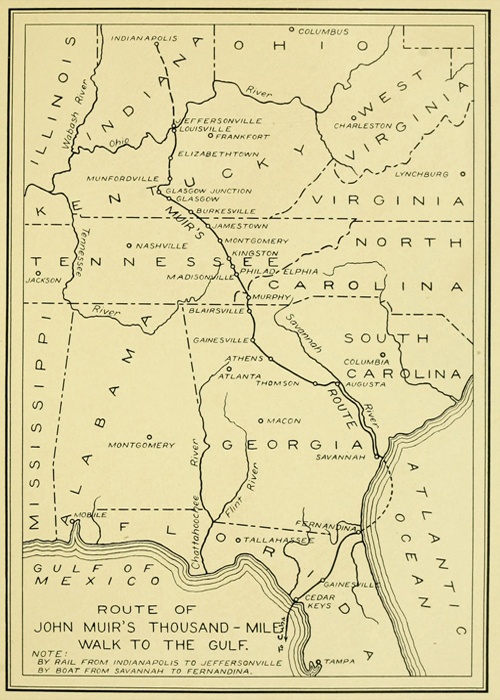
Of the people of the States that I have now passed, I best like the Georgians.
They have charming manners, and their dwellings are mostly larger and better
than those of adjacent States. However costly or ornamental their homes or
their manners, they do not, like those of the New Englander, appear as the
fruits of intense and painful sacrifice and training, but are entirely divested
of artificial weights and measures, and seem to pervade and twine about their
characters as spontaneous growths with the durability and charm of living
nature.
In particular, Georgians, even the commonest, have a most charmingly cordial
way of saying to strangers, as they proceed on their journey, “I wish you
well, sir.” The negroes of Georgia, too, are extremely mannerly and
polite, and appear always to be delighted to find opportunity for obliging
anybody.
Athens contains many beautiful residences. I never before saw so much about a
home that was so evidently done for beauty only, although this is by no means a
universal characteristic of Georgian homes. Nearly all well-to-do
farmers’ families in Georgia and Tennessee spin and weave their own
cloth. This work is almost all done by the mothers and daughters and consumes
much of their time.
The traces of war are not only apparent on the broken fields, burnt fences,
mills, and woods ruthlessly slaughtered, but also on the countenances of the
people. A few years after a forest has been burned another generation of bright
and happy trees arises, in purest, freshest vigor; only the old trees, wholly
or half dead, bear marks of the calamity. So with the people of this war-field.
Happy, unscarred, and unclouded youth is growing up around the aged,
half-consumed, and fallen parents, who bear in sad measure the ineffaceable
marks of the farthest-reaching and most infernal of all civilized calamities.
Since the commencement of my floral pilgrimage I have seen much that is not
only new, but altogether unallied, unacquainted with the plants of my former
life. I have seen magnolias, tupelo, live-oak, Kentucky oak, tillandsia,
long-leafed pine, palmetto, schrankia, and whole forests of strange trees and
vine-tied thickets of blooming shrubs; whole meadowfuls of magnificent bamboo
and lakefuls of lilies, all new to me; yet I still press eagerly on to Florida
as the special home of the tropical plants I am looking for, and I feel sure I
shall not be disappointed.
The same day on which the money arrived I took passage on the steamship Sylvan
Shore for Fernandina, Florida. The daylight part of this sail along the coast
of Florida was full of novelty, and by association awakened memories of my
Scottish days at Dunbar on the Firth of Forth.
On board I had civilized conversation with a Southern planter on topics that
are found floating in the mind of every white man down here who has a single
thought. I also met a brother Scotchman, who was especially interesting and had
some ideas outside of Southern politics. Altogether my half-day and night on
board the steamer were pleasant, and carried me past a very sickly, entangled,
overflowed, and unwalkable piece of forest.
It is pretty well known that a short geological time ago the ocean covered the
sandy level margin, extending from the foot of the Alleghanies to the present
coast-line, and in receding left many basins for lakes and swamps. The land is
still encroaching on the sea, and it does so not evenly, in a regular line, but
in fringing lagoons and inlets and dotlike coral islands.
It is on the coast strip of isles and peninsulas that sea-island cotton is
grown. Some of these small islands are afloat, anchored only by the roots of
mangroves and rushes. For a few hours our steamer sailed in the open sea,
exposed to its waves, but most of the time she threaded her way among the
lagoons, the home of alligators and countless ducks and waders.
October 15. To-day, at last, I reached Florida, the so-called
“Land of Flowers,” that I had so long waited for, wondering if
after all my longings and prayers would be in vain, and I should die without a
glimpse of the flowery Canaan. But here it is, at the distance of a few
yards!—a flat, watery, reedy coast, with clumps of mangrove and forests
of moss-dressed, strange trees appearing low in the distance. The steamer finds
her way among the reedy islands like a duck, and I step on a rickety wharf. A
few steps more take me to a rickety town, Fernandina. I discover a baker, buy
some bread, and without asking a single question, make for the shady, gloomy
groves.
In visiting Florida in dreams, of either day or night, I always came suddenly
on a close forest of trees, every one in flower, and bent down and entangled to
network by luxuriant, bright-blooming vines, and over all a flood of bright
sunlight. But such was not the gate by which I entered the promised land. Salt
marshes, belonging more to the sea than to the land; with groves here and
there, green and unflowered, sunk to the shoulders in sedges and rushes; with
trees farther back, ill defined in their boundary, and instead of rising in
hilly waves and swellings, stretching inland in low water-like levels.
We were all discharged by the captain of the steamer without breakfast, and,
after meeting and examining the new plants that crowded about me, I threw down
my press and little bag beneath a thicket, where there was a dry spot on some
broken heaps of grass and roots, something like a deserted muskrat house, and
applied myself to my bread breakfast. Everything in earth and sky had an
impression of strangeness; not a mark of friendly recognition, not a breath,
not a spirit whisper of sympathy came from anything about me, and of course I
was lonely. I lay on my elbow eating my bread, gazing, and listening to the
profound strangeness.
While thus engaged I was startled from these gatherings of melancholy by a
rustling sound in the rushes behind me. Had my mind been in health, and my body
not starved, I should only have turned calmly to the noise. But in this
half-starved, unfriended condition I could have no healthy thought, and I at
once believed that the sound came from an alligator. I fancied I could feel the
stroke of his long notched tail and could see his big jaws and rows of teeth,
closing with a springy snap on me, as I had seen in pictures.
Well, I don’t know the exact measure of my fright either in time or pain,
but when I did come to a knowledge of the truth, my man-eating alligator became
a tall white crane, handsome as a minister from spirit land—“only
that.” I was ashamed and tried to excuse myself on account of Bonaventure
anxiety and hunger.
Florida is so watery and vine-tied that pathless wanderings are not easily
possible in any direction. I started to cross the State by a gap hewn for the
locomotive, walking sometimes between the rails, stepping from tie to tie, or
walking on the strip of sand at the sides, gazing into the mysterious forest,
Nature’s own. It is impossible to write the dimmest picture of plant
grandeur so redundant, unfathomable.
Short was the measure of my walk to-day. A new, canelike grass, or big lily, or
gorgeous flower belonging to tree or vine, would catch my attention, and I
would throw down my bag and press and splash through the coffee-brown water for
specimens. Frequently I sank deeper and deeper until compelled to turn back and
make the attempt in another and still another place. Oftentimes I was tangled
in a labyrinth of armed vines like a fly in a spider-web. At all times, whether
wading or climbing a tree for specimens of fruit, I was overwhelmed with the
vastness and unapproachableness of the great guarded sea of sunny plants.
Magnolia grandiflora I had seen in Georgia; but its home, its better
land, is here. Its large dark-green leaves, glossy bright above and rusty brown
beneath, gleam and mirror the sunbeams most gloriously among countless
flower-heaps of the climbing, smothering vines. It is bright also in fruit and
more tropical in form and expression than the orange. It speaks itself a prince
among its fellows.
Occasionally, I came to a little strip of open sand, planted with pine
(Pinus palustris or Cubensis). Even these spots were mostly wet,
though lighted with free sunshine, and adorned with purple liatris, and
orange-colored Osmunda cinnamomea. But the grandest discovery of this
great wild day was the palmetto.
I was meeting so many strange plants that I was much excited, making many stops
to get specimens. But I could not force my way far through the swampy forest,
although so tempting and full of promise. Regardless of water snakes or
insects, I endeavored repeatedly to force a way through the tough vine-tangles,
but seldom succeeded in getting farther than a few hundred yards.
It was while feeling sad to think that I was only walking on the edge of the
vast wood, that I caught sight of the first palmetto in a grassy place,
standing almost alone. A few magnolias were near it, and bald cypresses, but it
was not shaded by them. They tell us that plants are perishable, soulless
creatures, that only man is immortal, etc.; but this, I think, is something
that we know very nearly nothing about. Anyhow, this palm was indescribably
impressive and told me grander things than I ever got from human priest.
This vegetable has a plain gray shaft, round as a broom-handle, and a crown of
varnished channeled leaves. It is a plainer plant than the humblest of
Wisconsin oaks; but, whether rocking and rustling in the wind or poised
thoughtful and calm in the sunshine, it has a power of expression not excelled
by any plant high or low that I have met in my whole walk thus far.
This, my first specimen, was not very tall, only about twenty-five feet high,
with fifteen or twenty leaves, arching equally and evenly all around. Each leaf
was about ten feet in length, the blade four feet, the stalk six. The leaves
are channeled like half-open clams and are highly polished, so that they
reflect the sunlight like glass. The undeveloped leaves on the top stand erect,
closely folded, all together forming an oval crown over which the tropic light
is poured and reflected from its slanting mirrors in sparks and splinters and
long-rayed stars.
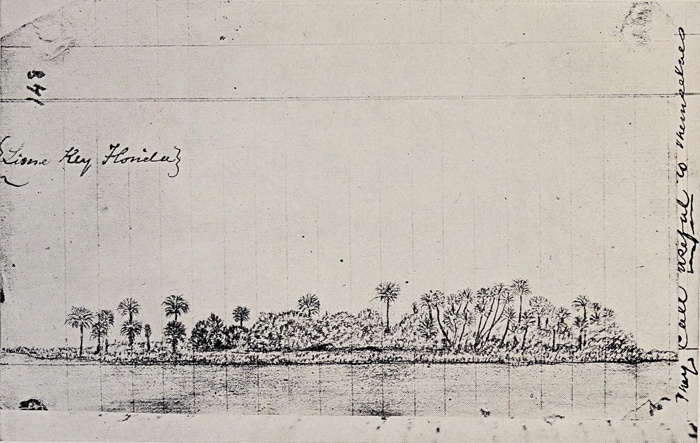
I am now in the hot gardens of the sun, where the palm meets the pine, longed
and prayed for and often visited in dreams, and, though lonely to-night amid
this multitude of strangers, strange plants, strange winds blowing gently,
whispering, cooing, in a language I never learned, and strange birds also,
everything solid or spiritual full of influences that I never before felt, yet
I thank the Lord with all my heart for his goodness in granting me admission to
this magnificent realm.
October 16. Last evening when I was in the trackless woods, the great
mysterious night becoming more mysterious in the thickening darkness, I gave
up hope of finding food or a house bed, and searched only for a dry spot on
which to sleep safely hidden from wild, runaway negroes. I walked rapidly for
hours in the wet, level woods, but not a foot of dry ground could I find.
Hollow-voiced owls were calling without intermission. All manner of night
sounds came from strange insects and beasts, one by one, or crowded together.
All had a home but I. Jacob on the dry plains of Padanaram, with a stone
pillow, must have been comparatively happy.
When I came to an open place where pines grew, it was about ten o’clock,
and I thought that now at last I would find dry ground. But even the sandy
barren was wet, and I had to grope in the dark a long time, feeling the ground
with my hands when my feet ceased to plash, before I at last discovered a
little hillock dry enough to lie down on. I ate a piece of bread that I
fortunately had in my bag, drank some of the brown water about my precious
hillock, and lay down. The noisiest of the unseen witnesses around me were the
owls, who pronounced their gloomy speeches with profound emphasis, but did not
prevent the coming of sleep to heal weariness.
In the morning I was cold and wet with dew, and I set out breakfastless.
Flowers and beauty I had in abundance, but no bread. A serious matter is this
bread which perishes, and, could it be dispensed with, I doubt if civilization
would ever see me again. I walked briskly, watching for a house, as well as the
grand assemblies of novel plants.
Near the middle of the forenoon I came to a shanty where a party of loggers
were getting out long pines for ship spars. They were the wildest of all the
white savages I have met. The long-haired ex-guerrillas of the mountains of
Tennessee and North Carolina are uncivilized fellows; but for downright
barbarism these Florida loggers excel. Nevertheless, they gave me a portion of
their yellow pork and hominy without either apparent hospitality or a grudge,
and I was glad to escape to the forest again.
A few hours later I dined with three men and three dogs. I was viciously
attacked by the latter, who undertook to undress me with their teeth. I was
nearly dragged down backward, but escaped unbitten. Liver pie, mixed with sweet
potatoes and fat duff, was set before me, and after I had finished a moderate
portion, one of the men, turning to his companion, remarked: “Wall, I
guess that man quit eatin’ ’cause he had nothin’ more to eat.
I’ll get him more potato.”
Arrived at a place on the margin of a stagnant pool where an alligator had been
rolling and sunning himself. “See,” said a man who lived here,
“see, what a track that is! He must have been a mighty big fellow.
Alligators wallow like hogs and like to lie in the sun. I’d like a shot
at that fellow.” Here followed a long recital of bloody combats with the
scaly enemy, in many of which he had, of course, taken an important part.
Alligators are said to be extremely fond of negroes and dogs, and naturally the
dogs and negroes are afraid of them.
Another man that I met to-day pointed to a shallow, grassy pond before his
door. “There,” said he, “I once had a tough fight with an
alligator. He caught my dog. I heard him howling, and as he was one of my best
hunters I tried hard to save him. The water was only about knee-deep and I ran
up to the alligator. It was only a small one about four feet long, and was
having trouble in its efforts to drown the dog in the shallow water. I scared
him and made him let go his hold, but before the poor crippled dog could reach
the shore, he was caught again, and when I went at the alligator with a knife,
it seized my arm. If it had been a little stronger it might have eaten me
instead of my dog.”
I never in all my travels saw more than one, though they are said to be
abundant in most of the swamps, and frequently attain a length of nine or ten
feet. It is reported, also, that they are very savage, oftentimes attacking men
in boats. These independent inhabitants of the sluggish waters of this low
coast cannot be called the friends of man, though I heard of one big fellow
that was caught young and was partially civilized and made to work in harness.
Many good people believe that alligators were created by the Devil, thus
accounting for their all-consuming appetite and ugliness. But doubtless these
creatures are happy and fill the place assigned them by the great Creator of us
all. Fierce and cruel they appear to us, but beautiful in the eyes of God.
They, also, are his children, for He hears their cries, cares for them
tenderly, and provides their daily bread.
The antipathies existing in the Lord’s great animal family must be wisely
planned, like balanced repulsion and attraction in the mineral kingdom. How
narrow we selfish, conceited creatures are in our sympathies! how blind to the
rights of all the rest of creation! With what dismal irreverence we speak of
our fellow mortals! Though alligators, snakes, etc., naturally repel us, they
are not mysterious evils. They dwell happily in these flowery wilds, are part
of God’s family, unfallen, undepraved, and cared for with the same
species of tenderness and love as is bestowed on angels in heaven or saints on
earth.
I think that most of the antipathies which haunt and terrify us are morbid
productions of ignorance and weakness. I have better thoughts of those
alligators now that I have seen them at home. Honorable representatives of the
great saurians of an older creation, may you long enjoy your lilies and rushes,
and be blessed now and then with a mouthful of terror-stricken man by way of
dainty!
Found a beautiful lycopodium to-day, and many grasses in the dry sunlit places
called “barrens,” “hummocks,” “savannas,”
etc. Ferns also are abundant. What a flood of heat and light is daily poured
out on these beautiful openings and intertangled woods! “The land of the
sunny South,” we say, but no part of our diversified country is more
shaded and covered from sunshine. Many a sunny sheet of plain and prairie break
the continuity of the forests of the North and West, and the forests themselves
are mostly lighted also, pierced with direct ray lances, or [the sunlight]
passing to the earth and the lowly plants in filtered softness through
translucent leaves. But in the dense Florida forests sunlight cannot enter. It
falls on the evergreen roof and rebounds in long silvery lances and flashy
spray. In many places there is not light sufficient to feed a single green leaf
on these dark forest floors. All that the eye can reach is just a maze of tree
stems and crooked leafless vine strings. All the flowers, all the verdure, all
the glory is up in the light.
The streams of Florida are still young, and in many places are untraceable. I
expected to find these streams a little discolored from the vegetable matter
that I knew they must contain, and I was sure that in so flat a country I
should not find any considerable falls or long rapids. The streams of upper
Georgia are almost unapproachable in some places on account of luxuriant
bordering marines, but the banks are nevertheless high and well defined.
Florida streams are not yet possessed of banks and braes and definite channels.
Their waters in deep places are black as ink, perfectly opaque, and glossy on
the surface as if varnished. It often is difficult to ascertain which way they
are flowing or creeping, so slowly and so widely do they circulate through the
tree-tangles and swamps of the woods. The flowers here are strangers to me, but
not more so than the rivers and lakes. Most streams appear to travel through a
country with thoughts and plans for something beyond. But those of Florida are
at home, do not appear to be traveling at all, and seem to know nothing of the
sea.
October 17. Found a small, silvery-leafed magnolia, a bush ten feet
high. Passed through a good many miles of open level pine barrens, as
bounteously lighted as the “openings” of Wisconsin. The pines are
rather small, are planted sparsely and pretty evenly on these sandy flats not
long risen from the sea. Scarcely a specimen of any other tree is to be found
associated with the pine. But there are some thickets of the little saw
palmettos and a magnificent assemblage of tall grasses, their splendid panicles
waving grandly in the warm wind, and making low tuneful changes in the
glistening light that is flashed from their bent stems.
Not a pine, not a palm, in all this garden excels these stately grass plants in
beauty of wind-waving gestures. Here are panicles that are one mass of refined
purple; others that have flowers as yellow as ripe oranges, and stems polished
and shining like steel wire. Some of the species are grouped in groves and
thickets like trees, while others may be seen waving without any companions in
sight. Some of them have wide-branching panicles like Kentucky oaks, others
with a few tassels of spikelets drooping from a tall, leafless stem. But all of
them are beautiful beyond the reach of language. I rejoice that God has
“so clothed the grass of the field.” How strangely we are blinded
to beauty and color, form and motion, by comparative size! For example, we
measure grasses by our own stature and by the height and bulkiness of trees.
But what is the size of the greatest man, or the tallest tree that ever
overtopped a grass! Compared with other things in God’s creation the
difference is nothing. We all are only microscopic animalcula.
October 18. Am walking on land that is almost dry. The dead levels are
interrupted here and there by sandy waves a few feet in height. It is said that
not a point in all Florida is more than three hundred feet above
sea-level—a country where but little grading is required for roads, but
much bridging and boring of many tunnels through forests.
Before reaching this open ground, in a lonely, swampy place in the woods, I met
a large, muscular, brawny young negro, who eyed me with glaring, wistful
curiosity. I was very thirsty at the time, and inquired of the man if there
were any houses or springs near by where I could get a drink. “Oh,
yes,” he replied, still eagerly searching me with his wild eyes. Then he
inquired where I came from, where I was going, and what brought me to such a
wild country, where I was liable to be robbed, and perhaps killed.
“Oh, I am not afraid of any one robbing me,” I said, “for I
don’t carry anything worth stealing.” “Yes,” said he,
“but you can’t travel without money.” I started to walk on,
but he blocked my way. Then I noticed that he was trembling, and it flashed
upon me all at once that he was thinking of knocking me down in order to rob
me. After glaring at my pockets as if searching for weapons, he stammered in a
quavering voice, “Do you carry shooting-irons?” His motives, which
I ought to have noted sooner, now were apparent to me. Though I had no pistol,
I instinctively threw my hand back to my pistol pocket and, with my eyes fled
on his, I marched up close to him and said, “I allow people to find out
if I am armed or not.” Then he quailed, stepped aside, and allowed me to
pass, for fear of being shot. This was evidently a narrow escape.
A few miles farther on I came to a cotton-field, to patches of sugar cane
carefully fenced, and some respectable-looking houses with gardens. These
little fenced fields look as if they were intended to be for plants what cages
are for birds. Discovered a large, treelike cactus in a dooryard; a small
species was abundant on the sand-hillocks. Reached Gainesville late in the
night.
When within three or four miles of the town I noticed a light off in the pine
woods. As I was very thirsty, I thought I would venture toward it with the hope
of obtaining water. In creeping cautiously and noiselessly through the grass to
discover whether or no it was a camp of robber negroes, I came suddenly in full
view of the best-lighted and most primitive of all the domestic establishments
I have yet seen in town or grove. There was, first of all, a big, glowing log
fire, illuminating the overleaning bushes and trees, bringing out leaf and
spray with more than noonday distinctness, and making still darker the
surrounding wood. In the center of this globe of light sat two negroes. I could
see their ivory gleaming from the great lips, and their smooth cheeks flashing
off light as if made of glass. Seen anywhere but in the South, the glossy pair
would have been taken for twin devils, but here it was only a negro and his
wife at their supper.
I ventured forward to the radiant presence of the black pair, and, after being
stared at with that desperate fixedness which is said to subdue the lion, I was
handed water in a gourd from somewhere out of the darkness. I was standing for
a moment beside the big fire, looking at the unsurpassable simplicity of the
establishment, and asking questions about the road to Gainesville, when my
attention was called to a black lump of something lying in the ashes of the
fire. It seemed to be made of rubber; but ere I had time for much speculation,
the woman bent wooingly over the black object and said with motherly kindness,
“Come, honey, eat yo’ hominy.”
At the sound of “hominy” the rubber gave strong manifestations of
vitality and proved to be a burly little negro boy, rising from the earth naked
as to the earth he came. Had he emerged from the black muck of a marsh, we
might easily have believed that the Lord had manufactured him like Adam direct
from the earth.
Surely, thought I, as I started for Gainesville, surely I am now coming to the
tropics, where the inhabitants wear nothing but their own skins. This fashion
is sufficiently simple, “no troublesome disguises,” as Milton calls
clothing,—but it certainly is not quite in harmony with Nature. Birds
make nests and nearly all beasts make some kind of bed for their young; but
these negroes allow their younglings to lie nestless and naked in the dirt.
Gainesville is rather attractive—an oasis in the desert, compared with
other villages. It gets its life from the few plantations located about it on
dry ground that rises islandlike a few feet above the swamps. Obtained food and
lodging at a sort of tavern.
October 19. Dry land nearly all day. Encountered limestone, flint,
coral, shells, etc. Passed several thrifty cotton plantations with comfortable
residences, contrasting sharply with the squalid hovels of my first days in
Florida. Found a single specimen of a handsome little plant, which at once, in
some mysterious way, brought to mind a young friend in Indiana. How wonderfully
our thoughts and impressions are stored! There is that in the glance of a
flower which may at times control the greatest of creation’s braggart
lords.
The magnolia is much more abundant here. It forms groves and almost exclusively
forests the edges of ponds and the banks of streams. The easy, dignified
simplicity of this noble tree, its plain leaf endowed with superb richness of
color and form, its open branches festooned with graceful vines and tillandsia,
its showy crimson fruit, and its magnificent fragrant white flowers make
Magnolia grandiflora the most lovable of Florida trees.
Discovered a great many beautiful polygonums, petalostemons, and yellow
leguminous vines. Passed over fine sunny areas of the long-leafed and Cuban
pines, which were everywhere accompanied by fine grasses and solidagoes. Wild
orange groves are said to be rather common here, but I have seen only limes
growing wild in the woods.
Came to a hut about noon, and, being weary and hungry, asked if I could have
dinner. After serious consultation I was told to wait, that dinner would soon
be ready. I saw only the man and his wife. If they had children, they may have
been hidden in the weeds on account of nakedness. Both were suffering from
malarial fever, and were very dirty. But they did not appear to have any
realizing sense of discomfort from either the one or the other of these
misfortunes. The dirt which encircled the countenances of these people did not,
like the common dirt of the North, stick on the skin in bold union like plaster
or paint, but appeared to stand out a little on contact like a hazy, misty,
half-aerial mud envelope, the most diseased and incurable dirt that I ever saw,
evidently desperately chronic and hereditary.
It seems impossible that children from such parents could ever be clean. Dirt
and disease are dreadful enough when separate, but combined are inconceivably
horrible. The neat cottage with a fragrant circumference of thyme and
honeysuckle is almost unknown here. I have seen dirt on garments regularly
stratified, the various strata no doubt indicating different periods of life.
Some of them, perhaps, were annual layers, furnishing, like those of trees, a
means of determining the age. Man and other civilized animals are the only
creatures that ever become dirty.
Slept in the barrens at the side of a log. Suffered from cold and was drenched
with dew. What a comfort a companion would be in the dark loneliness of such
nights! Did not dare to make a fire for fear of discovery by robber negroes,
who, I was warned, would kill a man for a dollar or two. Had a long walk after
nightfall, hoping to discover a house. Became very thirsty and often was
compelled to drink from slimy pools groped for in the grass, with the fear of
alligators before my eyes.
October 20. Swamp very dense during this day’s journey. Almost one
continuous sheet of water covered with aquatic trees and vines. No stream that
I crossed to-day appeared to have the least idea where it was going. Saw an
alligator plash into the sedgy brown water by the roadside from an old log.
Arrived at night at the house of Captain Simmons, one of the very few
scholarly, intelligent men that I have met in Florida. He had been an officer
in the Confederate army in the war and was, of course, prejudiced against the
North, but polite and kind to me, nevertheless. Our conversation, as we sat by
the light of the fire, was on the one great question, slavery and its
concomitants. I managed, however, to switch off to something more congenial
occasionally—the birds of the neighborhood, the animals, the climate, and
what spring, summer, and winter are like in these parts.
About the climate, I could not get much information, as he had always lived in
the South and, of course, saw nothing extraordinary in weather to which he had
always been accustomed. But in speaking of animals, he at once became
enthusiastic and told many stories of hairbreadth escapes, in the woods about
his house, from bears, hungry alligators, wounded deer, etc. “And
now,” said he, forgetting in his kindness that I was from the hated
North, “you must stay with me a few days. Deer are abundant. I will lend
you a rifle and we’ll go hunting. I hunt whenever I wish venison, and I
can get it about as easily from the woods near by as a shepherd can get mutton
out of his flock. And perhaps we will see a bear, for they are far from scarce
here, and there are some big gray wolves, too.”
I expressed a wish to see some large alligators. “Oh, well,” said
he, “I can take you where you will see plenty of those fellows, but they
are not much to look at. I once got a good look at an alligator that was lying
at the bottom of still, transparent water, and I think that his eyes were the
most impressively cold and cruel of any animal I have seen. Many alligators go
out to sea among the keys. These sea alligators are the largest and most
ferocious, and sometimes attack people by trying to strike them with their
tails when they are out fishing in boats.
“Another thing I wish you to see,” he continued, “is a
palmetto grove on a rich hummock a few miles from here. The grove is about
seven miles in length by three in breadth. The ground is covered with long
grass, uninterrupted with bushes or other trees. It is the finest grove of
palmettos I have ever seen and I have oftentimes thought that it would make a
fine subject for an artist.”
I concluded to stop—more to see this wonderful palmetto hummock than to
hunt. Besides, I was weary and the prospect of getting a little rest was a
tempting consideration after so many restless nights and long, hard walks by
day.
October 21. Having outlived the sanguinary hunters’ tales of my
loquacious host, and breakfasted sumptuously on fresh venison and
“caller” fish from the sea, I set out for the grand palm grove. I
had seen these dazzling sun-children in every day of my walk through Florida,
but they were usually standing solitary, or in groups of three or four; but
to-day I was to see them by the mile. The captain led me a short distance
through his corn field and showed me a trail which would conduct me to the
palmy hummock. He pointed out the general direction, which I noted upon my
compass.
“Now,” said he, “at the other side of my farthest field you
will come to a jungle of cat-briers, but will be able to pass them if you
manage to keep the trail. You will find that the way is not by any means well
marked, for in passing through a broad swamp, the trail makes a good many
abrupt turns to avoid deep water, fallen trees, or impenetrable thickets. You
will have to wade a good deal, and in passing the water-covered places you will
have to watch for the point where the trail comes out on the opposite
side.”
I made my way through the briers, which in strength and ferocity equaled those
of Tennessee, followed the path through all of its dim waverings, waded the
many opposing pools, and, emerging suddenly from the leafy darkness of the
swamp forest, at last stood free and unshaded on the border of the sun-drenched
palm garden. It was a level area of grasses and sedges, smooth as a prairie,
well starred with flowers, and bounded like a clearing by a wall of vine-laden
trees.
The palms had full possession and appeared to enjoy their sunny home. There was
no jostling, no apparent effort to outgrow each other. Abundance of sunlight
was there for every crown, and plenty to fall between. I walked enchanted in
their midst. What a landscape! Only palms as far as the eye could reach! Smooth
pillars rising from the grass, each capped with a sphere of leaves, shining in
the sun as bright as a star. The silence and calm were as deep as ever I found
in the dark, solemn pine woods of Canada, and that contentment which is an
attribute of the best of God’s plant people was as impressively felt in
this alligator wilderness as in the homes of the happy, healthy people of the
North.
The admirable Linnaeus calls palms “the princes of the vegetable
world.” I know that there is grandeur and nobility in their character,
and that there are palms nobler far than these. But in rank they appear to me
to stand below both the oak and the pine. The motions of the palms, their
gestures, are not very graceful. They appear to best advantage when perfectly
motionless in the noontide calm and intensity of light. But they rustle and
rock in the evening wind. I have seen grasses waving with far more dignity. And
when our northern pines are waving and blowing in sign of worship with the
winter storm-winds where is the prince of palms that could have the conscience
to demand their homage!
Members of this palm congregation were of all sizes with respect to their
stems; but their glorious crowns were all alike. In development there is only
the terminal bud to consider. The young pawn of this species emerges from the
ground in full strength, one cluster of leaves arched every way, making a
sphere about ten or twelve feet in diameter. The outside lower leaves gradually
become yellow, wither, and break off, the petiole snapping squarely across, a
few inches from the stem. New leaves develop with wonderful rapidity. They
stand erect at first, but gradually arch outward as they expand their blades
and lengthen their petioles.
New leaves arise constantly from the center of the grand bud, while old ones
break away from the outside. The splendid crowns are thus kept about the same
size, perhaps a little larger than in youth while they are yet on the ground.
As the development of the central axis goes on, the crown is gradually raised
on a stem of about six to twelve inches in diameter. This stem is of equal
thickness at the top and at the bottom and when young is roughened with the
broken petioles. But these petiole-stumps fall off and disappear as they become
old, and the trunk becomes smooth as if turned in a lathe.
After some hours in this charming forest I started on the return journey before
night, on account of the difficulties of the swamp and the brier patch. On
leaving the palmettos and entering the vine-tangled, half-submerged forest I
sought long and carefully, but in vain, for the trail, for I had drifted about
too incautiously in search of plants. But, recollecting the direction that I
had followed in the morning, I took a compass bearing and started to penetrate
the swamp in a direct line.
Of course I had a sore weary time, pushing through the tanglement of falling,
standing, and half-fallen trees and bushes, to say nothing of knotted vines as
remarkable for their efficient army of interlocking and lancing prickers as for
their length and the number of their blossoms. But these were not my greatest
obstacles, nor yet the pools and lagoons full of dead leaves and alligators. It
was the army of cat-briers that I most dreaded. I knew that I would have to
find the narrow slit of a lane before dark or spend the night with mosquitoes
and alligators, without food or fire. The entire distance was not great, but a
traveler in open woods can form no idea of the crooked and strange difficulties
of pathless locomotion in these thorny, watery Southern tangles, especially in
pitch darkness. I struggled hard and kept my course, leaving the general
direction only when drawn aside by a plant of extraordinary promise, that I
wanted for a specimen, or when I had to make the half-circuit of a pile of
trees, or of a deep lagoon or pond.
In wading I never attempted to keep my clothes dry, because the water was too
deep, and the necessary care would consume too much time. Had the water that I
was forced to wade been transparent it would have lost much of its difficulty.
But as it was, I constantly expected to plant my feet on an alligator, and
therefore proceeded with strained caution. The opacity of the water caused
uneasiness also on account of my inability to determine its depth. In many
places I was compelled to turn back, after wading forty or fifty yards, and to
try again a score of times before I succeeded in getting across a single
lagoon.
At length, after miles of wading and wallowing, I arrived at the grand
cat-brier encampment which guarded the whole forest in solid phalanx,
unmeasured miles up and down across my way. Alas! the trail by which I had
crossed in the morning was not to be found, and night was near. In vain I
scrambled back and forth in search of an opening. There was not even a strip of
dry ground on which to rest. Everywhere the long briers arched over to the
vines and bushes of the watery swamp, leaving no standing-ground between them.
I began to think of building some sort of a scaffold in a tree to rest on
through the night, but concluded to make one more desperate effort to find the
narrow track.
After calm, concentrated recollection of my course, I made a long exploration
toward the left down the brier line, and after scrambling a mile or so,
perspiring and bleeding, I discovered the blessed trail and escaped to dry land
and the light. Reached the captain at sun-down. Dined on milk and johnny-cake
and fresh venison. Was congratulated on my singular good fortune and woodcraft,
and soon after supper was sleeping the deep sleep of the weary and the safe.
October 22. This morning I was easily prevailed upon by the captain and
an ex-judge, who was rusticating here, to join in a deer hunt. Had a delightful
ramble in the long grass and flowery barrens. Started one deer but did not draw
a single shot. The captain, the judge, and myself stood at different stations
where the deer was expected to pass, while a brother of the captain entered the
woods to arouse the game from cover. The one deer that he started took a
direction different from any which this particular old buck had ever been known
to take in times past, and in so doing was cordially cursed as being the
“d——dest deer that ever ran unshot.” To me it appeared
as “d——dest” work to slaughter God’s cattle for
sport. “They were made for us,” say these self-approving preachers;
“for our food, our recreation, or other uses not yet discovered.”
As truthfully we might say on behalf of a bear, when he deals successfully with
an unfortunate hunter, “Men and other bipeds were made for bears, and
thanks be to God for claws and teeth so long.”
Let a Christian hunter go to the Lord’s woods and kill his well-kept
beasts, or wild Indians, and it is well; but let an enterprising specimen of
these proper, predestined victims go to houses and fields and kill the most
worthless person of the vertical godlike killers,—oh! that is horribly
unorthodox, and on the part of the Indians atrocious murder! Well, I have
precious little sympathy for the selfish propriety of civilized man, and if a
war of races should occur between the wild beasts and Lord Man, I would be
tempted to sympathize with the bears.