Silver is widely diffused, and has been found in most mining districts.
It occurs native in sufficient quantity to constitute one of the chief
ores of the metal. It also occurs combined with sulphur (as in
argentite), with sulphur and antimony (as in stephanite or brittle
silver ore, and in pyrargyrite or ruby silver), and with copper,
sulphur, antimony, and arsenic, as in polybasite. Chloride of silver
occurs native as horn silver or kerargyrite. Silver is found in the ores
of other metals, such as fahlerz, which sometimes contains from two to
ten per cent. of the metal, and galena, which is an important source of
it; in fact, galena is never found entirely free from silver. It is
present also in greater or less quantity in the ores of copper and zinc.
Silver dissolves readily in nitric acid, forming silver nitrate. It only
forms one family of salts, and of these the chloride and nitrate are of
chief importance to the assayer. The formation of the chloride of silver
on the addition of hydrochloric acid or a soluble chloride to the nitric
acid solution, serves for the recognition and separation of silver. The
precipitated chloride is white (becoming violet on exposure to light),
insoluble in nitric acid, soluble in ammonia, hyposulphite of soda, or
concentrated solutions of chlorides. The best confirmatory test is made
by wrapping the precipitate in a little sheet lead, and cupelling, when
the silver will be left in the metallic state, and is easily recognized.
Dry Assay.—This assay is made up of two parts: (1) the concentration
of the silver in a button of lead; and (2) the cupellation of the
resulting alloy. The concentration of the button of lead may be
effected either by scorification or by fusion in a crucible.
The scorification assay is performed in a scorifier, which is a shallow
open-mouthed dish about 2-1/2 inches across, with a very thick bottom to
enable it to withstand the corrosive action of the slag. A charge of
more than 3 or 5 grams of the ore cannot be worked in one, and with such
small charges the unavoidable variations have a serious effect on the
figures reported. A difference of one milligram on the weight of the
button of silver got represents a difference of 6 or 10 ounces per ton.
With rich ores such variation is unavoidable under any conditions, and
the only safe plan is to take the mean of several assays. But with
poorer ores the accuracy of the assay, as well as convenience in
working, is much increased by working in a crucible with larger charges.
In scorification the proportion of lead required for scorifying 1 gram
of ore is in average cases from 10 to 15 grams, sinking in the case of
galena to 2 grams, and rising with earthy and refractory substances to
from 30 to 40 grams. But by fusing in a crucible with well-selected
fluxes, a proportion of 4 of flux to 1 of ore is generally sufficient;
and not only is the proportion of added matter less, but it is also
easier to manipulate large quantities in crucibles, so that, although in
some cases the crucible assay is more troublesome and less satisfactory,
yet with poor and earthy ores it is the best method of dealing with
them; while when properly worked it yields results as accurate as
scorification does. As a general rule, if more than 5 grams of ore must
be taken, the crucible assay should be adopted.
Scorification Assay.—The charge of ore is usually 3 grams, sometimes
5; the lead varies from 30 to 70 grams, and the quantity of soda, borax,
or powdered glass added varies from 0.3 to 3 or 4 grams. It is generally
recommended to have the lead granulated,[9] and to mix the ore with
about half of it in the scorifier; then to put on the rest of the lead;
and finally to sprinkle the borax or glass on the top. It answers just
as well, however, to use the lead in the shape of foil, and wrap the ore
up in it; and if the ore contains much sulphur, the borax may with
advantage be added (wrapped in a little tissue paper) some five or ten
minutes after the operation has started.
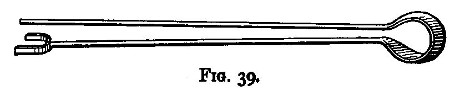
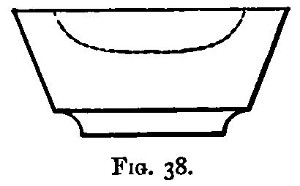
The process of scorification is as follows:—A scorifier (fig. 38) of
convenient size having been selected (one 2-1/2 inches across is most
generally useful), it is dried at a gentle heat for about ten minutes.
The charge is then put into it, and it is introduced, with the help of a
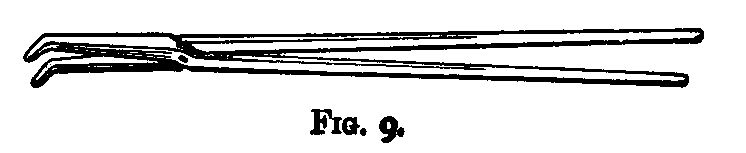
scorifier tongs (fig. 39), into a muffle heated considerably above
redness. The muffle is then closed, and when the metal has melted down,
it is opened, but the temperature is kept up. A ring of slag will, after
a time, form around the metal, and when this appearance (known as the
eye) presents itself, the temperature may be lowered. When the eye has
disappeared—that is, when the layer of slag has quite closed in—a
pinch of powdered culm wrapped in tissue paper is added. As soon as the
slag has again become tranquil, the scorifier is taken out, and its
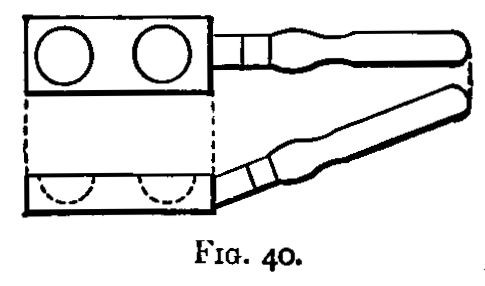
contents are poured into a mould (fig. 40), the slag is detached, and
saved. If the button of metal weighs more than 30 grams, its size is
reduced by another scorification in the same scorifier, which should
have been replaced in the muffle immediately after the contents had been
poured out. If the ore is not a very rich one, the button of lead will
carry practically all the silver; but with rich ores it is more
satisfactory to save the slag, and subsequently to melt it down with the
cupel on which the lead has been treated, so as to recover the silver
lost in the slag, together with that absorbed in the cupel, at one
operation. Or, if the cupellation loss is neglected or calculated in
some other manner, the slag or slags from the scorifier may be powdered
and mixed with 20 grams of oxide of lead, 5 grams of borax, and 1 gram
of charcoal. This should be melted down in a small crucible, and the
resulting button of lead cupelled.
If the scorification has been unsatisfactory, the quantity of silver
obtained from the slag will be by no means inconsiderable. The usual
explanation is that with sulphury ores compounds of metallic oxides and
sulphides (oxysulphides) are formed, which remain in the slag, retaining
considerable quantities of the precious metal. It is said that under
certain conditions such a slag may contain as much as 10 per cent. of
silver. An excess of lead and a high temperature prevents the formation
of these oxysulphides. But if much silver is present in the ore, the
slag cannot be safely thrown away, even if sulphur is absent, and the
process has been satisfactorily performed.
If the crust which appears on the surface of the lead does not clear,
add a small lump of borax and 20 grams more lead; then close the muffle,
and keep the temperature as high as possible. If the slag forms
properly, but shows unfused or only half-fused lumps, even when the
scorification has proceeded for some time, add more borax, and stir with
an iron rod. The slag adhering to the rod must be detached by hammering,
and replaced in the scorifier.
If the ore consists largely of quartz, soda should be added instead of
borax; or, if it contains much copper, powdered quartz may be used. If
the scorifier at the end of an operation is more than usually corroded,
the borax should be replaced in subsequent assays on similar ores by
powdered glass or quartz.
If a fairly fluid slag is formed which does not clear from the metal and
show the eye, more lead and a higher temperature is wanted.
As a general rule, it may be stated that when a scorification is
unsatisfactory, what is wanted is more heat, more lead, or more borax.
It is a safe plan when work has to be done on a strange ore, to make
three or four assays with varying quantities of lead. The proportion of
lead is right when a further addition does not yield a higher result.
The proper proportion having been found, a note of it should be made for
future use.
The object of the fusion in a crucible, like that of scorification, is
to concentrate the silver in a button of lead which is to be
subsequently cupelled; and to retain the earthy and waste matters in the
slag. It is necessary to consider the quality of the slag and the weight
and quality of the lead. The slag when fused should be liquid and
homogeneous, and not too corrosive on the crucible. The button of lead
should be soft, malleable, and free from a coating of regulus.[10] In
weight it should not differ much from the ore taken. With 20 grams of
ore, for example, a button of lead weighing from 18 to 25 grams will be
satisfactory: less than this would leave an undue proportion of silver
in the slag; and more would be unnecessarily large for cupelling, and
would increase the loss in that operation.
With average ores, take 20 grams of the powdered ore and mix with 30
grams of "soda," 40 grams of red-lead or litharge, 5 grams of borax, and
from 2 to 2.5 grams of flour, and place in an E crucible (Battersea
round). Put these in the furnace at a red heat, cover the crucible, and
gradually raise the temperature until the whole charge has melted down
and is in a state of tranquil fusion. Pour into a mould, and replace the
crucible in the furnace. As soon as the lead is solid, detach the slag
and put it back into the crucible; and when it is again fluid, charge on
to it with a copper scoop a mixture of 20 grams of oxide of lead, and 1
gram of charcoal: when fusion has again become tranquil, pour and detach
the button of lead. The lead buttons should be hammered into discs with
rounded edges, and be freed from slag; if too big for a cupel they may
be scorified together in a small scorifier, but it is better to cupel
them separately.
Ores containing Metallic Oxides.—Peroxides of iron, manganese, and
copper interfere by counteracting the effect of the charcoal or flour,
and thus reducing the size of the lead button. Peroxide of iron will
reduce the weight of lead by a little more than its own weight; and
peroxide of manganese has about twice this effect. When these oxides are
present an additional quantity of flour must be used, and precautions
must be taken to prevent reoxidation of the slag by the furnace gases.
This may best be prevented by using a layer of common salt as a cover to
the charge. When the ores contain a good deal of quartz or stony matter,
the fluxes just given (for average ores) will do; but the proportion of
soda should be diminished, and that of the borax, oxide of lead, and
flour increased as the quantity of metallic oxides become greater. If
the ore contains practically no quartz, the soda may be altogether
omitted, and some glass or powdered quartz added. The following charge
may be taken as an example: weigh up 20 grams of the powdered ore, 15
grams each of "soda" and borax, 60 grams of oxide of lead, and 5 grams
of flour. Mix and place them in an E crucible, and cover with a layer of
from a quarter to half an inch of common salt. Place in the furnace as
before. The salt will give off a considerable amount of fume, which
will, to a certain extent, conceal the state of the charge: when the
crucible has been in the furnace for about 25 minutes remove it and pour
out the contents immediately. With ores that produce a thick slag the
addition of 5 grams of fluor spar will be an advantage. It may happen
that with an unknown ore the first assay will be more or less
unsatisfactory: but from it the necessity for adding more or less flour
will be learnt, and a second assay, with the necessary modification of
the charge, should give a good result.
Ores containing much Sulphides.—Ores of this class may be easily
recognized, either by the appearance of the minerals they contain or by
the odour of sulphurous oxide (SO2) which they evolve when roasted on
a spatula. The sulphides most commonly present, in addition to the
sulphurized minerals of silver, are pyrites, galena, blende, and
mispickel. When they are present in only a moderate amount, their effect
is simply to increase the weight of the button of lead; and this is
easily counteracted by reducing the amount of flour, or by omitting it.
When in larger amounts, they not only yield large buttons, but also
render the metal sulphury, sometimes even giving a button of regulus
instead of lead. This last evil may be remedied (1) by putting in a rod
of iron as soon as the charge has fused, or (2) it may be counteracted
by a proper addition of nitre, or (3) when the sulphides present are
only those of iron or copper the sulphur may be removed by calcining,
and the ore converted into one of the class containing metallic oxides.
The calcination is effected as follows:—Weigh up 20 grams of the
powdered ore and place it in a wide-mouthed crucible sufficiently large
to perform the subsequent melting down in. The roasting must be done at
a gentle heat at first, so as to avoid clotting: the mouth of the
crucible should project considerably above the coke, and should slope
forward towards the worker. The charge must be occasionally stirred with
the stirrer (fig. 10) so as to expose fresh surfaces to the action of
the air, and to prevent adhesion to the sides of the crucible. The
stirrer should not be removed till the calcination is finished. The
temperature should be raised at the end to a good red heat; and (to
ensure the decomposition of any sulphate that may be formed) the roasted
ore should be rubbed up in a mortar with a pinch of anthracite, and
again calcined. It is then mixed with fluxes as described, and fused in
the same crucible.
The calcination of an ore is a work occupying a good deal of time, and,
in most cases, it is better to take advantage of the desulphurizing
power of red lead or nitre. Red lead by itself will do, but a large
quantity of it will be required; 1 part of a metallic sulphide needs
from 20 to 50 parts of red lead to yield a button free from sulphur;
whereas at most from 2 to 2-1/2 parts of nitre are sufficient. There is
sometimes an advantage in having a considerable excess of oxide of lead
in the slag, but where there is no such reason, 2 parts of red lead to 1
of ore is enough. A charge which will do for most sulphides is the
following: 20 grams of ore, 40 to 100 grams of red lead, 20 grams of
"soda," 5 of borax, and sufficient nitre (or perhaps flour) to give a
button of about 25 grams of lead. How much this must be (if not already
known) may be approximately determined by fusing 3 grams of the ore and
3 grams of "soda" in a small crucible (C) with 50 grams of litharge (not
red lead) under a cover of salt, and weighing the resulting button of
lead. Subtract 3 from the weight of lead obtained, and the difference
multiplied by 1.3 will give the quantity in grams of nitre required. If
the button of lead weighs less than 3 grams flour must be added. If this
is not satisfactory repeat the assay, adding an extra gram of nitre for
each 4 grams of lead in excess of that required, or 1 gram of flour for
a 12-gram deficiency.
In the method in which iron is used as a de-sulphurising agent, only as
much oxide of lead should be added as will give a button of lead of the
required size. Rather a large button of lead should be got, and the slag
should be strongly alkaline; if the ore does not already carry a large
amount of sulphur some should be added. The fusion should be performed
at a low temperature (similar to that for a galena assay), and should be
continued for some time after it has become tranquil. Take 20 grams of
the ore, 40 grams of "soda," 40 grams of oxide of lead, and 5 or 10
grams of borax; place this mixture in a crucible (with a rod of iron, as
in the galena assay), cover, and fuse for about half an hour. Take out
the rod, washing it in the slag, and, in a minute or two, pour. Clean
and cupel the button of lead.
General Remarks on the Fusion.—Other things being equal, the smaller
the quantity of the slag the better, provided there is sufficient to
cover the metal. The presence of peroxides of the heavy metals is
prejudicial, since they tend to increase the quantity of silver retained
in the slag. It may be given as a general rule that when iron, copper,
manganese, &c., are present, there is a more than ordinary need for
cleaning the slags, and care must be taken to keep these metals in the
state of lower oxide.
In selecting the fluxes, it should be remembered that soda is the best
for quartz, and borax for lime and metallic oxides. And that with ores
almost free from gangue some quartz or glass should be added to protect
the crucible. Two parts of soda are enough to flux 1 part of quartz;
whilst of borax, or oxide of lead, 4 parts are barely sufficient. Oxide
of lead has the advantage of being heavy and so does not occupy much
space in the crucible; on the other hand, if the melting down be
performed too quickly, or if oxide of lead only is used, this high
specific gravity is a disadvantage, for the lighter earthy matter floats
as a pasty mass on the more fluid oxide of lead, and thus escapes its
action.
When metallic sulphides are present in the ore, an excess of oxide of
lead helps to keep the sulphur out of the button of metal. In addition
to the oxide of lead required as a flux, some will be required to
provide the lead in which the silver is to be collected. Oxide of lead,
mixed with charcoal or flour, yields, when heated, a multitude of minute
buttons of metal uniformly distributed through the mass of the charge;
as the charge melts down these run together and fall to the bottom; this
shower of lead collects the silver more easily than a single button at
the bottom of the crucible could do. Only that portion of the oxide of
lead which remains in the slag can be considered as a flux; very often
the first indication of an excessive reduction of lead is the pastiness
of the slag rendered thick by the withdrawal of the oxide of lead which
would have kept it fluid. If, in an assay, it is found that 5 parts of
flux are not sufficient for 1 part of ore, the remedy lies in using a
different flux rather than in taking a larger quantity.
On the Reducing Effect of Charcoal, Flour, and Tartar.—The weight to
be got from a given charge will depend (provided sufficient oxide of
lead is present) upon the proportion of the reducing agents in it. We
have thought it well to illustrate this part of the subject by a series
of experiments which the learner will do well to practise for himself
before proceeding to the assay of actual ores. Take 80 grams of litharge
and 20 grams of a mixture of borax and soda. Fuse three lots (1) with
1.5 gram of charcoal, (2) with 3 grams of flour, and (3) with 7.5 grams
of tartar. Weigh the buttons of lead obtained, and divide each by the
weight of reducing agent used. The results will differ somewhat with the
dryness and quality of the flour, etc., used; in one series of
experiments they were as follows:—
| Gram. | | | Grams. | | | Gram. | | | Grams. |
| 1.5 | charcoal | gave | 34.0 | lead | ∴ | 1 | charcoal | = | 22.6 | lead. |
| 3.0 | flour | " | 33.5 | " | ∴ | 1 | flour | = | 11.2 | " |
| 7.5 | tartar | " | 38.0 | " | ∴ | 1 | tartar | = | 5.0 | " |
The use of flour as a reducing agent has many advantages, and it is well
to remember that 1 gram of flour reduces about 11 grams of lead; and
that charcoal has twice, and tartar one-half, this reducing effect.
On the Reducing Effect of Charcoal, &c., on Red Lead.—It is often
easier to obtain red lead of good quality than it is litharge, and by a
large number of assayers red lead is the form of oxide of lead always
used. Red lead, however, contains an excess of oxygen which will use up
some of the reducing agent before lead separates out. On making a series
of experiments (similar to the last, but using 80 grams of red lead
instead of the litharge) the results were, with the same quantities of
the reducing agents:—
| With | charcoal, | 18 | grams | of lead. |
| " | flour, | 18 | " | " |
| " | tartar, | 22 | " | " |
Comparing these with the results with litharge, in the previous table it
will be seen that the same quantity of reducing agent has in each case
brought down 16 grams less of lead, so that a larger amount of the
reducing agent must be added to get a button of the same weight as that
obtained with litharge. To get a button of a desired weight, say 22
grams, we must add reducing agent sufficient to throw down 22 + 16 or 38
grams of lead, which would require 3.4 grams of flour. If this amount of
flour is fused with 80 grams of red lead, a button of lead weighing 22
grams will be formed, the other 16 grams being kept up by the oxygen of
the red lead.
If the quantity of red lead differs from 80 grams, this rule must be
modified. With 40 grams of red lead, for example, we should add an
excess of reducing agent sufficient to throw down 8 grams of lead
instead of 16. Similarly, with 160 grams of red lead, we should add
enough to throw down 32 grams.
The following rule will enable one to calculate the weight of flour
required to produce a button of lead of any desired weight from any
given quantity of red lead. Each 5 grams of red lead present diminishes
the weight of the lead by 1 gram. If then we divide the weight of red
lead in a charge by 5, and add this to the weight of lead required, the
sum divided by 11 will give the weight of flour which must be added.
Using 80 grams of red lead and wanting a button of 20 grams, we should
add 3.3 grams of flour.
80/5 = 16; 16+20 = 36; 36/11 = 3.3 nearly.
The following are some results obtained which will illustrate the
rule:—
| Red Lead used. | | Flour used. | | Lead got. |
| 40 | grams | 3 | grams | 25.0 | grams |
| 100 | " | 3 | " | 13.5 | " |
| 80 | " | 4 | " | 30.0 | " |
| 80 | " | 5 | " | 40.0 | " |
On the Reducing Effect of Metallic Sulphides, and the Counteracting
Effect of Nitre.—The sulphides found in ores will reduce a button of
lead from oxide of lead just as flour does; and, as charcoal, flour and
tartar differ in their reducing power, so equal weights of the different
mineral sulphides throw down different weights of lead.
One gram of iron pyrites yields about 11 grams of lead. One gram of
copper pyrites, blende, fahlerz, or mispickel, yields 7 or 8 grams of
lead, whilst 1 gram of antimonite will give 6, and 1 gram of galena only
a little over 3 grams. It is evident that if an ore carries much of
these sulphides, the quantity of lead reduced will be very much larger
than that required for an assay. To counteract this effect nitre is
added; 1 gram is added for each 4 grams of lead in excess of that
required. For example: with a 20-gram charge of an ore containing 50
per cent. of pyrites, if no nitre were added, 110 grams of lead would be
got; or, if there was not sufficient oxide of lead to yield this
quantity of metal, the button would be sulphury. To reduce the weight of
the button by 80 grammes, we should add 20 grams of nitre, if litharge
were used; or if red lead were used, we should add 16 grams of nitre,
since the oxidizing effect of 20 grams of red lead is equivalent to
that of 1 of nitre, and since 80 grams of red lead are generally used
in a charge. Two assays of an ore of this kind with these quantities of
nitre gave 26.0 grams of lead with litharge, and 22.5 grams with red
lead.
It is best to use in these assays 80 grams of red lead, 20 of soda, and
5 of borax, with 20 grams of the ore. If the lead got by the preliminary
fusion in a small crucible with litharge (described under "ores
containing much sulphides") is known, the following table will indicate
the quantity of nitre, or flour, to be added with this charge:—
| Lead got in Preliminary Fusion with 3 grams of Ore. | Flour to be added to the Assay. | Nitre to be added to the Assay. |
| 0.0 gram | 3.3 grams | none |
| 3.0 grams | 1.3 gram | — |
| 6.0 " | none | 4.0 grams |
| 9.0 " | — | 9.0 " |
| 12.0 " | — | 14.0 " |
| 15.0 " | — | 19.0 " |
| 18.0 " | — | 24.0 " |
| 21.0 " | — | 29.0 " |
If litharge is used in the assay instead of red lead 4 grams more nitre,
or 1.5 gram less flour must be used. When more than a few grams of nitre
are added to a charge the proportion of "soda" and borax should be
increased, because one of the products of the reaction of nitre upon
sulphides in the presence of soda is sulphate of soda, and because the
"soda" thus used up no longer serves as a flux; more borax should be
added, as it is the best flux for the metallic oxides which are formed
in the process. If in an assay too large a button of lead is got, even
after this calculation has been made, and the assay is repeated, add 1
gram more nitre for each 4 grams of lead in excess. Sometimes the assay
appears tranquil before the nitre has produced its full effect; in such
cases it is well to seize the crucible with the tongs and mix its fused
contents by rotating them; if this causes an effervescence, the crucible
should be replaced in the fire and the fusion continued. The following
experiments will illustrate the extent to which the above rules may be
relied on. In all of them the standard flux was used, viz.:—80 grams of
red lead, 20 of soda, and 5 of borax.
| Pyrites | 5 | 5 | 5 | 5 | 2.5 | 5 | 10 | 15 | 20 |
| Quartz | — | 20 | — | 20 | 17.5 | 15 | 10 | 5 |
| Nitre | — | — | 5 | 5 | — | 4 | 16 | 28.5 | 41 |
| Lead got | 42.5 | 36.0 | 16.0 | 19.0 | 11.5 | 22.5 | 22.5 | 26.5 | 27.5 |
| Copper Pyrites | 8 | 8 | 8 | 8 |
| Quartz | — | 12 | — | 12 |
| Nitre | — | — | 4 | 4 |
| Lead got | 47.5 | 34.0 | 33.0 | 26.0 |
| Antimonite | 8 | 8 | 8 | 8 |
| Quartz | — | 12 | — | 12 |
| Nitre | — | — | 4 | 4 |
| Lead got | 29.0 | 26.0 | 13.0 | 13.0 |
| Galena | 10 | 10 | 10 | 10 | 15 | 20 |
| Quartz. | — | 15 | — | 15 | 5 | — |
| Nitre | — | — | 3 | 3 | 3.5 | 7 |
| Lead got | 17.0 | 19.0 | 8.0 | 8.0 | 18.5 | 18.5 |
A similar set of experiments, with 80 grams of litharge instead of 80
grams of red lead, gave:—
| Pyrites | 4 | 4 | 4 | 4 | 7 | 10 |
| Quartz | — | 15 | — | 15 | 13 | 10 |
| Nitre | — | — | 5 | 5 | 12.5 | 20 |
| Lead got | 46.5 | 40.5 | 25.5 | 24.5 | 27.0 | 26.5 |
| Copper Pyrites | 5 | 5 | 5 | 5 |
| Quartz | — | 15 | — | 15 |
| Nitre | — | — | 5 | 5 |
| Lead got | 44.5 | 32.5 | 23.0 | 25.0 |
| Blende | 5 | 5 | 5 | 5 | 10 |
| Quartz | — | 15 | — | 15 | 10 |
| Nitre | — | — | 5 | 5 | 15 |
| Lead got | 41.5 | 38.5 | 21.5 | 22.5 | 21.6 |
| Antimonite | 5 | 5 | 5 | 5 | 10 |
| Quartz | — | 15 | — | 15 | 10 |
| Nitre | — | — | 5 | 5 | 10 |
| Lead got | 31.0 | 32.5 | 11.5 | 12.5 | 18.7 |
| Galena | 10 | 10 | 10 | 10 | 15 | 20 |
| Quartz | — | 15 | — | 15 | 5 | — |
| Nitre | — | — | 5 | 5 | 7.5 | 11 |
| Lead got | 33.5 | 33.5 | 13.0 | 14.0 | 19.5 | 22.7 |
The variation in some of these experiments, in which we might have
expected similar results, is due to the fact that the sulphur, and in
some cases the metals, are capable of two degrees of oxidation. For
example: theoretically 1 gram of iron pyrites (FeS2) would yield 8.6
grams of lead if the sulphur were oxidised to sulphurous oxide (SO2),
and the iron to ferrous oxide (FeO); whilst if the sulphur were oxidised
to sulphate (SO3), and the iron to ferric oxide, 12.9 grams of lead
will be thrown down. Similarly the yield with copper pyrites would be
7.5 or 11.6; with blende, 6.4 or 8.5; with antimonite, 5.5 or 8; and
with galena, 2.6 or 3.4. As regards the metals, the lower oxide will
always be formed if the assay is carried out properly (fused under a
cover, and with a sufficiency of reducing agent). But the proportion of
sulphur oxidised completely will vary with the conditions of the assay.
With a slag containing much soda the tendency will be to form sulphate,
and, in consequence, a big reduction of lead; whilst with an acid slag
containing much quartz the tendency will be for the sulphur to go off as
sulphurous oxide (SO2). In a fusion with litharge alone all the
sulphur will be liberated as the lower oxide, whilst with much soda it
will be wholly converted into sulphate. For example: 3 grams of an ore
containing a good deal of pyrites and a little galena, gave, when fused
with litharge, 16.5 grams of lead. A similar charge, containing in
addition 20.0 grams of soda, gave 22.5 grams of lead.
It will be noted from the experiments that 1 gram of nitre kept up on
the average 4 grams of lead; the range being from 3.2 with acid slags to
5.3 with very basic ones. These facts serve to explain some apparently
irregular results got in practice.
The process is as follows:—The cupels, which should have been made some
time before and stored in a dry place, are first cleaned by gentle
rubbing with the finger and blowing off the loose dust; and then placed
in a hot muffle and heated to redness for from 5 to 10 minutes before
the alloy to be cupelled is placed on them. The reasons for this are
sufficiently obvious: the sudden evolution of much steam will blow a
cupel to pieces; and, if the whole of the water has not been removed
before the cupel is filled with molten lead, the escaping steam will
bubble through, and scatter about particles of the metal. If some
particles of unburnt carbon remain in the bone ash, a similar result
will be produced by the escape of bubbles of carbonic acid as soon as
the fused litharge comes in contact with them. The cupels having been
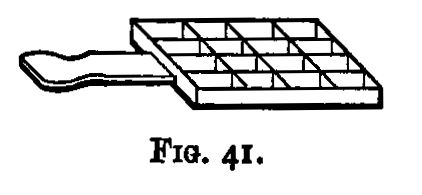
prepared are arranged in a definite order in the muffle, and the assay
buttons are arranged in a corresponding order on some suitable tray
(cupel tray, fig. 41); the heat of the muffle being at bright redness.
Then with the help of the tongs (fig. 42) the assay buttons should be
placed each in its proper cupel; a note having been previously made of
the position it is to occupy, and the door of the muffle closed.
This part of the work should be done promptly, so as not to unduly cool
the muffle: the start requires a fairly high temperature, and is a
critical part of the process. A black crust forms at once on the surface
of the lead; but this ought soon to fuse and flow in greasy drops from
off the face of the metal, so as to leave the latter fluid with a
well-defined outline, and much brighter than the cupel. If this clearing
does not take place, the buttons are said to be frozen; in which case
the temperature must be raised, some pieces of charcoal put in the
muffle, and the door closed. If they still do not clear, the heat must
have been much too low, and it is best to reject them and repeat the
assays.

When the buttons have cleared it is well to check the draught of the
furnace, and to partly open the door of the muffle, so as to work at as
low a temperature as is compatible with the continuation of the
process.[11] Too low a temperature is indicated by the freezing of the
buttons and the consequent spoiling of the assays. Experience soon
enables one to judge when the heat is getting too low. A commoner error
is to have the heat too high: it should be remembered that that which
was high enough to clear the buttons at starting is more than sufficient
to keep the process going. At the finish a higher temperature is again
required: therefore the door of the muffle should be closed and the
furnace urged. The finish is easily recognised. The drops of litharge
which in the earlier stages flow steadily from the surface of the alloy,
thin off later to a luminous film. At the end this film appears in
commotion, then presents a brilliant play of colours, and, with a sudden
extinction, the operation is finished. The metal again glows for an
instant whilst becoming solid.
If the button is a small one the cupel is withdrawn at once and placed
on that square of the cupel tray which corresponds to the position it
occupied in the muffle. If, however, it is fairly large precautions must
be taken to prevent spirting.
Molten silver dissolves oxygen from the air and gives it off on
solidifying; the escape of the gas on sudden cooling is violent and, by
throwing off particles of the metal, may cause loss. This is called
"vegetation" or "spirting." The silver is apparently solid when spirting
takes place; the crust breaks suddenly and some of the metal is forced
out. The evil is best guarded against by slow cooling and avoiding
draughts. With large buttons of silver precautions should never be
omitted. One plan is to allow the cupels to cool in the muffle itself,
the mouth being closed with hot charcoal. Another is to cover the cupel
with another cupel previously heated to redness; in this case the silver
cools between two hot cupels, and, of course, cools slowly. A third plan
is to withdraw the cupel to the door of the muffle, holding it until it
begins to get solid and then immediately to put it back into the hotter
part of the muffle.
Silver remains after cupellation in flattened elliptical buttons,
adhering but only slightly to the cupel. Its upper surface should show
faint markings as if it were crystalline. The presence of platinum
renders it still more crystalline, but removes the characteristic lustre
and renders the metal dull and grey. Copper, if not completely removed,
has a very marked effect on the appearance of the button: the metal is
spread out, damping, as it were, and firmly adhering to the cupel, which
latter in the neighbourhood of the metal is almost black with oxide of
copper. Sometimes the silver button is globular, or even more sharply
rounded on its under than on its upper surface; it is said that this is
due to the presence of lead. Gold may be present even to the extent of
50 per cent. without showing any yellow colour.
The appearance of the cupel affords some useful information. The
presence of cracks evidently due to shrinkage indicates a badly made
cupel. If, however, they are accompanied by a peculiar unfolding of the
cupel, the margin losing its distinctness, it is because of the presence
of antimony. When lead is the only easily oxidisable metal present, the
stained portion of cupel is yellow when cold. A greenish tint may be due
to small quantities of copper or, perhaps, nickel, cobalt, or platinum.
Larger quantities of copper give a greenish grey or almost black colour.
A dark green and corroded cupel may be due to iron. Rings of
pale-coloured scoria may be due to tin, zinc, antimony, or arsenic. When
the cupel shows signs of the presence of these metals in objectionable
quantity, it is well to repeat the assay and scorify so as to remove
them before cupellation.
The button should be detached from the cold cupel by seizing with a
pair of pliers: the under surface should be distorted by squeezing or
hammering the button so as to loosen the adhering bone ash. The cleaning
is easily completed by rubbing with a clean hard brush. After cleaning
the buttons are best put on a tray of marked watch-glasses, and then
taken to the balance and weighed. The weight of silver got needs a small
correction; (1) by deducting for the amount of silver introduced by the
lead or oxide of lead used in the assay;[12] and (2) by adding for the
cupellation loss.
Loss in Cupellation.—During the whole process of cupelling a silver
lead alloy a more or less abundant fume may be observed rising from the
cupel. This furnishes an evident loss of lead and a possible loss of
silver; for although silver at the temperature of cupellation gives off
no appreciable vapour, it is known that such fume formed on a large
scale contains silver. It is, however, difficult to believe that the
small amount of lead vapourised carries with it a weighable amount of
silver. That it does not do so in the ordinary way of working is shown
by the fact that a button of silver equal in weight to the silver lost
in cupelling may be got by smelting the cupel and cupelling the
resulting button of lead. The loss of silver by volatilisation is
altogether inconsiderable, unless the temperature at which the operation
is performed is much too high.
Another possible source of loss is the infiltration of small particles
of alloy into the cupel. The cupel is necessarily porous, and particles
of metal may perhaps drain into it, more especially if the bone ash is
not in fine powder; but if this is the main source of loss it is hard to
see why, in cupelling equal weights of silver and gold, the loss is not
equal in each case. It is not easy to believe that the mere filtration
of the fused alloy will effect such a change in the proportion of the
metals as that which actually occurs. For example: a cupel on which an
alloy consisting of 0.80 gram of silver, 0.47 gram of gold, and 25 grams
of lead had been cupelled, was found to contain 7-1/2 milligrams of
silver, and rather less than half a milligram of gold. Assuming, for the
sake of argument, that the gold present had filtered into the cupel in
the form of small drops of alloy, it would have been accompanied by less
than a milligram of silver, and the presence of the extra 6 or 7
milligrams of silver must have been due to a different cause. There can,
thus, be little doubt that the cause of the greater part of the
"cupellation loss" is a chemical one and cannot be counteracted by a
mechanical contrivance.[13] In cupellation, then, there is a loss,
apart from imperfect working, inherent in the process itself; and as the
amount of this loss varies under different conditions, it is necessary
to study it somewhat in detail.
The following experiments are taken without selection from the work of
one student. Three experiments were made for each determination, and the
mean result is given. By "range" is meant the difference between the
highest and lowest result and the percentage loss is calculated on the
silver present. The silver added in the lead used has been deducted.
Effect of Varying Lead.—In each experiment 0.4 gram of silver was
taken and cupelled with the lead. The silver loss and "range" are
expressed in milligrams.
| Lead Used. | Silver Lost. | Range. | Percentage Loss. |
| Grams. |
| 10 | 6.5 | 1.0 | 1.62 |
| 20 | 7.0 | 1.0 | 1.75 |
| 40 | 12.0 | 1.5 | 3.00 |
| 60 | 12.7 | 0.5 | 3.17 |
The loss increases with the lead used.
Effect of Varying Temperature.—0.4 gram of silver was cupelled with
20 grams of lead.
| Temperature. | Silver Lost. | Range. | Percentage Loss. |
| Bright red | 7.0 | 1.0 | 1.75 |
| Clear yellow | 17.3 | 1.7 | 4.32 |
The difference in temperature in these experiments was much greater than
would occur even with careless work.
Effect of Varying Silver.—20 grams of lead were used in each
cupellation.
| Silver Taken. | Silver Lost. | Range. | Percentage Loss. |
| Milligrams. |
| 12.5 | 0.7 | 0.2 | 5.6 |
| 25.0 | 1.4 | 0.1 | 5.6 |
| 50.0 | 1.6 | 0.4 | 3.2 |
| 100.0 | 2.9 | 0.3 | 2.9 |
| 200.0 | 5.6 | 0.5 | 2.8 |
| 400.0 | 7.0 | 1.0 | 1.7 |
| 800.0 | 9.7 | 1.0 | 1.2 |
It will be seen that, although the quantity of silver lost increases
with the silver present, the percentage loss is greater on the smaller
buttons.
The following results are often quoted:—Cupelling 1 grain of silver
with 10 grains of lead, the loss was 1.22 per cent.; 10 grains of silver
with 100 grains of lead, loss 1.13 per cent.; 25 grains of silver
cupelled with 250 grains of lead, lost 1.07 per cent. The proportion of
silver to lead was the same in the three experiments, and the largest
button gave the best result. Evidently, if the quantities of lead had
been the same in the three experiments (say, 250 grains in each case),
the loss on the smaller quantities of silver would appear worse in the
comparison.
In judging these results, it must be borne in mind that it is difficult
to regulate the temperature, &c., in consecutive experiments so as to
get exactly similar results, so that the range in consecutive
cupellations is greater than that in a batch cupelled side by side.
Effect of Copper and Antimony.—0.1 gram of silver was cupelled with
20 grams of lead, and to one batch 0.5 gram of antimony, and to another
0.5 gram of copper was added.
| Silver Lost. | Range. | Loss in Percentage. |
| Without addition | 2.9 | 0.3 | 2.9 |
| With antimony | 3.2 | 0.2 | 3.2 |
| With copper | 4.9 | 1.7 | 4.9 |
Perhaps the antimony has so small an effect because it is eliminated in
the earlier part of the process, while the silver is still alloyed with,
and protected by, a large proportion of lead; whilst the copper on the
other hand makes its fiercest attack towards the close, when the silver
is least capable of resisting it. The ill effects of copper are most
strongly felt when the quantity of lead present is not sufficient to
remove it: the coppery button of silver got under these conditions is
very considerably less than the weight of silver originally taken.
Although the above is a fair statement of the loss attending average
work, it will not do in very important and exact work to place too much
reliance on the figures given, or, indeed, on any other set of figures,
with the object of correcting the result of an assay. Each man must rely
on his own work.
It is easy to determine what allowance must be made for the loss in
cupellation by cupelling side by side with the assay piece an alloy of
similar and known composition. For, if the two pieces are very nearly
alike, we may justly conclude that the loss on each will be the same;
and if, further, we take the average of three or four such
determinations we shall get results accurate within 0.1 per cent. The
method of getting such results may be best explained by one or two
illustrations. This method of working is termed "assaying by checks."
Suppose we have an alloy of silver and lead in unknown proportions and
that by cupelling two lots of 10 grams each there is got from I. 0.1226
gram of silver, and from II. 0.1229 gram. We should know from general
experience that the actual quantity of silver present was from 2 to 4
milligrams more than this. To determine more exactly what the loss is,
the following plan is recommended:—The two silver buttons are wrapped
up each in 10 grams of lead, and cupelled side by side with two other
lots of 10 grams of the original alloy. If now the two buttons I. and
II. weigh 0.1202 and 0.1203, they will have suffered in this second
cupellation an average loss of 2.5 milligrams. Suppose the two fresh
lots of alloy gave 0.1233 and 0.1235 of silver, the average loss on
these would also be 2.5 milligrams. Add this loss to each result, and
take the mean; which is in this case 0.1259.
If copper is present in the alloy as well as silver, it is necessary to
add about the same quantity of copper to the checks as is supposed, or
known, to be present in the assays. If the substance to be assayed is an
alloy of silver and copper, first cupel 0.5 gram of it, with, say, 10
grams of lead, and weigh the resulting button of silver, in order to get
an approximate knowledge of its composition. Suppose the button weighs
0.3935 gram. We know that this is below the truth: for the sake of round
numbers take it as 0.4, and assume that the rest of the alloy (0.1 gram)
was copper. Two check pieces are then weighed out, each containing 0.4
gram silver and 0.1 gram of copper wrapped in 5 grams of lead. Of course
the silver must be pure. And there is also weighed out two (or better,
four) assay pieces each containing half a gram of the alloy wrapped in 5
grams of lead. The whole lot are then cupelled as nearly as possible
under the same conditions. With four assay pieces, the cupels should be
placed close together in two rows of three across the muffle; the two
check pieces are put in the middle cupels. Suppose the buttons of silver
got weighed as follows:—
| Check pieces | I. | 0.3940 | II. | 0.3945 |
| Assay pieces | I. | 0.3905 | II. | 0.3912 |
| III. | 0.3910 | IV. | 0.3909 |
The average loss on the two check pieces is 5.7 milligrams, and the
average result of the four assay pieces is 0.3909. Add the average loss
to the average result, and there is got the corrected result, 0.3966.
And if 0.5 gram of alloy contain 0.3966 of silver, 1000 will contain
793.2 of silver, and this is the degree of fineness.
A correction for the loss in cupellation is always made in this way
when rich alloys are being assayed; and in the case of rich ores it may
be done after the manner of the first of the above illustrations. There
is another method of working which relies more on experiment. This is to
smelt the cupel as described further on (p. 114), and to again cupel the
resulting button of lead. The button of silver got in this second
cupellation is added to that first obtained. It will sometimes, but not
often, happen that the two buttons together will slightly exceed in
weight the silver which was actually present. This is because of the
retention in the buttons of a small quantity of lead. It has been stated
that the proportion of lead thus retained may be as much as 1% of the
silver present; this, however, can only be under exceptional conditions.
A determination of the actual silver in the buttons got in the series of
cupellations quoted on pages 102, 103, gave an average percentage of
99.85, so that even with the larger buttons the effect of the retained
lead would be only to increase the weight by about 1 milligram. In the
method of working with checks, the retained lead has no disturbing
influence.
The proportion of lead required for the cupellation of any particular
alloy requires consideration. With too much lead the time occupied in
the process is increased, and so is the loss of silver; on the other
hand, too little lead is of greater disadvantage than too much. From 8
to 16 parts of lead are required for each part of silver alloy, or, if
gold is present, about twice as much as this must be used. For the
cupellation of 1 gram of a silver copper alloy containing different
percentages of copper, the following quantities of lead should be
used:—
| Percentage of Copper in Alloy. | Lead Required. |
| 5 | 6 | grams |
| 10 | 8 | " |
| 20 | 10 | " |
| 30 | 12 | " |
| 40 | 14 | " |
| 50-100 | 16-18 | " |
The alloy, in not too large pieces, is wrapped in the required weight of
lead foil and charged into the cupel at once; or the lead may be put in
first, and, when the cupellation has fairly started, the alloy may be
added wrapped in tissue paper; or a portion of the lead may be first
started and the alloy wrapped in the remaining lead and subsequently
added. The cupellation of large quantities of alloy or of alloys which
contain tin, antimony, iron, or any substance which produces a scoria,
or corrodes the cupel, must be preceded by a scorification. The
advantages of this are that the slag is poorer in precious metal than
that found on a cupel and is more easily collected and cleaned; that
larger quantities of metal can be treated, and that, even if the
substance is in part infusible, or produces at the start a clinkery mass
or scoria, the oxide of lead gradually accumulates, fluxes the solid
matters, and produces a good final result; but if the oxide of lead by
itself is not sufficient for the purpose, borax or some other flux can
be easily added.
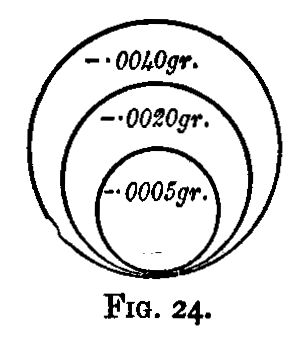
If the button of silver got is very small its weight may be estimated
from its size; but it must be remembered that the weight varies as the
cube of the diameter. If one button has twice the diameter of another it
is eight times as heavy and so on. Scales specially constructed for
measuring silver and gold buttons may be purchased; but it is much
better to make the measurement with the help of a microscope provided
with an eyepiece micrometer.
If the length of the long diameter of a silver button be taken the
following table will give the corresponding weight in milligrams:—
| Diameter. | Weight. | Diameter. | Weight. |
| 0.04 inch | 3.6 | 0.015 inch | 0.19 |
| 0.035 " | 2.4 | 0.014 " | 0.15 |
| 0.03 " | 1.5 | 0.013 " | 0.12 |
| 0.025 " | 0.9 | 0.012 " | 0.097 |
| 0.02 " | 0.45 | 0.011 " | 0.075 |
| 0.019 " | 0.4 | 0.010 " | 0.056 |
| 0.018 " | 0.33 | 0.008 " | 0.028 |
| 0.017 " | 0.27 | 0.006 " | 0.012 |
| 0.016 " | 0.23 | 0.004 " | 0.004 |
The weight of a corresponding button of gold is got by multiplying by
2.25. These figures are based on those given by Plattner, and apply only
to buttons of such shape as those left after cupellation. A sphere of
silver 0.01 inch in diameter would weigh 0.09 milligram, and a similar
sphere of gold weighs 0.167 milligram.
It is safer, however, to compare with a micrometer the diameter of the
button whose weight has to be determined with that of a standard button
of nearly equal size whose weight is known. The weights of the two
buttons are proportional to the cubes of their diameters. This plan of
working is described more fully in Appendix B., page 440.
Calculation of the Results.—After deducting for the silver added, and
correcting for the cupellation loss, the calculation is made in the
usual way; reporting as so many parts per thousand in the case of rich
alloys and as so many ounces and pennyweights, or better as ounces and
decimals of an ounce, in the case of poor alloys and ores.
In this last case, however, it is less fatiguing to refer to a set of
tables which give, either directly or by means of simple addition, the
produce corresponding to any weight obtained from certain given weights
of the substance. The following table gives the produce in ounces and
decimals of an ounce per ton of 2240 pounds:—
| Weight of Metal got. | Weight of Ore taken. |
| | 3 grams. | 5 grams. | 20 grams. | 50 grams. | 100 grams. |
| 0.0001 | 1.09 | 0.65 | 0.16 | 0.06 | 0.03 |
| 0.0002 | 2.18 | 1.31 | 0.33 | 0.13 | 0.06 |
| 0.0003 | 3.27 | 1.96 | 0.49 | 0.20 | 0.10 |
| 0.0004 | 4.36 | 2.61 | 0.65 | 0.26 | 0.13 |
| 0.0005 | 5.44 | 3.27 | 0.82 | 0.33 | 0.16 |
| 0.0006 | 6.53 | 3.92 | 0.98 | 0.39 | 0.19 |
| 0.0007 | 7.62 | 4.57 | 1.14 | 0.46 | 0.23 |
| 0.0008 | 8.71 | 5.23 | 1.31 | 0.52 | 0.26 |
| 0.0009 | 9.80 | 5.88 | 1.47 | 0.59 | 0.29 |
| 0.001 | 10.89 | 6.53 | 1.63 | 0.65 | 0.33 |
| 0.002 | 21.78 | 13.07 | 3.27 | 1.31 | 0.65 |
| 0.003 | 32.67 | 19.60 | 4.90 | 1.96 | 0.98 |
| 0.004 | 43.56 | 26.13 | 6.53 | 2.61 | 1.31 |
| 0.005 | 54.44 | 32.67 | 8.17 | 3.27 | 1.63 |
| 0.006 | 65.33 | 39.20 | 9.80 | 3.92 | 1.96 |
| 0.007 | 76.22 | 45.73 | 11.43 | 4.57 | 2.29 |
| 0.008 | 87.11 | 52.27 | 13.07 | 5.23 | 2.61 |
| 0.009 | 98.00 | 58.80 | 14.70 | 5.88 | 2.94 |
| 0.01 | 108.89 | 65.33 | 16.33 | 6.53 | 3.27 |
| 0.02 | 217.78 | 130.67 | 32.67 | 13.07 | 6.53 |
| 0.03 | 326.67 | 196.00 | 49.00 | 19.60 | 9.80 |
| 0.04 | 435.56 | 261.33 | 65.33 | 26.13 | 13.07 |
| 0.05 | 544.44 | 326.67 | 81.67 | 32.67 | 16.33 |
| 0.06 | 653.33 | 392.00 | 98.00 | 39.20 | 19.60 |
| 0.07 | 762.22 | 457.33 | 114.33 | 45.73 | 22.87 |
| 0.08 | 871.11 | 522.67 | 130.67 | 52.27 | 26.13 |
| 0.09 | 980.00 | 588.00 | 147.00 | 58.80 | 29.40 |
| 0.1 | 1088.89 | 653.33 | 163.33 | 65.33 | 32.67 |
| 0.2 | 2177.78 | 1306.67 | 326.67 | 130.67 | 65.33 |
| 0.3 | 3266.67 | 1960.00 | 490.00 | 196.00 | 98.00 |
| 0.4 | 4355.56 | 2613.33 | 653.33 | 261.33 | 130.67 |
| 0.5 | 5444.44 | 3266.67 | 816.67 | 326.67 | 163.33 |
| 0.6 | 6533.33 | 3920.00 | 980.00 | 392.00 | 196.00 |
| 0.7 | 7622.22 | 4573.33 | 1143.33 | 457.33 | 228.67 |
| 0.8 | 8711.11 | 5226.67 | 1306.67 | 522.67 | 261.33 |
| 0.9 | 9800.00 | 5880.00 | 1470.00 | 588.00 | 294.00 |
| 1.0 | 10888.89 | 6533.33 | 1633.33 | 653.33 | 326.67 |
When, as in this table, the fraction of an ounce is expressed by two
places of decimals, it may be reduced to pennyweights (dwts.) by
dividing by 5. For example, 0.40 of an ounce is 8 dwts. The fraction of
a dwt. similarly expressed may be converted into grains with sufficient
exactness by dividing by 4. Thus, 1.63 ozs. equal 1 oz. 12.60 dwts., or
1 oz. 12 dwts. 15 grains. In England it is usual to report in ounces and
decimals of an ounce.
The way to use the table is best shown by an example. Suppose a button
of silver weighing 0.0435 gram was obtained from 20 grams of ore. Look
down the 20-gram column of the table, and select the values
corresponding to each figure of the weight, thus:—
0.04 = 65.33 ozs. to the ton
0.003 = 4.90 "
0.0005 = 0.82 "
——————
0.0435 = 71.05 "
Add these together. The produce is 71.05 ozs., or 71 ozs. 1 dwt. to the
ton.
Or, suppose an ore is known to contain 1.24 per cent. of silver. Look
down the 100-gram column, select the values, and add them together as
before.
1.0 = 326.67 ozs. per ton
0.2 = 65.33 "
0.04 = 13.07 "
——————
1.24 = 405.07 "
This gives 405 ozs. 1 dwt. 10 grains to the ton.
The calculation becomes more complicated when, as is frequently the
case, the ore contains metallic particles. These show themselves by
refusing to pass through the sieve when the ore is powdered. When they
are present, a large portion, or if feasible the whole, of the sample is
powdered and sifted. The weights of the sifted portion and of the
"metallics," or prills, are taken; the sum of these weights gives that
of the whole of the sample taken. It is very important that nothing be
lost during the operation of powdering.
Each portion has to be assayed separately. It is usual to assay a
portion of the sifted sample, say, 20 or 50 grams, and to add to the
produce of this its share of the "metallics." This way of calculating,
which is more convenient than correct, is illustrated by the following
example:—
| Weight of | whole sample | 400 | grams |
| Made up of | sifted portions | 399 | " |
| " | "Metallics" | 1 | " |
| | ———— |
| | 400 | " |
Twenty grams of the sifted portion, when assayed, gave 0.1050 gram of
silver. The whole of the "metallics" scorified and cupelled gave 0.842
gram of silver. Since the 20 grams assayed was 1-20th of the whole,
1-20th part of the 0.842 gram of silver (from the metallics) must be
added to its produce. We thus get 0.1471 gram (0.1050 + 0.0421).
Referring to the 20 gram column, we get—
0.1 = 163.33
0.04 = 65.33
0.007 = 11.43
0.0001 = 0.16
—————————
0.1471 = 240.25 ounces per ton.
A more legitimate method of calculation is as follows:—Calculate
separately the produce of each fraction as if they were from different
ores. Multiply each produce (best stated in per cents.) by the weight of
the corresponding fraction. Add together the products, and divide by the
weight of the whole sample. Taking the same example for illustration, we
have:—
Metallics.—Weight 1 gram.
1 gram of it yielded 0.842 grams of silver.
∴ Produce = 84.2 per cent.
Produce multiplied by the weight is still 84.2.
Sifted Portion.—Weight 399 grams.
20 grams of it yielded 0.105 gram of silver.
∴ Produce = 0.525 per cent.
Produce multiplied by weight (0.525 × 399) is 209.475.
Add together; and divide by 400, the weight of the whole sample—
84.2
209.475
———-
400) 293.675 (0.7342
0.7342 is the total produce of the ore in per cents.
Referring to the 100-gram column in the table we find 239.84 ounces to
the ton as the produce.
0.7 = 228.67
0.03 = 9.80
0.004 = 1.31
0.0002 = 0.06
———
239.84
Comparing this with the result calculated by the first method—viz.,
240.26, we see that that was 0.38 oz., or between 7 and 8 dwts. too
high.
With ores containing "metallics" it is of great importance to powder the
whole of the selected sample without loss during the process; and of
even greater importance to well mix the sifted portion, of which the
last portions to come through the sieve are apt to be more than
ordinarily rich through the grinding down of some portions of the
metallic prills.
Remarks on Cupellation.—Cupellation is at once the neatest and the
most important of the dry methods of assaying. Its purpose is to remove
easily oxidisable metals, such as lead and copper, from silver and gold,
which are oxidisable with difficulty. Metals of the first class are
often spoken of as base, and gold and silver as noble metals.
When lead is exposed to the action of air at a temperature a little
above redness, it combines with the oxygen of the air to form litharge,
an oxide of lead, which at the temperature of its formation is a
liquid. Consequently, if the lead rests on a porous support, which
allows the fused litharge to drain away as fast as it is formed, a fresh
surface of the lead will be continually exposed to the action of the
air, and the operation goes on until the whole of the lead has been
removed. Silver or gold exposed to similar treatment does not oxidise,
but retains its metallic condition; so that an alloy of lead and silver
similarly treated would yield its lead as oxide, which would sink into
the support, while the silver would remain as a button of metal.
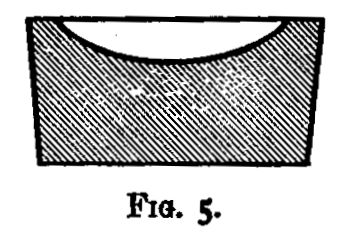
The porous support, which is called a cupel(fig. 5), should absorb the
slag (oxide of lead, etc.) just as a sponge absorbs water, but must be
sufficiently fine-grained to be impervious to the molten metal. At first
sight it appears difficult to filter, as it were, a fluid slag from a
fluid metal; but an ordinary filter-paper damped with oil will allow
oils to run through and yet retain the water; but damped with water it
will allow water to run through and retain oils. Similarly, fused slags
damp and filter through a cupel, but the molten metal not damping it
withdraws itself into a button, which is retained. Although, of course,
if the cupel is very coarse-grained the metal may sink into the hollows.
Copper, antimony, tin, and most other metals, form powdery oxides, which
are not of themselves easily fusible, and it is necessary when these are
present to add some solvent or flux to render the oxide sufficiently
fluid. Fortunately, oxide of lead is sufficient for the purpose; hence,
mixed oxides of copper and lead, provided the lead is present in proper
proportion, form a fluid slag. In separating copper from silver or gold,
advantage is taken of this fact; for, although we cannot cupel an alloy
of copper and silver, it is easy to cupel an alloy of copper, silver and
lead. If, however, the lead is not present in sufficient quantity, the
whole of the copper will not be removed, and the button of silver, still
retaining copper, will be found embedded in a coating of black oxide of
copper. Copper oxidises less easily than lead does; and, consequently,
the alloy which is being cupelled becomes relatively richer in copper
as the operation proceeds. It is on this account that the ill-effects of
the copper make themselves felt at the close of the operation, and that
the oxide of copper is found accumulated around the button of silver.
Tin and antimony, on the other hand, are more easily oxidised; and the
tendency of their oxides to thicken the slag makes itself felt at the
commencement: if the button of alloy once frees itself from the ring or
crust of unfused oxide first formed, the cupellation proceeds quietly,
and leaves a clean button of silver in the centre. But in either case
the cupellation is imperfect, and should be repeated with a larger
proportion of lead. An unfused and, consequently, unabsorbed slag tends
to retain small buttons of alloy or metal, and thus cause serious loss.
There is a principle underlying many of the phenomena of dry silver
assaying which the student should endeavour to understand; and which
serves to emphasise and explain some facts which without an explanation
may present difficulties. If a button of melted lead be covered with a
layer of slag rich in oxide of lead, and a second metal be added, this
other metal distributes itself between the metal and slag in proportions
which depend mainly upon the ease with which it is oxidised, and to a
large extent upon the relative quantities of material present. Easily
oxidisable metals such as zinc, iron, antimony and tin, will go mainly
into the slag, and, if the proportion of the slag is large, very little
will go into the metal. On the other hand, with metals oxidisable with
difficulty, such as silver, gold, and platinum, the reverse holds true;
nearly the whole of the metals will go into the lead, and very little
into the slag. If, however, the slag be very rich, say in antimony, the
lead will contain antimony; and, on the other hand, if the lead be very
rich in silver, the slag will contain silver in appreciable quantity.
Copper, which is near lead in the facility with which it is oxidised,
will serve for the purpose of a detailed example. The results of actual
analyses of metal and slag formed in contact with each other are shown
in the following table:—
Percentage Composition of the Metal.
| Lead. | Copper. |
| 6.8 | 93.2 |
| 20.0 | 80.0 |
| 28.0 | 72.0 |
| 32.0 | 68.0 |
| 85.0 | 15.0 |
Percentage Composition of the Slag.
| Lead. | Copper. |
| 71.4 | 21.4 |
| 78.0 | 17.0 |
| 80.0 | 12.5 |
| 86.0 | 6.7 |
| 90.0 | 3.6 |
It will be seen from this table that the slag is always much richer in
lead and poorer in copper than the metal with which it is in contact.
The ratio of lead to copper in these five samples is:—
| In the Metal. | In the Slag. |
| 1 : 14 | 1 : 0.3 |
| 1 : 4 | 1 : 0.2 |
| 1 : 2.5 | 1 : 0.16 |
| 1 : 2 | 1 : 0.08 |
| 1 : 0.16 | 1 : 0.04 |
Assuming these figures to be correct, the following statement is
approximately true. On oxidising an alloy of 10 grams of copper and 10
grams of lead, and pouring off the slag when 3 grams of lead have gone
into it, there will be a loss of (owing to the slag carrying it off)
about 0.2 gram of copper. On repeating the operation, the next 3 grams
of lead will carry with them about 0.5 gram of copper; and on again
repeating, 3 grams of lead will remove 0.8 gram of copper. Finally, the
last gram of lead will carry with it 0.3 gram of copper, and there will
be left a button of copper weighing 8.3 grams. The slag will have
carried off altogether 1.7 gram of copper, which is 17 per cent. of the
metal originally present.
With the more perfect exposure to the air, and quicker removal of the
slag, which results from heating on a cupel, the loss would be heavier.
Karsten got by actual experiment on cupelling copper and lead in equal
proportions, a loss of 21.25 per cent.
Going back to the example: if the slag were collected and fused with a
suitable reducing agent so as to convert, say, half of it into metal,
that half would contain nearly the whole of the copper (such a reduction
is called "cleaning the slag"). On reoxidising this metal, another
button of copper is formed which, added to the first, would reduce the
loss from 17 per cent. to, say, 7 or 8 per cent. And it is conceivable
that by a series of similar operations, almost the whole of the 10 grams
of copper originally taken might be recovered. In practice the problem
is (as far as the copper is concerned) not how to save, but how most
easily to remove it; and since the removal of this metal is quicker from
an alloy containing not too much lead, it is evident that two or three
operations with small quantities of lead will be more effectual than a
single treatment with a larger quantity. With those metals (tin,
antimony, &c.) which pass quickly into the slag, the contrary is true;
hence with these it is necessary to have enough lead present, so that
the slag formed at the outset shall contain enough oxide of lead to make
it fluid. As silver is so much less easily oxidised than copper, we
should reasonably expect that the proportion of silver carried off in
the oxide of lead would be considerably less than that of the copper
indicated in the above example. Indeed, there are one or two facts
which tend to encourage the hope that the operation may be conducted
without any loss. If a piece of pure silver foil is exposed on a cupel
to air at the usual temperature of cupellation, it undergoes very little
change; it does not even fuse; it loses nothing in weight, and does not
oxidise. In fact, even if oxide of silver were formed under these
conditions, it could not continue to exist, for it is decomposed into
silver and oxygen at a temperature considerably below redness. On the
other hand, oxide of silver is not reduced to metal by heat alone, when
mixed with an excess of oxide of lead; while metallic silver is
converted into oxide when heated with the higher oxides of lead, copper,
and some other metals. That silver, and even gold (which is more
difficult to oxidise than silver), may be carried off in the slag in
this way, is in agreement with general experience. If 10 grams of silver
are cupelled with 10 grams of lead, there will be a loss of about 50
milligrams of silver, which is in round numbers 1-30th of the
corresponding copper loss; with 10 grams of gold and 10 grams of lead,
the loss will be 4 or 5 milligrams, which is about 1-12th of the
corresponding silver loss.
Determination of Silver in Assay Lead.—Scorify 50 grams of the lead
with 0.5 gram of powdered quartz or glass at not too high a temperature.
When the eye has "closed in," pour; reject the slag, and cupel the
button of lead. Remove the cupel from the muffle immediately the
operation is finished. Weigh, and make a prominent note of the result in
the assay book, as so many milligrams of silver contained in 100 grams
of lead.
Determination of Silver in Red Lead or Litharge.—Fuse 100 grams of
the oxide with from 10 to 20 grams of borax; and in the case of litharge
with 2 grams or with red lead 4 grams of flour. Cupel the lead, and
weigh the button of silver. Note the result as in the last case.
Determination of Silver in Argentiferous Lead.—Be careful in taking
the sample, since with rich silver lead alloys the error from bad
sampling may amount to several parts per cent. Cupel two lots of 20
grams each, and weigh the buttons of silver. Add to these the estimated
cupel loss, and calculate the result. Or wrap each button of silver in
20 grams of assay lead, and re-cupel side by side with two fresh lots of
20 grams each of the alloy. Calculate the loss incurred, and add on to
the weight of the two fresh buttons got.
Determination of Silver in Bullion.—The remarks made under the last
heading as to the importance of correct sampling apply with equal force
here. Make a preliminary assay by cupelling 0.1 gram of the alloy with 1
gram of assay lead; calculate the percentage composition. Refer to the
table on page 105 to find what weight of lead is required for cupelling
1 gram of alloy.
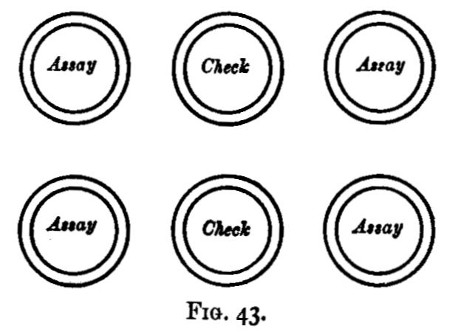
Weigh out four lots of 1 gram each, and wrap them in the required
quantity of lead. Make two check pieces by weighing up two lots of fine
silver equal to that which you believe to be present in the assay
pieces; add copper to make up the weight to 1 gram, and wrap in the same
quantity of lead as was used for the assays.
Prepare six cupels and charge them in the annexed order (fig. 43), and
cupel. Guard against spirting. Clean and weigh the buttons of silver.
Add the mean loss on the two check pieces to the mean weight of the four
assay pieces; this multiplied by 1000 will give the degree of fineness.
Determination of Silver in Copper.—The silver is best separated in
the wet way before cupelling, but if the proportion is not too small, it
can be found by cupellation. Weigh up 3 grams of the metal, wrap in 30
grams of sheet lead, and cupel; when the cupellation has proceeded for
fifteen minutes, add 20 grams more lead, and continue till finished.
Weigh the button of silver.
The cupellation loss will be five or six per cent. of the silver
present. Determine it by powdering the saturated portion of the cupel
and fusing in a large Cornish crucible with 30 grams each of soda and
borax, 10 grams of fluor spar, and 1-1/2 gram of charcoal. Cupel the
resulting button of lead, and add 10 grams more of lead towards the
close of the operation. Deduct the weight of silver contained in the
lead used from the weight of the two buttons, and calculate to ounces to
the ton.
In an experiment in which 0.1975 gram of silver was present, the weight
of the button from the first cupellation was 0.1867, and that of the
button from the second, after correcting for the lead added, was 0.0110
gram.
Determination of Silver in Galena. By Pot Assay.—Mix 20 grams of
the powdered ore with 30 grams of red lead, 20 grams of soda, and 5
grams of borax, as also with from 7 to 10 grams of nitre. Fuse and pour.
Clean the slag if the ore is rich. Cupel the buttons of lead. Make the
usual corrections and calculate in ounces to the ton.
By Scorification.—Take 10 grams of the ore, 30 grams of lead, and
0.5 gram of borax. Scorify, clean the slag by adding anthracite after
the "eye" has closed in: cupel the button of lead. Weigh the button of
silver, make the necessary corrections, and calculate to ounces to the
ton.
The determination may also be made by cupelling the button of lead got
in the dry lead assay.
A sample of galena determined by the three methods gave the following
results:—
| By | pot assay | 7.18 ozs. | per ton. |
| " | scorification | 7.02 | " |
| " | lead assay | 6.72 | " |
Determination of Silver in an Ore. By Pot Assay.—Take 20 grams of
the powdered ore and mix with 30 grams of soda, 40 grams of red lead,
and 5 grams of borax, as also with from 2 to 3 grams of flour. Fuse:
pour. Clean the slag by fusing with 20 grams of red lead and two grams
of flour. Cupel the buttons of lead; weigh; make the necessary
corrections, and calculate to ounces to the ton.
By Scorification.—Take 5 grams of the powdered ore, 50 grams of lead,
and 0.5 gram of "soda" or borax. Scorify. Clean the slag by fusing in a
crucible as in the pot assay. Cupel, &c.
Examples.—By Pot Assay.—Ore taken 20 grams.
| Silver got | 0.2893 | gram |
| Silver from slag | 0.0060 | " |
| Silver lost in cupellation | 0.0100 | " |
| ——— |
| 0.3053 | " |
| Deduct silver in red lead | 0.0017 | " |
| ——— |
| Silver in ore | 0.3036 | " | = 495.9 ozs. per ton. |
By Scorification.—Ore taken, 3 grams.
| Silver got. | 0.0425 | gram |
| Silver from slag | 0.0022 | " |
| Silver lost in cupellation | 0.0020 | " |
| ——— |
| 0.0467 | " |
| Deduct silver in lead | 0.0015 | " |
| ——— |
| Silver in ore | 0.0452 | " | = 492.2 ozs. per ton. |
Determination of Silver in Silver Precipitate.—This substance
contains, in addition to metallic silver and gold, sulphates of lead and
lime; oxides of zinc, copper, and iron; and more or less organic matter.
The sample as received is generally free from "water at 100° C."; and,
since it rapidly absorbs water, care should be taken in weighing it.
Since it contains combined water it is not suited for scorifying;
therefore the determination of silver and gold (fine metal) is made by
pot assay. Weigh up 5 grams of the precipitate, mix with 100 grams of
litharge and 1 gram of charcoal. Melt in a crucible at a moderate heat
and pour. Detach the slag, replace in the crucible, and, when fused, add
a mixture of 20 grams of litharge and 1 gram of charcoal. When the
fusion is again tranquil, pour; and cupel the two buttons of lead.
In a sample worked in this manner the mean of four determinations gave
0.6819 gram of "fine metal"; deducting 1 milligram for the silver
contained in the oxide of lead, and adding 8 milligrams for the
cupellation loss, there is got 0.6889 gram or 13.778 per cent. of silver
(and gold) in the sample.
Determination of Silver in Burnt Ores. By Pot Assay.—Roasted
cupriferous pyrites containing small quantities of gold and silver comes
under this heading. The following mixture will give a fluid slag which
is heavy and tough when cold:—
| Ore. | Borax. | Sand. | Litharge. | Charcoal. |
| 100 | 50 | 50 | 100 | 7 |
Mix; place in a large crucible; cover with salt; and melt down under
cover. When fused drop in an iron rod for a few minutes, and about a
couple of minutes after its withdrawal, pour the charge quickly into a
large conical mould. The button of lead should weigh about 50 grams.
Cupel and weigh the silver. The litharge may be replaced by red lead, in
which case another gram of charcoal powder must be added.
In our experience the results obtained by this method are about 20 per
cent. less than the actual content of the ore. The results of two
assays, after deducting for the silver in the litharge used, were 3.9
and 4.1 milligrams; and a third assay, in which 5.4 milligrams of silver
had been added, gave 9.2, which, after deducting the added silver,
leaves 3.8 milligrams. The average of the three results is 3.9
milligrams from the 100 grams of ore.
Two lots of 100 grams of the same ore treated in the wet way gave 5.2
and 5.0 milligrams of silver. Burnt ores from Spanish pyrites carry
about 0.005 per cent. of silver.
Silver is got into solution from its ores by attacking with nitric acid,
but it is best, after dissolving, to cautiously add dilute hydrochloric
acid, and to carefully avoid excess. If the quantity of silver is very
small the solution is allowed to stand twenty-four hours, but,
otherwise, it is warmed and filtered as soon as it clears. Dry the
residue and concentrate the silver in a button of lead by pot method or
scorification, according to the amount of stony matter present. Cupel
the lead, and the resulting button will be free from all metals, except
perhaps gold. It may be weighed; or dissolved in nitric acid, and the
silver determined gravimetrically in the diluted and filtered solution.
It is better to weigh the metal and afterwards to determine the gold in
it, estimating the silver by difference. Silver alloys are dissolved in
dilute nitric acid (free from chlorides), diluted, and filtered. The
solution is then ready for gravimetric determination.
Sulphuretted hydrogen precipitates silver (like copper), completely,
even from fairly acid solutions.
Add dilute hydrochloric acid in small excess to the hot dilute solution,
which must contain free nitric acid. Heat and stir until the solution
clears. Decant through a small filter, and wash with hot water,
acidulated at first with a little nitric acid if bismuth is suspected to
be present. Dry quickly, transfer as much as possible of the precipitate
to a watch-glass; burn and ignite the filter paper, treating the ash
first with two drops of nitric acid and then with one of hydrochloric,
and again dry. Add the rest of the silver chloride and heat slowly over
a Bunsen burner until it begins to fuse. Cool and weigh.
The precipitate is silver chloride (AgCl) and contains 75.27 per cent.
of silver. The moist precipitate is heavy and curdy; it is decomposed by
direct sunlight, becoming violet under its influence. When heated it is
yellowish; and, since it is volatile at a high temperature, it must not,
in drying, be heated above its fusing point. The fused chloride can be
removed from the crucible (to which it adheres strongly) by digesting
with dilute acid and zinc.
For the determination of silver in nearly pure bullion the following
process is used:—Weigh up 1.5054 gram of the alloy. With this amount of
alloy each 2 milligrams of silver chloride formed is equivalent to 1
degree of fineness, so that the weight of the silver chloride obtained
(stated in milligrams and divided by 2) will give the degree of
fineness. Transfer to a bottle (known as "bottles for the Indian mint
assay") and dissolve in 10 c.c. of dilute nitric acid, then make up with
water to 200 c.c. and add 3 c.c. of dilute hydrochloric acid. Allow to
stand a few minutes and then shake. Fill the bottle completely with
water, allow to settle, and syphon off the clear liquid; pour on more
water, shake gently to break up the lumps, and again fill the bottle
with water. Invert over the mouth of the bottle a porous Wedgwood
crucible, somewhat similar to those used in gold parting. Take firm hold
of the crucible and bottle, and invert promptly so that the silver
chloride may be collected in the crucible. Allow to stand a little while
for the precipitate to settle, and then carefully remove the crucible
under water.[14] Drain off most of the water and break up the silver
chloride with the help of a well-rounded glass rod. This greatly
facilitates the subsequent drying. Dry first on the water bath and then
on the iron plate. Remove the dried silver chloride, by inverting the
crucible, and weigh it.
As an example, 3 determinations of silver in a coin carried out in this
way gave:—
| (1) | 1.8500 | gram AgCl | = 925.0 | fineness. |
| (2) | 1.8498 | " | = 924.9 | " |
| (3) | 1.8502 | " | = 925.1 | " |
Determination of Silver in Burnt Ores.—Take 100 grams of the ore and
place in a large beaker of 2-1/2 litres capacity, and cover with 375
c.c. of hydrochloric acid. Boil for half an hour until the oxides are
dissolved and the residue looks like sand and pyrites; then add 20 c.c.
of nitric acid, and boil till free from nitrous fumes. Dilute to 2
litres with water, and pass a current of sulphuretted hydrogen till the
iron is reduced, the copper and silver precipitated, and the liquor
smells of the gas. This takes about one hour and a half.
Filter off the precipitate (rejecting the solution) and wash with warm
water. Dry and transfer to an evaporating dish, adding the ashes of the
filter paper. Heat gently with a Bunsen burner until the sulphur burns,
and then calcine until no more sulphurous oxide comes off. When cold add
30 c.c. of nitric acid, boil and dilute to 100 c.c. Add 1 c.c. of very
dilute hydrochloric acid (1 to 100),[15] stir well, and allow to stand
overnight. Decant on to a Swedish filter paper, dry and calcine.
Mix the ashes with 100 grams of litharge and 1 gram of charcoal, and
fuse in a small crucible. Detach the button of lead and cupel. Weigh and
make the usual corrections. As an example, 100 grams of ore treated in
this way gave 5.8 milligrams of silver; deducting 0.8 for the silver
added in the oxide of lead leaves 5 milligrams obtained from the ore.
Another experiment on 100 grams of the same ore to which 5 milligrams of
silver had been added gave 11.0 milligrams. Deduct 5.8 for the silver
added; this leaves 5.2 milligrams as the silver obtained from the ore.
These give, as a mean result, 0.0051 per cent., or 1.66 ounce per ton.
Determination of Silver in Commercial Copper.—For the method of doing
this, with an example and experiment, see under the heading of
Examination of Commercial Copper.
There are two of these, one adapted for the determination of silver in
alloys of approximately known composition, and the other of more general
application. The first of these, generally known as "Gay-Lussac's"
method is, as regards its working, perfect in principle; but it requires
a practically constant quantity of silver, that is, one which varies by
a few milligrams only in each determination. It is a confirmatory method
rather than a determinative one. The other is known as "Volhard's," and
resembles in principle and method an ordinary volumetric process.
Gay-Lussac's method is based on the precipitation of silver from a
nitric acid solution by a solution of sodium chloride. The point at
which the whole of the silver is precipitated being recognised by the
standard solution ceasing to give a precipitate. The process depends for
its success upon, (1) the ease which silver chloride separates out from
the solution leaving it clear after shaking, and, (2), the cloudiness
produced by the reaction of very small quantities of silver nitrate and
sodium chloride. In working, a quantity of the sodium chloride solution
equal to 1 gram of silver is added at once to the assay; and, when the
solution has been rendered clear by shaking, the residual silver (which
should not exceed a few milligrams) is estimated with the help of a
weaker solution of sodium chloride. The success in working evidently
depends upon the accuracy with which the first addition of the salt
solution is made. On this account the standard solution is run in from a
special pipette capable of delivering a practically invariable volume of
solution. It is not so important that this shall deliver exactly 100
c.c. as that in two consecutive deliveries the volume shall not differ
by more than 0.05 c.c. The dilute salt solution is one-tenth of the
strength of that first run in, and 1 c.c. of it is equivalent to 1
milligram of silver. Ordinarily it is run in 1 c.c. at a time (and an
ordinary burette may be used for this purpose), shaking between each
addition until it ceases to give a precipitate. If many such additions
have to be made the operation not only becomes tedious, but the
solution also ceases to clear after shaking, so that it becomes
impossible to determine the finishing point.
If the assay contains less than one gram of silver the first addition of
the dilute salt solution of course produces no precipitate. Five
milligrams of silver in solution (5 c.c.) is then added, and the assay
proceeded with in the usual way; 5 milligrams of silver being deducted
from the amount found.
There is required for the assay a standard solution of sodium
chloride, which is prepared by dissolving 5.4162 grams of the salt
(made by neutralizing carbonate of soda with hydrochloric acid) in water
and diluting to one litre. 100 c.c. of this is equivalent to 1 gram of
silver.
The weaker solution of salt is made by diluting 100 c.c. of the stronger
one to one litre. One c.c. of this will equal 1 milligram of silver, or
0.1 c.c. of the stronger solution.
A standard solution of silver equivalent to the dilute salt solution
is made by dissolving 1 gram of fine silver in 10 c.c. of dilute nitric
acid, and diluting with water to one litre.
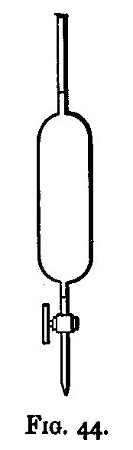
The solution of salt is standardised as follows:—Weigh up 1.003 gram of
fine silver and dissolve in 25 c.c. of dilute nitric acid in a bottle
provided with a well-fitting flat-headed stopper. Heat on the water bath
to assist solution, resting the bottle in an inclined position. When
dissolved blow out the nitrous fumes with the help of a glass tube bent
at right angles. Run in from a stoppered pipette (as shown in fig. 44)
100 c.c. of the standard salt solution, and shake vigorously until the
solution clears. Fill an ordinary burette with the weaker standard salt
solution, and run 1 c.c. into the assay bottle, letting it run down the
side so that it forms a layer resting on the assay solution. If any
silver remains in solution a cloudy layer will be formed at the junction
where the two liquids meet. This is best observed against a black
background If a cloudiness is seen, shake, to clear the liquid, and run
in another c.c. of salt, and continue this until a cloudiness is no
longer visible. Deduct 1.5 c.c. from the amount of the weaker sodium
chloride solution run in. Divide the corrected reading by 10, and add to
the 100 c.c. This will give the volume of strong salt solution
equivalent to the silver taken.
If the first addition of the weaker salt solution causes no cloudiness
add 5 c.c. of the silver solution from an ordinary pipette, shake, and
then run in the weaker salt solution, working as before. These 5
milligrams of silver added must be allowed for before calculating. As
an example:—1.0100 gram of fine silver was taken for standardising a
solution and 4 c.c. of the weaker salt solution were run in. Deducting
1.5 and dividing by 10 gives 0.25 c.c. to be added to the 100 c.c.
100.25 : 1.0100 :: 100 : x
x = 1.0075
which is the standard of the salt solution.
The method of working an assay may be gathered from the following
example:—In the determination of silver in some buttons left after
cupellation, it was assumed that these would contain 99.5 per cent. of
silver. For the assay it was necessary to take a quantity that should
contain a little more than 1.0075 grams of silver; then
99.5 : 100 :: 1.0075 : x
x = 1.0125
To ensure a slight excess, there was taken 1.0150 gram of the buttons,
which was treated in exactly the same way as for the standardising. The
quantity of the weaker salt solution required was 7 c.c.; deducting 1.5
c.c., and dividing by 10, gives 100.55 c.c. of strong salt solution,
which is equivalent to 1.0130 gram of silver. This being obtained from
1.015 gram of alloy, is equal to 99.8 per cent., or 998.0 fine.
The Effect of Temperature.—The standardising and the assay must be
done at the same time, since a difference of 5° C. makes a difference of
0.1 c.c. in measuring the 100 c.c. of strong solution of salt. It is
always best to prepare a standard with each batch of assays.
SULPHOCYANATE METHOD.—Volhard's process is based upon the
precipitation of silver in nitric acid solutions with potassium
sulphocyanate, the finishing point being the development of a
reddish-brown colour, produced by the action of the excess of
sulphocyanate upon ferric sulphate. The white sulphocyanate settles
readily, leaving the liquor clear; and a persistent brown coloration in
the liquid indicates the finish. The assay must be carried out in the
cold; and water free from chlorides[16] must be used.
The standard sulphocyanate of potassium solution is made by dissolving
4-1/2 or 5 grams of the salt (KCyS) in water, and diluting to 1 litre.
100 c.c. are about equivalent to 0.5 gram of silver.
The standard silver nitrate solution is made by dissolving 5 grams of
fine silver in 50 c.c. of dilute nitric acid, boiling off nitrous fumes,
and diluting to 1 litre.
The indicator is a saturated solution of iron alum, or a solution of
ferric sulphate of equivalent strength made by titrating acid ferrous
sulphate with potassium permanganate. Use 2 c.c. for each assay.
The sulphocyanate solution is standardised by placing 50 c.c. of the
silver nitrate solution in a flask with 20 c.c. of dilute nitric acid,
diluting to 100 c.c. with water, and running in the sulphocyanate until
the greater part of the silver is precipitated; then adding 2 c.c. of
the ferric indicator, and continuing the titration until a reddish-brown
colour is developed, and remains permanent after shaking continuously.
The assay is similarly performed, the silver being used in the state of
a nitric acid solution.
The effect of variations in the conditions of the assay may be seen from
the following experiments, in which 20 c.c. of standard silver nitrate
were used:—
Effect of Varying Temperature:—
| Temperature | 10° C. | 30° C. | 70° C. | 100° C. |
| Sulphocyanate reqd. | 19.6 c.c. | 19.3 c.c. | 19.0 c.c. | 18.6 c.c. |
Effect of Varying Nitric Acid:—Varying nitric acid has no effect,
except that with a fairly acid solution the finishing point is somewhat
sharper.
| Nitric acid added | 5 c.c. | 10 c.c. | 20 c.c. | 50 c.c. |
| Sulphocyanate reqd. | 19.6 c.c. | 19.5 c.c. | 19.6 c.c. | 19.6 c.c. |
Effect of Varying Bulk:—
| Bulk | 50 c.c. | 100 c.c. | 200 c.c. | 300 c.c. |
| Sulphocyanate reqd. | 19.5 c.c. | 19.6 c.c. | 19.6 c.c. | 19.7 c.c. |
Effect of Varying Ammonic Nitrate:—
| Ammonic nitrate | 0 gram | 1 gram | 5 grams | 10 grams |
| Sulphocyanate reqd. | 19.6 c.c. | 19.6 c.c. | 19.7 c.c. | 19.9 c.c. |
Effect of Varying Silver:—
| Silver added | 1 c.c. | 10 c.c. | 20 c.c. | 50 c.c. | 100 c.c. |
| Sulphocyanate reqd. | 1.0 c.c. | 9.70 c.c. | 19.6 c.c. | 49.4 c.c. | 99.0 c.c. |
This method is valuable for determining silver in salts, alloys, and
solutions, where no more than an ordinary degree of accuracy is
demanded. It is easy, and applicable under most of the usual conditions.
Its greatest disadvantage is the brown coloration produced by the
sulphocyanate when the assay is nearly, but not quite, finished; and the
slowness with which this is removed on shaking up with the precipitate.
This is worse with large quantities of precipitate, and if about 1 gram
of silver is present, it gives an indefiniteness to the finish which
lowers the precision of the process to about 1 in 500; this is useless
for the assays of bullion. One writer states that this inconvenience is
due to portions of liquid being entangled in the precipitate, but it
appears much more likely to be due to the action of the precipitate
itself. In attempting to apply the process to the assay of bullion by
working it on the principle of a Gay-Lussac assay, it was found that a
very considerable excess of silver was required to complete the
reaction. In these experiments 100 c.c. of "sulphocyanate" (very
accurately measured) was run into the solution containing the weighed
portion of bullion (fine silver) and, after shaking the solution, was
filtered. In the filtrate the remaining silver, if there should be any,
was determined by the ordinary titration, but with "sulphocyanate" of
one-tenth the strength. This final titration was quite satisfactory. The
amount of silver precipitated by the first 100 c.c., however, varied
with the quantity of silver present as in the following series.[17]
| Silver present. | | Silver precipitated. |
| 1.1342 | gram. | 1.1322 | gram. |
| 1.1375 | " | 1.1335 | " |
| 1.1405 | " | 1.1351 | " |
| 1.1484 | " | 1.1379 | " |
These, of course, preclude a method of the kind aimed at, and at the
same time emphasise the importance of uniformity of work in the ordinary
process. In the determination of chlorides in sea-water, Dittmar used a
combined method: precipitating the bulk of the silver as chloride, and
after filtering, determining the small excess of silver by
sulphocyanate. This modification answers admirably when applied to the
assay of bullion. In the ordinary Gay-Lussac method, the precipitation
of the bulk of the silver by the 100 c.c. of salt solution leaves
nothing to be desired, either as to ease in working or accuracy of
result; the silver precipitate settles quickly, and leaves a clear
liquor admirably fitted for the determination of the few milligrams of
silver remaining in solution. But the method of determining this
residual silver by adding successive small quantities of salt so long as
they continue to give a precipitate is unsatisfactory, and, judged on
its own merits apart from the rest of the process, could hardly escape
condemnation. It is clumsy in practice, for the continued adding of
small portions of salt solution is laborious and becomes impossible with
more than a few milligrams of silver in solution. The proposed
modification is simple; having precipitated the silver with the 100 c.c.
of salt solution, as described under Gay-Lussac's method (page 120),
shake till the liquor clears, and filter into a flask, washing with a
little distilled water. Add 2 c.c. of "ferric indicator" to the filtrate
and titrate with a standard "sulphocyanate solution" made by diluting
the ordinary standard solution to such an extent that 100 c.c. after
diluting shall be equivalent to 0.1 gram of silver.[18] Calculate the
weight of silver found by "sulphocyanate" and add it to the weight which
100 c.c. of the salt solution will precipitate.
An advantage of this modification is that an excess of 15 milligrams may
be determined as easily and exactly as 5. In standardising the salt
solution, then, weigh up, say 1.0150 gram of pure silver, dissolve and
titrate. Suppose 13.5 c.c. of "sulphocyanate" required; then these are
equivalent to .0135 gram of silver, (100 c.c. = .1); the silver
precipitated by the salt is 1.0150-.0135—i.e., 1.0015 gram, which is
the standard.
Application of the Method to Assays for Arsenic.—If silver nitrate be
added to a neutral solution of an arsenate of one of the alkali metals,
silver arsenate (Ag3AsO4), is thrown down as a dark-red
precipitate. If, after adding excess of silver nitrate to insure a
complete precipitation, the arsenate of silver be filtered off, the
weight of the arsenic could be estimated from the weight of silver
arsenate formed. But this may be done much more conveniently by
dissolving the precipitate in nitric acid, and titrating with
sulphocyanate; the silver found will be to the arsenic present as 324
(108×3) is to 75.
The mineral is best treated by the method given in the third paragraph
on page 382; but the solution, after being acidified with nitric acid,
should be made exactly neutral with ammonia. A small excess of silver
nitrate should then be added, and since acid is liberated in the
reaction, the liquor must again be neutralised.[19] The precipitate must
then be filtered off, and washed with distilled water. Then dissolve it
in the paper by slowly running over it 20 c.c. of dilute nitric acid.
Wash the filter with distilled water, collecting with the filtrate in a
small flask. Add 2 c.c. of "ferric indicator" and titrate.
If the sulphocyanate solution be made up with 11 or 12 grams of the
potassium salt to the litre, and be then standardised and diluted, so
that for 100 c.c. it shall equal 1.08 gram of silver, (see p. 38), then
it will also equal .25 gram of arsenic (As). Except for ores rich in
arsenic, it will be better to work with a solution one half this
strength. The standard as calculated from an experiment with pure silver
should be checked by another using pure resublimed white arsenic,
As2O3, which contains 75.75 % of the metal. The quantity of white
arsenic taken, .1 or .2 gram, should contain about as much arsenic as
will be present in the assays. It is converted into sodium arsenate by
evaporating to a small bulk with nitric acid and neutralising with soda.
The precipitation and titration of the silver arsenate should be exactly
as in the assays.
The difficulty of the method is in the neutralising; which has to be
very carefully done since silver arsenate is soluble in even faintly
acid solutions; one drop of nitric acid in 100 c.c. of water is enough
to produce an absolutely worthless result; and an excess of acid much
less than this is still very prejudicial. The addition of a little
sodium acetate to the solution after the final neutralising has a good
effect.
Arsenic in Mispickel.—Weigh up .250 gram of the finely-powdered ore,
and place in a Berlin crucible about 1-1/4 or 1-1/2 inch in diameter.
Treat with 10 or 12 drops, one drop at a time, of strong nitric acid,
warm very gently, but avoid much heating. Put on a thin layer of nitre,
and rather more than half fill the crucible with a mixture of equal
parts of soda and nitre. Heat quickly in the blow-pipe flame, and when
the mass is fused and effervescing, withdraw and allow to cool. Boil out
with water, filter and wash. Insert a piece of litmus paper and
cautiously neutralise with nitric acid, using ammonia to neutralise any
accidental excess of the acid. Add a gram or so of ammonium nitrate and
silver nitrate in excess, neutralise again with ammonia and add two or
three grams of sodium acetate. Filter off the precipitate, wash and
titrate. In the fusion care should be taken to avoid much effervescence
(an excess of the soda mitigates this) and the operation should be
stopped as soon as the whole has entered into fusion.
There is, properly speaking, no colorimetric method, but the following,
which is sometimes used, is based on similar principles. It is useful
for the determination of small quantities of silver in substances which
yield clear solutions with nitric acid.
Dissolve a weighed quantity of the substance in nitric acid, and dilute
to a definite bulk. Divide into two equal parts. To one, add a drop or
two of dilute hydrochloric acid, stir and filter. To the other, add a
similar amount of dilute acid, and then to the filtered portion run in
from a burette standard silver nitrate (1 c.c. = 0.5 milligram silver)
until the solutions are equally turbid. Calculate in the usual way.
Gold occurs in nature chiefly as metal. It always contains more or less
silver, and, in alluvial sands, &c., may be associated with platinum and
iridium.
Gold is insoluble in hydrochloric or nitric acid, but is dissolved by
aqua regia or by solutions of iodine, bromine, or chlorine. It is taken
up by mercury, forming an amalgam, from which the mercury may be driven
off by heat.
When gold occurs in particles of any size, it is readily detected by its
appearance, but when finely disseminated through a large quantity of
rock, it is separated and detected by the amalgamation assay—described
below—or by a process of washing somewhat similar to vanning, or by the
following test:—Powder and, if necessary, roast 50 to 100 grams of the
ore, put on it three or four crystals of iodine and enough alcohol to
cover it; allow to stand for half an hour; a piece of filter paper
moistened with the liquid and burnt leaves an ash with a distinctly
purple tint if any gold is present. It is better, however, to filter off
the solution, evaporate, and ignite. Then, either take up with mercury,
and ignite the amalgam so as to get a speck of the metallic gold; or
treat with a few drops of aqua regia, and test the solution with
stannous chloride: a purple coloration indicates gold.
AMALGAMATION ASSAY.—This does not attempt to give the total produce
of gold, but rather the quantity which can be extracted on a large
scale; therefore it should imitate as closely as possible the process
adopted in the mine or district for extracting the metal.
Take 2 lbs of the ore in powder and roast; make into a stiff paste with
hot water and rub up for an hour or so with a little mercury. Wash off
the sand carefully, and collect the amalgam. Drive off the mercury by
heat, and weigh the residual gold. It is best to cupel it with lead
before weighing.
In an experiment on a lot of ore which contained 0.189 gram of gold,
0.179 gram was obtained by the above process, equal to about 94-1/2 per
cent. recovered. With ores generally, the yield may be from 80 to 90 per
cent. of the actual gold present.
The dry assay of gold ores resembles in its main particulars the dry
assay for silver by the crucible method; and for much that is of
importance in its discussion the student is referred to what is written
under Silver on pp. 90-113.
Size of Assay Charges.—Gold ores rarely contain more than a few
ounces, often only a few pennyweights of gold to the ton; consequently,
the button of gold obtainable from such quantities of ore as may be
conveniently worked by assaying methods is often so small as to require
more than ordinary care in its manipulation. One milligram of gold forms
a button of about the size of one of the full-stops on this page, and
compared with a million similar particles of quartz (about four ounces),
represents a produce of a quarter of an ounce to the ton: a proportion
such as the assayer is frequently called on to determine. It is evident,
therefore, that a charge of half an ounce or less of the ore, such as is
usual with silver ores, would demand of the worker both skill and care
in the handling of the minute quantity of gold to be obtained from it.
Fortunately the work is simple and precise, so that in practised hands
and with only a 5-gram charge the assay of a 5-dwt. ore is practicable;
with so small a charge, however, the result is barely perceptible on a
sensitive balance: the button of gold should be measured under a
microscope. It follows, therefore, that larger charges of say 50, 100,
or even 200 grams, have an advantage in that they lessen the strain on
the worker's attention, and, except in the case of the poorest mineral,
bring the button of gold within the scope of the balance. On the other
hand, the inconvenience of the larger charges lies in the amount of
fluxes and consequent size of the crucibles required to flux them.
Sampling.—A further consideration in favour of the larger charges is
the matter of sampling. In preparing his ore, the student should ask
himself what reasonable expectation he has that the portion he puts in
the furnace will be of average richness. The larger charges are likely
to be nearer than the smaller ones to the average of the parcel of ore
from which they are taken. In explanation of this, let us suppose a
large heap of 5-dwt. ore, in sand of the coarseness of full-stops, and
containing all its gold in particles of 1 milligram, as uniformly
distributed as care and labour in the mixing can accomplish. Such a heap
could not possibly occur in practice, but it will serve for purposes of
illustration. Now, one ton of the sand, however taken, would contain
appreciably the same quantity of gold as any other ton. For a ton would
contain about 8000 particles of gold; and even if two separate tons
differed by as much as 100 particles (which they are just likely to do),
this would mean only a difference of 1 or 2 grains to the ton. On the
other hand, two portions of 14 lbs., which should contain on the average
50 particles of gold, are likely enough to differ by 10 particles, and
this, calculated on a ton, means a difference of 1 dwt. It is easy to
see that something like this should be true; for on calculating the
14-lb. lot up to a ton, the deviation from the average, whatever it may
be, is multiplied by 160; whereas, if the ton were made up by adding
14-lb. lot to 14-lb. lot, up to the full tale, then a large proportion
of the errors (some being in excess and some in defect) would neutralise
each other. An average which is practically true when dealing with
thousands, and perhaps sufficiently exact with hundreds, would be merely
misleading when applied to tens and units. Reasonable safety in
sampling, then, is dependent largely on the number of particles of gold
in the charge taken, and the risk of an abnormal result is less, the
larger the charge taken.
By doubling the charge, however, we merely double the number of
particles. Powdering finely is much more effective; for, since the
weight of a particle varies as the cube of the diameter, halving the
diameter of the particles increases their number eight-fold. If, now, we
modify our illustration by assuming the particles to have only one-sixth
the diameter of a full-stop (which would represent a powder of a
fineness not unusual in ores prepared for assaying), we should multiply
the number of particles by 200 (6 × 6 × 6 = 216). We should then
reasonably expect a 14-lb. parcel of the powder to give as safe a sample
as a ton of the sand would give; and portions of a size fit for crucible
work, say 50 or 100 grams, would be as safe as 10 or 20-lb. samples of
the coarser stuff. For example, 60 grams of such powder would contain,
for a 5-dwt. ore, about 100 particles; and in the majority of cases the
error due to sampling would be less than 10 or 12 grains to the ton, and
would only occasionally exceed a pennyweight. With richer ores the
actual deviation stated as so much to the ton of ore might be greater,
but it would represent a smaller proportion, stated in percentage of
the gold actually present, and would ultimately fall within the limits
of unavoidable error.
It will be seen that the size of the quartz particles has no direct
bearing on the argument; and, in fact, the coarseness of the quartz only
interferes by preventing the uniform mixing of the sand and by binding
together several particles of gold; in this last case, particles so
united must, of course, count as one larger particle. Now, there are
some natural ores in which the gold particles are all very small; with
these fine powdering and mixing yields a product from which a sample may
be safely taken. Then, again, in "tailings," before or after treatment
with cyanide, we have a similar material, inasmuch as the coarser gold
has been removed by previous amalgamation. With these, it is not unusual
to take the portion for assay without any further powdering, since they
are poor in gold, and have already been stamped and passed through a
sieve of say thirty holes to the inch (linear).
But there are other ores, in lump showing no visible gold, which contain
the gold in all possible degrees of fineness, from say prills of a
milligram or so down to a most impalpable powder. The treatment of these
cannot be so simple and straightforward. Suppose a parcel of 1000 grams
(say 2 lbs.) of such ore in fine powder, containing on an average 1
particle of 1 milligram (the presence or absence of which makes a
difference of .6 dwt. on the ton), 10 others of about .5 milligram (each
representing .3 dwt.), and 100 others, which are too coarse to pass
through an 80 sieve, and having an average weight of .1 milligram (each
.06 dwt.), and that the rest of the gold, equivalent altogether to 2
ounces to the ton, is so finely divided that a charge of 50 grams may be
taken without any considerable risk of its interfering with the
sampling. Then in a 50-gram charge there would be one chance in twenty
of getting the milligram particle, in which case the result would be
12.35 dwts. too high; on the other hand, if it were not present the
result would on this account be .65 dwt. too low. Of the ten
.5-milligram particles, it is as likely as not that one will be present,
and its presence or absence would cause an error of 3.3 dwts., more or
less. Of the 100 particles of .1 milligram, there would probably be from
3 to 7, instead of 5, the proper number; this would mean a variation of
2.6 dwts. from the true proportion. So that the probable result would
range about 5 dwts. more or less than the 2-1/2 ozs., which is the true
produce, and there are possibilities of astounding results. It is true
that the majority of the results would be well within these limits, and
now and again the heart of the student would be gladdened by a beautiful
concordance in duplicate assays; nevertheless, there can be no
reasonable expectation of a good assay, and to work in this way, on a
50-gram charge, would be to court failure. The coarse gold must ruin the
assay.
The difficulty may be met by concentrating the whole of the coarse gold
in a small fraction of the ore, by sifting and making a separate assay
of this fraction. A portion of the ore, of about 1000 grams, is ground
to a very fine powder and passed through an 80 sieve, re-grinding when
necessary, until only 20 or 30 grams is left of the coarser powder. This
is mixed with fluxes and carried through as a separate assay. The sifted
portion is thoroughly mixed, and a portion of it, say 30 or 50 grams,
taken for assay. The weights of the two portions must be known, and care
must be taken that nothing is lost in the powdering. The method of
calculating the mean result from the two assays is shown on page 109. In
this way of working there is no advantage in continuing the grinding
until the coarser fraction is reduced to a gram or so—rather the
contrary; and rubbing on until all the gold is sent through the sieve is
to be distinctly avoided. The student must bear in mind that what he is
aiming at is the exclusion of all coarse gold from the portion of ore of
which he is going to take only a fraction.
The question of the smaller sampling of gold ores has been dwelt on at
considerable length, as befits its importance, in order that the student
may be impressed with a sense of its true meaning. Sampling is not a
mystery, nor does the art lie in any subtle manner of division. It is,
of course, absolutely necessary that the stuff to be sampled shall be
well mixed, and the fractions taken, so that each part of the little
heap shall contribute its share to the sample. Moreover, it must be
remembered that tossing about is a poor sort of mixing, and that
everything tending to separate the large from the small, the light from
the heavy, or the soft from the hard (as happens in sifting), must be
avoided, or, if unavoidable, must be remedied by subsequent mixing.
With a well-taken sample, we may rely on a great majority of our results
falling within normal limits of error; but nothing can be more certain
than that, in a moderately large experience we shall get, now and again,
deviations much more considerable. These erratic assays can only be met
by the method of working duplicates, which call attention to the fault
by discordant results. Such faulty assays should be repeated in
duplicate, so that we may rest the decision on three out of four
determinations.
The likelihood of two very faulty assays being concordant is remote;
but with very important work, as in selling parcels of ore, even this
risk should be avoided, as concordance in these cases is demanded in the
reports of two or more assayers. The following actual reports on a
disputed assay will illustrate this: (a) 5 ozs. 1 dwt.; (b) 5 ozs.
10 dwts. 12 grains; (c) 5 ozs. 11 dwts.; (d) 5 ozs. 11 dwts. 12 grs.
The mean result of several assays, unless there be some fault in the
method, will be very fairly exact; and individual assays, with an
uncertainty of 1 in 20, may, by repetition, have this reduced to 1 in
100 or less.
Assay Tons, etc.—Having decided on taking a larger or smaller
portion, the exact quantity to be used will be either some round number
of grams, such as 50 or 100, easily calculable into percentage; or it
will be that known as the "Assay Ton" (see page 13) or some simple
multiple or fraction of it, which is easily calculable into ounces. The
reports, too, are at least as often made as ounces in the short ton of
2000 lbs., as on the more orthodox ton of 2240 lbs. Now the short ton is
equal to 29,166.6 troy ounces; and the corresponding "assay ton" is got
from it by replacing ounces by milligrams. The advantage of its use is
that if one assay ton of ore has been taken, the number of milligrams of
gold obtained is also the number of ounces of gold in a ton of the ore,
and there is absolutely no calculation. Even if half an assay ton has
been taken the only calculation needed is multiplying the milligrams by
two. On the other hand with a charge of two assay tons the milligrams
need halving. Where weights of this kind (i.e., assay tons) are not at
hand they may be easily extemporised out of buttons of tin or some
suitable metal, and it is better to do this than to array out the grams
and its fractions at each weighing. The sets of "assay tons," however,
are easily purchased. As stated on page 13, the assay ton for 2240 lbs.
is 32.6667 grams; and for the short ton, 29.1667 grams. If, however, the
round number of grams be used and the result brought by calculation to
the produce on 100 grams, the conversion to ounces to the ton may be
quickly effected by the help of the table on page 107. As this table
only deals with the ton of 2240 lbs., it is supplemented here by a
shortened one dealing only with the produce of 100 grams and stating
the result in ounces troy to the short ton of 2000 lbs.
Estimation of Small Quantities of Gold.—By the Balance. In
estimating minute quantities of gold there are one or two points, of
importance to an assayer only in this assay, where they will often allow
one to avoid the working of inconveniently large charges. One of these
is known as "weighing by the method of
TABLE FOR CALCULATING OUNCES TO THE SHORT TON FROM THE
YIELD OF GOLD FROM 100 GRAMS OF ORE.
| Milligram. | Ounces to the Ton. | Milligram. | Ounces to the Ton. | Milligram. | Ounces to the Ton. |
| 0.01 | 0.003 | 0.4 | 0.117 | 7.0 | 2.042 |
| 0.02 | 0.006 | 0.5 | 0.145 | 8.0 | 2.333 |
| 0.03 | 0.009 | 0.6 | 0.175 | 9.0 | 2.625 |
| 0.04 | 0.012 | 0.7 | 0.204 | 10.0 | 2.916 |
| 0.05 | 0.014 | 0.8 | 0.233 | 20.0 | 5.833 |
| 0.06 | 0.017 | 0.9 | 0.262 | 30.0 | 8.750 |
| 0.07 | 0.020 | 1.0 | 0.292 | 40.0 | 11.666 |
| 0.08 | 0.023 | 2.0 | 0.583 | 50.0 | 14.583 |
| 0.09 | 0.026 | 3.0 | 0.875 | 60.0 | 17.500 |
| 0.10 | 0.029 | 4.0 | 1.167 | 70.0 | 20.416 |
| 0.20 | 0.058 | 5.0 | 1.458 | 80.0 | 23.333 |
| 0.30 | 0.087 | 6.0 | 1.750 | 90.0 | 26.250 |
vibrations." Suppose a balance at rest in perfect equilibrium, with the
pointer exactly over the middle point of the scale. Let the scale be a
series of points at equal distances along a horizontal line; then, if a
small weight be placed on one pan, the pointer will deviate from its
vertical position and come to rest opposite some definite part of the
scale, which will depend upon the magnitude of the weight added. The law
determining this position is a very simple one; the deviation as
measured along the points of the scale varies directly as the weight
added. For example, with an ordinarily sensitive balance, such as is
used for general purposes, one milligram will move the pointer along,
say, three divisions of the scale; then two milligrams will move it six
divisions; half a milligram, one and a half divisions; and so on. Of
course, with a more sensitive balance the deviations will be greater.
Now the point at which the needle comes to rest is also the middle point
about which it vibrates when swinging. For example, if the needle swings
from the third to the seventh division on the right then [(7+3)/2] it
will come to rest on the fifth. In working by this method the following
conventions are useful: Always place the button to be weighed on the
left pan of the balance, the weights on the right; count the divisions
of the scale from the centre to right and left, marking the former + and
the latter -; thus -5 is the fifth division to the left. Then the
position of rest is half the algebraic sum of two readings. For example,
let the readings be 7 to the right and 3 to the left, then (+7-3)/2 =
+2. The mean division is the second division to the right. If the
student will place himself in front of a balance and repeat the
following observations and replace the figures here given by his own, he
will have no difficulty in grasping the method. First determine the
bias of the balance; suppose the unloaded balance swings +1.25 and -1;
the bias then is (1.25-1)/2 = +.125 or one-eighth of a division to the
right. Now having put on the button to be weighed let the readings be
+7.5 and +9.25, and (7.5+9.25)/2 = +8.375. Then the effect of the button
has been to move the pointer from +.125 to +8.375, or 8.25 divisions to
the right; we should, therefore, add the weight equivalent of 8.25
divisions to the weights, whatever they may be on the right hand pan of
the balance; if the divisions were to the left (- divisions) we should
subtract. The value of 1 division is easily determined. Suppose the
button in the example were a 1 milligram weight, then we should have
found that 1 milligram = 8.25 divisions ∴ 1 division = .121 milligram.
This method of working adds very considerably to the power of a balance
in distinguishing small quantities.
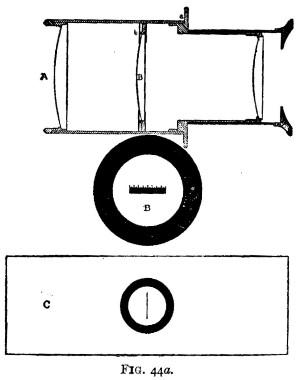
By the Microscope.—The use of the microscope also is a real advantage
in estimating the weights of minute buttons of gold where there is no
undue risk in sampling, and where an error of say 1 in 20 on the
quantity of gold is tolerable. For ores with copper, lead, zinc, &c., as
well as for tailings rather poor in gold, this leaves a wide field of
usefulness. The method is described on page 440, but the description
needs supplementing for those who are not accustomed to the use of a
microscope. The eye-piece of a microscope (fig. 44a, A) unscrews at
a, showing a diaphragm at b, which will serve as a support for an
eye-piece micrometer. This last, B, is a scale engraved on glass, and
may be purchased of any optical instrument maker, though it may be
necessary to send the eye-piece to have it properly fitted. When resting
on the diaphragm it is in focus for the upper lens, so that on looking
through the microscope, the scale is clearly seen in whatever position
the instrument may be as regards the object being looked at. Suppose
this to be a small button of gold on a shallow, flat watch-glass, on the
stage of the microscope. Bring the button under the "objective" (i.e.,
the nose of the microscope), which should be about a quarter of an inch
above the watch-glass; then looking through the instrument, raise the
tube until the button of gold, or at least some dust on the glass, comes
into focus. If the button is not in the field, rest the thumbs and index
fingers, using both hands, on the edge of the watch-glass, pressing
lightly but steadily, and give the glass a slow, short, sweeping motion;
the button will perhaps appear as an ill-defined blackness, because not
quite in focus. Bring this into the centre of the field. Raise or lower
the microscope until the button appears with sharp outlines. If the
scale does not cover the button, rotate the eye-piece; this will bring
the scale into a new position. Since the divisions over the button are
less distinct than the others, it is best to read the latter. Thus, in
fig. 44b, there are 36 divisions on one side of the button, and 35 on
the other, making altogether 71. The whole scale is 80, therefore the
diameter of the button is 9 divisions. The value of each division
obviously varies with the magnifying power employed. With most
microscopes there is a telescopic arrangement whereby the tube may be
lengthened; if this be done and the button again brought in focus, it
will be seen that, as measured on the scale, the button is much larger
than before. It is evident, therefore, the micrometer must always be
used in the same way. The method given in the appendix (page 440), for
finding the value of the scale when gold buttons are to be measured is
easy and satisfactory. When the button of gold is so small that there is
considerable risk of losing it in transferring to a watch-glass, it may
be measured on the cupel, but for this purpose it must be well
illuminated; this is best done by concentrating light on it with a lens,
or with what comes to the same thing, a clean flask filled with water.
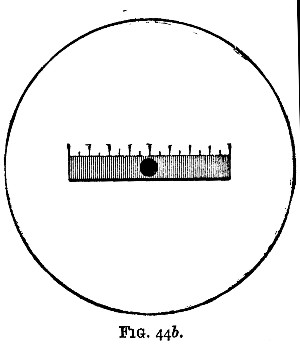
Most assayers, however, using a micrometer in this way, would like to
know its absolute value. To do this, a stage micrometer must be
purchased. This is like an ordinary microscope slide (fig. 44a, C),
and when looked at through a microscope it shows (fig. 44c) lines
ruled on the glass at distances of tenths and hundredths of a
millimetre, ten of each, so that the full scale is 1.1 mm. In the case
illustrated, 60 divisions of the scale in the eye-piece are just equal
to the 1.1 mm., therefore 1 division equals .0183 mm. A cube of this
diameter would contain (.0183×.0183×.0183) .0000061285 cubic mm. The
corresponding sphere is got by multiplying by .5236; this gives
.000003209 cb. mm. The weight of 1 cb. mm. of water is 1 milligram; and,
since gold is 19.2 times as heavy as water (sp. g. = 19.2), the contents
in cb. mm. must be multiplied by 19.2. This gives .0000616 milligram as
the weight of a sphere of gold measuring 1 division.
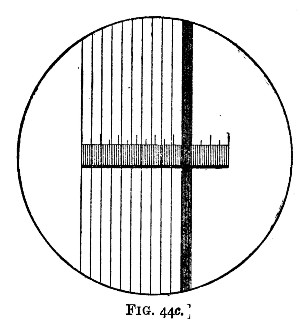
If every result had to be calculated in this way the method would be
very laborious; but, having the figures for the first division, those of
the others may be calculated by multiplying by the cube of the
corresponding number. Thus, for the third division (3×3×3 = 27), the
content of the cube (.0000061285×27) is .0001655 cb. mm.; the content of
the sphere (.000003209×27) is .0000866 cb. mm.; and the corresponding
sphere of gold (.0000616×27) is .00166 milligram. With the help of a
table of cubes the whole calculation for 25 or 30 divisions may be made
in half an hour, and the results preserved in the form of a table will
simplify all future work.
Assay Operations.—The actual work of the assay resolves itself into
three operations:—(1) The fusion of the ore and concentration of the
"fine metal" (i.e., gold and silver) in a button of lead; (2) The
cupellation of the lead, whereby a button of fine metal is obtained; and
(3) the "parting" of the gold which separates it from the accompanying
silver. The following description takes the order as here given, but the
student, in learning the method, should first practise cupellation if he
has not already done so; next he should practise the separation of gold
from silver, taking known weights of fine gold (p. 63), varying from .5
or .3 gram down to quite minute quantities, and not resting satisfied
until a sensitive balance can barely distinguish between the weights of
gold taken and found. It may be noted here that if he has not a flatting
mill at his disposal, then for large buttons it is better to make an
alloy with eight or nine parts of silver to one of gold, and attack it
with acid without previous flattening, rather than accept the risk and
labour of beating out a less easily attacked alloy to the necessary
thinness with a hammer. It is only after a sense of security in gold
parting has been acquired, that the attack of an ore can be profitably
accomplished, and even then simple and easy ores should be first taken,
passing on to others more difficult, either because of a more complex
mineral composition or a difficulty in sampling.
Concentration of the fine Metal in Lead.—The best flux for quartz,
which makes up the earthy matter of most gold ores, is soda, and this is
best added as carbonate or bicarbonate. By theory,[20] 50 grams of
quartz will require 88.5 grams of the carbonate, or 140 grams of the
bicarbonate, to form sodium silicate, which is a glassy, easily-fusible
substance, making a good slag. If the bicarbonate is used, and heat is
applied gradually, steam and carbonic acid are given off at a
comparatively low temperature, and the carbonate is left; at a higher
temperature (about 800° C., or a cherry-red heat) the carbonate fuses
attacking the quartz, and giving off more carbonic acid; as the heat
increases, and the attack on the quartz (which of itself is infusible)
becomes complete, the whole mass settles down to a liquid sodium
silicate, which is sufficiently fluid to allow the gold and lead to
settle to the bottom. The fluid slag does to a certain extent dissolve
some of the crucible, but not seriously. In a perfect working of this
experiment, the first evolution of gases (steam and carbonic acid)
should be gentle, so as to run no risk of its blowing the fine powder
out of the crucible; and the heat at which the second evolution of
carbonic acid is produced should be maintained until the reaction is
completed, so that there may be little or no formation of gas in the
fused mass to cause an effervescence which may force some of the charge
over the edges of the crucible. Of course, in practice the ideal fusion
is not attained, but there is no difficulty in approaching it closely
enough to prevent the charge at any time rising above the level it
reached at first in the crucible, and this should be accomplished. It is
usual with quartzose ores to rely mainly on the action of carbonate of
soda, but not entirely. Litharge is also used; it forms, on fusion with
quartz, a silicate of lead, which is a yellow glass, easily fusible, and
more fluid in the furnace than silicate of soda is. By theory, 50 grams
of quartz would require 186 grams of litharge.[21] The reaction takes
place without evolution of gas, and in its working the only point is to
so regulate the heat that the litharge shall not fuse and drain under
the unattacked quartz, leaving it as a pasty mass on the surface. Now,
if in making up a charge for 50 grams of ore, we took 100 grams of
bicarbonate of soda (equivalent to about 63 grams of the carbonate),
this being five-sevenths of 140 grams (which by itself would be
sufficient), leaves two-sevenths of the quartz to be fluxed by other
reagents: two-sevenths of 186 grams (say 52 grams) of litharge would
serve for this purpose. But if we used 10 grams of borax, which has a
fluxing action about equal to that of the litharge, then 40 grams of the
latter, or (making an allowance for the quartz being not quite pure) say
35 grams, will suffice. The fluxes, then, for the 50 grams of ore would
be: bicarbonate of soda 100 grams, litharge 35 grams, and borax 10
grams; we could decrease any of these, and proportionately increase
either or both of the others, and still rely on getting a fusible slag,
which is the whole of the function of a flux, considered simply as a
flux. It should be remembered, however, that the slag is a bi-silicate
or acid slag, and that its acid character is increased by increasing the
proportion of borax.
But in addition to the fluxes there is required about 30 or 40 grams of
lead to collect the silver and gold. This is best added as litharge (say
40 grams) and flour (4 grams), or charcoal powder (2 grams). See pages
93 and 94. The full charge, then, would be:
| Ore | 50 | grams. |
| Bicarbonate of soda | 100 | " |
| Litharge | 75 | " |
| Borax | 10 | " |
| Flour | 4 | " |
These should be mixed, placed in a suitable crucible (a G Battersea,
round, will do), and heated, at first at a red heat, but finally much
hotter, so as to get a fluid and clean slag. When the charge has been in
tranquil fusion for some little time, take it out and pour it into an
iron mould. When cold, detach the button of lead. The slag should be
glassy, all through alike, and easily separable from the metal. With
ordinary ores, this slag may be considered as free from gold. In an
experiment in which 90 milligrams of gold were added, the full amount
was obtained from the lead produced by the first fusion. But in certain
cases, more especially where large amounts of metallic oxides are
present, the slag is not so clean, and with these the slag should be
powdered, mixed with 40 grams of litharge and 4 of flour, and melted
again; it is an advantage to add a small prill of say 2 or 3 milligrams
of silver to the charge, as it insures a visible product in the
cupellation. Indeed, this last precaution is a good one to be taken
wherever there is reason to expect very small buttons. It has the
further advantage, that, if the quantity of silver necessary for
inquartation is known, the right quantity may be added here, so as to
save a subsequent operation.
Ores containing Oxides of Iron.—Of the metallic oxides likely to be
present in a slag, oxide of iron is the most important. Gold is
occasionally found in a matrix of this substance, and in the assay of
"concentrates" largely made up of pyrites, this oxide will be formed in
the preliminary calcination. Now, the lower oxide of iron (ferrous
oxide, FeO) is easy to deal with; fused borax will dissolve about its
own weight of it, and a silicate of soda (such as makes up the bulk of a
slag in a gold assay) will take up at least half as much. But the higher
oxide (ferric oxide, Fe2O3) is more refractory; even 6 parts of
borax yields a poor product, and slags with any considerable percentage
of it are not satisfactory. A student attempting to recover gold from
some hæmatite (in which there was about half an ounce of the metal),
found in the slag nearly a gram of gold, although in the first fusion
the slag appeared perfectly fluid. There is, however, no difficulty in
getting good slags, even with large quantities of iron. For example,
with 50 grams of ferric oxide, 10 of quartz, 30 of borax, 30 of
soda,[22] 50 of litharge, and 7 of flour, the result was quite
satisfactory. So, too, was 25 of quartz, 50 of soda, 50 of litharge, and
7 of flour. It is well, however, in such cases to have an ample
proportion of flux and to aim at a larger button of lead than usual by
increasing the proportion of flour or charcoal (see also page 91). A
charge used on the Randt for roasted "concentrates" (which we may
roughly speak of as quartz and ferric oxide), is one assay ton (about 30
grams) each of ore, soda, and borax, and one and a half assay ton of
litharge and 2 grams of charcoal. Whilst, for the same material, from
which most of the gold has been extracted by "chloridising," 2.5 tons
each of ore, borax, and soda, 4 of litharge, and 4 grams of charcoal are
needed. This quantity requires a large crucible (I Battersea, round). In
this the proportion of silicate of soda and borax counted together is to
the oxide of iron as 4 to 1, on the supposition that the quartz and
oxide of iron of the ore are in about equal quantities; but, in the
larger charge especially, much oxide of lead would also remain as a
flux.
Ores containing Sulphides.—In assaying ores containing a large
proportion of pyrites or mispickel, or both, the best plan is to take a
portion and calcine so as to convert it into a product of the kind just
considered. The weighed portion of ore should be placed in a clean
crucible and be heated to incipient redness: with pyrites the first
effect is to drive off about half the sulphur as vapour which burns as
flame over the ore. At this stage care should be taken that there is no
great increase of temperature, otherwise there may be more or less
fusion, which would spoil the operation. When the sulphur flame ceases
the solid sulphide of iron burns with visible incandescence and the
charge should now be stirred with a flattened iron rod so as to expose
fresh portions to the air. The top of the furnace must be open, so that
air may have free access to the crucible. When stirring is no longer
followed by visible burning the heat may be raised to full redness. The
crucible is then lifted out (the stirrer still resting in it) and if the
charge gives off no odour of burning sulphur it is shaken out into an
iron mortar and mixed with the fluxes, taking care to clean the stirrer
in the mixture. The charge is then replaced in the crucible in which the
roasting was done and fused in the furnace. The resulting button of lead
is cupelled for fine metal. Ores rich in sulphides requiring this
treatment are frequently "concentrates." For their assay take 1 assay
ton (30 grams), calcine and mix with an equal weight of soda and of
borax (30 grams each), and half as much again of litharge (1.5 tons or
45 grams), and with 2 grams of charcoal or 5 grams of flour.
Where the sulphides are present in smaller proportion (10 per cent. or
less), they may be taken as serving the purpose of flour or charcoal
(see page 95); the sulphur and iron are oxidised at the expense of the
litharge with a consequent separation of lead as metal. If the
proportion of sulphides is not sufficient to give a large enough button
of lead, some charcoal or flour should be added. On the other hand, if
they are in small excess and give a button of lead somewhat sulphury,
i.e., hard and brittle, it may be remedied by the judicious addition
of nitre; this last reagent, however, should not be used in large
quantity. A plan much used to prevent sulphury buttons is to insert an
iron rod or a nail in the charge in the crucible; the iron takes the
sulphur forming sulphide of iron which in moderate quantity does not
form a separate layer of matte but dissolves in the slag. A slag formed
of 50 grams of quartz, 100 soda, and some borax, may take up in this way
some 10 or 12 grams of sulphide of iron. If, however, an ore gives a
layer of matte or speise, it is best to repeat the assay by the method
of calcining before fusion.
Cyanide Charges, etc.—In assaying the "tailings" which are to be
treated in a cyaniding plant the following charge is used:
| Tailings | 3 | assay tons or | 100 | grams. |
| Litharge | 4.5 | " | 150 | " |
| Soda | 4.5 | " | 150 | " |
| Borax | .75 | " | 25 | " |
The sand is assayed without any further crushing and the assay is made
in duplicate.
The residues after treatment with cyanide, differing from the tailings
merely in being poorer in gold because of the extraction by the solution
of cyanide, are run down with the same fluxes in the same relative
proportions. But four charges of 2.5 assay tons (say 75 grams) are
worked, and two of the resulting buttons are scorified together and then
cupelled, etc., so as to give duplicate assays on charges of 5 assay
tons. This is one of the cases in which it is desirable to add a small
portion of silver before cupelling.
In assaying the "cyanide liquors" for gold, 2 assay tons of the liquor
are measured out (58.3 c.c. for the ton of 2000 lbs., 65.3 c.c. for the
other) and are evaporated to dryness in a lead dish weighing about 35
grams. Such a dish is easily extemporised out of a piece of lead foil,
if the ordinary vessel is not at hand; but care must be taken that the
lead is free from gold. The dish with the dried residue is then
scorified and the resulting button of lead is cupelled.
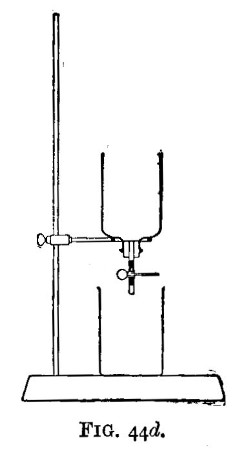
In some cases the fusion of the ore may be replaced by a treatment with
solution of cyanide of potassium and the gold recovered from the
solution in the way just described. For this purpose the ore should be
in not too fine powder, otherwise there will be great difficulty in
filtering; a sand which will pass a 30 sieve and having no large
proportion of very fine stuff will do. Not less than 200 grams should be
taken; and as an extraction apparatus a bell jar capable of holding half
as much again may be used. Such a jar may be extemporised by cutting off
the bottom of a bottle by leading a crack around it with a red hot
poker; or a lamp chimney will serve the purpose. The smaller mouth of
the jar is closed by a perforated cork provided with a clipped tube
after the manner of a burette (see fig. 44d). In the jar, just over
the cork, put a plug of loose asbestos or glass wool, or a piece of
sponge to act as a filter; a layer of broken glass, coarse at the bottom
and fine at the top, will serve the same purpose. On this, place the
charge of ore to be extracted. Prepare a solution of cyanide of
potassium in water, with 5 or 10 grams of the salt to the litre. It may
be that the whole point of the assay depends on the solution being of a
definite strength; as, for example, where the relative efficiency of
solutions of different strengths is being determined, when it will be
best to estimate the quantity of cyanide of potassium in the dilute
solution by the method given at the end of this article (page 160). Pour
the cyanide solution on to the ore, letting the first portions to come
through run into the beaker, but as soon as the ore is thoroughly wetted
close the clip and allow to stand for several hours. Then, opening the
clip, run through more cyanide solution and then water, so as to wash
the gold-carrying liquor thoroughly into the beaker. It is no matter if
the liquor is a little bit turbid; transfer it to a lead dish,
evaporate, scorify, and cupel in the usual fashion.
The assay of gold-zinc slimes, which is the precipitate formed by zinc
acting on cyanide solutions of gold, may be made by wrapping 2 or 3
grams in 40 grams of sheet lead and scorifying, cupelling, &c. The
amount of impurity in the stuff varies greatly; it is usually calcined
and mixed thoroughly with soda 40 per cent., borax 30 per cent., and
sand 10 per cent., and melted in graphite pots. The buttons of bullion
obtained are afterwards remelted with borax and run into bars, the
fineness of which varies from 600 to 830 thousandths. The bars are
sampled by chipping off diagonally opposite corners: or better, by
drilling, the drillings being freed from pieces of steel with the help
of a magnet.
Cupellation.[23]—The cupellation of lead for gold differs very little
from that of lead carrying silver. When the gold is accompanied by a
larger proportion of silver, and both have to be determined, the
cupellation must be conducted exactly as in a silver assay, the usual
precautions being taken to moderate the temperature so as to lessen the
cupellation loss and to promote a slow and undisturbed solidification in
order to avoid spirting. If, however, the gold predominates the finish
should be effected at a higher heat, as the melting-point of gold is
100° higher than that of silver. The bad effect of a higher temperature
in increasing the cupellation loss need hardly be considered in the case
of such small buttons of gold as are obtained in assaying gold ores, as
any loss there may be is hardly appreciable by the balance. With larger
quantities of gold, however (as in assaying gold bullion), this loss
becomes important; and it is therefore necessary to very carefully
regulate the temperature of the muffle so as to minimise the loss.
The cupels are made of well-burnt bone-ash, of the fineness of coarse
wheat flour, moistened with one-twelfth its weight of water and
compressed into shape in suitable moulds. The moulds sold for this
purpose are often of unsuitable shape. Since lead has a specific gravity
of over 11, a cup to hold from 15 to 25 grams of molten lead need not
have a capacity of more than about 2 c.c. A hollow about 1 inch across
and 1/4 inch deep is sufficient; and the body of the cupel to absorb
this weight of lead should itself weigh from 20 to 25 grams. The button
of lead in a gold assay may be twice as heavy as this. For these larger
buttons a hollow 1-1/3 inch across and 1/3 inch deep will be sufficient.
If these larger cupels are not at hand the larger buttons will have to
be reduced in size by a scorification before cupelling. In some cases
this preliminary scorification is advantageous or even necessary: this
may be because the lead is hard and impure, or it may be that a very
small button of gold is expected. In the latter case it is best to
scorify the lead down to something less than 1 gram, and to perform the
cupellation on a specially prepared small fine cupel. These small cupels
are best made by grinding the unsaturated portion of a used cupel to a
fine powder, and compressing the dry powder into a small Berlin crucible
or scorifier; the face should be made quite smooth by pressure from a
pestle. On such cupels a small speck of gold (less than .01 milligram)
will be left in a good shape and easily visible; but the cupel must be
withdrawn from the muffle as soon as the cupellation is finished to make
sure of always getting the button in good condition. In places, such as
Mints, where large numbers of bullion assays are regularly made a
special form of cupel is used so that not less than six dozen assays may
all be cupelled at the same time in a muffle of ordinary size. These
cupels are square blocks, a little less than 2 inches across, and a
little more than three quarters of an inch deep. Each block carries four
hollows of about .7 inch across and .3 inch deep. A muffle, on a floor
space of 6 inches by 12, would take 3 of these blocks abreast and 6
deep, and thus provide the means for 72 assays.[24]
Cupels made with wet bone-ash should be slowly dried; and if in the
muffle they can be slowly brought to an orange-red heat it is all the
better. Under no circumstances must the lead be placed on the cupel
before the latter has been so thoroughly heated that it can no longer
give off steam or gas of any kind. For this gas bubbling through the
molten metal spatters it, thus spoiling one assay and throwing doubt on
all the rest. Again, the risk of freezing at the start is much greater
with a cupel which has not been properly heated.
The best plan is to do all the cupellations in batches. After the muffle
has cooled down for the withdrawal of the last batch, and the old cupels
have been taken out, the new cupels for the next batch should be put in
their place. The furnace should then be stoked and made ready for the
next cupellations; by the time the furnace is ready the cupels will be
ready also. There should be no unnecessary handling of the cupels once
they have been placed in the muffle.
The cupellation temperature for gold is an orange-red heat or perhaps
a little hotter. Beginners, who are apt to overheat their furnace,
should avoid a heat which can properly be called yellow. Dr. T.K.
Rose[25] has determined the temperature of a muffle during the
cupellation of gold-silver alloys at the Royal Mint. In one muffle the
temperature ranged from 1065° to 1095° C.; the lower temperature was of
course in the front of the muffle. In another it ranged from 1022° to
1062°, and here the muffle appeared to the eye "decidedly cooler than
usual." The alloy left after cupelling was made up of 1 part of gold to
2-1/2 parts of silver, and was fused at 952°; hence the usual
temperature of cupellation was, say, 120° or 130° above the
melting-point of the residual metal. To obtain some real knowledge as to
the meaning of these figures, the student should prepare pointed pieces
of the following metals: silver, which melts at 945°; gold, which melts
at 1035°; and an alloy, half silver, half gold, which melts at 990°.
These should be placed on clean cupels in a muffle almost entirely
closed; the temperature should be very slowly raised, and the appearance
of the muffle when each metal begins to melt should be carefully noted.
The cupelling temperature in Dr. Rose's experiment was as much above the
melting-point of gold as this is above that of the silver-gold alloy.
The finish of the cupellation of gold or gold-silver alloys is
practically the same as with pure silver; there is the same thinning out
of the litharge into a luminous film which becomes iridescent before the
brightening. But the danger of spirting decreases as the proportion of
gold becomes greater, and disappears when the gold is much over 30 per
cent. Nevertheless it is well to let such buttons become solid
undisturbed and protected from draughts in the body of the muffle. This
means closing the muffle and allowing the furnace to cool down somewhat
before withdrawing the cupels. Buttons solidified in this way are more
malleable than when they are withdrawn promptly on the finish of the
cupellation. This is important with large buttons, as in a bullion
assay. On the other hand, very small buttons, especially such as have to
be measured rather than weighed, should be withdrawn as soon as the
luminous film has disappeared. For when this is done the button can be
loosened from the cupel by merely touching it with the point of a pin,
and is then safely and easily transferred to a watch glass by touching
it with the head of a pin which has been moistened. It adheres to this,
and if the pin is not too wet comes off at once on touching the glass,
or in any case will do so on gentle warming.
Molten gold, with little or no silver, has a peculiar colour which is
easy to recognise; it is more globular than a button of silver of the
same size would be, and it shows less adhesion to the cupel. Just after
becoming solid it glows beautifully, and this is so marked that it is a
valuable help in finding the position of a button when it is more than
ordinarily minute.
If the button left from cupellation is yellow it is at least half gold,
and a rough guess as to the proportion of gold may be made from its
yellowness; the rest of the metal is generally silver. The presence of
platinum or one of the platinum group of metals makes the surface of the
button dull and crystalline. The native alloy of osmium and iridium does
not alloy with gold, however, but falls to the bottom of the molten
metal. It shows itself in the subsequent parting as a black spot or
streak on the under surface.
The buttons are removed from the cupel with a pair of pliers and then
brushed to remove adherent litharge and bone-ash. Some assayers advise
cleaning by dipping in warm dilute hydrochloric acid followed by washing
in water and drying. The button is next weighed. When the quantity of
silver obtained is not required to be known the weighing may sometimes
be omitted. The next operation in either case is parting either with or
without a previous inquartation.
The loss of gold in cupellation is by no means always inconsiderable.
In three cupellations of 1 gram of gold with 20 grams of lead made
purposely at a very high temperature the cupel absorbed 6.04, 6.20, and
6.45 milligrams of gold. Hence at a high temperature there may easily be
a loss of more than half a per cent. of the gold. In ten cupellations
with the same quantities of gold and lead, but at an ordinary
temperature, the gold recovered from the cupels varied from 1.37 to 1.92
milligrams, and gave an average of 1.59 milligrams. In round numbers the
cupellation loss of pure gold is .15 per cent.
But if the gold be alloyed with silver the loss is diminished, as is
shown by the following experiments. Gold, .3 gram, was cupelled with 10
grams of lead and varying amounts of silver, and the cupels were assayed
for gold with the following results:
| Silver in the alloy | .3 gram | .6 gram | .9 gram |
| Gold in the cupel | .47 milligram | .32 milligram | .17 milligram |
These, calculated on the .3 gram of gold, give the loss as .157, .107
and .057 per cent. respectively. The effect of copper, on the other
hand, is to increase the cupellation loss, which, silver being absent,
may from this cause rise to .3 per cent., even when the temperature is
not excessive.
In the ordinary assay of gold-copper alloys a constant weight of the
alloy is always taken; hence as the weight of copper in a cupel charge
increases, the weight of gold decreases. The silver, on the other hand,
is always very nearly two and a half times as much as the gold, whatever
its quantity may be. But the cupellation loss is smaller with less gold
and greater with more copper, and it so happens in these assays that
these two opposites nearly neutralise one another. Mr. W.F. Lowe[26]
found the gold recoverable from the cupels on which 20 grains of gold
bullion had been treated varied only between .014 and .015 grain (i.e.
from .07 to .075 per cent. of the bullion treated), although the quality
of the bullion varied from 9 to 22 carat.[27] But in the poorest bullion
there was only 7.5 grains of pure gold, while in the richest there were
18.3 grains; yet each lost on the cupel the same weight of gold, viz.,
.014 grain. When reckoned in percentages of the actual gold present the
losses are .187 per cent. and .076 per cent. respectively. The heavier
percentage loss is mainly due to the increased quantity of copper.
As with silver so with gold the predominant cause of the cupellation
loss is the solution of the metal in the molten litharge which passes
into the cupel. Three lots of 1 gram of gold cupelled each with 20 grams
of lead repeatedly, so as to make 13 cupellations in all, lost in actual
weight 35.72 milligrams. The gold recovered from the cupels amounted
altogether to 34.56 milligrams. This shows that, compared with the
absorption by the cupel, the other causes of loss are inconsiderable.
The loss of gold by volatilisation is, however, a real one. The dust
from the flues of assay furnaces has been tested on several occasions
and found to contain gold, though in small quantity. Thus Mr. Lowe found
.073 per cent. of silver and .00033 per cent. of gold in such a
material. The lead volatilised from a gold bullion assay would need to
be ten times as rich as this to account for a loss of gold equal to the
hundredth part of a milligram. Dr. Rose, in the paper already quoted,
believes that on a .5 gram charge of standard bullion the loss from
volatilisation is not less than .025 nor more than .05 milligram of
gold.
By way of conclusion it may be said that the cupellation loss of gold is
about .07 per cent., and that it is largely met or even over corrected
by a compensating error due to silver retained in the gold after
parting.
Inquartation.—The method of separating the gold from the silver in
gold-silver alloys by boiling with nitric acid does not act equally well
in all cases. An alloy half silver half gold, rolled to thin sheet and
boiled for half an hour with nitric acid, may still retain more than
two-thirds of its silver. An alloy of 1 part gold and 1.7 parts of
silver gives up practically the whole of its silver under similar
treatment. The gold is left in a coherent, though easily broken, sheet
retaining the shape of the original alloy. The gold thus left is quite
spongy and porous, so that the acid can penetrate into its innermost
portions. But if the silver is in large excess in the alloy, the
removal of the silver is less complete, and the residual gold, instead
of holding together in a form easy to manipulate, falls to a powder
which requires care and time in its treatment. The older assayers,
therefore, added silver to their gold in such proportion that the alloy
for parting should be one quarter gold to three quarters silver. This
operation they called inquartation.
The modern practice is to aim at getting an alloy with 2-1/2 parts of
silver and 1 part of gold. In gold bullion assays this proportion should
be obtained with fair exactness. And in the parting of such gold buttons
as are obtained in assaying ores it is well to aim at this proportion,
though absolute precision is not a matter of importance.
If the button left on cupelling the lead from an assay of an ore appears
white, it is best to assume that it already contains at least a
sufficiency of silver, in the absence of any knowledge to the contrary.
This will be true in almost all cases. But if, on parting, it does not
lose at least two-thirds of its weight, this indicates that the
assumption was not justified; and also what quantity of silver must be
added to the button before again attempting to part. Generally the fault
will be in the other direction; the silver will be in excess and the
gold will break up and demand very careful treatment.
If, however, such a button is yellow, then, from its weight and depth of
colour, a rough estimate can be made of how much gold is contained in
it. Silver must be added to make the total weight 3-1/2 times as much as
that of the gold supposed to be present. Thus, if the button weighs 10
milligrams and is supposed to contain 8 milligrams of gold, then 8
multiplied by 3-1/2 is 28; the button must, in such case, be made up to
28 milligrams by adding 18 milligrams of silver. In judging of the
quality of the gold button, no ordinary error will very seriously affect
the result. If, in the example just given, the quantity of gold present
was really 7 or even 9 milligrams of gold, the resulting alloy would
still have been suitable for such partings. In fact, in routine assays,
where the quantity as well as the quality of the gold is known within
fair limits, it is often the custom to add the silver for inquartation
to the lead during the first cupellation.
But in the assay of rich gold alloys such approximate work will not do.
If the composition is not already known with a fair degree of accuracy
preliminary assays must be made. Weigh up two lots of 100 milligrams
of the alloy and wrap each in 3 grams of lead. To one add 300 milligrams
of silver. Cupel both. The button containing the added silver must be
flattened and boiled with 15 c.c. of nitric acid; and the resulting
gold must be washed, dried, ignited and weighed. This, in milligrams,
gives directly the percentage of gold. The weight of the other button
gives the percentage of gold and silver; the difference between the two
gives the percentage of silver. The rest will, perhaps, be copper.
The composition of the alloy being known, or having been determined as
just described, the calculation of how much silver must be added is
fairly simple. The following is an example. Suppose the bullion contains
92 per cent. of gold, 1 per cent. of silver and 7 per cent. of copper,
and that .5 gram of it is to be taken for an assay. The .5 gram, then,
will contain
| Gold | .460 | gram |
| Silver | .005 | " |
| Copper | .035 | " |
But the total silver required is .46 gram × 2.5. This equals 1.15.
Allowing for the .005 gram of silver already present, 1.145 gram of
silver must be added.
The silver is incorporated with the gold, and at the same time the
copper is eliminated, by cupelling with sheet lead. How much sheet lead
must be used will depend partly on how much bullion is taken, partly on
how much copper it contains. Four grams of lead will do for a .5 gram
charge; and for a .3 gram charge, 3 grams may be used. But with 20 per
cent. of copper these amounts should be doubled; with 40 per cent. of
copper they should be trebled; and with over 60 per cent. of copper four
times as much lead should be used. For small buttons of gold as little
lead as may be relied on to start cupelling may be taken; the lead may
conveniently be in the form of little cups made by folding lead foil on
a piece of glass rod. With a large number of bullion assays
systematically worked and checked a simple plan would be to always use
the quantity of lead required by the alloy containing most copper which
turns up for assay. This weight, cut out of lead foil, would be kept in
stock folded into little bags ready to receive the bullion and silver.
The silver used for inquartation must, of course, be free from gold and
is best prepared by the assayer who is to use it (see p. 66). It should
not be in long strips or angular pieces likely to perforate the lead in
which it is folded. When wrapped in the lead it should be in the middle
and should make as compact a parcel as possible.
Each little parcel, as completed, should be placed on a tray in its
properly numbered compartment. Its position here should correspond to
that it will occupy in the muffle and eventually in the cupel tray. The
cupellation must be made with all the requisite precautions. A good
smooth malleable button is needed for the next operation, which is known
as flatting.
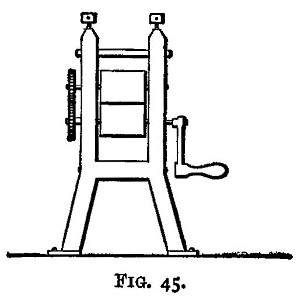
Flatting.—Small buttons, such as are got in assaying most gold ores,
are placed on a polished steel anvil and flattened by one or two blows
with a hammer. The flattened discs are heated to dull redness on a clean
cupel and are then ready for parting. Somewhat larger buttons may be
similarly treated, but they should be annealed (i.e. heated to redness
and allowed to cool) during the flattening. The silver-gold alloy left
from the cupellation is soft and bends like lead; but after hammering or
rolling it becomes harder, gets a spring in it like a piece of
mainspring and cracks or splits somewhat easily. There should be no
cracks or stripping or even roughness on the flattened metal, since such
defects may cause the loss of small particles either during the
flattening or in the subsequent treatment with acid. The softness of the
metal is restored by heating. In bullion assays the flatting of the
buttons requires care and practice for its skilful working. The strips
of alloy for parting should be of uniform thickness and condition so
that the action of the acid shall be equal in all cases. The button is
taken from the cupel, cleaned and placed on the anvil: it is then struck
a heavy blow which widens it to about 3/4 inch in diameter; this blow is
followed by two others, one a little in front, the other behind, which
lengthen the disc and give a very blunt roof-like slope to its upper
face. It should then be annealed. This may be done by putting it in a
just red-hot scorifier heated in a muffle: it very soon attains the
right heat and may then be transferred to a cold scorifier; the hot
scorifier should be put back into the muffle. The softened disc is then
taken to the rolls (Fig. 45). The rolls are loosened until the disc can
be pressed between them. Looking through the interval between them the
rolls should appear exactly parallel; if they are not, one adjusting
screw should be loosened and the other tightened until parallelism is
obtained. The rolls are now turned and the disc should be drawn through
without any great effort. Beginners are apt to err by trying to do too
much with one turn of the handle. It is easy to stop whilst the rolls
are only just gripping the metal and then to bring the disc back by
reversing the action. If the disc was originally level and the rolls
are parallel, the metal will appear as a strip which has been merely
lengthened. If the rolls are tighter on one side the strip will be
bowed; the tighter side will correspond with the outer curve of the
crescent. A mistake of this kind may be amended by passing the strip
through the rolls the other way, so as to reverse the irregularity and
so straighten the strip. The screw on the looser side should then be
tightened until parallelism is obtained; after which more care should be
taken to tighten the two screws equally. The rolling should be stopped
when the strip is 3 or 4 inches long and of the thickness of an ordinary
visiting card. The strip should be annealed during the rolling and again
at the finish.
Parting.—The thin sheet of metal is dropped into hot dilute nitric
acid and boiled for five or six minutes after the brisk action of the
acid on the metal has ceased. At this stage nearly all the silver has
gone into solution as nitrate of silver and the acid is charged with
this salt. This acid is poured off and the residual metal is again
boiled for from 20 to 30 minutes with a second lot of stronger acid.
This leaves the gold almost pure, though it may still retain from .05 to
.1 per cent. of silver. Treatment with the first acid only would
probably leave three or four times as much.
The nitric acid used should be free from hydrochloric, sulphuric,
iodic and telluric acids. In testing it for the first of these add
nitrate of silver and dilute with distilled water; there should be no
turbidity. In testing for the others evaporate three lots in dishes over
a water-bath. Test one for sulphates by adding water and barium
chloride. Test another for iodates by taking up with a little water,
adding a few drops of starch paste and then dilute sulphurous acid
solution a little at a time; there should be no blue colour. Test the
third for tellurium by heating with 1 c.c. of strong sulphuric acid
until dense fumes come off; allow to cool considerably; a piece of tin
foil added to the warm acid develops a fine purple colour if only a
trace of tellurium is present.
The presence of lower oxides of nitrogen, which impart a brown colour to
the acid, is objectionable; they, however, are removed by boiling the
diluted acid before using it for parting. It is usual to keep a stock of
the acid suitably diluted to the two strengths required for the parting.
These are known as the parting acids. The first parting acid is the
weaker and is used in the first attack on the metal. The specific
gravity generally recommended for it is about 1.2. It may be prepared
either by diluting the strong acid with about its own volume of
distilled water, or by suitably diluting the second parting acid which
has been already used in an assay; the small proportion of silver this
contains is not harmful for this purpose. The second parting acid has
a specific gravity of about 1.3, and may be made by diluting the strong
acid with half its volume of distilled water.
Parting in Flasks.—Flasks are most convenient for the larger
partings, as in bullion assays; and should always be used for this
purpose unless some of the special parting apparatus, like that used in
Mints, is available. Many assayers use flasks, though of a smaller size,
for the ordinary partings in assaying gold ores. The flasks are either
bulbs with long necks (Fig. 46) which ought to be heated on rose burners
of special construction; or they are small flat-bottomed conical flasks
which may be conveniently heated on a hot-plate and are, in this
respect, much easier to deal with in general work. The following
instructions apply to the parting of an alloy containing a few decigrams
of gold together with the proper proportion of silver.
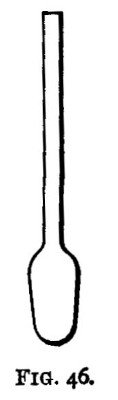
The strip from the rolls, after being softened by annealing, is folded
on itself on a glass rod into a roll or cornet. It should be so plastic
that it will retain the shape thus given it and not spring open on
removing the pressure of the fingers. About 50 c.c. of the first parting
acid are placed in a 6-ounce conical flask and heated to boiling; the
flask is then withdrawn, and tilted a little to one side, whilst the
cornet is cautiously dropped into it; there will be a sudden issue of
hot vapours and a prompt withdrawal of the hand is advisable. The flask
is replaced on the hot plate and the acid is kept boiling for 10 or 15
minutes. The flask is then withdrawn and the acid diluted with about an
equal volume of distilled water. If the flask has a thick glass band
around its neck, a little way down,[28] care must be taken to use hot
water, for any sudden chill will certainly crack the flask where it is
thus thickened. The liquor is carefully decanted into a clean beaker and
is then thrown into a jar marked "waste silver." About 40 c.c. of the
second parting acid, heated to boiling, is then poured into the flask,
which is then replaced on the hot plate. The boiling is continued for 15
or 20 minutes or even longer. At this stage bumping has to be specially
guarded against; after a little experience it is easy to see when this
is imminent and the flask should be withdrawn to a cooler part of the
plate; it is better to prolong the heating at a temperature below
boiling than to run the risk of disaster. Some of the older writers,
however, are rather insistent on vigorous boiling with large bubbles.
The addition of a small ball of well-burnt clay of about the size of a
pea has been recommended, as it lessens the tendency to irregular and
dangerous boiling. At the end of the treatment with the second acid the
flask is withdrawn from the plate and the acid is diluted with an equal
volume of distilled water. The liquor is carefully decanted into a
beaker, and then poured into a jar or Winchester marked "acid waste"; it
serves for making the first parting acid. The flask is then washed twice
with hot distilled water; the washings must be carefully decanted from
the gold. The flask is then filled with water. A parting cup (size B) is
then placed over its mouth, like a thimble on the tip of a finger. This
cup is of unglazed porous earthenware of such texture that it absorbs
the last few drops of water left on drying; and with a surface to which
the gold does not adhere even on ignition. The gold should fall out
cleanly and completely on merely inverting the cup over the pan of the
balance. The flask and cup are then inverted so that the flask stands
mouth down in the cup; a little of the water from the flask flows into
the cup, but only a little. The gold falls steadily through the water
into the cup. When time has been allowed for even the finest of the gold
to have settled into the cup, the flask is removed. This is easiest done
under water. The cup, with the flask still resting in it, is dipped
under water in a basin; as soon as the neck of the flask is immersed the
crucible can safely be drawn away from under it and then lifted out of
the water. The flask should not be taken away first, for the rush of
water from it may easily sweep the gold out of the cup. The water in the
cup is then drained off and the cup is dried at not too high a
temperature; for if the last drop or two of water should boil there is
danger of spattering the gold out of the crucible. When it is dry, the
cup is heated on a pipe-clay triangle over a Bunsen burner, or on a slab
of asbestos in a muffle, to a dull-red heat. This brings the gold to
"colour"; that is, the loose tender dark coloured gold becomes bright
yellow and coherent; and is in a state fit to be transferred to the
balance and weighed. All unnecessary transferences must be avoided. As
soon as the cup is cool it may be inverted over the pan of the balance,
when the gold will fall out cleanly or, at the worst, a gentle tap with
the finger will be sufficient to detach it.
Parting in test-tubes, or in the smaller conical flasks, is used in
the assay of gold ores of ordinary richness. The work is exactly like
that just described in all its main features. Generally speaking much
less acid will be used; for example, in test-tubes and for small
buttons, 3 or 4 c.c. of each acid is quite enough. Again, the action
need not be so prolonged; 10 or 15 minutes in each acid is sufficient.
So, too, the heating may be less; it is very convenient to support the
test-tubes in a water-bath, or merely to rest them in a beaker of
boiling water; and there is no serious objection to doing this. A
smaller parting cup should be used; the A size is suitable. The button,
on the other hand, should be beaten thinner than is needed for the
larger partings. If the silver should be in excess and the gold becomes
much broken up, ample time should be given for subsidence from the
test-tube or flask into the parting cup.
Parting in glazed crucibles or dishes.—This method of working has the
advantage that there is no transference of the gold until it is placed
on the pan of the balance. On the other hand, in the boiling more care
is required in adjusting the temperature. The following instructions
apply to the treatment of very small buttons, to which the method is
more particularly applicable; but very little modification is needed for
the treatment of larger buttons. The smallest sized Berlin crucibles
answer admirably. They should be cleaned by treatment with hot and
strong sulphuric acid, followed by washing in distilled water; the
comfort and ease of working mainly depends on the thoroughness of this
cleaning. The crucible, one-third full with the first parting acid, is
heated on the hot plate until the acid is almost boiling. The flattened
and annealed button is dropped into it and the heating continued with,
at most, gentle boiling for a few minutes. The crucible is then filled
with distilled water, which cools it enough for easy handling; and when
the gold has settled the liquor is poured off along a glass rod into a
clean beaker. Any greasiness of the crucible makes itself felt here and
is very objectionable. The crucible is then one-third filled with the
second parting acid and the heating resumed, care being taken not to
raise the temperature too high; this should be continued much longer
than before, say for five or ten minutes or even longer according to the
size of the button. Distilled water is again added and, when it is
drained off, the washing with distilled water is twice repeated. It will
not be possible to drain off the last drop of water; but if the gold is
coherent, the crucible can be so inclined that this drop drains away
from the gold, in which case the drying can be done rapidly; the boiling
of the water will do no harm. But when the gold is much broken up, it
will collect in the middle of this drop and the drying must be done
gently; best by putting the crucible in a warm place. When dry, the
crucible is heated till the gold changes colour, but the heat must be
kept well below redness. When cold, the gold is transferred directly to
the pan of the balance. With minute specks of gold which will require
measuring, it is best to put a small piece of lead foil (say .1 gram) in
the crucible over the gold, and then heat the crucible to above redness
over a blowpipe. Whilst the lead is oxidising it is easily swept round
in a bath of molten litharge by merely tilting the crucible. In this way
any separated specks of gold can be taken up with certainty. When the
worker is satisfied that the lead has had ample opportunity for taking
up the gold, the lead must be kept in one place and the heat slowly
lowered. By this means the button becomes supported in comparatively
pure litharge and when solid can be picked out quite easily with a pair
of pliers and in a very clean condition. The lead button is then
cupelled on a very fine cupel, as already described. The method of
working last described destroys the crucible. If the gold is not quite
so small this may be avoided. A small piece of lead foil should be
hammered out until it is perfectly flexible. It is then shaped into a
tray and the gold is transferred to it. The lead is then folded over,
with the help of two pins; and cupelled.
If the crucible shows a black stain on heating it is because some silver
remains through bad washing. It shows poor work and the assay should be
repeated.
The silver retained in the gold after parting is, in bullion assays,
an important matter; it is roughly equal to the loss of gold due to
absorption by the cupel. Mr. Lowe working on .5 oz. of gold, obtained by
parting in assaying bullion, found it to contain .123 per cent. of
silver. Dr. Rose in some special assay pieces found by a less direct
method of assaying, from .06 to .09 per cent. of silver. The proportion
of silver retained varies in a marked way with the proportion of gold to
silver in the alloy before parting. It is generally stated that the
retained silver is least when this proportion is 1 to 2-1/2, and more or
less silver than this leads to a less pure gold after parting.
Platinum in an alloy being parted is dissolved along with the silver
either altogether or in part. It imparts a straw yellow colour to the
parting acid. Palladium gives an orange colour to the acid.
The loss of gold by solution in the acid during parting is small, but
easily demonstrable. On a 500-milligram charge of bullion it may amount
to from .05 to .15 milligram; i.e. from .01 to .03 per cent. It is due
to gold actually dissolved and not merely held in suspension.
Assaying with checks. Surcharge.—It will be seen from what has been
stated that the errors in gold parting are of two kinds: viz. (1) a loss
of gold on the cupel and to a less extent by solution in the acid, and
(2) an apparent gain of gold due to the retention of silver in the
parted material. Both errors are small, and as they are of an opposite
character they tend to neutralise each other. Hence they are altogether
without effect on the accuracy of the assays of ores when the total gold
is reckoned in milligrams. And even with the larger amounts present in
bullion assays their influence is so small that an uncorrected result is
still fairly accurate; the resultant error would not be more than one
part in two or three thousand.
It is customary to report the purity of bullion, or its fineness as it
is called, in parts per thousand of bullion. The sum of the errors of an
assay, which is called the surcharge, is reported in the same way.
Thus a surcharge of + .3 means that the gold as weighed was .3 part per
1000 more than the gold actually present. But a surcharge - .3 means
that on the whole there was a loss of .3 part per 1000 in the assay.
Speaking roughly the retained silver will vary with the weight of gold
present; if one alloy contains twice as much gold as another the
retained silver will be about twice as much also. On the other hand, as
already explained, the cupellation loss on the poorer alloy is as much
as, or even more than, with the richer one, because of the copper, &c.
present. With rich gold alloys the silver more than compensates for the
loss and the surcharge is positive; but with poorer alloys the loss is
greater and the surcharge is negative.
In Mints and places where bullion assays must be made with the highest
attainable accuracy, the surcharge is determined by experiment, and the
proper correction is made in the reports on the bullion. This is done by
making assays of gold of the highest degree of purity alongside of those
of the bullion whose quality has to be determined. These "checks" are so
made that they do not differ from the actual assays in any material
point. Thus, being of the same quality and weight and undergoing exactly
the same treatment, they may reasonably be expected to have the same
surcharge as the assays they imitate. Suppose the bullion being assayed
varies only a little, up or down, from 900 gold and 100 copper in the
thousand, and that .5 gram of it is used in each assay. A quantity of
gold differing only a little from .450 gram would be very exactly
weighed and placed with .050 gram of copper in the same weight of lead
as is being used in the other assays. It would be cupelled, parted, &c.,
as nearly as possible under the same conditions as the actual assays.
Suppose the pure gold weighed .45016 gram and the parted gold weighed
.45025 gram, the gain in weight, .00009 gram, would be deducted from the
actual assays. A surcharge correction is never applied except to bullion
of the same quality as that represented by the "check assay" it was
calculated from.
It is evident that unless the gold is of the highest degree of purity
these check assays will introduce an error almost equal to that which it
is designed to remedy. Moreover, to work the checks to the greatest
advantage, a very systematic and uniform method of working must be
adopted.
Parting in special apparatus.—One plan for obtaining greater
uniformity is to stamp each cornet with a number for purposes of
identification, and to treat several, including one or more check assays
in the same acid contained in a beaker; all the assays under these
conditions evidently receive precisely the same acid treatment. Such a
plan can of course only be adopted where there is no risk of the gold
breaking up during the parting. An improvement on this is to have a
porcelain basin[29] about 8-1/2 inches in diameter and with a capacity
of about 1-1/2 litres. It is provided with a porcelain cover with 30
numbered holes through which tubes dip into the acid. The cover is
removable. The tubes are like test-tubes and are supported by the cover;
their bottoms are perforated with holes or slits. The acid is placed in
the basin and boiled over a flat burner; it enters the tubes through the
slits. The cornets are placed each in its proper tube. When the boiling
is finished, the cover with the tubes is lifted and at the same time the
acid drains back into the basin. A dip into a basin of distilled water
washes at one operation all 30 assays. The cover is then put on a basin
containing the stronger parting acid which is already boiling. This
boiling is continued for half an hour. The cover with the 30 cornets is
then lifted out from the acid and dipped two or three times in distilled
water to wash off the last traces of acid. To transfer the cornets from
the tubes to the porous cups the whole of the tube must be dipped under
the water; otherwise the operation is exactly as when working with
test-tubes.
A still simpler method of working is to use small platinum cups[30]
provided with fine slits which admit the acid but retain the gold. A
number of these, say 60, are supported on a platinum tray. The parting
acids are boiled in platinum dishes under a hood; and the 60 cornets
(each in its proper cup) are placed in the acid all at once: the tray
carrying the cups is provided with a handle suitable for this purpose.
After a proper boiling the tray is lifted out of the weaker acid into
the stronger one, where it undergoes the second boiling. It is next
dipped several times in distilled water and lastly, after a gentle
drying, it is raised to an annealing temperature which must not be too
high for fear of the gold sticking to the platinum. After cooling, the
cornets are transferred from the platinum cups directly to the pan of
the balance. Here all 60 cornets have exactly the same treatment and the
"checks" may be compared with great exactness with the other assays
accompanying them. There is, too, a great saving of labour.[31]
Silver, &c., in gold bullion.—The base metals are generally
determined by cupelling .5 gram of the alloy with 5 grams of lead. The
loss in cupellation having been allowed for by any of the usual methods
(see p. 104) the gold and silver contents are given. By deducting the
gold the proportion of silver is obtained. The silver is generally
determined by difference in this way. If it is desired to dissolve out
the copper, silver, &c., and to determine them in the wet way, the gold
must first be alloyed with a sufficiency of some other metal to render
it amenable to the attack by acid. Cadmium is the metal generally
recommended, and the alloy is made by melting together a weighed portion
of the gold with five or six times its weight of cadmium in a Berlin
crucible and under a thin layer of potassium cyanide.
Lead with gold or silver.—Large quantities of lead carrying gold and
silver are sold to refiners in bars weighing about 100 lbs. each. The
assay of these alloys presents no special difficulties, but the sampling
of them is a question which may be profitably discussed.[32]
A molten metal may be conceived to have all the physical states observed
in ordinary liquids, although these cannot be actually seen owing to its
opaqueness. There is no doubt that pure lead at a temperature only a
little above its melting-point can contain a large proportion of gold in
such a manner that it may in a figurative way be spoken of as a clear
solution. Any small portion withdrawn from the molten metal would afford
a perfect sample. The same would be true of any pure alloy of lead and
silver in which the silver does not exceed the proportion of 2-1/2 per
cent.[33] On the other hand, if the molten metal contains much more than
.5 per cent. of zinc, more than .1 per cent. of copper, or a larger
quantity of silver, it may be likened to a turbid liquor. The
resemblance holds good so far that if the molten lead be further heated,
whereby its solvent power on the added metal is increased, the turbidity
will disappear, or at least be considerably diminished. A portion taken
at random from such a molten metal may, or may not, give a good sample.
The suspended insoluble matter will tend to concentrate itself in the
upper or lower parts of the liquid according to whether it is heavier or
lighter than it; and this separation may occur with extreme slowness or
with fair rapidity. However, it is generally agreed that in the case of
such alloys as occur in practice, samples taken in this way are quite
satisfactory and are the best obtainable. The precautions insisted on
are that the lead shall be made as hot as practicable; that it shall be
stirred up at the time of taking the sample; and that the portion
withdrawn shall be taken out with a ladle at least as hot as the molten
metal. The further precaution that if any dross be on the surface of the
metal it shall be skimmed off and separately sampled and assayed is
almost too obvious to require mention. An alternative and, perhaps,
better way of taking the sample is to withdraw portions at equal
intervals from the stream of metal whilst the pot is being emptied;
equal weights taken from these portions and mixed (by melting or in some
other way) give a fair sample of the whole. In addition, separate assays
of each portion will show to what extent the metal lacks uniformity in
composition For example, samples taken at the beginning, middle, and end
of a run gave the following results in ozs. of silver per ton: 475, 472,
466, showing an average result of 471 ozs. Fifteen fractions taken at
regular intervals during the same pouring ranged from 475 ozs. to 464
ozs.: the average result was 469.8 ozs. The same lead cast into bars and
sampled by sawing gave an average of 470 ozs.[34] In another case[35]
samples drawn at the beginning, middle, and end of a run gave 1345 ozs.,
1335 ozs. and 1331 ozs. The mean result in such cases is always a
reasonably safe one, but evidently where the metal varies a good deal it
is safer to take more than three dips.
Imagine such lead run into moulds and allowed to become solid as bars;
the difference between bar and bar would not be greater than that
between corresponding dip samples. But in each bar the distribution of
the silver and gold is very seriously affected during solidification.
Chips taken from the same bar of auriferous lead may show in one place
23 ozs. of gold to the ton, in another 39 ozs.; similarly with silver
they may vary as much as from 900 ozs. to 1500 ozs. to the ton.
This rearrangement of the constituents of a bar takes place whilst the
lead is partly solid, partly liquid. The most useful conception of such
half-solidified metal is that of a felted spongy mass of skeleton
crystals of comparatively pure lead saturated with a still fluid
enriched alloy. If the solidification of an ingot of impure tin be
watched it will be evident that the frosted appearance of the surface is
due to the withdrawal of the fluid portion from a mat of crystals of
purer tin which have been for some time solid and a contraction of the
mass. The shrinking of the last part to become solid is further shown by
the collapse of the surface of the ingot where weakest; that is, a
furrow is formed on the flat surface. In other cases of fused metal
there is expansion instead of contraction in this final stage of the
solidification, and the enriched alloy then causes the upper face of the
ingot to bulge outwards. There are other causes effecting the
redistribution of the metals through the ingot. There can be no general
rule of wide application showing which part of a bar is richest and
which poorest in the precious metals. This will depend on the quantities
of gold or silver, on the quantities and kinds of other metals present
and on the manner of casting. The student is advised to consult Mr.
Claudet's paper which has been already referred to.
The best method of sampling such bars is to melt them all down and to
take a dip sample of the molten metal in one or other of the methods
already described. According to Mr. Claudet this should be done in all
cases where the gold exceeds one or two ounces or where the silver
exceeds 200 ozs. to the ton. If during the melting down some dross has
formed this must be skimmed off, weighed and separately sampled and
assayed. The clean lead also must be weighed, sampled and assayed. The
mean result must be calculated. Thus 14 tons 5 cwts. of clean lead
assaying 32 ozs. to the ton will contain 456 ozs. of silver; 15 cwt.
dross assaying 20 ozs. to the ton will contain 15 ozs. of silver. The 15
tons of lead and dross will contain 471 ozs. of silver or 31.4 ozs. per
ton.
Of the methods of sampling which avoid melting the bars, that known as
sawing is the only one which is thoroughly satisfactory. In it the bars
are brought to a circular saw having fine teeth and are sawn across
either completely or halfway through; in this way a quantity of lead
sawdust is obtained (say 1 lb. or so from a bar) which represents
exactly the average of the bar along the particular cross section taken
and approximately that of the whole bar. A bar of lead, which by dip
assay gave 334 ozs. to the ton, gave on three transverse sections 333
ozs., 335 ozs. and 331 ozs. The variation may be greater than this, but
with a large number of bars, where each bar is cut across in as far as
possible a different place, these variations tend to neutralise each
other and a good sample is obtained. Two or three cwt. of sawdust may be
obtained in this way; this is thoroughly mixed and reduced by
quartering in the usual way or by a mechanical sampler. A sample of 2 or
3 lbs. is sent to the assayer. This being contaminated with the oil used
in lubricating the saw is freed from it by washing with carbon
bisulphide, ether or benzene and dried. Then, after mixing, 100 to 200
grams of it are carefully weighed and placed in a hot crucible, the heat
of which should be sufficient to melt all the lead. The molten lead
should not be overheated and should show no loss due to the melting. The
removal of the oil may have decreased the weight by perhaps one half per
cent. If the lead gives dross on heating it may be melted under 10 or 20
grams of potassium cyanide, which prevents the formation of dross.
Samples are sometimes taken with a drill, gouge or chisel, though no
method of this kind is quite satisfactory. One plan adopted is to use a
punch which, when driven into the bar, gives a core or rod of metal
about half as long as the bar is thick and about one-eighth of an inch
across. With five bars side by side it is customary to drive in the
punch at one end on the first bar, and at the opposite end on the last
one, and on the others in intermediate positions in such a manner that
all the holes will be along a diagonal of the rectangle enclosing the
bars. The bars are then turned over and similar portions punched out
through the bottoms of the bars and along the other diagonal. Or one set
of five may be sampled along the top and the next set along the bottom
of the bars.
Silver and gold present in bars of copper are subject to the same
irregularity of distribution as in lead. The sampling of such bars is
guided by the same principles.[36]
The cyanides ought perhaps to be considered along with chlorides,
bromides and iodides in Chapter XV. But they are treated here because
they owe their importance to their use in the extraction of gold and
because their determination has become a part of the ordinary work of an
assayer of gold ores.
Formerly, the cyanide most easily obtained in commerce was potassium
cyanide; and it was generally sold in cakes which might contain as
little as 40 per cent. or as much as 95 per cent. of the pure salt. It
became customary to express the quality of a sample of commercial
cyanide by saying it contained so much per cent. of potassium cyanide.
The commercial product now made by improved methods of manufacture is
actually sodium cyanide, but is called "potassium cyanide" (probably
with the words "double salt" on the label); it contains cyanide
equivalent to something over 100 per cent. of potassium cyanide in
addition to a large proportion of sodium carbonate and other impurities.
What is wanted in most cases is merely a soluble cyanide, and it is a
matter of indifference whether the base be sodium or potassium. But
since 49 parts of sodium cyanide (NaCN = 49) are equivalent to 65 parts
of potassium cyanide (KCN = 65) it is evident that a pure sample of
sodium cyanide would contain cyanide equivalent to little less than 133
per cent. of potassium cyanide. Therefore a sample of cyanide reported
on in this way may be rich in cyanide, and yet have much impurity.
The commonest impurity in commercial cyanide is carbonate of sodium or
potassium. This may be tested for by dissolving, say, 2 grams in a
little water and adding barium chloride. There may be formed a white
precipitate of barium carbonate, which if filtered off, washed and
treated with acid, will dissolve with effervescence. Cyanate may be
tested for in the solution from which the barium carbonate has been
filtered by adding a little soda and boiling; if cyanates are present
they decompose, giving off ammonia (which may be tested for in the
steam) and yielding a further precipitate of barium carbonate.[37] If
the soda alone gave a further precipitate of barium carbonate, this may,
perhaps, be due to the presence of bicarbonates. Alkaline sulphides may
be present in small quantity in commercial cyanide. Their presence is
shown at once when the sample is being tested for its strength in
cyanide, inasmuch as the first few drops of silver nitrate solution
produce at once a darkening of the liquor. A special test for sulphide
may be made by adding a drop or two of solution of acetate of lead to
four or five c.c. of soda solution and adding this to a clear solution
of the suspected cyanide. This will cause a black precipitate or colour,
if any sulphide is present.
The cyanides of the heavier metals combine with the alkaline cyanides to
form double cyanides. Some of these, ferrocyanide and ferricyanide of
potassium for example, have such characteristic properties that the fact
that they are cyanides may be overlooked. Others, such as potassium zinc
cyanide (K2ZnCy4), have much less distinctiveness: they behave
more or less as a mixture of two cyanides and are, moreover, so easily
decomposed that it may be doubted if they can exist in dilute alkaline
solutions. In reporting the cyanide strength of a cyanide liquor as
equivalent to so much per cent. of potassium cyanide, there is a
question as to whether the cyanide present in the form of any of these
double cyanides should be taken into account. It must be remembered that
the object of the assay is not to learn how much of the cyanide exists
in the solution as actual potassium cyanide; reporting the strength in
terms of this salt is a mere matter of convenience; what is really
desired is to know how much of the cyanide present in the liquor is
"free" or "available" for the purposes of dissolving gold. Every one is
agreed as to the exclusion of such cyanides as the following: potassium
ferrocyanide (K4FeCy6), potassium ferricyanide (K3FeCy6),
potassium silver cyanide (KAgCy2), and potassium aurocyanide
(KAuCy2); and the double cyanides with copper or nickel. But with
cyanide liquors containing zinc the position is less satisfactory. One
method of assay gives a lower proportion of cyanide when this metal is
present; and the loss of available cyanide thus reported depends, though
in a fitful and uncertain way, upon the quantity of zinc present. The
other method of assay reports as full a strength in cyanide as if no
zinc were present. Unfortunately, using both methods and accepting the
difference in the results as a measure of the quantity of zinc present,
or at any rate of the zinc present as cyanide, is not satisfactory. It
appears best to use the method which ignores the zinc; and to determine
the amount of zinc by a special assay of the liquor for this metal.
The cyanide present as hydrogen cyanide or prussic acid (HCy) is
practically useless as a gold solvent. Hence any report on the strength
of a cyanide liquor which assigned to this the same value as its
equivalent of alkaline cyanide would be misleading. On the other hand,
it is "available cyanide" inasmuch as a proper addition of sodium
hydrate[38] would restore its value. The question of the presence or
absence of free prussic acid is involved in the larger one as to whether
the cyanide solution has the right degree of alkalinity. The assay for
"cyanide" should include the hydrogen cyanide with the rest.
A rough test of the power of a cyanide liquor for dissolving gold may be
made by floating a gold leaf on its surface and noting the time required
for its solution. This test might, perhaps, be improved by taking, say,
20 c.c. of the liquor and adding three or four gold leaves so that the
gold shall always be in considerable excess. The liquor should not be
diluted as this will affect the result. It should be allowed to stand
for a definite time, say at least two or three hours, or better, that
corresponding to the time the liquor is left in contact with the ore in
actual practice. The liquor should then be filtered off and, with the
washings, be evaporated in a lead dish as in the assay of cyanide
liquors for gold (p. 141). The gold obtained on cupelling, less any gold
and silver originally present in the liquor, would be the measure of the
gold dissolving power.
The determination of the quantity of a cyanide is made by finding how
much silver nitrate is required to convert the whole of the cyanide into
potassium silver cyanide[39] or one of the allied compounds. It will be
seen from the equation that 170 parts by weight of silver nitrate are
required for 130 parts by weight of potassium cyanide. As already
explained it is customary to report the cyanide-strength in terms of
potassium cyanide, even when only the sodium salt is present. One gram
of potassium cyanide will require 1.3076 gram of silver nitrate. The
standard solution of silver nitrate is made by dissolving 13.076 grams
of silver nitrate in distilled water and diluting to 1 litre; 100 c.c.
of such a solution are equivalent to 1 gram of potassium cyanide.[40]
The titration is performed in the usual way, running the standard
solution of silver nitrate into a solution containing a known weight or
volume of the material containing the cyanide. The finishing point is
determined in one of two ways, both of which are largely used. In the
first place, as long as there remains any free cyanide in the solution
the silver nitrate will combine with it forming the double cyanide and
yielding a clear solution; but as soon as all the free cyanide is used
up the silver nitrate will react with the double cyanide[41] forming
silver cyanide, which separates as a white precipitate and renders the
solution turbid. But, in the second place, if potassium iodide is
present in the solution the excess of silver nitrate will react with
it,[42] rather than with the double cyanide; and silver iodide will
separate as a yellowish turbidity which is easily recognised.
In working with pure solutions, the two finishing points give the same
results; and this is true even when there is much difference in the
degree of dilution. The finishing point with the iodide, however, has
an advantage in precision. Moreover, it is but little affected by
variations in alkalinity, which render the other finishing point quite
useless. The great difference between the two is shown when zinc is
present in the solution. In this case, when working without the iodide,
the first appearance of a turbidity is less distinct; the turbidity
increases on standing and as a finishing point is unsatisfactory. It can
be determined with precision only by very systematic working and after
some experience. The turbidity is due to the separation of an insoluble
zinc compound. A most important point (to which reference has already
been made) is that less silver nitrate is required to give this
turbidity and, consequently, a lower strength in cyanide is reported. On
the other hand, as much silver nitrate is required to give the yellow
turbidity due to silver iodide as would be required if no zinc were
present.
Unfortunately the difference in the two titrations does not depend
merely on the quantity of zinc present; as it is also influenced by the
extent of dilution, the degree of alkalinity of the solution, and the
quantity of cyanide present. In an experiment with .055 gram of zinc
sulphate and .1 gram of potassium cyanide the difference in the two
finishing points was only .1 c.c.; whereas with .4 gram of potassium
cyanide, the other conditions being the same, the difference was 1.5
c.c. of standard silver nitrate. On the assumption that all the zinc was
present as potassium zinc cyanide (K2ZnCy4) the difference should
have been 5 c.c. in each case. Again, repeating the experiment with .4
gram of potassium cyanide, but with .11 gram of crystallised zinc
sulphate, the difference was 6.5 c.c.: that is, merely doubling the
quantity of zinc increased the difference by more than four times. Hence
it would appear better to use the method with the iodide and make a
separate assay for the zinc. But since the student may be called on to
use the other method, he is advised to practice it also.
The assay without iodide.—The standard solution of silver nitrate is
placed in a small burette divided into tenths of a c.c. Ten c.c. of the
cyanide solution to be assayed is transferred to a small flask and
diluted with water to about 70 c.c. The silver solution is then run in
from the burette (with constant shaking of the flask), a little at a
time but somewhat rapidly, until a permanent turbidity appears. Since 1
c.c. of the silver nitrate solution corresponds to .01 gram of potassium
cyanide, it also corresponds to .1 per cent. of this salt counted on the
10 c.c. of cyanide solution taken. The titration should be performed in
a fairly good uniform light. The learner should practice on a fairly
pure solution of potassium cyanide at first, and this may conveniently
have a strength of about 1 per cent. For practice with solutions
containing zinc make a solution containing 1.1 gram of crystallised zinc
sulphate in 100 c.c. and slowly add measured quantities of from 1 to 5
c.c. of this to the 10 c.c. of cyanide liquor before diluting for the
titration.
If a cyanide solution blackens on the addition of the silver nitrate it
contains sulphide. In this case, shake up a considerable bulk of the
liquor with a few grams of lead carbonate, allow to settle and make the
assay on 10 c.c. of the clear liquor.
If the cyanide liquor be suspected to contain free prussic acid, take 10
c.c. for the assay as usual; but, before titrating, add .1 or .2 gram of
sodium carbonate. On no condition must caustic soda or ammonia be added.
The difference between the results, with and without the addition of
carbonate of soda, is supposed to measure the quantity of free prussic
acid. If this has to be reported it is best done as "prussic acid
equivalent to ... per cent. of potassium cyanide." Suppose, for example,
the difference in the two titrations equals 1 c.c. of standard silver
nitrate; the prussic acid found would be equivalent to .1 per cent. of
potassium cyanide.
The assay with iodide.—The standard solution of silver nitrate is
placed in a burette divided into tenths of a c.c. Take 10 c.c. of the
cyanide liquor, which should previously have been treated with white
lead for the removal of sulphides if these happened to be present.
Transfer to a small flask, add 3 or 4 drops of a solution of potassium
iodide and 2 or 3 c.c. of a solution of sodium hydrate; dilute to 60 or
70 c.c. with water. If much zinc is present the soda may be increased to
20 or 30 c.c. with advantage. The standard solution should be run in
somewhat rapidly, but a little at a time, so that the precipitate at
first formed shall be small and have only a momentary existence. The
titration is continued until there is a permanent yellowish turbidity.
The most satisfactory and exact finish is got by ignoring any faint
suspicion of a turbidity and accepting the unmistakable turbidity which
the next drop of silver nitrate is sure to produce. This finishing point
gives results which are exactly proportional to the quantity of cyanide
present; and it can be recognised with more than ordinary precision even
in solutions which are not otherwise perfectly clear.
Each c.c. of the standard silver nitrate solution corresponds to .01
gram of potassium cyanide; and if 10 c.c. of the liquor are taken for
assay this corresponds to .1 per cent. or 2 lbs. to the short ton or
2.24 lbs. to the long ton. As already explained the result should be
reported as "cyanide equivalent to so much per cent. of potassium
cyanide."
The following experimental results were obtained with a solution of
potassium cyanide made up to contain about 1.2 per cent. of the salt.
Effect of varying cyanide.—The bulk before titration was in each case
60 c.c.; 2 c.c. of soda and 3 drops of potassium iodide were used in
each case.
| Cyanide added | 40 c.c. | 30 c.c. | 20 c.c. | 10 c.c. | 5 c.c. | 1 c.c. |
| Silver required | 47.0 c.c. | 35.25 c.c. | 23.5 c.c. | 11.7 c.c. | 5.8 c.c. | 1.15 c.c. |
Accepting the result for 40 c.c. as correct, the others are in very
satisfactory agreement.
Effect of varying dilution.—The conditions were those of the 40 c.c.
experiment in the last series; but varying amounts of water were used in
diluting.
| Water added | none | 100 c.c. | 200 c.c. | 400 c.c. |
| Silver required | 47.0 c.c. | 47.0 c.c. | 47.0 c.c. | 47.05 c.c. |
Very considerable dilution therefore has no effect.
Effect of varying soda.—The conditions were those of the 40 c.c.
experiment in the first series, except that varying amounts of soda
solution were used.
| Soda added | none | 10 c.c. | 30 c.c. |
| Silver required | 46.95 c.c. | 47.0 c.c. | 47.0 c.c. |
This alkali therefore has no prejudicial effect.
Effect of ammonia.—Soda causes turbidity in some cyanide liquors;
with these it should be replaced by 2 or 3 c.c. of dilute ammonia with a
gram or so of ammonium chloride. The following experiments with dilute
ammonia show that larger quantities of this reagent must be avoided.
| Ammonia added | none | 10 c.c. | 30 c.c. | 60 c.c. |
| Silver required | 46.95 c.c. | 47.15 c.c. | 47.7 c.c. | 49.5 c.c. |
Effect of sodium bicarbonate.—In this experiment 1 gram of
bicarbonate of soda was used instead of the soda or ammonia of the other
experiments. The silver nitrate required was only 46.45 c.c. instead of
the 47.0 c.c. which is the normal result. This is probably due to the
liberation of prussic acid and shows the importance of having the
solution alkaline.
Effect of zinc.—In each experiment 40 c.c. of the cyanide solution
and .5 gram of zinc sulphate crystals were used and the bulk was made up
to 100 c.c. before titrating.
| Soda added | 1 c.c. | 5 c.c. | 10 c.c. | 25 c.c. |
| Silver required | 47.1 c.c. | 47.0 c.c. | 46.9 c.c. | 46.9 c.c. |
The work was easier with the more alkaline solutions. The titration in
the presence of zinc is comparatively easy, but, in learning it, it is
well to have a burette with cyanide so that if a titration be overdone
it can be brought back by the addition of 1 or 2 c.c. more cyanide and
the finish repeated; a quarter of an hour's work in this way will ensure
confidence in the method.
Effect of other substances.—It was found that an alkaline cyanate,
sulphocyanate, ferrocyanide, nitrite, borate, silicate or carbonate has
no effect. The ferricyanide had a small influence and, as might be
expected, hyposulphite is fatal to the assay. The addition of salts of
lead and cadmium was without effect. On the other hand, nickel produces
its full effect; and the quantity of nickel added can be calculated with
accuracy from the extent of its interference with the titration.
Assay of commercial cyanide of potassium.—Break off 20 or 30 grams of
the cyanide in clean fresh pieces, weigh accurately to the nearest
centigram. Dissolve in water containing a little sodium hydroxide;
transfer to a 2-litre flask: dilute to 2 litres; add a few grams of
white lead; shake up and allow to settle. Run 50 c.c. of the clear
liquor from a burette into an 8 oz. flask; add 2 or 3 c.c. of soda
solution and 3 drops of potassium iodide. Titrate with the standard
solution of silver nitrate. The percentage may be calculated by
multiplying the number of c.c. used by 40 (50 c.c. is one fortieth of
the 2 litres) and dividing by the weight of commercial cyanide
originally taken.
Alkalinity of commercial potassium cyanide and of cyanide
solutions.—Hydrocyanic acid like carbonic acid has no action on
methyl-orange;[43] hence the alkaline cyanides may be titrated with
"normal acid" as easily as the carbonates or hydrates. 100 c.c. of
normal acid will neutralise 6.5 grams of pure potassium cyanide.[44] A
solution of commercial cyanide prepared as for the assay last described,
but best without the addition of white lead, may be used for the test.
Take 50 c.c. of it; tint faintly yellow with methyl-orange and titrate
with normal acid till the liquor acquires a permanent reddish tint. In
the case of the purer samples of cyanide the quantity of acid used will
correspond exactly with that required to neutralise the actual quantity
of cyanide present as determined by the assay with nitrate of silver.
The less pure samples will show an excess of alkalinity because of the
presence of sodium carbonate or of potassium carbonate.
In comparing the alkalinity and cyanide strength of a solution the
simplest plan is to take 65 c.c. of the solution and titrate with
normal acid; for in this case each c.c. of normal acid corresponds to .1
per cent. of potassium cyanide. In systematic assays of this kind, the
alkalinity would no doubt be generally in excess of that required by the
cyanide present: there would be no inconvenience in recording such
excess in terms of potassium cyanide.
Determination of the acidity of an ore.—Most ores have the power of
destroying more or less of the alkalinity of a cyanide solution and in a
proportionate degree of damaging its efficiency. An assay is needed to
determine how much lime or soda must be added for each ton of ore in
order to counteract this. Whether this acidity should be reported in
terms of the lime or of the soda required to neutralise it will depend
on which of these reagents is to be used in the actual practice. Again,
if the ore is washed with water before treating with cyanide on the
large scale, then the assay should be made of the acidity of the ore
after a similar washing.
The standard solutions of acid and alkali used for this determination
may be one-fifth normal. 200 c.c. of the normal solution should be
diluted to 1 litre in each case, 1 c.c. of the resulting solutions would
be equivalent to 8 milligrams of soda (NaHO) or 5.6 milligrams of lime,
CaO. It must be remembered this refers to the pure bases in each case.
Suppose it is desired to report as so many lbs. of lime to the short ton
(2000 lbs.) of ore. Since 1 c.c. of the standard solution is equivalent
to 5.6 milligrams of lime, if we take 2000 times this weight of ore
(i.e. 11,200 milligrams or 11.2 grams) for the assay, each c.c. of
standard solution will be equivalent to 1 lb. of lime to the short
ton.[45]
Total acidity.—Weigh out 11.2 grams of the ore, place them in a
four-inch evaporating dish and measure on to it from a burette 10 or 20
c.c. of the standard solution of soda. Stir the soda solution into the
ore and allow to stand for 15 or 20 minutes with occasional stirring.
Stir up with 30 or 40 c.c. of water, float a piece of litmus paper on
the liquid and titrate with the standard solution of acid. If the ore is
strictly neutral the quantity of "acid" required to redden the litmus
will be the same as the quantity of "soda" originally used. If the ore
is acid, less acid will be used. For example, if 10 c.c. of soda were
used and only 7 c.c. of acid were required, the ore will have done the
work of the remaining 3 c.c. of acid. And the ton of ore will require 3
lbs. of lime to neutralise its acidity.
Acidity after washing.—Take 11.2 grams of the ore; wash thoroughly
with water and immediately treat the residue, without drying, exactly as
just described.
Examination of cyanide solutions for metals, &c.—Take a measured
quantity of the solution, say 20 c.c.[46] and evaporate in a small dish
with, say, half a c.c. of strong sulphuric acid. Evaporate at first, on
a water-bath in a well ventilated place, but finish off with a naked
Bunsen flame, using a high temperature at the end in order to completely
decompose the more refractory double cyanides. Allow to cool; moisten
with strong hydrochloric acid; warm with a little water and test for the
metals in the solution by the ordinary methods. Since the quantities of
the metals likely to be present may be given in milligrams the work must
be carefully performed. It may be worth while to determine the
proportions of lime and magnesia as well as those of the metals proper.
Or the 20 c.c. of cyanide liquor may be evaporated with 5 c.c. of strong
nitric acid to dryness and gently ignited and the residue taken up with
2 or 3 c.c. of strong hydrochloric acid.
Copper, iron, and zinc can be rapidly determined in such a solution, as
follows. Dilute with water to 10 or 15 c.c., add an excess of ammonia,
and filter. The precipitate will contain the iron as ferric hydrate;
dissolve it in a little hot dilute sulphuric acid: reduce with
sulphuretted hydrogen; boil off the excess of gas, cool and titrate with
standard potassium permanganate (p. 236). Determine the copper in the
filtrate colorimetrically (p. 203); but avoid further dilution. Then add
dilute hydrochloric acid, so as to have an excess of 4 or 5 c.c. after
neutralising the ammonia; add some clean strips of lead foil, and boil
until the solution has for some time become colourless. Titrate with
standard potassium ferrocyanide (p. 263) without further dilution, and
bearing in mind that at most only one or two c.c. will be required.
Examination of an ore for "cyanicides."—Place 100 grams of the ore
with 200 c.c. of a cyanide solution of known strength (say .1 or .2 per
cent.) in a bottle and agitate for a definite time, such as one or two
days. Filter off some of the liquor and assay for cyanide, using say 20
c.c. Calculate how much cyanide has been destroyed in the operation.
Evaporate 20 c.c. with sulphuric or nitric acid and examine for metal.
Test another portion for sulphides, &c.
The student who has mastered the methods of assaying can greatly improve
himself by working out such problems as the above.
Platinum occurs in nature in alluvial deposits associated with gold and
some rare metals, generally in fine metallic grains, and, occasionally,
in nuggets. It is a grey metal with a high specific gravity, 21.5 when
pure and about 18.0 in native specimens. It is fusible only at the
highest temperature, and is not acted on by acids.
It is dissolved by warm aqua regia, forming a solution of "platinic
chloride," H2PtCl6. This substance on evaporation remains as a
brownish red deliquescent mass; on drying at 300° C. it is converted
into platinous chloride, PtCl2, and becomes insoluble, and at a
higher temperature it is converted into platinum. All platinum compounds
yield the metal in this way. Platinic chloride combines with other
chlorides to form double salts, of which the ammonic and potassic
platino-chlorides are the most important.
Platinum alone is not soluble in nitric acid; but when alloyed with
other metals which dissolve in this acid it too is dissolved; so that in
gold parting, for example, if platinum was present, some, or perhaps the
whole of it would go into solution with the silver. Such alloys,
however, when treated with hot sulphuric acid leave the platinum in the
residue with the gold.
Platinum is detected when in the metallic state by its physical
characters and insolubility in acids. In alloys it may be found by
dissolving them in nitric acid or in aqua regia, evaporating with
hydrochloric acid, and treating the filtrate with ammonic chloride and
alcohol. A heavy yellow precipitate marks its presence.
The assay of bullion, or of an alloy containing platinum, may be made as
follows: Take 0.2 gram of the alloy and an equal weight of fine silver,
cupel with sheet lead, and weigh. The loss in weight, after deducting
that of the silver added, gives the weight of the base metals, copper,
lead, &c. Flatten the button and part by boiling with strong sulphuric
acid for several minutes. When cold, wash, anneal, and weigh. The
weight is that of the platinum and gold. The silver may be got by
difference. Re-cupel the metal thus got with 12 or 15 times its weight
of silver, flatten and part the gold with nitric acid in the usual way
(see under Gold), and the platinum will dissolve. The gold may contain
an alloy of osmium and iridium; if so, it should be weighed and treated
with aqua regia. The osmiridium will remain as an insoluble residue,
which can be separated and weighed. Its weight deducted from that
previously ascertained will give the weight of the gold.
When the platinum only is required, the alloy must be dissolved by
prolonged treatment with aqua regia, the solution evaporated to dryness,
and the residue extracted with water. The solution thus obtained is
treated with ammonic chloride in large excess and with some alcohol. A
sparingly soluble[47] yellow ammonic platinum chloride is thrown down,
mixed, perhaps, with the corresponding salts of other metals of the
platinum group. Gold will be in solution. The solution is allowed to
stand for some time, and then the precipitate is filtered off, washed
with alcohol, dried, and transferred (wrapped in the filter paper) to a
weighed crucible. It is ignited, gently at first, as there is danger of
volatilising some of the platinum chloride, and afterwards intensely.
With large quantities of platinum the ignition should be performed in an
atmosphere of hydrogen. Cool and weigh as metallic platinum.
Occurs in nature alloyed with osmium as osmiridium or iridosmine, which
is "rather abundant in the auriferous beach sands of Northern
California" (Dana). It occurs in bright metallic scales, which do not
alloy with lead, and are insoluble in aqua regia. Iridium also occurs in
most platinum ores, and forms as much as two per cent. of some
commercial platinum. In chemical properties it resembles platinum, but
the ammonic irido-chloride has a dark red colour, and on ignition leaves
metallic iridium, which does not dissolve in aqua regia diluted with
four or five times its volume of water and heated to a temperature of
40° or 50° C.
The other metals of the platinum group are Palladium, Rhodium, Osmium,
and Ruthenium. They differ from gold, platinum, and iridium by the
insolubility of their sulphides in a solution of sodium sulphide.
Palladium is distinguished by the insolubility of its iodide; and Osmium
by the volatility of its oxide on boiling with nitric acid.
Mercury occurs native and, occasionally, alloyed with gold or silver in
natural amalgams; but its chief ore is the sulphide, cinnabar. It is
comparatively rare, being mined for only in a few districts. It is
chiefly used in the extraction of gold and silver from their ores
(amalgamation); for silvering mirrors, &c.
Mercury forms two series of salts, mercurous and mercuric, but for the
purposes of the assayer the most important property is the ease with
which it can be reduced to the metallic state from either of these.
Mercury itself is soluble in nitric acid, forming, when the acid is hot
and strong, mercuric nitrate. Cinnabar is soluble only in aqua regia.
Mercurous salts are generally insoluble, and may be converted into
mercuric salts by prolonged boiling with oxidising agents (nitric acid
or aqua regia). The salts of mercury are volatile, and, if heated with a
reducing agent or some body capable of fixing the acid, metallic mercury
is given off, which may be condensed and collected.
Mercury is separated from its solutions by zinc or copper, or it may be
thrown down by stannous chloride, which, when in excess, gives a grey
powder of metallic mercury, or, if dilute, a white crystalline
precipitate of mercurous chloride. Nitric acid solutions of mercury
yield the metal on electrolysis; and, if the pole on which the metal
comes down be made of gold or copper, or is coated with these, the
separated mercury will adhere thereto. It may then be washed and
weighed.
The best tests for mercury next to obtaining globules of the metal are:
(1) a black precipitate with sulphuretted hydrogen from acid solutions,
which is insoluble in nitric acid; and (2) a white precipitate with
stannous chloride.
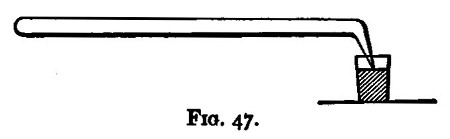
Weigh up 5 grams, if the ore is rich, or 10 grams, if a poorer mineral.
Take a piece of combustion tube from 18 inches to 2 feet long, closed at
one end, and place in it some powdered magnesite, so as to fill it to a
depth of 2 or 3 inches, and on that a layer of an equal quantity of
powdered lime (not slaked). Mix the weighed sample of ore in a mortar
with 10 grams of finely powdered lime and transfer to the tube; rinse
out the mortar with a little more lime, and add the rinsings. Cover with
a layer of six or seven inches more lime and a loosely fitting plug of
asbestos. Draw out the tube before the blowpipe to the shape shown in
fig. 47, avoiding the formation of a ridge or hollow at the bend which
might collect the mercury. Tap gently, holding the tube nearly
horizontal, so as to allow sufficient space above the mixture for the
passage of the gases and vapours which are formed. Place the tube in a
"tube furnace," and, when in position, place a small beaker of water so
that it shall just close the opening of the tube. The point of the tube
should not more than touch the surface of the water. Bring the tube
gradually to a red heat, commencing by heating the lime just behind the
asbestos plug, and travelling slowly backwards. When the portion of the
tube containing the ore has been heated to redness for some time the
heat is carried back to the end of the tube. The magnesite readily gives
up carbonic acid, which fills the tube and sweeps the mercury vapour
before it. Some of the mercury will have dropped into the beaker, and
some will remain as drops adhering to the upper part of the neck. Whilst
the tube is still hot cut off the neck of the tube just in front of the
asbestos plug (a drop of water from the wash bottle will do this), and
wash the mercury from the neck into the beaker. The mercury easily
collects into a globule, which must be transferred, after decanting off
the bulk of the water, to a weighed Berlin crucible. The water is
removed from the crucible, first by the help of filter paper, and then
by exposing in a desiccator over sulphuric acid, where it should be left
until its weight remains constant. It should not be warmed.
Example:—5 grams of an ore treated in this way gave 4.265 grams of
mercury, equivalent to 85.3 per cent. Pure cinnabar contains 86.2 per
cent.
Solution.—Since solutions of chloride of mercury cannot be boiled
without risk of loss,[48] nitric acid solutions should be used wherever
possible. No mercury-containing minerals are insoluble in acids; but
cinnabar requires aqua regia for solution. In dissolving this mineral
nitric acid should be used, with just as much hydrochloric acid as will
suffice to take it up.
To separate the mercury, pass sulphuretted hydrogen in considerable
excess through the somewhat dilute solution. The precipitate should be
black, although it comes down at first very light coloured. It is
filtered, washed, and transferred back to the beaker, and then digested
with warm ammonic sulphide. The residue, filtered, washed, and boiled
with dilute nitric acid, will, in the absence of much lead, be pure
mercuric sulphide. If much lead is present, a portion may be
precipitated as sulphate, but can be removed by washing with ammonic
acetate. To get the mercury into solution, cover with nitric acid and a
few drops of hydrochloric, and warm till solution is effected. Dilute
with water to 50 or 100 c.c.
This may be made by electrolysis. The same apparatus as is used for
the electrolytic copper assay may be employed, but instead of a cylinder
of platinum one cut out of sheet copper should be taken, or the platinum
one may be coated with an evenly deposited layer of copper. Fix the
spiral and weighed copper cylinder in position, couple up the battery,
and when this has been done put the nitric acid solution of the
mercury in its place.[49] The student had better refer to the
description of the Electrolytic Copper Assay.
The mercury comes down readily, and the precipitation is complete in a
few hours: it is better to leave it overnight to make sure of complete
reduction. Disconnect the apparatus, and wash the cylinder, first with
cold water, then with alcohol. Dry by placing in the water oven for two
or three minutes. Cool and weigh: the increase in weight gives the
amount of metallic mercury.
It must be remembered that copper will precipitate mercury without the
aid of the battery; but in this case copper will go into solution with a
consequent loss in the weight of the cylinder: this must be avoided by
connecting the battery before immersing the electrodes in the assay
solution. The electrolysed solution should be treated with an excess of
ammonia, when a blue coloration will indicate copper, in which case the
electrolysis is unsatisfactory. With a little care this need not happen.
Gold cylinders may preferably be used instead of copper; but on platinum
the deposit of mercury is grey and non-adherent, so that it cannot be
washed and weighed.
Several methods have been devised: for the details of these the student
is referred to Sutton's "Handbook of Volumetric Analysis."
1. The specific gravity of mercury is 13.596. What volume would 8 grams
occupy?
2. If 3.169 grams of cinnabar gave 2.718 grams of mercury, what would be
the percentage of the metal in the ore?
3. Pour solution of mercuric chloride on mercury and explain what
happens.
4. On dissolving 0.3 gram of mercury in hot nitric acid, and passing
sulphuretted hydrogen in excess through the diluted solution, what
weight of precipitate will be got?