Books Recommended: As before Fromentin, (Waagen's) Kügler;
Amand-Durand, Œuvre de Rembrandt; Archief voor
Nederlandsche Kunst-geschiedenis; Blanc, Œuvre de
Rembrandt; Bode, Franz Hals und seine Schule; Bode,
Studien zur Geschichte der Hollandischen Malerei; Bode,
Adriaan van Ostade; Brown, Rembrandt; Burger (Th.
Thoré), Les Musées de la Hollande; Havard, La Peinture
Hollandaise; Michel, Rembrandt; Michel, Gerard Terburg
et sa Famille; Mantz, Adrien Brouwer; Rooses, Dutch
Painters of the Nineteenth Century; Rooses, Rubens;
Schmidt, Das Leben des Malers Adriaen Brouwer; Van der
Willigen, Les Artistes de Harlem; Van Mander, Leven der
Nederlandsche en Hoogduitsche Schilders; Vosmaer,
Rembrandt, sa Vie et ses Œuvres; Westrheene, Jan
Steen, Étude sur l'Art en Hollande; Van Dyke, Old Dutch
and Flemish Masters.
THE DUTCH PEOPLE AND THEIR ART: Though Holland produced a somewhat
different quality of art from Flanders and Belgium, yet in many
respects the people at the north were not very different from those at
the south of the Netherlands. They were perhaps less versatile, less
volatile, less like the French and more like the Germans. Fond of
homely joys and the quiet peace of town and domestic life, the Dutch
were matter-of-fact in all things, sturdy, honest, coarse at times,
sufficient unto themselves, and caring little for what other people
did. Just so with their painters. They were realistic at times to
grotesqueness. Little troubled with fine poetic frenzies they painted
their own lives in street, town-hall, tavern, and kitchen, conscious
that it was good because true to themselves.
At first Dutch art was influenced, even confounded, with that of
Flanders. The Van Eycks led the way, and painters like Bouts and
others, though Dutch by birth, became Flemish by adoption in their art
at least. When the Flemish painters fell to copying Italy some of the
Dutch followed them, but with no great enthusiasm. Suddenly, at the
beginning of the seventeenth century, when Holland had gained
political independence, Dutch art struck off by itself, became
original, became famous. It pictured native life with verve, skill,
keenness of insight, and fine pictorial view. Limited it was; it never
soared like Italian art, never became universal or world-embracing. It
was distinct, individual, national, something that spoke for Holland,
but little beyond it.
In subject there were few historical canvases such as the Italians and
French produced. The nearest approach to them were the paintings of
shooting companies, or groups of burghers and syndics, and these were
merely elaborations and enlargements of the portrait which the Dutch
loved best of all. As a whole their subjects were single figures or
small groups in interiors, quiet scenes, family conferences, smokers,
card-players, drinkers, landscapes, still-life, architectural pieces.
When they undertook the large canvas with many figures, they were
often unsatisfactory. Even Rembrandt was so. The chief medium was oil,
used upon panel or canvas. Fresco was probably used in the early days,
but the climate was too damp for it and it was abandoned. It was
perhaps the dampness of the northern climate that led to the
adaptation of the oil medium, something the Van Eycks are credited
with inaugurating.
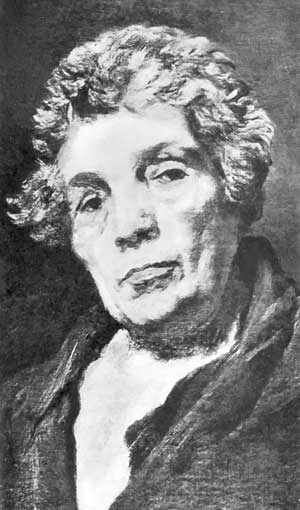
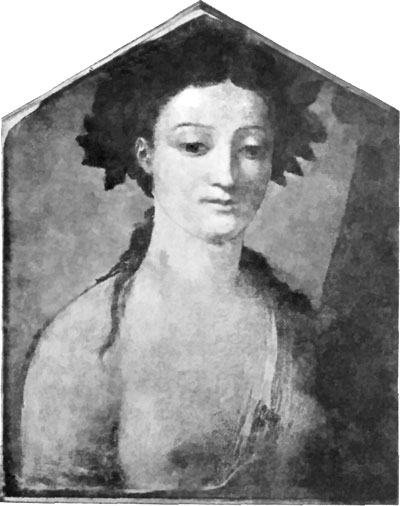
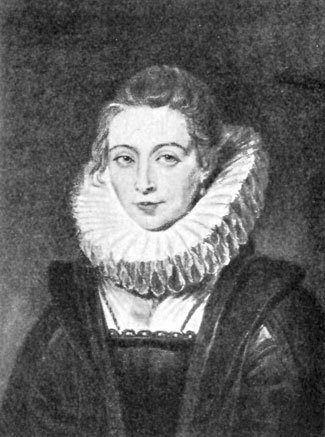
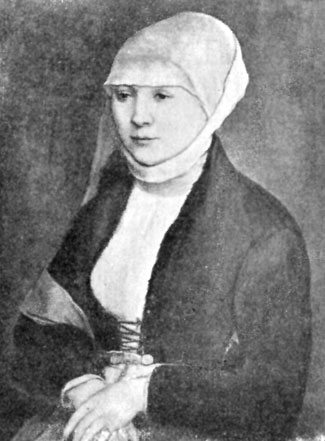
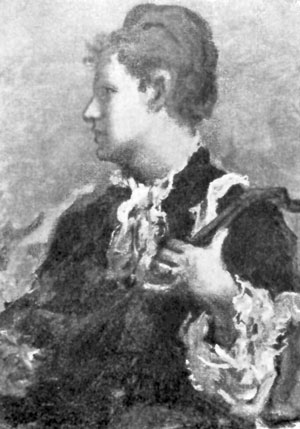
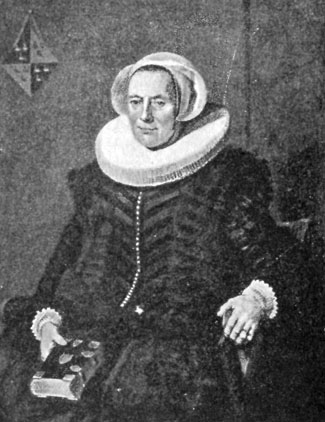 FIG. 81.—HALS. PORTRAIT OF A LADY.
THE EARLY PAINTING: The early work has, for the great part, perished
through time and the fierceness with which the Iconoclastic warfare
was waged. That which remains to-day is closely allied in method and
style to Flemish painting under the Van Eycks. Ouwater is one of the
earliest names that appears, and perhaps for that reason he has been
called the founder of the school. He was remarked in his time for the
excellent painting of background landscapes; but there is little
authentic by him left to us from which we may form an opinion.[17]
Geertjen van St. Jan (about 1475) was evidently a pupil of his, and
from him there are two wings of an altar in the Vienna Gallery,
supposed to be genuine. Bouts and Mostert have been spoken of under
the Flemish school. Bosch (1460?-1516) was a man of some individuality
who produced fantastic purgatories that were popular in their time and
are known to-day through engravings. Engelbrechsten (1468-1533) was
Dutch by birth and in his art, and yet probably got his inspiration
from the Van Eyck school. The works attributed to him are doubtful,
though two in the Leyden Gallery seem to be authentic. He was the
master of Lucas van Leyden (1494-1533), the leading artist of the
early period. Lucas van Leyden was a personal friend of Albrecht
Dürer, the German painter, and in his art he was not unlike him. A
man with a singularly lean type, a little awkward in composition,
brilliant in color, and warm in tone, he was, despite his
archaic-looking work, an artist of much ability and originality. At
first he was inclined toward Flemish methods, with an exaggerated
realism in facial expression. In his middle period he was distinctly
Dutch, but in his later days he came under Italian influence, and with
a weakening effect upon his art. Taking his work as a whole, it was
the strongest of all the early Dutch painters.
SIXTEENTH CENTURY: This century was a period of Italian imitation,
probably superinduced by the action of the Flemings at Antwerp. The
movement was somewhat like the Flemish one, but not so extensive or so
productive. There was hardly a painter of rank in Holland during the
whole century. Scorel (1495-1562) was the leader, and he probably got
his first liking for Italian art through Mabuse at Antwerp. He
afterward went to Italy, studied Raphael and Michael Angelo, and
returned to Utrecht to open a school and introduce Italian art into
Holland. A large number of pupils followed him, but their work was
lacking in true originality. Heemskerck (1498-1574) and Cornelis van
Haarlem (1562-1638), with Steenwyck (1550?-1604), were some of the
more important men of the century, but none of them was above a common
average.
SEVENTEENTH CENTURY: Beginning with the first quarter of this century
came the great art of the Dutch people, founded on themselves and
rooted in their native character. Italian methods were abandoned, and
the Dutch told the story of their own lives in their own manner, with
truth, vigor, and skill. There were so many painters in Holland during
this period that it will be necessary to divide them into groups and
mention only the prominent names.
PORTRAIT AND FIGURE PAINTERS: The real inaugurators of Dutch
portraiture were Mierevelt, Hals, Ravesteyn, and De Keyser. Mierevelt
(1567-1641) was one of the earliest, a prolific painter, fond of the
aristocratic sitter, and indulging in a great deal of elegance in his
accessories of dress and the like. He had a slight, smooth brush, much
detail, and a profusion of color. Quite the reverse of him was Franz
Hals (1584?-1666), one of the most remarkable painters of portraits
with which history acquaints us. In giving the sense of life and
personal physical presence, he was unexcelled by any one. What he saw
he could portray with the most telling reality. In drawing and
modelling he was usually good; in coloring he was excellent, though in
his late work sombre; in brush-handling he was one of the great
masters. Strong, virile, yet easy and facile, he seemed to produce
without effort. His brush was very broad in its sweep, very sure, very
true. Occasionally in his late painting facility ran to the
ineffectual, but usually he was certainty itself. His best work was in
portraiture, and the most important of this is to be seen at Haarlem,
where he died after a rather careless life. As a painter, pure and
simple, he is almost to be ranked beside Velasquez; as a poet, a
thinker, a man of lofty imagination, his work gives us little
enlightenment except in so far as it shows a fine feeling for masses
of color and problems of light. Though excellent portrait-painters,
Ravesteyn (1572?-1657) and De Keyser (1596?-1679) do not provoke
enthusiasm. They were quiet, conservative, dignified, painting civic
guards and societies with a knowing brush and lively color, giving the
truth of physiognomy, but not with that verve of the artist so
conspicuous in Hals, nor with that unity of the group so essential in
the making of a picture.
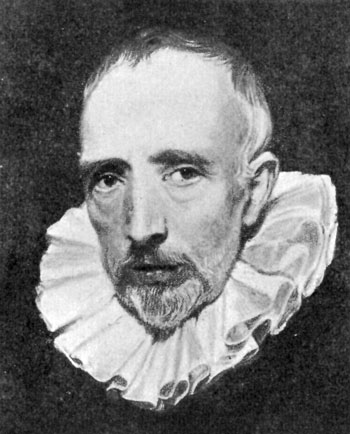
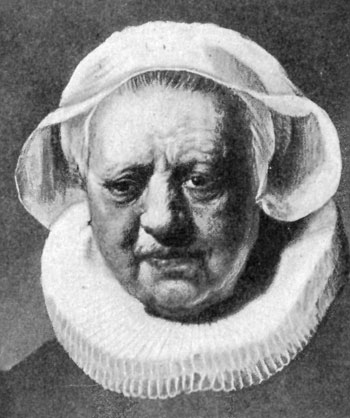 FIG. 82.—REMBRANDT. HEAD OF WOMAN. NAT. GAL. LONDON.
The next man in chronological order is Rembrandt (1607?-1669), the
greatest painter in Dutch art. He was a pupil of Swanenburch and
Lastman, but his great knowledge of nature and his craft came largely
from the direct study of the model. Settled at Amsterdam, he quickly
rose to fame, had a large following of pupils, and his influence was
felt through all Dutch painting. The portrait was emphatically his
strongest work. The many-figured group he was not always successful in
composing or lighting. His method of work rather fitted him for the
portrait and unfitted him for the large historical piece. He built up
the importance of certain features by dragging down all other
features. This was largely shown in his handling of illumination.
Strong in a few high lights on cheek, chin, or white linen, the rest
of the picture was submerged in shadow, under which color was
unmercifully sacrificed. This was not the best method for a large,
many-figured piece, but was singularly well suited to the portrait. It
produced strength by contrast. "Forced" it was undoubtedly, and not
always true to nature, yet nevertheless most potent in Rembrandt's
hands. He was an arbitrary though perfect master of light-and-shade,
and unusually effective in luminous and transparent shadows. In color
he was again arbitrary but forcible and harmonious. In brush-work he
was at times labored, but almost always effective.
Mentally he was a man keen to observe, assimilate, and express his
impressions in a few simple truths. His conception was localized with
his own people and time (he never built up the imaginary or followed
Italy), and yet into types taken from the streets and shops of
Amsterdam he infused the very largest humanity through his inherent
sympathy with man. Dramatic, even tragic, he was; yet this was not so
apparent in vehement action as in passionate expression. He had a
powerful way of striking universal truths through the human face, the
turned head, bent body, or outstretched hand. His people have
character, dignity, and a pervading feeling that they are the great
types of the Dutch race—people of substantial physique, slow in
thought and impulse, yet capable of feeling, comprehending, enjoying,
suffering.
His landscapes, again, were a synthesis of all landscapes, a grouping
of the great truths of light, air, shadow, space. Whatever he turned
his hand to was treated with that breadth of view that overlooked the
little and grasped the great. He painted many subjects. His earliest
work dates from 1627, and is a little hard and sharp in detail and
cold in coloring. After 1654 he grew broader in handling and warmer in
tone, running to golden browns, and, toward the end of his career, to
rather hot tones. His life was embittered by many misfortunes, but
these never seem to have affected his art except to deepen it. He
painted on to the last, convinced that his own view was the true one,
and producing works that rank second to none in the history of
painting.
Rembrandt's influence upon Dutch art was far-reaching, and appeared
immediately in the works of his many pupils. They all followed his
methods of handling light-and-shade, but no one of them ever equalled
him, though they produced work of much merit. Bol (1611-1680) was
chiefly a portrait-painter, with a pervading yellow tone and some
pallor of flesh-coloring—a man of ability who mistakenly followed
Rubens in the latter part of his life. Flinck (1615-1660) at one time
followed Rembrandt so closely that his work has passed for that of the
master; but latterly he, too, came under Flemish influence. Next to
Eeckhout he was probably the nearest to Rembrandt in methods of all
the pupils. Eeckhout (1621-1674) was really a Rembrandt imitator, but
his hand was weak and his color hot. Maes (1632-1693) was the most
successful manager of light after the school formula, and succeeded
very well with warmth and richness of color, especially with his reds.
The other Rembrandt pupils and followers were Poorter (fl. 1635-1643),
Victoors (1620?-1672?), Koninck (1619-1688), Fabritius (1624-1654),
and Backer (1608?-1651).
Van der Helst (1612?-1670) stands apart from this school, and seems to
have followed more the portrait style of De Keyser. He was a
realistic, precise painter, with much excellence of modelling in head
and hands, and with fine carriage and dignity in the figure. In
composition he hardly held his characters in group owing to a
sacrifice of values, and in color he was often "spotty," and lacking
in the unity of mass.
THE GENRE PAINTERS: This heading embraces those who may be called the
"Little Dutchmen," because of the small scale of their pictures and
their genre subjects. Gerard Dou (1613-1675) is indicative of the
class without fully representing it. He was a pupil of Rembrandt, but
his work gave little report of this. It was smaller, more delicate in
detail, more petty in conception. He was a man great in little
things, one who wasted strength on the minutiæ of dress, or
table-cloth, or the texture of furniture without grasping the mass or
color significance of the whole scene. There was infinite detail about
his work, and that gave it popularity; but as art it held, and holds
to-day, little higher place than the work of Metsu (1630-1667), Van
Mieris (1635-1681), Netscher (1639-1684), or Schalcken (1643-1706),
all of whom produced the interior piece with figures elaborate in
accidental effects. Van Ostade (1610-1685), though dealing with the
small canvas, and portraying peasant life with perhaps unnecessary
coarseness, was a much stronger painter than the men just mentioned.
He was the favorite pupil of Hals and the master of Jan Steen. With
little delicacy in choice of subject he had much delicacy in color,
taste in arrangement, and skill in handling. His brush was precise but
not finical.
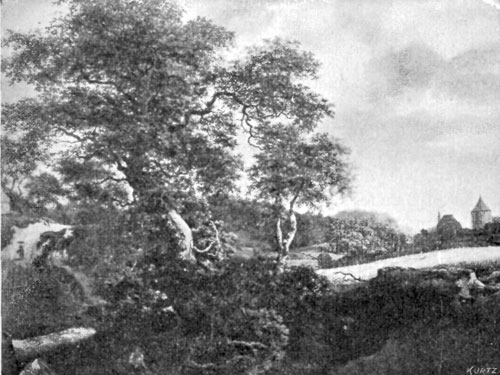 FIG. 83.—J. VAN RUISDAEL. LANDSCAPE.
By far the best painter among all the "Little Dutchmen" was Terburg
(1617?-1681), a painter of interiors, small portraits, conversation
pictures, and the like. Though of diminutive scale his work has the
largeness of view characteristic of genius, and the skilled technic of
a thorough craftsman. Terburg was a travelled man, visiting Italy,
where he studied Titian, returning to Holland to study Rembrandt,
finally at Madrid studying Velasquez. He was a painter of much
culture, and the keynote of his art is refinement. Quiet and dignified
he carried taste through all branches of his art. In subject he was
rather elevated, in color subdued with broken tones, in composition
simple, in brush-work sure, vivacious, and yet unobtrusive. Selection
in his characters was followed by reserve in using them. Detail was
not very apparent. A few people with some accessory objects were all
that he required to make a picture. Perhaps his best qualities appear
in a number of small portraits remarkable for their distinction and
aristocratic grace.
Steen (1626?-1679) was almost the opposite of Terburg, a man of
sarcastic flings and coarse humor who satirized his own time with
little reserve. He developed under Hals and Van Ostade, favoring the
latter in his interiors, family scenes, and drunken debauches. He was
a master of physiognomy, and depicted it with rare if rather
unpleasant truth. If he had little refinement in his themes he
certainly handled them as a painter with delicacy. At his best his
many figured groups were exceedingly well composed, his color was of
good quality (with a fondness for yellows), and his brush was as
limpid and graceful as though painting angels instead of Dutch boors.
He was really one of the fine brushmen of Holland, a man greatly
admired by Sir Joshua Reynolds, and many an artist since; but not a
man of high intellectual pitch as compared with Terburg, for
instance.
Pieter de Hooghe (1632?-1681) was a painter of purely pictorial
effects, beginning and ending a picture in a scheme of color,
atmosphere, clever composition, and above all the play of
light-and-shade. He was one of the early masters of full sunlight,
painting it falling across a court-yard or streaming through a window
with marvellous truth and poetry. His subjects were commonplace
enough. An interior with a figure or two in the middle distance, and a
passage-way leading into a lighted background were sufficient for him.
These formed a skeleton which he clothed in a half-tone shadow,
pierced with warm yellow light, enriched with rare colors, usually
garnet reds and deep yellows repeated in the different planes, and
surrounded with a subtle pervading atmosphere. As a brushman he was
easy but not distinguished, and often his drawing was not correct; but
in the placing of color masses and in composing by color and light he
was a master of the first rank. Little is known about his life. He
probably formed himself on Fabritius or Rembrandt at second-hand, but
little trace of the latter is apparent in his work. He seems not to
have achieved much fame until late years, and then rather in England
than in his own country.
Jan van der Meer of Delft (1632-1675), one of the most charming of all
the genre painters, was allied to De Hooghe in his pictorial point
of view and interior subjects. Unfortunately there is little left to
us of this master, but the few extant examples serve to show him a
painter of rare qualities in light, in color, and in atmosphere. He
was a remarkable man for his handling of blues, reds, and yellows; and
in the tonic relations of a picture he was a master second to no one.
Fabritius is supposed to have influenced him.
THE LANDSCAPE PAINTERS: The painters of the Netherlands were probably
the first, beginning with Bril, to paint landscape for its own sake,
and as a picture motive in itself. Before them it had been used as a
background for the figure, and was so used by many of the Dutchmen
themselves. It has been said that these landscape-painters were also
the first ones to paint landscape realistically, but that is true only
in part. They studied natural forms, as did, indeed, Bellini in the
Venetian school; they learned something of perspective, air, tree
anatomy, and the appearance of water; but no Dutch painter of
landscape in the seventeenth century grasped the full color of Holland
or painted its many varied lights. They indulged in a meagre
conventional palette of grays, greens, and browns, whereas Holland is
full of brilliant hues.
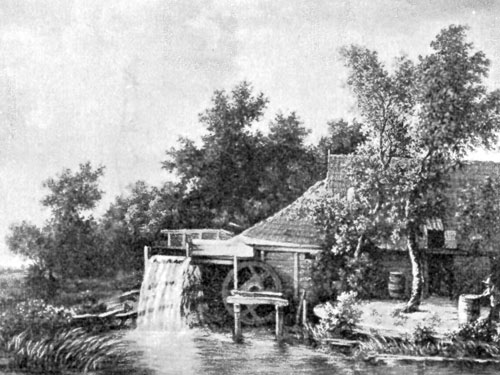 FIG. 84.—HOBBEMA. THE WATER-WHEEL. AMSTERDAM MUS.
Van Goyen (1596-1656) was one of the earliest of the
seventeenth-century landscapists. In subject he was fond of the Dutch
bays, harbors, rivers, and canals with shipping, windmills, and
houses. His sky line was generally given low, his water silvery, and
his sky misty and luminous with bursts of white light. In color he
was subdued, and in perspective quite cunning at times. Salomon van
Ruisdael (1600?-1670) was his follower, if not his pupil. He had the
same sobriety of color as his master, and was a mannered and prosaic
painter in details, such as leaves and tree-branches. In composition
he was good, but his art had only a slight basis upon reality, though
it looks to be realistic at first sight. He had a formula for doing
landscape which he varied only in a slight way, and this
conventionality ran through all his work. Molyn (1600?-1661) was a
painter who showed limited truth to nature in flat and hilly
landscapes, transparent skies, and warm coloring. His extant works are
few in number. Wynants (1615?-1679?) was more of a realist in natural
appearance than any of the others, a man who evidently studied
directly from nature in details of vegetation, plants, trees, roads,
grasses, and the like. Most of the figures and animals in his
landscapes were painted by other hands. He himself was a pure
landscape-painter, excelling in light and aërial perspective, but not
remarkable in color. Van der Neer (1603-1677) and Everdingen
(1621?-1675) were two other contemporary painters of merit.
The best landscapist following the first men of the century was Jacob
van Ruisdael (1625?-1682), the nephew of Salomon van Ruisdael. He is
put down, with perhaps unnecessary emphasis, as the greatest
landscape-painter of the Dutch school. He was undoubtedly the equal of
any of his time, though not so near to nature, perhaps, as Hobbema. He
was a man of imagination, who at first pictured the Dutch country
about Haarlem, and afterward took up with the romantic landscape of
Van Everdingen. This landscape bears a resemblance to the Norwegian
country, abounding, as it does, in mountains, heavy dark woods, and
rushing torrents. There is considerable poetry in its composition, its
gloomy skies, and darkened lights. It is mournful, suggestive, wild,
usually unpeopled. There was much of the methodical in its putting
together, and in color it was cold, and limited to a few tones. Many
of Ruisdael's works have darkened through time. Little is known about
the painter's life except that he was not appreciated in his own time
and died in the almshouse.
Hobbema (1638?-1709) was probably the pupil of Jacob van Ruisdael, and
ranks with him, if not above him, in seventeenth-century landscape
painting. Ruisdael hardly ever painted sunlight, whereas Hobbema
rather affected it in quiet wood-scenes or roadways with little pools
of water and a mill. He was a freer man with the brush than Ruisdael,
and knew more about the natural appearance of trees, skies, and
lights; but, like his master, his view of nature found no favor in his
own land. Most of his work is in England, where it had not a little to
do with influencing such painters as Constable and others at the
beginning of the nineteenth century.
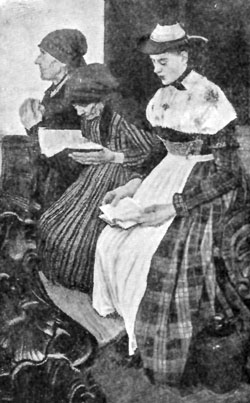
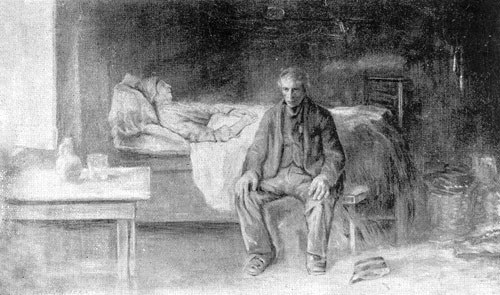 FIG. 85.—ISRAELS. ALONE IN THE WORLD.
LANDSCAPE WITH CATTLE: Here we meet with Wouverman (1619-1668), a
painter of horses, cavalry, battles, and riding parties placed in
landscape. His landscape is bright and his horses are spirited in
action. There is some mannerism apparent in his reiterated
concentration of light on a white horse, and some repetition in his
canvases, of which there are many; but on the whole he was an
interesting, if smooth and neat painter. Paul Potter (1625-1654)
hardly merited his great repute. He was a harsh, exact recorder of
facts, often tin-like or woodeny in his cattle, and not in any way
remarkable in his landscapes, least of all in their composition. The
Young Bull at the Hague is an ambitious piece of drawing, but is not
successful in color, light, or ensemble. It is a brittle work all
through, and not nearly so good as some smaller things in the National
Gallery London, and in the Louvre. Adrien van de Velde (1635?-1672)
was short-lived, like Potter, but managed to do a prodigious amount
of work, showing cattle and figures in landscape with much technical
ability and good feeling. He was particularly good in composition and
the subtle gradation of neutral tints. A little of the Italian
influence appeared in his work, and with the men who came with him and
after him the Italian imitation became very pronounced. Aelbert Cuyp
(1620-1691) was a many-sided painter, adopting at various times
different styles, but was enough of a genius to be himself always. He
is best known to us, perhaps, by his yellow sunlight effects along
rivers, with cattle in the foreground, though he painted still-life,
and even portraits and marines. In composing a group he was knowing,
recording natural effects with power; in light and atmosphere he was
one of the best of his time, and in texture and color refined, and
frequently brilliant. Both (1610-1650?), Berchem (1620-1683), Du
Jardin (1622?-1678), followed the Italian tradition of Claude Lorrain,
producing semi-classic landscapes, never very convincing in their
originality. Van der Heyden (1637-1712), should be mentioned as an
excellent, if minute, painter of architecture with remarkable
atmospheric effects.
MARINE AND STILL-LIFE PAINTERS: There were two pre-eminent marine
painters in this seventeenth century, Willem van de Velde (1633-1707)
and Backhuisen (1631-1708). The sea was not an unusual subject with
the Dutch landscapists. Van Goyen, Simon de Vlieger (1601?-1660?),
Cuyp, Willem van de Velde the Elder (1611?-1693), all employed it; but
it was Van de Velde the Younger who really stood at the head of the
marine painters. He knew his subject thoroughly, having been well
grounded in it by his father and De Vlieger, so that the painting of
the Dutch fleets and harbors was a part of his nature. He preferred
the quiet haven to the open sea. Smooth water, calm skies, silvery
light, and boats lying listlessly at anchor with drooping sails, made
up his usual subject. The color was almost always in a key of silver
and gray, very charming in its harmony and serenity, but a little
thin. Both he and his father went to England and entered the service
of the English king, and thereafter did English fleets rather than
Dutch ones. Backhuisen was quite the reverse of Van de Velde in
preferring the tempest to the calm of the sea. He also used more
brilliant and varied colors, but he was not so happy in harmony as Van
de Velde. There was often dryness in his handling, and something too
much of the theatrical in his wrecks on rocky shores.
The still-life painters of Holland were all of them rather petty in
their emphasis of details such as figures on table-covers, water-drops
on flowers, and fur on rabbits. It was labored work with little of the
art spirit about it, except as the composition showed good masses. A
number of these painters gained celebrity in their day by their
microscopic labor over fruits, flowers, and the like, but they have no
great rank at the present time. Jan van Heem (1600?1684?) was perhaps
the best painter of flowers among them. Van Huysum (1682-1749)
succeeded with the same subject beyond his deserts. Hondecoeter
(1636-1695) was a unique painter of poultry; Weenix (1640-1719) and
Van Aelst (1620-1679), of dead game; Kalf (1630?-1693), of pots, pans,
dishes, and vegetables.
EIGHTEENTH CENTURY: This was a period of decadence during which there
was no originality worth speaking about among the Dutch painters.
Realism in minute features was carried to the extreme, and imitation
of the early men took the place of invention. Everything was
prettified and elaborated until there was a porcelain smoothness and a
photographic exactness inconsistent with true art. Adriaan van der
Werff (1659-1722), and Philip van Dyck (1683-1753) with their "ideal"
inanities are typical of the century's art. There was nothing to
commend it. The lowest point of affectation had been reached.
NINETEENTH CENTURY: The Dutch painters, unlike the Belgians, have
almost always been true to their own traditions and their own country.
Even in decadence the most of them feebly followed their own painters
rather than those of Italy and France, and in the early nineteenth
century they were not affected by the French classicism of David.
Later on there came into vogue an art that had some affinity with that
of Millet and Courbet in France. It was the Dutch version of modern
sentiment about the laboring classes, founded on the modern life of
Holland, yet in reality a continuation of the style or genre
practised by the early Dutchmen. Israels (1824-) is a revival or a
survival of Rembrandtesque methods with a sentiment and feeling akin
to the French Millet. He deals almost exclusively with peasant life,
showing fisher-folk and the like in their cottage interiors, at the
table, or before the fire, with good effects of light, atmosphere, and
much pathos. Technically he is rather labored and heavy in handling,
but usually effective with sombre color in giving the unity of a
scene. Artz (1837-1890) considered himself in measure a follower of
Israels, though he never studied under him. His pictures in subject
are like those of Israels, but without the depth of the latter.
Blommers (1845-) is another peasant painter who follows Israels at a
distance, and Neuhuys (1844-) shows a similar style of work. Bosboom
(1817-1891) excelled in representing interiors, showing, with much
pictorial effect, the light, color, shadow, and feeling of space and
air in large cathedrals.
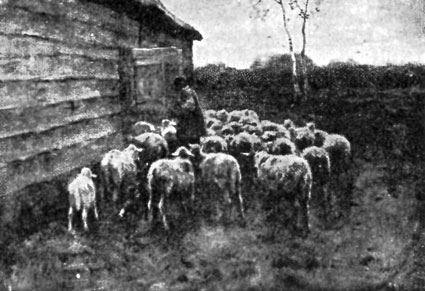 FIG. 86.—MAUVE. SHEEP.
The brothers Maris have made a distinct impression on modern Dutch
art, and, strange enough, each in a different way from the others.
James Maris (1837-) studied at Paris, and is remarkable for fine,
vigorous views of canals, towns, and landscapes. He is broad in
handling, rather bleak in coloring, and excels in fine luminous skies
and voyaging clouds. Matthew Maris (1835-), Parisian trained like his
brother, lives in London, where little is seen of his work. He paints
for himself and his friends, and is rather melancholy and mystical in
his art. He is a recorder of visions and dreams rather than the
substantial things of the earth, but always with richness of color and
a fine decorative feeling. Willem Maris (1839-), sometimes called the
"Silvery Maris," is a portrayer of cattle and landscape in warm
sunlight and haze with a charm of color and tone often suggestive of
Corot. Jongkind (1819-1891) stands by himself, Mesdag (1831-) is a
fine painter of marines and sea-shores, and Mauve (1838-1888), a
cattle and sheep painter, with nice sentiment and tonality, whose
renown is just now somewhat disproportionate to his artistic ability.
In addition there are Kever, Poggenbeek, Bastert, Baur, Breitner,
Witsen, Haverman, Weissenbruch.
EXTANT WORKS: Generally speaking the best examples of the
Dutch schools are still to be seen in the local museums of
Holland, especially the Amsterdam and Hague Mus.; Bosch,
Madrid, Antwerp, Brussels Mus.; Lucas van Leyden, Antwerp,
Leyden, Munich Mus.; Scorel, Amsterdam, Rotterdam, Haarlem
Mus.; Heemskerck, Haarlem, Hague, Berlin, Cassel, Dresden;
Steenwyck, Amsterdam, Hague, Brussels; Cornelis van Haarlem,
Amsterdam, Haarlem, Brunswick.
Portrait and Figure Painters—Mierevelt, Hague, Amsterdam,
Rotterdam, Brunswick, Dresden, Copenhagen; Hals, best works
to be seen at Haarlem, others at Amsterdam, Brussels, Hague,
Berlin, Cassel, Louvre, Nat. Gal. Lon., Met. Mus. New York,
Art Institute Chicago; Rembrandt, Amsterdam, Hermitage,
Louvre, Munich, Berlin, Dresden, Madrid, London; Bol,
Amsterdam, Hague, Dresden, Louvre; Flinck, Amsterdam, Hague,
Berlin; Eeckhout, Amsterdam, Brunswick, Berlin, Munich;
Maes, Nat. Gal. Lon., Rotterdam, Amsterdam, Hague, Brussels;
Poorter, Amsterdam, Brussels, Dresden; Victoors, Amsterdam,
Copenhagen, Brunswick, Dresden; Fabritius, Rotterdam,
Amsterdam, Berlin; Van der Helst, best works at Amsterdam
Mus.
Genre Painters—Examples of Dou, Metsu, Van Mieris,
Netscher, Schalcken, Van Ostade, are to be seen in almost
all the galleries of Europe, especially the Dutch, Belgian,
German, and French galleries; Terburg, Amsterdam, Louvre,
Dresden, Berlin (fine portraits); Steen, Amsterdam, Louvre,
Rotterdam, Hague, Berlin, Cassel, Dresden, Vienna; De
Hooghe, Nat. Gal. Lon., Louvre, Amsterdam, Hermitage; Van
der Meer of Delft, Louvre, Hague, Amsterdam, Berlin,
Dresden, Met. Mus. New York.
Landscape Painters—Van Goyen, Amsterdam, Fitz-William Mus.
Cambridge, Louvre, Brussels, Cassel, Dresden, Berlin;
Salomon van Ruisdael, Amsterdam, Brussels, Berlin, Dresden,
Munich; Van der Neer, Nat. Gal. Lon., Louvre, Brussels,
Amsterdam, Berlin, Dresden; Everdingen, Amsterdam, Berlin,
Louvre, Brunswick, Dresden, Munich, Frankfort; Jacob van
Ruisdael, Nat. Gal. Lon., Louvre, Amsterdam, Berlin,
Dresden; Hobbema, best works in England, Nat. Gal. Lon.,
Amsterdam, Rotterdam, Dresden; Wouvermans, many works, best
at Amsterdam, Cassel, Louvre; Potter, Amsterdam, Hague,
Louvre, Nat. Gal. Lon.; Van de Velde, Amsterdam, Hague,
Cassel, Dresden, Frankfort, Munich, Louvre; Cuyp, Amsterdam,
Nat. Gal. Lon., Louvre, Munich, Dresden; examples of Both,
Berchem, Du Jardin, and Van der Heyden, in almost all of the
Dutch and German galleries, besides the Louvre and Nat. Gal.
Lon.
Marine Painters—Willem van de Velde Elder and Younger,
Backhuisen, Vlieger, together with the flower and fruit
painters like Huysum, Hondecoeter, Weenix, have all been
prolific workers, and almost every European gallery,
especially those at London, Amsterdam, and in Germany, have
examples of their works; Van der Werff and Philip van Dyck
are seen at their best at Dresden.
The best works of the modern men are in private collections,
many in the United States, some examples of them in the
Amsterdam and Hague Museums. Also some examples of the old
Dutch masters in New York Hist. Society Library, Yale School
of Fine Arts, Met. Mus. New York, Boston Mus., and Chicago
Institute.