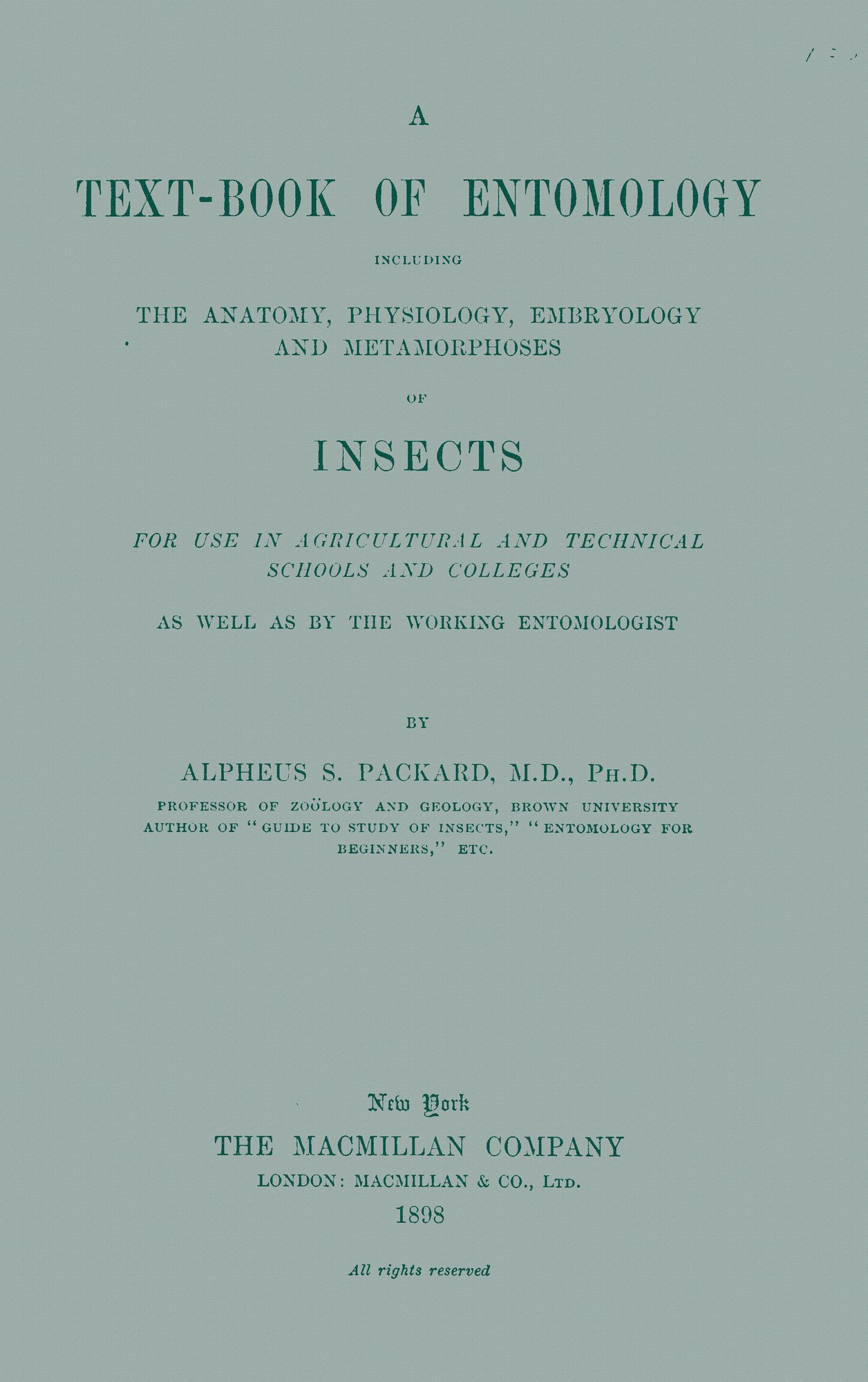
A Text-book of Entomology
by A. S. Packard
★★★★★No ratings yet
Language: English
Sign in to rate this book.
Sign in to shelve this book.
About this eBook
- Author
- Packard, A. S. (Alpheus Spring), 1839-1905
- Title
- A Text-book of Entomology Including the Anatomy, Physiology, Embryology and Metamorphoses of Insects for Use in Agricultural and Technical Schools and Colleges as Well as by the Working Entomologist
- Credits
- Richard Tonsing and the Online Distributed Proofreading Team at www.pgdp.net (This file was produced from images generously made available by The Internet Archive)
- Language
- English
- LoC Class
- QL: Science: Zoology
- Subject
- Insects
- Category
- Text
- Project Gutenberg
- eBook-No. 64677
- Release Date
- March 2, 2021
- Copyright
- Public domain in the USA.
Contents
- 1.A TEXT-BOOK OF ENTOMOLOGY INCLUDING THE ANATOMY, PHYSIOLOGY, EMBRYOLOGY AND METAMORPHOSES OF INSECTS FOR USE IN AGRICULTURAL AND TECHNICAL SCHOOLS AND COLLEGES AS WELL AS BY THE WORKING ENTOMOLOGIST
- 2.PREFACE
- 3.TABLE OF CONTENTS — PART I.—MORPHOLOGY AND PHYSIOLOGY — POSITION OF INSECTS IN THE ANIMAL KINGDOM — Tabular View of the Eight Branches or Phyla of the Animal Kingdom. — RELATIONS OF INSECTS TO OTHER ARTHROPODA — LITERATURE ON SCOLOPENDRELLA — INSECTA (HEXAPODA) — 1. EXTERNAL ANATOMY — a. The regions of the body — b. The integument (exoskeleton) — c. Mechanical origin and structure of the segments (somites, arthromeres, metameres, zonites) — d. Mechanical origin of the limbs and of their jointed structure — LITERATURE ON THE EXTERNAL ANATOMY — General — THE HEAD AND ITS APPENDAGES — a. The head — LITERATURE ON THE EPIPHARYNX — b. Appendages of the head — LITERATURE OF THE MOUTH-PARTS OR BUCCAL APPENDAGES — a. General — b. Thysanoptera (Physapoda) — c. Hemiptera — d. Coleoptera — e. Lepidoptera — f. Siphonaptera — g. Diptera — h. Hymenoptera — i. Larval stages — j. Embryonic stages — THE THORAX AND ITS APPENDAGES — a. The thorax; its external anatomy — b. The legs: their structure and functions — c. Locomotion (walking, climbing, and swimming) — LITERATURE ON LEGS AND FEET — LITERATURE OF LOCOMOTION (WALKING, ETC.) — LITERATURE OF WALKING ON SMOOTH SURFACES — d. The wings and their structure — e. Development and mode of origin of the wings — f. The primitive origin of the wings — LITERATURE ON THE WINGS — g. Mechanism of flight — LITERATURE ON FLIGHT — THE ABDOMEN AND ITS APPENDAGES — LITERATURE ON THE ABDOMEN AND ITS APPENDAGES — a. General (including the cerci, stili, etc.) — b. The ovipositor — c. The external genital armature — THE ARMATURE OF INSECTS: SETÆ, HAIRS, SCALES, TUBERCLES, ETC. — LITERATURE — a. Hairs, bristles, cleaning spines, calcaria, combs, etc. — b. Glandular and poisonous setæ and spines — c. Androconia — d. Scales — THE COLORS OF INSECTS — LITERATURE — 2. INTERNAL ANATOMY — THE MUSCULAR SYSTEM — LITERATURE ON THE MUSCLES — a . General — b . Histology — c . Muscular power of insects — THE NERVOUS SYSTEM — a. The nervous system as a whole — b. The brain — c. Histological elements of the brain — d. The visceral (sympathetic or stomatogastric) system — e. The supraspinal cord — f. Modifications of the brain in different orders of insects — g. Functions of the nerve-centres and nerves — LITERATURE ON THE NERVOUS SYSTEM — a. General — b. The brain — c. Histology of the nervous System — THE SENSORY ORGANS — a. The eyes and insect vision — LITERATURE ON THE EYES AND VISION — a . General — b . The color-sense — b . The organs of smell — LITERATURE OF THE ORGANS OF SMELL — c . The organs of taste — LITERATURE ON THE ORGANS OF TASTE — d. The organs of hearing — e. The sounds of insects — LITERATURE ON THE ORGANS OF HEARING — a. The auditory organs — b. The sounds made by insects — THE DIGESTIVE CANAL AND ITS APPENDAGES — a. The digestive canal — LITERATURE ON THE ORGANS OF DIGESTION — b . Digestion in insects — LITERATURE ON THE PHYSIOLOGY OF DIGESTION — THE GLANDULAR AND EXCRETORY APPENDAGES OF THE DIGESTIVE CANAL — a. The salivary glands — LITERATURE ON THE SALIVARY GLANDS — b. The silk or spinning glands, and the spinning apparatus — LITERATURE ON THE SPINNING GLANDS — c. The cæcal appendages. — d. The excretory system (urinary or Malpighian tubes) — LITERATURE ON THE EXCRETORY (URINARY) ORGANS — e. Poison-glands — f. Adhesive or cement-glands — g. The wax-glands — h. “Honey-dew” or wax-glands of Aphids — i. Dermal glands in general — LITERATURE ON THE SECRETORY GLANDS — a. General — b. Poison-glands — c. Wax-glands — d. Wax-like glands of Aphides — DEFENSIVE OR REPUGNATORIAL SCENT-GLANDS — Distribution of repugnatorial or alluring scent-glands in insects [59] — A. Larval Insects — LEPIDOPTERA — Family Tineidæ — Family Noctuidæ — Family Notodontidæ — Family Nymphalidæ — Family Papilionidæ — Family Perophoridæ — Family Nolidæ — Family Tenthredinidæ — Family Tineidæ — Family Hemileucidæ — Family Megalopygidæ — Family Liparidæ — Family Lycænidæ — B. Nymph of Heterometabolous Insects — C. Pupa of Certain Bombyces — D. Adult Insects — LITERATURE ON DEFENSIVE OR REPUGNATORIAL GLANDS — THE ALLURING OR SCENT-GLANDS — LITERATURE ON ALLURING GLANDS — THE ORGANS OF CIRCULATION — a. The heart — b. The blood — c. The circulation of the blood — I. Substances which cause the pulsations of the heart to accelerate. — II. Substances retarding the heart’s action. — III. Substances whose action is indifferent. — LITERATURE ON THE HEART AND ON THE CIRCULATION OF THE BLOOD — a. Anatomy of the organs — b. The blood, blood corpuscles, leucocytes, and blood tissue — c. The fat-bodies — THE BLOOD TISSUE — a. The fat-body — b. The pericardial fat-body or pericardial cells — c. The œnocytes — d. The phosphorescent organs — LITERATURE ON PHOSPHORESCENCE — THE RESPIRATORY SYSTEM — a. The tracheæ — b. The spiracles or stigmata — c. Morphology and homologies of the tracheal system — d. The spiral threads or tænidia — e. Origin of the tracheæ and of the “spiral thread” — f. The mechanism of respiration and the respiratory movements of insects — g. The air-sacs — h. The closed or partly closed tracheal system — i. The rectal tracheal gills, and rectal respiration of larval Odonata and other insects — j. Tracheal gills of the larvæ of insects — k. Tracheal gills of adult insects — LITERATURE ON THE ORGANS AND PHYSIOLOGY OF RESPIRATION — a. On the tracheal system in general — b. On the Stigmata — c. On tracheal gills and tracheal respiration — d. Literature on rectal respiration — e. Physiology of Respiration — THE ORGANS OF REPRODUCTION — a. The male organs of reproduction — b. The female organs of reproduction — LITERATURE ON THE ORGANS OF REPRODUCTION — a. General — b. Formation of the egg (oögenesis) — c. On the spermatozoa — d. On the paired genital efferent passages
- 4.PART II. EMBRYOLOGY OF INSECTS — a. The egg — b. Maturation or ripening of the egg — c. Fertilization of the egg — d. Division and formation of the blastoderm [80] — e. Formation of the first rudiments of the embryo, and of the embryonic membranes — f. Formation of the external form of the body — g. The appendages — h. Nervous system — i. Dorsal closure and involution of the embryonic membranes — j. Formation of the germ-layers — k. Farther development of the mesoderm. Formation of the body-cavity — l. Formation of organs — m. Length of embryonic life — n. The process of hatching — LITERATURE ON EMBRYOLOGY
- 5.PART III.—THE METAMORPHOSES OF INSECTS — a. The nymph as distinguished from the larval stage — b. Stages or stadia of metamorphosis — c. Ametabolous and metabolous stages — THE LARVA — a. The Campodea-form type of larva — b. The eruciform type of larva — LITERATURE ON ANCESTRY OF INSECTS, ETC. — c. Growth and increase in size of the larva — d. The process of moulting (ecdysis) — THE PUPA STATE — a. The pupa considered in reference to its adaptation to its surroundings and its relation to phylogeny — b. Mode of escape of the pupa from its cocoon — c. The cremaster — FORMATION OF THE PUPA AND IMAGO IN THE HOLOMETABOLOUS INSECTS (THE DIPTERA EXCEPTED) — a. The Lepidoptera — b. The Hymenoptera — DEVELOPMENT OF THE IMAGO IN THE DIPTERA — a. Development of the outer body-form — b. Development of the internal organs of the imago — c. General summary — HYPERMETAMORPHISM — SUMMARY OF THE FACTS AND SUGGESTIONS AS TO THE CAUSES OF METAMORPHISM — LITERATURE ON POSTEMBRYONIC DEVELOPMENT AND METAMORPHOSES
- 6.INDEX
Community reviews
Sign in to write a review.
No reviews yet.