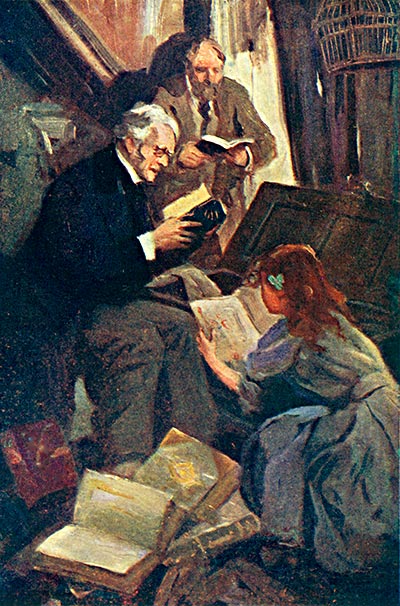
'Dark and dank, where the toad doth creep,
And the dusk-loving bat haunts the shadows deep.'
Great was the excitement in the family at the news of Aunt Helen's
engagement, and equal were the lamentations when it became known that,
instead of settling down near them as a pleasant and desirable uncle,
Mr. Neville intended to carry his bride back with him to India as soon
as matters could possibly be arranged, for he held a high position under
Government in an outlying province, and could only be spared on short
leave. Poor Aunt Helen was torn in two between the lover of her youth
and the children of her adoption; but I really believe, when she saw
Bobby's tears, that if Father had not put his foot down firmly, she
would have thrown up everything, and clung to her bairns.
As it was, the house seemed entirely upset. Miss Jones, the village
dressmaker, was installed in the Rose Parlour, and appeared to be
stitching morning, noon, and night; the postman's bag was quite heavy
with patterns and catalogues of Indian outfits; while distant relations
and old acquaintances, who had neglected the Abbey for years, kept Nancy
in a state of perpetual agitation by turning up suddenly to pay
congratulatory calls.
'If they'd only send a letter to say they'd be coming,' she complained,
'one would have a chance to be ready for 'em. But old Mrs. Osborne
arrived o' Monday, with me in the midst of my washing, and never a bit
of cake in the house; and there was Squire Henley and his lady o'
churning day, and I had to leave the butter half made to bring in tea;
and ten to one there'll be someone more o' Friday, when I'm cleaning my
kitchens. What with visitors all days of the week, and Miss Jones with
her snippings and mess in the parlour, I, for one, shall be glad when
the wedding is over, though how the house is to go on without Miss
Vaughan goodness only knows.'
Peggy and Bobby liked the fun of the preparations, though they crept out
of the way of the visitors as much as possible, for to be shown up in
the drawing-room involved an amount of dressing and tidying which did
not fit in at all with their ideas of holiday enjoyment, and they much
preferred a picnic tea in the orchard, with Rollo and the rabbits for
company, to the more select charms of the best china and the stately
patronage of the neighbouring dowagers.
Lilian was busy trying to grow up suddenly and be ready to take Aunt
Helen's place, for she was old enough now to realize how much
responsibility would rest with her when she must manage the reins of the
household alone, and she was determined that Father should feel as
little discomfort as possible from the change.
So the younger ones were left more than ever to their own devices, to
amuse themselves as they liked, and to get into mischief or not,
according to the whim of the moment. I am afraid, if there was any
mischief in the case, the blame generally rested with Peggy, for it was
her enterprising mind which planned out the schemes of enjoyment.
It was certainly Peggy who suggested sitting on the top of the haystack,
and making it sway backwards and forwards like a swing, a delightful
sensation while it lasted, but which ended suddenly in the collapse of
the whole top of the stack, much to Father's wrath, for it took David a
couple of hours to repair the damage, and certainly did not sweeten the
old man's already crusty temper. It was also Peggy's most inopportune
idea to ride the brown cow round the pasture on the very afternoon that
Mrs. Davenport was paying a stiff call in the drawing-room. She gave
Bobby a leg up on to Brindle's broad back, and had just succeeded in
scrambling inelegantly behind him, when the astonished quadruped paused
in her task of cropping the succulent grass and buttercups, and
realizing that something unusual was oppressing her, fled in mad career
over the meadow, with the delighted children clinging desperately to her
horns.
'Hoop-la! Yoicks! Tally-ho! I believe she'll take the fence!' shouted
Peggy in anything but a quiet and young-lady-like tone of voice.
'Gee up! Let her go! Hooray!' yelled Bobby, striking such a whack on
Brindle's heaving side that she settled the matter by suddenly lying
down to roll, and depositing her encumbrances in the miry ditch.
The children jumped up in fits of laughter, but they sobered down
considerably at the sight of the shocked faces of Aunt Helen and Mrs.
Davenport, who were walking towards them over the pasture.
Mrs. Davenport was a tall, majestic, long-nosed lady, the wife of a
clergyman in a neighbouring village. She ruled both the parish and her
meek little husband with a rod of iron, and her mission in life seemed
to be to find out that everybody else was wrong, and to try to set them
right again. She had five darlings of her own, in whom she could see no
fault, and whom she invariably held up as models of good behaviour to
all the children of her acquaintance.
Peggy and Bobby loathed the little Davenports, who were mild, pale,
neat-looking little girls, so alike that each one seemed merely a copy
of the next, a size smaller, and who always wore gloves, even in the
garden, and never dreamed of tearing their pinafores, or using slang,
and went on prim little walks with their governess, instead of scrambling
over the fields; and, I grieve to say, that on the few occasions when
they met, they had taken such a positive pleasure in leading their
inoffensive companions into places which resulted in soiled dresses and
dirty boots, that Mrs. Davenport discouraged the acquaintance as much as
possible, never feeling easy even for the life and limbs of her progeny
when they were in the society of 'those terrible young Vaughans,' and
revenging herself by scathing remarks upon manners and deportment, which
were extremely trying to the feelings of Aunt Helen, who naturally
thought her children superior in every way to 'those mealy-faced
little Davenports, who look as if they had not the strength or spirits
to enjoy themselves, even if they were allowed to try.'
Mrs. Davenport came up now, picking her way daintily over the pasture,
in her best dress, and expressing her disapproval in her usual emphatic
tones.
'I hope you are not hurt,' she said, eyeing Peggy severely, and
distinctly hesitating before she accepted the grimy hand which that
young lady offered in the agitation of the moment. 'Such an accident
might have proved most serious. I have known a child develop a spinal
complaint from a far less fall, and I should have thought you were old
enough, Margaret, to restrain your brother from such foolish feats,
instead of encouraging him. Dear me, you must be nearly twelve, I
believe—the same age as my Bertha, and she is already beginning to help
me with the parish accounts and spends all her spare time knitting for
the Deep Sea Missions. I am thankful to say none of my girls are
tomboys! If you will take my advice, Miss Vaughan, you will urge your
brother to see at once about getting a good, strict governess to take
charge of these children when you leave. A little wholesome discipline
is just what they require. Indeed, I know of a lady who would exactly
suit him; not too young, but still most energetic. Lived seven years
with my cousin, the Hon. Mrs. Lyttleton at Bratherton Hall, and just
leaving, having prepared the youngest boy for school. And I can assure
you their manners are everything that could be desired, and she is
able to impart a style and a finish which, living so wholly in the
country, is most important. A truly admirable housekeeper. Your dear
Lilian is, of course, young and inexperienced—and——'
But here Mrs. Davenport's remarks, which had been wafted along in gusts,
died away in the distance as she departed down the pasture to inspect
the hen-coops, and hint broadly for the gift of a couple of young
pullets, 'for yours are such an excellent breed, dear Miss Vaughan, and
such capital winter layers. I shall only be too delighted to add them to
my stock, since you are so kind as to offer them, though really I am
afraid you will think I never come to the Abbey without taking something
away with me.'
Which was exactly what Aunt Helen did think, though she was too polite
to say so, for Mrs. Davenport was well known to have an extreme
partiality for presents, perhaps considering them as only her due in
exchange for so much good advice.
The children looked at one another with rather long faces.
'I had no idea she was there,' said Bobby in an awe-struck whisper, 'or
we would have run away to the orchard. You don't think Father would
really be likely to get us that governess, do you?'—the horrible
possibility of the lady, still energetic, though no longer young, and
evidently capable of so much in the way of discipline, quite casting a
gloom over his youthful spirits.
'No, no,' said Peggy hurriedly; 'he can't afford it. That's one comfort
in not being well off, at any rate. And you know he said Lilian was to
do the housekeeping. Oh, I don't think he would like that kind of a
governess any better than we should ourselves—' privately hoping that
Father's notions of self-sacrifice would not make him see fit to inflict
so great a penance on himself and his family.
But the very idea that such a course had evidently been suggested made
the children uneasy, and kept them for several days at a pitch of sedate
behaviour calculated to calm down Aunt Helen's possible fears for their
future welfare, and to render unnecessary the criticism of the most
faithful and interfering of friends.
Perhaps it was the natural reaction arising from this very unwonted
state of affairs, or merely the desire to keep as much as possible out
of the way of afternoon callers, that put it into Peggy's head one
close, sultry afternoon that they should go and explore a cave which lay
on the river at no great distance from the Abbey meadows.
That such a cave existed the children knew well, for Joe had once been
inside, and had told them wonderful stories of smugglers in bygone days,
and of kegs of brandy, and bales of silk and lace, and boxes of tea and
tobacco, which were still supposed to be hidden in its depths, only
waiting for some enterprising spirit to discover their hiding-place and
bring them to light again.
'And I don't see why we shouldn't find them as well as anybody else,'
said Peggy with enthusiasm. 'Just think of yards and yards of silk as
stiff as paper, and old French lace, all yellow with age! We shouldn't
care about the brandy, but Father and David would like the tobacco, and
Mrs. Davis and old Ephraim should have some of the tea. And we might
find money, too. Smugglers always had bags of money—spade guineas, you
know, and Spanish doubloons, and all those kinds of things you read
about in books.'
Having a very shrewd suspicion that Father and Aunt Helen might not
approve of such an escapade, Peggy took care not to mention her plans,
and the children started off, feeling like a pair of conspirators, with
the stable-lantern, a few extra pieces of candle, and a box of matches.
At the bottom of the meadows which bounded the Abbey land the river took
a sharp turn past a few bold cliffs which rose almost sheer out of the
water, and by scrambling along the rocks at the base it was possible to
get round this headland and reach the low entrance of the cave, which
was raised only a few feet above the level of the river.
The mouth was overgrown with hazel-bushes and brambles and long,
trailing twines of ivy, and it seemed to the children as if no foot but
theirs had disturbed it for a long time. Peggy looked at Bobby, and
Bobby looked at Peggy, and I think each felt just a little inclined to
hang back, though neither would have confessed it for worlds; then, with
the solemn air of a Guy Fawkes, Peggy lighted the lantern, and boldly
plunged into the darkness, with Bobby following particularly closely at
her elbow. At first the entrance was rather narrow and low, but it soon
broadened out until the roof was ten feet or more above their heads. The
sides of the rocky walls bulged out into irregular shelves, covered in
parts with moss, and moist and clammy with slowly-dripping water.
'Those will be the smugglers' cupboards that Joe spoke about,' said
Peggy, flashing the lantern into every nook and cranny, but with no
success, for there was never a sign of a box of tea or a keg of brandy
to be seen.
The air was close and damp, and their footsteps raised strange echoes as
they went, and loud voices seemed so out of place that, with one accord,
the children spoke in whispers.
'O-o-gh! something soft flapped in my face then!' exclaimed Bobby.
Peggy held up the lantern over her head, and a number of bats, disturbed
by the light, dropped from the roof where they had been suspended and
whirled round the cave, 'cheeping' angrily for some moments, and opening
their tiny jaws at the children in quite a threatening manner, till
Bobby clapped his hands, and they flew off to find their way into some
deeper retreat.
'Come along,' said Peggy; 'let's go higher up. There's nothing to be
found here.'
Clinging together, the two walked with some caution, and it was well
they did so, for the floor of the cave was suddenly interrupted by a
chasm, which seemed to have rent the earth in two, and was so deep that
they could not see to the bottom. It was spanned by a plank, green with
slime and rotten with age, placed there perhaps by the smugglers as a
means of retreating to a more secure hiding-place.
Peggy flashed the light over the dark abyss to the still more gloomy
depths beyond, but even her foolhardiness did not prompt her to try so
perilous a bridge.
'We'll get Joe to come some time with a new plank, and help us across,
and then perhaps we may find something,' she said rather hurriedly, in
case Bobby might expect her to continue the explorations.
But that hero suggesting that it must be after teatime, she cordially
agreed with him, and they began to retrace their steps to the entrance,
feeling just a little disappointed, for somehow they had imagined a
smugglers' cave would be a jolly, dry sort of a place, with at least a
few remains of its former tenants strewn about—a pistol or two,
perhaps, or a coil of rope, or a rusty dagger, just sufficient to give
an air of romance to the adventure, even if the missing treasure were
not forthcoming.
The air seemed to have grown more close and sultry while the children
were within the cave, and, just as they reached the mouth, a low,
grumbling sound, which they had heard for some time, but not taken much
notice of, broke into a crash of thunder that seemed to make the ground
shake beneath them, while at the same instant a brilliant streak of
lightning flashed zigzag across the sky, lighting up the gloom behind
them to its furthest recess.
The storm had broken. Peal after peal of thunder rent the air, echoing
in the cavern till Peggy and Bobby clung to one another in terror, while
the rain came down in a perfect deluge, with such tropical fury that it
seemed as if the very sky were descending. Crouched down on the floor by
the entrance, the children waited for the storm to pass by, wondering
at the vivid pink flashes and the size of the hailstones which beat in
through the hazel-bushes. A little runnel of water, flowing
uncomfortably near, brought Peggy to her feet with a sudden cry.
'Bobby! Bobby! the river is rising, and the rocks are covered. We cannot
get round the point to the meadow again!'
It was but too true, for the sudden violence of the storm had swollen
the mountain-streams that fed the river, and the once-placid waters were
flowing past in a brown, turbulent flood, which seemed to sweep
everything along in its course. The stones over which they had
scrambled were completely covered, while waves were dashing against the
face of the cliff. Here and there a dead sheep or pig drifted by, or a
portion of a haystack; a hurdle floating like a raft bore on it a few
disconsolate fowls, clucking dismally; while an occasional wash-tub or
upturned table showed that the river must have already flooded some of
the low-lying cottages higher up on its course.
The children looked at each other with blanched faces.
'We must stay where we are for the present,' said Peggy, trying to speak
bravely, 'and perhaps the water will fall soon, and we shall be able to
get home.'
But the water did not fall. Each moment it seemed to flow with even
swifter current, and to be rising with terrible sureness nearer and
nearer the mouth of the cave. It was already growing dusk, and distant
rumblings among the hills showed that the storm was still raging over
the Welsh border, and sending down its torrents of rain to swell the
already overflowing river.
Hungry, and chilly from the damp moisture that oozed down the walls, the
poor children sat quietly huddled together watching the cold gray
surface of the water, which seemed like some cruel monster ever creeping
nearer and nearer to infold them in its treacherous grasp.
'Perhaps Father will guess where we've gone, and come for us with a
boat,' suggested Bobby. 'I wish he would be quick. It's so cold and
horrid here, and I want my supper.'
'Perhaps he will,' replied Peggy, as hopefully as she could, though in
her heart of hearts she knew that the cave was about the last place
anyone would dream of searching for them.
There was a long silence; then, 'It's getting dark now,' said Bobby,
'and the water is beginning to wet my feet.'
'We must go back into the cave,' said Peggy. 'We shall be quite dry
there, for the ground shelves up. See, I'm going to light the lantern
again. What a good thing we brought several pieces of candle!'
The mere effort of having something to do cheered them up a little. They
hunted about to find as dry a spot as possible, and put the lantern up
upon one of the shelves of rock, so that it should cast as much light as
it could around the cave. Then they sat down to wait again, for what
seemed to them an eternity of time.
The mouth of the cavern loomed like a great eye, growing gradually
fainter and fainter as the daylight faded and the darkness grew outside.
The river flowed by with a dull, roaring sound, and the little channel
had risen from the entrance, and began to lap gently on the floor. The
moisture dripped from the walls in loud-sounding drops, and the bats had
awakened again, and flew to and fro towards the lantern with a soft whir
of wings. When the last faint patch of light faded from the opening
Bobby's bravery gave way, and the poor little fellow's tears chased each
other down his cheeks as he crouched in a miserable heap on the damp
ground.
'I want to go home!' he wailed. 'Why doesn't Father come to fetch us?
Don't you think they know where we are?'
Peggy flung her arms round him in an agony of self-reproach.
'Oh, Bobby darling! it's all my fault, for I made you come, and wouldn't
let you tell where we were going, though you said we ought to ask leave
first! Put your head on my shoulder, and try to go to sleep. Perhaps
Father may find us after all, or the river will have gone down by
morning, and we shall be able to scramble round by the rocks.'
'I must say my prayers first. Aunt Helen always comes into my room and
hears them last thing before I get into bed.'
'Say them with me to-night,' said Peggy, with a lump in her throat, as
she knelt by his side, thinking that perhaps Aunt Helen, too, was
praying at that moment that her dear ones might be safe.
The old, familiar words seemed to have new meaning in them, said in the
midst of the darkness and the danger, and the children felt that, though
their earthly Father might be seeking far and wide for them in vain,
they were known and cared for by 'our Father which art in heaven,' to
whom the darkness is the same as daylight, and in whose sight not even a
sparrow falls to the ground unnoticed.
Bobby fell asleep at last, with his head on Peggy's knee, the sound of
his regular breathing mingling strangely with the lap of the water which
crept nearer and ever nearer to them up the cave. Many thoughts came to
Peggy that night, as she sat watching the light of the lantern flicker
upon the rough walls. Father's reproachful face seemed to rise up out of
the darkness, asking 'Where is Bobby? What have you done with my little
boy?' Good resolutions made, and alas! too often forgotten, crowded in
now upon her remembrance, and as she listened to the roar of the river,
she thought how strange it would seem that they two, so full of life,
might in a few hours be floating very still and silent upon that flowing
stream, with the world only a memory behind them. But Peggy had been too
much with the Rector to have any fear of death. He, she knew, viewed
this life as merely the stepping-stone to a fuller and richer life
beyond, and the body as but the worthless husk of the soul, so with a
dreamy feeling that somehow Mr. Howell had set the gate of the next
world ajar, and allowed some of the glory to steal out and comfort her,
the child closed her tired eyes, and slept as quietly as if she had been
safe in her bed at home, and the storm and the rushing water nothing but
a vision of the night.
She woke with the sound of little lapping waves, to find that the water
had risen higher, and now formed a deep pool on the floor of the cave,
reaching almost to their feet. The candle had burnt low in the lantern,
and even as she looked it gave a last flicker, and guttered out, leaving
her in utter darkness. With trembling fingers, Peggy felt in her pocket
for the remaining piece of candle and the box of matches. She tried to
strike a light, but the match was damp, and fizzled away without
igniting. A second and a third met with the same fate, and Peggy was in
a panic of despair, until she remembered that Father had once told her
to rub damp matches through her hair before striking them. This method
proved a success, and she was able to relight the lantern, laying Bobby
gently down on the floor, hoping he might not wake.
But the movement disturbed him, and he sprang to his feet, calling:
'Father, is that you? We're here, in the cave!'
'It's not Father yet, dear; only me lighting the lantern again.'
'I was dreaming that it was morning,' said Bobby, rubbing his eyes, 'and
that Father had come to fetch us away in a boat.'
'I think it will be morning soon,' said Peggy. 'We seem to have slept
for a long time. Bobby, dear, the water is rising so fast that I don't
think we shall be able to stay here much longer, but I have a plan which
I think we might perhaps carry out. Joe told me that people say the cave
was really only the entrance to a secret passage which runs to the
Abbey, and in the old days the smugglers used to carry their goods up
there, and hide them away amongst the ruins. We must try and cross by
that plank, and see if there is really any possible opening, except by
the river.'
Anything seemed better than sitting still in the darkness watching the
growing water, so the children went up the cave again to where the chasm
lay yawning across their path.
'We mustn't try to walk over it,' said Peggy, as she doubtfully examined
the slippery, shaky plank. 'I shall crawl over first with the lantern,
and then I'll hold the light for you, and you must follow in the same
way.'
It felt a very insecure bridge to poor Peggy, as she crept over on her
hands and knees, trying not to look down into the dark gulf below, so
frail and insecure that she shuddered for Bobby, who seemed so unnerved
that she scarcely dared allow him to make the trial.
'Wait a moment!' she cried. 'Don't start just yet!'
And hurriedly taking off her pinafore, she tore it into strips, and
knotting them together in a kind of rope, threw one end of it across to
him.
'Now tie that firmly to your arm before you set off, and then, if you
fall, I think I might be able to drag you up again.'
But luckily Peggy's childish strength was not put to the test, for Bobby
accomplished the crossing in safety, and scrambled over the rocks which
rose at the other side. Holding up the lantern, the children found they
were in what seemed to be the entrance of a rough kind of passage. That
it was not altogether of natural origin was evident from the traces of
built-up stones, while here and there the walls showed the marks of the
pick. The air was stale and damp and difficult to breathe, and the
candle burnt so badly that several times Peggy feared it was going out
altogether. They went stumbling along over the irregular floor,
wondering whether their way was taking them to safety, or only into the
bowels of the earth.
On and on the passage led them, sometimes through places so narrow they
could scarcely scramble through, or so low that, small as they were,
they were obliged to stoop; now up hill, now down, round many a sharp
curve, till it ended suddenly in a small cavern about ten feet square.
Peggy lifted up the lantern high over her head, and looked anxiously
round. Apparently they were in nothing but a blind alley, for there
seemed no possible way out, except the path by which they had come. The
poor children stared at each other with hopeless horror.
'We shall have to go back, and chance the river going down when it's
light,' faltered Peggy.
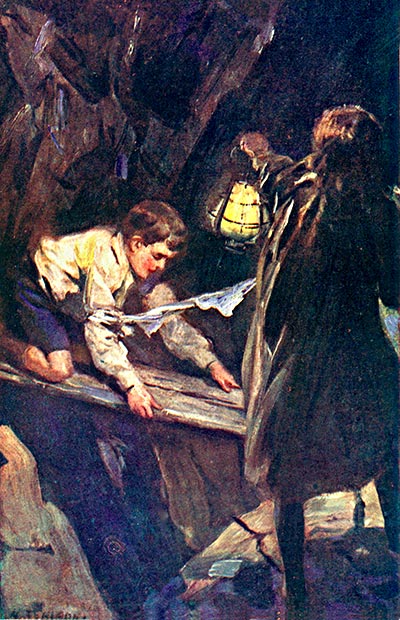 "BOBBY ACCOMPLISHED THE CROSSING IN SAFETY."
'Oh, no, no! We can't go back over that hateful plank again and sit
watching the water come up! I would rather be drowned here than there!
Oh, Father, Father! do come and find us!' And Bobby sat down upon the
ground with such a wail of despair that Peggy at last lost her
self-control and found herself joining in his sobs.
But she stopped suddenly, and laying a restraining hand on his shoulder,
put up her finger for silence, for it seemed to her that from the region
somewhere over their heads she had heard a distant shout.
'Call again, Bobby, like you did before!' And both together the children
joined their voices in a wild shriek of 'Father!'
This time there was an unmistakable shout of reply, and after what
seemed to them a long interval of calling they could hear Father's voice
from above quite plainly saying, 'Where are you?'
'In a cave down below!' cried Peggy, trying to make her voice carry in
the hollow atmosphere.
Now that help was near she was her brisk, capable self again, and,
seizing the lantern, searched round every foot of the cavern till she
discovered what seemed to be the beginning of a little staircase, long
since blocked by earth and stones.
'Here, Father! Dig for us here!' she called, and taking up a stone,
began to tap like she had heard of imprisoned miners doing in the
coal-pits.
There was silence for a few minutes, and then the children began to hear
the welcome sound of a pickaxe, and Father's voice every now and then,
shouting a word of encouragement to them. At length there was a rumbling
noise in the roof above, some loose stones and earth fell, and Father
called loudly:
'Stand back! Keep out of the way!'
Peggy clutched Bobby, and retreated into the passage, while a shower of
stones and soil came pouring down into the cave, till a great rent was
made in the roof, and Father dropped through the hole like Santa Claus
down the chimney, only no saint was ever so welcome, even at
Christmas-time.
It did not take very long for the children to be hauled up by Joe at the
top, and they found themselves standing among the Abbey ruins in the
early gray of the dawn, with Aunt Helen rushing to catch them in her
arms, and Lilian hugging them and sobbing over them by turns, while
Nancy, her face all blotched and swollen with crying, kept hovering
round to put in a kiss whenever the others gave her a chance, and even
old David cleared his throat hard, and 'blessed the Lord they were
safe.'
Very little was said until the children had been warmed and fed and
comforted by the dining-room fire, and then Mr. Vaughan would only allow
the briefest account of their adventures before they were put to bed to
sleep off the effects of their night of exposure. Nancy prophesied
quinsy and pleurisy and rheumatic fever, but the Vaughans were a hardy
race, and not even a cold resulted, in spite of her gloomy
prognostications.
Peggy's quiet talk with Father next day was so entirely between
themselves that I shall not repeat it; but it is often incidents, and
not years, which help us to grow up, and somehow afterwards she always
found herself dating events from that night in the cave, and all the
part 'when I was little' came before, and the older and more sensible
part seemed to follow afterwards.