Perhaps more than any other country in the world Germany
places reliance on municipal markets, because of the peculiar
pressure of the problem of the high cost of living in the cities
of the Fatherland. On several occasions, during the last twelve
months, the butchers' stalls have been raided by women in protest
against the ten per cent increase in one year on the price
of meat. And when, to meet the clamor, the government reduced
the hitherto prohibitive import duties on meat by one-half and
the inland railroad charges by one-third, it was on condition that
the meat brought in should be for delivery to municipal markets
or co-operative societies only. The result has been an immediate
fall in retail prices ranging up to fifty per cent.
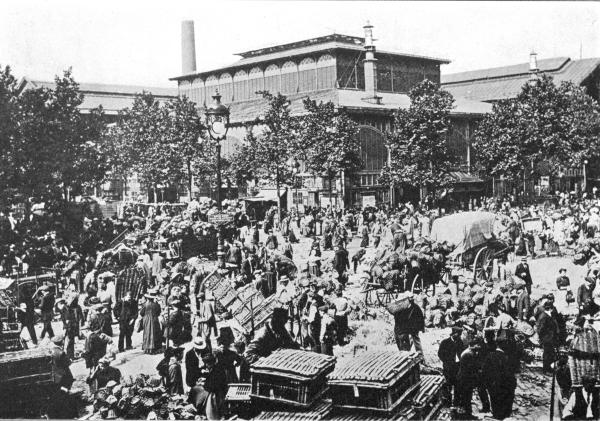
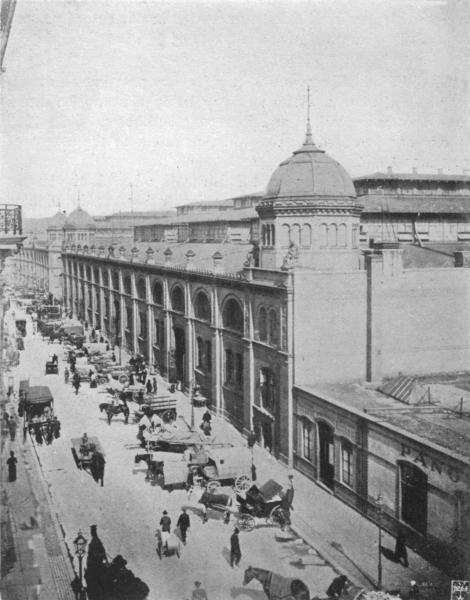 BERLIN'S TERMINAL MARKET
An Outside View of One Section of the $7,250,000 Central Market that
Caters for the Needs of Consumers in the German Capital.
Berlin's two million people since 1886 have had a splendid
terminal market on the Alexanderplatz, consisting of two great
adjoining halls, with direct access to the city railroad. One of
these halls is entirely wholesale, while the other is partly wholesale
and partly retail. Meat, fish, fruit and vegetables are dealt
with under the same roof by upwards of 2,000 producers and
dealers.
The whole market cost $7,250,000, of which $1,920,711 was
for the main market and $4,852,862 was for the slaughterhouses,
which are most elaborately equipped to ensure sanitation and
cleanliness. Great as the market is, the pressure of business has
grown so much that a project is on foot to construct more accommodation
at a cost of $15,000,000. The market is maintained
by stand rentals and administrative charges and by a fund
established for the improvement and extension of the system. On
the entire enterprise, when all charges have been met and interest
paid, there is a profit of over $135,000 a year.
A committee of eleven, partly city councillors and partly
selected representatives of the public, administer the markets
with ninety-three officials to ensure the carrying out of their
orders. The regulations are most elaborate, especially as regards
the inspection of foods, which is conducted by a department having
a staff of six hundred.
A healthy competition is created by the system of sales,
which may be conducted by the producer himself, or through
an approved wholesale dealer, or through one of the six municipal
sales commissioners. These municipal sales commissioners have to
give bonds on appointment and are not allowed to have any
interest in the trade of the market beyond a small percentage on
sales. Producers living at a distance can have their business
carried through by them under conditions so well understood
and respected as to ensure confidence. Though the municipal
sales commissioners handle less than a quarter of the sales, they
nevertheless act as a check on the private dealers, especially as
they issue a regular report on the average wholesale prices.
Moreover the purchasers benefit by these market arrangements,
for if they buy from a regularly authorized dealer they can file
a claim with the administration if the supplies delivered are faulty
and if their case is proved the account will be rectified.
About fifty railroad car loads can be handled at once at the
market, but when extended accommodation is provided it is intended
to deal with two hundred carloads simultaneously. On
supplies thus delivered a railroad tax is collected from the receivers
for maintaining rail connections, and this yields an annual
profit of $11,000.
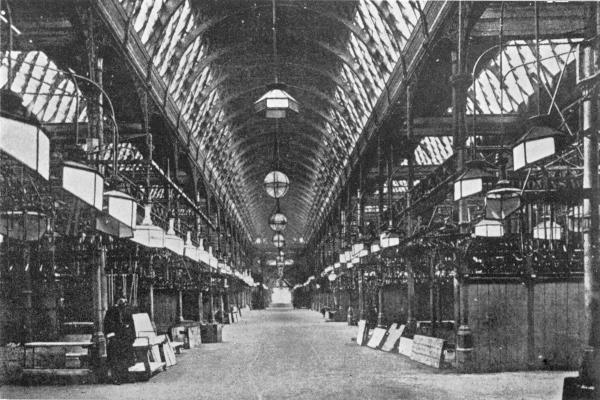
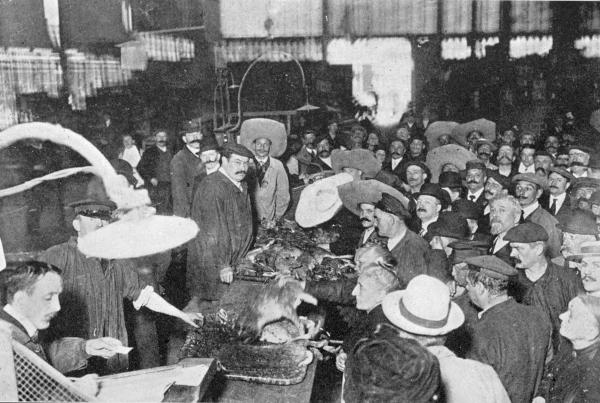
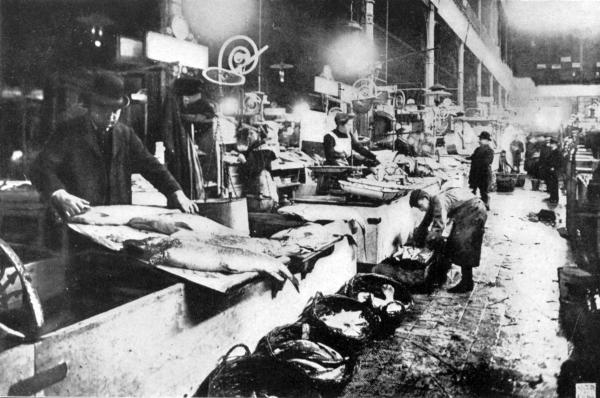 INTERIOR OF THE BERLIN CENTRAL MARKET
The Fish Section of the Great Municipal Market of the German Capital.
Of the stand holders, nine-tenths are monthly tenants, and
the remainder pay by the day. The highest charge is 9.5 cents
per square meter a day for meat stalls. The fish sold comes
mainly from Geestemunde, at the mouth of the Weser, and is
sold under the strictest conditions, only a small commission being
allowed to be added by the dealers.
The slaughterhouses deal with 800 wagons daily and for the
use of the butchers and the market generally 2,000 square meters
of distilled water are produced every day, valued at four cents
the square meter. Eight thousand pipes conduct the water to
every part of the market. To ensure cleanliness, bathrooms and
rooms for drying clothes are established for the use of the
butchers, who are charged two and a half cents a bath. In
inspecting the carcases the veterinaries take the most minute
precautions. From every animal four samples are taken, at
different parts of the body, and each of these samples is submitted
to tests for twenty minutes.
In an average year 14,000 carcases are condemned and destroyed,
as well as 400,000 diseased parts. Whenever possible
the inspectors cut away diseased portions, and the remainder
of the carcase, after being sterilized, is sent to the markets known
as the Freibank, for sale to the very poor. This proportion is
not so startling when it is considered that something like two
million animals are slaughtered every year, of which more than
half are pigs. Until recently Germany used to export a large
number of prime animals to the London market, but the demands
of home consumers now prevent this and the export trade has
practically ceased. In fact Germany, in common with the rest
of Europe, is now competing for the world's refrigerated supplies.
Storm doors and windbreaks are provided at the entrances
to the markets and wagons are only allowed inside at certain
hours and through specified doorways. Thus there is an absence
of dust, and a carefully arranged series of windows ensure ample
ventilation. All dealers have to unpack their stock at least once
every seven days, for the destruction of unsound articles. All
supplies of unripe fruit, horseflesh and artificial butter have to
carry labels disclosing their real nature. Attached to the market
is a hospital with skilled attendance, for cases of sickness or
injury happening on the market premises.
As in most other centers, the establishment of the market
led to the peddlers entering into outside competition. They
bought their supplies wholesale inside, and then offered them
cheaply outside, free from stand rentals and other charges. This
menace to the prosperity of the market grew so great that the
peddlers' traffic in adjacent streets was prohibited and strictly
limited elsewhere. This measure, in fact, is deemed essential in
every city where municipal markets are conducted successfully.
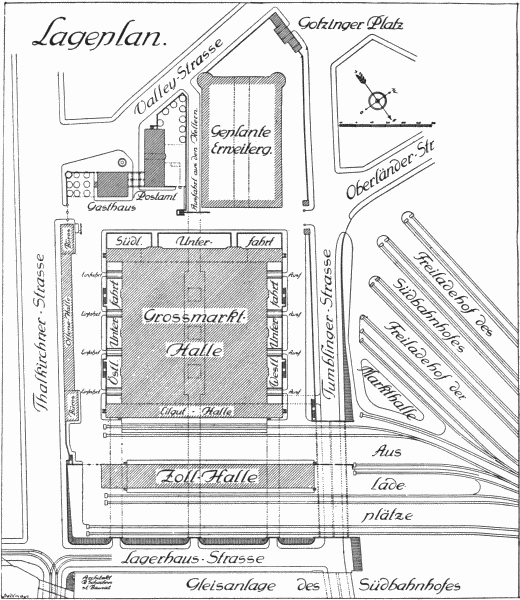 GROUND PLAN OF THE MUNICH MARKET
In front is seen the toll-house and receiving station, then the great
market hall and, in the upper part of the picture, the restaurant and
administration offices. The sidetracks on the right facilitate the rapid
distribution of produce sold at the market. Under the great market hall
are large refrigeration chambers connected directly with the railroad.
[Click on image for larger view.]
Cologne completed a million dollar market in 1904, with
a cold storage plant and connections with the state and narrow
gauge railways. Nearly half the space is taken up by wholesale
dealers in fruit and vegetables.
The chief fault of the market is the remoteness from the
center of the town. At first it had a great success but, on this
account, it has not been entirely maintained. Encouraged by that
initial prosperity, the city authorities bought a nearer site, but
the subsequent decrease in the market's popularity has caused
the postponement of extensions. Though the market does not
pay the five per cent on capital that is required, the present
administration, even with its drawbacks, does succeed in making
a profit of about three per cent on the capital invested, last year's
income amounting to $535,200.
Hamburg is peculiarly situated as to its market conditions.
The market halls of Hamburg and Altona adjoin, but while the
former is under the control of the Hamburg senate, the latter
is subject to the laws of the Prussian government and administered
by the Altona city authorities. Each has a large hall,
with a considerable portion of the space used for auctions. The
senate of Hamburg appoints two auctioneers and Altona one;
but, while the latter is a salaried official, the former are two
Hamburg auctioneers approved by the government for the special
market business, on undertaking not to trade on their own account.
The trade of the chief market is in fish. With the Altona
market, the Hamburg market and the Geestemunde market,
the sales in this section of Germany are the most important in
the Fatherland for fresh sea fish, and salted herrings. About a
fourth comes in fishing cutters or steam trawlers direct alongside
the market halls, while the remaining three-fourths come
from Denmark by rail or by ships from England, Scotland and
Norway. Often there are three or four special fish trains from
the north in a day, while twenty-five to thirty steamers bring the
regular supply of imported fish.
The auctioneers derive their revenue from a four per cent
charge on sales of the cargoes of German fishing vessels and
five per cent on imported supplies. Out of this they pay half
of one per cent to the government on the German and one per
cent on the foreign sales. No fees are charged to importers and
dealers using the auction section of the fish market. Out of the
percentage paid to the government by the auctioneers is provided
light and water, the cleansing of the halls and the carting away
of refuse for destruction. Strict regulations govern the inspection
of the fish and to ensure the destruction of those that have
deteriorated they are sprinkled with petroleum immediately on
detection.
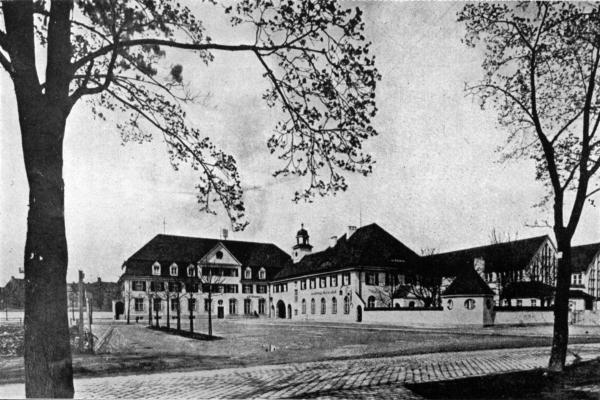 MUNICH TERMINAL MARKET
The World's Most Modern Distribution Center for Foodstuffs.
Steam fishing boats using the market quays pay 48 cents
for 24 hours' use, seagoing sailing cutters 24 cents, river sailing
cutters 6 cents, and small boats 3 cents, in which charges the
use of electric and other hoists is included.
From these markets almost the whole of Germany receives
its sea fish supplies, for the distribution of which most of the
leading dealers have branch houses in the principal cities.
There are also two markets—one in Hamburg and one in
Altona—for the sale of farm produce, mostly transported thither
by boats. Besides these, there is a big auction for imported fruit,
conducted by private firms. All these Hamburg markets are
prosperous, and their utility to the community is universally acknowledged.
Frankfort's market system dates back to 1879, when the
first hall was erected at a cost of $375,000. It has 548 stands
on the main floor renting at $1.08 per two square meters a month,
payable in advance, while there is space for 347 more in the
galleries at 84 cents per two square meters a month. Nearby
is a second hall, built in 1883 at a cost of $143,750. A third
hall followed in 1899 at a cost of $38,500, while in 1911 further
extensions were determined on and there are fresh projects now
under consideration. Besides these covered markets the city has
a paved and fenced square that has been used since 1907 as an
open market, where stands are rented at 5 cents a day.
Sixty per cent of the stands in the market halls are rented
by the month and forty per cent by the day. Tuesdays and Fridays
are reserved for wholesale trading. A market commission
rules the markets and the police enforce their regulations, the
violation of which is liable to cost the offender $7.20 in fines or
imprisonment up to eight days.
Munich, with a population of half a million, has the most
modern of all the European municipal markets. It was opened
in February, 1912, and embodies the improvements suggested by
experience of market administration in other cities.
The total cost was $797,000, of which $510,000 was spent
on four communicating iron market halls, with their cellar accommodation
underneath, $190,000 on a receiving and toll department,
$52,000 on a group of adjacent buildings, including a
post-office, restaurant and beer-garden, and $45,000 on roadways.
The whole establishment covers 46,500 square meters, of
which the market halls occupy 37,100 square meters.
At the northern extremity of the buildings is the toll and
receiving department, where produce is delivered at special sidings
connected with the south railway station of the city. Next
comes a succession of lofty halls, with covered connections, terminating
in a small retail section and the administration offices. At
the northern end of the great market is a section where express
delivery traffic is dealt with, while the western side is occupied
with sidings for loading produce sold to buyers from other German
centers.
Below the toll house and the market generally are vast cold
storage cellars and refrigerating plants for the preservation of
surplus supplies till the demand in the market above calls for
their delivery. Each market hall is devoted to a separate section
of produce, and the cellars below are correspondingly distinct,
so that there is an absence of confusion, orderliness is ensured,
and rapid deliveries facilitated. Across this underground space
from north to south run three roadways, while down the center,
from east to west, a further broad aisle is provided, with an
equipment of great hydraulic lifts. There are nine of these lifts
altogether for heavy consignments, while each stand-owner in
the market has, in addition, a small lift connecting his stand
and storage cellar.
Both market halls and underground cellars are so constructed
as to facilitate ventilation and complete cleanliness. The
floors are of concrete and every stand is fitted with running
water, with which all the fittings have to be scoured every day.
There is both roof and side light, and ample ventilation, while
the entrances are wind-screened, to prevent dust. Electric light
is used underground, and the cellars are inspected as strictly as
the upper halls, to ensure due attention to hygiene. In the center
of each market hall there are offices and writing rooms for
those using the markets. In the restaurant 150 can be served
with meals at one time, or they can be accommodated with seats
in the beer-garden.
Associated with this market establishment is a great cattle
market and range of slaughterhouses on a neighboring site. The
live cattle market dates back for centuries, but the present accommodation
was only completed in May, 1904, at a total cost
of $1,600,000.
Last year 809,508 animals were sold, including 432,159 swine
and 234,457 calves. In the slaughterhouses 713,228 of these were
killed, besides 2,619 horses and 97 dogs. About twenty-five per
cent of the animals reach the market by road from neighboring
farms, while seventy-five per cent come by rail. For the inspection
of all flesh foods there are very strict rules, enforced
by the chief veterinary surgeon, Dr. Müller, and a staff of specially
trained assistants. As in Berlin, extensive bathrooms are
provided for the slaughterhouse staff, and baths are available at
nominal charges. Though the new market halls have not been
established long enough to provide a definite financial statement,
the live-cattle market and slaughterhouses do afford an indication
of the success of municipal administration in Munich. Last
year the income was $416,500 and the expenditure $410,100, thus
showing a profit of $6,400. The new produce halls are certainly
the best equipped in the world, and the only element of doubt as
to their success arises from the fact that three old-fashioned open
markets are nearer the center of the city and for that reason are
even now preferred by many retailers. This fact emphasises the
importance of selecting a central position in establishing a municipal
terminal market.