Ted landed in our midst with all the attendant violence of a meteor. He
didn’t arrive, he landed, bag and baggage, and until his departure weeks
later our tranquil existence was sufficiently hectic to suit even Bill.
After numerous letters from his doting aunt, we reluctantly consented to
look after Ted while she was in Europe recuperating from a nervous
break-down. At the end of the first week, we understood why Aunt Elizabeth
found recuperation necessary, and I suggested to Owen, it might be well to
engage our passage on a later steamer, for I had a premonition that my own
nerves might require a rest after two months of Ted’s strenuous
companionship.
He wasn’t bad; there was not a bad thing about him. He was just
overflowing with youth and energy, which had been pent up for years,
between boarding school in the winter and Newport in the summer.
Motherless, fatherless, rich, neglected or over-indulged by a none too
wise aunt, Ted was an appealing young person, a character easily to be
made or marred by circumstances.
He looked like a member of the celestial choir—blue-eyed, fair-haired and
mild—but he produced the effect of a Kansas cyclone.
There was nothing he did not see, there was nothing he did not hear and
there was nothing he did not do. Even on eighty thousand acres of land his
activities were somewhat limited.
He was wildly enthusiastic about the West, fascinated by the men, and was
Bill’s shadow, so we promptly turned him over to those “rough persons”
Aunt Elizabeth had especially hoped that he might avoid, to get it all out
of his system.
“Let him stay at the bunk-house,” Owen advised after Ted had besought me
to allow him to stay with the men. “It will do him more good than anything
else in the world, if he has the right stuff in him.”
Ted stood on the porch, uneasily shifting from one foot to the other, when
I came out of the office.
“All right, Ted, Mr. Brook and I are perfectly willing for you to stay
with the men, if you really want to.”
He hopped up and down and almost embraced me in his joy.
“Oh, thank you, Mrs. Brook. You see,” he explained, carefully, “I’ve seen
people like you and Mr. Brook all my life, but I never had the chance to
be with real cow-punchers before.” Evidently, from Ted’s point of view,
Owen and I were very commonplace individuals compared to these heroes of
the prairie, and I laughed to myself as he bounded down the steps to break
the joyful news to Bill that he was to share his bed and board.
The next day we had to go to town to meet some prospective wool buyers,
and, after having his breakfast interrupted five different times by Ted’s
dashing in to see if we were ready, Owen was moved to inquire finally,
“What on earth is on the boy’s mind now?”
“His outfit,” I answered. “He’s been planning it for days; wishes to
select it himself and we are not to see it until we get home.”
That was a wise stipulation of Ted’s, for if we had seen it, we should
never have been able to get home.
He put it on as soon as we reached the ranch, and when he finally emerged,
the flaming sunset paled with chagrin at its futile effort of years.
The “outfit” consisted of tan corduroy trousers, chaps of long silky
angora wool, which had been dyed a brilliant orange, a shirt of vivid
green, a bright red silk handkerchief for his neck, an enormous Stetson
hat, high-heeled tan boots, silver studded belt and huge spurs.
We gasped when we saw him, but he was so intent on showing himself to
Bill, as to be utterly unconscious of the effect he produced.
We followed him into the yard where the boys were waiting the call to
supper. Bill looked up from the quirt he was braiding and blinked.
“Gosh! I thought the sun had set an hour ago,” he remarked.
“No,” Ted laughingly responded, giving him a push, “but he’s going to
‘set’ now,” and he threw himself down by Bill’s side. “I knew you fellows
would guy me, but all the same I think this outfit’s great,” and he
surveyed himself with infinite pride and satisfaction.
“It’s all right,” said Bill, taking in all the details of the resplendent
costume, and looking up at Owen and me with twinkling eyes, “I like
somethin’ a little gay myself; but round here where everything’s green, we
won’t be able to tell you from a bunch of soap-weed,” and Ted good
naturedly joined in the laugh at his own expense.
“Wouldn’t his Aunt Elizabeth die of heart-failure if she could see him
now?” I asked Owen as we went into the house.
“She certainly would,” he answered, “but we’ll trust to luck and let
Nature take its course.”
Everything, including Nature, took its course rapidly with Ted, and for
the next few weeks wise prairie dogs, rabbits and rattle-snakes stayed in
their holes. By the end of his stay that energetic young person had enough
rattle-snake skins to provide belts and hat-bands for all of New York, and
scores of live prairie-dogs he had trapped to be shipped to his aunt’s
place in Newport.
I tried to picture the joy of Aunt Elizabeth and her neighbors when they
found informal prairie-dog towns in the midst of their formal gardens. If
life is measured by experiences, a few additional years were in store for
Newport.
Bill taught Ted to shoot and he spent hours and a fortune shooting at old
tin cans on a post before Bill finally consented to say:
“I’ve saw fellers do worse,” the sweetest praise that ever fell on mortal
ears, judging by Ted’s expression.
And, then, Owen went to New Mexico to buy some sheep and Bohm came to
sleep on a claim.
This claim was one over which Owen and Bohm had been having a controversy
for months. It had been included in the sale of the ranch, and after one
of our most important sheep camps had been built upon it, Owen discovered
that Bohm could not give a deed to it, as he had not made final proof on
the land.
Bohm never ceased to regret having sold the ranch, and had never forgiven
Owen for buying it and making him live up to his contract, so was only too
glad of the opportunity to cause him all the trouble possible. Time after
time he promised to come out and “prove up”, but he never came, so
although I was most anxious to have him come, I was far from pleased to
have him about when Owen was away.
Ted, however, was overjoyed; he seemed to feel that Providence had
arranged Bohm’s visit to the ranch for his especial entertainment, and
from the moment the old chap arrived Ted dogged his footsteps.
At first, old Bohm seemed quite flattered and laughed and joked with him,
praised his shooting, told him stories of the Indian days, promised to
show him the underground passage to an abandoned stage station, but later
he became annoyed, for no clinging burr ever clung more closely than Ted.
He scarcely allowed Bohm to get out of his sight for one moment.
How much the boy had heard of old Bohm’s history I did not know, but I
concluded a few rumors had reached those ever-attentive ears, for one day
he came in fairly beaming.
“Gosh! Pudge and Soapy haven’t got anything on me, they’ve only seen
Buffalo Bill in a show, and I’m right in the same house with a man that’s
a holy terror!”
“What do you mean, Ted?” I asked, anxious to find out how much he had
heard.
“Oh, you know well enough, Mrs. Brook,” he laughed, going to the door as
he saw old Bohm on his way to the barn. “You can’t fool me. Gee! I
wouldn’t have missed him for the world. The fellows’ll just be sick when I
tell them.”
“The fellows” were evidently “Pudge” and “Soapy”, his two chums at St.
Paul’s, “Pudge” because of “his shape,” as Ted explained, and “Soapy”,
whose parental millions came from the manufacturing of soap.
The game between the boy and Bohm was amusing. Clever as the old chap was,
he couldn’t evade Ted’s watchful eye. If Bohm thought him miles away, he
suddenly appeared with such an unconscious air of innocence he disarmed
all suspicion, but he made Bohm uneasy.
“Quit campin’ on the old man’s trail, Kid,” said Bill one evening at the
corral after Ted had driven Bohm to the bunk-house to escape his
questions. “You’re gettin’ on his nerves; let him go and sleep on his
claim and get through with it. You and me’s got to hunt horses tomorrow,
anyways.”
Ted cheerfully acquiesced, and old Bohm loaded his wagon alone and drove
toward his claim in peace.
The next morning very early, I heard Bill calling Ted. No Ted appeared,
and I went out to see where he was.
“Where do you reckon that crazy kid’s went now?” demanded Bill, impatient
to start.
“I’m sure I don’t know, Bill, hunting prairie-dogs, probably. Don’t wait
for him, if you’re ready to go.”
“Huntin’ prairie-dogs,” echoed Bill. “I’ll bet a hat he’s huntin’ old Bohm
somewheres.” He frowned as he cinched up his saddle. “I reckon I’d better
ride over that way and see what he’s up to.”
“I wish you would,” I said, vaguely uneasy. “I don’t want him to bother
Bohm too much.”
“Me neither,” said Bill, getting on his horse, “there’s his pony’s tracks
now,” he looked at the ground. “I’ll find him and take him along with me.
Don’t you worry, he’s all right, but he sure is a corker—that kid,” and
Bill galloped off.
I felt confident that he would overtake the lad, so I dismissed them all
from my mind and settled down to an uninterrupted morning, and a delayed
postal report.
I was busy all day and was just starting out for a little walk before
supper when Bill and Ted rode up.
Bill and Ted, hatless, clothes torn and covered with dirt and blood, their
faces scratched and bruised, and Ted regarding me triumphantly from one
half-closed eye, the other being swollen shut.
“What on earth hap—” I tried to ask, my breath fairly taken away. Bill got
off his horse and came up to the gate.
“We’re all right, Mrs. Brook. I’m sorry you seen us ’fore we got fixed up
a little; we just got mixed up some with Bohm—that’s all—’taint nothin’
serious. We look a whole lot worse than we feel, don’t we Ted?”
“You bet we do,” mumbled Ted from a cut and bleeding mouth, “but you ought
to see Bohm, he’s a sight!”
Ted got off his horse with difficulty. “Gosh, it was great,” he said,
leaning up against the fence for support.
“Come in and sit down, both of you, Charley will take your horses,” and I
led the way into the house followed a little unsteadily by Bill and Ted,
who collapsed on the first chairs they could reach.
I gave them some wine, washed off their blood-stained faces, and made
protesting Ted go into my room and lie down. He was very pale, and I saw
that he was faint.
I came back into the kitchen.
“Now, Bill, tell me about it. What happened and where is Bohm?”
“On his way back to Denver in the baggage car,” announced Bill, draining
the last drop from the glass he still held in his hand.
I started, “Oh, Bill, you didn’t kill him?”
“No, but I wisht I had,” he said calmly. “He’d oughter be dead, the old
skunk, trying to poison all them sheep.”
“Poison the sheep; what sheep?”
“Your sheep,” Bill’s brows contracted as he looked at me. “Your sheep,” he
repeated, his voice rising as I scarcely seemed able to grasp his meaning.
“All the sheep at Hay Gulch Camp, that’s what he came out here for, and
he’d a done it, too, if it hadn’t been for that kid in there.” Bill jerked
his head in the direction of my room.
“Ted?” I asked, my emotion stifling my voice.
“Ted,” Bill affirmed, “he caught him at it red-handed, and probably saved
two thousand sheep from bein’ dead this minute.”
“How on earth did he find out?”
Bill straightened up in his chair.
“Them eyes of his’n don’t miss much, I’m here to tell you, and his
everlastin’ snoopin’ around done some good after all.” Bill’s eyes glowed
with pride. “Yesterday, before Bohm left, Ted come across him mixin’ a lot
of stuff with some grain, and, of course, had to know all about it. The
old man finally told him he was fixin’ to poison the prairie-dogs on his
claim, bit he was so peevish about it, Ted said he didn’t believe him, and
mistrusted somethin’ was wrong.
“The kid didn’t say nothin’ to me about it; had some fool notion about
playin’ detective, I reckon, at any rate he got up along about four
o’clock and rode out to Bohm’s claim to do a little reconorterin’.”
Bill reluctantly put the glass down and tipped back in his chair. “He hid
his horse in the gulch and crope up in the grass like an Injin. The herder
wasn’t nowhere in sight and the sheep was still in the corral, but old
Bohm was there all right, fixin’ little piles of that poisoned wheat just
where the sheep would come acrost it the first thing.”
“Oh, Bill, that’s the worst thing I ever heard!” I was sick at the mere
thought.
Bill was too engrossed to pay attention to the interruption.
“Ted said he was comin’ back to tell me, but he got so excited when he
seen what Bohm was up to, he never thought of nothin’ but stoppin’ him.
The old man was stoopin’ over with his back to Ted, and the kid gave a
yell for the herder and ran for Bohm and before he could straighten up Ted
was on top of him.”
Bill scarcely paused for breath—“the old man reached for his gun, but Ted
was too quick for him and knocked it out of his hand, and when I came up,
there they was rollin’ all over the prairie, first one on top and then the
other.”
Bill looked toward the door of my room, reflectively—“I kinder felt there
was somethin’ wrong when I left here, and believe me, I didn’t spare my
cayuse none gettin’ there neither, and I didn’t get there none too soon.”
I was incapable of speech. I just stared at Bill.
“There ain’t no doubt about Bohm’s bein’ ready to kill him; he was on top
then and reachin’ for his throat. I didn’t stop to ask no questions. I
jest grabbed him, and pulled him off of Ted. He was white as chalk and
ready to eat us both alive, but I hung on to him while Ted got up cryin’,
‘Look what he’s done, Bill, look what he’s done,’ and pointed at somethin’
on the ground.”
Bill’s eyes were like two live coals. “Bohm was cussin’ like a steam
engine ’bout the kid’s jumpin’ him when he was puttin’ out poison for the
prairie-dogs. I just took one look around and seen all them piles of
poison wheat there by the corral when there wasn’t a prairie-dog within
two miles. I—well, I aint goin’ to tell you what I said, Mrs. Brook,
’taint fit for you to hear.”
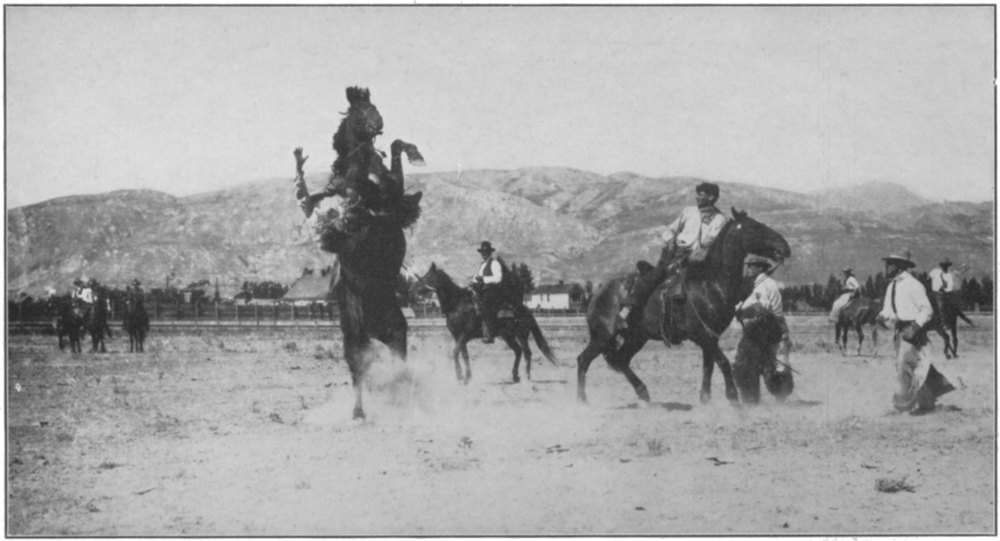
FACING DEATH EACH TIME THEY RIDE A NEW HORSE.
Bill looked down and turned the glass on the table around and around. He
looked up again and smiled, but his brows contracted as he went on—“We had
words then, sure enough. All of a sudden Bohm made a lunge and caught the
handkerchief round my neck with one hand and reached for somethin’ with
the other, and the first thing I knew he was slashin’ at me with a pocket
knife. I guess I saw red then, ’cause I knocked him down and nearly
pounded the life out of him.”
Bill stopped a moment—“His eyes was rollin’ back in his head and his
tongue was hangin’ out and there was a pool of blood ’round us, three
yards across.” Bill’s description was so vivid I shut my eyes. “I reckon
I’d killed him if Ted hadn’t tromped my legs and kinda brought me to
myself. He’d oughter been killed, but I let him up then and told Ted to go
for my rope. We tied his hands and legs. I guess he had about all he
wanted for he wasn’t strugglin’ much.” Bill smiled grimly. “We carried him
into the cabin, and there was the Mexican lying in his bunk—doped. We knew
who done it all right, and I tell you we didn’t handle Bohm like no
suckin’ infant when we laid him down, neither.”
Bill’s face was stern and set and I shared his indignation too much to
trust myself to speak.
“We left him there and went to get the wheat out of the way before we
opened the corral gates for the sheep. Thanks to Ted, Bohm hadn’t had time
to put much around. He’s a great little kid, that boy.” Bill’s voice
broke.
“Bless his heart,” I said, my own heart filled with gratitude and
tenderness for the plucky little chap in the other room. Bill’s eyes were
moist, but his voice was steady again.
“Steve and Charley came up just then with the supply wagon, so Steve set
Charley to herd the sheep. We loaded Bohm into the wagon and Steve took
him over to the railroad. He said he’d see he got on the train all right.”
Bill grinned, “You’re rid of Bohm for good now, Mrs. Brook, for I kinda
think he gathered from what me and Steve said the ranch wouldn’t be no
health resort for him if he ever showed his ugly face round here again.”
“Oh, Bill, I’m so thankful; it makes me sick when I think what might have
happened.”
“Don’t thank me, Mrs. Brook, I ain’t done nothin’.” Bill’s face was red
with embarrassment as he stood up. “Ted’s the one to thank, he’s some kid,
believe me,” and Bill’s eyes were very tender.
“Let’s go in and see how he’s making it.” Bill followed me into the room.
Ted was sitting up on the couch, regarding his battered visage in my
hand-glass with the greatest interest. I could see at once he was in no
mood for emotion or petting.
“Hello, I’m all right,” he murmured with a one-sided grin. “Say, Bill,
wasn’t it great? I wouldn’t have missed it for a million dollars.”
He sank back with a sigh of supreme satisfaction. “I just wish I could
remember all the things he called me. I want to spring them on the fellows
when I go back.”
Bill looked at him with genuine concern. “See here, kid,” he said
decidedly, “you want to forget all them things as quick as you can. Don’t
you go springin’ any such language back where you come from. I’m no
innocent babe myself, but I’m here to tell you old Bohm’s cussin’ made
anything I ever heard sound like a Sunday School piece. You forget it now,
pronto,” he commanded as he went out of the door. “It’s a reflection on me
and Mrs. Brook.”
After Bill had gone, Ted looked at himself again, then at me. “What do you
suppose Aunt Elizabeth would say if she could see me now?” We both
laughed.
“I would be a ‘disgrace to my family and position’ now, sure enough.” He
felt his blackened eye tenderly.
I sat down on the couch beside him. “You will never be more of a credit to
your family than you are at this minute, Ted, nor more of a man.”
He looked up, for my voice shook a little. He knew what I meant and his
lips twitched as he patted my hand gently, and turned his face away.