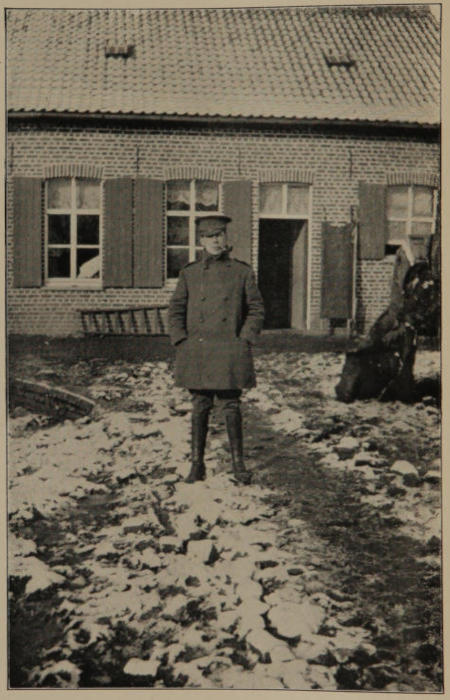
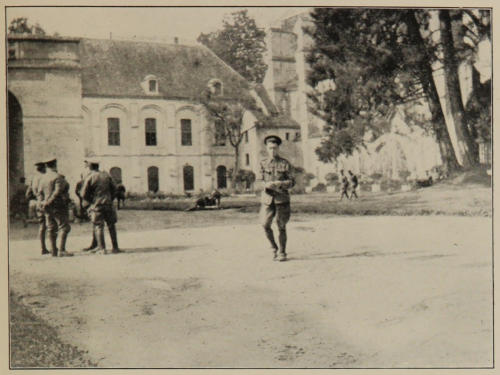
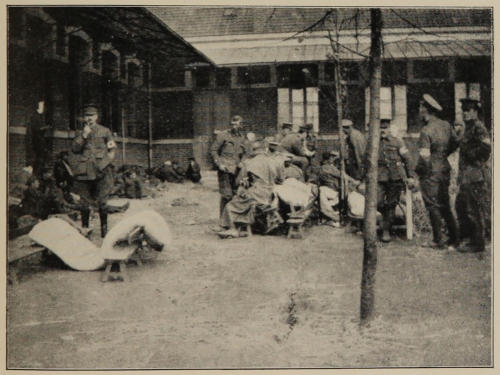
The Author outside ambulance headquarters at Ouderdom.
A
SURGEON IN KHAKI
BY
ARTHUR ANDERSON MARTIN M.D., Ch.B., F.R.C.S.Ed. SENIOR SURGEON, PALMERSTON NORTH HOSPITAL, NEW ZEALAND
LATE FIELD AMBULANCE, 5TH DIVISION, 2ND ARMY
LATE SURGICAL SPECIALIST, NO. 6 GENERAL HOSPITAL, ROUEN, FRANCE
BRITISH EXPEDITIONARY FORCE
LATE CIVIL SURGEON, SOUTH AFRICAN FIELD FORCE, 1901
WITH ILLUSTRATIONS
NEW YORK:
LONGMANS, GREEN & CO.
LONDON: EDWARD ARNOLD
1915
[All rights reserved]
Printed in Great Britain
PREFACE.
In the following pages an attempt is made to record,
however imperfectly, some of the scenes, and the impressions
formed, during those great days of 1914
when our army was fighting so stubbornly and against
such odds in France and Flanders.
The notes in many instances are disconnected, but
the things seen presented themselves in a disconnected
way, and if they are not all beautifully dovetailed one
into another, they are at least given forth somewhat in
the way in which I viewed and received them myself.
During the actual progress of this war, and when
the war is happily over, much literature bearing on
the great struggle will be produced, but I venture to
think that of the personal narrative and the personal
impression one cannot have too much.
The narrative includes my experiences at Le Havre,
Harfleur, and the battle of the Marne, the march to the
Aisne, the wait on the Aisne, the move across France
to the new lines behind La Bassée, and the final move
to Flanders not far from Ypres.
A SURGEON IN KHAKI. — CHAPTER I. FROM PEACE TO WAR. Early 1914.
In April 1914 I left my practice in New Zealand for a
short tour through the American, British, and Continental
surgical clinics.
After having visited all the important clinics in
the United States—the famous Mayos of Rochester,
Murphy’s at Chicago, Cushing’s at Boston, and others
at Cleveland, Baltimore, and Philadelphia, I finally
arrived at New York.
When visiting the clinic at the German hospital at
Philadelphia, I, with other visiting surgeons, principally
Americans or German-Americans, was invited to tea
and cake, or cake and beer, in the reception-room of
the hospital.
As the day was very hot we all drank iced German
lager beer, and, when leaving the room, were presented
with a gilt “wish-bones” holding ribbons of the German
national colours.
All of the American and German-American doctors
wore the ribbons on their coats, but I put mine in my
pocket as a curio. I did not wish to be thought to
have German sympathies, although I had drunk their
lager beer. In New Zealand the Germans have never
been appreciated as they have been in England. Perhaps
the air of the Pacific gives one a truer perspective
of some things as they are.
At New York I delayed sailing two days, in order to
avoid a German boat, and reached England by the
Holland-American boat Rotterdam in July. We had on
board the Rotterdam a very large number of Germans,
and as usual they were chiefly noticeable for their great
prowess at meals, and for their noisy method of eating.
They drank much “good German beer” and filled the
rooms with German smoke and German gutturals.
They are not attractive fellow-travellers.
On arriving in England I proceeded to Aberdeen,
where the annual meeting of the British Medical
Association was being held, and to which I was a
delegate.
At Aberdeen we had a very large number of foreign
representative surgeons and physicians and men from
nearly every part of the world. As usual there were
many Germans and a few Austrians.
We were struck by a very curious incident towards
the end of the meeting—last day of July. The president
of the Association, Sir Alexander Ogston, gave a
reception to all the delegates from the British kindred
and affiliated associations, and to the foreign representatives.
Although the German and Austrian delegates
had been about in the morning, not one was present
at the evening reception. They had all departed
silently, and had said good-bye to no one.
Germany and Austria had sent out their messages,
and the medicals returned with all speed.
We were then on the eve of war, but none of us at
Aberdeen thought that we would be in it, or that we
were then rushing swiftly to great events.
The Austrian note to Serbia was being discussed.
Germany’s action was doubtful. Russia plainly said
that she would not stand by and tamely see Serbian
Slavs humiliated by their powerful neighbours. In
spite of the cloudiness of the political atmosphere and
the slight oppressiveness none really expected lightning
and thunder, or that any spirit would
In these confines with a monarch’s voice
Cry Havoc! and let slip the dogs of war.
On the 3rd August Sir Edward Grey, in the
House of Commons, in a serious speech, reviewed the
European situation. With convincing eloquence he
showed how anxiously he had striven to maintain
peace, and exactly defined England’s attitude in certain
possible contingencies.
The excitement all over the country was tremendous.
The air was electrical with coming events, a spark would
set the firmament ablaze. One could almost see the
peoples of Russia, Germany, Austria, France, Belgium
and Serbia gaze questioningly, anxiously, across the
Channel at the Island Kingdom, and wondering in that
tense moment, What would England do?
Then flaring headlines in the press told that Liége,
the great eastern fortress and arsenal of Belgium, had
been furiously bombarded by the German artillery,
and that Bethmann-Hollweg, the German Chancellor,
had declared that a solemn treaty guaranteeing the
neutrality of Belgium was of no more value than a scrap
of paper.
Then England declared war against Germany, and
on the 4th of August we knew that England was to take
her place in the titanic world-war and step into the all-engulfing
struggle.
So here it was at last. War with Germany! The
restrained hostility of years was now no longer concealed,
the long-pent-up passions were now let loose. Men
seemed to breathe easier, and an air of relief pervaded
the country.
England was like a sick man after a consultation
with the surgeons. He looks eagerly and anxiously
at the surgeons, hoping that no operation may be
necessary, but dreading and expecting that it may.
Once told by them that an operation is necessary
in order that he may live, his doubts and hesitation
disappear, and he agrees to submit and to undergo the
drastic measures and emerge a strong and whole man.
There is a relief that he has decided and the mind
becomes tranquil.
The gravity of the issue was realised in England
in those early August days. Those entitled to speak
with authority pronounced that the war would be a big
war—the greatest since the beginning of time—and
that the men and women of our day and generation
would have to pass through sorrow and tribulation
and wade through dark and troubled waters before the
end would be finally achieved.
The justness of England’s quarrel was everywhere
acknowledged, except in the land of the enemy, and the
exposure of the tortuous and insidious German diplomacy
stirred up the English sense of straight dealing and
fairplay.
On 6th August I motored down from the Highlands
to Edinburgh, through the Pass of Killiecrankie and some
of the loveliest scenery in Scotland.
Everywhere were signs of mobilisation. Khaki
soldiers and “mufti” recruits at every dépôt and around
recruiting sergeants. The price of petrol had suddenly
risen—why, nobody quite knew, but somebody was
making money out of it, we were sure. At one town
I paid ten shillings for a two-gallon tin.
In the evening I reached Queensferry, but was not
allowed to cross at that hour. As the ferry would not
be going again till next morning I motored back to
Dunfermline, and having stopped the night there, returned
early in the morning to the Ferry. This time I
got across with my car. The Firth of Forth presented
a very busy scene that morning. Torpedo boats and
naval craft of all sorts and sizes were dashing about,
and in the distance were the large dark outlines of big
ships of war.
From Queensferry a rapid run brought me to Edinburgh,
where the whole talk in hotel smoking-rooms, at
table, and on the street, was of war. The kilted soldier
was looked at with more interest as he walked the streets,
and appeals were placarded on every prominent place
for new recruits.
The morning papers announced that the House of
Commons had passed a war vote of one hundred million
pounds, and that Kitchener had asked for five hundred
thousand men to join the army.
The Cabinet, like a good physician, was giving the
nation its medicine in small doses during these early days.
Doctors will tell you that small doses frequently repeated
are so much better than a big dose taken at one wry
mouthful, for a big heroic dose taken at one gulp often
causes nausea. The hundred million pounds and the
five hundred thousand men made the first teaspoonful
of the national physic which was to help get rid of
the fatty degeneration and change our sleeping, sluggish
strength into the crouch and spring and hit of the prize
fighter.
Next day I took train for London in order to offer
my medical service to the War Office. There was an
urgent demand for surgeons to volunteer for active
service, and at this particular juncture good surgeons
who were free to go were not very plentiful. As I
was on a tour of surgical clinics at this time I decided to
do my bit for the country and the men in the field.
Having nothing to do when I reached London that
evening, I strolled into a music hall and heard “God
Save the King,” “Rule, Britannia,” the “Marseillaise,”
the Russian, Belgian, and Serbian national hymns—all
blared out to cheering and shouting crowds, who seemed
to thoroughly enjoy “being at war.” It was reminiscent
of the days of the Boer War in 1899:
“‘Alea jacta est’—The die is cast.”
Early next day I visited the Medical Department of
the War Office at Whitehall, and volunteered as a
surgeon with the Expeditionary Army to France. Two
days afterwards the War Office sent me a note requesting
me to call at the office and be examined to see if I was
physically fit. So I did. The physical examination was
carried out with amazing celerity, and I was handed on
as “fit.” The genial old army doctor appointed for
this duty of examining his younger colleagues made
his diagnosis on sight almost, and toyed easily with his
stethoscope while he inquired about the state of the
teeth and the digestion.
I was then ushered into another office and was duly
appointed a Temporary Lieutenant in the Royal Army
Medical Corps.
All the civilian surgeons accepted for service with the
army—with the exception of a few consulting surgeons—were
given the rank of Temporary Lieutenant.
Seniority or special skill or previous war experience
mattered nothing. I had already served as a Civil
Surgeon, attached to the Royal Army Medical Corps
during the South African War, and had a medal and four
clasps from that campaign, and since that period had
been surgeon to an important hospital in New Zealand,
and was a retired Captain in the New Zealand Medical
Corps. That, however, did not entitle me to hold any
higher rank than the young medical man who had completed
his medical training only a week ago. Many
able medical men all over the country had voluntarily
left lucrative practices and important surgical and
medical staff appointments in big London and provincial
hospitals and were enrolled as Lieutenants in the Royal
Army Medical Corps, on the same footing as junior
medical men who had perhaps been their pupils but a
few weeks before. We all ranked below the regular
officers of the Royal Army Medical Corps. Volunteers
for combatant commissions who had had previous
experience were given rank accordingly. Some discrimination
was made in the combatant arm, and rightly
so. No discrimination was made in the medical service,
and undoubtedly that was a mistake. The same lack
of organised control was exhibited at every turn in the
medical service. Men with imperfect professional skill
and experience were given duties which should have been
entrusted only to men fully possessed of those qualifications.
This criticism is not merely a destructive one.
Criticism is absolutely necessary at certain times, and
there are some mistakes in policy which should be freely
ventilated. This same policy was pursued by the Army
Medical Department during the South African War,
and was very openly discussed. This led to drastic
changes in the organisation of the Royal Army Medical
Corps, following on the Commission of Inquiry set up
by Mr. Brodrick (now Lord Midleton). In this war,
I regret to say, the old leaven has again appeared,
and its re-appearance has aroused considerable comment
and been a cause of inefficiency.
After having been given my commission I was told
to procure a uniform—Sam Browne belt, a revolver,
blankets, and other campaigning kit—and to be prepared
to move in forty-eight hours. With great difficulty I
managed to get some sort of equipment together. The
military tailors were working at high pressure, and when
asked to make a coat or breeches in a certain time
simply said, “It can’t be done.” By skilful diplomacy
I got a coat in one place, a pair of riding breeches in
another, puttees at another, leggings elsewhere, and so
on. One could not then obtain khaki shirts or ties in
London. I did not get a revolver, although this was
on the list of things necessary. Neither did I purchase
a sword. Why a medical officer should be asked to
carry a sword and a revolver, and at the same time
wear a Red Cross brassard on the left arm, I am at a loss
to understand. I have asked many senior medical
officers of what use a revolver and sword were to a doctor
on active service, and the only reply I could get was that
they were useful to defend the wounded. It would have
been much more sensible for the War Office to tell each
medical officer to get several pairs of rubber gloves for
dressings and operations. I sometimes wondered if the
War Office expected the surgeons to perform amputations
with a sword. However, I did not get a revolver,
and I did not get a sword. Later on, in France, I have
seen mild-looking young surgeons arrive at the front
armed to the teeth, with swords, revolvers and ammunition,
clanking spurs, map cases, field-glasses and compasses
strung all round them, and on their left arm the
brassard with the Red Cross. We called them “Christmas
trees.”
At last my equipment was complete, and I
received orders to go to Aldershot and report to the
Assistant Director of Medical Services for duty.
I was now a “Surgeon in Khaki” and part of that
great military hammer—the British Expeditionary
Force.
When I arrived at Aldershot the town seemed
deserted. The majority of the big barracks were empty.
We were told that the British Army had just left for the
Continent, and that the Aldershot command, under
General Haig, had gone to a man. Aldershot was rapidly
preparing to receive and train recruits, mobilise reinforcements,
and keep up a steady flow of men to replace
casualties. This was great news. When we left London
we did not know that the British Expeditionary Army
had gone.
The A.D.M.S. (Assistant Director of Medical Services)
put me on duty at the Cambridge Military Hospital at
Aldershot, while awaiting orders for the front. Several
surgeons awaiting orders were already here, and we all
billeted at the Victoria Hotel. We were soon at work
examining and passing recruits, inoculating troops
against typhoid, and vaccinating all who had no conscientious
objections. Some had “conscientious”
objections to inoculation. Soldiers should not be
allowed liberty of conscience in these matters. They
should be made immune against typhoid and smallpox
at “the word of command” in spite of the screechings
of fanatics suffering from distorted cerebration.
Our duty at the recruiting dépôts was a very amusing
one. We here came in contact with the first
hopefuls of Kitchener’s new army. The first call to
arms generally brings in a very motley crowd. The
best of the recruits do not turn up during the first few
days, as these have generally some domestic or business
matters to arrange. It was the “First Footers” we got
in these days at Aldershot.
Another medical officer and myself took over one
dépôt. We arrived at 8.30 a.m. Standing in a straggling
two-deep line before the dépôt door were about
three hundred men of the most variegated texture—some
lean, some fat, some smart, some unkempt, but
all looking very cheerful and hopeful. A smart R.A.M.C.
sergeant is waiting at the door with a list of their names.
It is our duty to examine physically this first batch of
three hundred, to see if they are fit enough to train to
fight Germans. Ten men are marched into the dépôt.
Each doctor takes five at a time. At the word of
command they strip and the doctor begins. He casts
a professional eye rapidly over the nude recruit. A
general look like this to a trained eye conveys a lot.
The chest is examined, tongue, mouth, and teeth looked
at. The usual sites for rupture are examined. About
three questions are asked: “Any previous illness?”
“Age?” “Previous occupation?” A mark is placed
against the name, the nude Briton is told to clothe
himself, and the examination is over. It is done at
express speed, and although the examination is not
very thorough it is sufficient to enable an experienced
man to detect most physical defects. If a man passed,
he was put down for foreign service. Some had slight
defects and were put down for home defence. Some
had glaring defects and were turned down altogether.
We had all sorts of derelicts turn up. One weary-looking
veteran, unwashed and with straw sticking in his hair,
indicative of a bed in a haystack the previous night,
was blind in one eye and very lame. A draper’s
assistant from a London shop had a twisted spine, an
old soldier had syphilitic ulcers on the legs, some had
bad hearts from excessive smoking, some bad kidneys
from excessive drinking, some young men were really
sexagenarians from hard living, and so on. They were
old men before their time. The occupations of our
recruits were as diverse as their shapes and constitutions—a
runaway sailor, a Cockney coster, a draper’s assistant,
a sea cook, a medical student, a broken-down parson,
an obvious gaolbird, and a Sunday-school teacher.
“Cook’s son, duke’s son, son of a belted earl,
Son of a Lambeth publican, they’re all the same to-day.”
Before the doctor the son of a prize fighter makes
a better showing than the son of a consumptive bishop.
We had orders not to be too strict with our physical
examination. We were not to turn a man down if he
could be usefully employed in any State service during
the war. For instance, many of the “weeds” amongst
the young men, the cigarette victims, the pasty-faced,
flat-chested youths, those who had lived down dark
alleys and in unhygienic surroundings all their lives,
were all capable of being made into better men. Regular
meals, plain food, good quarters, baths, cleanliness
and hard work, marching, drilling and gymnastics,
made these slouching, dull-eyed youths into active,
smart men. They then held their heads up, breathed
the free air, lost their sullenness, and became cheerful.
Some of the recruits were not fit to be made into soldiers,
and work could always be found for them. There are
so many openings for the willing man at this time, be it
cook’s assistant, mess servant, officer’s servant, orderly,
or bootmaker’s help.
It was always an interesting sight to see the sergeant
and corporal drill these clumsy recruits, and show
them how to walk, and where to place their feet. The
army drill sergeant has a very caustic wit and a
wonderful fund of cutting comments. He knows his
audience well, and with a few crisp epithets can galvanise
a sluggish recruit or a slouching company into something
instinct with alertness.
On 21st August, six surgeons, including myself,
were ordered to hold ourselves in readiness for service
abroad. We were told to overhaul our kits thoroughly,
think out all necessary things, and not to have any
excessive baggage. None of us had. The Wolseley
valise held our little all.
The last good-byes were said, and at 4 p.m. we
entrained at Aldershot for our journey to “somewhere
in France.” We were all very glad to be off. We
were all very curious to see and take part in the romance
and adventures of the great battles that we knew
would be sure to take place.
Romance! Adventure! Very soon we were up
against cold facts, and there was no romance or pomp
and circumstance then.
CHAPTER II. LE HAVRE AND HARFLEUR.
At 12 p.m. we detrained at Southampton, hungry and
thirsty. Owing to lack of foresight we had had nothing
to eat since breakfast. The night was a beautiful one,
and a voyage across channel sounded very inviting.
We marched our 350 R.A.M.C. orderlies on to our transport,
the Braemar Castle, and the officers tried to find a
place to sleep. We managed to get some corners in
the smoking-room, and curled up as best we could in the
cramped places. The ship was packed full of troops,
and we learned that we were the first reinforcements for
the Expeditionary Army. We had two generals on
board and the headquarter staff of a new division. Our
destination was to be Le Havre. At 2 a.m. we steamed
out, followed by several other transports crowded with
soldiers. Torpedo-boat destroyers kept watchful eyes
on us across channel, and twice a huge searchlight
played all round us from far out at sea. The navy
was watching on the deep waters. The soldiers on
board slept on the deck, on hatches, anywhere, and
they were all up and cheerfully carolling at dawn. When
a soldier wakes his first thought is for food, and at
5 a.m. they were all discussing bully beef and biscuits.
The ship’s cook had prepared cauldrons of tea,—and
Tommy loves tea. One wag after breakfast stood on
a hatch reciting, “Dearly beloved brethren, the Scripture
moveth us in sundry places,” to a congregation of grimy-faced
soldiers.
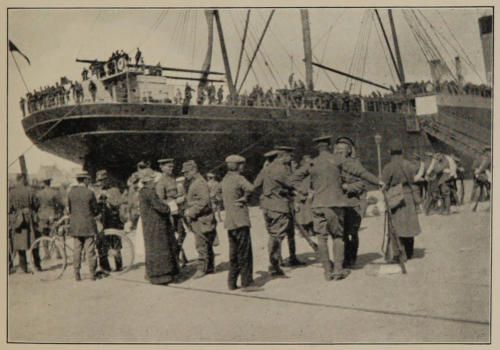
At 12.30 midday we sighted Le Havre, and in two
hours were tied alongside the wharf. The disembarkation
rapidly followed, and at 4 p.m. we were on the
march through Le Havre to our encampment. As we
steamed into Le Havre there was a scene of the wildest
enthusiasm, and the whole harbour front was a mass
of cheering men and women and children. “Vive
l’Angleterre!” “Vive Tommy!” “Vive l’entente
cordiale!” Flags and handkerchiefs were waved from
every window, and the picture of enthusiastic welcome
was most inspiring. Our men seemed to thoroughly
enjoy it, and cheered and yelled their throaty greetings
as loudly and as heartily as the French. One would
call in a bull voice, “Are we downhearted?” and the
reply, “No!” from thousands of throats, echoed and
reverberated over the sea front.
Then would come a piping voice, “Do we like
beer?” followed by a unanimous roar of “Yes.” The
French welcome was a spontaneous and enthusiastic
one, and Le Havre, gay with bunting and twined flags,
shouted itself hoarse that day. I visited Le Havre some
months later and saw a crowded British transport
arrive. There was no cheering, no flags, no excitement.
At the wharf was a big hospital ship, and wounded
soldiers were being carried aboard by stretcher-bearers.
The French had, since August, passed through some
days of disappointment and despair, and the German
was still in France. The frenzied ecstasy of that welcome
of August, the gifts of flowers, of fruit, of wine were
no longer there, but deep down there was still the same
welcome, unspoken but warm and sincere.
A dusty march of eight miles on a hot, blistering
road brought us to our camp at Harfleur. We were
indeed on historic ground. Close by were the remains
of the old Castle of Harfleur that Henry V. and his men-at-arms
stormed in the long ago.
On this same field Henry is said to have addressed
his soldiers:
“And you good yeomen,
Whose limbs were made in England, show us here
The mettle of your pasture; let us swear
That you are worth your breeding.”
It was on this field and at that time that old Bardolph
said:
“Would I were in an alehouse in London.
I would give all my fame for a pot of ale and safety.”
So here again, in the twentieth century, were some
thousands of good yeomen whose limbs were made in
England, and a pot of ale would have been relished by
all, for the day had been a thirsty one.
Our arrival at camp was not expected. The commandant
seemed very surprised to see us, but told us
to make ourselves at home. We had no kits, no
blankets, no tents, no food—all had been left on the
wharf—and no hot water was procurable. We made
a meal off our “iron rations,” which consist of a small
waterproof cover holding a tin of bully beef, biscuits,
pepper and salt and tea. Pipes were lit and we then
lay down as we were, under the lee of a haystack, and
slept till bugle-call, when we awoke, cold and damp
with dew. The nights were very cold at this time
and the days terribly hot.
The camp at Harfleur had about five or six thousand
men, composed of representatives of all arms of the
service—Highlanders, Guardsmen, Engineers, and details
from dozens of other regiments. We were reinforcements.
Rumours were coming through at this time
that all was not well with our army, and we were disquieted
to hear that it was being steadily pushed back
and fighting desperately. The retirement of our army
occasioned anxiety at Le Havre, our principal base at
that time, and the reinforcements at Harfleur could
not be joined up till the position became clearer.
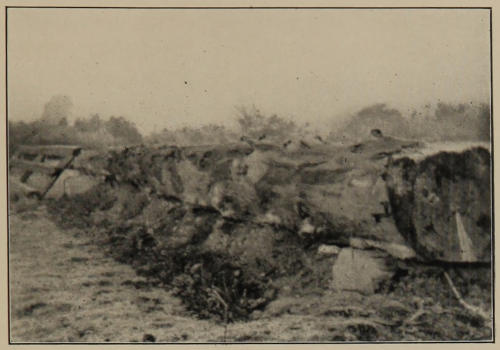
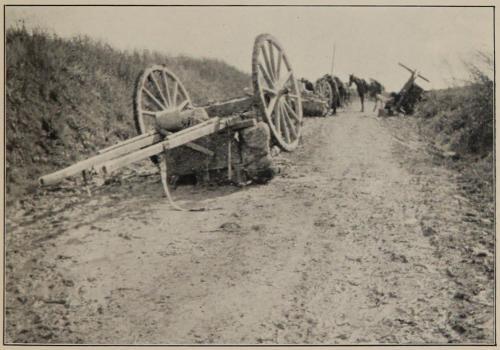
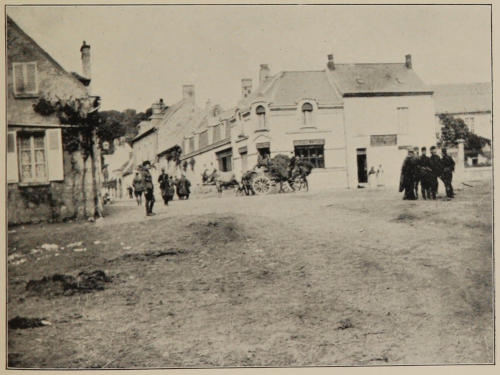
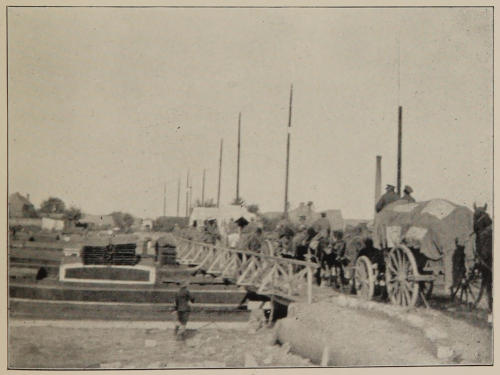
A road obstruction near Harfleur.
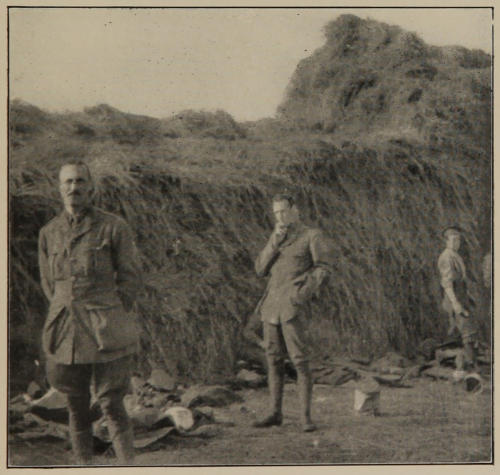
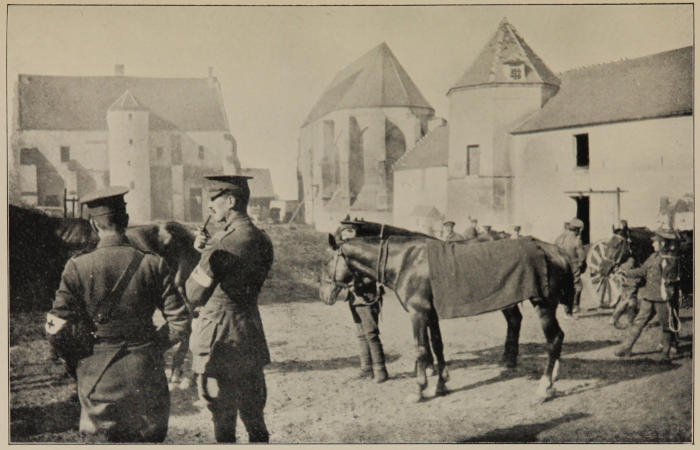
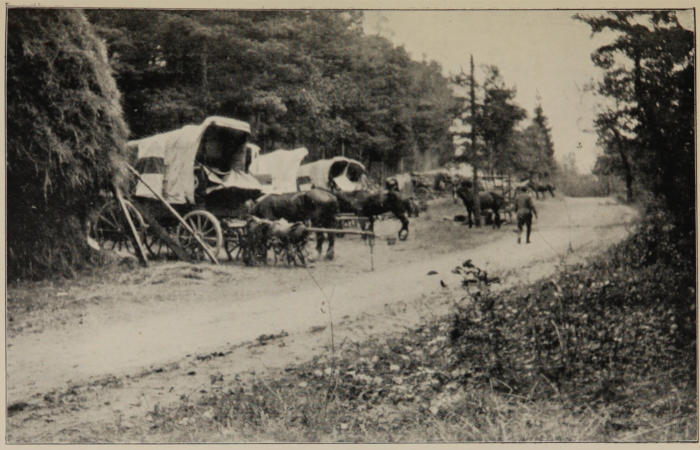
Harfleur—our sleeping quarters.
At Harfleur we got little authentic news. We
lived on rumours, and some of these were of the most
extraordinary kind. There was one rumour that came
through, and the Tommies fully believed it. It was
said that the Germans cut off the right hand of every
captured stretcher-bearer, and killed every prisoner of
the combatant rank. Our men were quite determined
to die fighting, and the stretcher-bearers asked for
guns. The day after our arrival in camp we were given
tents, and these were pitched in the morning. Twelve
men were put to each tent, but blankets were few and
we could only give four blankets to each tent. Next
day the tents were struck and packed away for some
unknown reason, and that night we all had to sleep
in the open. The officers’ kits arrived on the second
day, and on the fourth day we were told to take from
them only what was absolutely necessary. It was said
that our kits were to be either packed away or burned.
It was said also that the whole camp equipment, tents,
blankets, etc., were to be burned. Later in the day
this order was countermanded and we again took
possession of our kits. We guessed from all these
various orders that the position at the front was uncertain,
and, as history has since shown, such was the
case. On our fourth day at Harfleur a flying man
arrived in his aeroplane from England, and we all
crowded round to know what the latest news was.
He had none to give, but told us that he had flown
over a part of the German army. I think that he
brought some important information, for that afternoon
the whole camp was set to work digging trenches
right across the front of the camp. We had more
rumours of “tremendous British losses,” “breakdown
of French mobilisation,” “stubborn fighting,” but
nothing authentic reached us.
However, work proceeded feverishly in the camp.
Harfleur was on the main road leading from the north
to Le Havre. It was said that the Germans were advancing,
and this was true. A raiding force of 20,000
men—one German division—of cavalry, gunners, and
infantry—the latter on fast motor-lorries—was certainly
moving on Le Havre, and the intention was to
destroy the British base dépôt, burn our huge stores,
and capture and sink all the shipping and blow up the
railways. Our camp was to delay this raid till the
French could move up some divisions. Accordingly,
lines of trenches were dug across the turnip fields
and meadows. The farmhouses were surrounded by
trenches and put into a state of defence. The doctors
and stretcher-bearers were ordered to occupy an
orchard about 500 yards in rear of the trenches. There
was an extraordinary resemblance between one old
farmhouse adjoining the camp and the famous
farmhouse of Hougoumont at Waterloo. There was
an old chapel in the centre of the farm, near
to the big two-storied stone dwelling. Behind the
chapel were the wine cellars and stables. To the
right of the house was a long orchard surrounded
by a stone wall about 5 feet high. The farmhouse
and farmyard were surrounded by a high stone wall.
Also there was a big gateway as at Hougoumont. Inside
and lining the stone walls were tall pine trees.
Our men soon began to make some alterations in the
quaint old Norman place. The lower branches of the
trees were lopped off. Trenches were made inside
the stone wall and stones were pulled out of the base
for loopholes for rifles, so that our men could lie in the
ditch and fire through the bottom of the wall. The
same thing was done in the orchard, and men of the Rifle
Brigade were told off to line its walls when the time
came. This farm, if exposed to artillery, of course
would have been a death-trap, but against infantry
or cavalry would have been a very hornet’s nest
for the enemy to attack. The gateways were pulled
down, barricades were placed across the gaps, and
machine-guns controlled the angles and were able
to sweep the open spaces, should a rush be made, with
a hail of lead.
All was ready for a second Hougoumont, and the
picture was completed by the old farmer’s wife, who
was ordered to leave the farm, but who firmly refused
to budge. Had the Germans come, like her ancient
prototype on that June day at Waterloo, she would
most likely have taken shelter at the foot of the cross
in the chapel.
But the Germans did not come, and history is
deprived of a moving and stirring story.
It was tragic but ludicrous to see the blank despair
and consternation on the face of the old farmer when
we started to lop down some of his trees, dig trenches
round his farm and through his turnip fields. Knowing
very little about the war, and only vaguely interested
in the invasion of France, he was deeply concerned
about his turnips and his trees. Everything, however,
was put right for him before we left.
When all our preparations for defence were complete
two German aeroplanes passed over us going towards Le
Havre. Here they were fired on, and they then returned
to have a further look at Harfleur and circled slowly
over our camp. As we had no aircraft guns they
descended fairly low, and I think must have seen
everything there was to see. We had field-glasses out
and could easily discern the black cross painted on the
wings of the Taube.
So there we were in our trenches commanding the
roads to Le Havre, with a Hougoumont and an orchard,
and stone walls lined with riflemen. History, so far, has
not recorded how we “held the gate” to Le Havre without
firing a shot and without losing a man, but I am
sure that it was our preparations, seen by the enemy
aeroplanes, that deterred the Germans from coming on.
It was a raiding German force, and a raiding force has
no time to tackle defences and strongly held positions.
A brigade of French cavalry moved across our front and
rode as a big cavalry screen towards the advancing
raiders. Fifteen thousand French troops followed them;
and when twelve miles from our camp the Germans
turned back, the menace was over, and we breathed
again.
A fast scouting motor-car containing three Prussian
officers ran headlong into a barricade cleverly placed
across a road about ten miles from Harfleur. A ditch,
broad but shallow, was made across the road near a curve,
and artfully concealed with gravel laid on thin planking
across the top. The car rushed right on to this and was
upset. Some concealed French cavalry then rode up
and captured the party.
The French officer who made the capture told me that
the German officers were livid with anger when he and
his men rode up with drawn sabres. One of the German
officers had a revolver in his hand, which he flung
violently at the head of the chauffeur.
This defence of the road at Harfleur was one of
those minor incidents of the war which has been forgotten
or ignored in the swirl of the big happenings at that
time. The situation of Le Havre and Harfleur was then
one of grave peril and gave rise to considerable anxiety.
One need not have been on the spot to grasp the
dangerous possibilities. Our defence of Harfleur ended
tamely. We were told one day that Lord Kitchener
was at Le Havre and had ordered the evacuation of the
big base by the British. That night we were ordered
by our commandant to strike the camp, move into
Le Havre, and embark on transports for a destination
unknown.
The day before we left Le Havre some British
stragglers from our retreating army turned up in camp.
About twenty-five dirty, grimy, footsore men, with
unkempt hair and stubbly beards, wandered in and told
us that they had lost their regiments and their way after
Mons. Since then they had been gipsying through France
towards the coast. Sometimes they got a lift on a
farmer’s cart, but mostly they walked. They said that
the French people had treated them very well, and they
certainly did not look hungry. As usual, they told most
harrowing tales. One man said that the whole army
had been captured by an army of twenty million
Germans!
On the morning of our last day at Harfleur we were
all thrilled by the visit of a German spy. I have said
previously that when the trenches were being dug
at Harfleur the medical detachment was sent to an
orchard in the rear. A road led past the gate of this
orchard. At the gateway we had two of our men on
sentry-go. Farther down the road was a French sentry
with a fixed bayonet. At 3 a.m. a powerful two-seater
automobile dashed up this road and pulled up at
the gateway. The driver had on a heavy khaki motor
overcoat and a khaki cap. His face was muffled in a
khaki scarf. An officer, also in khaki, stepped out and
began questioning our men at the gate. He asked
how many men were in the camp; were there any big
guns, and where were they? Had any ammunition
been brought up that day? Our sentries were heavy
north-countrymen, recently enlisted, and did not
tumble to the fact that it was an unusual thing for a
British officer to put such questions to a private on
sentry-go. The officer then got on his car and went
back in the direction of Le Havre. We were all agreed
that the strange officer was a spy dressed up to look
like a British officer. The French told us that Le Havre
was full of spies at this time, and that they had made
many arrests of suspects.
CHAPTER III. FROM LE HAVRE TO THE BAY OF BISCAY.
We knew that serious events must have happened
when K. of K. had personally visited Le Havre and had
ordered its evacuation. It was Napoleon who said that
it was a disastrous thing to attempt to change an
army’s base during the actual progress of a war. But
in this war old maxims and trite sayings go by the
board. Anyone having the most elementary knowledge
of war, and what an army in the field signifies, will
agree that even if changing a base may not lead to disaster,
it is nevertheless a very formidable and a very
risky move. Le Havre at this time was a huge base from
which our army in the field was receiving its supplies.
Transports conveying all the necessaries for a fighting
army unloaded their cargoes on its wharves. From
there the supplies were sent by train to the advanced
base in the centre of France, and from there onward to
the various refilling stations. The destruction of Le
Havre, or its temporary loss as a base, would have
been a calamity. The army would have ceased to
receive food, waggons, ammunition and equipment,
guns, horses, forage, reinforcements, hospital supplies,
etc. An army without ammunition and food is no longer
of any fighting value. Think also of the quantities of
material necessary to supply an army of 70,000 men,
and this will give some idea of the immense war dépôt
Le Havre was at this time. Circumstances must have
indeed been serious to have necessitated a change of
base. It meant also that the railway arrangements
so carefully thought out, and which had so far been
in operation, would have to be suddenly changed.
Supply trains would have to be sent to the front from
some other base, and returning empty supply trains
and hospital trains would have to be diverted from
Le Havre to the place chosen as the future base. The
task was a gigantic one, and was rendered more so
because it had to be completed in a hurry.
We reached Le Havre from Harfleur in the late afternoon.
A large convoy of Belgian ambulances full of
wounded was moving through the streets towards the
wharves, and a French Infantry Division passed us in
full panoply of war going east. Six large transports
with steam up were lying at the wharves. The wharves
were a scene of unparalleled activity, and when one got
right down amidst this activity and looked around, one
could realise that things were very chaotic. Every one
was shouting and cursing; contradictory orders were
given; some stores which had just been loaded in one
of the holds of one transport were being again unloaded.
Through careless handling a huge crate of iron bedsteads
for a military hospital fell into the sea between the
ship and the wharf. But as the stores were Government
property—therefore nobody’s property—no one seemed
to mind very much. The stage between the ship and the
big sheds was packed with all sorts of goods in inextricable
confusion. Here were bales of hospital blankets
dumped on kegs of butter, there boxes of biscuits lying
packed in a corner, with a forgotten hose-pipe playing
water on them. Inside the sheds were machine-guns,
heavy field pieces, ammunition, some aeroplanes, crowds
of ambulance waggons, London buses, heavy transport
waggons, kitchens, beds, tents for a general hospital,
stacks of rifles, bales of straw, mountainous bags of oats,
flour, beef, potatoes, crates of bully beef, telephones and
telegraphs, water carts, field kitchens, unending rolls of
barbed wire, shovels, picks, and so on. All had been
brought into the sheds and left there in a higgledy-piggledy
fashion. An Army Service man was trying in
despair to get some forage on board; a colonel of the
Medical Staff was trying to get his Base Hospital on
board. There was apparently no single brain in control,
and the loading of the ships went on in the most extraordinary
way. Things nearest the ship’s side were put
in first. Part of a Base Hospital was put in with part
of a Battery, followed by bundles of compressed straw
fodder and boxes of soap.
The transport Turcoman was full of troops. There
seemed to be thousands of them on board, and the decks
were packed with men. On walking up the gangway I
was met by the officer commanding the troops, and he
told me that I could not be allowed on board with any
men as the ship was already overcrowded. I told him
that my orders were to embark on the Turcoman, but
the reply, “Very sorry indeed, but it can’t be done,”
settled the matter.
So I descended, and with difficulty picked my way
along another wharf and found another transport, the
Cestrian, also a centre of the same scene of bustle and
activity as the Turcoman. The Cestrian was crowded
with soldiers, and was being frantically loaded up with
all sorts of goods, from aeroplanes to bandages.
I got my men on board and told them to make themselves
as comfortable as they could on deck, and after
some searching round at last found a corner of the
smoking-room which would serve me for a bed for the
night. Here my servant dumped down my valise.
I was unable to find out the destination of the Turcoman;
nobody seemed to know, but there were rumours
that it was to be “somewhere in the Bay of Biscay.”
Nobody knew where the Cestrian was going. As my
orders were to travel by the Turcoman, and as I was
really on the Cestrian, I was anxious to find out if the
destination of the two boats was to be the same port.
But nobody could tell me, so I lit my pipe of tobacco,
leaned over the ship’s side, and never troubled any more
about my orders. I really did not know whether the
Cestrian was going to England or another part of France,
or the Black Sea for that matter.
The scene on the Cestrian was a strange one. It was
now quite dark and the loading of the cargo was carried
out under electric flares. There were on board 2600
soldiers and 600 horses. These unfortunate horses
had been put on board twenty-four hours before the
troops embarked, instead of the other way about, and
the smell from the hot, stifling horse-boxes was overpowering.
Why these poor beasts were not embarked
last of all, was a mystery. Imagine 600 horses cooped
up in narrow boxes during a long, hot, stifling summer
day, when they could easily have been kept at the horse
dépôt close by till the last minute!
One horse died before we started, and was slung out
by ropes on to the wharf.
This horse episode was the occasion of much scathing
comment amongst senior officers and old cavalry and
artillery non-coms.
It is a pity that some of the higher command—those
responsible—could not have heard the remarks of these
knowing old non-commissioned officers.
At last the ship’s holds were full. Gangways were
up and we dropped slowly down the locks to the Seine
mouth, and so out into the Channel. We were met by a
fierce, gusty head wind and welcomed it for the horses’
sakes. Large wind ventilators were arranged to allow
the fresh air to reach the horse-boxes.
Our men slept on the decks, and there were so many
of them that to step one’s way over them would have
been almost impossible.
The dining-rooms, cabins, and smoking-rooms were
full of sleeping or dozing officers. I managed to commandeer
an old sofa cushion, and lay on that in the
corner of the smoking-room and went to sleep, and
dreamt of thousands of horses looking reproachfully
at me out of boxes.
At break of day we were all up at bugle-call and soon
washed. The ship’s cook was a man of some eminence
in his profession, for he had provided porridge and milk,
ham and eggs, bread and butter and tea for our breakfast,
and, filled with amazement, we sat round to enjoy it.
Generally of meals on a transport there are none. A
big cruiser was seen after breakfast to be bearing rapidly
down on us, and the usual “optimist” present, after
carefully observing her through a telescope, pronounced
her nationality as German, and that it was now a
watery grave in the Bay of Biscay for 2600 men and 600
horses. As she came nearer we showed our flag, and she
displayed the French ensign. We gave her our number
and dipped our bit of bunting, and the great ironclad
sheered off. It was a relief to know that she was about,
and looking after our transports.
On the way out from Le Havre we passed the United
States battleship Tennessee, and our men seeing some of
her sailors standing in a group gazing at us, gave a cheer
and the usual “Are we downhearted? No!” greeting.
The American sailors gave a real good hearty cheer, and
yells of “good luck”; but an officer then ran up to them
and said something, and they became suddenly silent,
and only waved their hands. They had probably been
told by their officer that they were “neutrals,” and
belonged to the battleship of a nation friendly to all the
belligerents. But we knew that they were with us
“inside,” and anyhow the Americans have not been
neutral in their hearts. They are all “for us” and “for
the Allies.”
Life on board our transport was uneventful. We
smoked and slept and ate. There was no room to walk
about. I never saw such a crowded ship.
We had on board the complete personnel of a Base
Hospital, and the medical officer commanding told me
that he had orders to pitch his hospital at once at
Nantes in order to take in wounded, as there was a big
demand for more beds. In spite of his utmost endeavours
he could not get his hospital equipment on the Cestrian.
All the instruments, dressings, and X-ray apparatus
had been left behind for another boat, and he thought
that he might not be able to get them for another week,
or perhaps longer.
This was but another example of the lack of control
at Le Havre during the change of base; a hospital was
badly wanted at Nantes; all the personnel and half the
equipment were sent away, and the other half left on the
wharves. We learned later that the holds of our boat
the Cestrian were not full when she left Le Havre, but
that she had been ordered to leave on account of the
horses being in such a bad state from the hot, stifling
atmosphere in their quarters below decks.
It was necessary to proceed to sea to get a current
of cold air down the ventilating shafts to the horses’
cribs. This senseless blundering over the horses led
to the death of several of the poor beasts, and besides
crippled a Base Hospital at a time when it was urgently
needed. Over and over again during this war one has
met with instances of a want of reasoned judgment on
the part of senior controlling officers. In certain
emergencies they have been unable to “orientate”
themselves—to use an Americanism—or to “envisage”
a situation.
Blunders, slips, miscalculations, carelessness, in time
of war mean the loss of valuable lives. We want alert,
clear-brained, thinking men in all responsible posts.
If a senior officer shows himself lacking in these essentials—then
he must go. Many of the responsible French
army officials at the beginning of the campaign proved
themselves lacking in initiative and judgment. Joffre
sent these officers to “Limoges.” We should send our
incapables to “Stellenbosch.” Both places are indicative
of a quiet retirement, where they can live without
thinking, where there are quiet clubs, cigars and cocktails,
and comfortable chairs for an afternoon nap.
The good ship Cestrian was a very fine steamer, but a
very dirty one at this epoch. She badly wanted a clean-up.
The lavatories and water-closets were indescribably
filthy and foul, and acrid ammoniacal fumes permeated
the ship. No attempt was made at ordinary cleanliness,
and no disinfectants were employed. Words could
hardly describe the appallingly filthy state of the urinals
and closets. It would have been so very simple to have
made things cleaner. A sanitary squad could have
been arranged in a few minutes to keep these places
tidy and to maintain some control. But what was
every one’s business was nobody’s business, and nothing
was done during the three days and nights we were at
sea.
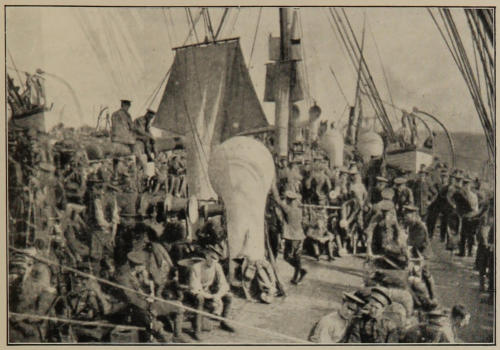
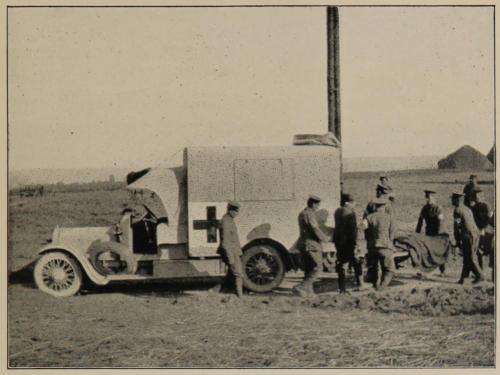
Transport “Cestrian” in the Bay of Biscay.
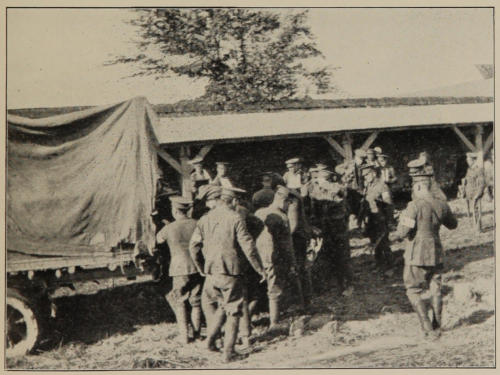
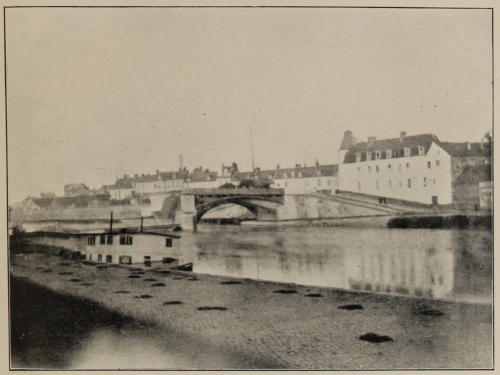
The “Cestrian” at St. Nazaire.
As our ship approached the mouth of the Loire we
saw three large transports ahead of us and four more
were following up behind. We slowly steamed through
the narrow lock entrance to St. Nazaire and, after the
usual delay in getting alongside, finally tied up to the
wharf. The day was stiflingly hot and dusty, and we
were glad to leave our ship and get on shore. The
horses were at once unloaded, and very bad the poor
beasts looked. It was pleasant, however, to see them,
once they were on land, looking round and neighing
with evident pleasure.
The troops were marched out to a large field or a dry
salt marsh some few miles out of town. A rest camp
or camp for army details was being rapidly arranged,
and areas were being marked out for the various units,—gunners,
engineers, and infantry regiments, and there
was considerable bustle. No tents had yet arrived
and the camp was quite exposed. Fortunately, the
weather was good and sleeping out was no hardship.
I reported my arrival to the camp commandant, and he
said that he did not know where I had to go or what I
had to do. He told me to “wait round and see what
turned up.” At this period one’s arrival was always
unexpected. We always got a smile of welcome and
were always told to “wait round.” There was never
any demonstrative hurry. John Bull on the job doesn’t
make much fuss. I think that he does not make enough.
As there was nothing to do apparently, and as nobody
seemed to want me, I strolled back to the city of St.
Nazaire and had afternoon tea in a pleasant café.
As I was leaving the café I met the A.D.M.S.
(Assistant Director of Medical Services). He asked
me what duty I was on. I told him that I had just
arrived and had reported my arrival, and was really
wondering myself why I was at St. Nazaire. The
A.D.M.S. said, “We are wanting medical officers urgently
at the front. Would you please come with me.” On
our way to the office he explained that “the medical
service had received some losses—casualties and missing,
that there were a lot of wounded and a lack of hospital
necessaries.” He asked me if I had any “bandages,
wool, or lint with me.” I had none, of course, and the
A.D.M.S. said that he had none to spare for the front.
I thought of the Base Hospital on the Cestrian landed
with only half its equipment, and of what a wonderful
nation we are, and what a magnificent organiser John
Bull is when he is really “on the job.”
I received written orders from the A.D.M.S. to
proceed by train at 4 a.m. next day to Le Mans, and
report arrival and await orders there. Le Mans was the
“advanced base” of the British army. I learned here
also that our gallant army was retreating towards Paris,
and fighting stubbornly against overwhelming numbers
of Germans flushed with victory, and I was very glad
to get orders to join up with my countrymen and get a
chance of “doing my bit” also.
CHAPTER IV. FROM THE BAY OF BISCAY TO EAST OF PARIS.
After having received these definite orders I got my
kit again conveyed to the Cestrian transport and slept
that night in my old corner of the smoking-room. At
2.45 a.m. the surgeons detailed to join the army were
up. A hasty cup of coffee and an apology for a wash—and
we were down the ship-side, and on the way to the
gare. The railway station at St. Nazaire at this time
looked quite picturesque in the early morning. Its
platforms were covered with straw, and rows of sleeping
French soldiers lay comfortably around, while a stolid
Grenadier sentry stood propped against the wall.
There is no hurry at a French military station. The
train was timed to start at 4 a.m., but that did not
matter. At 5 a.m. it was quite ready. “C’est la
guerre.”
There were five of us travelling together—all medical
officers—two Scotchmen, one Irishman, one Englishman,
and one New Zealander. A very gruff Railway
Transport officer gave me a military pass for the party.
This gave us permission, we noticed, to travel to Paris
viâ Le Mans. The pass was signed by the French
authorities, but we were never asked to show it again.
The khaki uniform proclaimed we were British, the
Sam Browne belt and stars showed we were officers,
and the red-cross brassards on our left arms indicated
our particular line of business. As the train moved off
we wished our Railway Transport officer—an Englishman—a
good morning, but this seemed to offend him,
for he glared at us. Our Irish surgeon remarked that
all Railway Transport officers were queer fish and very
unpopular. Perhaps their particular specialty makes
them so, but I have never heard an R.T.O. referred to
in any other but denunciatory terms. A sanguinary
adjective is always prefixed to the mystic trinity R.T.O.
It is said that they lead unhappy lives and generally
die of long, lingering illnesses. We soon settled down
comfortably in our luxurious first-class carriage and
tried to get to know each other. No very difficult task
amongst doctors, who are generally most sociable
animals. One of us was a specialist in fevers and had
passed most of his days in typhoid and scarlet fever
wards. One was a neurologist, with pronounced views
on the power of suggestion in treating cases of incipient
insanity. One was a pure physician, who said that the
surgeons were not men of science but merely craftsmen,
and were too fond of using the knife.
The surgeons, as became their calling, treated all
criticism with good-humoured complaisance. We
talked a lot about the duties of the doctor in this war,
and we were all very curious to know the rôle played
by a doctor when he was attached to a cavalry
regiment, to a battery, or to a field ambulance. None
of us knew very much about it, but we all were agreed
that we had somehow to get alongside Mr. Thomas
Atkins when he was wounded in battle, get him to a safe
place, and give him of our best. Curiously enough,
although we were all scattered later on to various units
of different divisions, I met all my fellow-travellers
again one time or another in the firing line. One of the
Scotchmen I met just as he came out from under heavy
shrapnel fire, and I asked him how he liked it. His
reply is not printable. One I met in a field ambulance
later with sleeves rolled up and busy dressing the
wounds of a crowd of men just brought in from the
firing line. One I met in a town in northern France
looking cold and wet and miserable, and asked him also
how he liked the war. He gave an expressive shrug.
I have not met anyone yet who liked the war, except
artillery officers.
Our train travelled slowly from St. Nazaire along
the Loire to the capital city of Nantes. This charming
city is situated on the banks of the delightful river.
We had a lot of khaki and French soldiers on board the
train, and as usual they fraternised well together.
Tommy Atkins gets on amazingly well with the French
piou-piou, and the French grenadier chaffs Tommy a
lot and enjoys his company. When they get together
they exchange caps for a time. This is a sign of unalterable
friendship.
To see a French Cuirassier wearing a khaki cap and
a Highlander in kilts wearing a Cuirassier’s casque
with its flowing horsetails always excited the merriment
and loud “vives” of the French people. The kilts
of our Highlanders are also greatly admired by the
French. They were consumed with curiosity to know
if the Scotchmen wore any trousers under them. Khaki
was a great novelty along the Loire valley at this time,
and our appearance roused tremendous enthusiasm
and applause. At Nantes the good people brought us
baskets of apples, and little French flags which we duly
stuck on our coats or caps and wore till the train
steamed out of the station.
Crowds of people rushed down to the railway platform
to see us and cheer us on our way. Tommy’s
“Are we downhearted?” and its stentorian “No!” had
a very optimistic sound, and the French liked it.
At Angers the train stopped two hours, and the
officers strolled round the town. The men were not
allowed off the platform. Angers, the ancient capital
of the old Counts of Anjou, is a delightfully sleepy city.
A princess of Anjou was in the long ago a Queen of
England, and a fine statue to her memory stands in the
centre of the town. It was dressed with an intertwined
Union Jack and the Tricolor when we were
there.
The old castle of Angers, with its deep moat and
castellated towers, has withstood the ravages of
centuries and is one of the finest examples of mediæval
military masonry. Our walk through this city excited
considerable comment and notice. It was Sunday,
and a big congregation just leaving church stopped
to stare at us and possibly to wonder why khaki was in
Angers. As we passed a café crowded with loungers
sipping wine and coffee at the little tables on the street,
all stood up to look at us. We felt very embarrassed
and did not much like the novel experience, so sat
round a small table ourselves, and while drinking our
wine turned round to look at the people also. A French
colonel caught our eye, and one of our party held a glass
towards him, saying, “Vive la France!” The effect
was theatrical: all jumped up, and lifting their glasses
shouted, “Vive l’Angleterre!” “Vive l’entente cordiale!”
Several French officers and citizens with ladies pulled
up their chairs to our table, and we all drank wine very
sociably together. One of our party of surgeons had
been educated as a youth in Belgium and was an
excellent French linguist. The people were all very
anxious to hear the latest news. We had none to give
except that large British reinforcements were coming
over, and that England was now fairly on the job. In
these early days of the war, when everything in France
was “electrical,” such sentiments were always cheerfully
received. We drank a good many toasts before we
left, and had our photographs taken three times. Just
before the train started crowds of gentlemen and ladies,
old and young, shook hands with us in the usual French
way, with the left hand as often as the right. One
beautiful and sparkling little French lady embarrassed
one of us by a sudden warm embrace and a sisterly
kiss on the cheek. The surprise of the khaki man was
only momentary, and the lady, in return, was well and
truly kissed on the lips. We were all sorry to leave
Angers, the city was charming, the wine was excellent
and the people were most entertaining.
After Angers we had a long and dreary night ride to
Le Mans. One curious incident occurred during the
night. Our train was pulled into a siding at a small
station and held there for three hours. At the end of
this time a train, made up of forty-one huge locomotive
engines, thundered by at sixty miles an hour going south.
We were told that these were Belgian engines sent south
to escape capture by the Germans.
In the cold shiver of a dark morning we bundled
out at Le Mans, and at once made a dash for the railway
buffet and got hot coffee and rolls. I then found my
way with some difficulty in the darkness to the quarters
of the A.D.M.S., to whom I had to report our arrival.
He was in bed when I arrived, but got up and took my
report. As usual he was surprised to know we were
coming, and our visit was naturally an unexpected
pleasure. He told us that we should have gone right
on to Paris, as surgeons were badly wanted with the
army which was retreating on to Paris. We were
always being told that doctors were urgently required
and were always delayed. We had definite orders to
get out at Le Mans and report. The orders were in
writing. No one was more anxious than we were to
push rapidly on, and we chafed at the continual delays.
The A.D.M.S. could not tell us when we would be able
to get away from Le Mans as the train service was
erratic. We were advised to “hang about the railway
station” till “some train” started for the front. As
this was highly unsatisfactory, I tried to find out how
matters stood myself.
The stationmaster did not know when a train would
start for Paris, as the line was blocked farther on by the
military mobilisation. I found out, however, that a
supply train conveying provisions and supplies for our
men was to leave from Maroc some time during the day.
Maroc was a small siding five miles from Le Mans.
Here trains were made up for the various Army Corps.
Maroc is a desert of sand and a truly desolate spot.
We got our kits and a box of medical supplies—obtained
with great difficulty at Le Mans—conveyed to this
miniature Morocco, and we camped on the sand under
the doubtful shade of the only two trees the place
possessed, till 4 o’clock that afternoon. The only
excitement was seeing a huge locomotive run off the
track and block shunting operations for two hours.
At last our huge supply train was ready. We all got
into an empty guard’s van and disposed our valises in the
various corners. Two officers of the Royal Flying Corps
joined us here and found accommodation in a waggon
loaded with bags of wheat. We all clubbed together
for mess, and laid in a stock of sardines, bread, butter,
and a dozen bottles of red wine and cider. We learned
from our flying friends that the army was retiring every
day, and was supposed to be making for Paris.
We got some definite news for the first time of our
big engagements at Mons, Landrecies, and Le Cateau,
and how our army was furiously attacked and compelled
to fall back, and that although the retirement at
first was precipitate it soon became ordered and steady.
We were also told that there were over 15,000 casualties,
and that the medical arrangements had quite broken
down. However, we had a sublime faith in our own
countrymen, and knew that they would come out all
right, somehow, somewhere.
At daybreak our train reached Tours, and at Blois
we had a welcome wash and a decent cup of coffee. Our
quarters in the guard’s van had been most cramped
and uncomfortable, and we were all anxious to leave the
old tortoise of a train. At midday we passed through
Orleans, and here French officers told us that the
Germans were advancing on Paris, and in spite of
prodigious losses were hacking their way through by
weight of numbers and numberless batteries of artillery.
We were told that the British army was to form part
of the garrison of Paris, that Paris was fully prepared
for a long siege, and that President Poincaré and the
Government were at Bordeaux. All these rumours
gave rise to keen discussions, and they certainly helped
to while the time away in our dreary old van.
During the night we passed through Paris, and at
break of day pulled up at the railway siding of
Coulommiers.
The railway siding was full of ambulance trains,
British and French. All the trains were filled with
recently wounded men, and we got our first information
that we were close to the actual scene of fighting. One
French medical officer had rigged up a small dressing
station on the station platform. An upturned box
held his dressings, instruments, and antiseptics, and
he had about twenty-five wounded Frenchmen all
round him patiently waiting their turn. Most of them
were slight cases, for the serious ones had already been
put aboard the hospital trains.
Coulommiers at this time was the refilling point for
the Army Service Corps, and our supply train was
emptied here.
CHAPTER V. THE ADVANCE TO THE MARNE.
Coulommiers at this time looked a little bit dégagé.
It had been occupied by the Germans some days
previously, and now the British had it. The French
inhabitants were in Paris. The narrow old streets
looked very cheerful and inviting when I passed through,
for our Army Service men had several fires merrily
blazing at the side of the pavé, and the smell of frying
bacon and roasting coffee beans was inviting and
appetising. Signs of the German occupation were
everywhere apparent. Round the ashes of their fires
in the side streets and square were the charred remains
of old and valuable furniture—a carved leg of an old
chair, a piece of the frame of a big mirror, a bit of a
door, and so on. I think the German soldier enjoyed
the novel sensation of cooking his food over burning
cabinets and tables and chairs made in the times
of the Louis’ of France. Our men were extremely
careful to avoid damage to French property and made
their fires of chopped wood logs. Tommy has good
feelings and is always a gentleman, and he genuinely
pitied the French in their despoiled towns.
My orders were to report to the Principal Medical
Officer of the 5th Division of the 2nd Army. I could
not find out where the 5th Division headquarters was,
but ascertained that the 2nd Army headquarters was at
the small hamlet of Doui, three miles away. My next
problem was how to get there with my kit. Luckily,
I found a motor-car driver about to start for the headquarters
and he offered me a lift. This driver was one
of the many gentlemen of leisure who had volunteered
for service at the beginning of the war. He took out
his own car at first and it broke down during the retreat,
so he abandoned it by the roadside and got another
car, the driver of which had been killed. We set off
from Coulommiers at a rattling pace and passed part
of the 3rd Division on the way. The headquarters
of General Smith-Dorrien, the Commander of the 2nd
Army, was a little cluster of houses by the roadside,
and when we arrived the whole staff were standing
by the road, while the grooms stood near holding their
horses. Smith-Dorrien with another staff officer was
poring over a map and indicating some spot on it
with his finger. The Principal Medical Officer, Colonel
Porter of the Army Medical Staff, now Surgeon-General
Porter, was just coming out of a cottage, and I walked
up, saluted, and reported my arrival. The Colonel
gave me a cheery greeting, asked if I had breakfasted,
and noticing the South African War ribbon on my
tunic, said that as I had seen service before I would
soon be quite at home. He asked me where I came
from, and when told that it was New Zealand, inquired
if the trout-fishing was still good. New Zealand seems
to be principally known in England for its excellent
trout streams.
I was then told to report to the officer commanding
a section of the 15th Field Ambulance, which was lying
about 500 yards farther down the road. I reported
to Major O—— of the Royal Army Medical Corps,
who told me that he was waiting to evacuate some
wounded to Coulommiers before moving up to rejoin
the headquarters of the ambulance which was advancing
with the 15th Infantry Brigade. There were
sixteen wounded British in a small farmhouse beside
the road. They were lying on straw on the floor and
the wounds of all of them had been dressed. When
I entered they were drinking milk supplied by the old
farmer and his wife. This old farmhouse had been
occupied by the Germans two days previously, and the
old farmer brought me through the house to show
what the Huns had done. His two wooden bedsteads
had been smashed. All his wife’s clothes had been
taken out of a chest of drawers and torn up, and the
chest had been battered badly with an axe. The
windows were broken and two legs of the kitchen table
had been chopped off. An old family clock lay battered
in a corner, and an ancient sporting gun was broken
in two. The farmer showed me one of his wife’s old
bonnets which had been thrown into the fire by these
lovely Germans and partially burned. Fancy burning
an old woman’s bonnet! All the fowls and chickens
had been killed. Two German soldiers got into the
fowlyard and struck all the birds down with their
bayonets. A fine Normandy dog lay dead at the
garden gate, shot by a German non-commissioned
officer because the poor beast barked at him.
The old-fashioned furniture and adornments of the
house had been destroyed. All of the pictures were
broken except two—one of these was a framed picture
of Pope Leo XIII., and the other was one representing
the Crucifixion. We guessed that the German
troops must have been Bavarians, who are mostly
Catholic.
I have described this wrecked home as it was typical
of hundreds of others that I have seen in France.
It all seemed so stupid, so senseless, so paltry, and
mean. Conceive the frightfulness of burning an old
lady’s bonnet and smashing an old clock that had
been in the family’s possession for three generations,
and had ticked the minutes to the farmer’s folk and
whose face had been looked at by those long since dead.
The old farmer was in tears and very miserable. He
said that the German soldiers were very drunk and had
brought a lot of bottles of champagne with them,
round which they spent a very hilarious night. One
of the men had a very fine voice and sang a German
drinking song, whilst the others hiccuped the chorus.
There were certainly a lot of empty champagne bottles
lying about, and I don’t think that the old farmer’s
beverage ever soared above vin rouge, so the bottles
must have been German loot.
About eleven o’clock, while we were still waiting
for returning empty supply waggons to take off our
wounded, we heard that some German prisoners were
being marched in. This caused some excitement, and,
speaking for myself, I was consumed with curiosity
to see some specimens of this great German army
and observe what manner of men they were. Under a
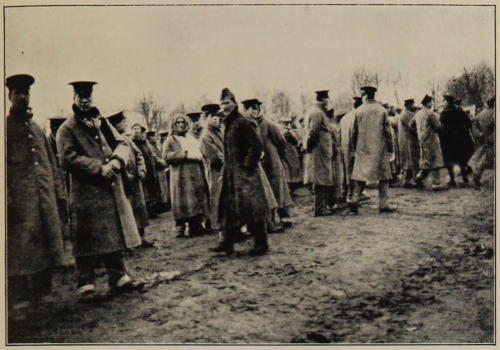
strong guard of cavalry three hundred prisoners with
about ten officers were marched into a field close to
our farmhouse. It was laughable to see our old farmer.
He rushed frantically up the road, his eyes blazing
with excitement and joy, and stood gazing at his
country’s enemies with an expression of malicious joy
and delight.
I was struck with the appearance of these prisoners.
They were very tired, absolutely done in, and marched
along the road with a most bedraggled and weary step.
Were these the men who had goose-stepped through
Belgium’s stately capital and had pushed the united
armies of France and England before them in one of the
most rapid marches in history? They were utterly
broken down with fatigue, and their famished expression
and wolfish eyes betokened the hardships they had
recently undergone. When they were halted in the
field they simply rolled on to the ground from sheer
exhaustion. On looking closer, however, one could
see that they were fine soldiers, athletic, well-built,
lean, wiry fellows, with shaven heads and prominent
features, slim-waisted and broad-shouldered, clothed
in smart, well-fitting, bluish-grey uniforms, well-shod
with good serviceable boots, each with a light water-bottle
clipped to his belt and a haversack over the
shoulder; certainly no fault could be found with them
as specimens of muscular and active soldiery.
The officers, disdaining to show fatigue, sat by
themselves in a group apart and smoked pipes and
cigarettes. The famished men were supplied with
British bully beef and biscuits, and buckets of water
were brought to them for drink. They at once threw
off their exhaustion and simply rushed the food. We
realised that they had been marched to a stop, and that
the commissariat of that particular Army Corps must have
broken down. The augury was a good one. Amongst
them were some slightly wounded men—principally
hand, scalp, and face wounds. These we dressed, and
the men seemed very grateful to the medical officers
for what was done. One of my men, with a slight
shrapnel wound of the wrist, after I had dressed and
bandaged it, seized my hand and kissed it. That is
the German way, perhaps, but un-British, and I do not
love things German or un-British to-day. One of the
men had a slight wound, but a very painful one owing
to a small shell splinter sticking on to a nerve. Lieut.
M’C—— administered a few whiffs of chloroform while
I extracted the fragment of iron. Poor M’C——
remarked to me that this was the first anæsthetic
that he had administered during the war, although
he had been through the whole retreat from Mons,
and that it was for a German. I say poor M’C——;
this splendid young doctor was killed later on in
Flanders while gallantly attending wounded in the
trenches under a hellish shrapnel fire. This group of
prisoners belonged to the Jägers of the Prussian Guard,
one of the best infantry units in the German Army. We
were all very pleased that they had been bagged, and
I don’t think that they worried much about it themselves.
The officers, however, seemed very sullen—that
also pleased us.
Shortly after the arrival of the Guard Jägers some
empty motor supply waggons, returning from the
front, were stopped. We packed plenty of straw on
them and put our wounded British and Germans comfortably
on top, and sent them all off to the hospital
train at Coulommiers. Then our commanding officer,
Major O——, gave the order to our ambulance drivers
to harness up the horses and prepare to trek. We
knew that our army was making a stand at last, and that
the long retreat from Belgium was over.
All the morning heavy firing was heard on our front
towards the river Marne, and we were not sure what
was happening. We knew that our cavalry was at
work somewhere, for the Guard Jägers had been
bagged by our horsemen, but more than that we did
not know. However, we were soon on the road, and
following Napoleon’s maxim to his Generals—always to
march on the firing. The roads were terribly dusty,
the day was hot and sultry, and a blazing sun beat
mercilessly down upon us. We all cursed our caps,
and certainly the present khaki cap supplied to our
officers and men deserves a curse. It gives no protection
to the head or neck in summer, and in rainy
weather it is soon soaked.
Marching on foot behind lumbering ambulance
waggons on a dusty road, and under a hot sun, is no
picnic. Eyes get full of dust, throat gets parched, feet
get hot, and the khaki uniform wraps round one like a
sticky blanket. So for many miles we marched, and
all the time the sound of the guns became more and
more distinct and intense. We passed St. Ouen and
by St. Cyr, and at 4.30 o’clock we seemed to be in the
centre of the artillery thunder area. Great guns were
screeching and roaring all round us, and some of the
enemy’s shells were bursting to our left front near the
road along which we were moving. We were then ordered
to pull our waggons off the road and bivouac them
under a clump of trees near at hand in order to conceal
them from enemy aeroplanes, which were hovering
high up in the blue. The reason for at times concealing
a Field Ambulance is that when a column is on the
march the Field Ambulance has a definite position in the
column; generally it is behind the ammunition column.
The ambulance waggons, with their big white tented
covers and conspicuous red crosses, are often the most
prominent features on the road. The enemy flying-man
when he sees a Field Ambulance knows that there
is at least a brigade consisting of four battalions and
an ammunition column in front of it, and he can then
direct his gunners to plant their shells in front of the
ambulance and so get the ammunition column and the
brigade. Hence the necessity for sometimes hiding
the whereabouts of a Field Ambulance.
After we had bivouacked, our section cook managed
to light a fire in a hollow in a clump of trees, and soon
brought us a much-desired mess of fried mutton, good
bread and marmalade, and a can of tea. We rushed this
as badly as the German prisoners did the bully beef
earlier in the day.
It was an odd meal, as we sat by the roadside viewing
a desperate artillery duel, and between sips of tea snatching
up field-glasses to gaze at the bursting shells on
the ridges held by the angry Germans.
CHAPTER VI. WHAT I SAW OF THE BATTLE OF THE MARNE.
In a battle one really sees very little and knows very
little of what is going on, except in the near neighbourhood.
The broad perspective, the great view of a
battle, cannot be seen by one pair of eyes. This can
only be understood and appreciated afterwards when
facts and events are gathered together and dovetailed
to form the battle story. When I was sitting by the
roadside on this August afternoon, amidst the crashing
and shrieking of the guns, the bursting of the shells,
the furious crackling of the rifles, and the snarling
notes of the machine-guns, I guessed that a battle was
in progress and that we were blazing furiously at an
enemy who was blazing furiously back at us. Beyond
that, I did not know very much. During the
night I learned a good deal more of the day’s
events. But the whole story was not connected up
till many days afterwards. I am quite sure that
the people of London knew more about the battle of
the Marne from the War bulletins than I did, although
I was one of the humble units present in the actual
fighting.
On this sultry summer day our ambulance section
was resting by the side of the dusty road that stretched
in our rear towards Paris and on our front towards a
lovely green valley at the bottom of which meandered
the river Marne. It wound its sinuous way from our
far right to our near left. Directly before us, and on
the distant side of the river, was a steep ridge, part of a
low chain of uplands which rolled hazily away to the
right and stopped abruptly in clear-cut lines in our
front. The road beside which we sat, dipped into
the valley and crossed the river on a fine stone bridge
and continued through the undulating country beyond
to the north. Small villages were scattered about—Mery
to the right, Saccy at the bridgehead, and small
clusters of houses and farms on the countryside over
the river. Some squadrons of dismounted cavalrymen
were standing by their horses in a meadow near the
bank of the river. These horsemen had been busy
earlier in the day, and had done some hard riding,
cutting off stragglers from the retreating German
Army Corps. Infantry were hidden from view in the
depths of the valley. Batteries on our left were sending
a plunging fire of shot and shell on to the ridge and
dips beyond the river, and the road leading from
the bridge. With a field-glass, moving dots, and
what looked like waggons, could be made out on the
road and the field alongside. It was on these moving
dots that our guns played, and cloud-bursts of earth
and dust showed that our gunners had the range
beautifully.
Ambulances at the Marne.
General French passed us twice in his Limousine car.
General Smith-Dorrien passed twice—General Sir
Charles Ferguson passed—all in motor-cars travelling
like mad. Gallopers with messages spurred up and
down the road. Guns thundered into position, unlimbered
and were quickly in action. Infantry marching
rapidly passed down the road into the valley where
a tornado of rifle-fire was going on. One could make
out the distinct note from our own rifles and the muffled
one from the more distant German Mausers. Two
German shells burst short of the battery on our left and
uncomfortably close to us. We were in an odd position
for an ambulance—in front of our own battery, which
was pelting shot into the Germans and which a German
battery was trying to locate. When the enemy shells
fell short they fell near us. Our position, however, was
a dress circle box seat as a view-point, so we stopped
where we were. It was not every day that one could
look on at a real live battle. Before dusk came on, an
aeroplane appeared over the ridge flying towards us, and
was shot at by enemy aircraft guns. The shells burst
all round it, but it sailed triumphantly through them
all, and to our intense relief landed safely in our lines
with some valuable information.
I was much interested to see our Generals on this day
dashing about in powerful automobiles. A General is
always interesting at the front, be he a Brigadier-General,
a General of Division, or an Army Corps General.
One gets a fleeting glimpse of a “Brass Hat” in a motor-car
and asks, “Who is that?” Some one with a keen
eye or a nimble fancy will enlighten. “That’s Haig,
1st Corps,” or “Smith-Dorrien, 2nd Corps,” or
“Ferguson, 5th Division.” “Wonder what’s up?” is
the next usual query, for a General moving around
means that “something’s up.”
Smith-Dorrien is a General well worth seeing. It
was “S.-D.” who handled the 2nd Army Corps
from Mons during those terrible hard-fought days
of the retreat, and he was now commanding the 3rd
and 5th Divisions on this day on the Marne, when
they forced the passage and deployed on the other
side.
When the action was at its hottest and every gun
was busy, a car raced up from the valley in a swirling
cloud of dust. The brakes were jammed hard down
opposite us, the side door opened, and out stepped a
well-knit, muscular, lithe figure, looking physically fit,
smart, and cool in a well-made khaki uniform and red-banded
cap. The face was a burnt-brick red, the
moustache white, the eyes alert, wide open, and “knowing.”
A savage, obstinate, determined chin dominated
the face. It was the chin of a strong, stubborn nature,
the chin of a prize fighter. This was Smith-Dorrien,
the commander of the 2nd Army Corps, and at this
moment the 2nd Corps were at grips with the enemy.
With a few rapid strides he had reached the battery
on our left, asked some question of the battery commander,
and at once clapped field-glasses to his eyes and
gazed long and intently at a spot on the other side of
the valley pointed out to him by the battery commander.
Our party of officers, filled with curiosity, also got out
field-glasses and focused in the same direction. Our
shells could be seen bursting on a far ridge, and after a
long stare we managed to make out what we thought
were some guns, but we were not sure. A few
more words to the battery commander, a careless
salute, and Smith-Dorrien was back in his car,
which was rapidly turned and disappeared “eyes
out” down the dusty road up which it had but just
come.
As the car disappeared a tremendous rifle-fire broke
out all along the valley beyond the stream. It made
one’s pulses beat with excitement. The 2nd Army
Corps was fighting hard in the valley at our feet,
and Smith-Dorrien was down in the valley with his
men.
When the devil’s din was at its loudest, another
powerful Limousine coming from the rear pulled up
opposite us. “Go on, go on,” shouted a voice from the
inside, and the car again sped on. Inside was Field-Marshal
Sir John French poring over a map held out
with both hands over his knees. His car also disappeared
into the valley, and we again surmised that
there must be some big thing going on down below to
draw thither Field-Marshals, Corps Commanders, and
Divisional Generals.
An hour elapsed. All of the batteries except one
had ceased fire, the cracking of our rifles was still heavy
but more distant, and now two cars were seen coming
slowly towards us from out the valley. In the front
car were French and Smith-Dorrien. We augured that
all was well, for the car was proceeding slowly, and the
Field-Marshal was placidly smoking a cigar. Our
augury was correct. We had forced the passage of the
Marne, and were grimly in pursuit of the retreating
foe.
CHAPTER VII. THE NIGHT OF THE MARNE.
When the long day closed and darkness shrouded us
all, the firing ceased completely, and the world felt
strangely silent. The batteries limbered up and took
the road down towards the river, and our ambulances
followed the same way. The only sound heard was
the crunching of the waggon wheels on the road. All
else was soundless and still, a great quiet reigned over
the valley which a short time before had been so tormented
by the earthquake thunderings of battle.
We went down deeper and deeper into the valley,
and in pitch darkness entered the quaint old village of
Saccy on the Marne. Saccy is an old, world-forgotten
village of narrow cobbled streets and ancient stone
houses. Situated on the south side of the bridge which
spans the Marne, the old village has ambled sleepily
through the centuries disturbing no one by its existence,
and undisturbed itself by the big events of history.
During the preceding forty-eight hours the old place
was suddenly engulfed in a cyclone of movement, for a
German Army Corps had retreated rapidly through its
streets and over its bridge,—too rapidly to stay and sack
the houses in the manner so loved by the German
soldiers. Their big guns had hurtled their iron messengers
of death over the town from one side of the valley
to the other, and sweating, panting British infantry,
the finest warriors in the world, had pressed steadily
along the same streets and over the bridge so lately
trod by the enemy. Saccy had seen two armies pass
through her, and had emerged safe and unhurt. When
our ambulances entered Saccy the narrow streets were
packed and congested with supply waggons, ammunition
carts, guns, and marching infantry. The dull lights from
shuttered windows or an open door and the occasional
powerful glare from a big motor headlight lit up a scene
of cursing drivers, struggling and straining horses, heavy
lumbering waggons, and tired, thirsty, dusty marching
men.
The headquarters of the 5th Division was established
in a café on the main street, and when we passed
through the staff were at dinner in the large front room
opening on to the street. We saw plates of steaming
potatoes, a roast leg of mutton, bottles of pickles, and
many bottles of red wine. The headquarters’ cook
was evidently a man of resource and knew his job.
After passing through the village we turned abruptly
to the right and then we were at the bridge, a splendidly
built stone affair with a parapet and side walks. The
bridge was fine and wide, but our crossing was a slow
process, owing to the mass of waggons, buses, and
equipment ahead. Some artillery and infantry had
already bivouacked on the other side of the bridge, and
their camp fires with dicksies of boiling stews and of
coffee looked very cheerful. Some of the men were
sitting or standing round the fires, smoking their ever-popular
Woodbine cigarettes; others were engaged
lopping off branches from the forest trees for the fire;
many had taken off their puttees, boots, and socks, and
were cooling their feet. They all looked very happy,
and cheerfully exchanged compliments and remarks
with the drivers of the waggons, who still had some
miles to go before they could rest. Our ambulances
were, however, about a quarter of a mile farther on,
swung up a narrow cutting into a field, and here we
found the headquarters of the 15th Field Ambulance,
with seven ambulance waggons, supply carts, water
carts, horses, tent and hospital equipment. When we
joined up the unit was again complete. We had crossed
the Marne behind the 15th Infantry Brigade, but our
work was not yet done.
It was now eleven o’clock of a pitch black night with
threatening rain. Our ambulances were packed in a
semi-circle in the field near an old farmhouse. A huge
log fire was blazing about 200 yards away, and round this
were sitting some of the medical officers of the ambulance
and two chaplains. I made my bow to my new
comrades and introduced myself as the latest medical
recruit to the unit, and was given a box to sit on, and a
cup of hot tea, bread and marmalade. All of these
officers had been through Mons and Le Cateau, and were
now veterans. One who had just come in from the
front with some stretchers, said that our cavalry had
done splendidly during the day, and had made a very
fine charge, cutting off some companies of retreating
infantry. Our Lancers had ridden through a squadron
of Uhlans, turned round, and galloped through them
again, spearing and slaying on their two bloody
passages.
We were in for a busy night, for all the stretcher
parties from the various ambulances were out in the
field collecting the wounded, whose arrival was expected
now at any moment. An operating tent had been
pitched in the field near by, and was brilliantly lit up
with a huge acetylene lamp. The operating table
was fixed in the centre of the tent and along each side
were the instruments, basins, and dressings lying on the
lids of the panniers, which made excellent side-tables.
Very soon the ambulances lumbered up with the men
picked up from the fields close at hand. The stretchers,
each holding a wounded man, were taken out of the
waggons and laid on a heap of straw near the door
of the operating tent. Sixteen men were taken out and
laid side by side. New stretchers were put in the
waggons, which again set out to bring in more wounded.
One surgeon stood on one side of the operating table,
another stood opposite him, and a third surgeon was
ready to assist or give an anæsthetic if necessary.
Quietly and quickly one wounded man after
another was lifted on to the table, his wounds were
speedily dressed, and he was again carried out and laid
on the straw with a blanket below and another above
him. Those with painful wounds were given hypodermics
of morphia. All who were fit to take nourishment
had hot soup, tea, bread and jam. Stimulants were
given freely to those requiring it. The wounds were
mostly from shrapnel, and only one case required an
anæsthetic. He had a bad compound fracture of the
thigh and was in terrible pain. We made some good
splints and fixed up the limb comfortably and in good
position. One poor devil had a bad abdominal wound
for which we could do nothing. He was given a good
dose of morphia and slept quietly and easily till five a.m.,
when he ceased to breathe. At one o’clock in the
morning wounded were still coming in, and the surgeon
on duty was relieved by myself. So with coat off, bare
arms and covered with an operating apron, I did my
spell of surgical duty during that night on the banks of
the Marne. Our stretcher parties at last were finished,
and had all come in with the report that all the wounded
had been brought in. They reported that there were
large numbers of British and German dead on the
roadsides and in the fields. At six o’clock our large list
of wounded were sent off to railhead at Coulommiers
on returning-empty supply waggons and under the
charge of a medical officer. The operating tent was
struck and all the panniers and equipment were packed.
The Field Ambulance had done its “job.” It had
followed its brigade into action, had collected all the
wounded of that brigade, had dressed their wounds
and made them comfortable during the night, and
had then loaded all the wounded on waggons and sent
them to railhead to join a hospital train. Having
done this the ambulance was again ready to follow its
brigade and do the same again. The long night was
over and a new day was upon us.
This was the only occasion on the march that our
Field Ambulance had to pitch an operating tent in a
field. Generally a house or château was made use of as a
dressing station. The tent made an excellent first-aid
dressing station, but of course was unsuited for any
major surgical operation, and we tried to avoid as
far as possible doing much in the way of surgery.
We examined every wound carefully to see that no
bleeding was taking place, and all the fractures were
very carefully splintered with firm wooden splints.
The men suffered very little pain comparatively, and
were remarkably cheerful when they had been dressed
and placed on the straw. They seemed anxious to
talk and review the events of the day, and they told
us great tales of the Germans running away. One man
said that he, with his company, was in a belt of trees
lying down and watching an open space in their front.
Some Uhlans, not knowing the British were so close,
cantered up and halted; our men took careful aim and
emptied twenty saddles with the first fusillade, and
then fired on the panic-stricken, terrified horses who
were careering off with the remaining Germans; when
the horses fell the riders surrendered at once. The man
who told me the story was slightly wounded later in the
day, and had a Uhlan helmet as a souvenir of the affray
near the forest.
CHAPTER VIII. FROM THE MARNE TO THE AISNE.
At 7 a.m. our Field Ambulance was ready to march.
Breakfast was over, and we stood by awaiting orders.
While waiting, some of us strolled back towards the
bridge which we had crossed the previous night. It was
now empty of men and vehicles. The ashes of the
bivouac fires and the lopped branches of trees were all
the tokens left of the passage of a German and a British
Army Corps. The Marne is a deep stream with a slow
current, and is a popular boating river. Two or three
boating-club sheds lay pleasantly situated on the banks
of the stream, bowered in foliage and trees. Up and
down the river the scene was exceedingly beautiful. It
was curious, when standing on the bridge, to think that
in the previous forty-eight hours the tide of war had
rolled over this lovely valley; that artillery had plastered
the landscape with shrapnel and high explosives, and
that riflemen had lined the banks where to stand exposed
for one minute meant instant death; that many hundreds
of men had died and many hundreds had been wounded
and crippled for life. The ambulance lorries climbing
out of the valley to the rear with the loads of wounded
men were the aftermath of the glitter and panoply
of war, and of the deadly struggle in the now peaceful
valley.
At eight o’clock we received our orders to follow
on. So “Field Ambulance, fall in!” and away we went
on the great walk to the Aisne. At this time I did not
have a horse. Every ambulance medical officer is
provided with a horse; but horses were scarce just
then, and with three other doctors I “foot-slogged” the
way. It was a beautiful morning. The night’s rain
had settled the dust on the roads, the sun was shining
pleasantly, but drifting rain-clouds threatened a change.
Major B—— and myself marched at the head of the
column on foot. Behind marched the men of A Company—the
stretcher-bearers and orderlies, followed by the
six ambulance waggons of A Company. Then the men
and the waggons of B Company, followed by the men and
waggons of C Company. Water carts, kit waggons,
supply and equipment carts, brought up the rear. Our
personnel was about 250 men, and these with the
waggons, carts, and horses made a fairly long column.
Our road led in a snake-like way through the gradually
rising uplands beyond the Marne on to the plain beyond.
The countryside was typically French: clumps of forest
were on our right, villages were dotted about everywhere,
and there were many isolated farmhouses
surrounded by belts of trees and orchards. The countryside
was agricultural. The wheat and oats had been
cut and newly-made stacks were standing in the stubble
fields, and some of the fields still held the “stooks” of
grain. About nine o’clock we came on the grim evidences
of war. Our road led right through a country over
which the Germans were retreating and we were pursuing.
Two large motor-cars, broken down, were lying in a ditch
beside the road. These were German staff cars. One
had a badly burst tyre and that seemed to be all that
was the matter with it. Farther on was a smashed
French ambulance waggon, with a broken axle, and full
of equipment and stores, abandoned by the Germans.
This car had evidently been captured from the French
during the German advance. Four German soldiers
of the Mecklenburg Corps were lying together in a ditch.
All had been killed by shrapnel wounds in chest and
head. It seemed as if the four men had sat down
exhausted in the ditch by the roadside and that one of
our shrapnel shells had burst right over them, killing
them all outright. We removed their identification
discs in order that they could be sent to Germany later
on. Close by was another dead German lying face
downwards on the earth and with both hands extended
above his head. Shrapnel had caught him full in the
back of the neck. In a small clump of trees to the left
of the road were two more dead Germans. One was
lying on his back with his left hand over a wound in the
chest. The other soldier had evidently been trying to
assist him, for he had been kneeling on the right side
of the wounded man when he too received a mortal hurt
and fell dead across his dying comrade. His head was
lying in a deep puddle of coagulated blood. The rifle
of one lay some distance off, evidently violently thrown
away by the first man when he received his chest
wound. The rifle of the other soldier had been laid
carefully against a tree within reach. The poor fellow
did not reach out for it again. Two young Germans
were found lying close together in a clump of vegetation.
They had been sorely wounded and had crawled off the
roadside into the friendly shelter of the trees. Left
behind by their countrymen, grievously wounded
and in dire distress, they had curled up together in the
damp grass and died during the night. One had died
from hæmorrhage and one from a brain injury.
Another group of four soldiers had crawled into a ditch
and were lying close together in their last long sleep—killed
by one of our heavy shells.
A small footpath at one place ran from the side of
the road towards the gate of an orchard of apple trees.
Two German soldiers were lying here dead, and with
their rifles alongside them. One had just reached
the gate and the other was close on his heels when a
burst of British shrapnel stopped their further progress.
Stragglers from the retreating army, they were making
for the orchard to hide when death came suddenly
upon them. So the grim picture went on. The German
dead dotted the roadside, the clumps of trees, and the
fields on either side. Thirty Germans were found killed
on a small ridge to our right. Another one was found
alive, but dying. His wounds were carefully dressed
and we carried him into a neighbouring cottage to die.
Our artillery at the Marne did deadly execution and
our shrapnel must have made of that roadside and the
fields alongside a perfect hell.
Our gunners had got the range of the road and
plastered it and the adjoining land with a murdering
hail of lead and iron. It was curious to note how
badly wounded men seemed to try to escape from the
open and crawl into the shelter of a ditch or a clump of
trees.
A man wounded in the field would do as a
wounded stag or rabbit would,—try for cover.
Some men died after crawling away a few yards.
Some got some distance away into the ditches and
died there, a bloody trail marking their last painful
journey.
The expressions on the faces of the men were on the
whole peaceful. Some had a look of wild surprise in
their upward, staring eyes. Some looked as if a great
fear and terror had possessed them at the last awful
moment. The expression on the face of one finely
built German officer, with a clean-cut intellectual face
and firm jaw, was that of a sublime contempt. His
eyes and nose and the curl on his lips betokened a
contemptuous regard that was curious to see in a
dead man.
One burly young man killed by a shell wound in the
abdomen had lived some time after having received
his mortal hurt, for he had plucked some straw from
the wheat stack near which he lay and made a pillow
of it. On this he had rested his head. His military
cloak lay over him, pulled tightly round his neck.
There he lay with one hand under his head and resting
on his pillow of crumpled straw, and the other hand
pressed on his wounded abdomen as if to give it some
support. He looked like a man sleeping the peaceful
sleep of utter fatigue, and when painlessly asleep his
heart had ceased to beat. In his haversack there was
a hard sausage and a piece of hard white bread. His
water-bottle was empty and the cork had not been replaced,
nor had the bottle been hooked on to his belt.
Wounded, bleeding, thirsty, and exhausted, he had
slowly crept off that awful field into the friendly shelter
of the haystack.
The dead Germans were young sturdy men, strong-jawed
and wiry. This was no canaille whom we were
fighting, but a trained, determined soldiery who would
fight hard and die gamely.
Our route for the remainder of this day lay through
such scenes of blood and devastation. We passed
abandoned ammunition trains, field guns, saddlery,
field kitchens, and war equipment of all sorts. There
could be no doubt about the precipitate retreat of the
Germans, nor of the tenacious and pressing character
of the pursuit. Large numbers of dead horses littered
the roadsides and fields. Some had been wounded
or killed by our fire. Some lay with outstretched
necks and open mouths, dead from exhaustion, and
some had evidently been shot as temporarily useless
by the Germans themselves who did not wish them
to remain alive for the enemy. One sorely wounded
horse as we passed tried painfully to get up. We
gave him the merciful dispatch with a revolver
shot.
Rain fell heavily during the afternoon for about
an hour and then the sky cleared again. Continuous
heavy fighting was going on all day on our front and
flanks, and muffled waves of artillery bursts could be
heard from the far distance. The whole French and
British Army was advancing in one wide semi-circle,
endeavouring to “roll up” two German Army
Corps.
After a hard, gruelling march of twenty-two miles
we reached Chiezy. It was then pitch dark and we
were all exhausted, for we had been on our feet for over
twenty hours, part of the time marching, and part
of the time standing by waiting to go forward. When a
column is marching along a road, pursuing an enemy
who is every now and again making a temporary stand
to get a brigade or a battalion out of a tight corner,
the going is necessarily slow and there are many waits—sometimes
for ten minutes, sometimes for an hour or
more. The waits on the roadside are really more tiring
than the steady marching. When one is “soft” and
not accustomed to long walking, a day’s march like this
proves a torture. If such a “tenderfoot” sat down
by the wayside for a few minutes, it was almost impossible
to get the cramped body into the erect attitude
again. Towards the end of the long, long day, and in
the darkness of the night, with feet swollen and sore,
brain and body numbed with fatigue, one did not
march, but only stumbled and lurched along the never-ending
road like a drunken man. A tired brain induces
muscular fatigue, and physical exhaustion causes mental
torpor. When our ambulances pulled into the stubble
field at Chiezy, we had lost all interest in the war, and
in everything else on this earth except a cup of tea
and a long sleep.
However, certain duties had to be attended to
before one turned in. The horses were looked after,
the ambulances parked, and rations served out to the
men. We had about twenty patients, all of them
British soldiers with sore feet—men who had fallen
out of the regiments on the march and had waited
by the roadside for the ambulance waggons. We
always ordered these poor devils to jump into the
waggons and take off their boots and socks. This gave
instant relief. The sores on the heels and across the
instep were painted with iodine. In a few days
the men were generally well and fit to rejoin their
regiments.
On bivouacking this night we got all these “foot
birds” to wash their feet. This was a novel experience
to men who had marched from Mons without a
wash or change of socks. The officers’ cooks soon
had coffee and stew ready, and our servants had
spread straw on the ground, on which our valises
were unrolled. The night was beautiful; about
two miles away the guns were booming and the
bright flashes of the bursting shells reminded us
that war was close beside us. Without even taking
off our boots we lay down on our valises and
were asleep as soon as our bodies assumed the
horizontal.
At four o’clock next morning we were roused by the
penetrating voice of the O.C., Major X——. “Turn
out, turn out!” There was no escaping that voice or
the caustic remarks that would be sure to come if one
did not “turn out.” We all got buckets of water, and
stripping in the open had a good morning bath in
the buckets. It was cold, but bracing. Breakfast of
coffee, bread, jam, and fried bacon. Day broke shortly
afterwards and we found that we had camped on the
scene of a struggle of the previous afternoon. Close by
were a number of dead horses with their saddlery still
on. Some newly-made graves were distinguished about
500 yards from our sleeping quarters. A German
cavalry patrol had been bivouacked near a wood hard
by our camping-place, and had evidently been very
badly handled, judging by the signs of confusion, the
litter left behind, the dead horses, the recent graves.
In a small hollow I picked up a very fine German
saddle and bit, and a good waterproof sheet. A bundle
of letters was lying near in a small leather satchel, and
on the cover of the satchel was stitched the photograph
of a very pretty woman’s face. Our O.C. had been
educated in Germany, and being a good German
scholar read the letters. They were of no military
importance, and had been sent by the lady of the
photograph to the owner of the satchel—evidently
an officer. There were congratulations about his
“promotion,” and an earnest, loving message for his
safe return.
Poor devil! We surmise that he must have been a
young cavalry officer in command of the patrol. His
“promotion” was short-lived, for he lay under one of
the new mounds of clay, and the poor lady with the
charming face would have some very sad hours
when she learned from the German casualty lists that
“Ober Lieutenant X—— was missing.” One of our
men picked up here a very fine pair of new German
boots. As his own were a little the worse for wear
he put on the German ones, and said that they were
much more comfortable than the British military boot.
I believe that his observation was quite correct.
Amongst other souvenirs picked up at this interesting
corner were a pair of field-glasses, a revolver, a good
set of razors and mirrors, an ivory-backed hair-brush—all
made in Germany.
Our greatest find was yet to come. As our ambulance
was getting under way one of our R.A.M.C.
corporals hove in sight marching proudly at the head
of eleven fully-armed German prisoners. The corporal’s
tale was full of interest. He was searching in the wood
for more “souvenirs” when he came suddenly upon
the eleven soldiers lying together in a small clearing.
The corporal thought that his last hour had come.
All the tales of German atrocities he had heard unfolded
rapidly in his mind, and when the German non-commissioned
officer got up and approached him, speaking
German, which our corporal did not understand, he
thought that his death-sentence was being pronounced.
By signs, to the utter amazement of the corporal, he
grasped the fact that the Germans wished to surrender.
He beckoned the enemy to follow him, and the eleven
hungry, tired, and very dirty-looking Mecklenburghers
came docilely into camp. Our O.C. approached them,
took their rifles, and ordered them coffee, bully beef, and
biscuits. The prisoners set to without delay, and ate
as only hungry Germans can eat. Three of them had
badly blistered feet, and when we marched off these
were accommodated in the ambulance waggons. The
remainder marched behind the waggons of A
Company, under charge of the corporal who “captured”
them. Later in the day we handed them
over to the Norfolk Regiment, as it was clearly
against the etiquette of war for a Field Ambulance
to have prisoners of war. We hadn’t a gun amongst
us.
The capture of eleven prisoners of war by our Field
Ambulance was the occasion for much joy to our men,
and the corporal was a very proud man. I don’t know
what the Germans thought when they discovered that
they had surrendered to an unarmed party. The 15th
Field Ambulance is so far the only ambulance which
has taken prisoners of war, and I hope that the
R.A.M.C. messes at Aldershot and Netley will duly
treasure the fact in the archives.
Rain fell heavily when we left Chiezy, and we were
soon soaked to the skin. The roads were quagmires
of greasy and sticky mud, heavy lowering clouds made
everything sombre and grey, and the countryside
looked mournful and cheerless. Mile after mile we
trudged in the pitiless rain. I shall always remember
the march from the Marne to the Aisne, for its wet and
mud. Shortly after leaving Chiezy we came upon
some gruesome evidences of German savagery. Near
a stable built on to a farmhouse we saw a Frenchman
lying dead across a manure heap. The top of his head
had been blown off, and his brains were plastered over
his face. The man, evidently the proprietor, had
been shot the previous day by a German officer. There
was an old woman at the farm, and she told us this, and
that she had seen him fall. What was the reason for
the brutal murder she did not know. She said that
the officer and the farmer seemed to be in conversation
near the stable, and the farmer appeared to be protesting
at something. Suddenly the officer placed the
muzzle of his revolver close to the farmer’s forehead
and shot him. The wound had been inflicted at close
range, and we were filled with disgust at such a callous
murder. About a mile farther on, we met another
poor devil who had been done to death. A middle-aged
man with a bald head, bare-footed, and dressed
in an old pair of blue pants and a cotton shirt, was
lying near a plough close to the road. His head had
been battered in, probably with the butt-end of a rifle,
and he had been dead for about twenty-four hours.
Why the poor wretched man had been killed we did
not know. The third instance of this fiendish villainy
I saw later on in the day at Billy. This time it was
a young man, a mere youth, and he lay face downwards
at the door of a cowhouse, dead from a bullet wound
in the chest. I examined the wound with some care,
and would be quite prepared to swear in any court of
law that the man who shot him had pressed the revolver
against the dead man’s chest when he pulled the trigger.
This is the German way. These examples of nauseous
and disgusting frightfulness amazed me. I had never
before come up against such tragedies, and I felt an
unholy pleasure that our big guns farther along the
road were pouring shrapnel and shell amongst the living
devils who did such things.
At Billy our Brigadier-General, Count Gleichen,
ordered us to bivouac for the night. Major B—— and
I billeted in a small cottage abutting on a very smelly
cowshed. At the cottage fire we dried our soaking
uniforms, and dug dry underclothing out of our valises,
which we spread on the kitchen floor and lay upon.
Madame of the cottage was full of the latest war news.
She was très intelligente and very satisfied with the
progress of the war. She told us that our advanced
guard had entered the village only six hours behind
the retreating Germans; that the Germans were in a
great hurry and were too tired almost to march; that
their officers were angry and cursed and struck the
men who lagged behind. She also assured us that
some Uhlans had ridden through, and that they
were very drunk and had bottles of champagne
suspended in festoons round their necks. While making
some tea, and boiling eggs, she cheered us up
with the assurance that the war would soon be over,
for Monsieur le Curé had told her so himself, bless his
heart.
The Curé opened his church and allowed our men
to carry in straw and sleep there for the night. This
was a godsend to our men during that night of pouring
rain, and the Curé got many a rough blessing for his
kind act. The villagers at Billy were much heartened
at seeing the British so close on the German heels,
and one old fellow—he must have been a centenarian—got
very drunk on the strength of it all, and assured
us that he was a veteran of the soixante-dix and had
killed many Germans at that time. He was too drunk
to remember the exact number.
During the night I was awakened by a tremendous
artillery fire. The batteries beyond the village had
got the range of something and were giving them
hot potatoes. Madame of the cottage was very
alarmed, and thought that the Germans were
coming back. Her confidence in the British was
not as firm as she had led us to believe the previous
evening.
We were all out and ready to march at five o’clock
next morning, but did not move off till seven o’clock.
Rain still continued to pour down and we were all
miserably muddy and damp. Whenever a big artillery
duel took place heavy rain was sure to follow. This
was so on the Marne and on the Aisne, and some one
with a meteorological bent had made the same observations
during the Peninsular War. All day long we
marched or waited on the muddy, sopping pavé with
waterproof sheets tucked round our necks and
shoulders, off which the water streamed. The advance
now was very slow, and we were told that our men
ahead were meeting with a more organised and steady
resistance. We no longer met evidences of a precipitate
retreat. There were no more German dead or
abandoned material by the roadsides.
At 9 p.m. in the dark we entered the doleful village
of Chacrise. For sixteen hours we had been on our
feet and had only covered about eight or nine miles.
The soft roads, ground down by our heavy waggons
and guns, were in a bad state, and we walked through
ankle-deep mud and slush. When we entered Chacrise
we were told that all the billets had been taken up.
The church, the Mairie, the shops, and houses were all
occupied by our soldiers. It looked as if we should
have to sit all night on the cobble-stones of the street,
and what with the darkness, the incessant pouring rain,
and the fatigue, we were all very sorry that we had come
to France to fight Germans. But every cloud has its
silver lining. We found an unoccupied house down
a dark alley. The windows were firmly shuttered and
the door securely locked. The occupants had locked
up their house and bolted when the Germans were
known to be about. By a little skilful burglary with a
jemmy we opened a window. One of us got in and
opened the front door from the inside: very soon our
cook had a fire lighted and a hot supper ready. We
got all our men and horses under good cover, and our
night at Chacrise, which promised so badly, turned out
very happily. We were all given an issue of rum this
night. Rum is an oily, nauseous drink, but given
certain surroundings and a certain physical state it
has a most excellent flavour. On the night at
Chacrise everything conspired to make the rum very
palatable.
At 4 a.m. next day our never-sleepy O.C. disturbed
our dreams with his “Turn out, turn out!” and out
we turned. We had no choice when he was stalking
round. Again we stepped out on muddy roads, and
under a heavy downpour of soaking rain, and marching
and stopping, reached the village of Serches on the
Aisne at eleven o’clock in the morning. The rain
then ceased and a glorious, welcome sun appeared.
The whole countryside was bathed in a delightful
warmth, and we felt glad to be alive.
We were ordered to bivouac our ambulances in a
field behind the village, and were told that the German
rearguard was holding up our advance most determinedly
along the Aisne banks, and that the enemy
artillery was in great strength.
Our march from the Marne to the Aisne was accomplished,
and we now entered upon a new and different
phase of the great war game. Our Brigade was in
action on the Aisne banks, and we had to take up a
position behind it and be prepared to receive its
wounded and sick.
The Field Ambulance with a marching army takes its
number from the Brigade which it serves. The 15th
Field Ambulance followed the 15th Brigade; the
13th Field Ambulance, the 13th Brigade, and so on.
Four regiments or battalions form a Brigade, and all
the other units attached to the Brigade, such as
cavalry or ammunition columns, are also medically
attended by the Field Ambulance attached to their
Brigade.
Our Brigade consisted of the Norfolks, Cheshires,
Bedfords, and Dorsets, and the Brigadier was
Major-General Count Gleichen, now a General of
Division.
It was from these regiments that we received
most of our casualties on the Marne, on the Aisne,
and later at La Bassée, and, as the following few
notes will show, we were serving with regiments who
had proved themselves doughty warriors in the
past.
The Norfolk Regiment was created in 1685 in the
time of the Stuarts to help suppress the rebellion of
Monmouth. Their badge is the figure of Britannia,
well won, in 1707, for their gallant bearing at Almanza.
This great regiment has done sterling service in many
lands, and has as battle honours, Roleia, Corunna,
Peninsula, Sevastopol, Afghanistan, and South Africa.
Their nicknames are three, “The Holy Boys,”
“The Fighting Ninth” (they were formerly called
the 9th Regiment of Foot), and the “Norfolk
Howards.”
The Bedfordshire Regiment, with its badge of the
united red and white rose, and its battle honours with
the proud names, Blenheim, Ramillies, Chitral, was a
magnificent unit in France when we joined it. The
regiment had been raised in the last years of James II.
in 1688, and from 1809 to 1881 was known as the
16th Regiment of Foot. The nicknames of the regiment
are “The Peacemakers,” “The Featherbeds,”
“The Bloodless Lambs.” This regiment lost heavily
at Missy on the Aisne, and at Ypres later on in the war
it had over 650 casualties.
The Cheshires, with a united red and white rose
for a badge like the Bedfords, were raised in 1689, and
were in old days the 22nd Regiment of Foot. Their
war record includes Martinique, Hyderabad, Scinde,
and South Africa, and their nicknames are “The Two
Twos,” “The Red Knights,” and “The Lightning
Conductors”—when marching in Ireland about fifteen
years ago the regiment was struck by lightning. The
Cheshires have suffered terribly during this war, and
at Missy we had a number of their casualties to treat,
and many were buried near the old village on the
Aisne.
The Dorsetshire Regiment has a proud motto,
“Primus in Indis,” commemorating its great services
in India, and the fact that it stands first in order of
precedence amongst British regiments that have seen
war there. The drum-major of this regiment still
carries the staff of the Nawab’s herald on parade.
It was captured at Plassey, where the regiment was in
action under Clive.
Sir Horace Smith-Dorrien, Commander of the 5th
Division, “particularly mentioned the fine fighting of
the Dorsets. They suffered no less than 400 casualties.
Their Commanding Officer, Major Roper, was killed,
but all day they maintained their hold on Pont Fixe.”
Their battle story is a great one, and includes Plassey,
Albuera, Vittoria, Sevastopol, and Relief of Ladysmith.
The 1st Battalion was raised in 1702. The “Green
Linnets” is their nickname.
CHAPTER IX. THE AISNE AND THE TRAGEDY OF THE SUNKEN ROAD.
On arriving at Serches on the Aisne our ambulance
pulled off into a sloping grassy field, and the tired
horses were taken out, fed, and rubbed down. Fires
were lit and we all prepared to enjoy ourselves by
resting in the glorious sun’s rays, washing, shaving,
and smoking a pipe in comfort. For the past few
days we could not smoke in the open owing to the
rain.
A tremendous artillery engagement was going on at
the front. Our batteries were posted behind a long
ridge not far from where we were, and every gun was in
action, making the air resound with the bursting charges.
It was not by any means a one-sided affair, as we were
soon to know. The enemy were firing from a ridge on
the other side of the river, and they had got our positions
very accurately. At one o’clock a Taube flew over our
position and dropped three bombs. Two fell near us
with a terrible clatter, one on the road to our left down
which we had come, and one about 400 yards behind us
in a belt of trees. The third one actually fell in our
field, and plunged itself angrily into the soft turf. Our
position was obviously not a safe one for a Field Ambulance,
and we got orders to retire two miles farther back.
We did not move off, however, till 5 p.m.
Halt at Serches.
Major B—— and I walked through the village of
Serches and turned up the road leading to the right
behind a steep ridge which flattened out into a plain of
about one to two miles’ width. This plateau fell abruptly
on its northern side right on to the Aisne River. When
climbing up this road, which led to the summit of the
ridge, we passed numerous stretcher-bearers bringing in
wounded to the 13th Field Ambulance, which was also
quartered in the village. The men with slight hand
or head wounds were walking, and the serious cases
were on stretchers. The Germans had got the range
of the ridge summit towards which our road led,
and were freely plastering it with shrapnel and Black
Marias.
On approaching the top of the rise we saw two of our
batteries on our right, and three on our left well forward
in the plateau, and busily engaged. Our guns at this
date were not concealed from inquisitive Taubes by
trees and foliage—that lesson had not yet been learned
by the conservative Briton. German shells were
bursting on the ridge in good line for our guns, but about
a quarter of a mile short. Our road now took a direct
turn for the far side of the plateau, and here it went
through a deep cutting down to a bridge which spanned
the river. On the left-hand side of the road at the
cutting there was a large gravel pit or cave where road-metal
was obtained. The road across the plateau was
open and exposed, but from the cutting to the banks of
the river it was lined with pine trees. Major B—— and
myself were standing on the road at the top of the ridge
trying to make out the German positions with our field-glasses.
A gunner officer, seeing the red-cross brassards
on our arms, hurried up and said, “You are urgently
wanted in the sunken road about a mile and a half down.
Two doctors have just been killed and there are a lot of
badly wounded on the road.” We had no dressings of
any sort with us. We had come thus far out of curiosity,
not expecting that it was such a “hot corner.” We,
however, went forward at the double along this exposed
road, passing upturned waggons, dead and dying horses,
khaki caps and overcoats, overturned and smashed
water carts. Out of breath, we reached the cave and
found how urgently necessary we were. The scene
defied description. The cave was a shambles of
mangled forms. Nineteen wounded men were lying in
the loose sandy gravel, having just been brought in by
their surviving uninjured comrades. One was on the
point of death from a shrapnel wound of the brain—the
bullet had passed through the orbit. There were
fractured limbs, shrapnel wounds of the chest, abdomen,
and head, shell wounds and concussions. We did
all we possibly could with first-aid dressings. We got
the uninjured men to take off their puttees, and these we
used as bandages; rifles were employed as splints for the
lower limbs, and bayonets for the upper limbs. One
poor officer, Captain and Quartermaster M——, an old
soldier with two rows of ribbons on his coat, had a badly
shattered thigh and knee. He was suffering tortures,
and his anguished face showed the strong efforts he made
to control himself. Lieut. W——, R.A.M.C., a civil
surgeon, had a smashed ankle-joint. We sent at once for
ambulances and stretcher parties. These soon arrived,
and the terribly wounded men were conveyed to the
Field Hospital which had just been arranged at
Serches.
Poor Captain M—— died that night, and was buried
near a stone wall in the garden at the old farmhouse of
Mont de Soissons, and the doctor had to have his leg
amputated later. He was a very plucky man. Even
when wounded and lying in helpless pain, he gave instructions
about the other wounded men.
After the wounded were sent away I walked a few
yards down the road to the place of the disaster. Here
was a scene of ghastly horror. On the road lay mangled
and bleeding horses, dead men lying in all sorts of
convulsed attitudes, upturned waggons, smashed and
splintered wood. Add to this the agonised groans of
our wounded men, the shrill scream of dying horses,
and that impalpable but nevertheless real feeling of
standing in the face of the Creator—one can, perhaps,
then feebly picture this scene of carnage, of the solemnity
of death, and of the pitiless woe of this devastation.
Where could one find here a trace of the glory, pomp,
and magnificence of war?
The story of the incident is one not uncommon.
A party of men of the West Kents were sitting by the
roadside beyond the cutting, having a meal of bully
beef and biscuits. As they were eating, a cavalry ambulance
came up from the bridge over the Aisne. When
the ambulance was abreast of the West Kents, a German
battery landed a Black Maria on the ambulance, and at
the same moment shrapnel burst right amongst them
all. The heavy explosive and the shrapnel did terrible
execution. Captain F——, R.A.M.C., was killed outright,
the other doctor was badly hurt. Eight men of
the West Kents met instantaneous death; eight horses
were killed, and three horribly mangled and flung off the
road by the violence of the explosion. On examining
these dead men on the road it was noticeable that they
had all received a multiplicity of wounds. One man,
a burly sergeant-major, had a big hole in his head, another
huge hole in his neck, a lacerated wound of the
chest, and one boot and foot blown completely away.
All had widely open staring eyes. The expression
seemed to be one of overwhelming surprise and
horror.
Poor fellows! Their moment of surprise and horror
must indeed have been brief, for death is dealt out at
these times with a lightning flash.
Gun teams at the Marne.
The way to the sunken road.
In describing events in this war one unconsciously
has to turn to superlatives. “Devilish, hellish, bloody,
awful, and terrible” are words that come most trippingly
to the tongue. This war is superlative in all its moods
and tenses. Superlative in the number of men engaged,
in the extent of the battle front, in the duration of the
battles, in the misery it is causing and has caused, in
the awful loss of life, in the mutilating wounds caused by
the shrapnel, in the number of the missing, in the
atrocities, inhumanities, and blasting cruelties of the
enemy, and in their wanton destruction of all that is
sacred and revered.
“Few few shall part
Where many meet.”
CHAPTER X. MISSY ON THE AISNE.
We left Serches at 5 p.m. and retraced our road
for about two miles till we reached the ancient Château-farm
of Mont de Soissons. This historic farm was our
headquarters during September and till the date we
left in October 1914, and it was during this eventful
period that all the great stirring events “on the Aisne”
took place. “On the Aisne,” how much of tragedy
and pathos, of great deeds, of gallant deaths, stubborn
fighting, and indomitable courage are associated with
those words?
On the night after our arrival at Mont de Soissons,
the ambulance officers were sitting about eleven o’clock
round a table in the old dining-room of the Château,
when an urgent order arrived from headquarters to
send doctors, stretcher-bearers, and ambulance waggons
with equipment to Missy. The orders were for the
ambulances to get to Missy in the dark, pick up the
wounded, and at all costs to come out again in the
dark. To get to Missy, which was situated on the far
side of the Aisne, we would have to cross the river, and,—reading
between the lines of this definite order to get
in under cover of darkness and get out again in the
dark,—one could see that our night ride was to be a
somewhat perilous one.
Section C, the section to which I was attached,
was ordered to undertake the task, and at twelve o’clock,
on a pitch-dark rainy night, our section was ready to
move off. We had five waggons, with the complete
personnel of one section. Major B—— was in command,
with Lieutenant I—— and myself as the other medical
officers, and with us Monsignor, the Catholic chaplain
attached to our field ambulance, also came as a
volunteer. Monsignor was the salt of the earth, and
whenever he thought that he could be of service to our
wounded men he was there. There was no demand
on him on this wild rainy night to leave the comfortable
shelter of the farmhouse and voyage out towards the
enemy lines; but he had a strong sense of duty, and
behind the priest there was more than a soupçon of
the knight-errant, who warmed at the thought of a
dangerous adventure.
We were not permitted to light our waggon lamps,
and in the darkness we rumbled off, anxious not to lose
any time over our mission, and if possible complete it
under cover of darkness.
Misfortune dogged us from the start. We had but
one map; and as nobody could give us any directions,
that was our only guide. We mapped out the route,
Mont de Soissons to Serches—Serches to Venizel on the
banks of the Aisne, where was the bridge by which
we were to cross the river—Venizel to Bucy le Long, and
thence to Missy. Altogether, we reckoned that we had
7 or 8 miles at least to go; but it proved to be a
“long, long way to Tipperary.”
After being five minutes on the march we discovered
that we were on the wrong road, and it took
twenty minutes to turn the waggons on the narrow,
muddy pavé and get on again. Passing through
Serches, we turned to the left and followed the road
through a valley leading to the banks of the Aisne.
Here again we were nearly off on a wrong road, and
lost about another twenty minutes righting ourselves.
The country was intersected with roads not indicated
on our map. We now got on to a narrow road dipping
sharply down towards a clump of trees, and here one
of our waggons slipped over the embankment, and one
of the horses was killed. We could not get the waggon
up again, so abandoned it and pushed on with our
remaining four waggons, water cart, and supply waggon.
The loss of this waggon was a serious blow to us, as
events will show.
As we entered the forest we were challenged by a
sentry of the Cameron regiment, who passed us on.
A Cameron officer met us here and told us that we were
going into a bad place, as late that afternoon he had
lost some men from shrapnel at the very spot where
we then were. Progress was very slow for the next
500 yards, as the road was barricaded with felled trees,
and trenches had been dug alongside. After negotiating
this nasty corner we got on quickly to Venizel.
We reached Venizel right on the banks of the Aisne,
and learned to our chagrin that the fine stone bridge
had been destroyed by the German artillery that day.
The engineers with superhuman energy had just about
completed a pontoon bridge. We were kept waiting
here for an hour. Then, one waggon at a time, we got
across. The bridge was very doubtfully lit at either
end by darkened lanterns, and one seemed to be very
close to the swift current of the Aisne, already in flood.
At the far side of the bridge our progress was again
very slow for some time, as we had to meander gingerly
between the trenches dug for the men who were holding
the bridge-end. As we left the pontoon an optimistic
engineer lieutenant, in clothes dripping with water,
cheerfully called out “Good luck. Hope you get
back all right.” In reply we warned him that he
would get pneumonia if he didn’t change his clothes,
and that it was foolish to take baths in the Aisne with
a uniform on.
Our road lay now along a flat plain, curving to the
right. The night was very dark and ominously silent.
Our men were forbidden to talk or smoke cigarettes, as
we were approaching the enemy lines. Reaching Bucy
le Long, we inquired the way from a Scottish officer
who was standing near a stone well on the village street.
All his men were alert and under arms and expecting
an attack at any moment. The officer, speaking with
the good Doric accent, indicated our way and told us
to hurry on and get under cover, as Missy was very
“nasty” just then and they expected a German attack.
We realised by this time that we might get into
Missy in the dark, but by no possibility could we bring
the wounded out in the dark; and by the serious preparations
for repelling an attack in the village street we
knew that we could not get out in daylight. It looked
as if we were soon to be in the thick of that most
sanguinary of all forms of war—street fighting.
So on we went, and after taking another wrong
turn and losing another half-hour we got on to a straight
road leading direct to Missy. It was extraordinarily
difficult to find one’s way, as the night was dark and
everything was strange and unfamiliar. There seemed
to be hundreds of roads, and the greatest care had to
be exercised; for a wrong turning would land us very
speedily in the German lines, and none of us wished
our expedition to end in an inglorious pilgrimage to
Germany.
As the first doubtful streaks of dawn appeared we
reached Missy.
The main street of the village was full of men of
the Norfolks and Cheshires, all up and armed, and
awaiting the Germans. There had been a very hot
skirmish outside the village on the previous afternoon,
and the Norfolks and Cheshires had lost heavily. It
was the wounded from this mêlée that we were to get
to. A cheery Norfolk sergeant directed us down a
small lane to the right of the street, telling us that there
were a lot of badly hit men somewhere at the bottom
of the lane. The lane was too narrow to admit of our
ambulances, so they were parked in front of a baker’s
shop and the horses were taken out. We hurried down
the lane and found the wounded men.
Dawn was breaking and shafts of grey light and
shadow were thrusting through the darkness. Then,
like a clap of thunder, the German batteries opened
up, and from that moment till nightfall we lived
through one of the most hellish artillery duels that any
mortal man could imagine. A tornado of shot and shell
swept across that beautiful Aisne valley. It seemed
as if all the fiends of hell were let loose. The noise was
deafening, ear-splitting, the bursting of the shells, the
mighty upheavals of earth where the shells struck, the
falling trees, falling masonry, crashing church steeples,
the rolling and bounding of stones from walls struck
by these titanic masses of iron travelling at lightning
speed, the concussion of the air, the screeching, whisking,
and sighing of the projectiles in their flight, made an
awful scene of destruction and force. Add to all this the
snarling, typewriter note of the Maxims, the angry phut
of the Mauser bullet as it struck a house or a gate, and the
crackling roars from our Lee-Metfords—truly it was the
devil’s orchestra, and the devil himself was whirling the
fiery baton. The steeple of the village church was
struck fairly by a German shell, and with a mighty
crash the stones were hurled madly on to the road
down which we had but just passed, and killed one of
our horses. Another shell plunged right into the old
church and sent its roof in a clattering hail over the
surrounding houses. A stone house at the top of our
alley-way got another shell and was levelled to the
ground, killing two women who were inside. The
corner of the building in which we were located was
struck by a passing shell and a huge hole was ripped
out of the solid masonry. Shrapnel burst over the
house, in the garden in front, on the doors of the house,
on the roof, and down the alley. Our red cross flag
and Union Jack were badly holed with shrapnel. At
the kitchen door a large piece of shell fell, sending mud
and gravel against the windows and into the room. A
railway line ran past the foot of our garden, and stretching
from this railway line to the banks of the Aisne in the
distance was a wide grassy meadow on which some
cows were grazing. A thicket of tall trees, surrounding
a small farmhouse, was situated to the right of the
meadow. This house was the headquarters of Count
Gleichen, the commander of the 15th Brigade. The
Germans evidently were aware of this fact, for the
first shots they fired at break of day were at this house.
We could plainly see one shot fall short of the house,
but in a straight line for it. The second shot we thought
had really got the house, but fortunately this was not so.
It landed near the door, as we learned later. After this
shot the headquarters galloped off as hard as they
could go, and the enemy tried to reach them with
shrapnel, but without success. Alongside the railway
line there was a line of trenches, and every inch of that
line seemed to have been covered during the day by the
German fire. Their artillery practice was perfect,
and at this period of the war the enemy artillery mightily
outclassed ours. Our guns from the ridge on the other
side of the Aisne made but a feeble reply to the terrific
German bombardment.
Now for the story of our wounded at Missy. When we
got down our alley at dawn on this eventful morning we
found eighty-four grievously wounded men. In a little
stone fowlhouse to the left of the alley, fourteen men were
lying packed close together. There was no place to put
one’s foot in trying to walk over them. To the right of
the alley a gate opened into a gravel yard of a fine
two-storied stone house, a very old and solidly built
building. The house formed three sides of a square; a
beautiful flower garden with a rose pergola formed the
fourth side. The gravel yard was in the centre. The
lower story of this building, with the exception of the
kitchen and an adjoining room, consisted of stables,
granaries, saddlery rooms, and coachhouse. Lying on
the floors of the stable, kitchen, etc., were wounded
men. They had all been wounded the previous evening
in an attack on the enemy concealed in a wood. The
wounded in the small fowlhouse were carried, under
shrapnel fire, across the alley to the big house and placed
in the room adjoining the kitchen and in the saddlery
room. The cooks made up a big fire and soon had hot
water boiling. The three medical officers were soon
rapidly at work. The first case attended to was that
of a young soldier of the Norfolks who had been struck
by a shell in the abdomen. His intestines were lying
outside the body, and loops were inside the upper part
of his trousers. Under chloroform we did what we
could. He died painlessly four hours afterwards.
There were many bad shell wounds of the head; one
necessitating a trephining operation. One poor fellow
had his tongue half blown off. The loose bit was
stitched on. The compound fractures were numerous
and of a very bad type, associated with much shattering
of the bone. Four men died during the day, but our
arrival and timely help undoubtedly saved many men.
We made the poor fellows as comfortable as we could,
and we were incessantly busy from the moment we
entered this blood-stained place. I personally shall
never forget the sight of these poor, maimed, bleeding,
dying and dead men crowded together in those out-houses,
with not a soul near them to help, and I am more
than thankful that I was privileged to be of service and
to employ my professional skill to help them in their
dire hour of need. We knew that we were in a tight
corner. We expected that at any moment we would
be all blown to pieces; we did not know how we were
to get these men back to our own lines; but we knew
also that whatever happened we would stand by our
helpless countrymen to the last, and if we failed to get
them safely back it would not be our fault. I mentioned
previously that when our ambulance got orders
to go to Missy, Monsignor, the Roman Catholic chaplain,
volunteered to come with us. It is difficult to attempt
to write of our brave Monsignor. He was the bravest
of the brave. When the three medical officers were
working hard with the wounded—dressing, operating,
anæsthetising—Monsignor was very busy too. He made
hot soups, hot coffee, prepared stimulating drinks, set
orderlies to work to see that every man who could take
nourishment got it. One man injured in the mouth could
swallow only with the greatest difficulty. Monsignor
patiently sat by this man, and one way or another with
a spoon managed to give him a pint of hot Oxo soup
and a good stiff nip of brandy. This splendid prelate
carried straw with his own hands and made pillows
and beds for our men. He took off boots and cut off
bloody coats and trousers in order to help the work
of the surgeons. He rummaged in a cellar in the house
and discovered a box of apples. These he cut into
slices for our men. He stood by our dying men and
spoke words of cheer and comfort to the poor helpless
fellows. He was absolutely reckless about himself.
Exposed to shrapnel and shell fire many times during
the day, he was too busy attending to the wounded to
think about anything else. Towards dusk, when our
work eased off, we collected some pieces of shell which
fell near him—as souvenirs. I looked at Monsignor
many times during the day, and was struck with his
expression of content and his happy smile. He was
exalted and proud and happy to be where a good priest,—and
what a good priest he was!—could be of such
great service. I am not a Catholic, but I honour the
Church that can produce such a man as Monsignor, and
I very greatly honour Monsignor.
As darkness came on the hellish artillery fire
quietened down and then ceased altogether. The rifle-firing
continued intermittently for a little while longer
and then it too ceased. We were now “up against”
the last and greatest trial of all—the evacuation of our
wounded. During the day some more wounded men
had crawled into us, and we had now 102 men to bring
back to our lines. We managed in the darkness to get
two large French country carts to act as ambulances.
Our four ambulance waggons were, of course, not
enough, and even with the help of the country carts
we could not accommodate 102 wounded men. Every
man wounded in the head or arms who could walk,
was told off to march with our stretcher-bearers. We
packed the wounded lying-down cases into the
ambulance waggons and on to the country carts.
Plenty of straw had previously been placed in these
latter. We were compelled to load up our waggons
and carts far too heavily, but our position was a serious
one; we had to get the wounded out somehow, and we
had no one to help us. Our troops had retired from
Missy during the day and we were left all alone in
front of the Germans and quite at the mercy of their
guns. The via dolorosa of our sorely wounded was
on this night a very pitiable one. Exposed to rain,
lying in the utmost discomfort, compelled to keep for
hours a cramped position, they deserved our pity.
The wounded men who had to march were also in a
sorry plight. These poor fellows were not fit to march;
weak with shock, pain, and loss of blood, they ought
all to have been in bed; yet they had to march, for we
could not leave them behind.
At last all was ready to start. Strict orders were
given against lights and cigarettes. No talking was
allowed, for the Germans were just “over the way,”
and they are people with “long ears.”
Before setting out we buried four officers and five
men in a grave by the railway, near the bottom of the
garden. This mournful duty over, the ambulance
moved off.
This time we anticipated no delay, as we knew
the road—vain hope. The night was again very dark,
and a drizzle of rain was falling. We had just emerged
from the silent village on the road to Bucy le Long
when the inky blackness of the night was cut through
by the powerful beam of a searchlight played from
the German lines. The light swept slowly up and
down our column in a zig-zag wave once, and then a
second time, this time more slowly still. Every detail
was illuminated with the brilliant glare. The light
was then fixed ominously on our front waggon, which
had a big red cross painted on its canvas sides. The
column kept moving slowly on, but for ten minutes
that sinister, baleful light played all round the first
ambulance. We all thought that our last hour had
come—that after going through such a hellish day in
the farmhouse at Missy we were to be finally scuppered
on the muddy road. We knew that the Germans were
only about 800 yards away. With strained nerves we
waited, expecting them to turn a machine-gun on us.
The searchlight played up and down the column once
more and then was turned in another direction. My
impression is that the Germans made out the red cross
on the leading waggon and so let us pass. If they
wished they could have destroyed us easily. We all
breathed again and continued on our way. After passing
through Bucy le Long, where we again saw our soldiers,
we came across some returning-empty motor lorries.
We placed all our marching wounded on to these and
eased off the pressure in the country carts by taking off
a few men. At Venizel we were held up for five hours.
The pontoon bridge had given way during the day
under the weight of a piece of heavy French artillery.
The gun had been fished out from the bottom of the
Aisne with great difficulty, but the horses were drowned.
The Engineers were straining every nerve to repair
the bridge. It was vitally important to hurry, as this
bridge was the only artery of communication between
our advanced troops and the ammunition supplies.
At last we got across and reached Mont de Soissons,
our ambulance headquarters, at nine in the morning.
The wounded were handed over to the other medical
officers. Men and officers were completely done up.
We had been marching during two anxious, harassing
nights, and had lived through a bad day, but—we got
out our wounded.
CHAPTER XI. ON THE AISNE AT MONT DE SOISSONS.
Our Field Ambulance headquarters at the Château-farm
of Mont de Soissons was occupied by us till October.
During this time our army was fighting hard. Most of
the days were rainy, and the trenches on the other side
of the river suffered from this. To our right was
Braisne on the river, and to our far right was Reims.
To our left was Soissons—about eight miles away.
We were about fifty-eight miles from Paris.
Our billet was a good one. Imagine a huge hollow
square surrounded by stone buildings, and the square
itself filled with an enormous manure heap. One side
of the square was taken up by the two-storied old
stone building containing kitchen, hall, sleeping-rooms,
and offices. Stables for sheep, cows, and
horses formed two sides. The fourth side was a
truly beautiful and artistic one. It was formed by
a wonderful old chapel, and remains of what was part
of the refectory and cellars of a monastery. These
buildings were in a splendid state of preservation, and
were now used to hold straw and cattle fodder. The
chapel had been built by the Knights Templars, and was
in its day a place of renown. It is indeed a pity that
such historic buildings are so neglected and forgotten.
In the lofts of the dwelling-house and in a shed outside
we put our sick and wounded men. In a bedroom
downstairs we put the wounded officers. We were
principally concerned at this time in the transportation
of sick and wounded to railhead. Although we were
at headquarters of an ambulance, no preparation or
effort was made for any special treatment. Very few
of our cases remained more than twelve to twenty-four
hours. Motor lorries arrived at Mont de Soissons
every morning, and on these our men piled straw and
placed the men, covering all with a huge tarpaulin
cover raised tent fashion on upright sticks. This
method of transporting wounded was crude and brutal.
There were no motor ambulances at this time. The
first motor ambulance arrived after we had been ten
days at Mont de Soissons. Why motor ambulances
were not with us from the beginning of the war is a
question which the Army Medical Department will
have to answer when the war is over, and the necessary
public washing-day arrives.
Several wounded men and officers died at Mont de
Soissons and were buried in the garden alongside a
stone wall. Wooden crosses mark each grave-head,
and two of them have stone crosses erected and engraved
by one of our orderlies. And the women of the
house and neighbourhood attend to the graves, and place
flowers on them. It is beautiful to see how reverently
the French women look after our soldiers’ graves. The
old lady—the owner of this farm-château—has the
names and dates of burial of all officers and men interred
in this garden, and the relatives of these dead
heroes will be able one day to visit this quiet corner of a
garden in France and will see how beautifully the
graves have been tended by the simple, kindly French
peasant women.
Mont de Soissons, showing the old Templars’ Hall and Church.
Our life at this place was full of interest. In front
of us were our own batteries, behind the ridge; then
beyond was the river, and beyond that our advanced
troops in the trenches. To our left, the French
occupied Soissons. The French artillery was continually
in action, pounding on every day sans cesse and
generally also through the night, and it was excellent
and well served; but our guns were silent most of the
day. At eleven o’clock in the morning they would
open up and leisurely plunge their shot across the
valley at Fort Condé for half an hour; then remain
silent till four or five in the evening, when another
bombardment would commence and continue till dark.
Occasionally they seemed to wake up and become
very angry, and on these occasions would bark and roar
and screech for a couple of hours. The Germans never
refused an artillery duel, and when our batteries seemed
to wake up the Germans did too, and hurtled across
their shot at a tremendous pace. The Germans at
this time wasted an enormous lot of ammunition, but
they nevertheless were extraordinarily formidable and
effective with this arm. There was a small embankment
outside our farmhouse, and this was a box seat
de luxe every afternoon from four till half-past six
o’clock. On our right, stretching on to Reims, and
on our left towards Soissons, the artillery, German,
French, and British, was then at its best. Sometimes
the sound would be deafening all along the line, sometimes
it would concentrate itself in our particular
corner. Directly opposite us, on the far side of the
river at Fort Condé, the Germans had a very strong
artillery position. Their guns there outranged ours at
first, and used on fine evenings, at the usual concert
hour, to give us some splendid exhibitions. First
would come one shot to the right, and then one to the
left. Then four flashes of yellow flame followed by
huge cascades of earth would appear to strike the same
spot, and a few seconds after the dub-dub-dub-dub
of the explosions would reverberate and re-echo across
the hills and valleys. They would sometimes pick out
one particular area of ground on our front and simply
cover every yard of it with bursting shells. At other
times they would plant a line of shells right across a
particular place. Again they seemed sometimes to go
“shell mad,” and would wildly send shells to all points
of the compass. In the darkness of an autumn night
the bursting of the shells was a terribly magnificent
sight. We could see our shells, and especially the French
shells, burst over the German positions. The French
artillery always excited our admiration. The great
guns, the men, the rapidity of fire, the noise, and the
terrible bursting charges were all wonderful. No
wonder France is proud of her big guns and her splendid
gunners.
About ten o’clock in the mornings we frequently
were surveyed by Taubes. Many of them were most
daring. They were always pursued by our men and
the French; and wonderful pursuits and flights were
witnessed. Two of our aeroplanes often started
together after a Taube. One would fly directly for the
enemy craft, and one would circle into the upper blue
and try to get above it. We were told that they
used to fire at one another with carbines, but we never
could hear the shots or see any smoke. The Taube
always made off. Sometimes a Taube would be up
alone, and after hovering and circling over our gun
positions would make a sudden dash to directly above
a battery, drop a smoke signal, and fly away; this signal
would be rapidly followed by some German shelling.
The greatest spectacular effect of all was to watch
the German shots from their anti-aircraft guns bursting
round our aeroplanes. It was like pelting a butterfly
with snowballs. We could see the burst and flash
long before the sound reached us. The bursts produced
white and black smoke balls, the black one
appearing a little higher and later than the white.
The white smoke balls unrolled themselves into a
curious shape, very like a big German pipe. There
was a huge bulb and a long, curling, thick stem. We
stood often with “our hearts in our mouths” expecting
that one of our daring flyers had been hit. Smoke-bursts
would appear below, above, and round the craft, and
then one shot would seem to actually hit it. But no;
a minute afterwards we could make out the little
machine flying higher or emerging swaggeringly from
the midst. We watched our own bursts round a Taube
with a different spirit, waiting eagerly for the coup de
grâce, and having no humane thoughts for the daring
pilot. One afternoon we were certain that a Taube had
been struck, for one burst appeared to be right on, but
when the smoke cleared away the Taube was still
going merrily. Then it began to slowly descend, then
ascend again, and then suddenly plane away to our
right. From the last shot she really had “got it in the
neck,” as Tommy Atkins puts it, and the machine
plunged down behind the French lines. The pilot was
killed, the observer got a fractured spine, and was
dragged out of the wreckage—paralysed.
On the 19th September, orders from General French
were read out congratulating the British troops upon
their valour and tenacity at the Marne, and commending
their courage on the Aisne. We were assured that by
holding on to our present positions the enemy would
be forced to retire.
On one Sunday, service was conducted by Monsignor,
our Catholic chaplain, for Catholic soldiers, in one of
the stable lofts at the farm. The preacher and the
men had to climb up a ladder placed on the outside of
the building, and get into the loft through a small door.
The ladder was a crazy affair, but Monsignor tested it
by going up first. He was a light-weight and very
active, but a burly Falstaffian sergeant looked very
hesitatingly at it, and it certainly creaked and bent
considerably as he slowly mounted. The loft was
packed with men, and we heard afterwards that the
floor was not meant for a heavy weight. We were
relieved to learn that there were no casualties at the
service, and that Monsignor and his flock had not
gone through the floor and startled the horses underneath.
I spent one forenoon in an advanced artillery
observation post, and tried to make out the German
positions through a telescope. We could make out
some white waggons moving on a road far off, but they
were out of range. The observation officer got to his
post by walking up a cutting and then crawling into a
hole, and there he stood for hour after hour patiently
watching the other lines, while his sergeant sat close by,
well concealed, and with a telephone receiver over his
head. Any observations of importance were ’phoned
back to the battery. These observation posts were
dangerous “spots,” for they were well within the reach
of enemy shells and afforded very little cover. The
observation officer here was an enthusiast, and I think
he was familiar with the outline of every tree and rock
on the other side. It requires some practice to be
really expert with a telescope. General officers
occasionally came up to talk to our observer and peer
at the opposite ridge. I met this artillery observation
officer later on in the north of France, and this time he
was a patient in hospital with a scalp wound. He
had been in a house well in advance of our own advanced
line, and had made a small hole in the roof through
which he obtained a good view of the enemy dispositions,
and directed the fire of his battery. The German
is a wily man, and evidently did not like the position
of this house, for he shelled it out of existence. I was
glad that the major got out with nothing more than a
scalp wound, for good artillerists are worth much to our
army to-day. Our artillery officers seem to enjoy war
more than any other branch of the service. This major
told me that one day his own and a French battery
got fairly on to a German battery that had done considerable
damage. The Allied guns destroyed the
Germans, and the French were frantically delighted,
their colonel coming over and warmly embracing
Major X—— and kissing him on both cheeks. We told
the major that he was a certain starter for the Legion
of Honour. The major was a happy man when he was
standing in a hole, or peering round a piece of rock,
telescope to eye, and a sergeant lying near him with a
telephone receiver strapped on his head.
One afternoon on the Aisne we heard that the
Norfolks, who were in the trenches on our front, were
hugely delighted. They had just killed a sniper. This
particular sniper had become notorious, for he was a
dead shot and had hit many of the Norfolk boys.
Owing to the vigilance of this particular sniper they
could not get hot tea into the trenches, and several of
the Norfolk “Bisleys” were keenly anxious to bag
him. One day a tree was observed to rustle after a
sniping shot, and at once the Norfolks sent a hail of
bullets into that particular tree. This brought the man
down, for winged by Norfolk bullets the arboreal
Prussian fell out of the branches like a ripe acorn,
amidst the cheers of the men in the trenches.
It was said that these snipers on the Aisne belonged
to the Forest Guards, who were rangers in the Imperial
forests of Eastern Prussia, and were dead shots,
accustomed all their lives to shoot wild pigs and
wolves. They were highly unpopular amongst our
men.
Sniping is quite in accordance with the rules of
war, but the soldiers feel that sniping as the Germans
play it is not “cricket.” They naturally feel very
angry with a sniper who gets up a haystack with some
provisions and ammunition, and after having eaten all
his food and fired off all his cartridges calmly emerges
and surrenders.
Our men are extraordinarily good to wounded
Germans and to prisoners, but these sniping sneaks stir
their venom and ire. I saw one of these surrendered
uninjured snipers at Ypres meet with savage scowls and
epithets from some men of a company whose officer
had been killed by him that morning.
About the last week of September I brought over
some motor ambulances full of sick men to Braisne.
This charming little town, situated on the Aisne and on
the Marne Canal, was full of ambulances and clearing
hospitals. Every house almost had a red-cross flag up,
for the place was crammed with sick and wounded, and
the clearing hospitals had been very busy with the big
casualties. Three doctors had been killed a few days
previously at Vailly when in action with their regiments,
and another doctor had died the next day after having
had his leg amputated for a bad shell wound. He was
awarded the V.C., but did not live to enjoy that signal
honour and distinction.
The clearing hospitals and ambulances were sending
large numbers of sick soldiers down to the base en
route for England—mostly cases of dysentery, lumbago,
and rheumatism. Many of these men looked bad
wrecks, and no wonder, when one remembers the
rapid, arduous retreat from Mons and Le Cateau in
the broiling summer heat, followed by the hard fighting
and marching in the rain from the Marne to the
Aisne, and how this was succeeded by the hardships,
miseries, and discomforts in the wet sodden trenches
at a time when it was impossible to give them hot
cooked food and sufficient warmth. More men were
wanted, and until they arrived the few had to do the
work of many. The 5th Division had been promised
a rest in reserve to recuperate, but not a man could be
spared from the line we were so hardly holding, and so
they simply had to “plug on,” and, as cheerfully as they
could, sing “It’s a long, long way to Tipperary”; but
they did not sing much at this time.
While we were at Mont de Soissons and a week after
the arrival of our first red-cross motor ambulances,
we were given instructions to look out for a mysterious
red-cross motor-car driven by an officer in khaki who
had a beard and wore a red-cross brassard on his
arm. This car seemed to be very busy and was constantly
travelling up and down the roads and always
at high speed—too high a speed to be challenged.
Sitting at the front of the car and next the driver
was a nurse, dressed in nurse’s uniform, wearing a white
cap, and also with a red-cross brassard on the left arm.
We smelt something fishy about it all. Firstly, none
of our medical officers wore beards; secondly, medical
officers did not drive motor ambulances about; thirdly,
there were no nurses with us. Nurses are not allowed
in the fighting line. We watched for this car always,
and always wondered what we would do if we did
sight it, for none of us had arms, and this villain with
the beard would be sure to have a loaded six-shooter
near at hand. Two days after our warning the car was
spotted by a sentry, who challenged, but the driver went
furiously past him. He was not out of the bush though,
for a barricade had been erected half-way across the
road at a very sharp turn, and to get round this the car
had to slow down to “dead slow.” A British sentry
was here, and other soldiers were standing not far away.
The bearded driver was ordered to stop and get out
under cover of the sentry’s rifle. The guard came up
and the two motorists were arrested.
The man with the beard was a German spy right
through, and he was handed over to the French, who
shot him at daybreak next day. They say he died
very gamely.
The “nurse” who sat beside him was not shot. We
were told that “she” was really a man, a dapper little
German waiter who had been on the staff of a leading
hotel in Paris for some years. I saw the man with the
beard shortly after he was arrested. He looked quiet
and scholarly and somewhat meek, but “still waters
run deep.”
At 4 a.m. on the 27th of September we were all
“turned out” by our O.C., who had just received urgent
orders to be prepared to leave Mont de Soissons as the
Germans “were over the river.” After standing by for
two hours we got word that it was a false alarm. Something
had been irritating the Germans this morning,
for at daybreak they opened a furious fire on our
positions. As far as we knew it wasn’t the Kaiser’s
birthday or the anniversary of any prehistoric German
victory, so we put it down to nerves. Their gunners
made a dead set on a field in our front just behind the
ridge along the Aisne. Hundreds of Black Marias and
shrapnel were sent on to that unlucky piece of ground,
and it was wonderful to see the shot-ridden earth sent
up in huge volcanic bursts. The enemy thought that
we had a battery there, but we hadn’t one nearer than
half a mile, hence our enjoyment of the spectacle.
On the afternoon of this day we heard that Mr.
Winston Churchill was with us and was dining with the
Scots Greys. At least that was the rumour, but we
hardly believed anything we heard out here. He was
reported to have said that the war would last another
eighteen months. This piece of information, following
on an early morning’s alarm and in cold wet weather,
was distinctly cheering! However, as a kind of set-off,
in the late afternoon we heard that the Crown Prince
had been buried again, this time in the Argonne,
and that it had been authentically established that
he was quite dead before having been buried. We were
glad to know this, because on the other occasions when
he had been buried, he had not really been quite dead.
We were at this period suffering from the effects
of a dislocated postal system. I had not yet received
any letters from England, and did not know if mine had
reached there. We were all anxious to get the London
papers to “see how we were getting on at the front.”
We knew what was going on around us, but knew nothing
more. One medical officer returned from Braisne, told
us that he had heard a great rumour there. We were
all agog to hear it. After whetting our appetites he
gravely told us that a Padre had informed him that,
“All Europe was in the melting pot and the devil was
stirring the broth.” This officer was duly punished by
having his rum ration cut off.
One day on the Aisne I was an interested listener
to a discussion between two British officers and three
French officers on national characteristics, and this led
up to a review of the way that the British, French,
and German charge with the bayonet.
The French charge magnificently with the bayonet,
but they charge in a state of tremendous excitement.
When rushing across an open space to the enemy they
shout and scream with excitement, “France!” “A
bas les Boches!” “En avant!” They are uplifted
with the wild ecstasy of the onfall. Men fall in the mad
rush never to rise again. N’importe—all is unnoticed,
on they go, an impetuous and irresistible avalanche
of steel, yelling, stabbing, slaying, overwhelming.
They are superb, these Frenchmen. I have seen them
charge, and know from what I saw the splendid fellows
they are. In the Argonne, on the Aisne, and in Flanders,
the French soldier has carried out as resolute and daring
bayonet charges as ever his fathers did under Napoleon,
when they stormed the bridge at Lodi, swept over the
field of Marengo, and hacked their bloody path at
Austerlitz.
The British charge stoically and more grimly.
They do not shout. I have heard them cursing. The
British line advances as a sinister cold line of steel,
in a sort of jog-trot. It is a line of cool-brained
gladiators, alert of eye and thoroughly bent on slaughter.
Our Briton sees his foe, and smites savagely with the
calculating judgment of a good Rugby forward and
with the bound of a wild cat. The disciplined valour
and the savage relentlessness of the British bayonet
attack has been heralded in story from Malplaquet to
Waterloo, from Badajos to Inkermann, and historians
will chronicle the undying glory of the 7th Division
at Ypres when with rifle and bayonet it held the gate
to Calais.
The German, in spite of what is often said to the
contrary, is a brave and determined man with the
bayonet. The German discipline is undoubted. It is
a part of the people. It is the fibre of the nation.
Discipline, subjection to authority, has not to be
taught to this people; it is absorbed into their very
being. The discipline of mind and body as we
understand it is not the discipline of the German,
for his is an obedience to authority only,—a “go”
when ordered to “go,” a “come” when ordered to
“come.” But it is also a DIE when ordered to face
certain death. Men with whom this discipline is a
message may not make saints or pleasant companions,
but do make sturdy foes and stubborn fighters.
They charge well, advancing with a stooping, jerky
trot, uttering hoarse guttural cries and “Hurrahs.” On
they come, in solid masses shoulder to shoulder, hoping
by the weight and speed of the dense columns to get a
momentum that nothing can withstand. When in a
solid compact phalanx this German charge is very
dangerous and formidable, and has been able, although
at a frightful cost, to brush aside and overwhelm
veteran British and French troops.
But if this compact line and solid column is broken,
as it so often is to-day by shrapnel, rifle, or machine-gun
fire, the sense of cohesion or “shoulder to shoulder”
support is lost, and the heavy column is then no match
for the lightning bayonet onfall of the French infantry
or the weighty heave forward of a British regiment.
The German infantryman is not an “individual”
fighter, but he is nevertheless a brave soldier, and knows
how to meet death. All three peoples have a great
respect for each other when it comes to close quarters
and take no chances.
A curious feature of French bayonet charges was
told me by a French officer. He said that if the daily
dispatches were read carefully it would be noticed that
the Germans, when they attacked the French, generally
made them vacate the first trench, but that the French
always counter-attacked, retook their own, and carried
the charge on into the German lines. He said that
the Frenchmen are very easily surprised and are only
at their best when they know what they are up against
and what they have to do. They also require at times
to be worked up to the “fire” of the business, and that
this was specially true of younger troops. The officers
know this, and when their men fall back from the front
trench, they get them together, tell them that they
must go forward again,—that France is watching them,
that the cursed German has his foot in beautiful
France, that the sons of the men of Jena and Wagram
must still show their metal; then drawing his sword,
and with “En avant, mes enfants,” the officer leads
forward, followed by his cheering men, and they are at
these times irresistible.
There is a story told at the front of a famous
Scottish regiment whose deeds have won admiration in
nearly every battle in English history, which occupied
some advanced trenches. The Germans rushed them
in overwhelming numbers and drove them out with
the bayonet. Another regiment, composed almost
entirely of little Cockneys, was called up in support,
and gallantly rushing forward drove out the Germans
and took many prisoners. They then told the brawny
Scotchmen that they could go back to their trenches
again and if they felt anxious at any time the M——
boys from London would be only too pleased to come
back and comfort them. Some weeks afterwards the
Kilties helped the Cockneys out of a hot corner, so the
odds are now even.
Talking of bayonet charges leads up to bayonet
wounds. It is a curious fact, well noted amongst
surgeons at the front, that there are very few bayonet
wounds to treat. Yet bayonet charges are constantly
taking place, and very bloody mêlées they are.
Where are these men who have been speared by
the bayonet? The majority are dead, for the bayonet
when it gets home is a lethal weapon. When it pierces
the chest or abdomen it, as a rule, reaches a big
artery; a rapid hæmorrhage follows, and death comes
speedily.
The majority of bayonet wounds are in the chest
and abdomen, and ghastly terrible wounds they are.
After the Bavarians and Prussians were hurled back
at Ypres and La Bassée there were comparatively
few bayonet wounds. Amongst the vast number of
wounded men in the Clearing Hospital at Bethune I
had personally to treat only one or two cases of bayonet
wounds. These were, as a rule, simple flesh wounds,
and were the lucky exceptions amongst the bayonet
victims.
This feature about bayonet wounds was also noted by
Larrey, the surgeon-in-chief to Napoleon during the
great Continental wars, by M’Grigor, surgeon-in-chief
to Wellington in the Peninsula, and by surgical observers
at a later period during the Crimean War. A
war correspondent in the Crimea wrote that a man
who has been bayoneted dies in great pain, that his
body and limbs are twisted and contorted by the last
agonised movements preceding death. This belief is
fallacious. Men who die speedily from a sudden loss
of blood die easily and quietly. They go to sleep.
The German bayonet is longer, broader, and heavier
than that of the Allies. The French bayonet is not a
blade, but is shaped like a spear or stiletto. The British
bayonet is a blade, short and light. It is not, however,
the blade or the stiletto, it is the man behind that
counts.
I mentioned before that our sick and wounded were
housed in a loft of the farm-château of Mont de Soissons
and in a shed outside. This shed or lean-to was a most
uninviting place for the sick. One side was formed by
a stone wall, from the top of that a roof projected, and
this roof was held up by wooden pillars. There was no
floor and there were no other walls. It was quite open
to every wind that blew, except for the protection of the
stone wall and the roof. Straw was laid on the ground
of this lean-to and this straw, owing to the constant
rain and the very muddy, filthy state of the roads and
yards round about, got very sodden at times. New
straw was then put on top of this old straw—that was
all. It wasn’t very much, truly. Yet badly wounded
men were brought in in large numbers from the trenches
and kept lying on this sodden straw for hours, and in
some cases for a whole day and night. If the wounded
man arrived after eleven o’clock in the morning he had
to put up with a night on the straw in this lean-to. If
the man was sick from one of the usual diseases prevalent
at this time—lumbago, rheumatism, and sciatica—he
was led up to the loft in the main house. If he had a
slight wound he was also led up to this place, but if he
had a compound fracture or an abdominal injury it was
necessary to carry him up on a stretcher, and the stair
up to the loft was so narrow that the task was an
extremely difficult one, and full of pain and misery
to the patient. The loft was a draughty hole and not
fit to accommodate a sick mountain goat. But it was a
Buckingham Palace to the Whitechapel lean-to on the
stone wall outside. Yet on this dirty sodden straw I
have dressed foul, septic compound fractures, have
elevated a fragment of loose bone pressing on a man’s
brain, and have stood by men dying from gas gangrene,
and from pneumonia due to exposure from lying out
in the rain and cold after having been wounded. And
every time I saw men lying out in that open shed I
have asked, “Why have we not motor ambulances at
the front?” Every morning empty lorries returning
from distributing their supplies at the front called in at
Mont de Soissons and took our wounded down to railhead;
and this method of transportation of the wounded
was one of the horrors of war. Our wounded and sick
did not arrive according to any time-table, and if they
arrived at midday or in the afternoon or evening, they
had, willy-nilly, to be accommodated at the château-farm,
and the only accommodation we could offer was
the windy, inhospitable loft or the straw-covered lean-to
outside. If we had had motor ambulances all of this
would have been avoided. Then the patients would
not have had to be sent to our headquarters at all, but
could have been carried to railhead at once. Why did
we not have motor ambulances at the outset of war?
God knows. Had anyone asked me five years ago what
was the best way of transporting a wounded or sick man
with an army in the field, I would have answered at
once, “By motor ambulance, of course.”
Loading wounded at Soissons. The first motor
ambulance on the Aisne.
The lean-to at Soissons. Unloading wounded.
If a man is wounded in the streets of London or any
other city in the civilised world he is conveyed to the
nearest hospital by an ambulance motor-car. When the
Army Service Corps had to arrange its transport for this
war, they naturally thought of nothing else than motor
traction. Yet in spite of the lessons of army manœuvres
in this country, and of the dictates of reason, our Army
Medical Department sent Field Ambulances to the front
with the old horse-ambulance of the days of Napoleon
and Wellington, and did not have a solitary motor
ambulance where they were so vitally necessary. The
position was so odd and incomprehensible that I wrote
about it to Lord ——, who, I knew, would look at the
matter from the view-point of common sense and
humanity. Lord —— has a great name in the Empire,
and has been one of the best and ablest of governors of
one of our Dominions beyond the seas. I knew that if
I wrote to him, and he chose to act as I was sure he would,
something would occur. I did not, owing to army postal
delays, get his answer till long after, and it was worded
as follows (allowing for considerable deletions of some
parts of it, and for names):
“My Dear Martin,—I received your letter in
London on Wednesday night. Within half an hour
of its arrival I hunted up Mr. ——. I found him in a
state of great indignation because of the obstacles put
in the way of —— giving the assistance they desire to
the wounded at the Front. I understand, however,
that sixty motor ambulances will be ready on Wednesday
next, and that further ambulances will be provided
later. Your letter has been read by Lord Kitchener.
It arrived at an opportune moment, when the great want
of motor ambulances at the Front was being realised
here. I hope that even before you receive this letter
the scandal which makes you so righteously indignant
may have been removed and that proper arrangements
are now in successful operation for the treatment of the
wounded.
“Please let me hear from you from time to time how
things are going, and always remember that I shall
be more than pleased if I can give you the slightest
assistance in getting those things done which you may
think necessary.—Believe me, yours sincerely,
“——.”
Shortly after this, motor ambulances appeared,
and the position eased, to the infinite and lasting benefit
of our wounded officers and men. I still, however, often
wonder why motor ambulances were not landed in
France with the other motor vehicles when our Expeditionary
Army disembarked. Many lives would have
been saved, and much suffering would have been
avoided.
CHAPTER XII. FIELD AMBULANCES AND MILITARY HOSPITALS.
The military medical unit known as a Field Ambulance
deserves some description.
The Field Ambulances are officially designated as
Divisional Troops under the command of the Assistant
Director of Medical Services. A Field Ambulance
consists of three sections, known as A, B, and C sections,
and each of these sections is divided into a “bearer”
and a “tent” subdivision.
The personnel consists of a commanding officer,
generally a major or a lieutenant-colonel of the
Royal Army Medical Corps, who is always in one of
the tent subdivisions, and of nine other medical officers
and a quartermaster, generally an honorary lieutenant
or captain, of the R.A.M.C. In addition there are 242
of other ranks, bearers, orderlies, cooks, Army Service
Corps drivers, officers’ servants, dispensers, clerks,
washermen, etc. The personnel is fairly evenly divided
amongst the three sections, so that on occasion a
section of a Field Ambulance can carry on a limited
but complete service. As will be seen later on at
Bethune, one section of our ambulance did this, and
for a time acted as a Clearing Hospital and passed
thousands of wounded through its hands. B and C
sections have three four-horsed ambulance waggons,
and A section has four, making a total of ten waggons
for the transport of wounded. The other transport
of a Field Ambulance consists of six general service
waggons, three medical store carts, three water carts,
a cooks’ cart, and an extra cart for odd jobs. The
drivers and grooms have about one hundred horses
to look after.
The Field Ambulance carries a complete hospital
emergency equipment. Theoretically, if necessary a
serious abdominal operation, a trephining operation,
or an amputation could be carried out at an ambulance
station by skilled surgeons surrounded by the latest
and best of surgical instruments and in antiseptic
surroundings. I said theoretically, but as a matter of
fact such a state of affairs is not achieved, and the
surgery performed at Field Ambulance stations is
crude and temporary.
A Field Ambulance station is a first-aid station, and
surgery is avoided as much as possible. The equipment
of our Field Ambulance to-day leaves very much to
be desired, and I earnestly hope that during this war
the whole organisation will be thoroughly reviewed,
reorganised, and remodelled, and that there will be
evolved a medical unit more in consonance with the
modern conceptions of good clean surgery. The Field
Ambulance should receive the wounded from the
Brigade which it serves, and as long as it holds these
wounded it should be able to give them the very best
surgical and medical help. It must send the wounded
as speedily as possible to the hospitals and stations
in the rear, and keep the fighting line, of which it
is really a part, as clear of wounded as possible. It
must conform to the demands of the military situation;
for after all war is war, and the purpose of a war is to
beat the enemy with sound troops and get the wounded
out of the way. A Field Ambulance can do all this
and must do all this, and yet it need not be too obsessed
with the idea that immediately a badly wounded man
is brought in he must necessarily be bundled off to the
base, irrespective of the nature or magnitude of his
wounds. The future of very many battlefield injuries
depends on the first treatment received, and a
skilled surgeon surrounded with familiar tools and
appliances to ensure absolute cleanliness can be a god of
mercy and confer health and power on many a stricken
man. A blundering, incompetent amateur, lacking the
divine essence of knowing his own imperfections and
courageously taking responsibilities which are sky-high
above him, can inflict a lifelong wrong and deprive
a man of his power to earn his livelihood in the future.
The cautious and conservative surgeon is ever the
boldest when boldness means success. In every Field
Ambulance in this war and in future wars, let us see
to it that we have a cautious and conservative surgeon.
The medical officer is not as a rule a good horse
master. From my experience (and I am speaking
both from what I saw in the South African War and
in this war), the medical officer is a very indifferent
horse master. He will do his best, as he always does
in all circumstances; but it is clearly unfair to ask a
doctor, who knows as much about horses as a monk
does about antelopes, to take charge of a unit comprising
about one hundred horses, sixteen four-horsed
waggons, and seven or eight two-horsed carts, Army
Service Corps drivers, and a miscellaneous lot of grooms.
I have seen an amiable and competent Army Medical
officer dismayed when he was compelled, owing to
some duty, to get on a horse’s back, and the horse
seemed to know and enjoy it, for, usually a docile,
mild-eyed beast, he at these times became exceedingly
sportive. Yet this officer may have, owing to his rank,
to assume charge later of a hundred horses and a lot
of waggons. A shoemaker should stick to his last,
and a doctor is only at home with his own professional
work.
The remedy is to put Field Ambulances under
trained officers of the Army Service Corps. They are
experts in the management of convoys and transports,
and could manage the field work of an ambulance to
the infinite satisfaction of everybody. Leave the
doctors to the purely professional work. There is
enough of that to be done. Doctors are too valuable
as doctors to spare them for work which A.S.C. subalterns
and young captains can perform. The arranging
of advanced dressing stations, the choosing
of buildings as hospital sites, can be done by the A.D.M.S.
of the division, and the purely workman’s part of the
job can be done by the A.S.C. officer and his men.
The transportation of wounded from the fighting
line has been extraordinarily well carried out by the
Royal Army Medical Corps and the Red Cross since
our army took up its present fighting line in France and
Flanders. During the great retreat the transportation
was ineffective, and there is no doubt at all that many
of our wounded who had to be left behind could have
been rescued if we had had motor ambulance convoys
as we have to-day.
On the Marne, and for the first week on the Aisne, the
transport of the wounded to the base was most imperfect.
Who is to blame for this is a matter that will
have to be thrashed out when the piping days of peace
arrive, and we have time once again to put our house
in order and profit by the lessons of the war. The only
means of transport previous to the arrival of the
motor ambulances was by transport lorries belonging
to the Army Service Corps. These waggons brought
provisions and supplies to the front, and on returning
empty had to call at the various ambulance stations.
Straw was laid on the floors of these lorries, and the
wounded were packed tightly on the straw. This
method of transportation for a man suffering from
pneumonia or compound fracture, a chest wound or a
wound in the abdomen, was a terrible ordeal, and undoubtedly
added intense suffering, misery, and discomfort
to our badly stricken soldiers. Things improved
directly on the advent of the comfortable,
well-sprung motor ambulance. From the firing line
to the horsed or motor ambulance the man is carried
on a stretcher by hand, but all future transportation is
by motor ambulance, train, river-barge, and steamer.
When a man is wounded at the front he is brought
in by regimental bearers to the dressing station of the
medical officer of the battalion. This is generally either
a “dug-out” or is situated in a cottage a little way back
or sometimes behind a stone wall or near a clump of
trees. Here the regimental doctor simply dresses the
wound, as cleanly as possible under the circumstances,
stops all bleeding and applies rough splints to fractured
limbs, and administers morphia if there is much pain.
These regimental aid posts are dangerous places well
within shell fire, and the wounded are got out of them
as quickly as possible, and generally at night. They
are carried on stretchers to the ambulance waggons—horse
or motor—which are drawn up on some point
of a road, or sometimes in a village farther back. From
here the wounded man is conveyed to the headquarters
of the ambulance in a village or château or church,
and his wounds are again dressed, if necessary, but as
little handling as possible is done, although the soldier
thinks that his wounds should be frequently dressed.
At the ambulance headquarters urgent operations, often
of a serious character, have sometimes to be carried
out, but no operation is done if the case will permit of
safe transportation farther back. The next rest-house
for the wounded man is the Clearing Hospital or Casualty
Clearing Station, and through this pass the wounded of
many ambulances. Many wounded are brought direct
from the trenches to a Casualty Clearing Hospital without
calling at all at the ambulance headquarters.
All urgent operations are performed at the Casualty
Clearing Station, and this station should be thoroughly
well equipped in staff and personnel as well as with all
the modern appurtenances so necessary for the safe
performance of intricate and dangerous surgical
operations.
For obvious reasons the Clearing Hospital or
Casualty Clearing Station could not fulfil its destiny
during the retreat of our army from Belgium to the
east of Paris. If the army is retreating, the Clearing
Hospital must go. It is part of the line of communications
and would impede and cumber the fighting
divisions as they fall back. If full of wounded at this
time, it would of course be captured by the advancing
enemy, as the Clearing Hospital has no transport of its
own, and depends on the regular transport department
of the army. There ought to be a transport attached
to a Clearing Hospital and solely under the control of
the commanding officer, and it would be of great
advantage to have the whole Clearing Hospital under
the command of an Army Service Corps officer of
experience, a man accustomed to the transportation
of supplies and to commanding drivers of vehicles
and mechanics. To put a Clearing Hospital under the
command of a doctor as is now done is as absurd as it
would be to place a large civil hospital under the
control of a doctor.
Our civil hospitals are governed by Boards and a
Secretary who has the whole administration at his
finger-ends. The medical staff do not control or govern
a civil hospital. They are busy enough in their own
sphere, which is a purely professional one—the treatment
and cure of the sick inmates. So with the Clearing
Hospitals, the Army Service Corps officer should be
in charge of the hospital, and the purely professional
part of the hospital, the treatment of the wounded,
should be entirely and absolutely under the control
of the medical staff, and completely outside the range
of action of the administrative chief. The evacuation
of the wounded from the Clearing Hospital to the
hospital train and Base could be controlled also by the
administrative lay head of the hospital, and all that
the medical officers would be concerned with would be
the cases suitable to evacuate and when they should
be evacuated. There would at first be considerable
opposition to this course by the regular Army Medical
Corps, but they could not advance any cogent arguments
against the devolution of administrative authority
from them to the Army Service Corps.
The Royal Army Medical Corps is, or should be,
a professional body of men. Anything that impairs
their professional efficiency is bad. The control of
Field Ambulances and Clearing Hospitals is not a
professional man’s métier, and he does not shine in this
position. Too much military control or command
changes the army medical officer from a doctor to a
military officer, and this change is not to be desired.
In civil life the more experienced a doctor is, the
bigger becomes his practice and the wider becomes
his sphere of professional usefulness. In military life,
experience means promotion to higher rank, and the
higher the rank the less the professional work and the
more the administrative work.
In war time, as witness South Africa and this present
war, civil surgeons have to be called in large numbers
to undertake important surgical work. The experience
of medical officers of the army in peace is professionally
a poor one. They are rarely called upon to perform
serious surgical operations, for a man requiring an
important surgical operation is no longer of use as a
soldier, and is invalided out of the army. This man
then necessarily comes under the civilian surgeon, who
sets about to cure him, if possible, of his affliction. An
urgent appendix operation, a rupture, the removal of a
loose cartilage in a knee joint and varicose veins in their
various manifestations—these, roughly speaking, compose
the experience in surgery of the army doctor in
times of peace.
In advanced and intricate surgery in the abdomen
he gets no practice, and yet it is just the experience
gained in this branch of surgery that is so vitally
important to surgeons at the front to-day.
A surgeon at the front should be a man of ripe
judgment and a good operator. He should know when
to operate, and what is equally important, when not to
operate. He should know whether a wounded man
should be operated upon at once without exposing
him to the risk of further transportation, or whether he
could be transported to a Base Hospital without endangering
his safety. And if the case demands immediate
surgery at the front, this surgeon should be
able to undertake the operation himself. Surgeons of
approved judgment and skill are not hard to find, and
every Base Hospital, every stationary Hospital, every
Casualty Clearing Hospital, every Field Ambulance
should have one officer on its staff possessing the
qualities and attributes mentioned. And such a distribution
is the easiest thing in the world to effect.
These men can be drawn from the civil side of the
profession, as the military side, the Royal Army Medical
Corps proper, cannot provide them.
There are of course able surgeons in the Royal
Army Medical Corps, men who, were they in civil
life, would have large consulting practices and great
reputations, but these men are few and are of that
surgical bent which will rise superior to its military
environment, and keeping touch with modern work,
will absorb all that is good and new in the methods and
technique of surgery.
This lack of appreciation of the requirements of
modern surgery has been evidenced in so many instances
at the front with our Field Ambulance and Clearing
Hospital equipment.
One day early in the war I had a number of wounded
men to treat, all with dirty septic wounds. The method
of sterilising our hands was inefficient and I asked for
rubber gloves. Rubber gloves for the hands of the
surgeon are absolutely essential when dealing with a
number of septic cases. After handling septic cases
he may be called upon at any moment to operate on
a case requiring the strictest antisepsis or asepsis to
give the wounded man a fighting chance of life. I asked
a senior medical officer of the ambulance for these
rubber gloves. Judge of my consternation and amazement
when he said that “There were no rubber gloves
in the ambulance equipment, and he did not believe
in the necessity for rubber gloves.” When the ambulance
was being equipped previous to leaving this country
at the outbreak of war he could have obtained as many
pairs of rubber gloves as he wished, but because he did
not think them necessary, they were not obtained. He
did not realise what war surgery would be like and had
not been accustomed to operate on a large scale. This
blunder on his part was inexcusable and serious, and
the one who suffered from such a blunder was not himself
but a wounded officer or man.
In a Clearing Hospital in a small town in France
to which I was temporarily attached for some days,
again I could not obtain rubber gloves, although I
had there to operate on profoundly septic cases, on the
cases of appalling gas gangrene and also on recent
wounds of knee joints, of brain, and abdomen. I
asked for rubber gloves and was promised them. None
came. On my own initiative I wrote to a London
surgical supply establishment and obtained three dozen
pairs of rubber gloves by return mail.
Was this fair to our wounded?
At another time I had a difficult bowel operation
to do, and the only fine needles in stock could not be
used as the finest silk available there would not go
through the eyes of the needles. The examination of
the silk and the needles had not been carried out when
the equipment was being put together in England. At
this same place I had nothing strong enough to ligature
blood-vessels at the bottom of deep septic wounds,
except silk. The catgut was too fine and brittle to hold
a big blood-vessel, yet any surgeon will tell you that to
put a silk ligature on a vessel in a foul wound is very
bad surgical technique. Yet it had to be done. Again,
in a dangerous operation on the knee joint I could not
get any sterilised towels nor an aneurism needle nor a
pair of scissors. The only scissors had been lost, and
only one aneurism needle, which had also been lost,
was supplied in the instrument case. The patient was
an officer who had been struck by shrapnel at the back
of the knee, on the shoulder, and on one foot and one
hand. He bled smartly and was admitted to this
Clearing Hospital with a tourniquet round his thigh to
control the bleeding temporarily. I opened up the
wound behind the knee and secured the large bleeding
artery and veins there, and all I had to ligature these
vessels with was silk. There was no stout catgut, as
there ought to have been. Also I could only get two
sterilised towels, and these I had to boil myself. This
was in a Clearing Hospital at the front in November
last year. There were no gloves. There were none of
the things round one to treat shock from which the
officer suffered after the operation. It made one
despair. Yet all of these things should have been at
hand, and could have been easily obtained by the
exercise of some forethought. No wonder the wounds
in so many cases were at this time sent back to England
in such a foul and septic condition. It was not the
military authorities who were to blame. The military
chiefs did all they could to help the medical department
and always have done so. The fault lay at the
door of the Royal Army Medical Corps chiefs, and after
the war these things will again be reviewed in order to
prevent a future repetition.
My criticism is meant entirely for the good of our
wounded officers and men. They deserve the best, and
it is the duty of the Army Medical Department to give
them of the best. It is only by pointing out defects
that improvement can follow, and the only man who
can point out these medical defects is a surgeon who has
actually had to operate on wounded men in a Field
Ambulance or in a Clearing Hospital under adverse
surroundings.
It is an easy matter to arrange for a modern surgical
equipment for a Field Ambulance or a Clearing Hospital.
Sterilisers for instruments and towels and dressings are
not cumbrous appliances and do not take up much
space. The surgical instrument case at present in use
by the Royal Army Medical Corps is out of date and
requires a complete revision and overhaul by a surgeon
who is accustomed to operate, and not by a committee
of senior or retired officers of the Army Medical Staff.
The younger officers of the Royal Army Medical Corps
and the “professional” men amongst the seniors
recognise the defects of the present system, but naturally
they cannot say much. This lack of medical
equipment and the “unreasonableness” of the medical
department is a common subject of conversation at the
front amongst civilian medical officers, and I have seen
some of these men indignant beyond measure at what
they have seen and met with.
The Clearing Hospital, in addition to being a “rest-house”
on the via dolorosa of the wounded, is also a
sieve. It has to sift the lightly wounded from the
seriously wounded and the serious cases from the
desperate cases. In this process of sifting a large collection
of wounded men, it discriminates between those
who are fit to be sent to the Base and those who must
remain for a longer or a shorter period. Many claim
that the Clearing Hospital is not a hospital per se but
holds a purely administrative position. I feel sure that
it will become more and more a hospital as time goes
on, and that its present surgical and medical equipment
will necessarily undergo a complete reorganisation.
To-day its equipment is little more than that
of a Field Ambulance. It is not equipped to deal with
extensive and serious operations, and yet serious operations
have been performed and will necessarily continue
to be performed at the Clearing Hospital.
There is no shadow of doubt that many of the men
operated upon at Bethune in the Hôpital Civil et Militaire
later on in the war owe their recovery in a very
large measure to the excellence of the complete sterilising
equipment and cleanly surroundings. No trouble
can be too great and no expense should be spared to
make the surgical stations at the front up to date in
all that makes for surgical cleanliness.
It is even more necessary to have the skilled surgeon
at the front than at the Base, but we have any amount
of skilled surgeons for both places. A skilled operating
man of experience should not be attached to a regiment
as regimental surgeon while a recently qualified man is
deputed to blood his ’prentice hand at a major operation
in a Clearing Hospital. Yet this has been done, and I
know of an instance where a recently qualified man performed
his first trephining operation on a soldier with
a bad head injury whilst a few miles away there
was an experienced operator engaged solely in first-aid
work as regimental surgeon.
I was told by a senior officer of the R.A.M.C.
that in the city of X—— before the war he had as
assistant in his military operating room a very clever
young R.A.M.C. orderly. This man was well trained
in the sterilisation of instruments and dressings and
in the preparation of a room for operations. When the
ambulance was mobilised in this city on the outbreak
of war the medical officer applied for this man, who
would have been invaluable, to be appointed to the
tent section of the Field Ambulance. Here the training
and knowledge of this orderly would have been of
great service. Instead of that, the man was appointed
to look after the water waggon of an infantry regiment
and was killed early in the war. Any untrained man
would have done for the water cart, but a lot of training
is necessary to make a good hospital room
assistant.
At the Clearing Hospital the wounded man meets
for the first time the Army Nurse. This is the nearest
point to the firing line that our nurses are allowed to go,
but I know lots of them who are extremely anxious to
go into the trenches. The nurse is a welcome sight to
both officers and men, and no man nurse can adequately
take the place of a trained woman. The presence of
nursing sisters in a hospital is good and wholesome, and
where they are the hospital work is carried on infinitely
better and the patient is well looked after. R.A.M.C.
orderlies do not like our nursing sisters. The sister
makes the orderly work, will not allow him to smoke
in the wards, makes him wash his hands and keep tidy.
To the slacker, of course, these things are highly unpalatable,
and there are many slackers about. Our
British nursing sisters are splendid women, and work
ungrudgingly and sympathetically always. It is good
to see a bright-faced, white-aproned nurse amongst the
wounded, and she is extraordinarily popular with her
patients.
The hospital train in France is a well-run unit. The
accommodation for the sick and wounded is excellent,
trained nurses accompany each train, and the medical
arrangements are controlled by three doctors, generally
a regular army medical officer in charge and with two
temporary lieutenants or civil surgeons to assist him
to do the actual professional work. No surgical or
medical work worth mentioning is done on hospital
trains; they are simply means to an end—the end is
the Base Hospital.
The Base Hospitals in France are well-run units also.
There are here big medical and nursing staffs, a large
number of orderlies, and any amount of equipment.
I was for some time Surgical Specialist at No. 6 General
Hospital at Rouen, and this hospital was splendidly
administered by the commanding officer, Lieutenant-Colonel
——. In the Base Hospitals there are good
operating rooms, and in fact every modern appliance
that one could desire. It is a pity that the same care
in administration and equipment had not been carried
farther up and nearer our soldiers at the front.
CHAPTER XIII. GOOD-BYE TO THE AISNE.
Early in October, and at night, the Ambulance again
took the road—we turned our back on the Aisne and with
the 2nd Army Corps began the famous move across
the French lines of communication to the Belgian
frontier and into Flanders. This change of position
will be written up in the future as one of the most
masterly episodes of the war. It was a formidable
task to move the British Army and its supplies across
the French lines and bring them into an entirely new
position on the front. It had to be carried out with
the utmost secrecy. None of us knew where we were
going. Each day the secret orders were issued and the
various brigades and columns carried out the indicated
programme, while the French took up our positions
and trenches as we retired from them. This was done
also with great secrecy. I can imagine the perturbation
of the Saxons and Wurtemburgers on our front on
seeing French képis and uniforms where for weeks they
had seen the khaki. The 2nd Corps moved off first.
The 1st Corps left a week later.
On the first night we marched through Nampteuil
and reached Droszy about midnight. It was a beautiful
starlight night with a biting frost. We billeted in a
spacious château, with plenty of cover for the ambulance
waggons and with stables for the horses. The men slept
in stable lofts and the officers on the floor of the marble
hall. The hall was a beautiful room, containing some
valuable old furniture. The walls were covered with
relics of the chase of the days of Louis XIV., and old
hunting horns, knives, and boar spears. Part of the
château was modern, and part consisting of a wonderful
old tower, loopholed for arrows, was evidently all that
was left of the keep of a strong feudal castle. The
proprietor was an old rear-admiral of the French Navy
and he received us with the greatest courtesy; the
Norfolks arrived an hour after us and quartered in
a big house and yard close by. Our brigadier, Count
Gleichen, arrived early in the morning and slept in our
château.
A Taube was seen approaching in the morning and
every one was ordered to get under cover or stand stock-still.
This Taube was evidently trying to find out
the reason for the absence of British in the old trenches
and the presence of the French in their place. We
surmised correctly that the Teutonic curiosity was
considerably aroused. A few hours afterwards another
Taube appeared—or it may have been our first visitor—and
flying very fast, for a French airman was in hot
pursuit. Both soon disappeared into the upper blue,
but we laid our odds on the Frenchman.
Château of Longpont.
Village of Longpont.
At 6.30 that night we again got under way and had
a magnificent night march to Longpont, arriving there at
10.30 p.m. Longpont is a wonderful old place. The
Château Longpont dates back to very early times
and contains some marvellous old tapestry. It is the
home of the Comte and Comtesse M——, and they
were in residence at this time and entertained as
their guests on this day General Sir Charles Ferguson
and his staff. Sir Charles was the Commander of the
5th Division of the 2nd Army Corps. The Comte and
Comtesse had as guests, some weeks previously, General
von Kluck, Commander of the right wing of the German
Army, and had some interesting anecdotes to tell of this
hard-fighting General and his staff.
Abutting on the château were the famous ruins of
the abbey of Longpont. The remains of the old
abbey are so historic that they are known in France as
“Les Ruines.” It was built by the Cistercian monks
in the twelfth century, and in the adjoining priory over
three hundred monks were accommodated in the days
when the Church was omnipotent in France. During
the Reign of Terror the beautiful old abbey was
destroyed by the revolutionaries, but the massive
character of the pillars and walls proved too much
even for these iconoclasts, and stand to-day, clothed
in ivy and moss, the monuments of a glorious past.
The venerable and stately majesty of these ruins, where
every stone seemed to speak of the grandeur of other
days, impressed the imagination of all who gazed upon
them.
The day following our arrival at Longpont was a
Sunday. Divine service was conducted at 10 a.m.
round the old broken altar by our Church of England
chaplain, and Sir Charles Ferguson, the Divisional
General, read the lessons. Monsignor conducted the
Catholic service at 11.30. Both services were largely
attended by our own men and by French soldiers
occupying the village. In imagination one could see
the princely abbots and the cowled monks who, during
a period of six hundred years, had chanted their
litanies and passed in procession inside the beautiful
abbey, gazing wonderingly at the simple military
services held round the tumbled masonry of the ancient
altar.
After the services we spent the day wandering
through the old-fashioned village of Longpont, examining
its ancient gateways adorned with the crests of the
kings of France, or strolling through the fine woods
bordering the lake. Heavy artillery fire from the
French batteries could be heard all the day. We
were now right behind the French lines.
I cannot pass from Longpont without describing
our sleeping quarters on the night of our arrival. The
officers of the ambulance had to sleep on the straw
of an old stone stable. The stable looked comfortable
and inviting, and it was not till we had crawled into
our valises that the “fun” commenced. We had just
lain down and blown out the candles when we felt
curious obscure movements under our valises. Then
a rustling of straw and a scampering of some objects
over our beds. One doctor at once yelled out, “Good
Lord, the place is full of rats.” He turned on his
electric torch and immediately there was a wild scurry
and stampede to cover of hundreds of rats. The torch
was turned off, and after a little while the scampering
and squeaking started again. The rats were either
enjoying a game or were upset by our occupation of
their stable. At one end of the stable was a feeding
trough, and sitting in a row on the edge of the trough
were innumerable rats. Conspicuous amongst them
was one enormous fellow, about the size of a cat—some
one said he was as big as a calf—with huge grey
moustaches and very knowing eyes. This was undoubtedly
the leader. We christened him Von Hindenberg.
Somebody threw a bottle at him, but the cunning
old rascal dodged it by making a tremendous leap
into the middle of the stable and disappeared. One
young doctor then said that he would rather sleep out
in the open than amongst the rats, and he carried
his valise outside. The rest of us decided to stop where
we were, but we all pulled our blankets well over our
heads. Our childhood horror of rats still remained,
and we were just a little bit afraid of them—especially
of Von Hindenberg.
From Longpont we had a hard gruelling march of
fifteen to eighteen miles through the night, and arrived
at Lieux Ristaures at 6 a.m. We were stopped a
long time on the road at the little village of Corcy by
hundreds of motor vans, waggons, and buses containing
French troops. We realised on this night what
“crossing a line of communication” actually means.
The French were hurrying up heavy reinforcements to
strengthen a part of their front which at that moment
was withstanding a most resolute German attack, our
Brigade was moving as quickly as possible to another
point of the front. The roads of the two armies crossed
at Corcy, and of course one had to wait till the way
was clear. It all looked very confusing and chaotic,
but it was really very cleverly managed. Our road
at first led through a forest, and anyone who knows
the forests of France knows the beauty and charm of
the tall trees. Little could be seen, however; high
overhead one could make out a few stars, but the track
itself was in Cimmerian darkness. About 2 a.m. we
reached Villars Cotterets and marched through the old
cobbled streets without a pause. This old town looked
interesting, and one would have liked to have explored
the birthplace of Dumas. After Villars Cotterets our
road lay through more open country and a grey dawn
made things clearer. We were all dog-tired with the
long march and the constant halts; marching at night
was more monotonous and fatiguing than day marching.
On the way from Villars Cotterets to our next
bivouac, Lieux Ristaures, at night time, when we were
all feeling very done up, a most surprising rumour
reached us. Far ahead on the long column we
suddenly heard distant cheering which grew in intensity
as it travelled quickly down to us preceded by a
message shouted from one to another, “The Kaiser is
dead. Killed yesterday morning. Pass it on.” When
the message reached us we laughed, and did not pass
it on. Cries came out of the darkness in front, “Pass
the message on. It’s official. The Kaiser’s dead.”
So we passed it on, and the cheering travelled back
across country to the marching men far behind. It
cheered the men up wonderfully; they were delighted.
It of course turned out to be a fake, cleverly engineered
by some wags at the head of the column. Of rumours
there was no end. The Crown Prince had been buried
in Flanders, in the Argonne, at Soissons. But he
always got out of his grave. We buried Von Kluck,
Hindenburg, and Bulow, and each burial was related
with a wealth of detail that left nothing to the imagination.
The most accepted rumour of all, and one which
is still believed by many, was the harrowing story of the
Prince with the velvet mask. This story had a distinctly
Dumas flavour, and it had a great vogue. It
was related to me first on the Aisne by a doctor in a
Scottish regiment, who had had it from the Colonel, who
had received it from somebody higher up. I, of course,
passed it on lower down the social scale, and our
Division knew it that afternoon. The Crown Prince at
this time was said to be living in a richly furnished
cave opposite Reims. On dull days he would sit on a
chair outside and order the shelling of Reims Cathedral,
while he gazed through a powerful glass at the falling
masonry. One day the Prussian Nero was missing
from his cave, and the story then shifts to Strasburg,
whither in the dead of night a wounded officer of
apparently august rank was conveyed in a motor-car.
Two powerful Limousines accompanied this car, one
before and one behind, and these were full of highly
placed army officers. A special train with steam up
was awaiting the arrival of the cars, and as the wounded
officer was carried across the platform on a stretcher,
closely surrounded by Generals, it was noticed that
a velvet mask covered his face. The mask fell off
as the body was lifted into the train and the Crown
Prince’s face was exposed to view. I believe that this
story was afterwards circulated in the French press.
We certainly did not hear of His Imperial Highness for
many months afterwards.
Another rumour circumstantially related by a
field chaplain and duly passed on with the imprimatur
of the Church, was that Prince Albrecht of Prussia,
son of the War Lord himself, had been wounded and
taken prisoner into Antwerp by the Belgians. He
was operated upon by Belgian surgeons in the presence
of two German medical officers, and a bullet was extracted
from his spine. The bullet was a Mauser—a
German one. The Prince died and his body was
handed back to the Germans.
On the way to our next bivouac we also heard that
Arras was being bombarded by the Germans and that
they were investing Antwerp. We had quite a lot of
war news to discuss for the remainder of our road, and
until we pulled our waggons under the trees round an
old mill at Lieux Ristaures. The men were billeted
in out-houses and wood sheds belonging to the mill, and
the officers were cordially welcomed by the hospitable
miller and his kind-hearted womenfolk. They prepared
coffee, bread and butter, and eggs for us, and we had the
use of two bedrooms and a small office. A rapid mill
race ran through the garden and under the kitchen
floor of the house to the orchard beyond. When the
miller’s wife wanted fresh water, all she had to do was
to lift up a trap on the kitchen floor and dip the bucket
into the tumbling water below. Lieux Ristaures has
a fine old ruined church all to itself, but it is disfigured
by some modern attempts to restore it to its ancient
grandeur, and these attempts have spoiled completely
the beauty of the ruins. At Lieux I received my first
mail since leaving England. It was now October,
and I had left England in August. This will give an
idea of the marvellous work of our Army Post Office,
but as no department has received such abuse as this
one, I will spare its feelings and say no more.
On the road to Compiègne.
A fine contingent of French cavalry passed by
on this day. The men and horses looked splendid.
The brass helmets, plumes, and cuirasses caught the
sun’s rays, and we described the passing as a “gorgeous
cavalcade.” The helmets and cuirasses, however, seem
to belong to old-world armies, and look stagey amongst
the simpler uniforms of this age.
We stopped two nights at the quaint old farm of
Lieux with its rushing mill race, and at three o’clock
on the second day marched to Bethisy St. Martin, where
we had an excellent tea at a cosy house in the town—butter,
eggs, bread, cold beef, and pickles. We sat
round a table with a tablecloth! our first since
August. The good woman who prepared the meal
made us very welcome. We slept on the floor of the
Mairie in the centre of the town till 5 a.m., when we
again took the road to Santines and Verberie, passing
near Senlis. Verberie showed many evidences of the
Prussian sign manual—shelled houses and smashed
walls. We reached the river Oise at 10 a.m. and
crossed by a pontoon bridge, as the fine old stone bridge
had been blown up; marched through Rivecourt and
bivouacked for three hours by the wayside. It was a
glorious morning, the going was good, and everybody
was cheerful and looked very hard and fit. At Halte
de Meux, where was a railway siding with troop trains,
we received orders to embark on one of the trains for a
destination unknown.
The train by which we were to travel had to carry
the Norfolk Regiment also. When the Norfolks were
all on board we found that there was not room enough
left for the Field Ambulance, with its ambulance
waggons, supply waggons, horses, and men. C section,
with its waggons and equipment, had to be left
behind, and get on as best it could by some other train;
so we of C section took the road to Compiègne.
We reached this charming and historic city in the dark,
and found that there was no train for us. We crossed
the Oise again on a bridge of moored barges, as the
magnificent stone bridge spanning the Oise here was
in ruins, destroyed by the French during the German
advance. The night was desperately cold; we slept,
or tried to sleep, on the boulevard alongside the river
bank, but had to get up and march about to keep up
the circulation. The men lit a fire under the trees of
the boulevard and sat round it all night. There was
no reason really why we should have slept out on the
open boulevard, for there was a large, half-empty
infantry barracks about 20 yards away and the French
offered us the use of it for the night. Our commanding
officer, however, decided otherwise, and consequently
we passed a most miserable night.
Compiègne, situated on the Oise, is one of the most
charming and fascinating cities in France. In the
palace, Napoleon Bonaparte and the Empress Marie
Louise, Louis Philippe, and Napoleon III. frequently
resided. The tower where Joan of Arc was imprisoned,
the sixteenth-century Hôtel de Ville with its belfry
tower, and the old church of St. Jacques well repay a
visit. The city appeared on the surface to be leading
a normal life except for the large number of French
soldiers and the many Red Cross Hospitals. Compiègne
was at this time a favourite afternoon call for the
Taubes, and they frequently dropped bombs, meant no
doubt for the old palace. Old historic châteaux,
cathedrals, and churches have a strange fascination for
German artillerists and bomb-droppers.
I must now relate an episode of some interest that
occurred on the march up to Compiègne—nothing
less than seeing General Joffre, the Commander-in-Chief
of the Allied Armies. I had dropped behind from my
ambulance, and had given my horse to my groom to
lead behind my section on the march. A marching
regiment was coming up behind us, and as I knew the
doctor I waited till the regiment came up, and then
joined in and walked alongside my medical friend.
A large château was situated on the side of the road
some distance on, and as we came up we saw a large
group of French officers standing at the old gateway.
A whisper travelled rapidly down the line that this
was the French Headquarters Staff and that Joffre
himself was there. At once the subalterns “tightened
up” the marching men, heads were lifted, shoulders
squared, the step became smarter and rhythmic. Low
muttered commands snapped out: “Smartly there,”
“By your right,” “Keep your distance, men.” As we
came abreast of the group at the gateway, the sharp,
clear command rang out from each platoon officer,
“Eyes right!” the officers saluted smartly, and with a
parade swing the fine regiment marched past. I gazed
long and interestedly at the officer at the gateway who
took our salute. He was easily distinguishable as
Joffre, for he was exactly like the pictures seen of him
in every shop window in France, or rather the pictures
were faithful representations of Joffre. When I got
past, I stepped out of the company I was marching with
on to the far side of the road, and while the remainder
of the regiment was still passing by I had a good long
look at the man who means so much to France, and in
whom France is so sublimely confident. He was
dressed in a well-fitting but easy blue tunic, with stars
on the sleeves near the cuff indicating his rank of
General, and with a gold band on the shoulders, the
familiar red French trousers, and black polished cavalry
jack-boots. On his head he had a gold-braided képi.
Joffre is of middle height, strong and sturdily made,
broad-shouldered and with a figure stout and heavy.
His face is full, genial, and attractive, browned like the
faces of men who have lived and worked in the tropics,
and with a white moustache which gave a somewhat
benevolent air. He was evidently interested in the
march past of our regiment, for he walked three or four
paces forward from his staff and towards us, and seemed
to take in all the details of men and equipment as his
eye scanned up and down. His salute was given with
the careful exactness and ceremony always bestowed
by the French upon this act, which the British officer
goes through so casually.
Joffre did not look the dazzling military leader
of romance, but he looked very business-like. Here
was not the lean figure and the hawk nose of a
Wellington, the glittering swagger of a Murat, or the
inscrutable pose of the little Grey Man of Destiny.
Yet this broad, homely, comfortable, and democratic
figure standing by the roadside and carefully observing
us, is the most powerful man in France to-day—the
man against whom no political criticism is levelled,
the idol of the soldiers, and in whom the people of
France have such a simple faith. He is called “Our
Joffre,” and the possessive phrase indicates the pride
the people and army feel in him. The French will
tell the following story, which has gone the rounds,
with great gusto. After a big battle in Poland, Von
Hindenberg’s Chief of Staff contracted a “political
illness” and was sent to Berlin to recover his health.
The Kaiser wired to Hindenberg, “Whom do you
nominate for your new Chief of Staff?” The reply
came back, “Would like Joffre.”
French officers at the front will tell you that Joffre
is an Aristides the Just; that he ordered the shooting
of four French Generals early in the war because they
were traitors to France, and that he has “retired”
all the old Generals who are slow to think and too fond
of cocktails to be good campaigners; that he speedily
rewards ability and initiative by promotions on the
field, and is merciless on an officer—no matter of what
rank—who shows incompetence.
Joffre was met early in the War of the Trenches
by an old friend, who greeted him with, “Well, how are
things going?” The General’s eyes twinkled humorously
as he replied, “Laissez-moi faire, je les grignotte”
(“Leave me alone, I am nibbling them”). A French
surgeon who knows Joffre, told me that he is a good
sleeper, and that during the worst days he never missed
one night’s sleep. It was Shakespeare’s Cæsar who
said, I think, to Mark Antony:
“Let me have men about me that are fat,
Sleek-headed men and such as sleep o’ nights.”
Joffre has never interested himself in politics, and
he is one of the few great Frenchmen who have avoided
the glamour of the political stage on which so many
ephemeral reputations have been made and so many
good ones blasted. Joffre, like most men who “do”
things, is a silent man. I am glad that I have seen
“Joffre le taciturne,” and been privileged to salute him.
Joffre and French are both over sixty years of age.
Pau, the one-armed French General, known as the
“Thruster,” is a veteran of the War of 1870. Gallieni,
the “rock of Paris,” the General destined to hold Paris
when Von Kluck was bearing so hastily down on the
capital, is an old man. Von Hindenberg, the pride of
Germany, is sixty-seven. Von Kluck, the Commander
of the right wing of the German Army, who so furiously
hacked his way almost to the gates of Paris, and was
rolled back in a crushing defeat, is over seventy years
of age. Napoleon and Wellington were forty-six at
Waterloo. Nelson died at forty-seven. Ney was
thirty-five when he was shot. Von Roon, the German
Minister of War in the Franco-Prussian War, was
sixty-seven when the campaign began. Bismarck was
then about fifty-five, and Von Moltke was an old man—a
septuagenarian. Are we too old at forty? No. I
knew a chaplain at the front who was fifty-eight years
of age. In times of peace he took very little physical
exercise; he was a student, a scholar, and an author.
I have seen this chaplain march mile after mile in rain
and mud, and under a broiling sun on dusty roads, and
he was then fitter than he ever had been before, and
could eat bully beef and hard biscuits like the hungriest
youngster. He had the face and eyes and voice of a
young man, and he laughed like a merry boy.
We left Compiègne at 3 p.m.; our horses and
waggons were entrained and officers and men got into
an old and evil-looking “100th” class carriage and
again set off for a destination unknown. No one
seemed to know where we were off to, but the entraining
and route were really well carried out by the staff of
the railway. At Amiens we received orders to get off
at Abbeville, and after a tiring journey we reached
the mouth of the Somme at 2 a.m. The waggons and
horses were quickly taken out, and in the dark we
trekked through Abbeville across open country to
Gapennes, nine miles away. Here we met the 13th
Field Ambulance, temporarily quartered in a most
luxurious château. Our little party was dead beat
for want of sleep, and some of us lay down on the floor
of the village schoolhouse and slept heavily for three
hours. The school was not “in” that day, otherwise
I am sure the children would have been highly entertained
to see three weary doctors in khaki soundly
slumbering on the floor.
Still sleepy, we again had to take the road and tramp
the weary miles. A large number of French ambulances
passed us going back to Abbeville, and we heard that
there had been some very hard fighting on the French
left wing.
The 13th British Infantry Brigade caught up with
us, and we pulled aside to let them pass. The officers
told us that they were in a hurry—that the French
had moved up a lot of troops to the south of Lille and
that the whole British Army was to form up on the left
of the French, and that terrific fighting was going on
round Lille and Arras, and French and German cavalry
screens had met farther west.
Compiègne, showing the broken bridge.
Ambulance crossing the Oise on a Pontoon bridge.
At 5 p.m. we found the headquarters of our ambulance
located in a pig-sty of a farmhouse and were
told that it was to move off shortly and march through
the night. All the romance of night marching had gone
for us, and we wanted to sleep. We were tired of walking,
tired of everything, tired of the war, and vaguely
wondered why we had been so foolish as to leave
England.
So at nine o’clock on the same evening off we marched
again into the outer darkness of a depressing, gloomy
night, and we were on our feet through the whole of it.
Most of the time we were standing by the roadside
waiting for the congestion of the long columns in front
to ease off. Sometimes we would sit in a ditch by the
roadside and go off to sleep, only to be wakened a minute
after by the cry, “Forward!”
About 6 a.m. we reached Croisette. The name
sounds attractive, but it really was a mean-looking
farmhouse at a cross-road; however, we got a very good
breakfast of coffee, bread and fresh butter, and eggs.
The farmer’s wife was anxious to know how the war
was going on. She rarely got news, but heard lots of
rumours. Everybody appeared to be hearing rumours
as well as the British Army. We told her that we
had killed thousands of Germans and were on the way
to slaughter those that were still left; and as this
appealed to the patriotic instincts of the farm lady,
she was very satisfied with our latest war bulletin.
In three nights and three days I had had only three
hours’ sleep, and had got to a stage when I marched,
rode, and ate my food in a sort of subconscious state of
reflex animation. In the late afternoon we rumbled
into Thielyce, and tried fruitlessly to find some billets
for our officers and men. The place was full of small
cottages, and the cottagers eagerly offered each to take
in one or two men; but we could not allow this, as
in the event of sudden orders through the night we
might not be able to get all our men together. We
always lived in one large party or habitation like gipsies.
One old woman of the village was extremely anxious
to have some khaki soldiers stop at her house. She
was curious to observe the English at close quarters,
as she had never seen one before and had heard that
they were such terrible fighting men. Our looks belied
our reputation; we looked harmless, very dirty and
dusty, but very tame.
The ambulance was parked in a field off the village
street and inside a delightful clump of trees. Too tired
to eat, I lay down as I was, armed cap-à-pie, at the
foot of a tall umbrageous tree and slept a dreamless sleep.
At five o’clock next morning the sharp call of our
O.C., “Field Ambulance, turn out!” aroused me
again to a world of marching men and war; but I was
my own man again and optimistic, and no longer
wondered why I had left England.
We had a picnic breakfast sitting on the grass in
the field, and at seven o’clock received orders to move
off: we were to follow the 13th and 14th Brigades into
Bethune and on to La Bassée, and be prepared for big
casualties, as a stern battle was expected and the
two brigades would probably be in action before midday.
There was a feeling of expectancy in the air
that morning. All the rumours about a big battle
and all our quick movements and marchings by night
seemed to presage a clash at arms. We hoped for
old England’s sake that we would do well; our pulses
were stirred and we were all very much alive.
We moved off smartly down a fine old tree-lined road
towards the sound of heavy guns which had been in
action from daybreak. On our way we passed thousands
of hurrying refugees going towards St. Pol.
Without stopping, our ambulances growled their way
through the ancient cobble-stoned town on to the
big high road leading to Bethune. Here again we
met thousands of refugees, nearly all young men of
military age. We were curious to know why these
men were not in the French Army, and a French officer
told us that they belonged to Lille and the surrounding
districts, and had been ordered out by the French
authorities to report at military dépôts farther south
for training and active service. These “mobilisables”
would have been good captures for the Germans and a
considerable loss to the French Army. Amongst them
I counted twenty-seven priests in black caps and
cassocks; they, too, were on their way to shoulder a
French rifle. One young man I noticed carrying a
white rabbit in a bird-cage in one hand and a bundle of
clothes and boots in the other; he was saving his
rabbit from a German pie. Another fellow was walking
along the road in carpet slippers and with a pair of
heavy boots suspended round his neck.
The poor refugees looked tired, disappointed, and
depressed, and no wonder. It is hard suddenly to
have to leave your home, your friends, your wife and
children, and to go away with a gnawing fear that
they will be in the power of an arrogant and brutal
enemy who knows no mercy. We pitied them all.
After all, there was no battle that day. We halted
on the way some time, and then were rapidly marched
forward towards Bethune. We were now passing
through coal-mining towns and villages, and they
recalled very much the villages and houses round coal
areas of Scotland like Falkirk. The type of coal-miner
and the coal-miner’s cottage are very much the same
all over the world. These people did not seem very
curious or interested in our passage through their
villages or towns—simply gave us a glance at
passing.
That night we bivouacked in a château near
Bethune and on the main road. We could not get any
farther forward, for the road in front was blocked up
by big guns and little guns, ammunition columns,
engineer battalions, and infantry. We saw a number
of waggons loaded up with big pontoon boats, and
speculated that we must be near water. So we were.
We were near the famous canal, but the boats were
intended for farther west.
After tea in the kitchen of the big château, some
of us got on our horses and rode into the city of Bethune,
now full of troops, and the bustle of warlike preparations.
There were all nationalities in the streets of Bethune
that night. Arabs in flowing robes were on horseback
in the square, looking strangely out of place in this
old western city. Spahis, French Grenadiers, French
gunners, Alpine Chasseurs in round cloth caps, Belgian,
French, and British officers, and, of course, Mr. Thomas
Atkins, quite at home, smoking a Woodbine cigarette
and being petted and openly admired by the women
and the girls. We heard here that Antwerp had
fallen, and thought the news very serious. It was
quite unexpected, as we had not known that it had
been strongly besieged.
At five o’clock next morning we were on the road
in a dense fog, and after going forward about half a
mile were told to bivouac in a field near the road
till some ammunition columns and guns got past us.
This we did, but Monsignor wandered off alone farther
down the road. We missed him for a long time, and
when he did turn up he told us that he had been
arrested as a spy by the French. Two or three French
sentries with fixed bayonets surrounded him, and I
don’t know what arguments Monsignor used to convince
them that he was an Englishman. But he came
back smiling, and was evidently much tickled over the
whole affair. He was the only officer in the British
Army, and in fact the only member of the Expeditionary
Force, who was not in khaki uniform, and it is no wonder
that the French thought it odd that he should be
strolling about “on his own,” looking at British guns
and equipment. We were all delighted, of course, at
Monsignor’s arrest, and regretted that we had not been
there with our cameras. We were quite determined,
if he were again arrested, to disown all knowledge of
him, just to see what the French would do next.
After some hours’ wait in the field we pushed on again
through Bethune towards the canal. This canal was to
us then simply a canal and nothing more, but along this
belt of slowly flowing water was to be waged very soon
one of the most terrific and sanguinary struggles recorded
in history.
As we approached the canal the Norfolk Regiment
came up, and we drew to the side of the road to give
them the right of way. I sat on a heap of stones by the
roadside and watched this fine regiment marching
smartly past, and I remember thinking curiously that
probably that same day, perhaps within a few hours,
many of these fine fellows would have fallen and many
would be maimed.
It is an impressive thing to see a regiment going
into action. The Norfolks knew that they would very
soon be in the thick of things, as they were marching
on the sound of the heavy guns, but they looked perfectly
cheerful and unconcerned. That night several of them
passed under my hands on the operating table, and many
more were lying very still on the wet earth not far away.
The King’s Own Scottish Borderers passed us earlier
in the morning, and with them was Dr. D—— as
regimental surgeon. D—— was one of the first medical
officers over the Aisne, and he put through some splendid
service for the wounded under a heavy fire, and was
mentioned in dispatches. Four days afterwards poor
D—— and his stretcher-bearers were captured and sent
as prisoners to Germany.
At 11 a.m. we crossed the narrow bridge spanning
the now famous canal leading up towards La Bassée,
and installed our ambulance headquarters in the Château
Gorre on the road to Festubert. The château had up
till that day been the headquarters of a French cavalry
general, and it was a most palatially fitted-up place.
Our long journey was over. We had left the Aisne
and taken up a new position near La Bassée in the north
of France. We were now in a countryside destined
soon to become the theatre of an intense and sanguinary
struggle. It was here that our men withstood the shock
of the most determined and relentless head-on attacks
of the enemy. This was one of the roads to Calais, and
we held the gate.
CHAPTER XIV. THE LA BASSÉE ROAD AT CHÂTEAU GORRE.
As the fighting is still going on round this district any
description of military positions or dispositions would be
quite out of place.
Our headquarters at Château Gorre was a beautiful
two-storied stone building, quite modern, and well
arranged in every way with spacious lofty halls, dining-rooms,
lounges, bedrooms, and bathrooms.
When we took up our quarters here we knew that we
would soon be busy with wounded, and the central
hall of the château was at once prepared for their reception.
Two larger rooms opening to the right and to
the left off the hall were covered with mattresses and
blankets, hot water was prepared, operation table
opened out, and towels and instruments made ready.
Just when we had about finished preparations our first
arrivals, four men of the Dragoon Guards, turned up.
They had been wounded slightly in the arms and face
while advancing along the road towards Festubert.
Twenty minutes later fifty-four wounded arrived,
Bedfords and Cheshires, most of whom had slight
wounds of the arms and hands and scalp, and were able
to walk.
Urgent orders came in to send six ambulance
waggons down the Festubert road. These were sent
forward with stretcher parties and six medical officers.
This was the beginning of a very “bloody” night. All
that evening and all night wounded were continually
coming in. I was on duty in the château as surgeon
till 4 a.m., when another medical officer relieved me.
Red Cross ambulances were driven up frequently and
took away all our lightly wounded and those fit to travel.
These were sent to Bethune, and thus the château was
kept from becoming too congested. These Red Cross
ambulances had been provided and equipped by British
residents in Paris; they were splendidly handled,
and proved a godsend to us. Many of them were
converted “Ford cars,” and could carry six lying-down
patients and one sitting up beside the driver. The
stretchers were swung on trestles and chains, and fitted
easily. Our ambulance waggons and stretcher-bearers
were out all night and had a very dangerous time at the
front. At 10.30 next morning the heavy artillery firing
eased off, and at eleven o’clock occurred one of those
extraordinary lulls when all the big guns and little guns
cease firing and everything seems strangely silent.
A chaplain arrived at the château in the morning
and read the service over one of our wounded who had
died during the night from a broken spine. The grave
was dug near the flower garden at the foot of the lawn,
and many graves were dug there in the three succeeding
terrible weeks of fierce, bitter fighting. On this day the
Dorsets, who were in reserve and quartered near the gate
of our château, went into action and were badly handled
by the Germans, suffering severe losses, chiefly from a
concealed German machine-gun opening on to them
from near the canal. The Devons had to move up
later to support the Dorsets, and did it in a most gallant
style. About two o’clock in the afternoon we had a
great number of casualties; our waggons were constantly
arriving, unloading their wounded, and setting off again
for the front.
The Red Cross ambulances were evacuating the light
cases as speedily as possible to Bethune, but we very
soon had all our rooms full of wounded men and were
working at high pressure at the operation table. At
three o’clock the artillery firing was tremendously heavy,
and every gun was in action. The château shook with
the explosions; every window rattled and some were
broken. The concussion of the air outside and the
terrible din were distinctly unpleasant. Then the
cracking of the rifle-firing became audible, and reports
came in that our men were retiring. Shortly after
an imperative order was sent to our O.C. telling him to
evacuate the château at once with his wounded and
move off the Field Ambulance to the other side of the
canal. The horses were at once put in the various supply
waggons. We had only two ambulance waggons at the
time, as the rest were at the front collecting wounded.
Some Red Cross ambulances, however, turned up and
took away twelve of our most serious cases. All the
lightly wounded were sent under charge of R.A.M.C.
orderlies to walk back across the canal to Bethune.
Some men with shrapnel wounds of thigh and leg also
had to walk and get along somehow, and miserable and
pitiable these poor fellows looked, limping and struggling
along the muddy road in their bloody bandages. Things
looked pretty serious at this moment, and I was ordered
to mount and gallop ahead to direct the waggons on to
the right road and to “round up” our poor wounded
fellows who were trudging along the roads. To make
matters worse, heavy rain came on. Big artillery
practice always brought down the rain. I soon reached
the head of our column and gave the sergeant the
necessary instructions.
On the side of the road there was an old inn or
estaminet. I pulled my horse up here and put two
men on duty to stop all our walking wounded and
collect them into the front room of the inn. I went
inside and arranged with the woman in charge to light
a big fire, make some tea, and have bread and butter
and anything else she could get ready for our men, and
to do it quickly. She set to work at once. I had then
to gallop back to the Château Gorre to help get away
the serious cases and to collect any empty lorry or
waggon I could get. When I reached the château the
O.C. told me that we had moved up some reserves,
and the Germans in their turn were now retiring. He
said that he would now keep his serious cases at the
château till motor ambulances arrived. I was ordered
to gallop again to the head of our column and turn
back all the supply waggons, equipment carts, and
water carts, but to send the ambulance waggons
with their wounded on to Bethune. It was now dark,
and after incredible trouble my mission was accomplished
and our drivers were already driving the carts
back. I now looked in at “mine inn.” All our wounded
fellows were sitting round the fire having tea,
bread and butter, and slices of cold boiled ham, and
looked very happy. I asked the woman of the inn
what the cost was, and she only charged me ten francs.
I never parted with money so willingly. The privilege
of being able to do something for these good lads, and
their appreciation of the hot fire and the hot tea, was
something I would not willingly forget.
The Château Gorre was once more re-established
as an advanced ambulance dressing station, and continued
so for over three weeks. It was situated right
inside the shell zone, and had many “alarms and
excursions” during this period, but none quite so
dramatic and sensational as that recorded above. The
work done by this ambulance at the château was
extraordinarily good and useful, and owing to its very
advanced position so close to the fighting line it was
able to receive and treat the wounded very soon after
they had been hit.
When the order came to evacuate at the time of
the incident related above, the instructions given to
our Commanding Officer were to get out all the lightly
wounded cases and to leave the serious cases in the
château. Our O.C. was a soldier, and he said that if
he had to go he would get all the wounded out, and
that he would be “damned if he would leave any
seriously wounded man in the hands of the b——
Germans.” Strong language at times is sweet music,
and our O.C. was a man of his word. The wounded
men heard this story, and I heard some of them talking
about it later to each other. The O.C. took a high
place in their estimation.
Low flat ground near the canal—with a
trench.
Towards La Bassée.
Many British dead lie here.
At the château I was talking to a young lieutenant
who had just received a commission in the D——
Regiment. He had served as a private at the beginning
of the war and won his sergeant’s stripes for general
good conduct and gallantry under fire, and was then
given a commission in another regiment. He was hard
put for a smoke, and could not get any cigarettes, but
fortunately I was able to give him some.
Ten days later, at Bethune, he was brought in to
me with a crushed arm, hanging by only a thread of
muscle to the shoulder, and I had to amputate it under
chloroform. He recognised me as the man who had
given him the cigarettes, and said, “Hullo, doctor,
you’re always doing me kind things, so now take my
arm off.” I was very sorry that I had to do it, but
such is war and the aftermath of victory.
Next day after our big alarm I was sent back by
the Assistant Director of the Medical Service of this
Division to take up duty at Bethune, four miles back
from where we were, at the Château Gorre, and to help
in the organisation for handling and treating our many
wounded there. Bethune was on the other side of
the canal to the château, and during the succeeding
three or four weeks became a very big hospital
centre for the British engaged in the direction of La
Bassée.
The Field Ambulance headquarters, with the waggons,
still remained at the château closer to the firing line,
and evacuated their many wounded as speedily as
possible in to us at Bethune. These were strenuous
days of hard and obstinate fighting, and the casualties
were heavy. The life of the medical officer was at this
place arduous and sleepless, but the motto of the Royal
Army Medical Corps is “In arduis fidelis,” which may
be freely rendered “Always do your job.”
CHAPTER XV. BETHUNE.
Bethune held a position of great importance behind our
lines, for our wounded were evacuated thither from
the front, and those fit to take the journey were
then sent on by hospital trains to Boulogne and Rouen
and then to England. This old city will be visited by
many English after the war, for many English officers
and men are sleeping their long sleep in the old cemetery
and in various parts of the surrounding country. One
day, I am sure, a monument to the memory of the brave
dead will be raised in Bethune, and the mural inscription
will commemorate the names of the fallen, and
place on record for all time the kindness, the sympathy,
and the generous hearts of the people of Bethune who
helped us all so much during the hard days of the war.
Owing to its many recent bombardments from
guns and aeroplanes, and its proximity to the famous
canal and La Bassée, Bethune has become a city of
world-wide interest. Its population was at this time a
cosmopolitan one. The warriors of the East were in
friendly touch with the warriors of the West. The
slanting, almond-eye Gurkha, the stately bearded Sikh,
the swarthy fighting men from the frontiers and central
plains of India, the Turcos with their flowing robes,
the dapper Spahi, the black-eyed Senegalese, the French
Alpine Chasseur, and the splendid Cuirassier, were
all to be seen in its streets; and there also was Mr.
Thomas Atkins, making himself, as usual, quite at home
with them all, and also with the pleasant-faced smiling
young women in the tobacconists and fruit shops.
Bethune, with its 14,000 inhabitants, is said to be
the home of many millionaires—those manufacturing
and industrial magnates who control the big industries
of this thriving and populous part of France. The
situation of the city is not very attractive. It is surrounded
by muddy, swampy country, in some places
nothing better than marshes or bogs in winter, but it
is supposed to be attractive in spring and summer, when
it is “a green prairie land.”
The old square in the centre of the city has a very
Flemish complexion, but is undoubtedly, owing to the
irregularities in design and architecture of the surrounding
houses and shops, a very attractive and fascinating
spot. On one side are two fine old fourteenth-century
Spanish houses built for some Spanish grandees in the
days when Spain was supreme in the Netherlands. In
the centre of the square is an old church and a mass
of hoary buildings forming an island, and out of this
island group of buildings the wonderful old Belfry of
Bethune erects itself proudly skyward. The belfry
was built in 1346, and behind it is the venerable church
of St. Vaast, a product of the sixteenth century, with a
very ornate Gothic tower.
Naturally the belfry and the tower of St. Vaast
proved to be irresistibly attractive to the German
gunners, and the batteries beyond La Bassée were
constantly having long bowls practice at them. From
the top of the belfry one could obtain a splendid view of
the surrounding countryside and see the shrapnel and
big shells burst miles away. Taubes were constantly
flying over Bethune at this time, but later on they
became very chary about visiting it.
The life of the old city during the past eight months
has been rather unhappy, and it has gone through
some stormy periods in the past. In 1188 a devastating
plague swept the countryside, causing thousands of
deaths and plunging the population into an abyss of
fear and misery.
When the plague was at its height Saint Eloi appeared
to two blacksmiths and recommended them to form an
association of “charitables,” charged to perform the last
offices for the dead gratuitously and to help those in
distress. This curious association exists to-day in
Bethune under the name of Confrères des Charitables.
During our stay in Bethune the charitables lived up
to their old tradition and took the deepest interest in
the welfare of our soldiers, made coffins for a very
large number of our dead, and in their curious three-cornered
“Napoleonic” hats and quaint badge and
bands, solemnly followed the many dead to their last
resting-place.
Bethune has passed through many sieges in its day.
In 1487 it was in possession of the Germans under
Philippe of Cleves, and was captured by the French
under Marshal d’Erquerdes at the victory called
“Journée des Fromages,” and at a later period of its
history it was fortified by the great French engineer,
Vauban.
The people of Bethune opened wide their arms and
welcomed our wounded. From the Mayor of the city to
the humblest little shop girl these good people did all
they could for our men, dead, wounded, or active. The
women of the town made delicacies, soups, and special
dishes, provided wines and more solid comforts, such
as beds, mattresses, blankets, and sheets. Had I but
lifted my little finger and asked for volunteer nurses,
I could, I am sure, have obtained them in hundreds.
Every day while I was there I received letters from
all sorts of people offering me help and all manner of
things for our men. On an afternoon at Bethune at
this time it was “the thing” for ladies to visit L’Hôpital
Civil et Militaire and see the British soldiers. Our
lightly wounded men would generally be sitting about
on seats outside in the courtyard of the hospital surrounded
by convalescent Frenchmen and crowds of
admiring ladies, who had brought cigarettes, chocolate,
and cakes for the soldiers of both nations.
Although Tommy did not know a word of French
and they knew no English, they seemed to thoroughly
understand each other, judging by the amused faces
of the elder French ladies and the screams of laughter
of the younger ones. We could never quite understand
how Tommy has won such an enduring place
in French hearts. The French people certainly like
Tommy. I was glad to see this everywhere in France,
for I, too, like Tommy, although he is full of tricks.
A section of the Field Ambulance consisting of two
medical officers, Royal Army Medical Corps orderlies,
waggons, cooks, and equipment had already taken
possession of the school called L’École Jules Ferry,
and was getting it into some order so as to act as a
Clearing Hospital, or temporary Dressing Station or
temporary Clearing Hospital.
We were to hold the fort till a properly equipped
Clearing Hospital with its increased personnel and
supplies should arrive. This did not appear for some
days, and our Field Ambulance section had the herculean
task of handling all the wounded from the
fighting front, where a bloody struggle was in progress
round the swamps and marshy country towards La
Bassée. L’École Jules Ferry was situated down a
side street of the old city, and near the railway station.
It was a very large school, with several big lofty rooms,
many small side-rooms, porches and alcoves of many
sorts. There was a large courtyard with latrines, and
the buildings formed a hollow square with part of
the courtyard in the centre. The face of the buildings
looking on to the courtyard had a long sweep of verandahs.
The orderlies soon got to work, cleaned and
swept the rooms, and covered the floor thickly with
clean straw. No beds were then available. In a
small side-room off a passage-way an operating table
was fixed, and the surgical instruments and dressings
were laid ready. Boiling water had to be carried to
the operating room in buckets from the kitchen at
the end of the building. The hospital was all very
crude, but it was the best that could be done under
the circumstances.
We did not have to await events; the events were
there at once in the guise of crowds of recently wounded
men. Motor ambulance after motor ambulance dashed
up with its load of wounded. These were rapidly
lifted out and carried into the building; then away
went the ambulance to bring in more wounded. Many
and large as were the schoolrooms they were quickly
filled to overflowing. The corridors and porches were
then covered with straw, and this straw was soon
covered with rows of wounded men. The paved
courtyard under the verandahs was covered with
thick straw, and again covered with wounded. Every
foot, every inch of floor space in the buildings and
under the verandahs was utilised. In one room we
had closely packed rows four deep, with a narrow footway
of straw down the centre of the room for the
doctors and orderlies to pass along. So narrow was
this track, that it required the agility of a mountain
goat to negotiate it without bumping some poor devil’s
feet, and we walked along it just as a man walks
across a ploughed field, stepping high and watching
each step. Those densely packed rooms during that
long night were a lurid and impressive picture of the
devastation of war. As more and more wounded
continued to arrive we had to pack our men closer
and closer together—gently push one this way, lift
another one there, edge a third one closer still. So it
went on. We had in our rooms a number of French
wounded picked up and brought in by our ambulances,
and also a fair number of German wounded. There
is no nationality amongst the men in a hospital, and
English, French, and German all had a little bit of floor
space and a bit of straw in our schoolhouse that night.
All were glad to get in out of the pouring rain, and be
placed on the warm dry straw, and covered with a
blanket.
Slightly wounded and sick at Bethune.
École Jules Ferry at Bethune.
All these men arrived with the first field-dressings on.
Some had been put on by the surgeon with the regiment,
some by bearers and orderlies, some by Field Ambulance
officers, and some by the man’s comrades on the field.
At first we were so busy “packing” our wounded
that we could not investigate the nature of the wounds,
but we were very soon under way with the professional
side of our work. Every wound was examined; the
slight ones were left alone, but the serious ones were
re-dressed and a rough differentiation of serious and
slight cases was made. Those requiring immediate
surgery were brought into our operation room and
anæsthetics were administered. All men in pain were
given hypodermics of morphia, and our orderlies made
hot drinks and soups for all those able to take nourishment.
There were, of course, many men lying unconscious
with severe brain wounds, and most of these
men died next day. The brain injuries were amongst
our most hopeless cases, but fortunately these poor
fellows suffered no pain whatever, and slept stertorously
till death. There was one particularly fine, strapping,
young giant lieutenant of a Scotch regiment who was
comfortably placed on straw and covered with a blanket,
and who lay quietly sleeping, with gentle and easy
respirations, all the night till the next forenoon, when
he suddenly became quite still. The top of his head had
been blown completely away.
The crowds of wounded behaved like brave men
and took their gruelling like good sportsmen. Next
day the pressure was relieved by the opportune
arrival of a hospital train, and we were enabled to
evacuate 250 of the cases fit for transport. More doctors
and Red Cross dressers were sent to help, and the vacant
places of the 250 sent away were occupied by the arrival
of another 300.
As the pressure for beds showed no signs of easing
off, and as the reports from the front were that the
fighting was still violent and obstinate, a search was
made for another building to hold more wounded.
This was found at L’Hôpital Civil et Militaire, a
permanent hospital of the city of Bethune. It was a
hospital of three stories, built of brick round three sides
of a big hollow square. The fourth side was occupied by
the porter’s lodge, the two gateways, and the residential
quarters of the Reverend Mother and Sisters of the Order
of St. Francis, who formed the nursing staff. The
basement wards of one wing were for French military
patients, and the other wings were for civilian patients;
but as a matter of fact military wounded were put in
all the wards except the midwifery ward, which was full
of young babies and mothers. One of these young
mothers, by the way, had just become the proud
possessor of triplets. I had a look at them, and they
seemed very fit. Their father had been away for the past
three months in the trenches of the Argonne, but permission
had been asked to enable him to come down
and see how well his wife had done.
The top story of the hospital had two large empty
wards, each capable of holding seventy patients placed
fairly closely together. I asked permission of the
Reverend Mother and the hospital secretary to use
these wards for the reception of our wounded.
“But yes,” I was eagerly told; “you are welcome,
and we shall do all we can for your English wounded.”
I was also offered the use of three side-rooms and part
of another small ward for any wounded officers, and—greatest
boon of all—the use of the two operating
theatres of the hospital. These operating theatres
were modern and splendidly equipped with good surgical
iron operating tables, suitable for adjusting in any
position, sterilisers for instruments, dressings, aprons,
and operating towels, glass cases full of the latest
type of instruments, and hot and cold water taps
controlled by foot-pedals on the floor.
The lighting was all that one could desire. My joy
knew no bounds now, for I felt that at last I would
be able to do good surgery and clean surgery. Up till
now the surgery I had done on the field was crude and
not very clean. It was absolutely impossible to be
otherwise, for we were the victims of stern military
circumstances. But now things would be different,
and our wounded men and officers would get the benefit
of surgical cleanliness.
I asked the Reverend Mother if she would prepare
one hundred straw mattresses for me, and get in some
blankets. “But yes” I would get them; and also
Monsieur le Docteur would have tables put in the centre
of the wards for the dressings, and would have basins
and towels. An electrician would fix up electric lights,
and a kitchen stove would be put in a side-room for
cooking soup, boiling water, etc. I reported all this to
Surgeon-General P——, and that able officer quickly
grasped the possibilities of this hospital, installed me
there as operating surgeon, and directed that all serious
cases requiring surgical operation should be sent to me.
A real Clearing Hospital arrived in the town next
morning, and next day took in patients. It established
itself in the “College for Young Ladies,” and very
soon the spacious quarters of this big building were
filled with wounded and sick men. For besides our
wounded at this time we had also a large number of
sick. This hospital also sent me any case requiring
surgical operation.
Work at my wards proceeded apace. The women of
the city rushed eagerly to assist, and in a clin d’œil
had made 180 straw mattresses, provided blankets, hot-water
bottles, and other sick-room adjuncts. The
position in Bethune was now as follows. One Clearing
Hospital at the College for Young Ladies, one at the
school “Jules Ferry,” and my surgical wards, only
for serious cases, at L’Hôpital Civil et Militaire. All
three buildings were soon full, and over seven thousand
wounded men passed through these buildings in less
than three weeks.
Sir Anthony Bowlby, consulting surgeon to the
Army, constantly visited this hospital, and was always
a welcome visitor; and his surgical opinion was as
welcome as his encouragement and cheeriness of
manner.
The operating theatre was presided over by Sister
Ferdinande, a trained and capable nurse, with rigid
antiseptic and aseptic principles. All I had to do was
to tell her that I was going to amputate a limb or do a
trephining operation, and ask her when she would be
ready. At the agreed time everything was certain
to be prepared, and I just had to scrub up, put on
my sterilised apron, cap, and rubber gloves, and be
ready for my part of the séance. The Reverend Mother
Superior was a trained anæsthetist and administered
chloroform to many of my cases during the three weeks
I was there. Some days I have had her administering
anæsthetics for seven hours. Seven hours’ continuous
administration, broken only by the taking out of one
patient and the bringing in of another, is a big test
of endurance for a young man; yet this old lady
did it smilingly and well, and said it was “indeed
nothing.”
There were two Irish nuns at this hospital; one
spoke French well, one was just learning, but both
spoke “Irish,” which is good English. These two nuns
were put on nursing duty in my wards, and they were
hugely delighted to get amongst the British wounded
and to hear their countrymen talk. Tommy Atkins
was delighted with the two Irish nuns, and told them
some wonderful stories about the fighting and about
the Germans. One of them asked me if I really thought
that Private S—— of the Warwicks had shot two
hundred Germans one afternoon. I told the sister that I
did not know, but hoped he had. These two sisters were
at work in the wards night and day. They told me one
day that they had never heard a soldier swear. I was
very glad to hear this, for it showed that Tommy was
behaving himself, and I did not tell the sister that
Tommy on occasion was a very past master in strange
oaths. The sisters were very concerned about the lice
on our soldiers’ shirts and flannels; and really this was a
terrible source of anxiety to all medical officers at this
time, for these cursed parasites would make the lot of
our wounded men unbearable at times. One man with
a fractured leg put up firmly in splints begged me to
take the splints off so that he could “scratch the leg.”
I had really in the end to take off the splint, bathe the
skin in petrol, and dust sulphur on the cotton wool, for
lice had worked their way down into the warm wool
next the skin, and by their “promenading” about had
set up the irritation which the soldier begged to scratch.
The sister once said to me that she used to think that
the British soldiers were the most cleanly of men, but
she found really that they were all covered with lice.
I told the wondering-eyed sister that it was a regrettable
fact, but nevertheless true, that the whole British
Army at the front was lousy.
When our wounded arrived at the hospital they
were speedily placed on the straw mattresses, quickly
undressed by the sisters and other helping nuns, and
covered with warm sheets and blankets and surrounded
with hot bottles. Basins of hot water and soap were
brought round and then the men were washed and
cleaned. Their lice-infected shirts and underclothing
were sterilised by dry heat.
It was the finest example of l’entente cordiale to
see the French nuns taking off the muddy boots and
puttees, cutting off blood-stained clothing, washing
and cleaning the wounded, slipping on warm dry shirts,
and tucking the blankets and pillows comfortably.
Others appeared with hot soup, hot coffee, red wine,
and hot gruel. These nuns were magnificent.
I wrote to Lord Grey, late Governor-General of
Canada, asking him to bring to the notice of Her Majesty
Queen Alexandra the splendid work performed by
these ladies. Lord Grey very kindly did so, and also
sent a copy of my letter to His Majesty the King, who
replied through Lord Stamfordham that he had read
it with much interest. Queen Alexandra sent the
following letter to the Reverend Mother Superior of the
Franciscan Sisters at Bethune:
“I have learned from Dr. Martin of your noble and
heroic devotion for our brave and unfortunate wounded
soldiers, and it is with a heart full of gratitude that I
ask you to accept my most ardent and warmest
thanks.
“I pray God that He will reward you for the angelic
care that you have bestowed on our unfortunate soldiers,
and I will never forget that it is to you, madame, and
your sisters, that they assuredly owe their life and
their recovered health.
“Alexandra.”
This letter was published in all the leading French
and British papers, including the London Times, Tablet,
Daily Mail, Figaro, Le Journal, Le Temps, in February
1915, and excited very considerable interest and attention
in France. The Abbé Bouchon d’Homme, the
Aumonier to the hospital, wrote me later to say that the
Reverend Mother and the Sisters were delighted beyond
measure at Queen Alexandra’s gracious message.
It may not be out of place now to describe briefly
the nature of some of the wounds met with during
the fighting at La Bassée. The non-medical mind is
as interested in the wounds and sufferings of our men
as are the doctors, and it is to the intelligent interest
of the layman we owe so much of what has been done
for our wounded and sick men. Compound fractures
and splintered bone, septic wounds, tetanus, brain
injuries, inoculations, etc., are words freely bandied
about and understood by any group of ladies met
together round an afternoon tea-table. Mrs. Smith-Jones
will tell Mrs. Jones-Smith that her son is in
hospital with a septic compound fracture and that the
wound is being fully drained, and Mrs. J.-S. will reply
that her sister’s husband, Captain X—— of the R.F.A.,
is recovering from a penetrating wound of the lung,
but has still some pleural effusion. So no apology is
further necessary when referring to such a thing as gas
gangrene.
Gas gangrene was one of the terrors of the doctors
at this time. It was a new and totally unexpected
complication of the wounds, and at first we did not
know what to do in the face of this pressing danger. A
man would get, say, a flesh wound of the arm or leg, or
perhaps a fractured bone, and very soon the whole limb
would become gangrenous and die. Gangrene means
death of the part. It may be death of a small part or
of a large part, and the worst feature of the form of
gangrene met with at Bethune was its tendency to rapid
spread, resulting in the speedy death of the limb and
of the patient. We had many deaths from this terrible
gas gangrene, and performed many amputations to
save lives. A good surgeon hates to amputate a limb,
and will gladly exert all his skill and knowledge to save
even a toe. It was heartrending to have to perform
so many amputations at Bethune, and yet these serious
mutilating operations had to be performed in order to
save lives.
The gangrene was caused by a group of bacilli called
anærobes, amongst which may be many organisms.
About ten different organisms have been obtained from
cases of gas gangrene, and these all belong to the same
family of anærobic bacilli. They are all spore-bearing,
and grow in the absence of air. These bacilli are found
in the soil in France and Belgium, and are always to be
found in the soil of those countries which have been
closely cultivated for centuries past.
If a guinea-pig is inoculated with a sample of this
earth shaken up in a little water it will develop this gas
gangrene and die. Imagine, then, this picture. The
soil of the trenches is full of these organisms, which, if
introduced into an open wound, grow and spread and
cause the limb to become gangrenous. As the organism
spreads up the limb it produces a gas of its own, and
by pressing on the skin one can feel this gas cracking,
like tissue paper, under the fingers. The treatment is
to inject the parts with oxygen or peroxide of hydrogen,
to make free incisions round the wound, thoroughly
cleanse the wound and keep it clean. The general
condition of the patients required great care, for they
were all very, very ill. When a man got wounded in
the trenches some dirt was bound to get into the wound,
for the men’s hands and clothes were usually caked
with mud.
It is a natural movement to clap a hand on the
wounded spot. If a man is struck on the face or limbs,
he will lay down his rifle or perhaps drop it, and at
once put his hand on the injured part to ascertain the
extent. It is a movement which is almost involuntary.
I have seen hit men do this often, and when they withdraw
their hand they always look at it to see if there is
any blood, and the bravest man does not like to see
his own blood. The hands of the men in the trenches
were infected with the bacilli of this gas gangrene and
of tetanus, and when these infected fingers touched a
recent wound, the wound itself became infected with
these highly dangerous organisms.
Pieces of khaki cloth, caked in mud, were often
driven into the wounds with the bullets and shrapnel,
and on this cloth there were of course millions of the
deadly little beasts.
If the case reached us soon after the onset of
gangrene a cure could almost certainly be promised.
If the case arrived late, when the limbs were dead,
amputation was the only “conservative treatment”
that one could adopt. Many of the cases sent to me
were beyond any hope of recovery and soon died. On
one day I saw in one Clearing Hospital in the town
four cases dying from gas gangrene; in the other Clearing
Hospital, two cases in articulo mortis from the same
trouble; and in my own, one other case. Seven cases
dying on one day from gas gangrene! None of these
had been operated upon. This will give some idea
of the formidable character of this complication.
None but the very serious cases were sent to me.
Many cases of gas gangrene were evacuated early and
sent to the Base Hospitals. Most of my cases came
from one or other of the Clearing Hospitals in this town.
Some arrived direct from the Field Ambulances. In
every amputation for gas gangrene performed at this
hospital the limb was absolutely dead and beyond the
possibility of any treatment short of amputation. All
the patients were in an extremely grave state, and
their general condition was in every case very bad. I
cannot picture any worse surgical subject than these
men with gas gangrene. Numbers of them were in too
low a state to admit of a general anæsthetic, and here
the necessary operations were performed under conduction
anæsthesia.
Dr. F——, an eminent French surgeon in charge
of the French wounded in this town, saw many of
my cases before, during, and after operation. I had
the privilege also of seeing his gangrene cases at this
time. He had amongst the French wounded the same
experience as mine. Both of us had German wounded
to treat, and here also we met dead limbs from gas
gangrene. We were both of the opinion that the
Germans at this place were also up against a very
virulent “culture” here, that of the anærobe. Some
wounded French refugees were brought into this
hospital at this period, and some of these had gas
gangrene. The serious character of gas gangrene at
this time could only be recognised at the front. The
serious cases were retained here for operation. I am
of the opinion that all cases of gangrene should be
treated at the front at the nearest Clearing Hospital,
and that no case should be sent to the Base till the
gangrene had disappeared, subject, of course, as always,
to the military situation. All the wounded admitted
to this town—French, British, and German—came
from the same area of the battle front.
In many of the cases of gas gangrene bones were
badly shattered and pulverised, splinters of bone were
lying in surrounding muscles, or had been driven out
through the skin. Important nerves were injured,
torn, or compressed in many of them. Important
blood-vessels were frequently, but not invariably,
injured. In some, big vessels had been torn through;
in others, arteries and nerves were compressed by displaced
fragments of bone. The wounds were dirty
in most cases. The skin was black and lacerated, and
muscles were extruded and covered with coagulated
blood clots.—Wound full of blood clots, and containing
at times pieces of khaki cloth, shrapnel fragments,
nickel casing of bullets, gravel, and, in two cases, bits of
rock.—So runs the record in my notes. There were,
however, cases in which the bullet had drilled an
apparently clean hole through a joint, like the wrist
or ankle, without much apparent destruction to bone.
In such cases one would not expect gas gangrene; yet
it sometimes occurred.
Gas gangrene is encouraged by tight bandaging,
and many of the cases had a bandage applied all too
firmly. When a man is wounded in a trench his mate
frequently applies the first-aid dressing, and fixes it
like a tourniquet. This could perhaps be obviated
by making the bandage of the first field-dressing a
little wider than at present. A narrow bandage tends
to become cord-like.
All the cases of gas gangrene had a very penetrating
putrefactive smell, which is quite characteristic. The
area of advancing gangrene is preceded by an œdematous
zone, which fades in one direction to the area of healthy
skin and in the direction towards the wound to a dullish
injected area which crackles on palpation. Nearer
the wound the skin is purplish and dark. Around
the edges of the usually jagged wound the tissues were
black or greenish-black. Extravasated blood undermined
the skin all round the wound. The wound itself
was full of blood clots. The limb distal to the wound
was swollen, greenish-black, covered with green blebs,
cold, insensitive, and pulseless in the “dead” limbs.
Frequently toes and fingers were quite black. In
other serious cases there might be a little warmth or a
slight pulse. If any case showed either of these two
favourable signs, an attempt was made to save the
limb, and was in many cases successful. The gangrene
did not spread up a limb in an even circle. For example,
it might reach anteriorly to the lower third of the
thigh, and posteriorly be at or well above the fold of the
buttock. This was due to the extravasated blood
lying more towards the dependent parts and to gravity.
In the upper arm the gangrene travelled rapidly up
the inner side along the course of the big blood-vessels.
The invasion spread upwards; very little crackling
was felt below the site of the wound. The circulation
below seemed to be rapidly cut off, and that portion of
the limb underwent the changes associated with a
complete circulatory block. Wounds of the thigh with
shattering of the femur, wounds of the elbow-joint
and of the metatarsus were very prone to develop this
gangrene. Some of the cases were admitted within
thirty-six hours after receipt of the wound, with well-marked
gangrene.
In every case of amputation performed there was
nothing else to be done in order to save life. The
limbs were dead. In many of these cases important
blood-vessels were torn, crushed, or compressed, and
when the vessels were injured the gangrene developed
more quickly and spread more rapidly. It is regrettable
that one had to perform so many amputations at this
time, but it is a matter for congratulation that so many
lives were saved. One of the cases died suddenly
twelve hours after a disarticulation at the shoulder-joint.
Another one died three days after amputation
at the hip-joint, from gangrene which progressed
steadily on to the lower abdomen. There were, in
addition, five deaths from gangrene following wounds
of the extremities. These five were admitted in a dying
condition, and passed away two to four hours after
admission. One could do nothing for them surgically.
Other cases died at the other Clearing Hospitals in the
town. It was a sad and mournful experience seeing
these fine young men die.
These cases of gas gangrene were all bad surgical
subjects, for in addition to the gangrene, loss of blood,
privation, and exposure subsequent to being wounded,
their wounds were dangerous and mutilating, and the
transportation to the hospital was, sometimes, necessarily
an agonising ordeal. This will show that our Clearing
Hospitals at the front should be well and thoroughly
equipped with all modern appliances for the treatment
of shock, and a staff fully alive to this clamant necessity.
A Clearing Hospital cannot to-day remain as an administrative
unit only.
Another complication of our wounds at this time
was tetanus (or the so-called lock-jaw). When it was
recognised that the bacillus of tetanus was also found
in the soil of France and Flanders, efficient measures
were at once adopted to combat its terrible effects.
Accordingly anti-tetanic serum was provided at all the
Base Hospitals, Clearing Hospitals, and Ambulances, and
every man wounded in France or Flanders to-day gets
an injection of this serum within twenty-four hours of
the receipt of the wound. No deaths from tetanus
have occurred since these measures have been adopted.
Tetanus caused many deaths at the beginning of
the war, not only amongst our own soldiers, but also
amongst the Belgians, French, and Germans. When
tetanus manifests itself, when the convulsions and
muscular spasms come on, it is a terrible malady to
treat, and most of the cases die. At this time the
injection of anti-tetanic serum does not ensure a recovery,
but if this serum is given to every wounded man, then
none will develop tetanus, and that is why none of the
wounded men are asked if they will have the “lock-jaw
injection.” At the front there is no time for conscientious
objectors.
Shrapnel wounds were always bad; the round
bullets of lead always ripped and tore the tissues about
so terribly. The Mauser bullet did not cause nearly
so much damage, but it sometimes produced very
lacerating wounds. The Mauser bullet “turns over”
when travelling through a limb, and this turning means
tearing of tissues on the path of the bullet, and often a
huge jagged wound like that produced by an explosive
bullet.
It has been said that we are treating wounds of
an eighteenth-century character with twentieth-century
technique. The eighteenth-century battle wounds
were inflicted at close range, and so are many of the
wounds inflicted to-day.
At Crecy and Agincourt both sides used arrows.
The aviators of the Allies and the enemy carry steel
darts which they spin down on the foe below. Bows
have been used in the trenches to send inflammable
arrows into the opposing lines. The Roman soldier
advanced to close combat behind a shield held on his
left arm, and shields have been used at certain observation
spots by the Germans and in the Russian trenches;
our Allies have at times used spades for a similar purpose.
Bombards were employed at Crecy, and bombards
have come to their own again in the trenches from
Switzerland to the sea. Hand grenades were employed
in the Peninsular War, and are employed to-day in this
War of the Nations. Our men attack the enemy and
the enemy attack us with bayonets as in the days of
the Crimea and the Peninsula, and our riflemen pick
off the enemy by long-distance fire, and also fire at close
range into solid masses of them. Even the armour of
old days is represented on modern fields of battle, for
the French Cuirassier goes into action with a brass
cuirass and helmet; and a French infantry officer of my
acquaintance has worn a light shirt of chain-mail
extending from his neck to beyond his hips, all through
this campaign, and he said that it had saved his life
on more than one occasion. In one magasin in Rouen
shirts of beautifully made chain-mail can be purchased,
and the shopkeeper told me that he had sold hundreds
to French soldiers.
The hardships of the Crimean trenches—cold,
rheumatism, and frostbite—have been repeated on the
Yser. Gangrene was rampant amongst the wounded
of Wagram, Austerlitz, and Borodino, and amongst the
French and British wounded at Vittoria, Salamanca,
Badajos, and other great battles of the Peninsula, and it
has startlingly reappeared on the Aisne and in Flanders.
Historians of that day refer to it as hospital
gangrene, or the gangrene so common after any surgical
operation or wound of that time. It may, on the other
hand, have been the same gas gangrene that has ominously
complicated so many of our wounds in France
and Flanders. The bacillus which produces this
gangrene may belong, for all we know to the contrary,
to a very old family of bacilli, who would look upon
pedigrees dating to William the Conqueror with an
aristocratic contempt when his own stretched back to
the beginning of time.
There is one feature of war as carried on to-day
which is quite new, and that is by poison gases and by
poisoning wells and water supplies. In West Africa
the Germans have been proved indisputably and by
their own admissions to have poisoned wells and water
supplies, and the whole world stands amazed and
aghast at the devilish and inhuman Germans who set
free poison gases to overwhelm and suffocate British,
French, and Belgian soldiers in the trenches. This
diabolical and ghastly method of murder is without
parallel in history, and the bloodily-minded men who
conceived and carried out this sinister, ferocious thing
will live accursed all their days and be a name of scorn
and loathing for ever.
Although the civil hospital at Bethune was such a
grim place of crowded wounded, it was yet the scene
of much humour. We had wounded men belonging to
many different countries, and the nuns were very
interested in all the odd types. Off one of the large
French wards there was a small room holding eight
beds, and a nun brought me in one day to see the curious
occupants ranged in beds alongside each other. There
were a Senegalese, an Algerian, a Zouave, an Alpine
Chasseur, a Turco, a native of Madagascar, a man of
the Foreign legion, and a Frenchman. I think that the
nuns always kept this ward “International.” It was
their little joke, and visitors were always shown this
ward. The patients themselves enjoyed the mélange.
The courtyard of the hospital was a great meeting-place
for our convalescent soldiers with the French convalescents,
and they used to sit about on benches
surrounded by an admiring lot of French women from
the town. We also had a fair number of German
wounded on our hands, and one of them at this time
was terribly ill, suffering from the after-effects of gas
gangrene of the foot following on a bullet wound of the
ankle joint. His foot was amputated, and he had a
struggle for some days to keep going, but eventually
pulled through. The wounded German soldiers were
very tractable and easy to manage. They were obedient,
gave no trouble, and seemed grateful. I cannot say the
same of the two wounded German officers I had. Both
were slight wounds, and ought not really to have been
sent to this hospital at all. They were truculent and
overbearing to the nuns and orderlies, and behaved
like cads. The German has no sense of humour. He
takes himself very seriously, and that amuses us. He
thinks and says that we are fools, and that also amuses
us. A German once said that the English would always
be fools, and that the Germans would never be gentlemen.
This is most obviously correct. We asked a
German sergeant-major who had been captured if the
Hymn of Hate was really popular in Germany. The
sergeant-major in civil life was a school teacher. He
wore big spectacles and had a rough beard, and was
altogether a very serious-minded man. He assured us
that the German hate was a very real one, and he took
the hymn very seriously. Lissauer, its author, is said
to be a serious man also, and has he not been awarded
the Cross of the Red Eagle by the All Highest himself?
We laugh at the hymn, and this makes the German
mad. Certainly we must be fools to laugh at the
Hymn of Hate. The words inspire and enthral the
Teuton, and the music uplifts his sentimental soul to
the Empyrean.
“We love as one, we hate as one.
We have one foe, and one alone—England.”
The German considers this to be a purely German
hymn, breathing the spirit of the Fatherland—unending
hate. It is his song, and to sing it does him good.
You can then understand the expression of blank
amazement on the face of our captured schoolmaster—the
sergeant-major with the spectacles and beard—when
he was told that the Hymn of Hate was sung with
gusto in the music halls of London and Paris, and was
received by the audience with shrieking sounds of
applause.
The Hymn of Hate sung by an Englishman in an
English music hall! Donnerwetter! He could not
understand. He had no sense of humour.
A Prussian officer was captured in November with
about fifteen men, and I saw him marched in shortly
after the capture. He looked arrogant, and one instinctively
took a dislike to him, he was so obviously
stamped “bounder.”
His revolver was in its pouch on his belt. We had
forgotten to take it, and he had forgotten that it was
there. Our prisoner spoke English very well, and said
that “he wished he had been shot. He was for ever
and ever disgraced at being made a prisoner. His
regiment would not have him again as an officer.”
The impression we formed, who were standing
round listening, was that this whining bounder seemed
to feel it a particular disgrace to be a prisoner of the
hated English. An English officer in charge at this
particular place here went up to our snarling Prussian
who wished “that he had been killed” and said: “I
see we have omitted to take over your revolver. It
is still in your pouch and probably loaded—sure to be.
You say you are sorry you were not killed. Well, go
off five paces over there and blow your damned head
off with your own gun. I won’t interfere with you,
and none of us will mourn for you.” The Prussian
shut up like an oyster. We all laughed, and the
soldiers round enjoyed it hugely. The eyes of the
man blazed with fury, but he made no movement
towards that five paces off, and handed over his revolver
to our English officer, who refused to touch it,
and called on a soldier to take it.
The Prussian did not see the humour of the situation,
and “there’s the humour on’t” old Falstaff would
have said.
Trenches in Flanders.
A few days after the sinking of the Emden the news
reached the British and French in the trenches. The
French were as delighted as we were. In the Argonne
an advanced French trench was separated by only the
width of a road from an advanced German trench.
The officer in command of the French trench wrote out
the news of the Emden fight on a piece of paper and
tied this paper round a stone, which he flung into the
German trench. It was received with guttural cries
of annoyance. Shortly after this time from the German
trench came another stone with a piece of paper inscribed,
“Monsieur, go to Hell.” The French officer,
ever polite and determined to have the last word, sent
back this note:
“Dear Bosches,—I have been to many places. I
have been invited to visit many places in my time, but
this is the first time that I have been invited to visit
the German headquarters.”
There is a society in London called the “Society
for Lonely Soldiers.” Its object is to be of some
assistance to soldiers who have no relations or friends
and are quite alone in the world. A young lady of this
society sent a parcel of comforts to the British prison
camp in Germany, and addressed the parcel to “The
loneliest British soldier in Germany.”
Some weeks afterwards a reply was received from
the German officer in command of the camp. “Madam,
your gifts have been impartially distributed amongst all
the prisoners. We were unable to decide which was
the loveliest British soldier in camp.” Imagine a
spectacled old German officer methodically scrutinising
all the British prisoners to ascertain which was the
“loveliest” one!
Apropos of humour, read this incident reported by
“Eye-witness” from the front. “One wounded
Prussian officer of a particularly offensive and truculent
type, which is not uncommon, expressed the greatest
contempt for our methods: ‘You do not fight. You
murder!’ he said. ‘If it had been straightforward,
honest fighting we should have beaten you, but my
regiment never had a chance from the first. There
was a shell every ten yards. Nothing could live in
such a fire.’”
This from one of the apostles of frightfulness!
Now read this concluding sentence in a letter from
a German lady of high social position to a Russian
lady:
“We wish to carry in our hearts an undying hatred,
and we utterly reject all useless verbiage on ‘humanity.’
“To mothers and to German women this hate gives a
sort of satisfaction without which our hearts would not
be able to support,” etc. etc.
Read this order of the day, dated 26th August 1914,
from General Stenger, Brigadier of the 88th Brigade,
14th Baden Army Corps. (This document is quite
authentic, and is at present in the hands of the
French War Office.) This is the translation: “The
Brigade on setting out to-day will make no prisoners; all
prisoners will be killed. The wounded, with or without
arms, will be put to death. Prisoners, even in
large organised units, will be put to death. No living
man must remain in our rear.”
More will be heard of this document at the end of
the war. It is a prized possession of the French just
now.
Yet our wounded Prussian officer, as related above,
objected to our murderous artillery fire, and said that
“we do not fight, we murder.” In spite of the tragic
side the incident has some humour.
Dr. Ludwig Ganghofer, a Bavarian Court journalist,
recently described a visit which he had paid to a
German hospital in Lille. He there saw some wounded
British prisoners. Two caught his eye, and thus he
writes:
“As I regarded these two sulky pups of the British
lion, I had a feeling as if every hair on my head stood
on end. This unpleasant irritation only ceased when
I had turned my German back on the sons of civilised
Albion, and looked again at suffering human beings.”
“Suffering human beings” is good; our two unfortunate
countrymen were not human beings. They
were pups of the British lion—young lions, in fact.
The German appellation for us is improving. Some
weeks ago we were “Swine dogs,” now we are “Young
lions.” Ganghofer is the Bavarian Court journalist.
One wonders if that feudal power keeps a court jester.
CHAPTER XVI. SOME MEDICAL ODDS AND ENDS. — FUNCTIONAL BLINDNESS. — NERVE CONCUSSION — DEAF MUTISM. — LICE. — SHELL FUMES. — NEURASTHENIA OR “NERVES.” — SMALL ARM AMMUNITION.
At Bethune some of us met for the first time in this
war cases of functional temporary blindness, and many
other cases were met with at various points of the
front.
The following example will give an idea of the
condition. A young officer, nineteen years of age,
was standing by a haystack in the north of France
when a large Black Maria burst near him, rolled him
over, and plastered him with clay, but did not kill him.
The concussion had thrown him down. He remained
unconscious for half an hour, and when he woke to
consciousness he discovered he was “blind.” His
mental state then was terrible. He cried out, “Oh, why
wasn’t I killed?” “Won’t some one carry me out and
put me on the parapet of a trench so that I may be
killed?” His grief was pathetic, and one can easily
understand it. A careful examination was made of
the interior of the eyes with the ophthalmoscope and
nothing was found wrong. He was assured by the
medical officers that he would certainly recover after
perhaps a week or two of blindness. He was quiet
and composed after this, but was a little bit suspicious
that we were only trying to cheer him up. One medical
officer then explained to him what sort of blindness it
was: that it was due to concussion of the nerve of sight,
and the delicate structures at the ball of the eye; that
nothing was destroyed, and that a complete rest would
bring back his vision. Next day he was transferred
by hospital train to the Base en route for England.
This note, unknown to him, was pinned on his coat:
“Functional blindness. Any medical officer handling
this officer on Hospital Train, Base Hospital, or Hospital
Ship, please tell him that he will fully recover his sight.”
Knowing the kind-hearted nature of the medical profession,
one can be sure that he was cheered up all the
way to England. I received a letter from this officer’s
mother some weeks after, saying that her son had
completely recovered his vision, and was as well as
ever.
Nerve concussion is a pathological condition that
has received more attention in this war than at any
previous time. A young Fusilier at La Bassée was
hit by a bullet through the fleshy part of the forearm.
The wound was a purely flesh one and no important
nerve could have been struck. He had paralysis of
the wrist and hand, due to concussion of the important
nerves of the forearm. The bullet in its course did not
strike these nerves. He got completely better in eight
weeks.
A Gordon Highlander was struck by a bullet in the
right buttock. No important nerve was struck, yet
he had paralysis of the limb owing to concussion of the
sciatic nerve. He got better by rest in bed and massage
of the muscles. A soldier of the Wiltshire Regiment
was rolled over by the concussion of a bursting shell.
He retained consciousness, but could not get up or move
his right arm. The right side of his body was paralysed.
He got better by rest. A Bedfordshire sergeant got a
bullet wound through the upper arm, and paralysis of
certain muscles supplied by nerves in the vicinity of the
track of the bullet. It was thought that the nerves
were divided, and after the wound had healed the nerves
were exposed at an operation intending to join the
severed ends. The nerves were found to be uninjured,
and the incision in the skin was closed up. He made
a complete recovery.
There is also the story of the soldier who suddenly
recovered his voice in the presence of King George.
The story is going the rounds of the hospitals, and it is
said that His Majesty was extraordinarily interested
in the phenomenon. This soldier was taken prisoner
by the Germans during our retreat from Belgium.
He was picked off the field in a dazed condition and
unable to speak. He was interned later in a prison
camp in Germany and was all this time quite unable
to speak. When the exchange of permanently disabled
prisoners of war was recently made between England
and Germany, this man was sent back as permanently
incapacitated on account of being dumb. He was
admitted to a hospital near London. One day the
King visited the hospital, and this man on getting
up from his chair as the King entered the ward, inadvertently
touched a heating pipe which was then
very hot. He at once exclaimed “Damn,” and was
able to speak perfectly afterwards. The King was
very much interested. Was this an hysterical loss of
voice or a concussion? It was a mental shock of some
kind, and the recovery was due to the other shock of
touching a hot pipe.
I attended one young officer and three men who had
been buried in the earth when their trench was blown
up. The officer and one man were unconscious, and
when the man recovered consciousness he was nervy
and excitable. He had a startled, terrified expression,
and when in bed he would peer round in a wild, anxious
way, and then suddenly pull the blankets well over
his head and curl up underneath as if anxious to shut
out his surroundings, or what he thought were his
surroundings. He seemed really to be living
through some terrifying experiences of the past few
days antecedent and up to the time when his
trench was blown up and he was engulfed in the mud
and débris.
The officer recovered consciousness more slowly, and
spoke in a curious staccato speech; his nerves were
completely gone, and he had fine tremors of the
lips and tongue and fingers. He told me that his
memory had gone, that he had only a hazy recollection
of recent things, which seemed far away
and dim.
Several cases of deaf mutism have occurred during
the hard fighting near Ypres and La Bassée, and these
are certainly very curious. The men so afflicted have
written down that shells burst near them, that they
were thrown down, and remembered nothing more for
a time. On coming to again, they were deaf and dumb.
These men also show other signs of nerve shock; they
are restless, troubled with sleeplessness, and have
anxious expressions. Generally all get completely well
in a few weeks, but some of the cases remain mute for a
much longer time.
The medical officer at the front to-day has other
duties besides those of attending to the sick and
wounded. He is concerned with the prevention of
disease, with water supplies, sanitation of billeting
areas and camps, means to prevent frostbite, and so on.
He has also to advise on methods of treating and
avoiding vermin. Lice are, without a doubt, one of the
terrors of war. These little beasts are not harmless.
They take a high place in the sphere of destructive
agents. I would group them in the class with shrapnel
bombs and high explosives. Wherever many men are
gathered closely together, and hygienic laws, owing to
military needs, are in temporary abeyance, there will
lice be found, constituting themselves one of the terrors
of war. Officers and men get them, and once these
pests gain entry to one’s wardrobe they entrench
themselves in their battalions and divisions, and require
very drastic efforts to dislodge. In the early fighting
in Flanders and in Northern France, on the Marne
and Aisne, these beasts gave us great trouble. They
are most active at night when one gets warm in bed.
It is not the bite that counts, but, as the old French
Countess once expressed it to a Minister of State, it
is “toujours le promenade.” The promenading
causes irritation and insomnia. Scratching produces
excoriations of the skin, and then a whole lot of sequent
complications. Lice are factors in the spread of
typhus fever, and when typhus visits an army in the
field it carries death and desolation to thousands.
To illustrate the point read this extract from a letter
written from an English hospital in Serbia: “The
great scourge of this country is typhus fever. It was
introduced by the Austrian prisoners at Christmas.
Out of 2500 Austrian prisoners at Uskub, 1000 had died
of fever and 1200 were down with it. It is a terrible
disease, and is carried not by infection but by lice.
One has to take tremendous precautions to avoid these
creatures.”
The majority of our wounded taken from the
fighting line at La Bassée to the hospital at Bethune
were infested with lice. Lice invaded the clothing
of all who handled these poor fellows, and very drastic
measures had to be taken to combat the scourge.
The following story will illustrate the vitality of
these nasty little beasts. Our Field Ambulance once
stopped at a small town in Northern France and was
billeted in a French convent. The good sisters allowed
us the use of the schoolrooms, the kitchen, and some of
the bedrooms. All the officers were anxious to get their
shirts and linen washed. The laundrywoman duly
appeared and boiled all these articles, and the sisters
ironed them for us. On the afternoon of the ironing
the Mother Superior and two sisters came to us in a
state of excitement, talking rapidly, and evidently
overcome with amazement. They explained that our
shirts had been boiled and then dried in the open air.
When they began to iron the necks of our shirts the
lice sprang to life and were exceedingly active. They
assured us solemnly that scores sprang to active life
under the comfortable warmth of the hot iron. I do
not doubt the story. The heat had matured the
chitinous envelope in which the young lice lay, and
out they came, joyous, active, and sportive on the nice
warm surface. Hence the amazement, the uplifted
hands, and the consternation of the good sisters. The
riddle of their extermination has not yet been completely
solved, but measures are in active progress.
It is an unsavoury subject, but it is a very important
one for troops in camp and in the field.
“Thou shalt not kill,
But do not strive
Officiously to keep alive.”
A great deal has been written on the effect of shell
fumes in this war. So much is hearsay and so little
really authentic, that one cannot dogmatise.
One naval surgeon said that men exposed to fumes
of bursting shells develop acute pneumonia, which
proves fatal as a rule. This is supposed to be due to
the nitric peroxide produced by the explosion.
Artillery officers have told me that stories were going
the round of the batteries that the Germans fired
certain shells at our aeroplanes which, on bursting,
set free certain gases which intoxicated the
aviators.
A French gunner-major circumstantially related
that a German trench which had been heavily shelled
with turpinite shells was found full of dead Germans,
standing or sitting in life-like attitudes and with faces
quite black. He said that the look-out man was lying
in his natural attitude holding field-glasses to his eyes.
He was apparently alive, but was really dead, stiff,
and with black face and hands. These statements
have not been confirmed, but the stories of similar
incidents are many. There is no doubt that lyddite
and melinite fumes can, when inhaled, produce sudden
poisonous changes. I have myself seen British soldiers
and German prisoners, after having been exposed to
these fumes, come in with deeply yellow jaundiced
skin. One man, in fact, looked exactly like a man
suffering from acute jaundice.
It is also said that the fumes induce drowsiness.
Turpinite shells were employed at one stage of the war
and are to be employed again. M. Turpin has recently
been at the front with a French battery. Certainly
turpinite does emit dangerous fumes. Many believe
that it is some form of cyanogen gas—allied to prussic
acid.
The force of these high explosives is well illustrated
by an occurrence of 25th January. Previous to making
an assault the Germans fired a mine under our front
trench near the railway east of Cuinchy. The explosion
hurled a piece of rail weighing 25 lbs. a distance
of over a mile, into a field close to where some of our
men were working.
It is reported that on 1st February the detonation
of one of our lyddite shells in the enemy trenches on
the embankment south of the canal, threw a German
soldier right across the railway and the canal amongst
our men on the north side of the latter.
At Fort Condé, on the Aisne, the air concussion of a
bursting shell from a French 75 mm. lifted a large
four-wheeled country waggon bodily out of a yard
and planted it on the roof of a barn. The waggon was
not injured. A bursting shell is the very incarnation
of violence. Lord Fisher said that “The Essence of
War is Violence. Moderation in War is Imbecility.
Hit first. Hit hard. Hit everywhere.” The big
shells to-day do all this.
The fumes emitted by bursting charges of lyddite,
melinite, or turpinite must not be confused with the
poison gases sent out over our men by the Germans.
The lyddite and melinite are put in the shells for a
definite object which is permitted by the Hague Convention,
and by the opinion of mankind generally.
Their object is to burst the shell at the desired time
and distance, and plaster the enemy with the iron or
shrapnel. They are not intended to kill, and do not
kill by poisonous fumes. The German poison gas
is intended to kill, and does produce intolerable agony
and lingering deaths, and for this the German stands
accused before High Heaven.
Many officers and some men have been sent back
from the front in France and Flanders suffering from
Nerves. These men are not “nervous” as the public
generally understand that term. They are brave
and courageous men who are anxious to do their duty.
They are, moreover, men who have done their duty
in the face of a determined foe, have endured great
hardships and discomforts in the trenches and batteries,
and have faced death in all the many hellish shapes
that it assumes to-day. I said “many officers and
some men” have been so afflicted, and it is true that
the officer is much more prone to get “nerves” than is
the simple soldier. The life of the officer is one of
responsibility and worry, but the soldier’s mental lot
is simpler—he just does what he is told and has
“not to reason why.” The education and upbringing
of the officer are different, as a rule, from that of the
soldier, and heredity has an influence on a man’s
nervous organisation. In civil life anyone can call to
mind certain boys and girls who are more “nervous”
than others. I do not mean more afraid of danger or
more effeminate, but more likely to be exalted or
depressed by certain circumstances than their more
stolid neighbours. What is true of homes and of
schools is equally true of nations. Unreal though it
sounds, there is no doubt that the Germans are more
emotional than the French, and German leaders know
full well the emotional side of their people. The German
is easily exalted and can be easily depressed. The
Frenchman can be made furiously angry when he is
affronted or insulted, but he is not easily depressed,
and he is too cautious to be easily exalted. The German
soldier and people must be strengthened and mentally
sustained by stories of German victories and prowess,
but the Frenchman, like the Englishman, is most
formidable when he knows the worst there is to know
and is “up against things.”
It may be that our officers who develop neurasthenia
at the front are more emotional and imaginative
than those who do not, but they are no less
courageous. An officer was sent to England for
neurasthenia, and felt ashamed to tell his friends that
he was sent back as his “nerve was gone.” He was
not in the list of wounded, yet his brain and nervous
system had received a wound as much as the man with
a bullet-hole through his shoulder, and the treatment
for these “mental wounds” is like that for most other
wounds, “time and rest,” but the mental wound
also requires quietness. The officer with the mental
wound, the nerve shock, the neurasthenia, cannot be
treated successfully in the general wards of a noisy
hospital. He must be put in quiet and peaceful
surroundings and live in an atmosphere free from
noise, bustle, and commotion. His treatment must
also be directed by physicians who are authorities on
this subject. A successful general practitioner or a
renowned obstetrician are not likely to achieve brilliant
results in treating neurasthenia.
Fortunately the medical profession has already
arranged special provision for these nerve cases, and
the results, I am sure, will be eminently good.
At Bethune one able artillery officer was brought into
the Clearing Hospital suffering from neurasthenia. He
had been through the retreat, the fighting on the Marne
and Aisne, and at La Bassée, and had done splendid
service with his battery, and had been promoted.
When I saw him he was walking up and down a room like
a caged animal. I wished him good morning, and he
pulled up suddenly in his stride, gazed at me with widely
open eyes, and replied in a hesitating staccato voice,
“G-g-good m-m-morning, doctor.” He had never
stuttered before. Then away he went up and down
again. I got him to sit down on a box and told him to
light his pipe and talk about himself. He filled his
pipe with difficulty, stuffing the tobacco into the bowl
with trembling and agitated fingers. He broke several
wooden matches in trying to light them. He had lost
the fine, practised discrimination necessary to rub a
match on the side of the box, and he “jabbed” his
match hard on it. I lit a match and gave it to him, as I
was interested to see how he would light the pipe. He
let that match fall. I lit another, and with this he
burned his finger. I then held a lighted match over
his pipe, and in a jerky way he managed to light the
tobacco; but he could not smoke properly, and the pipe
soon went out. In the same jerky way he told me that he
was forty-four years of age and had never been ill before.
He was a good rifle shot, and had killed big game in
India. He was a fair billiard player, and had been a
temperate man all his life in all things. Talking
in his spasmodic fashion, he had to stop for a word,
and he then waved his hand about and frowned, as if
angry with himself for having forgotten it. Up till a
week ago he had been in perfect health, although the
“strain” of the war had been tremendous; then one
of his brother officers and a sergeant had been killed
close beside him, and his guns had to be moved to another
position under a heavy fire. He could not sleep
that night, and the firing of the guns, which previously
had not troubled him in the least, now worried him.
Next day he could not eat. In a few days he was a
physical and mental wreck. He was sent to England,
and I heard that he had made a complete recovery.
One officer developed neurasthenia on the Aisne.
His regiment had done brilliantly, but had suffered
severe losses. The officer said that he was going to
blow his brains out, so he was invalided into the hands
of the doctors and later made a good recovery. He
was suffering from the effects of strain and mental
shock.
Another officer on the staff was standing close by his
chief when a shell fell near, killing his chief outright.
The staff officer had to be sent home for neurasthenia.
Our wounded often show signs of neurasthenia.
I well remember at the hospital at Bethune one man who
had had to have his arm off at the shoulder joint for a
bad shrapnel wound. He was dangerously ill and semi-conscious
for several days. When he had fully roused
to his surroundings and the knowledge of his weakness
he was like a little child, crying and begging me
to get him away from the sound of the firing. He said
that he would be happy if only he could get away to
some place where he would not hear the sound of the
guns. On the day the German aeroplane dropped a
bomb near the hospital the windows of the building
shook and rattled with the concussion, and this poor
devil screamed aloud with terror and tried to get out of
bed and crawl away—anywhere from the sound of the
firing.
The French nursing sisters told me that the wounded
Frenchmen work themselves into a terrible state of
excitement in hospital when the firing is very brisk.
They beg and beg to be taken away to the south of
France, as far away as possible from the sound of conflict.
These were all brave men with injured nervous
systems.
The Germans have charged the British, French,
Russians, and Belgians with using Dum-Dum bullets.
The Austrians have made the same charge against the
Serbians and Montenegrins. The Triple Entente and its
Allies have accused the Germans and Austrians of firing
Dum-Dum bullets—so there you are.
The Dum-Dum bullet was first made at Dum-Dum,
near Calcutta. It was a Lee-Enfield bullet with an
imperfect nickel sheath. This nickel or cupro-nickel
sheath in the Dum-Dum stops at the “shoulder” of
the bullet, and the point is therefore bare lead, a continuation
of the core of the bullet. Some modifications
of the Dum-Dum exist. By rubbing the point of a nickel-coated
Lee-Enfield bullet on a rough stone the cover is
rubbed off, exposing the core of lead. A saw or file can
make incisions in the long axis of the bullet exposing
the lead this way, but leaving the tip covered with
nickel. The destiny of a Dum-Dum is to break up when
it strikes a bone. If it strikes a bone at a high rate of
velocity it fragments and rips and tears the bone and
surrounding soft structures. It is supposed to have
greater “stopping power” against an infantry charge
than an undeformed bullet. This supposition is incorrect.
Certainly a Dum-Dum in traversing a limb or
the chest can cause terrible and widespread destruction.
In wounds inflicted by a Dum-Dum bits of the lead core
and casing are scattered in various directions. But,—and
this is important,—the same thing can be found
in a wound inflicted by an undeformed Lee-Metford,
Lebel, or Mauser bullet. The only certain proof of the
employment of the Dum-Dums is to find them in the
trenches captured from the enemy, or in the cartridge
belts of wounded or prisoners. Again, a man may
have a bullet wound with a small entrance hole and
a large, gaping, jagged exit. One unaccustomed to
bullet wounds would immediately say that such a wound
was caused by an explosive bullet. But it can be caused
by the ordinary Lee-Metford, Lebel, and Mauser bullets.
I have seen these wounds frequently amongst Germans,
French, and British. The explanation is that the bullet
on striking a bone often carries along with it a fragment,
large or small, and it is this fragment of bone that tears
out a passage to the exit wound. The German bullet
is easily extracted from the cartridge. It is almost
impossible to extract the Lee-Metford bullet without
strong instruments. The Germans have made use of this
fact to extract the bullet from the cartridge and put it
back “upside down,” that is, with the nickel point inside
the metal cartridge case, and the base with its exposed
lead core outwards. Such a bullet on striking a bone
expands and fragments, and causes great damage.
I am not repeating a rumour when I make this statement.
I have seen these cartridges with the inverted
bullets in the belts of German prisoners captured in the
trenches. Other surgeons have seen them also. The
French say that it is a common practice amongst the
Germans, and so did our men at Ypres. One German
prisoner on the Yser when confronted with these bullets
taken from his own belt, admitted having used them.
He said that his company officer told him that they were
useful to break down barbed-wire entanglements!
There is one interesting point about the German
bullet, and that is its property of spinning on its short
axis when it strikes an object. The centre of gravity
of the German bullet is low down on its base, owing to its
long and tapering shoulder. It therefore turns over on
reaching its object. I had on the Aisne one man of the
Norfolk Regiment admitted with a tiny entrance wound
between the great and second toes of the foot. The
bullet was found lodged in the large heel bone, and its
base was facing towards the entrance wound. It could
not have entered the foot in that position, because the
entrance wound was too small. A bullet spinning
round when traversing a limb can cause considerably
more damage than one that pursues a direct course,
and this fact is important in brain injuries. The bullet
penetrates the skull by a small punctured opening, and
then whirls round and round inside the brain. It
may then again strike the bone on the other side with its
long axis and cause considerable shattering and bleeding.
This spinning action of the Mauser was a thing that
every surgeon had to remember when treating his
wounded.
The Hague Convention of 1907 prohibits “the use
of projectiles calculated to cause unnecessary suffering.”
The Hague Declarations of 1899 decide to “abstain
from the use of bullets which expand or flatten easily
in the human body,” such as bullets with a hard envelope
which does not entirely cover the core or is pierced with
incisions. The St. Petersburg Declaration of 1868
agrees to abolish the use of “any projectile of a weight
below 400 grams which is either explosive or charged
with fulminating or inflammable substances.”
The British Medical Journal of 21st November 1914
reports as follows on the subject of small arm ammunition:
The British service ammunition is known technically
as Mark VII. ·303 S.A. Ammunition. The length of
the bullet is 1·28 inches; weight, 174 grains; muzzle
velocity, 2440 feet per second. The bullet is a pointed
one with an envelope of cupro-nickel which completely
covers the core except at the base. The ordinary
German service ammunition is very similar. Length of
bullet, 1·105 inches; weight, 154 grains; muzzle
velocity, 2970 feet per second. This bullet is pointed,
with a steel envelope coated with cupro-nickel covering
the cone except at the base. Both bullets carry out
the provisions of the Hague Convention.
There is clear evidence that Germany has not
confined herself solely to this unobjectionable ammunition.
Her troops, both in Togoland and in France,
have been proved to have used bullets with a soft core
and hard, thin envelope not entirely covering the core,
which type of bullet is expanding and therefore expressly
prohibited by the Hague Convention.
Such bullets, of no less than three types, were found
on the bodies of dead native soldiers serving with the
German armed forces against British troops in Togoland
in August, and on the persons of German, European,
and native armed troops captured by us in that colony.
All the British wounded treated in the British hospitals
during the operations in Togoland were wounded by
soft-nosed bullets of large calibre, and the injuries which
these projectiles inflicted, in marked contrast to those
treated by the British medical staff amongst the German
wounded, were extremely severe, bones being shattered
and the tissue so extensively damaged that amputation
had to be performed. The use of these bullets was the
subject of a written protest by the general officer
commanding the British troops in Nigeria to the German
acting governor of Togoland.
Again at Gundelu, in France, on 19th September
1914, soft-nosed bullets were found on the dead bodies
of German soldiers of the Landwehr, and on the persons
of soldiers of the Landwehr made prisoners of war by
the British troops. One of these bullets has reached
the War Office. It is undoubtedly expanding and
directly prohibited by the Hague Convention. I am
sure that Germany will be terribly upset at this, for
Germany, we know, pays great respect to the articles
of the Hague Convention!
CHAPTER XVII. WE LEAVE BETHUNE.
One afternoon a German aeroplane dropped a bomb at
the hospital gate, and a second one on a house near the
gate. They burst with a terrific crash, shook the
building and rattled the glass and startled us all. The
same voyaging Taube dropped another bomb in the
square of the city, and an old woman, a man, and a
baby were struck. The old lady had to have her leg
amputated and died on the succeeding day; the man
received a shell wound in the back of the head and he
died a few days afterwards; the baby was injured in
the stomach and also died next day. One of our Army
Service Corps men was struck by a piece of shell on the
leg and received a serious wound. A corporal of the
Army Service ran upstairs to me in the ward where I
was busy dressing some cases and excitedly told me
that his back was broken and that he thought he would
soon be paralysed. We undressed him and found that
a small piece of shell had made a slight wound on the
muscles of the back, but that he was otherwise all right.
He was reassured about the paralysis and the broken
back. Two days afterwards another German aeroplane—or
it may have been the same beast that had visited
us before—flew over the city and dropped some more
bombs, killing some unfortunate people and injuring
others.
On the following morning at three o’clock I was in
one of the wards admitting some wounded men just in
from the trenches, when the unmistakable burst of a
Black Maria was heard close at hand. The shell had
burst not far from the hospital, and was followed by
two more, one near the railway station, and one near
the college not far away. The Germans had the range
perfectly, and we expected a big bombardment. The
authorities decided that Bethune was no longer a safe
place for our Clearing Hospitals, and we were ordered
to prepare for the evacuation of our wounded as soon
as possible. This was soon done, and all were conveyed
by ambulance motors to the hospital trains, with the
exception of seven men. These men were all dying
from severe injuries to the brain, and no good would
be served by sending them down to the Base. So the
seven poor fellows were put in beds alongside each
other in one ward, and in three days they were dead,
and buried in the now well-filled cemetery at Bethune.
The two Clearing Hospitals in the city—British and
Indian—were sent to Chocques, near Lillers.
It was with a little heartache that I left Bethune
and its good sisters. We had passed through days and
nights of racking work and worry, and we had the
satisfaction of feeling that we had all done our best.
It is mournful to leave a place associated with many
stirring episodes and with many warm friendships, for
in times like those at Bethune firm friendships were
quickly made. In saying good-bye one seems to leave
them behind for ever—and that is always sad.
The nuns at this hospital were simply splendid all
through, and I can quite understand how the religious
sisters have come to their own again in France.
From the earliest times and up till about eight years
ago all the nursing in the French hospitals was done
by sisters belonging to the various religious orders.
Then came one of the big political upheavals for which
France has been so noted in the past, and the nursing
sisters gradually disappeared from the hospitals owing
to the hostility of the State to the Church and all
connected with it. The nursing sisters of these orders
were at the time of this change well-trained medical
and surgical nurses. As they were no longer able
to exercise their professional skill, and no more
of the younger nuns were trained in nursing, it
followed that on the outbreak of war only the older
nuns were capable of undertaking skilled nursing in
the many hospitals. The demand for nurses was a
clamant one, for from the very beginning of the
war there were large casualties. It was said that the
nursing by the lay sisters who succeeded the religious
sisters was not of such a high order as in the old days
owing to the absence of the strict and rigid discipline,
the very fibre of the life of a sister in religion. I have
heard this both from French surgeons and from visiting
British surgeons.
When the war broke out France was as ill prepared
in her military medical branch as we were, and she was
suddenly confronted with the problem of handling and
treating many thousands of wounded.
M. Clemenceau, an ex-Premier of France and a
Doctor of Medicine, is also the editor of L’Homme
Enchaîné. At the outbreak of war this journal was
known as L’Homme Libre, and Clemenceau so violently
attacked the medical disorganisation and lack of preparation
that the paper was promptly suppressed. It,
however, emerged next day under its new title, The
Man in Chains, and under this title appears daily in
Paris.
Clemenceau’s efforts, however, were continued, and
France soon had everything in good going order. It
was at this critical phase that the Franciscan sisters,
and the sisters of other religious orders, quietly took
their places beside the wounded French soldiers. Just
as quietly they opened up their convents, churches,
and buildings, warehouses, châteaux, cottages, railway
waiting-rooms, and turned them into hospitals for
the wounded and sick men. Working tirelessly night
and day, knowing no fatigue and shrinking from
no task or danger, and glorying in their mission, they
performed marvels. The younger sisters were put to
subordinate nursing duties, and so rigorously trained
by the elder ones in the principles of nursing.
These juniors are now very competent nurses,
for they learn quickly amongst the ample material that
war provides. The wounded French soldier loves and
idolises the nursing sister. He demands her presence,
and makes her his confidante. The nun is supremely
happy to be back in her old place, and pets and humours
the wounded soldier, soothes his ardent soul, and, by
her skill, heals his wounds.
I do not think that any future government of
France will ever dare to oust the religious sisters from
the hospitals. These quiet-voiced, simple-robed women,
carrying help and compassionate pity in the welter of
blood and slaughter, have come “to their own” again.
When writing of the religious orders one naturally
thinks of the priests of France, and one of the many
interesting and instructive evolutions taking place
during this war is that of the changing relation of the
people and State towards the Catholic Church.
One has only to be a little time with the French
troops in the field to recognise and be impressed by
their deep attachment to the Catholic Church. I
visited many churches in France and Belgium during
the earlier stages of the war, and at all hours, and have
always found, sometimes few, sometimes many, Belgian
and French soldiers on their knees and devoutly at
prayer in the sacred buildings. Women, of course,
were always to be seen there, but that was not surprising.
It was surprising to see so many soldiers.
The French soldier takes his religion seriously in
these days, and is not ashamed, whenever the opportunity
occurs, to enter a church and pray. It was
rare to see a khaki soldier praying in church; one often
saw them there on visits of curiosity gazing at the old
windows and old scroll-work of the churches. The
British soldier will always attend a church parade,
and he will be most reverent during a service, and will
sing lustily and amen loudly; but a church parade is to
him very often a drill, and Tommy cheerfully attends a
drill parade because it is his duty to. In reading
letters from British soldiers at the front and comparing
them with those of French soldiers one cannot help
being struck by the religious serious note pervading
those of the latter, and its absence in the former. It
may be that we are less emotional than the French,
and as a nation are shy of writing of our inner selves.
It was my duty once to censor the letters written by
wounded men in a Clearing Hospital at the front. The
letters were distinctly humorous at times; only two
discussed matters of faith. In one a soldier was writing
to his mother, and he said, “I pray every day as I
promised you to. I pray standing up, and always time
my prayer for three o’clock in the afternoon, for that
is the time when the fellows over the way let off most
of their big guns and rifles at us.” This man was
either a wag and teasing his mother, or he really believed
in the efficacy of surrounding himself with an atmosphere
of prayer when the enemy fire was hottest.
The other fervent letter was from a soldier who had
received a slight shell wound of the scalp. His was
a letter written to a clergyman near London. This
warrior informed the clergyman that he prayed silently
amongst his comrades, and daily read a passage out
of his Testament. The letter ended up by asking
the clergyman to send him some Woodbine cigarettes,
as he, the writer, hadn’t had a smoke for a fortnight
and saw no chance of getting one. I showed this
letter to our field chaplain, who visited this Christian
soldier in the ward. The chaplain told me afterwards
that the man was absolutely destitute of any religious
beliefs, and had never read a Testament in his life; and
furthermore—that he had three packets of Woodbine
cigarettes, and had also smoked a considerable number
during the past fortnight.
French officers have told me that before the war
it was considered bad form for a military officer to
attend Mass, and that an officer who attended Mass
regularly need not expect promotion in the Army.
Attending Mass is not considered bad form to-day, and
soldiers of all grades from general to grenadier attend
the services in the field. Was the religious trait there
all the time, and only held back by the conventional
strictness, or has the seriousness of the war compelled
a little self-analysis and a return to the faith of their
fathers? My impression is that the priests and the
nursing sisters of the religious orders have helped to
stir up this present state amongst a people who have
always been, deep down, much attached to their Church
and its religious observances. Even the Reign of
Terror could not stamp out the influence of the Church
in France, although it turned churches into meat marts
and blacksmiths’ forges, and plastered their walls with
“Liberté, Egalité, Fraternité.” The French priest has
no official status in the State. He is simply a citizen,
and is liable, like all other citizens, to be mobilised for
military duty. Over 20,000 French priests and brothers
of various orders are serving with the French colours
in this war. I have spoken to French priests about
this law that compels them to serve as soldiers. They
do not cavil at it, and, in fact, prefer to act the patriot’s
part, for the priest is every bit a good Frenchman.
Be the priest a simple soldier in the trenches, with
battery, commissariat, ammunition, or brancardiers, he
is nevertheless still a priest, and is at all times ready
and eager to exercise his priestly duties. He has
proved himself time and time again to be a cool, intrepid,
and reliable soldier, and he has also proved himself
in the hour of trial a comfort and spiritual help to those
about to die. One has heard of hundreds of instances
in this war when the priest, serving as soldier in the
ranks, has conducted Mass in some broken-down
cottage or barn in the firing zone, buried his dead
comrades with the rites of the Church, and carried
out the last offices to the dying. One of the ablest of
the French artillery officers, now in charge of a battery,
is a priest, and in times of peace is a well-known Abbé
and writer on theology. Another learned Abbé and
a great preacher was mobilised in July, and was badly
wounded at Charleroi. When lying stricken on the
ground he heard a mortally wounded soldier calling
him. The Abbé painfully crawled to the dying soldier
and administered the last office, and while doing so
was again wounded. He was later on conveyed by
hospital train to Paris. President Poincaré had heard
the story, and met the train on its arrival in Paris. He
went into the carriage where lay the badly wounded
and apparently dying Abbé, and decorated him with the
Legion d’Honneur. I am glad to say that the Abbé,
although now a cripple, recovered from his wounds.
The Aumonier to the French Hospital at Bethune
was a very fine priest. He was not mobilised as a
soldier owing to defective vision, but he acted as priest
and as a stretcher-bearer to the hospital. His lifelong
friend, another priest and lecturer on Natural
History at the College at Bethune, was fighting as a
private in the Argonne. One day the Abbé told me
that he had received a letter from his friend describing
his life in the trenches, saying, “I live the life of a
rabbit. I live in a hole in the ground. At night I
come out to feed.”
A few days after this the Abbé heard that his friend
was killed—shot dead through the head. When the
Abbé told me of this I murmured the usual, “Hard
luck.”
“No,” said the Abbé, becoming very serious. “It
is not what you call the Hard Luck. It is the good
luck. It is how a good priest would wish to die.”
It has been asked many times during this war,
“What is Christianity doing after the past 1900 years?”
and many have answered, “Crucified men and women.
Mutilated prisoners of war. Outraged women and
slaughtered children. Cities and towns in ashes.
Misery, tears, and the moaning of millions.” If this is
the indictment, it is not against Christianity, but
against one people only, that of Lutheran Germany.
But these hellish deeds of “Christian” Germany have
but served to bring more clearly and brightly into view
the Christian spirit of other peoples’ brotherliness,
help for the distressed, and that
“Kindness in another’s trouble,
Courage in your own.”
The Belgian and French soldiers fighting at first to
defend their homes, their women, and their children
and old men, and fighting now for vengeance to punish
the bloody invaders, are examples of a good, healthy
Christianity.
The open, warm welcome of France and England
to the Belgian refugees, the colossal funds for the
alleviation of distress, and helping of the wounded and
the sick, show that the “greatest of these,” Charity, is
not yet dead on the earth.
Our definition of “Christianity” depends upon the
point of view. To me the Turco and the Gurkha are
very good Christians and the German nation is infidel.
Every General Order issued by the Kaiser ends not with
an appeal to the Almighty, but with an affirmation
that God is fighting for the German cause.
The Saxons and Bavarians will sack a town and
inflict nameless horrors on helpless civilians, shoot old
men for sport, kill children, torture women, commit
sacrilege in the churches, smash altars and relics,
destroy historic and beautiful windows and treasures
of art, bayonet priests, violate shrieking nuns, and
with hands smeared in blood they will at the word of
command praise their German God.
CHAPTER XVIII. OVER THE BELGIAN FRONTIER.
Our Clearing Hospital remained at Chocques for four
or five days, and while here had a fair, but not a large,
number of wounded. These were quickly sent off by
hospital trains, which pulled on to a siding not far from
us. The Indian Clearing Hospital was now also establishing
itself in the small town, and the Indian hospital
assistants were a source of great and wondering curiosity
to the small boys and girls. Our Clearing Hospital
was now ordered to a place farther north, and as I
had only been temporarily attached to it during a
time of great rush at Bethune, my place was now with
my own Field Ambulance at the front, and somewhere
near the Belgian frontier.
A motor-car going to Hazebrouck gave me a lift
as far as there, and another driver brought me to
Bailleul. Here, after I had reported my arrival,
Surgeon-General Porter informed me of the exact
location of my ambulance.
Bailleul is a town of considerable importance in
the north of France, and has been the object of many
visits from Taubes, a sure indication that there must
be a church or a hospital in Bailleul. The church
and the hospital were very close together, and the
Taubes made many a gallant attempt to get them both.
One evening one of them got the hospital—a bomb fell
fair on the roof and into a ward full of wounded men,
killing two and wounding again a man already grievously
wounded. The old church has so far escaped. The
square at Bailleul near the church was a busy place in
those days, as the town was a Divisional Headquarters
and a corps “poste commandement,” and where there
are headquarters and “brass hats” there also are many
rank and file. It was here that, some weeks later,
I saw that fine battalion, the Liverpool Scottish, parade
in the street and march out to the trenches. They
were standing on parade in the street for about twenty
minutes before moving off and the day was bitterly
cold. The bare knees of the men looked blue and the
kilt did not impress us as a good winter dress. Why
Highlanders choose to expose their knees is quite beyond
me. The knee joint is a big and complex anatomical
structure, and is easily affected by sudden changes of
temperature, so why cover up every other joint in the
body and leave this bare?
Greatly daring though the ladies are to-day in
their draping arrangements, they do not dare to walk
about with bare knees. What prevents them must
certainly be their appreciation of the delicacy of
this joint—the delicate mechanism of an important
articulation.
Twenty years hence, veterans of the Liverpool
Scottish will tell their children how they got rheumatism
in their knee joints from the cold mud of the Flanders
trenches in the year of our Lord 1914.
I left Bailleul on a Red-Cross Wolseley car driven
by a queer character who used to be with us on the
Aisne doing transport work. He was thought to have
been killed and duly buried, and I was therefore agreeably
surprised to see my odd friend again. He was a
wonderfully cheery pessimist. He usually had a long
budget of most depressing news, of disasters by flood
and field, and great disappointments, but he envisaged
them all with a rosy hue and predicted a great to-morrow.
He did not like the war, for although it had
not changed his occupation—that of a chauffeur—it
had seriously affected his emoluments. In the piping
times of peace he would take small parties on touring
journeys in France, Germany, and Switzerland—sometimes
a honeymoon couple, sometimes an American
millionaire, and he did exceedingly well in tips.
We had a rough passage up from Bailleul and were
twice bogged in the mud beside the road, and had twice
to be hauled out. The roads here, and right over the
frontier into southern Belgium, were very bad in these
days. Our men, when on the Aisne, said many hard
words about the mud there, but the Aisne was an
asphalt path compared with Belgium.
However, we slowly squelched and skidded our
way over the Belgian frontier and reached Ouderdom,
not very far from Ypres. For the last few miles we
had been following Napoleon’s maxim to his Marshals:
“Marching on the sound of the guns.” The heavy
artillery, French, British, and German, was making a
deafening roar.
This really completed the journey from the Aisne
to Flanders. We were at our “farthest north,” and
this journey impressed one with the length of the
huge battle-line, although it only embraced, after all,
a part of the great whole. From Switzerland to the
Channel stretched a wavy line of trenches, across plains,
spanning canals, through and around swamps, in front
of great cities and small villages, traversing great forests
and over mountain passes and peaks. At one end
submerged country flooded by Alpine snow, sand dunes
at the other; and in these trenches lined with soldiers,
and swept by artillery, stern fighting was going on over
practically every mile.
Our ambulance headquarters was about the most
God-forsaken place that one could possibly imagine.
The first impression one received was a dirty pond, full
of fetid water and surrounded by heaped-up straw
manure. The Belgian, like the Frenchman, loves to
have a manure heap at his front door. Closely abutting
on this putrefactive manure was the cottage itself,
with one front room, a small side-room or box off this
front room, a kitchen, a bedroom, and another box at
the back. From the kitchen a rickety stair led up to
a windy loft full of corn and hops and bags of potatoes.
Next the living quarters and part of the house came
stalls for cattle, and the tout ensemble was unlovely
and smelly. Twelve medical officers, two chaplains,
and a quartermaster lived in the tiny little front room,
or crowded round a table in it. When the table was in
the room there was barely space to pass between it and
the wall. Six or seven officers slept on the floor of this
den at night, and in the morning had to rise early, roll
up their valises and pack them round the wall. The
O.C. and a chaplain slept in the box off our only room,
and the rest of us slept in the loft amidst the wheat
and hops and the bitter cold draughts.
Our cooks lived, smoked, worked, and slept in the
kitchen, and this apartment Madame invaded during
the day to do her domestic cooking. Madame “with
the terrible voice” gave our cooks a bad time, and
frequently chased them out and took their pots and pans
off the fire, utterly disorganising our meals.
Madame was not popular, and in my dreams I sometimes
still hear her raucous voice.
The Flemish farmer, the proud owner of this very
dirty and uninviting farm, had a family of three little
children, and was besides the humble husband of the
lady whose voice was more terrifying than the screech
of bursting shrapnel.
Poor Madame, she did not look kindly on us, and we
never even saw her smile—except once, and that story
comes later.
At 4 a.m. her strident, penetrating tones would
fill the cottage and wake us all to a world of cold and
discomfort, of greasy bacon, muddy tea, and sodden
mousy bread.
She was watchful and suspicious of our men, who
slept with the poultry in the surrounding stables and
out-houses, and openly accused them of stealing her
straw.
What they could do with the straw after having
stolen it Madame did not choose to say—perhaps she
thought that they ate it!
We met many Flemish besides Madame and her
family at this time, and although we sympathised
greatly with them, we could not bring ourselves to like
them. It was all so different with the French, whom we
liked and who liked us. The Flemings did not seem to
care for us; they certainly never made us any demonstrations
of affection. Perhaps it was the difference in
tongue. They spoke French with an Irish-Dutch
brogue, and our accent was, of course, a pure Anglo-Parisian.
French officers told us here that they did not like the
Flemings, and that the Flemings were not cordial with
them. Belgian officers, it is well known, do not see
eye to eye with the French officers, but pull amazingly
well with the British, to whom they are warm and communicative.
Tommy Atkins as a rule likes every one, but he neither
understood nor cared for the Flemings. This was quite
noticeable. We found those round Ouderdom, Ypres,
and Dickebusch sullen, dour, and suspicious. We were
not welcomed, and their surly, heavy manner towards
us was very apparent. There was no responsiveness, no
gaieté de cœur, no cheerfulness.
Historical traditions and the likes and hates of
centuries die hard. The Flemings and the English had
often been friends in the past, but the French and Flemings
had always been on opposite sides of the fence, and
whenever the French came into the Flemish garden it
was to fight, and not to play.
We wondered if Madame of our cottage knew her
Belgian history. We were quite sure that she would
have been more amiable and sweet had she known that
Flanders had been England’s ally in the Hundred Years’
War, and that the bowmen of Mons were more than
once ranged on England’s side; that Baldwin II.,
Count of Flanders, a former ruler of the land where
stood Madame’s farm, was a son-in-law of Alfred the
Great of England, and that Baldwin V., also a Count of
Flanders, was father-in-law to William the Conqueror,
and fitted out Flemish ships to convey Flemish men
to Pevensey to kill Harold’s Anglo-Saxons.
The Flemings have long memories about the French,
and never forget the “Battle of the Spurs” or the
“Battle of Roosebeke,” for in these two epoch-making
battles the French were the enemy.
The manifesto issued by the King of the Belgians
to his people at the beginning of the war in August cited
the Battle of the Spurs fought at Courtrai. At this
famous encounter, a band of Flemish artisans and
citizens, armed with billhooks, axes, and scythes, attacked
with the maddest fury a disciplined French army of
steel-clad knights and men-at-arms and utterly defeated
it. This battle reference was hardly quite happy when
Joffre was hurrying his Army Corps over the frontier
to Namur.
At Roosebeke, in 1382, the French met another
citizen army under Philip van Artevelde, and slew him
and twenty-five thousand men. It is said that Flemish
fathers and mothers handed down this bitter tale to their
children for three centuries, and in later years told of
Cassel, Ramillies, Oudenarde, Malplaquet, Jemappes,
and Waterloo—all glaring instances of French turbulence
on peaceful Flanders land. So the Flemings were distrustful
always of the Gallic cock, and had apparently
forgotten about their connection with our Alfred the
Great and our William of Normandy.
During our occupation of this mean farmhouse,
situated behind its Flemish manure heap, the weather
was bitingly cold. The rain of the first week was
succeeded by a heavy snow and frost, and as we had no
fire of any sort and were not able to take much physical
exercise, we were all day and night chilled to our very
marrow.
November 1914 in Flanders will be remembered
by many thousands of Englishmen as a month of intense
and bitter cold, when to the dangers and ever-present
death of the trenches were added the miseries and
tortures of frostbitten feet and legs, and a merciless
cutting wind. This was the period when men, stiffened
and paralysed with cold, had to be pulled out of the
trenches and dragged or carried to the rear to bring
back a slowing circulation to the affected limbs. This
was also the period when men could not be spared
from the firing line, when the Germans were making
those formidable rushes in strong columns, and leaving
thousands of dead to mark the place where the rush
had been stayed and the column crumpled up.
The little town of Dickebusch was on the road to our
left, and through it ran a highway to Ypres. Where
the road turned to the right into Ypres was an advanced
station of a Field Ambulance, and, as one of the medical
officers of it was known to me, I walked along this
highway one morning in order to hear the latest news.
He was always a very safe man to call upon for news,
for what he did not know authentically, he would
invent. The road to this advanced station lay behind
several batteries of French “seventy-fives,” the pride
and glory of the French gunner. The road was quite
close to these guns, but they were so wonderfully
concealed with straw and branches of trees that an
ordinary traveller would have passed them by until
their presence was indicated by their mighty roar.
The gunners were hard at it this morning, pouring an
unending string of bursting shells on the German
positions, and the din was terrible.
Suddenly the Germans got the range of the road.
One shell burst far in front of me on the road, and one
far behind about the same moment, and a bolt for cover
was the immediate sequence. I got into a dug-out
behind some French guns and then witnessed a wonderful
display of artillery practice. Shell after shell fell
with marvellous precision up and down the road, and
one followed the other with a lightning speed. The
road was excavated with volcanic craters, of flying stones
and earth clouds, and mighty showers of débris were
sprayed tumultuously on every side. A French officer
pointed out where the next shell would land; and he
was always right—he knew the “general idea” possessing
the mind of the German gunner, and correctly
surmised that after the road had been systematically
covered, the firing would cease. It was a big waste
of ammunition, for nothing was damaged except the
road, and the French gunners, as soon as the firing was
over, ran to their pet “seventy-fives” and opened
furiously back in order to show that their bark was as
good as ever. The French batteries at this particular
place did enormous damage to the Germans in their
attacks south of Ypres, and as they are no longer at
this roadside but somewhere farther on, no valuable
information is being given away in relating the fact.
The French gunners, both at this critical phase of
the war and on the Aisne, were wonderful fellows.
Night and day, in rain, hail, sleet, or snow, their great
guns never stopped. In the blackest night and in
howling gales of sleety wind they could be heard near
by and in the far distance, for ever pounding into the
enemy. This policy of continuous fire is wonderfully
heartening to the French troops in the trenches, and
the moral effect is tremendous. On the Aisne the
French guns were always busy, but the British, alas,
were generally silent. I have heard men on the Aisne
pathetically say, “Why don’t our guns fire?” “Why
don’t they reply to the German fire?” and the questioning
was not confined to soldiers, for it was a common
topic of conversation amongst officers. On the Aisne
we did not have enough artillery, and we had not
enough ammunition for the artillery we did have. It
was the same at this period at Ypres. England, the
greatest engineering country of the world, the richest
and most prosperous Empire of this or any other
time, made a very poor showing on the Continent.
Small as our army was, it was not equipped perfectly.
Our army in France may have been the “best shooting
army,” but if so it was with the rifle. In artillery we
were entirely outclassed by the Germans and put to
eternal shame by the French. On the Aisne the
Germans had big 8-inch howitzers and we had
nothing to meet them. Against the guns that had
battered the forts of Maubeuge and crumpled up
Namur what had we to offer? Nothing. The Germans
had an unlimited supply of machine-guns on the
Aisne and the Yser, and we had a paltry few. We
were short of ammunition, but the Germans and the
French had plenty.
When we required high explosive shells to beat
down entrenchments and trenches we had nothing but
shrapnel, which was absolutely useless for this purpose.
Because shrapnel was effective in the South African
War and high explosives unnecessary there, it was
concluded that the same set of circumstances would
be repeated in France and Belgium.
In September 1914 I saw the four 6-inch howitzer
batteries arrive on the Aisne from England, and the
news of their arrival spread like wildfire amongst our
men, who thought that at last “mighty England was
sending mighty guns.” They were mighty guns right
enough, but there was not enough ammunition sent
with them. As a nation we always muddle through,
but it is rather pitiful to think that muddles mean the
death of many brave men, and that our woeful lack
of big guns and ammunition has meant many British
graves in France and Flanders.
A ride through Ypres at this time was an interesting
and exciting affair—interesting from the historic
associations of the old Flemish capital, and exciting
from the German “Black Marias” falling about. The
old Cloth Hall was then still standing—only one corner
and a door had been battered about, but Ypres itself
was very mournful and desolate. A bombarded town,
empty of all its people and with ruins all round where
once was industry, wealth, and moving crowds, presents
a very sad spectacle. I suppose Ypres, stormy as
her history has been in the past, had never been so
empty before. At one time 200,000 people were said
to have lived in Ypres. That was in the days of her
splendour as the ancient capital of Flanders, when
the wonderful Cloth Hall was built by the cloth-workers
of the thirteenth century, in that turbulent
epoch when citizens and workpeople were fighting
down and curbing the old feudal tyranny—for it was
in Belgium that the common people established the
first free city north of the Alps.
On the ride through this famous old city to our
positions beyond, the terrible evidences of the German
bombardment surrounded one in monumental impressiveness.
Dead horses were lying in coagulated
pools of blood in every street. Whole rows of old,
closely-built Spanish and Flemish houses and shops
were crumbled and shattered. The pavé was ripped,
torn, and covered with window glass shattered into
millions of fine fragments; roofs had disappeared from
some houses, and walls blown out of others. Tumbled
masonry, smoking ashes, and excavated, torn-up roadways—all
bore witness to the terrible character of the
first German bombardment.
In one tobacconist’s shop in the square, just
opposite the Cloth Hall, the large plate-glass window had
been completely destroyed, but the shop stood otherwise
uninjured and intact. One could easily have
taken boxes of cigars and pipes by simply putting a
hand through the window-frame in passing, but although
the temptation was there, not one cigar was touched
by a British soldier. Imagine the genial Saxon or the
crucifying Bavarian letting such a chance slip!
I got off my horse and led it through the street, as
it clearly did not like passing the dead horses on the
roadway. After having tied it to a street-post in front
of a fair-sized hotel or estaminet, I walked into the
front bar-parlour, which was open to the street. The
evidences of a hasty exit were ludicrously patent. A
half-emptied glass of beer and a full one stood close
together on the bar counter, and near them lay a good
pipe full of tobacco which had not been lighted. On
a small table in a corner of the café was a tray with
two large empty clean glasses; on the same table stood
a bottle of red wine, and close beside it a corkscrew,
holding the impaled extracted cork. One light chair
near this table lay overturned on the floor; the other
had been hastily drawn back, as was shown by the
tracks on the sawdust floor. I thought of Pompeii
when old Vesuvius belched ashes and molten lava and
buried the gay Roman pleasure-city as it stood. The
Pompeian wine-bibbers and “mine host” could not
escape from that engulfing darkness and the fiery cinders,
and perforce died nobly standing by their bottles.
But in that drinking-room at Ypres there was no dying
the death beside the beer and the good red wine.
No Sherlock Holmes was necessary to reconstruct the
picture—the two cronies drinking their morning ale
at the bar, and the two comfortable Yprian burghers
waiting for the filling of their glasses from the bottle
just uncorked, the burly “mine host” in white apron
and with bottle in hand—all suddenly electrified by a
sinister whistling overhead, and then the mighty explosion,
the roar of falling masonry, the smashing of
hundreds of window-panes, the concussion of air; then
another earthquake smash, and then another, till the
house and street were rocking with the shocks. This
was no time to light a pipe, to drink amber beer and
ruddy wine. It was time to get out of Ypres. So
down went the forgotten pipe and bottle, back went
the chairs, and out streamed our terrified quintet to
the tormented street, leaving the room and its contents
as I saw it.
On approaching the bridge on the far side of the
town I saw the only remaining inhabitant. This was
a middle-aged woman with a grey shawl over her head
and shoulders, and she was looking out of a window
of a partly shattered house. I felt sorry for her, she
looked so very lonely in that broken house.
That afternoon she was arrested by the Belgians
as a spy. My compassion had been utterly thrown
away.
Near this same bridge on another occasion my
arrival was providential. An Army Service Corps driver
was speeding his motor towards the city when he was
struck by enemy shrapnel. He had just sufficient
strength to stop his lorry before fainting from the
shock and the rush of blood from a grievous wound of
the right thigh. Blood was pumping out of the wound,
and it appeared as if the femoral artery had been torn.
Fortunately it was not, and we were soon able to control
the hæmorrhage, put the wounded man on his lorry,
and drive him back to one of the ambulance stations in
a cottage near the roadside.
The road from Ypres to our trenches was a busy
but pathetic highway—busy with marching men,
waggons, gallopers, generals, and staff officers, and
pathetic from the many graves and small graveyards
near the roadside and the many full ambulance waggons
rumbling along on the uneven, jolty pavé.
The road was frequently visited with enemy shells,
and no one travelled along it unless on business. “Trespassers
will be prosecuted” was an unnecessary injunction
on the Ypres roads.
The headquarter staff of the 15th Brigade beyond
Ypres had a narrow escape one morning. A big shell
burst in the grounds of the château occupied by the
Brigadier and his staff. The staff, who were in the
building at the time, went out to look at the hole it
had made. Whilst looking at the pit, another shell
landed on the château itself and burst into the room
just vacated by them. A soldier servant was killed and
one staff officer was wounded.
An advanced ambulance station, with wounded men
and medical officers in it, was struck fairly by another
shell and badly holed, causing loss of life. No place
was safe from these long bowls of the enemy, and
though artillery practice of this sort may not be of
much military importance, it yet produces an air of
uncertainty and caution and jumpiness.
The country surrounding Ypres and Ypres itself
were very dismal. The old elm trees on the roads, and
the silent, deserted streets were shrouded in a ghostly
veil of melancholy.
On a subsequent visit to the site of the old Cloth Hall
one saw little more than ruins, for the famous building
had in the interval been correctly ranged by the enemy
guns and duly shattered. Later on more destruction
took place, and visitors of the year 2015 will be shown
some stones and broken pillars, all that was left of a
famous hall which had stood for seven centuries and
had been destroyed “one hundred years ago.”
When peace comes again to Belgium, Ypres and
its roads, its Hill 60 and its graves will be a place of
holy pilgrimage to thousands of English, French, and
Germans, for here fell and are buried their bravest
dead.
But the curious tripper and the Cook’s tourist had
better keep away from Ypres. Let the friends of the
dead and the quiet country folk have the land in their
possession for a season.
The railway station at Vlamertinge, near Ypres,
frequently had a very fine armoured train in its sidings.
The train was manned by Jack Tars with naval guns,
and the engine and car looked very attractive in a
wonderful coat of futurist colours—splashes of green
and khaki and brown. This H.M.S Chameleon was a
very good cruiser and very nippy in moving across
country. The sailors were very cheerful and seemed
to like their ship amazingly.
On the roads near our headquarters running from
Renninghelst to Vlamertinge, and hence along the main
highway to Ypres, a large number of Belgian soldiers
were at work repairing the pavé and widening the road
surface by laying prepared trunks of trees laid closely
together in the mud at the sides. They were
fine sturdy men and full of life and cheerfulness, a
different type altogether from the countryfolk we met
in the farms. These were the men who had fought
from Liége to the Yser, and were still on Belgian soil.
They were very bitter about the Germans. They said
that they asked for no quarter and would give none in
the fighting.
These Belgians on the roads were men who had
been temporarily sent back to “recuperate,” and while
at this work they enjoyed good food, warm quarters,
and sleep. At eleven o’clock every morning a very fine
motor kitchen would pass along the road. Each man
had his canteen ready, the cook ladled out to him
a good helping of mashed potatoes, boiled mutton, and
thick gravy, and another cook handed him a big
chunk of white bread. It was all done very expeditiously
and in good order. After getting his share
each man would sit on his rolled-up overcoat on the
roadside and spoon the mutton and potatoes into his
mouth with the bread. Knives and forks and spoons,
after all, are really only luxuries.
The roads were in a frightful state during these
November weeks. The narrow pavé was full of ruts,
deep and dangerous, and skirted on either side by a
slope of boggy quagmire churned up by the wheels of
hundreds of heavy motor transports, and beyond this
again on either side was a deep ditch.
Any skidding motor would land in the ditch, and
the righting of these embedded cars was at times a
titanic task, productive of much loss of temper and
bad language.
The narrow pavé would not permit of two vehicles
crossing abreast, and when two met, neither wished to
surrender the “crown of the causeway.” It was a
point of honour not to budge and to wear down the
other side by abusive epithets. Uncle Toby used to
say that our army swore horribly in Flanders, but the
swearing in Toby’s day was not a patch on the rich
vocabulary and full-blooded oaths of our London taxi-drivers
in Flanders in 1914.
The London taxi-driver, always eloquent, reached
his highest flights when addressing the quivering
blancmange-like mud of a Belgian road.
I have seen old French non-commissioned officers
who probably did not know a single word of what was
said on these occasions, but who envisaged the situation
perfectly, stand by with approving and admiring faces
while the driver was embracing in his comprehensive
abuse all things living and dead, the heavens above,
the earth beneath, and the waters under the earth.
At Ouderdom we met Alphonse, soldier of France.
Two medical officers were one morning sipping some
red wine in an estaminet in the village when in swaggered
a very small French soldier.
He had a boy’s face and figure and voice, but bore
the assured manner of a man of the world. He was
small even for a French boy. A carbine was swung
across his back, and his belt carried a bayonet and
cartridges. He wore the French blue overcoat with
the ends tucked up in the approved style and with the
buttons polished and bright. His little legs were encased
in the familiar red trousers tucked into heavy boots
several sizes too large for him, and his képi was placed
on his small, closely cropped head at a jaunty angle.
Such was Alphonse, the complete soldier of France, full
private in a famous Parisian rifle battalion.
Alphonse swaggered into the café, ordered his glass
of red wine with the sang-froid and assurance of a
veteran grenadier, and tossed it off as easily as a
Falstaff.
“How old are you, Alphonse?” “But fourteen
years, mon officier.” “Have you killed many Germans?”
“But yes, perhaps thirteen, perhaps fifteen;
who can tell when one is fighting every day? But
certainly I kill many Bosches.” “And with what did
you kill them, Alphonse?” “Avec mon carabine”—this
with a smack of his hand on the barrel of the gun.
A smart soldierly salute, and our gallant killer of thirteen,
perhaps fifteen, peaceful, amiable German soldiers
strode out of the café.
A corporal of Alphonse’s regiment told us that at
the beginning of the war Alphonse was a young devil
of a gamin in Paris. In his leisure moments he sold
newspapers in the streets, and in his working hours he
was up to some devilry.
When this regiment marched out of Paris towards
the frontier Alphonse marched alongside it, a bright-eyed,
hopeful, cheerful youth clad in ragged clothes and
down-at-heel boots. He was told to go home, but said
that he had no home and was going instead to kill
Germans. So in the good French way the regiment
adopted Alphonse, gave him a uniform and a gun, and
a new pair of boots, and took him on the strength.
The little gamin turned out a very cunning soldier.
He was a dead shot, and the corporal assured us
that he had accounted for a good many of the enemy.
At night Alphonse would crawl out of the trenches and
scout well into the enemy lines. Frequently he brought
back valuable information of preparations for a German
surprise attack. He was so small and so cute that he
escaped observation.
In December Alphonse was presented to President
Poincaré on one of his many visits to the French front,
and the President promised him a commission and the
Legion d’Honneur when he should reach the age of
twenty-one years. I have grave fears for the gallant,
snub-nosed, blue-eyed Alphonse, young in years but
old in sin. He is already too fond of the rich red wine
of France, and scouting at night inside the enemy lines
is a duty full of peril. But Alphonse can teach a
lesson in patriotism that many a flower-socked, straw-hatted
knut on a London promenade would do well to
learn.
The Flemings are very devout Catholics, perhaps
the most Catholic of all peoples to-day; so our ambulance
was given the hall-mark of respectability
because we had with it a Monsignor. The presence of
a Catholic prelate with our ambulance, distinguished
it in a notable degree from all other ambulances, and
we tried to live up to our presumed reputation.
Whenever Monsignor appeared on the roads near
Ouderdom the Belgian soldiers would immediately
stop work and, carrying their pickaxes and shovels,
crowd round him for a talk and the latest news. Monsignor
was a good linguist and a cheerful optimist,
and never handed on any bad news to the soldiers.
One morning he was asked for news, and appealed to
me what to say. We told them that the Russians had
another victory, and that the German dead could be
counted by thousands. This was very palatable and
thoroughly appreciated. We were not asked to give
any details of the victory, which was perhaps fortunate.
Monsignor would sometimes walk along this road
with his hands behind his back and with two or three
cigarettes sticking out prominently from between his
fingers. The Belgian soldiers would then stalk after
him, with broad grins on their faces, and pull away a
cigarette. Monsignor never looked behind. That
would not be playing the game at all, but his eyes would
twinkle, and I have no doubt whatever that he hugely
enjoyed the fun.
There were days when Monsignor had a wardrobe consisting
of but one shirt and one pair of trousers—the
other articles of apparel had all been given away. Then
he would begin again to collect mufflers and socks when
supplies came in, and hand them out almost immediately
to some poor devils who had nothing. If our chaplain
appeared any day to be more cheerful than usual, one
could make quite sure that he had just given away his
boots or his shirt or his towel to some poor French,
Belgian, or British Tommy. The only thing he kept a
tight hold on was his toothbrush.
One day Monsignor appeared with a cardboard box
in his hand and told us that he was going to Renninghelst,
a small town about two miles from our headquarters.
Lieutenant X—— and myself asked leave
to accompany him. We had to ask permission, for
Monsignor was a senior chaplain and a lieutenant-colonel
in rank, although he never said anything about
that. We discovered it accidentally. Being a colonel
interested him only in a vague impersonal sort of way.
He told us once that a soldier is diffident and shy before
a colonel, but is natural and communicative to his
minister or priest who is not flagged and starred.
Monsignor distributing medals to Belgian soldiers at
the roadside.
On this lovely winter morning, when the whole
countryside was white with frozen snow, we had a
sharp bracing walk to the curious old town, then the
headquarters of General B—— and his staff of a French
Division. The village streets were packed full of
French and Belgian soldiery, from Spahis to Alpine
Chasseurs. We worked our way round the carts and
through the jostling men to a little shop opposite the
church. Monsignor was hailed joyfully by many of his
old friends, who on this particular morning were not
working on the roads.
The mystery of the cardboard box was then unravelled,
for after cutting the string and throwing away
the cover we saw that it was full of small religious
medals and scapularies. There was a big rush for the
medals, and we were all squeezed up together by the
pressing soldiers, hundreds of whom were holding their
grimy paws out for the metal discs. As Monsignor was
hard at work I took a hand also and helped in the
distribution. At last all were gone. Hundreds more
men had come up with hands out, but had to leave
unsatisfied. I asked Monsignor if the medals lost any
virtue by having been handed out by me, a Protestant.
He assured me that it was all right, as the Belgians
and French must have thought I was a good
Catholic.
Every Field Ambulance has two chaplains attached
to it. Ours had a Church of England one and a Roman
Catholic. Another ambulance would have perhaps a
Wesleyan and a Catholic, or a Presbyterian and an
Anglican. These chaplains were not designed for the
spiritual needs of the ambulance men, but as each
ambulance kept in touch with a brigade consisting of
four battalions, the chaplain could also, by being
with the ambulance headquarters, keep in touch with
the brigade, and could also meet the wounded brought
in from that brigade, administer the rites of the Church
to those requiring it, and bury the dead. The chaplains
did not restrict themselves to the men of their own
faith, but helped and worked all they knew for all.
After all, an ambulance station full of wounded men
is not the place for religious exercises, and a wise
chaplain helped in making the men as comfortable as
possible, bringing round soup, taking off boots, distributing
cigarettes and tobacco, writing letters and
“gossiping”—the wounded like some one to talk to
them and to talk to, and the chaplains could make a
“cheery atmosphere” even in such a gloomy place as a
barn full of recently wounded men. Most of the
chaplains had a good sense of proportion. Some had
not. One bleak, miserable day, I saw a well-meaning but
mournful chaplain go up to a lorry full of wounded
men packed close together on the straw, uncomfortable
and shivering and miserable. He handed to each
of them a small religious tract exhorting him to read it.
The men took them with a polite “Thank you,
sir,” but their faces displayed no enthusiasm. This
was not the time for tracts. Shortly afterwards
another chaplain, a man of the world, came up to the
lorry with a “Cheer up, boys. You’ll soon be in warm
comfortable quarters. Have you any smokes?” The
men had none, and out came a dozen packets of
Woodbine cigarettes from the chaplain’s pockets and
two boxes of matches. The expression on the men’s
faces altered at once. The atmosphere had altered, the
sense of proportion had been restored.
Men in hospital like to hear good news. I knew
one chaplain who managed never to go into a room full
of wounded and sick men without bringing some cheery
report for everybody. He never actually fabricated
news, but he had a wonderful gift of exaggeration.
If we were in the same position, we had “held the line
against incredible odds.” If the French had taken an
enemy trench, “they had driven a wedge into the
German position and produced consternation.” If
Russian cavalry had made a reconnaissance in the
Masurian Lakes, “they were sweeping like locusts all
over East Prussia, and had set fire to the Kaiser’s
favourite hunting-lodge.”
The men never inquired about details, general
statements were quite good enough.
This was better than telling men that the “war
would be a terribly long one; that we would have
to make great sacrifices; but, please God, we would win
in the end.” I have heard a chaplain talk like this to
wounded men, and I knew that he “wasn’t delivering
the right goods.”
Renninghelst is a large village, or rather a very
small town. It is situated close to the Franco-Belgian
frontier, and at this period was of importance as an
ambulance centre for wounded French and Belgians
who were occupying the line of trenches in the front.
The country all round is real Flanders land—flat,
low-lying, damp, and uninviting. The renowned Mont
de Cats can be seen from it, and round this mont
some hard fighting was taking place. The old village
has a queer Dutch-looking church with a closely packed
graveyard around it, planted thickly with stone and
iron crosses to the memory of ancient departed burghers,
whose Flemish-Dutch names are inscribed there to
commemorate their ages and their virtues. Eighty,
eighty-five, and ninety seemed to be the usual age of
these old burghers for slipping off this mortal coil in
this quiet sleepy old place in Southern Belgium. There
are many new graves now round the Renninghelst
countryside, and they are for men who have died
young, suddenly, and in the springtime of their days.
The interior of this old Flemish church is lofty, and
has little in the way of adornment, for there are no
millionaires in its congregation to give great stained-glass
windows or carved pulpits.
On my first visit to the church it was full of French
soldiers, some sleeping and others lolling round on the
straw that thickly covered the stone floor. A big
group were crowded round a charcoal brazier warming
themselves and watching the progress of a savoury
stew. The French soldiers are wonderful cooks, and
the stew this day was to be a good one, for the pièce
de résistance was a fine fat hare which had been caught
that morning near the front. The two cooks were
exercising great care to make the stew a success, and
the air of the place was a cheerful, expectant one.
Some days after this visit I was again at Renninghelst,
and the church was now a temporary hospital.
The floor was still covered with straw, but wounded
men were lying close together on it. The charcoal
brazier was still there and giving out a welcome heat
on this cold wintry day. Ambulance waggons were
in the street next the church full of wounded soldiers,
and more were coming up the road.
French army surgeons were busy amongst the red-breeched
men in the church, and three of them were
engaged round an improvised operating table near the
altar, where a man deeply under chloroform was having
his jaw wired with silver wire for a bad fracture from a
piece of shell.
The old white-haired, weary-looking priest of the
parish was leaning over a dying man and bending his
head low to catch the last faint whispers. Some women
of the village were carrying round cups of hot broth
to the men propped along the wall, and others were
hurrying in with blankets and pillows.
One soldier I observed to be very blanched and
tossing restlessly on his straw. Restlessness is always
an important sign in wounded men, and on going up
to this poor devil and turning down his rough blanket
the cause of the trouble was apparent. He was bleeding
freely through a bandaged wound of the leg. The
dressings were soaked with blood, and as the French
surgeons were occupied I broke a professional rule
and treated this patient without asking his doctor’s
permission. The bleeding was soon controlled, and
the threatened death from hæmorrhage averted.
As I was completing the last turns of the bandage
a voice murmured over my shoulder, “Vive l’entente
cordiale.” The speaker was the chief surgeon, just
released from his work on the operating table. He
thanked me for helping, and said that he and his two
assistants had been up all night, and had been very
busy. Most of the men had been wounded by shrapnel.
Shrapnel makes very bad wounds; it rips, tears, and
lacerates the tissues, and repair is often impossible
in face of the anatomical devastation. The French
were having a great deal of trouble with their wounds,
as we were also. All the wounds became septic. There
is very little clean surgery in this war. The wounds
rarely heal by first intention, and a fractured, splintered
bone meant months of rest and painful dressings in
hospital and a tardy convalescence.
The fighting all along this front had been extraordinarily
severe. The French hospitals and the French
medical staff were taxed to the utmost. Every available
fighting man was in the trenches or waiting as
supports. The German hammer was making mighty
swings on the Allied anvil, and nowhere were the blows so
heavy and so long sustained as on that famous Ypres
salient. It was bent and dented, but not broken.
The character of the fighting can be grasped from
two incidents. One famous infantry regiment left
England at full strength. All of its original officers
were killed, wounded, or missing. Of the second lot
of officers, all were killed, wounded, or missing. Its
third supply of officers were now grimly up against
the same chain of events.
One of the first British Divisions left England with
12,000 men and 400 officers. When it was withdrawn
from the front to rest and refit, it could only muster
2336 men and 44 officers!
A famous French regiment with a long roll of battle
honours went into action one frosty morning near
Reims. It went forward a gleaming column of more
than a thousand bayonets. Two days afterwards
forty-nine men, led by an old bearded sergeant, marched
back. These were all that were left. The sergeant had
a bloody bandage across his forehead—he had lost an
eye—but the French Brigadier-General embraced and
kissed him on the cheek. The French officers standing
near stood rigidly at the salute, and tears were running
down their cheeks.
The losses on our side were heavy indeed, but on the
German side I am glad to know that they were colossal.
The annihilation of German battalions and brigades
is an argument that the Germans fully understand,
and the only thing that will convince the German that
the game is up is heavy and continuous loss of fighting
men and difficulty in filling their ranks. This sounds
very brutal, but we are living in a hard age.
I was much struck by the splendid way the women
of this small Belgian town rallied round to help the
wounded. We found the same thing in France; no
trouble was too great, and all was done so cheerfully
and sympathetically. This is the “women’s day” in
France. One cannot help admiring their courage and
ability in France’s hour of trial. Husbands, sons,
brothers, fathers—all are on the frontier, and the women
carry on the business of France. They make the most
stupendous sacrifices and exhibit a sublime patience.
None are so joyful as the women when a French victory
is announced, and none so pitiful as they when the
wounded, the corollary to every victory, arrive at
the towns and villages.
This war, which the German has carried on with an
animal ferocity and a degenerate lust unequalled in
history, has demonstrated to the world the unfaltering
nobility of character of the French woman, and that
her fervent soul can rise serene and cool in the midst
of the most appalling troubles.
When our troops landed at Le Havre in August, it
was noticed at once what a big part the women were
taking in the business life of the place. There were
women conductors on the trams, women in the
tobacconist shops, women in the cafés as attendants,
in the streets selling newspapers, and in all the big
magasins.
In Rouen, women conducted coal and timber yards,
vegetable and produce businesses, bakeries, butcheries,
fishmongeries, grocers’ and ironmongers’ stores. Women
drove carts and waggons, acted as tally clerks on
wharves, did everything, in fact—and did it all soberly,
quietly, and well. They were always tidy, smart, and
cheerful, and did not stop work at eleven o’clock for
a glass of beer, or spend many quarters of hours filling
and lighting pipes of tobacco.
One woman I know—a rosy-cheeked, blue-eyed
Norman dame—did the catering for a large officers’
mess in one of the camps at Rouen. At 5 a.m. she was
at the mess tent with her pony-cart laden with wine,
vegetables, preserves, and fruit. I have passed her
shop at nine o’clock at night and have seen her then
busily selling dried fish, pickles, and vinegar to her
customers. She told me that she was too busy to sleep.
This was in 1915, and she had been running the business
with no other help than that of two small daughters
since July 1914.
Her husband was on the Argonne front, and she was
keeping the flag flying till his return. Incidentally,
she was making money. Catering for an officers’ mess
is fairly lucrative.
On the march from the Marne to the Aisne, and on
the Aisne itself, women were to be seen doing ordinary
farm work—building stacks, carting in the wheat,
driving waggon-loads of hay and peas, milking the cows,
making cider and butter, tilling the soil,—and tending
the children into the bargain.
The most amazing thing of all was to see women
working in the fields behind our batteries only a mile
away.
At Venizel, on the Aisne bank, our Engineers were
throwing a pontoon bridge across the river under a
heavy shrapnel fire. Shells were bursting up and
down the river’s bank and on the waters of the river,
yet about a quarter of a mile behind three women were
busily engaged cutting turnips for the cows.
On the march from the Aisne to La Bassée, our
Field Ambulance bivouacked at the Château of Longpont.
The Comte and Comtesse de M—— were in
residence at the château, and we were told by the
Comtesse that General von Kluck, commanding the
right wing of the invading army, had in August stopped
for a day and a night at the château with his état-major.
We asked how Von Kluck had behaved, and
the Comtesse said that he had been très agréable.
When he arrived, she interviewed him and begged him
to respect the old château and its old abbey, the
pictures and the tapestries. The General promised
that he would do so, and that he would give orders
that the villagers in the hamlet near the château gates
were not to be molested. It was the apple season, and
the apple trees of Longpont were laden with delicious
fruit. Von Kluck “asked permission” of the Comtesse
for his soldiers to take some apples off the trees.
This the Comtesse graciously permitted, and the dusty
German soldiery helped themselves to the apples and
did not break a branch off a single tree.
The Comtesse provided new eggs and butter and
bread for the General’s breakfast, and he invited her
to honour the meal with her presence. But the Comtesse
sent a note that she would not break bread with
her country’s enemy. This was one of the few
châteaux and one of the few villages that the German
Saligoth did not destroy or outrage before leaving.
Some German Generals approved of outrages and
atrocities, to wit, Rupprecht of Bavaria. Some disapproved,
and Von Kluck, it is said, was one of these—but
I “hae ma doots.”
This leads to one of the blackest pictures of this
war—a picture grim and loathsome. It is a subject
which the women of France will discuss freely and
openly and with a concentrated bitterness that one
can readily understand. I have spoken to many
educated French women on this subject, and have heard
many curious and amazing tales and incidents. The
subject is that of the women who have been ravished
and outraged by the German soldiery.
Many of these victims, married women and young
girls, are to-day pregnant to German fathers, and the
burning question with the women of France is how
best to help their unfortunate sisters, and what is to
be done for the offspring.
In the French Chamber of Deputies the subject has
been debated with equal freedom and openness. Leading
French newspapers too, such as the Figaro, Le
Temps, Echo de Paris, and others, have envisaged the
position in powerful and appealing articles.
One journal advocated that in the exceptional
circumstances it was perfectly justifiable to carry out
abortion and interrupt the period of gestation. Opinions
were sought from leading French physicians and from
the Academy of Medicine. These unhesitatingly condemned
such a course, pointing out that the mission of
the medical profession was to save life; and also that
the induction of premature labour was at all times a
dangerous and risky operation to the mother, and in
certain circumstances would be fatal.
The Catholic Church in France spoke strongly and
certainly in the same direction, and condemned as
utterly wrong and sinful any measure that had for its
object the death of the unborn child.
The women of France, however, do not share these
latter views.
Arrangements have now been completed for the
reception of these pitiful expectant mothers into certain
maternity homes, where they will be attended by skilled
doctors and nurses at the State expense. After birth
the child is to be brought up by the State at some
place undeclared. The mother will not see the child
at any time, and will know nothing of its future.
The clergy all over Northern France are attending
to this matter, and everything will be done as secretly
as possible in the unusual circumstances.
No wonder that the French woman speaks of the
German soldier as a loathly thing.
CHAPTER XIX. WE LEAVE BELGIUM. — Good-bye to the Front.
At the end of November our ambulance was ordered
to St. Jans Capelle. We were not sorry to leave our
house, with its evil pond and manure heap, and the
voice of Madame.
Madame, by the way, was very amiable when we
told her that we were to leave. She did not say that
she was sorry, but she no longer screeched at our cooks
or railed at our men for eating her straw. Just as our
ambulance was about to move off, and Madame stood
at the door with the first approach to a frosty smile
that we had ever seen on her face, a French sergeant
and ten men of a balloon section arrived. The sergeant
had a lump of chalk in his hand and scrawled on the
door, “Ballon. 3 sous Officiers. Hommes x.” He
brusquely informed Madame that the quarters just
vacated by us were to be at once taken by his balloon
section. Madame raged and raved, but the sergeant
was imperturbable, and suddenly quietened Madame
by saying that if she objected very much he would
begin to think that she was a German spy. The sergeant
told us that as a matter of fact they were not satisfied
about Madame’s husband’s patriotism. We knew that
Madame and her sulky husband would now have a
much worse time than when we occupied the house,
for at least we tried to give little trouble, and lavishly
paid for any vegetables, milk, or food that we got from
the farmer. The French insist on the “articles of war,”
and when they occupy a house they really do occupy
it and make themselves very much at home.
This mention of Madame’s husband being of doubtful
honesty, reminded us of a curious incident that occurred
early in our stay at this place. There was another
farm close to the one we occupied, and this farm was
owned by a man who, we were told, was a cousin of
“Monsieur our farmer.” At this house a man was
stopping who said that he was a refugee from Ypres.
He told us that he was a baker from Boston, United
States of America, and that he and his wife, who were
Belgians, had been visiting their native country when
war broke out. He said that his wife and two children
were in Brussels when the Germans occupied the city,
and that he himself was stopping with a friend in
Ypres when the Germans first bombarded it; he then
left Ypres and came to stop at this farmer’s house.
This man used to walk every day along a road which
passed behind some French batteries of 75 mm., but one
day he did not come back. We asked his farmer friend
what had become of him, and he said that he had left
to go to America. We thought the circumstance odd
at the time, and when our sergeant told us about
Madame’s husband being under suspicion we asked
him if he knew anything about this other man, the
Boston baker. He said that he did, for he had seen
the fellow arrested and sent back to be tried for spying.
That perhaps explained why Madame did not like us,
and why her vituperation and objections were suddenly
silenced when the French balloon sergeant talked about
German spies.
After leaving the inhospitable cottage-headquarters,
our ambulance had a long day’s trek over the Belgian
frontier to St. Jans Capelle. This place was close to
Bailleul. We put our men into billets near at hand
and got quarters for ourselves in the Convent, where
the sisters gave us a big dormitory full of clean white
beds with blankets and sheets. This was indeed luxury
after all our roughing times from the Marne till now.
We were always perfectly willing to undergo inconvenience
and hardships, but none of us ever missed an
opportunity of availing himself of the luxuries and
amenities of civilisation whenever they presented
themselves. We had the fine front room of the Convent
for a dining- and sitting-room, and, greatest boon of all,
a fire to sit round. The cold was intense at this time,
and the whole country was frozen hard in snow and ice.
This was the period when frostbite was so terrible to
our men in the trenches, and the Clearing Hospitals and
Ambulance Stations were so busy treating the frozen men.
It was found necessary to relieve frequently the
freezing soldiers in the advanced trenches, and every
three days they were allowed out from the terrible mud
ditches, with death on the parapet and frostbite at the
bottom.
Braziers of burning charcoal were put into the
trenches, but were found to be ineffective and harmful
to the feet. The people of England did magnificent
work in sending out gum boots, skin overcoats, and
protectives of all sort, but in spite of all that was done
the frostbite incapacitated many men. The recoveries
were always slow, and could not be effected at the
front, so all these limping men were sent back to England
for rest and change. Many methods of treatment
were tried for the frostbite, but time alone seemed to
be the chief curative factor. In some cases the feet were
swollen, and small bloody exudates could be seen under
the big toe and the outer side of the foot where the
boot pressed. Sometimes the skin was broken and
ulcers formed at the site. In other cases toes became
completely gangrenous or dead. The feet were rubbed
and massaged with various oils and swathed in cotton
wool, but wrapping in wool aggravated the suffering,
and the men felt much more relief when the feet were
left exposed. The worst time for the cold-feet men was
from one o’clock to three in the morning. They would
often go off to sleep peacefully, but would wake up at
these hours suffering excruciating pain in their feet and
calves and up the spine. Nothing would relieve this
pain but hypodermic injections of morphia. One
officer described his state to me, and said that he had
been standing in a trench in mud over his boot-tops.
At first his feet felt very cold, and he tried to warm
them by stamping, but this method of exercise was
too sloppy. Then sensation seemed to go and he felt
quite comfortable, because although his feet felt very
heavy they did not feel cold, only dead. On the fifth
day he could hardly walk and had to be helped out of
the trenches. He was unable to walk to the ambulance,
a short way back, and the feet were found to be so
swollen in hospital that the boots had to be cut off.
Then the worst time of all came on, for as the circulation
gradually returned he suffered diabolical pain in
his feet and calves, and this pain was always worst in
the early mornings. Eight weeks after having been
lifted out of the trench he was still limping about with
two sticks, and was making a normal but very slow
recovery.
Going towards the trenches at Ypres.
French soldiers going to the trenches.
This officer told me that one night the men in his
trenches were ordered out to make a bayonet attack,
but half of them were in such a condition that they
could not crawl out of the trench. Fortunately the
Germans were pushed back by those who could, otherwise
the poor devils left behind would have been
captured or killed.
The Indians round the Bethune district suffered
very severely from the frostbite, and these poor men
deserved our greatest sympathy during this period,
trying and terrible enough to men reared in a fairly
rigorous climate like that of England or Scotland.
The misery of the life to men who had never lived out
of tropical India was enough to wear down any but the
stoutest hearts. History will give due credit and
praise to these Indians, that they rose superior to their
environment and soon proved what sterling good
soldiers they are. I visited at an Indian Clearing
Hospital the first lot of casualties from the M——
Division. This Clearing Hospital took over the École
Jules Ferry at Bethune, and occupied it for a few weeks
after our Clearing Hospital had vacated it. The
doctors belonged to the Indian Medical Service, and
the native Indian doctors belonging to the subordinate
medical service acted under the white doctors. Some
temporary lieutenants of the Royal Army Medical
Corps were also on the staff.
The dusky warriors were arriving in scores, brought
in on motor ambulances, and very woeful they looked,
covered with mud and bloody bandages. They had
not been long at the front, and their first experience
of modern war was a very desperate ordeal.
The night was dark and gloomy and a heavy rain
was soaking the countryside. The mud-splashed cars
dashed into the dripping courtyard, fitfully lit up by
the sombre gleams of smoky lanterns tied to posts.
Round about were the dark-faced bearers ready to
help out the wounded. Those who could walk got
out of the ambulances themselves and the stretcher
cases were taken out by the bearers. The scene on
this night impressed one with the far-reaching character
of this war, for here were men from the central plains
of India, the far-off frontiers and the slopes of the
Himalayas, gathered together in a muddy, marshy
region of France, and wounded in trying to hold a line
of ditches against the most determined and scientific
fighting men of Europe.
“Rulers alike and subject, splendid the roll-call rings,
Rajahs and Maharajahs, Kings and the sons of Kings,
From the land where the skies are molten
And the suns strike down and parch.
Out of the East they are marching,
Into the West they march.”
One swarthy Sikh with a fine beard was asked
what he thought of the war.
“Sahib, it is a very good war. It is a man’s war.
The old men, the women, and the children are in the
villages. The warriors are out fighting. It is very
good.” This optimist had got through with a slight
wound of the right hand, and perhaps that accounted
for his cheery outlook. Most of the wounded on that
night looked as if they would have been better pleased
to be with “the old men, the women, and the children
in the villages.”
There is no doubt that the Indians are pleased to be
fighting alongside us in this “good war,” but they
have a respect for the German because he is a fierce
fighter, and perhaps also because of his ruthlessness,
an attitude which appeals to the Oriental mind.
The Gurkha is a funny little man and a swashbuckler.
His small sturdy frame, his slanting, watchful
eyes with the glint of the devil in them, his bandolier,
rifle, and deadly kukri, with its broad razor-edged
blade, make up a picture of force and fighting cunning.
Plaster this man with thick mud, put a bloody
bandage round his head, and place him in a dimly lit
corner of a dripping court on a dark, rainy night, then
indeed he looks a breathing symbol of murder and
imminent destruction. When the Gurkha is out “on
the job” at night, prowling far from his trenches and
within the enemy lines, with no weapon but his broad,
sharp knife and with a mind intent on slaying, he is a
formidable and fearsome adversary.
At first our Indian troops found it difficult to
accustom themselves to the novel form of war in wet,
cold trenches, a bad climate, and with every surrounding
strange and inhospitable. The loss of their British
officers and native non-commissioned officers was at
first very heavy, and this discouraged the men, who
look so much to their officers who know their language
and understand them. But these brave fellows soon
“found themselves,” and have since those dark October
days proved again and again that when the call comes
they can be relied upon to fight with as much determination
as ever they have done in the past. An
experienced British officer of a native regiment told
me that what the Indians missed very much in France
was opium. He said that the Indian had always been
accustomed to his opium in India, that he did not take
much, but really was the better for a little. He took
it in small quantity as a soporific stimulant, just as
our grandfathers took snuff, and he assured me that
when the Indians had to meet the hellish conditions of
modern war at the front last winter a little opium
to each man would have meant a great deal. In this
I cordially agree with him, for the medicinal and
stimulant effects of small doses of opium are undoubted.
The question of feeding our Indian soldiers was a
difficult one, and required very careful handling. An
old Sikh was wounded near Bethune and was taken to
the British Clearing Hospital. He refused to take
anything but biscuits and water. Fortunately we
were able to remove the old ritualist to the native
Clearing Hospital, otherwise we would have been at an
impasse.
Amongst both Hindoos and Mohammedans the
caste prejudices and ritualistic ceremonies must be
remembered and observed in the providing and killing
of animals for consumption. The French also have
native troops with them and have the same difficulties
to overcome, and this helps us considerably in arranging
a joint commissariat scheme. A Sikh soldier will not
eat a sheep killed in the Mohammedan method by cutting
its throat, and the Mohammedan soldier will not eat a
sheep killed in the Sikh method by a slashing stroke
on the back of the neck. So there you are. These
things do not seem to be very important, but they are
important all the same. Ask the Jew who refuses the
unclean pork, and the good Churchman who refuses
meat on Fridays.
The following story, which I heard at the front,
illustrates the accommodating nature of the Gurkha.
When his regiments were embarking on the transports
at an Indian port, the point arose whether he would
eat frozen mutton. The British officers agreed to let
the matter be solved by the men. So they called up the
Subadar, who, after a little wrinkling of the eyebrow,
said, “I think, Sahib, the regiment will be willing to
eat the iced sheep provided one of them is always
present to see the animal frozen to death.”
In Rouen there is an encampment for goats for the
Indians, and we were told that these goats were good
mountain fellows from the Pyrenees. Four Indians,
under the charge of an old, venerable, long-bearded
native, used to drive them from their encampment
to the Indian convalescent dépôt about two miles
outside the city.
The goats, in spite of the shouting and rushing
about of the drivers, would not keep their ranks and
dress by the right in marching through Normandy’s
capital city. The delight of the French people, who
always turned up in crowds to see the goats march past,
passed all bounds when one would make a wild dash
up a side street, hotly pursued by an irate turbaned
Indian. Another source of great joy was to see the
goats march slowly along the train line and hold up the
train traffic.
The Indians were always of absorbing interest to
the French, and crowds of men and women would walk
on a fine afternoon from the city to the Indian dépôt
camp for convalescents to see our brown-faced fighting
men.
On one winter day in Rouen, just after a heavy fall
of snow, a company of French soldiers under a non-commissioned
officer was marching past the Indian
encampment. The Indians lined up the fence alongside
the road and bombarded the French with a
rapid fire of snowballs. The French looked surprised,
and, forgetting discipline but still keeping their ranks,
poured a heavy fusillade of snowballs on the men of
India. The incident is illustrative of the good feeling
that exists between the French and their Indian allies.
The Abbé Bouchon d’Homme of our hospital at
Bethune told me with great glee one morning that the
Mayor of the town had had a “poser” put to him by
the Indians. One of these had just died from wounds,
and he had evidently been a fire-worshipper. The dead
man’s comrades asked the Mayor of Bethune to provide
them with timber, as they wished to burn the deceased
in the cemetery of the city. The Mayor was staggered
at the request, and although he had, so the Abbé said,
some curiosity to see the ceremony of fire carried out,
he had to “turn down” the proposition. So the man
was buried in the usual way.
The Army Headquarters, now that our line had
been firmly established and locked firmly on our right
with the French and on our left with the Belgians and
French, decided to allow a short leave, at intervals, and
in rotation, to officers and as many men as possible.
The leave was specially designed for those who had
been through the retreat, the Marne, and the Aisne.
New troops were arriving at the front and gradually
taking the place of the veterans temporarily retired to
recuperate.
The 5th Division had been amongst the hard knocks
from the beginning and we got off early.
I left the front by a motor bus, which conveyed a
group of seven officers from Bailleul to Boulogne,
and from thence we reached England by the ferry
steamer.
It felt uncanny to be away from the sound of the
guns. Ever since August our lives had been punctuated
with incessant gun-fire; we had roused each
morning to the sound of heavy artillery, we had gone
to sleep with cannonades for a lullaby, and during
the long day had listened to the Devil’s Orchestra
of lyddite, melinite, shrapnel, and rifle fire; and now
away from it all we seemed to live in a curiously still
and silent world.
London was a very inviting place to return to.
The hot bath, the good bed, the morning newspaper at
breakfast had never been so much appreciated before.
The rough knocking about and the strain had left its
effects on the health of many of us, and these four days’
rest and recuperation, mental and physical, were a
godsend.
At the end of the holiday I was appointed Surgical
Specialist to a Base Hospital in Rouen, and for a time
my lines were cast in quieter waters. But the allurement
of the front—the call of the wild with its
excitements and uncertainties—lasted for some time
longer. It is a curious fact, but true, that the men at
the front would like to get to the Base, and when they
get there they want to return to the front. “Those
behind say forward, and those in front say back.”
The memories of days spent at the front can never
be quite forgotten. Time may blunt the clearness of
outline of some of the incidents in a hazy mist, but
there are others that will stand out clear and undimmed
to the last.
The surgeon sees the very seamy side of war. He
comes close to the men stricken down in the field,
helpless and bleeding and in pain. He stands by them
in their dark hours in hospital and by their bedsides
when they die.
While the world is hearing the earthquake voice
of Victory, he is perhaps kneeling on the straw easing
the path to death of a dying man, one of the victors
in the fight, or perhaps operating in a mean cottage,
surrounded by wounded men waiting their turn on the
table.
The gallant charge, the brave defence, the storming
of the enemy’s position are heralded in dispatches
and in song and story, but translated into the notebook
of the “Surgeon in Khaki” they represent many
dead, many wounded, much crippling and mutilation,
tears, distress, and broken hearts.
I have seen brave men die the death in battle—changed
in a second of time from forceful, vital, volcanic
energy to still, inanimate rest. I have seen mortally
wounded men pass uncomplainingly and composedly
to the valley of the shadow, and I have seen faces become
anxious and troubled at the thought of those dear and
loving ones left behind and of the aching hearts and
tears.
I have written letters of farewell from dying men
and officers to wives and sweethearts and children, and
have felt the horror and misery of it all. It is a sad
and mournful sight to see brave young men die.
Yet, though the life of the “Surgeon in Khaki” is
amidst this aftermath of battle, he has the infinite
satisfaction of knowing that he can, and does, hold out
a hand of help to the hurt and maimed soldier crawling
out of the welter of blood and destruction, and that he is
doing the work of the Compassionate and Pitying One.
“Affliction’s sons are brothers in distress,
A brother to relieve! How exquisite the Bliss.”
This war has brought out many faults in our
national life, but it has also brought out many shining
virtues, and to the Faith and Hope of the people in the
prowess of the soldiers, we must add the Charity shown
by the people of this Empire to our sick and wounded.
By subscriptions to ambulance funds, Red Cross funds,
and hospitals, and by doing all that was humanly
possible to help those hurt in battle, the people of to-day
have made a name that posterity will honour and
strive in vain to equal. They have also helped the
Belgian and Serbian Red Cross movements and have
shown that
“Kindness in another’s trouble,
Courage in your own,”
which is always so admirable a trait.
Our fighting men are magnificent, and the hardihood
and patient endurance of our wounded are beyond all
praise. I have seen our men in actual fight, I have
watched the French gunners at work and seen the
French infantry charge with the bayonet and throw
back a German rush, and I feel a complete confidence
of the ultimate final success of the Allied arms—for
to such men is given the Victory.