“To the general American public Brazil is a terra incognita.
Less is known of it than of Asia, Africa, the distant islands
of the sea, or even of the North Pole.”
Experiences indicated in these pages are
not merely incidental and exceptional but
prove by repeated journeys to be really
characteristic.
We first visited the Empire of Brazil
when Dom Pedro was at his best; then in
the critical period following the revolution;
last when the era of discord had culminated
and the first civilian President was peacefully
elected. The short but severe apprenticeship
in self government transformed a
Latin Empire into a settled Republic in
eight years. Now for three years the rapid
advance in things which pertain to “life,
liberty and the pursuit of happiness,” has
been so quiet and steady as to pass unnoticed.
The eleven years’ history of this sister
Republic is full of hope for Porto Rico,
Cuba and the Philippines. The New York
Evening Post, June 26th, 1900, says:
“Under republican institutions individual
effort has been stimulated and rapid development
has gone forward in the wilds of the
Amazon as it has in the coast regions of
Brazil.” But nearly six years of military government
were necessary before it was practicable
to elect a civilian President.
The English expectation of a collapse of
a Brazilian Republic was not given up until
about 1896.
Great Britain’s equipment for ruling other
nations is so far in advance of the United
States that any thought of our copying her
methods is as absurd as it would be to
expect England to set up a self-governing
Republic. The St. James Gazette of June
26th, 1900 expresses the opinion that China
is “teaching America the impossibility of a
great trading nation avoiding Imperialism,”
and adds “America’s experience will teach
her that it is not the desire to grab distant
lands, but unavoidable destiny that drives
Great Britain ever forward. Washington
has no choice but to protect the imperilled
American citizens and having once interfered
in China to protect her interests she
will never be able to shake from her shoes
the dust of the Celestial Empire.” When
Edwin H. Conger was Minister to Brazil
the United States in protecting American
shipping ended the Brazilian Republic’s
most serious revolt. But the United States
interference in Brazilian affairs went no
further.
Little as the United States has otherwise
done for Brazil the expressed feeling is
“Our greatest wish is to model the new
Brazilian Republic according to the Constitution
of the United States and to develop
and consolidate our friendship and commercial
relations with that incomparable
Nation.”
H. M. H.
PLAINFIELD, N. J.
AUGUST, 1900.
NEW YORK TO LISBON.
A SUMMER JOURNEY TO
BRAZIL.
Five winters in succession without one
summer is an experience which I recall with
pleasure these hot days! How did I manage
it? Just crossed the equator to Brazil in
May, back to New York in November, down
to Brazil in May again and back once more
in October.
Many people “who loved geography when
they were young” have still no realizing
sense of the reversal of the seasons south of
the equator, and do not know how interesting
a voyage they might easily make if they went
“up and down in the world,” instead of
going around it.
Everybody who is fortunate enough to
have the money to do it has treated himself
or some of his family to a trip around the
world, and missionaries and commercial men
have added to the list until we all speak with
familiarity of life and travels in China and
Japan, India and Egypt; but what American
ever started for a pleasure trip to the southern
half of his own hemisphere! Why not?
I have gone there by two different ways,
and for variety recommend them both.
Suppose you go in May—as you can most
comfortably and with the largest number of
new experiences—by way of the American
Line to Southampton, England; thence,
sailing from that same Southampton harbor,
to Rio de Janeiro by the English Royal Mail
Line. You find yourself leaving England
in a good-sized, well-built steamer named
for some river, “Nile,” “Danube,” “Magdalena,”
or “Clyde,”—let us say the “Nile,”—and
evidently made for different seas from
the North Atlantic. Your cabin may be
7 × 10 feet, its walls on the gangway made of
slats like blinds slightly open for ventilation;
and the wide decks covered with permanent
awnings suggest a summer veranda. This
line of steamers makes the trip from England
to Buenos Ayres in twenty-four days, and
winter and summer they must heat the
cabins at one end of the trip for the comfort
of the passengers; for at one end it is winter
if at the other you find summer. You will
arrive at Rio de Janeiro at the end of seventeen
days.
Out of the English Channel, stopping at
Cherbourg for a few passengers from Paris,
across the Bay of Biscay, it takes from
Friday morning till Sunday to reach the
quaint Spanish harbor of Vigo. Perhaps,
so far, there will have been in the ship’s
company one or two wine merchants who
now leave for Oporto. Here you will receive
your first instalment of emigrants, Spanish
peasants, going to the Argentine Republic,
the women with black hair and eyes and the
most brilliant colors in their clothes. They
may have nothing on their feet but their
heads will be tied in kerchiefs, suggestive of
a tulip-bed for hues.
You wish with your careful American
training that a dignified old English steamship
line would not regularly plan to spend
that first Sunday in such a heathenish
port, loading and unloading freight and
taking on such irreligious-looking passengers.
There is no service for you but what you
make for yourself, and you look on with a
painful sense that the great outside world is
different from your gentle home, and go
down to your room and get your Bible and
try to think while the hoisting apparatus
outside is lifting bumping boxes out of
lighters and creaking them down into the
hold, and scores of little boats full of
Spanish vendors are screaming their fruits
and earthenware or helping their poor
countrymen into the steerage of your ship.
You wonder if “Boss Tweed” really enjoyed
life here up to the time when Nast’s
cartoon strayed into the town and inspired
the authorities to report the discovered
“child-stealer.”
One lesson you may learn from the foreign
conditions of the day—to sympathize more
sensitively with the daily life of our Lord
spent among people who did not think as
He did.
One day more and you anchor off Lisbon.
Of course you will make one of a party with
some of your shipmates, hire a boat and go
ashore, a mile or more of rowing or sailing.
How pretty the cream-colored city looks in
her green palms! and how substantial the
great stone quays! You hire a guide and
go to drive. You get an impression of
ornate public buildings and memorial statues,
of narrow business streets with numberless
insignificant shops, of the broader avenues
of thick-walled, stuccoed, gay-colored residences,
standing low and square in heavy
shrubberies, of the Botanical Garden which
no well regulated Portuguese city could be
without and which here lies on the brow of
a hill looking over the town; and now you
know you must have your luncheon, and
find a good one at a hotel. The semi-tropical
life is comfortable behind “the Venetians,”
and you have been getting glimpses
of pretty courts through open corridors.
Now you must try to think what best use
you can make of the remaining hour before
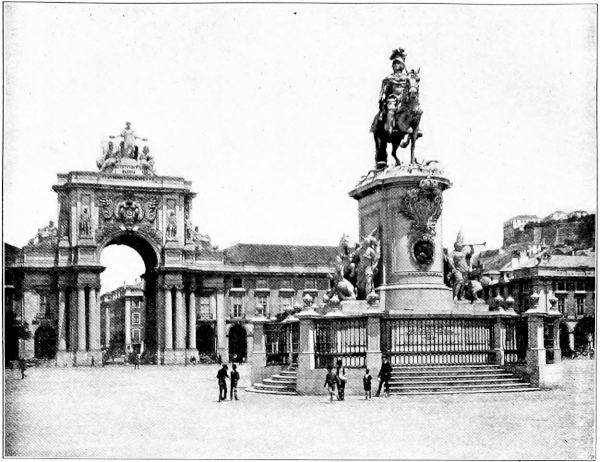
you must cross the Place du Commerce, or
Black Horse Square as the English call it,
looking out on the harbor and surrounded
the other three sides by government offices
and custom-house, with spacious arcades, a
triumphal arch, and bronze statue of Joseph
I., then pick your way down the wet stone
steps to the little boat which will row you
out to your ship.
But where shall you go for one hour?
Down to the dirty, narrow, old, Moorish
quarter? No. Out to the church and palace
of Belem built on the site whence Vasco de
Gama embarked in 1500, and now containing
the tombs of that explorer and of the
great poet, Camoens (whom many readers
will also connect with Macao, China). No
that’s too far and too interesting for a
mere hour. So is its neighboring tower in
which the peerages of Portugal and her
colonies are kept, and which looked so
picturesque from the steamer, Moorish architecture
in yellow brick. Can you go to see
what the irreverent traveler calls “the dried
kings” in the fine church of San Vicente de
Fora, where you may see the remains of
royalty of the line of Braganza preserved in
glass coffins? Can you go to the beautiful
suburb of Cintra, the summer resort of the
nobility, the favorite of the English residents?
No, it is fourteen miles away,
through orange groves, and up, up from
two to three thousand feet.
PLACE DU COMMERCE, LISBON.
I remember when we were seeing the
sights of Lisbon we had one very entertaining
man in our little party who proved to be an
American missionary in Brazil. He had
been over this ground before, and seemed
never to forget anything. He told us the
story of a Lady Bountiful, blessing the
poor with her generosity, no other than
our old fellow-countrywoman of Woman’s
Rights’ fame, Victoria Woodhull, now married
and living near Lisbon. Indeed she is
a very great lady, said the tale, and very
gracious to American visitors.
But no! It would require too much
time to see any sights more than the marvelous
pictures of three scenes in the life
of our Lord, done in Rome in mosaic after
Raphael, Michael Angelo and Guido Reni,
which we find in a small chapel in the
church of San Roque in the heart of the
city. About 1740 King John V. had this
alcove or chapel made in Rome. He was a
devoted Romanist, had been enriched by the
discovery of the gold and diamond mines of
Brazil, so this could be very costly in
mosaic, bronze, porphyry, lapis lazuli, etc.
It was set up in St. Peter’s in Rome and
the Pope celebrated the first mass in it,
then it became one of the treasures of
Lisbon.
And now you are again on the ship.
You look at beautiful Lisbon and know
that if it had not been for Brazil you would
never have seen it. It has been so easily
reached from England on this steamer, but
what an interminable journey it would
have been by rail! Spain seems far enough
away when one is traveling “on the Continent,”
but Portugal! Indeed, this enterprising,
seafaring, colonizing country of
three hundred years ago is nearly forgotten.
How many know now that her sailors named
Formosa (beautiful) as they found its lovely
shores, or think to trace her hand on every
Continent!
But the anchor is being drawn up and
you feel like old residents on the “Nile,”
and hardly know whether you are English
or Americans as you look about at the new
passengers, French, Portuguese, Brazilians
and Argentinos; for the English tongue and
simple brusque manners fall into slight minority.
French clothes, which these wealthy
new-comers love, are well displayed by their
ladies, and you will soon be shrugging your
shoulders and gesticulating dramatically
unless you are very unsympathetic. Your
next meals amuse you; for the bill-of-fare
which so far has had English names and
dishes, now caters to at least three sets of
people. The English get their bacon, their
“grilled bones,” and their cold meat pies,
the Americans have hash (with a foreign
element of grease and onions which the
true Yankee would not own), the Portuguese
have baccalhao and feijao (codfish
and black beans), and plenty of mutton
stewed with carrots. What else? Good
soups, meats, vegetables, salads and desserts,
and one dish daily required by the original
charter of the Royal Mail Steamship Co.—curry
and rice!
These people and you are to be two
weeks together now, in summer seas, a most
al fresco life. Each passenger has brought
a deck chair to his own taste, varying from
the simplest camp variety to the East Indian
adjustable luxury of rattan with bottle-sockets
in the arms and places to keep one’s
books, field-glasses and games.
TWO WEEKS IN TROPICAL SEAS.
What will you do with yourself during
the two six-day stretches from Lisbon to St.
Vincent of the Cape Verde Islands and
from St. Vincent to Pernambuco?
You find yourself an old resident of the
ship now, and mean to gain some sense of
the real life of the people about you. The
passengers are clannish at table and on deck.
The English and Americans fall together in
groups according to their taste or experience.
The Portuguese, Brazilian and Argentine
elements do the same. If you speak French
you can converse with any of the three latter,
for they are not confined to their mother
tongues. “You Americans speak so few
languages,” said one, once, to me with polite
derogation.
You soon settle into a routine. Early salt
bath to which your steward calls you on
schedule time, a cup of black coffee, breakfast
at nine. Perhaps you have already been
on deck and greeted your fellow-passengers,
as they all do, “Have you slept well?”
After breakfast a “constitutional” on deck,
pausing now and then at the end railing to
look down a few feet upon the five hundred
steerage passengers, the common details of
whose lives are very public. They are nearly
all barefooted, fearfully dirty, and you
gratefully watch the ship’s doctor going
among them with energetic disinfectants,
and take perhaps your first lesson in seeing
English officers control the ignorant and
unclean Latin. Your admiration rises; for
their discipline is perfect even of this temporary
charge. The “Nile” carries a thousand
souls. Among those poor steerage people
there are nearly always deaths at sea, but all
is managed with quietness and consideration,
and you probably will not know when the
sorrowful burials take place.
You have had your walk, or your energetic
game of ring-toss or shuffle-board, and
sit down to rest and read, when up comes a
charming young English passenger and says,
“May I include you in our sweepstakes for
the ladies?” and you may be as ignorant as
I and answer “Yes,” in response. “Two
shillings, please;” and your best friend will
explain to you that you have been betting
on the ship’s run for the day. If you say
no, you will probably be the only woman on
the ship, rich or poor, who has no chance to
win, and you must be as gracious and clever
as you know how to make up for your
incomprehensible Puritanism. At 12.30
P.M. the ship’s run is posted, and by the time
that excitement is over you go to luncheon.
At 4 o’clock comes the cozy cup of tea,
when perhaps some English lady will give
you a slice of delicious cake she has brought
from the famous Buzzard’s in London, and
you will offer her American ginger snaps
crisp from the can in return.
When you left England your 7 o’clock
dinner not only began, but ended in broad
daylight. As you near the equator the days
shorten rapidly until at 6 o’clock you see
the sun at the horizon, take out your watch,
in three minutes you are in darkness without
twilight. A week later when you land at
Rio de Janeiro the sun will set at 5.15 P. M.
You change temperature as well as the length
of your days. Leaving England with cool
weather and thick clothing, you graduate
yourself into the lightest of raiment soon
after leaving Lisbon. The water, the air
and the sides of your cabin all maintain a
temperature of 82° day and night for five or
six days, and you keep yourself sheltered
from the hotter rays of the sun.
One could easily imagine one’s self a
guest at a summer house-party—the decks
some great verandas overlooking an illimitable
lawn of the bluest blue, so quiet is the water.
For dinner the gentlemen wear their dinner
coats, the ladies make careful toilets, and
Englishmen who have lived in India wear
dress suits of white linen with short jackets
and broad sashes of rich silk.
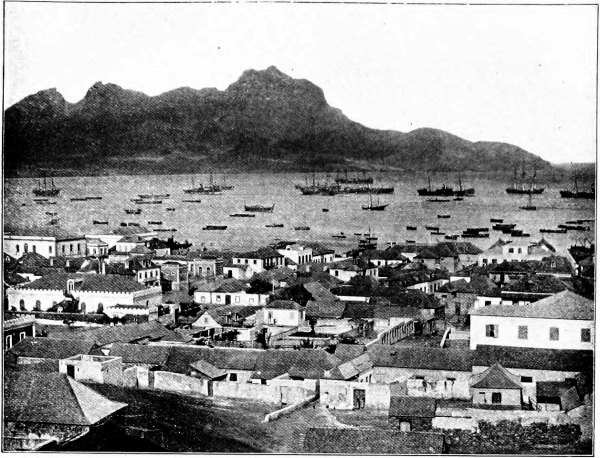
HARBOR, ST. VINCENT, CAPE VERDE ISLANDS.
At least four days before the equator is
reached the young people, with the assistance
of the officers, make out a two days’ program
of athletic sports. Every first-class
passenger is asked to enter his name for
one or more of the contests, and nearly all
are obliging enough to do so. Then comes
the fun of appointing judges and committees;
the ladies search their trunks for
ribbons for badges, and trinkets for prizes
are selected. Then the two days of “sports.”
The veterans’ race in which old men run
who haven’t done it for years, and young
men’s and young women’s and children’s,
three-legged races and “obstacle races,”
“potato races” and “thread-and-needle
races,” and the ship’s company is going from
side to side and up and down to watch it
all, or try to win, or compliment the winners.
Well! you will have your exercise and many
a good laugh, and in the evening the prizes
will be distributed in the music-room by the
captain or the most distinguished passenger.
After dinner you will watch the phosphorescent
water gleaming like a trail of fire
at the stern, take more walks with the promenaders
around the decks, and repair to
the music-room where your talented fellow-passengers
are sure to furnish a concert,
including everything from the classics to
Irish ballads and college songs. Even a
prestidigitator may give you a performance
some night. Oh! you are all great friends
now. The Portuguese Countess and you
have been having an hour’s womanly visit;
and you are anxious about the baby of the
fascinating English wife of the Argentine
ranchman who lives in such dignity in their
little colony on the pampa. The baby feels
the rapid change to summer heat, and you
advise the mother to fill her rubber (hot)
water-bag with ice-water and slip it under
baby’s little pillow, and she thinks it might
be well and says she has always heard the
Americans were “keen after ice.”
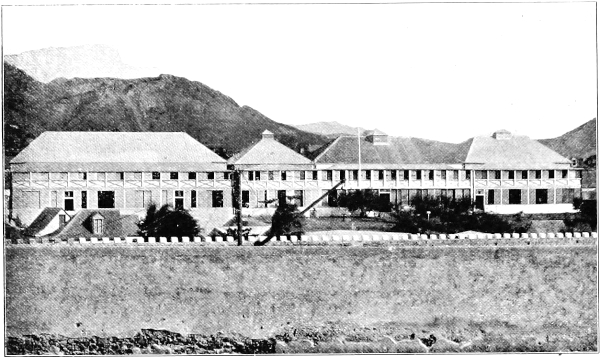
CABLE STATION, ST. VINCENT.
You will be glad to see land for a few
hours, though it is a dreary, treeless spot,
picturesque St. Vincent. Thirty-five English
telegraph operators form the nucleus of the
town and are there to repeat cablegrams
from the systems of wires which center there
in mid-ocean. At a center of information,
yet what fearful isolation! Other steamers
stop for coal as yours does.
The second Sunday at sea is one to be
remembered. It is spent in mid ocean, in the
tropics. In the companionway is posted a
notice of service in the great dining-saloon
at 10.30 A. M. At ten you are sitting on
deck, in a fresh white dress, waiting. Soon
after the crew begins to gather, stewards,
cooks, quartermasters, every one who can be
spared from duty. They come in neat
uniform, white trousers, navy blue jackets
and caps with the Royal Mail device embroidered
in color. The line of men, over a
hundred, stretches the length of the deck.
The captain and purser, followed by all the
officers walk the length of the line for roll-call
and review. The officers lead the way
to the dining-saloon followed by the crew,
then by the passengers. The stately service
of the Church of England is read by the
captain; the psalms are all sung, led by an
accomplished English lady at the organ.[1]
How many fine voices there are among
those sailors! It is an impressive service,
and you are glad that it is required by law,
and that all sorts and conditions of men
join in it.
[1] As the hymns and chants are those of the English
Church an English musician is naturally chosen, and
there are always those among the English passengers
who are fully competent to render this service.
After this luncheon, and a deck unusually
full of novel readers, for some of the
gentlemen do not play “poker” in the
smoking-room Sundays.
I remember we saw during that Sunday
afternoon two men whom we had not seen
before. They were reading Bibles. A
notice of a Gospel service at 8 P. M. by the
forward hatch was posted. We went; so
did all the passengers. The two new men
were the evangelists. They gave out a
Gospel hymn and started it, but no one
seemed to know it or joined in the singing.
They read the Scripture and exhorted, expressing
themselves strongly on unrighteousness,
betting and the use of tobacco, while the
listeners occasionally took their cigarettes
out of their mouths long enough to smile
derisively. We felt pained at the apparent
failure and asked the captain for the cause.
“Well,” said he, “these men are in the
world but not of it. They have shut themselves
away from the passengers, the sports;
shown no friendliness to the sailors. My
men are very obliging and often sing well
when these missionaries come along, but this
sort offends them, makes them ugly.” We
saw no more of the men until they landed
four days later.
PERNAMBUCO.
You cannot help being properly excited
when you anchor off your first Brazilian
city, Pernambuco—the sugar-shipping port.
It lies two miles away—a low line of light-colored
buildings with palm trees interspersed.
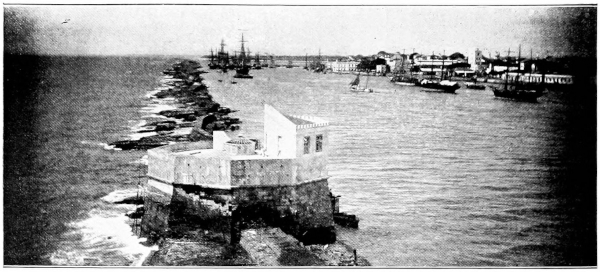
Between you and it is the strange wall, the
natural breakwater, which looks as if some
human engineer had planned it there;
narrow, level, twelve feet above high water,
with the surf broken into white foam against
its side. This reef follows the coast for several
hundred miles, but not always above
the water line. Opposite your anchorage is
the break in the wall which would let a
lighter vessel than yours over the reef; and
in the quiet harbor lie the smallish craft
from everywhere. At the end of the reef
near you is an old bit of a Dutch fort, and
it dawns on your mind that in the colonizing
times between 1530 and 1660 this land
was owned successively by Portugal, Spain,
England, Holland and finally by Portugal
again.
REEF PERNAMBUCO.
You may feel very superior in some ways
to what you see when you go ashore, but
not in the antiquity of your country nor the
superiority of your coffee. The truth is you
are in a life wholly different from anything
you live in at home. You look down the
narrow streets at buildings which remind
you of the different colonists who built there.
Close by is a public building, the outside
walls of which are faced in pattern with
glazed tiles in green and yellow like your
neighbor’s new mantelpiece. Next is a
stucco building, tinted to imitate pink marble,
with sky-blue trimmings. It makes you
laugh, it’s all so gay, but it seems pleasant
after all that any people should want their
very houses and stores and town halls to
look so cheerful. You are not quite used to
seeing fair-sized children in the street without
clothes, but they are black mostly who
avail themselves of such liberty. You look
at the street cars, which your English companion
calls a “tram” and your Brazilian
escort a “bond,” and their unsleek little
mules with their long fur all welted where
they have been beaten, suggest room for
a Society for the Prevention of Cruelty to
Animals.
You ride over the long iron bridge built
in Dom Pedro’s time to the suburb where
fine residences make you realize anew how
the people love brightness—for in the gardens
are not only brilliant flowering plants, but
wire frames among the shrubbery holding
great quicksilvered balls, and your confused
sense is of a continuous Christmas tree in
hot weather with no gift for you. Indeed
you feel in a very foreign land. There is
not a tree or plant you have seen outside
of greenhouses. The colors are all more
brilliant, the motions more slow, the greetings
more elaborate, the beggars more
loathsome, the whole place more ancient and
semi-decayed than anything you know.
Every wall is thick to keep out the heat,
every window has its “Venetian,” behind
which you fancy are eyes.
A fellow-traveller on the steamer knows
the life here and has been assuring you that
the climate is delightful: that no one ever
takes cold; that windows never are shut;
that the same weight of clothing can be
worn the year around; that the foreign
colony is agreeable, the hand-made lace is
pretty and durable, and the best “drawn-work”
simply exquisite.
Six strong men row you over the two
miles to your ship. Outside the reef it is
rough enough to keep you very still in your
little boat and glad to exchange it for a
steamer, and you wonder if you can be quick
enough to catch the ladder as the wave lifts
your boat to meet it. It has seemed to you
the last few minutes that the miracle of
Peter walking on the water was being repeated
several times about you on that rough
sea, only these modern sea-walkers have a
mast and a bench. It is really the fishermen’s
catamaran, a raft constantly washed
by the sea, navigated by a sail.
The ship is as familiar a home now as you
can remember, and you think you know
everything that can happen to you there.
You have loaded and unloaded freight,
listened to the noise of the ice-manufacturing,
the dumping of the ashes from the
furnace-room in the early morning, and the
daily scrubbing down of the decks at 4 A.M.
You have watched the crew go through the
fire drill and the drill of manning the lifeboats.
You have listened to the Captain’s
stories of helping disabled ships in mid-ocean,
and the heavy expense of it, and
learned how they signal their distress with
rockets. You know Sunday in port and
Sunday at sea, how to count the “bells,”
and change your watch daily to the new
time. But while you are eating the first
half of your dinner that night you realize
that you are an object of interest to your
next neighbor at table, a bon vivant who
has made this journey many times before.
You cannot think what is the cause of his
suppressed excitement. You like the fresh
vegetables that have come aboard and
remember your childhood when you look at
the new bouquets which decorate the tables—such
old-time solid pyramids of posies.
At length dessert is reached. The steward
brings a whole pineapple, lifts its cap (the
entire outside), reveals the juicy inside cut
in slices which you taste. Now you know
what your neighbor wanted to see, your
surprise and delight in the Pernambuco
“pines,” the abacaxi (abà-ca-shee). Make
the most of the abundance of this ripe, rich-flavored,
tender, fiberless fruit here, for you
probably won’t find anything else that tastes
so good.
TWO BEAUTIFUL BAYS.
It is two days from Pernambuco to Bahia.
The ship does not keep in sight of land,
for coast currents are not safe.
I remember well our anchoring in 1895,
in the great bay—Bahia means bay—surrounded
by bluffs on which the bright-colored
buildings of the city show to fine
advantage. The fleet of little boats rowed
out the mile to meet us. The Presbyterian
missionary friends we had known so pleasantly
in our own land, the Chamberlains and
the Kolbs, were in one of them and we no
longer felt unknown and far away.
Mr. Chamberlain said, “We came out to
see you and Bishop Granbery.”
“The Bishop is not on this ship,” we replied.
But persistent investigation discovered
him, his wife, and the Secretary of the
Foreign Mission Board of the Methodist
Church South in the “second-class.” The
quarters located over the screw had kept
them miserable from the constant vibration
and seasick the entire voyage, so they were
thoroughly used up.
Whoever has read “The Bishop’s Conversion”[2]
will appreciate the story. Most
merchants “economize some other way.”
There are differing views of this economy
among missionaries, and individual needs
should enter into the decision, but the nervous
system should be strong to endure the
perpetual motion of the screw.
That half-day in Bahia harbor with our
friends was a taste of missions at short
range. Their flourishing school had just
closed. It was a new venture with Miss
Laura Chamberlain for principal. The
last day of school had been a memorable
one, visited by parents who sent their
children with fear and trembling, but
who came to see the ending with pride and
astonishment. The secular papers had commented
unrequested on the high quality of
instruction—a brave deed there where Protestantism
had no friends. The Brazilian
owner of a great factory in a suburb had
been present and proposed to pay the expenses
of such a school among his employees
if “we” could provide such teachers. How
we all planned! How worth while it seemed
to live! to plan schools for a great state in
which only sixteen in a hundred could read!
even if it were only for two schools, “ours”
and the factory owner’s.
Mr. Chamberlain had just returned from
his first long journey in the saddle away,
away into the interior of the state, and found
material for Gospel teaching which filled
him with enthusiasm—the sturdy “cowboys,”
men clad in leather, of fine physique
and stamina. “Rough Riders” were not
then renowned, but Mr. Chamberlain’s prophetic
eye saw his men as they might be
and longed to get plenty of help and be at
work to realize the vision.
The religious history of the state of Bahia
has been making since that day, but not
without persecution. A third school was
planted, and grew, out on the nearest edge
of “the interior” at the cattle-market, Feira
St. Anna, in spite of warnings of priests and
Romish fanatics, with Christine Chamberlain
as principal teacher, beloved by the children
and admired by their parents, who needed
such goodness, efficiency and magnetism as
hers to overcome their fear of a Protestant
school. Now the burning torch which was
beginning to lighten that dark spot has been
taken away to the land where there is no
more night. Both Miss Chamberlain and
her Brazilian assistant, Noemi, have died of
fever, contracted while going through an
unsanitary part of Bahia on a visit of friendly
inspection to that “factory school.” And
the factory school is like a green bay tree.
The patron was warned that it might cost
him his friends and even his great business,
but he has been determined to accomplish
such instruction for his people in spite of the
fact that the Bible was to be used as freely
as any text-book. He is a convert to modern
(Christian) education.
Pretty Bahia seems more nearly in a
comatose state than the other Brazilian
cities you have heard described so freely on
the steamer. You gather that there is less
intelligence, more superstition, less broad
public spirit, more fevers, less elegance of
speech and courtesy of manner. Your
steamer does not wait long enough for you
to verify these impressions. You only climb
the bluff in an elevator, go in a bond to see
pretty suburban residences, passing consular
offices with their national colors. You come
back through the narrowest of streets, and
stop at one church “of Our Lady,” and have
a hurried look within. It is old-looking,
bare and dirty to your eyes, and the image
of the little Christ in His mother’s arms
shocks you by its ugliness and frippery.
Hung about are waxen imitations of arms,
legs, heads, etc., with sores and various ailments
depicted on their surfaces. You recognize
them as the offerings you have heard
about, and to be found in many churches,
of sufferers who plead with the Mother of
Our Lord to heal their diseases. Time and
dust do not make these objects more pleasing
to the eye.
Back again you row to the ship and dine,
then go on deck. Forget the few unpleasant
things you saw ashore, remember the palms
and the colors, and give yourself up to the
pleasure of the soft night-air and that great
crescent of lights—electric and gas—from the
water’s edge to the height of the bluff, with
the lighthouse shining nobly at the point.
Some new passengers have come for the
south, one coffee-merchant, from Boston,
you are told; the others all Brazilian. You
have never met people more courteous than
this Brazilian Senator and his wife, but
their manners are very conservative compared
with their countrymen, who are now
taking leave of each other after a champagne
party given down in the dining-saloon by
those about to sail. The men literally embrace
each other, in true Brazilian style,
patting each other’s shoulder-blades, and
their kissing is on both cheeks. A criticism
I once heard there of an average gentleman
of the United States was, “He had no manners
whatever. Why, he did not even know
enough to shake hands.” So from now on
you must have your hand ready, and soon
learn bom dia, good-day, to say to every one
you really meet.
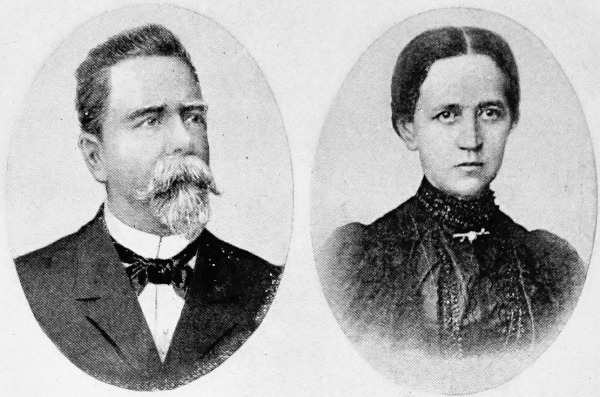
DR. MANOEL FERRAZ
DONA ANNA GABRIELLA
DE CAMPOS SALLES
DE CAMPOS SALLES.
PRESIDENT OF BRAZIL
WIFE OF THE PRESIDENT.
A little over two days and you are about
to enter the famous harbor of Rio de Janeiro.
Deeply serrated mountains form the coast,
with varying altitudes from one to four
thousand feet, and the city of four hundred
thousand people is so crowded by these precipitous
heights that it must wind its way
up several valleys and over the lesser hills
with at least two cog-wheel railroads to the
upper levels. These items have been told
you by some new friends you have made on
the ship, who are generous with all they
know; and one man even brings you a paragraph
he has copied from the Encyclopedia
Britannica, which says: “The Bay of Rio
de Janeiro has been the subject of poetic
panegyric ever since it was discovered; and
the traveler who comes to it after a voyage
round the world seems as susceptible to its
charm as if it were his first tropical experience.
This bay is the very gate to a tropical
paradise. There is nowhere so bold a
coast, such a picturesque cluster of mountains,
such a maze of inlets and outlets, such a
burst of all-pervading vegetation. The actual
entrance between Fort São João and
Fort Santa Cruz is 1700 yards wide. Within
there are fifty square miles of anchorage, or
even more for vessels of light draught, the
bay having a width varying from two to
seven miles, and stretching inland from the
sea for sixteen miles. Its coast line, neglecting
minor indentations, measures sixty miles.
Such a sheet of water would be beautiful
anywhere; but, when on all sides it is surrounded
by hills of the most varied contour,
the beauty is enhanced a thousandfold. Its
surface is broken by a large number of
islands from Governor’s Island, six miles
long, down to the little clusters.” This
man, by the way, started from England for
the round trip of the “Nile,” making altogether
a two months’ voyage. He has a
large state-room, with books, mostly of
science and reference.
For seventeen days you have heard of
Rio, and Rio, and Rio, on deck and at
table; for many of your companions live
there or are eager to see it for the first time.
You are up by six o’clock to lose none of
the early morning view. The ship is nervous
among the shore currents outside the
harbor, then makes one great plunge over
the bar, whereat all the old residents laugh
familiarly, and glides in stately quiet within
the smooth harbor.
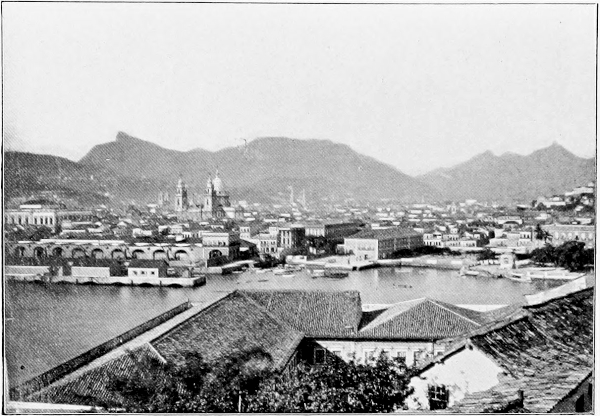
DOCKS AND ARSENAL, RIO DE JANEIRO.
You have had your early black coffee, so
stay with all the rest to take in the exquisite
beauty. Seeing is better than being told.
Your lungs drink in the soft air. Your eyes
drink in the forms and colors. Here is the
old Sugar Loaf, sheer rock a thousand feet
up out of the water, a sharp cone, gray, softened
by green mosses, the sentinel of the city.
There is the city built to the water’s edge,
with sharp hills in the midst, crowned each
with a church, “built in Jesuit style.” The
groups and alleys of the royal palms are tall
and straight, some of them a hundred feet
in height, your neighbor says.
The ship anchors not unduly near another
ship. There are many others, warships and
sailing vessels and steamers, “tramps” and
“regular liners.” In an incredibly short
time a fleet of launches and row-boats
surround you, and happy are you if you, too,
find some one there to meet you. Here is
an Englishman to meet the gentle wife and
troop of little children he sent “home” a
year ago to build up in cold weather. You
look the other way at the bank clerk sent to
meet two new recruits, and at the manager
of an American coffee firm who comes to
meet the man who is to be his substitute
while he goes “home” for six months’
change. But perhaps you are most interested
to see the Scotchman who has come for
his bride, for she has been such a cosy, little
body all the way down. She sailed “in care
of the captain,” brought her wedding dress,
her wedding cake and requisite legal papers
along, has been everybody’s helper and
nobody’s trouble, and finally has the nickname
of Sammy, which is short for good
Samaritan. She will have a Brazilian civil
marriage service first, then the chaplain of
the Church of England will perform a religious
one, and three weeks after she lands
the British consul will marry the couple a
third time and the notice can be recorded
“at home.” England does not intend to
countenance runaway marriages. At the
end of the third service you may telegraph
your good wishes to “the Bride of the Nile.”
The American knows the Rio Secretary
of the International Young Men’s Christian
Association, and invites him to the steamer
breakfast, of which nearly all now partake,
both passengers and visitors. You and your
husband are invited to be of the party to go
ashore in that launch, and spend the day till
four o’clock sight-seeing. You are advised
to spend your nights in Petropolis; for it is
beautiful up there, and a slight risk to stay
down in the city at night on account of
“the fever.”
You prove during that first day in Rio
that the narrow streets are lined with really
interesting stores containing goods quite
beautiful, but very expensive. You see
French clothes and fine diamonds; brilliant
birds, stuffed; and humming-birds set in gold
for jewelry; feather flowers of the most
beautiful colors, made from the natural, undyed
plumage of tropical birds—crimson,
pink and snow-white rose buds, pale pink
morning-glories, scarlet coffee-cherries, all
with green feather foliage. Such blossoms
would not suffer in your bonnet if you wore
them in the rain, but no one does it.
You stop a moment at the large music-store,
having its own and foreign publications,
and there catch the first strains of a
Brazilian Tango, the dance of Spanish
rhythm which you find quite new and fascinating.
You will hear this same rhythm
many times before you leave Brazil, but will
not find it used for dancing.
You visit the large and elegant library
building, containing they say one hundred
and twenty thousand volumes, but see no
readers. It was of royal origin long ago.
You go to see the new Young Men’s
Christian Association Building, the only one
in Brazil, while your guide, Mr. Myron
Clark, from Minneapolis, tells you the demand
upon it in this port, and you wish it were
not such a struggle to raise money for it.
“The foreigners” are quite ready to contribute
to the English hospital, for any of
them may need its care; but the use of a
Y. M. C. A. is not familiar to many of them.
How shall it get the money it deserves?
You go to see the National Art Gallery
and find a few good pictures of local feeling
or history, but otherwise the work of artists
who have studied in Paris. You have
climbed one precipice of five hundred feet
by the “Plano inclinado,” looked down over
the brilliant city flecked with palms, and followed
the substantial aqueduct “built by the
Jesuits” long ago, which brings water into
town from the heights, over arches at first
low, but rising about a hundred feet across
one valley. The masonry is stuccoed, moss-grown,
fern-draped; the water pure and refreshing.
You ascend to the top of Corcovado,
twenty-five hundred feet high, by
another cog-wheel railroad, and find a little
shelter-house at the peak from which you
see the wonderful view of city, bay, other
mountains and ocean bathed in light; then
hurry down to get the “barca,” the large
fine ferry-boat which takes you ten miles
across the bay on your way to Petropolis.
It leaves at four in the afternoon. How you
love that sail in the soft air across that beautiful
bay! You look forward to the great
Organ Mountains up which you will soon be
climbing, and wonder what harmonies came
from those giant fluted pipes when the morning
stars sang together. You have good
company, English, German and American in
addition to the Brazilian. Too soon you are
in the train which speeds along the few level
miles, then dismembers and climbs the heavy
grade in sections. You will never forget the
outlook from these windows and wonder if
so much beauty has existed all these years
known to so few.
PETROPOLIS.
Four thousand feet up, and back from all
sight of the harbor, you reach Petropolis,
built first as the summer residence of the
Emperor, Dom Pedro, and named for himself.
It is a beautiful town, the home of rich
Brazilians, foreign merchants and foreign
legations, for it is the diplomatic center.
While you stay at the English Pensáo Honoria,
some ship-friends are near by at the
Hungarian Pensáo Central, both with unusually
good food and service. In the garden
great bushes of the camelia are covered
with waxen blossoms and the poinsettia
blazes beside a hedge of heliotrope. Humming-birds
dart in and out among the shrubs.
Through the middle of every street runs
the mountain stream in a stone-curbed
channel, spanned by Indian-red bridges at
the street crossings.
Dom Pedro was the “village improvement
society,” and the main street is still called
the “Rua Imperador” although it was
renamed when he was banished. The
town follows the narrow valleys between
hills always green. The gardens are bewildering
in their profusion of flowers.
Lilies blossom as they do in California.
Orange trees perfume the air. The verandas
are but a step up from the ground, and the
rooms open upon the verandas. You feel
little need for a house. Only hotels and
palaces are two stories high; the rest are
one.
The British Minister, the American, the
Swedish, the Belgian, the German, the Argentine,
with their suites, are soon recognizable.
You go to call on your American
Minister, find it is an afternoon “at home,”
and imagine you know what the confusion
of tongues was like, for all the other kinds
of foreigners are there. You go also to call
on the Methodist missionary, sent by the
Southern Church from Georgia. He is the
only Protestant minister living in this region
except the German Lutheran, who is the
shepherd of a colony of good German
workers imported by the Emperor long
ago.
These Methodists have begun with a
school instead of a church, and have honored
their work by buying a beautiful building
in beautiful grounds for a seminary, which
is the only rival of the school of the nuns in
the old imperial palace. These are both
boarding as well as day-schools. You smile
when you become conscious of some of
the difficulties these teachers have in preparing
text-books and explaining general
literature, for the North Star is not visible—the
Southern Cross has taken its work.
December, January and February are the
hottest months; Christmas will probably be
scorching; the sun shines in at the north
windows, and the farther south you go the
colder it grows; for you are south of the
equator. Have Australia and South Africa
and South America had to read all our
best literature all these years with a commentary
to make it intelligible!
The Portuguese days of the week suggest
Old and New Testament instead of
the heathenish origin of Anglo-Saxon
names:
Monday
Segunda Feira
Second Market Day.
Tuesday
Terça Feira
Third Market Day.
Wednesday
Quarta Feira
Fourth Market Day.
Thursday
Quinta Feira
Fifth Market Day.
Friday
Sexta Feira
Sixth Market Day.
Saturday
Sabbado
The Sabbath.
Sunday
Domingo
The Lord’s Day.
You have made several friends among
coffee, insurance, banking, exchange, diplomatic
and missionary people, and have
discovered mutual friends “at home”; so
you have had visits and invitations to drive
and to walk, and now have one for a breakfast
at one o’clock on Sunday. Really
just what would the Sabbath Observance
Committee do here? There is no English
service till four in the afternoon, to be held
in a hall over a grocery store by the missionary
of the Methodist Church. A Frenchman
comes to mind who mentioned with
bewildered disgust the American plea for
closing the Exposition on Sunday: “What
do they expect us to do, then! Sit on a
bench in the park all day!”
The business men are all at home, glad to
rest one day in seven from the three hours’
journey to their Rio offices and the three
hours back, besides their exciting markets.
Through the week they have little chance
for exercise, for the only train down the
mountain leaves at seven in the morning,
and one cannot reach home much before
seven at night. The early coffee has thoroughly
wakened and fortified the system
against malaria. You see with what keen
pleasure the various parties start off on
horseback or a-wheel. They will ride until
they are healthily tired and come back to
be entertained in little groups at hospitable
boards. What will you do? accept the invitation
and join one of the groups? or
stay in your own garden, and eat your own
hotel breakfast?
In any case you attend the service in the
hall, in company with thirty or forty others.
Double this number in town are English or
Americans. One of the Methodist schoolteachers
plays the harmonium. Moody and
Sankey hymns are sung. It is more nearly
a piece of North America than anything
you have seen since you left that beloved
spot, but the setting is foreign, from the
different wall-paper patterns to the very
wide boards of very hard wood which compose
the bare floor, and the foreign-looking
houses you see through the window. Your
missionary preacher has held a Portuguese
service, attended by the poor, in the morning,
and a collection keeps this English service
self-supporting, so far as room-rent goes.
You must make another trip to Rio.
This time your first objective point will be
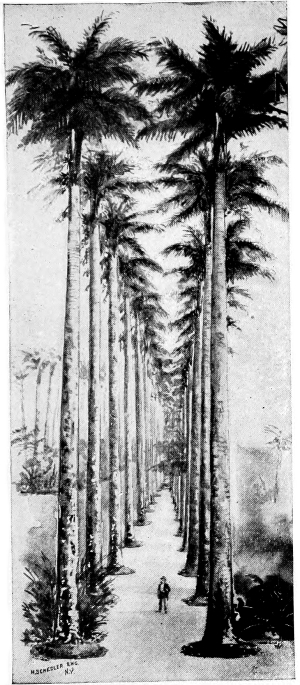
the Botanical Garden, with its magnificent
alley of palms, its more beautiful alley of
bamboos, old tamarind trees and other attractions.
You will not be disappointed in
the beauty, but you will be surprised to find
yourself there almost alone. The “bond”
has taken you through interesting streets,
and quite a long distance on the edge of the
bay. You have skirted hills built to the top
and others too steep for that. You return
to the heart of town in time for a late breakfast,
one o’clock, which you may have invited
some friends to share at a capital
restaurant on “the Ouvidor.” You climb
a long flight of stairs to a large, cool, pleasant
room with many open windows. Every
room by law must be at least fifteen feet
high, whatever its floor dimensions, and
public rooms are always frescoed with old-time
panels and bunches of flowers.
What is the Ouvidor? A very narrow
street, too narrow for vehicles, lined on both
sides for seven or eight blocks with the best
stores of Rio. It is also a meeting-place for
politicians and newsmongers, gentlemen of
leisure and fashion.
When I went to Rio first in 1884 it was
not proper for a woman to go in the street
without some man to take care of her.
She certainly could not go to shop alone in
the Ouvidor as she sometimes does now.
When Prof. Agassiz visited Brazil, “on
the occasion of his first lectures delivered
in the capital, he earnestly requested the
emperor that ladies might be allowed to be
present,—a privilege till then denied them
on grounds of etiquette. The request was
granted, and the sacred domain of science
for the first time was thrown open to the
women of South America.”[3]
Now she is verily a new woman, being far
less restricted. The sanitary conditions of
the streets have been improved. The sights
do not shock her ideas of propriety. Rio is
fast becoming a city like any in Southern
Europe, never forgetting its superior natural
charms. Whoever would have thought that
the probable presence of women on the
streets of a town could work a revolution!
Even the negro porters and little children
are now reasonably clad. I used to apostrophize
the coffee-sack, ripped a little way
at the bottom and a little way on each side
to let a head and pair of arms through, as
the only garment of the poor man, but now
the coffee-sack serves only its original purpose.
The curious tin trumpets projecting
from the level of the second floors no longer,
so far as I have seen, discharge the pails of
water which were thrown on the floors and
swept out through these convenient vents
into the street. There are no longer bonds
labeled “descalços,” (barefooted) in which
such were compelled to ride.
ALLEY OF PALMS, BOTANICAL GARDEN, RIO.
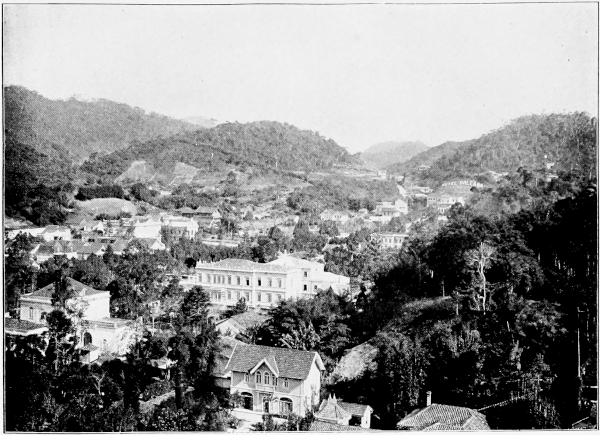
This time you must climb the mountains
back of Rio for the night. Had ever an
emperor such a park as Dom Pedro made of
these mountains of Tijuca! Thirty miles of
park road, swept every week, lighted by gas,
winding in and out, up and down the precipitous
slopes of mountains green to the top!
And such green! the green of palms and
tree ferns, of trees with orchids and sipos.
Every few yards brings you to a distinctly
new view: sometimes it includes the Atlantic,
sometimes the Rio harbor, sometimes the
distant city, more often a lovely valley, a
waterfall, a height of rock all covered with
ferns and mosses, and another stretch of your
winding road with a railing of tall, graceful
bamboos growing at some dangerous place.
You are shown the spots which Agassiz specially
studied and stay in the old hotel where
he stayed. Why do people go to Petropolis
with this beautiful spot so much nearer?
Because, in the summer-time, between December
and April, yellow fever has been
known to get a little lodgment even here;
rarely, it is true, but the foreigner who knows
his new home never takes any risks. He
will not stay in Rio during fever-time after
sundown. He will not go out in the early
morning without his coffee. If he has the
slightest intimation of fever he takes castor
oil without a moment’s delay. If he has
taken the fever he goes at once to the hospital
in Rio, not risking the change to the
cool heights of Petropolis, lest he might not
have strength to rally in the cold when the
period of collapse comes. You say you
would not live in a place where such a sword
hung over your head, but they read New
York and Chicago papers in July with records
of hundreds of deaths from sunstroke
while their temperature is hardly varying five
degrees from seventy, and in February, when
their fever is at its worst, they read the
numbers of victims of pneumonia, grippe,
diphtheria, and find the ills of life not so
unevenly distributed after all. Men on
salaries large enough to live in Petropolis
need have little fear of yellow fever. But
the missionaries in Rio, the secretaries of Y.
M. C. A., Bible Society, etc., and the under-clerks
of foreign establishments must have it
once. How these men and women have nursed
each other through the sharpness of the fever
and the awful weakness afterwards! Do
you wonder that friendships spring up under
these circumstances between people who
would hardly find their affinity at home?
Kipling voiced the spirit of such comradeship
in a small community in a foreign land,
when he wrote:
“I have eaten your bread and salt,
I have drunk your water and wine,
The deaths ye died I have watched beside
And the lives that ye lead were mine.
“Was there aught that I did not share,
In vigil, or toil, or ease,
One joy or woe that I did not know,
Dear hearts across the seas?
“I have written the tale of our life,
For a sheltered people’s mirth,
In jesting guise—but ye are wise,
And ye know what the jest is worth.”
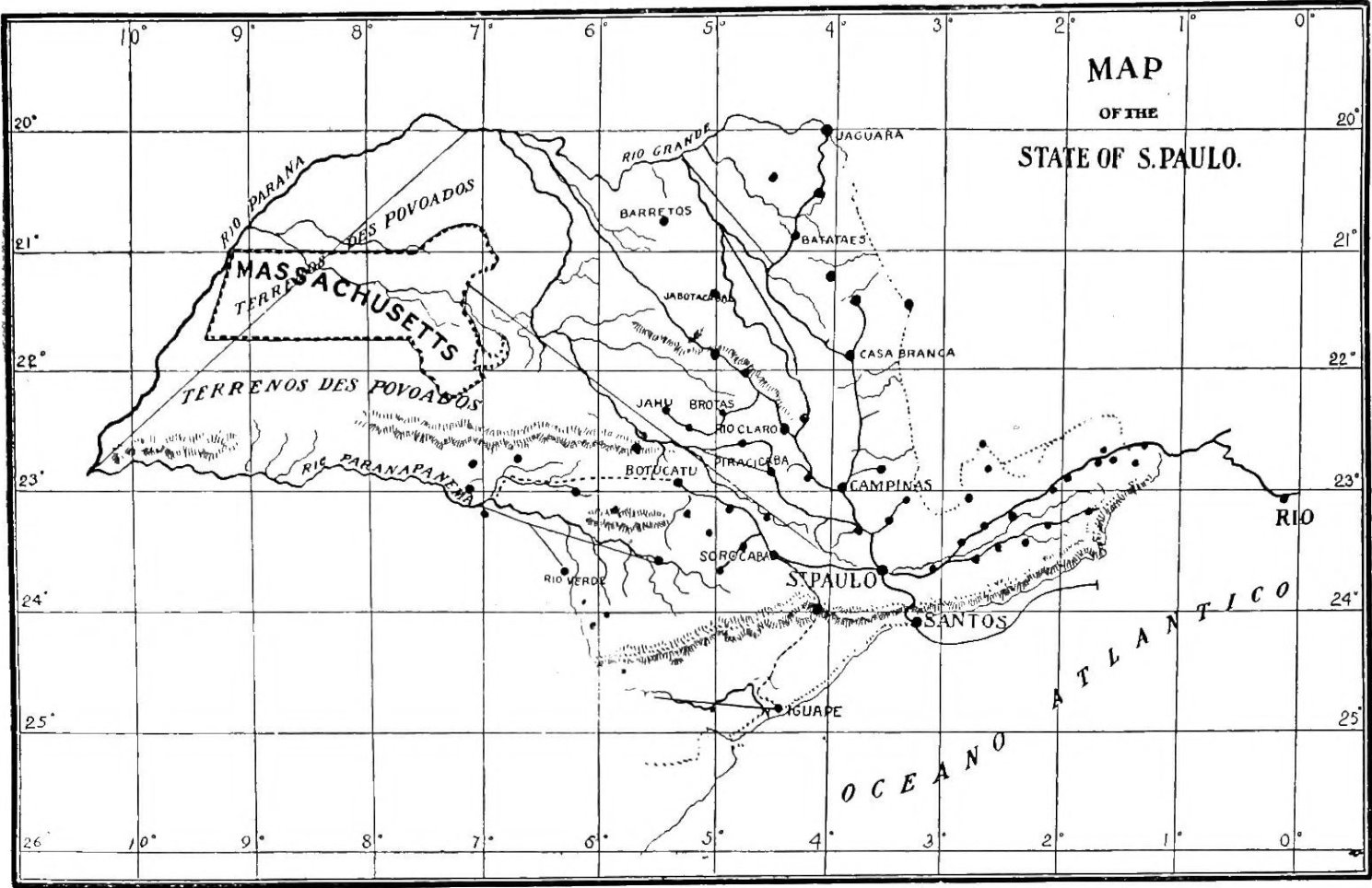
STATE OF S. PAULO (MASSACHUSETTS SHOWS RELATIVE SIZE).
(click image to enlarge)
SANTOS AND SOME BRAZILIANS.
Though you are so comfortable and happy
in Petropolis with frequent excursions to
Rio, you cannot leave Brazil without a trip
to Santos and São Paulo. Perhaps you
never heard of these places before you arrived,
but now they are all-important. You
recall “Santos” as a mark stuck in coffee-bags
at your grocer’s at home. Here you
know it is the port which ships the greatest
amount of coffee to Europe and North America
of any in the world—millions and millions
of dollars’ worth. And São Paulo, a
city of 200,000, is the capital of a great and
wealthy state of the same name, lying up on
the high table-land forty miles from Santos,
its port.
You study the daily papers for a “vapor”
(steamer) to take you these two hundred
miles farther south, and find them due from
every port in Europe, freighters with cabins
for a few passengers. It is a rather rough
voyage, but after twenty hours you round
the island which lies in front of Santos,
making the Santos “river” a quiet harbor.
Every flag flies in that harbor, but how
the seamen hate it on account of the awful
scourge of yellow fever six years ago, when
forty or fifty vessels were abandoned there
for lack of living crews to take them out.
The sanitary conditions are improved since
then, and you may safely sleep on the seashore
near by, and go into town during the
day. The stone quays are now fine. The
narrow streets are laden with the odor of
green coffee. Barefooted Portuguese and
negroes are the beasts of burden. They
walk rapidly up a gang-plank with two coffee-bags,
each weighing one hundred and
thirty-two pounds, on the two shoulders
and meeting over the head; then, with a
quick motion, dump the bags into the ship’s
hold.
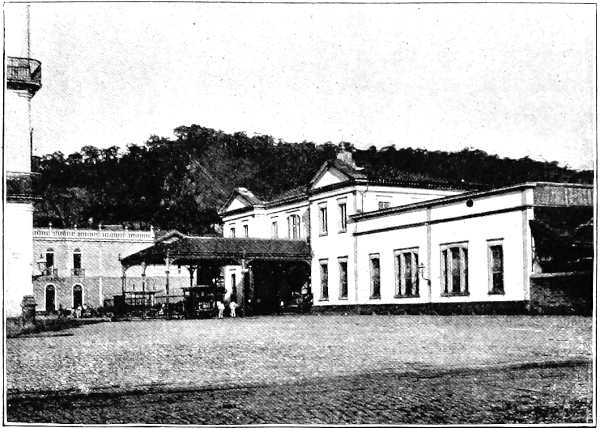
RAILWAY STATION, SANTOS.
The bright-colored houses and the palms
are like those you love in every Brazilian
town. The women mostly sit in the windows,
idle, ill-clad and untidy. The mountains
climb abruptly behind the half-dozen
streets. When you go to São Paulo you will
climb those mountains by an English railway,
starting from a good station.
By the station stands one of the oldest
churches in Brazil, dating back perhaps to
1550, the Romish church of Saint Antonio.
It contains a curious chapel, wainscoted high
with blue and white tiles (Delft?) forming a
panoramic picture. In the center of the
chapel an image of Christ, with the heart exposed,
has lines of rope running taut from
the heart to the images of the saints grouped
about him—“Will draw all men unto me.”
It is very realistic, very crude, really revolting,
but very illustrative also.
The island which shuts Santos from the
vast Atlantic, stretching down towards the
South Pole, has on its ocean side a succession
of beaches each a mile or more in length separated
by rocky promontories. In the most
spacious of these praias a Brazilian syndicate
has built a “Brazilian Monte Carlo,” called
Guaruja, consisting of hotel, cottages, a
Catholic church with never a service in it, a
theater, and a Casino where roulette was
wont to be played every night and Sundays.
If you stay at Santos you will find this spot
safe from yellow fever, and your first twenty-four
hours will convince you that you have
found the climate of Paradise. You are at
the edge of the south temperate zone. For
weeks the temperature will not vary five degrees
from seventy Fahr. day or night.
The lines of nature are exquisite—the slopes
of the hills, the curve of the smooth, hard,
sandy beach. The air is soft to breathe.
The hotel is filled with large Brazilian
families, some from the city of São Paulo,
others from the great coffee plantations
farther interior. They are typical wealthy
Brazilians. Some have been sent by their
doctors for sea-bathing. The number of
baths is prescribed, and taken literally and
seriously at six o’clock in the morning.
Some have come for gaiety, relief from the
monotony of life on a plantation. Some
from São Paulo were “monarchists,” do not
like the new republic, go to Paris where the
Brazilian Princess holds a little court, and
bring back French clothes which may enable
you to take to New York some fashions
in advance from the remote suburb of
Santos!
A good quartet plays for dancing in the
hotel sala (parlor) every night, especially
Sundays. The Casino is the next building,
and a wail goes up because the state government,
in what is considered an excess of virtue,
has sent soldiers to prevent gambling
there.
All the ladies speak French fluently and
their piano-playing is brilliant. They use
the time which we bestow upon “an all-round
education” upon these accomplishments,
and marry by the time they are sixteen.
Some time they will go to Paris. Now
they are over-run by their many little children,
and usually look older than they really
are.
You are puzzled to know who belongs to
whom. The wife of Senhor de Couto is
Dona Margarida. The mother of Senhor
Antonio Prado is Dona Veridiana. The
wife of the nation’s president, Campos Salles,
is Dona Anna Gabriella. They might all
be members of a royal family, or belong to
the time of the patriarchs, so far as their use
of names goes. When the narrow gauge
train brings the papas at night to the front
of the hotel there is pleasant excitement.
The sons kiss the hands of their fathers
respectfully. You will select the lawyers
and doctors by the distinctive gem each
wears in his ring, diamond or emerald. The
barons are mostly owners of coffee plantations,
and the many commissarios are the
coffee factors who often advance much
money “up country” to perfect and bring
down the coffee to the port. You meet them
all easily on the verandas or in the park
which borders the beach.
The park itself deserves your interest; for
the neighboring forests have yielded their
palms, aloes and dragon’s blood to beautify
it, and the little summer houses are thatched
with blossoming air-plants all pink and green.
Your strong, good coffee and fresh French
bread are brought to your bedroom at seven
in the morning, and then, before the sun is unpleasantly
strong, you have your walk on the
beach after watching the little narrow gauge
train start with the business men for Santos.
At eleven you go to the dining-room for a
four or five course breakfast. At four o’clock
you will make your own tea on your spirit
lamp and have some of Huntley and Palmer’s
biscuits. (When the “biscuits” are eaten
the box is just what you want to keep your
kid gloves from mold and your gluey laces
from being eaten by insects. I was not surprised
to read of a British Bible Society
making Bibles for Central Africa of a size
and shape “to fit in biscuit boxes,” that
they may be preserved from the ravages of
ants, these biscuits being for sale in all such
climates.) At five the Brazilians begin to
dine. You wait till six, but some are still in
the dining-room. You wonder at the parents,
who give wine out of their own bottles to
babies not more than two or three years old;
and at the seven-year-old who invites a half
dozen of her own age to dine with her on
her birthday, and at the close of the meal
has her health drunk in champagne by her
mates with experienced clinking of glasses.
You make a note of the little American boy
five years old, lately arrived, who quickly
learns the ways of the country. He asks his
mother for a bag of marbles and some money.
“What is the money for, my son?” “Why
you can’t play marbles here unless you play
for money,” says the wee man.
You watch the new arrivals and wonder
what are the relationships in this big family—a
father, two mothers, or aunts, or what?
with those children. You soon appreciate
the exalted place given to the godmother,
and she it is who is neither aunt nor mother
at that table—a law unto herself and them.
Of course she is invited when the family
comes to the seashore! I remember an
Anglo-Brazilian gentleman once became very
angry at this same hotel because he was not
given a very good room, “and my compadre
(associate father, god-father of the son) the
President of this hotel company!”
You watch the keen, unprincipled-looking
boy just down from the great Jesuit school
with whom the hotel manager is vexed “because
he is such a little liar.”
You greet your neighbor on the veranda
with good-day in Portuguese; then she
speaks more of the same tongue but you
shake your head. “Parlez-vous Français?”
but there again you are soon beyond
your depth, and at length one is found who
speaks “a lit-tle English.” You have noticed
this young woman before, a modest, bright,
intelligent-looking girl, with an expression
just a little different from all the others,
evasive but of a more familiar type. “Where
did you learn English?” you inquire. “At
the Eschola Americana (American School),
in São Paulo,” she replies; and you tell her
you are going to that city very soon and to
visit that school. You have found a friend,
though a shy one; Brazilian girls keep well
in the background, and next day when a box
of flowers, oranges and sugar-cane comes
down from her father’s fazenda, she brings
you some camelias and tells you about the
sugar-cane, though neither of you cares to
chew it. It is for children, and “children
of a larger growth.”
St. John’s Day comes at the end of June.
It is one of the greatest of the many Romish
holidays or festas. The “American schools”[4]
do not close for saints’ days, indeed one is
puzzled to think what other schools do
with such constant interruptions and the
overwhelming illiteracy is partially accounted
for! They do close, however, for a ten days’
vacation at St. John’s Day, for it is midway
from Christmas to Christmas and fits the
school semesters. Dr. Lane, President of
the “American schools” and college, and
some of the teachers come down to Guaruja
to rest, and you have many a quiet time to
talk over their work with them, such as they
could not well afford to give were they
among their five hundred pupils. You enjoy
seeing them meet old friends among these
Brazilian families. You sit out on the veranda
in the evening, while St. John is honored
with fire-works (saints always have fire-works)
and talk a little with the orphaned
Scotch and Italian girls who have been
brought to school and are being trained for
teachers. They have all been under the
weather. It has been forty-five degrees
Fahrenheit up in São Paulo morning and
evening for three weeks, a little too cold for
a building with no heaters fiercer than little
charcoal braziers, but the Brazilian children
are accustomed to such winter temperatures,
even though consumption has more victims
than any other disease.
[4] “American Schools” were founded many years
ago by a Presbyterian missionary and have maintained
a high standard.
This is a holiday for business men as well
as schools and the prevailing church.
A picnic to the bay of the second praia is
arranged. The islands boasts two carriages
and you charter them for the ladies and the
luncheon. The gentlemen go on horseback.
You arrive at a rocky coast with no beach, no
means of reaching the water’s edge. And
there in sight of your picnic party are hundreds
of huge turtles in the water! The question
is proposed, “How much does one of
those turtles weigh?” The inexperienced
guess wildly from ten to forty pounds. A
knowing one says they will average from one
to three hundred! A French steamer is passing
the island as you watch, and soon will
round the lower end and make the Santos
harbor, but she is well out from shore.
You never see a little boat among those
breakers. No one goes for turtles. If they
were on our northern shores what would
their lives be worth! but here living is too
indolent to spend ingenuity on capturing
turtles.
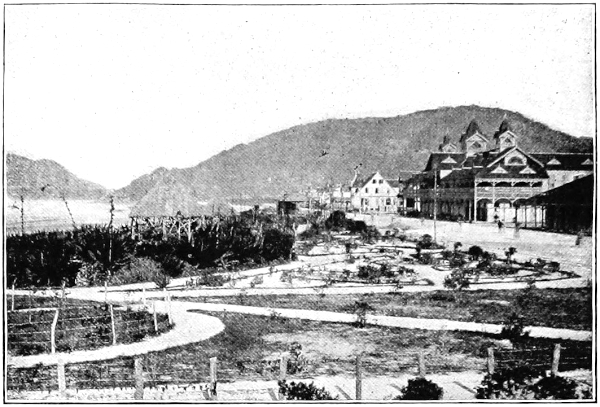
HOTEL AND PARK, GUARUJA.
I must give you some reminiscences of
older Guaruja. The town was created just
at the close of the Columbian Exposition.
The President of the syndicate visited the
United States and bought the buildings for
Guaruja, all pine, ready to put together. It
looked like a section of Coney Island and
very novel in that land of red-tiled roofs and
plastered sides. A narrow-gauge railroad
across the island and an electric light plant
proved the enterprise of the company. Only
three of the many sleeping-rooms in the hotel
were lighted by electricity, however. They
were arranged en suite with a light in each,
but only one switch, in the middle room,
turned the three on and off. It was our
drollest fun to tease the English couple who
occupied one of the side rooms about the
hour at which their neighbors sent them to
bed. If there was a baby there they were
plunged into darkness before nine. If there
was a “quiet game” going on next door
these poor victims must lie in a brilliant light
until late. These two rooms lacked their
own switches for more than a year to my
knowledge.
Two words you easily learn with their
depths (or lengths) of meaning are, paciencia,
patience, and amanha, to-morrow (which
means some other time, probably no other
time).
If you wish to hear an uproarious laugh
listen to any one familiar with Brazil hearing
for the first time Kipling’s:
“Now it is not good for the Christian’s health to hustle
the Aryan brown,
For the Christian riles and the Aryan smiles, and he
weareth the Christian down;
And the end of the fight is a tombstone white with
the name of the late deceased,
And the epitaph drear: ‘A fool lies here who tried to
hustle the East.’”
Life in Santos—now at high pressure, then
idle—now pitiless to one’s neighbor, then
tender as a brother—now mastering business
knowledge of the ports and exchanges of
the world as if such accuracy were all-important,
then comes a whirl of speculation
in exchange which seems to take all value
out of special expert knowledge—life in
Santos is evasive to one who would portray
it faithfully. It seems difficult to express
more than half the truth at one time. If
one lives there a month the personal histories
will all be familiar to him, and a like time
on the Praça (Exchange) will acquaint him
with the business characteristics of every
firm. It is easy to learn things on the
ground, to get a just and appreciative
knowledge of excellencies and difficulties
which is not readily transferrable. There
are not only facts which can be stated, but
a spirit of the place and people as necessary
to know as the facts.
CONSULAR SERVICE AT SANTOS.
While these reminiscences of our life in
Santos and Guaruja in 1895 and ’96 are
uppermost, a figure comes to my mind
which deserves your knowledge. It was
still painfully near the horrible epoch of
yellow fever developed by dredging for the
new quays. That was why we all slept at
Guaruja, the Barra, São Vicente, or São
Paulo, even though daily coffee, banking
or navigation business must be prosecuted
in Santos. Such living was and is expensive,
very.
At this time the United States saw fit
to pay her consul in Santos $1,600 a year,
since raised to $2,700, without allowance
for office rent and expenses. The port
cleared eight to ten millions of dollars’ worth
of coffee per annum for the United States,
and a large import business was opening up.
The barest existence at Guaruja, or other
healthful suburbs, for a single man, with daily
transportation to Santos, cost $1,500 in
gold. But one man could be found to try
the service of our government for this State,
and he was an Alabama negro. He was
presumably an immune from yellow fever.
At any rate, his income necessitated his
sleeping in his office in Santos, and when
even such undignified economies left him
short of funds, he borrowed of the American
merchants. A U.S. cruiser anchored
off shore. The U.S. Consul and American
citizens were invited on board. Tide
and conditions made it necessary for the
“tars” to carry the guests ashore on their
backs through water about waist deep. The
lieutenant in charge prophesied too sure an
accident to do other than advise the consul
to wade ashore on his own feet.
This black man did the routine work of
the office, earned more than he received,
and left in debt. Merchants, as consular
agents, have filled emergencies for the government.
The lack of a living salary for a
good man as consul in a difficult but important
port is the point I wish to make
clear.
The British government rates this as a
first-class consulate; salary, £1,500, nearly
seventy-five hundred dollars. Offices for
him in both Santos and São Paulo are maintained
at government expense. Each year
here counts for two in his required term of
service, and at the end of the service his
pension is based on the salary of the port.
Of course he has been trained to the consular
service.
The British Consul when we were in
Guaruja had just come from ten years’ service
in Mediterranean ports, a gentleman of
intelligence, elegance, refinement and courtesy.
His regalia always adjusted to a
nicety to the diplomatic requirements of the
occasion, be it a wedding ceremony, a
Queen’s birthday dinner, a reception or a
funeral, provoked smiles from the Americans.
Even the flower in his buttonhole
artistically harmonized or contrasted with
the shade of velvet of his lapels and cuffs.
During his first year the worst of “the
fever” was in the shipping. Sailors from
British ships came to his office in all stages
of it. With his own hands he steadied the
tottering sick ones, sent them to the hospital,
and knew of his own knowledge that
they were being taken care of. When they
died he collected their pay from the ship-masters
and saw that their money and effects
reached their relatives at home. He received
while we were there a letter of thanks
from an American mother, whose boy, a
sailor on an English ship, had died in Santos.
He had collected his pay and sent
home his kit. The mother sent him money
to erect a stone over her son’s grave.
His systematic exercises were a daily swim
in the ocean, followed by a three-mile walk
on the beach in the early morning, and two
miles more when the business day was
done, thus maintaining his best health and
vigor in tropical conditions.
MACKENZIE COLLEGE.
The engineer and purser of a British
Royal Mail steamer came out to Guaruja
while their ship lay in port. Neither could
swim, but both went for baths in the sea.
The current caught one who was drowning,
and the consul rescued him in a seething surf
after a struggle to the point of exhaustion.
Reaching the shore, he discovered the other,
a very heavy man, was being carried rapidly
out to sea. He swam after him, but found
him dead from sudden apoplexy, and brought
his body ashore. He received a medal from
the Royal Humane Society of England for
his action.
These were contemporary consuls at Santos
and for the great and rich State of São
Paulo.
The American Manufacturers’ Excursion
to Brazil and the Argentine took place
that year for the purpose of promoting
trade. Governments fêted them. Papers
and magazines chronicled their movements.
Only the very sad death of one of their
number prevented their completing their
plan of coming to the important port of
Santos and being received by the representative
from Alabama.
To the most of the American merchants
their consul was “that —— nigger.” To
the British Consul he was always the representative
of the U. S., and an individual in a
trying and poverty-stricken position, and
treated with corresponding courtesy and
sympathy.
En route to Brazil we saw posted in the
Oxford, England, post-office, a notice warning
all emigrants against going to Brazil
until they had consulted the Home Office.
A few months later we saw a steamer
crowded with emigrants from Canada enter
the Santos harbor. The State of São Paulo
had sent out a statement of the need of agriculturalists.
Misunderstanding of needs
and conditions had brought about five hundred
poor Canadians to this “Land of
Warmth and Sunshine,” knowing nothing
of agriculture, half-skilled in some trades, or
well-skilled in trades useless in Brazil. The
State fed them in barracks for a while, tried
them on interior plantations, returned them
to the barracks, tried to obtain other employment,
but mostly to no avail. They
sickened. Their feet festered with jiggers.
They could not speak Portuguese. They
were helpless. The British Consul had to
send them home by twos, threes, tens, and
scores, on tramp steamers, sailing-vessels—any
way that they could work their passage
or that he could secure the money to pay
the passage of the women and children.
A letter from an American in São Paulo,
dated July 6th, 1900, says:
“What does our government mean by
sending out an Italian Priest as Consul to
Santos? If he were only a priest who had
practically withdrawn from active functions,
it would not be so bad; but this one makes
it his first duty to visit the newspapers and
declare that he will not allow the duties of
the consulate to interfere with his higher
ecclesiastical functions, and, as proof of
this, he left the duties of the office yesterday
and came up to say a 30th day Mass for the
soul of a person connected with the Diario
Popular, and had it advertised far and
near.”
THE CITY OF SÃO PAULO.
There is one train up from Santos to São
Paulo at dawn and one after business hours.
A coffee merchant has extended the courtesy
of the club-car which daily brings and returns
the bankers and merchants of this busy but
sickly port. Half the men in this car are
Brazilian, some of pure Portuguese descent,
others with strains of African or Indian
blood; the remainder are German, English
and American. The journey takes two
hours and a half, so they proceed to play
poker, with a few exceptions, who prefer
chess or cribbage, or have a big “home
mail.” They are all too accustomed to
these beautiful mountains to look out of the
windows as you do, except to count coffee
cars and estimate to-morrow’s receipts. You
see many air-plants lodged among the trees
with spikes of pink blossoms, which look
like hyacinths at a little distance. Close
by you would think the hyacinth much
prettier and like its fragrance better. The
tropical forest is an impenetrable thicket.
You see the face of it only. A car going
up the mountain must be attached to a cable
weighted at the other end by a balancing
car going down the parallel track. In this
way passengers and thousands of carloads of
coffee are transported by three successive,
long, steep inclines. At the top you wait
until all the cars of your train are cabled
up; the train is joined and starts for São
Paulo, over level, open country.
Judging from the din of porters and carriages
at the station, São Paulo is very much
alive. The hotel is in the midst of stores.
You are taken to a suite of two huge rooms
and asked a great price. You had said you
wanted one room. Argument ensues. The
rooms belong together. You affirm that
you will have but one. There is no access
to the farther room but through yours;
would you afflict the hotel? You persist in
taking the one, and at night hear voices in
the other and know the owners found their
resting-place by some other door than yours.
That was only a white lie. That’s nothing!
After dinner you rest in an Austrian bentwood
chair (the universally prized furniture,
with no upholstery for insects and dampness,
nor joints which come unglued), and
read your lesson; for in traveling one reads
all the available literature about the place
one is visiting. It is little in English you
have found about the city of São Paulo.
You know it is now the educational center
of all Brazil: that it is more than three hundred
years old, with 200,000 people; that it
has furnished two Presidents for the new
republic, and many statesmen; that it has a
charming mingling of tropical and temperate
climates: that England, France and Germany
have the import business rather than
the United States.
Coming down on the steamer you became
deeply interested in all you heard of it. A
nobleman, who shared his Emperor’s banishment
ten years ago when the republic began,
was making a brief visit to his old home.
One day he said very sadly to some American
people of Brazilian experience: “What
do you think of my country since the republic?”
The gentlemen replied: “It has
improved in many ways.” The Count said:
“You are republicans, of course; yet is not
my country very different from yours?”
“Yes, because there has been no education
of the common people, and they have not
been accustomed to self-control.” Then an
outline of what American missionary schools
are trying to do for all grades, “gentle and
simple,” in this city, was given, to his great
surprise.[5]
“Less than thirty years ago it was common
for men to lock their wives and daughters
securely in the upper story when they
went to business, or if absent for any length
of time to deliver them to a convent for safekeeping.
No respectable woman could go
alone on the streets of any of the large
towns.
“The story of Puerto Rico, the Philippines
and Cuba is the story of Brazil and all
countries where Rome has held undisturbed
sway. In the seventeen and one-half millions
of Roman Catholic Brazilians there is
82 per cent. of illiteracy and an enormous
per cent. of illegitimacy and crime.
“The first missionaries of the Presbyterian
Board landed in Brazil in 1860. Every
avenue to knowledge was held by the State
Church and the Jesuits had control. Private
schools were subject to priestly inspection.
Protestantism was fiercely opposed by
State, Church and people. Men who dared
to preach the Gospel publicly, risked their
lives.”
In 1885, their schools had been opened
fifteen years. “Under the influence of
Protestantism, or at any rate coincident with
the growth of Presbyterian schools and
churches in Brazil, new and more liberal
educational laws were enacted. Influences
were at work in society which in the near
future were to abolish slavery, overthrow
monarchy, set up a government of the people
and separate Church from State.”
In 1889 “Mackenzie College” was begun.
In 1890 their record stands: “A boys’
boarding school, a girls’ boarding school, and
a day school in the rua São João, with thirteen
rooms for teaching purposes—a normal department
with four rooms, all full to overflowing—an
enrolment of four hundred and forty-seven
pupils in all grades from kindergarten
to high school. Eighteen primary schools in
different parts of the field with an efficient
corps of native teachers, and a self-supporting
manual training school.”
The report up to date (1900) is: “The
enrolment for the year was 546, with a very
high average attendance. There were 339
Brazilians, 48 Germans, 38 Italians, 18
Americans, 14 French, 12 English and 17
of other nationalities. Roman Catholics,
427; Protestants, 117; Israelites, 2. This
completes the twenty-ninth year of the school
and the tenth year of the college.” A footnote
explains that the numbers have not
grown the last few years because there is
not an inch more room to put a pupil in.
The Rev. Geo. W. Chamberlain was the
founder of these schools. At the beginning
boys and girls had not been accustomed to
meet each other with any freedom. Evil
was very evil and very universal. A Brazilian
General of high rank, and the last Governor
of the province of São Paulo under
Emperor Dom Pedro, General Couto Magelhaes
(Magellan, a descendant of the old explorer),
later became Mr. Chamberlain’s
friend, and begged for more American teachers
and a larger school for co-education!!
as he had now seen it developed. Indeed he
said, “The only hope of Brazil lies in such
co-educational schools.” Query. Did Prof.
Agassiz plant the germ of this thought when
they went up the Amazon together?
Next day you take a carriage and try to
get a general sense of the town. You have
heard the State of São Paulo called the “New
England of Brazil.” But if you call the
city of São Paulo the Boston, the difference
is most apparent. The narrow, crooked
streets are similar, but the buildings are like
those in all Spanish and Portuguese towns.
As you go down the poorer streets,
one word comes to you at every turn
of your eye, “unclean”—the children, the
grown-ups, the houses, the streets, even the
emblem of the Holy Spirit which an appointed
solicitor of his parish church carries
while he begs funds for the celebration of
the annual holiday of this member of the
Trinity. When I saw one of these I mistook
it at a little distance for a pole with a cast-off
bonnet on top—a cluster of dilapidated
artificial flowers and a bird. Investigation
proved the latter a dove!
While many streets are lined with one-story
hovels, there are many broad and quite
well-paved thoroughfares, and you see these
with pleasure. Solid walls higher than your
head shut most of the pretty gardens from
view, but you get glimpses of comfortable
one and two-story houses, the bright colors
soft and pleasing. Now and then the Portuguese
style is supplanted by the French
mansard, and you may guess the owner has
been to Paris. Indeed, if he travels far
in any direction, he must go on horseback,
or on the Atlantic.
Gas, electric lights, street-car lines, sewers,
public buildings, and parks, all add to the
comfort of living in this old metropolis.
You drive through the finest part of town
on your way to the Avenida (Boulevard)
and to see the modern reservoir with fine
water-works, and isolating hospital, just built
by an ambitious government. On the slope
of the ridge up which you drive, you see
for a long distance a plain, square, substantial
three-story, buff brick structure.
“What is that?” “Mackenzie College.”
In this city of ornate architecture and brilliant
coloring this solid plainness is nearly
droll. But it is just so much more noticeable.
Everybody knows Mackenzie College.
The low, insufficient dormitory, house for
little boys, manual training shop and President’s
dwelling dot the campus, not a foot
of which can be spared to be sold if only
they can get money to build a dormitory.
Descending to the town again you pass the
new Government Normal School building and
go to see the teachers at the São João
school. Plain brick again. Heavy wall
around the grounds. What a bee-hive
inside! You go through one full schoolroom
after another with Miss Scott. The
children are so well disciplined they scarcely
notice you. The faces are pretty and bright.
What surprises you most are the exquisite
writing of the young Brazilian teachers on
the black-boards, the order and attention in
every room whether governed by American
teachers or Brazilian who have been trained
here, the devotion of the wee new scholars
to Miss Baxter and the perfect cleanliness,
system and good food which Miss Munson
secures. Surely Dr. Lane and Miss Scott,
who guide this combination day and girls’
boarding-school, ought to be happy, thankful
and proud, and the men and women in the
U. S. whose gifts have made this school a
possibility ought to be grateful also. The
children come from families of the rich and
the poor, of title and missionaries, of many
nationalities, and differing religious belief.
But the mental and moral discipline has
challenged the attention of the Government
to such an extent that it has been building
several remarkable buildings for schools, and
teachers trained in this “American School”
have been invited to assist in developing the
work in them. Many are the tales you will
be told, while you stay, of a Boston school-ma’am
who was lent by the American school
to inaugurate the first years of work in the
new Government Normal School. The question
of Bible and religion in the Government
schools is the same in São Paulo and
Chicago, but the other religious opportunities
and influences are not the same. If
any education of our Protestant type is given
to Brazilian youth (not sectarian, but Protestant)
it cannot be left to Brazilian fostering.
Infidelity, spiritualism, and materialism
abound.
When Sunday comes you can choose between
three Protestant services, two Presbyterian
and one Methodist, all in Portuguese,
or the Church of England service in English.
Perhaps you prefer to go early to
mass. There is ample opportunity for that,
and then the day would be a free holiday,
so says the majority in the city.
GOVERNMENT NORMAL SCHOOL, SÃO PAULO.
You may go to the Catholic cemetery on
high ground, commanding a fine view of the
city. In the thick wall surrounding it are
receiving cells for coffins, which can be
rented for varying lengths of time. It is a
reproduction of such a place in Spain, the
West Indies or New Orleans, including the
durable wreaths of flowers made of metal, of
bisque or of beads, often also photographs
under glass. Women never go to a funeral.
The hearses and coffins are of brilliant colors,
purple, or scarlet, or yellow, and gold.
You must watch the people come and go
at the hotel and amuse yourself again with
their trunks. Here is a complete set of
French ones—real Louis Vuittons made for
every sort of contents, even one for the huge
tin wash-pan which will be used for my lady’s
clothes. How long since you had seen a real
old-time “hair-trunk,” i. e., a trunk covered
with calf-skin with its hair on! Here they
are, studded with brass nails, initials and all!
But the tin trunks were the drollest, till you
finally bought one yourself and found how
well it kept out dampness. The tin ones
are all sizes and all colors—decorated.
Yours is a nice bright blue, with red roses
painted in a stiff bunch on top.
You are rapidly learning the value
of sunshine in damp climates. You hang
out your clothing and shoes at least once a
week in the hot sun until the particles of
mold are entirely dry, so they will not be
pasty, then brush them thoroughly. Your
gloves you buy, without metal buttons,
which discolor, only a few at a time, and
keep them with lumps of dry ammonia in a
tight glass jar or tin biscuit box. You do
not trim your dresses with steel. That
would rust. When you buy a new hat-pin
it has a gilt or brass, not a steel, pin. You
keep an eye to your needles and scissors.
A few insects will give you something to
talk about when you reach home, but they
are not much more troublesome than home-pests.
The flea (pulga) takes the place of mosquitoes.
He does not keep you awake with
singing, and if you compel careful cleaning
of your rooms and do not cherish vagabond
dogs you will not find him a serious trial
after the first fortnight or so. I do not
know whether it was a truth spoken in jest
or how to characterize the assertion of an
old resident who said that his own home
fleas never bit him. It was only in other
people’s houses that he suffered. One does
at least seem to grow bite-proof.
A borachuda bite is more rare but more
interesting. He looks like a feeble baby
fly. He bites your hand in the shadow, on
the sly, and the spot indurates besides inflaming,
and lasts longer than the other
sorts of bite, but is not serious.
The barata is like a huge cockroach. He
loves leather, shoes, traveling bags, passe-partouts,
book-bindings. Starch and glue
are also acceptable articles of diet to him.
With strict housekeeping he is banished.
You see how convenient a tin trunk will be
if you really travel in all sorts of places, to
protect a few of your valuables, now and
then.
Now you know the worst there is to know,
unless it may be the early puzzles of an
American housekeeper here. First as to ice.
You can get some if you will, but most people
do not. It is considered most unwholesome
to drink ice-water. I cannot myself
see the superiority of an evaporating water-jar
of porous terra cotta, for it has a slender
neck and could only be rinsed, never washed
and absolutely cleansed, I should think. I
admit the chill of the ice-water may be bad
in yellow-fever regions. Most people and
most shops have no refrigerators. Meat is
eaten the day it is killed, and is called carne
verde, green meat. This is the tempting
label on butchers’ carts. I remember going
to dine with a lady who was a fine housekeeper.
The turkey was as tender as one
from Rhode Island or Philadelphia. I
asked the secret. She said that before it
was killed that morning she had fed it
whisky until it staggered.
Every house of pretension has its “dispense,”
or locked closet, from which the
housekeeper every morning counts out or
weighs out exactly what is to be used
by the cook for the meals of the day.
The cook usually goes to market, being
able to beat down the prices to the
proper point with better grace than the
presiding genius of the house. Besides he
or she can bring home the purchases in a
basket, and there is no further doubt as to
whether the article purchased is the one
delivered. The great markets are worth a
visit. You will go at least to the chief one,
in the heart of town, in a great, light market-building
which would be a credit anywhere.
You visit an English bride who came with
her new husband on your steamer, and is to
live in São Paulo. Her wedding presents
have been delayed in the custom house, and
are but just received after paying duties the
equal of $400, in American money! It
was only the usual collection of gifts to the
average bride, but the duties are excessive
on silverware and on any bric-à-brac or
furniture having gilt mountings. Fabrics
and even rugs are dutiable by weight. You
have lifted an Oriental rug. She had one.
She also had, unfortunately, a whole “bolt
of American muslin”—too close-woven and
heavy for Brazilian customs. She is trying
to decide whether her sala shall be altogether
British or partly Brazilian in arrangement.
An afternoon tea-table will
seem like home to her. She settles upon
bentwood furniture, cane-seated of course,
and arranges sofa and chairs with elastic
reference to Brazilian custom. The sofa
occupies a prominent place, two mate armchairs
face each other at right angles to the
sofa, making three sides of a conversational
square, nicely accommodating four persons.
The genuine Brazilian would go on adding
to the two chairs at least two more on either
side of the sofa. His guest would take the
chair farthest from the sofa while waiting
for the host, and a seat on the sofa at the
end of the aisle of chairs would be the high
honor which could be extended by the host
when he comes in.
She has an oil-stove, too, which is an occasional
comfort in the cool evening or on a
rainy day when even an umbrella will not
dry.
Her handsome mahogany furniture is a
comparative trial here, for the Brazilians
have a cheaper hard wood of the same color
from which many ordinary articles are made,
and some other would have been far more
elegant, black walnut for instance!
You are by this time entirely accustomed
to the universal toothpick, smoothly made
of orangewood, really a perfection of a
toothpick; for every Brazilian has used one
at intervals throughout every meal on the
steamer and at hotels since you left Lisbon;
also to the universal cigarette, welcome in dining-room
and salon. You also find that they
hold American dentists in high esteem, and
there are several good ones in Petropolis,
Rio and São Paulo.
Walking down the street men lift their
hats as they pass each Romish church.
Every sort of package is carried on porters’
heads, and the colored porters often fall
into a rhythmical walk or trot as peculiar
to them as the flourish of a black waiter in
a restaurant in America.
A pleasant invitation comes to you to attend
the English cricket match, a gay affair,
with plenty to eat—and drink.
I remember while I was in São Paulo one
cool July day talking over the news of the
last package of New York Heralds (the
paper, or its Paris edition, taken largely by
American exiles in Brazil), with an Anglo-Brazilian
friend. We had been discussing
the unwholesomeness of ice. I showed her
the subscription list to the “Herald Ice Fund
for the Poor of New York City!” She
could only think it $10,000 misplaced! So
true is it that one needs really to live in a
given climate or place to really appreciate
its requirements.
Frequently, evenings, there is a blaze of
fireworks for saints you do not know. One
day you are invited to go with a party to
the “Penha,” one of the Madonna festivals,
perhaps the greatest one here. It is celebrated
a little distance from town, with
scores of roulette wheels, and the people
save their earnings for some time to gamble
there to their hearts’ content.
When I was in São Paulo a General Conference
of Methodist missionaries convened.
The men had come from long distances, several
of them remote from railroad or seaboard.
I went to their farewell meeting.
It was held in a plain, whitewashed room.
We were seated on long benches. There
was little modern style about the garments
or evidence of high living in the cheeks or
eyes. Bishop Granbery presided with gentle
dignity. Dr. Morrison made the address.
He began by quoting the text, “Lay not
up for yourselves treasures upon earth,
where moth and rust doth corrupt, and
where thieves break through and steal, but
lay up for yourselves treasures in heaven.”
Looking about with a quiet, half-sarcastic
smile, he said: “Brethren, I do not think
any one will accuse any one here of laying
up treasures on earth. Let us talk about
treasures in heaven. Any of you who has
found a poor, ignorant, debased soul here,
and has patiently put his own life beside
that life, and taught and developed and
strengthened that life by God’s help so that
it is purer, holier, more Christlike, will find
some treasure laid up in heaven. It will be
the difference between that soul as he found
it and what it becomes.” I have had many
occasions to recall that bit of sermon in my
knowledge of American missionaries and
their helpful work in Brazil, and so, I believe,
will you.
It will always be a pleasure to remember
the hospitality of both merchants and
missionaries. Before leaving São Paulo,
you must accept the offer of Dr. Lane,
President of Mackenzie College, to go through
not only his own preparatory classes and
college, where you will find the first working
laboratory for chemistry in a Brazilian school
and the first manual training school, as well
as plenty of classic Portuguese, Latin, and
other things, but go through the Government
schools as well, where he is always an
honored guest. Then go to Cantareira with
Prof. Orville A. Derby, the eminent Government
geologist, and the young professors of
the college. It is an easy day’s excursion to
the source of the water supply for the city.
A train of open cars takes you through old
gardens of roses, and out to the mountain
streams, enclosed by first-rate engineering,
and filtered and reservoired amid gardens
and masonry most attractive. You can
study a coffee-tree (or bush) of your own
height, with shiny green leaves and bright
red cherries, the pits of which are two coffee-beans
lying with their flat sides together,
and recall the enthusiastic description of a
man who has just returned from a trip to
a great coffee plantation in the interior.
“As one rides on horseback between the
rows of coffee-trees his head is hardly visible
above them. Call to mind the hedgerows
of England, stretch them in straight, long
lines with just room between for the pickers.
A space twenty-five feet wide between every
hundred rows is a road for carts, but there
are no cross streets. Starting from the
edge of the fazenda (plantation) quite rapid
riding for two hours brings one to the center
view from a dome-shaped hill. In all directions
as far as the eye can see there is nothing
but coffee trees. The only visible
ground is the deep red earth of the streets
separating each hundred rows. It is a rolling
prairie of living green, on a colossal
scale. Two months earlier the blossoms
covered it ‘like a white sheet.’ A little
later this green will be brilliant with red
cherries, the branches heavily weighted down
by the fruit. This fazenda has 1,600,000
bearing coffee trees. The next has nearly
4,000,000 trees and is the largest in the
world. Now I understand how this State
produces more coffee even in a bad year than
all the rest of the world outside of Brazil
combined. Its possibilities in a good year
are nearly double the crops other than those
of Brazil. The quality is altogether finer
than that known in the United States as
Rio. This is what has brought English and
German capital, increased the population of
the city of São Paulo to 200,000 from 60,000
in 1884, and made the commerce of
Santos what it is. Italians and Germans
both work on these plantations and the one
I have just described, which I have just
visited, has fifteen hundred people living on
the fazenda and constantly employed. The
larger plantation, ‘the Fazenda Dumont,’
had a railroad of some twenty miles for use
on the plantation, and its connecting line
running through the ‘Fazenda Schmidt,’
was used by Mr. Schmidt, my hospitable
host, for shipping his coffee to the trunk
line and so on down to Santos.”
COFFEE PICKING.
HOMEWARD BOUND.
It is October. You choose to leave here
before it grows too warm. The young
spring buds are already adding their delicate
green to the darker old foliage.
Rio is reached by rail in fourteen hours.
You would like to go home in one of the
great New Zealand steamers which makes
the round trip from London to London in
ninety days, and which always carries charming
passengers for the whole voyage by Suez,
New Zealand, Straits of Magellan, Rio de
Janeiro, Madeira, London. Everybody here
knows what variety is provided by this
journey, not only of interesting sights in
port, but of amusement of every description
at sea. They also know when one of these
steamers has arrived by the unwonted varieties
of game, vegetables, and well-hung beef
and mutton in the markets.
No. You decide to go directly to New
York, for you have come by way of England,
so sail on the “Wordsworth.” Even she is
English and there is no longer an American
Line. You will touch at Bahia, Pernambuco,
and St. Lucia, one of the West Indies, and
see New York harbor in twenty-four days
from Rio.
Bahia you saw hurriedly on the way
down, but it looks even more attractive as
you approach it the second time. It is invested
with some added interest, also, since
learning that the court came here from
Portugal for shelter in Napoleonic times;
and that this city has always been the center
of Jesuitical influence.
The Bahian blacks, a finer race of negroes
than you have ever seen, and said to have
been Mohammedans, make a very strong
impression now. They are physically superb.
The low-necked, short-sleeved linen garment
worn by the women is frequently beautified
with “drawn-work.” The great strings of
gold beads around their necks are their substitute
for a bank account, for banks are
not a convenience to a people who cannot
read.
The Bahian oranges are like the finest
Floridas, and far superior to any others you
have had. Bananas are everywhere the
food of the poor, and not better than are for
sale at home, and other tropical fruits have
been a disappointment.
At Pernambuco you find you own the
wonderful reef, and the pine-apples, and the
catamarans; for have you not seen them
before, and do they not now prove themselves
old friends and permanent possessions!
The next many days are a repetition of
your former oceanic, tropical temperatures,
with far fewer passengers, and less ceremony,
perhaps. The sea, however, seems trying
to compensate you for other lacks by furnishing
interesting creatures for you to
watch. There are numberless flying fish,
frightened from the water by your ship, and
the delicate, little, pink “Portuguese men-of-war,”
as the sailors call them, go dancing
by on the surface of the water in tantalizing
beauty. Do not be sorry that you cannot
get one, for, trailing from that shining
pink bladder, there are processes which
sting like nettles.
COFFEE WASHING.
For a few days you seem almost to be
crossing a wheat-field as you take a long
look across the water yellow with gulf-weed
which has been thrown off by the gulf
stream and floats at rest on this quiet sea.
Take a fish line and catch some pretty
branches, look at the little fruit which
grows upon them and gives the name,
grapes, to the sea. It is called by its
Spanish form the Sargasso Sea.
St. Lucia pleases you to see for several
reasons. You like a day in port. You like
to know what this one of the West Indies is
like. You enjoy the negroes diving under
the ship for coins you throw in the water as
you did before at St. Vincent, and, on the
whole, though you have had a rarely charming
summer, you are glad to cable that you
are well and leaving your last port before
your arrival home.
The cool October days of the North
Atlantic demand again the rugs and warmer
wraps which have been needed now and then
since the journey was begun. As the fresh
air blows in your face you are delighted to
find yourself so rested and so easily challenged
to an expenditure of energy.
But there are other passengers whose residence
in Brazil numbers years of work instead
of weeks of pleasure. They have
found themselves unable to conquer some
attack of disease without the bracing and
stimulating aid of a more rigorous climate.
They are longing for cold and snow. The
Brazilian air which has relaxed and rested
you has become enervating to them. Foreign
merchants and Bank managers expect six
months’ furlough once in three years. Missionaries
get a year’s recruiting once in
eight years. Anxious relatives were notified
before these workers left Brazil that the
wrecks were going home. Who would believe
that twenty-four days of sea-voyage
could make such different looking beings of
these invalids! The prospect of home and
old familiar scenes and foods seems happiness
enough to put new life into anyone, one
thinks, in watching these returning exiles.
Familiar faces are waiting on the dock.
Good-by. Ate logo.
AN AMERICAN SYSTEM OF SCHOOLS IN BRAZIL.
APPENDIX.
Nearly thirty years ago an attempt was
made to adapt the American system of
schools to Brazil, South America, where
social conditions and political aspirations are
somewhat analogous to our own, and we set
about to find out what the American system
really was. We sought it in the official
courses, which usually cover the whole
domain of knowledge; in the voluminous
reports of Superintendents, reeking with
erudition and statistics; in the schools
and colleges of the different States, which
we visited and studied, and in the great
educational conventions. We found such
a lack of uniformity of thought, of organization,
and even of purpose and principles,
as to leave us in doubt as to whether
we had as yet a distinctively American
system. In some places there was genuine
education, in others they were simply drilling
for examination, and not a whit better than
the Chinese. We made an extended tour of
European institutions for a comparative
study, and found many special processes and
devices that could be engrafted, and singularly
enough, that some of the German
methods had their best development in the
United States, but no complete system that
could be profitably taken over en bloc. The
great problem of how best to influence the
heterogeneous masses which flock to the
shores of both Americas and make them into
good citizens is not touched by the European
systems. The problem is not exactly how
to teach this or that special branch, but how
to co-ordinate the work and relate all
branches to the rapidly changing conditions
of American society. The problem is the
same in both Americas.
We found it difficult to follow the vertiginous
activity of American educators along
all lines or to wade through the voluminous
literature which accompanies it, brought
from the ends of the earth; but, believing
that there was a truly American system in
process of development, we tried to catch the
trend of thought and anticipate the results.
Entirely free, unhampered by politics or precedent;
with no fads or need of seeking
favor of governments or patrons, but at liberty
to select what was best from all sources,
it will be readily conceded that we had a
decided advantage over the educational
reformer of our own country.
The following, in brief outline, has been
in operation for the fourteen years in the
American schools at S. Paulo, Brazil, as a
result of our study, and has been eminently
satisfactory.
1. A primary school of five years, with a
minimum of 100 school days of five hours
each per annum, for the ungraded country
schools, and 210 (a full school year) for the
graded city schools. This course embraces
Reading, Writing and the four operations
of Arithmetic. Arithmetic is made the test
of advancement, but great attention is also
paid to Expression and Language, and,
very early, small vocabularies of the two
modern languages, that are to be studied
systematically later, are introduced by the
“natural method” (French and English by
French and English teachers), with pleasure
and profit to the pupils; thus in the very
beginning of school life the habit of comparing
modes of expression is cultivated, which
later will be applied to processes. Through
Geography the study of nature is begun and
our relations to the world in which we live
are studied; through Manual training, and
the drawing preliminary to it, things and
their relations are studied and the child is
taught to do and see as well as to think.
This is that part of education which society,
for its own safety, must demand for every
girl and boy in the land. It is all that can
be given to the masses, the very poor, the
wage-earner’s children, who must go to work
early in life. Very bright pupils, with intellectual
surroundings, may complete this
course easily in four years, as many have
done far better than others in five.
2. A Secondary course of six years divided
into two periods of three years each. This
is an expansion of the primary, extending
mathematics to meet all requirements of
practical life; cultivating carefully the
mother tongue, giving some notions of the
two modern languages; thorough training in
Brazilian Geography and History, with outlines
of General History and Geography;
Manual training and mechanical drawing,
etc. This first section embraces that part of
an education essential to GOOD citizenship,
within reach of all, but not compulsory—a
short Grammar school course. The second
section is a preparation for College, without,
however, special reference to a college course.
In it the two modern languages are finished;
Algebra and Geometry are studied, Latin
begun, etc., going about a year further than
the average High-school course of the United
States. This completes the common school
system and prepares the pupil for the highest
duties of citizenship.
COFFEE DRYING
The bright pupil who has finished the
primary course in four years may complete
this in five. This has been frequently done,
and is the rule for those preparing for
College.
The student who does this is ready for
College at fifteen.
We believe the tendency of American
education is to return somewhat to the
Humanities, enrich the secondary school
with studies heretofore included in the advanced
courses, and thus shorten the College
course. This is the language period of life,
and fourteen years’ experience has shown us
that the two modern languages can be easily
carried parallel to the mother tongue, with
benefit to the pupil. It furnishes excellent
mental discipline and has the advantage of
awakening the habit of comparison earlier.
There is a slight sacrifice of the mathematical
or scientific side, which is pushed into
the next division where it logically belongs.
The first division in this system aims to
reach the great mass of society and force it
up to the level of safe and intelligent citizenship.
The second reaches after the great
middle class and purposes to fit its members
for the highest duties of citizenship, as well
as equip them for trade, manufactures and
all legitimate activities, at public expense.
It gives a sufficient amount of formulated
knowledge and mental training to enable
them to continue their studies independently
through the opportunities afforded by the
Press, public libraries and lectures.
The next step embraces three years of a
culture course for that comparatively small
class who desire to take a profession, or wish
a liberal education in literature, art and
sciences, as a stepping-stone to still more advanced
studies. Entrance to this class ought
to be guarded by severe tests in order to exclude
the weak-brained who want a degree
simply as an ornament and because they can
pay for it. The brainy, poor young man can
always find means. This is the College, reduced
to three years. It lies between the
public school system and the specialized
University courses,—not absolutely necessary
but highly advisable. It is where the
student is thrown into the larger current
of independent action and takes on the
responsibilities as well as the privileges of
manhood, either to prepare for entrance into
the higher spheres of active life or to enter
upon other studies.
This gives a minimum of school life, at
public expense, of four years and a maximum
of eleven years.
Education will, therefore, be finished at
these ages: The large class of children of
the very poor, at ten or eleven years. Another
class will go out at the end of the
first period of the secondary (the old Grammar
course) and enter society fairly well
equipped for the ordinary pursuits of life at
twelve or thirteen. The second class completes
school life, at the end of the public
school course, at the age of fourteen or
fifteen, well educated; a still smaller class
completes the liberal College course at seventeen
or eighteen, while the winnowing of all
classes produces the comparatively small
group of scholars and professionals who are
able to enter life fully equipped, with such
knowledge as can be obtained from books,
at twenty-one to twenty-two. The student
who skips the College and short-circuits from
the High School to the University may
graduate from his professional course with
honor at nineteen or twenty, but will always
lack that something that enables the man
with the wider culture and discipline to win
in the race of life.
The points in which the foregoing differs
from the plan commonly adopted in United
States are: the introduction of two modern
languages at the language period of life, for
their own value, to improve the study of the
mother tongue and to develop earlier the
comparative process as mental discipline;
the shortening of the College course to three
years and reducing school life by at least
two and possibly three years, leaving some
of the enthusiasm of youth for the first
years of independent self-supporting life,
also shortening the period of parental support.
No attempt is made here to indicate the
exact organization of the various courses;
the purpose and logical distribution is what
is sought to show. We have been able to
see the finished product of the system and
feel sure it is an improvement upon the old
plan. This is the system of schools known
as “Mackenzie College” and the “Eschola
Americana” at S. Paulo, Brazil, and is intended
to serve, in a modest way, as a model
of American education for Brazil.—Dr. H.
M. Lane, in The Brazilian Bulletin.
RELIGIOUS INSTRUCTION IN SCHOOLS.
There is much vague talk about religious
teaching, its relation to other branches, the
time that can be given to it, its character,
etc.
In order to show what we think about it,
we venture to give extracts from our last annual
circular to the teachers of the American
schools at S. Paulo on the subject.
General considerations to which the attention
of young teachers is called:
1.—The opening of school is not a religious
ceremony, but a devotional exercise.
If arranged with skill it may be made so
attractive to children that none will want to
miss it (thus tardiness may be diminished);
if it holds attention, it cannot fail to teach
the lesson.
2.—We may easily overestimate the value
of perfunctory religious exercises, as we may
also overestimate the capacity of children to
understand formulated religious truth. The
child’s perceptions are duller in this than in
other branches of knowledge, where his senses
are engaged, hence the necessity of grading
it more carefully and watching its effects
more closely.
3.—Schools are not chiefly, nor primarily,
to teach religion, i. e., to instruct in creeds.
Considered in its relation to courses of study,
religious instruction is a means for the development
of character and for giving a sure
foundation for moral training; but, in its
relation to the pupil, it is an absolute end;
giving to him, as he can comprehend it, the
saving truths of Christianity.
The first is directly related to courses of
study and from it definite results may be
expected; the other depends upon the subtle
and immeasurable spiritual power of the
Christian teacher, and no definite results
can be demanded. The first has a recognizable,
educational value and its correlates are
easily found; the other has no appreciable
relation to hours of recitation or quantity of
matter and cannot enter into any plan of
correlation of studies. It touches all studies
and permeates all methods, the greatest result
often coming from the least matter; its
educational value, therefore, cannot be measured.
4.—We may not safely assume that the
child has received from parents or church
proper religious instruction, but we may suppose,
in nominally Christian lands, that it
has some ideas, however vague and erroneous,
of God. It is the duty of the teacher to
adjust these ideas to the truth, and so relate
them to the child that he may feel sure that
there is a God,—though he cannot see Him,—Who
is All-wise, All-seeing, All-powerful:
who is everywhere and who loves him, the
child, personally; that God is his Heavenly
Father; that the Bible is God’s Word, sent
to him, the child, and to everybody else;
that God sent His Son to save the world;
that Christ is God and God is Christ; that
God made everything,—even we ourselves
are the work of His hand. These are fundamentals,
and must precede all other instruction.
The clearness with which the children
perceive these truths will depend largely
upon the skill and spiritual power of the
teacher.
5.—The teacher should carefully avoid
lecturing little children on religious subjects.
Do not let the idea that the Bible is a Protestant
book get a foothold in the school.
The three things essential to religious teaching
are: 1.—The Holy Bible, God’s Word.
2.—Sacred Song. 3.—With very small pupils,
in fact with any pupils, the most important
factor is the Christian teacher, who
works through personal influence, contact,
example of Christian living and doing—(slow
to anger and quick to forgive). Every
child must be made to feel that the teacher
is interested in him personally; and the
teacher must watch closely the child’s growing
power to appreciate spiritual things.
6.—The Bible furnishes abundant material
for all grades of religious instruction,
from the kindergarten to the college. It
abounds in romantic and intensely interesting
episodes calculated to excite the imagination,
interest the young and fix the attention,—if
the teacher have the skill to adapt
it to the demands of the child, as he is
obliged to adapt other branches of school
work.
7.—Every Christian teacher should be a
diligent student of the Bible, particularly
the New Testament. Very little formal instruction
can be given in religion in the
lower primary grades, much, however, is
taught by seeing the conduct and feeling
the touch of the teacher who has heard the
“follow Me” spoken to Andrew and
Simon.
8.—No revival or pulpit methods, no
pressure of an emotional kind is to be made
in any department of the school to induce
children to become Protestants. Protestantism
is not to be lauded nor Romanism attacked.
The Word of God is a cure for all
false beliefs and a sure guide to right
living.
The above precedes the specific directions
for the organization of the work in the different
grades,—selections of Scripture,
hymns, Bible narrative, etc., and is enough
to show the principles on which we proceed.—Dr.
H. M. Lane.
FACTS ABOUT BRAZIL.
Brazil is one-fifteenth of the habitable
world, one-fifth of both Americas, three-sevenths
of South America. It is larger
than the United States and her territories
(leaving out Alaska), and fourteen times as
large as France. It has a coast-line of
nearly five thousand miles and possesses
forty-two seaports, among which are the
largest and best of the world. Within these
limits are found the unexplored and almost
boundless selvas of the great Amazonian
basin in the north, a large slice of the rich
pampas in the south, and by far the largest
of the three great elevated masses that constitute
the bulk of the continent, in the
center. These table lands, well watered, well
timbered and possessing a climate unparalleled
in the tropic regions of the earth, represent
about four-sevenths of the whole country.
As a rule the high plateaus are of exceptional
salubrity. These broad areas of fertile
farming land, rich pastures and almost
inexhaustible supplies of timber and minerals
are rendered easily accessible through the
natural highways furnished by the three
great river systems—the Amazon on the
north, the La Plata on the south, the San
Francisco in the center. The Amazon,
among its numerous affluents and tributaries,
numbers twenty rivers larger than the Rhine,
and it holds in its mouth an island larger
than Switzerland, almost as large as England.
The material resources of Brazil are
almost incalculable. The range of its productions
embraces the products of both the
temperate and torrid zones—the cereals,
cattle, sheep, horses, cotton, sugar, coffee,
rice, rubber, drugs, dye-stuffs, precious
metals, iron and other minerals.
The climate of Brazil is varied, and on
the whole very favorable. Being on the
eastern side of the continent, it is milder
and more healthful, even on the coast, than
the corresponding latitudes on the west coast
of Africa, which lies just opposite, across
the South Atlantic ocean. The northern
parts are always warm; yet the natives there
prefer their own climate to that of even Rio
de Janeiro, where the variation is quite
sensible, though not very great. The part
which lies in the south temperate zone
enjoys a delightful climate, will produce the
grains, fruits, etc., of the north temperate
zone, and is well suited for emigrants from
the north of Europe.
The mineral resources of Brazil are unquestionally
very great, but so far unimproved
to any useful extent, save precious
stones and gold. The conditions for sustaining
an immense population everywhere
abound, when once properly developed and
improved.
Brazil was discovered about A. D. 1500,
and was soon after taken possession of by
the Portuguese, and continued to be a colony
of Portugal till 1822, when it was declared
independent, under the title of the Empire
of Brazil. In 1889 it revolted and became a
republic, adopting a constitution and system
of government similar to our own. It is
divided into twenty States and a neutral
district, where its capital, Rio de Janeiro, is
situated.
THE BLACKS OF BAHIA
The white population of Brazil is chiefly
of Portuguese extraction; and hence the
Portuguese element prevails in the institutions
of the country, in the customs and
habits of the people, and in every department
of life. The civilization, though in
general less advanced than in the more
favored portions of Europe and the United
States, is still European.
The language of the country is the Portuguese,
a sister language to the Spanish,
but clearly a distinct language. It is a
beautiful language, and has been appropriately
styled the eldest daughter of the
Latin. It is compact, expressive, flexible,
and well adapted for oratory and literature.
THE SAMARITAN HOSPITAL AT S. PAULO.
A more homelike or comfortable looking
refuge for sick humanity than this pretty
red-brick building, built on the edge of one
of the deep ravines that make S. Paulo so
picturesque, it is difficult to imagine. It
must be almost a pleasure to be a guest at
such a place and be looked after by the
pleasant, sympathetic English nurses. The
hospital is a cosmopolitan undertaking, built
and supported chiefly by English, American
and German residents of S. Paulo and
Santos under the direction and management
of Dr. Strain and a staff of competent professional
English nurses, who make life
within its walls something to be looked back
to with a positive pleasure instead of horror.
The hospital, when completed, will consist
of large wards for men, women and children,
private rooms for patients, bath rooms handsomely
tiled and fitted with the most approved
sanitary appliances.
The new ward will be styled the “Victoria”
Ward, and its cost be entirely defrayed
by the subscription raised on the
occasion of the Queen’s Jubilee.—Brazilian
Review. 1898.
The hospital had its origin in the Presbyterian
Mission of S. Paulo. The first contribution
to its funds was from an humble
but devout Chinese member of the church
who, besides leaving in his will a small sum
of money for the founding of a Protestant
hospital, bequeathed to it a house and lot.
Under the laws of the Empire the government
confiscated the house, but the money
was held by the Mission and finally turned
over to the committee organized to build the
hospital.
The hospital has enlarged its borders and
widened its work to embrace all who need
its services, of whatever nation or creed.—Brazilian
Bulletin.
BRAZILIAN NAVAL REVOLT ENDED BY UNITED STATES PROTECTION OF HER OWN MERCHANT-SHIPS.
THAT FAMOUS SCENE AT RIO, WHEN THE
DETROIT THREATENED TO SINK TWO OF
GAMA’S SHIPS.
Rio de Janeiro, Feb. 8, 1894.—The
first gun fired with warlike intent by an
American war ship at another ship within
thirty years was fired from the Detroit early
on the morning of January 29 at the insurgent
Brazilian ship Trajano in this harbor.
A second shot was fired a few minutes
later at the Guanabara, another insurgent
Brazilian lying not far from the one first
assaulted. Some of the facts of this incident
were told in The Sun on the next day
after they occurred, but the whole story will
be found of interest even at the date when
this can be published after transmission to
New York by mail.
The trouble which made the firing necessary
arose unexpectedly early in the last
week of January. For some time before
that date Admiral Gama, the insurgent
leader, had been in communication with
Admiral Benham with a view of enlisting
the services of the American Admiral as a
mediator in compromising the fight that had
been wasting the substance of the nation
for more than four months. So far as any
one could see, Gama was sincere in saying
that he desired peace and would make all
honorable concessions to obtain it. Peixoto’s
Government was notified of these negotiations,
and in answer a promise to submit
propositions for peace was obtained. But
before the Government had had sufficient
time for deliberation in the matter several
Captains of American merchant vessels made
application to Admiral Benham for protection
from the fire of the insurgents while
en route to the piers to discharge cargoes.
The insurgents had notified the merchantmen
that if they attempted to go to the
piers to discharge cargo they would be fired
upon.
This matter was brought to the attention
of Gama when, as a private citizen, he called
on Benham to talk over the propositions for
compromise. Gama explained his position
at length. He did not wish, he said, to
prevent the American ships from discharging
their cargoes; he wanted only that they
discharge into lighters while moored in the
bay in order that he might inspect their
cargoes and search for munitions of war
destined for the Government. He added
that this right had been conceded to him by
all the foreign naval commanders theretofore—Captain
Lang, the British senior officer,
Captain Picking, the American senior officer
before Benham’s arrival, and others,
had united in prohibiting the landing of
even a search-light intended for Government
use, and the machine had in consequence
been sent around to Santos and landed.
Gama, in short, claimed the right to blockade
the port of Rio on the ground that he was
the Brazilian master afloat—that the Government
could not function to any extent whatever
on the waters of the bay.
To this position Benham at once objected.
He piled up all the laws and decisions in
Admiralty bearing on the subject, and
proved that an insurgent to whom belligerent
rights had not been accorded could
not lawfully interfere with the movements
of foreign ships within any harbor. It was
not intended that the American ships should
cross any line of fire, or serve as a bulwark
for Government troops. It was stated that
they would assume the risk of damage from
fire when at the piers if Government troops
took refuge behind them, and all risk of
damage from stray shot. The contention
was for freedom of movement and freedom
from search at the hands of an unrecognized
insurgent, no matter what their cargoes.
To the plain statements of authorities, to
the bearings of Admiralty decisions, and to
the friendly arguments of the American Admiral
the insurgent Admiral remained impervious.
It therefore became necessary for
Admiral Benham to say plainly that the
American merchant-ships should go freely
about the harbor as their Captains might wish
them to do, and that any interference with
such movements would be resisted with force.
Because Benham was affable and courteous,
as it now appears, Gama did not believe force
would be used, and so reiterated the threat to
fire on the first American ship that tried
to go to the piers.
It was on Sunday, Jan. 28, that the issue
was joined verbally. Admiral Benham acted
decisively and at once. The Captains of the
various American naval ships in the harbor
were called on board the flagship “San Francisco”
and were instructed immediately to
prepare their ships for action at daylight the
next morning, that being the hour when the
American merchant-ships wanted to start for
the piers.
At 5 o’clock that evening the work of
stripping ship began on the white squadron.
The transformation thus wrought was remarkable.
With their awnings spread, their
boats at the davits, and their bunting aloft,
they had seemed to tower out of the water,
and the English officers had jocosely remarked
that more beautiful targets could scarcely be
found. And so they seemed as the sun went
down. But with the break of day not an
awning or a stanchion or a boat davit was in
sight to obstruct the view or the sweep of
the long black guns, and the wall-sided ships
had shrunk down into the semblance of tigers
ready to spring.
Apparently the insurgents had anticipated
and were ready to fight. The white steam
was hissing from the safety valve pipes on the
“Aquidaban” and the “Tamandare,” lying
well up the bay above Vianna Island, and
the chains of their anchors had been hove
short, ready for tripping on an instant’s
warning. The crews of the “Trajano,” the
“Guanabara,” and the fleet of armed tugs had
been augmented by almost the entire force
garrisoning Cobras and Villegaignon. The
“Liberdade,” with her little blue ensign fluttering
from the flag halliards on the main,
showing that Admiral Gama was on board,
was also under steam and, with the “Trajano”
and the “Guanabara,” was lying just north of
Enchados Island and within pistol shot of
the trim Yankee bark “Amy,” one of the
number that wished to go to the piers to
discharge.
Away to the north of these lay the Yankee
barkentine “Good News,” a handsome craft,
too, but not alone, for one of the swift
Brazilian coasters, the “Parahyba,” which
Mello had seized and armed, was at anchor not
far away with steam up and crew at the guns;
so, too, the bark “Agate” was guarded by one
of these armed steamers as she lay at anchor
in the merchant fleet. With the American
fleet stripped for battle, with the American
merchant-ships under the guns of the insurgent
fleet, and with the crews of all on deck
and ready for action, the picture on the bay
as daylight came was one to thrill every
spectator.
At 6 o’clock sharp the “Detroit,” with Capt.
W. H. Brownson on the bridge, got up her
anchor and steamed slowly in toward the city,
heading through between Enchados and
Cobras islands. As if this had been a signal
prearranged for the occasion, two of the insurgent
tugs left the vicinity of the “Liberdade,”
Gama’s flagship, and started in toward
the north part of the city, where shipping
piers are. They at once opened fire on the
soldiers stationed at intervals behind sand
bags on the bulkheads. It had been and
still is the custom of these tugs to so assault
the north littoral of the city, but on that
morning they were making a live line of fire
against the piers, which the American ships
had no right to cross.
Fortunately, as it appeared, the “Detroit”
on getting her anchor to the hawse pipe
found it badly fouled, and here was an ample
excuse for proceeding slowly. She did so.
She did not want to go with the Yankee
clippers to the piers at a time when the act
would interfere with a legitimate, if useless
fight. For about half an hour the tugs
swept up and down the beach, pouring a hail
of Nordenfeldt projectiles on the piers, and
then a bullet from a soldier’s rifle struck and
killed the nephew of Admiral Gama, a young
officer on one of the tugs, and both drew off
though the fire was kept up until they were
a mile away, among the merchant-ships.
Then when the last shot had been fired
and the smoke of the fight was still hanging
low over the smooth water of the bay, the
“Detroit” came slowly around Enchados
Island and ranged up starboardside to starboard
and within sixty yards of the “Trajano”
as she lay at anchor. Every man was
at his post on the Yankee cruiser, the gunners
standing behind their shotted guns, now
glancing over the sights and then up toward
the bridge at Captain Brownson in anticipation
of an order to fire. Without a word or
move on either ship the “Detroit” passed on,
while the sailors on the “Amy” started away
in a yawl to carry a line to a ship at anchor,
that they might warp their ship on its way to
the piers. As these sailors pulled away a
marine on the “Trajano” leveled his musket
and fired a shot over their heads. Then two
of the heaviest insurgent tugs began to get
into position for ramming the white Yankee.
At that moment a tiny blood-red roll of
bunting hung just beneath the San Francisco’s
truck—the signal for all the American
fleet to begin the battle—and a Yankee
quartermaster with a strong hand held the
halliards, eager to fling the signal to the
breeze. The moment the shot was fired
Captain Brownson turned to the gunner,
who stood at a six-pounder, and ordered him
to fire into the “Trajano,” striking her at
the water line six feet abaft the stern. The
gunner misunderstood the order and fired
across the “Trajano’s” bow. Thereat Captain
Brownson hailed the insurgent vessel.
““Trajano,” ahoy!” he shouted. “If
you fire again I will return the fire, and if
you persist I will sink you.”
It was a critical moment. The accidental
discharge of one of the “Trajano’s” guns by
the excited crews that stood behind them
would have left Captain Brownson no alternative.
The “Trajano’s” guns were modern
rifles, and they were aimed at the Yankee.
The shot would have gone clean through
the “Detroit,” and the “Detroit” would have
replied with a broadside at a range of but
sixty yards; and then, with helm hard aport,
she would have run in between the “Trajano”
and the “Guanabara,” out of range of
their guns and where she could have riddled
their hulls with her rapid-fire guns and swept
their unprotected decks with the wicked
man-killers called the secondary battery.
Happily, as is known, the shot was not
fired, although the insurgents were still ugly.
Instead a blank shot was fired to leeward as
a protest. To this no attention was paid.
Turning to the bark “Amy.” Captain
Brownson saw that her sailors had been intimidated
somewhat by the shot fired over
them.
“You go ahead,” he shouted to them,
“and I’ll protect you.”
So the sailors rowed on with the warp
line, while the “Detroit” steamed slowly
ahead until she began to lap the hull of the
“Guanabara.” Here, as on the “Trajano,”
the crew stood ready at their guns—four six-inch
rifles.
“Aim at the “Guanabara,” ordered Captain
Brownson, and at the word the “Detroit’s”
four broadside and two pivot rifles
swung around from the “Trajano” as though
moved by one man and pointed their muzzles
at the old insurgent cruiser. Then turning
to the insurgent crew, Captain Brownson told
them to be right careful what they did, for
even an accidental shot would be considered
as intentional. He finished his warning by
waving his hand at a gun’s crew that showed
exceptional nervousness and told them they
had better get away from the gun entirely.
The crew of the “Guanabara” were Brazilians
to a man, and they did not understand
English. But they were looking at short
taw into the muzzles of guns that were
eloquent in appearance, if silent, and when
Brownson’s hand was waved they didn’t
stop to argue or even shrug their shoulders;
they went away.
The “Detroit” steamed on until clear of
the “Guanabara” and then turned square
across her stern and stopped. She now had
the two insurgent ships that threatened the
“Amy” where she could rake them fore and
aft and sink them in five minutes. The
“Liberdade” with three small rifles was near
by, and the tugs had their noses well pointed,
but should the insurgent Admiral still
wish to fight, the “Detroit” would not need
any help. The other members of the white
squadron could look after the monitor
“Aquidaban” and the armed merchant ships.
Although Admiral Gama did not want to
fight, he was like a boy who was sulky
enough to need a whipping. Seeing the
sailors of the “Amy” carrying out the wharf
line he ordered a blank shot from a cannon
fired at them from the “Guanabara.” As
this was plainly only a matter of form, Captain
Brownson replied with a musket. A
member of the crew fired a bullet into the
“Guanabara’s” stern.
Then a launch was lowered and a junior
officer sent to Admiral Gama to say that while
there was no wish to take active steps, the
American merchant ships would be protected
in going to the piers, that any shots fired at
them would be returned, and that if shooting
were persisted in the insurgent ships
would be sunk. In reply Gama sent word
that if he was fired on by the American
ship he would instantly surrender the whole
fleet to the American Admiral. On hearing
this Captain Brownson sent the cadet back to
say that the “Guanabara” had been fired on
and hit. The haste with which the cadet
was sent on this mission makes the American
colony here think that the Yankee naval
sailors were to a man willing to have Gama
surrender, that they might get away from the
yellow fever port. But, as was cabled to The
Sun, Gama did not surrender. He would
have been glad to do so, but his enthusiastic
youngsters and his British backers would not
let him.
Of the British backers more will be told at
another time, but there was one man mentioned
in the cable of whom something should
be said now. This is G. M. Rollins of New
York. Rollins has been a mystery to the English-speaking
people of the port. He came
here on the steamer “Wordsworth” about
December 1. He lived on the “Wordsworth”
for a time, and then moved to the “Vandyke,”
a hulk owned by the Lamport & Holt
line, and used as a warehouse. Here he lived
with “the manager off shore” of the line. In
some way he got acquainted with Gama and
the two became good friends. It was on this
account that Gama opened negotiations for
a compromise with the Government through
Admiral Benham. When people learned this,
there were many wild conjectures about Rollins.
These conjectures were the wilder because
Rollins did not choose to tell people
why he came here, and, further, because he
said he was authorized by Mr. Taylor of the
New York Herald to send letters to that
paper, while the Herald’s special representative
published a note in O Paiz saying that
Rollins was a fraud.
Rollins tried to get the American barks to
remain out in the bay, and promised them
the free use of a tug and lighters if they
would do so. At first they agreed to this,
but afterward went to the piers. Rollins
would have supplied Lamport & Holt lighters
and tugs had they remained, and it is guessed
that Gama would have paid the bill through
Rollins.
To fully understand the result of Admiral
Benham’s action it should be said that until
the “Detroit” opened the way the port was
practically blockaded to all commerce save
that of the regular liners. Ships had been
lying in port four months, waiting opportunity
to discharge and load. Gama had all
of the tugs of the harbor, save two belonging
to the Lamport & Holt line, one to
Wilson, Sons & Co., one under the German
flag, and one that was captured by the
British naval fleet when Boyton tried to blow
up the “Aquidaban” with it. This last was
used as a British war-ship tender, but occasionally
towed a merchant ship. The
line’s tugs were naturally to be had by other
ships, but rarely and at high prices. Lighters
were equally scarce. Gama would not let
the ships go to the piers, and was in this
supported by the foreign war ships so long
as Captain Lang of the British ship “Sirius”
dominated the foreign fleet.
The coming of Benham changed all this.
The Yankee barks led the way to the piers—led
at the head of a great procession. The
ships of other nations locked yardarms and
crushed fenders that they might get into the
line. Time has been when the American flag
and the American naval fleet have been jeered
and scoffed at in foreign ports, and American
citizens insulted because they were Americans.
I have seen that done myself, but the
next day after the “Detroit” ranged up along
the insurgent fleet to demonstrate that the
American ships could not be fired on with
impunity, I saw the flag of Great Britain
dragged in the dirt of the Praça “Harmonia”
and denounced as “the red rag of Brazilian
rebels.” I saw British ship captains look
on, and I heard one say, while others applauded:
“That’s right. By God, if you want protection
after this you must apply to the
Yankees.”
John R. Spears,
Special Correspondent of the N. Y. Sun.
The official report of the U. S. Navy Department
states that the cruiser “New
York,” under command of Captain J. W.
Phillip, cleared for action to sustain the
“Detroit” if necessary.
THE ROMAN CATHOLIC CHURCH IN BRAZIL AS A STATE CHURCH AND AS RELATED TO PROTESTANTISM.
(From the New York Tribune’s Special Correspondent
at the establishment of the Republic in 1889.)
Rio, December 29. The church bells of
Rio make a great clangor on Sundays. If
religion were a thing of sounding brass, this
great city would have cause to be known as
one of the centers of Christianity. There is
a jangling chime in the Lapa dos Mercadores,
and there are bells great and small, harsh
and shrill, resounding from hill to hill and
echoing back from the outermost mountains.
The Church is the oldest of Brazilian institutions.
On the Castello there is a church,
once the cathedral, with a portion of its
walls as old as 1567. The cornerstone of
the Capella Imperial, now the cathedral,
was laid as far back as 1761. The Candelaria,
the largest and most costly church in
Rio, has been under construction since 1775.
The crumbling church of the Franciscan
friars on San Antonio was begun in 1700,
the Gloria, overlooking the harbor, was built
in 1714, and the Rosario about the same
time. Many of the monasteries and convents,
which are now practically abandoned
under the operation of Imperial laws, date
back to the sixteenth and seventeenth centuries.
The churches are not only of great
antiquity, but they have been built in the
main by lay brotherhoods employed in works
of mercy. No other South American city
has so many hospitals and asylums in active
operation. The Misericordia alone cost
$1,750,000 and accommodates 1,200 patients.
The lay confraternities have done
and are still doing a magnificent work of
mercy in Rio, and are imparting to religion
elements of practical philanthropy which
command respect and admiration. But old
and useful as the Church is, and loud as is
the summons to the faithful from belfry and
tower this summer morning, religion seems
to have little vitality in the Brazilian capital.
It has lost its hold upon the intelligent and
educated classes. An American who contrasts
the listless and perfunctory celebration
of mass in the churches here with the same religious
service in New-York churches of that
faith is shocked and amazed. What is devotional
there is the most mechanical mummery
here. The priests have the appearance of
worldly men earning a good living in religious
trade. The very altar-boys, as I have
watched them here, seem to be cutting up
pranks with unseemly levity in the holy
places.
A single Sunday in Rio will go far toward
convincing any thoughtful observer that
one of the best things that could happen for
the Church in Brazil would be the same
rough shaking-up which political institutions
are receiving. I write in no spirit of intolerance
or hostility to Roman Catholicism. It
is the comparison which I have made here and
in other coast towns between the Church as it
is found in the United States and in Brazil
that compels the conclusion that the abrogation
of the establishment as a State religion
would be of inestimable benefit to Christianity.
If the country has required thorough-going
processes of revolution, so has the
Church. The separation of Church and State
would tend powerfully to promote a revival
of religion. Roman Catholicism is purest,
strongest and more active as a religious
force where it is separated from the State,
and where Protestantism is arrayed against
it, as in the United States. It is corrupt,
weak and least useful where it is a State
establishment, as in Brazil, and where Protestantism
does not come into serious rivalry
with it. The most sincere Catholic here
would have reason for rejoicing if the Provisional
Government were to proclaim a
separation of Church and State. There
would then be signs of resurrection among
these gilded tombs of religion.
What has impaired the influence of the
Church in Brazil has been the corrupt and
scandalous life of many of the clergy. This
is not a wanton Protestant charge. It is the
sorrowful admission of faithful Catholics
themselves. The evil has been one of long
standing. When Dom Pedro II. was in his
infancy, Antonio Diogo Feijo was Regent
of the Empire. He proposed as a good
Catholic a measure for sanctioning the marriage
of the clergy, and compelling the Papal
authorities under menace of disestablishment
to allow its enforcement. When the measure
failed, he wrote a book entitled Celibao
Clerical or Clerical Celibacy in defense
of his position, with many detailed statements
of fact. The book was burned by
order of the ecclesiastical authorities, but a
copy of it was found in a village of San
Paulo not long ago, and an edition of
5,000 copies was immediately reprinted.
The immorality which this devout Catholic
Regent denounced in his day still defiles the
influence of the Church in Brazil. Some of
the most active politicians here are known
to be the sons of priests. Celibacy is too
often only a cloak for immorality here.
Good Catholics frankly tell you that this is
one of the open scandals of their Church.
This is a time when there is real educational
work to be done in Brazil. A nation
is to be trained for self-government and
citizenship. Old things have passed away.
New social and political conditions are to be
created. The Church should have a great
part in this work of making a nation. It
should be breaking the bonds of superstition,
ignorance and medievalism. It should be
teaching men and women by the example of
its own clergy to lead pure and incorrupt
lives. It should be leavening the whole
lump of Brazilian republicanism. If the
Church were disestablished and the clergy
purified and reformed, it would be one of
the grandest and most useful results of the
revolution. For, in the long run, no nation
in its political life and aspirations can get
above the level of the religion which it believes
or affects to despise.
1864 AND 1900.
“There is much that is discouraging in
the aspect of Brazil, even for those who
hope and believe as I do that she has before
her an honorable and powerful career.
“There is much also that is very cheering,
that leads me to believe that her life as a
nation will not belie her great gifts as a
country. Should her moral and intellectual
endowments grow into harmony with her
wonderful natural beauty and wealth the
world will not have seen a fairer land.
“Every friend of Brazil must wish to
see its present priesthood replaced by a
more vigorous, intelligent, and laborious
clergy.”—Prof. Louis Agassiz, 1864.
Eleven years of self-government and a
disestablishment of the Church have brought
the Brazilian nation out of an imperialism
politically and a greater imperialism religiously.
Within two years part of the
priesthood has been “replaced by a more
vigorous, intelligent and laborious clergy”
in the State of São Paulo. A. R. H.
JOHN T. MACKENZIE.
John Theron Mackenzie, the founder
of Mackenzie College at S. Paulo, Brazil, was
born in the town of Phelps, Oswego County,
N. Y., July 27, 1818.
He traveled extensively in the Old World
and his attention was constantly attracted to
the ignorance, superstition and poverty of
the masses in Italy, and the lack of Christian
culture in what should have been the most
Christian of all countries. This spectacle of
a lapsed Christianity affected him deeply, and
he determined to honor his father’s memory
and satisfy his own convictions by establishing,
somewhere, a College where the Bible
should be the foundation of education.
After at least one unsuccessful attempt to
carry out his idea in Europe, he heard of the
work that was being done by the Protestant
College at S. Paulo, Brazil, shortly after the
fall of the Empire; a staunch American,
his heart went out to the youngest of American
Republics, and he saw, at once, the value
to the nascent Republic of having its youth
grounded in a knowledge of God’s Word.
Without special solicitations on the part of
the College, he offered spontaneously to the
Trustees of the Protestant College the sum
of $50,000 with which to erect a building
“to be known as Mackenzie College,” and
to be maintained as an institution of “learning
based on the Protestant Bible, where
in each department shall be daily and
properly taught the teachings of Jesus
Christ and his Apostles as recorded in
said Bible.” Of this sum only $42,000
was received. While the College was in
course of construction, its founder was
stricken by apoplexy and died September
17, 1892.
Transcriber’s Notes:
Variations in spelling and hyphenation are retained.