THE SOURCE OF SUCCESS — MUSHROOMS GROWN FOR HOME USE — HOW MANY MUSHROOMS ARE GROWN IN THE UNITED STATES — COST OF GROWING A POUND OF MUSHROOMS — MARKET PRICES — HOW TO COOK AND SERVE MUSHROOMS — OUR METHOD OF TESTING ORIGINAL CULTURES — PRICE LIST — The BEST is always the CHEAPEST — SELECTION OF A PLACE TO GROW MUSHROOMS — PREPARATION OF MANURE — MAKING THE BEDS — SPAWNING — VENTILATION — WATERING — PICKING — Points to Remember
It is acknowledged by all successful mushroom growers
that the first and most important thing to be considered is the
spawn. No matter how favorable conditions may be, no matter
what care is taken in making the beds, selecting the location
or composting the manure, if the spawn is not good, mushrooms
will not be plentiful and in many cases no mushrooms at all
will make appearance.
The writer of this pamphlet spent nine years in carefully
studying out the spawn question, and during that period spent
thousands and thousands of dollars in experimental work. All
of the different makes of spawn obtainable were tested, both
French, English and American, with varying results. Sometimes
he obtained a reasonable yield of mushrooms and frequently
none at all.
The result of all these experiments brought the conclusion
that the only reliable method of producing spawn is by a grafting
process discovered by Dr. B. M. Duggar while he was connected
with the United States Department of Agriculture at
Washington, D. C.
This method of making spawn is directly responsible for
the liberal supply of fresh mushrooms on the market in season.
If we had to depend on foreign spawn, as in the past, mushrooms
would still be scarce and high.
The grower would rather pick a pound of mushrooms
to each square foot of bed surface at an average price of 25
cents a pound than to pick one-half pound (more often less)
at 50 cents a pound, which was the rule years ago.
It is a very easy matter to plant a bed of mushrooms in
the cellar or in an outbuilding, for home use, by following
instructions and using good spawn. In this case the results
are reasonably certain. It is a very great satisfaction to have
this luxury during the entire winter season at the very lowest
cost.
Growing mushrooms on a large scale becomes more complicated,
and would require the continuous attention of a competent
and interested person.
Conditions vary from year to year, and no accurate estimate
is available as to how many pounds of mushrooms are
grown in the United States. We manufactured and sold
enough spawn last season to grow 2,000,000 pounds of mushrooms,
the output of the year having increased by 100,000
bricks over the previous year.
This does not mean that new growers have come into the
field, but, rather, the discarding of poor or unreliable spawn
by old growers has been general.
It would therefore be reasonable to conclude that from
four to five million pounds of fresh mushrooms (aside from
field-grown) are now used annually in the United States.
The actual cost of growing mushrooms varies according
to the yield per square foot of bed surface. If one pound is
picked to every square foot, the cost is much lower than when
only one-half pound to the square foot is picked.
Growers who are obliged to purchase manure at a distance,
pay the freight on it and employ competent men to handle and
care for the mushroom-growing plants, estimate the cost of
producing mushrooms at 15 to 25 cents per pound.
Those who grow mushrooms for pleasure, and have their
own stables, or get manure from a neighboring stable, are at
very little expense and could grow mushrooms at less than
half the above cost.
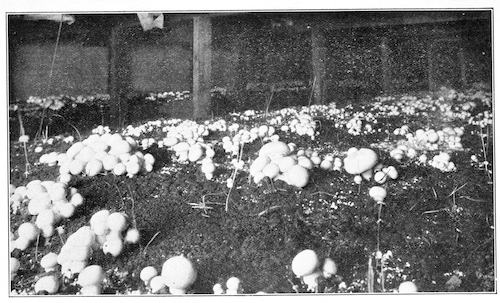
The above photograph shows a bed of Mushrooms grown from the Brandywine Spawn. This is no better than may be
expected when local conditions are right. The entire house in which this photograph was taken averaged
more than one and a half pounds of Mushrooms to every square foot of bed surface.
They were grown by Edward H. Jacob, West Chester, Pa.
Users of mushrooms generally pay at the store from 40
to 60 cents a pound for mushrooms, and when these can be
delivered from the grower to the user, these prices are not
overestimated.
If mushrooms are to be grown for the larger markets
like New York, Philadelphia, Boston, Pittsburgh or other
Eastern cities, the net prices realized by the Eastern grower
will be much less. In fact, the markets occasionally are badly
overstocked, and mushrooms sell below the actual cost of
production. It would therefore seem to be most profitable
when mushrooms can be delivered to the user by the grower.
In a majority of smaller towns and cities mushrooms are
rather scarce, and local dealers are glad to take them at compensating
prices. Meat is high in price and likely to be still
higher. Mushrooms can often be used as a most delicious
substitute.
We have prepared a separate sheet giving the best and
most practical ways of cooking mushrooms. This will be
forwarded to anyone making application for it and enclosing
a two-cent stamp.
Before our Brandywine Spawn is made up in quantity,
the different varieties are first tested in our own beds and
accurate record of production is each day carefully made.
In this way we eliminate entirely unproductive varieties
and choose only those which are most vigorous, perfect in
shape and color and will make the greatest yield.
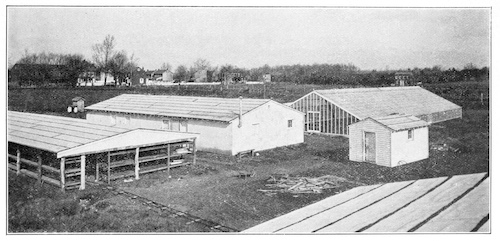
Spawn Plant located at West Chester, Pa. Since the above photograph was taken this plant has been doubled in size.
It is located within half a block of the main freight depot, where ten acres, or two city blocks, had
been purchased for the manufacture of The Brandywine Spawn.
The fact that Jacob’s Brandywine Spawn costs a little
more than any other spawn made, and that the large and most
successful growers are quite willing to pay more for it, means
that they find it the most profitable to use.
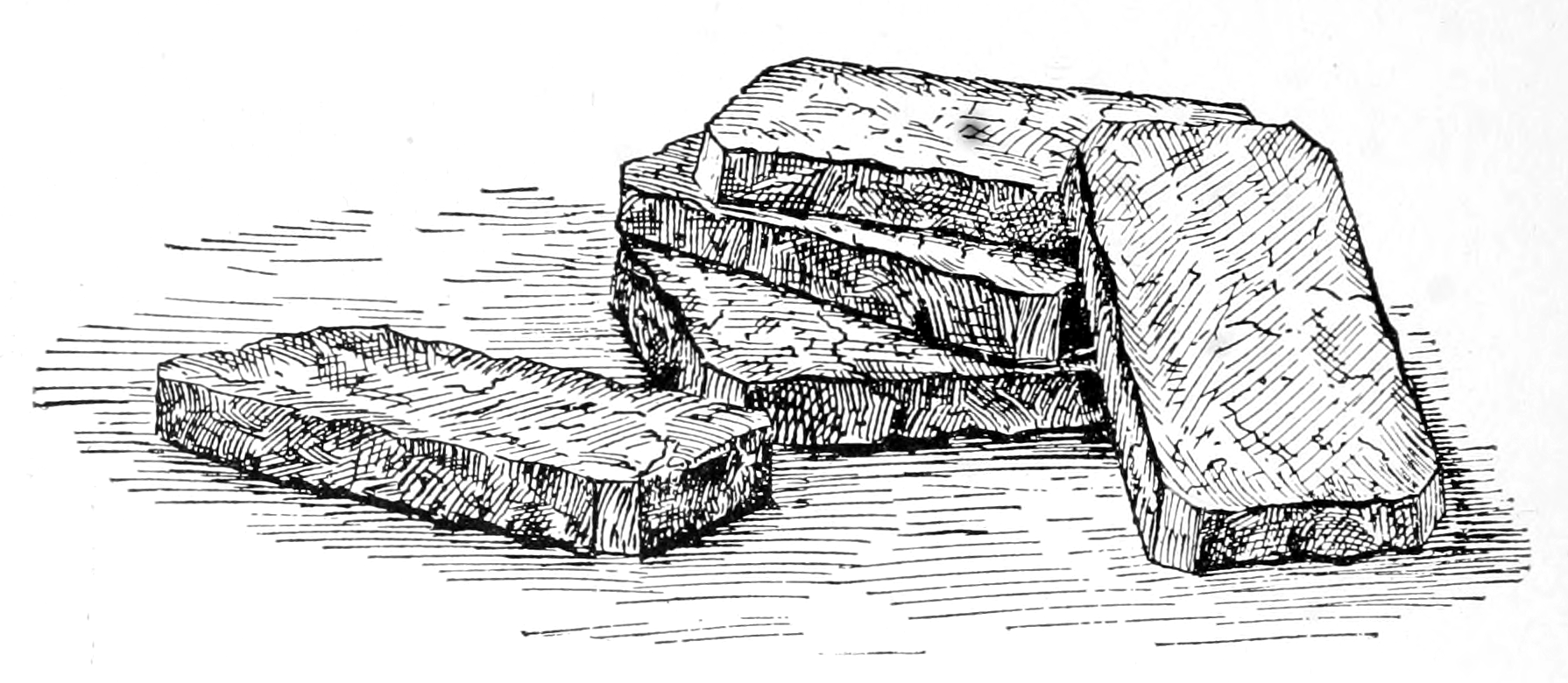
Jacob’s Brandywine Spawn is made in three varieties, pure
white, cream white and light brown at the following prices:
One brick is enough for 10 square feet of bed surface.
| 1 | brick or more (by mail, prepaid), 35 cents a brick. |
| 5 | bricks or more (by express, not prepaid), 25 cents a brick. |
| 25 | bricks or more (by exp. or frt., not prep’d), 20 cts. a brick. |
| 50 | bricks or more (by exp. or frt., not prep’d), 18 cts. a brick. |
| 135 | bricks (one case) (by exp. or frt., not prepaid), 15 cents a brick. |
Stamps, money orders or checks should accompany orders
to insure prompt shipment.
Manufactured Solely by
EDWARD H. JACOB
WEST CHESTER, PA.,
U. S. A.
On the following pages will be found full and complete
instructions for those who wish to grow Mushrooms for home
use as well as for the market.
Any cellar which maintains a uniform temperature of
from 45 to 65 degrees may be used.
Any barn or outbuilding may be supplied with heat and
used successfully, but the temperature should be kept as nearly
uniform as possible.
Any cold building which it is not practical to heat, may be
planted during September while the weather is still warm and
the beds allowed to get cold and even freeze up solid during
winter months. Such beds will produce the finest kind of
mushrooms during the early spring months when the temperature
rises sufficiently.
The larger growers usually build houses especially for
mushrooms and heat by means of hot water pipes. Some use
abandoned caves or mines, while florists often grow mushrooms
successfully under greenhouse benches.
Select fresh horse manure where wheat or oats straw has
been used as bedding.
Never use old manure or manure mixed with shavings or
sawdust.
Place the fresh manure in a neat pile and cover with two
or three inches of earth.
In the course of three or four days turn the manure over,
shaking and mixing the earth in thoroughly. Add water if
necessary to keep the manure in reasonably moist condition.
Cover again with earth which will be sufficient, and allow
the pile to heat, through the action of bacteria in the manure,
for five or six days. Then turn again, shaking up thoroughly
each time, and turning the outer dried or whitened portion of
the pile toward the centre. Add water with a sprinkler when
necessary to keep plenty of moisture. After about four turnings
in this way, covering a period of three or four weeks the
manure will be sufficiently rotted and decomposed to make into
the beds.
The manure should be placed on the floor or prepared bed
spaces to a depth of 8 to 10 inches in winter weather. In warm
weather 6 or 7 inches are enough.
The compost should be compressed in making the bed and
provided it is not too wet it may be tramped, which prevents
too much drying out, while the manure is heating in the beds.
The only practical test of the proper moisture content of
the manure at time of making beds, is when upon compression
in the hand water cannot readily be squeezed out of it.
After the beds are made up they should be covered and
allowed to heat for a week or ten days. After this length of
time the temperature should be watched until it falls to 70
degrees, when the beds may safely be spawned. The temperature
may be obtained by inserting a common glass thermometer
in the manure.
During the process of heating, after the beds are made up,
the temperature often rises as high as 125 degrees, and it is
never safe to spawn until it falls to 70 degrees.
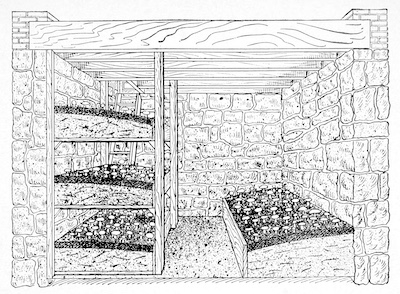
The above illustration shows how an ordinary cellar may be fitted up either with beds on the floor or
arranged in tiers, one above the other, in order to increase the growing surface.
The bricks of spawn should be broken into ten or twelve
pieces and placed on the surface of the beds 8 to 10 inches
apart each way. Then go over the bed again, raising the manure
and burying the spawn about half-inch below the surface
and tamping (pressing) firmly over each piece, leaving the bed
level on top.
In about two weeks dig up a piece or two of spawn carefully,
and if the mycelium is noticed running out like a mould
from the brick into the manure it is time to case.
This is done by putting one inch of sifted soil evenly over
the top of the manure.
Where mushrooms are grown on a large scale, proper
ventilation is very necessary. The overhead ventilators are
generally preferred, as the ventilation is more uniform without
draught.
The ventilators should remain open when outside temperature
is right, and at other times for one or two hours
each day.
Where small beds are used in cellars or out-buildings,
extra ventilation is not so necessary.
Avoid all draughts.
While the room should be kept moist, little or no water
should be used on the beds after spawning till the mushrooms
begin to appear, which is generally from six to eight weeks
from time of spawning.
Then the beds at first should be sprinkled lightly every day
or two till the surface is quite moist, after that one or two
sprinklings a week will be sufficient, according to the condition
of the beds. If they get dry quickly water oftener.
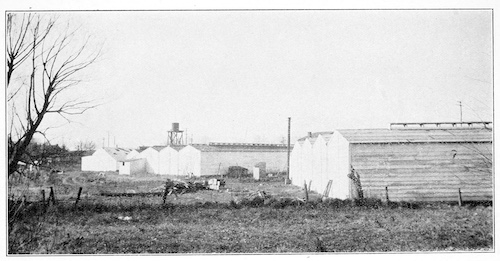
Mushroom Growing Plant No. 2, built and operated by Edward H. Jacob, West Chester, Pa. This plant contains eleven
separate Mushroom houses, with a total growing surface of 78,500 square feet; each building is 100 feet long.
The mushrooms should be picked once a day just before
they open out. (See cut.)
The root should be twisted gently and taken out with the
mushroom disturbing the earth as little as possible.
The stems should be cut off and the mushrooms packed in
baskets.
When grown in small quantities, the 1-pound ventilated
boxes are often used as a matter of convenience, but the large
growers ship generally in four-pound baskets. (See cut.)
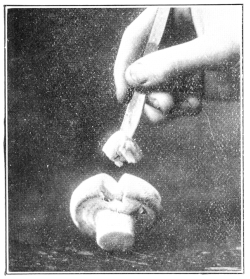
Ripe Enough to Pick
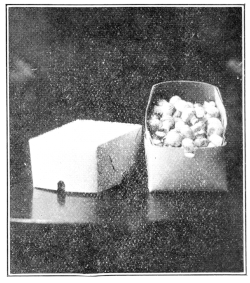
The One-Pound Ventilated Boxes
The beds may be expected to produce under ordinary
conditions for a period of from two to four months, depending
largely upon the temperature. At an average of 50 degrees
they will yield at least four months and every other day would
be quite often enough to pick.
At 65 degrees they must be picked regularly every day
and the crop will be almost completed in two months.
Cooler temperature makes heavier and better mushrooms.
Mushrooms cannot be successfully grown at a temperature
above 65 degrees. A temperature of 70 degrees for 24
hours will kill all growing mushrooms, but more will come up
from the same beds when the temperature falls.
Violent fluctuations in temperature are undesirable.
Cold will retard growth, but will not otherwise injure the
beds. Freezing will destroy mushrooms already above the
ground, but will not hurt the spawn in the beds.
There is probably more injury done by overwatering than
by any other one thing.
Keep the surface moist but never soak the beds.
Never cover the bed with earth until it has been spawned
10 days or two weeks, or the temperature of the manure may
rise sufficiently to injure the spawn.
Never purchase spawn because it is cheap, neither be led
into paying extravagant prices through misleading advertisements.
If any insect pest makes appearance or any diseased condition
arises, write the United States Department of Agriculture
at Washington, D. C., for information.
Spawn should be as fresh as it is possible to obtain it,
should be kept in a cool dry place till used. Improper storage
will damage it in a comparatively short time.
Imported brands of spawn are apt to be old and often
worthless.
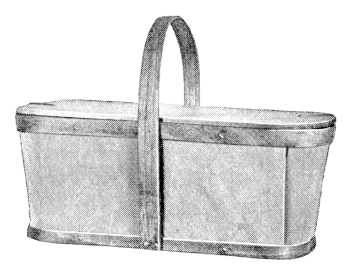
THE FOUR-POUND SHIPPING BASKET