A STUDENT'S HISTORY OF ENGLAND — WORKS BY SAMUEL RAWSON GARDINER. — A STUDENT'S HISTORY OF ENGLAND
Transcriber's note: Obvious printer's errors have been corrected, all
other inconsistencies are as in the original. The author's spelling
has been maintained.
Each page of the original book had a side note stating the time span
treated on that page. Those side notes have been deleted.
VOL. II.
HISTORY OF ENGLAND, from the Accession of James I. to the Outbreak of
the Civil War, 1603-1642. With Maps. 10 vols. crown 8vo. 5s. net
each.
A HISTORY OF THE GREAT CIVIL WAR, 1642-1649. With Maps. 4 vols. crown
8vo. 5s. net each.
A HISTORY OF THE COMMONWEALTH AND THE PROTECTORATE, 1649-1656. With
Maps. 4 vols. crown 8vo. 5s. net each.
THE LAST YEARS OF THE PROTECTORATE, 1656-1658. By Charles Harding
Firth, M.A., Regius Professor of Modern History in the University of
Oxford. With 3 Plans. 2 vols. 8vo. 24s. net.
A STUDENT'S HISTORY OF ENGLAND. From the Earliest Times to the Death
of King Edward VII.
Vol. I. B.C. 55-A.D. 1509. With 173 Illustrations. Crown 8vo. 4s.
Vol. II. 1509-1689. With 96 Illustrations. Crown 8vo. 4s.
Vol. III. 1689-1910. With 112 Illustrations. Crown 8vo. 4s.
⁂ Complete in One Volume, with 381 Illustrations, crown 8vo. 12s.
PREPARATORY QUESTIONS ON S. R. GARDINER'S STUDENT'S HISTORY OF
ENGLAND. By R. Somervell, M.A. Crown 8vo. 1s.
SUMMARY OF ENGLISH HISTORY, based on S. R. Gardiner's 'Outline of
English History.' Brought down to the Accession of Edward VII. By W.
Reep. Fcp. 8vo. 6d.
A SCHOOL ATLAS OF ENGLISH HISTORY. Edited by Samuel Rawson Gardiner,
D.C.L., LL.D. With 66 Coloured Maps and 22 Plans of Battles and
Sieges. Fcp. 4to. 5s.
LONGMANS' ELEMENTARY HISTORICAL ATLAS, abridged from S. R. Gardiner's
'School Atlas of English History.' Post 4to. 1s.
CROMWELL'S PLACE IN HISTORY. Founded on Six Lectures delivered at
Oxford. Crown 8vo. 3s. 6d.
OLIVER CROMWELL. With Portrait. Crown 8vo. 5s. net.
THE FIRST TWO STUARTS AND THE PURITAN REVOLUTION, 1603-1660. 4 Maps.
Fcp. 8vo. 2s. 6d.
THE THIRTY YEARS' WAR, 1618-1648. With a Map. Fcp. 8vo. 2s. 6d.
OUTLINE OF ENGLISH HISTORY,B.C. 55-A.D. 1910. With 67 Woodcuts and 17
Maps. Fcp. 8vo. 2s. 6d.
THE FRENCH REVOLUTION, 1789-1795. By Mrs. S. R. Gardiner. With 7 Maps.
Fcp. 8vo. 2s. 6d.
LONGMANS, GREEN, & CO., 39 Paternoster Row, London, New York, Bombay,
Calcutta, and Madras.
FROM THE EARLIEST TIMES TO THE DEATH
OF KING EDWARD VII
BY
SAMUEL R. GARDINER, D.C.L., LL.D. LATE FELLOW OF MERTON COLLEGE, OXFORD ETC.
NEW EDITION (1902)
VOL. II. A.D. 1509–1689
NEW IMPRESSION (1912)
REISSUE
LONGMANS, GREEN, AND CO.
39 PATERNOSTER ROW, LONDON FOURTH AVENUE & 30th STREET, NEW YORK
BOMBAY, CALCUTTA, AND MADRAS
1914
All rights reserved
CONTENTS OF THE SECOND VOLUME
PART V THE RENASCENCE AND THE REFORMATION
1509-1603
Henry VIII.
368
(From a painting by Holbein about 1536, belonging to
Earl Spencer)
Cardinal Wolsey
365
(From an original picture belonging to the
Hon. Sir Spencer Ponsonby-Fane, K.C.B.)
The embarkation of Henry VIII. from Dover, 1520
370
(From the Society of Antiquaries' engraving
of the original picture at Hampton Court)
Silver-gilt cup and cover, made at London in 1523; at
Barber Surgeons' Hall, London
371
(From Cripps's 'College and Corporation Plate')
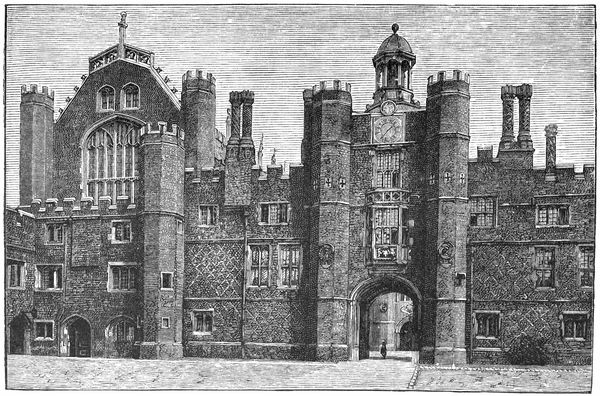
Part of Hampton Court; built by Cardinal Wolsey;
finished in 1526
373
(From a photograph)
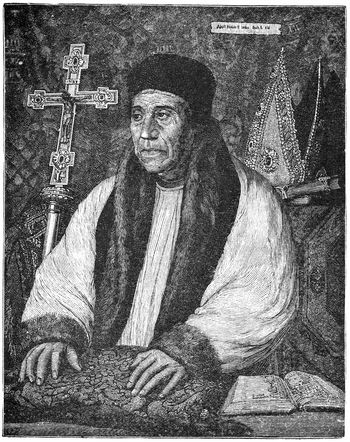
Portrait of William Warham, Archbishop of Canterbury,
1503-1532, showing the ordinary episcopal dress, with
the mitre and archiepiscopal cross
376
(From a painting by Holbein, belonging to Viscount
Dillon, F.S.A., dated 1527)
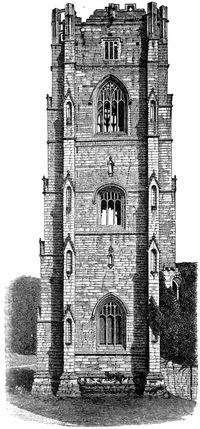
Tower of Fountains Abbey church; built by Abbot Huby,
1494-1526
378
(From a photograph by Valentine and Sons, Dundee)
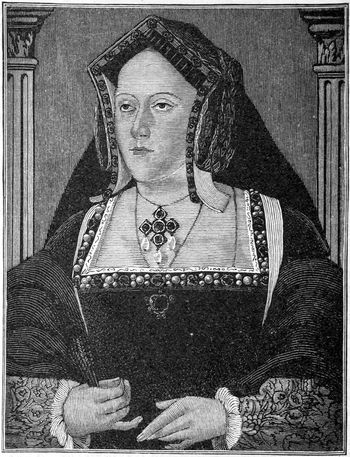
Catharine of Aragon
380
(From a painting in the National Portrait
Gallery)
The gatehouse of Coughton Court, Warwickshire; built
about 1530
381
(From Niven's 'Illustrations of Old Warwickshire
Houses')
Hall of Christchurch, Oxford; built by Cardinal Wolsey;
finished in 1529
384
(From a photograph by W. H. Wheeler, Oxford)
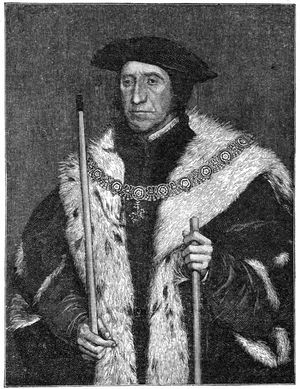
Sir Thomas More, wearing the collar of SS.
387
(From an original portrait painted by Holbein in 1527,
belonging to Edward Huth, Esq.)
John Fisher, Bishop of Rochester, 1504-1535
393
(From a drawing by Holbein in the Royal Library,
Windsor Castle)
Edward Seymour, Earl of Hertford, brother of Jane Seymour,
afterwards Duke of Somerset, known as 'the Protector,'
at the age of 28, 1507-1552
395
(From a painting at Sudeley Castle)
Henry VIII.
403
(From a painting by Holbein, belonging to the Earl
of Warwick)
Angel of Henry VIII., 1543
405
(From an original example)
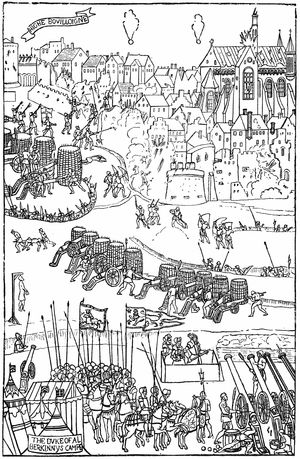
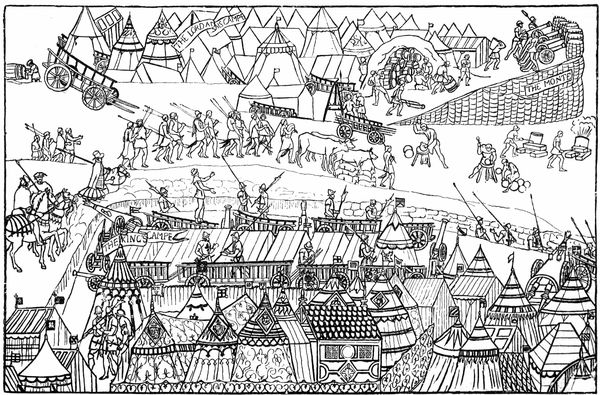
Part of the encampment at Marquison, 1544, showing
military equipment in the time of Henry VIII.
406
191. Part of the siege of Boulogne by Henry VIII.,
1544, showing military operations
407, 408
(From the Society Of Antiquaries' engravings, by
Vertue, of the now destroyed paintings formerly at
Cowdray House, Sussex)
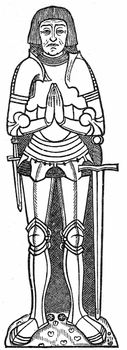
Armour as worn in the reign of Henry VIII.; from the
brass of John Lymsey, 1545, in Hackney church
409
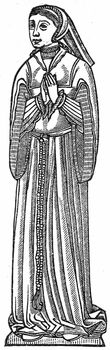
Margaret, wife of John Lymsey; from her brass in Hackney
church, showing the costume of a lady circa 1545
409
(From Haines's 'Manual of Monumental Brasses')
Thomas Howard, third Duke of Norfolk, 1473(?)-1554
410
(From a painting by Holbein at Windsor Castle)
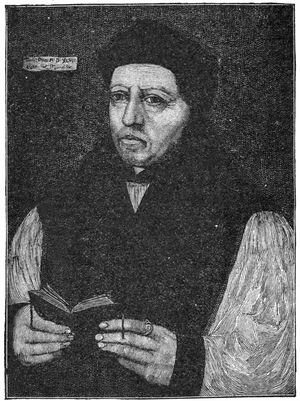
Thomas Cranmer, Archbishop of Canterbury, 1533-1556
414
(From a painting by Holbein dated 1547, at Jesus
College, Cambridge)
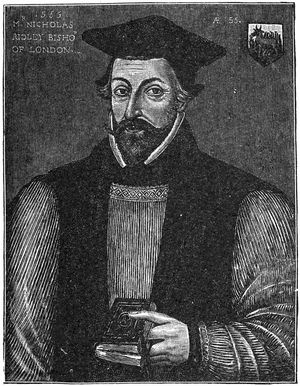
Nicholas Ridley, Bishop of London, 1550-1553
417
(From the National Portrait Gallery)
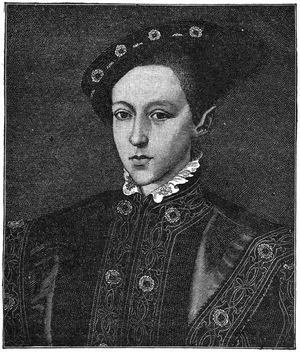
King Edward VI.
419
(From a picture belonging to H. Hucks Gibbs, Esq.)
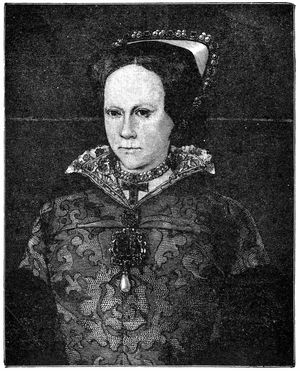
Queen Mary Tudor
422
(From a painting by Lucas de Heere, dated 1554,
belonging to the Society of Antiquaries)
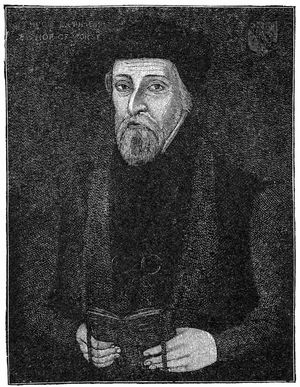
Hugh Latimer, Bishop of Worcester, 1535-1539,
burnt 1555
425
(From the National Portrait Gallery)
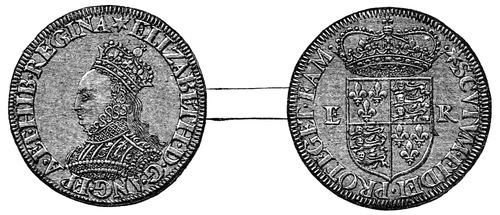
A milled half-sovereign of Elizabeth, 1562-1568
435
(From an original example)
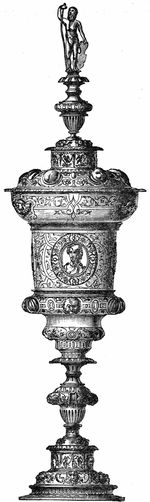
Silver-gilt standing cup made in London in 1569-70,
and given to Corpus Christi College, Cambridge, by
Parker
440
(From Cripps's 'College and Corporation Plate')
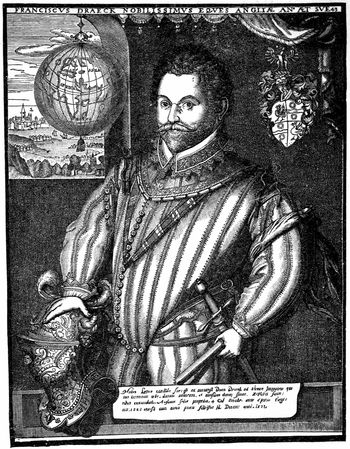
Sir Francis Drake in his forty-third year
448
(From the engraving by Elstracke)
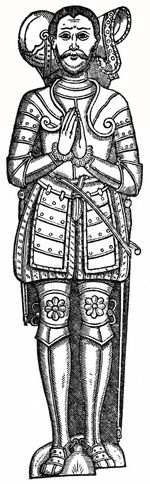
Armour as worn during the reign of Elizabeth; from the
brass of Francis Clopton, 1577, at Long Melford,
Suffolk
451
(From Haines's 'Manual of Monumental Brasses')
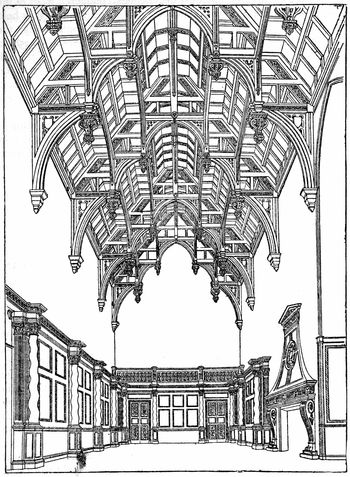
Hall of Burghley House, Northamptonshire, built about
1580
455
(From Drummond's 'Histories of Noble British
Families')
Sir Martin Frobisher, died 1594
459
(From a picture belonging to the Earl of Carlisle)
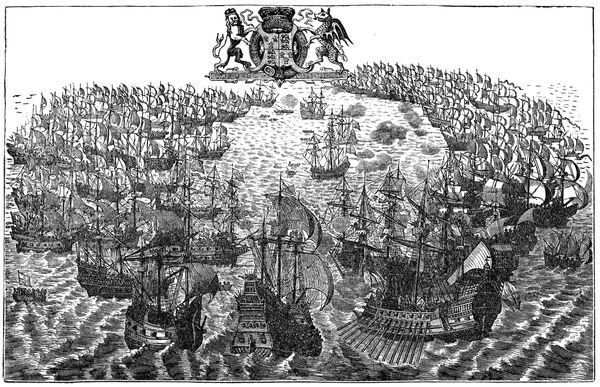
The Spanish Armada. Fight between the English and Spanish
fleets off the Isle of Wight, July 25, 1588
461
(From Pine's engravings of the tapestry formerly in
the House of Lords)
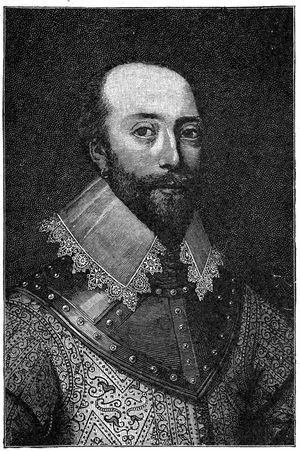
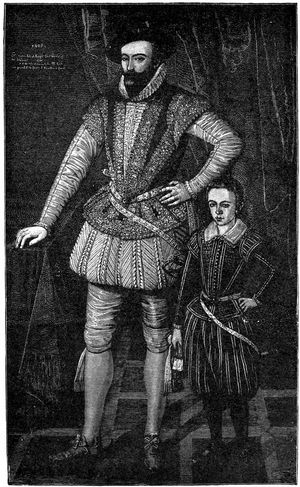
Sir Walter Raleigh (1552-1618), and his eldest son Walter
at the age of eight
463
(From a picture dated 1602, belonging to Sir J. F.
Lennard, Bart.)
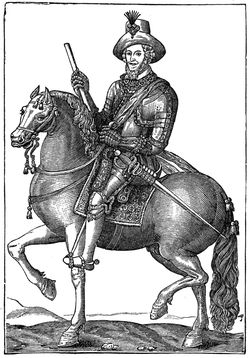
A mounted soldier at the end of the sixteenth century
465
(From a broadside printed in 1596, in the Society of
Antiquaries' collection)
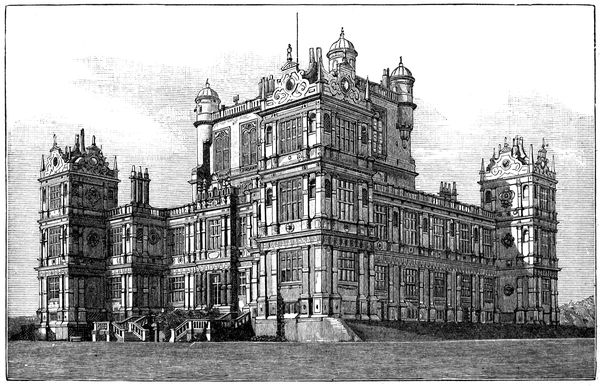
Wollaton Hall, Nottinghamshire; built by Thorpe for
Sir Francis Willoughby, about 1580-1588
466
(From a photograph by R. Keene, Derby)
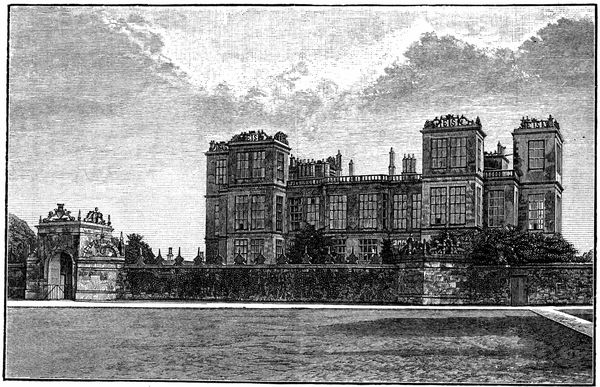
Hardwick Hall, Derbyshire; built by Elizabeth,
Countess of Shrewsbury, about 1597
467
(From a photograph by R. Keene, Derby)
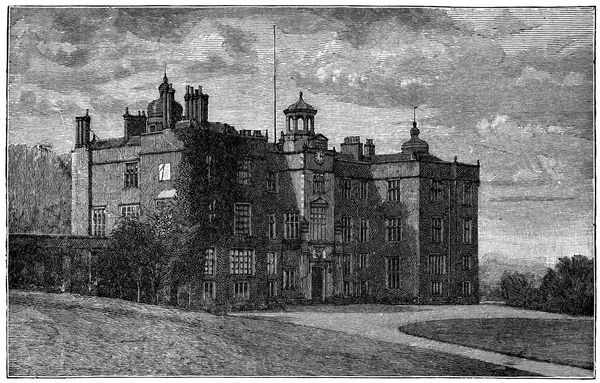
E-shaped house at Beaudesert, Staffordshire; built by
Thomas, Lord Paget, about 1601
469
(From a photograph by R. Keene, Derby)
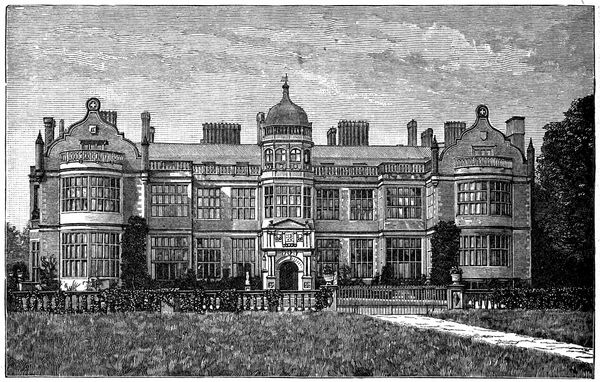
Ingestre Hall, Staffordshire; built about 1601
471
(From a photograph by R. Keene, Derby)
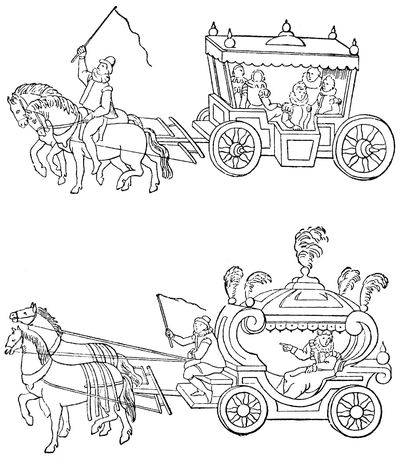
Coaches in the reign of Elizabeth
473
(From 'Archæologia,' vol. xx. pl. xviii.)
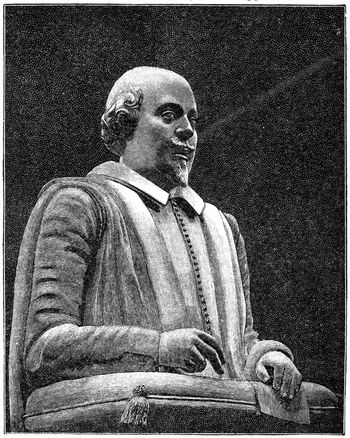
William Shakspere
474
(From the bust on his tomb at Stratford-on-Avon)
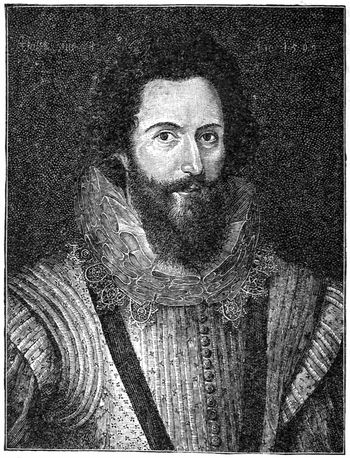
Robert Devereux, second Earl of Essex, K.G., 1567-1601
476
(From a painting by Van Somer, dated 1599, belonging
to the Earl of Essex)
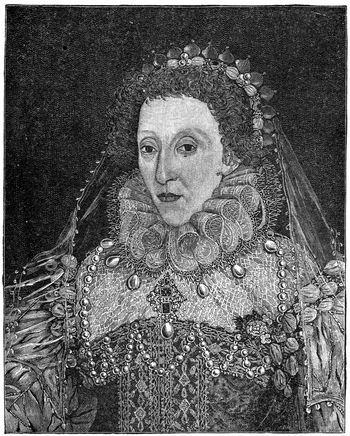
Queen Elizabeth, 1558-1603
477
(From a painting belonging to the University of
Cambridge)
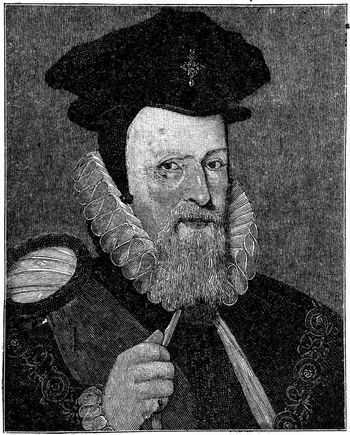
William Cecil, Lord Burghley, K.G., 1520-1591
479
(From a painting in the Bodleian Library, Oxford)
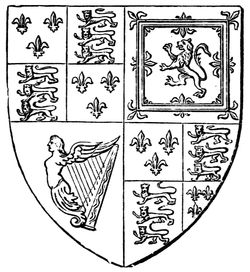
Royal arms borne by James I. and succeeding Stuart
sovereigns
482
(From Boutell's'English Heraldry')
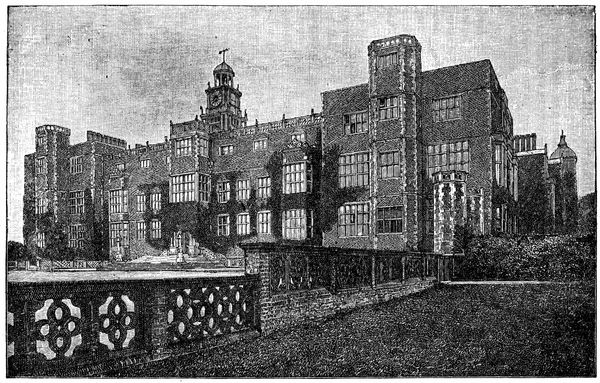
North-west view of Hatfield House, Herts; built for
Robert Cecil, first Earl of Salisbury, between 1605 and
1611
485
(From a photograph by Valentine and Sons, Dundee)
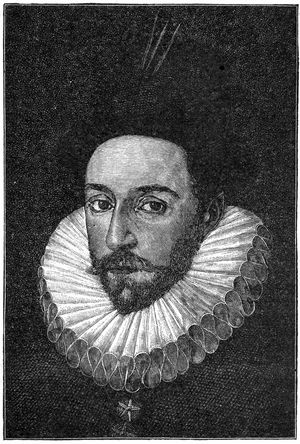
An unknown gentleman
487
(From a painting belonging to T. A. Hope, Esq.)
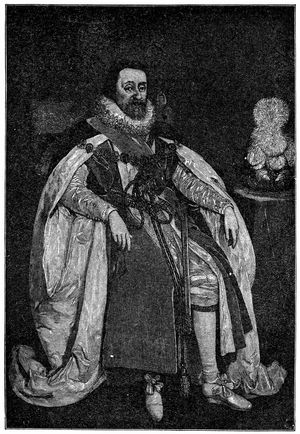
King James I.
491
(From a painting by P. Van Somer, dated 1621, in the
National Portrait Gallery)
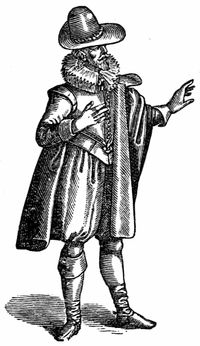
Civil costume, about 1620
492
(From a contemporary broadside in the collection of
the Society of Antiquaries)
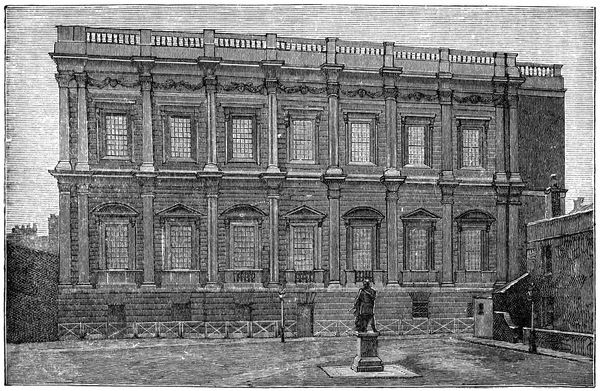
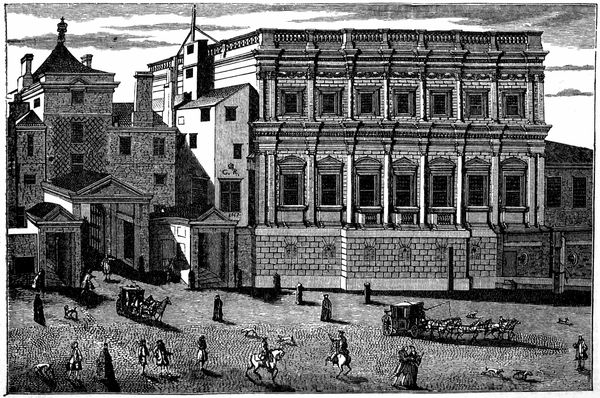
The banqueting-hall of the Palace of Whitehall (from the
north-east); built from the designs of Inigo Jones,
1619-1621
493
(From a photograph)
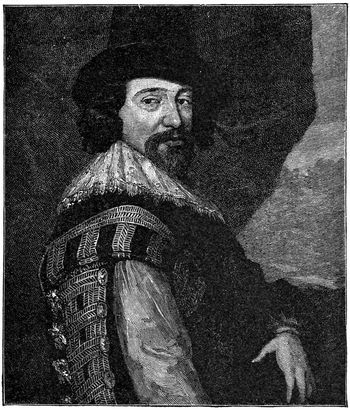
Francis Bacon, Viscount St. Alban, Lord Chancellor
495
(From a painting by P. Van Somer in the National
Portrait Gallery)
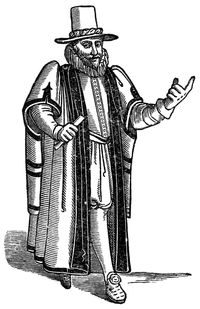
Costume of a lawyer
497
(From a broadside dated 1623 in the collection of the
Society of Antiquaries)
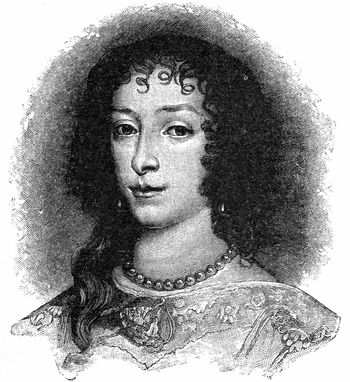
Queen Henrietta Maria, wife of Charles I.
505
(From a painting by Van Dyck)
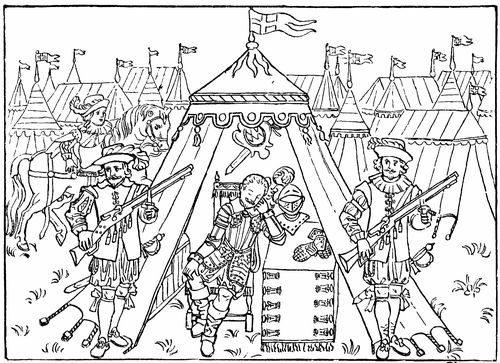
Tents and military equipment in the early part of the
reign of Charles I.
507
(From the monument of Sir Charles Montague (died in
1625), in the church of Barking, Essex)
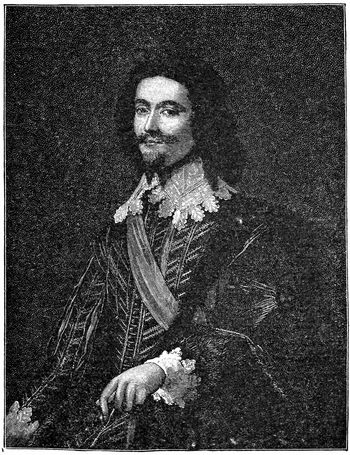
George Villiers, first duke of Buckingham, 1592-1628
509
(From the painting by Gerard Honthorst in the
National Portrait Gallery)
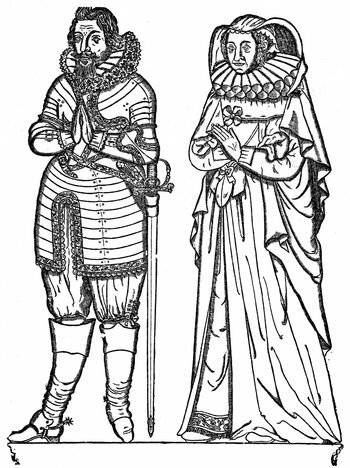
Sir Edward and Lady Filmer; from their brass at East
Sutton, Kent, showing armour and dress worn about 1630
515
(From Waller's 'Monumental Brasses')
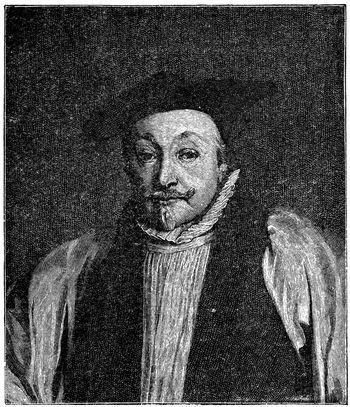
Archbishop Laud
517
(From a copy in the National Portrait Gallery by
Henry Stone, from the Van Dyck at Lambeth)
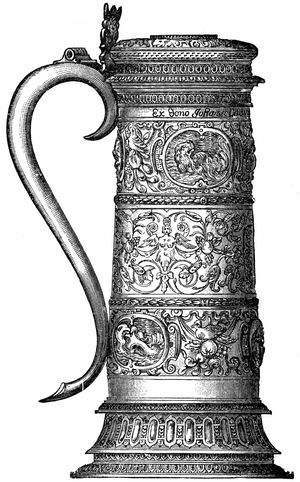
Silver-gilt tankard made at London in 1634-5; now
belonging to the Corporation of Bristol
518
(From Cripps's 'College and Corporation Plate')
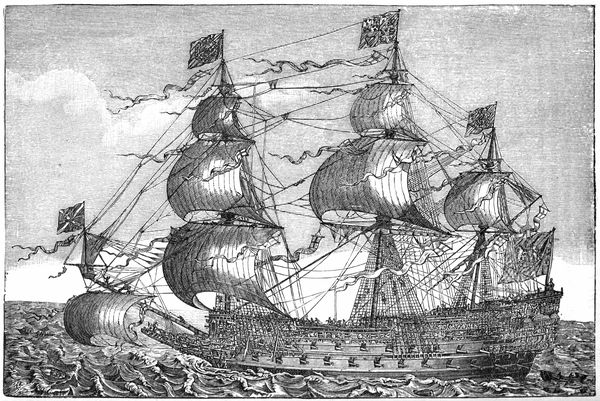
The 'Sovereign of the Seas,' built for the Royal Navy in
1637
522
(From a contemporary engraving by John Payne)
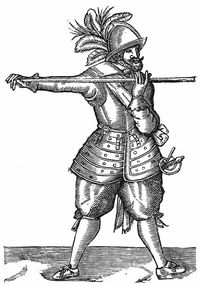
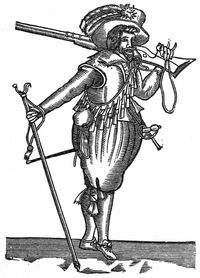
Soldier with musket and crutch
527
(From a broadside printed about 1630, in the
collection of the Society of Antiquaries)
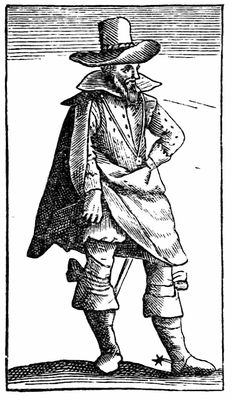
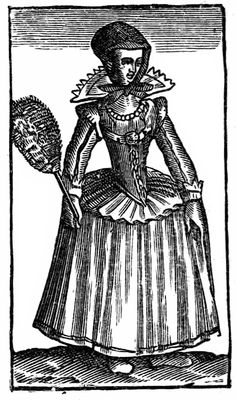
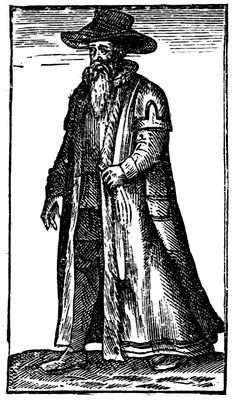
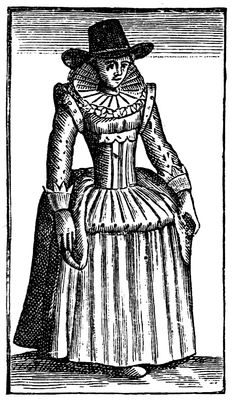
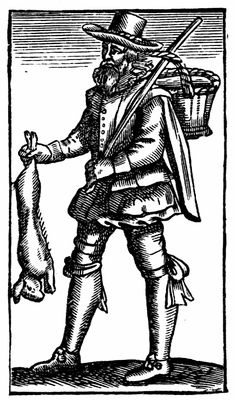
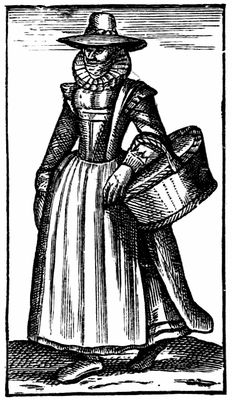
–243. Ordinary civil costume, temp. Charles I., viz:— A gentleman and a gentlewoman550 A citizen and a citizen's wife551 A countryman and a countrywoman552
(From Speed's map of 'The Kingdom of England,' 1646)
View of the west side of the Banqueting-House, Whitehall,
dated 1713, showing the window through which Charles I.
is said to have passed to the scaffold
558
(From an engraving by Terasson)
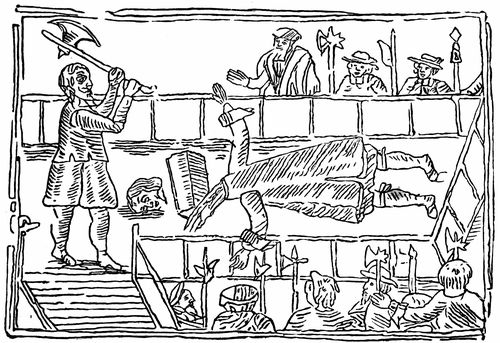
Execution of King Charles I., January 30, 1649
559
(From a broadside in the collection of the late
Richard Fisher, Esq., F.S.A.)
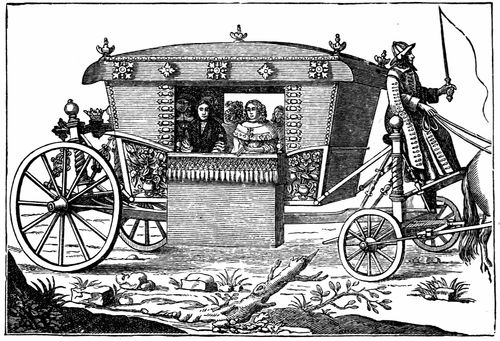
A coach in the middle of the seventeenth century
564
(From an engraving by John Dunstall)
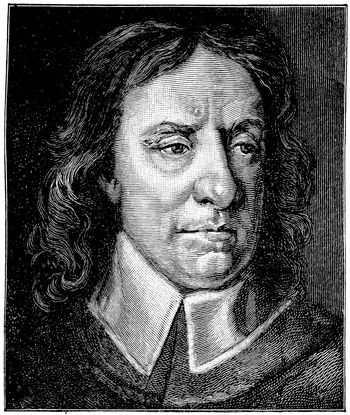
Oliver Cromwell
567
(From the painting by Samuel Cooper, at Sidney Sussex
College, Cambridge)
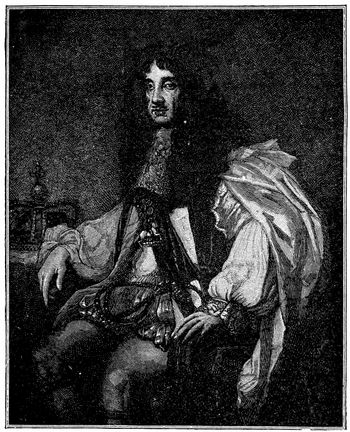
Charles II.
579
(From the portrait by Sir Peter Lely in Christ's
Hospital, London)
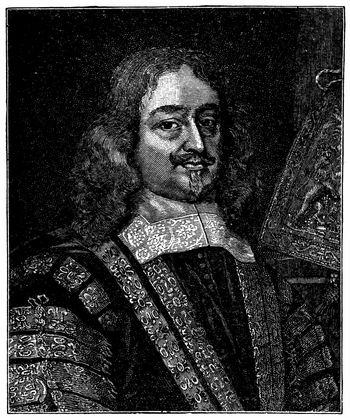
Edward Hyde, first Earl of Clarendon, 1608-1674
581
(From an engraving by Loggan)
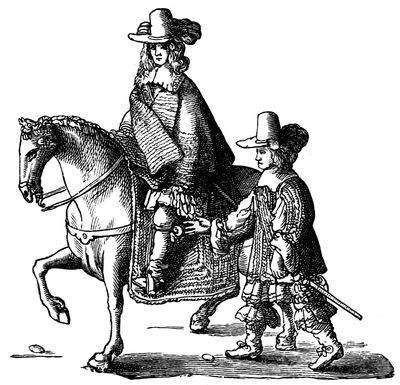
A mounted nobleman and his squire
582
(From Ogilby's 'Coronation Procession of
Charles II.')
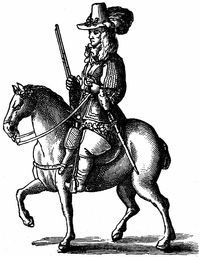
Dress of the Horseguards at the Restoration
583
(From Ogilby's 'Coronation Procession of
Charles II.')
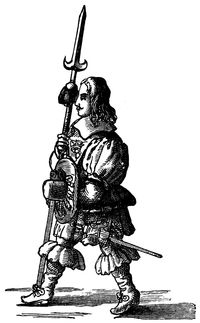
Yeoman of the Guard
583
(From Ogilby's 'Coronation Procession of
Charles II.')
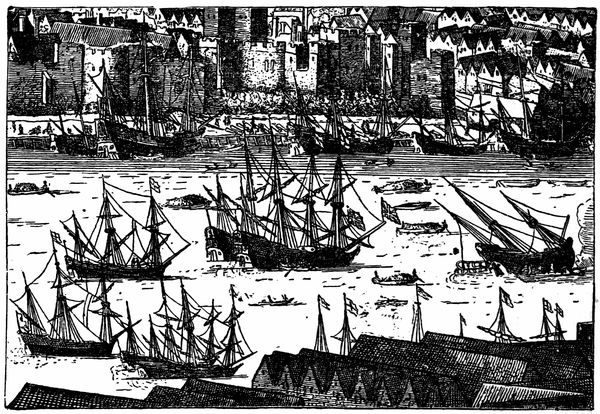
Shipping in the Thames, circa 1660
584
(From Pricke's 'South Prospect of London')
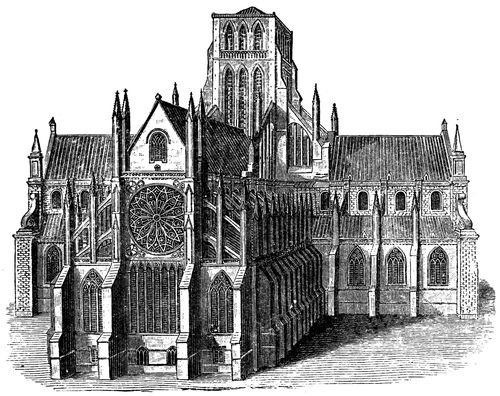
Old St. Paul's, from the east, showing its condition
just before the Great Fire
591
(From an engraving by Hollar)
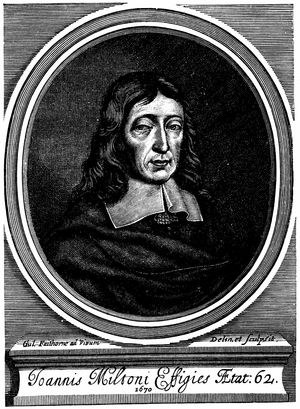
John Milton in 1669
597
(From the engraving by Faithorne)
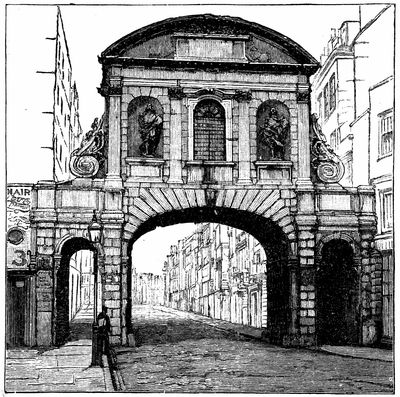
Temple Bar, London, built by Sir Christopher Wren in
1670
601
(From a photograph)
Anthony Ashley-Cooper, first Earl of Shaftesbury,
1621-1683
604
(From the painting by John Greenhill in the National
Portrait Gallery)
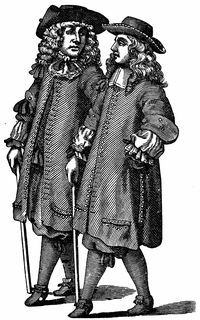
Ordinary dress of gentlemen in 1675
611
(From Loggan's 'Oxonia Illustrata')
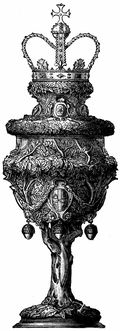
Cup presented, 1676, by King Charles II. to the Barber
Surgeons' Company
612
(From Cripps's 'College and Corporation Plate')
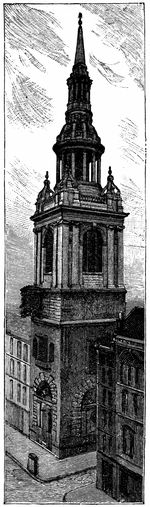
Steeple of the church of St. Mary-le-Bow, London,
built by Sir Christopher Wren between 1671 and 1680
614
(From a photograph)
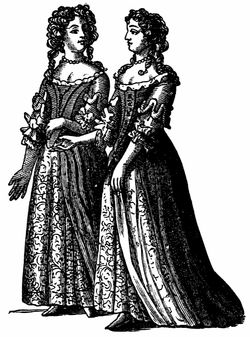
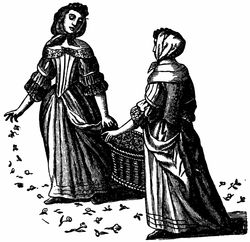
Dress of ladies of quality
628
(From Sandford's 'Coronation Procession of
James II.')
Ordinary attire of women of the lower classes
628
(From Sandford's 'Coronation Procession of
James II.')
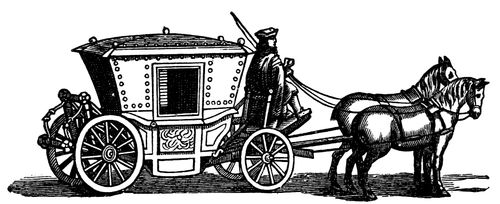
Coach of the latter half of the seventeenth century
629
(From Loggan's 'Oxonia Illustrata')
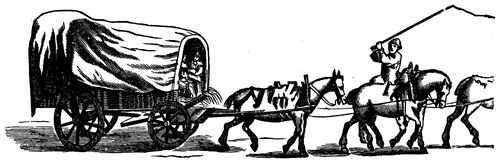
Waggon of the second half of the seventeenth century
629
(From Loggan's 'Oxonia Illustrata')
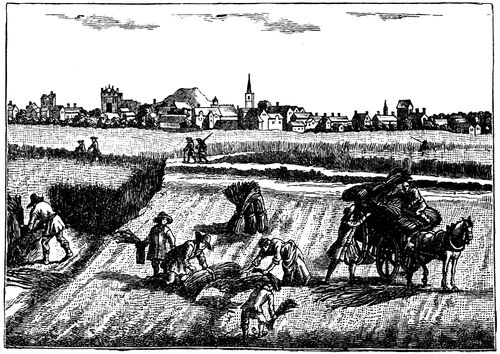
Reaping and harvesting in the second half of the
seventeenth century
630
(From Loggan's 'Cantabrigia Illustrata')
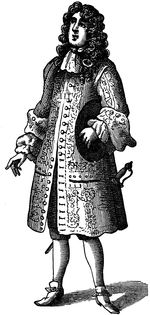
Costume of a gentleman
632
(From Sandford's 'Coronation Procession of
James II.')
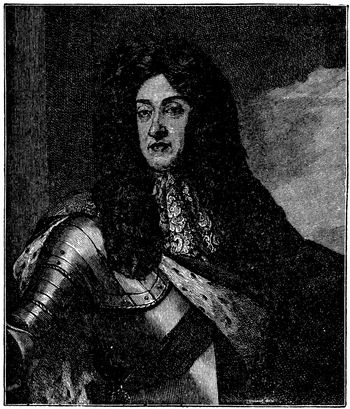
James II.
635
(From the painting by Sir Godfrey Kneller in 1684-5
in the National Portrait Gallery)
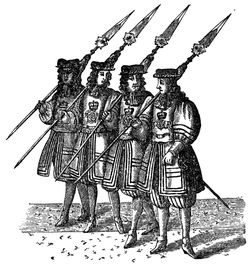
Yeomen of the Guard
636
(From Sandford's 'Coronation Procession of
James II.')
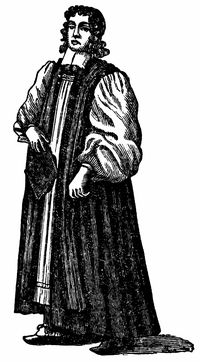
Dress of a bishop in the second half of the seventeenth
century
642
(From Sandford's 'Coronation Procession of
James II.')
GENEALOGICAL TABLES — I KINGS AND QUEENS OF ENGLAND (AFTER 1541 OF ENGLAND AND IRELAND) FROM HENRY VII. TO ELIZABETH. — II KINGS OF SCOTLAND AND GREAT BRITAIN, FROM JAMES IV. OF SCOTLAND TO WILLIAM AND MARY. — III KINGS OF GREAT BRITAIN AND IRELAND FROM JAMES I. TO GEORGE I. — IV GENEALOGY OF THE KINGS OF FRANCE FROM LOUIS XII. TO LOUIS XIV., SHOWING THEIR DESCENT FROM LOUIS IX. — V GENEALOGY OF THE KINGS OF SPAIN FROM FERDINAND AND ISABELLA TO CHARLES II. — VI GENEALOGY OF THE GERMAN BRANCH OF THE HOUSE OF AUSTRIA FROM FERDINAND I. TO LEOPOLD I. — VII GENEALOGY OF THE PRINCES OF ORANGE FROM WILLIAM I. TO WILLIAM III.
Henry VII. 1485-1509
=
Elizabeth of York
Arthur Prince of Wales
=
Catharine of Aragon
=
Henry VIII. 1509-1547
=
(2) Anne Boleyn
=
(3) Jane Seymour
Mary I. 1553-1559
Elizabeth 1558-1603
Edward VI. 1547-1553
Henry VII., king of England
James IV. king of Scotland 1488-1513
=
Margaret
=
Archibald, Earl of Angus
James V. 1513-1542
=
Mary of Guise
Margaret Douglas
=
Matthew Stuart Earl of Lennox
(1) Francis II. king of France
=
Mary 1542-1567
=
(2) Henry Stuart (Lord Darnley)
James VI. 1567-1625
king of Great Britain as James I. 1603-1625
James I. 1603-1625
=
Anne of Denmark
Henry Prince of Wales
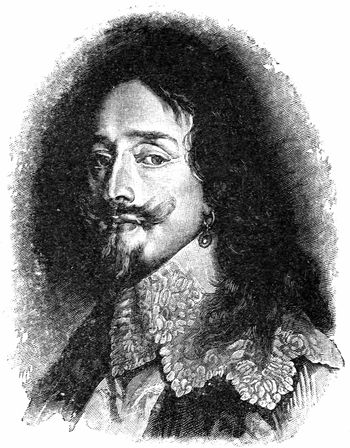
Charles I. 1625-1649
=
Henrietta Maria of France
Elizabeth
=
Frederick V. Elector Palatine
Charles II.
(nominally) 1649-1660 (actually) 1660-1685
=
Catharine of Braganza
Mary
=
William II. Prince of Orange
(1) Anne Hyde
=
James II. 1685-1689
=
(2) Mary of Modena
William III.
Prince of Orange, king of Great Britain and Ireland 1689-1702
=
Mary II. 1689-1694
Anne 1702-1714
James (The Old Pretender)
Charles Edward (The Young Pretender)
Charles Lewis Elector Palatine
Prince Rupert
Sophia
George I. 1714-1727
(St.) Louis IX. 1226-1270
Philip III. 1270-1285
Robert of Clermont
Louis I. Duke of Bourbon
Philip IV. 1283-1314
Charles de Valois
(For descendants of Philip IV. see Part I. Table IV.)
Philip VI. 1328-1350
John 1350-1364
Charles V. 1364-1380
Louis Duke of Orleans
Charles VI. 1380-1422
Charles Duke of Orleans
John Count of Angoulême
Charles VII. 1422-1461
Louis XII. 1498-1515
Charles
Louis XI. 1461-1483
Francis I. 1515-1547
Charles VIII. 1483-1498
Henry II. 1547-1559
Antony
=
Jeanne d'Albret, queen of Navarre
Francis II. 1559-1560
Charles IX. 1560-1574
Francis Duke of Alençon
Henry III. 1574-1589
Henry IV. 1589-1610
Louis XIII. 1610-1643
Louis XIV. 1643-1715
Maximilian I. Emperor
Ferdinand king of Aragon 1479-1516
=
Isabella queen of Castile 1474-1504
Philip I.
Archduke of Austria, king of Castile 1504-1506
=
Juana
Catharine
=
(1) Arthur, Prince of Wales (2) Henry VIII. king of England
Charles I.
(the Emperor Charles V.) king of Castile, 1506-1556, king of Aragon, 1516-1556
Ferdinand I. Emperor
Philip II. 1556-1598
Philip III. 1598-1621
Philip IV. 1621-1665
Charles II. 1665-1700
(The dates given are those during which an archduke was emperor.)
Ferdinand I. 1556-1564
Maximilian II. 1564-1576
Charles Duke of Styria
Rudolph II. 1576-1612
Matthias 1612-1619
Ferdinand II. 1619-1635
Ferdinand III. 1635-1658
Leopold I. 1658-1705
William I. (The Silent) 1558-1584
Philip William 1584-1618
Maurice 1618-1625
Frederick Henry 1625-1647
William II. 1647-1650
William III. 1650-1702
SHORTER AND SOMETIMES MORE DETAILED GENEALOGIES will
be found in the following pages.
PART V THE RENASCENCE AND THE REFORMATION 1509-1603 — CHAPTER XXIV HENRY VIII. AND WOLSEY. 1509-1527 — CHAPTER XXV THE BREACH WITH THE PAPACY. 1527-1534 — CHAPTER XXVI THE ROYAL SUPREMACY. 1534-1547 — CHAPTER XXVII EDWARD VI. AND MARY EDWARD VI., 1547-1553. MARY, 1553-1558. — CHAPTER XXVIII THE ELIZABETHAN SETTLEMENT IN CHURCH AND STATE 1558-1570 — CHAPTER XXIX ELIZABETH AND THE EUROPEAN CONFLICT. 1570-1587 — CHAPTER XXX ELIZABETH'S YEARS OF TRIUMPH. 1587-1603
LEADING DATES
Reign of Henry VIII., 1509-1547
Accession of Henry VIII. 1509
Henry's first war with France 1512
Peace with France 1514
Charles V. elected Emperor 1519
Henry's second French war 1522
Francis I. taken captive at Pavia 1525
The sack of Rome and the alliance between England and France
1527
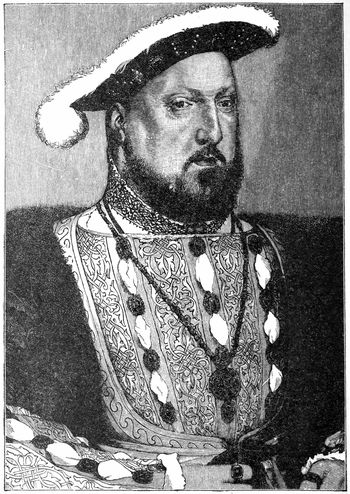
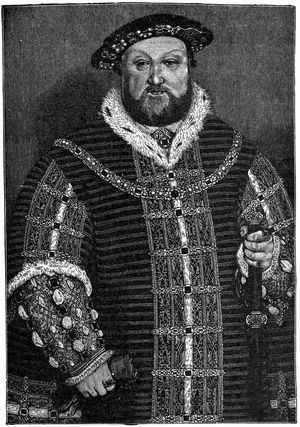
Henry VIII.; from a painting by Holbein about 1536,
belonging to Earl Spencer.
1. The New King. 1509.—Henry VIII. inherited the handsome face, the
winning presence, and the love of pleasure which distinguished his
mother's father, Edward IV., as well as the strong will of his own
father, Henry VII. He could ride better than his grooms, and shoot
better than the archers of his guard. Yet, though he had a ready
smile and a ready jest for everyone, he knew how to preserve his
dignity. Though he seemed to live for amusement alone, and allowed
others to toil at the business of administration, he took care to
keep his ministers under control. He was no mean judge of character,
and the saying which rooted itself amongst his subjects, that 'King
Henry knew a man when he saw him,' points to one of the chief
secrets of his success. He was well aware that the great nobles were
his only possible rivals, and that his main support was to be found
in the country gentry and the townsmen. Partly because of his
youth, and partly because the result of the political
struggle had already been determined when he came to the throne, he
thought less than his father had done of the importance of
possessing stored up wealth by which armies might be equipped and
maintained, and more of securing that popularity which at
least for the purposes of internal government, made armies
unnecessary. The first act of the new reign was to send Empson and
Dudley to the Tower, and it was significant of Henry's policy that
they were tried and executed, not on a charge of having extorted
money illegally from subjects, but on a trumped up charge of
conspiracy against the king. It was for the king to see that
offences were not committed against the people, but the people must
be taught that the most serious crimes were those committed against
the king. Henry's next act was to marry Catharine. Though he was but
nineteen, whilst his bride was twenty-five, the marriage was for
many years a happy one.
2. Continental Troubles. 1508-1511.—For some time Henry lived as
though his only object in life was to squander his father's treasure
in festivities. Before long, however, he bethought himself of aiming
at distinction in war as well as in sport. Since Louis XII. had been
king of France (see p. 354) there had been constant wars in Italy,
where Louis was striving for the mastery with Ferdinand of Aragon.
In 1508 the two rivals, Ferdinand and Louis, abandoning their
hostility for a time, joined the Emperor Maximilian (see pp. 337,
348) and Pope Julius II. in the League of Cambrai, the object of
which was to despoil the Republic of Venice. In 1511 Ferdinand
allied himself with Julius II. and Venice in the Holy League, the
object of which was to drive the French out of Italy. After a while
the new league was joined by Maximilian, and every member of it was
anxious that Henry should join it too.
3. The Rise of Wolsey. 1512.—England had nothing to gain by an
attack on France, but Henry was young, and the English nation was,
in a certain sense, also young. It was conscious of the strength
brought to it by restored order, and was quite ready to use this
strength in an attack on its neighbours. In the new court it was
ignorantly thought that there was no reason why Henry VIII. should
not take up that work of conquering France which had fallen to
pieces in the feeble hands of Henry VI. To carry on his new policy
Henry needed a new minister. The best of the old ones were Fox, the
Bishop of Winchester, and Thomas Howard, Earl of Surrey, who, great
nobleman as he was, had been contented to merge his greatness in the
greatness of the king. The whole military organisation of the
country, however, had to be created afresh, and neither Fox nor
Surrey was equal to such a task. The work was assigned to Thomas
Wolsey, the king's almoner, who, though not, as his enemies said,
the son of a butcher, was of no exalted origin. Wolsey's genius for
administration at once manifested itself. He was equally at
home in sketching out a plan of campaign, in diplomatic contests
with the wariest and most experienced statesmen, and in providing
for the minutest details of military preparation.
4. The War with France. 1512-1513.—It was not Wolsey's fault that
his first enterprise ended in failure. A force sent to attack France
on the Spanish side failed, not because it was ill-equipped, but
because the soldiers mutinied, and Ferdinand, who had promised to
support it, abandoned it to its fate. In 1513 Henry himself landed
at Calais, and, with the Emperor Maximilian serving under him,
defeated the French at Guinegatte in an engagement known, from the
rapidity of the flight of the French, as the Battle of the Spurs.
Before the end of the autumn he had taken Terouenne and Tournai. War
with France, as usual, led to a war with Scotland. James IV., during
Henry's absence, invaded Northumberland, but his army was destroyed
by the Earl of Surrey at Flodden, where he himself was slain.
5. Peace with France. 1514.—Henry soon found that his allies were
thinking exclusively of their own interests. In 1512 the French were
driven out of Italy, and Ferdinand made himself master of Navarre.
In 1513 the warlike Pope, Julius II., died, and a fresh attempt of
Louis to gain ground in Italy was decisively foiled. Henry's allies
had got what they wanted, and in 1514 Henry discovered that to
conquer France was beyond his power. Louis was ready to come to
terms. He was now a widower. Old in constitution, though not in
years, he was foolish enough to want a young wife. Henry was ready
to gratify him with the hand of his younger sister Mary. The poor
girl had fallen in love with Henry's favourite, Charles Brandon,
Duke of Suffolk, a man of sturdy limbs and weak brain, and pleaded
hard against the marriage. Love counted for little in those days,
and all that she could obtain from her brother was a promise that if
she married this time to please him, she should marry next time to
please herself. Louis soon relieved her by dying on January 1, 1515,
after a few weeks of wedlock, and his widow took care, by marrying
Suffolk before she left France, to make sure that her brother should
keep his promise.
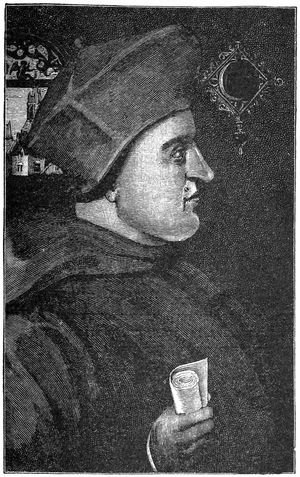
Cardinal Wolsey: from an original picture belonging
to the Hon. Sir Spencer Ponsonby-Fane, K.C.B.
6. Wolsey's Policy of Peace. 1514-1518.—In 1514 the king made
Wolsey Archbishop of York. In 1515 the Pope made him a Cardinal.
Before the end of the year he was Henry's Chancellor. The whole of
the business of the government passed through his hands. The
magnificence of his state was extraordinary. To all observers he
seemed to be more a king than the king himself. Behind him
was Henry, trusting him with all his power, but self-willed and
uncontrollable, quite ready to sacrifice his dearest friend to
satisfy his least desire. As yet the only conflict in Henry's mind
was the conflict about peace or war with France. Henry's love of
display and renown had led him to wish to rival the exploits of
Edward III. and Henry V. Wolsey preferred the old policy of Richard
II. and Henry VI., but he knew that he could only make it palatable
to the king and the nation by connecting the idea of peace with the
idea of national greatness. He aspired to be the peacemaker of
Europe, and to make England's interest in peace the law of the
world. In 1515 the new king of France, Francis I., needed
peace with England because he was in pursuit of glory in Italy,
where he won a brilliant victory at Marignano. In 1516 Ferdinand's
death gave Spain to his grandson, Charles, the son of Philip and
Juana (see p. 358), and from that time Francis and Charles stood
forth as the rivals for supremacy on the Continent. Wolsey tried his
best to maintain a balance between the two, and it was owing to his
ability that England, thinly populated and without a standing army,
was eagerly courted by the rulers of states far more powerful than
herself. In 1518 a league was struck between England and France, in
which Pope Leo X., the Emperor Maximilian, and Charles, king of
Spain, agreed to join, thus converting it into a league of universal
peace. Yet Wolsey was no cosmopolitan philanthropist. He believed
that England would be more influential in peace than she could be in
war.
7. Wolsey and the Renascence.—In scheming for the elevation of his
own country by peace instead of by conquest, Wolsey reflected the
higher aspirations of his time. No sooner had internal order been
secured, than the best men began to crave for some object to which
they could devote themselves, larger and nobler than that of their
own preservation. Wolsey gave them the contemplation of the
political importance of England on the Continent. The noblest minds,
however, would not be content with this, and an outburst of
intellectual vigour told that the times of internal strife had
passed away. This intellectual movement was not of native growth.
The Renascence, or new birth of letters, sprung up in Italy in the
fourteenth century, and received a further impulse through the
taking of Constantinople by the Turks in 1453, when the dispersal of
Greek teachers from the East revived the study of the Greek
language. It was not merely because new teachers landed in Italy
that the literature of the ancient world was studied with avidity.
Men were weary of the mediæval system, and craved for other ideals
than those of the devotees of the Church. Whilst they learnt to
admire the works of the Greek and Latin authors as models of
literary form, they caught something of the spirit of the ancient
world. They ceased to look on man as living only for God and a
future world, and regarded him as devoting himself to the service of
his fellow-men, or even—in lower minds the temptation lay
perilously near—as living for himself alone. Great artists and
poets arose who gave expression to the new feeling of admiration for
human action and human beauty, whilst the prevailing revolt against
the religion of the middle ages gave rise to a spirit of criticism
which refused belief to popular legends.
8. The Renascence in England.—The spirit of the Renascence
was slow in reaching England. In the days of Richard II. Chaucer
visited Italy, and Italian influence is to be traced in his
Canterbury Tales. In the days of Henry VI. the selfish politician,
Humphrey, Duke of Gloucester, purchased books, and gave to Oxford a
collection which was the foundation of what was afterwards known as
the Bodleian Library. Even in the Wars of the Roses the brutal John
Tiptoft, Earl of Worcester, and the gentle Earl Rivers, the brother
of Elizabeth Woodville, were known as patrons of letters. The
invention of printing brought literature within reach of those to
whom it had hitherto been strange. Edward IV. patronised Caxton, the
first English printer. In the peaceful reign of Henry VII. the seed
thus sown sprang into a crop. There was, however, a great difference
between the followers of the new learning in England and in Italy.
In Italy, for the most part, scholars mocked at Christianity, or
treated it with tacit contempt. In England there was no such breach
with the religion of the past. Those who studied in England sought
to permeate their old faith with the new thoughts.
9. The Oxford Reformers.—Especially was this the case with a group
of Oxford Reformers, Grocyn, Linacre, and Colet, who were fighting
hard to introduce the study of Greek into the University. Among
these Colet specially addicted himself to the explanation of the
epistles of St. Paul, insisting on following their plain meaning
instead of the mystical interpretations then in vogue. In 1510 he
founded St. Paul's School, that boys might be there taught without
being subjected to the brutal flogging which was in those days the
lot even of the most diligent of schoolboys. The most remarkable
member of this group of scholars was Thomas More. Young More, who
had hoped much from the accession of Henry VIII., had been
disappointed to find him engaging in a war with France instead of
cultivating the arts of peace. He meditated deeply over the miseries
of his fellow-men, and longed for a time when governments would
think it to be their highest duty to labour for those who are too
weak to help themselves.
10. 'The Utopia.' 1515-1516.—In 1515 and 1516 More produced a book
which he called Utopia, or Nowhere, intending it to serve as a
satire on the defects of the government of England, by praising the
results of a very different government in his imaginary country. The
Utopians, he declared, fought against invaders of their own land or
the land of their allies, or to deliver other peoples from tyranny,
but they made no wars of aggression. In peace no one was
allowed either to be idle or overworked. Everyone must work six
hours a day, and then he might listen to lectures for the
improvement of his mind. As for the religion of Utopia, no one was
to be persecuted for his religious opinions, as long as he treated
respectfully those who differed from him. If, however, he used
scornful and angry words towards them, he was to be banished, not as
a despiser of the established religion, but as a stirrer up of
dissension. Men of all varieties of opinion met together in a common
temple, the worship in which was so arranged that all could take
part in it. Amongst their priests were women as well as men. More
practical was the author's attack on the special abuses of the
times. England swarmed with vagrants, who easily passed into
robbers, or even murderers. The author of Utopia traced the evil
to its roots. Soldiers, he said, were discharged on their return
home, and, being used to roving and dissolute habits, naturally took
to vagrancy. Robbery was their only resource, and the law tempted a
robber to murder. Hanging was the penalty both for robbing and
murder, and the robber, therefore, knowing that he would be hanged
if he were detected, usually killed the victim whom he had plundered
in order to silence evidence against himself; and More consequently
argued that the best way of checking murder would be to abolish the
penalty of death for robbery. Another great complaint of More's was
against the ever-growing increase of inclosures for pasturage.
"Sheep," he said, "be become so great devourers and so wild that
they eat up and swallow down the very men themselves. They consume,
destroy, and devour whole fields, houses, and cities." More saw the
evil, but he did not see that the best remedy lay in the
establishment of manufactures, to give employment in towns to those
who lost it in the country. He wished to enforce by law the
reversion of all the new pasturage into arable land.
11. More and Henry VIII.—Henry VIII. was intolerant of those who
resisted his will, but he was strangely tolerant of those who
privately contradicted his opinions. He took pleasure in the society
of intelligent and witty men, and he urged More to take office under
him. More refused for a long time, but in 1518—the year of the
league of universal peace—believing that Henry was now a convert to
his ideas, he consented, and became Sir Thomas More and a Privy
Councillor. Henry was so pleased with his conversation that he tried
to keep him always with him, and it was only by occasionally
pretending to be dull that More obtained leave to visit his home.
12. The Contest for the Empire. 1519.—In January 1519 the
Emperor Maximilian died. His grandson Charles was now possessed of
more extensive lands than any other European sovereign. He ruled in
Spain, in Austria, in Naples and Sicily, in the Netherlands, and in
the County of Burgundy, usually known as Franche Comté. Between him
and Francis I. a struggle was inevitable. The chances were
apparently, on the whole, on the side of Charles. His dominions,
indeed, were scattered, and devoid of the strength given by national
feeling, whilst the smaller dominions of Francis were compact and
united by a strong national bond. In character, however, Charles had
the superiority. He was cool and wary, whilst Francis was impetuous
and uncalculating. Both sovereigns were now candidates for the
Empire. The seven electors who had it in their gift were open to
bribery. Charles bribed highest, and being chosen became the Emperor
Charles V.
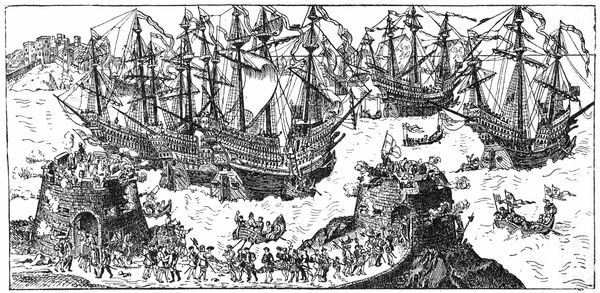
13. The Field of the Cloth of Gold. 1520.—Wolsey tried hard to keep
the peace. In 1520 Henry met Francis on the border of the territory
of Calais, and the magnificence of the display on both sides gave to
the scene the name of the Field of the Cloth of Gold. In the same
year Henry had interviews with Charles. Peace was for a time
maintained, because both Charles and Francis were still too much
occupied at home to quarrel, but it could hardly be maintained long.
The embarkation of Henry VIII. from Dover, 1520: from
the original painting at Hampton Court.
14. The Execution of the Duke of Buckingham. 1521.—Henry was
entirely master in England. In 1521 the Duke of Buckingham, son of
the Buckingham who had been beheaded by Richard III., was tried and
executed as a traitor. His fault was that he had great wealth, and
that, being descended from the Duke of Gloucester, the youngest son
of Edward III., he had not only cherished some idea of claiming the
throne after Henry's death, but had chattered about his prospects.
In former days justice was not to be had by those who offended the
great lords. Now, one despot had stepped into the place of many, and
justice was not to be had by those who offended the king. The legal
forms of trial were now as before observed. Buckingham was indeed
tried before the court of the Lord High Steward, which consisted of
a select number of peers, and which had jurisdiction over peers when
Parliament was not sitting. These, however, were no more than forms.
It was probably a mingled feeling of gratitude and fear which made
peers as well as ordinary juries ready to take Henry's word for the
guilt of any offender.
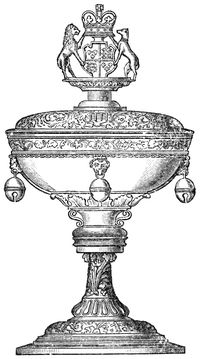
Cup and Cover, 1523, at Barber Surgeons' Hall,
London.
15. Another French War. 1522-1523.—The diplomacy of
those days was a mere tissue of trickery and lies. Behind the
falsehood, however, Wolsey had a purpose of his own, the maintenance
of peace on the Continent. Yet, in 1521 war broke out between
Charles and Francis, both of whom laid claim to the Duchy of Milan,
and it was evident that Wolsey would be unable to keep England out
of the struggle. If there was to be fighting Henry preferred to
fight France rather than to fight Charles. In 1522, in conjunction
with Charles, he invaded France. There was burning and ravaging
enough, but nothing of importance was done. Nevertheless in 1523
Henry was in high spirits. A great French noble, the Duke of
Bourbon, provoked by ill-treatment, revolted against Francis, and
Henry and Charles fancied that he would open a way to them into the
heart of France. If Henry was to be crowned at Paris, which was the
object on which he was bent, he must have a supply of money from his
subjects. Though no Parliament had been summoned for nearly eight
years, one was summoned now, of which More was the Speaker. Wolsey
asked for an enormous grant of 800,000l., nearly equal to
12,000,000l. at the present day. Finding that the Commons
hesitated, he swept into the House in state to argue with them.
Expecting a reply, and finding silence, he turned to More, who told
him that it was against the privilege of the House to call on it for
an immediate answer. He had to depart unsatisfied, and after some
days the House granted a considerable sum, but far less than that
which had been demanded. Wolsey was now in a position of danger. His
own policy was pacific, but his master's policy was warlike, and he
had been obliged to make himself the unquestioning mouthpiece
of his master in demanding supplies for war. He had long
been hated by the nobles for thrusting them aside. He was now
beginning to be hated by the people as the supposed author of an
expensive war, which he would have done his best to prevent. He had
not even the advantage of seeing his master win laurels in the
field. The national spirit of France was roused, and the combined
attack of Henry and Charles proved as great a failure in 1523 as in
1522. The year 1524 was spent by Wolsey in diplomatic intrigue.
16. The Amicable Loan. 1525.—Early in 1525 Europe was startled by
the news that Francis had been signally defeated by the Imperialists
at Pavia, and had been carried prisoner to Spain. Wolsey knew that
Charles's influence was now likely to predominate in Europe, and
that unless England was to be overshadowed by it, Henry's alliance
must be transferred to Francis. Henry, however, saw in the
imprisonment of Francis only a fine opportunity for conquering
France. Wolsey had again to carry out his master's wishes as though
they were his own. Raking up old precedents, he suggested that the
people should be asked for what was called an Amicable Loan, on the
plea that Henry was about to invade France in person. He obtained
the consent of the citizens of London by telling them that, if they
did not pay, it might 'fortune to cost some their heads.' All over
England Wolsey was cursed as the originator of the loan. There were
even signs that a rebellion was imminent. In Norfolk when the Duke
of Norfolk demanded payment there was a general resistance. On his
demanding the name of the captain of the multitude which refused to
pay, a man told him that their captain's 'name was Poverty,' and 'he
and his cousin Necessity' had brought them to this. Wolsey, seeing
that it was impossible to collect the money, took all the
unpopularity of advising the loan upon himself. 'Because,' he wrote,
'every man layeth the burden from him, I am content to take it on
me, and to endure the fame and noise of the people, for my goodwill
towards the king ... but the eternal God knoweth all.' Henry had no
such nobility of character as to refuse to accept the sacrifice. He
liked to make his ministers scapegoats, to heap on their heads the
indignation of the people that he might himself retain his
popularity. For three centuries and a half it was fully believed
that the Amicable Loan had originated with Wolsey.
Hampton Court; built by Cardinal Wolsey, finished in
1526.
17. Closing Years of Wolsey's Greatness. 1525-1527.—All idea of
continuing the war being now abandoned, Wolsey cautiously
negotiated for an alliance with France, and in the autumn of 1525
peace was signed between France and England. In February
1526 Charles set Francis at liberty on his promising to abandon to
him large tracts of French territory. As soon as he was out of Spain
Francis declared that, without the consent of his subjects, such
promises were not binding on him. An Italian league, jealous of
Charles's power, gathered round the Pope, Clement VII., to oppose
him. In May 1527 the exiled Duke of Bourbon, who was now one of
Charles's generals, took Rome by assault. He was himself slain as he
mounted the wall, but his followers took prisoner the Pope, and
sacked Rome with horrible barbarity. Wolsey was too worldly-minded
to be shocked at the Pope's misfortunes; but he had much to fear
from the enormous extension of the Emperor's power. For some weeks
he had been negotiating a close alliance with France on the basis of
a marriage between Henry's only surviving child, Mary, and the
worn-out voluptuary Francis. Suddenly the scheme was changed to a
proposal for a marriage between Mary, who was ten years old, and the
second son of Francis, who was but six. The bargain was concluded,
and for a time there was some thought of carrying it out. At all
events when the news of the sack of Rome arrived, England and France
were already in close alliance. Wolsey's position was, to all
outward appearance, secure.
LEADING DATES
Reign of Henry VIII., 1509-1547
Henry seeks for a divorce 1527
His suit before a Legatine Court 1529
Fall of Wolsey 1529
The clergy acknowledge Henry to be Supreme Head of the
Church of England 1531
The first Act of Annates 1532
The king's marriage to Anne Boleyn and the Act of
Appeals 1533
Cranmer's sentence of divorce 1533
The final separation from Rome 1534
1. The Papacy and the Renascence.—The Renascence alone could not
make the world better, and in many respects it made it worse. The
respect which it paid to humanity, which was its leading
characteristic, allied itself in More with a reverence for God,
which led him to strive to mellow the religious teaching of the
Middle Ages, by fitting it for the needs of the existing world. Too
many threw off all religious restraints, and made it their first
thought to seek their own enjoyment, or the triumphs of their own
intellectual skill. Sensual delights were pursued with less brutal
directness, but became more seductive and more truly debasing by the
splendour and gracefulness of the life of which they formed a part.
In Italy the Popes swam with the current. Alexander VI. (1492-1503)
gave himself up to the most degrading vices. Julius II. (1503-1513)
was a passionate warrior struggling for the extension of his
temporal possessions. Leo X. (1513-1521) was a polished lover of
art, perfectly indifferent to religious duty. "Let us enjoy the
Papacy," he said when he was elected, "since God has given it to
us." Amidst the lust of the flesh, the lust of the eyes, and the
pride of life, the Popes became as other Italian princes, no better
and no worse. Spiritual guidance was no longer to be expected of
them.
2. Wolsey and the Papacy.—By Wolsey and his master the Papacy was
respected as a venerable and useful institution, the centre of a
religious organisation which they believed to be of divine origin,
though when it came in conflict with their own projects they were
quite ready to thwart it. In 1521 Leo X. died, and Wolsey, having
some hopes of being himself elected, asked Charles V. to send troops
to compel the cardinals to choose him, promising to pay the expenses
of the armament. Charles, though, in the previous year, he had
offered to support Wolsey's candidature at the next vacancy, now
deserted him, and the new Pope was Adrian VI., who in 1523 was
succeeded by Clement VII. (see p. 374).
Portrait of William Warham, Archbishop of Canterbury,
1503-1532 showing the ordinary episcopal dress, with the mitre and
archiepiscopal cross: from a painting belonging to Viscount Dillon,
dated 1527.
3. Wolsey's Legatine Powers.—It is unlikely that Wolsey was much
disappointed. His chief sphere of action was England, where since
1518 he had held unwonted authority, as in that year he had been
appointed Legate a latere[1] by Leo X. at Henry's request, and the
powers of a Legate a latere were superior even to those of Warham,
the Archbishop of Canterbury. Wolsey was therefore clothed with all
the authority of king and Pope combined. His own life was, indeed,
like those of many churchmen in his day, very far from the ideal of
Christianity; but for all that he had that respect for religious
order which often lingers in the hearts of men who break away from
the precepts of religion, and he was too great a statesman
to be blind to the danger impending over the Church. The old order
was changing, and Wolsey was as anxious as More, though from more
worldly motives, that the change should be effected without
violence. He knew that the Church was wealthy, and that wealth
tempted plunderers, and he also knew that, with some bright
exceptions, the clergy were ignorant, and even when not
absolutely dissolute were remiss and easy-going in their lives. He
was, therefore, anxious to make them more worthy of respect, and,
with the consent of king and Pope, he began in 1524 to dissolve
several small monasteries, and to apply their revenues to two great
colleges, the one founded by him at Oxford and the other at Ipswich.
He hoped that without any change of doctrine or organisation the
Church would gradually be purified by improved education, and would
thus once more command the respect of the laity.
4. Henry VIII. and the Clergy.—With Wolsey's object Henry, being
himself well educated and well read, fully sympathised. For many
years there had been a tacit understanding between the king and the
Pope, and now that both the king and the Pope supported Wolsey's
action there seemed to be less danger than ever of any disturbance
of the friendly relations between Church and State. Yet though Henry
was on good terms with the Pope, he had made up his mind that
whenever there was a conflict of jurisdiction in ecclesiastical
matters his own will, and not that of the clergy, was to be
predominant. As early as in 1515, when a question of this kind was
moved, Wolsey asked on behalf of the clergy that it might be
referred to the Pope. "We," said Henry proudly, "are by God's grace
king of England, and have no superior but God; we will maintain the
rights of the crown like our predecessors; your decrees you break
and interpret at your pleasure, but we will not consent to your
interpretation of them any more than our predecessors have done."
Henry VIII., in short, took up the position which Henry II. had
assumed towards the clergy of his day, and he was far more powerful
to give effect to his views than Henry II. had ever been. Such an
act of self-assertion would probably have caused a breach with the
great Popes of the middle ages, such as Gregory VII. or Innocent
III. Leo X. was far too much a man of the world to trouble himself
about such matters.
Tower of Fountains Abbey church; built by Abbot Huby.
1494-1526.
5. German Lutheranism.—Before many years had passed the beginnings
of a great religious revolution which appeared in Germany served to
bind Henry and Leo more closely together. Martin Luther, a Saxon
friar, had been disgusted by the proceedings of a hawker of
indulgences, who extracted small sums from the ignorant by the sale
of the remission of the pains of purgatory. What gave world-wide
importance to Luther's resistance was that he was not only an
eloquent preacher of morality, but the convinced maintainer of a
doctrine which, though not a new one, had long been laid aside. He
preached justification by faith, and the acceptance of his
teaching implied even more than the acceptance of a new doctrine.
For centuries it had been understood that each Christian held
intercourse with God through the sacraments and ordinances of the
Church. His individuality was, as it were, swallowed up in the vast
community to which he belonged. Luther taught each of his hearers
that the important thing was his faith, that is to say his immediate
personal relation with God, and that the intervention of human
beings might, indeed, be helpful to him, but could be no more. Such
a doctrine touched all human activity. The man who in religion
counted his own individual faith as the one thing necessary was
likely to count his own individual convictions in social or
political matters as worth more to him than his obedience to the
authority of any government. In Luther's teaching was to be found
the spirit of political as well as of religious liberty. This side
of it, however, was not likely to reveal itself at once. After a
time Luther shook off entirely the claims of the Papacy upon his
obedience, but he magnified the duty of obeying the princes who gave
him their support in his struggle with the Pope.
6. Henry's Controversy with Luther.—Luther, when once he was
engaged in controversy with the Papacy, assailed other doctrines
than those relating to justification. In 1521 Henry, vain of his
theological learning, wrote a book against him in defence of the
seven sacraments. Luther, despising a royal antagonist, replied with
scurrilous invective. Pope Leo was delighted to have found so
influential a champion, and conferred on Henry the title of Defender
of the Faith. If Henry had not been moved by stronger motives than
controversial vanity he might have remained the Pope's ally till the
end of his life.
Catharine of Aragon: from a painting in the National
Portrait Gallery.
7. Queen Catharine and Anne Boleyn.—It was a great disappointment
to Henry that he had no surviving male children. England had never
been ruled by a queen, and it was uncertain whether Henry's
daughter, Mary, would be allowed to reign. Henry had already begun
to ask himself whether he might not get rid of his wife, on the plea
that a marriage with his brother's wife was unlawful, and this
consideration had the greater weight with him because Catharine was
five years older than himself and was growing distasteful to him.
When in 1521, in his book against Luther, he assigned a divine
origin to the Papacy, he told More of a secret reason for this
exaltation of the Pope's power, and it is possible that this reason
was his desire to obtain from the Pope a divorce under the pretext
that it would secure a peaceful succession. At all events
his scruples regarding his marriage with Catharine were quickened in
1522 by the appearance at court of Anne Boleyn, a sprightly
black-eyed flirt in her sixteenth year, who took his fancy as she
grew into womanhood. Flirt as she was, she knew her power, and
refused to give herself to him except in marriage. The king, on his
part, being anxious for a legitimate son, set his heart on a divorce
which would enable him to marry Anne. Wolsey, knowing the obstacles
in the way, urged him to abandon the project; but it was never
possible to turn Henry from his course, and Wolsey set himself, in
this as in all things else, to carry out his master's
wishes, though he did so very reluctantly. Moral scruples had little
weight with Wolsey, but in 1525, when he learnt the king's design,
there were strong political reasons against its execution, as
England was in alliance with Catharine's nephew, the Emperor,
Charles V., and a divorce would be certain to endanger the alliance.
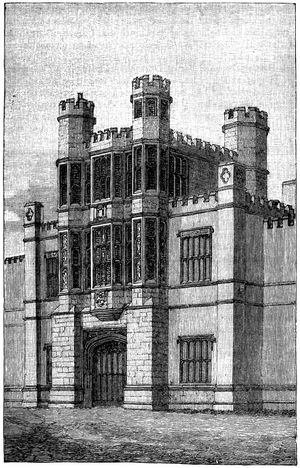
The Gatehouse of Coughton Court, Warwickshire; built
about 1530.
8. Henry's Demand for a Divorce. 1527-1528.—Two years later, in
1527, as Henry was veering round towards a French alliance (see p.
374), he had no longer much reason to consider the feelings of the
Emperor. On the other hand, the strong position which Charles
occupied in Italy after the sack of Rome made it improbable that
Clement VII. who was then Pope, and who thought more of his
political than of his ecclesiastical position, would do anything to
thwart the Emperor. An attempt made by Henry in 1527 to draw Clement
to consent to the divorce failed, and in 1528 Wolsey sent to Rome
his secretary, Stephen Gardiner, an adroit man of business, to
induce Clement to appoint legates to decide the question in Henry's
favour. Clement, anxious to please all parties, appointed Wolsey and
another cardinal, Campeggio, as his legates, but took care to add
that nothing done by them should be valid until it had received his
own approval.
9. The Legatine Court. 1529.—The court of the two legates was
opened at Blackfriars in 1529. Before proceeding to business they
tried hard to induce either Henry to abstain from asking for a
divorce or Catharine to abstain from resisting his demand. In such a
matter Catharine was as firm as the self-willed Henry. Even if she
could consent to leave the throne, she could not, if she retained
any sense of womanly dignity, acknowledge that she had never been a
wife to Henry, or suffer her daughter to be branded with
illegitimacy. When king and queen were at last cited to appear
Catharine knelt before her husband. She had, she said been his true
and obedient wife for twenty years, and had done nothing to deserve
being put to open shame. As it was, she appealed to Rome. The
queen's cause was popular with the masses, who went straight to the
mark, and saw in the whole affair a mere attempt to give a legal
covering to Henry's lust. The legates refused to consider the
queen's appeal, but when they came to hear arguments on the merits
of the case they were somewhat startled by the appearance of the
aged Fisher, Bishop of Rochester, one of the holiest and most
learned prelates of the day, who now came voluntarily, though he
knew that Henry's wrath was deadly, to support the cause of
Catharine. Campeggio took advantage of the strong feeling
which was growing against the king to interpose delays which he knew
to be well-pleasing to Clement, and before these delays were at an
end Clement annulled all the proceedings in England and revoked the
cause to Rome. Most probably he was alarmed at the threats of the
Emperor, but he had also reasons of his own for the course which he
took. Henry did not ask for a divorce on any of the usual grounds,
but for a declaration that his marriage had been null from the
beginning. As, however, his marriage had been solemnised with a
Papal dispensation, Clement was asked to set aside the dispensation
of one of his predecessors, a proceeding to which no Pope with any
respect for his office could reasonably be expected to consent.
10. The Fall of Wolsey. 1529-1530.—Henry was very angry and made
Wolsey his victim. Wolsey's active endeavours to procure the divorce
counted as nothing. It was enough that he had failed. He was no
longer needed to conduct foreign affairs, as Henry cared now only
for the divorce, and raised no objection when Charles and Francis
made peace at Cambrai without consulting his interests. The old
nobility, headed by the Duke of Norfolk, the son of the victor of
Flodden, had long hated Wolsey bitterly, and the profligate
courtiers, together with the friends and relatives of Anne, hated
him no less bitterly now. Before the end of the year proceedings
under the Statute of Præmunire (see pp. 258, 382) were taken against
him on the ground that he had usurped legatine powers. It was
notorious that he had exercised them at the king's wish, and he
could have produced evidence to show that this had been the case. In
those days, however, it was held to be a subject's duty not to
contest the king's will, and Wolsey contented himself with an abject
supplication for forgiveness. He was driven from his offices, and
all his goods and estates seized. The college which he had founded
at Ipswich was sold for the king's use, and his college at Oxford,
then known as Cardinal College, was also seized, though it was
afterwards refounded under the name of Christchurch by the robber
king. Wolsey was reduced to extreme poverty. In 1530 he was allowed
to return to the possession of the archbishopric of York; but he
imprudently opened communications with the French ambassador, and
harmless as they were, they gave a handle to his enemies. Henry
ordered him to be charged with treason. The sufferings of his mind
affected his body, and on his way to London he knew that he was a
dying man. "Father Abbot," he said, in taking shelter in Leicester
Abbey, "I am come hither to leave my bones among you." "If
I had served my God," he acknowledged as he was passing away, "as
diligently as I have done my king, He would not have given me over
in my grey hairs."
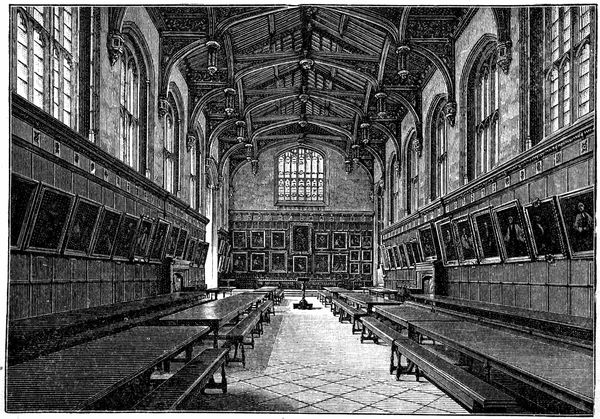
Hall of Christchurch, Oxford; built by Cardinal
Wolsey, and finished in 1529.
11. The House of Commons and the Clergy. 1529.—No king
ever felt the importance of popularity like Henry, and the
compassion which had been freely given to Catharine by the crowd, on
her appearance in the Legatine Court, made it necessary for him to
find support elsewhere. It had been Wolsey's policy to summon
Parliament as seldom as possible. It was to be Henry's policy to
summon it as frequently as possible. He no longer feared the House
of Lords, and either he or Wolsey's late servant, Thomas Cromwell,
an able and unscrupulous man, who rose rapidly in Henry's favour,
perceived the use which might be made of the House of Commons. By
his influence the king could carry the elections as he pleased, and
when Parliament met in 1529 it contained a packed House of Commons
ready to do the king's bidding. The members were either lawyers or
country gentlemen, the main supports of the Tudor monarchy, and
Henry strengthened his hold upon them by letting them loose on the
special abuses which had grown up in the ecclesiastical courts.
Lawyers and country gentlemen were very much what they had been in
the fifteenth century, without large political ideas or fine
spiritual perceptions; but now that they were relieved of the
oppression of the great nobles they turned upon the clergy, who
claimed fees and dues which they disliked paying, and who used the
powers of the ecclesiastical tribunals to exact heavy payments for
moral and spiritual offences.
12. The Universities Consulted. 1530.—Henry had as yet no thought
of breaking with the Pope. He wanted to put pressure on him to make
him do what he had come to regard as right. In 1530 he sent to the
universities of Europe to ask their opinion on the question whether
a marriage with a brother's widow was contrary to the law of God.
The whole inquiry was a farce. Wherever Henry or his allies could
bribe or bully the learned doctors, an answer was usually given in
the affirmative. Wherever the Emperor could bribe or bully, then the
answer was usually given in the negative. That the experiment should
have been tried, however, was a proof of the strength of the spirit
of the Renascence. A question of morals which the Pope hesitated to
decide was submitted to the learning of the learned.
13. The Clergy under a Præmunire. 1530-1531.—Towards the end of
1530 Henry charged the whole clergy of England with a breach of the
Statute of Præmunire by their submission to Wolsey's legatine
authority. A more monstrous charge was never brought, as when that
authority was exercised not a priest in England dared to offend the
king by resisting it. When the Convocation of Canterbury
met in 1531, it offered to buy the pardon of the clergy by a grant
of 100,000l., to which was afterwards added 18,000l. by the
Convocation of York. Henry refused to issue the pardon unless the
clergy would acknowledge him to be supreme head of the Church of
England.
14. The King's Supreme Headship acknowledged by the Clergy.
1531.—The title demanded by Henry was conceded by the clergy, with
the qualification that he was Supreme Head of the English Church and
clergy so far as was allowed by the law of Christ. The title thus
given was vague, and did not bar the acknowledgment of the Papal
authority as it had been before exercised, but its interpretation
would depend on the will of the stronger of the two parties. As far
as the Pope was concerned, Henry's claim was no direct invasion of
his rights. The Pope had exercised authority and jurisdiction in
England, but he had never declared himself to be Supreme Head of the
Church either in England or anywhere else. Henry indeed alleged that
he asked for nothing new. He merely wanted to be known as the
supreme authority in the relations between the clergy and the laity.
Nevertheless it was a threat to the Pope, who might well fear lest
the clergy, after giving way to the assumption of a title which
implied authority over themselves, might give way to the widening of
that same authority over matters on which the Pope's claims had
hitherto been undoubted.
15. The Submission of the Clergy. 1532.—Everything done by Henry at
this crisis was done with a view to the securing of his purposed
divorce. In the Parliament which sat in 1532 the Commons were again
let loose upon the clergy, and Henry, taking their side, forced
Convocation[2] to sign a document known as the submission of the
clergy. In this the clergy engaged in the first place neither to
meet in Convocation nor to enact or execute new canons without the
king's authority, and, secondly, to submit all past ecclesiastical
legislation to examination with a view to the removal of everything
prejudicial to the royal prerogative. The second article was never
carried into effect, as the first was enough for Henry. He was now
secure against any attempt of the clergy in Convocation to protest
against any step that he might take about the divorce, and he was
none the less pleased because he had incidentally settled
the question of the relations between the clerical legislature and
the Crown.
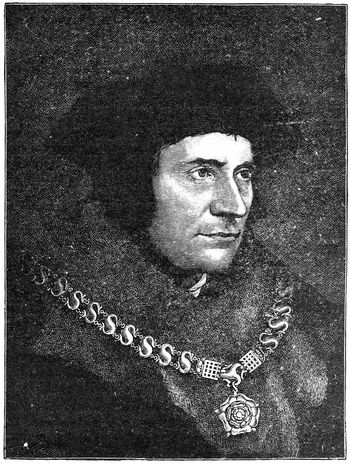
Sir Thomas More, wearing the collar of SS: from an
original portrait painted by Holbein in 1527, belonging to Edward
Huth, Esq.
16. Sir Thomas More and the Protestants. 1529-1532.—The submission
of the clergy cost Henry the services of the best and wisest of his
statesmen. Sir Thomas More had been appointed Chancellor on Wolsey's
fall in 1529. When More wrote the Utopia, Luther had not yet
broken away from the Papacy, and the tolerant principles of the
author of that book had not been put to the test. Even in the
Utopia More had confined his tolerance to those who
argued in opposition to the received religion without anger or
spite, and when he came to be in office he learnt by practical
experience that opposition is seldom carried on in the spirit of
meekness. Protestantism, as the Lutheran tenets began to be called
in 1529, spread into England, though as yet it gained a hold only on
a few scattered individuals. Here and there thoughtful men,
dissatisfied with the teaching given to them and with the lives of
many of their teachers, embraced the Lutheran doctrine of
justification by faith. Even the best of them could hardly be
expected to treat with philosophic calm the doctrines which they had
forsaken; whilst some of their converts took a pleasure in reviling
the clergy and the common creed of the vast majority of Englishmen.
With many again the doctrine of justification by faith slipped into
the condemnation of the merit of good works, and even into a light
estimation of good works themselves. For this bitterness of speech
and mind More had no tolerance, and while he pursued his antagonists
with argument and ridicule, he also used his authority to support
the clergy in putting down what they termed heresy by the process of
burning the obstinate heretic.
17. Resignation of Sir Thomas More. 1532.—More had no ground for
fearing that the increase of the king's authority over the clergy
would at once encourage revolt against the Church. Henry was a
representative Englishman, and neither he nor the House of Commons
had the least sympathy with heresy. They wanted to believe and act
as their fathers had done. More, however, was sufficiently prescient
to foresee that a lay authority could not for ever maintain this
attitude. Laymen were certain to be moved by the current of thought
which prevailed in their age, and it was only, he believed, the
great Papal organisation which could keep them steady. Though Henry
had not yet directly attacked that organisation, he might be
expected to attack it soon, and, in 1532, More retired from all
connection with Henry's government rather than take part in that
attack.
18. The First Act of Annates. 1532.—Having secured himself, as it
were, in the rear by the submission of the clergy, Henry proceeded
to deal with the Pope. He still wished if possible to win him to his
side, and before the end of 1532 he obtained from Parliament an Act
of Annates. Annates were the first-fruits or first year's income of
ecclesiastical benefices, and by this Act the first-fruits of
bishoprics, which had hitherto been paid to the Pope, were to be
kept back. The Act was not, however, to come into force till the
king had ratified it, and Henry refused for a time to ratify
it hoping to reduce Clement to submission by suspending
over his head a threat upon his purse.
19. The King's Marriage and the Act of Appeals. 1533.—Henry,
however, found that Clement was not to be moved, and his patience
coming at last to an end, he was secretly married to Anne Boleyn on
January 25, 1533. Now that he had reluctantly given up hope of
obtaining a favourable decision from the Pope, he resolved to put an
end to the Papal jurisdiction in England. Otherwise if he obtained a
sentence in an English ecclesiastical court declaring his marriage
with Catharine to be null from the beginning, his injured wife might
appeal to the superior court of the Pope. He accordingly obtained
from Parliament the Act of Appeals, declaring that the king held the
supreme authority in England, and that as under him all temporal
matters were to be decided by temporal judges, and all spiritual
matters by spiritual judges, no appeals should hereafter be suffered
to any authority outside the realm. Henry was capable of any
meanness to serve his ends, but he also knew how to gain more than
his immediate ends by connecting them with a large national policy.
He almost made men forget the low design which prompted the Act of
Appeals by fixing their eyes on the great object of national
independence.
20. Archbishop Cranmer and the Court at Dunstable. 1533.—Henry
found a convenient instrument for his personal as well as for his
national policy in Thomas Cranmer, whom he appointed Archbishop of
Canterbury in the spring of 1533. Cranmer was intellectually acute,
and took a worthy part in the further development of the English
Church; but he was morally weak, and inclined to carry out orders
whatever they might be, especially if they came from a king as
strong-willed as Henry. He had already thrown himself as an active
agent into the cause of Henry's divorce, and he was now prepared as
archbishop to give effect to his arguments. In March Convocation was
half persuaded, half driven to declare Catharine's marriage to be
void, and in May Cranmer, sitting at Dunstable in his archiepiscopal
court, pronounced sentence against her. In accordance with the Act
of Appeals the sentence was final, but both Henry and Cranmer feared
lest Catharine should send her counsel to make an appeal to Rome,
and they were therefore mean enough to conceal from her the day on
which sentence was to be given. The temporal benefits which the Pope
derived from England were now to come to an end as well as his
spiritual jurisdiction, and in July the king ratified the Act of
Annates.
21. Frith and Latimer. 1533.—When a man of special
intellectual acquirements like Cranmer could descend to the trick
which he had played at Dunstable, it was time that some one should
be found who, in the steadfastness of his faith, would refuse to
truckle to the king, and would maintain the rights of individual
conscience as well as those of national independence. The teaching
of Zwingli, a Swiss reformer, who held that the bread and wine in
the Sacrament of the Lord's Supper was a mere sign of the Body and
Blood of the Redeemer, was beginning to influence the English
Protestants, and its reception was one more reason for the mass of
Englishmen to send to prison or the stake those who maintained what
was, in their eyes, so monstrous a heresy. Amongst the noblest of
the persecuted was John Frith, who whilst he stoutly held to the
belief that the doctrine of transubstantiation was untrue, begged
that men should be left 'to think thereon as God shall instil in any
man's mind, and that neither part condemn other for this matter, but
receive each other in brotherly love, reserving each other's
infirmity to God.' Frith was in advance of his time as the advocate
of religious liberty as well as of a special creed, and he was burnt
alive. Henry meant it to be understood that his supreme headship
made it easier, and not harder, to suppress heresy. He might have
succeeded if he had had merely to deal with a few heroes like Frith.
That which was beyond his control was the sapping process of the
spirit of the Renascence, leading his bishops, and even himself, to
examine and explain received doctrines, and thus to transform them
without knowing what they were doing. Hugh Latimer, for instance, a
favourite chaplain of the king, was, indeed, a preacher of
righteousness, testing all things rather by their moral worth than
by their conformity to an intellectual standard. The received
doctrines about Purgatory, the worship of the saints, and
pilgrimages to their images seemed to him to be immoral; but as yet
he wished to purify opinion, not to change it altogether, and in
this he had the support of the king, who, in 1535, made him Bishop
of Worcester.
22. Completion of the Breach with Rome. 1533-1534.—Before 1533 was
over Henry appealed from the Pope to a General Council. Clement not
only paid no heed to his appeal, but gave sentence in favour of
Catharine. When Parliament met in 1534, therefore, Henry was obliged
to strengthen his position of hostility to the Pope. He procured
from it three Acts. The first of these was a second Act of Annates,
which conferred on him absolutely not only the first-fruits of
bishoprics which had been the subject of the conditional
Act of Annates in 1532 (see p. 388), but also the first-fruits of
all the beneficed clergy, as well as a tenth of each year's income
of both bishops and beneficed clergy, all of which payments had been
hitherto made to the Pope. Incidentally this Act also regulated the
appointment of bishops, by ordering that the king should issue a
congé d'élire to the chapter of the vacant see, together with a
letter missive compelling the choice of his nominee. The second was
an Act concerning Peter's pence, abolishing all minor payments to
the Pope, and cutting away all interference of the Pope by
transferring his right to issue licences and dispensations to the
Archbishop of Canterbury. The third confirmed the submission of the
clergy and enacted that appeals from the courts of the Archbishop
should be heard by commissioners appointed by the King, and known as
the delegates of Appeals. It was by these Acts that the separation
between the Churches of England and Rome was finally effected. They
merely completed the work which had been done by the great Act of
Appeals in 1533. The Church of England had indeed always been a
national Church with its own ecclesiastical assemblies, and with
ties to the Crown which were stretched more tightly or more loosely
at various times. It had, however, maintained its connection with
the Continental Churches by its subordination to the Pope, and this
subordination had been made real by the subjection of its courts to
appeals to Rome, and by the necessity of recurring to Rome for
permission to do certain things prohibited by English ecclesiastical
law. All this was now at an end. The old supremacy of the king was
sharpened and defined. The jurisdiction of the Pope was abolished.
Nominally the English ecclesiastical authorities became more
independent; more capable of doing what seemed to them to be best
for the Church of the nation. Such at least was the state of the
law. In practice the English ecclesiastical authorities were
entirely at Henry's bidding. In theory and in sentiment the Church
of England was still a branch of the Catholic Church, one in
doctrine and in discipline with the Continental Churches.
Practically it was now, in a far more unqualified sense than before,
a national Church, ready to drift from its moorings and to accept
new counsels whenever the tide of opinion should break strongly
upon it.
LEADING DATES
Reign of Henry VIII., 1509-1547
The Acts of Succession and Supremacy 1534
Execution of Fisher and More 1535
Dissolution of the smaller monasteries and the Pilgrimage
of Grace 1536
Destruction of relics and images 1538
The Six Articles and the Act granting to the king the
greater monasteries 1539
Fall of Cromwell 1540
Henry VIII. king of Ireland 1541
Solway Moss 1542
Death of Henry VIII. 1547
1. The Act of Succession. 1534.—In September 1533 Anne had given
birth to a daughter, who was afterwards Queen Elizabeth. In 1534
Parliament passed an Act of Succession. Not only did it declare
Anne's marriage to be lawful and Catharine's unlawful, and
consequently Elizabeth and not Mary to be heir to the crown, but it
required all subjects to take an oath acknowledging their approval
of the contents of the Act. More and Fisher professed themselves
ready to swear to any succession which might be authorised by Act of
Parliament; but they would not swear to the illegality of
Catharine's marriage. It was on this point that Henry was most
sensitive, as he knew public opinion to be against him, and he threw
both More and Fisher into the Tower. In the year before the language
held in the pulpit on the subject of Henry's marriage with Anne in
his wife's lifetime had been so strong that Cranmer had forbidden
all preaching on the subject of the king's laws or the succession to
the throne. Of the clergy, the friars were still the most resolute.
Henry now sent commissioners to visit the friaries, and those in
which the oath was refused were summarily suppressed.
2. The Acts of Treason and Supremacy. 1534.—In 1534 Parliament also
passed a new Act of Treasons which made it high treason to wish or
practise harm to the king, the queen, and their heirs, to use words
denying their titles, or to call the king a 'heretic, schismatic,
tyrant, infidel, or usurper of the crown.' Later in the same
year, but in a fresh session, Parliament passed the Act of
Supremacy, which confirmed the title of Supreme Head on earth of the
Church of England, a title very similar to that to which the king
had obtained the qualified assent of the clergy in 1531 (see p.
386). From that time anyone who denied the king to be the Supreme
Head of the Church of England was liable to a traitor's death.
John Fisher, Bishop of Rochester, 1504-1535; from a
drawing by Holbein in the Royal Library, Windsor Castle.
3. The Monks of the Charterhouse. 1534.—It can hardly be doubted
that Henry's chief adviser in these tyrannical measures was the able
and unscrupulous Cromwell. It was Cromwell's plan to exalt the royal
authority into a despotism by means of a subservient Parliament. He
was already Henry's secretary; and in 1535 was appointed the king's
Vicar-General in ecclesiastical matters. He was quite ready to push
the Acts of Parliament which had recently been passed to their
extreme consequences. His first object was to get rid of the Friars
Observant, who had shown themselves most hostile to what they called
in plainness of speech the king's adultery. All their houses were
suppressed, and some of the inmates put to death. Then Cromwell fell
on the London Charterhouse,[3] the inmates of which had been
imprisoned in the year before simply for a refusal to take the oath
of the Act of Succession, though they had not uttered a word against
the king's proceedings. They could now be put to death under the new
Treason Act, for denying the king's supremacy, and many of them were
accordingly executed after the usual barbarous fashion, whilst
others perished of starvation or of diseases contracted in the
filthy prisons in which they were confined. "I profess,"
said the Prior, Houghton, "that it is not out of obstinate malice or
a mind of rebellion that I do disobey the king, but only for the
fear of God, that I offend not the Supreme Majesty; because our Holy
Mother the Church hath decreed and appointed otherwise than the king
and Parliament hath ordained." Houghton and his fellows were as
truly martyrs as Frith had been. They at least had sown no seeds of
rebellion, and they died because a tyrannical king insisted on
ruling over consciences as well as over bodily acts.
4. Execution of Fisher and More. 1535.—Fisher and More were the
next to suffer on the same charge, though their sentences were
commuted to death by beheading. More preserved his wit to the last.
"I pray you," he said as he mounted the scaffold, "see me safe up,
and for my coming down I will shift for myself." After he had knelt
to place his head on the block, he raised it again to move his beard
aside. "Pity," he muttered, "that should be cut that has not
committed treason."
5. The Dissolution of the Smaller Monasteries. 1536.—Money never
came amiss to Henry, and Cromwell now rooted himself firmly in his
master's favour by pointing out to him fresh booty. The English
monasteries were rich and weak, and it was easy to trump up or
exaggerate charges against them. Cromwell sent commissioners to
inquire into their moral state (1535), and the commissioners, who
were as unscrupulous as himself, rushed round the monasteries in
such a hurry that they had no time to make any real inquiry, but
nevertheless returned with a number of scandalous tales. These tales
referred to some of the larger monasteries as well as the smaller,
but, when Parliament met in 1536, Henry contented himself with
asking that monasteries having property worth less than 200l. a
year should be dissolved, and their estates given to himself, on the
ground that whilst the smaller ones were dens of vice the larger
ones were examples of virtue. Parliament granted his request, and
the work of spoliation began. There can be no doubt that vice did
exist in the monasteries, though there was not so much of it as the
commissioners asserted. It would have been indeed strange if
innocence had been preserved in communities living in enforced
celibacy, with no stress of work to occupy their thoughts, and with
the high ideals of their profession neglected or cast aside. On the
other hand, the monks were easy landlords, were hospitable to the
stranger and kindly to the poor, whilst neither the king himself nor
those to whom he gave or sold the lands which he acquired cared for
more than to make money. The real weakness of the monks lay in
their failure to conciliate the more active minds of the
age, or to meet its moral needs. The attack upon the vast edifice of
Henry's despotism in Church and State could only be carried on
successfully by the combined effort of men like the scholars of the
Renascence, whose thoughts were unfettered, and of those who, like
the Protestants, were full of aggressive vigour, and who substituted
for the duty of obedience the duty of following their own
convictions.
Edward Seymour, Earl of Hertford, brother of Jane
Seymour, afterwards Duke of Somerset, known as 'the Protector', at
the age of 28 (1535), 1507-1552: from a painting at Sudeley Castle.
6. The Execution of Anne Boleyn. 1536.—Before the end of 1536 there
was a new queen. Henry became tired of Anne, as he had been tired of
Catharine, and on a series of monstrous charges, so monstrous as to
be hardly credible, he had her tried and executed. Her unpardonable
crime was probably that her only living child was a daughter, and
not a son. Ten days after Anne's death Henry married a third wife,
Jane Seymour. As Catharine was now dead, there could be no doubt of
the legitimacy of Jane's offspring, but to make assurance doubly
sure, a new Parliament passed an Act settling the succession on
Jane's children, and declaring both Mary and Elizabeth illegitimate.
7. The Ten Articles. 1536.—It is probable that when Henry took the
title of Supreme Head he intended to maintain the doctrines and
practices of the Church exactly as he found them. In 1536 the clergy
were crying out not merely against attacks on their faith, but
against the ribaldry with which these attacks were often conducted.
One assailant, for instance, declared the oil used in extreme
unction to be no more than the Bishop of Rome's grease or butter,
and another that it was of no more use to invoke a saint
than it was to whirl a stone against the wind. Many of the clergy
would have been well pleased with mere repression. Henry, however,
and the bishops whom he most trusted wished repression to be
accompanied with reasonable explanations of the doctrines and
practices enforced. The result was seen in the Ten Articles which
were drawn up by Convocation, and sent abroad with the authority of
the king. There was to be uniformity, to be obtained by the
circulation of a written document, in which the old doctrines were
stripped of much that had given offence, and their acceptance made
easy for educated men. Of the seven sacraments, three only, Baptism,
Penance, and the Sacrament of the Altar, were explained, whilst the
other four—those of Marriage, Orders, Confirmation, and Extreme
Unction—were passed over in silence. On the whole the Ten Articles
in some points showed a distinct advance in the direction of
Lutheranism, though there was also to be discerned in them an
equally distinct effort to explain rather than to reject the creed
of the mediæval Church.
8. The Translation of the Bible authorised. 1536.—The same tendency
to appeal to educated intelligence showed itself in the sanction
given by the king and Cromwell in 1536 to a translation of the Bible
which had been completed in 1535 by Miles Coverdale, whose version
of the New Testament was founded on an earlier one by Tyndale. It is
probable that Henry, in authorising the circulation of this version,
thought of the support which he might derive from the silence of the
Bible on the Papal claims. The circulation of the Bible was,
however, likely to work in a direction very different from that of
the Ten Articles. The Ten Articles were intended to promote unity of
belief. The Bible, once placed in the hands of everyone who could
read, was likely to promote diversity. It would be the storehouse in
which Lutherans, Zwinglians, and every divergent sect would find
weapons to support their own special ideas. It would help on the
growth of those individual opinions which were springing up side by
side with the steady forward progress of the clergy of the
Renascence. The men who attempted to make the old creed
intellectually acceptable and the men who proclaimed a new one,
under the belief that they were recurring to one still older, were
together laying the foundations of English Protestantism.
9. The Pilgrimage of Grace. 1536-1537.—Slight as these changes
were, they were sufficient to rouse suspicion that further change
was impending. The masses who could neither read nor write were
stirred by the greed and violence with which the dissolution
of the smaller monasteries was carried on, and by the
cessation of the kindly relief which these monasteries had afforded
to the wants of the poor. A rumour spread that when Cromwell had
despoiled the monasteries he would proceed to despoil the parish
churches. In the autumn of 1536 there was a rising in Lincolnshire,
which was easily suppressed, but was followed by a more formidable
rising in Yorkshire. The insurgents, headed by Robert Aske, called
it the Pilgrimage of Grace, and bore a banner embroidered with the
five wounds of Christ. They asked among other things for the
restoration of the monasteries, the punishment of Cromwell and his
chief supporters, the deprivation of the reforming bishops, the
extirpation of heresy, and the restoration of the Papal authority in
a modified form. Their force grew so large that the Duke of Norfolk,
who was sent to disperse it, did not venture to make the attempt,
and the king found himself obliged to issue a general pardon and to
promise that a Parliament should meet in the North for the redress
of grievances. On this the insurgents returned home. Early in 1537
Henry, who had no intention of keeping his word, took advantage of
some new troubles in the North to declare that his engagement was no
longer binding, and seized and executed, not merely the leaders, but
many of the lesser supporters of the insurrection. Of the Parliament
in the North nothing more was heard, but a Council of the North was
established to keep the people of those parts in order, and to
execute justice in the king's name.
10. Birth of a Prince. 1537.—In 1537 Jane Seymour gave birth to a
boy, who was afterwards Edward VI. Henry had at last a male heir of
undoubted legitimacy, but in a few days his wife died.
11. The Beginning of the Attack on the Greater Monasteries.
1537-1538.—The failure of the Pilgrimage of Grace brought in fresh
booty to Henry. Abbots and priors who had taken part in it, or were
accused of doing so, were hanged, and their monasteries confiscated.
Where nothing could be proved against the greater monasteries, which
had been declared by Parliament to be free from vice, their heads
were terrified into an appearance of voluntary submission. Cromwell
had his spies and informers everywhere, and it was as easy for them
to lie as to speak the truth. In 1537 and 1538 many abbots bowed
before the storm, and, confessing that they and their monks had been
guilty of the most degrading sins, asked to be allowed to surrender
their monasteries to the king. Cromwell's commissioners then took
possession, sold the bells, the lead on the roof, and every article
which had its price, and left the walls to serve as a quarry for
the neighbourhood. The lands went to the king. It not
unfrequently happened that Henry promoted to ecclesiastical
benefices those monks who had been most ready to confess themselves
sinners beyond other men. There is no doubt that the confessions
were prepared beforehand to deceive contemporaries, and there is
therefore no reason why they should deceive posterity.
12. Destruction of Relics and Images. 1538.—The attack on the
monasteries was accompanied by an attack on relics and such images
as attracted more than ordinary reverence. The explanation of the
zeal with which they were hunted down is in many cases to be found
in the gold and jewels with which they were adorned. Some of them
were credited with miraculous powers. The figure of the Saviour on
the rood at Boxley, in Kent, moved its head and eyes. A phial at
Hales, in Worcestershire, contained a substance which had been
brought from Germany in the thirteenth century, and was said to be
the blood of the Saviour. Pilgrims thronged in numbers to adore, and
their offerings brought in no small profit to the monks who owned
such treasures. What was fondly believed by the common people was
derided by critical spirits, and Henry was well pleased to destroy
all reverence for anything which brought credit to the monks. The
rood of Boxley was exhibited in London, where the Bishop of
Rochester pulled the wires which caused its motions, and the blood
in the phial of Hales was declared to be no more than a coloured
gum. An ancient wooden figure, worshipped in Wales under the name of
Darvel Gathern, served to make a fire which burned Friar Forest, who
maintained that in spiritual things obedience was due to the Pope
and not to the king. Instead of hanging him under the Treason Act
(see p. 392) Henry had him burnt as a heretic. It was the first and
only time when the denial of the royal supremacy was held to be
heresy. When war was made against superstition, the shrine of St.
Thomas of Canterbury could hardly be allowed to escape. Thomas was a
saint who had bearded a king, and his shrine, which had attracted
such crowds of pilgrims that the marks which they left as they
shuffled forward on their knees towards it are still to be seen on
the stone floor, was smashed, and the bones of the saint burnt.
Shrines were usually covered with gold and jewels, and all shrines
shared the fate of that of St. Thomas.[4] The images in parish
churches, not being attractive to the covetous, and being
valued by the people for ordinary purposes of devotion, were still
left untouched.
13. The Trial of Lambert. 1538.—Henry's violence against
monasticism and superstition made him extremely anxious to show his
orthodoxy. The opinion held by Zwingli, the reformer of Zürich, that
the Body and Blood of Christ were in no way present in the sacrament
of the Lord's Supper was now spreading in England, and those who
held it were known as Sacramentaries. One of these, John Lambert,
was tried before Henry himself. Henry told Lambert scornfully that
the words of Christ, 'This is My Body,' settled the whole question,
and Lambert was condemned and burnt.
14. The Marquis of Exeter and the Poles. 1538.—Amongst the
descendants of the Duke of Clarence was Reginald Pole.[5] He had
been scandalised by the divorce, had left England, had been made a
Cardinal in 1536, and had poured out a torrent of invective against
the wickedness of Henry. In the end of 1538 Henry, having been
informed that some of Pole's kinsfolk had been muttering
dissatisfaction, sent them to execution together with his own
cousin, the Marquis of Exeter, the son of his mother's sister.
15. The Six Articles. 1539.—Cruel and unscrupulous as Henry was, he
was in many respects a representative Englishman, sympathising with
the popular disgust at the spread of ideas hitherto unheard of. In a
new Parliament which met in 1539 he obtained the willing consent of
both Houses to the statute of the Six Articles. This statute
declared in favour of: (1) the real presence of 'the natural Body
and Blood of Christ' in the Lord's Supper; (2) the sufficiency of
communion in one kind; (3) clerical celibacy; (4) the perpetual
obligation of vows of chastity; (5) private masses; and (6)
auricular confession. Whoever spoke against the first was to be
burnt; whoever spoke against the other five was to suffer
imprisonment and loss of goods for the first offence, and to be
hanged for the second. By those who suffered from the Act
it was known as 'The Whip with Six Strings.' Cranmer, who was a
married archbishop, was forced to dismiss his wife. Bishops Latimer
and Shaxton, whose opinions had gradually advanced beyond the line
at which Henry's orthodoxy ended, were driven from their sees; but
the number of those put to death under the new Act was not great.
16. Completion of the Suppression of the Monasteries. 1539-1540.—So
completely was the statute of the Six Articles in accordance with
public opinion, that Henry had no difficulty in obtaining the
consent of Parliament to an Act giving to his proclamations the
force of law, and to another Act securing to him the whole of the
monasteries whether they had been already suppressed or not. Before
the end of 1540 not a single monastery was left. Three abbots, those
of Glastonbury, Colchester, and Reading, had been hanged the year
before after the mere semblance of a trial. The disappearance of the
abbots from the House of Lords made the lay peers, for the first
time, more numerous than the ecclesiastical members of the House.
The lay peers, on the other hand, were reinforced by new creations
from amongst Henry's favourites, whom he had enriched by grants of
abbey lands. The new peers and the more numerous country gentlemen
who had shared in the spoil were interested in maintaining the
independence of the English Church, lest the Pope, if his
jurisdiction were restored, should insist on their disgorging their
prey. Of that which fell into the hands of the king, a small portion
was spent on the foundation of five new bishoprics, whilst part of
the rest was employed on shipbuilding and the erection of
fortifications on the coast, part in meeting the general expenditure
of the Crown.
17. Anne of Cleves and the Fall of Cromwell. 1539-1540.—In all that
had been done Cromwell had been the leading spirit. It had been his
plan to erect an absolute despotism, and thereby to secure his own
high position and to enrich himself as well as his master. He was
naturally hated by the old nobility and by all who suffered from his
extortions and cruelty. In the summer of 1539 he was eager for an
alliance with the German Protestants against the Emperor Charles V.,
and suggested to Henry a fourth marriage with a German princess,
Anne of Cleves. Holbein, a great German painter settled in England,
was sent to take a portrait of the lady, and Henry was so pleased
with it that he sent for her to make her his wife. When she arrived
he found her anything but good-looking. In 1540 he went through the
marriage ceremony with her, but he divorced her shortly
afterwards. Fortunately for herself, Anne made no objection, and was
allowed to live in England on a good allowance till her death. For a
time Cromwell seemed to be as high as ever in Henry's good opinion,
and was created Earl of Essex. Henry, however, was inwardly annoyed,
and he had always the habit of dropping ministers as soon as their
unpopularity brought discredit on himself. Cromwell was charged with
treason by the Duke of Norfolk. A Bill of attainder[6] was rapidly
passed, and Cromwell was sent to the scaffold without being even
heard in his own defence.
18. Catherine Howard and Catherine Parr. 1540-1543.—In 1540 Henry
married a fifth wife, Catherine Howard. Norfolk, who was her uncle,
gained the upper hand at court, and was supported by Gardiner (see
p. 382), now Bishop of Winchester, who was strongly opposed to all
further ecclesiastical innovations. Those who denied the king's
supremacy were sent to the gallows, those who denied the doctrine of
transubstantiation to the stake. In 1541 the old Countess of
Salisbury, the mother of Cardinal Pole, and the daughter of the
brother of Edward IV., was executed in the belief that she had
favoured an abortive conspiracy. Before the end of 1540 Henry
discovered that his young wife had, before her marriage, been guilty
of incontinency, and in 1542 she was beheaded. In 1543 Henry married
a sixth wife, Catherine Parr, who actually survived him.
19. Ireland. 1534.—Henry's masterful rule had made him many enemies
abroad as well as at home, and he was therefore constantly exposed
to the risk of an attack from the Continent. In the face of such
danger he could no longer allow Ireland to remain as disorganised as
it had been in his father's reign and in the early years of his own,
lest Ireland should become the stepping-stone to an invasion of
England. In Ireland the Celtic chiefs maintained their independence,
carrying on destructive wars with one another, both they and their
followers being inspired with a high spirit of tribal
patriotism, but without the slightest idea of national union. The
Anglo-Norman lords ruling a Celtic population were quite as
quarrelsome and even more oppressive than the Celtic chiefs, whilst
the inhabitants of the English Pale (see p. 265), ruled over by what
was only in name a civilised government, were subjected alike to the
oppressive exactions of the authorities at Dublin and to the
plundering of the so-called 'Irish enemies,' from whom these
authorities were unable to protect them. The most powerful of the
Anglo-Norman lords was still the Earl of Kildare (see p. 347), who,
whenever he bore the title of Lord Deputy, unblushingly used the
king's name in wreaking vengeance on his private enemies.
20. The Geraldine Rebellion. 1534-1535.—In 1534 Henry summoned
Kildare to England and threw him into the Tower. On a rumour of
Kildare's death his son, Lord Thomas Fitzgerald—Silken Thomas, as
he was called in Ireland—rose against the king. The Geraldines, as
the Fitzgeralds were sometimes called, had often frightened kings by
rebelling, but this time they failed in their object. In 1535 the
Lord Deputy Skeffington brought heavy guns and battered down the
walls of the great Geraldine castle at Maynooth. One by one all the
males of Kildare's family, with the exception of two boys, were
captured and put to death.
King Henry VIII.: from a picture belonging to the
Earl of Warwick.
21. Lord Leonard Grey. 1536-1539.—Lord Leonard Grey became Lord
Deputy in 1536. The Irish Parliament which met in that year was
still only a Parliament of the English Pale, but its acts showed
that Henry intended, if possible, to rule all Ireland. On the one
hand the royal supremacy was declared. On the other hand an Act was
passed which showed how little was, in those days, understood of the
difficulties standing in the way of the assimilation of two peoples
at different stages of civilisation. The native Irish were ordered
to be exactly as the English. They were to use the English language,
to adopt the English dress, and to cut their hair after the English
fashion. It was to be in the Church as it was to be in the State. No
one was to receive any ecclesiastical preferment who did not speak
English. Such laws naturally could not be put in force, but they
served as indications of the spirit of the Government. Even more
obnoxious was the conduct of the Archbishop of Dublin, George
Browne, a mere creature of Henry and Cromwell. The assertion of the
royal supremacy, indeed, if it had stood alone, would have made
little difference in the church-life of Ireland. Browne, however,
persisted, in obedience to orders from England, in destroying
relics and images which were regarded by the whole
population with the deepest reverence. The doubting spirit of the
Renascence found no echo in Ireland, because that country was far
behind England in education and culture. It would have been
of less consequence if these unwise proceedings had been confined to
the English Pale. Lord Leonard Grey was, however, a stern warrior,
and carried his arms successfully amongst the Irish tribes. When he
left Ireland in 1539 a large part of the Celtic population had been
compelled to submit to Henry, and that population was even less
prepared than were the inhabitants of the Pale for violent
alterations of religious ceremonial.
22. Henry VIII. King of Ireland. 1541.—In 1541 a Parliament at
Dublin acknowledged Henry to be king of Ireland. Hitherto he had
been but Lord of Ireland. As that title had been granted by Pope
Adrian IV. to Henry II. (see p. 152), Henry VIII. wished to have a
new one which should mark his complete independence of Rome. This
Parliament was the first attended by the native chiefs, and the
assumption of the new title therefore indicated a new stage in Irish
history. Unfortunately Henry bent himself to conciliate the chiefs
rather than their tribes. He gave to the chiefs English titles—the
O'Neill, for instance, becoming Earl of Tyrone, and O'Brien, Earl of
Thomond—whilst he hoped to win their support by dissolving the
monasteries, and by giving them a share in the plunder. All this
Henry did in the hope that the chiefs would use their influence to
spread English habits and English law amongst a people who were
attached to their own ways. For the time he gained what he wanted.
As long as the plunder of the abbeys was to be had the chiefs kept
quiet. When that had been absorbed both chiefs and people would
revolt against a Government which wanted to bring about, in a few
years, a complete change in their mode of life. It is indeed useless
to regret that Henry did not content himself with forcing the tribes
to keep peace with one another, whilst allowing them gradually to
grow in civilisation in their own fashion. There are often things
which it would be well to do, but which no government can do. In the
first place Henry had not money enough to enforce peace, the whole
revenue of Ireland at that time being no more than 5,000l. a year.
In the second place he was roused to futile efforts to convert
Irishmen into Englishmen because he was in constant dread of the
intervention in Ireland of his Continental enemies.
23. Solway Moss. 1542.—Henry was probably the more distrustful of a
possibly independent Ireland because an actually independent
Scotland gave him so much trouble. In Scotland there had been no
Wars of the Roses, and the warlike nobility still resembled petty
kings in their own districts. James V., the son of Henry's
sister Margaret, strove to depress the nobles by allying himself
with the Church and the Commons. Scotland was always ready to come
to blows with England, and the clergy urged James to break with a
king of England who had broken with the Pope. From 1532 to 1534
there had been actual war between the kingdoms. Even after peace was
restored James's attitude was constantly menacing. In 1542 war broke
out again, and the Duke of Norfolk crossed the Tweed and wasted the
border counties of Scotland. Then James launched an army across the
Border into Cumberland. His distrust of the nobles, however, made
him place at the head of it a mere court favourite, Oliver Sinclair.
The Scottish army was harassed by the horsemen of the English
border, and as night was drawing on was suddenly assailed by a small
English party. Having no confidence in Sinclair, the whole multitude
fled in a panic, to be slain or captured in Solway Moss. James's
health broke down under the evil tidings. As he lay sick, news was
brought to him that his wife had given birth to a child. Hearing
that the child was a girl, and remembering how the heiress of the
Bruces had brought the crown to the House of Stuart (see p. 295), he
was saddened by the thought that the Stuart name also would come to
an end. "It came with a lass," he murmured, "and it will go with a
lass." In a few days he died, and his infant daughter, the Queen of
Scots, received the name of Mary.[7]
Angel of Henry VIII. 1543.
Part of the encampment at Marquison, 1544, showing
military equipment in the time of Henry VIII.: from an engraving
made by Vertue for the Society of Antiquaries from the now destroyed
painting at Cowdray House.
Part of the siege of Boulogne by Henry VIII., 1544,
showing military operations: from an engraving made by Vertue for
the Society of Antiquaries from the now destroyed painting at
Cowdray House.
Part of the siege of Boulogne by Henry VIII., 1544,
showing military operations: from an engraving made by Vertue for
the Society of Antiquaries from the now destroyed painting at
Cowdray House.
24. War with Scotland and France. 1542-1546.—Henry, anxious to
disarm Scottish hostility, proposed a marriage between his son
Edward and the young queen. The proposal was rejected, and an
alliance formed between Scotland and France. In 1544 Henry, having
formed an alliance with Charles V., who was now at war with France,
invaded France and took Boulogne after a long siege—thus
enlarging the English possessions in the neighbourhood of
Calais—whilst Charles concluded a peace with Francis at Crêpy and
left his ally in the lurch. In the same year Henry sent Lord
Hertford, Jane Seymour's brother, to invade Scotland.
Hertford burnt every house and cottage between Berwick and
Edinburgh, took Edinburgh itself, and burnt the town. In 1546 peace
was made between England and France, in which Scotland was included.
The war had been expensive, and in 1544 Parliament had come to
Henry's help by enacting that he need not repay a loan which he had
gathered, yet even then Henry had had recourse to the desperate
remedy of debasing the coinage.
Armour as worn in the reign of Henry VIII.: from the
brass of John Lymsey, 1545, in Hackney Church.
Margaret, wife of John Lymsey: from her brass in
Hackney Church, showing the costume of a lady circa 1545.
25. The Litany and the Primer. 1544-1545.—In 1544, when Henry was
besieging Boulogne, Cranmer ordered prayers to be offered for his
success. In the true spirit of the Renascence he wished these
prayers to be intelligible, and directed that they should be in
English. In the same year he composed the English Litany, intended
to be recited by priests and people going in procession. This
Litany was the foundation-stone of the future Book of
Common Prayer. It was issued in 1544 together with a Primer, or book
of private prayer, also in English. In the public services the
Creed, the Lord's Prayer, and the Ten Commandments were to be in
English, the remainder being left in Latin as before.
Thomas Howard, third Duke of Norfolk, 1473(?)—1554:
from the picture by Holbein at Windsor Castle.
26. The Last Days of Henry VIII. 1545-1547.—When once inquiring
intelligence is let loose on an antiquated system, it is hard to say
where the desire of making alterations will stop, and there are
reasons to believe that Henry was contemplating further changes.
There were two parties at court, the one anxious to resist further
change, headed, amongst the temporal lords, by the Duke of
Norfolk and his son, the Earl of Surrey, and amongst the bishops by
Gardiner; the other, desiring doctrinal innovations, especially if
money was to be got by them, headed by the Earl of Hertford. In 1545
an Act had been passed for the dissolution of chantries, hospitals,
and free chapels. The chantries had been founded for the maintenance
of priests to say mass for the souls of the founders, and it was
convenient for those who sought to divert this maintenance to their
own use to believe that it was wrong to pray for the dead. In the
end of 1546 Henry was taken ill, and, feeling himself to be dying,
ordered the arrest of Norfolk and Surrey on charges of treason. It
is probable that Henry turned against Norfolk and Surrey because he
thought Hertford, as the uncle of the young Prince of Wales, more
likely to be faithful to the future king. On January 27, 1547,
Surrey was executed. His father was to have suffered on the 28th.
Before he reached the scaffold, Henry died, and he was conducted
back to prison. Henry, before his death, had done something to
provide against the danger of a disputed succession. An Act of
Parliament, passed in 1544, had given back to Mary and Elizabeth the
places in the line of inheritance to which they would have been
entitled if no doubt had ever been cast on the legitimacy of their
birth,[8] and had authorised Henry to provide by will for the future
occupancy of the throne in case of the failure of his own
descendants. In accordance with this Act he left the crown, in case
of such failure, to the descendants of his younger sister Mary,
leaving out those of his elder sister Margaret, with whose son,
James V., he had had so much reason to be displeased.
LEADING DATES
Somerset's Protectorate 1547
First Prayer Book of Edward VI. 1549
Fall of Somerset 1549
Second Prayer Book of Edward VI. 1552
Death of Edward VI. and accession of Mary 1553
Mary's marriage with Philip 1554
Submission to Rome and re-enactment of the heresy
laws 1554
Beginning of the persecution 1555
War with France 1557
Loss of Calais and death of Mary 1558
1. Somerset becomes Protector. 1547.—The new king, Edward VI., was
but a boy, and Henry had directed that England should be governed
during his son's minority by a body composed of the executors of his
will and other councillors, in which neither the partisans of change
nor the partisans of the existing order should be strong enough to
have their own way. The leading innovators, pretending to be anxious
to carry out his wishes, asserted that he had been heard to express
a desire that they should be made peers or advanced in the peerage,
and should receive large estates out of the abbey lands. After
gaining their object, they set aside Henry's real plan for the
government of the realm, and declared Hertford (who now became Duke
of Somerset) to be Protector. A council was formed, from which
Gardiner and the Lord Chancellor Wriothesley were excluded as likely
to take part against them.
2. The Scotch War. 1547-1548.—Somerset was as greedy of Church
property as the greediest, but he was covetous also of popularity,
and had none of that moderating influence which Henry, with all his
faults, possessed. He had always too many irons in the fire, and had
no sense of the line which divides the possible from the impossible.
His first thought was to intervene in Scotland. For some time past
Protestant missionaries had been attempting to convert the Scottish
people, but most of them had been caught and burnt. Cardinal
Beaton, the Archbishop of St. Andrews, had lately burnt
George Wishart, a noted Protestant. In 1546 the Cardinal was
murdered in revenge by a party of Protestants, who seized on the
castle of St. Andrews. A French fleet, however, recaptured the
castle, and Somerset, who had sent no help to the Protestants in St.
Andrews, marched into Scotland in the hope of putting an end to all
future troubles between the kingdoms by marrying the young Queen of
Scots to Edward. He carried with him a body of foreign mercenaries
armed with the improved weapons of Continental warfare, and with
their help he defeated and slaughtered the Scotch army at Pinkie
Cleugh, burnt Holyrood and Leith, and carried destruction far and
wide. Such rough wooing exasperated the Scots, and in 1548 they
formed a close alliance with Henry II., who had succeeded Francis I.
as king of France, and sent their young queen across the sea, where
she was married to Henry's eldest son, the Dauphin Francis. Somerset
had gained nothing by his violence.
3. Cranmer's Position in the Church of England. 1547.—Somerset's
ecclesiastical reforms were as rash as his political enterprises.
Cranmer had none of that moral strength which would have made some
men spurn an alliance with the unscrupulous politicians of the time.
He was a learned student, and through long study had adopted the
principle that where Scripture was hard to understand it was to be
interpreted by the consent of the writers of the first ages of
Christianity. As he had also convinced himself that the writers of
the first six centuries had known nothing of the doctrine of
transubstantiation, he was now prepared to reject it—though he had
formerly not only believed it, but had taken part in burning men who
denied it. It is quite possible that if Henry had been still alive
Cranmer would have been too much overawed to announce that he had
changed his opinion. His exact shade of belief at this time is of
less importance than the method by which he reached it. In accepting
the doctrines and practices of the existing Church till they were
tested and found wanting by a combination of human reason and
historical study of the scriptures, interpreted in doubtful points
by the teaching of the writers of the early Church, Cranmer more
than any one else preserved the continuity of the Church of England,
and laid down the lines on which it was afterwards to develop
itself. There was, therefore, a great gulf between Cranmer and the
advanced Protestants, who, however much they might differ from one
another, agreed in drawing inferences from the Scripture itself,
without troubling themselves whether these inferences conformed in
any way to the earlier teaching. This gulf was constantly
widening as time went on, and eventually split English Protestantism
into fractions.
Thomas Cranmer, Archbishop of Canterbury, 1533-1556:
from a painting dated 1547, at Jesus College, Cambridge.
4. Ecclesiastical Reforms. 1547-1548.—In 1547 a fresh blow was
struck at the devotions of the people. In the churches—by the order
of the Government—there was much smashing of images and of painted
glass bright with the figures of saints and angels. Gardiner, who
protested that the Government had no authority to alter religion
till the king was of age, was sent to prison as the easiest mode of
confuting him. As Parliaments were usually packed in those days, it
does not follow that the nation was eager for changes because
Parliament ordered them. There was, however, no difficulty in
filling the benches of the House of Commons with men who profited
by the plunder of the Church, and when Parliament met, it
showed itself innovating enough. It repealed all the statutes giving
special powers to Henry VIII. and all laws against heresy. It also
passed an Act vesting in the reigning king the whole of the
chantries and other like foundations which Henry had been permitted
to take, but which he had left untouched. Cranmer, indeed, would
have been glad if the money had been devoted to the relief of the
poorer clergy, but the grasping spirit of the laymen was too strong
for him. So violent was the race for wealth that the Act decreed the
confiscation even of the endowments of lay corporations, such as
trading companies and guilds, on the excuse that part of their funds
was applied to religious purposes. It was soon, however, found that
an attempt to enforce this part of the Act would cause resistance,
and it was therefore abandoned. In 1548 the Government issued orders
abolishing a great variety of Church practices, and, in consequence
of the opposition offered by the clergy to these sudden measures
ordered that no sermons should be preached except by a few licensed
preachers.
5. The First Prayer Book of Edward VI. 1549.—In 1549 Parliament
authorised the issue of a Prayer Book in English, now known as the
First Prayer Book of Edward VI. The same Parliament also passed an
Act permitting the marriage of the clergy.
6. The Insurrection in the West. 1549.—Somerset's own brother, Lord
Seymour of Sudley, was sent to the block by this Parliament. He had
spoken rashly against the Protector's government, but it has been
thought by some that his main fault was his strong language against
the rapacity with which Church property was being divided amongst
the rich. That rapacity was now reaching its height. The Protector
had set an evil example in order to raise the palace which, though
it has since been rebuilt, still bears the name of Somerset House.
He had not only seized on a vast amount of ecclesiastical property,
but had pulled down a parish church and had carted off the bones of
the dead from their graves. The Reformers themselves, men of the
study as most of them were, had gone much farther than the mass of
the people were prepared to follow. In 1549 an insurrection burst
out in Devon and Cornwall for the restoration of the old religion,
which was only suppressed with difficulty.
7. Ket's Rebellion. 1549.—Another rising took place in Norfolk,
headed by Ket, a tanner. Ket's rebellion was directed not so much
against ecclesiastical reforms, as against civil oppression. The
gentry, who had been enriching themselves at the expense of
the clergy, had also been enriching themselves at the expense of the
poor. The inclosures against which More had testified were
multiplied, and the poor man's claims were treated with contempt.
Ket gathered his followers under a tree, which he called the Oak of
Reformation, on Mousehold Hill, outside Norwich, and sent them to
pull down the palings of the inclosures. The Earl of Warwick—the
son of that Dudley who, together with Empson, had been the object of
popular hatred in the reign of Henry VII. (see p. 357)—dispersed
the insurgents with great slaughter; but it was noted that both here
and in the West the Government was driven to use the bands of German
and Italian mercenaries which Somerset had gathered for the war in
Scotland. It was the first time since the days of John (see p. 182)
that foreign troops had been used to crush an English rising.
8. The Fall of Somerset. 1549.—Somerset no longer pleased any
single party. His invasion of Scotland had led to a war with France,
and to carry on that war he had found it necessary to debase the
coinage still further than it had been debased by Henry VIII. All
the disturbance of trade, as well as the disturbance of religion,
was laid to his door. At the same time he was too soft-hearted to
satisfy his colleagues in the Council, and had shown himself
favourable to the outcry against inclosures. Accordingly, before the
end of 1549 his colleagues rose against him, and thrust him into the
Tower. The Protectorate was abolished. Henceforth the Council was to
govern, but the leading man in the Council was Warwick.
9. Warwick and the Advanced Reformers. 1549.—Religion was a matter
to which Warwick was supremely indifferent. It was an open question
when he rose to power whether he would protect the men of the old
religion or the advanced reformers. He chose to protect the advanced
reformers. Even before Somerset's fall Cranmer had been pushing his
inquiries still farther, and was trying to find some common ground
with Zwinglian (see p. 399) and other reformers, who went far beyond
Luther. Foreign preachers, such as Bucer and Peter Martyr, were
introduced to teach religion to the English, as foreign soldiers had
been introduced to teach them obedience. Bishops were now appointed
by the king's letters-patent, without any form of election. Gardiner
and Bonner, refusing to accept the new state of things, were
deprived of their sees of Winchester and London, and Ponet and
Ridley set in their places. Ridley's moral character was as
distinguished as Ponet's was contemptible. Hooper was made
Bishop of Gloucester. For some time he hung back, refusing to wear
the episcopal vestments as being a mark of Antichrist, but at last
he allowed himself to be consecrated in them, though he cast them
off as soon as the ceremony was over.
Nicholas Ridley, Bishop of London, 1550-1553: from
the National Portrait Gallery.
10. Latimer's Sermons. 1548-1550.—Latimer had refused to return to
the bishopric from which he had been thrust by Henry VIII., but he
lashed from the pulpit the vices of the age, speaking plainly in the
presence of the court of its greed and oppression. It was not
enough, he said, for sinners to repent: let them make restitution of
their ill-gotten gains. In 1550 the courtiers became tired of his
reproofs, and he was no longer allowed to preach before the king.
11. Warwick and Somerset. 1550-1552.—In 1550 Warwick was compelled
to make a peace with France, and gave up Boulogne as its price. In
1551 he was very nearly drawn into war with the Emperor on account
of his refusal to allow mass to be celebrated in the
household of the king's sister, Mary. Finally, however, he gave way,
and peace was maintained. There was a fresh issue of base money, and
a sharp rise of prices in consequence. Now that there were no
monasteries left to plunder, bishoprics were stripped of their
revenues, or compelled to surrender their lands. Hooper was given
the ecclesiastical charge of the see of Worcester in addition to
that of Gloucester, but he was driven to surrender all the income of
the bishopric of Gloucester. The see of Durham was not filled up,
and before the end of the reign it was suppressed by Act of
Parliament, and ceased to have a legal existence till it was
restored by Edward's successor. So unpopular did Warwick become that
Somerset began to talk as though he might supplant his supplanter.
His rash words were carried to the young king, who had for some time
shown an interest in public affairs, and who now took the part of
Warwick, whom he created Duke of Northumberland, against his own
uncle. Somerset was arrested, and in 1552 was tried and beheaded.
12. The Second Prayer Book of Edward VI. 1552.—In 1552 Parliament
authorised the issue of a revised Prayer Book, known as the Second
Prayer Book of Edward VI. The first book had been framed by the
modification of the old worship under the influence of Lutheranism.
The second book was composed under the influence of the Swiss
Reformers. The tendency of the two books may be gathered from the
words ordered to be employed in the administration of the bread in
the Communion. In the first Prayer Book they had been: "The Body of
our Lord Jesus Christ, which was given for thee, preserve thy body
and soul unto everlasting life." In the second they were: "Take and
eat this in remembrance that Christ died for thee, and feed on Him
in thy heart by faith with thanksgiving." There were some who urged
that the Communion should no longer be received kneeling. It was
significant that their leaders were foreigners—John Alasco, a Pole,
and John Knox, a Scot, who was hereafter to be the father of a
Scottish reformation more drastic than that of England. Cranmer
withstood them successfully. The dispute marked the point beyond
which the spirit of the Renascence refused to go. In the midst of
his innovations Cranmer preserved not only a reverent spirit, but an
admiration for the devotional style of the prayers of the medieval
Church, which he therefore maintained even in the midst of the great
changes made, mainly at least by himself, in the second Prayer Book.
Happily, amidst these disputations, there was one point on which
both parties could combine—namely, on the encouragement of
education. The reign of Edward VI. is marked by the foundation of
grammar-schools—too scantily carried out, but yet in such a measure
as to mark the tendencies of an age which was beginning to replace
the mainly ecclesiastic education of the monasteries by the more
secular education of modern times.
King Edward VI.: from a picture belonging to H. Hucks
Gibbs, Esq.
13. The Forty-two Articles. 1553.—Edward was now a precocious
youth, taught by much adulation to be confident in his own powers.
He had learnt to regard all defection from Protestant orthodoxy as a
crime. The statute which repealed the heresy laws did not altogether
stop the burning of heretics, as the lawyers discovered that heresy
was punishable by the common law. In 1550 Joan Bocher was burnt for
denying the Incarnation, and in 1551 Van Parris, a Fleming, was
burnt on the same charge. The persecution, however, was
much more restricted than in the preceding reign. Few persons were
punished, and that only for opinions of an abnormal character. In
1553 forty-two articles of faith, afterwards, in the reign of
Elizabeth, converted into thirty-nine, were set forth as a standard
of the Church's belief by the authority of the king. So completely
did the reforming clergy recognise their entire dependence on the
king, that by a slip of the pen Hooper once wrote of 'the king's
majesty's diocese of Worcester and Gloucester.'
14. Northumberland's Conspiracy. 1553.—A religious system built up
solely on the will of the king, was hardly likely to survive him. By
this time it was known that Edward was smitten with consumption, and
could not live. Northumberland cared little for religion, but he
cared much for himself. He knew that Mary was, by Henry's will
sanctioned by Act of Parliament, the heiress of the throne, and that
if Mary became queen he was hardly likely to escape the scaffold. He
was daring as well as unscrupulous, and he persuaded Edward to leave
the crown by will to Lady Jane Grey, the granddaughter of Mary,
Duchess of Suffolk, the younger sister of Henry VIII. He secured (as
he hoped) Lady Jane's devotion by marrying her to his own son, Lord
Guilford Dudley. As Lady Jane was a convinced Protestant, Edward at
once consented. His father, he thought, had left the crown by will
in the case of the failure of his own heirs (see p. 411), and why
should not he? He had been taught to think so highly of the kingship
that he did not remember that his father had been authorised by Act
of Parliament to will away the crown in the case of his children's
death without heirs, whereas no such authority had been given by
Parliament to himself. He forced—by commands and entreaties—the
councillors and the judges to sign the will. Cranmer was the last to
sign, and was only moved to do so by the sad aspect of his suffering
pupil. Then Edward died, assured that he had provided best for the
Church and nation.
15. Lady Jane Grey. 1553.—On July 10 Lady Jane Grey, a pure-minded,
intelligent girl of sixteen, was proclaimed queen in London. She was
a fervent Protestant, and there were many Protestants in London.
Yet, so hated was Northumberland, that even Protestants would have
nothing to say to one who had been advanced by him. Lady Jane passed
through the streets amidst a dead silence. All England thought as
London. In a few days Mary was at the head of 30,000 men.
Northumberland led against her what troops he could gather, but his
own soldiers threw their caps in the air and shouted for Queen
Mary. On the 19th Mary was proclaimed queen in London, and
the unfortunate Jane passed from a throne to a prison.[9]
16. Mary restores the Mass. 1553.—Mary, strong in her popularity,
was inclined to be merciful. Amongst those who had combined against
her only Northumberland and two others were executed—the miserable
Northumberland declaring that he died in the old faith. Mary made
Gardiner her Chancellor. Some of the leading Protestants were
arrested, and many fled to the Continent. The bishops who had been
deprived in Edward's reign were reinstated, and the mass was
everywhere restored. The queen allowed herself to be called Supreme
Head of the Church, and at first it seemed as though she would be
content to restore the religious system of the last year of Henry's
reign, and to maintain the ecclesiastical independence of the
country.
Queen Mary Tudor: from a painting by Lucas de Herre,
dated 1554, belonging to the Society of Antiquaries.
17. Mary's First Parliament. 1553.—By taking this course Mary would
probably have contented the great majority of her subjects, who were
tired of the villainies which had been cloaked under the name of
Protestantism, and who were still warmly attached to the religion of
their fathers. She was, however, anxious to restore the authority of
the Pope, and also to marry Philip, the eldest son of her cousin,
the Emperor Charles V. It was natural that it should be so. Her
mother's life and her own youth had been made wretched, not by
Protestants, but by those who, without being Protestants, had
wrought the separation from Rome in the days of Henry, at a time
when only the Pope's adherents had maintained the legitimacy of her
own birth and of her mother's marriage. In subsequent times of
trouble Charles V. had sympathised with her and it was by
her intervention that she had been allowed to continue her mass in
her brother's reign. Mary also wished to restore to the Church its
lands. On the other hand, when Parliament met it appeared that her
subjects wished neither to submit to Rome, nor to surrender the
property of which they had deprived the Church, though they were
delighted to restore the worship and practices which had
prevailed before the death of Henry VIII. Parliament, therefore,
authorised the re-establishment of the mass, and repealed the Act
allowing the clergy to marry, but it presented a petition against a
foreign marriage. Although the hatred of Spain which grew up a few
years later was not yet felt, Englishmen did not wish their country
to become a dependent province on any foreign monarchy whatever.
Mary dissolved Parliament rather than take its advice.
18. Wyatt's Rebellion. 1554.—The result was an insurrection, the
aim of which was to place Mary's half-sister, Elizabeth, on the
throne. Lady Jane's father, the Duke of Suffolk, was to raise the
Midlands and Sir Thomas Wyatt to raise Kent. Suffolk failed, but
Wyatt, with a large following, crossed the Thames at Kingston, and
pushed on towards the City. His men, however, were for the most part
cut off in an engagement near Hyde Park corner, and it was with only
three hundred followers that he reached Ludgate—to find the gate
closed against him. 'I have kept touch,' he said, and suffered
himself to be led away a prisoner. Mary was no longer merciful. Not
only Suffolk and Wyatt, but the innocent Lady Jane and her young
husband, Guilford Dudley, were sent to the block. Elizabeth herself
was committed to the Tower. She fully believed that she was to die,
and sat herself down on a wet stone, refusing for some time to
enter. In many ways she had shown that she bore no goodwill to her
sister or her sister's plans, but she had been far too prudent to
commit to writing any words expressing sympathy with Wyatt. Being
far too popular to be safely put to death on any testimony which was
not convincing, Elizabeth was before long removed from the Tower and
placed at Woodstock, under the charge of Sir Henry Bedingfield, but
was after a few months allowed to retire to Hatfield.
19. The Queen's Marriage.—A Parliament which met in April 1554 gave
its consent to Mary's marriage, but it would not pass Bills to
restore the old statutes for the persecution of heretics. Though it
was now settled that the queen was to marry Philip, yet never was a
wooer so laggard. For some weeks he would not even write to his
betrothed. The fact was that she was twelve years older than
himself, and was neither healthy nor good-looking. Philip, however,
loved the English crown better than he loved its wearer, and in July
he crossed the sea and was married at Winchester to the queen of
England. Philip received the title of king, and the names of Philip
and Mary appeared together in all official documents and their
heads on the coins.
20. The Submission to Rome. 1554.—After the marriage a new
Parliament was called, more subservient than the last. In most
things it complied with Mary's wishes. It re-enacted the statutes
for the burning of heretics and agreed to the reconciliation of the
Church of England to the see of Rome, but it would not surrender the
abbey lands. Only after their possession had been confirmed did it
give its consent to the acknowledgment of the Pope's authority. Then
Cardinal Pole (see p. 399), who had been sent to England as the
Pope's legate, was allowed to receive the submission of England. The
queen, the king, and both Houses knelt before him, confessed their
sin of breaking away from the Roman see, and received absolution
from his mouth. To Mary the moment was one of inexpressible joy. She
had grieved over the separation from Rome as a sin burdening her own
conscience, and she believed with all her heart that the one path to
happiness, temporal and eternal, for herself and her realm, was to
root out heresy, in the only way in which it seemed possible, by
rooting out the heretics.
21. The Beginning of the Persecution. 1555.—It was not only Mary
who thought it meet that heretics should be burnt. John Rogers, who
was the first to suffer, had in the days of Edward pleaded for the
death of Joan Bocher (see p. 419). He was followed to the stake by
Bishop Hooper, who was carried to Gloucester, that he might die at
the one of his two sees which he had stripped of its property to
enrich the Crown (see p. 418). He and many another died bravely for
their faith, as More and Forest had died for theirs (see pp. 394,
398). Rowland Taylor, for instance (a Suffolk clergyman), was
condemned in London to be burnt, and sent to his own county to die.
As he left his prison in the dark of the early morning he found his
wife and children waiting for him in the street. He was allowed to
stop for a moment, and knelt down on the stones, repeating the
Lord's Prayer with his family. "Farewell, my dear wife," he said, as
soon as he had risen from his knees; "be of good comfort, for I am
quiet in my conscience. God shall stir up a father for my children."
"Thanked be God," he exclaimed when he at last reached the village
where his voice had once been heard in the pulpit, and where now the
stake rose up amidst the faggots which were to consume him, "I am
even at home!" After he had been tied to the stake a wretch threw a
faggot at his face. "O friend," he said gently, "I have harm enough:
what needed that?" The flames blazed up around his suffering body,
and Rowland Taylor entered into his rest. Ridley and
Latimer were burnt at Oxford, in the town ditch, in front of Balliol
College. "Be of good comfort, Master Ridley, and play the man,"
cried Latimer, when the fire was lighted at his feet. "We shall this
day light such a candle, by God's grace, in England, as I trust
shall never be put out."
Hugh Latimer, Bishop of Worcester, 1535-39, burnt
1555: from the National Portrait Gallery.
22. Death of Cranmer. 1556.—Cranmer would have accompanied Ridley
and Latimer to the stake, but as he alone of the three had been
consecrated a bishop in the days when the Pope's authority was
accepted in England, it was thought right to await the Pope's
authority for the execution of his sentence. In 1556 that authority
arrived. Cranmer's heart was as weak as his head was strong, and he
six times recanted, hoping to save his life. Mary specially detested
him, as having sat in judgment on her mother (see p. 389), and she
was resolved that he should die. Finding his recantation useless,
he recovered his better mind, and renounced his recantation.
"I have written," he said, "many things untrue; and
forasmuch as my hand offended in writing contrary to my heart, my
hand therefore shall be the first burnt." He was hurried to the
stake, and when the flames leapt up around him held his right hand
steadily in the midst of them, that it might be 'the first burnt.'
23. Continuance of the Persecution. 1556-1558.—Immediately after
Cranmer's death Pole became Archbishop of Canterbury. The
persecution lasted for two years more. The number of those who
suffered has been reckoned at 277. Almost all of these were burnt in
the eastern and south-eastern parts of England. It was there that
the Protestants were the thickest. New opinions always flourish more
in towns than in the country, and on this side of England were those
trading towns, from which communication with the Protestants of the
Continent was most easy. Sympathy with the sufferers made these
parts of the kingdom more strongly Protestant than they had been
before.
24. The Queen's Disappointment. 1555-1556.—Mary was a sorrowful
woman. Not only did Protestantism flourish all the more for the
means which she took to suppress it, but her own domestic life was
clouded. She had longed for an heir to carry on the work which she
believed to be the work of God, and she had even imagined herself to
be with child. It was long before she abandoned hope, and she then
learnt also that her husband—to whom she was passionately
attached—did not love her, and had never loved anything in England
but her crown. In 1555 Philip left her. He had indeed cause to go
abroad. His father, Charles V., was broken in health, and, his
schemes for making himself master of Germany having ended in
failure, he had resolved to abdicate. Charles was obliged to leave
his Austrian possessions to his brother Ferdinand; and the German
electors, who detested Philip and his Spanish ways, insisted on
having Ferdinand as Emperor. Charles could, however, leave his
western possessions to his son, and in 1556 he completed the
surrender of them. Mary's husband then became Philip II. of Spain,
ruling also over large territories in Italy, over Franche Comté, and
the whole of the Netherlands, as well as over vast tracts in
America, rich in mines of silver and gold, which had been
appropriated by the hardihood, the cruelty, and the greed of Spanish
adventurers. No prince in Europe had at his command so warlike an
army, so powerful a fleet, and such an abounding revenue as Philip
had at his disposal. Philip's increase of power produced a strong
increase of the anti-Spanish feeling in England, and conspiracies
were formed against Mary who was believed to be ready to
welcome a Spanish invading army.
25. War with France and the Loss of Calais. 1557-1558.—In 1557
Philip was at war with France, and, to please a husband who loved
her not, Mary declared war against Philip's enemy. She sent an
English army to her husband's support, but though Philip gained a
crushing victory over the French at St. Quentin, the English troops
gained no credit, as they did not arrive in time to take part in the
battle. In the winter, Francis, Duke of Guise, an able French
warrior, threatened Calais. Mary, who, after wringing a forced loan
from her subjects in the summer, had spent it all, had little power
to help the governor, Lord Wentworth, and persuaded herself that the
place was in no danger. Guise, however, laid siege to the town. The
walls were in disrepair and the garrison too small for defence. On
January 6, 1558, Guise stormed Calais, and when, a few days
afterwards, he also stormed the outlying post of Guisnes, the last
port held by the English in France fell back into the hands of the
French. Calais was now again a French town, after having been in the
hands of strangers for 211 years.
26. Death of Mary. 1558.—The loss of Calais was no real misfortune
to England, but it was felt as a deep mortification both by the
queen and by her people. The people distrusted Mary too much to
support her in the prosecution of the war. They were afraid of
making Philip more powerful. Mary, hoping that Heaven might yet be
gracious to her, pushed on the persecution, and sent Protestants in
large numbers to the stake. Philip had visited her the year before,
in order to persuade her to join him against France, and she again
fancied herself to be with child. Her husband had once more deserted
her, and she now knew that she was suffering—without hope—from
dropsy. On November 17 she died, sad and lonely, wondering why all
that she had done, as she believed on God's behalf, had been
followed by failure on every side—by the desertion of her husband
and the hatred of her subjects. Happily for himself, Pole too died
two days afterwards.[10]
LEADING DATES
Reign of Elizabeth, 1558-1603
Accession of Elizabeth 1558
The Acts of Supremacy and Uniformity 1559
The Treaty of Edinburgh 1560
Mary Stuart lands in Scotland 1561
End of the Council of Trent 1563
Marriage of Mary and Darnley 1565
Murder of Darnley 1567
Escape of Mary into England 1568
The rising in the North 1569
Papal excommunication of Elizabeth 1570
1. Elizabeth's Difficulties. 1558.—Elizabeth, when she received the
news of her sister's death, was sitting under an oak in Hatfield
Park (see p. 423). "This," she exclaimed, "is the Lord's doing, and
it is marvellous in our eyes." Her life's work was to throw down all
that Mary had attempted to build up, and to build up all that Mary
had thrown down. It was no easy task that she had undertaken. The
great majority of her subjects would have been well pleased with a
return to the system of Henry VIII.—that is to say, with the
retention of the mass, together with its accompanying system of
doctrine, under the protection of the royal supremacy, in complete
disregard of the threats or warnings of the Pope. Elizabeth was
shrewd enough to see that this could not be. On the one hand, the
Protestants, few as they were, were too active and intelligent to be
suppressed, and, if Mary's burnings had been unavailing, it was not
likely that milder measures would succeed. On the other hand, the
experience of the reign of Edward VI. had shown that immutability in
doctrine and practice could only be secured by dependence upon the
immutable Papacy, and Elizabeth had made up her mind that she would
depend on no one but herself. She would no more place herself under
the Pope than she would place herself under a husband. She cared
nothing for theology, though her inclinations drew her to a more
elaborate ritual than that which the Protestants had to offer. She
was, however, intensely national, and was resolved to
govern so that England might be great and flourishing, especially as
her own greatness would depend upon her success. For this end she
must establish national unity in the Church, a unity which, as she
was well aware, could only be attained if large advances were made
in the direction of Protestantism. There must be as little
persecution as possible, but extreme opinions must be silenced,
because there was a danger lest those who came under their influence
would stir up civil war in order to make their own beliefs
predominant. The first object of Elizabeth's government was internal
peace.
2. The Act of Uniformity and Supremacy. 1559.—Elizabeth marked her
intentions by choosing for her secretary Sir William Cecil, a
cautious supporter of Protestantism, the best and most faithful of
her advisers. As Convocation refused to hear of any change in the
Church services, she appointed a commission composed of divines of
Protestant tendencies, who recommended the adoption, with certain
alterations,[11] of the second Prayer Book of Edward VI. Elizabeth's
first Parliament, which met in 1559, passed an Act of Uniformity
forbidding the use of any form of public prayer other than that of
the new Prayer Book. The same Parliament also passed a new Act of
Supremacy, in which the title of Supreme Head of the Church was
abandoned, but all the ancient jurisdiction of the Crown over
ecclesiastical persons was claimed. This Act imposed an oath in
which the queen was acknowledged to be the Supreme Governor of the
Realm 'as well in all spiritual or ecclesiastical things as
temporal'; but this oath, unlike that imposed by Henry VIII., was
only to be taken by persons holding office or taking a university
degree, whilst a refusal to swear was only followed by loss of
office or degree. The maintenance of the authority of any foreign
prince or prelate was to be followed by penalties increased upon a
repetition of the offence, and reaching to a traitor's death on the
third occasion.
3. The new Bishops and the Ceremonies. 1559-1564.—All the bishops
except one refusing to accept the new order of things, new ones were
substituted for them, the old system of election by the chapters on
a royal congé d'élire being restored (see pp. 391, 415). Matthew
Parker, a moderate man after Elizabeth's own heart, became
Archbishop of Canterbury. Very few of the old clergy who had said
mass in Mary's reign refused to use the new Prayer Book,
and as Elizabeth prudently winked at cases in which persons of
importance had mass said before them in private, she was able to
hope that, by leaving things to take their course, a new generation
would grow up which would be too strong for the lovers of the old
ways. The main difficulty of the bishops was with the Protestants.
Many of those who had been in exile had returned with a strengthened
belief that it was absolutely unchristian to adopt any vestments or
other ceremonies which had been used in the Papal Church, and which
they, therefore, contumeliously described as rags of Antichrist. A
large number even of the bishops sympathised with them, and opposed
them only on the ground that, though it would have been better if
surplices and square caps had been prohibited, still, as such
matters were indifferent, the queen ought to be obeyed in all things
indifferent. To Elizabeth refusal to wear the surplice was not only
an act of insubordination, but likely to give offence to lukewarm
supporters of the Church system which she had established, and had,
therefore, a tendency to set the nation by the ears. In Parker she
found a tower of strength. He was in every sense the successor of
Cranmer, with all Cranmer's strength but with none of Cranmer's
weakness. He fully grasped the principle that the Church of England
was to test its doctrines and practices by those of the Church of
the first six hundred years of Christianity, and he, therefore,
claimed for it catholicity, which he denied to the Church of Rome;
whilst he had all Cranmer's feeling for the maintenance of external
rites which did not directly imply the existence of beliefs
repudiated by the Church of England.
4. Calvinism.—The returning exiles had brought home ideas even more
distasteful to Elizabeth than the rejection of ceremonies. The weak
point of the Lutherans in Germany, and of the reformers in England,
had been their dependence upon the State. This dependence made them
share the blame which fell upon rulers who, like Henry VIII., were
bent on satisfying their passions, or, like Northumberland, on
appropriating the goods of others. Even Elizabeth thought first of
what was convenient for her government, and secondly, if she thought
at all, of the quest after truth and purity. In Geneva the exiles
had found a system in full working order which appeared to satisfy
the cravings of their minds. It had been founded by a Frenchman,
John Calvin, who in 1536 had published The Institution of the
Christian Religion, in which he treated his subject with a logical
coherence which impressed itself on all Protestants who were in
need of a definite creed. He had soon afterwards been
summoned to Geneva, to take charge of the congregation there, and
had made it what was extensively believed to be, a model Church.
With Calvin everything was rigid and defined, and he organised as
severely as he taught. He established a discipline which was even
more efficacious than his doctrine. His Church proclaimed itself, as
the Popes had proclaimed themselves, to be independent of the State,
and proposed to uphold truth and right irrespective of the fancies
and prejudices of kings. Bishops there were to be none, and the
ministers were to be elected by the congregation. The congregation
was also to elect lay-elders, whose duty it was to enforce morality
of the strictest kind; card-playing, singing profane songs, and
following after amusements on the Sunday—or Sabbath as it was
called in Geneva—being visited with excommunication. The
magistrates were expected to inflict temporal penalties upon the
offender. This Presbyterian system, as it was called, spread to
other countries, especially to countries like France, where the
Protestant congregations were persecuted by the Government. In
France a final step was taken in the Presbyterian organisation. The
scattered congregations elected representatives to meet in synods or
assemblies, and the French Government, in this way, found itself
confronted by an ecclesiastical representative republic.
5. Peace with France. 1559.—It was this Calvinistic system which
was admired by many of the exiles returning to England, but which
Elizabeth detested as challenging her own authority. Her only chance
of resisting with success lay in her power of appealing to the
national instinct, and of drawing men to think more of unity and
peace at home than of that search after truth which inevitably
divides, because all human conceptions of truth are necessarily
imperfect, and are differently held by different minds. To do this
she must be able to show that she could maintain her independence of
foreign powers. Though her heart was set on the recovery of Calais,
she was obliged in 1559 to make peace with France, obtaining only a
vague promise that it might be restored at a future time. Shortly
afterwards peace was made between France and Spain at Câteau
Cambresis. Elizabeth was aware that, though neither Philip II. of
Spain nor Henry II. loved her, neither of them would allow the other
to interfere to her detriment. She was therefore able to play them
off one against the other. Her diplomacy was the diplomacy of her
time. Elizabeth like her contemporaries, lied whenever it suited her
to lie, and made promises which she never intended to perform. In
this spirit she treated the subject of her marriage. She at once
rejected Philip, who, though he was her brother-in-law,
proposed to marry her immediately after her accession, but when he
suggested other candidates for her hand, she listened without giving
a decided answer. It was convenient not to quarrel with Philip, but
it would be ruinous to accept a husband at his choice.
6. The Reformation in Scotland. 1559.—Philip was formidable to
Elizabeth because he might place himself at the head of the English
Catholics. Henry was formidable because the old alliance between
France and Scotland, confirmed by the recent marriage of the Dauphin
with Mary Stuart, made it easy for him to send French troops by way
of Scotland into England. Early in Elizabeth's reign, however,
events occurred in Scotland which threatened to sever the links
between that country and France. The Regent, Mary of Guise—mother
of the absent queen and sister of the Duke of Guise, the French
conqueror of Calais, and leader of the French Catholics—was hostile
to the Protestants not only by conviction, but because there had
long been a close alliance between the bishops and the Scottish
kings in their struggle with the turbulent nobles. The wealth of the
bishops, however, great according to the standard of so poor a
country, tempted the avarice of the nobles, and their profligacy,
openly displayed, offended all who cared for morality. In 1559 a
combination was formed amongst a large number of the nobles, known
as the Lords of the Congregation, to assail the bishops. John Knox,
the bravest and sternest of Calvinists, urged them on. The Regent
was powerless before them. The mass was suppressed, images
destroyed, and monasteries pulled down. Before long, however, the
flood seemed about to subside as rapidly as it rose. The forces of
the lords consisted of untrained peasants, who could not keep the
field when the labours of agriculture called them home, and rapidly
melted away. Then the Lords of the Congregation, fearing disaster,
called on Elizabeth for help.
7. The Claims of Mary Stuart. 1559.—Elizabeth was decided enough
when she could see her way clearly. When she did not she was timid
and hesitating, giving contradictory orders and making contradictory
promises. She detested Calvinism, and regarded rebellion as of evil
example. She especially abhorred Knox, because in her sister's reign
he had written a book against The Monstrous Regimen of Women,
disbelieving his assertion that she was herself an exception to the
rule that no woman was fit to govern. It is therefore almost certain
that she would have done nothing for the Lords of the Congregation
if France had done nothing for the Regent. Henry II.,
however, was killed by an accidental lance-thrust which pierced his
eye in a tournament, and on the accession of his son as Francis II.,
Mary Stuart, now queen of France, assumed the arms and style of
queen of England.[12] The life-long quarrel between Elizabeth and
Mary could hardly be staved off. Not only did they differ in
religion, but there was also between them an irreconcilable
political antagonism closely connected with their difference in
religion. If the Papal authority was all that Mary believed it to
be, Elizabeth was a bastard and a usurper. If the national Church of
England had a right to independent existence, and the national
Parliament of England to independent authority, Mary's challenge of
Elizabeth's title was an unjustifiable attack on a sovereignty
acknowledged by the constitutional authorities of the English
nation.
8. The Treaty of Edinburgh. 1560.—In spite of Cecil's urgency
Elizabeth was slow to assist the Scottish rebels. For some months
Mary of Guise had been gathering French troops to her support, and
she at last had a foreign army at her command powerful enough to
make her mistress of Scotland, and to form the nucleus of a larger
force which might afterwards be sufficiently powerful to make her
mistress of England. This was more than Elizabeth could bear, and in
January 1560 she sent her fleet with troops to the help of the Lords
of the Congregation. The French retreated into Leith, where they
were besieged by the allied forces. In June the Regent died, and in
July Leith surrendered. By a treaty signed at Edinburgh the French
agreed to leave Scotland, and to acknowledge Elizabeth's title to
the English crown. In December Francis II. died, and as his brother,
who succeeded him as Charles IX., was too young to govern, his
mother, Catherine de Medicis, acted as regent. Catherine was jealous
of the Duke of Guise, and also of his niece, Mary Stuart, the widow
of her eldest son.[13] Mary, finding no longer a home in
France, was driven for refuge to her own unruly realm of Scotland.
9. Scottish Presbyterianism. 1561.—The Scots had not failed to
profit by the cessation of authority following on the death of Mary
of Guise. They disclaimed the authority of the Pope and made it
punishable to attend mass, the penalty for the third offence being
death. The English Reformation had been the work of the king and of
the clergy of the Renascence, and had, therefore, been carried on
under the form of law. The Scottish Reformation had been the
revolutionary work of the nobility and of the Calvinistic clergy. In
England the power of the State had been strengthened. In Scotland it
was weakened. Almost from the beginning the nobles who had taken
part in the revolution showed signs of disagreement. A few of them
were earnest Protestants, but there were more who cared only for
political or personal ends. "I have lived many years," said the aged
Lord Lindsay; "now that it hath pleased God to let me see this day
... I will say with Simeon, 'Now lettest Thou thy servant depart in
peace.' "Hey then!" said Maitland of Lethington sarcastically, when
he heard that the clergy claimed to govern the Church and own its
property in the place of the bishops, "we may all bear the barrow
now to build the house of the Lord." Knox organised the Church on a
democratic and Presbyterian basis with Church Courts composed of the
minister and lay elders in every parish, with representative
Presbyteries in every group of parishes, and with a representative
General Assembly for all Scotland. Like a prophet of old, Knox
bitterly denounced those who laid a finger on the Church's
discipline. The nobles let him do as he would as far as religion
was concerned, but they insisted on retaining nominal bishops, not
to rule the Church, but to hold the Church lands and pass
the rents over to themselves.
A 'milled' half-sovereign of Elizabeth, 1562-1568.
10. Mary and Elizabeth. 1561.—In August 1561 Mary landed in
Scotland, having come by sea because Elizabeth refused to allow her
to pass through England unless she would renounce her claim to the
English crown. Mary would perhaps have yielded if Elizabeth would
have named her as her successor. Elizabeth would do nothing of the
kind. She had a special dislike to fixing on any one as her
successor. About this time she threw into prison Lady Catherine Grey
for committing the offence of marrying without her leave. Lady
Catherine was the next sister of Lady Jane Grey, and therefore
Elizabeth's heir if the will of Henry VIII. in favour of the Suffolk
line (see p. 410) was to be held binding. Elizabeth no doubt had a
political object in showing no favour to either of her expectant
heirs. By encouraging Catherine's hopes she would drive her Catholic
subjects to desperation. By encouraging Mary's she would drive her
Protestant subjects to desperation. Yet there was also strong
personal feeling to account for her conduct. She was resolved never
to marry, however much her resolution might cost her. Yet she too
was a very woman, hungry for manly companionship and care, and,
though a politician to the core, was saddened and soured by the
suppression of her womanly nature. To give herself a husband was to
give herself a master, yet she dallied with the offers made to her,
surely not from political craft alone. The thought of marriage,
abhorrent to her brain, was pleasant to her heart, and she could not
lightly speak the positive word of rejection. Even now, in the vain
thought that she might rule a subject, even if she became his wife,
she was toying with Lord Robert Dudley, the handsome and worthless
son of the base Northumberland. So far did she carry her
flirtations that tales against her fair fame were spread abroad, but
marry him she never did. Her treatment of the Lady Catherine was
doubtless caused far less by her fear of the claims of the Suffolk
line than by her reluctance to think of one so near to her as a
happy wife, and as years grew upon her she bore hardly on those
around her who refused to live in that state of maidenhood which she
had inflicted on herself.
11. The French War. 1562-1564.—Elizabeth and Mary were not merely
personal rivals. The deadly struggle on which they had entered was a
European one, and the success or failure of the Catholic or the
Protestant cause in some Continental country might determine the
future history of Britain. In 1562 a civil war broke out between the
French Protestants—or Huguenots,[14] as they were usually called in
France—and their Catholic fellow-subjects. The leaders of the
Huguenots obtained Elizabeth's aid by offering her Havre, which she
hoped to exchange for Calais. The Huguenots were, however, defeated
at the battle of Dreux, though Guise, who commanded the Catholics,
was in the moment of victory shot dead by an assassin. In 1563 peace
was patched up for a time between the French parties, but Elizabeth
refused to surrender Havre, till a plague broke out amongst the
English garrison, and drove the scanty remnants of it back to
England. In 1564 Elizabeth was forced to make peace without
recovering Calais. The war thus ended was the only one in which she
ever took part except when absolutely no alternative was left to
her.
12. End of the Council of Trent. 1563.—If Rome was to be victorious
she must use other than carnal weapons. The main cause of the growth
of Protestantism had been the revolt of honest minds against the
profligacy of the Popes and the clergy. The Popes had after a long
time learnt the lesson, and were now as austerely moral as Calvin
himself. They had of late busied themselves with bringing the
doctrines of the Church into a coherent whole, in order that they
might be referred to with as much certainty as the Institution of
Calvin was referred to by the Calvinist. This work was accomplished
by an ecclesiastical council sitting at Trent, and composed mainly
of Spanish and Italian prelates. The Council, having completed its
task, broke up in 1563.
13. The Jesuits.—The main instruments of the Popes to win back
those who had broken loose from their authority were the
members of the Society of Jesus, usually known as Jesuits. The
society was founded in 1540 by Ignatius Loyola, a Spanish knight
who, having been incapacitated by a wound for a military career, had
devoted himself to the chivalry of religion. The members of the
society which he instituted were not, like the monks, to devote
themselves to setting an example of ascetic self-denial, nor, like
the friars, to combine asceticism with preaching or well-doing. Each
Jesuit was to give himself up to winning souls to the Church,
whether from heathenism or from heresy. With this end, the old
soldier who established the society placed it under more than
military discipline. The first virtue of the Jesuit was obedience.
He was to be in the hands of his superior as a stick in the hand of
a man. He was to do as he was bidden, unless he was convinced that
he was bidden to commit sin. What was hardest, perhaps, of all was
that he was not allowed to judge his own character in choosing his
work. He might think that he was admirably qualified to be a
missionary in China, but if his superior ordered him to teach boys
in a school, a schoolmaster he must become. He might believe himself
to be a great scholar and fitted by nature to impart his knowledge
to the young, but if his superior ordered him to go as a missionary
to China, to China he must go. Discipline voluntarily accepted is a
great power in the world, and this power the Jesuits possessed.
14. The Danger from Scotland. 1561-1565.—Whilst the opposing forces
of Calvinism and the reformed Papacy were laying the foundations of
a struggle which would split western Europe in twain, Elizabeth was
hampered in her efforts to avert a disruption of her own realm by
the necessity of watching the proceedings of the Queen of Scots. If
in Elizabeth the politician predominated over the woman, in Mary the
woman predominated over the politician. She was keen of sight,
strong in feeling, and capable of forming far-reaching schemes, till
the gust of passion swept over her and ruined her plans and herself
together. After her arrival in Scotland she not only acknowledged
the new Calvinistic establishment, but put down with a strong hand
the Earl of Huntly, who attempted to resist it, whilst on the other
hand she insisted, in defiance of Knox, on the retention of the mass
in her own chapel. It is possible that there was in all this a
settled design to await some favourable opportunity, as she knew
that there were many in Scotland who cherished the old faith. It is
possible, on the other hand, that she thought for a time of making
the best of her uneasy position, and preferred to be met
with smiles rather than with frowns. Knox, however, took care that
there should be frowns enough. There was no tolerant thought in that
stern heart of his, and he knew well that Mary would in the end be
found to be fighting for her creed and her party. Her dancing and
light gaiety he held to be profane. The mass, he said, was idolatry,
and according to Scripture the idolater must die. There was in
Scotland as yet no broad middle class on which Mary could rely, and,
feeling herself insulted both as a queen and as a woman, she took up
Knox's challenge. She had but the weapons of craft with which to
fight, but she used them admirably, and before long, with her
winning grace, she had the greater number of the nobility at her
feet.
15. The Darnley Marriage. 1565.—The sense of mental superiority
could not satisfy a woman such as Mary. Her life was a lonely one,
and it was soon known that she was on the look-out for a husband.
The choice of a husband by the ruler of Scotland could not be
indifferent to Elizabeth, and in 1564 Elizabeth offered to Mary her
own favourite Dudley, whom she created Earl of Leicester. Very
likely Elizabeth imagined that Leicester would be as pleasing to
Mary as he was to herself. Mary could only regard the proposal as an
insult. In 1565 she married her second cousin, Henry Stuart, Lord
Darnley.[15] Elizabeth was alarmed, taking the marriage as a sign
that Mary intended to defy her in everything, and urged the Scottish
malcontents, at whose head was Mary's illegitimate brother, the Earl
of Murray, to rebel. Mary chased them into England, where Elizabeth
protested loudly and falsely that she knew nothing of their
conspiracy.
16. The Murder of Rizzio. 1566.—Mary had taken a coarse-minded fool
for her husband, and had to suffer from him all the tyranny which a
heartless man has it in his power to inflict on a woman. Her heart
craved for affection, and Darnley, who plunged without
scruple into the most degrading vice, believed, or affected to
believe, that his wife had sacrificed her honour to David Rizzio, a
cultivated Italian who acted as her secretary, and carried on her
correspondence with the Continental powers. A league for the murder
of Rizzio—such things were common in Scotland—was formed between
Darnley and the Protestant lords. On March 9, 1566, they burst into
Mary's supper-room at Holyrood. Rizzio clung to his patroness's
robe, but was dragged off and slain. Murray with his
fellow-conspirators came back to Scotland. Mary, however, with
loving looks and words, won over the husband whom she despised,
broke up the confederacy, and drove most of the confederates out of
the country.
17. The Murder of Darnley. 1567.—On June 19, 1566, Mary gave birth
to a son, afterwards James VI. of Scotland, and James I. of England.
His birth gave strength to the party in England which was anxious to
have Mary named heiress of the crown. Whatever little chance there
was of Elizabeth's consent being won was wrecked through a
catastrophe in which Mary became involved. Mary despised her
miserable husband as thoroughly as he deserved. He at least, weak as
water, could give her no help in her struggle with the nobles. Her
passionate heart found in the Earl of Bothwell one who seemed likely
to give her all that she needed—a strong will in a strong body, and
a brutal directness which might form a complement to her own
intellectual keenness. Mary and Bothwell were both married, but
Bothwell at least was not to be deterred by such an obstacle as
this. The evidence on Mary's conduct is conflicting, and modern
enquirers have not succeeded in coming to an agreement about it. It
is possible that she did not actually give her assent to the evil
deed which set her free; but it can hardly be doubted that she at
least willingly closed her eyes to the preparations made for her
husband's murder. Whatever the truth as to her own complicity may
be, it is certain that on February 10, 1567, Darnley was blown up by
gunpowder at Kirk o' Field, a lonely house near Edinburgh, and slain
by Bothwell, or by Bothwell's orders, as he was attempting to
escape. Bothwell then obtained a divorce from his own wife, carried
Mary off—not, as was firmly believed at the time, against her
will—and married her.
18. The Deposition and Flight of Mary. 1567-1568.—Mary, in gaining
a husband, had lost Scotland. Her subjects rose against her as an
adulteress and a murderess. At Carberry Hill, on June 15, 1567, her
own followers refused to defend her, and she was forced to
surrender, whilst Bothwell fled to Denmark, remaining in
exile for the rest of his life. Mary was imprisoned in a castle on
an island in Loch Leven, and on July 24 she was forced to abdicate
in favour of her son. Murray acted as regent in the infant's name.
On May 2, 1568, Mary effected her escape, and rallied to her side
the family of the Hamiltons, which was all-powerful in Clydesdale.
On May 13 she was defeated by Murray at Langside, near Glasgow.
Riding hard for the Solway Firth, she threw herself into a boat, and
found herself safe in Cumberland. She at once appealed to Elizabeth,
asking not for protection only, but for an English army to replace
her on the throne of Scotland.
Silver-gilt standing cup made in London in 1569-70,
and given to Corpus Christi College, Cambridge, by Archbishop
Parker.
19. Mary's Case before English Commissioners. 1568-1569. Elizabeth
could hardly replace her rival in power, and was still less inclined
to set her at liberty, lest she should go to France, and bring with
her to Scotland another French army. After innumerable changes of
mind Elizabeth appointed a body of commissioners to consider the
case against Mary. Before them Murray produced certain letters
contained in a casket, and taken after Bothwell's flight. The casket
letters, as they are called, were alleged to be in Mary's
handwriting, and, if genuine, place out of doubt her guilty passion
for Bothwell, and her connivance in her husband's murder.
They were acknowledged by the commissioners, with the concurrence of
certain English lords who were politically partisans of Mary, to be
in her hand. Mary—either, as her adversaries allege, because she
knew that she was guilty, or as her supporters allege, because she
was afraid that she could not obtain justice—withdrew her
advocates, and pleaded with Elizabeth for a personal interview. This
Elizabeth refused to grant, but on the other hand she denied the
right of the Scots to depose their queen. Mary remained virtually a
prisoner in England. She was an interesting prisoner, and in spite
of all her faults there were many who saw in her claim to the
English crown the easiest means of re-establishing the old Church
and the old nobility.
20. The Rising in the North. 1569.—The old Church and the old
nobility were strongest in the North, where the Pilgrimage of Grace
had broken out in 1536 (see p. 397). The northern lords, the Earls
of Northumberland and Westmorland, longed to free Mary, to proclaim
her queen of England, and to depose Elizabeth. They were, however,
prepared to content themselves with driving Cecil from power, with
forcing Elizabeth to acknowledge Mary as her heir, and to withdraw
her support from Protestantism. Mary, according to this latter plan,
was to marry the Duke of Norfolk, the son of that Earl of Surrey who
had been executed in the last days of Henry VIII. (see p. 411). On
October 18 Elizabeth, suspecting that Norfolk was entangling himself
with the Queen of Scots, sent him to the Tower. Northumberland and
Westmorland hesitated what course to pursue, but a message from the
Queen requiring their presence at Court decided them, and they rose
in insurrection. On November 14, with the northern gentry and
yeomanry at their heels, they entered Durham Cathedral, tore in
pieces the English Bible and Prayer Book, and knelt in fervour of
devotion whilst mass was said for the last time in any one of the
old cathedrals of England. Elizabeth sent an army against the earls.
Both of them were timorous and unwarlike, and they fled to Scotland
before the year was ended, leaving their followers to the vengeance
of Elizabeth. Little mercy was shown to the insurgents, and cruel
executions followed this unwise attempt to check the progress of the
Reformation.
21. The Papal Excommunication. 1570.—Elizabeth, it seemed for all
her triumph over the earls, had a hard struggle still before her. In
January 1570 the regent Murray was assassinated by Hamilton of
Bothwellhaugh, and Mary's friends began again to raise their heads
in Scotland. In April Pope Pius V. excommunicated Elizabeth and
absolved her subjects from their allegiance. In May, a
fanatic named Felton affixed the Pope's bull of excommunication to
the door of the Bishop of London's house. Felton was eventually
seized and executed, but his deed was a challenge which Elizabeth
would be compelled to take up. Hitherto she had trusted to time to
bring her subjects into one way of thinking, knowing that the
younger generation was likely to be on her side. She had taken care
to deal as lightly as possible with those who shrank from abandoning
the religion of their childhood, and she had recently announced that
they were free to believe what they would if only they would accept
her supremacy. The Pope had now made it clear that he would not
sanction this compromise. Englishmen must choose between him and
their queen. On the side of the Pope it might be argued with truth
that with Elizabeth on the throne it would be impossible to maintain
the Roman Catholic faith and organisation. On the side of the queen
it might be argued that if the Papal claims were admitted it would
be impossible to maintain the authority of the national government.
A deadly conflict was imminent, in which the liberty of individuals
would suffer whichever side gained the upper hand. Nations, like
persons, cannot attend to more than one important matter at a time,
and the great question at issue in Elizabeth's reign was whether the
nation was to be independent of all foreign powers in ecclesiastical
as well as in civil affairs.
LEADING DATES
Reign of Elizabeth, 1558-1603
The Execution of the Duke of Norfolk 1572
The foundation of the Dutch Republic 1572
The arrival of the Jesuits 1580
The Association 1584
Babington's Plot 1586
Execution of Mary Stuart 1587
1. The Continental Powers. 1566-1570.—If the Catholic powers of the
Continent had been able to assist the English Catholics Elizabeth
would hardly have suppressed the rising in the North. It happened,
however, that neither in the Spanish Netherlands nor in
France were the governments in a position to quarrel with her. In
the Netherlands Philip, who burnt and slaughtered Protestants
without mercy, was in 1566 opposed by the nobility, and in 1568 he
sent the Duke of Alva, a relentless soldier, to Brussels with a
Spanish army to establish the absolute authority of the king and the
absolute authority of the Papacy. In 1569 Alva believed himself to
have accomplished his task by wholesale executions, and by the
destruction of the constitutional privileges of the Netherlanders.
His rule was a grinding tyranny, rousing both Catholics and
Protestants to cry out for the preservation of their customs and
liberties from the intruding Spanish army. Alva had therefore no men
to spare to send to aid the English Catholics. In France the civil
war had broken out afresh in 1568, and in 1569 the Catholics headed
by Henry, Duke of Guise, the son of the murdered Duke Francis (see
p. 436), and by Henry, Duke of Anjou, the brother of the young king,
Charles IX., won victories at Jarnac and Moncontour. Charles and his
mother took alarm lest the Catholics should become too powerful for
the royal authority, and in 1570 a peace was signed once more, the
French king refusing to be the instrument of persecution and being
very much afraid of the establishment of a Catholic government in
England which might give support to the Catholics of France.
Accordingly in 1570, France would not interfere in England if she
could, whilst Spain could not interfere if she would.
2. The Anjou Marriage Treaty and the Ridolfi Plot. 1570-1571.—For
all that, Elizabeth's danger was great. In 1570 she had done her
best to embroil parties in Scotland lest they should join against
herself. The bulk of the nobility in that country had thrown
themselves on the side of Mary, and were fighting against the new
regent, Lennox, having taken alarm at the growth of the popular
Church organisation of Knox and the Presbyterians, who sheltered
themselves under the title of the little James VI. At home Elizabeth
expected a fresh outbreak, and could not be certain that Alva would
be unable to support it when it occurred. Cecil accordingly pleaded
hard with her to marry the frivolous Duke of Anjou. He thought that
unless she married and had children, her subjects would turn from
her to Mary, who, having already a son, would give them an assured
succession. If she was to marry, an alliance with the tolerant
Government of France was better than any other. Elizabeth indeed
consented to open negotiations for the marriage, though it was most
unlikely that she would ever really make up her mind to it. The
English Catholics, in consequence, flung themselves into
the arms of the king of Spain, and in March 1571, Ridolfi, a
Florentine banker residing in England, who carried on their
correspondence with Alva, crossed to the Netherlands to inform him
that the great majority of the lay peers had invited him to send
6,000 Spanish soldiers to dethrone Elizabeth and to put Mary in her
place. Norfolk, who had been released from the Tower (see p. 441),
was then to become the husband of Mary, and it was hoped that there
would spring from the marriage a long line of Catholic sovereigns
ready to support the Papal Church.
3. Elizabeth and the Puritans.—Elizabeth's temporising policy had
naturally strengthened the Calvinism of the Calvinistic clergy. In
every generation there are some who ask not what is expedient but
what is true, and the very fact that they aim at truth, in defiance
of all earthly considerations, not merely assures them influence,
but diffuses around them a life and vigour which would be entirely
wanting if all men were content to support that which is politically
or socially convenient. Such were the best of the English Puritans,
so called because, though they did not insist upon the abolition of
Episcopacy or the establishment of the Calvinistic discipline (see
p. 431), they contended for what they called purity of worship,
which meant the rejection of such rites and vestments as reminded
them of what they termed the idolatry of the Roman Church. Elizabeth
and Parker had from time to time interfered, and some of the Puritan
leaders had been deprived of their benefices for refusing to wear
the cap and surplice.
4. Elizabeth and Parliament. 1566.—From 1566 to 1571 Elizabeth
abstained from summoning a Parliament, having been far more
economical than any one of the last three sovereigns. Early in her
reign she had restored the currency, and after the session of 1566
had actually returned to her subjects a subsidy which had been voted
to her and which had been already collected.[16] Her reason for
avoiding Parliaments was political. Neither of the Houses was likely
to favour her ecclesiastical policy. The House of Lords wanted her
to go backwards—to declare Mary her successor and to restore the
mass. The House of Commons wanted her to go forwards—to marry, and
have children of her own, and to alter the Prayer Book in a Puritan
direction. In 1566, if the House of Commons had really represented
the average opinion of the nation, she would have been obliged to
yield. That it did not was partly owing to the imposition
in 1562 of the oath of supremacy upon its members, by which all who
favoured the Pope's authority were excluded from its benches, but
still more on account of the difficulty of packing a Parliament so
as to suit the queen's moderate ideas. Those who admired the
existing Church system were but few. The majority of the nation,
even if those who refused to accept the Royal supremacy were left
out of account, was undoubtedly sufficiently attached to the old
state of things to be favourable at least to Mary's claim to be
acknowledged as heir to the throne. To Elizabeth it was of the first
importance that the influence of the Crown should be used to reduce
the numbers of such men in the House of Commons. If, however, they
were kept out, there was nothing to be done but to favour the
election of Puritans, or at least of those who had a leaning towards
Puritanism. The queen, therefore, having to make her choice between
those who objected to her proceedings as too Protestant and those
who objected to them as not Protestant enough, not unnaturally
preferred the latter.
5. A Puritan Parliament. 1571.—In 1571 Elizabeth had to deal with a
Puritan House of Commons. The House granted supplies, and wanted to
impose new penalties on the Roman Catholics and to suppress
ecclesiastical abuses. One of the members named Strickland, having
proposed to ask leave to amend the Prayer Book, the Queen ordered
him to absent himself from the House. The House was proceeding to
remonstrate when Elizabeth, too prudent to allow a quarrel to spring
up, gave him permission to return. She had her way, however, and the
Prayer Book remained untouched. She was herself a better
representative of the nation than the House of Commons, but as yet
she represented it only as standing between two hostile parties;
though she hoped that the time would come when she would have a
strong middle party of her own.
6. The Duke of Norfolk's Plot and Execution. 1571-1572. For the
present Elizabeth's chief enemies were the conspirators who were
aiming at placing Mary on her throne. In April 1571 Ridolfi reached
the Netherlands, and urged Alva to send a Spanish army to England.
Alva was cautious, and thought the attempt dangerous unless
Elizabeth had first been killed or captured. Philip was consulted,
gave his approval to the murder, but afterwards drew back, though he
ordered Alva to proceed with the invasion. In the meanwhile Cecil,
who had just been made Lord Burghley, came upon traces of the plot.
Norfolk was arrested, and before the end of the year
everything was known. Though the proposal of a marriage between
Elizabeth and the Duke of Anjou had lately broken down, she now, in
her anxiety to find support in France against Spain, entered into a
negotiation to marry Anjou's brother, the Duke of Alençon, a vicious
lad twenty-one years younger than herself. Then she was free to act.
She drove the Spanish ambassador out of England, and Norfolk was
tried and convicted of treason. A fresh Parliament meeting in 1572
urged the queen to consent to the execution of Mary. Elizabeth
refused, but she sent Norfolk to the block.
7. The Admonition to Parliament. 1572.—The rising in the North and
the invitation to bring a Spanish army into England could not but
fan the zeal of the Puritans. At the beginning of the reign they had
contented themselves with calling for the abolition of certain
ceremonies. A more decided party now added a demand for the
abolition of episcopacy and the establishment of Presbyterianism and
of the complete Calvinistic discipline. The leader of this party was
Thomas Cartwright, a theological professor at Cambridge, the
university which had produced the greater number of the reformers,
as it now produced the greater number of Puritans. In 1570,
Cartwright was expelled from his Professorship. He sympathised with
An Admonition to Parliament written in 1572 by two of his
disciples, and himself wrote A Second Admonition to Parliament, to
second their views. Cartwright was far from claiming for the
Puritans the position of a sect to be tolerated. He had no thought
of establishing religious liberty in his mind. He declared the
Presbyterian Church to be the only divinely appointed one, and asked
that all Englishmen should be forced to submit to its ordinances.
The civil magistrate was to have no control over its ministers. All
active religious feeling being enlisted either on the Papal or the
Puritanical side, Elizabeth's reformed, but not Puritan, Church
seemed likely to be crushed between two forces. It was saved by the
existence of a large body of men who cared for other things more
than for religious disputes, and who were ready to defend the Queen
as ruler of the nation without any special regard for the
ecclesiastical system which she maintained.
8. Mariners and Pirates.—Of all Elizabeth's subjects there were
none who stood their country in such good stead in the impending
conflict with Spain and the Papacy as the mariners. Hardy and
reckless, they cared little for theological distinctions or for
forms of Church government, their first instinct being to fill their
own purses either by honest trade if it might be, or by piracy if
that seemed likely to be more profitable. Even before
Elizabeth's accession, the Channel and the seas beyond it swarmed
with English pirates. Though the pirates cared nothing for the
nationality of the vessels which they plundered, it was inevitable
that the greatest loss should fall on Spain. Spain was the first
maritime power in the world, and her galleons as they passed up to
Antwerp to exchange the silks and spices of the East for the
commodities of Europe, fell an easy prey to the swift and well-armed
cruisers which put out from English harbours. The Spaniards
retaliated by seizing English sailors wherever they could lay their
hands upon them, sometimes hanging them out of hand, sometimes
destroying them with starvation and misery in fetid dungeons,
sometimes handing them over to the Inquisition—a court the function
of which was the suppression of heresy—in other words, to the
torture-room or the stake.
9. Westward Ho!—Every year the hatred between the mariners of Spain
and England grew more bitter, and it was not long before English
sailors angered the king of Spain by crossing the Atlantic to trade
or plunder in the West Indies, where both the islands and the
mainland of Mexico and South America were full of Spanish
settlements. In those days a country which sent out colonies claimed
the sole right of trading with them; besides which the king of Spain
claimed a right of refusing to foreigners an entrance into his
American dominions because, towards the end of the fifteenth
century, Pope Alexander VI. being called on to mediate between Spain
and Portugal, had drawn a line on the map to the east of which was
to be the Portuguese colony of Brazil, whilst all the rest of
America to the west of it was to be Spanish. From this the Spaniards
reasoned that all America except Brazil was theirs by the gift of
the Pope—which in their eyes was equivalent to the gift of God.
English sailors refusing to recognise this pretension, sailed to the
Spanish settlements to trade, and attacked the Spanish officials who
tried to prevent them. The Spanish settlers were eager to get negro
slaves to cultivate their plantations, and Englishmen were equally
eager to kidnap negroes in Africa and to sell them in the West
Indies. A curious combination of the love of gain and of
Protestantism sprang up amongst the sailors, who had no idea that to
sell black men was in any way wrong. One engaged in this villanous
work explained how he had been saved from the perils of the sea by
'Almighty God, who never suffers his elect to perish!' There was
money enough to be got, and sometimes there would be hard fighting
and the gain or loss of all.
Sir Francis Drake, in his 43rd year: from
the engraving by Elstracke.
10. Francis Drake's Voyage to Panama. 1572.—The noblest of these
mariners was Francis Drake. Sickened by one experience of the slave
trade, and refusing to take any further part in it, he flew at the
wealth of the Spanish Government. In 1572 he sailed for Nombre de
Dios, on the Atlantic side of the isthmus of Panama.
Thither were brought once a year gold and silver from the mines of
Peru. In the governor's house Drake found a pile of silver bars. "I
have now," he said to his men, "brought you to the mouth of the
treasury of the world." He himself was wounded, and his followers,
having little spirit to fight without their leader, were beaten off.
"I am resolved," he said somewhat later to a Spaniard, "by the help
of God, to reap some of the golden harvest which you have got out of
the earth and sent to Spain to trouble the earth." It was his firm
conviction that he was serving God in robbing the king of Spain.
Before he returned some Indians showed him from a tree on the
isthmus the waters of the Pacific, which no civilised people except
the Spaniards had ever navigated. Drake threw himself on his knees,
praying to God to give him life and to allow him to sail an English
vessel on those seas.
11. The Seizure of Brill, and the Massacre of St. Bartholomew.
1572.—Exiles from the Netherlands took refuge on the sea from
Alva's tyranny, and plundered Spanish vessels as Englishmen had done
before. In 1572 a party of these seized Brill and laid the
foundations of the Dutch Republic. They called on Charles IX. of
France to help them, and he (being under the influence of Coligny,
the leader of the Huguenots) was eager to make war on Spain on their
behalf. Charles's mother, Catherine de Medicis, was, however,
alarmed lest the Huguenots should grow too powerful, and frightened
her son with a tale that they were conspiring against him. He was an
excitable youth, and turned savagely on the Huguenots, encouraging a
fearful butchery of them, which is known as the Massacre of St.
Bartholomew, because it took place on August 24, which was St.
Bartholomew's day. Coligny himself was among the victims.
12. The Growth of the Dutch Republic. 1572-1578.—By this time the
provinces of Holland and Zeeland had risen against Spain. They
placed at their head the Prince of Orange with the title of
Stadtholder or Lieutenant, as if he had been still the lieutenant of
the king of Spain whom he resisted. The rebels had but a scanty
force wherewith to defend themselves against the vast armies of
Spain. Alva took town after town, sacked them, and butchered man,
woman and child within. In 1574 Leyden was saved from his attack.
Holland is below the sea-level, and the Dutch cut the dykes which
kept off the sea, and when the tide rushed in, sent flat-bottomed
vessels over what had once been land, and rescued the town from the
besiegers. Alva, disgusted at his failure, returned to Spain. In
1576 his successor Requesens died. Spain, with all the wealth
of the Indies pouring into it, was impoverished by the
vastness of the work which Philip had undertaken in trying to
maintain the power of the Roman Catholic Church in all western
Europe. The expenses of the war in the Netherlands exhausted his
treasury, and on the death of Requesens, the Spanish army mutinied,
plundered even that part of the country which was friendly to Spain,
and sacked Antwerp with barbarous cruelty. Then the whole of the
seventeen provinces of the Netherlands drove out the Spaniards, and
bound themselves by the Pacification of Ghent into a confederate
Republic. In 1578 Alexander, duke of Parma, arrived as the Spanish
governor. He was a great warrior and statesman, and he won over the
Catholic provinces of the southern Netherlands to his side. By the
Union of Utrecht the Prince of Orange formed a new confederate
republic of the seven northern provinces, which were mainly
Protestant.
13. Quiet Times in England. 1572-1577.—The Spaniards were no longer
able to interfere in England. Elizabeth was equally safe from the
side of France. In 1574 Charles IX. died, and was succeeded by
Elizabeth's old suitor Anjou as Henry III. There were fresh civil
wars which gave him enough to do at home. In 1573 Elizabeth sent aid
to the party of the young king in Scotland, and suppressed the last
remnants of Mary's party there. In England she pursued her old
policy. Men might think what they would, but they must not discuss
their opinions openly. There must be as little preaching as
possible, and when the clergy began to hold meetings called
prophesyings for discussion on the Scriptures, she ordered Grindal,
who had succeeded Parker as Archbishop of Canterbury, to suppress
them, and on his refusal in 1577 suspended him from his office, and
put down the prophesyings herself.
14. Drake's Voyage. 1577-1580.—Elizabeth had no sympathy with the
heroic Netherlanders, who fought for liberty and conscience, but she
had sympathy with the mariners who by fair means or foul brought
treasure into the realm. In 1577 Drake sailed for that Pacific which
he had long been eager to enter. Passing through the Straits of
Magellan, he found himself alone on the unknown ocean with the
'Pelican,' a little ship of 100 tons. He ranged up the coast of
South America, seizing treasure where he landed, but never doing any
cruel deed. The Spaniards, not thinking it possible that an English
ship could be there, took the 'Pelican' for one of their own
vessels, and were easily caught. At Tarapaca, for instance, Drake
found a Spaniard asleep with bars of silver by his side. At another
landing place he found eight llamas laden with silver. So
he went on, till he took a great vessel with jewels in plenty,
thirteen chests of silver coin, eighty pounds' weight of gold, and
twenty-six tons of silver. With all this he sailed home by way of
the Cape of Good Hope, arriving in England in 1580, being the first
commander who had circumnavigated the globe.[17] The king of Spain
was furious, and demanded back the wealth of which his subjects had
been robbed. Elizabeth gave him good words, but not a penny of money
or money's worth.
Armour as worn during the reign of Elizabeth: from
the brass of Francis Clopton, 1577, at Long Melford, Suffolk.
15. Ireland and the Reformation. 1547.—Since the death of Henry
VIII. the management of Ireland had been increasingly difficult. An
attempt had been made in the reign of Edward VI. to establish the
reformed religion. All that was then done had been overthrown by
Mary, and what Mary did was in turn overthrown by Elizabeth. As yet,
however, the orders of the English Government to make religious
changes in Ireland were of comparatively little importance. The
power of the Government did not reach far, and even in the districts
to which it extended there was none of that mental preparation for
the reception of the new doctrines which was to be found in England.
The Reformation was accepted by very few, except by English
officials, who were ready to accept anything to please the
Government. Those who clung to the old ways, however, were not at
all zealous for their faith, and there was as yet no likelihood that
any religious insurrection like the Pilgrimage of Grace or the
rising in the North would be heard of in Ireland. The lives of the
Celtic chiefs and the Anglo-Norman lords were passed in
blood-shedding and looseness of life, which made them very unfit to
be champions of any religion whatever.
16. Ireland under Edward VI. and Mary. 1547-1558.—The real
difficulty of the English Government in Ireland lay in its relations
with the Irish tribes, whether under Celtic chiefs or Anglo-Norman
lords. At the end of the reign of Edward VI. an attempt had been
made to revert to the better part of the policy of Henry
VIII., and the heads of the tribes were entrusted by the government
with powers to keep order in the hope that they would gradually
settle down into civilisation and obedience. Such a policy required
almost infinite patience on the part of the Government, and the Earl
of Sussex, who was Lord Deputy under Mary, began again the old
mischief of making warlike attacks upon the Irish which he had not
force or money enough to render effectual. It was Mary and not a
Protestant sovereign who first sent English colonists to occupy the
lands of the turbulent Irish in King's County and Queen's
County—then much smaller than at present. A war of extermination at
once began. The natives massacred the intruders and the intruders
massacred the natives, till—far on in Elizabeth's reign—the
natives had been all slaughtered or expelled. There was thus
introduced into the heart of Ireland a body of Englishmen who, no
doubt, were far more advanced in the arts of life than the Irish
around them, but who treated the Irish with utter contempt, and put
them to death without mercy.
17. Elizabeth and Ireland. 1558-1578.—From the time of the
settlement of King's and Queen's Counties all chance of a peaceable
arrangement was at an end. Elizabeth had not money enough to pay an
army capable of subduing Ireland, nor had the Irish tribes
sufficient trust in one another to unite in national resistance.
There was, in fact, no Irish nation. Even Shan O'Neill, the most
formidable Irish opponent of the English Government, who was
predominant in the North during the early part of Elizabeth's reign,
failed because he tried to reduce the other Ulster chiefs to
subjection to himself, and in 1567 was overthrown by the O'Donnells,
and not by an English army. When the English officials gained power,
they were apt to treat the Irish as if they were vermin to be
destroyed. New attempts at colonisation were made, but the Irish
drove out the colonists, and Ireland was in a more chaotic state
than if it had been left to its own disorder.
18. The Landing at Smerwick, and the Desmond Rising.
1579-1583.—Elizabeth's servants were the more anxious to subdue
Ireland by the process of exterminating Irishmen, because they
believed that the Irish would welcome Spaniards if they came to
establish a government in Ireland hostile to Elizabeth. On the other
hand, the English Catholics, and especially the English Catholic
clergy in exile on the Continent, fancied, wrongly, that the Irish
were fighting for the papacy, and not for tribal independence, or,
rather, for bare life, which tribal independence alone secured. In
1579 Sir James Fitzmaurice landed with a few men at Dingle,
under the authority of the Pope, but was soon defeated and slain. In
1580 a large number of Spaniards and Italians landed at Smerwick,
but was overpowered and slaughtered by Lord Grey, the Lord Deputy.
Then the Earl of Desmond, the head of a branch of the family of
Fitzgerald, all-powerful in Munster, rose. The insurrection was put
down, and Desmond himself slain, in 1583. It is said that in 1582 no
less than 30,000 perished—mostly of starvation—in a single year.
It is an English witness who tells us of the poor wretches who
survived, that 'out of every corner of the woods and glens they came
creeping forth upon their hands, for their legs could not bear them;
they spoke like ghosts crying out of their graves; they did eat the
dead carrions, happy where they could find them.'
19. The Jesuits in England. 1580.—In England the landing of a papal
force at Smerwick produced the greater alarm because Parma (see p.
450) had been gaining ground in the Netherlands, and the time might
soon come when a Spanish army would be available for the invasion of
England. For the present what the Government feared was any
interruption to the process by which the new religion was replacing
the old. In 1571 there had been an act of Parliament in answer to
the Papal Bull of Deposition (see p. 442), declaring all who brought
Bulls into the country, and all who were themselves reconciled to
the see of Rome, or who reconciled others to be traitors, but for a
long time no use was made by Elizabeth of these powers. The Catholic
exiles, however, had witnessed with sorrow the gradual decay of
their religion in England, and in 1568 William Allen, one of their
number, had founded a college at Douai (removed in 1578 to Reims) as
a seminary for missionaries to England. It was not long before
seminary priests, as the missionaries were called, began to land in
England to revive the zeal of their countrymen, but it was not till
1577 that one of them, Cuthbert Mayne, was executed, technically for
bringing in a copy of a Bull of a trivial character, but really for
maintaining that Catholics would be justified in rising to assist a
foreign force sent to reduce England to obedience to the Papacy.
There were, in fact, two rival powers inconsistent with one another.
If the Papal power was to prevail, the Queen's authority must be got
rid of. If the Queen's power was to prevail, the Pope's authority
must be got rid of. In 1580 two Jesuits, Campion and Parsons,
landed. They brought with them an explanation of the Bull of
Deposition, which practically meant that no one need act on it till
it was convenient to do so. They went about making converts and
strengthening the lukewarm in the resolution to stand by their
faith.
20. The Recusancy Laws. 1581.—Elizabeth in her dread of
religious strife had done her best to silence religious discussion
and even religious teaching. Men in an age of religious controversy
are eager to believe something. All the more vigorous of the
Protestants were at this time Puritans, and now the more vigorous of
those who could not be Puritans welcomed the Jesuits with joy. There
were never many Jesuits in England, but for a time they gave life
and vigour to the seminary priests who were not Jesuits. In 1581
Parliament, seeing nothing in what had happened but a conspiracy
against the Crown, passed the first of the acts which became known
as the Recusancy laws. In addition to the penalties on
reconciliation to Rome and the introduction of Bulls, fines and
imprisonment were to be inflicted for hearing or saying mass, and
fines upon lay recusants—that is to say, persons who refused to go
to church. Catholics were from this time frequently subjected to
torture to drive them to give information which would lead to the
apprehension of the priests. Campion was arrested and executed after
cruel torture; Parsons escaped. If the Government and the Parliament
did not see the whole of the causes of the Jesuit revival, they were
not wrong in seeing that there was political danger. Campion was an
enthusiast. Parsons was a cool-headed intriguer, and he continued
from the Continent to direct the threads of a conspiracy which aimed
at Elizabeth's life.
Hall of Burghley House, Northamptonshire, built about
1580: from Drummond's Histories of Noble British Families, vol.
i.
21. Growing Danger of Elizabeth. 1580-1584.—Elizabeth was seldom
startled, but her ministers were the more frightened because the
power of Spain was growing. In 1580 Philip took possession of
Portugal and the Portuguese colonies, whilst in the Netherlands
Parma was steadily gaining ground. Elizabeth had long been nursing
the idea of the Alençon marriage (see p. 446), and in 1581 it seemed
as if she was in earnest about it. She entertained the Duke at
Greenwich, gave him a kiss and a ring, then changing her mind sent
him off to the Netherlands, where he hoped to be appointed by the
Dutch to the sovereignty of the independent states. In the spring of
1582 a fanatic, Jaureguy, tried to murder the Prince of Orange at
Philip's instigation. Through the summer of that year Parsons and
Allen were plotting with Philip and the Duke of Guise, for the
assassination of Elizabeth, on the understanding that as soon as
Elizabeth had been killed, Guise was to send or lead an army to
invade England. They hoped that such an army would receive
assistance from Scotland, where the young James had become the tool
of a Catholic intriguer whom he made Duke of Lennox.
Philip, however, was too dilatory to succeed. In August James was
seized by some Protestant Lords, and Lennox was soon driven from the
country. In 1583 there was a renewal of the danger. The foolish
Alençon, wishing to carve out a principality for himself, made a
violent attack on Antwerp and other Flemish towns which had
allied themselves with him, and was consequently driven from the
country; whilst Parma, taking advantage of this split amongst his
enemies, conquered most of the towns—Antwerp, however, being still
able to resist. He now held part of the coast line, and a Spanish
invasion of England from the Netherlands once more became feasible.
In November 1583 a certain Francis Throgmorton, having been arrested
and racked, made known to Elizabeth the whole story of the intended
invasion of the army of Guise. In January 1584 she sent the Spanish
ambassador, Mendoza, out of England. On June 29 Balthazar Gerard
assassinated the Prince of Orange.
22. The Association. 1584-1585.—Those who had planned the murder of
the Prince of Orange were planning the murder of Elizabeth. In their
eyes she was a usurper, who by main force held her subjects from all
hope of salvation by keeping them in ignorance of the teaching of
the true Church, and they accordingly drew the inference that it was
lawful to murder her and to place Mary on her throne. They did not
see that they had to do with a nation and not with a queen alone,
and that, whether the nation was as yet Protestant or not, it was
heart and soul with Elizabeth against assassins and invaders. In
November 1584, at the instigation of the Council, the mass of
Englishmen—irrespective of creed—bound themselves in an
association not only to defend the Queen, but, in case of her
murder, to put to death the person for whose sake the crime had been
committed—or, in other words, to send Mary to the grave instead of
to the throne. In 1585 this association, with considerable
modifications, was confirmed by Parliament. At the same time an act
was passed banishing all Jesuits and seminary priests, and directing
that they should be put to death if they returned.
23. Growth of Philip's Power. 1584-1585.—In the meantime Philip's
power was still growing. The wretched Alençon died in 1584, and a
far distant cousin of the childless Henry III., Henry king of
Navarre, who was a Huguenot, became heir to the French throne. Guise
and the ardent Catholics formed themselves into a league to exclude
Huguenots from the succession, and placed themselves under the
direction of the king of Spain. A civil war broke out once more in
1585, and if the league should win (as at first seemed likely)
Philip would be able to dispose of the resources of France in
addition to his own. As Guise had now enough to do at home, Philip
took the invasion of England into his own hands. He had first to
extend his power in the Netherlands. In August the great port of
Antwerp surrendered to Parma. The Dutch had offered to make
Elizabeth their sovereign, and, though she had prudently refused,
she sent an army to their aid, but neutralised the gift by placing
the wretched Leicester at its head, and by giving him not a penny
wherewith to pay his men. In 1586, after an attempt (after Alençon's
fashion) to seize the government for himself, Leicester returned to
England, having accomplished nothing. What Elizabeth did not do was
done by a crowd of young Englishmen who pressed over to the
Netherlands to fight as volunteers for Dutch freedom. The best known
of these was Sir Philip Sidney, whose head and heart alike seemed to
qualify him for a foremost place amongst the new generation of
Englishmen. Unhappily he was slain in battle near Zutphen. As he lay
dying he handed a cup of water untasted to another wounded man. 'Thy
necessity,' he said to him, 'is greater than mine.' Parma took
Zutphen, and the territory of the Dutch Republic—the bulwark of
England—was the smaller by its loss. By sea England more than held
her own, and in 1586 Drake returned from a voyage to the West Indies
laden with spoils.
24. Babington's Plot, and the Trial of Mary Stuart. 1586.—The
Spanish invasion being still delayed, a new plot for murdering
Elizabeth was formed. A number of young Catholics (of whom Anthony
Babington was the most prominent) had been allowed to remain at
Court by Elizabeth, who was perfectly fearless. Acting under the
instructions of a priest named Ballard, they now sought basely to
take advantage of their easy access to her person to assassinate
her. They were detected and executed, and Walsingham, the Secretary
of State who conducted the detective department of the government,
discovered, or said that he had discovered, evidence of Mary
Stuart's approving knowledge of the conspiracy. Elizabeth's servants
felt that there was but one way of saving the life of the queen, and
that was by taking the life of her whose existence made it worth
while to assassinate Elizabeth. Mary was brought to trial and
condemned to death on a charge of complicity in Babington's plot.
When Parliament met it petitioned Elizabeth to execute the sentence.
Elizabeth could not make up her mind. She knew that Mary's execution
would save herself and the country from enormous danger, but she
shrank from ordering the deed to be done. She signed the warrant for
Mary's death, and then asked Mary's gaoler Paulet to save her from
responsibility by murdering his prisoner. On Paulet's refusal she
continued her vacillations, till the Council authorised Davison,
Walsingham's colleague in the Secretaryship, to send off the
warrant without further orders.
25. Execution of Mary Stuart. 1587.—On February 8, 1587,
Mary Stuart was beheaded at Fotheringhay. Elizabeth carried out to
the last the part which she had assumed, threw the blame on Davison,
dismissed him from her service, and fined him heavily. After Mary's
death the attack on England would have to be conducted in open day.
It would be no advantage to Philip and the Pope that Elizabeth
should be murdered if her place was to be taken, not by Mary, but by
Mary's Protestant son, James of Scotland.
LEADING DATES
Reign of Elizabeth, 1558-1603
Drake singes the King of Spain's beard 1587
The defeat of the Armada 1588
The rising of O'Neill 1594
The taking of Cadiz 1596
Essex arrives in Ireland 1599
Mountjoy arrives in Ireland 1600
The Monopolies withdrawn 1601
Conquest of Ireland, and death of Elizabeth 1603
1. The Singeing of the King of Spain's Beard. 1587.—After Mary's
execution Philip claimed the crown of England for himself or his
daughter the Infanta Isabella, on the plea that he was descended
from a daughter of John of Gaunt, and prepared a great fleet in the
Spanish and Portuguese harbours for the invasion of England. In
attempting to overthrow Elizabeth he was eager not merely to
suppress English Protestantism, but to put an end to English
smuggling and piracy in Spanish America, and to stop the assistance
given by Englishmen to the Netherlanders who had rebelled against
him. Before his fleet was ready to sail Drake appeared off his
coast, running into his ports, burning his store-ships, and thus
making an invasion impossible for that year (1587). Drake, as he
said on his return, had singed the king of Spain's beard.
2. The Approach of the Armada. 1588.—The Invincible Armada,[18] as
some foolish Spaniards called Philip's great fleet, set out
at last in 1588. It was to sail up the Channel to Flanders, and to
transport Parma and his army to England. Parma's soldiers were the
best disciplined veterans in Europe, while Elizabeth's were raw
militia, who had never seen a shot fired in actual war. If,
therefore, Parma succeeded in landing, it would probably go hard
with England. It was, therefore, in England's interest to fight the
Armada at sea rather than on land.
Sir Martin Frobisher, died 1594: from a picture
belonging to the Earl of Carlisle.
3. The Equipment of the Armada. 1588.—Even at sea the odds were in
appearance against the English. The Spanish ships were not indeed so
much larger than the largest English vessels as has often been
said, but they were somewhat larger, and they were built so
as to rise much higher out of the water, and to carry a greater
number of men. In fact, the superiority was all on the English side.
In great military or naval struggles the superiority of the victor
is usually a superiority of intelligence, which shows itself in the
preparation of weapons as much as in conduct in action. The Spanish
ships were prepared for a mode of warfare which had hitherto been
customary. In such ships the soldiers were more numerous than the
sailors, and the decks were raised high above the water, in order
that the soldiers might command with their muskets the decks of
smaller vessels at close quarters. The Spaniards, trusting to this
method of fighting, had not troubled themselves to improve their
marine artillery. The cannon of their largest ships were few, and
the shot which they were capable of firing was light. Philip's
system of requiring absolute submission in Church and State had
resulted in an uninventive frame of mind in those who carried out
his orders. He had himself shown how little he cared for ability in
his selection of an admiral for his fleet. That post having become
vacant by the death of the best seaman in Spain, Philip ordered the
Duke of Medina Sidonia to take his place. The Duke answered—with
perfect truth—that he knew nothing about the sea and nothing about
war; but Philip, in spite of his candour, bade him go, and go he
did.
4. The Equipment of the English Fleet. 1588.—Very different was the
equipment of the English fleet. Composed partly of the queen's
ships, but mainly of volunteers from every port, it was commanded by
Lord Howard of Effingham, a Catholic by conviction. The very
presence of such a man was a token of a patriotic fervour of which
Philip and the Jesuits had taken no account, but which made the
great majority of Catholics draw their swords for their queen and
country. With him were old sailors like Frobisher, who had made his
way through the ice of Arctic seas, or like Drake, who had beaten
Spaniards till they knew their own superiority. That superiority was
based not merely on greater skill as sailors, but on the possession
of better ships. English shipbuilders had adopted an improved style
of naval architecture, having constructed vessels which would sail
faster and be more easily handled than those of the older fashion,
and—what was of still greater importance—had built them so as to
carry more and heavier cannon. Hence, the English fleet, on board of
which the number of sailors exceeded that of the soldiers, was in
reality—if only it could avoid fighting at close quarters—far
superior to that of the enemy.
The Spanish Armada. Fight between the
English and Spanish fleets off the Isle of Wight, July 25, 1588:
from tapestry formerly in the House of Lords.
5. The Defeat of the Armada. 1588.—When the Armada was sighted at
the mouth of the Channel, the English commander was playing bowls
with his captains on Plymouth Hoe. Drake refused to break off his
amusement, saying that there was time to finish the game and to beat
the Spaniards too. The wind was blowing strongly from the
south-west, and he recommended Lord Howard to let the Spaniards
pass, that the English fleet might follow them up with the wind
behind it. When once they had gone by they were at the mercy of
their English pursuers, who kept out of their way whenever the
Spaniards turned in pursuit. The superiority of the English gunnery
soon told, and, after losing ships in the voyage up the Channel, the
Armada put into Calais. The English captains sent in fire-ships and
drove the Spaniards out. Then came a fight off Gravelines—if fight
it could be called—in which the helpless mass of the Armada was
riddled with English shot. The wind rose into a storm, and pursuers
and pursued were driven on past the coast of Flanders, where Parma's
soldiers were blockaded by a Dutch fleet. Parma had hoped that the
Armada when it came would set him free, and convoy him across to
England. As he saw the tall ships of Spain hurrying past before the
enemy and the storm, he learnt that the enterprise on which he had
set his heart could never be carried out.
6. The Destruction of the Armada. 1588.—The Spanish fleet was
driven northwards without hope of return, and narrowly escaped wreck
on the flats of Holland. "There was never anything pleased me
better," wrote Drake, as he followed hard, "than seeing the enemy
flying with a southerly wind to the northwards.... With the grace of
God, if we live, I doubt not, ere it be long, so to handle the
matter with the Duke of Sidonia as he shall wish himself at St. Mary
Port[19] amongst his orange trees." Before long even Drake had had
enough. Elizabeth, having with her usual economy kept the ships
short of powder, they were forced to come back. The Spaniards had
been too roughly handled to return home by the way they came. Round
the north of Scotland and the west of Ireland they went, strewing
the coast with wrecks. About 120 of their ships had entered the
Channel, but only 54 returned. "I sent you," said Philip to his
admiral, "to fight against men, and not with the winds." Elizabeth,
too, credited the storms with her success. She struck a medal with
the inscription, "God blew with his wind and they were scattered."
The winds had done their part, but the victory was mainly
due to the seamanship of English mariners and the skill of English
shipwrights.
Sir Walter Raleigh (1552-1618) and his eldest son
Walter, at the age of eight: from a picture, dated 1602, belonging
to Sir J. F. Lennard, Bart.
7. Philip II. and France. 1588-1593.—Philip's hopes of controlling
France were before long baffled as completely as his hopes of
controlling England. In 1588 Guise, the partisan of Spain, was
murdered at Blois by the order of the king in his very presence. In
1589 Henry III. was murdered in revenge by a fanatic, and the
Huguenot king of Navarre claimed the crown as Henry IV. The League
declared that no Huguenot should reign in France. A struggle ensued,
and twice when Henry seemed to be gaining the upper hand Philip sent
Parma to aid the League. The feeling of the French people was
against a Huguenot king, but it was also against Spanish
interference. When in 1593 Henry IV. declared himself a Catholic,
Paris cheerfully submitted to him, and its example was speedily
followed by the rest of France. Elizabeth saw in Henry IV. a king
whose position as a national sovereign resisting Spanish
interference much resembled her own, and in 1589 and again in 1591
she sent him men and money. A close alliance against Spain sprang up
between France and England.
8. Maritime Enterprises. 1589-1596.—It was chiefly at sea, however,
that Englishmen revenged themselves for the attack of the Armada. In
1592 Drake and Sir John Norris sacked Corunna but failed to take
Lisbon. Other less notable sailors plundered and destroyed in the
West Indies. In 1595 Drake died at sea. In the same year Sir Walter
Raleigh, who was alike distinguished as a courtier, a soldier, and a
sailor, sailed up the Orinoco in search of wealth. In 1596 Raleigh,
together with Lord Howard of Effingham and the young Earl of Essex,
who was in high favour with the Queen, took and sacked Cadiz. Essex
was generous and impetuous, but intensely vain, and the victory was
followed by a squabble between the commanders as to their respective
merits.
9. Increasing Prosperity.—It was not so much the victories as the
energy which made the victories possible that diffused wealth and
prosperity over England. Trade grew together with piracy and war.
Manufactures increased, and the manufacturers growing in numbers
needed to be fed. Landed proprietors, in consequence, found it
profitable to grow corn instead of turning their arable lands into
pasture, as they had done at the beginning of the century. The
complaints about inclosures (see pp. 368, 415) died away. The
results of wealth appeared in the show and splendour of the court,
where men decked themselves in gorgeous attire, but still more in
the gradual rise of the general standard of comfort.
A mounted soldier at the end of the sixteenth
century: from a broadside printed in 1596.
10. Buildings.—Even in Mary's days the good food of
Englishmen had been the wonder of foreigners. "These English," said
a Spaniard, "have their houses of sticks and dirt, but they fare
commonly as well as the king." In Elizabeth's time the houses were
improved. Many windows, which had, except in the houses of the
great, been guarded with horn or lattice, were now glazed, and even
in the mansions of the nobility large windows stood in striking
contrast with the narrow openings of the buildings of the middle
ages. Glass was welcome, because men no longer lived—as they had
lived in the days when internal wars were frequent—in fortified
castles, where, for the sake of defence, the openings were narrow
and infrequent. Elizabethan manor-houses, as they are now termed,
sometimes built in the shape of the letter E, in honour, as is
sometimes supposed, of the Queen's name, rose all over the country
to take the place of the old castles. They had chimneys to carry off
the smoke, which, in former days, had, in all but the largest
houses, been allowed to escape through a hole in the roof. See pp.
466, 467, 469-471.
Wollaton Hall, Nottinghamshire; built by Thorpe for
Sir Francis Willoughby about 1580-1588.
Hardwick Hall, Derbyshire; built by Elizabeth,
Countess of Shrewsbury, about 1597.
11. Furniture.—The furniture within the houses underwent a change
as great as the houses themselves. When Elizabeth came to the throne
people of the middle class were content to lie on a straw pallet,
with a log of wood, or at the best a bag of chaff, under their
heads. It was a common saying that pillows were fit only
for sick women. Before many years had passed comfortable bedding had
been introduced. Pewter platters and tin spoons replaced wooden
ones. Along with these improvements was noticed a universal chase
after wealth, and farmers complained that landlords not only exacted
higher rents, but themselves engaged in the sale of the produce of
their lands.
12. Growing Strength of the House of Commons.—This increase of
general prosperity could not but strengthen the House of Commons. It
was mainly composed of country gentlemen, and it had been the policy
of the Tudors to rely upon that class as a counterpoise to the old
nobility. Many of the country gentlemen were employed as Justices of
the Peace, and Elizabeth had gladly increased their powers. When,
therefore, they came to fulfil their duties as members of
Parliament, they were not mere talkers unacquainted with business,
but practical men, who had been used to deal with their own local
affairs before being called on to discuss the affairs of the
country. Various causes made their opinions more important as the
reign went on. In the first place, the national uprising against
Spain drew with it a rapid increase of Protestantism in the younger
generation, and, for this reason, the House of Commons, which, at
the beginning of the reign, represented only a Protestant minority
in the nation itself (see p. 428), at the end of the reign
represented a Protestant majority, and gained strength in
consequence. In the second place, Puritanism tended to develop
independence of character, whilst the queen was not only unable to
overawe the Puritan members of the House, but, unlike her father,
had no means of keeping the more worldly-minded in submission by the
distribution of abbey lands.
E-shaped house, Beaudesert, Staffordshire; built by
Thomas, Lord Paget, about 1601.
13. Archbishop Whitgift and the Court of High Commission. 1583.—The
Jesuit attack in 1580 and 1581 strengthened the queen's resolution
to put an end to the divisions which weakened the English Church, as
she was still afraid lest Puritanism, if unchecked, might give
offence to her more moderately-minded subjects and drive them into
the arms of the Papacy. In 1583, on Grindal's death, she appointed
to the Archbishopric of Canterbury Whitgift, who had taken a leading
part in opposing Cartwright (see p. 446). Whitgift held that as
questions about vestments and ceremonies were unimportant, the
queen's pleasure in such matters ought to be the rule of the Church.
He was, however, a strict disciplinarian, and he was as anxious as
the queen to force into conformity those clergy who broke the unity
of the Church for the sake of what he regarded as mere crotchets
of their own, especially as some of them were violent
assailants of the established order. In virtue of a clause in the
Act of Supremacy, passed in 1559, the queen had in that year erected
a Court of High Commission. Though many laymen were members of this
court, they seldom attended its sittings, and it was practically
managed by bishops and ecclesiastical lawyers. Its business was to
enforce conformity on the clergy, and now under Whitgift it acted
most energetically, sitting permanently, and driving from their
livings and committing to prison clergymen who refused to conform.
14. The House of Commons and Puritanism. 1584.—The severity of the
High Commission roused some of the Puritan clergy to attempt—in
private meetings—to bring into existence something of the system of
Presbyterianism, but the attempt was soon abandoned. Few amongst the
Protestant laity had any liking for Presbyterianism, which they
regarded as oppressive and intolerant, and it had no deep roots even
amongst the Puritan clergy. If many members of the House of Commons
were attracted to Puritanism, as opposed to Presbyterianism, it was
partly because at the time of a national struggle against Rome, they
preferred those amongst the clergy whose views were most
antagonistic to those of Rome; but still more because they admired
the Puritans as defenders of morality. Not only were the Church
courts oppressive and meddlesome, but plain men were disgusted at a
system in which ignorant and lazy ministers who conformed to the
Prayer Book were left untouched, whilst able and energetic preachers
who refused to adopt its ceremonies were silenced.
Ingestre Hall, Staffordshire; built about 1601.
15. The Separatists.—The desire for a higher standard of morality,
which made so many support the Puritan demand for a further
reformation of the Church, drove others to denounce the Church as
apostate. Robert Browne, a clergyman, was the first to declare in
favour of a system which was neither Episcopal nor Presbyterian. He
held it to be the duty of all true Christians to separate themselves
from the Church, and to form congregations apart, to which only
those whose religion and morality were beyond question should be
admitted. These separatists, as they called themselves, were known
as Brownists in common speech. Unfortunately their zeal made them
uncharitably contemptuous of those who were less zealous than
themselves, and it was from amongst them that there came
forth—beginning in 1588—a series of virulent and libellous attacks
on the bishops, known as the Marprelate Tracts, printed anonymously
at a secret press. Browne and his followers advocated complete
religious liberty—denying the right of the State to interfere
with the conscience. The doctrine was too advanced for
general acceptance, and the violence of the Marprelate Tracts gave
offence even to the Puritans. Englishmen might differ as to what
sort of church the national church should be, but almost all were as
yet agreed that there ought to be one national church and not a
number of disconnected sects. In 1593 an act of Parliament was
passed imposing punishment on those who attended conventicles or
private religious assemblies, and in the course of the year three of
the leading separatists—Barrow, Greenwood, and Penry—were hanged,
on charges of sedition.
16. Whitgift and Hooker.—The Church of England would certainly not
have sustained itself against the Puritans unless it had found a
champion of a higher order than Whitgift. Whitgift maintained its
organisation, but he did no more. Cranmer, at the beginning of the
Reformation, had declared the Bible as interpreted by the writers of
the first six centuries to be the test of doctrine, but this
assertion had been met during the greater part of Elizabeth's reign,
on the one hand by the Catholics, who asserted that the Church of
the first six centuries differed much from the Church of England of
their day, and on the other hand by the Puritans, who asserted that
the testimony of the first six centuries was irrelevant, and that
the Bible alone was to be consulted. Whitgift had called both
parties to obedience, on the ground that they ought to submit to the
queen in indifferent matters. Hooker in the opening of his
Ecclesiastical Polity called the Puritans to peace. "This unhappy
controversy," he declared, "about the received ceremonies and
discipline of the Church of England, which hath so long time
withdrawn so many of her ministers from their principal work and
employed their studies in contentious oppositions, hath, by the
unnatural growth and dangerous fruits thereof, made known to the
world that it never received blessing from the Father of peace."
Hooker's teaching was distinguished by the importance which he
assigned to 'law,' as against the blind acceptance of Papal
decisions on the one side and against the Puritan reverence for the
letter of the scriptures on the other. The Puritans were wrong, as
he taught, not because they disobeyed the queen, but because they
did not recognise that God revealed Himself in the natural laws of
the world as well as in the letter of Scripture. "Of law," he wrote,
"there can be no less acknowledged than that her seat is the bosom
of God, her voice the harmony of the world: all things in heaven and
earth do her homage—the very least as feeling her care, and the
greatest as not exempted from her power: both angels and men and
creatures of what condition soever—though each in
different sort and manner, yet all with universal consent—admiring
her as the mother of their peace and joy." It was therefore
unnecessary, according to Hooker's teaching, to defend certain
usages on the ground of their sanction by tradition or by Papal
authority, as it was unreasonable to attack them on the ground that
they were not mentioned in Scripture. It was sufficient that they
were fitting expressions of the feelings of reverence which had been
implanted by God in human nature itself.
Coaches in the reign of Elizabeth: from
Archæologia.
17. Spenser, Shakspere, and Bacon.—With the stately periods of
Hooker English prose entered on a new stage. For the first time it
sought to charm and to invigorate, as well as to inform the world.
In Spenser and Shakspere are to be discerned the same influences as
those which made Hooker great. They, too, are filled with reverence
for the reign of law. Spenser, in his Faerie Queen, set forth the
greatness of man in following the laws which rule the moral
world—the laws of purity and temperance and justice; whilst
Shakspere, in the plays which he now began to pour forth, taught
them to recognise the penalties which follow hard on him who
disregards not only the moral but also the physical laws of the
world in which he lives, and to appraise the worth of man by what he
is and not by the dogmas which he accepts. That nothing might be
wanting to point out the ways in which future generations were to
walk, young Francis Bacon began to dream of a larger science than
had hitherto been possible—a science based on a reverent inquiry
into the laws of nature.
William Shakspere: from the bust on his tomb at
Stratford-on-Avon.
18. Condition of the Catholics. 1588-1603.—Bacon cared for
many matters, and one of his earliest recommendations to Elizabeth
had been to make a distinction between the Catholics who would take
an oath to defend her against all enemies and those who would not.
The patriotism with which many Catholics had taken her side when the
Armada appeared ought to have procured the acceptance of this
proposal. It is seldom, however, that either men or nations change
their ways till long after the time when they ought to change them.
Spain and the Pope still threatened, and all Catholics were still
treated as allies of Spain and the Pope, and the laws against them
were made even more severe during the remainder of the reign.
19. Irish Difficulties. 1583-1594.—The dread of a renewal of a
Spanish invasion was productive of even greater mischief in Ireland
than in England. After the suppression of the Desmond insurrection,
an attempt was made to colonise the desolate lands of Munster (see
p. 453) with English. The attempt failed, chiefly because—though
courtiers willingly accepted large grants of lands—English farmers
refused to go to Ireland in sufficient numbers to till the soil. On
the other hand, Irishmen enough reappeared to claim their old lands,
to rob, and sometimes murder, the few settlers who came from
England. The settlers retaliated by acts of violence. All over
Ireland the soldiers, left without pay, spoiled and maltreated the
unfortunate inhabitants. The Irish, exasperated by their cruelty,
longed for someone to take up their cause, and in 1594 a rising in
Ulster was headed by Hugh O'Neill, known in England as the Earl of
Tyrone. How bitter the Irish feeling was against England is shown by
the fact that the other Ulster chiefs, who usually quarrelled with
one another, now placed themselves under O'Neill.
20. O'Neill and the Earl of Essex. 1595-1600.—In 1595 O'Neill
applied to the king of Spain for help; but Spain was weaker now than
in former years, and though Philip promised help, he died in 1598
without fulfilling his engagement, being succeeded by his son,
Philip III. In the same year O'Neill utterly defeated an English
army under Bagenal on the Blackwater. All Celtic Ireland rose in his
support, and in 1599 Elizabeth sent her favourite, Essex, to conquer
Ireland in good earnest, lest it should fall into the hands of the
king of Spain. Essex, through mismanagement, failed entirely, and
after a great part of his army had melted away he came back to
England without leave. On his arrival, knowing Elizabeth's fondness
for him, he hoped to surprise her into forgiveness of his
disobedience, and rushed into Elizabeth's presence in his muddy and
travel-stained clothes.
Robert Devereux, second Earl of Essex, K.G.;
1567-1601: from a painting by Van Somer, dated 1599, belonging to
the Earl of Essex.
Queen Elizabeth, 1558-1603: from a painting belonging
to the University of Cambridge.
21. Essex's Imprisonment and Execution. 1599-1601.—The queen, who
was not accustomed to allow even her favourites to run away from
their posts without permission, ordered him into confinement. In
1600, indeed, she restored him to liberty, but forbade him to come
to court. Essex could not brook the disgrace, especially as the
queen made him suffer in his pocket for his misconduct. As she had
little money to give away, Elizabeth was in the habit of rewarding
her courtiers by grants of monopoly—that is to say, of the sole
right of selling certain articles, thus enabling them to make a
profit by asking a higher price than they could have got if they had
been subjected to competition. To Essex she had given a monopoly of
sweet wines for a term of years, and now that the term was
at an end she refused to renew the grant. Early in 1601
Essex—professing not to want to injure the queen, but merely to
force her to change her ministers—rode at the head of a few
followers into the City, calling on the citizens to rise in his
favour. He was promptly arrested, and in the course of the
enquiries made into his conduct it was discovered that when
he was in Ireland he had entered into treasonable negotiations with
James VI. At his trial, Bacon, who had been most kindly treated by
Essex, shocked at the disclosure of these traitorous proceedings,
turned against him, and, as a lawyer, argued strongly that he had
been guilty. The Earl was convicted and executed.
22. Mountjoy's Conquest of Ireland. 1600-1603.—In 1600, after Essex
had deserted Ireland, Lord Mountjoy was sent to take his place. He
completed the conquest systematically, building forts as places of
retreat for his soldiers whenever they were attacked by overwhelming
numbers, and from which he could send out flying columns to
devastate the country after the enemy had retreated. In 1601 a
Spanish fleet and a small Spanish army at last arrived to the help
of the Irish, and seized Kinsale. The English forces hemmed them in,
defeated the Irish army which came to their support, and compelled
the Spaniards to withdraw. The horrid work of conquering Ireland by
starvation was carried to the end. "No spectacle," wrote Mountjoy's
English secretary, "was more frequent in the ditches of the towns,
and especially in wasted countries, than to see multitudes of these
poor people dead, with their mouths all coloured green by eating
nettles, docks, and all things they could rend up above ground." In
one place a band of women enticed little children to come among
them, and murdered them for food. At last, in 1603, O'Neill
submitted. Ireland had been conquered by England as it had never
been conquered before.
23. Parliament and the Monopolies. 1601.—The conquest of Ireland
was expensive and in 1601 Elizabeth summoned Parliament to ask for
supplies. The House of Commons voted the money cheerfully, but
raised an outcry against the monopolies. Elizabeth knew when to give
way, and she announced her intention of cancelling all monopolies
which could be shown to be burdensome. "I have more cause to thank
you all than you me," she said to the Commons when they waited on
her to express their gratitude; "for had I not received a knowledge
from you, I might have fallen into the lap of an error, only for
lack of true information. I have ever used to set the last
judgment-day before mine eyes, and so to rule as I shall be judged
to answer before a higher Judge—to whose judgment-seat I do appeal,
that never thought was cherished in my heart that tended not to my
people's good. Though you have had, and may have, many princes, more
mighty and wise, sitting in this seat, yet you never had, or ever
shall have, any that will be more careful and loving."
William Cecil, Lord Burghley, K.G.,
1520-1598: from a painting in the Bodleian Library, Oxford.
24. The Last Days of Elizabeth. 1601-1603.—These were the last
words spoken by Elizabeth to her people. She had many faults, but
she cared for England, and, more than any one else, she had made
England united and prosperous. She had found it distracted, but by
her moderation she had staved off civil war, till the country had
rallied round the throne. No doubt those who worked most hard
towards this great end were men like Burghley and Walsingham in the
State, and men like Drake and Raleigh at sea; but it was Elizabeth
who, being what she was, had given to each his opportunity. If
either Edward VI. or Mary had been in her place, such men would have
found no sphere in which their work could have been done, and,
instead of telling of 'the spacious times of great Elizabeth,' the
historian would have had to narrate the progress of civil strife and
of the mutual conflict of ever-narrowing creeds. The last days of
the great queen were gloomy, as far as she was personally
concerned. Burghley, the wisest of her ministers, died in 1598. In
his last days he had urged the queen to bring to an end the war with
Spain, which no longer served any useful purpose; and when Essex
pleaded for its continuance, the aged statesman opened the Bible at
the text, "Bloody and deceitful men shall not live out half their
days." In 1603 Elizabeth herself died at the age of sixty-nine.
According to law, the heir to the crown was William Seymour, who,
being the son of the Earl of Hertford and Lady Catherine Grey,
inherited the claims of the Suffolk line (see pp. 411, 435). There
were, however, doubts about his legitimacy, as, though his parents
had been married in due form, the ceremony had taken place in
private, and it was believed by many that it had never taken place
at all. Elizabeth had always refused to allow her heir to be
designated; but as death approached she indicated her preference for
James, as having claim to the inheritance by descent from her own
eldest aunt, Margaret (see p. 411). "My seat," she said, "hath been
the seat of kings, and I will have no rascal to succeed me." "And
who," she added, "should that be but our cousin of Scotland?"
Books recommended for further study of Part V.
Brewer, J. S. The Reign of Henry VIII. from his Accession to
the Death of Wolsey.
Dixon, Canon R. W. History of the Church of England from the
Abolition of the Roman Jurisdiction.
Froude, J. A. History of England from the Fall of Wolsey to
the Death of Elizabeth. Vols, v.-xii.
Motley, J. L. The Rise of the Dutch Republic.
—— The History of the United Netherlands.
Mullinger, J. B. History of the University of Cambridge.
Vol. ii.
Strype, J. Annals of the Reformation.
—— Life and Acts of Aylmer.
——""Grindal.
——""Whitgift.
Nicolas, Sir W. H. Life of Sir C. Hatton.
——"W. Davison.
Spedding, J. Letters and Life of Francis Bacon. Vol. i.-iii.
p. 58.
Edwards, E. The Life of Sir W. Raleigh.
Fisher, H. A. L. The Political History of England. Vol. v.
From the Accession of Henry VII. to the Death of Henry VIII.
(1485-1547).
Pollard, A. F. The Political History of England. Vol. vi.
From the Accession of Edward VI. to the Death of Elizabeth
(1547-1603).
PART VI THE PURITAN REVOLUTION. 1603-1660 — CHAPTER XXXI JAMES I. 1603-1625 — CHAPTER XXXII THE GROWTH OF THE PERSONAL GOVERNMENT OF CHARLES I. 1625-1634 — CHAPTER XXXIII THE OVERTHROW OF THE PERSONAL GOVERNMENT OF CHARLES I. 1634-1641 — CHAPTER XXXIV THE FORMATION OF PARLIAMENTARY PARTIES AND THE FIRST YEARS OF THE CIVIL WAR. 1641-1644 — CHAPTER XXXV THE NEW MODEL ARMY. 1644-1649 — CHAPTER XXXVI THE COMMONWEALTH AND PROTECTORATE. 1649-1660
LEADING DATES
Accession of James I. 1603
The Hampton Court Conference 1604
Gunpowder Plot 1605
Foundation of Virginia 1607
The Great Contract 1610
Beginning of the Thirty Years' War 1618
Foundation of New England 1620
Condemnation of the Monopolies and fall of Bacon 1621
Prince Charles's visit to Madrid 1623
Breach with Spain 1624
Death of James I. 1625
1. The Peace with Spain. 1603-1604.—At the end of Elizabeth's reign
there had been much talk of various claimants to the throne, but
when she died no one thought seriously of any one but James. The new
king at once put an end to the war with Spain, though no actual
treaty of peace was signed till 1604. James gave his confidence to
Sir Robert Cecil, Lord Burghley's second son, whom he continued in
the office of Secretary of State, which had been conferred on him by
Elizabeth. The leader of the war-party was Raleigh, who was first
dismissed from his offices and afterwards accused of treason, on the
charge of having invited the Spaniards to invade England. It is most
unlikely that the charge was true, but as Raleigh was angry at his
dismissal, he may have spoken rashly. He was condemned to death, but
James commuted the sentence to imprisonment.
2. The Hampton Court Conference. 1604.—The most important question
which James had to decide on his accession was that of
religious toleration. Many of the Puritan clergy signed a petition
to him known as the Millenary Petition, because it was intended to
be signed by a thousand ministers. A conference was held on January
14, 1604, in the king's presence at Hampton Court, in which some of
the bishops took part, as well as a deputation of Puritan ministers
who were permitted to argue in favour of the demands put forward in
the petition. The Puritan Clergy had by this time abandoned
Cartwright's Presbyterian ideas (see p. 446) and merely asked that
those who thought it wrong to wear surplices and to use certain
other ceremonies might be excused from doing so, without breaking
away from the national church. James listened quietly to them, till
one of them used the word Presbytery. He at once flew into a
passion. "A Scottish Presbytery," he said, "agreeth as well with a
monarchy as God with the devil. Then Jack and Tom and Will and Dick
shall meet, and at their pleasures censure me and my council....
Until you find that I grow lazy—let that alone." James ordered them
to conform or to leave the ministry. He adopted the motto, "No
bishop, no king!" Like Elizabeth, he used the bishops to keep the
clergy from gaining power independent of the Crown. The bishops were
delighted, and one of them said that 'his Majesty spoke by the
inspiration of God.'
Royal Arms borne by James I. and succeeding Stuart
sovereigns.
3. James and the House of Commons.—In 1604 Parliament met. The
members of the House of Commons had no more wish than James to
overthrow the bishops, but they thought that able and pious
ministers should be allowed to preach even if they would not wear
surplices, and they were dissatisfied with the king's decision at
Hampton Court. On the other hand, James was anxious to obtain their
consent to a union with Scotland, which the Commons disliked, partly
because the king had brought many Scotsmen with him, and had
supplied them with English lands and money. Financial difficulties
also arose, and the session ended in a quarrel between the king and
the House of Commons. Before the year was over he had deprived of
their livings many of the clergy who refused to conform.
4. Gunpowder Plot. 1604-1605.—Not only the Puritans, but
the Catholics as well, had appealed to James for toleration. In the
first year of his reign he remitted the recusancy fines (see p.
454). As might be expected, the number of recusants increased,
probably because many who had attended church to avoid paying fines
stayed away as soon as the fines ceased to be required. James took
alarm, and in February 1604 banished the priests from London. On
this, a Catholic named Robert Catesby proposed to a few of his
friends a plot to blow up king, Lords, and Commons with gunpowder at
the opening of Parliament. The king had two sons, Henry and Charles,
and a little daughter, Elizabeth. Catesby, expecting that the two
princes would be destroyed with their father, intended to make
Elizabeth queen, and to take care that she was brought up as a Roman
Catholic. Guy Fawkes, a cool soldier, was sent for from Flanders to
manage the scheme. The plotters took a house next to the House of
Lords, and began to dig through the wall to enable them to carry the
powder into the basement. The wall, however, was nine feet thick,
and they, being little used to mason's work, made but little way. In
the spring of 1605 James increased the exasperation of the plotters
by re-imposing the recusancy fines on the Catholic laity. Soon
afterwards their task was made more easy by the discovery that a
coal-cellar reaching under the floor of the House of Lords was to be
let. One of their number hired the cellar, and introduced into it
barrels of powder, covering them with coals and billets of wood.
Parliament was to be opened for its second session on November 5,
and in the preceding evening Fawkes went to the cellar with a
lantern, ready to fire the train in the morning. One of the
plotters, however, had betrayed the secret. Fawkes was seized, and
his companions were pursued. All the conspirators who were taken
alive were executed, and the persecution of the Catholics grew
hotter than before.
5. The Post-nati. 1606-1608.—When another session opened in 1606
James repeated his efforts to induce the Commons to do something for
the union with Scotland. He wanted them to establish free trade
between the countries, and to naturalise his Scottish subjects in
England. Finding that he could obtain neither of his wishes from
Parliament, he obtained from the judges a decision that all his
Scottish subjects born after his accession in England—the
Post-nati, as they were called—were legally naturalised, and were
thus capable of holding land in England. He had to give up all hope
of obtaining freedom of trade.
6. Irish Difficulties. 1603-1610.—James was the first English
sovereign who was the master of the whole of Ireland. He
tried to win the affection of the tribes by giving them the
protection of English law against the exactions of their chiefs.
Naturally, the chiefs resented the change, while the tribesmen
distrusted the interference of Englishmen from whom they had
suffered so much. In 1607 the chiefs of the Ulster tribes of O'Neill
and O'Donnell—known in England as the Earls of Tyrone and
Tyrconnell—seeing resistance hopeless, fled to Spain. James ignored
the Irish doctrine that the land belonged to the tribe, and
confiscated six counties as if they had been the property of the
chiefs, according to the feudal principles of English law. He then
poured in English and Scottish colonists, leaving to the natives
only the leavings to live on.
7. Bate's Case and the New Impositions. 1606-1608.—The state of
James's finances was almost hopeless. Elizabeth, stingy as she was,
had scarcely succeeded in making both ends meet, and James, who had
the expense of providing for a family, from which Elizabeth had been
free, would hardly have been able to meet his expenditure even if he
had been economical. He was, however, far from economical, and had
given away lands and money to his Scottish favourites. There was,
therefore, a large deficit, and James wanted all the money he could
get. In 1606 a merchant named Bate challenged his right to levy an
imposition on currants, which had already been levied by Elizabeth.
The Court of Exchequer, however, decided that the king had the right
of levying impositions—that is to say, duties raised by the sole
authority of the king—without a grant from Parliament—holding that
the Confirmatio Cartarum (see p. 221), to which Bate's counsel
appealed, only restricted that right in a very few cases. Whether
the argument of the judges was right or wrong, they were the
constitutional exponents of the law, and when Cecil (who had been
James's chief minister from the beginning of the reign, and was
created Earl of Salisbury in 1605) was made Lord Treasurer as well
as Secretary in 1608, he at once levied new impositions to the
amount of about 70,000l. a year, on the plea that more money was
needed in consequence of the troubles in Ireland.
North-west view of Hatfield House, Herts; built for
Robert Cecil, first Earl of Salisbury, between 1605 and 1611.
8. The Great Contract. 1610-1611.—Even the new impositions did not
fill up the deficit, and Parliament was summoned in 1610 to meet the
difficulty. It entered into a bargain—the Great Contract, as it was
called—by which, on receiving 200,000l. a year, James was to
abandon certain antiquated feudal dues, such as those of wardship
and marriage (see p. 116). An agreement was also come to on the
impositions. James voluntarily remitted the most burdensome
to the amount of 20,000l. a year, and the House of Commons agreed
to grant him the remainder on his passing an Act declaring illegal
all further levy of impositions without a Parliamentary grant.
Unfortunately, before the details of the Great Contract were finally
settled, fresh disputes arose, and early in 1611, James dissolved
his first Parliament in anger without settling anything either about
the feudal dues or about the impositions.
9. Bacon and Somerset. 1612-1613.—In 1612 Salisbury died, and
Bacon, always ready with good advice, recommended James to abandon
Salisbury's policy of bargaining with the Commons. Bacon was a warm
supporter of monarchy, because he was anxious for reforms, and he
believed that reforms were more likely to come from the king and his
Council than from a House of Commons—which was mainly composed of
country gentlemen, with little knowledge of affairs of State. Bacon,
however, knew what were the conditions under which alone a
monarchical system could be maintained, and reminded James that king
and Parliament were members of one body, with common interests, and
that he could only expect the Commons to grant supplies if he
stepped forward as their leader by setting forth a policy which
would commend itself to them. James had no idea of leading, and,
instead of taking Bacon's advice, resolved to do as long as he could
without a Parliament. A few years before he had taken a fancy to a
handsome young Scot named Robert Carr, thinking that Carr would be
not only a boon companion, but also an instrument to carry out his
orders, and relieve him from the trouble of dispensing patronage. He
enriched Carr in various ways, especially by giving him the estate
of Sherborne, which he took from Raleigh on the ground of a flaw in
the title—though he made Raleigh some compensation for his loss. In
1613 he married Carr to Lady Essex, who had been divorced from her
husband under very disgraceful circumstances, and created him Earl
of Somerset. Somerset was brought by this marriage into connection
with the family of the Howards—his wife's father, the Earl of
Suffolk, being a Howard. As the Howards were for the most part Roman
Catholics at heart, if not openly, Somerset's influence was
henceforth used in opposition to the Protestant aims which had found
favour in the House of Commons.
10. The Addled Parliament. 1614.—In spite of Somerset and the
Howards, James's want of money drove him, in 1614, to call another
Parliament. Instead of following Bacon's advice that he
should win popularity by useful legislative projects, he tried first
to secure its submission by encouraging persons who were known as
the Undertakers because they undertook that candidates who supported
the king's interests should be returned. When this failed, he again
tried, as he had tried under Salisbury's influence in 1610, to enter
into a bargain with the Commons. The Commons, however, replied by
asking him to abandon the impositions and to restore the
nonconforming clergy ejected in 1604 (see p. 482). On this James
dissolved Parliament. As it granted no supplies, and passed no act,
it became known as the Addled Parliament.
An unknown gentleman: from a painting belonging to
T. A. Hope, Esq.
11. The Spanish Alliance. 1614-1617.—James was always
anxious to be the peacemaker of Europe, being wise enough to see
that the religious wars which had long been devastating the
Continent might be brought to an end if only the contending parties
would be more tolerant. It was partly in the hope of gaining
influence to enable him to carry out his pacificatory policy that he
aimed, early in his reign, at marrying his children into influential
families on the Continent. In 1613 he gave his daughter Elizabeth to
Frederick V., Elector Palatine, who was the leader of the German
Calvinists, and he had long before projected a marriage between his
eldest son, Prince Henry, and a Spanish Infanta. Prince Henry,
however, died in 1612, and, though James's only surviving son,
Charles, was still young, there had been a talk of marrying him to a
French princess. The breaking-up of the Parliament of 1614 left
James in great want of money; and, as he had reason to believe that
Spain would give a much larger portion than would be given with a
French princess, he became keenly eager to marry his son to the
Infanta Maria, the daughter of Philip III. of Spain. Negotiations
with this object were not formally opened till 1617, and in 1618
James learnt that the marriage could not take place unless he
engaged to give religious liberty to the English Roman Catholics. He
then offered to write a letter to the king of Spain, promising to
relieve the Roman Catholics as long as they gave no offence, but
Philip insisted on a more binding and permanent engagement, and, on
James's refusal to do more than he had offered to do, Gondomar, the
very able Spanish ambassador who had hitherto kept James in good
humour, was withdrawn from England, and the negotiation was, for the
time, allowed to drop.
12. The rise of Buckingham. 1615-1618.—In 1615 Somerset and his
wife were accused of poisoning Sir Thomas Overbury. There can be no
doubt that the Countess was guilty, but it is less certain what
Somerset's own part in the matter was. In 1616 they were both found
guilty, and, though James spared their lives, he never saw either of
them again. He had already found a new favourite in George Villiers,
a handsome youth who could dance and ride gracefully, and could
entertain the king with lively conversation. The opponents of the
Spanish alliance had supported Villiers against Somerset, but they
soon found that Villiers was ready to throw himself on the side of
Spain as soon as he found that it would please the king. James gave
him large estates, and rapidly advanced him in the peerage, till, in
1618, he created him Marquis of Buckingham. He also made him Lord
Admiral in the hope that he would improve the navy, and
allowed all the patronage of England to pass through his hands.
Statesmen and lawyers had to bow down to Buckingham if they wished
to rise. No wonder the young man felt as if the nation was at his
feet, and gave himself airs which disgusted all who wished to
preserve independence of character.
13. The Voyage and Execution of Raleigh. 1617-1618.—In 1617
Raleigh, having been liberated through Buckingham's influence,
sailed for the Orinoco in search of a gold-mine, of which he had
heard in an earlier voyage in Elizabeth's reign (see p. 464). He
engaged, before he sailed, not to touch the land of the king of
Spain, and James let him know that, if he broke his promise, he
would lose his head. It was, indeed, difficult to say where the
lands of the king of Spain began or ended, but James left the burden
of proving this on Raleigh; whilst Raleigh, imagining that if only
he could find gold he would not be held to his promise, sent his men
up the river, without distinct orders to avoid fighting. They
attacked and burnt a Spanish village, but never reached the mine.
Heart-broken at their failure, Raleigh proposed to lie in wait for
the Spanish treasure-ships, and, on the refusal of his captains to
follow him in piracy, returned to England with nothing in his hands.
James sent him to the scaffold for a fault which he should never
have been given the chance of committing. Raleigh was the last of
the Elizabethan heroes—a many-sided man: soldier, sailor,
statesman, historian, and poet. He was as firmly convinced as Drake
had been that there was no peace in American waters, and that to rob
and plunder Spaniards in time of peace was in itself a virtue.
James's unwise attempt to form a close alliance with Spain made
Raleigh a popular hero.
14. Colonisation of Virginia and New England. 1607-1620.—Gradually
Englishmen learned to prefer peaceable commerce and colonisation to
piratical enterprises. In 1585 Raleigh had sent out colonists to a
region in North America to which he gave the name of Virginia, in
honour of Elizabeth, but the colonists either returned to England or
were destroyed by the Indians. In 1607 a fresh attempt was made,
and, after passing through terrible hardships, the Colony of
Virginia grew into a tobacco-planting, well-to-do community. In 1608
a congregation of Separatists emigrated from England to Holland,
and, after a while, settled at Leyden, where, anxious to escape from
the temptations of the world, many of them resolved to emigrate to
America, where they might lead an ideally religious life. In 1620
the emigrants, a hundred in all, 'lifting up their eyes to
heaven, their dearest country,' crossed the Atlantic in the
'Mayflower,' and found a new home which they named Plymouth. These
first emigrants, the Pilgrim Fathers, as their descendants fondly
called them, lost half their number by cold and disease in the first
winter, but the remainder held on to form a nucleus for the Puritan
New England of the future.
15. The Beginning of the Thirty Years' War. 1618-1620.—As yet,
however, these small beginnings of a colonial empire attracted
little attention in England. Men's thoughts ran far more on a great
war—the Thirty Years' War—which, in 1618, began to desolate
Germany. In that year a revolution took place in Bohemia, where the
Protestant nobility rose against their king, Matthias, a Catholic,
who was at the same time Emperor, and, in 1619, after the death of
Matthias, they deposed his successor, Ferdinand, and chose
Frederick, the Elector Palatine, James's Calvinist son-in-law, as
king in his place. Almost at the same time Ferdinand became by
election the Emperor Ferdinand II. James was urged to interfere on
behalf of Frederick, but he could not make up his mind that the
cause of his son-in-law was righteous, and he therefore left him to
his fate. Frederick's cause was, however, popular in England, and in
1620, when there were rumours that a Spanish force was about to
occupy the Palatinate in order to compel Frederick to abandon
Bohemia, James—drawing a distinction between helping his son-in-law
to keep his own and supporting him in taking the land of
another—went so far as to allow English volunteers, under Sir
Horace Vere, to garrison the fortresses of the Palatinate. In the
summer of that year, a Spanish army, under Spinola, actually
occupied the Western Palatinate, and James, angry at the news,
summoned Parliament in order to obtain a vote of supplies for war.
Before Parliament could meet, Frederick had been crushingly defeated
on the White Hill, near Prague, and driven out of Bohemia.
King James I.: from a painting by P. van Somer, dated
1621, in the National Portrait Gallery.
16. The Meeting of James's Third Parliament. 1621.—Parliament, when
it met in 1621, was the more distrustful of James, as Gondomar had
returned to England in 1620 and had revived the Spanish marriage
treaty. When the Houses met, they were disappointed to find that
James did not propose to go to war at once. James fancied that,
because he himself wished to act justly and fairly, every one of the
other Princes would be regardless of his own interests, and,
although he had already sent several ambassadors to settle matters
without producing any results, he now proposed to send more
ambassadors, and only to fight if negotiation failed. On
learning this, the House of Commons only voted him a small supply,
not being willing to grant war-taxes unless it was sure
that there was to be a war. Probably James was right in not engaging
England in hostilities, as ambition had as much to do with
Frederick's proceedings as religion, and as, if James had helped his
German allies, he could have exercised no control over them; but he
had too little decision or real knowledge of the situation to
inspire confidence either at home or abroad; and the Commons, as
soon as they had granted a supply, began to criticise his government
in domestic matters.
Civil costume about 1620: from a contemporary
broadside.
17. The Royal Prerogative. 1616-1621.—Elizabeth had been
high-handed enough, but she had talked little of the rights which
she claimed, and had set herself to gain the affection of her
subjects. James, on the other hand, liked to talk of his rights,
whilst he took no trouble to make himself popular. It was his
business, he held, to see that the judges did not break the law
under pretence of administering it. "This," he said in 1616, "is a
thing regal and proper to a king, to keep every court within its
true bounds." More startling was the language which followed. "As
for the absolute prerogative of the Crown," he declared, "that is no
subject for the tongue of a lawyer, nor is it lawful to be disputed.
It is atheism and blasphemy to dispute what God can do: good
Christians content themselves with His will revealed in His word; so
it is presumption and high contempt in a subject to dispute what a
king can do, or say that a king cannot do this or that; but rest in
that which is the king's will revealed in his law." What James meant
was that there must be in every state a power above the law to
provide for emergencies as they arise, and to keep the
authorities—judicial and administrative—from jostling with one
another. At present this power belongs to Parliament. When Elizabeth
handed on the government to James, it belonged to the Crown. What
James did not understand was that, in the long run, no one—either
king or Parliament—will be allowed to exercise powers which are
unwisely used. Such an idea probably never entered into James's
mind, because he was convinced that he was himself not only the best
but the wisest of men, whereas he was in reality—as Henry IV. of
France had said of him—'the wisest fool in Christendom.'
The Banqueting Hall of the Palace of Whitehall (from
the north-east): built from the designs of Inigo Jones. 1619-1621.
18. Financial Reform. 1619.—James not only thought too
highly of his own powers of government, but was also too careless to
check the misdeeds of his favourites. For some time his want of
money led him to have recourse to strange expedients. In 1611 he
founded the order of baronets, making each of those created pay him
1,080l. a year for three years to enable him to support soldiers
for the defence of Ulster. After the first few years, however, the
money, though regularly required of new baronets, was invariably
repaid to them. More disgraceful was the sale of peerages, of which
there were examples in 1618. In 1619, however, through the exertions
of Lionel Cranfield, a city merchant recommended to James by
Buckingham, financial order was comparatively restored, and in quiet
times the expenditure no longer much exceeded the revenue.
19. Favouritism and Corruption.—Though James did not obtain much
money in irregular ways, he did not keep a watchful eye on his
favourites and ministers. The salaries of Ministers were low, and
were in part themselves made up by the presents of suitors.
Candidates for office, who looked forward to being enriched by the
gifts of others, knew that they must pay dearly for the goodwill of
the favourites through whom they gained promotion. In 1620 Chief
Justice Montague was appointed Lord Treasurer. "Take care, my lord,"
said Bacon to him, when he started for Newmarket to receive from the
king the staff which was the symbol of his office, "wood is dearer
at Newmarket than in any other place in England." Montague, in fact,
had to pay 20,000l. for his place. Others, who were bachelors or
widowers, received promotion on condition of marrying one of the
many penniless young ladies of Buckingham's kindred.
20. The Monopolies Condemned. 1621.—The Commons, therefore, in
looking for abuses, had no lack of subjects on which to complain.
They lighted upon monopolies. James, soon after his accession, had
abolished most of those left by Elizabeth, but the number had been
increased partly through a wish to encourage home manufactures, and
partly from a desire to regulate commerce. One set of persons, for
example, had the sole right of making glass, because they bound
themselves to heat their furnaces with coal instead of wood, and
thus spared the trees needed for shipbuilding. Others had the sole
right of making gold and silver thread, because they engaged to
import all the precious metals they wanted, it being thought, in
those days, that the precious metals alone constituted wealth, and
that England would therefore be impoverished if English gold and
silver were wasted on personal adornment. There is no doubt that
courtiers received payments from persons interested in
these grants, but the amount of such payments was grossly
exaggerated, and the Commons imagined that these and similar
grievances owed their existence merely to the desire to fill the
pockets of Buckingham and his favourites. There was, therefore, a
loud outcry in Parliament. One of the main promoters of these
schemes, Sir Giles Mompesson, fled the kingdom. Others were
punished, and the monopolies recalled by the king, though as yet no
act was passed declaring them to be illegal.
Francis Bacon, Viscount St. Alban, Lord Chancellor:
from the National Portrait Gallery.
21. The Fall of Bacon. 1621.—After this the Commons turned upon
Bacon. He was now Lord Chancellor, and had lived to find that his
good advice was never followed. He had, nevertheless, been an active
and upright judge. The Commons, however, distrusted him as having
supported grants of monopolies, and, when charges of
bribery were brought against him, sent them up to the Lords for
enquiry. At first Bacon thought a political trick was being played
against him. He soon discovered that he had thoughtlessly taken
gifts even before judgment had been given, though if they had been
taken after judgment, he would—according to the custom of the
time—have been considered innocent. His own opinion of the case was
probably the true one. His sentence, he said, was 'just, and for
reformation's sake fit.' Yet he was 'the justest Chancellor' that
had been since his father's time, his father, Sir Nicholas Bacon,
having creditably occupied under Elizabeth the post which he himself
filled under James. He was stripped of office, fined, and
imprisoned. His imprisonment, however, was extremely brief, and his
fine was ultimately remitted. Though his trial was not exactly like
that of the old impeachments, it was practically the revival of the
system of impeachments which had been disused since the days of
Henry VI. It was a sign that the power of Parliament was increasing
and that of the king growing less.
22. Digby's Mission, and the Dissolution of Parliament. 1621.—The
king announced to Parliament that he was about to send an ambassador
to Vienna to induce the Emperor Ferdinand to be content with the
re-conquest of Bohemia, and to leave Frederick undisturbed in the
Palatinate. Parliament was therefore adjourned, in order to give
time for the result of this embassy to be known; and the Commons, at
their last sitting, declared—with wild enthusiasm—that, if the
embassy failed, they would support Frederick with their lives and
fortunes. When Lord Digby, who was the chosen ambassador, returned,
he had done no good. Ferdinand was too anxious to push his success
further, and Frederick was too anxious to make good his losses for
any negotiation to be successful. The Imperialists invaded the
Palatinate, and in the winter James called on Parliament—which had
by that time re-assembled after the adjournment—for money
sufficient to defend the Palatinate till he had made one more
diplomatic effort. The Commons, believing that the king's alliance
with Spain was the root of all evil, petitioned him to marry his son
to a Protestant lady, and plainly showed their wish to see him at
war with Spain. James replied that the Commons had no right to
discuss matters on which he had not consulted them. They drew up a
protestation asserting their right to discuss all matters of public
concernment. James tore it out of their journal-book, and dissolved
Parliament, though it had not yet granted him a penny.
23. The Loss of the Palatinate. 1622.—In 1614, James,
being in want of money, had had recourse to a benevolence—the
lawyers having advised him that, though the Act of Richard III. (see
p. 342) made it illegal for him to compel its payment, there was no
law against his asking his subjects to pay it voluntarily. He took
the same course in 1622, and got enough to support the garrisons in
the Palatinate for a few months, as many who did not like to give
the money feared to provoke the king's displeasure by a refusal.
Before the end of the year, however, the whole Palatinate, with the
exception of one fortress, had been lost.
Costume of a lawyer: from a broadside, dated 1623.
24. Charles's Journey to Madrid. 1623.—It was now time to try if
the Spanish alliance was worth anything. Early in 1623, Prince
Charles, accompanied by Buckingham, started for Madrid to woo the
Infanta in person. The young men imagined that the king of Spain
would be so pleased with this unusual compliment, that he would use
his influence—and, if necessary, his troops—to obtain the
restitution of the Palatinate to Charles's brother-in-law, the
Elector Frederick. The Infanta's brother, Philip IV., was now king
of Spain, and he had lately been informed by his sister that she was
resolved not to marry a heretic. Her confessor had urged her to
refuse. "What a comfortable bedfellow you will have!" he said to
her: "he who lies by your side, and will be the father of your
children, is certain to go to hell." Philip and his prime minister
Olivares feared lest, if they announced this refusal, it would lead
to a war with England. They first tried to convert the prince to
their religion, and when that failed, secretly invited the Pope to
refuse to grant a dispensation for the marriage. The Pope, however,
fearing that, if he caused a breach, James and Charles would punish
him by increasing the persecution of the English Catholics, informed
Philip that he should have the dispensation for his sister, on
condition not only that James and Charles should swear to grant
religious liberty to the Catholics in England, but that he
should himself swear that James and Charles would keep their word.
The Upper House of Convocation: from a broadside,
dated 1623.
The Lower House of Convocation: from a broadside,
dated 1623.
25. The Prince's Return. 1623.—Philip referred the point whether he
could conscientiously take the oath to a committee of theologians.
In the meantime, Charles attempted to pay court to the Infanta.
Spanish etiquette was, however, strict, and he was not allowed to
speak to her, except in public and on rare occasions. Once
he jumped over a wall into a garden in which she was. The poor girl
shrieked and fled. At last Charles was informed that the theologians
had come to a decision. He might marry if he pleased, but, the
moment that the ceremony was over, he was to leave for England. If,
at the end of six months, he had not only promised religious liberty
to the Catholics, but had actually put them in the enjoyment of it,
then, and only then, his wife should be sent after him. Charles was
indignant—the more so because he learnt that there was little
chance that the king of Spain would interfere to restore the
Protestant Frederick by force—and returned to England eager for war
with Spain. Never before or after was he so popular as when he
landed at Portsmouth—not so much because he had come back, as
because he had not brought the Infanta with him.
26. The Last Parliament of James I. 1624.—James's foreign policy
had now hopelessly broken down. He had expected that simply because
it seemed to him to be just, Philip would quarrel with the Emperor
for the sake of restoring the Palatinate to a Protestant. When he
found that this could not be, he had nothing more to propose. His
son and his favourite, who had been created Duke of Buckingham
whilst he was in Spain, urged him to go to war, and early in 1624
James summoned a new Parliament, which was entirely out of his
control. For the time Buckingham, who urged on the war, was the most
popular man in England. A large grant of supply was given, but the
Commons distrusting James, ordered the money to be paid to
treasurers appointed by themselves, and to be spent only upon four
objects—the repairing of forts in England, the increase of the army
in Ireland, the fitting-out of a fleet, and the support of the Dutch
Republic, which was still at war with Spain, and of other allies of
the king. The king, on his part, engaged to invite friendly states
to join him in war for the recovery of the Palatinate, and to summon
Parliament in the autumn to announce the result. The Commons were
the less anxious to trust James with money as they were in favour of
a maritime war against Spain, whilst they believed him to be in
favour of a military war in Germany. They had reason to think that
Cranfield, who was now Earl of Middlesex and Lord Treasurer, had
used his influence with the king to keep him from a breach with
Spain; and, with Charles and Buckingham hounding them on, they now
impeached Middlesex on charges of malversation, and drove him from
office. It was generally believed that the Lord Treasurer owed his
fall to his dislike of a war which would be ruinous to the finances
which it was his business to guard. The old king could not
resist, but he told his son that, in supporting an impeachment, he
was preparing a rod for himself. Before the end of the session the
king agreed to an act abolishing monopolies, except in the case of
new inventions.
27. The French Alliance.—Even before Parliament was prorogued, a
negotiation was opened for a marriage between Charles and Henrietta
Maria, the sister of Louis XIII., king of France. Both James and
Charles had promised Parliament that, if the future queen were a
Roman Catholic, no religious liberty should be granted to the
English Catholics by the marriage treaty. Both James and Charles
gave way when they found that Louis insisted on this concession, and
promised religious liberty to the Catholics. Consequently, they did
not venture to summon Parliament till the marriage was over and it
was too late to complain. Yet Buckingham, who was more firmly rooted
in Charles's favour than he had ever been in that of his father, had
promised money in all directions. Before the end of the year he had
engaged to find large sums for the Dutch Republic to fight Spain,
30,000l. a month for Christian IV., king of Denmark, to make war
in Germany against the Emperor, 20,000l. a month for Count
Mansfeld, a German adventurer, to advance to the Palatinate, and
anything that might be needed for a fleet to attack the Spanish
ports. James, in short, was for a war by land, the Commons for a war
by sea, and Buckingham for both.
28. Mansfeld's Expedition, and the Death of James I.
1624-1625.—Before the end of 1624, twelve thousand Englishmen were
gathered at Dover to go with Mansfeld to the Palatinate. The king of
France, who had promised to help them, refused to allow them to land
in his dominions. It was accordingly resolved that they should pass
through Holland. James, however, had nothing to give them, and they
were consequently sent across the sea without money and without
provisions. On their arrival in Holland they were put on board open
boats to make their way up the Rhine. Frost set in, and the boats
were unable to stir. In a few weeks three-fourths of the men were
dead or dying. It was Buckingham's first experience of making war
without money and without Parliamentary support. Before anything
further could be done, James was attacked by a fever, and, on March
27, 1625, he died. Though his reign did not witness a revolution, it
witnessed that loosening of the bonds of sympathy between the ruler
and the ruled which is often the precursor of revolution.
LEADING DATES
The Reign of Charles I., 1625-1649
Charles's first Parliament and the expedition to Cadiz 1625
Charles's second Parliament and the impeachment of
Buckingham. 1626
The expedition to Ré 1627
Charles's third Parliament and the Petition of Right 1628
Dissolution of Charles's third Parliament 1629
Laud, Archbishop of Canterbury 1633
Prynne's sentence executed 1634
1. Charles I. and Buckingham. 1625.—The new king, Charles I., was
more dignified than his father, and was conscientiously desirous of
governing well. He was, unfortunately, extremely unwise, being both
obstinate in persisting in any line of conduct which he had himself
chosen, and ready to give way to the advice of others in matters of
detail. Buckingham, who sympathised with him in his plans, and who
was never at a loss when called on to express an opinion on any
subject whatever, had now made himself completely master of the
young king, and was, in reality, the governor of England far more
than Charles himself. On May 1 Charles was married by proxy to
Henrietta Maria, and Buckingham fetched home the bride.
2. Charles's First Parliament. 1625.—Charles was eager to meet his
first Parliament, because he thought that it would grant him
enormous sums of money to carry on the war with Spain, on which he
had set his heart. He forgot that its members would be disgusted at
the mismanagement of Mansfeld's expedition, and at the favour shown
by himself to the Catholics in consequence of his marriage. When
Parliament met on June 18, the House of Commons voted a small sum of
140,000l., and asked him to put in execution the recusancy laws.
Charles adjourned Parliament to Oxford, as the plague was raging in
London, in order that he might urge it to vote him a larger sum. It
met at Oxford on August 1, but the Commons refused to vote more
money, unless counsellors in whom they could confide—in other
words, counsellors other than Buckingham—had the spending
of it. Charles seeing that, if the Commons could force him to accept
ministers against his wish, they would soon control himself,
dissolved the Parliament. On everything else he was ready to give
way—making no objection to the renewal of the persecution of the
Catholics, whom a few months ago he had solemnly promised in his
marriage treaty to protect. Though the question now raised was
whether England was to be ruled by the king or by the House of
Commons, it would be a mistake to think that the Commons were
consciously aiming at sovereignty. They saw that there was
mismanagement, and all that they wanted was to stop it.
3. The Expedition to Cadiz. 1625.—Charles thought that, if he could
gain a great victory, there would be no further talk about
mismanagement. Scraping together what money he could, he sent a
great fleet and army, under the command of Sir Edward Cecil, to take
Cadiz, the harbour of which was the port at which the Spanish
treasure ships arrived from America once a year, laden with silver
and gold from the mines of America. The greater part of Cecil's
fleet was made up of merchant-vessels pressed by force into the
king's service. Neither soldiers nor sailors had any heart in the
matter. The masters of the merchant-vessels did all they could to
keep themselves out of danger. The soldiers after landing outside
the town got drunk in a body, and would have been slaughtered if any
Spaniards had been near. Cecil failed to take Cadiz, and after he
left it, the Spanish treasure-ships from America, which he hoped to
capture, got safely into Cadiz harbour, whilst he was looking for
them in another part of the sea. The great expedition sent by
Buckingham to Cadiz was as complete a failure as that which he had
sent out the year before under Mansfeld. Whilst Cecil was employed
in Spain Buckingham himself went to the Hague to form a continental
alliance for the recovery of the Palatinate, hoping especially to
secure the services of Christian IV., king of Denmark. Finding
Christian quite ready to fight, Buckingham tried to pawn the king's
jewels at Amsterdam in order to supply him with 30,000l. a month,
which he had promised to him. No one would lend money on the jewels,
and Buckingham came back, hoping that a second Parliament would be
more compliant than the first.
King Charles I.: from a painting by Van Dyck.
4. Charles's Second Parliament. 1626.—The new Parliament met on
February 6, 1626. Charles, in order to secure himself against what
he believed to be the attacks of interested and ambitious men, had
hit on the clever expedient of making sheriffs of the
leaders of the Opposition, so as to secure their detention in their
own counties. The Opposition, however, found a leader in Sir John
Eliot, who, though he had formerly been a friend of Buckingham, was
now shocked at the misconduct of the favourite and regarded him as a
selfish and unprincipled adventurer. Eliot was not only a natural
orator, but one of the most pure-minded of patriots, though the
vehemence of his temperament often carried him to impute more evil
to men of whom he thought badly than they were really guilty of. At
present, he was roused to indignation against Buckingham, not only
on account of the recent failures, but because, in the preceding
summer, he had lent some English ships to the French, who wanted to
use them for suppressing the Huguenots of Rochelle, then in
rebellion against their king, Louis XIII. Before long the Commons,
under Eliot's guidance, impeached Buckingham of all kinds
of crime, making against him charges of some of which he was quite
innocent, whilst others were much exaggerated. The fact that the
only way to get rid of an unpopular minister was to accuse him of
crime, made those who would otherwise have been content with his
dismissal ready to believe in his guilt. Charles's vexation reached
its height when he heard that Eliot had branded Buckingham as
Sejanus. "If he is Sejanus," he said, "I must be Tiberius." Rather
than abandon his minister, he dissolved Parliament, before it had
voted him a sixpence.
Queen Henrietta Maria, wife of Charles I.: from a
painting by Van Dyck.
5. The Forced Loan. 1626.—If the war was to go on, money must in
some way or other be had. Charles asked his subjects to bestow on
him a free gift for the purpose. Scarcely any one gave him anything.
Then came news that the king of Denmark, to whom the promised
30,000l. a month had not been paid (see p. 501, 503), had
been signally defeated at Lutter, so that the recovery of the
Palatinate was further off than ever. Some clever person suggested
to Charles that, though the Statute of Benevolences (see p. 342)
prohibited him from making his subjects give him money, no law
forbade him to make them lend, even though there was no chance that
he would ever be able to repay what he borrowed. He at once gave
orders for the collection of a forced loan. Before this was gathered
in, troubles arose with France. Louis XIII. was preparing to besiege
Rochelle, and Charles believed himself to be in honour bound to
defend it because Louis had at one time promised him that he would
admit his Huguenot subjects to terms. Besides, he had offended Louis
by sending out of the country the queen's French attendants,
thinking, probably with truth, that they encouraged her to resent
his breach of promise about the English Catholics (see p. 501).
6. The Expedition to Ré. 1627.—In 1627 war broke out between France
and England. Payment of the forced loan was urged in order to supply
the means. Chief Justice Crewe, refusing to acknowledge its
legality, was dismissed. Poor men were forced to serve as soldiers;
rich men were sent to prison. By such means a considerable sum was
got together. A small force was sent to help the king of Denmark,
and a fleet of a hundred sail, carrying soldiers on board, was sent
to relieve Rochelle, under the command of Buckingham himself. On
July 12 Buckingham landed on the Isle of Ré, which would form a good
base of operations for the relief of Rochelle. He laid siege to the
fort of St. Martin's on the island, and had almost starved it into
surrender, when, on September 27, a relieving force of French boats
dashed through the English blockading fleet, and re-victualled the
place. Buckingham, whose own numbers had dwindled away, called for
reinforcements from England. Charles did what he could, but
Englishmen would lend no money to succour the hated Buckingham; and,
before reinforcements could arrive, a French army landed on the Isle
of Ré, and drove Buckingham back to his ships. Out of 6,800
soldiers, less than 3,000—worn by hunger and sickness—returned to
England.
Tents and military equipment in the early part of the
reign of Charles I.: from the monument of Sir Charles Montague (died
in 1625) in the church of Barking, Essex.
7. The Five Knights' Case. 1627.—Buckingham was more unpopular than
ever. "Since England was England," we find in a letter of the time,
"it received not so dishonourable a blow." Attention was, however,
chiefly turned to domestic grievances. Soldiers had been billeted on
householders without their consent, and martial law had been
exercised over civilians as well as soldiers. Moreover, the
forced loan had been exacted, and some of those who refused to pay
had been imprisoned by the mere order of the king and the Privy
Council. Against this last injury, five knights, who had been
imprisoned, appealed to the Court of King's Bench. A writ of habeas
corpus was issued—that is to say, an order was given to the gaoler
to produce the prisoners before the Court, together with a return
showing the cause of committal. All that the gaoler could show was
that the prisoners had been committed by order of the king,
signified by the Privy Council. The lawyers employed by the five
knights argued that every prisoner had a right to be tried or
liberated on bail; that, unless cause was shown—that is to say,
unless a charge was brought against him—there was nothing on which
he could be tried; and that, therefore, these prisoners ought to be
bailed. The lawyers for the Crown argued that when the safety of the
state was concerned, the king had always been allowed to imprison
without showing cause, and that his discretion must be trusted not
to imprison any one excepting in cases of necessity. The judges did
not decide this point, but sent the five knights back to prison. In
a few days, all the prisoners were set free, and Charles summoned a
third Parliament, hoping that it would vote money for a
fresh expedition to relieve Rochelle.
8. Wentworth and Eliot in the Third Parliament of Charles I.
1628.—Charles's third Parliament met on March 17, 1628. The
leadership was at once taken by Sir Thomas Wentworth, who, as well
as Eliot, had been imprisoned for refusing to pay the loan. Though
the two men now worked together, they were, in most points, opposed
to one another. Eliot had been a warm advocate of the war with
Spain, till he found it useless to carry on the war under
Buckingham's guidance. Wentworth disliked all wars, and especially a
war with Spain. Eliot believed in the wisdom of the House of
Commons, and thought that, if the king always took its advice, he
was sure to be in the right. Wentworth thought that the House of
Commons often blundered, and that the king was more likely to be in
the right if he took advice from wise counsellors. Wentworth,
however, believed that in this case Charles had unfortunately
preferred to take the advice of foolish counsellors, and though not
sharing the opinions of Eliot and his friends, threw himself into
the struggle in which the House of Commons was trying to stop
Buckingham in his rash course. From time to time Wentworth contrived
to show that he was no enemy of the king, or of a strong government
such as that which had existed in the reign of Elizabeth. He was,
however, an ardent and impetuous speaker, and threw himself into any
cause which he defended with more violence than he could, in calmer
moments, have justified to himself. He saw clearly that the late
aggressions on the liberty of the subject weakened, instead of
strengthening, the Crown; and he now proposed a bill which should
declare them illegal in the future. Charles refused to accept the
bill, and Wentworth, unwilling to take a prominent part in a
struggle with the king himself, retired into the background for the
remainder of the session.
9. The Petition of Right. 1628.—Instead of Wentworth's bill, Eliot
and the lawyers—Coke and Selden being prominent amongst
them—brought forward a Petition of Right, not merely providing for
the future, but also declaring that right had actually been violated
in the past. Charles was willing to promise everything else asked of
him, but he resisted the attempt to force him to promise never to
imprison without showing cause, and thus to strip himself of the
power of punishing offences directed against the safety of the
State. The Commons, who held that he had directed his powers
against men who were patriots, proved inexorable. Charles
needed money for another fleet which he was preparing for the relief
of Rochelle, which was straitly besieged by the French king. He
tried hard to get over the difficulty by an evasive answer, but at
last, on June 7, he gave way, and the Petition of Right became the
law of the land. After that, so far as the law went, there was to be
no more martial law or enforced billeting, no forced loans or taxes
imposed without a Parliamentary grant, or imprisonment without cause
shown.
George Villiers, first Duke of Buckingham, 1592-1628:
from the National Portrait Gallery.
10. Tonnage and Poundage. 1628.—Before the end of the session a
fresh question was raised. For many reigns Parliament had voted to
each king for life, at the beginning of his reign, certain
customs duties known as Tonnage and Poundage. In addition to these
James had added the impositions (see p. 484) without a Parliamentary
grant. In the first Parliament of Charles, the Commons, probably
wishing to settle the question of impositions before permanently
granting Tonnage and Poundage, had passed a bill granting the latter
for a single year; but that Parliament had been dissolved before the
bill had passed the Lords. The second Parliament was dissolved
before the Commons had even discussed the subject, and the third
Parliament now sitting had found no time to attend to it till after
the Petition of Right had been granted. Now that the session was
drawing to a close the Commons again proposed to grant Tonnage and
Poundage for a year only. Charles, who had been levying the duties
ever since his accession, refused to accept a grant on these terms,
and the Commons then asserted that the clause of the Petition of
Right forbidding him to levy taxes without a vote of Parliament made
his raising of Tonnage and Poundage illegal. It was a nice legal
point whether customs were properly called taxes, and Charles
answered that he did not think that in demanding the petition they
had meant to ask him to yield his right to Tonnage and Poundage, and
that he was sure he had not meant to do so. The Commons then
attacked Buckingham, and on June 26 Charles prorogued Parliament.
11. Buckingham's Murder. 1628.—In return for the Petition of Right
Charles had received a grant of money large enough to enable him to
send out his fleet. In August Buckingham went to Portsmouth to take
the command. He was followed by John Felton, an officer to whom he
had refused employment, and who had not been paid for his former
services. Language used by the House of Commons in their recent
attack on Buckingham persuaded Felton that he would render service
to God and man by slaying the enemy of both. On August 23 he stabbed
the Duke as he came out from breakfast, crying, 'God have mercy on
thy soul!' Buckingham fell dead on the spot. The fleet went out
under the command of the Earl of Lindsey to relieve Rochelle, but it
failed utterly. There was no heart in the sailors or resolution in
the commanders. Rochelle surrendered to the King of France, and
Charles was left to bear the weight of the unpopularity of his late
favourite.
12. The Question of Sovereignty. 1628.—Charles was anxious to come
to terms with his Parliament on the question of Tonnage and
Poundage, and would probably have consented to accept the compromise
proposed in 1610 (see p. 486). Neither party, indeed, could afford
to surrender completely to the other. The customs duties
were already more than a third of the revenue, and, if Charles could
levy what he pleased, he might so increase his income as to have no
further need of parliaments; whereas, if the Commons refused to make
the grant, the king would soon be in a state of bankruptcy. The
financial question, in short, involved the further question whether
Charles or the Parliament was to have the sovereignty. Dangerous as
it would be for both parties to enter upon a quarrel which led up to
such issues, it was the more difficult to avoid it because the king
and the Commons were already at variance on another subject of
pre-eminent importance.
13. Protestantism of the House of Commons. 1625-1628.—That subject
was the subject of religion. The country gentlemen, who almost
entirely filled the benches of the House of Commons, were not
Puritan in the sense in which Cartwright had been Puritan in
Elizabeth's reign (see p. 446). They did not wish to abolish
episcopacy or the Prayer Book; but they were strongly Protestant,
and their Protestantism had been strengthened by a sense of danger
from the engagements in favour of the English Catholics into which
James and Charles had entered. Lately, too, the power of the
Catholic States on the Continent had been growing. In 1626 the King
of Denmark had been defeated at Lutter. In 1628 the French Huguenots
had been defeated at Rochelle. It was probably in consequence of
these events that there was in England a revival of that attachment
to Calvinistic doctrines which had accompanied the Elizabethan
struggle against Spain and the Pope.
14. Religious Differences. 1625-1628.—On the other hand, a small
but growing number amongst the clergy were breaking away from the
dogmas of Calvinism, and especially from its stern doctrine on the
subject of predestination. The House of Commons claimed to represent
the nation, and it upheld the unity of the national belief as
strongly as it had been upheld by Henry VIII. In 1625 the House
summoned to its bar Richard Montague, who had challenged the
received Calvinist opinions on the ground that they were not the
doctrines of the Church of England. In 1626 it impeached him.
Naturally, Montague and those who agreed with him warmly supported
the royal power, and in 1627 urged the duty of paying the forced
loan. Another clergyman, Roger Manwaring, preached sermons in which
Parliaments were treated with contempt, and the Commons retaliated
by impeaching the preacher. Charles would have acted in a spirit in
advance of his times, and certainly in advance of his opponents, if
he had merely upheld the right of the minority to liberty of
speech. Instead of contenting himself with this he made
Montague Bishop of Chichester and gave Manwaring a good living.
15. The King's Declaration. 1628.—With the intention of smoothing
matters down, Charles issued a declaration prefixed to the Articles,
which would, as he hoped, make for peace. No one was in future to
speak in public on the controverted points. Charles probably
believed himself to be acting fairly, whilst, in reality, his
compromise was most unfair. The Calvinists, who believed their views
about predestination to be of the utmost importance to the souls of
Christians, were hardly treated by the order to hold their tongues
on the subject. Their opponents did not care about the doctrine at
all, and would be only too glad if nothing more was heard of it.
Charles, however, was but following in Elizabeth's steps in imposing
silence and calling it peace. But the times were different. There
was no longer a Catholic claimant of the throne or a foreign enemy
at the gates to cause moderate men to support the government, even
in its errors.
16. The Second Session of the Third Parliament of Charles I.
1629.—The Houses met for a second session on January 20, 1629. The
Commons attacked the clergy on a side on which they were especially
vulnerable. Some of those who had challenged the Calvinistic
doctrines had revived certain ceremonial forms which had generally
fallen into disuse. In Durham Cathedral especially, parts of the
service had been sung which had not been sung before, and the
Communion table, which had hitherto stood at the north door and had
been moved to the middle of the choir when needed, had been
permanently fixed at the east end of the chancel. The Commons were
indignant at what they styled Popish practices, and summoned the
offenders before them. Then they turned to Tonnage and Poundage.
Eliot, instead of confronting the difficulty directly, attempted to
make it a question of privilege. The goods of a member of the House,
named Rolle, had been seized for non-payment of Tonnage and
Poundage, and Eliot wished to summon the Custom House officers to
the bar, not for seizing the goods of an Englishman, but for a
breach of privilege in seizing the goods of a member of Parliament.
Pym, who occupied a prominent position amongst the popular party,
urged the House to take broader ground: "The liberties of this
House," he said, "are inferior to the liberties of this kingdom. To
determine the privileges of this House is but a mean matter, and the
main end is to establish possession of the subjects."[20] Eliot
carried the House with him, but Charles supported his
officers, and refused to allow them to appear at the bar of the
House. Once more the question of sovereignty was raised. The House
was adjourned by the king's order in the hope that a compromise
might be discovered.
17. Breach between the King and the Commons. 1629.—No compromise
could be found, and on March 2 a fresh order for adjournment was
given. When Finch, the Speaker, rose to announce it, two strong
young members, Holles and Valentine, pushed him back into his chair
whilst Eliot read three resolutions to the effect that whoever
brought in innovations in religion, or introduced opinions differing
from those of the true and orthodox church; whoever advised the levy
of Tonnage and Poundage without a grant by Parliament; and whoever
voluntarily paid those duties, was an enemy to the kingdom and a
betrayer of its liberties. A wild tumult arose. A rush was made to
free the Speaker, and another rush to hold him down. One member, at
least, laid his hand on his sword. The doors were locked, and,
amidst the hubbub, Holles repeated the resolutions, which were
accepted with shouts of 'Aye, aye.' Then the doors were opened, and
the members poured out. The king at once dissolved Parliament, and
for eleven years no Parliament met again in England.
18. The Constitutional Dispute. 1629.—The constitutional system of
the Tudor monarchy had practically broken down. The nation had, in
the sixteenth century, entered upon a struggle for national
independence. Henry VIII. and Elizabeth had headed it in that
struggle, and the House of Commons had but represented the nation in
accepting Henry VIII. and Elizabeth as supreme rulers. The House of
Commons now refused to admit that Charles was its supreme ruler,
because he could neither head the nation, nor understand either its
wants or its true needs. Yet the House had not as yet shown its
capacity for taking his place. It had criticised his methods of
government effectively, but had displayed its own intolerance and
disregard for individual liberty. Yet, till it could learn to
respect individual liberty, it would not be likely to gain the
sovereignty at which it aimed. A king becomes powerful when men want
a strong government to put down enemies abroad or petty tyrants at
home. A Parliament becomes powerful when men want to discuss
political questions, and political discussion cannot thrive when
voices disagreeable to the majority are silenced. The House of
Commons had thought more of opposing the king than of laying a wide
basis for its own power, and now it was, for a time at least,
silenced.
19. The Victory of Personal Government. 1629-1632.—Charles
was now to show whether he could do better than the Commons. He had
gained one great convert soon after the end of the first session of
the last Parliament. Wentworth, satisfied, it is to be supposed,
with the Petition of Right, and dissatisfied with the claim to
sovereignty put forward by the Commons, came over to his side and
was made first a baron and then a viscount, after which before the
end of 1628 he was made President of the Council of the North (see
p. 397). Wentworth was no Puritan, and the claim of the Commons, in
the second session, to meddle with religion no doubt strengthened
him in his conviction that he had chosen the right side. Before the
end of 1629 he became a Privy Councillor. The most influential
member of Charles's Council, however, was Weston, the Lord
Treasurer. Peace was made with France in 1629, and with Spain in
1630. To bring the finances into order, the king insisted on
collecting the customs without a Parliamentary grant, and Chambers,
a merchant who refused to pay, was summoned before the Council, and
then fined 2,000l. and imprisoned for saying that merchants were
more wrung in England than they were in Turkey. The leading members
who had been concerned in the disturbance at the last meeting of
Parliament were imprisoned, and three of them, Eliot, Holles, and
Valentine, were charged before the King's Bench with riot and
sedition. They declined to plead, on the ground that the judges had
no jurisdiction over things done in Parliament. The judges held that
riot and sedition must be punished somewhere, and that as Parliament
was not always sitting it must be punished by themselves. As the
accused still refused to plead they were fined and imprisoned. Eliot
died of consumption in the Tower in 1632. Charles had refused to
allow him to go into the country to recover his health, and after
his death he refused to allow his children to dispose of his body.
Eliot was the martyr, not of individual liberty, but of
Parliamentary supremacy. Charles hated him because he regarded him
as the factious accuser of Buckingham.
20. Star Chamber Sentences. 1630-1633.—The first years of
unparliamentary government were, on the whole, years of peace and
quiet. The Star Chamber, which under Henry VII. had put down the old
nobility, was now ready to put down the opponents of the king. Its
numbers had grown with its work, and all of the Privy Councillors
were now members of it, the only other members being two judges. It
was therefore a mere instrument in the king's hands. In 1630
Alexander Leighton was flogged and mutilated by order of
the Star Chamber for having written a virulent libel against the
bishops; in which he blamed them for all existing mischiefs,
including the extravagance of the dress of the ladies, and ended by
advising that they should be smitten under the fifth rib. In 1633
the same court fined Henry Sherfield for breaking a church window
which he held to be superstitious. The bulk of Englishmen were not
touched by these sentences, and there was more indignation when, in
order to pay off debts contracted in time of war, Charles ordered
the enforcement of fines upon all men holding by military tenure
lands worth 40l. a year who had neglected to be knighted. The
Court of Exchequer held that the fines were legal; but the whole
system of military tenure was obsolete, and those who suffered
regarded themselves as wronged through a mere technicality.
Sir Edward and Lady Filmer: from their brass at East
Sutton, Kent, showing armour and dress worn about 1630.
21. Laud's Intellectual Position. 1629-1633.—For all
matters relating to the Church Charles's principal adviser was
William Laud, now Bishop of London. As far as doctrine was concerned
Laud carried on the teaching of Cranmer and Hooker. He held that the
basis of belief was the Bible, but that the Bible was to be
interpreted by the tradition of the early church, and that all
doubtful points were to be subjected, not to heated arguments in the
pulpits, but to sober discussion by learned men. His mind, in short,
like those of the earlier English reformers, combined the Protestant
reliance on the Scriptures with reverence for ancient tradition and
with the critical spirit of the Renascence. Laud's difficulty lay,
as theirs had lain, in the impossibility of gaining over any large
number of his fellow-countrymen. Intelligent criticism and
intelligent study were only for the few. Laud, as he himself
plaintively declared, was in danger of being crushed between the
upper and lower mill-stones of Puritanism and the Papacy.
22. Laud as the Upholder of Uniformity.—In all this there was
nothing peculiar to Laud. What was peculiar to him was his
perception that intellectual religion could not maintain itself by
intellect alone. Hooker's appeals to Church history and to the
supremacy of reason had rolled over the heads of men who knew
nothing about Church history, and who did not reason. Laud fell back
upon the influence of ceremonial. "I laboured nothing more," he
afterwards said, "than that the external public worship of God—too
much slighted in most parts of the kingdom—might be preserved, and
that with as much decency and uniformity as might be; being still of
opinion that unity cannot long continue in the Church when
uniformity is shut out of the Church door." He, like Eliot and the
Parliamentarians, was convinced that there could be but one Church
in the nation. As they sought to retain their hold on it by the
enforcement of uniformity of doctrine, Laud sought to retain his
hold on it by enforcing uniformity of worship. To do this he
attempted to put in force the existing law of the Church as opposed
to the existing practice. What he urged men to do he believed to be
wholly right. He himself clung with all his heart to the doctrine of
the divine right of episcopacy, of the efficacy of the Sacraments,
and to the sobering influence of appointed prayers and appointed
ceremonies. What he lacked was broad human sympathy and respect for
the endeavour of each earnest man to grow towards perfection in the
way which seems to him to be best. Men were to obey for their own
good, and to hold their tongues. The king was the supreme governor,
and with his authority, as exercised in the Courts of Star
Chamber and High Commission, Laud hoped to rescue England from Pope
and Puritan.
Archbishop Laud: from a copy in the National Portrait
Gallery by Henry Stone, from the Van Dyck at Lambeth.
Silver-gilt tankard made at London in 1634-35, now
belonging to the Corporation of Bristol.
23. The Beginning of Laud's Archbishopric. 1633-1634.—In 1633 Laud
became Archbishop of Canterbury. He at once made his hand felt in
every direction. By his advice, in consequence of an attempt of the
judges to put an end to Sunday amusements, Charles republished the
Declaration of Sports which had been issued by his father,
authorising such amusements under certain restrictions. Where,
however, James had contented himself with giving orders, Charles
insisted on having the Declaration read in church by all the clergy,
and roused the resistance of those who regarded Sunday amusements as
a breach of the Sabbath. Laud was also anxious to see the Communion
table standing everywhere at the east end of the church. No doubt
his anxiety came in part from his reverence of the holy
sacrament for which it was set apart, but it also arose from his
dislike to the base purposes for which it was often made to serve.
Men often put their hats on it, or used it as a writing table. The
canons, or laws of the Church, indeed, directed that the position
of the table should, when not in use, be at the east end,
though at the time of Communion it was to be placed in that part of
the church or chancel from which the minister could best be heard. A
case was brought before the king and the Privy Council in 1633, and
it was then decided that the bishop or other proper authority should
settle what was the position from which the minister could best be
heard. Of course the bishops settled that that place was the east
end of the chancel.
24. Laud and Prynne. 1633-1634.—Amongst the most virulent opponents
of Laud was William Prynne, a lawyer whose extensive study of
theology had not tended to smooth away the asperities of his temper.
He was, moreover, a voluminous writer, and had written books against
drinking healths and against the wearing of long hair by men, in
which these follies had been treated as equally blameworthy with the
grossest sins. Struck by the immorality of the existing drama, he
attacked it in a heavy work called Histrio-mastix, or The scourge
of stage players, in which he held the frequenting of theatres to be
the cause of every crime under the sun. He pointed out that all the
Roman emperors who had patronised the drama had come to a bad end,
and this was held by the courtiers to be a reflection on Charles,
who patronised the drama. He inserted in the index a vile charge
against all actresses, and this was held to be an insult to the
queen, who was at the time taking part in the rehearsal of a
theatrical representation. Accordingly in 1633 Prynne was sentenced
by the Star Chamber to lose his ears in the pillory, to a heavy
fine, and to imprisonment during the king's pleasure. In 1634 the
sentence was carried out. Prynne's case, however, awakened no
general sympathy, and the king does not appear to have as yet become
widely unpopular. The young lawyers came to Whitehall to give a
masque or dramatic representation in presence of the king and queen,
in order to show their detestation of Prynne's conduct, whilst John
Milton, the strictest and most pure-minded of poets, wrote a masque,
Comus, to show how little sympathy he had with Prynne's sweeping
denunciations. Yet, though Milton opposed Prynne's exaggeration, his
own poetry was a protest against Laud's attempt to reach the mind
through the senses. Milton held to the higher part of the Puritan
teaching, that the soul is to lead the body, and not the body the
soul. "So dear," he wrote in Comus,
to Heaven is saintly chastity,
That, when a soul is found sincerely so,
A thousand liveried angels lackey her,
Driving far off each thing of sin and guilt,
And, in clear dream and solemn vision,
Tell her of things that no gross ear can hear,
Till oft converse with heavenly habitants
Begin to cast a beam on the outward shape,
The unpolluted temple of the mind,
And turns it by degrees to the soul's essence,
Till all be made immortal.
LEADING DATES
The Reign of Charles I., 1625-1649
The Metropolitical Visitation 1634
First Ship-money Writ (to the port-towns) 1634
Second Ship-money Writ (to all the counties) 1635
Prynne, Burton, and Bastwick in the pillory 1637
Riot in Edinburgh 1637
Scottish National Covenant 1638
Judgment in Hampden's Case 1637-1638
First Bishops' War 1639
Short Parliament 1640
Second Bishops' War 1640
Meeting of the Long Parliament 1640
Execution of Strafford, and Constitutional Reforms 1641
1. The Metropolitical Visitation. 1634-1637.—The antagonism which
Laud had begun to rouse in the first months of his archbishopric
became far more widely spread in the three years beginning in 1634
and ending in 1637, in consequence of a Metropolitical
Visitation—that is to say, a visitation which he conducted by the
Metropolitan or Archbishop—either in person or by deputy—to
enquire into the condition of the clergy and churches of the
Province of Canterbury; a similar visitation being held in the
Province of York by the authority of the Archbishop of York. Every
clergyman who refused to conform to the Prayer Book, who resisted
the removal of the Communion table to the east end of the chancel,
or who objected to bow when the sacred name of Jesus was pronounced,
was called in question, and if obstinate, was brought before the
High Commission and suspended from the exercise of his functions or
deprived of his living. Laud wanted to reach unity through
uniformity, and made the canons of the Church his standard of
uniformity. Even moderate men suspected that he sought to subject
England again to the Pope. The queen, too, entertained a Papal agent
at her Court, and a few successful conversions, brought about by
Con, who at one time resided with her in that capacity, frightened
the country into the belief that a plot existed to overthrow
Protestantism. Some of Laud's clerical supporters favoured this
idea, by talking about such topics as altars and the invocation of
the saints, which had hitherto been held to have no place in
Protestant teaching. The result was that moderate Protestants now
joined the Puritans in opposing Laud.
2. Prynne, Bastwick, and Burton. 1637.—Laud had little hope of
being able to abate the storm. One of his best qualities was that he
was no respecter of persons, and he had roused animosity in the
upper classes by punishing gentlemen guilty of immorality or of
breaches of church discipline as freely as he punished more lowly
offenders. In 1637 he characteristically attempted to defend himself
from the charge of being a Papist and an innovator in religion by
bringing three of his most virulent assailants—Prynne, Bastwick,
and Burton—before the Star Chamber. The trial afforded him the
opportunity of making a speech in his own defence, to which nobody
paid the least attention. As a matter of course the accused were
heavily punished, being sentenced to lose their ears in the pillory,
to pay a fine of 5,000l., and to imprisonment for life. It was not
now as it had been in 1634, when Prynne stood alone in the pillory,
no man regarding him. The three victims had a triumphal reception on
their way to the pillory. Flowers and sweet herbs were strewed in
their path. The crowd applauded them whilst they suffered. On their
way to their several prisons in distant parts of the country men
flocked to greet them as martyrs.
The 'Sovereign of the Seas,' built for the Royal Navy
in 1637: from a contemporary engraving by John Payne.
3. Financial Pressure. 1635-1637.—Revolutions are never successful
without the guidance of men devoted to ideas; but on the other hand
they are not caused only by grievances felt by religious or
high-minded people. To stir large masses of men to resistance, their
pockets must be touched as well as their souls. In 1635 Weston, who
had been created Earl of Portland, died, and a body of Commissioners
of the Treasury, who succeeded him, laid additional impositions on
commerce and established corporations for exercising various
manufactures under the protection of monopolies. This proceeding was
according to the letter of the law, as corporations had been
exempted from the act in restraint of monopolies which had
been passed in 1624 (see p. 501). So, too, was a claim put forward
by Charles in 1637 to levy fines from those who had encroached on
the old boundaries of the forests. It is true that, in the teeth of
the opposition roused, Charles exacted but a small part of the fines
imposed, but he incurred almost as much obloquy as if he had taken
the whole of the money.
4. Ship-money. 1634-1637.—More important was Charles's effort to
provide himself with a fleet. As the Dutch navy was powerful, and
the French navy was rapidly growing in strength, Charles, not
unnaturally, thought that England ought to be able to meet their
combined forces at sea. In 1634, by the advice of Attorney-General
Noy, he issued writs to the port towns, to furnish him with ships.
He took care to ask for ships larger than any port—except
London—had got, and then offered to supply ships of his own, on
condition that the port towns should equip and man them. In
1635—Noy having died in the meantime—Charles asked for ships not
merely from the ports, but from the inland as well as from the
maritime counties. Again London alone provided ships; in all the
rest of England money had to be found to pay for the equipment and
manning of ships belonging to the king. In this way Charles got a
strong navy which he manned with sailors in the habit of managing
ships of war, and entirely at his own orders. The experience of the
Cadiz voyage had shown him that merchant-sailors, such as those who
had done good service against the Armada, were not to be trusted to
fight in enterprises in which they took no interest, and it is from
the ship-money fleet that the separation of the naval and mercantile
marine dates. Necessarily, however, Englishmen began to complain,
not that they had a navy, but that the money needed for the navy was
taken from them without a Parliamentary grant. Year after year
ship-money was levied, and the murmurs against it increased. In
February, 1637, Charles consulted the judges, and ten out of the
twelve judges declared that the king had a right to do what was
necessary for the defence of the realm in time of danger, and that
the king was the sole judge of the existence of danger.
5. Hampden's Case. 1637-1638.—It was admitted that, in accordance
with the Petition of Right, Charles could not levy a tax without a
Parliamentary grant. Charles, however, held that ship-money was not
a tax, but money paid in commutation of the duty of all Englishmen
to defend their country. Common sense held that, whether ship-money
was a tax or not, it had been levied without consulting
Parliament, simply because the king shrank from consulting
Parliament; or, in other words, because he was afraid that
Parliament would ask him to put an end to Laud's system of managing
the Church. Charles was ready, as he said, to allow to Parliament
liberty of counsel, but not of control. The sense of irritation was
now so great that the nation wanted to control the Government, and
knew that it would never be able to do so if Charles could, by a
subterfuge, take what money he needed without summoning Parliament.
Of this feeling John Hampden, a Buckinghamshire squire, became the
mouthpiece. He refused to pay 20s. levied on his estate for
ship-money. His case was argued before the twelve judges sitting in
the Exchequer Chamber. In 1638 two pronounced distinctly in his
favour, three supported him on technical grounds, and seven
pronounced for the king. Charles continued to levy ship-money, but
the arguments of Hampden's lawyers were circulated in the country,
and the judgment of the majority on the Bench was ascribed to
cowardice or obsequiousness. Their decision ranged against the king
all who cared about preserving their property, as the Metropolitical
visitation had ranged against him all who cared for religion in a
distinctly Protestant form. Yet, even now, the Tudor monarchy had
done its work too thoroughly, and had filled the minds of men too
completely with the belief that armed resistance to a king was
unjustifiable, to make Englishmen ripe for rebellion. They preferred
to wait till some opportunity should arrive which would enable them
to express their disgust in a constitutional way.
6. Scottish Episcopacy. 1572-1612.—The social condition of Scotland
was very different from that of England. The nobles there had never
been crushed as they had been in England, and they had tried to make
the reformation conduce to their own profit. In 1572 they obtained
the appointment of what were known as Tulchan bishops, who,
performing no episcopal function, received the revenues of their
sees and then handed them over to certain nobles.[21] The
Presbyterian clergy, however, represented the popular element in the
nation—and that element, though it had hitherto been weak, was
growing strong through the discipline which it received in
consequence of the leading share assigned to the middle and lower
classes in the Church Courts (see p. 434). The disagreement between
these classes and the nobles gave to James the part of arbitrator,
and thus conferred on him a power which no Scottish king
had had before. After much vacillation, he consented, in 1592, to an
act fully re-establishing the Presbyterian system. It was not long
before he repented. The Presbyterian clergy attacked his actions
from the pulpit, and one of them, Andrew Melville, plucking him by
the sleeve, called him 'God's silly vassal.' The nobles, too, were
angry because the clergy assailed their vices, and tried to subject
them to the discipline of the Church. Though their ancestors had, at
almost all times, been the adversaries of the kings, they now made
common cause with James. Gradually episcopacy was restored. Bishops
were re-appointed in 1599. Step by step episcopal authority was
regained for them. In 1610 three of their number were consecrated in
England, and in 1612 the Scottish Parliament ratified all that had
been done.
7. The Scottish Bishops and Clergy. 1612-1637.—In England bishops
had a party (lay and clerical) behind them. In Scotland they were
mere instruments of the king and the nobles to keep the clergy
quiet. In 1618, James, supported by the bishops and the nobles,
forced upon a general assembly the acceptance of the Five Articles
of Perth, the most important of which was a direction that the
Communion should be received in a kneeling posture. Yet, in spite of
all that James had done, the local popular Church courts still
existed, and the worship of the Church remained still distinctly
Calvinistic and Puritan. Charles was more eager than his father to
alter the worship of the Scottish Church, and, in 1637, at his
command, certain Scottish bishops—often referring for advice to
Laud—completed a new Prayer Book, not unlike that in use in
England, but differing from it, for the most part, in a sense
adverse to Puritanism. The clergy declared against it, and this time
the clergy had on their side the nobles, who not only feared lest
Charles should take from them the Church lands appropriated by their
fathers, but were also irritated at the promotion of some bishops to
high offices which they claimed for themselves.
8. The Riot at Edinburgh and the Covenant. 1637-1638.—On July 23,
1637, an attempt was made to read the new service in St. Giles's, at
Edinburgh. The women present burst into a riot, and one of them
threw her stool at the head of the officiating minister, fortunately
missing him. All Scotland took part with the rioters. The new Prayer
Book was hated, not only because it was said to be Popish, but also
because it was English. In November four committees, known as the
Tables, practically assumed the government of Scotland. In February,
1638, all good Scots were signing a National Covenant. Nothing was
said in it about episcopacy, but those who signed it bound
themselves to labour, by all means lawful, to recover the purity and
liberty of the Gospel, as it was established and professed before
the recent innovations.
9. The Assembly of Glasgow, and the Abolition of Episcopacy.
1638.—The greater part of 1638 was passed by Charles in an
endeavour to come to an understanding with the Scots. On September 2
he revoked the Prayer Book, and offered to limit the powers of the
bishops. On November 21 a general assembly met at Glasgow, in which
ninety-six lay members—for the most part noblemen—sat with 144
clergymen, and which may therefore be regarded as a sort of
Ecclesiastical Parliament in which the clergy predominated as the
nobles predominated in the single house which made up the real
Parliament. The Assembly claimed to judge the bishops, on which the
king's commissioner, the Marquis of Hamilton, dissolved the Assembly
rather than admit its claim. The Assembly, however, on the ground
that it possessed a Divine right to settle all affairs relating to
the Church independently of the King, sat on, as if nothing had
happened, deposed the bishops, and re-established the Presbyterian
system.
10. The First Bishops' War. 1639.—In refusing to obey the order for
dissolution, the Scottish General Assembly had practically made
itself independent of the king, and Charles was driven—unless he
cared to allow the establishment of a precedent, which might some
day be quoted against him in England—to make war upon the Scots.
Yet he dared not summon the English Parliament, lest it should
follow their example, and he had to set forth on what came to be
known as the First Bishops' War—because it was waged in the cause
of the bishops—with no more money than he could get from a
voluntary contribution, not much exceeding 50,000l. Soon after he
reached Berwick with his army, he found that the Scots had, on Dunse
Law,[22] an army almost equal to his own in numbers, commanded by
Alexander Leslie, an old soldier who had fought in the German wars,
and mainly composed of veterans, who had seen much service on the
Continent, whilst his own men were raw recruits. His money soon came
to an end, and it was then found impossible to keep the army
together. The war was one in which there was no fighting, and in
which only one man was killed, and he by an accident. On June 24
Charles signed the Treaty of Berwick. Both sides passed over in
silence the deeds of the Glasgow Assembly, but a promise was given
that all affairs civil and ecclesiastical should be settled
in an assembly and Parliament. Assembly and Parliament met at
Edinburgh, and declared in favour of the abolition of episcopacy;
but Charles, who could not, even now, make up his mind to submit,
ordered the adjournment of the Parliament, and prepared for a new
attack on Scotland.
Soldier armed with a pike: from a broadside, printed
circa 1630.
Soldier with musket and crutch: from a broadside
printed about 1630.
11. Wentworth in Ireland. 1633-1639.—In preparing for a new war,
Charles had Wentworth by his side. Wentworth, who was by far the
ablest of his advisers, after ruling the north of England (see p.
514) in a high-handed fashion, had, in 1632, been appointed Lord
Deputy of Ireland. In 1634 he summoned an Irish Parliament, taking
care that the English Protestant settlers and the Irish Catholics
should be so evenly balanced that he could do what he would with it.
He carried through it admirable laws and a vote of money which
enabled him to be independent of Parliament for some time to come.
As far as its material interests were concerned, Ireland had never
been so prosperous. Trade grew, and the flax industry of the North
sprang into existence under Wentworth's protection. Churches which
had lain in ruins since the desolating wars of Elizabeth's
reign were rebuilt, and able and active ministers were invited from
England. The Earl of Cork, who had illegally seized Church property
to his own use, was heavily fined, and Lord Mountnorris, a
self-seeking official, who refused to resign his office, was brought
before a court-martial and condemned to death; though Wentworth let
him know that his life was in no danger, and that all that was
wanted of him was the resignation of an office which he was unfitted
to fill. Wentworth required all the officers of the Crown to live up
to the motto of 'Thorough,' which he had adopted for himself, by
which he meant a 'thorough' devotion to the service of the king and
the State, without regard for private interests.
12. The Proposed Plantation of Connaught.—Wentworth gave great
offence to the English officials and settlers by the harsh and
overbearing way in which he kept them in order. His conduct to the
Celtic population was less violent than that of some other lord
deputies, but he had no more idea than his predecessors of leaving
the Irish permanently to their own customs and religion. He believed
that, both for their own good and for the safety of the English
Crown, they must be made as like Englishmen as possible, and that,
to effect this, it would be necessary to settle more Englishmen in
Ireland to overawe them. Accordingly, in 1635, he visited Connaught,
where he raked up an old claim of the king's to the whole land of
the province, though Charles had promised not to put forward any
such claim at all. In every county of Connaught except Galway, a
jury was found to give a verdict in favour of the king's claim. The
jury in County Galway refused to do his bidding, and Wentworth had
the jurymen fined, and the land of the county seized by the order of
the Irish Court of Exchequer, which pronounced judgment without a
jury. He then invited English settlers to Connaught; but he found
that few English settlers would go to such a distance from their
homes. Perhaps many refused to come because they distrusted
Wentworth. Yet, for the moment, his government appeared successful.
In 1639 he visited England, and Charles, who needed an able
counsellor, made him Earl of Strafford, and from that time took him
for his chief adviser.
13. The Short Parliament. 1640.—Strafford's advice was that Charles
should summon an English Parliament, whilst he himself held a
Parliament in Dublin, which might show an example of loyalty. The
Irish Parliament did all that was expected of it, the Catholic
members being especially forward in voting supplies in the
hope that, if they helped Charles to conquer the Scots, he would
allow freedom of religion in Ireland. In England, Parliament met on
April 13. Pym at once laid before the Commons a statement of the
grievances of the nation, after which the House resolved to ask for
redress of these grievances before granting supply. Charles offered
to abandon ship-money if the Commons would give him twelve subsidies
equal to about 960,000l. The Commons hesitated about granting so
much, and wished the king to yield on other points as well as upon
ship-money. In the end they prepared to advise Charles to abandon
the war with Scotland altogether, and, to avoid this, he dissolved
Parliament on May 5. As it had sat for scarcely more than three
weeks, it is known as the Short Parliament.
14. The Second Bishops' War. 1640.—In spite of the failure of the
Parliament, Charles gathered an army by pressing men from all parts
of England, and found money to pay them for a time by buying a large
quantity of pepper on credit and selling it at once for less than it
was worth. The soldiers, as they marched northwards, broke into the
churches, burnt the Communion rails, and removed the Communion
tables to the middle of the building. There was no wish amongst
Englishmen to see the Scots beaten. The Scots, knowing this, crossed
the Tweed, and, on August 28, routed a part of the English army at
Newburn on the Tyne. Even Strafford did not venture to advise a
prolongation of the war. Negotiations were opened at Ripon, and
Northumberland and Durham were left in the hands of the Scots as a
pledge for the payment of 850l. a day for the maintenance of their
army, till a permanent treaty could be arranged. Charles, whose
money was already exhausted, summoned a Great Council, consisting of
Peers alone, to meet at York. All that the Great Council could do
was to advise him to summon another Parliament, and that advice he
was obliged to take.
15. The Meeting of the Long Parliament. 1640.—On November 3, 1640,
the new Parliament, which was to be known as the Long Parliament,
met. Pym once more took the lead, and proposed the impeachment of
Strafford, as the king's chief adviser in the attempt to carry on
war in defiance of Parliament. Strafford had also collected an Irish
army for an attack on Scotland, and it was strongly believed that he
had advised the king to use that army to reduce England as well as
Scotland under arbitrary government. The mere suspicion that he had
threatened to bring an Irish army into England roused more than
ordinary indignation, as, in those days, Irishmen were both
detested and despised in England. Strafford was therefore
impeached, and sent to the Tower. Laud was also imprisoned in the
Tower, whilst other officials escaped to the Continent to avoid a
similar fate. The Houses then proceeded to pass a Triennial Bill,
directing that Parliament should meet every three years, even if the
king did not summon it, and to this, with some hesitation, Charles
assented. He could not, in fact, refuse anything which Parliament
asked, because, if he had done so, Parliament would give him no
money to satisfy the Scots, and if the Scots were not satisfied,
they would recommence the war.
16. The Impeachment of Strafford. 1641.—On March 22, 1641,
Strafford's trial was opened in Westminster Hall. All his
overbearing actions were set forth at length, but, after all had
been said, a doubt remained whether they constituted high treason,
that crime having been strictly defined by a statute of Edward III.
(see p. 250). Young Sir Henry Vane, son of one of the Secretaries of
State, found amongst his father's papers a note of a speech
delivered by Strafford in a Committee of the Privy Council just
after the breaking up of the Short Parliament, in which he had
spoken of the king as loose and absolved from all rules of
government. "You have an army in Ireland," Strafford was reported to
have said, "you may employ here to reduce this kingdom, for I am
confident as anything under heaven, Scotland shall not hold out five
months." The Commons were convinced that 'this kingdom' meant
England and not Scotland; but there were signs that the lords would
be likely to differ from them, and the Commons accordingly abandoned
the impeachment in which the lords sat as judges, and introduced a
Bill of Attainder (see p. 401, note), to which, after the Commons
had accepted it, the lords would have to give their consent if it
was to become law, as in the case of any ordinary Bill.
17. Strafford's Attainder and Execution.—Pym would have preferred
to go on with the impeachment, because he believed that Strafford
was really guilty of high treason. He held that treason was not an
offence against the king's private person, but against the king as a
constitutional ruler, and that Strafford had actually diminished the
king's authority by attempting to make him an absolute ruler, and
thereby to weaken Charles's hold upon the goodwill of the people.
This argument, however, did not break down the scruples of the
Peers, and if Charles had kept quiet, he would have had them at
least on his side. Neither he nor the queen could keep quiet.
Before the end of 1640 she had urged the Pope to send her
money and soldiers, and now she had a plan for bringing the defeated
English army from Yorkshire to Westminster to overpower Parliament.
Then came an attempt of Charles to get possession of the Tower, that
he might liberate Strafford by force. Pym, who had learnt the secret
of the queen's army-plot, disclosed it, and the peers, frightened at
their danger, passed the Bill of Attainder. A mob gathered round
Whitehall and howled for the execution of the sentence. Charles,
fearing lest the mob should take vengeance on his wife, weakly
signed a commission appointing commissioners to give the royal
assent to the Bill, though he had promised Strafford that not a hair
of his head should be touched. With the words, "Put not your trust
in princes" on his lips, the great royalist statesman prepared for
the scaffold. On May 12 he was beheaded, rather because men feared
his ability than because his offences were legally punishable with
death.
18. Constitutional Reforms. 1641.—Englishmen would not have feared
Strafford if they could have been sure that the king could be
trusted to govern according to law, without employing force to
settle matters in his own way. Yet, though the army-plot had made it
difficult to feel confidence in Charles, Parliament was at first
content to rely on constitutional reforms. On the day on which
Charles assented to the bill for Strafford's execution he assented
to another bill declaring that the existing Parliament should not be
dissolved without its own consent, a stipulation which made the
House of Commons legally irresponsible either to the king or to its
constituents, and which could only be justified by the danger of an
attack by an armed force at the bidding of the king. Acts were
passed abolishing the Courts of Star Chamber and the High
Commission, declaring ship-money to be illegal, limiting the king's
claims on forests, prohibiting fines for not taking up knighthood,
and preventing the king from levying Tonnage and Poundage or
impositions without a Parliamentary grant. Taking these acts as a
whole, they stripped the Crown of the extraordinary powers which it
had acquired in Tudor times, and made it impossible for Charles,
legally, to obtain money to carry on the government without the
goodwill of Parliament, or to punish offenders without the goodwill
of juries. All that was needed in the way of constitutional reform
was thus accomplished. As far as law could do it, the system of
personal government which Charles had in part inherited from his
predecessors and in part had built up for himself, was brought to
an end.
LEADING DATES
Reign of Charles I., 1625-1649
The Debate on the Grand Remonstrance Nov. 23, 1641
The Attempt on the Five Members Jan. 4, 1642
The Battle of Edgehill Oct. 23, 1642
The Fairfaxes defeated at Adwalton Moor June 30, 1643
Waller's Defeat at Roundway Down July 13, 1643
The Raising of the Siege of Gloucester Sept. 5, 1643
The First Battle of Newbury Sept. 20, 1643
The Solemn League and Covenant taken by the
Houses Sept. 25, 1643
The Scottish Army crosses the Tweed Jan. 19, 1644
The Battle of Marston Moor July 2, 1644
Capitulation of Essex's Infantry at Lostwithiel Sept. 2, 1644
The Second Battle of Newbury Oct. 27, 1644
1. The King's Visit to Scotland. 1641.—If Charles could have
inspired his subjects with the belief that he had no intention of
overthrowing the new arrangements by force, there would have been
little more trouble. Unfortunately, this was not the case. In
August, indeed, the Houses succeeded in disbanding the English army
in Yorkshire, and in dismissing the Scottish army across the Tweed;
but, in the same month, Charles set out for Scotland, ostensibly to
give his assent in person to the Acts abolishing episcopacy in that
country, but in reality to persuade the Scots to lend him an army to
coerce the English Parliament. Pym and Hampden suspecting this,
though they could not prove it, felt it necessary to be on their
guard.
2. Parties formed on Church Questions. 1641.—There would, however,
have been little danger from Charles if political questions alone
had been at stake. Parliament had been unanimous in abolishing his
personal government, and no one was likely to help him to restore it
by force. In ecclesiastical questions, however, differences arose
early. All, indeed, wished to do away with the practices introduced
by Laud, but there was a party, which though willing to introduce
reforms into the Church, and to subject it to Parliament, objected
to the introduction of the Presbyterian system, lest
presbyters should prove as tyrannical as bishops. Of this party, the
leading members were Hyde, a politician who surveyed State affairs
with the eyes of a lawyer, and the amiable Lord Falkland, a scholar
and an enthusiast for religious toleration. On the other hand, there
was a party which believed that the abolition of episcopacy was the
only possible remedy for ecclesiastical tyranny. If Charles had
openly supported the first party, it might, perhaps, have been in a
majority; but as he did nothing of the sort, an impression gained
ground that if bishops were not entirely abolished, they would
sooner or later be restored by the king to their full authority, in
spite of any limitations which Parliament might put upon them.
Moreover, the lords, by throwing out a bill for removing the bishops
from their House, exasperated even those members who were still
hesitating. A majority in the Commons supported a bill, known as the
Root and Branch Bill, for the abolition of episcopacy and for the
transference of their jurisdiction to committees of laymen in each
diocese. Though this bill was not passed, its existence was sure to
intensify the dislike of the king to those who had brought it in.
3. Irish Parties. 1641.—Before the king returned from Scotland,
news arrived from Ireland which increased the difficulty of
maintaining a good understanding with Charles. Besides the English
officials, there were two parties in Ireland discontented with
Strafford's rule. Of these one was that of the Catholic lords,
mostly of English extraction, who wanted toleration for their
religion and a large part in the management of the country. The
other was that of the native Celts, who were anxious to regain the
lands of which they had been robbed and to live again under their
old customs. Both parties were terrified at the danger of increased
persecution by the Puritan Parliament at Westminster, especially as
the government at Dublin was in the hands of two lords justices, of
whom the more active, Sir William Parsons, advocated repressive
measures against the Catholics, and the introduction of fresh
colonists from England to oust the Irish more completely from the
land. In the spring of 1641 the Catholic lords had emissaries at
Charles's court offering to send an army to his help in England, if
he would allow them to seize Dublin and to overthrow the Government
carried on there in his name.
4. The Irish Insurrection. 1641.—Nothing was settled when Charles
left England, and in October the native Irish, impatient of delay,
attempted to seize Dublin for themselves. The plot was, however,
detected, and they turned savagely on the English and
Scottish colony in Ulster. Murders, and atrocities worse than
ordinary murder, were committed in the North of Ireland. At
Portadown the victims were driven into a river and drowned. Women
were stripped naked and turned into the wintry air to die of cold
and starvation, and children were slaughtered as ruthlessly as
full-grown men. The lowest estimate of the destruction which reached
England raised the number of victims to 30,000, and, though this was
doubtless an immensely exaggerated reckoning, the actual number of
victims must have reached to some thousands. In England a bitter cry
for vengeance went up, and with that cry was mingled distrust of the
king. It was felt to be necessary to send an army into Ireland, and,
if the army was to go under the king's orders, there was nothing to
prevent him using it—after Ireland had been subdued—against the
English Parliament.
5. The Grand Remonstrance. 1641.—The perception of this danger led
the Commons to draw up a statement of their case, known as the Grand
Remonstrance. They began with a long indictment of all Charles's
errors from the beginning of his reign, and, though the statements
were undoubtedly exaggerated, they were adopted by the whole House.
When, however, it came to the proposal of remedies, there was a
great division amongst the members. The party led by Pym and
Hampden, by which the Remonstrance had been drawn up, asked for the
appointment of ministers responsible to Parliament, and for the
reference of Church matters to an Assembly of divines nominated by
Parliament. The party led by Hyde and Falkland saw that the granting
of these demands would be tantamount to the erection of the
sovereignty of Parliament in Church and State; and, as they feared
that this in turn would lead to the establishment of Presbyterian
despotism, they preferred to imagine that it was still possible to
make Charles a constitutional sovereign. On November 23 there was a
stormy debate, and the division was not taken till after midnight. A
small majority of eleven declared against the king. The majority
then proposed to print the Remonstrance for the purpose of
circulating it among the people. The minority protested, and, as a
protest was unprecedented in the House of Commons, a wild uproar
ensued. Members snatched at their swords, and it needed all
Hampden's persuasive pleadings to quiet the tumult.
6. The King's Return. 1641.—Charles had at last got a party on his
side. When, on November 25, he returned to London, he announced
that he intended to govern according to the laws, and would
maintain the 'Protestant religion as it had been established in the
times of Elizabeth and his father.' He was at once greeted with
enthusiasm in the streets, and felt himself strong enough to refuse
to comply with the request of the Remonstrance. If only he could
have kept quiet, he would probably, before long, have had a
majority, even in the House of Commons, on his side. It was,
however, difficult for Charles to be patient. He was kept short of
money by the Commons, and he had not the art of conciliating
opponents. On December 23 he appointed Lunsford, a debauched
ruffian, Lieutenant of the Tower, and the opponents of the Court
naturally saw in this unwarrantable proceeding a determination to
use force against themselves. On December 26 they obtained
Lunsford's dismissal, but on the following day they heard that the
rebellion in Ireland was spreading, and the increased necessity of
providing an army for Ireland impressed on them once more the danger
of placing under the orders of the king forces which he might use
against themselves.
7. The Impeachment of the Bishops. 1641.—In order to make sure that
the House of Lords would be on their side in the time of danger
which was approaching, the Commons and their supporters called out
for the exclusion of the bishops and the Roman Catholic peers from
their seats in Parliament. A mob gathered at Westminster, shouting,
No bishops! No Popish lords! The king gathered a number of disbanded
officers at Whitehall for his protection, and these officers sallied
forth beating and chasing the mob. Another day Williams, Archbishop
of York, having been hustled by the crowd, he and eleven other
bishops sent to the Lords a protest that anything done by the House
of Lords in their absence would be null and void. The Peers, who had
hitherto supported the king, were offended, and, for a time, made
common cause with the other House against him; whilst the Commons
impeached as traitors the twelve bishops who had signed the protest,
wanting, not to punish them, but merely to get rid of their votes.
8. The Impeachment of the Five Members. 1642.—Charles, on his part,
was exasperated, and fancied that he could strike a blow which his
opponents would be unable to parry. He knew that the most active of
the leaders of the opposition, Lord Kimbolton in the House of Lords,
and Pym, Hampden, Hazlerigg, Holles, and Strode in the Commons, had
negotiated with the Scots before they invaded England in 1640, and
he believed that they had actually invited them to enter the kingdom
in arms. If this was true, they had legally been guilty of treason,
and on January 3, 1642, Charles ordered the
Attorney-General to impeach them as traitors. Doubts were afterwards
raised whether the king had a right to impeach, but Charles does not
seem to have doubted at the time that he was acting according to
law.
9. The Attempt on the Five Members. 1642.—As the Commons showed
signs of an intention to shelter these five members from arrest,
Charles resolved to seize them himself. On the 4th of January,
followed by about 500 armed men, he betook himself to the House of
Commons. Leaving his followers outside, he told the House that he
had come to arrest five traitors. As they had already left the House
and were on their way to the city, he looked round for them in vain,
and asked Lenthall, the Speaker, where they were. "May it please
your Majesty," answered Lenthall, kneeling before him, "I have
neither eyes to see nor tongue to speak in this place, but as this
House is pleased to direct me." Charles eagerly looked round for his
enemies. "The birds are flown," he exclaimed, when he failed to
descry them. He had missed his prey, and, as he moved away, shouts
of "Privilege! privilege!" were raised from the benches on either
side.
10. The Commons in the City. 1642.—The Commons, believing that the
king wanted, not to try a legal question, but to intimidate the
House by the removal of its leaders, took refuge in the City. The
City, which had welcomed Charles in November, when it was thought
that he was come to maintain order according to law, now declared
for the Commons. On January 10 Lord Kimbolton and the five members
were brought back in triumph to Westminster by the citizens. Charles
had already left Whitehall, never to return till the day on which he
was brought back to be tried for his life.
11. The Struggle for the Militia. 1642.—There was little doubt that
if Charles could find enough support, the questions at issue would
have to be decided by arms. To gain time, he consented to a Bill
excluding the bishops from their seats in the House of Lords, and he
then sent the queen abroad to pawn or sell the Crown jewels and to
buy arms and gunpowder with the money. He turned his own course to
the north. A struggle arose between him and the Houses as to the
command of the militia. There was no standing army in England, but
the men of military age were mustered every year in each county, the
fittest of them being selected to be drilled for a short time, at
the expiration of which they were sent home to pursue their ordinary
avocations. These drilled men were liable to be called out to
defend their county against riots or invasion, and when
they were together were formed into regiments called trained bands.
All the trained bands in the country were spoken of as the militia.
The Houses asked Charles to place the militia under officers of
their choosing. "Not for an hour," replied Charles; "it is a thing
with which I would not trust my wife and children." The feeling on
both sides grew more bitter; Charles, after taking up his quarters
at York, rode to Hull, where there was a magazine of arms of which
he wished to possess himself. Sir John Hotham, the Parliamentary
commander, shut the gates in his face. Both Charles and the
Parliament began to gather troops. The Parliament appointed the Earl
of Essex, the son of Elizabeth's favourite, a steady, honourable
man, without a spark of genius, as their general. On August 22,
1642, Charles set up his standard at Nottingham as a sign of war.
12. Edgehill and Turnham Green. 1642.—The richest part of
England—the south-east—took, on the whole, the side of the
Parliament; the poorer and more rugged north-west took, on the
whole, the side of the king. The greater part of the gentry were
cavaliers or partisans of the king; the greater part of the middle
class in the towns were partisans of the Parliament, often called
Roundheads in derision, because some of the Puritans cropped their
hair short. After a successful skirmish at Powick Bridge Charles
pushed on towards London, hoping to end the war at a blow. On
October 23 the first battle was fought at Edgehill. The king's
nephew, Prince Rupert, son of Elizabeth and the Elector Palatine,
commanded his cavalry. With a vigorous charge he drove before him
the Parliamentary horse in headlong flight; but he did not pull up
in time, and when he returned from the pursuit he found that the
royalist infantry had been severely handled, and that it was too
late to complete the victory which he had hoped to win. The fruits
of victory, however, fell to the king. The cautious Essex drew back
and Charles pushed on for London, reaching Brentford on November 12.
That he did not enter London as a conqueror was owing to the
resistance of the London trained bands, the citizen-soldiery of the
capital. On the 13th they barred Charles's way at Turnham Green. The
king hesitated to attack, and drew back to Oxford. He was never to
have such another chance again.
13. The King's Plan of Campaign. 1643.—Charles's hopes of
succeeding better in 1643 were based on a plan for overwhelming
London with superior force. He made Oxford the headquarters of his
own army, and he had a second army under Sir Ralph Hopton
in Cornwall, and a third army under the Earl of Newcastle in
Yorkshire. His scheme was, that whilst he himself attacked London in
front, Hopton should advance through the southern counties into
Kent, and Newcastle through the eastern counties into Essex. Hopton
and Newcastle would then be able to seize the banks on either side
of the Thames below London, and thus to interrupt the commerce of
the city, without which it would be impossible for it to hold out
long.
14. Royalist Successes. 1643.—The weak point in Charles's plan was
that his three armies were far apart, and that the Earl of Essex,
now stationed in London, might fall upon his main army before
Newcastle and Hopton could come to its aid. Towards the end of
April, Essex besieged and took Reading, but his troops melted away
from disease, and he did not advance against Oxford till June, when
his cautious leadership was not likely to effect anything decisive.
In the meanwhile the king's party was gaining the upper hand
elsewhere. On May 16 Hopton completely defeated the Parliamentarians
at Stratton in Cornwall, and was then ready to march eastwards. On
June 18 Hampden received a mortal wound in a skirmish at Chalgrove
Field. On July 5 Hopton got the better of one of the most energetic
of the Parliamentary generals, Sir William Waller, on Lansdown, near
Bath, and on July 13 his army thoroughly overthrew the same
commander at Roundway Down, near Devizes. On July 26 Bristol was
stormed by Rupert. Hopton now hoped to be able to push on towards
Kent without difficulty. In the north, too, the king's cause was
prospering. On June 30, Newcastle defeated the Parliamentarians,
Lord Fairfax and his son, Sir Thomas Fairfax, at Adwalton Moor,
close to Bradford. He, too, hoped to be able to push on southwards.
It seemed as if the king's plan would be carried out before the end
of the summer, and that London would be starved into surrender.
15. The Siege of Gloucester. 1643.—Charles, however, failed to
accomplish his design, mainly because the armies of Hopton and
Newcastle were formed for the most part of recruits, levied
respectively in the west and in the north of England, who cared more
for the safety of their own property and families than for the
king's cause. In the west, Plymouth, and in the north, Hull, were
still garrisoned by the Parliament. Hopton's men were, therefore,
unwilling to go far from their homes in Cornwall as long as their
fields were liable to be ravaged by the garrison of Plymouth, and in
the same way, Newcastle's men would not go far from Yorkshire as
long as their fields were liable to be ravaged by the
garrison of Hull. The Welshmen, also, who served in the king's own
army found their homes endangered by a Parliamentary garrison at
Gloucester, and were equally unwilling to push forward. Charles had,
therefore, to take Plymouth, Hull, and Gloucester, if he could,
before he could attack London. In August he laid siege in person to
Gloucester. The London citizens at once perceived that, if
Gloucester fell, their own safety would be in peril, and amidst the
greatest enthusiasm the London trained bands marched out to its
relief. On September 5 the king raised the siege on their approach.
16. The First Battle of Newbury. 1643.—Charles did not, however,
give up the game. Hurrying to Newbury, and reaching it before Essex
could arrive there on his way back to London, he blocked the way of
the Parliamentary army. Essex, whose provisions were running short,
must force a passage or surrender. On September 20 a furious battle
was fought outside Newbury, but when the evening came, though Essex
had gained ground, the royal army still lay across the London road.
It had, however, suffered heavy losses, and its ammunition being
almost exhausted, Charles marched away in the night, leaving the way
open for Essex to continue his retreat to London. In this battle
Falkland was slain. He had sided with the king, not because he
shared the passions of the more violent Royalists, but because he
feared the intolerance of the Puritans. Charles's determination to
conquer or perish rather than to admit of a compromise had saddened
his mind, and he went about murmuring, 'Peace! peace!' He was weary
of the times, he said, on the morning of the battle, but he would
'be out of it ere night.' He threw himself into the thick of the
fight and soon found the death which he sought.
17. The Eastern Association. 1643.—Whilst in the south the
resistance of Gloucester had weakened the king's power of attack, a
formidable barrier was being raised against Newcastle's advance in
the east. Early in the war, certain counties in different parts of
the country had associated themselves together for mutual defence,
and of these combinations the strongest was the Eastern Association,
comprising the counties of Norfolk, Suffolk, Essex, Cambridge and
Hertford. These five counties raised forces in common and paid them
out of a common purse.
18. Oliver Cromwell. 1642-1643.—The strength which the Eastern
Association soon developed was owing to its placing itself under the
leadership of Oliver Cromwell, a member of Parliament, who had taken
arms when the civil war began, and who soon distinguished himself
by his practical sagacity. "Your troops," he said to
Hampden after the flight of the Parliamentary cavalry at Edgehill,
"are, most of them, old decayed serving men and tapsters, and such
kind of fellows, and their troops are gentlemen's sons, younger
sons, and persons of quality; do you think that the spirits of such
base and mean fellows will ever be able to encounter gentlemen that
have honour and courage and resolution in them? You must get men of
a spirit, and take it not ill what I say—I know you will not—of a
spirit that is likely to go on as far as gentlemen will go; or else
you will be beaten still." It was this idea which Cromwell, having
been appointed a colonel, put in execution in the Eastern
Association. He took for his soldiers sternly Puritan men, who had
their hearts in the cause; but he was not content with religious
zeal alone. Every one who served under him must undergo the severest
discipline. After a few months he had a cavalry regiment under his
orders so fiery and at the same time so well under restraint that no
body of horse on either side could compare with it.
19. The Assembly of Divines. 1643.—Whilst the armies were fighting
with varying success, Pym, with undaunted courage, was holding the
House of Commons to its task of resistance. After the Royalist
successes in June and July, the great peril of the Parliamentary
cause made him resolve to ask the Scots for help. The Scots,
thinking that if Charles overthrew the English Parliament he would
next fall upon them, were ready to send an army to fight against the
king, but only on the condition that the Church of England should
become Presbyterian like their own. Already some steps had been
taken in this direction, and on July 1 a Puritan Assembly of divines
met at Westminster to propose ecclesiastical alterations, which were
to be submitted to Parliament for its approval.
20. The Solemn League and Covenant. 1643.—In August, commissioners
from the English Parliament, of whom the principal was Sir Henry
Vane, arrived in Edinburgh to negotiate for an alliance. The result
was a treaty between the two nations, styled the Solemn League and
Covenant—usually known in England simply as the Covenant, but
altogether different from the National Covenant, signed by the Scots
only in 1638 (see p. 525). The Scots wished the English to bind
themselves to 'the reformation of religion in the Church of England
according to the example of the best reformed churches'; in other
words, according to the Presbyterian system. Vane, however, who was
eager for religious liberty, insisted on slipping in the words, 'and
according to the Word of God.' The Scots could not possibly refuse
to accept the addition, though, by so doing, they left it
free to every Englishman to assert that any part of the Presbyterian
system which he disliked was not 'according to the Word of God.' The
Covenant, thus amended, was carried to England, and on September 25,
five days after the battle of Newbury, was sworn to by the members
of the House of Commons, and was soon afterwards ordered to be sworn
to by every Englishman. Money was then sent to Scotland, and a
Scottish army prepared to enter England before the opening of the
next campaign.
21. The Irish War. 1641-1643.—Whilst Parliament looked for help to
Scotland, Charles looked to Ireland. The insurrection in the north
of Ireland in October, 1641 (see p. 533) had been the affair of the
Celtic natives; but in December they were joined by the Catholic
lords and gentry of Norman or English descent. For the first time in
Ireland there was a contest between Catholic and Protestant, instead
of a contest between Celts on one side, and those who were not Celts
on the other. The allies were not likely to be very harmonious, as
the Celts wished to return to their old tribal institutions, and the
Catholic lords wished to be predominant in Parliament in agreement
with the king. For the present, however, they were united by the
fear that the Puritan Parliament in England and the Puritan
Government in Dublin (see p. 533) would attempt to destroy them and
their religion together. The outbreak of the Civil War in England,
in 1642, made it impossible for either king or Parliament to send
sufficient troops to overpower them. In May they had chosen a
Supreme Council to govern revolted Ireland, and in October a General
Assembly of the Confederate Catholics, as they styled themselves,
was held at Kilkenny. The Assembly petitioned Charles for the
redress of grievances, and in January, 1643, Charles opened
negotiations with them, hoping to obtain an Irish army with which he
might carry on war in England. In March they offered him 10,000 men
if he would consent to allow a Parliament mainly composed of
Catholics to meet at Dublin and to propose bills for his approval.
Charles, who liked neither to make this concession nor to relinquish
the hope of Irish aid, directed a cessation of arms in Ireland, in
the hope that an agreement of some kind might ultimately be come to.
In accordance with this cessation, which was signed on September 15,
the coast-line from Belfast to Dublin, and a patch of land round
Cork, was in the possession of the English forces, whilst a body of
Scots, under Monro, held Carrickfergus, but all the rest of Ireland
was in the hands of the Confederates.
22. Winceby and Arundel. 1643-1644.—As yet Charles had to
depend on his English forces alone. In the beginning of September,
Newcastle, lately created a Marquis, laid siege to Hull. If Hull
fell, he would be able to sweep down on the Eastern Association. The
Earl of Manchester—known as Lord Kimbolton at the time of the
attempt on the five members—had been appointed general of the army
of that Association, with Cromwell as his lieutenant-general. On
October 11 Cromwell defeated a body of Royalist horse at Winceby. On
the 12th, Newcastle raised the siege of Hull. All danger of
Newcastle's marching southwards was thus brought to an end. In the
South, Hopton succeeded in reaching Sussex, and, in December, took
Arundel Castle; but the place was retaken by Sir William Waller on
January 6, 1644. Here, too, the Royalist attack received a check,
and there was no longer any likelihood that the king's forces would
be able to starve out London by establishing themselves on the banks
of the Thames.
23. The Committee of Both Kingdoms. 1644.—Pym, whose statesmanship
had brought about the alliance with the Scots, died on December 8,
1643. On January 19 the Scots crossed the Tweed again under the
command of Alexander Leslie (see p. 526), who had been created Earl
of Leven when Charles visited Edinburgh in 1641. On the 25th, Sir
Thomas Fairfax defeated, at Nantwich, a force of English soldiers
who had been freed from service in Ireland by the cessation of arms,
and had been sent by Ormond, who had recently been named by Charles
Lord Lieutenant of Ireland, to support the royalist cause in
England. Pym's death, and the necessity of carrying on joint
operations with the Scots, called for the appointment of some
definite authority at Westminster, and, on February 16, a Committee
of Both Kingdoms, composed of members of one or other of the two
Houses, and also of Scottish Commissioners sent to England by the
Parliament of Scotland, was named to control the operations of the
armies of the two nations.
24. The Campaign of Marston Moor. 1644.—The spring campaign opened
successfully for Parliament. In March, indeed, Rupert relieved
Newark, which was hardly pressed by a Parliamentary force; but in
March Waller defeated Hopton at Cheriton near Alresford, whilst in
the North, Sir Thomas Fairfax, together with his father, Lord
Fairfax, seized upon Selby, and joined the Scots in besieging York,
into which Newcastle had been driven. In May, Manchester stormed
Lincoln, and he too joined the forces before York. At the king's
headquarters there was deep alarm. Essex and Waller were
approaching to attack Oxford, but Charles slipping out of the city
before it was surrounded despatched Rupert to the relief of York. At
Rupert's approach the besiegers retreated. On July 2 Rupert and
Newcastle fought a desperate battle on Marston Moor, though they
were decidedly outnumbered by their opponents. The whole of the
right wing of the Parliamentarians, and part of the centre, fled
before the Royalist attack; but on their left, Cromwell restored the
fight, and drove Rupert in flight before him. Cromwell did not,
however, as Rupert had done at Edgehill, waste his energies in the
pursuit of the fugitives. Promptly drawing up, he faced round, and
hurled his squadrons upon the hitherto victorious Royalists in the
other parts of the field. The result was decisive. "It had all the
evidence," wrote Cromwell, "of an absolute victory, obtained by the
Lord's blessing upon the godly party principally. We never charged
but we routed the enemy. God made them as stubble to our swords."
All the north of England, except a few fortresses, fell into the
hands of Parliament and the Scots.
25. Presbyterians and Independents. 1644.—Cromwell spoke of Marston
Moor as a victory of the 'godly party.' The Westminster Assembly of
Divines had declared strongly in favour of Presbyterianism, but
there were a few of its members—only five at first, known as the
five Dissenting Brethren—who stood up for the principles of the
Separatists (see p. 470) wishing to see each congregation
independent of any general ecclesiastical organisation. From holding
these opinions they were beginning to be known as Independents.
These men now attracted to themselves a considerable number of the
stronger-minded Puritans, such as Cromwell and Vane, of whom many,
though they had no special attachment to the teaching of the
Independent divines, upheld the idea of toleration, whilst others
gave their adherence to one or other of the numerous sects which had
recently sprung into existence. Cromwell, especially, was drawn in
the direction of toleration by his practical experience as a
soldier. It was intolerable to him to be forbidden to promote a good
officer on the ground that he was not a Presbyterian. On one
occasion he was asked to discard a certain officer because he was an
Anabaptist. "Admit he be," he had replied; "shall that render him
incapable to serve the public? Take heed of being too sharp, or too
easily sharpened by others, against those to whom you can object
little but that they square not with you in every opinion concerning
matters of religion." He had accordingly filled his own regiments
with men of every variety of Puritan opinion, choosing for
promotion the best soldier, and not the adherent of any
special Church system. These he styled 'the godly party,' and it was
by the soldiers of 'the godly party,' so understood, that Marston
Moor had been won.
26. Essex's Surrender at Lostwithiel. 1644.—Essex was the hope of
the Presbyterians who despised the sects and hated toleration. Being
jealous of Waller, he left him to take Oxford alone, if he could,
and marched off to the West, to accomplish what he imagined to be
the easier task of wresting the western counties from the king.
Charles turned upon Waller, and fought an indecisive action with him
at Cropredy Bridge, after which Waller's army, being composed of
local levies with no heart for permanent soldiering, melted away.
Charles then marched in pursuit of Essex, and surrounded him at
Lostwithiel, in Cornwall. Essex's provisions fell short; and on
September 2, though his horse cut their way out, and he himself
escaped in a boat, the whole of his infantry capitulated.
27. The Second Battle of Newbury. 1644.—London was thus laid bare,
and Parliament hastily summoned Manchester and the army of the
Eastern Association to its aid. Manchester, being good-natured and
constitutionally indolent, longed for some compromise with Charles
which might bring about peace. Cromwell, on the other hand,
perceived that no compromise was possible with Charles as long as he
was at the head of an army in the field. A second battle of Newbury
was fought, on October 27, with doubtful results: Manchester showed
little energy, and the king was allowed to escape in the night.
Cromwell, to whom his sluggishness seemed nothing less than treason
to the cause, attacked Manchester in Parliament, not from personal
ill-will, but from a desire to remove an inefficient general from
his command in the army. Two parties were thus arrayed against one
another: on the one side the Presbyterians, who wanted to suppress
the sects and, if possible, to make peace; and on the other side the
Independents, who wanted toleration, and to carry on the war
efficiently till a decisive victory had been gained.
LEADING DATES
Reign of Charles I., 1625-1649
Battle of Naseby June 14, 1645
Glamorgan's Treaty Aug. 25, 1645
Charles in the hands of the Scots May 5, 1646
Charles surrendered by the Scots Jan. 30, 1647
Charles carried off from Holmby June 5, 1647
The Army in Military Possession of London Aug. 7, 1647
Charles's Flight from Hampton Court Nov. 11, 1647
The Second Civil War April to Aug., 1648
Pride's Purge Dec. 6, 1648
Execution of Charles Jan. 30, 1649
1. The Self-denying Ordinance and the New Model. 1645.—Cromwell
dropped his attack on Manchester as soon as he found that he could
attain his end in another way. A proposal was made for the passing
of a Self-denying Ordinance,[23] which was to exclude all members of
either House from commands in the army. The Lords, knowing that
members of their House would be chiefly affected by it, threw it
out, and the Commons then proceeded to form a New Model Army—that
is to say, an army newly organised, its officers and soldiers being
chosen solely with a view to military efficiency. Its general was to
be Sir Thomas Fairfax, whilst the lieutenant-general was not named;
but there can be little doubt that the post was intended for
Cromwell. After the Lords had agreed to the New Model, they accepted
the Self-denying Ordinance in an altered form, as, though all the
existing officers were directed to resign their posts, nothing was
said against their re-appointment. Essex, Manchester, and Waller
resigned, but when the time came for Cromwell to follow their
example, he and two or three others were appointed to commands in
the new army. Cromwell became Lieutenant-General, with the command
of the cavalry. The New Model was composed partly of pressed men,
and was by no means, as has been often said, of a sternly
religious character throughout; but a large number of decided
Puritans had been drafted into it, especially from the army of the
Eastern Association; and the majority of the officers were
Independents, some of them of a strongly Sectarian type. The New
Model Army had the advantage of receiving regular pay, which had not
been the case before; so that the soldiers, whether Puritans or not,
were now likely to stick to their colours.
2. Milton's 'Areopagitica.' 1644.—By Cromwell, who in consequence
of his tolerance was the idol of the Sectarians in the army,
religious liberty had first been valued because it gave him the
service of men of all kinds of opinions. On November 24, 1644,
Milton, some of whose books had been condemned by the licensers of
the press appointed by Parliament, issued Areopagitica, in which
he advocated the liberty of the press on the ground that excellence
can only be reached by those who have free choice between good and
evil. "He that can apprehend," he wrote, "and consider vice with all
her baits and seeming pleasures, and yet abstain—he is the true
warfaring Christian. I cannot praise a fugitive and cloistered
virtue, unexercised and unbreathed, that never sallies out and seeks
her adversary, but slinks out of the race, when that immortal
garland is to be run for, not without dust and heat." Liberty was
good for religion as much as it was for literature. "These are the
men," he continued, "cried out against for schismatics and
sectaries, as if, while the temple of the Lord was building, there
should be a sort of irrational men who could not consider there must
be many schisms and many dissections made in the quarry and in the
timber ere the house of God can be built." The perfection of the
building consisted "in this—that out of many moderate varieties and
brotherly dissimilitudes that are not vastly disproportional, arises
the goodly and the graceful symmetry that commends the whole pile
and structure."
3. The Execution of Laud. 1645.—In Parliament, at least, there was
one direction in which neither Presbyterian nor Independent was
inclined to be tolerant. They had all suffered under Laud, and
Laud's impeachment was allowed to go on. The House of Lords
pronounced sentence against him, and on January 10, 1645, he was
beheaded. The Presbyterians had the majority in the House of
Commons, and they were busy in enforcing their system, as far as
Parliamentary resolutions would go. The Independents had to wait for
better times.
4. Montrose and Argyle. 1644.—For the present, however,
the two parties could not afford to quarrel, as a powerful diversion
in the king's favour was now threatening them from Scotland. The
Marquis of Montrose, who, in the Bishops' Wars, had taken part with
the Covenanters, had grown weary of the interference of the Scottish
Presbyterian clergy with politics, and still more weary of the
supremacy in Scotland of the Marquis of Argyle, who had all the
organisation of the Presbyterian Church at his disposal. Montrose
saw that, though Argyle was too strong for him in the Lowlands, it
was possible to assail him with effect in the Highlands, where he
had made many enemies. In the Lowlands Argyle was regarded as a
Scottish nobleman. In the Highlands he was the chief of the clan of
the Campbells, which had often unscrupulously extended its borders
at the expense of its neighbours, especially at the expense of the
various clans of the Macdonalds. Montrose therefore hoped that if he
threw himself into the Highlands, he might make use of the enmity of
these clans against the Campbells to crush Argyle and to exalt the
king.
5. Montrose in the Highlands. 1644-1645.—In 1644, shortly after the
battle of Marston Moor, Montrose made his way to the Highlands with
only two followers. He was the first to discover the capacity of the
Highlanders for war. With their help, and with the help of a trained
Irish contingent, mostly composed of the descendants of Highlanders
who had emigrated to Ireland, he beat the Scottish forces at
Tippermuir and Aberdeen, and then, crossing the mountains, amidst
the snows of winter, harried the lands of the Campbells. On February
2, 1645, he defeated Argyle's clansmen at Inverlochy, whilst Argyle
himself—who was no warrior—watched their destruction from a boat.
Wherever Montrose went the heavy Lowland troops toiled after him in
vain. On May 9 he overthrew another army under Baillie at Auldearn.
Leven's Scottish army in Yorkshire had enough to do to bar the way
against Montrose in case of his issuing from the mountains and
attempting to join forces with Charles in England. With any other
troops Montrose would probably have made the attempt already; but
his Highlanders were accustomed to return home to deposit their
booty in their own glens as soon as a battle had been won, and,
therefore, victorious as he had been, he was unable to leave the
Highlands.
6. The New Model Army in the Field. 1645.—The New Model army
started on its career in April. Cromwell, with his highly-trained
horse, swept round Oxford, cutting off Charles's supplies; whilst
Fairfax was sent by the Committee of Both Kingdoms (see p. 542)
to the relief of Taunton, which had been gallantly holding
out under Robert Blake. A detachment of Fairfax's force sufficed to
set Taunton free. His main force was stupidly sent by the Committee
to besiege Oxford, though the king was marching northwards, and
might fall upon Leven's Scots as soon as he reached them. On May 31,
however, Charles turned sharply round, and stormed Leicester. The
popular outcry in London compelled the Committee to allow their
commander-in-chief to act on his own discretion; and Fairfax,
abandoning the siege of Oxford, marched straight in pursuit of the
Royal army.
7. The Battle of Naseby. 1645.—On June 14 Fairfax overtook the king
at Naseby. In the battle which followed, the Parliamentary army was
much superior in numbers, but it was largely composed of raw
recruits (see p. 545), and its left wing of cavalry—under Ireton,
who, in the following year, became Cromwell's son-in-law—was routed
by the king's right, under Rupert. As at Edgehill, Rupert galloped
hard in pursuit, without looking back. The Parliamentary infantry in
the centre was by this time pressed hard, but Cromwell, on the
right, at the head of a large body of cavalry, scattered the enemy's
horse before him. Then, as at Marston Moor, he halted to see how the
battle went elsewhere. Sending a detachment to pursue the defeated
Royalists, he hurled the rest of his horse on the king's foot, who
were slowly gaining ground in the centre. In those days, when half
of every body of infantry fought with pikes, and the other half with
inefficient muskets, it was seldom that foot-soldiers could
withstand a cavalry charge in the open, and the whole of Charles's
infantry, after a short resistance, surrendered on the spot. Rupert
returned only in time to see that defeat was certain. The king, with
what horse he could gather round him, made off as fast as he could.
The stake played for at Naseby was the crown of England, and Charles
had lost it.
8. The Results of Naseby. 1645.—Disastrous as Charles's defeat had
been, he contrived to struggle on for some months. The worst thing
that befel him after the battle was the seizure of his cabinet
containing his correspondence, which revealed his constant intrigues
to bring alien armies—French, Lorrainers, and Irish—into England.
It was, therefore, in a more determined spirit than ever that
Parliament carried on the war. After retaking Leicester, on June 18,
Fairfax marched on to the West, where the king's eldest son,
Charles, Prince of Wales, had been since the summer of 1644, and
where debauched and reckless Goring was at the head of a Royalist
army. On July 10 Fairfax routed him at Langport, and on
July 23 took Bridgwater. Then, leaving forces to coop up Goring's
remaining troops, Fairfax turned eastward, took Sherborne on August
2, whilst the Scots, who after Naseby had marched southwards, were
besieging Hereford. On September 1, however, the king relieved
Hereford, and fancied he might still retrieve his fortunes. On
September 10, he received a severe blow. Fairfax stormed the outer
defences of Bristol, and Rupert, who commanded the garrison, at once
capitulated. There can be little doubt that he had no other choice;
but Charles would hear no excuse, and dismissed him from his
service.
9. Charles's Wanderings. 1645.—Charles's hopes were always
springing up anew, and now that Rupert had failed him, he looked to
Montrose for deliverance. Montrose, on July 2, had won another
victory at Alford, and, on August 15, a still more crushing victory
at Kilsyth, after which he had entered Glasgow, and received the
submission of the Lowlands. Charles marched northward to meet him,
but on the way was met and defeated by the Parliamentary general,
Poyntz, on Rowton Heath. Almost immediately afterwards he heard the
disastrous news that David Leslie, an able officer who had won
renown in the German wars, and had fought well at Marston Moor, had
been despatched from the Scottish army in England, had fallen upon
Montrose at Philiphaugh, at a time when he had but a scanty
following with him, and had utterly defeated him. After this
Cromwell reduced the South, capturing Winchester and Basing House,
whilst Fairfax betook himself to the siege of Exeter. In October,
Charles, misled by a rumour that Montrose had recovered himself,
made one more attempt to join him; but he was headed by the enemy,
and compelled to retreat to Oxford, where, with all his followers
ardently pleading for peace, he still maintained that his conscience
would not allow him to accept any terms from rebels, or to surrender
the Church of England into their hands.
10. Glamorgan in Ireland. 1645-1646.—Not one of Charles's intrigues
with foreign powers did him so much harm as his continued efforts to
bring over an Irish army to fight his battles in England. In 1645 he
despatched the Roman Catholic Earl of Glamorgan to Ireland, giving
him almost unlimited powers to raise money and men, and to make
treaties with this object, but instructing him to follow the advice
of Ormond. When Glamorgan arrived in Ireland, in August, he found
that the Confederate Catholics were resolved to demand that all the
churches in Ireland, except the few still in the hands of the
English, should be given permanently to the Catholics, and
that permission should be granted to their clergy to exercise
jurisdiction in matters spiritual and ecclesiastical. Though
Glamorgan knew that Charles had never approved of these concessions,
he signed a treaty, on August 25, 1645, in which he granted all that
was asked, in consideration of an engagement by the Confederates to
place him at the head of 10,000 Irishmen destined for England.
Before anything had been done, a Papal Nuncio, Rinuccini, landed in
Ireland and required fresh concessions, to which Glamorgan readily
assented. On January 16, 1646, however, before Glamorgan's army was
ready to start, the treaty which he had made in August became known
at Westminster; and, though Charles promptly disavowed having
authorised its signature, there remained a grave suspicion that he
was not as innocent as he pretended to be.
A gentleman.
A gentlewoman.
Ordinary civil costume temp. Charles I.: from Speed's map of 'The
Kingdom of England,' 1646.
11. The King's Flight to the Scots. 1646.—In the beginning of 1646
the Civil War virtually came to an end. On March 14, Charles's army
in the West surrendered to Fairfax in Cornwall, and in the same
month the last force which held the field for him was overthrown at
Stow-on-the-Wold. Many fortresses still held out, but, as there was
no chance of relief, their capture was only a question of time; and
though the last of them—Harlech Castle—did not surrender till
1647, there was absolutely no doubt what the result would be.
Charles, now again at Oxford, had but to choose to whom he
would surrender. He chose to give himself up to the Scots, whose
army was at the time besieging Newark. He seems to have calculated
that they would replace him on the throne without insisting on very
rigorous conditions, thinking that they would rather restore him to
power than allow the English army, formidable as it was, to have
undisputed authority in England, and possibly to crush the
independence of Scotland. The Scots, on the other hand, seem to have
thought that, when Charles was once in their power, he must, for his
safety's sake, agree to establish Presbyterianism in England, by
which means the party which would of necessity lean for support on
themselves would have the mastery in England. On May 5, 1646,
Charles rode in to the quarters of the Scottish army at Southwell, a
few miles from Newark.
A citizen.
A citizen's wife.
Ordinary civil costume temp. Charles I.: from Speed's map of 'The
Kingdom of England', 1646.
12. Charles at Newcastle. 1646.—Newark at once surrendered, and
Charles was conveyed to Newcastle, where, as he refused to consent
to the establishment of Presbyterianism in England, he was
practically treated as a prisoner. At the end of 1645 and the
beginning of 1646 there had been fresh elections to fill up seats in
the House of Commons left vacant by Royalists expelled for taking
the king's part; but, though many Independent officers were chosen,
there was still a decidedly Presbyterian majority. On July 14
propositions for peace were delivered to Charles on behalf
of Parliament and the Scots. He was to surrender his power over the
militia for twenty years, to take the Covenant, and to support
Presbyterianism in the Church. Charles, in his correspondence with
his wife, showed himself more ready to abandon the militia than to
abandon episcopacy; whilst she, being a Roman Catholic, and not
caring for bishops whom she counted as heretics, advised him at all
hazards to cling to the command of the militia. Charles hoped
everything from mere procrastination. "All my endeavours," he wrote
to the queen, "must be the delaying of my answer till there be
considerable parties visibly formed"—in other words, till
Presbyterians and Independents were ready to come to blows, and,
therefore, to take him at his own price. In order to hasten that
day, he made in October a proposal of his own, in which he promised,
in case of his being restored to power, to establish Presbyterianism
for three years, during which time the future settlement of the
Church might be publicly discussed. He, however, took care to make
no provision for the very probable event of the discussion leaving
parties as opposed to one another as they had been before the
discussion was opened, and it was obvious that, as he had never
given the royal assent to any Act for the abolition of episcopacy,
the whole episcopal system would legally occupy the field when the
three years came to an end. The Presbyterians would thus find
themselves checkmated by an unworthy trick.
A countryman.
A countrywoman.
Ordinary civil costume temp. Charles I.: from Speed's map of 'The
Kingdom of England,' 1646.
13. The Removal of the King to Holmby. 1647.—The Scots,
discontented with the king's refusal to accept their terms, began to
open their ears to an offer by the English Parliament to pay them
the money owing to them for their assistance, on the open
understanding that they would leave England, and the tacit
understanding that they would leave the king behind them. Once more
they implored Charles to support Presbyterianism, assuring him that,
if he would, they would fight for him to a man. On his refusal, they
accepted the English offer, took their money, and on January 30,
1647, marched away to their own country, leaving Charles in the
hands of Commissioners of the English Parliament, who conveyed him
to Holmby House, in Northamptonshire.
14. Dispute between the Presbyterians and the Army. 1647.—The
leading Presbyterians, of whom the most prominent was Holles (see p.
535), were so anxious to come to terms with the king, that before
the end of January they accepted Charles's illusory proposal of a
three years' Presbyterianism (see p. 552), offering to allow him to
come to London or its neighbourhood in order to carry on
negotiations. The fact was, that they were now more afraid of the
army than of the king, believing it to be ready to declare not
merely for toleration of the sects, but also for a more democratic
form of government than suited many of the noblemen and gentlemen
who sat on the benches of the Lords and Commons. In March the
Commons voted that only a small body of cavalry should be kept up in
England, and no infantry at all, except a small force needed to
garrison the fortresses, and also that when the infantry regiments
were broken up the disbanded soldiers should be asked to volunteer
for service in Ireland. Of the cavalry in England Fairfax was to be
general, but no officer under him was to hold a higher rank than
that of colonel, a rule which would enable Cromwell's opponents in
Parliament to oust him from his position in the army. So strong was
the feeling in the nation for peace, and for the diminution of the
heavy burden of taxation which the maintenance of the army required,
that the Presbyterians would probably have gained their object had
they acted with reasonable prudence, as a large number of soldiers
had no sympathy with the religious enthusiasts in the ranks. There
were, however, considerable arrears of pay owing to the men, and had
they been paid in ready money, and an ordinance passed indemnifying
them for acts done in war-time, most, if not all, would, in all
probability, either have gone home or have enlisted for Ireland.
Instead of doing this, Parliament only voted a small part of the
arrears, and fiercely denounced the army for daring to
prepare a petition to Fairfax asking for his support in demanding
full pay and indemnity. In a few weeks Parliament and army were
angrily distrustful of one another, and the soldiers, organising
themselves, chose representatives, who were called Agitators[24] or
agents, to consult on things relating to their present position.
15. Cromwell and the Army. 1647.—Cromwell's position during these
weeks was a delicate one. He sympathised not only with the demands
of the soldiers for full pay, but also with the demand of the
religious enthusiasts for toleration. Yet he had a strong sense of
the evil certain to ensue from allowing an army to overthrow the
civil institutions of the country,[25] and both as a member of the
House of Commons and as an officer he did his best to avert so dire
a catastrophe. In March he had even proposed to leave England and
take service in Germany under the Elector Palatine, the son of
Frederick and Elizabeth (see p. 488). As this plan fell through, he
was sent down, in May, with other commissioners, to attempt to
effect a reconciliation between the army and the Parliament. In this
he nearly succeeded; but a few days after his return to Westminster
Parliament decided to disband the army at once, without those
concessions which, in consequence of Cromwell's report, it at first
seemed prepared to make. The soldiers, finding that only a small
portion of their arrears was to be paid, refused to disband, and
before the end of May everything was in confusion.
16. The Abduction of the King. 1647.—The fact was that the
Presbyterian leaders fancied themselves masters of the situation.
Receiving a favourable answer from the king to the proposals made by
them in January (see p. 553), they entered into a negotiation with
the French ambassador and the Scottish commissioners to bring about
a Scottish invasion of England on the king's behalf, and this
invasion was to be supported by a Presbyterian and Royalist rising
in England. In the meanwhile Charles was to be conveyed away from
Holmby to preserve him from the army. This design was
betrayed to Cromwell, and, in consequence, he secretly gave
instructions to a certain Cornet Joyce to take a body of cavalry to
hinder the Scots and Presbyterians from carrying off the king, but
only, as it seems, to remove him from Holmby if force was likely to
be used on the other side. On June 3, Joyce, with a picked body of
horse, appeared at Holmby, where he received news which led him to
think that a Presbyterian body of troops was approaching with the
intention of taking possession of the king's person. Late in the
evening, therefore, imagining that the danger foreseen as possible
in Cromwell's instructions had really arrived, he invited the king
to leave Holmby the next morning. When the morning came Charles,
stepping out on the lawn, asked Joyce for a sight of the commission
which authorised him to give such unexpected orders. "There is my
commission," answered Joyce, pointing to his soldiers. There was no
resisting such an argument, and Charles was safely conducted to
Newmarket.
17. The Exclusion of the Eleven Members. 1647.—Parliament,
dissatisfied with this daring act, began to levy troops in London,
and reorganised the London trained bands, excluding all Independents
from their ranks. The army declared that eleven members of the House
of Commons—the leaders of the Presbyterian party—were making
arrangements for a new war, and sent in charges against them. The
eleven members, finding themselves helpless, asked leave of absence.
The City of London was as Presbyterian as Parliament. A mob burst
into the House, and, under stress of violence, the Independent
members, together with the Speakers of the two Houses, left
Westminster and sought protection with the army. The Presbyterians
kept their seats, and voted to resist the army by force. The army
took advantage of the tumult to appear on the scene as the
vindicators of the liberties of Parliament and, marching upon
London, passed through the City on August 7, leaving sufficient
forces behind to occupy Westminster and the Tower. The eleven
Presbyterian members sought refuge on the Continent.
18. The Heads of the Proposals. 1647.—In the meanwhile Cromwell was
doing his best to come to an understanding with Charles. A
constitutional scheme, to which was given the name of The Heads of
the Proposals, was drawn up by Ireton and presented in the name of
the army to the king. It provided for a constant succession of
biennial Parliaments with special powers over the appointment of
officials, and it proposed to settle the religious difficulty by
giving complete religious liberty to all except Roman
Catholics. Those who chose to do so might submit to the jurisdiction
of bishops, and those who chose to do so might submit to the
jurisdiction of a presbytery; but no civil penalties were to be
inflicted on those who objected either to Episcopacy or to
Presbyterianism or to both.
19. The King's Flight to the Isle of Wight. 1647.—No proposals so
wise and comprehensive had yet been made, but neither Charles nor
the Parliament was inclined to accept them. Many of the Agitators,
finding that there was still a Presbyterian majority in Parliament,
talked of using force once more and of purging the Houses of all the
members who had sat in them whilst the legitimate Speakers were
absent. In the meanwhile the king grew more hostile to Cromwell
every day, and entered secretly into a fresh negotiation with the
Scottish commissioners who formed part of the Committee of both
Kingdoms, asking them for the help of a Scottish army. The more
advanced Agitators proposed a still more democratic constitution
than The Heads of the Proposals, under the name of The Agreement
of the People, and attempted to force it upon their officers by
threats of a mutiny. At the same time, they and some of the officers
talked of bringing the king to justice for the bloodshed which he
had caused. Charles, becoming aware of his danger, fled on November
11 to the Isle of Wight, thinking that it would be easy to escape
whenever he wished. He was, however, detained in Carisbrooke Castle,
where he was treated very much as a prisoner.
20. The Scottish Engagement, and the Vote of No Addresses.
1647-1648.—Cromwell put down the mutiny in the army, but he learnt
that the king was intriguing with the Scots, and at last abandoned
all hope of settling the kingdom with Charles's help. On December
26, 1647, Charles entered into an Engagement with the Scottish
commissioners. On the condition of having toleration for his own
worship, according to the Prayer Book, he agreed to establish
Presbyterianism in England for three years, and to suppress all
heresy. The Scottish army was then to advance into England to secure
the king's restoration to power in accordance with the wishes of a
free Parliament, to be chosen after the existing one had been
dissolved. The English Parliament, indeed, had no knowledge of this
engagement, but finding that Charles refused to accept their terms,
they replied, on January 17, 1648, by a Vote of No Addresses,
declaring that they would make no more proposals to the king.
21. The Second Civil War. 1648.—The majority of Englishmen
were, on the contrary, ready to take Charles at his word.
Men were weary of being controlled by the army, and still more of
paying the taxes needed for the support of the army. There were
risings in Wales and Kent, and a Scottish army prepared to cross the
borders under the Duke of Hamilton. The English army had, however,
made up its mind that Charles should not be restored. Fairfax put
down the rising in Kent after a sharp fight at Maidstone, and drove
some of the fugitives across the Thames into Essex, where being
outnumbered they took refuge in Colchester. Fairfax, following them
up, laid siege to Colchester, though the Londoners threatened to
rise in his rear, and a great part of the fleet deserted to the
Prince of Wales, who came from France to take the command. In the
meanwhile Cromwell suppressed the insurrection in Wales, and then
marched northwards. On August 17, with less than 9,000 men, he fell
upon the 24,000 who followed Hamilton, and, after three days'
fighting, routed them utterly. On August 28 Colchester surrendered
to Fairfax.
22. Pride's Purge. 1648.—The army had lost all patience with the
king, and it had also lost all patience with Parliament. Whilst
Fairfax and Cromwell were fighting, the Houses passed an ordinance
for the suppression of heresy, and opened the negotiations with the
king which bear the name of the Treaty[26] of Newport. The king only
played with the negotiations, trying to spin out the time till he
could make his escape, in order that he might, with safety to his
own person, obtain help from Ireland or the Continent. The army was
tired of such delusions, seeing clearly that there could be no
settled government in England as long as Charles could play
fast-and-loose with all parties, and it demanded that he should be
brought to justice. By military authority he was removed on December
1 from Carisbrooke to the desolate Hurst Castle, where no help could
reach him. On December 5 the House of Commons declared for a
reconciliation with the king. On the 6th a body of soldiers, under
the command of Colonel Pride, forced it to serve the purposes of the
army by forcibly expelling all members who took the side of the
king. This act of violence is commonly known as Pride's Purge.
View of the west side of the Banqueting House,
Whitehall: from an engraving by Terasson, dated 1713. It is believed
that Charles came out through the window above which a crown is
marked.
23. The High Court of Justice. 1649.—On January 1, 1649, the purged
House proposed to appoint a High Court of Justice to try Charles,
but the Lords refused to take part in the act. On the 4th the
Commons declared that the people were, under God, the source
of all just power, and that the House of Commons, being
chosen by the people, formed the supreme power in England, having no
need of either king or House of Lords. Never was constitutional
pedantry carried further than when this declaration was issued by a
mere fragment of a House which, even if all its members had been
present, could only claim to have represented the people some years
before. On January 6 a special High Court of Justice was constituted
by the mutilated House of Commons alone, for the trial of the king.
On January 19 Charles was brought up to Westminster. Only the
sternest opponents of Charles would consent to sit on the Court
which tried him. Of 135 members named, only 67 were present when the
trial began. Fairfax was amongst those appointed, but he absented
himself, and when his name was called, his wife cried out, "He is
not here, and will never be; you do wrong to name him."
Execution of King Charles I., January 30, 1649: from
a contemporary broadside.
24. The King's Trial and Execution. 1649.—Charles's accusers had on
their side the discredit which always comes to those who, using
force, try to give it the appearance of legality. Charles had all
the credit of standing up for the law, which, in his earlier life,
he had employed to establish absolutism. He refused to plead before
the Court, on the ground that it had no jurisdiction over a king.
His assailants fell back on the merest technicalities.
Instead of charging him with the intrigues to bring foreign armies
into England, of which he had been really guilty, they accused him
of high treason against the nation, because, forsooth, he had
appeared in arms against his subjects in the first Civil War. The
Court, as might have been expected, passed sentence against him,
and, on January 30, he was beheaded on a scaffold in front of his
own palace at Whitehall.
25. Results of Charles's Execution. 1649.—With the king's execution
all that could be permanently effected by his opponents had been
accomplished. When the Long Parliament met, in November 1640, all
Englishmen had combined to bring Charles to submit to Parliamentary
control. After the summer of 1641 a considerable part of the nation,
coming to the conclusion that Charles was ready to use force rather
than to submit, took arms against him to compel him to give way.
Towards the end of 1647 a minority of Englishmen, including the
army, came to the conclusion that it was necessary to deprive
Charles of all real power, if the country was not to be exposed to
constantly recurring danger whenever he saw fit to re-assert his
claims to the authority which he had lost. In 1648 a yet smaller
minority came to the conclusion that security could only be obtained
if he were deprived of life. In depriving the king of life all had
been done which force could do. The army could guard a scaffold, but
it could not reconstruct society. The vast majority of that part of
the nation which cared about politics at all disliked being ruled by
an army even more than it had formerly disliked being ruled by
Charles, and refused its support to the new institutions which,
under the patronage of the army, were being erected in the name of
the people.
LEADING DATES
The Establishment of the Commonwealth 1649
Cromwell in Ireland 1649
Battle of Dunbar Sept. 3, 1650
Battle of Worcester Sept. 3, 1651
The Long Parliament dissolved by Cromwell April 20, 1653
The so-called Barebones Parliament July 4 to Dec. 11, 1653
Establishment of the Protectorate Dec. 16, 1653
The First Protectorate Parliament Sept. 3, 1654, to Jan. 22, 1655
Treaty of Alliance with France Oct. 24, 1655
The Second Protectorate Parliament Sept. 17, 1656, to Feb. 4, 1658
Death of Oliver Cromwell Sept. 3, 1658
Richard Cromwell's Protectorate Sept. 3, 1658, to April 22, 1659
The Long Parliament Restored May 7 to Oct. 13, 1659
Military Government Oct. 13 to Dec. 26, 1659
The Long Parliament a Second Time Restored Dec 26, 1659, to March 16, 1660
The Declaration of Breda April 4, 1660
Meeting of the Convention Parliament April 14, 1660
Resolution that the Government is by King, Lords, and Commons May 1, 1660
1. Establishment of the Commonwealth. 1649.—It was not to be
expected that the men in Parliament or in the army by whom great
hopes of improvement were entertained should discover that they had
done all that it was possible for them to do. They believed it to be
still in their power to regenerate England. The House of Commons
declared England to be a Commonwealth, 'without a king or House of
Lords,' and, taking the name of Parliament for itself, appointed
forty-one persons to be a Council of State, charged with the
executive government, and renewed annually. Most members of the
Council of State were also members of Parliament; and, as the
attendance in Parliament seldom exceeded fifty, the Councillors of
State (if they agreed together) were able to command a majority in
Parliament, and thus to control its decisions. Such an arrangement
was a mere burlesque on Parliamentary institutions, and could hardly
have existed for a week if it had not been supported by the
ever-victorious army. In the army, indeed, it had its opponents,
who, under the name of Levellers, called out for a more truly
democratic government; but they had no man of influence to
lead them. Cromwell had too much common sense not to perceive the
difficulty of establishing a democracy in a country in which that
form of government had but few admirers, and he suppressed the
Levellers with a strong hand. In quiet times, Cromwell would
doubtless have made some attempt to place the constitution of the
Commonwealth on a more satisfactory basis, but for the present it
needed to be defended rather than improved.
2. Parties in Ireland. 1647-1649.—In Ireland the conjunction formed
at the end of 1641 between the Catholic lords and the native Irish
broke down in 1647. Rinuccini, the Papal Nuncio (see p. 550),
discovered that Ireland could only be organised to resist English
Puritanism under the authority of the Papal clergy, as there was not
sufficient union amongst the Irish themselves to admit the existence
of lay national institutions. He was unable to carry his idea into
effect. Ormond, the king's Lord-lieutenant, who was himself a
Protestant, left Ireland, and handed over Dublin to the
Parliamentary troops under Michael Jones, rather than see it in the
hands of Rinuccini and the Celts. Even the Catholic lords objected
to become the servants of a clerical State, and Rinuccini, baffled
on every side, was obliged to return to Italy. In September, 1648,
Ormond returned to Ireland, where he soon afterwards entered into a
close alliance with the Catholic lords, who were to receive
religious toleration, and in return to defend the king. After the
king's execution, Charles II. was proclaimed in Ireland. Ormond,
having now an army in which Irish Catholics and English Royalist
Protestants were combined, hoped to be able to overthrow the
Commonwealth both in Ireland and in England.
3. Cromwell in Ireland. 1649-1650.—To Cromwell such a situation was
intolerable. His Puritan zeal led him to regard with loathing
Ormond's league with the Catholics, and he was too thorough an
Englishman not to resolve that, if there was to be a struggle,
England must conquer Ireland, and not Ireland England. On August 15
he landed at Dublin. On September 11 he stormed Drogheda, where he
put 2,000 men to the sword, a slaughter which was in strict
accordance with the laws of war of that day, which left garrisons
refusing, as that of Drogheda had done, to surrender an indefensible
post, when summoned to do so, to the mercy or cruelty of the enemy.
Cromwell had a half-suspicion that some farther excuse was needed.
"I am persuaded," he wrote, "that this is a righteous judgment of
God upon those barbarous wretches who have imbrued their hands in
so much innocent blood; and that it will tend to prevent
the effusion of blood for the future—which are the satisfactory
grounds to such actions, which otherwise cannot but work remorse and
regret." At Wexford, where the garrison continued to defend itself
after the walls had been scaled, there was another slaughter. Town
after town surrendered. In the spring of 1650 Cromwell left Ireland.
The conquest was prosecuted by his successors, Ireton and Ludlow,
with savage effectiveness; and when at last, in 1652, the war came
to an end, a great part of three out of the four provinces of
Ireland was confiscated for the benefit of the conquering race. The
Catholic landowners and other persons who had borne arms against the
Parliament were driven into the wilds of Connaught, to find there
what sustenance they could.
4. Montrose and Charles II. in Scotland. 1650.—In 1650 Cromwell's
services were needed in Scotland. In the spring, Montrose reappeared
in the Highlands, but was betrayed, carried to Edinburgh, and
executed as a traitor. On June 24 Charles II. landed in Scotland,
and, on his engaging to be a Presbyterian king, found the whole
nation ready to support him. Fairfax declined to lead the English
army against Charles, on the plea that the Scots had a right to
choose their own form of government. Cromwell had no such scruples,
knowing that, if Charles were once established in Scotland, the next
thing would be that the Scots would try to impose their form of
government on England. Cromwell, being appointed General in the room
of Fairfax, marched into Scotland, and attempted to take Edinburgh;
but he was out-manœuvred by David Leslie (see p. 549), who was
now the Scottish commander, and, to save his men from starvation,
had to retreat to Dunbar.
5. Dunbar and Worcester. 1650-1651.—Cromwell's position at Dunbar
was forlorn enough. The Scots seized the passage by which alone he
could retreat to England by land, whilst the mass of their host was
posted inaccessibly on the top of a long hill in front of him. If he
sailed home, his flight would probably be the signal for a rising of
all the Cavaliers and Presbyterians in England. The Scots, however,
relieved him of his difficulties. They were weary of waiting, and,
on the evening of September 2, they descended the hill. Early on the
morning of the 3rd, Cromwell, crying "Let God arise; let His enemies
be scattered," charged into their right wing before the whole army
had time to draw up in line of battle, and dashed them into utter
ruin. Edinburgh surrendered to him, but there was still a large
Scottish army on foot, and, in August 1651, its leaders, taking
Charles with them, pushed on into England, where they hoped
to raise an insurrection before Cromwell could overtake them. On
they marched, with Cromwell following hard upon their heels. Fear
kept those who sympathised with Charles from rising, and, at
Worcester, on September 3—the anniversary of the battle of
Dunbar—Cromwell absolutely destroyed the Scottish army. Those who
were not slain were taken prisoners, and many of the prisoners sent
as slaves to Barbadoes. "The dimensions of this mercy," wrote
Cromwell, "are above my thoughts. It is, for aught I know, a
crowning mercy." He spoke truly. Never again was he called on to
draw sword in England. Charles succeeded in making his escape to
France, on one occasion concealing himself amidst the thick leafage
of an oak, whilst his pursuers rode unwittingly below.
A coach of the middle of the seventeenth century:
from an engraving by John Dunstall.
6. The Navigation Act. 1651.—Ever since the days of James I. there
had existed a commercial rivalry between England and the Dutch
Republic, and disputes relating to trade constantly arose. Latterly
these disputes had been growing more acute. Early in 1648 Spain came
to terms with the Dutch by acknowledging their independence, and,
later in the same year, the Thirty Years' War in Germany was
brought to an end by the Peace of Westphalia, though war
between France and Spain still continued. Henceforth religion was no
longer made the pretext for war on the Continent; and States
contended with one another because they wished either to annex
territory, or to settle some trade dispute in their own favour. In
1650 the Stadholder, William II.—the son-in-law of Charles
I.—died, and the office which he held was abolished, the government
of the Dutch Republic falling completely under the control of the
merchants of the Province of Holland, in which were situated the
great commercial ports of Amsterdam and Rotterdam. The Dutch had got
into their hands the carrying trade of Europe. In 1651 the English
Parliament passed the Navigation Act, to put an end to this state of
things. English vessels alone were to be allowed to import goods
into England, except in the case of vessels belonging to the country
in which the goods which they carried were produced.
7. The Dutch War. 1652-1653.—War with the Dutch soon followed.
Vane, the leading man in the Committee of the Council of State which
managed the navy, had put the fleet into excellent condition. Its
command was given to Blake, who had been noted as a soldier by the
defence of Taunton (see p. 547) in the Civil War, but who never went
to sea till 1649, when he was over fifty. Yet Blake soon found
himself at home on board ship, and won the confidence of officers
and men. Battle after battle was fought between the English and
Dutch fleets. The sturdy antagonists were well matched, though the
English ships were larger and more powerfully armed. In November
1652, Tromp (the Dutch Admiral) got the better of Blake, but in
February 1653 there was another battle, in which Blake got the upper
hand; but it was no crushing victory, like Dunbar and Worcester. In
the summer of 1653 the English gained two more victories, but though
they attempted to blockade the Dutch ports, they were obliged to
give up the attempt.
8. Unpopularity of the Parliament. 1652-1653.—At home, the
truncated Parliament was becoming increasingly unpopular. Ever since
the end of the first Civil War, Parliament had supplied itself with
money by forcing Royalists to compound—that is to say, to pay down
a sum of money, without which they were not allowed to enjoy their
estates; and these compositions, as they were called, were still
exacted from men who had joined in the second Civil War, or had
favoured the invasion by Charles II. The system, harsh in itself,
was not fairly carried out. Members of Parliament took bribes, and
let the briber off more easily than they did others who
neglected to give them money. Those who were not Royalists had
grievances of their own. Many of the members used their power in
their own interest, disregarding justice, and promoting their sons
and nephews in the public service.
9. Vane's Reform Bill. 1653.—For a long time Cromwell and the
officers had been urging Parliament to dissolve itself and to
provide for the election of a new Parliament, which would be more
truly representative. Vane had, indeed, brought in a Reform Bill,
providing for a redistribution of seats, depriving small hamlets of
the franchise, and conferring it upon populous towns and counties;
but the discussion dragged on, and the army was growing impatient.
Yet, impatient as the army was, officers and politicians alike
recognised that a freely-elected Parliament would probably overthrow
the Commonwealth and recall the king. Cromwell suggested that a
committee of officers and politicians should be formed to consult on
securities to be taken against such a catastrophe. The securities
which pleased the members of Parliament were, that all members then
sitting should continue to sit in the next Parliament, without fresh
election, and should be formed into a committee having power to
reject any new member whom they considered it desirable to exclude.
10. Dissolution of the Long Parliament by Cromwell. 1653.—Cromwell,
who disliked this plan, was assured, on April 19, by one of the
leading members of Parliament that nothing would be done in a hurry.
On the next day, April 20, he heard that the House was passing its
bill in the form which he disliked. Going to the House, when the
last vote on the bill was about to be taken he rose to speak.
Parliament, he said, had done well in its care for the public good,
but it had been stained with 'injustice, delays of justice,
self-interest.' Being interrupted by a member, he blazed up into
anger. "Come, come!" he cried; "we have had enough of this. I will
put an end to this. It is not fit you should sit here any longer."
He called in his soldiers, and bade them clear the House, following
the members with words of obloquy as they passed out. "What shall we
do with this bauble?" he asked, taking up the mace. "Take it away."
"It is you," he said to such of the members as still lingered, "that
have forced me to do this. I have sought the Lord night and day,
that He would rather slay me than put me upon the doing of this
work."
Oliver Cromwell: from the painting by Samuel Cooper
at Sidney Sussex College, Cambridge.
11. The so-called Barebone's Parliament. 1653.—Cromwell and the
officers shrank from summoning an elected Parliament. They gathered
an assembly of their own nominees, to which men gave, in
derision, the title of the Barebone's Parliament, because a certain
Praise-God Barebone sat in it. In a speech at its opening, on July
4, Cromwell told them that England ought to be governed by godly
men, and that they had been selected to govern it because they were
godly. Unfortunately, many of these godly men were crotchety and
unpractical. A large number of them wanted to abolish the Court of
Chancery without providing a substitute, and a majority resolved to
abolish tithes without providing any other means for the support of
the clergy. At the same time, enthusiasts outside Parliament—the
Fifth Monarchy men, as they were called—declared that the time had
arrived for the reign of the saints, and that they were themselves
the saints. All who had anything to lose were terrified, and turned
to Cromwell for support, as it was known that no man in
England had stronger common sense, or was less likely to be carried
away by such dreamers. In the Parliament itself there was a strong
minority which thought it desirable that, if tithes were abolished,
support should be provided for the clergy in some other way. These
men, on December 11, got up early in the morning, and, before their
opponents knew what they were about, declared Parliament to be
dissolved, and placed supreme authority in the hands of Cromwell.
12. The Protectorate, and the Instrument of Government. 1653.—On
December 16 a constitutional document, known as The Instrument of
Government, was drawn up by Cromwell's military supporters, and
accepted by himself. Cromwell was to be styled Lord Protector, a
title equivalent to that of Regent, of which the last instance had
been that of the Protector Somerset (see p. 412). The Protector was
to enter, to some extent, upon the duties which had formerly
devolved on the king. There was to be a Parliament consisting of a
single House, which was to meet once in three years, from which all
who had taken the king's part were excluded, as they also were from
voting at elections. The constituencies were to be almost identical
with the reformed ones established by Vane's Reform Bill (see p.
566). The Protector was to appoint the executive officials, and to
have a fixed revenue sufficient to pay the army and navy and the
ordinary expenses of Government; but if he wanted more for
extraordinary purposes he could only obtain it by means of a
Parliamentary grant. New laws were to be made by Parliament alone,
the Protector having no veto upon them, though he was to have an
opportunity of criticising them, if he wished to urge Parliament to
change its purpose. The main lines of the constitution were,
however, laid down in the Instrument itself, and Parliament had no
power given it to make laws contrary to the Instrument. In the
executive government the Protector was restrained, not by
Parliament, but by a Council of State, the members of which he could
not dismiss as the king had dismissed his Privy Councillors. The
first members were nominated in the Instrument, and were appointed
for life; but when vacancies occurred, Parliament was to give in six
names, of which the Council was to select two, leaving to the
Protector only the final choice of one out of two. Without the
consent of this entirely independent Council, the Protector could
take no step of importance.
13. Character of the Instrument of Government.—The Instrument of
Government allowed less Parliamentary control than had been given
to the Long Parliament after the passing of the Triennial
Act and the Tonnage and Poundage Act (see pp. 530, 531): as, though
Parliament could now pass laws without any check corresponding to
the necessity of submitting them to the royal assent, it could not
pass laws on the constitutional points which the Instrument of
Government professed to have settled for ever. Neither—except when
there was an extraordinary demand for money—could it stop the
supplies, so as to bring the executive under its power. It was,
rather, the intention of the framers of the Instrument to prevent
that Parliamentary absolutism which had proved so hurtful in the
later years of the Long Parliament. On the other hand, they gave to
the Council of State a real control over the Protector; and it is
this which shows that they were intent on averting absolutism in the
Protector, as well as absolutism in Parliament, though the means
taken by them to effect their end was different from anything
adopted by the nation in later years.
14. Oliver's Government. 1653-1654.—Before meeting Parliament,
Oliver had some months in which he could show the quality of the new
Government. On April 5, 1654, he brought the war with the Dutch to a
close, and subsequently concluded treaties with other European
powers. On July 10 he had Dom Pantaleon Sa, the brother of the
Portuguese ambassador, beheaded for a murder. He had more than
enough domestic difficulties to contend with. The Fifth-Monarchy
men, and other religious enthusiasts, attacked him for treachery to
republicanism, whilst Charles II. incited his followers to rise in
insurrection against the usurper. Some republicans were imprisoned,
and the royalists Gerard and Vowel, who tried to assassinate Oliver,
were executed. In the meanwhile, the Protector and Council moved
forward in the path of conservative reform. The Instrument allowed
them to issue ordinances, which would be valid till Parliament could
examine them; and, amongst others which he sent forth, was one to
reform the Court of Chancery, and another to establish a Commission
of Triers, to reject all ministers presented to livings, if it
considered them to be unfit, and another Commission of Ejectors, to
turn out those who, being in possession, were deemed unworthy.
Oliver would have nothing to say to the Voluntary system. Tithes
were to be retained, and religious worship was to be established;
but there was to be no inquiry whether the ministers were
Presbyterians, Independents, or anything else, provided they were
Puritans. There was to be complete toleration of other Puritan
congregations not belonging to the established churches; whilst the
Episcopalians, though not legally tolerated, were as yet
frequently allowed to meet privately without notice being taken of
them. Other ordinances decreed a complete Union with Scotland and
Ireland, both countries being ordered to return members to the
Parliament at Westminster. As far as the real Irish were concerned,
the Union was entirely illusory, as all Roman Catholics were
excluded from the franchise.
15. The First Protectorate Parliament. 1654-1655.—On September 3,
1654, the First Protectorate Parliament met. Its first act was to
question the authority of private persons to frame a constitution
for the State, on which Oliver required the members of Parliament to
sign a paper acknowledging the government as established in a single
person and in Parliament, and turned out of the House those who
refused to sign it. The House, thus diminished, drew up a new
constitution, altering the balance in favour of Parliament, and
expressly declaring that the constitution was liable to revision
whenever the Protector and Parliament agreed to change it. It is
probable that Oliver would have consented to this change, but a
dispute arose upon the control of the army. Oliver wished that it
should permanently remain under the Protector, and that Parliament
should be unable to withdraw the sums of money fixed for its
maintenance. Parliament, on the other hand, insisted on voting the
money only for five years, thus claiming to determine, at the end of
that time, whether the army should be disbanded or not. The only
real solution of the difficulty lay in a frank acknowledgment that
the nation must be allowed to have its way for evil or for good.
Oliver, however, suspected—doubtless with truth—that, if the
nation were freely consulted, it would sweep away not only the
Protectorate, but Puritanism itself. Practically, therefore, the
question at issue was whether the Government should be controlled by
Parliament or by the army. On January 22, finding that the House was
not likely to give way, he dissolved Parliament.
16. The Major-Generals. 1655.—The Instrument of Government
authorised the Protector to levy sufficient taxes without consent of
Parliament to enable him to meet the expenditure in quiet times, and
after the dissolution Oliver availed himself of this authorisation.
Many people, however, refused to pay, on the ground that the
Instrument, unless recognised by Parliament, was not binding; and,
as some of the judges agreed with them, Oliver could only enforce
payment by turning out those judges who opposed him, and putting
others in their places. Moreover, the Government was
embarrassed by attempts to overthrow it. There were preparations for
resistance by the republicans in the army—suppressed, indeed, by
the arrest and imprisonment of the leaders—and there was an actual
Royalist outburst, with wide ramifications, which showed itself
openly in the South of England, where a Royalist gentleman named
Penruddock rode into Salisbury at the head of 200 men, and seized
the judges who had come down for the assizes. In the face of such
danger, Oliver abandoned all pretence of constitutional government.
He divided England into eleven military districts, over each of
which he set a Major-General, with arbitrary powers for maintaining
order, and, by a mere stroke of the pen, ordered a payment of 10 per
cent. on the incomes of Royalists. Military rule developed itself
more strongly than before. On November 27 Oliver, in his fear of the
Royalists, ordered the suppression of the private worship of those
who clung to the Book of Common Prayer; perceiving rightly that the
most dangerous opponents of his system were to be found amongst
sincere Episcopalians. He also made use of the Major-Generals to
suppress vice and immorality by shutting up alehouses and
imprisoning persons whose lives were disorderly.
17. Oliver's Foreign Policy. 1654-1655.—Partly, perhaps, because he
hoped to divert attention from his difficulties at home, partly
because he wished his country to be great in war as well as in
peace, Oliver had for some time been engaging in naval enterprise.
In the early part of his career he had been friendly to Spain,
because France intrigued with the Presbyterians and the king. France
and Spain were still at war, and when Cromwell became Protector he
offered his alliance to Spain, on condition that Spain would help
him to reconquer Calais, and would place Dunkirk in his hands as a
pledge for the surrender of Calais after it had been taken. He also
asked that commerce between England and her own West Indian colonies
should be free from Spanish attacks, and for more open liberty of
religion for the English in the Spanish dominions than had been
offered by Spain in its treaty with Charles I. The Spanish
ambassador replied that to ask these two things was to ask his
master's two eyes, and plainly refused to admit an English garrison
into Dunkirk. Upon this, Cromwell sent out, in the end of 1654, two
fleets, one—under Blake—to go to the Mediterranean, to get
reparation from the pirates of Tunis and Algiers for wrongs done to
English commerce; and the other—under Penn and Venables—to seize
a Spanish island in the West Indies. Blake was successful,
but Penn and Venables failed in an attempt on San Domingo, though
they took possession of Jamaica, which at that time was not thought
to be of much value.
18. The French Alliance. 1655.—As Oliver could not get what he
wanted from Spain, he agreed to a treaty with France to end what had
been virtually a maritime war, in which trading-ships had been
seized on both sides. Freedom of religion was to be accorded to
Englishmen in France. Before any treaty had been signed, news
arrived that the Duke of Savoy had sent his soldiers to compel his
Vaudois subjects to renounce their religion, which was now similar
to that of the Protestants, though they had revolted from the Papacy
long before Luther's Reformation. These soldiers committed terrible
outrages amongst the peaceful mountaineers. Those who escaped the
sword were carried off as prisoners, or fled to the snowy mountains,
where they perished of cold and hunger. Milton's voice was raised to
plead for them. "Avenge," he wrote—
"O Lord, thy slaughtered saints, whose bones Lie scattered on the Alpine mountains cold— Even men who kept thy truth, so pure of old,
When all our fathers worshipped stocks and stones."
Cromwell at once told Mazarin that, if he cared for peace with
England, this persecution must stop. Mazarin put pressure on the
Duke of Savoy, and liberty of worship was secured to the Vaudois.
Then, on October 24, 1655, Oliver concluded the treaty with France.
19. Oliver's Second Parliament, and the Humble Petition and Advice.
1656.—War with Spain was a necessary consequence of the seizure of
Jamaica, and, in 1656, Oliver called a second Parliament, to give
him money. Yet it was certain that any freely-elected Parliament
would try to grasp authority for itself. When Parliament met, on
September 17, Cromwell began by excluding about a hundred members
who were likely to oppose him. After this, his relations with the
House were smoother than they had been in 1654—especially as news
arrived that Stainer, with some of Blake's ships, had captured part
of the Spanish treasure-fleet on its way from America; and, soon,
thirty-eight waggons laden with Spanish silver, rolled through the
London streets. Parliament voted the money needed, and Oliver, in
return, withdrew the Major-Generals. Then there was discovered a
plot to murder the Protector, and Parliament, anxious for security,
drew up amendments to the Constitution, known as The
Humble Petition and Advice. Members of the Council of State were to
be approved by Parliament, and the power of excluding members from
the House of Commons was to be renounced by the Protector. There was
also to be a second House named in the first instance by the
Protector, who was given power to exclude members subsequently named
by himself or his successors from taking their seats. The object of
this curious provision was to secure a house which might be trusted
for all time to throw out measures opposed to Puritanism, even when
they were supported by the House of Commons. Oliver was asked to
take the title of king, with the right of naming his own successor.
He refused the kingship, as the army disliked it, and also, perhaps,
because he felt that there would be an incongruity in its assumption
by himself. The rest of the terms he accepted, and, on June 26,
1657, before the end of the session, he was installed as Lord
Protector with greater solemnity than before. It was already known
that, on April 20, Blake had destroyed a great Spanish fleet at
Santa Cruz, in Teneriffe. On his way back, on August 7, he died at
sea, and was brought home to be buried in Westminster Abbey.
20. The Dissolution of the Second Protectorate Parliament. 1658.—On
January 20, 1658, Parliament met for its second session. The House
of Commons had to take back the hundred excluded members who were
enemies of Oliver, and to lose a large number of Oliver's warmest
supporters, who were removed to the other House. The Commons had no
longer an Oliverian majority, and, without attacking the Protector
himself, they now attacked the second House, which gave itself the
airs of the ancient House of Lords. On February 4, in a speech of
mingled sadness and irritation, Oliver dissolved his second
Parliament. "The Lord," he said, "judge between me and you."
21. Victory Abroad and Failure at Home. 1657-1658.—Abroad, Oliver's
policy was crowned with success. In 1657, a treaty of alliance was
made with France, and 6,000 English troops, co-operating with the
French army, captured Mardyke. On June 4, 1658, they defeated the
Spanish army in a great battle on the Dunes, and on the 14th Dunkirk
surrendered, and was placed in the hands of the English. It has
often been doubted whether these successes were worth gaining.
France was growing in strength, whilst Spain was declining, and it
would not be long before France would become as formidable to
England as Spain had been in the days of Elizabeth. Cromwell,
however, was not the man to base his policy on the
probabilities of the future. At home and abroad he faced the
present, and, since the day on which the king had mounted the
scaffold, the difficulties at home had been overwhelming. Though his
efforts to restore constitutional order had been stupendous, and his
political aims had been noble, yet he was attempting that which he,
at least, could never do. Men will submit to the clearly expressed
will of the nation to which they belong, or to a government ruling
in virtue of institutions which they and their ancestors have been
in the habit of obeying, but they will not long submit to a
successful soldier, even though, like Oliver, he be a statesman as
well.
22. Oliver's Death. 1658.—Oliver was growing weary of his unending,
hopeless struggle. On August 6, 1658, he lost his favourite
daughter, and soon afterwards he sickened. There were times when old
doubts stole over his mind: "It is a fearful thing," he repeated,
"to fall into the hands of the living God." Such fears did not
retain their hold on his brave spirit for long: "I am a conqueror,"
he cried, "and more than a conqueror, through Christ that
strengtheneth me." On August 30 a mighty storm passed over England.
The devil, said the Cavaliers, was fetching home the soul of the
usurper. Oliver's own soul found utterance in one last prayer of
faith: "Lord," he murmured, "though I am a miserable and wretched
creature, I am in covenant with Thee through grace; and I may, I
will come to Thee, for Thy people. Thou hast made me, though very
unworthy, a mean instrument to do them some good, and Thee service;
and many of them have set too high a value upon me, though others
wish, and would be glad of, my death.... Pardon such as desire to
trample upon the dust of a poor worm, for they are Thy people too;
and pardon the folly of this short prayer, even for Jesus Christ's
sake, and give us a good night, if it be Thy pleasure. Amen." For
three days more Oliver lingered on. On September 3, the anniversary
of Dunbar and Worcester, he passed away to the rest which he had
never known on earth.
23. Richard Cromwell. 1658-1659.—On his deathbed Oliver named, or
was said to have named, his eldest son Richard as his successor. The
nation preferred Richard to his father, because he was not a
soldier, and was very little of a Puritan. On January 27, 1659, a
new Parliament met, chosen by the old, unreformed constituencies, as
they had existed in the time of Charles I.; and not by those
reformed ones appointed by the Instrument of Government, though
Royalists were still excluded both from voting at the
elections and from sitting in Parliament. In this Parliament a
majority supported Richard, hoping that he would consult the wishes
of the army less than his father had done. For that very reason the
officers of the army turned against him, and asked not only that
Fleetwood, Oliver's son-in-law, should be their commander, but that
he should be entirely independent of the authority of the Protector.
Richard nominated Fleetwood, but insisted upon his acting under the
Protector as his Lieutenant-General. Parliament upheld the control
of the civil power over the army. On April 22 the soldiers forced
Richard to dissolve Parliament. On May 25 Richard abdicated and the
Protectorate came to an end.
24. The Long Parliament Restored. 1659.—Already on May 7, at the
invitation of the soldiers, forty-two members of the so-called
Rump—the portion of the Long Parliament which had continued sitting
till it was ejected by Cromwell in 1653 (see p. 566)—had installed
themselves at Westminster. No hereditary king was ever more
tenacious of his rights than they. They told the officers 'that the
Parliament expected faithfulness and obedience to the Parliament and
Commonwealth,' and, declaring all Oliver's acts to have been
illegal, resolved that all who had collected taxes for him must
repay the money. The officers, many of whom had, as Major-Generals,
gathered taxes by authority from Oliver, were naturally indignant.
"I know not," said Lambert—one of the most distinguished of
Oliver's officers—"why they should not be at our mercy as well as
we at theirs." Before anything could be done, news arrived that Sir
George Booth had risen in Cheshire for Charles II. Lambert marched
against him, and defeated him at Winnington Bridge. When he
returned, the officers made high demands of Parliament, and, when
these were rejected, they sent troops, on October 13, to keep the
members out of the House. "Do you not know me?" said the Speaker,
Lenthall. "If you had been with us at Winnington Bridge," said a
soldier, "we should have known you."
25. Military Government. 1659.—The soldiers had come to despise
civilians merely because they were civilians. They tried to govern
directly, without any civilian authority whatever. The attempt
proved an utter failure. It was discovered that taxes were paid less
readily than when there had been a civilian Government to exact
them. The soldiers quarrelled amongst themselves, and the officers,
finding themselves helpless, restored the Rump a second time. On
December 26 it resumed its sittings at Westminster.
26. Monk and the Rump. 1660.—George Monk, who commanded
the forces in Scotland, had little inclination to meddle with
politics; but he was a thorough soldier, and being a cool, resolute
man, was determined to bear this anarchy no longer. On January 1,
1660, he crossed the Border with his army, and on January 11 was
joined by Fairfax at York, who brought with him all the weight of
his unstained name and his high military reputation. On February 3
Monk entered London, evidently wishing to feel his way. On February
6 the City of London, which had no members sitting in the Rump,
declared that it would pay no taxes without representation. Monk was
ordered by the Rump to suppress the resistance of the City. On the
10th he reached Guildhall. Keeping his ears open, he soon convinced
himself that the Rump was detested by all parties, and, on the
morning of the 16th, declared for a free Parliament.
27. End of the Long Parliament. 1660.—It was easy to coerce the
Rump, without the appearance of using violence. On February 26,
under pressure from Monk, it called in the Presbyterian members shut
out by Pride's Purge (see p. 557). After they had taken their seats,
a dissolution, to be followed by new elections, was voted. At last,
on March 16, the Long Parliament came, by its own act, to its
unhonoured end. The destinies of England were to be placed in the
hands of the new Parliament, which was to be freely elected. The
Restoration was a foregone conclusion. The predominant wish of
Englishmen was to escape from the rule of soldiers, and, as every
recent form of civil government had been discredited, it was natural
to turn back to that which had flourished for centuries, and which
had fallen rather through the personal demerits of the last king
than through any inherent vices of the system.
28. The Declaration of Breda. 1660.—On April 4 Charles signed a
declaration, known as the Declaration of Breda. He offered a general
pardon to all except those specially exempted by Parliament, and
promised to secure confiscated estates to their new owners in
whatever way Parliament should approve. He also offered to consent
to a bill for satisfying the arrears of the soldiers, and to another
bill for the establishment of 'a liberty for tender consciences.' By
the Declaration of Breda, Charles had carefully thrown upon
Parliament the burden of proposing the actual terms on which the
settlement was to be effected, and at the same time had shaken
himself free from his father's policy of claiming to act
independently of Parliament. The new Parliament, composed of the
two Houses of Lords and Commons, was known as the
Convention Parliament, because, though conforming in every other
respect to the old rules of the Constitution, the House of Commons
was chosen without the king's writs. It met on April 25. The
Declaration of Breda reached it on May 1. After unanimously
welcoming the Declaration, Parliament resolved that, 'according to
the ancient and fundamental laws of this kingdom, the Government is,
and ought to be, by King, Lords, and Commons.' The Puritan
Revolution had come to an end.
Books recommended for further study of Part VI.
Ranke, L. History of England (English Translation). Vol. i.
p. 386—vol. iii. p. 308.
Hallam, H. Constitutional History of England. Chaps. VI.-X.
Gardiner, S. R. History of England from 1603-1642.
—— History of the Great Civil War.
Masson. Life of Milton, and History of his Time. Vols. i.-v.
Forster, J. Life of Sir John Eliot.
—— The Grand Remonstrance.
—— Arrest of the Five Members.
Guizot, F. Charles I.
—— Cromwell.
—— Richard Cromwell.
Hannay, D. Admiral Blake.
Montague, F. C. The Political History of England. Vol. vii.
From the Accession of James I. to the Restoration
(1603-1660).
PART VII THE POLITICAL REVOLUTION. 1660-1689 — CHAPTER XXXVII CHARLES II. AND CLARENDON. 1660-1667 — CHAPTER XXXVIII CHARLES II. AND THE CABAL. 1667-1674 — CHAPTER XXXIX DANBY'S ADMINISTRATION AND THE THREE SHORT PARLIAMENTS. 1675-1681 — CHAPTER XL THE LAST YEARS OF CHARLES II. 1681-1685 — CHAPTER XLI JAMES II. 1685-1689
LEADING DATES
Reign of Charles II., 1660-1685.
Charles II. lands at Dover May 25, 1660
Dissolution of the Convention Parliament Dec. 29, 1660
Meeting of the Cavalier Parliament May 8, 1661
Corporation Act 1661
Act of Uniformity 1662
Expulsion of the Dissenting Ministers Aug. 24, 1662
The King declares for Toleration Dec. 26, 1662
Repeal of the Triennial Act 1664
Conventicle Act 1664
First Dutch War of the Restoration 1665
The Plague 1665
Five Mile Act 1665
Fire of London 1666
Peace of Breda July 31, 1667
Clarendon's Fall 1667
1. Return of Charles II. 1660.—On May 25, 1660, Charles II. landed
at Dover, amidst shouting crowds. On his thirtieth birthday, May 29,
he entered London, amidst greater and equally enthusiastic crowds.
At Blackheath was drawn up the army which had once been commanded by
Cromwell. More than anything else, the popular abhorrence of
military rule had brought Charles home, whilst the army itself,
divided in opinion, and falling under the control of Monk, was
powerless to keep him away. When the king reached Whitehall he
confirmed Magna Carta, the Petition of Right, and other statutes by
which the royal power had at various times been limited.
Charles II.: from the portrait by Sir Peter
Lely in Christ's Hospital, London.
2. King and Parliament. 1660.—Something more than Acts of
Parliament was needed to limit the power of the king. It had been
found useless to bind Charles I. by Acts of Parliament, because he
tried again and again to introduce foreign armies into England to
set Parliament at naught. Charles II. was, indeed, a man of far
greater ability than his father, and was quite as ready as his
father to use foreign help to get his way at home. In the
first year after his return he tried to get money both from the
Dutch and from the Spaniards in order to make himself independent of
Parliament, but his character was very different from his father's,
in so far as he always knew—what Charles I. never knew—how much he
could do with impunity. Having none of his father's sense of duty,
he was always inclined to give way whenever he found it unpleasant
to resist. He is reported to have said that he was determined that,
whatever else happened, he would not go on his travels again, and he
was perfectly aware that if a single foreign regiment were brought
by him into England, he would soon find himself again a wanderer on
the Continent. The people wished to be governed by the king, but
also that the king should govern by the advice of Parliament. The
restoration was a restoration of Parliament even more than a
restoration of the king.
3. Formation of the Government. 1660.—The Privy Council of Charles
II. was, at the advice of Monk, who was created Duke of Albemarle in
July, composed of Cavaliers and Presbyterians. It was, however, too
numerous to direct the course of government, and Charles adopted his
father's habit of consulting, on important matters, a few special
ministers, who were usually known as the Junto. Albemarle, as he
knew little and cared less about politics, soon lost the lead, and
the supreme direction of affairs fell to Hyde, the Lord Chancellor.
Charles was too indolent and too fond of pleasure to control the
government himself, and was easily guided by Hyde, who was
thoroughly loyal to him, and an excellent man of business. Hyde
stood to the king's other advisers very much in the position of a
modern Prime Minister, but he carefully avoided introducing the
name, though it was already in vogue in France, and contented
himself with the real influence given him by his superior knowledge.
In religion and politics he was still what he had been in 1641 (see
pp. 533, 534). He was a warm supporter of episcopacy and the Prayer
Book. As a lawyer, he applauded the political checks upon the Crown
which had been the work of the first months of the Long Parliament,
whilst he detested all the revolutionary measures by which, in the
autumn of 1641, attempts had been made to establish the supremacy of
Parliament over the king.
4. The Political Ideas of the Convention Parliament. 1660.—Hyde's
position was the stronger because, in politics at least, the
Convention Parliament agreed with him. The Cavaliers in it naturally
accepted the legislation of the Long Parliament, up to August 1641,
when Charles I. left for Scotland (see p. 532), as their
own party had concurred in it. The Presbyterians, on the other hand,
who now represented the party which had formerly been led by Pym and
Hampden, saw no reason to distrust Charles II. as they had
distrusted his father, and were, therefore, ready to abandon the
demand for further restrictions on the royal power, on which they
had vehemently insisted in the latter part of 1641 and in the
earlier part of 1642 (see p. 534). In constitutional matters,
therefore, Cavaliers and Presbyterians were fused into one, on the
basis of taking up the relations between the Crown and Parliament as
they stood in August 1641. This view of the situation was favoured
by the lawyers, one of whom, Sir Orlando Bridgman, pointed out that,
though the king was not responsible, his ministers were; and, for
the time, every one seemed to be satisfied with this way of keeping
up the indispensable understanding between king and Parliament. What
would happen if a king arose who, like Charles I., deliberately set
himself against Parliament, no one cared to inquire.
Edward Hyde, first Earl of Clarendon, 1608-1674: from
an engraving by Loggan.
5. Execution of the Political Articles of the Declaration of
Breda. 1660.—Of the four articles of the Declaration of
Breda, three were concerned with politics, and these were adopted by
Parliament, with such modifications as it pleased to make. The
estates of the king and of the bishops and chapters were taken out
of the hands of those who had acquired them, but all private sales
were declared valid, though Royalists had often sold their land in
order to pay the fines imposed on them by the Long Parliament. An
Act of Indemnity was passed, in which, however, there were many
exceptions, and, in the end, thirteen regicides, together with Vane,
were executed, and the bodies of Cromwell, Ireton, and Bradshaw dug
up and hanged. The bodies of other noted persons, including those of
Pym and Blake, which had been buried in Westminster Abbey, were also
dug up, and thrown into a pit outside. Many regicides and other
partisans of the Commonwealth and Protectorate were punished with
imprisonment and loss of goods, whilst others, again, who escaped,
remained exiles till their death. Money was raised in order that the
army might be paid as had been promised, after which it was
disbanded. Feudal dues and purveyance were abolished, and an excise
voted to Charles in their place. The whole revenue of the Crown was
fixed at 1,200,000l.
A mounted nobleman and his squire: from Ogilby's
Coronation Procession of Charles II.
Dress of the Horse Guards at the
Restoration: from Ogilby's Coronation Procession of Charles II.
Yeoman of the Guard: from Ogilby's Coronation
Procession of Charles II.
6. Ecclesiastical Debates. 1660.—On ecclesiastical matters the two
parties were less harmonious. The cavaliers wanted to restore
episcopacy and the Prayer Book. The Presbyterians were ready to go
back in religion, as in politics, to the ideas of August, 1641, and
to establish a modified episcopacy, in which bishops would be
surrounded with clerical councillors, whose advice they would be
bound to take. To this scheme Charles gave his approval, and it is
probable that if nothing else had been in question Parliament would
have accepted it. Charles, however, had an object of his own. His
life was dissolute, and, being without any religious convictions, he
cherished, like some other dissolute men of that time, a secret
attachment to the Church of Rome. In order to do that Church a good
turn, he now asked for a toleration in which all religions should be
included. The proposal to include Roman Catholics in the proposed
toleration wrecked the chances of modified episcopacy. Cavaliers and
Presbyterians were so much afraid of the Roman Catholics
that when a bill for giving effect to the scheme for uniting
episcopacy and Presbyterianism was brought into Parliament, it was
rejected through fear lest it should be a prelude to some other
tolerationist measure favouring the Roman Catholics. On December 29,
1660, the Convention Parliament was dissolved.
7. Venner's Plot and its Results. 1661.—No one in the Convention
Parliament had had any sympathy with the Independents, and still
less with the more fanatical sects which had received toleration
when the Independents were in power. The one thing which the people
of England as a body specially detested was the rule of the
Cromwellian army, and the two parties therefore combined to
persecute the Independents by whom that army had been supported. In
January, 1661, a party of fanatics, knowing that they at least had
nothing to hope, rose in insurrection in London under one Venner, a
cooper. The rising was easily put down, but it gave an excuse to
Charles—who was just then paying off the army—to retain two
regiments, one of horse and one of foot, besides a third, which was
in garrison at Dunkirk. There was thus formed the nucleus of an army
the numbers of which, before long, amounted to 5,000. To have an
armed force at all was likely to bring suspicion upon Charles,
especially as his revenue did not suffice for the payment
of 5,000 men without having recourse to means which would cause
ill-feeling between himself and Parliament.
Shipping in the Thames, circa 1660: from Pricke's
South Prospect of London.
8. The Cavalier Parliament, and the Corporation Act. 1661.—On May
8, 1661, a new Parliament, sometimes known as the Cavalier
Parliament, met. In times of excitement, nations are apt to show
favour to the party which has a clear and decided opinion; and, on
this occasion, nine-tenths of the new members were Cavaliers. The
new Parliament voted that neither House could pretend to the command
of the militia, nor could lawfully make war upon the king. Before
the end of 1661 it passed the Corporation Act, which was aimed at
the Presbyterians as well as at the Independents. All who held
office in municipal corporations were to renounce the Covenant, and
to take an oath of non-resistance, declaring it to be unlawful to
bear arms against the king; and no one in future was to hold
municipal office who had not received the Sacrament according to the
rites of the Church of England. This Act did more than exclude from
corporations those who objected to submit to its injunctions. In
many towns the corporations elected the members of the House of
Commons, and hence, by excluding non-conformists from corporations
in towns, Parliament indirectly excluded them from many seats in the
House of Commons.
9. The Savoy Conference, and the Act of Uniformity.
1661-1662.—After the dissolution of the Convention Parliament, the
old number of bishops was filled up, and, in April 1661, a
conference between some bishops and some Presbyterian clergy was
held at the Savoy Palace, and has therefore been known as the Savoy
Conference. The two parties differed too much to come to terms, and
the whole question of the settlement of the Church was left to the
Cavalier Parliament. In 1662 Parliament decided it by passing the
Act of Uniformity. Every clergyman and every schoolmaster refusing
to express, by August 24, his unfeigned consent to everything
contained in the Book of Common Prayer, was to be precluded from
holding a benefice. On August 24 (St. Bartholomew's day), about
2,000 clergy resigned their cures for conscience' sake, as their
opponents had, in the time of Puritan domination, been driven from
their cures, rather than take the Covenant.
10. The Dissenters. 1662.—The expulsion of the dissenting clergy,
as they were now called, made a great change in the history of
English Christianity. The early Puritans wished, not to separate
from the national Church, but to mould the national Church after
their own fashion. The Independents set the example of
separating from the national Church, in order to form communities
outside it. The Presbyterian clergy who kept up the tradition of the
early Puritans were now driven out of the national Church, and were
placed in very much the same position as the Independents. Hence,
these two bodies, together with the Baptists and the Society of
Friends—popularly known as Quakers—and other sects which had
recently arisen, began to be known by the common name of Dissenters.
The aim of those who had directed the meeting of the Savoy
Conference had been to bring about comprehension, that is to say,
the continuance within the Church of those who, after its close,
became Dissenters. Their failure had resulted from the impossibility
of finding any formularies which could satisfy both parties; and in
consequence of this failure the Dissenters now abandoned all thought
of comprehension, and contented themselves with asking for
toleration, that is to say, for permission to worship apart from the
Church, in their own assemblies.
11. The Parliamentary Presbyterians. 1662.—The Presbyterian clergy
were followed by most of their supporters among the tradesmen and
merchants of the towns. They were not followed by the Presbyterians
among the gentry. The party in Parliament, which had hitherto styled
itself Presbyterian, had originally become so mainly through dislike
of the power of the bishops. They now consented to accept the Prayer
Book, when they found that the regulation of the Church was to
depend on Acts of Parliament and not either on the bishops or the
king. The few members of the House of Commons who had hitherto been
known as Presbyterians formed the nucleus of a party of toleration,
asking for a modification of the law against Dissenters, though
refusing to become Dissenters themselves.
12. Profligacy of the Court. 1662.—On the other hand, the members
of the Cavalier party had, in 1641, become Royalists because they
desired the retention of the doctrine and discipline of the Church
of England, and, in 1662, the Cavaliers were supporters of the
Church even more than they were Royalists. As soon as Charles
expressed his approval of the Act of Uniformity, and not before, the
House of Commons voted him a chimney tax of two shillings on every
chimney. If Charles had been an economical man, instead of an
extravagant one, he might possibly have contrived to live within his
income. He was, however, beyond measure extravagant. The reaction
against Puritanism was not political only. There were plenty of
sober men amongst the English gentry, but there were also many who
had been so galled by the restrictions of Puritanism that
they had thrown off all moral restraint. Riot and debauchery became
the fashion, and in this bad fashion Charles's court led the way.
13. Marriage of Charles II., and Sale of Dunkirk. 1662.—In 1662
Charles married Catharine of Braganza, a Portuguese Princess. He
professed his intention of leading a new life, but he was weak as
water, and he soon returned to his evil courses. Politically alone
was the marriage of importance. Catharine brought with her the
possessions of Tangier, and of Bombay, the first spot on the soil of
India acquired by the English Crown. It was also a seal of
friendship between Charles and Louis XIV. of France. Louis had made
peace with Spain by the Treaty of the Pyrenees in 1659, but he still
sympathised with the efforts of Portugal to maintain the
independence of which Spain had robbed her in 1580 (see p. 454), and
which she had recovered in 1640. Charles's marriage was, therefore,
a declaration in favour of France. In November, 1662, after
Parliament had dispersed for a vacation, he further showed his
attachment to France, by selling Dunkirk to Louis for 200,000l. By
abandoning Dunkirk, Charles saved an annual cost of 120,000l.,
which he would be able, if he pleased, to spend on an army. It may
be doubted whether the possession of Dunkirk was of any real use,
but there was a howl of indignation, in consequence of its loss,
especially directed against Hyde, who had been created Earl of
Clarendon in 1661, and was building a town house on a scale
commensurate with his dignity. This house was popularly called
Dunkirk House, it being falsely supposed that Clarendon received
from Louis bribes which were expended upon it.
14. The Question of Toleration Raised. 1662-1663.—Before Parliament
met, Charles, on December 26, 1662, issued a declaration in favour
of toleration. He asked Parliament to pass an Act enabling him to
mitigate the rigour of the Act of Uniformity by exercising that
dispensing power 'which he conceived to be inherent in him.' Again
and again, in former reigns, the king had dispensed from the
penalties imposed by various laws, though there had been times when
Parliament had remonstrated in cases where those penalties were
imposed to restrain the Roman Catholic religion. When Parliament met
again in 1663, the Cavaliers rejected the king's proposal. They
would hear nothing of toleration for Dissenters, and still less of
toleration for 'Papists.' The fear of a restoration of 'Popery' was
the strongest motive of Englishmen of that day, and Charles, who,
unlike his father, always recoiled from strong opposition,
even consented to banish all Roman Catholic priests. Yet it was in
their interest and not in that of the Dissenters that he had issued
his declaration. This affair sowed the first seeds of ill-will
between Charles and Clarendon, as the latter had warmly supported
the opposition to the Declaration.
15. The Conventicle Act. 1664.—Parliament was roused to proceed
still farther in its course of intolerance. The Act of Uniformity
had turned the Dissenting clergy out of the Church, but had not
prevented them from holding meetings for worship. In May 1664 a
Conventicle Act was passed, by which any adult attending a
conventicle was made liable to an ascending scale of penalties,
ending in seven years' transportation, according to the number of
times that the offence had been committed. A conventicle was defined
as being a religious meeting not in accordance with the practice of
the Church of England, at which more than four persons were present
in addition to the household. The sentence of transportation was,
indeed, a terrible one, as it implied working like a slave,
generally under the burning sun in Barbadoes or some West India
colony. The simple-minded Pepys, whose Diary throws light on the
social conditions of the time, met some of the worshippers on their
way to the inevitable sentence. "They go like lambs," he writes,
"without any resistance. I would to God they would conform, or be
more wise and not be catched." It was fear which produced the
eagerness of English gentlemen to persecute Dissenters. They
remembered how they had themselves been kept under by Cromwell's
Puritan army, and, knowing that most of Cromwell's soldiers were
still in the prime of life, they feared lest, if the Dissenters were
allowed to gather head, they might become strong enough to call
again to arms that ever-victorious army.
16. The Repeal of the Triennial Act. 1664.—In the spring of 1664,
before the passing of the Conventicle Act, the Cavalier Parliament
had been alarmed lest it should be thought that it ought to be
dissolved in the following May, because it would then have sat three
years, in compliance with the Triennial Act. In reality there was
nothing in the Triennial Act or in any other Act which rendered
Parliament liable to dissolution, as long as the king lived, unless
he chose to dissolve it; but Charles, who did not like the fetters
which that Act imposed upon him, took the opportunity to ask
Parliament to repeal it. This was promptly done, though in the Act
of Repeal was included a clause to the effect that there should, in
future, be no intermission of Parliaments for more than
three years. As the whole of the machinery invented by the Long
Parliament for giving effect to such a clause (see p. 530) had
vanished, no king could now be compelled to summon Parliament unless
he wished to do so.
17. Growing Hostility between England and the Dutch. 1660-1664.—It
was not fear, but commercial rivalry, which made England hate the
Dutch. In 1660 the Convention Parliament had re-enacted the
Navigation Act (see p. 565). Legislation alone, however, could not
prevent the Dutch from driving the English out of the markets of the
world, either by superior trading capacity, or by forcibly excluding
them from ports in which Dutch influence was supreme. Besides this,
the Dutch refused to surrender Pularoon, a valuable spice-bearing
island in the East Indies, though they had engaged to do so by
treaty. If there was anything about which Charles II. was in earnest
it was in the spread of English colonies and commerce. He had also
private reasons for bearing ill-will against the Dutch, who by
abolishing the office of Stadholder (see p. 565) in 1650, had
deprived the young William of Orange, the son of Charles's sister
Mary, of any post in the Republic. The seven provinces were held
together by the necessity of following the counsels of the Province
of Holland, by far the most extensive and the wealthiest of the
seven, if they were to preserve any unity at all. The opinion of
this Province was the more readily accepted because the provincial
states by which it was governed submitted to be led by their
pensionary, John de Witt, one of the most vigorous and most prudent
statesmen of the age. A pensionary was only an officer bound to
carry out the orders of the States, but the fact that all business
passed through his hands made a man of John de Witt's ability, the
director of the policy which he was supposed to receive from others.
18. Outbreak of the First Dutch War of the Restoration.
1664-1665.—In 1664 hostilities broke out between England and the
Dutch Republic, without any declaration of war. English fleets
captured Dutch vessels on the coast of Africa, seized islands in the
West Indies, and took possession of the Dutch settlement in America
called by its founders New Amsterdam, but re-named by the English
New York, after the king's only surviving brother, the Duke of York,
who was Lord High Admiral. Later in the year, De Ruyter, one of the
best of the Dutch admirals, retaliated by seizing most of the
English forts on the coast of Guinea, and in 1665 war was openly
declared. Parliament made what was then the enormous grant
of 2,500,000l., and on June 3 a battle was fought off Lowestoft in
which the English were completely victorious.
19. The Plague. 1665.—The rejoicing in England was marred by a
terrible calamity. For more than half a century the Plague had
appeared in England, at intervals of five years. It now broke out
with unusual virulence, especially in London. The streets there were
narrow and dirty, and the air was close, because the upper storeys
of the houses overhung the lower ones. No medical aid appeared to
avail anything against the Plague. On the door of every house in
which it appeared was painted a red cross with the words, "The Lord
have mercy upon us." Every one rich enough fled into the country and
spread the infection. "How fearful," wrote a contemporary, "people
were, thirty or forty, if not a hundred miles from London, of
anything that they brought from any mercer's or draper's shop; or of
any goods that were brought to them; or of any persons that came to
their houses! How they would shut their doors against their friends:
and if a man passed over the fields, how one would avoid another!"
The dead were too numerous to be buried in the usual way, and carts
went their rounds at night, accompanied by a man ringing a bell and
calling out, "Bring out your dead." The corpses were flung into a
huge pit without coffins, there being no time to provide them for so
many. It was not till winter came that the sickness died away.
20. The Five Mile Act. 1665.—In October, Parliament met at Oxford,
through fear of the Plague. It offered the king 1,250,000l. for
the war if he would consent to fresh persecution of the Dissenters.
He took the money, and gave his assent to the Five Mile Act. The
Conventicle Act had been largely evaded, and, during the Plague,
Dissenting ministers had preached in pulpits from which the clergy
had fled through fear of infection. The Five Mile Act was to strike
at the ministers ejected on St. Bartholomew's day. Not one of them
was allowed to come within five miles of a borough town, or of any
place in which he had once held a cure, and was therefore likely to
find a congregation, unless he would take the oath of
non-resistance, and swear that he would never endeavour to alter the
government in Church or State, a condition to which few, if any, of
the Dissenters were willing to submit.
Old St. Paul's, from the east, showing its condition
just before the Great Fire from an engraving by Hollar.
21. Continued Struggle with the Dutch. 1665-1666. In the autumn of
1665 the ravages of the Plague kept the English fleet in the
Thames, and the Dutch held the sea. On land they were
exposed to some peril. Ever since their peace with Spain, in 1648,
they had allowed their military defences to fall into decay, on the
supposition that they would have no more enemies who could dispose
of any formidable land-force. Now even a petty prince like the
Bishop of Münster, hired by Charles, was able, in October, to
over-run two of their eastern provinces. The Dutch called upon the
king of France, Louis XIV., for help, and he, being bound by treaty
to assist them, declared war against England in January 1666. If he
had given earnest support to the Dutch the consequences would have
been serious for England, but though he and other continental allies
of the Dutch frightened off the Bishop of Münster from his attack on
the Republic, Louis had no wish to help in the destruction of the
English navy. What he wanted was to see the Dutch and English fleets
destroy one another in order that his own might be mistress of the
sea. Through the first four days of June a desperate naval battle
was fought between the English and the Dutch, off the North
Foreland, at the end of which the English fleet, under
Albemarle and Rupert, was driven to take shelter in the Thames,
whilst the Dutch had been so crippled as to be forced to put back to
refit. On July 25 and 26 there was another battle off the mouth of
the Thames. This time the Dutch had the worst, and in August the
English fleet sailed along the islands at the entrance of the Zuyder
Zee, destroying 160 merchant ships and burning a town. The struggle
had been a terrible one. The sailors of both nations were equally
brave, and equally at home in a sea-fight, but the English ships
were better built and the English guns were better, whilst the Dutch
commanders did not work well together in consequence of personal and
political jealousies.
22. The Fire of London. 1666.—In September, 1666, London suffered a
calamity only second to that of the Plague. A fire broke out, and
burnt for three days. All the City from the Tower to the Temple, and
from the Thames to Smithfield, was absolutely destroyed. Old St.
Paul's, the longest cathedral in England, perished in the flames.
Great as the suffering caused by the fire was, it was not without
its benefits, as the old houses with their overhanging storeys were
destroyed by it, and were replaced by new ones built in the modern
fashion, so that there was more air in the streets. After this
reconstruction of London it was never again visited by the Plague.
23. Designs of Louis XIV. 1665-1667.—Soon after the fire died down
Parliament voted 1,800,000l. for continuing the war, but the
country was exhausted, and it was known that it would be impossible
to collect so large a sum. Both king and Parliament were therefore
anxious for peace, and there were now reasons which made the Dutch
also ready to make peace. In 1665 Philip IV. of Spain died, and was
succeeded by his only surviving son, Charles II., as yet a mere
child, hopelessly weak in body and mind. Philip also left two
daughters, the elder, Maria Theresa, a child of his first wife,
being the wife of Louis, whilst the younger, Margaret Theresa, the
wife of the Emperor Leopold I., was, with Charles II., the offspring
of a second marriage.[27] Both of the daughters had renounced all
future claim to the Spanish Crown, but Louis, knowing that the
young Charles II. of Spain was so sickly as to make his
early death probable, was prepared to assert his wife's claim
whenever that event took place. In the meanwhile he put forward a
demand that the greater part of the Spanish Netherlands should be
immediately handed over to her, because in those countries there was
a law, known as the law of devolution, enacting that the daughter of
a first wife should receive a larger share of her father's property
than a son of the second. Louis chose to construe a right to succeed
to property as though it implied a right to govern. In March, 1667,
he made a secret treaty with Charles II. of England, in which, on
condition of his engaging not to help the Dutch, he was allowed to
do as he pleased in the Spanish Netherlands. In May he began what is
known as the War of Devolution, with Spain. Spain had neither money
nor means to defend her territory in the Netherlands, and the French
armies captured one place after another.
24. The Dutch in the Medway, and the Peace of Breda. 1667.—The
advance of Louis into the Spanish Netherlands and the establishment
of the French armies so near their frontier in the place of the now
exhausted forces of Spain greatly alarmed the Dutch. The mere risk
of this danger had, even before the war between France and Spain
began, inclined them to peace with England, and a conference was
opened at Breda to consider the terms. All was quickly agreed on
except the question about the right of England to Pularoon (see p.
589), and Charles, imagining that this would be settled in his
favour, dismissed his sailors and dismantled his fleet, in order to
save money to spend on his own extravagant pleasures. The Dutch
fleet at once entered the Thames, sailed up the Medway, burnt three
men-of-war, and carried off a fourth. For some days it blockaded the
Thames, so that the Londoners could get no coals. Men openly said
that such things would not have happened if Oliver had been living.
Orders were sent to the English ambassadors at Breda to give up
Pularoon, and on July 31 the Treaty of Breda was signed. It was not
wholly disastrous. If England lost her last hold on the spice
islands of the East, she gained New York and all the territory
formerly Dutch in the West, which had broken up the continuity of
her colonies in America.
25. Clarendon and the House of Commons. 1667.—The events of the
last months of the war had produced important effects upon the
temper of Parliament. Long before the Dutch appeared in the Medway,
the House of Commons had demanded an inquiry into the expenditure
of the money granted to the Crown, suspecting that much of
the supply distinctly intended for purposes of war had been diverted
to pay for the amusements of the Court. This demand, which opened a
new chapter in the history of the financial struggle between the
House of Commons and the Crown, brought the Commons into collision
with Clarendon. It had been settled by the Long Parliament that the
king was to levy no taxes without a grant from Parliament. The
Cavalier Parliament, Royalist as it was, was beginning to ask that
the king should not spend the proceeds of taxes without the
approbation of Parliament. When once this had been secured,
Parliament would indubitably become supreme. Against this attempt to
obtain the mastery Clarendon struggled. He was a good lawyer and an
excellent man of business, but he was not a statesman of genius. He
wanted each part of the government to act in harmony with the
others; but he could never understand the meaning of the saying that
if two men ride on horseback, one must ride in front. He wanted the
king and Parliament both to ride in front, both—that is to say—to
have their own way in certain directions. His notion of a king was
that of one prudently doing his best for his people, always ruling
according to law, and irresponsible in everything, even in the
expenditure of money. A wasteful, riotous Charles II. was a
phenomenon for the control of which his constitutional formulas were
not prepared.
26. The Fall of Clarendon. 1667.—Though Clarendon was unable to
concur in any diminution of the power of the Crown, his eyes were
widely open to the profligacy of Charles's life. Again and again he
had remonstrated with him, and had refused to pass under the great
seal grants in favour of Lady Castlemaine, to whom, amongst his many
mistresses, Charles was at this time most completely subjugated. As
might have been expected, this abandoned woman irritated her
paramour against his upright Chancellor, telling him that he was no
king as long as he was ruled by Clarendon. As Parliament continued
its attacks, Charles, on August 30, dismissed Clarendon from office.
On October 10, the fallen minister was impeached by the House of
Commons, on charges the greater part of which were ridiculously
untrue. He tried to rouse Charles to support him, reminding him
that, after Charles I. allowed Strafford to die, the king's own head
had fallen on the scaffold. Charles II., an easy-going but clever
politician, probably thought that he could always escape his
father's fate by refraining from imitating his father's stiffness.
He gave Clarendon a strong hint to withdraw, and on November 29 the
minister who had done more than any other man to establish
the restored monarchy, fled to France, never to return alive.
27. Scotland and Ireland. 1660.—At the Restoration, the close
connection established by Cromwell between England and Scotland was
necessarily broken up. Scotland hated English control even when it
came in the guise of a union of Parliaments, and the old relation of
separate states united only by the Crown was at once resumed. Argyle
and his principal followers were executed as traitors. The main
profit of the restoration in Scotland, however, fell to the
nobility. The clergy was discredited by its divisions, and the
noblemen, whose fathers had supported Presbyterianism against
Charles I., now supported Charles II. against Presbyterianism. Once
more, as in the days of James I., the clergy were muzzled by the
restoration of episcopacy and the assertion of the authority of the
Crown. In Ireland the main question was how to satisfy alike the
recent English immigrants who had received lands from Cromwell and
the Irish proprietors who had been deprived of their lands in favour
of the intruders. In 1661, at the king's desire, an Act of
Settlement was passed, making, in elaborate detail, an attempt to
satisfy as many as possible of both parties; but as men of English
descent and Protestant religion filled the Irish House of Commons,
the English settlers contrived to maintain, by constitutional
authority, much of what they had taken with the strong hand.
According to the best evidence now procurable, whereas before 1641
about two-thirds of Irish lands fit for cultivation had been in the
hands of Catholics, before the end of the reign of Charles II.
two-thirds were in the hands of Protestants.
LEADING DATES
Reign of Charles II., 1660-1685
Treaty of Dover June 1, 1670
Second Dutch War of the Restoration March 13, 1672
Declaration of Indulgence March 15, 1672
Test Act March 29, 1673
Dismissal of Shaftesbury Nov. 9, 1673
Peace with the Dutch Feb. 19, 1674
1. Milton and Bunyan.—Whilst Clarendon and his allies were
fortifying the legal position of the Church of England, the old
Puritanism which they attempted to crush found a voice in
literature. Milton, who had become blind, in consequence of his
intense devotion to the service of the State, as the secretary of
Cromwell, at last, after long preparation, gave to the world
'Paradise Lost,' in 1667. The poem was Puritan, not only because its
main theme was the maintenance or destruction of the purity of a
single human soul, but because it based that purity on obedience to
the commands of the great Taskmaster; whilst, in the solemn cadence
of its blank verse there is something to remind the reader of the
stern world of duty, in the midst of which the nobler spirits of the
Commonwealth and Protectorate had moved. As Milton was the poet of
Puritanism, John Bunyan was the prose-poet of Dissent. He had
himself fought as a soldier on the side of Parliament in the Civil
War, and, having become an earnest Baptist preacher, he continued to
preach after the Restoration, and, boldly defying the law, was
requited with a long imprisonment. His masterpiece, 'The Pilgrim's
Progress,' was probably not written till 1675, but many of his
religious writings were published before that date. His force of
imagination made him the greatest allegorist the world has seen. His
moral aim lay in the preservation of a few choice souls from the
perils and temptations of a society wholly given up to evil.
John Milton in 1670.
2. Butler and the Dramatists.—There was, doubtless, much in
the world round Milton and Bunyan to awake indignation.
Samuel Butler was a man of genius, but his 'Hudibras,' which
appeared in 1663, shows but poorly by the side of 'Paradise Lost'
and 'The Pilgrim's Progress.' This mock-heroic account of a Puritan
knight is the work of a strong writer, who can find nothing better
to do with the warriors and disputants who had lately
controlled England than to laugh at them. The mass of Restoration
poetry was far weaker than 'Hudibras,' whilst its dramatic writers
vied with one another in the expression of licentious thought either
in prose or in the regular heroic couplets which were, at this time,
in vogue. It was, indeed, impossible to put much human passion into
two neat lines which had to be made to rhyme; but at Court
love-making had been substituted for passion, and the theatres, now
re-opened, after they had been suppressed by the Puritans, were
meant for the vicious Court and not for the people at large.
3. Reason and Science.—The satire of Butler, and the licentiousness
of the dramatists, both sprang from a reaction against the severe
morality of the Puritans; but it would have been a poor prospect for
the generation following that of Puritan repression if the age had
not produced any positive work of its own. Its work was to be found
in the increase of respect for human reason. In the better minds
amongst the clergy of the Restoration, the reasonable character of
the Church of England was more than ever predominant. A few, such as
Wilkins, Bishop of Chester, and Stillingfleet, Dean of St. Paul's,
were even anxious to find some way of comprehension by which
Dissenters might be reconciled to the Church, whilst others, like
Morley and Barrow, attached far more importance to arguments
addressed to the understanding, than to that uniformity of
ceremonial which had been so dear to the mind of Laud. Still more
important was the spread of devotion to natural science. The Royal
Society, founded for its promotion in 1660, brought together men who
thought more about air-pumps than about the mysteries of theology;
and it was mainly the results of their inquiries which made any
renewed triumph of Puritanism impossible. In 'The Pilgrim's
Progress' the outer world was treated as a mere embarrassment to the
pursuit of spiritual perfection. By the Fellows of the Royal Society
it was treated as calling for reverent investigation, in order that,
in the words of Bacon, nature might be brought into the service of
man by his obedience to her laws.
4. Charles II. and Toleration. 1667.—In the long run the rise of
the scientific spirit would conduce to religious toleration, because
scientific men have no reason to desire the suppression of any form
of religious belief. The first step taken after the restoration in
the direction of religious toleration had come from Charles (see p.
581), who was actuated partly by a sneaking fondness for the
Roman Catholic Church and partly by dislike of being
dictated to by Parliament. He therefore, after Clarendon's fall,
gave his confidence mainly to men who, for various reasons, were
inclined to support his wishes in this respect.
5. Buckingham and Arlington. 1667-1669.—Amongst these men the
principal were the Duke of Buckingham and Lord Arlington.
Buckingham, the son of the favourite of Charles I.—'everything by
turns and nothing long'—was trying his hand at politics by way of
amusement. Arlington, who, like Charles, hardly knew whether he was
Catholic or Protestant, was entrusted, as Secretary of State, with
the direction of foreign affairs. He was a man of considerable
ability, but perfectly unscrupulous in shifting his ground to suit
his personal ambition. Both hated Clarendon as sour and austere, and
both were ready to support the king in any scheme upon which he
might set his heart. The Dissenters confined to prison were
liberated, and a Bill prepared to modify the ceremonies of the
Church, so as to enable the expelled Presbyterians to re-enter the
Church. When, however, Parliament met in February, 1668, it showed
its determination to have nothing to do with either toleration or
comprehension (see p. 598). It offered the king 300,000l., but
only under the implied condition that he would abandon his scheme.
Charles took the money and dropped his scheme. He prorogued
Parliament in May, and did not re-assemble it till October, 1669.
Whilst Parliament was not in session Charles sheltered the
Dissenters from persecution, and even thought of dissolving
Parliament. Albemarle (see p. 580), however, cautiously reminded him
that, even if he got a new Parliament in which the Dissenters and
their friends were predominant, it would probably cause him trouble
by wanting to persecute those who had hitherto persecuted the
Dissenters. Accordingly Charles, who hated nothing so much as
trouble, not only allowed the old Parliament to meet again, but even
issued a proclamation enforcing the penal laws against Dissenters.
6. The Triple Alliance. 1668.—In 1668 a triple alliance was formed
between England, the Dutch Republic, and Sweden, to put an end to
the War of Devolution (see p. 593). Its originators were De Witt,
and Sir William Temple, the English ambassador at the Hague. The
allies demanded that Louis should content himself with certain
strong towns on his northern frontier which he had already conquered
from Spain, and should desist from attempting to conquer more. Louis
assented, and the Peace of Aix-la-Chapelle was signed on these
conditions. In England there was already a rising feeling
against the French, and Charles acquired no little popularity by his
supposed firmness. In reality he had betrayed the secrets of the
alliance to Louis, and had only shown his teeth to gain good terms
for himself from the French king.
7. Charles's Negotiations with France. 1669-1670.—Louis owed the
Dutch a deep grudge, and set himself to win Charles to neutrality,
if not to active help, in the war which he now purposed to make
against them. Charles disliked the Dutch as the commercial rivals of
England, and was ready to sell himself to Louis if only the price
offered was high enough. Though Charles never suffered religion of
any kind to be a check on his conduct, his facile nature yearned
after the imposing authority of the Roman Church. In 1669 his
brother, James, avowed himself a Catholic, and in the same year
Charles, under the strictest secrecy, declared his own conversion to
a small circle of men whom he could trust. Before the end of the war
he offered Louis support against the Dutch, but asked such enormous
concessions in return that Louis refused to agree to them. Charles,
before lowering the terms of his bargain with Louis, drove another
bargain with his Parliament. In the spring of 1670, by dropping his
demand for toleration, he obtained a grant of 300,000l. a year for
eight years. In return he gave the royal assent to a second
Conventicle Act, even more stringent than the first.
Temple Bar, London, built by Sir Christopher Wren in
1670. Taken down in 1878 and since rebuilt at Waltham Cross.
8. The Treaty of Dover. 1670.—Having secured a grant, Charles
prorogued Parliament, which he had deceived by giving it to
understand that he had abandoned the idea of toleration, and turned
to Louis. Louis sent over Charles's youngest sister, Henrietta,
Duchess of Orleans, to conclude an alliance, and on June 1, 1670, a
treaty between England and France was secretly signed at Dover.
Charles agreed to join Louis in his projected war against the Dutch,
by sending an English force of 6,000 men to serve in the French
army, and to assist Louis to seize upon the territories of the
Spanish monarchy in the event of the death of Charles II. of Spain
without male heirs. Charles was also to acknowledge himself a
Catholic whenever he thought fit to do so. To support Charles
against his subjects in case of their resisting him in the
declaration of his conversion, Louis was to give him 154,000l. and
the aid of 6,000 troops to be employed in England in his defence.
Moreover, Charles was to receive 230,000l. a year during the
proposed war, and thirty French ships were to serve under an English
admiral. At the end of the war he was to receive Walcheren,
Sluys and Cadsand from the Dutch Republic, and ultimately,
if Louis made good his claims to the Spanish monarchy, he was to
gain from Spain, Ostend, Minorca, and various territories in South
America. Charles II. was no more scrupulous than his father had been
about using the troops of foreign princes to suppress the opposition
of his own subjects, but he was shrewd enough to know—what Charles
I. had never known—that foreign princes would not lend him troops
unless he gave them something in return. The breach of the Triple
Alliance and the assistance offered by Charles to Louis in the
proposed war against the Dutch were considered in France to be a
fair equivalent for the payments which Louis had bound himself to
make. It was another question whether Charles could be kept to his
engagements. To secure this as much as possible Louis sent
him over a new French mistress, Louise de Keroualle. Charles soon
created her Duchess of Portsmouth, and she fulfilled her duty to her
own king by betraying to him all the secrets of her lover.
9. The Cabal. 1670.—After Clarendon's fall Charles had been his own
chief minister. The ministers whom he consulted from time to time
were known as his Cabal, a word then applied to any body of secret
advisers, without carrying with it the opprobrious meaning which it
now has. At last the wits discovered that the initials of five
ministers who were principally consulted about the time of the
Treaty of Dover, Clifford, Arlington, Buckingham, Ashley, and
Lauderdale, spelt the word cabal, and writers have since talked
about them as forming what has been called the Cabal Ministry,
though no such ministry, in the modern sense of the word, ever
existed. Not only did they not form a council meeting for purposes
of government, but, though they agreed together in favouring
toleration, they disagreed on other points. Nor were they usually
consulted by Charles in a body. Sometimes he took the advice of
persons not of their number; sometimes he took the advice of some of
them only, whilst he kept the others entirely in the dark. Thus
Clifford, who was a brave and honest Catholic, and Arlington, who
would support any measure as long as it was his interest to do so,
knew all about the Treaty of Dover, whilst Buckingham, Lauderdale,
and Ashley were in complete ignorance of it. Of Buckingham and
Arlington enough has been already said (see p. 599). Lauderdale, who
had little to do with English affairs, kept himself almost entirely
to the task of building up the king's authority in Scotland, where
he had already got together an army completely at Charles's
disposal. The character of Ashley deserves a longer consideration.
10. Ashley's Policy.—Anthony Ashley Cooper,[28] who had been
created Lord Ashley since the Restoration, had changed sides again
and again during the late troubles. He was a born party-leader, and
had signalised himself as a youth at Exeter College, Oxford, by
leading a successful revolt of the freshmen against the older
undergraduates, who, according to custom, tried to skin the chins of
the freshmen and to force them to drink a nauseous compound prepared
for the occasion. Though in party conflict he was quite unscrupulous
and despised no means which would enable him to gain his ends, he
had the statesmanlike qualities of common sense and moderation. He
had deserted Charles I. when he leant upon the Catholics (see p.
541), had supported Cromwell in his struggle with the
zealots of the Barebone's Parliament (see p. 566), and had left him
when he rejected the constitutional scheme of the first Parliament
of the Protectorate (see p. 570). In disgust at the humours of the
Rump and the army, he had done everything in his power to hasten the
Restoration, and had soon shown hostility to Clarendon and to the
persecuting laws of the Cavalier Parliament. In fact, there were two
principles to which he was never entirely false, a love of
Parliamentary government and a love of toleration, which last was
based, not as was that of Oliver, upon sympathy with religious zeal
of every kind, but upon dislike of clerical interference. At present
he attached himself to Charles, because he knew of Charles's alleged
wish to establish toleration, and knew nothing of the conspiracy
against Parliament on which Charles had embarked, or of Charles's
secret design to favour the Roman Church under cover of a general
scheme of toleration.
11. Buckingham's Sham Treaty. 1671.—To deceive those who were in
ignorance of the secret treaty of the previous year, Buckingham was
sent to Paris to negotiate a sham treaty in which all mention of
Charles's conversion was omitted, and the whole of the money offered
by Louis represented as given solely for the war. Charles
particularly enjoyed making a fool of Buckingham, who imagined
himself to be exceedingly clever, and he had also the temporary
satisfaction of gaining the hearty support of Ashley as well as
Buckingham, because Ashley was quite ready to accept Louis' help in
a joint enterprise for crushing the commerce of the Dutch, and had
no scruples about abandoning the Triple Alliance. Charles was the
more ready to begin the war because he had lately succeeded in
obtaining from Parliament another 800,000l. on the false plea that
he wanted the money to enable him to hold head at sea against the
French as well as the Dutch. As soon as the money was obtained he
prorogued Parliament.
12. The Stop of the Exchequer. 1672.—Charles prudently delayed the
declaration of his conversion to a more convenient season, but the
opening of the war was fixed for the spring of 1672. In spite of the
large sums which he drew from Louis and from Parliament, his
finances were in hopeless confusion, because of the enormous amount
of money which he squandered on his numerous mistresses and his
illegitimate children. It is said that the yearly income of the
Duchess of Portsmouth was 40,000l., and that in one year she
received no less than 136,000l. A caricature published in Holland
aptly represented him as standing between two women, with empty
pockets hanging out. At this time he had in his exchequer
1,400,000l., lent to him by the goldsmiths who, in those days,
acted as bankers. On January 2, 1672, probably at Clifford's
suggestion, he refused to repay the principal, and arbitrarily
diminished the interest from 12 to 6 per cent.[29] In consequence of
this stop of the exchequer, as it was called, many of the goldsmiths
became bankrupt, but Clifford became a peer and Lord High Treasurer.
Anthony Ashley-Cooper, first Earl of Shaftesbury,
1621-1683: from the National Portrait Gallery.
13. The Declaration of Indulgence. 1672.—On March 15, Charles,
though still hesitating to proclaim himself a Catholic, issued a
Declaration of Indulgence. Claiming a dispensing power,[30] he
suspended all penal laws in matters ecclesiastical,
affecting either recusants or non-conformists, thus giving complete
religious liberty to Roman Catholics as well as to Dissenters. To
this measure, wise and statesmanlike in itself, but marred by the
motives of its author and by its defiance of the law and of public
opinion, Ashley gave his hearty support. He was rewarded with the
Earldom of Shaftesbury. He had shortly before been made Lord
Chancellor: being the last who held that post without being a
lawyer. At that time the decisions of the Court of Chancery were
still given in accordance with the view taken by the Chancellor of
what seemed fair and equitable, and did not therefore require any
elaborate legal knowledge. Even Shaftesbury's bitterest enemies
acknowledged that he was scrupulously just.
14. The Second Dutch War of the Restoration. 1672.—Both Charles and
Louis had resolved to take the Dutch by surprise. On March 13,
Admiral Holmes, obeying orders, attacked a rich Dutch merchant fleet
sailing up the Channel, before war was declared, but only succeeded
in taking two vessels. In the war now begun the discipline of the
English navy was worse, and that of the Dutch navy better, than it
had been in the former war (see p. 591). On June 7 there was a
fierce sea-fight in Southwold Bay, in which the Dutch had slightly
the advantage. Louis, on his part, crossed the Rhine, and fell upon
the Dutch territory. As a land attack had not been expected, the
military preparations were incomplete, and the fortresses out of
repair. One place after another capitulated to the French. The young
William III., Prince of Orange, Charles's nephew, had been named
Captain-General, but his army was too small to encourage him to risk
a battle. Then De Witt took a heroic resolution. On June 18 he cut
the dykes which protected the low-lying land from the sea which
stood at a higher level. In rushed the waters, Louis found his
progress stopped. De Witt had the blame of the failure to prevent
the invasion; William, coming after him, had the credit of the
resistance. The Republic needed a strong hand to preserve it, and
the office of Stadholder was revived and given to William. Shortly
afterwards De Witt, together with his brother, was brutally murdered
at the Hague. William, who detested De Witt for having so long
deprived him of the power which he considered his due, not only took
no steps to hinder the assassination, but actually protected the
murderers. Disgraceful as his conduct was, he had a temper as heroic
as De Witt's. Buckingham came to urge him to submit to Louis'
terms. "Do you not see," said the Englishman, "that the
Republic is lost?" "I know one sure means of never seeing it," was
William's firm reply—"to die on the last dyke." His confidence was
justified. Louis could not pierce the girdle of waters which
surrounded the Dutch towns, and, returning to Paris, brought the
campaign to an end.
15. 'Delenda est Carthago.' 1673.—On February 4, 1673.—Charles,
having once more spent all his money, again met his Parliament.
Shaftesbury urged the voting of supply for the war with the Dutch,
whom he styled the eternal enemies of England, quoting the saying of
Cato—Delenda est Carthago—as though they were to be destroyed as
being to England what Carthage had been to Rome. So far as the war
was concerned, the House of Commons answered his appeal by offering
1,260,000l., though they kept back the Bill till they had brought
him to terms.
16. Withdrawal of the Declaration of Indulgence. 1673.—It was at
the withdrawal of the Declaration of Indulgence that the House was
aiming. In vain Charles simulated firmness, declaring himself to be
resolved to stick to his declaration. The Commons bitterly resented
his interference with the law. Forty statutes, it was said, had been
violated by the Declaration, and the house passed a resolution that
'penal statutes in matters ecclesiastical cannot be suspended but by
act of Parliament.' Both sides were anxious to limit the question to
ecclesiastical statutes: Charles, because the powers over the Church
conferred on the Tudor sovereigns were vague, and therefore more
defensible than those exercised by them in political matters; the
Commons, because they had precedents of Parliamentary resistance to
dispensations granted to recusants, whereas former kings had usually
been allowed without contradiction to suspend the law in commercial
matters. Charles tried to evade the summons of the Commons, but the
Lords having come on March 7 to the same conclusion as the other
House, he gave way on the 8th and recalled his Declaration. As no
new statute was passed on the subject, the legal question remained
just where it was before.
17. The Test Act. 1673.—Charles had entered on a struggle with
Parliament and had been defeated. The Royalist Parliament of 1661
was still Royalist so far as the maintenance of the throne was
concerned, but it had entered on a course of opposition which had
brought it into open collision with the king. From first to last the
chief characteristic of this Parliament was its resolution to
maintain the supremacy of the Church, and it was now obvious
that the Church was in more danger from Roman Catholics
than from Dissenters. Though Charles's conversion (see p. 600) was
unknown, it was no secret that the Duke of York, the heir to the
throne, was a Catholic, and, in spite of the veil thrown over the
terms of the Treaty of Dover, the danger of an invasion by French
troops in support of the English Catholics was obvious to all. For
the first time since the Restoration a Bill was brought in to
relieve Protestant Dissenters, and, though this proposal came to
nothing, the very fact of its being made showed that a new state of
feeling was growing up. Arlington, seeing how things stood, and
wishing to oust the Catholic Clifford from the Treasury that he
might be his successor, put up a member of the Commons to propose a
Bill which soon became law under the name of the Test Act. By it, no
one was to hold office who refused to take the test—that is to say,
to make a declaration of his disbelief in the doctrine of
Transubstantiation and to receive the Sacrament according to the
rites of the Church of England. It was only after Charles had given
his assent to this Act on March 29 that the proposed grant of
1,260,000l. was actually made.
18. Results of the Test Act. 1673.—Though most Dissenters were
excluded from office by the latter clause of the Test Act, there
were some who did not feel their opposition to the Church to be so
strong as to preclude them from taking the Sacrament occasionally
according to its rites. Every honest Roman Catholic, on the other
hand, was at once driven from office. The Duke of York surrendered
the Admiralty and Clifford the Treasury. The Test Act was not a
persecuting Act in the sense in which the Conventicle Act and the
Five Mile Act were persecuting Acts. It inflicted no direct penalty
on the mere holding of a special belief, or on the attendance on a
special form of worship, but excluded persons holding a certain
religious belief from offices the retention of which, according to
the prevalent conviction, would be dangerous to the State.
19. Continuance of the Dutch War. 1673.—The Treasurer-ship, taken
from Clifford, was given, not to Arlington, but to Sir Thomas
Osborne, whose sentiments, being strongly in favour of maintaining
the predominance of the Church of England, were likely to commend
him to the goodwill of the Houses. In foreign policy he represented
what was fast becoming a general opinion, that, as the main danger
to England came from France, it had been a mistake to go to war with
the Dutch. This belief was driven home by disasters at sea in the
summer of 1673. In May, a combined French and English
fleet, under Prince Rupert, fought without advantage against the
Dutch. In August Rupert was defeated off the Texel, because the
French fleet, which accompanied him, took no part in the action,
Louis not wishing to see the English masters of the sea. On this,
the English nation turned all its hatred against France.
20. The Duke of York's Marriage and Shaftesbury's Dismissal.
1673.—The alarm inspired by the Catholics was increased in the
course of 1673 by a marriage which took place in the Royal family.
Soon after the Restoration the Duke of York had married Clarendon's
daughter, Anne Hyde, and had by her two daughters, Mary and Anne,
both of whom were brought up as Protestants, so that, if the Duke
outlived his brother, he would, when he himself died, transmit the
crown to a Protestant queen. He was now, however, a widower, and
took as his second wife a Catholic princess, Mary of Modena. If the
new Duchess should bear a son, the boy, who would inevitably be
educated as a Catholic, would be the future king of England. When
Parliament met in October it was highly indignant, and, as it
attacked the king's ministers, it was prorogued after a session of a
few days. Charles revenged himself by dismissing a minister whom the
Commons had not attacked. Shaftesbury had, earlier in the year,
learned the contents of the secret articles of the Treaty of Dover,
and had thereby discovered that Charles had made a fool of him as
completely as he had made a fool of Buckingham when he sent him to
negotiate a sham treaty (see p. 603). Shaftesbury remained true to
his policy of toleration, but it was now to be toleration for
Dissenters alone. Toleration for Catholics, he now knew, was
connected with a scheme for overthrowing English independence with
the aid of French soldiers. Accordingly, he supported the Test Act,
and, as he continued uncompliant, Charles, on November 9, dismissed
him. Shaftesbury at once threw himself into the most violent
opposition. Buckingham was dismissed not long afterwards, and the
so-called Cabal was thus finally broken up.
21. Peace with the Dutch. 1674.—The war with the Dutch was brought
to an end by a treaty signed on February 19, 1674. On the 24th
Charles prorogued Parliament, and did not summon it again for more
than a year. During the interval, he attempted to win friends all
round, without committing himself to any definite policy. On the one
hand, he remained on friendly terms with Louis, whilst, on the other
hand, he offered the hand of Mary, the eldest child of his brother
James, to her cousin, William of Orange. William's position
was far higher than it had been two years before. He was now at the
head of an alliance in which the Emperor Leopold, the King of Spain,
and the Duke of Lorraine combined with him to restrain the
inordinate ambition of Louis. It is true that his generalship was
less conspicuous than his diplomacy, and that in the whole course of
his life he never succeeded in beating a French army in the field.
Yet even in war his indomitable courage and conspicuous coolness
stood him in good stead, and he knew better than most commanders how
to gather his troops after a defeat and to place them in strong
positions in which the enemy did not dare to attack them. The
history of Europe during the remainder of his life was the history
of a duel between the ambitious and autocratic Louis and the
cool-headed William, the first magistrate of a republic in which his
action was checked by constitutional restraints on every side, and
the head of a coalition of which the members were always prone to
take offence and to pursue their individual interests at the
sacrifice of the common good. To win England to the alliance was,
for William, a most desirable object, but he knew that James might
very well have a son by his second marriage, and, knowing that in
that case he would reap no political advantage from a marriage with
Mary, he for the present refused the offer of her hand.[31]
LEADING DATES
Reign of Charles II., 1660-1685
Rejection of the Non-Resistance Bill 1675
Marriage of William and Mary Nov. 15, 1677
The Peace of Nymwegen July 31, 1678
The Popish Plot 1678
Dissolution of the Cavalier Parliament Jan. 24, 1679
The First Short Parliament March 6—May 27, 1679
The Second Short Parliament Oct. 21, 1680—Jan. 18, 1681
The Third Short Parliament March 21—March 28, 1681
1. Growing Influence of Danby. 1675.—Charles's effort to govern in
his own way having ended in failure, and, in what he thought to be
of more consequence, discomfort to himself, he discovered that he
would lead an easier life if he were on good terms with his
Parliament than if he quarrelled with it. Being now disposed to
throw over whatever troublesome convictions he had imagined himself
to have, he gave his confidence to Osborne (see p. 607), whom he had
recently created Earl of Danby. Danby revived the domestic policy of
Clarendon by maintaining, in accordance with the majority of the
Cavalier Parliament, the supremacy of the Church of England over
Catholics and Dissenters, and, equally in accordance with the
majority of that Parliament, opposed Louis abroad.
2. Parliamentary Parties. 1675.—The decision of Charles to support
Danby in carrying out a definite policy completed the formation of
separate Parliamentary parties. These had, indeed, existed in the
Long Parliament under various names, and had reappeared after the
Restoration; but in the Cavalier Parliament the minority in favour
of toleration had, at first, been exceedingly small, and, though it
had grown larger in the days of the Cabal, it had been distracted by
distrust of Charles when he appeared as a patron of toleration. The
situation was now clear and the leaders distinctly known. On the one
side was Danby and 'No toleration,' on the other side was
Shaftesbury and 'Toleration for Dissenters only.' Neither side
shrank from base means of acquiring strength. The ministers
who formed the Cabal are said to have been the first who bribed
members of the House of Commons, but it was Danby who reduced
bribery to a system which was afterwards extended by his successors.
Shaftesbury's followers, on the other hand, were quite ready to
enter into the pay of Louis, if he would help them to overthrow
Danby and would strengthen them against the king.
Ordinary dress of gentlemen in 1675: from Loggan's
Oxonia Illustrata.
3. The Non-Resistance Bill. 1675.—When Parliament met in April
1675, Danby produced a Bill which was intended to secure his hold on
the House of Commons, whatever might be the opinion prevailing in
the country. No one was to be allowed to hold office or to sit in
Parliament unless he would swear that he believed resistance to the
Crown to be in all cases illegal, and that he would never endeavour
to alter the government in Church or State. If the Bill had passed,
the future liberty of Parliament would have been fettered, and few,
if any, who did not approve of the existing Church system could have
entered Parliament. The Bill passed the Lords, but while it was
still under discussion in the Commons Shaftesbury stirred up so
bitter a quarrel between the Houses, that Charles prorogued
Parliament before the Bill could be converted into law.
4. Charles a Pensionary of France. 1675-1676.—Parliament, in its
distrust of the king, refused him supplies, upon which Charles
prorogued it for fifteen months. Louis, who feared lest Parliament
should drive Charles into joining the alliance against him, was so
pleased to see its sittings interrupted for so long a time that he
granted to Charles a pension of 100,000l. a year, to make him
independent of his subjects. The result was that whilst Charles
allowed Danby to have his own way in domestic affairs, he
refused to allow him to detach England from the French alliance. It
was not, however, merely his personal interests which drew him to
Louis, as he took a real interest in the prosperity of English
trade, and was unable to get over his jealousy of the Dutch. In
November 1676, he obtained from Louis a treaty by which the French
renounced a claim made by them to seize Dutch goods conveyed in
English ships, hoping by this to gain the goodwill of Parliament at
its next meeting. He could not understand how completely the alarm
of his subjects lest their national religion and independence should
be assailed by the French had made them forgetful of their
commercial jealousy of the Dutch.
Cup presented, 1676, by King Charles II. to the
Barber Surgeons' Company.
5. Two Foreign Policies. 1677.—On February 15, 1677, Parliament
again met. Shaftesbury and his allies attempted to steal a march on
Danby by producing two old statutes of Edward III. which directed
that Parliaments should be held every year, founding on it an
argument that the existing Parliament, not having met for a year,
had legally ceased to exist. The House of Lords sent Shaftesbury and
three other peers to the Tower for their pains, and the Commons
contemptuously rejected a similar argument put forward in
their own House. Danby found himself triumphant. The Commons granted
600,000l. for increasing the navy. Danby then carried a Bill
through the House of Lords for securing the Protestant religion in
the event of a Catholic—James being, of course, intended—coming to
the throne, though the Bill did not pass the Commons, apparently
from a feeling that its provisions were insufficient. The eyes of
Englishmen were, however, principally fixed on the Continent. In the
preceding year the French had gained two great naval victories, in
one of which De Ruyter had been slain, and in the spring of 1677
Louis carried one place after another in the Spanish Netherlands.
Both Houses now asked Charles to join the alliance against France,
whereupon Charles indignantly prorogued Parliament. When he was
urged by the Dutch ambassador to act upon the wishes of the Houses
he threw his handkerchief into the air, with the accompanying words:
"I care just that for Parliament."
6. The Marriage of the Prince of Orange. 1677.—Louis paid to
Charles 1,600,000l. for the prorogation which rid France for a
time from the danger of a war with England. Charles, however, shrank
from a renewal of the struggle with his Parliament on its next
meeting, and, though he was resolved not to go to war with France if
he could help it, he was ready to help in bringing about a general
peace which would relieve him from all further invitation to join
the allies. He accordingly welcomed Danby's suggestion that the plan
for a marriage between the Prince of Orange and James's daughter
Mary should be again taken up, especially as he hoped that it would
break down the good understanding which existed between the Prince
and Shaftesbury, and would smooth away the hostility of his subjects
to his brother's right of succession. William, knowing that the
feeling of Englishmen of both parties was in his favour, visited his
uncles, and his marriage with Mary took place on November 15, 1677.
The marriage, which was to prove of incalculable importance in the
future, was of great significance even at the time, as it marked the
end of the hostile feeling against the Dutch which, for so many
years, had been the dominant note of English foreign politics.
7. Danby's Position. 1677.—Though Danby had brought Charles round
to support his foreign as well as his domestic policy, his success
was more apparent than real. The fact was that his foreign and
domestic policies were inconsistent with one another. In the long
run it would be found impossible to contend against the French king
and the English Catholics supported by him, without calling
in the aid of those Protestant Dissenters who were most hostile to
Louis. Englishmen attached to the Church were being led by their
growing distrust of France to a tenderer feeling towards Dissenters,
and the spread of this feeling made in favour of Shaftesbury, who
favoured toleration, and not in favour of Danby, who opposed it. For
the present, however, Danby could count on the Parliamentary
majority which agreed with him, and neither he nor the king wished
to risk a dissolution.
Steeple of the Church of St. Mary-le-Bow, London;
built by Sir Christopher Wren between 1671 and 1680.
8. The Peace of Nymwegen. 1678.—When Parliament met in February
1678, Charles appeared full of determination. He declared that,
unless Louis agreed to make peace with the Dutch on reasonable
terms, he would go to war with France. The Commons at once resolved
to grant him 1,000,000l., and to support an army of 30,000 men and
a fleet of 90 ships. Before this resolution was embodied in an Act,
without which Charles could not touch the money, the followers of
Shaftesbury took alarm. They believed—and, as is now known, not
without reason—that Charles intended to use the troops to make
himself absolute. They not only pressed him to disband what troops
he had, but they entered into communication with Louis' ambassador,
in the hope that he would support them in forcing Charles
to dismiss his troops and to dissolve Parliament, some of them even
accepting from him gifts of money. Charles, on his part, vacillated,
doubting which was the best policy for him to adopt. At one time he
was eager to assist the Dutch, and sent troops to their succour in
the hope that a victorious army might afterwards be useful to him in
England. At another time he made overtures to Louis with the object
of securing his support. In the end, on July 31, Louis and the Dutch
made peace at Nymwegen without consulting Charles at all. Louis
gained Franche Comté and a large number of fortresses on his
northern frontier, which had formerly belonged to Spain. Though he
had failed to destroy the Dutch Republic, he had shown himself
superior in war to a great continental coalition, and had made
France the predominant power in Europe.
9. The Popish Plot. 1678.—The part played by the king left the
English people gravely dissatisfied with him. They feared lest he
should seek to overwhelm their liberties by military force and
should bring in French regiments to support his own troops. Their
suspicions were heightened by the knowledge that, if Charles died,
his brother, an uncompromising Roman Catholic, would succeed him. In
August, 1678, a villain appeared to profit by this prevalent
distrust. Titus Oates, a liar from his youth up, who had tried
various religions and had recently professed himself a Catholic,
announced the existence of a great 'Popish plot.' Charles, he said,
was to be murdered, and James set upon the throne as the agent of
the Jesuits. A French army was to land to support him, and
Protestantism was to be absolutely suppressed. It was true that many
Catholics were anxious to see James on the throne and had expressed
contempt at Charles's conduct in refusing to declare himself one of
themselves, but the rest of Oates's story was absolutely false.
10. Growing Excitement. 1678.—Oates's depositions were taken before
a Middlesex magistrate, Sir Edmond Berry Godfrey. Not long
afterwards Godfrey was found murdered in the fields near Primrose
Hill. All London was wild with excitement. It was widely believed
that 'the Papists' had murdered him to punish him for listening to
Oates. It was also held to be an undoubted truth that 'the Papists'
were about to set fire to London, and to murder all good
Protestants. A joiner named College made his fortune by inventing a
pocket flail, tipped with lead, which was called the Protestant
flail, and was to be used by sober citizens to brain 'Popish'
assassins. When Parliament met on October 21 Shaftesbury,
who had been liberated early in the year, unscrupulously encouraged
belief in the supposed plot. Up to that time Catholic peers had kept
their seats in the House of Lords, and a few Catholics had
surreptitiously sat in the Commons. A new Test Act was now passed by
which they were excluded[32] from both Houses, though the Duke of
York was exempted by name from its operation. Five Catholic peers
were thrown into the Tower, and Coleman, the secretary of the
Duchess of York, who had in his custody papers implying that James
had a design for forwarding the interests of his religion, was tried
and executed.
11. Danby's Impeachment and the Dissolution of the Cavalier
Parliament. 1678-1679.—The mark at which Shaftesbury aimed was the
overthrow of Danby. Danby had always, as far as his own opinion
went, been a warm antagonist of France, but a minister was still, in
those days, in reality the servant of the king, and was bound to
carry out his master's orders, even when they were against his own
conviction. Danby had, therefore, at the time when the Peace of
Nymwegen was under discussion, written letters to Ralph Montague,
the English ambassador in France, bidding him to ask Louis for a
considerable payment to Charles, and, at the same time, explaining
that the money was needed to make Charles independent of Parliament.
Montague, having subsequently returned to England, brought this
letter before the House of Commons. The House at once impeached
Danby, under the false impression that he had been really
subservient to France all the while. Charles had become attached to
Danby, and knew that, if the proceedings against him were carried
on, matters would come to light which he had every reason to
conceal. To save himself and his minister, on January 24, 1679, he
dissolved the Cavalier Parliament, which had now sat for more than
seventeen years.
12. The Meeting of the First Short Parliament. 1679.—When the
elections to a new Parliament—the first of three short
Parliaments—were completed, Charles found that, with the exception
of at most thirty members, the opposition had gained every seat.
Bowing to the storm, he sent his brother to Brussels, and expressed
his readiness to place himself at the head of the Protestants of the
Continent. When, however, Parliament met, on March 6, 1679, it was
found that both Houses were more anxious about the fate of
Protestantism at home than about that of Protestants abroad. The
Commons renewed the impeachment of Danby, upon which Danby produced
a free pardon from the king. The Lords decided that a pardon could
not be pleaded in bar of an impeachment, but, in the end,
proceedings against Danby were dropped on his being deprived of
office and committed to the Tower. By the advice of Sir William
Temple, Charles tried a new experiment in government. A new Privy
Council was appointed of thirty members, fifteen being ministers of
the Crown and fifteen influential lords and commoners, by the advice
of which the king was always to be guided. Shaftesbury was appointed
President of this Council, but it was soon found to be too large a
body to manage affairs which required secrecy, and a small committee
was therefore formed out of it for the consideration of all
important business.
13. The Exclusion Bill and the Habeas Corpus Act. 1679.—Charles,
now that he experienced the strength of the opposition, was prepared
to give way on every point except one—the maintenance of his
brother's right of succession, which the new House of Commons was
prepared to attack. He accordingly offered to place the strongest
restrictions upon the power of a Catholic king. To the House of
Commons, on the other hand, all restrictions appeared insufficient.
The members believed seriously that no law would be able to bind a
'Popish' king. They thought that if he was determined—and it was
taken for granted that he would be determined—to overthrow the
Protestant religion, he would be able to do so. Lord Russell, the
eldest son of the Duke of Bedford—the chief leader of Shaftesbury's
party in the House of Commons—was not in the habit of using
exaggerated language. Yet even he declared that, if James became
king, his subjects must make up their mind to become 'Papists' or to
be burnt. An Exclusion Bill was brought in, excluding the Duke of
York from the throne. It was read twice, but not passed, as Charles
first prorogued, and then, on May 27, dissolved Parliament. The only
Act of importance produced in this Parliament was the Habeas Corpus
Act, which finally put an end to sundry methods by which the Crown
had evaded the rule requiring the issue of writs of Habeas Corpus,
by which prisoners secured their right to be tried or liberated.
14. Shaftesbury and the King. 1679.—New elections were held, with
the result that a House of Commons was chosen even more bitterly
hostile to the Court than its predecessor. Shaftesbury was
now at the height of his glory. Oates and other informers were
adding new lies to those which they had told before, and the
continual trials and executions of the Catholics for participation
in the supposed Popish Plot kept the excitement in favour of the
Exclusion Bill at a fever heat. Shaftesbury's position was very
similar to Pym's in 1641. He had on his side the fundamental
principle that a nation cannot safely be governed by a ruler whose
ideas on the most important question of the day are directly opposed
to those of his subjects, and he was right, as the result showed, in
holding that, in the seventeenth century, a Catholic king could not
satisfactorily govern a Protestant people. After Danby's fall, the
king became the real head of the party opposed to Shaftesbury. His
ability had always been great, but hitherto he had alienated those
who were disposed to be his friends by attempting to establish an
absolute government with the help of the king of France and of an
army dependent on himself. He now set himself to overthrow
Shaftesbury by appealing to a popular sentiment which was quite as
strong, and might be stronger, than the dislike of a Catholic
successor; that is to say, to the horror with which anything which
threatened a new civil war filled the hearts of his subjects.
15. Shaftesbury and Halifax. 1679.—Shaftesbury had already allowed
it to be known that he intended, if he carried the Exclusion Bill,
to propose that the future king should be the Duke of Monmouth.
Monmouth was the eldest of Charles's illegitimate sons, and it was
currently, though falsely, believed that Charles had been privately
married to his mother, so that he might rightly be regarded as the
heir to the Crown. Charles, who knew better than any one else that
this story was untrue, stood faithfully by his brother, and, though
his constancy made little impression as yet, he had on his side a
man whose judgment might usually be taken as an indication of the
ultimate decision of public opinion. That man was George Savile,
Earl, and afterwards Marquis of Halifax. He had been one of the
bitterest enemies of Danby, but he devoted himself to no party. He
called himself a Trimmer, as if his business was to trim the boat,
and to throw himself against each party in turn as it grew violent
in consequence of success. He now supported the king against
Shaftesbury, on the ground that it was uncertain whether James would
survive his brother, and that, if he did, he was not likely to
survive him long; whereas, the succession of the Duke of Monmouth
would not only exclude from the throne the Catholic James, but also
his daughters, who were both Protestants. As Monmouth had
no real hereditary right, there was every likelihood that, even if
he ascended the throne, his claim would be opposed by partisans of
James's eldest daughter, the Princess of Orange, and that a civil
war would ensue.
16. The Divine Right of Kings. 1679.—The fear of civil war already
frightened some, and would in time frighten more, into the
acceptance of a doctrine which seems very absurd now—the doctrine
of Divine indefeasible hereditary right—that is to say, that the
succession as it was established by English law was established by
Divine appointment, so that, though indeed subjects might refuse to
obey the king, if he ordered them to commit sin, it was their duty
to bear uncomplainingly any punishment that he might impose on them,
however tyrannical he might be. Such a doctrine was credited, not
because those who held it were absolutely silly, but because they
were more afraid of rebellion and civil war than they were of the
tyranny of kings. For the present, however, such ideas had little
hold on the new Parliament, and Charles prorogued it to give time
for them to grow.
17. The Highland Host. 1677-1678.—Events were in the meanwhile
passing in Scotland which helped to impress upon those who were
easily frightened the idea that the only security against rebellion
lay in a general submission to established institutions in Church
and State. For many years Lauderdale had been, with Charles's full
support, the absolute ruler of Scotland. He put down with a high
hand the opposition of noblemen in Parliament, but he could not put
down the religious zeal of the peasants, who, especially in the
western Lowlands, combined zeal for Presbyterianism and the Covenant
with exasperation against a Government which persecuted them. They
held meetings for prayer and preaching on the open hill-sides, and
the Government, failing to suppress these Conventicles, as they were
called, by process of law, sent into the disaffected districts, in
1677, a body of half-savage Highlanders known as the Highland Host,
to reduce them to obedience by plunder and outrage.
18. Drumclog and Bothwell Bridge. 1679.—When the Highland Host had
done its work it left behind a people whose temper was thoroughly
soured. Political hatred of the oppressors mingled with religious
zeal. The Covenanters, as those were called who denounced episcopacy
as a breach of the Covenant (see p. 525), regarded themselves as
God's chosen people and all who supported their persecutors as the
children of the devil, against whom it was lawful to draw the
sword. To many of the Scottish gentry such talk as this
appeared to be contemptible and dangerous fanaticism. Amongst those
who strove most heartily against it was an active officer, John
Graham of Claverhouse, who, being employed to quiet the country,
shot or haled to prison men whom he thought likely to be forward in
rebellion. On May 3, 1679, a band of fanatics murdered, on Magus
Moor, near St. Andrews, James Sharp, Archbishop of St. Andrews, who
was known to be eager to call for the persecution of the
Covenanters, and who was peculiarly hated as having been once a
Presbyterian himself. On June 3 Claverhouse was driven back at
Drumclog by an armed conventicle which he attempted to suppress. The
peasants of the West rose in arms and declared against the king's
supremacy over the Church, and against Popery, Prelacy, and the
succession of the Duke of York, but on June 22, Monmouth, who had
been sent at the head of an army against them, defeated them at
Bothwell Bridge, near Hamilton, and entirely suppressed the
rebellion. Many of the prisoners were executed after being tortured
to extract from them information against their accomplices, and this
cruelty was exercised under the orders of the Duke of York, who had
been sent to Scotland as Lord High Commissioner.[33]
19. Petitioners and Abhorrers. 1680.—Encouraged by his success in
Scotland, Charles dismissed Shaftesbury from the presidency of the
Council and got rid of his principal supporters. Temple's reformed
Council came thereby to an end. When Monmouth returned from Scotland
his father refused to see him and sent him away from London. In the
beginning of 1680 Shaftesbury's party sent up numerous petitions to
ask Charles to allow Parliament to meet, and his opponents sent up
petitions expressing abhorrence at such an attempt to force the
king's will. For a time the two parties were known as Petitioners
and Abhorrers, names which were soon replaced by those of Whigs and
Tories. These celebrated names were at first merely nicknames. The
courtiers called the Petitioners Whigs—an abbreviation of
Whigamore, the name by which the peasants of the west of Scotland
were familiarly known, from the cry of 'Whiggam' with which they
were accustomed to encourage their horses. The name Whig therefore
implied that the petitioners were no better than Covenanting rebels.
The Petitioners, on the other hand, called their opponents
Tories—the name given to brigands in Ireland, implying that they
were no better than Popish thieves.
20. The Second Short Parliament. 1680-1681.—Each party
did all that could be done to court popularity. Monmouth made a
triumphant progress in the west of England. On the other hand,
James, on his return from Scotland, had a good reception even in
London, the headquarters of his opponents. On June 26, 1680,
Shaftesbury appeared at Westminster and indicted James as a
recusant. At last, on October 21, the second Short Parliament met.
The Exclusion Bill was rapidly passed through the Commons. In the
Lords, Halifax carried the House with him by an eloquent and
closely-reasoned speech, in which the claims of the Princess of
Orange were dwelt on as superior to those of Monmouth, and the Bill
was, in consequence, rejected. On December 29 Lord Stafford, a
Catholic peer, was executed on a false charge of a design to murder
the king. When he protested his innocence on the scaffold, shouts
were raised of "God bless you, my lord! We believe you, my lord!"
Charles saw in these shouts an indication that the tide of opinion
was turning in his favour, and, on January 18, 1681, dissolved
Parliament.
21. The Third Short Parliament. 1681.—Charles summoned a new
Parliament to meet at Oxford, where it would not be exposed to any
violent interruption by Shaftesbury's 'brisk boys'—as his noisy
London supporters were called—who might, it was feared, repeat the
exploits of the City mob in 1641 (see p. 535). The new House of
Commons was again predominantly Whig, and it was thought by the
Whigs that Oxford had been selected as the place of meeting because
the University was eminently Tory, with the deliberate intention of
overpowering them by force. Their alarm increased when they learned
that the king was bringing his guards with him. Accordingly the
Whigs armed themselves and their servants in self-defence, and, in
this guise, rode into Oxford. Parliament was opened on March 21,
1681, and Charles then offered to assent to any scheme for stripping
his brother of royal authority, if only he were recognised as king.
Shaftesbury replied that the only way of ending the dispute was to
declare Monmouth heir to the Crown. As the Commons supported
Shaftesbury, Charles, on March 28, dissolved his third Short
Parliament. So much was he afraid that the Whig members and their
servants might lay violent hands on him, that he drove in one coach
to Christchurch Hall, where the House of Lords was sitting, and sent
his robes by another, in order that it might not be guessed that a
dissolution was intended. He soon found that he could now count on
popular support in almost every part of England. The mass of people
judge more by what they see than by what they hear. The pistols in
the hands of the Whig members when they rode into Oxford
had driven into men's heads the belief that they intended to gain
their ends by civil war, and, much as the nation disliked the idea
of having a 'Popish' king, it disliked the idea of civil war still
more, and rallied round the king.
LEADING DATES
Reign of Charles II., 1660-1685
Tory Reaction 1681
Flight of Shaftesbury 1682
Forfeiture of the Charter of the City of London 1683
The Rye House Plot 1683
Executions of Russell and Sidney 1683
Death of Charles II. Feb. 6, 1685
1. Tory Reaction. 1681.—The Tory reaction which followed made
itself especially felt in the law-courts. Judges and juries who had
combined to send to death innocent Catholics, upon the testimony of
forsworn informers, now combined to send to death ardent Whigs, upon
the testimony of informers equally base. College, the inventor of
the Protestant flail (see p. 615), was condemned to death, as having
borne arms in Oxford during the last Parliament, and others shared
his fate on equally slight grounds. In the City of London, however,
it was still impossible to secure a verdict against a Whig. Juries
were everywhere nominated by the sheriff of the county, and sheriffs
were, in political cases, ready to compose a jury of political
partisans. In every part of England except Middlesex, the sheriffs
were named by the king, and were, therefore, Tories. The City of
London, which was strongly Whig, had the privilege of electing
sheriffs for London and Middlesex, and these sheriffs took care that
Middlesex juries should be composed of Whigs. Shaftesbury was
accused of high treason, but before he could be tried the Grand Jury
of Middlesex had to find a true bill against him—that is to say, to
declare that there was sufficient evidence against him to call for a
trial. On November 24, 1681, the Grand Jury, composed of his own
political partisans, threw out the bill, and he was at once set at
liberty.
2. 'Absolom and Achitophel.' 1681.—A few days before
Shaftesbury's release, Dryden, the greatest living master of the
heroic couplet, strove to stir up men's minds against the prisoner
by his satire of 'Absolom and Achitophel,' in which the part of the
tempter Achitophel was assigned to Shaftesbury and the part of the
tempted Absolom to Monmouth. Shaftesbury was described as
For close designs and crooked councils fit;
Sagacious, bold, and turbulent of wit;
Restless, unfixed in principles and place;
In power unpleased, impatient of disgrace;
A fiery soul, which worketh out its way,
Fretted the pigmy body to decay,
And o'er-informed the tenement of clay.
A daring pilot in extremity;
Pleased with the danger when the waves ran high,
He sought the storms; but, for a calm unfit,
Would steer too nigh the sands to show his wit.
3. The Scottish Test Act and the Duke of York's Return.
1681-1682.—The 'daring pilot's' course was nearly run. Before long,
on May 27, 1682, Shaftesbury's most conspicuous enemy, the Duke of
York, returned from Scotland. Whilst he was in Scotland he had
obtained an Act from the Scottish Parliament, binding on all
officials a new test, requiring them to swear to the doctrine of
hereditary right and to the maintenance of the episcopal Church. The
Earl of Argyle, the son of the Marquis of Argyle, the political
leader of the Covenanters against Charles I., having inherited his
father's Presbyterianism, not only refused the oath, but gave
reasons for refusing. The Crown lawyers declared that his reasons
poisoned the minds of the subjects against the king, and he was
tried and condemned to death under an old statute against
leasing-making—literally, the making of lies—which had been passed
about a century before to punish court favourites who sowed
dissension between the king and his people by poisoning the mind of
the king against his subjects. Argyle, however, escaped to Holland,
and on April 20, 1682, James reached London.
4. The City Elections. 1682.—The first thing on which, after
James's return, the king's ministers set their heart, was to strike
a blow at Shaftesbury. As he lived in his house in Aldersgate Street
and took care never to leave the City, it was impossible to bring
him to trial as long as the sheriffs of London and Middlesex were
Whigs. The Lord Mayor, Moore, was gained by the Court, and, by
various unscrupulous contrivances, he secured the appointment
of two Tory sheriffs, and, even before the end of 1682, of
a Tory Lord Mayor named Prichard as his own successor. There would
no longer be any difficulty in filling the Middlesex jury box with
Tories.
5. Flight and Death of Shaftesbury. 1682-1683.—Shaftesbury had for
some time been keenly alive to the danger impending over him. He had
wild followers in the City ready to follow him in acts of violence,
and he had proposed to Russell and Monmouth that the king's guards
at Whitehall should be attacked, and the king compelled to do his
bidding. Russell and Monmouth recoiled from an act of violence which
would certainly end in bloodshed. Shaftesbury still hoped to effect
his end by the aid of his less scrupulous supporters; but time
slipped away, and on October 19, three days before Prichard's
election, he fled to Holland, where he died on January 22, 1683.
With all his faults, he had led the way on that path in which the
English nation was, before long, to walk, as he had latterly striven
for a combination of Parliamentary supremacy with toleration for
dissenters and without toleration for Catholics. His personal
failure was due to the disquietude caused by his turbulence in the
minds of that large part of the community which regards orderly
government as a matter of primary necessity.
6. The Attack on the City. 1682-1683.—The difficulty which Charles
had experienced in bending the city to his will made him anxious to
provide against similar resistance in the future. Taking care to
effect his objects under, at least, the form of law, he enforced on
the electors in the City, who were called in December to choose the
Common Council, the oath of supremacy and the proof required by the
Corporation Act of having received the Sacrament in the Church. The
result was that a Tory majority was returned on the Common Council.
Following up this blow in 1683, he called on the City to show cause,
by a writ known as 'Quo Warranto,' before the King's Bench, why
its charter should not be forfeited, in consequence of its having
imposed irregular tolls and having attacked the king's authority in
a petition exhibited in 1680. The King's Bench decided against the
City, and the king then offered to restore the charter on certain
conditions, of which the principal was, that he was to have a veto
on the election of its principal officers. At first the City
accepted his terms, but, before the end of the year, it drew back,
and the king then named the Lord Mayor and other officers directly,
paying no further regard to the municipal self-government under
which the City had, for many centuries, conducted its own affairs.
7. The Remodelling of the Corporations. 1683-1684.—A
large number of other corporate towns were treated as London had
been treated. By a plentiful use of writs of Quo Warranto, the
judges on circuit obtained the surrender of their charters, after
which the king issued new ones in which Tories alone were named as
members of the corporations. It was said of Jeffreys, one amongst
the judges who was most subservient, that he 'made all charters,
like the walls of Jericho, fall down before him.' The object of
these proceedings was to make sure of a Tory Parliament when the
time came for fresh elections. In a large number of boroughs the
corporations chose the members, and in such cases wherever the
corporation had been remodelled, there would be a safe Tory seat. At
the same time the laws against the Dissenters were strictly
executed, and the prisons filled with their ministers.
8. The Rye House Plot. 1683.—When injustice is done under legal
forms, there are usually some persons who think it allowable to
appeal to force. Some of Shaftesbury's more violent followers formed
a plot to attack the king and his brother at the Rye House on their
return from Newmarket, and either to seize or murder them. The plot
failed, as Charles passed the Rye House some days earlier than was
expected, and several of the conspirators were taken and executed.
9. The Whig Combination. 1683.—The discovery of the Rye House Plot
brought to light a dangerous combination amongst the Parliamentary
Whigs, in which Monmouth, Russell, Essex, Lord Howard of Escrick,
and other notable persons were implicated. They had, indeed, kept
themselves free from any intention to offer personal violence to the
king, but they had attempted to form an association strong enough to
compel him to summon another Parliament, though apparently without
coming to a definite conclusion as to the way in which they were to
use compulsion. In their own eyes their project was no more than
constitutional agitation. In the eyes of the king and of the Crown
lawyers it was a preparation for rebellion. Essex committed suicide
in prison, whilst Howard of Escrick turned informer against his
friends.
10. Trial and Execution of Lord Russell. 1683.—Russell was
accordingly put on his trial as a traitor. In those days no one on
his trial for treason was allowed to be defended by a lawyer, as far
as the facts of the case were concerned, but no objection was taken
to his having some one near him to take notes of the evidence and to
assist his memory. "Your friends," wrote his wife to him shortly
before the trial, "believing I can do you some service at your
trial, I am extremely willing to try. My resolution will
hold out, pray let yours." Her offer was accepted, and she gave her
husband all the help that it was possible to give. The jury,
however, brought in a verdict of guilty, and sentence of death
followed. In prison Russell was visited by two ministers, Tillotson
and Burnet. No clergymen in England were more liberal-minded than
these two, yet they urged the prisoner to acknowledge that
resistance to the king was in all cases unlawful. Russell maintained
that, in extreme cases, subjects might resist. Here lay the root of
the political animosity between Whig and Tory. Whether an extreme
case had occurred was a matter of opinion. "As for the share I had
in the prosecution of the Popish Plot," Russell declared on the
scaffold, "I take God to witness that I proceeded in it in the
sincerity of my heart, being then really convinced, as I am still,
that there was a conspiracy against the king, the nation, and the
Protestant religion." It was because the nation at large no longer
held this to be true that the Tories were in power.
11. Execution of Algernon Sidney. 1683.—Russell's trial was
followed by that of Algernon Sidney. Though the real charge against
him was that of having conspired against the king, only one, and
that a not very credible, witness could be produced as evidence of
this; and the prosecuting lawyers then brought forward a treatise,
written in his own hand, but neither printed nor circulated in
manuscript, in which he had advocated the right of subjects to
depose their king. This was held to be equivalent to having a second
witness against him, and Sidney was condemned and executed. He was a
theoretical Republican, and it was hard to bring up against him a
writing which he had never published. Other less important Whigs
were also put to death. Monmouth owed his pardon to his father's
tenderness, but, as he still continued to bear himself as the head
of a party, he was sent into honourable exile in Holland.
12. Parties at Court. 1684.—In the spring of 1684 three years had
passed without a Parliament, although the statute repealing the
Triennial Act (see p. 588) had declared that Parliament ought to be
summoned every three years. So sure was Charles of his ground that
he liberated Danby without causing a murmur of complaint. At Court
there were two parties, one led by Halifax, which urged that, by
summoning a Parliament now, Charles would not only comply with the
law, but would have a Parliament as loyal as the Cavalier Parliament
had been; the other, led by Lawrence Hyde, the second son of
Clarendon, who had recently been created Earl of Rochester.
Rochester, who was the highest of Tories, pointed out that the law
prescribed no means by which the king could be compelled to call a
Parliament if he did not wish to do so, and that, after all, the
Cavalier Parliament, loyal as it was at first, had made itself very
disagreeable to the king during the latter years of its existence.
All through the year Charles hesitated and left the question
undecided. The king of France, who was renewing his aggressions on
the Continent under the guise of legal claims, was ready to do all
he could to prevent the meeting of an English Parliament, which
would, in all probability, declare against him, and by sending money
to Charles from time to time, he saved him from the necessity of
asking his subjects for support.
13. Death of Charles II. 1685.—On February 2, 1685, before anything
had been decided, Charles was struck down by an apoplectic stroke.
It was soon known that he was dying. Sancroft, the Archbishop of
Canterbury, spoke plainly to him: "It is time," he said, "to speak
out; for, sir, you are about to appear before a Judge who is no
respecter of persons." The king took no notice, and, after a while,
the Duke of York came to his bed-side and asked his brother whether
he wished to be reconciled to the Church of Rome. "Yes," murmured
the dying man, "with all my heart!" James sent for a priest,
directing the bishops and the courtiers to leave the room. Charles
was duly reconciled, receiving absolution and the sacraments of the
Roman Church. He lingered for some days, and begged pardon of those
around him. He had been, he said, an unconscionable time in dying,
but he hoped they would excuse it. On February 6 he died.
Dress of ladies of quality: from Sandford's
Coronation Procession of James II.
14. Constitutional Progress. 1660-1685.—The twenty-five years of
the reign of Charles II. were years of substantial constitutional
progress. Charles did not, indeed, acknowledge that Parliament had
that right of directing the choice of his ministers which the Long
Parliament had upheld against his father in the Grand Remonstrance;
but though he took care that his ministers should be responsible to
himself and not to Parliament, he had also taken care, on the whole,
to adapt the selection of his ministers to the changing temper of
Parliament and the nation. Clarendon, the Cabal, and Danby had all
been allowed to disappear from office when Parliament turned against
them. The formation of Parliamentary parties, again, was itself a
condition of Parliamentary strength. The Cavalier Parliament had
been weakened in its later years by the uncertainty of its aims. At
one time the king's reliance upon France and his tendency
to rest his government on armed force provoked a majority to vote
against him. At another time some concession made by him to their
wishes brought round a majority to his side. In the latter years of
Charles's reign this uncertainty was at an end. Charles had thrown
his dependence on France and the army into the background, and in a
struggle, the successful issue of which would bring no personal
advantage to himself, had taken his stand on the intelligible
principle of defending his brother's succession. He had consequently
rallied round the throne all who thought the maintenance of order to
be of supreme importance, whilst all who suspected that the order
which Charles maintained was hurtful and oppressive combined against
him. This sharp division of parties ultimately strengthened the
power of Parliament. The intemperance of Charles's adversaries had
indeed given him the upper hand for the time, but, if ever the day
came when a king made himself unpopular, a Parliament opposed to him
would be all the stronger if its majority were of one mind in
supporting definite principles under definite leaders. Charles II.,
in short, did not live to see the establishment of Parliamentary
government, but he unwittingly prepared the way for it.
Ordinary attire of women of the lower classes: from
Sandford's Coronation Procession of James II.
15. Prosperity of the Country.—The horror of a renewal of civil
war, which was partly the result of sad experience, was also
the result of the growth of the general well-being of the
community. The population of England now exceeded 5,000,000. Rents
were rising, and commerce was rapidly on the increase. Fresh
colonies—amongst them Pennsylvania and Carolina—were founded in
America. In England itself the growth of London was an index to the
general prosperity. In those days the City was the home of the
merchants, who did not then leave the place where their business was
done to spend the evening and night in the suburbs. Living side by
side, they clung to one another, and their civic ardour created a
strength which weighed heavily in the balance of parties. The
opposition of the City to Charles I. had given the victory to
Parliament in the civil war, and its dislike of military government
had done much to bring about the Restoration. The favour of the City
had been the chief support of Shaftesbury, and it was only by
overthrowing its municipal institutions that Charles II. had
succeeded in crippling its power to injure him. In the meantime a
new forest of houses was springing up on sites between Lincoln's Inn
and what is now known as Soho Square, and round St. James's Church.
The Court and the frequent meetings of Parliament attracted to
London many families which, a generation earlier, would have lived
entirely in the country.
Coach of the latter half of the seventeenth century:
from Loggan's Oxonia Illustrata.
Wagon of the second half of the seventeenth century:
from Loggan's Oxonia Illustrata.
16. The Coffee Houses.—Nothing has made a greater change
in the material habits of Europeans than the introduction of warm
beverages. Chocolate first made its way into England in the time of
the Commonwealth, but it was for some time regarded merely as a
medicine, not to be taken by the prudent except under a physician's
orders, though those interested in its sale declared that it was
suitable for all, and would cure every possible complaint. Chocolate
was soon followed by coffee, and coffee soon became fashionable, not
as a medicine, but as a pleasant substitute for beer and wine. The
introduction of tea was somewhat later. It was in the reign of
Charles II. that coffee-houses arose in London, and became places of
resort, answering the purposes of the modern clubs. They soon
acquired political importance, matters of state being often
discussed in them, and the opinion of their frequenters carrying
weight with those who were directly concerned with Government. The
gathering of men of intellectual prominence to London was a marked
feature of the time, and, except at the universities, there was
scarcely a preacher or a theological writer of note who was not to
be found either in the episcopate or at the head of a London parish.
Reaping and harvesting in the second half of the
seventeenth century; Cambridge in the distance: from Loggan's
Cantabrigia Illustrata.
17. Condition of London.—The arrangements for cleanliness
did not keep pace in London with the increased magnificence of the
dwellings. The centre of Lincoln's Inn Fields, for instance, was a
place where rubbish was shot, and where beggars congregated. St.
James's Square was just as bad, whilst filthy and discoloured
streams poured along the gutters, and carts and carriages splashed
mud and worse than mud over the passengers on foot. At the beginning
of the reign of Charles II. the streets were left in darkness, and
robbers made an easy prey of those who ventured out after dark.
Young noblemen and gentlemen when drunk took pleasure in knocking
down men and insulting women. These were they of whom Milton was
thinking when he declared that
In luxurious cities, when the noise
Of riot ascends above their loftiest towers,
And injury, and outrage: and when night
Darkens the streets, then wander forth the sons
Of Belial, flown with insolence and wine.
Something was, however, done before the end of the reign to mitigate
the dangers arising from darkness. One man obtained a patent for
lighting London, and it was thought a great thing that he placed a
lantern in front of one door in every ten in winter only, between
six and midnight.
18. Painting.—The art of the time, so far as painting was
concerned, was entirely in the hands of foreigners. Van Dyck, a
Fleming, from Antwerp, had left to the world numerous
representations of Charles I. and Henrietta Maria, of Strafford and
Laud, and of the ladies and gentlemen who thronged the Court. An
Englishman, Samuel Cooper, made posterity acquainted with the
features of Cromwell (see p. 567). Charles II. again called in the
services of a foreigner, whose real name was Van der Goes, but who
called himself Lely, because his father's house on the borders of
Germany and the Netherlands was known by the sign of the Lily. Lely
painted Court beauties and Court gentlemen. He had far less power
than Van Dyck of presenting on canvas the mind which lies behind the
features, and in many cases those who sat to him had minds less
worthy of being presented than those with which Van Dyck had to do.
When Charles II. wished for a painting of the sea and of shipping he
had to send for a Dutch painter, Vandevelde; whilst an Italian,
Verrio, decorated his ceilings with subjects taken from heathen
mythology.
19. Architecture.—In architecture alone English hands were
found to do the work required; but the style in which they
built was not English but Italian. The rows of pillars and round
arches, with the meaningless decorations which bespoke an age
preferring sumptuousness to beauty, superseded the quaint
Elizabethan and early Jacobean houses, which seemed built for
comfort rather than for display, such as Ingestre Hall (see p. 471)
and Hatfield House (see p. 485). In the reign of James I., Inigo
Jones planned the great banqueting hall at Whitehall (see p. 493),
and so contemptuous was he of the great architecture of the middle
ages, that he fitted on an Italian portico to the west front of the
old St. Paul's. This style of building culminated in the work of Sir
Christopher Wren. The fire of London gave him an opportunity which
he did not throw away. The steeple of St. Mary-le-Bow is an example
of his powers of design (see p. 614), but his greatest achievement,
the new St. Paul's, was, when Charles II. died, only slowly rising
from the ground, and it remained uncompleted till long after Charles
II. had been laid in the grave.
20. Science.—The foundation of the Royal Society (see p. 598) had
borne ample fruit. Halley and Flamsteed were the astronomers of the
time till their fame was eclipsed by that of Isaac Newton, who
before the end of the reign of Charles II. was already meditating on
the views contained in his 'Principia,' in which the law of
gravitation was set forth, though that work was not written till
after the death of that king.
Costume of a gentleman: from Sandford's Coronation
Procession of James II.
21. Difficulties of Communication.—Difficulties of communication
served both to encourage town life and to hinder the increase of
manufactures at any considerable distance from the sea. The roads
were left to each parish to repair, and the parishes usually did as
little as possible. In many places a mere quagmire took the
place of the road. Young and active men, and sometimes ladies,
travelled on horseback, and goods of no great weight were
transmitted on packhorses. The family coach, in which those who were
too dignified or too weak to ride made their way from one part of
the country to another, was dragged by six horses, and often sank so
deeply in the mud as only to be extricated by the loan of additional
plough horses from a neighbouring farm, whilst heavy goods were
conveyed in lumbering waggons, still more difficult to move even at
a moderate speed. For passengers who could not afford to keep a
coach the carrier's waggon served as a slow conveyance; but before
the end of the reign of Charles II. there had been introduced a
vehicle known as The Flying Coach, which managed to perform a
journey at the rate of fifty miles a day in summer and thirty in
winter, in districts in which roads were exceptionably good.
22. The Country Gentry and the Country Clergy.—These difficulties
of communication greatly affected the less wealthy of the country
gentry and the country clergy. A country gentleman of large fortune,
indeed, would occasionally visit London and appear as a visitor at
the house of some relative or friend to whom he was specially
attached. The movements, however, even of this class were much
restricted, whilst men of moderate estate seldom moved at all. The
refinements which at present adorn country life were not then to be
found. Books were few, and the man of comparatively slender means
found sufficient occupation in the management of his land and in the
enjoyment of field sports. His ideas on politics were crude, and,
because they were crude, were pertinaciously held. The country
clergyman was relatively poorer than the country squire; and had few
means of cultivating his mind or of elevating the religion of his
parishioners. The ladies of the houses of even the richest of the
landed gentry were scarcely educated at all, and, though there were
bright exceptions, any one familiar with the correspondence of the
seventeenth century knows that, if he comes across a letter
particularly illegible and uninteresting, there is a strong
probability that the writer was a woman.
23. Alliance between the Gentry and the Church.—A common life
passed in the country under much the same conditions naturally drew
together the squire and the rector or vicar of his parish. A still
stronger bond united them for the most part in a common Toryism.
They had both suffered from the same oppression: the squire, or his
predecessor, had been heavily fined by a Puritan Parliament
or a Puritan Lord Protector, whilst the incumbent or his predecessor
had been expelled from his parsonage and deprived of his livelihood
by the same authority. They therefore naturally combined in thinking
that the first axiom in politics was to keep Dissenters down, lest
they should do again what men like-minded with themselves had done
before. Unless some other fear, stronger still, presented itself to
them, they would endure almost anything from the king rather than
risk the return to power of the Dissenters or of the Whigs, the
friends of the Dissenters.
LEADING DATES
Accession of James II. Feb. 6, 1685
Meeting of Parliament May 19, 1685
Battle of Sedgemoor July 6, 1685
Prorogation of Parliament Nov. 20, 1685
The Judges allow the King's Dispensing Power June 21, 1686
First Declaration of Indulgence April 4, 1687
Second Declaration of Indulgence April 22, 1688
Birth of the Son of James II. June 10, 1688
Acquittal of the Seven Bishops June 30, 1688
Landing of William of Orange Nov. 5, 1688
The Crown accepted by William and Mary Feb. 13, 1689
1. The Accession of James II. 1685.—The character of the new king,
James II., resembled that of his father. He had the same unalterable
belief that whatever he wished to do was absolutely right; the same
incapacity for entering into the feelings or motives of his
opponents, and even more than his father's inability to see faults
in those who took his side. He was bent on procuring religious
liberty for the Catholics, and at first imagined it possible to do
this with the help of the clergy and laity of the Church of England.
In his first speech to the Privy Council he announced his intention
of preserving the established government in Church and State. He had
mass, indeed, celebrated with open doors in his chapel at Whitehall,
and he continued to levy taxes which had been granted to his brother
for life only; yet, as he issued writs for a Parliament, these
things did not count much against him. Unless, indeed, he
was to set the law and constitution at defiance he could do no
otherwise than summon Parliament, as out of 1,400,000l. which
formed the revenue of the Crown, 900,000l. lapsed on Charles's
death. James, however, secured himself against all eventualities by
procuring from Louis a promise of financial aid in case of
Parliament's proving restive. Before Parliament met, the king's
inclinations were manifested by sentences pronounced by judges eager
to gain his favour. On the one hand, Titus Oates was subjected to a
flogging so severe that it would have killed anyone less hardy than
himself. On the other hand, Richard Baxter, the most learned and
moderate of Dissenters, was sent to prison after being scolded and
insulted by Jeffreys, who, at the end of the late reign, had,
through James's influence, been made Chief Justice of the King's
Bench.
James II.: from the National Portrait Gallery.
2. A Tory Parliament. 1685.—Parliament met on May 19. The
House of Commons was Tory by an enormous majority, partly because
the remodelled corporations (see p. 625) returned Tory members, but
still more because the feeling of the country ran strongly in
James's favour. The Commons granted to him the full revenue which
had been enjoyed by his brother, and refused to listen to a few of
its members who raised objections to some things which had been
recently done. The House had not been long in session when it heard
of two invasions, the one in Scotland and the other in England.
Yeomen of the Guard: from Sandford's Coronation
Procession of James II.
3. Argyle's Landing. 1685.—In Scotland the upper classes were
animated by a savage resolve to keep no terms with the Covenanters,
whose fanatical violence alarmed them. The Scottish Parliament, soon
after the accession of James, passed a law punishing with death any
one attending a conventicle. Argyle, believing, in his exile in
Holland, that all honest Scots would be ready to join him against
the tyranny of the Government, sailed early in May at the head of a
small expedition, and arrived in the Firth of Clyde. He had himself
no military skill, and his followers, no less ignorant than himself,
overruled everything that he proposed. Soon after landing he was
captured and carried to Edinburgh, where, as he was already legally
condemned to death (see p. 623), he was executed on June 30 without
further trial. On the night before his death a member of the Council
came to see him in his cell, where he found him in a placid slumber.
The visitor rushed off in agony to the house of a friend. "I have
been," he said, "in Argyle's prison. I have seen him within
an hour of eternity, sleeping as sweetly as ever man did. But as for
me—" His voice failed him, and he could say no more.
4. Monmouth's Landing. 1685.—In the meanwhile Monmouth, the
champion of the Dissenters and extreme Protestants, had, on June 11,
landed at Lyme. So popular was he in the west of England that the
trained bands could not be trusted to oppose him, and he was left
unassailed till regiments of the regular army could be brought
against him. The peasants and townsmen of the western counties
flocked to join Monmouth, and he entered Taunton at the head of
5,000 men; but not a single country gentleman gave him his support.
Parliament passed against him an Act of Attainder, condemning him to
death without further trial, and the king marched in person against
him at the head of a disciplined force. Monmouth declared himself to
be the legitimate king, and, his name being James, he was popularly
known amongst his followers as King Monmouth, in order to prevent
confusion. He advanced as far as Philip's Norton: there, hopeless of
gaining support amongst the governing classes, he fell back on
Bridgwater. The king followed him with 2,500 regular troops, and
1,500 from the Wiltshire trained bands. Monmouth was soldier enough
to know that, with his raw recruits, his only chance lay in
surprising the enemy. The king's army lay on Sedgemoor, and
Monmouth, in the early morning of July 6, attempted to fall on the
enemy unawares. Broad ditches filled with water checked his course,
and the sun was up before he reached his goal. It was inevitable
that he should be beaten; the only wonder was that his untrained men
fought so long as they did. Monmouth himself fled to the New Forest,
where he was captured and brought to London. James admitted him to
his presence, but refused to pardon him. On July 15 he was executed
as an attainted traitor without further trial.
5. The Bloody Assizes. 1685.—Large numbers of Monmouth's followers
were hanged by the pursuing soldiers without form of law. Many were
thrust into prison to await their trial. Jeffreys, the most insolent
of the judges, was sent to hold, in the western counties, what will
always be known as the Bloody Assizes. It is true that the law which
he had to administer was cruel, but Jeffreys gained peculiar obloquy
by delighting in its cruelty, and by sneering at its unhappy
victims. At Winchester he condemned to death an old lady, Alice
Lisle, who was guilty of hiding in her house two fugitives from
vengeance. At Dorchester 74 persons were hanged. In
Somersetshire no less than 233 were put to death. Jeffreys
overwhelmed his victims with scornful mockery. One of them pleaded
that he was a good Protestant: "Protestant!" cried Jeffreys, "you
mean Presbyterian; I'll hold you a wager of it, I can smell a
Presbyterian forty miles." Some one tried to move his compassion in
favour of one of the accused. "My lord," he said, "this poor
creature is on the parish." "Do not trouble yourselves," was the
only answer given, "I will ease the parish of the burden," and he
ordered the man to be hanged at once. The whole number of those who
perished in the Bloody Assizes was 320, whilst 841 were transported
to the West Indies to work as slaves under a broiling sun. James
welcomed Jeffreys on his return, and made him Lord Chancellor as a
reward for his achievements.
6. The Violation of the Test Act. 1685.—James's success made him
believe that he could overpower any opposition. He had already
increased his army and had appointed officers who had refused to
take the test. On his return to London he resolved to ask Parliament
to repeal the Test Act, and dismissed Halifax for refusing to
support his proposal. It would probably have been difficult for him
to obtain the repeal even of the Recusancy Laws which punished
Catholics for acting on their religious belief. It was not only
hopeless, but rightly hopeless, for him to ask for a repeal of the
Test Act, which, as long as a Catholic king was on the throne, stood
in the way of his filling all posts in the army as well as in the
state with men who would be ready to assist him in designs against
the religion and liberties of Englishmen. If anything could increase
the dislike of the nation to the repeal of the Test Act it was the
fact that, in that very year, Louis had revoked the Edict of Nantes
issued by his ancestor, Henry IV., to protect the French
Protestants, and had handed them over to a cruel persecution. It
might be fairly argued that what Louis had done, James, if he got
the power, might be expected to do hereafter.
7. Breach between Parliament and King. 1685.—When the Houses, which
had adjourned when the king went into the West, met again on
November 9, James informed them not only that he had appointed
officers disqualified by law, but that he was determined not to part
with them. The House of Commons, the most loyal House that had ever
been chosen, remonstrated with him, and there were signs that the
Lords intended to support the remonstrance. On November 20 James
prorogued Parliament.
8. The Dispensing Power. 1686.—Like his father, James
liked to think that, when he broke the laws, he was acting legally,
and he remembered that the Crown had, in former days, exercised a
power of dispensing with the execution of the laws (see p. 604).
This power had, indeed, been questioned by the Parliament in 1673
(see p. 606), but there was no statute or legal judgment declaring
it to be forbidden by law. James now wanted to get a decision from
the judges that he possessed the dispensing power, and when he found
that four of the judges disagreed with him, he replaced them by four
judges who would decide in his favour. Having thus packed the Bench,
he procured the bringing of a collusive action against Sir Edward
Hales, who, having been appointed an officer in the army, had, as a
Catholic, refused to take the test. Hales produced a dispensation
from the king, and, on June 21, 1686, the judges decided that such
dispensations freed those who received them from the penalties
imposed by any laws whatever.
9. The Ecclesiastical Commission. 1686.—James, in virtue of his
dispensing power, had already authorised some clergymen of the
Church of England, who had turned Roman Catholics, to retain their
benefices. Obadiah Walker, the Master of University College, Oxford,
became a Roman Catholic, set up a press for the printing of Roman
Catholic tracts, and had mass celebrated openly in the college. Yet
he was allowed to retain his post. Then the king appointed Massey,
an avowed Roman Catholic, to the Deanery of Christchurch, and
Parker, a secret Roman Catholic, to the Bishopric of Oxford.
Naturally the clergy who retained the principles of the Church of
England preached sermons warning their hearers against the errors of
the Church of Rome. James ordered them to be silent, and directed
Compton, Bishop of London, to suspend Sharp, the Dean of Norwich,
for preaching against the Papal doctrines. As Compton refused to
obey, James, on July 11, constituted an Ecclesiastical Commission
Court, at the head of which was Jeffreys. It is true that the Court
of High Commission had been abolished by a statute of the Long
Parliament, but James argued that his father's court, having power
to punish the laity as well as the clergy, could be abolished by Act
of Parliament, whereas, a king being supreme governor of the Church,
might provide for the punishment of the clergy alone, in any way
that he thought fit, without taking account of Acts of Parliament.
The first act of the new court was to suspend Compton for his
refusal to suspend Sharp. James therefore had it in his power to
stop the mouths of all the religious teachers in the realm.
10. Scotland and Ireland. 1686-1687.—In Scotland James
insisted on a Parliamentary repeal of all laws imposing penalties on
Roman Catholics. The Scottish Parliament, subservient as it had been
to Charles II., having refused to comply with this demand, James
dispensed with all these laws by his own authority, thereby making
Scottish Episcopalians almost as sullen as Scottish Covenanters. In
Ireland James had on his side the whole Catholic Celtic population,
which complained of wrongs committed against their religion and
property by the English colonists. James determined to redress these
wrongs. In February, 1687, he sent over to Ireland as Lord Deputy
the Earl of Tyrconnel, whose character was low, and who had been
known at Charles's Court as Lying Dick Talbot. He was, however, a
Roman Catholic, and would carry out the king's will in Ireland
without remorse.
11. The Fall of the Hydes. 1686-1687.—To make way for Tyrconnel,
the former lord-lieutenant, Clarendon, the eldest son of the late
Chancellor, was recalled from Ireland, his fall being preceded by
that of his younger brother Rochester (see p. 627). Rochester was
devoted to the maintenance of the Royal power; but James told him
that he must change his religion if he wished to keep his office,
and on his refusal he was dismissed.
12. The Declaration of Indulgence. 1687.—The dismissal of Rochester
was the strongest possible evidence that James's own spirit was
intolerant. Yet he was driven, by the course which he had taken,
into the adoption of the principle of toleration, and no doubt
persuaded himself that he accepted toleration on its own merits. At
first he had hoped to obtain favours for the Roman Catholics with
the goodwill of the Church of England, whilst continuing the
persecution of Dissenters. He now knew that this was impossible, and
he therefore resolved to make friends of the Dissenters by
pronouncing for a general toleration. He first had private
interviews with the leading men in both Houses, in the hope that
they would, if Parliament were re-assembled, assist in the repeal of
all penal laws bearing on religion. These closetings, as they were
called,[34] proving ineffectual, he issued, by his own authority, on
April 4, 1687, a Declaration of Indulgence, suspending all laws
against Roman Catholics and Dissenters alike, and giving permission
to both to worship publicly. The result of the Declaration was not
all that James desired. Many of the Dissenters, indeed, accepted
their freedom joyfully. Most of them, however, dreaded a gift which
seemed only intended to elevate the Roman Catholics, and opened
their ears to the pleadings of the Churchmen, who now
assured their old enemies that if they would have a little patience
they should, in the next Parliament, have a toleration secured by
law. This, argued the Churchmen, would be of far more use to them
than one granted by the king, which would avail them nothing
whenever the king died and was succeeded by his Protestant daughter,
the Princess of Orange.
13. The Expulsion of the Fellows of Magdalen. 1687.—Scarcely was
the Declaration issued when James showed how little he cared for law
or custom. There was a vacancy in the President-ship of Magdalen
College, Oxford, and James commanded the Fellows to choose one
Farmer, a man of bad character, and a Roman Catholic. On April 15
the Fellows, as they had the undoubted right to do, chose Hough. In
June they were summoned before the Ecclesiastical Commission, which
declared Hough's election to be void, and ordered them to choose
Parker, who, though at heart a Roman Catholic, was nominally the
Protestant Bishop of Oxford (see p. 638). They answered simply that,
as Hough had been lawfully elected, they had no right to choose
another President in his lifetime. Jeffreys bullied them in vain.
James insisted on their accepting Parker, and on acknowledging the
legality of the proceedings of the Ecclesiastical Commission. All
but two, having refused to submit, were turned out of the College
and left to beg their bread. When the Commissioners attempted to
install Parker in his office not a blacksmith in Oxford would
consent to break open the lock of the President's lodgings. The
servants of the Commissioners were at last employed to force the
door, and it was in this way that Parker took possession of the
residence to which Hough alone had a legal claim. The expelled
Fellows were not left to starve, as there was scarcely a gentleman
in England who would not have been proud to receive one of them into
his house.
14. An Attempt to pack a Parliament. 1687.—James was anxious to
obtain Parliamentary sanction for his Declaration of Indulgence. He
dissolved the existing Parliament, hoping to find a new one more to
his taste. As he had packed the Bench of Judges in 1686, he tried to
pack a Parliament in 1687. A board of regulators was appointed, with
Jeffreys at its head, to remodel the corporations once more,
appointing Roman Catholics and Dissenters to sit in them. James
expected that these new members would elect tolerationists to the
next House of Commons. So strong, however, was public opinion
against the king that even the new members chosen expressly to vote
for the king's nominees could not be relied on. The design
of calling a new Parliament was therefore abandoned for the time.
15. A Second Declaration of Indulgence. 1688.—On April 22, 1688,
James issued a second Declaration of Indulgence, which he ordered to
be read in all the churches. Most of the clergy objecting to read
it, seven bishops signed a petition asking that the clergy might be
excused. Six of these bishops—Sancroft, the Archbishop of
Canterbury, who was the seventh, having been forbidden to appear
before the king—presented the petition to James at Whitehall. James
was startled when it was placed in his hands. "This," he said, "is a
great surprise to me. I did not expect this from your Church,
especially from some of you. This is a standard of rebellion." In
vain the bishops protested that they hated the very sound of
rebellion. James would not listen to their excuses. "This," he
persisted in saying, "is rebellion. This is a standard of rebellion.
Did ever a good churchman question the dispensing power before? Have
not some of you preached for it and written for it? It is a standard
of rebellion. I will have my declaration published." One of the
bishops replied that they were bound to fear God as well as to
honour the king. James only grew more angry and told them, as he
sent them away, that he would keep their petition, with the evident
intention of taking legal proceedings against them. "God," he said,
as he dismissed them, "has given me the dispensing power, and I will
maintain it. I tell you there are still seven thousand of your
Church who have not bowed the knee to Baal."
Dress of a bishop in the second half of the
seventeenth century: from Sandford's Coronation Procession of James
II.
16. Resistance of the Clergy. 1688.—When the day came for the
reading of the Declaration scarcely a clergyman obeyed the king's
order. In one of the London churches Samuel Wesley, father of the
John Wesley who was, by his preaching, to move the hearts of the
next generation, preached a sermon on the text, "Be it known unto
thee, O king, that we will not serve thy gods, nor worship the
golden image which thou hast set up." In Westminster Abbey, when
the officiating minister, Bishop Sprat, a courtly prelate,
began to read the Declaration, the whole congregation rose in a body
and streamed out of the church.
17. The Trial of the Seven Bishops. 1688.—James ordered that the
seven bishops should be tried, on the plea that their petition was a
seditious libel. The trial took place in Westminster Hall on June
29. The first difficulty of the prosecution was to show that the
so-called libel had been published—that is to say, had been shown
to any one—as no one was present besides the bishops when James
received it, and the king could not be put into the witness-box. At
last sufficient evidence was tendered by the Earl of Sunderland—a
minister who, unlike Rochester, had changed his religion to keep his
place—to convince the court that the petition had been delivered to
James. The lawyers on both sides then addressed the jury on the
question whether the petition was really a libel. The jury retired
to deliberate, and at first nine of them were for the bishops and
three for the king. Two of the latter gave way, but the other, a
certain Arnold, who was the king's brewer, held out. "Whatever I
do," he said, "I am sure to be half ruined. If I say Not Guilty I
shall brew no more for the king, and if I say Guilty I shall brew
no more for anybody else." He decided that the king's custom was the
best worth keeping. To a gentleman named Austen who proposed to
argue with him he replied that his mind was already made up. "If you
come to that," replied Austen, "look at me. I am the largest and
strongest of this twelve; and before I find such a petition a libel,
here I will stay till I am no bigger than a tobacco pipe." The jury
were locked up through the night, and when the morning of the 30th
came Arnold had given way. A verdict of Not Guilty was given in.
The crowds in Westminster Hall and in the streets of London burst
out into shouts of joy. At Hounslow, where James was reviewing the
regiments on which he trusted to break down all popular resistance,
the soldiers shouted like the rest. James asked what it all meant.
"Nothing," he was told; "the soldiers are glad that the bishops are
acquitted." "Do you call that nothing?" he answered. "So much the
worse for them."
18. Invitation to William of Orange. 1688.—The acquittal of the
Bishops would, but for one circumstance, have strengthened the
nation in its resolution patiently to wait till James's death placed
his daughter on the throne. On June 10, however, a son had been born
to James, and that fact changed the whole situation. The boy would
be educated in his father's religion, and England was threatened
with a Roman Catholic dynasty in which each successive
ruler would, from his childhood, be brought up in the belief that he
might break through all legal restraints whenever he could have the
approval of judges appointed by himself and liable to dismissal
whenever he pleased. At first the general dislike of this
disagreeable fact took the shape of incredulity, and it was almost
universally believed, without a shadow of foundation, that the boy
was a supposititious child procured from some poor mother and
brought in a warming-pan into the queen's chamber. Whether he were
supposititious or not, there was no doubt that he would be treated
as James's heir. Tories were as much concerned as Whigs at the
prospect before them. The doctrine of non-resistance was forgotten,
and on June 30, the day of the bishops' acquittal, seven important
personages, some being Whigs and some Tories, invited the Prince of
Orange to land with an armed force to defend the liberties of
England.
19. Landing of William. 1688.—William would probably not have
accepted the invitation if the constitutional rights of Englishmen
had alone been at stake; but he had made it the object of his life
to struggle against Louis, and he knew that war was on the point of
breaking out between Louis and an alliance in which almost every
European prince took part excepting James. He accepted the
invitation that he might bring England into that alliance; and made
preparations, which could not be hidden from James. James made
concessions, abolished the Ecclesiastical Commission, gave back the
charters of the City of London and the other corporations, and
restored the Fellows of Magdalen. Anxious as William was to come, he
was delayed for some time. The army of Louis was on the southern
frontier of the Spanish Netherlands, and William could not stir as
long as an invasion of his Spanish allies was threatened. Louis,
however, offered James the assistance of his fleet to repel the
expected Dutch expedition. James replied that he was quite able to
take care of himself. Louis lost his temper, withdrew his army from
the frontier of the Netherlands, and sent it to begin the war with
the allies by burning and ravaging the Palatinate. William put to
sea, intending to land in Torbay. On the morning of November 5 it
was found that the fleet had passed the haven for which it was
bound; and as the wind was blowing it strongly on, there seemed no
possibility of returning. William believed that nothing but failure
was before him. "You may go to prayers, doctor," he said to Burnet,
an English clergyman who accompanied him; "all is over." In a moment
the wind changed and bore the fleet back into Torbay, and William
was enabled to land safely at Brixham. Burnet, a
warm-hearted but garrulous and inquisitive man, began asking him
questions about his plans. If there was one thing that William
disliked more than another, it was the interference of clergymen in
military matters. He therefore looked Burnet in the face, replying
only by another question: "Well, doctor, what do you think of
predestination now?" Both he and Burnet were convinced that God had
Himself guided them thus far in safety for the deliverance of His
people.
20. William's March upon London. 1688.—William marched upon London,
and, after a while, the gentry of the counties through which he
passed poured in to support him. The north and the midlands rose
under the Earls of Devonshire and Danby and other lords, Whig and
Tory. The doctrine of non-resistance was thrown to the winds. James
set out with his troops to combat William. He reached Salisbury, but
the officers of his own army and his courtiers deserted him. Amongst
those who fled to William was Lord Churchill, afterwards known as
the Duke of Marlborough and the greatest soldier of the age. He had
received many favours from James, which he now repaid by inciting
all those whom he could influence to abandon their king. Amongst
these was James's younger daughter Anne, over whom Churchill's wife
exercised a most powerful influence, and who now, together with her
husband, Prince George of Denmark, fled to William. James, left
almost alone, made his way back to London, which he reached on
November 27. On the 30th he ordered the preparation of writs for the
election of a Parliament, and proposed an accommodation with
William, who by that time had reached Hungerford. It was agreed that
both armies should remain at a distance of forty miles from London
in order to enable the new Parliament to meet in safety. James was,
in reality, determined not to submit. On December 10 he sent his
wife and son to France. On the 11th he attempted to follow them,
burning the writs and dropping the great seal into the Thames, in
the hope that everything might fall into confusion for want of the
symbol of legitimate authority. There were riots in London, and the
Roman Catholic chapels were sacked and destroyed. There was a
general call to William to hasten his march. On the 12th, however,
James was stopped near Sheerness by some fishermen and brought back
to London. William had no mind to have a second royal martyr on his
hands, and did everything to frighten James into another flight. On
December 18 James left London and William arrived at
Whitehall. On December 23, with William's connivance, James embarked
for France.
21. A Convention Parliament Summoned. 1688.—Amongst the crowd which
welcomed William was Sergeant Maynard, an old man of ninety. "You
must," said William to him, "have survived all the lawyers of your
standing." "Yes, sir," replied Maynard, "and, but for your Highness,
I should have survived the laws too." He expressed the general sense
of almost every Englishman. How to return to a legal system with the
least possible disturbance was the problem to be faced. William
consulted the House of Lords and an assembly composed of all persons
who had sat in any of Charles's Parliaments, together with special
representatives of the City. Members of James's one Parliament were
not summoned, on the plea that the return to it of members chosen by
the remodelled corporations made it no true Parliament. The body
thus consulted advised William to call a Convention, which would be
a Parliament in everything except that there was no king to summon
it.
22. The Throne declared Vacant. 1689.—On January 22, 1689, the
Convention met. The House of Commons contained a majority of Whigs,
whilst the Tories were in a majority in the Lords. On the 28th the
Commons resolved that "king James II., having endeavoured to subvert
the constitution of the kingdom by breaking the original contract
between king and people, and by the advice of Jesuits and other
wicked persons having violated the fundamental laws and having
withdrawn himself out of the kingdom, had abdicated the government,
and that the throne had thereby become vacant." This lumbering
resolution was unanimously adopted. The Whigs were pleased with the
clause which made the vacancy of the throne depend on James's
misgovernment, and the Tories were pleased with the clause which
made it depend on his so-called voluntary abdication. The Tories in
the Lords proposed that James should remain nominally king, but that
the country should be governed by a regent. Danby, however, and a
small knot of Tories supported the Whigs, and the proposal was
rejected. Danby had, indeed, a plan of his own. James, he held, had
really abdicated, and the crown had therefore passed to the next
heir. That heir was not, according to him, the supposititious
infant, but the eldest daughter of James, Mary Princess of Orange,
who was now in her own right queen of England. It was an ingenious
theory, but two circumstances were against its being carried into
practice. In the first place, Mary scolded Danby for daring
to set her above her husband. In the second place William made it
known that he would neither be regent nor administer the government
under his wife. Danby therefore withdrew his motion, and on February
6 the Lords voted, as the Commons had voted before, that James had
abdicated and the throne was vacant.
23. William and Mary to be Joint Sovereigns. 1689.—A Declaration of
Rights was prepared condemning the dispensing power as lately
exercised and the other extravagant actions of James II., while both
Houses concurred in offering the crown to William and Mary as joint
sovereigns. As long as William lived he was to administer the
government, Mary only attaining to actual power in the event of her
surviving her husband. After the death of both, the crown was to go
first to any children which might be born to them, then to Anne and
her children, and, lastly, to any children of William by a second
wife in case of his surviving Mary and marrying again. As a matter
of fact, William had no children by Mary, who died about eight years
before him, and he never married again. On February 13 William and
Mary accepted the crown on the conditions offered to them.
24. Character of the Revolution.—The main characteristic of the
revolution thus effected was that it established the supremacy of
Parliament by setting up a king and queen who owed their position to
a Parliamentary vote. People had been found to believe that James
II. was king by a Divine right. Nobody could believe that of
William. Parliament, which had set him up, could pull him down, and
he would have therefore to conform his government to the will of the
nation manifested in Parliament. The political revolution of 1689
succeeded, whilst the Puritan Revolution of 1641 failed, because, in
1641, the political aim of setting the Parliament above the king was
complicated by an ecclesiastical dispute which had split Parliament
and the nation into two hostile parties. In 1689 there was
practically neither a political nor an ecclesiastical dispute.
Tories and Whigs combined to support the change, and Churchmen and
Dissenters made common cause against the small Roman Catholic
minority which had only been dangerous because it had the Crown at
its back, and because the Crown had been supported by Louis and his
armies. A Revolution thus effected was, no doubt, far less complete
than that which had been aimed at by the more advanced assailants of
the throne of Charles I. It did not aim at changing more than a
small part of the political constitution of the country, nor at
changing any part whatever of its social institutions. Its
programme, in short, was one for a single generation, not
one, like that of the 'Heads of the Proposals' (see p. 555) or the
'Agreement of the People' (see p. 556) for several generations.
Consequently it did not rouse the antagonism which had been fatal
even to the best conceived plans of the Commonwealth and
Protectorate. It is much to be regretted that the moral tone of the
men who brought about the Revolution of 1689 was lower than that
which had brought about the Revolution of 1641. That this was the
case, however, was mainly the fault of the unwise attempt of the
Puritans to enforce morality by law. The individual liberty which
was encouraged by the later revolution would in due time work for
morality as well as for political improvement.
Books recommended for further study of Part VII.
Ranke, L. English History (English translation). Vol. iii.
p. 310-vol. iv. p. 528.
Airy, O. The English Restoration and Louis XIV.
Christie, W. D. Life of A. A. Cooper, first Earl of
Shaftesbury.
Macaulay, Lord. History of England from the Accession of
James II. Vols. i. and ii.
Hallam, H. Constitutional History. Chapters XI.-XIV.
Mahan, A. T. Influence of the Sea-power upon History.
Chapters I.-III.
Lodge, R. The Political History of England. Vol. viii. From
the Restoration to the Death of William III. (1660-1702).
INDEX TO THE SECOND VOLUME
Abbey lands, the, distributed by Henry VIII.,400; Mary wishes for the restoration of,422 Aberdeen, Montrose's victory at,547 Abhorrers, party name of,620 Addled Parliament, the,486 Admonition to Parliament, An,446 Adwalton Moor, battle of,538 Agitators, choice of,554; propose to purge the House,556 Agreement of the People, the, drawn up by the Agitators,556 Agriculture, More's views on the decline of,368; progress of, in Elizabeth's reign,464 Aix-la-Chapelle, peace of,599 Alasco, opinions of,418 Albemarle, George Monk, Duke of, as George Monk, commands in Scotland,575; effects the restoration,576; created Duke of Albemarle,580; holds a command in the battle off the North Foreland,592; advises Charles II. not to dissolve Parliament,599 Alençon, Francis, Duke of, Elizabeth proposes to marry,446; entertained by Elizabeth,454; attacks Antwerp,455; death of,456 Alexander VI., Pope, character of,375 Alford, battle of,549 Allen, Cardinal, founds a college at Douai,453; plots to murder Elizabeth,454 Alva, Duke of, his tyranny in the Netherlands,443; discusses the murder of Elizabeth,445; fails to reduce the Dutch,449 Amicable Loan, the,372 Anjou, Henry, Duke of, seeHenry III., king of France Annates, first Act of,388; second Act of,390 Anne, daughter of James II., birth of,608; deserts James II.,645; settlement of the crown on,647 Anne Boleyn, appears at Court,380; is married to Henry VIII.,389; execution of,395 Anne of Cleves married to Henry VIII.,400; divorce of,401 Antwerp attacked by Alençon,455; taken by Parma,456 Appeals, Act of,389; provision for the hearing of,391 Architecture, Elizabethan,465; Stuart,631,
632 Areopagitica,546 Argyle, Archibald Campbell, Earl of, execution of,636 Argyle, Archibald Campbell, Marquis of, opposed to Montrose,547; execution of,595 Arlington, Henry Bennet, Earl of, secretary to Charles II.,599; intrigues against Clifford,607 Armada, the Invincible, sailing of,458; destruction of,462 Army, the New Model, formation of,545; attempt of Parliament to disband,553; choice of Agitators in,554; gains possession of the king's person,555; the heads of the proposals presented in the name of,ib.; drives out the eleven members,ib.; turns against the king,556,
557; expels members by Pride's Purge,ib.; its inability to reconstruct society after the king's execution,560; overthrows Richard Cromwell, restores and expels the Rump,575; brings back the Rump,ib.; receives Charles II. on Blackheath,578; paid off,584 Army, the Royal, beginning of,584 Army plot, the,531 Articles, the ten,395; the six,399; the forty-two,420; the thirty-nine,ib.; declaration of Charles I., prefixed to,512 Arundel Castle taken and lost by Hopton,542 Ashley, Lord, seeShaftesbury, Earl of Aske heads the Pilgrimage of Grace,397 Assembly of divines, proposal to refer church questions to,534; meeting of,540; declares for Presbyterianism,543 Association, the, in defence of Elizabeth,456 Attainder, Bill of, against Thomas Cromwell,401; nature of a, ib., note i.; against Strafford,531 Auldearn, battle of,547
Babington plots the murder of Elizabeth,457 Bacon, Francis (Lord Verulam and Viscount St. Alban), scientific aspirations of,474; advises Elizabeth as to the treatment of the Catholics,475; his conduct to Essex,478; gives political advice to James I.,486; his jest on Montague's promotion,494; attacked about monopolies,495; disgrace of,496 Bagenal defeated by Hugh O'Neill,475 Ballard takes part in Babington's plot,457 Barbadoes, prisoners sent to,564; dissenters sent to,588 Barebone's Parliament, the, origin of the name of,566; dissolution of,567 Baronets, origin of the order of,494 Barrow, Henry, a separatist, hanged,470 Barrow, Isaac, addresses his sermons to the understanding,598 Basing House taken by Cromwell,549 Bastwick sentenced by the Star Chamber,521 Bate's case,484 Baxter, imprisoned by Jeffreys,635 Beaton, Cardinal, burns Wishart,412; is murdered,414 Bedingfield, Sir Henry, takes charge of Elizabeth,423 Benevolences raised by James I.,497 Berwick, Treaty of,526 Bible, the, Henry VIII. authorises the translation of,396 Bishops, nominated by congé d'élire,391; first Bill for removing from the House of Lords,533; impeachment of the twelve,535; excluded from the House of Lords,536 Bishops' War, the first,526; the second,529 Blackwater, the, defeat of Bagenal on,475 Blake, defends Taunton,548; appointed to command the fleet,565; sent to the Mediterranean,571; destroys Spanish ships at Santa Cruz,573; death of,ib. Bloody Assizes, the,637 Bocher, Joan, burnt,419 Bohemia, outbreak of the Thirty Year War in,490 Boleyn, Anne, seeAnne Boleyn Bombay acquired by Charles II.,587 Bonner, Bishop, deprived of his see,416 Booth, Sir George, defeated at Winnington Bridge,575 Bothwell, James Hepburn, Earl of, career of,439 Bothwell Bridge, defeat of the Covenanters at,620 Boulogne, taken by Henry VIII.,405; surrendered by Warwick,417 Bourbon, the Duke of, revolt of,371; death of,374 Boxley, destruction of the rood of,398 Breda, declaration of,576; treaty of,593 Brentford, Charles I. at,537 Bridgman, Sir Orlando, declares that the king's ministers are responsible,581 Bridgwater taken by Fairfax,549; Monmouth at,637 Brill seized by exiles from the Netherlands,449 Bristol stormed by Rupert,538 Browne, Archbishop of Dublin, destroys relics and images in Ireland,402 Browne, Robert, founder of the Separatists,470 Brownists, seeSeparatists Bucer, Martin, teaches in England,410 Buckingham, George Villiers, First Duke of, becomes Marquis of Buckingham and Lord Admiral,488; accompanies Charles to Madrid,497; becomes Duke of Buckingham, and advocates war with Spain,500; promises money for foreign wars,501; his ascendency over Charles I.,502; tries to pawn the crown jewels,503; lends ships to fight against Rochelle,504; impeachment of,505; leads an expedition to Ré,506; feeling of Wentworth towards,508; murder of,510 Buckingham, George Villiers, Second Duke of, in favour with Charles II.,599; his sham treaty with France,603; dismissal of,608 Buckingham, Henry Stafford, Duke of, execution of,369 Buildings, improvement in, in Elizabeth's time,465 Bunyan writes Pilgrim's Progress,596 Burghley, William Cecil, Lord, as Sir William Cecil becomes the chief adviser of Elizabeth,429; urges Elizabeth to assist the Scotch Protestants,433; becomes Lord Burghley and discovers the Ridolfi plot,445; death of,480 Burnet, Gilbert, his conversation with William of Orange,645 Burton, sentenced by the Star Chamber,521 Butler, author of Hudibras,597
Cadiz, capture of,464; Cecil's expedition to,503 Calais, loss of,427; Elizabeth's hope of regaining,436; the Armada takes refuge in,462; Cromwell's anxiety to recover,571 Calvin, his work at Geneva,430 Calvinism influences Elizabethan Protestantism,430 Cambrai, league of,363; treaty of,383 Campeggio, Cardinal, appointed legate to hear the divorce case of Henry VIII.,382 Campion lands in England,453; execution of,454 Carberry Hill, Mary's surrender at,439 Cardinal College founded by Wolsey,377,
383; seeChristchurch Carisbrooke Castle, detention of Charles I. in,556 Carolina, colonisation of,629 Cartwright advocates the Presbyterian system,446 Casket letters, the,440 Castlemaine, Lady, uses her influence against Clarendon,594 Câteau Cambresis, peace of,431 Catesby plans Gunpowder Plot,483 Catharine of Aragon, marriage of,363; Henry VIII. grows tired of,379; divorce suit against,382; is divorced,389; the sentence of Clement VII. in favour of,390; death of,395 Catharine of Braganza marries Charles II.,587 Catherine de Medicis, widow of Henry II., king of France, becomes regent,433; takes part in the massacre of St. Bartholomew,449 Catherine Howard, marriage and execution of,401 Catherine Parr, marriage of,401 Catholics, Roman, laws directed against,453,
454; their position at the end of Elizabeth's reign,475; increased persecution of, after Gunpowder Plot,483; negotiation between James I. and Spain for the relief of,488; tendency of Charles II. to support,584; declaration for the toleration of, issued by Charles II.,587; persecuted about the Popish Plot,616; efforts of James II. in favour of,634,
638,
640 Cecil, Sir Edward, commands the Cadiz expedition,503 Chancery, Court of, proposal of the Barebone's Parliament to suppress,567; reformed by Cromwell,569; nature of the decisions of,605 Chantries, Act for the dissolution of,412; their income vested in the king,415 Charles I., intention of the Gunpowder plotters to blow up,483; proposals of marriage for,488; visits Spain,497; is eager for war with Spain,500; negotiation for marriage with Henrietta Maria,501; becomes king and marries Henrietta Maria,502; adjourns his first parliament to Oxford,ib.; dissolves his first parliament and sends out the Cadiz expedition,503; meets his second Parliament,ib.; dissolves his second Parliament,505; orders the collection of a forced loan,506; meets his third Parliament,508; consents to the Petition of Right,509; claims a right to levy Tonnage and Poundage,510; issues a declaration on the Articles,512; dissolves his third Parliament,513; his personal government,514; levies knighthood fines,515; insists on the reading of the Declaration of Sports,517; levies fines for encroaching on forests,523; levies ship-money,ib.; imposes a new prayer-book on Scotland,525; leads an army against the Scots,526; consults Wentworth,527; makes Wentworth Earl of Strafford, and summons the Short Parliament,528; dissolves the Short Parliament, marches again against the Scots, and summons the Long Parliament,529; assents to the Triennial Act,530; signs a commission for Strafford's execution,531; visits Scotland,532; returns to England,534; rejects the Grand Remonstrance,535; attempts to arrest the five members,536; fights at Edgehill,537; his plan of campaign,ib.; besieges Gloucester, and fights at Newbury,539; looks to Ireland for help,541; sends Rupert to relieve York,543; compels Essex's infantry to surrender at Lostwithiel, and fights again at Newbury,544; is defeated at Naseby,548; attempts to join Montrose,549; sends Glamorgan to Ireland,ib.; gives himself up to the Scots,551; negotiates at Newcastle,ib.; explains his plans to the Queen,552; conveyed to Holmby House,553; conducted by Joyce to Newmarket,555; attempt of Cromwell to come to an understanding with,555; takes refuge in the Isle of Wight, and enters into the Engagement with the Scots,556; removed to Hurst Castle,557; trial of,559; execution of,560 Charles II., as Prince of Wales, possesses himself of part of the fleet,557; lands in Scotland,563; escapes to France,564; offers a reward for Cromwell's murder,569; issues the declaration of Breda,576; restoration of,578; confirms Magna Carta,ib.; character of,579; leaves the government to Hyde,580; revenue voted to,582; approves a scheme of modified episcopacy,583; keeps a small armed force,584; retains three regiments on paying off the army,ib.; profligacy of the court of,586; issues a declaration in favour of toleration,587; marriage of, and sale of Dunkirk by,ib.; dismisses Clarendon,594; favours the Roman Catholics,598; thinks of tolerating dissenters, and supports Buckingham and Arlington,599; agrees to the treaty of Dover,600; supports the Cabal,602; extravagance of,603; issues a Declaration of Indulgence,604; goes to war with the Dutch,605; withdraws the Declaration of Indulgence,606; assents to the Test Act,607; dismisses Shaftesbury and makes peace with the Dutch,608; supports Danby,610; receives a pension from Louis XIV.,611; is interested in commerce,612; refuses to make war on France,613; threatens France with war,614; dissolves the Cavalier Parliament,616; dissolves the first Short Parliament,617; supports his brother's claim to the crown, against Shaftesbury,618; prorogues the second Short Parliament,619; dismisses Shaftesbury,620; dissolves the second and third Short Parliaments,621; plot to murder,625; death of,627; constitutional progress in the reign of,ib. Charles II., king of Spain, bad health of,592 Charles V., Emperor, as king of Spain becomes the rival of Francis I.,366; vast inheritance of,369; is chosen emperor,ib.; goes to war with France,371; captures Francis I. at Pavia,372; liberates Francis I.,374; allies himself with Henry VIII.,405; makes peace with France at Crêpy,406; defends Mary's mass,417; abdication of,426 Charles IX., king of France, accession of,433; takes part in the massacre of St. Bartholomew,449; death of,450 Charterhouse, the persecution of the monks of,393 Chaucer, influences of the Renascence on,367 Cheriton, battle of,542 Chocolate, introduction of,630 Christchurch, foundation of,377,
383 Christian IV., king of Denmark, Buckingham's overtures to,501,
504; defeated at Lutter,505,
506 Church of England, seeEngland, Church of Churchill, Lord, seeMarlborough, Duke of Clarendon, Edward Hyde, first Earl of, as Edward Hyde is one of the leaders of the Anti-Presbyterian party in the Long Parliament,533; becomes Lord Chancellor after the Restoration,580; character of,ib.; created Earl of Clarendon,587; is falsely supposed to be bribed,ib.; fall of,594; escapes to France,595 Clarendon, Henry Hyde, second Earl of, recalled from Ireland,640 Claverhouse, seeGraham, John Clement VII., Pope, forms an Italian league against Charles V.,374; appoints legates to try the divorce suit of Henry VIII.,382; revokes the cause to Rome,383; gives sentence in favour of Catharine,390 Clergy, the country,633 Clifford, Thomas, Lord, a member of the Cabal,602; probable suggester of the Stop of the Exchequer,604; resignation of,607 Coaches, improvement in,633 Coffee-houses, introduction of,630 Coinage debased by Henry VIII.,409; further debased by Somerset,416 Coke, Sir Edward, takes part in drawing up the Petition of Right,508 Colchester, execution of the Abbot of,400; reduced by Fairfax,567 Colet promotes the study of Greek, and founds St. Paul's School,367 Coligny, murder of,449 College invents the Protestant flail,615; condemned to death,622 Colonies founded in Virginia and New England,489; in Carolina,629 Common Prayer, the Book of, beginnings of,409,
410; the first, of Edward VI.,415; the second, of Edward VI.,418; alterations in, in Elizabeth's reign,429; Strickland proposes to amend,445; generally accepted by the Parliamentary Presbyterians,586 Commonwealth, the, establishment of,561 Commons, the House of, Wolsey's appearance in,371; made use of by Thomas Cromwell and Henry VIII.,389; Elizabeth's relations with,444; Puritanism of,445; growing strength of,468; its tendencies to Puritanism rather than to Presbyterianism,470; attack on monopolies by,478; quarrels with James I.,482; anxious to go to war for the Palatinate,490; votes a small supply,491; brings charges against Bacon,495; is eager for war with Spain,500; refuses supplies to Charles I., unless spent by counsellors in whom it confides,502; impeaches Buckingham,504,
505; insists on the Petition of Right,508; claims Tonnage and Poundage,510; religious ideas prevailing in,511; its breach with the king,513; violent scene before the dissolution of,514; formation of parties in,532; scene in, at the passing of the Grand Remonstrance,534; Presbyterian majority in,546; new elections to,551; a mob in possession of,555; the Agitators propose to purge,556; Pride's purge of,557; declares itself supreme,ib.; constitutes a high court of justice,558; dissolved by Cromwell,566; inquires into the expenditure of the crown, and impeaches Clarendon,594; impeaches Danby,616; the Exclusion Bill in,617,
621; Tory majority in,636; James II. attempts to pack,641; discusses the abdication of James II.,646 Committee of Both Kingdoms, formation of,542 Communion table, Laud's wish to fix at the east end,517; decision of the Privy Council on the position of,519; removed by the soldiers,529 Comprehension favoured by some of the clergy,598; attempt of Charles II. to establish,599 Compton, Bishop of London, refuses to suspend Dr. Sharp,639 Con, Papal agent at the court of Henrietta Maria,521 Confederate Catholics of Ireland, the, cessation of hostilities with,541 Congé d'élire, provision for the issue of,391 Connaught, proposed plantation of,528 Constantinople taken by the Turks,366 Conventicle Act, the,588 Convention Parliament, the first,577; the second,646 Convocation of province of Canterbury offers money for a pardon,385; agrees to the submission of the clergy,386 Cornwall, insurrection in,415 Corporation Act, the,585 Corporations, remodelling of the,625 Council of State, the, appointment of,561 Covenant, the Scottish National,525; seeSolemn League and Covenant Covenanters, the rise of,619; insurrection of,620 Coverdale translates the New Testament,396 Cranfield, seeMiddlesex, Earl of Cranmer, Archbishop of Canterbury, pronounces Catharine's marriage to be null,389; is forced to dismiss his wife,400; composes the English litany,409; character and position of,413; wishes to preserve the revenue of the chantries for the poor clergy,415; tries to find common ground with the Zwinglian reformers,416; leaves his mark on the Prayer Book,418; supports Lady Jane Grey,420; burnt,426 Crêpy, peace of,406 Cromwell, Oliver, practical sagacity of,539; introduces discipline in the Eastern Association,540; defeats the royalists at Winceby,542; fights at Marston Moor,543; advocates toleration,ib.; accuses Manchester,544; becomes Lieutenant-General of the New Model Army,545; cuts off the king's supplies,547; wins the victory at Naseby,548; reduces Winchester and Basing House,549; proposes to leave England,554; gives instructions to Cornet Joyce,555; attempts to come to an understanding with Charles,ib.; puts down a mutiny in the army,556; suppresses a rising in Wales and defeats the Scots at Preston,557; suppresses the Levellers,562; his campaign in Ireland,ib.; his victory at Dunbar,563; his victory at Worcester,564; dissolves the Long Parliament,566; opens the Barebone's Parliament,567; becomes Protector,568; plots against,569; ecclesiastical arrangements of,ib.; convenes and dissolves his first Parliament,570; establishes major-generals,ib.; foreign policy of,571; calls a second Parliament,572; joins France against Spain,ib.; dissolves his second Parliament,573; makes war against Spain,ib.; death of,574 Cromwell, Richard, succeeds to the Protectorate,574; abdicates,575 Cromwell, Thomas, advises Henry VIII. to rely on the House of Commons,385; becomes the king's secretary, and vicar-general,393; attacks the monks of the Charterhouse,ib.; inquires into the state of the monasteries,394; attacks the greater monasteries,397; execution of,401 Cropredy Bridge, battle of,544
Danby, Thomas Osborne, Earl of, as Sir T. Osborne, becomes Lord Treasurer,607; policy of,610; fails to pass a Non-resistance Bill,611; promotes the marriage of William of Orange,613; impeachment of,616; imprisonment of,617; liberated,626; rises in support of William,645; recommends that the crown be given to Mary,646 Darnley, Henry Stuart, Lord, marries Mary,438; murder of,439 Darvel Gathern, burning of the wooden figure of,398 Davison sends the warrant for Mary's execution,457; dismissal of,458 Declaration of Breda, seeBreda, Declaration of Declaration of Indulgence issued by Charles II.,604; withdrawn by Charles II.,606; issued by James II.,640; reissued,642 Declaration of Rights, the,647 Declaration of Sports, the, ordered to be read in churches,517 Defender of the Faith, title of,379 Desmond, Gerald Fitzgerald, Earl of, insurrection and death of,453 Devolution, the war of,593 Devonshire, insurrection in,415 Devonshire, William Cavendish, Earl of, rises in support of William of Orange,645 Digby, John, Lord, his mission to Germany,497 Dispensing power, the, claimed by Charles II.,604; acknowledged by the judges,639 Dissenters, the, origin of their name,585; Charles II. issues a declaration for the toleration of,587; Conventicle Act against,588; Five-mile Act against,590; favour of Charles II. to,599; reception of the Declaration of Indulgence by,640 Dissenting Brethren, the five,543 Divine Right of Kings, doctrine of the,619 Douai, College at,453 Dover, treaty of,600 Drake, Francis, lands at Nombre de Dios,448; vows to sail on the Pacific,449; his voyage round the world,450; (Sir Francis) singes the king of Spain's beard,458; has a command against the Armada,460; pursues the Armada,462; sacks Corunna, and fails before Lisbon,464; death of,ib. Dramatic writers of the Restoration,598 Dreux, battle of,436 Drogheda, slaughter at,562 Drumclog, skirmish at,620 Dublin, attempt to seize,533 Dudley, seeEmpson and Dudley Dudley, Lord Guilford, marries Lady Jane Grey,420; executed,423 Dunbar, battle of,563 Dunes, the, battle of,573 Dunkirk, Cromwell wishes Spain to place in his hands,571; taken from Spain by Cromwell's troops,573; abandoned by Charles II.,587 Dunkirk House,587 Dunse Law, Scottish army on,526 Dunstable, marriage of Catharine of Aragon annulled at,389 Durham, temporary suppression of the see of,418; celebration of the mass in the cathedral of,441 Dutch Republic, the, foundation of,449; abolition of the Stadholderate in,565; war between the English Commonwealth and,ib.; peace with,569; first war between Charles II. and,589; military weakness of,591; treaty of Breda with,593; takes part in the Triple Alliance,599; combination of England and France against,600; towns to be taken from,ib.; the second war between Charles II. and,605; resists Louis XIV.,ib.; animosity of Shaftesbury against,606; peace made by England with,608; makes peace with France at Nymwegen,614
Eastern Association, the, formation of,539; Cromwell's activity in,540; Manchester in command of the army of,542 Ecclesiastical Commission, the, established by James II.,639; abolition of,644 Ecclesiastical Courts, the, attacks on,385 Edgehill, battle of,537 Edinburgh, burnt by Hertford,409; riot in St. Giles's in,525; Montrose executed at,563; surrenders to Cromwell,ib. Edinburgh, treaty of,433 Edward VI., birth of,397; accession of,412; precocity of,419; death of,420 Ejectors, Commission of,569 Eleven Members, the, excluded from the House of Commons,555 Eliot, Sir John, attacks Buckingham,504; compares Buckingham to Sejanus,505; his policy compared with that of Wentworth,508; vindicates the privileges of the House,512; imprisonment and death of,514 Elizabeth, daughter of James I., intention of the Gunpowder plotters to crown,483; married to the Elector Palatine,488 Elizabeth, Queen, birth of,392; her succession acknowledged,411; sent to the Tower and afterwards removed to Woodstock and Hatfield,423; accession of,428; character and policy of,ib.; modification of the title of,429; plays off France and Spain against one another,431; hesitates to assist the Scotch Protestants,432; assists the Lords of the Congregation,433; her ill-treatment of Catherine Grey,435; contrasted with Mary, Queen of Scots,ib.; hopes to recover Calais by assisting the Huguenots,436; appoints commissioners to examine the case against Mary,440; detains Mary a prisoner, and suppresses a rising in the North,441; excommunicated by Pius V.,ib.; negotiates a marriage with the Duke of Anjou,443; her attitude towards the Puritans and towards Parliament,444; the Ridolfi plot against,445; proposes to marry the Duke of Alençon,446; intervenes in Scotland on behalf of James VI.,450; refuses to restore Drake's plunder,451; her treatment of Ireland,452; kisses the Duke of Alençon,454; plot of Allen and Parsons to murder,ib.; Throgmorton's plot to murder,456; Babington's plot to murder,457; hesitates to allow the execution of the Queen of Scots,ib.; dismisses Davison,458; her triumph at the defeat of the Armada,462; allies herself with Henry IV.,464; shows favour to Essex,ib.; erects the Court of High Commission,470; sends Essex to Ireland,475; turns against Essex,476; withdraws monopolies,478; nature of the work of,479; death of,480 Elizabethan architecture,465 Empson and Dudley, execution of,363 Engagement, the, between Charles I. and the Scottish Commissioners,556 England, the Church of, relations of Henry VIII. with,377; dealings of Henry VIII. with,386; the clergy acknowledge the king supreme head of,386; becomes more national,391; Parliament acknowledges the king to be supreme head of,393; Cranmer's position in,413; ecclesiastical changes in,414; issue of the first Prayer Book of Edward VI. for,415; Zwinglian teaching in,416; issue of the second Prayer Book of Edward VI. for,418; reconciled to the see of Rome,424; Elizabeth's settlement of,429; position of, during Parker's archbishopric,430; Presbyterian movement in,446; Presbyterianism adopted by the Assembly of Divines for,543; restoration of episcopacy in,583; proposal to establish a modified episcopacy in,ib.; promise of James II. to protect,634 Essex, Arthur Capel, Earl of, suicide of,625 Essex, Frances, Countess of, divorce and remarriage of,486 Essex, Robert Devereux, second Earl of, joins in the capture of Cadiz,464; sent to Ireland,475; placed in confinement on his return,476; insurrection of,477; trial and execution of,478 Essex, Robert Devereux, third Earl of, divorce of,486; appointed general of the Parliamentary army,537; commands at Edgehill,ib.; takes Reading,538; relieves Gloucester and commands at the first battle of Newbury,539; escapes from Lostwithiel,544; resigns,545 Exclusion Bill, the, brought in,617; rejected by the House of Lords,621; lost by dissolution,ib. Exeter, besieged by Fairfax,549 Exeter, Henry Courtenay, Marquis of, executed,399 Expenditure of the Crown, parliamentary inquiry into,593
Fairfax, Ferdinando, second Lord, defeated at Adwalton Moor,538 Fairfax, Thomas, third Lord Fairfax, as Sir Thomas Fairfax, is defeated at Adwalton Moor,538; wins a victory at Nantwich,542; appointed General of the New Model army,545; relieves Taunton,547; commands at Naseby,548; follows up his successes,548,
549; reduces the king's army in Cornwall,550; proposed as commander of the forces retained after the disbandment of the army,553; as Lord Fairfax, puts down the rising in Kent and takes Colchester,557; absents himself from the High Court of Justice,559; refuses to command in the war against Charles II.,563; joins Monk,576 Falkland, Lucius Cary, Viscount, one of the leaders of the anti-Presbyterian party in the Long Parliament,533; death of,539 Fawkes, Guy, takes part in the Gunpowder Plot,483 Felton, John, affixes the Pope's excommunication to the door of the Bishop of London's house,442 Felton, John, murders the Duke of Buckingham,510 Ferdinand I., Emperor, inherits the German territories of Charles V.,426 Ferdinand II., Emperor, loses and regains the crown of Bohemia,490 Ferdinand V. of Aragon, Italian wars of,363; conquers Navarre,364; death of,366 Feudal dues, bargain offered by James I. for,484; abolition of,582 Field of the Cloth of Gold, the,369 Fifth-Monarchy men,567; oppose Cromwell,569 Fire of London, the,592 Fisher, Bishop of Rochester, opposes the divorce of Henry VIII.,382; sent to the Tower,392; execution of,394 Fitzmaurice, Sir James, lands in Ireland,452 Five Articles of Perth, the,525 Five Knights' case, the,507 Five Members, the,535; brought back to Westminster,536 Five Mile Act, the,590 Flamsteed, astronomer,632 Fleetwood named General by the army,575 Flodden, battle of,364 Forest, Friar, burnt,398 Forests, the, fines for encroaching on,523; the king's claims on, limited,531 Fotheringhay, execution of Mary Stuart at,458 Fox, Richard, Bishop of Winchester, minister of Henry VII. and Henry VIII.,363 France, reign of Louis XII. in,363; attack of Henry VIII. on,364; in alliance with England,366; invaded by Henry VIII.,371; peace with,374; Mary at war with,426; recovery of Calais by,427; civil wars in,436-
443; Philip II. supports the League in,464; allied with James I.,501; Charles I. breaks with,506; Charles I. makes peace with,514; allied with Cromwell against Spain,572; Danby's policy directed against,610 Francis I., king of France, his rivalry with Charles V.,366-
369; meets Henry VIII. on the Field of the Cloth of Gold,369; goes to war with Charles V. about Milan,371; captured at Pavia,372; liberated,374 Francis II., king of France, married as Dauphin to Mary Queen of Scots,413; accession and death of,433 Frederick V., Elector Palatine, marries Elizabeth, daughter of James I.,488; elected King of Bohemia,490; driven out of Bohemia,ib.; diplomatic efforts of James I., in favour of,496; loses the Palatinate,497 Frith burnt,390 Frobisher holds a command against the Armada,460 Furniture, improvement of, in Elizabethan houses,465
Galway, County, Wentworth punishes the jury of,528 Gardiner, Bishop of Winchester, sent to Rome by Henry VIII., before he is a bishop,382; opposes farther innovations,411; excluded from the Council,412; sent to the Tower,414; deprived of his see,416; made Lord Chancellor by Mary,421 Geneva, establishment of Calvin's system at,430 Gentry, the country,633 George of Denmark, Prince, deserts James II.,645 Geraldine rebellion, the,402 Gerard murders William of Orange,456 Gerard and Vowel's plot,569 Ghent, pacification of,450 Glamorgan, Edward Herbert, Marquis of, his secret mission to Ireland,549 Glasgow, the Assembly of,526 Glastonbury, the Abbot of, executed,400 Gloucester, raising of the siege of,539 Godfrey, Sir Edmund Berry, murder of,615 'Godly party,' the,544 Gondomar, Count of, negotiates a Spanish alliance with James I.,488,
490 Goring, George Goring, Lord, defeated at Langport,548 Graham of Claverhouse, John, attempts to suppress the Covenanters,620 Grammar-schools, foundation of,419 Grand Remonstrance, the,534 Great Contract, the,484 Great Council, the, meets at York,529 Greenwood hanged,472 Grey, Arthur Lord, slaughters foreign soldiers at Smerwick,453 Grey, Lady Catherine, marriage and imprisonment of,435 Grey, Lady Jane, is proclaimed Queen,420; executed,423 Grey, Lord Leonard, becomes Lord Deputy of Ireland,402; conquers a great part of Ireland,404 Grindal, Archbishop of Canterbury, suspension of,450 Grocyn encourages the study of Greek at Oxford,367 Guiana, Raleigh's voyage to,489 Guinegatte, battle of the Spurs at,364 Guise, Henry, Duke of, heads the French Catholics,443; conspires to murder Elizabeth,454; heads the League,456; murdered,464 Guise, Francis, Duke of, takes Calais,427; murder of,436 Guisnes, taken by the French,427 Gunpowder Plot, the,483
Habeas Corpus Act,617 Habeas corpus, writ of, dispute whether it ought to show the cause of imprisonment,507 Hales, destruction of the phial at,398 Hales, Sir Edward, holds an appointment by the dispensing power,639 Halifax, George Savile, Earl, afterwards Marquis of, supports the Duke of York's succession,618; persuades the House of Lords to reject the Exclusion Bill,621; advises Charles II. to summon Parliament,626; dismissed by James II.,638 Halley, astronomer,632 Hamilton, James Hamilton, Duke of, as Marquis of Hamilton dissolves the Assembly of Glasgow,526; is defeated at Preston,557 Hamilton family support Mary,440 Hamilton of Bothwellhaugh assassinates the regent Murray,441 Hampden resists ship-money,524; calms the House of Commons after the passing of the Grand Remonstrance,534; one of the five members,535; death of,538 Hampton Court Conference, the,482 Harlech Castle, surrender of,550 Havre occupied and abandoned by Elizabeth,436 Hazlerigg, Sir Arthur, one of the five members,535 Heads of the Proposals, the,555 Henrietta Maria, Queen, negotiations for the marriage of,500; marries Charles I.,502; a papal agent at the Court of,521; carries abroad the crown jewels,536; urges Charles not to abandon the militia,552 Henry VIII., character of,361; marries Catharine of Aragon,363; foreign policy of,ib.; promotes Wolsey,ib.; favours More,368; meets Francis I. on the Field of the Cloth of Gold,369; has Buckingham executed,ib.; invades, France,371; his views on his relations with the Church,377; is named Defender of the Faith,379; thinks of obtaining a divorce,ib.; urges Clement VII. to divorce him,382; demands a sentence of nullity,383; makes a victim of Wolsey,ib.; gains the support of the House of Commons,385; consults the universities, and charges the clergy with being under a præmunire,ib.; obtains from Convocation the title of Supreme Head,386; has no tenderness towards heresy,383; obtains the Act of Annates,ib.; marries Anne Boleyn, and is divorced,389; attempts to suppress heresy, and obtains fresh powers from Parliament,390; sends More and Fisher to the Tower,392; Act of Supremacy in favour of,393; dissolves the smaller monasteries,394; marries Jane Seymour,395; issues the ten articles, and authorises the translation of the Bible,396; deals hardly with the Pilgrimage of Grace,397; begins the confiscation of the greater monasteries,ib.; attacks relics and images,398; presides at Lambert's trial,399; obtains from Parliament the six articles,399; marries and divorces Anne of Cleves,400-
401; marries and beheads Catherine Howard,401; marries Catherine Parr,ib.; his government of Ireland,401-
404; takes Boulogne,405; makes war with Scotland,406; debases the coinage,409; death of,411 Henry II., king of France, allied with Scotland,413; his attitude towards Elizabeth,432; death of,433 Henry III., King of France, proposes, as Duke of Anjou, to marry Elizabeth,443; accession of,450; murder of,464 Henry IV., King of France, his succession to the French crown disputed,456; overpowers the League,464 Henry, Prince of Wales, son of James I., intention of the Gunpowder plotters to blow up,483; death of,488 Hereford, besieged by the Scots,549 Heresy held to be punishable by the Common Law,419 Hertford, Earl of, seeSomerset, Edward Seymour, Duke of High Commission, the, Court of, erection of,470; its activity in the reign of Charles I.,520; abolition of,531 High Court of Justice, the, proposal to constitute rejected by the Lords,557; constituted by the Commons,558 Highland Host the,619 Holland, province of, its influence in the Dutch Republic,489 Holmby House, Charles I. at,553; Charles I., removed from,555 Holmes, Admiral, attacks the Dutch fleet,605 Hopton, Sir Ralph, commands the Royalists in Cornwall,537,
538; fights on Lansdown,538; takes and loses Arundel Castle,542; is defeated at Cheriton,ib. Holles takes part in holding down the Speaker,514; one of the five members,535 Holy League, the,363 Hooker, his Ecclesiastical Polity,472 Hooper, Bishop of Gloucester, refuses to wear vestments,417; receives the bishopric of Worcester,418; speaks of his dioceses as the king's,420; burnt,424 Hotham, Sir John, shuts the gates of Hull against Charles I.,537 Hough, chosen President of Magdalen College,641 Houghton, prior of the Charterhouse, execution of,394 Hounslow, James II. reviews regiments at,643 Howard of Effingham, Charles Howard, Lord, commands the fleet against the Armada,460; takes part in the capture of Cadiz,464 Howard of Escrick, Edward Howard, Lord, informs against the Whigs,625 Hudibras,597 Huguenots, the, supported by Elizabeth,436; Buckingham lends ships to fight against,504 Hull, its gates shut against Charles I.,537; besieged by Newcastle,542 Huntley, George Gordon, fourth Earl of, overpowered by Mary,437 Humble Petition and Advice, the,573 Hurst Castle, Charles I. imprisoned in,557 Hyde, Anne, marries the Duke of York,608
Images, destruction of,398 Impeachment of Bacon,496; of Buckingham, Montague and Manwaring,511; of Strafford,530; of twelve bishops,535; of the five members,536; of Laud,546; of Danby,616; pardon not to be pleaded in bar of,617 Impositions, the New, first levy of,484; question of the legality of,505; act preventing the king from levying,531 Inclosures, More's attack on,368; Ket's rebellion directed against,416; cessation of complaints against,464 Independents, the, originally known as Separatists,543; driven from the House, and reinstated by the army,555; are unpopular after the Restoration,584 Infanta, the, seeMaria, the Infanta Instrument of Government, the,568 Inverlochy, battle of,547 Ipswich, Wolsey's college at, founded,377; sold by Henry VIII.,383 Ireland, under Henry VIII.,401; legislation of Henry VIII. in,402; destruction of relics and images in,ib.; conquest of a great part of,404; Henry VIII. named king of,ib.; under Edward VI. and Mary,451; introduction of English colonists into,452; landing of Sir James Fitzmaurice in,ib.; the slaughter at Smerwick, and the Desmond rising in,453; O'Neill's rising in,475; Essex's invasion of,ib.; Mountjoy's conquest of,478; plantation of Ulster in,484; Wentworth's government of,527,
528; army collected by Strafford in,529; insurrection in,533; massacre in,534; the confederate Catholics in,541; Glamorgan's mission to,549; Rinuccini in,550; soldiers asked to volunteer for,553; Cromwell in,562; Ireton and Ludlow in,567; act of settlement in,595; James II. supported by the Celtic population of,640 Ireton draws up The Heads of the Proposals,555; in Ireland,563 Italy, the French wars in,363; the French driven from,364
Jamaica, conquest of,572 James I., King of Great Britain (seeJames VI., king of Scotland), becomes king of England,481; imprisons Raleigh,ib.; attacks the Puritans at Hampton Court,482; quarrels with his first House of Commons,ib.; obtains a legal decision in the case of the Post-nati,483; his government of Ireland,484; his financial difficulties,ib.; makes Somerset his favourite,486; offers to bargain with the Addled Parliament,487; negotiates a Spanish marriage for his son,488; makes Buckingham a favourite,ib.; sends Raleigh to execution,489; watches the development of the Thirty Years' War, and summons Parliament to vote supplies,490; his views on the prerogative,492; sells peerages,494; improvement of the finances of,ib.; revokes monopolies,495; sends Digby to Germany and dissolves Parliament,496; raises a benevolence,497; his last Parliament,500; seeks to marry his son to a French princess,501; death of,ib. James II., as Duke of York, declares himself a Roman Catholic,600; his conversion known,607; resigns the Admiralty,ib.; marriages of,608; attempt to exclude from the throne,617; his cruelty to the Scottish covenanters,620; is present at his brother's death,627; accession of,634; first acts of the reign of,635; marches against Monmouth,637; violates the Test Act and prorogues Parliament,638; claims the dispensing power and establishes an ecclesiastical commission,639; his government of Scotland and Ireland,640; issues a declaration of indulgence,ib.; expels the Fellows of Magdalen and tries to pack a Parliament,641; issues a second declaration of indulgence,642; hears of the acquittal of the seven Bishops,643; birth of a son of,644; makes concessions on hearing of William's approach,ib.; attempts to escape,645; embarks for France,646; alleged virtual abdication of,ib. James (the old Pretender), birth of,644 James IV., King of Scotland, killed at Flodden,364 James V., King of Scotland, policy of,404; death of,405 James VI., King of Scotland, birth and accession of,439; assisted by Elizabeth,450; becomes the tool of Lennox,454; is captured by Protestant lords,455; becomes king of England,481; seeJames I., King of Great Britain Jane Seymour marries Henry VIII.,395; death of,397 Jaureguy tries to murder William of Orange,454 Jeffreys enforces the surrender of charters,625; sends Baxter to prison,635; is made Chief Justice,ib.; conducts the Bloody Assizes,637; becomes Chancellor,638 Jesuits, the, origin of,436; land in England,453; Act of Parliament against,456 Jones, Inigo, buildings by,632 Jones, Michael, commands in Dublin,562 Joyce, Cornet, carries off Charles I. from Holmby,555 Julius II., papacy of,363; character of,375
Kent, rising in, suppressed by Fairfax,557 Keroualle, Louise de, seePortsmouth, Duchess of Ket's rebellion,415 Kildare, Earl of, imprisonment of,402 Kilkenny, meeting of the Confederate Catholics at,541 Kilsyth, battle of,549 Kimbolton, Lord, seeManchester, Earl of Kinsale, Spanish expedition to,478 Knighthood fines,515; prohibited,531 Knox, John, opinions of,418; urges on the Lords of the Congregation,432; writes The Monstrous Regimen of Women,ib.; organises the Presbyterian Church,434; his treatment of Mary,438
Lambert burnt as a heretic,399 Lambert, Major-General, defeats Booth at Winnington Bridge,575 Langport, battle of,548 Langside, defeat of Mary at,440 Lansdown, battle of,538 Latimer made Bishop of Worcester,390; driven from his see,400; sermons preached at Court by,417; burnt,425 Laud, Archbishop of Canterbury, character and opinions of,516; becomes Archbishop of Canterbury, and advises the republication of the Declaration of Sports,517; wishes that the communion table shall stand at the East end,ib.; conducts a metropolitical visitation,520; unpopularity of,521; imprisonment of,530; execution of,546 Lauderdale, John Maitland, Earl of, strengthens the king's authority in Scotland,602; his management of Scotland,619 League, the, formed against Henry of Navarre,456 Leicester, Robert Dudley, Earl of, favoured by Elizabeth,435; made Earl of Leicester,438; commands an army in the Netherlands,457 Leighton punished by the Star Chamber,514 Leith, surrender of the French garrison of,433 Lely, Sir Peter, portraits by,631 Lennox, Esmè Stuart, Duke of, favourite of James VI.,455 Lennox, Matthew Stuart, Earl of, Regent of Scotland,443 Lenthall, Speaker of the Long Parliament,536 Leo X., Pope, character of,375 Leopold I., Emperor, marries the daughter of Philip IV. of Spain,592 Leslie, David, overthrows Montrose,549; is defeated at Dunbar,563 Levellers, the,561 Leven, Alexander Leslie, Earl of, as Alexander Leslie, commands the Scots on Dunse Law,526; becomes Earl of Leven, and invades England,542 Leyden, relief of,449; congregation of English Separatists at,489 Linacre, promotes the study of Greek at Oxford,367 Lincoln, stormed by Manchester,542 Lindsey, Robert Bertie, Earl of, fails to relieve Rochelle,510 Lisle, Alice, execution of,637 Litany, the English, composed by Cranmer,409 Loch Leven Castle, Mary imprisoned in,410 London, Lady Jane Grey unpopular in,420; provides ships instead of money for the ship-money fleet,523; welcomes Charles I. on his return from Scotland,534,
535; declares against Charles I.,536; sends out trained bands to Gloucester,539; attaches itself to the Presbyterian party,555; influences the Whigs in,622; Tory elections in,623; forfeiture of the charter of,624; growth of,629; condition of the streets of,631; restoration of the charter of,644 Lords, House of, results of the disappearance of the abbots from,400; a bill thrown out for removing the bishops from,533; bishops excluded from,536; refuses to join in constituting a High Court of Justice,557; dissolution of,561; imprisons Shaftesbury,612; discusses the abdication of James II.,646 Lords of the Congregation, rise against Mary of Guise,432; are helped by Elizabeth,433 Louis XII., King of France, Italian wars of,363; marriage and death of,364 Louis XIII., King of France, negotiates for his sister's marriage,501; resistance of Rochelle to,504; besieges Rochelle,506 Louis XIV., King of France, buys Dunkirk from Charles II,587; gives a slight support to the Dutch against England,591; his designs on the Spanish inheritance,592; signs the treaty of Aix-la-Chapelle,599; obtains the treaty of Dover from Charles II.,600; invades the Dutch territory,605; pensions Charles II.,611; is successful in the Netherlands,613; sends money to Charles II. to prevent the summoning of a parliament,627; offers financial help to James II.,635; revokes the Edict of Nantes,638; offers to send his fleet to help James II.,644 Lowestoft, battle off,590 Loyola, Ignatius, founds the Jesuit Society,437 Ludlow, Edmund, in Ireland,563 Lunsford, Thomas, Lieutenant of the Tower,535 Luther, Martin, opposes the Papacy,377; has a controversy with Henry VIII.,379 Lutheranism, character of,376,
377; its influence in England,396 Lutter, Christian IV. defeated at,506
Madrid, journey of Prince Charles to,497 Magdalen College, Oxford, expulsion of the Fellows of,641; restoration of the Fellows of,644 Maitland of Lethington, William, opposes the Presbyterian clergy,434 Major-generals, the,571 Manchester, Edward Montague, Earl of, impeached, as Lord Kimbolton,535; brought back to Westminster,536; becomes Earl of Manchester and is placed in command of the Eastern Association,542; attacked by Cromwell,544; resigns his command,545 Mansfeld, Count, failure of his expedition,501 Manwaring, Roger, impeached,511; receives a good living from Charles I.,512 Margaret, daughter of Henry VII., excluded from the succession,411 Margaret Theresa, daughter of Philip IV., marries Leopold I., and renounces the Spanish succession,592 Maria, the Infanta, proposal to marry her to Prince Charles,488; shrinks from marrying a heretic,497; is courted by Charles,498 Maria Theresa, daughter of Philip IV., marries Louis XIV., and renounces the Spanish succession,592 Marignano, battle of,366 Marlborough, John Churchill, Duke of, as Lord Churchill, deserts James II.,645 Marprelate Tracts, the,470 Marston Moor, battle of,543 Mary I., daughter of Henry VIII., as princess, successively engaged to Francis I. and his second son,374; her place in the succession acknowledged by statute,411; protected by Charles V.,414; popularity of,420; is proclaimed queen,421; her feelings and opinions,ib.; wishes to restore the Church lands,422; is married to Philip II.,423; obtains the reconciliation of England to the Roman see,424; supports the persecution of Protestants,ib.; resolves to put Cranmer to death,425; deserted by her husband,426; declares war with France,427; death of,ib. Mary II., birth of,608; her hand offered to William of Orange,609; marriage of,613; finds fault with Danby,646; the crown offered to,647 Mary, daughter of Henry VII., marriages of,364; her place in the succession acknowledged in exclusion of her sister Margaret,411 Mary of Guise, Regent of Scotland, her contests with the Protestants,432; death of,433 Mary of Modena marries the Duke of York,608 Mary Stuart, Queen of Scots, birth of,405; taken to France and married to the Dauphin,413; assumes the style of Queen of England,433; returns to Scotland,434,
435; character of,437; marries Lord Darnley,438; being charged with the murder of Darnley, marries Bothwell,439; imprisoned in Loch Leven Castle,440; escapes to England,ib.; is retained as a prisoner,441; marriage with the Duke of Norfolk, proposed for,ib.; Ridolfi's plot on behalf of,445; trial of,457; execution of,458 Massey, Roman Catholic Dean of Christchurch,639 Matthias, the Emperor, resistance of the Bohemians to,490 Maximilian I., Emperor, Italian wars of,363; death of,369 Mayflower, the, voyage of,490 Maynard, Sergeant, his answer to William III.,646 Mayne, Cuthbert, execution of,453 Maynooth taken by Skeffington,402 Mazarin, Cardinal, makes an alliance with Cromwell,572 Medina Sidonia, Duke of, commands the Spanish Armada,460; is received by Philip II. after his defeat,462 Medway, the, the Dutch in,593 Melville, Andrew, insults James VI.,525 Mendoza sent out of England by Elizabeth,456 Metropolitical Visitation, the,520 Middlesex, Lionel Cranfield, Earl of, improves the finances of James I.,494; impeachment of,500 Milan, struggle between Charles V. and Francis I. for,371 Militia, the, struggle for the command of,536; the Scots urge Charles I. to abandon,552 Millenary Petition, the,482 Milton writes Comus,519; writes Areopagitica,546; writes a sonnet on the Vaudois,572; publishes Paradise Lost,596 Mompesson, Sir Giles, flies from the kingdom,495 Monasteries, dissolution of the smaller,394; surrender of some of the greater,397; completion of the suppression of,400 Monk, seeAlbemarle, Duke of Monmouth, Duke of, proposed as heir to the crown,618; defeats the Covenanters at Bothwell Bridge,620; refuses to take part in acts of violence,624; implicated in a Whig plot,625; rebellion and execution of,637 Monopolies, the, Elizabeth recalls some of,478; attacked by Parliament in the reign of James I.,494; revocation of,495; Act of,500 Monro, Major-General Robert, holds Carrickfergus,541 Montague, Chief Justice, becomes Lord Treasurer,494 Montague, Ralph, accuses Danby,616 Montague, Richard, impeached,511; made a bishop,512 Montrose, James Graham, Marquis of, his campaign in the Highlands,547,
549; execution of,563 More, Sir Thomas, writes Utopia,367; in favour with Henry VIII.,368; is Speaker of the House of Commons,371; becomes Chancellor,387; his displeasure with the Protestants,388; resigns the chancellorship,ib.; is sent to the Tower,392; execution of,394 Morley, Bishop, sermons of,548 Mountjoy, Charles Blount, Lord, conquers Ireland,478 Mountnorris, Francis Annesley, Lord, court martial on,528 Munster, attempt to colonise,475 Münster, the Bishop of, overruns two Dutch provinces,591 Murray, Earl of, is driven into England,438; returns to Scotland,439; becomes Regent,440; produces the Casket letters,ib.; assassinated,441
Nantwich, battle of,542 Naseby, battle of,548 Navarre conquered by Ferdinand of Aragon,364 Navigation Act, the, passing of,565; re-enactment of,589 Navy, the English, defeats the Spanish Armada,460-
464; equipped by means of ship-money,523; desertion of part of, to the Prince of Wales,557; Blake in command of,565; its contests with the Dutch,591; deterioration in the discipline of,605 Netherlands, the, inherited by Philip II.,426; Alva's government of,443; beginning of the Dutch Republic in,449; division into two parts,450; seeNetherlands, the Spanish, and Dutch Republic Netherlands, the Spanish, Alexander of Parma in,450 New Amsterdam captured by the English,589 New England, colonisation of,489 New Model Army, seeArmy, the New Model New York, named after the Duke of York,589; secured to England,593 Newark surrenders to the Scots,551 Newburn, rout of,529 Newbury, first battle of,539; second battle of,544 Newcastle, Charles I. at,551 Newcastle, William Cavendish, Earl, afterwards Marquis of, commands a Royalist army in Yorkshire, and defeats the Fairfaxes at Adwalton Moor,538; is created Marquis, and besieges Hull,542; besieged in York,ib.; defeated at Marston Moor,543 Newport, the treaty of,557 Newton, Sir Isaac,632 No Addresses, vote of,556 Non-resistance Bill, the,611 Norfolk, resistance to the Amicable Loan in,372; Ket's rebellion in,415 Norfolk, Thomas Howard, second Duke of, defeats the Scots, as Earl of Surrey, at Flodden,364 Norfolk, Thomas Howard, third Duke of, opposes Wolsey,383; charges Cromwell with treason,401; wastes the Scottish Borders,405; condemned to death,411 Norfolk, Thomas Howard, fourth Duke of, sent to the Tower,441; is liberated and proposes to marry Mary Stuart,444; arrested,445; executed,446 Norris, Sir John, joins Drake in sacking Corunna,464 North Foreland, battle off,591 Northumberland, John Dudley, Duke of, as Earl of Warwick, overpowers Ket's rebellion,416; leads the government after Somerset's fall,ib.; becomes Duke of Northumberland,418; supports Lady Jane Grey,420; execution of,421 Northumberland, Thomas Percy, Earl of, takes part in the rising of the North,441 Nottingham, Charles I. sets up his standard at,537 Nymwegen, peace of,615
Oates, Titus, tells the story of the Popish Plot,615 O'Donnell, Rory, flight of,484 O'Neill, Hugh, defeats Bagenal at the Blackwater,475; submission of,478; flight of,484 O'Neill, Shan, defeat of,452 Orleans, Henrietta, Duchess of, negotiates the Treaty of Dover,600 Ormond, Thomas Butler, Marquis of, Lord Lieutenant of Ireland,542; abandons Ireland to Parliament,562; returns to Ireland,ib. Overbury, Sir Thomas, poisoned,488 Oxford, study of Greek in the University of,367; Parliament adjourned to,502; headquarters of Charles I. at,537; Parliament held at, during the Plague,590; the third Short Parliament meets at,621; Roman Catholic propaganda of James II. in,639
Painting, mainly in the hands of foreigners, during the Stuart period,631 Palatinate, the, Spinola's invasion of,490; Imperialist invasion of,496; loss of,497; failure of the negotiation to induce the king of Spain to obtain the restitution of,500; attempt to send Mansfeld to recover,501 Papacy, the, immorality of,375; legislation against the payment of annates and Peter's pence to,388,
390 Papal jurisdiction in England, abolition of,389,
391 Paradise Lost, publication of,596 Paris submits to Henry IV.,464 Parker, Matthew, becomes Archbishop of Canterbury,429; character and position of,430 Parker, Samuel, Bishop of Oxford, a secret Roman Catholic,639; intrusive President of Magdalen College,641 Parliament, relations of Henry VIII. with,385; relations of Elizabeth with,444; the Addled,485; the Short,528; the Long,529; formation of parties in,532; struggles with Charles I. for the militia,536; raises forces against the king,537; tries to disband the army,553; its speakers take refuge with the army,555; dissolution of, by Cromwell,566; the Barebone's,ib.; the first, of the Protectorate,570; the second, of the Protectorate,572; Richard Cromwell's,574; restoration of the Long,575; final dissolution of the Long,576; the first convention,577-
584; the Cavalier,585; supports the Church more than the king,586; rejects the declaration of Charles II. in favour of toleration,587; Albemarle resists the dissolution of,599; opposes James II.,638; James II. attempts to pack,641 Parma, Alexander Farnese, Prince of, governor of the Spanish Netherlands,450; gains ground in the Netherlands,454-
456; takes Antwerp,456; takes Zutphen,457; hopes to transport an army to England,459; blockaded by the Dutch,462; sent to aid the League,464 Parris, Van, burnt,419 Parsons, Robert, lands in England,453; escapes,454 Parsons, Sir William, one of the Lords Justices in Ireland,533 Parties, Parliamentary, formation of,532; development of,610,
628 Paulet, Sir Amias, refuses to put Mary Stuart to death,457 Pavia, battle of,372 Penn and Venables, expedition of, to the West Indies,571 Pennsylvania, colonisation of,629 Penruddock captures the judges at Salisbury,571 Penry, John, hanged,472 Pepys pities dissenters,588 Perth, the five articles of,525 Peter Martyr teaches in England,416 Peter's Pence, abolition of,391 Petition of Right, the,508 Petitioners, party name of,620 Philip II., King of Spain, marries Mary,423; abdication of Charles V. in favour of,426; deserts Mary,ib.; induces Mary to declare war against France,427; makes peace with France,431; proposes to marry Elizabeth,432; persecutes the Protestants in the Netherlands,443; annexes Portugal, and shares in a plot for the invasion of England and the murder of Elizabeth,454; undertakes the invasion of England,456; claims the English crown,458; appoints a commander for the Armada,460; supports the League in France,464 Philip III., King of Spain, James I. seeks an alliance with,488 Philip IV., King of Spain, receives Prince Charles, and negotiates with the Pope about his sister's marriage,497; consults theologians,498; informs Charles of his terms,500; death of,592 Philiphaugh, battle of,549 Philip's Norton, Monmouth at,637 Pilgrim Father, the,489 Pilgrim's Progress, publication of,596 Pilgrimage of Grace, the,396,
397 Pinkie Cleugh, battle of,413 Pius V., Pope, excommunicates Elizabeth,441 Plague, the, devastations of,590 Plymouth held by a Parliamentary garrison,538 Pole, Reginald, opposes Henry VIII. and becomes a cardinal,399; as Papal legate reconciles England to the see of Rome,424; becomes archbishop of Canterbury,426; death of,427 Ponet made Bishop of Winchester,416 Popish Plot, the,615 Portland, Richard Weston, Earl of, as Lord Weston, becomes Lord Treasurer,514; made Earl of Portland and dies,521 Portsmouth, Louise de Keroualle, Duchess of, betrays the secrets of Charles II.,602; extravagance of,603 Portugal subdued by Philip II.,454 Post-nati, the,483 Powick Bridge, skirmish at,537 Poyntz, Major-General, defeats Charles I. at Rowton Heath,549 Prayer Book, the, seeCommon Prayer, Book of Prayer Book, the Scottish, introduced by Charles I.,525 Prerogative, the, opinion of James I. about,492 Presbyterian clergy, the, prepared to accept a modified episcopacy,583; expelled from their livings,585; proposal of Charles II. to obtain comprehension for,599 Presbyterian party, the, in a majority in the House of Commons,546; attempts to disband the army,553; negotiates with the Scots for a fresh invasion of England,554; generally accepts the Prayer Book,586 Presbyterianism emanates from Geneva,430; its organisation completed in France,431; adopted in Scotland,434; attempts to establish, in England,470; feeling in the Long Parliament about,532; adopted by the Assembly of Divines,543; Charles I. urged to establish in England,551 Preston, Cromwell's victory at,557 Prichard, Lord Mayor,624 Pride's Purge,557 Privilege of Parliament, Strickland's case of,445; Eliot's vindication of the,512 Privy Council, the, Temple's scheme for reforming,617 Prophesyings, the,450 Protectorate, establishment of the,568 Protestants, the English, feeling of Henry VIII. and More towards,388; parties amongst,413; the Marian persecution of,424; local distribution of,426; their position at Elizabeth's accession,428; influence of Calvinism on,430 Prynne, character and writings of,519; his sentence in the Star Chamber,ib.; second sentence on,521 Pularoon, refusal of the Dutch to surrender,589; abandoned by the English,593 Puritans, the, aims of,444; gain influence in the House of Commons,445,
468; the Court of High Commission directed against,470; opinions of, at the Hampton Court Conference,482; unpopular after the restoration,586 Purveyance, abolition of,582 Pym differs from Eliot on the method of dealing with the question of Tonnage and Poundage,512; addresses the Short Parliament on grievances,529; proposes in the Long Parliament the impeachment of Strafford,ib.; his view of Strafford's case,530; discloses the army plot,531; is one of the leaders of the party of the Grand Remonstrance,534; accused as one of the five members,535; urges the House of Commons to resist Charles I.,540; death of,542
Raleigh, Sir Walter, takes part in the capture of Cadiz,464; sentenced to death and imprisonment,481; loses Sherborne,486; voyage to Guiana and execution of,499; his colony in Virginia,ib. Ré, Buckingham's expedition to,506 Reading taken by Essex,538 Reading, the abbot of, executed,400 Recusancy laws, the, penalties inflicted by,454 Regicides, the, execution of,582 Reims, College at,453 Relics, destruction of,398 Renascence, the, character of,366; its influence on England,367; immorality of,374,
375 Requesens, governor of the Netherlands,449 Ruyter, De, captures English forts in Guinea,589 Revenue of the crown fixed after the Restoration,582 Revolution of 1688-9,646-
648 Ridley made Bishop of London,416; burnt,425 Ridolfi plot, the,444 Rinuccini, Archbishop, arrives in Ireland,550; leaves Ireland,562 Ripon, treaty of,529 Rising in the North, the,441 Rizzio, David, murder of,439 Roads, improvement in,633 Rochelle, Buckingham lends ships to fight against the Huguenots of,504; siege of,506; expedition to the relief of,510 Rochester, Lawrence Hyde, Earl of, advises against the summoning of Parliament,626; dismissal of,640 Rogers, John, burnt,424 Rome taken by the Duke of Bourbon,374 Root and Branch Bill, the,533 Roundway Down, battle of,538 Rowton Heath, battle of,549 Royal Society, the, foundation of,598 Rump, the name given to the remnant of the Long Parliament,565; dissolved by Cromwell,566; brought back, expelled and brought back again,575; final dissolution of,576 Rupert, Prince, commands the cavalry at Edgehill,537; storms Bristol,538; is defeated at Marston Moor,543; takes part in the battle of Naseby,548; surrenders Bristol,549; holds a command in the battle off the North Foreland,592; defeated off the Texel,608 Russell, William Russell, Lord, supports the Exclusion Bill,617; refuses to take part in acts of violence,624; trial of,625; execution of,626 Rye House Plot, the,625
Sa, Dom Pantaleon, execution of,569 St. Andrews captured by the French and recaptured,413 St. Bartholomew, massacre of,449 St. Bartholomew's day, ejection of the Presbyterian clergy on,585 St. Paul's, Old, burnt,592 Salisbury, Penruddock captures the judges at,571 Salisbury, Robert Cecil, Earl of, as Sir Robert Cecil, secretary to Elizabeth and James I.,480,
481; becomes Earl of Salisbury and Lord Treasurer,484; orders the levy of new impositions,ib.; death of,486 Salisbury, Countess of, executed,401 San Domingo, Penn and Venables attack,572 Santa Cruz, Blake destroys Spanish ships at,573 Savoy Conference, the,585 Savoy, Duke of, persecutes the Vaudois,572 Scotland, power of the nobles in,404; Hertford's invasion of,409; Protestant missionaries in,412; Somerset's invasion of,413; the Reformation in,432; the intervention of Elizabeth in,433; Presbyterianism in,434; Mary lands in,435; Mary's government of,437-
440; civil war in,443; projected union with,482; Episcopacy and Presbyterianism in,524; introduction of a new prayer book in,525; national covenant signed in,ib.; first Bishops' war with,526; episcopacy abolished by the Assembly and Parliament of,527; the second Bishops war with,529; visit of Charles I. to,532; solemn league and covenant with,540; sends an army into England,542; its army recalled,553; proposal of a new invasion of England by,554; engagement signed with Charles I. by Commissioners of,556; Charles II. and Cromwell in,563; Restoration settlement of,595; Lauderdale's influence in,602; Lauderdale's management of,619; Covenanters in,ib.; rising of the Covenanters in,620; under James II.,639 Scottish army, the, encamps on Dunse Law,526; routs the English at Newburn,529; invades England,542; besieges York,ib.; takes part in the battle of Marston Moor,543; receives Charles I. at Southwell, and conveys him to Newcastle,551; negotiation for the abandonment of Charles I. by,553; returns to Scotland,553; is defeated at Dunbar,563; and at Worcester,564 Second Civil War, the,556,
557 Sedgemoor, battle of,637 Selby taken by the Fairfaxes,542 Selden, John, takes part in drawing up the Petition of Right,508 Self-denying Ordinance, the,545 Seminary priests, the,453; Act of Parliament against,456 Separatists, the, principles of,470; settlement of, in Leyden and New England,469; receive the name of Independents,543; seeIndependents Settlement, Irish Act of,595 Seven Bishops, the, petition presented by,642; trial of,643 Seymour, Jane, seeJane Seymour Seymour of Sudley, Lord, execution of,415 Seymour, William, heir of the Suffolk line,480 Shaftesbury, Anthony Ashley Cooper, Earl of, early life of,602; policy of,603; supports the Declaration of Indulgence,605; becomes Earl of Shaftesbury and Chancellor,ib.; his invective against the Dutch,606; dismissal of,608; leads the opposition,ib.; supports toleration for Dissenters only,610; declares the present Parliament to be dissolved,612; encourages belief in the Popish Plot,616; his position similar to that of Pym,618; supports the Exclusion Bill,ib.; indicts the Duke of York as a recusant,621; supported by the third Short Parliament,ib.; the Grand Jury throw out a Bill against,622; Dryden's satire on,623; proposes to attack the king's guards,624; exile and death of,ib. Shakspere, William, teaching of,474 Sharp, Archbishop, murder of,620 Sherborne taken by Fairfax,548 Sherfield, Henry, fined by the Star Chamber,515 Ship-money, levy of,523; resisted by Hampden,524 Ships, comparison between English and Spanish,459 Shrines, destruction of,398 Sidney, Algernon, execution of,626 Sidney, Sir Philip, death of,457 Sinclair, Oliver, killed at Solway Moss,405 Skeffington, Lord Deputy, takes Maynooth,402 Slave trade, the, carried on by Elizabethan sailors,447 Smerwick, slaughter at,453 Solemn league and covenant, the,540 Solway Moss, defeat of the Scots at,405; Charles I. urged by the Scots to take,551 Somerset, Edward Seymour, Duke of, invades Scotland as Earl of Hertford,406; becomes Duke of Somerset and Protector,412; defeats the Scots at Pinkie Cleugh,413; possession of Church property by,415; expelled from the Protectorate,416; execution of,418 Somerset, Robert Carr, Earl of, favourite of James I.,486; disgrace of,488 Somerset House, building of,435 Southwell, Charles I. surrenders to the Scots at,551 Southwold Bay, battle in,605 Spain, resources of,426; maritime power of,447; authority of, in the West Indies challenged by English sailors,ib.; navy of,459; English attacks on,464; sends an expedition to Kinsale,478; its alliance sought by James I.,486; attack of Raleigh on the colonies of,489; sends troops to occupy the Palatinate,490; protest of the Commons against an alliance with,496; visit of Prince Charles to,497; eagerness in England for war with,500; money voted for war with,501; expedition against Cadiz in,503; Charles I. makes peace with,514; Cromwell makes war on,571; question of the succession to,592 Spenser, Edmund, his Faerie Queen,473 Spinola, Ambrogio, invades the Palatinate,490 Spurs, battle of the,364 Stadholder, office of,449; abolition of the office of,565 Stainer, Admiral, captures a Spanish fleet,572 Star Chamber, Court of, its sentences in the reign of Charles I.,514,
519,
521; abolition of,531 Stillingfleet aims at comprehension,598 Stop of the Exchequer, the,604 Stow-on-the-Wold, surrender of the last Royalist army at,550 Stafford, William Howard, Viscount, execution of,621 Strafford, Thomas Wentworth, Earl of, as Sir Thomas Wentworth, his policy contrasted with that of Eliot,508; brings in a bill to secure the liberty of the subject,ib.; becomes Lord Wentworth and President of the Council of the North,514; becomes Lord Deputy of Ireland,527; created Earl of Strafford, and advises the summoning of the Short Parliament,528; does not advise the prolongation of the second Bishops war,529; collects an Irish army,ib.; is impeached,530; Bill of Attainder against,ib.; execution of,531 Stratton, battle of,538 Strickland moves for an amendment of the Prayer Book,445 Strode, William, one of the five members,535 Submission of the clergy, the,386 Succession, Act of,392 Suffolk, Charles Brandon, Duke of, marries Mary, sister of Henry VIII.,364 Suffolk, Thomas Howard, Earl of,486 Suffolk line, its title to the succession,410; Elizabeth's feeling towards,435; William Seymour, the heir of,480 Supremacy, Act of,393; Elizabethan Act of,429 Supreme head of the Church of England, title of, conferred by Convocation on Henry VIII.,386; abandoned by Elizabeth,429 Surrey, Henry Howard, Earl of, execution of,411 Surrey, Thomas Howard, Earl of, minister of Henry VIII.,363 Surrey, Thomas Howard, Earl of, the commander at Flodden, seeNorfolk, Duke of Sussex, Thomas Ratcliffe, Earl of, Lord Deputy of Ireland,452 Sweden takes part in the Triple Alliance,599
Tangier acquired by Charles II.,587 Taunton, siege of,548 Taylor, Rowland, burnt,424 Temple, Sir William, negotiates the Triple Alliance,599; advises the reform of the Privy Council,617; failure of his scheme,620 Terouenne,364 Test Act, the, passed,607; a second,616; violated by James II.,638 Texel, the, Rupert defeated off,608 Thirty Years' War, the, beginning of,490; end of,564 Thomas of Canterbury, St., destruction of the shrine of,398 Throgmorton's conspiracy,456 Tippermuir, battle of,547 Tithes, proposal of the Barebone's Parliament to abolish,567 Toleration, Cromwell's advocacy of,543; Charles II. proposes to adopt,583; Charles II. issues a declaration in favour of,587; tendency of science to promote,598 Tonnage and Poundage, nature of,509; claimed by Charles I. in spite of the Petition of Right,510; Act preventing the king from levying,531 Torbay, arrival of William III. in,644 Tory party, the, origin of the name of,620; reaction in favour of,622; elects officers in the city,623; gains a majority in the Common Council,624 Tournai,364 Treasons, Act creating new,392 Trent, the Council of,436 Triennial Act of Charles I., the,530; repealed,588 Triers, Commission of,569 Trimmer, origin of the name of,618 Triple Alliance, the,599 Tulchan bishops, the,524 Tunis, Blake sent against,571 Turnham Green, the militia of the city resist Charles I. at,537 Tuscany, Duke of, Blake sent against,571 Tyndale, William, translates the New Testament,396 Tyrconnel, Earl of, seeO'Donnell Tyrconnel, Richard Talbot, Earl of, Lord Deputy in Ireland,640 Tyrone, Earl of, seeO'Neill, Hugh
Ulster, plantation of,484; insurrection and massacre in,534 Undertakers, the,487 Uniformity, Elizabethan Act of,429; Restoration Act of,585 Universities consulted on the divorce of Henry VIII.,385 Utopia,367 Utrecht, union of,450
Valentine takes part in holding down the Speaker,514 Vandevelde paints marine subjects,631 Van Dyck, portraits by,631 Vane, Sir Henry, the younger, produces evidence against Strafford,530; negotiates the Solemn League and Covenant,540; brings in a Reform bill,566 Vaudois, the, Cromwell intervenes in favour of,572 Venice, League of Cambrai formed against,363 Venner's plot,584 Vere, Sir Horace, defends the Palatinate,490 Verrio paints ceilings,631 Vestments, ecclesiastical, Hooper's rejection of,417; Puritan resistance to the use of,444; Whitgift's opinion on the propriety of,468 Virginia, colonisation of,489 Vote of No Addresses,556
Walker, Obadiah, Roman Catholic Master of University College,639 Waller, Sir William, defeated at Lansdown and Roundway Down,538; takes Arundel Castle and defeats Hopton at Cheriton,542; fights at Cropredy Bridge,544; resigns his command,545 Walsingham, Sir Francis, Secretary to Elizabeth,457 Warwick, Earl of, seeNorthumberland, Duke of Wentworth, Sir Thomas, seeStrafford, Earl of Wentworth, Thomas Wentworth, Lord, governor of Calais,427 Wesley, Samuel, sermon by,642 West Indies, the, conflicts between English and Spanish sailors in,447 Weston, Lord, seePortland, Earl of Westphalia, Peace of,564 Westmorland, Charles Neville, Earl of, takes part in the rising of the North,441 Westward Ho!447 Wexford, slaughter at,563 Whig party, the, origin of the name of,620; has a hold on the city of London,622 'Whip with six strings, the,'400 Whitgift, John, Archbishop of Canterbury, opinions of,468; the High Commission Court under,470; compared with Hooker,472 Wilkins, Bishop, aims at comprehension,598 William I., Prince of Orange, Stadholder of the Dutch republic,449; Jaureguy's attempt to murder,454; murdered by Gerard,456 William II., Prince of Orange, death of,565 William III., Prince of Orange, defends the Dutch republic,605; is offered the hand of Mary, daughter of the Duke of York,608; at the head of a continental alliance,609; marriage of,613; invited to England,644; lands at Brixham and marches on London,645; arrives at Whitehall,646; the crown offered to,647 Williams, John, Archbishop of York, impeachment of,535 Winceby, fight at,542 Winchester taken by Cromwell,549 Winnington Bridge, Booth defeated at,575 Wishart, George, burnt,413 Witt, John de, Pensionary of Holland,589; negotiates the Triple Alliance,599; murder of,605 Wolsey, Thomas, Cardinal, rise of,363; magnificence of,364; supports a policy of peace,365,
366; comes into the House of Commons,371; becomes unpopular on account of the Amicable Loan,372; secures his position by an alliance with France,374; aspires to the papacy,375; is named legate a latere,ib.; his views on Church reform,376; founds two colleges,377; fails to persuade Henry VIII. to abandon Anne Boleyn,380; is appointed legate to try Henry's divorce,382; fall of,383; death of,384 Worcester, battle of,564 Wren, Sir Christopher, buildings by,632 Wriothesley, Lord Chancellor, excluded from the Council,412 Wyatt, Sir Thomas, rebellion and execution of,423
York, Charles I. at,537; siege of,542 York, James, Duke of, seeJames II.
Zutphen, death of Sir Philip Sidney at,457 Zwingli, teaching of,390 Zwinglianism, spread of, in England,399; Cranmer's attitude towards,416
PRINTED BY
SPOTTISWOODE AND CO. LTD., LONDON
COLCHESTER AND ETON
Notes
1: i.e. a Legate sent from the Pope's side, and
therefore having power to speak almost with full Papal authority.
2: There were two Convocations, of the two provinces of
Canterbury and York, but the former was so much more important that
it is usually spoken of simply as Convocation.
3: The Charterhouse here means the house of the
Carthusians.
4: Shrines were receptacles above ground of the bodies of
saints. That of Edward the Confessor at Westminster was rebuilt by
queen Mary, and that of St. Alban at St. Albans in recent times.
These two are the only shrines now to be seen in England.
John de la Pole, Earl of Lincoln,
killed at Stoke, 1487 (see p. 347)
Edmund de la Pole,
Earl of Suffolk, beheaded 1513
Richard de la Pole,
killed at Pavia, 1525
Margaret, Countess of Salisbury
=
Sir R. Pole
Reginald Pole
6: A Bill of attainder was brought into one or other of
the Houses of Parliament, and became law, like any other Act of
Parliament, after it had passed both Houses and received the Royal
assent. Its object was condemnation to death, and, as the
legislative powers of Parliament were unlimited, it need not be
supported by the production of evidence, unless Parliament chose to
ask for it. Henry VIII. preferred this mode of getting rid of
ministers with whom he was dissatisfied to the old way of
impeachment; as in an impeachment (see p. 262) there was at least
the semblance of a judicial proceeding, the Commons appearing as
accusers, and the Lords as judges.
7: James's foreboding was not realised, because Mary
married a Stuart.
10: The 19th is the date of Machyn's contemporary diary;
but other authorities make it the 17th or 18th.
11: The most noteworthy of these alterations was the
amalgamation of the forms used respectively in the two Prayer Books
of Edward VI. at the administration of the Communion (see p. 418).
12: Genealogy of the last Valois kings of France:—
Francis I. 1515-1547
Henry II. 1547-1559
=
Catherine de Medicis
Francis II. 1559-1560
Charles IX. 1560-1574
Henry III. Duke of Anjou,
king of France, 1574-1589
Francis, Duke of Alençon, afterwards Duke of Anjou
14: Probably from Eidgenossen, the name of the Swiss
Confederates, because the first Protestants who appeared at Geneva
came from Switzerland, and no French-speaking mouth could pronounce
such a word as 'Eidgenossen.'
16: A subsidy was a tax on lands and goods voted by
Parliament to the Crown, resembling in many respects the modern
income-tax.
17: Magellan died on the way, though his ship completed
the voyage round the world.
18: 'Armada' was the Spanish name for any armed fleet.
19: A place near Cadiz where the Duke's residence was.
20: i.e. to establish the right of the subjects to
possess their property.
21: A Tulchan was a stuffed calf's skin set by a cow to
induce her to give her milk freely.
22: 'Law,' in the Lowlands of Scotland, means a solitary
hill.
23: An ordinance was at this time in all respects similar
to an Act of Parliament, except that it did not receive the Royal
assent. In the middle ages an ordinance was exactly the reverse,
being issued by the King without Parliamentary approval.
24: The name 'Adjutator,' often given to these men, is
undoubtedly a mere blunder. The use of the verb 'to agitate' in the
sense of 'to act,' and of the noun 'agitator,' in the sense of an
agent, is now obsolete.
25: Cromwell did not hold that, in fighting against the
king, he had himself been assailing the civil institutions of the
country. In his eyes, as in the eyes of all others on his side, the
king was the aggressor, attacking those institutions, and war
against him was therefore defensive, being waged to save the most
important part of them from destruction.
26: A treaty then meant a negotiation, not, as now, the
document which results from a successful negotiation.
27: Genealogy of the surviving children of Philip IV:—
1. Elizabeth of France
=
Philip IV.
=
2. Mary of Austria.
Maria Theresa
=
Louis XIV.
Margaret Theresa
=
Leopold I.
Charles II.
28: Two Christian names were exceedingly rare in the
seventeenth century.
29: In the time of James I. the usual interest was 10 per
cent. The Long Parliament paid 8.
30: The right of pardon allows the king to remit the
consequences to a particular person of a sentence passed on him. The
right of dispensation allows him to remit beforehand the
consequences of a breach of a law either to such persons as are
named, or to all persons generally who may commit such a breach.
31: Genealogy of some of the descendants of Charles I.:—
Charles I. 1625-1649
=
Henrietta Maria
Charles II. 1660-1685
Mary
=
William II. (Prince of Orange)
Anne Hyde
=
James II. (Duke of York)
King of Great Britain and Ireland
=
Mary of Modena
William III.
(Prince of Orange) King of Gt. Britain and Ireland 1689-1702
=
Mary
Queen of Gt. Britain and Ireland 1689-1694
Anne
Queen of Gt. Britain and Ireland 1702-1714
Maria Clementina Sobieski
=
James Francis Edward (The Old Pretender)
Louisa Princess of Stolberg
=
Charles Edward Louis Philip Casimir
(The Young Pretender)
Henry Benedict Marie Clement
(Duke of York and Cardinal)
32: By the Test Act of 1673 offices only were closed to
the Catholics (see p. 607); the oath of supremacy, which had to be
taken by every member of the House of Commons, being held sufficient
to exclude them from that Assembly. Peers might sit in the House of
Lords without taking the oath.
33: Scott's Old Mortality is founded on these events.
34: Because the interviews took place in the king's
closet, or private room.