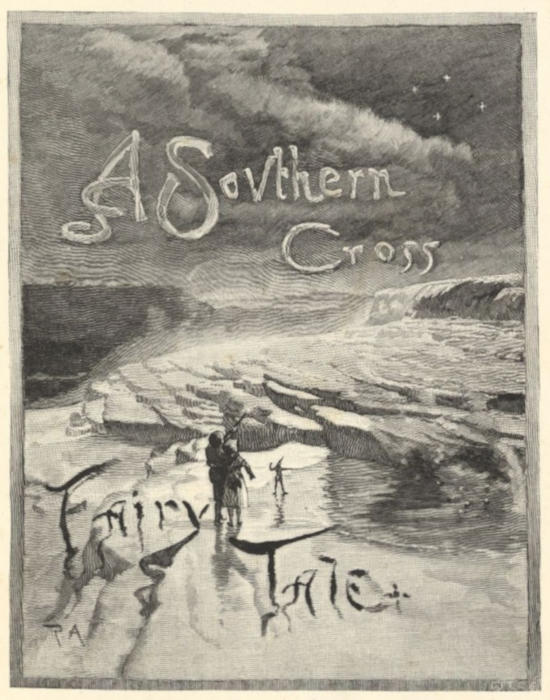
A SOUTHERN CROSS FAIRY TALE.
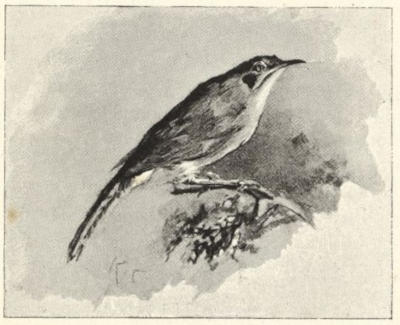
Bell-Bird.
It is Christmas Eve! and the long soft shadows of a summer
night are quickly falling on the garden, fields, and meadows of a
New Zealand home. The feathery edge of the forest-clad hills
behind the house stands out dark against the yellow light still
lingering in the
west; undulating
grassy slopes creep
down to where the
graceful tree-ferns
form a billowy mass
of light and shade
near the deep, dark
creek, that divides
the fields. The
murmuring of the
stream, in hidden
depths below, rises
like a lullaby, while
countless shrill
crickets sing their merry carols amid the trees. No sound
of joyous bells is borne upon the air, as on the English
Christmas Eves of pleasant memory, only the Bell-bird’s[1]
chimes from the bush, and the distant cow-bell’s tinkle mid
the shadowy Manuka clumps, where sentinel cabbage-palms[2] up-raise
their helmeted heads erect and stern. Fair is that
house built up by English hands in the New World; fair,
not with the slowly gathered beauty of centuries gone by,
the clinging ivy and the gaily painted lichens on the stones,
but with the quick rich growth of the southern lands. The
quaint low wooden gables are wreathed with creepers of
many a shade and hue, and over the broad verandah and
open casement doors, the scarlet passion-flowers gleam like
burning stars amid their masses of glossy leaves, and the
green egg-shaped fruit of its more modest cousin hang
in rich profusion on the trellised arbour near by, the scene
of many a childish frolic and out-door tea-party. Sweet
scents arise from the nooks of the garden which is left
half wild, where many an English flower carefully tended,
tells of hearts in which still cling fond memories of a childhood’s
home afar. Through the sombre pines that edge
the spreading lawn, are seen the last long silvery streaks,
quivering on the distant sea; overhead the busy starlings flit to
and fro, or, perching on some tapering branch, give forth their
short-lived song, while, now and again, the harsh call of the
brown owl pierces the deepening shades. But suddenly is heard
the sound of merry voices, and two little children run down the
winding path leading to the house, then stop near to a rose-bed
rich in bloom.
“It’s Christmas Eve, you know, little Cis,” said Hal, a merry
strong-limbed, dark-eyed boy between nine and ten years old, to
his little sister who stood near.
She was a quaint little maid of seven in whose wavy golden
hair one might well think the summer sunbeams lingered; her
large blue eyes, dark lashed, in her solemn moments looked like
clear deep wells, but could dance with light and laughter at a tale
of fun. Hers was a sweet child-nature “so easily moved to
smiles or tears,” so full of sympathy was her loving little heart.
“It is Christmas Eve, you know, little Cis, and we must get
some nice flowers to give mother to-morrow morning, mustn’t
we?”
“Yes, Hal, and I want to find a lot of dear little red rose-buds,—oh!
here’s one, and here’s another, I’m so glad!”
“Why red ones, Cis?”
“’Cos mother likes red ones, I know; she told me about the
prickly tree with red berries on it, which she used to gather
bunches of at Christmas time when she was a little girl like me,—I
expect she gave some to her mother, and I wonder if she
pricked her fingers as I do mine—never mind, I am not going
to cry, Hal, because it’s for mother. Do the thorns hurt you,
Hal?”
“Yes, Cis, but I am a boy you know, and boys don’t cry; I
am getting white rose-buds, because in mother’s tales about
Christmas, there is always a lot of white snow. I wonder why
God does not send us any snow here!”
“Perhaps He will one day if we are naughty, for it kills all
the pretty flowers,” replied Cis.
“No, it doesn’t kill them all, Cis, it only covers them up;
besides, it’s rare fun to make snow-balls, they say.”
“Children, children!” calls a voice from the open door, “it
is nearly bed-time.”
“Yes, coming, mother dear,” and the two bunches of flowers
were quickly hidden beneath the little coat and pinafore, while
the children ran round to a side door and gave them into the
nurse’s charge to put in water, and in a safe hiding place until
the morning.
“Put them under our beds, Nursie, no one will see them
there,” shouted Hal, as he rushed off with his sister to their
mother for the good-night chat.
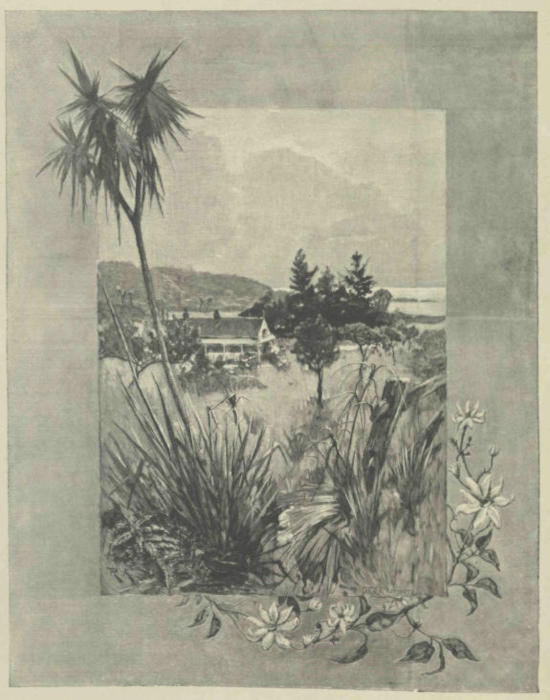
“It is Christmas Eve! and the long soft shadows of
a summer night are quickly falling on the garden, fields and meadows.”
Page 3.
In the well-known cosy room sat a slender figure in black, in
a low wicker chair, and little Cis was already on her lap, her
shining head nestled close in, her sweet face pressed to her
mother’s, which if older and sadder, was not less sweet. Hal,
taking his favourite stool, sat down close to her knee, and giving
her hand a hasty boyish kiss, said: “Don’t send us to bed just
yet, mother dear, ’tis Christmas Eve, you know.”
“Ah, yes! Christmas Eve,” she echoed, and her trembling
voice told of the mingled memories that thronged her heart,—memories
of past joys and sudden sorrow. Her thoughts flew to
that time, “only a year ago,” when there came the hurried
summons for her husband to a sick relative in a distant land—the
hasty departure on the voyage,—and then the blank of a terrible
silence,—and later, the tidings that she should see him no more
till “the sea gives up her dead,”—and, laying her hand on Hal’s
dark head, she pressed her fatherless little ones closer to her.
“Tell us a story, mother dear,” broke in Hal’s voice.
“Suppose you tell me one for a change, dear,” she replied.
“I don’t think I can, mother, but I’ll try,” said Hal’s determined
tones, “it will be very hard, but you’ll help me, little Cis,
when I stick, won’t you? Shall it be a real story or a made up
one?”
“Oh! a real one, Hal, it won’t be so hard,” said little
Cis.
“All right,” replied Hal, “just wait a moment whilst I
think,” and the boy’s face took an earnest, thoughtful expression
not often seen on it, for he was a light-hearted laddie full of the
joy of a happy, careless childhood.
“We had three baby guinea-pigs this morning,” began he
musingly, “but, I suppose I couldn’t make a tale out of that,—and
the little white bantam was drowned in the duck-pond, and
Cis and I put it in a box with flowers and buried it under the
apple-tree, but, I suppose that wouldn’t do either;—and the
parrot bit my fingers dreadfully, and I—no, I didn’t cry, I only
howled. Oh! mother, you tell a tale, I can’t.”
Then a minute’s silence followed, broken only by the purring
of Hal’s favourite, the black cat “Smut,” who was rubbing
against his master’s leg, where the kneeless stocking told of the
day’s exploits.
Darker grew the shadows in the long low room; the clock
ticked on its monotonous “Gone by! gone by!” the faint whisper
of the evening breeze through the pines came in at the window;
the last rays died in the west, and once again the evening star
looked out from the darkening sky upon the mother, and the child
within her arms—a picture that in all its varied phases is as
beauteous in our great to-day, as at that Christmas-time at
Bethlehem in ages past. And little Cis, watching the shining
star, raised her head from her mother’s shoulder, and said in a
hushed voice:
“Do you think the angels will come to-night, mother
dear?”
“Angels! why, little one?” she replied.
“Because there’s the star, mother, and I think it must be the
one you told me about, that came when the angels sang, because
it’s, oh! so beautiful! I should like them to come to-night;
perhaps dear father will send them. Do you think if we sat ever
so still they would fly down near us? You know, when I sit
down under the big trees up the hills for a long time, the little
birds fly down and close up their wings and come and look at me,
and angels have wings, haven’t they, mother dear? and so perhaps
they will come.”
“Oh!” cried Hal, “if they can fly about like that, Cis, I
shouldn’t like it to-night, for there are a lot of Christmas-plums
ripe on the tree in the orchard, and if they come near I expect
they would want them,—I should. But I didn’t take any to-day,
mother; we are saving them for to-morrow as you told us to do;
I only sat down under the tree and picked up any that fell down.
You know you told us not to run about when it was very hot, so
I thought if I was good and sat still, God would make some
plums drop down. But, I say, mother, what sort of hat does God
wear?”
“Hat, my boy! what do you mean?”
“Why, mother, you said I must keep my hat on these hot
days or I’d get sunstroke, and I’m sure it must be dreadfully hot
for God up in the sky; there are no trees there to sit under.”
What merry laughter from little Cis followed Hal’s remark,
but his mother said quietly, “Hush, my boy, we must not speak
lightly of Him whose ways are not as ours.” Hal’s merry face
became thoughtful, and the children were silent for a few
moments; then the favourite tales were won from mother by
many a caress,—tales, of which the words fell on the children’s
ears like the pleasant dropping of summer rain, bringing forth
sweet flowers of thought, may be in later years to bear a precious
fruit. Then came the patter of little feet up the stairs, and merry
chatter, as the stockings were hung up ready for Santa Claus; and
then, when mother came, there were murmurs of sleepy voices, as
the two little white-robed figures knelt with folded hands on their
curtained beds, and lay down with the last words of their childish
prayer on their rosy lips—
“In the Kingdom of Thy Grace,
Give a little child a place.”
“A place!” Aye, would that many an older child of earth
could claim such a place as His little ones have! Then, with
mother’s last “tuck up” and good-night kiss, and one last look to
make sure that the stockings were all right, silence fell on the
little restless tongues, and closed the sleepy eyes.
It was midnight, but no Christmas waits disturbed the
stillness round the quiet house. The southern cross gleamed
clear and bright in the dark blue heavens, and the moon sailed
high, silvering the feathery clouds that here and there floated
across the star-lit depths, as though some angels passing by had
left stray pinions there. The distant ocean had waked from its
evening dreams with a thousand twinkling smiles; the tree-ferns
trembled beneath the moonbeams’ soft caress; but, brighter than
all others were the rays that, creeping through the window to the
white curtained beds, kissed so lovingly the sweet faces lying
there, lingering round the tumbled curls of little Cis, and on the
dimpled arm thrown over her head, and crowning Hal’s dark hair
with a soft halo.
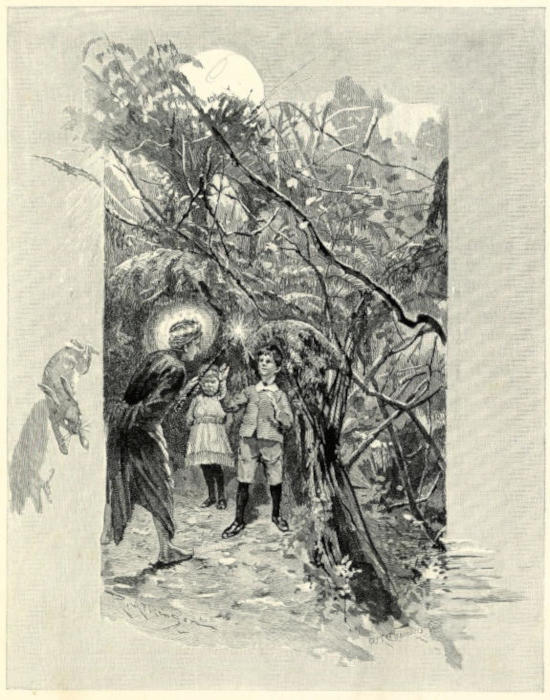
“Take that,” said Santa Claus: “it will give you light
in the darkest places.”
Page 6.
Then a clear voice broke the stillness of that summer night,
making the children stir in their slumbers ... then, once again
the silvery voice rang forth, “Wake up, little ones!”
And, starting up, Cis and Hal rubbed their eyes, and
wonderingly gazed around.
And there, where the moonbeams fell upon the floor, stood a
lad with a smiling face, and on his head was a crown of twinkling
stars, and beneath the stars these words shone, “I bring good
gifts to all.” A robe of deepest blue hung down in soft shimmering
folds near to his feet; and in his hand was a wand, on the tip
of which shone the evening star.
Then Hal, without fear, though in a dreamy voice, asked,
“Please are you a fairy, little man?”
And Cis in a low voice added, “It’s the Angel of the
Stars!”
“No, little ones,” said he, “I am neither a fairy nor an angel;
I am only Santa Claus.”
“Why, I thought Santa Claus was an old man,” said
Hal.
“So I am, in the Old World,” replied he, “but here, in the
New World, I am young like it.”
“But,” exclaimed Hal, “where are your reindeer, and where’s
the sleigh with all the good things in it I always thought you
brought? Because it won’t be fair if you don’t give us anything.
It’s Christmas Eve, you know, and we have put our stockings
ready for you.”
“I have left my reindeer and the snow and frost in the Old
World,” said Santa Claus; “but never fear, I have not forgotten
you and little Cis; my wand, with the star of Love on it, is
better than my sleigh full of presents. But come along, little
ones; dress quickly, for I am going to take you where many
wonderful things are waiting to be seen by bright young eyes.”
“All right; I am ready,” cheerily replied Hal.
But little Cis said, “I don’t know, Hal; what will mother
say! Mayn’t I go and tell her, Mr. Santa Claus?”
“No need, little Cis; she knew I was coming to you to-night.”
“Yes, it’s all right,” said Hal eagerly, “come, dress quickly,
Cis, we shall see lots of wonderful things, and bring some back to
mother too.”
So the children dressed, and, led by their guide, went hand
in hand with light steps down the stairs and out into the moonlit
world.
How beautiful it looked! The drooping grasses shone with
drops of dew; the tall white lilies gleamed fair as the driven snow;
a white-tailed rabbit skipped across their path and then peered
with bright eyes at them from high bracken; a solitary night-bird
chirped out its sleepy notes; but as the children, led by Santa
Claus, came near to the creek, the voice of the stream sang out
cheerily. A mossy trunk lay across the waters, and Santa Claus
stepped lightly along it, followed by Hal, who held the hand of
little Cis tightly in his, and, guiding her, went across the slippery
bridge.
“It is dark down here,” murmured Cis, as they stepped on the
bank where high fern-trees and thick bushes shaded the gully.
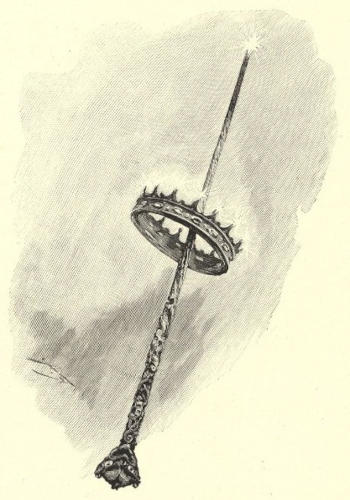
Turning round, Santa Claus placed in Hal’s hand the wand
whereon so brightly shone the star of Love. “Take that,” he
said, “it will give you light in the darkest places;” and, as the
light from the star fell around, the black waters danced and
gleamed, and the dark mosses shone.
“Please do stop a little while, here, Mr. Santa Claus,” begged
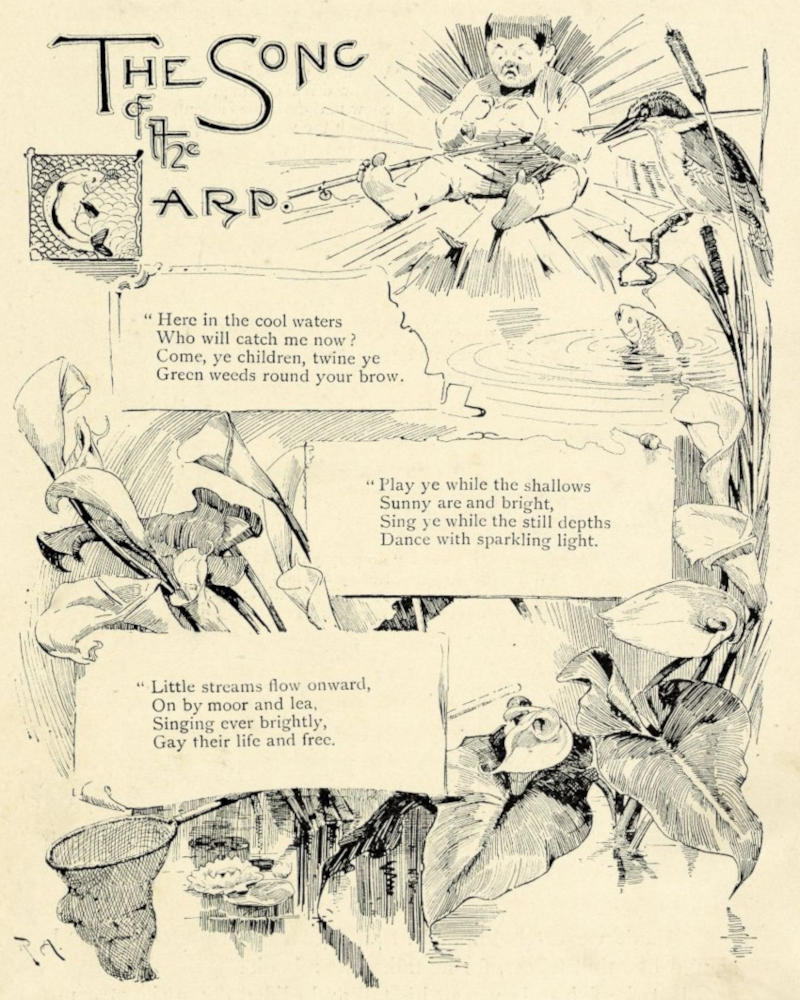
Hal, “I want so much to have a look at that big carp I saw the
other day in the pool,” and, as he spoke, the fish, his gold and
silver scales glittering in the light, came near, and amid the
rippling of the waters the children heard a little voice singing:—
The Song of the
Carp.
“Here in the cool waters
Who will catch me now?
Come, ye children, twine ye
Green weeds round your brow.
“Play ye while the shallows
Sunny are and bright,
Sing ye while the still depths
Dance with sparkling light.
“Little streams flow onward,
On by moor and lea.
Singing ever brightly,
Gay their life and free.
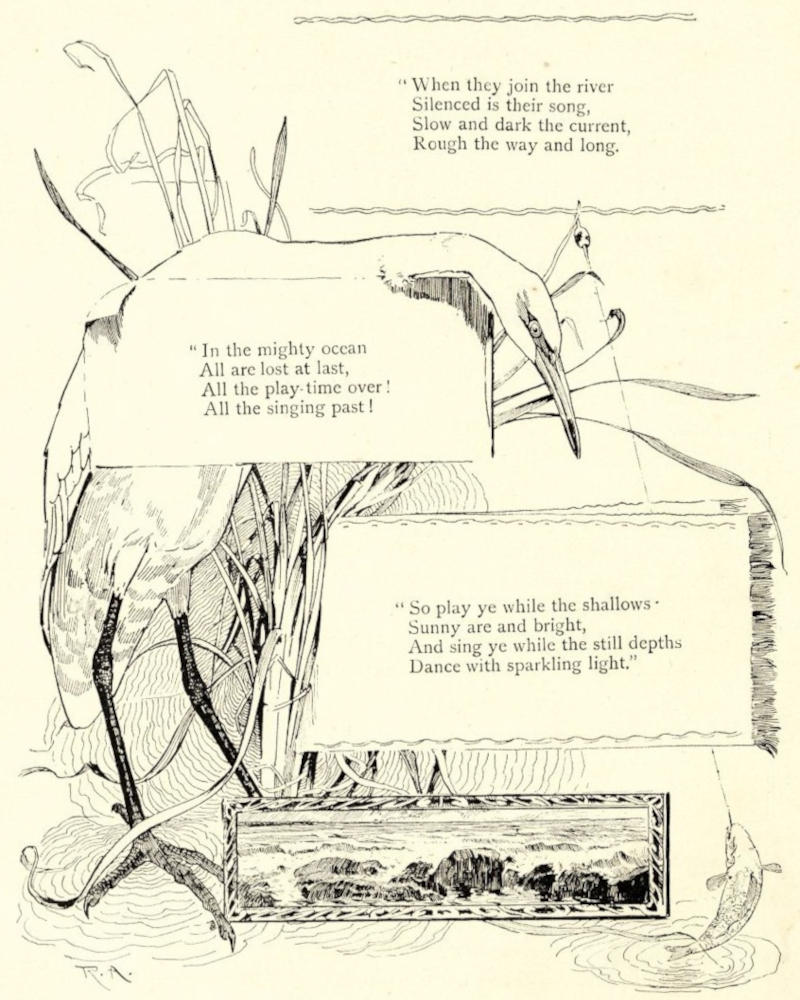
“When they join the river
Silenced is their song,
Slow and dark the current,
Rough the way and long.
“In the mighty ocean
All are lost at last,
All the play-time over!
All the singing past!
“So play ye while the shallows
Sunny are and bright,
And sing ye while the still depths
Dance with sparkling light.”
“Can’t we catch him, Mr. Santa Claus?” shouted Hal, “I
should like that fellow, for he talks like a book!”
But the fish only waved his tail and glided down the stream.
Then their guide beckoned them forwards, and Cis, wondering,
asked, “Did you make the fish speak, Mr. Santa Claus?”
“Yes, little Cis,” answered he, “and the gift I bring you and
Hal this night, is the gift that makes you know and understand
Nature’s many voices.”
“Does any one else know them?” asked Hal.
“Yes, children, to some pure and simple souls the gift is
given through life to interpret them to man; and sometimes to
the aged and the weak it is granted to find strength anew, in
flowery woods and birds’ and insects’ song;—to you, ye little ones,
Nature shall to-night speak out in clearest voices, to echo in your
hearts perchance in years to come.”
“I hope he isn’t going to preach,” whispered Hal to his
sister, “I shan’t like him half so much if he does.” Then he
added aloud, “I don’t quite understand you, Mr. Santa Claus,
but never mind, I don’t understand the sermons our old clergyman
preaches; mother says it is good to try and listen, but I think
they forget about the little children in church!”
“Perhaps the preacher does not know we are there, Hal, we
are so little, you know,” added Cis in an apologetic tone, “and
there is a long way between us and the pulpit.”
“Perhaps so,” said Hal absently, for he was wondering if he
could put his Star of Love over the pulpit on Christmas Day; it
would make a bright light, and perhaps the preacher would remember
them then,—and he added aloud, “But if he did remember us,
Cis, I expect he’d be cross if we didn’t sit quite still, as I heard
him say one day we ought.”
“I suppose it is such a long time since he was a little child,
that he forgets how hard it is,” said little Cis.
But by this time they had got out of the thickest part of the
bush, and were walking along a little winding path near a precipice.
On the upper side was a bank from which dainty ferns hung their
graceful fronds, and beneath them, on the moss, the tiny lamps
of myriad glow-worms shone like specks of fire. As the children
stopped to gaze, they heard the glow-worms singing:—
“Children of the earth are we,
Small and brown and ill to see;
But we can make our lamps at night
In dreary places show their light.
Travellers oft might miss the way,
Warned we not their footsteps back,
When upon the narrow track
Near the precipice they stray.
Children of the earth are we,
Small and brown and ill to see;
Still our tiny lamps we trim;
Children, let not yours grow dim!”
“We have got no lamps, you stupid little glow-worms,” said
Hal, “unless you call this Star of Love that we carry a lamp. But
couldn’t you sing something more lively to us?” he added. Then
the glow-worms brightened up and sang to a merry tune:—
“Oh! stay, ye children, stay,
And listen to our song,
For childhood’s hour is short,
And manhood’s day is long.
Come, see our fairy haunts,
And we will light the way;
Come, join the merry dance,
And dance till break of day.”
“Please may we go to the dance, Mr. Santa Claus?” begged
Hal; their guide nodded assent, and they watched the glow-worms
form into a long line, two and two, and creep between two
high moss-grown rocks.
“It’s all very well to say ‘come,’” remarked Hal, “but how
are we to get through that place, I should like to know?”
“Hold Love’s wand high overhead,” answered Santa Claus,
“and much that is difficult will be made easy.”
“Oh, dear! he has begun preaching again,” cried Hal, but
he held the star over his own and his sister’s head, and, pushing
some overhanging brambles aside, they found that they could
easily go where the glow-worms led.
On, on went the long procession of shining lights, and the
little voices were heard, now faint, now clear:—
“Come, see the fairy haunts.
And we will light the way;
Come, join the merry dance,
And dance till break of day.”
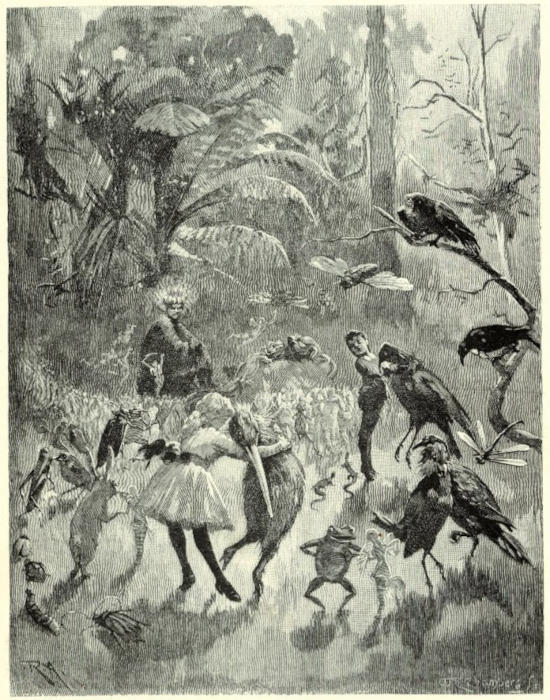
“We’re sorry we’re so big,” said Hal.
And soon what a sight met the eyes of the children! In
an open space surrounded by high trees, on a bright ring of green
grass, a number of little fairies were dancing, their tiny twinkling
feet scarcely seeming to touch the lightly bending blades. And
what merry music! a band of locusts with their shining wings
beat tunes upon the brown tree-trunks; big night-moths hummed
their low songs, and drowsy beetles droned fitfully, while from the
trees o’erhead the bell-birds rang their clear high notes. It was
a gala night, and birds and insects had come to join in the dance.
On a branch near by sat a small brown owl, round-eyed and
solemn, beating with a raupo stem the time, which no one tried
to keep. “Too fast, stop them!” cried he, in his harsh, cold
voice; but no one
took any notice
except the Tui in
a bush, who repeated
his words;—and
the music
played, and the
dancers danced as
madly as before.
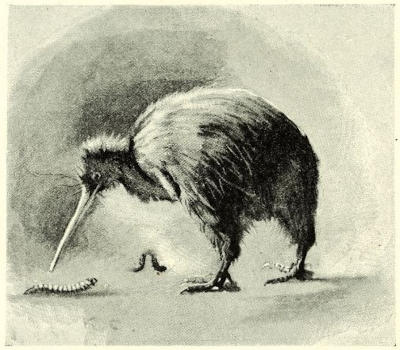
Kiwi.
Then, out from
the dark wood
there came a motley
throng; bright
golden-eyed green
lizards, their long
tails waving like
shining river-weeds;
sleek-coated rats, and solemn Maori hens; fat caterpillars
waddling through the grass, and snorting kiwis[3] following
close behind; while sombre-coloured crows and starlings tripped
on in pairs.
Now, by the laws of fairy-land, no bird could feed upon
insects so long as the night revels were kept up; nevertheless
the caterpillars did not feel quite comfortable, for many a sly poke
they got to “hurry up” from the kiwis’ long bills, with which
these birds gave disappointed snaps, as they saw such tempting
morsels near by.
Then came whole families of green parrakeets, proudly holding
up their red-crested heads, and chattering all the scandal of the
forest; black-feathered Tuis[4] with their white neckties cleanly
washed; tiny Fantails,[5]
their fans
spread out, for the
night was warm:
and Robins too,
were there, some in
dark grey garb, and
some in black with
yellow and white
breast-fronts newly
smoothed;—and as
the fresh comers
appeared, the music
struck up with renewed
vigour, and
the glow-worms, nodding, made their lamps burn brighter still.
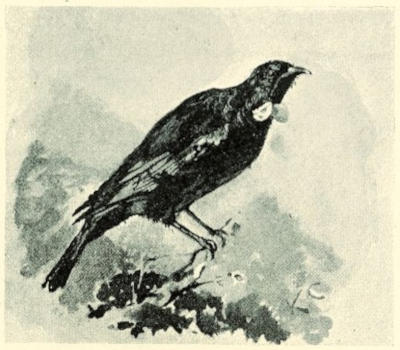
Parson-bird or Tui.
All were soon joining in the dance,—fairies, birds and insects,
and Hal and Cis, seeing
Santa Claus sit down under a
tree-fern, joined too.
“We’re sorry we are so
big,” said Hal, “but Cis and I
will try and not knock any of
you over. Would you mind
tucking your tail up under your
arm?” he said to a young lady
lizard near whom he was dancing
in a waltz. “Allow me to
help you;” and help he did, for
the tail came off in his hand! “I beg your pardon,” said Hall.
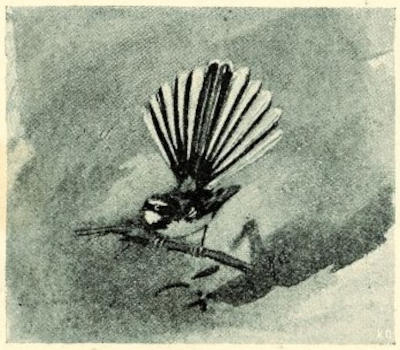
Pied Fantail.
“Don’t mention it, tails always grow quickly, you know,”
replied the lizard with a laugh, as she skipped gaily on.
“Please, Mr. Kiwi, would you oblige me by dancing on two
legs instead of three,” asked little Cis, for the Kiwi was her
partner, and was using his bill as a support, and often pricked
her toes.
“You don’t know what you are talking about,” said he in a
huff, “it’s my bill! but perhaps you don’t know what a bill is!”
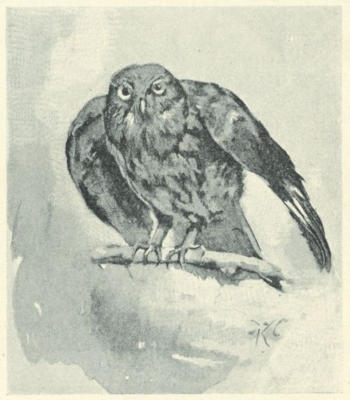
Brown Owl or More-pork.
“I’ve only heard mother say that no one likes long bills,”
said little Cis.
At this the Kiwi snorted contemptuously, and left her, and
the brown owl,[6] seeing something was wrong, thought it must be
the music, and shouted out, “Too fast! stop them!” but no one
took any heed, for he was only an old croaker, and could not be
expected to keep pace with the young people. So he dropped his
raupo-stem, and sulked on the bough. Soon afterwards the band
stopped, and some strange flute-like notes were heard in the
distance.
The Tui called out excitedly, “Make haste! take your places
if you want to see the Gavotte, here comes the great dancer of the
evening!” and all the birds and fairies hurried to get good places
on the branches near by, while caterpillars and lizards stood up on
their tails. Then out from the thick underwood came two crows,[7]
proudly strutting side by side; the male bird took his place upon
a straight leafless branch, well in sight of all the expectant throng,
while the female bird
sat down on a fallen
mossy bough, where
she could see her
mate.
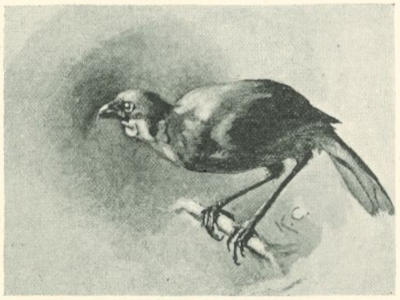
Crow.
Then he began
the Gavotte, and
what a lively performance
it was! up
and down, up and
down the branch,
springing, pirouetting,
tail and wings
out-spread, with many a fanciful step and flourish, danced the crow
right merrily to his own sweet gurgling music. Truly he was a
mate worthy of the little wife he had won by his dancing at pairing
time; she was sitting near, watching, and when the dance was
ended he looked down at her proudly, while the on-lookers
applauded.
“Capital! capital!” shouted little Cis and Hal, clapping, and
the Tui overhead echoed their words.
“How nice to have a husband who can dance and sing so
well!” said one of the parrakeets.
“Yes,” said the lady crow, “it is nice, of course, but there
are other things to be considered in choosing a husband; still he
is a good one on the whole, though sometimes I should like to
join in the whistling and dancing, too. Let us have a dance all
together now!” she added, and the owl, having got over his fit
of the sulks, asked for his raupo stem to be handed to him again,
and started the music afresh.
The crow, offended by his wife’s remarks, chose another
partner for a while, but Cis, watching, saw that he soon went back
to her, and a little later on the pair slipped away into the wood
together, so she supposed they had made up their tiff.
Then the dancers took a rest, for they were all rather
tired.
“Oh, look!” said the grey robin, who was still sitting on the
bush near Cis, “there are the Tuataras; what a wonder it is for
them to come and see us. How do you do?” called out the bird,
at the same time nodding his head condescendingly to two large
stone-coloured lizards with a row of white spines down their
backs, who glided into the open space, and, lying down on some
stones, watched the scene with solemn bright eyes.
“They did not answer you!” said Cis, “do they never
speak?”
“Not often to us,” replied the bird, “they are too proud of
their old family to talk to ordinary dwellers in the forest; those
two must have come a long way to visit us to-night, for, some
years ago, the Tuataras said they did not like the fast ways of the
inhabitants of this part of the country, and they all retired to an
island off the coast, where their only companions are the mutton-birds
who live in holes in the ground;—and, I think, it is so mean
of the lizards, they share the mutton-birds’ holes, and then often
feed upon their young ones.”
“Do not the Tuataras[8] get any food themselves?” asked Cis.
“Yes, at night,” replied the robin, “they only go out then;
I think there must be something wrong when people always do
things in the dark, do not you?”
“I do not know,” said Cis, “perhaps they have reasons we
do not understand.”
“My mother was told by a learned man that the Tuataras
have three eyes,” continued the bird.
“If so, they can see more than other people, and that is why
they look so wise,” said little Cis.
“Perhaps so,” replied the bird, “but none of us have ever
seen the third eye, and it is funny where it can be.”
“If you looked carefully you would find it on the top of our
heads,” said the mellow voice of a Tuatara who had evidently been
listening; “our ancestors were great star-gazers, but we have
given up that sort of nonsense, we find it quite enough to attend
to things on the earth, so we all agreed to shut one eye; it is
best to do so sometimes,” added the lizard musingly.
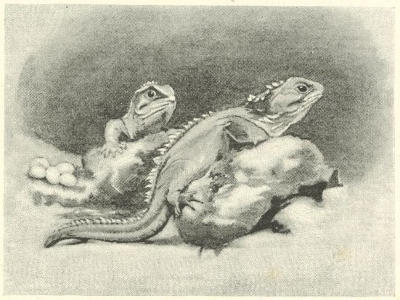
Tuataras.
“Indeed!” said the robin, and he put his head on one side
and looked very unbelieving.
Just then two cockroaches, more curious than the rest, ran
up the stones near where the lizards sat, who, suddenly turning
their heads, seized and swallowed them.
How indignant all the birds and insects were at this transgression
of the laws of fairy-land, and loud cries arose from all
sides of “Shame! shame!”
“Peck out their eyes!” cried the Kiwi, who had, however,
been thinking he should like a meal himself.
“Off with their tails!” croaked a bright green frog.
“Off with their tails!” repeated the Tui in a shrill voice.
But the Tuataras, hearing the noise, glided
down from the stones into the fern; Hal and the
birds went after them, but the lizards were soon lost
to sight in a hole.
“We shall have to give it up,” said Hal, “we
could not get them out of that hole except by digging;
let us go back to the others:” so they
returned, and Hal, sitting down by Santa Claus,
said, “This is all great fun,—I wonder when they
will begin dancing again, I never enjoyed a dance
so much before.”
A stout caterpillar,[9] who sat near, and was
troubled with asthma, overhearing this, put in his
word. “It is only because you are young that it
all seems so good; wait till you are old and stout
like me, and you won’t be so mad at dancing!”
“But you will be a
lovely butterfly by-and-by,”
added little Cis.
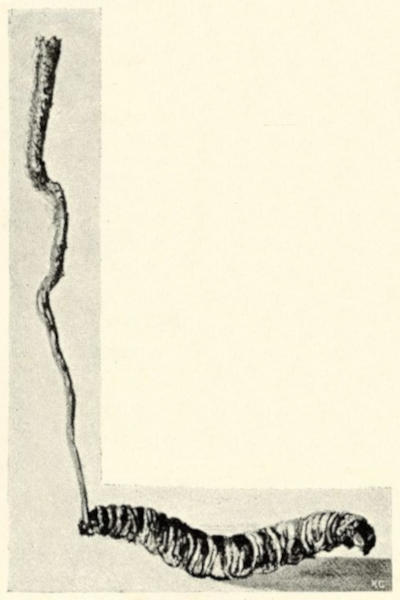
Vegetable Caterpillar.
“Not I!” said the
caterpillar, “I would not
be anything so flighty.”
“What are you going to do, then?”
“I mean to retire to some quiet spot on the earth,” said the
caterpillar, “and be of some use in the world. I have heard
that some of my brothers who have buried themselves grew after
a while into plants which are much sought for and valued, and I
intend to try it too, I admire variety, for what is the good of
being one of the common herd, I should like to know?” and the
caterpillar stopped, panting, for it was a long speech for him with
his short breath.
“I should do what other caterpillars do, if I were you,” said
little Cis thoughtfully, “for I’ve heard that the hearts of those
caterpillars you speak of, get harder and harder, till, when the
plant grows from them, they turn into wood, too, and die.”
“May be! may be! but I don’t care what people say,” replied
he in impatient husky tones, as he turned away and began
to dig in the earth under a big rata-tree as quickly as he could.
“Too fast, stop him!” shouted the brown owl.
“Hold your tongue!” cried the caterpillar, “what do you
know about it? Who asked you to preach?”
“Oh! don’t quarrel!” said the gentle voice of little Cis;
“let me give you a little more light, Mr. Caterpillar, if you will
bury yourself,” and she ran and picked up Hal’s wand, and threw
the light of Love’s Star on the old grubber. The owl above only
blinked, and said in surly tones that he knew he was right, and
he wished people wouldn’t try to throw light on his eyes.
Little Cis, being left by her partner, sat down on a mossy
bank, and was watching the rest, when she heard some twittering
notes near, and looking down saw two little birds close to her feet,
one all grey, one grey with a yellow breast, their bright eyes
twinkling, their little tails wagging.
“We thought you looked lonely,” said the grey bird, “so we
have come to talk to you.”
“What are your names, little birds?” said Cis.
“We are robins,”[10] said they.
“Robins, are you?” replied little Cis, “why, mother used to
tell me that robins had red breasts.”
“Oh! so I’ve heard it said they have on the other side of the
world,” replied the grey bird, who seemed to be the greater talker
of the two, “but we don’t care for so much red, as everything else
here is so bright, our family only go in for quiet colours; it’s
more ladylike. What do you think of our ball?” he added, and
then continued, “I don’t care much for dancing myself; I like
afternoon-teas better. I am very fond of company, and one hears
all the news of the country-side at a tea-party; it is much more
sociable too.”
“Perhaps so,” said little Cis in a doubtful voice, for she had
only been to dolls’ tea-parties, and no one talked there.
“Yes,” went on the grey robin, “there are three charming
parrakeets, who live in a wood near by, and they sometimes give
afternoon teas, and, really, it is as good as reading a newspaper
to hear all the tales told of the neighbours.”
“Kind tales?”
asked Cis.
“Well, I don’t
exactly know,” said
the grey robin, “but
that doesn’t matter;
the parrakeets[11] say
the great thing is to
have something to
talk about.”
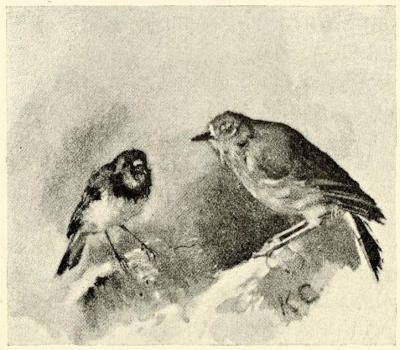
Robins.
“Don’t say that,”
put in the yellow-breasted
robin, “the
old owl tells us never
to repeat an unkind
thing; it is only the busy-bodies of the Tui family who do that,
and they often whistle the tales they hear so badly, that you’d
scarcely know them to be the same.”
“Perhaps they can’t help it, you know,” remarked little Cis;
“it is not every one who has a good ear; and, besides, Tuis talk
so much, that they can’t have much time to think about what they
say. I don’t expect they mean to alter things. Mother told me
never to tell any but good tales of Hal, but it is difficult sometimes
when he teases me,” and little Cis sighed.
“I think this is a very nice ball with you to talk to,” said
the grey robin; “do you mind if we stay near you?”
“Oh, no, I shall like it,” replied Cis; so the robins perched
on a bush close by, and with their heads on one side eyed the
dancers (who had started afresh), and they now and again added
their sweet low notes to the music.
“We don’t sing much,” said they, “but we like to do our
best to make things lively.”
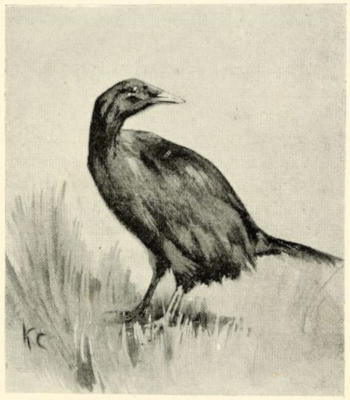
Maori hen.
Just then, such a scuffling was heard in the long grass, that
Cis jumped up to see
what was the matter,
and there were two
Maori hens[12] fighting
over some bright buttons,
tied together
with string, which
Hal had thrown
down. They were
jumping round and
round each other in
the maddest excitement,
heads and
short tails bobbing,
and wings flapping.
The brown owl cried,
“Too fast, stop
them!” but the
music and the noise
drowned his voice.
At last the fatter of the two hens stopped a minute to get
breath, and the other, seizing its opportunity, gave an extra tug,
and carried off the buttons under the bushes. The fat hen ran
after as fast as possible, calling out, “Stop thief! stop thief!”
then they both disappeared in the bushes.
Little Cis thought she heard a parrot on a tree overhead call out
something about “The pot calling the kettle black,” but as she did
not see any signs of cooking near, she thought she must be mistaken.
Meanwhile, Hal had been gossiping with the birds and
insects, and hearing many tales of fun and frolic in the greenwood,
and many too of hair-breadth escapes from hard-hearted hunters
and cruel boys.
“Do you know I am uncommonly hungry,” said Hal, coming
up to where Santa Claus was watching. Hal had a little fairy
with lovely gauze wings perched on each of his shoulders, and he
added, “And these little friends of mine are thirsty too, and all
the flowers are shut up, so they can’t get any dew; it really is too
bad for them to close so early.”
At a nod from Santa Claus the birds flew off, and quickly
returned with numberless fruits and berries; huge mushroom-tables
sprang up rapidly, and soon were bending with the weight
of the good things. Blue-bells held out their cups of sparkling
dew to all, and the Tui and the Bell-bird revelled in honey, pure
and golden, which the small wild-bees brought.
The fairies lightly perched on toadstools and the blades of
grass, and were gallantly waited upon by long-legged spiders,
whilst the birds vied with each other in paying attentions to little
Cis.
Long and merry was the feast, only the Kiwi sat grumpily
by, and, eyeing some curled-up earthworms, sniffed and said that
there was nothing for him to eat. But alas! old Time stays not
his flight, even in the brightest hours, and Santa Claus, pointing
to the moon sinking low in the sky, the happy revel ceased, and
good-byes were said. The fairies winged their flight to hide in
the flowers’ sweet hearts; the insects sought their secret haunts
in rugged bark and crannied soil; the birds flew off to their
leafy homes, except the Kiwi, and he could not, having no wings,
poor fellow! so he scuttled quickly about, hunting around for
food, but alas! the earthworms and grubs had already hidden in
the mossy soil, or beneath the dead leaves.
“Gone! gone!” snorted the disappointed bird, hungry
and cross, “and hard work I shall have to dig them out.”
“Too fast, stop them!” excitedly shrieked the brown owl,
who was watching some caterpillars waddling off as quickly as
they could.
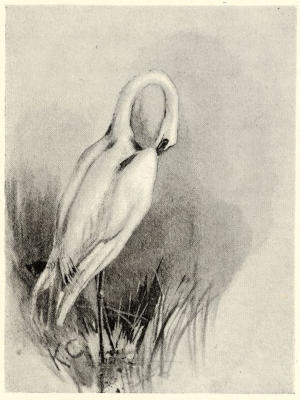
White Heron.
“What is the good of saying that?” asked the Tui, “I shan’t
imitate you anymore. It is not likely the caterpillars, if they heard
you, would stop to be eaten to please you. I’m off to the bush,
near the stream,” continued the Tui, “where the white heron[13] is
bringing up her aristocratic family in her nest in the tree-fern, I
shall get some conversation worth listening to with her, for she’s
a lady of education, and does not mix with every one!” and the
Tui flew off.
“I say, old fellow,” called out Hal to the owl, “that was rather
hard on you. I’d change my tune if I were you, I think.”
The owl put his brown head on one side, looked very wise
for a moment, then shouted out at the top of his shrill voice,
“More pork! more pork!”
“I’m afraid I can’t oblige you,” laughed Hal, “but if you’ll
go farther into the bush you might tackle a few wild pigs if you
like.”
“I expect he means ‘more mice,’” said little Cis; “perhaps
he’s getting old, poor thing!”
But the owl shouted out “More pork! more pork!” and
does so to this day.
“Come, children,” said Santa Claus, “I have more wonderful
things to show you before the sun rises;” and he led them out of
the forest and up a hill, from the brow of which they looked on a
plain broken by deep gullies and bounded afar by dark mountain
ranges. Scattered trees loomed vast and unreal in the misty
light, and the children walked on silently, almost wishing they
were at home again, but yet curious to know what else Santa
Claus had to show them. Suddenly a miserable little cur ran out
of the bushes, barking, and amidst the manuka and cabbage-trees
they saw a raupo whare. Grotesque heads carved upon the gable
and on the corner posts of the low roof grinned hideously at Hal
and Cis, and they were very startled when some dark figures,
wrapped in loose mats, ran out hastily, looking big and weird in
the dim and uncertain light.
“They are not giants, are they?” whispered little Cis in a
timid tone.
“No, no,” replied Hal, “they are only Maories; and see, they
are more frightened of us than you are of them.”
The Maories, indeed, on seeing Santa Claus, his starry crown
shining like a halo round his head, and Hal, whose face was
lighted up by the Star of Love which he carried, were terrified,
and uttering loud cries of “Aue! Aue!” they rushed back into
their hut.
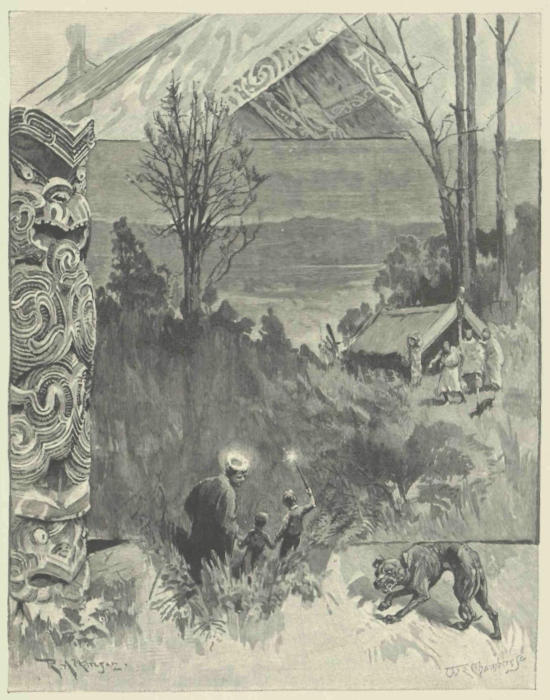
“They are only Maories; and see, they are more
frightened of us than you are of them.”
Page 26.
“Why do they run away from us?” asked Cis.
“They, no doubt, thought we were spirits,” answered Santa
Claus; “Maories are very much afraid of their dead grandfathers
and grandmothers,” added he, laughing.
“I wonder why that is,” said Hal, “I should have thought
they would be glad to see the people again who are kind and
good, as grandfathers and grandmothers always are.”
By this time they had gone some little distance past the
whare, and at the bottom of the hill they came to a narrow valley,[14]
the sides of which were clad with a luxuriant growth of feathery
manuka, so white with its numberless small blossoms, that in the
faint light that comes before the summer dawn, the valley looked
as though a snowstorm had passed over it. From hidden places
amongst the shrubs, thick curling steam arose, now hiding the
trees and bushes, and even veiling the faint stars above for a few
seconds, then melting into thin air, leaving a warm dripping
moisture on everything around. Mysterious hissing noises filled
the air, and ever and anon the earth shook as though with
fear.
The wondering, half-frightened children, tightly clasping each
other’s hands, followed Santa Claus along the steep, zig-zag path
that led down to the bottom of the valley; then, feeling the
ground warm beneath her feet, little Cis said, “I am so frightened,
Mr. Santa Claus, please may we go back?”
“Yes, I think we ought to go back,” added Hal, “for it must
be getting near breakfast-time now.”
“Do not be afraid, children, I will take care of you,” replied
Santa Claus, “and I have such wonderful things to show
you.”
Reassured by his kind voice, the children followed, keeping
close together; Hal, with one arm round Cis, and with the other
holding the Star of Love high above their heads, as they followed
the path to the bottom of the valley. There they saw a stream
rippling along; clear as crystal were its waters, and its banks
covered with drooping ferns and tender mosses. Little Cis,
stooping to gather some of the ferns, dipped her hand into a pool
of water near by, and cried out, “Why, Hal, it’s quite hot!”
Yes, hot it was, and the steam itself still hotter, while amid
the bushes, countless merry little springs bubbled up, boiling, from
basins of yellow and pink stone.
“Why, it smells exactly like lucifer matches,—do they make
them here, Mr. Santa Claus?” asked Hal, looking at the bright
yellow sulphur on the ground.
“No,” laughed Santa Claus, “but I think they might.”
“I shall bring our cook here,” went on Hal, “she needn’t
have a fire at all to cook our meals or to wash our clothes.” And
he looked down into the clear steaming pool close by, edged with
crumbling, many-coloured soil, and around, and even within
which, delicate ferns were growing.
But Santa Claus’ starry crown was already shining faint on
the pathway ahead, and the children tripped on lightly after him.
What lovely fairy glens they saw at each turn of the little
path, carpeted with soft, bright green, and overhung with tender
foliage, and Cis wished it were midnight that she might see the
fairies dance. What fairy ball-rooms, too, with floors of pale pink
marble, and pretty streamlets of warm water trickling near, for
tired feet to paddle in!
But Santa Claus had stopped, and the children hurried up to
his side, and there, in the midst of the thick bushes, they saw a
small lake of clearest blue, and to its edge sloped down a gleaming
floor of white, and the trees that drooped near to the water’s edge
shone white, as though a hoar-frost had silvered each trunk and
tiny twig.
“Oh! how lovely!” cried little Cis. “Is this like the snow
in England, Mr. Santa Claus?”
“Not quite,” he answered, “though it is as beautiful. But
listen, little ones!”
And as he spoke a chorus of voices was heard, faint, as
though from the bowels of the earth, and then a low rumbling
noise was followed by a mighty burst of steam from a hole a little
way off, and on the top of it were shot out a troop of laughing
gnomes.
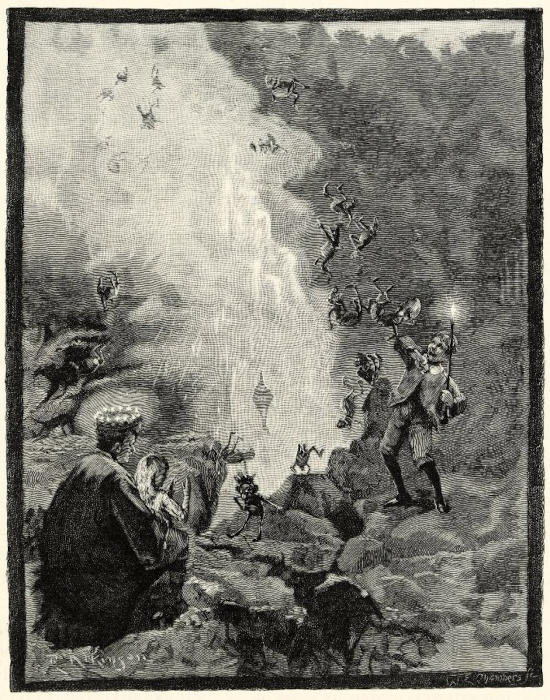
On the top of the geyser were shot out a troop of
laughing gnomes.
What funny little fellows they looked, with their long yellow
legs, short bodies, and merry round faces beneath their yellow
hats of all shapes and sizes. With many wild antics and strange
capers they danced round the blue lake, singing:—
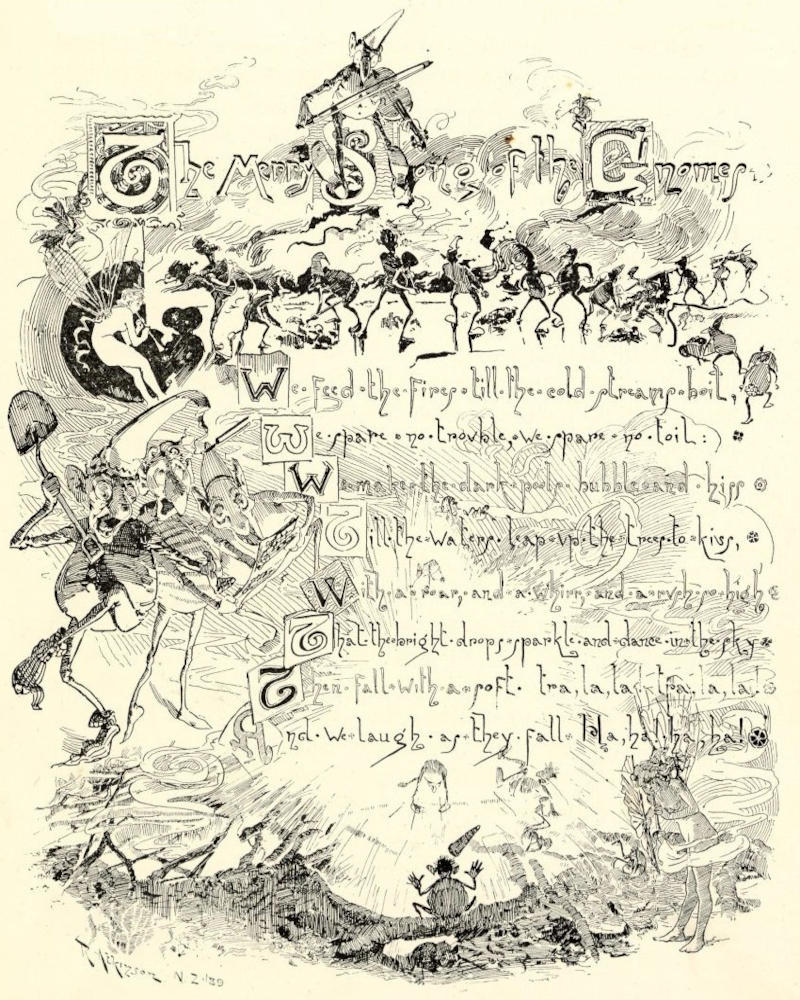
“Ha, ha! ha, ha! how jolly is life,
We know no care, we know no strife;
We dance, we sing, and merrily play
The long night through; and then by day
We work, we delve in the ground below,
And make Earth’s fountains merrily flow.
We feed the fires, till the cold streams boil;
We spare no trouble, we spare no toil,
We make the dark pools bubble and hiss,
Till the waters leap up the trees to kiss,
With a roar, and a whirr, and a rush so high,
That the bright drops sparkle and dance in the sky,
Then fall with a soft tra la la! tra la la!
And we laugh as they fall, ha, ha! ha, ha!”
Then all the little gnomes, headed by Red Cap, their leader,
jumped with merry shouts and laughter into the clear warm pool
near by.
The children watched them for awhile, then Cis wandered off,
picking up bits of petrified ferns and sticks out of a hot bubbling
pool, and choice pieces of yellow sulphur, which, when broken off
the steaming ground, showed myriads of sparkling crystals, and
kind Santa Claus packed all her treasures in soft moss in a bag
which he carried on his back.
Meanwhile, Hal envied the merry bathers, and as they called
out to him to “come, too,” he quickly threw off his clothes and
jumped into the little lake.
How glorious it was! The hot bubbling waters, the clear
crystal depths, and the sides and floor of the bath yielding to the
touch, as though padded with velvet! Was ever such a bath
enjoyed before? Shouting and singing, the little gnomes seized
Hal and popped him over the edge of the basin, and plump he
fell into a stream of cold water on the other side. What a big
breath he pulled at first, and then, how delicious the glow and the
dive into the clear depths! What a good swim Hal had up the
cold stream, racing the little gnomes who spluttered and splashed
after him! Then back they all went into the blue lake, revelling
in the tingling warmth. Again, out of that into another bath
close by, where countless crystal bubbles rose from the soft sandy
floor, playing round the bathers like the dancing bubbles of
sparkling wine.
But Hal heard Santa Claus calling to him to make haste,
and he reluctantly jumped out, and flinging on his clothes, shouted
to the gnomes, “I’ll come here for my Saturday-night tub, if you
don’t mind; it’s awfully jolly.”
“All right,” answered the gnomes, running after Hal, who
by this time had joined Cis and Santa Claus.
“Won’t you all come and have breakfast with us?” asked
Red Cap.
“Well, I am rather hungry, and I expect Cis is, too. But
what have you got for breakfast, Mr. Red Cap?”
“Porridge, to be sure. Didn’t you know we were hard-working
Scotch boys? Who else would work as hard, or get as
much out of the earth as we do?” answered a gnome in a huffed
tone.
“I don’t know, I’m sure; but please don’t be offended,”
replied Hal, “we’ll eat some porridge with pleasure.—or try to,” he
added in a low voice, for he did not care for porridge at home.
Red Cap led the way to where in the earth was the porridge-pot—a
large hole full of boiling cream-coloured porridge, that
hissed, and bubbled, and looked tempting enough. Cis and Hal,
following the example of their guide, dipped sticks into it, and
tasted the smooth paste, and what grimaces they both made,
which they tried not to let Red Cap see! For the porridge was
anything but pleasant, being like a mixture of rotten eggs and
alum.
“Isn’t it good?” asked Red Cap, smacking his lips over it.
“Well,” said Cis, who wished to be polite, “it certainly is
well boiled, and it is not at all lumpy, but—isn’t it ra—ther—earthy?”
Then, seeing the gnome’s disappointed face, she added, “But
never mind, we’re trying to enjoy it; but I expect you have to be
brought up to it, Mr. Red Cap, really to like it.”
“We’ll come for our next picnic here, and bring some tea
for you,” said Hal, trying to make friends with Red Cap, “and
perhaps you’ll boil the kettle for us—no, I mean, give us the
water already boiled. I’m afraid it will smell and taste of rotten
eggs, but that can’t be helped,” added Hal, in a low voice, to little
Cis, sniffing the sulphurous fumes rising from the boiling
cauldrons on all sides.
Santa Claus and the children now walked on, and Cis and
Hal, getting accustomed to the strange scenes around, began to
feel quite brave.
“There are not many birds here, Mr. Santa Claus,” said Cis,
for they had only seen a few blight-birds flitting about; only the
two little robins had come part of the way with her into the valley,
then they had twittered their good-bye, and Cis missed her little
feathered friends.
“See,” replied Santa Claus, and there amid the feathery
manuka was an open space covered with layers of creamy-coloured
stone, and in the centre was what looked like a huge bird’s nest,[15]
formed of large white stems and branches crossed and recrossed,
and pieces of petrified moss between. Each little twig was
heavily laden with drops, apparently frozen, some thick as milk,
some clear as crystal, while round and overhead the bushes too
were white as snow.
“How beautiful!” cried Hal.
“But where is the bird, Mr. Santa Claus?” asked little Cis,
“and what a big one it must be to make that nest!”
“Wait a little, and if you do not see the bird you shall hear
him sing,” laughed Santa Claus.
The children stood silently waiting. Soon a low rumbling
was heard below their feet, followed by hissing and bubbling
noises that grew nearer and nearer, then died away, to begin
again, louder, nearer than before, and making Cis creep up close
to her brother and Santa Claus. Awe-struck, the children watched,
and soon from the middle of the nest they saw bubbling waters
that came and went in fitful gushes, as though battling against
some unseen power below,—then roaring, fighting, boiling, a
mighty column shot up high into the air above their heads, and
clouds of steam rolled around, hiding for a little while the trees,
and even the children, in a misty veil.[16] How beautiful the clear
drops of the mighty fountain looked, as the water’s rose and fell,
shining like dancing diamonds in the dawning light! Then out
from their holes came the gnomes, singing again their merry song.
The Merry Song of the Gnomes.
We feed the fires till the cold streams boil,
We spare no trouble we spare no toil:
We make the dark pools bubble and hiss
Till the waters leap up the trees to kiss,
With a roar, and a whirr and a rush so high
That the bright drops sparkle and dance in the sky
Then fall with a soft tra la la la! tra la la la!
And we laugh as they fall. Ha ha! ha ha!
Then they danced around the roaring geyser, till the waters
fell lower and lower, and amid sobs and sighs died away in the
deep dark hole, and all was still and silent as before in the
mysterious bird’s nest.
Without waiting to hear the children’s wondering remarks,
Santa Claus took them by the hand, and they seemed to pass
quickly over a large tract of country, until they came to a creek,
which they soon saw from its steaming sides was hot, and which
ran into a lake lying quiet and peaceful;—only the pukekos[17] rose
now and again, screeching from the reedy shallows. Pushing
their way through thick scrub, and walking with great care
between bubbling cauldrons and deep holes from which steam
belched forth with a mighty roar and thud, Hal found it difficult
to carry the Star of Love safely, and asked Santa Claus what he
should do with it.
“Hold it high overhead, and then stop for a minute and
watch,” replied Santa Claus, and, doing as he was bid, Hal was
astonished to see the Star float away into the pale grey sky,
becoming fainter and fainter, till it disappeared in the misty
dawn.
“You have carried it so long with care,” said Santa Claus,
“that by day, though unseen, it will ever shine to guide you, and
at night, though passing clouds may sometimes hide it, if you
look for it, you will soon find it again.”
“I shall look for it, Mr. Santa Claus,” said little Cis; “I
often see the stars shining in at my window when I am in bed,
and I shall ask God not to let the angels forget to light that
beautiful one for me to see.”
As little Cis finished speaking, their old friend Red Cap
appeared on the path before them.
“Where did you come from?” cried Hal, “we left you at the
bird’s nest.”
“Yes,” answered Red Cap, “but we gnomes do not follow
the paths you mortals tread, but have many and hidden passages
under the earth, and many underground streams by which we pass
quickly from south to north. So, here I am, you see, and now I
am going to show you the realm of the King and Queen of the
Gnomes.”
“That will be jolly!” cried Hal.
“Will it take very long, Mr. Red Cap?” asked Cis. “I have
been thinking of mother, and she will want me back soon, I am
sure.” And the child’s face grew thoughtful, and her large eyes
looked sad and wistful.
“You shall be back for breakfast on Christmas morning, I
promise you, little Cis,” said Santa Claus; “Mother will not
expect you before then. I am going to leave you a little while
with Red Cap now, for I have some other children expecting me
before the sun is up; but I will meet you after you have seen
where the King and Queen of the Gnomes live.”
“You will not forget us, Mr. Santa Claus, will you?” asked
Cis, “because we could never get home without you.”
“No fear of that, little one, I never fail the children who
believe in me,” and so saying he disappeared from their sight.
Hal called out,—
“Good-bye, old fellow, I hope you’ll make haste back,” and
then, taking Cis’s hand, for he thought she was a little timid, he
followed Red Cap until they came to the end of the thick bushes.
“Look,” said Red Cap, “this is the dwelling place of our King
and Queen.” Beautiful indeed was the sight that met their gaze;
from the edge of the lake, tier upon tier of milky white terraces[18]
sloped upwards to a great height, and over them fell a glistening
veil of water which filled the air with its rippling song as it sought
the placid lake below.
“Oh! let us paddle,” said Hal to Cis, and no sooner was it
said than done, and how delightful was the soft, warm water
trickling over their feet!
The children then followed as Red Cap led the way from tier
to tier, looking into the numberless marble baths of all shapes
and sizes that they passed, filled with coloured waters, clear and
inviting, pale blue and green—the sides of the baths edged with
fantastic wreaths and carved alabaster fringe, from the countless
points of which overflowing drops fell with a soft musical sound.
How dazzling was the milky white floor as they stepped upwards
and looked down on the stretching terraces gemmed with
their glistening pools! Truly it was wonderland! A fit dwelling-place
for the King and Queen; a fit scene for the midnight revels
of Gnomes and Fays! Hal and Cis found many a little petrified
treasure as they lingered here and there,—twigs and bits of moss
and fern, and even insects white and glistening as the terrace
itself.
“Oh! see, Mr. Red Cap,” called out little Cis, picking up
what looked like a perfect white dragonfly, “what has happened
to the poor dragonfly!” and she held it in her hand tenderly.
“That is the way the gnomes punish any insect that comes
near where our King and Queen live,” answered Red Cap; “the
singing waters lure them in, and then turn them to stone itself.”
“Poor things,” said little Cis, “how hard-hearted the pretty
waters must be, and they look so soft and nice.”
“That is often the way with things,” remarked Red Cap;
“at least so I’ve heard it said.”
As they came near the topmost tier of baths, the water became
hotter and hotter, and there, in a gorge of the hill side, with the
feathery manuka to its very edge, was a huge cauldron of opal-coloured
steaming water.
Side by side, with timid steps, the children went close to the
edge, and, looking down, saw what Red Cap told them was the
entrance to the King’s palace.
Clusters of white pillars rose in stately grandeur, surrounded
with carved wreaths of leaves and flowers, looking as if formed of
frozen snow in the blue waters; forests of ferns hung their delicate
stone fronds in the shadowy depths; quaint shaped mushrooms
and coral-like bushes grew here and there ’mid heavily fringed
leaves of many a strange shape.
“Oh! may we go down there?” asked Hal.
“No,” replied Red Cap, “it would be death to mortals to go
there; even fairies cannot enter; but they are allowed to bathe in
the pools, or to dance with the gnomes on moonlight nights, when
our King and Queen hold their court. Only the gnomes can
enter the palace halls below the pool, and many strange sights and
sounds are there, and it is hard work there for the gnomes, I can
tell you. See,” went on Red Cap, “the King and Queen are
away just now, and the gnomes are busy cleaning out the palace,
and soon they will make the big fountain play, and fill the terrace
baths afresh.”
“Where have the King and Queen gone?” asked Hal, “and
shan’t we see them?”
“I think not to-night,” said Red Cap, “for they have gone
to their summer palace over there,” and he pointed to the other
side of the lake, where the children saw another terraced realm
even more beautiful than the one they were on, being of a pale pink
colour, like the tender flush of a warm sunset upon beds of snow,
and over all the falling waters danced and gleamed.
“Are there as beautiful bathing places over there too?” asked
Hal.
“Yes,” said Red Cap, “and there is a large bath with soft
downy sides and floor in which mortals sometimes bathe. But
they are seldom allowed to see into the depths of the huge
cauldron at the top of this pink terrace, for, by the order of the
King, soft clouds of steam cover it, which are rarely lifted. Some
favoured ones who have looked into the boiling depths say the
forests and beauteous flowery forms there are even more wonderful
than those you see here at the entrance of the Winter Palace.”
“Oh! look!” cried Hal excitedly to Cis just as Red Cap
ceased speaking; then, out of numberless small caves in the blue
cauldron at their feet jumped hundreds of little black gnomes,
having thick coats made out of sulphur cakes, and on their heads
milky white helmets. Up from the blue waters they sprang,
capering with wild delight round the edges of the cauldron and
the numberless basins of the white terraces below, shouting,
laughing, and then bursting ever and anon into wild chorus.
“’Tis done! ’tis done! our labour is o’er,
We’ve cleaned each hall, and polished each floor.
We’ve made the matches, and lighted the fires
The engines to start as our King desires;
List to the hammers that thump and bang,
To the piston’s thud and the anvil’s clang.
Hurrah! hurrah! for the rumble and rush,
The boiling pools that bubble and gush,
Then upwards burst, and the steam clouds rise
To join their brethren that float in the skies.
Now the fountains play o’er the palace halls,
And the rainbow-arch o’er the portal falls,
Hark to the din! and hark to the roar!
’Tis done, ’tis done; our labour is o’er.”
And the children and Red Cap saw the water in the big
cauldron begin to bubble at the bottom, and then rise rapidly
higher and higher.
“Run to the hill!” cried Red Cap.
Hal and Cis needed no second bidding, but ran down the
terrace and then climbed up the hill-side as quickly as they could
with their bare feet, and from the midst of the bushes watched
the big geyser shoot up into the sky with a terrific roar.
Soon the cauldron overflowed in tossing wavelets that swept
downwards from terrace to terrace, filling to overflowing the
countless baths on the way, and forming one beautiful sparkling
cascade—in many parts blue as the sky overhead—from the top
to the lake below, which was itself blue as a summer sky.
The gnomes, perching on the bushes and flax clumps round,
nodded their heads approvingly, and sang:—
“The cascade falls o’er each marble lip,
Where at night the fairies merrily trip,
As the rippling waters rise and fall,
We join their dance on a gleaming wall,
Or climbing high on the moon’s bright rays,
We sing till the sun on the terrace plays,
Then hide again in our holes and caves,
Where our tired feet the water laves,
And we watch poor mortals come and go,
They see not the fun we have below.
Oh! what tricks we play! They know not why
The geysers gush, and the steam-clouds fly:
As they hear us chuckle and laugh, ha! ha!
They say, ’tis the water’s song, tra la la!
Hurrah! for the fun in our hidden homes,
Hurrah! for the life of the merry gnomes!”
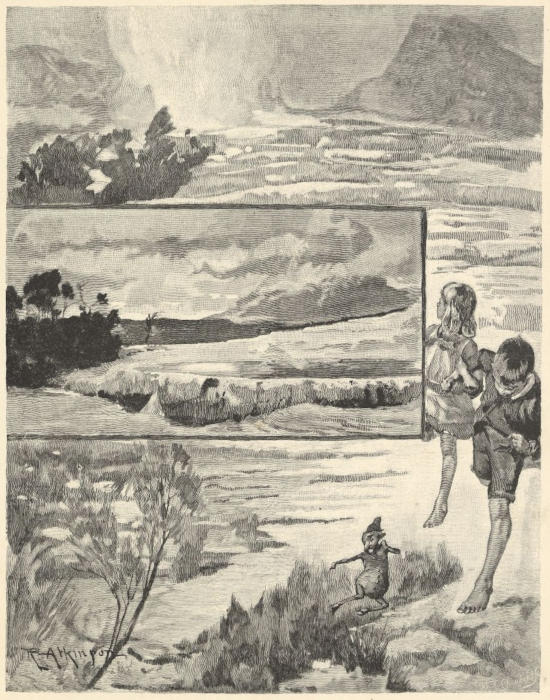
“Run to the hill!” cried Red Cap.
And down the funny little fellows jumped and rushed laughing
into the delicately fringed caves beneath the marble baths.
“What jolly little boys they are,” said Hal, “and what a
good time they seem to be having!”
“Yes,” replied Red Cap, “they all seem happy; but I am
sorry to say there are a lot of discontented ones below, and I
should not wonder if they strike one day; and if so, the passages
will get clogged, and there will be a grand blow up, and I don’t
know what will happen to our King and Queen and their beautiful
fairy realms,”[19] and Red Cap heaved a deep sigh. “But we must
go now,” added he.
The children ran down to where they had left their shoes and
stockings, and putting them on, followed their guide to the creek.
There in the reeds, close to the bank, they found a canoe;
it had pointed ends, and was hollowed out of a large tree trunk,
and the bottom was covered with the small leafy twigs of the
manuka.
“Get in, children,” said Red Cap.
“There are no seats,” said little Cis.
“Never mind,” answered Red Cap; “sit quite still on the
bottom, and hold tightly to the sides.”
So Hal helped Cis in carefully, for it seemed as if very little
would upset the canoe, and Red Cap, taking up a paddle, pushed
out into the stream.
Then, how quickly they floated along on the rapidly running
water; how delightful was the swift motion without any effort,
making the children feel giddy as some swift eddy hurried them
round the turns of the stream. On, on past the reedy banks,
over deep pools and weedy shallows, faster and faster, Red Cap
steering here and there with a touch of the paddle.
At last they came to the end of the rapids, and Red Cap
steered the canoe to a little curve in the banks, and Cis and Hal
jumped out.
“It was splendid,” cried Hal, “to come all that way so
quickly, without any trouble, wasn’t it, Cis?”
“Yes,” replied Cis, hesitating a little; “but it rather took my
breath away, and I was afraid we might be upset.”
“Oh! it was safe enough,” said Hal with an air of superior
wisdom, “as long as you sat still; but I suppose it is difficult for
girls to do that. Where now, Mr. Red Cap?” he added.
“I must leave you now, children; but here is Santa Claus
waiting for you.”
And there indeed they saw their old friend sitting on a
bank.
The children rushed to him, for they were delighted to see
him again; then, turning, they bid Red Cap good-bye, and
thanked him heartily for all his kindness to them, Hal adding,
“I shall tell other children of the wonderful things you have
shown us, Mr. Red Cap, that I shall, for I had often read of fairy-land,
but I had never been to it before, and I think it is a jolly
place.”
And with another good-bye, Red Cap vanished from their
sight.
“So you have enjoyed yourselves, children? I am glad of
that,” said Santa Claus. “And now, is there anything more you
would like to see before you go home?”
“Yes,” cried Hal, “I should like to see some real snow, the
snow mother tells us of. Can we, please?”
Cis added her entreaty to Hal’s, and Santa Claus said he
would take them where they could see some.
The morning had come, but the sun only now and again
shone through the gray clouds that floated low.
“Come,” said Santa Claus; and taking a hand of each, he
led them up to where a large, soft cloud rested on the hill-side,
and he bade the children sit down with him on it.
Up, up floated the billowy mass into the sky, and glided
away to the south. How smoothly they went along, wafted by
the morning breezes! and Cis and Hal, seated on their soft
cushions, gazed dreamily down on the country that sped away so
quickly beneath them.
“How small the big mountains look!” cried Hal; “and the
towns and villages look like toy ones.”
And then they passed over big streams, and a wide strait,
that looked like a silver streak in the far depths. Away, away
they floated; the sky was now clearer, and off the hills, and out
of the valleys the mists were rolling, their silvery edges gleaming
in the fitful sunlight.
“Look! we are going over some big ponds now,” said little
Cis.
“Ponds!” exclaimed Santa Claus, “those are large lakes, see
how they spread out like sheets of silver water!”
The cloud was by this time passing over one of the largest
lakes, and very beautiful looked the soft shining waters surrounded
by mountains, on the tops of which the clouds still rested. Then
the cloud floated to the far end of the lake, and glided down a
narrow valley in which the milky blue waters of a glacier-stream
rushed and roared, though no sound reached the children, who
could only see its fighting wavelets.
On they went, watching the clouds roll from the tree-clad
depths and rocky heights, till at last they uttered cries of joy and
wonder.
There, in front of them, the mighty snow-crowned hills pierced
the grey clouds, catching the rosy rays of the now rapidly-rising
sun. Vast ice-fields stretched far and wide, their rifts blue as the
breaks in the sky above, their jagged peaks gleaming with a thousand
diamond lights; and how soft and inviting looked the beds
of snow in the hollows!
“The snow! The snow at last!” cried Hal and Cis, as they
saw the hills and their gleaming sides and peaks; “oh! do let us
get down, Mr. Santa Claus.”
“Wait,” he replied; and the cloud glided close to a gorge in
one of the mountains, where a mighty foaming torrent[20] rushed
down the rocky steeps to the valley beneath, the silver streaks
thousands of feet overhead showing where the waters ran out
from the glacier fields.
When the cloud stopped, the children jumped off and rushed
to the edge of the waterfall, and, holding on to the trees at the
side, were about to stoop down for a drink, when Santa Claus
cried out, “Do not try to drink there, children, you will be swept
away by the rushing
waters. Come with
me, and I will show
you where you can get
a draught of clear still
water.”
Hal and Cis turned
reluctantly, and Santa
Claus took them where,
in a dry water-course,
amid big boulders, they
saw clusters of the
pure white flowers of
the mountain-lily,[21] and
their guide, pointing to
these, said, “See there,
if you are thirsty.”
“The flowers are
very beautiful, Mr.
Santa Claus,” said Cis,
“but it is water we
want, and I am so
thirsty.”
“Look again,” replied
Santa Claus.
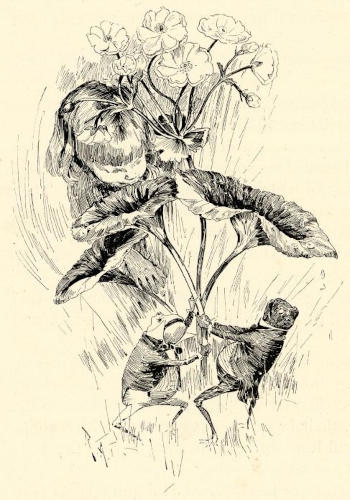
There, below the flowers, were large cup-shaped leaves full of
clear cold water; Cis and Hal darted forward to gather them and
drink, when the leaves seemed to be shaken as if with the wind,
but there was not wind enough for that, and, stooping down,
they saw two little fat dwarfs holding the stems and shaking with
laughter.
What ugly little fellows they were! Hal thought at first they
were green frogs, for they were dressed in tight-fitting green coats,
their big mouths reached from ear to ear, and their hands and
feet were webbed.
“Hulloa!” cried Hal, “who are you?”
Instead of answering, they only laughed and choked, and
choked and laughed.
“You seem to have got bad colds,” said little Cis.
“Perhaps, when you have done, you will tell us what you are
laughing at?” continued Hal, in aggrieved tones.
Still they laughed and choked.
“I wish I were at home; my mother would give you some
ipecacuanha wine, for I think you have got the croup,” said little
Cis, in a troubled voice.
At this the dwarfs opened their mouths wider than before,
and, at last, in low croaking voices began a duet:—
“My name it is Gup!”
“My name it is Joke!”
“We’ve got such bad colds (together)
We can only croak.
“We are both so fat, (together)
And we can’t tell why,
Unless it’s because
We live near the sky.”
“So close to the clouds
There’s no need to climb,”
Said Joke, “so all day
I sit here and rhyme.
“I feed upon flies,
And grumble and grunt,
Or for nice fat snails
Al night-time I hunt.”
“Be quiet,” cried Gup.
“That I won’t,” said Joke;
“Your voice is just like
A pig’s in a poke!”
“And little care I
If it is,” said Gup;
“I’m tired to death
Of holding this cup.”
“I like to be fat,
I hate to drink dew,
It’s a weak cold draught
That nourishes few.
“Great poets, they say,
Must live near the skies!”
“That’s me!” cried out Joke;
“I’m ever so wise!
“I know no grammar,
I read no books,
I have but studied
Dame Nature’s looks.
“A poet to gain
The top of the tree,
Has to use long words,
And drone like a bee.”
So we both make rhymes,
And chuckle and grin
At the people who listen,
And cry, “What a sin
“‘These two clever boys
Should not be extolled!’”
“Stop! stop!” cried out Joke,
“Where has the grub rolled?”
“What are you looking for?” asked the children.
“We are looking for our dinner,” replied the dwarfs, who,
during the latter part of their singing, had been hunting under
the leaves and down the slippery slope for a big fat grub which
they had carefully stowed away for a meal, but which had disappeared.
“I’d rolled him all up
just under this cup!”
With a grunt cried out Gup.
“Yes! grunt and croak,
You pig in a poke;
You’re to blame,” cried Joke.
“I’ve told you full oft
Not to gaze up aloft—
That grub was so soft!
He was such a prize!
A sight for sore eyes
When made into pies!”
And Joke heaved big sighs.
“Oh, dear! oh, dear!” said little Cis, “pray don’t quarrel
over a grub.”
“Quarrel, indeed!” cried a voice out of the bushes; “they’re
always quarrelling!”
It was a plump Maori hen who thus spoke, and she added,
“If they’d leave off making rhymes, and attend to the business of
every-day life, it would be far better. While they sat looking up
at the skies, the grub rolled down, and I caught him and ate him,
for it was a pity he should be wasted. In fact,” added the hen,
with a satisfied nod, “as a rule, they find the grubs, and I eat
them!”
At this, the dwarfs got so puffed out with anger, that the
children were afraid they would burst, they rolled their eyes round
and round, in search of something to throw at the Maori hen,
but she ran away into the bushes beyond their reach.
“I should be glad if you’d give us a drink out of those green
cups of yours,” said Hal; “and couldn’t you make some better
poetry? if so, we’d like to hear it very much.”
The dwarfs then handed the children each a mountain-lily
leaf full of cool dew, saying:—
“To you we hold the fairy cup,
And bid you drink of sparkling dew,
The stars have gone, the sun is up,
Soon must we hide from mortal view.
But ere we say good-bye, we bid
Ye upward, ever upward go;
Look to the Star that shines above,
Though oft you cull the flowers below.
’Tis Christmas morn, the Bell-bird’s chimes
Rise from the distant woods; o’er hills
Where rabbits skip, there softly rings
The music of a thousand rills.
A merry Christmas! then we sing;
A merry time for one and all!
Let not the poor pass by your gates,
Let from your hands the good gifts fall.
We merry dwarfs have but one gift,
To thirsty souls we hold it up,
And bid them drink refreshing dew
From out our cool green fairy cup.
But ere we say good-bye we bid
Ye upwards, ever upwards go;
Look to the Star that shines above,
E’en though you cull the flowers below.”
“I wonder if they mean our Star of Love,” said little Cis.
“Perhaps so,” said Hal, “though I don’t see it anywhere just
now.”
Hal stooped down to where the little dwarfs were hiding
themselves under the leaves, but somehow they and the big stalks
seemed to get all mixed up, and he then could see nothing but the
stalks, and began to think he must have dreamt all the rest.
Just then a Maori hen, with an inquisitive air, came out of
the fern, and Hal, seeing it, cried out,—
“By-the-bye, old thief, where are those buttons of mine you
stole?”
“I don’t know,” replied the hen. Indignant mutterings were
uttered by some other hens gathering round:—
“We never stole any buttons, it must have been some
country cousin of ours; we never think of stealing anything,”
protested the crowd indignantly.
“Well, you see,” replied Hal, “all your family have got a
bad name; but there may be some honest ones amongst you.”
But the offended hens did not wait to hear more, and scuttled
off into the bushes.
The children, seeing that Santa Claus was beckoning to them
to go on, tried to get up the slope quickly; but how slippery the
stretches of snow-grass were! they often stumbled, and had to
hold on tightly to the silvery tufts to keep from falling backwards
into the awful depths. Many a time did Hal help little Cis, for
he still had the wand in his hand, and used it as a stick to lean
upon.
“We shall soon get to the snow now,” said Santa Claus,
waiting for the children, and pointing above them, where the
eternal peaks were shining.
“What is that?” cried Hal, as he heard a loud thundering,
as of a huge mass falling from some great height, waking the
echoes far and near.
“You will know soon,” answered Santa Claus; and helping
the children up the last steep ledges, they came in sight of the
vast fields of snow and ice.
Proceeding in single file along the narrow path under his
guidance, he at length placed them on a spot whence they could
safely watch the avalanches thundering from the heights, down
the rugged mountain side to the valley below, and how wonderful
it was to see the huge masses of ice falling, sliding, dashing from
ledge to ledge! Then from the clear sky above them they heard
a voice calling, “Ke-a, ke-a. Come up, come up.”
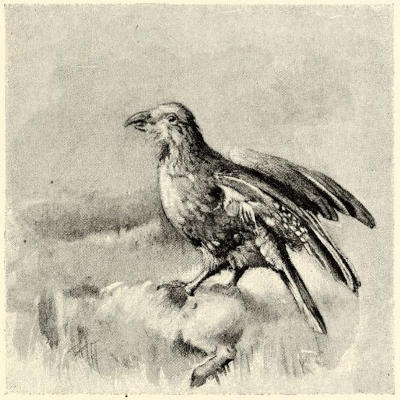
Kea.
“What is that?” asked little Cis, who had not spoken, but,
sitting close to Hal, had been watching the wonderful scene.
“I do not know,” said Hal, “but it looks like a big
mountain parrot that I’ve seen pictures of in our new book on
New Zealand birds.”
“Is that what it is, Mr. Santa Claus?”
“Yes, Hal, and it is a cruel bird,[22] for it will fasten its claws
into the back of any sheep that has wandered away from its
companions or is floundering in the snow, and then, digging its
sharp beak through the flesh, it feeds upon the fat part it likes
best. The poor sheep, driven frantic by the pain, rushes on and
on, till it sinks down exhausted to die; and then the Kea, having
got the dainty bit it wanted, leaves its prey, and goes off to seek
a fresh victim.”
“How cruel!” said little Cis, her eyes filling with tears.
“But come, children,” said Santa Claus, “I must take you
near the snow,” and he led them to where the snow lay white and
pure.
The children rushed to fill their hands with it, and shouted
for joy.
“How cold it is!” cried Hal.
“How beautifully white and soft!” said little Cis.
And the children began to pelt each other, their merry laughter
ringing on the clear air.
“Let’s have a shy at Santa Claus,” whispered Hal to his
sister; and, making a big snow-ball, their eyes sparkling with fun,
they threw it suddenly at their guide, who was sitting on a rock
near by.
But how astonished they were, when the snow-ball hit him,
to see it gradually spread out and cover him.
“Good-bye, children! Good-bye! good-bye!” said Santa
Claus in a low muffled voice; and then, all that was left of their
kind guide was a heap of snow.
“Oh! what have we done!” cried Cis, as she looked round
and round for Santa Claus.
She thought the heap of snow was something like him in
shape, but then it was only a heap of snow, and poor Cis sat
down and cried.
Hal tried to look brave, but felt inclined to cry too, when he
remembered how far they were from home.
“How shall we get down the mountain? How shall we get
back to mother?” moaned Cis, and the tears ran down her
cheeks afresh.
Then from out the snow-heap sprang hundreds of little long-legged
sprites, with high pointed ice-caps on their heads, and
wearing coats of sparkling snow, the icicle-fringe of which jingled
merrily.
What round, rosy faces they had! What twinkling blue
eyes! In their hands they carried frost lances or little crystal
spades, which they flourished in the air as they sprang up from
the snow, making flashes of light in the sun.
“Who are you?” cried Hal.
“Are you the children of Santa Claus?” asked little Cis,
“and if so, can you tell us where he has gone, please?”
“We are his servants,” shouted they, “and he has sent us
to help you; for he has started on his journey to the Old World,
where the children will soon be looking for him.”
“Oh! is that where he has gone!” said little Cis with a
relieved air, glad to find they had not killed him; “and will you
help us to go home? because I think it must be Christmas
morning, and mother will be expecting us;” and little Cis
thought she could hear the Bell-bird’s chimes, as she had heard it
many a time in the early morning.
“Yes, we will help you,” answered the sprites.
Just then they heard the bird circling over their heads, again
crying, “Ke-a! Ke-a! Come up! come up!” and Hal, helping
little Cis, and planting his stick firmly, step by step, in the snow,
followed the sprites, who tripped lightly on, looking like points
of dancing light.
At last, after hard climbing, they reached the ice-clad side of
the highest peak. How beautiful the prospect in the bright
sunlight! The clouds all gone; nothing but the clear blue
sky above and around. All was still, save when the avalanches
thundered down from the heights. The children stood and
watched the huge masses of ice as they slid down, now here, now
there from the shining peaks, to fall like powdered snow into
the foaming glacier stream in the dim depths below.
Meanwhile the little sprites were hard at work digging,
cutting, shaping a huge block of ice.
“What are you making?” asked Hal. “Can we help?”
“Yes, if you like,” said the sprites, and they gave him and
Cis two little spades. The children were soon quite hot, working
as the sprites bade them, loosening and shaping the huge block
of ice; while every now and then they would all stop, and pelt
each other with the powdered ice, and the sprites sang:—
“Pelt us, pelt us, we don’t care,
We love the snow so crisp and fair;
We will shape and we will dig,
Till a chariot white and big
We have cut, for those who’d fain
Hasten to their home again.
Slide and slip, and slip and slide,
Thunderous roll, and mighty crash!
In the chariot come and ride,
Down into the depths to dash.
Mystic trip for those who roam;
One wild rush: Hurrah for home!”
Tempting indeed looked the chariot; bright and sparkling
were its wheels of ice, and some of the sprites had decked it
with starry edelweiss gathered on the slopes below, and with
handfuls of the red snow-lichen.
“Let’s get in, Cis!” cried Hal.
“Is it quite safe?” asked Cis of the sprites.
“Quite, quite,” answered they; “Santa Claus told us to
make it for you.”
Taking hold of little Cis, the foremost sprite helped her to get
in, and Hal jumped quickly in by her side.
Throwing down their spades, the laughing sprites rushed to
the chariot wheels, ready to push them round, whilst others
pelted the children with snow-lichen, shouting at the top of their
shrill voices:—
“Slide and slip, and slip and slide,
Thunderous roll and mighty crash!
In the chariot those who ride,
Down into the depths shall dash.
Mystic trip for those who roam;
One wild rush: Hurrah for home!”
Then the wheels began to turn, and Hal threw his arm
round Cis, who was holding on to him, and looking with a
little white face into the depths below.
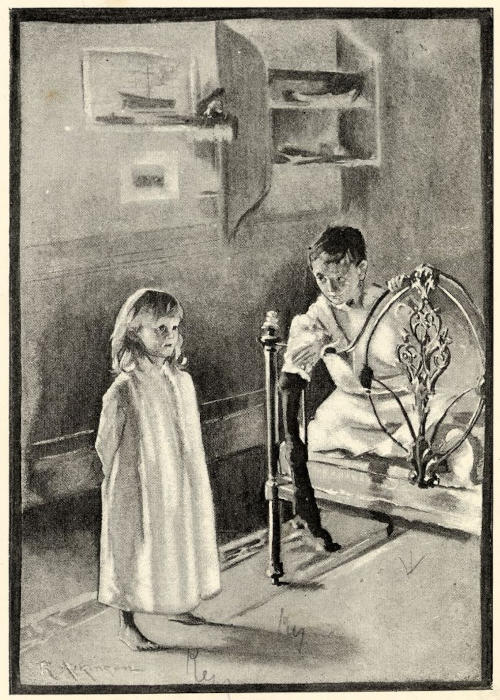
“You must have been dreaming, Hal!”
But the wheels turned faster and faster, as the chariot
dashed down the glassy slope. Hal looked at the sky above,
where the Kea was still crying, “Come up! come up!” and he
thought he saw the Star of Love shining faint and far; and
then—— Hal remembered no more; and, with the words of the
sprites ringing in his ears,—
“Slide and slip, and slip and slide,”
he—awoke,—to find he had tumbled out of bed, and that it was
Christmas morn indeed. And there was little Cis, sitting up in
her bed, and there were the stockings with their bulging sides;
and Hal rubbed his eyes and wondered if he were awake or
dreaming. But he and Cis hastened to dive into their stockings,
to see what Santa Claus had put into them, and, what treasures
they found!
For Cis there was a big doll, dressed like an angel, and fairy-like
small ones, and beautiful furniture for her doll’s house, and
a book with pictures of all kinds of birds and insects.
And in Hal’s, what treasures for his collection! Rare birds’
eggs in little glass-covered boxes, precious bits of many-coloured
ores; and from the Terraces, about which his mother had often
told him, were specimens of white encrusted sticks and delicate
ferns. How he longed to put them in his cabinet with his other
treasures!
But when Hal talked to Cis about Santa Claus and their
night’s travels, she laughed and said,—
“You must have been dreaming, Hal, or perhaps the
treasures in the stockings whispered it all in your ear,” which
Hal indignantly denied.
“For I know it was real,” he said.
But the Bell-birds were singing their Christmas chime in the
bush, and the morning sun was gilding the tree-ferns and the
waves, and their mother’s voice was calling, “A happy Christmas,
children! a happy Christmas!”
And whose was that other voice that called out the words too?
“Father! father!” cried the little ones eagerly, tearfully, as
they rushed into the outstretched arms of their mother and father
too!
Yes, it was a happy Christmas morn, indeed, for the sea
had brought its living to their home. And as the children sat
that evening in the little low room, their father told them of the
shipwreck, of his life on an island with one other, carried like
himself to its shores, and of their joy when a passing vessel
sighted them and brought them home at last.
When the Southern Cross again shone down from the sky on
the father and mother and happy children, Hal told them his tale
of all he had seen the night before.
Although little Cis declared it was not so, Hal would never
believe but that Cis and he had been with Santa Claus to see all
the wonders of the Southern Cross Fairy-land.
FINIS.