Not many years ago in the neighbourhood of Andover
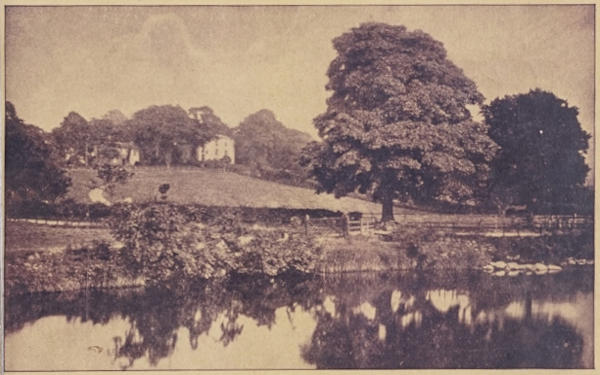
stood a lonely house, which went by the name of the
Grange. It was enclosed in walled-in gardens, and
people who passed by on the high road saw nothing of
it. The house itself was squarely built—its windows
were small, with old-fashioned latticed panes, and its
thick walls were closely covered with ivy and other
creepers of the hardy species.
It was a lonely place, standing solitary and bleak all
the year round, its sole inhabitants being an old man,
a young girl, and one servant.
These three inhabited a corner of the old house,
living very sparsely and frugally, doing without warmth
and comfort in winter and without all the gay things
of life in summer. The grounds round the Grange
had gone to rack and ruin; the huge kitchen garden
was full of weeds, and the lawn in front of the house
had been attended to by no gardener since Dr. Follett
and his daughter, Nancy, took possession of the place
six years ago.
People who saw them at church on Sunday said that
Nancy Follett was a handsome girl; she had bright
grey eyes, good features, and quantities of beautiful
hair; her face had strength about it, her lips were
firmly moulded; she had a very upright and erect
carriage, but she looked like a girl who lived under a
shadow, and during the six years of her residence at
the Grange she made but one acquaintance.
The neighbours would have been kind to her if she
had let them, but Dr. Follett received no visitors, and
strictly forbade his daughter to make friends for
herself in the neighbourhood of her dismal home.
How she got to know Adrian Rowton was a mystery;
how he obtained a footing in the dismal old house was
the wonder of the country side. But then Rowton was
a man who seemed to do what he liked wherever he
went. He saw Nance one day in church, observed the
turn of her head, noticed the exquisite curves of her
soft neck and throat, commented with a quickening of
his heart’s pulses on the lovely shades of her hair,
determined to get a nearer view of her, met her by
accident the next morning, spoke to her, caught the
glint of her bright eyes, and fell madly in love with
her on the spot.
Adrian Rowton had never yet seen any reason to
check his inclinations, whatever they might be. Nancy
Follett’s father was an ogre, but Rowton was clever
enough quickly to gain an entrance into the deserted
old house. He made love to the father for the sake of
the daughter, and to the surprise of everyone in the
place, was soon allowed to visit at the Grange as often
as he liked.
It was just Rowton’s luck, said other young men who
also admired pretty Nancy Follett, but then they looked
at one another and wondered what they meant, for if
people knew nothing of Dr. Follett and his daughter,
they knew still less of Adrian Rowton. He rented a
little shooting lodge about half a mile away from the
Grange. It was called the Bungalow, and would have
been to most men a singularly unattractive place. The
house was tumble-down and out of repair, and Rowton
took no pains to keep the grounds in order.
He arrived at the Bungalow two years before this
story opens, accompanied by a man-servant, a rough-looking
fellow with a bulldog head and a singularly
unprepossessing face; also by several dogs, and a large
supply of guns and ammunition. Rowton had taken
the shooting of a large neighbouring estate and in the
autumn he occupied himself with his favourite pastime
as long as daylight permitted. When the shooting
season was over he generally shut up the Bungalow and
disappeared, returning, however, any day or night quite
unexpectedly and for no apparent reason. He supplied
Nancy Follett with plenty of game, but what he did with
the rest he never told to anyone. He used to drive
about the country on a high dog-cart, and one day
brought two or three thoroughbred horses with him from
London.
People talked a good deal about him, for he had an
air of mystery which tantalised curiosity. He was tall,
well set up, and strikingly handsome—too dark, perhaps,
for the conventional Englishman, but so plucky, such a
good sportsman, and withal so gay and bright when he
pleased, that against his own inclination and against the
secret prejudice of most of the neighbours, he was
quickly invited to the best houses in the place, and was,
in short, a universal favourite.
On a certain night towards the end of a particularly
tempestuous November, Rowton was riding home from
Andover. He was a reckless horseman, and always
rode mercilessly. The beast on which he was sitting
this special night was only half broken in. Suddenly
he heard himself shouted to by an angry voice.
“Hullo! take care, can’t you; do you want to ride
right through my gig?”
Adrian pulled up his horse fiercely, the animal
reared, he sprang from its back and exclaimed with a
hearty voice:
“A thousand pardons; I never saw you, Dr. Read.”
Dr. Read, who was also standing by his horse, faced
the young man with a smile.
“You nearly rode into me,” he said. “You ought
not to give reins to an animal of that sort on a dark
night.”
“I am extremely sorry, but you had no lamp to
your carriage. I certainly did not expect to meet
anyone on this rough bit of road. What is the matter,
doctor? What patient has called you out such a night
as this?”
“I am just returning from the Grange,” said Dr.
Read; “have you not heard?”
“Heard what?—is anyone ill there?—surely not
Miss Nancy!”
“Bless you, Nancy Follett is well enough, unless
indeed, poor child, she dies of her sorrows. What an
old ruffian that father of hers is? Well, he is dying
now: his grief is evidently bringing him to his grave.
By the way, talking of mysteries, I believe I have got
a clue to the shadow which hangs over the old
Grange.”
“And what is that?” asked Rowton, a tone of
interest coming into his voice.
“Why, they say that this old man, Dr. Follett, is no
other than the well-known physician of the name who
performed such wonderful cures in Harley Street some
years back—you must have heard of the great Dr.
Follett.”
“Can’t say that I have,” answered Rowton.
“Well, well,” said Dr. Read testily, “I thought all
the world knew of him. I never for an instant suspected
that this cross-grained old fellow could be he,
but I believe it is a fact. It seems that the man
had an awful shock: his only son was mysteriously
murdered. Of course there may not be a word of truth
in it, but something must have happened—did you
speak, sir?”
Rowton had said “Good God” under his breath.
He was quite quiet now.
“I think your informant must be mistaken,” he
said after a pause. “I know the Folletts very well,
and neither father nor daughter have ever alluded to a
murdered son or brother—murdered! Good Heavens!
Nancy Follett would surely have told me of a tragedy
of that sort.”
“Well,” said Dr. Read, “there is some shadow over
those two lives, and the shadow is killing the old man.
Poor fellow, his days are numbered; it is only a question
of hours.”
“I am surprised, shocked, and sorry,” said Rowton.
“I was at the Grange only a week back and then Dr.
Follett looked as well as ever.”
“As ill, you mean,” said the doctor. “He has been
breaking up fast for the last six months. The mystery,
or shadow, or whatever it is, is killing him, for the
man is not really old. Have you ever noticed the
extraordinary gloom on his face?”
“Yes, and no,” replied Rowton. “I thought him a
queer old card, but to be frank with you, I don’t go to
the Grange to study old Dr. Follett.”
The moon shone out at this moment, and Dr. Read
favoured the bold outline of the young man who stood
by his side with a keen glance.
“That girl is as fine a creature as ever breathed,” he
said with apparent inconsequence; “take care, young
sir, that you do not do her an injury; but now I must
be off. Follett is dying because there is a shadow over
him and the shadow is killing him. Well, I must not
stay here any longer. Good night to you, Mr. Rowton.”
“One moment before you go, doctor. Is Miss
Nancy all alone?”
“No, I sent in a nurse this morning. Good-night, I
must not stay here any longer.”
The doctor got back into his gig and drove away,
and Rowton stood for a brief moment at his horse’s
head. He was a man of quick action at all times.
“Not home just at present, Satyr,” he said to the
horse; “here, turn your head to the left. So! ho! old
boy, easy, easy.”
A moment later horse and rider were flying almost
on the wings of the wind in the direction of the
Grange.
There was a long rambling avenue under dark lime
trees up to the old house. Rowton did not wait to
open the gates. Setting spurs to his horse the animal
quickly leapt these obstacles, and then at full speed
galloped up the avenue. When the pair approached
the house Rowton pulled up abruptly, and springing
from his steed led him softly over the grass. A great
cedar tree stood in the middle of the desolate lawn.
Taking a leather strap from his pocket, Rowton tied
his horse to a branch of this tree, and then stepping
quickly up to one of the windows he began to whistle,
in gay clear notes, the well-known strains of “Garry
Owen.” His whistle rang out joyfully; he had just
completed the melody and was going to begin it a second
time, when a noise at a little distance caused him to
turn his head; a faint light proceeded from an open
door, and a girl’s slender figure was seen standing on
the steps.
Rowton made a stride forward, and the next
moment had clasped Nancy Follett to his heart.
“This is good,” he said. “I have hungered for a
kiss. What is the matter, sweetheart? you tremble as
though you were an aspen leaf.”
“Because I am so glad to see you,” she replied.
“But how did you know? What brought you here at
this hour?”
“By good luck, I met Dr. Read,” exclaimed Rowton;
“he told me of your trouble. There, sweetheart, you
need not tremble; I am here to shelter you.”
“But you don’t know everything, Adrian,” she said
in a sort of choking whisper. “Things have changed
since I saw you last.”
“You need not tell me that, I know all about it,” he
replied. “Your father is dying and you are miserable—but
things must be better when I am with you. Let
us come indoors; you will catch your death of cold if
you stay out in an awful gale of this sort, besides, we
can scarcely hear our own voices; come, I suppose you
have some sort of fire in that big, desolate dining-room.”
“Just a spark,” she answered, with a smile, which she
quickly repressed. “You seem to lift a weight off my
heart,” she continued. “It is strength and real gladness
to have you close to me; but, Adrian, I cannot stay
with you; he is dying—the doctor says he will not last
till morning.”
While she was speaking, Nancy turned and, followed
by Rowton, entered the great hall of the almost empty
mansion.
“Why, it is as dark as pitch,” exclaimed the young
man, “what a state of things; have you no candles, no
lamps, nothing to show a gleam of light on an awful
night of this sort?”
“I’ll fetch a candle,” she answered. She ran across the
hall, opened the door of a sitting-room some little
distance away, and returned in a moment, holding a
lighted candle high above her head.
“The fire is out in the dining-room,” she said with
another shiver, “but we had better go there; I can talk
to you better there, and I have something to say.”
“You don’t utter a word until you have a good fire to
say it by,” replied Rowton. “This sort of thing is intolerable.
You are going to be my wife, you know,
Nance, so you have to obey me, whether your father
wishes it or not. Here, give me the candle; why, your
poor little hand shakes, you would drop it in another
moment.”
He took the light out of the girl’s trembling hands,
and holding it in such a manner that he could see her
face, gazed long and earnestly into it. It was a face of
great spirit and beauty. The features were straight and
delicate in outline, the brows perfectly black and delicately
marked, the eyes large and of a lovely shade of
grey, the golden hair looked like a tangled web of many
lights. But now the girl’s complexion was pinched and
blue with cold, and the lovely eyes had red rims round
them.
“Come, let us light a big fire,” said Rowton. “I’ll
soon set it going; here are logs of wood and lumps of
coal; fetch me an old newspaper, Nancy. Now we’ll
set to work.”
He dropped on his knees as he spoke, used his great
hands deftly, and in a moment or two a huge fire was
roaring merrily up the old chimney.
“There now, that’s better,” he said. “You shall
warm yourself—you shall get back your delicate complexion.
Why, my wild bird, you wanted me sorely.
Give me your hand—here, let me warm it. Sit on my
knee close to this blaze; it will tingle right through you.
Whisper one word to me, sweetheart; when did you last
have a right, good, comforting meal?”
“Never mind about that, Adrian; how can I eat when
my poor father is dying? I love him, although——”
“Although he turned your life into a hell,” interrupted
the young man fiercely.
“That is true,” she replied; “but never mind that
now—he has gone through fearful sorrow, and I am
heart and soul with him in everything.”
“Well, dearest, he is your father and one cannot
account for the feelings of affectionate girls like yourself.
Thank heaven! I never had home ties—I cannot remember
my father—my mother died when I was an
infant—I was brought up in the roughest imaginable
school. Yes, the school of life was hard on me, and it
has turned me out a pretty rough specimen; a rough
diamond, eh! sweet Nancy?”
“Not to me,” she answered with sudden tenderness.
“To me you are the best, the noblest of men; why will
you run yourself down?”
“I won’t again,” he answered. “Now let us to
business. Have you told your father yet that you have
promised to be my wife?”
“Yes,” she replied.
“Why do you say ‘yes’ in that dismal way? Is he
not glad? Will he not welcome me as a son-in-law after
his own heart? A little talk will reassure him on many
subjects. When can I have it?”
“Never, I fear, Adrian; he is too ill.”
“Well, then, I take you without his leave.”
“That’s just it,” replied Nance, speaking with hesitation
and distress. “You know, Adrian, how he began
by taking a wonderful fancy to you. During all the six
years of our residence in this dismal old Grange you are
the only stranger who has set foot across our threshold.
Father liked you to come—he liked to talk to you—he
liked to talk of you when you went away. It comforted
me immeasurably to feel that you and father suited each
other. When I saw that you loved me I was more glad
than I can say, to feel assured on the point of father
also being tolerant to you. Well, things have changed.
The dreadful change took place after your last visit.
When you were gone, when you shut the hall-door
behind you, I found father in a state of strange and
nervous excitement. He was pacing up and down the
room, clasping and unclasping his hands and muttering
to himself. I really had not the least idea what it all
meant. He kept saying under his breath: ‘Suspected—yes,
suspected—there is a likeness—there is a possibility
of my search being terminated.’ Oh, he has a
secret, Adrian, but I don’t want to go into that now,
and I thought his poor brain was turned and that he was
off his head, and I went to him quite tenderly and
touched him on his arm, and said, ‘Sit down, calm
yourself.’”
“‘I cannot,’ he said, shaking me off, ‘my heart is on
fire and I am nearly mad. That man—that man—and
I harboured him here.’”
“‘What man?’ I asked in astonishment.
“‘Rowton,’ he said, ‘Adrian Rowton; I have harboured
him here and made a friend of him! Ah, but
I shall track him down yet.’
“I felt myself turning quite faint with astonishment
and an unaccountable sense of terror.
“‘Father,’ I said, ‘you must be mad.’
“‘No,’ he answered, ‘not mad, but my suspicions are
aroused. Good heaven! that I should have harboured
that man here!’
“Then he pulled himself together, and tried to speak
quietly. ‘Nancy,’ he said, ‘listen to me. My suspicions
are aroused—the man who calls himself Adrian Rowton
is never to come here again.’
“‘You cannot mean it,’ I said.
“‘I can and do,’ he replied. ‘He is never to darken
these doors again. Why, what is the matter?’ he exclaimed,
for I was trembling and the tears were running
down my cheeks.
“‘It is only that I love Adrian Rowton better than
anyone else in all the world,’ I replied.
“Then he stood up and I thought he was going to
curse me, but he did not curse me, he cursed you
instead. Oh! he used awful, fearful words, and when
they were over he fell down in a sort of fit. He got
better after a little, and since then has not breathed your
name. I do not know what he would do if he really
knew that you and I were sitting here together.”
Rowton’s face looked disturbed while Nancy was
speaking.
“Your father must have been off his head,” he said
after a pause.
“No,” she replied, “his brain is sane enough.”
“He must have been off his head for the time at
least,” repeated her lover; “nothing else could account
for words so purposeless and wild. They are not worth
your grave consideration; do not fret, sweetheart, such
words can make no difference to us. You don’t suppose
that I will part from the most precious thing in all
the world because an old man’s brain has suddenly given
way.”
“If I really thought that,” said Nancy Follett.
“What else could it be? but now don’t let us waste
our time talking about it; you are mine and I am yours
if fifty old men choose to go mad on the subject. Now,
I must see that my wild bird does not wear herself out;
you must have food, you shall have it; is there no one
helping you to nurse your father?”
“Yes, Dr. Read sent in a nurse to-day, she is upstairs
now; not that there is much to do, he has lain since the
afternoon in a state of stupor.”
Nancy was standing now close to the fire; the bright
light fell all over her; it brought a delicate colour into
her cheeks and lit up her large eyes with a strange
gleam.
“You are the most beautiful creature in all the
world,” said Rowton, with passion.
She looked at him with a pained expression; her
pretty dark brows were knit together.
“Don’t,” she said suddenly. “I cannot listen to such
words just now, they seem incongruous, they press on
my heart and hurt me. Whatever you may choose to
think of him, I love that old man upstairs; his fate has
been a cruel one, his grief is killing him; his terrible,
his awful grief is killing him, it is carrying him to his
grave.”
“I am a heartless brute not to sympathise with
you, Nancy,” said Rowton. “What can be the grief,
my dearest?”
“Ah! that I dare not tell you, that is our fearful
secret. Once I was a very happy girl, a thoughtless
child. I wanted for nothing, I was gay as the sunshine
itself. Father was a successful man, he was
quite a great doctor, he had one of the largest practices
in Harley Street. Then came the trouble; it was a
blow sudden and awful, like a bolt from the blue. It
crushed father and turned him into an old man, a man
with only one bitter object in life. Everything else
seemed to die in him, everything but the one consuming
passion. He sold the furniture in Harley Street, and
we came here because the house was going for an old
song, and father wanted us to live cheaply; we have
lived here ever since that blow descended on our heads,
and we have saved, and saved; we have starved ourselves,
we have lain cold at night, we have wanted the
common comforts of the most ordinary existence, all for
one terrible purpose.”
“You certainly are a mysterious pair,” said Rowton
with a laugh which echoed painfully in the old room.
“Just whisper to me what the purpose was, Nance.”
She hesitated for a moment, then bending forward
whispered a single word in his ear.
His ruddy, dark face changed colour when she spoke,
for quite a moment he was silent.
“Your father has made a mistake,” he said; then
gravely, “such a purpose turns round and crushes the
man who holds it in his grasp. His own fell purpose
will kill your father. You must drop it from your life,
Nancy. Your little sunshiny face was never meant for
shadow or sorrow; you have lived too long in the
gloom; turn now to the sunshine of our mutual love.”
“Oh!” she answered, her voice coming out with a
sort of strangled sob, “I love you beyond words.”
“To please me, try and put it into words, Nan,” he
asked; he gathered her close to his heart as he spoke.
“My love is wide as the world and deep as hell,” she
replied; “stronger than death, and I think, I think, it
could reach even to the heavens.”
“And mine for you means madness if thwarted,” he replied.
“There is not a man on earth can keep me from
winning and holding you. There, you may go to the
old man now, for I see you want to; we’ll be man and
wife before another moon is passed. I’ll come back in
the morning to learn your news. Good-night.”
CHAPTER II. HIS WILLING BRIDE.
Rowton left the house, clinking his spurs as he did
so; Nancy listened to the sound he made with a beating
heart.
“Suppose father hears,” she thought; but then she
remembered that the old man was lying in a state of
stupor, which, in all probability, would end in death.
He could not, therefore, hear. So far she was safe.
Why did her father hate her lover? Why had he cursed
the man whom she loved? Well, he was dying, and
dead men were powerless to interfere with those who
lived. Rowton’s strong will would assuredly win the
day, and Nancy would be his bride.
“His willing bride,” she murmured, clasping and
unclasping her fingers. “It is awful to think of marrying
him against father’s wishes, but I know perfectly
well that I shall do it. I am incapable of refusing him
anything. I love him to desperation, and who can
wonder! I love my father, too, but not as I love
Adrian.”
“Please go upstairs, Miss Follett?”
Nancy started and her face turned pale.
“Yes, nurse, what is the matter?” she cried.
“Dr. Follett is awake and wishes to speak to you,”
said the nurse.
“Awake! then perhaps he is better!” said Nancy.
“No, miss, he will never be that, but he is conscious
and he wants you without a moment’s delay. He asked
me to leave you with him, so I am going to the kitchen
to try and have a bit of supper. He is pretty sure to
go off towards morning; there is little chance of this
gleam of consciousness lasting long.”
“I will go to him at once,” said Nancy.
She cast one longing glance at the blazing fire, then
turning, left the room. She ran up the rambling old
stairs; they were faintly lit at intervals by the struggling
light of a watery moon. She reached the gallery
which ran round the hall, paused before a creaking,
badly hung door, and opening it, found herself in a
lofty bedroom. The room was almost bare of furniture.
A strip of carpet stood by the bedside, another
was placed in front of the old fire-grate. With these
two exceptions, the floor was bare. A deal table stood
in one of the windows, on which a small looking-glass
was placed, a chest of drawers of the commonest and
coarsest make occupied a position beside one of the
walls; there were a couple of chairs, a very old-fashioned
washstand, a huge four-post bedstead made of black
mahogany and hung with old velvet curtains—that was
all.
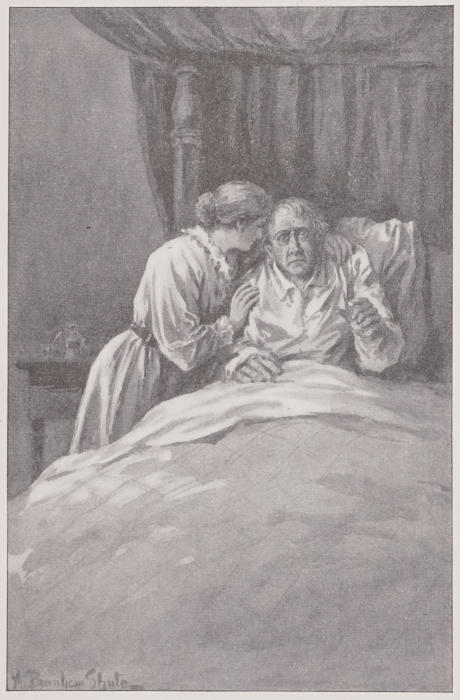
The dying man lay in the middle of the bed; he was
raised by several pillows and was breathing loud and
heavily. His eyes, with dark shadows under them, were
directed anxiously towards the door through which his
young daughter entered.
“Come here, Nancy, be quick,” he said, speaking in
an imperative voice and with wonderful strength for a
dying man.
She hurried across the room and stood by the bedside,
looking down at him.
“The Almighty has been good to me and has given
me sufficient strength to say what is necessary,” panted
the doctor. “I am dying.”
Nancy opened her lips to speak, but no sound issued
from them.
“I am dying,” said Dr. Follett again. “You need
not try to contradict me, Nance, I know what you
would say. You have been a good girl, and you will,
in the ordinary course of nature, miss me for a little;
you will also as naturally forget me after a short time.
I have been a burden to you and have led you a weary
life, but we have no time to go into that now. Death
is in a hurry and I must do something before I go to
him. I have sent for you to get you to make me a
promise.”
Nancy began to tremble. Again she made an effort
to speak, but again failed; her hands were tightly locked
together and beads of sudden moisture stood on her
forehead. Dr. Follett was gazing at her out of two
sunken and fierce eyes.
“You know what I allude to,” he said. “I see the
knowledge in your face; you know what has animated
me and kept me alive during the last six years.”
“Yes, I know,” she replied.
“I die before my work is completed,” he continued,
“but I leave it to you.”
“I cannot take up your work, father,” she answered.
“Don’t talk folly, child. You must take it up. You
know what the object of my life has been. Your
brother was murdered; for six long years I have been
searching for the man who took his life—I have been a
hunter in pursuit of my prey. There is a man alive
on this earth whom I must find, my grip must hold
him, my revenge must reach him. I die without
scenting my quarry, but you must follow where I leave
off. There, my brain is clouded, I cannot think, not
definitely, not clearly—a short time ago I had a suspicion.
I wish Crossley, the detective, were here, I
could tell him. It seemed to me that I had got hold of
a clue at last, but it has slipped from my fingers, from
my memory; I cannot recall it. I choke—this emotion
is too much for me. Give me a dose of that medicine,
quick.”
Nancy turned to a table which stood near. She
poured something from a bottle into a medicine glass
and brought it to her father. She held the glass to his
lips; he drained the contents to the dregs.
“That is right,” he panted, “that is good stuff, it
warms the heart. I used to give medicine myself like
that long ago; there is chloroform in it, it is very comforting.
Come to my side, Nancy, let me hold your
hand. Remember I am a dying man and the requests
of the dying ought to be granted. You are to make
me a promise. Your brother, Anthony, was murdered,
you are to find the murderer, and to avenge his death;
you are to take up my life work, child. If you don’t I
shall curse you.”
“Where you failed, how am I to succeed?” she
answered. “I won’t make that cruel promise.”
“If you don’t I’ll curse you,” replied the dying man,
his glittering eyes looking full into hers. She shuddered
and covered her face with her trembling hands.
“I think nothing at all of your squeamish womanly
fears,” he said, with an awful sort of sneer. “Sit down
by me—I have everything planned out—listen.”
CHAPTER III. THE PACKET ON THE UPPER SHELF.
As Nancy seated herself on the edge of the bed, her
face grew startlingly livid.
“You cannot surely mean what you are saying,
father,” she replied.
“I mean,” said Dr. Follett in a steady and strong
voice, “exactly what I say. I have failed to avenge
your brother’s death; you must finish my work.”
“I am sorry,” said Nancy. “I am sorry at an hour
like this to have to refuse you anything, but I cannot do
what you ask.”
“I will not die until you promise,” replied the doctor.
“For six years I have done all that man could do. I have
not left a single stone unturned, I have not neglected the
slightest clue, yet I have failed. The man who murdered
Anthony has still to be found. If he walks this
earth he shall be found. I die, but you must find
him.”
“You forget that I am a girl,” said Nancy; “no girl
could undertake work of this kind.”
“Pooh! what does sex matter?” replied the doctor.
“Does the fact of your being a girl alter love? Did
not you love the dead boy? I die. It is the will of
the Almighty to take me away before my work is accomplished;
but I leave behind me a child, my lineal descendant,
the loving playmate of the murdered boy, the
girl into whose ears he whispered his young secrets, the
girl who kissed his young lips. This girl is no weakling,
she can take up my work; she shall. I insist, I command,
I will listen to no silly cowardly entreaties. Do you
hear me, Nancy? I die before another sun rises, but
my unfinished work drops on to your shoulders; you
dare not refuse me—do you hear what I am saying?
You dare not.”
“The task you set me will kill me, father. I am
dreadfully tired already. I am utterly weary of the
misery of my life.”
“Kneel down, child,” said the doctor. His voice
changed from its hard and ringing note; it grew all of
a sudden soft, beseeching, tender.
“You have a woman’s heart and a woman’s spirit,”
he said, touching one of the slim young hands and
stroking it as he spoke; “but you have more than that,
you have a man’s courage. I have seen that courage
shine in your eyes in more than one sudden emergency;
the day the blow fell I saw it. I have seen it since, when
you have denied yourself and turned your back on the
good things of youth, and followed me, step by step,
uncomplainingly, up the narrow path of self-sacrifice
and self-denial. You can do it—you shall. Think of
Anthony, think for a moment of the old times.”
“Yes, I remember the old times,” replied Nancy.
She began to sob as she spoke.
“That is right, child, cry away. I have touched
your heart. When I touch a heart like yours courage
soon re-animates it; you will not be a coward, you will
not allow your brother’s blood to cry from the ground
for vengeance; think of the old times, think of your
mother, think of the old, gay, happy life.”
“Yes, yes, I remember it,” said the girl; “but it is all
past and over.” She wept silently, bowing her head
until it almost touched the bedclothes.
“I see the old times as I lie here,” said Dr. Follett.
A meditative, gentle look stole the anxiety and some of
the age out of his face. “Yes,” he continued, speaking
in a dreamy tone, “the past rises before me. I see a
picture. There are three people in the picture, Anthony,
your mother, you. Our house is full of sunshine.
Your mother is proud of her children, and I am
proud of your mother and of the children. The picture
is very vivid, it is almost like a vision, it fills the whole
of my gaze. I see the room where we sit in the evening.
I see people flitting about. I see our morning-room with
the sunshine on it; there is your mother’s gentle face,
there is Anthony like a young eagle, all romance, chivalry—a
daring boy, a splendid lad. I see you full of courage,
but pretty, soft, with hair like the sun. Yes, it is a
lovely picture; it rests me, it supports me. Ah, but it
is changing—your mother’s place is empty, she no
longer sits by the fire, or takes the head of the table.
She has gone. I am in one sense alone, but still I live,
for Anthony lives, and you live, and I work for you, and
my profession abounds with interest and it absorbs me.
Here is another picture coming on fast. I see my consulting-room;
here come the patients; I give them five
minutes each, and I drop the golden sovereigns into my
drawer, fast, faster and faster. I am a very successful
doctor. You remember all about my success, don’t you?”
“Yes, yes, you were grand, magnificent in those days,”
said Nancy. She had raised her head now; her tears
had dried on her cheeks.
“Yes, as you say, I was magnificent,” repeated the old
man, “but don’t interrupt me; I still see the picture.
Patients think a lot of me—I am spoken well of by my
colleagues, I am consulted by local practitioners. People
come from distant lands to see me and to get my opinion.
My opinion is golden. I feel myself something like a
god; I can dispense life, I can issue the dread fiat of
death. Here is a patient who comes from China. All
the long way from the flowery land the wretched man
has come to consult me. I seem to see the long
voyage and the despair at the man’s heart, and now I
behold the hope which animates him. He has a tumour,
horrible, unsightly, a ghastly thing, a protuberance from
the very home of Satan himself, but I remove it by my
knife and by my skill, and the man recovers. Look at
him! He is blessing me, and he is offering me the
half of all his worldly possessions. Oh! how he has
suffered, but I have relieved him. I have lifted him
from hell to paradise. Yes, I am a great doctor. How
beautiful, how absorbingly interesting is this picture of
the golden past!”
Dr. Follett’s voice dropped—the animation went out
of it.
“There, child, all the pictures have faded,” he said.
“The curtain has dropped—the old life is shut away by
a door which can never be opened, for Anthony is dead.
Let me weep for him, Nancy—I will; I must. Tears
come slowly to the dying, but they rise in my eyes now
when I remember Anthony. He is dead—he was
murdered—he lies in his grave, but his murderer still
sees the sunshine and feels the sweet breath of life—his
murderer lives.”
“But you are not to blame for that,” said Nancy; “no
man could do more than you have done. When you see
Anthony again in the strange world to which you are
hurrying you will tell him all, and——”
“I shall see him again,” said Dr. Follett, “and when
I see him I will tell him that I have dropped my mantle
on to you; you are to continue my work.”
Nancy’s face grew so white that it looked almost like
the face of one who had died; her lips slightly parted,
her eyes, terror growing in them, became fixed on her
father’s face.
“I see another picture,” he said again suddenly. “I
see the morning when Anthony went to Paris—to gay
Paris, where he lost his life. He enters the room. How
light is his laugh and how his eyes sparkle! He has said
‘farewell,’ he has gone. Wait a while—another picture
is rising in that dark part of the room. Hold me,
Nancy, my child, or I shall fall. I must look at it, but
it horrifies me, it chills my blood. Do you see the
man who has come into the room? His name is
Eustace Moore.”
“Oh! don’t let us recall that dreadful scene, father,”
interrupted Nancy.
“I must, child. Don’t interrupt me, let me go on
describing the picture. Eustace Moore has come into
the room. He is Anthony’s friend. He tells his awful
tale. Cannot you hear what he says?”
“No, dear father, I hear nothing. You are torturing
yourself with all these dreadful memories; they are exciting
you too much; it is dreadfully bad for you to talk
as you do.”
“Nothing is bad for me now. I am past the good or
the bad of life. I stand on its threshold. Let me
describe the picture. I hear Eustace Moore speaking.
These are his words:
“‘I have brought you terrible news, doctor. I cannot
mince matters, nor break the blow in any way. Your
son is dead!’
“‘Go on,’ I answer. I stagger, but I don’t fall; ‘go
on, hurry, tell me everything.’
“‘Your son was murdered at a café in Paris,’ continues
Moore. ‘The cause of the murder is an absolute
mystery. A stranger had a quarrel with him; there
were hurried words, followed by blows and pistol shots—the
boy was shot clean through the heart. My
address was found in his pocket; someone rushed to
my flat, not far away, and I was on the scene in less
than half an hour. Anthony was lying dead on a
table in an inner room of the café. The man who had
quarrelled with him and who had murdered him was
known by the name of Hubert Lefroy. As I was entering
the café, I saw a tall man rushing by in considerable
agitation; he wore no hat, and he flew
quickly past me. I observed his strange face, and a
mark—the mark of a death’s head and cross-bones
tattooed on the upper lip. Knowing nothing definitely
at the moment, I did not stop to arrest his
flight. My firm belief is that he is the murderer.
Every possible search has been made since, but not
a trace of him has been heard of. The man was
tall, dark and strong. By the mark on his lip we
ought to know him again—I should recognise his face
were I to see him.’
“Those were the exact words spoken by Eustace
Moore, Nancy. I know them, as you perceive, by
heart—they are, indeed, graven on my heart. The
picture fades. Moore’s voice is silent. He has died
since then. We do not know a single living person
who has seen that assassin, who sent my only son to an
early grave. For six long years we have searched for
him—you, my child, know how well.”
“Yes, father,” answered Nancy, “I do know.”
“We have spent all our money,” continued the doctor,
“we have employed the very best detectives—we have
done all that human beings could do. I have lived on
the hope that the day would come when I should see
that wretch arrested, tried, hanged by the neck until he
died. My hope is fading into the night. I have not
found the murderer. You will find him, Nancy—you
will carry on my work.”
“I hate the man,” said Nancy slowly and speaking
with intense fervour. “When you recall that dreadful
picture, I hate the man who murdered my brother as
much as you do. I dream of him also night after
night, and my hate is so deep that nothing in all the
world can extinguish it; but how am I to carry on this
awful search? Where you failed, how am I to
succeed?”
“You must go on employing Crossley, the detective;
you must use your woman’s wit—you must never
slacken your zeal.”
“Oh! father, the thought is too horrible; let me
drop it.”
“Never, child; I feel that I could haunt you if you
did not do it. Find the man who killed Anthony;
promise to carry on my work, or I curse you before I
die. It will be an awful thing for you to live under
your dying father’s curse.”
“I am superstitious—you have made me superstitious,”
answered Nancy; “my nerves are not as
strong as the nerves of girls who have lived happier
lives; I do not believe I could live under your curse.”
“You could not, it would wither you up, so awful
would be its quality; you would die or go mad.”
“I could not bear it,” said Nancy, again shuddering
as she spoke.
“Then take my blessing instead, do my work, take up
the burden bravely.”
“But is there any chance of my succeeding?” she
answered, a note of wavering coming into her voice.
“If you have failed to find Anthony’s murderer, how
is it possible for me to succeed? All your savings
have gone to detectives. All the money you earned
when you were rich and famous has vanished. We
have stinted ourselves and starved ourselves, and
brooded over this awful thing until we have scarcely
been like human beings. Can you not leave revenge to
Heaven? Why should you ruin my young life?”
“Because I will have revenge,” said the dying man,
“because I lived for it and will die for it. Swear,
child—your idle words are only like pin pricks to
me. Swear to carry on my life’s purpose or I curse
you.”
Nancy groaned and covered her white face.
“I won’t be denied,” said Dr. Follett, catching hold
of her arm and trying to pull one of her hands away.
“What have I done to be punished in this awful
way?” said the girl.
“Swear,” repeated the doctor.
“I won’t swear,” she said suddenly. She flung down
her hands; her face looked calm and resolved. “There,
have your way,” she said; “I yield, I submit. I will
do what you wish.”
“Swear it, swear by the heaven above and the hell
beneath.”
“I won’t do that, father. I give you my word. I can
do no more. I will devote my life to this accursed
search. I have never broken my word. Are you
satisfied?”
“Yes, I am satisfied; you never told me a lie
yet.”
He lay back panting against his pillows. He spoke
huskily and weakly now that he had won his point.
“I am quite satisfied,” he said again. “You are
young and you will have time to do the work.
Remember that Detective Crossley has got what few
clues we were able to collect. It will be necessary for
you to go on employing him. There is still a thousand
pounds to my credit in the London City Bank. A
thousand pounds will go a long way, and you must give
Crossley what money he requires. As to your own
expenses, you will of course leave the Grange, but you
can live very cheaply in some inexpensive country
place. I have trained you to want scarcely anything.
You must keep Crossley up to the mark. Crossley
must search and keep on searching; he must follow up
the faintest clue; the money is there, and a thousand
pounds with your aid ought to do the work. Don’t
forget that the man is an Englishman and that there is
an ugly scar on his lip. I feel convinced that you will
carry my work to a successful issue, and that your
brother’s blood will be avenged. Don’t turn your
young attention to the lighter things of existence; don’t
marry until you have fulfilled your sacred mission.”
“But if I find the murderer, father,” interrupted
Nancy, “if I am successful, what am I to do?”
The old doctor gave a grim smile.
“There is the justice of the law,” he answered; “the
man would be tried and hanged; I have thought of all
that. I have pictured the dying scene, and had I lived
such pleasure would that trial have given me, such exquisite
bliss would I have felt in the moment that the
murderer was breathing out his dying breath, that I
could have wished for no greater gratification on earth;
but you, child, are made of different metal, and I
have thought of a way by which revenge will come,
swift, sure, and terrible. None know better than I that
a woman’s strength has its limits. I myself will direct
the bolt which severs that wretch’s life from this fair
earth. Now take my keys, go to the cupboard in the
wall and open it.”
Nancy walked across the room, fitted a key into the
cupboard and turned the lock.
“There is a packet on the upper shelf—bring it to
me,” called the doctor to her.
She raised her arms and lifted down a square box. It
was neatly folded in brown paper, corded with strong
cords and firmly sealed.
“Bring it here,” said her father.
She did so.
“Lay it on the bed.”
“Yes, father,” she replied; “what does it contain?”
“Nancy, you are never to open the box.”
“What am I to do with it?”
“When you find the man who killed your brother,
you are to give this unopened box to him. Give it to
him, and when you do so, say, ‘Dr. Follett, the father
of Anthony Follett, asked me to give you this.’ You
need not add a word more. Keep the box until that
supreme moment comes. Whatever else you part from,
never let this box out of your keeping. Where you go
take it, for any day or any night the need for it may
arise. When you give it to the murderer and when he
opens it, your brother’s blood will be avenged.”
CHAPTER IV. AT THE BUNGALOW.
Meanwhile Adrian Rowton had gone quickly back
to the Bungalow. It was a truly bare and comfortless
place. He kept only one servant, the rough-looking
man who has been already described. Hearing his
horse’s steps on the path outside, the man, Samson
by name, came out to meet his master. He was a
middle aged, strongly-built, square individual; his hair,
which had once been red, was now turning to a grizzly
grey; it grew thick on his low forehead and was cut
very short, so short that it stood up like a thick brush
all over his head. He had a bulldog sort of face, with a
massive chin, deeply cleft in the middle; one eye was
also decidedly smaller than the other. His name suited
the man’s broad figure and muscular arms to perfection.
“You are late to-night,” he said, addressing Adrian
with a sort of growl. “I lay down by the horses and
went to sleep; I thought when I heard the clock strike
one that you were not coming.”
“I was delayed on my way home from the station,”
said Rowton briefly; “here, take Satyr, rub him down
well and attend to him before you go to bed.”
“Yes, sir. Do you want any supper?”
“None that I can’t get for myself. Good-night,
Samson; I shall not need your services before the
morning.”
Rowton turned to his left as he spoke; Samson led
the horse away to the stables which stood to the right
of the Bungalow. Rowton entered the lowly built house
under a heavy porch. A paraffin lamp was burning in
the hall; he took it up and entered a sort of general
sitting-room. It was long and low; there were three
windows occupying the greater part of one of the walls;
the room was furnished in nondescript style, partly as
dining-room and partly as study; a square of carpet
placed in front of the fire gave a certain degree of
comfort to the upper portion of the apartment; the lower
part near the entrance door was bare of carpet and also
of furniture. A high desk occupied the whole of one
window. Rowton placed the paraffin lamp now on this
desk; he turned it up high and the light illuminated the
entire room.
“Bad enough hole for a man to live in, but the lap of
luxury compared to Nancy’s sitting-room,” he muttered.
A red gleam sparkled angrily in his eye as he spoke; he
sat down where the firelight fell all over him, tossed off
his heavy boots, and gazed gloomily into the heart of a
large and glowing fire. He was a huge man, built on
a massive scale. He tossed his hair impatiently from
a broad and splendidly developed brow. At this
moment his eyes were full of dreadful and fierce reflection,
and he pulled at his long moustache with an almost
savage gesture.
“Without food, without fire, without the decencies of
life—that old fool is a madman,” he muttered again,
“but I’ll soon change matters. I take her with leave, if
I can, but I take her without leave if any difficulties are
put in my way, and sooner without leave than with.
After all, to carry her off by force would suit my purpose
better. The wild bird shall sing to me and make me
gentle; I cannot live without her. Hullo! what’s up
now, Samson? Why don’t you go to bed?”
“I forgot to tell you, sir, that the boxes will be here
to-morrow night.”
“Who told you that?”
“Scrivener; I had a cipher from him by the last
post.”
“All right,” said Rowton, “take them in when they
come.”
“Between one and two to-morrow night,” repeated
Samson; “there is no moon and we can easily get them
carted off from the station without anyone noticing.
Scrivener will come with them.”
“All right,” said Rowton again. “What are you waiting
for? To-morrow night is not to-night, and I am
dog-tired and want to get to bed.”
“There is no room in the cellar unless we move the
boxes which are there already,” continued Samson. “We
cannot go down there with lights in the daytime, and I
can’t do the job by myself.”
“You dog! I shan’t help you to move a box to-night;
get off to bed and leave me alone.”
Samson withdrew, muttering angrily as he did so.
When he left the room, Rowton rose from his chair
by the fire, walked across the apartment and locked the
door. Then stepping up to the uncarpeted portion of
the room, he touched a secret spring, which immediately
revealed a trap-door. There was a ladder beneath the
door which led down into a cellar. Rowton gazed
gloomily down for a moment.
He then let the trap door fall into its place, and a
moment or two later put out the lamp, lit a candle and
went upstairs to his bedroom.
He slept until late the following morning, and when
he went downstairs between nine and ten, Samson was
bringing his breakfast into the room.
“That’s right,” said Rowton, “I am as hungry as a
ferret. You can put it down; I shall wait on myself.”
“You won’t forget that Scrivener is coming to-night?”
“Am I likely to, when you remind me of the fact
whenever you see me? You want me to help with the
boxes; I’ll go down to the cellar with you after breakfast.”
“As you please, sir, but if I were you I would not draw
attention by taking a light there in the daytime.”
“We need not have a light; we can move the boxes
in the dark. Be sure, by the way, that you have the cart
in good time at Mervyn station to-night.”
“I forgot to say that Nelly has gone lame,” said
Samson; “she hurt her hoof yesterday and won’t be
good for anything for a few days.”
“You must take Satyr, then.”
“Satyr,” said the man, scratching his head in some
perplexity; “he ain’t used to harness; he’ll fidget a good
bit.”
“Folly! don’t make obstacles; he’ll do very well.
If anyone asks you about the boxes, say that I am
getting some wine; the goods will come in wine cases,
so your story will sound all right. By the way, Samson,
I shall leave here by the two o’clock train. I am supposed
to be on my way to Liverpool if anyone asks, but——”
here Rowton’s voice dropped to a low whisper.
Samson came close, bent his head slightly forward,
listened with all his ears, and nodded once or twice
emphatically. He was about to leave the room when
he suddenly came back.
“I forgot to tell you, sir, that old Dr. Follett is dead.”
“Ah! how did you hear that?” asked Rowton, who
was in the act of pouring out a cup of coffee.
“The milkman brought me the news. He died between
three and four this morning. The wench will be
in a fine taking—she was bound up, they say, in that
queer old character.”
“That is enough, Samson; I prefer not to discuss
Miss Follett. Thanks, you can leave me alone now.”
When Samson withdrew, Rowton went calmly on
with his breakfast. He then returned to his bedroom
and completely altered his dress. His rough Norfolk
suit was exchanged for that which a gentleman might
wear in town. Five minutes later he issued from the
Bungalow, looking like a very handsome, well set-up
young man. Samson, who was grooming one of the
horses, raised his head to watch him from behind the
hedge. When he saw his master’s get-up, he grinned
from ear to ear.
“Now what’s in the wind?” he said, under his breath;
aloud he called out:
“Do you want the horse?”
“Not this morning.”
“You ain’t helped me with the boxes.”
“True, I had forgotten; I will help you when I come
back. I am going to see Miss Follett.”
Samson grinned again, but he took care now to withdraw
his head from any chance of Rowton’s observation.
The morning was clear and frosty; the storm of the
night before had completely spent itself; the sky overhead
was a watery blue, and the ground beneath felt
crisp under Rowton’s feet as he walked. He quickly
reached the Grange, and taking a short cut to the house,
soon found himself on the lawn, where he had tied
Satyr the night before. The door of the old Grange
was wide open and Nancy stood on the steps. She
heard her lover’s footsteps and greeted him with a very
faint smile, which quickly vanished. Her face was
ghastly white and red rims disfigured her beautiful grey
eyes.
“Here I am,” said Rowton. “Good morning, sweetheart;
give me a kiss, won’t you?”
Nancy raised her trembling lips, then all of a sudden
her calm gave way, she flung her arms passionately
round Rowton’s neck and burst into convulsive sobs.
“There, darling, there,” he said. He patted her on
the cheek, kissed her many times and tried to comfort
her, showering loving words upon her, and then kissing
her more and more passionately.
“You know,” she said at last in an almost inaudible
whisper.
“Of course I know,” said Adrian. “What you feared
last night has come to pass—your father’s sufferings are
over, he is dead. Peace to his soul, say I. Now it
is your duty, Nancy, to take care of yourself and not
to fret yourself into an illness. Remember I am here,
and it is my privilege and blessing to feel that I have
a right to comfort you.”
Nancy with some difficulty disengaged herself from
her lover’s arms.
“I have something to tell you,” she said—her face
was like a sheet. “Something happened last night after
you left, and—Adrian—I am not free to marry you—I
am not free to marry anyone! I am a doomed woman;
a doom is on me and I cannot be your wife!”
She covered her face with her trembling hands;
tears rained down her cheeks.
“I swear,” said Rowton, “that there is not a doom
on this wide earth which shall part us. What is the
matter, child? Tell me.”
“I cannot; it is a secret.”
“I swear that you shall, and now.” He tried to clasp
her again in his arms, but she slipped from him.
“I can never tell you,” she said; “and while I hold
this secret I must not be your wife!”
CHAPTER V. A WILD WOOER.
Instead of replying indignantly to her excited words,
Rowton gave Nancy a long, attentive and very searching
glance.
“When did your father die?” he asked at last.
“Towards morning. He had gone through a terrible
night, but towards morning he dozed off and the nurse
who was with him said he passed away in his sleep.
He looked quite peaceful in the end; I think he trusted
me fully.”
“With his secret?” said Rowton.
“Yes,” replied Nancy, “with his secret.”
“And you think,” continued the young man, again
favouring her with a queer glance, “that because you
have a secret, you and I are to part?”
“Yes; I can be no fit wife for you—it breaks my
heart to have to say it. I love you more than I have
any words to express, but I have got a dreadful thing
to do, Adrian, and I can be no fit wife for any man
until it is accomplished.”
“You think so now, of course,” said Rowton, “but
by-and-by you will change your mind. You forget that
you are young. Whatever burden your father has laid
upon you he cannot crush your youth. I am also
young. Dark things have happened in my life, but
do you think they have crushed the youth out of me?
Assuredly not, at least they have not when I look at
you. I am here and you are my wild bird. I have
lured you into my cage, and you are never going out
again, Nancy, so you need not think it.”
As he spoke Rowton clasped her again in his arms;
he pressed her close to him and kissed her on her brow
and lips.
“Ah!” he said, “you cease to struggle; you are
content with your cage.”
“And with my master,” she said, bowing her head
until it rested on his broad breast.
“Yes, that’s right; it is folly to talk of parting lovers
such as we are. Now, my little Nancy, you must cheer
up. I’ll soon teach you a sweet new song. You won’t
know yourself when I take you from all these dismal
surroundings.”
“What was I dreaming of?” said Nancy. “Your
love is so sweet to me that for a moment I yielded. I
cannot marry you, Adrian. It is impossible.”
“You must give me a better reason than you have yet
given, before I agree to any such nonsense.”
“Adrian, do you think I would say a thing of this
sort without very grave reason? It is not only the
death of my father. Fathers and mothers die in the
course of nature, but children still live on. No, it is
not that. The burden laid upon me is of such a
character that I must part from you. I must, Adrian, I
must; the thought drives me mad. I wish I had never
been born.”
All Nancy’s apparent composure gave way at this
juncture. Dry, tearless sobs shook her from head to
foot; she tottered as if a storm had really blown over
her, and but for Rowton’s protecting arms would have
fallen.
“Don’t hold me so close to you,” she panted at last,
when she could find her voice; “don’t make it any
harder. You guess, don’t you, how much I love you?
Oh, why did God give me such passions, why did He
give me the love I feel in my heart, and then crush me
with such a fearful doom? Oh! I shall go mad, I shall
go mad.”
“No, Nancy, you will do nothing of the kind,” said
Rowton. He spoke, on purpose, in a calm, matter-of-fact
voice. “You are over excited now and very much
upset. Put on your hat, darling, and let us go outside.
It is not so gloomy out as in; this tumble-down old
Grange is enough to give the blues to anyone. You
don’t live another week in such a hole. Wait, my angel,
until you know what life really is, and life with me. I’ll
show you what it is to live. Why, you won’t know yourself—no
more dull days, no more cold and starvation.
You shall have the softest of homes, the most luxurious
of lives, the most tempting delicacies to eat, the most
beautiful dresses to wear. You shall listen to music,
you shall sing yourself, you shall see laughing faces
around you, amusements of every sort shall but await
your orders, and above and beyond all these things,
sweetheart, there will be love. The mighty love of my
heart will surround you.”
Rowton had by no means a tender face—his bold
black eyes, his stalwart frame, his swarthy complexion,
his ringing voice, were all made to command—but when
he chose, no man could be more tender; his deep voice
could thrill to the very depths of the soul, his eyes could
speak volumes of passionate adoration.
Nancy shivered as she looked at him.
“How much I love you,” she repeated, twining and
untwining her slender hands as she spoke, “and yet,
Adrian, I must part from you.”
“Not a bit of it, wild bird,” was the reply. “You
and I are never going to part again in this world—we
shall be man and wife before a week is out. Now,
Nancy, do you really believe that a slender bit of a girl
like you can oppose a man of my sort, more particularly
when you confess how much you love me? Why, the
last obstacle to our marriage was withdrawn last night,
and now you talk about a secret, as if any secret that
ever existed can come between us. After all, Nance,
that old father of yours was a very crabbed nut to crack—well,
he is out of the way, now.”
“He was my father—do not speak against him.”
“I won’t, child; far be it from me to hurt you by disparaging
the dead. Your father is dead now and you
are alone. I whistle and you come to me, my pretty
bird. I lure you to my side and you stay with me
always. We’ll be married next week. Hullo! what are
you trying to say, sweetheart? You had a terrible night,
forsooth, and you speak of an awful doom which you say
hangs over you. Faith! Nancy, there is no doom which
ever yet hung over a girl’s head that can part you from
me. Now, look me full in the eyes. Jove! child, you
have almost wept your pretty eyes out of your head.
Well, look full at me if you can. Dare to say ‘no’ when
you look me full in the eyes.”
“I am overpowered by a terrible fate,” said Nancy
slowly. “You know what a strange man my father was.
You must have guessed that we, he and I, always carried
a secret with us. It was a terrible secret and it ruined
my father’s life—it ruined my life also. For six long
years I have been a miserable girl.”
“You shall be a happy woman for the rest of your
days, to make up for those six years of misery.”
“Adrian, you must hear me out.”
“Walk up and down with me, sweetheart; you’ll catch
cold if you stand still.”
Rowton stole his strong arm round Nancy’s waist;
they walked in front of the old Grange. Nancy soon
found her head resting against her lover’s shoulder.
“Now we can talk,” he said, “but I defy you to
say much about parting while I am as near to you as
I am now; out with your secret, my wild bird, we’ll
share it.”
“That’s just it—I cannot tell it to you.”
“What! not even to your husband?”
“You are not my husband yet.”
“I shall be in a week; won’t you tell me your secret
then?”
“Never—never on this side eternity.”
“Is it so bad as all that?”
“Yes, it is ghastly, terrible.”
Rowton gave vent to a long, significant whistle.
“Tell me what you can,” he said after a pause.
“I cannot say much, Adrian. After you left me last
night, father sent for me. He made me promise to do
something terrible. He bound me down on pain of his
curse to carry on the work which he had not time to
finish. I struggled to refuse, but he frightened me into
compliance. He even threatened to return as a ghost to
haunt me if I would not yield to his wishes.”
“The man must have been raving mad,” interrupted
Rowton.
“Mad or not, his words had power over me,” said
Nancy. “He terrified me into submission. I promised
him that I would keep his secret and would carry on
his life work. Then, Adrian, he asked me not to marry—not
to think of the lighter things of life until my task
was accomplished.”
“And you promised?”
“No, I hesitated.”
“You did well, for if you had promised fifty times
you would have found yourself my wife before many
days had gone by.”
“Adrian, why are you so overmastering? You overpower
me—you subdue me. Your power over me is
greater even than my father’s was.”
“That is as it should be,” said Rowton. “Now
then, Nancy, let us to commonplace. I am truly
sorry you are burdened with a secret, but if you think
that secret is to keep us asunder you do not yet know
your man. Listen, my child; I am going to tell you
something strange. It so happens, my pretty wild bird,
that your having a secret does not matter so terribly to
me as it would to other men. I also, sweetheart, am
the owner of a secret care. Nancy, my pretty child, I
am not what I seem. I look one thing, but I am in
reality something different. There, now, I have startled
you, have I not? It would be comical to hear what you
really think of me, from those red lips. What sort of a
man do I seem, Nancy mine?”
“The best, the bravest, the noblest in the world,” she
answered. “You are an honourable English gentleman;
a man whose word is as good as his bond. You are a
true man in heart and in soul.”
“Faith! child, do not say any more or you’ll crush
me to the earth. Why, you poor little girl, I am not
a bit like that in reality. Do you think I have no wild
blood in me. Don’t I look at times, at times—the
truth now, Nancy—don’t I look at times a very
Ishmaelite, a man whose hand might be against every
other man? Has not my eye a wild gleam in it? Look
at me now, Nance, and say truly what you think.”
“You never appear anything to me but what I have
just said,” she answered, giving him a somewhat timid
glance, “but it is true that others have told me——”
“Ha! ha!” laughed Rowton, “I thought that
whisper would get about. You see, my fair Nancy, I
am not exactly what I seem. To you, my darling, I
am all that is true, all that is honourable, but to the
world at large—I will whisper it to you, Nancy—the
world and I, the world and Adrian Rowton, are at
daggers drawn. Now, my love, will you marry me,
knowing this?”
“You mean that you have a secret?” said Nancy.
“I have.”
“A real grave secret?”
“Yes, the gravity of the thing cannot be exaggerated.”
“And you won’t tell me?”
“No, never. Are you curious? Curiosity, thy name
is woman.”
“I will crush my curiosity, Adrian, if you think I had
better not know.”
“Dear little Nance, you must never know. You
shall be my wife, but you must respect my secret, and
if you see things which you do not understand, you
must be a good child and ask no questions; and I on
my part, will promise to respect your secret and not to
worry you with questions, even when your conduct
surprises me—even when the desire to know bubbles
to the tip of my tongue. Why, Nancy, the fact of our
both having a secret makes the whole arrangement fair
and above board.”
“It seems so,” said Nancy; “in one sense it seems
fair, and yet in another, dreadful. This is not my idea
of a happy married life.”
“Never mind what your idea is; a happier husband
and wife than you and I will never be found. Well,
that is settled; we will be married by special licence
next week.”
“So soon!” said Nancy.
“So late, you mean,” he answered, and stooping he
pressed his lips to hers. “I hunger for you,” he said.
“I cannot live any longer without you. We’ll be married
next week by special licence. You have only a few
more days to live in this horrid old Grange.”
“And you take me to the Bungalow?” she asked.
“To the Bungalow!” he repeated—he laughed.
“Jove! child,” he said, “do you think that a comfortable
home?—have I nothing better than that to offer my
little girl?”
“I do not know,” she replied. “I shall be quite
satisfied with any home with you—you are poor, are you
not, Adrian?”
“Ah! now I shall surprise you,” he said. “I have a
secret, after all, which I can confide to my little girl.”
“What is that?” she asked.
“I am a rich man, Nancy Follett; your betrothed is
a gentleman of means.”
“Indeed!” she said in surprise.
“Yes; I have heaps of money. I am a landed proprietor.
In another part of England, a long way from
here, there is a beautiful mansion which belongs to your
humble servant, Adrian Rowton—it is furnished richly,
softly, luxuriously. In short, I have a nest of down for
my wild bird, and I can deck her with jewels. Oh!
child, how lovely you will look when you wear your
husband’s diamonds.”
CHAPTER VI. LONG JOHN.
When an hour later Rowton returned to the Bungalow,
Samson met him in the porch.
“Scrivener has come,” he said.
“Scrivener! I did not expect him to-day,” said
Rowton, a frown gathering between his thick brows.
“He has come, sir, and he wants to see you; he is
waiting in the dining-room. There is a good bit of
excitement about him—I cannot tell what the news
can be.”
“Well, I’ll go to him,” said Rowton; “don’t keep
me, Samson.”
“When will you want the horse saddled, sir? You
are going to catch the two o’clock train, are you
not?”
“No, I have changed my mind. I shall not leave
here before night or early to-morrow morning; get back
to your work now, don’t keep me.”
The man favoured Rowton with a keen glance; he
then turned softly on his heel, whistling as he did so.
“Gone out in his best clothes,” he remarked to himself;
“come back again with the airs of a lord; changes
his plans when there is danger in the wind. Now, what
does this mean? Seems to me it ain’t far to guess—sweethearting,
and marrying, and giving in marriage.
Good Heaven! if this sort of thing goes on we are all
lost.”
Samson returned to some mysterious carpentering
that was engaging his attention in the stable, and Rowton
went into the dining-room.
A little man, with sandy hair and a thin face, was
standing by one of the windows. He was vulgarly
dressed and had somewhat the appearance of a fifth-rate
commercial traveller. He had large bushy whiskers, a
shade redder than his hair, but his small eyes were light
and set far back in his head. With the exception of his
whiskers the little man had a clean-shaven face, which
revealed the lines of remarkably thin and somewhat
crooked lips. The lips alone marked the face with the
stamp of originality—they were cruel and repulsive in
their expression.
When he saw Rowton enter he turned and came up to
him with a quick, alert tread.
“You have kept me waiting for over an hour,” he
said.
“Well, I am sorry, Scrivener. You see I did not
expect you,” said Rowton. He flung himself into a
chair as he spoke, and favoured his unprepossessing
visitor with a quizzical glance.
“Come, no nonsense of that sort,” said Scrivener.
“You were bound to be here. I thought the boxes
would be packed and ready to be sent off; Samson
tells me there is nothing done.”
“Everything that is necessary is done,” said Rowton.
“I don’t choose to be called over the coals by Samson.”
“Come, come, Rowton,” said Scrivener, giving his
tall host another lightning glance, “there is no good
in your getting into a temper. You are all very well,
and of course a great help to us, and your manners and
your ways are no end of a blind, and we are awfully
obliged to you, but all the same, business is business,
and you have no call to neglect any of our interests.”
“I do not do so,” said Rowton. He stood up as he
spoke. “By Heaven!” he exclaimed, “I give up my
life to your cursed interests. I have wrecked my soul
for them. You have no right to twit me with want of
zeal. Where would any of you be without me?”
“I know that, Silver, I know it,” said the man in
a servile tone. He walked again to the window and
looked out. “All the same,” he added after a pause,
“the boxes are not ready and they must be moved
to-night.”
“You have the afternoon to get them ready in,” said
Rowton.
“Well, let us have something to eat and set to work,”
answered Scrivener.
Rowton crossed the room and rang the bell. Samson
appeared after a moment.
“Get something to eat for yourself and this man in
the kitchen,” he said.
“In the kitchen!” said Scrivener; “do you think I
will eat in the kitchen with your serving man!”
“You won’t eat with me,” replied Rowton. “I am
sick of the whole concern and have a good mind to
cut it.”
“Ah! you dare not do that,” said Scrivener; “you are
too deep in by now. What about the Kimberley
diamonds and the silver ingots, and the——?”
Rowton’s tone changed. He stood up, and a look of
perplexity flitted across his handsome face.
“It is true, Scrivener,” he said, “it is too late to withdraw
now, and I did wrong to lose my temper over one
like you.”
There was an indescribable scorn in his words.
“Yes,” he continued, “I am in too deep; there is
nothing for it but to stay in.”
“And the life is a jolly one, my fighting cock,” said
Scrivener.
“Yes, jolly enough.” Rowton began to hum the first
bar of the well-known song, “Begone, dull care;” and
his rich baritone filled the room.
“Yes! faith,” he continued, “the life suits me well
enough; I am a jolly rover, and I like excitement
and dare-devil escapes, and all the rest of the thing. I
am sorry I showed temper to you, Scrivener, but the fact
is, I did not want you just now on the scene. I am
particularly busy at the present moment on my own
account.”
“But your time is ours,” said Scrivener. “What
would Long John say, or Spider, if I told them you
were giving your most precious moments to private
concerns?”
“Now, listen to me, Scrivener,” said the other man;
“your pals may say exactly what they please of me. I
have agreed to take the lead of you all, and I do not
complain of the life; it has plenty of excitement and
there are heaps of plums. I do not attempt also to deny
that the richest plums have fallen into my mouth, but
clearly understand once for all, that I know my own
value. I know that I have a head on my shoulders;
I know that I have a keen eye for business; I know
that I am a desperate man whose courage has never
yet failed him. No one knows better than I the game
I am playing, and no one more clearly realises what my
lot must be in the long run. ‘A short life and a merry
one’ is my motto, and before Heaven! I’ll have it; but
if you think, even for a moment, that you are going, any
of you, to bully me or even pretend to lead me, I’ll cut
off to Australia by the very next steamer that sails.”
“Yes, and if you do,” said Scrivener, “you’ll be met
on board and brought back; you know where. I do not
think,” he continued, “that I need add any more.”
“I don’t think you need; we both understand the
position,” said Rowton.
He sat down again and remained perfectly still, with
his hands hanging between his great legs, his head
slightly bent forward. There were lines of perplexity
wrinkling his brow; but presently he looked up with a
laugh, which showed the gleam of strong white teeth.
“You would suppress me if you could,” he said;
“but it would take a stronger than you to do that.
My day is only at noon; I wait for the black dog of
care, I wait for the demon of misery until the night time.
Now then, tell me, Scrivener, why it is you have altered
your plans and come here at this hour; Samson and I
did not expect you until nightfall.”
“I came to tell you,” said Scrivener, “that the goods
which you expect will not arrive until to-morrow. We
have had word at our head office that it is safer to keep
them where they are for another twenty-four hours. I
thought it best to call on purpose.”
“Did any one see you coming?”
“Did any one see me?” said the man, laughing. “Of
course—plenty; why, I had a pipe and a glass of spirits
at the sign of the ‘Jolly Dogs,’ on my way through the
village. I am a commercial traveller this time. How
do you like the get-up?”
“Admirable, most admirable; I did not know you at
first. I really thought you were the character.”
“Yes, I was sure these checks would do it,” said
Scrivener, looking down with affection at the hideous
pattern of his trousers. “I had a good time at the
‘Jolly Dogs,’ and have ordered dinner there on my
return. Oh! I’m all right, but I have only told you one
half of what brought me here. We have an important
commission for you, Silver, and you are to go up to town
to see Long John to-night.”
“What does he want me for?” asked Rowton.
“He wants you to go to Spain with——”
The man bent forward and began to whisper.
Rowton’s brow grew black.
“When does he want me to go?” he asked.
“To-morrow.”
“How long will the business take?”
“That depends on yourself; it ought to be done
within a fortnight.”
“Then tell Long John from me that he must get
some other man to do the job; I am already engaged
and cannot go.”
“This is madness,” said Scrivener; “you are the only
man among us who can go. How can you pretend to
be one of us and yet shirk duty in this way?”
“You must get someone else,” repeated Rowton.
“Ah! here comes lunch; you can lunch with me, after
all, if you please, Scrivener; I can recommend this
round of beef. Samson, bring in some ale.”
The man withdrew.
“You’ll have to go,” pursued Scrivener, as he followed
his host to the table.
“I do not intend to; I have another engagement.”
“But no one else speaks Spanish; you are the only
one among us who has the slightest smattering of the
tongue. You alone can do the work.”
Adrian drew the great joint of beef towards him.
“I am sorry to disoblige,” he said, as he cut huge
slices from the joint and piled them on his guest’s
plate, “but the fact is, I am going to be married next
week.”
“Great Heaven!” cried Scrivener. “Is this the time
for marrying? What do we want with a woman in the
business?”
Rowton’s black eyes flashed.
“Do you think I would bring her into your accursed
business?” he said. “Not I; but now listen once for
all, Scrivener. I marry the girl I love next week, and I
go away with her on a holiday and don’t return to business
for a month. For five weeks from now I take
complete holiday. You can tell Long John so from
me. At the end of that time I am once more at his
service. Now he can take me or leave me. I am quite
willing to cut the concern, notwithstanding your threats.
I can get off to Australia as knowingly as anybody
else.”
“No, you can’t, Rowton; your personality is too
marked. Cut four inches off your height, and take a
trifle from your breadth, and give you less strongly
marked features, and you might manage the thing; but
what disguise could you put on that we should not see
Adrian Rowton peeping through? You have no help
for yourself; you are in the toils and you must stay with
us to the bitter end.”
“I am always forgetting,” said Rowton. “Were it
not for—” he stretched out his huge arms as he spoke
and indulged in a mighty yawn—“were it not for the
angel who will soon walk by my side, I would cut the
knot in another way. As it is, you do well to remind
me of my cage, Scrivener; I am in it, but even a captive
lion has the liberty of the length of his chain; and I
shall take mine to the full length of my tether. Five
weeks I take; a week to get ready for my wedding
bells and four weeks of bliss with the angel of my life.
After that you and the devil can have your way. Now
I have spoken, and you can take my message to Long
John.”
“You have spoken truly,” said Scrivener. “I’ll take
your message; I do not promise what the upshot will be.”
“It may be anything you please as far as I care,”
said Rowton. “I’ll change my mind for no man; now,
help yourself to some beer.”
Scrivener took a long draught, and Rowton ate in
silence; his thoughts were far away, and his heart, for
all his brave words, felt like lead in his breast.
While he ate and frowned and thought, Scrivener
regarded him furtively.
“Where are you going to live when you marry?” he
asked abruptly.
Rowton brought his thoughts back to present things
with an effort.
“Did you speak?” he asked.
“I only want to know, Silver, if your bride is to come
to this house?”
“She is not.”
“Where then?”
“She will come with me to Rowton Heights.”
“What!” exclaimed Scrivener; “you don’t mean to
say——”
Rowton nodded.
“Yes,” he said, “I do; the king will come into his
own; I shall lord it at Rowton Heights, and mark my
words, will be the great man of the place before I am
six weeks in possession. I am marrying a lady, and she
will help me to entertain the county folk.”
Scrivener’s small eyes began to glitter.
“It is like you, Rowton,” he said after a pause; “you
always were magnificent in your ideas; but Rowton
Heights! I did not think you would dare.”
“There is nothing under Heaven that I would not
dare,” said Rowton. “And now, with your permission,
if you have lunched, I have got heaps to attend to.
Take my message to Long John; tell him that I wed
next week, that I take my full honeymoon with its four
quarters; and that at the end of that time he will hear
from me from Rowton Heights.”
CHAPTER VII. THE WEDDING NIGHT.
Adrian Rowton kept his word to the letter. His iron
will seemed to bend all things to his wishes. Nancy
Follett forgot her father’s dying injunctions. Long John
in his lair in London remained passive. Samson did
not dare to utter a word. Rowton went backwards and
forwards day by day from London to Andover. The
special licence was procured—the rector was asked to
come to church to perform his duty; and on a certain
dull morning early in December, when the snow lay on
the ground and the world was steeped in a winter’s fog,
Nancy Follett stood by Adrian Rowton’s side and was
made, with the full blessing of the Church, his lawful
wedded wife.
The marriage was so unusual, so sudden and unexpected,
that early as the hour was, the little church was
filled. The men and women of the neighbourhood,
who had noticed the girl in church with the interest
people will always give to a mysterious, little known
person, came to see her wedded. She made a very
beautiful bride. Her white dress, perfectly simple and
unbridal in its material, but enhanced the extreme fairness
of her face; excitement had lent colour to her
cheeks and made her dark grey eyes look almost black.
Adrian Rowton’s height and magnificent physique were
commented on by everyone. As he walked down the
church with Nancy’s hand resting on his arm, he
nodded to his friends, but Nancy kept her eyes lowered;
she did not know anyone, and did not care to receive
the smiles of strangers. The bridal pair went back to
the Grange, where Nancy hastily changed her white
dress for a somewhat shabby-looking travelling costume—it
was the best she could make up at short notice—and
in a carriage and pair the couple started for the
railway station en route for Paris.
They arrived at their destination late that night and
went straight to the Grand Hotel, where Rowton had
telegraphed for rooms. They found a bedroom, dressing-room
and a large salon at their service. Nancy felt
intensely happy, but also queerly restless and excited.
She walked about her salon and looked out of the window
into the courtyard below. Large parties of smartly-dressed
people were sitting there, a fountain playing in
the middle; the place looked gay, very gay, and a
splendid string band was playing martial music. Winter
as it was, the night was clear and full of stars, the
atmosphere was destitute of the faint suspicion of fog
which almost always hangs over England in winter.
Nancy opened the window and looked out; Rowton
went and stood by her side.
“What do you think of Paris the gay?” he said.
Something in his tone made her start. She drew in
her head, turned round and faced him.
“Why did you bring me to Paris for my honeymoon?”
she asked suddenly.
“What do you mean, Nance?” he answered.
“What I say,” she replied. “Why did you bring me
here? I had forgotten.”
She covered her face with her trembling hands; she
shook from head to foot.
“My darling, what in the world is the matter?”
asked Rowton in astonishment.
“I am oppressed by the strangest sensation,” replied
the bride. “It will pass. Oh, yes, it will pass. Don’t
speak to me for a minute.”
She left her bridegroom’s side and went over to the
far end of the room. Sitting almost with her back to
him, she gazed gloomily at the glowing hearth, where a
pile of logs burned with cheerful blaze.
Rowton watched her with knitted brow and in some
perplexity.
She felt that he was watching her. Suddenly she
sprang to her feet and faced him.
“You wonder at me?” she said.
“I do,” he answered.
“The thing is past,” she said with a smile. “But I
must tell you; I cannot keep a secret from you on our
wedding night. For a moment, Adrian, I—I who love
you with passion, with devotion, with a love which seems
to me to pass the love of any ordinary woman, I felt that
I hated you—for a moment you became intolerable to
me; I shrank from your face—you reminded me in
some incomprehensible way of Anthony.”
“Of Anthony!” exclaimed Rowton. “Who is
Anthony?”
“My brother Anthony. Oh! we must not speak of
him.”
“Had you a brother named Anthony?” asked
Rowton.
“I had. He is dead. I never care to talk of him.
You look queer, Adrian; did you ever know anyone of
that name?”
“Yes, I once met a man of the name. He passed
into my life and passed out of it; I have a somewhat
disagreeable reminiscence of him. Let us go downstairs,
Nance; why should we stay here alone?”
“But it is our wedding night,” she answered. She
went to his side, put her arms round his neck and laid
her fair soft head on his breast.
“Look me in the face, little girl,” said her husband.
He placed his hand under her chin and raised her
charming face, gazing full into the lovely eyes which
she raised to his. “You don’t hate your husband now,
do you?”
“No, no, no!” she reiterated. “It was a passing
sensation, just a momentary queer stirring in my heart;
it came when I suddenly remembered that we were in
Paris for our honeymoon. The fact is this, Adrian.
Since father’s death I have been in a whirl, and it was
only a few minutes ago that I suddenly remembered
Paris in connection with⸺ Oh! there is something
I must never say to you—the thought rather overpowered
me for a moment, and I remembered poor dead Anthony.
I won’t speak of him again. Yes, I love you, my
darling, my best, my noblest. Adrian, I mean to be a
good wife to you.”
“Just go on loving me, Nance, and I shall want
nothing further,” he replied. “No one else loves me,
and although I am a hard, dare-devil sort of chap, I
hunger for love—the soft beautiful love of a good
woman. You are a good woman, my angel, and you
are mine; you love me and I love you; just bathe me
in your love, sweetheart, and I ask for nothing further.
A perfect wife I do not want—I do not look for a
perfect wife, but I do want a wife whose whole heart
is mine, who is mine absolutely.”
“And I am yours, absolutely,” she answered.
“I can be fiercely jealous,” he continued. “If I
thought you gave any part of yourself to anybody or
anything but me, I don’t know what I wouldn’t do.
Even if you gave your love to a dead man, Nance, I
should be jealous—and jealousy with me would be
fierce—I am all fierce passion. The side I turn to you,
my darling, is almost angel, for you make it so, but all
the rest of me is demon; you must keep that little
angel bit of me alive, and you will, if you love me with
your whole complete entire heart.”
“I do, I do,” she replied. “You are all in all to me.
Would I have disobeyed my father’s dying wish if I
had not loved you best of all? I love no one else,
Adrian.”
“And I love no one else,” he answered with a laugh.
“Come, Nancy, we have a whole month to make merry
in. We will make merry—we’ll have a royal good time.
Do you hear that music in the courtyard? Does it not
seem to draw you?”
“It does,” she replied, “it is wonderful.”
“We’ll go and sit there, and listen to it.”
“But there are strangers there, and I am shy.”
“You shan’t be shy long, my beauty—you shall meet
fresh faces daily, and fresh lives will touch your life, and
your time will be gay, very gay. We will go out shopping
to-morrow and you shall buy lovely things—wonderful
raiment of all sorts to make a fit setting for
that grave, soft, magical loveliness of yours. I shall
take delight in choosing things for you. You don’t
know yourself yet, Nance; you don’t know what a
great gift is yours, what a power you have in your face;
but your beauty will be acknowledged by all when you
wear the things which I shall buy for you. Yes, we will
have a fine time to-morrow, just the time which they say
a woman loves. But now, come downstairs with me
and sit in the court.”
“They are all wearing wraps of some sort, and I have
nothing pretty,” said Nancy. “You know that I came
to you without a trousseau, Adrian.”
“What is a trousseau?” asked Rowton.
“Oh! all the pretty things that brides bring to the
men they love—they are called by the collective name
‘trousseau.’”
“Then this right loyal lover will give his bride the
pretty things himself, and—stay a moment, a recollection
comes to me. I believe I stuffed something into my
portmanteau, something which I thought would suit you.
Wait a moment.”
Rowton went into the adjoining bedroom. He returned
in a few moments with a thin parcel wrapped in
tissue paper.
“There,” he said, “you can wrap that round you. I
don’t believe a lady down there will have anything more
radiant to sun herself in.”
Nancy took the pins out of the paper and the next
moment a gossamer shawl woven with what appeared like
every thread of the rainbow—as light as a feather, as fine
as a cobweb—was extended on her arm.
“This is wonderful!” she exclaimed. “I never saw
anything so like a bit of the sun itself.”
“It came from Persia, it is only a trifle,” said Rowton.
“I thought of you when I put it away; let me wrap it
round you; now come down stairs.”
CHAPTER VIII. AT THE OPERA HOUSE.
The next day, true to his word, Rowton took Nancy to
the shops. They went to the Bon Marché, and to many
other places where finery the most fascinating, dresses
the most bizarre, articles of toilet the most chic in the
world, were to be found. Rowton consulted one of the
shopwomen whose taste was supposed to be absolute:
she brought out one costume after another and fitted
them on Nancy, while her husband looked on and
criticised and admired. Morning dresses, afternoon
dresses, tea gowns, evening dresses, were bought in
variety and abundance. With a mere nod of his head
Rowton would signify to the attendant that such a thing
was to be sent to Mrs. Rowton to the Grand Hotel; he
never even enquired the price.
“You want shoes and dainty stockings and handkerchiefs
and ribbons, and feathers and flowers,” he
said, just laying his hand for an instant on Nancy’s
shoulder. “Oh, I know how women ought to be
dressed.”
“See here,” he said to the attendant, “fit Mrs.
Rowton with all that is necessary. Let her have some
dozen of this, and of this, and this—” he indicated
costly things with his hand. “Now then, Nancy, we
will go to the millinery department.”
Nancy found herself furnished with small velvet caps,
with fascinating toques, with hats adorned with great
plumes of ostrich feathers, which made her look, Rowton
said, with eyes of passionate love, as if she had just
stepped out of a Gainsborough picture. The morning
passed in a perfect whirl, and when finally the pair returned
to the hotel for lunch, Nancy said frankly that
she felt as if she had been going about all the morning
with a fairy godmother.
“Ah! you will have a good deal more of that sensation,”
replied her husband. “Hurry with your lunch,
now, for afterwards we must go to the Palais Royal to
look at trinkets.”
“Trinkets?” she said; “you don’t mean jewels?”
“I mean a few rings and necklaces, and ornaments for
your hair,” he said. “I have taken a box at the opera
to-night and you shall look—ah! I’ll not be the only one
to look at you to-night, Nancy mine; no woman will look
fairer, more divine than my little girl.”
The trinkets were bought and Nancy’s slender fingers
were laden with sparkling rings. A necklace consisting
of a single row of magnificent pearls was secured to encircle
her dainty throat.
“Not that these are much,” said Rowton; “I have
diamonds which you shall wear. They are too valuable
to take away from home. We will have a house in town
next season, Nance, and you shall wear them then; I
won’t show them to you until then. Pearls suit you best
however, you are so maidenly, so delicate, so youthful.
Heavens! to think that one like you should belong to
one like me. My darling, my treasure, what have I done
that Providence should be so good to me?”
“And what have I done to deserve such a husband?”
she answered.
“Do not say that,” he said, his tone completely changing;
“you do not really know me.”
“I know what you are to me; I know that in all the
world no more gallant gentleman, no braver prince
amongst men could live.”
“Come, come, Nancy, it is bad to flatter,” he said;
but his eyes shone and his lips trembled.
“If she only knew!” he said to himself.
They drove in the Bois in the afternoon and after
dinner went to the opera. Nancy was dressed for the
opera in one of her new costumes; it was white, shaded
off to the faintest tinge of rose. She looked something
like a summer cloud when she was dressed in these
billows of diaphanous texture; the pearls round her
neck gave the last touch to the dazzling effect.
“You look like the heart of a sea-shell,” said her
husband; “there, let me look at you from this distance;
yes, the effect is perfect. Now again, favour me by
standing so. Now you resemble a sunset cloud; you
are all poetry, you are a dream. In fact you are a living,
walking poem.”
“Don’t, Adrian,” she said.
“Why do you say ‘don’t’? it is my delight to see how
much can be made of unique beauty like yours. To-morrow
night you shall be dressed quite differently; to-morrow
night that pale sweet face, those dark deep eyes
shall gleam in more sombre surroundings, and then my
princess will look like a star. Give me my delight,
Nancy; don’t refuse it to me.”
“But my father is not dead a fortnight,” she said; “I
ought to be in mourning for him.”
“Tut! not a bit of it; no mourning during our wedding
tour. Afterwards you shall be up to your throat in crêpe
if you like.”
“It is strange of you, Adrian, to say so very much
about afterwards; when you say ‘afterwards,’ a cold
shiver seems to go through me.”
“Faith, child,” he replied, pulling himself together
with an effort, “I don’t mean anything. You shall, if I
can manage it, walk on roses as long as you live; and
now, now, Nance—during our glorious honeymoon, we
will not think for one moment of the possibility of a
shadow. Come, darling, the carriage must be waiting
for us in the courtyard.”
They went downstairs in the lift.
Rowton’s prophecy was abundantly fulfilled: there
was not a man in the place who did not look with more
than admiration at the lovely girl who walked by his side.
They went to the opera and Rowton watched the faces
of his fellow-men and women. Some acquaintance in a
distant box recognised him and bowed. Rowton returned
their salutations icily; he did not want old friends
to crop up here; he was determined to share Nance
with no one during the golden four weeks which he had
allowed himself. But when a Frenchman of the name
of D’Escourt knocked at the door of the Rowtons’ box,
Rowton felt forced to admit him and to introduce him
to Nance. The two men talked for a little time in French,
and D’Escourt promised himself the pleasure of calling
on Mrs. Rowton early the following day. He sat down
presently by her side, and began to talk. He was a man
of the world, extremely polished, and with a perfect
knowledge of English as well as French. Nancy’s
French was not her strong point, and she was glad to talk
to the stranger in English.
“By the way,” he said suddenly, turning and looking
at Rowton, who with a frown between his brows gazed
gloomily into the house, “it is some years now since I
saw you in our gay capital, my friend; not since 18⸺”
He mentioned a date; it was the year of Anthony
Follett’s death.
“I wonder,” thought Nance to herself, “if Adrian
could help me in my strange and awful search. I will
not think to-night of that terrible fate which hangs
over me.”
She tried to force her thoughts from the subject, but
try as she would, they hovered round it. She suddenly
felt cold and miserable; her conscience seemed to
reproach her for her present extraordinary bliss; she
thought of her dead father, the desolate Grange, and the
long six years of misery. Her present life seemed like
a dream; she might awaken any moment to find herself
back at the Grange; Rowton not allowed to visit her, her
father there, and the dreadful, stingy, starved existence
once more her own.
She started, hearing Adrian’s voice in her ears.
“A penny for your thoughts,” he said.
“I was trying to pinch myself,” she said.
She looked up and saw that D’Escourt had left
them. “I was trying to pinch myself,” she continued,
“to find out whether I was really in a dream
or not.”
“You are not in a dream; at least, if you are, I am
in it too; and I vote we stay in dream-land, for it is
monstrous pleasant,” said Adrian. “Now listen to that
music, Nance; does it not uplift your soul?”
She turned and looked vaguely at the performers on
the stage. The opera was one of Rossini’s; the scene
now represented was a harvest festival; the stage was
full of motion and brilliant colour; the gay, light, uplifting
music rose to the very roof of the magnificent
opera house.
“It is almost too much,” said Nance, with something
like a sob in her throat. She looked suddenly so white
and weary that Rowton insisted on her returning to the
hotel without seeing the piece out.
The next day, to her astonishment, he proposed that
they should leave Paris and go on to the Riviera.
“We will go to Nice,” he said; “it is gay enough
there, and we shall have warmth and sunshine; we
will visit Monte Carlo, too. Oh! I don’t gamble, you
need not fear anything of that sort, but for all that we
will have one exciting evening at the roulette tables.”
“I am sorry,” said Nance. “I am interested in Paris
now that I am here, and I should like to see more of it.
M. D’Escourt said, too, that he would call, and he promised
to arrange to take us to Versailles; don’t you remember,
Adrian?”
“Yes, I remember,” said Rowton; “but that fact can
scarcely influence my movements.” He spoke with
the faintest sneer. “I want to get on, Nance. Paris
is all very well; it satisfies me in one sense, and yet in
another it does not.”
“Do you know Paris? Have you been often here?”
“Yes; I spent two years in this gay capital; the
liveliest and yet the most wretched time of my life.”
“I heard you mention a certain date last night,” said
Nancy in a low voice, which slightly trembled. “You
mentioned the year 18⸺. It so happened that I am
interested in that date. It was just then the cloud came
which changed father’s life and mine.”
“We need not go into that subject now, need we?”
asked Rowton with manifest uneasiness. “I want you
to forget those six dreadful years of famine. You have
now, to borrow a Bible simile, come into the seven years
of plenty.”
“So I have,” she replied, running to him and kissing
him with passion. “How happy you make me; how
more than willing I am to do anything you wish.”
“Then we will take the Mediterranean express from
the Gare de Lyon this evening,” said Rowton. “I will
go now to try and secure a sleeping carriage. You
can begin to pack some of your pretty things while I
am away from you, Nance.”
Rowton left the salon and hailing a fiacre, drove
straight to the Gare de Lyon.
“I don’t want D’Escourt to have much to say to
Nance,” he said to himself. “We were good friends in
18⸺. Heaven! When I remember that time; can I
possibly be the same man? Yes, I was a gay dog
then; but upright and honourable, notwithstanding all
my pranks. I could look men straight in the face.
Now things are different. D’Escourt knew me intimately
at that time. Yes, we were great friends. He
was glad to see me last night; he evidently knows
nothing; but if he comes often he may begin to ask
questions. His questions would be highly inconvenient.
Not that Nance, bless her, could answer one of them.
But suppose he asks me straight out, while that child is
looking on, ‘What have you done with yourself since
18⸺? How have you passed your life?’ I might, it is
just possible, with the clear eyes of that angel looking
into mine, I might show confusion. There! confound
the horrible thing! D’Escourt and I must not meet
again. D’Escourt and Nancy must have nothing to do
with each other. My sweetheart and I go to Nice to-night
and have a right gay time.”
Rowton, arrived at his destination, secured the last
sleeping compartment on the train, and went quickly
back to the Grand Hotel.
Nancy was waiting for him.
“I have not been dull,” she said, her eyes dancing
with excitement and pleasure. “M. D’Escourt called:
I like him extremely; he has only just left. He is
quite put out at our going to Nice.”
“You told him that?” said Rowton.
“Yes; why not? Dearest, how thick your brows
look when you frown.”
“I was not aware that I had frowned, sweet Nance.”
“But are you vexed with me for telling him where we
are going?”
“Not in the least; all the world may know our
movements. Now let us pack. We will leave some of
our boxes here, but we must take plenty of your finery
with us. I intend you to be the most beautiful woman
at the Casino when we visit Monte Carlo.”
Nancy began to pull her different beautiful dresses
out of their boxes.
Rowton stood and watched her.
“M. D’Escourt seems to have been a great friend of
yours, Adrian,” she said; “he has the highest opinion of
you.” She glanced up at him as she spoke.
“He would be sure to praise me to you,” said Rowton
in a would-be careless tone. “We will go for a drive
after déjeûner; I find that I must get several small
things on my own account. Are you not hungry, little
woman?”
“No, I feel too excited to be hungry. You don’t
know what this life is to me after my starved existence;
but, Adrian, I am really sorry you missed your
friend.”
“Well, I am not,” said Rowton. “On a honeymoon
one only wants one’s wife, particularly when she is
such a wife as mine; but you seem fascinated with the
fellow, Nancy.”
“Only because he praised you so much,” she said,
with a sweet smile.
They went down to déjeûner.
As they were finishing the meal, Nancy again reverted
to D’Escourt.
“He was really disappointed,” she said. “He was
quite certain we were going to stay in Paris for another
week at least.”
“I have ordered the carriage to be round by now,”
said Rowton without replying, and glancing at the clock
as he spoke. “Put on your prettiest cloak and your
most becoming hat and come out with me.”
They spent the afternoon shopping and afterwards
drove in the Bois. By eight o’clock that evening they
had left the Grand Hotel and were on their way to the
Gare de Lyon. They reached it in good time to catch
the Mediterranean express.
At the booking office Nancy was much astonished to
hear her husband ask for tickets for San Remo.
“You are making a mistake,” she exclaimed. “We
are going to Nice.”
“I have changed my mind,” he answered. “San
Remo will suit us better.”
“What a pity,” cried Nancy. “M. D’Escourt said
he might visit Nice in a few days.”
“The very reason why we go to San Remo, sweetheart.
Now take your place. Here we are. You will
admire the olive woods and the flowers before many
more hours are over, cara mia.”
CHAPTER IX. THE ROSE-COLOURED BEDROOM AND THE NEW MAID.
The honeymoon was over; the four weeks all of pure
gold had come slowly but surely to an end. Nancy
had forgotten much during this time. The look of
trouble, of anxiety, had absolutely left her face: it
bloomed into greater and greater beauty in the new
atmosphere. Rowton, too, appeared to be a different
man. A great deal of his harshness and roughness
had left him. He could be polished when he chose. In
the early days of his life he had only associated with
gentlemen; he was of good birth, and his natural
breeding quickly re-asserted itself.
“You are just like a tamed lion,” Nance was fond of
saying to him. “You are so gentle to me; so courteous
and kind to everyone, but I know——”
“What do you know, sweet wife?” he said, clasping
her round her slender waist and looking into her deep,
beautiful eyes; “you must not get to know me too well,
Nancy; be satisfied with the surface of me, and do not
penetrate too deep.”
“Ah!” she said smiling, “you will run yourself
down; but I know the deepest and the best of you. I
leave the shallow part to strangers.”
“You were going to make a remark about the lion,”
he said, patting her soft hand; “so you really think I
am a roaring lion, my darling?”
“You never roar to me,” she answered; “but that
you can roar I am firmly convinced.”
“Capital,” he said with a great laugh; “well, Nancy,
I hope it will never be your fate to hear one of my
manifestations. Child, we go back to England to-morrow;
are you glad or sorry?”
“Glad,” she replied. “I was intensely happy on our
honeymoon; oh! what lovely places we have seen;
how grand and magnificent the world is! It has been
sunshine inside and out ever since I gave myself to
you.”
“And yet you want to leave it all and to go home,”
he said.
“I do. I love you so much that to see you at home
must be the best of all; to live with you at home must
be the sweetest of all.”
“You are mistaken,” he said, but he said it low, and
the inaudible words never reached his lips.
“Pack, child, now,” he said. “Our wearisome
journey begins to-morrow.”
A day or two later, the Rowtons arrived at Rowton
Heights in Yorkshire. Nancy had never been in this
part of the country, and her excitement and delight
reached the utmost bounds as they approached nearer
and nearer to their destination.
“You must tell me all about the place?” she said
when they drove in through the gates of the long winding
avenue.
“Oh! what are all those people doing?” she exclaimed
suddenly; “they have torches and they are
coming to meet us.”
“Some of the tenants on the estate, I presume,” said
Rowton. “I expect Maberly, my steward, has been
getting up a little display. Never mind, Nancy, it is in
your honour.”
“In mine,” she said in astonishment; “how very
sweet of them!”
“I never told you, darling,” said her husband, “that
in your own house amongst your servants and our
tenantry, you will take the position of a great lady.”
“I! a great lady!” she said; “I! poor little starved
Nance of the Grange.”
“But starved no longer, and the Grange may well
now be forgotten,” he said. “I told you that I was rich,
did I not?”
“Yes. Have you not proved it?” she said; “why,
you are made of money; I never heard of anyone
throwing money away so lavishly.”
“Goodness, child! you know nothing of what really
wealthy men can do. Understand once for all, Nance,
that I am rich, I am very rich. It is my pleasure to give
you everything that money can buy. I want to make
your life one long dream of happiness.”
“You are doing so,” she said; “but I think in one
way you make a mistake,” she added.
“How?” he asked, surprised at her tone.
“You think that I want such a lot of money, Adrian.
In that sense you do not really know me. I like pretty
dresses, but not too many; I like pretty jewels, but not
too many again; I like the soft things of life, but a little
of them contents me.”
“Then I am not making you happy,” he said in
alarm.
“Yes, yes,” she answered: “but not because of these
things. You make me happy because you love me,
because you fill my heart with love, because you give
me your sweetest and your best in the way of love, and
because I give you all the love of my heart.”
“Sweetheart, you are adorable,” he said, catching her
hand and squeezing it. “You must accept the wealth
and the responsibility it brings, even if you do not care
for it, Nance, for it is my lot, my portion in life, to have
more money than I know what to do with. Now, here
we are. Come, let me introduce you to my housekeeper,
to the servants. Put on the airs of a grande dame,
pretty Nance.”
She was tall, and very slender. Her neck was somewhat
long and her head was set on it with perfect grace.
Rowton watched her as she held that small queenly head
high; his heart glowed with admiration and love.
“She would fill any position,” he said to himself.
“Could that curmudgeon, her father, see her now, would
he know her, my beautiful, lovely darling? Ah! I cannot
corrupt a heart like hers; she wants a little wealth,
and a few pretty dresses, and a few jewels forsooth, and—love,
love, love for everything else. Will she always
remain like that? Heaven grant it.”
Meanwhile the steward, Maberly, had come up, and
Mrs. Ferguson, the housekeeper, had presented a bunch
of keys to Nance. Instructed by her husband she
gave them back again to the good woman, telling her in
a sweet voice that she knew far better what to do with
them than she did. A long string of servants, all neatly
attired, with white satin rosettes pinned on to their
dresses, gave deep curtsies as Nance and her husband
walked down the great hall through their midst.
“Take Mrs. Rowton to her bedroom at once,” said
Rowton, addressing the housekeeper; “see that she has
everything she wants. Have you engaged a good maid
for her?”
“Yes, sir, a thoroughly experienced girl. She is from
the village, but was trained in London for a couple of
years. I have her for a month on trial. Come here,
Hester, and let me introduce you to your new mistress.”
“I am glad to see you, Hester,” said Nancy in her
cordial voice.
The girl, a small, dark-eyed lass, dropped a low
curtsey; she had keen eyes and they fell all over Mrs.
Rowton’s beautiful travelling dress.
“Run upstairs at once, Hester,” said Mrs. Ferguson,
the housekeeper; “see that the trunks are taken up
and begin to attend to your duties; go, girl, don’t
stare.”
Hester coloured crimson, fixed her eyes again with a
look half of admiration, half of something else, which
Nance did not quite understand, on her face, and turned
to obey.
“I hope you’ll like her, ma’am,” said the housekeeper
as she followed more slowly with her mistress.
“Oh! yes, she seems a nice girl,” said Nance; “but
I have not been accustomed to a maid, and I do not
really know what to do with one.”
Mrs. Ferguson looked puzzled. She knew nothing
whatever with regard to the bride whom Rowton was
bringing home. Had he really by any possibility married
beneath him?
But one glance at Nancy’s lovely face dispelled this
illusion. The sweet face stole straight down to the old
woman’s heart.
“If Hester does not quite please you, ma’am, you’ll
be sure to tell me,” she said; “but she seems a clever
girl, and particularly good at doing hair.”
“I have always arranged my own hair,” said Nance;
“but I suppose if it is necessary I must submit.” She
sighed a little as she spoke. The next moment her sigh
was changed for an exclamation of delight.
“What a lovely bedroom!” she said. “Is this for
me?”
“I am heartily glad you are pleased, ma’am,” said
the housekeeper. “Mr. Rowton gave instructions
that this room was to be completely re-furnished. He
chose those rose-coloured silk curtains himself; they
came from London only two days ago. I hope you’ll
like the whole arrangement. I must say the room does
look cheerful. This is your dressing-room, and your
boudoir is just beyond; these stairs lead to Mr. Rowton’s
dressing-room, and this is the door of the bathroom.
This complete suite is shut away by these
curtains and door.”
“It is quite a little house to itself,” said Nance; “it
certainly does look perfect.”
“Well, I am pleased,” said the housekeeper. “I’ll
leave you now, ma’am. I see Hester is waiting to
attend on you.”
Nance, who was standing in a dream of delight in the
middle of the lovely room, looked up at these words
and encountered the dark gaze of her new maid.
“What do you want?” she asked.
“The trunks are in your dressing-room, ma’am,” said
the girl, “and I am waiting for your keys, please.”
Nancy pulled them out of her pocket.
“Perhaps you will kindly tell me in which trunk your
evening dresses are, ma’am?”
“I really cannot say,” began Nancy; then she paused
to consider for a moment. “Oh! I know,” she said,
“there is a very pretty evening dress which I can wear
to-night—grey silk—in the large basket trunk with the
arched roof.”
“I’ll have everything ready for you, ma’am, in less
than a quarter of an hour,” said the girl. She withdrew
as she spoke, closing the door of the bedroom behind
her.
Nance went up to where a fire burned merrily in a
grate, which was bright with brass and ornamental with
lovely tiles, and stood warming her feet. The paper on
the walls was of the faintest tone of rose; the mantelpiece
of the purest white marble; the overmantel and
all the furniture were ivory white mounted in brass; the
window curtains and the bed hangings were of the
softest shade of rose silk; no more lovely room could be
imagined, and Nance, as she turned to survey her
slender image in the many mirrors which were inserted
in the walls, could not sufficiently give voice to her
admiration. Her husband came in while she was examining
the room.
“Ah!” he said, “I see the London people have done
exactly what I told them. Well, Nance, what do you
think of our bedroom?”
“Perfect,” she answered; “I never want to leave it.”
“Heaven forbid!” he cried; “that would mean that
you were ill, which would never do. I am glad you
like this room, but wait until you see the rest of the
house.”
“I am almost too happy,” said the girl, and she
breathed a sigh, the depth of which nearly reached the
point of pain.
“What, because you have got a pretty room, little
one?” he replied.
He kissed her and went off to his dressing-room,
whistling as he went.
Hester came to summon Nance, and in a few moments
the young wife found herself divested of her travelling
things, her hair rearranged in the most becoming style,
and her evening dress put on. She scarcely knew herself
when she was arrayed for the evening, without having
lifted a finger on her own behalf.
“After all a maid is a comfort when one is dead
tired,” she could not help thinking. Her instinct was
to pick up and put by her own things, but Hester, who
seemed to divine her intention, swept them out of sight
with an almost peremptory gesture.
“You may be sure I’ll do my best to try and please
you, ma’am,” she said in a soft voice.
Nance murmured her thanks and went downstairs.
“She is a chit of a thing,” muttered the girl when her
mistress had turned her back. “I can twist her round
my little finger, particularly when I make use of some
very private information, which will considerably alter
the complexion of things for pretty Mrs. Rowton, or I
am greatly mistaken.”
CHAPTER X. THE BOY ON THE HEARTH.
When Nance entered her drawing-room Rowton was
waiting to receive her. He was standing by the hearth.
A great fire burned in the grate. Nance, as she entered
at the extreme further door, saw a picture which caused
her to give an exclamation of fresh delight; she looked
down a long vista of lovely furniture, of knick knacks, of
small tables, of flowering plants which filled the air with
a subtle perfume, and saw her husband’s noble figure in
evening dress as he waited for her. She scarcely noticed
the dress, but her heart leapt up to receive the smile
which shone out of the dark eyes and trembled round
the lips. Then her gaze travelled a step further. Close
by the man stood someone else—a slender boy, who
might have been any age from nine to eleven, dressed
picturesquely in black velvet with a Vandyck collar.
Each feature of his bold dark face was a counterpart
of the dark face of the man who towered above him;
by the boy’s side, the boy’s hand resting on his head,
was a huge German boarhound, a magnificent creature
of perfect breed.
“I never told you about this young gentleman,
Nance,” said Rowton, coming forward, and holding
the boy’s hand as he did so.
“Let me introduce you to my nephew, Murray
Cameron; he has Scotch blood in him. Make your
best bow to your aunt, Murray.”
The little chap went forward, giving a low bow.
Nancy held out her hand.
“Nonsense,” she said, “you need not bow to me,
Murray; I am delighted to see you.” She laid her
white hand on his shoulder, and bending forward kissed
him on his brow just where his clustering curls met the
white skin.
The boy flushed crimson, raised two splendid dark
eyes and looked full up into her face.
“Come, come, Murray,” said his uncle, “you can go
back now and continue your attentions to Roy; Roy
will be jealous; look how he is sniffing your coat.”
“Roy has no reason to be jealous,” said the little
fellow in a determined, manly voice; “he must be a
very silly dog if he supposes I can compare him to a
beautiful lady.”
Rowton burst into a loud laugh.
“Jove! youngster, you are coming on,” he said;
“there, you may go now, in any case; you may come
to dessert if your eyes remain open long enough.”
“I am not likely to sleep,” said the boy. He gave
another glance of the broadest admiration at Nancy,
and then walked gravely down the room, accompanied
by the boarhound.
“How is it you never told me about that dear little
fellow, Adrian?” said Nancy.
Rowton rumpled up his hair with a careless movement.
“I forgot his existence,” he said briefly.
“Forgot the existence of a splendid boy like that!”
said Nancy in astonishment.
“Yes, I was occupied with other matters.”
For some reason which Nancy could not understand
there was annoyance in his tone. With a woman’s tact
she hastened to change the subject.
“How lovely this room is!” she said; “no wonder
you gave me to understand that you would dazzle me
some day. I cannot believe that I am really the
mistress of this house.”
“I am glad you like it!” said her husband, recovering
his good humour on the instant. “Ah! I think the
servant has just announced dinner. Come, Nancy mine,
let me have the pleasure of leading you to the head of
your table.”
The dinner passed off somewhat tamely. The dining-room
was a long and decidedly sombre apartment. But
the Rowtons sat at a cheerful little table at one end,
laid with glittering glass and massive plate; it was
brought up close to the fire, and was lit by candles with
coloured shades over them. The rose coloured light
somewhat softened Rowton’s harsh complexion, and
cast a fairy-like gleam over Nancy with her golden hair,
pale face and soft draperies. Two footmen waited,
doing their work noiselessly; the rest of the room was
in absolute gloom.
Nancy could scarcely tell why she felt a sudden
depression. She would not yield to it, however, and
struggled hard to keep up the gaiety which she had really
experienced not a few minutes ago.
When the dessert was on the table she raised her
voice somewhat timidly.
“May not Murray come in?” she said. “I should
like to see him again.”
“Tell Master Cameron that dessert is served,” said
Rowton, turning to one of the footmen.
They both noiselessly left the room and the husband
and wife were for a moment alone.
“Does Murray live here?” asked Nancy of her
husband.
“Yes, this is his home. Now, see that you do not
spoil him; he is a fine little chap, but the soft ways of
a woman about him just now would be his destruction.”
“You don’t really mean that, Adrian; surely at
Murray’s age more than at any other time, he——”
“I differ from you, my love,” said her husband.
“Hush!”
He interrupted her words: she glanced down the
room. Out of the darkness came a high-pitched glad
voice, a gay laugh followed, and then the flashing of
bright eyes, the charm of a noble little face, and the boy
seated himself frankly and confidingly by his new aunt’s
side.
“I left Roy in the other room,” he said, looking up
at her; “I do not want Roy now.”
“Have a glass of wine, Murray?” said his uncle.
The boy held out his glass, which Rowton filled to
the brim.
He drank it off and his tongue began to chatter.
“I am so glad you have both come back,” he said;
“I have been awfully lonely; Mrs. Ferguson is not the
best company. Now I expect I shall have a right jolly
time. You are going to live here always, are you not,
aunt?”
“Listen to me, Murray,” said Rowton; “you are not
to worry your aunt.”
“Oh! he won’t,” said Nance. She took one of the
small hands—hard as iron it felt, for the boy was all
muscle—and patted it softly.
“We won’t worry each other, will we?” said Murray,
glancing up at her again and laughing.
Rowton gave the pair as they sat thus close together—the
very fair young girl, for Nance was nothing more,
and the beautiful dark boy—an earnest, penetrating
glance.
“By Jove!” he said, “I see you are both going to
fall in love with each other. Take care both of you; I
shall begin to be jealous.”
“Not you, Adrian,” said Nance with a smile.
“But he will, though,” said Murray; “you don’t know
him yet, auntie; I don’t know anyone who can be so,
so——”
“So what?” said Rowton. “Come here this
minute, lad, and give your aunt an account of me; she
won’t believe what I say of myself, but you have known
me for years.”
“Not so many years,” said Murray. “I am only
eleven, and that is quite young, isn’t it?”
“Well, speak, tell your aunt what you think of me.”
The boy left his seat by Nancy’s side, went up to
Rowton and leant against his knee.
“You have a bold face, young ’un,” said the man,
chucking him under the chin; “speak out, you are not
afraid, are you?”
“Afraid,” said the lad proudly, tossing back his head.
“I don’t know what that means.”
“That is right; you are a gay little bantam. Now
tell that beautiful lady whom you have been impertinent
enough to fall in love with exactly what you think of
me, her husband.”
“You know what I think of you,” said Murray, giving
the man a very keen and intense glance. Something in
his gaze, fixed and full as it was, caused Rowton to
lower his own bold eyes. He caught the boy’s little
wrist with a grip of iron, and turned him fiercely
round.
“Tell your aunt what you think of me, Murray,” he
said.
“I think you are a very fine man—yes, auntie, he is
a very fine man indeed, very brave; about the bravest
man in the world, I should say, but——”
“No ‘buts,’ young sir, out with everything.”
“Then I will tell the truth,” said Murray; “you are
not good in one way.”
“Ha! ha! Nancy,” said her husband, “listen with all
your ears now; this youngster is about to lift the curtain
and show you the sort of man you have deigned to
marry.”
“Perhaps you can make him good all round,” said
the boy, suddenly fixing his bright eyes on Nancy’s soft
face; “he is not good all round now—he is not good to
my mother.” The boy stepped back two or three inches,
and flung back his beautiful noble head.
“Silence, this moment, sir,” said Rowton. His voice
rose; it seemed to fill the big room. “Leave the room,
Murray,” he said. “You have transgressed your limits;
you have a certain tether and you have gone beyond it;
leave the room.”
“I will, but I am not frightened,” said the boy. He
still stood upright with his head flung back, but Nancy
saw that his delicate lips were trembling.
“You are cruel to my mother, Uncle Adrian, and
when I think of it, I—I hate you.” He turned then
and marched proudly away.
It seemed a long time to the listeners up at the
warmly-lighted part of the room, until they heard the
last echo of his little footsteps, and the banging of the
door in the dim distance as he walked away; then they
both looked one at the other. Nancy’s face was white
and troubled; tears were in her eyes; Adrian was looking
full at her.
“That little turkey cock must be quieted,” he said;
“he takes too much on him; you are not to spoil him,
Nancy, do you hear?”
“But what does he mean?” asked Nancy; “he says
that you—you are cruel to someone.”
“Come back to the drawing-room with me, sweet
Nance.”
Rowton held out his hand; he clasped Nancy’s with a
pressure which almost made her cry out; she bit her
lips and walked by his side in silence. The drawing-room
was the picture of comfort; Rowton sank down
into a deep easy chair, and pulling Nancy towards him,
seated her on his knee.
“Now, my wild bird,” he said, “the curtain begins to
lift; what do you think of your Adonis? do I begin to
show the cloven hoof?”
“No, no, no,” she said, a strangled sob in her throat,
“but you frightened me; why did you roar like that at
the child?”
“He angered me, the little spitfire,” said the man;
“he has got a spirit that nothing will break.”
“But he is you, Adrian, he is you—young. He is
what you were as a child.”
“Faith! I believe you are right, Nance.”
“I wish you had not shouted at him,” she
continued. “I hated to see him, and yet I
loved to see him standing up so bravely under your
anger.”
“I told you I was a lion,” said Rowton. “You have
heard my first thunder. Heaven grant that I may never
thunder at you, darling. For the rest, by those who
know me well, by those who know me best of all, I am
more feared than loved.”
“No, no,” she said, “I cannot believe it. That little
chap loves you.”
“But he said he hated me.”
“He hates you for a cause; he wants you to be good
all round.”
“That I can never be; goodness is mawkish.”
“And who is his mother, Adrian, and why, why are
you cruel to her?”
Rowton grasped Nancy’s wrist again.
“Do you really think I am?” he said.
“No, I don’t,” she said with white lips, for his grasp
was so firm, so fierce, that she could scarcely help
wincing at the pain.
It relaxed at her words and his features wore a
smile.
“That is good, little woman,” he said; “if you
believe in me, all the rest of the world may think as it
pleases.”
“But who is the boy’s mother?”
“My sister.”
“And why did he speak in that strange way about
her?”
Rowton did not answer for a while.
“Nancy,” he said then, “this is our first night at
home, is it not?”
“Yes,” she said, surprised at his tone.
“Now I am not going to say anything harsh.”
“No,” she answered, “but I don’t think I much mind
if you do.”
“Ah! my little woman,” he said, suddenly clasping
her to him in a fierce embrace, “I knew you had a
spirit of your own: now I am going to remind you of
something. Do you remember the compact we made
each with the other on the day of your father’s death?”
Her face turned very white.
“I wish you would not remind me of that,” she said
after a pause.
“You force me to,” he replied; “the time has come
for me to remind you of it, Nancy; I shall not interfere
with your secrets if you do not interfere with
mine.”
“Then you have secrets?” she said again.
“Yes, little girl,” he answered—his voice was low—there
was shame in the tone.
“Ah!” he said suddenly, “you would make me an
angel and worship me as such, but I am a fiend. Do
not try to know too much; be happy—you can be
happy, but knowledge would be your death-blow.”
She sat quite still and did not speak another word.
In the distance she heard a child’s laughter.
“Hark to the young cock sparrow—he has recovered,”
said Adrian; “nothing depresses him long,
and nothing can crush him.”
CHAPTER XI. THE QUEEN ANNE WING AND GARDEN.
Nancy lay long awake that night. Her husband slept
soundly by her side, but sleep seemed determined not
to visit her; she was agitated, alarmed, depressed. All
the glory of that summer moon through which she had
lived had faded not only into autumn, but into winter.
What were Adrian’s secrets? Why was he cruel to his
own sister? What was the mystery which hung over
him? The burden Nance had herself to carry was
quite sufficiently heavy to daunt most women, but just
at present she seemed to have laid it aside. All her
thoughts were for Adrian. She loved him more deeply,
more passionately than ever, but she found herself not
only anxious but curious. What did he mean by those
dark hints? Where she found him angel, why did
other people think of him as fiend? Towards morning
the tired girl fell asleep. She slept until late, and awoke
to find a snow-covered world, but much comfort around
her. A fire had already been lighted in her room and
her maid, Hester, was waiting to attend on her.
“Is it late?” asked Mrs. Rowton, starting up in bed.
“Yes, ma’am,” said the girl, speaking in a certain
prim, respectful voice, which was rather aggravating to
listen to: “it is nine o’clock, but Mr. Rowton said you
were not to be disturbed. Would you like breakfast
before you get up, ma’am?”
“No, indeed,” replied Nance. “I don’t think I ever
breakfasted in bed in my life; I will get up now if you
will leave me, please.”
The girl raised her brows in some slight surprise.
“Just as you please, ma’am,” she said. “I have left
everything in perfect order in your dressing-room, and
when you ring the bell I shall be ready to arrange your
hair.”
Nancy said nothing more and the girl retired.
“Why is it I don’t take to her?” thought Mrs.
Rowton; “she seems a good girl, clever and obliging,
but she gives me an uncomfortable sensation. Well, I
need not keep her if she is not quite to my taste, and
she certainly need not trouble me now.”
Nance dressed herself quickly and ran downstairs.
She did not ring for Hester to arrange her hair. Her
spirits rose as she dressed, and when she entered the
room where she and her husband had dined the night
before, she felt full of excitement and interest.
Rowton had promised to take her over the house,
and she was all agog to explore her new home without
delay.
The servant who waited upon her told her that his
master had breakfasted nearly two hours ago; that he
and Master Murray were out, but would be in before
long.
Nancy had scarcely finished her meal before they
appeared.
The boy ran up to her, flung his arms round her neck
and kissed her.
“Have you slept well?” he asked. “I hope you are
not tired; there is so much for you to see, and it is so
interesting. Are you not very curious to see everything?”
“Enough, Murray,” said his uncle; “you shall take
Aunt Nancy round the place this afternoon, but just at
present she is my property. Run off to your lessons, my
lad; I saw your tutor coming up the avenue just now.”
“Bother lessons!” said the boy.
“Are you not fond of study?” asked Nancy.
“No, I hate it; I can’t think what use tiresome books
are to anyone.”
“Make yourself scarce, chatterbox,” said his uncle
again.
The boy laughed and ran off.
“He is quite a darling,” said Nancy; “what a difference
he will make in the house.”
“I am glad you have taken to him,” said Rowton; “he
is a fine little chap, only you must not let him gossip to
you, Nance. The boy has a keen vein of curiosity in
him; he knows too much or thinks he does. Now, if
you have quite finished breakfast I will take you
round.”
They began their exploration, going from room to room
and from storey to storey. The house was an old one,
and as Rowton showed it to his wife he gave her a brief
history of it. It had belonged to his family for several
generations, but had been so eaten up by one mortgage
after another, that Rowton’s own father had declined to
live in the old place.
“But is it mortgaged now?” asked Nancy.
“No,” was the brief response.
“And you are rich, very rich, and your father was
poor?”
“Even so, Nancy,” was the somewhat curt reply.
Nancy glanced up at her husband. His eyes looked
full into hers; there was a sort of dare devil gleam in
them, which she turned away from.
“I see,” she said after a pause, “I must not expect
you to confide in me.”
“Forsooth, no,” he answered; “not on certain topics.
We two married under a condition; if there is to be a
chance of peace between us, we must keep to it. You
must ask me no questions, my darling; I on my part
will ask you none. I frankly admit that there are pages
in my life which I do not wish you to know anything
about, but on the other hand there are fair white pages
which only you shall read. Are you not content with
me, Nancy?”
“Yes, I am,” she answered. “I love you. I trust
you too utterly to feel anything but happiness when with
you.”
They kissed each other, standing side by side in the
long picture gallery. Portraits of Rowton’s ancestors
adorned the walls. There were Holbeins, Van Dycks,
Gainsboroughs, and Raeburns among them—in short,
a magnificent collection, which Nancy scarcely knew
enough of art to thoroughly appreciate.
“Fair dames, are they not?” asked Rowton, stopping
under a celebrated Gainsborough as he spoke. “Ah!
now I know whom you reminded me of when you wore
that Gainsborough hat in Paris; you have got just the
face of that Dame Rowton; just that graceful turn of
the neck. We will copy that picture for your next ball
dress; you will look, as the old saying is, as if you had
stepped out of the canvas.”
They both laughed and discussed the picture a little
longer; then they walked on to the extreme end of the
gallery.
“This way now,” said Rowton, turning abruptly to his
left.
“Why so?” she asked. “Why not go through this
door? See! you must have overlooked it; there is a
door here, and it will take us out into another wing of
the house.”
“Not now,” said Rowton. “There is nothing of
interest in that wing; come into the old ball-room; it
has been disused for some time, but we will restore it.
Look”—he flung open a door as he spoke—“look at
this carved oak; it covers the room from floor to ceiling,
from ceiling to floor again. This oak is hundreds of
years old and of enormous value. Will you believe me
when I tell you that once such a Goth lived in the old
place that he painted the oak white? It took a whole
year to get that paint off; my grandfather had that done.
The oak looks nearly as well as ever now. Observe the
delicacy of the carving. We will furnish this ball-room
again. What say you, Nancy, shall we give a ball as
your house warming, after the neighbours have called on
you.”
“The neighbours!” she said in some alarm; “are
people coming to call on me?”
“My dear, darling little goose,” was the reply, “do
you think you are going to live here in solitude? This
is Saturday, to-morrow will be Sunday. You and I and
Murray appear in church together—a picturesque group;
we sit in the old family pew. On Monday the callers
begin to arrive. We shall be invited out a good bit, and
then we will give a ball in this room and you shall be
dressed as Gainsborough’s Dame Rowton.”
Nancy laughed; Rowton continued to talk further
about this idea; and they strolled out into the grounds.
It was a lovely winter’s day towards the end of January.
The pair walked quickly, exploring the different gardens
and pleasure grounds. Suddenly they came
straight up to a high wall which ran parallel with the
house.
“What is in there?” asked Nancy.
“Another garden,” said Rowton in a careless tone.
“What a heap of gardens,” she exclaimed with a laugh.
“I am almost tired of exploring them.”
“We will return to the house now,” he said; “we
need not go any further to-day.”
“Oh, yes, let me see the inside of this garden. What
a high wall, and broken glass all along the top! I cannot
get even a peep within. I am curious. Is it a very
old-fashioned garden, Adrian?”
“Yes,” he said after a pause; “we call it the Queen
Anne garden here.”
“How charming! Are the trees cut about in queer
shapes?”
“Yes. Contorted into foxes and dogs and bears. I
fancy there is a cock, who looks exactly as if he meant
to crow, just inside the entrance gate.”
Rowton’s face wore a quizzical expression.
“Where is the entrance?” asked Nancy. “I am dying
to see the garden.”
“Not to-day,” replied her husband. He drew her
hand through his arm.
They walked on in silence for a moment, then he
bent down and looked at her.
“Are you vexed, little woman?” he asked.
“I try not to be,” she answered; “but it seems a
simple thing just to show me that last garden. I have
never seen a proper Queen Anne garden, and this
one——”
“You feel a pin prick of natural womanly curiosity,”
said Rowton; “suppress it, dearest. Now I am going
to confide in you to a certain extent. I did not mean
to, but I see that it is necessary. I have brought you
to a beautiful home, have I not?”
“Lovely—a palace,” said Nancy.
“The whole place is yours,” continued her husband:
“the house, the ground, with—with a reservation.”
“Yes?” she asked, looking up at him with parted
lips.
“With a reservation,” he continued. “There is a wing
of the house which you are never to enter. That wing
looks into the Queen Anne garden—you are, therefore,
never to go into the Queen Anne garden.”
“Never, Adrian, never?”
“Never, darling.”
“Why so?”
“I meant to keep the reason from you,” said Rowton;
“but I must tell it—there is a reason.”
“Yes?” she said again. She began to tremble.
“You heard Murray speak of his mother last night,”
continued the man, standing very upright as he spoke,
folding his arms and looking down at Nancy’s slim
young figure.
“Yes,” she replied.
“The boy’s mother lives in that wing.”
“What?” cried Nancy.
“She lives in the wing into which you are never to
go,” continued Rowton. “She takes exercise in the
Queen Anne garden. You need not be afraid of her,
but you are never to see her.”
“Why, why?”
“Because she is mad.”
CHAPTER XII. SILVER.
These words had scarcely passed Rowton’s lips before
he abruptly turned and saw a little man crossing the
lawn to meet him.
“Scrivener! by all that is unpleasant,” he muttered
under his breath. He turned to Nancy who, very white
and frightened, stood by his side.
“Go into the house now,” he said; “go up to your
room and unpack your things, or sit by the fire in the
library and enjoy a right good read of one of the many
novels which are scattered about. I want to speak to
that man who is coming across the lawn.”
“Who is he, Adrian?”
“A devil,” said Adrian. “Go away; he is not to
see you.”
She turned abruptly at his words. His tone completed
the trembling at her heart; she tottered rather
than walked into the house; she was full of fear and
misery.
Rowton, without even glancing after her, went to meet
his unwelcome guest.
“Now, what has brought you here?” he asked.
“Ah! I expected you would take that sort of air
when you returned to your property,” said Scrivener.
“The whole thing was a mistake, and I told Long John
so. And so that young lady is the angel of your life?”
“I forbid you to mention her name. What is your
business here to-day?”
“To bring you a message,” said Scrivener, favouring
Rowton with a long and steady glance. “You have had
your five weeks; the end of your tether is therefore
reached; you belong to us now, and we have something
for you to do.”
“I doubt not that you have,” said Rowton.
“Yes, there is some important business waiting for
you. Can you return with me to town this afternoon?”
Rowton looked both disturbed and annoyed.
“Does Long John want me so soon?” he asked.
“He wants you to-night. We have an important
meeting at our club to-night, and it is absolutely necessary
that you should be present.”
Rowton stood quite still, a frown between his thick
brows. Presently it cleared away.
“I am at your service,” he said.
Scrivener was evidently relieved at this sudden acquiescence.
“That is a good thing,” he said. “I was commissioned
to bring you with or against your will. When
you submit to the inevitable you make things far easier
for us. I’ll get straight back to Pitstow Station and
take the next train to town. The meeting is appointed
for eleven o’clock to-night—you’ll be sure to be there?
You won’t play us false?”
“No, I shall come up to town by your train. Go,
Scrivener, I don’t want people to see you about.”
“As you please,” said the man; “but I expect
folks round here will have to get accustomed to me.
I am thinking of taking lodgings in the neighbourhood.”
“You are not?”
“Yes, I am. The air is wonderfully bracing, and I
have been feeling rather pulled down lately. Well, good-day,
I am sorry, sir, you have not got a job for me on
the premises.”
These last remarks were made in a servile tone, and
for the benefit of an under-gardener who was seen
approaching.
Rowton nodded. Scrivener turned on his heel and
disappeared.
“Come here,” said Rowton to the gardener. He
walked with him across the lawn, gave him some
directions with regard to the moving of several plants,
and then sauntered slowly into the house.
He went into the library, where he hoped to find
Nance. She was there; she had seated herself in a
chair in front of a great fire; a book lay open on her
lap, but she was not reading; with the tears undried
on her cheeks, she was fast asleep. She looked weary,
almost ethereal, in her sleep. Rowton looked at her
fair face with a great pang at his heart.
“Poor lily flower,” he murmured; “she looks as
unfit as girl could look to stand the storms of this
troublesome world, and what storms she may have to
encounter with her lot linked to mine, Heaven only
knows. But there, perhaps I wrong her, there is, I
sometimes think, muscle as well as weakness under all
that delicate womanly charm. Poor little girl! shall I
go away without telling her, or shall I tell her? No,
I won’t shirk the nasty things which I undertook when
I married one like her—she must bear her burden—Heaven
knows I want to make it light to her. Yes, I’ll
tell her.”
He went up to Nancy, knelt by her side, put his
arms round her, and gently transferred her head from
the sofa cushions to his breast. The movement, light
as it was, awakened her. She opened her eyes, saw
him looking down at her, and smiled at first dreamily
and happily.
“Where am I?” she asked. “I thought I was back
at San Remo—I remember now, I am at home, and you
are with me.”
“I am glad you have had a sleep, Nance,” said her
husband in a matter-of-fact voice. “Now I have something
to say which is not quite pleasant.”
“What is that?” she asked.
She started up and pushed her hair from her brow.
“I remember everything now,” she repeated; “the
garden which I am not to see, and the poor afflicted
lady, and the dreadful man who walked across the grass.”
“The man has gone, dearest. I trust you may not be
troubled with him again—in any case he has nothing
whatever to do with you.”
“Then what unpleasant thing have you to tell me,
Adrian?”
“Only that I must leave thee, sweetheart.”
“Leave me, leave me?” she asked, her face turning
very white.
“But not for long.” Rowton bent forward and kissed
her lips. “Only for a few hours at the worst. That
man brought me a message which makes it imperative
for me to go to town to-night. In fact, I am leaving
almost immediately—I shall take the very next train
from Pitstow. If my business is happily concluded I
shall be back in time to go to church with you to-morrow,
if not——”
“Why do you say ‘if not’?” she asked. “Is there
any fear?”
“No, none really. Of course there is a possibility
that I may not return in time for church—in that case,
you will go with Murray; be sure you go, Nance,
whether I am with you or not. Now I have not a
moment to spare.”
Rowton walked across the room and rang the bell.
When the servant appeared he gave orders that his dog-cart
was to be brought round in a quarter of an hour.
He then prepared to leave the room.
“Let me come with you and help you to pack,” said
Nancy.
“To be sure, little woman, come along,” he said.
He took her hand and they went upstairs together.
They passed through the beautiful bedroom into
Rowton’s dressing-room. He thrust a few things into
his Gladstone bag, then turned and took his wife in his
arms.
“How much I must love you,” he said, “when I feel
it horrible even to part for a few hours.”
“Can I not come with you?” she asked suddenly;
“why should not I go to London with you this afternoon?”
“No, darling, it is best not. I shall have to leave you
at times, sweetheart, and we must both get accustomed
to the thing. Now I must say farewell. I’ll soon be
back. Adieu, darling, adieu.”
Rowton ran downstairs, and Nancy watched him from
the window of the dressing-room as he drove rapidly
away.
He arrived at Pitstow Station a moment before the
train was starting. He saw Scrivener pacing up and
down the platform, but neither man, by word or glance,
recognised the other. Rowton travelled first-class to
town—Scrivener third. In due course they arrived at
King’s Cross, when both men again went their several
ways. Rowton drove to a small hotel in the neighbourhood
of the Strand. It was a comfortable, cleanly place,
but very unpretending and plain. He ordered something
to eat and then went out into the Strand. He
amused himself buying one or two trifles for Nancy.
He then went to his club, the Shelton, where he
smoked a cigar, and chatted with two or three men,
who were all delighted to see him again. He invited
several of his friends to stay at Rowton Heights, and
altogether was much cheered by his time at the club.
“Lucky for you, Rowton, to be back in the old place
once more,” said Charlie Danvers, a gay young Guardsman.
Rowton had been at school with him.
“Wish I could clear off all my mortgages, and come
in for my own,” said another man, whose name was
Halliburton.
“I have heard a lot of your diggings, Rowton,” said a
third; “the best place in the county; shall be delighted
to accept your invitation. What time did you say?”
“I’ll write and fix a date,” said Rowton after a pause.
“My wife and I mean to give a ball, but we must wait
a little until the county magnates have time to call. I’ll
want as many of you good fellows as will honour me
to come down for the great occasion. I mean to do
something with the hunting next season, but it is rather
late to think much of that this year. The ball, however,
is a different matter. You’ll all come for the ball, won’t
you?”
Three or four promised, and Rowton made notes in
his engagement book.
It was about ten o’clock when he left the club. He
hailed a hansom then, and drove straight back to the
quiet little hotel off the Strand. When he got there he
went upstairs, changed his hat for a round one of somewhat
shabby make, put on a light overcoat and came
down again.
“Going out, sir?” said the landlord, who was standing
in the hall.
“Yes, for a bit,” said Rowton.
The man noticed the change of dress and made no
remark—many of his guests were out all night; he
supplied them with latchkeys, and never sat up for
them.
“A latchkey, sir?” he said now to Rowton.
“Thanks,” replied the owner of Rowton Heights in
a nonchalant tone. He slipped the key into his pocket,
and the next moment found himself again in the Strand.
He took another hansom and told the man to drive
him as far as the Chelsea Embankment. It took about
half an hour to get there. He got out just by the
Embankment, paid the driver his fare and walked
slowly on, bearing straight to his right all the time. By-and-by
he found himself, still almost within sight of the
Embankment, but in a low part of Chelsea. He went
down several by-streets, being remarked by those who
glanced at him by reason of his height and a certain uprightness
of carriage which, try as he would, he could
never get rid of. It was Saturday night, near midnight,
and the place was all alive—barrows in the streets,
hawkers everywhere, people buying and selling, children
screaming, women arguing and gesticulating, good, hard-worked
housewives hurrying home with well-laden
baskets, drunken men staggering across the streets.
Rowton passed quickly through their midst. The place
smelt horribly. The air was heavy with the odours of
stale fish and rotting vegetables.
“Contrasts,” muttered the man to himself. “Rowton
Heights last night, Nance in her silver-grey dress, the
old ancestral home—all the ‘noblesse oblige’ of long
descent surrounding me and tingling in my veins! To-night,
the slums, and I no stranger in them!”
He muttered an oath which scarcely reached his lips,
but filled his heart with intolerable bitterness. He left
the glaring street with all its light and noise, and turned
abruptly down a dark passage. The next moment he
had knocked with his knuckles in a peculiar way on a
certain door. The door was cautiously opened by a girl
in a dirty dress with a towzled fringe reaching to her
eyebrows.
“Who is there?” she asked.
“Silver,” was the reply.
“Oh! Silver, thank Heaven you have come,” she
answered.
“Hush! don’t speak so loud,” said Rowton in a low
voice. “How are you, Sophy—pain in the back any
better?”
“No, sir, I suffers awful still,” answered the poor
slavey. “Glad you are back, sir; don’t think I can stay
much longer.”
“Oh! yes, you can—here is a sovereign to put in
your pocket.”
“Bless you, sir, bless you, Silver,” the girl murmured
as she stifled back a sob. She slipped the coin into her
mouth for greater safety, and abruptly turned to walk
upstairs.
“Are they in the old rooms?” asked Rowton.
“Yes, sir, ten of ’em strong.”
“Then you need not come. I can find my own way.”
He bounded past her three steps at a time, opened a
door without knocking and found himself in a long low
room, which was now reeking with tobacco smoke and
the fumes of whisky. Several men were stationed about
the room, some sitting, some standing, some were
smoking short pipes, some indulging in cigars, some
were doing neither. There was a certain expectancy
about all their faces, and when they saw Rowton it was
more than evident that this expectancy was realised.
They welcomed him with cheers; said, “Hullo, Silver,
glad to see you back,” and motioned him forward into
their midst.
CHAPTER XIII. LONG JOHN.
Rowton nodded to one or two, and then going straight
to the other end of the room, where a man was seated
by a desk, bent down over him.
“Here I am,” he said; “you have sent for me. I
am in a great hurry, as I want to take an early train
back to Pitstow. What’s up, Piper? Why did you
require me to come in such a hurry?”
The man addressed as Piper raised himself slowly
and fixed two steady, luminous grey eyes on the
speaker. He had an extraordinary face, with a certain
marked power about it. The lips were very hard, but
the eyes were tender as those of a woman. The face
itself was long and extremely narrow—the brow high,
with scanty hair which receded far from the temples;
it was perfectly clean shaven, and was emaciated as
well as long and thin. Even as the man looked full at
Rowton, a hectic colour came and went on his cheeks.
He was small and slenderly built, and why he went by
the name of Long John would have puzzled a stranger
to account for. At a first glance one would have
taken him for an insignificant and somewhat effeminate
person; but a second, revealing the pathos and beauty
of the eyes, would not have failed to arrest attention,
and a third glance from an observer of human nature,
would have revealed the fact that the man possessed a
strange and powerful personality.
“Now that you have come, you must listen to our
business,” said Long John. “We have waited for five
weeks to consult your pleasure—there is a good deal now
to attend to. Are you there, Scrivener?”
“Yes,” said Scrivener, answering to his name.
Piper rose from his seat by the desk where he was
carefully making notes, lifted a flap, slipped the notes
under it, locked the desk and came forward into the
centre of the room.
“Now, gentlemen,” he said, “now that Silver has
come back, there is nothing to prevent our beginning the
business of the evening.”
“No, nothing,” said several voices. “Right glad to
see you again, Silver.”
Several signs then passed between the parties; certain
instructions were read aloud by Long John, and commented
upon in a terse, quick, eager voice by Scrivener.
Two or three of the men fell to whispering, and one,
who had seated himself close to Rowton, bent forward
and said in a tone of almost affection:
“I feel comfortable and safe, now that you are going
to be at the helm again.”
All this time Rowton was silent. Not that he lost a
single word of what was going on—he was acquainted
with all the ciphers—he knew the mysterious allusions.
A sort of jargon was spoken which was not Greek to
him. Still, he never opened his lips, although, after a
time, he noticed that Long John constantly raised his
lustrous eyes and fixed them on his face.
Suddenly that individual turned round and addressed
him.
“Marrying at the time you did,” he said, “you put us
all to the height of inconvenience. We lost that business
in Spain by which we hoped to have secured
enormous profits. You are a strong man, you give
weight and solidity to all we do, and we cannot dispense
with you. You were aware of the fact when you
made that audacious demand for five weeks off duty.
You have now returned to duty, and I presume will
work extra hard for the privilege we have accorded
you.”
“Thanks,” said Rowton. “I belong to you, and I
shall, of course, do my best for the interests of the
business.”
“That’s right,” said Long John after a pause. “The
fact is, you have come back in the nick of time—that
affair in Spain can, I find, be re-opened. Bonds to the
tune of £20,000 are to be conveyed from Madrid
to Paris by train on the night of the 20th. Spider
will meet you in Madrid. How soon can you go
there?”
Rowton started and looked troubled.
“Before I make any promises,” he said after a pause,
“I wish to say something on another matter.”
“What is that?”
“I wish to ask a favour.”
“A favour, Silver,” said Scrivener. “You seem great
at that sort of thing lately.”
“This matter is of much importance to me, Piper,”
said Rowton, fixing his bold eyes on the meagre face of
the other man. “I want the headquarters of our school
to be removed from Rowton Heights.”
This demand was evidently most unexpected. The
different men looked at each other with blank faces.
Scrivener shook his head, leapt forward and whispered
something in the ears of the man known by the name
of Long John.
“It is quite impossible, Silver, and the matter cannot
be further discussed,” said Piper in an incisive voice,
which sounded like the snapping of steel.
His eyes changed their character as he spoke. They
no longer looked gentle and pathetic; rays of light, cruel
as hell itself, seemed to leap from their depths.
“Impossible,” he said; “not to be discussed. The
place is absolutely convenient—above suspicion, and
therefore invaluable. So no more. Your request is unequivocally
refused.”
“I must bow to the inevitable,” said Rowton, slightly
bending his head.
“Your marriage came at a most inconvenient time,”
proceeded Piper; “but now that you are married and
have elected to live at Rowton Heights, we all see our
way to doing magnificent business. In your position
as one of the wealthiest and most influential men of
your county, you can give us information which will
be more than useful. I will speak to you a while on
that point. Meanwhile it is my wish that Scrivener
should go and live at Pitstow. There is a village there,
is there not?”
“A small town,” said Scrivener; “a healthy, bracing
place. I need change of air.”
The other men laughed. Rowton remained pale and
silent.
“It would be particularly disagreeable to me to
have Scrivener in the neighbourhood,” he said after
a pause.
“He may be useful,” said Piper. “He is to take
lodgings at Pitstow next week. Now that affair is
settled for the present. How soon can you start for
Spain?”
“When must I go?”
“If you have arrangements to make at home we can
give you until Monday to make your plans.”
“Thanks,” said Rowton. He rose as he spoke.
“You will come here again on Monday night?”
“I will.”
“Then come with me now into this inner room. I
have something to say with regard to your duties as
landlord and country gentleman.”
A queer expression crept over Rowton’s face; the
healthy colour went out of it; it grew grey and deathlike
in hue. He followed his strange host without a
word.
CHAPTER XIV. THE BUTLER’S PANTRY.
Nancy spent an almost sleepless night, and awoke the
next day with a headache. She got up earlier than
usual, and went downstairs. Murray was waiting for her
in the hall—as usual, the boarhound, Roy, accompanied
him.
“Roy wants to make friends with you, auntie,” said
the child. “Come, Roy, come forward, do allegiance.”
The dog turned his eyes on the bright childish face,
then he walked straight up to Nancy, lay down at full
length at her feet, and tried to lick her shoe with his
tongue.
“There, you belong to us now,” said Murray, delighted.
“Is not Roy wonderful? I whispered all that
to him this morning. He seems to understand almost
as if he were a person. It is so nice to think that
there are three of us all of one mind—you, and Roy, and
I. I know I shall be awfully happy at Rowton Heights
in the future.”
“Come to breakfast now, Murray,” said Nancy, holding
out her hand.
He clasped it in his and danced into the breakfast
room by her side.
“This is Sunday,” he said presently, giving her a
glance, as bold and direct as Rowton’s own.
“Yes,” replied Mrs. Rowton.
“Sunday means church. Are you going to church?”
asked the child.
Nancy remembered Rowton’s wish on that subject.
“I don’t want to,” she said, “for my head aches; but
all the same I shall go.”
“That is awfully brave of you,” replied Murray. “I
am delighted, for I always have to go, and I have to sit
in that dull old square pew by myself. I hope, auntie,
now that you have come to Rowton Heights, you will
get the Rowton pew altered, and made like everybody
else’s. It is so dull not to see the congregation.”
“Is the pew so high as all that?” asked Nance.
“Yes; if you sit down—I mean if you happen to be
a child—you are quite lost to the congregation. Perhaps
you will be seen, and perhaps you will see, for you
are tall. I like tall girls. I shall marry a very tall girl
when I grow up.”
Nancy could not help smiling. The boy’s chatter, the
gaiety of his sweet, high laugh, the look in his eyes, ever
and always reminding her of Adrian, gave her more
pleasure than she knew.
“I see we shall be capital friends,” she said, looking
at him affectionately. “We’ll often talk together of that
tall girl whom you are to marry. Now come out into
the grounds; a little of the fresh air may take off my
headache.”
They walked about for some time, and then a beautifully-appointed
carriage being brought round, Nancy ran
upstairs to put on her bonnet and mantle, and she and
Murray drove to church together.
After all, Rowton did not come back in time to go
with them. Nancy’s heart sank within her. She did
not want to face the eager and curious congregation
without him. Her life had been so solitary for such a
number of years that she was often affected by almost
painful shyness—she felt queerly shy now, and quite
trembled as she walked up the little church. A verger
went before her, opened the family pew with much
ceremony, and ushered in the bride and Murray
Cameron. Murray had very quick perceptions. He
seemed to guess all that Nancy was feeling—accordingly
he sat close to her, seeming to take possession
of her. He found her places for her, and saw that
she was accommodated with a comfortable footstool;
now and then his eyes fixed themselves on her lovely
face; when he saw that it looked pale and sad, he
slipped his little hand into hers.
The service was about half way through, when the
pew door was suddenly opened, and, to Nancy’s surprise,
and indescribable delight, Rowton came in. He just
glanced at her and then seated himself at her other
side. His face looked perfectly serene and contented.
Nancy’s face now shared the look of apparent happiness
which was seen on his. All her depression vanished on
the instant—she felt comforted, soothed, blissful. He had
gone away, but he had come back again; the first separation
was over; how full of delight were the joys of reunion!
After church Rowton stopped to speak to one or two
friends. He introduced Nancy to an old lady with a
kindly face, and beautiful grey hair.
“This is my wife, Lady Joyce.”
Lady Joyce favoured Nance with a piercing and yet
kindly glance. She held out her hand cordially.
“I am delighted to see you, Mrs. Rowton,” she said.
“I hope to have the pleasure of calling on you to-morrow.
It was a good day for us all when this young
man married and elected to bring his bride back to
Rowton Heights.”
Rowton smiled and said something in a light tone.
His remark, of a trivial nature, amused the old lady;
she laughed in a very hearty way, shaking her sides as
she did so.
“Ah! you always were a sad dog,” she said. “Don’t
forget that I have known you since you were as tall as
that little lad,” pointing to Murray as she spoke.
“Mrs. Rowton, I’ll have plenty of tales to tell you of
that good husband of yours when we get better
acquainted—so you had better keep in my good graces,
young man, for you were a pickle when you were
young.”
The good lady hobbled off to her carriage as she
spoke. Rowton helped her in, and presently Nance, he,
and the boy, returned home.
The rest of the day passed without anything special
occurring. Rowton and his wife took a walk together.
In the evening they sat in the library and Rowton told
her stories with regard to several of the books. He
never alluded to the sorrow which he knew was waiting
for her the next day.
“Time enough,” he said to himself; “I need not
leave here till three o’clock in the afternoon—there is a
train at three-thirty which will take me to King’s Cross
in sufficient time. Let me see, I need not tell her to-night,
nor will I tell her to-morrow, until after lunch;
we’ll have what happiness we can. After all it may be
all right, and I may come back safe and sound, or——”
he paused in his own thoughts. A picture rose up
before his eyes. He saw himself a corpse, shot through
the heart—such an event was more than probable. He
knew that he was going into grave danger—that,
in very truth, he was about to carry his life in his hand.
“No matter, but for her,” he said to himself. “I am
sick of the whole thing, and to die fighting would be
the heart of my desire; but I cannot leave her to face
what may any moment be before her. No, I must court
caution this time—I must avoid risks. Her happiness
must come first with me—her happiness! Ah! Nance,
what are you looking at me so earnestly for?”
“I see you are not reading,” said Nancy, flinging
down her own book.
“No more I am,” he replied. “Come and sit on
my knee, little woman. By the way, I have a piece of
work for us both to-morrow.”
“What is that?” she asked.
“I want us to overhaul the family plate.”
“Have we much plate?” asked Nance.
“Have we much plate?” he answered, mimicking her
tone; “something like three or four thousand pounds’
worth I should say.”
“Adrian!”
“Well, wait until I show it to you to-morrow. My
grandfather was celebrated for collecting plate. A good
deal of it was mortgaged when my father got into difficulties,
but we managed to rescue almost the whole of
it. I want to have it all out to-morrow, for I have
ordered a special safe of a peculiar make to be sent down
from town. Of course there are several men servants
in the house; but it is not well to have such a lot of
plate unless perfectly secured. I have ordered a safe,
however, which would baffle the efforts of the most
accomplished burglar in the world. Now let us talk no
more about it. If you are not tired, I am. Remember,
I was up the whole of last night—suppose we go to
bed.”
“I am so sleepy that I can scarcely keep my eyes
open,” said Nancy.
“All right, come upstairs.”
The night was over, and the next day, immediately
after breakfast, Rowton and Nancy, accompanied by
Mrs. Ferguson, the housekeeper, went to the butler’s
pantry, where a show of magnificent plate was arranged
for them to view.
“This is not all by any means,” said Rowton, running
his eyes over the articles as he spoke. “Where are the
gold-plated things? I don’t see them.”
“In this chest, sir,” said Mrs. Ferguson.
“Open it, pray. I want Mrs. Rowton thoroughly to
understand in what her property consists.”
The chest in question, a very heavy one, which was
standing on the floor, was opened by a curious
mechanism of keys which completely puzzled Nance.
Its contents made a dazzling show; gold-plated spoons
of every size and shape, forks, large and small, dessert
knives and forks; in short, a complete assortment for
the requirements of a good-sized party stood revealed
before her.
“See,” said Rowton, taking up one, “these spoons
have all got the Rowton crest on them, and just where
the crest ends, a ruby of great value has been introduced.
They are unique of their kind and are undoubtedly
almost priceless.”
“Heaven preserve us, sir,” said Mrs. Ferguson; “I
often tremble in my shoes when I think of the plate that
is in this house. Why, it would tempt any burglar in
the land. I say to Vickers, ‘Vickers, never show this
chest to any of the young footmen—you never can tell
what friends they have outside.’ That was why I did
not open it, sir, until your good lady and you were in
the room.”
“Quite right, quite right,” said Rowton; “it would,
as you say, never do to let this kind of thing get abroad.
I have often half an idea to transfer this chest to the
bank at Pitstow; but on second thoughts, what is the
use of having pretty and valuable things if we do not
use them? Now then, Mrs. Ferguson, open the secret
spring of the safe and bring out the jewel case.”
“If you have no objection, sir, I’ll first of all lock the
pantry door and draw down the blind.”
“As you please, my good soul; but you don’t suppose
that burglars are about at this hour?”
“No, no, sir, of course not, but it’s best to make all
safe.”
Rowton stood very upright, with an inscrutable smile
on his lips which Nancy remembered by-and-by, as Mrs.
Ferguson locked the door, and drew down the venetian
blind. The room was now in semi-darkness, but there
was plenty of light to see the brilliancy of the magnificent
diamond necklet, which he presently lifted out of
its velvet case.
“Here,” he said to Nance, “this is yours.”
“Mine?” she answered, her colour coming and
going.
“Yes, yours—you shall wear it at the ball. There
are heaps of other things, but I flatter myself that the
necklet has scarcely its second, certainly not in the
county, and perhaps not in the kingdom. I’ll give you
its history some day. Ah! it could tell several tales if
it could but speak! Here are rubies—magnificent, are
they not?”
“Yes, yes,” said Nancy; “how they shine, they seem
to fascinate me.”
“Jewels of such value often have that effect on
people,” said Rowton. “What is the matter, Mrs.
Ferguson? You look quite scared!”
“I never knew those things were here,” said Mrs.
Ferguson. “It’s a-tempting of Providence—they ought
not to be in the house, that they ought not. It’s enough
to frighten me into leaving my situation.”
“What! you would leave us?” said Rowton.
“No, no, sir, you know I would not; but to have
diamonds and rubies like those! why, they flash so it
is enough to tempt one. There’s something awful uncanny
about them. Oh! I don’t say that they are not
beautiful; but they look like evil eyes fastening on one—they
ought not to be here, sir, in a lonely country
house—they ought not, really.”
“I agree with you, Mrs. Ferguson,” said Rowton,
“and I shall take measures to have all this valuable
plate and these jewels properly secured. This old safe,
strong as it looks, is practically of no use at all. I have
ordered another down from town. It will arrive to-morrow
or the next day, accompanied by several experts,
who will give you, Vickers, Mrs. Rowton, and
myself, the cipher of how it is worked. No one will
be able to open the safe who does not understand the
cipher.”
“Then, sir,” said the housekeeper, “I beg to say at
once, that no consideration on earth will make me learn
it. I’d rather lose a thousand pounds than know how
to open that safe.”
“Nonsense, woman,” said Rowton, the colour coming
into his face as he spoke. “I think that will do now.
Put the jewels back again, and the gold plate and the rest
of the things. They have lain here for many a month,
not to say years, and they may well stay here in safety
for a few days longer. Now come along, Nance mine,
I want to take you to the stables. Do you know anything
about riding?”
“I used to ride when I was a girl, and when we lived
in Harley Street,” said Nance.
“Ah! true,” he said, linking her arm in his and drawing
her away from the pantry.
Vickers, the butler, was standing outside. He was an
elderly man, stoutly built, with a good-natured and good-humoured
face.
“Go into the pantry and help Mrs. Ferguson put
away the plate,” said his master.
“Yes, sir,” replied the man.
He disappeared immediately, and Nancy and her
husband went out of doors.
“I forgot,” he said, “that up to the age of—how old
were you, Nance, when you left Harley Street?”
“Fifteen,” she replied.
“Up to the age of fifteen you had all the things which
rich girls possess.”
“Yes, all,” she answered, tears springing suddenly to
her eyes. “The best home, the best father, the most
loving mother——” she bit her lips and could not go on.
She had a vision before her at that moment of Anthony’s
splendid young strength, of his courage, his nobleness.
She knew now of whom Murray reminded her. He was
like Rowton in feature, but, in heart and mind, he was
Anthony’s counterpart.
Rowton glanced at her face and guessed something
of her thoughts.
“Sweetheart,” he said with a certain gravity which
was full of sweetness; “I see that as far as possible, I
must banish memory from you. You must live, my
beloved, in the glorious present, and forget all those
shadows of your early youth.”
“But why forget its sunshine?” she answered.
“Yes, you must even forget its sunshine,” he replied;
“for that sun of long ago casts a deep shadow
on you now.”
“It does,” she answered, “it does.”
“You will try to forget it?”
“I will,” she replied.
They reached the stables, and he showed her a
thoroughbred mare, spirited, obedient to a touch, gentle
as a lamb, with a mouth like silk, and a coat which
shone like the brightest satin.
“Ho! Bonny Jean,” said her master. The creature
raised its perfect head—it had a white star on its forehead—whinnied
in some excitement, and thrust its nose
into Rowton’s hand.
“This is your mistress, Bonny Jean,” said Rowton
again. “You must resume your riding lessons,
Nancy,” he continued. “Murray can sit any horse
that ever was broken in, or unbroken in for that
matter, and when I am not here, he must accompany
you—you must ride a good bit. After a little practice
you’ll be able to follow the hounds.”
“And you,” she answered, “which is your horse?”
He showed her a beautiful hunter, which went by the
name of Peregrine.
“These two make a perfect pair,” he said. “We’ll
have many a good canter on their backs. By the way,
I must order a habit for you. I will the next time I go
to town.”
Nancy did not reply.
The happy morning passed all too swiftly. Lunch
was scarcely over before the sound of wheels on the
gravel proclaimed the first of the visitors who were
calling to pay their respects to the bride.
The lady who drove up now was one of the
characters of the neighbourhood—her name was Lady
Georgina Strong. She drove herself, and stepped
lightly down from the high dog-cart, throwing the reins
as she did so to her groom.
Rowton and Nance were standing on the steps of the
beautiful old house when she appeared.
“Welcome to Rowton Heights,” said Rowton, taking
off his hat and advancing to meet her.
She held out her hand to him, and favoured him
with a frank and scrutinising glance.
“How do you do?” she said in a brisk, high voice;
“and so this is the baby—come here, baby, and be
introduced.”
“How do you do?” she said, in a brisk, high
voice.—Page 119.
In some astonishment Nancy ran down the steps.
Lady Georgina gazed at her out of two dark bright
eyes, which were rendered more intensely brilliant by
means of her pince-nez.
“Ah!” she said, “you are a pretty, fair little girl—no
wonder you bowled him over. I was curious to see
what sort of a woman could take that fortress. I
have known him for close on twenty years—off and on,
that is—and I never yet, poke as I would, pry as I
would, search as I would, discovered that he had the
vestige of a heart. Where did you find it, my dear—under
the fifth rib, eh?”
Nancy laughed, but without much cordiality; she did
not understand this dashing dame. Rowton, however,
seemed to enjoy her badinage thoroughly.
“Come in,” he said, “come in. You have arrived
in the nick of time. You always were the most good-natured
woman in the world, Lady Georgina, and I
trust to your kind clemency for the present moment.”
“Anything that I can do for you, my good friend,
you are more than welcome to,” she answered. She
walked on with him—he led her into the largest of the
drawing-rooms. Nancy followed slowly. Rowton
glanced back and saw her at some little distance—she
had stopped to speak to Murray, and to caress Roy,
who was fast becoming her slave.
“One moment,” said Rowton abruptly, turning and
speaking with eagerness. “I am obliged to leave that
child in less than half an hour. I am going away.”
“One of the mysterious absences?” she asked.
He nodded.
“Will you be good to her until I come back?” he
whispered.
There was no time to add any more.
“I will, I will,” said Lady Georgina.
Nance came up to them.
CHAPTER XV. LEAH.
Nance could read faces very quickly.
“What is the matter?” she said, looking at her
husband.
He hesitated for a moment. It seemed cruel to tell
her before Lady Georgina; but after all it might be the
best way.
“I was telling this good old friend of mine,” he said,
“that I am obliged to leave Rowton Heights in a few
minutes. I was asking her to be good to you during
my absence.”
Nance had a good deal of pride, and also much latent
strength of character. Had Rowton given her this
information when they were alone, she would probably
have cried and fallen on his neck; now she only turned
very pale, drew herself up until her slender but stately
height gave her new-born dignity, and said in a gentle
tone:
“Thank you for thinking about me. I did not know
you were going away. Shall you be back to-morrow?”
“Plucky darling,” said Rowton under his breath.
Aloud he said: “I shall be away for a few days. I will
write to you from town.”
“And where are you going?” she asked in a curiously
steady tone.
“I will let you know from town.”
“But are you going soon?” she asked again.
“In five minutes, dearest.”
“Then,” she answered, “I had better ring the bell to
order the dog-cart round.”
“If you’ll be so kind, Nance,” he replied.
She went across the room and pressed the button of
the electric bell, then she walked to one of the windows
and stood looking out.
“I admire this view very much, don’t you?” she said
to Lady Georgina.
“It is one of the most superb views in the county,
Mrs. Rowton,” said that good lady, marching up to
Nancy’s side.
“I will help her out—she has stuff in her,” thought
the lady. “By the way,” she said, turning abruptly
to Rowton, “what do you think of that mare I chose
for you?”
“I was just showing her to Nancy,” said Rowton,
smiling and looking relieved; “she is perfect.”
“You would say so if you saw her pedigree. Now,
Mrs. Rowton, I propose to call here early to-morrow
morning to take you out for a ride. Without conceit
I can say of myself that I am one of the most accomplished
horsewomen in the county. Will you be ready
for me by nine o’clock?”
“So early?” asked Nance.
“So early!” exclaimed Lady Georgina; “I am often
on horseback at seven o’clock. Ah! and you might
bring your husband’s little nephew with you; that boy
rides splendidly—he has no fear in him.”
Nancy did not reply. The sound of wheels was heard
on the gravel.
“There is the dog-cart,” she said, looking at Rowton.
“So it is,” he answered—he looked at his watch—“and
time for me to be off too. I see they have put
the luggage on. Good-bye, Lady Georgina, a thousand
thanks. Good-bye, little woman, expect to hear from
me from town.”
“Good-bye, Adrian,” said Nancy. Her voice felt like
ice, but her heart was on fire.
Rowton took her in his arms and pressed her to his
breast; his lips met hers passionately, his eyes, bold
and yet full of subdued anguish, looked into hers. He
turned abruptly, the door sounded behind him, and a
moment later the crunching of wheels on the gravel became
distinctly audible.
“I would not overdo it,” said Lady Georgina, looking
at Nance.
“Overdo what?” she answered somewhat proudly.
“Well, you know you feel horribly lonely without
that good fellow. I never saw anything more plucky
in my life than the way you subdued your feelings and
let him go away without a murmur, but you need not
mind me—I am the soul of frankness—the essence of
openness. I always say what I think and show what I
feel. You can copy me. It strikes me, by the way,
that you and I are going to be friends.”
“I hope so,” said Nancy.
“I know it, that is, if you will have me. I am a
good friend, Mrs. Rowton, and a very nasty enemy.
You may as well take me as a friend, will you?”
“You are Adrian’s friend, and you shall be mine,”
said Nancy.
“That is right. Now, look here, child. I am not
going to leave you to your own miserable feelings for
the rest of the day. I know that good man you have
married fifty times better than you do.”
“I can scarcely allow you to think that,” said
Nancy.
“Oh! tut, tut, of course, I don’t mean the love-making
side of him. He never would make love to
anybody, although half the girls round the Heights
had a try for it in the old days; but I know a side of
him that you do not know. He is restless, he is
essentially a rover—a gay rover, we all call him here.
You must get accustomed to his vanishing in the
peculiar way he has just vanished—he will come back
as suddenly; without the least warning, any day or
any hour the sunshine of his presence will once more
light up the house. Now, come for a walk in the
grounds—and, oh! by the way, pray invite me to
dinner.”
Nancy could scarcely forbear from smiling.
“Will you stay?” she asked.
“Scarcely a cordial invitation,” said Lady Georgina,
biting her lips and smiling; “all the same I shall
accept it. If you will excuse me, I’ll just go and speak
to my groom; he can take Dandy round to the stables.
I need not send for a dinner dress, need I?”
“Oh, no; stay as you are,” said Nance. She felt
slightly stunned, but Lady Georgina’s presence forced
her to rouse herself.
They went into the grounds. The day was sunshiny,
and the first signs of spring began to be apparent in
some delicate buds of green which were coming out
on the ribes and other of the hardiest shrubs. As
they walked side by side, Lady Georgina kept up a
flow of small talk. She was a woman of considerable
character, although at first sight she appeared to be
nothing but froth and frivolity. She had a kindly and
sterling heart. She knew more about Rowton than he
had any idea of, and she pitied Nance from the bottom
of her heart.
“How pretty she is!” she said to herself. “Anyone
can see that she is madly in love with that handsome
lion. Poor child, what will her future be? If my
suspicions are correct, what chance has she of lasting
happiness? Well, I like her husband, whatever his
failings, and I am going to like her.”
Accordingly Lady Georgina put out her really great
powers, and before long Nance had submitted to her
charm. They walked about for over an hour and
then came in to tea. Afterwards Nance took her guest
up to her bedroom.
Hester entered to attend to the ladies. When she
had withdrawn Lady Georgina spoke about her to
Nance.
“I know that girl,” she said; “her name is Hester
Winsome. She used to be one of my favourite pupils
in the village school. She went off to London when
she was fifteen. I have heard things of her since,
which were not absolutely in her favour. Why have
you engaged her as your maid?”
“I do not know anything about it,” said Nance.
“Mrs. Ferguson brought her to me on the night of my
arrival. She told me she was a girl from the village who
had been thoroughly trained in London.”
“Oh! I don’t doubt the training,” said Lady
Georgina. “I think she got a start when she saw me—she
pretended not to recognise me. Frankly, I don’t
like her.”
“Nor do I in my heart,” said Nancy; “but she is
very attentive and clever.”
“Clever! too clever,” said Lady Georgina. “Don’t
let her pry into your secrets.”
“My secrets—I have none,” said Nance. Then she
paused and coloured crimson. She remembered the
great secret which pressed upon her day and night.
“Why do you get so red, child?” said Lady
Georgina. “You say you have no secrets, but your
face says you have. Now, don’t tempt me. If I have
a fault, it is curiosity, inordinate curiosity. I never
betray a friend, and once I know the truth I never
question, and never, never pry; but until I know
the truth I am—well, I cannot help it—troublesome.
Don’t show me a little, Nance Rowton, for if you do I
shall poke out all.”
“I am sure you won’t,” said Nancy—“you are too
much of a lady.”
“Now, was there ever such a snub!” said Lady
Georgina, tapping her foot somewhat impatiently on
the floor as she spoke. “Child, you are quite refreshing.
If you speak in that frank way to everyone else
you will bowl all the county over; but I hear wheels—more
visitors—come along down and I will help you to
entertain them.”
Until quite late in the afternoon, until the winter’s
day had faded into dark, Nance and Lady Georgina, or
rather Lady Georgina herself, entertained the county at
Rowton Heights.
Each neighbour with the least pretensions to gentility
hastened to pay respect to Rowton’s fair bride.
“You must begin to return all these visits in a few
days,” said Lady Georgina.
“I cannot until Adrian comes back,” said Nance.
“Oh! nonsense, you must manage to lead an interested
and happy life apart from that husband of yours.”
“No, I won’t,” said Nance proudly.
“Oh! you won’t. You will sing a different tune
after a time. I tell you, Mrs. Rowton, he has got his
own pursuits, and he will follow them to the death in
spite of you or twenty girls like you, and you’ll die of
ennui if you have not your own individual interests.
You must begin to return these calls by the end of the
week, and then invitations will pour in. If Mr. Rowton
is at home he will go with you, if not, you must go by
yourself or with me. I shall be delighted to chaperone
you to any extent.”
Nance bowed her head somewhat wearily. A good
deal of Lady Georgina’s gay chatter was scarcely
heard by her. She admitted all the kindness, but her
heart was sore, and she longed indescribably to be
alone. When the good lady at last took her leave,
Nancy could not help giving vent to a sigh of relief.
Soon afterwards she went upstairs to bed.
On the way to her own room, just outside the door
she came face to face with her maid, Hester, who was
talking to an elderly woman, with sandy hair and a
broad freckled face. The woman had straight lips, a
jaw of iron, and pale light blue eyes. She was dressed
very neatly, but not in the dress of an ordinary servant.
Her hair was tightly braided and she wore it perfectly
smooth.
“Well, good night, Leah,” said Hester, as Mrs. Rowton
appeared on the scene.
The woman called Leah favoured Nancy with a prolonged
and undoubtedly curious stare.
“Good evening, ma’am,” she said; then she dropped a
curtsey and disappeared down a passage.
“Who is that?” asked Nancy of Hester.
“She is the caretaker of the poor mad lady,” replied
Hester.
“Then what is she doing in this part of the house?”
“She was only talking to me about her charge, Mrs.
Rowton. She says that poor Mrs. Cameron is very
queer to-night, and Leah wanted to know if I would go
and help her to sit up with her.”
“Well, of course you won’t, Hester,” said Nance.
“I do not know anything about the case, but you
surely want your night’s rest, and I am sure Mr. Rowton——”
“Oh!” said Hester, with a toss of her head, “Mr.
Rowton would not interfere with a thing of this sort.
Leah does want help at times, for Mrs. Cameron is
terribly violent. Indeed, I cannot make out why she
is not put into an asylum like other mad ladies.”
“It is not your business to discuss that question,”
replied Nance.
“Of course not, ma’am, and I am sorry I forgot myself.”
Hester spoke in a subdued voice; she turned
her back on Nance, who did not see the angry and
vindictive flash in her eyes. “Shall I take down your
hair now, ma’am?” she asked, speaking in a tone almost
of servility.
“Thank you, no, I prefer to wait on myself to-night.”
“As you please, ma’am. I have left everything
ready and comfortable in your bedroom. You are quite
sure you would not like me to help you to get into
bed?”
“Quite sure, thank you.”
“Very well, ma’am, then I think with your permission
I’ll go to Leah; I am not at all nervous with the insane,
but Leah, strong as she looks, gets quite overpowered at
times.”
“But surely Leah has not the care of Mrs. Cameron
by herself?” asked Nance. The words were almost
forced from her, for she had the greatest dislike to discussing
the matter with Hester.
“Oh! yes, ma’am, I assure you it is so—those two
always sleep alone in the Queen Anne wing. After all,
it is only occasionally that it is necessary for Leah to
have assistance. Well, I’ll go to her now—I like to be
good-natured.”
“Good night,” said Nance.
“Good night, madam; I hope you’ll sleep well.”
CHAPTER XVI. THE LADY IN THE WOOD.
True to her promise Lady Georgina arrived at nine
o’clock the following day to take Nance for a ride.
They had an hour and a half of vigorous exercise, and
Mrs. Rowton returned home with spirits raised in spite
of herself. A letter from her husband awaited her—it
was dated from a big London hotel and was written
late the evening before. She seized it, opened it
eagerly, and with eyes full of passionate love and
anxiety, devoured the contents. The letter was short,
and although every word breathed affection, there was
little or no information to be obtained from the hurried
scrawl.
“I am leaving England, Nance, for a short time,”
wrote her husband. “I cannot give you any information
with regard to where I am going. In short, my
darling must make up her mind to do without hearing
from me for a few weeks. I know this is hard on you,
Nance, as it also is on me. The fates are bitterly hard
on us both, but we married, did we not, accepting the
position, and we must now endeavour to make the best
of things. Unexpectedly some day I shall be again at
your side. Meanwhile, believe that I am well, very
well; believe that I will take all possible care of myself,
for your sweet sake; believe also, that all my
heart is yours—my best thoughts are yours. Good-bye,
my angel.
“Your loving
“Adrian.
“P.S.—Do not mention to anyone that I am out of
England for a time. You can say, if questioned, that I
am detained on business in town.”
“No, I won’t tell a lie,” said Nance to herself
proudly.
She did not add any more. Even with her own
anxious, beating heart, she refused to commune over
the contents of her letter. A flush burned on either
cheek, her eyes grew bright, with the brightness which
often precedes tears, but no tears came to them. She
read the brief letter over twice, then folded it up and
slipped it into her pocket.
As she did this she noticed that Murray had come
into the room, that he had observed her action, and
that his bold eyes, so like her husband’s, were fixed on
her face.
“Don’t look at me like that, Murray,” she said with
a note in her voice which sounded like a sob.
For answer the boy sprang to her side.
“Cry if you want to, auntie,” he said. “I know
you want to. That letter was from Uncle Adrian, was
it not?”
“Yes, Murray.”
“And he told you that he must be away from home
for a little?”
“Yes, dear. We won’t talk of it now.”
“But why not?” said Murray. “Why not talk of it
to me? You see I am accustomed to the sort of thing,
Aunt Nancy; when I was young, quite a little fellow,
I had a mad, passionate feeling for Uncle Adrian, and
when he went away as he has done now and would
give no address, I used nearly to go wild. I used to
stray off all by myself and have a terrible time. But
by-and-by, I saw it was foolish to make myself ill. He
always came back again, and I was glad, very glad, to
see him. I thought him perfect then,” concluded the
boy.
“And you don’t think him perfect now?” said
Nance.
He looked full at her, shut up his lips and was silent.
“I think you perfect,” he said after a long pause.
“Don’t fret too much, Aunt Nancy; but if you do
fret, talk about it all to me, for though I am a boy in
years, some things have happened—yes, they have
happened here at beautiful Rowton Heights—which
have turned me into a man. There are times when I
think I am almost an old man, for I feel quite a weight
of care, although, of course, I don’t talk of it. Don’t
keep your grief too much to yourself, Aunt Nancy, and
be sure of one thing—that Uncle Adrian will come back.
Some day he’ll walk into the room. He’ll just whistle as
he knows how, and open the door and come in, and
then it will be all sunshine.”
“You are a dear little chap,” said Nancy, bending
forward and kissing him.
He flushed when she did so.
“I love you so much,” he said enthusiastically.
“Now I am the man and I shall look after you. Have
you eaten anything since you had your ride?”
“No; I had breakfast quite early and I am not
hungry.”
“But that will never do. You must have some wine
and a biscuit. Uncle Adrian would wish it. Of course,
he intended me to take great care of you. It must have
been an awful comfort to him to feel that I was about
when he had to leave you. I know where the wine is—I’ll
go and fetch it.”
He ran off and returned in a moment or two with a
glass of port and a box of biscuits.
Nancy drank off the wine and felt all the better.
“Now you are to come out with me,” said the boy.
“I have planned our day. My tutor, Mr. Dixon, is not
coming at all to-day. Uncle Adrian said I might have
two days’ holiday in order to look properly after you,
and won’t we have a good time of it! Are you up to a
long, long walk?”
“Yes, anything,” said Nance. “Anything is better
than the house.”
“Of course it is, and the day is so lovely. Well,
come along, we’ll make for the Rowton Woods. The
road is all uphill, remember. You will be pretty dead
beat by the time you get there. Suppose we take some
luncheon with us?”
“Yes, that will be capital,” said Nancy; “much
better than coming back to a stately lunch here.”
“Oh! much better,” answered Murray, with a gleeful
laugh. “I’ll run and order sandwiches and a basket of
grapes. Stay where you are, auntie; I’ll be with you
soon.”
Half an hour later the pair started off. Murray
carried the grapes, and Nance the basket of sandwiches.
They looked like two children as they crossed the
grounds, passed through a stile, and found themselves
in a low-lying meadow which led to the opening
which by-and-by was to bring them into the famous
Rowton Woods. In spite of her grief, in spite of the
fact that her husband’s letter, his mysterious letter, lay
in her pocket unanswered because it was impossible
for her to answer it, Nancy’s spirits rose. Her little
companion was too healthy and charming not to exercise
a beneficial effect over her. Soon his gay laughter
evoked hers, and Nance found it possible to endure life
even though Adrian was away.
“I wish, Murray,” she said, as presently they turned
their steps homeward, “that you and I might have the
Heights all to ourselves. I should never be lonely if I
had plenty of your society.”
“I love to hear you say that,” answered the boy.
“Ha! ha!” laughed a voice in their ears.
The sound seemed to come from the ground beneath
them. They turned instinctively and saw a lady seated
under a large tree. She was dressed somewhat peculiarly
in a neat little bonnet and mantle of old-world
cut, and a black alpaca dress. She wore cotton gloves,
and although it was winter and the sun was about to set,
held a parasol, made of some light fancy silk, over her
head.
Nancy first thought that this peculiarly-dressed woman
was one of her neighbours. Murray touched her arm,
however, and when she glanced at him, she was forced
to draw a different conclusion. His handsome little face
had turned deadly white.
“Go on, auntie,” he said in a whisper. “Don’t be
a bit frightened. Just go on quite quietly through the
wood. I’ll follow you in a moment.”
“But who is that lady, Murray?”
“My mother,” answered the boy. “I must speak to
her. I am not a bit afraid.”
“But I am—it is not safe for you to be alone, I won’t
leave you,” said Nancy, her voice shaking in spite of
herself.
“Ha! ha! what a nice little conversation you two are
having,” said the eccentric-looking lady, rising to her
feet as she spoke and going towards Nancy. “You are
frightened, my pretty girl, although you try not to show
it. Well, perhaps you have cause. I know very well
that there are times when I am very dangerous. At
times, too, I have got unnatural strength. But it so
happens that to-day I am in a quiet and tractable
mood.”
“Let me take you home, mother,” said Murray.
He ran up to her side and laid his hand on her
arm.
She shook it off with a sudden fierce gesture.
“Don’t touch me,” she shrieked; “you are the boy.
It was on account of you I got into all that trouble. I
won’t speak to you! I won’t look at you! Get out of
my sight—go, at once!”
Her eyes, hitherto quiet, and, although somewhat
wandering in their expression, intelligent enough, began
to blaze now with a fierce and terrible fury.
“Go, Murray,” said Nancy; “go quickly back to the
house. Your presence excites your poor mother. No;
I am not frightened now. Go, dear, no harm will
happen to me.”
“Yes, go, Murray Cameron,” shrieked his mother.
“I don’t want you about. When I look at you, mischievous,
wild, uncontrollable thoughts come into my
head. Run away, child—get out of my sight as quickly
as you can. I have come here on purpose to speak to
this young lady, and I won’t be foiled by twenty little
chaps like you. Go away, go at once.”
Nance nodded her head emphatically to the boy.
He glanced from the mad to the sane woman, and
then turning abruptly, walked down the hill. When
he had gone a little distance he slipped behind a tree
and waited with a palpitating heart for the issue of
events.
The moment he was out of sight, Mrs. Cameron
strode straight up to Nance and laid her hand on her
arm.
“Look at me,” she said.
With an effort Nancy raised her frightened eyes.
“I have no reason to dislike you,” said the mad
woman, “and you need not fear me. I am anxious to
have a right good stare at you, though. I am devoured
with curiosity about you.”
“Well, here I am,” said Nance.
“Here you are, indeed. What a finicking sort of
voice you have, and your face, although pretty, is not
worth much. Perhaps I am wrong though—you have
an obstinate chin—I am glad you have an obstinate
chin. You may possibly have strength of character. I
hate people without strength of character.”
As she spoke, the woman placed her hand under
Nancy’s chin, raised her face and looked full into it.
Her dancing wild eyes scanned each feature. Presently
she turned away laughing again.
“I do not hate you,” she said; “after all, you are
harmless—you cannot interfere with me. I hate your
husband, though, and I hate Murray Cameron.”
“But Murray is your child,” said Nancy, shocked.
“He is; but he has interfered with me, and I hate
him. It was after his birth I went off my head. Have
I not good reason to dislike one who did me an injury
of that sort? I loved the boy’s father. Pah! what am
I talking about? Love was my undoing. Yes, I have
had a strange history. I’ll tell you my story some day,
Mrs. Adrian Rowton. You must come and see me
some day in the Queen Anne wing.”
“Well, let me take you home now,” said Nance in a
soothing tone.
“You have quite an agreeable way of speaking; and
as you are not related to me by any blood ties, I am
willing to be civil to you. Call out to that boy to get
out of my sight—I know he is hiding behind that tree
yonder. You are perfectly safe—I would not hurt a
hair of your pretty head. But he is different.”
“Go home, Murray,” called out Nance.
He gave a low whistle in answer, and they heard his
footsteps vanishing down the hill.
“Now that is right,” said the mad woman, breathing
a sigh of relief. “Now I can really talk to you. Would
you like to know why I am not confined in an asylum?
Would you like to know why I am kept in that dull
Queen Anne wing? You could not guess the reason,
but I will tell it to you.”
“You shall some day,” said Nancy; “but now let me
take you home.”
“I will tell you before I go. I have followed you on
purpose to tell you. Do you know what you did when
you married Adrian Rowton?”
“Made myself very happy,” said Nancy in a faltering
voice.
“So you think, you poor goose. Do you know what
Adrian Rowton is?”
“I would rather you did not tell me.”
“Ha! ha! you are frightened, my pretty little dear.
That good husband of yours is away from home and he
won’t give you his address. Ha! ha! he says he will
come back again unexpectedly, does he not? Ha! ha!
ha! Well, so he will. Now you ask him a question
when he returns—ask him what goes on in the Queen
Anne wing at night—in the cellars, I mean. There are
big cellars under that part of the house—ask him what
they are used for. Ask him, too, why his mad sister is
not put into an asylum; why she is used as a—ha! ha!—a
blind—ha! ha!”
“Now, madam, what nonsense this is. Come home
this minute. You shall suffer for this conduct.”
A strong voice rose on the air, firm steps were
heard approaching. The poor mad lady glanced round
with a wild expression; suddenly she clung close to
Nance.
“Save me, save me!” she gasped; “that is Leah’s
voice. At times she is awfully cruel to me. Sometimes
she beats me. Oh, save me!”
The poor creature’s voice rang out on the air with a
wild scream.
CHAPTER XVII. CROSSLEY.
The woman whom Nance had seen the night before
came forward with quick strides.
“None of this folly, Mrs. Cameron,” she said in a
powerful voice. “Leave that young lady alone this
minute, or you know perfectly well what will happen.
Now take my arm. You have disobeyed me and you
know you must be punished.”
The miserable creature seemed to shrink and collapse
into herself. She gave Nance a piteous look.
Nance’s kind heart was immediately touched.
“Do not be hard on her,” she said, speaking to Leah;
“she really meant no harm. She came out on purpose
to see me. She was curious, I suppose—it was perfectly
natural, was it not?”
“Yes, yes, that is it—it was perfectly natural,” said
the mad woman. “You hear her, Leah, she said I
meant no harm. I only came out to tell her what she
ought to know. For instance—the cellars.”
“Hold your tongue this minute,” said Leah. “If
you’ll have the goodness, madam,” she continued,
addressing Mrs. Rowton, “to leave us now, I think I
can take Mrs. Cameron home quietly. She was excited
last night and is not quite herself. Of course, you
know well enough, that anything she may tell you is not
of the slightest consequence.”
“Ha! ha! Leah, you know better than that,” laughed
Mrs. Cameron. Her laugh was so wild that it was
blood-curdling.
“Good-bye,” said Nance in a kind and steady voice.
She held out her hand, and the mad lady seized it in a
fierce grip.
“I like you—I love you,” she said. “Yes, yes, even
I—even I can love, and I love you—you are a sweet
little girl. I’ll be your friend. Be sure you come to
me when you really want a friend. Good-bye, good-bye,
pretty little Mrs. Rowton.”
She turned as she spoke, and Nance walked away
through the wood. She had been brave enough during
the interview, but now she trembled exceedingly. She
felt suddenly quite weak and faint. When Murray discovered
her, she was leaning against a tree too exhausted
to proceed on her walk.
The boy’s eyes were red as if he had been crying,
but when he saw Nance a smile flitted bravely across
his face.
“Oh! don’t think about me,” he said. “I am so
glad you are safe. Of course, you got a fright—you
are not accustomed to this sort of thing. I am—I
mean there have often been scenes like this one, and
mother has said dreadful things of me. It is rather
hard to hear your own mother speak of you like that,
is it not? but I know she does not mean it—it is just
her awful affliction. I love her very much. There is
nothing I would not do for her. She has been very
badly used, but I will not go into that now. May I
take you home?”
“Yes, Murray, I am dreadfully tired,” said Nance in
a faint voice.
Murray gave her his shoulder to lean on.
“Lean hard,” he said; “I am a splendid stick.”
By and-by they reached the house and Nance went
away to her own room. She lay down on her bed and
made a great effort to shut away all thought. This was
by no means easy. There was much to think about—much
to puzzle and perplex her. Her husband’s
mysterious absence; the near vicinity of the poor insane
lady; the strange words which the lady had used: “I
am here as a blind. Ask Adrian Rowton what goes on
in the cellars at night.” What did it all mean? What
could it mean? Nancy’s heart beat with great throbs—she
felt excited and terribly overwrought. Her adventures,
however, were by no means at an end. She was
just falling off into a restful doze, when the door of her
bedroom was softly opened, and her maid, Hester, advanced
across the room on tiptoe.
Nancy’s antipathy to this girl was decidedly on the
increase, and she now raised her head and spoke almost
irritably.
“What is it, Hester?” she said.
The girl approached the bedside with alacrity.
“I just came in to find out whether you were asleep
or not, madam,” she said. “I am glad you are awake,
for there is a man downstairs. I suppose he is a gentleman,
but I cannot say. Anyhow he has called to see
you. He said I was to tell you that Mr. Crossley was
below.”
“Crossley,” said Nance with a start. She sat up in
bed. A queer look came into her eyes.
“When did he call?” she asked the girl.
“Half an hour ago, ma’am, I believe. Vickers has
shown him in the library. He said he would wait your
convenience.”
“Go to Vickers and tell him to say to Mr. Crossley
that I will be with him in a few minutes,” replied Nance.
The girl left the room, walking with her usual absolutely
noiseless tread.
“Mr. Crossley,” murmured Nance.
All her depression left her on the moment. Her
thoughts were completely turned into a new channel.
Since her father’s death she had lived in a dream of
excitement, of adventure, of golden bliss. It was true
lurid lights were coming into this dream of hers; but the
subject of all her young life hitherto had been banished
from view. Now she remembered it with a pang and a
thrill—a pang of deep pain and self-reproach, a thrill of
excitement. She thought of her father when he lay dying.
She remembered the mission which had been given to
her. Her promise to her dying father was abundantly
recalled by the mere mention of Crossley’s name.
She had taken off her dress, but she soon replaced it.
She brushed out her beautiful hair, gave one glance at
herself in the long mirror and ran downstairs.
Nance knew Crossley, the detective—she had often
seen him before. During the six years she had lived
with her father at the Grange, he had come to see them
as a rule three or four times a year. At each interview
she had been present. It was perfectly true that she and
her father had indeed stood side by side in their intense
eagerness to track the man who had sent Anthony to an
early grave. She was with her father now, heart and soul.
Her beautiful eyes shone as she entered the library.
“Mr. Crossley, I am glad to see you,” she said.
Crossley, a stout middle-aged man, with grizzly hair
and bushy whiskers, came out of the recess of one of the
windows. He made a low bow to the mistress of
Rowton Heights.
“I thought it best to call, madam,” he said. “Since
the letter which you wrote to me announcing Dr. Follett’s
death, I have been actively pursuing inquiries, and with,
I believe, a certain measure of success. In short, I am
now in possession of facts which can really lead to the
ultimate discovery of——”
“Hubert Lefroy?” interrupted Nance.
“Yes, or the man who called himself Hubert Lefroy.”
“You are certain, then, that the name is a feigned
one?”
“I am positive; but do not say the word so loud—there
may be listeners about.”
“Oh! no, that is impossible,” said Nance, but she
glanced nervously behind her back as she spoke. “I
am very glad you came,” she said; “sit down, won’t
you? My husband is away from home at present.”
“I am aware of that fact,” answered Crossley.
“Are you? How did you find out?”
“In the usual way, madam. When I take up a case
of this kind I employ emissaries all over the country,
and nothing takes place with regard to my clients’
movements that I am not acquainted with. Your
father’s strange case has, as you are aware, Mrs. Rowton,
occupied my best attention for many years. During his
lifetime, owing to the absence of almost all clues, we
have been unsuccessful in bringing matters to an issue.
But since his death unexpected developments have taken
place, and these I may as well own have startled me
considerably. I must repeat the words which I have
already uttered—I am, I believe, in a position to lay my
hands on the man who murdered your brother.”
“Then why don’t you do it?” said Nancy. “This
excites me very much,” she continued. She rose as she
spoke, tugged at the neck of her dress as though she
felt her breathing a little difficult, and then crossed the
room to one of the windows.
“You understand my position,” she said after a pause.
“I am my father’s representative. It is my painful duty
to carry out this search to the bitter end.”
“Is it your duty?” asked Crossley.
“Is it my duty?” repeated the young lady; “need
you ask? I am under a vow.”
The detective gave Nance a long and earnest gaze.
He had one of those faces extremely difficult to read.
It was smooth in outline, commonplace in expression;
it was a contented, slightly self-satisfied face; the eyes
were well open and of a serene tone of blue; the mouth
was hidden by a thick short moustache. Crossley was
the sort of man who would pass anywhere without exciting
the least attention. He had the sort of physiognomy
which thousands of other people possess. No
one to look at him would suppose for a moment that he
was one of the shrewdest detectives of his day—a man
practically at the head of his profession—keen to read
motives, capable of looking down into the hearts of
many apparently inexplicable mysteries.
While he gave Nance one of his slow and apparently
indifferent glances, he was really looking into her
troubled heart.
“You are a happy young married lady now,” he said
after a pause.
“Yes, yes, I am very happy,” she said, clasping her
hands.
“You are much attached to your good husband,
madam?”
“Need you ask?” Her eyes filled slowly with tears.
“Then for Heaven’s sake, Mrs. Rowton,” said the
detective, speaking in an altogether new voice for him,
“give this matter up, let it drop. Nay, hear me out”—he
raised his hand to interrupt a flow of words which
were rushing to Nancy’s lips—“I am speaking against
myself and against my own interests when I so advise
you; but I am not without heart, madam, and I have
seen in the past how sad your life was and how you
suffered. It is my profession to hunt down criminals—to
scent crime to its source. In this case let me do
what is contrary to my profession—let me leave the
curtain unlifted. Mrs. Rowton, may I persuade you to
leave justice and revenge in this special case to Heaven?”
“I cannot,” said Nance. “I am amazed to hear you
speak in that tone—you, of all people. I cannot possibly
do it. What do you mean? What can you mean?”
“What I say, madam. I will tell you quite frankly
why I came here to-day. I came to Rowton Heights
for a double purpose. I am, I believe, in possession at
last of a valuable clue which may lead to the arrest of
the man who took your brother’s life; but I find on
looking into matters that there are complications in
connection with this search, and because of these, I
would earnestly beg of you, from a friendly point of
view, to give up the search. Now, Mrs. Rowton, I
shall not explain myself. Once again I beg of you to
let the matter drop. Do not carry on this search any
further.”
“I wonder at you,” said Nance, with sparkling
eyes; “and you call yourself a professional detective!”
“I do, madam, I do; but even a professional detective
may have a heart.”
“Well, listen to me,” said Nance. “I hate the man
who killed my brother. Two passions move me—love
for my husband, and hatred for the man who killed my
young brother. When I think of that ruffian I have no
heart; when I think of my ruined father’s life, of my
brother’s shameful death, I have no heart—none. I am
under a vow to the dead. I must carry on this search.
Do you understand me?”
“I do, Mrs. Rowton. Well, I have done my duty in
recommending mercy to you. Some day you may regret
that you have not listened to me.”
“I shall never regret it. Now let us drop this side
of the question. You have a clue—tell me all about it.”
CHAPTER XVIII. THE TORN LETTER AND THE MARK.
Crossley heaved a sigh, took his handkerchief out of
his pocket, wiped some drops of moisture from his
brow, and then began to speak in a dry, business-like
tone.
“You know how very slight our clues have been up
to the present?” he said after a pause. “Your brother
was murdered in a café in Paris; murderer unknown;
motive of the crime unknown. A man who is now in
his grave appeared on the scene half-an-hour after the
murder was committed. He found close to the body of
the murdered man half a sheet of paper on which something
in cipher was written, and at the foot of the cipher in
place of signature were some very peculiar hieroglyphics.
That piece of paper has lain in my possession for years.
I have studied the cipher and the hieroglyphics which
stood in place of a signature with the utmost care. I
have transposed the alphabet in all manner of ways, not
only at my office when I had a moment to spare, but
over my evening pipe at home. With infinite trouble I
have made out a few words, but nothing to give me any
clue to the identity of the man to whom the paper
belonged.
“The gentleman who is now dead and who appeared
on the scene of the murder half an-hour after it was
committed, says he saw a man leaving the café who
looked much excited—was dark, and of unusual height
and breadth. His attention was attracted to this man
because he wore no hat, and he had also a peculiar mark
above his upper lip. He described the mark as something
in the shape of a death’s head and cross-bones, but could
not positively be sure on that point. By evidence taken
at the time it was made abundantly plain that this man
must have been the murderer. He has never been
captured, and our only chance of finding him consists
in following up the clue which the mysterious paper in
my possession can give us.
“There is little or no doubt either that the murder
was premeditated, as the writing was an appointment,
bringing the murdered man to the spot. My business,
therefore, Mrs. Rowton, is to find the man who wrote
the letter, and who has that peculiar mark on his face.”
“Yes,” said Nance, with some impatience. “Remember,”
she added, “that I have heard all this discussed
many, many times.”
“Yes, madam.”
“And have you nothing further to say?”
“A little more. Have you any objection to my
locking the door?”
“Certainly not. But is it necessary? No one will
disturb us during our interview.”
“I am none so sure of that,” replied the detective.
“There is a young woman in this house who would
think very little of eavesdropping.”
“Whom do you mean?” asked Nance with a start.
“A dark-eyed slip of a girl, madam—she came into
this room a few minutes ago to fetch a book. I looked
at her and she looked at me. If ever a face had cunning
in it, hers is the one.”
“My maid, Hester Winsome,” thought Nance to
herself.
Aloud she said: “Well, lock the door, and we shall
be safe.”
Crossley did so.
As he resumed his seat, he said:
“I have something of great interest to tell you,
madam. I have lately arrested a man who belongs to a
notorious school of burglars—he was discovered uttering
a forged cheque. In searching his house I found a
similar half sheet of paper to that already in my possession,
with the same cipher and the same hieroglyphics.”
“Impossible!” said Nance, springing to her feet, and
speaking in great excitement. “Then you have really
found the man?”
“Pray sit down, Mrs. Rowton. I have not found the
man, but I have found a clue which may lead to him.
Now I want you to allow me take certain steps in order
to make my suspicion a certainty.”
“What are they?”
“I want, with your permission, to locate a member of
my staff at Rowton Heights.”
“You do! What can you possibly mean?”
“Simply what I say, Mrs. Rowton. In order to make
my suspicion a certainty a member of my staff must
come here.”
“But why?”
“I would rather not say at present. Remember,
young lady, that I have asked you to give up this search—you
wish to continue it to the bitter end. The clue
which I have unexpectedly acquired points to a certain
track—that track lies red and hot round Rowton
Heights.”
“You excite and terrify me,” said Nance, turning
white as death.
“Even now, ma’am, we can drop the whole thing.”
“Never, never; my heart palpitates with eagerness to
go on. Oh! that I could find that coward, that ruffian,
that assassin! If it is necessary for your purpose to
send a man here, let him come.”
“I thank you, Mrs. Rowton. The question now to
consider is, in what guise he had best appear on the
scene.”
“Do you mean to imply that the man we are seeking
for is in this house?”
“I mean to imply nothing of the kind, young lady.
I believe, however, that a member of my staff may do
good work if his headquarters are here for a short time.”
“He shall come,” said Nance, “he shall come. Send
him down at once.”
“It would be fatal to our purpose, madam, if the
least suspicion were aroused. Now let me think. Can
you manage another footman?”
“I don’t know anything about the servants—they are
entirely managed by my housekeeper, Mrs. Ferguson.
We are a small family and we have two footmen here at
present.”
“Has Mr. Rowton a valet?” asked Crossley, knitting
his brows as he spoke.
“No, he never will have one. He hates to have
people about him when he is dressing.”
“Some gentlemen are like that,” said Crossley. “It
must be the footman then. There is nothing for it, Mrs.
Rowton, but for you to dismiss one of your servants.”
“I don’t know how that is possible,” answered Nance—“the
two footmen who are here at present grew up in
the village, and are, I believe, much attached to the
place.”
“You must make an excuse to get rid of one of them.
Watch him when he commits some slight indiscretion,
give him notice, pay him a month’s wages and a trifle
over if you like, and then wire to me. My man shall
come down quickly to take his place.”
“This upsets me terribly,” said Nance. She pressed
her hand to her forehead as she spoke.
“I said there would be crooked work and all kinds
of unpleasantnesses,” said the detective in a dry tone.
He rose as he spoke. “Can you oblige me with fifty
pounds on account?” he asked.
“I will go to my room and fetch it,” answered Mrs.
Rowton.
She ran upstairs and entered her little boudoir. To
her annoyance she found that her maid, Hester, was
standing over her writing table. The girl had a duster
in her hand which she began to use assiduously when
Nancy appeared.
“I want this room—will you leave me?” said her
mistress.
“Yes, ma’am, certainly. I was just dusting the
ornaments on your table—I had no time to look after
them properly this morning. I am going now to the
conservatories to pick some fresh flowers for these
vases.”
“Thank you. But leave me now,” said Nancy.
Hester slowly left the room. Mrs. Rowton hastily
unlocked her secretary, and taking out her cheque book,
filled in a cheque for the amount which Crossley had
demanded, and went downstairs.
The detective took it without a word.
“I have just time to catch my train,” he said, looking
at his watch as he spoke. “I shall expect to hear from
you, madam, in a day or two with regard to the new
footman.”
“Yes,” answered Nance. “You shall hear from
me.”
The man left the library and a moment later his footsteps
might have been heard crunching the gravel as he
walked away.
Hester Winsome, from an upper window, looked after
his retreating form.
“I guess who you are,” she said to herself. “You
don’t know all that I know. Some day perhaps you and
I may be friends, there is no saying. Ah! my young
lady, you’re a deep one, but you are not quite as deep
as Hester Winsome yet.”
As Nancy was leaving the library she came suddenly
face to face with Mrs. Ferguson.
“I beg your pardon, madam,” said the housekeeper,
“but may I speak to you for a moment?”
“Certainly,” answered Nance; “is anything the
matter?”
“I am ashamed to trouble you, Mrs. Rowton. It is
about that tiresome George—he has just given notice to
leave.”
“George,” said Nance with a start, her colour flushing;
“I thought that you liked him.”
“He is an excellent servant, madam, and gives complete
satisfaction; but the fact is, he has taken fright
on account of the new safe. The safe arrived this
morning and the men have been busy putting it up
all day. It is a wonderful safe, and they tell me
there is not a burglar in the land who can break
into it. It is worth your while to come and see it,
ma’am.”
“So I will presently,” answered Nance; “but tell me
now about George.”
“Well,” said Mrs. Ferguson, “I never knew before
that the lad had nerves; but nerves he has and no
mistake. The men called him to help them move the
plate into the safe. It was evidently a surprise to him
to see such a heap of splendid plate, and he came to
me afterwards all white and trembling.
“‘I had no idea there was so much plate in the
house,’ he said. ‘It quite frightens me, and I won’t
take the responsibility of living in the same place with
it. I have heard of a place in London that I think will
suit me, and I’d like to go.’”
“Well, let him go,” said Nance.
“To be sure, ma’am. Foolish lad, to leave a first-class
place of this sort because he has got a bit of a
scare. What has the plate to do with him?”
Nance was silent.
“The inconvenience, too,” continued Mrs. Ferguson,
knitting her brows, and speaking with a touch of annoyance;
“and just when Vickers had taken the trouble
to train him in. This will put too much work on
Hamley, the under-footman, and he don’t know his
work as well as George. If my master should come
back unexpectedly, as he always does, we’ll not have
the place in the apple-pie order that I should like it to
be in. I shall, of course, look out for another servant
immediately.”
“George must go,” said Nance. “There is no use
in keeping an unwilling or frightened servant in the
place.”
“Very well, ma’am, of course you are right. I’ll send
off a note by the next post to the registry office in
London, where I generally apply for servants.”
“No, don’t do that,” answered Nance. “It is
strange that you should have spoken to me about
George now, for it so happens that I heard only a few
moments ago of an excellent footman. I will write
about him myself at once. When does George want to
leave?”
“Really, madam, he is quite unreasonable!”—the
housekeeper laughed as she spoke. “He says the sight
of the plate has fairly shaken his nerves, and he knows
he’ll fancy burglars are breaking into the house every
night from this moment forward. I never saw a sensible
lad in such a taking. He wants to forfeit his month’s
wages and get off as soon as possible.”
“Let him go,” answered Mrs. Rowton; “but pay him
his wages, of course. The new footman can arrive to-morrow
or the next day at latest—now I’ll come with
you to see the new safe.”
The two women went into the butler’s pantry, where
the men from London were busy adjusting one of
Clever’s patent safes. Nancy looked into it with
curiosity. The plate was lying about in all directions.
It made a dazzling and splendid show—silver trays,
baskets, candelabra, table ornaments of every description,
coffee-pots, tea-pots, silver jugs, and valuable silver
hunting cups were lying on the shelves, and even on the
floor.
“What a quantity!” exclaimed the young mistress of
Rowton Heights. “Will the safe hold all these?” she
asked, turning to one of the London workmen.
“Oh! yes, madam,” was the reply, “it is one of our
very largest. Yes,” he added, glancing at the silver
which lay shining all about him; “there is scarcely a
country house that holds such treasure as this—to say
nothing,” he added, lowering his voice, “of the gold-plated
articles and the jewel case.”
“Will you have the goodness to come forward,
madam?” said another man. “I should like to show
you the secret receptacle where the jewel case will be
placed.”
“I think I would rather not,” she said, turning white
and frightened.
“As you please, madam,” said the man in some
surprise; “but I surely understood from Mr. Rowton
that you were to be acquainted with the workings of
the safe.”
“Oh! if my husband wished it shown to me, that
alters the matter,” said Nance, the colour returning to
her face.
She spent nearly an hour with the men, who explained
the different keys for opening the safe.
CHAPTER XIX. THE SILVER SCHOOL.
About a month after the events recorded in the last
chapter, some men who went by the name of the Silver
School, or Mob, assembled for an important meeting.
The Silver School had existed now for several years,
doing its mysterious work effectually and quietly, and
never exciting suspicion, except in the minds of certain
individuals in New Scotland Yard. They had meeting
places all over England, and not only in England, but
also in many parts of the world. They knew each other
by a certain code or cipher; they had their own peculiar
way of shaking hands; their own peculiar nod or smile;
they were in short, a dangerous secret society, their
object being to upset morality and turn the system
which makes a man’s property his own topsy-turvy.
Often they met at a lonely public-house; often in the
heart of the busy town; but their favourite place of
meeting was in the house of a private individual near the
Chelsea Embankment—the very place where Rowton
had gone to see Long John just before his mission to
Spain.
To-night the members assembled themselves by a
roaring fire, and taking out their pipes awaited the
appearance of their leader.
Adrian Rowton, who went by the name of Silver, was
in many respects the leader of the School. He was
secretly admired by every other member; but their real
chief, the man whom they feared, respected, hated,
thrilled under, was Piper, or Long John, as they called
him. Piper had none of Rowton’s dare-devil and careless
magnificence of manner. He often appeared rather
to slink than to walk into a room; but there was not a
member of the Silver Mob who did not tremble when
he spoke to him, and did not feel elated for a whole
week if the chief gave him even a scant word of praise.
To-night, as the men sat together, they looked
anxiously at one another.
“Well, Scrivener, and how do you find the country?”
said the landlord, Simpkins, who was invariably present
at these meetings. “What sort of a place is Pitstow?
You don’t look, to judge from your face, as if you found
the air so wonderfully bracing, after all.”
“The air is well enough, but there are other drawbacks—don’t
you meddle, Simpkins,” replied Scrivener.
“You’re as unsociable as usual, Scrivener,” exclaimed
another man. He uttered a whole jargon of mysterious
epithets, and then continued abruptly: “Well, out
with the cat. Why did you come up to night? I don’t
believe Long John expected you.”
“Don’t you? I should not have come if he didn’t.
I had a wire from him at ten o’clock this morning.
Don’t you know that Silver has come back?”
“Ah,” muttered one or two voices deeply and under
the breath.
This exclamation had scarcely sounded through the
room before the door was opened and Long John, accompanied
by Rowton, entered.
Long John’s eyes looked kind and pathetic; his lips
intensely firm, a smile now and then parting them
and showing the white teeth. That smile, innocent
as it appeared, was the dread of every man in the
room.
As Rowton now walked by his side up to the top of
the room, he felt that the chief was smiling, and augured
ill from the circumstance.
“Welcome back, Silver,” said one or two voices as
he passed them. Simpkins in particular, a cadaverous-looking
man for all his apparent prosperity, clutched
hold of Rowton’s coat to attract attention.
“It’s all right, old man,” said Rowton, nodding to
him.
The man’s face instantly relaxed into a happier expression.
“Sit down near me, Rowton, and tell us all that
you have done during your absence,” said Long John.
“We did not expect you for at least another fortnight.
Have you concluded the business?”
“Yes and no,” replied Rowton.
“That is very ambiguous—explain yourself.”
“I have concluded the greater part of it, but not all,
Piper,” replied Rowton.
“And why not all, my good fellow? You went away
for a definite purpose. It was understood, was it not,
that you were on no account to show your face in
England again until that purpose was completed in its
entirety?”
“I managed the diamonds and have brought them
back with me,” answered Rowton.
“Aye, aye, that’s right—that’s the main thing,”
muttered several voices at the other end of the room.
“Silence there,” said Long John. He did not speak
loudly, but his eyes flashed fire.
“Give us full particulars,” he said, flinging himself
back in his chair, and swinging round in such a way that
his eyes could comfortably fix themselves on Rowton’s
face. Rowton looked haggard; there were a few streaks
of white in his black hair; he was unshaven, and had a
somewhat unkempt appearance. He told his story
briefly, speaking with a certain terseness which compelled
every man in the room to listen to him, not only
with interest, but respect.
“I have brought a specimen of the diamonds with
me,” he said after a pause. He drew forth a small bag
as he spoke—he had been holding it all this time between
his knees—opened the bag with a peculiarly-shaped key,
and taking out a harmless-looking brown paper parcel,
laid it on Piper’s knee.
“There they are,” he said; “in the rough, it is true.
These are just ordinary specimens of the pile. The
whole thing is worth between eighty and one hundred
thousand pounds. I have the remainder at my hotel
off the Strand.”
Long John got up with a certain eagerness, which
not all his efforts to show no emotion could altogether
conceal. He took the little parcel, laid it on the
table, opened it and called the other men to come
round.
They were rewarded by nothing apparently remarkable—a
few rough-looking stones, uncut and dull, lay
before them.
Long John fingered one or two, giving them a peculiar
and intense glance out of his melancholy eyes.
“And the rest are at the hotel?” he said.
“Yes, in a packet in a cupboard at the back of my
bed.”
“Why did you not bring them?”
“I might have been watched. It was not safe. I
will return for them later on to-night, if one of you
men will accompany me. Those diamonds had just
arrived from Kimberley and were waiting to be put into
the Bank at Madrid. I nabbed them in the nick of
time.”
“Yes, yes; you did well—you told us all that story,”
said Piper.
“You did very well. No one but Silver could have
managed it,” said one of the other men in a tone of
deep elation. “This haul sets us straight, don’t it,
Piper?”
“The diamonds have to be realised,” said Piper;
“and we have not got them yet. How did you get on
at Madrid in other respects?”
“As well as possible,” answered Rowton with a short
laugh. “My introductions got me into the best society
in the place. I made some friends and saw something
of the life.”
“Well, so far so good,” said Piper; “but now for the
other part of the business. You sold that black diamond,
did you not?”
“I got rid of it for fifteen hundred pounds. I have
the money in my breast pocket.”
“Too little,” said Piper, with a frown. “I said it was
worth two thousand—you sold it for five hundred pounds
below its market value.”
“I could not help that.”
“You were right, Silver, of course you were right,”
said Scrivener, coming close up to Piper and Rowton
as he spoke. “It would never have done to have
brought the black diamond home again—some of us
might have swung for it. Good to have it out of the
land. You are certain it won’t be traced, though, old
chap—remember it has a history.”
“No, it is safe enough,” said Rowton with a grim
smile.
“You did right to sell it for fifteen hundred,” repeated
Scrivener.
“And I say he did wrong,” exclaimed Piper, stamping
his foot as he spoke; “the stone was worth two thousand
pounds, and if Rowton had played his cards well he’d
have got it.”
“I could do no better,” said Rowton, with a frown
between his brows.
“Stuff!” exclaimed Piper. “What is the good of
having a man like you attached to us—a man who may
trip us up at any moment—if you cannot do what you
are commissioned to do? This loss of five hundred
must be accounted for when we divide the profits.”
“As you please,” said Rowton, slightly bowing his
head. “The money part of the business does not affect
me in the least.”
“You have been feeding too well, my fighting cock,”
said Piper with a sneer. “You would sing another tune
were I to take you at your word.”
Rowton said nothing. He leant back in his chair
folding his arms. The other men still lingered round
the table where the specimen diamonds were lying.
Piper went up to the table, took the little parcel,
folded it up and placed it in his desk at the top of
the room. He locked the desk and put the key in his
pocket.
“The rest of the diamonds have got to be fetched
to-night,” he said, looking at the men. “You, Scrivener,
and you, Simpkins, had better accompany Rowton when
he leaves us—wait for him outside the hotel, take the
bag from him and bring it straight here. You can
manage to do this when the policeman is off his beat.”
“Rather,” said Scrivener, with a smile. “All the
same it is a ticklish business,” he added.
“But worth one hundred thousand pounds. We
must realise that money and soon. I have got my
plans all marked out. You, Scrivener, are the man for
the job.”
“I?” said Scrivener, looking up with a startled and
scared face.
“Yes, you are not going to funk it—we will make a
man of you—you want to marry, too, don’t you?”
“Oh, time enough,” said Scrivener with a smirk.
“Not at all. It is good for a man to have a wife,
and your wedding bells shall ring before long. You are
a good fellow, one of the best of us. What do you say
to our starting you as a jeweller? A merchant who
buys rough diamonds in the ordinary market. I heard
only to-day that a small jeweller’s shop in Cheapside
was going a-begging—you shall take it, change your
name and your coat, and do good business. We will
fit you up with capital, and you shall buy sufficient
diamonds at the ordinary price to lull suspicion. By
degrees those which Rowton has brought back from
Spain can be sold at full market value.”
“That’s a prime notion,” said Simpkins, coming forward.
“Yes, we’ll talk of it later on—I have the whole thing
neatly planned. Scrivener shall take the shop to-morrow.
Now, then, to turn to another matter. Come here,
Silver, let us hear the whole of your story. You did
part of our work, but not all. What about the bonds?
How did that affair prosper?”
“I have returned without executing that part of my
order,” said Rowton in a brief tone.
“You have!”
Long John sprang to his feet, so did Scrivener, so did
Simpkins, so did every other man in the room. Rowton
alone remained seated. He raised his head and stared
from one to the other.
“Your reasons,” said Piper then; “your reasons, my
noble leader.”
“I am not your leader, and you know it,” replied
Rowton. “You lead us all.”
“That’s neither here nor there,” interrupted Long
John, with a sneer on his lips. “You are our ostensible
leader. Why did you not bring back the bonds as
well as the diamonds?”
“I was in the train,” said Rowton, speaking slowly,
and raising his eyes until their full insolent light was
fixed intensely upon Long John’s face; “I was in the
train which ran from Madrid to Paris, and the bonds
were there; but the work given me to do was dirty,
defiling, dangerous. I thought I had done enough—in
short, I did not execute my commission.”
“Your reason?” said Piper in a low voice.
“Quite simple, and I am not afraid to state it,” replied
Rowton. “I saw plainly that were I to pursue
the business in connection with those special bonds,
although my confederate Spider might escape, my own
life would be the forfeit.”
“Spider—by the way, where is Spider?” asked
Scrivener.
“I left him in Spain—he is all right.”
“And so you feared your life would be the forfeit?”
snarled Piper.
“Yes.”
“Well, and what of it, you dog?”
“Everything—to myself,” replied Rowton. “I don’t
choose to die. I—if you like the word, I will use it—I
funked that part of my expedition.”
An incredulous and amazed look filled the eyes of
every man in the room. Even Long John’s eyes leapt
for a moment with an expression almost of compassion;
then they fixed themselves in a stony stare on Rowton’s
proud face.
“It is not like you, Silver, to be a coward,” he said
then; “the word fits you badly. You were always our
dare-devil; no danger was too hot for you. Why do
you come back to us with the story of a sneak? I repeat,
it is not like you.”
“I did not secure the bonds,” continued Rowton,
speaking in a steady and absolutely quiet voice, “for
the simple reason that, had I done so, my own life
would have been the forfeit. I do not choose now to
throw away my life.”
“And why now, if I may venture to ask the question
of your mightiness?” snapped Piper.
“Because I have got a wife, and I do not intend her
to become a widow.”
Something like a groan was heard throughout the
room. It was more than evident that no one present
sympathised with Rowton.
After a pause he said abruptly, rising as he spoke:
“You must get another man for that part of the business.
I distinctly refuse to commit myself in the matter.
My life is of moment to me.”
“Coward!” growled one or two.
“You may taunt me with that word if you like, my
good fellows,” said Rowton, looking down the room as
he spoke. “Your taunts will not in the least affect me,
or turn me from my set purpose. I am willing to go
into danger for your cause, but into absolute and certain
defeat I no longer venture. My wife is much more
valuable to me than the opinions of the Silver Mob.
Now, Piper, in bringing you the diamonds, I have,
I think, executed my orders as fully as I can execute
them. Here is the money for the black diamond.
When I deliver over the packet which contains the
diamonds in the rough, to Scrivener and Simpkins, I
shall feel that I have earned a holiday. I am anxious
to return to Rowton Heights early to-morrow morning.
Have you anything further to say?”
“Yes, a good deal,” said Piper; “sit down again and
don’t be so impatient. As to your conduct with regard
to the bonds, I refuse to speak further about it on the
present occasion. I must consult with Scrivener and
one or two other members of the School, and shall
probably summon you here any day within the next
week or fortnight. In the meantime there are other
matters to be talked over. We want fresh blood—the
School won’t prosper without. What sort of a boy is
that lad of yours?”
“What lad?” asked Rowton, raising his head, but
a startled expression all the same crossing his face.
“You know the boy I mean—the son of the mad
woman. Is he a plucky little chap?”
“I refuse to say anything about him—he has nothing
to do with you nor you with him.”
“That’s as we may think best,” said Piper, with
another sneer. “After all, I can get information apart
from you. Scrivener, come here.”
Scrivener, who had re-seated himself near the fire
between Simpkins and another man with a particularly
evil cast of face, now stepped lightly across the
room.
“Scrivener,” said Long John, “have you made good
use of your time at Pitstow?”
“Excellent, Piper,” replied the man. “I have mapped
out the entire district. I know every room in every
house, the amount of——”
“That will do,” said Piper, raising his hand; “we
can go into that matter at a less pressing moment than
the present. What sort is Rowton’s boy?”
“A fine lad,” said Scrivener.
“You have seen him?”
“Often.”
“Describe him.”
“Slim, dark, tall,” answered Scrivener; “plucky, a
little dare-devil like his uncle there—in short, Silver
himself in miniature.”
“Suitable, do you think?” said Long John, looking
fixedly at Scrivener.
“Undoubtedly; the very lad for our purpose; heaps
of go in him; don’t know the meaning of funk; slippery
and agile as an eel.”
“That will do, Scrivener,” said Long John.
Scrivener retired down the room and Long John
turned to Rowton.
Rowton was standing perfectly upright with his back
to the wall. He was looking straight before him down
the long vista of the room.
“Silver, you have disappointed me,” said Long John.
“What I expected would happen, when you took it into
your head to marry a wife, has happened. You are now
half hearted, lukewarm. We don’t want lukewarm people
here. Get you gone to Rowton Heights if you want to—that
is, after you have delivered the swag to Scrivener
and Simpkins. Yes, get you gone; take your holiday;
kiss your wife, and make the most of her. Embrace
your nephew, too, for if my plans are carried out, you
won’t have him long. Now go. Hark ye, though, one
moment. That safe was sent down to the Heights, was
it not?”
“I ordered it, but cannot tell if it has arrived,” replied
Rowton. “I have been out of England for a month,
and during that time I have had no news.”
“The safe arrived weeks ago,” called out Scrivener
from his seat by the fire.
“That’s right,” said Long John. “We can open up
business in that neighbourhood next week. Go home,
Silver. Your duty now is to entertain the county.
Cease to be Silver, the head of our School, and assume
your rightful name—Rowton, the heir to a fine old
country estate, the owner of an ideal country house.
Wake up the county, entertain them. Be the good old
English squire; dispense hospitality right and left; use
your wife as a bribe to induce the neighbours to come to
your house. Be a complete blind yourself, and leave
us to our work. We won’t trouble you for a time. We
will respect your scruples and your fears.”
Piper’s lips smiled grimly as he uttered the last words,
but his eyes looked gentle and refined.
“I have a word to say,” interrupted Rowton.
“What is that?”
“I return to Rowton Heights and I do exactly what
you wish me to do, but only on a condition.”
“There you are with your conditions again,” laughed
Scrivener.
“Silence,” said Long John.
“I do what you want, Piper, on one condition.”
“Your position does not admit of conditions,” said
Piper. “You are completely under my thumb. You
dare not move an inch except as I will you—you know
that.”
“Your position does not admit of conditions; you
are completely under my thumb.”—Page 168.
“I do not.”
“What does the fighting cock mean?” cried several
voices.
“I owe submission to none of you,” repeated Rowton.
“There is always, you men understand, such a thing as
throwing up the sponge. I am completely sick of this
life. If you put the screw on too tight I throw up the
sponge—how I do it is my own affair.”
The man standing there gloomy, defiant, his head
thrown back, his bold eyes fixed on the pathetic and
peculiar eyes of the chief, was a spectacle to bring forth
admiration in the breasts of such men as were members
of his School. There was absolute sincerity in Rowton’s
tone. He was driven into a corner—he could turn
round and show fight. To such a man suicide was more
than possible. Suicide would be bad enough. Rowton
was an important member of the School—his presence,
his individuality, his life, were essential to the carrying
on of the nefarious business. If he really threw up the
sponge, danger might quickly accrue.
“Your condition?” asked Long John.
“I do what you wish,” continued Rowton, tugging at
his moustache as he spoke; “I keep up this horrible
farce, this tragedy of comedy, I put my powers, my
genius, at your command, I blind the county and you
can do your cursed will, provided you leave that lad of
mine alone.”
CHAPTER XX. A BLACK DIAMOND.
Early the next morning Rowton returned home.
Nance was standing in the garden when she suddenly
saw her husband cross the lawn; he had walked over
from Pitstow. Nancy, whose face was very pale, and
under whose eyes were large black shadows, looked,
when she suddenly beheld his face, as if a ray of the
spring had got into her heart. She uttered an almost
inarticulate cry of joy, and sprang into his arms.
“At last,” she panted, “at last. Oh! how cruelly I
have missed you.”
“And I you, sweetheart,” he answered. “Let us
forget the past now we are together again.”
“Yes, at last,” she panted. She laid her head on his
breast. Her happiness was so intense that her breath
came fast and hurriedly.
“Look me in the face, little woman,” said Rowton.
“Why darling, you are changed; how thin you have got,
and your eyes so big—too big. What is it, Nancy?”
“I have been starving,” said Nancy.
“Ah, I might have guessed,” he said, clasping her
again to him. “Well, I have returned. I, too, have
starved and suffered; but this is plenty after famine.
Kiss me, Nance, kiss me many times.”
“You are never going away again?” she asked after a
pause. “I cannot live if you do it again, Adrian.”
“Let us think of nothing gloomy to-day. I am pretty
safe to remain for a time.”
The new footman, whose name was Jacob, was seen at
that moment crossing the lawn bearing a letter on a
salver.
“From Lady Georgina Strong, and the messenger is
waiting,” he said to Nance.
Nance took the letter impatiently, opened it, glanced
through its contents, and spoke:
“Lady Georgina wants to dine here to-night—shall
we have her?” she asked, as she glanced up at her
husband.
“Yes,” he replied, “we must not make ourselves
hermits. Tell the messenger to wait,” said Rowton,
speaking to the servant, whose eyes, after glancing at
him, were fixed on the ground. “Say Mrs. Rowton will
send a note in a moment.”
Jacob turned obediently and went back to the house.
“A new footman?” said Rowton. “Have you engaged
another servant, or has one of the other domestics
left us?”
“Yes, George has gone,” said Nance. She had forgotten
all about Jacob, to whose presence she had
become quite accustomed, but at her husband’s words a
great flush of colour rose to her cheeks.
“George went for a silly reason,” she said; “he was
quite nervous about the plate. This man has come in
his stead—he seems a good servant.”
“Doubtless, dearest,” said Rowton. “Now let us go
into the house. I must send to the station for my
luggage, and you had better scribble a line to Lady
Georgina. Tell her the prodigal has returned, and that
to-night we kill the fatted calf.”
Nance laughed a laugh of pure pleasure. The note
was despatched, and a messenger sent for Rowton’s
luggage; after which the pair had lunch together and
then went out into the grounds.
The day was a spring one, warm and balmy; crocuses
and snowdrops bloomed gaily in the garden; the trees
were putting out their first spring buds.
“Our good time is about to begin,” said Rowton, his
arm round his wife’s waist as he spoke. “There is just
a month from now to Easter. I presume all the neighbours
have called on you, Nance?”
“I suppose so. There are shoals and shoals of cards,”
she answered.
“We will look through them together—I know everybody.
Have you returned the calls?”
“I think so. Lady Georgina was my guide into polite
society—she went with me everywhere. We left your
cards with mine.”
“Right. I knew you would make a splendid woman
of the world. Have invitations come to us yet?”
“Yes, half a dozen dinners and one or two rather big
evening affairs. Oh, and a ball given by the officers at
Pitstow. It is to take place in the town hall. I have
not replied yet—the ball is for next Tuesday.”
“We will go,” said Rowton; “we will dance our time
away. I shall dance with my wife, no matter what the
county say.”
He hummed a bar of his favourite song, “Begone,
dull care.”
“You don’t look too well, Adrian,” said the young
wife, glancing up tenderly into his face; “you don’t
suppose I want balls or parties. You are with me again
and my heart is full.”
“Faith, Nance, gaiety is no delight to me,” he replied;
“but ‘noblesse oblige,’ dearest—we must live up
to our position. The Squire of Rowton Heights is the
biggest man in the place—he must entertain. Dame
Rowton must entertain too. Ah! pretty one, how
superb you will look in that old dress—and I have
brought home a trinket for you.”
“A trinket!” said Nance; “but I have so many.”
“None like this,” he answered. “What think you
of a black diamond?”
“Black,” she said.
“Aye, such a beauty—fit for the brow of a queen. I
am not going to show it you yet. You shall wear it at
our own ball. To-night we will talk over that matter
with Lady Georgina. She is worth her weight in gold
when we take her really into our confidence.”
“Yes, she has the kindest of hearts,” said Nance;
“but do you really like all this excitement, Adrian?
Does it really give you pleasure?”
“Pleasure,” he answered, his brow darkening; “your
kisses alone in all the wide world give me pleasure.”
“Take them then,” she answered.
CHAPTER XXI. THE RATS IN THE QUEEN ANNE WING.
The new footman’s name was Jacob Short. On his
arrival he had specially requested that he might be called
by his Christian name. Nance saw no objection to this.
The man, to outward appearance, was harmless in every
way. Unlike his name he was somewhat tall of stature—this
was his ostensible reason for making the request
that he might be called Jacob.
“I am lanky and long and thin,” he said to the maids,
“and when I am spoken to as Short, it’s like inviting
you all to make fun of me.”
He quickly became popular in the servants’ hall and
in the housekeeper’s room. He could tell good
stories. He was extremely obliging and had a thorough
knowledge of his duties.
There was one member of the household, however,
who did not get on with the new footman—this was
the lady’s maid, Hester Winsome. She was a rather
pretty girl, and she took great pains to make herself
attractive when she supped in the servants’ hall. On
these occasions she had been accustomed to delicate
attentions from the now absent George. Hester was a
flirt, and she liked a good-looking young footman to
pay her attention. She regretted George, but was
abundantly willing to allow Jacob to take his place.
But Jacob did not see this at first. He gave Hester
one or two apparently indifferent glances, read her
through and through, and then determined to have
nothing whatever to do with her.
Hester bore this at first without complaint, but after
struggling against her fate for quite three weeks, she became
restive. As Jacob would not confide in her, she
began to make him confidences.
“Why, you have never been all round the house yet,”
she said to him at supper, on the day on which Rowton
came home.
“How do you know that?” he asked her.
“How do I know it?” she retorted, lowering her
voice, and edging close to his side. “If you had even
tried to go all over the house you’d be asking questions,
my fine fellow.”
“And how do you know I have not asked questions?”
replied Jacob. “I’ll trouble you, Miss Winsome, to
pass me the sardines.”
Hester pouted, stretched out her hand for the
delicacy which Jacob demanded, and after a time continued
in a low voice:
“Well, then, if you have been over the house, and if
you have asked questions, tell me what you think of the
Queen Anne wing?”
To this query Jacob did not immediately respond.
After a long pause he said slowly:
“I have not been in the wing yet—can you take me
there?”
Hester’s heart gave a sudden throb of delight. Up
to the present, deep as she undoubtedly was, she had
never suspected Jacob to be any other than a well-behaved
and excellent servant. She now saw a chance
of getting him into her power, of forcing him to flirt
with her, and her spirits rose.
“It is difficult to get into that part of the house,”
she said. “Do not say anything more at present. I
will come to you if I can at nine o’clock to-morrow
in Vickers’ pantry.”
Jacob made no reply at all to this, and Hester did
not even know if he heard her.
At the appointed hour, however, she made her appearance
at the door of the pantry. She held a key in her
hand.
“I saw Leah half an hour ago,” she said.
“Leah! and who is Leah?” asked Jacob.
“She is the poor mad lady’s caretaker.”
Jacob began to polish up his silver—he held a
chamois leather in his hand.
“Now that’s curious,” he said in a slow voice; “so
you keep a mad lady on the premises?”
“That we do—she is in the Queen Anne wing.”
“You don’t say so!”
“I do. I can take you over the wing if you come at
once.”
“I can’t until I have put all this plate tidy.”
“Oh, bother the plate,” said Hester. “Can’t you
come at once?—the chance may go.”
“I can come all the sooner if you’ll help me,” said
Jacob. “You can wash while I polish. Now then, two
pair of hands are better than one.”
“That they are,” said Hester, delighted. She put
the key on the shelf by her side, and helped Jacob to
wash up the plate.
With a sudden dexterous turn of his hand and a flick
of the leather with which he was polishing a valuable
tray, Jacob contrived to slip the key into his own
pocket. Hester, quick as she was, did not see the
movement.
After a time the plate was all in order, and the footman
announced to the lady’s maid that he was at her
service.
Hester began to look for the key—she looked on the
shelf where she had placed it, she looked on the floor,
she felt her pockets and shook out her apron, but all in
vain. Jacob helped her in her search with assiduity.
He appeared as anxious and annoyed as she was.
Footsteps were heard approaching before any solution of
the difficulty was arrived at, and Hester, knowing that
her opportunity for that evening was gone, bade Jacob
a reluctant good-night.
“What am I to do?” she said as she was parting
from him. “If I lose that key Leah will give it to me—it
opens the little postern gate into the garden, and
Leah never knew that I took it. I took it yesterday, for
I thought I’d like to show you the Queen Anne wing
and the garden, Mr. Jacob.”
“And I am sure I am much obliged to you,” replied
Jacob. “We’ll have a good look for the key the first
thing in the morning.”
Hester was obliged to be satisfied, and when she
departed Jacob softly patted the key which lay in his
trousers pocket.
That night, when the rest of the house had gone to
bed, the new footman rose and stole quietly through the
silent house. He was evidently an expert at this sort
of thing, for the floors did not creak as he passed over
them, and he turned the handles of several doors without
making the ghost of a sound. By-and-by he found himself
in the open air. The night was a dark one, which
favoured his purpose. A great watch-dog, of the name
of Chance, rose up and growled as the man approached.
Jacob called his name very softly under his breath and
the creature wagged his tail.
“Quiet, Chance, stay where you are,” said Jacob.
The dog looked wistfully after him, but obeyed.
Jacob Short quickly discovered the little postern
door. He slipped Hester’s well-oiled key into it, turned
the lock, and soon found himself in the Queen Anne
garden.
The night was a cold one, but Jacob did not seem to
mind that fact in the least. He stayed in the garden
for two or three hours, and during that time he explored
every inch of it. Dark as the night was, there was a
perfect map of that garden sketched out in Jacob Short’s
brain before the first streak of daylight dawned. He
was back in his bed by that time, having made some
discoveries which excited him considerably.
“I could never have done it with that minx of a
girl tacked on to my heels,” he said to himself;
“but she shall show me the inside of the house
whenever she likes—and now to sleep, and to keep
my astonishing suspicions to myself until they become
certainties.”
In the morning the man put the key of the postern
gate into Hester’s hands.
“I found it buried under some rubbish on the floor,”
he said. “I’ll be very much obliged if you will take me
to see the wing to-night.”
Hester, who had slept badly, was delighted to get
back the key again, and early that evening, having made
a rendezvous in advance with Leah, she took Jacob into
the wing.
Leah met the pair just outside the mad lady’s sitting-room.
“How do you do?” she said, after Hester had
formally presented Jacob Short to her notice. “I am
sorry that my patient happens to be asleep at this
moment, so I cannot take you into her sitting-room.”
“I won’t awaken her, and I’d like to see her,” remarked
Jacob.
Leah shook her head.
“It cannot be done,” she said. “If she were to wake
it would be as much as my place is worth. You can see
the rest of the house, of course.”
“Well, thank you for that,” replied Jacob. “It seems
an uncommon snug place,” he added, glancing round
him as he spoke.
“Yes, it is well enough,” replied Leah. “It is to all
intents and purposes a little house by itself. Come this
way now—I’ll show you the bedrooms first.”
Leah was right in saying that the Queen Anne wing
was a complete small house. It contained kitchen,
scullery, coal cellar, two sitting-rooms and two large airy
bedrooms. The little house was well but plainly furnished
There was nothing gaudy about it, and the furniture was
somewhat old-fashioned; but the whole place had a
cheerful and complete air of comfort.
“This is my bedroom,” said Leah, “and this is my
mistress’s.” She entered one of the large bedrooms as
she spoke. “You see this door,” she added: “this
communicates with my mistress’s room—come in and
I’ll show it to you. See, my mistress has no door to
her room, except through mine. There was a door, but
Mr. Rowton had it built up when Mrs. Cameron was
brought here. We have been obliged to bar the windows,
too, and they only open a very little way at the top;
but, of course you would not notice that at night. The
poor lady has a comfortable room, and, but for the fact
that she is really in confinement, all the ordinary luxuries
of life.”
“Yes, the place seems comfortable,” said Jacob. “I
am interested in the insane,” he continued; “I had a
sister once who went off her head—they took her to the
Bethlehem Asylum, and she did not live very long, poor
thing. Her sad case makes me take a sort of liking to
all insane people.”
“Insanity is a most fascinating subject,” interrupted
Hester at that moment. There was a queer light in the
strange girl’s eyes. She walked about Mrs. Cameron’s
bedroom, prying here, there, and everywhere.
“Hester, your curiosity will be your undoing,” said
Leah, giving the girl a grim smile which flitted across
her strong face for a moment and then disappeared.
“Are you often disturbed by your charge at night,
Mrs. Leah?” queried Jacob.
“Now and then,” replied Leah, “but often for a
whole month the poor lady sleeps without rocking. It
is wonderful what good nights she has, all things considered;
she is often more restless in the daytime than
she is at night.”
“And are the rats as troublesome as they were?”
suddenly asked Hester.
“No; the last poison had good effect,” replied Leah,
turning her back as she spoke.
“Are you troubled with rats?” asked Jacob. “Why
don’t you keep a cat?”
“Mrs. Cameron hates cats,” answered Leah. “It is
one of her illusions, poor thing, that she is pursued by a
black cat. She would not see one within a yard of her
at any price.”
“If I were you, Mr. Jacob Short,” said Hester
with a quick, sudden movement which brought her
directly facing the new footman, “I’d ask to see the
cellars of this house. The cellars are, to my way of
thinking, very curious.” Her dark eyes flashed as she
spoke.
“To be sure,” replied Jacob; “that is, if I am not
giving too much trouble.”
“Well, you are, and that’s plain,” replied Leah.
“There is nothing at all wonderful in the cellars; they
run under the house. For that matter, I believe they
run under the whole of Rowton Heights. I like houses
with cellars, for my part; they keep the sitting-rooms so
much drier. It is a pity, of course, the rats have got
into them; but, as I said just now to Hester, they have
not troubled us very much lately. Come to the kitchen,
if you like, and I’ll show you the door which leads into
the principal cellar.”
They went downstairs, explored a small and well-appointed
kitchen, and a short time afterwards the footman
and Hester bade Leah a cordial good-night, and
returned to the house.
“Now, you must never tell on me,” said Hester as
they walked back over the grass, for Leah had let them
out from the Queen Anne garden. “If it was known
that I had shown you the mad lady’s wing, it would be
as much as my place was worth.”
“I have no object in betraying you,” said Jacob in a
sharp voice.
“And what do you think of it?” said Hester, after
a pause.
“I think nothing of it,” answered Jacob, “only
that my master must be a very considerate gentleman.”
“Yes, that he is,” replied Hester; “it is not everyone
would keep a mad sister close to him, and so comfortable,
too.”
“Exactly,” replied Jacob.
“It is a good thing the rats are not so troublesome
now,” continued Hester.
“Very good,” said Jacob.
The maid favoured him with a glance of some irritation.
“You must be a ninny,” she said, after a pause.
“I don’t understand you, Miss Winsome,” replied the
new footman.
“Well, now, just tell me plain out and honest,”
returned the girl, “if you believe that story about
the rats?”
“I have no reason to disbelieve it,” he answered.
“Have you?”
“Yes, that I have.”
“I know what you think,” said Jacob, after a pause;
“you are superstitious—some girls are made that way—and
you believe in ghosts.”
“Very substantial ones,” she retorted. “I could tell
tales to them that are curious. You are not curious, are
you, Mr. Short?”
“One of my faults,” replied Short, after a pause, “is
that I am made without the least scrap of curiosity.
They say it is a sign that I am lacking in human
sympathy; but I never did take the least glimmer of
interest in what did not concern myself. It is nothing
to me whether there are rats in the cellars, or whether
there are ghosts. You will excuse me now, Miss Winsome,
for hurrying on; I have got to take the wine into
the drawing-room; it is past ten o’clock.”
CHAPTER XXII. THE MAN WITH THE MARK.
The Rowtons now entered on a very gay time. They
accepted every invitation which came to them. No
night passed which did not find them either dining out
or attending large evening receptions. The ball at
Pitstow turned out an immense success, and Nance was
the acknowledged belle of the occasion. She wore one
of her most beautiful Paris dresses, which gave her all that
diaphanous and somewhat cloudy appearance which best
set off the delicate style of her beauty. Nance wore
diamonds on this occasion, and there were no jewels to
match with hers amongst the giddy throng. By-and-by,
the time drew on when Rowton and his wife were to
give that house-warming which the master of Rowton
Heights had spoken of on the day when he first took
Nance over the house. The preparations for the ball
were at their height, and the ball itself was to take place
within a week’s time, when, to Mrs. Ferguson’s unbounded
astonishment and annoyance, Jacob, the
valuable new footman, begged for a holiday. He came
to the housekeeper just when she was at her busiest, and
made his request in that cool, quiet voice which always
characterised him.
“I want to go up to London for a day and a night,”
he said.
“Well, I suppose you can when the ball is over,”
she returned. “You have not been here two months
yet; but you are a good servant, and I daresay Vickers
can manage to spare you; but, of course, such a thing
cannot be thought of until the ball is over.”
“I am very sorry,” replied Jacob, “but I have had
bad news from home, and must go and attend to
matters myself. If you let me off to-day, Mrs. Ferguson,
I’ll be back, at the very latest, the day after
to-morrow.”
“You cannot go at all. Your request is most unreasonable,”
said Mrs. Ferguson. “There are some new
servants coming down immediately, and the house will
be full from end to end; then half of the guests at least
will arrive on Saturday. No, no, my good fellow, I
cannot listen to you. Don’t keep me any longer. I can
give no servants holidays until the ball is behind us
instead of in front of us.”
Jacob retired without a word.
But he was not to be out-done. After thinking
matters over for a moment or two, he resolved to attack
his mistress, and, if necessary, to take her partly into his
confidence. After a little searching he found Nance in
the large conservatory which opened out of the yellow
drawing-room. Her husband was with her. He was
busily engaged re-potting some flowers. Rowton was
devoted to horticulture, and no employment gave him
greater pleasure. Nance was helping him—garden gloves
on her hands, and a large apron over her pretty morning
dress—when she was startled by hearing Jacob’s quiet
voice in her ears. She turned round quickly.
“Can I speak to you for a moment, madam?” he
said. “I am very sorry to trouble you.”
“Certainly, Jacob,” replied the girl in a kind voice.
“What is the matter? You look quite in trouble. Can
I do anything for you?”
The man glanced over his shoulder at Rowton.
Rowton, absorbed in his work, did not even know that
Short had come into the conservatory. He was bending
over a very valuable cactus.
“Nance,” he called out, “come here. This is
certainly a night-flowering cactus, and I do believe
there is a bud coming. We must watch for the time
when it bursts into flower; the scent is something never
to be forgotten—the flower only lasts during one night.
Can you sketch? You ought to make a drawing of it.
Well, if you can’t, I can. You never saw a night-flowering
cactus, did you?”
“No, no,” she answered. “I’ll be with you in
one moment, Adrian. Now, Jacob, what is it you
want?”
“Can I speak to you alone, ma’am? I won’t keep
you,” said the man.
Nance walked to the door of the conservatory. Jacob
followed her.
“I am very sorry to be troublesome,” he said, “and
I really thought to get to London without worrying you
in the matter, ma’am, but Mrs. Ferguson won’t let me
go.”
“Do you really wish to leave us?” said Nance. She
forgot at that moment all about Crossley; and Jacob
was nothing more to her than an ordinary valuable and
good servant. “You seem to suit the place very well,”
she continued. “I am sorry you have to go.”
“I don’t want to go at all, ma’am. I am coming
back again; but I must go to town to-day.”
“Well, why not? I daresay you can be spared.”
“Mrs. Ferguson says not, ma’am. Now the fact is,”—here
Jacob lowered his voice, and his eyes sought the
ground—“it is Crossley; I have had a letter from him.”
“Crossley the detective?” cried Nance, with a start.
“Yes, ma’am; perhaps you won’t speak so loud. I
have had a cipher from Crossley this morning—in
answer to one of mine, of course. You know, Mrs.
Rowton, why I am here?”
“Nance, what is keeping you?” called her husband.
“I cannot stay with you now, Jacob,” said Nance,
colouring and looking confused. “Coming, Adrian.
Of course, if you want to go to town,” she continued,
glancing almost nervously at the footman, “you must do
so. Do not stay away longer than you can help. Tell
Mrs. Ferguson I have given you leave.”
“Thank you, ma’am, I am extremely obliged,”
answered Jacob.
He left the conservatory, walking in his deliberate
fashion through the drawing-room. In the lobby outside
he came face to face with Hester Winsome.
“Well?” she said, looking at him interrogatively.
“Well?” he replied, drawing himself full up.
“I saw you talking to my mistress,” said Hester.
“Were you asking a favour?”
“Yes and no,” replied Jacob. “One of my relations
is ill, and I am anxious to go to town to see her. Mrs.
Ferguson would not let me off because of all this fuss in
connection with the big ball, so I went to Mrs. Rowton.”
“How sly of you,” said Hester. “Of course, she,
poor weakling, gave you leave.”
“You ought not to speak of your mistress like that,
Miss Winsome. Yes, she gave me leave. She is a kind-hearted
young lady. I’m off to town in an hour. Shall
I bring you a pretty trifle when I return?”
“That’s as you please,” answered Hester, with a
smile. “I may be going to town on my own account
before long,” she added. “I am rather tired of
Rowton Heights. It don’t seem the right sort of place
for a girl like me. There’s nothing to excite one here—at
least, nothing to excite one who has been used to
London ways.”
Jacob smiled.
“You’ll have plenty of excitement next week,” he said,
“when all the grand folks are down. The house will be
chock full, like an egg full of meat.”
“Yes, won’t it?” said Hester. “They’re putting up
beds everywhere. Now, don’t it seem stupid to crowd
people like that when the Queen Anne wing would hold
three or four more of the guests? Why cannot beds be
put in the Queen Anne wing?”
“You are very unreasonable,” said Jacob. “How
can a poor lady who is off her head be disturbed with
company?”
“Of course, I forgot,” answered the girl. “And the
rats, too, might frighten the guests. Oh! it’s best as it
is, no doubt.” Her eyes flashed in a knowing way.
“By the way, Mr. Jacob,” she called out as the man
was disappearing down one of the passages, “have you
heard the latest news?”
“No,” he said, arresting his steps as he spoke.
“Why, it is this,” answered Hester, running up to
him, “there’s been no end of a big burglary took place
last night at Castle Stewart. The postman brought us
the news this morning.”
“I have not heard anything of it,” replied Jacob. “A
burglary, did you say—not really?”
“Yes, really, and a very big one. The burglars got
in through one of the upper windows—they say they
had rope ladders with them and all kinds of modern
contrivances—and they broke open the safe in Lady
Arabella’s dressing-room, and took off all her jewels and
a lot of plate from the butler’s pantry besides. The
police are scouring the country to try and catch some of
the thieves.”
“It is a good thing we have one of Clever’s safes here,”
remarked Jacob.
He stood quite silent for a moment, evidently thinking
hard. Then he went to find Mrs. Ferguson to let
her know that his young mistress had given him permission
to take his holiday.
That evening Crossley the detective was enjoying his
pipe over a snug fire in his little house near Clapham
Common. He had gone through a day of hard work,
and was just in the humour to appreciate some well-earned
rest, when his servant opened the door and
announced a visitor. The next moment Short stood
before him.
“Here I am,” said that worthy. “I got your cipher
by the first post this morning and managed everything
first rate. The house is full and will be still fuller, so
I must take the first train back. And now what do you
want of me?”
“Sit down, Jacob,” said Crossley; “if you are in a
hurry I am more than willing to go to business at once.
You seem, to judge by your letter, to be managing all
right down in those parts.”
“Yes, I am making discoveries,” said Jacob; “and
some which I fancy will surprise you. These I keep to
myself for the present. The discoveries which relate to
the special business which keeps me at Rowton Heights,
I, of course, disclose to you.”
“Why not all your discoveries?” said Crossley.
“Because some are not ripe for disclosure at the
present moment,” answered Jacob, in a terse voice.
“The fact is this, a clue is a delicate matter—a clue
seems to me to be often a sort of intangible thing. If
you speak of it, it vanishes under your grip. But I
repeat that things look well, and that I am doing good
work.”
“Glad to hear it,” said Crossley, “the part of your
work which concerns me is what I am naturally anxious
to hear about. You know what you went to Rowton
Heights for?”
“Rather,” said Jacob—“to get hold of the man who
murdered young Mr. Follett.”
“Yes, we must nab him soon, I fancy.”
“He requires careful handling,” said Jacob. “Your
clue to him at the present moment is a piece of paper
with a certain cipher and a certain hieroglyphic upon it—the
man himself being marked in a peculiar way.”
“Precisely,” said the detective, removing the pipe
from his mouth, and looking hard into Jacob’s eyes.
“You arrested a man lately who belonged to the
Silver Mob,” continued Jacob. “On examining his
papers you found a letter, or part of a letter written in
the same cipher, and signed with the same hieroglyphics.”
“I did, I did. What is the good of going into that
over again?”
“I want to get it firm in my mind,” continued
Jacob. “You sent me to Rowton Heights because
your suspicions pointed to one man.”
“Good Heavens! yes,” said Crossley, jumping up as
he spoke. “It is ridiculous for a man like me to feel
anything, but you don’t know, Short, what I have suffered
on account of these suspicions. The young lady wants
to go on with this matter and yet——”
“If your suspicions and mine are correct,” continued
Jacob in a calm voice, “the business will break her heart—still
business is business. I don’t mean to drop the
thing now. It is true at the present moment I have not
found any cipher at Rowton Heights like that which you
hold in your hands, but I think I see the way to doing
so before long. I also believe that I shall discover the
mark for which we are searching. It won’t be long,
therefore, before we put our hands upon the man.”
“And he is?” said Crossley, bending forward, his
voice dropping to a whisper; “speak low, Jacob, for
Heaven’s sake!”
CHAPTER XXIII. DAME ROWTON.
Jacob Short returned the next day to Rowton Heights,
and almost immediately afterwards the excitement and
confusion incident to the great ball began. Many fresh
servants were engaged for the occasion; a string band
from London was secured; in short, no expense was
spared to make the occasion a worthy one, and to render
the ball as brilliant as possible. The old ball-room was
too magnificent in itself to require much decoration.
The carved oak, which covered it from ceiling to floor,
was re-polished, but the windows were not draped,
Nature’s draping of ivy and old creepers being considered
far more effective than anything man could
devise. The ball-room, which was over one hundred feet
in length and thirty feet in breadth, was one of the most
celebrated rooms in the whole county. In the old days,
brave knights and fair ladies had held high revelry here.
It was well known also that more than one personage
celebrated in the history of England had figured in the
giddy mazes of the dance in the old room. For years
it had been shut up, as misfortune and even poverty
had come to the noble old family who for so many generations
had reigned at Rowton Heights. The occasion,
therefore, of its being re-opened was considered a truly
auspicious one, and certainly Rowton and his wife could
not have discovered a more popular way of entertaining
the county than by allowing them to dance once
more in the oak ball-room. It had been long years
now since Rowton Heights had so resounded to mirth
and merry-making.
For days before the ball the house was full of eager
and expectant guests. Smart young men from town and
the prettiest girls of the neighbourhood gladly accepted
invitations to stay at the Heights. The host and hostess
were seen on this occasion at their very best. Nance,
under her husband’s protecting wing, lost much of her
inborn shyness. Her gentle beauty, her sweet low voice,
her affectionate and sympathetic manner, could not fail
to make her a universal favourite. As to Rowton, he
was, as Lady Georgina Strong expressed it, every inch a
man of the world, and, she was wont to add, fascinating
at that.
“There is a certain air of mystery about your husband,
Nancy,” she said on one occasion to the young
wife, “which much adds to his attractions. He is
delightful, gay, debonair; but watch him, he never talks
of himself. He never tells anybody what he does with
his time.”
“With his time?” said Nance, looking slightly
startled. “What is there to tell?”
“I only allude to his mysterious absences,” said Lady
Georgina in a light tone. “Dear me, child, you need
not turn so pale—he is with you now. He always was a
favourite, and he will go on being so to his dying day.
I sometimes wish he were a little more of a flirt, however;
it would be glorious to have a flirtation with him.
How you open your eyes! You think because he is
your husband——”
“There are few men like Adrian,” said Nance, in a
proud tone, “and he——”—her lips trembled; she could
not get out the next words.
“You are a greedy little creature,” said Lady Georgina,
who was watching her closely. “You need not fear that
he will ever flirt with anybody but you. Why, child, he
loves you to distraction. I only say that I consider it
scarcely fair of you to keep such a man all to yourself.”
Nancy laughed almost gaily. She did not often
laugh. There was an under vein of sadness in her,
which not all her present great happiness could quite
remove.
Sweeping her arm round her waist, Lady Georgina led
her into the next room.
“Come,” she said, “you must not hide your charms.
You are too much of the violet in the shade. Don’t you
know that you and your husband are simply worshipped
by everyone in the house?—you and your husband, and
that dear manly boy, Murray.”
“Ah, anyone would love Murray,” said Nancy; and
this was true.
The handsome little fellow had added to the merriment
of this gay time. The excitement and pleasure
were new to him, and he enjoyed the mirth and the
merry-making all the more in consequence. He and Roy
obtruded themselves on all possible occasions. They
made a picturesque addition to many a lovely scene, and
added to the mirth when it was highest, and to the wit
when it flowed most freely.
The great day of the ball at last arrived, and Lady
Georgina came over early to the Heights to help Nance
and to hear the latest news.
“Not that there is anything special for me to do,”
she said in an almost vexed voice as she flung herself
into a chair in Nancy’s pretty boudoir. “It seems to
me that these are the days for idle hands—at least,
where rich people are concerned. Money commands
willing labour. Money banishes fatigue; money destroys
illusions. There was a time when I should have slaved
myself to death to produce results which, by the magic
wand of your money, Nance, can be made ten times
more beautiful than any toil of mine could possibly effect.
Well, never mind, you are the wife of the richest, the
gayest, the most delightful man in the whole county.
Ah, and here comes that angel of virtue to speak for
himself. How go the festivities, my friend?” she continued,
holding out her hand to Rowton, who entered
the boudoir at that moment.
“Swimmingly,” he replied, seating himself on a sofa
near her. “There are so many people in the house that
they entertain one another, and leave their host and
hostess practically with nothing to do. As to the ball, I
do not anticipate a hitch anywhere.”
“There’s one thing left to settle, fortunately for me,”
said Lady Georgina, “and that is this young lady’s
dress. I have not yet seen her in the Dame Rowton
costume.”
“No more you have, and no more have I,” said
Rowton. “The dress is all complete, is it not, Nance?”
“I believe so,” she replied, somewhat indifferently.
“Hester told me that a box arrived from Madame
Delaroi, of Bond Street, last night.”
“That genius, Delaroi!” cried Lady Georgina. “If
Delaroi tries to get up the antique, then there is certain
not to be a flaw in the costume. You sent her a photograph,
did you not?”
“We not only did that,” replied Rowton, “we had
her down to examine the Gainsborough picture for herself.”
“Once again, I must repeat, what will not money
effect,” said Lady Georgina. She tapped her fingers
playfully on the ivory handle of a large fan which she
wore at her waist.
“Come,” she said, turning to Nance, “you must put
on your dress before the evening. Let me help you to
do it now.”
“I don’t want to,” said Nance, somewhat lazily.
“But, my dear child, you must. Some trifling alteration
may be necessary. Besides, I have come over to
make myself useful, and useful I must be made. You
will like to see the modern Dame Rowton when she is
rigged out,” continued Lady Georgina, turning to
Rowton. “We will ring for you when we are ready to
show you the exhibition.”
Nance rose to accompany Lady Georgina to her
dressing-room. On the way there she suddenly
stopped.
“Now, what is the matter?” asked that good lady.
“Nothing,” said Mrs. Rowton; “only sometimes I am
sick of so much dress and so much money.” There
was a wistful and very sad tone in her voice.
“Dear me, child, you would be much more sick if
you had not got the dress and the money,” replied Lady
Georgina in her brusque voice. “Don’t quarrel with
your lot, Nancy,” she added. “Take the goods the gods
give you with a thankful heart. There are few women
so blessed.”
They entered the dressing-room, and Nancy shut the
door.
“I know you are right,” she said, making an effort
to recover her spirits, “and when Adrian is at home
there is no woman in all the world whose heart is more
full of thankfulness. Oh, I suffered when he was away,”
she continued. “I earnestly hope he will never leave
me again.”
“Poor little girl!” said Lady Georgina.
She paused for a moment, thinking somewhat deeply
for her.
“It would be unkind,” she said then, “to counsel you
to wish for the impossible. You must take the sour with
the sweet, the dark with the light, like all the rest of us,
Mrs. Rowton. Your husband will certainly leave you
again. He is a wanderer not only by nature, but by
heredity. His father was one of the most celebrated
travellers of his day. His grandfather could never stay
three months in the same place, and as to Adrian, he has
been already over the greater part of the world. Yes,
my dear, he will of course, travel again, and leave you
again, and come back to you again and rejoice your
heart. Now let us be content with the happy present.
Heigh ho! for the beautiful dress. Shall we ring for
your maid?”
“Let us manage without her,” said Nance. “I do
not like Hester,” she continued. “Each day I dislike
her more.”
“Then in the name of fortune, child, why do you keep
her?” said Lady Georgina. “You are surely your own
mistress and can do just what you please.”
“Of course I am my own mistress,” answered Nance,
“but I do not like to give way to mere fancy, and the
girl really serves me very well. Still,” she added,
emphasis in her voice, “I do not like Hester Winsome;
I know I never shall like her.”
“Did you ring for me, madam?” said Hester’s voice
at that moment.
Both ladies turned and started. Hester had advanced
a few steps into the room. Her face looked serene and
innocent.
“I surely heard you ring for me, madam.”
“I did not ring,” answered Nancy.
“Another time, knock before you enter a room,
Hester,” said Lady Georgina in her curtest, shortest
voice.
“Yes, please do, Hester,” said Nancy; “but now that
you are here, stay. I want to try on my new ball dress.
You told me, did you not, that it had arrived from
Madame Delaroi’s last night?”
“Yes, madam, it is in the large wardrobe.”
Hester crossed the room as she spoke, opened a wardrobe,
and took out a magnificent dress of the palest
cream brocade, richly and heavily embroidered with seed
pearls.
“Ah!” cried Lady Georgina, “that dress is worth
looking at. It really makes my mouth water. For the
third time, I say, what it is to be rich!”
“The dress is lovely,” said Nance. She went up to it,
and, lifting the train, flung it over her arm.
“It is not only the material but the style,” said Lady
Georgina. “Why, it is unique, perfect. Madame
Delaroi is a genius. See this enticing petticoat. Notice
the train—the way it will set. You must be careful
how you hold it up to-night, Nancy. See, oh, do see
this fascinating little shoe with its pearl buckle. Get
into your costume, my dear; be quick about it. You
will certainly be Gainsborough’s Dame Rowton come
alive.”
“If I might venture to speak, madam,” said Hester,
“I think your hair ought to be arranged to correspond
with the dress, or it will be impossible to judge of the
general effect. The hair must, of course, be piled up
very high on the head and powdered.”
“Yes; but I cannot wait for that just now,” said
Nance.
“You must, Nance: we really must see the thing complete,”
said Lady Georgina.
“Well, if I must, I must,” replied Mrs. Rowton.
She sat down before her glass with a good-humoured
sigh.
“There are some disadvantages in being rich,” she
said, smiling up into Lady Georgina’s face.
CHAPTER XXIV. THE BLACK DIAMOND AGAIN.
While Hester was busy dressing Nancy’s hair Lady
Georgina seated herself near, and began chatting volubly
as usual.
“By the way,” she said, after a moment’s pause, “I
am told there has been another robbery in the neighbourhood.
The burglars broke into Belton Priory last
night. Fortunately they were heard before they committed
much mischief.”
Nance listened to this information with somewhat
languid interest, but Hester, who was sweeping some of
her mistress’s beautiful hair over a high pillow, started
violently, and dropped the pad which she was using to
the floor. When she raised her head again after stooping
to pick it up, her whole face was scarlet.
Lady Georgina, whose bright eyes took in everything,
noticed her sudden increase of colour.
“The ruffians escaped,” she continued, speaking in
her quick incisive voice, “but I believe they carried off
very little. Of course, at Castle Stewart the loss of
plate and jewels is considerable. The Belton Priory
people have got off much better. I cannot imagine,”
continued the good lady, tapping her feet impatiently,
“what the police are made of in these days. How is it
that they cannot get the faintest trace of these burglars?
It is reported that they belong to a certain gang, called
the Silver Mob.”
“How much you seem to know about burglars,” said
Nance, shuddering slightly as she spoke. “Do they
really go about in gangs?”
“I believe so, very often,” said Lady Georgina, after
a pause. “They say the Silver Mob is very well-known
to the police; that it has also existed for a long time. But
the members are so clever and so widely scattered, that
it is almost impossible to collect evidence sufficient to
arrest any of them.”
“Well, I hope none of the burglars will come here,”
said Nance.
Her hair was finished now, and she rose from her
seat. Hester helped her put on the beautiful dress,
and Lady Georgina amused herself hopping round,
pulling out the train, and ejaculating over it in various
staccato exclamations of delight.
A knock was heard at the door, and Rowton put in
his head.
“Is the dressing complete?” he asked.
“Yes, pray come in,” called out Nance.
Hester was putting the finishing touches to the beautiful
robe. Nance turned and faced her husband.
“My darling,” he cried, “powder does not look well
by daylight.”
“One moment,” said Lady Georgina.
She went to the window, drew down the blinds, pulled
the curtains across, and turned on the electric light.
“Now,” she said, “speak the truth. Was there ever a
bonnier, a more lovely resurrection?”
“Hail! fair dame,” said Rowton.
He fell suddenly on one knee with a fantastic gesture,
and kissed the tip of Nancy’s slender hand.
“You are complete but for your jewels,” he said. “I
will fetch them.”
“No; to-night will do,” she answered.
“I think you can leave us now,” said Lady Georgina,
turning to Hester, who was standing submissive and subdued
in the background.
“Yes, certainly, Hester, I do not require you any
longer,” said Nance.
“Thank you, madam,” replied the girl.
She went softly across the room, opened the door,
went out, and shut it behind her.
Rowton was still busy examining the dress.
“I am going for the jewels,” he repeated. “We
must see the effect complete.”
“It really is not safe, Mr. Rowton, to have jewels lying
about at the present moment,” said Lady Georgina.
“We were talking about those mysterious burglaries
which are taking place in the neighbourhood just when
you came in.”
“Ah, of course,” said Rowton. “How clever burglars
are in the present day! Have the police yet got the
least inkling as to the scoundrels who have broken into
Castle Stewart?”
“Not they. Police, I think, are born without brains,”
said Lady Georgina in a fretful tone. “But the
Stewarts are not the only victims. The Frasers at Belton
Priory have also had their place broken into.”
“You don’t say so!” cried Rowton.
“Yes, it is a fact. The attempted burglary took place
last night, between ten and eleven o’clock. Fortunately,
as I say, it was in this case only an attempted burglary.
The old butler gave the alarm, and the ruffians decamped
without doing much mischief. They had only just got
into the butler’s pantry, and had not even begun to
attack the safe. I am told that they made off with some
spoons and a few other articles of plate, but nothing
really worth speaking about. The case was very
different at Castle Stewart, and, unless the police get
quickly on their scent, the mischief will never be repaired.
Poor Lady Arabella is, I hear, inconsolable.
She has lost, among other treasures, her famous rose
diamond.”
“The police are sure to find the brutes in the
end,” said Rowton. He came close to Nance as he
spoke, and softly rearranged the setting of one of her
sleeves. “Did you really say that Lady Arabella had
lost her rose diamond?” he said, turning to Lady
Georgina.
“Yes; the old family heirloom, estimated as worth
quite sixty thousand pounds.”
“A gem of that kind will certainly be traced,” said
Rowton. “Still,” he added, “as you say, the whole
thing is preposterous. To think of men in the latter end
of the nineteenth century being able to break into a
house in the dead of night and take away jewels out of
some of those marvellous modern safes, quite beats my
comprehension. It is a good thing that we have got one
of Clever’s safes here.”
“Yes; you are in luck,” said Lady Georgina. “There’s
not a house in the whole country which contains so much
plate and valuables as this.”
“True,” said Rowton, tapping his fingers on the
back of Nancy’s chair. “Well,” he added, starting as if
from a reverie, “as we have the treasures we must use
them. There will be a good lot of plate out to-night,
and Nance must wear her jewels—or, at least, jewels
suitable to her dress. I’ll go and fetch them.”
He left the room.
In a few moments he returned with an old leather
case, which he unlocked, and exhibited before Lady
Georgina’s delighted eyes a magnificent selection of
pearls, rubies, and diamonds.
“Pearls are the right ornaments for that dress,” he
said, glancing at his young wife, “and I think,” he
added, “I have got the very thing.”
As he spoke he touched a secret spring in the box. A
drawer flew open, revealing a single string of pearls, each
nearly the size of a robin’s egg. Rowton lifted it out
and clasped it round Nancy’s soft white neck.
“There,” he said, “you are complete now. Anything
further would spoil the effect.”
Nancy went up to the glass to examine herself.
“Are these heirlooms?” she asked.
“Of course, dearest. Lady Georgina, don’t you remember
them?”
“Yes,” she replied. “I saw them last on your
mother’s neck. I was a tiny child at the time, but the
unusual size of the pearls attracted me. What is the
matter, Mrs. Rowton?—you look disturbed.”
“It is our house-warming, and I want to wear one of
your presents to me,” said Nance, going up to her
husband. “You spoke of a black diamond. I have not
seen it yet.”
“A black diamond!” cried Lady Georgina; “you
surely do not mean to say, you lucky people, that you
possess a priceless treasure of that sort. There are only
a few really valuable black diamonds in the whole world.”
“Strange as it may seem,” said Rowton in a careless
tone, “I happened to pick one up when I was abroad.
It is a strange gem, and I was able to get it cheap. Yes,
Nance, you shall wear the black diamond, if you like to-night.
I’ll fetch it at once.”
When he left the room, Lady Georgina went to the
door and locked it.
“I want to say something to you,” she said, lowering
her voice to a whisper as she approached Nancy’s side.
“You must be very careful about your jewels. Don’t
leave those pearls about when you go downstairs. I
agree with you in not liking that maid of yours. What
is more, I begin to suspect her.”
“Suspect her? What about?” asked Mrs. Rowton.
“I cannot exactly say. But did you notice how she
changed colour, how evidently confused she was when I
spoke about the big robbery at Castle Stewart, and the
attempted one at Belton Priory?”
“No, I observed nothing,” said Nance.
“You have no suspicion in you, child; but I tell you
I am certain Hester Winsome is not straight. Half
these burglaries are committed through the connivance
of girls like her. Ah, here comes your husband with the
black diamond. I really am devoured by curiosity.”
Lady Georgina flew to unlock the door. Rowton
came back bearing a small case in his hand. He touched
the spring, and the case flew open. An enormous
diamond of the purest water, but in colour as black as
coal, lay on its satin bed within. The diamond was set
in heavy gold, to which a pin was attached; and the
gem was evidently meant to be worn in the hair. Without
a word, but nevertheless with fingers which slightly
trembled, Rowton lifted the treasure from its bed, and
placed it in his wife’s powdered locks.
“There,” he said, “come and see yourself once again
in the glass. I guessed that this queer stone would fit
you to perfection. You are so fair that the sort of
devildom of the thing comes out all the better from
contrast.”
“Upon my word, that diamond looks almost uncanny,”
cried Lady Georgina. “What possessed you to
get it for your wife?”
“Because of its rarity, and because I am rather fond
of the uncanny,” said Rowton, with a slight laugh.
“The price of this gem, like a good woman, is above
rubies.”
“Well, it certainly is magnificent,” said Lady Georgina.
“It will be remarked by everyone in the room.”
“Why not? I mean it to be,” answered Rowton.
“Those tiresome burglars who are hovering round
the neighbourhood had better not get wind of it,” continued
Lady Georgina. “If they do, they are certain to
have a try for this house and its treasures.”
“I am afraid that fact will not prevent Nance from
wearing her husband’s present,” said the master of the
Heights in a careless tone. “It sends out queer rays,
does it not?—rays not of day but night.”
“Adrian, I am half afraid of it,” said Nance.
She put up her hand, took the pin from her hair, and
looked at the sparkling dark gem with a frightened expression
on her face.
“You poor dear little mass of superstition,” said
Rowton; “what can there be to frighten you in your
husband’s present?”
“Not in your present,” she answered, “only I wish it
were not black.”
“Wear it for my sake, sweetheart,” he said. “I have
taken a fancy to it. It has a queer incomprehensible
look. You take my fancy in it.” He sank his voice as
he spoke until it thrilled with suppressed passion.
“Then I will wear it gladly for you,” she said in as
low a whisper.
Lady Georgina turned and walked to the window.
“It is tiresome sometimes being in the room alone
with such a pair of crazy lovers,” she murmured to
herself.
Aloud, she said, after a moment’s pause, turning and
speaking to Rowton:
“Have you ever heard of the Silver Mob?”
“The Silver Mob!” he replied. “No, I can’t say
that I have. Who are they? What are they?”
“A notorious gang of burglars. They say that the
robberies in this neighbourhood are being committed by
them.”
CHAPTER XXV. KIDNAPPED.
The great house-warming at Rowton Heights was never
forgotten by anyone who was present at it. The merry
ball was not only remembered on account of the grand
festivity itself, but because of that mystery and tragedy
which immediately followed it. At the time it went, as
Rowton had prophesied, without a single hitch. Rowton
was now a king, and Nance was a queen. The king
had come in for his own again, and the county rejoiced.
Pretty Nance, or Dame Rowton, as the guests called her
on account of her quaint and lovely dress, was the undoubted
belle of the occasion. She suited the quaint
rich costume to perfection. Her slim young figure, her
delicate features, the bloom of youth on her cheeks,
the sparkle of hope and happiness in her eyes, gave to
her beauty a unique and almost spiritual appearance.
She might have really lived in the days she so cunningly
represented. There was a certain ethereal quality about
her which made her appear at times, and under certain
emotions, more spirit than flesh; but hers was the sort
of beauty which no man has ever been known to resist.
There was something womanly, essentially gentle, about
her. It was impossible to connect unkindness, want of
charity, or any of the vices with that sweet face.
Nance was one of those people who feel so much that,
like an Æolian harp, each breath which blew upon her
brought out some fresh attribute of her bright spirit.
Never for long could the charming face look the same.
One half hour the cheeks would be bright, the eyes
shining, the rosebud lips would part with smiles; the
next, all the colour would have fled, the pathetic eyes
would look full of undefined trouble, the lips would be
too faintly coloured for health; laughter would then be
banished, and the grave face would be too thoughtful
for its youth.
To-night, however, Nance showed little of the more
sombre side of her character; the place, the occasion,
the presence of her dearly beloved husband, all helped
to raise her to a state of exaltation. She gave herself
up to the happiness of the occasion and the hour.
“What a couple those two make!” said more than
one guest as the husband and wife received their guests
near the principal entrance.
“And what a charming little cavalier that boy is!”
said a lady who was devoted to children, and whose
eyes wandered over Murray’s handsome little figure
with a certain thrill of sympathy.
The little fellow was dressed as a cavalier of the time
of Charles I., and the dress suited his picturesque dark
beauty to perfection.
“How like his uncle he is!” everyone said.
Once the boy heard the words. He glanced round
with a flash in his eyes, and said excitedly:
“I’m so delighted you say that. I want to be like
Uncle Adrian—that is, in most things.”
He did not add any more. He was devoting himself
just then to Lady Georgina, who, amused with his manly
airs, condescended to dance with him once or twice.
“This is our dance,” he said, running up to her.
“I’m so glad it is not a square dance. I hate square
dances. This is a right down jolly waltz. There’s
nothing like a waltz, is there?”
“No, when you are young, and it does not turn you
giddy,” said Lady Georgina.
“Well, you are young enough,” he said, looking up
at her.
“And so are you,” she replied with a laugh.
“I wish I were older,” he said. “If I were older, we
might be betrothed, might we not?”
“I don’t think age matters,” said Lady Georgina,
“we can be betrothed if you like.”
“Do you mean it really?”
Murray’s face glowed with delight.
“It is really nice to be engaged,” he said, after a pause,
“and you are a tall lady. I always said I would have
a tall lady to be my wife, for then she might become
something like Aunt Nancy. Come on, won’t you?
Don’t let us waste lose a minute of this dance.”
Lady Georgina stepped into the middle of the room,
and she and Murray danced together to the amusement
of many people who watched them. As they approached
the other end of the ball-room, they suddenly came
plump up against Hester Winsome. She was passing
through the room with a tray of glasses in her hands.
Lady Georgina’s dislike to this girl was increasing each
moment. She stopped now to reprimand her.
“What are you doing here?” she said. “Do you
know that it is very wrong of you to bring glasses into
the ball-room? We might have knocked them all
over.”
“What are you doing here? Do you know it is very wrong
of you to bring glasses into the ball-room?”—Page 211.
“I am really sorry, madam,” said Hester, dropping a
curtsey as she spoke. “I know I ought to have gone
round by the corridor outside, but this part of the room
seemed quite clear just for the moment, and Jacob was in
a hurry. He sent me flying for some fresh glasses. I am
very sorry, of course.”
“Well, don’t do it again,” said Lady Georgina, “and
go away now; this is no place for you.”
Hester tripped across the room, carrying her glasses
deftly. Lady Georgina and Murray prepared to resume
their dance. Suddenly Hester’s face was seen in the
doorway.
“Master Murray, may I speak to you for a moment?”
she called out.
“What can you want, Hester?” cried the boy. “I
am very busy just now. I can’t leave my partner.”
“I won’t keep you long, sir; there’s something you
ought to know.”
Hester’s face looked really troubled.
“I wonder what she wants,” said Murray to Lady
Georgina. “Would you mind very much if I went to
her?”
“No, dear,” was the reply, “I’ll sit on the window
ledge and wait for you.”
“Please don’t give our dance to anybody else.”
“No, I will keep it for you, my little lover,” said
Lady Georgina, kissing her hand to the handsome
boy.
He laughed back at her and ran out of the ball-room.
The moment he did so, Hester took his hand, and led
him a step or two into the supper room.
“I really cannot stay with you, Hester,” he said;
“what can you possibly want with me now?”
“I am very sorry to bother you, Master Murray,” said
the girl, “but the fact is, I am in an awful fright. I am
terribly afraid your poor mother has managed to get
loose, sir.”
“My mother! Oh, what do you mean?”
“What I say, Master Murray. I was going through
the garden just now, and I saw someone dressed as your
mother dresses running and dodging just behind the
laurel shrubs. If she did get loose, she would think
nothing of going into the ball-room and frightening
everyone. I wanted to see Mr. Rowton about it, and
hoped he might be at the lower end of the room.”
“Shall I try and fetch him for you?” said Murray.
“No, sir, it is not necessary; you’ll do just as well as
my master.”
“I!” said Murray. His little face turned pale as it
always did when his mother was mentioned. “Perhaps
you know, Hester,” he said with a sigh, “that mother
is not very fond of me. I do not see how I am to find
her.”
“Of course not, my little gentleman,” said the girl.
“Leah is the one who ought to do that. Now, if anyone
could be got to run round to the Queen Anne wing,
Leah would soon put matters straight. I’d go myself,
but there’s such a heap to be done that I really haven’t
a single moment.”
“Hester, stop talking there and come and help us,”
said Jacob from the other end of the room.
“Yes, Jacob, I’m coming. Please, Master Murray,
would you help us, sir?”
“If I can. Do you want me to go to the Queen
Anne wing?”
“Oh, sir, if you only would.”
“But I am never allowed to go there.”
“That don’t matter, sir, on an occasion like the
present.” Hester slipped her hand into her pocket as
she spoke. “Here is the key of the little postern gate
in the garden,” she said, lowering her voice. “You
know the Queen Anne garden, of course, Master
Murray?”
“Of course I do,” answered Murray.
“Will you go there now, sir? You can open the
postern gate easily; then you have only to run across
the garden, and tap with your knuckles on the back
door. Leah will be there to hear, for she is expecting
me round with a bit of supper presently. I promised I
would bring her over a trayful. Go, Master Murray, be
quick, tell her what I said.”
“Of course I will,” said Murray. “It would never
do for mother to frighten the people in the ball-room.”
He ran off quickly. The mere thought of his mother
had always the power to depress him, but his spirits
were high to-night.
He soon found the postern door, and let himself in.
The garden was not large; he quickly ran across it, and
found the back door of the house. Here he knocked
with his knuckles as Hester had desired him to do. His
first knock was unanswered. He repeated it in some
impatience. This time he was evidently heard. He
saw through the fanlight overhead the light of a candle
coming nearer and nearer. The next moment the door
was cautiously opened, and a voice said, in muffled
tones:
“Who is there?”
“It’s me, Murray Cameron,” said the child.
“Then you are just the person we want, Murray
Cameron,” answered the voice.
A hand was cautiously put out, and the child was
pulled into the house. The candle was immediately
extinguished; a cloth was thrown over the little fellow’s
face. He found himself lifted into somebody’s arms
and carried—he did not know where.
CHAPTER XXVI. A “PLANT.”
Until the daylight dawned in the far east the merry
ball went on. Even with daylight the happy dancers
were scarcely willing to give up such glorious fun; but
the happiest times must come to an end, and at long
length the sound of the last carriage wheels was heard
to die away upon the gravel outside the old house.
The guests who were staying in the house retired to
their various rooms, and Nance, Lady Georgina, and
Rowton found themselves for a moment alone together.
“I am dead tired, of course,” said Lady Georgina,
“but I really may as well say frankly that I never had
a better time in my life. The whole thing was so young
and yet so old.”
“What do you mean by that conundrum?” asked
Rowton with a careless laugh.
“Must I unriddle my riddle?” she replied. “Well,
then, here’s the answer. The ball was young because it
was spirited and absolutely unconventional; it was old
because it seemed to partake of a certain last century
flavour—the room, the situation, certain memories, all
conspired to that; but most of all was the last century
flavour accentuated by Dame Rowton’s presence.”
Here Lady Georgina gave a mock but graceful bow in
pretty Nancy’s direction. “Have I explained myself?”
she said, turning her bright eyes full on Rowton’s somewhat
flushed but handsome face.
“Perfectly,” he replied. “You have the gift, Lady
Georgina, of making very neat compliments. Now I
vote that we all go to bed and discuss the charms of
our house-warming to-morrow.”
“By the way,” said Lady Georgina, as she prepared to
leave the room, “I missed one person towards the end
of the evening. Who was it ordered little Murray off
to bed so early?”
“Murray to bed!” exclaimed Nancy. “Why, surely
he never went to bed. He begged of me to let him stay
up during the entire night, and, perhaps not very wisely,
I gave him leave. The fact is, I did not think the child
could sleep with so much noise going on.”
“Nevertheless, he must have gone to bed,” said
Lady Georgina, “for I have not seen him for several
hours. He was dancing with me, having a very good
time, and making outrageous proposals, the monkey,
that I should be his future wife. He was called out
of the room by your maid, Hester Winsome, but promised
to be back in a moment. He never came back,
however.”
“Mrs. Ferguson may have sent Hester to speak to
him,” said Nance after a pause; “she is quite a dragon
about early hours for the boy. I wonder he did not
appeal to me. Poor little dear, he must have been disappointed
if he was banished off to bed when he expected
so thoroughly to enjoy himself.”
“The boy was much better in bed,” said Rowton
suddenly; “don’t fret yourselves about him now. Good-night,
Lady Georgina.”
He held out his hand as he spoke. The lady took it,
favoured him with a full admiring glance, kissed Nance
on her cheek, and left the room.
“Now, Nancy, to bed, to bed. I cannot keep my
eyes open a moment longer,” said her husband. He
took her hand and they ran upstairs.
A fire burnt in the beautiful bedroom; the doors of
the two dressing-rooms were wide open—fires were also
blazing there. Through the drawn curtains, with their
soft shadows of rose colour, peeped in the first rays of
the dawn.
“How horribly dissipated I feel,” said Nance with a
smile. “The fact is, I have never in the whole course
of my life spent the entire night dancing before.”
“You have enjoyed everything, have you not,
dearest?”
“Almost beyond the point of enjoyment,” she replied.
“My happiness was so great that I felt, to allude to an
old superstition, ‘fey,’ as they express it.”
“Nonsense, little woman,” replied her husband.
“This is the beginning, let us trust, of many scenes as
gay, as fresh and invigorating.”
Nance moved a step or two nearer to Rowton as he
spoke. A ray of sunshine at that moment pierced
through the rose curtains and fell across her face and
figure. It gave her a sort of unearthly beauty. Rowton
went up to her, put his arms round her, and clasped her
to his heart.
“What is there about you, child,” he said, “which
moves all the best in me? The dead, forgotten good
stirs feebly once again in my breast.”
“But you are good. Why will you ever and always
run yourself down?” she said, a note of pain in her
voice.
“To you I am what I seem,” he said; “for you I
could, devil that I am—yes, Nancy, for you I could
almost become an angel.” He unloosed her suddenly as
he said the words. “Get to bed, child,” he said; “take
off those pearls and that diamond.”
Nance put her hand to her head, took the black
diamond from her hair, and then slipped the row of
pearls from her neck.
“I am glad to be rid of these priceless treasures,” she
said. “Had you not better take them down to the safe
at once, Adrian? Is it wise to keep them here till the
morning?”
“It is morning now,” he said, with a yawn; “burglars
do not come in broad daylight; the jewels can lie with
perfect safety in your dressing-room till we get up.
Now I am going to tumble into bed as fast as ever I
can.”
He went into his dressing-room as he spoke, and
Nancy rather slowly and with a certain unwillingness,
which she could not account for, went to hers.
To her surprise and by no means to her pleasure,
Hester, looking pale and worn, was waiting for her.
“Why are you here, Hester?” exclaimed her mistress.
“I particularly told you that I did not wish you to stay
up.” There was some annoyance in Nancy’s gentle voice.
“Yes, ma’am, you are very kind and thoughtful,”
replied the maid, lowering her eyes as was her invariable
habit, “but I could not possibly let you unlace your
dress.”
“My husband could have done it. I really wish you
had obeyed me,” said Nance. “Well, as you are up you
had better do what is necessary. Please give me my
jewel-case from the dressing-table; I want to put the
pearls and this diamond into it.”
Hester took up a beautiful morocco jewel-case, unlocked
it and held it out before her mistress. Nancy
put the string of pearls and the diamond in the top compartment
of the case.
“It is a queer, uncanny sort of stone,” remarked
Hester, looking at the black diamond as she spoke.
Nancy did not reply. Hester locked the case and
gave her mistress the key.
“If you have no objection, ma’am,” she said, after a
pause, “would it not be best to put this case into the
safe?”
“No; it is quite unnecessary,” replied Nancy: “you
can put it on the shelf in my wardrobe; and if you are
nervous you can give me the key of the wardrobe.”
“I will certainly do so, ma’am; it is really not wise to
have jewel-cases of this sort about when burglars are
known to be in the neighbourhood.”
“I am perfectly sick of the subject of those tiresome
burglars,” said Nancy.
Hester made no remark at all to this, and soon afterwards
left her mistress.
The tired household slept long and late, unsuspicious
of any danger. It was between nine and ten the
following morning when Nancy suddenly opened her eyes.
She started up in bed, and was about to ring her bell to
summon Hester, when the young woman hurriedly
opened the bedroom door and stood on the threshold
with a scared and absolutely deathlike face.
“Oh, madam, I’m so glad you are awake,” she said.
“Vickers said you ought certainly to be aroused at once,
and yet I did not like to do it.”
“What is the matter, Hester? How terrified you
look!” cried Nancy.
“Oh, I am, madam. Please will you wake Mr.
Rowton; Vickers wishes to see him immediately.”
“Go into my dressing-room. I’ll be there in no time,”
said Nancy.
Hester closed the bedroom door softly behind her.
“Adrian, dear, wake; you are wanted at once,”
cried Nancy.
Rowton opened his eyes with a start.
“What is it?” he cried.
“Vickers wants you; I am afraid there is something
wrong. Hester came to the door to call us; she looked
so frightened.”
“Vickers wants me!” repeated Rowton. “I don’t
know that there is anything to alarm one in that. I am
afraid he must wait for a little, however. I feel
much too sleepy to get out of bed at present.” He
turned on his pillow as he spoke, and wrapped the bedclothes
round him.
“But you really must get up, Adrian. Hester’s face
looked positively terrified. I know there is something
grave the matter.”
Somewhat unwillingly Rowton sat up in bed, yawning
as he did so.
“My dearest,” he said, noticing how Nancy’s hand
trembled, “there is probably nothing at all to alarm
anyone. Servants are always taking fright. You have
not been long at the head of an establishment of this
sort; if you had, you would not put yourself out simply
on account of a scared face. In all probability Vickers
misses one of the spoons, and thinks the gang of burglars
who are haunting this neighbourhood have broken into
the house. I do wish the police would nab those fellows,
in order to give us all quiet nights.”
“I wish, Adrian, you would get up. I am quite convinced
it is worse than you imagine,” said Nancy.
She went into her dressing-room as she spoke.
To her surprise and consternation both Hester and
Mrs. Ferguson were waiting for her there. The housekeeper
was on the verge of hysterics.
“The most frightful, awful thing has happened,” she
cried; “we cannot find Master Murray high nor low,
and Vickers says some people meddled with the safe
last night. He says a lot of the plate and most of the
jewels are gone, and, oh, ma’am, look, look!”
Nancy turned quickly round. The housekeeper was
pointing to her wardrobe, which had been broken open.
A glance showed her that her small private jewel-case,
the case in which she had put the pearls and diamonds,
had been abstracted.
“Don’t be so frightened,” she said to Mrs. Ferguson;
“I’ll go back at once and tell my husband. Of course
the burglars will soon be caught. But what did you say
about Murray?”
“That is the worst of all, ma’am, to my thinking—the
child is missing; he can’t be found high nor low.”
“Murray missing! You must be dreaming,” said
Nancy.
“No, I am not, ma’am; we have searched all over
the place for him. He never lay in his bed at all last
night, the blessed lamb. Where he is Heaven only
knows.”
“Who saw him last?” asked Nancy.
“I did,” said Hester, suddenly coming forward.
She spoke with a catch in her voice; her face was
deadly pale. She was scarcely able to keep steady;
and, staggering slightly, leant up against the wall.
“Tell me everything, and be quick,” said Mrs.
Rowton hurriedly, beginning to dress as she spoke.
“I believe that I was the last person to see the young
gentleman,” replied Hester. “The fact is this, ma’am:
I got a fright just between ten and eleven last night
soon after the ball opened. I saw, or fancied I saw, a
lady flitting about in the garden. You remember, ma’am,
there was a moon, but there were lots of black clouds,
and the light was always being shut away by the clouds
going across the moon; but just for the minute it shone
out quite bright, and I distinctly saw a woman running
and stooping as she ran close to the laurel hedge. I
seemed to recognise the dress, and I thought at once
that poor Mrs. Cameron had got loose. I wanted to tell
my master, for I knew it would be awful if she ran into
the ball-room. I made an excuse to get into the room,
hoping that Mr. Rowton might be somewhere within
sight; but I only caught sight of Master Murray, and it
occurred to me that I would ask him to help me.”
“You did very wrong,” said Nancy; “you know, or
you must know, that it is not safe for the boy to be with
his mother. Well, go on, be quick.”
“I had no time to think, madam, and besides, I am
not supposed to know anything.” Hester made an effort
to give her head its old pert toss. “I managed to get
Master Murray out of the ball-room,” she continued,
“and I asked him to run across to the wing and tell
Leah at once that Mrs. Cameron had escaped. He ran
off quite willingly. I gave him the key of the postern
door, which opens into the Queen Anne garden.”
“And the child has never come back? You must
be making a mistake,” cried Nancy.
“It is true, ma’am; alas! it is true,” sobbed Mrs.
Ferguson. “I was over with Leah this morning, and
she says she never saw the boy, and never heard him
knock, and Mrs. Cameron did not escape at all last
night, but at the very time that Hester fancied she saw
her, was sound asleep in bed. Oh, I dread to think
what has happened—burglars breaking into the house,
and the child gone, kidnapped most like. Oh, the plate
and jewels are nothing—it is the child.”
“Yes; it is the child,” said Nancy.
She had dressed herself now. The very magnitude
and imminence of the catastrophe which had suddenly
overtaken her, gave her a certain feeling of strength.
She remembered that queer sense of being “fey” last
night; she remembered the words which she had spoken
to her husband.
“Well,” she said, looking at the two terrified women,
“you have done right to tell me; don’t be over
frightened; try and keep yourselves calm. The boy
will, of course, be found immediately. I’ll go now and
tell Mr. Rowton.”
She ran into the next room, but Rowton had already
dressed and gone downstairs. The direful tidings had,
of course, been broken to him by Vickers.
Nance at last came face to face with her husband in
the butler’s pantry. There a scene of the utmost confusion
and destruction met her astonished eyes. The
celebrated Clever safe, which was supposed to be proof
against any burglar in the land, had been burst open by
means of certain explosives, which had probably been
introduced through a joint in the side. The safe had
been nearly completely rifled of its contents. The
secret receptacle for the jewel case had been discovered,
and the splendid Rowton diamonds, with many other
valuable and priceless jewels, had disappeared; the
gold plate had also completely vanished. In short, the
burglars had possessed themselves of many thousand
pounds’ worth of valuable goods.
“Here’s a wreck,” said Rowton, turning to Nance
when she appeared. His face was pale, and his underlip
shook. “You see what this boasted safe is worth,
after all,” he continued.
“Yes, yes; but the jewels are nothing,” panted
Nancy, “it is the child. Who minds about the jewels
or the plate? Oh, Adrian, it is Murray.”
“Murray!” cried the man; “what in the world do
you mean? What has Murray to do with this?”
“Nothing, of course,” said Nancy, tottering as she
spoke, “only they seem to have stolen him, too. He
cannot be found anywhere; Murray is lost.”
For answer Rowton took his wife’s hand with that
grip of iron which had hurt her so much on the night
of her arrival at the Heights.
“Come into my study,” he said in a voice which he
scarcely recognised as his own. He shut the door when
he got there, and turned her round to face him.
“Now, tell me everything,” he said.
“Why do you look like that?” she replied.
“Don’t mind my looks. Tell me everything,
quickly.”
Nance repeated the story which Hester had told
her.
“A plant!” muttered Adrian under his breath.
“What did you say, Adrian? I did not hear
you.”
“The devil is in this job, Nancy,” he replied; “for
Heaven’s sake, leave me for a moment.”
“Do you really think any harm has happened to the
little fellow?”
“Harm? God only knows. Would I had never
been born. Leave me, wife; I shall go mad if your
innocent eyes look into mine a moment longer. I must
do something, and I must be alone.”
CHAPTER XXVII. INVISIBLE INK.
Nance left the room. The moment she closed the door
behind her the master of the Heights went straight to
his desk. His brow was like thunder; his face was
white with an awful grey shadow over it.
“Long John has gone one step too far,” he muttered.
“The robbery was planned and carried out to perfection.
It was done as a blind, and as a blind it will
succeed admirably; but this—this blow was aimed at
me. I have threatened to throw up the sponge. If
I do, it will mean so much that all will be up with the
Silver School. Now, hear me, Heaven,” continued the
man, clenching his hand and looking up as he spoke,
“I swear, I swear that, as I live, if that boy is not back
at the Heights within twenty-four hours, I carry out my
threat.”
Trembling violently, Rowton sat down before his desk
and opened it. He took out some paper of a peculiar
make and quality, dipped his pen into a small bottle
which contained a preparation not in the least like
ordinary ink, and wrote a short sentence. At the end
of this sentence he appended a hieroglyphic. The
paper was then folded up, put into an envelope and
directed. Having done so, Rowton put on his hat and
went out.
As he was walking up the avenue, Jacob, the footman,
who had been unremitting in his active services and
presence of mind during the terrible scare of the
morning, also put on his hat, and followed his master
at a respectful distance.
With quick strides, Rowton approached the little
post office of the small adjacent village. The post-mistress,
who had evidently not yet heard anything of
the burglary, looked at him with some slight surprise
when he entered her shop.
“Am I in time to catch the post, Mrs. Higgins?” he
asked.
“Yes, sir, just; Polly and me, we are packing the
bags now.”
“Then here is a letter; hold out the bag and I’ll
drop it in.”
The woman did so.
“Thank you, sir,” she said.
“Now I want to send off a telegram.”
“Here are the forms, sir, and a new pen.”
Rowton scribbled two words on a telegraph form,
added a brief address, and handed it in.
“I want this to go at once,” he said.
“I’ll send it off this moment, sir; it is early, and the
wires are sure to be clear.”
“Very well, I’ll wait and see it off; it is of the utmost
importance.”
The woman turned to where the little telegraphic
apparatus stood, and immediately worked off the message
while Rowton stood silently by.
“Thank you,” he answered. He left the post-office
as he spoke.
Just outside he ran almost into Jacob’s arms.
“What are you doing here?” cried his master with a
scowl.
“I beg your pardon, sir; I saw you go out, and I
thought I’d run after you, sir, to suggest that the police
should be telegraphed for from Pitstow.”
“Aye, a good thought,” answered Rowton; “go into
the office and send a wire off immediately.”
Jacob lingered outside the post-office until his master’s
figure had vanished from view. Rowton did not once
look round. When Jacob could see him no longer, he
too, went into the post-office.
“I want to send a telegram,” he said to the post-mistress;
“please give me a form.”
“Dear, dear, you must be all gone mad on the
subject of telegrams,” she answered; “there’s Mr.
Rowton sending off the queerest words, enough to
frighten a body. Oh, I am not going to tell, so don’t
you think it, Jacob Short.”
She showed him with a motion of her hand where the
telegraph forms were lying. As she did so, his eyes met
hers with a fixed and peculiar glance. She faintly nodded
to him, and then her face turned pale.
“Run, Polly,” she said to a rosy-cheeked girl who
was helping her, “and tell Hudson to be quick; tell
him it’s time the post was off, or he will miss the train
at Pitstow.”
The girl immediately left the room.
“That was well done,” said Jacob; “now we have
not a minute to lose. He brought a letter here, did he
not?”
“He did that, Mr. Short; he brought it and dropped
it into the mail-bag himself. I can’t find it, so there’s no
use in your trying to meddle. It is as much as my place
is worth, even talking to you on the subject, and if I
was to do more, it’s penal servitude might hang over
my head.”
“It might, or it might not,” said Jacob; “we
have talked over these matters a few times, haven’t
we, Mrs. Higgins? It is rather late in the day
for you to take up this tone. I thought the matter
was all arranged. You want thirty pounds, don’t
you now? You shall have it if you give me one look
at the letter which Mr. Rowton has just dropped
into the bag.”
The woman hesitated again; she had a weak and
somewhat cowardly type of face—her mouth expressed
greed. When Jacob spoke of the thirty pounds which
might so easily become hers, her eyes glittered with an
ugly light.
“Heaven knows I do want that money,” she said, “and
I don’t suppose any harm will come of it; be quick,
then, or Polly will be back.”
The woman shivered as she spoke. She lifted the flap
of the counter.
“I was just about to seal the bag,” she said; “I won’t
look—you do.”
Jacob slipped inside the counter. The post-mistress
held the bag, half-full of letters, for him to peep in. His
eyes which were keen as an eagle’s, quickly discovered
the despatch he wanted.
He lifted it out of the bag and coolly deposited it in
his pocket.
“He lifted the dispatch out of the bag and coolly
deposited it in his pocket.”—Page 229.
“No, no; that’s not fair,” she cried in terror.
“Perfectly fair,” he replied; “I’ll post it myself at
Pitstow in time to catch the same mail.”
“You cannot; it is impossible.”
“It is quite possible. Don’t keep me now, woman;
here’s your thirty pounds.” He laid an envelope on
the counter, and vanished before she could utter a word.
Going as quickly as ever his feet could carry him,
Jacob approached the nearest inn, ordered a trap and
the fleetest horse in the livery stables. He made a very
plausible explanation for his hurry.
“You know all about the burglary up at the Heights,”
he said—“well, I’m off to see the police at Pitstow; my
master told me to telegraph, but it occurred to me it
would be best to drive over and bring one or two of them
back with me. Now, do be quick. Half a crown to the
man who brings round the trap first.”
“It shall be at your service in three minutes at the
farthest,” said the burly host of the little village inn. He
ran off to the stables, and several men began to loaf
round and eagerly question Jacob Short.
“I think I’ll go and lend a hand in putting the harness
on the horse,” said Jacob, who did not want to communicate
any of his tidings to the excited bystanders.
He had reason for his hurry, for at that moment the cart
containing Her Majesty’s mail rattled up the street.
Two minutes afterwards Jacob himself was driving as
fast as he could in the same direction. He soon overtook
the mail cart, nodded to the driver, whom he
happened to know slightly, and promising his own driver
five shillings if he got to Pitstow ten minutes before the
mail, settled down comfortably to consider the present
position of affairs.
Pitstow was quite five miles away, and part of the road
was very lonely. When Jacob got to the lonely part, the
mail-cart was so far behind that it was not even visible.
Short’s driver was smoking a cigar supplied to him by
that worthy, and happy in his own reflections, was looking
the other way. With a hasty movement, Short now
took the letter which he had abstracted from the mail-bag
out of his pocket. It was addressed in an upright and
somewhat cramped hand.
“The sort of hand that ain’t natural to the writer,”
muttered Short, a gratified smile spreading over his
countenance. “I’ve seen Mr. Rowton’s own hand
scores of times—big and flowing and easy, with a sort of
dash about it; now, this is as stiff and crabbed as if the
writer had got the rheumatics very bad. Let me see, to
whom is it addressed?
“‘George Morton, Esq., ⸺, Redcliffe Square, London
S.W.’ Well, there’s certainly nothing remarkable in the
address. George Morton—the name is respectable, the
locality good.”
Jacob held the letter close to his eyes; once again he
perused the upright, stiff hand with minute and careful
attention. He presently took a pocket-book out of his
breast pocket and carefully compared the handwriting on
the envelope of the purloined letter with some handwriting
which he had in his pocket-book.
“Done, by Jove! Caught at last!” he muttered.
He slipped the pocket-book into its place, put the
letter once again into his breast pocket, and began to
talk in a cheerful and lively manner to the man who was
driving him.
The subject of the burglary was, of course, the only
one of the least interest at the present moment.
“It’s the queerest thing going,” said Jacob Short’s
driver; “why, that’s the third big robbery that’s taken
place in the last month or six weeks—and the police
ain’t nabbed one of the fellows yet. I can’t understand
it, can you, guv’nor?”
“Oh, the burglars will be nabbed all in good time,”
said Jacob; “I should not be a bit surprised if this
robbery at the Heights last night did not do for them.
Then there’s the child, you know.”
“What child?” asked the man.
“Why, that game little chap, Master Murray Cameron,
he was kidnapped, too, last night, as well as the plate and
jewels.”
The driver, a stolid-looking fellow, dropped his mouth
wide open on hearing this startling intelligence.
“Heaven preserve us!” he cried; “It is enough to
terrify a body. There seems a sort of judgment on the
place. Don’t it strike you so, guv’nor?”
“It does and it doesn’t,” said Jacob; “you whip up
your horse, my man. Ah, here we are, at Pitstow, at
last.”
“Shall I drive you straight to the police station?”
asked the man.
“No; you put up here at the sign of the Boar; I shall
want you to drive me back before long.”
Jacob jumped off the cart and entered the inn.
“A private room, quick,” he said; “a room with a fire
in it.”
Jacob was conducted into a small parlour at the back
of the inn.
“You can have this room to yourself, sir,” said the
landlady. “It so happens that there’s no one using it
just now, and the fire is lit all handy.”
“That’s right,” answered Jacob; “now bring me pen,
ink, and paper. I am in a desperate hurry—I want to
write an important letter to catch the next post to
London.”
“You’ll have to be quick, then,” said the landlady,
glancing at the clock over the mantelpiece as she spoke,
“for the post will be cleared in ten minutes.” She
hurried out of the room to procure writing materials,
returning with them almost immediately.
“Thank you, ma’am,” answered Jacob; “and now I’ll
be all the quicker if I am left alone.”
The landlady took the hint and closed the parlour
door behind her.
The moment she did so, Jacob took Rowton’s letter
again out of his pocket. He breathed on the flap, which
was securely fastened down, holding it to his mouth with
one hand, while he wrote a communication of his own,
as if for life or death, with the other. At last he took
the moist letter from his mouth. With very little difficulty
and with consummate skill he unfastened the flap
of the envelope and took the letter from beneath. He
opened it, to survey nothing whatever except a perfectly
blank sheet of paper.
“Ha! invisible ink,” he muttered. “Now, will it
make its appearance under the influence of fire or of
water? I hope to goodness heat will do it, for I never
thought of ordering water, and the mail will be off in a
few minutes.”
He rushed to the fire as he spoke, and held the blank
sheet of paper at a little distance from the bars. After
doing so for a few seconds, a satisfied exclamation fell
from his lips. Some writing of a bright blue colour was
now perfectly visible on the hitherto blank sheet of paper.
Jacob read the words, which, to an unobservant eye,
meant very little:
“Illness has increased; will call to-morrow for ultimatum.”
At the foot of this apparently unintelligible sentence
was a certain hieroglyphic of a peculiar shape and size.
After once again consulting some memoranda in his
pocket-book, Jacob re-enclosed the letter in its envelope.
As he did so he observed with satisfaction that the
writing had completely disappeared. Slipping this letter
with another of his own into his pocket, he now rushed
almost on the wings of the wind to the nearest post-office.
He opened the door and went in—the mail was just
being packed.
“Am I in time to post two letters?”
“Just in time, master, if you look sharp,” said the
postmaster. “Here, give ’em to me and I’ll drop ’em
into the bag myself.”
Jacob did so; the letters were thrown on the top of a
heap of others, and the postmaster began to tie up the
bag. Jacob went out of the post-office with a perfectly
radiant face.
“Well, Jacob Short, you’ve done a nice stroke of
business to-day,” he muttered to himself; “and now I
fancy your residence at Rowton Heights has very nearly
come to an end.”
His mind was completely relieved with regard to the
letter which he had abstracted from Her Majesty’s mail
in the little village near Rowton Heights. After all,
it would go by exactly the same post to town.
He now went to the police station, gave a circumstantial
account of the events of the last night, and, as
he expected, was soon accompanied by two or three of
her Majesty’s constabulary back to Rowton Heights.
The rest of the day was passed, as might be imagined,
in hopeless confusion and excitement. Jacob saw very
little of his master and mistress. He was not required
to wait at lunch, but was busily occupied taking notes
with the police, who required someone to help them.
Most of the guests had left or were leaving the
Heights, the ladies being, many of them, in a state of
panic, and everyone earnestly wishing to get away from a
place over which a tragedy seemed now to hang. The
news of the mad lady being confined in the Queen Anne
wing had got abroad; that fact, the abstraction of
the jewels, and the loss of the child, seemed quite to
change the aspect of the place. Rowton Heights was
no longer gay, cheerful, the home of brightness and
frivolity. Detectives and superintendents of police kept
coming and going; the entire house was searched from
cellar to attic, the Queen Anne wing not being excepted.
Nothing of the least importance was, however discovered,
and not the faintest clue to the lost child was obtained.
Rowton, who had busied himself all day seeing to his
guests and hastening their departure, came into the room
where his wife and Lady Georgina were seated, about
six o’clock in the evening.
“I cannot stand this inaction any longer,” he said.
“I mean to go up to town to-night myself.”
“Oh, take me with you,” said Nance, springing to
her feet; “the fact is, I am quite afraid to stay here
alone.”
He fixed his eyes gloomily upon her—they were
slightly bloodshot; his face was more or less flushed.
He looked so agitated and upset that Lady Georgina
seemed scarcely to know him.
“Will you have the goodness to stay with my wife?”
he asked suddenly, giving her a keen intelligent glance,
which also seemed to her to convey to her a certain
warning.
“With pleasure,” she replied.
“But don’t leave me behind, Adrian,” cried Nance.
“I know Lady Georgina is kind, but I am terrified to
be left without you. Please take me with you to
town.”
“I’ll send for you if necessary, Nancy,” he replied
after a brief pause.
“You are surely not going to stay away long?” she
asked with a gasp of terror.
He did not answer her, neither did he kiss her; there
was an expression about his face which she could not
fathom. Half an hour later he went away.
CHAPTER XXVIII. HESTER.
Jacob witnessed the parting between his master and
mistress in the great hall of the old house. Without
apparently noticing anything, he yet saw with vivid distinctness
the queer grey pallor on Adrian Rowton’s face;
he noticed how Nance bit her lips, how tightly her
hands were locked together; he saw a look in her eyes
which touched him in spite of himself. The look was
one of agony. As Nance bade a voiceless good-bye to
her husband, her soul seemed to look straight into his.
Jacob saw it all without appearing to see.
“Poor young lady,” he muttered under his breath;
“it ain’t in me to be very sorry for anyone, but if I
could have a spice of feeling it would be for Mrs. Adrian
Rowton. She is so pretty and so kind. Whatever
possessed her to give herself up, heart and soul, to that
devil-may-care chap?—and yet, and yet, if he were not
what he is, I could find it in my heart not to be greatly
surprised. Ah, my fine fellow, you’ll know what Jacob
Short has found out about you. You’ll lay low enough
before long.”
As these thoughts flitted through his mind, the footman
turned slowly in the direction of the servants’
premises. He was met just outside the servants’ hall by
the housekeeper.
“Well, now,” she said, “here’s a new trouble.”
“And what is that, ma’am?” asked Jacob.
“Why, as if we had not worries enough, there’s that
tiresome girl, Hester Winsome, has gone and been taken
real bad.”
“Bad?” echoed Jacob; “how so?”
“You may well ask how so.”
“Now I come to think of it,” answered Jacob, “she
did look a bit queer at dinner-time.”
“Well, she is queerer now; she is up in her room
sobbing and moaning and clasping her hands, and crying
that she wishes to heaven she had never set foot
in this place, and that her pain is more than she can
bear. Pain of mind, it seems to me, for I can’t make
out that there’s anything wrong with her body.”
“I wonder, now,” said Jacob, after a somewhat long
pause, during which he was thinking deeply—“I
wonder, now, if she would see me. Perhaps you have
noticed, ma’am, that I have a soothing sort of way with
me.”
“Of course I’ve noticed it,” said the housekeeper.
“I remarked it from the very first. It was only half-an-hour
ago I was saying to Vickers, ‘if it was not for
Jacob Short I really don’t know how we’d have lived
through the day.’ He is the only one amongst us who
has kept a cool head on his shoulders.”
“Then perhaps I might soothe Hester,” answered
Jacob, in his soft and melodious voice, his face exhibiting
the utmost kindness and sympathy. “Perhaps you
would not mind telling her, Mrs. Ferguson, that if she
would like to come downstairs I should be glad to have
a chat with her.”
“I will,” said Mrs. Ferguson; “it is a good thought.
You may do something to make the girl unburden herself,
for mind trouble I am convinced it is.”
Mrs. Ferguson trotted upstairs, and went straight to
Hester’s room.
Hester was laying on the bed, face downwards; she
was moaning now and then very heavily, but otherwise
lay perfectly still.
“Now, you silly girl, have you not recovered your
nerve yet?” said the housekeeper.
“It is the ache in my head, ma’am,” replied the girl;
“there’s a pain running through me at the back of my
head enough to make me screech out.”
“I hope, then, you won’t screech out, for there is
confusion and worry enough without that. For my
part, I have no patience with people who have not
got self-control. You get up, Hester, and come downstairs.”
“It is easy for you to speak, ma’am,” answered
Hester; “your conscience lies light enough. It was
not you who sent Master Murray to the Queen Anne
wing.”
“Well, and if you did it, child,” answered the housekeeper,
her voice slightly softening, “you did it, I know,
with a good motive; you ain’t to blame for that. Now,
cheer up, and come downstairs; it will do you good to
eat a bit of supper with the rest of us.”
As Mrs. Ferguson said these last words, she laid her
hand on Hester’s shoulder.
“There’s Jacob, too,” she continued. “Now, if
there’s a man I do admire, it’s Jacob. He has self-control
if you like; he has a head on his shoulders; he
don’t think anything of himself. What has not he done
this day? Why, everything for everybody. Helping
the police to take an inventory of the missing plate, remembering
all about it—wonderful, too—better even
than Vickers, who has been here for years, and going
off on his own accord for the police, and then seeing my
master off to town. I never had a better servant in the
house, and that I will say. When I told him about you,
no one could speak nicer; he said to me at once, looking
as concerned as you please:
“‘Mrs. Ferguson, maybe I could soothe her a bit. I
have a soothing way, you might remark,’ says he.
“‘That you have,’ says I.
“‘Well, then, send her down to me and I’ll have a
bit of a talk,’ says he.
“I answered that I would; so down you go now,
Hester, and pour out your mind to him. You tell him
how you feel about sending the poor little chap off to the
Queen Anne wing. He’ll bring you to your senses if
anyone will.”
“I cannot go,” answered Hester, who had thrown
herself back again on her bed; “it’s useless to expect it
of me—my head is so giddy that I could not rise to
save my life; you can tell Mr. Jacob so with my compliments,
Mrs. Ferguson. Perhaps I’ll be better in the
morning after I have had a bit of sleep.”
“Well, if you are as bad as all that,” answered Mrs.
Ferguson, “you had best take off your clothes and get
right into bed. I’ll tell Jacob you ain’t well enough to
see him, and have gone to bed.”
“Yes, please do,” answered Hester.
Mrs. Ferguson left the room.
As soon as her footsteps died away in the distance,
Hester raised her head from the pillow and began to
listen intently. Not hearing a sound, she rose, crossed
her room, and turned the key in the lock. It turned
smoothly, as if the lock had been recently oiled.
Hester then went and stood by the window. Her
little room was high up in a certain wing of the old
house; it looked out across the garden. Night had
fallen over the place, and the moon, clearer and brighter
than on the previous night, lit up the landscape with a
fantastic and weird distinctness. Hester clasped her
two hands above her head and gazed steadily out. Her
dark eyes were full of a curious mixture of feeling.
Emotion, despair, chased away the almost cruel expression
which, on most occasions, characterised them.
“I have gone a step too far,” she muttered. “I
thought I was taking in others, and I was took in
myself. I am fit to kill myself. There, was that nine
that struck?”
A little clock on the mantelpiece had signalled the
hour.
Hester went across the room to a wardrobe, which
she opened. She took out a cloak and flung it over
her shoulders, and then with stealthy and swift movements
approached the door. She unlocked it and
went into the passage outside. The house was quiet
as the grave; the servants were at supper far away; the
mad lady was quiet in the Queen Anne wing; Mrs.
Rowton and Lady Georgina Strong were at some
distance in one of the drawing rooms. Hester’s opportunity
had come.
Quick as lightning she flew down the stairs, and a
moment later found herself under the shade of a large
yew tree. The moonlight fell broadly on the grass, but
under the yew there was a shadow nearly black. As she
stood there someone touched her on the arm.
“So you’ve come,” said a man’s voice in a muffled
tone.
“Yes, I am here, Jim Scrivener,” panted the girl.
“We can’t talk so near the house,” answered Scrivener.
“I know a place where we’ll be safe; follow me and
keep in the shade.”
He turned abruptly. Hester, trembling in every limb,
followed in his wake.
CHAPTER XXIX. “CALL ME DAWSON.”
Scrivener walked down a narrow winding path, and
Hester followed him. They presently found themselves
under some oak trees in a little dingle, where they were
completely sheltered from view. Hester stood up to her
knees in undergrowth, but Scrivener, supporting himself
against the trunk of one of the trees, twisted his arm
round a lower branch, and so raised himself out of the
brushwood. In this position he could look down on
the pale and trembling girl. Hester’s agitated face
showed distinctly in the white light of the moon. The
light came in checkered bars through the bare branches
of the oak tree.
“That’s right,” said Scrivener, uttering a little sigh
as he spoke; “we can talk freely now. No one will
trace us to this hiding-place. With all their ’cuteness
the police would not think that we were fools enough
to stand out in a place of this sort chatting together—and
if they did see us, why, it would not matter, for we
are declared lovers, and the fooleries of lovers is past
belief, as everybody knows.”
Hester made no reply to this tirade, but her trembling
lips suddenly shut themselves firmly, and she looked
boldly up into Scrivener’s face.
“Well, you are a handsome girl,” said that individual.
He jumped down from his vantage ground, and clasped
her in his arms.
“Let go at once,” she cried. She raised her hands
and tried to push him from her.
“Hush, hush, old girl, not so loud,” he replied.
“Why, what is the matter with you, Hetty? Ain’t a
kiss welcome from your own true love?”
“Not at present,” she answered, “and if you are my
true love, I don’t know that I am yours. You have
played me false, Jim Scrivener, and I am not sure—no,
I am by no means sure—that I want to have anything to
do with you.”
“Well, now, you surprise me,” he said in astonishment
which was by no means feigned. “I thought our agreement
was fair and above board. I was to make a lady
of you, Hester Winsome. With your looks, and that
fine, bold, queenly way of yours, all you want, as I tell
you over and over, is money and the name of an honest
man at your back.”
“An honest man!” said Hester, her lip curling.
“Well, well,” Scrivener laughed as he spoke. “You
must forgive a slip now and then,” he continued,
“and in the eyes of the world I am a rare honest
specimen, in a fair way to make a big fortune. When
it is made, really made, Hester, my girl, we will
forsake all the ways of evil. There is a new world
at the other side of this old earth of ours, and we’ll
settle down there and live as honest as any people in
the land. Now you know our bargain. I am to make
you a lady and my wife. We are to be married as
soon as ever the registrar will do the job. You have
fulfilled your part to the letter, splendidly, too, and
now it is my turn.”
“All the same, you have deceived me,” said Hester.
“We did make a bargain, but you meant more than I
knew.”
“Ha, ha, you cannot blame me for being a little
cunning,” said Scrivener. “I repeat, you did your part
of the job splendidly. If I had told you all, the fat
would have been in the fire—you would never have had
the courage.”
“The courage! The cruelty, you mean,” said Hester,
clasping her hands so tightly together that the veins
almost started through the skin. “You must let me
speak out, Jim Scrivener. You told me some, but not
all—you deceived me. Did you think I’d have gone as
far as I did if I had really known?”
“No, that you would not, so I kept some to
myself.”
“You said you wanted to have a good look at the
child—that you were really curious about him. You
wanted to know if, by-and-by, not at present, but by-and-by,
he might take to the business, the cursed black
business which I hate at this moment as much as I hate
you, Jim Scrivener. You asked me to send him round
for you to squint at, as you expressed it. How could I
tell you meant to kidnap him? When he never came
back last night I guessed the whole, and I was fit to kill
myself. I have been fit to kill myself ever since. And
now, look here, Jim Scrivener, I won’t be your wife, not
if it makes me the grandest lady in the land. If you
don’t do something, and pretty quick, too, I’ll tell what
I know. I don’t care if I do go to prison for it, I’ll tell
what I know.”
“Is that your real mind?” said Scrivener, coming up
close to her and looking intently into her face.
He wore an ugly look; there was a certain green
tint about his face which the moonlight intensified. His
small shifty eyes looked cruel. Hester, who had not
much real courage, shrank away from him.
“We’re ugly people, we are,” said Scrivener, “good to
work with but ugly to meddle with—worse than ugly,
dangerous, to cross. If you ain’t tired of the life that
beats in that pretty little body of yours, Hester Winsome,
you had better not talk in that way, for I may as well
say out flat, it would not be worth an hour’s purchase if
some of our folk knew what you just said. Look me
full in the face, Hester, and repeat those words again if
you dare.”
“You know I do not dare, Jim,” she answered; “you
know that you have a terrible power over me; you know
that you have had it for a long time.”
“Yes; you are completely and utterly in my power,
body and soul,” said the man. As he spoke he slipped
his arm round her waist and drew her close to
him. “Body and soul, little girl,” he repeated, “you
are in the power of Jim Scrivener, of the Silver
School.”
“Oh, don’t say it so loud,” she panted.
“I won’t if you don’t drive me to it. There, now
you look like your old self. Give us a kiss, gentle and
pretty like. Why, I am so fond of you, Hetty, that
there’s nothing I would not do for you but put my own
neck in jeopardy, and that’s more than any girl can
expect.”
“Yes, I know, Jim,” she replied, seeing it was best to
humour him, “and, of course, I would not tell for all
the world. But, look here, Jim, couldn’t you manage to
get the little chap back again? You cannot really want
a little fellow like that. Why, what can he do for you?”
“We want him as a draw,” said Scrivener. “You
let him alone; you won’t see him for the present.”
“Oh, Jim, I feel as if I’d go mad when I think of
him. I don’t mind a bit about the jewels nor the silver,
nor, for that matter, about Mr. Rowton, but I do care
for that nice little fellow. Oh, there’s no knowing what
harm he will come to—and it is my doing. I shall feel
that it’s my doing to my dying day.”
“The kid will come to no harm, silly girl.”
“But where is he, Jim? You might tell me, seeing
that you love me so much.”
Scrivener laughed.
“Not I,” he answered. “I do love you, and you’re
an uncommon pretty girl, and I’ll make you a real
affectionate sort of husband. You’ll be loving to me,
and I’ll be loving to you, and we’ll be like a pair of
turtle doves together. There, now you are looking at
me in your old pretty way. Upon my word, I am all
impatient for the ceremony to take place. You are not
to know where the little chap is, Hester, but there,
I’ll say something to comfort you. He is snug enough
and will come to no harm. Long John has got him,
and Long John ain’t to be gainsaid, not by any silly girl
that ever breathed, so you stop whining in that way,
and let us go to the real business which has brought me
here.”
“Yes,” she said, controlling herself with a mighty
effort.
Suddenly she raised her eyes, which were full of tears.
“I see you won’t tell, and I must be content,” she
said. “Will you swear faithful, then, Jim, that if I do
go on bearing this awful weight on my conscience, no
real harm will happen to the child?”
“Yes, I can swear that right enough. At the very
worst, the little fighting-cock will only enter on a short
and a merry life. Why, Hetty,” continued the man,
“think of what it all means—lots of money, lots of excitement,
hairbreadth escapes, adventures no end.”
“Prison afterwards, penal servitude, and worse perhaps,”
she muttered under her breath.
“True enough,” replied the man. “I ain’t one to
shut my eyes to the danger; we most of us go that way
in the long run; we make up our minds to that from
the first. Why, it is part of the excitement. The fear,
for I suppose it is a sort of fear, makes the pleasure of
the present all the greater. Oh, girl, it is a mad, merry
life, and I would not change it for twenty of the humdrum
existences of the city clerk and the other poor,
half-starved beggars I see around me. Now then, my
pretty one, when shall the marriage bells chime?”
“Not yet,” she answered; “I don’t want to be your
wife yet awhile.”
“Yes, but I want you to. You know too much, Hester
Winsome; you must join us out and out now, or take
the consequences.”
“What do you mean?” she asked, turning pale.
For answer, Scrivener once again put his arm round
her waist, drew her close to him, put his hand under
her chin, and looked fixedly into her eyes. Then he
whispered a short sentence into her ear.
Whatever he told her had a queer effect. She turned
first a vivid red, and then white to her lips; her slender
figure swayed as if she would faint, and were the man
not supporting her, she must have fallen.
“There’s a brave lass,” he said; “you have taken it
as I knew you would. You must make the best of
things now, my beauty. I go back to town to-morrow,
or perhaps to-night, and I’ll see what the registrar
requires. It is my belief, as I have been so long in the
place, that we can be married at very short notice.
Now, you leave your present situation in a week or ten
days at the farthest. Why, look here, I am no end of a
swell in town. You’ll be surprised when I take you to
your home. In my own way I am as good as Silver—yes,
that I am. I believe his dame was a good bit
taken aback when she came here; so you’ll be when I
take you to my humble dwelling, pretty Hetty. Now
let me hear from those beautiful rosebud lips that you’ll
soon be mine.”
“I’ll soon be yours, Jim,” answered the girl, “though
I am in no end of a funk.”
The man laughed. He pressed Hetty close to him,
and began to kiss her on her lips and forehead. She
submitted to his caresses, shutting her eyes and trying
to keep back the agony which was really filling her
heart.
“That’s all right,” said Scrivener. “You give notice
to quit to-morrow, do you hear?”
“Yes, Jim.”
“You had best not give too short notice, or it might
rouse suspicion. Say you are engaged to be married
to a respectable man in a way of business. You might
call me Dawson if you like; it don’t much matter; the
less you bring in names, the better, only if you are
driven to it, say the man’s name is Sam Dawson. Then
at the end of the fortnight you go up to town, and I’ll
meet you at King’s Cross and take you right away to
my own house. I think that’s all now. You had best
slip back, or you may be suspected.”
“Very well, Jim, I’ll do what you say, for I cannot
help myself. I suppose you are going to town?”
“You had best not know where I am going. Leave
me to manage my own affairs. If you don’t know, you
can’t tell. There, good-bye.”
CHAPTER XXX. MRS. LARKINS.
George Morton, of ⸺, Redcliffe Square, was supposed
by his many friends to be a retired solicitor. He was a
man who lived in a comfortable and respectable way,
who gave largely to charities, who was a good Church
member, an affectionate father, and a kind husband. He
was much respected and looked up to in the neighbourhood,
and no one would suspect him of having anything
to do with that disgraceful thing, an alias. Nevertheless,
Long John, of the Silver School, and George Morton,
of Redcliffe Square, were one and the same individual.
He received Rowton’s letter in the course of the evening,
and its contents by no means surprised him. The telegram,
which had come early in the day, had given him
quite to understand that this troublesome member of
his mob or school was in a state of insurrection. Morton
read the letter calmly, slipped it into his pocket,
and proceeded to discuss the soup in his plate. His
wife, a pretty little woman, who had not the faintest idea
that her husband was other than what he represented
himself to be, looked at him with the dawn of anxiety on
her face.
“Does anything worry you, George?” she asked.
“No, nothing. Why do you ask?” he replied. He
gave her a glance out of his big and beautiful eyes, and
she knew at once that he did not wish to be questioned
further.
“Have you to go out to-night, dear?” was her next
query.
“Yes,” he answered; “I have just received a letter
which requires immediate attention.”
“Has it anything to do with the telegram which I
opened in your absence?” she asked—“the telegram
with the queer words, ‘death imminent.’”
“I wish, Alice,” he answered, “that in future you
would not open my telegrams. No, the letter has
nothing whatever to do with the telegram. The latter
referred to an affair on the Stock Exchange, and was
a cipher.”
“Oh!” she answered, looking puzzled, as he meant
her to be. “Then you cannot come with me to the
Norrises’ ‘At Home’?“ she said after a longer pause.
“Not to-night; I must go to my club. I cannot say
when I shall be in, so will take the latchkey. Don’t
sit up for me.”
Having finished his dinner, Morton presently went
out.
His wife nodded brightly to him when he bade her
good-bye, and soon afterwards she went upstairs to her
nursery. She kissed her children and heard them say
their prayers, and then went to dress for the “At
Home,” to which Morton could not accompany her.
At about the time that Long John, or Morton, received
Rowton’s letter, the detective, Crossley, had an
epistle of extreme interest from Jacob Short, the footman
at Rowton Heights. He read it over with care
and conned the last sentence with special interest.
“There’s no doubt,” wrote Short, “that we have
found our man. He answers in every respect to the
description which you have had by you for so many years.
The only thing now left to discover is the mark on the
upper lip. The man whom we suspect—for safety I
name no names here—although clean shaven otherwise,
wears a long and heavy moustache. I have tried once
or twice to steal secretly into his room when he was
sleeping. It even occurred to me to drug his wine, in
order to ensure that he might have such deep repose
that I could lift his moustache without his noticing it;
but that opportunity has never come. I doubt, too,
whether the man, who is naturally all suspicion, could
arrive at such a state of slumber that I could effect my
object. It is necessary, of course, to discover this mark,
and it is my opinion that the wife is the only person
who will be able to find out whether her husband conceals
under his moustache the death’s head and arrow.”
“True,” said Crossley to himself, “too true.”
Having finished his letter he put it into his pocket,
and soon afterwards went out. Hailing a cab, he drove
to an address in Lambeth. His hansom turned into a
shabby side street, and drew up before a small and
decidedly common order of house. Crossley ran up the
steps and rang the bell. After a moment’s delay, a
woman opened the door and stood before him. She
was a pale, anxious-faced woman, of middle age, untidy
in appearance, with unkempt, disorderly hair. Her eyes
were sunken into her head as if she had indulged in
much and constant weeping. When she saw Crossley,
the colour rushed into her face, and she gave a violent
and perceptible start.
“How do you do, Mrs. Larkins?” said the detective.
Mrs. Larkins dropped a curtsey. Her words, when
they did come out, were uttered so quickly that they
seemed to tumble one on top of the other.
“I beg your pardon, sir, I did not know you for the
instant, standing with your back to the light. Come in,
sir, if you please.”
Crossley entered the little house without a word. The
woman took him into her parlour. She was a sempstress;
a sewing machine stood on the centre table, and a lot of
plain linen was scattered about. A couple of children,
dirty and ill-fed, were quarrelling on the hearth-rug.
They did not look up or desist from their occupation
of pulling each other’s hair when Crossley and the
mother entered.
“Send them away,” said the detective, pointing to
them; “I want to see you alone, and I am in a great
hurry.”
“Run upstairs to granny, dears,” said the woman to
the children. “Ask granny to give you a bit of supper
and put you to bed.”
“Granny says there ain’t nothing for supper except
dry bread,” piped the elder child, “and I don’t want
dry bread; do you, Bobby?”
“No,” said Bobby, beginning to whimper. “I want
cake.”
“Here,” said Crossley, putting his hand into his
pocket and pulling out half-a-crown, “take this to your
granny and tell her to buy you some cake.”
The elder child, young as she was, knew the value of
money. She clutched the coin eagerly, and ran out of
the room, followed by her small brother.
“Them children, and myself, for that matter, are half
starved,” said Mrs. Larkins. “I’ve worked ’ard, as you
can see, sir, but I can’t make the two ends meet, no
matter how I try. It do seem bitter ’ard, Mr. Crossley,
that you should not let me have the twenty pounds my
husband hid away for me. He knew well when he hid
the money in that mug behind the dresser that an evil
day would come. He knew I would be safe to find the
money the first time I turned the room out. I say again,
sir, it do seem ’ard you should have taken it, for it were
meant for me.”
“Shut up, woman,” said Crossley, “and let me speak.
I did what I did for a good purpose, and could do no
otherwise. Your husband’s trial comes on at the
next assizes; he is certain to get his five years at the
least.”
“Do you think so, indeed, sir? Oh, my poor Bill.
And whatever will become of me?” The woman raised
her apron to her eyes and began to sob.
“It is impossible for me to say. Now, listen and
stop crying if you can. The fact is this; I know your
case is a hard one. I have thought a good bit about
you and that twenty pounds which your husband saved
away for you in case he should be nabbed, as nabbed he
was certain to be in the end.”
“Yes, yes, sir, I am not going to defend him, but that
money I do believe he come by honest.”
“The less we talk on that subject, the better,” said
Crossley. “Well, now, look here. I found the money,
and as, of course, I ought, I took it with me because
you had no possible right to it; but it so happens that
at the present moment I have got twenty pounds in my
pocket—here, in my waistcoat.” Crossley tapped himself
as he spoke.
“Oh, sir, that twenty pounds?”
“No matter to you what twenty pounds. I have
twenty pounds in my pocket, and you shall have it—yes,
every penny of it, all in gold sovereigns, too, if you’ll do
what I want.”
“I’m sure there’s nothing I would not do for the
money,” began Mrs. Larkins.
“Then that is all right; you are a sensible woman
when all is said and done. Now, you just give me a
little bit of information.”
At these words the poor woman’s face, which had
gradually begun to assume an expression of hope, turned
once again to its old death-in-life appearance. She shook
her head feebly, and taking up a long seam of needlework
began to sew at it. “I cannot tell on poor Bill’s
pals,” she said; “no, I can’t, it’s no use asking me, so
there. I won’t give evidence agin them.”
“Very well,” said Crossley, “I can only say I am
sorry for you. It is quite out of my power to give you
twenty pounds for nothing. If you help me, I’ll help
you. That is fair and above board, isn’t it? Now,
will you speak or will you not?”
“I cannot, sir; I really cannot.”
“Well, well, you have something to sell, and I want
to buy it. I offer a good price, but if you won’t accept,
there’s an end of the matter. Good evening to you,
Mrs. Larkins.” Crossley placed his hat on his head as
he spoke and made for the door.
“Oh, sir!” said the poor woman, “if only you would
see your way to give me five pounds out of the twenty.
Even five would save me, sir. I can’t pay the rent, and
we’ll be turned out next week, and everybody knows I
am the wife of a thief, and I can’t get employment,
except this sort, and this sort is starvation, it
really is.”
“Now look here, my good woman,” said Crossley,
returning once more and taking up his stand on the
hearth rug, “don’t you think you are a bit of a fool?
What are you making all these bones about? You
want the money, and I am willing to give it to you. I
want to buy something which you can sell. Now, if I
promise absolute secrecy, will you tell me what you know
on a certain point?”
“Oh, if I thought it would never get abroad, of
course I would,” said the woman.
“Your name will never be breathed in the business—that
I swear to you. I want this information for my
own private reasons.”
“And you’ll give me Bill’s twenty pounds, sir?”
“I’ll give you twenty pounds before I leave this house,
but you need not call it Bill’s unless you like. I advise
you not to for your own sake.”
The woman was silent for a moment. Taking out a
handkerchief, she wiped some moisture from her forehead.
After a pause, she said abruptly:
“Very well, I’ll tell. I hope to heaven I ain’t doing
nothing wrong.”
“Of course you’re not; you are a wise woman who
simply knows when her bread is buttered. Come here
to the light. Do you know this? Have you ever seen
anything like it before?”
As he spoke, Crossley held a fragment of the letter,
which for so many years he had kept in his possession,
before Mrs. Larkins’ eyes.
“Yes, sir, I seem to know it,” she replied, turning
white.
“It is queer writing, is it not?”
“Oh, yes, sir, very queer.”
“And you are sure you have seen it before?”
“Well, yes, sir, I am positive.”
“Tell me when and how.”
“Well, my husband got letters writ like that more
than once—several times. Once he left a letter about
and I puzzled to read it. Of course, I could not make
out a single word, and he laughed at me trying to get
at the back of the cipher as he called it.”
“You are quite right; this letter is written in cipher.
Now, can you tell me the name of the writer?”
“No, sir.”
“No, Mrs. Larkins! Remember your twenty
pounds.”
“Even for that I cannot tell what I do not know,
sir. I do not know the name of the writer of that
letter.”
“Have you ever seen him?”
“Oh, that’s another matter,” said Mrs. Larkins.
“Yes, I’ve seen him; he come here once or twice—once
he came and stayed over an hour; he and my
husband talked in this ’ere room.”
“And you saw him?”
“I see him come and go. The light fell on his face.”
“You would know him again, would you?”
“Yes, sir, well.”
“Well enough to swear to him?”
“I think so, sir.”
“What sort of a man was he? Describe him as well
as you can.”
“So dark that he looked almost like a foreign chap,”
said Larkins’ wife; “taller than most men, and broader.
He wore a hat slouched down over his eyes, so I could
not see his face, but his voice was deep and full, and
had a fierce sort of note in it.”
“Would you say, now, that he was a gentleman?”
“Oh, yes, he had the way of one—’aughty he were,
and proud as a lord.”
“Well, now, think a minute: you are quite sure you
never heard his name?”
“No, that I didn’t; but Bill was mighty flustered the
last time he came here. I were in the next room for a
bit, and I ’eard my husband and this gentleman talk
about a robbery which they meant to commit in the
north of England. I believe it were a bank they wanted
to rob. Someone, whose name I could not catch, had
said they were to do the job between them—that is, my
man was to do the real business, and the other man was
to watch and to look on. That’s all I ever heard, and
it’s my belief the robbery never came off—but I remember
they planned it.”
“Here,” said Crossley suddenly, taking a photograph
out of his pocket; “you say you would know your man
if you saw him again?”
“I would, sir.”
“Was he anything like this?”
“Here,” said Crossley, taking a photograph out of his
pocket; “was he anything like this?”—Page 259.
“Why, yes, sir,” said Mrs. Larkins, turning pale,
“that were ’im. I could not mistake him. Oh, sir, you
swear you won’t get me into trouble for this. It seems
as if I were telling you too much.”
“Not a bit of it. I swear that your name shall never
come out in this matter. Now, here’s your twenty
pounds. I believe you have told me all you know truthfully,
and you can do no more.”
“Heaven bless you, sir,” called Mrs. Larkins after
him when Crossley went away.
Before the indefatigable detective went to bed that
night he wrote the following letter, which was addressed
to Mrs. Adrian Rowton, Rowton Heights, near Pitstow,
Yorkshire, and ran as follows:
“Madam,
“I have some painful news to impart to you
in connection with the business which has occupied my
attention for so many years. I wish to heaven your
father were still alive so that I might break it to him
instead of to you, but it being your express wish that
the thing should go on to the bitter end, I have no help
for it, but to summon you to town as quickly as possible.
On receipt of this letter, which I calculate will reach
you about noon to-morrow, will you take the next
train from Pitstow to King’s Cross? I will meet you at
King’s Cross and bring you straight here to my own
house. I shall have something to communicate to you
then which will fall as a blow on you, madam. I trust
to your good sense, however, to keep up under these
afflicting circumstances, and to remember the solemn
promise you are under to your late father.
“I am, Madam,
“Your respectful servant,
“Robert Crossley.”
CHAPTER XXXI. A SUMMONS.
Nance received Crossley’s letter about noon on the
following day. Lady Georgina was, of course, still with
her. Nance and this lady were standing by the drawing-room
window when Jacob brought in the letter. Before
he left the room, he perceived the death like hue which
spread over his young mistress’s face.
“When all is said and done, mine is an odious
calling,” he muttered to himself. He went straight to
the housekeeper’s room.
“Mrs. Ferguson,” he said, “even at the risk of
incurring your displeasure, I must ask you to give me
another holiday.”
“What, Jacob, another! Really, what servants are
coming to in this day passes belief. The old business,
is it?”
“Yes, ma’am, the old trouble,” answered Jacob.
“Well, well, I am sorry for you. You’ll be back
to-morrow?”
“Certain, sure, ma’am, and I am much obliged.”
Jacob left the room.
He had scarcely done so when the drawing-room bell
summoned him to appear there.
Mrs. Rowton was standing by a table—she was taking
up and putting down some new magazines—there was
an abstracted and somewhat alarmed look on her face.
When Jacob appeared she started.
“Did you ring, madam?” he asked.
“Yes,” she replied. “Will you, please, go to the
stables at once, and desire the coachman to bring the
carriage round to meet the next train to town?”
“The covered carriage, madam?”
“Yes, the brougham with the basket on top for
luggage.”
“Very well, madam; the next train leaves for town
at 3.30,” answered Jacob.
“Desire the carriage to be round in good time.”
“Now it is my turn,” said Lady Georgina, who had
sat quite silent during all this time by the window. She
approached the table where Nance was standing. “May
I ask, Nancy Rowton,” she said, “if that mysterious
letter was from your husband?”
“It was not,” answered Nance.
“Ah! that is strange; and yet the letter was a
summons for you to go to town?”
“Yes, it was,” replied Nance.
“And not from your husband?”
“No.”
“You are going to obey the summons, child?”
“I am, Lady Georgina.”
“You won’t tell me what it is all about?”
“I cannot; you must not question me.”
“Then, at least understand one thing,” said Lady
Georgina in a determined voice—“where you go, I
go.”
“You!” answered Nance, looking up with a queer
expression in her eyes. Her mouth suddenly twitched
with emotion which she could scarcely control.
“No,” she said, “you are kind—you are very kind,
you are my best friend after my husband, but I must do
this thing alone. It is part of the agony that it must be
done alone and without help; I must consult no one. I
must go to town by myself.”
“My dear little girl, you must do nothing of the
kind. I have no wish to spy into your secret. You
can see whoever you wish to see by yourself, but your
husband put you into my care, and where you go, Nancy,
I go.”
“As you please; I have no strength to argue about
the matter,” said Nancy in a faint voice.
She went up to her room to put on her travelling cloak
and bonnet, and found Hester waiting for her. Hester
was neatly dressed in her travelling things.
“Of course you want me to go with you, madam?”
she said.
“I think not, Hester,” replied Nance, “If I stay in
town for any length of time I will telegraph to you to join
me, but you are not to accompany me to-day.”
“As you please, of course, madam. I have packed
everything you will require, and, of course, shall be in
readiness to go to town the moment I receive your telegram.”
Hester took off her hat as she spoke. Her face
was very pale.
“You don’t look well,” said Nancy, whose heart was
never too much troubled to forget to notice the pains
and sorrows of others.
“I have been having bad head-aches lately,” replied
the girl, turning crimson; then she added after a pause,
as she held out her mistress’s cloak for her to put
on, “I don’t know if Mrs. Ferguson acquainted you
with the fact, madam, that I must leave your service.”
“Indeed,” replied Nance. She would have liked to
have added that she was sorry, but the words were
arrested on her lips. She knew in her heart of hearts
that Hester’s absence would be a relief.
“Yes, madam,” continued the girl, “I am leaving in
about a fortnight. Mrs. Ferguson says she can easily
supply my place, and as I am to be married——”
“Married!” cried Nancy; “you are leaving because
of that?”
“Yes, madam, I expect to be married in a fortnight
from now.”
The sound of wheels was heard crunching the gravel
outside.
“I must go,” said Nance, catching up her gloves and
muff. “Good-bye, Hester; you can tell me all about
your future prospects when next we meet—who your
husband is to be, and all about it. Good-bye.”
Nance nodded kindly and left the room. A moment
or two later, she and Lady Georgina were driving to
Pitstow station. They reached it in good time, took
their train, and presently found themselves steaming
quickly in the direction of London. They had a first-class
compartment to themselves.
“I have a fear,” said Nance suddenly, “which I cannot
account for, nor explain away.”
“You mean that you dread our dear little Murray may
not be quickly found?” said Lady Georgina.
“No,” answered Nance after a pause; “it would be
wrong to deceive you or to make you think me better
than I am. I love Murray, but my fear is not about
him.”
“Then what is it about, child? Ah, you need not tell
me—you are troubled about your husband?”
“He is unhappy, and he is away. I am much, much
troubled.”
“You are naturally nervous,” replied Lady Georgina.
“Now, if you had known that good Adrian Rowton
as long as I have, nothing that he did or said would
surprise you—in short, you would cease to be nervous
about one who is unaccountable. His ways are unaccountable,
so is his mind, so also doubtless is his
heart.”
“No, no, there never was a heart like his,” interrupted
Nance.
“It shows its sunny side to you,” replied Lady
Georgina; “to others——” she paused, her bright
dancing eyes became grave. “Adrian comes of an
eccentric family,” she continued, “eccentric to the verge—yes,
I may as well say it, of insanity. His sister,
poor thing! has been insane for years. Report whispers
that Adrian gave her a dreadful shock, soon after
Murray’s birth. Anyhow she went completely off her
head, and has been insane ever since. As to Adrian
himself, he has his own mad points. Oh, my dear child,
there have been occasions when I have thought him as
mad as a hatter, but all the same, I repeat once again,
I have never met a more fascinating, a braver or more
attractive man.”
“Thank you for those good words,” Nance said impulsively.
She left her seat, crossed the carriage, put her arms
round Lady Georgina’s neck, and kissed her.
“Thank you,” she repeated; “when even for a
moment you see my husband as he really is, you give me
inexpressible comfort.”
“It is my honest opinion,” continued Lady Georgina,
“that the only very great trouble you have to bear at
present is the mysterious absence of dear little Murray.
Your husband is doubtless taking steps to discover his
whereabouts in town. As to his conduct in other
respects, remember that I think nothing at all about it.
He is queer, but not mad; he will never kick over the
traces, or go too far in any one direction. You will
most likely meet him to-morrow or the next day in
London. By the way, do you know his address?”
“No.”
“I thought as much. Does he never give you his
address when he leaves you?”
“He has not done so hitherto.”
“Again I may say, that I thought as much,” replied
Lady Georgina, tapping her foot impatiently. “Did
you really have no directions where letters are to be
forwarded to?”
“No.”
“Where do you propose to spend the night yourself?”
“I cannot tell, Lady Georgina. I only know that I
am going to town; after that all is blank.”
“Then, my dear, it is a blessing I am with you. We
will put up at the Universal Hotel. It is large and
central, and the very moment we take rooms there we
will wire to Rowton Heights to tell the servants our
whereabouts.”
CHAPTER XXXII. A RED TRACK.
When the train arrived at King’s Cross, Crossley was
waiting on the platform. A quick glance showed him
Nancy’s pale face in the window of a first-class compartment.
He went forward to meet her.
“Thank you for answering my letter so promptly,
Mrs. Rowton,” he said. “I have a carriage outside;
may I take you at once to my house?”
At this moment Lady Georgina touched Nancy on the
arm.
“Introduce me to the gentleman,” she said.
“Mr. Crossley, Lady Georgina Strong,” said Nance.
Crossley bowed. Lady Georgina favoured him with
an intensely earnest glance. She saw a man of middle
height, dressed in the correct garb of an ordinary
gentleman. He had a pleasant face, and looked eminently
respectable.
“Lady Georgina has been kind enough to accompany
me to town, Mr. Crossley,” said Mrs. Rowton.
“Yes,” said Lady Georgina, “I have come with this
lady because she is too young and inexperienced to take
care of herself—also because her husband left her in
my charge. She says that she has come up to London
on receipt of a letter. May I ask, sir, if you are the
writer?”
“I am, madam. I am anxious to see Mrs. Rowton
on a private matter of much importance.”
“Yes, Lady Georgina, it is quite a secret,” said
Nance.
“I am aware of that fact,” said Lady Georgina.
“Well, sir,” she continued, “here is Mrs. Rowton. You
are at liberty to tell her what you please. Where do
you propose to take her to communicate your tidings?”
“To my own house, madam.”
“And where is your house?”
“It is a good way from here—near Clapham Common—but,
expecting the lady, I ordered a private carriage,
which is waiting for us at the present moment, and we
can reach the house in about an hour from now.”
“Very well,” answered Lady Georgina, “only please
understand that where Mrs. Rowton goes I go.”
The luggage was secured and put upon the top of the
private carriage, which Crossley had hired from a livery
stable not far from his own house. Lady Georgina and
Nance entered, but the detective preferred sitting with
the driver on the box, he said.
“The mystery thickens, but excitement suits me,”
said Lady Georgina with a sigh, which she quickly suppressed
as the horses started forward at a good pace, and
they soon left King’s Cross behind them.
In the course of an hour they reached Crossley’s
house. The moment they got within, Nance, who
had been absolutely silent during the long drive,
spoke.
“I am anxious to see you alone at once, Mr. Crossley,”
she said.
She raised her eyes to the detective’s face as she
spoke. He was placing his hat on the stand in the little
narrow hall.
“Very well, madam, I wish to tell you my tidings
without delay,” he replied.
“Then will you kindly show Lady Georgina to one
room and take me to another?”
“May I take you to my drawing-room, madam?” said
Crossley, bowing to Lady Georgina.
He opened a door on one side of the hall as he spoke,
and ushered Lady Georgina into a small room, furnished
in the ordinary style of a drawing-room of that class of
house. There was a centre table on which some newspapers
and one or two gaudily-bound books were placed.
A paraffin lamp stood in the centre of the table, a bright
fire burned in the grate; an easy-chair of old-fashioned
make stood beside the fire.
“I shall do well here,” said Lady Georgina. “Do
not pray give me another thought, only let me know
when you have quite done with Mrs. Rowton.”
“One word, madam,” said Crossley, dropping his
voice to a whisper. “I count it a providential arrangement
that you are with the young lady. I have
sore tidings for her. Heaven knows she will need
help.”
There was a note in the detective’s voice which
startled Lady Georgina, who was not a woman affected
by nerves. She made no reply, however, beyond an
emphatic nod of her head. The detective left the room,
closing the door behind him. He took Nance at once
into his private study, and motioned her to a chair. She
loosened her cloak, but did not sit.
“I prefer to stand,” she said. “I want, Mr. Crossley,
to learn your tidings at once and without preface.”
She fixed her eyes on him as she spoke.
“How will she bear it?” thought the detective to
himself. “I wish I had never gone into this business.
Who would have thought that it would have come out
as it has? Poor young lady, I cannot bear to meet
her eyes.”
“You have prepared me for something very dreadful,”
said Nance; “but please understand it is not the news
itself, but the suspense which is really killing me.
Speak! tell me what you have discovered.”
“I have very grave tidings, Mrs. Rowton,” said the
man. “It is impossible for me to tell them you in half
a dozen words. You have got to listen to a certain story.
Believe me, I will not keep you in suspense a minute
longer than I can help.”
“Begin, then,” said Nance.
A chair was standing near. She caught the back of it
with one trembling hand, and stood very upright, facing
the detective, who placed himself on the hearth-rug with
his back to the fire.
“I believe,” said Crossley, in a low but very firm
voice, “that I have at last found the man who murdered
your brother.”
“I thought as much,” said Nance. She spoke
faintly.
“His name?” she said then after a pause.
“I will come to the name in a few minutes, madam.
I have, I believe, found the man. You remember when
I visited you at the Heights about two months ago that
I then spoke of certain suspicions?”
“You did. Pardon me, why must we go into that?
Can you not put me out of suspense at once?”
“I must tell my story in my own way, Mrs. Rowton.
Believe me, my task is no easy one.”
“I will have patience,” said Nance. “I beg you to
forgive me for showing want of self-control.”
“I more than forgive you, my young lady. I will say
something more; I wish to Heaven I had never touched
this business. But, now to proceed. The suspicions I
had two months ago led me to place a detective belonging
to my own staff on your premises.”
“Yes,” said Nance, “you sent Jacob Short, our very
excellent footman, down to the Heights. He was a good
servant, and for my part, I seldom remembered that he
was anything else. But I recall now your words at the
time. You said the scent lay red round Rowton Heights.
I did not understand you.”
“Very likely not,” said Crossley. “Nevertheless,
before I proceed any further, allow me to remind you,
madam, that I earnestly begged of you to give up the
search.”
“And I refused to do so,” said Nancy. “We need
not revert to that again. I had vowed to go on with
the thing—my vow was given to a dying man. I will go
on with it to the bitter end.”
“Very well, madam, I have now to proceed with my
story. Jacob Short went to Rowton Heights and did
the work which I had expected him to do. The suspicions
which I entertained before he arrived there
were abundantly confirmed by evidence which he was able
to collect.”
Nance came a step nearer.
“What do you mean?” she said. “Do you infer,”
she moistened her lips, they were so dry she could
scarcely get out the words—“do you really infer
that the murderer, the man who took the life of
my young brother, was really an inmate of Rowton
Heights?”
The detective nodded.
“This is fearful! Who could it be? One of the servants?
Surely not Vickers—not Hamley.”
“You must have patience, madam; you will know all
in a few minutes.”
Nance again grasped the back of the chair and stood
firm.
“You remember,” continued Crossley, looking fixedly
at her as he spoke, “the evidence which I had in hand
from the beginning. There was found near the body of
the murdered man a torn piece of paper, which contained
some writing in cipher; at the bottom of the cipher was
a hieroglyphic of peculiar shape and size. On the night
of the murder, a friend of the murdered man saw a man
escaping from the café—a tall, dark, fine-looking man,
with a peculiar mark on his upper lip. That man was
searched for by the police, but he was not heard of again.
On that evidence I had to work up my case. The most
important part of the evidence was contained in the torn
paper which held the cipher.
“After long toil and weeks of labour I became
acquainted with the key of the cipher, and was able to
read what was written on the torn bit of paper. It was
incriminating to the last degree, showing that the murder
was premeditated, for it was an appointment to meet
your brother at the café where he lost his life. From
that day to now my object, madam, has been to find the
man who used that cipher and that hieroglyphic. I
obtained a certain clue which made me think it probable
that I should find him in your house. Yes, Mrs. Rowton,
in your house.
“I sent Jacob there for the purpose of rendering my
suspicions certainties. He worked well, his object being
to find the cipher and hieroglyphic, which had already
been used on the piece of paper found close to the
murdered man in the possession of the suspected
party. For this purpose he made friends with
a woman who kept a small post-office in the village
near your home. He also left not a stone unturned
to make investigations at the Heights itself.
Yesterday morning, madam, a man living on your
premises wrote a letter to town in the same cipher
and signed it with the same hieroglyphic which was
used when your brother was murdered more than six
years ago.
“This is terrible! it excites me beyond measure.
Go on; tell me the rest quickly.”
“Jacob Short sent me full particulars,” continued
Crossley, “and acting on them I went to see a woman
last night whose husband belongs to a celebrated gang or
school of burglars, known to us police as the Silver School.
The man has not long ago been arrested on a charge of
uttering a forged cheque. I thought it possible that
the wife might know something about the man who
wrote the cipher and who lived at Rowton Heights. I
went to her last night and taxed her with her knowledge,
believing, as I will explain, that her husband and this
man belonged to the same School. Under pressure, she
told me what she knew. She described the man who
used that cipher and who signed his name with that
special hieroglyphic. She described him as I expected
her to describe him, but she could not tell me his name,
for that had always been hidden from her. I had a
photograph in my possession, however, which I showed
her, and she identified the photograph with the man.
There is no doubt that this man and the woman’s
husband had been employed in the same nefarious
work.”
“You absolutely bewilder me,” said Nance. “Then
this ruffian has not only taken human life, but he is also
a burglar. And you tell me calmly to my face that this
fiend has lived in the house with my husband and myself.
Have you arrested him, Mr. Crossley?”
Nancy Rowton’s eyes became full of fire—a passion
of absolute revenge gave to her face a totally foreign
appearance.
“Have you arrested the scoundrel?” she repeated.
“I cannot arrest him at present,” answered Crossley.
“To complete my evidence there is one last link
wanting. The man who murdered your young brother
not only used the cipher which I have discovered and
the hieroglyphic, but he wore on his face a peculiar mark,
a mark so uncommon and so impossible to hide that by
that alone he might be identified at any time. My man,
Short, found the cipher and the hieroglyphic, but it was,
as he said, completely outside his province to discover
the mark. When we find the man with the mark on his
upper lip, we have found, beyond doubt, the murderer
of your brother. I regret to say, madam, that no one
can give us that last evidence but yourself.”
“I?” said Nance. “Impossible! You cannot know
what you are saying. I?”
“Yes, Mrs. Rowton, that is your painful duty—that
is, if you still wish me to go on with the search.”
“Of course I wish you to go on with it. My heart
is on fire—my noble young brother—my father’s life
sacrificed. Go on with the search? Yes, yes, I say to
the bitter end. I would see that man on the gallows if
I could. I have taken a vow in this matter.”
“There are some vows which are bad,” said the
detective; “some vows are better broken than kept.
I speak against my own calling when I remind you of
that, Mrs. Rowton. I am interested in this case. It
is, I admit, a very terrible one. Madam, you must
prepare for a blow. It belongs to my calling to know
something of human nature. I think I read you
right. I think I am not mistaken. You love your
husband?”
“Love him,” said Nance. Her face, which had
looked fierce and unwomanly, underwent an instant
change. “You have no right to ask me that question,”
she continued. “Nevertheless,” she added, raising her
voice and speaking with sudden and unlooked for
strength, “I will answer it. Yes, I love my husband.
There are no words in any language to express my unalterable
love.”
She no longer leant against the chair—she stood
upright, her hands hung at her sides, her head was flung
back. There was not the faintest suspicion in her voice,
in her face, of the awful news which the detective was
trying to break to her. He was silent for nearly a
minute, puzzled how to proceed. She herself helped
him at last.
“I cannot understand,” she said, “why it is left to
me to make the final and last discovery. If you have
done all else, why not complete it? The man who
possesses the cipher and who has used it, who possesses
the hieroglyphic and who has used it, must be the man
who also possesses the mark. Find the mark for yourself,
Mr. Crossley.”
“The mark, Mrs. Rowton, is on the face—on the
upper lip. It is small, but distinct. It alters the complete
character of the mouth, being a death’s head and
arrow tattooed on the lip. How done and for what
purpose I cannot tell you. Now, the man whom we
suspect has covered that mark by means of a moustache.
My servant would have completed the task himself, but
he found it difficult—impossible.”
“A man who lives at Rowton Heights with a moustache,”
said Nance, laughing somewhat unsteadily.
“You must surely be mistaken, for I know everyone in
my own house. The servants, of course, do not wear
hair on their faces. In fact, no one wears a moustache
except my husband.” She stopped, and looked with
dilated eyes at the detective.
“That is true, Mrs. Rowton. No one wears a
moustache but your husband, Adrian Rowton.”
“What can you mean? You look at me in a very
queer way. What is your meaning? Speak.”
“I mean this, Mrs. Rowton. I have discovered this:
your husband, Adrian Rowton, is also known as Silver,
the leader of the Silver Mob or School. This man,
madam, is the one who murdered Anthony Follett many
years ago!”
“This man, Madam, is the one who murdered Anthony
Follett many years ago!”—Page 276.
There was a silence in the room which might almost
be felt when Crossley ceased speaking. Nancy’s voice
broke into it after a moment. She laughed—her laugh
was wild and a little unsteady.
“My husband!” she said. “How dare you say that
to my face? Do you think for one moment I believe
you?”
“I knew it would be a blow to you, madam.”
“It is no blow; you are absolutely mistaken.
Anything else might have been a blow, but not
that. My husband kill my young brother! My
husband take a man’s life! Oh! come—this is too
much.”
“Satisfy yourself, then, Mrs. Rowton. Discover if
his lip is smooth. Find out if he wears the mark.”
“I will find out. I thank you. You thought to have
terrified and crushed me, but you only excite my anger
and my contempt. My husband! I myself rather
than he.”
She turned to the door as she spoke, opened it, and
walked out with a steady step. Crossley followed her
into the hall. It had never occurred to him that she
would take his tidings with utter disbelief.
“Lady Georgina,” said Nancy, opening the door of
the little drawing-room, “my business with this gentleman
is now concluded, and I am ready to go away.”
Lady Georgina jumped up. She did not know Mrs.
Rowton’s voice with the new quality in it. The ring of
defiance, the vibration of strength and courage, were
altogether a revelation to her. The carriage was waiting
at the door. The ladies drove to the Universal Hotel.
CHAPTER XXXIII. “IF NOT, LIE TO HIM.”
When Long John arrived at the club in the street off
the Chelsea Embankment he found several members
of the School waiting to receive him. They were all
assembled in a large room on the first floor of the
house. As usual, they were smoking, and as the chief
entered the dense smell of reeking tobacco filled the
air. Scrivener was amongst the men present. He
looked pale and excited. The other members of the
School wore their habitual expressions, some of surly
indifference, some of bravado, not a few of ill-concealed
fear. For some reason there was a shadow in the
air, and the men felt it without knowing that they did
so. Scrivener was seated close to the fire smoking
very strong tobacco when Long John appeared on the
scene.
“You have come; you are welcome,” said Scrivener,
starting up and going a few steps forward to meet his
chief.
“Yes,” replied Long John in a voice of irritation,
“of course I’ve come. There is not much time to lose,”
he added; “the night is already late, and it does not
do to arouse suspicion by keeping this sort of place
open too long. Let us to business at once. You
managed the kidnapping of the child very well,
Scrivener.”
“What child?” asked Simpkins in an eager voice.
Simpkins, as the proprietor of the club, was always
treated with a certain amount of respect, but on this
occasion Long John favoured him with a scowling
glance.
“You’ll know all if you’ll keep quiet,” he said. “A
child has been kidnapped by my orders—that child
from this moment belongs to our School; we bring
him up in our ways, to do our business, perhaps to
lead us in his turn. He is the nephew of your gentleman
leader, my men. He is Adrian Rowton’s
nephew.”
“Silver’s nephew! Good Heaven!” cried Simpkins.
He bit his lips and looked across to one of his neighbours
with a glance which was half scared, half appalled.
“I thought,” he said after a pause, “that matter was
settled. It was proposed in this room that the child
should be brought to us, but Rowton objected. It was
arranged, was it not, that if Rowton did what we wanted,
the child was to be let alone?”
“I was in my right when I kidnapped the boy,” said
Piper in that snappy voice which always characterised
him when his temper was getting the upper hand.
“Now, Scrivener, to business; you took the child.
Where is he?”
“I have him, sir.”
“Where?”
“In a room just above the shop in Cheapside.”
“Ah! that was a good thought. Is the lad safe?
Any chance of his escaping?”
“None whatever,” answered Scrivener. “I need not
go into particulars,” he added, “but the boy is safe
enough; he won’t escape.”
“That’s right; you can keep him for the present. I
shall want him by-and-by. What sort of lad is he?”
“I told you already, Long John, that he is about the
pluckiest youngster I ever came across. To be honest,
now,” continued Scrivener, “I didn’t like the job of
taking that little game chap away a bit, and I hope—yes,
I do—that he’ll soon have his liberty. I don’t hold
with bringing up boys to our trade, that I don’t.”
“Nor do I,” said Simpkins. “It’s ⸺ hard,” he
added, “and it don’t seem a bit fair to a straightforward
fellow like Silver.”
“Silence!” said Piper. “Simpkins, when I want
your opinion I’ll ask for it. The boy is not to have
his liberty. I shall probably send him to America by-and-by.”
“To America!” cried Scrivener.
“Yes, why not? Am I your head, or am I not,
men?”
“Of course you’re our head, Long John,” said a surly
bulldog-looking man who stood near.
“Well, then, am I to direct proceedings, or am I
not?”
“You are, you are, Piper,” said several.
“Let me hear no more grumbling, then. I propose
to send the kid to America before long. The members
of our School there will receive him with effusion, and
the puppy can be brought up from tender years to walk
in the way in which he should go. There’s only one
thing now to be said, and it is this; that boy never
returns to Rowton Heights. Should any member of
this club be base enough to reveal his whereabouts, or
even give the slightest hint to Adrian Rowton, he gets
the black mark.”
There was no need to explain what the black mark
meant: the men all looked lowering and discontented.
“I have had a letter and a telegram from Rowton,”
said Long John; “both need attention. The man is in
a high state of insurrection, and must be dealt with in a
very summary manner. He is likely to come here at
any moment.”
“That is true,” said Scrivener. “I know for a fact,”
he added, “that Rowton is in town. He will, of course,
demand the boy. What is your object, Piper, in keeping
the lad from him?”
Piper, otherwise Long John, did not reply for a minute.
He stood up looking gloomy and depressed. Then he
said, abruptly:
“I refuse to disclose all my plans, but enough can
be said to explain my reasons for the very strong move
which I have just taken. Rowton is the gentleman
leader of this School, but I, my men, am the real boss;
but for me, where would any of you be now?”
“True for you, guv’nor,” said a couple of voices.
“I am the boss of this School. Two leaders cannot
exist at the same time—one must fall. Rowton has
defied me too long. All our plans will go to pieces, the
police will get an inkling of our whereabouts, clues will
be furnished to them, the scheme which we have formed
to undermine society for our own best interest will fail,
if there is a division in the camp. In short, the School
will come to absolute and open grief. Rowton has
defied me. I got the boy into my power because I
intend to show Rowton who is master.”
“That’s fair enough,” said one or two again.
“’Tain’t fair to my way of thinking,” said Simpkins
suddenly. “There ain’t one of us like Silver. No
one has done us the good turns Silver has done,
and he’s straight. I’d trust him—I’d trust him to the
death.”
“Silence!” said Long John.
There was a heavy oak chair at one end of the room.
Piper now approached it, seated himself, and looked
down the long room. His face was even thinner and
more cadaverous than usual, his eyes more luminous,
his lips firmer and more cruel. Scrivener watched him
in silence; then he went up the room and asked him a
question.
“What do you want done,” he said, “with the plate
and jewels which we have just taken from Rowton
Heights?”
“They belong to Silver, and he must have them back
again,” answered Long John with a weary sigh. “That
plant on public credulity was the finest stroke of business
we have done for a long time. We crown all when we
not only punish and completely gull the public, but also
take the desire of his eyes from Rowton.”
“Aye, but that, to my way of thinking, was the step
too far,” muttered Scrivener under his breath.
“What are you saying, Scrivener? Speak out! I
allow no mutterings here.”
“I am saying this,” answered Scrivener; “we put ourselves
into danger when we aroused the indignation of a
man like Rowton. You may push your authority too
far, Long John. I have spoken, now; I won’t say another
word.”
“You had better not. Now about the plate and
jewels. You can keep them at your place in Cheapside,
Scrivener, for a bit, can’t you?”
“I can, Piper, but to be frank with you, I don’t want
them to remain there. They might implicate me.”
“Not a bit of it. The best plan would be to convert
them into money, which you can easily do. You have
crucibles, and can melt down the plate. The jewels can
be taken from their settings, and one of our men can go
over to Holland with a part of them in the course of the
next fortnight. Rowton would as lief have a good large
sum of money as the goods back again. In fact, he
cannot have them back; it might arouse suspicion.”
“How about this?” said Scrivener after a pause.
“You think yourselves safe enough,” he added, looking
at the chief, his ugly small eyes flashing, “but I said we
did wrong to get to the black side of a man like Rowton.
How about this?” He put his hand into his breast
pocket, drew out a small morocco case, and touched a
spring. The case flew open, and the black diamond was
revealed to view.
Long John was a man not easily moved; his outward
calm seldom or never deserted him. He took the
diamond from its case, looked at it, and put it back
again.
“That black diamond,” he said, “was, by my orders,
to be sold by Rowton in Spain. He came here and told
a dastardly lie about it. Did I not say that fighting-cock,
that bravado, wanted humiliating, crushing, defying?
He said he had received fifteen hundred pounds for the
gem; five hundred, as I told him at the time, too little.
He gave me the money in your presence, mates.”
“He did that,” said a man who stood near. “I don’t
know what all this row is about,” he continued, “we
never had a straighter fellow among us than Silver.”
“Hush, there! When I want your opinion I’ll ask for
it. Now, Scrivener, speak. How did you come by this
diamond?”
“There’s treachery in the matter,” said Scrivener.
“Well, man, speak up, out with it.”
“It is this,” said Scrivener; “Silver has played us a
scurvy trick. Instead of selling the gem and putting it
out of the power of the police to trace it to us, he kept
it and gave it to his wife. Mrs. Rowton wore the black
diamond in her hair on the night of the ball at Rowton
Heights.”
“You swear this as a fact?” said Long John.
“My proof, sir, is that I have the diamond,” said
Scrivener. “A girl of the name of Hester Winsome,
whom I heavily bribed while staying at Pitstow, managed
to secure it for me. She took it out of her mistress’s
wardrobe after the lady had retired for the night. And
here it is, sir.” Scrivener pointed to the gem as he
spoke.
“Yes, the proof is convincing,” said Long John.
A growl came from one or two throats near. Long
John took up the diamond, looked at it again, and then
replaced it on the table.
At that moment there came a knock at the door.
“Silver’s knock,” said Scrivener; “you won’t betray
me, Piper?”
“You dog! Get along and let me alone,” said Piper.
“Open the door, someone.”
Simpkins went down the room and threw the door
open.
“Welcome, Silver,” he said in a voice which slightly
shook.
Rowton nodded to him and entered. Without looking
to right or left he came straight up the room. It
was not his way to be ungracious, and the men resented
what they termed his haughty bearing.
“You received my letter?” he said in a curt voice,
looking full at Long John.
“I did, my fine fellow. You crow loud and fierce,
my fighting cock. How dare you address your boss in
that tone?”
“What I dare to do is my own affair,” answered Rowton.
“Your part of the business is this; you keep your
faith with me; if you break it, I’ll stick to my word.
Unless the boy is given back to me in two hours, I
break with the Silver School.”
“There are two words to that,” said Long John;
“and as to my breaking faith with you, wait a while—we
may equalise the balance. Give me that case here,
Scrivener. Ha! what do you say to this, Rowton?
How did this come into your possession?”
“That is the black diamond,” said Rowton in a cool
voice. “I bought it for my wife. I forgot that it was
stolen with the other things.”
He took up the gem as he spoke, looked at it with
a peculiar expression, and then laid it back on the
table.
“My wife wore it the night of the ball,” he said.
His tone was thoughtful. For a moment he ceased
to see the scene which surrounded him; a fair vision
rose before his mental eyes—he felt clinging arms round
his neck. The next, the vision had faded and the black
present was alone with him. He started from his reverie
and spoke abruptly.
“That robbery was very well planned, Piper,” he said.
“I must congratulate you on the whole way the thing
was executed. But for the one step too far—but for the
kidnapping of my lad—I could admire the pluck and
courage of my confederates.” He looked round the
room at the men, whose eyes glowed with delight at his
words of praise.
“Hold your tongue and listen,” said Long John, interlarding
his words with a terrific oath. “How did that
diamond get into your possession?”
“I bought it,” answered Rowton. “I gave you fifteen
hundred pounds for it.”
“Then, do you know what you have done? By this
act alone you have sold us. There are ugly stories
known to the police in connection with this black
diamond. I could lay my hands at the present moment
on three men in this room whom this precious gem of
infernal night might bring to the gallows.”
“Hush, for Heaven’s sake!” said Scrivener, “walls
have ears.”
“There are moments when one must speak out,
danger or not,” said Long John. “The fact is plainly
this. By your action, Rowton, you have imperilled us
all. You broke faith with us when you appropriated this
diamond for your own purposes. It is a lucky chance
which brings it again into our possession. Understand,
now, that this matter makes us quits, and that you have
nothing whatever to do with the child.”
“Then my letter to you holds good,” said Rowton.
“My men, I must wish you good evening.”
He took up his hat, walked down the length of the
room, opened the door, and went out.
“Follow him,” said Long John, nodding to Simpkins
as he spoke.
Without a word Simpkins also left the room.
When the two men had departed, and the sound of
their footsteps going downstairs had completely died
away, Long John seated himself once more in the old
oak chair. He remained gloomy and silent for a
moment. Then his voice sounded full and sonorous.
“Come up near me, all of you,” he said; “we have an
important matter to discuss.”
All the men flocked, without a word, to the upper end
of the room. Scrivener stood exactly in front of Long
John. Long John’s eyes, pathetic to almost unbearable
sadness, gazed full into the shifty eyes of his spy, his lips
became thin as a line, his face showed white and
cadaverous, even more deathly in hue than usual. On
each cheek there came out slowly an angry spot of flame
about the size of a halfpenny; the eyes grew brighter as
the spot deepened. The lips were now so thin that they
looked like a mere thread. The men all waited in
perfect silence. They knew this mood of their leader,
and trembled before it.
“There is only one thing to be done,” said Long
John; “I name it with regret, but it must be done.”
“What is that?” asked Scrivener.
“We have had too much to do with our gentleman
leader—he has defied us and put us in peril. Men, if
we do not wish, each one of us, to taste the sweets of
penal servitude, if three or four of us do not wish to
swing by the neck until they die, Rowton must go.”
“He must go, it is true,” echoed Scrivener.
“It don’t seem to me as if that verdict was fair,” said
a man on the outer edge of the circle.
Long John fixed him with his glittering eyes.
“What do you mean, Danvers?” he said.
“What I say,” replied the man, getting a little bolder.
“Silver may have been wrong about that diamond, but
after all, when all’s said and done, he give it to his wife,
and, except for the black diamond, we never did have a
straighter feller to work with.”
“If the black diamond is found by the police,” continued
Long John, “we are all undone. The police
have information with regard to it which will hang three
men. Must three hang for one? I repeat that Adrian
Rowton must go.”
All the men were silent now. One or two looked
eager and impressed, one or two alarmed. Long John,
after a silence which might almost be felt, spoke again.
“If we don’t give him away, he gives us away.”
“No,” said the man called Danvers, “’tain’t in Silver
to give evidence agin his pals.”
“We have him in a cleft stick,” continued Long John.
“Seeing himself at our mercy he will turn round and
defy us. Has he not done so already? To-night, in
your presence, mates, he named impossible conditions;
when they were not acceded to, he went away with
threatening words on his lips. He has done us harm,
and, I repeat again, he must go. A diamond, well
known to the police, has been found in his establishment.
His wife has worn it. It is, doubtless, even
now written in their records as part of the stolen goods
from Rowton Heights. I repeat once again, the man
must go. Do not let us discuss the fact of his going.
A word or two as to the means and this meeting may
break up.”
Just then there came a timid knock at the door.
Scrivener went on tiptoe to open it. The servant girl
who brought it stood without. She handed a little
twisted note.
Scrivener took it to Long John. He opened it, read
the contents, and thrust it into his pocket.
“I have grave information here,” he said. “Spider
is in town, and has been acting the spy for us as usual.
We have no time to lose, mates. The police have
already got wind of Silver’s identity. Spider has
informed me in this note that they identify him with
Adrian Rowton, master of Rowton Heights. Before
twenty-four hours are over he will be arrested. Now,
look here, we arrest him first. You understand, don’t
you?”
“Yes,” answered several voices. They were all eager
now. Their apathy had vanished.
“We have a wine party here to-morrow night,” said
Long John, rising as he spoke. “Scrivener, it will be
your duty to bring Silver here as guest. Use fair means
to get him to come, if necessary; if not, lie to him.
Good-night, men. We meet to-morrow evening at
nine.”
CHAPTER XXXIV. A TOAST.
Absorbed in his own disturbed thoughts, Rowton never
knew that he was followed. Simpkins saw him enter the
little hotel off the Strand which has been mentioned in
an earlier part of this story.
At an early hour on the following morning, as Rowton
was having breakfast in the coffee room, Scrivener was
announced. The landlord brought in the information.
“There’s a man of the name of Dawson outside,” he
said to Rowton, “he’ll be glad to speak to you for a
minute.”
“Show him in,” said Rowton, nodding.
The next moment Scrivener stood before him.
“Ah, Dawson,” said Rowton, taking his cue immediately,
“what may your business be?”
“Nothing much,” replied Scrivener. “I have come
here with a message from the club.”
“Well, sit down and have a cup of coffee. I’ll walk
out with you presently.”
Scrivener, otherwise Dawson, complied. The two men
drank coffee together. Then Rowton rose from his seat.
“We can take a turn on the Embankment,” he said.
A moment later the men were seen walking side by
side on the Thames Embankment. The morning was
a fine one, and a fresh breeze from the river blew on
their faces. A man with a smooth face and a perfectly
innocent expression passed them slowly. He looked
full at Rowton, who nodded to him.
“That is my servant, Jacob,” he said, turning to
Scrivener. “What is he doing here?”
“Mischief,” muttered Scrivener. “We had best not
be seen in such an open place as this. Let us turn up
this by-street into the Strand.”
The men did so. From the Strand they passed into
a narrow court. In the court was a public-house.
They entered it, asked for a private room, and sat
down by the fire. Scrivener took out his pipe and
lighted it, but Rowton did not smoke.
“Now,” said Rowton, “your business, and quickly.”
“The boss is sorry you parted from him in anger,”
said Scrivener. “There’s a wine party at our club
to-night, and I was to bring you a special invitation.
Long John has sent it to you himself. Matters may
be smoothed over. Long John naturally does not want
to get into your black books. Will you come, or will
you not? That is the question.”
“When I left the club yesterday evening,” said
Rowton, “I said I would never darken its doors again.”
“That is likely enough. I don’t wonder you took
some of the words the chief said rather hard; but if
matters are spliced up between us, you won’t forsake
your own School, will you, mate?”
“If the boy is given back to me I’ll not forsake the
School,” said Rowton after a pause.
“I believe that will be done,” said Scrivener. “Anyhow
you are bidden to come to-night to talk over the
matter.”
“Are you square with me?” asked Rowton, looking
full into Scrivener’s face.
“As square as daylight,” replied the man.
Rowton turned away with a suppressed sigh.
“I’ll be there,” he said; “not that I believe matters
will be smoothed over. This will doubtless be my last
visit.”
“No, mate,” answered Scrivener, “we cannot do without
a jolly dog like you.”
“I’ll be there; that is enough,” answered Rowton.
“One last word before I go, mate,” said Scrivener.
“You had best keep dark to-day. The police have got
wind of your identity and are after you.”
“How do you know?” asked Rowton.
“Long John had a warning last night. Spider is in
town, and is prying round as usual. It is true, I tell
you. You may thank your stars that you have not been
arrested before this. It is all the doings of that footman
of yours.”
“My footman! Do you mean Jacob Short?”
“I mean Jacob Short. He is a spy from Scotland
Yard. Now you know enough, and I dare not breathe
another word.”
Scrivener went away, but Rowton sat on by the fire
in the back room of the public-house. His thoughts
and sensations were known to himself alone. After a
time he got up, paid for the use of the room, and by a
circuitous route got back again to the hotel in the Strand.
As he was going in he came face to face with Jacob
standing near the door of the hotel.
“What are you doing here?” asked Rowton.
“I came up for a holiday, sir. I hope to return to my
duties to-morrow night.”
“See you do. I don’t wish my servants to come to
town without my special permission.”
Rowton spoke in his chuffiest and most forbidding
tones. Jacob’s face flushed. Rowton ran quickly upstairs
to his room. It was at the top of the house. On
the landing outside a ladder was placed which communicated
with a skylight. Rowton packed a few
things in a black bag, and a moment afterwards, had
anyone looked, might have been seen crossing the
leads of the house to another at some distance off.
Jacob did not catch sight of Rowton again that day,
although he kicked his heels for a long time at the
door of the hotel.
Punctually at the appointed hour the men met at
the smoking club in Chelsea. Their full number was
present. Long John looked at his best. At such
moments he could be delightful. He was gracious
now, unbending; there was not a shadow of care on
his brow; his great eyes glowed with the softest and
sweetest expression, his lips unbent in genial smiles.
There are times when even men of the Silver School can
relax, and, to all appearance, forget their cares. The
present seemed to be one.
“Welcome back,” said Long John to Rowton. He
went down the room to meet his guest, shaking hands
with him warmly.
“You know the condition on which I have come,”
answered Rowton.
“Yes,” replied Long John, “but we won’t discuss
unpleasantnesses until after supper. Now, men, let us
gather round and enjoy ourselves.”
The men sat round a table and began to smoke and
drink. The wine was of the best. Under its influence
they all soon became convivial and merry. Even
Rowton lost his sense of depression; he filled his glass
several times. Soon toasts of different kinds were
proposed. The men talked in metaphor, and slang
terms were freely used.
“To the success of our next meeting,” said Long
John, rising from his seat, and raising a glassful of wine
high into the air drained it off at a bumper.
“To a short life and a merry one,” said Rowton,
rising also in his turn.
“To the sale of the black diamond,” cried Scrivener.
Scrivener was seated next to Rowton. At this
moment Long John gave him an almost imperceptible
signal. Taking up a wine bottle which stood near he
filled Rowton’s glass to the brim.
“To the sale of the black diamond,” he repeated.
All the men, in a spirit of high bravado, drained off
their glasses. A moment later they sat down. Other
toasts followed. The party grew wilder and more
merry. Each man capped his neighbour’s story. The
room was clouded with smoke, and echoed from end
to end with the sound of boisterous mirth. Suddenly,
in the midst of a very wild and daring tale, Rowton
staggered to his feet. He made a step or two forward
in the chief’s direction.
“You scoundrel, you have poisoned me!” he cried.
CHAPTER XXXV. WAGES.
The moment Rowton spoke Long John rapped his
hand loudly on the board. He rose and spoke in a
clear and penetrating voice.
“Silence, men,” he said, “I have something to say.”
Every tongue was instantly arrested.
“I wish to state a fact,” continued Long John, just
glancing for a moment at Rowton, who, white to his lips,
was standing near. “Our gentleman leader, Adrian
Rowton, of Rowton Heights, in Yorkshire, otherwise
known to this school by the name of Silver, has been in
debt to us to the tune of five hundred pounds. The
debt was contracted on behalf of a certain diamond,
which we all know here as the black diamond. The
diamond was of great worth, and from different circumstances
in connection with its coming into our possession,
its presence in the School was fraught with extreme
danger. Silver was commissioned to take it to Spain
and sell it there for two thousand pounds, a sum, as you
know, very much below its intrinsic value. Silver did
sell the diamond, but, as it turns out, he sold it to himself
for five hundred pounds below the price I set upon
it. In this manner he contracted a debt to our School
of five hundred pounds. By securing the diamond for
himself he contracted a further debt, the dimensions of
which cannot be measured. This further debt formed
the subject of our very painful discussion last night.
The first debt was of small importance; the second debt
was vital. There was only one way in which Rowton
could pay the second debt. I wish to tell you all, now,
my men, that Adrian Rowton has cleared the debt.
His record with us is white.”
“Hold a minute,” said Rowton. His voice was loud
but somewhat shaky. He was staggering with mortal
pain. “All here present have acted towards me with
treachery. There’s not a man in this room who did
not know what Long John wanted me here for. You,
Scrivener, lured me to this place by means of a lie.
When I came here I trusted to your honour, mates.
You have every one of you failed me.”
Some of the men groaned, lowered their eyes, and
some shuffled restlessly with their feet. Long John
tapped again on the table.
“The old trite proverb that ‘all is fair in love and
war’ applies here,” he said. “There was only one
way to wipe out Rowton’s debt, and that way has been
used.”
“A word more,” continued Rowton; “my debt will
be wiped out soon, but there is another debt to cancel.
Long John, you kidnapped the boy. If my record is
white, yours is black. I forgive the rest of you fellows—you
did what you did under compulsion. But as to
you, you coward, I swear that if I appear before my
Maker unabsolved and with my sins upon me, so do
you.”
Quick as thought Rowton produced a revolver and
fired. He aimed at Long John’s heart. The man saw
his danger, swerved an inch, and received the bullet in
his right arm.
All was immediately confusion and alarm. Rowton,
after firing, fell to the ground in strong convulsions.
Long John, white as a sheet, caught up a napkin to stay
the blood which began to pour from his wounded arm.
Simpkins rushed to one of the windows to shut it, fearing
that the police might have heard the sound of the
shot. Long John’s face became more and more ghastly—a
smile kept coming and going on his thin lips.
Simpkins ran forward to help him. Scrivener and
another man approached the heap on the floor which
had represented the strong, athletic form of Rowton not
ten minutes ago.
“What are you trying to say, mate?” whispered
Scrivener.
“Take me where I can be alone.”
The two men tried to lift him in their arms.
“Stay,” called Long John; “we can put cushions on
the floor and lay him here. I am going. One word to
you, Rowton, before we part; we have not yet squared
the record.”
“We wait for that,” answered Rowton. He raised
his glassy eyes and fixed them on Long John’s cadaverous
face.
Long John staggered to the door. The other men
hurried to place cushions and coats in a corner on the
floor. They laid the dying man on them.
“How long have I to live?” he asked.
“I do not know,” returned Scrivener, “but I think
for two or three hours. We gave that poison before
to——”
“Hush!” said Simpkins suddenly, clapping his hands
across Scrivener’s mouth.
“I forgot myself in the excitement of the moment,”
answered Scrivener. “I wish I’d never done the
ghastly deed—Rowton of all men! If it were not
for Long John, and that he’d find a way to hurry
one out of the world if one did not do his slightest
wish, why——” Scrivener wiped the dew from his
face.
“Ours is a ghastly calling,” said Simpkins. “There,
mates,” he added, turning to where a group of the men
were huddled together in a distant part of the room,
“you had best leave us. Long John is not killed, but
he has got his deserts after a fashion, and he’ll have to
lie dark for a bit. The rest of you go home, and be
quick about it. When we want you again we’ll let you
know.”
The men still hesitated. At last one of them,
treading on tiptoe, came to the upper end of the
room.
“Shake hands, mate,” said this fellow, going on his
knees and holding out his hand to Rowton. “Say you
forgive us before we go.”
“I forgive you, mates,” answered Rowton; “you
were only tools. There is one man whom I do not
forgive, and that is your boss. He acted with treachery
and you were not courageous enough to resist. Now
go. I have only a short time to live and much to
do.”
One by one the men came up, looked at his ashy face,
shook their heads, and slowly left the room.
When they had all gone Rowton spoke to Simpkins.
“What did he give me?” he asked.
With some hesitation Simpkins named a drug, bending
low to do so.
Rowton’s face could not grow more ghastly.
“Then it is certain death,” he said.
“Yes, certain death; but, if you like, we’ll fetch a
doctor.”
“Never mind. Were enquiries set on foot, things
would go badly with you. I die, I hope, as a man——”
He paused, struggling for breath.
“I always knew,” he continued, “that the fate I have
met might be mine. There is no hope, you say. I may
live for—two hours.”
“You may, mate, but it is not certain. You are
taking the dose hard,” said Scrivener.
“I want you to do something for me, Scrivener.”
“Anything,” replied the man, falling on his knees.
“Fetch my wife here.”
“Your wife!” said Simpkins suddenly. “Dare you
see her, mate?”
“I dare anything. I have one last—desperate wish;
it must be granted. I must see my wife.”
“But if she is in Yorkshire, Silver?” queried
Scrivener.
“I have a premonition that she is in London,” replied
Rowton. His words came more and more slowly,
with longer and longer gasps between. “Scrivener—you
know Rowton Heights? Wire there at once—get
Mrs. Rowton’s address in London, and then fetch her
here. You don’t object, do you? If so, at any cost,
I’ll get back to my hotel.”
“I’ll do what you wish,” said Scrivener.
“It seems reasonable enough,” echoed Simpkins.
“Of course, you’ll take an oath, pal,” continued
Scrivener, “that you’ll let out nothing.”
The ghost of a smile played round Rowton’s white
lips.
“Heaven knows I am a deeply-dyed scoundrel,” he
said, “but honour among thieves. You may bring Mrs.
Rowton to this house without danger to the Silver
School.”
Scrivener left the room without another word, and
Simpkins seated himself by the dying man.
As Scrivener ran downstairs he could not help muttering
some words to himself.
“Ours is a beastly calling; there’s no mercy in a
school like ours. If it were anyone but Rowton I
should not mind a brass button—but Rowton! ’Tain’t
that he was soft; ’tain’t that he was specially kind; but
he was straight, although he belonged to us. We’ll go
to pieces now without him. Long John made a huge
mistake.”
Scrivener sprang into a cab and drove to the nearest
post-office. From there he wired to Rowton Heights,
remaining in the office until the message bearing Mrs.
Rowton’s address in town was sent to him. He then
hailed another hansom and drove straight to the Universal
Hotel.
This was the night on which Nance had come to
London and had received Crossley’s awful communication.
She had driven straight to the hotel with Lady
Georgina, and when Scrivener was suddenly announced
the two ladies were in a private sitting-room. From
the moment she left Clapham Common Nance had
talked incessantly. She had seemed to all appearances
in the highest spirits. She had refused to disclose
the faintest hint with regard to her interview with
Crossley. Beyond telling Lady Georgina that she
believed the man to be altogether mistaken about
a certain business which he had undertaken for
her, she turned her conversation resolutely from the
subject.
“I feel in good spirits,” she said once or twice. “I
have the same feeling which possessed me the night of
the ball at Rowton Heights. How long ago did the ball
take place, Lady Georgina?”
“Only two days ago, child,” was the reply.
“It seems months back,” said Nance, pushing her
hair from her flushed face. “I told Adrian then that
my excitement and high spirits were almost ‘fey,’ as the
saying is. I have the same feeling to-night. Never
mind; while I feel happy let me enjoy life. I believe
that I shall soon hear news of the boy and also of my
husband. Ah! who is that?”
At this moment Scrivener was announced. Nance,
with the flush on her cheeks and the queer bright light
in her eyes, went forward at once to meet him. She
felt stimulated all over to an extraordinary degree.
Crossley had spoken the most utter nonsense. His
tidings had not given her the slightest pain. A shadow
of doubt of the man she loved could not visit her loyal
heart.
“I seem to know your face,” she said, looking into
that of Scrivener with a puzzled expression. “Ah, yes,
I remember now. Surely I saw you once at Rowton
Heights.”
“I saw you also, madam,” said the man.
He bowed awkwardly. Then his eyes travelled to
Lady Georgina, who, bold, upright, and firm, stood not
far away.
“I have a message for you alone, Mrs. Rowton,” he
said.
“Please leave us, Lady Georgina,” said Nance.
“I will not,” replied Lady Georgina. “You are left
in my charge by your husband, Nance, and I prefer to
remain with you whatever happens. Sir, I do not know
what your business can be with this young lady, but I
must ask you to say it before me.”
“Very well, madam,” replied the man. “We have
not a moment to lose, Mrs. Rowton,” he continued;
“your husband has sent for you. I am commissioned
to bring you to him immediately.”
“To bring me to him!” said Nance, her eyes lighting
up with sudden tumultuous joy. “I won’t keep
you. But why can he not come to me?”
“He cannot, madam: he is very ill.”
“Ill!” said Nance. She started violently. Her face
grew white. “I won’t keep you a single moment,” she
said.
“I’ll go with you, dear,” said Lady Georgina.
“I am sorry, madam,” said Scrivener, “but on that
point I am obliged to be firm. I cannot possibly take
you with Mrs. Rowton. If she wishes to see her husband
alive she must trust herself to me alone. I swear
no harm will happen to her.”
“If I wish to see my husband alive?” repeated
Nance. “Oh! for Heaven’s sake, don’t put obstacles
in the way now, Lady Georgina. I won’t keep you a
moment,” she said, again turning to the man.
She flew out of the room, returning in less than a
minute in her hat and cloak.
“I am ready,” she said, “let us come.”
“This is an awful situation,” exclaimed Lady Georgina.
“I promised to look after that child. How do I
know, sir, that you are not deceiving me?”
“I swear on the Bible, madam, that I am not. Mr.
Rowton has sent for his wife. He is very ill. If you
refuse to let Mrs. Rowton come with me I must go
away without her.”
“In that case, I have no alternative,” said Lady
Georgina; “I only trust I am not doing wrong.”
Nance and Scrivener left the room. A hansom was
in waiting outside the hotel.
Nance entered and Scrivener immediately followed
her. He gave directions in a low voice to the driver,
and the cab started forward at a quick pace. Presently
Scrivener put his hand through the little window in the
roof.
“A sovereign,” he called to the driver, “if you get
us to our destination in a quarter of an hour from
now.”
The man whipped up his horse.
“You said that my husband was very ill; is he in
danger?” asked Nance.
“He is, madam, in extreme danger.”
Nance did not ask another question. She locked her
hands tightly under her cloak. Her face was deathlike.
She looked like one carved in stone.
By-and-by the cab entered a squalid street leading
off the Embankment. It turned to the left, then to the
right, then to the left again, and finally drew up at a
shabby-looking door. Scrivener jumped out.
“This way, Mrs. Rowton,” he said.
He flung the sovereign to the driver, and then
knocked in a peculiar way on the door.
It was opened immediately by a shabbily-dressed girl,
whose eyes were red from violent weeping.
“All right upstairs, Sophy?” asked Scrivener.
“Silver is still alive,” answered Sophy with a catch in
her voice.
“Silver,” repeated Nance to herself in a low tone.
It was at this awful moment of her life that a memory
came back to her. She had forgotten it until now.
Earlier in that same evening Crossley had told her that
her husband, her brave husband, whom he presently
accused of the most ghastly crime, was also known as
Silver, the leader of a school or mob of burglars, called
the Silver School. The information seemed to her so
baseless and false, and was also so completely swallowed
up in the grave and monstrous accusation which followed
it, that until now it was completely blotted out of her
memory.
“Silver,” she said, looking with dilated eyes at
Scrivener as they mounted the stairs. “Who is
Silver?”
“Never mind about Silver now, madam; I am taking
you to see your husband, Mr. Rowton, of Rowton
Heights.”
Nance asked no more questions. The next moment
they found themselves inside the club room. The
greater part of the long room was in complete darkness,
but at the farther end a paraffin lamp flared. Nance
saw dimly as she entered the figure of a man lying on
the floor.
When he heard her step Rowton raised himself with
an effort.
“When he heard her step Rowton raised himself with an
effort.”—Page 305.
“My wife has come,” he said to Simpkins. “Leave
us. Go into another room.”
CHAPTER XXXVI. THE DARKNESS BEFORE THE DAWN.
Nance fell on her knees by the dying man. She took
one of his cold hands in hers.
“Little woman,” said Rowton. “Come close to me,
Nance,” he continued in an almost inaudible whisper;
“hold my hand tighter—I cannot feel your clasp.”
She put both her hands round it, fondling it close to
her breast.
“Are we alone, Nancy?”
“Yes, darling, quite alone.”
“That is—good. I have much to say to you.”
“Darling, don’t talk if it gives you pain. I can guess
your thoughts, I know you so well.”
“Heavens! She knows me so well,” repeated the
dying man.
“Has a doctor been sent for, Adrian?”
“No use.”
“But I thought you were strong, in good health.
What is the meaning of this agony?”
“Heart,” he said in a whisper. “I have—known—it
long—disease of long standing—hopeless; never
mind—no doctor can cure me. Listen—Nancy
mine.”
She bent down until her white face was almost on a
level with his.
“Speak, dearest, beloved,” she said in her softest
voice. “Your very lowest word will be heard by me.
Everything you tell me I will do. I am all yours,
remember, both in life and death.”
“There never was—such an angel,” he replied, and a
faint, half-mocking, yet utterly sweet smile flitted across
his face.
“Nancy, my strength is going. See you get the
boy.”
“Yes.”
“Listen, Nance. Simpkins knows where he is—so
does—Scrivener. So, I fancy, does Sophy—the
girl in this house. If—Simpkins and Scrivener
fail you—turn to—Sophy. She was always fond of
me—poor Sophy! If she—helps you—take her away
with you afterwards—for in doing—what you want,
she may bring her own—life—into danger. Go away
yourself, too. Little woman—you’ll hear terrible
things.”
“I don’t care,” she replied. “What are terrible
tidings to me if I don’t believe them?”
Rowton smiled into her eyes.
“I would—I might always remain thy white knight,”
he said. “Black to everyone else—but white to thee.
There!—it is too much to hope.”
He panted, his breath failed him. Nance held
some brandy to his lips. He presently closed his
eyes.
She sat down on the floor by his side, and slipped
her arm under his neck, so that his head rested on her
breast.
He felt the warm beating of the loving heart and
opened his eyes.
“Are you there?” he said. “I can’t see; are you
there?”
“Yes,” she replied. “Do you think I could leave
you?”
“Never,” he replied. “My angel who believed in
the angel in me. Nancy, I am the blackest scoundrel—on
earth.”
“No, no,” she then said with a sob. “Don’t revile
yourself now. To one person you have always been
white.”
“As an angel, Nancy mine?”
“As an angel,” she replied. “You have been the
one hero of my life—immaculate, strong, as you said
yourself, my white knight.”
The dying man moved restlessly.
“Child,” he said, “you will hear things.” His
voice grew lower and lower. “I have brought thee
into the lowest scrape—into the depths. You will
know hereafter what I have done for thee, Little
Nancy.”
“I don’t wish to know; I will not listen. Whatever
I hear, nothing will turn my love,” she replied.
“Is that indeed so? Say—those words again.”
“Nothing in heaven above or hell beneath can change
my unalterable love,” she repeated.
“Fold my hands, Nance—together—so. Father in
Heaven—if a weak woman can be so forgiving, wilt not
Thou—even Thou—have mercy?”
The last words were scarcely distinguishable. Nance
kept the folded hands together. A smile came suddenly
on the white lips, a longer and slower breath than any
of the others, then stillness.
Half an hour afterwards Simpkins softly opened
the door of the room and came on tiptoe to Nancy’s
side. He saw at a glance that the chief was dead.
Nance was kneeling by him, her face hidden against his
breast.
“Come, madam; I am dreadfully sorry, but you dare
not stay here another moment,” said the man in a tone
of great pity and sympathy.
At the words she raised her head and gave him a
bewildered glance. She rose to her feet, staggering
slightly.
“I do not wish to leave here,” she said. “I want to
remain by my husband’s body.”
“Hurry, Simpkins, hurry!” said Scrivener’s voice at
that moment in the doorway.
“You must not stay, madam. It is as much as our
lives are worth. I must tell you something.”
“Nothing against the dead,” said Nancy, speaking in
a strong full tone; “I forbid you.”
“No, we won’t mention his name,” said Simpkins.
“I honour you, madam, for your loyalty. But as
matters have turned out, he might, poor fellow, have
met a worse fate. I won’t say any more. Whatever
his faults he died true to us. Mrs. Rowton, it has been
our misfortune to get into the black books of the law,
and even at this moment the house is surrounded by
police.”
“What do you mean?”
“What I say. The police have got wind of our
whereabouts. They will burst into this room in a moment
or two. No they cannot touch the dead, but you
must leave us, madam.”
“Is your name Simpkins?” inquired Nance suddenly.
“Yes, madam.”
“Then I have a message for you from my husband.
He said that you knew of the whereabouts of his
nephew, Murray Cameron. His last injunction to me
was to find the boy. I must find him. Will you help
me?”
“Yes,” said Scrivener, who came forward at that moment.
“We’ll both help you, lady. We do not want
the boy any more. Our School is broken up after to-night.
Go at once, Mrs. Rowton. I know your hotel.
Your husband’s nephew will join you there before the
morning. Go now.”
A sudden noise was heard downstairs—the trampling
of feet.
“Heavens! we are lost,” cried Scrivener. “Go,
madam; they cannot touch your dead; but if you do as
he wishes, you will leave us now.”
“Yes, I will go,” said Nance. “But one moment
first.”
She fell on her knees by the body of her husband,
and bending down printed a long kiss on the cold lips.
In doing so she noticed that the lips themselves were
smooth and undisfigured. There was no mark.
Scrivener was true to his word, and early the following
morning Murray Cameron was restored to his
friends. Crossley, aided by Jacob Short, had given the
alarm to the police, and the Silver School was broken up
for ever.
Nance returned for one night to Rowton Heights—it
was just before she and Murray started to begin a new
life in Australia—her object was to secure a certain
box.
“I do not know what it contains,” she reflected, “but
if it means revenge, I would rather break my vow to the
dead than use it now!”
She packed it carefully, and, half way between England
and the New World, dropped it into deep water.
Thus its secret was never revealed.
But afterwards a dying man in Paris made a strange
confession. He declared to the priest who absolved
him that for years he had belonged to a notorious gang
of burglars in London, who went by the name of the
Silver School. He himself was known by the sobriquet
of Spider. Amongst the queer friendships of his life
was one with the gentleman leader of that gang, a man
called Silver. The likeness between the two was
remarkable, and there was an occasion when, for
purposes of his own, it came into Spider’s head to
personate Silver. He did so in order to take the life
of a young Englishman with whom he had quarrelled
in a Parisian café. The Englishman had discovered
one of his most important secrets, and Spider, with
the ruthlessness of his class, resolved to silence him
in the only effectual way. In order to divert suspicion
entirely from himself, he used a cipher and
hieroglyphic, the secret of which Rowton had once
confided to him.
“On my lips,” said the dying man, “you will find the
mark of a death’s head and arrows which was tattooed
there years ago. You may use this confession after my
death.”
THE END.
New Books for Fall Reading
CLOTH EDITIONS ONLY
Nephelé
By F. W. Bourdillon. Crown 8vo, artistically bound, $1.00.
“This book has made a decided hit in England, and is expected to repeat its
success here. The leading English and American critics have reviewed it with
enthusiasm, The Spectator according it the rare honor of a full-page review.
The author is best known in America as the author of the poem ‘The Night has
a Thousand Eyes and the Day but One.’”
Opals, from a Mexican Mine
By George De Vallière. Crown 8vo, cloth $1.25.
Contents: The Greatest of the Gods is Quetzalcoatl—The Water Lady—The
Mysterious Disappearance of Mrs. T. Tompkins Smith—The Vision of
Don Juan on the Piedra de los Angeles—Cosmopolitana Mexicana.
The Lure of Fame
By Clive Holland, author of “My Japanese Wife.” With
illustration and decorative drawing by George Wharton Edwards.
Bound in cloth, blue and gold. $1.00.
“Its title, ‘The Lure of Fame,’ will suggest something of the thread of the
story, but one is not prepared for so tender and sympathetic a picture as those
pages reveal, or so close an analysis of human feelings and experiences.”—Charles
Dexter Allen in the Hartfort Post.
A Stable for Nightmares; or, Weird Tales
By J. Sheridan Le Fanu, and others. Characteristically
illustrated. Large 16mo, cloth, 256 pp., 75 cents.
This book has proved to be one of the most popular of the season, and has
been heartily commended by all the critics who have reviewed it. The N. Y.
Journal, Philadelphia Public Ledger, N. Y. Commercial Advertiser, Boston Times,
The Bookman, and scores of other journals unite in praising it.
The XIth Commandment
By Halliwell Sutcliffe. Crown 8vo, cloth, $1.25.
“Full of deep thought, tempered with a bright appreciation of the ridiculous
and invested with delicate sarcasm, is the new novel of Halliwell Sutcliffe, called
‘The XIth Commandment.’ Mr. Sutcliffe’s theme is the diplomatic attitude of a
North-Country vicar in the Church of England, who seeks to maintain an equilibrium
in his ministrations to the rich and poor in his parish, while favoring the
rich. A pretty and ingenious love story, in which the curate has a part, runs its
length through the book and nicely balances the religious discussion.”—Buffalo
Express.
Political Parties in the United States—Their
History and Influence—1789-1896
By J. Harris Patton, M. A., Ph. D., author of “Four
Hundred Years of American History,” “Natural Resources of
the United States.” 12mo, cloth, $1.25.
“As a rule political histories are too dry to invite general reading. In Mr. J.
Harris Patton’s ‘Political Parties in the United States,’ we have a work written
in a simple, almost conversational style according to an analytical method and
embodying a vast deal of information.... Its convenience as a compact
and serviceable book of reference cannot be gainsaid by any one.”—Commercial
Advertiser, New York.
CATALOGUE SENT ON APPLICATION
The above books are for sale by all booksellers, or will be sent by mail, postage prepaid,
on receipt of the price in stamps or by money order.
NEW AMSTERDAM BOOK COMPANY,
156 Fifth Ave. New York.