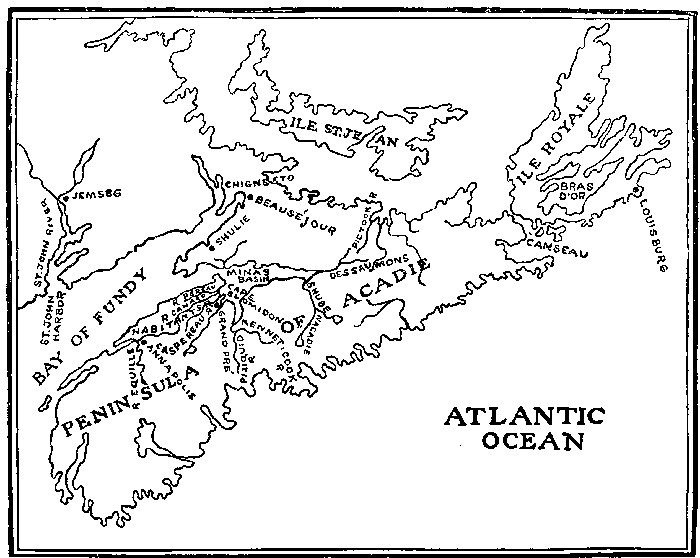
“Revenant à la Belle Acadie”—the
words sang themselves over and over in
my brain, but I could get no further than that
one line, try as I might. I felt that it was the
beginning of a song which, if only I could imprison
it in my rhyme, would stick in the hearts of our
men of Acadie, and live upon their lips, and be
sung at every camp and hearth fire, as “À la
Claire Fontaine” is sung by the voyageurs of the
St. Lawrence. At last I perceived, however, that
the poem was living itself out at that moment in
my heart, and did not then need the half-futile
expression that words at best can give. But I did
put it into words at a later day, when at last I
found myself able to set it apart and view it with
clear eyes; and you shall judge, maybe, when I
come to put my verses into print, whether I succeeded
2in making the words rhyme fairly and the
volatile syllables march at measured pace. The
art of verse has never been much practised among
us Acadians, and it is a matter of some pride to
me that I, a busy soldier, now here at Grand Pré
and anon at Mackinaw or Natchez, taking in my
hand my life more often than a pen, should have
mastered even the rudiments of an art so lofty and
exacting.
So, for awhile, “Home again to Acadie the
Fair” was all that I could say.
It was surely enough. I had come over from
Piziquid afoot, by the upper trail, and now, having
crossed the Gaspereau where it narrows just above
tide-water, I had come out upon the spacious
brow of the hill that overlooks Grand Pré village.
Not all my wanderings had shown me another
scene so wonderful as that wide prospect. The
vale of the Five Rivers lay spread out before me,
with Grand Pré, the quiet metropolis of the Acadian
people, nestling in her apple-bloom at my
feet. There was the one long street, thick-set with
its wide-eaved gables, and there its narrow subsidiary
lane descending from the slopes upon my
left. Near the angle rose the spire of the village
church, glittering like gold in the clear flood of
the sunset. And everywhere the dear apple-blossoms.
For it was spring in Acadie when I came
home.
3Beyond the village and its one black wharf my
eyes ranged the green, wind-ruffled marshes, safe
behind the sodded circumvallations of their dykes.
Past the dykes, on either side of “the island’s”
wooded rampart, stretched the glowing miles of
the flats; for the tides of Minas were at ebb. How
red in the sunset, molten copper threaded with
fire, those naked reaches gleamed that night!
Their color was like a blare of trumpets challenging
the peace of the Five Rivers.
Past the flats, smooth and dazzling to the eye at
such a distance, lay the waters of Minas. Well I
knew how their unsleeping eddies boiled and
seethed about the grim base of Blomidon. Such
tricks does memory serve one that even across
that wide tranquillity I seemed to hear the depredating
clamour of those tides upon the shingle.
Though it was now two years since I had seen
the gables and apple-trees of Grand Pré, I was in
no haste to descend into the village. There came
a sudden sinking at my heart, as my heart inquired,
with unseasonable pertinence, by what
right I continued to call Grand Pré “home”?
The thought was new to me; and that I might
fairly consider it I seated myself upon the broad
stump of a birch-tree, felled the preceding winter.
By far the smaller portion of my life had been
spent in the Acadian village—only my early boyhood,
before the years of schooling at Quebec;
4and afterwards the fleeting sweetness of some too
brief visits, that lay in my memory like pools of
enchanted leisure in a desert of emulous contentions.
My father, tenderest and bravest of all men
that I have known, rested in an unmarked grave
beside the northern wash of the Peribonca. My
uncle, Jean de Mer, Sieur de Briart, was on the
Ohio, fighting the endless battle of France in the
western wildernesses. His one son, my one cousin,
the taciturn but true-hearted Marc, was with his
father, spending himself in the same quarrel. I
thought with a longing tenderness of these two—the
father full of high faith in the triumph of New
France, the son fighting obstinately in what he
held a lost cause, caring mainly that his father still
had faith in it. I wished mightily that their brave
hands could clasp mine in welcome back to Grand
Pré. I thought of their two fair New England
wives, left behind at Quebec to shame by their gay
innocence the corruption of Bigot’s court. Kindred
I had none in Grand Pré, unless one green grave
in the churchyard could be called my kin—the
grave wherein my mother’s girlish form and laughing
eyes had been laid to sleep while I was yet a
child.
Yes, I had no kinsfolk to greet me back to
Grand Pré; no roof of mine that I should call it
home. But friends, loyal friends, would welcome
me, I knew. There was Father Fafard, the firm
5and gentle old priest, to whom, of course, I should
go just as if I were of his flesh and blood. Then
there were the De Lamouries—
Yes, to be sure, the De Lamouries. And here I
took myself by the chin and laughed. I know
that, for all my verses, I am in the main a soldier,
yet I am so far a poet as to suffer myself to befool
myself at times, and get a passing satisfaction out
of it. But I always face the fact before I express
it in act. I acknowledged to myself that I had
been thinking of the De Lamouries’ pleasant farmhouse,
and of somewhat that it contained, when I
sang “Home again to Acadie the Fair.”
I remembered with a pleasant warmth the tall,
bent figure, fierce eyes, and courtly air of Giles de
Lamourie, the broken gentleman, who through
much misfortune and some fault had fallen from a
high place at Versailles and been fain to hide himself
on an Acadian farm. I thought also of Madame,
his wife, a wizened little woman with nothing left,
said the villagers, to remind one of the loveliness
which had once dazzled Louis himself. To
me she seemed an amazingly interesting woman,
whose former beauty could still be guessed from
its ruins.
Both of these good people I remembered with
a depth of concern far beyond the deserts of such
casual friendlinesses as they had shown me. As
I looked down toward their spacious apple-orchard,
6on the furthest outskirts of the village, it
was borne in upon me that they had one claim to
distinction beyond all others.
They had achieved Yvonne.
Many a time had I wondered how my cousin
Marc could have had eyes for his ruddy-haired
Puritan lily when there was Yvonne de Lamourie
in the world. On my last two visits to
Grand Pré I had seen her; not many times, indeed,
nor much alone; and never word of love had
passed between us. In truth, I had not known that
I loved her in those days. I had taken a wondering
delight in her beauty and her wit, but of the
pretty trifles of compliment and the careless gallantries
that so often simulate love I had offered
her none at all. This surprised me the more
afterward, as women had ever found me somewhat
lavish in such light coin. I think I was withheld
by the great love unrealized in my heart, which
found expression then only in such white reverence
as the devotee proffers to his saint. I think,
too, I was restrained by the consciousness of a
certain girl at Trois Pistoles on the St. Lawrence,
who, if I might believe my vanity, loved me, and
to whom, if I might believe my conscience, I had
given some sort of claim upon my honor. I cared
naught for the girl. I had never intended anything
but a light and passing affair; but somehow
it had not seemed to me light when Yvonne de
7Lamourie’s eyes were upon me. A little afterward,
revisiting Trois Pistoles on my way to the western
lakes, I had found the maiden married to a prosperous
trader of Quebec. In the leaping joy that
seized my heart at the news I perceived how my
fetters had galled; and I knew then, though at
first but dimly, that if anywhere in the world there
awaited me such a love as I had dreamed of
sleeping, but ever doubted waking,—the love
that should be not a pastime, but a prayer, not an
episode, but an eternity,—it awaited me in Grand
Pré village.
In my heart these two years I had carried two
clear visions of my mistress. Strange to tell, they
were not bedimmed by the much handling which
they had endured. They but seemed to grow the
brighter and fresher from being continually pressed
to the kisses of my soul.
In one of these I saw her as she stood a certain
morning in the orchard, prying with insistent little
finger-tips into the heart of a young apple-flower,
while I watched and said nothing. I know not to
this day whether she were thinking of the apple-flower
or wondering at the dumbness of her cavalier;
but she feigned, at least, to concern herself
with only the blossom’s heart. Her wide white
lids downcast over her great eyes, her long
lashes almost sweeping the rondure of her cheek,
she looked a Madonna. The broad, low forehead;
8the finely chiselled nose, not too small for
strength of purpose; the full, firm chin—all added
to this sweet dignity, which was of a kind to
compel a lover’s worship. There was enough
breadth to the gracious curve below the ear to
make me feel that this girl would be a strong
man’s mate. But the mouth, a bow of tenderness,
with a wilful dimple at either delectable corner
always lurking, spoke her all woman, too laughing
and loving to spend her days in sainthood. Her
hair—very thick and of a purply-bronze, near to
black—lay in a careless fulness over her little
ears. On her head, though in all else she affected
the dress of the Grand Pré maids, she wore not
the Acadian linen cap, but a fine shawl of black
Spanish lace, which became her mightily. Her
bodice was of linen homespun, coarse, but bleached
to a creamy whiteness; and her skirt, of the same
simple stuff, was short after the Acadian fashion,
so that I could see her slim ankles, and feet of
that exceeding smallness and daintiness which
may somehow tread right heavily upon a man’s
heart.
The other vision cherished in my memory was
different from this, and even more enchanting. It
was a vision of one look cast upon me as I left
the door of her father’s house. In the radiance of
her great eyes, turned full upon me, all else
became indistinct, her other features blurred, as it
9were, with the sudden light of that look, which
meant—I knew not what. Indeed, it was ever
difficult to observe minutely the other beauties of
her face as long as the eyes were turned upon one,
so clear an illumination from her spirit shone
within their lucid deeps. Hence it was, I suppose,
that few could agree as to the colour of those eyes—the
many calling them black, others declaring
with confidence that they were brown, while some
even, who must have angered her, averred them
to be of a very cold dark grey. I, for my part,
knew that they were of a greenish hazel of indescribable
depth, with sometimes amber lights in
them, and sometimes purple shadows very mysterious
and unfathomable.
As I sat now looking down into the village I
wondered if Yvonne would have a welcome for me.
As I remembered, she had ever shown goodwill
toward me, so far as consisted with maidenly reserve.
She had seemed ever ready for tales of my
adventure, and even for my verses. As I thought
of it there dawned now upon my heart a glimmering
hope that there had been in that last unforgotten
look of hers more warmth of meaning than
maid Yvonne had been willing to confess.
This thought went to my heart and I sprang up
in a kind of sudden intoxication, to go straightway
down into the village. As I did so I caught
the flutter of a white frock among the trees of the
10De Lamourie orchard. Thereupon my breath came
with a quickness that was troublesome, and to
quiet it I paused, looking out across the marshes
and the tide toward Blomidon. Then for the first
time I observed a great bank of cloud that had
arisen behind the Cape. It was black and menacing,
ragged and fiery along its advancing crest.
Its shadow lay already upon the marshes and the
tide. It crept smoothly upon the village. And
at this moment, from the skirts of a maple grove
on the summit of the hill behind me, came a great
and bell-like voice, crying:
“Woe, woe to Acadie the Fair, for the hour of
her desolation cometh!”
Chapter II Grûl’s Warning
11
“These ten years,” I exclaimed to myself
angrily (for I love not to have a dream
rudely broken), “has Grûl been prophesying woe;
and I see not that aught comes of it save greater
strength to his lungs.”
I turned my back upon the valley and watched
the singular figure that drew near. It was a shrewd
and mysterious madman whom all Acadie had
known for the past ten years as “Grûl.” Whether
that was his real name or a pseudonym of his own
adoption no one knew. Whence he had come no
one knew. Wherefore he stayed in Acadie, and
so faithfully prophesied evil to our fair land, no
one knew. The reason of his madness—and the
method which sometimes seemed to lurk beneath
it—no one could confidently guess. At least,
such ignorance in regard to this fantastic fool
seemed general throughout the country. But
there lay here and there a suspicion that the Black
Abbé, the indomitable La Garne, Bigot’s tool and
12the people’s dread, knew more of Grûl’s madness
than other folk might dream. It was whispered
that La Garne, who seemingly feared no man
else, feared Grûl. It was certain that whenever
any scheme of the Black Abbé’s came to naught
Grûl’s hand would appear somewhere in the wreck
of it.
Now, as he came down from the maple grove, he
looked and was dressed just as I had seen him
years before. The vicissitudes of time and of the
weather seemed to have as little effect upon the
staring black and yellow of his woollen cloak as
upon his iron frame, his piercing light-blue eyes,
the snowy tangle of his hair and beard. Only
his pointed cap betrayed that its wearer dwelt
not altogether beyond the pale of mutability. Its
adornments seemed to recognize the seasons. I
had seen it stuck with cornflowers in the summer,
with golden-rod and asters in the autumn, with
feathers and strange wisps of straw in winter; and
now it bore a spray of apple-blossom, with some
dandelions, those northern sun-worshippers, whose
closing petals now declared that even in death
they took note of the passing of their lord.
In his hand Grûl carried the same quaint wand
of white wood, with its grotesque carven head
dyed scarlet, which had caught my eye with an
uneasy fascination the first time I met its possessor.
That little stick, which Grûl wielded with
13authority as if it were a sceptre, still caused me
some superstitious qualms. I remembered how at
my first sight of it I had looked to see a living
spark leap from that scarlet head.
“It has been a long time coming,” said I, as
Grûl paused before me, searching my face curiously
with his gleaming eyes. “And meanwhile
I have come. I think, monsieur, I should esteem
a welcome somewhat more cordial than your words
of dolorous omen.”
Whether he were displeased or not at my forwardness
in addressing him I cannot tell. He
was without doubt accustomed to choose his own
time for speech. His eyes danced with a shifting,
sharp light, and after thrusting his little wand at
me till, in spite of myself, I felt the easy smile
upon my lips grow something mechanical, he said
with withering slowness:
“To the boy and the fool how small a handful
of years may seem a lifetime! You think it is
long coming? It is even now come. The shadow
of the smoke of her burning even now lies upon
Acadie. The ships of her exile are near.”
He stopped; and I had no word of mocking
wherewith to answer him. Then his eyes and his
voice softened a little, and he continued:
“And you have come back—poor boy, poor
fool!—with joy in your heart; and your joy even
now is crumbling to ashes in your mouth.”
14He turned away, leaving me still speechless;
but in an instant he was back and his wand thrust
at me with a suddenness that made me recoil in
childish apprehension. In a voice indescribably
dry and biting he cried swiftly:
“But look you, boy. Whether she be yours or
another’s, there is an evil hand uplifted against her
this night. See you to it!”
“What do you mean?” I cried, my heart sinking
with a sudden fear. “Nay, you shall tell
me!” I went on fiercely, making as if to restrain
him by force as he turned away. But he bent
upon me one look of such scorn that I felt at once
convicted of folly; and striding off, with something
of a dignity in his carriage which all his
grotesquerie of garb could not conceal, he left me
to chew upon his words. As for the warning, that
was surely plain enough. I was to go to Yvonne,
and be by her in case of any need. The business
thus laid upon me was altogether to my liking.
But that pitying word—of joy that should turn to
ashes in my mouth! It filled me with black foreboding.
As I stepped down briskly toward Grand
Pré my joy was already dead, withered at a madman’s
whisper. And that great-growing cloud
from over Blomidon had swallowed up all the
village in a chill shadow.
Chapter III Charms and Counter-charms
15
Never may I forget that walking down from
the Gaspereau Ridge to Grand Pré village.
The very air seemed charged with mystery. Every
sight and every sound bore the significance of an
omen, to which I lacked interpreter. The roofs
of the village itself, and the marshes, the sea, and
the far-off bulk of Blomidon, appeared like the
tissue of a dream, ready to vanish upon a turn of
thought, and leave behind I knew not what of
terrible reality.
I am not by nature superstitious at all beyond
the point of convenience. Such superstitions as
please me I have ever been wont to cherish for the
interest to be had out of them. I have often been
strengthened in a doubtful intention by omens that
looked my way, and auspicious signs have many a
time cheered me astonishingly when affairs have
seemed to be going ill. But the most menacing
of omens have ever had small weight when opposing
themselves to my set purpose. When a superstition
16is on my side I show it much civility:
when it is against me it seems of small account.
But that night I was more superstitious than
usual. Of the new moon, a pallid bow just sinking,
I caught first sight over my left shoulder,
and I felt vaguely troubled thereat. One crow,
croaking from a willow stump upon my right
hand, got up heavily and flew across my path.
I misliked the omen, and felt straightway well
assured of some approaching rebuff. When, a
few moments later, two crows upon my left hand
flew over to my right I was not greatly comforted,
for they were far ahead and I was forced to conclude
that the felicity which they prophesied was
remote.
Thus it came that presently I was in a waking
and walking dream, not knowing well the substance
from the shadow. Yet my senses did so
continue to serve me that I went not down into the
village, where I knew I should find many a handclasp,
but followed discreetly along the back of
the orchards, that I might reach the De Lamourie
place as swiftly as possible.
By this hour a sweet-smelling mist, such as, I
think, falls nowhere else as it does in the Acadian
fields, lay heavy on the grasses. I bethought me
that it was the dew of the new moon, and therefore
endowed with many virtues; and I persuaded myself
to believe that my feet, which were by now
17well drenched with it, must needs be set upon a
fortunate errand.
As I came to this comforting conclusion I
reached a little thicket at an orchard corner, where
grew a deep tangle of early flowering herbs. There,
gathering the wet and perfumed blooms, stooped
an old woman with a red shawl wrapped over
her head and shoulders. She straightened herself
briskly as I came beside her, and I saw the haggard,
high-boned, hawk-nosed face of old Mother
Pêche, whose tales of wizardry I had often listened
to in the years long gone by. She turned upon
me her strange eyes, black points of piercing intelligence
encircled by a startling glitter of wide white,
and at once she stretched out to me a crooked
hand of greeting.
“It is good for these old eyes, Master Paul, to
see thee back in the village!” she exclaimed.
Now, any one will tell you that it is not well to
be crossed in one’s path by an old woman, when on
an errand of moment. I hurried past, therefore;
and it shames me to say it. But then, remembering
that one had better defy any omen than leave a
kindness undone, I stopped, turned back, and
hastily grasped the old dame’s wizened hand,
slipping into it a silver piece as I did so.
It was a broad piece, and full as much as I
could wisely spare; but an old woman or a small
boy is ever welcome to share my last penny. Her
18strange eyes gleamed for a moment, but as she
looked up to bless me her face changed. After
gazing earnestly into my eyes she muttered something
which I could not catch, and to my huge
amazement flung the silver behind her with a
violence which left no doubt of her intentions.
She flung it toward a little swampy pool; but as
luck would have it the coin struck a willow sapling
by the pool’s edge, bounded back, and fell with a
clink upon a flat stone, where I marked it as it lay
whitely glittering.
I was too amazed to protest for a moment, but
the old woman hastened to appease me.
“There was sorrow on it, dearie,—thy sorrow,”
she exclaimed coaxingly; “and I wouldn’t have it.
The devil take all thy bad luck, and Mary give
thee new fortune!”
To me it seemed that throwing away the silver
piece was taking superstition quite too seriously.
I laughed and said:
“But, mother, if there be bad luck ahead of me,
so much the more do I want your blessing, and
truly I cannot spare you another silver crown.
Faith, this one’s not gone yet, after all!” And
picking it up I handed it back to her. “Let the
devil fly away with my ill luck, if he may, but
don’t let him fly away with your little savings,” I
added.
The old dame shook her head doubtfully, and
19then with a sigh of resignation, as who should say,
“The gifts of destiny are not to be thrust aside,”
slipped the silver into some deep-hidden pocket.
But her loving concern for my prosperity was not
to be balked. After a little fumbling she brought
out a small pebble, which she gave me with an air
that showed it to be, in her eyes, some very great
thing.
I took it with an answering concern, looked at it
very closely, and turned it over in my hand, waiting
for some clue to its significance before I
should begin to thank her for the gift, if gift it
were. The stone was assuredly beautiful, about
the size of a hazel-nut, and of a clouded, watery
green in color, but the curious quality of it was that
as you held it up a moving loop of light seemed
to gather at its heart, taking somewhat the semblance
of a palely luminous eye. My interest
deepened at once, and I bethought me of a stone
of rarity and price which was sometimes to be
found under Blomidon. It went by the name of
“Le Veilleur,” or “The Watcher,” among our
Acadian peasants; but the Indians called it “The
Eye of Manitou,” and many mystic virtues were
ascribed to it.
“Why, mother,” I said presently, “this is a
thing of great price! I cannot take it. ‘Tis a
‘Watcher,’ is it not?” And I gazed intently into
its elusive loop of light.
20“I have another,” she answered eagerly, thrusting
her hands under her red cloak as if to prevent
me giving back the stone. “That is for thee, and
thou’lt need it, chéri Master Paul.”
“Well,” said I, staring at the beautiful jewel
with a growing affection, “I will take it with much
thanks, mother, but I must pay you what it is
worth; and that I will find out in Quebec, from
one who knows the worth of jewels.”
“Thou shalt not pay me, Master Paul,” said the
old dame, with a distinct note of resentment in her
voice. “It is my gift to thee, because I have
loved thee since thou wert a little lad; and because
thou’lt need the stone. Promise me thou’lt wear it
always about thee;” and plucking it from my hand
with a swift insinuation of her long fingers she slipped
it into a tiny pouch of dressed deerskin and proceeded
to affix a leathern thong whereby I might,
as I inferred, hang the talisman about my neck.
“While this you wear,” she went on in a low,
singing voice, “what most you fear will never come
to pass.”
“But I am not greatly given to fear, mother,”
said I, with a little vainglorious laugh.
“Then thou hast not known love,” she retorted
sharply.
At these words the fear of which she had spoken
came about me—vague, formless, terrible, and I
trembled.
21“Give it to me!” I cried in haste. “Give it to
me! I will repay you, mother, with”—and here
I laughed again—“with love, which you say I
have never known.”
“That kind of love, Master Paul, thou hast
known since thou wert a very little lad. Thou’st
given it freely, out of a kind heart. But, dearie,
thou hast but played at the great love—or more
would’st thou know of fear.” And the old woman
looked at me with shrewd question in her startling
eyes.
But I did know fear—and I knew that I knew
love. My face turned anxiously toward De Lamourie’s,
and I grudged every instant of further
delay.
“Good-by, mother, and the saints keep you!”
I cried hastily, swinging off through the wet grass.
But the old dame called after me gently:
“Stop a minute, Master Paul. She will be at
her supper by now; an’ in a little she’ll be walking
in the garden path.”
I stopped, filled with wonder, and my veins
leaping in wild confusion at the sound of that
little word “she.” It was as if the old woman
had shouted “Yvonne” at the top of her voice.
“What is it?” I stammered.
“I want to look at thy hand, dearie,” she said,
grasping it and turning it so as to catch the last
of the fading light.
22“Your heart’s desire is nigh your death of
hope,” said she presently, speaking like an oracle.
Then she dropped my hand with a little dry
chuckle, and turned away to her gathering of
herbs as if I were of no further account.
“What do you mean?” I asked eagerly.
But she would not answer me. I scorned to
appear too deeply concerned in such old woman’s
foolery; so I asked no more, but went my way,
carrying the word in my heart with a strange comfort—which,
had I but known it, was right soon
to turn into despair.
Chapter IV “Habet!”
23
I came upon the De Lamourie farmhouse by the
rear of the orchard; and down through the
low, blossoming arches, now humming with night
moths and honey beetles, I hastened toward the
front door. Before I reached it there arose an
angry barking from the yard, and a huge black
dog, objecting to the manner of my approach,
came charging upon me with appearance of malign
intent.
I was vexed at the notion of a possible encounter,
for I would not use my sword or my
pistols on the guardian of my friend’s domain; yet
I had small desire that the brute should tear my
clothes. I cursed my folly in not carrying a stick
wherewith to beat off such commonplace assailants.
But there was nothing for it save indifference,
so I paid no attention to the dog until he
was almost upon me. Then I turned my head and
said sharply, “Down, sir, down!”
To all domestic animals the voice of authority
24is the voice of right. I had forgotten that for the
moment. The dog stopped, and stood growling
doubtfully. He could not muster up resolution to
attack one who spoke with such an assurance of
privilege. Yet what could justify my highly irregular
approach? He would await developments.
In a casual, friendly manner, as I walked on, I
stretched out the back of my hand to him, as if to
signify that he might lick it if he would; but this
he was by no means ready for, so he kept his distance
obstinately.
In another moment there appeared at the head
of the path a white, slight figure, with something
black about the head and shoulders. It was
Yvonne, come out to see the cause of the loud
disturbance.
“It is I, mademoiselle,” I exclaimed in an eager
voice, hastening to meet her,—“Paul Grande,
back from the West.”
A slight gasping cry escaped her, and she
paused irresolutely. It was but for the least part
of an instant; yet my memory took note of it
afterward, though it passed me unobserved at the
time. Then she came to meet me with outstretched
hands of welcome. Both little hands I
crushed together passionately in my grasp, and
would have dropped on my knees to kiss them
but for two hindrances: Firstly, her father appeared
at the moment close behind her—and
25things which are but natural in privacy are like to
seem theatrical when critically observed. Further,
finding perhaps a too frank eloquence in my demeanour,
Yvonne had swiftly but firmly extricated
her hands from their captivity. She had said
nothing but “I am glad to see you again, after so
long a time, monsieur;” and this so quietly that
I knew not whether it was indifference spoke,
or emotion.
But the welcome of Giles de Lamourie was right
ardent for one of his courteous reserve. There
was an affection in his voice that warmed my
spirit strangely, the more that I had never suspected
it; and he kissed me on both cheeks as if
I had been his own son—“as,” said the up-leaping
heart within me, “I do most resolutely set
myself to be!”
“And to what good chance do we owe it, Paul,
that we see you here at Grand Pré, at a time when
the swords of New France are everywhere busy?”
he asked.
“To a brief season of idleness in two years of
ceaseless action,” I replied, “and to a desire that
would not be denied.” I sought furtively to catch
Yvonne’s eyes; but she was picking an apple-flower
to pieces. This little dainty depredation
of her fingers pierced me with remembrance.
“You have earned your idleness, Paul,” said De
Lamourie, “if the stories we hear of your exploits
26be the half of them true. But we had thought
down here that Quebec”—“or Trois Pistoles,”
murmured Yvonne over the remnants of the apple-flower—“would
have offered metal more attractive
for the enrichment of your holiday.”
I flushed hotly. But in the deepening dusk my
confusion passed unseen. What gossip had come
this way? What magnifying and distortion of a
very little affair, so soon gone by and so lightly
forgotten?
“The swords of New France are just now
sheathed for a little,” said I, with some reserve in
my voice. “They are biding the call to new and
hotter work, or I should not be free for even this
breathing-spell. As for Quebec,”—for I would
not seem to have heard mademoiselle’s interruption,—“for
years there has been but one place
where I desired to be, and that is here; so I have
come, but it is not for long. Great schemes are
afoot.”
“For long or for little, my boy,” said he, dropping
his tone of banter, “your home here must be
under our roof.”
Having intended staying, as of old, with Father
Fafard, I knew not for a moment what to say. I
would—and yet a voice within said I would not.
I noted that Yvonne spoke no word in support of
her father’s invitation. While I hesitated we had
entered the house, and I found myself bending
27over the wizened little hand of Madame de
Lamourie. My decision was postponed. Had I
guessed how my silence would by and by be misinterpreted
I would assuredly have decided on the
spot, whichever way.
“It is not only for the breath of gayety from
Chateau St. Louis which you bring with you, my
dear Paul, that you are welcome,” said Madame,
with that fine air of affectionate coquetry, reminiscent
of Versailles, which so delightfully became her.
I kissed her hand again. We had always been
the best of friends.
“But let me present to you,” she went on, “our
good friend, who must also be yours: Mr. George
Anderson;” and observing for the first time a
tall, broad-shouldered, ruddy man, who stood a
little to one side of the fireplace, I bowed to him
very courteously. Our eyes met. I felt for him
a prompt friendliness, and as if moved by one impulse
we clasped hands.
“With all my heart,” said I, being then in cordial
mood, and eager to love one loved of these
my friends.
“And mine,” he said, in a quiet, grave voice,
“if it please you, monsieur.”
“Yet,” I laughed, “if you are English, Monsieur
Anderson, we must officially be enemies. I
trust our difference may be in all love.”
“Yes,” said Madame, with a dry little biting
28accent which she much affected, “yes, indeed, in
all love, my dear Paul. Monsieur Anderson is
English—and he is the betrothed husband of our
Yvonne,” she added, watching me keenly.
It seemed to me as if there had been a sudden
roaring noise and then these last dreadful words
coming coldly upon a great silence. At that
moment everything stamped itself ineffaceably on
my brain. I see myself grasp the back of a chair,
that I may stand with the more irreproachable
steadiness. I see Madame’s curious scrutiny. I
see Yvonne’s eyes, which had swiftly sought my
face as the words were spoken, change and warm
to mine for the least fraction of a second. I see
all this now, and her slim form unspeakably graceful
against the dark wainscoting of the chimney side.
Then it all seemed to swim, and I knew that it
was with great effort of will I steadied myself;
and at last I perceived that Yvonne was holding
both Anderson and her father in rapt attention by
a sort of radiance of light speech and dainty gesture.
I dimly came to understand that Yvonne
had seen in my face something which she had not
looked to see there, and, moved to compassion,
had come to my aid and covered up my hurt. In
a moment more I was master of myself, but I
knew that Madame’s eyes had never left me. She
liked me more than a little; but a certain mirthful
malice, which she had retained from the old
29gay days in France, made her cruel whensoever
one afforded her the spectacle of a tragedy.
All this takes long in the telling; but it was
perhaps not above a minute ere I was able to perceive
that Mademoiselle’s diversion had been upon
the theme of one’s duty to one’s enemies. What
she had said I knew not, nor know I to this day;
but I will wager it was both witty and wise. I
only know that at this point a direct appeal was
made to me.
“You, monsieur,” said Anderson, in his measured
tones, “will surely grant that it is always virtuous,
and often possible, to love one’s enemies.”
“But never prudent!” interjected De Lamourie,
whose bitter experiences in Paris colored his conclusions.
“Your testimony, monsieur, as that of one who
has sent so many of them to Paradise, is much to
be desired upon this subject,” exclaimed Yvonne,
in a tone of challenge, at the same time flashing
over me a look which worked upon me like a
wizard’s spell, making me straightway strong and
ready.
“Well may we love them!” I cried, with an air
of sober mockery. “Our enemies are our opportunities;
and without our opportunities, where are
we?”
“All our life is our opportunity, and if we be
brave and faithful to church and king we are
30made great by it,” exclaimed a harsh, intense
voice behind us.
I noted a look of something like consternation
on De Lamourie’s face, and a mocking defiance in
the eyes of Yvonne. We turned about hastily to
greet the new-comer. I knew at once, by hearsay,
that dark-robed figure—the high, narrow, tonsured
head—the long nose with its aggressively
bulbous tip—the thin lips with their crafty smile—the
dogged and indomitable jaw. It was La
Garne, the Black Abbé, master of the Micmac
tribes, and terror of the English in Acadie. He
was a devoted servant to the flag I served, the
lilied banner of France; but I dreaded and detested
him, for I held that he brought dishonour on
the French cause, as well as on his priestly office,
by his devious methods, his treacheries, and his
cruelties. War, I cannot but think, becomes a
gross and hideous thing whensoever it is suffered
to slip out of the control of gentlemen, who alone
know how to maintain its courtesies.
Chapter V The Black Abbé Defers
31
“You are welcome, father,” began Monsieur
de Lamourie, advancing to meet the visitor,
“to my humble”—But the harsh voice cut
him short.
“Lie not to me, Giles de Lamourie,” said the
grim priest, extending a long left hand as if in
anathema. “Well do I know my face is not welcome
in this house!”
De Lamourie drew himself up haughtily, and
Madame interrupted.
“Good father,” said she most sweetly, but with
an edge to her voice, “do you not take something
the advantage of your gown? Might I not be so
bold as to entreat a more courteous deliverance of
your commands?”
“What have I to do with forms and courtesies,
woman?” he answered—and ignored Yvonne’s
laughing acquiescence of “What, indeed, monsieur?”
“I come to admonish you back to your
duty; and to warn you, if you heed not. I learn
32that you are about to go to Halifax, Giles de Lamourie,
and there forswear France, bowing your
neck to the English robber. Is this true?”
“I am about to swear allegiance to England,
Father La Garne,” said De Lamourie coldly.
The priest’s pale eyes narrowed.
“There is yet time to change your mind,” said
he, in a voice grown suddenly smooth. “Give me
your word that you will remain faithful to France
and the bolt which even now hangs over your
recreant head shall never fall!”
I looked about me in deep astonishment.
Yvonne’s face was splendid in its impatient scorn.
Madame looked solicitous, but composed. Anderson
smiled coolly. But De Lamourie was hot with
indignation.
“It was not to be dictated to by every tonsured
meddler that I came to Acadie,” he cried, rashly
laying himself open.
“I have heard as much,” said the priest dryly.
“But enough of this talk,” he went on, his voice
again vibrating. “You, George Anderson, seducer
of these people from their king, look to yourself!
Your threshold is red. As for this house”—and
he looked around with slow and solemn menace—“as
for this house, it shall not see to-morrow’s
sun!”
Hitherto I had been silent, as became a mere
new-come guest; but this was too much for me.
33“Ay, but it shall!” said I bluntly, stepping
forward.
La Garne looked at me with unaffected surprise
and contempt.
“And pray, sir, who may you be to speak so
confidently?” he asked.
“I am an officer of the king, Sir Abbé,” I
answered, “and a messenger of the governor of
New France, and a man of my word. Your quarrel
here I do not very well understand, but I beg
you to understand that this house is the house of
my friends. I know you, Sir Abbé,—I have
heard rumour of your work at Beaubassin, Baie
Verte, and Gros Ile. I tell you, I will not suffer
you to lift your hand against this house!”
“Truly, monsieur, you speak large,” sneered
the priest. “But you may, perchance, have authority.
I seem to have seen your face before.
Your name?”
“Paul Grande,” said I, bowing.
La Garne’s face changed. He looked at me
curiously, and then, with a sort of bitter tolerance,
shrugged his shoulders.
“You have been to Monsieur le Commandant
Vergor, at Beauséjour?” he asked.
I bowed.
“And to Vaurin, at Piziquid?” he went on
thoughtfully.
I fancied that a shade of suspicion passed over
34the faces of my hosts; and Yvonne’s face paled
slightly; but I replied:
“I have just come from Piziquid.”
“Your authority is sufficient, then, monsieur,”
said he. “The messenger of the governor to
Vaurin doubtless knows his business, and it is
unnecessary for me to interfere.”
I bowed my thanks, holding courtesy to be in
place, since I had gained my point.
“And I pardon your abruptness, Monsieur
Grande,” continued the Black Abbé. “We are
both working for the king. We have no right to
quarrel when we have such great work to do. I
am sure I may accept your apology for your
abruptness?” And he looked at me with an air
of suggestion.
I was puzzled at his changed demeanour, but I
would not show myself at a loss. Still less would
I apologize, or suffer any pretence of friendliness
between himself and me.
“I am sure you may,” said I pleasantly. And
I think the reply a prudent one.
Yvonne smiled—I just caught the smile; but
the abbé turned on his heel.
“I withdraw my admonition,” he said to De
Lamourie smoothly, “and leave your case in the
hands of this gentleman, your good friend. I
wish you a swift conversion—or a long repentance.”
And with a glance at me which I liked
35not, but could by no means interpret, he was
gone.
The room grew straightway the brighter for his
going.
Chapter VI A New England Englishman
36
I have said that the room grew brighter for
the going of the Black Abbé. To me, at
least, it seemed so. Yet, after his departure,
there fell a palpable air of constraint. Monsieur
de Lamourie regarded me with something almost
like suspicion. Madame eyed me with a curious
scrutiny, tolerant, yet as it were watchful. As for
Yvonne, her face was coldly averted. All this
troubled me. Only the New Englander came to
my rescue.
With a smile of frank satisfaction he remarked:
“You dealt very effectively and expeditiously
with that black-frocked firebrand, monsieur. You
must have great influence at headquarters to be
able to treat La Garne with so little ceremony.”
Now, puzzled though I was, I was marvellously
elated by my easy victory over the notorious
Black Abbé. There was doubtless a vainglorious
ring in the would-be modest voice with which I
answered.
37“Yes,” said I, “I did not expect quite so swift
a triumph. I thought I might even be driven to
threats ill fitting the dignity of his office. But
doubtless he saw that I was rather in earnest.”
“He certainly seemed to regard you as one
having authority,” said De Lamourie gravely.
“Or even,” murmured Madame, with that dryness
in her voice, “as in some way his confederate.”
“Or Vaurin’s,” came a cold suggestion from
Mademoiselle. Her eyes were gazing steadily into
the fire; but I caught the scornful curl of her lip.
At this I felt myself flush hotly, I knew not just
why. It seemed as if I lay under some obscure
but disgraceful imputation. With sudden warmth
I cried:
“I have no authority, save as an officer of the
king, with a clean record and a sword not unproven.
I have no confederate, nor am I like to
be engaged in such work as shall make one needful.
And as for this Vaurin,” I demanded,
turning to Yvonne, “who is he? He seems a
personage indeed; yet never had I heard of him
till the commandant of Beauséjour gave me a
letter for his hand.”
“I cannot doubt you, monsieur,” interposed
Anderson heartily. “This Vaurin is a very sorry
scoundrel, a spy and an assassin, who does the
dirty work of those who employ him. I think it
38was ill done of Vergor to give to any gentleman a
commission to that foul cur.”
I sprang to my feet and walked thrice up and
down the room, while all sat silent. I think my
anger was plain enough to every one, for the old
friendliness—as I afterwards remembered—came
back to the faces of Monsieur and Madame de
Lamourie, and Yvonne’s eyes shone upon me for
an instant with a wistfulness which I could not
understand. Yet this, as I said, is but what came
back to me afterwards. I felt Yvonne’s eyes but
as in a dream at that moment.
“Vergor shall answer to me,” I cried bitterly.
“It is ill work serving under the public thieves
whom the intendant puts in power to-day. One
never knows what baseness may not be demanded
of him. Vergor shall clear himself, or meet me!”
“What hope is there for your cause,” asked
Anderson, “when they who guide New France
are so corrupt?”
“They are not all corrupt!” I declared with
vehemence. “The governor is honest. The general
is honour itself. But, alas, the most grievous
enemies of New France are those within her gate!
Bigot is the prince of robbers. His hands and
those of his gang are at her throat. It is he we
fear, and not you English, brave and innumerable
though you are.”
And with this my indignation at Vergor, who, it
39was plain, had put upon me an errand unbecoming
to a gentleman and an officer of the king, spread
out to include the whole corrupt crew of which
the intendant Bigot was the too efficient captain.
Seating myself again by the hearth, I gave bitter
account of the wrong and infamy at Quebec, and
showed how, to the anguish of her faithful sons,
New France was being stripped and laid bare to
the enemy. My heart being as dead with my
own sudden sorrow, the story which I told of my
country’s plight was steeped in dark forebodings.
When I had finished, the conversation became
general, and I presently withdrew into my heaviness.
I remember that Madame rallied me, at
last, on my silence; but Yvonne came quickly and
sweetly to my help, recalling my long day’s journey
and insisting upon my drinking a cup of spiced
brandy—“very sound and good,” she declared,
“and but late from Louisburg, no thanks to King
George!”
As I sat sipping of the fragrant brew—though it
had been wormwood it had seemed to me delicate
from her hand—I tried to gather together the
shattered fragments of my dream.
There she sat—of all women the one woman,
as I had in the long, solitary night-watches come
to know, whom my soul needed and my body
needed. My inmost thought, speaking with itself
in nakedest sincerity, declared that it was she
40only whom God had made for me—or for whom
God had made me. The whole truth, as I felt it,
required both statements to perfect its expression.
There she sat, so near that her voice was making
a wonder of music in my ears, so near that her
eyes from time to time flashed a palpable radiance
upon my face; yet further away than when I
lightened with dreams of her the long marches
beside the Miami or lay awake to think of her, in
the remote huts of the Natchez. So far away had
a word, a brief word, put her; yet here she sat
where I could grasp her just by stretching out my
hand.
As I thought of it her eyes met mine. I swear
that I made no motion. My grasp never relaxed
from the arm of the black old chair where it had
fixed itself. Yet the thought must have cried
out to her, for a look of alarm, yet not wholly of
denial, flickered for one heart-beat in her gaze.
She rose, with a little aimless movement, looked
at me, swayed her body toward me almost imperceptibly,
then sat down again in her old place
with her face averted. At once she began talking
with a whimsical gayety that engrossed all
ears and left me again in my gloom.
I scrutinized this man, the New Englander, who
sat drinking her with his eyes. For the joy that
was in his face as he watched her I cursed him—yet
ere the curse had gone forth I blessed him
41bitterly. How could I curse him when I saw that
his soul was on its knees to her, as mine was. I
felt myself moved toward him in a strange affection.
Yet—and yet!
He was a tall man, well over six feet in height, of
a goodly breadth of shoulder,—taller than myself
by three inches at least, and heavier in build. He
had beauty, too, which I could not boast of;
though before love taught me humility I had been
vain enough to deem my face not all ill-favored.
His abundant light hair, slightly waving; his ruddy,
somewhat square face, with its good chin and kind
mouth; his frank and cheerful blue eyes, fearless
but not aggressive; his air of directness and good
intention—all compelled my tribute of admiration,
and made me think little of my own sombre and
sallow countenance, with its straight black hair,
straight black brows, straight black moustache;
its mouth large and hard set; its eyes wherein
mirth and moroseness were at frequent strife for
mastery. Being, as I have reluctantly confessed, a
vain man without good cause for vanity, I knew the
face well—and it was with small satisfaction I remembered
it now, while looking upon the manly
fairness of George Anderson.
Yet, such is the inconsistency of men, I was conscious
of a faint, inexplicable pity for him. I felt
myself stronger than he, and wiser in the knowledge
of life. But he had the promise of that
42which to me was more than life. He had, as I
kept telling myself, Yvonne’s love; yet—had
he? So obstinate is hope, I would not yield all
credence to this telling. At least I had one advantage,
if no other. I was wiser than he in this,
that I knew my love for Yvonne, and he did not
know it. Yet this was but a poor vantage, and
even upon the moment I had resolved to throw it
away. I resolved that he should be as wise as I
on this point, if telling could make him so.
Chapter VII Guard!
43
I had just arrived at this significant determination
when I was roused from my reverie by
Anderson making his farewells. He was holding
out his hand to me.
“Your face is stern, monsieur,” he said. “Were
you fighting your old battles o’er again?”
“No—new ones!” I laughed, springing up and
seizing his hand.
“May you win them, as of old!” he exclaimed,
with great heartiness.
“You are generous, monsieur,” I said gently,
looking him in the eyes.
But this remark he took as quite the ordinary
reply, and with a bright glance for us all he moved
toward the door. Yvonne followed him, as it
seemed was expected of her.
“Must you go so early?” she asked, with a
kindness in her voice which pierced me.
“Yes,” he said, looking down at her upturned
face. “The tide is just right now, and this fair
44wind must not be lost. It will be a fine run under
this moon; and Pierre has the new boat over
to-night.”
“It is a good night,” she assented, peering
through the open door with a gesture of gay
inquiry; “and how sweet the apple-blossoms
smell! Have you as good air as this, Monsieur
Grande, on those western rivers of yours, or at
Trois Pistoles?”
As she did not turn her head or seem to require
an answer, I made none. And, indeed, I was
spared the necessity, for Anderson intervened with
matter of his own.
“Come down to the gate with me, won’t you?”
I heard him beg in a low voice.
But for some reason Mademoiselle was not disposed
to be kind that night. She drew back, and
looked down pointedly at her dainty embroidered
moccasins.
“Oh,” she cried lightly and aloud, with a tantalizing
ring in her voice, “just think how wet
the path is!”
Anderson turned away with a disappointed air,
whereupon she reached out her hand imperiously
for him to kiss. Then she waved him a gay bon voyage,
and came back into the room with a quick lightness
of step which seemed like laughter in itself.
Her eyes were a dancing marvel, with some strange
excitement.
45“Monsieur,” she began, coming straight toward
me. But I just then awoke to my purpose.
“A thousand pardons, mademoiselle and
madame!” I cried, springing to my feet and hastening
to the door. “I will be back in two moments;
but I have a word for Monsieur Anderson
before he goes.”
That I should interrupt her in this way, and rush
off when she was about to speak to me, fetched a
sudden little cloud of astonishment over Yvonne’s
face. But I would not be delayed. I made haste
down the path and caught Anderson before he
reached the gate. He paused with an air of genial
surprise.
“Your pardon, monsieur,” said I; “but with
your permission I will accompany you a few steps,
as I have something to say to you.”
“I am glad to have your company, monsieur,”
said he, with a manner that spoke sincerity.
“Are you?” said I abruptly. “Well, somehow
I take your words as something more than the
thin clink of compliment. I like you—I liked
you the moment my eyes fell upon you.”
His face flashed into a rare illumination, and
without a word he held out his hand.
I could not but smile responsively, though I
thrust my hand behind my back and shook my head.
“Wait!” said I. “I want to say to you that—I
love—I love Mademoiselle de Lamourie!”
46His face clouded a little, and he withdrew his
hand, but not angrily.
“We are very much of one mind in that, I assure
you,” he said.
“The very ground she walks upon is sacred to
me,” I continued.
He smiled ever so little at the passion of my
speech, but answered thoughtfully:
“It is but natural, I suppose. I do not think
we will quarrel upon that score, monsieur.”
“For two years,” said I, in a low voice, speaking
coldly and evenly, “I have been moved night and
day by this love only. It has supported me in
hunger and in weariness; it has led me in the
wilderness; it has strengthened me in the fight;
it has been more to me than all ambition. Even
my love of my country has been second to it. I
came here to-day for one reason only. And I
find—you!”
“None can know so well as I what you have
lost, monsieur,” said he very gravely, “as none
can know so well as I what I have gained.”
His kindness, no less than his confidence, hurt
me.
“Are you so sure?” I asked.
“The discussion is unusual, monsieur,” said he,
with a sudden resentment. “I will only remind
you that Mademoiselle de Lamourie has accepted
my suit.”
47No man’s sternness has ever troubled me, and
I smiled slightly in acknowledgment of his very
reasonable remark.
“The situation is unusual, so you must pardon
me,” said I, “if I arrogate to myself a somewhat
unusual freedom. I tell you now frankly that by
all open and honorable means I will strive to win
the love of Mademoiselle de Lamourie. I have
hope that she has not yet clearly found the wisdom
of her heart. I believe that I, not you, am the
man whom she will love. Laugh at my vanity as
much as you will. I am not yet ready to say my
hope is dead, my life turned to nothingness.”
“You are weak,” said he, with some severity,
“to hold your life thus, as it were, in jeopardy of a
woman’s whim.”
I could hardly restrain my voice from betraying
a certain triumph which I felt at this sign of
imperfection in his love.
“If you hold it a weakness,” said I, “there is a
point at last in which we differ. If it be a weakness,
then it is one which, up to two years ago, I
had scarce dared hope to attain. Few, indeed, are
the women, and as few men, strong enough for the
full knowledge of love.”
“Yet the greatest love is not the whole of life,”
he averred disputatiously.
“You speak but coldly,” said I, “for the lover
of Mademoiselle de Lamourie.”
48He started. I had stung him. “I am of the
Society of Friends—a Quaker!” said he
harshly. “I do not fight. I lift not my hand
against my fellow-man. Yet did I believe that
you would succeed in winning her love, I think I
would kill you where you stand!”
I liked the sharp lines of his face as he said it,
fronting me with eyes grown suddenly cruel. I
felt that he meant it, for the moment at least.
“Say, rather,” said I, smiling, “that you would
honestly try your best to kill me. It would be an
interesting experiment. Well, now we understand
each other. I will honestly try my best to do you
what will be, in my eyes, the sorest injury in the
world. But I will try by fair means only, and if I
fail I will bear you no grudge. In all else, however,
believe that I do greatly desire your welfare,
and will seize with eagerness any occasion of doing
you a service. You are perhaps less unworthy
of Mademoiselle de Lamourie than I am, save
that you cannot love her so well. And now,” I
added with a smile, “will you take my hand?”
As I held it out to him he at first drew back
and seemed disposed to repulse me. Then his
face cleared.
“You are honest!” he exclaimed, and wrung
my hand with great cordiality. “I rather like
you—and I am very sorry for you. I have her
promise.”
49“Well,” said I, “if also you have her love you
are the most fortunate man on God’s earth!”
“I have it!” said he blithely, and strode off
down the path between the apple-trees, his fine
shoulders held squarely, and a confidence in all
his bearing. But a wave of pity for him, and
strange tenderness, went over me in that moment,
for in that moment I felt an assurance that I
should win.
It was an assurance doomed to swift ruin. It
was an assurance destined soon to be hidden under
such a vast wreckage of my hopes that even memory
marvelled when she dragged it forth to light.
Chapter VIII The Moon in the Apple-bough
50
During all our conversation we had stood in
plain view of the windows, so that our
friendly parting must have been visible to all the
house. On my return within doors I found Yvonne
walking up and down in a graceful impatience, her
black lace shawl thrown lightly about her head.
“If you want to,” said she, “you may come
out on the porch with me for a little while, monsieur.
I want you to talk to me.”
“Yvonne,” exclaimed her mother, in a rebuking
voice, “will not this room do as well?”
“No, indeed, little mamma,” said she wilfully.
“Nothing will do as well as the porch, where the
moonlight is, and the smell of the apple-blossoms.
You know, dear, Grand Pré is not Paris!”
“Nor yet is it Quebec,” said I pointedly.
Monsieur de Lamourie smiled. Whatever
Yvonne would was in his eyes good. But her
mother yielded only with a little gesture of
protest.
51“Yvonne is always a law unto herself,” she
murmured.
“And to others, I judge,” said I, following the
light figure out upon the porch, and closing the
door behind me.
I praised the saints for the freedom of Grand
Pré. At Quebec Mademoiselle would have been
the most formal of the formalists, because in Quebec
it was easy to be misjudged.
In the corner of the porch, where a huge apple-bough
thrust its blossoms in beneath the roof, was
slung a stout hammock such as sailors use on shipboard.
Mademoiselle de Lamourie had seen these
during a voyage down the Gulf from Quebec, and
had so fancied them that her father had been impelled
to have one netted for her by the shad-fishers.
It was her favoured lounging-place, and
thither she betook herself now without apology.
In silence I held the tricksy netting for her. In
silence I placed the cushion beneath her head.
Then she said:
“You may sit there,” and she pointed, with a little
imperious motion, to a stout bench standing against
the wall.
I accepted the seat, but not its location. I
brought it and placed it as close as I dared to the
hammock. In doing so I clumsily set the hammock
swinging.
“Please stop it,” said Mademoiselle; and as I
52seated myself I laid my hand on the side of the
hammock to arrest its motion. My fingers found
themselves in contact with other fingers, very slim
and warm and soft. My breath came in a quick
gasp, and I drew away my hand in a strange and
overwhelming perturbation. The hammock was
left to stop of itself—and, indeed, its swinging
was but slight. As for me, I was possessed by an
infinite amazement to find myself thus put to confusion
by a touch. I had no word to say, but sat
gazing dumbly at the white figure in the moonlight.
Her face was very pallid in that colorless light,
and her eyes greater and darker than ever, deeps
of mystery,—and now, I thought, of grave mockery
as well. She watched me for a little in silence,
and then said:
“I let you come out here to talk to me, monsieur!”
I straightened myself upon the bench, and tried
my voice. My misgivings were justified. It trembled,
beyond a doubt. The witch had me at a
grave disadvantage. But I spoke on quietly.
“From my two years in the woods of the West,
mademoiselle,” said I, “I brought home to Grand
Pré certain wonderful dreams. Of these I find
some more than realized; but one, which gave all
meaning to the rest, has been put to death this
night.”
53“Even in Grand Pré dreams are no new thing,”
she said in haste. “I want to hear of deeds, of
brave and great action. Tell me what you have
done—for I know that will be brave.” And she
smiled at me such kind encouragement that my
heart began thumping with vehemence. However,
I made shift to tell her a little of my wanderings—of
a bush fight here, a night march there, of the
foiling of a foe, of the timely succour of a friend—till
I saw that I was pleasing her. Her face leaned
a little toward me. Her eyes spoke, dilating and
contracting. Her lips were slightly parted as she
listened. And into every adventure, every situation,
every movement, I contrived to weave a suggestion
of her influence, of the thought of her
guiding and upholding me. These things, touched
lightly and at once let pass, she did not rebuke.
She feigned not to understand them.
At last I paused and looked at her, waiting for
a word of praise or blame.
“And your poetry, monsieur?” she said gently.
“Surely that was not all the time forgotten. This
Acadian land, with its wonder and its beauty, has
found no interpreter but you, and your brave work
in the field would be a misfortune, not a benefit, if
it cost us your song.”
“The loss of my verses were no great loss,”
said I.
“Indeed, monsieur,” she said earnestly, “I do
54not think you can be as modest as you pretend.
But I am sincere. Since we have known your song
of them, I think that mamma and I have watched
only through your eyes the great sweep of the
Minas tides. And only the other day I heard
papa, who cares for no poetry but his old ‘Chansons
de Gestes,’ quoting you to Father Fafard with
evident enthusiasm.” She paused—but I said
nothing. I had talked long; and I wished her to
continue. What she was saying, the manner of her
saying it, were such as I could long listen to.
“As for me,” she went on, “I never walk down
the orchard in summer time without saying over
to myself your song of the apple-leaves.”
“You do, really, remember my verses?” said I,
flushing with surprise and joy. I was not used to
commendation for such things, my verses being
wont to win no more approval than they merited,
which I felt to be very little.
She laughed softly, and began to quote:
“O apple leaves, so cool and green
Against the summer sky,
You stir, although the wind is still
And not a bird goes by!
You start,
And softly move apart
In hushed expectancy.
Who is the gracious visitor
Whose form I cannot see?
55“O apple leaves, the mystic light
All down your dim arcade!
Why do your shadows tremble so,
Half glad and half afraid?
The air
Is an unspoken prayer;
Your eyes look all one way.
Who is the secret visitor
Your tremors would betray?”
It was a slight thing, which I had never thought
particularly well of; but on her lips it achieved a
music unimagined before.
“Your voice,” said I, “makes it beautiful, as it
makes all words beautiful. Yes, I have written
some small bits of verse during my exile, but they
have been different from those of mine which you
honour with your praise. They have had another,
a more wonderful, theme—a theme all too high
for them, which nevertheless spurred them to their
best. They have at least one merit—they speak
the truth from my heart.” As I spoke I felt myself
leaning forward, though not of set purpose,
and my voice sank almost to a whisper.
“One of them,” I continued, begins in this way:
“A moonbeam or a breath, above thine eyes I bow,
Silent, unseen,
But not, ah! not unknown”—
“Wait!” she interrupted, in a voice that sounded
a little faint. “Wait! I want to hear them all,
56monsieur; but not to-night. You shall say them
to me to-morrow. I must not stay to listen to
them to-night. I am a little—cold, I think!
Help me out, please!” And she rashly gave me
her hand.
Now, it was my honest intention at that instant
to do just her bidding and no more; but when I
touched her fingers reason and judgment flowed
from me. I bowed my head over them to the
edge of the hammock, and with both my hands
crushed them to my lips. She sank back upon
her cushion, with a little catching of her breath.
After a few moments I raised my head—but
with no speech and with no set purpose—and
looked at her face. It was very grave, and curiously
troubled, but I detected no reproach in the
great eyes that met mine. A fierce impulse seized
me to gather her in my arms—but I durst not,
and my eyes dropped as I thought of it. By
chance they rested upon her feet—upon the tiny,
quill-worked, beaded white moccasins, demurely
crossed, the one over the other. Her skirt was so
closely gathered about her ankles that just an inch
or two of one arched instep was visible over the
edge of the low-cut moccasin. Before I myself
could realize what I was about to do, or half the
boldness of the act, in a passion that was all worship
I threw myself down beside her feet and
kissed them.
57It was for an instant only that my daring so
prevailed. Then she suddenly slipped away. In
a breathless confusion I sprang to my feet, and
found her standing erect at the other side of the
hammock. Her eyes blazed upon me; but one
small hand was at her throat, as if she found it
hard to speak.
“How could you dare?” she panted. “What
right did I give you? What right did I ever give
you?”
I leaned against the pillar that supported one
end of the hammock.
“Forgive me! I could not help it. I have
loved you, worshipped you, so long!” I said in a
very low voice.
“How dare you speak so?” she cried. “You
forget that”—
“No, I remember!” I interrupted doggedly.
“I forget nothing. You do not love him. You
are mine.”
“Oh!” she gasped, lifting both hands sharply
to her face and dropping them at once. “I shall
never trust you again.”
And in a moment she had flashed past me, with
a sob, and disappeared into the house.
Chapter IX In Sleep a King, but Waking, no such Matter
58
De Lamourie himself showed me to my
room, a low chamber under the eaves, very
plainly furnished. In the houses of the few Acadian
gentry there was little of the luxury to be
found in the seigneurial mansions of the St. Lawrence.
In the De Lamourie house, for example,
there were but two serving-maids, with one man to
work the little farm.
If De Lamourie had noted any excitement on
Yvonne’s part, or any abstraction on mine, he said
nothing of it. With simple kindness he set down
the candle on my dressing-table and wished me
good sleep. But at the door he turned.
“Are you well assured that the abbé will not
attempt to carry out his threat?” he asked, with a
tinge of anxiety in his voice.
“I am confident of it,” I answered boldly.
“That worthy ecclesiastic will not try issues with
me, when I hold the king’s commission.”
Just why I should have been so overweeningly
59secure is not clear to me now that I look back
upon it. That I should have expected the terrible
La Garne to bow so pliantly to my command appears
to me now the most fatuous of vain follies.
In truth I was thinking only of Yvonne. But De
Lamourie seemed to take my assurance as final,
and went away in blither mood.
My room was lighted by a narrow, high-peaked
dormer window, through which I could look out
across the moonlit orchards, the level dyke lands,
the wide and winding mouth of the Gaspereau, and
the far-glimmering breast of Minas. Upon these
my eyes rested long—but the eyes of my soul
saw quite another loveliness than that of the
moon-flooded landscape. They brooded upon
Yvonne’s face—the troubled, changing, pleading
look in her eyes—her sharp and strange emotion
at the last. Over and over it all I went, reliving
each moment, each word, each look, each breath.
Then, being deeply wearied by my long day’s
tramp, but with no hint of sleep coming to my
eyes, I threw myself down upon the bed to deliciously
think it all over yet again. I had grown
sure that Yvonne loved me. Yet once more, in a
still ecstasy of reverence and love, I fell at her feet
and kissed them. Then I thought about the stone
which Mother Pêche had given me, and its mystic
virtues, which I would explain to Yvonne on the
morrow in the apple-orchard. Then I found myself
60fancying that it was Yvonne who had given
me the talisman, bidding me guard it well if I
would ever hope to win her from my English
rival. And then—the sunlight lay in a white
streak across my bed-foot, the morning sky was
blue over the dyke lands, and the robins were joyous
in the apple-blooms under my window. What
a marvellous air blew in upon my face, sweet with
all freshness and cleanness and wholesome strength!
I sprang up, deriding myself. I had slept all night
in my clothes.
At breakfast I found myself in plain favour;
I had made good my boast and shielded the house
from the Black Abbé. Yvonne met my eager
looks with a baffling lightness. She was all gay
courtesy to me, but there was that in her face which
well dashed my hopes. Some faint encouragement,
indeed, I drew from the thought that her
pallor (which became her wonderfully) seemed
to tell the tale of a sleepless night. Had she,
then, lain awake, wearily reproaching herself,
while I slept like a clod? If so, my punishment
was not long delayed. Before the breakfast
was over I was in a fever of despairing
solicitude. At last I achieved a moment’s speech
with Yvonne while the others were out of earshot.
“This morning,” said I, “in the apple-orchard,
by an old tree which I shall all my life remember,
61I am to read you those verses, am I not? That
was your decree.”
She faced me with laughter in her eyes, but
the eyes dropped in spite of her, and the colour
came a little back to her cheeks.
“I decree otherwise this morning,” she said, in
a voice whose lightness was not perfect. “I am
busy to-day, and shall not hear your poems at all,
unless you read them to us this evening.”
“I will read them to you alone,” I muttered,
“who alone are the source of them, or I will burn
them at once!”
“Don’t burn them,” she said, flashing one radiant
glance at me.
“Then when may I read them to you?” I
begged.
“When you are older, and a little wiser, and a
great deal better,” she laughed, turning away with
a finality in her air that convinced me my day
was lost.
Putting my bravest face on my defeat, I said to
Madame de Lamourie:
“If you will pardon me, Madame, I shall constrain
myself and attend to certain duties in and
about Grand Pré to-day. I must see the curé;
and I have a commission to execute for the Sieur
de Briart, which will take me perhaps as far as
Pereau. In such case I shall not be back here
before to-morrow noon.”
62“If our pleasure concerns you,” said Madame
very graciously, “make your absence as brief as
you can.”
“I was born with a nice regard for self,” I replied.
“You may be sure I shall return as quickly
as possible.”
“And what if the Black Abbé should come
while you are away?” questioned Yvonne, in
mock alarm.
“If that extraordinary priest makes my presence
here a long necessity I shall come to regard
him as my best friend,” said I, laughing, as I
bowed myself out to join De Lamourie in a stroll
over the farm.
During this walk I learned much of the state of
unrest and painful dread under which Acadie was
laboring. De Lamourie told me how the English
governor at Halifax was bringing a mighty pressure
to bear upon all the Acadian householders,
urging them to swear allegiance to King George.
This, he said, very many were willing to do, as
the English had governed them with justice and a
most patient indulgence. For his own part, while
he regretted to go counter to opinions which I
held well-nigh sacred, he declared that, in his
judgment, the cause of France was forever lost in
Acadie, if not in all Canada. He felt it his duty
to give in his allegiance to the English throne,
under whose protection he had prospered these
63many years. But strong as the English were, he
said, the prospect was not reassuring; for many
of those who had taken the oath had been brought
to swift repentance by the Black Abbé’s painted
and yelling pack, the very Christian Micmacs of
Shubenacadie; while others had been pillaged,
maltreated, and even in some cases murdered, by
the band of masquerading cut-throats who served
the will of the infamous Vaurin.
At this I grew hot within, realizing as I had
not done before the vile connection into which the
Commandant Vergor had cast me. But I said
nothing, being unwilling to interrupt De Lamourie’s
impassioned story. He told of horrid
treacheries on the part of the Micmacs, disavowed,
indeed, by La Garne, but unquestionably
winked at by him as a means of keeping the Acadians
in hand. He told of whole villages wiped
out by the Black Abbé’s order, the houses burned,
the trembling villagers removed to Ile St. Jean or
across the isthmus, that they might be beyond the
reach of English seductions. He told, too, of the
hideous massacre at Dartmouth, the infant English
settlement across the harbor from Halifax. This
had come to my ears, but he gave me the reeking
particulars.
“And this, too,” I asked in horror, “is it La
Garne’s work?”
“He is accused of it by the English,” said
64he, “but for once he is accused unjustly, I do
believe. It was Vaurin who planned it; Vaurin
and his cut-throats, disguised as Indians and with
a few of La Garne’s flock to help, who carried it
out. It was too purposeless for La Garne. He
rules his savages with a rod of iron, and it is said
that his displeasure lay heavy for a time upon the
braves who had taken part in that outrage. They
went without pay or booty for many months.
But at length he forgave them—he had work for
them to do.”
When the tale was done, and it was a tale that
filled me with shame for my country’s cause, I
said:
“It is well my word carried such weight with
the good abbé last night. It is well indeed, and
it is wonderful!”
“I cannot even yet quite understand it,” said
De Lamourie, “but the essential part is the highly
satisfactory result. I am going to Halifax next
Monday, Paul, with a half score followers who
feel as I do; and though I cannot expect you to
sympathize with my course, I dare to hope you
may be able to prolong your visit so as to keep
my wife and daughter under your effective protection.”
I think I must have let the eagerness with
which I accepted this trust betray itself in voice
or face, for Monsieur de Lamourie looked at me
65curiously. But I really cared little what his suspicions
might be. If I could win Yvonne I thought
I might be sure of Yvonne’s father.
Having well admired the orchard, and tried to
distinguish the “pippin” trees from the “belle-fleurs,”
the “Jeannetons” from the “Pride of
Normandie;” having praised the rich and even
growth of the flax field; having talked with an
excellent assumption of wisdom on the well-bred
and well-fed cattle which were a hobby with this
courtier farmer, this Versailles Acadian, I stepped
forth into the main street of Grand Pré and turned
toward the house of Father Fafard. I was curiously
troubled by an uneasiness as to the Black
Abbé, and I knew no better antidote to a bad
priest than a good one.
Chapter X A Grand Pré Morning
66
When I stepped off the wide grounds of
Monsieur de Lamourie I was at the extreme
eastern end of the village. How little did I
dream that this fairest of Acadian towns was
lying even now beneath the shadow of doom!
I am never superstitious in the morning. Little
did I dream how near was the fulfilment of Grûl’s
grim prophecy, or how, in that fulfilment, Grand
Pré was presently to fade like an exhalation from
the face of this wide green Acadian land! It pleases
me, since no mortal eye shall ever again see
Grand Pré as she was, to find that now I recall with
clear-edged memory the picture which she made
that June morning. Not only do I see her, but I
hear her pleasant sounds—the shallow rushing of
the Gaspereau at ebb; the mooing of the cattle
on the uplands; the mellow tangle of small bell-music
from the bobolinks a-hover over the dyke
meadows; now and then a neighbour call from
roadside to barn or porch or window; and ever
67the cheery cling-clank, cling-clank from the forge
far up the street. Not only do I hear the pleasant
sounds, but the clean smells of that fragrant country
come back continually with wholesome reminiscence.
Oh, how the apple-blossoms breathed
their souls out upon that tender morning air! How
the spring wind, soft with a vital moisture, persuaded
forth the obscure essences of grass and sod
and thicket! How good was the salty sea-tang
from the uncovered flats, and the emptied channels,
and the still-dripping lines of tide-mark sedge!
There was a faint savour of tar, too, at intervals,
evasively pungent; for some three furlongs distant,
at the end of a lane which ran at right angles
to the main street, a little creek fell into the Gaspereau,
and by the wharf at the creek-mouth were
fishermen mending their boats for the shad-fishing.
Oh, that unjustly ignored member, the nose!
How subtle and indestructible are its memories!
They know the swiftest way to the sources of joy
and tears. The eye, the ear, the nice nerves of
the finger tip,—these have no such sway over the
mysteries of remembrance. They have never been
quite so intimate, for a sweet smell duly apprehended
becomes a part of the very brain and
blood. I have a little cream-yellow kerchief of
silk laid away in many folds of scentless paper.
Sometimes I untie it and look at it. How well I
remember it as once it clung about the fair hair of
68my young mother! I see myself, a thin, dark,
grave-faced little boy, leaning against her knee
and looking up with love into her face. The
memory moves me—but as a picture. “Was it
I?” I am able to wonder. “And did I, that dark
boy, have a mother like that?” But when I bury
my face in the kerchief, and inhale the faint savour
it still wonderfully holds, I know, I feel it all.
Once more I am in her arms, strained to her
breast, my small face pressed close to her smooth
neck where the tiny ripples of silken gold began;
and I smell the delicate, intimate sweetness that
seemed to be her very self; and my eyes run over
with hot tears of longing for her kiss. I have a
skirt of hers, too, laid away, and an apron; but
these do not so much move me, for as a child
I spoiled them with weeping into them, I think.
The kerchief was not then large enough to attract
the childish vehemence of my sorrow, so it was
spared, till by and by I came to know and guard
the priceless talisman of memory which it held.
For some minutes I stood at the street-foot,
looking down the river-bank to the wharf and the
boats, steeping my brain in those pleasant smells
of Grand Pré. Then I turned up the street. It
was all as I had left it two years before, save that
then the apple-trees were green like the willows
by the marsh edge; while now they were white
and pink, a foam of bee-thronged sweetness surging
69close about the village roofs. The cottages
on either side the street were low, and dazzling
white with lime-wash from the Piziquid quarries.
Their wide-flaring gables were presented with
great regularity to the street. The roofs of the
larger cottages were broken by narrow dormer
windows; and all, large and small alike, were
stained to a dark purplish-slate color with a wash
which is made, I understand, by mixing the lime
with a quantity of slaked hard-wood ash. The
houses stood each with a little space before it, now
neatly tilled and deeply tufted with young green,
but presently to become a mass of colour when the
scarlet lychnis, blue larkspur, lavender, marigolds,
and other summer-blooming plants should break
into flower. Far up the street, at the point where
a crossroad led out over the marshes to the low,
dark-wooded ridge of the island, stood the forge;
and as I drew nearer the warm, friendly breath of
the fire purred under the anvil’s clinking. Back of
the forge, along the brink of the open green levels,
stood a grove of rounded willow-trees. Further
on, a lane bordered with smaller cabins ran in a
careless, winding fashion up the hillside; and a
little way from the corner, dwarfing the roofs,
loftily overpeering the most venerable apple-trees,
and wearing a conscious air of benignant supervision,
rose the church of Grand Pré, somewhat
squatly capacious in the body, but with a spire
70that soared very graciously. Just beyond, but
hidden by the church, I could see in my mind’s
eye the curé’s cottage. My footsteps hastened at
the thought of Father Fafard and his greeting.
The men of the village were at that hour mostly
away in the fields; but there were enough at home
about belated barnyard business to halt me many
times with their welcomes before I got to the forge.
These greetings, in the main, had the old-time
heartiness, making me feel my citizenship in Grand
Pré. But there was much eager interrogation as
to the cause of my presence, and a something of
suspicion, at times, in the acceptance of my simple
answer, which puzzled and vexed me. It was
borne in upon me that I was thought to be commissioned
with great matters, and my frankness
but a mask for grave and dubious affairs.
Outside the forge, when at last I came to it,
stood waiting two horses, while another was inside
being shod. The acrid smell of the searing iron
upon the hoof awoke in my breast a throng of
boyish memories, which, however, I had not time
to note and discriminate between; for the owners
of the two horses hailed and stopped me. They
were men of the out-settlements, whom I knew but
well enough to pass the weather with. Yet I saw
it in their eyes that they had heard something of
my arrival. Question hung upon their lips. I gave
them no time for it, but with as little patience as
71consisted with civility I hastened into the forge
and seized the hand of the smith, my old friend
and my true friend, Nicole Brun.
“Master Paul!” he cried, in a voice which
meant a thousand welcomes; and stood gripping
my fingers, and searching me with his eyes, while
the iron in his other hand slowly faded from pink
to purple.
“Well,” I laughed presently, “there is one man
in Grand Pré, I perceive, who is merely glad to
greet me home, and not too deeply troubled over
the reasons for my coming.”
“Hein! You’ve seen it and heard it already,”
said Nicole, releasing my fingers from his knotty
grasp, and throwing back his thick shoulders with
a significant shrug. “Mother Pêche told me last
night of your coming; and last night, too, the
Black Abbé passed this way. The town is all of
a buzz with reasons, this way and that. And some
there be that are for you, but more that fear you,
Master Paul.”
“Fear me?” I asked, incredulous.
“Along of the Black Abbé and Vaurin!” answered
Nicole, as if explaining everything.
“That Vaurin—curse him!” I exclaimed angrily.
“But what say you, Nicole? I give you
my word, as I have told every one, I come to
Grand Pré on my own private business, and mix
not at all with public matters.”
72“So?” said he, lifting his shaggy eyebrows in
plain surprise. “But in any case it had been all
the same to me. I’m a quiet man, and bide me
here, taking no part but to forge an honest shoe
for the beast of friend or foe; but I’m your man,
Master Paul, through thick and thin, as my father
was your father’s. ‘Tis a hard thing to decide,
these days, what with Halifax and the English
governor pulling one way, Quebec and the Black
Abbé pulling the other, and his reverence’s red
devils up to Lord knows what! But I follow you,
Master Paul, come what may! I’m ready.”
I laid my hand laughingly on his shoulder, and
thanked him.
“I believe you, my friend,” said I. “And
there’s no man I trust more. But I’ve no lead to
set you just now. Be true to France, in all openness,
and lend no ear to treachery, is all I say. I
am the king’s man, heart and soul; but the English
are a fair foe, and to be fought with fair
weapons, say I, or not at all.”
“Right you are, Master Paul,” grunted Nicole in
hearty approval. There was a triumphant grin on
his square and sooty face, which I marked with
a passing wonder.
“And as for this Vaurin,” I continued, “I spit
on all such sneaking fire-in-the-night, throat-slitting,
scalp-lifting rabble, who bring a good cause
to bitter shame!”
73I spoke with unwonted heat; for I was yet
wroth at the commandant for his misuse of my
ignorance, and smarting raw at the notion of being
classed in with Vaurin.
I observed that at my words Nicole’s triumphant
grin was shot across with a sort of apprehension;
and at the same moment I observed, too, a sturdy
stranger, apparently the owner of the horse now
being shod. He sat to the right of the forge fire,
far back against the wall; but as I finished he
sprang to his feet and came briskly forward.
“Blood of God,” he snarled blasphemously,
“but this is carrying the joke too far! You play
your part a trifle too well, young man. Let me
counsel you to keep a respectful tongue in your
head when you speak of your betters.”
“Faith, and I do that!” said I pleasantly,
taking note of him with care. From his speech I
read him to be a Gascon of the lower sort; while
from his dress I judged that he played the gentleman
adventurer. But I set him down for a hardy
rogue.
“But from whom do I receive in such ill language
such excellent good advice?” I went on.
“One who can enforce it!” he cried roughly,
misled by my civil air. “I’m a friend of Captain
Vaurin, whom I have the honour to serve. It
seems to suit some purpose of yours just now to
deny it, but you were with him yesterday, in counsel
74with him, a messenger from Colonel Vergor
to him; and you came on here at his orders.”
“That is a lie!” said I very gently, smiling
upon him. “The other rascal, Vergor, tricked me
with his letter; and he shall pay for it!”
Thus given the lie, but so softly, the fellow
uttered a choking gurgle betwixt astonishment
and rage, and I calculated the chance of his rushing
upon me without warning. He was, as I
think I said, a very sturdy figure of a man, though
not tall; and he gave sign of courage enough in
his angry little eyes and jutting chin. A side
glance at Nicole showed me that he was pleased
with the turn of affairs, and had small love for the
stranger. I caught at the doorway the faces of
the two men from the out-settlements, with eyes
and ears all agog.
The stranger gulped down his rage and set himself
to ape my coolness.
“Whatever your business with my captain,”
said he, “we are here now as private gentlemen,
and you must give me satisfaction. Be good
enough to draw, monsieur.”
Now, I was embarrassed and annoyed by this
encounter, for I certainly could not fight one of
Vaurin’s crew, and I was in haste to see Father
Fafard. I cursed my folly in having been led into
such an unworthy altercation. How most quickly
should I get out of it?
75“I am a captain in the king’s service,” said I
abruptly, “and I cannot cross swords but with a
gentleman.”
The fellow spluttered in a fine fury, more or less
assumed, I must believe. His oaths were of a
sort which grated me, but having delivered himself
of them he said:
“I too serve the king. And I too, I’d have
you know, am a gentleman. None of your Canadian
half-breed seigneurs, but a gentleman of
Gascony. Out with your sword, or I spit you!”
“I’m very sorry,” I answered smoothly, “that
I cannot fight with one of Vaurin’s cut-throats,
for I perceive you to be a stout-hearted rascal who
might give me a good bout. But as for the gentleman
of Gascony, faith, my credulity will not
stand so great a tax. From your accents, Monsieur,
I could almost name the particular sty by
the Bordeaux waterside which must claim the
distinction of your birth.”
As I had calculated, this insult brought it.
My prod had struck the raw. With a choking
curse the fellow sprang at me, naked handed,
blind in his bull strength.
I dropped one foot to the rear, met and stopped
the rush by planting my left fist in his face, then
gave him my right under his jaw, with the full
thrust of my body, from the foot up. It was a
beautiful trick, learned of an English prisoner at
76Montreal, who had trained me all one winter in
the fistic art of his countrymen. My impetuous
antagonist went backward over the anvil, and
seemed in small haste to pick himself up. The
spectators gaped at the strange tactics; and
Nicole, as I bade him good-by, chuckled:
“There’ll be trouble for this somewhere, Master
Paul! Watch out sharp—and don’t go ‘round
o’ nights without taking me along. Le Fûret is
not nicknamed ‘The Ferret’ for nothing!”
“All right, my friend,” said I; “when I want a
guard I’ll send for you.”
I went off toward Father Fafard’s, pleased with
myself, pleased with the English captain who
had taught me such a useful accomplishment, and
pleased, I confess, with Vaurin’s minion for having
afforded me such a fair chance to display it.
Chapter XI Father Fafard
77
The incident at the forge, as it seemed to me,
was one to scatter effectually any rumours
of my connection with Vaurin, and I congratulated
myself most heartily upon it. It could not fail, I
thought, to look well in Yvonne’s eyes. It confirmed
me in my resolve to go to Canard that
afternoon, and perhaps to Pereau, getting my
uncle’s business off my hands, and not returning
to De Lamourie Place till I might be
sure that the circumstances had been heard and
well digested there. Having this course settled
in my mind, I passed the church, entered
the gate between its flowering lilac-bushes, and
hastened up the narrow path to Father Fafard’s
door. Ere I could reach it the good priest stood
upon his threshold to greet me, both hands
out, his kind grey eyes half closed by the crowding
smiles that creased his round and ruddy
face.
“My boy!” he said. “I have looked for you
78all the morning. Why didn’t you come to me
last night?”
His voice, big, yet low and soft, had ever quaintly
reminded me of a ripe apple in its mellow firmness.
Both hands in his, I answered, bantering him:
“But, father, the church gave me work to do
last night. Could I neglect that? I had to see
that the Reverend Father La Garne did not turn
aside from his sacred ministrations to burn down
the houses of my friends.”
The kind face grew grave and stern.
“I know! I know!” he said. “This land of
Acadie is in an evil case. But come, let us eat,
and talk afterwards. I have waited for you far
past my hour.”
He turned into his little dining-room, a very
plainly furnished closet off the kitchen.
I was hungry, so for a space there was no talk,
while the fried chicken and barley cakes which
the brown old housekeeper set before us made
rapid disappearance. Then came sweet curds
with thick cream, and sugar of the maple grated
over them,—a dish of which delectable memories
had clung to me from boyhood. This savory
and wholesome meal done, Father Fafard brought
out some dark-red West Indian rum which smelled
most pleasantly. As he poured it for me he tapped
the bottle and said:
“This comes to us by way of Boston. These
79English have an excellent judgment in liquor,
Paul. It is one of our small compensations.”
I laughed, thinking of the scant concern it was
to Father Fafard, ever, for all his fineness of palate,
one of the most abstemious of men. As we
sat at ease and sipped the brew he said:
“I hear you faced down the Black Abbé last
night, and fairly drove him off the field.”
“I had that satisfaction,” said I, striving to look
modest over it.
“He gave way to you, the Black Abbé himself,
who browbeats the commandant at Beauséjour,
and fears no man living,—unless it be that mad
heretic Grûl, perchance! And he yielded to your
authority, my boy? How do you account for the
miracle?”
Now it had not hitherto seemed to me so much
of a miracle, and I was a shade nettled that it
should seem one to others. I was used to controlling
violent men, and why not meddling priests?
“I suppose he saw I meant it. Perhaps he
respected the king’s commission. I know not,”
said I with indifference.
Father Fafard smiled dryly.
“I grant,” said he, “that you are a hard man
to cross, Paul, for all your graciousness. But La
Garne would risk that, or anything; and he cares
for the king’s commission only when it suits him
to care for it. Oh, no! If he gave way to you he
80believed you were doing his work, and he would
not interfere. What is your errand to Acadie,
Paul?” he added, suddenly leaning forward and
searching my face.
I felt myself flush with indignation, and half
rose from my seat. Then I remembered that he
knew nothing of my reasons for coming, and that
his question was but natural. This cooled me.
But I looked him reproachfully in the eyes.
“Do you think me a conspirator and a companion
of cut-throats?” I asked. “I have no public
business to bring me here to Grand Pré, father. I
got short leave from my general, my first in two
years, and I have come to Acadie for my own
pleasure and for no reason else. My word!”
He leaned back with an air of relief.
“It is, of course, enough, Paul,” said he heartily.
“But in these bad days one knows not what to
expect, nor whence the bolt may fall. There is
distrust on all sides. As for my unhappy people,
they are like to be ground to dust between the
upper stone of England and the lower stone of
France.” He sighed heavily, looking out upon
his dooryard lilacs as if he thought to bid them
soon farewell. Then the kindly glance came back
into his eyes, and he turned them again upon me.
“But why,” he inquired, “did you go first to
Monsieur de Lamourie’s, instead of coming, as of
old, at once to me?”
81I hesitated; then decided to speak frankly, so
far as might seem fitting.
“Grûl warned me,” said I, “that Mademoiselle
de Lamourie was in danger. I dared not delay.”
“Why she in especial?” he persisted, gravely
teasing, as was his right and custom. “Were not
monsieur and madame in like peril of the good
abbé’s hand?”
“It was her peril that most concerned me,” I
said bluntly.
He studied my face, and then, I suppose, read
my heart, which I made no effort to veil. The
smile went from his lips.
“I fear you love the girl, Paul,” said he very
gently. “I am sorry for you, more sorry than I
can say. But you are too late. Were you told
about the Englishman?”
“I met him,” said I, with a voice less steady
than I desired it to be, for my heart was straightway
in insurrection at the topic. “Madame told
me, incidentally. But it is not too late, father!
I may call it so when she is dead, or I.”
“It is your hurt that speaks in haste,” said he
rebukingly. “But you know you are wrong, and
such words idle. Indeed, my dear, dear boy, I
would you had her, not he. But her troth is
solemnly plighted, and he is a good man and fair
to look at; though I like him not over well. As
he was a Protestant, I long stood out against him;
82but Giles de Lamourie is now half English at heart,
and Yvonne is wilful. Why were you not here to
help me a half year back, my boy?”
“Ay! why not?” I exclaimed bitterly, gripping
my pewter mug till it lost all semblance of a
mug. “And why was I a fool, a blind, blind dolt,
when I was here, two years back? But I am here
now. And you shall see I am not too late!”
“You speak rashly, Paul,” said he, with a trace
of sternness. “You may be sure, however much
I love you, I will not help you now in your wicked
purpose. Would you make her false to her
word?”
“Her word was false to her heart, that I know,”
said I. “Better be false for a little than for a lifetime,
and two lives made as one death for it.”
The round, kindly face smiled ironically at the
passion which had crept into my voice.
“You speak now as a poet, I think, Paul,” said
he. “I suppose I must allow for some hyperbole
and not be too much alarmed at your passion.
Yet I must confess you seem to me too old for
this child-talk of life and death, as if they were
both compassed in a woman’s loving or not
loving.”
“I speak with all sobriety, father,” said I, “and
I speak of that which I know. Forgive me if I
suggest that you do less.”
The priest’s eyes shaded as with sorrowful remembrance,
83and he looked out across the apple-trees
as he answered:
“You think I have always been a priest,” said
he; “that I have always dwelt where the passions
and pains of earth can touch me only as reflected
from the hearts of others—the hearts into which
I look as into a mirror. How should I understand
what I see in such a mirror, if I had not myself
once known these things that make storm in man’s
life? I have loved, Paul.”
“How much?” I asked.
“Enough,” said he, “to lose her for her own
good. I was a poor student with no prospects.
She was beautiful and good, and her duty to her
family required that she should marry as they
wished. I had no right to her. I could not have
her. For her love I vowed to live single—and I
have come to know that the love of a woman is
but one small part of life.”
“Plainly,” said I, watching him with interest,
“there was no resistless compulsion in that love.
But you are right; of most lives love is but an
accident, the plaything of propinquity. It dimly
feels its insignificance in the face of serious affairs,
and gives place, as it should. But there is a love
which is different. Few, indeed, are they who are
born to endure the light of its uncovered face; but
all have heard the dim tradition of it. I cannot
make you understand it, father, any more than I
84could teach a blind man the wonder of that
radiating blue up there. That old half-knowledge
of yours has sealed your eyes more closely
than if you had never known at all. I can only
tell you there is a love to which life and death
must serve as lackeys.”
As he listened, first astonishment marked his
face; for never before had I spoken to him save
as a boy to his trusted master. Then indignation
struggled with solicitude. Then he seemed to
remember that I was not a boy, but a man well
hardened in the school of stern experience.
Therefore he seemed to decide that I must be
treated with mild banter. He lay back in his
chair, folded his well-kept hands on his ample
stomach, and chuckled indulgently before replying.
“The fever is upon you, Paul,” said he. “Poet
and peasant alike must have it. In this form it is
not often more dangerous or more lasting than
measles; but unlike measles, alas, one attack
grants no immunity from another!”
I loved him well, and his jibes stung me not at
all. I fell comfortably into his mood.
“A frontier fighter must be his own physician,”
I said lightly. “You shall see how I will medicine
this fever.”
“I will trust Yvonne de Lamourie’s plighted
word,” he said gravely, after a pause of some moments.
Then a wave of strong feeling went over
85his face, and he broke out with a passion in his
voice:
“Paul, do not misjudge me. I love you as my
own son, and there is no one else in the world
whom I love as I love Yvonne de Lamourie. Not
her own father can love her as I do, a lonely old
man to whom her face is more than sunshine. Do
I not desire with all my heart that you should
have her—you whom I trust, you whom I know to
be a true son of the church? But as I must tell
you again, though it grieves me to say it, you
have come too late. The Englishman’s faithful
and unselfish devotion has won her promise. She
will keep it, and she will bring him into the
church. Moreover, she owes him more than she
can ever repay. Giles de Lamourie has long been
under the suspicion of the English government,
who accused him, unjustly, of having had a hand
in the massacre of the New Englanders here. His
estates were on the very verge of confiscation;
but Anderson saved him and made him secure.
That there is some dreadful fate even now hanging
over this fair land I feel assured. What it may
be I dare not guess; but in the hour of ruin
George Anderson will see that the house of De
Lamourie stands unscathed. For, Paul, I know
that Heaven is with the English in this quarrel.
Our iniquity in high places has not escaped unseen.”
86“Grûl’s prophecy touches even you,” I remarked,
rising. “But I must go, father. I have
errands across the dyke, for my uncle; and I
would be back for the night, if possible, to ease
the fears of Monsieur de Lamourie. And as for
her—be assured I will use none but fair means in
the great venture of my life.”
“I am assured of it, Paul,” said he, grasping
my outstretched hand with all affection. “And I
am assured, too, that you will utterly and irremediably
fail. Therefore I am the less troubled,
my dear boy, though my heart is sore enough for
you.”
“I can but thank God,” I retorted cheerfully,
retreating down the path between the lilacs, “that
the offices of priest and prophet do sometimes
exist apart.”
As I looked back at him, before turning down
the lane, his kind, round, ruddy face was puckered
solicitously over a problem which grew but the
harder as he pondered it.
Chapter XII Le Fûret at the Ferry
87
From the curé’s I cut across the fields to escape
further delay, and so, avoiding the westerly
skirts of the village, came out upon the Canard
trail. I made the utmost haste, for the afternoon
was already on the wane. For some
three miles beyond the village the road runs
through a piece of old woods, mostly of beech,
birch, and maple, whose young greenery exhaled
a most pleasant smell on the fresh June air. By
the wayside grew the flowers of later spring,
purple wake-robins, the pink and white wild
honeysuckle, the solitary painted triangle of the
trillium, and the tender pink bells of the linnæa,
revealed by their perfume. Once I frightened a
scurrying covey of young partridges. As for the
squirrels, chipmunks, and rabbits, so pert were
they in their fearless curiosity that I was ready to
pretend they were the same as those which of old
in my boyish vagabondings I had taught to be
unafraid of my approach. With the one half of
88my soul I was a boy again, retraversing these
dear familiar woods; the other half of me, meanwhile,
was bowed with a presentiment of disaster.
The confidence in the priest’s tone still thrilled
me with fear. But under whatever alternations
of hope and despair, deep down in my heart where
the great resolves take form deliberately my purpose
settled into the shape which does not change.
By the time I emerged from the wood I was ready
to laugh at Father Fafard or anyone else who should
tell me that success would not be mine at the last.
“She may not know it yet herself, but she is
mine,” I declared to the open marshes, as I set
foot out upon the raised way which led over to
the Habitants Ferry.
The ferry-boat which crosses the deep and turbid
tide of the Habitants is a clumsy scow propelled
by a single oar thrust out from the stern.
The river is hardly passable save for an hour on
either side of full flood. The rest of the time it
is a shrinking yet ever-turbulent stream which
roars along between precipitous banks of red
engulfing slime. When I reached the shore of
this unstable water it lacked but a few minutes of
flood. The scow was just putting off for the
opposite shore, with one passenger. I recognized
the ferryman, yellow Ba’tiste Chouan, ever a
friend to me in the dear old days. I shouted for
him to wait.
89The scow was already some half score feet from
land, but Ba’tiste, seeing the prospect of more
silver, stopped and made as if to turn back. At
once, however, his passenger interfered, with vehement
gestures, and eager speech which I could
not hear. Eying him closely, I perceived that it
was none other than that ruffian of Vaurin’s
whom I had so incontinently discomfited at the
forge. His haste I could now well understand,
and I saw him urging it with such effective silvern
argument that Ba’tiste began to yield.
“Ba’tiste,” I cried sharply, “don’t you know
me? Take a good look at me; my haste is
urgent.”
My voice caught him. “Tiens! It’s Master
Paul,” he cried, and straightway thrust back to
shore, calmly ignoring threats and bribes alike.
As I sprang aboard and grasped Ba’tiste’s gaunt
claw I expected nothing less than a second bout
with my adversary of the morning. But he, while
I talked with the ferryman of this and that, according
to the wont of old acquaintances long apart,
kept a discreet silence at the other end of the
scow, where, as I casually noted, he stood with
folded arms looking out over the water. A scarlet
feather stuck foppishly in his dark cap became
him very well; and I could not but account him
a proper figure of a man, though somewhat short.
Presently, at a pause in our talk, he turned and
90approached us. To my astonishment he wore a
civil smile.
“I was in the wrong this morning, Monsieur
Grande,” he said, in a hearty, frank voice such as
I like, though well I know it is no certificate of an
honest heart. “I interfered in a gentleman’s
private business; and though your rebuke was
something more sharp than I could have wished,
I deserved it. Allow me to make my apologies.”
Now it is one of my weaknesses that I can
scarce resist the devil himself if he speaks me
fair and seeks to make amends.
“Well,” said I reluctantly, “we will forget the
incident, monsieur, if it please you. I cannot but
honour a brave man always; and you could not but
speak up for your captain, he not being by to
speak for himself. My opinion of him I will keep
behind my teeth out of deference to your presence.”
“That’s fair, monsieur,” said he, apparently
quite content. “And I will keep my nose out of
another gentleman’s business. My way lies to
Canard. May I hope for the honour of your company
on the road—since fate, however rudely,
has thrown us together?”
Another weakness of mine is to be uselessly
frank—to resent even politic concealment. Here
was one whom I knew for an enemy. I spoke
him the plain truth with a childish carelessness.
91“I have affairs both at Canard and at Pereau,”
said I. “But I know not if I shall get so far as
the latter to-night.”
“Ah!” said he, “I might have known as much.
Father La Garne will lie at Pereau to-night, and I
am to meet Captain Vaurin there.”
I turned upon him fiercely, but his face was so
devoid of malice that my resentment somehow
stuck in my throat. Seeing it in my face, however,
he made haste to apologize.
“Pardon me, monsieur, if I imply too much, or
again trespass upon your private matters,” he
exclaimed courteously. “But you will surely
allow that, in view of your late visit to Piziquid,
my mistake is a not unnatural one.”
I was forced to acknowledge the justice of this.
“But be pleased to remember that it is none
the less a mistake,” said I with emphasis, “and
one that is peculiarly distasteful to me.”
“Assuredly, monsieur,” he assented most civilly.
And by this we were at the landing. As
we stepped off I turned for a final word with
Ba’tiste; and he, while giving me account of a
new road to the Canard, shorter than the old trail,
managed to convey a whispered warning that my
companion was not to be trusted.
“It is Le Fûret,” he said, as if that explained.
“That’s all right, my friend,” I laughed confidently.
“I know all about that.”
92Then I turned up the new road, striding amicably
by the side of my late antagonist, and busily
wondering how I was to be rid of him without
a rudeness.
But I might have spared myself this foolish
solicitude; for presently, coming to a little lane
which led up to a fair house behind some willows,
he remarked:
“I will call here, monsieur, while you are visiting
at Machault’s yonder; and will join you, if I
may, the other side of the pasture.”
With the word he had bowed himself off, leaving
me wondering mightily how he knew I was bound
for Simon Machault’s—as in truth I was, on matters
pertaining to my uncle’s rents. I was sure
I had made no mention of Machault, and I was
nettled that the fellow should so appear to divine
my affairs. I made up my mind to question him
sharply on the matter when he should rejoin me.
But I was to see no more of him that day.
After a pleasant interview with Machault, whence
I departed with my pockets the heavier for some
rentals paid ungrudgingly to the Sieur de Briart, I
continued my way alone, my mind altogether at
ease as to the house of De Lamourie, since I had
learned that the Black Abbé and the blacker
Vaurin would lie that night at Pereau. Then
suddenly, as I was about to turn into the yard of
another farmhouse, one of those strange things
93happened which we puzzle over for a time and afterward
set down among the unaccountable. Some
force, within or without, turned me sharp about
and faced me back toward Grand Pré. Before I
realized at all what I was up to, I was retracing
my steps toward the ferry. But with an effort I
stopped to take counsel with myself.
Chapter XIII Unwilling to be Wise
94
At first I was for mocking and laughing down
so blind a propulsion, but then the thought
that it was in some sort an outward expression of
my great desire for Yvonne compelled me to take
it with sobriety. Possibly, indeed, it meant that
she was thinking of me, needing me even, at the
moment; and at this I sprang forward in fierce
haste lest I should be too late for the ferry. I
was not going to follow blindly an impulse which
I could not quite comprehend. I would not be a
plaything of whims and vapours. But I would so
far yield as to get safely upon the Grand Pré side
of the river, pay a visit or two there which I had
intended deferring to next day, and return to De
Lamourie’s about bed-time, too late to invite
another rebuff from Yvonne. This compromise
gave me peace of mind, but did not delay my
pace. I was back at the ferry in a few minutes,
in time to see old yellow Ba’tiste fastening up the
scow as a sign that ferrying was over till next tide.
95I rushed down to him with a vehemence which
left no need of words. Dashing through the waterside
strip of red and glistening mud I sprang
upon the scow, and cried:
“If ever you loved me, Ba’tiste,—if ever you
loved my father before me,—one more trip! I
must be in Grand Pré to-night if I have to
swim!”
His lean, yellow, weather-tanned face wrinkled
shrewdly, and he cast off again without a moment’s
hesitation, saying heartily as he did so:
“If it only depended on what I could do for
you, Master Paul, your will and your way would
right soon meet.”
“I always knew I could count on you, Ba’tiste,”
said I warmly, watching with satisfaction the
tawny breadth of water widen out between the
shore and the rear of the scow, as the ferryman
strained rhythmically upon the great oar. I
sniffed deep breaths of the cool, contenting air
which blew with a salty bitterness from the uncovering
flats; and I dimly imagined then what now
I know, that when the breath of the tide flats has
got into one’s veins at birth he must make frequent
return to them in after-life, or his strength
will languish.
“So you got wind, Master Paul, of Le Fûret’s
return, and thought well to keep on his track,
eh?” panted Ba’tiste.
96“What do you mean?” I asked, awakened
from my reverie.
“Didn’t you know he came right back, as soon
as he give you the slip?” asked Ba’tiste. “I
ferried him over again not an hour gone.”
“Why,” I cried in surprise, “I thought he was
on his way to the Black Abbé!”
Ba’tiste smiled wisely.
“He lied!” said he. “You don’t know that
lot yet, Master Paul. I saw you listened careless-like,
but I thought you knew that was all lies about
the Black Abbé and Vaurin being at Pereau. If
they’d been at Pereau ‘The Ferret’ would ha’
said they were at Piziquid.”
“I’m an ass!” I exclaimed bitterly.
Ba’tiste laughed.
“That’s not the name you get hereabouts,
Master Paul. But I reckon you’ve been used to
dealing with honest men.”
“I believe I do trust too easily, my friend,” said
I. “But one thing I know, and that is this: I
will make never a mistake in trusting you, and
some other faithful friends whom I might name.”
This seemed to Ba’tiste too obvious to need
reply, so he merely wished me good fortune as I
sprang ashore and made haste up the trail.
I made haste—but alas, not back toward Grand
Pré! In the bitter after-days I had leisure to
curse the obstinate folly which led me to carry
97out my plan of delay instead of hurrying straight
to Yvonne’s side. But I had made up my mind
that the best time to return to De Lamourie’s was
about the end of evening—and my dull wits
failed to see in Le Fûret’s action any sufficient
cause to change my plans. It never occurred to
me, conceited fool that I was, that the causes
which had swayed the Black Abbé to my will the
night before might in the meantime have ceased
to work. Even had this idea succeeded in penetrating
my thick apprehension, I suppose it would
have made no difference. I should have felt sure
that the abbé’s scoundrel crew would choose none
but the dim hours after midnight for anything
their malice might intend. The fact is, I had been
yielding to inauthoritative impulses and vague
premonitions till the reaction had set in, determining
me to be at all costs coolly reasonable.
Now Fortune with her fine irony loves to emphasize
the fact that the slave of reason often proves
the most pitiable of fools. Such was I when I
turned to my right from the ferry, and strode
through the scented, leafy dusk to the open flax-fields
of the Le Marchand settlement, though the
disregarded monitor within me was urging that I
should turn to the left, through the old beech
woods, to Grand Pré—and Yvonne.
The Le Marchand settlement in those days consisted
of six little farms, each with its strip of
98upland flax-field and apple-orchard, and a bit of
rich, secluded dyke held in common. All the Le
Marchands—father and five sons—still owned
their hereditary allegiance to the Sieur de Briart,
and paid him their little rents as occasion offered.
My welcome was not such as is commonly accorded
to the tax-gatherer. These retainers of my uncle’s
made me feel that I was myself their seigneur; and
their rents, paid voluntarily and upon their own
reckonings, were in effect a love-gift. I supped—chiefly
upon buckwheat cakes—at the cottage of
Le Marchand père, and then, dark having fallen
softly upon the quiet fields, I set out at a gentle
pace for Grand Pré village.
Soon after I got into the still dark of the woods
the moon rose clear of the Gaspereau hills, and
thrust long white fingers toward me through the
leafage. The silence and the pale, elusive lights
presently got a grip upon my mood, and my
anxieties doubled, and trebled, and crowded upon
each other, till I found myself walking at a breathless
pace, just the hither side of a run. I stopped
short, with a laugh of vexation, and forced myself
to go moderately.
I was perhaps half way to Grand Pré, and in the
deepest gloom of the woods,—a little dip where
scarce a moonbeam came,—when, with a suddenness
that gave even my seasoned nerves a start, a
tall figure stood noiselessly before me.
99I clapped my hand upon my sword and asked
angrily:
“Who are you?”
But even as I spoke I knew the apparition for
Grûl. I laughed, and exclaimed:
“Pardon me, Mysterious One. And pray tell me
why you are come, for I am in some haste!”
“Haste?” he reëchoed, with biting scorn.
“Where was your haste two hours ago? Fool,
poor fool, staying to fill your belly and wag your
chin with the clod-hoppers! You are even now
too late.”
“Too late for what?” I asked blankly, shaken
with a nameless fear.
“Come and see!” was the curt answer; and he
led the way forward to a little knoll, whence, the
trees having fallen apart, could be had a view of
Grand Pré.
There was a red light wavering at the back of
the village, and against it the gables stood out
blackly.
“I think you promised to guard that house!”
said Grûl.
But I had no answer. With a cry of rage and
horror I was away, running at the top of my speed.
The Abbé’s stroke had fallen; and I—with a
sickness that clutched my heart—saw that my
absence might well be set down to treachery.
Chapter XIV Love Me, Love my Dog
100
As I emerged from the woods I noted that the
glare was greater than before. But before
I reached the outskirts of the village it had
begun to die down. My wild running up the
main street attracted no attention—every one
able to be about was at the fire.
I have no doubt that I was not long in covering
those two miles from the western end of the
village to the De Lamourie farm—but to me they
seemed leagues of torment. At last I reached the
gate, and dashed panting up the lane.
I saw that the house was already in ruins, though
still burning with a fierce glow. I saw also, and
wondered at it, that there had been no attempt
made to quench the flames. There were no water
buckets in view; there was no confusion of household
goods as when willing hands throng to help;
and the outbuildings, which might easily have
been saved, were only now getting fairly into
blaze. Across my confusion and pain there flashed
101a sense of the Black Abbé’s power. This fire was
his doing—and none dared interfere to mitigate
the stroke lest the like should fall upon them also.
My eyes searched the mass of staring, redly lit faces,
expecting to find some one of the De Lamourie
household; but in vain. Presently I noticed that
every one made way for me with an alacrity too
prompt for mere respect; and I grew dully conscious
that I was an object of shrinking aversion
to my old fellow-villagers. My rage at the villain
priest began to turn upon these misjudging fools.
But I knew not what to say; I knew not what to do.
I pushed roughly hither and thither, demanding
information, but getting only vague and muttered
replies.
“Where are they?” I asked again and again,
and broke out cursing furiously; but every one I
spoke to evaded a direct answer.
“Have that arch fiend and his red devils carried
them off?” I asked at last; and to this I got
hushed, astonished, terrified replies of—
“No, monsieur!” and, “No indeed, monsieur!
They have escaped!” and, “Oh, but no, monsieur!”
Flinging myself fiercely away from the crowd, I
rushed to look into a detached two-story outbuilding
which had but now got fairly burning. I
wondered if there were no stuff in it which I might
rescue. The smoke and flame were pouring so
102hotly from the door that I could not see what was
inside. But as I peered in, my face shaded with
my hand from the scorching glare, I heard a faint,
pitiful mewing just above me, and looked up.
There, on the sill of a window of the second story,
a window from which came volumes of smoke, but
of flame only a slender, darting tongue, crouched
a white kitten. With a curious gripping at my
heart I recognized it as one which I had seen playing
at Yvonne’s feet the evening before. I remembered
how it was forever pouncing with wild glee
upon the tip of her little slipper, forever being
gently rolled over and tickled into fresh ecstasies.
The scene cut itself upon my brain as I ran for a
yet undamaged ladder, which I noticed leaning
against a shed near by.
The action doubtless filled the crowd with
amazement, but no one raised a hand to help
me. The ladder was long and very awkward to
manage, but in little more than the time it takes
to tell of it I got it up beside the window and
sprang to the rescue. By this time, however, the
flames were spouting forth. The moment I came
within reach of it the little animal leapt upon me
and clung with frantic claws. A vivid sheet of
flame burst out in my very face, hurling me from
the ladder; yet I succeeded in alighting on my
feet, jarred, but whole. There was a smell of
burnt hair in my nostrils, and I saw that the
103kitten’s coat, no longer white, was finely crisped.
But what I smelt was not all kitten’s hair. Lifting
my hand to my bitterly smarting face, I found my
own locks, over my forehead, seriously diminished,
while my once fairly abundant eyebrows and eyelashes
were clean gone. My moustache, however,
had escaped—and even at that moment, when my
mind was surely well occupied with matters of
importance, I could feel a thrill of satisfaction. A
man’s vanity is liable to assert itself at almost any
crisis; and it did not occur to me that a man
lacking eyebrows and eyelashes could not hope
to be redeemed from the ridiculous by the most
luxuriant moustache that ever grew.
Half dazed, I stared about me, wondering what
was next to be done. Suddenly I thought—“Why,
of course; they have gone to Father
Fafard’s!”
The kitten clung to me, mewing piteously, and
I was embarrassed by it. First I dropped it into
a large currant bush, where, as I thought, it would
not be trodden upon. Then, remembering that it
was Yvonne’s, I snatched it up, and with a grim
laugh at the folly of my solicitude over so small a
matter strode off with it toward the parsonage. I
passed in front of the swaying crowd; and some
one, out of sight, tittered. I had begun to forget
the fool rabble of villagers,—to regard them as a
painted mob in a picture, or as wooden puppets,—but
104their reality was borne back upon me at that
giggle. I walked on, scowling upon the faces
which shrank into gravity under my eye, till at
last I noticed a kind-looking girl. Into her arms,
without ceremony, I thrust the little animal; and
as she took it I said:
“It belongs to Mademoiselle de Lamourie.
Take care of it for her.”
Not waiting to hear her answer, I was off across
the fields for the parsonage.
Chapter XV Ashes as it were Bread
105
All this had come and gone as it were in a
dream, and it seemed to me that I yet
panted from my long race. I had seen nothing,
meanwhile, of the Black Abbé or of his painted
pack. Spies, however, he had doubtless in plenty
among those gaping onlookers; and his devilish
work yet lighted me effectually on my way across
the wet fields. The glow was like great patches
of blood upon the apple-trees, where the masses
of bloom fairly fronted the light. The hedgerow
thickets took on a ruddy bronze, a sparkle
here and there as a wet leaf set the unwonted
rays rebounding. The shadows were
sharply black, and strangely misleading when they
found themselves at odds with those cast by the
moon. The scene, as I hastened over the quiet
back lots, was like the unreal phantasmagoria of a
dream. I found myself playing with the idea
that it all was a dream, from my meeting with old
Mother Pêche here—yes, in this very field—the
106night before to the present breathless haste and
wild surmising. Then the whole bitter reality
seemed to topple over, and fall upon me and crush
me down. Not only was Yvonne pledged to
another, but through grossest over-confidence I
had failed her in her need, and worst of all, the
thought that made my heart beat shakingly, she
believed me a traitor. It forced a groan to my
lips, but I ran on, and presently emerged upon
the lane a few paces from Father Fafard’s gate.
As I turned in the good priest came and stood
in the doorway, peering down the lane with anxious
eyes. Seeing me, he sprang forward and
began to speak, but I interrupted him, crying:
“Are they here? I must see them.”
“They will not see you, Paul. They would
curse you and shut their ears. They believe you
did it.”
“But you, father, you,” I pleaded, “can undeceive
them. Come with me.” And I grasped
him vehemently by the arm.
But he shook me off, with a sort of anxious
impatience.
“Of course, Paul, I know you did not do it.
I know you, as she would, too, if she loved you,”
he cried, in a voice made high and thin by excitement.
“I will tell them you are true. But—where
is Yvonne?” And he pushed past me to
the gate, where he paused irresolutely.
107“Don’t tell me she is not with you!” I cried.
“She ran out a minute ago, not telling us what
she was going to do,” he answered.
“But what for? What made her? She must
have had some reason! What was it?” I demanded,
becoming cold and stern as I noted how
his nerves were shaken.
He collected himself with a visible effort, and then
looked at me with a kind of slow pity.
“I had but now come in,” said he, “and thoughtlessly
I told Madame a word just caught in the
crowd. You know that evil savage, Etienne le
Bâtard. Or you don’t, I see; but he’s the red right-hand
of La Garne, and it was he executed yonder
outrage. As he was leading his cut-throats away
in haste, plainly upon another malignant enterprise,
I heard him tell one of my parishioners what he
would do. The man is suspected of a leaning to
the English; and the savage said to him with
significance:
“I go now to Kenneticook, to the yellow-haired
English Anderson. Neither he nor his house will
see another sun.
“I had thought perhaps you were right, Paul,
and that Yvonne had promised herself to the
Englishman more in esteem than love; but she
cried out, with a piteous, shaken voice, that he
must be warned—that some one must go to him
and save him. With that she rushed from the
108house, and we have not seen her since. But stay—what
have you said or done to her, Paul? Now
that I see her face again, I see remorse in it. What
have you done to her?”
I made no answer to this sharp question, it
being irrelevant and my haste urgent. But I
demanded:
“Where could she go for help?”
“I don’t know,” he answered, “unless, perhaps,
to the landing.”
“The tide is pretty low,” said I, pondering,
“but the wind serves well enough for the Piziquid
mouth. Where do you suppose the savages left
their canoes?”
“Oh,” said he positively, “well up on the
Piziquid shore, without doubt. They came over
on the upper trail, and they must be now hurrying
back the same way. They cannot get up the Kenneticook,
by that route, till a little before dawn.”
“I have time, then!” I exclaimed, and rushed
away.
“Where are you going? Paul! Paul! What
will you do?” he cried after me.
“I will save him!” I shouted as I went. “Come
you down to the landing, the Gaspereau wharf,
and get Yvonne if she’s there.”
Glancing back, I saw that he followed me.
My heart was surging with gratitude to God for
this chance. I vowed to save Anderson, though it
109cost me my own life. If Yvonne loved him she
should then owe her happiness to me. If she did
not love him she would see that I was quite other
than the traitor she imagined. Strange to say, I
felt no bitterness against her for so misjudging me.
It seemed to me that my folly had been so great
that I had deserved to be misjudged. But now,
here was my opportunity. I swore under my
breath that it should not slip from my grasp.
It was a good two-thirds of a mile from the
parsonage to the wharf, and I had time to scheme
as I ran. I thought at once of Nicole, the smith,—of
his boat, and his brawn, and his loyal
fidelity. His boat would assuredly be at the
wharf, but where should I find his brawn and
his fidelity?
At his cottage, beside the forge, I stopped to
ask for him.
“At the fire, monsieur,” quavered his old
mother, poking a troubled face from the window
in answer to my thundering on the door. “What
would you with him? Do not lead him into harm,
Master Paul!”
But I was off without answering; and the poor,
creaking, worried old voice followed in my ears:
“He takes no sides. He hurts no one, Master
Paul!”
Passing the De Lamourie gate I paused to shout
at the height of my lungs:
110“Nicole! Nicole Brun! I want you! Nicole!
Nicole!”
“Coming, Master Paul!” was the prompt
reply, out of the heart of the crowd; and in a
moment the active, thick-set form appeared, bareheaded
as usual, for I had never known Nicole to
cover his black shock with cap or hat.
I was leaning on the fence to get my breath.
“You were there, Nicole, when I was looking
for a friend?” said I, eying him with sharp
question and reproach as he came up.
“You did not seem to need any one just then,
Master Paul; leastwise, no one that was thereabouts,”
he answered, with a sheepish mixture of
bantering and apology.
I ignored both. I knew him to be true.
“Will you come with me, right now, Nicole
Brun?” I asked, starting off again toward the
river.
“You know I will, Master Paul,” said he, close
at my side. “But where? What are we up to?”
“The boat!” said I. “The wind serves. I’m
going to the Kenneticook to warn Anderson that
the Black Abbé is to cut his throat this night!”
I turned and looked him in the eyes as I spoke.
His long, determined upper lip drew down at
my words, but his little grey eyes flashed upon
mine a half-resigned, half-humorous acquiescence.
“It’s risky, Master Paul. And no good, like as
111not,” he answered. “We’ll be just about in time
to get our own throats slit, I’m thinking,—to say
nothing of the hair,” he added, rubbing his crown
with rueful apprehension.
“Let me have your boat, and I go alone,” said
I curtly. But I was sure of him nevertheless.
“I’m with you, sure, Master Paul, if you will
go,” he rejoined. “And maybe it’s worth while
to disturb his reverence’s plans, if it be only an
Englishman that we’re taking so much trouble
about.”
“We must and shall save him, Nicole,” I said,
as deliberately as my panting breath would permit,
“or I will die in the trying. He is betrothed to
Mademoiselle de Lamourie, you know.”
“I should say, rather, let him die for her, that a
better man may live for her,” he retorted shrewdly.
“But as you will, Master Paul, of course!”
In the privacy of my own heart I thought
extremely well of Nicole’s discrimination; but I
said nothing, for by this we were come to the
wharf; and I saw—Yvonne!
Chapter XVI The Way of a Maid
112
Almost to her side I came before she was
aware of me, so intent she was upon her
purpose. Two men of the village, fishermen whom
I knew, she had summoned to her, and was passionately
urging them to take her to Kenneticook.
But for all her beauty, her enthralling charm, they
hung back doggedly—being but dull clods, and
in a shaking terror at the very name of the Black
Abbé. It passed my comprehension that they
should have any power at all when those wonderful
eyes burned upon them. Never had I seen her
so beautiful as then, her face wild with entreaty,
her bewildering hair half fallen about her shoulders.
A white, soft-falling shawl, such as I had never before
seen her wear, was flung about her, and one
little hand with its live, restless fingers clutched
the fabric closely to her throat, as if she had been
disturbed at her toilet.
I was about to interrupt her, for there was no
moment to lose if I would accomplish my purpose;
113but of a sudden she seemed to realize the hopelessness
of her effort to move these stolid fishermen.
Flinging out her arms with a gesture
of bitterness and despair, she cried, pointing to
Nicole’s boat:
“Push off the boat, you cowards, and I will go
alone!”
And turning upon the word she found herself
face to face with me.
Even in that light I could see her lips go ashen,
and for a moment I thought she would drop. I
sprang to catch her, but she recovered, and shrank
in a kind of speechless fury from my touch. Then
she found words for me, dreadful words for me to
hear:
“Traitor! Assassin! Still you to persecute
and thwart me. It is you they fear. It is you who
plan the murder of that good and true man—you
who will not let me go to warn him!” Then her
voice broke into a wilder, more beseeching tone:
“Oh, if you have one spark of shame, remember!
Let them push off the boat; and let me go, that I
may try to save him!”
Her reproaches hurt me not, but what seemed
her passion for him steadied me and made me
hard.
“You are mad, mademoiselle!” I answered
sternly. “I am going to save him.”
“As you have saved our house to-night!” she
114cried, with a laugh that went through me like a
sword.
“I was outwitted by my enemies—and yours,
mademoiselle. I go now to warn him. Push down
the boat, men. Haste! Haste!” I ordered,
turning from her.
But she came close in front of me, her great eyes
blazed up in my face, and she cried, “You go to
see that he does not escape your hate!”
“Listen, mademoiselle,” I said sharply. “I
swear to you by the mother of God that you have
utterly misjudged me! I am no traitor. I have
been a fool; or my sword would have been at
your father’s side to-night. I swear to you that I
go now to expiate my mistake by saving your lover
for you.”
The first wave of doubt as to my treason came
into her eyes at this; but her lips curled in bitter
unbelief. Before she could speak, I went on:
“I swear to you by—by the soul of my dead
mother I will save George Anderson or die fighting
beside him! You shall have your lover,” I
added, as I stepped toward the boat, which was
now fairly afloat on the swirling current. Nicole
was hoisting the sail, while one of the fishermen
held the boat’s prow.
I think Yvonne’s heart believed me now, though
her excited brain was as yet but partially convinced,
or even, perhaps, as I have sometimes
115dared to think in the light of her later actions,
another motive, quite unrealized by herself, began
to work obscurely at the roots of her being as soon
as she had admitted the first doubts as to my
treachery. But not even her own self-searching
can unravel all the intricacies of a woman’s motive.
As I was about to step into the boat she passed
me lightly as a flower which the wind lifts and
blows. She seated herself beside the mast.
“What folly is this, mademoiselle?” I asked
angrily, pausing with my hand upon the gunwale,
and noticing the astonishment on Nicole’s face.
Her mouth set itself obstinately as her eyes met
mine.
“I am going, too,” she said, “to see if you
respect your mother’s soul.”
“You cannot!” I cried. “You will ruin our
only chance. We must run miles through the
woods after we land, if we are to get there ahead of
La Garne’s butchers. You could not stay alone at
the boat”—
“I can!” said she doggedly.
“You could not keep up with us,” I went on,
unheeding her interruption. “And if we delayed
for you we should be too late. Every moment you
stay us now may be the one to cost his life.”
“I am going!” was all she said.
I set my teeth into my lips. There was no alternative.
Stepping quietly into the boat as if forced
116to acquiesce in her decision, with my left hand I
caught both little white wrists as they lay crossed,
still for a moment, in her lap. I held them inexorably.
At the same time I passed my right arm
about the slim body, and lifted it. There was but
the flutter of an instant’s struggle, its futility instantly
recognized; and then, stepping over the
boatside with her, I carried her to the edge of
the wharf, set her softly down, sprang back into
the boat, and pushed off as I did so.
“I will save him for you, mademoiselle,” I
said, “and, believe me, I have just now saved
him from you!”
But she made no answer. She did not move
from the place where I had set her down. There
was a strange look on her face, which I could not
fathom; but I carried it with me, treasured and
uncomprehended, as the boat slipped rapidly down
the tide.
As long as I could discern the wharf at all I
could see that white form moveless at its edge.
I forgot my errand. I forgot her cruel distrust. I
strained my gaze upon her, and knew nothing save
that I loved her.
Chapter XVII Memory is a Child
117
When I could no longer discern even the
shore whence we had started, I in a measure
came to myself. Nicole—sagacious Nicole—had
left me to my dream. He had got up the
mainsail and jib unaided, and now sat like a statue
at the tiller. We were in the open basin, running
with a steady wind abeam. There was quite a
swell on, and the waves looked sinister, cruel as
steel, under the bare white moon. A fading glow
still marked the spot where the De Lamourie house
had stood; but save for that there was no hint of
man’s hand in all the wild, empty, hissing, wonderful
open. Far to the left lay Blomidon, a crouching
lion; and straight ahead a low, square bluff
guarded the mouth of the Piziquid. I saw that we
were nearing it rapidly, for Nicole’s boat had legs.
Once in the Piziquid mouth, we should have a hard
run up against the ebb; but the wind would then
be right aft, and I felt that we could stem the current
and make our landing in time.
118“Will this wind carry her against the Piziquid
tide?” I asked Nicole. It was the first word
spoken in perhaps an hour, and my voice sounded
strange to me.
“We’ll catch the first of the flood soon after we
get inside, Master Paul,” said he, in the most matter-of-fact
voice in the world.
Content with this, and knowing that for the time
there was nothing to do but wait, I lapsed back
into my reverie.
I felt exhausted, not from bodily effort, but from
emotion. My nerves and brain felt sleepy; yet
nothing was further from my eyes than sleep.
Situations and deeds, mental and physical crises,
agonies and ecstasies and dull despair, had so
trodden upon one another’s heels that I was
breathless. I caught at my brain, as it were, to
make it keep still long enough to think. Yet I
could not think to any purpose. I was aware of
nothing so keenly as the sensation that had intoxicated
me as I held Yvonne’s unconsenting body
for those few moments in my arms, while removing
her from the boat. To have touched her at
all against her will seemed a sacrilege; but when
a sacrilege has seemed a plain necessity I have
never been the one to balk at it. Now I found
myself looking with a foolish affection at the arms
which had been guilty of that sacrilege—and
straightway, coming to my wits again, I glanced at
119Nicole to see if he had divined the vast dimensions
of my folly.
From this I passed to wondering what was truly
now my hope or my despair. During all my talk
with Yvonne—from the moment, indeed, when
Father Fafard had told me of her agitation over
Anderson’s peril—I had been as one without
hope, in darkness utterly. Only a great love—the
great love, as I had told myself—could inspire
this desperate and daring solicitude. And against
the one great love, in such a woman as Yvonne,
I well knew that nothing earthly could prevail.
My own bold resolution had been formed on the
theory that her betrothal was but the offspring of
expediency upon respect. Now, however, either
the remembrance of her touch deluded me or something
in her attitude upon the wharf held significance,
for assuredly I began to dream that remorse
rather than love might have been the mainspring
of her agitation; remorse, and pity, and something
of that strange mother passion which a true
woman may feel toward a man who stirs within
her none of the lover passion at all. I thought,
too, of the wild sense of dishonour she must feel,
believing me a traitor and herself my dupe.
Strange comfort this, of a surety! Yet I grasped
at it. I would prove her no dupe, myself no
traitor; and stand at last where I had stood before,
with perhaps some advantage. And my rival—he,
120I swore, should owe his life to me; a kind but
cruel kind of revenge.
At last, my heart beating uncomfortably from
the too swift self-chasing of my thoughts, I stood
up, shook myself, and looked about me. We
had rounded the bluff, and were standing up the
broad Piziquid straight before the wind; and the
boat was pitching hotly in the short seas where
the wind thwarted the tide. I glanced at Nicole’s
face. It was as plaintively placid as if he dreamed
of the days when he leaned at his mother’s knee.
But the expression of his countenance changed;
for now, from out the shadowed face of the bluff,
came that bell-like, boding cry—
“Woe, woe to Acadie the Fair, for the hour of
her desolation is at hand!”
Nicole looked awed.
“He knows, that Grûl!” he muttered. “It’s
coming quick now, I’ll be bound!”
“Well, so are we, Nicole!” I rejoined cheerfully;
“and that’s what most concerns me at this
moment.”
I peered eagerly ahead, but could not, in that
deluding light, discriminate the mouth of the
Kenneticook stream from its low adjacent shores.
Presently the waves and pitching lessened. The
ebb had ceased, and the near shore slipped by
more rapidly. The slack of tide lasted but a few
minutes. Then the flood set in—noisily and
121with a great front of foam, as it does in that
river of high tides; and the good boat sped on
at a pace that augured accomplishment. In what
seemed to me but a few minutes the mouth of
the Kenneticook opened, whitely glimmering,
before us.
Barely had I descried it when Nicole put the
helm up sharp and ran straight in shore.
“What are you doing, man?” I cried, in astonishment.
“You’ll have us aground!”
But the words were not more than out of my
mouth when I understood. I saw the narrow
entrance to a small creek, emptying between high
banks.
“Oh!” said I. “I beg your pardon, Nicole; I
see you know what you’re about all right!”
He chuckled behind unsmiling lips.
“They’ll go up the Kenneticook in their canoes,”
said he. “We’ll hide the boat here, where they’ll
not find it; and we’ll cut across the ridge to the
Englishman’s. Quicker, too!”
The creek was narrow and winding, but deep
for the first two hundred yards of its course; and
Nicole, he knew every turn and shallow. We
beached the boat where she could not be seen
from the river, tied her to a tree on the bank
above so that she might not get away at high tide,
and then plunged into the dense young fir woods
that clothed the lower reaches of the Piziquid
122shore. There was no trail, but it was plain to me
that Nicole well knew the way.
“You’ve gone this way before, Nicole?” said I.
“Yes, monsieur, a few times,” he answered.
I considered for a moment, pushing aside the
wet, prickly branches as I went. Then—
“What is her name, Nicole?” I asked.
“Julie, Master Paul,” said he softly.
“Ah,” said I, “then you had reasons of your
own for coming with me to-night?”
“Not so!” he answered, a rebuking sobriety in
his voice. “None, save my love for you and
your house, Master Paul. She is in no peril.
She is far from here, safe in Isle St. Jean this
month past.”
“I beg your pardon, my friend,” said I, at once.
“I know your love. I said it but to banter you,
for I had not guessed that you had been led captive,
Nicole.”
“A man’s way, Master Paul, when a woman
wills!” said he cheerfully.
But I had no more thought of it than to be glad
it had taught Nicole Brun a short path through
the woods to Kenneticook.
What strange tricks do these our tangled makeups
play us! I know that that night, during that
swift half-hour’s run through the woods, my whole
brain, my every purpose, was concentrated upon
the rescue of George Anderson. The price I was
123prepared to pay was life, no less. Yet all the
shaping emotion of it—sharp enough, one would
think, to cut its lines forever on a man’s face, to
say nothing of his brain—has bequeathed to me
no least etching of remembrance. Of great things
all I recall is that the name “Yvonne” seemed
ever just within my lips—so that once or twice I
thought I had spoken it aloud. But my senses
were very wide awake, taking full advantage, perhaps,
of the heart’s preoccupation. My eyes,
ears, nose, touch, they busied themselves to note
a thousand trifles—and these are what come
back to me now. Such idle, idle things alone
remain, out of that race with death.
Things idle as these: I see a dew-wet fir-top
catch the moonlight for an instant and flash to
whiteness, an up-thrust lance of silver; I see the
shadow of a dead, gnarled branch cast upon a
mossy open in startling semblance of a crucifix—so
clear, I cannot but stoop and touch it reverently
as I pass; I see, at the edge of a grassy glade, a
company of tall buttercups, their stems invisible,
their petals seeming to float toward me, a
squadron of small, light wings. I hear—I hear
the rush of the tide die out as we push deeper into
the woods; I hear the smooth swish of branches
thrust apart; I hear the protesting, unresonant
creak of the green underbrush as we tread it
down, and the sharp crackle of dry twigs as we
124thread the aisles of older forest; I hear, from the
face of a moonlit bluff upon our left, the long,
mournful Whóo-hu-hu—Hóo-oo of the brown owl.
I smell the savour of juniper, of bruised snakeroot,
of old, slow-rotting wood; with once a fairy
breath of unseen linnæa; and once, at the
fringed brink of a rivulet, the pungent fragrance
of wild mint. I feel the frequent wet slappings of
branches on my face; I feel the strong prickles
of the fir, the cool, flat frondage of the spruce and
hemlock, the unresisting, feathery spines of the
young hackmatack trees; I feel, once, a gluey web
upon my face, and the abhorrence with which I
dash off the fat spider that clings to my chin; I
feel the noisome slump of my foot as I tread upon
a humped and swollen gathering of toad-stools.
All this is what comes back to me—and Nicole’s
form, ever silent, ever just ahead, wasting no
breath; till at last we came upon a fence, and
beyond the fence wide fields, and beyond the
fields a low white house with wings and outbuildings,
at peace in the open moonlight.
“We are in time, Master Paul!” said Nicole
quietly.
Chapter XVIII For a Little Summer’s Sleep
125
We vaulted the fence, jumped a well-cut ditch
(I took note that Anderson was an excellent
farmer), and ran across the fields. Presently
came a deep, baying bark, and a great, light-coloured
English mastiff came bounding toward us.
“Quiet, Ban!” said Nicole; and the huge
beast, with a puppy-whine of delight, fell fawning
at his knees. We were close to the house. Nicole
stopped, and pointed to a cabin just visible at the
foot of a long slope falling away to our right.
“Julie’s brother may chance to be there, Master
Paul,” said he. “He is known for his devotion
to Monsieur Anderson, whom few of us love. I
will go wake the lad, if he’s there, while you rouse
the master.”
“If you should fail to get back this way, my
friend,” said I, “let us meet, say, at the boat.”
“Yes, at the boat,” he answered confidently.
I paused, partly to get breath, partly to follow
him with a look of grateful admiration, the
126modest, still, strong, faithful retainer, of a type
nigh vanished. He ran with his black-shock
head thrust forward, and the great dog bounded
beside him like a kitten.
It was the last I ever saw of Nicole Brun; nor
to this day, for all my searching, have I had word
of what befell him. Of the dog I learned something,
seeing his skin, a year later, worn upon the
shoulders of an Indian boy of the Micmac settlement.
From this I could make shrewd guess at
the fate of my Nicole; but the Indian lies astutely,
and I could prove nothing. Sleep well, Nicole,
my brave and true!
George Anderson’s wide red door carried a
brass knocker which grinned venomously in the
moonlight. My first summons brought no
answer. Then I thundered again, imperatively,
and I heard Anderson’s voice within, calling to
servants. No servants made reply, so again I
hammered, and shook fiercely at the door. Then
he came himself, looking bewildered.
“Monsieur Grande, pardon me! The servants”—
“The servants have fled,” I interrupted. “Come
quickly! There is not a minute to lose. The
abbé’s savages are near. They are coming to
scalp you and burn your house. We will leave
them the house.”
There was no sign of fear on his face, merely
127annoyance; and I saw that his mind worked but
heavily.
“Come in!” he said, leading the way into a
wide room looking out upon the Kenneticook
tide. “I won’t be driven by those curs. They
dare not touch me. At the worst, with the help
of the servants we can fight them off. Sit down,
monsieur.”
And he proceeded calmly to pull on his boots.
I had followed him inside, wild at his obstinacy.
“I tell you,” said I, “they want your scalp.
The servants are traitors and have stolen away
while you slept. We are alone. Come, man,
come! Would you have my throat cut, too?”
And I shook him by the shoulder.
“Why have you come?” he asked, unmoved,
staring at me.
“For the sake of Yvonne de Lamourie!”
“Oh!” said he, eying me with a slow hostility.
“You fool!” I exclaimed. “They have
burned De Lamourie’s. I swore to Yvonne de
Lamourie that I would save you or die with you.
If you think she loves you, stir yourself. I cannot
carry you. Look at that!”
I pointed to the window. At Yvonne’s name he
had risen to his feet. He looked out. A group
of canoes was turning in to shore, not two furlongs
distant.
128“Where is she?” he inquired, alert at last.
“Safe,” said I curtly, “at Father Fafard’s.”
Still he wavered, brave, but undecided. I think
he wondered why I was her chosen messenger.
“She is in a frenzy at your peril,” I said, though
the words stuck in my throat. That moved him.
His face lighted with boyish pleasure.
“Come!” he cried, as if he had been urging
me all the time. “We’ll slip out at the back, and
keep the buildings between us and the river till
we reach the woods.”
“Have you no weapon?” I asked.
“No,” said he, “but this will do,” and he
picked up a heavy oak stick from behind the door
of the room.
Great as was the haste, I told him to lock
the main door. Then as we slipped out at the
back we locked the kitchen door behind us. I
knew this would delay the chase; whereas if they
found the doors open they would realize at once
the escape of their intended victim and rush in
pursuit, leaving the little matter of the fire to be
seen to afterwards.
From the back door we darted to the garden,
a thicket of pole beans and hops and hollyhocks.
From the furthest skirt of these shelters we ran
along a ditch that fenced a field of growing buckwheat,
not yet high enough to give covert; but I
think we kept well in shadow of the house all the
129way to the woods. If afterwards our enemies
tracked us with what seemed a quite unnecessary
promptitude and ease, it must be remembered that
our trail was not obscure.
I led the flight, intending we should strike
the creek at some distance above the boat and
make our way down to it along the water’s
edge, to cover our traces. The more we could
divide our pursuers, the better would be our
chances in the struggle, if overtaken. The pace I
set was a sharp one, and soon, as I could perceive
by his breathing, began to tell upon my heavy-limbed
and unhardened companion. I slackened
gradually, that he might not think I did it on his
account.
In a very few minutes there arose behind us,
coming thinly through the trees, the screeching
war-whoop of the Micmacs, which has ever seemed
to me more demoniacal and inhuman than even
that of the Iroquois. Then, when we took time
to glance over our shoulders, we marked a red
glare climbing slowly. I judged that our escape
was by this time discovered, and the wolves hot
upon our trail.
To my companion, however, the sight brought
a different thought.
“Where were you,” he gasped, “when they attacked
De Lamourie’s? Did you not—promise—to
save the place?”
130“I was a fool,” said I, between my teeth. “I
thought the might of my name had saved it. I
went to the Habitants. When I got back it was
over.”
“Ah!” was all he said, husbanding his breath.
“And they think I am a traitor—that I sanctioned
it,” I went on in a bitter voice.
He gave a short laugh, impatiently.
“Who?” he asked.
“Monsieur and Madame,” said I, “and, possibly,
Mademoiselle also.”
“I could—have told them better than that,”
he panted; “I know a man.”
Under the circumstances I did not think that
modesty required me to disclaim the compliment.
A little further on he clutched me by the arm,
and stopped, gasping.
“Blown,” said he, smiling, as if the situation
were quite casual. “Must—one minute.”
I chafed, but stood motionless.
Suddenly there was a heavy crash some distance
behind us.
“They are so sure, they scorn the least precaution,”
I whispered, foolishly wroth at their confidence.
“But come, though your lungs should
burst for it,” I went on. “I will seize the first
hiding-place.”
He rallied like a man, and we raced on with
fresh speed. Indeed, as I look back upon it, I see
131that he did miraculously well for one so unused
to the exercise.
Five minutes later we came to a small brook
crossing our path from left to right toward the
Kenneticook. It was a place of low, brushy
shrubs under large trees.
“Keep close to me,” I whispered, “and look
sharp. We’ll stop right here.”
I stepped into the middle of the brook, and he
did likewise, carefully. Setting our feet with precaution
to disturb no stones, we descended the
stream some twenty paces, then crept ashore
beneath the thick growth, and lay at full length
like logs.
“You must get your breathing down to silence
absolute,” I whispered; “they will be here in two
minutes.”
In half a minute he had his laboring lungs in
harness. Though within an arm’s length of him I
could hear no sound. But I could hear our pursuers
thrashing along on our trail. In a minute
they were at the brook, to find the trail cut short.
I caught snatches of their guttural comment, and
laughed in my sleeve as I realized that Anderson’s
very weakness was going to serve our ends. The
savages never dreamed that any one could be
winded from so short a run. Had their quarry
gone up the brook or down it, was all their wonder.
Unable to decide, they split into two parties, going
132either way. From the corner of my eye, violently
twisted, I marked seven redskins loping past down
stream.
When they were out of hearing, I touched
Anderson on the shoulder.
“Come,” said I, “now is our time.”
“That was neat, very,” he muttered, with a
quiet little chuckle, rising and throwing off the
underbrush like an ox climbing out of his August
wallow.
“Straight ahead now for the creek,” I whispered,
crossing the brook; but a sound from behind
made me turn. There stood a huge savage, much
astonished at the apparition of us.
His astonishment was our salvation. It delayed
his signal yell. As his breath drew in for it and
I sprang with my sword, the Englishman was upon
him naked-handed. He forgot his stick; which
indeed was well, for his two hands at the redskin’s
throat best settled the matter of the signal. For
a Quaker, whom I have heard to be peaceful folk,
Anderson seemed to me a good deal in earnest.
Big and supple though the savage was, he was
choked in half a minute and his head knocked
against a tree. Anderson let him drop, a limp
carcass, upon the underbrush, and stood over him
panting and clenching his fingers, ready to try a
new hold.
I examined the painted mass.
133“Not dead, quite!” said I. “But he’s as good
as dead for an hour, I should say. I think perhaps
we need not finish him.”
“Better finish him, and make sure,” urged Anderson,
to my open astonishment. “He may stir
up trouble for us later.”
But I was firm. I like, positively like, to kill
my man in fair fight; but once down he’s safe
from me, though he were the devil himself.
“No,” said I, “you shall not. Come on. If
the poor rascal ever gets over that mauling, he’ll
deserve to. That was neat, now. You are much
wasted in Quakerdom, monsieur, when your English
armies are needing good men.”
He was following close at my heels, as I once
more led the race through the woods. He made
no answer. Either he was saving his wind, or he
was angry at leaving a good job unfinished. I
mocked myself in my own heart, thinking:
“Paul, you fool, out of this big Quaker you
have made a fighter, and he seems to like it. You
may find your hands full with him, one of these
days.”
The thought was pleasant to me on the whole,
for it is ill and dishonouring work to fight a man
who is no fair match for you. That was something
I never could stomach, and have ever avoided,
even though at the cost of deep annoyance.
Now the ground began to rise, and I guessed
134we were nearing the creek at a point where the
banks were high.
“Nearly there,” I whispered encouragingly, and
thrust forward with sudden elation through a dense
screen of underbrush. I was right—all too right.
The leafage parted as parts a cloud. There was
no ground beneath my feet.
“Back!” I hissed wildly, and went plunging
down a dark steep, striking, rebounding, clutching
now at earth and now at air. At last it appeared
to me that I came partly to a stop and
merely rolled; but it no longer seemed worth
while to grasp at anything.
Chapter XIX The Borderland of Life
135
Again I felt myself striving to grasp at something—nothing
tangible now, but a long
series of exhausting, infinitely confused dreams.
My brain strove desperately to retain them, but
the more it strove the more they slipped back into
the darkness of the further side of memory; and,
with one mighty effort to hold on to the last of
the vanishing train, I opened my eyes, oppressed
with a sense of significant things forgotten.
My eyes opened, I say; and they stared widely
at a patch of sky, of an untellable blue, sparkling
gem-like, and set very far off as if seen through
the wrong end of a telescope. As I stared, the
sense of oppression slipped from me. I sat up;
but the patch of sky reeled, and I lay back again,
whereupon it recovered its adorable stability. I
felt tired, but content. It was good to lie there,
and watch that enchanted sky, and rest from
thought and dreams.
After a while, however, I turned my head, and
136noted that I was in a deep, low-vaulted, tunnel-shaped
cave—or rather bottle-shaped, for it was
enlarged about the place where I lay. I noted
that I lay on furs, on a low, couch-like ledge; and
I noted, too, that there was a wind outside, for at
intervals a branch was bowed across the cave-mouth
and withdrawn. Then I perceived that a
little jar of water and a broken cake of barley meal
stood just within reach; and straightway I was
aware of a most interested appetite. I sat up
again and began to eat and drink. The patch of
sky reeled, danced, blurred, darkened,—and again
grew clear and steady. I finished the barley
bread, finished the little jar of water, and sat
communing lucidly with my right mind.
It was manifest that I had been saved that night
of my fall over the cliff (by Anderson?—I
prayed not); that I had been desperately ill—for
the hands and arms upon which I looked
down with sarcastic pity were emaciated; that
I had been tenderly cared for—for the couch
was soft, the cave well kept, and a rude screen
stood at one side to shield me when the winds
came into the cave-mouth. I raised my hands to
my head. It was bandaged; and at one side my
hair had been much cut away. But my hair—how
long the rest of it was! And then came a
stroke of wonder—my once smooth chin was
deeply bearded! How long, how long must I
137have rested here, to grow so patriarchal an adornment!
Stung to a fierce restlessness, and with a sinking
at my heart, I rose, tottered to the cave-mouth,
and looked out.
The world I had last seen was a green world on
the threshold of June. The world I looked on
now was a world of fading scarlets, the last fires
of autumn fast dying from the ragged leafage.
Below, beyond trees and a field, was outspread
the wide water of Minas, roughened to a cold and
angry indigo under the wind. To the left, purple-dim
and haze-wrapped, sat Blomidon. Grand Pré
must be around to the left. Then the cave was in
the face of the Piziquid bluff. So near to friends,
yet hidden in a cave! What had happened the
while I lay as dead? I tottered back to the couch,
and fell on my back, and thought. My apprehensions
were like a mountain of lead upon the pit
of my stomach, and I laboured for my breath.
First I thought of Nicole as having saved me—Anderson
I knew would have done his best, but
was helpless among an unfriendly people, and well
occupied to keep his own scalp. Yet Nicole would
have taken me to Father Fafard! And surely
there were houses in Grand Pré where the son of
my father would have been nursed, and not driven
to hide in a hole—till his beard grew! And
surely, after all that had happened, Yvonne would
138no longer count me a traitor, Monsieur and Madame
would make amends for this dreadful misjudgment!
And surely—but if so, where were all these
friends?
Or what had befallen Grand Pré?
“If evil has befallen them (I did not say
Yvonne) I want to die! I will go out, and fight,
and die at once!” I cried, springing to my feet.
But I was still very weak, and my passion had
yet further weakened me, so that I fell to the floor
beside the couch; and in falling I knocked over
the little jar and broke it. Even then I was conscious
of a regret for the little jar; I realized that
I was thirsty; and though I wanted to die, I
wanted a drink of water first.
This inconsequent mood soon passed, and I
crawled back on to the couch, the conviction well
hammered into my brain that I was not yet fit to
die with credit. And now, having found me no
comfort in reason, and having faced the fact that
there was nothing I could do but wait, I began to
muse more temperately, and to cast about, as one
will when weak, for omens and auguries. They
kill time, and I hold them harmless.
But a truce to cant. Who am I that I should
dare to say I laugh at or deny them? I may
laugh at myself for a credulous fool. And I have
no doubt whatever that most omens are sheer
rubbish, more vain than a floating feather. But
139again there are things of that kindred that have
convinced me, and have blessed me; and I dare
not be irreverent to the mock mysteries, lest I be
guilty of blaspheming those which are true. We
know not—that is the most we know.
I will not agree, then, that I was a subject for
laughter if, lying there alone, sick, tormented,
loving without hope, fast bound in ignorance of
events most vital to my love, I let my mind recall
the curious prophesyings of old Mother Pêche.
Of Yvonne directly I dared not suffer myself to
think, lest my heart should break or stop.
When fate denies occasion to play the hero,
it is often well, while waiting, to play the child.
I lay quiet, looked at the patch of sky, and occupied
myself with Mother Pêche’s soothsayings.
Your heart’s desire is near your death of hope.
At first there was comfort in this, and I took it
very seriously, for the sake of the argument. But
oh, these oracles, astute from the days of Delphi
and Dodona! Already I could perceive that my
hope was not quite dead. A thousand chances
came hinting about the windows of my thought.
Why might not Yvonne be safe, well,—free?
The odds were that things had gone ill in my
absence, but there was still the chance they might
have instead gone well. Here and now, plainly,
was not my death of hope, wherefore my heart’s
desire could not be near. I turned aside the
140saying in angry contempt, and fell to feeling my
ribs, my shrunk chest, my skinny arms, wondering
how long before I could well wield sword
again.
In this far from reassuring occupation I came
upon the little leather pouch which Mother Pêche
had hung about my neck. With eagerness I drew
out the mystic stone and held it up before my
face. The eye waned and dilated in the dim light,
as if a living spirit lurked behind it.
“Le Veilleur,” I said to myself. “The Watcher.
Little strange is it if simple souls ascribe to you
sorcery and power.”
Then I remembered the snatch of doggerel
which the old dame had muttered over it as she
gave it to me. While this you wear what most you
fear will never come to pass.
Curious it seemed to me that it should have
stuck in my mind, though so little heeded at the
time. What most you fear. What was it most I
feared? Surely, that Yvonne should go to another.
Then that, at least, should not befall while I lived,
if there were force in witchcraft; for I would wear
the “Watcher” till I died.
But here again my delusive little satisfaction
had but a breath long to live. For indeed what
most I feared was something, alas! quite different.
What most I feared was calamity, evil,
anguish, for Yvonne. Then, clearly, if her happiness
141required her to be the wife of George Anderson,
I could not hinder it. Could not? Nay,
“would not!” I cried aloud; and thereupon, no
longer able to drug myself with auguries, and no
longer able to be dumb under the misery of
my own soul, I sprang upright, strained my arms
above my head, and prayed a selfish prayer:
“God, give her joy, but through me, through
me!” Then I flung myself down again, and set my
teeth, and turned my face to the wall. Thus I lay
as one dead; and so it fell that when the door of
the cave was darkened, and steps came to my bed,
I did not look up.
Chapter XX But Mad Nor-nor-west
142
The steps came close to me, moved away,
and were still. A sick man’s curiosity soon
works, and here, surely, were incalculable matters
for me to find out. I turned over suddenly.
It was a fantastic figure that faced me, sitting on
a billet of wood not far from the door. Withered
herbs were in the high, peaked cap. The black-and-yellow
mantle was drawn forward to cover the
folded arms. The steely eyes were at my inmost
thought.
There is no doubt I was still a sick man. I was
unspeakably disappointed. Looking back upon it
now, I verily believe that I expected to see Yvonne,
as in a fairy tale.
“Why did you come in,” I asked peevishly,
twisting under those eyes, “without proclaiming—
“Woe, woe to Acadie the Fair, for the hour of
her desolation cometh?”
“It has come,” said he quietly.
143I sat up as if a spring had moved me. My
eyes alone questioned.
“Beauséjour has fallen. France is driven back
on Louisbourg. The men of Acadie are in
chains. The women await what fate they know
not. Their homes await the flame.”
Here was no madman speaking.
“And—Yvonne?” I whispered.
“They all are safe, under shelter of the governor—and
of Anderson,” he added icily.
I had no more words for a moment. Then I
asked—“And the Black Abbé?”
His sane calm disappeared. His face worked;
his hands came out from under his cloak, darting
like serpents; his eyes veered like pale flame.
As suddenly he was calm again.
“He is at Louisbourg,” said he, “at Isle St.
Jean—here—there—anywhere; free, busy, still
heaping and heating the fires which shall burn his
soul alive.”
I like a man who is in earnest; but I could
think of nothing appropriate to say. After a
pause I changed the subject.
“I am thirsty,” said I, “and hungry too, I
think, though I have eaten all the barley bread.
And I’m sorry, but I’ve broken the jar.”
From a niche in the wall he at once brought me
more barley cake, with butter, and fresh milk, and
some dried beef. The wholesome, homely taste
144of them comes back to me now. Having eaten, I
felt that nothing could be quite so good as
sleep; and with grateful mutterings, half spoken,
I slept.
When I woke it was the cold light of early
morning that came in at the cave-mouth; and I
was alone. I felt so much better that I got up at
once; but ere I could reach the door a dizziness
came over me, and I staggered back to my place,
feeling that my hour was not yet. As I lay fretting
my heart with a thousand hot conjectures, my
host came in. He looked at me, but said not a
word; nor could I get his tongue loosened all
through our light breakfast. At last, to my obstinate
repetition of the inquiry: “When shall I be
strong enough to go down into Grand Pré?” he
suddenly awoke and answered:
“A little way to-morrow, perhaps; and the
next day, further; and within the week, if you are
fortunate, you should be strong enough for anything.
You will need to be, if you are going
down into Grand Pré!” he added grimly.
Upon this direct telling I think I became in all
ways my sane self—weak, indeed, but no longer
whimsical. I felt that Grûl’s promise was much
better than I could have hoped. I knew there
would be need of all my strength. I was a man
again, no more a sick child. And I would wait.
Grûl busied himself a few minutes about the
145cave, in a practical, every-day fashion that consorted
most oddly with his guise and fame. I could
not but think of a mad king playing scullion. But
there was none of the changing light of madness
in his eyes.
Soon he seated himself at the cave-mouth, and
said, pointing to a roughly shaped ledge with a
wolfskin upon it:
“Come hither, now, and take this good air. It
will medicine your thin veins.”
Obeying gladly, I was soon stretched on the
wolfskin at the very brink, as it seemed, of the
open world. But it was cold. Perceiving this,
he arose without a word, fetched another skin,
and tucked it about me. His tenderness of touch
was like a woman’s.
“How can I thank you?” I began. “It is to
you, I now perceive, that I owe my life. How
much besides I know not!”
He waved my thanks aside something impatiently.
“Yes, I saved you,” said he. “It suited me to
do so. I foresaw you would some day repay me.
And I like you, boy. I trust you; though in some
ways you are a vain fool.”
I laughed. I had such confidence in him I
began to think he would bring all my desires to
pass.
“And I have been wont to imagine you a madman,”
146said I. “But I seem to have been mistaken.”
“Were I mad utterly as I seem,” said he, in a
voice which thrilled me to the bone, “it would not
be strange. I am mad but on one subject; and
on that I believe that God will adjudge me
sanest.”
He was silent for a long time, that white fire
playing in his eyes; and I dared not break upon
his reverie. At last I ventured, for my tongue
ached with questions unasked:
“How did you find me when I fell over the cliff?”
I queried. “And where was the Englishman?”
My mouth once opened, two questions instead
of one jumped out.
“It was noon,” said Grûl, “and I found your
Englishman sitting by you waiting for the sky to
fall. Had the Micmacs come instead of me, your
two scalps would have risen nimbly together. He
is a good man and brave; but he lacks wits. A
woman could trust him to do anything but keep
her from yawning!”
I grinned with the merest silly delight—a mean
delight. But Grûl went on:
“He is worth a dozen cleverer men; but he
fatigued me. I sent him away. I told him just how
to go to reach the Piziquid settlement, whom to ask
for, and what help to bring for his sick comrade.
Then, knowing what was about to befall, and having
147in mind a service which you will do me at a
later day, and divining that you would rather be
sick in a madman’s cave than in an English jail,
I brought you here. I was reputed a wizard in
the old days in France, for having brought men
back from the very gape of the grave; and I knew
you would be long sick.”
I looked at him, and I think my grateful love
needed no words.
“And what became of the Englishman?” I
asked presently.
“He appeared at last in Grand Pré,” answered
Grûl, “and told the truth of you, and dwelt awhile
within the shadow of the chapel, to be near the
guests of Father Fafard; and he got a strong
guard placed in the village close at hand, that those
who loved the English and feared the abbé might
sleep in peace. I hear he presses for the redemption
of Mademoiselle’s pledge; but she, to the
much vexation of Monsieur and Madame, is something
dilatory in her obedience. Of course she
will obey in the end. Even Father Fafard exhorts
her to that, for obedience sums all virtues in a
maid. But she has an absurd idea that the Englishman
should present alive to her the man who
saved his life, before claiming reward at hands of
hers. I might have enabled him to do this; but
you were not in a mind to be consulted.”
“You are the wisest man I ever knew,” said I,
148conscious of an absurd inclination to fling myself
at his feet and do penance for past supercilious
underratings.
He seemed to accept the tribute as not undue,
and again took up his monologue.
“Had you died, as seemed for some weeks likely
for all my skill, I should have smoothed the way
for the stupid Englishman; but finding that you
would live, I thought to bind you to me by keeping
your way open. In a few days you will be well,
and must tread your own path, to triumph or
disaster as your own star shall decree. In either
case, I know you will stand by me when my need
comes!”
“You know the merest truth,” said I.
Chapter XXI Beauséjour , and After
149
Now, while I was arranging in my mind a
fresh and voluminous series of interrogations,
my singular host arose abruptly and went
off without a word, leaving me to rebuild a new
image of him out of the shattered fragments of
the old.
I saw that he was not mad, but possessed. One
intolerably dominant purpose of revenge making
all else little in his eyes, he was mad but in relation
to a world of complex impulses; in relation
to his great aim, sane, and ultimately effective, I
could not doubt. But the mad grotesquerie of the
part he had assumed had come to cling to him as
another self, no longer to be quite sloughed off at
will. To play his part well he had resolved to be
it; and he was it, with reservation. Just now,
Acadie fallen and his enemy for the time in eclipse,
I concluded that he found his occupation gone.
Therefore, after solitary and tongue-tied years, his
speech flowed freely to me, as a stream broken
150loose. That he had a purpose with me, I divined,
would excuse him in his own sight for descending
to the long unwonted relief of direct and simple
utterance. I expected to find out from him many
things of grave import during the few days of
inaction that yet lay ahead of me. Then I would
be able to act—without, perhaps, the follies of
the past. Meanwhile this tender, icy, extravagant,
colossal, all but omniscient character had bound
me to him with the irrefragable bonds of mystery,
gratitude, and trust. I was Yvonne’s first, but
next I felt myself fast in leash to the posturing
madman Grûl.
Returning soon to my couch, I dozed and mused
away the morning. At noon came no sign of my
host, so I went to the niche in the wall, found food,
and made my meal alone, feeling myself hourly
growing in strength. Toward sunset Grûl strode
in, wafted, as my convalescent nostrils averred,
upon a most savoury smell. It proved to be a
still steaming collop of roast venison, and after
that feast I know the blood ran redder and swifter
in my pulses.
“O best physician!” said I, leaning back.
“And now, I beg you, assuage a little the itching
of my ears.”
He sat, his mantle and wizard wand flung by,
upon a billet of wood against the wall, and looked
not all unlike familiar mortals of the finest. Leaning
151his chin in his long, clutching hands, as if to
make gesture impossible, he leaped straight into
the story:
“That fighting fire in your Anderson, when he
killed the savage with his hands, died out. He is
still the Quaker farmer. He went to Grand Pré,
and cleared your name, and told how you had
saved him for Mademoiselle de Lamourie. With
some inconsequence, Mademoiselle was thereupon
austere with him because he had not in turn
saved you for her. He went to Halifax and did
deeds with the council—for he secured further
and greater grants of land for himself and further
and greater grants of land for Giles de Lamourie,
with compensations for the burnings which English
rule should have prevented, and with, last of all,
an English guard for Grand Pré, in order that
scalps of English inclination might be secure upon
their owners’ heads. All this was wise, and indeed
plain sense—better than fighting. And he remains
at Grand Pré, and waits upon Mademoiselle
de Lamourie, patient on crumbs.
“In June things happened, while you slept here.
The English came in ships, sailing up Chignecto
water and startling the slow fools at Beauséjour.
The English landed on their own side of the Missiguash.
The black ruins of Beaubassin cried out
to them for vengeance on La Garne.” (The name,
upon his lips, snarled like a wolf.)
152“Vergor, the public thief, called in the men of
the villages to help his garrison. Beauséjour was
a nest of beavers mending the walls—but not till
the torrent was already tearing through. The invaders,
wading the deep mud, forced the Missiguash,
and drove back the white-coat regiments.
They seized the long ridge behind the fort, and
set up their batteries. Fort guns and field guns
bowled at each other across the meadows.
“Meanwhile the English governor at Halifax
sent for the heads of the villages, the householders
of Piziquid, Grand Pré, Annapolis. He said the time
was come, the final time, and they must swear
fealty to King George of England. He bade them
choose between that oath, with peace, or a fate he
did not name. A few, wise like Giles de Lamourie,
took oath. The rest feared La Garne, trusted
France, and accounted England an old woman.
They refused, and went home.
“The siege went on, and many balls were wasted.
The English were all on one side of the fort, so
those of the garrison who got tired of being besieged
walked out the other side and went home.
These were the philosophers. Vergor lived in his
bomb-proof casemate, and was at ease. But one
morning while he sat at breakfast with other officers
a shell came through the roof and killed certain of
them.
“That ended it. If the bomb-proof was not
153bomb-proof, Vergor might get hurt. He capitulated.
His officers broke their swords, but in
vain. La Garne spat upon him.”
Here he stopped, his eyes veered, and his face
twisted. In a strange voice he went on:
“In La Garne yet flickers one spark of good—his
courage. Till that is eaten out by his sins
he lives, not being fully ripe for the final hell.”
He stopped again, moistening his lips with his
tongue.
I put my hand to my head.
“Give me a drink of water, I pray you!” said
I to divert him, fearing lest that swift and succinct
narrative had come to an end.
He gave it to me, and in a moment began again.
“So Beauséjour fell,” said he. “La Garne left
early, for him the English wanted to hang. The
rest marched out with honours of war. The English
found them an inconvenience as prisoners,
and sent them to Louisbourg. And Beauséjour is
now Fort Cumberland.”
“So fades the glory of France from Acadie—forever!”
I murmured, weighed down with prescience.
“Just as it was fading,” continued Grûl, with a
hint of the cynic in his voice, “your cousin,
Marc de Mer, came from Quebec with despatches.
The garrison was marching out. He, being already
out, judged it unnecessary to go in. He
154took boat down Chignecto water, and up through
Minas to Grand Pré. Here he busied himself with
your uncle’s affairs, laying aside his uniform and
passing unmolested as a villager.
“For a little there was stillness. Then the
great doom fell.
“To every settlement went English battalions.
What I saw at Grand Pré is what others saw at
Annapolis, Piziquid, Baie Verte. An English
colonel, one Winslow, smooth and round and
rosy of countenance, angry and anxious, little in
love with his enterprise, summoned the men of
Grand Pré to meet him in the chapel and hear the
last orders of the king. There had been “last
orders” before, and they had exploded harmlessly
enough. The men of Grand Pré went—and
your cousin Marc, having a restless curiosity,
went with them. Thereupon the doors were shut.
They were as rats in a trap, a ring of fire about
them.
“They learned the king’s decree clearly enough.
They were to be put on ships,—they, their families,
such household gear as there might be place
for,—and carried very far from their native fields,
and scattered among strangers of an alien speech
and faith.
“Well, the mountains had fallen upon them.
Who could move? They lay in the chapel, and their
hearts sweat blood. Daily their weeping women,
155their wide-eyed children, came bringing food.
But the ships were not ready. The agony has
dragged all summer. At last two small ship-loads
are gone; the crowd is less in the chapel; some
houses stand empty in the village, waiting to
burn. The year grows old; the task is nearly
done.”
There was a dark silence.
“Has my cousin Marc gone yet?” I asked
heavily.
“He waits and wastes in the chapel.”
“And my almost-father, Father Fafard?”
“No,” said Grûl, “his trouble is but for others.
He has ever counselled men to keep their oaths.
He has opposed a face of steel to Quebec intrigue.
The English reverence him. He blesses
those who are taken away. He comforts those
who wait.”
Of Yvonne I had no excuse for asking more.
What more I would know I must go and learn.
To go and learn I must get strong. To get strong
I must sleep. I turned my face to the wall.
Chapter XXII Grûl’s Case
156
On the following day, being alone all day, I
walked out, shaking at first, but with a
step growing rapidly assured. Not far from the
cave I passed a clear pool, and saw my face amid
the branches leaning over it. A pretty cavalier,
I thought, to go a-wooing. A little further on I
came to a secluded cabin, where a young woman
bent over the wash-tub in the sunny doorway. I
went up and saluted her courteously. The alarm
died from her face, and compassion melted there
instead.
“I have been long wounded, in the woods,” I
said. “Give me, I pray you, the charity of a cup
of milk, and lend me your scissors and a glass.”
At this the compassion ran away in laughter,
and she cried merrily:
“Sit here on the stoop, monsieur, till I get them
for you.”
“Plainly,” thought I, “you have not husband or
brother in the chapel at Grand Pré!”
157On her return she answered as it were straight
to my thought.
“My man’s in the woods!” she said, with pride.
“And he’s all safe. They didn’t catch him.”
“You may well thank God for that, madame!”
said I gravely, drinking the milk with relish and
setting myself assiduously to my toilet. My hair
of course I could do little with,—I was no barber’s
apprentice. The long, straight, lustreless
black locks hung down over my collar, framing
lugubriously a face to scare hunger from a feast.
But there was enough of it to be persuaded into
covering the patches and scars.
My beard, however, proved interesting. With
infinite pains I trimmed it to a courtly point, and
decided it would pass muster. It was not unlike
my uncle’s—and the Sieur de Briart was ever,
in my eyes, an example of all that was to be
admired. The success of my efforts was attested
by the woman’s growing respect. She now recognized
me for a gentleman, and brought me a dish
of curds, and bustled with civilities till I went.
I arrived back at the cave in such good fettle
that I felt another day would see me ripe for any
venture. But I was tired, and slept so soundly
that I knew not when my host came in.
In the morning he was there, getting ready a
savory breakfast. When I proposed my enterprise
for the day, he said, very wisely:
158“If you think you’re fit to-day, perhaps you
may almost be so to-morrow. Wait. Don’t bungle
a great matter by a little haste!”
So I curbed my chafing eagerness, and waited.
He rested at home all day, and we talked much.
What was said, however, was for the most part not
pertinent to this record. Only one short reach of
the conversation lives in my memory—but that is
etched with fire.
It came in this way. One question had led to
another, till at last I asked:
“Why do you so hate La Garne?” and was
abashed at my boldness in asking.
He sprang up and left the cave; and left me
cursing my stupidity. It was an hour ere he
came back, but he was calm, and seated himself
as if nothing had happened.
“I had thought,” said he, in an even voice,
“that if I were to speak of that the walls of this
cave would cry out upon me for vengeance delayed.
But I have considered, and a little I will
tell you. You must know; for the hour will
come when you will help me in my vengeance, and
you might weaken, for you do not comprehend
the mad sweetness of hate. You are born for a
great happiness or a great sorrow, and either
destiny may make one blunt to hate.
“I was a poor gentleman of Blois, part fop, part
fantastical scholar, a dabbler in magic, and a lover
159of women. My nature pulled two ways. I was
alone in the world, save for a little sister, beautiful,
just come to womanhood, whom I loved as
daughter and sister both. She thought me the
wonderful among men. It chanced that at last I
knew another love. A woman, the wife of a
witless pantaloon of the neighbourhood, ensnared
all my wits, till I saw life only in her eyes. Her
husband came upon us in her garden—and for
his reproaches I beat him cruelly. But he, though
not a man, was not all fool. For loving his wife
he could not punish me—I being stronger and
more popular than he; but he knew that for theft
the law would hang a man. He hid a treasure of
jewels, and with a nice cunning fixed the crime upon
me. It was clear as daylight, so that almost myself
believed myself guilty. In a foul, reeking cell in
the city wall I awaited judgment and the penalty.
“A confession makes the work of the judges
easier, and as I would not confess I was to be tortured—when
the Court was ready; all in good
time.
“At Blois was a young blade renowned no less
for his conquests of women than for his ill-favoured
face. His ugliness prevailed where the
beauty of other men found virtue an impregnable
wall against it. He courted my sister. She repulsed
him. It got about and shamed him. Then
(I this while in prison, and she helpless) he laid
160a public wager with his fellows that he would have
her innocence.
“He told her I was to be tortured. After a time
he told her he could save me from that extremity.
This thought worked for a time upon her lonely
anguish. Then he swore he would save me—but
at a price.
“At last the price was paid. He won his wager.
On the day that I was tortured she killed herself
before the judges. He, astonished, fled to Italy,
hid in a monastery, and dedicated himself to the
missions of the New World.
“The judges were, after all, men. They said the
evidence against me was insufficient. They set
me free, as an avenger.
“I have not been in haste. The man has grown
more evil year by year; so I have waited. I will
not send him to his account till the score is full.
The deepest hell must be ready, and gape for him.
Meanwhile, his soul has dwelt all these years alone
with fear. He is a brave man, but he knows I
wait—he knows not for what; and he sweats
and is afraid!”
He told the story simply, quietly; but there
was madness in his voice. The unspeakable thing
choked me. I got up.
“It is enough!” said I. “I will not fail you
when you need me.”
But I went out into the air for a little.
Chapter XXIII At Gaspereau Lower Ford
161
On the following day, being Tuesday, November
16, 1855, and my twenty-seventh birthday,
I went down to Grand Pré. I am thus precise
about the date, for I felt as I set forth that the
issues of life and death hung upon my going.
Right here, it seemed to me, was a very knife-edge
of a day, which should sever and allot to me
for all the future my part of joy or ruin. Surely,
thought I,—to justify my expectation of colossal
events,—I have not lain these long months dead,
that action, once more started, should dribble like
a spent stream.
Therefore I went, like a careful strategist,
equipped with all the knowledge Grûl could give.
I had planned how to reach Father Fafard, and
through him how to reach Yvonne. And as the
day was to be a great one, I thought well it
should be a long one. I set out upon the palest
promise of daybreak.
My strength, under one compelling purpose, had
162come back; and it seemed to me that I saw events
and their chances with radiating clearness. So up-strung
were my nerves that the long tramp seemed
over in a few minutes, and I found myself, almost
with surprise, at the lower ford of the Gaspereau,
just under the hill which backs Grand Pré. Here
was the thick wood wherein I planned to lie perdu,
in the event of dangerous passers. In a little while
there came in view a woman, heavy-eyed and dishevelled,
carrying a basket of new-baked barley
bread, very sweet to smell. It was clear she was
one with an interest in the prisoners at the chapel.
In such a case I could have no fear of stumbling
upon a traitor. I stepped out to her.
“Would that he, too,” said I significantly,
“had gone to the woods in time!”
Her eyes ran over with the ready and waiting
tears; but she jerked her apron jealously over the
loaves, and looked at me with a touch of resentment,
as if to say, “Why had you such foresight,
and not he?”
“He went to hear the reading, and they took
him,” she moaned. “And who will keep the little
ones from starving in the winter coming on?”
“It is where I, too, would be now—in the
chapel prison yonder,” said I gently. “But I lay
in the woods, wounded, too sick to go to the reading,
so I escaped.”
The resentment faded out. She saw that I was
163not one of those who shamed her husband’s credulity.
I might have been caught too, had I been
given the same chance.
“For the little ones, I pray you accept this silver,
and count it a loan to your husband in his
prison,” said I, slipping two broad Spanish pieces
into her hand.
She looked grateful and astonished, but had no
words ready.
“And do, I beg of you, a kindness to one in
bitter need of it,” I went on. “You know Father
Fafard?”
Her face lightened with love.
“He grieves for me, thinking me dead,” said I.
“Tell him, I beg of you, that one who loves him
waits to see him in the wood by the lower ford.”
Her face clouded with suspicion.
“How shall I know—how shall he know—you
are honest?” she asked.
I was troubled.
“You must judge by your woman’s wit,” said I.
“And he will come. He fears no one. But no,
tell him Paul Grande waits at the lower ford.”
“The traitor!” she blazed out; and, recoiling,
hurled the money in my face. It stung strangely.
“You are wrong,” said I, in a low voice. “But
as you will. Tell him, if you will, that Paul
Grande, the traitor, waits for him at the lower ford.
But if you do not tell him, be sure he will not soon
164forgive you. And for the money, he shall keep it
for your children—and you will be sorry to have
unjustly accused me.”
She laughed with bitter mockery, and turned
away.
“But I will tell him; that can do no harm,” she
said. “I’ll tell him the traitor who loves him
waits at the ford.”
I withdrew into the wood, beyond all reason
pained at the injustice.
The unpleasant peasant woman was as good as
her word, however; for in little more than the
space of an hour I saw Father Fafard approaching.
Plainly he had come hot upon the instant.
“My dear, dear boy! Where have you been,
and what suffered?” he cried, catching me hard
by the two arms, and looking into my eyes.
“It was Grûl saved me,” said I.
Beyond earshot, deep in the wood, where no
wind hindered the noon sun from warming a little
open glade, I told my story briefly.
“Paul,” said he, when I had finished, “my heart
has now the first happiness it has known through
all these dreadful months. But you must slip out
of this doomed country without an hour’s delay.
Quebec, of course! And then, when an end is
made here, I will join you. Have you money for
the journey?”
I laughed softly.
165“My plans are not quite formed. I must see
Yvonne. Will you fetch her to me?”
He rose in anger—a little forced, I thought.
“No!” said he.
“Then, I beseech you, give her a message
from me, that I may see her for a little this very
day.”
“Paul,” he cried passionately, “it is a sin to
talk of it. She has pledged her troth. She is at
peace. I will not have her disturbed.”
“Does she love him?” I asked.
“I—I suppose so. Or she will, doubtless,” he
stammered.
“Oh, doubtless!” said I. “And meanwhile,
does she show readiness to carry out her promise?
Does she listen kindly to her impatient
lover—her anxious father?”
“The Englishman has displeased her, for a
time,” said he, “but that will pass. She knows the
duty of obedience; she respects the plighted word.
There can be but one ending; though you may succeed
in making her very unhappy—for a time.”
“I will make her very happy,” I said quietly,
“so long as time endures for her and me.”
He flashed round upon me with sharp scorn.
“What can you do for her? You, hiding for
your life, the ruined upholder of a lost cause!
Here she is safe, protected, wealth and security
before her. And with you?”
166“Life, I think!” said I, rising too, and stretching
out my arms. “But listen, father,” I went
on more lightly. “I am not so helpless. I have
some little rentes in Montreal, you know. And
moreover, I am not planning to carry her off
to-night. By no means anything so finely irregular.
I am not ready. Only, see her I will before
I go. If you will not help me, I will stay about
this place, about your house indeed, till I meet
her. That is all. If you dote upon my going,
you know the way to speed me.”
His kind, round face puckered anxiously. But
he hit upon a compromise.
“I will have no hand in it,” said he. “But if
you are resolved to stay, you may as well find her
without loss of time. The house we occupy is
crowded, and she affects a solitary mood. She
walks over the hill and down this way, of an evening,
to visit some unhappy ones along by the
river. You may see her, perhaps, to-night.”
I grasped his hand and kissed it, but he drew it
away, vexed at himself.
“We will talk of other things now,” I said softly.
“But do not be angry if I say I love you, father.”
He smiled with an air of reproach; and thereafter
talk we did through hours, save for a little
time when he was absent fetching me a meal. All
that Grûl had told me of the ruin of the French
cause he told me in another colour, and more
167besides of the doom of the Acadians—but upon
Yvonne’s name we touched no more by so much
as the lightest breath.
At my cousin Marc’s rashness in going to the
chapel he glanced with some severity, grieving
for the sorrow of the young wife at Quebec. But
for the English he had many good words—they
were pitiful, he said, in the act of carrying out
cruel orders. And they neither robbed nor terrorized.
Not they, said he, but a wicked priest and
the intriguers of a rotten government at Quebec,
were the scourge of Acadie.
When the sun got low over the Gaspereau Ridge
he called to mind some duties too long forgotten,
and bade me farewell with a loving wistfulness. I
think, however, it was the imminent coming of
Yvonne that drove him away. He feared lest he
should meet her, and in seeming to know of my
purpose seem to sanction it. I could not help believing
in my heart that in this matter, perhaps for
the first time in his priesthood, the kind curé’s
conscience was a little tremulous in its admonitions.
I watched him out of sight; and then, posting
myself in a coign of vantage behind a great willow
that overhung the stream, I waited with a thumping
heart, and with a misgiving that all other
organs within my frame had slumped away to
nothing but a meagre and contemptible jelly.
Chapter XXIV “If You Love Me, Leave Me”
168
Till the flames of amber and copper along the
Gaspereau Ridge had temperately diminished
to a lucidity of pale violet, I waited and
watched. Then all at once the commotion in my
bosom came to an icy stop.
A light, white form descended from the ridge to
the ford. I needed not the black lace shawl about
the head and shoulders to tell me it was she, before
a feature or a line could be distinguished.
The blood at every tingling finger-tip thrilled the
announcement of her coming.
I grasped desperately at all I had planned to
say—now slipping from me. I felt that she was
intrenched in a fixed resolve; and I felt that not my
life alone,—ready to become a very small matter,—but
hers, her true life, depended upon my
breaking that resolve. Yet how was I to conquer
her, I who at sight of her was at her feet? I knew—with
that inner knowledge by which I know God
is—that she, the whitest of women, intended unwittingly
169a sin against her body in wedding a man
unloved—that she, in my eyes the wisest, most
clear-visioned of women, contemplated a folly
beyond words. But how could I so far escape my
reverence for her as to convict her of this folly
and this sin?
But now all my thoughts, words, pleas, sprayed
into air. She came—and I stepped into her
path, whispering:
“Yvonne!”
She was almost within reach of my hand, had I
stretched it out,—but I dared not touch her.
She gave the faintest cry. Taken at so sudden a
disadvantage, she had not time to mask herself,
and her great eyes told for one heart-beat what I
knew her lips would have denied. Her fingers
locked and unlocked where they caught the black
mantilla across her bosom. She stood for an
instant motionless; then glanced back up the hill
with a desperate fear.
“They will see you!” she half sobbed. “You
will be caught and thrown into prison. Oh, hide
yourself, hide at once!”
“Not without you,” I interrupted.
“Then with me!” she cried pantingly, and led
the way, almost running, back of the willow, down
a thread of a path, to a hidden place behind a bend
of the stream. Glancing back at the last moment,
I saw a squad of soldiers coming over the hill.
170As soon as she felt that I was safely out of sight
and earshot, she turned and faced me with a
sudden swift anger.
“Why have you done this? Why have you
forced me to this?” she cried.
“Because I love you,” said I slowly. “Because”—
She drew herself up.
“You do not know,” said she, “what I have
promised to Monsieur Anderson. I have promised
to redeem my word to him when he can show you
to me safe and well.”
I laughed with sheer joy.
“He shall wait long then,” said I. “Sooner
than he should claim the guerdon I will fall upon
my sword, though my will is, rather, to live for
you, beloved.”
“Had the soldiers seen you and taken you,”
said she, in her eagerness forgetting her disguise,
“he would have been able to claim me to-morrow.
They may yet take you. Oh, go, go at once!”
“They shall not take me. Now that I know
you love me, Yvonne,—for you have betrayed
it,—my life is, next to yours, the most precious
thing to me in the world. I go at once to
Quebec to settle my affairs and prepare a home
for you. Then I will come,—it will be but in a
month or two, when this trouble is overpast,—and
I will take you away.”
171Her face, all her form, drooped with a sort of
weariness, as if her will had been too long taxed.
“You will find me the wife of George Anderson,”
she said faintly.
It was as if I had been struck upon the temples.
My mouth opened, and shut again without words.
First rage, then amazement, then despair, ran
through me in hot surges.
“But—your promise—not till he could show
me to you,” I managed to stammer.
“I gave it in good faith,” she said simply. “I
can no longer hold him off by it, for I have seen
you safe and well.”
“I am not safe, as you may soon see,” said I
fiercely, “and not long shall I be well, as you will
learn.” Then, perceiving that this was a sorry
kind of threat, and little manly, I made haste to
amend it.
“No, no,” I cried, “forget that! But stick to
the letter of your promises, I beseech you. Why
push to go back of that? Unless,” I added,
with bitterness, “you want the excuse!”
She shuddered, and forgot to resent the brutality.
“Go!” she pleaded. “Save yourself—for
my sake—Paul!” And her voice broke.
“That you may wed with the clearer conscience!”
I went on, merciless in my pain.
She crouched down, a drear and pitiful figure,
on the slope of sod, and wept silently, her hands
172over her eyes. I looked at her helplessly. I
wanted to throw myself at her feet. Then the
right thing seemed that I should gather her up into
my arms—but I dared not touch her. At last
I said, doubtfully:
“But—you love me!”
No answer.
“You do love me, Yvonne?”
She lifted her face, and with a childish
bravery dashed off the tears, first with one hand,
then the other. She looked me straight in the
eyes.
“I do not,” said she, daring the lie. “But you—you
disturb me!”
This astonishing remark did not shake my confidence,
but it threw me out of my argument. I
shifted ground.
“You do not love him!” I exclaimed, lamely
enough.
“I respect him!” said she, cool now, and controlling
the situation. I felt that I had lost my
one moment of advantage—the moment when I
should have taken her into my arms. Not timidity,
but reverence, had balked me. My heart turned,
as it were, in my breast, with a hot, dumb fury—at
myself.
“The respect that cannot breed love for a lover
will soon breed contempt,” said I, holding myself
hard to mere reasoning.
173She ignored this idle answer. She arose and
came close up to me.
“Paul,” she said, scarcely above a whisper,
“will you save yourself for my sake? If I say—if
I say that I do love you a little—that if it
could have been different—been you—I should
have been—oh, glad, glad!—then will you go,
for my sake?”
“No, no indeed!” shouted the heart within me
at this confession. But with hope came cunning.
I temporized.
“And if I go, for your sake,” I asked, “when
do you propose to become the wife of the Englishman?”
“Not for a long time, I will promise you,” said
she earnestly. “Not for a year—no, not for
two years, if you like. Oh,”—with a catch in her
voice,—“not till I can feel differently about you,
Paul!” And she hung her head at the admission.
“Dear,” I said, “most dear and wonderful,
can you not even now see how monstrous it would
be if I should seem, for a moment, to relinquish
you to another? Soul and body must tell you
you are mine, as I am yours. But your eyes are
shut. You are a maid, and you do not realize
what it is that I would save you from. It is your
very whiteness blinds you, so that you do not see
the intolerableness of what they would thrust upon
174you. For you it would be a sin. You do not see
it—but you would see it, awaking to the truth
when it was too late. From the horror of that
awakening I must save you. I must”—
But she did not see; though her brain must have
comprehended, her body did not; and therefore
there could be no real comprehension of a matter
so vital. She brushed aside my passionate argument,
and came close up to me.
“Paul, dear,” she said, “I think I know the
beauty of sacrifice. I am sure I know what is
right. You cannot shake me. I know what must
be in the end. But if you will go and save yourself,
I promise that the end shall be far off—so
that he may grow angry, and perhaps even set me
free, as I have almost asked him to do. But now
this is good-by, dear. You shall go. You will
not disobey me. But you may say good-by to me.
And as once you kissed my feet (they have been
proud ever since), so—though it is a sin, I know—you
may kiss my lips, just once,—and go.”
How little she knew what she was doing! Even
as she spoke she was in my arms. The next
moment she was trembling violently, and then she
strove to tear herself away. But I was inexorable,
and folded her close for yet an instant longer, till
she was still. I raised my head and pushed her a
little away, holding her by both arms that I might
see her face.
175“Oh,” she gasped, “you are cruel! I did not
mean that you should kiss me so—so hard.”
“My—wife!” I whispered irrelevantly.
“Let me go, sir,” she said, with her old imperious
air, trying to remove herself from my grasp
upon her arms. But I did not think it necessary
to obey her. Then her face saddened in a way
that made me afraid.
“You have done wrong, Paul,” she said
heavily. “I meant you should just touch me and
go. You took unmanly advantage. Alas! I fear
I have a bad heart. I cannot be so angry as I
ought. But I am resolved. You know, now, that
I love you; that no other can ever have my love.
But that knowledge is the end of all between us,
even of the friendship which might, one day, have
comforted me. Go, I command you, if you would
not have me an unhappy woman forever!”
She wrenched herself free. Then, seeing me,
as she thought, hesitate for an answer, she added
firmly:
“I love you! But I love honour more, and
obedience to the right, and my plighted word. Go!”
“I will not go, my beloved, till you swear to tell
the Englishman to-morrow that you love me and
intend to be my wife.”
“Listen,” she said. “If you do not go at once,
I promise you that I will be George Anderson’s
wife to-morrow.”
176I stared at her dumbly. Was it conceivable
that she should mean such madness? Her eyes
were fathomlessly sorrowful, her mouth was set.
How was I to decide?
But fortune elected to save me the decision.
A sharp voice came from the bank above—
“I arrest you, in the king’s name!”
We glanced up. There stood a squad of red-coats,
a spruce young officer at their head.
Chapter XXV Over Gaspereau Ridge
177
“Monsieur Waldron!” cried Yvonne
faintly.
“You here, Mademoiselle de Lamourie!” he
exclaimed, with a surprise that his courtesy could
not quite conceal.
“This, monsieur,” she said, in a brave confusion,
“is my friend, here for a moment because
of my foolish desire to see him. I beg you”—
But he interrupted, reluctantly enough:
“It hurts me, mademoiselle, to have to say that
your friend is my prisoner. If I were free to
please you, he should go free.”
The case was clearly beyond mending, so I
would not condescend to evasion.
“I can do nothing but surrender, monsieur,”
said I civilly, “under the conclusive arbitrament
of your muskets. Here is my sword.” He took
it, and I went on:
“I am Captain Paul Grande, of the French army
in Canada.”
178His face changed.
“A spy, then!” he said harshly.
“You insult with impunity,” I began. “An unarmed”—
But Yvonne broke in, her eyes flaming:
“How dare you, sir, insult me? That is not to
be done with impunity, I think.”
The man looked puzzled. Then his face cleared
somewhat.
“I beg your pardon, mademoiselle,” he said
slowly, looking from her face to mine. “I begin
to understand a little, I think. There is a very
sufficient reason why a French officer might appear
in an enemy’s country without his uniform—that
country being Grand Pré—and yet be no
spy!”
“I give you my word of honour,” said I, “that
I am no spy, but merely your prisoner. And if
brought to trial I will prove what I say.”
“I beg your pardon also—provisionally,”
he replied, with a pleasant air. “I am the last to
believe a gentleman a spy, and I am confident
you will clear yourself of the unavoidable charge.
You are a soldier. You must see it to be unavoidable,”
he added.
“I do, monsieur,” said I sorrowfully. “I have
lain for months, wounded and delirious, in a hiding-place
not far off, nursed by a faithful friend.
Having just recovered, I came here for a farewell
179to dear friends; and you have arrived inopportunely,
monsieur.”
There was the bitterness of final despair beneath
the lightness which I assumed.
“Your action seems to me very pardonable, I
assure you,” said he. “But I am not the judge.
We must go.” And he motioned his men to me.
But Yvonne came close to my side and laid her
hand lightly on my arm.
“It is my wish, Monsieur Waldron,” she said,
“that Captain Grande should escort me, with
your assistance, and that of your guard also, if
you will!”
“Why, certainly, mademoiselle, it shall be as
you wish,” he said, with a ghost of a smile, which
set her blushing wildly. “I have Captain Grande’s
sword and his”—
“And my word,” said I, bowing.
“And his parole,” he continued. “I need in
no way constrain him till we reach the—the
chapel. I will lead my men a little in the rear,
and strive not to interrupt your conversation.”
“I can never thank you enough for your courtesy,
monsieur,” said I.
So it came that a strange procession marched
up the Gaspereau Ridge, through the bleak twilight.
And the hilltop drew swiftly near—and my last
few minutes sped—and I was dumb. Still, she
was at my side. And perhaps my silence spoke.
180But when we crossed the ridge, and the chapel
prison appeared, and Yvonne’s house some way
apart, my tongue found speech;—but not argument,
only wild entreaties, adorations, words that
made her body tremble, though not, alas! her will.
At length she stopped.
“You must go back to them now, Paul. I will
go on alone. Good-by, dear!”
“But we are not near the house,” I stammered.
“Monsieur Anderson may come out to meet
me. If he sees you now, before I change my
conditions, how shall I escape the instant fulfilment
of my promise?”
“But I am not safe, surely,” I argued.
“His testimony can at once make you safe,”
said she.
My heart dropped, feeling the truth of her
words. I could say nothing that I had not already
said. Feeling impotent, feeling that utter defeat
had been hurled upon me in the very moment of
triumph, my brain seemed to stop working.
“What will you do?” was all that came through
my dry lips.
She had grown much older in the last hour.
“I will wait, Paul, as I promised you,” she said
sadly; “one year—no, two years—before I
redeem my pledge and become his wife. That is
all I can do—and that I can do. I choose to
believe that you would have obeyed me and gone
181away at once, if we had not been interrupted.
Therefore I keep my promise to you. It was not
your fault that you were not permitted to obey
me.”
I was quite at the end of my tether, though my
resolution rose again to full stature on learning that
I should have time—time to plan anew. She
held out her hand. “Good-by, and God keep
you, my dear friend!” said she very softly.
I looked around. The squad had halted near
by. Some were looking, curse them! But that
most decent officer had his back turned, and was
intently scanning the weather. I lifted her hand
to my lips.
“My—wife!” I muttered, unfalteringly obstinate.
“No!” she said sadly. “Only your friend.
Oh, leave me that!”
And she was gone, a Psyche glimmering away
through the dark which strove to cling to her.
I stood for a moment, eyes and heart straining
after her. Then I turned as the guard came up.
“At your service, monsieur,” said I.
Chapter XXVI The Chapel Prison
182
Before the door of the chapel stood a bent
old figure hooded in a red shawl. Muttering,
and with bowed head, it poked in the dust
with a staff. When we were close at hand it
straightened alertly; and old Mother Pêche’s
startling eyes flashed into mine. I could have
kissed the strange hawk face, so glad was I to see it.
And I held out my hand, to be clutched eagerly.
“My blessings be upon thee, chéri Master
Paul!” she cried.
“Thank you, mother!” said I. “Your love is
very dear to me; and for your blessings, I need
them all.”
“Come, monsieur,” said Waldron, at the steps.
“A word, a word,” she begged, half of him,
half of me, “before thou go in there and these old
eyes, perhaps, see thee never again.”
“Grant me one moment, I beg you, monsieur,”
said I earnestly to Waldron. “She is a dear old
friend and retainer of my family.”
183He nodded, and turned half aside in patient indifference.
“Listen,” she whispered, thrusting her face near
mine, and talking rapidly, that the guard, who
were but clumsy with our French speech, might
not understand. “Hast thou the stone safe?”
“Surely,” said I.
“Then here, take this,” she muttered, laying a
silken tress of hair in my hand. In the dusk I
could not note its colour; but I needed not light
to tell me whose it was. My blood ran hot and
cold beneath it. The pulse throbbed furiously in
my fingers as they closed upon it. “I clipped
it under the new moon, the right moon, with my
own hand, for thee, Master Paul.”
“Did she know it was for me?” I asked, in a
sort of ecstasy.
“No, no!” answered the old dame impatiently;
“but she gave it to me—laughing because I
wanted it. I said that I was going far away with
these my people,”—sweeping her hand toward
the village,—“while she, perhaps, would stay.
Strangely she regarded that perhaps, Master Paul.
But here it is—and I have put a spell upon it
while waiting for thee to come; and it will draw,
it will draw her; she cannot let it go very far off,
as long as she lives. It is for thee, chéri, I did
it.”
Now, how I loved her for it, even while deriding
184the magic, I need not tell. Yet I was angry with
her for explaining. That made me seem to take
a base advantage in retaining the treasure. Sorrowfully
I said:
“I cannot keep it, mother. That were treason
to her. I will have naught of her but what her
own heart gives me.”
And I held out the precious lock to her again,
yet all the time grasped it tightly enough, no
doubt.
“Why, chéri,” she laughed cunningly, “where
is the treason? You don’t believe an old wife’s
foolish charms!”
“True, mother,” I acquiesced at once, relieved
beyond measure, “true, there can be no witchcraft
in it but that which ever resides in every hair
of that dear head. Not her, alas! but me, me it
ensnares. God bless you, mother, for this wonderful
gift.”
“Be of good cheer, Master Paul,” she said, hobbling
briskly off. “I will bring thee some word
often to the wicket.”
“I am ready now for the inside of these walls,
monsieur,” said I, turning to Waldron, with a
warm elation at my heart. The hair I had coiled
and slipped into the little deerskin pouch wherein
the eye of Manitou slumbered.
A moment more and I had stepped inside the
prison. The closing and locking of the door
185seemed to me unnecessarily loud, blatantly conspicuous.
At once I heard greetings, my name spoken
on all sides, heartily, respectfully, familiarly, as
might be, for I had both friends and followers—many,
alas!—in that dolorous company. To
them, worn with the sameness of day upon monotonous
day, my coming was an event. But for a
little I chose to heed no one. There was time, I
thought, ahead of us, more than we should know
what to do with. As I could not possibly speak
to all at once, I spoke to none. I leaned against
a wooden pillar, looked at the windows, then the
altar-place, of the sacred building which hived for
me so many humming memories of childhood—memories
rich with sweetness, sharp with sting.
The place looked battered, begrimed, desecrated,—yet
a haunting of my mother’s gentle eyes still
hallowed it. To see them the better I covered my
own eyes with my hand.
“It must be something of a sorer stroke than
merely to be clapped in prison, to make my
captain so downcast,” I heard a cheerful voice
declare close at my elbow.
“Why, and that it is, you may be sure, my
brave ferryman!” said I, looking up with a smile
and grasping the long, gaunt fingers of yellow
Ba’tiste Chouan. “I have my own reasons for
not wanting to be in Grand Pré chapel this day,
186for all that it is especially the place where I can
see most of my friends.”
Straightway, my mood changing, I moved swiftly
hither and thither, calling them by name. There
was the whole clan of the Le Marchands, black,
fearless, melancholy for their flax-fields; the three
Le Boutilliers; the brave young slip, Jacques Violet,
whom I had liked as a boy; a Landry or two;
the lad Petit Joliet; several of the restless Labillois;
long Philibert Trou, the moose-hunter; and, to my
regretful astonishment, that wily fox, La Mouche.
“You here, too!” I cried, shaking him by the
arm. “If they have caught you, who has
escaped!”
“I came in on business, my captain,” said he
grimly.
“A woman back of it, monsieur,” grunted
Philibert, indifferent to La Mouche’s withering
eye-stroke.
Naturally, I did not smile. I met his brooding,
deep eyes with a look which told him much. I
might, indeed, have even spoken a word of comprehension;
but just then I caught sight of my
cousin Marc coming from the sacristy. I hastened
to greet him with hand and heart.
There was so much to talk of between us two
that others, understanding, left us to ourselves.
He told me of his little Puritan’s grief, far away in
Quebec, of her long suspense, and of how, at last,
187he had got word to her. “She is a woman among
ten thousand, Paul,” said he. “These New Englanders
are the people to breed up a wife for a
French gentleman.”
I assented most heartily, for I had ever liked
and admired that white-skinned Prudence of his.
Of my own affairs I told him some things fully,
some things not at all; of my accident, my illness,
my sojourning with Grûl, everything; but of my
coming to the Gaspereau ford and my capture,
nothing then.
“There is too much hanging upon it, Marc,”
said I. “It touches me too deeply. I cannot talk of
it at all while we are like to be interrupted. Let
us wait for quiet—when the rest are asleep.”
“It is cold here at night,” said Marc, “but the
women have been allowed to bring us a few quilts
and blankets. You wills hare mine—the gift of
the good curé. Then we can talk.”
The early autumnal dark had been feebly lighted
this while by a few candles; but candles were getting
scarce in the stricken cottages of Grand Pré,
and in Grand Pré chapel prison they were a
hoarded luxury. The words “lights out” came
early; and Marc and I laid ourselves in a corner
of the sacristy by general consent reserved to
him.
A cold glimmer of stars came in by the narrow
window, and I thought of them looking down on
188Yvonne, awake, not sleeping, I well knew. Were
the astrologers right, I wondered. Good men and
great had believed in the jurisdiction of the stars.
I remembered a very learned astrologer in Paris,
during the year I spent there, and futilely I wished
I had consulted him. But at the time I had been
so occupied with the present as to make small
question of the future.
Soon the sound of many breathings told that the
prisoners were forgetting for a little their bars and
walls. In a whisper, slowly, I told Marc of my
coming to Grand Pré in the spring—of Yvonne’s
bond to the Englishman—of the conversation at
the hammock—of the fire, the scene at the boat,
the saving of Anderson—and of all that had just
been said and done at the ford of the Gaspereau.
He heard me through, in such silence that my
heart sank, fearing he, too, was against me; and I
passionately craved his support. I knew the lack
of it would no jot alter my purpose; but I loved
him, and hungered for the warmth of the comrade
heart.
When he spoke, however, my fears straight fell
dead.
“Only let us get safe out of this coil, Paul, and
we will let my Prudence take the obstinate maid
in hand,” said he, with an air that proclaimed all
confidence in the result. “You must remember,
dear old boy, the inevitable fetish which our
189French maids are wont to make out of obedience
to parents—a fair and worshipful virtue, indeed,
that obedience, but not one to exact the sacrifice
of a woman’s life—and of what is yet more
sacred to her. Prudence will make her understand
some things that you could not.”
I felt for his hand and gripped it.
“You think I will win her?” I whispered.
“And you will stand by me?”
“For the latter question, how can you ask it?”
he answered, with a hint of reproach in his voice.
“I fear I should stand by you in the wrong, Paul,
let alone when, as now, I count you much in the
right. I have but to think of Prudence in like
case, you see. For the former question—why,
see, you have time and her own heart on your
side. She may be obstinate in that blindness of
hers; and you may make blunders with your
ancient facility, cousin mine. But I call to mind
that trick you ever had of holding on—the trick
of the English bulldog which you used so to admire.
It is a strange streak, that, in a star-worshipping,
sonnet-writing, wonder-wise freak like
you, and makes me often doubt whether your
verses, much as I like them, can be poetry, after
all. But it is a useful characteristic to have
about you, and, to my mind, it means you’ll win.”
“If the English don’t hang me for a spy,”
said I.
190“Stuff!” grunted my cousin. “The maid will
look to that.”
Such was my confidence in my cousin Marc’s
discernment that I went to sleep somewhat comforted.
Chapter XXVII Dead Days and Withered Dreams
191
But to me awaking in the raw of the morning,
a prisoner, the comfort seemed less sure.
All through the weary, soul-sapping weeks that
followed, it paled and shrank, till nothing was left
of it but a hopeless sort of obstinacy, so rooted in
the central fibre-knots of my being that to the
very teeth of fate my pulses still kept beating out
the vow, “I will win! I will win!”
For cheer, all my cousin’s sober and well-considered
confidence could not keep that in my
heart. Of Yvonne, I could get not one word directly.
I saw her hand in the fact that nothing
more was heard of the charge of “spy” against
me. Yet this benefit had a bitterness in it, for I
knew she must have done it through Anderson.
Intolerably did that knowledge grate.
Mother Pêche came daily to the wicket, but
could never boast a message for my ear—and in
this reticence of Yvonne’s I saw a hardness of resolve
which made my heart sink. Father Fafard,
192too, came daily with food for me, and with many a
little loving kindness; but of Yvonne he would not
speak. Marc, one day, encountered him on the
subject, but prevailed not at all, in so much that
they two parted in some heat.
At last from Mother Pêche came word that my
dear maid was ill, obscurely ailing, pale-lipped,
and with no more of the fathomless light in her
great eyes. The reassurance that this gave me on
the score of her love was beyond measure overbalanced
by the new fear that it bred and nourished.
Would not the strain become too great for
her—so great that either her promise to wait
would break down, or else her health? Here was
a dilemma, and upon one or the other of the horns
of it I writhed hourly. It cost little to feed me,
those weeks in the Grand Pré chapel prison.
Meanwhile, it is but just to our English jailers—they
were men of New England chiefly, from
Boston, Plymouth, Salem, and that vicinage—to
record it of them that they were kind and little
loved their employment. They held the doom
of banishment to be just, but they deplored the
inescapable harshness of it. As I came to learn,
it was for New England’s sake chiefly, and at
her instance, that old England had ordained the
great expulsion. Boston would not trust the
Acadians, and vowed she could no longer endure
a wasp’s nest at her door. Thus it was that the
193decree had at last gone forth; and even I could
not quite deny the justice of it. I knew that
patient forbearance had long been tried in vain;
and I bethought me, too, of the great Louis’
once plan, to banish and utterly purge away all
the English of New England and New York.
Of affairs and public policy in the world outside
our walls I learned from Lieutenant Waldron, who
came in often among us and made me his debtor
by many kindly courtesies. He had an interest
in me from the first—in the beginning, as I felt,
an interest merely of curiosity, for he doubtless
wondered that Mademoiselle de Lamourie should
stoop to be entangled with two lovers. But soon
he conceived a friendship for me, which I heartily
reciprocated. I have ever loved the English as
a brave and worthy enemy; and this young officer
from Plymouth town presented to my admiration
a fair epitome of the qualities I most liked in his
race. In appearance he was not unlike Anderson,
but of slimmer build, with the air of the
fighter added, and a something besides which I
felt, but could not name. This something Anderson
lacked—and the lack was subtly conspicuous
in a character which even my jealous rivalry
was forced to call worthy of love.
The reservation in my own mind I found to lie
in Waldron’s also, and with even more consequence
attached to it. Anderson having chanced
194to be one day the subject of our conversation, I let
slip hint of the way it galled me to feel myself in
his debt for exemption from the charge of spying.
“I can easily understand,” said he, “that you
feel it intolerable. I am surprised, more and
more daily, at Mademoiselle de Lamourie’s acceptance
of his suit. Oh, you French,—may I say
it, monsieur?—what a merchandise you make of
your young girls!”
“You put it unpleasantly, sir,” said I; “but
too truly for me to resent it. You surprise me,
however, in what you imply of Anderson. I liked
him heartily at first sight. I know him to be
brave, though he does not carry arms. He is
capable and clear-sighted, kind and frank; and
surely he has beauty to delight a woman’s eyes.
I am in despair when I think of him.”
“He is all you say,” acknowledged Waldron,
with a shrewd twinkle in his sharp blue eyes;
“nevertheless there is something he is not, which
damns him for me. I don’t quite like him, and
that’s a fact. At the same time I know he’s a
fine fellow, and I ought to like him. I don’t mind
telling you, for your discomfort, that he has done
all that man could do to get you out of this place.
He has been to Halifax about it, and dared to
make himself very disagreeable to the governor
when he was refused. It is not his fault you are
not out and off by this time.”
195“Thank God, he failed!” said I, with fervour.
“So should I say in your case, monsieur,” he
replied, with a kind of dry goodwill.
To this obliging officer—in more kindly after-years,
I am proud to say, destined to become my
close friend—I owed some flattering messages
from Madame de Lamourie. I knew she liked me—had
ever liked me, save during those days of
my ignominious eclipse when I seemed to all Grand
Pré an accomplice of the Black Abbé and Vaurin.
I had a suspicion that she would not be deeply
displeased should I, by any hook or crook, accomplish
the discomfiture of Anderson. But I well
knew her friendliness to me would not go so far as
open championship. She would obey her husband,
for peace’ sake; and take her satisfaction in a little
more delicate malice. I pictured her as making
the handsome English Quaker subtly miserable
by times.
From Giles de Lamourie, however, I received
no greeting. I took it that he regarded me as a
menace not only to his own authority, but to his
daughter’s peace. A prudent marriage,—a regular,
well-ordered, decently arranged for marriage,—in
such he fancied happiness for Yvonne. But
I concerned me not at all for opposition of his. I
thought that Yvonne, if ever she should choose,
could bring him to her feet.
At last there came a break in the monotony of
196the days—a break which, for all its bitterness,
was welcomed. Word came that another ship was
tardily ready for its freight of exiles. The weary
faces of the guard brightened, for here was evidence
that something was being done. Within the
chapel rose a hum of expectation, and all speculated
on their chances. For if exile was to be,
“Let it come quickly” was the cry of all.
But no—not of all. I feared it, with a physical
fear till then unknown to me. To me it
meant a new and appalling barrier. Here but two
wooden walls and a stone’s throw of wintry space
fenced me from her bodily presence. But after
exile, how many seas, and vicissitudes, and uncomprehending
alien faces!
But I was not to go this time; nor yet my cousin
Marc, who, having at last received from Quebec
authentic word of the health and safety of his
Puritan, was looking out upon events with his old
enviable calm.
On the day when a stir in the cottages betokened
that embarkation was to begin, the south windows
of the chapel were in demand. They afforded a
clear view of the village and a partial view of the
landing-place. Benches were piled before them,
and we took turns by the half hour in looking out,
those at the post of observation passing messages
back to the eager rows behind. It was plain at
once that the cottages at the west end of the
197village were to be cleared in a block. On a sudden
there was a sharp outcry from the three Le Boutilliers,
as they saw their homely house-gear being
carried from their doorways and heaped upon a
lumbering hay-wagon. They were of a nervous
stock, and forthwith began a great lamentation,
thinking that their wives and families were to be
sent away without them. When the little procession
started down the street toward the landing—the
old grandmother and the two littlest children
perched on the wagon-load, the wives and other
children walking beside in attitudes that proclaimed
their tears—the good fellows became so excited as
to trouble our company.
“Chut, men!” cried Marc, in a tone of sharp
command. “Are you become women all at once?
There will be no separation of families this time,
when there is but one ship and no room for mistakes.
The guards yonder will be calling for you
presently, never fear.”
This quieted them; for my cousin had a convincing
way with him, and they accounted his
wisdom something beyond natural.
Then there came by two more wagons, and
another sorrowful procession, appearing from the
direction of the Habitants; and the word “Le
Marchands” went muttering through the prison.
Le Marchand settlement was moving to the ship—and
even now a cloud of black smoke, with red
198tongues visible on the morning air, showed us
what would befall the houses of Grand Pré when
the folk of Grand Pré should be gone.
The Le Marchand men made no sign, save to
glower under their brows and grip the window
sashes with tense fingers. They were of different
stuff from the Le Boutilliers, these black Le
Marchands. They set their teeth hard, and
waited.
So it went on through the morning, one man
after another seeing his family led away to the
ship—his family and some scant portion of his
goods; and thus we came to know what men
among us were like to be called forth on this
voyage.
Presently the big door was thrown open, and all
faces flashed about to the new interest. Outside
stood a double red line of English soldiers. An
officer—the round-faced Colonel Winslow himself—stepped
in, a scroll of paper curling in his
hand. In a precise and something pompous voice
he read aloud the names of those to go. The Le
Marchands were first on the roll; then the Le
Boutilliers, Ba’tiste Chouan, Jean and Tamin
Masson, and a long list that promised to thin
our crowded benches by one-third. But I was
left among the unsummoned; and my cousin
Marc, and long Philibert Trou, and the wily fox
La Mouche; and I saw Marc’s lips compress with
199a significant satisfaction when he saw these two
remaining. Vaguely I thought—“He has a
plan!” But thereafter, in my gloom, I thought
no more of it.
So these chosen ones marched off between their
guards; and that afternoon the ship went out on
the ebb tide with a wind that carried her, white-sailed,
around the dark point of Blomidon. Grand
Pré chapel prison settled apathetically back to a
deeper calm.
Chapter XXVIII The Ships of her Exile
200
The days dragged till December was setting
his hoar face toward death, and still delayed
the last ships. The jailers grew sour-visaged.
From Yvonne came no more word, only the
tidings that she was not well, and that her people
were troubled for her. Father Fafard’s cheery
wrinkles at mouth and eyes deepened from cheer
to care; but still his lips locked over the name of
Yvonne.
My hope sank ever lower and lower. That old
wound in my head, cured by Grûl’s searching
simples, began to harass me afresh—whether
from cold, the chapel being but barn-like, or from
the circumstance that my heart, ceaselessly gnawing
upon itself, gnawed also upon every tissue and
nerve. I came strangely close to the ranger La
Mouche in those bad days; for though I knew
not, nor cared nor dared to ask, his story, I saw
in his eyes a something which he, too, doubtless
saw in mine. So it came that we sat much
201together, in a black silence. It was not that I
loved less than of old my true comrade Marc, but
the fact that he possessed where he loved, and
could with blissful confidence look forward, set
him some way apart from me. Upon La Mouche,
with the deep hurt sullen in his eyes, I could look
and mutter to myself:
“Old, wily fox, is your foot, once so free,
caught in the snare of a woman?”
So tortuous a thing in its workings is this red
clot of a human heart that I got a kind of perverted
solace out of such thoughts as these.
At last the tired watchers at our south windows
announced two ship in the basin. They came up
on the flood, and dropped anchor off the Gaspereau
mouth.
“This ends it,” I heard Marc say coolly. “All
that’s left of Grand Pré can go in those two ships.”
To me the words came as a knell for the burial
of my last hope.
The embarkation had now to be pushed with a
speed which wrought infinite confusion, for the
weather had turned bitter, and it was not possible
for women and children to long endure the cold of
their dismantled homes. The big wagons, watched
by us from our windows, went creaking and rattling
down the frozen roads. Wailing women,
frightened and wondering children, beds, chests,
many-colored quilts, bright red and green chairs,—to
202us it looked as if all these were tumbled into
a narrowing vortex and swept with a piteous indiscriminacy
into one ship or the other. The orderly
method with which the previous embarkings had
been managed was now all thrown to the winds by
the fierce necessity for haste. We in the chapel were
not left long to watch the scene from the windows.
While yet the main street of Grand Pré was dolorous
with the tears of the women and children, the
doors of our prison opened and names were called.
I heeded them not; but the sound of my own name
pierced my gloom; and I went out. In the tingling
air I awoke a little, to gaze up the hill at the large
house where Yvonne had lodged since the parsonage
had been taken for a guard-house. No message
came to me from those north windows. Then I
turned, to find Marc at my side.
“Courage, cousin mine,” he whispered. “We
are not beaten yet. Better outside than in there.
This much means freedom—and, once free, we’ll
act.”
“No, Marc, I’m not beaten,” I muttered. “But—it
looks as if I were.”
“Chut, man!” said he crisply. “You couldn’t
do a better thing to bring her to her senses than
you are doing now.”
It was but a few steps down to the lane, and there
we found ourselves in a jumble of heaped carts
and blue-skirted, weeping women. My head was
203paining me sorely—a numb ache that seemed to
rise in the core of my brain. But I remember
noting with a far-off commiseration the blubbered
faces of the women, and their poor little solicitudes
for this or that bit of household gear which, from
time to time, would fall crashing to the ground
from the hastily laden carts. I found spirit to
wonder that the tears which had exhausted themselves
over the farewell to fatherland and hearthside
should break out afresh over the cracking of
a gilded glass or the shattering of a blue and silver
jug. The women’s lamentations in a little hardened
me, so that my ears ignored them; but the wide-eyed
terrors of the children, their questions unanswered,
their whimpering at the cold that blued their
hands, all this pierced me. Tears for the children’s
sorrow gathered in my heart, till it was nigh to
bursting; and this curbed passion of pity, I think,
kept my sick body from collapse. It in some
way threw me back from my own misery on to my
old unroutable resolution.
“I will win!” I said in my heart, as we came
down upon the wharf at the Gaspereau mouth.
“Though there seems to be no more hope, there
is life; and while there is life, I hold on.”
When we reached the wharf the ebb was well
advanced. The boats could not get near the
wharf. Women had to wade ankle-deep in freezing
slime to reach them. The slime was churned with
204the struggle of many feet. The stuff from the
carts was at times dropped in the ooze, to be recovered
or not as might chance. The soldiers
toiled faithfully, and their leggings to the knee
were a sorry sight. They were patient, these red-coats,
with the women, who often seemed to lose
their heads so that they knew not which boat they
wanted to go in. To the children every red-coat
seemed tender as a mother. For any one, indeed,
they would do anything, except endure delay.
Haste, haste, haste was all—and therefore there
was calamitous confusion. While I stood on the
wharf awaiting the order to embark, I saw a stout
girl in a dark-red stomacher and grey petticoat
throw herself screaming into the water where it
was about waist deep, and scramble desperately to
another boat near by. No effort was made to
restrain her. Dripping with tide and slime she
climbed over the gunwale; and belike found what
she sought, for her cries ceased. Again I noted—Marc
called my attention to it—a small child
being passed from one boat to the other, as the
two, bound for different ships, were about diverging.
The mother had stumbled blindly into one
boat while the child had been tossed into the
other. In the effort to remedy this oversight
the child was dropped into the water between the
boats. The screams of the mother were like a
knife in our ears. Two sailors went overboard at
205once, but there was some delay ere the little one
was recovered. Then we saw its limp body passed
in over the boatside; whether alive or dead we
could not judge; but the screams ceased and our
ear-drums blessed the respite.
With the next boat came our turn; and I found
myself wading down the slope of icy ooze. I
heard Marc, just behind me, mutter a careless
imprecation upon the needless defiling of his
boots. He was ever imperturbable, my cousin,—a
hot heart, but in steel harness.
We loaded the roomy long-boat till the gunwale
was almost awash. The big oars creaked and
thumped in the rowlocks. We moved laboriously
out to the ships, which swung on straining cable
in the tide. As we came under her black-wall
side, with the turbid red-grey current hissing past it,
men on deck caught us with grapnels, and we swung,
splashing, under the stern. Then, the tide being
very troublesome, we were drawn again alongside.
Marc was at my elbow. “Look!” he cried, pointing
to the ridge behind the village. I saw a wide-roofed
cottage on the crest break into flame.
There was a wind up there, though little as yet
down here in the valley; and the flames streamed
out to westward, the black smoke rolling low and
ragged above them.
“So goes all Grand Pré in a little!” muttered
Marc.
206“It is P’tit Joliet’s house!” said I.
“Yes,” said a steady young voice behind me;
and I turned to see Petit Joliet himself, watching
with undaunted eyes the burning of his home.
“Yes, and it was a fine house. It would have
hurt my father sorely, were he alive now, to see it
go up in smoke like that.”
“Well, you have a brave heart,” said I, liking
him well as I saw his firmness.
“Oh,” said he, “the only thing that is troubling
me is this—shall I find my mother on this ship?
They are making mistakes now, these English, in
their haste to be done with us. I’m worried.”
“If she is not on board,” said my kind Marc,
“we’ll try and keep a watch on the boats; and if
we see her bound for the wrong ship we’ll let the
guard know. They want to keep families together,
if they can.”
This was Marc, ever careful of others. But his
good purpose was like to have been frustrated soon
as formed; for scarce were our feet well on deck
when our hands were clapped in irons, and we
were marched off straight to the hold.
“Sorry, sir. Can’t help it. So many of you,
you know,” said the red-coat apologetically, as I
stretched out my wrists to him.
But glancing about the crowded deck I descried
my good friend, Lieutenant Waldron, busily
unravelling the snarl of things. In answer to my
207hail he came at once, warm, friendly, and trying
not to see my irons.
“One last little service, sir!” I cried. “Little
to us, it may be great to others. You see we are
ironed, Captain de Mer and I. We will give our
word to neither attempt escape nor in any way
interfere with this sorry work. Let us two wait
here on deck till the ship sails. We know all these
villagers; and we want to help you avoid the
severance of families.”
“It is little to grant for you, my friend,” said
he, in a feeling voice. “You cannot know how
my heart is aching. I will speak to the captain
of the ship, and you shall stay on deck till the
ship sails.”
Marc thanked him courteously, but I with no
more than a look, for words did not at that time
seem compliant to say what I desired them to say.
They are false and treacherous spirits, these words
we make so free with and trust so rashly with
affairs of life and death. How often do they take an
honest meaning from the heart and twist it to the
semblance of a lie as it leaves the lips! How
often do they take a flame from the inmost soul, and
make it ice before it reaches the soul toward which
it thrilled forth! It has been my calling to work
with words in peace, as with swords in time of
war; and I know them. I do not trust them.
The swords are the safer.
Chapter XXIX The Hour of her Desolation
208
Returning from a brief word with the ship-captain,—a
very broad-bearded, broad-chested
man, in a very rough blue coat,—Lieutenant
Waldron passed us hastily, and signified
that it was all right. With this sanction we
pushed along the crowded deck in order to gain a
post of vantage at the bow. The vessel, whose
hold was now to be our new and narrow cage, was
one of those ordinarily engaged in the West Indian
trade. Our noses told us this. To the savours of
fish and tar which clung in her timbers she added
a foreign tang of molasses, rum, and coffee. As
we stumbled up the cluttered deck, lacking the
balance of free hands, these shippy smells were
crossed in curious, pathetic fashion by the homely
odours of the blankets, clothes, pillows, and other
household stuff that lay about waiting for storage.
Here a woman sat stolidly upon her own pile, with
a mortgage on the future so long as she kept her
bedding in possession; and there a youngster,
209already homesick, for his wide-hearthed cabin,
sobbed heavily, with his face buried in an old coat
of his father’s.
For hours, in the bitter cold, we held our post
in the bow of the ship and watched the boats go
back and forth. Of the old mother of Petit Joliet
we saw nothing. We judged perforce that she
had been moved early and carried to the other
ship, which swung at anchor a little up the channel.
We were able—I say we, though Marc did all, I
being, as it were, drowned in my own dejection—we
were able to be of service in divers instances.
When, for example, young Violet was brought
aboard with another boat-load from the chapel
prison, we made haste to tell the guards that we
had seen his mother and sisters taken to the other
ship. As a consequence, when the boat went back
to the wharf it carried young Violet; so he and
his were not divided in their exile.
By the very next boat there came to us a black-browed,
white-lipped woman, from whose dry eyes
the tears seemed all drained out. She carried a
babe-at-breast, while two thin little ones clung to
her homespun skirt. As soon as she reached the
deck she stared around in wild expectation, as if
she thought to find her husband waiting to receive
her. Not seeing him, she straightway fainted in a
heap. It chanced I knew the woman’s face. She
was the wife of one Caspar Besnard, of Pereau,
210whom I had seen taken, early in the day, to the
other ship. He was conspicuous by reason of
having red hair, a marvel in Acadie; and therefore
my memory had retained him, though he concerned
me not. Now, however, he did concern
me much. A few words to the officer of the guard,
and the poor woman, with her children, was transferred
to where she doubtless found her husband.
Such cases justified, in our jailers’ eyes, the
favour that had been shown us. Meanwhile our
ship had filled up. We had seen Long Philibert
and La Mouche brought aboard, but had not
spoken with them. “Time for that later,” Marc
had said. I had watched for Petit Joliet’s mother;
and I had watched eagerly for old Mother Pêche;
but in vain. While yet the boats were plying,
heavy laden, between the shore and the other
ship, we found ourselves ready for departure.
Our boats were swung aboard; and the English
Yeo, heave ho! arose as the sailors shoved on the
capstan. Lieutenant Waldron, after an all but
wordless farewell, went ashore in the gig with
two soldiers. The rest of the red-coats stayed
aboard. They had been reënforced by a fresh
squad who were marched down late to the landing.
These, plainly, were to be our guard during
the voyage; and I saw with a sort of vague resentment
that a tall, foppish exquisite of an officer,
known to me by sight, was to command this guard.
211He was one Lieutenant Shafto, whom we had seen
two or three times at the chapel prison; and I think
all disliked him for a certain elaborate loftiness
in his air. It came to my mind dimly that I should
well rejoice to cross swords with him, and I hinted
as much to Marc.
“Who knows?” said my unruffled cousin; “we
may live to see him look less complacent.” His
smile had a meaning which I could not fathom.
I could see no ground for his sanguine satisfaction;
and I dared not question where some enemy
might overhear. I thought no more of it, therefore,
but relapsed into my apathy. As we slipped
down the tide I saw, in a boat-load just approaching
the other ship, a figure with a red shawl
wrapped round head and shoulders. This gave
me a pang, as I had hoped to have Mother Pêche
with me, to talk to me of Yvonne and help me to
build up the refuge of a credulous hope. But
since even that was denied me—well, it was
nothing, after all, and I was a child! I turned my
eyes upon the house, far up the ridge, where the
Lamouries had lodging. It was one of four, standing
well aloof from the rest of the village; and I
knew they all were occupied by those prudent
ones of the neighbourhood who had been wise in
time and now stood safe in English favour. The
doom of Grand Pré, I knew, would turn aside from
them.
212But on the emptied and desolated village it was
even now descending. Marc and I, unnoticed in
our place, were free to watch. So dire was even
yet the confusion on our deck, so busy seamen
and soldiers alike, that we were quite forgotten for
a time. The early winter dark was gathering upon
Blomidon and the farther hills; but there was to
be no dark that night by the mouth of Gaspereau.
The house of Petit Joliet, upon the hill, burned
long alone. It was perhaps a signal to the troops
at Piziquid, twenty miles away, telling them that
the work at Grand Pré was done. Not till late in
the afternoon was the torch set to the village itself.
Then smoke arose suddenly on the westernmost
outskirts, toward the Habitants dyke. The wind
being from the southeast, the fire spread but
slowly against it. As the smoke drove low the
flames started into more conspicuous brilliance,
licking lithely over and under the rolling cloud that
strove to smother them. These empty houses
burned for the most part with a clear, light flame;
but the barns, stored with hay and straw, vomited
angry red, streaked with black. Up the bleak
hillside ran the terrified cattle, with wildly tossing
horns. At times, even on shipboard, we caught
their bellowings. They had been turned loose, of
course, before the fires were started, but had
remained huddled in the familiar barnyards until
this horrible and inexplicable cataclysm drove
213them forth. Far up the slope we saw them turn
and stand at gaze.
In an hour we observed that the wharf was
empty, and the other ship hoisting sail. Then
the fires sprang up in every part of the village at
once. They ran along the main street below the
chapel; but they came not very near the chapel
itself, for all the buildings in its immediate neighbourhood
had been long ago removed, and it stood
in a safe isolation, towering in white solemnity over
the red tumult of ruin.
“The chapel will be a camp to-night, instead of a
prison,” said Marc at my ear, his grave eyes fixed
and wide. “It will be the last thing to go—it
and the Colony of Compromise yonder up the
hill.”
“But who shall blame them for the compromise?”
I protested, unwilling to hear censure
that touched the father of Yvonne.
Marc shrugged his shoulders at this. He never
was a lover of vain argument.
“I wonder where the Black Abbé is at this
moment!” was what he said, with no apparent
relevancy.
“Not yet in his own place, I fear!” said I.
“The implication is a pious one,” said Marc.
“Yonder is the work of him, and of no other.
He should be roasting now in the hottest of it.”
I really, at this moment, cared little, and was at
214loss for reply. But a bullying roar of a voice just
behind us saved me the necessity of answering.
“Here, you two! What are ye doin’ here on
deck? Git, now! Git, quick!”
The speaker was a big, loose-jointed man, ill-favoured
and palpably ill-humoured. I was pleased
to note that the middle two of his obtrusive front
teeth were wanting, and that his nose was so misshapen
as to suggest some past calamitous experience.
As I learned afterwards, this was our ship’s
first mate. I was too dull of mood—too sick,
in fact—to be instantly wroth at his insolence.
I looked curiously at him; but Marc answered in
a quiet voice:
“Merely waiting here, sir, on parole and by
direction, till the proper authorities are ready to
take us below!” And he thrust out his manacled
hands to show how we were conditioned.
“Well, here’s proper authority, ye’ll find out.
Git, er I’ll jog ye!” And he made a motion to
take me by the collar.
I stepped aside and faced him. I looked him
in the eyes with a sudden rage so deadly that he
must have felt it, for he hesitated. I cared nothing
then what befell me, and would have smashed
him with my iron-locked wrist had he touched me,
or else so tripped him and fallen with him that we
should have gone overboard together. But he
was a brute of some perception, and his hesitancy
215most likely saved us both. It gave Marc time to
shout—“Guards! Guards! Here! Prisoner
escaping!”
Instantly along the red-lit deck came soldiers
running—three of them. The mate had grabbed
a belaying-pin, but stood fingering it, uncertain of
his status in relation to the soldiers.
“Corporal,” said Marc ceremoniously to one
of them, discerning his rank by the stripes on his
sleeve, “pardon the false alarm. There was no
prisoner escaping. We were here on parole, by
the favour of Lieutenant Waldron—as you yourself
know, indeed, for we helped you this afternoon
in getting scattered families together. But this
man—we don’t know who he is—was brutal, and
threatening violence in spite of our defenceless
state. Please take us in charge!”
“Certainly, Captain de Mer,” said the man
promptly. “I was just about coming for you!”
Then he turned to the mate with an air of
triumphant aversion, in which lurked, perhaps, a
consciousness of conflicting and ill-defined authorities.
“No belaying-pins for the prisoners!” he
growled. “Keep them for yer poor swabs o’
sailor lads.”
As we marched down the deck under guard
the sails overhead were all aglow, the masts and
spars gleamed ruddily. The menacing radiance
216was by this time filling the whole heaven, and the
small, quick-running surges flashed under it with a
sinister sheen. As we reached the open hatch I
turned for a last look at Grand Pré.
The whole valley was now as it were one seething
lake of smoke and flame, the high, half-shrouded
spire of the chapel rising impregnable on the
further brink. The conflagration was fiercest now
along the eastern half of the main street, toward
the water side. Even at this distance we heard
the great-lunged roar of it. High over the chaos,
like a vaulted roof upheld by the Gaspereau Ridge,
arched an almost stationary covering of smoke-cloud,
impenetrable, and red as blood along its
under side. The smoke of the burning was carried
off toward the Habitants and Canard—where
there was nothing left to burn. Between the red
stillness above and the red turbulence below, apart
and safe on their high slope, gleamed the cottages of
the Colony of Compromise. With what eyes, I wondered,
does my beloved look out upon this horror?
Do they strain sadly after the departing ships—or
does the Englishman stand by and comfort her?
As I got clumsily down the ladder the last thing
I saw—and the picture bit its lines in strange
fashion on my memory—was the other ship, a
league behind us, black-winged against the flame.
Then the hatch closed down. By the glimmer
of a swinging lanthorn we groped our way to a
217space where we two could lie down side by side.
Marc wanted to talk, but I could not. There was
a throbbing in my head, a great numbness on my
heart. In my ears the voice of the Minas waves
assailing the ship’s timbers seemed to whisper of
the end of things. Grand Pré was gone. I was being
carried, sick and in chains, to some far-off land of
strangers. My beloved was cared for by another.
“No!” said I in my heart (I thought at first I
had spoken it aloud, but Marc did not stir),
“when my foot touches land my face shall turn
back to seek her face again, though it be from the
ends of earth. It is vain, but I will not give her
up. I am not dead yet—though hope is!”
As I thought the words there came humming
through my brain that foolish saying of Mother
Pêche’s. Again I saw her on that spring evening
bending over my palm and murmuring—“Your
heart’s desire is near your death of hope!”
“Here is my death of hope, mother,” said I
to myself. “But where is my heart’s desire?”
And with that I laughed harshly—aloud.
It was an ill sound in that place of bitterness,
and heads were raised to look at me. Marc asked,
with a trace of apprehension in his voice:
“What’s the matter, Paul? Anything to laugh at?”
“Myself!” I muttered.
“The humour of the subject is not obvious,”
said he curtly.
Chapter XXX A Woman’s Privilege
218
I did not sleep that night—not one eye-wink—in
the hold of the New England ship.
Neither could I think, nor even greatly suffer.
Rather I lay as it were numbly weltering in my
despair. What if I had known all that was going
on meanwhile in that other ship, a league behind
us, sailing under the lurid sky!
The events which I am now about to set down
were not, as will be seen, matter of my own experience.
I tell what I have inferred and what
has been told me—but told me from such lips
and in such fashion that I may indeed be said to
have lived it all myself. It is more real to me than
if my own eyes had followed it. It is sometimes
true that we may see with the eyes of others—of
one other—more vividly than with our own.
In the biggest house of that “Colony of Compromise”
on the hill—the house nearest the
chapel prison—a girl stood at a south window
watching the flames in the village below. The
219flames, at least, she seemed to be watching. What
she saw was the last little column of prisoners
marching away from the chapel; and her teeth
were set hard upon her under lip.
She was not thinking; she was simply clarifying
a confused resolve.
White and thin, and with deep purple hollows
under her great eyes, she was nevertheless not less
beautiful than when, a few months before, joyous
mirth had flashed from her every look and gesture,
as colored lights from a fire-opal. She still wore
on her small feet moccasins of Indian work; but
now, in winter, they were of heavy, soft, white caribou-skin,
laced high upon the ankles, and ornamented
with quaint pattern of red and green
porcupine quills. Her skirt and bodice were of
creamy woollen cloth; and over her shoulders,
crossed upon her breast and caught in her girdle,
was spread a scarf of dark-yellow silk. The little
black lace shawl was flung back from her head,
and her hands, twisted tightly in the ends of it,
were for a wonder quite still—tensely still, with
an air of final decision. Close beside her, flung
upon the back of a high wooden settee, lay a long,
heavy, hooded cloak of grey homespun, such as
the peasant women of Acadie were wont to wear
in winter as an over-garment.
A door behind her opened, but Yvonne did not
turn her head. George Anderson came in. He
220came to the window, and tried to look into her
eyes. His face was grave with anxiety, but
touched, too, with a curious mixture of impatience
and relief. He spoke at once, in a voice both
tender and tolerant.
“There go the last of them, poor chaps!” he
said. “Captain Grande went some hours ago—quite
early. I pray, dear, that now he is gone—to
exile indeed, but in safety—you will recover
your peace of mind, and throw off this morbid
mood, and be just a little bit kinder to—some
people!” And he tried, with an awkward timidity,
to take her hand.
She turned upon him a sombre, compassionate
gaze, but far-off, almost as if she saw him in a
dream.
“Don’t touch me—just now,” she said gently,
removing her hand. “I must go out into the
pastures for air, I think. All this stifles me!
No, alone, alone!” she added more quickly, in
answer to an entreaty in his eyes. “But, oh, I am
sorry, so sorry beyond words, that I cannot seem
kind to—some people! Good-by.”
She left the room, and closed the door behind
her. The door shut smartly. It sounded like a
proclamation of her resolve. So—that was settled!
In an instant her whole demeanour changed.
A fire came back into her eyes, and she stepped
with her old, soft-swaying lightness. In the room
221which she now entered sat her father and mother.
The withered little reminiscence of Versailles
watched at a window-side, her black eyes bright
with interest, her thin lips slightly curved with an
acerb and cynical compassion. But Giles de Lamourie
sat with his back to the window, his face
heavy and grey.
“This is too awful!” he said, as Yvonne came
up to him, and, bending over, kissed him on the
forehead and the lips.
“It is like a nightmare!” she answered. “But,
would you believe it, papa, the very shock is doing
me good? The suspense—that kills! But I feel
more like myself than I have for weeks. I must
go out, breathe, and walk hard in the open.”
De Lamourie’s face lightened.
“Thou art better, little one,” said he. “But
why go alone at such a time? Where’s George?”
But Yvonne was already at her mother’s side,
kissing her, and did not answer her father’s question;
which, indeed, needed no answer, as he had
himself seen Anderson go into the inner room and
not return.
“But where will you go, child?” queried her
mother. “There are no longer any left of your sick
and your poor and your husbandless to visit.”
“But I will be my own sick, little mamma,”
she cried nervously, “and my own poor—and
my own husbandless. I will visit myself. Don’t
222be troubled for me, dearies!” she added, in a
tender voice. “I am so much better already.”
The next moment she was gone. The door
shut loudly after her.
“Wilful!” said her mother.
“Yes, more like she used to be. Much
better!” exclaimed Giles de Lamourie, rising
and looking out at the fires in a moment of brief
absent-mindedness. “Yes, much better, George,”
he added, as Anderson appeared from the inner
room.
But the Englishman’s face was full of discomfort.
“I wish she would not go running out alone
this way,” said he.
“Curious that she should prefer to be alone,
George,” said Madame de Lamourie, with deliberate
malice. She was beginning to dislike this
man who so palpably could not give her daughter
happiness.
Yvonne, meanwhile, was speeding across the
open fields, in the teeth of the wind. The ground
was hard as iron, but there was little snow—only
a dry, powdery covering deep enough to keep the
stubble from hurting her feet. She ran straight
for the tiny cabin of Mother Pêche, trusting to find
her not yet gone. None of the houses at the eastern
end of the village were as yet on fire. That
of Mother Pêche stood a little apart, in a bushy
223pasture-lot. Yvonne found the low door swinging
wide, the house deserted; but there were red
embers still on the hearth, whereby she knew the
old woman had not been long away.
The empty house seemed to whisper of fear and
grief from every corner. She turned away and ran
toward the landing, her heart chilled with a sudden
apprehension that she might be too late. Before
she was clear of the bushes, however, she stopped
with a cry. A man who seemed to have risen out
of the ground stood right in her path. He was of
a sturdy figure, somewhat short, and clad in dull-coloured
homespun of peasant fashion. At sight
of her beauty and her alarm his woollen cap was
snatched from his head and his cunning face took
on the utmost deference.
“Have no fear of me, mademoiselle,—Mademoiselle
de Lamourie, if I may hazard a guess from
your beauty,” said he smoothly. “It is I who am
in peril, lest you should reveal me to my enemies.”
“Who are you, monsieur?” she asked, recovering
her self-possession and fretting to be gone.
“A spy,” he whispered, “in the pay of the
King of France, who must know, to avenge them
later, the wrongs of his people here in Acadie. I
have thrown myself on your mercy, that I might ask
you if the families who have found favour with the
English will remain here after this work is done,
or be taken elsewhere. I pray you inform me.”
224“Believe me, I do not know their plans, monsieur,”
answered Yvonne. “And I beg you to let
me pass, for my haste is desperate.”
“Let me escort you to the edge of the bush, then,
mademoiselle,” said he courteously, stepping from
the path. “And not to delay you, I will question
you as we go, if you will permit. Is the Englishman,
Monsieur George Anderson, still here?”
“He is, monsieur. But now leave me, I entreat
you.”
She was wild with fear lest the stranger’s presence
should frustrate her design.
The man smiled.
“I dare go no farther with you than the field
edge, mademoiselle,” said he regretfully. “To be
caught would mean”—and he put his hand to his
throat with ghastly suggestion.
Relieved from this anxiety, Yvonne paused when
she reached the open.
“I must ask you a question in turn, monsieur,”
said she. “Have you chanced to learn on which
of the two ships Captain de Mer and Captain
Grande were placed?”
“I have been so fortunate,” replied the stranger,
and the triumph in his thought found no expression
in his deferential tone or deep-set eyes. Here was
the point he had been studying to approach. Here
was a chance to worst a foe and win favour from
the still powerful, though far-distant, Black Abbé.
225He paused, and Yvonne had scarce breath to
cry “Which?”
“They are in the ship this way,” he said
calmly. “The one still at anchor.”
“Thank you, monsieur!” she cried, with a
passion in the simple words; and was straightway
off across the red-lit snow, her cloak streaming
out behind her.
“The beauty!” said the man to himself, lurking
in the bushes to follow her with his eyes. “Pity
to lie to her. But she’s leaving—and that stabs
Anderson; and she’s going on the wrong ship—and
that stabs Grande. Both at a stroke. Not
bad for a day like this.”
And with a look of hearty satisfaction on his
face Le Fûret[1] (for Vaurin’s worthy lieutenant it
was) withdrew to safer covert.
1. None of Vaurin’s villains were taken by the English at the time of
the great capture, for none dared come within a league of an English
proclamation lest it should turn into a rope to throttle them.—P. G.
Le Fûret smiled to himself; but Yvonne almost
laughed aloud as she ran, deaf to the growing roar
at the farther end of the village and heedless of
the flaring crimson that made the air like blood.
The wharf, when she reached it, was in a final spasm
of confusion, and shouted orders, and sobbings.
Now, she grew cautious. Drawing her cloak close
about her face, she pushed through the crowd
toward the boat.
Just then a firm hand was laid upon her arm,
226and a very low voice said in her ear,—with less
surprise, to be sure, than on a former occasion by
Gaspereau lower ford,—
“You here, Mademoiselle de Lamourie?”
Her heart stood still; and she turned upon him
a look of such imploring, desperate dismay that
Lieutenant Waldron without another word drew
her to one side. Then she found voice.
“Oh, if you have any mercy, any pity, do not
betray me,” she whispered.
“But what does this mean? It is my duty to
ask,” he persisted, still puzzled.
“I am trying to save my life, my soul, everything,
before it’s too late!” she said.
“Oh,” said he, comprehending suddenly.
“Well, I think you had better not tell me anything
more. I think it is not my duty to say anything
about this meeting. You may be doing
right. I wish you good fortune and good-by,
mademoiselle!”—and, to her wonder, he was off
among the crowd.
Still trembling from the encounter, she hastened
to the boat.
She found it already half laden; and in the
stern, to her delight, she saw Mother Pêche’s red
mantle. She was on the point of calling to her,
but checked herself just in time. The boat was
twenty paces from the wharf-edge; and those
twenty paces were deep ooze, intolerable beyond
227measure to white moccasins. Absorbed in her
one purpose, which was to get on board the ship
without delay, she had not looked to one side or the
other, but had regarded women, children, soldiers,
boatmen, as so many bushes to be pushed through.
Now, however, letting her hood part a little from
her face, she glanced hither and thither with her
quick imperiousness, and then from her feet to
that breadth of slime, as if demanding an instant
bridge. The next thing she knew she was lifted by
a pair of stout arms and carried swiftly through
the mud to the boatside.
After a moment’s hot flush of indignation at
the liberty, she realized that this was by far the
best possible solution of the problem, as there
was no bridge forthcoming. She looked up gratefully,
and saw that her cavalier was a big red-coat,
with a boyish, jolly face. As he gently set her
down in the boat she gave him a radiant look
which brought the very blood to his ears.
“Thank you very much indeed!” she said, in
an undertone. “I don’t know how I should have
managed but for your kindness. But really it is
very wrong of you to take such trouble about me;
for I see these other poor things have had to wade
through the mud, and their skirts are terrible.”
The big red-coat stood gazing at her in open-mouthed
adoration, speechless; but a comrade,
busy in the boat stowing baggage, answered for him.
228“That’s all right, miss,” said he. “Don’t you
worry about Eph. He’s been carryin’ children all
day long, an’ some few women because they was
sick. He’s arned the right to carry one woman
jest fer her beauty.”
In some confusion Yvonne turned away, very
fearful of being recognized. She hurriedly
squeezed herself down in the stern by Mother
Pêche. The old dame’s hand sought hers, furtively,
under the cloak.
“I went to look for you, mother,” she whispered
into the red shawl.
“I knew you’d come, poor heart, dear heart!”
muttered the old woman, with a swift peering of her
strange eyes into the shadow of the girl’s hood.
“I waited for you till they dragged me away.
But I knew you’d come.”
“How did you know that, mother?” whispered
Yvonne, delighted to find that this momentous act
of hers had seemed to some one just the expected
and inevitable thing. “Why, I didn’t know it myself
till half an hour ago.”
Mother Pêche looked wise and mysterious.
“I knew it,” she reiterated. “Why, dear heart,
I knew all along you loved him.”
And at last, strange as it may appear, this
seemed to Yvonne de Lamourie, penniless, going
into exile with the companionship of misery, an
all-sufficient and all-explicative answer.
Chapter XXXI Young Will and Old Wisdom
229
Mother Pêche lived to do good deeds,
and loved to think she did them from an
ill motive. Her witchcraft, devoutly believed in
by herself, and by a good half of Grand Pré as
well, was never known to curse, but ever to bless;
yet its white magic she called black art. There
was no one sick, there was no one sorrowful, there
was no child in all Grand Pré, but loved her; yet
it was her whim to believe herself feared, and in
hourly peril of anathema. Even Father Fafard,
whom she affected to deride, but in truth vastly
reverenced, found it hard to maintain a proper
show of austerity toward this incomprehensible
old woman.
The boat, soon loaded, went dragging through
the flame-lit tide toward the ship. The old dame
sat clutching Yvonne’s hand under the warm privacy
of the cloak. Here was a weight off her mind.
She loved Yvonne de Lamourie and Paul Grande
better than any one else in the world; and with
230all her heart she believed that to hold them apart
would mean ruin to others in the end, as well as
to themselves. This which had now come about
(she had trembled lest Yvonne should not prove
quite strong enough at the last) seemed to her the
best exit from a bad closure. Anderson she had
ever regarded with hostile and unreasoning contempt;
and now it suited her whim to tell herself
that a part of her present satisfaction lay in the
thought of him so ignominiously thwarted. But
in very truth she believed that the thwarting was
for his good; that he would recover from his hurt
in time, and see himself well saved from the lifelong
mordancy of a loveless marriage. In a word,
what Mother Pêche wanted was the good of those
she loved, and as little ill as might be to those
she accounted enemies.
Though the boat was packed with intimates of
hers, she was absorbed in studying so much of
Yvonne’s face as could be seen through the half-drawn
hood. “She is, indeed, much better already,”
said the old dame to herself. “This was
the one medicine.”
Yvonne, for her part, had no eyes but for the
ship she was approaching. Eagerly she scanned
the bulwarks. Women’s heads, and children’s, she
saw in plenty; but no men, save the sailors and a
few red-coats.
“Are none of the—are there no men on this
231ship?” she whispered to Mother Pêche, in a sudden
awful doubt.
“But think, chérie,” muttered the old woman,
“these men are dangerous. Would they be left
on deck like women and children? But no, indeed.
They are in the hold, surely; and in irons belike.
But they are there—or on the other ship,” she
added uneasily in her heart.
By this the boat was come to the ship-side. By
some one’s carelessness it was not rightly fended,
and was suffered to bump heavily. One gunwale
dipped; an icy flood poured in; there was imminent
peril of swamping.
Women jumped up with screams, and children
caught at them, terror-stricken by the
looming black wall of the ship’s side. The
boatmen cursed fiercely. The two soldiers in
the boat shouted: “Sit down! damn you! sit
down!” with such authority that all obeyed
at once. The shrill clamour ceased; the peril
was over; the embarkation went on. Mother
Pêche, with nerves of steel, had but gripped the
more firmly upon Yvonne’s hand. As for
Yvonne, she had apparently taken no note of
the disturbance.
Driven by a consuming purpose, which had
gathered new fuel from the picture of the fettered
captives in the hold, Yvonne had no sooner
reached the deck than she started off to find the
232captain. But Mother Pêche was at her elbow on
the instant, clinging to her.
“I must see the captain at once!” exclaimed
Yvonne, “and make some inquiry—find out
something!”
“Yes, chérie,” whispered the old dame, with
loving irony, “and get yourself recognized, and
be taken back next boat to Monsieur George
Anderson.”
The girl’s head drooped. She saw how near
she had been to undoing herself through impatience.
She submissively followed the red shawl
to a retired place near the bow of the ship. There
the two settled themselves into a warm nest of
beds and blankets, wherefrom they could watch
the end of the embarking. But what more
engrossed their eyes was the end of Grand Pré;
for by now the sea of fire was roaring over more
than half the village, the whole world seemed
awash with ruddy air, and the throbs of scorching
heat, even at their distance and with the wind
blowing from them, made them cover their faces
from time to time and marvel if this could be a
December night.
Fascinated by the monstrous roar, the mad red
light, the rolling level canopy of cloud, the old
woman sat a long time silent, her startling eyes
very wide open, her hawk face set in rigid lines.
But the lines softened, the eyes filmed suddenly,
233at a sound close beside her. Yvonne had buried
her face in a coloured quilt, and was sobbing
tempestuously.
“It is well! It had to come! It was just a
pulling of herself up by the roots to leave her
father and mother, poor heart!” thought the old
woman to herself. Then after a few minutes, she
said aloud:
“That is right, dear heart! Cry all you can.
Cry it all out. You have held it back too long.”
“Oh, how could I leave them so? How could
I be so cruel?” moaned the girl, catching her
breath at every word or two. “They will die of
sorrow, I know they will!”
“No, chérie, they will not die of sorrow,” said
the old dame softly. “They will grieve; but
they have each other. And they will see you
again; and they will know you are safe, with your—husband,”
she finished slowly.
Yvonne was silent at the word; but it was not
repeated, though she listened for it.
“But how will they know I am safe?” she
asked.
“Because,” said the old woman, rising nimbly
to her feet, “the sailors are getting up the anchor
now, and there is the last boat returning to the
land. I go to send word by them, saying where
you are. It is too late for any one to follow you
now.”
234She went to the side of the ship, and called to
the boat as it rowed away:
“Will you have the goodness, gentlemen, to
send word to Monsieur de Lamourie that his
daughter is safe and well, and that she has of her
own choice gone into exile for a reason which he
will understand; but that she will come back, with
love, when things are something changed?”
The boat stopped, and the soldiers listened with
astonishment to this strange message. There was
a moment of indecision, and she trembled lest the
boat should put back. But there was no one
aboard with authority to thwart the will of Mademoiselle
de Lamourie, so a doubtful voice cried:
“The message shall be delivered.”
The oars dipped again, and the boat ran swiftly
toward the landing; and the ship sped smoothly
out with the tide.
The hawk face in the red shawl hurried back to
Yvonne. The girl, sorely overwrought, had once
more buried her head in the quilt, that she might
the more unrestrainedly give way to her tears.
Though she had no least dream of going back,
nevertheless the sending of the message, and the
realization that the ship was actually under way, had
overwhelmed her. Moreover, it had been for
weeks that she had endured the great strain dry-eyed,
her breast anguished for the relief of tears.
Now that the relief had come, however, it threatened
235to grow excessive, too exhausting in its
violence. Mother Pêche sat beside her, watching
for a while in silence. Then she seemed to think
the passionate outburst should be checked. But
she was far too wise to say so.
“That’s right, dearie,” murmured the subtle
old dame at the girl’s ear. “Just cry as hard as
you like, if it does you good. There’s so many
women crying on this ship, poor souls, that you’re
no ways noticeable.”
So many women crying! True, they had not
the same to cry about that she had, but Yvonne
felt that her grief was suddenly cheapened. She
must try to be less weak than those others. With
an obstinate effort she strangled her sobs. Her
shoulders heaved convulsively for a minute or two,
and then, with a strong shudder, she sat up,
throwing back her deep hair and resolutely dashing
the tears from her eyes.
“What a fool I am, mother!” she cried.
“Here am I, where, after weeks of dreadful thinking,
I deliberately made up my mind to be. And
I do not repent my decision—no, not for one
instant. It had to be. Yet—why, I’m acting
just like a baby! But now I’m done with tears,
mother. You shall see that I am strong enough
for what I’ve undertaken.”
“Of course you are, dear heart!” said the old
woman softly. “The bravest of us women must
236have our cry once in a while, or something is sure
to go wrong inside of us.”
“And now hadn’t I better find the captain, and
ask who’s on board?” cried Yvonne, springing
lightly to her feet, and no longer troubling to keep
the hood about her face.
“But no, chérie!” urged the old woman. “Don’t
you see how every one is still busy, and shouting,
and cursing, and unpleasant? This is not the time.
Wait just a little. And tell me, now, how you got
away.”
Yvonne sat down again, and told the whole
story, vividly, with light in her eyes, and with
those revealing gestures of her small hands. The
old woman’s face darkened at the tale of the spy.
“And so you see, mother,” she concluded,
“I feel very confident that he is in this ship—for
the man could have no reason to lie to me
about it. I am sure from his face that he is the
kind of man to do nothing without a reason.”
“Tell me what he looked like, chérie!” said the
old woman, the whites of her eyes flashing nervously.
Yvonne described him—she made him stand
there on the deck before them. Mother Pêche
knew that picture well. Le Fûret was one of the
few living creatures she feared. She rose to her
feet, and involuntarily cast an eager look in the
direction of the other ship, whose sails, a league
away, shone scarlet in that disastrous light.
237“What is the matter?” asked Yvonne, in swift
alarm.
“My old legs need stretching. I was too long
still,” said Mother Pêche.
“No, you are troubled at something. Tell me
at once,” cried Yvonne, rising also, and letting her
cloak drop.
“Yes, chérie, yes!” answered the old woman,
much agitated, and not daring to deceive her. “I
am much troubled. That was Le Fûret, Vaurin’s
man, whom Captain Grande knocked down that
day at the forge. He would do anything. He
would lie even to you!”
Yvonne grew pale to the lips.
“Then you think Paul is not”—she began, in
a strained voice.
“I think he may not be in this ship,” interrupted
Mother Pêche hurriedly. “But I’ll go right now
and find out. Wait here for me.” And she went off
briskly, poking through the confusion with her staff.
She knew men, this old dame; and she quickly
found out what she wanted to find out. Trembling
with apprehension, she came back to Yvonne—and
went straight to the point.
“No, no, dear heart!” she began. “He is
not here. He is on the other ship yonder. I
have a plan, though”—
But there was no use going on; for Yvonne
had dropped in a faint.
Chapter XXXII Aboard the “Good Hope”
238
Mother Pêche was not alarmed, but, like
the shrewd strategist she was, made haste
to turn the evil to good account. She summoned
a soldier—by excellent chance that same
boyish-faced, tall fellow who had so patly aided
at the embarking; and he with the best will in the
world and a fluttering in his breast carried Yvonne
straight to the captain’s cabin, where he laid her
upon the berth. Then, at Mother Pêche’s request,
he went to beg the captain’s presence for an instant
in his cabin.
The ship was now well under way, directed by a
pilot who knew the shoals and bars of Minas. The
business of stowing baggage was in the hands of
petty officers. The captain could be spared for a
little; and without doubt the soldier’s manner proclaimed
more clearly than words that here was no
affair of a weeping peasant. To such the captain
would just now have turned a deaf ear, for he had
all day been striving to harden his heart against the
239sight of sorrows which he could not mitigate. He
was an iron-grey, close-bearded man, this New
England captain, with a stern mouth and half-shut,
twinkling eyes. Rough toward men, he was
gentle toward women, children, and animals. His
name was John Stayner; and in Machias, Maine,
whence he hailed, he had a motherless daughter
of eighteen, the core of his heart, who was commonly
said to rule him as the moon rules ocean.
When John Stayner went to the cabin and saw
Yvonne in his berth, her white eyelids just stirring
to the first return of consciousness, there was small
need of Mother Pêche’s explanations. The girl’s
astonishing loveliness, her gentle breeding, the
plain signals of her distress, all moved him beyond
his wont. He straightway saw his own dark-haired
Essie in like case—and forthwith, stirred by that
fine chivalry which only a strong man far past
youth can know, he was on Yvonne’s side, though
all the world should be against her.
As if their low voices were remote and speaking
in a tongue but half understood, Yvonne heard
them talking of her—the old woman explaining
swiftly, concisely, directly; the New Englander
speaking but now and then a word of comprehension.
His warmth reached Yvonne’s heart. She
opened her great eyes wide, and looked up into
the man’s face with a trustful content.
His own eyes filled in response. To him it was
240much the look of his Essie. He touched her hand
with his rough fingers, and said hastily, “This cabin
is yours, Miss—Mademoiselle de Lamourie, I
mean, so long as you are on this ship. Good-night.
I have much to do. Take care of her,” he added,
with a sudden tone of authority, turning to Mother
Pêche. “To-morrow, when we are clear of these
shoals and eddies, we’ll see what can be done.”
And before Yvonne could control her voice or
wits to thank him, he was away.
She turned shining eyes upon the old woman.
“What makes him so kind?” she murmured,
still half bewildered. “And what will he do?”
“He is a good man,” said Mother Pêche, with
decision. “I believe he will send us in a boat to
the other ship, at the very first chance.”
Yvonne’s face grew radiant. She was silent with
the thought for a few minutes. Then she glanced
about the cabin.
“How did I come here?” she asked, raising
herself on her elbow.
“This is the captain’s own cabin, chérie,” said the
old woman, with triumph in her voice. “And a
big, boy-faced red-coat carried you here, at my
request, and looked as if he’d like to keep on carrying
you forever.”
“I cannot sleep now, mother!” exclaimed the
girl, slipping out of the berth and drawing the
woollen cloak about her. “Let us go on deck
241awhile. Morning will come the more quickly
so.”
“Yes, to be sure. And I would look a last look
on Grand Pré, if only on the flames of its dear
roofs,” agreed the old woman, obediently
smothering a deep yawn. In truth, now that
things bade fair to work her will, she wanted nothing
so much as a good sleep. But whatever Yvonne
wanted was the chief thing in her eyes. The two
went on deck, and huddled themselves under the
lee of the cabin, for there was a bitter wind blowing,
and the ship was too far from Grand Pré now
to feel the heat of the conflagration. The roaring
of it, too, was at this distance diminished to a huge
but soft sub-bass, upon which the creaking of
cordage, the whistling of the wind, the slapping of
the thin-crested waves, built up a sort of bitter,
singing harmony which thrilled Yvonne’s ears.
The whole village was now burning, a wide and
terrifying arc of flame from the Gaspereau banks
to the woodland lying toward Habitants. Above
it towered the chapel, a fixed serenity amid destruction.
It held Yvonne’s eyes for a while; but soon
they turned away, to follow the lit sails of the other
ship, now fleeting toward the foot of Blomidon. At
last, with a shiver, she said to her sleepy companion:
“Come, mother, let us go back into the cabin and
sleep, and dream what morning may bring to pass.”
242That of all which morning should bring to pass
nothing might be missed, Yvonne was up and out
on deck at the earliest biting daylight. She found
the ship already well past Blomidon, the vale of
desolation quite shut from view. To west and
north the sky was clear, of a hard, steely pallor.
The wind was light, but enough to control the
dense smoke which still choked the greater half of
the heavens. It lay banked, as it were, sluggishly
and blackly revolving itself along the wooded ridge
that runs southward from Blomidon. Straight
ahead, across a wintry reach of sea, sped the other
ship, with all sail set. It seemed to Yvonne’s eyes
that she was much farther ahead than the night
before, and sailing with a dreadful swiftness.
“Oh, we can never catch up!” she cried, pressing
one hand to her side and throwing back her
head with a half-despairing gesture.
Mother Pêche, who had just come on deck,
looked troubled. “We do certainly seem to be
no nearer,” she agreed reluctantly.
At this moment the captain came up, smiling
kindly. He took Yvonne’s hand.
“I hope you have slept, mademoiselle, and are
feeling better,” he said.
“Yes, monsieur, thanks to your great kindness,”
answered Yvonne, trying to smile, “but is not
the other ship getting very far ahead? She seems
to sail much faster than we do.”
243“On the contrary, my dear young lady,” said
John Stayner, “the ‘Good Hope’ is much the
faster ship of the two. We shall overhaul them,
with this breeze, one hour before noon.”
“Will we?” cried Yvonne, with other questions
crowding into her eyes and voice.
The stern mouth smiled with understanding kindness.
“If we do not, I promise you I will signal them
to wait,” said he. “I find three families on this
ship whose men-folk are on the other. It was
great carelessness on some one’s part. I will
send them in the boat with you, mademoiselle,—and
gather in as many blessings as I can out of
this whole accursed business.”
“As long as I live, monsieur, there will be
one woman at least ever blessing you and praying
for your happiness.” And suddenly seizing
his hand in both of hers Yvonne pressed it to her
lips.
A look of boyish embarrassment came over his
weather-beaten face.
“Don’t do that, child!” he stammered. Then,
looking with a quizzical interest at the spot she had
kissed, he went on: “This old hand is something
rough and tarry for a woman’s lips. But do you
know, now, I kind of think more of it, rough as it
is, than I ever did before. If ever, child, you
should want a friend in that country of ours you’re
244going to, remember that Captain John Stayner, of
Machias, Maine, is at your call.”
To escape thanks he strode off abruptly, with a
loud order on his lips.
Easy in her mind, Mother Pêche went back to
capture a little more sleep, Yvonne’s restlessness
having roused her too early. As for Yvonne, she
never knew quite how that morning, up to the
magical period of “one hour before noon,” managed
to drag its unending minutes through. It is
probable that she ate some pretence of a breakfast;
but her memory, at least, retained no record
of it. All she remembered was that she sat
huddled in her cloak, or paced up and down the
deck and talked of she knew not what to the kind
Captain John Stayner, and watched the space of
sea between the ships slowly—slowly—slowly
diminish.
For diminish it did. That marvel, as it seemed
to her, actually took place—as even the watched
pot will boil at last, if the fire be kept burning.
While it yet wanted more than an hour of noon,
the two ships came near abreast; and at an imperative
hail from the “Good Hope” her consort
hove to. A boat was quickly lowered away.
Four sailors took the oars. Two women surrounded
by children of all sizes were swung down into it;
then the gratefully ejaculating old mother of Petit
Joliet, the tear-stains of a sleepless night still salty
245in the wrinkles of her smiles; then Mother Pêche,
serene in the sense of an astonishing good fortune
for those she loved; last of all, Yvonne—she
went last, for self-discipline.
As Captain John Stayner moved to hand her
over the side, she turned and looked him in the
eyes. The words she wanted to say simply would
not come—or she dared not trust her voice; but
the radiance of her look he carried in his heart
through after-years. A minute more, and the
boat dropped astern; and Yvonne’s eyes were all
for the other ship. But Mother Pêche looked
back; and she saw, leaning hungrily over the
taffrail of the “Good Hope,” the long form of the
boy-faced soldier who had twice carried Yvonne
in his fortunate arms.
Chapter XXXIII The Divine Right of Queens
246
When Yvonne stood at last upon the deck
of the ship of her desire, her heart, without
warning, began a far too vehement gratulation.
Her cloak oppressed her. She dropped it, and
stood leaning upon Mother Pêche’s shoulder. She
grew suddenly pale, breathing with effort; and one
hand caught at her side.
The apparition made a wondrous stir on deck.
To those who had ever heard of such a being, it
appeared that the Witch of the Moon, in all the indescribable
magic of her beauty, had been translated
into flesh. Men seemed upon the instant to
find an errand to that quarter of the ship. Captain
Eliphalet Wrye, who had been watching with great
unconcern a transfer whose significance seemed
to him quite ordinary, came forward in haste, eager
to do the honours of his ship, and marvelling
beyond measure at such a guest. Captain Eliphalet
had traded much among the French of Acadie
and New France. He knew well the difference
247between the seigneurial and the habitant classes;
and this knowledge was just what he needed to
make his bewilderment complete.
“Here’s the captain of the ship coming to see
you, chérie!” whispered Mother Pêche, squeezing
the girl’s arm significantly. Yvonne steadied herself
with an effort, and turned a brilliant glance
upon this important stranger. With his rough
blue reefing-jacket, extremely broad shoulders, and
excessively broad yellow-brown beard, Captain
Eliphalet looked to her just as she thought a
merchant-captain ought to look. She therefore
approved of him, and awaited his approach with a
smile that put him instantly at ease. As he came
up, however, hat in hand and with considered
phrases on his lips, the old woman forestalled him.
“Let me present you, Monsieur le Capitaine,”
said she, stepping forward with a courtesy, “to my
mistress, Mademoiselle de Lamourie, of Lamourie
Place.”
“It is but ashes, alas! monsieur,” interrupted
Yvonne, holding out her hand.
“The ship is yours, Mademoiselle de Lamourie!”
he exclaimed, and bowed with a gesture of
relinquishing everything to her command. It was
not for nothing Captain Eliphalet had visited Montreal
and Quebec.
Yvonne dropped her lids for a second, and shook
her head rebukingly.
248“That is not English, monsieur,” she protested,
“but it is very nice of you. I should not know
what to do with a ship just now; but I like our
little pleasant French fictions.”
Captain Eliphalet, however, could be French for
a moment only.
“But you, mademoiselle, you—how comes such
a one as you to be sailing away into exile?”
Yvonne’s long lashes drooped again, and this
time did not rise so quickly.
“I have reason to think, monsieur,” she answered
gravely, “that dear friends and kinsfolk of mine
are on this ship, themselves going, fettered, into
exile. I could not stay behind and let them go
so. But enough of myself, monsieur, for the
present,” she went on, speaking more rapidly.
“I want to ease the anxieties of these poor souls
who have come with me. Is there among your
prisoners a young man known as ‘Petit Joliet’?
Here is his mother come to look for him.”
Captain Eliphalet summoned a soldier who stood
near, and put the question to him in English.
“There is one by the name of Franse Joliet on
the roll, captain,” answered the red-coat, saluting.
“That’s he! That’s my boy!” cried his mother,
catching the name. She had been waiting close
by with a strained, fixed face, which now went
to pieces in a medley of smiles and tears, like a
reflection on still water suddenly broken. She
249clutched Yvonne’s hands, blessed and kissed them,
and then rushed off vaguely as if to find Petit
Joliet in durance behind some pile of ropes or
water-butt.
“And Lenoir—Tamin Lenoir,” continued
Yvonne, her voice thrilling with joy over her task,
“and Michel Savarin. Are they, too, in the
hold?”
“Yes, miss,” said the soldier, saluting again,
and never taking his eyes from her face. She
turned to the two women in their restless fringe of
clingers; and they, more sober because more
hampered in their delight, thanked her devoutly,
and moved off to learn what more they could
elsewhere.
Meanwhile another figure had drawn near—a
figure not unknown to Yvonne’s eyes.
When she first appeared Lieutenant Shafto, the
English officer in command of the guard, was
pacing the quarter deck, stiffly remote and inexpressibly
bored. He had two ambitions in life—the
one, altogether laudable and ordinary, to be a
good officer in the king’s service; the other,
more distinguished and uncommon, to be quoted
as an example of dress and manners to his fellow-men.
In London he had achieved in this direction
sufficient success to establish him steadfastly
in his purpose. Ordered to Halifax with his regiment,
he had there found the field for his talent
250sorely straitened. At Grand Pré, far worse: it was
reduced to the dimensions of a back-door plot.
Here on shipboard it seemed wholly to have
vanished. Nevertheless, for practice, and for the
preservation of a civil habit, he had clung to his
niceties. Now, when he saw Yvonne, his first
thought was to thank Heaven he had been as particular
with his toilet that morning as if about to
walk down Piccadilly.
He fitted his glass to his eye.
“Gad!” he said to himself, “it really is!”
He removed the glass, and giving it a more
careful readjustment, stared again.
“Gad!” said he, “it is none other! A devilish
fine girl! She couldn’t be beat in all London for
looks or wits. What does it mean? Given that
cad Anderson the slip, eh? Discriminating, begad!”
Lieutenant Shafto had a definite contempt for
Anderson, as a man who sat by the fire when he
might have been fighting. If a man fought well
or dressed well, Shafto could respect him. Anderson
did neither. He was therefore easily placed.
“There’s something rich behind this,” went
on the lieutenant to himself. “But, gad! there is
a savour to this voyage, after all. There’s a pair
of bright eyes—devilish bright eyes—to dress
for!”
He hitched his sword to a more gallant angle
251as he stepped primly down the deck. He gave
the flow of his coat an airy curve. He would
have felt of his queue had he dared, to assure
himself it was dressed to a nicety. He glanced
with complaisance at his correct and entirely spotless
ruffles. And by this he was come to mademoiselle’s
side, where he stood, bowing low, his
cap held very precisely across his breast.
“The honour, mademoiselle! Ah, the marvel
of it!” he murmured. “The ship is transfigured.
I was but now anathematizing it as a most especial
hell: I looked up, and it had become a paradise—a
paradise of one fair spirit!”
Yvonne looked at him with searching eyes as
he delivered this fantasia, then a trifle imperiously
gave him her hand to kiss.
She had spoken passingly with him twice or
thrice before, at Father Fafard’s. She understood
him—read him through: a man absurd, but
never contemptible; to be quite heartily disliked,
yet wholly trusted; to be laughed at, yet discreetly;
vain, indomitable, a fighter and a fop;
living for the field and the hair-dresser. Here
was a man whom she would use, yet respect him
the while.
“You do nobly, monsieur,” she said, with a
faint, enigmatic smile, “to thus keep the light of
courtly custom burning clear, even in our darknesses.”
252“There can be no darkness where your face
shines, mademoiselle,” he cried, delighted not less
with himself than with her.
It was a little obvious, but she accepted it
graciously with a look, and he went on:
“I beg that you will let me place my cabin at
your disposal during the voyage. You will find it
narrow, but roomy enough to accommodate you
and your maid.”
Here Captain Eliphalet interfered.
“I claim the privilege, mademoiselle,” said he,
with some vexation in his tones, “of giving you the
captain’s cabin, which is by all odds the most
commodious place on the ship—the only place
at all suitable for you.”
“The captain is right,” said Shafto reluctantly.
“His cabin is the more comfortable; and I beg
him to share mine.”
In this way, then, the difficulty was settled, and
Yvonne found herself in quarters of unwonted
comfort for a West India trader, Captain Eliphalet
being given to luxury beyond the most of his
Puritan kin. She was contented with her accomplishment
so far as it went; and having two gallant
men to deal with she felt already secure of her
empire. She read approbation, too, in those enigmatic
eyes of Mother Pêche, with their whites ever
glancing and gleaming. Moreover, as she sat
down to luncheon, to the condiment of a bounding
253heart and so much appetite as might nourish
a pee-wee bird, she had two points gained to elate
her. First, in passing the open hatchway which,
as Captain Eliphalet told her, led to the prisoners’
quarters, she had shaken lightly from her lips
enough clear laughter to reach, as she guessed,
those ears attuned to hear it; and second, she had
the promises both of the broad-bearded captain
and the beautifully barbered lieutenant, that her
cousins, Monsieur de Mer and Monsieur Paul
Grande, should be brought on deck to see her
that very day.
“You should be very good to them, gentlemen,”
she said demurely, picking with dubious fork at
brown strips of toasted herring on her plate. “My
cousin Marc especially. He is half English, you
know. He has the most adorable English wife,
from Boston, with red hair wherein he easily persuades
himself that the sun rises and sets.”
“If you would have us love them for your sake,
mademoiselle, love them not too much yourself,”
laughed the broad-bearded Captain Eliphalet, in
vast good-humour; but the admirable lieutenant
murmured:
“There is no hair but black hair—black with
somehow a glint in it when the sun strikes—so.”
And Mother Pêche, passing behind them and
catching a flash from Yvonne’s eye, smiled many
thoughts.
Chapter XXXIV The Soul’s Supremer Sense
254
At this point it seems proper that I should
once more speak in my own person; for
at this point the story of my beloved once more
converges to my own.
I was awakened out of a bitter dream by Marc’s
lips moving at my ear in the stealthiest whisper.
The first pallor of dawn was sifting down amongst
us from the open hatch, opened for air. I nodded
my head to signify I was awake and listening.
There was a ringing gabble of small waves against
the ship’s side, covering up all trivial sounds; and
I knew we were tacking.
“Listen now, Paul,” said Marc’s obscure whisper,
like a voice within my head. “We have
made a beginning earlier than we planned, because
the guards were sleepy, and the noise of these
light waves favoured us. You knew, or guessed,
we had a plan. That wily fox, La Mouche,
brought a file with him in his boot. It was sent
to him while he was in the chapel prison. Grûl,
255none other, sent it to him inside a loaf of bread—and,
faith, thereby came a broken tooth. Your
Grûl is wonderful, a deus ex machinâ every time.
Well, we muffled the file in my shirt, and I scraped
away, under cover of all this good noise, at the
spring of La Mouche’s handcuffs, till it gave. Now
he can slip them on and off in a twinkling; but to
the eye of authority they are infrangible as ever.
Oh, things are coming our way at last, for a change,
my poor dejected! We will rise to-night, this very
coming night, if all goes well; and the ship will be
ours, for we are five to one.”
There was a thrill in his whisper, imperturbable
Marc though he was. Under the long chafing of
restraint his imperturbability had worn thin.
My own blood flowed with a sudden warmth at
his words. Here was a near hope of freedom,
and freedom would mean to me but one thing—a
swift return to the neighbourhood where I
might achieve to see Yvonne. I felt the strong
medicine of this thought working health in every
vein.
“But how to-night?” I whispered back, unwilling
to be too soon sanguine. “It takes time
to file fetters, n’est-ce pas?”
“Oh, but trust La Mouche!” replied Marc.
“He understands those bracelets—as you, my
cousin, in days you doubtless choose to forget,
understood the more fragile, but scarce less fettering,
256ones affected by fair arms in Montreal, or
Quebec, or even Trois Pistoles.”
I took it ill of my cousin to gall my sore at such
a moment, but I strictly held my tongue; and
after a vexing pause he went on:
“This wily La Mouche—with free hands and
the knowing how, it is but a turn and a click, and
the thing is off. It will be no mean weapon, too,
when we’re ready to wield it.”
I stretched fiercely.
“Pray God it be to-night!” I muttered.
“S-sh-sh!” whispered Marc in my ear. “Not
so loud, boy! Now, with this to dream on, go to
sleep again. There’ll be something to keep us
awake next night.”
“And when we’ve got the ship, what then?” I
whispered, feeling no doubt of our success.
“We’ll run into the St. John mouth,” was the
answer, “and then, leaving the women and children,
with such men as will stay, at the Jemseg
settlement, we will strike overland on snow-shoes
for Quebec.”
“And I for Grand Pré,” said I doggedly.
I heard the ghost of a laugh flit from Marc’s
lips.
“Good dog! Hold fast!” said he.
There was no gainsaying it. I was better. For
perhaps an hour or two I slept like a baby, to
awake deeply refreshed. A clear light came down
257the hatch, and there was a busy tramping of sailors
overhead. It was high morning.
We were all awake, but silent. Sullen we might
have seemed, and hopelessly submissive, but there
was an alertness in the eyes flashing everywhere
toward Marc and me, such as might have been
warning to a folk less hardily indifferent than our
captors. Two red-coated guards, taxed with the
office of preventing conspiracy, paced up and
down with their heads high and heeded us little.
“What could these poor handcuffed wretches do,
anyway?” was the palpable significance of their
mien.
We desired indeed, at that time, to do nothing
save eat the breakfast of weevilly biscuits just now
served out to us, with good water still sweet from
the wells of vanished Grand Pré. When one has
hunger, there is rare relish in a weevilly biscuit;
and I could have desired more of them than I
got. With our fettered hands we ate like a colony
of squirrels.
In the course of the morning it was not difficult,
the guards being so heedless, to pass whispered
word from one to another, so that soon all Marc’s
plans were duly laid down. His was the devising
and ordering head, while La Mouche, for all his
subtlety, and long Philibert Trou, for all his craft,
were but the wielded instruments. It was an
unwonted part for me to be playing, this of blindly
258following another’s lead; but Marc had done well,
seeing my heavy preoccupation, to make no great
demand upon my wits. My arm, he knew, would
be ready enough at need. I was not jealous. I
wanted to fight the English; but I wanted to
think—well, of just one thing on earth. Looking
back now, I trust I would have been more
useful to our cause that morning had not Marc’s
capacity made wits of mine superfluous.
Throughout the morning we were all so quiet
that the ship’s rats, lean and grey, came out and
ate the few crumbs we had let drop. Nevertheless,
ere an hour before noon every man knew the
part he was to play in the venture of next night.
Long Philibert and La Mouche, with two other
Acadian woodsmen skilled in ambuscade, were to
deal with the guard silently. Marc and I, with no
stomach for aught but open warfare, were to lead
the rush up through the hatchway, to an excellent
chance of a bayonet through our gullets. I felt
justified now, however, in considering as to
whether I should be likely to find Yvonne still at
Grand Pré, casting a ray of beauty on the ruins,
or at Halifax, disturbing with her eyes the deliberations
of the governor and his council.
I said—one hour before noon. About that time
the speed of the ship sensibly slackened, and there
seemed presently a confusion, an excitement of
some sort upon deck. We heard hails and sharp
259orders. There was a sound as of people coming
on board. And then, of a sudden, a strange
trembling seized upon me. It was in every nerve
and vein, and my heart shook merely, instead of
beating. Such a feeling had come over me once
before—when Yvonne’s eyes, turned upon me
suddenly, seemed to say more than her lips would
have permitted her to acknowledge. With a faint
laugh at the very madness of it I could not but
say to Marc:
“I think that is Yvonne coming!”
Whereupon he looked at me solicitously, as if he
thought I was about to be taken with some sickness.
I bit my tongue for having said it.
Before many minutes, however, footsteps passed
near the hatchway, and again the trembling took
me. Then I caught a ripple of clear laughter—life
has never afforded to my ears other melody
so sweet as that laughter was, and is, and always
will be. I sprang straight upon my feet, but
instantly sat down again. Marc himself had heard
it and was puzzled, for who that had ever heard
the laughter of Yvonne de Lamourie could forget
it?
“It—is she!” I said to him, in a thick voice.
Chapter XXXV The Court in the Cabin
260
It is marvel to us now how the next hours of
suspense did pass. Yet pass they did, and
in a joy that was fairly certitude; for I could not
doubt the witness of my inmost soul. At length I
saw that Marc believed also. His grave, dark
face grew luminous as he said, after long balancing
of the matter:
“Her eyes, my Paul, have opened at the last
instant, and she has chosen exile with thee! Even
so would Prudence have done. And seeing how
thou, my comrade, lovest her, I am ready to believe
she may be almost such another as Prudence.
Wherefore she is here, quod erat demonstrandum!”
Even as he spoke, a soldier came down the
ladder and stood before us.
“I am bidden to say,” said he, “that Mademoiselle
de Lamourie desires to see Captain de Mer
and Captain Grande on deck; and I am ordered
by Lieutenant Shafto to fetch you at once.”
261With such haste as was possible—it is not
easy when handcuffed to climb ladders—we
made our way on deck, and straight came Yvonne
running to meet us, both small hands outstretched.
Her eyes sank into mine for just one heart-beat—and
that look said, “I love you.” Then her
guarded face grew maidenly impartial.
“My friends! My dear friends!” she cried;
but stopped as if she had been struck. Our hands
had not gone forth to meet hers. Her eyes fell
upon our fetters. She turned slowly toward Captain
Eliphalet and Lieutenant Shafto, who had
followed close behind her. Flame gathered in
her eyes, and a dark flush of indignation went over
her face. She pointed at our handcuffs.
“This to my friends—in my presence!” she
cried. “Of a truth your courtesy is tempered,
gentlemen!”
With an angry exclamation Captain Eliphalet
sprang forward to remove the offending irons;
but the exquisite lieutenant was too quick for
him. At a sign the guard who had brought us
slipped them off, and stood holding them behind
his back, while his officer was left free to make
apologies.
These were abundant, and of such a tone as to
leave no doubt of their sincerity. Moreover, by
his manner, he included Marc and myself in his
expressions of regret, which proved sound policy
262on his part, and went far to win his pardon from
Yvonne.
“Believe me, mademoiselle,” he concluded, “it
was never for one moment intended that these
gentlemen, your friends, officers in the French
army, and therefore, though my enemies, yet honoured
members of my own profession, should thus
obtrude upon your gentle eyes those chains, with
which not their fault, but the chances of our profession
have for a season embarrassed them.”
This was so apt and so elegant a conclusion that
Captain Eliphalet felt himself urged to some great
things, if he would not be quite eclipsed in his
guest’s entrancing eyes.
“Indeed, mademoiselle,” he made haste to say,
“as these gentlemen are your friends and kinsmen,
and you have dared so splendidly for their sake,
they may say good-by to the irons for the rest
of the voyage, if they will but give their word
of honour that they will in no way use their
liberty to the detriment of my duties and responsibilities,
nor to free any of the other prisoners.
He turned to us with a very hearty air. Yvonne
looked radiant with satisfaction. Lieutenant
Shafto’s face dropped—for he doubtless thought
our continued freedom would much limit his privileges
with Yvonne. But I spoke up at once, forestalling
Marc.
“I need hardly assure you, Monsieur le Capitaine,
263that we do from our hearts appreciate your
most generous courtesy. But beyond the few
hours of freedom which we dare hope you may
grant us each day, for the priceless solace of our
fair kinswoman’s company, we cannot in conscience
accept a favour that would too enviably distinguish
us from our fellows.”
Captain Eliphalet looked unaffectedly astonished.
Yvonne looked hurt and disappointed for
a moment; then her face changed, and I saw that
her swift brain was drawing intricate inferences from
this strange rejection of parole—to which Marc
had assented in a word. As for the elegant Mr.
Shafto, however, he was frankly delighted.
“Right soldierly said, gentlemen!” he exclaimed.
“A good officer stands by his men. I
am honoured in meeting you!” and with a very
precise civility he shook hands with us in turn.
“But it is very cold here, is it not?” cried
Yvonne, with a little shiver, pulling her cloak close.
“Let me invite you all to my cabin.”
This invitation she gave with a flying radiance
of look at Captain Eliphalet, wherewith he stood
a millionfold rewarded.
In the cabin I was not greatly astonished, though
more than greatly pleased, to find Mother Pêche.
The undisguised triumph in her eyes said, “Didn’t
I tell you?”—and in involuntary response to the
challenge I thrust my hand into my breast and felt
264the little deerskin pouch containing the tress of hair
and the mystic stone. She smiled at the gesture.
I pressed the dear old witch’s hand, and said in
a low voice:
“In all my life to come I cannot thank you
enough. But isn’t it wonderful? I’m in fear each
moment of waking, and to find it a dream.”
“She is a dream, Master Paul!” said the old
dame. “And see how all men dream when they
look upon her!”
With a jealous pang I realized the truth of what
she said; and thereupon I made haste to Yvonne’s
side, where I saw Marc, Shafto, and Captain Eliphalet
all hanging devoutly upon her words. I was
but a dull addition to the sprightly circle, for I
was wondering how I should manage to get a word
with her.
Had I but known her better I need not have wondered.
Presently she broke off in the midst of
a sparkling tirade, laid her hand upon my arm,
and said:
“Will you pardon me, gentlemen, but I have a
brief word awaiting the ear of Captain Grande,”
and calmly she walked me off to the cabin
door.
“I presumed, perhaps too hastily, that you still
wanted me, dear,” was what she said.
I dared not look straight at her, for I knew that
if I did so my face would be a flaunting proclamation
265of my worship. I could but say, in a voice
that strove for steadiness:
“Beloved, beloved! have you done all this for
me?”
A happy mirth came into her voice as she
answered:
“No, Paul, not quite all for you! I had to
think a little of a certain good man, madly bent
on marrying a woman who would, alas! (I know it
too well) have made him a most unpleasant wife.
George Anderson will never know what I saved
him from. But you may, Paul! Aren’t you a
little bit afraid?”
I am well aware that in this supreme moment I
betrayed no originality whatever. I could only repeat
myself, in expressions which I need not set
down. Trite as they were, however, she forgave
them.
“We have so much to talk about, dear,” she
said, “but not now. We must go back to the
others; and I must take your cousin Marc aside
as I have done with you, so that this won’t look
too strange. Does he like me—approve of me?”
she asked anxiously.
“Second only to his little Puritan he loves
you,” said I. “He knows everything.”
Then, just as we turned back to the others, I
whispered in her ear:
“Be prepared for events to-night!”
266She gave me a startled look, understanding at
once. Then indeed, as now, whatever is in my
mind she is apt to read as if it were an open
book.
“So soon? Oh, be careful for my sake!”
I could give no answer, for by this, the cabin
being small, we were quite returned from our
privacy.
For perhaps two hours Yvonne entertained us,
not only conversing herself with a gracious wit
that struck but to illumine, never to wound, but
calling forth a responsive alertness in her cavaliers.
Captain Eliphalet began to wonder at his
own readiness of repartee and compliment. Lieutenant
Shafto forgot the perfect propriety of his
ruffles, engrossed for once in another than himself.
Even my imperturbable Marc yielded in
some measure to the resistless bewilderment, and
played the gallant with a quaint, fatherly air that
pleasured me. I, only, was the silent one. I
could but listen, intoxicated, speaking when I
could not escape it, and my ears averse to all
words but those coming from her lips.
By and by—I was vexed that his discretion
should bring the moment so soon—Marc made
his adieux, insisting against much protest that he
desired to keep his welcome unworn for the morrow.
I could do naught save follow his example;
but as I withdrew, Yvonne’s eyes held me so that
267my feet in going moved like lead. The broad-bearded
captain and the impeccable lieutenant
most civilly accompanied us to the door of our
prison.
“This situation, gentlemen,” said Marc, with a
smile of careless amusement, “which your courtesy
does so sweeten for us, is certainly not without
the relish of strangeness.”
“It shall be made as little strange as lies in
our power to make it, sir,” replied Captain
Eliphalet heartily; and we parted with all expressions
of esteem; not till their backs were turned
upon us did we extend our wrists for the irons,
which the discreet guard had kept hidden under
the flap of his great-coat.
Chapter XXXVI Sword and Silk
268
That night the weather fell thick, and, the
wind freshening suddenly, the ship dropped
anchor. Captain Eliphalet Wrye was not so
familiar with the reefs and tides of Fundy that he
cared to navigate her waters in the dark. This
we considered very favourable to our enterprise;
for the tide running strongly, and the wind
against it, kicked up a pother that made the hold
reëcho.
The time agreed upon was toward three, when
those asleep are heaviest. I think that most of
our men slept, but with that consciousness of
events impending which would bring them wide
awake on the instant. Marc, I know, lay sleeping
like a child. But for me no sleep, no sleep indeed.
I could not spare a minute from the delight of
thinking and dreaming. Here I lay in irons, a
captive, an exile,—but my beloved had come.
“She has come, my beloved!” I kept saying
over and over to myself.
269Then I tried planning for our future; but the
morrow promised her presence, and for the time
I could not get my thoughts past that. There
was no need to discount future joy by drawing
bills of dear anticipation. But it was tonic to my
brain to look back upon the hopeless despair in
which I had lain weltering so few hours before.
Now they seemed years away—and how I
blessed their remoteness, those sick hours of
anguish! Yes, though I had not given up my
purpose, I had surely given up the hope that
kept it alive. Then Mother Pêche’s soothsaying
over the lines of my palm came back to me:
“Your heart’s desire is nigh your death of hope!”
Wonderful old woman! How came such wisdom
to your simple heart, with no teachers but herbs,
and dews, and stillnesses of the open marsh, and
hill-whispers, and the unknown stars? Out of
some deep truth you spoke, surely; for even as
my hope died, had not my heart’s desire come?
And I said to myself, “It is but a narrow and
shallow heart that expects to understand all it
believes. Do we not walk as men blindfolded in
the citadel of mystery? What seem to us the large
things and unquestionable may, the half of them,
be vain—and small, derided things an uninterpreted
message of truth!”
My revery was broken by Marc laying free hands
upon mine.
270“Are you awake?” he whispered. “The time
has come. See! This is the way to open them.”
And very easily, as it seemed, he slipped the iron
from my wrists.
“Feel!” he went on, in the same soft whisper.
I followed his fingers in the dimness. There
was no light but the murk of a smoky lanthorn
some way off, where the guards sat dejectedly
smoking,—and I caught the method of
unlocking the spring. “Free your next neighbour,
and pass the word along,” continued Marc; and
I did so. It was all managed with noiseless
precision.
In a very few minutes—which seemed an hour—there
was a sneeze from the furthermost corner of
the hold, beyond the place where the guards sat.
It was not the most natural and easy sneeze in the
world, but it served. It was answered by another
from the opposite corner. The shrill, silly sound
was yet in the air when the ominous form of long
Philibert Trou loomed high behind the sitting
guards and fell upon one of them like fate; while
at the same moment, like a springing cat, the lithe
figure of La Mouche shot up at the other’s throat.
For such skilled hands it was but a moment’s
work, and no noise about it. Like the rising of
an army of spectres, every man came silently to
his feet. Seizing the musket of the nearest guard,
where he lay motionless, I glided to the hatch,
271just far enough ahead of Marc to get my foot first
on the ladder.
As I reached the deck the sentry, not three
paces distant, was just turning. With a yell to
warn his comrades he sprang at me. Nimbly I
avoided his bayonet thrust, and the butt of my
musket brought him down. I had reserved my
fire for the possibility of a more dangerous encounter.
There were shouts along the deck—and shots—and
I saw sailors running up, and then more
soldiers—and I sprang to meet them. But
already Marc was at my side, and a dozen, nay, a
score, of my fellow-captives. In a breath, as it
were, the score doubled and trebled—the hold
seemed to spout them forth, so hotly they came.
There were but few shots, and a fall or two with
groans. The thing was over before it was well
begun, so perfect had been the surprise. We had
all who were on deck in irons, save for three slain
and one grievously wounded. Those who had
been asleep in their bunks when the alarm was
given now promptly gave themselves up, soldiers
and sailors alike, being not mad enough to play
out a lost game. Handcuffs were abundant, which
made our work the simpler.
As I went forward, wondering where Shafto was
this while, I was met by La Mouche and two others
leading a prisoner. It was Captain Eliphalet, with
272blood on his face, sorely dazed, but undaunted.
Indignation and reproach so struggled within him
that he could not for the moment find speech.
“Pardon, I beseech you, Captain Wrye,” I made
haste to say, “the need which has compelled me
to make such rude return for your courtesy.
This,” and I tapped his irons with my finger,
“is but for an hour or two at most, till we get
things on our ship fitly ordered. Then, believe
me, you will find that this is merely a somewhat
abrupt reversal of the positions of host and
guest.”
I fear that Captain Eliphalet’s reply was going
to be a rude one, but if so it was quenched at his
lips. The door of the cabin opened, a bright light
streamed forth, and down it glided Yvonne in her
white gown, the black lace over her head.
“Oh, Paul, what has happened? Are you—are
you safe?” she asked breathlessly, ‘twixt laughing
and tears. The shooting and shouting had aroused
her roughly.
“Quite safe, my dearest,” I whispered. “And—the
ship is ours.”
All that this meant flashed upon her, and her
face flushed, her eyes dilated. But before she
found voice to welcome the great news, her glance
fell upon Captain Eliphalet’s blood-stained countenance,
and her joy faded into compassion.
“Oh!” she cried, “you are not wounded,
273surely, surely!” And she pressed her handkerchief
pitifully to the blood-spots.
“It is nothing, nothing, mademoiselle, but a
mere scratch, or bruise, rather,” stammered Captain
Eliphalet. Then she saw that his hands were
fettered.
“Paul!” she exclaimed, turning upon me a face
grown very white and grave. “And he was so
kind to me! How could you!”
“As a matter of fact, I didn’t, Yvonne,” said I.
“But this is what I am going to do.”
Slipping off the irons I tossed them into the sea.
“Captain Wrye,” said I to him, with a bow, “I
have much yet to do, and I must not stay here
any longer. May I commit to your charge for a
little while what is more precious than all else?”
Yvonne thanked me with a look, and laid her
hand on the captain’s arm.
“We will dress your wound, monsieur,” said
she. “Mother Pêche has a wondrous skill in such
matters.” And she led the captain away.
By this Marc was come up, with a squad of his
men fully armed. Some half score approached
the second cabin. A window opened, a thin
stream of fire flashed out, with a sharp report of a
pistol; and a man fell, shot through the head.
Another report, with the red streak in the front of
it, and a tall Acadian threw up his arms, screamed
chokingly, and dropped across a coil of rope.
274The precise Lieutenant Shafto had awakened to
the state of affairs.
“Down with the door, men, before he can load
again!” shouted Marc, springing forward; and long
Philibert picked up a light spar which lay at hand,
very well suited to the purpose.
But there was no need of it. The door was
thrown open, and in the light from Yvonne’s cabin
was revealed the form of the English officer. He
stood in his doorway, very angry and scornful, the
point of his sword thrust passionately against the
deck in front of him. A fine and a brave figure
he was, as he stood there in his stockings, breeches,
and fairly be-ruffled shirt—for he had not just
now taken time to perfect his toilet with the customary
care. In this attitude he paused for a
second, lightly springing his sword, and scowling
upon us.
“I must ask you to surrender, monsieur,” said
Marc, advancing. “The ship is in our hands. I
shall be glad to accept your parole.”
“I will not surrender!” he answered curtly.
“If there be a gentleman among you who can use
a sword, I am willing to fight him. If not, I will
see how many more of this rabble I can take with
me.” And he jerked his head toward the two
whom he had shot down.
“I will cross swords with you,” I cried, getting
ahead of Marc, “and will count myself much
275honoured in meeting so brave a gentleman. But
you English took my sword from me, and up
to the present have neglected to give it back.”
“I have swords, of course, monsieur,” he replied,
his face lighting with satisfaction as he
stepped back into his cabin to get them.
But some one else was not satisfied. Yvonne’s
hands were on my arm—her eyes, wide with
terror, imploring mine. “Don’t! It will kill me,
dear! Oh, what madness! Have you no pity
for me!” she gasped.
I looked at her reassuringly, not liking to say
there was no danger, lest I should seem to boast;
and so instant was her reading of my thought that
even as I looked the fear died out of her face.
“It is nothing, dear heart. Ask Marc,” I
whispered. She turned to him with the question
in her eyes.
“Paul is the best sword in New France,” said
Marc quietly, “not even excepting my father, the
Sieur de Briart.”
Now so quickly was the confidence of my own
heart transferred into the heart of my beloved that
she was no more afraid. Indeed, what she said was:
“You must not hurt him, Paul! He has been
very nice to me!” and this in a voice so clear
that Shafto himself heard it as he came out with
the swords. It ruffled him, but he bowed low to
her in acknowledgment of her interest.
276“They are of the same length. Choose, monsieur!”
said he, holding them out to me.
I took the nearest—and knew as soon as the
hilt was in my hand that it was an honest weapon,
of English make, something slow in action and
lacking subtlety of response, but adequate to the
present enterprise. Lanthorns were brought, and
so disposed by Marc’s orders that the light should
fall fairly for one as for the other. The Englishman
had regained his good temper,—or a civil
semblance of it,—and marked the preparations
with approval.
“You have had abundant experience, I perceive,
in the arbitrament of gentlemen,” said he.
“My cousin has, in particular, monsieur,” replied
Marc dryly. Whereupon Mr. Shafto turned
upon me a scrutiny of unaffected interest.
A moment more, and the swords set up that
thin and venomous whispering of theirs. Now,
what I am not going to do, even to please Yvonne,
is—undertake to describe that combat. She wishes
it, because under my instruction she has learned
to fence very cunningly herself. But to me the
affair was unpleasant, because I saw from the first
a brave gentleman, and a good enough swordsman
as these English go, hopelessly overmatched. I
would not do him the discredit of seeming to play
with him. He fenced very hotly, too. He wanted
blood, being bitter and humiliated. After a few
277minutes of quick play I thought it best to prick
him a little sharply in the arm. The blood
spurted scarlet over his white sleeve; and I sprang
back, dropping my point.
“Are you satisfied, monsieur?” I asked.
“No, never! Guard yourself, sir!” he cried
angrily, taking two quick steps after me.
During the next two minutes or so he was so
impetuous as to keep me quite occupied; and I
was about concluding to disarm him, when there
came a strange intervention. It was most irregular;
but the wisest of women seem to have small
regard for points of stringency in masculine etiquette.
At a most knowingly calculated moment
there descended between us, entangling and diverting
the points of our weapons,—what but a flutter
of black lace!
“I will not have either of you defeated!” came
Yvonne’s voice, gayly imperious. “You shall both
of you surrender at once, to me! There is no dishonour,
gentlemen, in surrendering to a woman!”
It was a most gracious thought on her part, to
save a brave man from humiliation; and my worship
of her deepened, if that were possible. As
for the elegant Mr. Shafto, he was palpably taken
aback, and glowered rudely for a space of some
seconds. Then he came to himself and accepted
the diversion with good grace. With a very low
bow he presented his sword-hilt to Yvonne, saying:
278“To you, and to you only, I yield myself a
prisoner, Mademoiselle de Lamourie,”
Yvonne took the sword, examined it with gay
concern on this side and on that, tried it against
the deck as she had seen him do, and then, without
so much as a glance at Marc or me for permission,
gravely returned it to him.
“Keep it, monsieur,” she said. “I have no use
for it at present; and I trust to hold my prisoners
whether they be armed or defenceless.”
“That you will, mademoiselle, I’ll wager,”
spoke up Captain Eliphalet, just behind.
Chapter XXXVII Fire in Ice
279
Some while after, as in my passing to and fro
I went by the cabin for the fiftieth time, my
expectation came true: the door opened, and
Yvonne, close wrapped in her great cloak, stood
beside me. I drew her under the lee of the cabin,
where the bitter wind blew less witheringly. The
first of dawn was just creeping bleakly up the sky,
and the ship was under way.
“You are cold, dear,” exclaimed Yvonne
beneath her breath, catching my hand in her two
little warm ones; and, faith! I was, though I had
not had time to notice it till she bade me. The
next moment, careless of the eyes of La Mouche,
who stood by the rail not ten paces off, she opened
her cloak, flung the folds of it about my neck, and
drew my face down, in that enchanted darkness, to
the sweet warmth of hers.
There were no words. What could those vain
things avail in such a moment, when our pulses
beat together, and our souls met at the lips, and
280in silence was plighted that great troth which shall
last, it is my faith, through other lives than this?
Then she drew softly away, and, with eyes cast
down, left me, and went back into her cabin.
I lifted my head. La Mouche stood by the rail,
looking off across the faintly lightening water. As
I passed near him he turned and grasped my hand
hard.
“I am most glad for you, my captain!” he said
quietly. But I saw that my joy was an emphasis
to his own sorrow, and his very lips were grey for
remembrance of the woman who had stricken him.
When it was full daylight we could see the other
ship, a white speck on the horizon far ahead.
Long before noon she was out of sight. The wind
favouring us all day, before sunset we arrived off
the grim portal through which the great river of
St. John, named by Champlain, empties forth its
floods into the sea. The rocky ridges that fence
the haven were crested gloriously with rose and
gold, and toward this inviting harbourage we
steered—not without misgivings, however, for we
knew not the channel or the current. In this strait
we received unlooked-for aid. Captain Eliphalet,
excited by some error in the course which we
were shaping, and all in a tremble lest his loved
ship fall upon a reef, offered his services as pilot.
They were at once accepted. We knew he was
281as incapable of a treachery as his situation was
of turning a treachery to profit. Himself he took
the wheel; and on the slack of tide he steered us
up to a windless anchorage at the very head of the
harbour, beside the ruins of an old fort. The only
sign of life was the huts of a few Acadian fishermen,
so miserable as to have been quite overlooked by
the doom that had descended on their race.
Our plan was to scatter the greater part of our
company among the small Acadian settlements up
the river—at Jemseg, Pointe Ste. Anne, and Medoctec;
while the rest of us, the trained men who
would be needed in New France, accompanied by
a half dozen women with daring and vitality for
such a journey, would make our way on sledges
and snow-shoes northward, over the Height of
Land, down into the St. Lawrence valley, and
thence to Quebec.
The two carronades on the deck of our ship
we dropped into the harbour. We helped ourselves
to all the arms and ammunition, with tools for the
building of our sledges, and such clothing as our
prisoners could well spare. Of the ship’s stores
we left enough to carry the ship safely to Boston.
Yvonne gave Lieutenant Shafto a letter for her
father and mother, which he undertook to forward
to Halifax at the earliest opportunity. Then, three
days after our arrival in the St. John, we loosed
our captives every one, bade Captain Eliphalet a
282less eventful remainder to his voyage, and turned
our back upon the huts of the fishermen. We
crossed the Kennebeccasis River on the ice, where
it joins the St. John, just back of the ridge which
forms the northern rampart of the harbour. Thence
we pushed straight up the main river, keeping
close along the eastern shore.
The rough sledges which we had hastily thrown
together were piled with our stores. They carried
also such of the women and children as were not
capable of enduring the march. The sledges ran
easily on the level way afforded by the river, which
was now frozen to the depth of a foot. In spots the
ice was covered by a thin, hard-packed layer of
snow; but for the most part it had been swept
clean by the wind.
For my own part, I drew a light sledge, of which
I had myself directed the construction, that it might
be comfortable for Yvonne. It was comfortable,
with a back and arms, and well lined with blankets.
But she chose rather, for the most of the journey,
to walk beside me, secretly proud to show her
activity and endurance. It was Mother Pêche
who, under strenuous protest, chiefly occupied my
sledge. Her protests were vain enough; for
Yvonne told her quietly that if she would not let
herself be taken care of she would not trust her to
face the Quebec journey, but would leave her
behind at Jemseg. Though the old dame was a
283witch, Yvonne had the will to have her way;
and protest ended.
As we marched, a little aside from the main body,
Yvonne now laying her mittened hand upon my
arm, and now drawing with me upon the sledge-rope,
we had exhaustless themes of converse, but
also seasons for that revealing silence when the
great things get themselves uttered between two
souls.
There were some practical matters, however, not
without importance, which silence was not competent
to discuss.
“Do you know any one at the Jemseg settlement,
Paul?” she chanced to ask me, that first day of
our marching.
“Yes,” said I, with significance, taking merciless
advantage of the question, “I know an excellent
priest, dear heart!”
She reddened, and turned upon me deep eyes
of reproach. But I was not abashed.
“Am I too precipitate, sweet?” I asked.
“But do not think so. I know you will not.
Consider all the strangeness of the situation, most
dear, and give me the right to guard you, to keep
you, to show openly my reverence and my love.”
As she did not reply, it was clear enough that
she found my reasoning cogent. I went on, with
a kind of singing elation in my brain:
“Truly, in my eyes, you are my wife now, as—do
284you remember?—I dared to call you that night
as we came over the ridge, I to prison, you
to—But no! I will not think of that. In deed
and in truth, dear, I believe that God joined together
us two, inalienably and forever, not months
ago, but years ago—that day in the orchard,
when our spirits met in our eyes. The material
part of us was slow in awaking to the comprehension
of that mystery, but”—
“Speak for yourself, Paul,” she interrupted,
with tantalizing suggestion.
I stopped short, forgetting all my eloquence.
“And you loved me then—and knew it!” I
exclaimed, in a voice poignant with the realization
of lost years.
She came very close against my side, and held
my arm tightly, as she said, in a voice ‘twixt mocking
and caressing:
“I think I might have known it, Paul, had you
helped me the least little bit—had the material
part of you, let us say, been the least bit quicker
of comprehension.”
She forbore to hint at all that might have been
different; but the thought of it kept me long
silent.
On the next day, about sunset, we reached the
Jemseg settlement. That same day Yvonne became
my wife.
Chapter XXXVIII Of Long Felicity, Brief Word
285
“How many years, dear heart, since we made
that winter journey, thou and I, from
Jemseg to Quebec, through the illimitable snows?”
“Ten!” answers Yvonne; and the great eyes
which she lifts from her writing and flashes gayly
upon me grow tender with sweet remembrance.
During those ten years the destinies of thrones
have shifted strangely in the kaleidoscope of fate.
Empires have changed hands. New France has
been erased from the New World. Louisbourg
has been levelled to a sheep pasture. Quebec has
proved no more impregnable. The flag of England
flies over Canada. My uncle, the Sieur de
Briart, sleeps in a glorious grave, having fallen
with Montcalm on the Plains of Abraham. My
cousin Marc and I, having fought and bled for
France in all the last battles, and lain for months
in an English hospital, have accepted the new
masters of our country and been confirmed in
our little estates beside the Ottawa.
286Redeeming my promise to Grûl, I have aided
him in his vengeance on the Black Abbé—a
strange, dark tale which I may one day set
down, if ever time makes it less painful to my
memory.
Much, then, have I endured in these ten years.
But the remembrance of it appears to me but as a
tinted glass, through which I am enabled to contemplate
the full sun of my happiness.
Yvonne in these ten years has changed but to
grow more beautiful. Bodily, there was, I think,
no room for that change; but growth is the law of
such a spirit as hers, and so into her perfect eyes,
wells of light as of old, has come a deeper and
more immeasurable wisdom. As to this perennial
potency of her beauty, I know that I am not deluded
by my passion; for I perceive the homage
it compels from all who come within its beneficent
influence. Even her mother, a laughingly malicious
critic, tells me that my eyes see true in this—(for
Giles de Lamourie, having sold his ample
acres in Nova Scotia, and forgiven ancient grudges,
has come here to live with Yvonne). Father
Fafard, when he visits us from his Bonaventure
parish, says the same; but his eyes are blind
with loving prejudice. When we go into Montreal
for the months of December and January, exchanging
for a little the quiet of our country
home for the glitter of rout and function, no other
287court so choice, so loyal, and so revering as that
which Yvonne gathers about her. The wise,
drawn by her wit, are held fast by her beauty;
while the gay, drawn by her beauty, rise to a worship
of her wit and worth.
Yvonne’s small hands are white and alive and
restless as on that day in the Grand Pré orchard
when, prying into the heart of the apple-blossom,
they pried into and set fast hold upon the strings
of my heart also. But this life of mine, given
into the keeping of their sweet restlessness, has
found the secret of rest.
One thing more of her, and I have done with
this narrative; for they who live blest have little
need or power to depict their happiness. It
seems to me, in looking back and forward, that
my wife delights particularly in setting at naught
the cheap wisdom of the maxim-mongers. How
continually are men heard to declare, with the
tongue of Sir Oracle: “We don’t woo what is
well won”!
But Yvonne, well won these ten years back, I
woo again continually, and our daily life together
is never without the spur of fresh interest and
further possibilities.
“The familiar is held cheap,” say the disappointed;
and “Use dulls the edge of passion,” say
they whose passion has never known the edge
which finely tempered spirits take on.
288But familiarity, the crucial intimacy of day by
day companionship, only reveals to me in Yvonne
the richer reasons for my reverence; while passion
grows but the more poignant as it realizes the
exhaustless depths of the nature which responds
to it.
The mean poverty of these maxims I had half
suspected even before I knew Yvonne. But one,
more universally accepted, to the effect that
“Anticipation beggars reality,” had ever caused
me a certain fear, lest it might prove true. The
husband of my dear love has fathomed its falsehood,
and anticipation, in my case, was little
moderate in its demands. If there be any germ
of truth under that long-triumphant lie, then the
reason we two have not discovered it must be
sought in another life than this. This life cannot
be the full reality. Even so, my confident faith is
that the lying adage will but seem to lie the more
shamelessly under a fuller revelation. Many times
have I told Yvonne that to me one life seemed
not enough for love of her.
As I conclude, I look across the room to where
the beautiful, dark, proud head bends over her
desk; for she has outstripped me in my own art
of letters, and only my old achievements with the
sword enable me to maintain that dominance
which the husband, even of Yvonne, ought to
have.
289She will not approve these last few pages. She
will demand their erasure, declaring them extravagant
and an offence against the reticence of true
art.
But not one line will I expunge, for they are
true.
THE END.
TRANSCRIBER’S NOTES
Silently corrected typographical errors.
Retained anachronistic and non-standard spellings as printed.