Transcriber’s Note: The original printing of this book had numerous
errors, including basic mistakes like misnumbering the chapters, and
the occasional transposition of lines of text. Efforts have been made
to fix these but it is possible some may remain.
TRUBNER’S
ORIENTAL SERIES
TRUBNER’S ORIENTAL SERIES
POPULAR RE-ISSUE AT A UNIFORM PRICE
Demy 8vo, dark green cloth, gilt.
ALBERUNI: India. An Account of the Religion, Philosophy,
Literature, Geography, Chronology, Astronomy, Customs, Laws, and
Astrology of India, about A.D. 1030. By Dr. Edward C. Sachau.
ARNOLD (Sir E.): Indian Poetry and Indian Idylls. Containing
‘The Indian Song of Songs,’ from the Sanskrit of the Gita Govinda
of Jayadeva; Two Books from the ‘Iliad of India’ (Mahabharata); ‘Proverbial
Wisdom,’ from the Shlokas of the Hitopadesa, and other Oriental
Poems.
BARTH (Dr. A.): The Religions of India. Authorised
Translation by Rev. J. Wood.
BIGANDET (B. P.): Life or Legend of Gaudama, the Buddha
of the Burmese; With Annotations, the Ways to Neibban, and Notice on
the Phongyies or Burmese Monks.
BEAL (Prof. S.): Life of Hiuen-Tsiang. By the Shamans
Hwui Li and Yen-Tsung. With a Preface containing an Account of the
Works of I-Tsing.
BEAL (Prof. S.): Si-Yu-Ki: Buddhist Records of the Western
World. Translated from the Chinese of Hiuen-Tsiang.
BOULTING (Dr. W.): Four Pilgrims: I., Hiuen Tsiang; II.,
Sæwulf; III., Mohammed ibn abd Allah; IV., Ludovico Varthema of
Bologna.
COWELL (Prof. E. B.): Sarva-Darsana-Samgraha; or, Review
of the Different Systems of Hindu Philosophy. By Madhava Acharya.
Translated by Prof. E. B. Cowell, M.A., and Prof. A. E. Gough, M.A.
DOWSON (Prof. J.): Classical Dictionary of Hindu Mythology
and Religion, Geography, History, and Literature.
EDKINS (Dr. J.): Chinese Buddhism: A Volume of Sketches,
Historical, and Critical. New and Revised Edition.
ROCKHILL (W. W.): The Life of the Buddha and the Early
History of his Order. Derived from Tibetan works in the Bkahhgyur and
Bstan-hgyur. Followed by notices on the early history of Tibet and Khoten.
HAUG (Dr. M.): Essays on the Sacred Language, Writings,
and Religion of the Parsis.
WEBER (Dr. A.): History of Indian Literature. Translated
by John Mann, M.A., and Theodore Zachariae, Ph.D. Fourth Edition.
O’LEARY (De Lacy): Arabic Thought and its Place in History.
Other Volumes to follow.
LONDON KEGAN PAUL, TRENCH, TRUBNER & CO., Ltd.
BY DE LACY O’LEARY, D.D. Lecturer in Aramaic and Syriac, Bristol University
Author of “Arabic Thought and its Place in History”
LONDON:
KEGAN PAUL, TRENCH, TRUBNER & CO., LTD.
NEW YORK: E. P. DUTTON & CO. 1923
Printed in Great Britain by
John Roberts Press Limited, London.
INTRODUCTORY NOTE
The following pages present a brief outline of the
history of the Fatimid Khalifs who were ruling in
Egypt at the time of the First and Second Crusades.
Too often the student of European history gleans his
knowledge of the oriental powers with which the West
was brought into contact by the Crusades from western
Christian writers, who do not fairly or truly describe
those powers, and do not set forth clearly the strong
and weak points which are so important in interpreting
the actual forces with which the Crusaders were brought
into contact. These pages are drawn from the Arabic
and Persian historians so as to present a picture which,
though inaccurate in some points, nevertheless shows
the other side not perceived by the historians who
wrote the narrative of the Crusades from a western
standpoint. Directly, therefore, they supplement the
western history, but are still more important in their
indirect bearing as an effort has been made to show the
rise and development of the Fatimid Khalifate and sect
as a rival to the orthodox Abbasid Khalifate of
Baghdad, which is most essential to the right understanding
of the world into which the Crusaders
penetrated, whilst at the same time it shows a curious
and important phase of Muslim tendencies which are
not without a bearing on the later history of Islam.
The present essay does not claim to be an original
study in a field hitherto unexplored, but simply aims
at bringing together in an accessible form material
which will be of service to the student of mediaeval
western history and to those who are interested in the
development of Islam, and to do so with such
comments as will enable it to be co-ordinated with
contemporary European history.
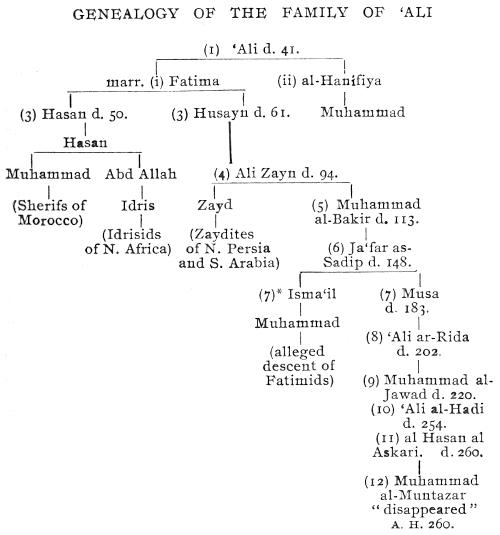
I THE SHIʿITES OR SCHISMATICS OF ISLAM — GENEALOGY OF THE FAMILY OF ʿALI
Islam appears first on the page of history as a purely
Arab religion: indeed it is perfectly clear that the
Prophet Mohammed, whilst intending it to be the one
and only religion of the whole Arab race, did not
contemplate its extension to foreign communities.
“Throughout the land there shall be no second creed”
was the Prophet’s message from his death-bed, and this
was the guiding principle in the policy of the early
Khalifs. The Prophet died in A.H. 11, and within the
next ten years the Arabs, united under the leadership
of his successors, extended their rule over Egypt, Syria,
Mesopotamia, and Persia. To a large extent it was
merely an accident that this rapid expansion of Arab
rule was associated with the rise of Islam. The expanding
movement had already commenced before the
Prophet’s ministry, and was due to purely secular
causes to the age long tendency of the Arabs,—as of
every race at a similar stage of economic and social
development,—to over-spread and plunder the cultured
territories in their vicinity. The Arabs were nomadic
dwellers in a comparatively unproductive area, and had
been gradually pressed back into that area by the
development of settled communities of cultivators in the
better irrigated land upon its borders. These settled
communities evolved an intensive agriculture, and thus
achieved great wealth and an advanced state of civilization
which was a perpetual temptation to the ruder
nomads who, able to move over great distances with
considerable rapidity, were always inclined to make
plundering incursions into the territories of the prosperous
agricultural and city states near at hand. The
only restraint on these incursions was the military
power of the settled communities which always had as
its first task the raising of a barrier against the wild
men of the desert: whenever the dyke gave way, the
flood poured out. In the seventh century A.D. the
restraining powers were the Roman Empire and the
Kingdom of Persia, and both of these, almost simultaneously,
showed a sudden military collapse from
which, in the natural course of events they would, no
doubt, have recovered after a short interval; but the
Arabs poured in at this moment of weakness, just as
the Teutonic and other groups of central Europe had
broken through the barriers of the western half of the
Roman Empire; and at that moment, in the course of
their incursion, they received a new coherence by the
rise of the religion of Islam and, by the racial unity
thus artificially produced, became more formidable.
In their outspread over Egypt and Western Asia the
Arabs adopted the policy, partly deduced from the
Qurʾan and partly based on the tradition of the first
Khalif’s conduct in Arabia, of uncompromising warfare
against all “polytheists,”—the creed of Islam was a
pure unitarianism, and could contemplate no toleration
of polytheism,—but of accommodation with those possessed
of the divine revelation, even in the imperfect
and corrupt form known to Christians and Jews. These
“People of the Book” were not pressed to embrace
Islam, but might remain as tribute-paying subjects of
the Muslim rulers, with their own rights very fully
secured. In all the conquered lands the progress of
the Muslim religion was very gradual, and in all of
them Christian and Jewish communities have maintained
an independent continuous existence to the
present day. Yet for all this there were very many
conversions to the religion of the ruling race, and these
were so numerous that within the first century of the
Hijra the Arabs themselves were in a numerical minority
in the Church of Islam. The alien converts, socially
and intellectually developed in the culture of the
Hellenistic world or of semi-Hellenistic Persia, were
very far in advance of the ruling Arabs who were
little better than half savages at the commencement of
their career of conquest: and the unexpected inclusion
of this more cultured element acted as a leaven in the
Islamic community, and forced it to a rapid and somewhat
violent evolution. It is wonderful that Islam had
sufficient vigour and elasticity to be able to absorb
such fresh elements and phases of thought, but that
elasticity had its limits, and at a very early date sects
began to form whose members the orthodox felt themselves
unable to recognise as fellow Muslims.
These early sects which were generally regarded as
heretical were, in most cases, reproductions of older pre-Islamic
Persian and Mesopotamian religious systems,
with a thin veneer of Muslim doctrine, and, in the
second century of the Hijra, when they became most
prominent, they were strongly tinctured with Hellenistic
philosophical speculations which had already exercised
a potent influence in Mesopotamia and Persia. In
theory these sects were “legitimist” in their adherence
to the principle of hereditary descent. Orthodox Islam
accepted as a constitutional principle the leadership of
an elected khalif or “successor,” a natural development
of the tribal chieftainship familiar to the pre-Islamic
Arabs. Amongst them the chief was elected in
a tribal council, in which great weight was given to the
tried warriors and aged men of experience, but in which
all had a voice, and choice was made on what we should
describe as democratic lines, and this remained the
practice in the earlier age of Islam. Such a constitutional
theory was no great novelty to those who had
lived under the Roman Empire, but was entirely
repugnant to those educated in Persian ideas, and who
had learned to regard the kingship as hereditary in the
sense that the semi-divine kingly soul passed by transmigration
at the death of one sovereign to the body of
his divinely appointed successor. This had been the
Persian belief with regard to the Sasanid kings, and
the Persians fully accepted Yazdegird, the last of these,
as a re-incarnation of the princes of the semi-mythical
Kayani dynasty to which they attributed their racial
origin and their culture. Yazdegird died in A.H. 31
(= A.D. 652), and his death terminated the male line of
the Persian royal family, but it was generally believed
that his daughter, Shahr-banu, was married to Husayn,
the son of the fourth Khalif ʿAli, so that in his
descendants by this Persian princess the claims of
Islam and of the ancient Persian deified kings were
combined. Historically the evidence for this marriage
seems to be questionable, but it is commonly accepted
as an article of faith by the Persian Shiʿites.
At a quite early date the house of ʿAli began to
receive the devoted adherence of the Persian converts.
That ʿAli himself had been prominent as a champion
of the rights of alien converts to equality in the brotherhood
of Islam, and still more his harsh treatment by
Muʿawiya, the founder of the ʿUmayyad dynasty,
caused his name to serve as a rallying point for all those
who were disaffected towards the official Khalifate. It
is now the general Shiʿite belief that ʿAli, the cousin
and son-in-law of the Prophet, was his chief companion
and chosen successor, the three preceding Khalifs being
no more than usurpers who had kept him out of his just
rights, and whose wrong doing he had borne with
exemplary patience. ʿAli himself does not seem to
have taken so pronounced a view, but he certainly
regarded himself as injured by his exclusion from the
Khalifate. It is not true to say with Muir (Caliphate,
p. 301), that the idea of a divine Imamate or “leadership”
was entirely the invention of later times because,
as early as A.H. 32, in the reign of ʿUthman, the Jewish
convert ʿAbdu b. Saba of Yemen,—a district which had
been conquered by the Persian king Nushirwan, and
settled by Persians for nearly a century before the
coming of Islam, and so thoroughly impregnated with
Persian ideas,—preached the divine right of ʿAli. This
view he maintained afterwards when ʿAli was Khalif,
in spite of ʿAli’s own disapproval, and at ʿAli’s murder
in A.H. 40, he reiterated it in a more pronounced form:
the martyred Khalif’s soul, he said, was in the clouds,
his voice was heard in the thunder, his presence was
revealed in the lightning: in due course he would
descend to earth again, and meanwhile his spirit, a
divine emanation, was passed on by re-birth to the
imams his successors.
Certainly the tragedy of Kerbela, which centred in
the pathetic sufferings and death of ʿAli’s son, Husayn,
as he was on his way to claim the Khalifate, produced
a tremendous wave of pro-ʿAlid feeling: indeed a
popular martyr was the one thing needed to raise
devotion to the house of ʿAli to the level of an emotional
religion, though many, no doubt, supported the ʿAlid
claims simply because they formed the most convenient
pretext for opposing the official Khalifate, and yet
remaining outwardly within the fold of Islam.
After the death of Husayn there were three different
lines of ʿAlids which competed for the allegiance of the
legitimist faction, those descended from (i.) Hasan, and
(ii.) Husayn, the two sons of ʿAli by his wife Fatima,
the daughter of the Prophet, and both therefore representing
the next of kin to the Prophet who left no son,
and (iii.) the house of Muhammad, the son of ʿAli, by
another wife known as the Hanifite. Of these three
we may disregard the descendants of (i.) Hasan, who
ultimately migrated to Maghrab (Morocco), and became
the progenitors of the Idrisid dynasty and of the Sharifs
of Morocco: they formed a very moderate branch of
the Shiʿite faction, adopted many practices of the
orthodox or Sunni party, and had no part in the
peculiarly Persian developments of the Asiatic Shiʿites.
The first ʿAlid faction to become prominent was (iii.)
the partisans of Muhammad, the son of the Hanifite,
who were formed into a society by Kaysan, a freedman
of ʿAli, for the purpose of avenging Hasan and Husayn.
They recognised a succession of four Imams or valid
commanders, ʿAli, Hasan, Husayn, and Muhammad,
the son of the Hanifite, and maintained that, at
Husayn’s death, Muhammad became de jure the Khalif
and the divinely appointed head of the Church of
Islam. Muhammad himself entirely disowned these
partisans, but that was a detail to which they paid no
attention. At Muhammad’s death in A.H. 81 this party,
“the Kaysanites” as they were called, recognised his
son Abu Hashim as the fifth Imam until A.H. 98, when
he died childless after bequeathing his claims to
Muhammad b. ʿAli b. ʿAbdullah (d. A.H. 126), who
was not of the house of ʿAli at all, and who became
the founder of the ʿAbbasid dynasty which obtained
the Khalifate in A.H. 132. It was under Abu Hashim
that the party, now changed in name from Kaysanites
to Hashimites, became an admirably organised conspiracy
which contributed more than anything else to
the overthrow of the ʿUmayyad Khalifs. Throughout
the Muslim dominions there was deep and ever-increasing
dissatisfaction with the ʿUmayyads, who
represented an arrogant parvenu Arab aristocracy,
ruling over races who enjoyed an older and richer
culture, and were by no means effete. The Hashimites
seized hold of this discontent and sent out their missionaries
(daʿi, plur. duʿat) in all directions disguised
as merchants and pilgrims who relied upon private
conversations and informal intercourse rather than
public preaching, and thus began that unostentatious
but effective propaganda, which has ever since been
the chief missionary method of Islam. Hashimite
teaching centered in the doctrines of tawakkuf or the
theory of a divinely appointed Imam, who alone was
the rightful Commander of the faithful and their
authoritative teacher, of hulul or the incarnation of the
Divine Spirit in the Imam, and of tenasukhu l-Arwah
or the transmigration of that Spirit from each Imam to
his valid successor, doctrines alien to Islam proper.
With the death of the Abu Hashim this party passed
over to the service of the ʿAbbasids to whom it was a
source of great strength, and at their accession to the
Khalifate it ceased to exist as a sect.
The most important sect, or group of sects, of the
Shiʿites was (ii.) the faction which recognised Husayn
as the third Imam, and his son, ʿAli Zayn al-Abidin
(d. 94 A.H.) as his successor, the son of the Imam and
of the royal princess of Persia. But at al-Abidin’s
death this party split into two, some following his son
Zayd (d. 121), others his son Muhammad al-Bakir (d.
113). The former or Zaydite party established itself
for a considerable period in North Persia, and still
maintains itself in South Arabia. Zayd himself was
the friend and pupil of the Muʿtazilite or rationalist
leader Wasil ibn ʿAta, and the Zaydites have generally
been regarded as more or less free thinkers. The
majority of the Shiʿites, however, recognised Muhammad
al-Bakir as the fifth Imam, and after his death
Jaʿfar as-Sadiq (d. 148) as the sixth, though here again
there was a schism, some regarding Abu Mansur,
another son of Muhammad al-Bakir, as the sixth
Imam. Abu Mansur seems to have been one of the
first ʿAlids to endorse the divine rights claimed for
them by their followers, and did so in an extreme form,
asserting that he had ascended to heaven and obtained
supernatural illumination. At this time all the extremer
Shiʿites regarded the Imam as an incarnation of the
Divine Spirit passed on from ʿAli, and many believed
that ʿAli was the true prophet of God whose office had
been fraudulently intercepted by Muhammad.
The Mansuris, however, were a minor sect, the
majority of the Shiʿites followed Jaʿfar who was Imam
at the time of the ʿAbbasid revolution. He was one of
those who were deeply influenced by the traditions of
Hellenistic philosophy and science, and was the author
of works on chemistry, augury, and omens: he is
usually credited with being the founder, or at least the
chief exponent, of what are known as batinite views,
that is to say, the allegorical interpretation of the
Qurʾan as having an esoteric meaning, which can only
be learned from the Imam who is illuminated by divine
wisdom, and who alone is able to reveal its true sense.
The inner meaning thus revealed was usually a more
or less imperfect reproduction of Aristotelian doctrine
as it had been handed down by the Syriac writers. Like
his brother, Abu Mansur Jaʿfar fully endorsed the
doctrine of a divine Imamate and the transmigration of
the Divine Spirit, then tabernacled in himself, and it
seems probable that Van Vloten (Recherches sur la
domination arabe, 1894, pp. 44-45) is right in suggesting
that the general promulgation of these beliefs
amongst the Shiʿites was largely due to the labours of
the Hashimite missionaries.
The contemporary establishment of the ʿAbbasids
made a far-reaching change in the conditions of Islam.
The Arabs began to take a secondary place, and Persian
influences became predominant. In 135 the noble
Persian family of the Barmecides began to furnish
wazirs or Prime Ministers to the Khalifate, and controlled
its policy for a period of fifty-four years. Nearly
all important offices were given to Persians, and a
distinct anti-Arab party was formed, known as the
Shuʿubiyya, which produced a prolific controversial
literature which expressed the hatred stored up under
generations of ʿUmayyad misrule: the Arab was held
up to derision, his pretensions to aristocratic descent
were contrasted with the much more ancient genealogies
of the Persian nobles, and he was portrayed as little
better than an illiterate savage. In literature, in science,
in Muslim jurisprudence and theology, and even in the
scientific treatment of Arabic grammar, the Persians
altogether surpassed the Arabs, so that we must be
careful not to talk of Arab philosophy, Arab science,
etc., in the history of Muslim civilization, but always
of Arabic philosophy, etc., remembering that it was
not the science and philosophy of the Arabs, but that
of the Arabic speaking people, amongst whom only a
small minority were actually of Arab race: and this
applies to the “golden age” of Arabic literature (A.H.
132-232). On the other hand it must be remembered
that, indirectly and unintentionally, the ʿUmayyads had
helped towards this result. It was under their rule
that the Arabic language had been introduced into the
public administration, and in due course replaced
Greek and Persian in all public business, so that it
became the common speech of all Western Asia, or at
least a common medium of intercourse between those
who used various languages in their private life, and
thus the brilliant intellectual and literary renascence
was rendered possible by a wide exchange of thought.
We may rightly refer to this period as a renascence,
for it meant quickening into new and other life the
embers of the later Hellenistic culture, and especially
of the Aristotelian philosophy and medical and natural
science, which had never quite died away in Western
Asia, but had been checked by its passage into Syriac-speaking
and Persian-speaking communities, amongst
whom the language in which the original authorities
were written was only imperfectly known. Thus
Hellenism suffered a phase of provincialism, which
came to an end when Arabic appeared as a more or
less cosmopolitan language, and thought began to be
exchanged by different races and social groups. Under
the early ʿAbbasids, and especially under the Khalif
al-Maʾmun (A.H. 198-218), there was a vast amount of
translation from Greek into Arabic until the greater
part of Aristotle, of the neo-Platonic commentators on
Aristotle, of Galen, some parts of Plato, and other
material, were freely accessible to the Muslim world:
whilst at the same time translations were made from
Indian writers on mathematics, medicine, and astronomy,
some directly from the Sanskrit, and others from
old Persian versions.
As a result the philosophical speculations of the
Greeks began to act as a solvent upon Islamic theology,
and from this doctrinal discussions and controversies
arose which, on the one side, produced a
series of rationalistic heresies, and on the other side
laid the foundations of an orthodox Muslim scholasticism.
Long before this Hellenistic influences had
permeated Persia and Mesopotamia, and these now
revived and resulted in a philosophical presentation of
religion which, under the veil of allegorical explanations
of the Qurʾan, was really undermining orthodox
doctrine, and heading towards either pantheism or
simple agnosticism. With these tendencies the pro-Persian
party was particularly associated. The Khalifs
who, in spite of Arab birth, were most devoted to
Persian ideas, largely because the Persians were subtle
courtiers and were the champions of absolutism, were
amongst those most ardent in promoting the study of
Greek philosophy; and the Imams, such as Jaʿfar and
his brother Zayd, were even more devotedly attached to
this type of philosophical speculation which was acting
as a powerful solvent on the traditional beliefs of
orthodox Islam.
At Jaʿfar’s death another schism took place, indeed
the perpetual sub-division into new sects has always
been a salient characteristic of the Shiʿiya. Jaʿfar had
nominated his son Ismaʿil as his successor, but afterwards
disinherited him because he had been found in
a state of intoxication and chose as heir his second son,
Musa al-Qazam. There were some, however, who still
adhered to Ismaʿil, and refused to admit that his father
had power to transfer the divinely ordained succession
at will; they asserted indeed that the son’s drunkenness
was itself a sign of his superior illumination as
showing that he knew that the ritual laws of the Qurʾan
were not to be taken literally, but had an esoteric
meaning which did not appear on the surface. Musa,
the seventh Imam as generally reckoned, and his son,
ʿAli ar-Rida (p. 202), the “two patient ones,” suffered
harsh treatment at the hands of the contemporary
ʿAbbasid rulers; they were brought from Madina by
Harun ar-Rashid so as to be under the observation of
the court, and in 148 Musa was poisoned by the wazir
Ibn Khalid. His son ʿAli married the daughter of the
Khalif Maʾmun, and was intended to be the heir to the
throne. But Maʾmun very nearly provoked civil war
by his strong Shiʿite sympathies, and when he perceived
how dangerous a storm the projected accession
of ʿAli was beginning to arouse, he extricated himself
from the difficulty by procuring the Imam’s death. ʿAli
al-Qazim was usually reckoned as the eighth Imam, the
ninth was Muhammad al-Jawad (d. 220), the tenth ʿAli
al-Hadi (d. 254), and the eleventh al-Hasan (d. 260),
these two latter being buried at Samarra, which replaced
Baghdad as the ʿAbbasid capital from A.H. 222 to 279.
The town afterwards fell into decay, but has been
colonised by Shiʿites, and is one of the places of Shiʿite
pilgrimage. The twelfth Imam was Muhammad al-Muntazir,
who in A.H. 260 “disappeared.” The
mosque at Samarra is said to cover an underground
vault into which he went and was no more seen. The
“twelvers,” or Ithna ʿashariya, who to-day form the
main body of the Shiʿites, and whose belief is the
official religion of modern Persia, suppose that he is
still living, and the place where he is to re-appear when
he emerges from concealment is one of the sacred spots
visited by the Shiʿites.
But, as we have already noted, some of the Shiʿites did
not accept Jaʿfar’s transference of the Imamate from
his son Ismaʿil to his second son Musa, but recognised
Ismaʿil still as heir. Ismaʿil died in 145 whilst his
father was still alive, leaving a son named Muhammad.
Although Ismaʿil’s body was publicly shown before its
burial at al-Bakiʿ, many persisted in believing that he
was not dead, and asserted that he had been seen in
Basra after his supposed funeral; others admitted his
death, but believed that his Imamate had passed to his
son Muhammad; others again believed that his soul
had migrated to Muhammad, so that they were in
reality one person. These adherents of Ismaʿil, or of his
son Muhammad, or of Ismaʿil-Muhammad, formed the
sect known as the Ismaʿilians or the Sabʿiya, i.e.,
“seveners,” accepting the six Imams to Jaʿfar as-Sadiq,
and adding his son or grandson as the seventh and last.
These “seveners” seem to have been a comparatively
minor sect of the extremer Shiʿites. Some members of
the sect are still to be found in the neighbourhood of
Bombay and Surat. But, about 250 this comparatively
obscure sect was taken in hand and organised by a
singularly able leader, and became for a time one of
the most powerful forces in Islam.
                          (1) ʿAli d. 41.
                   +-----------------------------+
                   |                             |
            marr. (i) Fatima           (ii) al-Hanifiya
         +---------------------+                 |
         |                     |                 |
 (3) Hasan d. 50.       (3) Husayn d. 61.    Muhammad
         |                     |
       Hasan                   |
  +-------------+              |
  |             |              |
Muhammad    Abd Allah       (4) ʿAli Zayn d. 94.
  |             |            +-------------------+
  |             |            |                   |
(Sherifs of   Idris        Zayd              (5) Muhammad
Morocco)        |            |               al-Bakir d. 113.
            (Idrisids     (Zaydites              |
          of N. Africa)  of N. Persia     (6) Jaʿfar as-Sadiq
                        and S. Arabia)          d. 148.
                                        +------------------+
                                        |                  |
                                   (7)* Ismaʿil       (7) Musa
                                        |               d. 183.
                                    Muhammad               |
                                        |          (8) ʿAli ar-Rida
                                    (alleged             d. 202.
                                   descent of              |
                                    Fatimids)   (9) Muhammad al-Jawad
                                                         d. 220.
                                                  (10) ʿAli al-Hadi
                                                         d. 254.
                                                  (11) al Hasan al
                                                  Askari d. 260.
                                                           |
                                                    (12) Muhammad
                                                      al-Muntazar
                                                     “disappeared”
                                                      A. H. 260.
II THE ISMAʿILIAN SECT
From the beginning the neo-Ismaʿilian sect showed all
the characteristics of the ultra Shiʿite bodies: it accepted
the ʿalim l-batin, or the principle of allegorical interpretation
which is especially associated with Jaʿfar as-Sadiq,
the doctrine of incarnation, and of the transmigration
of the Imam’s soul. But underneath all this,
borrowed from current Shiʿite ideas, it had a strong
element of agnosticism, a heritage of the philosophical
ideas borrowed from Greek scientists, and developed
in certain directions by the Muʿtazilites. As organised
by its leader, whose name was Abdullah b. Maymun,
it was arranged in seven grades to which members
were admitted by successive initiations, and which
diverged more and more from orthodox Islam until its
final and highest stages were simply agnostic. According
to Stanley Lane-Poole “in its inner essence
Shiʿism, the religion of the Fatimids is not Mohammedanism
at all. It merely took advantage of an old
schism in Islam to graft upon it a totally new and
largely political movement” (Lane-Poole: Story of
Cairo, Lond., 1906, p. 113). In this passage “Shiʿism”
is taken as denoting the sect of the “Seveners,” and
the “political movement” is simply disaffection
towards the Khalifate. Similarly Prof. Nicholson considers
that “Filled with a fierce contempt of the Arabs
and with a free-thinker’s contempt for Islam, Abdullah
b. Maymun conceived the idea of a vast secret society
which should be all things to all men, and which, by
playing on the strongest passions and tempting the
inmost weaknesses of human nature, should unite
malcontents of every description in a conspiracy to
overthrow the existing régime” (Nicholson: Literary
History of the Arabs, pp. 271-272).
Undoubtedly the ideas involved in the Ismaʿilian
doctrines were totally subversive of the teachings of
Islam, but so were those of the “philosophers,” and
in exactly the same way. The views of Ibn Tufayl (d.
531 A.H.) and of Ibn Rushd (Averroes, d. 595 A.H.)
were purely Aristotelian in basis, and on this foundation
was built up an agnostic-pantheistic superstructure.
Ibn Tufayl particularly makes it quite clear
that his teaching is not consistent with the Qurʾan
which he treats as setting forth a system of doctrines
and ritual precepts suitable for the unlearned who
ought not to be disturbed in their simple faith, but quite
inadequate for the satisfaction of the more intelligent:
the mysteries of the universe, revealed through Aristotle
and his followers, furnish a sounder religion, but
it is expedient that this be reserved for the enlightened
and not divulged to the illiterate who are unable to
appreciate or understand its bearing. Such teaching is
subversive of orthodox Islam, and consciously so: in
the case of ʿAbdullah it may, perhaps, be described as
a conspiracy against religion. In one sense it was the
final product of the rationalism of the Muʿtazilites.
Admittedly the Ismaʿiliya worked as a political conspiracy
against the ʿAbbasids, but this was true of
every Shiʿite sect: the ʿAbbasids had used the Shiʿites
in seating themselves on the throne, and then discarded
them. Still it seems that we have no reason to question
the perfect sincerity of the Ismaʿilians in their agnostic
principles: those principles were the product of the
solvent influence of Greek philosophy upon the religion
of Islam: Islamic thought was too simple and primitive
to be able to adapt itself to that philosophy in its entirety,
hence some such position as that of Ibn Tufayl,
or of Ibn Rushd, or of the Ismaʿilians, was inevitable.
It was equally a necessary result of the time and circumstances
that these rationalists tended towards the
Shiʿites. In spite of weird superstitions, especially
current in Khurasan, the Shiʿites represent the Muslim
element most kindly disposed towards freedom of
thought. This seems a bold statement to those familiar
with Shiʿites of the present day, but it must be noted
that the Shiʿites whom the European most frequently
meets are either the devotees who have settled in places
like Samarra, or those who seem to be more exclusive
than the orthodox Muslims, chiefly because they have
as yet had much less intercourse with foreigners. In
2-3rd cent. Islam it was the Shiʿite princes who invariably
did their best to foster philosophical and
scientific research, whilst, after A.H. 232, the orthodox
party, as it gets in the ascendent, becomes distinctly
reactionary, and tends to repressive persecution.
The most difficult task for us is to appreciate the
strong appeal which the doctrines of incarnation and
transmigration made to the Persian and Mesopotamian
mind. Both these doctrines had figured prominently
in pre-Islamic religions in Western Asia; and both
recur in most religious movements from the coming of
Islam to the present day in that particular area. We
may note a few instances to illustrate this, and show
incidentally the strong attraction these doctrines had
for the Persian mind.
Abu Muslim was the general who more than any
other helped to seat the ʿAbbasids on the throne, and
suffered death at the hands of the first ʿAbbasid Khalif,
who was jealous,—with good cause, it would appear,—of
his excessive power. But Abu Muslim had exercised
an extraordinary influence over men during life, and
was treated as a quasi-divine hero after death, his
admirers regarding him as not really dead but as
having passed into “concealment,” some other having
been miraculously substituted for him at the moment
of execution. This resembles the theory which the pre-Islamic
Persian teacher Mani held as to Christ. Mani
fully accepted Christ as a religious teacher, side by side
with Zoroaster and Buddha, but he could not admit
the reality of his death, for a material body capable of
death was in his view unworthy of one purely good.
He supposed, therefore, that at the crucifixion Simon
of Cyrene was at the last moment substituted for Christ,
and this Persian idea has actually obtained a place in
the Qurʾan (cf. Sura 4, 156).
Not long after Abu Muslim we hear of a pseudo-prophet
named Bih-afaridh, a Zoroastrian who had
travelled in the far East, and afterwards accepted Islam
at the hands of two duʿat who were preaching the cult
of Abu Muslim. Very little is known of his teaching,
but he certainly maintained the doctrine that the Imam
is an incarnation of the Deity, and seems to have
attached a particularly sacred signification to the
numeral seven. This superstitious reverence for particular
numbers was a common feature in the pre-Islamic
religions of Mesopotamia, and we shall meet it again
in the doctrines of the Ismaʿilians.
Another sect, of similarly pre-Islamic origin, was
that known as the Rawandiyya from its origin at
Rawand near Isfahan. Its members were king-worshippers
in the old Persian sense, and a body of them
travelled to Hashimiyya, where the Khalifs then had
their residence, and tried to acclaim the Khalif al-Mansur
as a god. He not only rejected the proffered
adoration, but cast the leaders into prison. This was
followed by an attempt to attack the palace, the
Rawandis considering that, as the prince had disclaimed
deity, he could be no valid ruler. For some centuries
the sect, strongly disaffected towards the Khalifate,
lingered on in Persia and had many sympathisers.
Under the next Khalif al-Mahdi, came the still more
serious rebellion of al-Muqannaʿ, the “veiled prophet
of Khurasan,” who asserted his own deity. He was
killed in A.H. 169, but his followers, as usual, believed
that he had not really suffered in person, but had
passed into concealment and would in due course return
again: they continued to form a distinct sect for some
three hundred years.
Another pseudo-prophet of the same type was Babak
al-Khurrami, who was executed in A.H. 222 or 223. He
also declared himself to be an incarnation of the Divine
Spirit, and asserted that the soul within him had
already dwelt in his master Jawidan.
We might continue to extend the series very considerably
by enumerating the various prophets and
sects which reproduce these same general characteristics.
The latest example occurs in the Babi movement,
which still flourishes and has many converts in this
country and in America. The first teacher of the
Babists, Mirza ʿAli Muhammad (A.D. 1820-1851) claimed
only to be a Mahdi or fore-runner of One who was to
come, but his successor, Mirza Husayn ʿAli, declared
himself to be the expected One, the incarnation of the
Divine Spirit, which is an emanation of the Deity and
is fairly equivalent to the Reason, Word, or Spirit of
the Plotinian philosophy. In later times this doctrine
has rather fallen into the background, perhaps as the
result of western influences, but the earlier phase shows
a repetition of the traditional Persian position. All
these sects show common matter in the doctrines of
incarnation, of transmigration, and of an esoteric
teaching to be revealed only to the elect. Such were
the extremer Shiʿite sects of mediaeval times, and such
are their descendants of modern times. Even in Persia
to-day, side by side with the more orthodox “Twelvers”
of the state church and off-shoots such as the Babists,
the latest of a long series of mystical developments
from the Shiʿite stock, are the ʿAli Allahis who believe
in the deity of the Imam ʿAli, and combine with this
belief many elements from the ancient Zoroastrian
religion, a survival of the older mediaeval Shiʿism
which caused so much trouble to the Khalifate of
Baghdad.
In the teaching of most of the Shiʿites it is believed
that some deceased Imam was an incarnation of deity,
and it is he who, not really dead as men suppose, has
passed into concealment, to return again in the fulness
of time, when this evil age in which the true Khalifate
no longer exists has passed away. Meanwhile there is
no valid Khalif or Imam upon earth, but only some
Shah or king who acts as vicegerent of the hidden
Imam until his return.
This digression serves to show us how strongly
Persian thought always has inclined towards the idea
of a divine incarnation in the honoured religious
teacher, and towards that of transmigration of the soul
from one such teacher to his successor. In the 3rd
century A.H. probably no sect which did not hold such
theories could have obtained a favourable hearing
amongst the Persians who found Islam of the Arab
type unsatisfying, and every radical religious movement
was necessarily compelled to assume at least the
externals of Shiʿism.
The Shiʿite party organised by ʿAbdullah is known
by various names. It is called Ismaʿilian as representing
the party adhering to Ismaʿil, the son of Jaʿfar
as-Sadiq, and his son Muhammad, as against those
who continued the succession of the Imamate through
Musa; but the name is not strictly accurate as it seems
that there was an Ismaʿilian sect proper existing before
ʿAbdullah, and that his re-organisation was so drastic
that we may regard the continuity as being severed;
and it seems certain that some part of the earlier sect
continued to exist independent of his reforms. It was,
no doubt, its attachment to a deceased or “hidden”
Imam which made it a more promising field for the
advocates of a speculative philosophy than any sect
whose Imam was living and might dissociate himself
from the doctrines held. It was also called the Sabʿiya
or “Seveners” because it accepted seven Imams, and
also because it attached a sacred significance to the
numeral seven; there were seven prophets, seven
Imams, seven Mahdis, seven grades of initiation (afterwards
changed to nine), etc. In many respects Sabʿiya
is the most accurate name, but it is open to the same
objection as Ismaʿilian. More commonly its members
are called Fatimites as recognising Fatimid Imams
who claimed descent from ʿAli and Fatima: but this,
although convenient because of its frequent use
amongst mediaeval Arabic writers, is peculiarly inaccurate.
The Ithna ʿashariya or sect of “Twelvers”
was equally Fatimite, and so were the Zaydites, indeed
these last were the true Fatimites as holding that any
person descended from ʿAli and Fatima might be a
valid Imam: but common usage allows the use of
“Fatimites” for the sect organised by ʿAbdullah.
Another name is Batinites or advocates of an allegorical
interpretation, but this also applies to other Shiʿite
groups. Sometimes they are called Qarmatians, but
this name is only applicable to one branch of the sect
which originated in the district of Sawad between Basra
and Kufa, and should be reserved for that branch
which at a later period became alienated from the main
Ismaʿilian body.
The new sect carried out its propaganda by means
of missionaries (daʿi) on the lines developed by the
Hashimites. In this, as in most of its external features,
it reproduces the characteristics usual amongst the
mediaeval Shiʿites.
The organiser of the sect or masonic fraternity was
ʿAbdullah, who is stated to have been the son of one
Maymun. Sometimes ʿAbdullah is surnamed al-laddah
(“the oculist”), as is done by Abu l-Feda, but
more often this surname is given to his father Maymun.
Maqrizi, referring to the Fatimids, says, “this family
was traced to al-Husayn, the son of ʿAli ibn Abi Talib,
but men are divided in the matter between two opinions:
some treat it as true, but others deny that they are
descendants of the Prophet and treat them as pretenders
descended from Daysan the Dualist, who has given his
name to the Dualists, and (say) that Daysan had a son
whose name was Maymun al-Qaddah, and that he had
a sect of extreme views. And Maymun had a son
ʿAbdullah, and ʿAbdullah was learned in all the canon
law and customs and sects” (Maqrizi, i. 348).
The reference to “Daysan the Dualist” is pure
fable. This Daysan appears frequently in Arabic history
as the legendary founder of the Zindiqs, a name
given to the followers of the pre-Islamic cults of Mesopotamia
and Persia, who found it convenient to make
external profession of Islam. Thus Masʿudi (Muruj
adh-Dhahab, viii. 293) says that “many heresies arose
after the publication of the books of Mani, Ibn Daysan,
and Marcion, translated from Persian and Pahlawi by
ʿAbdullah ibn al-Muqaffaʿ and others.” Ibn al-Muqaffaʿ
was a converted Zoroastrian who took a
leading part in translating Persian and Syrian works
into Arabic under the first two ʿAbbasids, and was
generally regarded as privately adhering to his earlier
religious views.
It will be noted that Zindiqism is mentioned as propagated
by Ibn al-Muqaffaʿ, and is traced to Ibn
Daysan amongst others, and this is precisely the same
as the one whom Maqrizi names as the reputed progenitor
of Maymun. Evidently the charge which lay
at the bottom of this latter statement originally meant
that Maymun was a Zindiq, and so could be described
as a follower of Ibn Daysan, not that he actually was
Ibn Daysan’s son, which would be an absurd anachronism.
For the name Ibn Daysan refers to a perfectly
genuine historical person: the Ibn Daysan of the
Arabic writers was the Bar Daisan of Syriac literature,
a convert from paganism to Christianity who died about
A.D. 222, and whose followers formed an important
sect at Edessa for several centuries, though in Muslim
times he appears as a semi-legendary character. We
possess a work probably written by one of his pupils
called “A treatise on Fate” in the Christian writers,
from which two lengthy extracts appear in Eusebius:
Praep. Evangel. vi. 9, one of which is cited also in
Clementine Recognitions ix., but is headed “Book of
the Laws of Countries” in the Syriac text discovered
by Cureton, and published by him in 1855. Various
references are made to Bar Daisan in Euschius, Epiphanius,
and other Church Fathers, as well as in the
dialogues ascribed to Adamantius, but our best information
as to his teaching is to be obtained from Moses
bar Kepha (Patrol. Syr., I., ii. 513-5), whose summary
is fully endorsed by the controversial essays of St.
Ephraim, who settled at Edessa in 363 when the Bar-daisanites
were a real force there. Bar Daisan’s doctrine,
which is a kind of Christianized Zoroastrianism,
is described by Prof. Burkitt in his introduction to
Mitchell’s edition of St. Ephraim’s Prose Refutations.
Marcion represents an earlier and more definitely
Christian system which at one time had a very wide
extension, and probably was the medium through which
Bar Daisan learned Christianity. It was a kind of
dualistic system with two powers, the Good God and
the Evil One. The Evil One was the creator whom the
Jews worshipped as God, and the Good God sent his
Son on earth to save men from this delusion: as in
Zoroastrianism the two rival powers maintain an unceasing
strife until the day of judgment when the good
God will be finally victorious. From St. Ephraim we
learn that the Marcionites long retained their hold in
Northern Mesopotamia side by side with the Bar-daisanites.
Mani shows very much these same views in a
Zoroastrian setting, but with a strong element of
Marcionite Christianity. Mani’s work came some
twenty years later than Bar Daisan, and he, in his early
days, had been a disciple of the Mandeans, the Gnostic
sect which Justin Martyr calls “the baptists”
βαπτισταί (Justin M. Dial. 80) from their frequent ablutions,
who were settled in the marsh land between
Basra and Wasit on the lower Euphrates. All three,
Bar Daisan, Marcion, and Mani, draw largely from
the same source the eclectic mixture of old Babylonian
religion, of Zoroastrianism, Buddhism, and Christianity,
which developed in the lower Euphrates valley,
though Marcion claimed to be, and no doubt believed
himself, an orthodox member of the Catholic Church,
whilst Mani was no less confident in regarding himself
as a Zoroastrian. The whole of the different religious
ideas of the Euphrates valley were welded together by
an element of Greek philosophy of the neo-Pythagorean
type, which seems to have filtered in through the Jews
who were settled there in force, and had shared in the
common life of the Hellenistic world at the time when
the neo-Pythagorean school was taking form, and
showing marked sympathy towards the various forms of
Eastern religious speculation. All this kind of eclectic
speculation, half religious and half philosophical, lived
on, and was still alive in the third cent. of the Hijra;
indeed, it had spread and formed a new centre at
Harran, quite distinct in its character, but obviously
drawing from the same sources, and, moreover, it
quickened into new life when the speculations of the
neo-Platonic school were introduced through a Syriac
medium. Traditionally all this type of thought prevalent
in Mesopotamia was connected with the names of
Marcion, Mani, and Bar Daisan, though probably very
few Muslims had any clear idea of the respective parts
these three characters had played, but simply cited them
as heresiarchs of exceptional notoriety.
But Maymun was without doubt a real character.
Abu l-Feda refers to him as a native of Qaraj or
Ispahan, who professed to be a Shiʿite, but was really a
Zindiq, i.e., a follower of the heresies of Marcion, Bar
Daisan, and Mani, or else a materialist (Abu l-Feda,
Annales Moslem., ii. 311). Used in this sense
“materialist” means an Aristotelian, i.e., one who
believed in the eternity of matter and so did not accept
the Qurʾanic teaching of creation ex nihilo. Ibn
Khaldun states that Maymun migrated to Jerusalem
with a number of his disciples and became well known
as a magician, fortune teller, astrologist, and alchemist
(cf. Quatremère: Journ. Asiatique, Aug., 1836). The
Fatimid advocates, as represented by the Druze writers,
fully admit the descent of the Fatimids from Maymun,
but claim that he was of the family of ʿAli (cf. De Sacy:
Chrestom., ii., note 3 on page 95), which seems as
though Maymun’s position as an ancestor of Abdullah’s
family was beyond question.
In the passage already quoted Maqrizi describes
ʿAbdullah as “learned in all the canon law and customs
and sects,” so that it seems that he, the fortune teller’s
son, was credited with being the original teacher and
founder of the sect. Perhaps Maymun himself was the
founder of a minor off-shoot of the Ismaʿilian body,—we
hear of followers who went with him to Jerusalem,—and
ʿAbdullah succeeded him as head of this group but,
himself a student of philosophy like so many other
Shiʿites, and participating in rationalistic opinions,
used his position to form a kind of free-masonry, in
which he developed more fully the principles already
indicated by Jaʿfar as-Sadiq, and so made the Aristotelian
and neo-Platonic teaching somewhat modified in
a Persian guise, the “hidden meaning” of the Qurʾan.
Probably he too was responsible for the efficient organizing
of the sect, although its missionary propaganda
was, as has been noted, reproduced from that
of the Hashimites. He is said to have been the author
of a book called al-Mizan, “the balance” (Abulfeda:
Ann. Mus., ii. 310). According to Nuwairi, who used
the history of Abu l-Hasan b. ʿAli Akhu-Muhsin,
himself a descendant of Ismaʿil b. Jaʿfar and a contemporary
of the chief activity of the Ismaʿilian sect,
ʿAbdullah assumed Shiʿite views, not because he
wanted to get men to recognise the Imamate of Ismaʿil
or his son Muhammad, but simply as a device to attract
adherents: such was Akhu-Muhsin’s view, no doubt a
prejudiced one, but of some weight as undoubtedly the
judgment of many contemporaries. It is, however, quite
as probable that the ʿAlid theories were derived from
the existing sect of which Maymun had been head,
and were left unaltered by his son when he took it in
hand.
In order to make proselytes, ʿAbdullah’s missionaries
used to propose obscure questions about the Qurʾan
and the doctrines of traditional Islam, with the object
of showing that as generally held these doctrines were
contrary to reason, and so required an explanation.
The revelation of Islam, they said, was difficult, and
hence there was much diversity of opinion and many
sects and schools of thought, all of which caused an
infinite amount of disedification and much trouble. The
reason of these diverse opinions is that each man follows
his own private judgment and forms his own conjectures,
with the result that many end in utter unbelief.
But God would not give a revelation full of such
obscurity and ambiguity as the only guidance for men.
It must be that there is some available guidance, some
authoritative teacher who can explain the doctrine so
that it may be both clear and certain, and such an
infallible teacher implies an Imam. The daʿi then gave
illustrations of the obscurities and difficulties which
men are not able to understand by the light of their
own reason. The pilgrims at Mecca throw stones and
run between the two hills, Safa and Merwa,—what is
the purpose and meaning of this? Why is it that a
woman who has omitted a fast and prayer because prevented
by reasons of personal impurity is required to
fast afterwards to make up for her omission, but is not
required to make up for the omitted prayer? Why did
God take six days to create the world when he could
quite well have created it in an hour? What does the
Qurʾan mean when he refers in a figurative manner
to the “way”? What is the meaning of the reference
to the two angels who write and take note?—why
cannot we see them? What really are the torments of
hell? What mean the words “and over them on that
day eight shall bear up the throne of thy Lord”?
(Qur., 69, 17). What is Iblis?—Who are Yajuj and
Majuj (Qur., 18, 93), and Harut and Marut (Qur., 2,
96)? Why have there been created seven heavens, and
seven earths, and why are there seven verses in the
Fatha? and many similar questions all designed to
show that the Qurʾan is full of references to things
which are not explained and need explaining, but to
which the orthodox teachers are unable to give an
explanation. All these are the conventional arguments
which are commonly employed to prove that revelation
is incomplete without an authorised teacher.
They then continued to ask other questions which
throw a curious light on the kind of problems which
interested the Muslims of the day, or which could be
thought as deserving of attention. Why have men ten
fingers and ten toes?—why are four fingers on each
hand divided into three phalanges, whilst the thumbs
have only two each?—why has the face seven openings?—why
are there twelve dorsal vertebrae and seven
cervical vertebrae? etc., constantly suggesting some
mystic meaning as lying under particular numbers.
They cited “on earth are signs of men of firm belief,
and also in your own selves; will ye not then consider
them?” (Qur., 51, 20-21): “God setteth forth these
similitudes to men that haply they may reflect” (Qur.,
14, 30), and “we will shew them our signs in (different)
countries and among themselves, until it become plain
to them that it is the truth.”
These suggestions produced doubt in the minds of
many hearers, and gave the impression that the missionary
had thought more deeply on the problems of
religion than the ordinary teachers; and so the hearers
were induced to ask the daʿi to instruct them and reveal
the answers to some of the problems he proposed.
Forthwith he would begin a discourse dealing with
some of these questions, and then suddenly check himself:
the religion of God is too precious to be disclosed
to those who are not worthy and who may, perhaps,
treat it with contempt: God has always required a
pledge of those to whom he has disclosed his mysteries.
Thus we read, “And remember that we have entered
into covenant with the prophets and with thee, and with
Noah, and Abraham, and Moses, and Jesus the son of
Mary; and we formed with them a strict covenant”
(Qur., 33, 7), and again “some there were among the
faithful who made good what they had promised to
God” (id., 23),—“O believers, be faithful to your
engagements” (Qur., 5, 1),—“be faithful in the covenant
of God when ye have covenanted, and break not
your oaths after ye have pledged them: for now ye
have made God to stand surety for you” (Qur., 16, 93),
and many similar passages. “So now,” the daʿi said,
“pledge yourself, putting your right hand in mine,
and promise me with the most inviolable oaths and
assurances that you will not betray our secret, that you
will assist no-one against us, that you are laying no
snare for us, that you will use the truth only in speaking
with us, and that you will not join any of our enemies
against us.” By this means they discovered how far
the would-be proselyte was ready to be submissive and
obedient, and accustomed him to act in absolute conformity
with his superiors. If the proselyte readily
took this pledge, the missionary next said, “Give us
now an offering from your goods and first fruits which
shall be a preliminary to the disclosure which we are
about to make to you of our doctrine, and a pledge
which you will give for it.” By this they tested how
far the proselyte was prepared to make sacrifices to join
the sect, and how far he could be trusted to be a loyal
and devoted member. Thus the proselyte was admitted
to the First Grade which consisted of those who
accepted the principle that the Qurʾan has both an
external literal sense and an inner esoteric meaning
which needs the help of an interpreter. The inner
meaning was termed batin, or iman, “faith,” as distinguished
from the external islam, and this distinction
was justified by the words of Qur. 40, 14. “The Arabs
of the desert say, ‘we believe.’ Say: ‘Ye believe not,
but rather say, ‘we profess Islam’; for the faith has
not yet found its way into your hearts.’”
The Second Grade. When the disciple had fully
adopted the ideas taught in the first grade, and was
convinced that men have fallen into error by accepting
the traditional teachings of Islam, the daʿi used the
ordinary arguments to persuade them that there was
need of an authoritative teacher, and without such a
teacher men are unable to please God or obey His
laws. Great stress was laid upon the unreliability of
private judgment and the need of guidance and
authoritative teaching.
Third Grade. The daʿi next proceeds to point who
can be accepted as the desired teacher and infallible
guide, the Imam of Islam. There have been seven
such Imams, as worthy of reverence by their religious
characters as by their number, for the most important
things in the universe, such as the planets, the heavens
(Qur. 2, 29; 67, 3), the earths (id. 65, 12, of Bukhari
Sahih 59, 2) are invariably in sevens. He then enumerates
the seven Imams, the first six being ʿAli to
Jaʿfar as-Sadiq, the seventh al-Kaʾim, “the chief,”
whom some understand to be Jaʿfar’s son Ismaʿil,
others his grandson Muhammad, whilst others again
regard these two as but one. He next endeavoured to
show that the other Shiʿites, who regard Musa as the
seventh Imam, cannot be correct as they do not limit
the Imams to the sacred number seven, but continue
until twelve are reckoned in all. He then was accustomed
to speak against the character of Musa, the son
of Jaʿfar, asserting that Ismaʿil had deep knowledge of
secret things, whilst Musa possessed no such supernatural
enlightenment: he told anecdotes which placed
Musa in an unfavourable light, and even attributed to
him grave sins, so that it was impossible to regard him
as the true Imam. Moreover it was agreed that, since
Husayn, the Imamate can only be passed by direct
succession, so it is not possible that it could be taken
from one and given to his brother. The Ismaʿilians
alone have inherited the accurate knowledge of secret
mysteries bequeathed by Jaʿfar as-Sadiq to his son
Ismaʿil.
Fourth Grade. In this grade instruction was given
in the history of God’s revelation. The age of the
world is divided into seven stages, each under the
guidance of a prophet whose teaching surpassed that
of his predecessors and abrogated it. Between each
pair there were but “silent” guides who did not add
to nor alter the revelation of the prophet who inaugurated
that age. Each of these seven prophets had
a coadjutor who was his authorised exponent to mankind
at large. These seven prophets and coadjutors
were—
(i.) Adam, with coadjutor Seth.
(ii.) Noah, with coadjutor Shem.
(iii.) Abraham, with coadjutor Ismaʿil.
(iv.) Moses, with coadjutor, at first Aaron, then Joshua.
(v.) Jesus, with coadjutor Simon Sifa (Cephas).
(vi.) Muhammad, with coadjutor ʿAli.
(vii.) al-Kaʾim, with coadjutor ʿAbdullah.
Thus the seventh prophet al-Kaʾim, i.e., Ismaʿil or his
son Muhammad, has abrogated the teaching of the
Prophet Muhammad, and has given a new revelation.
At this point, therefore, the convert was entirely
separated from orthodox Islam which accepts Muhammad
as the “seal of the prophets,” that is to say, the
final completer of revelation, and was taught to regard
his religion as obsolete.
Fifth Grade. In this grade it was taught that the
traditional practices of the religion of Islam were
merely temporary, a concession to the uninstructed
multitude who could not yet understand the spiritual
principles of iman: they were useful as an educative
influence with the ignorant, but the Qurʾanic precepts
on which some of them were based had an esoteric
meaning quite other than their literal form, whilst the
traditional rules which had added so much detail to the
laws of the Qurʾan were baseless and negligible. The
disciple was taught to replace the external precepts of
Islam by inner convictions. If he was a Persian he
was reproached with the servile submission which the
Persians had rendered to an Arab Khalif: if he were
an Arab he was instructed that the privileges of the
Arabs have now been transferred to the Persians. In
addition to this he was taught certain principles of
geometry and the properties of numbers, all applied in
a mystical manner to the claims of the Imamate. He
was further informed that each prophet had twelve
hujjaj corresponding to the twelve signs of the zodiac,
to the twelve months of the year, to the twelve tribes
of Israel, and to the twelve nugabaʾ whom Muhammad
chose from the ansar or “helpers” at Madina. These
numerals “seven” and “twelve” which have been
shown to possess sacred meanings, were now cited to
explain why men have twelve dorsal vertebrae, seven
cervical vertebrae, etc. It is as well to note that when
these teachings were first put forth the other Shiʿites
who followed Musa and his successors had not yet
made up the number of twelve Imams.
Sixth Grade. The missionary did not admit the
postulant to this grade until he was perfectly assured
as to his discretion and secrecy. In it the teaching
that the ritual precepts of Islam as generally understood,
were abrogated, was carried to its logical conclusion,
and the convert was instructed to abandon the
observance of prayer, fasting, pilgrimage, and all the
other external practices of religion; or at least to
observe them only in so far as they served as a bond of
social usage or as expedient as a concession to their
uninstructed companions. At the same time the
teacher professed the utmost veneration for the men
who had established these practices, and for the wisdom
which had led them to do so. The daʿi then described
to his pupil the doctrines of Plato, Aristotle, Pythagoras,
and other philosophers, and exhorted them not
to follow the traditions of religion which have been
passed down as mere hear-say, but to test them by the
methods of philosophy and to accept only those things
which are endorsed by reason. Changing his former
attitude, he then began to criticize the Imams unfavourably,
and to contrast them with the philosophers to
their disadvantage.
Seventh Grade. Some of the missionaries were not
themselves instructed in the doctrines of the highest
grades, and only a select number were able to initiate
converts into this seventh stage. This serves as the
probable explanation of some events in the history of
the sect which appear strange at first sight such, for
example, as the estrangement of the most faithful and
successful missionary Abu ʿAbdullah who, no doubt,
revolted when he found the difference between the
actual beliefs of the Mahdi ʿUbayd allah, and the doctrine
which he himself had learned and taught. In
initiating a disciple into this highest grade the daʿi
first pointed out that there are in this world always
correlatives, of which one is the cause, the other the
result, as giver and recipient, teacher and taught, etc.
Thus the Qurʾan tells us of God that “when he
decreeth a thing he only saith ‘be’ and it ‘is’”
(Qur., 3, 42), in which God, the First Cause, is the
greater, the thing created only derives its being from
him: and again, “all things have we created after a
fixed decree” (Qur., 54, 49), and again, “he who is
God in the heavens is God in earth also” (Qur., 43,
84). Hence, following a teaching of the philosophers,
it is clear that from a Being who is only One, only
one thing can proceed: but the world contains many
things, so it cannot be the work of the One, but needs
at least two Beings. Moreover, creation is not the
bringing into being that which did not previously
exist, but only the arrangement and disposing of
things. At bottom this was intended to be a statement
of the Aristotelian doctrine of the eternity of matter,
and shows striking resemblances with the speculations
of the Muʿtazilites. Thus Abu Hudhayl (d. circ. 226)
held that before the creation the world existed, but
in a state of perfect quiescence; creation was the
introduction of change and movement, and this theory,
in one modification or another, recurs in all the speculations
of the later Muʿtazilites. Very similar is the
teaching of al-Farabi (d. 339), who was himself a
member of the Ismaʿilian sect, and held that the world
proceeded from God in an instant of the immeasurable
eternity which preceded time, but remained at rest until
at creation God introduced movement and so produced
time and change.
Such was the teaching of the seven grades which
formed the original constitution of the sect. Later on
two higher grades were added which, for the sake of
completeness, we may consider here although they were
no part of the original scheme.
Eighth Grade. In this the disciple learned that there
are two Principles, the original and primary Cause,
without name or attribute, the pre-existent (as-sabiq)
who seems to be very much the same as “the first
God” of Plotinus, and a Second proceeding from this
First Cause, due to a thought in the pre-existent, i.e.,
as an emanation, just as the spoken word proceeds
from the thought in the mind of the speaker. Of the
pre-existent nothing can be stated but what is negative.
The “Second” seems to be very similar to the Reason
or Active Intelligence as defined by the philosophers
on the basis of Alexander of Aphrodisias’ explanation
of the teaching in Aristotle’s de Anima; not, as in the
Zoroastrian system, a rival power, but an emanation
which is an intermediary between the unknowable God
and man. The true prophet, the daʿi declared, is
shown, not by working miracles which impress the
vulgar, but by the establishment of political institutions
which equip a stable and well disposed government,
and by the teaching of spiritual doctrines which give
an explanation of the phenomena of nature. Then, as
Nuwairi and Maqrizi state, the Qurʾan, the resurrection,
the end of the world, the last judgment, and such
like doctrines of Islam are explained away as having
allegorical meanings: according to the batinite doctrine,
all these things signify only the revolutions of
the planets and of the universe in regular rotation, or
the production and destruction of things according to
the arrangement and combination of elements, as
explained in the teachings of the philosophers.
Ninth Grade. In this grade the disciple was taught
the doctrines of the philosophers and what they have
stated about the heavens, the stars, the soul, the
intelligence, and other like things: in all he was made
grades which were a later addition were more definitely
based on the teachings of the Greek philosophers which
had been popularised in the Muslim world. At the
same time the disciple learned that Abraham, Moses,
and the other prophets were only founders of legal and
social systems; they had received their learning from
Plato, and the other philosophers who consequently
are more important than the prophets commonly
revered. He was especially taught to abhor the Arabs
because they had been responsible for slaying Husayn,
for which crime they were deprived of all rights to the
Khalifate and Imamate, which were transferred to the
Persians.
Maqrizi says that the members of ʿAbdullah sect who
attained to the highest grade became muʿattil and ibahi
(Maq. i. 348). Strictly speaking the former term
denotes one who denies that the universe has a creator,
and therefore implies that the initiated held the doctrine
common to most of the Arabic “philosophers” of the
eternity of matter. This teaching was one of the
leading charges brought by the orthodox Muslims
against Aristotle. The second term seems to mean
“one who admits as (or makes) allowable,” and
implies what would be described as antinomianism.
Maqrizi continues that the initiated “did not any
longer recognize any moral law, nor expect either
punishment or future reward” (id.). The historian
Nuwayri gives the same account of the Qarmatian
branch of the Ismaʿilian sect. Such antinomianism is
not at all unknown amongst Muslim devotees: thus
Maqrizi (ii. 432) in another passage refers to the
Qalandariya darwishes as a type of Sufis who disregard
fasting and prayer, and have no reluctance to use any
form of self-indulgence, saying that it is sufficient that
their hearts are at peace with God. These darwishes
were of Persian origin and appeared in Syria in the
7th cent. A.H., but their order had its beginning in the
5th cent. Antinomian ideas appear with the later
Murjiʿites of the 2nd cent., and are represented in the
doctrines of Jahm b. Safwan, who was put to death
about 131, and was, characteristically enough, a
Persian convert in rebellion against the Arab Khalif.
Amongst these Murjiʿites we find the doctrine
to assume the system of those who believed in the
eternity of matter. Thus it will be seen the two highest
taqiya or “concealment,” which afterwards became
common amongst the Shiʿites, the doctrine, namely,
that profession of faith means only the confession of
the soul to God, it being allowable that the true
believer outwardly conforms to any religion.
Nuwayri also gives the form of contract proposed to
a convert at the time of his initiation. This appears in
two parts, to each of which the convert gives assent.
They may be summarised thus:
(1) A promise before God, and before his Apostle,
his prophets, angels, and envoys, to inviolable secrecy
as to all the convert knows about the missionary, about
the representative of the Imam in the district where
he lives, as well as regarding all other members of the
sect. A pledge to accept all the orthodox teachings of
Islam, and to observe all its rites, both matters which,
as we have seen, were required of the lower grades
and disregarded by the higher ones.
(2) A pledge to loyalty towards the missionaries and
the Imam, and the invocation of the curse of Iblis if
this pledge is broken. “If you have any reservation,
in will or thought, this oath nevertheless has full
binding force upon you, and God will take no satisfaction
other than the complete fulfilment of all it
contains and of the agreements made between you
and me.”
This oath, it will be observed, is intended for those
initiated into the first grade, and so conforms to the
idea of orthodox Islam, though including the Shiʿite
doctrine of an Imam, but covers all that is to be taught
later with a veil of secrecy. The plan was to adapt the
earlier teaching to the beliefs and capacity of the
proselytes, and this method is further illustrated by the
kitab as-siyasa or “book of policy,” a manual for the
guidance of the duʿat, which Nuwayri describes on the
authority of Abu l-Hasan.
According to this the teacher is told to emphasize his
zeal for Shiʿite theories if he has to deal with a Shiʿite,
to express sympathy with ʿAli and his two sons, and
repugnance towards the Arabs who put them to death.
If he has to deal with a Sabian, emphasis was laid on
the reverence paid to the numeral seven. If his conversation
was with a Zoroastrian, his principles are at
the basis very similar to those of the Ismaʿilians, and
with him the daʿi may commence at the fourth grade.
If his business is with a Jew, he should explain that
the Mahdi Muhammad b. Ismaʿil is the Messiah
expected by the Jews and speak much against the
Muslims and Christians, especially about their erroneous
beliefs as to the unique birth of Christ, making
it plain that Joseph the carpenter was undoubtedly his
father. With Christians, on the contrary, it is advised
to speak ill of the Muslims and Jews, explaining that
the Ismaʿilians recognise the Christian creed, but
giving it an allegorical interpretation, and showing
that the Paraclete is yet to come, and is the true Imam
to whom they are invited to come. In dealing with
dualists or Manichaeans the daʿi may begin at the sixth
grade of initiation, or if the convert seems worthy of
confidence, the whole doctrine may be revealed at once.
With one of the “philosophers” who, in true Muslim
fashion, are treated as a distinct sect, emphasis is to be
laid on the fact that the essential points of the Ismaʿilian
faith are based on the teachings of philosophy, and
the sect agrees with them in everything concerning the
prophets and the eternity of the world; but some of
the philosophers differ from the Ismaʿilians in
admitting a Being who rules the world, though confessing
that he is unknown. With “dualists,” i.e.,
Muslims of the sect so called (cf. De Sacy: Druses,
p. lxviii., note 3), victory is sure; it is only necessary
to dwell on the doctrine of the pre-existing and the
second. With orthodox Sunnis the missionary is to
speak with respect of the early Khalifs, avoid eulogies
upon ʿAli and his sons, even mentioning some things
about them which call for disapproval: great pains
should be taken to secure Sunni adherents as they
form most useful defenders. When dealing with a
Shiʿite who accepts Musa, the son of Jaʿfar, and his
descendants, great care is necessary: the daʿi should
dwell on the moral laws of Islam, but explain the
sacred associations of the number seven. With some
it is impossible to venture further and show that the
religion of Muhammad is now abrogated, with others
it is possible even to show that the ritual laws of the
Qurʾan are obsolete, with a few he may proceed to
admit that the Kaʾim is really dead, that he comes
back to the world only in a spiritual manner, and
explain allegorically the doctrine of the resurrection of
the dead. Each is to be dealt with according to his
beliefs, and care must be taken not to offend his religious
prejudices. The daʿi is advised to study the
history of ancient legislators, their adventures, systems
and sects, so as to have a fund of illustration which
will arrest the attention of their pupils.
Such was the system formed by ʿAbdullah, probably
somewhere before A.H. 250, and by him grafted on the
already existing sect of Shiʿites, which upheld the
claims of Ismaʿil, the son of Jaʿfar. In the reign of
Maʾmun (A.H. 198-218) ʿAbdullah had joined the
revolt of Ishaq b. Ibrahim at Karkh and Ispahan, and
formed a close friendship with the wealthy Muhammad
b. Husayn b. Jihan-Bakhtar ad-Didan, a Persian
prominent for his intense hatred of the Arabs, and it
was he who first supplied ʿAbdullah with funds to
begin his propaganda (cf. Quatremère in Journ. Asiat.,
Aug., 1836). It is not easy to form any clear scheme
of the chronology of the sect in its early days, nor to
follow the details of its history: conspiracies and
secret societies do not leave much in the way of documentary
evidence of their first formation. That
ʿAbdullah was associated with a rebellion in the reign
of Maʾmun is hardly likely; it seems rather that
Muhammad b. Husayn ad-Didan (Dandan, or Zaydan)
was so associated, and he afterwards befriended
ʿAbdullah. This Muhammad was secretary to Ahmad
ibn ʿAbdu l-ʿAziz ibn Abi Dolaf, who became prince
of Karaj in A.H. 265. No doubt ʿAbdullah was a
younger contemporary, assisted by the old anti-Arab
agitator. Certainly ʿAbdullah was established at
Basra, whither he had removed from Persia, before 261
(Fihrist, 187), lodging there with the family of ʿAgil
ibn Abi Talib. Thence he went to Syria, presumably
finding suspicion aroused at Basra, and made his headquarters
at Salamiya in the territory of Emessa (Maq.
i., 348-9: ii., 11), and from there sent out missionaries
who preached the claims of Muhammad b. Ismaʿil b.
Jaʿfar as the “concealed” Imam, and of ʿAbdullah
himself as the Mahdi or “guide,” who was to prepare
men for the Imam’s return to earth (Maq. i., 348). At
Salamiya he had a son named Ahmad, and when he
died Ahmad succeeded him as head of the sect.
Ahmad, like his father, sent out missionaries, and
one of these was instrumental in founding the important
branch known as the Qarmatians, a branch so important
and prominent that some, e.g., Jamal ad-Din, have
regarded the Ismaʿilians as their off-shoot. The fact
seems to be that there were at first members of one
body, then circumstances gave the Qarmatians a
political opening in Syria and ʿIraq, and, in a position
of independence, they developed their doctrines more
openly than the rest of the sect and, being drawn from
the peasant class, these assumed a grosser form:
whilst the other or parent community found a career
in Africa but, as they became there a ruling minority
with a subject majority of orthodox type, they were
induced to observe some semblance of orthodoxy.
ʿAbdullah was succeeded as head of the Ismaʿilian
sect by his son Ahmad. According to the Fihrist he
was succeeded first by his son Muhammad, then by a
second son Ahmad, the latter being also described as
the son of Muhammad, and so grandson of ʿAbdullah
(Fihrist, p. 137). This Ahmad may be the one who
was at Basra for some time, then at Kufa, whence in
266 or thereabouts he sent missionaries to Yemen;
possibly he was the Ahmad al-Qaiyal who wrote a book
on the Imamate, which was refuted by Razi (d. 320).
After Ahmad came his son Husayn, who died not
long afterwards, leaving a son named Saʿid, who subsequently
took the name of ʿUbayd Allah, and was the
Mahdi who established the Fatimid State in North
Africa, dying in A.H. 323 (= A.D. 934). That he was
originally called Saʿid is generally admitted, but he
appears variously as Saʿid son of Husayn son of
Ahmad, and Saʿid son of Ahmad, and Saʿid son of
Abu Shalaghlagh. The explanation given for these
different names is that Ahmad had two sons, of whom
the elder, Husayn, died whilst Saʿid was still young,
and the son was adopted by his uncle Muhammad, the
second son of Ahmad, who was also known as Abu
Shalaghlagh.
There is a story that Saʿid or ʿUbayd Allah was the
son of an obscure Jewish smith, whose widow was
married to Husayn, son of Ahmad, and that he was
adopted by his step-father. This is one of the three
forms of what we may call the “Jewish legend,” the
attempt to trace the Fatimid dynasty to a Jewish
source. These three attempts are: (i.) that Maymun b.
Daysan the oculist was a Jew; (ii.) that ʿUbayd Allah
was really the son of a Jewish smith; and (iii.) that he
was killed in prison at Sijilmassa, and afterwards personated
by a Jewish slave. Probably the “Jewish
legend” was associated with the fact that the renegade
Jew, Ibn Killis, was the one who encouraged the
Fatimids to invade Egypt and did most to organise
their government there, and with the undoubted
favouritism which the early Fatimids showed the Jews.
A new development in the teaching of the sect took
place under Husayn, or possibly commenced under his
father Ahmad. ʿAbdullah had been content to describe
himself as the “Mahdi” or guide, who was to lead
men to the Imam, who was Ismaʿil, or his son
Muhammad; he made no claim to be himself a
descendant of the Imam. Probably it was a later
theory that the Imam was “concealed” only in the
sense that he had to hide himself from the ʿAbbasid
Khalif. Later still, when a Fatimid Khalif was
actually ruling in Cairo, the claim to descent from ʿAli
through ʿAbdullah and his family became a matter of
heated controversy.
Historians differ very much as to how far the
Fatimids succeeded in proving their ʿAlid descent, and
contemporary opinion was quite as varied. Abu
l-Hasan Muhammad Masawi, commonly known as
Radi, born at Baghdad in 359 and dying in 406, was
himself an undoubted descendant of Husayn the son
of ʿAli, and was official keeper of the records of ʿAlid
genealogy. As Abu l-Feda notes (Ann. Mosl., ii. 309)
he, in one of his poems, fully admits the legitimate
descent of the Fatimids of Egypt from ʿAli, and the
actual passage is extant (cf. Diwan of Radi, Beirut,
p. 972): but in 402 this same Radi joined with other
ʿAlids and certain canonists in a proclamation denouncing
the Fatimids and declaring their claimed
genealogy as baseless. It is natural to suppose that
in this he was actuated by fear or complaisance, and
this difficulty meets us throughout; the whole question
was so much a matter of current political controversy
that it was practically impossible to get anything like
an unbiassed opinion. Maqrizi, the leading Egyptian
authority of a later age, was strongly pro-Fatimid, but
he claims the noble rank of sayyid on the ground of
descent from ʿAli through the Fatimids, and so is prejudiced
in their favour. He argues that the ʿAlid
descent of the Fatimids was never attacked by the
acknowledged ʿAlids who then existed in considerable
numbers (Maq. i., 349), an argument which is far from
being true.
Elsewhere Maqrizi defends the Fatimid claims by
saying that the ʿAlids were always suspected by the
ʿAbbasid Khalifs, and so “they had no resort but to
conceal themselves and were scarcely known, so that
Muhammad b. Ismaʿil, the Imam ancestor of ʿUbayd
Allah, was called the ‘concealed’” (Maq. i., 349).
But this tells the other way: it admits that the ʿAlid
genealogy was not well known: and the mere fact that
ʿAbdullah was sought for by the Khalif simply shows
that his pretensions were known to be dangerous, as
a Mahdi with a body of followers would necessarily
be, and is no proof of the validity of the descent afterwards
claimed by ʿAbdullah’s descendants. The obscurity
of the ʿAlid genealogy afterwards favoured the
Fatimid claims, but it does not seem that that claim
was part of their original programme. The first idea
was to support the claims of the vanished Imam, claims
selected in all probability because of the convenient
fact that he had vanished, and to represent ʿAbdullah
and his descendants simply as Mahdis, viceroys to
guide and direct the people of Islam until the day
came for the concealed Imam to be revealed again.
After the Fatimid claims had been laid before the
world the ʿAbbasids brought forward many calumnies
(Maq. i., 349). The strongly anti-Fatimid Ibn
Khallikan relates a story that when the first Fatimid
Khalif to enter Egypt, al-Moʿizz, came to Cairo, the
jurist, Abu Muhammad ibn Tabataba, came to meet
him, supported by a number of undoubted members
of ʿAli’s family, and asked to see his credentials.
Al-Moʿizz then drew his sword and cried, “Here is
my pedigree”: and scattering gold amongst the by-standers
added, “And this is my proof.” The story
is an improbable legend, and even Ibn Khallikan
rejects it on the ground that when al-Moʿizz entered
Cairo, Abu Muhammad the jurist (d. 348) had been
many years in his grave (Ibn Khall. iii., 366).
The weakest part of the Fatimid claim, as we have
remarked, lies in the great diversity of forms the claim
takes in different writers. When ʿUbayd Allah or
Saʿid, ʿAbdullah’s great-grandson, established himself
in Africa, the genealogy began to call for serious
attention, and came to be examined, not by uncritical
members of the sect, but by all the historians and
genealogists of the Muslim world. It then appeared in
no less than nine divergent forms.
(1) Traced through Jaʿfar as-Sadiq the sixth Imam,
then through his son Ismaʿil, his son Muhammad “the
concealed,” then Jaʿfar al-Musaddiq—Muhammad al-Habib—and
then ʿUbayd Allah. Thus Maqrizi and
Ibn Khaldun. According to this ʿAbdullah and
Ahmad do not appear in the descent at all.
(2) Traced through Jaʿfar to Muhammad “the concealed”
as in the preceding, then ʿAbdullah ar-Rida
(the accepted of God),—Ahmad al-Wafi (the perfect),—al-Husayn
at-Taki (the pious),—and ʿUbayd Allah the
Mahdi. This appears in Ibn Khallikan and Ibn
Khaldun, and seems to have been more or less the
official version. According to this ʿAbdullah, the
father of Ahmad, was the son of Mohammad “the
concealed,” not of Maymun. Similarly the pro-Fatimid
author of the Dastur al-Munajjimin (MS. of
M. Schefer, cited by de Goeje, Qarmates, pp. 8-9), who
says that Muhammad b. Ismaʿil took refuge in India;
he had six sons, Jaʿfar, Ismaʿil, Ahmad, Husayn, ʿAli,
and ʿAbdu r-Rahman, but does not mention ʿAbdullah
nor say which of these sons was the Imam: he then
refers to the three “mysterious ones” as succeeding
Muhammad. Tabari (iii., 2218, 12) says that Muhammad
b. Ismaʿil had no son named ʿAbdullah.
(3) As before, but Maymun as son of Muhammad
“the concealed,” then ʿAbdullah—Muhammad—Ubayd
Allah; thus in Abu l-Feda. Maymun is made
the son of the seventh Imam (which is impossible), and
the Mahdi is represented as ʿAbdullah’s grandson (see
below).
(4) Ismaʿil, son of Jaʿfar,—Muhammad “the concealed,”—Ismaʿil,—Ahmad,—Ubayd
Allah. This
also occurs in Abu l-Feda, and in ʿUbayd Allah’s
“Genealogy of the ʿAlids” (MS. Leiden, 686—cited
by de Goeje, Qarmates, p. 9) Muhammad had three
sons, Ismaʿil II, Jaʿfar, and Yahya; Ismaʿil had a
son named Ahmad, who dwelt in the Maghrab.
(5) Ismaʿil—Muhammad “the concealed,”—Ismaʿil
II,—Muhammad,—Ahmad,—ʿAbdullah,—Muhammad,—Husayn,—Ahmad
or ʿAbdullah,—Ubayd
Allah the Mahdi. This is the genealogy given in the
sacred books of the Druses, and rests on the theory
that there must have been seven “concealed Imams”
intervening between Jaʿfar as-Sadiq and the Mahdi.
It is merely an instance of the mystic value attached
to the sacred numeral. Like (3) it gives Muhammad
for Ahmad which is a permissible variant.
(6) The five preceding genealogies are distinctively
Ismaʿilian in character, but there are others which
show adaptations of the “Twelvers” accounts, and
these cannot be much more than later attempts to
connect the Fatimid line with that recognised by the
other Shiʿites. First we have the idea that the descent
from Jaʿfar as-Sadiq was through Musa, not Ismaʿil,
then following the next three Imams ʿAli ar-Rida—Muhammad
al-Jawad—ʿAli al-Hadi (see above)—al-Hasan
al-Askari—Ubayd Allah the Mahdi. According
to this the Fatimite Mahdi in Africa was the son
of the eleventh Imam of the “Twelvers,” and thus
replaced Muhammad al-Muntazar.
(7) The same line as the preceding, but admitting
Muhammad al-Muntazar as twelfth Imam who “disappeared”
in 260, and asserting that ʿUbayd Allah who
appeared in North Africa was this same Muhammad
emerging from concealment, after an interval of 29
years.
(8) The same line as far as ʿAli al-Hadi, then
Husayn, presumably a brother of Hasan al-Askari, and
ʿUbayd Allah as son of this Husayn. This is given by
Ibn Khallikan on the authority of a reference in Ibn
al-Athir. All these three last genealogies must be
dismissed as later suggestions since it is clear that the
Ismaʿilian sect rejected the Imams of the “Twelvers”
after Jaʿfar as-Sadiq: but it may be that Ahmad’s first
claim was simply to be an ʿAlid, and not necessarily
the son of the house of Ismaʿil.
(9) Finally we have another theory, mentioned by
Ibn Khallikan, that the Mahdi was descended from
Hasan, a brother of Jaʿfar as-Sadiq, and so an ʿAlid
but not an Imam, and from this Hasan came ʿAbdullah,
Ahmad, Hasan, and then ʿAli or ʿUbayd Allah the
Mahdi. Back to ʿAbdullah this was the generally
asserted genealogy of the Mahdi’s family, but Hasan,
the brother of Jaʿfar, replaces Maymun.
The chief point is that there were so many alternative
forms of the genealogy, and close scrutiny shows very
weak points in every one of them. To the fully
initiated this was a very small matter, as no importance
was attached to the claim to the Imamate or to the
descent from ʿAli at all. No doubt all these pedigrees
served their purpose in dealing with the different types
of proselytes, and their very diversity tends to prove
that they were actually accepted and circulated in a
sect which adapted its teachings to suit the opinions of
the different classes with which it came into contact.
It was not until the Fatimids became a political power
that any need was felt to bring these various genealogies
into any kind of agreement, and then, no doubt,
the variant forms circulated by the different missionaries
were a source of embarrassment.
III THE QARMATIANS
We turn now to the formation of the important branch
of the Ismaʿilian sect known as the Qarmatians, which
is particularly interesting as we have detailed accounts
of its formation which show how the propaganda
worked, and illustrate the ease with which an armed
group could set up an independent robber state in this
period of the decay of the Khalifate. Of the history
of their founding there are two leading narratives
slightly divergent in details,—which De Goeje (pp. 13-17)
calls A. and B. A. given by De Sacy (Druses, pp.
clxvi., etc.) is that of Nuwayri, who drew his information
from Akhu Muhsin, who obtained it from Ibn
Razzam, and the substance, drawn from the same
sources, appears in the Fihrist. B. (in De Sacy clxxi.,
etc.) is really the account given by Tabari, and is based
on the description given by a person who had been
present at the examination of Zaqruyah the Qarmatian
by Muhammad b. Dawud b. al-Jarrah. The A.
account is as follows.
One of Ahmad’s missionaries named Husayn
Ahwazi was sent to labour in the district of Kufa
known as the Sawad. As he was travelling he met a
man named Hamdan b. Ashhath al-Qarmati, who was
leading an ox with forage on its back. Husayn asked
him the way to a place named Kass-Nahram, and
Hamdan replied that he was going there himself. Then
Husayn asked him where was a place named Dawr,
and Hamdan told him that was his home. So they
went on together. Then Hamdan says: “You seem
to have come a long way and to be very tired: get on
this ox of mine.” But Husayn declined, saying that
he had not been told to do so. Hamdan remarked:
“You speak as though you acted according to the
orders which some one had given you.” Husayn
admitted that this was so. “And who,” Hamdan
asked, “it is then from whom you receive these orders
and prohibitions?” Husayn replied: “It is my
master and yours, the master of this world and of the
world to come.” After some reflection Hamdan said:
“There is only God most High who is master of all
things.” “True,” replied Husayn, “but God entrusts
control to whom he pleases.” Hamdan then
asked, “What do you intend to do in the village to
which you have asked to be directed?” “I am going,”
said Husayn, “to bring to many people who dwell
there a knowledge of the secrets of God. I have
received orders to water the village, to enrich the inhabitants,
to deliver them, and to put them in possession
of their masters’ goods.” Then he began to persuade
Hamdan to embrace his teaching. Hamdan said: “I
beseech you in the name of God to reveal to me what
you possess of this wisdom: deliver it to me, and God
will deliver you.” “That,” said Husayn, “is a thing
I cannot do, unless I previously get from you an
undertaking and bind you in the name of God by a
promise as an oath like that which God has always
exacted from his prophets and apostles. After that I
shall be able to tell you things which will be useful to
you.” Hamdan continued to urge, and at last Husayn
gave way, and as they sat by the roadside Husayn
administered the oath to him and asked his name.
Hamdan replied that he was commonly known as the
Qarmat, and invited Husayn to take up his abode with
him. So Husayn went to his house and gained many
converts from Hamdan’s kinsmen and neighbours.
There he stayed for some time, arousing in his host
and others the strongest admiration of the ascetic and
pious life he led, fasting by day, and watching by
night. He worked as a tailor, and it was generally
felt that the garments which had passed through his
hands were consecrated. When the date harvest came
a learned and wealthy citizen of Kufa named Abu
ʿAbdullah Muhammad b. ʿUmar b. Shabab Adawi,
hearing good reports of him, made him guardian of his
date garden, and found him scrupulous in his attention
and honesty. Husayn revealed his doctrines to this
employer, but he saw through the piety which had
impressed the villagers and understood that he was a
conspirator. Before his death Husayn appointed
Hamdan as daʿi in his place. This is an outline of the
narrative of the origin of the Qarmatians, so called as
the followers of Hamdan the Qarmat, according to the
Sherif Abu l-Hasan as reported in the history of
Nuwayri.
Gregory Bar Hebraeus gives a different account which
appears also in Bibars Mansuri and in another part of
Nuwayri who cites the authority of Ibn Athir, and
this is the second account which de Goeje calls B.
According to it a Persian of Khuzistan established
himself in the Nahrayn or district between the rivers,
near Hufa, and soon drew attention by the asceticism
and piety of his life. When anyone went and sat by
him he used to discourse about religion and try to
induce his hearers to renounce the world; he taught
that it was a matter of obligation to pray fifty times
a day, and that it was his office to guide men to the
true Imam whose abode he knew. Some merchants
purchased the produce of the garden in which this
recluse had taken up his abode, and enquired for a
trustworthy watchman to look after their property.
The gardener introduced the recluse to them, and they
gave him charge of the produce. When they came to
take away their dates they paid the watchman, and he,
on his part, paid the gardener for the dates supplied
to him, deducting a rebate for the stones. The merchants
saw this reckoning going on, and supposed that
he had been selling some of their dates, so they struck
him, saying, “Is it not enough that you have eaten
our dates?—is it for you also to sell the stones?” The
gardener then spoke up and told them the facts, and
when they perceived their error they made their
apologies and conceived a very high opinion of his
rectitude and probity. Some time later he fell ill, and
the gardener sent for a certain villager commonly
known as Qaramita, a word which in the Nabataean
language means a man with red eyes. This villager’s
real name is not given, but Tabari adds that Muhammad
b. Dawud b. al-Jarrah said to someone that he was
called Hamdan. He was an owner of oxen which were
used to carry the produce of Sawad to the city of Kufa.
He took the sick man to his house and there the devotee
stayed until he was quite well, and whilst there taught
the Qaramita the doctrines of the sect to which he
belonged, and also instructed the villagers. From
amongst his converts he chose twelve nakibs, in
imitation of Moses and Jesus, and sent them out as
missionaries. He required his followers to pray fifty
times a day, and as a result the work of the villagers
fell into arrears. A certain Haysam who possessed
property in the village perceived this and made
enquiry as to the reason; this led him into contact
with the devotee who was induced to reveal to him his
peculiar doctrines. Haysam perceived their subversive
character and took him to Kufa where he locked him
up in his house, but a female servant who was moved
by the captive’s apparent piety stole the key and set
him free. In the morning the room was found empty,
and this was reported as a miracle. Soon afterwards
the devotee re-appeared to the villagers and told them
that he had been set free by angels, and then he escaped
to Syria. After his departure the Qaramata continued
to preach and expand the doctrines which he had
learned, and in this was assisted by the other nakibs.
According to Ibn Athir, cited by Nuwayri, this
Qaramat or Hamdan was a man who “affected a
religious life, detached from the world and mortified,”
and “when anyone joined his sect Hamdan took a
piece of gold from him, saying that it was for the Imam.
From them (i.e., his followers) he chose twelve nakibs
whom he charged to call men to his religion, saying
that they were the apostles of Isa b. Maryam.”
The A. text refers to Husayn’s death, the B. text
says that he went to Syria. Tabari speaks of the
devotee as coming from Khuzistan, but Akhu Muhsin
says that he was sent by Ahmad from Salamiya. De
Goeje (p. 18) suggests that he may have been Ahmad’s
son Husayn. According to the Kitab al-Oyun (MS.
Berlin, 69—cited by de Goeje) Saʿid, the son of
Husayn, the son of Ahmad, the son of ʿAbdullah, was
born at Salamiya in 259 or 260. But evidently there
is some error here. Husayn was the grandson, not the
son, of Abdullah, and the head of the sect did not leave
Askar Mokram before 266: probably not until after
the repression of the slave rebellion in 270. No open
revolt of the Qarmatians took place until 286.
In his Chronicle Bar Hebraeus applies to the sect of
the Nusayri all that he says about the Qarmatians, and
so the books of the Druses in their references to the
Nusayri prove that they hold very much the same
doctrines as the Ismaʿilians. It is supposed that the
Nusayri sect is a survival of an ancient pagan community
(cf. René Dussand: Hist. et religion des
Nosairis, Paris, 1900). This fits in with the advice
given to the missionaries that Manichaean converts
may be admitted to a higher grade without hesitation.
After this rather confused account of the foundation
of the sect of Qarmatians we find ourselves on surer
ground. It is clear that Hamdan surnamed the
Qarmati was the convert chosen to act as head of the
branch founded near Kufa, and he seems to have been
diligent in sending out missionaries throughout the
whole district of Sawad, where success was easy as the
oppressed Nabataean villagers were still groaning
under the tyranny of the Arab colonists of the two
camp-cities, Kufa and Basra. Not only were the
peasants won over in large numbers, but many of the
dissatisfied Arab tribes were also gained: these, it will
be understood, were those tribes which had had no
share in the wealth acquired by the Khalif and his
followers. At first Hamdan required each proselyte
to pay a piece of silver, corresponding to the fitr or
legal alms which Muslims are expected to pay at the
end of Ramadan. Then he exacted a piece of gold
from each person on attaining the age of reason, a
tribute which he called hijra or “flight,” perhaps
because intended for the maintenance of a place of
refuge called the “house of flight.” Later again he
demanded seven pieces of gold which he termed bulgha
or “livelihood.” He prepared a choice banquet, and
gave a small portion to each of those who gave him
the seven pieces of gold, saying that it was the food
of the dwellers in paradise sent down to the Imam. He
next levied a fifth of all their possessions, basing his
claim on the words of the Qurʾan, “And know ye,
that when ye have taken any booty, a fifth part
belongeth to God and to His Apostle” (Qur. 8, 42).
Next he required them to deposit all their goods in a
common fund, a reminiscence of the communism
taught in pre-Islamic times by the Persian prophet
Mazdak, and justified this by the passages, “Remember
God’s goodness towards you, how that when ye were
enemies, He united your hearts, and by His favour ye
became brethren” (Qur. 3, 98), and “Hadst thou
spent all the riches of the earth, thou couldst not have
united their hearts; but God hath united them, for He
is Mighty, Wise” (Qur. 8, 64). He told them that
they had no need of money because everything on earth
belonged to them, but he exhorted them to procure
arms. All this took place in the year 276.
The daʿi chose in each village a man worthy of confidence,
and in his charge they placed the property of
the inhabitants. By this means clothes were provided
for those who were without, and all had their needs
supplied so that there was no more poverty. All
worked diligently, for rank was made to depend on a
man’s utility to the community; no one possessed any
private property save sword and arms. Then it is said
the daʿi assembled men and women together on a
certain night, and encouraged them to indulge in
promiscuous intercourse. After this, assured of their
absolute obedience, he began to teach them the more
secret doctrines of the sect, and so deprived them of all
belief in religion, and discouraged the observance of
external rites such as prayer, fasting, and the like.
This was the distinctive mark of the Qarmatian
branch: the initiated were no longer a small minority
living in the midst of their fellow sectarians who still
adhered to the external forms of Islam, but amongst
the Qarmatians all were initiated to the fullest extent in
all the teachings of the sect. Before long they began
to steal and to commit murders, so that they produced
a reign of terror in the vicinity. Then the daʿis felt
that the time was ripe for open revolt, and selected a
village in the Sawad called Mahimabad, near the river
Euphrates, and within the royal domain as their rallying
place or “house of flight”: thither they carried
large stones, and in a short time surrounded it with a
strong wall and erected a building in the midst, in
which a great many persons could be assembled and
where goods could be stored. This took place in 277.
At this time the Khalifate was weak, and this
favoured the lawless movements of the villagers who
now came to be known as Qarmatians from their
leader. Their head, Hamdan the Qarmati, meanwhile
kept up constant correspondence with the leaders of
the sect at Salamiya. After the death of Ahmad his
son and successor wrote a letter to Hamdan, but he
was not satisfied with its contents: he observed that
this letter differed considerably in expression from
those which he had previously received, and contained
matters which did not seem to agree with the teaching
he had received, so he concluded that the responsible
heads had changed their policy. To make sure he sent
a trusty follower named Abdan to Salamiya to find out
how matters stood. Abdan arrived there, learned
about the death of Ahmad and the succession of his
son Husayn, and had an interview with this latter. In
that interview he asked who was the Imam to whom
they owed obedience, and Husayn replied by the
counter question, “Who then is the Imam?” Abdan
replied, “It is Muhammad the son of Ismaʿil the son
of Jaʿfar, the master of the world, to whose obedience
your father called men, and whose hujja he was.”
Husayn showed some annoyance at this reply, and
said: “Muhammad the son of Ismaʿil has no rights in
all this; there has never been any other Imam than
my father who was descended from Maymun b. Daysan,
and to-day I take his place.” By this reply Abdan
discovered the real nature of the sect, or at least its
present policy. He then returned to the Qarmati and
told him what he had discovered, and by his orders all
the duʿat were called together and informed of what
Abdan had discovered and advised to stop their propaganda.
As a result the preaching came to an end
in the districts about Kufa, but they were not able to
check it in remoter parts, and they ceased all correspondence
with the leaders at Salamiya.
Then one of the sons of Ahmad who had been on a
visit to Talakan tried to see the Qarmati on his return
journey, but was unable to find him. He therefore
called on Abdan and reproached him for ceasing to
correspond with Salamiya. Abdan replied that he had
left off preaching and desired to sever his connection
with the sect as he had discovered that they were not
really loyal to the house of ʿAli, but were supporting
an Imam of the family of Maymun: he only asked
God’s pardon for what he had previously done in error.
When the visitor saw that he had nothing to hope from
Abdan, he turned to another daʿi named Zaqruya b.
Mahruya and discussed with him Abdan’s attitude.
Zaqruya received him well, and it was agreed that he
should be established as chief daʿi in the district and,
in return would resume the former relations with
Salamiya. To this Zaqruya assented, but objected
that, so long as Abdan was alive all efforts would be
fruitless, as all revered him as a leader. They agreed
therefore to get rid of Abdan. For this end Zaqruya
collected a number of his neighbours, informed them
that the hujja or earthly representative of the Imam
was dead, and that his son was now occupying his
place. The people expressed the greatest respect
towards the new hujja, and declared their readiness to
carry out his commands. He told them that they were
to kill Abdan as he had proved to be a rebel and
apostate. Next night Abdan was killed. When,
however, it came to be known that it was Zaqruya who
had brought about his death the Qarmates were indignant,
and Zaqruya had to flee for his life and hide
himself, and advised the representative from Salamiya
who seems to have remained with him, to leave the
neighbourhood. This took place in 286.
During the rest of that year, and the year following,
the Qarmatians were busy hunting for Zaqruya who
was compelled to move from place to place, and finally
retired to a subterranean retreat. When he went into
the village near his hiding place a woman who lived
in the house used to make bread on the stone which
covered the entrance to the concealed cave so as to
disarm suspicion.
In 288 the search seemed to be relaxed, and then
Zaqruya sent his son Hasan to Syria with a companion
named Hasan b. Ahmad, and told them to preach to
the Arabs of the B. Kalb tribe, inviting them to recognise
Muhammad b. Ismaʿil as the Imam. These two
envoys obtained many followers. The envoy who had
made plans with Zaqruya had meanwhile gone back to
Talakan, and now, annoyed at Zaqruya’s silence, went
to the Sawad and discovered his place of concealment.
When Zaqruya told him of the success of his mission
to the Arabs he was delighted and determined to join
the envoys himself. Zaqruya approved this plan and
sent with him his nephew Isa b. Mahwayh, surnamed
Mudatthar, and another young man surnamed Mutawwak,
at the same time writing a letter to his son bidding
him render obedience to the leader of these new comers
whom he termed Sahib al-Nakat. When they reached
the B. Kalb they were welcomed and received with
every profession of loyalty, and the tribe prepared for
war. This took place in 289. The resulting conflict
with the authorities was, however, unsuccessful: the
sectaries were not able to repeat their brigandage which
the weakness of the central authority had been unable
to prevent about the Sawad, and the leader, the kinsman
of the Mahdi at Salamiya, was killed, and the
Arabs scattered.
Nuwayri says that this leader had struck money, both
gold and silver, and that the coins were inscribed on
one side: “Say, the truth has come and falsehood has
disappeared” (Qur. 17, 83): and on the other: “There
is no God but God; Say, ‘for this I ask no wage of
you, save the love of my kindred’” (Qur. 42, 22).
After this leader’s death Hasan, son of Zaqruya, took
command of the Qarmatians and assumed the name of
Ahmad. The general Muhammad b. Sulayman had a
great victory over him and, as he was unable to reconstruct
his forces, he left for Baghdad where, he said,
he had many followers, and put his son Kasam in
charge as his deputy, promising to write to him. This
was, however, only a pretext as he intended to seek
safety in flight, but was caught by Mudatthar and
Mutawwak and put to death.
This check caused the Arabs to keep quiet for some
time. Then they received a letter from Zaqruya saying
that he had heard of the death of Hasan and Isa by
revelation, and that after their death the Imam was
going to be revealed and would triumph with his
followers. Kasam was now getting anxious, and
thought it well to visit his grandfather Zaqruya in the
Sawad; but Zaqruya disapproved the course of events
and rebuked him severely, sending another disciple,
an ex-schoolmaster named Muhammad b. Abdullah, to
replace him. At first this new commander met with
success, then came reverse and he was killed. At this
news Zaqruya sent back Kasam to collect the remnants
of the party which he did and brought them to ad-Derna,
a village in the Sawad. Here they were joined
by Zaqruya, who was hailed by the Arabs as their wali,
and all the Qarmatians in the Sawad came out to join
them. The rising in the Sawad was a mere jacquerie
of Nabataean peasants, and the Qarmatian movement
proper never rose much above this level. At the head
of his men Zaqruya attacked the caravan of pilgrims
on their way to Mecca in 294, plundered it, and slew
twenty thousand pilgrims. The Khalif then sent out
forces to put down these troublesome brigands, the
Qarmatians were severely punished, Zaqruya was taken
prisoner and sent in chains to the Khalif, but died of
his wounds on the way (Abu l-Feda: Ann. Mosl., ii.
299).
In 295 a man named Abu Khatam founded a new
sect of Qarmatians in the Sawad, and these were
known as the Buraniyya after Burani, who was the
most active daʿi in organising them. Abu Khatam
forbade his followers to use garlic, leeks, or radishes,
and prohibited the shedding of any animal’s blood;
he made them abandon all the religious observances of
Islam, and instituted rites of an entirely new character.
We shall find these prohibitions of particular vegetables
in the ordinances of the Fatimid Khalif Hakim later
on, but there justified by certain Shiʿite theories. At
the end of the year Abu Khatam drops out of sight
entirely. The movement is of interest only in showing
the tendency of the Ismaʿilians to form new schisms.
Another off-shoot of the Qarmatians established itself
in the Bahrayn, the land between the Tigris and
Euphrates. In 281 Yahya, a son of the Mahdi, whom
de Sacy supposes to have been the same individual
who advised Zaqruya and who was killed near
Damascus in 289, the one of whom we have already
heard as the Sahib an-Nakat, although no mention of
his real name is given in any account of Zaqruya’s
rising, came to al-Katif and lodged in the house of a
Shiʿite called ʿAli b. Maʿli b. Hamdan. He told his
host that he had been sent by the Mahdi to invite the
Shiʿites to recognise him, the representative of Ismaʿil,
as the Imam, and to announce that the public appearance
of the “concealed one” was near at hand. ʿAli
gathered together the Shiʿites of the locality, and
showed them the letter which Yahya had given him to
be read to them: they promised obedience and declared
themselves ready to take up arms as soon as the Mahdi’s
representative appeared amongst them. Very soon all
the villagers of the Bahrayn were induced to join in
these undertakings. Yahya then went away and
returned with a letter, which he stated that he had
obtained from the Mahdi authorising him to act as their
leader, and calling on them to pay him six pieces of
gold and two-thirds for each man. This they did, and
then Yahya brought a new letter bidding them give
him a fifth of all their goods, and this they did also.
Ibn al-Athir says that Yahya went to the house of
Abu Saʿid al-Jannabi, one of these Shiʿites, and that
his host gave him food, and then told his wife to go
in to Yahya and not refuse him her favours. News
of this, however, came to the governor of the town,
and he had Yahya beaten and his hair and beard shorn
off as a punishment for the scandal caused. After this
Abu Saʿid fled to his native town of Jannaba, and
Yahya went out to the Arab tribes of Kalab, Oqayl,
and Haras, who rallied round him, so that he found
himself at the head of a considerable force in 286. It
will be noted that the desert tribes, even though the
most purely Arab, were always ready to join revolutionary
movements, anti-Arab as well as other; in fact
they were simply marauders, and fell in with any plans
which offered promise of a period of successful
brigandage, irrespective of any political or religious
movements involved.
Nuwayri supposes either that Abu Saʿid had previously
learned Qarmatian ideas in the Sawad, or had
been initiated by Hamdan and appointed daʿi for the
district of al-Katif. Most of his followers were drawn
from the lowest classes, butchers, porters, and such
like. The Sharif Abu l-Hasan says that Abu Saʿid
regarded the daʿi Zaqruya as a rival and felt a jealousy
towards him, so that, having contrived to get Zaqruya
into a house belonging to him, he starved him to death.
When he had gathered a considerable following Abu
Saʿid established himself at the town of al-ʾAhsa,
besieged Hajar, the capital of the Bahrayn, for a
matter of two years, during which his followers were
considerably increased, and finally captured the town
by cutting off its water supply. Some of the inhabitants
escaped to the islands in the river near by, others
embraced Abu Saʿid’s doctrines, whilst others were
put to death. The town was pillaged and ruined, and
thus al-ʾAhsa afterwards replaced it as the capital of
the Bahrayn. According to Ibn Khallikan Abu Saʿid
first appeared as kabir or “great man” of the Qarmatians
in 286. In 287 they made an attempt on Basra,
and though they defeated the forces sent by the Khalif
to repel them, they were unable to take the city (Ibn
Khall., i. 427).
Abu Saʿid then attempted to get possession of Oman,
but was obliged to abandon this scheme. He was
slain in 301 with several other Qarmatian leaders, and
was succeeded by his son Abu l-Kasam Saʿid, who
held the leadership until his second son Abu Tahar,
who had been designated successor, was old enough to
take up the task, which happened in 305. The Qarmatian
risings which take a position of considerable prominence
in later history all took place under the
successors of Abu Saʿid, who may be regarded as the
founder of the Qarmatians as a revolutionary force,
although there had been an earlier beginning of the
sect as an off-shoot of the Ismaʿilians under Hamdan
and his missionaries.
According to Ibn Khallikan Abu Saʿid entered Syria
in 289, and in 291 he was slain in his bath by one of
his eunuchs. He left six sons. It was Abu Tahar who
marched on Basra in 311, occupied it without serious
resistance, and plundered the city. But to these doings
of the Qarmatians we shall return later.
IV ESTABLISHMENT OF THE FATIMIDS IN NORTH AFRICA
The political career of the Fatimids centres in North
Africa and Egypt, and commences with the activity of
Ibn Hawshab, who himself never visited those parts.
This man, whom Maqrizi calls Abu l-Kasam Hasan b.
Farash b. Hawshab, and Abu l-Fera and Bibars
Mansuri, referred to as Rustam b. Husayn b. Hawshab b.
Zadam an-Najjar (“the carpenter”), was a follower
of Ahmad whom we have seen as succeeding his father
ʿAbdullah, and accompanied him on a pilgrimage to
the sacred sites of the Shiʿites, the tombs of Hasan and
Husayn and of several of the later Imams, all in the
neighbourhood of Kufa and Samarra,—ʿAli’s own
tomb is not known for certain, but is commonly
believed to be at Najaf, near Kufa. Whilst there they
noticed a wealthy Shiʿite of Yemen named Muhammad
himself remarked by his tears and display of grief
(Maqrizi i. 349). According to this Yemenite’s own
account he had just read the Sura of “The Grotto”
(Qur. 18), when he noticed an old man with a young
companion close at hand. The old man sat down, his
companion sat near, but kept on observing Muhammad,
until at last he left the old man and drew near him.
Muhammad asked him who he was; he gave his name
as Husayn, and hearing this sacred name Muhammad
could not restrain his tears. The old man observed
this very attentively, and bids the young man ask him
to join them. When Muhammad did so he asked who
and what he was. The man replied that he was a
Shiʿite, and gave his name as Hasan b. Faraj b.
Hawshab. The old man said that he knew his father,
and that he was a “Twelver.” Did the son hold the
same views? Hasan replied that he always had held
them, but that of late he had felt much discouragement
(cf. extract in Quatremère, Journal asiatique, for Aug.,
1836). From this a conversation commenced, and as a
result Hasan was converted to acceptance of the
Ismaʿilian creed. Further, Ahmad drew the conclusion
that Yemen would offer a promising field for
Shiʿite propaganda, and decided to send Ibn Hawshab
to act as daʿi in Yemen, and about A.H. 270 (= A.D.
883) he appears there as settled in the district of the
B. Musa tribe at Sana (Maq. i. 349). At first he
claimed to be simply a merchant, but his neighbours
soon penetrated his disguise and urged him to act
openly as a Shiʿite missionary who, they assured him,
would be in every way welcome (Bibars Mansuri).
Thus encouraged he declared himself a Shiʿite agent,
and soon gathered a considerable band of followers
drawn, not only from the immediate vicinity, but also
from the Qarmatians of Mesopotamia. As soon as
they were strong enough Ibn Hawshab’s companions
took up arms and began raids upon neighbours who
had not accepted the Shiʿite creed and met with much
success in obtaining plunder.
From the earliest period of Muslim history North
Africa has been the favourite field of exploitation of
every sect and political party which found itself in
opposition to the official Khalifate, and there has
always been very close intercourse between that area
and South Arabia; indeed, there are even common
peculiarities of dialect between the two. Thus we
find that as soon as the new Ismaʿilian sect was established
in Yemen, Ibn Hawshab sent two missionaries,
Hulwani and Abu Sufyan (Maq. ii. 10) to preach in
the province of Ifrikiya, the modern Tripoli and Tunis,
where their work seems to have lain particularly
amongst the aboriginal Berber population, for the
Berbers were always more disposed to any heresy or
rebellion which would give them a good pretext for
making war against the ruling Arabs. Nothing is
known of the subsequent history of these two missionaries
save that after a brief career during which they
seem to have made a deep impression, especially on
the Katama tribe, they died. This Katama tribe lived
in the broken territory north-west of the town of
Constantine, in what would now be north-east Algeria.
As we shall have to refer more than once to the
geography of North Africa it will be convenient here
to make a brief statement of its political divisions and
condition in the fourth century A.H. By North Africa
we understand the whole territory lying between the
land of Egypt on the east and the Atlantic on the
west, bounded by the Mediterranean on the north and
by the great desert on the south. Previous to the
Arab invasion this land was inhabited by the Berbers
or Libyans, the same who, under the name of Lebu,
had constantly threatened Egypt in the days of the
Pharaohs. As a race these Berbers seem to have progressed
little since neo-lithic times, and were still in
the condition of nomadic tribes like the Arabs of the
pre-Islamic period. Their language was not Semitic,
but it has many very marked Semitic affinities and,
although language transmission is often quite distinct
from racial descent, it seems quite probable that in this
case the race bore a parallel relation to the Arab stock.
This would be best explained by the supposition that
both were derived from a neo-lithic race, which at one
time spread along the whole of the southern coast of
the Mediterranean and across into Western Asia, but
that some cause, perhaps the early development of
civilization in the Nile valley, had cut off the eastern
wing from the rest, and this segregated portion
developed the distinctive characteristics which we term
Semitic.
Along the coast there had been a series of colonies,
Greek, Punic, Roman, and Visigothic, but these left
no permanent mark on the Berber population, language,
or culture. Although at the time of the Arab
invasion the country was theoretically under the rule
of Byzantium, and the invaders had to meet the resistance
of a Greek army, the early defeat of the Greeks
brought an immediate end to Greek influence in the
country, and left the Arabs face to face with the Berber
tribes.
The Arab invasion of North Africa followed immediately
after the conquest of Egypt, but the internal
disputes of the Muslim community prevented this
invasion from resulting in a regular conquest, much
less in settlement. It was not until the second invasion
took place in A.H. 45 (= A.D. 665) that we can
regard the Arabs as really beginning the conquest of
the country and its settlement. For centuries afterwards
the Arab hold was precarious in the extreme,
and many Berber states were founded from time to
time, some of which had an existence of several centuries.
As a rule there was a pronounced racial antipathy
between Arab and Berber, but this was mild
compared with the tribal feuds between different Berber
groups, and Arab rule was only possible by temporary
alliance with one or other of the quarrelling factions.
Strangely enough the religion of Islam spread rapidly
amongst the Berbers, but it took a peculiar development
which shows the survival of many pre-Islamic
religious ideas and observances. The worship of
saints and the reverence paid to their tombs is a corruption
of Islam which appears in most lands, but in
the West it takes an extreme form, although there are
tribes which reject it altogether. Similar worship,
often in a revolting form, is paid to living saints or
murabits (marabouts), who are allowed to indulge
every passion, and to disregard the ordinary rules of
morality: very often these reputed saints are no more
than insane persons, for the Berbers, like many other
primitive people, regard insanity as a form of divine
inspiration. Such saints, even those living to-day, are
credited with miraculous powers, and especially with
the power of surpassing the limitations of time and
place, and so to pass from one place to another in an
instant of time, and to be in two places at once.
These ideas, of course, are no legitimate development
of Islam, to which they are plainly repugnant,
but represent the survival of older pagan beliefs which
Islam has not been able to eradicate. At the same
time, as we have noted, there are tribes which are completely
free from these ideas, and there is, especially
in the towns, an element which is strictly orthodox in
its rejection of alien superstitions, and there have been
many learned theologians and jurists of the Berber
race, for the most part of a reactionary and conservative
school of thought. The conquest of Spain was carried
out by Muslims, amongst whom the Berbers were in
the numerical majority, and the Berber element always
predominated in Spain, where some of the most
brilliant philosophy, literature, and art of the Islamic
world was produced.
North Africa was always the home of the lost causes
of Islam. Whenever the Khalifs of Baghdad tried to
exterminate some obnoxious sect or dynasty, the last
survivors took refuge in the remoter parts of the West,
and there managed to hold their own, so that even now
those parts show the strangest survivals of otherwise
forgotten movements. But North Africa always gave
its readiest welcome to those sects which show a
strongly puritan character: though anyone in revolt
against the Khalif or other recognized authority could
count on a welcome in North Africa for that very fact.
In race, language, and religious ideas the Berbers of
the North are one with the Berber tribes of the great
desert which spreads to the watershed of the Benwe
and connects, by regular trade routes following the
ridges which traverse North Africa from north-west to
south-east, with the Horn of Africa. But these desert
dwellers of the south do not enter into the subject of
our present enquiry.
The Arab conquerors settled along North Africa and
down to the desert edge in sporadic groups, their
tribes as a rule occupying the lower ground, whilst the
older population maintained itself in the mountainous
districts. But this does not mean that the Berbers
were held at bay as a subject people: the Katama, for
instance, possessed some of the best territory in North
Africa, and were practically independent of the Khalif.
During the invasion of 45 the city of Kairawan was
founded some distance south of Tunis. The site was
badly chosen, and it is now little more than a decayed
village, but for some centuries it served as the political
capital of Ifrikiya, the province which lay next to
Egypt and embraced the modern states of Tripoli,
Tunis, and the eastern part of Algeria to the meridian
of Bougie. West of this lay Maghrab or “the
western land” which was divided into two districts,
Central Maghrab, extending from the borders of
Ifrikiya across the greater part of Algeria and the
eastern third of Morocco, and Farther Maghrab, which
was the land beyond to the Atlantic coast.
The Berber tribes were spread over all these provinces.
In the eastern part of Ifrikiya the chief were
the tribes of Hwara, Luata, Nefusa, and Zuagha: in
Central Ifrikiya the Warghu and Nefzawa: in
western Ifrikiya the Nefzawa, Katama, Awraba, and
a number of smaller tribes to the south: the chief
tribes of Central Maghrab were the Zuawa (or
Zouaves), Magbrawa, and B. Mzab: and in Farther
Maghrab the B. Wanudin, Ghomara (in the Rif of
Morocco), the Miknasa, etc. No satisfactory result has
ever been attained by those who have tried to identify
the ancient Numidians, Mauritanians, and Gaetuli with
existing tribes; evidently, as in Arabia, there have
been new groupings and new formations, which forbid
the tracing back of the mediaeval tribal divisions to
ancient times; perhaps it was Islam which finally
rendered permanent the divisions as they existed in the
first century of the Hijra. Amongst these Berber
tribes were spread the tribes of Arab invaders and
settlers which, even in the 10th century A.D. extended
in scattered groups from the borders of Egypt to the
Atlantic. For the most part each race preserved its
own language, the Arabic dialects being distinguished
by archaic forms, and a phonology somewhat modified
by Berber influences; but there are several instances
of Berber tribes which have adopted Arabic, and some
of Arabs and mixed groups which have adopted the
Berber language. For the most part the Arabs have
had no reluctance to mingle with the Berbers, but the
attitude of the Berbers varies, and some groups rigidly
exclude intermarriage between themselves and the
Arabs or any others.
The Kharijites, the oldest and most turbulent
dissenting sect of Islam, the reactionaries who opposed
the modification of Muslim customs under Hellenistic
influence, had appeared in Maghrab early in the 2nd
century of the Hijra after their suppression in Asia,
and were still a living force there in the fourth century,
when their very name was almost forgotten elsewhere.
A small group of the less extreme branch of
that sect, the Ibadites, still survives in strict isolation
in South Algeria. The Idrisids, a dynasty descended
from the house of Hasan the son of ʿAli, founded by
Idris who escaped from the attempted extermination of
his kinsmen at Madina in 169, ruled an independent
state in Farther Maghrab in the fourth century. The
Umayyads dethroned by the ʿAbbasids in 132, had a
representative who escaped to North Africa, and then
crossed to Spain where they founded a Khalifate at
Cordova which, in the fourth century, had become a
great and flourishing power. Indeed the Maghrab was
too remote from the Khalifs of Baghdad ever to be
under effective control: one after another punitive
expeditions marched across North Africa, the disaffected
were defeated, the remnant took refuge in the
hills, and in the course of a few years or even months
the former condition returned again. Obviously those
western lands offered a promising field to the agitator,
whether political rebel or sectarian leader, and Ibn
Hawshab’s missionaries had evidently struck a promising
vein in the Berber tribe of Katama.
Amongst those who attached themselves to Ibn
Hawshab in Yemen was a certain Abu ʿAbdullah
Hasan (or Husayn) b. Ahmad b. Muhammad b.
Zakariya, afterwards surnamed ash-Shiʿi, a native of
Sana and a zealous Shiʿite who had been inspector of
weights and measures in one of the districts attached
to Baghdad. He was a man not only of superior
education and intelligence, but astute and with as good
knowledge of how to deal with men. Before long he
became one of Ibn Hawshab’s most trusty companions
and, when the news came of the death of the two missionaries
who had been sent to Africa, Ibn Hawshab
determined to send him as daʿi, and provided him with
the funds necessary for his enterprise. Later on we
find him in Africa assisted by his brother, but we are
without information as to whether this brother was
sent to join him later or set out with him (Maqrizi ii.
11, Ibn Khallikan i. 465).
Abu ʿAbdullah’s first step was to go to Mecca and
to find out where the Katama pilgrims were lodged.
As soon as he discovered this he engaged a lodging
near by and sat as close to them as he could, listening
to their conversation. Before long they began to talk
about the prerogatives of the house of ʿAli, a subject
on which they had been instructed by the two missionaries
who had already visited their country, and Abu
ʿAbdullah joined in their conversation. When he
stood up to go away they begged to be allowed to visit
him, and to this he assented. They were delighted with
his learning and began to frequent his society, and one
day they asked him where he intended to go when he
had finished his pilgrimage to Mecca. He replied that
it was his intention to go to Egypt, so they begged
him to join them as they would have to pass through
Egypt on their homeward journey. They set out
together, and the good opinion they had formed of him
was greatly increased as they observed his piety, his
regularity in the exercises of religion, and his ascetic
character. During all this time he mentioned no word
of his real intentions, but constantly directed the conversation
to the subject of the land of Katama, and
asked many questions about the neighbouring tribes
and their relation with the governor of Ifrikiya. On
this last subject the Katamites explained that they did
not regard the governor as having any authority over
them, his residence was ten days’ journey from their
country, and his control was nil. He further enquired
if they were accustomed to bear arms, and they
replied that this was their usual occupation.
When they reached Egypt Abu ʿAbdullah said farewell
to the Katama tribesmen but, as they expressed
deep regret at the idea of leaving him, they asked what
business he had to attend to in Egypt. He replied
that he had no business there but simply intended to
become a teacher. “If that is all,” they said, “our
country will offer you a better field, and you will find
more who are disposed to become your pupils, for we
know your worth.” So as they pressed him warmly,
he consented to continue in their company, and went
on until they met some of their fellow tribesmen who
came out to meet them. All these had come under the
influence of the two former missionaries and were
devoted Shiʿites and, when they heard the account
given by the returning pilgrims, they welcomed Abu
ʿAbdullah with every demonstration of respect.
At length, about the middle of Rabiʿ I. 288 (Feb.,
900 A.D.) they reached home, and every one of his
companions pressed the missionary to be his guest.
He declined all these offers of hospitality and asked
them to inform him where was the valley of al-Khiyar
(the righteous men). This enquiry greatly astonished
them as no one could remember that such a name had
ever been mentioned in his presence: they admitted,
however, that there was such a place and described its
situation, and he then told them that he would take up
his abode there and visit each of them from time to
time. He then set out with some guides to Mount
Inkijan where the valley is situated, and when they
arrived there he told his companions, “Here is the
‘Valley of the righteous men’ and it is on your
account that it is thus named, for one reads in the
traditions that ‘the Mahdi will be obliged to make his
migration, and will be helped in his flight by the
Righteous Men who will be on earth at that time, and
by a nation whose name is derived from kitman’; it
is because you will rise up in this valley which has
been named ‘The valley of the Righteous Men’”
(Maq. ii. 11). The derivation of the Berber name
Katama from the Arabic kitman “secret” was, of
course, no more than a play upon words.
Very soon the dwellers in the vicinity began to
spread Abu ʿAbdullah’s reputation, men came from all
parts to visit him, and he completely swayed a large
body of Berber tribesmen amongst whom the Katama
tribe was most prominent. He made, however, no
further mention of the Mahdi, and did not seem to
interest himself in the subject. But he connected his
work with that of the two former missionaries and said:
“I am the man entrusted with the sowing of whom
Abu Safyan and Hulwani spoke to you,” and this increased
their attachment towards him and his importance
in their eyes (Maq. id. 37). Some, however,
regarded him with disfavour, for evidently there were
Berber tribes which had not adopted Shiʿite doctrines:
but the Katama tribe under its chieftain Hasan b.
Harun supported him, and took up arms against those
who tried to interfere with his work. This inter-tribal
dispute was the beginning of a long conflict, which
ultimately made the Shiʿites dominant in North Africa.
Supported by the Katama and a number of Kabyle
tribes Hasan attacked and captured the town of Tarrut,
and then advanced against Meila.
Already reports of the religious teacher of Mount
Ankijan had spread through the province of Ifrikiya,
and had reached Ibrahim b. Ahmad the Aghlabi Emir.
These Aghlabids were hereditary governors of Ifrikiya
established at Kairawan about 184 by the ʿAbbasid
Khalifs, to whom they paid tribute and were subject.
Desirous of obtaining more accurate information
Ibrahim had sent to the governor of Meila to make
enquiry about Abu ʿAbdullah and his doings, but the
governor had sent back to Kairawan a somewhat contemptuous
account of him, in which he was described
as a religious fanatic, a devotee revered as a saint by
the ignorant people, and so the political possibilities
of his activity were overlooked.
The taking of Tarrut and the advance on Meila,
which city, after a brief resistance, was betrayed by
some of its inhabitants, made a change in this attitude.
Ibrahim sent an army under his brother Ahwal against
Abu ʿAbdullah and his followers, and defeated them,
after which Ahwal returned home fully convinced that
the rising had been finally disposed of. From this
defeat Abu ʿAbdullah retired to Mount Ankijan where
he established a “house of flight,” and there he
gathered his partisans around him. As soon as he
heard of Ahwal’s retirement he began a series of forays,
pillaging the surrounding districts and annoying those
who did not join the Shiʿite sect. At this Ahwal made
a new expedition, but this time he suffered a repulse,
not severe enough to force him to retreat, but compelling
him to be satisfied with a defensive police duty
in the neighbourhood which was, however, effectual in
checking the Shiʿite raids. But this did not last long.
In 291 (= A.D. 903) Ibrahim the Aghlabi died, and the
governorship passed to his son Ziadat Allah, a man
indolent and entirely devoted to pleasure, who recalled
his brother Ahwal from his military duties.
This, of course, opened new opportunities for Abu
ʿAbdullah, and very soon his followers were ranging at
will through the whole province of Ifrikiya, and he
boldly declared that the Mahdi was now near at hand
and would soon appear in Africa, and would prove his
sacred mission by working miracles (Maq. ii. 11).
Common report affirmed that Abu ʿAbdullah himself
had done many wonders, even making the sun rise in
the west, restoring the dead to life, and other marvels.
Not only had he now a very large following amongst
the Berber tribesmen, but many of the officers serving
under Ziadat Allah were well disposed towards the
Shiʿite claims, and were secretly in correspondence
with Abu ʿAbdullah.
At this juncture, in 291, the Shiʿites were practically
supreme in all the country west of the suburbs of
Kairawan, and now Abu ʿAbdullah sent messengers
over to the Mahdi inviting him to cross into Africa.
Ismaʿil had just died at Salamiya, and shortly before
his death advised his son Saʿid to migrate to a distant
land. As soon as his father died Saʿid and his son
Abu l-Kasam Nizar set out from Salamiya intending
to go to Yemen, but hearing of the success in North
Africa changed their course in that direction, probably
meeting the messengers from Abu ʿAbdullah on the
way (cf. Ibn Khaldun ii. 515-516). The journey was
beset with great perils, especially in the passing
through Egypt. At that time the governor of Egypt
was Abu Musa Isa b. Muhammad Nushari, who had
been appointed after the death of Ibn Tulun in 292,
and held office until the government was usurped by
Khalanj in 293-4, after which the Khalif al-Muqtadi
restored him to office which he held until his death in
297. Saʿid, or ʿUbayd Allah as he now preferred to call
himself, arrived during this latter period of office, and
the governor had grounds of suspicion about him
without very clear information. The refugees left
Misr, the old capital lying to the south of the present
Cairo, but the governor followed and overtook them.
He attempted no violence, but joined their company
and induced them to rest with him in a garden, his
guard meanwhile surrounding the place. He tried
every means to win their confidence, and so to find out
who they were and what was the object of their journey:
he tried to coax ʿUbayd Allah to join him in taking
refreshment, but ʿUbayd Allah declined on the pretext
that he was then observing a fast: then he tried to get
information by judicious questions, but in vain. At
length he allowed ʿUbayd Allah to go on his way. He
offered the travellers an escort, but this was politely
declined. Then the governor assembled his men to
return home, but many of them showed their discontent
that the travellers had been allowed to escape,
and on second thoughts the governor himself regretted
that he had not detained them for further enquiry, and
sent a body of men after them, but they had made good
use of their start, and it proved impossible to overtake
them. Some said that the governor had been bribed
by ʿUbayd Allah, and this seems to be likely enough.
After this escape ʿUbayd Allah, his son, and Abu
l-ʿAbbas, the brother of Abu ʿAbdullah, went on to
Tripoli. The next town on their way would be
Kairawan, and ʿUbayd Allah was distinctly anxious
about venturing there, so he sent forward Abu l-ʿAbbas
to obtain information. Now it appears that Ziadat
Allah had much clearer grounds of suspicion than the
Egyptian governor, and Abu l-ʿAbbas was not able to
escape suspicion, and was taken prisoner. Ziadat
Allah does not seem to have been so much interested
in the prisoner himself, but made every endeavour to
find out some details about the companions with whom
he was travelling. Abu l-ʿAbbas denied that he had
travelled with any companions, or that he had any
knowledge of a fugitive from Syria: he asserted that
he was simply a merchant passing through Ifrikiya on
his own business. But Ziadat Allah’s suspicions were
not allayed: Abu l-ʿAbbas was detained in custody,
and a messenger was sent to Tripoli to secure the arrest
of the other travellers. The messenger, however,
returned with the reply that ʿUbayd Allah had already
left the city before the order for his arrest had arrived.
Again the suggestion is made that the governor of
Tripoli had been won over by bribes. It is supposed
that ʿUbayd Allah had been able to take with him a
great part of his considerable wealth, and that it was
easy for him to corrupt the provincial governors. Certainly
he had information of what had befallen Abu
l-ʿAbbas in Kairawan. At first he retired to Kastilia,
but when he made sure that there was no possibility of
Abu l-ʿAbbas getting free and joining him there, he
went on to Sijilmassa (Maq. ii. 11).
At the time of his arrival in this town the ruling
prince, al-Yasa b. Midrar, had no grounds of suspicion,
and received the travellers very kindly. ʿUbayd Allah
made him valuable presents, and they soon became
intimate. One day, however, as they were sitting
together, a letter from Ziadat Allah was put into
al-Yasa’s hand, and in it the Aghlabi related the suspicions
he had formed about ʿUbayd Allah. The
governor immediately ordered the arrest of ʿUbayd
Allah and his son, questioned them closely about their
relations with Abu l-ʿAbbas, and the suggestion that
they were in some way associated with Abu ʿAbdullah,
but ʿUbayd Allah denied any knowledge of either of
these. The father and son were then separated and
confined in separate quarters, and the son, Abu
l-Kasam, was examined apart, but no information of
any sort could be obtained from him.
Meanwhile, since the departure of the messengers
from Abu ʿAbdullah to ʿUbayd Allah, the former had
continued his career of conquest. Meila, Satif, and
other towns immediately near the Katama territory
were taken, and the governor at Kairawan was no
longer able to disguise from himself that the Shiʿite
revolt was threatening the very basis of Arab authority
in Ifrikiya. Under these circumstances Ziadat Allah
assembled a council of canonists to advise him about
the Shiʿite claims. The meeting took place in the
house of the prince’s chief adviser, Abdullah b. Essaig,
and, after considering the religious character of Abu
ʿAbdullah’s movement, and especially the report that
“he cursed the Companions,” i.e., that he was a
Shiʿite who cursed the first three Khalifs as usurpers
who had excluded ʿAli from his rights, regardless of the
fact that they had been the companions of the Prophet,
they decided that Abu ʿAbdullah and his followers
must be publicly denounced as heretics. Fortified with
this decision which was necessary to stop the tendency
of his own people to favour the Shiʿites, the Aghlabid
assembled an army of 40,000 men whom he placed
under a kinsman named Ibrahim b. Habashi b.
ʿUmar at-Tamimi, and sent them against the Katama.
Ibrahim took up his quarters at Konstantina l-Hawa,
on the western edge of the Katama country, and there
he stayed six months without actually attacking the
Shiʿites, but serving as a check upon their movements.
As soon as he appeared Abu ʿAbdullah retired to his
usual retreat, “the house of flight,” and no further
advance was made on either side. As Ahwal had
already proved, this kind of patrol work was the most
effective. But Ibrahim desired a decisive punishment
of the revolted tribes, and rashly resolved to move out
and attack Kerma, one of the cities occupied by the
Shiʿites. On the way Abu ʿAbdullah met and defeated
him, and he had to flee with the remnants of his army
to Kairawan.
Matters were now becoming extremely serious, and
Ziadat assembled a new force which he entrusted to
Harun b. Tabni. Harun marched upon Daralmoluk
and took it, but immediately afterwards Abu ʿAbdullah
arrived with his main band, and a general engagement
ensued, in which Harun was killed and his forces completely
routed. After this victory Abu ʿAbdullah
marched upon Banjas, which capitulated, and then was
in a position to threaten Kairawan itself. We have
now reached the year 295, and at this point Ziadat
Allah raised a third army and took command himself.
He advanced to Elaris, but there his courtiers began to
remonstrate with him: if any disaster took place and
he were involved it would mean the downfall of the
Aghlabid dynasty, a result which would not necessarily
proceed from the defeat of a subordinate general.
Persuaded by his entourage Ziadat Allah appointed his
kinsman Ibrahim as commander-in-chief, and himself
retired to Raqada to the south-west of Kairawan, and
gave himself over entirely to a life of pleasure.
Meanwhile Abu ʿAbdullah was extending his authority
over the whole country. He was invited to Bagaya
which he occupied, then took by force the small towns
of Majana, Sash, and Maskanaya. His politic
clemency at Bagaya produced a good impression, and
did much to assist him in gaining over other towns.
His success caused great alarm to Ziadat Allah, and he
consulted ʿAbdullah b. Essaig, who advised him to
retire to Egypt and leave a general in charge of the
army, but Ibrahim persuaded him to abandon this idea.
Soon afterwards Abu ʿAbdullah advanced to Merida,
where were many refugees from the towns already
taken. The inhabitants asked for terms, and Abu
ʿAbdullah’s lieutenants agreed, the leader himself being
absent. When the envoys from the citizens returned
and the gates were opened to admit them, the attacking
army made a sudden rush, forced their way in, and
pillaged the city.
Abu ʿAbdullah now resolved to attack Raqada where
Ziadat Allah was established. As he marched towards
that town Ibrahim tried to intercept him, and for this
purpose left al-Arbes where he was encamped, and
occupied Derdemin, which lay near the route which
Abu ʿAbdullah would have to take. On his way the
Shiʿites sent a detachment to take Derdemin, without
apparently being aware that this was now Ibrahim’s
headquarters. The detachment was repulsed and put to
flight. Abu ʿAbdullah was unable to understand why
the detachment did not return, and went after them
with reinforcements to find out. On the way they met
their comrades in full flight from Derdemin, but at
their arrival the fugitives stopped, turned back, and
with the help of the new-comers inflicted a severe defeat
on Ibrahim. This was followed by the submission of
Qafra and Qastilia, the latter place being a general
depot for Ziadat Allah’s munitions, provisions, and
money, all of which fell into the Shiʿites’ hands. For
the moment, however, Abu ʿAbdullah refrained from
further advance: he settled at Bagaya and established
his headquarters there, and then retired for a time on
his own account to Mount Ankijan.
Ibrahim then decided to take the offensive and laid
siege to Bagaya, news of which quickly brought Abu
ʿAbdullah back from his retirement, bringing 12,000
newly enrolled tribesmen with him. But Bagaya was
offering such a sturdy resistance to Ibrahim that the
besieger was both astonished and discouraged, and,
hearing of Abu ʿAbdullah’s approach, retired again to
al-Arbes.
In the spring of the following year, A.H. 296, the
two armies of Ziadat Allah and Abu ʿAbdullah both
took the field. The historians state that the former
numbered 200,000 men, the latter many more. It must,
of course, be remembered that figures of this sort by
oriental writers are hardly deserving of the least
attention. An engagement took place with results
unfavourable to Ibrahim, who forthwith retired to
Kairawan, the strongest military stronghold in Africa.
As a consequence of this Abu ʿAbdullah was enabled
to enter al-Arbes, and a great massacre of the inhabitants
took place, some 3,000 it is said being killed in the
principal mosque. The following morning Abu
ʿAbdullah retired to Bagaya. Next day the news
reached Ziadat Allah. For some time ʿAbdullah b.
Essaig endeavoured to conceal it from the citizens, but
when he offered 20 dinars to each volunteer willing to
serve in the cavalry, and 10 dinars to each recruit for
the infantry, the citizens perceived that the state was
reduced to the last extremities and a panic ensued,
many of the nobles and their dependents leaving for
Raqada. Ziadat Allah himself packed up his valuables,
and with the favourite ladies of his harim set out for
Egypt. ʿAbdullah b. Essaig was put in charge of the
prince’s goods, and these were loaded on thirty camels,
but unfortunately they missed their way as they started
in the dark, and arrived at Susa where the governor
impounded them, and they finally fell a prey to Abu
ʿAbdullah. ʿAbdullah b. Essaig himself tried to
escape by sea, but a storm drove his ship ashore at
Tripoli just as Ziadat Allah, angry at missing his
goods, was stopping there. The unfortunate minister
was brought before the prince as a deserter, but made
so good a defence that Ziadat Allah decided to pardon
him; the courtiers, however, intervened, and he was
beheaded.
After reaching Egypt, Ziadat Allah passed on to
Rakka and sent forward messengers to the Khalif
asking permission to present himself at Baghdad. A
reply came forbidding him to attend at court and
ordering him to await further instructions at Rakka.
He stayed there a whole year which he spent in
pleasure, and then received instructions to return to
Africa, the governor of Egypt being directed to prepare
supplies to equip him for an expedition against the
Shiʿites. In accordance with these orders he travelled
back to Egypt, where the governor told him to wait for
the supplies at Dhatu l-Hammam. He waited there a
long time in vain, and then, as he was now in broken
health he started out for Palestine, but was taken worse
on the way and died at Ramla. With him the Aghlabid
dynasty of hereditary governors of Ifrikiya, under the
ʿAbbasid Khalifate, came to an end.
When Abu ʿAbdullah heard of the Emir’s flight he
went at once to Wady an-Namal, and sent forward
1,000 men under Arunaba b. Yusus and Hasan b. Jarir
to Raqada. The news soon reached Kairawan, and a
deputation was sent out to congratulate the Shiʿites.
These emissaries thought to ingratiate themselves by
making contemptuous and hostile reflections upon the
late ruler, but Abu ʿAbdullah rebuked them, stating
that Ziadat Allah had lacked neither courage nor intelligence,
but that defeat had overtaken him because
it was the will of God. His gracious reception of the
envoys from Kairawan caused great annoyance to the
Katama tribesmen, to whom he had made a promise
that they would be allowed to plunder the city.
In Rajab I. 296 Abu ʿAbdullah, at the head of
300,000 men, entered Raqada to find the town entirely
deserted by its inhabitants. He established himself in
one of the empty mansions, and the leaders of the
Katama occupied others (Maq. ii. 11). He then sent
to Tripoli to fetch his brother Abu l-ʿAbbas and Abu
Jaʿfar, as well as ʿUbayd Allah’s mother, who had
apparently accompanied her son, though we hear no
more about her. Abu ʿAbdullah was a fervent Shiʿite
and established a strict puritan rule in Kairawan, death
being the penalty for drinking wine or bringing it into
the city. The Shiʿite formula was used in the call to
prayer, which implied the addition of the words “come
to the excellent work” to the orthodox call, and the
names of ʿAli, Fatima, Hasan, and Husayn were
inserted in the Khutba or public prayer at the Friday
service. As in modern Persia the supreme authority
was attributed to the concealed Imam, and the civil
government based its rights on the claim to act as his
deputy until the day of his revealing. In Kairawan
the proper deputy would naturally be the Mahdi ʿUbayd
Allah, but no public announcement was made of this
as yet. The Khatibs of Kairawan and Raqada were
ordered to omit the name of the ʿAbbasid Khalif from
the khutba, but no other ruler’s name was inserted in
its place. A new coinage was prepared, and this
similarly bore no prince’s name; simply it had the
inscription on one side, “I have borne my witness to
God,” and on the other “May the enemies of God be
scattered.”
During these events ʿUbayd Allah remained still
imprisoned at Sijalmasa, but now the time had arrived
for his supporters to rescue him. Abu ʿAbdullah’s two
brothers, Abu l-ʿAbbas and Abu Zakir, who had
hitherto taken no very prominent position, were left
as deputies at Raqada, and Abu ʿAbdullah with a large
body of followers marched towards Sijalmasa. The
object most desired was of course the liberation of
ʿUbayd Allah, and the danger was that the governor
might put him and his son to death before the Shiʿites
could rescue them. It was necessary, therefore, to
avoid irritating al-Yasa the governor. Abu ʿAbdullah
halted his army at some distance from the city, and
sent forward envoys bearing a letter in which he assured
al-Yasa that he desired no conflict, but only asked that
ʿUbayd Allah and his son might be set free. Al-Yasa
only threw the letter on the ground and had the envoys
put to death. A second letter produced a similar result,
and then Abu ʿAbdullah advanced and camped his men
before the city, intending to make an attack on the
following day. During the night al-Yasa escaped with
all his portable goods and relatives. Next morning the
inhabitants sent out and informed Abu ʿAbdullah, who
went at once to the prison whence he liberated ʿUbayd
Allah and his son. Leading the Mahdi out he showed
him to the people, saying: “This is the Mahdi to
whose obedience I invited men.” He then set him and
his son on horses and paraded them through the streets,
crying, “This is your lord,” frequently interrupting
his cry with tears of joy. He conducted them to a tent
which had been made ready for them, and sent a body
of men in pursuit of al-Yasa (Maq. ii. 11-12). The
fugitive governor was overtaken, brought back, and
executed.
Ibn Khallikan gives another account of the taking
of Sijalmasa, in which it is related that, before leaving
the city al-Yasa executed ʿUbayd Allah, and when Abu
ʿAbdullah entered his cell he found only the dead body
and a faithful Jewish slave. Knowing that the absence
of the Mahdi would be fatal to the whole Shiʿite
scheme, he seized the slave, compelled him to silent
acquiescence, and leading him out declared, “This is
the Mahdi” (Ibn Khall. ii. 78). This is another form
of the “Jewish legend,” to which we have already
referred (cf. p. 47, above).
For forty days ʿUbayd Allah remained at Sijalmasa,
and then, towards the end of Rabiʿ II. 297 he was
conducted by Abu ʿAbdullah to Raqada. Here he
assumed the title of “al-Mahdi, Commander of the
Faithful,” and on the following Friday was prayed for
under that title in the mosques of Raqada and
Kairawan. On the same day the Sherif and the duʿat
held a public meeting, at which they tried to persuade
the people of Raqada to become professed members of
the Ismaʿilian sect. In this, however, they were only
partially successful, although lavish rewards were
offered to those who joined, and many of those who
definitely refused were imprisoned, some even put to
death. In fact we are now in quite different surroundings:
the Mahdi was a successful adventurer, and had
every prospect of establishing a principality quite as
stable, and more independent than that of the Aghlabids:
the religious pretensions of the Shiʿite party were
only an embarrassment. From this time forward the
Ismaʿilian sectaries form a privileged class, on the
whole disliked and despised by the people generally,
who were quite ready to submit to the Mahdi’s government,
though deriding its spiritual claims; and the
tendency is for the ruler rather to disembarrass himself
of the sectaries.
Ziadat Allah’s harim was then presented to the Mahdi
who, after selecting such women as met with his
approval for himself and his son, distributed the
remainder amongst the chief men of the Katama.
As soon as ʿUbayd Allah had entered Raqada the
citizens had waited on him to obtain the renewal of the
amnesty accorded by Abu ʿAbdullah. He replied to
them, “Your lives and your children are safe.” They
asked him if he would give them a similar assurance as
to their property, but this he refused. This caused
great anxiety amongst the citizens, who gathered that
their property was regarded as at the disposal of the
Shiʿites. At first ʿUbayd Allah showed a much more
violent Shiʿism than Abu ʿAbdullah, although we
seem justified in supposing that he was merely an
adventurer who was entirely without religious convictions,
whilst Abu ʿAbdullah seems to have been a
devout Shiʿite: but this is by no means the only
instance in history where religious persecution was
carried out most severely by unbelievers. He caused
the “Companions,” i.e., the three Khalifs preceding
ʿAli, to be reviled openly, just as ʿAli himself had
formerly been cursed publicly every Friday in the
mosque of Damascus; and he strictly prohibited the
canonists from teaching or using any system of jurisprudence
other than that attributed to Jaʿfar as-Sadiq.
Year 298 (= A.D. 910). Abu ʿAbdullah had proved
himself a loyal and efficient helper, and had done more
than any other to establish the Mahdi in Africa. It
seems that he was a sincere Shiʿite, and acted throughout
in perfect good faith and in attachment to the
Mahdi with whom he had corresponded, but probably
had never seen before he entered the prison at
Sijilmasa. In 298 these feelings changed. One account
is that Abu ʿAbdullah and the chiefs of the Katama
began to feel doubts about the Mahdi’s claim because
he proved unable to work any miracles, and ability to
perform miracles had always been assumed as one of
the evidences of a Mahdi’s claims. Working miracles
always has been and still is the primary essential of a
murabit (marabout) in North Africa, and there need be
no reason to doubt that the non-fulfilment of the probably
extravagant Berber expectations must have
caused serious disappointment amongst the Katama.
Then again, the Berbers, like the Arabs, are naturally
fickle and insubordinate; in the ordinary course of
things they would be sure to murmur before long
against any ruler, especially against one near at hand.
Did Abu ʿAbdullah share their feelings? or did he
excite them for his own ends? Ibn Khallikan states
that when the Mahdi was firmly established at Kairawan,
Abu l-ʿAbbas reproached his brother that “You
were master of the country and uncontrolled arbiter of
its affairs, yet you have delivered it over to another and
consent to remain in the position of an inferior,” and
at this Abu ʿAbdullah began to regret that he had
handed everything over to the Mahdi and commenced
plotting against him (Ibn Khall. i. 465). But it must
be remembered that Ibn Khallikan shows a very
marked anti-Fatimid bias. It seems more likely that
both Abu ʿAbdullah and the Berbers were really disappointed
to find the Mahdi an ordinary mortal. The
matter was debated in the presence of the chief sheikh
of the Katama, and Abu ʿAbdullah expressed his
doubts, saying: “His actions are not like those of the
Mahdi to whom I used to try to win you: I am afraid
I have been mistaken in him, and have suffered a
delusion similar to that of Ibrahim al-Khalit when the
night closed over him and he saw a star and said, ‘This
is my lord’ (Qur. vi. 76). It is therefore incumbent
on me and you to examine him, and to make him show
those proofs which are known to the genealogists as
those to be found in the Imam” (Arib b. Saʿid,
Nicholson, pp. 120-121). As a result the Sheikh of the
Katama waited upon ʿUbayd Allah and asked for the
performance of a miracle as a proof of his claim to be
the Mahdi. The reply was the immediate execution of
the Sheikh. This gave serious alarm to Abu ʿAbdullah
and his brothers, who held a meeting by night in the
house of the youngest brother Abu Zakir. This night
meeting may have been merely a conference to discuss
changed conditions, or it may have been in the nature
of a conspiracy. Such meetings continued for some
time, and very probably treasonable plans were suggested,
even if not seriously adopted: at any rate suspicion
was aroused, the brothers were watched, and
full information of their proceedings was carried to
the Mahdi. One morning Abu ʿAbdullah appeared at
court with his garment turned inside out, the Mahdi
took no notice. Next day the same thing happened,
and so on the third. On the last of these occasions the
Mahdi asked him why he wore his garment so. He
replied that it was an oversight; he had not noticed
that it was turned the wrong way. The Mahdi continued,
“Did you not pass the night at the house of
Abu Zakir?”—he replied, “Yes,”—“Why did you
do so?”—Abu ʿAbdullah answered that he did so
because he was afraid. The Mahdi remarked that one
only feared when there was cause to believe that there
was an enemy. He then showed that he was fully
aware of the meetings, that he knew the names of those
present, and the subject of their conversation. As a
punishment he declared that the three brothers should
be expelled from Kairawan, and that Abu Zakir, who
seems to have been the moving spirit, should be sent
to Tripoli as governor. There had been a revolt of the
Hawarite tribe in Tripoli, and so it seemed that Abu
Zakir was to be sent on military service as a punishment,
replacing the governor who was his uncle. At
Kairawan this seemed a just and proper measure, for
conspiracy could hardly be passed over, but the penalty
involved no disgrace or apparent severity. So Abu
Zakir set out for Tripoli bearing a letter to the governor.
But unknown to him the letter contained orders for his
instant execution. As soon as the governor read the
letter he sent for Abu Zakir and showed it to him; the
nephew admitted that it was the will of God and submitted
to be beheaded. News of this was sent by carrier
pigeon to the Mahdi, who perceived that it was now
time to get rid of the other two brothers before they
took the alarm. He invited them to a repast, but sends
two officers, Garwaih al-Mulusi and Jaʿbar al-Mili, to
conceal themselves behind the castle of as-Sachu and
way-lay them as they passed. They did so and killed
them with pikes. The bodies laid uncared for at the
brink of a cistern until after the following noon, then
the Mahdi orders them to be taken up and given a
public funeral at which he himself officiated. In
explanation of his action the Mahdi wrote a letter to
the Shiʿites of Asia in which he said: “Ye know the
position in which Abu ʿAbdullah and Abu ʿAbbas stood
with regard to Islam; but Satan hath caused them to
stumble, and they have been punished with the sword.
Farewell” (Arib b. Saʿid, Nicholson, p. 128).
But the murder of Abu ʿAbdullah was not taken
easily by all the Katama tribe, and a riot followed the
funeral. At this the Mahdi showed the personal
courage which, equally with a total absence of scruple
or gratitude, became characteristic of his dynasty.
Mounting his horse he rode out into the streets, and
declared that now justice was satisfied, and that no
further enquiry would be made or punishments
inflicted. He was so far successful that the people
dispersed quietly.
We may take the murder of Abu ʿAbdullah as
marking the establishment of the Khalifate at Kairawan.
Hitherto it had been more or less surrounded
with a religious atmosphere; it had been essentially
connected with a particular religious sect. Now, with
the death of Abu ʿAbdullah it is established frankly as
a secular power, although the religious claims are still
maintained in the background. The Shiʿite position,
however, now appears rather as political than sectarian.
The orthodox Khalif was ruling at Baghdad, but the
Mahdi’s followers regarded him simply as a usurper.
The same view was taken by the Umayyad rulers in
Spain, although at this time they had not yet ventured
to assume the title of Khalif. Amongst the Shiʿites
proper the Khalif exists only as the “concealed”
Imam, and the visible ruler on earth is merely his
viceroy: but the Mahdi claimed to be not only Mahdi,
but the heir of the Imams, and thus assumed the
Khalifate as the legitimate heir of ʿAli.
V THE FATIMID KHALIFS OF KAIRAWAN
Led by religious enthusiasms, the Berber tribes had
succeeded in sweeping away the Arab government of
the province of Ifrikiya. To a very large extent,
however, this was as much a racial and anti-Arab
movement of the Berbers as a religious one: of course,
very much the same has been true of every Mahdist
movement in Africa. The history of Islam is full of
similar revolts, for the most part either with a religious
motive, or at least a religious pretext. Now the
destructive work was finished and the Mahdi settled at
Kairawan, having damped or perhaps quenched the
religious fervour of his followers by the execution of
Abu ʿAbdullah and the implied shelving of the miraculous
powers which his earlier followers had associated
with him, was faced with the task of constructing an
orderly and stable principality out of what must be
confessed to have been rather unpromising materials.
More than once the Semitic and Berber tribes have
shewn themselves quite capable of nation-building, and
their work has not always been short-lived. The
religious motive was effective in arousing the enthusiasm
of fighting men, the task of framing political
institutions demanded different qualities. At this time,
no doubt, we must regard the Mahdi as primarily a
political adventurer: that he had any serious regard
for Shiʿite principles is incredible; that he was the
missionary of an enlightened philosophy which would
deliver men from the fetters of religion,—a position
which may have been true of his ancestor ʿAbdullah,—is
extremely improbable in his case. Unexpected circumstances
had given him an exceptional opportunity
as the founder of a dynasty, and we have now to see
how he used this opportunity.
Towards religion the Mahdi’s attitude had been at
first one of rabid Shiʿism, though he, as one of the
fully initiated, could not have been sincere: no doubt
he was acting up to what he expected to be the feelings
of his subjects so far as he had observed the Katama
and the immediate followers of Abu ʿAbdullah: closer
acquaintance with the people of Kairawan showed him
that he had been mistaken, the people generally were
quite ready for a Mahdi, or anyone else, who could
establish and maintain an orderly government, but as
Muslims they were orthodox by a large majority, and
by no means willing to accept the rather fantastic
theories of incarnation and transmigration which
appealed to the Persian mind. As soon as this was
made clear the Mahdi formulated a definite policy in
religion, enforcing strictly all the outward observances
of Islam, rigidly punctilious in the prohibition of forbidden
food and drink, and punishing severely those
of the Ismaʿilian sect, who tried to practice the freedom
of the higher grades of the initiated. It was no doubt
possible for the initiate to disregard the rites of religion
in their private life, but any external neglect, likely
to cause scandal amongst the populace at large, was
treated as a criminal offence: there was none of the
open lawlessness of the Qarmatians tolerated in Ifrikiya:
the inner grades of the sect were distinguished from
other Muslims only by their reverence for the family
of ʿAli, whom all revered to some extent, by their repudiation
of the first three Khalifs, which was offensive
to the orthodox but not intolerable, and by a few minor
differences in the ritual of prayer, and in the treatment
of the problems of the canon law.
The most difficult problem demanding the new
ruler’s immediate attention lay in the lands to the west,
for the Mahdi claimed to control all the territory to the
Atlantic, over which the Aghlabid princes had pretended
to rule. The first difficult task came in the
revolt of Tiharet.
For long past the Berber lands of North Africa had
afforded a refuge for every persecuted sect and dynasty
of Islam. The earliest sect, the Kharijites, the wild
men of the desert who adhered to the oldest form of
purely Arab Islam, had entered Africa after they had
been hunted down and slaughtered in Asia by the
Umayyad Khalifs. In the days of the Mahdi they still
held their own in the district of Tiharet in the mountainous
country of Central Maghrab. They threw off
all allegiance to the ruler at Kairawan and invited
Muhammad b. Khazar to be their Emir. The Mahdi
sent the Katami Aruba b. Yusuf against them: after
three days siege the city was taken, plundered, and
some 8,000 of the inhabitants slain.
The Umayyads who had put down the Kharijites in
Asia had been compelled by the course of events to
seek a refuge in Africa for themselves, and thence had
passed over to Spain which was regarded as the
remotest of the western parts. At this time they were
ruling at Cordova (they did not assume the title of
Khalif until A.H. 317), and held also some possessions
in Africa about Oran. The same Karmati leader who
had taken Tiharet was able to seize Oran.
The Idrisid dynasty, descendants of ʿAli by Hasan,
expelled from Madina in 169, had founded a state in
the remoter part of Morocco where they were still
ruling. This state also was attacked by Aruba and
reduced, so that all the western lands to the Atlantic
coast was brought under the control of the Mahdi (Ibn
Khald. i. 244-5, 267-8, etc.).
This course of consolidation of the most loosely held
part of the Muslim world speaks well for the organising
ability of the general Aruba, and established the
Mahdi’s authority upon a sound foundation. It was,
however, disturbed by domestic difficulties in the
capital. Kairawan was an Arab colony, but under the
Mahdi the Berbers were in the ascendant, and racial
disputes were inevitable. One day a Katama tribesman
treated a city merchant with insolence; a riot ensued,
and some 1,000 of the Katama were slain. After this
had been repressed the governor rode through the city
and ordered the dead bodies of the Berbers to be removed.
The workmen who carried out this order
threw the bodies into the channel which served as the
city sewer. At this the Katama tribesmen removed
from the city in indignation, and declared that they
would no longer submit to the Mahdi’s rule, and chose
a youth named Kadu as their emir. Very soon this
rebel was in possession of the whole province of Zab,
and the Mahdi sent several generals against him
without result. Some of these generals, indeed,
deserted to the enemy, for the Berbers were the main
fighting force in Africa, and there was a general indignation
amongst them at the way in which the Katama
rebels in Kairawan had been treated, and there were
many followers of Abu ʿAbdullah still who threw in
their lot with the revolted Berbers. At length ʿUbayd
Allah sent his son Abu l-Qasim, and he, with some
difficulty, managed to reduce the tribesmen.
In 300 the colony of Tripoli revolted. There, as in
Kairawan, there had been riots between the Berbers
and Arabs. When Abu l-Qasim returned from punishing
the tribes he advanced to attack Tripoli, whilst the
Mahdi at the same time sent a fleet against it, and after
some delay it was reduced. Then Sicily revolted, and
this proved to be a permanent loss to the Fatimid
Khalifs. At first the Sicilians invited Ahmad, a son of
Ziadat Allah, the former emir of Kairawan, to take
charge. He refused, but after some time, as the invitation
was repeated, he consented to be recognised as
emir of Sicily. As soon as he was established he sent
a letter to the Khalif of Baghdad professing loyalty
and asking to be confirmed as emir by the Khalif.
Thus Sicily broke away from the Fatimid dominions
and became once more a part of the empire of the
ʿAbbasid Khalif.
In 301 the Mahdi founded a new city on the coast
near Kairawan, and gave to it the name of al-Mahadiya.
The site was very badly chosen, and the place afterwards
decayed completely, although it served as the
Fatimid capital for some generations. At the same
time he commenced building a fleet, by the help of
which he hoped to make an attack upon Egypt in due
course; no doubt he was by this time convinced that
his kingdom in North Africa was not likely to be a
stable one, just as it had been held precariously by the
Arab rulers who preceded him: in fact it was an unsettled
and savage country, which could be under
control only so long as under actual military occupation.
Probably, also, he hoped that the prospect of conquering
Egypt would attach the Berbers to him more
successfully. The weak point in these plans was that
the building and manning of a fleet depended almost
entirely on what Greek help he could hire. Soon
afterwards he sent his general Khubasa eastwards and
extended his authority, somewhat precariously, to
Barqa. In the summer of 302 he made his first attempt
against Egypt, sending forces by land under his son
Abu l-Qasim, and Khubasa against Alexandria. The
inhabitants of that city were obliged to take refuge in
the ships in the harbour, whilst the invaders plundered
their houses. The invading army then passed southwards
to the Fayyum, but here they were met by an
Egyptian army strongly reinforced from Baghdad, and
compelled to retire. The effort, however, had brought
the invasion of Egypt within the sphere of practical
politics, and the plunder of Alexandria raised much
enthusiasm amongst the Mahdi’s followers. At that
time the ʿAbbasid Khalifate was in its decline: in
Baghdad the government was in the hands of the
military guard, the commander of that guard was the
real ruler, the Khalif being no more than a figure head
liable to be deposed and replaced at the will of the
soldiery. The provinces were semi-independent, in most
cases ruled by hereditary emirs who paid no more than
a formal tribute of respect to the Khalif; indeed, in
many cases it meant simply that his name was mentioned
in the Friday prayer. Of all the provinces
Egypt was, perhaps, the worst administered, and the
ripest for falling away from the ʿAbbasid dominions.
It was on the verge of disintegration by natural decay,
whilst the Fatimid state which coveted it, though
outwardly strong and efficient, had already showed that
it had the seeds of internal weakness in the tribal
jealousies of Berbers and Arabs.
In 307 the Mahdi’s armies made another attempt on
Egypt, this time supported by a fleet of 85 ships, which
passed along the coast from al-Mahadiya and anchored
in the harbour of Alexandria. The Khalif’s officers at
Baghdad could only get together 25 ships which were
assembled at Tarsus and sailed over to Alexandria.
But those twenty-five ships were manned by experienced
Greek mariners, and inflicted a decisive defeat on the
Mahdi’s fleet.
As Egypt now enters very directly into the affairs of
the Fatimids, it will be necessary to consider its condition.
For the last four years it had been governed
by the Emir Dhuka ar-Rumi, i.e., Ducas the Roman
(or Greek). Before the defeat of the Mahdi’s fleet
Dhuka resolved to check the invaders who had followed
their former route to the Fayyum, and were laying
waste and plundering at will. He had great difficulty
in inducing the Egyptian army to move at all, but at
last marched out to Giza and encamped on the same
side of the Nile as the Mahdi’s army. Soon afterwards
he died, and the governorship was taken over by Tekin
al-Khassa, who had been governor before from 298 to
303 and had been associated with the former victory
over the Shiʿites. Immensely popular with the
soldiery, his resumption of office made an immediate
change, and he was able to take the offensive and inflict
a serious check upon the invaders, about the same
time as the naval victory at Alexandria. Although the
Fayyum was cleared the Fatimid forces were still in
control in Upper Egypt, whither their cavalry had
pressed on whilst others stayed in the Fayyum. There
the extreme narrowness of the Nile valley and the
exposed condition of the Bahariya and the other oases
always meant a minimum of defence, and the invaders
were able to hold their own until the next year. That
meant that the whole area was infested by bands of
light cavalry, rapidly moving Bedwin, both Berber and
Arab, always able to retreat at will into the neighbouring
desert and very difficult to be restrained by any
ordinary military force. In our own dealings with the
Sanusi in 1916 we had experience of such difficulty.
The only possible solution is a system of organised
military patrol, which takes some little time to dispose
efficiently. That Egypt was cleared after a few months’
interval shows that Tekin had considerable ability in
handling the military task with which he was confronted.
These attacks of the Shiʿites revealed another weakness
in Egypt. There was strong reason to suspect that
they had many sympathisers there. There was an
active branch of the Ismaʿilian propaganda at work in
the country, and all who were initiated in the sect were
of necessity spies and helpers of the invaders. Two at
least of the leading officials, the Qadi and the Treasurer
were in correspondence with the Mahdi and in his
employ: this does not mean that they were converts to
the Shiʿite sect, but simply that they were disloyal to
their own service as the result of personal jealousies
and rivalries, the perennial bane of all oriental governments.
It was only the support of the army which
maintained Tekin, and even so he was not in a position
to attack his rivals in the government. When he had
been successful in clearing the country of the Mahdi’s
forces, he had his reward in dismissal from the
governorship in which he was succeeded by Muhammad
b. Hamal, but three days later he was restored, to be
deposed again soon afterwards as the result of more
palace intrigues. The two following governors, Hilal
b. Badr and Ahmad b. Kayghalagh, held office, the
first for two years, the other for one, and then in 312
Takin was restored and remained governor until his
death in 321. Conditions indeed were such that only
a military leader with the support of the army could
exercise any effective control in the country. The reinforcements
sent from Baghdad in 302 had done more
harm than the Shiʿite invaders; they had totally
demoralised the native soldiery, and the army was now
no more than a large troop of brigands who lived on
the plunder of the country. At his appointment in 312
Takin established the army in camps around his own
palace as well as in quarters in the building itself, and,
more by the force of his own personality than anything
else, managed to keep them fairly in hand until his
death. It was no small feat, for he was utterly unable
to provide them with their pay, which was many years
in arrear. At his death the governorship was assumed
by his son Muhammad, but he had not his father’s
power or popularity, and was soon mobbed and driven
out by the discontented soldiers clamouring for their
pay. The Treasurer Madaraʿi, who was in the Mahdi’s
employ and largely responsible for the disorder in the
finances, was obliged to hide himself. Several ambitious
officers assumed the title of Governor and tried
the expedient of raising funds by brigandage organised
on a larger scale than usual, and the country had relief
only in the fact that these were soon occupied in war
against one another. It is not difficult to understand
that the eyes of many Egyptians were turned longingly
towards Kairawan, where the Mahdi, in an efficient
though somewhat brutal manner, was administering a
firm and well ordered state, maintaining civil law and
peace. This is the easier to appreciate when we remember
that Ismaʿilian missionaries were busy in
Egypt, and the orderly government at Kairawan would
naturally form one of their arguments.
At this juncture, when Egypt was plunged in
anarchy, the Khalif at Baghdad intervened and
appointed as governor Muhammad b. Tughj the
Ikhshid, son of the Emir of Syria, who had himself
been governor of Damascus since 318. As his name
denotes, this new governor was of Turkish birth. For
some time now the Khalifs, seriously alarmed at the
growing independence of the various dynasties of hereditary
governors, especially in Persia and the neighbouring
lands, had been introducing Turkish mercenaries,
reckless of the inevitable consequences.
The conditions of the Khalifate at this time show a
close parallel with those prevailing in Europe under the
later Karlings, when “the governor,—count, abbot,
or bishop—tightened his grasp, turned a delegated into
an independent, a personal into a territorial authority,
and hardly owned a distant and feeble suzerain”
(Bryce: Holy Rom. Empire, p. 79). So each governor
appointed by the Khalif became the founder of an
independent dynasty, barely conceding the mention of
the suzerain’s name in the khutba and on the coinage.
Such were the Tahirids who ruled in Khurasan from
205 to 259, the Saffarids in Persia from 254 to 290, the
Samanids in Transoxiana and Persia from 288 to about
400, the Hamdanids who established themselves at
Mosul in 292, at Aleppo in 333, and ruled there until
394, and the Aghlabids whom we have seen in
Kairawan.
The Ikhshids claimed to be descended from the
ancient kings of Ferghana on the Jaxartes, a district
inhabited by fighting races, from whom the Khalif al-Muʿtasim
(218-227) drew many mercenaries. The first
of the Ikhshids to serve the Khalifs was a mercenary
named Juff, and he continued in the Khalif’s employ
until his death in 247. One of his sons named Tughj
was in the service of Luʿluʿ, who acted as squire to Ibn
Tulun in Egypt, and, when his master died, in that of
Ishaq b. Kundaj, and afterwards in that of Ibn Tulun’s
son, Abu l-Jaysh Khumasawaih, who regarded him
with great favour and formed a very high opinion of
his military abilities, in consequence of which he procured
for him the governorship of Damascus and
Tiberias. At his patron’s death Tughj offered himself
to the Khalif al-Muktafi, who considered this an act
of marked loyalty, and was greatly pleased with him,
and made him one of his confidential officers. These
favours provoked the jealousy of the wazir al-ʿAbbas,
and he succeeded in getting Tughj cast into prison
where he died. He left two sons, Muhammad and
ʿAbdullah, who burned to avenge their father’s death,
and their resentment was gratified when they saw
al-ʿAbbas executed by the Hamdanid al-Husayn.
After this the elder son, Muhammad, went to Syria
and joined himself to Takin, who was governor of
Syria as well as of Egypt. In this service he prospered
and was made governor of Amman. Then in 316 he
was appointed to Ramla, in 318 he was transferred to
Damascus, which led the way to his appointment as
Emir of Egypt. This last charge was given him in
321, but the state of Syria did not allow his immediate
departure, and Egypt was left for a while in the hands
of Ahmad b. Kayghalagh, who returned to office temporarily.
By 324 Syria had been reduced to order, and
Muhammad the Ikhshid went over to Egypt to assume
his governorship in person, leaving his brother
ʿAbdullah in Syria.
There were some in Egypt who did not like the
prospect of this new governor, and amongst these was
the Treasurer Madaraʿi, who induced the acting
governor, Ibn Kayghalagh, to take up arms to resist
his entry. The Egyptian army marched to the frontier
and engaged the Syrians and Turks under the Ikhshid
at Farama, the ancient Pelusiun, now more generally
known as Tineh (Arabic tîn = Greek πηλός “mud”),
near the Egyptian end of the “short desert route,” via
al-Arish from Syria. The result was a complete defeat
of the Egyptians, and so Muhammad the Ikhshid
continued on his way to the capital Fustat (“Old
Cairo”) without further opposition. Meanwhile the
Syrian fleet had sailed up the Nile and anchored off
Giza, thus commanding the city until the Ikhshid
marched up his forces and took possession. The
arrival of the new governor and his army, largely
Turkish in composition, established a firm and efficient
government in Egypt again until his death in 335. At
their first arrival indeed the Turkish troops began
plundering the city, but they were soon called to order
and then, although the new governor was severe and
exacted heavy contributions, this stern rule was welcomed
as it recalled the peace and prosperity of the
golden days of Ibn Tulun. The resultant peace very
soon opened up the way to literary activity and
scholarship, and Egypt began to follow, though at a
distance, the culture of ʿIraq. This literary development,
as well as theological discussion and debates on
jurisprudence, centered in the “Old Mosque,” which
was also the scene of the most important state functions.
Although the establishment of the Ikhshid rule in
Egypt gives the appearance of supreme power to the
Khalif at Baghdad, who seems thus able to dispose of
provinces and appoint governors at discretion, his
position at the time was really very precarious. The
Buwayhid dynasty of governors had established itself
in ʿIraq in 320 (= A.D. 932), but Baghdad itself remained
under the Khalif until 334, though generally
he was only a tool in the hands of the commander of
the garrison. These Buwayhids claimed descent from
Buwayh, a prince in the hill country of Daylam, and
so ultimately from the ancient kings of Persia. They
appeared as rivals of other Daylamites led by Bajukin,
who was Emir al-Umara or “Supreme Prince,” and
had control of the government under the Khalifs ar-Razi
and al-Muttaqi. Alarmed at the progress of the
Buwayhids, Bajukin took up arms against them in 327,
but was compelled to abandon his efforts by the report
of disorders in Baghdad. Soon afterwards Bajukin was
killed by a band of Kurdish marauders, and the capital
was left in a state of anarchy. Then Baridi became
Chief Emir, but was expelled a few weeks later: then
the Daylamite Kurtakin, who turned out to be a tyrant.
At this the Khalif appealed to Ibn Raiq, the Emir of
Syria, and he expelled Kurtakin. Not long afterwards
Baridi attacked Baghdad and Ibn Raiq had to flee,
taking the Khalif with him to Mosul, which was in the
hands of the Hamdanids. As champions of the
Khalifate the Hamdanids marched against Baghdad,
took it, and ruled there for a short time, until the
Turk Tuzun drove them out and made himself Emir
al-Umara in 331. Then another revolt drove him out,
and the Khalif appealed again to the Hamdanids and
escaped to Mosul; but when peace was concluded
between Tuzun and the Hamdanids the Khalif remained
in their hands. At this time, indeed, the
Khalifate was very far from showing the character of
an absolute monarchy. All over the Muslim world the
Sunni, or orthodox party, recognised the Khalif as the
Commander of the Faithful, except of course in Spain
where the Umayyads of Cordova assumed the title of
Khalif in 317. Enjoying great dignity and prestige in
an office which combined many of the characteristics
of the Pope and Emperor in the West, he was in fact
no more than a puppet, a valuable asset in the hands
of any one of the warring dynasties of Asia, but possessing
no real authority. Yet his formal recognition
was eagerly sought as a precious endorsement of de
facto rights by Muslim rulers, and even princes in far-off
India humbly begged his approval of their titles. It
seems indeed as though the office of Khalif gained in
spiritual influence as it lost in political authority.
Whilst in exile and in Hamdanid’s hands, the
Khalif appealed to the Ikhshid whom he had set over
Egypt, and Muhammad visited him at Riqqa and
invited him to take refuge in Egypt; but al-Muttaqi,
though anxious for help to recover the external symbols
of authority at Baghdad, was not willing to put himself
so entirely in the Ikhshid’s hands; he knew that
Ikhshid and Hamdanid alike only desired to possess his
person as a kind of imperial regalia, and so he preferred
to entrust himself to the Turk Tuzun, who at
least could establish him in the capital. He reigned
in Baghdad in name only until 333, when Tuzun deposed
him, put out his eyes, and enthroned al-Mustakfi
in his place. But this was followed by a period of
anarchy in Baghdad, until in 334 the Buwayhid
prince took the city. A few months later al-Mustakfi
was deposed and replaced by al-Muʿti, whose position
under the Buwayhid princes was parallel to that of the
Frankish kings under the “Mayors of the Palace,”
with the aggravated condition that the Khalifs were
spiritual pontiffs and the Buwayhids were, like the
Hamdanids, Shiʿite heretics of the “Twelvers” sect.
Buwayhid’s rule over Baghdad lasted from 384 to 447,
when the Emir was displaced by the Saljuk Turks
under Tughril Beg. Throughout this period the
Buwayhids were content with the title of Emir al-Umara;
they never assumed that of Sultan.
It has been necessary for us to turn aside to note the
position of the Khalifate at the time, for otherwise we
should have some difficulty in understanding the course
of events in Egypt, which now takes the foremost place
in the policy of the African Shiʿites. It is often
possible to ignore the contemporary history of Spain
and of North Africa when following the course of
events in Egypt, but Egypt forms so integral a part of
the world of Islam that it is never possible to treat its
history, even during the comparative isolation of the
Fatimid period, without some passing note of the contemporary
history of the Baghdad Khalifate.
Whilst these changes were taking place in Asia and
the Ikhshid was consolidating his power in Egypt, the
Mahdi continued ruling at Kairawan, and, though
North Africa was one of the most turbulent and the
least civilized parts of the Islamic world, his rule was
stable and orderly. In 312 he added a suburb to the
city which he called al-Muhammadiya, and which
served as a kind of royal cantonments closed against
the ordinary citizens, and used only as an official
settlement of those engaged in the public administration
and as the site of the various public offices. Such
official suburbs were very frequent in oriental capitals,
and become a regular feature of the great Muslim royal
cities. The Mahdi’s later years were somewhat clouded
by his relations with the Qarmatians, who were still
active in Asia, and who caused the whole Ismaʿilian
movement to be regarded with grave suspicion by the
Muslim world at large.
Since 311, as we have seen, the Qarmatians had
occupied Basra. In 317 they had spread down into the
Hijaz, and on the 8th of the month of the pilgrimage
in that year the pilgrims who had come up to Mecca
were attacked by them. The Sherif of Mecca, many
of his attendants, and many of the pilgrims, were
killed: the sacred spring of Zamzam was choked up
with the bodies of the slain which were tumbled in:
the door of the “House of God” was broken open, the
veil which covered the House was torn down, and the
sacred black stone was removed from the Kaʿaba and
carried away to the Qarmatian headquarters at Hajar.
Never in the history of Islam has there been sacrilege
at all comparable to this, and never before had the
Qarmatians advertised so boldly their contempt for the
Muslim religion. Begkem, the Emir of Baghdad,
offered them a reward of 50,000 dinars to restore the
sacred stone, but the offer was refused.
According to Ibn Athir, quoted by Ibn Khallikan (i.
427, etc.) the Mahdi then wrote to them from Kairawan:
“By what you have done you have justified the
charge of infidelity brought against our sect, and the
title of ‘impious’ given to the missionaries acting for
our dynasty; if you restore not what you have taken
from the people of Mecca, the pilgrims and others, if
you replace not the Black Stone and the veil of the
Kaʿaba, we shall renounce you in this world and the
next.” This letter was more effectual than Begkem’s
proffered reward, and the Qarmatians restored the
Black Stone with the statement, “We took it by order,
and by order we return it.” It was restored either in
Dhu l-Kaada or Dhu l-Hijja of 339. Of the year there
seems no question, and Ibn Khallikan points out that
the Mahdi died in 322. He suggests, therefore, that
the letter and the Qarmatian reply were fabrications,
presumably for the purpose of throwing the odium of
sacrilege on the Mahdi. But it is not necessary to
suppose that the Black Stone was returned immediately
in response to the Mahdi’s request. A more likely
interpretation is given by Macdonald, who accepts the
letter as genuine and comments: “When an enormous
ransom was offered for the stone they (i.e., the Qarmatians)
declined—they had orders not to send it back.
Everyone understood that the orders were from Africa.
So ʿUbayd Allah found it advisable to address them
in a public letter, exhorting them to be better Muslims.
The writing and reading of this letter must have been
accompanied by mirth, at any rate no attention was
paid to it by the Qarmatians. It was not till the time
of the third Fatimid Khalifa that they were permitted
to do business with that stone” (Macdonald: Muslim
Theology, pp. 46-47). This suggests a plausible explanation,
that the letter was sent by the Mahdi, but
was only intended to disclaim any responsibility for the
taking of the stone on his part; that it was not intended
to be heeded, and was not taken seriously, the
stone being detained until long after the Mahdi’s
death. This theory would fit in with the policy of the
Fatimids at Kairawan, which carefully avoided anything
likely to offend the orthodox, and would dispose
of Ibn Khallikan’s objection, which is based on the
supposition that the date of the return of the stone was
shortly after the writing of the latter. The letter
assumes that the Qarmatians and the Fatimids were
members of the same sect. Undoubtedly they had been
so originally, but later on they definitely separated,
and we are not clear as to the time of this division.
It seems probable that the external quasi-orthodoxy of
the Fatimids in Africa was the cause of its separation
from the Qarmatians, who had made more open profession
of the destructive elements of their religion.
The Mahdi died in 322 (A.D. 933), and was succeeded
by his son Abu l-Kasim, who assumed the name of
al-Qaʾim.
VI THE SECOND FATIMID KHALIF, AL-QAʾIM
(A.H. 322-335 = A.D. 933-946)
The new Khalif, al-Qaʾim, had already shown himself
an efficient leader in the two expeditions against Egypt,
and in the vigour with which he repressed the simmering
revolts in Africa. His accession was marked by
two expeditions; a naval attack on the south of France,
the coast of Genoa and Calabria, which resulted in the
bringing home of many slaves and plunder: and
another attempt on Egypt, which, however, was
promptly checked by the Ikhshid’s brother, ʿUbayd
Allah.
At the moment Egypt was too well administered to
allow opportunity for invasion such as had taken place
in 307-8. The Ikhshid was doing his best to hold Syria
and to bolster up the tottering throne of the Khalifs,
but had forces to spare for the protection of Egypt. It
is true that he was defeated shortly afterwards by Ibn
Raiq, who had seized Damascus and was compelled to
pay tribute, but after two years’ payment Ibn Raiq
died (A.H. 326), and then the Ikhshid was able, not only
to recover all that he had temporarily been compelled to
yield, but was in a position to extend his dominions,
and brought Syria under his control. Not long afterwards
the Khalif entrusted him with the guardianship
of Mecca and Madina. At that time the Ikhshid was
the only loyal supporter on whom the Khalif could
rely, chiefly, of course, because of his jealousy towards
those who threatened the throne of Baghdad.
Unable to divert his subjects by the long hoped for
conquest of Egypt, al-Qaʾim had to meet more serious
rebellions in the west than his father had experienced.
The principal revolt took place amongst the Zenata
tribe of Aures and Zab, south of the Katama territory,
nearly all members of the Kharijite sect, led by a
darwish named Abu Yazid, who assumed the title of
“Sheikh of the true believers,” but was better known
as “the man with an ass.” This movement was
mainly of a nationalist character, and aimed at establishing
a purely Berber state in which Arabs should
have no place. The Berbers had won Spain, and had
done most to place the Fatimids on the throne of
Kairawan, but in both cases they seemed to have been
cheated out of the fruits of their labours by wily
Asiatics, and so the motive in this revolt was the
assertion of their racial rights.
In 332 Abu Yazid marched northwards at the head
of most of the Zenata tribe of the south, hereditary
rivals of the Katama, and many other Berbers. In
rapid succession he took Baghai, Tabassa, Mermajenna,
and Laribus. The Fatimid forces tried to prevent his
advance upon Baja, but were repulsed. It was the
story of Abu ʿAbdullah over again, but this time it was
a Berber at the head of Berber tribes, and the religious
motive assigned was the restoration of the primitive
ideals of Islam, the democratic election of the Khalif,
and all the reactionary programme of the Kharijites
which was, and is, the most congenial to the nomadic
tribes of Africa and Arabia. We have seen very much
the same programme in the history of the Sanusi in
recent times. The successful repulse of the Fatimid
army made a great impression, and all the Zanata tribes
of Zab, the Hwaras of the Aures, and many others,
rallied round Abu Yazid. At the head of a large, but
undisciplined force, he marched towards Kairawan: on
the way he met a Fatimid army, but this time suffered
defeat. It was, however, no more than a temporary
check; he soon rallied, took Raqada, and then pressed
on to Kairawan, defeated the forces of the Fatimid
Khalif, and captured the city. Al-Qaʾim was obliged
to take refuge in al-Mahadiya, which Abu Yazid forthwith
besieged. At this juncture the Katama and
Sanhaja tribes came in mass to relieve the city, and
Abu Yazid’s followers, demoralised by the steady
resistance of the defenders, were obliged to retire. As
they retreated al-Qaʾim followed, and was soon able to
recover the whole of Tunisia, but after an interval Abu
Yazid rallied and laid siege to the town of Susa.
At this juncture al-Qaʾim died, and was succeeded
by his son, who took the name al-Mansur (the
protected).
Al-Qaʾim had accompanied his father, the Mahdi, in
his flight from Syria, and had proved himself a trusty
and competent general before his accession to the throne.
He figures in history solely as a fighting man: we hear
nothing of any development either in the Ismaʿilian
sect or in the organization of the Fatimid state.
VII THE THIRD FATIMID KHALIF, AL-MANSUR
(A.H. 335-342 = A.D. 946-953)
The stability of the Fatimid Khalifate was problematical
when al-Qaʾim died at the height of Abu Yazid’s
rebellion. The first task of the new Khalif al-Mansur
was to relieve Susa, and he was fortunate enough to
inflict a severe defeat on Abu Yazid, and to drive him
back to the mountains of Kiana in the extreme west of
Ifrikiya. There a stubborn struggle followed which
lasted a whole year, but was terminated by the final
defeat and complete rout of the insurgent Berbers, Abu
Yazid himself being mortally wounded in the final
engagement and dying soon after.
This revolt, however, begins the decay of Fatimid
authority in the west. The Zanata tribes of Maghrawa
and B. Ifrene were able to form a separate state in the
neighbourhood of Tlemsen, whilst the Umayyads of
Spain established a colony at Fez, where they placed
the descendants of Musa ibn Abi l-Afia and his
followers, Syrian Arabs who had been invited to Spain
but had become obnoxious, and whom it was advisable
to segregate from the earlier settlers in Spain. Central
Maghrab, roughly corresponding to the greater part of
Algeria, was held by the Sanhaja tribe, steady allies
and supporters of the Fatimid Khalifate, under the
government of Ziri b. Menad, who built the town of
Achir as his capital.
Such was the position when al-Mansur died in 342
and was succeeded by his son Maʿad, who took the
name of al-Moʿizz. Al-Mansur’s reign had been
occupied entirely in dealing with Abu Yazid’s rebellion,
and in the consolidation of the country after this
rebellion had been put down. It cannot be said that
he left the Fatimid state in a strengthened position
when compared with conditions under the Mahdi, for
already independent states had begun to be formed in
the West, but he had dealt successfully with the
emergency existing at the time of his accession.
The Fatimid state was essentially an hereditary one,
for the Shiʿite theory implied the legitimate descent of
the Imam. The recognition of Ismaʿil, the son of
Jaʿfar, clearly showed that the father’s claimed right of
disposing of the succession was invalid in the eyes
of the sect of Seveners. From that time the succession
had been strictly hereditary. But the Fatimids, seated
in power, borrowed the constitutional usage of the
Khalifs of Baghdad, and secured the succession by
obtaining formal recognition of the heir during their
lifetime. Thus Maʿad was formally recognised as next
in succession on Monday, the 7th of Dhu l-Hijja 341,
and came to the throne in the following year. In the
ʿAbbasid Khalifate this recognition was a relic of the
earlier election, and meant that the next Khalif was
formally elected by the princes during his predecessor’s
lifetime, the orthodox Khalifate not being professedly
hereditary. The case was otherwise with the Fatimids
who were legitimist, and could only have as Imam the
one chosen by God, and to whom alone the Divine
Spirit could pass at the preceding Imam’s death. No
doubt the formal recognition during the father’s life
was adopted as a measure of precaution; theoretically
it might be defended by the supposition that its point
was the father’s public recognition of his son and heir,
but the real case seems to be that it was simply borrowed
from the usages of the court of Baghdad, and marks a
relaxation of the theocratic and sectarian character of
the Fatimid state which is gradually inclining towards
becoming a purely secular one, differing from the
Baghdad Khalifate in little more than in that it professed
Shiʿism as the established religion.
VIII THE FOURTH FATIMID KHALIF, AL-MOʿIZZ
(A.H. 342-365 = A.D. 953-975)
The new Fatimid Khalif was of a type somewhat
different from his predecessors. Like them, indeed, he
proved an able and efficient ruler, but unlike them he
was a man of cultured tastes and of considerable literary
ability. His heart was set on the conquest of Egypt,
the great dream ever present before his father and
grandfather, which seemed now coming within the
bounds of possibility.
To understand this we must turn for a while to the
course of events in Egypt. The Ikhshid Muhammad b.
Tughj had died in 335, and had been succeeded by his
son Abu l-Qasim Unjur, a child of 15, who was kept
in a state of pupilage by a black eunuch named Abu
l-Misk Kafur, i.e., “Camphor, the father of musk.”
This Kafur was an ungainly black slave, of ponderous
bulk and mis-shapen legs, who had been purchased as
a boy of ten in the year 310 and sent one day with a
present to the Ikhshid; the present was returned, but
the messenger was retained. Little by little he rose in
the service, first of the Ikhshid’s household, then in
that of the state, conciliating everyone by his pleasing
manners and fair words, and was finally appointed by
the Ikhshid atatek, or guardian, to his two sons. At
the Ikhshid’s death a riot broke out, and this Kafur put
down with such tact that he was regarded with even
greater favour and consideration by all the public
officials. Soon afterwards news arrived that the Hamdanid
Sayf ad-Dawla ʿAli had taken Damascus, and
was marching upon Ramla. At once Kafur set out at
the head of the army and checked ʿAli, returning home
with considerable booty. This greatly increased his
reputation, and, although holding no constitutional
authority he was able to get all the business of the state
into his hands, and was generally conceded the title of
ustad or “tutor,” a word often used in the same sense
as patron in French, and under this title he was mentioned
in the khutba or Friday prayer. As his ward
Unjur grew older, however, a more or less veiled hostility
arose between them, each on his guard against the
other, until the titular prince died in 349, not without
suspicion of being poisoned by the ustad, although
such suspicions were usual in every case where a death
seemed to be timely: the oriental world has always had
an obsession for poisoning.
Kafur was now strong enough to control the appointment
of the next heir and, as Maqrizi expresses it,
appointed the deceased prince’s brother Abu l-Hasan
ʿAli to succeed him, paying him an annual pension of
400,000 dinars, and reserving the whole administration
in his own hands. The new Emir, though 23 years of
age, was kept shut up and was permitted to see no-one.
However, the same strained feelings arose between him
and the ustad as in the case of his brother, and when
he died in 355 there were the same suspicions. For
some time Egypt remained without a regular governor,—it
must be remembered that the Emir was theoretically
no more than a viceroy appointed by the Khalif at
Baghdad,—and all the power continued in Kafur’s
hands as he declined to proclaim Anujin’s son, saying
that he was too young to occupy the position of Emir.
About a month after Abu l-Hasan ʿAli’s death he displayed
a pelisse of honour sent from Baghdad and a
charter nominating himself governor under the title of
ustad, and on Tuesday, the 10th of Safar 355 (Feb.,
966), he began to wear the pelisse in public (Ibn Khall.
ii. 524, etc.).
Before long the Khalif al-Moʿizz made another
attempt upon Egypt, and his army advanced to the
oases before the western frontier, but Kafur checked
the advance and slew several of the invaders, but
received at his court some of the Fatimid missionaries
whom al-Moʿizz sent as envoys to invite Kafur to
recognise his authority. The Ustad received them
favourably, and most of his entourage and the chief
officials gave their promises of homage to the Fatimid.
It seems, indeed, that Kafur had formed the definite
plan of transferring allegiance from the ʿAbbasid Khalif
to the Fatimid, or rather that such a transference should
take place at the next vacancy in the governorship of
Egypt.
Kafur never repeated the military enterprise or
success of his two earlier expeditions, his defeat of the
Hamdanid and his repulse of the Fatimid, if indeed
this latter can be regarded as a success. He was unable
to prevent the Qarmatians who had raided Syria in
352, from capturing the caravan of Egyptian pilgrims
on their way to Mecca in 355. Nor could he restrain a
Nubian invasion into Egypt which plundered the more
southern districts and took home much booty. Still
more serious misfortunes which were not under his
control were the two low Niles, producing famine and
misery, and a severe fire which destroyed parts of
Fustat, as well as an earthquake. On the whole the
four years of Kafur’s rule were a period of distress and
discontent.
Yet many in after days looked back to those years
as a kind of golden age. It was a period in which the
later growth of Arabic literature was in full tide, that
later literature which contrasted with the ancient Arabic
poetry of the more strictly classical period, when both
prose and poetry were manipulated mainly by men who
were not Arabs by race, but obtained a greater technical
skill than the earlier writers had achieved. To that
later literature the negro ruler of Egypt showed himself
a generous patron and his court was filled with poets,
wits, and men of letters who were attracted to Egypt
by the liberality of the black Maecenas. Like most of
his race he was passionately fond of music; and the
beautiful gardens which he laid out on the north of
Fustat, gardens which the Fatimids incorporated in
their royal city of Cairo, transmitted his name to succeeding
generations. He was lavish in his expenditure,—the
negro is always ostentatious,—and especially so
on the daily provisions of his kitchen, but this was
counted in his favour, for the Arabic tradition was that
princes should dispense an open handed hospitality,
and the Egyptians of ancient and modern times have
had a strong inclination to appreciate feasting and the
indulgence of the appetite. But most welcome of all
to his table were poets and epigrammists, who rarely
went away without some substantial rewards for their
literary efforts. One poet was able to leave behind him
a hundred suits of robes of honour, twice that number
of vests, and five hundred turbans. Such literary
courtiers naturally turned their genius to complimentary
verses about their patron. One, playing upon his
name Kafur or “camphro,” composed verses on the
fragrant scented gardens which he had laid out, and
which long stood for the ideal gardens in the Egyptian
mind: another explained in verse how the shocks of
earthquake had been caused by the Egyptians dancing
for delight as they contemplated Kafur’s merits, an
effusion which caused the delighted Ustad to throw
him a purse containing a thousand dinars. Amongst
his pensioners was the poet al-Mutanabbi, who had left
the court of the Hamdanid Sayf ad-Dawla in anger at
the smallness of his presents, and thought little of a
prince who did not come up to his very high standard
of generosity. At first Kafur used to smile graciously
at him, but the poet wanted presents and not mere compliments.
“When I went into Kafur’s presence,” he
said, “with the intention of reciting verses to him, he
always laughed at seeing me and smiled in my face,
but when I repeated to him these lines:—
‘Since friendship has become a mere deception, I
am repaid for my smiles with smiles; but when I
choose a friend my mind misgives me, for I know
he is but a man’:
he never did so again as long as I remained with him.
I was astonished at this proof of his sagacity and intelligence.”
He was very quickly dissatisfied with
Kafur. “What I want,” he said, “I declare not;
thou art gifted with sagacity, and my silence is a sufficient
explanation, nay a plain request.” At length he
left Kafur’s court, dissatisfied at the liberal gifts he
received because they were not ample enough, and revenged
himself by writing satires on Kafur, such as:—
“Who could teach noble sentiments to this
castrated negro?—his white masters?—or his ancestors
who were hunted like wild beasts?”
The poet finally settled at the court of Adud ad-Dawla
at Shiraz (Ibn Khall. ii. 524, sqq.).
But Kafur, though easy going and with many of the
weaknesses of the negro, was a man who had the wit to
acquire more than a superficial education by the right
use of opportunities which were often available to the
ambitious slave, and which indeed form one of the
redeeming features of slavery as it existed in Muslim
lands. Besides this he was a painstaking and efficient
administrator, and a man of deep religious convictions.
In all Kafur ruled the country twenty-two years, part
of the time as tutor to the two sons of the Ikhshih, part
as independent viceroy in all but name. During the
closing years of this period he became unpopular.
Feeling had been strained by the famine due to the bad
Niles, and the reports of the Qarmatians’ advance into
Syria bred disaffection amongst the Turkish and Greek
mercenaries. On Tuesday, the 20th Jumada I. 356
(May, 967), he died at the age of sixty, leaving property
to the value of 700,000 dinars of gold, and goods,
furniture, jewels, slaves, and animals valued at some
600,000 dinars.
Kafur’s death left Egypt in a state of confusion. The
court assembled to elect a governor; a significant mark
of the times, for no reference was made to the Khalif
at Baghdad, who was a mere phantom. The choice
fell on Abu l-Fawaris Ahmad, grandson of the Ikhshih
Muhammad b. Tughj, who was a mere child. Soon
after this, however, there arrived in Egypt Husayn,
the son of ʿAbdullah, the brother whom Muhammad
had left in Syria in 321. During the thirty years which
had elapsed since then ʿUbayd and his son had had a
chequered military career, and the son now arrived as
a fugitive, fleeing from the Qarmatians. His arrival
was welcome to the Turkish troops who forthwith
elected him their general, and he at once assumed the
supreme power. The use he made of this authority
was to arrest the wazir Ibn al-Furat and torture him
until he wrung from him a large sum of money with
which he departed at once to Syria. During his brief
stay in Egypt he had been guilty of other acts of cruelty
and rapacity, and when a year later he was himself
sent a prisoner to Egypt, there was a general feeling
of satisfaction that he was himself treated with severity.
His departure for Syria took place on the first of Rabiʿ
II. 358 (Feb., 969). The rule of the Ikhshids, or at
least their nominal authority, continued for five months
more until the summer of the same year (Ibn Khall,
Life of Tughj).
It was a time of acute disorder. Famine had followed
the failure of the Nile, and plague had followed the
famine. The soldiers had their pay diminished, their
customary gratuities were in arrear, and they were in
open mutiny, for there was no controlling hand to
restrain them. The administration was in the hands of
the wazir Ibn al-Furat, who had been plundered by
ʿAbdullah, and he was unable either to pay the troops
or to relieve the distress of the people. It was clear that
under these conditions the country would be in no condition
to offer effective resistance to an invader, and this
was the moment chosen by the Fatimid Khalif to make
his attack.
For two years (356-357) al-Moʿizz had been making
detailed preparations for the invasion of Egypt. In 356
he had commenced constructing roads, digging wells
along the roadside, and building rest-houses at regular
intervals. At the same time he began collecting funds
for the necessary expenses and paying substantial sums
to the Katama leaders, who were thus enabled to arm
and equip their followers. As we have already seen,
there had been Fatimite missionaries for some time at
work in Egypt, and al-Moʿizz had even made formal
advances to Kafur and had been well received, and his
proposals for coming to Egypt had been heard with
politeness: he certainly had many strong adherents in
high office in Egypt. Now the general disorder
following the famine and plague, and the disorganization
after Kafur’s death seemed to furnish the right
opportunity, just as all his preparations were mature.
An even more important task had been performed in
bringing all North Africa into complete subordination.
Cultured literary man as the Fatimid Khalif was, he
was also a most efficient organizer, and was well served
by officials whom he treated with generous confidence.
The disciplining of Africa was a necessary preliminary
to an expedition outside the bounds of the country,
which might well be of protracted duration and uncertain
issue. For this he had the assistance of an able
general, Abu l-Hasan Jawhar b. ʿAbdullah, commonly
known as “Jawhar the Greek scribe,” as he was a
liberated slave trained as a secretary, whose father had
been subject of the Byzantine Empire. Like Kafur he
shows that the slave in Islam was not merely treated as
a fellow man, but had a career of ambition open before
him, in which his servile origin was no obstacle; even
in modern times slaves have risen to high office, and
have sometimes married princesses. There was no
colour barrier nor any racial feeling: no reluctance was
felt at white men being ruled by a negro ex-slave.
Marching to the Maghrab, Jawhar joined forces with
the Sanhaja chieftain Ziri, who was one of the most
faithful allies of the Fatimids (cf. p. 123), and together
they advanced upon the Umayyad colonies at Fez and
Sijilmasa. These they took and thus prevented the
possibility of Spanish interference in Africa for the
time. Continuing westwards they reduced the whole
Maghrab to the coast. As a sign of the extent of the
expedition fish were caught in the ocean, and sent in
jars to the Khalif in company with the princes of Fez
and Sijilmasa, who were conveyed in an iron cage.
The only town left to the Umayyads was Sibta (Ceuta).
The Idrisid princes of the far west, descendants of
Hasan, the son of ʿAli, were put down, and thus their
independent rule which had lasted just over two centuries
came to an end. It was a more thorough
reduction of the country than had ever been made previously,
and when Jawhar returned to Kairawan
al-Moʿizz was recognised as the unquestioned ruler of
all North Africa.
The Khalif determined to entrust the invasion of
Egypt to Jawhar, who had so clearly proved his
efficiency in the reduction of the Maghrab, but just
about this time Jawhar fell ill. Al-Moʿizz was not
willing to replace him, and continued his preparations,
assembling troops and supplies at Raqada: every day
he visited the general who, as soon as his health was
sufficiently restored, the order to advance was given.
Jawhar was the commander of the Fatimid force, but
with him was another who played an important part in
the subsequent construction of the Fatimid state in
Egypt. Yaqub b. Killis was a native of Baghdad, by
origin and for many years by religion a Jew. His
father sent him first to Syria, then to Egypt, where he
became a chamberlain to Kafur, then received a seat
on the privy council and acted as accountant and
treasurer. He became a Muslim in 356. At Kafur’s
death he was arrested by his rival the wazir Ibn al-Furat,
but by bribing his gaolers he managed to escape
and fled to Kairawan. The expedition against Egypt
was already in full preparation, but he joined himself
with Jawhar and proved a useful adviser. He was
commonly regarded as the instigator of the enterprise,
but this does not seem to be accurate.
Jawhar’s start was made on the 14th of Rabiʿ II. 358
(A.D. 969). Al-Moʿizz attended with his court to bid
him farewell. During this meeting the general stood
before the Khalif, who leaned down on his horse’s neck
and spoke to him privately for some time. The Khalif
then ordered his sons to dismount and give Jawhar the
salutation of departure; this obliged all the great
officers of state to dismount also. Jawhar then kissed
the hand of the Khalif and the hoof of his horse and,
mounting at his master’s command, gave the word for
the whole force to march. When al-Moʿizz returned to
his palace he sent as a present to Jawhar all the clothes
he had been wearing at the farewell interview, save
only his drawers and signet ring. At the same time
he sent forward orders to Aflah, the governor of Barqa,
that he should set out to meet Jawhar and kiss his hand.
Aflah offered a gift of 100,000 dinars to be permitted
to escape this act of homage, but was obliged to submit
(Ibn Khall. i. 341-2).
Jawhar first advanced upon Alexandria. The city
capitulated on liberal terms; there was no pillage and
no violence to any of the inhabitants, as Jawhar was
able to restrain his well-paid army in admirable
discipline.
The news of Jawhar’s approach caused great dismay
in Fustat. It was decided that the wazir Ibn al-Furat
should write to him and ask for peace with security for
the lives and property of the citizens. At the same time
Abu Jaʿfar Muslim b. ʿUbayd Allah, an emir of high
standing, and an acknowledged descendant of Husayn
the son of ʿAli, was asked to go in person to plead with
Jawhar, it being assumed that an ʿAlid envoy would
carry weight with the Shiʿites. Abu Jaʿfar consented
on condition that a company of citizens went with
him (id.).
The deputation set out on Monday, the 18th of Rajab
358 (= 18 June, 969) and met Jawhar at Taruja, a
village not far from Alexandria. They delivered their
appeal to him, and he immediately granted all their
requests, and confirmed his promised by a written
statement. With this the envoys returned to Fustat,
where they arrived on the 7th of Shaban. The wazir
Ibn al-Furat rode out to meet them, read Jawhar’s
statement, and handed to each of his companions who
had written to Jawhar asking for appointments under
the new government his replies, which were in all cases
favourable. Some time was spent then in discussion,
but the informal gathering dispersed without agreeing
to any uniform attitude towards the invaders. The
city was still in great alarm, and the adherents of the
Ikhshids, the officers who had served under Kafur and
some of the army, determined to reject Jawhar’s proffered
peace and to make armed resistance. Valuables
were concealed, a camp was formed, and Nahrir ash-Shoizai
was chosen general. Under his leadership the
Egyptian army marched out to Giza and set companies
to guard the bridges.
On the 11th of Shaban, Jawhar arrived, having been
informed of the intended resistance. He took several
prisoners and marched to Muniat as-Sayadin (the
village of the fishermen) and seized the ford of Muniat
Shalkan. At this some of the Egyptian troops passed
over in boats and surrendered, but the men on the
Fustat side put a guard at the ford. Then Jawhar
stripped to his trousers, and at the head of his men
waded into the river, and thus arrived at the other side
where they attacked the defenders and killed a considerable
number. Night had now approached, and
under the cover of darkness the rest of the defenders
fled from the city, carrying off from their houses whatever
they could. A deputation of wives waited on Abu
Jaʿfar asking him to write to Jawhar and obtain, if
possible, a renewal of his previous offers of peace. Abu
Jaʿfar wrote as requested: the Fatimid general readily
assented, and issued an order to the troops forbidding
pillage and violence. At this the city recovered its
confidence, the bazars were re-opened, and commercial
life went on its normal course (Ibn Khall. i. 343).
On Tuesday, the 17th Shaban, by Jawhar’s order, a
deputation of leading officials, sharifs, the learned, and
prominent citizens went out to Giza. By orders
announced by a herald everyone except the wazir Ibn
al-Furat and the Sharif Abu Jaʿfar, dismounted and
saluted Jawhar in turn, the Fatimite general standing
with the Sharif on his right hand, the Wazir on his
left. After this ceremony was concluded the envoys
returned to the city, and the troops commenced their
entry with arms and baggage. After the ʿAsr or hour
of mid-afternoon prayer Jawhar himself made his entry
preceded by drums and flags; he wore a silk dress
heavily embroidered with gold, and rode a cream
coloured horse. He rode straight through the city with
his men, and passing out on the north-east side pitched
camp there.
Late in the evening in the camping ground he marked
out a great square of 1,200 yards base, and men were
stationed, spade in hand, ready to start the foundations
of this new city, or rather royal suburb, when the signal
was given. The projected lines, all sketched out by
al-Moʿizz himself beforehand, were marked with pegs,
and bells were hung from connected ropes so that a
signal might be given for the simultaneous turning of
the first sod. Meanwhile the astrologers were busy
calculating the propitious moment for the birth of the
city. Unexpectedly, however, a raven settling down
on one of the ropes set all the bells jingling, and the
men at once thrust their spades into the soil. It was
too late to check them, though the astrologers found
that it was a most inauspicious moment as the planet
al-Kahir (Mars) was in the ascendant. There was
nothing for it but to accept the omen, and the city
thus commenced was named al-Kahira (Cairo), or more
fully al-Kahira al-Mahrusa (the guarded city of Mars).
It was designed as a royal suburb to be entirely devoted
to palaces and official buildings, inaccessible to the
general public, similar to the city of al-Muhammadiya
outside Kairawan. In course of time, however, the
main part of the population of Fustat migrated to
Kahira, and it is now the most populous city in the
whole of Africa.
Fustat, or Misr al-Atika, or simply Misr, was the old
Arab city founded in A.H. 21 soon after the conquest.
In 133 the suburb of al-ʿAskar to the north-east was
added, but this was simply cantonments for the government
officials, and was not accessible to the ordinary
citizens. Al-Qataiʿ “the wards,” a kind of additional
cantonments intended for the foreign mercenary troops,
was added in 256, but was partially destroyed by the
later ʿAbbasid governors and finally abandoned. Al-Kahira
stood further to the north-east, and it was after
the burning of Fustat in 564 that the population
generally began to colonize this suburb.
When the people came out from the city next
morning to Jawhar’s camp they found, to their unbounded
surprise, that the foundations of the new city
had been dug during the night. For six days after
the troops continued entering the old city, passing
through, and going out to the new suburb where was
Jawhar’s camp. News of the successful occupation of
Egypt was without delay sent to the Khalif, and with
it were the heads of the Egyptians slain at the ford.
Jawhar now issued orders that all mention of the
ʿAbbasid Khalif at Baghdad in the Friday prayer must
cease, and in place of his name the coinage must bear
the inscription bi-smi mulaʿi l-Moʿizz, “in the name of
my master al-Moʿizz.” At the same time the preachers
in the mosques were forbidden to wear the black
garments usual under the ʿAbbasids, and were ordered
to use white, a similar order being issued to public
officials generally. It was ordered that every Sunday a
court should be held for the “Inspection of complaints,”
for the hearing of petitions against officials
and against the administration, the Kaʾid or military
governor, i.e., Jawhar himself, being present as well as
the Wazir, Qadi, and a number of men learned in the
law, so that those who had complaints against officials
which lay outside the scope of the ordinary law courts
might obtain redress. The court did not try cases, but
on hearing a complaint referred it to the proper qadi
with orders to see that it received attention. The
decision was then sent to the court of “Inspection of
complaints,” and written out in substance by a secretary,
and then passed on to another secretary who put
the summary in full legal form. This was taken to the
Khalif who confirmed it, and this authoritative decision
was then communicated to the petitioner, who had the
whole protection of the state behind him in putting it
into effect.
On Friday, the 8th of Dhu l-Kaada, in the khutba,
the words were added, “O my God, bless Muhammad
the chosen, ʿAli the accepted, Fatima the pure, and
al-Hasan and al-Husayn, the grandsons of the Apostle,
whom thou hast freed from stain and thoroughly
purified. O my God, bless the pure Imams, ancestors
of the Commanders of the faithful” (Ibn Khall. i. 344).
This was at once a profession of Shiʿite faith, and an
assertion of the claim of al-Moʿizz to be descended from
the house of ʿAli. There is no sign that any appreciable
number of the Egyptians became converts to
Shiʿite views: for the most part these claims were
regarded with complete apathy until the celebration of
the great Shiʿite festival of the Muharram, when there
was some rioting. The people at large acquiesced in
the new rule without paying any attention to its
religious claims.
On Friday, the 18th of Rabiʿ II. 359, the Kaʾid
Jawhar himself presided at the public prayers and
sermon in the Old Mosque, that is the Mosque of ʿAmr.
The building then existing had been erected by
ʿAbdullah b. Tahir in 212, and is still standing. It
escaped destruction when the city was burned, but
suffered a disastrous restoration in A.D. 1798. At this
service many soldiers were present. The preacher was
ʿAbdu s-Sami b. Umar al-ʿAbbasi, who in the khutba
made especial mention of the “people of the house,”
i.e., the family of ʿAli, and prayed for the Kaʾid,
although Jawhar did not approve of his own name being
thus mentioned, saying that no authority for it had
been given in the instructions he had received from al-Moʿizz.
In the call to prayer the Shiʿite custom of
adding the words “come to the excellent work” was
adopted. In the month of Jumada I. this addition was
made in the call to prayer at the Old Mosque, at which
Jawhar was greatly pleased, and made a report of the
circumstance to the Khalif (Ibn Khall. i. 344-5).
Meanwhile progress was being made with the building
of al-Kahira. The new city was surrounded with a
wall of large bricks, of which the last fragments were
observed by Maqrizi in A.D. 1400. In the middle of the
great enclosure was an open space, the Bayn al-Kasrayn,
“between the two palaces,” as it was afterwards
called, large enough for 10,000 troops to be
paraded: a small portion of this open space remains
as the Suq an-Nahhasin. On the east was the Khalif’s
palace; one corner of its site is now marked by the
Khan al-Khalili, another by the Husayn Mosque.
The name of the square was of later date, and due to
the fact that al-Moʿizz’s successor built a lesser palace
on its west side, at the beginning of the beautiful
garden which Kafur had laid out, and which the
Fatimid Khalifs maintained. A great thoroughfare led
through the midst of Kahira from the Bab al-Zuwayla
on the south side, communicating with the old city of
Fustat, and passing through the Bayn al-Kasrayn to
the Bab al-Futah, which led out to the open country
on the north. To the north of the Khalif’s palace lay
the Wazir’s official residence, and to the south the
mosque of al-ʾAzhar, which Jawhar commenced soon
after the foundation of Kahira and finished on the 7th
of Ramadan, 361. Although the existing building has
been much modernised it retains enough of the older
structure to show the typical character of Fatimid
architecture. The horse shoe arch, commonly regarded
as of Persian origin, seems to have been
developed in Egypt, and appears first in the Nilometer
and then in the mosque of Ibn Tulun: it had an Indian
parentage, and was not introduced into Persia until it
had already been employed in Egypt (Rivoira: Moslem
Architecture, E.T. 154, etc.), at least no dated example
is found until later than the mosque of al-ʾAzhar. The
Fatimid style shows this horse-shoe arch combined
with high imposts which occur in the mosque of Ziadat
Allah in Kairawan (A.H. 816-837); “nor does it seem
an unnatural conjecture that it was Jauhar, not only a
distinguished general, but also a man of letters, and
therefore of culture, who suggested the form to some
Christian architect of Egypt: and that, under these
circumstances, the designer of the building, wishing to
endow it with some distinctive feature marking the
accession of the new dynasty, modified the pointed arch
of Tulun’s time under the influence of the Indian ‘cyma
reversa’ or ogee arch” (Rivoira: op. cit. 157).
In general plan, style, the use of brick piers, etc.,
the mosque of al-ʾAzhar followed the model of the
mosque of Ibn Tulun, and so was a development of
Egyptian native taste. The minaret was of heavy
square type with outside stairs which has always remained
popular in western Islam.
The most novel feature introduced by the Fatimid
architects was the pendentive, the pensile cusped
framing arch over a recessed angle. This appears
clearly in the interior of the dome of the mihrab in the
mosque of al-Hakim, commenced in 380 but not completed
until 404. But this reproduces the pendentive
as it appears in the mosque of Cordova (A.H. 350-366)
in the bay in the front of the mihrab, and had its precursor
more than four centuries before in the church
of St. Vitale at Ravenna.
It is impossible, therefore, to connect Fatimid architecture
with Persia: obviously it was developed out of
the older Egyptian Muslim style under the influence of
western and European, i.e., Italo-Greek, models. As
usual, art is a clear indication of the general line of
culture contact and intellectual influences. Though
Asiatic and Persian in origin the Fatimids were, by
their heretical character, entirely cut off from the Islamic
world in Asia, a severance which the Fatimid rule in
Syria, being one of purely military occupation, did not
bridge over. Isolated in art, it was isolated in philosophy
and literature, although this isolation from the
Muslim world at large was richly compensated by its
close contact with Shiʿite circles, and by some contact
with the Greek and Roman Empire along the shores of
the Mediterranean.
The wall surrounding the whole city of Kahira was
finished in 359. To its south-east lay the old city which
remained the centre of commercial and non-official life
until the end of the Fatimid dynasty, and to the west
the suburbs of Maqs, which extended down to the river
and remained the port of Cairo until the shifting of the
Nile in the 13-14th cent. A.D. gave the opportunity for
the building of Bulaq.
The first serious problem with which Jawhar had to
deal was the famine due to the successive bad Niles.
Fortunately al-Moʿizz had sent a number of ships laden
with grain as soon as he heard that Jawhar had
occupied the country, and this caused some temporary
relief in the city, and showed the people that they had
a ruler anxious to assist them. At the same time Jawhar
established a public corn exchange under an inspector
(muhtasib), who had to prevent hoarding and excessive
prices, and several offending millers were flogged. Of
course these primitive expedients produced no serious
relief, although they evoked the sympathy of the people,
and a state of famine continued until the end of 360,
and there were still cases of plague. In the following
winter, i.e., in the early months of 361 (October, etc.,
of A.D. 971), the famine came to an end, and in the
course of the next few months the country began to
recover, and as a consequence the plague disappeared.
In the year 361 an Ikhshid officer in the district of
Bashmur revolted, but was put down, chased to
Palestine, captured there, and put to death. So far
there had been very little reluctance to the change of
government, in this insignificant revolt as in the first
efforts to oppose Jawhar it is only a few of the Ikhshid
officials who seem to feel the slightest grievance.
Jawhar now felt anxious to raise the prestige of
Egypt, which had suffered greatly since the death of
the first Ikhshid governor. In 355 the Nubians had
invaded the country, so now in 362 he sent an embassy
to king George of Nubia, inviting him to become a
Muslim and to pay tribute. The Nubians, it must be
noted, remained Christians down to the 14th cent. A.D.
The embassy was politely received, tribute was paid,
but no further reference was made to religious differences.
Jawhar found that as ruler of Egypt he was necessarily
involved in the politics of Syria, some portions of which
had been, at least nominally, part of the Ikhshid
dominions. Indeed, Egypt never has been free from
Syrian connections, either in ancient, mediaeval, or
modern history. At this time independent Shiʿite
princes were ruling at Aleppo, and Husayn the Ikhshid,
who had returned to Syria after plundering the Wazir
Ibn al-Furat, held his own at Ramla. Against him
Jawhar sent his lieutenant Jaʿfar b. Fellah, who
attacked and defeated him. Husayn was brought a
prisoner to Fustat, publicly exposed as a proof of the
power of the Fatimids, and viewed with great satisfaction
by the inhabitants of the Egyptian city who
remembered his cruelties. He was then sent on to a
prison in Ifrikiya, where he died in 371. After
defeating Husayn, Jaʿfar marched north and occupied
Damascus. But this brought the Fatimids into conflict
with the Qarmatians, for Damascus had for some time
past been paying tribute to the Qarmatian leader Hasan
b. Ahmad, and this payment was now stopped. After
the death of Abu Saʿid, the kabir of the Qarmatians,
in 301, as we have already noted, the leadership was
held temporarily by Abu l-Kasim Saʿid, and then
passed to Abu Tahir Sulayman who attacked Mecca.
Abu Tahir died in 332, as well as a third son of Abu
Saʿid named Abu Mansur Ahmad. Then the eldest
brother, Abu l-Kasim, resumed the leadership. In 360,
the date we have now reached, the chieftain was Hasan
b. Ahmad (Abu l-Feda, Ann. Moslem. ii. 325, 350,
509). It seems that at this time there had been a complete
rupture between the Shiʿites of Africa and the
Asiatic Qarmatians, though we are quite in the dark
as to when or why this took place. It may have arisen
from this attack upon the tribute paying city of
Damascus, which the Qarmatians regarded as aggressive:
or it may have had an earlier origin, perhaps in
the relaxation of Ismaʿilian doctrine and practice
amongst the African Shiʿites when they accommodated
themselves to the tone generally current at Kairawan.
Now Hasan had no hesitation in proposing an alliance
with the orthodox Khalif of Baghdad against the
Fatimids, but this was rejected by the Khalif with
contempt. The Shiʿite Buwayhid prince who was the
real ruler of ʿIraq, however, was more complaisant, and
a third ally was found in the Hamdanid prince of
Rabha on the Euphrates, whilst various Arab tribes,
always ready to join in any fighting and usually as
much an embarrassment to their allies as to their
enemies, readily agreed to take part. Thus helped
Hasan captured Damascus and celebrated his achievement
by the public cursing of al-Moʿizz in the great
Mosque. Theoretically, the Qarmatians professed to
believe in the divine right of the Fatimid Imam, and
so this cursing seems strange. It may be that the
people of Damascus, who were fanatically anti-Shiʿite,
were responsible, or it may be that the Qarmatians no
longer troubled to pretend an attachment to the reputed
house of ʿAli, but displayed their total indifference to
all religious considerations without reserve. After
taking Damascus Hasan marched south rapidly and,
avoiding Jaffa where Jaʿfar and his army were stationed,
passed through Ramla and made a lightning descent
on Egypt itself. He surprised Kulzum (Suez) and
Farama (al-Arish), and thus commanded the whole
Isthmus of Suez, whilst Tinnis declared in his favour.
He then advanced into the country and encamped at
ʿAyn Shams (Heliopolis), and threatened Cairo.
Jawhar had commenced defensive measures as soon as
he heard that Hasan had reached the Isthmus and had
made a trench before the city. The real danger lay in
the possible treachery of officials of the old régime, and
a spy was told off to watch Ibn al-Furat. At the same
time men were sent to Hasan’s army who, under the
pretence of being discontented citizens, made treacherous
overtures to its officers. After some delay Hasan
attempted to storm the trench, but was driven back
with heavy losses, the most surprising incident being
the unexpected courage shewn by the Egyptian
volunteers who were enrolled in Jawhar’s army. A
number of Ikhshid officers who were serving with
Hasan were taken prisoner, and Hasan was compelled
to retire to Kulzum, leaving his baggage to be plundered
by the Egyptians.
News of the attack on Egypt had been sent to al-Moʿizz,
and soon after the defeat reinforcements arrived
from Kairawan under Ibn ʿAmmar. Thus supported
Jawhar advanced on Tinnis, which was now penitent
for its defection and was pardoned. A Qarmatian
fleet which had sailed up the Nile to support Hasan
fled hurriedly, and was obliged to abandon seven
vessels and some 500 prisoners.
Jawhar had effectively repelled the Qarmatian invasion,
and acted prudently in following up the
retreating enemy and relieving Jaffa. Hasan fell back
upon Damascus, but after some delay there began to
recover and commenced preparations for a new attempt.
At this juncture Jawhar felt that the time had arrived
when al-Moʿizz ought to be commanding in Egypt in
person, and wrote earnestly entreating him to come and
take up the reins of government, and this appeal
decided the Khalif to remove from Kairawan to Cairo.
Early in 363 al-Moʿizz appointed Bolukkin b. Ziri
of the Sanhaja tribe as deputy in Ifrikiya, advising him
“never cease levying contributions on the nomadic
Arabs, and keeping the sword on the (necks of the)
Berbers; never appoint any of your own brothers or
cousins to a place of authority, for they imagine that
they have a better right than you to the power with
which you are invested; and treat with favour the
dwellers in towns” (Ibn Khall. i. 267).
Having thus provided for the government of Ifrikiya
al-Moʿizz then set out. Passing by Qabus, Tripoli,
Ajdabiya, and Barqa, he reached Alexandria in the
course of the spring, and there received the Qadi of
Fustat and other officials. At the beginning of the
summer he encamped in the gardens of the monastery
at Giza, and there received Jawhar who came out to
welcome him on his arrival. After resting a short time
he made his solemn entry into the capital. Although
Fustat was decorated ready for his coming, he paid it
no visit, but marched straight to his palace in Kahira
where he took up his abode. In this solemn entry the
coffins of the three Khalifs who had been his predecessors
were carried in the first ranks, escorted by
two state elephants, and the Khalif himself rode surrounded
by his four sons and other kinsmen. He
entered the royal city by the “gate of the arch,” one of
the two openings in the Bab az-Zuwayla. The other
opening which no longer existed in Maqrizi’s time was
generally regarded as unlucky. This bab is now
commonly regarded as the mysterious dwelling place
of the head of all the darwishes who, wherever he may
be, is supposed to be able to fly in spirit to this abode,
and there the spirit is placated. The legends connected
with this gate seem to have varied from age to
age, but it has always been regarded as haunted by
mysterious presences.
Soon after taking up his abode in the royal palace,
on the great feast day which terminates the fast of
Ramadan, al-Moʿizz conducted prayers in the newly
finished mosque of al-ʾAzhar which, it will be remembered,
lay within the guarded precincts, and so was
not accessible to the public. The mosque, commenced
by Jawhar in 360, had been completed in 361. In 378
the following Khalif, al-ʿAziz, devoted it especially to
the learned, and from this it has gradually become the
leading university of Islam.
But al-Moʿizz was not able to remain as a sacred
character in the seclusion of the guarded city, although
that perhaps was his first intention. The Qarmatians
were still threatening. Al-Moʿizz wrote to Hasan proposing
negotiations, but the Qarmati chief merely
replied, “I have received thy letter, full of words, but
empty of sense: I will bring my answer.”
In the following spring the Qarmatians appeared
again at ʿAyn Shams, and helped by Ikhshid partisans,
spread far and wide through Egypt. Al-Moʿizz sent
his son ʿAbdullah with some 4,000 men into Lower
Egypt and he gained several minor advantages over
some of the marauding bands of Qarmatians, but this
did not prevent the main body from assembling before
Jawhar’s trench which they prepared to assault. By
means of spies the Khalif managed to bribe the Arab
tribe of B. Tayy, the strongest factor in Hasan’s army,
allies but not themselves of the Qarmatian sect, to
desert, the price being 100,000 dinars. As the treasury
did not contain sufficient gold these coins were specially
struck of lead and gilt. In the next attack the B. Tayy
rode away and Hasan was routed, his camp plundered,
and some 1,500 of his irregular followers slain. The
advantage was pressed home by the Egyptians who
advanced into Syria, but after this defeat the Qarmatians
began to fall to pieces as the result of internal
disputes.
The defeat of the Qarmatians was followed by the
appearance of a new danger in the person of the
Turkish leader Haftakin. This man had been a slave
in the service of the Buwayhid prince, Moʿizz ad-Dawla,
and rose to a leading position in command of the
Turkish mercenaries under his son Azz ad-Dawla
Bakhtiar (Maq. ii. 9). In the course of a battle which
took place outside Baghdad between the Turks and
the Daylamites, Haftakin, though himself acting with
exemplary courage, was deserted by most of his men
and compelled to flee with a small body of some 400
followers. At first he took refuge at Rabha on the
Euphrates, but afterwards moved to Syria. The Syrian
Arabs were alarmed at his approach, and appealed for
help to Ibn Jaʿfar, the Fatimite governor of Damascus,
who was easily convinced that Haftakin was acting on
behalf of the ʿAbbasid Khalif of Baghdad, and so took
the field against him. But the Emir of Aleppo sent a
force under the eunuch Bashara to the help of Haftakin,
and as soon as this became known the Arabs deserted
Jaʿfar and went home. Bashara then escorted Haftakin
to Aleppo (Abu l-Feda) or Emessa (Maqrizi), where
the Emir received him well and bestowed on him many
presents.
At Damascus Jaʿfar was faced with a discontented
group of citizens, and they even formed themselves
into armed bands under the leadership of one Ibn
Maward. As soon as these men heard of Haftakin’s
arrival in Syria, they opened negotiations with him and
invited him to Damascus, promising to join him in
expelling the Fatimid garrison and to recognise him
as emir. Damascus, it must be remembered, was
fanatical in its hatred of the Shiʿites. Haftakin agreed
to these proposals, and towards the end of Shaban 364
proceeded as far as Thaniyyat al-Okab on the road to
Damascus.
At this juncture Ibn Jaʿfar heard that the Greeks
were intending to make an attack upon Tripoli in Syria,
and so marched his forces out of Damascus to intercept
them. This gave Haftakin his opportunity, and he
was able to enter Damascus without opposition. After
a brief stay there he went down to Baʿalbak to chastise
the Arabs who had taken up arms to assist Jaʿfar
against him, but was surprised by a large Greek force,
which was pillaging Baʿalbak and laying waste the
surrounding country: he was only just able to escape
before them and seek safety in Damascus whither the
Greeks soon followed him. The citizens sent out an
embassy to ask for terms, and were informed that the
city would be spared in return for a substantial fine.
Soon Haftakin went out to the Greek camp and
explained that he was unable to raise the promised fine
because of the obstacles put in his way by Ibn Maward
and his partisans, the free militia of Damascus. As a
result of this the Greek Emperor, John Tzimisces, sent
officers into the city, who arrested Ibn Maward and
brought him out a prisoner. By this means the city
was cleared of its irregular forces and Haftakin took
full possession, raising the sum of 30,000 pieces of gold
as a fine with great rigour. He paid the sum to the
Greeks, who forthwith retired to Beirut and thence to
Tripoli.
Thus Haftakin became absolute master of Damascus,
and formally recognised the suzerainty of the ʿAbbasid
Khalif of Baghdad. He was afraid, however, that the
Fatimid Khalif would before long take steps to recover
his hold over Syria, and so wrote to the Qarmatians
at Lahsa, their headquarters in the Bahrayn, asking
them to ally themselves with him against al-Moʿizz.
They accepted these proposals and a large body of them
arrived before Damascus in 365, where they encamped
for a few days; after resting and conferring with
Haftakin they passed on to Ramla, where the Fatimid
general Ibn Jaʿfar was in command, and at their
approach he retired to Jaffa, and they occupied Ramla.
Meanwhile Haftakin, as agreed with the Qarmatians,
marched along the coast, and at Saʿida (Sidon) engaged
two subordinate Fatimite generals, Dhalim b. Marhub
and Ibn ash-Sheikh, whom he defeated. Dhalim then
withdrew to Tyre, and Haftakin had the hands of the
slain of the Fatimite army cut off and sent as a trophy
to Damascus (Maq. ii. 9).
Just about this time the Khalif al-Moʿizz died, his
son ʿAbdullah having pre-deceased him. He had spent
only two years in Egypt but, besides the decisive
repulse of the Qarmatians, he had established a government,
which on the whole was a fair one and kept good
order in the land. To avoid racial disputes, such as
had disturbed Kairawan, he settled his African troops
at al-Khandaq near ʿAyn Shams and, although they
were allowed to visit Fustat freely during the day, all
were required to leave the city before nightfall. In
dealing with the inhabitants of Egypt both al-Moʿizz
and Jawhar put aside all prejudices, whether of race or
religion, and took a simply practical attitude, at heart
no doubt regarding all religions as equally worthless.
The Copts were as a rule far more efficient as clerks,
accountants, and scribes, than their Muslim fellow
countrymen, and they, as well as some Greek Christians,
were largely employed in all the subordinate branches
of the administration, and even to rise to some of the
higher offices. As a practical measure this was
thoroughly satisfactory, but the fact that the tax collectors
and practically all the finance officials were
Christians or Jews, caused the gradual evolution of a
strong feeling of dislike against members of these two
religions. Undoubtedly also the methods of oriental
finance gave opportunity for much oppression and dishonesty,
and the Copts and Jews were unable to avoid
these temptations, so that much of the prejudice felt
against them was justified. Although the employment
of Christians and Jews in the civil service is more or
less an established tradition in Muslim lands, it was
carried much further by the Fatimids than had been
usually the case.
Al-Moʿizz entrusted the task of organising a new
system of taxation to the converted Jew, Ibn Killis,
who had had experience of administrative work under
Kafur, and to ʿAsluj. The old system of farming out
the taxes was abolished and the whole was centralised,
whilst at the same time a new assessment of land and
taxable sources was made. All arrears were rigorously
called up, but very careful consideration was given to
every appeal and complaint. The whole system of
taxation was strictly enforced, but efforts were made
to protect the tax-paying community from unjust
exactions. As a result the revenue of the state was
considerably increased, the daily takings in the city of
Fustat alone ranging between 50,000 and 120,000
dinars. At the same time, however, al-Moʿizz commenced
an extravagant expenditure on the erection of
the royal suburb of Kahira, and this was followed
by ostentatious and luxurious outlay on an unprecedented
scale, so that the actual financial position of
the government was not much improved on the whole.
A taste for display became a characteristic of the
Fatimid dynasty, and this tended to exert a demoralising
influence on the community generally by raising
the general standard of expenditure.
IX THE FIFTH FATIMID KHALIF, AL-ʿAZIZ
(A.H. 365-386 = A.D. 975-996)
Al-Moʿizz was succeeded by his son Nizar, who took
the name al-Imam Nizar Abu Mansur al-ʿAziz bi-llah,
and so is generally known as al-ʿAziz. Although his
father’s death took place in the early part of 365, it was
concealed for some time until it seemed that the succession
was secure, and the formal proclamation was
deferred until the Feast of Sacrifice on Thursday, the
4th of Rabiʿ II. 365. The traditional picture of al-ʿAziz
represents him as humane, generous, a fearless
hunter, and a successful general. Like his father he
had a strong taste for building, and erected a great
mosque in Kahira, generally known as the Mosque of
al-Hakim, as it was finished by his son Hakim, near
the Bab al-Futuh: besides this he built the “Palace
of gold” facing his father’s palace across the great
square in the midst of Kahira, also a mosque in the
cemetery of al-Karafa, and a palace at ʿAyn Shams
(Ibn Khall. iii. 525). These can hardly be called public
buildings in the true sense as they were all connected
with the royal court, and as such were within the precincts
of the “guarded city” and inaccessible to the
public generally. In person al-ʿAziz was tall, broad
shouldered, with reddish hair, and eyes large and of a
dark blue colour: in Arab opinion there is something
sinister in such hair and eyes. He was not only fond
of sport, but had also a marked taste for literature, and
was particularly adept at composing epigrams. According
to Ibn Khallikan, who, as a partisan of the
ʿAbbasids, delights in reporting anecdotes to the
detriment of the Fatimid Khalifs, he once addressed
a derisive and sarcastic letter to al-Hakim, the Umayyad
of Spain, who replied, “You satirize us because you
have heard of us; had we ever heard of you we should
reply” (Ibn Khall. iii. 525).
The Fatimid Khalifs were not able to maintain
their somewhat dubious pedigree above the reach of
criticism. In Egypt there were many undoubted
descendants of ʿAli, and some of these, as well as other
people, were strongly inclined to resent the Khalifs’
pretensions. No serious credence can be given to the
story that al-Moʿizz was examined on this subject at
his first entry into Egypt, and simply displayed his
sword as his title to the throne (cf. 49, above), but no
doubt many criticisms were passed in private. One
day, when al-ʿAziz ascended the pulpit in the Old
Mosque he found before him a paper on which was
written: “We have heard a doubtful genealogy proclaimed
from the pulpit of the mosque: if what you
say be true, name your ancestors to the fifth degree.
If you wish to prove your assertion, give us your
genealogy, one that is as certain as that of at-Taʿi.
If not, leave your pedigree in the shade and enter
with us in the great family which includes all mankind.
The most ambitious vainly strive to have a
genealogy like that of the sons of Hashim” (Ibn
Khall. iii. 525). The “sons of Hashim” means the
ʿAbbasids, of whom at-Taʿi was then the reigning
Khalif. The incident seems probable enough as the
Egyptians generally were not at all in sympathy with
Shiʿite claims; it seems, however, that there was a
growing feeling even amongst Fatimid supporters that
the Khalif would do well to discard the Shiʿite religious
theories which were now of no assistance to the dynasty,
and that he would do better if he posed frankly as a
secular ruler. Probably this feeling had commenced
to form soon after the execution of Abu ʿAbdullah in
the time of the first Fatimid: we shall see it gathering
force under the son of al-ʿAziz, and finally deciding
the Fatimids to cast aside all the quasi religious and
mystical pretensions which had been adopted at the
formation of the sect by ʿAbdullah, the son of Maymun.
Like his father, al-ʿAziz was favourably disposed
towards the Copts and other Christians, but in his case
a pro Christian attitude was emphasized by the fact
that he had a Christian wife whose two brothers were,
by the Khalif’s influence, appointed Malkite patriarchs,—that
is to say, patriarchs of the church in communion
with the orthodox Greek Church as distinguished from
the Jacobite body to which the Copts belonged,—the
one at Alexandria, the other in Jerusalem. The
Khalif’s favour was extended to the Coptic Church as
well as to the Malkite body to which his wife belonged,
and permission was given to the Coptic patriarch
Efraim to rebuild the ruinous church of Abu s-Seyfeyn
in Fustat. Al-ʿAziz exceeded his predecessors in the
ostentatious display of wealth, introducing new fashions
of Persian origin, such as turbans of cloth of gold,
gold inlain armour, and other splendours which were
copied by the courtiers and nobles. At one time he
spent a sum nearly equivalent to £12,000 on a magnificent
silk curtain from Persia.
Al-Moʿizz had left his successor a difficult problem
in Syria. From the first Syria was the hardest burden
which the Fatimids had to assume by their entry into
the heritage of Egypt, and it is worth remembering
that, of the three pieces of advice which Ibn Killis
gave to the Khalif as the great wazir was on his death
bed, the two first were, try to keep peace with the
Greeks, and “be content if the Hamdanids of Aleppo
mention your name in the Friday prayer and put it on
their coinage.” The ambition to control Syria has
always been the fatal temptation of the sovereigns of
Egypt, in the days of the ancient Pharaohs as at every
period of subsequent history, and the great minister
was undoubtedly wise in advising the Khalif not to
seek more than a formal recognition of suzerainty. At
this moment, however, it was no matter of choice. The
Qarmatians had threatened the gates of Cairo, and were
now in alliance with Haftakin, who had ejected the
Fatimid governor from Damascus: it seemed that the
prestige, and perhaps the existence of the Fatimids,
depended on their dealing with Haftakin.
Al-ʿAziz entrusted the problem of Syria to the general
Jawhar who was put at the head of a large army. The
news of his approach found the Qarmatians at Ramla,
and Haftakin encamped before Acca. The Qarmatians
fell into panic when they heard of Jawhar’s coming,
fled from Ramla and allowed him to take possession
of the town. Some of the Qarmatians retired to
their own territory of al-ʾAhsa in the Bahrayn, whilst
others dispersed in all directions. Haftakin heard of
this and saw himself deprived of his allies, and so
retired to Tiberias where he rallied round him some of
the scattered Qarmatians and then, helped by his own
Turkish levies, prepared to give battle to Jawhar.
First he raised supplies from the Hauran and from
Bathniyya, one of the districts near Damascus and then,
having provisioned the city for a siege, determined to
wait the Egyptian general there. Towards the end of
the month of Dhu l-Kaada Jawhar arrived and pitched
camp before Damascus, surrounding his camp with a
deep trench and making regular openings for his men
to pass in and out. Haftakin entrusted one Qassam
Sharrab a leader of the local irregular force which had
evidently been revived in the city, with the task of
arranging sorties and attacks on Jawhar’s camp, and
these went on until the 11th of Rabiʿ II. of 366, when
the local captain became disheartened as these sorties
did not produce any favourable results, and Haftakin
himself was beginning to consider the expediency of
attempting to escape from the city. Before abandoning
Damascus, however, he made every effort to obtain
assistance, and at last was cheered by the news that
the Qarmatian Hasan b. Ahmad was marching to his
relief. When Jawhar heard this he thought it prudent
to propose terms to Haftakin, the more so because his
own supplies were running short and, to Haftakin’s
great delight, proposed to retire if he would refrain
from pursuit. As this offer was at once assented to,
Jawhar withdrew on the 3rd of Jumada I. and went to
Tiberias. As soon as the Qarmatians heard of this
they followed to Tiberias, but found that Jawhar had
passed on to Ramla. They pursued as fast as they
could, and a small engagement took place. The Qarmatian
leader Hasan b. Ahmad died at Ramla, and
the office of kabir passed to his cousin Jaʿfar, the army
being under the command of Yusuf, the last survivor
of the six sons of Abu Saʿid (Abu l-Feda: Ann.
Moslem, ii. 535). After this it became the custom for
the Qarmatians to put their forces under the control
of six saʿids, who formed a kind of elective military
council. Very soon after Hasan’s death they quarrelled
with Haftakin and deserted him. Although the retirement
of the Qarmatians left Haftakin in a less favourable
position he decided to give battle to Jawhar, with
the result that he defeated him, and Jawhar was obliged
to flee to Ascalon, leaving a vast booty in the victor’s
hands (Maqrizi, ii. 9-10).
Elated by this success Haftakin advanced to besiege
Ascalon, but the Khalif al-ʿAziz had heard of the late
reverse and prepared to march to his general’s relief.
The preparations in Egypt seem to have been delayed
for some reason, and so Jawhar sent to Haftakin proposing
terms of peace. It was agreed that Jawhar
should pay a compensation to Haftakin and then both
he and his men should be allowed to go away in peace,
but should pass under Haftakin’s sword. This was
agreed and Haftakin’s sword was suspended over one
of the gates of Ascalon, and the Egyptian army moved
out through this gate and marched homewards by the
road through Ramla. On the way they met al-ʿAziz
marching to their relief, and the two forces joined
together and turned back upon Haftakin. He was at
Tiberias when he heard of this meeting and at once
set out, and before long came into contact with the
Fatimite army, with the result that the Turks were
put to flight after an engagement lasting only a few
minutes. This took place on Thursday, seven days
before the end of the month of Muharram 368.
Haftakin’s body was sought amongst the many slain
but was not found: later on he was brought in a
prisoner by some Arabs who had taken him in flight.
He was led before al-ʿAziz, who ordered him to be
paraded through the troops, during which he had his
beard pulled, and had to endure blows and insults of
all sorts. The Fatimite then returned to Egypt carrying
with it Haftakin and many other prisoners.
When the Khalif reached Cairo he treated Haftakin
with every consideration, supplying him with garments
and presents, and assigned him a residence. In after
times Haftakin, admitted to the Fatimid court as an
honoured guest, used to say: “I blush to mount my
horse in the presence of our lord ʿAziz bi-llah, and dare
not look at him because of the gifts and favours with
which he overwhelms me.” When al-ʿAziz heard this
he said to his uncle Haydara: “By God, my uncle. I
love to see men covered with favours, shining with
gold and silver and precious stones, and to think that
all their fortune comes from me.” The Khalif heard
that some people found fault with his conduct towards
Haftakin, and ordered him to be escorted through the
city in magnificent apparel, and on his return presented
him with a large sum of money, a number of robes of
state, and ordered the chief men of the court to show
him hospitality. After the courtiers had feasted him
the Khalif asked him how he approved of their banquets,
and Haftakin replied that they were magnificent
and that his hosts had loaded him with presents and
compliments. It was the Khalif’s project to form a
Turkish faction of military capacity which would
counterpoise the weight of the Berber element which
he regarded with some distrust. He put the Turks and
Daylamites who were in Cairo as prisoners under
Haftakin’s command, and thus formed a bodyguard
which was independent of the Berbers, on whom he
and his predecessors had hitherto relied. Haftakin
enjoyed the Khalif’s favour until his death in 372.
Al-ʿAziz suspected the wazir Ibn Killis of having
caused him to be poisoned, as it was said that Haftakin
had behaved scornfully towards him, and cast the wazir
into prison, but after a short confinement the wazir
was set at liberty as the Khalif found that he could not
dispense with his services.
Ibn Killis served as wazir in all for fifteen years (d.
368), and it was largely due to him that the country
enjoyed internal peace and that the public revenue was
largely increased. For the next two years the wazir
was the Christian ʿIsa b. Nestorius, who was supported
by harim influence. In fact the only efficient administrators
were to be found amongst the non-Muslims and
renegades: the Turks and Berbers were all right as
fighting men, but could never learn to act efficiently as
civil servants. But these appointments were not
popular, and evidences of resentment appear from time
to time. When, towards the end of the reign, preparations
were being made against the Greeks, and a fleet
of 600 ships lay ready at Maqs to support the army in
an expedition to Syria, eleven of these ships were set
on fire, and popular feeling ascribed this disaster to the
Greek inhabitants living in the neighbourhood, with
the result that there was a riot in which many Greeks
were murdered and their houses pillaged. It is not
fair, however, to represent this as an anti-Christian
movement, although no doubt most of those who
suffered were Christians. The riot was soon put down,
for al-ʿAziz brought out his bodyguard of Turks and
Berbers, and within six months the energy of Ibn
Nestorius produced six new vessels of the newest type.
Al-ʿAziz shared the besetting weakness of all the
Fatimids in his uncontrolled love of ostentatious display.
In his case this not only took the form of magnificent
dresses and lavish generosity, but he showed a
marked passion for rarities of every sort. At his table
there were the most curious and foreign dainties,
strange animals were imported to grace his public processions,
and robes of costly and hitherto unknown
materials were procured from the most distant lands.
At the same time al-ʿAziz was an expert in precious
stones and articles of vertu, and formed a collection of
such things in his palace. On the other hand he was a
strict reformer in matters of finance, putting down the
taking of bribes and presents with severity, and introducing
the custom of paying every official and household
servant a fixed salary.
Syria still remained subject to Fatimid rule, but was
held only by force of arms. In 368 al-ʿAziz judged it
expedient to visit the country where hostile movements
were taking place on the part both of the Turks and of
the Greeks. At the beginning of the journey, however,
he was taken ill at Bilbays. For some time he lay in a
dubious state, then rallied, and then became worse
again. On Sunday, the 23rd of Ramadan, he rode to
the bath, and thence to the lodgings of Barjawan his
treasurer with whom he stayed, but next morning was
very seriously worse. The complaint was stone with
pains in the bowels. On the following Tuesday he felt
that his end was near and sent for the Qadi Muhammad
b. an-Numan, and the general Abu Muhammad al-Hasan
Ibn ʿAmmar, to whom he commended the care
of his son, then only eleven years old. After this he
sent for his son, al-Hakim, and of that interview al-Musabbihi
said: “In a conversation I had with
al-Hakim, we happened to speak of the death of al-ʿAziz,
on which he said to me: ‘O Mukhtar, my father
sent for me before he breathed his last, and I found
him with nothing on his body but rags and bandages.’
I kissed him, and he pressed me to his bosom, exclaiming:
‘How I grieve for thee, beloved of my
heart,’ and tears flowed from his eyes. He then said:
‘Go, my master, and play, for I am very well.’ I
obeyed and began to amuse myself with sports such as
are usual with boys, and soon after God took him to
himself. Barjawan then hastened to me, and seeing
me on the top of a sycamore tree, exclaimed: ‘Come
down, my boy; may God protect you and us all.’
When I descended he placed on my head the turban
adorned with jewels, kissed the ground before me, and
said: ‘Hail to the Commander of the faithful, with
the mercy of God and his blessing.’ He then led me
out in that attire and showed me to all the people, who
kissed the ground before me and saluted me with the
title of Khalif” (Ibn Khali, iii. 529).
Al-Musabbihi says that after this interview with his
son he became worse. For some time he remained in
his bath, and then as he left it, suddenly expired. The
historian of Kairawan says that the physician prescribed
a potion which was wrongly made up and that
this was the cause of his death.
X THE SIXTH FATIMID KHALIF, AL-HAKIM
(A.H. 386-411 = A.D. 996-1021)
Al-Mansur Abu-ʿAli al-Hakim bi-amri-llah (“ ...
ruling by God’s command”), commonly known as Al-Hakim,
was only eleven years old when he was saluted
as Khalif at Bilbays on Tuesday, the 23rd of Ramadan
386 (October, 996 A.D.). Next day he proceeded to
Cairo with all the court. Before him went his father’s
body in a litter borne on a camel, the two feet protruding.
The young prince was clothed in a woollen
shirt split up the front and adorned with buttons and
button holes, and on his head was the jewelled turban
which served as the official diadem; in his hand he
bore a lance and a sword depended from his neck
(Maqrizi ii. 285). He reached Cairo and entered the
palace a little time before the hour of evening prayer,
and the following night was occupied with the funeral
of the deceased Khalif. Ibn an-Numan washed his late
master’s body, which was then buried in a chamber of
the palace beside the tomb of his predecessor, al-Moʿizz
(Maqrizi loc. cit., Ibn Khallikan loc. cit.).
On Thursday morning the whole court attended early
at the palace. A golden throne covered with cushions
of cloth of gold was placed in the great portico which
al-ʿAziz had constructed in 369. Al-Hakim started out
from the palace on horseback wearing the jewelled
turban. At his approach all the courtiers kissed the
earth, and then walked at his side or before and behind
until he reached the portico, where he dismounted and
took his seat on the throne, the courtiers taking their
places according to rank, and each in turn did homage.
Barjawan, the white eunuch whom al-ʿAziz had appointed
to act as Ustad or “tutor,” administered the
oath, and the young Khalif was proclaimed with the
title al-Hakim bi-amri-llah.
There is no doubt that al-ʿAziz, in appointing Barjawan
as tutor intended him to act as regent until the
young prince was old enough to assume the power
himself, although Ibn ʿAmmar and the Qadi Muhammad
b. Nuʿman were associated with him as guardians.
But at this point Ibn ʿAmmar, the acknowledged leader
of the Katama party in Cairo, seized the office of
Wasita or chief minister, to which was united the office
of sifara or secretary of state, ejecting Isa b. Nestorius,
and assumed the title of Amin ad-Dawla or “the one
trusted in the empire.” This was the first time that
the term “empire” was employed in the Fatimid state
and, as De Sacy points out (Druses i. cclxxxv.), its use
shows the appearance of a new tendency. So far the
Fatimids had been the leaders of a sect of which the
Imam was supreme pontiff: circumstances had enabled
the sect to establish a state, first in Ifrikiya, then in
Egypt, but it retained, at least in theory, a quasi-religious
character, and its professed duty was to maintain
the divine right of the Mahdi and his descendants.
It seems, however, that by this time there were some
who had out-grown this sectarian point of view and
desired the Fatimid state to pose frankly as a secular
power. The Berber tribe of Katama appears to have
been the centre of this change of view; they considered
no doubt that they had been the conquerors of Ifrikiya
and of Egypt, and by their conquest had established
a Berber monarchy: why should the fruits of this conquest
be laid at the feet of an Arab dynasty whose
supernatural claims they no longer believed?—the
Fatimid Khalifs had given no evidence of miraculous
powers, but were evidently ordinary human beings
whose kingdom had been secured by the ready credulity
of their forefathers. Ibn ʿAmmar comes forward as the
leader of what we may term the secular party, and his
programme seems to have been to dispense with the
religious claims of the Fatimids, and to treat Egypt
and its subject provinces simply as a dawla or temporal
kingdom. No doubt these views had been gathering
force for some time past, and certainly al-ʿAziz had
been more prominent as the secular ruler and had
allowed the sectarian propaganda to drop into the
background, but his death and the accession of a child
Khalif offered exceptional opportunities for modifying
the policy of the state. De Sacy suggests that Ibn
ʿAmmar’s party was disposed to get rid of the young
sovereign and to establish a purely Berber government,
a suggestion which has every appearance of probability.
With the disappearance of the divinely appointed
Mahdi and the end of the Fatimid line the country
would be set free from the peculiar religious views of
the Ismaʿiliya, which were an actual barrier to the progress
of the state and alienated from it the bulk of the
subject population. It seems a very probable picture
of the tendencies prevailing at the moment and rests
upon rather more than simple conjecture, though it
must be admitted that none of the native historians
attach this deep significance to the introduction of the
term dawla.
It is not necessary to suppose that Barjawan was a
devout supporter of Ismaʿilian views, but he certainly
was the decided opponent of Ibn ʿAmmar who had
curtailed his power and thrust him into the background,
leaving him to be no more than the private
tutor of the young prince. By force of circumstances
he was compelled to become the champion of the young
Khalif, so that this first period of al-Hakim’s reign
centres in Barjawan’s intrigues to get rid of Ibn
ʿAmmar.
Very early in al-Hakim’s reign there came to Egypt
as a refugee the eunuch Shakar, who had been a
servant of the Buwayhid prince Adhad ad-Dawla, but
who had been taken prisoner by the rival prince Sharif
ad-Dawla, from whom he had escaped. He was a
friend of Manjutakin, the governor of Syria, and
Barjawan, having enlisted his support, used him as the
medium of sending an appeal to Manjutakin to deliver
him and the Khalif from the bondage in which they
were kept by Ibn ʿAmmar. Manjutakin, who was
naturally inclined to be a partisan of the Turks and
the Turkish mercenaries whom al-ʿAziz had introduced
into Egypt as a counterpoise against the influence of
the Katama and other Berber tribes, readily espoused
Barjawan’s faction and assembled troops preparatory to
an advance upon Egypt. As soon as Ibn ʿAmmar
heard of this he treated it as a revolt, and sent out an
army under the command of Sulayman b. Jaʿfar b.
Fallah, a Berber of the Katama tribe and one of his
supporters to check the revolted Manjutakin. Thus
the palace intrigue between Ibn ʿAmmar and Barjawan
was fought out by their respective supporters in Syria.
Sulayman met Manjutakin either at Ascalon or
Ramla, and there he inflicted a defeat upon the Turks
in which Manjutakin himself was taken prisoner and
sent captive to Egypt. He was well received by Ibn
ʿAmmar, who wanted to see Berbers and Turks united
in resistance to the established Khalifate, and perceived
very clearly that his plans could not be successful
unless he enlisted the sympathy of the Turkish faction
which was very strong in Cairo.
After his victory over Manjutakin Sulayman was
made governor of Syria and proceeded to Tiberias,
sending his brother ʿAli to act as his deputy in
Damascus. But the citizens of Damascus, always
turbulent and independent, refused to accept ʿAli as
governor or to allow him to enter the city until they
received a threatening letter from Sulayman which
thoroughly frightened them and put an end to their
opposition. ʿAli entered Damascus in no pleasant
mood, and made his irritation felt by turning his
soldiers loose, so that many of the citizens were slain
and some parts of the city burned, after which he withdrew
and pitched camp outside. Not long afterwards
Sulayman himself arrived and received the apologies
and protestations of loyalty of the citizens and was
pleased to express his pardon. It was his aim at this
time to continue the policy of al-ʿAziz and to hold the
sea coast as a check upon the Greeks, and thus had no
desire to be embroiled with a city in his rear which
he left to be dealt with at a more convenient time. The
Syrian Tripoli was the most important coast town held
by the Muslims, and this he now handed over to his
brother ʿAli, dismissing the governor Jaysh, although
he was a fellow Berber and a tribesman of the Katama,
with the result that Jaysh went back to Egypt with a
grievance and joined himself to Barjawan’s faction.
Barjawan’s intrigues had now so far succeeded that
he had a strong following, and as most of Ibn ʿAmmar’s
troops were absent in Syria it seemed a favourable
moment to strike his rival. For some time there were
street riots between Berbers and Turks, indeed, this
seems to have been more or less the normal state of
Cairo at the time, for in spite of the good treatment
accorded to Manjutakin, the Turkish mercenaries were
deeply jealous of the favour shown by Ibn ʿAmmar to
his fellow Berbers. When Barjawan felt that the time
was ripe he secretly distributed largess amongst the
Turks, and they made an open attack upon Ibn ʿAmmar
which compelled him to conceal himself and to retire
from public life.
At Ibn ʿAmmar’s downfall, for this it actually was,
Barjawan assumed the offices of Wasita and Sifara,
thus becoming practically regent of the state, on 28
Ramadan 387, after Ibn ʿAmmar had held office for a
little less than eleven months. He treated the fallen
minister as a kind of usurper who had tried to make the
Khalif a prisoner and celebrated his own accession, or
rather restoration to office—for he had certainly acted
as chief minister for the first few days of al-Hakim’s
reign—as a vindication of the Khalif’s rights. He
brought forth al-Hakim in public, had him again proclaimed
Khalif, and displayed him as sovereign.
But it was in Syria that the two factions were really
fighting out their quarrel, and Barjawan’s first act of
policy was to write to the citizens of Damascus urging
them to resist Sulayman, and assuring them of the
support of the home government as the Katama faction
had now fallen from power. Thus encouraged the
people of Damascus pillaged Sulayman’s goods, slew
many of his men at arms, and expelled him from the
city.
Neither faction at Cairo was strong enough to
proceed to extremities, and Barjawan had reason to
dread the return of the Berber troops from Syria. For
a while Ibn ʿAmmar was treated as a prisoner of state
and confined to his house, but all his fiefs and sources
of income were secured to him and, after an interval,
he was allowed to go about as he pleased and to present
himself at court.
In Syria a period of disorder followed the fall of Sulayman,
and the Bedwin phylarch Mufarraj b. Daghtal b.
Jarrah broke out in revolt, established his headquarters
at Ramla, and made forays in the Bedwin fashion
through the surrounding country. At the same time
Tyre revolted under the leadership of a peasant named
Olaka, and the Greeks, led by the Emperor Ducas, laid
siege to Apamea. It seemed, therefore, that Barjawan’s
success involved the practical loss of control over the
Asiatic provinces. But though Barjawan had encouraged
the turbulence of the Damascenes for his own
purpose, and had thus got rid of Ibn ʿAmmar’s chief
supporter Sulayman, he had no intention to lose hold
of Syria permanently, and sent up Jaysh b. Samsama
as governor: probably this appointment was Jaysh’s
stipulated fee for assisting Barjawan. At the head of a
large force Jaysh proceeded to Ramla where he found
Sulayman whom he made prisoner and sent to Egypt.
He then sent a detachment under Husayn b. ʿAbdullah
against Tyre, and proceeded himself against Mufarraj.
At Husayn’s approach Olaka appealed for help to
the Greek Emperor, and in response a fleet of Greek
ships was sent to his assistance. These ships, however,
were met off Tyre by an Egyptian fleet and
defeated. The Tyrians, now thoroughly discouraged,
made an unconditional surrender and Husayn entered
their city, pillaged it, and sent Olaka a prisoner to
Egypt where he was flayed and crucified.
Meanwhile Jaysh had been advancing against
Mufarraj but, as he approached with so large an army,
Mufarraj became frightened and fled. Jaysh did not
pursue him but passed on to Damascus where the
inhabitants received him with some anxiety, although
in their recent revolt against Sulayman they had been
acting with the approval and encouragement of Barjawan’s
faction, and so in alliance with Jaysh. They
remembered, however, that Jaysh was a Berber of the
Katama, and that tribal prejudices were stronger than
any temporary association in palace factions. As soon
as Jaysh entered the city he made a reassuring speech
to the people, and the citizens were fully convinced that
he intended only friendly relations. At the moment he
was most anxious to be free from any minor troubles
with the cities of Syria in order that he might deal
effectually with the Greek attempts upon the country
which, for some years past, had been growing more
serious. He proceeded therefore to Apamea, and
before long joined issue with the Greek forces under
Ducas, and received at their hands a severe defeat.
Whilst the Muslims were in full flight and the Greeks
were occupied in plundering their baggage, a young
Kurd named Ahmad ibn ʿAbdu-l-Haqq, with a small
band of followers of the tribe of Bashara advanced to
where the Emperor stood surrounded by officers
amongst whom was his son. The Emperor paid no
attention to the Kurd, supposing him to be one of the
defeated enemy coming to make formal surrender, but
as Ahmad drew near he fell upon the Emperor with his
sword and killed him instantly. At this the Greeks
were thrown into confusion, the Muslims rallied, and
the conflict closed with a victory for the Muslims.
Jaysh, thus unexpectedly the victor, proceeded to
Antioch, but did not think it worth while to spend time
in a siege without which it would have been impossible
to enter the city, and so taking what booty and
prisoners he could get in the neighbourhood, he went
back to Damascus. He was now free to give vent to
his long standing grudge against that city. Refusing
all invitations to enter within its walls he pitched camp
outside, but continued his friendly attitude towards the
citizens, and frequently inviting the leaders of the local
bands,—whether they should be called militia or
brigands is dubious,—entertained them in his tent.
On these occasions the guests feasted with Jaysh and
then, instead of having water brought round to wash
their hands, they used to be conducted to a separate
room and washed there. This went on for some time,
and then one day the door of the room where they had
retired was closed, the guests were trapped and led out
one by one to execution. As soon as the citizens heard
of this they were thrown into great alarm. Next day
Jaysh entered the city, executed as many leaders of the
local bands as he could find, seized many of the prominent
citizens and sent them prisoners to Egypt, and
then pillaged their houses.
Thus Syria was brought to a condition of comparative
order. Meanwhile Barjawan had sent forces to
reduce Barqa and the African Tripoli, and thus the
whole Fatimid Empire was brought to subjection. The
Katami Fahl b. Ismaʿil was appointed governor of
Tyre, the eunuch Yanas was put in charge of Barqa,
and the eunuch Maysur was given the African Tripoli,
whilst the frontier posts of Gaza and Asqalon were
entrusted to the eunuch Yaman. But more important
than any of these arrangements was Barjawan’s great
achievement in sending an embassy to the Greek
Emperor and concluding with him a truce for five
years.
Although Barjawan remained for nearly three years
regent of Egypt, Syria, North Africa, and the Hijaz,
his position was far from secure. His danger came
from an unexpected quarter; not from the Katama
faction and Ibn ʿAmmar, but from the young Khalif
who was beginning to resent Barjawan’s conduct as
regent. According to one account the feeling was
personal and largely due to Barjawan’s manner
towards his ward, whom he seems to have treated with
contempt and active dislike, applying to him the
nick-name of “lizard.” For a long time al-Hakim
nourished his resentment in secret and then, four days
before the end of Rabiʿ II., in the year 390, he sent
to him the message, “The little lizard has become a
great dragon and wants you.” Much alarmed, Barjawan
presented himself before the Khalif, and was
slain by Abu l-Fadl Raydan, the bearer of the royal
parasol, who stabbed him in the belly with a knife
(cf. Ibn Khallikan, i. 53). Whatever measure of truth
there is in this account it probably hits off some salient
features in the way that a caricature sometimes gives a
truer portrait than a photograph. Undoubtedly al-Hakim
was quick to feel resentment, many proofs of
this appear in his later life; and undoubtedly there was
already something uncanny in his actions and manners,
the symptoms in all probability of incipient insanity;
and no doubt interested persons were busy in fanning
the smouldering embers of resentment. Other accounts,
reported by Nowairi and Bar Hebraeus, the
former always a most weighty authority for this period,
represent al-Hakim as chafing at Barjawan’s control,
at his confinement to the precincts of the palace and at
the prohibition against his riding abroad, the declared
reason being the fear of assassination at the hands of
the Katama partisans, which may have been not
without good ground. According to these two historians
the whole plot was due to the parasol bearer
Raydan, who had become the Khalif’s confidant,
Barjawan being occupied with matters of state and
wasting no time with the youth who was the titular
sovereign and who, it may be supposed, was a moody
and unpleasing personage, and thus the parasol bearer
was able to persuade his master that Barjawan was
trying to emulate Kafur, and intended to make the
Khalif a merely ornamental figure kept in the palace,
and brought out from time to time to grace some state
function. It lent colour to this, that Barjawan’s mode
of life was strangely reminiscent of Kafur; after he
had secured the command of the government he had
gradually relaxed his attention to public business, until
at last his life was spent entirely in pleasure, but he
never attained the literary interests of the former negro
ustad.
Nowairi tells us that al-Hakim, influenced by the
suggestions of Raydan, had consulted Husayn, the
son of the great general Jawhar, and that he frankly
advised him to get rid of Barjawan. Although the
minister no longer troubled to supervise the Khalif’s
education, it was his custom to take him from time
to time for a walk in the gardens which had been laid
out by Kafur, the gardens of the Pearl Palace, as they
were called. It was decided that some such occasion
should be used to dispose of Barjawan, and so one day
as he was thus walking with al-Hakim Raydan suddenly
attacked him and drove a lance into his back,
then al-Hakim’s servants crowding round cut off his
head.
Barjawan’s assassination was followed by a riot.
The people of Cairo were not insensible of the general
security and peace which his rule had secured, and
feared a return of disorder. But Nowairi tells us that
the report went abroad that Ibn ʿAmmar had made an
attempt on the Khalif’s life. This is likely enough,
for Barjawan had constantly kept alive the idea that
the Khalif lived in perpetual danger of Katama
attacks. Other accounts attribute the riot to Barjawan’s
popularity and to resentment at his murder and fear
of resulting relaxation of the strong hand which had
guided the country into ways of peace and prosperity.
This riot was al-Hakim’s first lesson of the need of
tact in dealing with his subjects. He was never
lacking in personal courage, and on this occasion he
went out to the people and declared, “I have been
informed of an intrigue which Barjawan made against
me, and for that I caused him to be executed. I beg
you to take my part and not to be hard on me, for I
am yet a child,” and he burst into tears. The
“intrigue” thus referred to was no doubt the conspiracy
which Raydan maintained that Barjawan had
formed to treat the Khalif in the same way as Kafur
had treated the later Ikhshid princes.
Although al-Hakim was now in the fifth year of his
reign he had as yet taken no part in the government,
which was of course the result of his tender years.
It is obvious, however, that he had come under the
influence of Barjawan and then of Raydan and Husayn,
who had all endeavoured to develop his self-assertion
for their own ends. As yet his personal character was
quite unknown, and the expansion of his personality
lies within the period following Barjawan’s assassination.
Thus the death of Barjawan marks the beginning of
the second period of al-Hakim’s reign, during which
he began to assert himself and to display his own
character, although in this we see very distinct graduations
which tend to produce marked differences of
policy. The first phase covers the years 390-395, in
which he shows marked peculiarities, and we note an
increasing fanaticism in upholding Shiʿite views, but
for the most part he is inclined to pleasure, and seems
to have been popular. In 395-396 there comes a
puritan reaction, associated with a time of distress and
famine in Egypt, which becomes more pronounced as
he has to meet revolt at home and hostile invasion from
the west.
After Barjawan’s death al-Hakim chose Husayn, the
son of Jawhar, as his chief minister, the same adviser
whom he had consulted about Barjawan, and who had
advised his murder. Husayn received the title of
Qaʾid al-Quwwad, “general of generals,” or Commander-in-Chief,
and a Christian named Fahd acted as
his lieutenant. Fahl b. Tamim was made governor of
Damascus but, as he died shortly afterwards, he was
replaced by ʿAli b. Fallah. An order was made very
early in this period forbidding any person to address
the Khalif as “our lord” or “our master,” and requiring
them to confine themselves to the simpler title
“Commander of the Faithful,” and this order was
enforced with the penalty of death.
Now al-Hakim, feeling himself free from restraint,
began to show evidences of peculiarities which caused
many of his day and many since to regard him as a
person of disordered intellect. His first peculiarity was
a preference for night over day. He began to hold
meetings of the “council” by night, whether of the
council of state or the religious assembly of the
Ismaʿilian sect does not seem quite clear, he rode abroad
in the city by night, and by his orders the streets were
brightly illuminated, the shops opened, and business
and pleasure followed by artificial light. The citizens
vied with one another in hanging out lights and illuminating
their houses to win the Khalif’s approval.
This continued for about five years, during which al-Hakim
seemed disposed to encourage every kind of
pleasure, and every night saw both Cairo and the old
city of Fustat refulgent with artificial illumination. In
his conduct generally the Khalif was tolerant, as his
predecessors had been, towards the Christians and
Jews as well as towards the Muslims who did not
embrace the peculiar tenets of the Shiʿa sect. His
mother was a Christian. Towards his officials his conduct
was generous, and he seems to have been distinctly
popular. Thus, when Jaysh died in 390 his son
went to Cairo with a paper on which his father had
written his will and a detailed statement of all his
property: all this, he declared, belonged to the Khalif
his master; his children had no rights. The property
thus valued was estimated at 200,000 pieces of gold.
The son brought all this before the Khalif, but al-Hakim
said, “I have read your father’s will and the
statement of the money and goods of which he has
disposed by his will: take it, and enjoy it in tranquility
and for your happiness.” Indeed, all through his
career the chief charge made against him was his
reckless generosity, which often reduced the government
to serious inconvenience: it was, indeed, a species
of megalomania.
No doubt the nocturnal festivities of Cairo, well
suited to the pleasure loving character of the Egyptians,
led to many abuses, and so in 391 a strict order was
issued forbidding women to go out of doors by night,
and a little later this was followed by a general order
prohibiting the opening of the shops by night (Maq. ii.
286). Al-Hakim himself continued his nocturnal tastes
and nightly wanderings in the city until 393, when he
entirely ceased riding about by night and forbade any
person to be out after sunset.
In 393 al-Hakim began to show other curious
developments in his conduct, the external signs, it
would appear, of a growing disorder of the mind. We
do not know what grounds Barjawan had for calling
him a lizard; very possibly there was something furtive
and uncanny in him even in his boyhood. In the
early years following the death of Barjawan he seems
to have been genial and generous, but all this changed
in 393, when his character began to show a rigorous
puritanism and signs of religious fanaticism, which
indeed need be no sign of a disordered intellect, but
which, suddenly developed, might very well accompany
such a thing. It was in this year also that he began to
be active as a mosque builder and as a generous benefactor
of existing mosques, though this again is no
evidence of disordered mentality. At the same time
he became fanatical in his support of the peculiar
tenets of the Shiʿite sect to which he belonged, and
began to show great severities towards Christians and
Jews, although in this last item he seems to have acted
under the pressure of public opinion, which was very
decidedly irritated by the favouritism which the
Fatimids had so far shown to non-Muslims. But side
by side with this sudden puritanism and fanaticism
appeared a vein of capricious cruelty which has a very
sinister bearing. Such cruelty begins to be prominent
in 393 when many persons were put to death, some on
religious grounds, others it would appear merely by a
passing caprice of the Khalif. Amongst these was the
Ustad Raydan, the royal parasol bearer who had
counselled the murder of Barjawan.
In 394 the Chief Qadi Husayn b. Nuʿman was
deprived of his office and replaced by ʿAbdu l-ʿAziz b.
Muhammad b. Numan, who had been acting as
Inspector of Complaints. In every Muslim country
the Qadi who administers the sacred law is a person of
very great importance, but under the Fatimids the
Chief Qadi very often also held the office of Chief Daʿi
or Supreme Missionary, as was the case with Husayn.
If the two offices were held by different persons the
Chief Daʿi ranked next after the Chief Qadi, and wore
a similar official costume. It was the duty of the Chief
Daʿi, who had under him twelve assistants as well as
subordinate daʿis in the different provinces, to receive
the conversions of those who joined the Ismaʿilian
fraternity, and to deliver regular courses of instruction
to those who were members, according to their grades
in the society. His official income was derived from a
fee of three and a half pieces of silver from each member.
In earlier times, as we have seen, the daʿis were
chosen from the most earnest proselytes, but at this
period the office of Chief Daʿi was hereditary in the
family of the B. ʿAbdu l-Kawi, and in them we may
be disposed, perhaps, to recognise “the power behind
the throne.” Still it does not seem that this hereditary
right was treated as essential for the office, but only
that it was usually regarded as giving a normal
qualification.
The appointment of a new Chief Daʿi brings us to
the period of al-Hakim’s puritanism. It was a time of
great dissatisfaction. Even a people so habitually
patient as the Egyptians were beginning to feel irritation
at the expense involved in the nightly illuminations
so long continued. A more serious cause
of discontent was that which usually lies behind every
disaffection in Egypt, a failure of the inundation of the
Nile. For three years in succession the Nile flood had
been exceptionally low, and so food was scarce and
dear.
In 395, when a great number of people were executed,
the ex-Qadi Husayn b. Nuʿman was put to death and
his body burned. We note elsewhere the peculiar pro-Ismaʿilian
legislation of 394 against various vegetables
which were traditionally associated with persons who
appeared in history as hostile to the house of ʿAli (cf.
p. 141 below). At the same time a prohibition was
issued against the slaying of oxen, other than those
injured or diseased, save at the Feast of Sacrifice (Maq.
ii. 286, Ibn Khallik. iii. 450), a prohibition perhaps
connected with the scarcity due to the bad Niles.
We have already seen that strict laws against going
out at night were made as the result, no doubt, of
abuses arising from the nightly illuminations and
merry-making. Now, in 395, more stringent regulations
were made. It was enacted that no women were
to appear in the street unveiled, and that no persons
were to use the baths without wearing wrappers. In
Jumada II. of this year, a general prohibition was
issued against any persons going out of doors after
sunset, so that the streets were deserted by night. In
accordance with another law all vessels containing
wine were seized, the vessels broken, and the wine
poured out (Maq. ii. 286). Another law dealt with the
dogs which roam about most eastern cities and who,
in Muslim lands are savage because they lack human
intercourse, for the religion of Islam has placed the dog
and the pig apart as animals who are in all circumstances
unclean, so that no one who has touched either
of these is able to pray or eat without formal ablution.
Now al-Hakim commenced a war of extermination
against dogs, with the result that in Cairo many were
slain and very few could be seen in the streets. Severus
says that this rule was made because al-Hakim’s ass
had taken fright at a dog barking at it: in strict
accuracy the Khalif had not at this time adopted the
custom of riding an ass, but this is a minor detail.
Stricter rules also were made excluding ordinary
civilians from Kahira, from which it appears that the
seclusion of the guarded city had been somewhat
relaxed. In future no one was to be allowed to ride
into it, but must dismount and proceed on foot, and
all those who let out asses for hire were to be excluded
from its precincts, whilst no one was to be allowed to
pass in front of the royal palace even on foot.
We must now turn to consider conditions in Syria,
for it is always impossible to understand Egyptian
history unless the course of events in Syria is kept in
view. At the time of Barjawan’s death Syria was
under the governorship of Jaysh, but when he died in
390 it became necessary for al-Hakim to nominate a
successor for this important post. He chose Fahl of
the B. Tamim, but Fahl died after only a few months.
The Khalif then appointed ʿAli b. Fallah of the
Katama. In 392 the Hamdanid prince of Aleppo,
Saʿid ad-Dawla, and his wife, were poisoned by his
father-in-law Luʿluʿ, who desired to obtain the throne
for himself. He did not seize the supreme power immediately,
but proclaimed Saʿid’s two sons ʿAli and
Sharif as joint rulers, retaining the real control in his
own hands. This continued for two years, then in 394
he sent them together, with the whole of the harim of
the Hamdanids to Cairo, and assumed to himself the
office and title of Emir in conjunction with his son
Mansur, and these two ruled as Emirs under the protection
of the Fatimid Khalif until Luʿluʿ’s death in 399.
Then Mansur became sole ruler under the title of
Murtada l-Dawla which was conferred on him by al-Hakim,
and he had the name of the Fatimid Khalif
inserted in the Friday prayer and inscribed on the
coinage so that by 399 Aleppo was fully admitted as a
part of the Fatimid empire, having been a protected
district for the previous five years, before which it had
for forty years been included in the Byzantine Empire.
The first evidence of al-Hakim’s strong religious
interest appears in his diligence as a builder of mosques,
and in the completion or adornment of those already
erected.
A mosque near the Bab al-Futuh, the second congregational
mosque of Kahira, had been commenced
by al-ʿAziz and the Wazir Ibn Killis in 380, and was
sufficiently advanced to allow the Friday prayers to be
held there in 381. In 394 al-Hakim added the minarets
and the decorations so that Maqrizi describes him as
reconstructing the building. The work was not completed
until 404. At first known as the “New Mosque”
or as al-Anwar “the brilliant,” it afterwards generally
bore the name of Hakim’s Mosque. Desecrated by
the Crusaders, severely injured by an earthquake in
703, it was in a semi-ruinous condition by fire and
neglect with its roof falling to pieces when Maqrizi
wrote his description of it about A.H. 823 (= A.D. 1420.
Cf. Maqrizi ii. 277, sqq.). After even worse decay in
later days it was temporarily converted in recent times
to a museum of Arabic art, the collection being removed
to its present quarters in 1903. The mosque is now
abandoned and in ruins. Its general plan follows that
of the mosque of Ibn Tulun, a square courtyard surrounded
with arcades, the centre open to the sky. A
considerable part of the east liwan remains, with a few
fragments of the north liwan, of the other two sides
only portions of the exterior walls survive. Two
towers can be seen standing at the ends of the west wall,
but the open-work minarets which crown these towers
are additions made some three centuries later and alien
to the style prevailing in the time of the Fatimids.
In the year 393 al-Hakim also began to rebuild the
mosque in the district of Rashida to the south of Kataiʿ
near the Mukattam hills, on a ground where a Christian
church had once stood. The mosque had been built of
brick; this al-Hakim destroyed and reconstructed on a
larger scale and of more imposing appearance. It was
known as the mosque of Rashida from its position, the
ground being so called after a person of that name who
had once been its owner. This mosque was commenced
in Rabiʿ I. 393, and the position of the mihrab was
carefully adjusted by the astronomer ʿAli b. Yunus.
Two years later the Khalif made this mosque a present
of carpets, curtains, and lamps.
Besides this building al-Hakim made many gifts to
various mosques, especially to those he purchased for
the special purposes of the Shiʿite sect, presenting them
with copies of the Qurʾan, silver lamps, curtains,
Samanide mats, etc.
The earlier Fatimids in North Africa present rather
a brutal appearance and, so far as we can see, their
one ideal was the establishment of political power. But
that was not the original character of the movement
which had distinct intellectual tendencies, and to this
earlier type al-Moʿizz had reverted. Since the dynasty
had been established in Egypt the humane side had
been more prominently in evidence, and especially in
the encouragement of medicine and natural science.
The Khalif al-Moʿizz employed the Jewish physician
Musa b. al-Ghazzan and his two sons Ishaq and
Ismaʿil: these were not only eminent practitioners but
Musa was distinguished as a writer on the pharmacopoeia,
and all three were regarded as leading authorities on
medicine. Another distinguished physician was the
Christian Eutychius or Saʿid b. Batriq, patriarch of the
Malkite church of Alexandria who died in 328 (= A.D.
943), the author of a history of which an edition in
Arabic and Latin was published at Oxford in 1654.
Al-Hakim himself was anxious to encourage scholarship
in accordance with the traditions of the sect of
which he was the head. The mosque of al-ʾAzhar had
been especially devoted to the learned by his father,
and now in Jumada II. 395 he founded an academy on
the lines of similar institutions already existing at
Baghdad and elsewhere. This new foundation was
named the Dar al-Hikma or “house of wisdom.” To
it were attached a number of professors, both of the
traditional sciences and Qurʾan and canon law, and
also of the natural sciences. A library was connected
with it and was filled with books transferred from the
royal palace near by. All who came to it were supplied
with ink, pens, paper, and rests for books.
It seems probable that the intellectual efforts of the
Fatimids should be connected with the Ikhwanu s-Safa,
“the brotherhood of purity” and with the Assassins.
The former began as a kind of masonic society at Basra
soon after the capture of Baghdad by the Buwayhids
in 334. Undoubtedly it had some connection with the
sect established by ʿAbdullah the son of Maymun, but
it is not possible to specify accurately what that connection
was. It may have been a more cultured off-shoot,
just as the Qarmatians were a cruder branch; but
the more probable explanation is that it was a descendant
of the movement which produced ʿAbdullah, but
free from the Shiʿite elements which he inherited from
the sect founded by his father Maymun. To a large
extent it seems that the “Brotherhood” displayed
the true principles adopted by the Ismaʿilians free
from the Shiʿite ideas and free from the political
opportunism which marked the development of the
Fatimids in Africa and Egypt. To the Assassins
we shall have occasion to return at a later stage.
The “Brethren of purity” were disposed in four
grades, the highest of which was composed of those
who desired the union of their souls with the world-spirit,
so that their final doctrine was a species
of pantheism. They were a body of religious and
ethical reformers, a purified and gentle society, at the
opposite pole to the fierce Qarmatians. On the literary
side they are best known as the producers of the fifty-one
“Epistles of the Brethren of Purity,” an encyclopaedia
of philosophy and science as known in the
Arabic speaking world of the fourth century. These
“Epistles” were edited and translated by Prof.
Dieterici between 1858 and 1879, and show a general
scheme of education in grammar, theology, philosophy,
and physics, the latter including mineralogy,
chemistry, botany, and zoology. It is in no sense an
original work, but simply an encyclopaedic compilation
of all the material then available.
The whole Fatimid movement took place in an
atmosphere saturated with Hellenistic thought, and the
revived study of the Greek material was the direct
inspiration both of the Ismaʿilian sect as organised by
ʿAbdullah and of the “Brethren.” But the influence
of these latter was checked by the strong tendency
towards reaction in Muslim theology and thought
generally which was gathering even in the fourth
century in Asiatic Islam. The future of the philosophers
lay in the far west: Ibn Sina (d. 428) was the
last of the Muslim philosophers in the east, and he was
associated with Shiʿite circles, whilst al-Farabi had
lived under the shelter of the Shiʿite Hamdanids, and
the “Brethren” flourished under the Buwayhids who
also were Shiʿites. For the most part the study of
Greek philosophy, therefore, progressed under Shiʿite
influences.
The “House of Wisdom” continued until 513 when
the reactionary wave of orthodoxy had reached even
Fatimid Egypt, and in that year it was closed as a home
of heresy by the Wazir Afdal. Four years later a new
academy near the great palace was founded by the
Wazir Maʾmun, but this adhered more strictly to the
traditional lines of Muslim study.
In the line of philosophers strictly so-called, that is
to say, of those who worked from the basis of Greek
science, one is associated with al-Hakim and the Cairo
of the Fatimids, namely, Ibn al-Haytsam, known to the
mediaeval Latin writers as Alhazen. He was born at
Basra in 354, and became distinguished as a student of
the Greek philosophers. At that time the path of
philosophy was beset with many difficulties owing to
the orthodox reaction.
Ibn Sina was a wanderer in many lands, and Ibn
al-Haytsam found it more prudent to seek a refuge in
Cairo where he made his home amongst the learned of
the al-ʾAzhar mosque. He died in 430. We have a
long list of the works he produced, all of the type
usually associated with the Arabic philosophers,
manuals, commentaries, and discussions of questions
arising from the teaching of the ancients. In his case
these deal chiefly with mathematics, physics, the
Aristotelian logic, and the medical works of Galen.
The Bodleian contains a MS. of his commentary on
Euclid. To the mediaeval west he was best known as
the author of a treatise on optics which was translated
into Latin and used by Roger Bacon. Occasionally
this optical work of “Alhazen” appears in the
curricula of the mediaeval universities.
Various evidences of a fanatical spirit in maintaining
the doctrines and usages of Shiʿism begin to appear in
al-Hakim about 393. In Syria a person was arrested
on the charge that he denied that any special devotion
was due to ʿAli. The offender was imprisoned by the
authority of the Chief Qadi of Egypt who acted as pope
over all the territories subject to Fatimid rule, and was
examined by four jurists who did their best to persuade
him to recognise the Imamate of ʿAli, but, as he
remained stubborn, he was beheaded.
In Cairo thirteen persons were arrested for having
observed the Salat ad-Duha or “mid-morning prayer,”
one of the voluntary observances sometimes added to
the five canonical daily prayers, but disapproved by the
Shiʿites. The offenders were paraded through the
streets, beaten, and detained three days in prison.
In the month of Rabiʿ II. of this same year (393) a
man named Aswad Hakami was punished for some
offence of which the details are unknown, but which
probably was a public championship of the three first
Khalifs whom the Shiʿites regarded as usurpers. He
was paraded through the city and a herald cried before
him: “This is the reward of those who are the
partisans of Abu Bakr, and Umar,” after which he was
beheaded (As-Suyuti, History, chap. I., Qadir bi-llah).
In 395 al-Hakim re-enforced many old laws against
Christians and Jews, and the decrees ordering the strict
observance of these penal regulations contained many
abusive expressions against Abu Bakr and Umar. A
new decree of 395 forbade the use of malukhiya or
“Jews’ mallow” as food because it was traditionally
stated to have been a favourite article of Muʿawiya the
opponent of ʿAli. Similarly the use of jirjir (girgir) or
“watercress” was forbidden because it had been introduced
by ʿAyesha: and of mutawakkiliya, a herb named
after the ʿAbbasid Khalif Mutawakkil. The sale or
making of beer (fuqqaʿ) was severely prohibited
because it was especially disliked by ʿAli: it was forbidden
to use dalinas, a species of small shell fish, for
some reason not known: and very strict orders were
made against the sale or use of any fish which had no
scales.
In the same year a law was published that the noon
prayer was to be said at the seventh hour and the afternoon
prayer at the ninth, that is to say the modern
way of counting the correct hours was to be observed
instead of the traditional method of observing the sun.
In these cases tradition allowed the noon prayer to be
said as soon as the sun is actually seen to begin its
decline from the meridian (Bukhari: Sahih ix. 11), and
the afternoon prayer after it has declined (id. 13, 13A).
Orthodox Islam allows the former at any time between
noon and the hour when the shadow of a thing is equal
to the thing itself in length, and the latter at any time
between the moment of equal shadow and the sunset
(cf. id.). The Fatimid Khalif now replaced these very
primitive methods of reckoning, which are still in force,
by the observance of fixed hours as marked by the dial.
In the month of Safar of 395 al-Hakim caused
inscriptions cursing the three first Khalifs, the
“usurpers,” and certain others such as Talha, Zubayr,
Muʿawiya, and Amru, all regarded as enemies by
the Shiʿites, to be written up on the doors of the
mosques and of shops, and on the guard houses and
in the cemeteries, and compelled the people to display
similar inscriptions in gold lettering and bright colours
(cf. Maq. ii. 286, As-Suyuti: al-Qaʾim. Ibn Khall. iii.
450). These were extremely offensive to the Sunnis or
orthodox who formed the large majority of the people,
indeed at the present day the attitude to be observed
towards the first three Khalifs is the sorest point
of difference between the Sunnis and Shiʿites, and even
in recent years more than one Shiʿite has risked death
for the sake of spitting on the tomb of ʿUmar. At the
same time efforts were made to induce citizens to join
the Ismaʿilian sect, and two days were set apart every
week for the admission of those who desired to be
initiated. On some of these occasions the crowds were
so large that several people were crushed to death
(Maq. ii. 286).
Those who were keen Shiʿites naturally were encouraged
by this legislation to become somewhat
aggressive in their attitude. When the caravan of
African, that is to say Moroccan and Tunisian, pilgrims
on their way home from Mecca passed through Egypt
and rested at Cairo, some of the more ardent Shiʿites
tried to induce them to utter curses against ʿUmar and
the other early Khalifs, and the refusal of the pilgrims
to do so led to some disturbances.
At the beginning of the year 396 the usual Shiʿite
feast of the Ashura commemorating the martyrdom of
ʿAli and his sons, a regular occasion for an outbreak
of Shiʿite fanaticism at the present day, was duly celebrated
on the first ten days of Muharram. This time
the offensive attitude of the Shiʿites caused a good deal
of annoyance, and one man was arrested for shouting:
“Such be the recompense of those who curse ʿAyesha
and her husband.” For this he was beheaded.
In 393 al-Hakim commenced the strict observance of
the old laws, now long obsolete, against the Christians
and Jews. We are left in no doubt as to the reason
why these ancient penal laws were revived and strictly
enforced. Maqrizi tells us that it was due to the
arrogance and wealth of those Christians and Jews who
had been unduly favoured by the Fatimids. The
greater part of the civil service was filled by them, and
some Christians, such as ʿIsa b. Nestorius and Fahd b.
Ibrahim, were then acting as ministers of state. To a
large extent we may ascribe al-Hakim’s treatment of
Christians and Jews as due to the pressure of public
opinion, and it is rather interesting to observe how such
opinion was brought to bear upon a mediaeval Khalif.
One day as al-Hakim was riding through the streets
he was confronted by a female guy made of paper
bearing in her outstretched hand a document which
Hakim took, and read: “In the name of him who has
honoured the Jews in Manasseh, and the Christians in
ʿIsa b. Nestorius, and has dishonoured the Muslims in
himself, deliver us from the evil state we are in, in
good time” (Abu l-Feda, Annal. Mosl. ii. 591).
Hakim’s first step was to endeavour to bring pressure
to bear upon his chief officials in order that by getting
them to profess Islam he might remove the objection
felt towards them. One of these was Fahd b. Ibrahim,
a Christian who had been raʾis or lieutenant under the
commander-in-chief Husayn b. Jawhar since 389. He,
however, proved stubborn in his adherence to the
Christian religion and so was beheaded and his body
burned, an act of severity which was not justified by
Muslim law. As soon as the execution was over Hakim
sent for Fahd’s children, assured them of his protection,
and forbade any one to do them harm. Fahd was
succeeded in his office by the Muslim ʿAli b. ʿUmar
al-ʿAddas. Hakim then made a similar attempt to
convert ʿIsa b. Nestorius and with similar result, so
ʿIsa also was beheaded. Bar Hebraeus puts this event
in the period 386-389, but as Maqrizi mentions it just
before his reference to the execution of Fahd it is more
probably dated 393.
Al-Hakim had ten of the chief Christian clerks,
including Fahd, arrested. The first of these to be
brought before him was Abu Najah, who was a member
of the Greek Church. Hakim urged him to become a
Muslim, and promised him rapid promotion and immediate
rewards if he would do so. Abu Najah asked
that he might be allowed a day’s delay, and this was
granted him. He then went home and, gathering
together his kinsmen and friends, told them what had
taken place, and assured them that he had asked for
this delay, not because he was in any doubt as to what
he would do, but in order to meet them and exhort them
to remain steadfast in their faith in the persecution which
he fore-saw was about to fall upon the church. He
then entertained them all to a feast and next day presented
himself before the Khalif. Al-Hakim asked him
if he had made his choice: he replied that he had done
so:—“And what is your intention?”—“It is to
remain firm in my religion.” Al-Hakim then tried
promises and threats, but without result. He then had
him stripped and scourged until he had received five
hundred stripes, so that his flesh was torn and the blood
flowed freely. As the torturers stopped al-Hakim
ordered them to continue until the sufferer had received
a thousand lashes. After three hundred more Abu
Najah cried out that he was in thirst and, as this was
reported to al-Hakim he ordered one of the men to give
him a drink of water. But when the water was offered
Abu Najah said: “Take away his water. I have no
need of it, because Jesus Christ the true King has given
me to drink,” and then he died. When this was
reported to Hakim he ordered the thousand strokes to
be completed on the dead body.
Of the other eight clerks remaining after Fahd and
Abu Najah, four remained firm and were executed, and
four turned Muslim. Of these latter one died during
the night after making his profession of faith, the other
three remained conforming Muslims until the penal
laws were relaxed in the latter part of Hakim’s reign
when they returned to the Christian Church, the Khalif
protecting them from the legal penalties to which this
exposed them.
Towards the end of 394 Hakim began collecting a
large store of wood on Mokattam, and this was completed
in Rabiʿ I. 395. A rumour went abroad that this
was intended to provide a general holocaust of non-Muslim
clerks and civil officials, and a panic took place
amongst the Christians. On the 5th of that month a
large number of clerks assembled at the ar-Riahin and
went in procession through the streets with lamentations
and cries for mercy, and finally assembled before
the palace imploring the Khalif’s mercy. At the palace
they were met by the Commander-in-Chief, Husayn b.
Jawhar, who undertook to present their petition to the
Khalif. Next day they returned and Husayn gave them
letters of protection written out in three forms, one for
Muslims, another for Christians, and another for Jews
(cf. Maq. i. 286, sq.). Although it was the clerks employed
in the public service who were chiefly concerned
in this, there were also merchants and private citizens
who had dealings with the court who joined in the
appeal and received letters of protection. Maqrizi has
preserved a specimen of these letters from which we
gather that they were by way of licences of toleration
granted, in the case of Muslims, to those who had not
become members of the Fatimite sect. The example he
gives reads: “In the name of God, etc. This letter is
from the servant of God and his wali Mansur Abu ʿAli
the Imam Hakim bi-amrillahi, Commander of the
faithful, to the people of the mosque of ʿAbdullah:
You are amongst those who are in safety with the
security of God, the King, the evident Truth, and with
the security of our ancestor Muhammad, the seal of the
prophets, and of our father ʿAli the best of his heirs,
and of the line of the prophets, and of the people of the
Mahdi our ancestor, may God be gracious to the
Apostle and his envoy, and to all others of them;
and the security of the Commander of the faithful is
upon you yourselves, upon your kindred and property.
Do not fear for yourselves, let no hand be raised against
you save for the punishment of wrong-doing, or for a
claim made and proved. Confidence must be given to
this, and one must count on the accurate fulfilment of
what is above, God willing. Written in the month of
Jumada II. 395. Praise be to God, may he be gracious
to Muhammad the chief of the apostles, to ʿAli the best
of his successors, and to the Imams of the house of the
Mahdi, kinsmen of the prophet, and may abundant
peace be upon them” (Maq. i. 286). We note that
Muhammad is described as “the seal of the prophets”
quite in the orthodox way which gives no indication of
the Fatimite teaching of a subsequent prophet of
greater importance in Abdullah b. Maymun. The
general tone is distinctly Shiʿite, but Fatimid only in
the reference to the family of the Mahdi.
Was there any basis to the rumour that a general
holocaust was intended? Such a thing seems almost
incredible, but there are certain signs which point in
its favour. Soon after the appeal made to the Khalif
in Rabiʿ I. he made a huge bonfire of all the wood
collected, and for this there was no obvious purpose,
and it is certain that he had developed a tendency to
use burning as a form of punishment. We are not
prepared to say, therefore, that the rumours circulated
about the store of wood on Mokattam were entirely
baseless.
Al-Hakim was particularly severe upon the inferior
servants of the court, and especially on the runners
or footmen, many of whom were put to death whilst
others obtained letters of protection. This may have
been an instance of religious intolerance, or simply a
case of the capricious cruelty which now began to
appear in Hakim’s conduct and contributed so much to
the theory that he was suffering from a disordered mind.
In 395 the old penal laws dating from the year 36
were re-enforced against Christians and Jews. Both
were required to wear a distinctive dress, the Christians
to have turbans of black or dark blue, a custom which
the Christians seem to have adopted voluntarily in the
first place, and which the Coptic clergy retain to the
present day, the Jews to wear yellow turbans: the
women of both religions were forbidden to wear the
waist sash which was a characteristic part of female
attire, and the men were required to adopt it. At the
same time it was forbidden to sell slaves to Christians
or Jews.
The citizens of Fustat, sorely tried by the scarcity
and dearness of food resulting from the bad Niles,
groaned in secret over the caprices and severities of
their ruler, but did not yet venture to express their dissatisfaction
openly. It was otherwise with the free
Arab tribes settled in the country, and in 395 the B.
Qorra in Lower Egypt broke out in open rebellion. Al-Hakim
had no great trouble in punishing these rebels
but his severity in doing so, although it checked the
movement, only left them ready to take up arms again
on a more promising opportunity, and for this they
had not long to wait.
A serious revolt took place in North Africa in 396,
which before long seemed to threaten the very existence
of the Fatimid Khalifate. In its first inception this
revolt connected with far off Spain. There the Umayyads
had been reigning since 138, but were now in their
decline. The supreme power at this time had passed
into the hands of the Wazir Mansur ibn Abi ʿAmir, who
treated the Khalif of Cordova very much in the same
way as Kafur had treated the later Ikhshids, but, more
cruel and unscrupulous, was steadily getting rid of
every one who stood in the way of his ambition. Many
of the Umayyad kindred were put to death, whilst
others left the country. Amongst these latter was one
commonly known as Abu Raqwa, “the man with the
leather bottle,” because he carried a bottle like that
used by the travelling darwishes. As a darwish he
journeyed to Egypt, thence to Mecca, Yemen, and
Syria, everywhere observing the possibilities of forming
a party to support the claims of the Umayyad family
and the evidences of discontent and probabilities of
stirring up civil strife. In all his wanderings, however,
he met with no success: the Umayyads had long
passed out of the main current of Islamic life, and it
did not seem that their name could anywhere be used
as a rallying cry for the dissatisfied; there was no
religious attachment to the Umayyads like there was to
the ʿAlids. At last he came back to Egypt at the time
when the B. Qorra were smarting under the severe
chastisement they had received from Hakim, and this
seemed to him to offer some promise. Passing westwards
he took refuge amongst the Berber tribe of
Zanata where he obtained great esteem for his piety,
acting as Imam in the services of the mosque and
teaching the Qurʾan to the children. It is perhaps as
well to note that “Imam” in this connection means no
more than customary leader in prayer; it has nothing
in common with the “Imam” as understood by the
Shiʿites, save that both imply the general idea of
religious teacher. At length he managed to get a
following, and proclaimed himself as Emir under the
title of “he who is sent by the order of God” and
“he who has victory over the enemies of God,” both
titles common enough amongst the Shiʿites but strange
as applied to an Umayyad. His supporters were chiefly
drawn from the Zanata, but before long he was joined
also by other Berber tribes and by the B. Qorra.
At the head of a considerable army of the usual undisciplined
Berber type Abu Raqwa advanced eastwards
and took Barqa where he was careful to prevent all
pillage and violence, and thus proclaimed that he was
not a mere leader of tribes on the war path, but aimed
at establishing an orderly government. At the fall of
Barqa Hakim saw that the rebellion had to be taken
seriously, and sent out an army under the command of
Inal. This Egyptian force had to cross a considerable
stretch of desert before it could reach Barqa, and Abu
Raqwa sent a rapidly moving body of cavalry across
the route to fill in the wells, and then waited at the end
furthest from Egypt. At length Inal’s force appeared,
exhausted and thirsty from its desert march, and the
engagement which followed left the advantage with
Abu Raqwa. Before the action commenced a number
of the Katama tribesmen serving with the Egyptians
deserted and joined the enemy, induced to do so by
disgust with the conduct and now notorious cruelties of
Hakim. When they presented themselves before Abu
Raqwa their first act was to intercede with him on
behalf of their fellow tribesmen still serving in the
Fatimid army, and as he promised them a favourable
reception they called out to them and they deserted also.
After this Abu Raqwa joined battle and inflicted a
serious defeat on Inal. The news of this disaster caused
great alarm in Cairo; there was an immediate rise in
the prices of provisions, and preparations were made
for another expedition to North Africa.
After his success Abu Raqwa made his residence at
Barqa and seemed disposed to establish a kingdom in
Ifrikiya. Before long, however, he received letters from
several leading men in Egypt, including Husayn b.
Jawhar who was Hakim’s Commander-in-Chief,
begging him to invade Egypt and assuring him of a
welcome and substantial support. This, more than
anything else, shows to what an extent the strange
conduct of Hakim had now alienated his subjects and
even those who, like Husayn, were his chief ministers
and were, or had been, his personal friends. If we
suppose that, by this time, Hakim had given unmistakable
signs of disordered intellect we shall find in
that a reasonable explanation of the desire for some one
to come and deliver the country from what threatened
to be a serious danger.
In response to this invitation Abu Raqwa started his
advance into Egypt. The news of his undertaking
threw the country into great alarm. The Druze books
describe Hakim himself as completely unmoved, but
other writers speak of him as seriously frightened and
even planning to retire to Syria if all came to the worst.
Meanwhile he sent to Syria for the Hamdanid armies,
and put the general Fadi b. Salih in command of the
native forces. With these Syrians and such other
levies as he could raise Fadl went out and encamped at
Gizeh, waiting for the invaders. At their arrival Fadl
did not give battle, but manoeuvred so as to evade them,
and by his position at Gizeh prevented them from being
able to make a crossing of the river as that would have
exposed them to his attack whilst going across. Meanwhile
he managed to open up correspondence with
some of the subordinate officers, amongst them with a
certain captain of the B. Qorra named Mahdi, who
agreed to keep him informed of all Abu Raqwa’s plans.
After some delay the invaders advanced direct upon
the Fatimid general who was unable to evade the
movement, and so an engagement was forced near Kum
Sharik. It was not decisive, but it was very severe, and
caused Fadl to determine not to give battle again if he
could possibly avoid doing so. Owing to his severe
losses he was compelled to retire, but still lay between
Abu Raqwa and the river so as to be able to make a
flank attack if the Berbers tried to cross.
Abu Raqwa and his men, however, were perfectly
confident that success was assured, and made plans for
their future policy as conquerors. They decided to
settle in Egypt and rule that country and the adjacent
North Africa, leaving Syria to the Arabs. This scheme
repeated the old plan of a purely Berber state in Africa
with the Arabs excluded and sent back to their own
country. Fadl received full information as to these
projects. But there was treachery in his own army
also: the Arab leaders brought from Syria had been
tampered with by Abu Raqwa’s agents who tried to
persuade them that they were making a mistake in
fighting for the Fatimid state, and that it would be more
satisfactory to divide its territories between them, the
Africans under Abu Raqwa taking Egypt, the Asiatic
Arabs taking Syria. It was agreed therefore that Abu
Raqwa should make a night attack on Fadl’s army and,
as soon as the attack commenced, the Syrian leaders
were to march their men over to the enemy and thus
an easy victory would be assured. But Fadl was fully
informed of this plan, and the evening before the projected
attack he invited the Arab leaders to dine with
him. When the dinner was over and the guests wished
to retire he detained them and, on one pretext or
another, kept them near him until the enemy attacked.
Even then he still detained them and sent orders to the
Syrians to engage their opponents, and the Syrians,
ignorant of the private plans of their leaders, did so.
The followers of Abu Raqwa were surprised at the
unexpected resistance and were finally driven off.
Meanwhile Hakim succeeded in raising reinforcements
of 4,000 horsemen, which he tried to send across
the river to Fadl. Abu Raqwa heard of this and determined
to intercept them, setting out so quickly that
Mahdi was unable to send a message to Fadl until he
was already on the way. When the message reached
Fadl it was too late, he could no longer get into a
position to protect the new force from the fierce onset
of the Berbers, and about a thousand of them were
slain. The news of this misfortune, which Fadl contrived
to conceal from his men for a time, caused great
alarm in the city: the people were seized with panic,
they feared an immediate assault, they were too much
alarmed to remain in their houses and camped for the
night in the streets.
Even yet the way to the river was not clear, for a
considerable force remained ready to attack the Berbers
if they tried to get down to the ford, and Abu Raqwa
found it impossible to get to grips with them. So the
Berbers were moved nearer and took up their position
before the pyramids. Fadl followed at a distance.
Then Abu Raqwa thought that he could force an
engagement by leading him into an ambush. He
passed on, therefore, towards the Fayyum, and at a
place called Sabkha stationed a body of men in concealment
and sent another company back towards Fadl.
This body made a perfunctory attack and then turned
to flight so as to draw the pursuers to the place of
ambush. Unfortunately the whole plan had not been
clearly explained to the men beforehand, and when
those in ambush saw the others in flight they thought
there had been a real defeat and, coming out of concealment,
joined their retreat. This change in the arranged
programme threw Abu Raqwa’s men into confusion,
and Fadl profiting by the disorder fell upon them and
inflicted a severe defeat. This took place on the 3rd of
Dhu l-Hijja in 396. As a result Fadl was able to send
to Cairo 6,000 heads of enemy slain and 100 prisoners.
This severe engagement was decisive, although Abu
Raqwa himself escaped and fled, first to Upper Egypt,
then to Nubia. Here he went to Hisnaljebel where the
Nubian king lay ill, and pretended to be an ambassador
sent by the Khalif Hakim. Owing to the king’s illness
he was not able to see him and thus, ostensibly waiting
for an interview, he was able to live for some time in
security. Fadl had followed close behind to the Nubian
frontier and managed to find out where he was. As
soon as he knew this he sent a messenger to the
governor of the palace informing him of the facts, and
the governor had Abu Raqwa kept under close observation.
In due course the king died and his son ordered
the fugitive to be conducted across the frontier, and
so he was taken across and conducted to Fadl’s camp.
The Fatimid general received him with every courtesy
and, fully supposing that Fadl’s conduct represented
the attitude of the Khalif the prisoner, as he was in
spite of polite treatment, wrote a letter to al-Hakim
appealing to his generosity and begging that he might
be pardoned for his rebellion with protestations of
penitence.
The letter was duly sent and Fadl marched down
towards Cairo with his prisoner who was still treated
with every consideration. When they had passed
Gizeh and were about to enter Fustat, on Saturday the
27th Jumada II. 397, orders were received by Fadl from
the Khalif that Abu Raqwa was to enter the city riding
on a camel, wearing Abzari’s turban, and with Abzari
and his monkey mounted behind. Abzari’s turban was
one of many gaudy colours which it was customary for
those condemned to death to wear on their final parade
to the place of execution, and the monkey was specially
trained to strike with a whip across the face of a
criminal set in front of him. For this performance
Abzari was to receive 500 pieces of gold and ten pieces
of cloth.
Thus Abu Raqwa entered Fustat in the midst of the
army, preceded by fifteen elephants. The whole city
was adorned as for a public holiday, and the population
lined the streets to see Abu Raqwa paraded until he
was brought to a balcony where al-Hakim was seated.
The Khalif then pronounced on him the sentence that
he was to be conducted to a piece of elevated ground
before the mosque of Raydan and there beheaded. But
when they reached the place of execution and the camel
knelt for Abu Raqwa to dismount it was found that he
was already dead. The body was stretched out, and
the head cut off and carried to the Khalif.
This success raised Fadl’s reputation, and for a time
al-Hakim showed great appreciation of his services.
When the general fell ill the Khalif visited him several
times, and when he recovered he presented him with
gifts of large estates. Two years later, however, Fadl
was put to death.
Severus of Ashmunayn relates an anecdote about al-Hakim
which is commonly supposed to refer to Fadl,
but it is not certain that it does so refer, and many
things related by Severus seem to be open to question.
According to this anecdote a certain favourite, who may
have been Fadl or may not, once entered al-Hakim’s
presence and found him with a comely child whom he
had bought for 100 pieces of gold. He had just cut the
child’s throat, and had opened the body and taken out
the liver and entrails which he was cutting up as the
visitor entered. At the sight the onlooker could not
repress an involuntary movement of repulsion and
hastily withdrew. He knew quite well that his discovery
and expression of disapproval meant his execution, and
at once went home, put his affairs in order, and waited
for his summons. Before long a messenger from the
palace arrived, and the minister who had seen too much
was led away and put to death. Whether Fadl was the
hero of this anecdote, or whether the story has any
basis at all, remains uncertain, but it is known that he
was executed by the Khalif’s orders.
Abu Raqwa’s rebellion certainly makes an important
turning-point in Hakim’s reign. After it he made
certain concessions to prevailing Muslim opinion, that
is to say he relaxed some of his Shiʿite prejudices and
left off some of the practices, such as the cursing of the
early Khalifs, which were most offensive to his orthodox
subjects, but at the same time he increased in severity
towards the Christians and Jews who were generally
hated as forming the greater part of the civil officials
and tax-collectors.
As might be expected the rebellion was followed by
several changes in the personnel of the court. The
Commander-in-Chief, Husayn b. Jawhar, was deprived
of his office on the 10th of Shaban 398, ordered to
remain in his house, and forbidden to take part in the
public processions which accompanied the Khalif on
his visits to the principal mosques: but shortly afterwards
he was pardoned and ordered to resume his place
in these functions. As we have seen, it was Husayn
who took part in the invitation to Abu Raqwa.
Whether this was known at the time to the Khalif or
not does not appear, but it is very probable that he had
reasons for suspecting his fidelity. The office of
Commander-in-Chief was given to Salih Rudbari b.
ʿAli.
On the 16th of Rejeb 398 the Chief Qadi and Daʿi
ʿAbdu l-ʿAziz also was deprived of office, perhaps here
again there was reason to suspect correspondence with
the enemy, and his place given to Malik b. Saʿid al-Faraqi.
About three years later, as we shall see, both
Husayn and ʿAbdu l-ʿAziz were so much alarmed that
they fled the country, but afterwards returned and were
put to death in 401. A change was made also in the
important governorship of Damascus to which ʿAli b.
Falah was appointed in 398.
We may trace a connection between the anxiety
caused by Abu Raqwa’s revolt, complicated by growing
dissatisfaction amongst the people, with Hakim’s
abandonment of his more aggressive Shiʿite attitude
and partial return to Sunni practice. In 397 he ordered
all the inscriptions reviling the early Khalifs to
be effaced, and all persons who cursed them were
punished by flogging and paraded through the streets
in disgrace (Maq. ii. 286, Ibn Khall. iii. 450). This
year (397) he sent a white veil to cover the “House of
God” at Mecca, white being more or less the official
colour of the Fatimids. Perhaps this more orthodox
attitude should be connected with his severer treatment
of the Christians which dates from 398, and both were
bids for popularity.
The year 398 had a particularly bad Nile, the river
rising only sixteen yards and sixteen fingers of the
seventeenth yard, with the result that there was a great
rise in prices and consequent hardship. Complaint was
made to the Khalif that the dearness of corn was largely
caused by dealers hoarding supplies so as to force an
increase, and al-Hakim announced that he would ride
through the city himself and make enquiry, and would
behead anyone he found with a hoard of corn. Next
day he rode from his palace and passed through Fustat
and out to the mosque of Rashida, his attendants
entering houses and searching for stores of corn.
None, however, were found, and the result of this was
that popular feeling was pacified and the idea that the
scarcity was artificially produced removed. In 399 the
Nile suffered an unexpected check and there was increased
anxiety. Twice the Khalif conducted public
prayers for a good Nile. Several taxes were remitted,
but bread became so dear that it could be obtained only
with the greatest difficulty. On the 4th of the Egyptian
month of Tot (circ. 1st September) the canal was
opened, but the river had then risen only 15 yards.
On the 9th of Muharram, the middle of Tot, the
waters began to go down, the total rise having reached
only 16 yards: as a result food became even dearer and
the famine was followed by plague.
It was no doubt as an act of mourning that Hakim
issued orders forbidding the holding of pleasure parties,
excursions, or concerts on the river or its banks.
Although al-Hakim, by ordering the removal of the
imprecatory inscriptions against the early Khalifs had
done something to conciliate public opinion, he continued
to enforce strictly the regulations against wine,
beer, and the various kinds of food disapproved by the
Shiʿites, and many fishmongers were arrested for
selling fish without scales. Indeed the city was thrown
into consternation by the extreme severity with which
these and other rules were enforced. It was in this year
(399) that the general Fadl was executed, and many
other persons were punished by having their hands cut
off. A decree published this year allowed the fast of the
month of Ramadan to finish at the date as obtained by
astronomical calculations, without waiting for the
actual appearance of the new moon, a Fatimid novelty
which was regarded with disapproval and is still not
admitted by the orthodox. New regulations allowed
the use of the Shiʿite formula in the call to prayer, or
the Sunni call at the muezzin’s discretion; no complaint
was to be made in either case. No one was to utter
any imprecation against the early Khalifs, and if any
one liked to use the reverent formula “God have mercy
on them” in using their names, thus treating them as
saints, they were allowed to do so: if on the other hand
they chose to use the more honourable formula “God
be gracious to him” after the name of ʿAli, there was
full liberty to do so. Every Muslim was free to follow
Sunni or Shiʿite usage as he preferred (Ibn Khall. iii.
451).
Al-Hakim’s more definite anti-Christian and anti-Jewish
policy began in 398. In that year he seized the
property of the churches and placed it under the
control of the state treasury. He forbade the public
processions which had generally been observed at the
feast of Hosannas (Palm Sunday), at the feast of the
Cross, and at the Epiphany. By his orders a large
number of crosses were publicly burned before the
doors of the Old Mosque, and orders were sent out
that the same was to be done in the provinces. In some
of the churches little mosques were constructed, and
from these the usual call to prayer was given. Severus
tells us that the use of bells was now prohibited.
The churches on the road to Maqs were destroyed,
as well as the Coptic church of al-Maghitha in the
Street of Rome, and all their contents were seized.
Many other churches were pillaged and destroyed, the
sacred vessels, furniture, and goods being handed over
to Muslims, and the vessels often sold in the public
markets. Amongst these were the churches at Rashida
outside Fustat and the convent of Dayr al-Kasr on
Mokattam, all these being given over to the people who
plundered them.
Various persons sent in petitions to search churches
and monasteries in the provinces for hoarded wealth,
and received permission to do so (cf. Maq. Hist. of
Copts). It is clear that this kind of persecution was
generally popular, at least in its earlier stages, for it
was generally believed that the Christians had used
their opportunities as tax collectors to defraud the
country to a serious extent. This no doubt contained a
measure of truth, although the Fatimid government
kept a closer and more careful control over its officials
than has always been done by oriental powers. But it
must be noted that resentment was felt towards the
Christians and Jews, not for their religious beliefs, but
because they were revenue officials.
In 400 Salih b. ʿAli Rudbari was deprived of his
office as chief minister and replaced by Mansur b.
ʿAbdun, a Christian clerk, for at no time did the persecution
take such a form as to prevent the advancement
of Christians and Jews to high and responsible offices
in the state. The new minister was hated by the nobles
who made accusations against him and brought forward
his religion as one of the grounds of attack. This
caused a brief but severe outburst against the Christian
officials. Many of them were scourged to death and
their bodies thrown to the dogs, and Mansur himself
was beaten and left for dead, but as his friends stood
round they perceived that there were signs of life in
him, so they took him up and carried him home. After
some time he recovered and went back without remark
to his duties. Such a state of affairs seems to us almost
incredible, for his duties were practically those of a
prime minister, and that he should have been thus
scourged, left to the dogs, as was the intention, and
then when he was well enough go back to the highest
office in the state without any particular remark seems
to present al-Hakim’s court rather in the light of a
lunatic asylum: practically it was very near that, for it
can hardly be doubted that the Khalif at this time was
definitely insane.
Orders were sent to Jerusalem for the destruction of
the church of al-Qayama “the resurrection,” the most
famous and honoured sanctuary of Christendom. In
accordance with these orders it was plundered and then
pulled down, an act which produced a deep feeling of
anger in the Christian community generally, as well
as amongst the subjects of the Greek Empire as
amongst those who lived in Hakim’s dominions.
Indirectly it caused the Christian world to form an idea
of Islam as a persecuting power, and so paved the way
to the Crusades. The cause of the destruction of this
sanctuary is said to have been a malicious report which
alleged that the Christians practised a fraud in connection
with the “holy fire” given out at Easter in
that church. This blessing and distribution of new
fire is a prominent part of the Easter Eve ceremonies
of the Greek and of the Gallic churches, and from the
latter afterwards passed into the Roman rite where it
originally had no place. A common but apparently
unauthorised superstition amongst the Greeks represents
this “new fire” as distributed in the Church of
the Resurrection at Jerusalem as sent down from
heaven, and this superstition was already in existence
in the days of Hakim. A certain chaplain of the
church, suffering from some grievance, declared to the
Muslim authorities that the canons of the church practised
a fraud to play upon this superstition. He said
that they used to anoint the iron chain by which the
great lamp was suspended in the chapel of the Holy
Sepulchre, and that after the Muslim governor had
closed and sealed the door of the church, as was the
custom, they used to get at the chain from the roof and
so the fire was passed along the anointed surface and
reached the wick of the lamp which was thus lighted,
whilst the chaplains sang Kyrie eleison and wept, and
pretended that the fire came down from heaven, thus
confirming the Christians in their religious errors (Bar
Hebraeus: Chron., pp. 215 sqq.).
Severus attributes the outbreak of this persecution to
a monk named John whom the Patriarch steadily
refused to ordain bishop and who, on this account,
made his complaint to the Khalif. He waylaid Hakim
as he was walking on the Mokattam hills and called
on him for assistance, at the same time presenting a
petition in which he said: “You are the ruler of this
country, but the Christians have a king who is more
powerful than you by reason of the immense wealth he
has acquired. He sells bishoprics for money and acts
in a way displeasing to God.” Influenced by this
petition Hakim ordered the churches to be closed and
the Patriarch to be brought before him. The Patriarch
Zacharias was a man far advanced in years and now,
by the Khalif’s order, was cast into prison. The very
day after the Patriarch’s arrest Hakim sent the letter to
the governor in Jerusalem ordering the destruction of
the Church of the Resurrection, the clerk who prepared
the letter being a Christian named Ibn Sharkin.
Shortly after this Hakim sent out notices to all the
provinces that churches were to be destroyed and their
gold and silver vessels confiscated, that all bishops
were to be arrested, and that no one was to buy from
or sell to Christians. At this many Christians conformed
to Islam, whilst in most places they left off the
distinctive outward signs of their religion as laid down
in the revived penal laws, and popular usage evidently
connived at this.
The Patriarch remained three months in prison; each
day he was threatened with burning or being cast to
wild beasts if he did not conform to Islam, whilst he
was promised that if he did conform he would be made
Chief Qadi and covered with honours, but neither
threat nor promises made any impression on him. His
gaoler visited him frequently and treated him roughly,
but this he bore with patience and resignation. A
Muslim fellow-prisoner tried to persuade him to conform,
but he only replied, “All my confidence is in
God who is almighty; it is He who will help me”
(Severus).
A certain Christian who had been collector of taxes
was in the same prison suffering the penalty for a
deficit of 3,000 pieces of gold in his accounts. This
prisoner was a friend of a noble Arab of the B. Qorra
tribe, named Mahdi b. Mokrab, perhaps the same who
had assisted Fadl at the time of Abu Raqwa’s revolt,
and he stood high in the Khalif’s favour. One day he
visited his Christian friend and promised to ask the
Khalif for his release. The prisoner said, “I should
not be willing to go out of this and leave here the
Patriarch, the old man whom you see.” Mahdi
enquired why the Patriarch was in prison, and when
he heard the reason he judged that it would not be
prudent to speak about him by name to Hakim, but he
asked the Khalif to grant the liberty of all those who
were detained in that prison. The Khalif consented
and so the Patriarch was set free and went to Fustat,
a thing which was the cause of great joy to all the
Christians. But as his freedom had been granted only
by an oversight it was judged expedient for him to go
away and hide himself, so he retired to the valley of
Habib where he lived in retirement for nine years.
In that particular part the churches had not been
destroyed. Officials and workmen had been sent to do
so, but they were afraid of the Bedwin of the desert
near and retired without doing anything.
The Khalif issued orders forbidding the Christians
to observe the “Feast of Baptism,” i.e., the Epiphany,
on the banks of the Nile, and prohibited the games and
amusements which usually accompanied the celebration
of that feast. He also forbade the observance of the
“Feast of Hosannas,” i.e., Palm Sunday, and the
Feast of the Cross in the autumn. At that time it was
customary for Muslims and even the Khalifs themselves,
to take part in the public festivities with which
the Christians celebrated their greater festivals.
The destruction of churches was general during the
course of this persecution, especially in the year 403.
By 405 some 30,000 had been pillaged and pulled down
in Syria and Egypt, and many of the Jewish synagogues
were treated in a similar manner. Very often
mosques were erected on their sites. The great church
of the Muʿallaqa was taken from the Christians, and
the Muslim call to prayer was made in the Church of
Shenuda in Fustat. In many places people presented
petitions asking permission to seize one of the churches
or monasteries, and these petitions were invariably
granted. The furniture of the churches and their
vessels of gold and silver were confiscated and sold in
the markets, the price obtained being paid into the
treasury or given to some of the Khalif’s retainers. A
special board was established to deal with the confiscated
property and the goods belonging to those who
had been put to death.
We turn now to Hakim’s dealings with the Muslims
during the year 400. In the earlier part of the year
many persons who had been detected in possession of
beer, malukhia, etc., were arrested and beaten. There
was a growing disquiet at Hakim’s severity, and a large
number of people thought it well to take out letters of
protection. Panic seized Husayn b. Jawhar the ex-Commander
in Chief, ʿAbdu l-ʿAziz b. Nuʿman, and
Abu l-Kasam Husayn b. Maghrabi, and they fled the
country. The laws against intoxicating drinks were
executed with great rigour, and a number of eunuchs,
clerks, and footmen were put to death. In the month
of Shawal Salih b. ʿAli Rudbari was put to death. On
the 19th of this same month an order was published
dispensing with the payment of the fifth levied on the
Shiʿites, of the sum paid at the end of Ramadan as
alms, and of the nejwa, or “voluntary contribution,”
all sums collected from the Ismaʿilian sect. About the
same time the “conferences of wisdom,” the regular
meetings of the sect which were held in the palace,
were discontinued. This seems like an anti-Shiʿite
change of attitude on the Khalif’s part, but the only
reasonable explanation of the numerous and arbitrary
developments which took place about this time is that
which commended itself to many contemporary observers,
namely, that the Khalif was insane, and the
disorder of his mind was growing worse.
Later in the year Hakim abandoned the enforcement
of several distinctively Shiʿite usages. He ordered the
restoration of the formula known as the tethwib in the
call to prayer; the muezzins were forbidden to add
“Come to the most excellent work” to the call, and
were ordered party badges. Permission was given for
the use of the salat ad-Duha or voluntary fore-noon
prayer which had been strictly forbidden in 393, and
also for the use of the prayer known as kunut. In the
course of the year Hakim presented lamps and a large
candelabrum to the Mosque of Rashida.
The result of these events was that Hakim fell into
ill repute with the Shiʿites who had come to Cairo from
many parts, and now found themselves in a town
veering round to orthodox Muslim customs. Other
events, however, quickly made him even more obnoxious
to the orthodox. He had sent officials to
Madina to open the house which had formerly belonged
to Jaʿfar as-Sadiq and to bring away whatever might
be found there. When the house was opened the
officials found in it a Qurʾan, a bed, and some
furniture, and the Daʿi Khatkin, who superintended the
opening, carried away these articles, and at the same
time helped themselves to the taxes which the sharifs
paid. Khatkin then returned to Egypt accompanied
by a large number of sharifs, all descendants of ʿAli,
who were led to expect generous treatment from Hakim.
But when they reached the Khalif’s presence he gave
them only a very small part of the money Khatkin had
brought back and kept the bulk for himself, saying that
he deserved it more than they did, as he, the true heir
of ʿAli, was the head of the sharifs. The sharifs at
this left Cairo and returned to Madina cursing him
(Abu l-Mahasin).
Hakim then decided to remove the bodies of the two
first Khalifs, Abu Bakr and Umar, who were buried at
Madina. His envoys bribed an ʿAlid who lived in a
house close by the burial place, and with his help they
began digging a passage through to the tombs. But
a violent storm arose which so terrified the citizens that
many of them sought refuge in the holy place where
the Prophet and the early Khalifs were buried. The
storm still continued until at last the ʿAlid who had
assisted Hakim’s envoys himself became alarmed, and
revealed the project on which they were engaged to
the governor who had him punished, and provided that
the plan should not be carried out (Mirkhond on the
authority of the Istidkar of the Qadi Ahmad Damagini).
On the whole Hakim seems at this time to have been
endeavouring to conciliate Sunni opinion, perhaps he
had even intended to honour Abu Bakr and ʿUmar by
shrines in one or other of the burial places of Cairo.
Certainly he was trying to please the Sunnis when, in
this same year (400), he founded a college for instruction
in the Malikite system of jurisprudence, the form
of canon law in vogue before the arrival of the
Fatimids, and the one to which the Egyptians were
most attached. He presented the college with a
library, and appointed Abu Bakr Antaki as its principal,
and bestowed robes of honour on the principal
and the lecturers whom he welcomed at court. For
three years Hakim continued to favour the Sunnis, and
then he suddenly changed his attitude. In the following
year indeed the pro-Sunni decrees began to be modified.
On the 12th of Rabiʿ II. 401 the call to prayer was
again ordered to be made in the Shiʿite form, the
tethwib, and the words “Prayer is better than sleep”
were again forbidden, and the formula “Come to the
excellent work” was restored. The fore-noon voluntary
prayer was prohibited and so the Tarawih. When
Hakim found that the latter form had been used in the
Old Mosque in spite of his prohibition during the whole
of Ramadan he had the leader of the prayer put to
death. At the same time the “Conferences of wisdom”
were restored in the palace, and the various subscriptions
due from the initiated of the Ismaʿilian sect were
again collected. It is impossible to follow anything
like policy or purpose in these incessant changes; it
can only be supposed that the Khalif’s mental malady
was getting worse.
In the following year (401) new laws were published
forbidding all pleasure parties on the banks of the canal
and requiring all doors and windows opening on the
canal to be kept closed: other laws forbade music,
games, or meetings for pleasure at Sahra: and others
forbidding loose entertainments anywhere or the sale
of singing girls.
Changes in the personnel of the administration now
begin to become more numerous and capricious. At
the beginning of 401 the chief minister, Mansur b.
ʿAbdun, the one who had once been scourged and left
for dead, was deprived of his office, and later in the
year was put to death and his goods confiscated. He
was replaced by Ahmad b. Muhammad Kashuri, who
was beheaded after ten days. The next minister was
the clerk Zara, son of Isa b. Nestorius. Husayn b.
Jawhar and ʿAbdu l-ʿAziz b. Numan, who had fled the
country in the previous year were invited to return and
were received with honour; only to be put to death and
have their goods confiscated a few months later. The
third fugitive, Abu l-Kasam Husayn, had gone to
Syria and declined to come back. We shall find him
a little later stirring up trouble for Hakim.
Turning to Syrian affairs we find similar rapid and
frequent changes. In 400 Abu l-Jaysh Hamid b.
Masham was replaced by Muhammad b. Nazae as
governor of Damascus. In 401 Luʿluʿ b. Abdullah was
appointed governor, reaching Damascus in the month
of Jumada II. On the 10th of Dhu l-Hijja at the
“Feast of Sacrifice” he was replaced by Dhu
l-Karnayn.
The most important event of 401 was the revolt of
Hasan b. Mufarraj b. Daghfal b. Jarrah Taiy (cf. year
387). He was persuaded to this by Husayn, the one
of the three who fled from Egypt in 399 and was not
willing to return. His two sons and two brothers had
been put to death at the request of the minister, Mansur
b. ʿAbdun, his mortal enemy, and it was this which
had alarmed him and caused his flight in the first place.
He took refuge with Hasan, and used every persuasion
to induce him to revolt. The rebel faction was headed
by Hasan’s father Mufarraj, and was joined by a
number of Arabs, and very soon by the whole of the
tribes of the Hijaz under the leadership of the Sultan
of Mecca, Husayn b. Jaʿfar. Hakim sent Yarakhtakin
to Aleppo with a large army to put down this movement.
As soon as he arrived in Syria Mufarraj and his
son became extremely anxious but, between Gaza and
Ascalon they managed to get him into an ambush, and
in the ensuing battle the Fatimid general was slain.
The rebels then besieged Ramla and, as new recruits
pressed in every day, they soon took it. Hakim sent
them letters of remonstrance, but these were disregarded,
and they invited the Sultan of Mecca to
assume the Khalifate. This he was perfectly ready to
do and, leaving a deputy in the city, joined the army
of Mufarraj, and was saluted “Commander of the
Faithful.”
But Hakim wrote again to Hasan and Mufarraj
promising them estates and other gifts if they would
cease from rebellion, so they resolved to abandon the
newly proclaimed Khalif and returned to their allegiance.
The result of this was a violent dispute
between them and the man they had just invited to be
Khalif. In the end he left them and returned to Mecca,
taking Husayn Maghrabi with him. Not long afterwards
Hakim sent an army under Jaʿfar b. Fallah to
Syria, and expelled Hasan and his followers from
Ramla. For two years Hasan remained in exile then,
at the intercession of his father Mufarraj, Hakim pardoned
him and gave him an estate in Egypt. Ultimately
Mufarraj was poisoned by the Khalif’s orders.
The anti-Khalifate of Mecca continued until 403, when
the prince requested to be reconciled to Hakim, and
when this was granted put Hakim’s name on his
coinage and inserted it in the khutba.
In 401 Karwash b. Mukallad, chief of the Arabs of
Okayl, revolted against the ʿAbbasid Khalif and transferred
his allegiance to Hakim, whose name was
inserted in the khutba in Mosul, Anbar, Madayn, and
other towns. In Mosul the form commenced: “Praise
be to God, by whose light the shadows of tyranny have
been scattered, by whose greatness the foundations of
the heresy of the enemies of ʿAli have been rooted up,
by whose power the sun of truth has risen in the west
(i.e., in Africa).” Baha d-Dawla, the ʿAbbasid
Khalif’s guardian, ordered the Emir al-Joyush to march
against Karwash, who at once sent his apologies to the
Khalif of Baghdad, and the recognition of the rival
Fatimid Khalif ceased.
Next year (402) Hakim made more rigorous decrees
against beer, vegetables disapproved by the Shiʿites,
and the use of fish without scales. He further forbade
women to go to funerals or to visit the cemeteries. He
strictly suppressed the playing of chess, and caused
chess-boards to be burned. Gathering the fishermen
together he exacted from them a pledge that they would
not take any fish without scales, and further threatened
them with death if they were found selling any such.
He had already forbidden the use of beer, and the
usual law against wine was strictly enforced. Now he
forbade the sale of dried raisins because they were used
by some for the making of wine: he forbade their
importation into the country, and ordered all found in
stores to be destroyed, in consequence of which some
2,340 boxes of dried raisins were burned, the value being
put at 500 pieces of gold. He next forbade the sale of
fresh grapes exceeding four pounds at a time; in any
case grapes were not to be exposed for sale in the
markets, and strict prohibition was made against
squeezing out the juice. Very many grapes found on
sale were confiscated, and either trodden in the street
or thrown into the Nile. The vines at Gizeh were cut
down and oxen employed to tread the fruit into the
mire. Orders were issued that the same was to be done
throughout the provinces. But honey as well as grapes
can be used in preparing fermented liquor, so the
Khalif’s seal was affixed to the stores of honey at Gizeh,
and some 5,051 jars of honey were broken and their
contents poured into the Nile, as well as 51 cruises of
date honey. The sale of fresh dates was then forbidden,
and many dates were collected and burned (Maq. ii.
287, Ibn Khall. iii. 450).
A curious story is told by Severus of Ashmunayn in
connection with these laws of 402. A certain merchant
had all his money invested in the prohibited fruit, and
lost everything by the seizure and destruction of his
goods. He appeared before the Qadi and summoned
Hakim to appear and make good the destruction caused
by his officials. The Khalif appeared to answer the
charge preferred against him, the Qadi treating him
like any other citizen against whom complaint had been
made. The merchant asked for compensation to the
amount of 1,000 pieces of gold. Hakim in his defence
says that the fruits destroyed were intended to be used
in the preparation of drinks forbidden by the law of
the Qurʾan, but that if the merchant will swear that
they were not intended for this purpose but only to be
eaten he was willing to pay their price. The merchant
refuses to take the oath until the Khalif actually produced
the money before the Qadi. Hakim ordered the
money to be brought into court, and when it is produced
the merchant swore that the fruit was intended
only for eating. He then received the money and gave
the Khalif a formal receipt. He then demanded letters
of protection from the Khalif that he might not incur
any retaliation for his suit, and these were given. When
the case was concluded the Qadi, who had up to this
point treated both parties as ordinary suitors, rose from
his seat and gave the Khalif the salute customary at
court. Hakim admired the Qadi’s conduct, and made
him valuable presents in recognition of his treatment
of the case.
This year the ʿAbbasid Khalif assembled the leading
ʿAlids and several prominent canonists at Baghdad,
and prepared a manifesto against the ʿAlid claims of the
Fatimid Khalifs. To this we have already referred (cf.
p. 48 supra): how much weight should be attached to
it is doubtful, for the motives and pressure brought to
bear are obvious. We know, however, that Hakim was
greatly annoyed by it.
We have come now to the year 403, another bad year
of great scarcity and famine. Early in the year (on
the 2nd of Rabiʿ I) the minister, Zara b. Isa b.
Nestorius, was put to death and his place given, twenty-seven
days later, to Husayn b. Taher al-Wazzan, who
received the title of Emir al-Umara “Prince of the
empire.” This Husayn began to make a careful survey
of the income and expenditure of the state, and
expressed his plain opinion that Hakim’s constant and
lavish presents were unwise, some measure of economy
was urgently called for. It seems that these acts of
generosity had now become excessive. In after years
the sacred books of the Druses in praising Hakim lay
especial emphasis on his unexampled generosity in
presenting not only honours and titles but also pensions,
estates, fiefs, etc. upon all his friends (cf. de
Sacy: Chrestom. ii. 69-70). The Emir even suspended
payment of the orders brought to the treasury bearing
the Khalif’s seal, and addressed a remonstrance to the
sovereign. Hakim replied in a tone of kindly remonstrance
urging the treasurer to pay the orders. The
Emir did so, but sent in a full statement of the sums
paid and of the gifts made to strangers.
Extravagance was the besetting fault of all the
Fatimids, but it reached its extreme in Hakim. Whilst
he was alienating large portions of the public property
which was not, of course, distinguished from his own
private possessions, he was also making lavish gifts to
the mosques of Fustat and Cairo. In Jumada II. of this
year he resolved to furnish the mosque which he had
completed in Cairo and which bears the name of
Hakim’s Mosque. A preliminary estimate of the cost
of the lamps, chains, mats, etc. came to 5,000 pieces of
gold. Early in Ramadan he presented a tannur or large
candelabrum to the Old Mosque in Fustat. This
tannur weighed 100,000 drams and had 1,200 lights. It
was carried to the mosque to the sound of drums and
trumpets and with cries of tehlil (“there is no power
or might but in God”) and takbir (“God is great”),
the procession being led by the Kaʾid (Commander-in-Chief).
When they came near the mosque it was found
necessary to remove the mastabas or stone benches
outside the houses on the way, and to dig up the roads
to enable the tannur to be brought to the door, and
then the upper part of the door had to be removed by
masons to get the lamp in. The Khalif presented the
mosque at the same time with 1,290 copies of the Qurʾan,
some of which were written in letters of gold.
At the beginning of his reign Hakim had forbidden
the use of the honorific titles customarily applied to the
Fatimid Khalifs. He now forbade the custom of
kissing the ground before him, and of kissing his hand
or stirrup. These customs, he stated, were imitated
from the Byzantine court and so not seemly for
Muslims. In salutation he desired the use of the simple
formula: “Hail to the Commander of the faithful;
may the mercy and blessing of God be on him.” Never
in speech or in writing might the formula be used,
“God be propitious to him,” as this was applied to the
patriarchs and saints. In writing petitions, etc., the
formula should be, “May the peace of God, his
abundant favour and blessing, rest upon the Commander
of the faithful.” Similar forms, and no others,
were to be used in praying for the Khalif: in the
khutba the form approved was, “O God, be propitious
to Muhammad thy chosen; grant peace to ʿAli the first
of believers, whom thou hast honoured with thy
bounty: O God, grant peace to the princes of the
believers, the fathers of the Commander of the faithful:
O God, may thy most excellent peace rest on thy servant
and vicar” (Maq. ii. 288, Ibn Khall. iii. 451).
At the palace the use of cymbals and trumpets when
the guard made the rounds was forbidden, all was to
be done without music. A new seal was engraved for
the use of the Khalif bearing the inscription, “By the
help of God most high and beneficent, the Imam ʿAli
will be victorious” (Maq. id.).
Various events of passing interest are associated with
the month of Jumada II. of this year, the month, it will
be remembered, in which the Emir of Mecca abandoned
his claim to the Khalifate and was reconciled to Hakim.
On the very day on which the Emir’s envoy was
received Hakim commenced building an observatory at
Karafa. This observatory was never finished. It
should be noted in passing that various occasional
references in the historians justify us in regarding
Hakim as greatly interested in astrology as well as in
other branches of natural science, and in this he was
true to the Fatimid tradition. After receiving the submission
of the Emir of Mecca Hakim wrote a letter to
the Sultan, Mahmud of Ghazna, the great champion of
orthodoxy, asking for his allegiance. It could hardly
be expected that Mahmud would tolerate or recognise
any Shiʿite, least of all the head of the Fatimid dynasty.
On receiving the letter the Sultan tore it in pieces and
spat on the fragments, afterwards sending them to the
ʿAbbasid Khalif al-Qadir.
It was perhaps in this year, as De Sacy thinks,
although Abu l-Mahsin refers to 400, the Tarikh Jafari
to 404, that a crowd of men, presumably Shiʿites, came
to the palace demanding justice against the Egyptians.
It seems that, as Hakim was now passing through an
orthodox phase and, as we have seen, had abandoned
some of his pro-Shiʿite legislation, the orthodox
Egyptians had been teasing the Shiʿites and paying
them back for the insults they had ventured upon in the
time of their ascendancy. They were not able to obtain
an interview with the Khalif, but were told to come
again next day. Some go away, but many pass the
whole night before the palace. Next day the clamours
recommenced, until at length the Kaʾid appeared and
ordered them to withdraw. They then went to the Qadi
who assured them that he had no power of dealing with
their complaints, and they left his court cursing the
“Companions,” that is to say, the early Khalifs who,
though regarded by the Shiʿites as usurpers and
enemies of ʿAli, were admittedly companions of the
Prophet (Maq. ii. 288).
This was followed by an order strictly forbidding any
persons to curse the “Companions,” and before long
several persons were punished for this offence. One
day Hakim saw such curses written up on a public inn,
no doubt so written at the time when he had commanded
the putting up of inscriptions of this sort. These he
ordered to be effaced and sent officials through the
streets reading out an order that all such inscriptions on
inns, shops, streets, etc. must be removed, and great
care was taken to see that the order was carried out.
All this was a bid for popularity with the orthodox,
and this year he made a further bid by assigning
property for the support of the indigent, and for the
doctors in the various mosques and the muezzins.
It was in Ramadan of 403 that Hakim showed the
zenith of his passing orthodoxy. Each Friday during
this month he attended the Mosque of Rashida clad
simply, with a turban without jewel and having a sword
adorned only with bands of silver, and himself led the
public prayers. During his progress to and from the
mosque any person who desired to do so was free to
approach him, and he took the memoranda and petitions
which they presented him, conversing with the
petitioners. On Friday the 10th he did thus, clothed
plainly in a garment of white wool and riding to the
mosque on an ass. On the 27th of Ramadan he went
to the Old Mosque and made there the khutba and led
the Friday prayer, a thing which no Fatimid had done
before. This visit was made without any display;
there was no cortège or led horses, save only ten horses
whose saddles and bridles were plainly adorned with
silver; over his head was borne a plain white parasol
without the usual gold fringe; there was no jewel in his
turban, and the pulpit in the mosque was without
hangings. The same simplicity was observed at the
Feast of Sacrifice, at which the victims were slain by
the heir, ʿAbdu r-Rahim (Maq. ii. 288). The ceremonial
thus observed at the close of Ramadan was to
a large extent of Shiʿite origin, but it was a concession
to the feelings of the people that the Old Mosque was
used. It will be remembered that it was during this
month that Hakim presented the great tannur to the
same mosque.
The persecution of Christians and Jews continued,
and even became more severe, during this year (404).
The order that Christians should wear black robes and
turbans was renewed; they had to bear crosses of wood
a yard long and a yard wide, and to carry them so
that they could be seen. This was done to many
Christians wearing small crosses as ornaments, and
often carrying them beneath the outer garment. Jews
received similar orders as to the billets of wood which
served as their distinctive badge. According to Severus
both cross and billet had to be marked with a lead seal
bearing the Khalif’s name: this no doubt means that
those of the proper size and material received this seal
as a mark that they were approved. Both Christians
and Jews were forbidden to ride horses; the mules and
asses which they used must have plain saddles of wood
and stirrups of sycamore wood without any ornament.
Neither were allowed to have Muslim servants or to
buy a slave of either sex. Muslim owners of riding
animals were forbidden to let on hire to Christians or
Jews, and Muslim sailors similarly were forbidden to
take them in their boats. Both Christians and Jews
were forbidden to wear rings on their right hand. All
these orders were proclaimed in the streets of Fustat
and Kahira, and great pains were taken to see that they
were rigorously enforced. Many Christians turned
Muslim in order to avoid these vexations (Maq. loc. cit.).
It is not easy to date precisely all the anti-Christian
and anti-Jewish legislation. It is certain that it commenced
in 393 and came to an end in 405, that for the
most part it increased in severity up to 403, and then
slightly relaxed, but there are various divergences of
detail in the accounts as to the actual orders enforced
in each of the intervening years.
De Sacy thinks that it was about this time (404) that
the conference of the Christians and Jews with Hakim
to which reference is made in the books of the Druses,
took place. One day as the Khalif was walking at
Karafa, in the cemetery Kibab attair, a band of representatives
of the two persecuted religions waited upon
him. He permitted them to speak with him and
assured them that they might talk freely without fear.
They pointed out to him that his conduct towards them
was very different from that of the Prophet and of his
early successors; they asked how he could justify his
policy which was so opposed to the compacts which had
been made with them. Hakim asked them to retire
and meet him again in the same place the following
night, to bring their learned men with them, and
assured them again of his protection under which they
might speak freely. Next night Hakim relates to them
the conferences which the Prophet had with Christians
and Jews in his day, conferences which were designed
to bring about their conversion but which failed in this
result; for four hundred years Islam has been available,
and the reasons brought forward by the Prophet
had been under consideration: now you are offered the
choice of Islam again after all this delay, if you do not
now accept the punishment can be no longer postponed.
The representatives admit the truth of this and retire
from Hakim’s presence. It is very doubtful, however,
whether we can regard this description as given in the
sacred books of the Druses as in any way belonging to
serious history.
The Khalif this year gave permission to the
Christians who wished to do so to emigrate to the land
of the Greeks, or to Nubia, or Abyssinia, permission
which had previously not been conceded, and many did
thus emigrate. De Sacy connects the incident which
we have related above with this permission to emigrate.
Although Hakim had been, and still continued,
devoted to the study of astrology, he now made a decree
against the astrologers who are to be banished. Many
of these astrologers went to the Qadi and entered into
a solemn undertaking not to practise their art, and on
the strength of this promise were allowed to remain.
Maqrizi notes it as a strange thing that after this decree
one could no longer see astrologers in the streets.
Perquisition was made and any of these found were
brought before the Qadi and expelled from the country.
The same treatment was meted out to professional
musicians (Maq. ii. 288, Ibn Khall. iii. 450).
A general report began to circulate in the course of
this year that Hakim intended to have a great massacre
of many people, and the report, though vague, was
readily believed, with the result that multitudes fled
from Cairo, so that the markets were suspended and all
business came to an end for the time (Maq. ii. 288).
On the 12th of Rabiʿ I. ʿAbdu r-Rahim, who had
killed the victims at the preceding Feast of Sacrifice
and was a great grandson of the Mahdi who had been
the first Fatimid Khalif, was publicly declared heir to
the throne to the exclusion of the Khalif’s infant son.
Orders were given that he was to be saluted in the
form: “Hail to the cousin of the Commander of the
faithful, the designated successor of the sovereign of
the Muslims.” His name was placed on the coinage,
he received apartments in the royal palace, his name
was inserted in the khutba, and he acted as the Khalif’s
deputy in all business of state. Business was at this
time little regarded by Hakim, who spent much of his
time riding about in the city and in the country round,
sometimes by day, often also by night.
In the following month he cut off the hands of the
Kaʾid’s secretary, Abu l-Kasim Jarjarai. This secretary
had been in the service of the Princess Hakim’s
sister, but fearing that this was a dangerous place had
left her for the service of the Kaʾid. The Princess
desired to know the reason of this change, and the
secretary sent her a letter in which he made reference
to a certain matter which he had discovered,—probably
Hakim’s intention to change the succession—and this
letter the Princess, fearing a trap, showed to the
Khalif, at which he was very greatly annoyed. ʿAyn
had been Kaʾid (Commander-in-Chief) since 402, and
had had one of his hands cut off in 401, and now on the
3rd of Jumada I. Hakim cut off his remaining hand,
after which he sent him a present of 5,000 pieces of
gold and 25 horses; on the 13th of the same month he
had his tongue cut out and then sent other gifts, but
after this the Kaʾid died. Very many were put to death
about this time, for the Khalif seemed to be suffering
from an insane impulse to torture and slay; so great
was the alarm that many fled from the city.
Since 400 the Khalif had been showing favour to the
orthodox, but in the course of this year he changed his
attitude, ceased to make gifts to the mosques, to the
muezzins, doctors, etc., and disbanded the college
which he had founded for teaching the Malikite canon
law. More than this he treated the lecturers with great
severity, and put to death Abu Bakr Antaki, the
principal, and one of his assistants.
Either in this year or in 405 Hakim made very strict
rules about women. He forbade them to go about the
streets at all. The baths used by women were closed;
boot-makers were forbidden to make outdoor boots for
women, and so some of the boot-makers’ shops were
closed entirely. Women were forbidden to look out of
doors or windows, or to go out on terraces. These
laws continued in force until the close of the reign. A
case occurred in which some old women who lived by
spinning and selling their work to the merchants were
neither able to dispose of it to their customers nor go
out to buy provisions, and remained inside until their
bodies, which showed that they had died of starvation,
were found by the neighbours. When this was
reported to the Khalif he conceded that merchants who
bought or sold with women might go to the doors of
their houses and the women might pass out goods or
money and receive its exchange, provided they did not
show their faces or hands to the merchant or any
passer-by in the street.
One day Hakim was passing the “Golden Baths”
and heard a great deal of noise within. On making
enquiry he found that there were women inside. He
ordered the doors and windows to be walled up and left
the inmates to perish of hunger. The pretext given for
these new regulations was the libertinage of the
Egyptian women. Hakim employed many harim spies,
and by means of these old women he heard of various
assignations and intrigues. On several occasions he
sent a eunuch with a guard of soldiers to wait in concealment
at the place of assignation, and when the
woman appeared had her seized and thrown into the
Nile. On other occasions he sent guards to private
houses to demand by name women whose conduct had
been unfavourably reported, and they were disposed of
in the same manner. It seems almost impossible to
excuse Hakim’s conduct at this period by the supposition
that he was an earnest but fanatical puritan:
the frequency of new regulations, the constant changes
in so many details, and the capricious character of his
conduct all tend to make the theory of so many contemporaries
that he was insane the more plausible.
In Syria the prestige of Egypt increased. Mansur,
the son of Luʿluʿ at Aleppo, had to ask Hakim’s help
against Abu l-Hayja, the grandson of Sayf ad-Dawla,
and this was given. In Ramadan of this year (404)
Hakim issued a charter granting to Mansur Aleppo and
its dependencies which were thus held as tributary to
Egypt.
Early in 405 the Chief Qadi, Malik b. Saʿid al-Faraki,
was put to death after holding office for six years, nine
months and ten days. His income was estimated at
15,000 pieces of gold. In Jumada the chief minister,
Husayn b. Taher, was put to death and replaced by the
two brothers, ʿAbdu r-Rahim and Husayn, sons of Abu
Saʿid. After holding office for sixty-two days they
were put to death and replaced by Fadl b. Jaʿfar, who
held office only five days and was put to death; then
ʿAli b. Jaʿfar b. Fallah. Maqrizi mentions no other
holder, but it does not follow that ʿAli held the post
to the end of the reign as, for some reason, he omits all
mention of Hakim’s later years: no doubt the reason
is to be found in his unwillingness to treat the closing
phase of Hakim’s strange career, and to these last years
he makes no reference in any part of his work.
The Chief Qadi was replaced by Ahmad b. Muhammad
ibn Abi l-Awwam, who retained his office until
413, the year following the close of Hakim’s reign.
Hakim now increased his habit of riding out. He
began to use asses in preference to horses, and went
out clothed plainly in black, wearing on his head a
little linen cap without a turban. Orders were given
that when he went out the officials were to remain in
their offices and not form an escort as had been the
custom. As the year went on he went out more and
more frequently until he was usually out six or seven
times a day, sometimes riding on his ass, sometimes
borne in a litter, and sometimes going in a boat on the
Nile. He became more lavish than ever with his gifts,
and presented estates to the owners of boats, to subordinate
officials of various kinds, and to the Arab
tribesmen of the B. Qorra. Amongst the gifts he made
to these latter was the overlordship of the city of
Alexandria and its suburbs.
In Syria Saktekin Shams ad-Dawla was made
governor of Damascus, and this office he held until
408. He was a tyrannical and cruel man. Towards the
end of his career he built the “New Bridge” below the
citadel at Damascus, intending himself to be the first
to cross it. One day when it was nearing completion
he saw a horseman riding across the bridge. In great
anger he sends down a messenger to arrest him. But
the strange horseman turned out to be a messenger
from Egypt with orders for his deposition from office.
At Aleppo Murtada ad-Dawla raised up many
enemies. The Arabs of the B. Kalab tribe took up
arms against him; he pretended to agree to their terms
and invited them into the city to a feast: as soon as
they entered he had the gates shut, arrested the chief
men, and slew about one thousand. This took place in
402. Salih b. Mirdas, one of the chief men who had
been imprisoned, filed through his irons and escaped
in this year, 405. When he is at large he ravages the
whole country, and when Murtada goes out to check
him he is himself taken prisoner by the Arab. Salih,
however, really desired peace, and agreed to liberate
Murtada for a ransom of 15,000 pieces of gold, 120,000
pounds of silver, and 500 pieces of stuff, the freedom of
the women and others of his tribe who were still in
prison, the equal division of the towns and lands of
Aleppo between himself and Murtada, and the gift of
Murtada’s daughter in marriage. These extraordinary
conditions were granted and Murtada was set free.
But then he proved unwilling to divide the lands and
towns of his principality or to give his daughter in
marriage, so Salih makes war again and blockades
Aleppo and starves it into unconditional surrender.
In 406 a quarrel sprung up between Murtada and
Fatah Kalai who was the governor of the citadel.
Murtada considered that he had been instrumental in
fomenting Salih’s rebellion. Finally Fatah openly
revolted against Murtada and sent him the message,
“Go out of Aleppo, or I give the citadel to Salih.”
Soon after this, as Murtada was in his palace near the
gate Bab al-Jinan, he heard drums and trumpets and
cried out: “Hakim, O Mansur: Salih, O Mansur,”
believing that the citadel was in the hands of the Arab
chieftain: so greatly was he frightened that, without
enquiring what was the real cause of the drums and
trumpets, he fled out of the city with his family and escaped
to Antioch, where he was given an asylum by the
Greek Emperor. As soon as Fatah heard of his flight
he proclaimed Hakim as sovereign over Aleppo, made
terms with Salih and gave him half the revenues of the
city and its suburbs, and presented to him the ladies
of Murtada’s harim whom he had not taken with him
in his flight. Salih sent all Murtada’s wives and the
other ladies to Antioch, retaining only Murtada’s
daughter whom he married.
Fatah wrote an account of these events to Hakim,
and the Khalif was very well pleased that he was now
not merely suzerain over the ruler of Aleppo but the
actual owner of the city. He conferred the title of
Mubarak ad-Dawla wa-Saidha on Fatah. In the following
year (407) Hakim wrote to the citizens of Aleppo
abolishing the imposts and various taxes which had
been paid. Fatah was given all the goods which had
belonged to Murtada and was sent as governor to
Tyre, after handing over the citadel of Aleppo to
the Emir ʿAziz ad-Dawla, an Armenian slave who
had belonged to Manjutakin. On this slave Hakim
conferred the title Emir ul-Umara or “Supreme
Prince,” and presented him with a pelisse of honour,
several horses with harness adorned with gold, and a
sword of state. Later on the Emir revolted against
Hakim.
Meanwhile very curious events were taking place in
Egypt. In the course of 407 (though al-Maqin says
408), a Persian daʿi named Muhammad b. Ismaʿil Darazi
arrived in Egypt, a Batinite who believed in the transmigration
of souls, and hoped to find at the Fatimid
court a congenial atmosphere for his mystic creed. He
attached himself to the Khalif, over whom he soon
began to have great influence, and from whom he
received many gifts and favours. In due course he
succeeded in persuading the prince that he was an incarnation
of the deity, and wrote a book in which he
taught that the Divine Spirit which God had breathed
into Adam had passed on in due succession from
prophet to prophet, through the Imam ʿAli, until at
length it found its abode in the Imam Hakim. So great
was his influence over the Khalif that much of the
public business was given into his hands, and all who
desired to approach the Khalif had to pay court to the
daʿi. The heir elect seems to have fallen into disfavour
about this time. He was sent away from Cairo but
given the important post of governor of Damascus.
After he had been in Syria for some time he was suddenly
attacked by a band of men who, after slaying
several of his companions, put him in a box and carried
him to Egypt. There he was released and, a little
later, was sent back to Damascus. No explanation of
this strange event is suggested, but it was generally
believed that he was thus treated by the Khalif’s orders.
Amongst some of the more advanced Shiʿites many
were found to follow the new doctrines of Darazi, and
the daʿi accompanied by a band of followers went down
to the Old Mosque where he read from the book he
had written. According to an account given by al-Masin
a Turk, shocked at the blasphemies which
occurred in this reading, fell upon Darazi and killed
him, after which his house was pillaged, and a tumult
followed which lasted for three days. The Turk was
arrested and put in prison, and was then brought to
trial on another charge for which he was executed. For
a long time the Turk’s grave was visited by the
orthodox who regarded him as a martyr. But this
account is not strictly correct, for Darazi was not killed
at that time. According to Abu l-Mahsin, the most
weighty authority, Hakim did not openly endorse
Darazi’s teaching; when the tumult arose in the
mosque Darazi escaped and received money from
Hakim, and with this retired to Syria where he
preached in the mountainous parts where the people
were very ignorant, and amongst them he obtained
many disciples and founded a sect, the Druses, which
still exists in the Lebanon. In religion these Druses
hold a kind of pantheism, which in many respects
verges upon agnosticism, but has a pure morality, in
spite of the many charges which have been made
against this as against every other religion which keeps
its creed a secret from the outside world.
About the same time, or perhaps a little after, a
Persian from Farghana named Hasan al-Akhram, also
appears as using his influence to persuade Hakim of
his deity, or to develop the ideas which Darazi had
already instilled into him. This man formed a party
on the conventional lines of the extremer Shiʿites,
entirely discarding all the traditional observances of the
Muslim religion. One day he went with a band of
fifty followers to the Old Mosque, where he found the
Qadi sitting and hearing cases. After treating the by-standers
roughly, they present a question to the Qadi,
beginning their words with the form “In the name
of Hakim, the merciful, the compassionate,” applying
to him the terms usually applied to God. The Qadi
raised his voice and protested against this with great
indignation. The people were so angry at the blasphemy
that they fell upon Akhram and his followers:
of the latter several were killed, but Akhram escaped.
The most famous of these duʿat, who at this time
advocated the deification of Hakim, was Hamza b. ʿAli
b. Ahmad Hadi, a native of Zawzan in Persia. The
Druses regard him as their founder, and date their
years from the “Era of Hamza,” which is placed in
A.H. 408. It seems that his teaching was earlier than
that of Ahmad the Qadi (405), and so probably he was
in private conference with Hakim from somewhere
about 405 until he made public declaration of his
doctrine in 408. He dwelt in the Mosque of Bir at
Mantarea, originally the tomb of an ʿAlid who had
been put to death in 145, afterwards known as the
Mosque of Tibr after a minister who served under
Kafur, and was one of those who had tried to resist the
entry of Jawhar. He preached and invited the people
to accept the teaching already expounded by Darazi,
and sent out missionaries of his doctrines to various
parts of Egypt and Syria. Hakim was greatly influenced
by Hamza, and was induced by him to discard
all the outward observances of Islam, ceasing to visit
the mosques, or to take part in prayer. Under the
pretext that the Arabs were a danger to travellers he
suppressed the pilgrimage to Mecca and ceased to send
the veil to the “House of God,” all of which caused
great disgust to the orthodox. Hamza and twelve of
his disciples, the traditional number of the Shiʿite
nakibs, were in constant attendance on Hakim. It
seems that Hamza was the real founder and teacher of
Hakim’s deity, and that Darazi was one of his converts.
But the details of the formation of this sectarian
development during the years 405-408 are full of
obscurities: it does not seem safe to follow the sacred
books of the Druses who idealised the whole matter.
We do not find ourselves on solid ground until 408,
when the claims of Hakim to deity were publicly proclaimed
and admitted by the Khalif himself. It is
said (by Severus) that Hakim claimed to have a knowledge
of secret things, and tried to support this claim
by evidence which he gleaned from his spies. But
Severus’ evidence must be regarded with some suspicion:
a Syrian Christian he heard of the events in
Egypt only at second hand, and is very obviously
influenced by strong prejudices. He refers to this
claimed omniscience of Hakim the incident of the letter
which read: “We have endured injustice and tyranny,
but we are not willing to endure impiety and folly. If
thou knowest hidden things, say the name of him who
wrote this letter,” an incident which seems to belong to
the early days of the Khalif al-Mahdi in Kairawan.
Severus further tells us that when Hakim’s name was
mentioned in the khutba all present rose out of respect;
but in Fustat the people made a prostration at this
name. He is referring, no doubt, to reported conduct
of Hamza’s followers. He says further that there were
some people who, when Hakim appeared in the streets,
used to prostrate themselves on the ground and cry out:
“O thou only one, thou alone, thou who givest life
and death”: this is exactly what might be expected
of the extremer Shiʿites, and is in no way incredible.
At this time all persecution of Christians and Jews
entirely ceased; obviously the Khalif no longer
regarded Islam as in any way superior to those other
religions. Persons who had turned Muslims were permitted
to return to their former beliefs; contrary to
Muslim law they were protected from all punishment,
but it is obvious that at this juncture Muslim law was
not in any sense observed in the Fatimid state. Severus
tells us that some Christians and Jews came to the
Khalif and said: “My God, I desire to return to my
former religion”: and Hakim replied: “Do as seems
good to you.” According to the books of the Druses:
“Although it is a precept to make war with the unbelievers,
our lord has abolished this precept so far as
concerns Jews and Christians.” The Druses refer this
to the era of Hamza, i.e., 408 A.H., but Severus puts
it in the year 736 of the “era of the Martyrs,” that is
A.H. 411, the closing year of Hakim’s reign, and dates
the beginning of the persecution of Christians from
402, taking the destruction of the great Church in
Jerusalem as the beginning of the persecution, that is
to say, the beginning of the time when active steps were
taken which reached to Syria as well as Egypt, and in
this agrees with Abu l-Mahsin, but Maqrizi puts the
destruction of the Church of the Resurrection in 400 so
that the end of the persecution, which lasted nine years,
would come in 408-409, when Hakim had assented to
the public declaration of his deity which seems to be
the more probable date.
Towards the end of the nine years of persecution it
was reported to Hakim that some converts from
Christianity had been celebrating the rites of their
former religion privately in houses, but he took no steps
to punish them, and this emboldened others to do likewise.
If this was so it would seem that there was no
formal decree of toleration but simply that the penal
regulations were permitted to sink into oblivion. Then
some attended on the Khalif and asked permission to
revert to their former religion. Hakim asked where
were their girdles, crosses, and other badges?—they
produced them from under their clothes. The Khalif
made no rebuke but told them that they could do as
they pleased, and sent them with an attendant to the
office where they obtained letters of protection. After
this many unwilling converts did the same, until most
of those who had changed their religion from fear had
returned to their former faith.
The monk Yamin next procured the exiled Patriarch
Zacharias an interview with the Khalif, which took
place in the monastery of St. Mercurius at Sahran. In
the course of this interview Hakim gave permission to
the Christians to re-open their churches, to restore
those which had been destroyed, to recover building
material removed at the time when churches were being
demolished, and to regain possession of gardens and
property attached to the churches and monasteries.
The Christians were no longer required to wear distinctive
badges, or rather the disuse of those badges
was tacitly condoned, and were allowed to sound bells.
Ibn Khallikan refers this toleration to 411, which
agrees with Severus and with Bar Hebraeus, who
speaks of this change as taking place shortly before
Hakim was killed, and adds that at this time many of
the Christians who had gone abroad returned to Egypt.
Probably breaches of the persecuting laws began to be
condoned in 408 or soon after, and these increased
gradually as it was seen that they could be made with
impunity.
Meanwhile the extremes to which the followers of
Hamza were prepared to go also increased. Some of
the courtiers on entering the Khalif’s presence saluted
him, “Hail to thee, only and unique one, hail to thee
who givest life and death, who bestowest wealth and
poverty.” Having in view the peculiar religious
tendencies of the extremer Shiʿite sects, it must not
surprise us that there were some apparently sincere in
their acceptation of the divine character of the Imam,
although the bulk of the people remained sober and
orthodox Muslims. One of the adherents of Hamza’s
doctrines who was at Mecca struck his lance on the
sacred Black Stone and said: “Why, O foolish ones,
do you adore and kiss that which cannot be of any use
to you nor injure you, whilst you neglect him who is
in Egypt, who giveth life and death?”
Ibn Khallikan tells us that one day a Qurʾan reader
was reading at court the verse: “And they will not—I
swear by the Lord—they will not believe, until they
have set thee up as judge between them on points where
they differ” (Qur. iv. 68), pointing the while towards
the Khalif. Ibn al-Mushajjar, a devout man who was
present, then recited the verse: “O men, a parable
is set forth to you, wherefore hearken to it. Verily,
they on whom ye call beside God, cannot create a fly,
though they assemble for it; and if the fly carry off
aught from them, they cannot take it away from it.
Weak the suppliant and the supplicated” (Qur. xxii.
72). At this the Khalif changed countenance; to Ibn
al-Mushajjar he presented 100 dinars, to the reader he
gave nothing. But afterwards a friend said to Ibn
Mushajjar: “You know al-Hakim’s character, and are
aware of his frequent prevarications: take heed lest he
conceive a hatred for you and punish you later. You
would then have much to suffer from him. My advice
is that you get out of his sight.” Ibn al-Mushajjar
took this advice seriously and set out on the pilgrimage
to Mecca, but was ship-wrecked and drowned.
The years 408 to 411 were entirely abnormal in the
history of Egypt. It has been suggested that the
entire change in Hakim’s conduct during these years
was due to his being now initiated into the higher
grades of the Ismaʿilian sect, and thus he was now
disposed to disregard all forms of religion. But it
seems to be very dubious how far the regular Ismaʿilian
system had remained in vigour in Fatimid Egypt. The
state was professedly Shiʿite, the Chief Daʿi held the
regular conferences required by the rules of the brotherhood,
and undoubtedly initiates were admitted: but
since the sojourn in Egypt it rather seems that the sect
as a religious organization had greatly weakened, save
in the one respect that it was regarded with loyalty by
the extremer Shiʿites in Persia, and that from Persia
more especially there was a constant stream of pilgrims,
enthusiastic sectaries whose enthusiasm was, if anything,
a source of embarrassment to the Egyptian
government, whose interests were now plainly political.
Hamza, Darazi, and, later on, the originators of the
sect of Assassins, were all Persian Shiʿites who came to
visit Egypt. It seems more probable that Hakim’s
new attitude was entirely due to the influence of these
Persian visitors.
In the year 409 Hakim was riding in the streets and
saw what he supposed to be a woman standing in the
street, a plain breach of the regulations in force. At
once Hakim rode over to her and found that she was
holding out a petition in her hand. He ordered one of
his attendants to take the paper and arrest the woman.
When they laid hands on her it turned out that it was
only a guy of paper, and the document she held out
was full of charges against the chastity of the Princess
Hakim’s sister. Hakim went home in a towering rage.
He abused his sister for giving ground for such reflections
to be made on her honour, and spoke to her
many harsh words. More than once before this he
had treated her harshly when she had ventured to
remonstrate with him on his various cruelties, but this
was an attack graver than he had ever made previously.
Next day Hakim turned loose his mercenaries, Arabs,
Berbers, Greeks, and negroes, upon the city. For
three days they broke open houses, pillaged, slew those
who resisted them, violated women, and carried off
maidens of the best families, and burned a great part
of Fustat. Each day Hakim rode out to the cemetery
of Karafa and looked down on the suffering city. Many
of the citizens came around him to implore mercy, but
he remained unmoved and gave no sign of hearing
them. On the fourth day the Sherifs assembled in the
mosques lifting Qurʾans to heaven and implored divine
assistance. So piteous was the condition of the people
that many of the Turkish guards were moved and took
their part, and in this they were soon joined by the
Berbers, both doing their best to restrain the bestial
ferocity of the negroes, until the whole place was raging
in civil war. At length some of the Turks went to
Hakim, and in no measured terms called on him to
interfere and stop this terrible state of affairs. Hakim
replied quite coolly deploring the excesses of the
soldiery, and agreeing with the Turks that it ought to
be stopped. He then rode down into the city on his
ass and stopped the conflict. After that he called the
Turks and Berbers round him, expressed the greatest
regret for the suffering which the city had had to undergo,
protested that he did not at all desire such an unhappy
event, and that it could not be avoided, and
published a general amnesty. As soon as things
settled down it was found that about a third of the city
had been burned, and about a half pillaged. The
citizens had much trouble in recovering their ravished
wives, daughters, and sisters, most of whom had been
dishonoured by the negro soldiers. Some of the women
had committed suicide to avoid this shame. Many of
the citizens went to Hakim and asked him to get back
their women for them. Hakim told them to ransom
them from their captors and promised to reimburse any
sums which were laid out in this manner. One of the
townsmen reproached him very harshly for this great
disgrace to a Muslim community, and expressed the
hope that the women of the Khalif’s own family would
suffer the same as their wives and daughters. Hakim
bore this reproach patiently and made a mild reply.
Although this atrocious deed had made Hakim feel
that he had revenged himself on those who had reflected
on his sister, he had by no means forgiven her. After
upbraiding her in no measured terms he informed her
that he would send some women to examine her and
find if she really were a virgin or not. The Asiatic
historians who make most reference to the Princess
describe her as a woman of the noblest character and
of the highest chastity, and represent this as a deliberate
and insane insult offered by her brother. It is not at
all clear that this is a true estimate. Later on we find
her as a woman of undoubted ability, but unscrupulous
character. At the same time it is extremely probable
that the members of Hakim’s family had graver
reasons for alarm than anyone else, if indeed it be true
that he was now showing plain signs of a disordered
brain. At any rate when Hakim made this threat she
was greatly alarmed; it may be that she feared such an
examination, or it may be that she deeply resented the
insult. In her alarm she went to Yusuf b. Dawwas
ad-Dawla. Although one of the great nobles of Egypt
Yusuf abstained from attending the court and had so
abstained for some time, being thoroughly alarmed at
Hakim’s conduct, and was careful to meet the Khalif
only at public functions which he could not avoid. One
time Hakim at such a parade asked him to visit him in
his palace, but Yusuf did not make the desired visit.
The next time they met in public Hakim reproached
him for this, and Yusuf replied plainly that he would
rather not go to the palace; if Hakim had any evil
intention towards him he would rather wait at home to
be summoned to death than to go to the palace, be
killed there, and thrown to the dogs. At this reply
Hakim only laughed, but Yusuf had serious fears that
sooner or later the Khalif would have his revenge, and
probably a cruel one.
The Princess sent to Yusuf and asked for an interview
with him at night. This was arranged and she
went to Yusuf’s house and explained to him the great
dangers threatening them both. The best thing to do
would be to arrange Hakim’s death: “You,” she said,
“will be made general of the armies, minister of the
empire, and guardian of the young prince. I shall live
quietly in my palace as befits my sex and take no part
in business.” Some reports say that she also promised
to marry Yusuf. To all this Yusuf agreed. She asked
him to supply two absolutely trusty men, and these he
provided. A plan of assassination was agreed upon,
and the two cut-throats were presented by her with a
Maghrabi dagger each. With reference to this account,
which is given by Bar Hebraeus, and outlined by al-Makini,
Maqrizi says: “No credit should be given to
what the Asiatic writers say in their books, that this
prince perished by the plots of his sister. But God
alone knows the whole truth” (Maq. ii. 289). It is
important to note that Severus of Ashmunayn, who
wrote only thirty years after these events, makes no
mention of the Princess in this connection, though his
tendency is to repeat all gossip unfavourable to the
Fatimids: he simply states that the details of Hakim’s
disappearance were unknown.
According to Ibn Khallikan, Hakim went out late in
the night of 27th Shawal 411, and spent the whole
night going about on the Mokattam hill. At daybreak
he was near the tomb of Fokkai, and thence went east
to Hulwan, about five miles from Cairo, accompanied
by two attendants. He then met a company of Arabs,
nine in number, who had a request to make of him.
He told them to go to the palace, and sent one of his
attendants with them. For some time he continued
with the second attendant, then told him to go back
also. At that time he was still near the tomb of Fokkai.
The second attendant returned to the palace and left
the Khalif alone on Mokattam. Next morning he did
not return, and for three days no sign of him was seen;
then, on Sunday, the 2nd of Dhu l-Zaʿda, the eunuch
Nesim, who was the chamberlain, and a number of
other officials, went out on the hills to make a search.
At length they reached the monastery known as Dayr
al-Kosayr, and near there they found Hakim’s ass with
its saddle on but its legs hacked off. Following the
footsteps of the ass, which were accompanied by the
footprints of two men they came to a hollow where
they found the Khalif’s clothes with marks of cuts, but
the buttons not undone. No body was ever found. It
was assumed that Hakim had been murdered, and that
his arms had been cut off before the clothes were
removed. After the discovery of the ass and of the
clothes had been reported, the Princess considered it
expedient to have Hakim’s infant son proclaimed
Khalif, thus avoiding the claims of ʿAbdu r-Rahim, the
heir designated by Hakim, and it seems that the main
evidence for her supposed complicity with the murder
rests on this act which assumed that he must be dead,
though it is difficult to see how she could have acted
differently under the circumstances.
Al-Mahsin is reported as saying that Hakim went
out, and that after sending back Nesim and his squire,
he had as companions only a page and a young slave:
at the time he was filled with apprehensions as he knew
from his horoscope that the night was one of great
peril to him. When he was on Mokattam he said:
“We belong to God and return to him”: then clapping
his hands together he added, “Thou hast appeared
then, O dismal sign,” referring to the star whose
appearance he took as the warning of his death. Going
along the hillside he met ten men of the B. Qorra who
had a request to make to him, and said that they had
often waited in vain at his palace door. Hakim orders
them to be paid 10,000 pieces of silver from the treasury,
and directs his page to go with them and draw the
money for them. They objected that it might be that
the Khalif was angry with them for interrupting his
walk, and that perhaps the order in the page’s hand
might privately direct that they were to be put to
punishment, so they requested that he would also give
them a safe conduct, and this the Khalif gave. Hakim
and the young slave then go on and enter a valley
where the two men sent by Yusuf are lying in ambush.
They came out and fell upon him just as the day was
dawning. At their appearance he cried out, “Wretches,
what do you want?” They cut off his two arms, open
his stomach, and tear out the entrails, and wrap the
body in a robe. They then slew the slave, cut the
traces of the ass, and carried off the body to Yusuf.
He took it to the Princess, who made presents to him
and to the two murderers. She then sent for the wazir,
revealed to him what had happened, and made him
promise secrecy. She persuaded him to write to
ʿAbdu r-Rahim at Damascus, and at the same time
sent an officer named ʿAli b. Dawud to Ferma to seize
ʿAbdu r-Rahim on his way to Egypt and carry him to
Tannis; and also she sent instructions to the governor
of Tannis. Next day it was observed that Hakim did
not return. Abu Arus would not allow the gates of
Kahira to be opened, stating that the Khalif had
ordered them to be closed the day before, and no search
was made until the following day. The Princess had
conferences with the chiefs of the Katama tribe and
other leading persons and, with the help of lavish
presents, induced them to recognise Hakim’s son as his
successor, although they had already given formal
recognition to ʿAbdu r-Rahim. On the seventh day
she dressed the child in rich robes and sent for Yusuf,
whom she declared to be ustad or guardian. Then the
child was taken out in state, the wazir proclaimed him
as Khalif, and he was generally recognised.
The facts of Hakim’s disappearance were never fully
known. One report, as we have seen, was that he was
murdered. Of the murder Maqrizi gives another
account which exculpates the Princess. He says:
“Masihi relates that in the year 415 a man of the
family of Husayn was arrested after raising up rebellion
in the southern part of Upper Egypt. This
man confessed that it was he who had killed Hakim.
He said that there were four accomplices of the crime,
and that they afterwards fled to different parts. He
showed a piece of the skin of Hakim’s head and a
fragment of the piece of cotton with which he had been
clothed. He was asked why he had killed him. He
replied: “Out of zeal for the glory of God and of
Islam.” Further questioned as to the way in which
he had committed the crime, he drew out a dagger
and striking it to his breast he cried, as he fell dead,
“That is the way I killed him.” His head was cut
off and sent to the Khalif with all that was found in
him” (Maq. ii. 290).
The Druses of course believe that he disappeared
like others of the Imams before him, going away in
sorrow from a world which was not worthy of his pure
doctrine and that he lives still in concealment to reveal
himself in due time when the world is ready for him.
Other persons believed that he had hidden himself
because he was disgusted at the state of affairs and
weary of the throne, and was living contentedly in
obscurity. Bar Hebraeus tells us of a widespread
belief in Egypt that Hakim had been recognised as a
Christian monk at Sketis. Severus says that for
sixteen years there were constant rumours of his return.
A certain proselyte from Christianity named Sherut
claimed to be the Khalif and called himself Abu l-ʿArab.
In voice and appearance he very closely resembled
Hakim and had many followers. About 427 he was in
Lower Egypt, and a certain Arab who believed in him
provided him with a tent where he lived for some time.
Very often he used to give the Arab rich presents of
clothes and arms, but himself lived in the strictest
simplicity. At last the government heard of him and
he fled, after some twenty years’ personation of the ex-Khalif.
Abu l-Feda tells us of a pretender named
Sikkin who revolted in 434, and was seized and hanged
(Annal. Moslem iii. 119). De Sacy thinks that this
Sikkin was the same as the Sherut of Severus.
Strangely enough every one of these claimants found
enthusiastic supporters, as though Hakim had been the
most popular of all the Khalifs of Egypt.
XI THE SEVENTH FATIMID KHALIF, AZ-ZAHIR
(A.H. 411-427 = A.D. 1021-1035)
On the “Day of Sacrifice,” 411, seven days after
Hakim’s disappearance, his son Abu l-Hasan ʿAli az-Zahir
li-ʿizazi-dini-llah (“the triumphant in strengthening
God’s religion”), then a boy of sixteen years of
age, was recognised as Khalif. The heir designated
by Hakim, ʿAbdu r-Rahim, was still in Damascus, but
the Princess wrote to him ordering his immediate
return to Egypt. Instead of obeying this summons he
declared himself the independent ruler of Damascus,
and made himself popular amongst the citizens by
repealing the many vexatious regulations which Hakim
had put in force. But this popularity did not last long:
he soon made himself odious by his avarice and grasping
extortions, and craftily utilising this, and the discontent
of the soldiers who did not receive the gratuities
which they expected, the Princess contrived to gain a
party of supporters, and by their help had him arrested
and sent in chains to Egypt where he was imprisoned
for some four years, then fell ill and died, perhaps
poisoned, three days before the Princess herself died.
For the first four years of az-Zahir’s reign the whole
power was in the hands of his aunt, the Princess Royal.
According to Ibn Khallikan the Princess sent for
Yusuf b. Dawwas, the noble who the Syrian writers
describe as having conspired with her to arrange the
murder of Hakim, and made him a present of a hundred
slaves. After the wazir had gone home she sent the
eunuch Nesim after these slaves, and conveyed her
orders to them that it was their duty to slay Yusuf, as
he was the person responsible for the late Khalif’s
assassination. In consequence of this Yusuf was put
to death. Soon afterwards the Princess contrived the
death of two of the wazirs who succeeded him, and
throughout the whole four years of her rule she showed
herself cruel and vindictive. She died in 416, and the
chief control then passed into the hands of a committee
of three sheikhs who paid a daily visit to the Khalif,
but excluded him from all participation in the administration.
The year of the Princess’ death saw the beginning of
a terrible famine in Egypt as the result of a series of
bad Niles, and the resultant distress lasted all through
416 and 417. In many cases the starving villages took
to brigandage, an evil to which the country is always
more or less exposed. Sometimes outbreaks are due,
as in this case, to dire distress and consequent recklessness;
sometimes it means the revival of ancient feuds
between village and village, or family and family, so
that it is no more than an outlet for intermittent inter-tribal
feuds and private quarrels between villages or
families; but in time of distress these become more
acrimonious and turn against strangers and travellers.
Even the pilgrims on their way through Egypt were
attacked. Regulations were passed to prevent the
slaughter of cattle for fear that they would be exterminated
altogether; camels were scarce as many were
killed because it was impossible to provide them with
food, and poultry could hardly be procured. Crowds
assembled before the palace crying, “Hunger, hunger.
O Commander of the faithful, it was not thus under
thy father and grandfather.” Then the slaves, starving
and miserable, revolted and swelled the numbers of
brigands on the roads. In many places the citizens
formed themselves into “Committees of safety,” and
the government allowed them to arm and slay revolted
slaves in self defence. The state treasury was practically
empty, for it was impossible to collect taxes,
and even the palace slaves and officials were in a
starving condition. The misery reached its height in
418 when ʿAli b. Ahmad al-Jarjarai, the same whose
hands had been cut off by Hakim, was appointed
wazir. As the year began (in the early part of
February) the conditions were such that barricades were
erected across the streets of Cairo to keep out the
brigands and slaves, and the wazir himself was for
some time a prisoner in his official palace. Later in the
year, however, there was a good inundation, and this
restored plenty, so that in 419 the country was once
more under normal conditions and order was restored.
A curious event of 416 was a persecution of the
Malikite school of jurists. At that time the Maliki
system was the prevailing school of thought in orthodox
Egypt, though now it is for the most part confined to
Upper Egypt, the Shafiʿi system replacing it in Lower
Egypt. Neither of these, of course, was acceptable to
the Shiʿites, who demanded that the problems of canon
law should be treated according to the teaching of
Jaʿfar as-Sadiq (cf. p. 96 above). Hakim had, in 400,
founded and endowed a college for instruction in the
Malikite system, but in 404 it was suppressed and its
head was put to death. Nothing of this sort was
attempted now, but all the canonists of the Maliki
school were banished from Egypt. No doubt they were
regarded as leaders of the Sunni element as against
the Shiʿite Khalifate.
In 418 when there was every prospect of a return to
prosperity as the result of an abundant Nile, the Khalif
was able to make a satisfactory treaty with the Greek
Emperor, Constantine III. It was agreed that the
Fatimid Khalif should be prayed for in the khutba in
every mosque in the Byzantine dominions, and permission
was given for the restoration of the mosque at
Constantinople, which had been destroyed in retaliation
for the destruction of the Church of the Resurrection
in Jerusalem; whilst, on the other side, the Khalif
agreed to permit the rebuilding of the Church at Jerusalem.
This freed the Khalifate from one source of
anxiety.
At the time of az-Zahir’s accession the authority of
the Fatimids was hardly recognised in Syria, but this
was soon altered by the ability and enterprise of
Anushtegin ad-Dizbiri, who was the governor of
Caesarea. His first important action was against Salih
b. Mirdas, the Arab chieftain who had taken Aleppo
from Murtada and had now established himself as an
independent prince. In 420 Anushtakin met him at
al-Ochuwana, a village near Tiberias, and defeated and
killed him. He had next to deal with Hasan b.
Mufarraj, who was once more in revolt. This he did
so effectually that Hasan was obliged to flee and take
refuge amongst the Greeks. It is worth noting that
the old mischief maker, Husayn al-Maghrabi, who had
fled from Egypt in 400, ended a career of great
vicissitudes in 418. After the failure of the revolt under
Hakim he had gone to the court of the Daylamite
prince Baha ad-Dawla, and stayed with his wazir Fakhr
al-Mulk. But the Khalif of Baghdad suspected him
of being a Fatimite spy, and ordered Fakhr to get rid
of him. Fakhr, however, pleaded on his behalf, and at
length obtained the Khalif’s favour for the fugitive who
was kindly received in Baghdad.
During the latter part of az-Zahir’s reign Fatimid
influence had become supreme in Palestine and Syria,
save only in the few northern districts which remained
subject to the Greek Empire. It seemed indeed to be
the triumph of the Fatimids, but the appearance was
fallacious. The Fatimid Empire in Asia was held
together only by the genius of Anushtegin, who was
able to avail himself of the favourable conditions which
preceded the great Turkish storm, which was even then
gathering in the east.
It was the policy of the Princess Royal and of the
committee which held supreme power after her death
to keep the Khalif in the background, and exclude him
from all real part in the work of government. It was
as well, perhaps, that his freedom was rather circumscribed
for, as he grew up, he gave signs of a cruel
temperament which in some directions surpassed that
of his father. He was wholly occupied with the pursuit
of pleasure, finding his interest in the company of
singing girls, buffoons, and others of like kind, and
showed no desire to take part in public affairs. In 424
he invited the palace girls to the number of some 2,660
to a festival: when they came to the feast they were
led to one of the mosques and taken inside; the doors
were then bricked up and the unfortunate girls were
left to starve. For six months the mosque was left
unopened and the bodies unburied. Many other instances
of wanton cruelty are related of him.
In 427 az-Zahir fell sick of the plague, and as he
grew worse he was taken to the “Garden of the Strand”
at Maqs, then the port of Cairo, where he died on the
15th of Shaban, leaving the Khalifate to his son al-Mustansir,
then a child seven years of age.
XII THE EIGHTH FATIMID KHALIF, AL-MUSTANSIR
(A.H. 427-487 = A.D. 1035-1095)
Abu Tamin al-Mustansir bi-llah (“the seeker of aid
from God”) was proclaimed Khalif at his father’s
death on Sunday, the 15th Shaban, 427 (14 June, 1035).
His reign has the distinction of being the longest of all
the Khalifates either in Egypt or elsewhere.
Again we find the influence of a woman of the royal
family predominant in the state, this time of a black
ex-slave woman. In Cairo there were two Jewish
merchants, Abu Saʿd Abrahim and his brother Abu
Nasr Saʿd ad-Dahir, sons of Sahl. The Khalif az-Zahir
had bought a black Sudani slave girl from Saʿd
ad-Dahir, and she was the mother of al-Mustansir.
During the earlier years of the reign the influence
behind the throne was in the hands of the Sudani Queen
Mother and her former master, the Jewish slave merchant.
This influence was restrained so long as the
wazir al-Jarjarai lived, but all check upon it came to an
end at his death in 436.
The old faction fights between Turks and Berbers
had now long passed away. Under Hakim we have
seen the formation of new parties, Turks and negroes,
rival groups of mercenaries in the Khalif’s employ;
the Arabs and Berbers, so far as they were not absorbed
in the mass of the population, joining with the
Turks in opposition to the negro regiments. The
Queen Mother, herself a Sudani negress, threw the
whole weight of her influence on the side of the black
troops.
The period of al-Jarjarai’s administration was one of
prosperity in Egypt and, for the most part, of success
in Syria. Syrian affairs mainly centre round Aleppo
where Hakim had appointed ʿAziz ad-Dawla governor
in 406, but his subsequent conduct was far from
pleasing to the Khalif. After renewing the fortifications
and making his own treaty with the Greeks, he
commenced striking an independent coinage and then
ceased to pay tribute to Egypt. Indeed, at the time of
his disappearance Hakim was actually preparing an
army to send against Aleppo. ʿAziz ad-Dawla, however,
managed to make peace with az-Zahir and the
Princess Royal, and nothing of importance transpired
until his murder in 413 which popular opinion ascribed
to Badr the governor of the citadel. No doubt Badr
expected that getting rid of ad-Dawla would leave him
supreme in the city, but next year he was expelled by
the Fatimid government and two entirely independent
governors were appointed, one for the city, the other
for the citadel.
Within the next few months a formidable rising took
place in which all the Arab tribes of Syria joined. They
acted in three bodies, one led by Salih b. Mirdas, who
thought this a good opportunity of recovering his
former fief, attacked Aleppo; a second led by the old
agitator Hasan b. Mufarraj overran Palestine; and a
third under Sinan moved against Damascus. The
Khalif sent his general Anushtakin to deal with these
revolts, but he received a serious check, and Salih, after
taking possession of Aleppo, passed on to Hims,
Baʿalbak, and Sidon, so that in 416 the Fatimid power
in Syria had almost passed away. In 420 Anushtakin
reinforcements had recovered possession of Damascus.
Advancing against Salih he had an engagement at
Uqhuwana in which Salih fell, although Asushtakin
was not able to press on to Aleppo. The government
of the city was now divided between Salih’s two sons,
Muʿizz ad-Dawla taking the citadel, his brother Shibl
ad-Dawla holding the city. After a short time, however,
Shibl ad-Dawla took command of the citadel as
well, compensating his brother with possessions outside
the city. After this he commenced a series of successful
raids against the Greeks, and was able to inflict a defeat
upon the governor of Antioch. These raids became so
serious that the Greek Emperor made an expedition
against Aleppo, but was defeated by Shibl ad-Dawla
and forced to retreat.
When al-Mustansir succeeded to the Fatimid throne
in 427 Shibl ad-Dawla thought it prudent to conciliate
him by large gifts of booty won from the Greeks, and
the Khalif confirmed him as governor of Aleppo. Two
years later Anushtakin considered that the time had
come to make another attempt on Aleppo, and advanced
against the city with a large army. Shibl ad-Dawla
went out against him, and a battle took place near the
Orontes in the month of Shaban 429, in which the
forces of Aleppo were defeated, Shibl ad-Dawla slain,
and his brother Muʿizz ad-Dawla compelled to flee.
After this Muʿizz ad-Dawla went to ʿIraq, leaving
deputies in charge of Aleppo under whose rule the city
quickly fell into a state of anarchy, so that Anushtakin
was able to take possession and appoint his own
governors, and thus Aleppo once more became part of
the Fatimid empire.
This was the zenith of the Fatimid power in Syria
and was mainly due to the capacity of Anushtakin, and
after this the Fatimid Empire began a rapid decline.
Anushtakin had himself aroused the jealousy and suspicion
of the wazir al-Jarjarai, and had to meet his most
serious opposition from the court at Cairo. Ill-advised
by his wazir, al-Muntasir granted Aleppo as a fief to
Muʿizz ad-Dawla, and Anushtakin was compelled to
conduct him to the city to be invested. On the way
Anushtakin, already ill and much mortified by the
deliberate destruction of the work he had so efficiently
executed, died (A.H. 433), and his successor Nasir ad-Dawla,
whom we shall see afterwards as a sinister
character in Egypt, placed Muʿizz ad-Dawla in possession
of the city.
To survey briefly the subsequent history of Aleppo
which now ceased to be of primary importance to
Egyptian history: Muʿizz ad-Dawla was confirmed in
his appointment by the Khalif in 436, and at the same
time made good terms with the Greek Empress Theodora,
and with the Saljuk Tughril Beg who was Sultan
at the court of the ʿAbbasid Khalif. In 449 he exchanged
Aleppo for Bairut, ʿAkka, and Jubail, being
replaced by two Fatimid governors at Aleppo. In 452
Mahmud, his nephew, tried to seize the city and succeeded
in occupying it for a short time, after which it
was re-taken by Muʿizz ad-Dawla, who then held it
until his death in 453. Before he expired he appointed
his brother ʿAtiya as his successor, but Mahmud made
war against his uncle and, helped by the Greeks,
recovered Aleppo in 457. Soon after this, as Mahmud
was convinced that the Fatimid rule in Syria was in its
final decay, he made his submission to the Khalif of
Baghdad and his Sultan Alp Arslan. This change was
unpopular in Aleppo where the people were attached
to the Shiʿite sect; there was no open resistance but
clearly expressed discontent. The worshippers stripped
the great mosque of its prayer mats, saying that these
had been bought or given for Shiʿite services; let those
who wished to pray in the Sunni fashion buy others
for themselves.
The wazir al-Jarjarai died in 436, the year following
the death of Anushtakin. His disappearance opened
the way to an increase of faction fighting and court
intrigue in Cairo. The next wazir was Ibn al-Anbari,
who soon provoked the enmity of the Queen Mother.
It seems that Abu Nasr, Saʿd ad-Dahir’s brother, was
insulted by one of the wazir’s servants, and when Abu
Nasr complained he only obtained a rough answer from
the wazir. By the plots of Sʿad ad-Dahir and harim
influence, Ibn al-Anbari was deposed and replaced by
the renegade Jew, Abu Mansur Sadaqa, in whom the
Queen expected to find a docile instrument. But Abu
Saʿd continued his intrigues against Ibn al-Anbari, and
finally secured his execution in 440. But this proved
his undoing, for Sadaqa began to fear that the same
fate might lie in store for him also, so he bribed the
Turkish guard to assassinate Abu Saʿd, and Abu Nasr
was put to death on the same day. In retaliation the
Queen Mother procured the assassination of Sadaqa.
The next wazir was a mere creature of the Queen and
imported more negro troops in large numbers to
counterbalance the Turkish guard, whilst the Khalif
and his supporters brought in more Turks and had the
wazir murdered. The next wazir held office only three
months and then was deposed. For the six years
following (436-442) the domestic politics of Egypt
centered entirely in the struggle between the Turkish
mercenaries and the negro troops.
Then in 442 there came forward once more a capable
wazir in the humble fisherman’s son al-Yazuri, as his
name denotes a native of the coast village of Yazur,
near Jaffa, and he held office more or less firmly for a
period of eight years.
There can be no doubt that he was a perfectly earnest
reformer, so far as his knowledge extended, and that
some of his experiments were rash and unsuccessful
does not detract from his personal sincerity. One of
his first measures was to sell the government stores of
corn at the lowest current prices, thus bringing down
the price of corn throughout the country and forcing
the merchants to put their stock upon the market at
prices which suited the people. Incidentally this involved
a severe loss to the revenue, and, a more serious
result, there was nothing available when soon afterwards
a bad Nile produced general scarcity, so the
country had again an experience of famine and then of
plague. In these circumstances he appealed to the
Greek Emperor, Constantine Monomachos, and arrangements
were made for a supply of some two
million bushels which eased the situation. For several
seasons when the Niles were bad this assistance continued
until Constantine died in 447. The next Greek
ruler, the Empress Theodora, tried to drive a harder
bargain and stipulated for a full alliance, defensive and
offensive, as the price. To this the wazir was not
willing to agree, for shortage in Egypt might not
happen every year, whilst such an alliance would be
permanent. As a result the supplies were stopped and
minor hostilities took place in the neighbourhood of
Antioch. The stoppage was not of great importance as
next year there was an exceptionally good Nile and
Egypt was filled with abundance. Taught by experience
the wazir bought freely and laid up stores for next
year’s possible requirements. At the same time he took
active measures to prevent money-lenders seizing the
standing crops or merchants buying the unreaped corn
as it stood at a low figure, and so protected the thriftless
people from the wrongs which had most preyed
upon them in the past.
In his dealings with the Copts he was harsh. Again
as in the anti-Christian legislation of Hakim we
observe the great unpopularity of those who were hereditary
tax-collectors and who were suspected, no doubt
with excellent reason, of defrauding the revenue. The
strict organization introduced under the first Fatimid
Khalif had been allowed to grow slack, its continuance
meant constant effort and unceasing supervision, and
this sustained effort hardly lies within the oriental
character. As wazir Yazuri himself amassed great
wealth, far beyond what could possibly have come to
him from the regular emoluments of his office: a
certain amount of perquisites, of a kind which the
western would be inclined to describe as bribery, is
known and tolerated in oriental administration and
Yazuri, a minister who must be regarded as a good and
beneficent ruler in spite of this, was not the one to take
a high ground of morality in such matters. He imprisoned
the Patriarch Christodoulos whom he accused
of persuading the Nubian king to withhold tribute, a
charge which does not seem to have had any foundation;
then laid heavy fines on the whole Coptic community,
no less a sum than 70,000 dinars, and closed
churches until none were left in use, and imprisoned
the bishops, all it would appear in the attempt to make
the Copts pay up the fine or, as Yazuri would no doubt
have described it, to disgorge some part of their
plunder filched from the public revenue. It does not
seem that there was any sectarian motive or feeling in
these measures, although they are sometimes made to
figure as religious persecution.
In 450 Yazuri died, poisoned by order of the Queen
Mother with the consent of the Khalif. The ostensible
charge was that he had been detected in treasonable
correspondence with the court of Baghdad, but the real
reason seems to have been that his inordinate wealth,
which could only have been attained by defrauding the
public revenue on a gigantic scale, had awakened
jealousy and suspicion.
It is interesting to turn aside for a moment to the
Persian poet Nasir-i-Khusraw, who visited Cairo in the
years just preceding the ministry of Yazuri and who
left a most graphic account of the wealth and splendour
of the Fatimid court and the prosperity of Cairo even
at that period of comparative disorder. In the eyes of
this traveller, familiar with the most prosperous and
cultured cities of Persia and ʿIraq, the magnificence of
Cairo and its court seemed astonishing, and exactly the
same impression was made years afterwards, after the
Fatimids had long passed the zenith of their glory, on
the Crusaders from the west. Under Fatimid rule,
apparently, Cairo surpassed all the cities of the then
known world in its luxury, magnificence, and wealth.
As we have already noted ostentatious display was the
besetting fault of the whole Fatimid dynasty, but this,
it must be remembered, is usually popular in oriental
circles. Nasir-i-Khusraw was a devout Ismaʿilian and
regarded Cairo as the metropolis of his religion and
the Khalif as the true Imam, religious beliefs which
he expresses freely in his works. He was a secretary
under the government in Khurasan until he experienced
a conversion to the religious life and, resigning his
office, became first a pilgrim and then a daʿi of the
Ismaʿilian sect. In his best known work the Safarnama
he describes how, after he had turned to religion,
he set out for Mecca in 437, and relates the experiences
of his journey. He reached Mecca in 439 and returned
thence to Damascus, then went to Jerusalem, and then
by land to Cairo where he remained two or three years,
and during his stay was initiated into the higher grades
of the Ismaʿilian fraternity. As his work was intended
for general reading he is cautious in referring to the
more intimate matters of religion, but makes it quite
clear that he believes in the allegorical interpretation
of the Qurʾan, that he accepts the Fatimid Khalif as
the true Imam, and adheres whole-heartedly to the
doctrines of the Fatimite sect. He gives a most glowing
description, not only of the splendours; of the
Cairene court, but of the extraordinary wealth and
prosperity of the bazars and their merchants, and this
at a time (circ. 440) which we generally regard as one
of the less fortunate periods of Fatimid rule. It is
particularly interesting to note his observations on the
Egyptian army at the time when its factions were at the
bottom of all the domestic troubles of Cairo. He
estimates the whole army as about 215,000 men. Of
the cavalry 35,000 came from North Africa, Berbers
and Arabs, 50,000 were Arabs from the Hijaz, and
30,000 were of mixed composition. Of the infantry,
where the racial elements are more significant, 20,000
were black troops raised in North Africa, 30,000 were
Ethiopians by which we must understand Nubians,
Sudanis, etc., 10,000 were Syrians, Turks and Kurds,
30,000 were slaves presumably from central Africa for
the most part, and 10,000 are described as the “palace
guard,” which seems to have been a kind of foreign
legion of adventurers from various parts of Africa,
Asia, and Europe. We shall have to return again to
Nasir-i-Khusraw, for after leaving Cairo he became a
daʿi of the Ismaʿilians in western Asia, and indirectly
played an important part in the formation of the off-shoot
of the Ismaʿilians, which afterwards became
notorious as the “Assassins.”
Yazuri’s wazirate saw a great limitation of Fatimid
control over North Africa, where in 443 Ifrikiya
definitely repudiated the Shiʿite doctrines. At that
time the ruler of Ifrikiya settled now at the town of
Mahadiya which had replaced Kairawan, was Muʿizz
al-Himyari as-Sanhaji, the hereditary chieftain of one
of the more prominent Berber tribes, and more or less
hereditary governor of Ifrikiya. Hakim had conferred
on him robes of state with the title Sharaf ad-Dawla
(“nobleness of the empire”) in 407. Up to this time
the Hanifite system of canon law had prevailed through
North Africa, for the Shiʿite attempt to introduce the
system ascribed to Jaʿfar as-Sadiq seems to have been
a failure, but Muʿizz introduced the Malikite jurisprudence
throughout his governorate; this, it will be
remembered, was the system banned by the Khalif az-Zahir
in Egypt, and by thus acting Moʿizz showed
very plainly his entire disregard of the Fatimid who
claimed to be his suzerain. Now, in 433, Muʿizz
formally repudiated Fatimid authority, omitting the
name of Mustansir from the khutba, and replacing it
with the name of the ʿAbbasid Khalif of Baghdad. At
this Mustansir wrote: “Thou hast not trod in the
steps of thy forefathers, showing us obedience and
fidelity?”—but Muʿizz replied: “My father and forefathers
were kings in Maghrab before thy predecessors
obtained possession of that country. Our family
rendered them services not to be rewarded by any rank
which thou canst give. When people attempted to
degrade them, they exalted themselves by means of
their swords.” Thus the Fatimids lost what had been
the earliest part of their dominions in Africa, although
the loss was not without its benefit, for Ifrikiya had
always been a course of trouble and of little real profit.
The defection of Ifrikiya was not followed in all
parts of North Africa. There were still devoted
Shiʿites in those parts, and they revolted from Moʿizz
when the Fatimid sent the Arab tribe of Hilal to win
back the country. The Arabs succeeded in recovering
Barqa and Tripoli, but were unable to advance further
west. At the same time various independent states,
for the most part professing to be Shiʿite, arose in
Maghrab.
In 448 the Turk, Tughril Beg, was recognised in
Baghdad as the Sultan and lieutenant of the Khalif.
The Saljuq Turks were strictly orthodox, and indeed
at this time recognised themselves as the champions
of orthodoxy. When, two years later, the general
of the troops in Baghdad, a Turk named Arslan
al-Basasiri, revolted against the Khalif al-Kaʾim
and expelled him from Baghdad, he put the seal
on his revolt by causing the khutba to be said
throughout Mesopotamia in the name of the Fatimid
al-Mustansir, and sent him his protestation of
allegiance. The expelled ʿAbbasir Khalif took
refuge with the Emir of the Arabs and stayed with
him one year, and then the Saljuq Tughril Beg came
to his relief, and having attacked and slain al-Basasiri,
reinstated the ʿAbbasid in Baghdad. The Khalif made
his entry into the city exactly one year after his expulsion,
so that Fatimid al-Mustansir had just one year’s
nominal recognition in Mesopotamia, but this cannot
be seriously regarded as an extension of the Fatimid
dominion.
The proclamation of the Fatimid Khalifate in
Baghdad and the exile of the ʿAbbasid Khalif from
his capital raised unduly high expectations in Egypt.
The more so as the official robe and jewelled turban
of the Baghdad Khalif, as well as the iron lectern, were
carried off to Cairo, and remained there until the fall
of the Fatimids. Al-Mustansir was confident that these
symbols would be soon followed by the ʿAbbasid in
person, and laid out a large sum, stated to be no less
than two million dinars, in preparing the second palace
which stood facing his own dwelling across the great
square in Kahira for the occupation, as he hoped, of
his illustrious captive.
In fact, however, the Fatimid Khalifate had already
passed its happiest hours and was rapidly approaching
its decline. The Arabs still held Tripoli and Barqa as
subjects of Egypt, but this was the western limit of
Fatimid rule and the death of Anushtakin had practically
ended its authority in Syria.
Just about this time, however, there was a temporary
restoration of Fatimid authority in the Hijaz, and this
not due to a rebel like al-Basasiri, but to the work of a
devout and earnest Shiʿite. Abu l-Hasan ʿAli b.
Muhammad b. ʿAli as-Sulaihi was the son of a Qadi of
Yemen, a strict and orthodox Sunni. The son, however,
came under the influence of an Ismaʿilian missionary
named ʿAmir b. ʿAbdullah az-Zawwahi who,
concealing his Shiʿite opinions, was received into great
favour by the Qadi, but in private intercourse with the
son taught him the Fatimid system of canon law and
the tawil or allegorical interpretation of the Qurʾan.
For fifteen years as-Sulaihi acted as guide to the
Meccan pilgrims along the road between as-Sarat and
Taif, then in 429 he broke out in revolt against the
established government and, at the head of sixty
followers, whom he bound by oath, seized upon Mount
Mashar. Secretly he supported the Khalifate of
Mustansir, but this he concealed for fear of Najah, the
Chieftain of the Tihama. In 452 he presented Najah
with a beautiful female slave who, acting under his
directions, poisoned Najah and then released from all
need of concealment openly proclaimed the Fatimid
Imamate. Three years later we find him the master of
all Yemen, having his headquarters at Sanaʿa, and for
nearly twenty years the khutba in the cities of Yemen,
and for part of that time also in the holy cities of the
Hijaz made mention of the name of the Khalif al-Mustansir.
After the death of Najah he offered to give the chieftainship
of the Tihama to anyone who would pay him
100,000 dinars of gold. The sum was at once paid by
his wife on behalf of her brother Asaad b. Shihab.
“Where didst thou get this, mistress?” asked as-Sulaih.
“From God,” she replied, “God is bounteous
without measure to whom he will (Qur. ii. 208).” Perceiving
that the money came from his own treasury
as-Sulaihi smiled and took it saying, “Here is our
money returned to us” (Qur. xii. 65).
In 473 he made the pilgrimage to Mecca, taking with
him his wife and all the princes whom he thought at all
likely to revolt during his absence. Having appointed
his son al-Malik al-Mukarram as his deputy at home
he set out with 2,000 horsemen and encamped outside
al-Mahjam. Whilst there he was sought out and found
by Saʿid, the son of the poisoned Najah, who had been
roving about the country but had managed to evade
the soldiers of as-Sulaihi. At the very moment when
Saʿid entered as-Sulaihi’s tent 5,000 horsemen were out
in search of him. Entering his enemy’s tent Saʿid at
once cut off his head and then, escaping, went out and
joined himself to the horsemen who were searching for
him; he announced to them as-Sulaihi’s death,
declared who he was himself, claiming to be one of
their own race and simply acting to avenge his father’s
death. At once the horsemen placed themselves under
his command, and returning to the camp fell upon as-Sulaihi’s
guards and defeated them. As-Sulaihi’s head
was placed on the top of his own state umbrella and
carried round to the chanting of the verse, “O God,
possessor of all power, thou givest power to whom thou
wilt, and from whom thou wilt thou takest it away.
Thou raisest up whom thou wilt, and whom thou wilt
thou dost abase. In thy hand is good; for thou art
over all things potent” (Qur. iii. 25). Thus as-Sulaihi’s
kingdom came to an end and with it ceased
the recognition of the Fatimid Khalif in Arabia (Ibn
Khall. 512, etc.).
Thus, from time to time, Muntasir received temporary
recognition in various unexpected quarters and
seemed to bulk more prominently than any of the
preceding Fatimid Khalifs in the history of Islam, but
meanwhile his kingdom was on the decline and in
Egypt was in evil condition, indeed the period 450 to
466 shows the nadir of their authority in Egypt itself.
The death of Yazuri in 450 was a very serious loss
as it once more liberated the factions and forces of
disorder, the evil influence being the Turkish general
Nasir ad-Dawla, the same who had succeeded Anushtakin
in Syria. After the murder of Yazuri there were
forty different wazirs in the space of nine years, many
of these being put to death at the end of their term of
office, although about this time the more humane
practice came into force of appointing the deposed
minister to some minor post, very often some provincial
government, from which it was quite possible for
him to rise to the wazirate again. None of these was a
man of any great weight or marked personality, so that
the Khalif fell entirely into the hands of mere court
flatterers, altogether obscure and incompetent persons,
and himself developed a childish and petulant attitude.
He was especially annoyed at the frequent interference
of the Queen Mother in the affairs of the state, but had
not the strength or courage to check her.
The faction fights between the Turkish mercenaries
and the negro troops became more constant and violent
under this weak and incompetent rule. At length in
454 the Turks, led by Nasir ad-Dawla the Commander-in-Chief,
drove the negro regiments out of Cairo and
chased them to Upper Egypt where they were kept,
although for some years they made regular attempts to
recover their footing in Lower Egypt. The victorious
Turks dominated Cairo, held the successive wazirs in
subjection, treated the Khalif with contempt, and used
their power to deplete the treasury by increasing their
pay to nearly twenty times its former figure. At last
Nasir ad-Dawla’s tyranny made him offensive even to
his own officers, and gave the Khalif the opportunity
of getting rid of him in 462. Though deposed in Cairo
he was able to hold his own in Alexandria where he had
the support of the B. Qorra Arabs and the Lawata
Berbers. Thus the Arab and Berber tribes under
Nasir, helped by some of the Turkish mercenaries, were
in command of Alexandria and a considerable portion
of Lower Egypt, whilst the expelled negro troops were
in possession of Upper Egypt, the Khalif’s authority
being limited to Cairo and its immediate vicinity.
Added to this was the fact that beginning with 458
there had been a series of bad Niles followed by a
famine of seven years duration (459-465), whose later
period was aggravated by Cairo being practically
isolated by the rebel forces to the north and to the
south, the Berbers in Lower Egypt deliberately
aggravating the distress by ravaging the country,
destroying the embankments and canals, and seeking
every way to reduce the capital and the neighbouring
districts by sheer starvation. In the city a house could
be bought for 20 pounds of flour, an egg was sold for
a dinar, a cake of bread for fifteen dinars, and even
horses, mules, cats, and dogs were sold at high prices
for food. In the Khalif’s own stable where there had
been 10,000 animals there were now only three thin
horses, and his escort fainted from hunger as it accompanied
him through the streets. Many great princes
and ex-officials of the court gladly filled menial offices
in the few houses where food was still found, and
sought employment as grooms, sweepers, and attendants
in the baths. Of all the Fatimids Mustansir had
at one time enjoyed the largest revenues and in 442
he had inherited the almost incredible wealth of two
aged ladies descended from his ancestor Moʿizz. But
most of this had long since been plundered by the
Turkish guard, and now he also was reduced to dire
poverty. The Queen Mother and other ladies of the
Khalif’s family made good their escape and took refuge
in Baghdad. At length the people of Cairo were
reduced to feeding on human flesh, which was even
sold publicly in the markets. Wayfarers were waylaid
in the lonelier streets, or caught by hooks let down from
the windows, and devoured. As an inevitable result
of this protracted famine plague broke out, whole
districts were absolutely denuded of population, and
house after house lay empty.
Meanwhile the Turkish mercenaries had drained the
treasury, the works of art and valuables of all sorts
in the palace were sold to satisfy their demands; often
they themselves were the purchasers at merely nominal
prices and sold the articles again at a profit. Emeralds
valued at 300,000 dinars were bought by one Turkish
general for 500 dinars, and in one fortnight of the year
460 articles to the value of 30,000,000 dinars were sold
off to provide pay for the Turks. But this selling of the
valuable collections accumulated in the palace was as
nothing compared to the damage done wantonly by
sheer mischief or unintentionally by carelessness. The
precious library which had been rendered available to
the public and was one of the objects for which many
visited Cairo was scattered, the books were torn up,
thrown away, or used to light fires.
At length, after the Queen and her daughters had
left Cairo, the Turks began fighting amongst themselves.
Nasir ad-Dawla attacked the city which was
defended by the rival faction of the Turkish guard and,
after burning part of Fustat and defeating the
defenders, entered as a conqueror. When he reached
the palace he found the Khalif lodged in rooms which
had been stripped bare, waited on by only three slaves,
and subsisting on two loaves which were sent him daily
by the charitable daughters of Ibn Babshad the
grammarian.
After this victory over the unhappy city Nasir ad-Dawla
became so over-bearing and tyrannical in his
conduct that he provoked even his own followers, and
so at length he was assassinated in 466. But this only
left the city in a worse condition than ever, for it was
now at the mercy of the various Turkish factions which
behaved no better than troops of brigands.
At this desperate juncture al-Mustansir was roused
to action and wrote to the Armenian Badr al-Jamali,
who had once been purchased as a slave by Ibn
ʿAmmar and was now acting as governor of Tyre,
begging him to come to the rescue. Badr replied that
he would do so if he were allowed to bring his own
army with him and were given a free hand. This was
granted, and soon Badr was on his way. With courage
quickened by the approach of rescue the Khalif ventured
to arrest Ildeguz, the Turkish governor of Cairo,
and thus put some check on the military tyranny. At
his arrival Badr was well received by the Turkish
mercenaries who had no idea that he had been invited
by the Khalif. His first act was to invite the Turkish
leaders to a conference: each of his own chief officers
was told off to deal with one of these leaders and, at a
given signal, each slaughtered the man who had
been designated. Badr then set himself to restore
order in Cairo, and this he did efficiently but with the
severity rendered necessary by the desperate condition
of the city, and thus re-established the Khalif as master.
The grateful prince could not do too much to show his
appreciation of these services, and Badr was created
wazir of the sword and of the pen, i.e., chief minister
of affairs military and civil, Chief Qadi and Chief Daʿi.
After reducing Cairo to complete order he proceeded
with his troops through Lower Egypt, putting down
brigandage and disorder until he reached Alexandria
where he had some resistance to overcome, but in due
course that also was reduced. The settlement of Cairo
and Lower Egypt occupied the greater part of 467:
then in 468 he proceeded to Upper Egypt and succeeded
in disbanding the black troops which held out there,
and reduced those parts also to good order. Thus,
once more, Egypt was under an efficient and firm
government. It is true that his efforts were greatly
assisted by the fact that the year 466 saw an exceptionally
good Nile, so that prosperity and abundance once
more reigned through the land. It is interesting to
note that the Khalif set himself to the formation of a
new library at Cairo as one of his first tasks; it helps
us to realize that the Shiʿites were then as always the
friends of learning.
Meanwhile difficult problems had arisen in Syria.
The Saljuq Turks, who were now dominant in
Baghdad, were fanatically orthodox and set themselves
deliberately to root out the Fatimids from Islam. In
461, during the period of disorder in Egypt, they had
gained possession of Jerusalem, and in 466 they took
Damascus which never again acknowledged a Fatimid
ruler. The Saljuq general Atsiz then planned an
expedition against Egypt itself, and as this threat came
just at the moment when Badr was setting himself to
the task of restoring order in Egypt he was not in a
position to attempt an expedition against the Saljuk
Turks. Ships were made ready to remove the court to
Alexandria, and messengers were sent out to attempt
to bribe the Turkish general to retire. In fact Atsiz
was not well supported and felt himself not in a position
to press forward, so that this danger was averted. As
soon as Badr had reduced Lower Egypt he sent an
expedition to recover Palestine and Syria, and his army
was able to gain possession of Jerusalem, where Atsiz
had been governor since 468. Hard pressed by the
Egyptians Atsiz appealed for help to the Saljuq
general Tutush who had entered Syria with large
reinforcements, and at length evacuated from Jerusalem
and marched out to join with him. He met Tutush at
Damascus, but the Saljuq Commander-in-Chief severely
rebuked Atsiz for quitting Jerusalem and arrested and
executed him (A.H. 471), and then himself took possession
of the whole of Syria. In 478 Tutush, now
ʿAbbasid viceroy in Syria took Aleppo, but soon after
this he found himself opposed by his nephew Barkyaruk,
with whom he was compelled to wage war for
some time until he was slain in battle by his nephew’s
forces in 488. Taking advantage of this civil war Badr
made another attempt upon Damascus, but this was
unsuccessful, although the Egyptians recovered Tyre
and Akka. Shortly after this success, in 487, Badr died
and was succeeded as wazir by his son Abu l-Kasim
Shahanshah, commonly known as al-Afdal; and the
wazir’s death was soon followed by that of the Khalif
Mustansir.
The rule of Badr was especially associated with a
great development of building, and especially with the
construction of new walls and gates round Cairo. In
this work Badr employed Syrian architects who introduced
Byzantine styles of architecture and of fortification,
and made a greater use of stone in place of the
brick which predominated in the older constructions.
The existing gates known respectively as the Bab an-Nasr,
the Bab al-Futuh, and the Bab az-Zuwayla, are
specimens of Badr’s work, and show an almost purely
Byzantine style in marked contrast to the native
Egyptian work, and so the outpost tower called by the
unintelligible name of the Burg adh-Dhiffir. All these
formed part of the south boundary of the ancient
Kahira, but are now included within the area of the
modern city. To the same period belongs the restoration
of the Nilometer in the island of Roda (A.H. 485).
In 483 Badr made a new assessment and return of
taxation for Egypt and Syria. Under his rule the
annual revenue had risen from 2,000,000 dinars to
3,100,000, and peace and prosperity reigned in all the
land of Egypt, though war prevailed in Syria, the mark
of the first waves of Saljuq invasion.
Before closing the narrative of the reign of Mustansir
we must take note of a visit to Egypt paid by a Persian
missionary in 471, closely connected with the visit of
Nasir-i-Khusraw some years before, and important in
its bearing upon events which followed soon after
Mustansir’s death.
This Persian missionary, Hasan-i-Sabbah by name,
was born in Qum whither his father had removed from
Kufa. Like his father he was a Shiʿite of the “Twelver”
sect, but came under the influence of Nasir-i-Khusraw
who was an active propagandist, although at the time
Ismaʿilian doctrines were not making much progress in
Asia. After considerable hesitation he became a
proselyte of the Ismaʿilians and took the oath of
allegiance to the Fatimid Khalif. In 464 he came under
the notice of the overseer of the mission work in the
district (bahr, literally, “sea”), of Isfahan, and was
advised by him to make a pilgrimage to Egypt. After
spending two years as assistant to the overseer of
Isfahan he set out in 467 and reached Cairo in 471
where he was well received by the Chief Daʿi and other
leading persons, but was not allowed to have an interview
with the Khalif. At the time, it appears, the court
was divided into two factions over the question of the
succession, the one party holding to the Khalif’s elder
son Nizar, the other to a younger son named Mustali.
In one place Nasir-i-Khusraw says that the Khalif told
him that his elder son Nizar was to be his heir, and the
succession of the older son would be in accordance with
the doctrines of the sect as already proved by their
adherence to Ismaʿil, the son of Jaʿfar as-Sadiq. But
Badr and the chief officials were on the side of the
younger son Mustali, and it was probably the knowledge
that the Persian visitor was opposed to them on
this question which stood in the way of a personal
interview with Mustansir. After eighteen months in
Egypt Hasan-i-Sabbah was forced to leave because,
according to his own statement, he had provoked the
suspicion of Badr. So in 472 he embarked at Alexandria.
His ship was wrecked on the coast of Syria, and
after much wandering he at length made his way overland
to Isfahan where he arrived in 473. At once he
commenced propaganda amongst the Ismaʿilians in
favour of Nizar as the chosen heir to the Imamate. In
this work he was successful, and in 483 he obtained
possession of the castle of Alamut (“the eagle’s teaching”)
which he made the headquarters of his branch
of the Ismaʿilian sect. As supporters of the claims of
Nizar the members of this branch were known as
“Nizarites,” but later the name of “Assassins”
became their commoner designation. This term represents
the Arabic Hashishi, that is to say, user of Indian
hemp or the “Faqir’s herb” (cannabis Indica), as this
was used as a means of intoxication and exaltation to
arouse the members of the sect charged with peculiarly
difficult duties. In a later chapter (cf. pp. 213, etc.) we
shall see that these duties, the acts which are now
especially associated with the term assassin, were performed
by quite subordinate members of the sect; but
these members entrusted with the performance of deeds
of violence and daring were prepared by being worked
up into a frenzy by the use of this drug whose peculiar
influences are well known in the east. From 473 to the
date of Mustansir’s death in 487 these “Assassins”
were occupied in preaching the claims of the prince
Nizar to the Imamate, but they did not definitely
separate from the Ismaʿilian body or from their
allegiance to the Fatimid Khalif until, at Mustansir’s
death, the elder son Nizar was formally excluded from
the succession, so that our further consideration of the
sect is best deferred to the next reign. A large literature
exists on the history of the Assassins. The most
important authority is the “Adventures of our master”
(i.e., of Hasan-i-Sabbah), a lost work included amongst
the books in the great library at Alamut and examined
by ʿAta Malik Juwayni before it was burned with other
heretical works, and from it he makes important
citations.
The longest Khalifate of Muslim history closed with
the death of Mustansir on the 18th of Dhu l-Hijja, 487
(A.D. 1094), and at once the wazir al-Afdal announced
the accession of the younger son al-Mustali.
XIII THE NINTH FATIMID KHALIF, AL-MUSTALI
(A.H. 487-495 = A.D. 1094-1101)
As soon as al-Mustansir was dead the wazir al-Afdal
al-Juyush entered the palace and placed Abu l-Kasim
Ahmad al-Mustali, a youth of eighteen years of age and
the youngest son of the late Khalif on the throne. At
the same time he sent for the other sons of Mustansir
who were near at hand, Nizar the eldest son, and his
brothers ʿAbdullah and Ismaʿil, bidding them come
quickly. As soon as they entered the room where the
wazir awaited them and saw their youngest brother
enthroned they were filled with indignation, and when
al-Afdal bade them do homage to Mustali as the new
Khalif, Nizar burst out, “I would rather be cut in
pieces than do homage to one younger than myself, and
moreover I possess a document in the handwriting of
my father by which he names me successor, and I shall
go and bring it.” At this he went out, presumably to
get the document, but as he did not return the wazir
sent after him, and it was found that he had left the
city. Very soon afterwards he appeared at Alexandria,
supported by his brother ʿAbdullah and an emir named
Ibn Massal, and there he assumed the title of Khalif
with the surname of al-Mustafa li-dinillah (“the chosen
for God’s religion”), and received the oath of allegiance
from the Alexandrians. He promised Nasir ad-Dawla
Iftikin, the Turkish governor of Alexandria, that he
should be wazir. As we have already seen, there was
a party ready to support Nizar even before Mustansir’s
death, and his claims seemed to have fair prospects
of success. No doubt we may say that the sectarian
supporters of the Fatimid Imamate were with him,
whilst al-Afdal headed the secularist party: but there
would, no doubt, be many aggrieved with the existing
administration, and even perhaps remnants of those
whom al-Afdal’s father had suppressed with such
severity, who were ready to throw in their lot with the
opposition to the wazir’s nominee in Cairo.
In 488 al-Afdal found it necessary to take the field
against Nizar and his followers, but suffered a sharp
repulse in the first engagement. Encouraged by this
the Nizarites laid waste the country north of Cairo.
Again al-Afdal prepared his forces and marched this
time to Alexandria and laid siege to it. During this
siege Ibn Massal had a dream in which he seemed to
be riding on horseback and al-Afdal was following him
on foot. He consulted an astrologer as to the meaning
of this dream, and was informed that it signified the
ultimate success of al-Afdal, for those who walk the
earth are those who will possess it. Ibn Massal took
this very seriously and thought it prudent to leave
Nizar’s party, so he departed and retired to Lukk near
Barqa. This defection marked the turning point of
Nizar’s career for, after losing Ibn Massal and his men,
his fortunes gradually declined. Convinced that resistance
could not endure for long he sent out and
asked al-Afdal if he would spare his life if he submitted.
Receiving a favourable answer the gates of
Alexandria were opened to the wazir who took possession
of the city and, after putting an end to all resistance,
returned to Cairo with Nizar and ʿAbdullah. Nizar’s
subsequent life is totally unknown. He was either imprisoned
in absolute secrecy, or put to death: stories
were told of both these ends, but nothing was ever
known for certain. A certain Muhammad afterwards
claimed to be Nizar’s son, and had a following in
Yemen: he was brought to Cairo and crucified in 523.
In all probability he was an imposter.
The suppression of Nizar and his partisans meant
the triumph of al-Afdal, and during the rest of Mustali’s
reign the Khalif was entirely without authority in the
state, and came out only as required at public functions.
The suppression of Nizar involved a definite separation
between the Fatimids of Cairo and their court on
the one side and the Asiatic adherents of Nizar’s
Imamate on the other, and so from 488 onwards the
Assassins formed a distinct sect, as much opposed to
the Fatimids and their followers as to the orthodox
Muslims. The founder, Hasan-i-Sabbah, had now
fully organised that sect on lines which were in general
outline imitated from the traditional system of the
Ismaʿilians, but differed in detail. There were grades
and successive stages of initiation, and the real beliefs
of the higher grades were of the same pantheistic-agnostic
type as in the Ismaʿilian body, and similarly
the members of those upper grades were keen students
of the science and philosophy which had been derived
from Hellenistic tradition. When the headquarters of
the sect at Alamut were finally taken they were found
to contain a vast library as well as an observatory and
a collection of scientific instruments. In fact we may
say with confidence that the Assassins represent the
highest level of scholarship and research in contemporary
Asiatic Islam, if we can indeed regard them as
within the Islamic fold; an island of culture and
learning in the midst of reactionary orthodoxy and
actual ignorance, the result of the submerging of
Asiatic Islam beneath the flood of Turkish invasion.
Far away in the west a purer culture was beginning to
dawn in Muslim Spain, but in Asia philosophy and
science were being rapidly obscured by the reactionary
flood.
As organised by Hasan-i-Sabbah the Assassins
appear in six grades. The highest of these was filled
by the “Chief Daʿi” who recognised the Imam alone
as superior on earth. So long as Mustansir lived he
was regarded as the true Imam; after his death Nizar
was his successor, and later on we find the Chief Daʿi
claiming descent from Nizar, but this was as yet in
the future. It was the same development as that which
we have already observed in the history of the Shiʿite
sect founded by ʿAbdullah b. Maymun. Amongst outsiders
the Chief Daʿi commonly went by the name of
“Sheikh of the mountain,” i.e., of the mountain
stronghold of Alamut which formed the headquarters
of the sect, and this is reproduced as “the old man of
the mountain” in the records of the Crusaders. Under
the Chief Daʿi were the “Senior Missionaries” (daʿi-i-kabir),
each supervising a diocese or bahr (“sea”),
and under these were the ordinary missionaries. Thus
far the organization merely reproduced that already
prevalent in the Ismaʿilian propaganda. Beneath the
missionaries were the ordinary members in two main
grades known respectively as “companions” (rafiq)
and “adherents” (lasiq), the former more fully
initiated in the batimite or allegorical interpretations of
doctrine than the latter. The sixth grade, theoretically
the lowest, was peculiar to the Assassin sect, and consisted
of “devoted ones” (fidaʿi) who do not seem to
have been initiated, but were bound to a blind and
unquestioning obedience which has its parallel in the
discipline of the various darwish orders, but was here
carried to exceptional extremes. These fidaʿis were
carefully trained and were especially practised in the
use of various forms of disguise, after all only a more
perfect refinement of the methods originally evolved by
the Hashimite missionaries; but these were not disguised
for the purpose of acting more efficiently as
missionaries and for penetrating different communities
as teachers, but solely for the purpose of carrying out
the specific orders of the Chief Daʿi, and thus formed a
most formidable branch of what soon became an
exceptionally powerful secret society. In many cases
the acts entrusted to the fidaʿis were acts of murder,
and it is from this that the name of “assassin” has
received its peculiar meaning in most of the languages
of Western Europe. The fidaʿi, trained to the use of
disguise, sometimes as a servant, or as a merchant, or
darwish, or as a Christian monk, was able to penetrate
into almost any society and to strike down suddenly
the victim marked out; and counted it a triumphant
success if this act involved his own death as well. A
deliberate effort was made to surround the sect with an
atmosphere of terror; a Muslim prince would be struck
down whilst he was acting as leader at prayer, or a
Crusading knight as he was attending high mass at
the head of his troops, or if there was not actual
murder, a leader might wake up in his tent to find a
message from the Assassins pinned by a dagger to the
ground beside his couch, or a doctor of the law would
find a similar message between the pages of the text
book from which he was lecturing. All this was
developed more elaborately as time went on, but already
in the days of Mustali the sect had rendered itself prominent
by getting rid of some leading men whom it
regarded as its enemies, such as in 485 Nidhamu
l-Mulk the great wazir of the Saljuq sultans, in 491
ʿAbdu r-Rahman as-Samayrami the wazir of Barkiyaruq’s
mother, and in 494 Unru Bulka, the rival of
Nidhamu l-Mulk and the emir of greater influence in
Isfahan. The higher members of the sect were
domiciled at Alamut, or in some one or other of the
various mountain fortresses they secured in Northern
Persia and afterwards in Syria, but adherents were
found everywhere scattered through western Asia. In
its development the sect of Assassins was almost
entirely Asiatic, but as professed adherents of Nizar the
eldest son of Mustansir, the Assassins were, at least
nominally, of Egyptian origin.
So far the danger most threatening to the Fatimids
had been the advance of the Saljuq Turks, pledged to
the destruction of the Ismaʿilian heresy, from the east:
but in the fourth year of Mustali’s reign a new danger
appeared. This was the appearance of the Franks
embarked on the First Crusade, who reached Syria in
the year 490, when the Saljuq influence was already on
the decline. The great Saljuq leader Tutush had died
in the preceding year, and his two sons at once became
rivals, the one, Duqaq, established at Damascus, the
other, Rudwan, at Aleppo. Rudwan was anxious to
obtain Fatimid assistance and inserted Mustali’s name
in the khutba, but the Fatimid state regarded the
Saljuqs with dread and suspicion, and was disposed
to welcome the Franks as possible allies against the
Turks. Jerusalem remained in Saljuq hands under the
control of the sons of Ortuk b. Aksab who had
governed in the name of Tutush, and they formed an
outpost of the Saljuq empire which the Fatimid
government regarded as its chief enemy in the east.
The Crusaders professed to be the champions of the
Christian religion and declared their aim as being the
deliverance of the sacred sites from the occupation of
the Muslims. Before reaching Syria, however, they
had made it plain that this was not to be understood
in a literal sense, for they had shown marked hostility
towards the Greek Church, and throughout the whole
of their career they were the uncompromising enemies
of all the eastern churches. No doubt this can be partly
explained by a total lack of understanding or sympathy
towards religious bodies whose general customs
and external organisation, and more particularly whose
liturgy, differed so markedly from the forms developed
in the west; but the fact remains that their fellow
Christians in the east soon came to regard the
Crusaders with as much dislike as the Muslims. This
antagonism towards the Greek and eastern churches
generally was fully defined before their arrival in Syria.
But in fact they were not even the champions of Latin
Christianity. Some, no doubt, were sincere in their
desire to rescue the Holy Land from non-Christian
occupation, but for the most part they were adventurers
desirous of carving out principalities in lands which
they were well aware were much richer and more prosperous
than their own countries in the west. From
their own point of view the time at which this Crusade
arrived was exceptionally promising: the Saljuq
power was broken and there was a temporary lull in
the migration of the virile and warlike Turkish races
westwards, whilst the Muslim community was divided
between ʿAbbasids and Fatimids beyond the possibility
of united resistance. Twenty years earlier, or fifty
years later they would certainly not have been able to
establish themselves in Palestine, but just at the
moment circumstances were favourable.
Arriving in Syria in A.H. 490 the Crusaders under
Baldwin (or Bardawil as he appears in the Arabic
writers) took the city of Edessa and then proceeded to
lay siege to Antioch which fell into their hands on the
16th of Rajab 491 (20th June, 1098). News of their
arrival and first successes had early reached Egypt,
and al-Afdal prepared to welcome them as likely
auxiliaries against the Turks: it seemed fully possible
that the Franks and Fatimids might divide Western
Asia between them, and such indeed would have been
feasible. Under this impression al-Afdal sent an army
into Palestine and wrested Jerusalem from Sokman the
son of Ortuk, who held it as a part of the Saljuq
empire, at the same time sending forward an embassy
to the Franks welcoming them and asking to make an
alliance with them. The Franks absolutely rejected
these proposals and declined to accept any friendly
overtures from Muslims. Very soon they proceeded
to attack Jerusalem, and in the month of Shaban, 492,
took it, plundering the mosques, slaughtering the
Muslim population, and showing themselves hostile to
orthodox and Shiʿite alike. This disillusioned al-Afdal
and made it clear to him that it was impossible to
expect any sort of alliance with the new-comers. After
taking Jerusalem and expelling the Fatimid government
the Franks elected Godfrey king of Jerusalem,
a rank which he held until the following year, and
during this time he did his best to introduce western
customs and jurisprudence in the city as well as the
Latin rite in the churches.
In the following year (493) the Franks attacked the
Egyptian army before Ascalon, which now remained
the only important possession of the Fatimids in
Palestine. Before the battle the wazir sent an envoy
with a flag of truce, but this the Franks disregarded
and made an assault upon those who, according to the
customary usages of war, should have been sacred.
In the ordinary way such attacks made in disregard of
a flag of truce, reported in practically every war, ought
not to be treated too seriously by the historian: it is
almost impossible, even in the best disciplined army,
to make sure that no abuse of this kind shall ever
occur, but in the case of the Crusaders there seems
to have been a deliberate intention to treat the Muslims
as outside the ordinary conventions which were more
or less observed amongst Christian nations: although
it must be remembered that we are dealing with times
before the rise of chivalry and the humaner attitude
which characterised mediaeval warfare, all more fully
developed after contact with the Muslims who did
much to refine Frankish manners and usages; and,
moreover, the very mixed multitude loosely held
together in the Crusading ranks was undisciplined
even beyond the wont of those days. In the succeeding
engagement the Franks defeated al-Afdal and his
forces, and he was compelled to embark for Egypt.
Ascalon, however, was not taken as the citizens,
alarmed by the recent savagery of the Franks in Jerusalem
and perceiving that they were, for the most part,
simply out for booty, bribed them to leave the city
alone.
Two years later (495) the Franks gained another
victory over the Egyptians near Jaffa and began
seriously to consider the prospect of invading Egypt.
At this juncture al-Mustali died. At the moment,
fortunately, the wazir al-Afdal was in Egypt, and on
the day of his death proclaimed his son al-Amir Khalif
in his place.
XIV THE TENTH FATIMID KHALIF, AL-AMIR
(A.H. 495-524 = 1101-1131 A.D.)
At Mustali’s death al-Afdal at once proclaimed Abu
ʿAli al-Mansur al-Amir bi-ahkami-llah (“the ruler by
the decrees of God”), then only in his fifth year, as
Khalif, retaining the government in his own hands as
had now become the established custom at the Fatimid
court. Al-Afdal was an able and efficient ruler, whilst
the young Khalif was of the type so common in
oriental courts, a mere votary of pleasure and an idler.
The wazir restrained the indulgence of his tastes and
kept him closely confined in the palace. Al-Amir does
not seem to have been at all aggrieved at being excluded
from the government, but he certainly chafed
at the restrictions which the wazir considered suitable
to apply to his pleasures.
The centre of interest still lies in the Crusaders who
had now established a firm hold in Palestine and were
threatening Egypt. In 497 they took possession of
Akka (Acre), and this increased the anxiety felt in the
Fatimid court. In the same year al-Afdal sent his son
in command of an army to Palestine, and he was successful
in inflicting a severe defeat on the Franks:
many were put to flight, and Baldwin, who had
succeeded Godfrey as king of Jerusalem, was compelled
to hide in a haystack. The Egyptians then advanced
and took Ramla and, after slaying a large number of
the vanquished, sent three hundred knights prisoners
to Egypt. Later in the year both sides were reinforced,
the Egyptians receiving an accession of four thousand
cavalry as well as the support of a fleet, but no decisive
step was taken and no progress made on either side.
At this time nearly all Palestine was in the hands of
the Franks save the coast towns, and the struggle
centered round Ramla. The Fatimids had the advantage
of an alliance with Tughtegin, the Saljuq
governor of Damascus, for the Turks had at last perceived
that it was necessary for all Muslim powers to
unite against those who had proved to be a common
enemy. A battle took place between Ascalon and Jaffa,
but without any important result.
Nothing of marked importance took place during
the next three years, but in 502 the Franks succeeded
in taking the important coast town of Tripolis on
Monday, the 11th of Dhu l-Hijja. When they entered
the town they plundered and slaughtered indiscriminately
and seized many of the inhabitants for slaves;
they destroyed the library of the college and tortured
their prisoners in a barbarous manner. The Egyptian
wazir had sent an army to the relief of the town, but
it arrived too late to be of any service.
After the fall of Tripolis the Muslim forces centered
at Tyre. In the following year (503) the Franks took
Bairut, and in the year after Sidon, so that the Fatimid
possessions were reduced to a precarious hold on Ramla.
Thus affairs stayed for some six years, then in 511
Baldwin attempted the invasion of Egypt. He took
Farama, burning the mosques, houses, and suburbs,
and then advanced to Tinnis. Near this town he was
taken ill, and shortly afterwards died at al-Arish. At
his death the projected invasion was abandoned and
the Frankish army retired, bearing with it the king of
Jerusalem’s body which was ultimately buried in the
Church of the Resurrection.
Egypt had practically lost all hold upon Palestine,
but yet the threatening horde of Franks was held off
from Egypt itself, and this check was in no small
degree creditable to the wazir al-Afdal, who meanwhile
maintained a firm though not absolutely pure government
at home. But gradually the Khalif became more
and more restive under the severe tutelage of his wazir,
and always there were intrigues of the aggrieved and
the ambitious to urge him on, as well as the ever
present influence of the harim which, in almost all
oriental countries, is the centre of intrigues against the
established powers. In 515 the Khalif began to plot
definitely against his wazir, and one day as al-Afdal
rode out towards the Nile he was attacked and severely
wounded, so that he was carried home to die. The
Khalif visited him on his death-bed and expressed great
sympathy and regret for the accident which had befallen
him, an accident whose real nature was perfectly
well known to both: as soon as the wazir breathed his
last the Khalif commenced plundering his house which
was the depository of enormous wealth, and this
occupied him forty days (Ibn Khall. i. 614, cf. Jamal
ad-Din).
After al-Afdal’s death al-Amir appointed Muhammad
b. Abi Shujaa b. al-Bataihi al-Maʾmun as wazir. This
new officer was a capable financier but harsh and
tyrannical, and restrained the Khalif more rigorously
than his predecessor had done. He was the builder of
the “grey mosque” (Jamiʿ al-Akmar), so called from
its being one of the earliest buildings in which stone
was used almost exclusively, and completed the
“Mosque of the Elephant” (Jamiʿ al-Fil) which had
been commenced by al-Afdal in 498. He held office
until 518 when he was arrested and his property confiscated.
Three years later, in 521, he and five of his
brothers, as well as the pretender who claimed to be
Nizar’s son, were put to death.
After the fall of Ibn al-Bataihi the Khalif determined
to act as his own wazir, and in this was assisted by the
Christian monk Abu Najah b. Kanna, who undertook
the department of finance. The monk’s method was to
farm out the taxes to Christian collectors for a net sum
of 100,000 dinars, which he paid in to the treasury.
But Abu Najah made himself extremely offensive by
his arrogant airs and by being the scape-goat of the
harsh exactions of the collectors, the inevitable result of
this system, and after a brief try the Khalif was persuaded
to depose him, and he was flogged to death.
Al-Amir continued, however, to act as his own wazir
until his death in 524, and this made his office universally
detested and justifies the custom of appointing
a wazir or deputy on whom the odium of the harsher
details of the executive should lie, and against whom
there might be, at least in theory, an appeal to the
throne. Indeed, during these years 519 to 524 the
Khalif seems to have been more heartily hated than any
other of his dynasty before or after. At length the end
came in 524 by the hands of Ismaʿilian Assassins who
had undertaken the duty of ridding the country of the
tyrant. On Tuesday, the 3rd of Dhu l-Qaʿdah, the
Khalif proceeded to Fustat and thence to the island of
Roda, where he had built a pleasure house for a
favourite Baidawi concubine. “Some persons who
had plotted his death were lying there concealed with
their arms ready; it being agreed among them that
they should kill him as he was going up the lane
through which he had to pass in order to reach the
top of the hill. As he was going by them, they sprang
out and fell upon him with their swords. He had then
crossed the bridge and had no other escort than a few
pages, courtiers, and attendants. They bore him in a
boat across the Nile, and brought him still living into
Cairo. The same night he was taken to the castle and
there he died, leaving no posterity ... al-Amir’s
conduct was detestable: oppressed the people, seized
on their wealth and shed their blood: he committed
with pleasure every excess which should be avoided,
and regarded forbidden enjoyment as the sweetest.
The people were delighted at his death” (Ibn Khall.
ii. 457).
During the latter part of al-Amir’s reign the Franks
continued to consolidate their kingdom in Palestine.
On Monday, the 22nd of Jumada II. 518, they took
Tyre, and only Ascalon remained to the Fatimids of
their former possessions in Asia. About this time the
Franks began to strike their own coinage, after issuing
coins in the name of the Fatimid Khalif for three years.
XV THE ELEVENTH FATIMID KHALIF, AL-HAFIZ
(A.H. 524-544 = A.D. 1131-1149.)
The Khalif al-Amir left no son, but at the time of his
death one of his wives was pregnant, and it was
possible that she might give birth to an heir. Under
these circumstances Abu l-Maymun ʿAbdu l-Hamid al-Hafiz
li-dini-llah (“the guardian of the religion of
God”), son of Muhammad, one of the brothers of
Mustali, and consequently cousin to the late Khalif,
was declared regent, and as such received the oath of
allegiance from the citizens of Cairo on the very day of
al-Amir’s murder, and on the same day the wazir Abu
ʿAli Ahmad, son of al-Afdal, received the oath of
allegiance from the troops. The regent al-Hafiz expressed
his confidence that the child about to be borne
to the deceased Khalif would be a son. “No Imam of
this family,” he said, “dies without leaving a male
child to whom he transmits the Imamate by special
declaration” (Ibn Khall. 430). Although the late
Khalif’s cousin was thus declared formal regent the
wazir Ahmad put him in confinement and took the
whole power into his own hands, and this received the
ready acquiescence of the court and of the troops and
people, for everyone regarded the late experiment of
the Khalif acting as his own wazir as disastrous. The
new wazir ruled justly and well, and restored to each
the property which had been confiscated by al-Amir, so
that as a ruler he was greatly esteemed.
In other respects, however, his conduct throws a
strange light on the conditions prevailing in the
Fatimid state at this period. The Fatimids claimed
to be not only rulers of Egypt, but the legitimate
Khalifs in true descent from the Prophet, and also
Imams divinely appointed as guides and teachers of
Islam. The whole Fatimid state was bound up with
this religious theory, although it was one which did
not command the sympathy of the bulk of the subject
population, and a distinct tendency had more than once
appeared to discard it for frankly secular claims.
Under the wazir Ahmad this theory on which the
Fatimid claim rested was formally discarded by the
government. Ahmad himself was a Shiʿite, but of the
sect of the “Twelvers” and so a follower, not of the
Fatimid Imam under whom he held office, but of the
hidden and unrevealed Imam who, under the name of
Muhammad al-Muntazir, had disappeared in 260. For
the present, therefore, the Friday prayer in the mosques
was offered for the invisible “al-Kaʾim,” and his name
appeared on the coinage. To us such a condition seems
almost incredible, even though during the time the
titular head was merely regent and not fully recognised
as Khalif. When al-Amir’s wife was delivered her
child was a daughter, but for all that al-Hafiz remained
simply regent until 526.
Dissatisfied with his dubious position and the
restrictions imposed by the wazir Hafiz plotted against
him, and Ahmad was assassinated in the “Great
Garden” as he was on his way to play polo on the
15th of Muharram 526 (Dec., 1131). At his death
Hafiz received the oath of allegiance as Khalif, and
was acclaimed by his bodyguard, the “Young Guard,”
although his reign is usually dated from the date of his
cousin’s death. At this time al-Hafiz was fifty-seven
years of age.
He appointed as wazir an Armenian named Yanis
who had been a slave of al-Afdal, one of the Armenian
mercenaries whom he had brought from Syria. Yanis
turned out to be a severe and hard ruler, and in the
following year he was poisoned by the Khalif’s order.
In spite of the warning of al-Amir’s reign al-Hafiz then
resolved to act as his own wazir, and in this he did
well and was generally regarded with respect and
attachment. His court was, however, divided into
factions as the result of quarrels about the heirship
between his two sons Hasan and Faʿiz, each supported
by one of the two great bodies of negro mercenaries,
the elder Hasan by the Rayhaniya regiment, the
younger by the Juyushiya. At length these quarrels
resulted in open warfare, and the victorious Juyushiya
to the number of 10,000 assembled before the royal
palace and demanded the head of the prince Hasan.
The Khalif was not in a position to refuse this demand
and sent for one of the court physicians, a Jew named
Abu Mansur, and asked him to poison Hasan, but the
Jew prudently declined the dangerous task. He then
sent for a Christian physician named Ibn Kirfa who
performed it, and the dead prince’s head was given
to the rebels. But the Khalif never forgave Ibn Kirfa
for what he had done, and before long an excuse was
found to imprison the Christian physician, and in due
course he was executed.
After their successful revolt the troops elected as
wazir the Armenian Bahram. But he very soon made
himself unpopular by showing marked favouritism
towards his fellow countrymen who, for the most part,
had entered the country in the company of the Armenian
Badr al-Jamali. As a result he was deposed and most
of the Armenians expelled from the country. Bahram
ended his life as a monk.
In 532 Rudwan was appointed wazir and was the
first official in Egypt to assume the title of “king.”
But he held office only for a few months, and in 534
was cast into prison.
Meanwhile the Franks had met with several checks.
The Turks under Zengi defeated them at Atharib in
525, and in 539 took Edessa from them. Thus the
Franks began to be threatened from the north-east, and
their opponents were consciously making plans for their
final subjugation or expulsion. In 541 Zengi died and
was succeeded by his son Nur ad-Din, who becomes the
decisive factor in the affairs of western Asia and Egypt
within the course of the next few years. At this time
the Franks were distinctly on the decline, and the hopes
built on the foundation of Jerusalem and other Latin
kingdoms in Palestine and Syria were not being
realised. The West began to feel that the First
Crusade had failed in its effort, and so the Second
Crusade, mainly the work of St. Bernard whose aims
and intentions were above question, set out in 542 and
attacked Damascus in the following year, the Crusaders
then marching on Jerusalem. But the Second Crusade
was an immediate and marked failure. Conditions
were greatly changed from what they had been
when the former Crusade arrived: there was now a
strong Turkish power in Syria, and this was inclined
and prepared to be aggressive. The Second Crusade
was necessarily a failure. The only important result
of Frankish invasion was the kingdom of Jerusalem
which had been the work of the First Crusade.
At this period of Egyptian history we are able to
avail ourselves of the very interesting record which
Osama has left of his own experiences in Syria and
Egypt, a record which has been rendered accessible
in the French translation of Derenbourg (Vie d’Ousama,
Paris, 1886-93). Osama left Damascus in 538 and went
to Cairo, where he was well received by al-Hafiz, who
gave him a robe of honour and a house and other gifts.
So long as Hafiz ruled Osama took no part in the
public affairs of Egypt, but has left observations upon
the course of events, but in the next reign he comes
forward prominently as an adviser, and usually as an
adviser of evil.
When the ex-wazir Rudwan had been ten years in
prison he contrived to bore his way out through the
prison walls by the help, it is said, of a rusty nail, and,
joined by many of his friends, went to Gizeh intending
to seize the wazirate by force. There was a great ferment
in Cairo; many persons went out to join themselves
with him, whilst the Khalif’s guards prepared
for defence. At the head of a large band of followers
he forced his way across the Nile, defeated the Khalif’s
army, and marched into Cairo where he made his headquarters
in the Grey Mosque. There he was joined by
many of the emirs who brought supplies of men, arms,
and money. The Khalif assembled his negro troops,
treated them to wine and then, in a half intoxicated
state, they marched out and demanded the head of
Rudwan. A great tumult ensued in which the emirs,
frightened by the apparent ferocity of the negro guard,
left Rudwan, and his supporters were scattered.
Rudwan himself was alarmed and went out of the
mosque intending to escape, but his horse which should
have been at the gate was missing. A young guard
offered his horse, and as the ex-wazir approached to
avail himself of this offer, he cut him down. Very
soon the negroes came up and finished him, then “the
people of Misr share the morsels of his flesh which they
eat to give themselves courage” (Derenbourg: Vie
d’Ousama, p. 212).
This took place in 543 and led to a period of general
disorder, for the negro troops called out by the Khalif
soon passed beyond his control, the streets became
unsafe, and faction fights between the Rayhamites who
were loyal to the Khalif and the Juyushites, Alexandrians,
and Farhites once more broke out just as
sixteen years before. Again the Juyushites were victorious,
greatly to the annoyance of al-Hafiz who determined
to revenge himself upon them. But this resolve
he was not able to carry out as he died in 544.
Al-Hafiz was an old man at the time of his decease,
fully seventy-six years, and for some time had been
in failing health suffering from colic. It is said that
Shirmah the Daylamite, or else Musa an-Nasran, made
for him a drum of seven metals, each welded at the
moment when the appropriate planet was in the
ascendant, and that this drum when beaten relieved the
wind from which the Khalif suffered. After his death
this drum was preserved in the treasury, but was incautiously
tapped by a Turkish soldier at the time of
Sala d-Din’s conquest, and that he, astonished at the
surprising result produced, dropped it and it broke to
pieces.
The writer Abu Salih describes Hafiz as particularly
well disposed towards the Christians, and especially
fond of visiting the gardens of some of the monasteries
near Cairo, where he showed his goodwill by many
gifts and acts of kindness. He even visited the
Christian churches, but was careful to enter backwards
lest the stooping necessitated by the low door-ways
might appear to be an act of reverence to the cross
which stood within.
XVI THE TWELFTH FATIMID KHALIF, AZ-ZAFIR
(A.H. 543-549 = A.D. 1149-1154)
At the death of Hafiz in October, 1149, i.e., A.H. 543,
his youngest son Abu Mansur Ismaʿil az-Zafir li-ʾAdai
dini-llah (“the conqueror of the enemies of God’s
religion”) was proclaimed Khalif in accordance with
the late sovereign’s orders. The new Khalif was then
only sixteen years of age, frivolous in his tastes, and
much given to the society of concubines and to listening
to vocal music. One of his first acts was to select
Najm ad-Din b. Masal as his chief minister, thus displacing
the Emir Sayf ad-Din Abu l-Hasan ʿAli as-Sallar,
whom he sent to a provincial administration.
This new minister Ibn Masal was a native of Lukk,
near Barqa, where he and his father had been horse
breakers and falconers.
But Ibn Sallar was not disposed to take his deposition
from office tamely, and soon assembled a band of armed
supporters to help him to recover the wazirate. When
the news of this revolt was brought to Cairo the Khalif
assembled a council of all the emirs of the state and
discussed with them the measures necessary to be
taken. All professed unqualified loyalty to the Khalif’s
nominee Ibn Masal, until a certain aged emir proposed
that, if this profession represented their real attitude,
they should join in passing a decree of death against
the ex-wazir Ibn Sallar. This they unanimously refused
to do. “Very well,” said the old emir, “then
act accordingly.” At this the council broke up, all the
emirs leaving the city and joining themselves to the
party of Ibn as-Sallar. The Khalif gave large sums
of money to his nominee Ibn Masal, but it was impossible
to raise any supporters in Cairo. Meanwhile
Ibn as-Sallar was gathering his forces at Alexandria
and advanced along the left side of the Nile until he
reached Giza on the 14th of Ramadan, 544, and the
following day entered Cairo without meeting with any
resistance and established himself in the official residence
of the wazir, taking over the control of the affairs
of state. At Ibn as-Sallar’s advance Ibn Masal fled,
having held office only fifty days, and went to the Hawf
east of the capital where, with the help of the funds
supplied by the Khalif, he raised a force of supporters.
As soon as he was firmly established in Cairo Ibn as-Sallar
went out to deal with his rival, but Ibn Masal
evaded him and took refuge in Upper Egypt whither
Ibn as-Sallar followed him. A pitched battle took place
at Dilas, south of Wasta, in which Ibn Masal was
killed, his forces scattered, and his head cut off to be
carried to Cairo as a trophy. Thus Ibn as-Sallar was
left without rival, and the Khalif was compelled most
reluctantly to recognise him as wazir. Naturally the
young sovereign had no love towards such a minister,
and almost immediately began to make plots to rid
himself of him.
Although wazir under a Fatimid Khalif, Ibn as-Sallar
was strictly orthodox and gave the whole of his
patronage to orthodox teachers of the Shafiʿite school.
This position in Alexandria gained him many adherents,
and their attachment was still more secured by
his foundation of a Shafiʿite college there. He continued
the same attitude after his assumption of office
at Cairo, so that he was regarded by the people of
Egypt as an orthodox champion against the heretical
Khalifate. By nature he was cruel and vindictive. An
anecdote is related of him that when he was in the
army in the days before he held office he had to apply
to Ibn Masum, the Secretary of War, for help to defray
extraordinary expenses incurred by him in the administration
of the province of Gharbiya, as the result of
which he found himself heavily in debt. The Secretary
only replied: “By God, thy discourse entereth not
my ear,” and Ibn as-Sallar left his presence full of
indignation. Long afterwards, when he had risen to
a high position, he made search for Ibn Masum, who
hid himself fearing retaliation from the one whom he
had treated contemptuously as a petitioner. At last
the Secretary was found and brought before the wazir
who had him lain on a board and a nail driven through
his ear, Ibn as-Sallar asking him at each cry he
uttered, “Doth my discourse yet enter thy ear or not?”
(Ibn Khall. ii. 351).
In the plots against the wazir, az-Zafir’s chief confidant
was a young man of his own age, Nasir ad-Din
Nasir, the son of the general ʿAbbas who, next to the
wazir, was the most powerful man in Egypt. About
this time ʿAbbas was setting out with an army against
the Franks taking with him his son Nasir. For a
moment we must pause to consider the position of this
son, the favourite of the young Khalif. Many years
before, in 503 Bullara, the wife of Abu l-Futuh had
come to Egypt with a child ʿAbbas. Some time afterwards
the wazir as-Sallar married her, and in due course
his step-son ʿAbbas grew up and became a general in
the Egyptian army, and had a son, Nasir, who was
brought up by his grand-mother in the house of Ibn
as-Sallar. Now this youth went with the army which
Ibn as-Sallar was sending against the Franks in the
company of his father and the Syrian Osama. At
Bilbays, on the point of quitting the land of Egypt,
ʿAbbas can only talk about the delightful climate of
Egypt, its many beauties, and regret that he is being
exiled to the comparatively unattractive land of Syria.
But Osama interrupted his discourse and asked him
why, if he liked Egypt so much, did he not get rid of
the wazir Ibn as-Sallar and take the wazirship himself,
then he would be settled in Egypt permanently. ʿAbbas
gave serious attention to these proposals and brought
in his son Nasir, and the project was discussed by the
three, the father ʿAbbas presumably being well aware
of his son’s plotting with the Khalif against the wazir
who had sheltered that son in his home and was the
husband of his grand-mother. It was finally agreed
that Nasir should go back to Cairo and murder the
wazir. He, as an inmate of the house, would be the
best able to get into his presence and do the deed
without premature discovery. So the army remained
at Bilbays and Nasir returned. The wazir’s house was
guarded, but Nasir was well aware of the minister’s
habits and went direct to the harim which was in a
detached building. He had brought a small body of
men with him, and together they went through the
grounds to the harim, where Nasir found the wazir
asleep and murdered him. As soon as the guards
learned what had happened they broke out in disorder
and began to search for the assassins, but Nasir and
his men had made good their escape, and the household
guards seem to have lacked any one to direct their
plans, now the master was dead. This murder took
place on the 6th of Muharram, 548.
As soon as the news was brought to ʿAbbas he returned
with his forces to Cairo where he soon restored
order, and was without delay invested with the office
of wazir. The change does not seem to have aroused
any other feelings than relief amongst the people at
large, for Ibn as-Sallar had been a harsh and cruel
ruler, and many had suffered for suspected partisanship
with the defeated Ibn Masal. Early in his period
of office he had suppressed the Khalif’s bodyguard of
young men, and put most of them to death, and this
had been the inauguration of an almost constant series
of executions.
Thus ʿAbbas was made wazir, but this appointment
resulted in the Khalif’s own assassination within the
next few months. In the circumstances which led to this
it is clear that the chief factor was a close friendship
between the Khalif and the wazir’s son Nasir, and with
this was the evil influence of Osama. It is said that
the Khalif made overtures to Nasir to slay his father
ʿAbbas, presumably intending to make the son wazir
in his place; but the details of this are obscure and
seem to be very much open to question. It is, however,
clear that Osama took a leading part in stirring up the
feelings of ʿAbbas and his son and inducing them to
proceed to this murder, and it is he who definitely states
that the Khalif had made overtures to Nasir to assassinate
his father, and it seems likely that he says this to
excuse his own bad advice.
Both the Khalif and Nasir were of exceptional
beauty, of about the same age, and living in close intimacy,—so
close as to provoke the scandalous comments
of censorious tongues. It seems that Osama was
the first to draw attention to these evil rumours. The
Khalif had presented Nasir with the fief of Qaliub
immediately north of Cairo, and in the presence of
his father and Osama Nasir announced this in the
words, “Our master has given me the province of
Qaliub”: at which Osama remarked, “That is not
splendid as a wedding gift.” This remark sounded
offensive to ʿAbbas and his son, and in consequence
they decided to slay the Khalif. Osama gives
the further account that Ibn Munqidh said to ʿAbbas:
“How can you endure the evil reports I hear about
your son?” “What are they?” asked ʿAbbas. Osama
then interposed: “People say that az-Zafir has commerce
with thy son and suspect the Khalif of doing
with him what one does with women.” ʿAbbas was
aroused and asked indignantly, “But what can I do?”
Ibn Munqidh replied, “Assassinate the Khalif, then
the dishonour will be purged from thee.” Ibn Khallikan
(i. 222), in his life of az-Zafir, states that ʿAbbas
said to his son, “You are ruining your reputation by
keeping company with az-Zafir; your familiarity with
him is the subject of public talk; kill him then, for
it is thus that thou wilt vindicate thy honour from
these foul suspicions.”
When Nasir had made up his mind to the murder he
invited the Khalif to visit him in his house in the
Armourers’ Market, and there he concealed a band of
confederates. On Thursday, the last day of Muharram,
549 (15th April, 1154), the Khalif went privately with
a single black slave to Nasir’s house and there the
conspirators fell upon him, slew him, and buried his
body beneath the floor of the room; according to Osama
they slew the black slave at the same time, but this
does not seem to have been the case as we find the
slave afterwards showing the place where the body was
buried. The same night Nasir went to his father and
informed him of what he had done.
Next morning ʿAbbas went to the palace and asked
for the Khalif with whom, he said, he had important
business. The household slaves went in search of him
but could not find him either in his own rooms or in
the harim, and brought the wazir word that they were
unable to find where he was. At this ʿAbbas, who
had remained at the palace gate, dismounted and went
into the palace with a band of trusty followers and
asked for the Khalif’s two brothers, Jibrila and Yusuf,
who were soon brought. According to one account he
bade one or the other then assume the Khalifate as the
state could not go on without a head, but they declined.
“For,” they said, “we have no share in the government,
az-Zafir’s father disinherited us when he passed
it to az-Zafir: after him it is to his son that the authority
belongs” (Osama, op. cit.). According to the much
more likely account given by Ibn Khallikan ʿAbbas
asked the two brothers where az-Zafir was, and they
replied that he ought rather to ask his son, thus making
it clear that they knew whither he had gone the night
before. At once he declared, “These two are his
murderers,” and at his command they were beheaded.
ʿAbbas then sent for the late Khalif’s son al-Faʿiz,
then aged five (or two) years, set him on his shoulder
and sent for the emirs. As soon as they had assembled
he said, “Here is the son of your master: his uncles
have murdered his father, and I put them to death as
you may perceive. What is essential now is, that the
authority of this infant should be fully recognised.”
The emirs reply, “We hear and obey.” They then
gave a great shout which so troubled the infant on the
wazir’s shoulder that he was ever afterwards subject
to fits of trembling (Ibn Khall. ii. 425-6). ʿAbbas then
took charge of the government, but subsequent events
rather belong to the reign of al-Faʿiz.
Az-Zafir was only twenty-two years of age at his
death. His tastes had been frivolous, and it would not
seem that there was much reason to regret him, but
the circumstances of his murder and the general
detestation of ʿAbbas threw round his memory a halo
of loyalty. He was the founder of a mosque known as
the az-Zafiri mosque, near the Bab Zawila.
XVII THE THIRTEENTH FATIMID KHALIF, AL-FAʿIZ
(A.H. 549-555 = A.D. 1154-1160.)
In spite of ʿAbbas’ attempt to throw the guilt of the
Khalif’s murder upon his two brothers, it was well
known both in the palace and in the city that the wazir
was the culprit, and both were aroused to the deepest
indignation. The emirs in the palace almost at once
began to conspire against the wazir, and decided to
appeal to as-Salih b. Ruzzik the Armenian, who was
then governor of Munya Bani Kharib in Upper
Egypt. The letter they sent was coloured black as a
sign of their deep mourning, and with it they sent their
hair cut off, the ancient Arab symbol of dire distress.
As soon as as-Salih received this message he assembled
the soldiers who were with him, and read the letter to
them asking whether they were ready to support him.
They all declared their readiness to follow his lead in
avenging the Khalif’s murder and in liberating the
young successor from the baleful influence which at
present overshadowed the throne. With his men as-Salih
then marched to Cairo. As he approached the
city all the emirs and their henchmen came out to join
him as well as many of the citizens, so that ʿAbbas
found himself deserted. At this ʿAbbas took to flight,
accompanied by his son Nasir and the evil counsellor
Osama, and betook himself to Syria.
As-Salih was thus able to enter Cairo without
opposition, which he did on the 14th of Rabiʿ I. 549
(May, 1154), and took charge of the government.
Guided by the young eunuch who had been present at
the murder of az-Zafir he went to Nasir’s house and
lifted up the stone under which lay the body of the late
Khalif. This he removed and buried in the midst of
a whole city in mourning. Az-Zafir’s sister wrote a
letter to the Franks at Ascalon, a town which they had
captured in 548 when the army setting out from Egypt
under ʿAbbas failed to appear, and offered them a
reward of 60,000 dinars for ʿAbbas and his son. This
reward induced the knights Templars to go out and
stop ʿAbbas on his way to take refuge with the Turks
in the north: an engagement ensued in which ʿAbbas
was killed and Nasir taken prisoner. The prisoner was
put into an iron cage and sent with an escort and an
accredited envoy to Cairo, and the promised reward
was at once paid. Nasir’s ears and nose were cut off
and he was paraded through the city and then crucified
at the Bab Zawila, after which his body was burned
(on the 10th Muharram 551 = March, 1156 A.D.).
Osama who really was the prime instigator of the
mischief escaped any punishment.
In the year of Faʿiz’s accession (549) the Turks under
Nur ad-Din took Damascus and thus began pressing
on the Franks from the north. The Egyptian wazir
was very anxious to enter into alliance with Nur ad-Din
and employed Osama as an intermediary, sending to
the Turkish Sultan flattering messages, volumes of his
own poetry, and the promise of substantial assistance.
But in spite of all these efforts Nur ad-Din was
extremely cautious and deeply suspicious of the
Egyptians, as well, no doubt, as unsympathetic towards
the Shiʿite sect. The Egyptian advances received their
best endorsement from a victory gained by the Fatimid
general Dirgham over the Franks in 553, but even
then Nur ad-Din hesitated and would not enter into
any definite engagement. This was undoubtedly a
mistake, for united action between the Turks and
Egyptians would probably have definitely cleared out
the Frank settlers, and any further effectual Frankish
invasion was impossible in the face of the Turkish
power now firmly established in the north.
In 555 the Khalif al-Faʿiz died (on Friday, 17th
Rajab = July, 1160) whilst in an epileptic fit.
XVIII THE FOURTEENTH FATIMID KHALIF, AL-ʿADID
(A.H. 556-567 = A.D. 1160-1171)
At the death of al-Faʿiz at the age of eleven years his
cousin Abu Muhammad ʿAbdullah al-ʿAdid, son of
Jibril, one of the murdered brothers of az-Zafir, and
then a child of nine, was proclaimed Khalif. He was
treated simply as a prisoner of state, as indeed had
been the case with his predecessor, and the government
was entirely in the hands of the wazir as-Salih. But
as-Salih was not a good ruler; he forestalled provisions
and artificially raised prices, levied frequent fines, and
managed to contrive the execution of various of the
great officers of state whose property was forthwith
confiscated. Indeed his besetting sin was avarice, and
the resources of the country were greatly exhausted by
his constant speculations. At length, in 559, “seduced
by long prosperity, he neglected the precautions of
prudence” (Ibn Khall. 336), and plots were formed
against him. These plots received the support of the
Khalif, which means in plain words that they were the
result of harim intrigue as is the case with the majority
of plots in oriental courts, and the Khalif’s guard was
told off to act as executioners. One day an attempt
was made, but one of the guard accidentally locked a
door he was trying to open, and so the attempt failed.
A few days later another attempt was made, this time
with more success, and the wazir was severely wounded.
His attendants managed to kill the attackers and
carried the wounded wazir to his palace, where he died
on Monday, the 19th Ramadan, 559 (Sept., 1161). The
Khalif visited him on his death-bed, and he gave the
sovereign the final messages of his office: he regretted
most that he had not succeeded in taking Jerusalem
and expelling the Franks, as they formed the most
serious problem before the country: and he warned
his son to beware of Shawar, the governor of Upper
Egypt, for he was the most dangerous and unscrupulous
rival to the wazir.
As-Salih was succeeded in office by his son Abu
Shuja al-ʿAdil Ruzzik, but within a year he was
deposed and executed by Shawar, whose ambition had
been rightly gauged by as-Salih. But Shawar, who
was an Arab by birth, was distinctly unpopular, and
within a few months he was driven out by Dirgham,
who was the favourite of the soldiery and commanded
the Barqiya brigade. Expelled from Egypt Shawar
went to Damascus and opened negotiations with Nur
ad-Din: he represented to him that Egypt was inadequately
defended, that it would be an easy conquest,
and that the union of the Muslim world would be the
best means of effectually getting rid of the Franks, all
the arguments already urged by as-Salih with the
added attractive detail of conquest instead of alliance.
But Nur ad-Din was ever extremely cautious, and
moreover he distrusted what he saw of Shawar, who
was very evidently a wily and treacherous man, but the
ideas suggested seem to have sunk into his mind.
Meanwhile circumstances began to force the Egyptian
question on Nur ad-Din’s attention by making it more
or less inevitable that Egypt must fall into the hands
either of the Nur ad-Din, or else into those of the
Frankish king of Jerusalem. It seems that a subsidy
had been paid by the Fatimids to the Franks, though
when this began is not recorded. Lane-Poole says that
it “must have been recently instituted, for Ibn-Ruzzik,
who died in 1161, assuredly would have paid
no such subsidy to the ‘infidels.’ Probably Shawar
began the payment in 1162, but the fact cannot be
proved” (Egypt in the Mid. Ages, p. 177, note). At
any rate Dirgham, seeking for increased popularity and
confident in the military resources of his country and
in the decadence of the Franks, stopped this payment
to Amalric, who was at this time king of Jerusalem.
As a result Amalric invaded Egypt in the following
year (560). Dirgham went out to meet the invaders and
was severely defeated at Bilbays. But it was then the
time of the Nile inundation, and Dirgham had the
dykes cut so that the whole country was very soon
under water. This made the Franks ready to listen to
some sort of compromise, and they accepted such payment
as Dirgham offered and withdrew to Palestine.
Shortly after their retirement Dirgham was informed
of Shawar’s intrigues at Damascus, and he at once
perceived that his wisest plan was to conclude an
alliance with Amalric so that he could count on
Frankish help against a Turkish invasion. No doubt
this project was known to Nur ad-Din, although
Amalric’s recent attempt was enough to force his hand,
and he decided to take Shawar’s advice and send an
expedition into Egypt. At the head of the army
despatched by Nur ad-Din was the Turkish general
Shirkuh, with his nephew Salah ad-Din (Saladin), as
his lieutenant, and with him was Shawar as guide and
adviser.
Dirgham held Bilbays against the Turks, but was
defeated, though able to re-assemble his forces for the
defence of Cairo. Shirkuh was able to gain possession
of Fustat, but the fortified Kahira was held by Dirgham
and he was able to resist all the Turkish attacks made
upon it. Then Dirgham, who relied most on the
popularity he enjoyed amongst the soldiers, sorely
pressed for funds, laid hands on the waqf or “pious
bequests,” a comprehensive term which in a Muslim
land includes all property left in trust for religious and
allied purposes, the salaries of the mosque officials, the
alms bequeathed for distribution amongst the widows
and orphans and pilgrims, the lands left for the upkeep
of the mosques and schools, even the copies of
Qurʾans presented to a mosque for the use of worshippers
and teachers contain on the fly-leaf an inscription
declaring them waqf for such and such a
mosque; indeed the term includes everything held in
trust for religious, charitable, or educational purposes,
and in a country like Egypt this implies a very vast
total, to-day administered under the supervision of an
important department of the state. The actual
seizure of this property by Dirgham, an act almost
without precedent in Islam, caused a general revulsion
of feeling amongst soldiers and people and practically
ruined Dirgham’s cause at once. The army deserted
him and the Khalif followed their lead; only a bodyguard
of 500 men was left to the wazir. Conscious of
his mistake Dirgham sought too late to try to repair it.
For hours he stood in the great square before the
Khalif’s palace with his faithful bodyguard and called
out like a petitioner for the Khalif’s pardon and help,
but without any reply being sent out to him. Then he
noticed that even as he stood there his men were
gradually stealing away from him, until at last only
thirty were left. Suddenly a cry was raised that the
besiegers had broken through the fortifications and had
entered the royal city, which indeed was the case, the
Turkish host riding in by the Bab al-Qantara leading
from Jawhar’s bridge over the canal into Kafur’s
garden, and at this news Dirgham turned away and
rode out through the Bab az-Zuwila on the south. But
this road took him through part of the old city and he
was recognised by the citizens, pulled from his horse,
and beheaded. His head was paraded through the
streets and reviled by all, for the mediaeval Muslim
had no sympathy with ecclesiastical disendowment,
whilst the body was left lying on the ground until it
was eaten by the city dogs.
The expedition, though led by Shirkuh, had professedly
been to restore Shawar to the wazirate, and
now established in office Shawar only desired to get rid
of the Turks. He kept Shirkuh out of the royal city,
entirely refused to allow him any share in the results
of the conquest, and declined to pay the expected indemnity.
He felt, no doubt, that the decisive factor
had been the revolt against Dirgham rather than the
help of the Turks. But Shirkuh was not a likely
person to suffer this conduct with impunity, and sent
his nephew Saladin to occupy Bilbays and thus hold
the Sharqiya or eastern province, one of the four great
divisions of Egypt, the other three being Gharbiya or
the western province, Qus or Upper Egypt, and
Alexandria or Lower Egypt. This move on the part
of Shirkuh moved Shawar to appeal to Amalric, and
an army of Franks marched down to besiege Bilbays.
The siege lasted three months and then Amalric was
obliged to retire and call an armistice as the Turkish
hosts of Nur ad-Din were proceeding south to the relief
of Saladin. It was agreed that the body of Syrians
occupying Bilbays should be allowed to evacuate
without interference, and they marched out between the
armies of the Egyptians and the Franks. For the
moment matters had produced a stale-mate, but
Shirkuh was fully convinced that Egypt could be conquered
without much difficulty, and that this would be
the right way to check the Franks effectually. Nur
ad-Din, with characteristic caution, hesitated over so
great an undertaking which would necessitate the
employment of his forces in the far south and leave the
Frankish kingdom of Jerusalem between his capital and
the bulk of his army, but the project was warmly
espoused by the Khalif of Baghdad, and at length Nur
ad-Din acquiesced and a new expedition started from
Damascus in the early part of 562.
This new force was under the command of Shirkuh
who had his nephew Saladin with him as before, but
this time he was free from the presence of the treacherous
Shawar. They took the desert route so as to avoid
the Franks by a long detour and thus reached the Nile
at Atfih some forty miles south of Cairo, the ancient
Aphroditopolis just north of Wasta, and there crossed
the river and commenced the journey down along the
west side. Hardly had Shirkuh crossed than the
Franks who had heard of the expedition and followed
close after appeared on the other side of the Nile and,
not venturing to cross in face of the enemy marched
along the east side, the two armies keeping pace one
with the other, the river between. Both pushed on
to Cairo where Amalric encamped near Fustat, Shirkuh
at Gizeh. The Frankish king took advantage of these
circumstances to insist on a clearer understanding with
Shawar, and to see that the terms of the agreement
made with him were duly ratified by the Khalif. It
was contrary to all precedent for a foreign and non-Muslim
prince to pay a personal visit to the Imam, but
Amalric insisted, and at length the wazir assented.
William of Tyre has left a graphic description of that
visit, and of the astonishing splendours of the palace
to which Amalric and his companions were admitted.
There he had an interview with the Khalif, a young
Egyptian of dark colour, the terms of the treaty were
recited, that Egypt was to pay 200,000 pieces of gold
at once, and 200,000 pieces later, whilst Amalric on
his side was to expel the Syrians. Both parties
assented and then Amalric held out his right hand to
grasp that of the Khalif whilst a shudder passed round
the court at this apparent profanity. After a brief
hesitation the Khalif also held out his hand covered
with a glove. But Amalric exclaimed that as an honest
man he preferred to take the prince’s bare hand; at
this again the court suffered a shock of horror, but
the Khalif drew off his glove and grasped the rough
hand of the Frankish king.
Amalric desired now to come to grips with the
Syrians immediately and began constructing a bridge
of boats across the Nile, but this was easily prevented
by the Syrians. Amalric then marched his men by
night down the river to where it divided at the commencement
of the Delta, and there he managed to cross
without great difficulty, appearing next morning on
the west or left side. At once Shirkuh began retreating
southwards towards Upper Egypt closely followed by
the Franks. Amalric overtook the enemy at al-Babayn
near Oshmunayn about ten miles south of Minia, and
there Shirkuh halted and made ready for battle. In
the middle he placed his baggage and on the flank he
stationed Salah ad-Din with orders to retreat as soon
as the Franks commenced the attack, so that they might
be drawn off and the Egyptians dealt with alone whilst
the Franks were separated from them. These tactics
were followed, and whilst Saladin was leading away
the Franks and skilfully evading them, the Egyptians
were completely routed by the main body of Syrians.
As soon as the Franks perceived that their allies were
defeated they began to retreat and abandoned their
baggage to the Syrians, so this was a definite victory
for Shirkuh.
The Syrian leader now began marching back along
the left bank of the river but did not continue to follow
that route, breaking westwards along the desert route
to Alexandria which in due time he reached and took,
appointing Saladin governor and leaving an adequate
body to support him whilst he retired towards Upper
Egypt which he began to lay waste. The Franks had
followed as soon as they could, and the allied Franks
and Egyptians laid siege to Alexandria. For some time
Saladin defended the city with vigour, but the citizens
of Alexandria were very soon in revolt against the
military occupation and the inconveniences inevitable
from a state of siege. Alexandria was then, as now, a
cosmopolitan town, largely Levantine in population,
and essentially a community of merchants, the type
least likely to be patient in enduring the restrictions
and dangers of a siege. When their discontent broke
out in open revolt Salah ad-Din sent to his uncle
Shirkuh for relief, and in response he laid siege to
Cairo. The news of this counter move induced Amalric
to raise the siege of Alexandria and march to the relief
of Cairo, first making terms with Salah ad-Din. It
is very difficult to discover the real nature of the terms
under which Alexandria was abandoned by the Franks
as both sides claimed that the operations ended in a
victory for themselves. It seems clear that Alexandria
was handed over to Shawar which was a score for the
Franks: at the same time Amalric paid 50,000 pieces
of gold. So far it probably was a bargain struck
between the two forces in which we may regard the
city as ransomed for 50,000 pieces of gold. But it
seems that the Franks left a garrison there and increased
the subsidy paid by the Egyptians to 100,000 pieces of
gold. No doubt the right interpretation is that, after
the bargain had been made between Amalric and
Saladin, the Syrians made these new terms with
Shawar to his disadvantage.
After this, in the latter part of the year, Shirkuh
retired to Damascus. This seems to suggest that the
Turks and Syrians had abandoned the projected conquest
of Egypt. But Amalric saw quite clearly that
the possession of Egypt was the crucial point in the
struggle between the Franks and the Muslims, and
himself planned to steal a march on Nur ad-Din and
conquer Egypt for himself. With this end in view he
raised new forces and again entered Egypt in 564,
taking Bilbays and slaughtering the inhabitants. This
was a more serious danger to the Egyptians than anything
which had happened before, and at once the
grouping of parties was changed by new alliances.
Now Shawar made alliance with Nur ad-Din and
invited the Turkish-Syrian army to come to the rescue.
Before any result could be arranged the Franks had
pressed on and were threatening Cairo. To save the
city from falling into the hands of the enemy the
Egyptians determined to set fire to the ancient Fustat
and abandon it, the newer Kahira was strongly fortified
and could hold out on its own account. This plan was
carried out. For fifty-four days the fire raged in
Fustat abandoned by all its population, and nothing
lay before the invaders but charred ruins and the Old
Mosque, and a few other buildings which more or less
resisted the conflagration.
Meanwhile Amalric obtained possession of the
country and encamped before Cairo. The crafty
Shawar managed to deceive him and induced him to
consider suggested terms which served to delay
operations whilst Shirkuh was collecting a new force
and preparing to come to the relief of the Egyptians,
nor was Amalric undeceived until Shirkuh arrived and
joined the Egyptians. At this the Franks retired and
Shirkuh entered Cairo and then made camp outside.
Day by day visits of compliment were exchanged
between Shawar and the Turkish leader, but Shawar
constantly postponed the payment of the money expected
and promised for Shirkuh’s help and, judging
from his knowledge of the man Shirkuh was convinced
that he was trying to play off the Frank and the Syrian
against one another. At a conference of his generals
Shirkuh announced that it was of primary importance
to put an end to this state of affairs and recommended
that Shawar should be seized and held prisoner. No
one was ready to take the first step in the execution of
this proposal until Saladin volunteered to do it with
his own hands. Soon afterwards Shawar was seen
coming with a train of attendants to pay one of his
customary visits. Salah ad-Din with his guard rode
out to meet him, and as they rode side by side he
suddenly grasped Shawar’s collar and pulled him off
his horse, at the same time ordering his men to fall
on the attendants of the wazir. Shawar was then taken
to a tent and held prisoner. For some time Shirkuh
was doubtful what the result of this measure would be,
then an embassy came from the Khalif bringing the
official pelisse, the outward badge of the wazirate, to
Shirkuh and asking for the head of Shawar. This was
equivalent to appointing Shirkuh as ruler of Egypt,
and was a final and definite step in ending the independent
existence of the Fatimid Khalifate and establishing
the suzerainty of Nur ad-Din, whose servant
Shirkuh was. On Wednesday, the 17th of Rabiʿ II.
565, Shirkuh was formally invested as wazir, and
aroused popular enthusiasm by permitting a general
looting of Shawar’s palace. Shirkuh, however, held
office only two months and died on Saturday, 28th of
Jumada II., being succeeded in his office by his
nephew Saladin. Soon afterwards Aiyub, Saladin’s
father arrived in Egypt, and his son offered to resign
his appointment to his father, but Aiyub refused to
accept this sacrifice and urged his son to continue in
the exercise of the functions which he had received as
the most trusty and efficient lieutenant of his uncle
Shirkuh.
Two years later (567) a message was received from
Nur ad-Din ordering the khutba in Egypt to be
changed and the name of the ʿAbbasid Khalif to be
used in place of the Fatimid. Saladin hesitated fearing
a revolt of the people at this termination of the Egyptian
Khalifate and proclamation of their being incorporated
in the Khalifate of Baghdad. But fresh orders from
Damascus insisted. In Cairo there was much reluctance
amongst Saladin’s officers to venture on this
change, but at length a Persian visitor named al-Amir
al-Aahin offered to ascend the pulpit next Friday and
pronounce the new khutba, and this was accepted. On
the following Friday the Persian did so, and no single
word of protest was uttered: the Fatimid dynasty fell
without being the object of more than private comment,
and Egypt acquiesced in the change without discussion
or even taking any particular notice. At the moment the
Khalif al-ʿAdid was ill and confined to his rooms. The
members of Saladin’s suite debated whether he ought
to be informed of the change, but it was agreed that
if he recovered it would then be time enough to tell
him, and if he did not recover he might as well die in
peace without knowing that his dynasty had fallen.
Shortly afterwards he died in this peaceful ignorance.
This surprisingly commonplace end of the Fatimids
is a striking comment on their history. As organised
by ʿAbdullah b. Maymun the Ismaʿilian sect was a
secret society, and this society had established an
empire in which it ruled over subjects who, though
loyal to their rulers as political sovereigns, were totally
out of sympathy with the society’s known or supposed
aims. So far as these had become prominent from time
to time they had only produced difficulties and friction,
most pronounced in the incidents connected with al-Hakim;
the wiser and saner advisers of the throne
undoubtedly made it their aim to push the sectarian
element into the background, or get rid of it altogether.
Yet all through the history of Egypt, at least up to
the time of al-Mustansir, that sectarian element was
very distinctly present and the Fatimid Khalif as the
pontiff of the Ismaʿilians was visited by pilgrims from
Persia, Arabia, and other parts. As a sectarian movement
the Fatimid adventure had two off-shoots which
are still to some extent living forces. The Druses of
the Lebanon still form a vigorous and flourishing
community of no small political importance. Their
religious tenets have been long a secret, though many
details have leaked forth; but now there is a
“modernist” party, chiefly of the younger men,
amongst the Druses, and these desire to reveal their
religious beliefs more fully feeling that secrecy has only
tended to misrepresentation of their community, and
believing that the moral ideals which they hold together
with their combination of agnostic and pantheistic
doctrine furnishes a religious system likely to gain
many converts at the present time. How far these
modernists will succeed in divulging their beliefs, and
how far their movement will receive the sympathy of
the heads of the sect remains to be seen. It is understood
that Dr. Bliss of Beirut will be the probable
intermediary of communication with the western world
if this disclosure takes place.
The second important off-shoot is that of the
Assassins. The Syrian branch of the Assassins was
completely exterminated, and the great headquarters at
Alamut was destroyed by the Turks, but besides these
two greater branches there were many minor groups
of the sect which have lived out a secluded existence
scattered in various parts of central Asia and India,
and undoubtedly exist at the present day. As late as
1866 an English judge in Bombay was called upon to
decide a succession case according to the jurisprudence
of the Assassins. Prof. Browne states, “remnants of
the sect, as I was informed by a very intelligent and
observant Babi dervish of Kirman, of whom I saw a
great deal when I was in Cairo in the early part of the
year 1903, still exist in Persia, while in India (under
the name of ‘Khojas’ or ‘Khwajas’) and Chitral
(under the name of ‘Mullas’), as well as in Zanzibar,
Syria, and elsewhere, they still enjoy a certain influence
and importance, though it requires a great effort of
imagination to associate their present pontiff, the genial
and polished Agha Khan, with the once redoubtable
Grand Masters of Alamut and the ‘Old Man of the
Mountain’—‘Le Vieux’ of Marco Polo’s quaint narrative”
(Browne: Literary Hist. of Persia, p. 460).
As a political force the Fatimids rapidly vanished.
In the great struggle between Franks and Turks they
had for a while hindered the co-operation of the
Muslims under Turkish leadership, and perhaps had
contributed to the weakness which had allowed the
establishment of a Frankish kingdom in Jerusalem,
though this weakness would be sufficiently explained
by the fact that the earlier Turkish migration westwards
had just ceased, and the greater movement
which followed had not yet begun. When Saladin
swept aside the remnants of the Fatimid Khalifate it
disappeared without leaving any appreciable mark on
contemporary history.
On the religious history of Islam the Fatimids left
even less impression. They were entirely excluded from
the theological life of the Muslim community, save
that they probably contributed to the strong disfavour
with which the orthodox regarded philosophical and
scientific studies as these took a suspected colour by
reason of the sympathy with which the Shiʿites generally,
and the Ismaʿilians in particular had regarded
them.
XIX THE FATIMID KHALIFATE IN ITS RELATION TO GENERAL HISTORY — (i) The Formation of the Fatimid Khalifate. ( A.H. 260-356 = A.D. 873-966.) — (ii) The Golden Age of the Fatimids. ( A.H. 356-469 = A.D. 966-1076.) — (iii) Third Period. Fatimid decline. ( A.H. 469-564 = A.D. 1076-1168.)
A few words may be added to define more plainly the
part taken by the Fatimid Khalifate in the general
course of history. So long as the Fatimite movement
merely took the form of a sectarian body in Asia it had
hardly more than a local interest, and even the formation
of a Fatimid Khalifate at Kairawan does no more
than illustrate the disintegration of the empire of the
Khalifs of Baghdad. But the conquest of Egypt
brought the Fatimids into relation with a wider world
and induced them, unwisely no doubt, to venture on
the conquest of Syria. It is a question how far the
power ruling in Egypt ever can be free from Syria: the
ancient Pharaohs were drawn into Egyptian expeditions,
and the two lands have been closely involved one
with the other ever since: nearly always Syria has
proved the grave in which the prospects and hopes of
Egypt have been buried. In the days of the Fatimids
Syria was the battle ground of the Near East, and
every country from Byzantium to the Oxus was more
or less drawn into the conflicts there, whilst in the
later part of the period the whole of Christendom,
except Spain, was involved: and every power of East
or West found there either severe loss or total ruin.
The whole course of the history of the 9-12th centuries
of the Christian era shows the gradual sucking in of
Muslim and Christian powers to this maelstrom, and
in every case with disastrous results.
The whole period of the Fatimid Khalifate, from the
first formation of the parent sect or conspiracy to the
final downfall before Salah ad-Din, may be divided conveniently
into three periods; (i) the rise of the
Ismaʿilian sect and the establishment of a Khalifate
claiming Fatimid descent at Kairawan, (ii) the conquest
of Egypt and the period of more or less prosperous
rule over Egypt and Syria, and (iii) the period
of decay under the attacks of the Saljuq Turks and
the Crusaders to its final downfall.
This was the period during which the Ismaʿilian sect
was founded, spread to North Africa, and a Khalifate
was established at Kairawan. It was a time during
which the Khalifate of Baghdad was passing through
a course of rapid decay: under no other circumstances
would such progress on the part of the Ismaʿilis have
been possible. The Khalif Harunu r-Rashid died in
193 (= 808) whilst actually proceeding against a rebellious
son in Khurasan. His death was followed by a
civil war at the end of which his rebellious son was
established as Khalif, but soon afterwards in 205 (= 820)
Khurasan was practically lost to the Khalifate and
passed into the hands of the independent dynasty of
the Tahirites, who ruled nominally in the Khalif’s
name but paid him no obedience. Tahir himself was
an Arab, but his supporters were mainly Persians, and
this begins the period of Persian political supremacy
which lasted until the rise of the Turks in the middle
of the 4th cent. The Saffarids who ruled in Khurasan
from 260 to 290 A.H. were purely Persian, and so were
the Samanids who arose in 288 and ruled until 400. All
these maintained themselves in the east, but in 320
(= 932) the Buwayhids, a Daylamite tribe from the
shores of the Caspian Sea came down into the very
heart of the Khalifate, and from 344 until 447 controlled
Baghdad, holding the Khalif as an ornamental
figure to adorn the pageant of state. Not only were
these Buwayhids Persians but, like the Saffarids and
Samanids, they were Shiʿites, not themselves recognising
the Khalif as the true ruler of Islam, but using
him simply as a tool to give effect to their rule over
those who did. This was the golden period of Arabic
philosophy and literature.
In North Africa the Aghlabid dynasty of Zairawan
went down before the followers of the Fatimid Mahdi,
who increased in power and prosperity until they conquered
Egypt in 356. Only in the far West the rival
Khalifate of Cordova held its own, minor independent
states were formed in the further parts of North Africa,
and in Sicily a popular movement declared for the
orthodox Khalif of Baghdad.
During all this time Islam hardly enters into the
political history of Europe, save in Spain. The
Byzantine Empire held its own owing to the weakness
of Islam: the Latin Empire was in process of disintegration
and new states were being formed in the
west. Almost contemporaneously two sturdy races
begin to appear at points far removed, the Turks who
are gradually filtering across the Oxus into Persia and
becoming Muslims, and the Northmen who are settling
on the sea-board of the North-West of Europe and
becoming Christians.
During the period of the decay of the Abbasid
Khalifate the Fatimids were able to seize an important
part of the Abbasid dominions and make themselves
rulers of Palestine and Syria, with more or less intermittent
control over Arabia. At this time the three
leading powers in the Near East were the Khalifate
of Baghdad, the Fatimid Khalifate of Egypt, and the
Byzantine Empire, but of these three the Fatimid
Khalifate of Egypt was the most vigorous
and aggressive. Under Karl the Great the Western
Empire had assumed a kind of protectorate over the
Christians in Palestine, but in Fatimid times this had
become obsolete. The two rival Khalifates were
separated by a wide gulf of religious difference, how
wide cannot be appreciated without following the
history of the formation and development of the Fatimid
Khalifate. Both made overtures to the Greeks, but
the relations of Byzantium with the Muslim world
generally turned on questions connected with Fatimid
rule: Fatimids and Greeks faced one another in North
West Syria, and it was only in Sicily that the Greeks
had to deal with the Baghdad Khalifate. Before the
beginning of this period Crete which had fallen into
the hands of the Muslims in A.D. 825, was recovered
(in A.D. 961): Sicily, conquered by the Muslims
between A.D. 827 and 878, remained in their hands but,
after the Fatimid conquest of North Africa it revolted
and gave in its allegiance to the Khalifate of Baghdad.
North Africa was divided amongst various Muslim
groups, and Spain was fully occupied with its own
problems. In A.D. 1038 Byzantium lost control over
North Syria, so that on the whole the Greeks were
receding before the Muslims. In A.D. 1029 (= A.H. 419)
there was, however, a modus vivendi reached between
the Fatimids and the Greeks by which, in return for
help during famine, the Muslims were allowed to have
a mosque in Constantinople provided prayer was offered
there for the Fatimid Khalif, and, apparently, the
Christians were allowed freedom to visit Jerusalem. The
persecution of Christians under Hakim had culminated
in the destruction of the church of the Holy Sepulchre
in A.D. 1009, but this was re-built soon afterwards: the
persecution was an isolated incident: in Muslim lands
generally neither Christians nor Jews suffered any
serious disabilities, the penal laws were long obsolete,
and the only penalty enforced was against a Muslim
who became a convert to another religion. An additional
tax had to be paid by non-Muslims, but this
was in lieu of military service from which they were
exempt.
The real stirring of history lay in the extreme east
and west, in the rise of the Turks and of the Normans,
both gradually converging upon western Asia and at
the close of this period are both approaching Syria,
bringing even greater disasters to their co-religionists
than to those whom they regarded as their foes. During
the period under present consideration both were
already in this arena in small numbers, employed as
mercenaries by all the three Near Eastern powers,
Turkish soldiers of fortune serving under the Khalifs
of Baghdad and under the Fatimids of Egypt, Northmen
serving in the employ of the Emperors of
Byzantium, but neither Turks nor Northmen had as yet
moved in in sufficiently large numbers to become
independent factors in politics.
The first assertion of the Turks appears in the career
of Mahmud of Ghazna. Turkish soldiers had been
employed by the Samanide of Khurasan, and one of
these, Alptekin, was made governor of Khurasan, but
at a disputed succession in the house of Samani he
unfortunately took the side of the candidate who proved
unsuccessful and so had to flee the country. With a
body of followers he established himself in the mountain
fortress of Ghazna (in A.H. 350 = A.D. 961), and
there he and his son Sebektakin held their own,
nominally as vassals of the Samanids, really as an
independent brigand state. The third ruler of Ghazna,
Mahmud, declared himself independent in 390 (= 999),
and received investiture directly from the Khalif of
Baghdad, assuming the title of Sultan, a title which
he was the first to introduce into the community of
Islam. Mahmud of Ghazna is one of the brilliant
figures of history, but one whose importance can easily
be over-estimated. In a series of twelve expeditions to
India he won both fame and booty, but was not in any
real sense a conqueror of India. In A.H. 407 (= A.D.
1016) he extended his power northwards to the shores
of the Caspian Sea, and here before long he was
brought into contact with other kinsmen of his own,
Turks living across the Oxus, and it was the advance
of these Turks led by the Saljuq tribe which, in his
son’s days, cut off the Sultanate of Ghazna from Persia
and the West and compelled the Ghazni dynasty to
turn its attention eastwards. This led to the foundation
of a Muslim state in India which, under the
successive rule of Turks, Afghans, and Mongols, had a
continuous existence to the time of the Indian Mutiny
in the 19th cent. Although Mahmud and his followers
were Turks he gave the civil administration mainly
into the hands of Persian officials, and thus Persian
became the court language of Muslim India, though
Arabic was sometimes employed in important charters,—both
foreign languages to rulers and subjects; and
thus, when the native Hindi began to be used as a
literary medium it appeared as a language which,
though thoroughly Hindi in structure and grammar,
had a vocabulary full of Persian and Arabic words,
and in this form is known as Urdu or Hindustani.
Thus Indian history, through the pushing eastwards
of the Ghazni Turks by the advance of the Saljuqs,
connects with the history of the West.
The Persian dynasties of the Saffarids, Samanids,
and Daylamites were Shiʿite in religion, but the Turks
were Sunni, that is to say “orthodox” in the sense
of adhering to the traditional school which was in
communion with the official Khalifate of Baghdad, so
that when they came westwards they came as its
champions, in contrast to the Normans who were unfriendly
towards the Greek Church.
The Saljuq Turks migrated from Turkistan to Balkh
about 345 (= A.D. 956), and there accepted Islam. They
settled on the farther side of the Oxus about 20
parasangs from the town of Balkh, and there they were
found by Mahmud of Ghazna. He removed then to
the near side of the Oxus and distributed them through
the province of Khurasan where, as they were broken
up into small groups, they were harshly treated, and
plundered until a body of 2,000 fugitives fled to
Ispahan for protection. The governor there wished to
employ them in the army, but Mahmud sent orders
that they were to be imprisoned and their property
confiscated, and followed up these orders by sending a
force to scatter them. After this they took to brigandage
under a leader named Tughril, and finally were
pardoned by Mahmud on condition that they reduced
the whole province of Khurasan to obedience to him.
This work they took in hand but, in the days of Masud,
the successor of Mahmud, they were able to establish
their own independence and compelled the Sultan of
Ghazna to abandon all control over Persia and turn
his attention eastwards (Ibn Khall. iii. 224-226x).
The Saljuqs were now so prominent that al-Qaʾim
the Khalif of Baghdad sent to Tughril as a loyal Sunni
to deliver him from the tyranny of the Buwayhids.
In response Tughril marched to Baghdad and formally
restored the temporal power of the Khalif in 447
(= A.D. 1055), though this soon meant simply that the
Khalif was under the guardianship of a Saljuq Turk
instead of a Daylamite Buwayhid; though there was
this much gain, that the Saljuqs were theoretically
orthodox supporters of the Abbasid Khalifate.
The Saljuqs were now established as the champions
and defenders of the Baghdad Khalifate. Under
Tughril’s successor, Alp Arslan, they came into direct
conflict with both the Fatimids and the Greeks. By
457 (= A.D. 1068) they were in possession of Georgia
and Armenia, and had become a very serious and
pressing menace to the Byzantine Empire. A few
years later the Emperor Romanus IV. was totally
defeated by them in 460 (= A.D. 1071), and all Asia
Minor lay open to the Turks, though the Saljuq
position there was insecure until they took Antioch
from the Greeks. Alp Arslan was succeeded by Malah
Shah who, in the course of 467-477 (= A.D. 1074-1084)
established the Saljuq power in Asia Minor, and in
469 conquered Jerusalem from the Fatimids, so that
practically the Saljuq Sultan, theoretically the Commander-in-Chief
serving under the Khalif of Baghdad,
was the master of all Western Asia. This brings us
to the close of the second period and to the end of the
golden age of the Fatimids.
Meanwhile in the West the Normans, destined to be
the protagonists of the Saljuq Turks, were becoming a
leading power in another way. In 1038 we find them
serving in Sicily, in 1040 they were conquering Apulia,
and soon afterwards they began minor encroachments
on the Byzantine Empire. Their chief settlement,
Normandy, dates from 911, and it is significant that
this was one year after the foundation of the Abbey of
Cluny, from which proceeded a religious reformation
which found its warmest supporters in the Normans.
When Pope Leo IX. made an expedition against the
Normans in Apulia and was defeated by them, his
greatest surprise came in finding his victorious enemies
ready to pay him a reverent loyalty far beyond anything
he had previously experienced. The recently
converted Normans were no less definite in their
orthodoxy as Christians than the recently converted
Saljuqs in their orthodoxy as Muslims.
It is, no doubt, impossible to regard the Crusades as
entirely religious in their spirit and character, but it
is equally impossible to ignore the fact that religious
motives played a very large part in their history. We
may venture to say that they commenced under the
influence of the Cluniac reformation, and that most of
those who took part in the First Crusade, if they had
any regard for religion at all, accepted the Cluniac
standards: whilst the Second Crusade was still more
definitely associated with the Cistercian order, itself an
after-math of the Cluniac reformation. The attitude of
the Latin clergy towards the Greek Church was exactly
the same as that of the Cistercian missionaries towards
the native Keltic clergy of Ireland a few years later:
wherever religion enters into the programme of the
Crusaders it is always treated according to Cluniac
standards, and everything is disapproved which does
not conform to those standards. The Normans and
Burgundians formed the most loyal contingent of those
who contended for Cluniac ideals, and they, the
Normans especially, formed the real nucleus of the
First Crusade. The Crusading movement cannot be
separated from the Cluniac reformation.
In referring to the Cluniacs we do not confine the
term to those who were actually monks in the Abbey
of Cluny, nor even to those in the priories which were
in obedience to Cluny, but extend it to all those
portions of the Latin Church which followed the
leadership of Cluny in the way of church reform and
saw the ideal Christianity in the Cluniac programme,
an ideal of which we have the fullest expression in the
writings of S. Peter Damian. These reformers were
loyal to the Papacy, but to an idealised Papacy reconstructed
on Cluniac lines; they were outspoken in
their criticism of the actual Papacy and its entourage
as it existed in the 10th cent. Incidentally Rome ceased
to be the chief place of pilgrimage, not because there
was any repugnance felt towards Rome or the Papal
court, but because, in conformity with the spirit of
Cluny, a greater emphasis was laid upon the suffering
Christ, and thus greater prominence was given to the
sites connected with the Passion: thus Palestine tended
to become a “Holy Land,” and Jerusalem itself the
chief object of the pilgrim’s devotion. Thus, early in
the 11th century, the thoughts of the leading and most
vigorous element in the Latin Church began to turn
towards Jerusalem and predisposed men to regard the
liberation of the holy sites of Palestine from infidel
rule as a work of piety.
In 1074 Pope Gregory VII., himself a product of the
Cluniac movement, laid a programme of reform before
a council assembled at Rome; the liberation of Jerusalem
did not actually figure in this programme, but
later in the same year (on Dec. 7) we find it expressed
in a letter to Henry IV. (cf. Gregor. Pp. VII. Epist.
II. 31, in Jaffe: Mon. Greg., pp. 14415, but a previous
suggestion had been made by Silvester II. as far back
as 999). No doubt the news of the Saljuq advance into
Asia Minor had something to do with his proposal, the
report of vast numbers of “Christians living beyond
the seas” slain by “the pagans” so that the Christian
community was reduced to nothing (id. p. 145), but the
chief point was that Gregory and his party looked at
the world through a Cluniac medium and so to them
Palestine was the “Holy Land,” and it was a terrible
thought that the sacred sites of Christ’s passion were
in the hands of unbelievers. The violent storms
aroused by the reforming programme of 1074, however,
prevented any action being taken in this direction.
When Urban II. became Pope in 1087 events had
moved forward with startling rapidity. In 1076 Jerusalem
had fallen into the hands of the Saljuqs, and the
Byzantine Empire was practically deprived of all its
Asiatic possessions, so that both Egypt and Byzantium
were at bay. In this desperate crisis the Greeks made
an appeal to the West, and this was laid before two
councils assembled in the year 1095, the one at Piacenza
in March, the other at Clermont-Ferrand in November,
and from these councils proceeded the First Crusade.
At the moment the three great powers in the Near
East were the Byzantine Empire, the Fatimid Khalifate,
and the Saljuq Sultanate, but of these the two former
were on the defensive and steadily losing ground; the
Fatimids had just suffered the loss of Jerusalem, the
Greeks had lost North-West Syria and practically all
of Asia Minor. The Saljuqs were the leading military
power and held the Khalifate of Baghdad absolutely
in subjection, but they already showed signs of
decline, their empire was beginning to be divided
amongst provincial rulers known as atabegs, and these
were getting to be more or less independent of the
central authority: it was the old story of the Khalifate
over again. Both in Cairo and in Baghdad the real
power was in the hands of the wazir or prime minister.
In 1097 the First Crusade came east: its advent was
hailed by Byzantium and by the Fatimids, both believing
that it would prove a check to the Saljuqs. The
Greeks were the first to be undeceived, and soon found
that the Crusaders were extremely undesirable neighbours.
The Fatimids were anxious to join in alliance
with the Crusading forces but wanted to recover Jerusalem.
It was a purely religious motive which prevented
this,—the Crusaders were unwilling to leave the
Holy Sepulchre in Muslim hands.
So far as the history of Western Asia is concerned
the Crusaders produced very great results, but these
were purely destructive in character. They checked the
Saljuqs and effectively broke their power, though that
power had already commenced its decline before the
Crusaders’ arrival: but this only made way for a new
Kurdish power. The Crusades as a religious war provoked
an anti-Crusading movement, quite distinctly
religious in its character, on the Muslim side,—a Holy
War to resist the champions of the Cross. The first
mover in this was Zengi atabeg of Mosul, and it was
continued by his son Nur ad-Din. In the employ of
these atabegs of Mosul was a Kurdish soldier named
Ayyub who, at the death of Zengi in 541 (= A.D. 1146)
moved to Damascus, and eight years later became
governor of the city. From him were descended the
Ayyubites, Shirkuh and his nephew Salah ad-Din, the
instruments by which the Fatimid Khalifate was
finally destroyed. It was not the rise of a new power
but merely the development of one of the minor local
states formed from the disintegrating Saljuq empire.
The immediate result of the Crusades lay in the
formation of Latin states in Palestine and Syria, at
Jerusalem, Edessa, and Antioch, and in the final
exclusion of the Fatimids from Syria, but none of these
states had any stable foundation. Only in quite minor
issues can we find any permanent traces of the
Crusaders’ presence in Asia. In the East their memory
lives as a legend of tyranny and religious intolerance,
whilst a few Arab tribes preserve a tradition of Crusading
blood. In the West it may be possible to argue
that only the Carmelite Friars show any enduring trace
of the Crusades: almost every influence which has been
traced to the Crusades seems to have been due to intercourse
between Muslim and Christian in Spain, or to
Frederick II. in Naples and Sicily,—though, of course,
it might be argued that Frederick himself was a product
of the Crusading age: yet it must be remembered that
Frederick came more under the influence of Jews and
Muslims expelled from Spain by the intolerance of the
Muwahhid rulers.
The work of Salah ad-Din who put an end to the
Fatimid Khalifate of Egypt and to the Latin kingdom
of Jerusalem, restored the semblance of authority to the
ʿAbbasid Khalifate of Baghdad, but the following
period 567-656 (= A.D. 1171-1258) saw no real reconstruction
of the Khalifate: existing conditions were
merely bolstered up whilst internal decay proceeded on
its course. In 656 (= A.D. 1258) the Khalif finally went
down before the Mongol invasion which was simply
destructive in its results. It was not until two centuries
later that the Ottoman Turks sweeping westwards
evolved a new order from these elements of decay and
founded an empire which has lasted some 500 years,
receiving from the last exiled representative of the
ʿAbbasids such title as he could give to the historic
Khalifate, and practically re-organising the Sunni
Muslim world on strictly orthodox and traditional lines
so that, in spite of occasional dissentients, it generally
won the esteem and loyalty of the world of Islam.
XX. THE LATER HISTORY OF THE ISMAʿILIAN SECT
The Fatimid Khalifate had its origin in a religious
sect which professed to represent the true Islam transmitted
through a line of seven Imams who alone understood
the real meaning of the religion proclaimed by
the Prophet Muhammad: the first of these was the
Prophet’s son-in-law ʿAli, and the last Ismaʿil the son
of Jaʿfar as-Sadiq or his son Muhammad, with whom,
according to the earlier teaching, the line ended as the
Imam passed into concealment, the leaders of the sect
keeping the teaching alive and preparing the way for
his return to the visible world. At a later date the
leaders claimed themselves to be the Imam’s descendants,
the “concealment” being no more than a hiding
from the persecuting Khalifs of Baghdad, and so they
were the continuers of the sacred tradition, and on this
claim rested the Khalifate of Kairawan and of Egypt.
It is, of course, extremely difficult to make anything
like a fair estimate of the religious work and influence
connected with such a movement, and especially
because it professed to cover its religious teaching with
a veil of secrecy, and also because, during the duration
of the Fatimid Khalifate in Egypt, the historians are
almost exclusively occupied with recording the political
activities of the rulers and make only occasional and
allusive references to the sect as a religious body. It
seems possible to distinguish three different elements in
the sect, (i) the philosophical element which is one of
the results of Greek philosophy and especially of the
teaching of Aristotle as interpreted by the neo-Platonists
and represented in an oriental dress after passing
through a Syrian and Persian medium. Such teaching
is traditionally associated with Jaʿfar as-Sadiq, and
seems to have been the real doctrine of the sect at its
first formation, but that was revealed only to the
initiated, and apparently it was never checked or restated
in the light of the more accurate study of the
text of Aristotle which was the work of the “philosophers”
of the fourth century A.H. (ii) The definitely
Shiʿite doctrine of the incarnation of the divine spirit in
the Imam passed on by transmigration from ʿAli to
his descendants. And (iii) the purely political element
which cared nothing about philosophical speculation or
Shiʿite doctrine, but saw in the sect promising elements
of a conspiracy against the ʿAbbasid Khalifate. But
it does not seem true to say that the whole movement
was wholly political, as though there were no reality
in the attachment to philosophical or Shiʿite ideas.
When the Ismaʿilian sect emerged first into the open
arena in the Qarmatian rising the doctrinal element,
especially (i), had effectively undermined all adherence
to orthodox Islam; how long the Qarmatians remained
attached to Shiʿite claims we do not know, but they
do not seem to have attached much importance to them.
In history the Qarmatians appear as simply anti-Muslim
and offensively irreligious: they give evidence of no
ideals whatever beyond the ordinary aspirations of
brigands, though we must bear in mind that the only
account of them is such as their enemies have given
us. In fact they seem to have been simply a robber
band released from all pretence of religious beliefs and
inspired by a hatred of Islam due, no doubt, to
oppression at the hands of Muslim rulers.
The Khalifate at Kairawan and Cairo presents a
much better test of the religious tendencies of the
Ismaʿilian sect. In this case the sectarian leaders
established a strong government and, on the whole,
ruled well. The government was founded by those who
seem to have believed sincerely in the Fatimid claims,
but the great majority of the subject population had no
sympathies in that direction: they were quite willing
to be ruled by Shiʿites, but had no inclination to turn
Shiʿite themselves. The extravagant claims of incarnation
etc. which made so strong an appeal to the
Persians found the Berbers and Egyptians irresponsive.
The Ismaʿilians made an attempt to press them into
their sect when first the Mahdi was established at
Kairawan, but this policy was soon abandoned and
very rarely tried again, though it seems that the
regular meetings of the sect and the instructions given
by the duʿat were continued until some time after the
reign of Hakim. For the most part the Fatimids were
quite content with political power and did not interfere
with the religious convictions of the people. The condition
seems to have been that the Ismaʿilians formed
a kind of free-masonry which was, to some extent, the
“power behind the throne,” though it was by no
means necessary for the officers of state to be members
of that brotherhood themselves, and in later times,
when the wazirs were practically independent princes,
cases occur in which the official government is actually
unfriendly towards it. In the later part of the Fatimid
period the only mark which distinguished its rule from
that of the orthodox Khalif at Baghdad seems to have
been that the khutba before the Friday sermon was
said in the name of the Fatimid, and that of the
ʿAbbasid was not mentioned. The whole sectarian
teaching seems to have evaporated steadily in an
Egyptian atmosphere which was one of steady indifference.
The philosophical teaching which had been
the first object of the sect, died away in Asia, and was
then transmitted to Spain which formed a kind of orbis
ulterior of Islam, leaping over Egypt altogether, as
though its premature development in the Ismaʿilian
sect had inoculated the Fatimite community against it.
The characteristically Persian doctrines of incarnation
and transmigration took no hold in Egypt or Ilfrikiya:
when they were vigorously preached by Persians in
Hakim’s time they only provoked a riot.
We can hardly treat religion as a matter of race, for
there seems no good evidence for extending heredity
so as to include matters of cultural development:
culture, which includes religion, is transmitted by
contact not by descent, it is learned not inherited: and
it is very doubtful how far psychological pre-dispositions
can be inherited. But culture exists in
different areas with distinctive characteristics so that it
is not easy for persons of one culture-area to appreciate
the outlook of those of another, although there is a
constant culture-drift passing between the two. In
North Africa there is a tendency to pay exaggerated
honour, which might be described as actual worship,
to the murabits or saints, but it is quite independent of
the incarnation theories which prevail in Persia and
India, and so we may say that this, the characteristic
tenet of the Ismaʿilis as Shiʿites, found itself in Egypt
and North Africa in an unsympathetic atmosphere, and
was gradually starved out. Perhaps we may take the
accession of al-Hafiz in A.H. 524 = A.D. 1131, when the
wazir in office was antagonistic to the Ismaʿili doctrines,
as the probable date by which the doctrines of the
Ismaʿili sect had ceased to have any meaning in Egypt,
and consequently that in which the parent Ismaʿili sect
was practically obsolete. Whatever may have been the
sincerity of its first founders, of those whom we credit
with a desire to spread the philosophical theories
learned from Greek philosophers and formed into a
body of doctrine subversive of the traditional teaching
of Islam, or of those who were attached to the incarnation
theories of the Persians, it is clear that the purely
political element finally gained the upper hand, and in
due time discarded all the religious and philosophical
thought which, from their point of view, had outlived
its utility. In Fatimid Egypt the sect was rather like
a free-masonry under royal patronage, and when this
patronage came to an end the sect died a natural death.
That the teaching of Duruzi and Hamza in the reign
of Hakim met with such violent opposition is convincing
that Shiʿite teachings were uncongenial to the
Egyptians, though it does seem that under Fatimid rule
Cairo was much frequented by Persian visitors and
pilgrims.
The subsequent influence of the Ismaʿili sect shows
itself in off-shoots which do not connect with Egypt or
North Africa. So far as we know the first Ismaʿili propaganda
in India took place about A.H. 460 = A.D. 1067,
about the time when the Fatimid Khalifate in Egypt
was just coming to the end of its flourishing period.
At that time a missionary named ʿAbdullah came from
Yemen and preached in North-West India, and is
claimed as the founder of a sect known as the Bohras
which is found scattered through many of the trading
centres of the Bombay presidency, though some attribute
its foundation to a later teacher, the Mullah ʿAli.
Many of the Bohras, however, have become Sunni (cf.
Nur Allah ash-Shushtari, quoted in Arnold: Preaching
of Islam, pp. 275-7).
The Khojah sect proper was founded by a daʿi named
Nur ad-Din who was sent from Alamut about A.H. 495
(= A.D. 1101), or perhaps later, and so is an off-shoot
of the Assassins (cf. p. 214 supra), Nur ad-Din changed
his name to the Hindu Nur Satagar and made
many converts from the lower castes of Gujerat. About
A.D. 1430 the head of this Khojah sect was Pir Sadr
ad-Din who adapted its teachings to suit Hindu ideas;
according to him Muhammad was Brahma, ʿAli was
Krisna in his tenth incarnation (avatar), thus accepting
the previous nine incarnations of Hindu mythology and
adding this extra one as an adaptation to Shiʿite ideas,
and Adam was Siva. This Hindu rendering of
Ismaʿilian ideas was detailed in a book which he
produced and called the Dasavatar, which serves as the
sacred book of the modern Khojahs and is read beside
any member of the sect on his death-bed. In this semi-Hindu
teaching it is difficult to trace any real continuity
with historic Islam, and it is rather grotesque
to find that the members of the sect, numerous in the
chief trading towns of western India, have in recent
years taken a leading part in Islamic agitations against
British rule.
These Indian Khojahs represent the Assassin branch
of the Fatimite wing, but there are other representatives
of the same branch scattered all over the Muslim world,
though nowhere forming an established community
quite in the same way as in West India. The Bohras,
or such of them as have not turned Sunni, represent
the older parent stock of the Ismaʿilians. The Druzes
of Mount Lebanon maintain the off-shoot formed
during the later years of al-Hakim, and these show a
clearer continuity than any other relic of the sect which
set the Fatimid Khalifate upon the throne of Egypt.
BIBLIOGRAPHY — (A.) Original authorities accessible in translations or extracts. — Abraham the Syrian. — Ibn Adhari (d. 662). — Ahmad b. Yahya al-Baladuri. — Arib b. Saʿd of Cordoba (circ. 366). — Ibn al-Athir (ʿAli b. Muhammad). — Baha ad-Din (Muhammad b. Husayn). — Eutychius. — Abu l-Feda (Ismaʿil b. ʿAli, king of Hamat in 743, died 749). — Fihrist. The Fihrist of Muhammad b. Ishaq an-Nadim. — Gregory Bar Hebraeus or Abu l-Faraj. — Al-Kairawani. Muhammad b. ʿAli r-Rayni al-Kairawani. — Kamal ad-Din. — Ibn Khaldun, Wali ad-Din Abu Zayd Abdu r-Rahman ibn Khaldun. — Ibn Khallikan. Shams ad-Din Abu l-Abbas. — Khandemir (Khwand Amir). — Abu l-Mahasin. — Al-Makini. — Maqrizi, Ahmah b. ʿAli b. ʿAbdu l-Qadir al-Maqrizi (dz. 845). — Nasir-i-Khusraw. — An-Nuwairi, Ahmad b. ʿAbdu l-Wahhab. (d. 733). — Osama. — al-Qalqashandi. — (B). Modern Writers.
Leroy: Histoire d’Abraham le Syrien patriarche copte
d’Alexandrie. (In “Revue de l’Orient Chrétien”:
1909, pp. 380 sqq.)
Histoire de l’Afrique et de l’Espagne. Dozy. Leide.
1848.
Liber expugnationis regionum. Lugd. Batav. 1863-6
(in 3 parts).
Nicholson: Account of the establishment of the Fatemite
dynasty (translation), Tübingen and Bristol, 1840.
(The history goes down to the end of al-Muqtadir’s
reign, A.H. 320.)
Edition in Arabic, by de Goeje. (Supplement to
Tabari’s history.)
Dozy: Hist. Abbadidarum, vol. ii.
Jornberg: Ibn-el-Athir’s Chronika. Lund. 1851.
Vita Saladini. Ed. Schultens. Lugd. Batav. 1732.
In Migne, Patrologia Graeca, vol. ci. pp. 889, etc.
Edit. in Corpus Script. Christ. Orientalium, vol. i. 1906—vol.
ii. 1909. Ed. Cheiko and Carra de Vaux.
Wrote Tarikh Mukhtasir. Ed. Constantinople, 2 vols.
A.H. 1329. Text and Latin trans. by Reiske: Annales
Moslemici, 5 vols., Copenhagen, A.D. 1789-1794.
Also Taqwimu l-Buldan, ed. with Lat. trans., Graevius,
1650. Republished, ed. Hudson, Oxford, 1712.
Ed. Fluegel, Leipzig, 1871. Written circ. 378 (= A.D.
988), invaluable for earlier Shiʿite history. Many
authors such as Akhu Muhsin, Ibn Razzam, etc., are
known only by citations in the Fihrist.
d. A.D. 1286. His great history was planned in three
parts, of which part i. “the history of the dynasties”
deals with political history. Syriac text edited by
Bedjan, Paris, 1890. The Arabic translation by the
author is enriched with matter which does not occur
in the Syriac, ed. Pococke, Oxford, 1663; Arabic text
Beirut, 1890.
Ed. Pellisier et Rémusat, Sciences hist. et géogr. vii.
Paris, 1845. (Explorat. scientifique de l’Algérie.)
History of Aleppo. Ed. and trans. as “Regnum Saad
aldawlae.” G. W. Freytag, Bonn, 1820.
d. 809. Ed. Bulaq, 1284 (= 1867) in 7 vols. Prolegomena,
text and French tr. in vols. 16-21 of Notices
et extraits des manuscrits de la bib. nat.
De Slane, Histoire des Berbères, Alger, 1851-2.
Noël des Vergers, Hist. de l’Afrique, Paris, 1841.
Jornberg: Ibn Khaldunnarr de expedit. Francorum
in terras Islamismo subjectas. Upsala. 1840. (Text
and Latin trans.)
d. 681. Wrote Wafiat ul-Aiyan (Biographical Dictionary),
strongly anti-Fatimid. Ed. Wüstenfeld, Göttingen,
1835. Eng. Trans. (cited in references) by De Slane,
1835-40.
Persian. Ed. (with German tr.) Die Geschichte
Tabaristans, etc., St. Petersburg, 1850.
d. 875. Ed. J. D. Carlyle, Maured Allatafet Jemaleddim.
Cambridge, 1792 (very defective).
Annals, ed. T. G. J. Juynboll, Leiden, 1861.
d. 672. Ed. Erpenius. Historia Saracenica, Lugd.
Batav., 1625.
Chief authority for the history and antiquities of Cairo.
Favourably disposed towards the Fatimid Khalifs from
whom he claimed descent.
Ed. Bulaq, A.H. 1270. Portions translated in De Sacy’s
Chrestomathie. Part by Bouriant (but nothing relating
to the Fatimids as yet reached in this translation. Pub.
1895, etc. in progress). Ed. Wiet, Cairo, 1911, etc. (a
corrected text).
Wuestenfeld: Macrizi’s Geschichte der Copten. (Text
and trans.) 1845.
Sefer Nameh, Relation du voyage de Nasir i Khosrau,
ed. and tr. C. Schefer, Paris, 1881.
Only portions accessible, no full text published.
Dozy, Historia Abbadidarum, ii. 1846.
Dozy, Historia Siciliae, Arabice et Latine, 1790.
Hist. de la Sicilie, trad. par J. J. A. Caussin, Paris,
year x (1802).
Derenbourg, Vie d’Ousama, Paris, 1886.
(Contains Osama’s own memoirs: invaluable for the
reign of az-Zafir and the history immediately following.)
Al-Kalkashandi, tr. Wüstenfeld, Die Geographie, etc.
Göttingen, 1879.
De Goeje: Mémoires sur les Carmathes du Bahrain et les
Fatimides. Leide, 1886.
Dozy: Essai sur l’histoire de l’Islamisme. Leide, 1879.
Dussand, R.: Histoire et religion des Nosairis. Paris, 1900.
Guyard: Fragments relatifs à la doctrine des Ismaélis.
Paris, 1874.
Von Kremer: Kulturgeschichte des Orients unter den
Chalifen. 1875-7.
Lane Poole: Story of Cairo. Lond., 1906.
” History of Egypt. Middle Ages. Lond. New ed. 1914.
” Moslem Dynasties. 1894.
” Art of the Saracens in Egypt. 1886.
” Coinage of Egypt A.H. 358-922. (Vol. ii. of
Catal. of Brit. Mus. Oriental Coins). 1892.
Mann, J.: The Jews in Egypt and Palestine under the
Fatimid Caliphs. Oxford, 1920.
Quatremère: Sur la dynastie des Khalifes Fatimites.
(Journal asiat. for August, 1836. 3rd series, No. 2.)
Ravaisse: Essai sur l’histoire etc. d’après Makrizi.