July 8, 1663, and in force until the adoption of the Constitution,
November, 1842.
Charles the Second, by the Grace of God, King of England, Scotland,
France and Ireland, Defender of the Faith, &c., to all to whom
these presents shall come, greeting: Whereas, we have been informed,
by the humble petition of our trusty and well-beloved subject, John
Clarke, on the behalf of Benjamin Arnold, William Brenton, William
Codington, Nicholas Easton, William Boulston, John Porter, John
Smith, Samuel Gorton, John Weeks, Roger Williams, Thomas Olney,
Gregory Dexter, John Coggeshall, Joseph Clarke, Randall Holden,
John Greene, John Roome, Samuel Wildbore, William Field, James
Barker, Richard Tew, Thomas Harris, and William Dyre, and the
rest of the purchasers and free inhabitants of our island, called Rhode
Island, and the rest of the Colony of Providence Plantations, in the
Narragansett Bay, in New England, in America, that they, pursuing,
with peaceable and loyal minds, their sober, serious, and religious
intentions, of godly edifying themselves, and one another, in the holy
Christian faith and worship, as they were persuaded; together with
the gaining over and conversion of the poor ignorant Indian natives,
in those parts of America to the sincere profession and obedience of
the same faith and worship, did, not only by the consent and good
encouragement of our royal progenitors, transport themselves out of this
kingdom of England into America, but also, since their arrival there,
after their first settlement amongst other our subjects in those parts,
for the avoiding of discord, and those many evils which were likely to
ensue upon some of those our subjects not being able to bear, in these
remote parts, their different apprehensions in religious concernments,
and in pursuance of the aforesaid ends, did once again leave their
desirable stations and habitations, and with excessive labor and travel,
hazard and charge did transplant themselves into the midst of the
Indian natives, who, as we are informed, are the most potent princes
and people of all that country; where, by the good Providence of God,
from whom the Plantations have taken their name, upon their labor
and industry, they have not only been preserved to admiration, but
have increased and prospered, and are seized and possessed, by purchase
and consent of the said natives, to their full content, of such
lands, islands, rivers, harbors and roads, as are very convenient, both
for plantations, and also for building of ships, supply of pipe-staves,
and other merchandize; and which lie very commodious, in many
respects, for commerce, and to accommodate our southern plantations,
and may much advance the trade of this our realm, and greatly
enlarge the the territories thereof; they having by near neighborhood
to and friendly society with the great body of the Narragansett Indians,
given them encouragement of their own accord, to subject themselves,
their people and lands, unto us; whereby, as is hoped, there may, in
time, by the blessing of God upon their endeavors be laid a sure
foundation of happiness to all America: And whereas, in their humble
address, they have freely declared, that it is much on their hearts
(if they may be permitted) to hold forth a lively experiment, that a
most nourishing civil state may stand and best be maintained, and
that among our English subjects, with a full liberty in religious concernments;
and that true piety rightly grounded upon gospel principles,
will give the best and greatest security to sovereignty, and will
lay in the hearts of men the strongest obligations to true loyalty:
Now, know ye, that we, being willing to encourage the hopeful undertaking
of our said loyal and loving subjects, and to secure them in the
free exercise and enjoyment of all their civil and religious rights,
appertaining to them, as our loving subjects; and to preserve unto
them that liberty, in the true Christian faith and worship of God,
which they have sought with so much travail, and with peaceable
minds, and loyal subjection to our royal progenitors and ourselves, to
enjoy; and because some of the people and inhabitants of the same
colony cannot, in their private opinions, conform to the public exercise
of religion, according to the liturgy, forms and ceremonies of the
Church of England, or take or subscribe the oaths and articles made
and established in that behalf; and for that the same, by reason of the
remote distances of those places, will (as we hope) be no breach of the
unity and uniformity established in this nation: Have therefore
thought fit, and do hereby publish, grant, ordain and declare, That
our royal will and pleasure is, that no person within the said Colony,
at any time hereafter, shall be any wise molested, punished, disquieted,
or called in question, for any differences in opinion in matters of
religion, and do not actually disturb the civil peace of our said Colony;
but that all and every person and persons may, from time to time,
and at all times hereafter, freely and fully have and enjoy his and
their own judgments and consciences, in matters of religious concernments,
throughout the tract of land hereafter mentioned, they behaving
themselves peaceably and quietly, and not using this liberty to
licentiousness and profaneness, nor to the civil injury or outward disturbance
of others, any law, statute, or clause therein contained, or to
be contained, usage or custom of this realm, to the contrary hereof, in
any wise, notwithstanding. And that they may be in the better
capacity to defend themselves, in their just rights and liberties,
against all the enemies of the Christian faith, and others, in all
respects, we have further thought fit, and at the humble petition of
the persons aforesaid are graciously pleased to declare, That they shall
have and enjoy the benefit of our late act of indemnity and free pardon,
as the rest of our subjects in other our dominions and territories
have; and to create and make them a body politic or corporate, with
the powers and privileges hereinafter mentioned. And accordingly
our will and pleasure is, and of our especial grace, certain knowledge,
and mere motion, we have ordained, constituted and declared, and by
these presents, for us, our heirs and successors, do ordain, constitute
and declare, That they, the said William Brenton, William Codington,
Nicholas Easton, Benedict Arnold, William Boulston, John
Porter, Samuel Gorton, John Smith, John Weeks, Roger Williams,
Thomas Olney, Gregory Dexter, John Coggeshall, Joseph Clarke,
Randall Holden, John Greene, John Roome, William Dyre, Samuel
Wildbore, Richard Tew, William Field, Thomas Harris, James Barker,
—— Rainsborrow, —— Williams, and John Nickson, and
all such others as now are, or hereafter shall be, admitted and made
free of the company and society of our Colony of Providence Plantations,
in the Narragansett Bay, in New England, shall be from time
to time, and forever hereafter, a body corporate and politic, in fact
and name, by the name of the Governor and Company of the English
Colony of Rhode Island and Providence Plantations, in New England,
in America; and that, by the same name, they and their successors
shall and may have perpetual succession, and shall and may be persons
able and capable, in the law, to sue and be sued, to plead and be
impleaded, to answer, and be answered unto, to defend and to be defended,
in all and singular suits, causes, quarrels, matters, actions,
and things, of what kind or nature soever; and also to have, take,
possess, acquire, and purchase lands, tenements or hereditaments, or
any goods or chattels, and the same to lease, grant, demise, aliene,
bargain, sell and dispose of, at their own will and pleasure,
as other our liege people of this our realm of England, or
any corporation or body politic, within the same, may lawfully
do. And further, that they the said Governor and Company,
and their successors, shall and may, forever hereafter,
have a common seal, to serve and use for all matters, causes,
things and affairs, whatsoever, of them, and their successors; and the
same seal to alter, change, break, and make new, from time to time,
at their will and pleasure, as they shall think fit. And further, we
will and ordain, and by these presents, for us, our heirs, and successors,
do declare and appoint that, for the better ordering and managing
of the affairs and business of the said Company, and their successors,
there shall be one Governor, one Deputy-Governor and ten Assistants,
to be from time to time, constituted, elected and chosen, out of the
freemen of the said Company, for the time being, in such manner and
form as is hereafter in these presents expressed, which said officers
shall apply themselves to take care for the best disposing and ordering
of the general business and affairs of and concerning the lands, and
hereditaments hereinafter mentioned to be granted, and the plantation
thereof, and the government of the people there. And, for the
better execution of our royal pleasure herein, we do, for us, our heirs
and successors, assign, name, constitute, and appoint the aforesaid
Benedict Arnold to be the first and present Governor of the said Company,
and the said William Brenton to be the Deputy-Governor, and
the said William Boulston, John Porter, Roger Williams, Thomas
Olney, John Smith, John Greene, John Coggeshall, James Barker,
William Field, and Joseph Clarke, to be the ten present Assistants
of the said Company, to continue in the said several offices, respectively,
until the first Wednesday which shall be in the month of May
now next coming. And further, we will, and by these presents, for
us, our heirs and successors, do ordain and grant that the Governor of
the said Company, for the time being, or, in his absence, by occasion
of sickness, or otherwise, by his leave and permission, the Deputy-Governor,
for the time being, shall and may, from time to time, upon
all occasions, give order for the assembling of the said Company, and
calling them together, to consult and advise of the business and affairs
of the said Company. And that forever hereafter, twice in every
year, that is to say, on every first Wednesday in the month of May,
and on every last Wednesday in October, or oftener, in case it shall be
requisite, the Assistants and such of the freemen of the said Company,
not exceeding six persons for Newport, four persons for each of
the respective towns of Providence, Portsmouth, and Warwick, and
two persons for each other place, town or city, who shall be, from time
to time, thereunto elected or deputed by the major part of the freemen
of the respective towns or places for which they shall be so elected or
deputed, shall have a general meeting or assembly, then and there
to consult, advise and determine, in and about the affairs and business
of the said Company and Plantations. And, further, we do, of our
especial grace, certain knowledge, and mere motion, give and grant
unto the said Governor and Company of the English Colony of Rhode
Island and Providence Plantations, in New England, in America, and
their successors, that the Governor, or, in his absence, or, by his permission,
the Deputy-Governor, of the said Company, for the time
being, the Assistants, and such of the freemen of the said Company
as shall be so as aforesaid elected or deputed, or so many of them as
shall be present at such meeting or assembly, as aforesaid, shall be
called the General Assembly; and that they, or the greatest part of
them present, whereof the Governor or Deputy-Governor, and six of
the Assistants, at least to be seven, shall have, and have hereby given
and granted unto them, full power and authority, from time to time,
and at all times hereafter, to appoint, alter and change such days,
times and places of meeting and General Assembly, as they shall
think fit; and to choose, nominate and appoint, such and so many
other persons as they shall think fit, and shall be willing to accept the
same, to be free of the said Company and body politic, and them into
the same to admit; and to elect and constitute such offices and officers,
and to grant such needful commissions, as they shall think fit and
requisite, for the ordering, managing, and dispatching of the affairs
of the said Governor and Company, and their successors; and from
time to time, to make, ordain, constitute or repeal, such laws, statutes,
orders and ordinances, forms and ceremonies of government and
magistracy, as to them shall seem meet, for the good and welfare of
the said Company, and for the government and ordering of the lands
and hereditaments, hereinafter mentioned to be granted, and of the
people that do, or at any time hereafter shall, inhabit or be within the
same; so as such laws, ordinances and constitutions, so made, be not
contrary and repugnant unto, but as near as may be, agreeable to the
laws of this our realm of England, considering the nature and constitution
of the place and people there; and also to appoint, order and
direct, erect and settle, such places and courts of jurisdiction, for the
hearing and determining of all actions, cases, matters and things,
happening within the said Colony and Plantation, and which shall be
in dispute, and depending there, as they shall think fit; and also to
distinguish and set forth the several names and titles, duties, powers
and limits, of each court, office and officer, superior and inferior;
and also to contrive and appoint such forms of oaths and attestations,
not repugnant, but as near as may be agreeable, as aforesaid, to the
laws and statutes of this our realm, as are convenient and requisite,
with respect to the due administration of justice, and due execution
and discharge of all offices and places of trust by the persons that
shall be therein concerned; and also to regulate and order the way
and manner of all elections to offices and places of trust, and to prescribe,
limit and distinguish the numbers and bounds of all places,
towns or cities, within the limits and bounds hereinafter mentioned,
and not herein particularly named, who have, or shall have, the
power of electing and sending of freemen to the said General Assembly;
and also to order, direct and authorize the imposing of lawful
and reasonable fines, mulcts, imprisonments, and executing other
punishments, pecuniary and corporal, upon offenders and delinquents,
according to the course of other corporations within this our kingdom
of England; and again to alter, revoke, annul or pardon, under their
common seal, or otherwise, such fines, mulcts, imprisonments, sentences,
judgments and condemnations, as shall be thought fit; and to
direct, rule, order and dispose of, all other matters and things, and
particularly that which relates to the making of purchases of the
native Indians, as to them shall seem meet; whereby our said people
and inhabitants in the said Plantations, may be so religiously, peaceably
and civilly governed, as that by their good life and orderly conversation,
they may win and invite the native Indians of the country
to the knowledge and obedience of the only true God and Saviour of
mankind; willing, commanding and requiring, and by these presents,
for us, our heirs and successors, ordaining and appointing, that all
such laws, statutes, orders and ordinances, instructions, impositions
and directions, as shall be so made by the Governor, Deputy-Governor,
Assistants and freemen, or such number of them as aforesaid, and
published in writing, under their common seal, shall be carefully and
duly observed, kept, performed and put in execution, according to the
true intent and meaning of the same. And these our letters patent,
or the duplicate or exemplification thereof, shall be to all and every
such officer, superior or inferior, from time to time, for the putting of
the same orders, laws, statutes, ordinances, instructions and directions
in due execution, against us, our heirs and successors, a sufficient warrant
and discharge. And further, our will and pleasure is, and we do
hereby, for us, our heirs and successors, establish and ordain, that
yearly, once in the year, forever hereafter, namely, the aforesaid
Wednesday in May, and at the town of Newport, or elsewhere, if
urgent occasion do require, the Governor, Deputy-Governor and
Assistants of the said Company, and other officers of the said Company,
or such of them as the General Assembly shall think fit, shall
be, in the said General Court or Assembly to be held from that day or
time, newly chosen for the year ensuing, by such greater part of the
said Company, for the time being, as shall be then and there present;
and if it shall happen that the present Governor, Deputy-Governor and
Assistants, by these presents appointed, or any such as shall hereafter
be newly chosen into their rooms, or any of them, or any other the
officers of the said Company, shall die or be removed from his
or their several offices or places, before the said general day of
election, (whom we do hereby declare, for any misdemeanor or
default, to be removable by the Governor, Assistants and Company,
or such greater part of them, in any of the said public courts, to be
assembled as aforesaid,) that then, and in every such case, it shall and
may be lawful to and for the said Governor, Deputy-Governor,
Assistants and Company aforesaid, or such greater part of them, so to
be assembled as is aforesaid, in any of their assemblies, to proceed to a
new election of one or more of their Company, in the room or place,
rooms or places, of such officer or officers, so dying or removed,
according to their discretions; and immediately upon and after such
election or elections made of such Governor, Deputy-Governor,
Assistant or Assistants, or any other officer of the said Company, in
manner and form aforesaid, the authority, office and power, before
given to the former Governor, Deputy-Governor, and other officer and
officers, so removed, in whose stead and place new shall be chosen,
shall, as to him and them, and every of them, respectively, cease and
determine: Provided always, and our will and pleasure is, that as well
such as are by these presents appointed to be the present Governor,
Deputy-Governor and Assistants of the said Company, as those that
shall succeed them, and all other officers to be appointed and chosen
as aforesaid, shall, before the undertaking the execution of the said
offices and places respectively, give their solemn engagement, by
oath, or otherwise, for the due and faithful performance of their
duties in their several offices and places, before such person or persons
as are by these presents hereafter appointed to take and receive the
same, that is to say: the said Benedict Arnold, who is hereinbefore
nominated and appointed the present Governor of the said Company,
shall give the aforesaid engagement before William Brenton, or any
two of the said Assistants of the said Company; unto whom we do by
these presents give full power and authority to require and receive the
same; and the said William Brenton, who is hereby before nominated
and appointed the present Deputy-Governor of the said Company,
shall give the aforesaid engagement before the said Benedict Arnold,
or any two of the Assistants of the said Company; unto whom we do
by these presents give full power and authority to require and receive
the same; and the said William Boulston, John Porter, Roger
Williams, Thomas Olney, John Smith, John Greene, John Coggeshall,
James Barker, William Field, and Joseph Clarke who are
herein before nominated and appointed the present Assistants of the
said Company, shall give the said engagement to their offices and
places respectively belonging, before the said Benedict Arnold and
William Brenton, or one of them; to whom respectively we do
hereby give full power and authority to require, administer or receive
the same: and further, our will and pleasure is, that all and every
other future Governor or Deputy-Governor, to be elected and chosen
by virtue of these presents, shall give the said engagement before two
or more of the said Assistants of the said Company for the time being;
unto whom we do by these presents give full power and authority to
require, administer or receive the same; and the said Assistants, and
every of them, and all and every other officer or officers to be hereafter
elected and chosen by virtue of these presents, from time to time,
shall give the like engagements, to their offices and places respectively
belonging, before the Governor or Deputy-Governor for the time
being: unto which said Governor, or Deputy-Governor, we do by
these presents give full power and authority to require, administer or
receive the same accordingly. And we do likewise, for us, our heirs
and successors, give and grant unto the said Governor and Company,
and their successors, by these presents, that, for the more peaceable
and orderly government of the said Plantations, it shall and may be
lawful for the Governor, Deputy-Governor, Assistants and all other
officers and ministers of the said Company, in the administration of
justice, and exercise of government, in the said Plantations, to use,
exercise, and put in execution, such methods, rules, orders and directions,
not being contrary or repugnant to the laws and statutes of this
our realm, as have been heretofore given, used and accustomed, in
such cases respectively, to be put in practice, until at the next or some
other General Assembly, special provision shall be made and ordained
in the cases aforesaid. And we do further, for us, our heirs and successors,
give and grant unto the said Governor and Company, and
their successors, by these presents, that it shall and may be lawful to
and for the said Governor, or, in his absence, the Deputy-Governor,
and major part of the said Assistants, for the time being, at any time
when the said General Assembly is not sitting, to nominate, appoint
and constitute, such and so many commanders, governors and military
officers, as to them shall seem requisite, for the leading, conducting
and training up the inhabitants of the said Plantations in martial
affairs, and for the defence and safeguard of the said Plantations: and
that it shall and may be lawful to and for all and every such commander,
governor and military officer, that shall be so as aforesaid, or
by the Governor, or in his absence, the Deputy-Governor, and six of
the said Assistants, and major part of the freemen of the said Company
present at any General Assemblies, nominated, appointed and
constituted, according to the tenor of his and their respective commissions
and directions to assemble, exercise in arms, martial array, and
put in warlike posture, the inhabitants of the said Colony, for their
special defence and safety; and to lead and conduct the said inhabitants,
and to encounter, expulse, expel and resist, by force of arms, as well
by sea as by land, and also to kill, slay and destroy, by all fitting
ways, enterprises and means, whatsoever, all and every such person or
persons as shall, at any time hereafter, attempt or enterprise the
destruction, invasion, detriment, or annoyance of the said inhabitants
or Plantations; and to use and exercise the law martial in such cases
only as occasion shall necessarily require; and to take or surprise, by
all ways and means whatsoever, all and every such person and persons,
with their ship or ships, armor, ammunition or other goods of
such persons, as shall, in hostile manner, invade or attempt the
defeating of the said Plantation, or the hurt of the said Company and
inhabitants; and upon just causes, to invade and destroy the native
Indians, or other enemies of the said Colony. Nevertheless, our will
and pleasure is, and we do hereby declare to the rest of our Colonies
in New England, that it shall not be lawful for this our said Colony of
Rhode Island and Providence Plantations, in America, in New England,
to invade the natives inhabiting within the bounds and limits of
their said Colonies, without the knowledge and consent of the said
other Colonies. And it is hereby declared, that it shall not be lawful
to or for the rest of the Colonies to invade or molest the native Indians
or any other inhabitants inhabiting within the bounds and limits hereafter
mentioned, (they having subjected themselves unto us, and being
by us taken into our special protection,) without the knowledge and
consent of the Governor and Company of our Colony of Rhode Island
and Providence Plantations. Also our will and pleasure is, and we do
hereby declare unto all Christian Kings, Princes and States, that if
any person, which shall hereafter be of the said Company or Plantations
or any other, by appointment of the said Governor and Company
for the time being shall at any time or times hereafter, rob or
spoil, by sea or land, or do any hurt or unlawful hostility to any of
the subjects of us, our heirs or successors, or any of the subjects of any
Prince or State, being then in league with us, our heirs or successors,
upon complaint of such injury done to any such Prince or State, or
their subjects, we, our heirs and successors, will make open proclamation
within any parts of our realm of England, fit for that purpose,
that the person or persons committing any such robbery or spoil, shall,
within the time limited by such proclamation, make full restitution,
or satisfaction of all such injuries, done or committed, so as the said
Prince, or others so complaining, may be fully satisfied and
contented; and if the said person or persons who shall commit
any such robbery or spoil shall not make satisfaction, accordingly,
within such time, so to be limited, that then we, our heirs and
successors, will put such person or persons out of our allegiance
and protection; and that then it shall and may be lawful and
free for all Princes or others to prosecute with hostility, such
offenders, and every of them, their and every of their procurers,
aiders, abettors, and counsellors, in that behalf: Provided
also, and our express will and pleasure is, and we do, by
these presents, for us, our heirs and successors, ordain and appoint
that these presents, shall not, in any manner, hinder any of our loving
subjects, whatsoever, from using and exercising the trade of fishing
upon the coast of New England, in America; but that they, and every
or any of them, shall have full and free power and liberty to continue
and use the trade of fishing upon the said coast, in any of the seas
thereunto adjoining, or any arms of the seas, or salt water, rivers and
creeks, where they have been accustomed to fish: and to build and to
set upon the waste land belonging to the said Colony and Plantations,
such wharves, stages and work-houses as shall be necessary for the salting,
drying and keeping of their fish, to be taken or gotten upon that
coast. And further, for the encouragement of the inhabitants of our
said Colony of Providence Plantations to set upon the business of
taking whales, it shall be lawful for them, or any of them having
struck whale, dubertus, or other great fish, it or them, to pursue unto
any part of that coast, and into any bay, river, cove, creek, or shore,
belonging thereto, and it or them, upon the said coast, or in the said
bay, river, cove, creek, or shore, belonging thereto, to kill and order
for the best advantage, without molestation, they making no wilful
waste or spoil; anything in these presents contained, or any other
matter or thing, to the contrary, notwithstanding. And further
also, we are graciously pleased, and do hereby declare, that if any of
the inhabitants of our said Colony do set upon the planting of vineyards
(the soil and climate both seeming naturally to concur to the
production of wines) or be industrious in the discovery of fishing
banks, in or about the said Colony, we will, from time to time, give
and allow all due and fitting encouragement therein, as to others, in
cases of like nature. And further, of our more ample grace, certain
knowledge and mere motion, we have given and granted, and by
these presents, for us, our heirs and successors, do give and grant unto
the said Governor and Company of the English Colony of Rhode
Island and Providence Plantations, in the Narragansett Bay, in New
England, in America, and to every inhabitant there, and to every
person and persons, trading thither, and to every such person or persons
as are or shall be free of the said Colony, full power and authority,
from time to time, and at all times hereafter, to take, ship, transport
and carry away, out of any of our realms and dominions, for and
towards the plantation and defence of the said Colony, such and so
many of our loving subjects and strangers as shall or will willingly
accompany them in and to their said Colony and Plantation; except
such person or persons as are or shall be therein restrained by us, our
heirs and successors, or any law or statute of this realm: and also to
ship and transport all and all manner of goods, chattels, merchandizes
and other things whatsoever, that are or shall be useful or necessary
for the said Plantations, and defence thereof, and usually transported,
and not prohibited by any law or statute of this our realm; yielding
and paying unto us, our heirs and successors, such the duties, customs
and subsidies, as are or ought to be paid or payable for the same.
And further, our will and pleasure is, and we do, for us, our heirs and
successors, ordain, declare, and grant unto the said Governor and
Company, and their successors, that all and every the subjects of us,
our heirs and successors, which are already planted and settled within
our said Colony of Providence Plantations, or which shall hereafter
go to inhabit within the said Colony, and all and every of their children,
which have been born there, or which shall happen hereafter to
be born there, or on the sea, going thither, or returning from thence,
shall have and enjoy all liberties and immunities of free and natural
subjects within any the dominions of us, our heirs or successors to all
intents, constructions and purposes, whatsoever, as if they, and every
of them, were born within the realm of England. And further, know
ye, that we, of our more abundant grace, certain knowledge, and mere
motion, have given, granted and confirmed, and by these presents,
for us, our heirs and successors, do give, grant and confirm, unto
the said Governor and Company, and their successors, all that
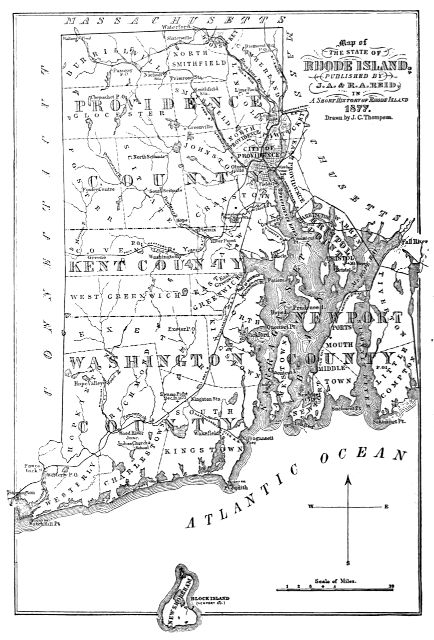
part of our dominions in New England, in America, containing
the Nahantic, and Nanhyganset, alias Narragansett Bay, and
countries and parts adjacent, bounded on the west, or westerly,
to the middle of a channel or river there, commonly called and
known by the name of Pawcatuck, alias Pawcawtuck river, and so
along the said river, as the greater or middle stream thereof reacheth
or lies up into the north country, northward, unto the head thereof,
and from thence, by a straight line drawn due north, until it meets
with the south line of the Massachusetts Colony; and on the north, or
northerly, by the aforesaid south or southerly line of the Massachusetts
Colony or Plantation, and extending towards the east, or eastwardly,
three English miles to the east and north-east of the most eastern and
north-eastern parts of the aforesaid Narragansett Bay, as the said bay
lyeth or extendeth itself from the ocean on the south, or southwardly
unto the mouth of the river which runneth towards the town of Providence,
and from thence along the easterly side or bank of the said
river (higher called by the name of Seacunck river) up to the falls called
Patuckett Falls, being the most westwardly line of Plymouth Colony,
and so from the said falls, in a straight line, due north, until it meet
with the aforesaid line of the Massachusetts Colony; and bounded on
the south by the ocean; and, in particular, the lands belonging to the
towns of Providence, Pawtuxet, Warwick, Misquammacok, alias
Pawcatuck, and the rest upon the main land in the tract aforesaid, together
with Rhode Island, Block Island, and all the rest of the islands
and banks in the Narragansett Bay, and bordering upon the coast of
the tract aforesaid, (Fisher’s Island only excepted,) together with all
firm lands, soils, grounds, havens, ports, rivers, waters, fishings, mines
royal, and all other mines, minerals, precious stones, quarries, woods,
wood grounds, rocks, slates, and all and singular other commodities,
jurisdictions, royalties, privileges, franchises, preheminancies, and
hereditaments, whatsoever within the said tract, bounds, lands and
islands aforesaid, or to them or any of them belonging, or in anywise
appertaining; to have and to hold the same, unto the said Governor
and Company, and their successors, forever, upon trust, for the use
and benefit of themselves and their associates freemen of the said
Colony, their heirs and assigns, to be holden of us, our heirs and
successors, as of the Manor of East Greenwich, in our county of Kent,
in free and common soccage, and not in capite, nor by knight service;
yielding and paying, therefore, to us, our heirs and successors,
only the fifth part of all the ore of gold and silver which, from time
to time, and at all times hereafter, shall be there gotten, had or obtained,
in lieu and satisfaction of all services, duties, fines, forfeitures,
made or to be made, claims and demands whatsoever, to be to us, our
heirs or successors, therefor or thereout rendered, made or paid; any
grant, or clause in a late grant, to the Governor and Company of
Connecticut Colony, in America, to the contrary thereof in anywise
notwithstanding; the aforesaid Pawcatuck river having been yielded,
after much debate, for the fixed and certain bounds between these our
said Colonies, by the agents thereof; who have also agreed, that the
said Pawcatuck river shall be also called alias Norrogansett or Narrogansett
river; and, to prevent future disputes, that otherwise might
arise thereby, forever hereafter shall be construed, deemed and taken
to be the Narragansett river in our late grant to Connecticut Colony
mentioned as the easterly bounds of that Colony. And further, our
will and pleasure is, that in all matters of public controversy which
may fall out between our Colony of Providence Plantations, and the
rest of our Colonies in New England, it shall and may be lawful to
and for the Governor and Company of the said Colony of Providence
Plantations to make their appeals therein to us, our heirs and successors,
for redress in such cases, within this our realm of England: and
that it shall be lawful to and for the inhabitants of the said Colony of
Providence Plantations, without let or molestation, to pass and repass,
with freedom, into and through the rest of the English Colonies, upon
their lawful and civil occasions, and to converse, and hold commerce
and trade with such of the inhabitants of our other English Colonies
as shall be willing to admit them thereunto, they behaving themselves
peaceably among them; any act, clause or sentence, in any of the said
Colonies provided, or that shall be provided, to the contrary in anywise
notwithstanding. And lastly, we do, or us, our heirs and successors, ordain
and grant unto the said Governor and Company and their successors
by these presents that these our letters patent shall be firm, good, effectual
and available in all things in the law, to all intents, contents, constructions
and purposes whatsoever, according to our true intent and meaning
hereinbefore declared; and shall be construed, reputed and adjudged
in all cases most favorably on the behalf, and for the best benefit and
behoof of the said Governor and Company, and their successors; although
express mention of the true yearly value or certainty of the
premises, or any of them, or of any other gifts or grants, by us, or by
any of our progenitors or predecessors, heretofore made to the said
Governor of the Company of the English Colony of Rhode Island and
Providence Plantations, in the Narragansett Bay, New England, in
America, in these presents is not made, or any statue, act, ordinance,
provision, proclamation or restriction, heretofore had, made, enacted,
ordained or provided, or any other matter, cause or thing whatsoever, to
the contrary thereof in any wise notwithstanding. In witness, whereof,
we have caused these our letters to be made patent. Witness ourself,
at Westminister, the eighth day of July, in the fifteenth year of
our reign.
By the King:
HOWARD.
ARTICLE I.—Declaration of Rights.
Section 1. Right of the people to make and alter their Constitution.
Sec. 2. Object of government—How laws should be made and burdens
distributed.
Sec. 3. Religious freedom secured.
Sec. 4. Slavery prohibited.
Sec. 5. Laws should provide remedies—Justice shall be free, complete,
prompt.
Sec. 6. Rights of search and seizure regulated.
Sec. 7. Provisions concerning criminal proceedings.
Sec. 8. Bail, fines and punishments.
Sec. 9. Bail and habeas corpus.
Sec. 10. Rights of the accused in criminal proceedings.
Sec. 11. Debtors entitled to relief.
Sec. 12. No ex post facto law, &c., to be passed.
Sec. 13. No man to criminate himself.
Sec. 14. Presumption of innocence—Accused to be secured without
severity.
Sec. 15. Trial by jury.
Sec. 16. Private property secured.
Sec. 17. Rights of fishery.
Sec. 18. Military subordinate—Martial law.
Sec. 19. Of quartering soldiers.
Sec. 20. Liberty of the press secured—Truth as a defence to libel.
Sec. 21. Right of the people to assemble, and to petition.
Sec. 22. Right to bear arms.
Sec. 23. Rule of construction.
ARTICLE II.—Electors.
Sec. 1. Of electors owning real estate.
Sec. 2. Of electors qualified to vote on adoption of Constitution—Registered
voters—Qualified by dollar tax—Military duty—Who to
vote for City Council in Providence, to impose a tax, &c.
Sec. 3. Of assessment and payment of registry tax.
Sec. 4. Who shall not gain residence or be permitted to vote.
Sec. 5. Residents on lands ceded, &c., not electors.
Sec. 6. Power of General Assembly over elections.
ARTICLE III.—Powers Distributed.
Three Departments.
ARTICLE IV.—Legislative Powers.
Section 1. Constitution supreme law.
Sec. 2. Two houses—General Assembly—Style of laws.
Sec. 3. Sessions of General Assembly.
Sec. 4. Members not to take fees, &c.
Sec. 5. Members exempt from arrest, &c.
Sec. 6. Powers of each house—Organization.
Sec. 7. Powers to make rules, &c.
Sec. 8. Of the journal and yeas and nays.
Sec. 9. Of adjournments.
Sec. 10. Of powers not prohibited.
Sec. 11. Pay of members.
Sec. 12. Lotteries prohibited.
Sec. 13. Debts not to be incurred.
Sec. 14. Private or local appropriations.
Sec. 15. Of valuations of property and assessments.
Sec. 16. Officers may be continued until successors are qualified.
Sec. 17. Bills to create corporations to be continued, except, &c.
Sec. 18. Of election of senators to Congress.
ARTICLE V.—House of Representatives.
Section 1. House, how constituted—Ratio of representation.
Sec. 2. May elect its officers, &c.
ARTICLE VI.—Senate.
Section 1. How constituted.
Sec. 2. Governor to preside—when to vote in grand committee.
Sec. 3. May elect presiding officer in case of vacancy, &c.
Sec. 4. Secretary and other officers.
ARTICLE VII.—Executive.
Section 1. Of the governor and lieutenant-governor—How elected.
Sec. 2. Duty of governor.
Sec. 3. He shall command military and naval forces, except, &c.
Sec. 4. He may grant reprieves, &c.
Sec. 5. He may fill vacancies.
Sec. 6. He may adjourn assembly, in case, &c.
Sec. 7. He may convene assembly, when, &c.
Sec. 8. Commissions, how signed, &c.
Sec. 9. Lieutenant-governor, when to act as governor.
Sec. 10. Vacancies, how filled.
Sec. 11. Compensation of governor, &c.
Sec. 12. Duties of general officers.
ARTICLE VIII.—Elections.
Section 1. Governor and general officers, when elected.
Sec. 2. General officers and members of assembly, how voted for.
Sec. 3. Same subject—How votes to be sealed up, transmitted and
counted.
Sec. 4. List of voters to be kept. [Obsolete.]
Sec. 5. Ballots for members of Assembly, how counted—Adjournment
of elections, when.
Sec. 6. Of voting in the City of Providence.
Sec. 7. If governor or lieutenant-governor not elected by the people
grand committee to elect, how.
Sec. 8. In case general officers not elected by the people, how vacancies
shall be filled.
Sec. 9. Vacancies in Assembly, how filled.
Sec. 10. Majority required to elect.
ARTICLE IX.—Qualifications for Office.
Section 1. Qualified electors only eligible.
Sec. 2. Conviction of bribery a disqualification.
Sec. 3. Oath of general officers.
Sec. 4. Officers, how engaged.
Sec. 5. How oath to be administered to governor, &c.
Sec. 6. Holding office under United States, or other governments,
a disqualification for certain offices,—except, &c.
ARTICLE X.—Judiciary.
Section 1. One supreme court—Inferior courts how established.
Sec. 2. Jurisdiction of courts—Chancery powers.
Sec. 3. Judges of supreme court to instruct jury—To give opinions,
&c.
Sec. 4. Of election and tenure of office of judges of supreme court.
Sec. 5. Vacancies, how filled.
Sec. 6. Compensation of judges.
Sec. 7. Justices of the peace and wardens, how elected—Their
jurisdiction.
ARTICLE XI.—Impeachments.
Section 1. Impeachments, how ordered.
Sec. 2. Impeachments, how tried.
Sec. 3. What officers liable to impeachmentX—Effect of conviction.
ARTICLE XII.—Education.
Section 1. Duty of General Assembly to promote schools, &c.
Sec. 2. The permanent school fund.
Sec. 3. Donations for support of schools.
Sec. 4. Powers of General Assembly under this article.
ARTICLE XIII.—XAmendments.
Section 1. Amendments, how proposed,X—how voted upon,X—how
adopted.
ARTICLE XIV.—XAdoption of the Constitution.
Section 1. Constitution, when to go into operation—Its effect on
existing laws, charters, &c.
Sec. 2. Former debts, &c., adopted.
Sec. 3. Jurisdiction of supreme court.
Sec. 4. Exemptions of New Shoreham and Jamestown from military
duty, continued.
AMENDMENTS TO THE CONSTITUTION.
ARTICLE I.
Lists of voters for general officers no longer required to be kept, &c.
ARTICLE II.
The pardoning power, how exercised.
ARTICLE III.
Sessions of the General Assembly.
ARTICLE IV.
Electors absent from the state in the military service of the United
States, allowed to vote.
We, the people of the State of Rhode Island and Providence Plantations,
grateful to Almighty God for the civil and religious liberty
which He hath so long permitted us to enjoy, and looking to Him for
a blessing upon our endeavors to secure and to transmit the same, unimpaired,
to succeeding generations, do ordain and establish this
Constitution of Government.
ARTICLE I.
DECLARATION OF CERTAIN CONSTITUTIONAL RIGHTS AND PRINCIPLES.
In order effectually to secure the religious and political freedom
established by our venerated ancestors, and to preserve the same for
our posterity, we do declare that the essential and unquestionable
rights and principles hereinafter mentioned, shall be established,
maintained and preserved, and shall be of paramount obligation in
all legislative, judicial and executive proceedings.
Section 1. In the words of the Father of his Country, we declare,
that, “the basis of our political systems is the right of the people to
make and alter their constitutions of government; but that the constitution
which at any time exists, till changed by an explicit and
authentic act of the whole people, is sacredly obligatory upon all.”
Sec. 2. All free governments are instituted for the protection,
safety and happiness of the people. All laws, therefore, should be
made for the good of the whole; and the burdens of the state ought
to be fairly distributed among its citizens.
Sec. 3. Whereas, Almighty God hath created the mind free; and
all attempts to influence it by temporal punishments, or burthens, or
by civil incapacitations, tend to beget habits of hypocrisy and meanness;
and whereas, a principal object of our venerable ancestors in
their migration to this country and their settlement of this state, was,
as they expressed it, to hold forth a lively experiment, that a flourishing
civil state may stand and be best maintained with full liberty in
religious concernments; we therefore declare that no man shall be
compelled to frequent or to support any religious worship, place or
ministry whatever, except in fulfillment of his own voluntary contract;
nor enforced, restrained, molested or burthened in his body or
goods; nor disqualified from holding any office; nor otherwise suffer
on account of his religious belief; and that every man shall be free to
worship God according to the dictates of his own conscience, and to
profess and by argument to maintain his opinion in matters of religion;
and that the same shall in no wise diminish, enlarge, or affect his
civil capacity.
Sec. 4. Slavery shall not be permitted in this state.
Sec. 5. Every person within this state ought to find a certain remedy,
by having recourse to the laws, for all injuries or wrongs which
he may receive in his person, property or character. He ought to
obtain right and justice freely, and without purchase, completely, and
without denial; promptly and without delay; conformably to the
laws.
Sec. 6. The right of the people to be secure in their persons, papers
and possessions, against unreasonable searches and seizures, shall not
be violated; and no warrants shall issue, but on complaint in writing,
upon probable cause, supported by oath or affirmation, and describing
as nearly as may be the place to be searched, and the persons or things
to be seized.
Sec. 7. No person shall be held to answer for a capital or other
infamous crime, unless on presentment or indictment by a grand jury,
except in cases of impeachment, or of such offences as are cognizable
by a justice of the peace; or in cases arising in the land or naval
forces, or in the militia when in actual service in time of war or public
danger. No person shall, after an acquittal, be tried for the same
offence.
Sec. 8. Excessive bail shall not be required, nor excessive fines
imposed, nor cruel punishments inflicted; and all punishments ought
to be proportioned to the offence.
Sec. 9. All persons imprisoned ought to be bailed by sufficient
surety, unless for offences punishable by death or by imprisonment for
life, when the proof of guilt is evident, or the presumption great. The
privilege of the writ of habeas corpus shall not be suspended, unless
when in cases of rebellion or invasion the public service shall require
it, nor ever without the authority of the General Assembly.
Sec. 10. In all criminal prosecutions, the accused shall enjoy the
right to a speedy and public trial, by an impartial jury; to be informed
of the nature and cause of the accusation, to be confronted with the
witnesses against him, to have compulsory process for obtaining them
in his favor, to have the assistance of counsel in his defence, and shall
be at liberty to speak for himself; nor shall he be deprived of life,
liberty, or property, unless by the judgment of his peers, or the law of
the land.
Sec. 11. The person of a debtor, when there is not strong presumption
of fraud, ought not to be continued in prison, after he shall have
delivered up his property for the benefit of his creditors, in such manner
as shall be prescribed by law.
Sec. 12. No ex post facto law, or law impairing the obligation of
contracts, shall be passed.
Sec. 13. No man in a court of common law shall be compelled to
give evidence criminating himself.
Sec. 14. Every man being presumed innocent, until he is pronounced
guilty by the law, no act of severity which is not necessary to
secure an accused person shall be permitted.
Sec. 15. The right of trial by jury shall remain inviolate.
Sec. 16. Private property shall not be taken for public uses, without
just compensation.
Sec. 17. The people shall continue to enjoy and freely exercise, all
the rights of fishery, and the privileges of the shore, to which they
have been heretofore entitled, under the charter and usages of this
state. But no new right is intended to be granted, nor any existing
right impaired by this declaration.
Sec. 18. The military shall be held in strict subordination to the
civil authority, and the law martial shall be used and exercised in such
cases only as occasion shall necessarily require.
Sec. 19. No soldier shall be quartered in any house, in time of
peace, without the consent of the owner; nor in time of war, but in
manner to be prescribed by law.
Sec. 20. The liberty of the press being essential to the security of
freedom in a state, any person may publish his sentiments on any
subject, being responsible for the abuse of that liberty; and in all
trials for libel, both civil and criminal, the truth, unless published
from malicious motives, shall be sufficient defence to the person
charged.
Sec. 21. The citizens have a right, in a peaceable manner, to assemble
for their common good, and to apply to those invested with the
powers of government, for redress of grievances, or for other purposes,
by petition, address, or remonstrance.
Sec. 22. The right of the people to keep and bear arms shall not be
infringed.
Sec. 23. The enumeration of the aforegoing rights shall not be
construed to impair or deny others retained by the people.
ARTICLE II.
OF THE QUALIFICATIONS OF ELECTORS.
Section 1. Every male citizen of the United States, of the age of
twenty-one years, who has had his residence and home in this state
for one year, and in the town or city in which he may claim a right to
vote, six months next preceding the time of voting, and who is really
and truly possessed in his own right of real estate in such town or
city, of the value of one hundred and thirty-four dollars, over and
above all incumbrances, or which shall rent for seven dollars per
annum, over and above any rent reserved, or the interest of any incumbrances
thereon, being an estate in fee simple, fee tail, for the
life of any person, or an estate in reversion or remainder, which
qualifies no other person to vote, the conveyance of which estate, if
by deed, shall have been recorded at least ninety days, shall thereafter
have a right to vote in the election of all civil officers, and on all
questions in all legal town or ward meetings, so long as he continues
so qualified. And if any person hereinbefore described shall own any
such estate within this state out of the town or city in which he resides,
he shall have a right to vote in the election of all general officers and
members of the General Assembly, in the town or city in which he
shall have had his residence and home for the term of six months
next preceding the election, upon producing a certificate from the
clerk of the town or city in which his estate lies, bearing date within]
ten days of the time of his voting, setting forth that such person has
a sufficient estate therein to qualify him as a voter; and that the deed,
if any, has been recorded ninety days.
Sec. 2. Every male native citizen of the United States, of the age
of twenty-one years, who has had his residence and home in this state
two years, and in the town or city in which he may offer to vote, six
months next preceding the time of voting, whose name is registered
pursuant to the act calling the convention to frame this Constitution,
or shall be registered in the office of the clerk of such town or city at
least seven days before the time he shall offer to vote and before the
last day of December in the present year; and who has paid or shall
pay a tax or taxes, assessed upon his estate within this state, and
within a year of the time of voting, to the amount of one dollar, or
who shall voluntarily pay, at least seven days before the time he shall
offer to vote, and before said last day of December, to the clerk or
treasurer of the town or city where he resides, the sum of one dollar,
or such sum as, with his other taxes, shall amount to one dollar, for
the support of public schools therein, and shall make proof of the
same, by the certificate of the clerk, treasurer or collector of any
town or city where such payment is made; or who, being so registered
has been enrolled in any military company in this state, and done
military service or duty therein, within the present year, pursuant to
law, and shall, (until other proof is required by law,) prove by the certificate
of the officer legally commanding the regiment, or chartered or
legally authorized volunteer company, in which he may have served or
done duty, that he has been equipped and done duty according to law, or
by the certificate of the commissioners upon military claims that he
has performed military service shall have a right to vote in the election
of all civil officers, and on all questions in all legally organized
town or ward meetings, until the end of the first year after the adoption
of this Constitution, or until the end of the year eighteen hundred
and forty-three.
From and after that time, every such citizen, who has had the residence
herein required, and whose name shall be registered in the town
where he resides, on or before the last day of December, in the year
next preceding the time of his voting, and who shall show by legal
proof, that he has for and within the year next preceding the time he
shall offer to vote, paid a tax or taxes assessed against him in any town
or city in this state, to the amount of one dollar; or that he has been
enrolled in a military company in this state, been equipped and done
duty therein, according to law, and at least for one day during such
year, shall have a right to vote in the election of all civil officers, and
on all questions in all legally organized town or ward meetings: Provided,
that no person shall at any time be allowed to vote in the election
of the City Council of the City of Providence, or upon any proposition
to impose a tax, or for the expenditure of money in any town or
city, unless he shall, within the year next preceding have paid a tax
assessed upon his property therein, valued at least at one hundred and
thirty-four dollars.
Sec. 3. The assessors of each town or city shall annually assess
upon every person whose name shall be registered, a tax of one dollar,
or such sum as with his other taxes shall amount to one dollar, which
registry tax shall be paid into the treasury of such town or city, and
be applied to the support of public schools therein: but no compulsory
process shall issue for the collection of any registry tax: Provided that
the registry tax of every person who has performed military duty
according to the provisions of the preceding section, shall be remitted
for the year he shall perform such duty; and the registry tax assessed
upon any mariner, for any year while he is at sea, shall, upon his application,
be remitted; and no person shall be allowed to vote whose]
registry tax for either of the two years next preceding the time of
voting is not paid or remitted as herein provided.
Sec. 4. No person in the military, naval, marine, or any other service
of the United States, shall be considered as having the required
residence by reason of being employed in any garrison, barrack, or
military or naval station in this state: and no pauper, lunatic, person
non compos mentis, person under guardianship, or member of the Narragansett
tribe of Indians, shall be permitted to be registered or to
vote. Nor shall any person convicted of bribery, or of any crime
deemed infamous at common law, be permitted to exercise that privilege,
until he be expressly restored thereto by act of the General Assembly.
Sec. 5. Persons residing on lands ceded by this state to the United
States shall not be entitled to exercise the privilege of electors.
Sec. 6. The General Assembly shall have full power to provide
for a registry of voters, to prescribe the manner of conducting the elections,
the form of certificates, the nature of the evidence to be required
in case of a dispute as to the right of any person to vote, and generally
to enact all laws necessary to carry this article into effect, and to prevent
abuse, corruption and fraud in voting.
ARTICLE III.
OF THE DISTRIBUTION OF POWERS.
The powers of the government shall be distributed into three
departments: the legislative, executive and judicial.
ARTICLE IV.
OF THE LEGISLATIVE POWER.
Section 1. This constitution shall be the supreme law of the
state, and any law inconsistent therewith, shall be void. The General
Assembly shall pass all laws necessary to carry this constitution into
effect.
Sec. 2. The legislative power, under this constitution, shall
be vested in two houses, the one to be called the senate, the other the
house of representatives; and both together, the General Assembly. The
concurrence of the two houses shall be necessary to the enactment of
laws. The style of their laws shall be, It is enacted by the General
Assembly as follows.
Sec. 3. There shall be two sessions of the General Assembly
holden annually; one at Newport, on the first Tuesday of May, for the
purposes of election and other business; the other on the last Monday
of October, which last session shall be holden at South Kingstown once
in two years, and the intermediate years alternately at Bristol and
East Greenwich; and an adjournment from the October session shall be
holden annually at Providence.
Sec. 4. No member of the General Assembly shall take any fee,
or be of counsel in any case pending before either house of the General
Assembly, under penalty of forfeiting his seat, upon proof thereof to
the satisfaction of the house of which he is a member.
Sec. 5. The person of every member of the General Assembly
shall be exempt from arrest, and his estate from attachment, in any
civil action, during the session of the General Assembly, and two days
before the commencement, and two days after the termination thereof,
and all process served contrary hereto, shall be void. For any] speech
in debate in either house, no member shall be questioned in any other
place.
Sec. 6. Each house shall be the judge of the elections and
qualifications of its members; and a majority shall constitute a quorum
to do business; but a smaller number may adjourn from day to day and
may compel the attendance of absent members, in such manner, and under
such penalties as may be prescribed by such house, or by law. The
organization of the two houses may be regulated by law, subject to the
limitations contained in this constitution.
Sec. 7. Each house may determine its rules of proceeding,
punish contempts, punish its members for disorderly behavior, and, with
the concurrence of two-thirds, expel a member; but not a second time
for the same cause.
Sec. 8. Each house shall keep a journal of its proceedings.
The yeas and nays of the members of either house shall, at the desire
of one-fifth of those present, be entered on the journal.
Sec. 9. Neither house shall, during a session, without the
consent of the other, adjourn for more than two days, nor to any other
place than that in which they may be sitting.
Sec. 10. The General Assembly shall continue to exercise
the powers they have heretofore exercised, unless prohibited in this
constitution.
Sec. 11. The senators and representatives shall receive the
sum of one dollar for every day of attendance, and eight cents per
mile for traveling expenses in going to and returning from the General
Assembly. The General Assembly shall regulate the compensation of the
governor, and all other officers subject to the limitations contained
in this constitution.
Sec. 12. All lotteries shall hereafter be prohibited in this
state, except those already authorized by the General Assembly.
Sec. 13. The General Assembly shall have no power, hereafter,
without the express consent of the people, to incur state debts to an
amount exceeding fifty thousand dollars, except in time of war, or in
case of insurrection or invasion; nor shall they in any case, without
such consent, pledge the faith of the state for the payment of the
obligations of others. This section shall not be construed to refer to
any money that may be deposited with this state by the government of
the United States.
Sec. 14. The assent of two-thirds of the members elected
to each house of the General Assembly shall be required to every
bill appropriating the public money or property for local or private
purposes.
Sec. 15. The General Assembly shall, from time to time,
provide for making new valuations of property, for the assessment of
taxes, in such manner as they may deem best. A new estimate of such
property shall be taken before the first direct state tax, after the
adoption of this constitution, shall be assessed.
Sec. 16. The General Assembly may provide by law for
the continuance in office of any officers of annual election or
appointment, until other persons are qualified to take their places.
Sec. 17. Hereafter, when any bill shall be presented to either
house of the General Assembly, to create a corporation for any other
than for religious, literary or charitable purposes, or for a military
or fire company, it shall be continued until another election of
members of the General Assembly shall have taken place, and such public
notice of the pendency thereof shall be given as may be required by law.
Sec. 18. It shall be the duty of the two houses, upon the
request of either, to join in grand committee for the purpose of
electing senators in Congress, at such times and in such manner as may
be prescribed by law for said elections.
ARTICLE V.
OF THE HOUSE OF REPRESENTATIVES.
Section 1. The house of representatives shall never exceed seventy-two
members, and shall be constituted on the basis of population, always
allowing one representative for a fraction exceeding half the ratio;
but each town or city shall always be entitled to at least one member;
and no town or city shall have more than one-sixth of the whole number
of members to which the house is hereby limited. The present
ratio shall be one representative to every fifteen hundred and thirty
inhabitants, and the General Assembly may, after any new census taken
by the authority of the United States, or of this state, reapportion
the representation by altering the ratio; but no town or city shall be
divided into districts for the choice of representatives.
Sec. 2. The house of representatives shall have authority to elect its
speaker, clerks and other officers. The senior member from the town
of Newport, if any be present, shall preside in the organization of the
house.
ARTICLE VI.
OF THE SENATE.
Section 1. The senate shall consist of the lieutenant-governor and
of one senator from each town or city in the state.
Sec. 2. The governor, and, in his absence the lieutenant-governor,
shall preside in the senate and in grand committee. The presiding
officer of the senate and grand committee shall have a right to vote in
case of equal division, but not otherwise.
Sec. 3. If, by reason of death, resignation, absence or other cause,
there be no governor or lieutenant-governor present, to preside in the
senate, the senate shall elect one of their own members to preside during
such absence or vacancy; and until such election is made by the
senate the secretary of state shall preside.
Sec. 4. The secretary of state shall, by virtue of his office, be secretary
of the senate, unless otherwise provided by law; and the senate
may elect such other officers as they may deem necessary.
ARTICLE VII.
OF THE EXECUTIVE POWER.
Section 1. The chief executive power of this state shall be vested
in a governor, who, together with a lieutenant-governor, shall be annually
elected by the people.
Sec. 2. The governor shall take care that the laws be faithfully
executed.
Sec. 3. He shall be captain-general and commander-in-chief of the
military and naval forces of this state, except when they shall be called
into the service of the United States.
Sec. 4. He shall have power to grant reprieves after conviction, in
all cases except those of impeachment, until the the end of the next
session of the General Assembly.
Sec. 5. He may fill vacancies in office not otherwise provided for
by this constitution, or by law, until the same shall be filled by the
General Assembly or by the people.
Sec. 6. In case of disagreement between the two houses of the General
Assembly, respecting the time or place of adjournment certified
to him by either, he may adjourn them to such time and place as he]
shall think proper: provided that the time of adjournment shall not
be extended beyond the day of the next stated session.
Sec. 7. He may, on extraordinary occasions, convene the General
Assembly at any town or city in this state, at any time not provided
for by law; and in case of danger from the prevalence of epidemic or
contagious disease, in the place in which the General Assembly are by
law to meet, or to which they may have been adjourned, or for other
urgent reasons, he may, by proclamation, convene said Assembly at
any other place within this state.
Sec. 8. All commissions shall be in the name and by the authority
of the State of Rhode Island and Providence Plantations; shall be
sealed with the state seal, signed by the governor, and attested by the
secretary.
Sec. 9. In case of vacancy in the office of governor, or of his inability
to serve, impeachment, or absence from the state, the lieutenant-governor
shall fill the office of governor, and exercise the powers and
authority appertaining thereto, until a governor is qualified to act, or
until the office is filled at the next annual election.
Sec. 10. If the offices of governor and lieutenant-governor be both
vacant by reason of death, resignation, impeachment, absence, or
otherwise, the person entitled to preside over the senate for the time
being shall in like manner fill the office of governor during the absence
or vacancy.
Sec. 11. The compensation of the governor and lieutenant-governor
shall be established by law and shall not be diminished during the
term for which they are elected.
Sec. 12. The duties and powers of the secretary, attorney-general,
and general treasurer, shall be the same under this constitution as are
now established, or as from time to time may be prescribed by law.
ARTICLE VIII.
OF ELECTIONS.
Section 1. The governor, lieutenant-governor, senators, representatives,
secretary of state, attorney-general, and general treasurer,
shall be elected at the town, city, or ward meetings, to be holden on the
first Wednesday of April, annually; and shall severally hold their
offices for one year, from the first Tuesday of May next succeeding,
and until others are legally chosen, and duly qualified to fill their
places. If elected or qualified after the said first Tuesday of May,
they shall hold their offices for the remainder of the political year, and
until their successors are qualified to act.
Sec. 2. The voting for governor, lieutenant-governor, secretary of
state, attorney-general, general treasurer, and representatives to Congress
shall be by ballot; senators and representatives to the General
Assembly, and town or city officers shall be chosen by ballot, on demand
of any seven persons entitled to vote for the same; and in all cases
where an election is made by ballot or paper vote, the manner of balloting
shall be the same as is now required in voting for general officers,
until otherwise prescribed by law.
Sec. 3. The names of the persons voted for as governor, lieutenant-governor,
secretary of state, attorney-general, and general treasurer,
shall be placed upon one ticket; and all votes for these officers shall,
in open town or ward meetings, be sealed up by the moderators and
town clerks and by the wardens and ward clerks, who shall certify the
same, and deliver or send them to the secretary of state; whose duty
it shall be securely to keep and deliver the same to the grand committee,
after the organization of the two houses at the annual May]
session; and it shall be the duty of the two houses at said session,
after their organization, upon the request of either house, to join in
grand committee, for the purpose of counting and declaring said votes,
and of electing other officers.
Sec. 4. The town and ward clerks shall also keep a correct list or
register of all persons voting for general officers, and shall transmit a
copy thereof to the General Assembly, on or before the first day of
said May session.
Sec. 5. The ballots for senators and representatives in the several
towns shall, in each case, after the polls are declared to be closed, be
counted by the moderator, who shall announce the result, and the
clerk shall give certificates to the persons elected. If, in any case,
there be no election, the polls may be reopened, and the like proceedings
shall be had until an election shall take place: Provided, however,
that an adjournment or adjournments of the election may be
made to a time not exceeding seven days from the first meeting.
Sec. 6. In the city of Providence, the polls for senator and representatives
shall be kept open during the whole time of voting for the
day, and the votes in the several wards shall be sealed up at the close
of the meeting by the wardens and ward clerks in open ward meeting,
and afterwards delivered to the city clerk. The mayor and aldermen
shall proceed to count said votes within two days from the day of
election; and if no election of senator and representatives or if an
election of only a portion of the representatives shall have taken
place, the mayor and aldermen shall order a new election, to be held
not more than ten days from the day of the first election, and so on
until the election shall be completed. Certificates of election shall be
furnished by the city clerk to the persons chosen.
Sec. 7. If no person shall have a majority of votes for governor,
it shall be the duty of the grand committee to elect one by ballot from
the two persons having the highest number of votes for the office,
except when such a result is produced by rejecting the entire vote of
any town, city or ward for informality or illegality, in which case a
new election by the electors throughout the state shall be ordered;
and in case no person shall have a majority of votes for lieutenant-governor,
it shall be the duty of the grand committee to elect one by
ballot from the two persons having the highest number of votes for
the office.
Sec. 8. In case an election of the secretary of state, attorney-general,
or general treasurer, should fail to be made by the electors at the
annual election, the vacancy or vacancies shall be filled by the General
Assembly in grand committee from the two candidates for such office
having the greatest number of the votes of the electors. Or, in case
of a vacancy in either of said offices, from other causes, between the
sessions of the General Assembly, the governor shall appoint some
person to fill the same, until a successor elected by the General
Assembly is qualified to act; and in such case, and also in all other
cases of vacancies, not otherwise provided for, the General Assembly
may fill the same in any manner they may deem proper.
Sec. 9. Vacancies from any cause in the senate and house of
representatives, may be filled by a new election.
Sec. 10. In all elections held by the people under this constitution,
a majority of all the electors voting shall be necessary to the election
of the persons voted for.
ARTICLE IX.
OF QUALIFICATIONS FOR OFFICE.
Section 1. No person shall be eligible to any civil office (except the
office of school committee), unless he be a qualified elector for such
office.
Sec. 2. Every person shall be disqualified from holding any office
to which he may have been elected, if he be convicted of having
offered, or procured any other person to offer, any bribe to secure his
election, or the election of any other person.
Sec. 3. All general officers shall take the following engagement before
they act in their respective offices, to wit: You ... being by
the free vote of the electors of this State of Rhode Island and Providence
Plantations, elected unto the place of ... do solemnly
swear, (or affirm,) to be true and faithful unto this state, and to support
the constitution of this state and of the United States; that you
will faithfully and impartially discharge all the duties of your aforesaid
office to the best of your abilities, according to law: So help you
God. Or, this affirmation you make and give upon the peril of the
penalty of perjury.
Sec. 4. The members of the General Assembly, the judges of all
the courts, and all other officers, both civil and military, shall be bound
by oath or affirmation to support this constitution, and the constitution
of the United States.
Sec. 5. The oath or affirmation shall be administered to the governor,
lieutenant-governor, senators and representatives, by the secretary
of state, or, in his absence, by the attorney-general. The secretary
of state, attorney-general and general treasurer shall be engaged by
the governor, or by a justice of the supreme court.
Sec. 6. No person holding any office under the government of the
United States, or of any other state or country, shall act as a general
officer, or as a member of the General Assembly, unless at the time of
taking his engagement he shall have resigned his office under such
government; and if any general officer, senator, representative, or
judge, shall after his election and engagement, accept any appointment
under any other government his office under this shall be immediately
vacated; but this restriction shall not apply to any person
appointed to take depositions or acknowledgment of deeds, or other
legal instruments, by the authority of any other state or country.
ARTICLE X.
OF THE JUDICIAL POWER.
Section 1. The judicial power of this state shall be vested in one
supreme court, and in such inferior courts as the General Assembly
may, from time to time, ordain and establish.
Sec. 2. The several courts shall have such jurisdiction as may, from
time to time, be prescribed by law. Chancery powers may be conferred
on the supreme court, but on no other court to any greater extent than
is now provided by law.
Sec. 3. The judges of the supreme court shall, in all trials, instruct
the jury in the law. They shall also give their written opinion upon
any question of law whenever requested by the governor, or by either
house of the General Assembly.
Sec. 4. The judges of the supreme court shall be elected by the two
houses in grand committee. Each judge shall hold his office until his]
place be declared vacant by a resolution of the General Assembly to
that effect; which resolution shall be voted for by a majority of all the
members elected to the house in which it may originate, and be concurred
in by the same majority of the other house. Such resolutions,
shall not be entertained at any other than the annual session for the
election of public officers; and in default of the passage thereof at said
session, the judge shall hold his place as is herein provided. But a
judge of any court shall be removed from office, if, upon impeachment,
he shall be found guilty of any official misdemeanor.
Sec. 5. In case of vacancy by death, resignation, removal from the
state or from office, refusal or inability to serve, of any judge of the
supreme court, the office may be filled by the grand committee, until
the next annual election, and the judge then elected shall hold his
office as before provided. In cases of impeachment or temporary
absence or inability, the governor may appoint a person to discharge
the duties of the office during the vacancy caused thereby.
Sec. 6. The judges of the supreme court shall receive a compensation
for their services, which shall not be diminished during their continuance
in office.
Sec. 7. The towns of New Shoreham and Jamestown may continue
to elect their wardens as heretofore. The other towns and the
city of Providence may elect such number of justices of the peace,
resident therein, as they may deem proper. The jurisdiction of said
justices and wardens shall be regulated by law. The justices shall be
commissioned by the governor.
ARTICLE XI.
OF IMPEACHMENTS.
Section 1. The house of representatives shall have the sole power
of impeachment. A vote of two-thirds of all the members elected
shall be required for an impeachment of the governor. Any officer
impeached shall thereby be suspended from office until judgment in
the case shall have been pronounced.
Sec. 2. All impeachments shall be tried by the senate; and, when
sitting for that purpose, they shall be under oath or affirmation. No
person shall be convicted, except by vote of two-thirds of the members
elected. When the governor is impeached, the chief or presiding
justice of the supreme court, for the time being, shall preside, with a
casting vote in all preliminary questions.
Sec. 3. The governor and all other executive and judicial officers
shall be liable to impeachment; but judgment in such cases shall not
extend further than to removal from office. The person convicted
shall, nevertheless, be liable to indictment, trial and punishment
according to law.
ARTICLE XII.
OF EDUCATION.
Section 1. The diffusion of knowledge, as well as of virtue among
the people, being essential to the preservation of their rights and
liberties, it shall be the duty of the General Assembly to promote public
schools, and to adopt all means which they may deem necessary
and proper to secure to the people the advantages and opportunities of
education.
Sec. 2. The money which now is, or which may hereafter be appropriated
by law for the establishment of a permanent fund for the]
support of public schools shall be securely invested, and remain a perpetual
fund for that purpose.
Sec. 3. All donations for the support of public schools, or for other
purposes of education, which may be received by the General
Assembly, shall be applied according to the terms prescribed by the
donors.
Sec. 4. The General Assembly shall make all necessary provisions
by law for carrying this article into effect. They shall not divert said
money or fund from the aforesaid uses, nor borrow, appropriate, or use
the same, or any part thereof, for any other purpose, under any pretence
whatsoever.
ARTICLE XIII.
ON AMENDMENTS.
The General Assembly may propose amendments to this constitution
by the votes of a majority of all the members elected to each
house. Such propositions for amendment shall be published in the
newspapers and printed copies of them shall be sent by the secretary
of state, with the names of all the members who shall have voted
thereon, with the yeas and nays, to all the town and city clerks in the
state. The said propositions shall be, by said clerks, inserted in the
warrants or notices by them issued, for warning the next annual town
and ward meetings in April; and the clerks shall read said propositions
to the electors when thus assembled, with the names of all the
representatives and senators who shall have voted thereon, with the
yeas and nays, before the election of senators and representatives shall
be had. If a majority of all the members elected to each house, at
said annual meeting, shall approve any proposition thus made, the
same shall be published and submitted to the electors in the mode
provided in the act of approval; and if then approved by three-fifths
of the electors of the state present, and voting thereon in town and
ward meetings, it shall become a part of the constitution of the state.
ARTICLE XIV.
ON THE ADOPTION OF THIS CONSTITUTION.
Section 1. This constitution, if adopted, shall go into operation
on the first Tuesday of May, in the year one thousand eight hundred
and forty-three. The first election of governor, lieutenant-governor,
secretary of state, attorney-general and general treasurer, and of senators
and representatives under said constitution, shall be had on the
first Wednesday of April next preceding, by the electors qualified
under said constitution. And the town and ward meetings therefor
shall be warned and conducted as is now provided by law. All civil
and military officers now elected, or who shall hereafter be elected,
by the General Assembly, or other competent authority, before the
said first Wednesday of April, shall hold their offices and may exercise
their powers until the said first Tuesday of May, or until their successors
shall be qualified to act. All statutes, public and private, not
repugnant to this constitution, shall continue in force until they expire
by their own limitation, or are repealed by the General Assembly.
All charters, contracts, judgments, actions, and rights of action shall
be as valid as if this constitution had not been made. The present
government shall exercise all the powers with which it is now clothed,
until the said first Tuesday of May, one thousand eight hundred and
forty-three, and until the government under this constitution is duly
organized.
Sec 2. All debts contracted and engagements entered into, before
the adoption of this constitution, shall be as valid against the state as
if this constitution had not been adopted.
Sec 3. The supreme court, established by this constitution, shall
have the same jurisdiction as the supreme judicial court at present
established, and shall have jurisdiction of all causes which may be
appealed to, or pending in the same; and shall be held at the same
times and places, and in each county, as the present supreme judicial
court, until otherwise prescribed by the General Assembly.
Sec 4. The towns of New Shoreham and Jamestown shall continue
to enjoy the exemptions from military duty which they now
enjoy, until otherwise prescribed by law.
Done in convention, at East Greenwich, this fifth day of November,
A. D. one thousand eight hundred and forty-two.
JAMES FENNER, President.
HENRY Y. CRANSTON, Vice-Pres’t.
Thomas A. Jenckes,
Walter W. Updike,
}
Secretaries.
Articles of Amendment.
Adopted November, 1854.
ARTICLE I.
It shall not be necessary for the town or ward clerks to keep and
transmit to the General Assembly a list or register of all persons voting
for general officers; but the General Assembly shall have power
to pass such laws on the subject as they may deem expedient.
ARTICLE II.
The governor, by and with the advice and consent of the senate,
shall hereafter exclusively exercise the pardoning power, except in
cases of impeachment, to the same extent as such power is now exercised
by the General Assembly.
ARTICLE III.
There shall be one session of the General Assembly holden annually,
commencing on the last Tuesday in May, at Newport, and an adjournment
from the same shall be holden annually at Providence.
Adopted August, 1864.
ARTICLE IV.
Electors of this state who in time of war are absent from the state,
in the actual military service of the United States, being otherwise
qualified, shall have a right to vote in all elections in the state for
electors of president and vice-president of the United States, representatives
in Congress, and general officers of the state. The General
Assembly shall have full power to provide by law for carrying this
article into effect: and until such provision shall be made by law,
every such absent elector on the day of such elections, may deliver a
written or printed ballot, with the names of the persons voted for
thereon, and his Christian and surname, and his voting residence in
the state, written at length on the back thereof, to the officer commanding
the regiment or company to which he belongs: and all such
ballots, certified by such commanding officer to have been given by the
elector whose name is written thereon, and returned by such commanding
officer to the secretary of state within the time prescribed by
law for counting the votes in such elections, shall be received and
counted with the same effect as if given by such elector in open town,
ward, or district meeting: and the clerk of each town or city, until
otherwise provided by law, shall, within five days after any such
election, transmit to the secretary of state a certified list of the names
of all such electors on their respective voting lists.
CONSTITUTION
OF THE
State of Rhode Island,
AND
Providence Plantations,
As finally adopted by the Convention of the People assembled
at Providence, on the 18th day of November, 1841.
WE, the PEOPLE of the State of Rhode Island and Providence
Plantations, grateful to Almighty God for His blessing vouchsafed
to the “lively experiment” of Religious and Political Freedom
here “held forth” by our venerated ancestors, and earnestly imploring
the favor of His gracious Providence toward this our attempt to
secure, upon a permanent foundation, the advantages of well ordered
and rational Liberty, and to enlarge and transmit to our successors
the inheritance that we have received, do ordain and establish the
following CONSTITUTION of Government for this State:
ARTICLE I.
DECLARATIONS OF PRINCIPLES AND RIGHTS.
1. In the spirit of and in the words of Roger Williams, the illustrious
founder of this state, and of his venerated associates, We
declare “that this government shall be a Democracy,” or government
of the PEOPLE, “by the major consent” of the same, “ONLY
IN CIVIL THINGS.” The will of the people shall be expressed by representatives
freely chosen, and returning at fixed periods to their constituents.
This state shall be and forever remain, as in the design of
its founder, sacred to “Soul Liberty,” to the rights of conscience,
to freedom of thought, of expression and of action, as hereinafter set
forth and secured.
2. All men are created free and equal and are endowed by their
Creator with certain natural, inherent and inalienable rights, among
which are life, liberty, the acquisition of property and the pursuit of
happiness. Government cannot create or bestow these rights which
are the gift of God, but it is instituted for the stronger and surer defence
of the same; that men may safely enjoy the rights of life and
liberty, securely possess and transmit property, and so far as laws avail
may be successful in the pursuit of happiness.
3. All political power and sovereignty are originally vested in and
of right belong to the People. All free governments are founded in
their authority and are established for the greatest good of the whole
number. The People have therefore an inalienable and indefeasible
right in their original, sovereign and unlimited capacity to ordain and
institute government, and in the same capacity to alter, reform, or
totally change the same, whenever their safety or happiness requires.
4. No favor or disfavor ought to be shown in legislation toward
any man, or party, or society, or religious denomination. The laws
should be made not for the good of the few, but of the many, and the
burdens of the state ought to be fairly distributed among its citizens.
5. The diffusion of useful knowledge and the cultivation of a
sound morality in the fear of God being of the first importance in a
republican state, and indispensable to the maintenance of its liberty,
it shall be an imperative duty of the legislature to promote the establishment
of free schools and to assist in the support of public
education.
6. Every person in this state ought to find a certain remedy by
having recourse to the laws, for all injuries or wrongs which may be
done to his rights of person, property or character. He ought to obtain
right and justice freely and without purchase, completely and
without denial, promptly and without delay, conformably to the laws.
7. The right of the people to be secure in their persons, houses,
papers and possessions against unreasonable searches and seizures,
shall not be violated; and no warrant shall issue but on complaint in
writing upon probable cause, supported by oath or affirmation, and
describing, as nearly as may be, the place to be searched, and the person
or things to be seized.
8. No person shall be held to answer to a capital or other infamous
charge unless on indictment by a grand jury except in cases arising in
the land or naval forces, or in the militia when in actual service, in
time of war or public danger. No person shall be tried, after an
acquittal, for the same crime or offence.
9. Every man being presumed to be innocent until pronounced
guilty by the law, all acts of severity that are not necessary to secure
an accused person ought to be repressed.
10. Excessive bail shall not be required, nor excessive fines imposed,
nor cruel or unusual punishments inflicted, and all punishments ought
to be proportioned to the offence.
11. All prisoners shall be bailable upon sufficient surety, unless for
capital offences, when the proof is evident or the presumption great.
The privilege of the writ of habeas corpus shall not be suspended,
unless when in cases of rebellion or invasion the public safety shall
require it.
12. In all criminal prosecutions the accused shall have the privilege
of a speedy and public trial by an impartial jury; be informed of
the nature and cause of the accusation; be confronted with the witnesses
against him; have compulsory process to obtain them in his
favor, and at the public expense, when necessary, have the assistance
of counsel in his defence, and be at liberty to speak for himself. Nor
shall he be deprived of his life, liberty or property unless by the judgment
of his peers, or the law of the land.
13. The right of trial by jury shall remain inviolate, and in all
criminal cases the jury shall judge both of the law and of the facts.
14. Any person in this state who may be claimed to be held to
labor or service under the laws of any other state, territory or district,
shall be entitled to a jury trial, to ascertain the validity of such
claim.
15. No man in a court of common law shall be required to criminate
himself.
16. Retrospective laws, civil and criminal, are unjust and oppressive,
and shall not be made.
17. The people have a right to assemble in a peaceable manner,
without molestation or restraint, to consult upon the public welfare;
a right to give instructions to their senators and representatives; and
a right to apply to those invested with the powers of government for
redress of grievances, for the repeal of injurious laws, for the correction
of faults of administration, and for all other purposes.
18. The liberty of the press being essential to the security of freedom
in a state, any citizen may publish his sentiments on any subject,
being responsible for the abuse of that liberty; and in all trials
for libel, both civil and criminal, the truth, spoken from good
motives and for justifiable ends, shall be a sufficient defence to the
person charged.
19. Private property shall not be taken for public uses without just
compensation; nor unless the public good require it; nor under any
circumstances until compensation shall have been made, if required.
20. The military shall always be held in strict subordination to the
civil authority.
21. No soldier shall in time of peace be quartered in any house
without the consent of the owner; nor in time of war but in manner
to be prescribed by law.
22. Whereas Almighty God hath created the mind free, and all
attempts to influence it by temporal punishments or burdens, or by
civil incapacitations, tend to beget habits of hypocrisy and meanness;
and whereas a principal object of our venerated ancestors in their
migration to this country and their settlement of this state, was, as
they expressed it, to hold forth a lively experiment, that a flourishing
civil state may stand, and be best maintained, with full liberty in
religious concernments. We therefore DECLARE that no man shall
be compelled to frequent or support any religious worship, place or
ministry whatsoever, nor be enforced, restrained, molested or burdened
in his body or goods, nor disqualified from holding any office,
nor otherwise suffer on account of his religious belief; and that all
men shall be free to profess, and by argument to maintain, their opinions
in matters of religion; and that the same shall in no wise diminish,
enlarge or affect their civil capacities; and that all other religious
rights and privileges of the people of this state as now enjoyed, shall
remain inviolate and inviolable.
23. No witness shall be called in question before the legislature,
nor in any court of this state, nor before any magistrate or other person
authorized to administer an oath or affirmation, for his or her
religious belief, or opinions, or any part thereof; and no objection to a
witness, on the ground of his or her religious opinions, shall be entertained
or received.
24. The citizens shall continue to enjoy and freely exercise all the
rights of fishery and privileges of the shore to which they have been
heretofore entitled under the charter and usages of this state.
25. The enumeration of the foregoing rights shall not be construed
to impair nor deny others retained by the people.
ARTICLE II.
OF ELECTORS AND THE RIGHT OF SUFFRAGE.
1. Every white male citizen of the United States, of the age of
twenty-one years, who has resided in this state for one year, and in
any town, city or district of the same for six months next preceding
the election at which he offers to vote, shall be an elector of all officers,
who are elected or may hereafter be made eligible by the people. But
persons in the military, naval or marine service of the United States
shall not be considered as having such established residence by being
stationed in any garrison, barrack or military place in any town or
city in this state.
2. Paupers and persons under guardianship, insane or lunatic are
excluded from the electoral right; and the same shall be forfeited on
conviction of bribery, forgery, perjury, theft, or other infamous crime;
and shall not be restored unless by an act of the General Assembly.
3. No person who is excluded from voting for want of the qualification
first named in section first of this article, shall be taxed or be
liable to do military duty; provided that nothing in said first article
shall be so construed as to exempt from taxation any property or persons
now liable to be taxed.
4. No elector who is not possessed of and assessed for ratable property
in his own right to the amount of one hundred and fifty dollars,
or who shall have neglected or refused to pay any tax assessed upon
him in any town, city or district for one year preceding the town, city,
ward or district meeting at which he shall offer to vote, shall be entitled
to vote on any question of taxation, or the expenditure of any
public moneys in such town, city or district, until the same be paid.
5. In the city of Providence and other cities no person shall be
eligible to the office of mayor, alderman or common councilman, who
is not taxed or who shall have neglected or refused to pay his tax, as
provided in the preceding section.
6. The voting for all officers chosen by the people, except town or
city officers, shall be by ballot; that is to say, by depositing a written
or printed ticket in the ballot box, without the name of the voter written
thereon. Town or city officers shall be chosen by ballot, on the
demand of any two persons entitled to vote for the same.
7. There shall be a strict registration of all qualified voters in the
towns and cities of the state; and no person shall be permitted to vote
whose name has not been entered upon the list of voters before the
polls are opened.
8. The General Assembly shall pass all necessary laws for the prevention
of fraudulent voting by persons not having an actual permanent
residence or home in the state, or otherwise disqualified
according to this constitution; for the careful registration of all voters,
previously to the time of voting; for the prevention of frauds upon the
ballot box; for the preservation of the purity of elections; and for the
safe keeping and accurate counting of the votes; to the end that the
will of the people may be freely and fully expressed, truly ascertained
and effectually exerted, without intimidation, suppression or unnecessary
delay.
9. The electors shall be exempted from arrest on days of election
and one day before and one day after the same, except in cases of
treason, felony or breach of the peace.
10. No person shall be eligible to any office by the votes of the
people who does not possess the qualifications of an elector.
ARTICLE III.
OF THE DISTRIBUTION OF POWERS.
1. The powers of the government shall be distributed into three
departments, the legislative, the executive and the judicial.
2. No person or persons connected with one of these departments
shall exercise any of the powers belonging to either of the others,
except in cases herein directed or permitted.
ARTICLE IV.
OF THE LEGISLATIVE DEPARTMENT.
1. The legislative power shall be vested in two distinct houses, the
one to be called the house of representatives, the other the senate,
and both together the General Assembly. The concurrent votes of
the two houses shall be necessary to the enactment of laws; and the
style of their laws shall be—Be it enacted by the General Assembly as
follows.
2. No member of the General Assembly shall be eligible to any
civil office under the authority of the state during the term for which
he shall have been elected.
3. If any representative or senator in the General Assembly of this
state shall be appointed to any office under the government of the
United States, and shall accept the same after his election as such
senator or representative, his seat shall thereby become vacant.
4. Any person who holds an office under the government of the
United States may be elected a member of the General Assembly and
may hold his seat therein if at the time of taking his seat he shall have
resigned said office, and shall declare the same on oath or affirmation,
if required.
5. No member of the General Assembly shall take any fees, be of
counsel, or act as advocate in any case pending before either branch
of the General Assembly, under penalty of forfeiting his seat upon
due proof thereof.
6. Each house shall judge of the election and qualifications of its
members; and a majority of all the members of each house, whom
the towns and senatorial districts are entitled to elect, shall constitute
a quorum to do business; but a smaller number may adjourn from
day to day, and may compel the attendance of absent members in
such manner and under such penalties as each house may have previously
prescribed.
7. Each house may determine the rules of its proceedings, punish
its members for disorderly behavior, and, with the concurrence of
two-thirds of the members elected, expel a member; but not a second
time for the same cause.
8. Each house shall keep a journal of its proceedings, and publish
the same when required by one-fifth of its members. The yeas and
nays of the members of either house shall, at the desire of any five
members present, be entered on the journal.
9. Neither house shall, without the consent of the other, adjourn
for more than two days, nor to any other place than that at which the
General Assembly is holding its session.
10. The senators and representatives shall in all cases of civil
process be privileged from arrest during the session of the General
Assembly, and for two days before the commencement and two days
after the termination of any session thereof. For any speech in debate
in either house no member shall be called in question in any other
place.
11. The civil and military officers heretofore elected in grand
committee shall hereafter be elected annually by the General Assembly
in joint committee, composed of the two houses of the General
Assembly, excepting as is otherwise provided in this constitution,
and excepting the captains and subalterns of the militia who shall be
elected by the ballots of the members composing their respective
companies, in such manner as the General Assembly may prescribe;
and such officers so elected shall be approved of and commissioned
by the governor, who shall determine their rank, and if said companies
shall neglect or refuse to make such elections after being duly
notified, then the governor shall appoint suitable persons to fill such
offices.
12. Every bill and every resolution requiring the concurrence of
the two houses (votes of adjournment accepted) which shall have
passed both houses of the General Assembly, shall be presented to
the governor for his revision. If he approve of it he shall sign and
transmit the same to the secretary of state, but if not he shall return
it to the house in which it shall have originated, with his objections
thereto which shall be entered at large on their journal. The house
shall then proceed to reconsider the bill; and if after such reconsideration
that house shall pass it by a majority of all the members
elected, it shall be sent with the objections to the other house which
shall also reconsider it; and if approved by that house by a majority
of all the members elected it shall become a law. If the bill shall
not be returned by the governor within forty-eight hours (Sundays
excepted) after it shall have been presented to him, the same shall become
a law, in like manner as if he had signed it, unless the General
Assembly by their adjournment prevent its return, in which case it
shall not be a law.
13. There shall be two sessions of the General Assembly in every
year; one session to be held at Newport, on the first Tuesday of June,
for the organization of the government, the election of officers, and
for other business; and one other session on the first Tuesday of January,
to be held at Providence, in the first year after the adoption of
this constitution and in every second year thereafter. In the intermediate
years the January session shall be forever hereafter held in
the counties of Washington, Kent, or Bristol, as the General Assembly
may determine before their adjournment in June.
ARTICLE V.
OF THE HOUSE OF REPRESENTATIVES.
1. The house of representatives shall consist of members chosen
by the electors in the several towns and cities in their respective town
and ward meetings annually.
2. The towns and cities shall severally be entitled to elect members
according to the apportionment which follows, viz: Newport to
elect five; Warwick, four; Smithfield, five; Cumberland, North Providence
and Scituate, three; Portsmouth, Westerly, New Shoreham,
North Kingstown, South Kingstown, East Greenwich, Glocester,
West Greenwich, Coventry, Exeter, Bristol, Tiverton, Little Compton,
Warren, Richmond, Cranston, Charlestown, Hopkinton, Johnston,
Foster and Burrillville to elect two; and Jamestown, Middletown
and Barrington to elect one.
3. In the city of Providence there shall be six representative districts,
which shall be the six wards of said city. And the electors
resident in said districts for the term of three months next preceding
the election at which they offer to vote, shall be entitled to elect two
representatives for each district.
4. The General Assembly in case of great inequality in the population
of the wards of the city of Providence, may cause the boundaries
of the six representative districts therein to be so altered as to
include in each district as nearly as may be, an equal number of inhabitants.
5. The house of representatives shall have authority to elect their
own speaker, clerks and other officers. The oath of office shall be
administered to the speaker by the secretary of state, or, in his absence,
by the attorney-general.
6. Whenever the seat of a member of the house of representatives
shall be vacated by death, resignation, or otherwise, the vacancy may
be filled by a new election.
ARTICLE VI.
OF THE SENATE.
1. The state shall be divided into twelve senatorial districts; and
each district shall be entitled to one senator, who shall be annually
chosen by the electors in his district.
2. The first, second and third representative districts in the city of
Providence shall constitute the first senatorial district; the fourth,
fifth and sixth representative districts in said city the second district;
the town of Smithfield the third district; the towns of North Providence
and Cumberland the fourth district; the towns of Scituate,
Glocester, Burrillville and Johnston the fifth district; the towns of
Warwick and Cranston the sixth district; the towns of East Greenwich,
West Greenwich, Coventry and Foster the seventh district; the
towns of Newport, Jamestown and New Shoreham the eighth district;
the towns of Portsmouth, Middletown, Tiverton and Little
Compton the ninth district; the towns of North Kingstown and South
Kingstown the tenth district; the towns of Westerly, Charlestown,
Exeter, Richmond and Hopkinton the eleventh district; the towns of
Bristol, Warren and Barrington the twelfth district.
3. The lieutenant-governor, shall be by virtue of his office, president
of the senate; and shall have a right, in case of an equal division
to vote in the same, and also to vote in joint committe of the two
houses.
4. When the government shall be administered by the lieutenant-governor,
or he shall be unable to attend as president of the senate,
the senate shall elect one of their own members president of the
same.
5. Vacancies in the senate occasioned by death, resignation or
otherwise, may be filled by a new election.
6. The secretary of state shall be, by virtue of his office, secretary
of the senate.
ARTICLE VII.
OF IMPEACHMENTS.
1. The house of representatives shall have the sole power of impeachment.
2. All impeachments shall be tried by the senate; and when sitting
for that purpose they shall be on oath or affirmation. No person
shall be convicted except by vote of two-thirds of the members
elected. When the governor is impeached the chief-justice of the
supreme court shall preside, with a casting vote in all preliminary
questions.
3. The governor and all other executive and judicial officers shall
be liable to impeachment, but judgments in such cases shall not
extend further than removal from office. The party convicted shall
nevertheless be liable to indictment, trial and punishment, according
to law.
ARTICLE VIII.
OF THE EXECUTIVE DEPARTMENT.
1. The chief executive power of this state, shall be vested in a
governor who shall be chosen by the electors, and shall hold his office
for one year and until his successor be duly qualified.
2. No person holding any office or place under the United States,
this state, any other of the United States, or any foreign power, shall
exercise the office of governor.
3. He shall take care that the laws are faithfully executed.
4. He shall be commander-in-chief of the military and naval forces
of the state, except when called into the actual service of the United
States; but he shall not march nor convey any of the citizens out of
the state without their consent, or that of the General Assembly, unless
it shall become necessary in order to march or transport them
from one part of the state to another, for the defence thereof.
5. He shall appoint all civil and military officers whose appointment
is not by this constitution, or shall not, by law, be otherwise
provided for.
6. He shall from time to time inform the General Assembly of the
condition of the state, and recommend to their consideration such
measures as he may deem expedient.
7. He may require from any military officer or any officer in the
executive department, information upon any subject relating to the
duties of his office.
8. He shall have power to remit forfeitures and penalties, and to
grant reprieves, commutation of punishments and pardons after conviction,
except in cases of impeachment.
9. The governor shall at stated times receive for his services a
compensation, which shall not be increased nor diminished during his
continuance in office.
10. There shall be elected in the same manner as is provided for
the election of governor, a lieutenant-governor, who shall continue in
office for the same term of time. Whenever the office of governor
shall become vacant by death, resignation, removal from office or
otherwise, the lieutenant-governor shall exercise the office of governor
until another governor shall be duly qualified.
11. Whenever the offices of governor and lieutenant-governor shall
both become vacant by death, resignation, removal from office, or
otherwise, the president of the senate shall exercise the office of
governor until a governor be duly qualified; and should such vacancies
occur during a recess of the General Assembly, and there be no president
of the senate, the secretary of state shall by proclamation convene
the senate, that a president may be chosen to exercise the office
of governor.
12. Whenever the lieutenant-governor or president of the senate
shall exercise the office of governor, he shall receive the compensation
of governor only; and his duties as president of the senate shall cease
while he shall continue to act as governor; and the senate shall fill
the vacancy by an election from their own body.
13. In case of a disagreement between the two houses of the General
Assembly respecting the time or place of adjournment, the person
exercising the office of governor may adjourn them to such time or
place as he shall think proper; provided, that the time of adjournment
shall not be extended beyond the first day of the next stated session.
14. The person exercising the office of governor may, in cases of
special necessity convene the General Assembly at any town or city in
this state, at any other time than herein before provided. And, in
case of danger from the prevalence of epidemic or contagious diseases,
or from other circumstances in the place in which the General Assembly
are next to meet, he may by proclamation convene the Assembly
at any other place within the state.
15. A secretary of state, a general treasurer and an attorney-general
shall also be chosen annually, in the same manner and for the
same time as is herein provided respecting the governor. The duties
of these offices shall be the same as are now or may hereafter be prescribed
by law. Should there be a failure to choose either of them, or
should a vacancy occur in either of their offices, the General Assembly
shall fill the place by an election in joint committee.
16. The electors in each county shall, at the annual elections, vote
for an inhabitant of the county to be sheriff of said county for one
year and until a successor be duly qualified. In case no person shall
have a majority of the electoral votes of his county for sheriff, the
General Assembly, in joint committee, shall elect a sheriff from the
two candidates, who shall have the greatest number of votes in such
county.
17. All commissions shall be in the name of the State of Rhode
Island and Providence Plantations, sealed with the seal of the state,
and attested by the secretary.
ARTICLE IX.
GENERAL PROVISIONS.
1. This constitution shall be the supreme law of the state, and all
laws contrary to or inconsistent with the same which may be passed
by the General Assembly shall be null and void.
2. The General Assembly shall pass all necessary laws for carrying
this constitution into effect.
3. The judges of all the courts, and all other officers, both civil
and military, shall be bound by oath or affirmation to the due observance
of this constitution and of the constitution of the United
States.
4. No jurisdiction shall hereafter be entertained by the General
Assembly in cases of insolvency, divorce, sale of real estate of minors,
or appeal from judicial decisions, nor in any other matters appertaining
to the jurisdiction of judges and courts of law. But the General
Assembly shall confer upon the courts of the state all necessary powers
for affording relief in the cases herein named; and the General
Assembly shall exercise all other jurisdiction and authority which
they have heretofore entertained, and which is not prohibited by, or
repugnant to this constitution.
5. The General Assembly shall from time to time cause estimates
to be made of the ratable property of the state, in order to the equitable
apportionment of state taxes.
6. Whenever a direct tax is laid by the state, one-sixth part thereof
shall be assessed on the polls of the qualified electors, provided that
the tax on a poll shall never exceed the sum of fifty cents, and that all
persons who actually perform military duty, or duty in the fire department,
shall be exempted from said poll tax.
7. The General Assembly shall have no power hereafter to incur
state debts to an amount exceeding the sum of fifty thousand dollars,
except in time of war, or in case of invasion, without the express
consent of the people. Every proposition for such increase shall be
submitted to the electors at the next annual election, or on some day
to be set apart for that purpose, and shall not be farther entertained
by the General Assembly, unless it receive the votes of a majority of
all the persons voting. This section shall not be construed to refer to
any money that now is, or hereafter may be, deposited with this state
by the general government.
8. The assent of two-thirds of the members elected to each house
of the General Assembly shall be requisite to every bill appropriating
the public moneys, or property for local or private purposes; or for
creating, continuing, altering or renewing any body politic or corporate,
banking corporations excepted.
9. Hereafter when any bill creating, continuing, altering or renewing
any banking corporation, authorized to issue its promissory notes
for circulation shall pass the two houses of the General Assembly,
instead of being sent to the governor, it shall be referred to the electors
for their consideration at the next annual election, or on some day to
be set apart for that purpose, with printed tickets, containing the
question, shall said bill (with a brief description thereof) be approved,
or not; and if a majority of the electors voting shall vote to approve
said bill it shall become a law, otherwise not.
10. All grants of incorporation shall be subject to future acts of
the General Assembly, in amendment or repeal thereof, or in any
wise affecting the same, and this provision shall be inserted in all acts
of incorporation hereafter granted.
11. The General Assembly shall exercise as heretofore a visitorial
power over corporations. Three bank commissioners shall be chosen
at the June session for one year, to carry out the powers of the General
Assembly in this respect. And commissioners for the visitation
of other corporations, as the General Assembly may deem expedient,
shall be chosen at the June session for the same term of office.
12. No city council or other government in any city shall have
power to vote any tax upon the inhabitants thereof, excepting the
amount necessary to meet the ordinary public expenses in the same,
without first submitting the question of an additional tax or taxes to
the electors of said city; and a majority of all who vote shall determine
the question. But no elector shall be entitled to vote in any
city upon any question of taxation thus submitted, unless he shall
be qualified by the possession in his own right of ratable property to
the amount of one hundred and fifty dollars, and shall have been assessed
thereon to pay a city tax, and shall have paid the same as
provided in section fourth of Article II. Nothing in that article
shall be construed as to prevent any elector from voting for town
officers, and in the city of Providence and other cities for mayor,
aldermen, and members of the common council.
13. The General Assembly shall not pass any law nor cause any
act or thing to be done in any way to disturb any of the owners or
occupants of land in any territory now under the jurisdiction of any
other state or states, the jurisdiction whereof may be ceded to, or
decreed to belong to this state; and the inhabitants of such territory
shall continue in the full, quiet and undisturbed enjoyment of their
titles to the same, without interference in any way on the part of this
state.
ARTICLE X.
OF ELECTIONS.
1. The election of the governor, lieutenant-governor, secretary of
state, general treasurer, attorney-general, and also of senators and
representatives to the General Assembly, and of sheriffs of the counties,
shall be held on the third Wednesday of April, annually.
2. The names of the persons voted for as governor, lieutenant-governor,
secretary of state, general treasurer, attorney-general and
sheriffs of the respective counties, shall be put upon one ticket; and
the tickets shall be deposited by the electors in a box by themselves.
The names of the persons voted for as senators and as representatives
shall be put upon separate tickets, and the tickets shall be deposited
in separate boxes. The polls for all the officers named in this section
shall be opened at the same time.
3. All the votes given for governor, lieutenant-governor, secretary
of state, general treasurer, attorney-general, sheriffs, and also for
senators shall remain in the ballot boxes till the polls be closed. These
votes shall then, in open town and ward meetings, and in the presence
of at least ten qualified voters, be taken out and sealed up in
separate envelopes by the moderators and town clerks and by the
wardens and ward clerks, who shall certify the same and forthwith
deliver or send them to the secretary of state, whose duty it shall be
securely to keep the same, and to deliver the votes for state officers
and sheriffs to the speaker of the house of representatives after the
house shall be organized at the June session of the General Assembly.
The votes last named shall, without delay, be opened, counted and
declared in such manner as the house of representatives shall direct,
and the oath of office shall be administered to the persons who shall
be declared to be elected by the speaker of the house of representatives,
and in the presence of the house; provided that the sheriffs
may take their engagement before a senator, judge or justice of
the peace. The votes for senators shall be counted by the governor
and secretary of state within seven days from the day of election;
and the governor shall give certificates to the senators who are
elected.
4. The boxes containing the votes for representatives to the General
Assembly in the several towns shall not be opened till the polls
for representatives are declared to be closed. The votes shall then be
counted by the moderator and clerk, who shall announce the result
and give certificates to the persons elected. If there be no election,
or not an election of the whole number of representatives to which
the town is entitled, the polls for representatives may be reopened, and
the like proceedings shall be had until an election shall take place;
provided, however, that an adjournment of the election may be made
to a time not exceeding seven days from the first meeting.
5. In the city of Providence and other cities, the polls for representatives
shall be kept open during the whole time of voting for the
day; and the votes in the several wards shall be sealed up at the close
of the meeting by the wardens and ward clerks, in the presence of at
least ten qualified electors, and delivered to the city clerks. The
mayor and aldermen of said city or cities shall proceed to count said
votes within two days from the day of election; and if no election, or
an election of only a portion of the representatives whom the representative
districts are entitled to elect shall have taken place, the
mayor and aldermen shall order a new election, to be held not more than
ten days from the day of the first election; and so on till the election
of representatives shall be completed. Certificates of election shall be
furnished to the persons chosen by the city clerks.
6. If there be no choice of a senator or senators at the annual election,
the governor shall issue his warrant to the town and ward clerks
of the several towns and cities in the senatorial district or districts that
may have failed to elect, requiring them to open town or ward meetings
for another election, on a day not more than fifteen days beyond
the time of counting the votes for senators. If, on the second trial
there shall be no choice of a senator or senators the governor shall
certify the result to the speaker of the house of representatives; and]
the house of representatives, and as many senators as shall have been
chosen, shall forthwith elect, in joint committee, a senator or senators
from the two candidates who may receive the highest number of votes
in each district.
7. If there be no choice of governor at the annual election, the
speaker of the house of representatives shall issue his warrant to the
clerks of the several towns and cities requiring them to notify town
and ward meetings for another election, on a day to be named by him,
not more than thirty nor less than twenty days beyond the time of
receiving the report of the committee of the house of representatives,
who shall count the votes for governor. If, on this second trial there
shall be no choice of a governor, the two houses of the General Assembly,
shall, at their next session, in joint committee elect a governor
from the two candidates having the highest number of votes, to
hold his office for the remainder of the political year, and until his successor
be duly qualified.
8. If there be no choice of governor and lieutenant-governor at
the annual election, the same proceedings for the choice of a lieutenant-governor
shall be had as are directed in the preceding section;
provided that the second trial for the election of governor and
lieutenant-governor shall be on the same day; and also provided,
that if the governor shall be chosen at the annual election and the
lieutenant-governor shall not be chosen, then the last named officer
shall be elected in joint committee of the two houses from the two
candidates having the highest number of votes, without a further appeal
to the electors. The lieutenant-governor, elected as is provided
in this section, shall hold his office as is provided in the preceding
section respecting the governor.
9. All town, city and ward meetings for the choice of representatives,
justices of the peace, sheriffs, senators, state officers, representatives
to Congress and electors of president and vice-president, shall
be notified by the town, city and ward clerks at least seven days before
the same are held.
10. In all elections held by the people under this constitution, a
majority of all the electors voting shall be necessary to the choice of
the person or persons voted for.
11. The oath or affirmation to be taken by all the officers named
in this article shall be the following: You, being elected to the place of
governor, lieutenant-governor, secretary of state, general treasurer,
attorney-general, or to the places of senators or representatives, or to
the office of sheriff or justice of the peace, do solemnly swear, or
severally solemnly swear, or affirm, that you will be true and faithful
to the State of Rhode Island and Providence Plantations, and that
you will support the constitution thereof; that you will support the
constitution of the United States, and that you will faithfully and
impartially discharge the duties of your aforesaid office to the best of
your abilities and understanding—So help you God! or, this affirmation
you make and give upon the peril of the penalty of perjury.
ARTICLE XI.
OF THE JUDICIARY.
1. The judicial power of this state shall be vested in one supreme
court, and in such other courts inferior to the supreme court as the
legislature may, from time to time, ordain and establish; and the
jurisdiction of the supreme and of all other courts, may, from time to
time be regulated by the General Assembly.
2. Chancery powers may be conferred on the supreme court; but
no other court exercising chancery powers shall be established in this
State, except as is now provided by law.
3. The justices of the supreme court shall be elected in joint
committee of the two houses, to hold their offices for one year, and
until their places be declared vacant by a resolution to that effect,
which shall be voted for by a majority of all the members elected to
the house in which it may originate, and be concurred in by the same
vote of the other house, without revision by the governor. Such resolution
shall not be entertained at any other than the annual session
for the election of public officers; and in default of the passage thereof
at the said session, the judge or judges shall hold his or their place or
places for another year. But a judge of any court shall be removable
from office, if upon impeachment, he shall be found guilty of any
official misdemeanor.
4. In case of vacancy by the death, resignation, refusal, or inability
to serve, or removal from the state of a judge of any court, his place
may be filled by the joint committee until the next annual election;
when, if elected, he shall hold his office as herein provided.
5. The justices of the supreme court shall receive a compensation,
which shall not be diminished during their continuance in office.
6. The judges of the courts inferior to the supreme court shall be
annually elected in joint committee of the two houses, except as
herein provided.
7. There shall be annually elected by each town and by the several
wards in the city of Providence, a sufficient number of justices
of the peace or wardens resident therein with such jurisdiction as
the General Assembly may prescribe. And said justices or wardens,
(except in the towns of New Shoreham and Jamestown) shall be
commissioned by the governor.
8. The General Assembly may provide that justices of the peace
who are not re-elected, may hold their offices for a time not exceeding
ten days beyond the day of the annual election of these officers.
9. The courts of probate in this state, except the supreme court,
shall remain as at present established by law, until the General Assembly
shall otherwise prescribe.
ARTICLE XII.
OF EDUCATION.
1. All moneys which now are, or may hereafter be appropriated
by the authority of the state to public education, shall be securely
invested, and remain a perpetual fund for the maintenance of free
schools in this state; and the General Assembly are prohibited from
diverting said moneys or fund from this use, and from borrowing,
appropriating or using the same or any part thereof for any other
purpose, or under any pretence whatsoever. But the income derived
from said moneys or fund, shall be annually paid over by the general
treasurer to the towns and cities of the state, for the support of said
schools in equitable proportions; provided, however, that a portion of
said income may, in the discretion of the General Assembly, be added
to the principal of said fund.
2. The several towns and cities shall faithfully devote their portions
of said annual distribution to the support of free schools; and
in default thereof shall forfeit their shares of the same to the increase
of the fund.
3. All charitable donations for the support of free schools and
other purposes of public education, shall be received by the General
Assembly and invested, and applied agreeably to the terms prescribed
by the donors, provided the same be not inconsistent with the constitution,
or with sound public policy; in which case the donation shall
not be received.
ARTICLE XIII.
AMENDMENTS.
The General Assembly may propose amendments to this constitution
by the vote of a majority of all the members elected to each
house. Such propositions shall be published in the newspapers of
the state; and printed copies of said propositions shall be sent by the
secretary of state, with the names of all the members who shall have
voted thereon, with the yeas and nays, to all the town and city clerks
in the state; and the said propositions shall be by said clerks inserted
in the notices by them issued for warning the next annual town and
ward meetings in April; and the town and ward clerks shall read said
propositions to the electors when thus assembled, with the names of
all the representatives and senators who shall have voted thereon,
with the yeas and nays, before the election of representatives and senators
shall be had. If a majority of all the members elected at said
annual meetings, present in each house, shall approve any proposition
thus made, the same shall be published as before provided and then
sent to the electors in the mode provided in the act of approval; and
if then approved by a majority of the electors who shall vote in town
and ward meetings to be specially convened for that purpose, it shall
become apart of the constitution of the state.
ARTICLE XIV.
OF THE ADOPTION OF THE CONSTITUTION.
1. This constitution shall be submitted to the people for their
adoption or rejection, on Monday, the 27th day of December next, and
on the two succeeding days; and all persons voting are requested to
deposit in the ballot-boxes printed or written tickets in the following
form: I am an American citizen, of the age of twenty-one years, and
have my permanent residence or home in this state. I am (or not)
qualified to vote under the existing laws of this state. I vote for (or
against) the constitution formed by the convention of the people,
assembled at Providence, and which was proposed to the people by
said convention, on the 18th day of November, 1841.
2. Every voter is requested to write his name on the face of his
ticket; and every person entitled to vote as aforesaid, who from sickness
or other causes may be unable to attend and vote in the town or
ward meetings, assembled for voting upon said constitution on the
days aforesaid, is requested to write his name upon a ticket, and to
obtain the signature upon the back of the same of a person who has
given his vote as a witness thereto. And the moderator or clerk of
any town or ward meeting convened for the purpose aforesaid, shall
receive such vote on either of the three days next succeeding the
three days before named for voting on said constitution.
3. The citizens of the several towns in this state, and of the
several wards in the city of Providence, are requested to hold town
and ward meetings on the days appointed and for the purpose aforesaid;
and also to choose in each town and ward a moderator and clerk
to conduct said meetings and receive the votes.
4. The moderators and clerks are required to receive and carefully
to keep the votes of all persons qualified to vote as aforesaid, and to
make registers of all the persons voting; which, together with the
tickets given in by the voters shall be sealed up and returned by said
moderators and clerks, with certificates signed and sealed by them, to
the clerks of the convention of the people, to be by them safely deposited
and kept, and laid before said convention to be counted and
declared at their next adjourned meeting on the 12th day of January,
1842.
5. This constitution, except so much thereof as relates to the election
of the officers named in the sixth section of this article, shall, if
adopted, go into operation on the first Tuesday in May, in the year
one thousand eight hundred and forty-two.
6. So much of the constitution as relates to the election of officers
named in this section, shall go into operation on the Monday before the
third Wednesday of April next preceding. The first election under
this constitution of governor, lieutenant-governor, secretary of state,
general treasurer and attorney-general, of senators and representatives,
of sheriffs for the several counties, and of justices of the peace for
the several towns and the wards of the city of Providence, shall take
place on the Monday aforesaid.
7. The electors of the several towns and wards are authorized to assemble
on the day aforesaid, without being notified as is provided in section
ninth of Article X., and without the registration required in section
seventh of Article II., and to choose moderators and clerks, and proceed
in the election of the officers named in the preceding section.
8. The votes given in at the first election for representatives to the
General Assembly and for justices of the peace, shall be counted by
the moderators and clerks of the towns and wards chosen as aforesaid;
and certificates of election shall be furnished by them to the
representatives and justices of the peace elected.
9. Said moderators and clerks shall seal up, certify, and transmit
to the house of representatives all the votes that may be given in at
said first election for governor and state officers, and for senators and
sheriffs; and the votes shall be counted as the house of representatives
may direct.
10. The speaker of the house of representatives shall, at the first
session of the same, qualify himself to administer the oath of office to
the members of the house and to other officers, by taking and subscribing
the same oath in presence of the house.
11. The first session of the General Assembly shall be held in the
city of Providence, on the first Tuesday of May, in the year one thousand
eight hundred and forty-two, with such adjournments as may be
necessary; but all other sessions shall be held as is provided in Article
IV. of this Constitution.
12. If any of the representatives whom the towns or districts are
entitled to choose, at the first annual election aforesaid, shall not be
then elected, or if their places shall become vacant during the year,
the same proceedings may be had to complete the election, or to supply
vacancies as are directed concerning elections in the preceding
sections of this article.
13. If there shall be no election of governor or lieutenant-governor,
or of both of these officers, or of a senator or senators at the first
annual election, the house of representatives and as many senators
as are chosen, shall forthwith elect, in joint committee, a governor
or lieutenant-governor, or both, or a senator or senators, to hold
their offices for the remainder of the political year, and, in the case
of the two officers first named, until their successors shall be duly
qualified.
14. If the number of the justices of the peace determined by the
several towns and wards on the day of the first annual election shall
not be then chosen, or if vacancies shall occur, the same proceedings
shall be had as are provided for in this article in the case of a non-election
of representatives and senators, or of vacancies in their offices.
The justices of the peace thus elected shall hold office for the remainder
of the political year, or until the second annual election of justices
of the peace to be held on such day as may be prescribed by the General
Assembly.
15. The justices of the peace elected in pursuance of the provisions
of this article may be engaged by the persons acting as moderators of
the town and ward meetings as herein provided; and said justices
after obtaining their certificates of election, may discharge the duties
of their office for a time not exceeding twenty days, without a commission
from the governor.
16. Nothing contained in this article, inconsistent with any of the
provisions of other articles of the constitution shall continue in force
for a longer period than the first political year under the same.
17. The present government shall exercise all the powers with
which it is now clothed, until the said first Tuesday in May, one thousand
eight hundred and forty-two, and until their successors under this
constitution shall be duly elected and qualified.
18. All civil, judicial and military officers now elected, or who shall
hereafter be elected by the General Assembly or other competent
authority, before the said first Tuesday of May, shall hold their offices
and may exercise their powers until that time.
19. All laws and statutes, public and private, now in force and not
repugnant to this constitution, shall continue in force until they expire
by their own limitation, or are repealed by the General Assembly.
All contracts, judgments, actions, and rights of action, shall be as
valid as if this constitution had not been made. All debts contracted,
and engagements entered into before the adoption of this constitution,
shall be as valid against the state as if this constitution had not been
made.
20. The supreme court established by this constitution shall have
the same jurisdiction as the supreme judicial court at present established;
and shall have jurisdiction of all causes which may be appealed
to or pending in the same; and shall be held in the same times and
places in each county as the present supreme judicial court until the
General Assembly shall otherwise prescribe.
21. The citizens of the town of New Shoreham shall be hereafter
exempted from military duty and the duty of serving as jurors in the
courts of this state. The citizens of the town of Jamestown shall be
forever hereafter exempted from military field duty.
22. The General Assembly shall, at their first session after the
adoption of this constitution, propose to the electors the question,
whether the word “white,” in the first line of the first section of Article II.
of the constitution shall be stricken out. The question shall
be voted upon at the succeeding annual election; and if a majority of
the electors voting shall vote to strike out the word aforesaid, it shall
be stricken from the constitution; otherwise not. If the word aforesaid
shall be stricken out, section third of Article II. shall cease to be
a part of the constitution.
23. The president, vice-president and secretaries shall certify and
sign this constitution, and cause the same to be published.
Done in convention at Providence, on the eighteenth day of November,
in the year one thousand eight hundred and forty-one, and of
American Independence the sixty-sixth.
JOSEPH JOSLIN, President of the Convention.
WAGER WEEDEN,
SAMUEL H. WALES,
}
Vice Presidents.
Attest:
William H. Smith,
John S. Harris
}
Secretaries.
The coat of arms of the State is familiar to every citizen, for it is impressed
on public documents and meets the eye on monuments and in
newspapers. Its simplicity and its significance, as well as its correct
heraldry render it superior to that of any of the other states; and the
words by which it is described in our statute book, have a singular
force and beauty. “There shall continue to be one seal for the public
use of the State; the form of an anchor shall be engraven thereon, and
the motto thereof shall be the word Hope.”
This has been the seal of the State ever since the adoption of the
charter, in May, 1664. Previous to that time the seal consisted of an
anchor only, on a shield, without the motto “Hope.” At the first
meeting of the General Assembly under the “parliamentary patent,”
in 1647, it was “ordered that the seal of the province shall be an anchor,”
and on the margin of the original manuscript, now preserved in the
office of the secretary of state, is simply an anchor upon a shield,
drawn by the pen of the writer.
But this was not the first seal the State may claim to have possessed.
At a meeting of the Newport Colony at Portsmouth, in 1641, six years
before the establishment of the anchor as the seal, it was “ordered,
that a manual seale shall be provided for the State, and that the signett
or engraving thereof, shall be a sheaf of arrows bound up, and on the
liass or band, this motto: Amor omnia vincit.”
The seal of the anchor with the motto “Hope,” was surrounded by
a circle, in which was inscribed the words Colonie of Rhode Island
and Providence Plantations, and several impressions of it may be
found among the old records of the State. This seal Andros broke, at
the time of his usurpation in 1686–7. But after his expulsion, and on
the reorganization of the General Assembly, 1689–90, a new seal was
ordered, precisely like the old seal, except that the words “Colonie
of Rhode Island and Providence Plantations” were omitted; nor did
these words ever again form a part of the seal until this year, (1875),
when they were restored by an act of the General Assembly, in January
last, and the date 1636 added. Of course the word “Colonie” was
altered to the word “State.”
No impression of the Newport seal—the sheaf of arrows; nor of the
seal under the parliamentary patent—the anchor alone—exists among
the archives of the State. Perhaps some of the antiquarian readers of
the Journal may know where such impressions may be found. And
perhaps also some one may know why the anchor originally came to
be chosen as the device of the seal. Was this the “bearing” of the
shield of the family of Roger Williams, or of any of the families who
accompanied him? Did the idea arise from the depressing circumstances
of the time? If so, why was the word HOPE not added until
seventeen years afterwards, and in comparatively prosperous times?
Was there any reason why the legend “Colonie of Rhode Island and
Providence Plantations” was omitted after the expulsion of Andros?
Whence came the cable now surrounding the shank, and thus converting
the anchor into a “foul anchor”? And whence the rock and
the waves, with light-house and ship in the distance, as is now frequently
seen? And how came the shield altered into unmeaning
scroll-work? Is there any more authority for these changes than the
ill-informed fancy of the seal-engravers from time to time?
Note.—For this excellent dissertation on the seal of Rhode Island, I am indebted to
my friend, the Hon. T. P. Shepard.
The State originally consisted of four towns: Providence, settled in 1636;
Portsmouth, in 1638; Newport, in 1639; and Warwick, in 1642. Each town was
governed independently until 1647. Providence and Warwick had no executive
head till 1647.
PORTSMOUTH.
JUDGES.
| William Coddington, | March 7, 1638 to April 30. 1639. |
| William Hutchinson, | April 30, 1639 to March 12, 1640. |
NEWPORT.
JUDGE.
| William Coddington, | April 28, 1639 to March 12, 1640. |
PORTSMOUTH AND NEWPORT.[B]
GOVERNOR.
| William Coddington, | March 12, 1640 to May 19, 1647. |
In 1647 the four towns were united under a charter or patent, granted in 1643, by
Parliament.
PRESIDENTS UNDER THE PATENT.
| John Coggeshall, | May, 1647 to May, 1648. |
| William Coddington, | May, 1648 to May, 1649. |
| John Smith, | May, 1649 to May, 1650. |
| Nicholas Easton, | May, 1650 to Aug., 1651. |
In 1651 a separation occurred between the towns of Providence and Warwick on
the one side, and Portsmouth and Newport on the other.
PROVIDENCE AND WARWICK.
PRESIDENTS.
| Samuel Gorton, | Oct., 1651 to May, 1652. |
| John Smith, | May, 1652 to May, 1653. |
| Gregory Dexter, | May, 1653 to May, 1654. |
PORTSMOUTH AND NEWPORT.
PRESIDENT.
| John Sandford, Senior | May, 1653 to May, 1654. |
In 1654 the union of the four towns was reëstablished.
PRESIDENTS.
| Nicholas Easton, | May, 1654 to Sept. 12, 1654. |
| Roger Williams, | Sept., 1654 to May, 1657. |
| Benedict Arnold, | May, 1657 to May, 1660. |
| William Brenton, | May, 1660 to May, 1662. |
| Benedict Arnold, | May, 1662 to Nov. 25, 1663. |
ROYAL CHARTER.
GOVERNORS.
| Benedict Arnold, | Nov., 1663 to May, 1666. |
| William Brenton, | May, 1666 to May, 1669. |
| Benedict Arnold, | May, 1669 to May, 1672. |
| Nicholas Easton, | May, 1672 to May, 1674. |
| William Coddington, | May, 1674 to May, 1676. |
| Walter Clarke, | May, 1676 to May, 1677. |
| Benedict Arnold, | 1677 to June 20, 1678. Died. |
| William Coddington, | Aug. 28, 1678 to Nov. 1, 1678. Died. |
| John Cranston, | Nov., 1678 to March 12, 1680. Died. |
| Peleg Sandford, | March 16, 1680 to May, 1683. |
| William Coddington, Jr., | May, 1683 to May, 1685. |
| Henry Bull, | May, 1685 to May, 1686. |
| Walter Clarke,[C] | May, 1686 to June 29, 1686. |
| Henry Bull, | Feb. 27, to May 7, 1690. |
| John Easton, | May, 1690 to May, 1695. |
| Caleb Carr, | May, 1695 to Dec. 17, 1695. Died. |
| Walter Clarke, | Jan., 1696 to March, 1698. |
| Samuel Cranston, | May, 1698 to April 26, 1727. Died. |
| Joseph Jenckes, | May, 1727 to May, 1732. |
| William Wanton, | May, 1732 to Dec., 1733. Died. |
| John Wanton, | May, 1734 to July 5, 1740. Died. |
| Richard Ward, | July 15, 1740 to May, 1743. |
| William Greene, | May, 1743 to May, 1745. |
| Gideon Wanton, | May, 1745 to May, 1746. |
| William Greene, | May, 1746 to May, 1747. |
| Gideon Wanton, | May, 1747 to May, 1748. |
| William Greene, | May, 1748 to May, 1755. |
| Stephen Hopkins, | May, 1755 to May, 1757. |
| William Greene, | May, 1757 to Feb. 22, 1758. Died. |
| Stephen Hopkins, | March 14, 1758 to May, 1762. |
| Samuel Ward, | May, 1762 to May, 1763. |
| Stephen Hopkins, | May, 1763 to May, 1765. |
| Samuel Ward, | May, 1765 to May, 1767. |
| Stephen Hopkins, | May, 1767 to May, 1768. |
| Josias Lyndon, | May, 1768 to May, 1769. |
| Joseph Wanton, | 1769 to Nov. 7, 1775. Deposed. |
| Nicholas Cooke, | Nov., 1775 to May, 1778. |
| William Greene, | May, 1778 to 1786. |
| John Collins, | May, 1786 to 1790. |
| Arthur Fenner,[D] | 1790 to 1805. Died. |
| James Fenner, | May, 1807 to 1811. |
| William Jones, | May, 1811 to 1817. |
| Nehemiah R. Knight,[E] | May, 1817 to Jan. 9, 1821. |
| William C. Gibbs, | May, 1821 to 1824. |
| James Fenner, | May, 1824 to 1831. |
| Lemuel H. Arnold, | 1831 to 1833. |
| John Brown Francis, | 1833 to 1838. |
| William Sprague,[F] | 1838 to 1839. |
| Samuel Ward King, | 1840 to 1843. |
UNDER THE CONSTITUTION.
(Adopted in 1842.)
| James Fenner | 1843 to 1845. |
| Charles Jackson | 1845 to 1846. |
| Byron Diman | 1846 to 1847. |
| Elisha Harris | 1847 to 1849. |
| Henry B. Anthony, | 1849 to 1851. |
| Philip Allen,[G] | 1851 to 1853. |
| William Warner Hoppin, | 1854 to 1857. |
| Elisha Dyer | 1857 to 1859. |
| Thomas G. Turner, | 1859 to 1860. |
| William Sprague, | 1860 to March 3, 1863. Resigned. |
| William C. Cozzens,[H] | March 3, 1863 to May, 1863. |
| James Y. Smith, | 1863 to 1866. |
| Ambrose E. Burnside, | 1866 to 1869. |
| Seth Padelford, | 1869 to 1873. |
| Henry Howard | 1873 to 1875. |
| Henry Lippitt, | 1875 to —— |
| William Brenton, | March 12, 1640 to May 10, 1647. |
| From 1647 to 1663 the colony governed by a president, with four assistants. |
| William Brenton, | 1663 to 1666. |
| Nicholas Easton, | 1666 to 1669. |
| John Clarke, | 1669 to 1670. |
| Nicholas Easton, | 1670 to 1671. |
| John Clarke, | 1671 to 1672. |
| John Cranston, | 1672 to 1673. |
| William Coddington, | 1673 to 1674. |
| John Easton, | 1674 to 1676. |
| John Cranston, | 1676 to 1678. |
| James Barker, | 1678 to 1679. |
| Walter Clarke, | 1679 to 1686. |
| John Coggeshall, | May to June, 1686. |
| (Charter suspended, 1686 to 1690.) |
| John Coggeshall, | 1690. |
| John Greene, | 1690 to 1700. |
| Walter Clarke, | 1700 to 1714. Died. |
| Henry Tew, | 1714 to 1715. |
| Joseph Jencks, | 1715 to 1721. |
| John Wanton, | 1721 to 1722. |
| Joseph Jencks, | 1722 to 1727. |
| Jonathan Nicholls, | May to August, 1727. Died. |
| Thomas Frye, | 1727 to 1729. |
| John Wanton, | 1729 to 1734. |
| George Hassard, | 1734 to 1738. Died. |
| Daniel Abbott, | 1738 to 1740. |
| Richard Ward, | May to July, 1740. |
| William Greene, | 1740 to 1743. |
| Joseph Whipple, | 1743 to 1745. |
| William Robinson, | 1745 to 1746. |
| Joseph Whipple, | 1746 to 1747. |
| William Robinson, | 1747 to 1748. |
| William Ellery, | 1748 to 1750. |
| Robert Haszard, | 1750 to 1751. |
| Joseph Whipple, | 1751 to 1753. |
| Jonathan Nichols, | 1753 to 1754. |
| John Gardner, | 1754 to 1755. |
| Jonathan Nichols, | 1755 to 1756. |
| John Gardner, | 1756 to 1764. |
| Joseph Wanton, Jr., | 1764 to 1765. |
| Elisha Brown, | 1765 to 1767. |
| Joseph Wanton, Jr., | 1767 to 1768. |
| Nicholas Cooke, | 1768 to 1769. |
| Darius Sessions, | 1769 to 1775. |
| Nicholas Cooke, | May to November, 1775. |
| William Bradford, | 1775 to 1778. |
|
Jabez Bowen, | 1778 to 1780. |
| William West, | 1780 to 1781. |
| Jabez Bowen, | 1781 to 1786. |
| Daniel Owen, | 1786 to 1790. |
| Samuel J. Potter, | 1790 to 1799. |
The title was now changed to lieutenant-governor.
LIEUTENANT-GOVERNORS.
| Samuel J. Potter, | Feb., 1799 to May, 1799. |
| George Brown, | 1799 to 1800. |
| Samuel J. Potter, | 1800 to 1803. |
| Paul Mumford, | 1803 to 1806. |
| Isaac Wilbour, | 1806 to 1807. |
| Constant Taber, | 1807 to 1808. |
| Simeon Martin, | 1808 to 1810. |
| Isaac Wilbour, | 1810 to 1811. |
| Simeon Martin, | 1811 to 1816. |
| Jeremiah Thurston, | 1816 to 1817. |
| Edward Wilcox, | 1817 to 1821. |
| Caleb Earle, | 1821 to 1824. |
| Charles Collins, | 1824 to 1833. |
| Jeffrey Hazard, | 1833 to 1835. |
| George Engs, | 1835 to 1836. |
| Jeffrey Hazard, | 1836 to 1837. |
| Benjamin B. Thurston, | 1837 to 1838. |
| Joseph Childs, | 1838 to 1840. |
| Byron Diman, | 1840 to 1842. |
| Nathaniel Bullock, | 1842 to 1843. |
| Byron Diman, | 1843 to 1846. |
| Elisha Harris,[I] | 1846 to 1847. |
| Edward W. Lawton, | 1847 to 1849. |
| Thomas Whipple, | 1849 to 1851. |
| William Beach Lawrence, | 1851 to 1852. |
| Samuel G. Arnold, | 1852 to 1853. |
| Francis M. Dimond, | 1853 to 1854. |
| John J. Reynolds, | 1854 to 1855. |
| Anderson C. Rose, | 1855 to 1856. |
| Nicholas Brown, | 1856 to 1857. |
| Thomas G. Turner, | 1857 to 1859. |
| Isaac Saunders, | 1859 to 1860. |
| J. Russell Bullock, | 1860 to 1861. |
| Samuel G. Arnold, | 1861 to 1863. |
| Seth Padelford, | 1863 to 1865. |
| Duncan C. Pell, | 1865 to 1866. |
| William Greene, | 1866 to 1868. |
| Pardon W. Stevens, | 1868 to 1872. |
| Charles R. Cutler, | 1872 to 1873. |
| Charles C. Van Zandt[I] | 1873 to 1875. |
| Henry T. Sisson,[I] | 1875 to —— |
| Jonathan Arnold, | 1782 to 1783. |
| Peleg Arnold, | 1787 to 1789. |
| John Collins, | 1778 to 1782. |
| Ezekiel Cornell, | 1780 to 1782. |
| William Ellery, | 1776 to 1784. |
| Jonathan J. Hazard, | 1787 to 1789. |
| Stephen Hopkins, | 1774 to 1779. |
| David Howell, | 1782 to 1784. |
| James Manning, | Feb., 1786. |
| Henry Marchant, | Feb., 1777 to 1784. |
| Nathan Miller, | Feb., 1786. |
| Daniel Mowry, | 1780 to 1781. |
| James M. Varnum, | 1780, ’81, ’86. |
| Samuel Ward, | 1774 to 1775. |
| John Gardner, | 1788 to 1789. |
| William Bradford,[J] | Oct., 1776. |
| John Brown,[J] | 1785. |
| George Champlin,[J] | 1785 to 1786. |
| Paul Mumford,[J] | 1785. |
| Peter Phillips,[J] | 1785. |
| Sylvester Gardner,[J] | 1787. |
| Thomas Holden,[J] | 1788 to 1789. |
DATE OF INCORPORATION, ETC.
| Counties and Towns. |
Date of Incorporation. |
From what Taken, Original Names, Changes of Boundaries |
| Bristol Co. |
Feb’y 17, 1746–47. |
Incorporated with same county limits
as at present. Originally the county
consisted of two towns, Bristol and
Warren. Afterwards, June, 1770, Warren
was divided, and the Town of
Barrington was incorporated. |
| Barrington. |
June 16, 1770. |
Taken from Warren, which see. |
| Bristol. |
Jan’y 27, 1746–47. |
Five towns received from Massachusetts
this date. A portion of Bristol annexed
to Warren, May 30, 1873. |
| Warren. |
Jan’y 27, 1746–47. |
See Bristol. The territory of the Town
of Warren, when admitted to the State,
included the Town of Barrington, and
a portion of the towns of Swanzey and
Rehoboth, in Massachusetts. In 1770
Warren was divided, and one of the
original names (Barrington) was given
to the new town. |
| Kent Co. |
June 15, 1750. |
Taken from Providence County. Incorporated
with the same county limits
as at present, and same towns. |
| Coventry. |
August 21, 1741. |
Taken from Warwick. |
| East Greenwich. |
October 31, 1677. |
Incorporated as the Town of East
Greenwich. Name changed to Dedford,
June 23, 1686. The original name
restored in 1689. The town divided
in 1741. |
| West Greenwich. |
April 6, 1741. |
Taken from East Greenwich, which see. |
| Warwick. |
Original town. |
First settled January, 1642–43. Named
from Earl of Warwick, who signed the
Patent of Providence Plantations,
March 14, 1643. The first action of
the inhabitants as a town was August
8, 1647. Indian name, Shawomet. |
| Newport Co. |
June 22, 1703. |
Originally incorporated as Rhode Island
County, June 16, 1729, incorporated as
Newport County, and included Newport,
Portsmouth, Jamestown and
New Shoreham. |
| Fall River. |
October 6, 1856. |
Taken from Tiverton. Ceded to Massachusetts
in the settlement of the boundary
question. March 1, 1862. See
Pawtucket and East Providence. |
| Jamestown. |
November 4, 1678. |
Named in honor of King James. Indian
name Quononoqutt (Conanicut). |
| Little Compton. |
Jan’y 27, 1746–47. |
One of the five towns received from
Massachusetts. Annexed to Newport
County February 17, 1746–47. Indian
name, Seaconnet. |
| Middletown. |
June 16, 1743. |
Town in the “middle” of the island.
Taken from Newport. |
| Newport. |
Original town. |
Settled in 1639. Line between Newport
and Portsmouth established September
14, 1640. Incorporated as a city
June 1, 1784. City charter given up
March 27, 1787. City incorporated the
second time at the May session, 1853,
and the charter accepted May 20, 1853. |
| New Shoreham. |
November 6, 1672. |
Admitted to Colony as Block Island,
May 4, 1664. When incorporated in
1672, name changed to New Shoreham
“as signes of our unity and likeness
to many parts of our native country.”
Indian name Mannasses or Manisses. |
| Portsmouth. |
Original town. |
Settled in 1638. Indian name Pocasset
“At a quarter meeting of the first of
ye 5th month 1639, it is agreed upon
to call this town Portsmouth.” At the
“Generall Courte” at “Nieuport”
12th of 1st month, 1640, the name of
Portsmouth was confirmed. |
| Tiverton. |
Jan’y 27, 1746–47. |
One of the five towns received this date
from Massachusetts. See Bristol,
Warren, &c. Indian name Pocasset.
Annexed to Newport County, February
17, 1746–47. |
| Providence Co. |
June 22, 1703 |
Originally incorporated as the County of
Providence Plantations, and included
the present territory of Providence,
Kent and Washington counties, excepting
the present towns of Cumberland,
Pawtucket and East Providence.
The name was changed to Providence
County June 16, 1729. See Kent and
Washington counties. |
| Burrillville. |
October 29, 1806. |
Taken from Glocester. The town was
first authorized to meet to elect officers,
Nov. 17, 1806. Named from
Hon. James Burrill. |
| Cranston. |
June 14, 1754. |
Taken from Providence. Probably named
from Samuel Cranston, who was Governor
of Rhode Island from March,
1698, to April 26, 1727, when he died.
A portion re-united to Providence,
June 10, 1868, and March 28, 1873. |
| Cumberland. |
Jan’y 27, 1746–47 |
One of the five towns received this
date. See Tiverton, Bristol, &c.
Until incorporated in Rhode Island it
was known as Attleboro Gore. Named
from Cumberland, England. Annexed
to Providence County, February 17,
1746–47. A portion of Cumberland
was incorporated as the Town of Woonsocket,
January 31, 1867. |
| East Providence. |
March 1, 1862. |
|The westerly part of Rehoboth, Massachusetts,
was incorporated as Seekonk,
February 26, 1812. The westerly
part of Seekonk was annexed to
Rhode Island, incorporated as a town,
and named East Providence in the
settlement of the boundary question
in 1862. See Pawtucket and Fall
River. |
| Foster. |
August 24, 1781. |
Taken from Scituate. Named probably
from Hon. Theodore Foster. |
| Glocester. |
Feb’y 20, 1730–31. |
Taken from Providence. At this date
an act was passed “for erecting and
incorporating the outlands of the Town
of Providence into three towns.”
These towns were Scituate, Glocester
and Smithfield. |
| Johnston. |
March 6, 1759. |
Taken from Providence, and named in
honor of Augustus Johnston, Esq.,
the attorney-general of the Colony at
that time. |
| Lincoln. |
March 8, 1871. |
Taken from Smithfield, and named in
honor of Abraham Lincoln, late President
of the United States. |
| North Providence |
June 13, 1765 |
Taken from Providence. A small portion
reunited to Providence June 29,
1767, and March 28, 1873. The town
was divided March 27, 1874, a portion
was annexed to the City of Providence
and a portion to the Town of Pawtucket.
The act went into effect May 1, 1874. |
| North Smithfield |
March 8, 1871 |
Taken from Smithfield, and incorporated
as the Town of Slater. Name
changed to North Smithfield, March
24, 1871. |
| Pawtucket |
March 1, 1862 |
Name of Indian origin. Part of Seekonk,
Mass., was incorporated as the Town of
Pawtucket, March 1, 1828. The whole
Town of Pawtucket except a small
portion lying easterly of Seven Mile
River was annexed to Rhode Island,
with East Providence, which see. A
portion of the Town of North Providence
annexed to Pawtucket, May 1,
1874. |
| Providence |
Original town |
Settled in 1636. Named Providence by
Roger Williams, “in gratitude to his
supreme deliverer.” Originally comprised
the whole county. City incorporated
in 1832. Portions of the Town
of Cranston were re-annexed to Providence
June 10, 1768, and March 28,
1873. Portions of North Providence
were re-annexed June 29, 1767, March
28, 1873, and May 1, 1874. |
| Scituate |
Feb’y 20, 1730–31 |
Taken from Providence. See Glocester. |
|
Smithfield |
Feb’y 20, 1730–31 |
Taken from Providence. See Glocester.
The town was divided March 8, 1871,
a portion being annexed to Woonsocket,
and the remainder divided
into three towns. See Lincoln and
North Smithfield. |
|
Woonsocket |
Jan’y 31, 1867 |
Name of Indian origin. Taken from
Cumberland. A portion of Smithfield
was annexed to Woonsocket March 8,
1871. |
|
Washington Co. |
June 16, 1729 |
Originally called the “Narragansett
country.” Named King’s Province,
March 20, 1654. Boundaries established
May 21, 1669. Incorporated
June, 1729, as King’s County, with
three towns and same territory as at
present. Name changed to Washington
County, October 29, 1781. |
|
Charlestown |
August 22, 1738 |
Taken from Westerly. |
|
Exeter |
March 8, 1742–43 |
Taken from North Kingstown. |
| Hopkinton |
March 19, 1757 |
Taken from Westerly. |
| North Kingstown |
October 28, 1674 |
First settlement, 1641. Incorporated in
1674, under the name of King’s
Towne, as the seventh town in the
Colony. Incorporation reaffirmed in
1679. Name changed to Rochester
June 23, 1686. Name restored in
1689; see East Greenwich. Kingstown,
divided into North and South
Kingstown, February, 1722. The act
provided that North Kingstown should
be the oldest town. |
| South Kingstown |
Feb’y 26, 1722–23 |
See North Kingstown. Pettiquamscut
settled January 20, 1657–58. |
| Richmond |
August 18, 1747 |
Taken from Charlestown. |
| Westerly |
May 14, 1669 |
Original name Misquamicut. Incorporated
in May, 1669, under the name of
Westerly, as the fifth town in the Colony.
Name of Westerly changed to
Haversham, June 23, 1686, but soon
restored. |
Note.—In several cases the exact date of the passage of the act of incorporation
of towns cannot be ascertained. In such cases the date of the meeting of the
General Assembly at which the act was passed is given.
From 1708 to 1875.
| Towns and Divisions of the State |
Settled or Incorpa’td. |
1708. |
1730. |
1748. |
1755. |
1774. |
1776. |
| Barrington, |
1770 |
— |
— |
— |
— |
601 |
538 |
| Bristol, |
1747 |
— |
— |
1,069 |
1,080 |
1,209 |
1,067 |
| Warren, |
1747 |
— |
— |
680 |
925 |
979 |
1,005 |
| Bristol Co., |
1747 |
— |
— |
1,749 |
2,005 |
2,789 |
2,610 |
| Coventry, |
1741 |
— |
— |
792 |
1,178 |
2,023 |
2,300 |
| East Greenwich, |
1677 |
240 |
1,223 |
1,044 |
1,167 |
1,663 |
1,664 |
| West Greenwich, |
1741 |
— |
— |
766 |
1,246 |
1,764 |
1,653 |
| Warwick, |
1643 |
480 |
1,178 |
1,782 |
1,911 |
2,438 |
2,376 |
| Kent Co., |
1750 |
720 |
2,401 |
4,384 |
5,502 |
7,888 |
7,993 |
| Fall River, |
1856 |
— |
— |
— |
— |
— |
— |
| Jamestown, |
1678 |
206 |
321 |
420 |
517 |
563 |
322 |
| Little Compton, |
1747 |
— |
— |
1,152 |
1,170 |
1,232 |
1,302 |
| Middletown, |
1743 |
— |
— |
680 |
778 |
881 |
860 |
| Newport, |
1639 |
2,203 |
4,640 |
6,508 |
6,753 |
9,209 |
5,299 |
| New Shoreham, |
1672 |
208 |
290 |
300 |
378 |
575 |
478 |
| Portsmouth, |
1638 |
628 |
813 |
992 |
1,363 |
1,512 |
1,347 |
| Tiverton, |
1747 |
— |
— |
1,040 |
1,325 |
1,956 |
2,091 |
| Newport Co., |
1703 |
3,245 |
6,064 |
11,092 |
12,284 |
15,928 |
11,699 |
| Burrillville, |
1806 |
— |
— |
— |
— |
— |
— |
| Cranston, |
1754 |
— |
— |
— |
1,460 |
1,861 |
1,701 |
| Cumberland, |
1747 |
— |
— |
806 |
1,083 |
1,756 |
1,686 |
| East Providence, |
1862 |
— |
— |
— |
— |
— |
— |
| Foster, |
1781 |
— |
— |
— |
— |
— |
— |
| Glocester, |
1731 |
— |
— |
1,202 |
1,511 |
2,945 |
2,832 |
| Johnston, |
1759 |
— |
— |
— |
— |
1,031 |
1,022 |
| North Providence, |
1765 |
— |
— |
— |
— |
830 |
813 |
| Pawtucket, |
1862 |
— |
— |
— |
— |
— |
— |
| Scituate, |
1731 |
— |
— |
1,232 |
1,813 |
3,601 |
3,289 |
| Smithfield, |
1731 |
— |
— |
450 |
1,921 |
2,888 |
2,781 |
| Towns, Prov. Co., |
1703 |
— |
— |
3,690 |
7,788 |
14,912 |
14,124 |
| Providence City, |
1636 |
1,446 |
3,916 |
3,452 |
3,159 |
4,321 |
4,355 |
| Charlestown, |
1738 |
— |
— |
1,002 |
1,130 |
1,821 |
1,835 |
| Exeter, |
1743 |
— |
— |
1,174 |
1,404 |
1,864 |
1,982 |
| Hopkinton, |
1757 |
— |
— |
— |
— |
1,808 |
1,845 |
| North Kingstown, |
1674 |
1,200 |
2,105 |
1,935 |
2,109 |
2,472 |
2,761 |
| South Kingstown, |
1723 |
— |
1,523 |
1,978 |
1,913 |
2,835 |
2,779 |
| Richmond, |
1747 |
— |
— |
508 |
829 |
1,257 |
1,204 |
| Westerly, |
1669 |
570 |
1,926 |
1,809 |
2,291 |
1,812 |
1,824 |
| Washington Co., |
1729 |
1,770 |
5,554 |
8,406 |
9,676 |
13,869 |
14,230 |
| Whole State, |
1636 |
7,181 |
17,935 |
32,773 |
40,414 |
59,707 |
55,011 |
Note.The permission to use these valuable tables I owe to Hon. J. M. Addeman,
Secretary of State.
| Towns and Divisions of the State |
1782. |
1790. |
1800. |
1810. |
1820. |
1830. |
| Barrington, |
534 |
683 |
650 |
60 |
634 |
612 |
| Bristol, |
1,032 |
1,406 |
1,678 |
2,693 |
3,197 |
3,034 |
| Warren, |
905 |
1,122 |
1,473 |
1,775 |
1,806 |
1,800 |
| Bristol Co., |
2,471 |
3,211 |
3,801 |
5,072 |
5,637 |
5,446 |
| Coventry, |
2,107 |
2,447 |
2,423 |
2,928 |
3,139 |
3,851 |
| East Greenwich, |
1,609 |
1,824 |
1,775 |
1,530 |
1,519 |
1,591 |
| West Greenwich, |
1,698 |
2,054 |
1,757 |
1,619 |
1,927 |
1,817 |
| Warwick |
2,112 |
2,493 |
2,532 |
3,757 |
3,643 |
5,529 |
| Kent Co., |
7,526 |
8,848 |
8,487 |
9,834 |
10,228 |
12,788 |
| Fall River, |
— |
— |
— |
— |
— |
— |
| Jamestown, |
345 |
507 |
501 |
504 |
448 |
415 |
| Little Compton, |
1,341 |
1,542 |
1,577 |
1,553 |
1,580 |
1,378 |
| Middletown, |
674 |
840 |
913 |
976 |
949 |
915 |
| Newport, |
5,530 |
6,716 |
6,739 |
7,907 |
7,319 |
8,010 |
| New Shoreham, |
478 |
682 |
714 |
722 |
955 |
1,185 |
| Portsmouth, |
1,350 |
1,560 |
1,684 |
1,795 |
1,645 |
1,727 |
| Tiverton, |
1,959 |
2,453 |
2,717 |
2,837 |
2,875 |
2,905 |
| Newport Co., |
11,677 |
14,300 |
14,845 |
16,294 |
15,771 |
16,535 |
| Burrillville, |
— |
— |
— |
1,834 |
2,164 |
2,196 |
| Cranston, |
1,589 |
1,877 |
1,644 |
2,161 |
2,274 |
2,652 |
| Cumberland, |
1,548 |
1,964 |
2,056 |
2,210 |
2,653 |
3,675 |
| East Providence, |
— |
— |
— |
— |
— |
— |
| Foster, |
1,763 |
2,268 |
2,457 |
2,613 |
2,900 |
2,672 |
| Glocester, |
2,791 |
4,025 |
4,009 |
2,310 |
2,504 |
2,521 |
| Johnston, |
996 |
1,320 |
1,364 |
1,516 |
1,542 |
2,115 |
| North Providence, |
698 |
1,071 |
1,067 |
1,758 |
2,420 |
3,503 |
| Pawtucket, |
— |
— |
— |
— |
— |
— |
| Scituate, |
1,628 |
2,315 |
2,523 |
2,568 |
2,834 |
3,993 |
| Smithfield, |
2,217 |
3,171 |
3,120 |
3,828 |
4,678 |
6,857 |
| Towns, Prov. Co., |
13,230 |
18,011 |
18,240 |
20,798 |
23,969 |
30,184 |
| Providence City, |
4,310 |
6,380 |
7,614 |
10,071 |
11,767 |
16,836 |
| Charlestown, |
1,523 |
2,022 |
1,454 |
1,174 |
1,160 |
1,284 |
| Exeter, |
2,058 |
2,495 |
2,476 |
2,256 |
2,581 |
2,383 |
| Hopkinton, |
1,735 |
2,462 |
2,276 |
1,774 |
1,821 |
1,777 |
| North Kingstown, |
2,328 |
2,907 |
2,794 |
2,957 |
3,007 |
3,036 |
| South Kingstown, |
2,675 |
4,131 |
3,438 |
3,560 |
3,723 |
3,663 |
| Richmond, |
1,094 |
1,760 |
1,368 |
1,330 |
1,423 |
1,363 |
| Westerly, |
1,720 |
2,298 |
2,329 |
1,911 |
1,972 |
1,915 |
| Washington Co., |
13,133 |
18,075 |
16,135 |
14,962 |
15,687 |
15,421 |
| Whole State, |
52,347 |
68,825 |
69,122 |
77,031 |
83,059 |
97,210 |
| Towns and Divisions of the State |
1840. |
1850. |
1860. |
1865. |
1870. |
1875. |
| Barrington, |
549 |
795 |
1,000 |
1,028 |
1,111 |
1,185 |
| Bristol, |
3,490 |
4,616 |
5,271 |
4,649 |
5,302 |
5,829 |
| Warren, |
2,437 |
3,103 |
2,636 |
2,792 |
3,008 |
4,005 |
| Bristol Co., |
6,476 |
8,514 |
8,907 |
8,469 |
9,421 |
11,019 |
| Coventry, |
3,433 |
3,620 |
4,247 |
3,995 |
4,349 |
4,580 |
| East Greenwich, |
1,509 |
2,358 |
2,882 |
2,400 |
2,660 |
3,120 |
| West Greenwich, |
1,415 |
1,350 |
1,258 |
1,228 |
1,133 |
1,034 |
| Warwick, |
6,726 |
7,740 |
8,916 |
7,696 |
10,453 |
11,614 |
| Kent Co., |
13,083 |
15,068 |
17,303 |
15,319 |
18,595 |
20,348 |
| Fall River, |
— |
— |
3,337 |
— |
— |
— |
| Jamestown, |
365 |
358 |
400 |
349 |
378 |
488 |
| Little Compton, |
1,327 |
1,462 |
1,304 |
1,197 |
1,166 |
1,156 |
| Middletown, |
891 |
830 |
1,012 |
1,019 |
971 |
1,074 |
| New Shoreham, |
1,069 |
1,262 |
1,320 |
1,308 |
1,113 |
1,147 |
| Portsmouth, |
1,706 |
1,833 |
2,048 |
2,153 |
2,003 |
1,893 |
| Tiverton, |
3,183 |
4,699 |
1,927 |
1,973 |
1,898 |
2,101 |
| Towns, Newport Co., |
8,541 |
10,444 |
11,388 |
7,999 |
7,529 |
7,859 |
| Newport City, |
8,333 |
9,563 |
10,508 |
12,688 |
12,521 |
14,028 |
| Burrillville, |
1,982 |
3,538 |
4,140 |
4,861 |
4,674 |
5,249 |
| Cranston, |
2,901 |
4,311 |
7,500 |
9,177 |
4,822 |
5,688 |
| Cumberland, |
5,225 |
6,661 |
8,339 |
8,216 |
3,882 |
5,673 |
| East Providence, |
— |
— |
— |
2,172 |
2,668 |
4,336 |
| Foster, |
2,181 |
1,932 |
1,935 |
1,873 |
1,630 |
1,543 |
| Glocester, |
2,304 |
2,872 |
2,427 |
2,286 |
2,385 |
2,098 |
| Johnston, |
2,477 |
2,937 |
3,440 |
3,436 |
4,192 |
4,999 |
| Lincoln, |
— |
— |
— |
— |
7,889 |
11,565 |
| North Providence, |
4,207 |
7,680 |
11,818 |
14,553 |
20,495 |
1,303 |
| North Smithfield, |
— |
— |
— |
— |
3,052 |
2,797 |
| Pawtucket, |
— |
— |
— |
5,000 |
6,619 |
18,464 |
| Scituate, |
4,090 |
4,582 |
4,251 |
3,538 |
3,846 |
4,101 |
| Smithfield, |
9,534 |
11,500 |
13,283 |
12,315 |
2,605 |
2,857 |
| Woonsocket, |
— |
— |
— |
— |
11,527 |
13,576 |
| Towns, Prov. Co., |
34,901 |
46,013 |
57,133 |
67,427 |
80,286 |
84,249 |
| Providence City, |
23,172 |
41,513 |
50,666 |
54,595 |
68,904 |
100,675 |
| Charlestown, |
923 |
994 |
981 |
1,134 |
1,119 |
1,054 |
| Exeter, |
1,776 |
1,634 |
1,741 |
1,498 |
1,462 |
1,355 |
| Hopkinton, |
1,726 |
2,477 |
2,738 |
2,512 |
2,682 |
2,760 |
| North Kingstown, |
2,909 |
2,971 |
3,104 |
3,166 |
3,568 |
3,505 |
| South Kingstown, |
3,717 |
3,807 |
4,717 |
4,513 |
4,493 |
4,240 |
| Richmond, |
1,361 |
1,784 |
1,964 |
1,830 |
2,064 |
1,739 |
| Westerly, |
1,912 |
2,763 |
3,470 |
3,815 |
4,709 |
5,408 |
| Washington Co., |
14,324 |
16,430 |
18,715 |
18,468 |
20,097 |
20,061 |
| Whole State, |
108,830 |
147,545 |
174,620 |
184,965 |
217,353 |
258,239 |
Valuation of the several towns and cities in the State as returned by the town and
city clerks to the Secretary of State, October, 1875.
| Town or City. |
Real Estate. |
Personal Estate. |
Total. |
Rate of Tax on each $100.[K] |
| Barrington, |
$985,505 |
$509,300 |
$1,494,805 |
$0.55 |
| Bristol, |
3,210,700 |
1,900,400 |
5,111,100 |
.78 |
| Warren, |
2,052,950 |
2,115,150 |
4,168,100 |
.64 |
| Bristol County, |
$6,249,155 |
$4,524,850 |
10,774,005 |
|
| Coventry, |
$2,616,300 |
$1,437,100 |
$4,053,400 |
.40 |
| East Greenwich, |
1,465,402 |
372,550 |
1,837,952 |
.50 |
| West Greenwich, |
362,030 |
143,140 |
505,170 |
.90 |
| Warwick, |
7,577,500 |
2,840,900 |
10,418,400 |
.50 |
| Kent County, |
$12,021,232 |
$4,793,690 |
$16,814,922 |
|
| Jamestown, |
$785,300 |
$273,400 |
$1,058,700 |
.50 |
| Little Compton, |
830,950 |
435,600 |
1,266,550 |
.50 |
| Middletown, |
1,596,000 |
398,200 |
1,994,200 |
.60 |
| Newport, |
20,831,000 |
8,040,200 |
28,871,200 |
.77 |
| New Shoreham, |
287,384 |
45,304 |
332,688 |
2.25 |
| Portsmouth, |
1,556,400 |
674,500 |
2,230,900 |
.58 |
| Tiverton, |
1,262,913 |
484,285 |
1,747,198 |
.60 |
| Newport County, |
$27,149,947 |
$10,351,489 |
$37,501,436 |
|
| Burrillville, |
$1,853,600 |
$896,800 |
$2,750,400 |
.74 |
| Cranston, |
5,864,550 |
934,200 |
6,798,750 |
.50 |
| Cumberland, |
3,671,250 |
2,084,050 |
5,755,300 |
.65 |
| East Providence, |
4,565,700 |
817,800 |
5,383,500 |
.70 |
| Foster, |
535,300 |
148,900 |
684,200 |
.94 |
| Glocester, |
824,555 |
450,550 |
1,275,105 |
.80 |
| Johnston, |
3,686,600 |
784,900 |
3,871,500 |
.80 |
| Lincoln, |
5,474,350 |
1,732,800 |
7,207,150 |
.80 |
| North Providence, |
803,705 |
199,500 |
1,003,205 |
.80 |
| North Smithfield, |
1,270,550 |
966,400 |
2,236,950 |
.70 |
| Pawtucket, |
12,648,774 |
3,603,656 |
16,252,430 |
1.25 |
| Providence, |
82,862,900 |
39,091,800 |
121,954,700 |
1.45 |
| Scituate, |
1,571,300 |
776,600 |
2,347,900 |
.85 |
| Smithfield, |
1,366,600 |
728,900 |
2,095,500 |
.85 |
| Woonsocket, |
6,979,900 |
2,533,370 |
9,513,270 |
1.20 |
| Providence Co., |
$133,379,634 |
$55,750,226 |
$189,129,860 |
|
| Charlestown, |
$612,800 |
$88,450 |
$701,250 |
.70 |
| Exeter, |
546,860 |
123,580 |
670,440 |
.50 |
| Hopkinton, |
1,326,850 |
438,450 |
1,765,300 |
.65 |
| North Kingstown, |
1,869,905 |
969,630 |
2,839,535 |
.52 |
| South Kingstown, |
3,002,490 |
1,458,610 |
4,461,100 |
.60 |
| Richmond, |
1,006,800 |
257,400 |
1,264,200 |
.65 |
| Westerly, |
3,113,800 |
1,379,175 |
4,492,975 |
.60 |
| Washington Co., |
$11,479,505 |
$4,715,295 |
$16,194,800 |
|
| Whole State, |
$190,279,473 |
$80,135,550 |
$270,415,023 |
|
AT THE INTERNATIONAL EXPOSITION.
This engine was furnished by George H. Corliss, of Providence,
Rhode Island, and was especially designed for supplying motive power
at the International Exposition of 1876. This engine is of fourteen
hundred horse-power, but is capable of doing the work of twenty-five
hundred horses if necessary. With its appurtenances it weighs over
seven hundred tons, and furnishes power to all the machinery in the
building. Miles of shafting lead away from it along the aisles from
end to end. Of these are eight main lines of shafting, four on each
side of the central transept where the engine stands, extending lengthwise.
Seven have a speed of one hundred and twenty revolutions,
and one a speed of two hundred and forty revolutions a minute. A
line of shafting is also provided for carrying power into the pump
annex, and counter shafts are introduced into the aisles at different
points. The power is transmitted by the spur-gear fly-wheel, thirty
feet in diameter, weighing fifty-six tons; the jack-wheel ten feet in
diameter on the main shafting, which being run under the floors to
the pulleys, the power is transmitted thence to the eight main lines of
shafting above the floor, aggregating more than a mile in length, from
which the machinery of the Exposition derives its power. The engine
makes thirty-six revolutions per minute, and for driving them there
are twenty Corliss boilers capable of developing fourteen hundred
horse-power, and of standing a pressure of one hundred pounds to
the square inch. The platform on which the engine stands is breast
high. From this, on either side, a long iron staircase mounts to the top
of the A frames, where narrow walks with brass railings lead about
among the moving masses aloft in the air. It is five times a man’s
height from the platform to the top of the walking-beam.
It is a tamed monster with unresistable power. To see a man walk
calmly around among the great beams and cranks is a sight to make one
shiver. He caresses a polished crank of steel that would crush him to
bits if he should stop in its path. He pats the ends of the beams as they
fly up and down past him, and touches the joints with his oiler. Aside
from the fact that the engine is one of the largest of its kind, it is so
unique in construction and form that it is all new to beholders. It is
a model of simplicity and picturesqueness.