In tracing the history of educational institutions
and of other foundations existing for the public
good, we find it necessary to distinguish those that
had and those that had not a definite beginning.
Some of our colleges and great schools have—so to
speak—sprung, adult and armed, from the brain
of their founder—or possibly from the conjoint
thoughts and efforts of a few generous and like-minded
patrons. Their birthdays are easily determined.
Their continuity can be traced both in
material persistence and progress and in moral
and intellectual development and adaptation to
changing conditions. Others—and prominent
among them the subject of this sketch—came into
being so gradually that their length of days may be
variously calculated. To the past students of
Newnham College, the beginning seems to be most
naturally and fittingly associated with the day when
a comparatively small dwelling house was first
opened, in Cambridge, by Professor Sidgwick and a
small group of friends, and placed under the wise
and devoted care of Miss Clough, for the accommodation
of a few young women who wished to give their
time to serious study under the tuition of such
University professors, lecturers, and private teachers
as might be willing to further their desire for higher
education. Incorporation as a College was not to
come for nine years, nor any measure of distinct
recognition by the University for ten years. But no
Newnham woman would reckon our beginnings from
1880 or 1881. An antiquarian spirit might fancy
that the germs were in the room in Mr. Clay's
garden, where lectures were first delivered to women
students and others. But student life and university
instruction had for us its first embodiment in
the little community of five, and their teachers and
helpers, whose relations with Cambridge began
in 1871.
This settlement of Miss Clough and the five
students was the small beginning out of which grew
an institution which many hundreds of women now
regard with passionate loyalty, and which no
opponents or doubters can venture to despise. To
understand its origin we need to go back a little and
consider how and why the movement towards higher
education for women was then beginning to take
form, and why it came to be specially associated
with Cambridge.
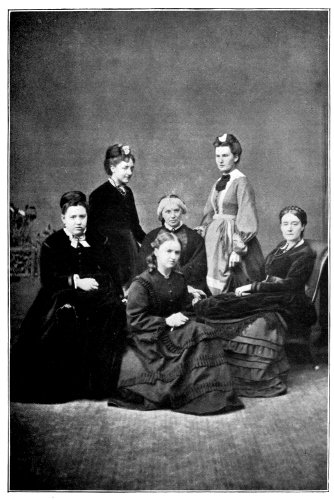
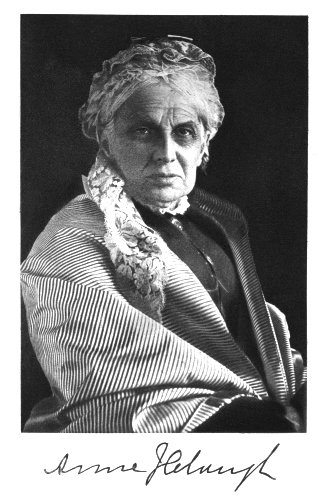
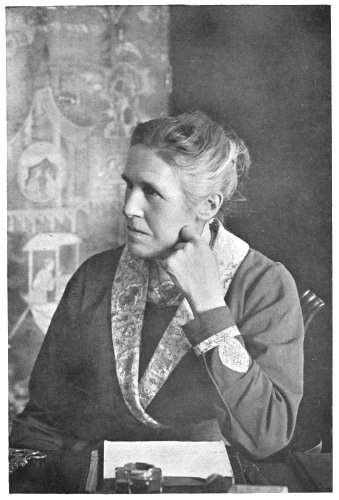
MISS ANNE J. CLOUGH AND THE FIRST FIVE STUDENTS.
It would be partly true and partly false to regard
the objects of those who practically founded Newnham
College as identical with those of the leading
champions of the political and legal rights of women.
Of course, as might naturally be expected, many of
those who, through breadth of sympathy and hatred
of injustice, gave the greater part of their lives
and energies to the removal of female disabilities,
public and private, were very ready to respond to
the demand for higher education for girls and
women. One need only think (looking at the leaders
of thought in the middle of last century) of John
Stuart Mill (a benefactor to the Cambridge Lectures
Association and to similar enterprises) with the
philosophic school which he represented and led.
The advocates of political liberty and those of higher
education for women used to a large extent the same
arguments, and the securing of one end favoured
the prospects of the other. Those who held that
women were on the eve of obtaining greater rights
and responsibilities were bound to show sympathy
with the cause of education; they could quote the
words of Samson Agonistes: "What were strength
without a double share of wisdom? Vast, unwieldy,
burdensome." And on the other hand
every movement made in the direction of sound
education for women told in favour of opening
spheres of usefulness and conceding rights as to
property and personal liberty which uneducated
women might possibly have abused. Among the
earlier friends of Newnham, probably by far the
larger number were warmly attached to the franchise
movement, especially when it came within the range
of practical politics. At the same time, advocates
of higher education were unlikely to be possessed—as
were a few excellent and high-minded women—by
the idea of the suffrage as a panacea for all women's
grievances or a necessary condition of any step
towards social betterment. Necessity and common
sense prescribed caution to the pioneers who were
directing their efforts to obtain some measure of
university education for women able to profit
thereby.
And indeed there was nothing revolutionary in
the movement towards higher education for women.
True, the education of girls and women had not till
then been considered an object to be sought on a
large scale. But there had been educated and even
learned women in England, in the days of the
Renaissance and Reformation, though there can be
little doubt that—in the higher circles, at least—a
check came with the frivolities of the later Stuart
court. But without going into uncertain historical
details, it is noticeable that in the early part of the
nineteenth century, such different persons as Sydney
Smith and Mrs. Hannah More became eloquent
advocates of more serious education for girls than
they commonly received. The arguments of these
and like-minded reformers were not thrown away.
It is beyond question that in many parts of England,
in early and middle Victorian days, there were high-minded,
intellectual, and accomplished women conducting
girls' schools on reasonable principles and
with good mental and moral results; and a good
deal of the highest education in girls' schools was
given by men—sometimes of considerable standing
and ability. The position of a private governess
was not remarkably dignified or lucrative (vide the
experiences of the Brontes); but there were some
such private teachers who did excellent and much
appreciated work.
Still the course of a girl who had inward longings
for intellectual culture was often hard; and harder
still was that of young women who had a liking
for literature and art, combined with a distaste for
unvaried domestic interests or social routine. The
happiest were those who had sympathetic elder
brothers at College, who could talk over their
difficulties with them and recommend books. Such
was eminently the position of Miss Clough herself.
Her education—discursive and not without
lacunae—had been a home education, her chief
mentor an Oxford brother, whose mind and tone
of character it is superfluous here to describe. It
was in great part to help those who, like herself,
had had aspirations after knowledge and culture,
and who, unlike herself, had not always had sympathetic
homes, that she and other pioneers in
Cambridge desired to secure facilities of continuous
study under the direction of capable and inspiring
teachers.
It may be advisable to indicate briefly the different
ways in which efforts were made to meet the existing
wants, some of which led up to the goal of university
education for women.[1]
(1) The first step was the establishment of larger
and better schools, and provision for more advanced
teaching. Queen's College, Harley Street, first presided
over by F. D. Maurice, was founded in 1848
and is still at work; Bedford College (now a College
of London University) was founded in 1849; the
North London Collegiate School and Cheltenham
College (which both maintain their position as
schools of first-rate standing) in 1850 and 1858.
There were started, besides, some colleges expressly
for women intending to become teachers
(the Maria Grey, Home and Colonial, etc.). At
present the need of some serious training in the art
of teaching is widely recognised. In the early
days of the Women's Education Movement, a
young woman had often practically to choose
between gaining more knowledge, and learning to
make the most of the little which she had. This
difficulty is now much diminished, if not entirely
removed.
(2) But almost more important than the new
foundations, started generally by private effort, was
the successful attempt to secure some kind of
government inspection of girls' schools and the
synchronizing responsibility undertaken by the
Universities of Oxford and Cambridge in admitting
girls to the Local Examinations. In 1864, the
Schools Inquiry Commission were requested to
include in their task the inspection of Girls' Schools.
The result was a revelation of superficiality, narrowness,
and general inefficiency which awoke a portion
at least of the educated public to the need of reform.
The result of the new experiment (1865) of admitting
girls to the Cambridge Senior and Junior examinations
showed similar defects. Many generations of
Newnham students have been amused to hear
among the recollections revived at the annual
Commemoration, how it was once seriously proposed
to lower the standard of arithmetic to suit the
capacity of the girls. Happily the suggestion was
not followed. The notion that women cannot do
hard sums was one of the "hasty generalizations"
as to the constitution of the female mind, "with
the wrecks of which," it was afterwards said, "the
whole shore has been strewn."
The deficiencies of the schools were largely due to
the fact that no opportunities of education were
available for intending teachers. The more enlightened
schoolmistresses had to struggle against
masses of prejudice, indifference and materialism
in the minds of parents and of the public, and many
of them were eager for improvement. In 1866, the
Society of London Schoolmistresses was formed
for mutual help and encouragement, and similar
societies were established in various localities, which
lent support to the efforts of well-wishers in the
Universities and elsewhere.
(3) Then again there were early schemes for lectures
to women in different parts of the country, and
these have branched out and become more effectual
than any measure for educational improvement
among persons for whom residence at a university
was impossible. Here, as in many regions, Miss
Clough was a pioneer, and this branch of work
brought about the connection of Cambridge with
one side of the movement and led directly to the
starting of what grew into Newnham College.
The body which accomplished the chief initial
work in the matter of local lectures for women was
"The North of England Council for improving the
Education of Women." To the organization of this
society, Miss Clough gave much thought and attention,
especially in 1867 and the following years.
It was formed from an amalgamation of societies
having the same object, in Liverpool, Manchester,
Sheffield, Leeds and Newcastle. Among Miss
Clough's colleagues on this Council were Mr. (afterwards
Canon) and Mrs. Butler, Mr. (now Lord)
Bryce, Mr. F. W. H. Myers, and Mr. (afterwards
Professor) James Stuart. It was Mr. Stuart who,
after his experience in the North of England, proposed
and brought about in 1873 the organization of local
lectures by the Universities. It is needless to go
into the history of the subsequent development of
University Extension. Begun primarily in the
interests of women, it was extended to meet the
needs of busy men with free evenings, working
people, and all who wished in their leisure to prolong
their education and gain culture.
(4) The work of the North of England Council led
to a further step in the early development of what
I have called "Newnham College in Idea," viz.
the founding of the Cambridge Higher Local Examination.
The request for an examination for
women over eighteen came from the Council
and was supported on the ground that it was
desirable to have a definite and intelligible test
for teachers, with some means of giving system
to the lecture movement as far as it affected women,
and of directing the reading of girls who had left
school. It had originally features which became
modified with changing principles of education.
There was at first a group of subjects considered
essential as the foundation of liberal education and
optional groups, some of which candidates had to
take in order to secure a certificate. In course of
time the groups were increased in number and
larger choice allowed while the necessary preliminaries
were diminished.
The examination was first held in 1869, when
thirty-six candidates were examined in two centres.[2]
As this examination was from the first supposed to
be one the reading for which would prove interesting
and profitable to adult women, it is not surprising
that it should have been eagerly used by the advocates
of university education for intending teachers
as a test of fitness for real university study. Later it
became one of the school examinations taken by
girls in the upper forms, and when the Tripos
examinations were opened to women certain portions
were accepted in lieu of the Previous Examination.
The connection between Newnham and the Higher
Local Examination was maintained for many years,
certain scholarships being always awarded on its
results, though the multiplication of other facilities
for university qualification has now loosened the
tie. In the early days Newnham College owed
much to the Syndicate for Local Lectures and
Examinations, and to the courtesy and devotion of
the successive Secretaries (Rev. G. F. (Bishop)
Browne and Dr. Keynes) and to the fostering care
which they bestowed on the young movement.
Here an auxiliary agency may be mentioned
which was of real service to young women desirous
either of passing the new examination or simply
of understanding how and what to read for their
own benefit: the scheme of instruction by correspondence,
started and kept vigorous for many years
by the late Mrs. Peile, wife of the highly respected
tutor and afterwards Master of Christ's College.
Among the instructors by correspondence were many
distinguished members of the University. The curricula
were designed with a view to the requirements
of the Higher Local Examination, but subjects were
handled freely and suitable books were recommended.
This last necessity was partly met by a
loan library for women.
These steps were gradually leading up to a
possible university education for women. At first
sight, our beginnings may seem to have a non-academic
and amateurish air. And part of what
was accomplished in these early days would meet
with scant approval from modern advocates of equal
chances for women with men in learning and the
learned professions. Inspection of schools by
government is now by many regarded as a necessary
evil. Popular courses of lectures without regular
sequence or adaptation to the previous attainments
of those who attend them suggest superficiality and
lack of scientific method. Instruction by correspondence
is by many associated with cram of the
lowest sort. But to those who read the correspondence
of the founders of these institutions, or whose
memory carries them back to the days when they
were not only novel but a very godsend to labourers
at self-education, the whole movement wears a
different aspect. All methods of imparting knowledge
are apt to degenerate into tricks for hiding
ignorance; even respect for universities and learned
men may become mere toadyism. But the early
forms, though now a little outworn, did indicate and
partly supply a genuine need, and led on to even
better things—especially to academic training and
advanced study for women.
(5) The general movement towards university
education, on the other hand, begins with the
inauguration of a series of lectures in Cambridge
itself, somewhat like that already started in the
north, but wider in scope and capable of being
continued for the instruction of women far beyond
the educational standard prescribed by the Local
Examinations. This had its beginning in a drawing-room
meeting held in Prof. and Mrs. Fawcett's
house, late in 1869.
If these beginnings seem less dignified than those
of Colleges erected for students and organized from
the first on University lines, it may be remarked that,
after all, the beginnings of Newnham bear some
analogy to those of the early European universities,
including the English. Perhaps in all the greatest
centres of learning there has been first the great
teacher—then the scholars who flock to sit at his
feet. Colleges and social student life and hostels
and regulated grades of teachers and taught are an
aftergrowth. So, we may say, the first Newnham
students came to Cambridge because great teachers
were there; it was not that suitable teachers
came because the students had shown a demand for
them or for collegiate houses and collegiate life.
The university extension lecturers might be useful
and stimulating missionaries of culture, but their
greatest service was to kindle a desire to go and
drink at the fountain-heads. The mountain could
not come to Mahomet, but many touched by prophetic
zeal might make all efforts to come to the
mountain.
The first step taken as a result of the historic
meeting referred to in Prof. and Mrs. Fawcett's
house, was the formation of a society to be called
the Association for promoting the Higher Education
of Women in Cambridge.
The first executive consisted of Mr. (afterwards
Dr.) Bonney, Mr. (Dr.) Peile, Prof. F. D. Maurice,
Mrs. Adams, Mrs. Bateson, Mrs. Fawcett, Mrs. Venn;
the Secretaries were Mr. Markby and Mr. (afterwards
Professor) Henry Sidgwick; the Treasurer Mrs.
Bateson. Early in 1870, a list of lectures was
brought out. Although these lectures were supposed
to be for women reading for the Higher (then called
the Women's) examination, they were given by men
generally of the highest standing in the University,
such as the university members of the Executive
just mentioned, besides Professor Skeat, Prof. J. E. B.
Mayor, Dr. Peile, Prof. Cayley, Dr. Venn, Mr.
Marshall and other eminent persons. It may be
that some of these lecturers were decidedly "over
the heads" of such of the students as had had an
indifferent schooling and were only just commencing
adult study. But the fault—if such we should call
it—was a good one. As a rule, the partly self-taught
are more ready to grapple with difficulties than such
as have hitherto had the paths of progress made
gradual and easy; and the very fact of being more
or less in contact with a master mind was rather
stimulating than depressing.
These lectures were originally given in a building
kindly lent by Mr. Clay, standing in the garden of
his house a little off Trumpington Street.
Besides the lectures specially arranged in connection
with the new scheme, a large number of
lectures given by Professors of the University were,
by their special permission, opened to women. In
those days the professorial lectures formed, generally
speaking, a less important part in the teaching of
the University than they do at present. This was
not, of course, due to any inferiority in such lectures,
but to the want of correlation in the instruction
provided by the several colleges and by the University.
As this correlation became more effectual,
the privilege given to women students of attending
professorial lectures became more and more advantageous
to them. Twenty-eight professors acceded
to the request of the Association, as well as two
lecturers who delivered their lectures in University
buildings. University Professors and Lecturers were,
generally speaking, bound to admit all members
of the University to their lectures without fee, but
were allowed to charge fees to non-members.
Women students came, of course, under the second
head, but as a rule the Professors admitted them
without fee, as if they were of undergraduate status.
The gradual opening up of lectures given on the
Intercollegiate system in the halls or lecture-rooms
of the various colleges began, as will be seen, a
little later.
But besides the special lectures to women and the
professorial lectures provided for members of the
University, a very necessary element in Cambridge
teaching consists in private tuition—of students
taken individually or in small groups. In Classics
and Mathematics, especially, such "coaching" is
necessary both for backward and for advanced
students. Among the earlier supporters of the
Women's Education movement were a good many
brilliant teachers who, in their generous belief in
the cause, were ready to give instruction to women
students often in a far more elementary stage than
the men they ordinarily taught. Fees were naturally
paid to the private teachers, but in many cases,
while the cause was yet poor and struggling, these
fees were returned to the Treasurer.
The students who required the more advanced
lectures and tuition were generally those who, having
passed the Women's Examination, aimed at a real
University course. Tripos students were among
the very first generation of Cambridge women—though
those who read with a view to triposes
could never feel quite sure, till near the end of
their three years, whether the examiners would think
it consistent with their functions to admit women
and declare what class they attained.
This great object had already been approached
on independent lines by the founders of Girton
College. Miss Davies had conceived hopes of founding
an actual college in which the Cambridge degree
examinations, pass and honour, might be taken by
women, and in 1869 such a college was started
at Hitchin. The intellectual ideals and standards
of the two wings—so to speak—of the movement
were not identical. Time and with it changes in
the demands of the degree examinations at Cambridge—indeed
at both Universities—have brought
them pretty close together. The very good reasons
at the bottom of both programmes are easy to
recognise. Miss Davies considered that any requirements
made from women different from those
demanded from men would certainly be lower. If
women avoided Greek and the other subjects of
which boys were supposed to learn something at
school, an impression would be created that women
were allowed graduate or quasi-graduate status
on easier terms than those imposed on men. On
the other side there was, in the minds of Sidgwick
and others who became the founders of Newnham,
a great contempt of the "Poll" as well as of the
"Little-go" as marking a very low standard of
intellectual achievement. At the same time, a
more concrete mind like Miss Clough's deplored the
inconvenience and waste of time which might keep
an adult woman who had not learned classics or
much mathematics at school, studying the beginnings
of these subjects in school-boy fashion when
her mind was more adapted to other studies. Again
there was the fear—groundless enough as experience
has proved—lest the girls' schools should be
"classicized" and modern studies in them discouraged.
In point of fact, Cambridge University
now demands of candidates for the Previous Examinations
only the very minimum of ancient
languages, and the boys' schools have been de-classicized
to a further extent than might have then
seemed possible. In the long run, the different
schemes proved to be very similar in results. The
Little-go Greek did no harm to those who took
it. Honestly taught (as, unfortunately, is not
always the case with a compulsory subject), it has
often given to the learner sufficient knowledge to
be of real service in later studies. A small amount
of rivalry at the outset has not hindered the progress
of the two Colleges side by side in co-operation and
mutual goodwill.
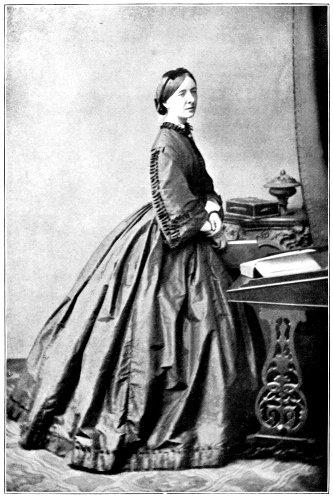
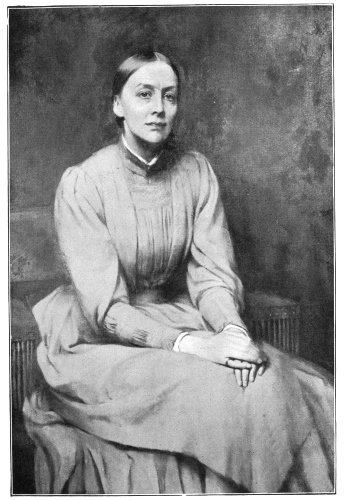
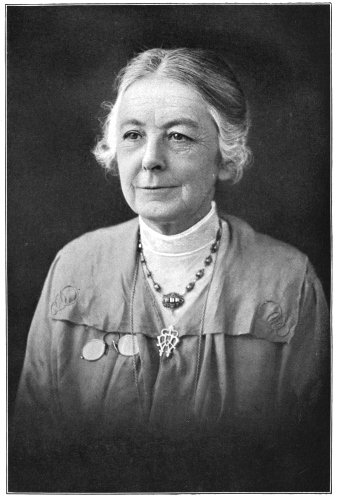
MISS MARION KENNEDY.
But before the first tripos student had definitely
entered on her career, another great step had been
taken: the opening of a house for the residence
of women who had been attracted by the educational
facilities of Cambridge and desired to devote
themselves there to some course of serious study.
The securing of a house for students had become
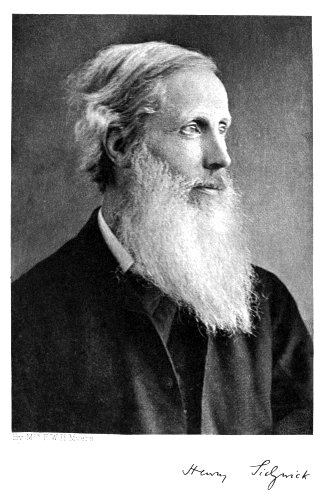
necessary in the eyes of Mr. Henry Sidgwick, and
foremost among the many and great services which
he rendered to the College (then hardly existing
even in idea) was that he persuaded Miss Clough to
come and take charge of the resident students.
A house was found in Regent Street, and in the
autumn of 1871 Miss Clough and five students
began their common life there, and initiated a new
stage in the movement.
Long years afterwards, when Newnham was large
and flourishing, with four Halls of residence, a large
party up for Commemoration met to explore the
cradle of this College, which was the more easily
done as the house had become a hotel (The Bird
Bolt Temperance Hotel). Two of the original five
(Mrs. Marshall and Miss Larner) pointed out to
the students of that day the one room which
served as dining-room and as common study for
these pioneer students; the other sitting-room
used in the afternoon for lectures, overlooking
Parker's Piece, where they, without a scrap of
garden, could envy the boys playing on the Piece;
the small rooms which were their bedrooms. The
first generation had little elbow-room, no games, a
scanty library, a non-luxurious ménage, and very little
of what is now considered necessary freedom in work
and play. Yet they seem to have been exceedingly
happy. They felt, and the feeling remained for at
least a dozen years, that they were pioneers. The
lectures given by greater men than any they had
ever seen before; the pleasures of intercourse,
especially for those who had found little intellectual
sympathy at home; the long walks over
the Gogs or along the Cam, more enjoyed in
pre-hockey, pre-bicycling, even pre-tennis days than
now; the associations of an ancient and beautiful
town; the sympathy shown by the generous men
and women who had adopted their cause: all these
things must far have outweighed the passing
inconvenience of straitened accommodation and
even the painful consciousness that the eye of the
world and yet more of his wife was upon them, for
better and for worse. But perhaps above all, in
later days, these pioneer students felt most thankful
to think that in that house they had enjoyed the
constant presence of Miss Clough and frequent
intercourse with the leaders of the movement,
particularly of Mr. Henry Sidgwick.
It may seem superfluous as well as presumptuous
for the present writer to dwell on the characteristics
of the two leading persons in the early days of the
College (or the college-embryo) seeing that their
lives and characters have, as already said, been
portrayed in biographies which are never likely to
be surpassed. Perhaps, however, a little space
may be given to those peculiarities which, in both
characters, left a permanent impression on the
College as a whole, especially since they exhibit
traits of an almost opposite description, yet united
to produce a great result. In one respect they were
alike: in what may be called fundamental sincerity
and whole-heartedness, along with wide ranges of
interest. Readers of Sidgwick's life and writings
cannot but be impressed with his absolute fidelity
to any course which had shown itself worthy of
approval, his careful attention to every opinion
and principle which had any reasonable justification,
his loyalty to personal convictions in avoiding any
possible compromise with mental tergiversation.
He had lately given up his fellowship from conscientious
motives. He abstained from identifying
himself with any form of institutional Christianity,
while fully acknowledging how such Christianity had
worked for good, and tolerating the attitude of
those who were able for the sake of true religion to
accept religious formulae with reservations of their
own. In politics, he generally went with the
more progressive Liberals, though fully able and
always ready to grasp the situation of those who
took different standpoints. The efforts and the
personal sacrifices which he made in the cause of
women's education were not inspired by any one-sided
attachment to the cause either on a personal
or on a theoretical side. He held no fixed theory
as to the equality and similarity of the sexes in
mental powers, but was in favour of assisting
legitimate efforts, removing unreasonable limitations,
and postponing the decision as to whether
women can do this or that by giving them the
opportunity and awaiting the result. When the
result proved favourable to his reasoned expectations,
he was naturally pleased, but on all subjects
he ever kept an open mind. For persons handicapped
in the race of life, by sex, nationality, or
poverty, he was always ready to discover new
prospects of successful effort. His family life had
made him acquainted with women of exceptional
gifts even before his marriage with Miss Eleanor
Mildred Balfour in 1876, a happy event for Newnham
as well as for himself. The frequent presence of a
man of his calibre in the incipient college was of
inestimable benefit to the early students. He was
to them a champion of their cause and a model of
sincerity and reasonableness, and to many a very
helpful teacher. A larger proportion of students
in the early days than later took up some branch
of Moral Science—in which he directed their work.
And to others he was helpful on the educational
side by his encouragement of good literature—which
may at times have tended to retreat into the
background in favour of severely scientific study.
Beyond all this there were traditions among the
early students of his extraordinary power in bringing
home to them the necessity of maintaining a high
standard of order, patience and power of suspending
judgment.
It has been said that in some respects Miss Clough
presented a marked contrast to Dr. Sidgwick.
This contrast may be partly described by saying
that he saw things more in the abstract, she in the
concrete. Not that he looked only at general
principles and she at isolated instances (for both
took large views without neglecting the single
examples), but still the distinction was evident.
Both had risen by a painful process of mental and
moral self-culture above conventional views as to
the world and man's place in it, but in Sidgwick
the search was chiefly inspired by a passion for
truth, in Miss Clough by a desire to promote individual
happiness. She naturally referred questions
to present cases. Thus—if certain subjects were
said to be necessary as preliminaries to a University
course, she would at once think whether A. or B.
would be the better for having studied Latin or Mathematics.
She allowed for diversity of all kinds among
students and other persons with whom she had to
do. A rule was important to her as touching actual
cases, not the cases as exemplifying the rule. She
was strong physically and indifferent to discomfort
and hardship in all that she undertook. Yet she
had no belief in asceticism, and exhorted her students
to "take the little pleasures of life." It was her
own idea to begin hockey at Newnham, then a most
novel suggestion, which brought at first some
ridicule and even disapprobation from select circles.
She naturally understood and liked some of her
students better than others—but even those who
had less than others of her special intimacy were at
times pleased and stimulated by finding how much
of her goodwill they possessed and how she had
plans for their future. If her character broadened
and mellowed with years, it was not that she was
ever intolerant or unsympathetic, but that she
responded to the affection and respect of those
who knew and appreciated her. She, too, had a
sense of humour which enlivened the community
from the beginning, and the respect with which both
her name and her character were held in the highest
University circles more than counteracted an
occasional innocent unconventionality in her social
intercourse.
It may seem almost invidious to choose some and
omit others among the earliest friends of Newnham,
in awarding due meed of praise and gratitude, but
certainly the two who have been lightly sketched
here were undoubtedly the foremost of Newnham's
benefactors. Early students will remember others
who have passed away: the Miss Kennedys, with
their kind and gracious hospitality, and care for
the rather homeless persons who ranked among
"out-students"; Mr. Coutts Trotter, who was
Chairman of the Council, and left his library to the
College; Mr. W. H. H. Hudson, who was financial
adviser and auditor for 33 years; Mr. Archer-Hind,
who placed his refined scholarship at the disposal
of mere beginners in Greek, was always willing
to make one lesson swell out into two—and took
no fees; Mr. Main, the standby of the earliest
students of Natural Science; Mr. Marshall, who
created and directed an enthusiastic devotion to
the study of Economics; Mrs. Bateson, who originally
dispensed the lecture tickets to students entering
their course, and whose parties at St. John's Lodge
were highly appreciated;—and many more.
The students who were first attracted to the
opportunities for women in Cambridge were, as a
rule, somewhat more mature, though less well
instructed, than those of later times. There were
exceptions in this latter respect, as in the case of
the late Miss Edith Creak, well known in the educational
world, who was the daughter of a schoolmaster,
and who passed successfully both the
mathematical and the classical triposes at the age
of nineteen. Another of the original five was Mrs.
Armitage (née Bulley), who has written much on
early English antiquities and is an authority on
Barrows. Among the first to take Triposes were
Miss Paley (now Mrs. A. Marshall) and Miss Amy
Bulley, who were successful in the Moral Sciences
Tripos in 1874, Miss Mary Kennedy, afterwards
Mrs. R. T. Wright, in the same Tripos in 1875,
and Miss Felicia Larner who took the Historical
Tripos in 1875. These ladies were all examined
by private favour of the examiners, the greatest
care being taken that all formalities should be duly
observed. Only, they were admitted after passing
certain Groups of the Women's Examinations
instead of the Previous Examination, and, in one
or two cases, were allowed a longer time of preparation
than the University regulations prescribed.
The exaggerated dread of triposes and admiration
for those who achieved them makes an amusing
feature in early Newnham days. It would now
seem absurd for a college to exult over second class
honours. But every successful student helped to
destroy some of the "hasty generalizations"
repeated outside as to women in triposes, the first
being that they would fail or else break down in
health. When they succeeded and remained
vigorous, it was said that they might get through
but would not get first classes. When they obtained
first classes in the newer triposes, it was declared
that they would never get a first class in
classics or mathematics. The death-blow to all
these hypotheses came in 1890, when Miss Philippa
Fawcett's name was read in the Senate House as
"above the Senior Wrangler." There was a kind
of poetic justice in this event, as Miss Fawcett's
parents had been earnest and effectual helpers of
the movement from the very beginning.
This, however, is to anticipate events. During
the early days in Regent Street, good work was
being done, and the students had a happy life, but
they were cooped in a small space, and the friends of
the movement had to seek both a larger home and
more funds to sustain it. From 1872-1874, Miss
Clough and the students found a congenial house
of residence behind St. John's College. This was
Merton Hall, an old manor house with a very
pleasant garden and other attractions. Here something
like collegiate life was first begun—with a
debating society, games (with limitations) and
various collective interests. Another house in
Trumpington Street was hired to accommodate the
overflow of students. A few who had been attracted
by the lectures, but for some reason were unable
or unwilling to enter a hall of residence, formed a
kind of outer circle. These "out-students" were
made to feel less of outsiders by the kind and
hospitable attention bestowed on them by Miss
Marion Kennedy. Their number tended to diminish,
as membership of a college or hall came to be
desirable on social and disciplinary grounds. When
the College was more definitely constituted, all who
wished to become regular students were obliged
to reside either in a Hall of Newnham or with
parents and guardians, exceptions only being
allowed in the case of women above the undergraduate
age.[3]
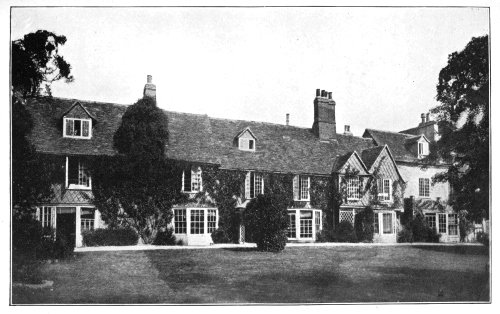
MERTON HALL, 1872-1874.
Meantime arrangements were being made to
secure a more permanent place of residence. To
meet what had become a necessity, it was proposed
to form a Company, which, after the choice of a
site near the village of Newnham, was called the
Newnham Hall Company. There was, however, a
singular absence of commercial acquisitiveness or
speculation in the Society which bore this financial
designation. A good deal of the money subscribed
came from benefactors who so far from seeking
profit from their investments continued their gifts
for many years. Mention may be made of Miss
Ewart, Mr. and Mrs. Stephen Winkworth, Miss
Bonham Carter among other munificent benefactors.[4]
A good many well-wishers who could not give
princely contributions were ready to make the
venture of faith and to subscribe for shares. The
result was that in 1875 Newnham Hall was opened
and Miss Clough with the students entered into
residence. They had during 1874-75 occupied a
dwelling in Bateman Street where Miss Clough had
ingeniously secured the use of a house-and-a-half
which she made into one. Newnham Hall was a
Queen Anne building, of red brick, which has
mellowed after its forty years. The architect, Mr.
Basil Champneys, took a strong personal interest
in its original plan and subsequent extension.
Those who knew it when it was simply Newnham
Hall (later called the South, now the Old Hall) must
feel a little regret that its imposing south front—intended
to be the actual front—is only seen by a
minority of casual visitors. In fact, no one knew
in '75 in what direction, if in any, it might have to
expand, and there is a story current that in the
plans, the possibility was considered of transforming
it—if a hall for women students proved a failure—into
two ordinary dwelling-houses.
The College, formally so-called, came into existence
by the amalgamation of the two societies, "The
Association for the promotion of the Higher Education
of Women in Cambridge" (more briefly called the
"Lectures Association") and the "Newnham Hall
Company, Limited," in 1880. The new title adopted
was "The Newnham College Association for advancing
Education and Learning among Women in
Cambridge." Before this time, the "College"
only existed in idea, but that existence, as we have
seen, was a very real one. Even when it attained
its first permanent habitation, it was—for a college—small,
as in 1876 there were only about thirty
students besides the out-students. But it had a
respectable, academic-looking exterior, and life within
was vigorous. Among the residents was Miss Paley,
now Mrs. Marshall, whom the students with pride
regarded as their earliest don, one of the first five,
and one of the earliest to take a tripos. She proved
a very successful teacher of Political Economy, a
popular subject among the early students, many of
whom were ambitious of some career of social
activity. Classical students were few, but very
eager. Miss J. E. Harrison and Miss K. Corfe took
their tripos in 1879. Natural Sciences were pursued
with ardour and success, partly through the liberality
of St. John's College in admitting Newnham students
to their laboratory before the Newnham laboratory
was built. The first student to obtain a first class
was Miss Ogle, afterwards Mrs. Koppel, in 1876.
It is gratifying that her daughter afterwards became
a Newnham student, and has made herself educationally
useful in South Africa. Mathematics held
its own. The Historical Tripos, when separated
from the Law, attracted several students. Those
who took Moral Sciences, as already said, enjoyed
the special attention of Mr. Sidgwick.
These candidates were all, of course, examined
informally, i.e. by special favour of individual
examiners. It was from the first desired by Mr.
Sidgwick that any student who showed, by marked
success in the Women's Examination or in any
other way, that she had real aptitude for intellectual
culture, should be encouraged to proceed to a
Tripos. But in the early days the Tripos students
were not the only ones who were capable of good
intellectual work. Some, as has been said, for
one reason or another, did not follow the lines
then laid down for Triposes, and the variety was—socially
and intellectually—an excellent thing for
the students. Specialization in study is often
bound to have a narrowing effect. But by student
friendships, young people learn to care for things
in heaven and earth that will never lie within their
special province. It is a good thing for Cambridge,
and consequently for Newnham, that there is no such
iron bar fixed there between Sciences and Arts,
as often, in other educational institutions, tends
to prejudice and narrowness. There may be, before
definite lines are fixed, tendencies to too much
diffusion; this, however, was prevented by the
general system of tuition.
As yet, in 1879, there were not many resident
tutors to settle the work of students in their several
departments. But competent University men were
always ready to put their knowledge and experience
at the service of a student choosing her University
course. Indeed the helpfulness of men on whom
the students had no claim, is one of the brightest
features, even of the bright days of Newnham's
beginnings.
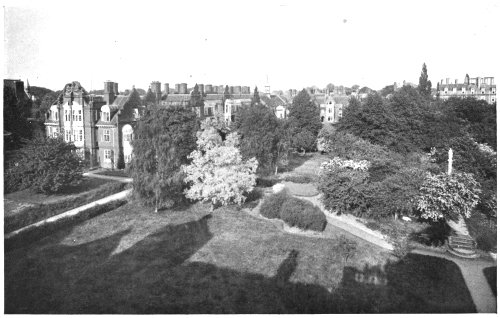
Newnham Hall had from the first a fairly large
garden, not very minutely laid out,[5] but large enough
for tennis, for which game an ash court was
made. A gymnasium, in the pre-games period,
seemed a necessity, and was erected and opened in
1877. Before that time, students had been allowed
to go at stated times to the gymnasium in the town,
and strange now to relate, some did so with great
enthusiasm. But the interest in indoor gymnastics
declined with the greater facility for out-door sport,
of which more later on.
Newnham Hall was more in the country then than
the College is at present. It must be remembered
that married dons with their families were a
comparatively new institution, the residential
quarter to the west did not exist at this time in
Cambridge, and certainly Newnham was in the
pleasantest part of Cambridge for country walks.
"Constitutionals" are now out of favour, but the
early students enjoyed the "Grantchester Grind,"—especially
when the marsh-marigolds were out,
and the Madingley Woods with their blue-bells, and
the Roman Road in blue flax season; and the Backs
were very near; there were nightingales too whose
nocturnal songs were by some found almost too
penetrating. There was an atmosphere, in town and
country, favourable to cheerfulness, to the formation
of friendships, to the development of intellectual and
social activity, to the enlargement of opportunities
for women in forwarding the betterment of the
world. It was a time of hope for youth, seen not
only in the pioneer students, but in those champions
of their cause, some themselves young, some older,
whose efforts for the next generation were ever
strenuous and cheerful, none the less so for the
experience of resistance from old-world inertia and
the dead weight of prejudice which only patience
and wisdom could ever prevail to lift.