Birth—Family connected with English Church music—Enters Royal
Academy of Music—Importance of the step—His work there—Proceeds
to Leipzig—Schumann's appreciation of his genius—The German
impress—His return to England—Life-long association with Royal
Academy of Music—Bennett as pianist—Institutes chamber
concerts—His conservative views—Rivalry of foreign musicians—His
most important compositions—Founds The Bach Society—His place in
musical history.
William Sterndale Bennett was born at Sheffield in 1816. Like the
majority of celebrated English musicians, he came of a family long
associated with the music of the Church; several of his relatives,
including his grandfather, having been members of cathedral choirs.
When he was only eight years of age he entered the choir of King's
College Chapel, Cambridge, and there became acquainted with, and as
later events proved, influenced by, the ancient school of English
ecclesiastical music, which, notwithstanding his subsequent foreign
education, never entirely lost its effect on his mind.
He was not, however, perhaps unfortunately, allowed to remain there
long, for after two years he was sent to the Royal Academy of Music in
London, which was then a young institution in which the pupils were not
only taught music and given an elementary general education, but were,
at that period of its history, boarded as well.
It is certainly open to question whether it was a wise step on the part
of his relatives to take, seeing that it removed him from a centre where
all the surroundings were English—English thought, influence, music and
all that goes to mark national characteristics—to one which was,
however admirable from many points of view, to say the least,
cosmopolitan in character.
A genius so precocious as Bennett would be perfectly capable to
assimilate, even at so early an age, the spirit of the ancient school,
and this he certainly accomplished to some extent at Cambridge: the fact
that it subsequently became subservient to another was, simply, the
result of the force of circumstances.
In the end, it cannot be denied that the spirit of German music
practically obliterated it, and, while acknowledging the independence of
thought that Bennett's music often displays, and which one likes to
think may be owing to his Cambridge days, it must be admitted that its
similarity in style to that of, above all, Mendelssohn's, detracts from
the value that it would otherwise possess.
He remained at the Academy for several years, during which he wrote,
among other things of note, two or three pianoforte concertos, the most
popular, although not the best, being the one in F. It is related that
one of its movements, which attained great popularity, was composed one
afternoon when the other students were absent on a holiday excursion.
Their delight when, on their return they heard The Barcarole, as it was
called, was so great that, as the late Dr. Steggall, for many years
Organist of Lincoln's Inn Chapel told me, they carried him in triumph
round the concert-room on their shoulders. In 1836 he went to Leipzig to
continue his studies, and there came under the immediate influence of
Schumann and Mendelssohn.
That his abilities met with sincere appreciation is shown by the
eulogistic way in which the former wrote of him in a musical journal he
edited.
That Bennett's stay in Leipzig was a successful and even delightful
experience, there is no room to doubt; it is, though, open to question
whether it did not, to some extent, denationalize him as a musician. Men
of his temperament and genius, are peculiarly open to exterior
impressions, and going at an age of mental expansion and enthusiasm,
everything that happened seems only natural. Blind ourselves, as one
willingly would, the fact must be admitted that the German impress
remained indelibly stamped on him during his whole life-time. It must in
justice be remembered that when he was removed from Cambridge, at the
age of ten, all essentially English thought, so far as music is
concerned, became as a thing of the past.
He returned to England to remain permanently, after a second visit to
Leipzig, in 1842. He was appointed a Professor of Music at the Royal
Academy of Music about this time, and was associated with that
institution, where his memory is held in just veneration, until he died
in 1875.
His work there, in conjunction with composition, became the main
occupation of his life. His energies were not, however, wholly confined
to it.
He was a pianist of the first order. Indeed, I was told, many years ago
by a celebrated pianoforte teacher, that his technique, in exactitude,
compared favourably even with that of Mendelssohn himself.
Soon after his final settling in London, he commenced a series of
chamber concerts, and continued to present the classical masterpieces of
this form of music for about twelve years. It was his enthusiasm alone
that accounts for this fact, not public support, for that, he may be
said never to have received, to any appreciable extent.
His style was, perhaps, too refined and his tastes too rigidly
classical.
In this respect he was, if one may be permitted to say so, somewhat
narrow in his outlook. For instance, he could not tolerate Chopin's
music, and, as one of them told me, would not permit his pupils to play
it in his presence.
He was of a retiring disposition, and the arts of public advertising
were as objectionable to him, as they appear to be acceptable to many
performers to-day. Again, the rivalry of eminent foreign musicians and
the conspicuous patronage they received in high quarters, which
naturally aroused public interest in them, militated against his
success, and so, feeling that the conditions were unequal, he withdrew
from the arena. He was especially great as a player of Bach's music, to
which he was intensely attached, and it may be at once admitted that he
was entirely lacking in that emotional temperament, which seems to
appeal so strongly to the feminine atmosphere that so frequently
pervades the public concert-room.
He was essentially a player who most appealed to musicians. His
personality must have been a fascinating one, for he aroused even
passionate attachment in many of his pupils, and it has often been a
source of interest to hear grey-headed men talk of his memory in the
language of a lover.
His pianoforte music contains much that is both beautiful and original
in style, the lovely sketches, "Lake," "Millstream" and "Fountain,"
being the best known and most popular.
The more important chamber compositions include a sestet for piano and
strings, a trio, and a sonata for violincello and piano. In 1855, he
produced his cantata, "May Queen," at the Leeds Festival, with great
success. It contains much delightful music, and, like other of his
works, the comparative neglect into which it has fallen, seems perfectly
extraordinary. Nine years were to elapse before his great work, "The
Woman of Samaria," was to appear at the Birmingham Festival.
If it created no great sensation at the time, that may be accounted for
by the fact that he studiously avoided sensational effects. It is,
however, characterised by nobility of thought, religious feeling, and
perfect grace of expression. Although seldom performed as a whole, the
touching quartet, "God is a Spirit," is in general use, and remains a
model of beauty and simplicity.
This work, together with his overtures—especially the "Naiades" and
"Paradise and the Peri"—and his pianoforte concertos in F and D minor,
are the chief compositions on which his fame will principally rest.
Sterndale Bennett founded the Bach Society in 1849. His extraordinary
enthusiasm for the works of the great master was a leading
characteristic of his life, and was doubtless stimulated by Mendelssohn
during his Leipzig days.
He was appointed conductor of the Philharmonic Society in 1856, and
Principal of the Royal Academy of Music in 1866.
He was elected to the chair of music of Cambridge University in 1856,
and was knighted by Queen Victoria in 1871.
It is difficult as yet to assign Sterndale Bennett's definite place in
the history of music.
His genius, if not of the order that sways multitudes, was undoubted,
and he seems to form, together with Samuel Sebastian Wesley, the
connecting link between Henry Purcell and Sir Edward Elgar.
Birth—His precocity—His musicianly attributes—His protest against
the "high pitch"—Sims Reeves in opera—Association with
Macready—Reeves in Italy—Triumphs in that country—First
appearance in oratorio—Doubts expressed as to his probable
success—Scene of enthusiasm after "Sound an alarm"—The greatest
interpreter of Handel—His idiosyncrasies—His high standard of art.
John Sims Reeves, one of the greatest tenor singers of whom the world
has any record, was born in Kent on October 21st, 1822. His genius as a
child was early evident. At an age when the average boy is found playing
cricket on the village green, as should be, this one was playing the
organ at a village church near by.
It is an interesting reflection that, whereas the majority of singers
confine their energies to the development of the voice alone, Sims
Reeves, from his earliest years, was bent on mastering the mysteries of
music—such as harmony and counterpoint.
He succeeded to this extent, that he became a thoroughly sound musician.
In the consideration of his career, this point must ever be borne in
mind.
Sims Reeves was not only a singer, but he was a fine and well-instructed
musician, and any opinion that he might put forward was entitled to
respect, not only from the singer's point of view, but that of a
musician whose erudition was unquestionable.
So, when he raised his voice against the abominable pitch that had been
introduced into the country through the instrumentality of a foreign,
cosmopolitan musician, he had the weight behind him, not only of a
distinguished singer, but of a musician perfectly able to maintain the
position he had taken up, on grounds both reasonable and logical.
The fact that his opinion, however strongly put forward, had no
influence, is not a matter for surprise. In that Victorian period, the
English musician was practically an alien in his own country.
Although Sims Reeves was destined to become, perhaps, the greatest of
oratorio singers, his earliest successes were made in opera. His "first
appearance on any stage"[31] was at Newcastle, when he appeared as the
"Gipsy Boy" in "Guy Mannering."
He was soon found, as would naturally arise, in London; Macready, the
theatrical monarch of those days, and whose scene of operations was
Drury Lane Theatre, attracting him.
Here, on the first occasion that presented itself, he made a success,
that those gifted with any sense of perception, could easily see,
indicated a great career, and the rising of a great sun in the firmament
of music.
It was in Purcell's "King Arthur," and the particular number that was to
make him famous was "Come, if you dare." In this connection, it is
amusing to note the clashing of the artistic and managerial temperament;
both, probably, at their highest expression. Macready insisted that the
singer should address his adjuration to the warriors whom he was
facing, with his back to the audience. The singer held an entirely
opposite view, and wished to sing to the public. The fight was keen, and
Sims Reeves apparently gave way.
On the night, however, he adopted an attitude that was not foreseen;
pacing the stage sideways, he sang with his voice thrown at the
audience, and threatening looks at the "supers," who were amazed at such
an exhibition of liberty, and made a success that was not only great,
but assured the management of a satisfactory issue to the adventure.
Macready, nevertheless, fined him £5 for disobedience!
He was from this moment recognised as a great singer.
Strong, however, in the consciousness of unusual gifts, he determined to
test his powers on the Continent, and went to Paris. After a short stay
there, he proceeded to Italy, where, after a few lessons from Mazzucato,
he made his appearance as "Edgardo" in "Lucia di Lammermoor."
His success was great. The Italians, who have an abnormal love of the
tenor voice, received him with acclamations, and his tour through the
Italian cities was a triumphant progress. On his return to England, he
was received as an "Italian" singer, and doubts were expressed as to his
ability to sing oratorio music.
His first appearance in England, after his foreign experiences, was,
again, in opera, as "Edgardo." Berlioz was conducting, and wrote thus:
"Reeves has a beautiful voice, and sings as well as it is possible to
sing in this frightful English language."
His first appearance in oratorio was made on February 10th, 1848, at
Exeter Hall, in Handel's "Judas Maccabeus." All doubts were soon allayed
as to his ability to interpret Handel's music.
It had been generally expressed that his success in opera made it
improbable that he could succeed, to an equal degree, in gaining the
affections of the English people in oratorio, their most loved medium of
expression in music.
His success was immediate and triumphant. At the conclusion of "Sound an
alarm," a scene of enthusiasm occurred that had never, previously, been
known at an oratorio performance.
It set a mark on his career.
From that moment he was recognised as the greatest interpreter of
Handel; and from that pinnacle of fame no subsequent singer has been
able to move him. His popularity became immense. At every great music
festival his appearance was regarded as a necessity, and, until his
final refusal to sing at the artificial pitch that had been introduced
by Costa, his interpretations of all the great masterpieces of oratorio
music were looked forward to as things of national interest.
Sims Reeves was a great singer, and like most great artists, had
idiosyncrasies. On one occasion, Sir Arthur Sullivan (then Mr., and a
young man) went down to his beautiful place at Norwood, to play over
the music written for him, in a forthcoming production. He heard it
through, and then said, "My dear Arthur, the music is quite beautiful,
but it would be difficult to say for what voice it was written." Certain
passages had to be revised to suit him.
That this would, naturally, be done, all those who knew Sullivan's
character would easily understand.
Sims Reeves continued to be, for many years, the idol of the British
public, and it is only just to say that he deserved the distinction,
being as he was, a man of sterling character, and one whose ideals were
ever high.
Her Birth—Precocity—Learns the violin at four years of age—First of
women violinists—Sensation at her first public appearance—Arrival
in London—Plays at Philharmonic concert, being ten years old—Tour
in Russia—Arrives in Paris—Arouses enthusiasm—Second visit to
London—Memorable consequences—Association with Popular Concerts,
directed by Arthur Chappell—Her great fame—Her
character—Association with Hallé—Their memorable
concerts—Experiences in England—Her position in musical history.
Wilma Neruda was born at Brünn, Moravia, in 1839. The family from which
she came had been long famous in musical history. The story of her
precocious genius reads, even to-day, as something akin to the
marvellous. When she was about four years of age, her father, as the
late Frantz Neruda told me, made her a miniature violin, more with a
view to her amusement than with any contemplation of serious results.
It was not long, however, before he became conscious that in this little
daughter, he possessed a treasure, and one that was likely to prove a
moving element in musical history.
That his judgment was justified, events too have shown.
At that time, strange as it may seem now, the idea of a woman-violinist
was not only foreign to public instinct, but was even contrary to the
general sense of propriety!
Her fame, notwithstanding, rapidly increased in local circles, and it
was not long before she was taken by her father to play before a great
Church dignitary, not only to gain his patronage, but, through it, to
allay any prejudice that might be aroused by so unusual a spectacle.
The interview was entirely successful, the Cardinal having heard her,
saying, "One whom God has so blessed should play ever to His Eternal
Glory." Her progress was so astonishing that her father took her, in
1846, to Vienna, where she made her first public appearance, at the age
of seven.
The sensation her playing produced was phenomenal, and soon all Europe
was eager to hear the wonder-child.
A grand tour was the natural result, during which she performed in the
principal cities of Germany, and arrived in London in May, 1849. On June
11th she appeared at a Philharmonic concert, where she played a concerto
by De Beriot, the child being then ten years old.
The enthusiasm with which she was received is a matter of history.
Her next important experience was a prolonged tour in Russia, of which
she ever retained vivid memories. Many were happy, some lugubrious, and
the one she most cherished was a cordial reception given to her by the
Imperial family at St. Petersburg.
Her next scene of triumph was Paris. She arrived there in 1864, and made
her first appearance at one of the Pasdeloup concerts—the most
important organisation of the kind in France—with a success that was,
as she often said in after life, perfectly bewildering.
It is not difficult to imagine it.
She was possessed of a technique that could hardly be surpassed, and a
genius equally remarkable, a constitution that defied fatigue, and an
enthusiasm that years of incessant work such as she was destined to
experience, did not dull.
There is little doubt that her great powers were displayed, at this
time, in their most dazzling splendour.
In May, 1869, Madame Norman-Neruda—as she had become known through her
marriage with the Swedish composer—visited London again, and the event
proved to be decisive, little as she thought it, as to her future
career. She came to play at a Philharmonic concert, but was prevailed
upon to stay through the summer, so that she should inaugurate, in the
autumn, a new era in the history of the "Popular Concerts"—an
institution that had been established ten years previously by the
eminent firm of Chappell and Co., with the late Mr. Arthur Chappell as
director. The main feature was the performance of classical chamber
music.
The event may be justly described as historic. Her success was absolute
and convincing. The fact that a woman was seen "leading" a quartet of
performers that embraced the greatest players that Europe could produce,
was one of intense significance.
One great result was not long in showing itself. The violin soon became
fashionable in a girl's hands, and from a fashion it has degenerated
into a rage.
To her lasting fame, Wilma Neruda was the first to demonstrate, under
conditions that were often discouraging and sometimes forbidding, that a
woman could, in this form of art, hold her own with the greatest of male
exponents.
Madame Norman-Neruda was a woman of extraordinary strength of character.
Austere in manner and of cold demeanour, as she undoubtedly was, in any
direction that her sane judgment pointed out as worthy, she was capable
of generosity that was, at once, spontaneous and noble.
Her most prominent characteristic was, I think, intellectuality. She
could not, it must be admitted, "suffer fools gladly."
Had she desired a motto, a very appropriate one would have been "Odi
profanum vulgus."[32]
From that eventful year of her life, 1869, Madame Norman-Neruda spent
the greater part of her time in England, devoting the spring and winter
to the Chappell, Hallé, Philharmonic and other important concerts, with
occasional visits to the Continent to play at functions of exceptional
interest.
Her career in England is so well known that it is not necessary to dwell
at any length on it here. Suffice it to say that her work was incessant,
and that hers was, soon, a familiar figure on every concert platform
throughout the length and breadth of the country. It is not difficult to
imagine that the constant travelling would provide occasional and novel
experiences; one of them Lady Hallé related to me.
She, with Sir Charles Hallé, was on her way, in the north, to fulfil an
engagement, when a severe snowstorm came on, which soon hindered the
progress of the train. They arrived at the place of their destination an
hour after the time appointed for the concert. The snow was so deep on
the ground that no conveyance was available, and there was no
alternative to making their way, on foot, to the hall.
Once arrived there, Sir Charles proceeded to the platform to offer
explanations to the patiently waiting audience. It was not necessary.
Everything was understood, and he retired amid much cheering.
When Lady Hallé appeared she received such an ovation, doubtless
expressive of sympathy and admiration, that as the concert progressed
the unpleasant experience soon faded from her mind. Unhappily, however,
an attack of bronchitis was the result; a form of illness that she
suffered from, intermittently, for many years, and of which she
eventually died.
Lady Hallé (by which title Madame Norman-Neruda came to be generally
known in her latest years of residence in England, through her marriage
with Sir Charles Hallé in 1888) was, notwithstanding outward
appearances, not only capable of enjoying but engendering simple fun, as
her friends well knew.
She was, for instance, full of joy and gaiety when Christmas-time was
coming and the Christmas tree in near prospect. I do not think that
Charles Dickens himself exceeded her in love for that beautiful and
touching festival. It was then that she gave full vent to a nature that
teemed with kindness and generosity. Few who were privileged to see it
could forget the suppressed excitement with which she led her guests,
family and household, to the room where the Christmas tree was ablaze in
all its glory. On it was sure to be found some present, large or small,
for every one.
One Christmas I well remember, I had recently returned from America,
where I had acquired the habit of drinking iced-water.
My refusing claret had been a constant source of banter from Sir Charles
and Lady Hallé, and more boisterous expressions from my friends, Ludwig
and Waldemar Neruda, Lady Hallé's sons, on the occasions of my dining
with them.
My present proved to be a purse. When I took it, Lady Hallé called out,
clapping her hands, "Open it." This, of course, we did. It contained a
Swedish gold coin, and a sheet of notepaper on which was written, "The
future Mrs. Ernest Ford. The secret revealed. Why Mr. Ford became a
teetotaler!"
The incident is quite trivial, but it certainly gives a glimpse into the
character of a truly great and noble woman, that would be little
suspected by those who knew her only as an outstanding figure in public
life.
It is only natural to suppose that Lady Hallé was a constant recipient
of appeals for advice from young aspirants, eager to emulate, in however
humble a degree, her career.
She was ever open to them, and her judgment, sane and tried, was freely
at their disposal. The last years of her life were, unhappily, darkened
by the deaths of her two sons; that of the former, tragically, on the
Alps; the other, after long suffering, in Brünn.
If for no other achievement, Wilma Neruda would go down to history as
one of the notable women who indicated a new career for her sex. But she
did more. She left behind her a fame that time itself will not easily
efface.
Interesting features of character—Early life in Paris—Giants of
musical history—His reception by them—Ignorance of German music in
France—Intercourse with Cherubini—Establishes chamber
concerts—Personal friendships made in Paris—Arrival in
England—Settles in Manchester—Establishes subscription chamber
concerts—His first great venture—Manchester concerts—Association
with Madame Norman-Neruda—Great results—Qualities as pianist and
conductor—His musical sympathies—His remarkable character—A
personal reminiscence—His permanent place in history.
Of the many thousands of German musicians who, since the days of Handel,
have made their home in England, Charles Hallé was, from many points of
view, the most interesting personality. He was a man of culture, and his
varied experiences in many countries, which he sometimes would describe
delightfully to a circle of friends, naturally added to the interest
that his charm of manner, and known greatness as a musician, always
inspired.
When he left his native town of Hagen, in Westphalia, in 1836, for that,
in those days, Mecca of musicians, Paris, he must have felt supreme
confidence in his powers, although only seventeen years of age, knowing
that he would find there rivals as formidable as Chopin, Liszt and
Thalberg. This did not deter him. He had been used to playing in public
from infancy, had known nothing but success; his pianoforte playing as a
child still had evoked the wondering praise of no less a man than Spohr,
and, probably, knowing that his style was so essentially different from
that of these great artists, he determined to make the daring venture.
He made it successfully. He was received with great kindness by every
one, but especially by Cherubini. This great musician, who was then head
of the Conservatoire, took the greatest interest in the young German
pianist, whom he constantly invited to his house, and never seemed to
tire of hearing him play the Beethoven sonatas which, strange as it
sounds now, he was hearing, as Sir Charles Hallé told me many years
afterwards, for the first time.
Indeed, I have often heard Sir Charles speak of the astonishing
ignorance of German music, even that of Beethoven, which existed in
France at that time.
It proved to be, however, a fortunate thing for him, since, as soon as
he had established his chamber concerts with the express intention of
introducing the best of German classics of this description, he not only
quickly gained a clientèle of cultured amateurs, but they speedily
became a rendezvous of the most celebrated musicians in Paris.
The success of these concerts continued to increase until 1848, when the
revolution forced him to seek shelter for his wife and children in
England.
The years that Sir Charles Hallé spent in Paris were memorable ones in
his life. Not only did he enjoy the friendship of Chopin, Georges Sand,
Listz, Thalberg, and others of great fame, but there, too, he met
Richard Wagner who was, at the time in poverty, ekeing out an
existence, by means of drudgery that is painful to think of.
Among the many friendships that Sir Charles made there was one, in
particular, that he greatly prized, and which was destined to last a
life-time—that of Stephen Heller, perhaps the most popular writer for
the piano known to lady amateur pianists, at least of the past
generation.
Soon after arriving in England, Sir Charles Hallé settled in Manchester,
where the large German colony resident there at once rallied to him. He,
immediately, commenced a series of chamber concerts, on the same lines
as those he had established so successfully in Paris; the subscriptions
were eagerly taken up by his compatriots, and it was not long before
they were firmly established on a financial basis; and this, together
with the teaching connection that he speedily gained, proved sufficient
to relieve him of any financial anxiety.
These things, however satisfactory, by no means satisfied either his
ambitions or his energies, which were prodigious.
He gave pianoforte recitals in London, Manchester and Bath—in which
city he once thought of taking a house—which soon became regular
institutions.
It was not long before he organised a permanent orchestra in Manchester,
to be followed, so soon as it was on a firm basis, by a permanent choir.
Thus were started the "Manchester concerts," later to become known, and
widely celebrated, as the "Hallé concerts."
It would be difficult to over-estimate the services that Sir Charles
Hallé rendered to England, through this medium alone. As year followed
year, so did one masterpiece after another find its way to Manchester,
to meet the reception that only these northern enthusiasts know how to
accord. To them, whether it were the work of a modern master, or a
hitherto unknown work of Handel, the result was ever the same, granted
that it touched their highly emotional sensibilities.
The firm establishment of this great and justly celebrated institution,
was the act of his life that was fraught with the most lasting
consequences, and the one that will, in all probability, live longest in
public memory.
After his death, in 1895, Dr. Richter was, an interregnum passed over,
appointed to fill his place.
The long association, musically, of Sir Charles Hallé, and the great
violinist, Madame Norman-Neruda (who in after years became his wife) is
too well known to need dwelling on. Suffice it to say that their joint
recitals became, in course of time, annual features in the musical
events of every town of importance throughout the country. Sir Charles
Hallé had an absolute genius for organisation, as the many and great
undertakings, so successfully carried through, and so permanent in their
character, prove. He was not only the moving spirit in them, but,
wonderful as it is to think, he attended to the minutest details of
them all, and, in doing so, probably eclipsed the efforts of
half-a-dozen ordinary secretaries.
He was a great pianist and a great conductor. His temperament was
inclined intellectually, rather than in the direction of emotion. This
was, doubtless, the reason that gave rise to the popular impression that
he was cold and unsympathetic in disposition.
Nothing could be farther from the truth. That his tastes, so far as
music is concerned, were rigidly and unyieldingly classical, there is no
room for doubt. His sympathies were not, as regards modern developments,
elastic. One great charm of his character was absolute honesty.
For instance, he never believed in an English School of Music.
"Englishmen? Yes," he once said to me, "Great soldiers, great poets,
great statesmen, but—musicians, no. You lost all that when Purcell
died."
Had he lived till to-day, I have not the slightest doubt that he would
have changed his views on the subject; but, after all, he was only
voicing a very generally held opinion.
With the extreme developments of modern times he was not altogether in
sympathy, and I should think that same conservatism, would fairly
express his attitude on the subject of musical progress.
Sir Charles Hallé was a man of superb physique, and his health right up
to the end was wonderful, considering the strenuous life he led.
I remarked to him one day, "It seems to me perfectly extraordinary,
seeing that you must spend at least half your life on the railway, that
you escape trouble with your nerves. What with the incessant hurrying to
catch trains——" He interrupted me with, "Ah, but you see, I never do
that. I make it a rule to be at the station twenty minutes before the
train starts. It is to that fact I attribute my immunity from nerves, as
you express it."
I, shortly after this conversation, had practical experience not only of
this, but of another remarkable feature in the life of a truly
remarkable man.
I never knew anyone so absolutely intolerant of doing nothing. Rest was
to him, emphatically, change of occupation. For instance, I have known
him, when on a Sunday morning he had no pressing work that called for
his attention, to devote his time to the making of a score of a string
quartet from the parts that the performers had been using, shortly
before, while rehearsing for the next day's "Monday Popular concert."
One can only characterise this as a very superfluity of strenuousness.
My other experience happened in this manner: Sir Charles was on the
point of performing, at Manchester, a little known, in fact, entirely
neglected, oratorio of Handel's, "Theodora," and he asked me to go down
there with him and hear it.
The invitation was one that, I, naturally enough, accepted with keen
pleasure, anticipating as actually happened, a very pleasant and
interesting experience.
Exactly at the appointed time (Sir Charles had been particularly
insistent on this point) I was on the platform, at Euston, and found him
pacing up and down in front of the train. Directly he saw me, he
motioned to the guard, who unlocked the door of a reserved compartment,
which we immediately entered. It had been scarcely relocked, when he
produced a pack of cards, and we, at once, proceeded to play the old
German game of "sechs-und-sechzig," of which he was very fond.
When, twenty minutes or so later, the train steamed out of the station,
we were both so absorbed, that neither of us noticed the fact, and it
was only after we had gone a considerable distance on our journey, that
I, at least, realised it.
Sir Charles Hallé's leisure time was so limited—the railway carriage
was, to all intents and purpose, his office for conducting business
correspondence—that he had little opportunity for playing games, so,
with characteristic forethought, he seized upon the occasion, and I am
glad to know, quite enjoyed the experience.
I well remember how surprised we both were, when we found ourselves in
Manchester. It was, certainly, the shortest of such journeys that I can
remember.
The performance of Handel's oratorio was to me a memorable one, not so
much on account of the music, which in comparison with that of the
"Messiah," "Israel in Egypt" or "Judas Maccabeus," seemed rather
uninteresting, the magnificent singing of the choir and soloists, or the
splendid playing of the orchestra, as the absolute enthusiasm displayed
by Sir Charles Hallé in its direction.
The music seemed to arouse all that was masterful and compelling in him.
His personality dominated everything, and I never saw him on any other
occasion so obviously moved as he was that night. His love of the music
of Handel was, from his earliest years, passionate, as that of
Beethoven, and, in a less degree, Berlioz, became in later years.
On the way back to his house, observing that he showed evident signs of
fatigue, I forbore to speak, but he suddenly said, "Well, what do you
think of it?" I replied, "Sir Charles, it was perfectly splendid, and,
if not a liberty, may I say, that your conducting was simply
magnificent?" The words read, in print, perhaps, exaggerated and
extravagant. I can only say that I simply voiced my feelings at the
moment.
He leaned back in the carriage, saying:
"Thanks. That is something," and after a pause, "The work has been long
and—arduous." However, on arriving at his home, he soon regained his
usual serenity, when, after a light supper, he lit a cigar.
In the course of conversation, I said, "Will you tell me, Sir Charles,
if it was simply the result of philosophical reflection, or some
incident, that made you determine on the 'twenty minutes before the
train' rule?"
He replied, "It was, certainly, the result of an accident that occurred
to me, many years ago, in Manchester; but at the same time, I think
there is much philosophy in it. I was being driven to the station to
catch a train to the north, with a band rehearsal and concert before me.
My carriage suddenly stopped, and, looking out to see what was the
matter, I found that, owing to some work on the road, we were hopelessly
blocked. I seized my bag, and running all the way to the station, was
just in time to enter the train as it was starting. In fact, had the
guard not recognised me, I should have lost it."
"Well, Sir Charles," I said, "with such possibilities constantly facing
you, it was, as Sam Weller said to Mr. Pickwick, 'the prudentest
resolution as you could come to.'"
"It has," he answered, "made all the difference between misery and
comfort, in such a life of incessant travelling as mine." We continued
talking into, I am afraid, the early hours of the morning, when an old
domestic entering the room, on some pretext or another, Sir Charles who
was just commencing, "However, there was one occasion," immediately rose
from his chair, and saying, "it is late, we must go to bed," made
preparations for that event. The story was never told.
On the return journey, the same game occupied our attention, Sir Charles
remarking as we entered our compartment, "Now, I am going to win back
what you got from me coming down." The feat was not a considerable one,
but the zest with which he threw himself into the effort, the
absolutely boyish joy he exhibited, was a thing that I can never forget.
He did not succeed. When, saying "good-bye" to him, as he entered his
carriage, after our arrival in London, he remarked, "But I am going to
get that half-crown back; you will see."
Sir Charles Hallé was, in every sense, a remarkable man. Judged from any
standpoint, he appears as one destined to make his mark in history.
As a pianist, on no less an authority than Hans Von Bülow, he is to be
regarded as one of the greatest exponents of Beethoven.
As a conductor, his memory is equally secure. That the scene of his
greatest achievements happened to be England, is, as we know, a matter
of accident. But it is equally certain that wherever fate had decided
that his lot should be cast, his name would be carried down in history,
as a man of great endowments, noble character, and one of those whose
existence enriches humanity.
His disposition—His early days—As a student at Leipzig—Return to
England—The "Tempest" music—Results of its performance—Definite
plans as to the future—As song writer—Punch and one of them—A
house of noted hospitality—Association with Gilbert and D'Oyly
Carte—First result—The Savoy operas—"Ivanhoe"—His powers of
work—The oratorios—The "Martyr of Antioch"—"The Golden
Legend"—His strong character—His critical genius—A personal
incident—A story of Sir W. S. Gilbert—His great place in the
histof English music.
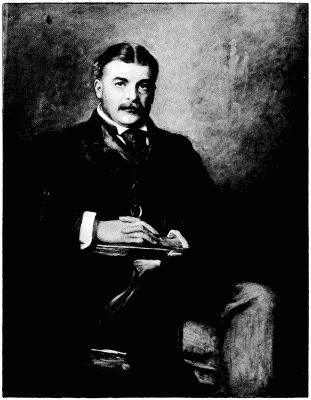
Sir Arthur Sullivan's disposition was a happy one—in other words, it
was bright and sparkling. Blessed with a sense of humour that enabled
him to look out on the world with invariable cheerfulness, he passed his
days in an atmosphere of serenity that might well be the envy of all who
knew him. It was only natural, for he was a veritable child of fortune.
Most men, and, emphatically, most musicians, have to experience years of
struggle or strenuous work, before they attain to fame, or, in the
jargon of the day, "arrive."
Not so, Arthur Sullivan.
The fates took too much care of him to subject their favourite to
anything so unpleasant or distressing!
His childhood was happy; at school he was a universal favourite, and as
a student at Leipzig, he passed some of the most pleasant years of his
life.
When he returned to England in 1861, he brought with him several
manuscript compositions, one of which proved to be a veritable torch
that was destined to light his way to fame—and fortune. It was his
music to Shakespeare's "Tempest."
He was, of course, well-known in musical circles through his being the
winner of the Mendelssohn scholarship, so there was no difficulty in
arranging for its performance. This took place at the Crystal Palace,
under the direction of the late Sir August Manns, in April, 1862.
 Sir Arthur Sullivan.
Its success was instantaneous and extraordinary. In fact, it must be
admitted, on looking at it to-day, that the enthusiasm it aroused seems
not a little in excess of its merits—considerable as they were. He
became, at one stroke, famous, and no one was more astonished at the
sudden notoriety he had acquired, than himself.
He, if ever one did, had "greatness thrust upon him." Fortunately it did
not spoil him, for his nature was eminently a sane one.
Even as a young man he had made decisive plans as to his future. He had
come to the definite conclusion that teaching was incompatible with
composition, and therefore, resolved upon trying to compose in a manner
calculated to catch the public ear, and thus, while making an income
sufficient for his needs, still have time to devote himself to more
serious efforts. That he successfully carried out his resolution is a
matter of history, for such teaching as he did, was confined to a few
only, of pupils who appeared to be of exceptional promise. Even this did
not last long.
The medium through which he made his appeal to the general public was
song-writing, and, one must allow—such is the advance in musical
education—that compared with songs that achieve great popularity
to-day, like those of Landon Ronald, Arthur Somervil, Sir Charles
Stanford and others, many of them possess little distinction.
Others, such as "Orpheus with his lute," are on the contrary, worthy of
place in the highest rank. His greatest achievement in this form of art,
written at a later period, was "The Lost Chord," which not only attained
world-wide celebrity and an enormous circulation, but is full of poetic
interest and instinct with genuine inspiration.
It was written one night, while sitting at the bedside of his dying
brother.
It may be mentioned that, perhaps, the earliest that promised to bring
any really substantial result was one called "Meet me once again."
Its sale, already large, was greatly increasing, when it suddenly
stopped, owing to "Punch" producing a parody of it in a picture
representing the excitement of a number of cats, on hearing a man
singing "meat me once again," as it was rendered. The caricature was
neither clever nor in good taste, but it was a serious thing for the
composer, as it meant the loss of a considerable income, while still a
young man, and not earning as many hundreds as he did thousands of
pounds in after years.
At that time the paper was far different from the brilliant and refined
"Punch" of to-day.
In those days the puns of F. C. Burnand were preferred to the wit and
humour of W. S. Gilbert. But then, "Punch" rejected the "Bab Ballads"!
Arthur Sullivan was born in 1842.
His first popular success in the sphere, in which he was, afterwards, to
win universal fame, was made in 1875, when he produced, in conjunction
with W. S. Gilbert, the extravaganza, "Trial by Jury." He had made
tentative efforts, on two or three occasion, of a similar kind, but this
one proved, with the utmost clearness, his exceptional ability in this
direction, and obviously indicated a future path for him.
In those days there were two people in London of noted hospitality, Mr.
and Mrs. Arthur Lewis (the latter was an elder sister of Miss Ellen
Terry, and herself a distinguished actress; she was known to a former
generation as Miss Kate Terry), and it was at their house that these
pieces were first presented. On the occasion of this particular
performance, the late Mr D'Oyly Carte was present, and to his happy idea
to get the author and composer to collaborate on a work of larger scope,
and his undertaking to produce it, that the combination of the three
remarkable men, who were destined to make so much history, is due.
"The Sorcerer" was produced at the Opéra-Comique Theatre, London, on
November 17th, 1877. It was altogether too new in style, bewildering in
its humorous absurdities, and unlike anything previously seen, to
achieve pronounced popularity, but it convinced the public that a new
force had arisen in the theatre-world and, gradually, it attracted a
sufficient following to permit of 175 consecutive performances.
Incidentally, it may be mentioned that it was in this piece that the
late Mr. George Grossmith laid the foundations of his great fame as an
actor, and that Mr. Rutland Barrington established his lasting
popularity, in the part of the "pale young curate."
If "The Sorcerer" left the question of permanent success to this new
school of theatrical art to some extent in doubt, the next production,
"H.M.S. Pinafore," absolutely dispelled it, the success being immediate
and triumphant. It quickly spread to the great colonies and America,
where the excitement it produced exceeded anything previously known in
the history of the stage. At one time it was being played at upwards of
a dozen theatres, simultaneously, in New York alone. Performances on
board a real ship were given; performances solely by negroes, and in
fact, of every kind that ingenuity or excitement could suggest, were
common features in the extraordinary craze it aroused. "H.M.S. Pinafore"
was succeeded by "The Pirates of Penzance," "Patience" (during the run
of which it was transferred to the Savoy Theatre, meanwhile built by Mr.
D'Oyly Carte), and the many others with names that are too familiar to
need recounting. It may, perhaps be permissible to say that of them all,
the two of most outstanding merit were "The Mikado" and "The Yeoman of
the Guard." If Sir Arthur Sullivan's often avowed wish to establish an
English school of Light Opera has not been realised to the extent he
would have desired, its temporary eclipse having to be acknowledged, yet
it is to be greatly hoped that there will be found, and that, too,
before long, men both willing and able, not only to follow, but improve
on the lines of healthy artistic traditions he and Sir William Gilbert
so happily laid down.
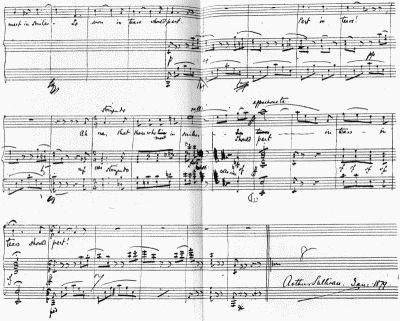
With the composition of "Ivanhoe," Sir Arthur Sullivan entered the lists
as a writer of Grand Opera. If his success was not complete, I think
that the circumstances with which its career was indissolubly connected,
go a long way to account for the fact. In the first place, it was
subjected to the intolerable strain of 168 consecutive performances.
No possible chance of making alterations that only public performance
can point out, with certainty, as desirable or necessary, was accorded
to the composer, since its even temporary withdrawal would have involved
the closing of the newly-built opera house and, under the circumstances
alluded to in another chapter, made the continuance of the scheme a
matter of doubt.
Had the conditions been different, I do not doubt that Sir Arthur
Sullivan would have made a great and possibly vital change in the work.
One of the most persistent and justifiable criticisms brought against it
was its demonstrably unevenness in merit. Any musician with the least
critical faculty would recognise its truth. For instance, the second
scene of the second act should have been entirely eliminated. It was
unworthy of the work and the composer. It was forced, theatrical, and
destitute of spontaneity or inspiration.
That a man of such acumen could fail to recognise it is impossible; as a
matter of fact, he once told me that the scene spoilt the act which, it
may be said, with this exception, contained the most splendid music in
the opera.
It is inconceivable that, had he found the opportunity, he would not
have composed an entirely new one. To give credence to this opinion, I
may mention that he made an important alteration, in the short time at
his disposal, before it went to Berlin for performance. So short,
indeed, that he asked me to do the necessary scoring for the orchestra
that the alteration involved.
Another criticism often levelled against "Ivanhoe," was that it was
occasionally reminiscent "of the Savoy"—implying that the high standard
imposed by Grand Opera was not consistently maintained. This was,
doubtless, suggested by the popular "Ho! Jolly Jenkin." In this
connection, I will at once say that Sir Arthur Sullivan, himself,
anticipated this objection, as the following words will show. It was
typical of him, when he had an important work in view, to delay its
commencement to the last moment. The result was that, once begun, he was
obliged to work with incredible energy and persistence to effect its
completion at the stipulated time. It was so on this occasion.
The night was as constant a watchman of his work as the day.
I had been engaged by the publishers, Messrs. Chappell and Co., to make
the pianoforte arrangement from the full score, and, at Sir Arthur
Sullivan's request, I used to drive down to his residence from the Savoy
Theatre, where I was at the time conducting, after the evening
performance, to take away any pages of the score that might be
completed. I generally arrived about midnight. On one occasion, as I
entered his study, he said to me, "I want you to hear something," and
went to the piano and played this particular song. When he had finished
I remarked, "Sir Arthur, why, it will be an immense success," and he
replied, somewhat with a sigh, "Yes, I think it would; but it won't do.
I can hear them now saying, 'redolent of the Savoy.'"
He then continued that he was going to attempt another setting before
finishing work for the night.
I, naturally enough, as those who know the song, will agree, urged, as
far as I could, that it should be retained. I don't suggest that this,
in any way, affected his decision; I merely state the facts. In the
event, as is known, he kept it in.
"Ivanhoe" contained, as I believe, and as many highly competent critics
have affirmed, some of the finest music that Sir Arthur Sullivan ever
wrote.
The soliliquy of the Templar, and the great scene between Rebecca and
the Templar in the castle of Torquilstone (with both these characters
the composer was in intense sympathy) represent Sir Arthur Sullivan's
powers at their highest expression.
The opera, however, proved to be the one important event in his career
that did not result in the complete and absolute success to which he
had, for so many years, been accustomed.
If Sir Arthur Sullivan gained his fortune in the theatre, as is quite
certain, it is equally incontrovertible that he attained his great fame
in the concert-room, and, moreover, through the medium of his sacred
works, or, perhaps I should say, works dealing with sacred subjects.
His first important contribution to purely sacred music was the short
oratorio, "The Prodigal Son." Although evidence of immaturity may be
occasionally detected, the music shews the firm grasp he had on the
technique of composition, and the influence of religious feeling is
strongly apparent, as indeed, may be said of all his works of this
description.[33]
Produced at the Worcester Festival in 1869, it achieved a success that
augured well for his future efforts in this region, which he had
evidently chosen as the one most appealing to his genius and
temperament.
After an interval, during which he produced, among other interesting
compositions, the overture "Di Ballo"—a work full of sparkling and
original music, which he scored, it may be said, at a time of great
physical suffering—his oratorio, "The Light of the World," a work on
much larger lines than its predecessor, was given to the public as the
principal attraction of the Birmingham Festival in 1873. Although its
reception by the audience was flattering enough, it cannot be said that
it aroused any enthusiasm among the critics.
In fact, it aroused considerable controversy, some maintaining that so
far from being an advance on, it lacked the admitted promise of "The
Prodigal Son"; while others were equally pronounced in their views as to
its superlative merits.
Although subscribing to neither opinion, I cannot but think that the
former contained more truth than the latter. That "The Light of the
World" contains much that is beautiful is not denied, but that it
contains some that nearly verges on the common-place, cannot, I am
afraid, but be admitted. It has fallen into desuetude for many years
now.
In a short summary of Sir Arthur Sullivan's career, as this must,
necessarily be, I have to leave unrecorded much that is both interesting
and important.[34] I content myself, therefore, with some reference to
those works upon which his fame, so far as serious music is concerned,
will chiefly rest.
"The Martyr of Antioch" was produced at the Leeds Festival in 1880. It
was an event of particular significance in his life.
The continued successes of his Savoy comic operas, and the popularity
gained by his songs, had begun to make a decided effect on the public
mind, which was rapidly losing count of the other side of the versatile
composer—that of more serious import. It was, then, with no little
interest and speculation that the production was awaited.
The result exceeded the most sanguine hopes of his friends and admirers.
Its reception was veritably triumphal, and at once re-affirmed his
position as the leading English composer of his time.
Any doubts that might have been felt by the audience assembled on this
memorable occasion, were soon dispelled. The splendid chain of choruses
with which the work opens—once interrupted by the hauntingly beautiful,
and purely original song, "The love-sick damsel"—immediately convinced
them, not only that the composer was, in no sense, shorn of his powers
as a writer of serious music, but that they had discovered him in a vein
of virile strength, of which he had, previously, scarcely given warning.
From that moment, the work was not only assured of success, but, as it
progressed, enthusiasm increased to such an extent, that at the
conclusion of the finale, to the success of which the magnificent
singing of that great artiste, Madame Albani, predominatingly
contributed, a scene of excitement occurred that only those who
witnessed it could adequately imagine. Of the many numbers that
contributed to this result, those that most readily spring to the memory
are the strenuous, and, again, highly original "Io Pæan"; the charming
"Come, Margarita, come"; and, above all, the one that will probably
live, when the others are forgotten, the noble hymn, of the type which
Arthur Sullivan may be said to have made his own, and which is so
frequently sang on occasions of national mourning, "Brother, thou art
gone before us"; of them all, this remains as the grandest monument.
The years immediately succeeding the production of "The Martyr of
Antioch" must, I think, have been the happiest of the composer's life.
The illness from which he occasionally suffered from early manhood, had
not taken sufficient hold on him to prevent his thorough enjoyment of
life and all its various attractions, and so, with abundant means and
ample time at his disposal, he was able to enjoy, with complete
serenity, any recreation or amusement that appealed to him. His happy
temperament prompted him to take the advantages that good fortune had
thrown in his way, and to this I attribute the fact of his being able to
reach even the moderate age to which he attained.
In this way the years passed rapidly, continued successes at the Savoy
ever augmenting both fame and fortune, until, when the calls for another
work of serious importance from his pen began to assume an importunate
form, he had scarcely realised how much time had elapsed since "The
Martyr of Antioch" was composed.
In answer to the urgent request of the committee, Sir Arthur Sullivan
undertook to write a work for the Leeds Festival of 1886, and
accordingly, turning to the experienced skill of Mr. Joseph Bennett to
supply him with the "book," he, at length settled himself to the
composition of "The Golden Legend."
The subject was exceptionally well chosen to draw upon his well-known
power of dramatic writing. The poem of the great American writer, Henry
W. Longfellow, from which Mr. Bennett arranged his libretto, is full of
picturesque and fanciful imagination, and furnished the composer
plentifully with scenes that enabled him to exhibit his genius at its
greatest strength.
The prologue was the medium of displaying his descriptive, as was the
epilogue of his choral writing, at its best, and what this conveys can
only, perhaps, be fully appreciated by the skilled musician. I need only
say that they were masterly displays. A striking feature in the work, is
the quaint and original manner in which the character of Lucifer is
portrayed. The music, with which he is invariably accompanied is of a
semi-sacred character, contrapuntal in construction, but which is, at
once, grotesque and eminently fitted to mark the sardonic humour of the
character that Longfellow so powerfully painted.
The numbers that are, probably, the most popular are those for the
soprano and contralto, "My Redeemer and my Lord," "Virgin who lovest the
poor and lowly," and the hymn, "O gladsome Light."
The reception accorded to "The Golden Legend" on its presentation, like
that of "The Martyr of Antioch," was enthusiastic in the extreme. It has
retained its popularity, and is usually conceded to be his masterpiece.
It is sung wherever the English language is spoken.
Of the many great singers who were associated with the composer in these
productions, I might mention the names of Titiens, Trebelli, Albani,
(Madame) Patey, Sims Reeves, Edward Lloyd and Charles Santley.
In character, Sir Arthur Sullivan was broad-minded, tolerant,
sympathetic and generous. In tastes, he was decidedly eclectic, for they
ranged from the æsthetic ones of literature and painting, to the more
prosaic of racing and cards. Whatever happened to be the subject of
interest at the moment, was sure to command the enthusiastic attention
of his ever active brain.
Once, however, started on some important composition, nothing was
allowed to interfere with his complete absorption in it.
Doubtless, this was a leading factor in his success, or, at least, one
of very great importance that directly tended towards it. The process
was, undoubtedly, an exhausting one, for it constantly happened that
after the completion and production of such a one, a more or less
prolonged period of rest and diversion of thought was necessary to bring
him back to his normal state of healthy activity.
One great attribute he was unquestionably blessed with, and that was the
power of throwing off his mind, completely, any thought of music, once
he had accomplished any given task. In fact, when he was not actively
engaged with it, music was seldom a subject of conversation with him. Of
this I have had convincing proof. Some years ago, I was spending a part
of one winter with him, at his villa on the Mediterranean. During the
whole time, I can only remember two occasions on which he spoke of it;
the first initiated by him, the second by me. We were reading in the
drawing-room one evening, after dinner, when he suddenly turned round to
me, and said, "What do you say, Ernest, to playing a Schumann symphony?
I have an arrangement for four hands here." I naturally acquiesced, and
his dwelling affectionately over many of the passages, the profound
knowledge he displayed as he talked of Schumann's genius, and his
intensely interesting comparison of it with that of Schubert, remain
with me as a memorable experience.
The other occasion was of a very different character.
I was walking with him one day, on the road to Cap S. Martin—walking,
it may be said, was not a form of recreation to which he was much
addicted. The weather was glorious, and Sir Arthur in high spirits,
thoroughly enjoying his unwonted exercise.
Seeing him in this mood, I said, "Sir Arthur, I should like to make a
bet with you."
He turned to me, and laughingly replied, "Well, if the amount is not
quite beyond my resources—a franc?—quel soulagement!—then go on."
"It is that I tell you your favourite Savoy opera, and that you don't
tell me mine."
He walked on for a few minutes, and then said, "I think I must say 'The
Yeoman of the Guard.'"
"So far, I have won," I remarked.
Again, after a little while, he continued, "I should not be surprised if
it were 'Princess Ida.'"
I called out, "Sir Arthur the bet is off," handing him, at the same
time, a slip of paper, on which I had previously written these two
titles.
The incident led him to speak of various reminiscences in connection
with the Savoy Theatre, one of which, I remember, he told me with great
zest and evident appreciation.
Considerable exception had been taken to the title Mr. (later Sir
William) Gilbert had chosen for one of the operas, "Ruddygore." The
author professed to see no objection to it, but eventually announced to
the composer that he intended to change it. He did. He renamed it
"Rudd-i-gore."
Sir Arthur Sullivan left many and great claims on the gratitude of his
countrymen. In the sphere of light opera, he enormously advanced the
standard of taste.
Those of his songs that achieved great popularity, whatever may be
thought of them now, were immensely superior to any that had previously
gained the ear of the "man in the street." I am, of course, referring to
those which make more frank appeal to the less cultivated lovers of
music; "Orpheus with his lute," "The Lost Chord," and others of similar
type, being in an entirely different category.
Through "The Martyr of Antioch" and "The Golden Legend," Sir Arthur
Sullivan not only convinced English people, who were able to learn the
lesson, that an English composer was capable of arousing their highest
emotions, but, incidentally, indicated the road that led them, in after
days, to their pride in, and appreciation of, "The Dream of Gerontius."
 Henry Purcell.