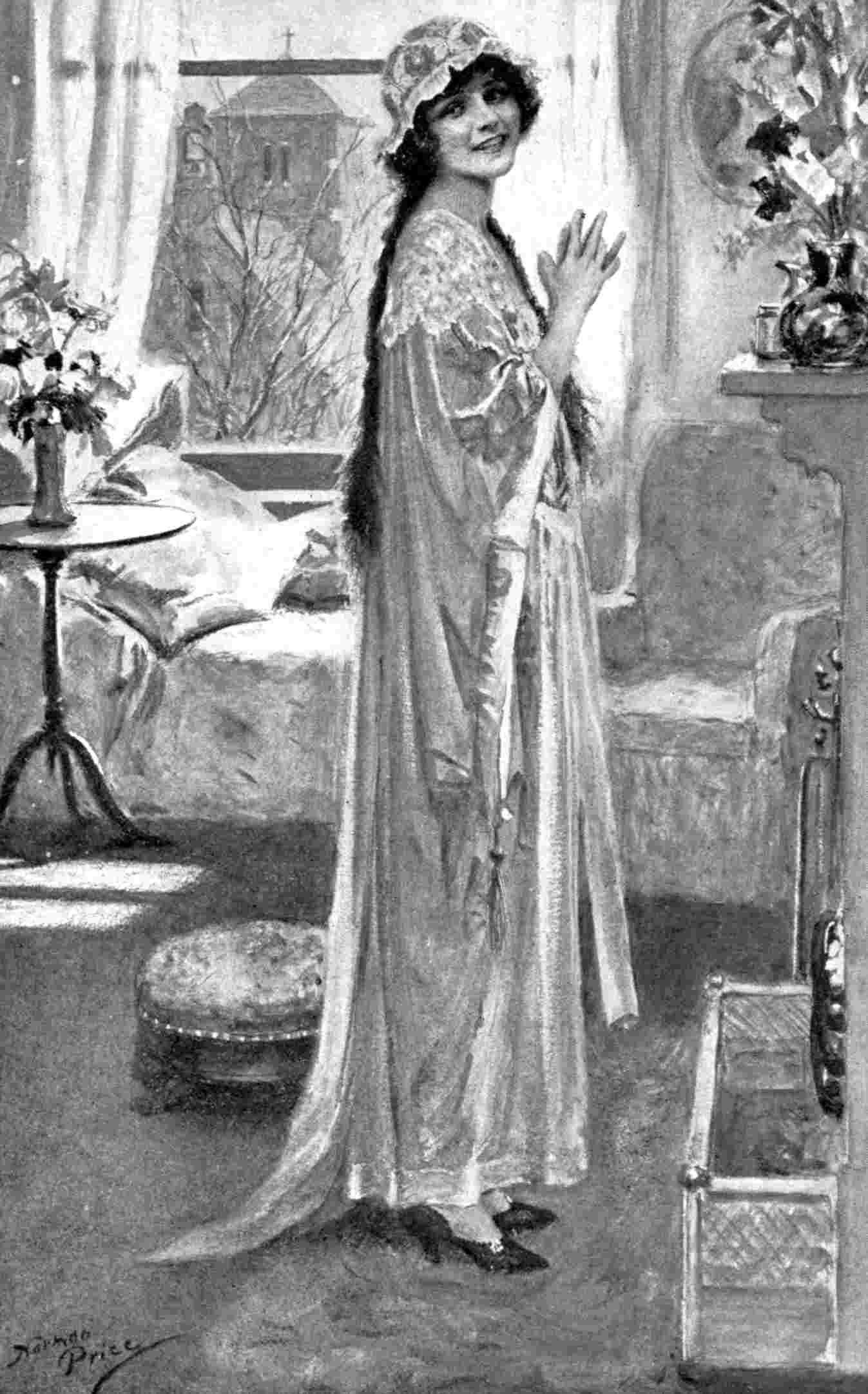
Ruth Mellicot had perhaps rather
too classic a brow; it rose above her clear
gray eyes, white and firm and a little high.
She would have made a perfect model for
Minerva.
She had been to Girton, and besides a very
quiet manner and an ability to follow the points
of an argument, however abstruse, she spoke in
a low, pleasant voice very agreeable to listen
to. There was no reason why it should make
people feel as if they had gone back to the
school-room.
Both Daphne and Jim liked her extremely.
She was a woman to be relied upon in every
emergency and she was never in the way. She
was modern in her ideas, without coming into
conflict with respectability. She had grasped
the convenient truth that it is well to think a
century ahead, and to act a century behind the
present. She was very open-minded about the
other world and extremely clear-headed about
this one.
Anthony could talk to her upon any subject
he liked. He had always thought it was absurd
that women should have to be talked to
as if the facts of life did not exist for them in
the presence of the opposite sex. If you
wanted to know what a woman thought about
life, she should be capable of telling you without
shirking facts or showing embarrassment.
Ruth was perfectly capable of telling Anthony
what she thought upon any subject; she
shirked nothing, and it was Anthony who felt
embarrassed. She regarded him with her
grave, candid eyes as if they were fellow-students
at a lecture, discussing one of the subjects
in their course. She said that men and
women must work together on the dissecting-tables
of life, and doctors do not like illustrations
about dissecting-tables. Daphne argued
afterward with Jim that they oughtn’t to have
been left so much alone together.
It was wonderful weather for April, the kind
of weather that seemed designed for long
country rambles, teas at wayside inns, and late
returns in time to dress for dinner. Anthony
had explained to Daphne that if she wanted
him really to make friends with Ruth Mellicot,
they must be a great deal alone together. He
made friends slowly, and he did not think
women ever showed their real selves before a
third person.
When Daphne said, “Do they before a second?”
Anthony smiled the smile of a man who
has reason to believe in his own power of discrimination,
and replied that they probably did
it unconsciously.
Ruth looked very well in coats and skirts, and
walking suited her. In the evening she did not
show to such advantage. Good walkers seldom
do. She was not exactly clumsy, but her
figure appeared rather pointless. When she
moved she seemed to be shouldering her way
through obstacles. There was very little slope
to her shoulders, and her elbows and wrists
were more prominent than they should have
been.
Her conversation was extremely interesting.
She read the newspapers carefully, and Anthony
never heard her jump ahead of her facts.
Ruth did not always share Anthony’s opinions,
but she was prepared to listen to his arguments,
and he could see that on the whole she wanted
to agree with him.
Ruth was twenty-five, and in a sensible, unferocious
way she wished to get married. She
hoped to find a man of her class with steady
principles, a moderate income, and more or less
the same ideals. A man who would wish to
have a happy, hygienic home, two or three
healthy children, and who had a genuine desire
to improve the world up to a certain point.
Ruth did not wish a crank; cranks wish to improve
the world unreasonably and involve their
personal futures in their efforts. Ruth did not
think this a very necessary or desirable attitude.
People’s individual futures should run on one
line, and their efforts to reform the world
should run on another, and these two lines
should be parallel and never meet. When she
said she feared fanatics and disliked cranks this
was what she meant. It is what people usually
do mean. Anthony agreed with her, only he
meant something a little different. Before he
had been two years in prison he would have
meant something exactly the same.
Ruth studied Anthony much as he was
studying her. She had the same prospect in
view; if she liked him, she meant to marry him.
It did not annoy Anthony to guess this fact.
On the contrary, it rather amused him. He
liked her quiet, appraising eyes and her distinct
and unevasive questions. Sometimes he found
them a little too difficult to answer, but he appreciated
her asking them. She was not at all
eager to attract him, which would have frightened
him, nor did she appear to be greatly attracted
by him.
Their cards were all out on the table, and
they played them in turn without any effort at
concealment. It sent Daphne and Jim into fits
of laughter.
Daphne and Jim weren’t superior about
their happiness. It was a child of so much
danger and uncertainty that even now when
life appeared open before it, they walked delicately,
like an Agag, and hid the sharpness of
their joy. But they could not hide their happiness
itself. They existed in a charmed circle
of love, and though they looked over the edge
of it from time to time, their inner life was complete,
and uninterrupted by the actions of others.
“Of course,” Anthony observed to Daphne
when Ruth had left them to change her shoes,
most sensibly, without a suggestion from Anthony,
after they had been caught in a shower,
“it’s an immense comfort to hear exactly what
a woman thinks about things. I appreciate it
awfully and all that, you know. Miss Mellicot’s
just been telling me what she expects of a
husband. Daphne, if you laugh into your tea
like that you’ll choke. Only it occurred to me
to wonder if you’d ever put it quite like that
to Jim.”
“My dear,” said Daphne, chuckling, “as if I
should have dared! And if I had dared, it
wouldn’t have mattered. You see, I never
thought about him in the least like that. I
don’t now. He was just Jim.”
“Still,” Anthony protested, “you must have
said to yourself some time or other before you
fell in love with him: ‘What kind of fellow is
this, good or bad? Would he make a good
father for my children? That kind of thing—what?’ ”
Daphne’s eyes brimmed with laughter. She
shook her head violently.
“I never said anything of the kind,” she
answered him. “I always thought of him as
Jim, not as a man, and I was terrified he’d fall
out of his aëroplane and be killed before I knew
if he really loved me, and I didn’t think about
anybody’s children for millions of years afterward.
Of course I dare say goodness was a
part of his being Jim, but not nearly all of it.
Badness wouldn’t have mattered if it hadn’t
altered him. Of course I suppose some kinds
of badness do really alter people. That must
be awful, like losing your way in a fog—your
way home—when you know it so frightfully
well really; but it wouldn’t stop being your
home, would it?”
Daphne became quite serious, looking at Anthony
over her bread and butter. It was
funny to think of Ruth and Anthony, but it
wasn’t funny to think how badness might alter
love.
“Of course,” said Anthony, “neither Miss
Mellicot nor I sentimentalize nature. If you
act on sane principles, sufficient emotion will
follow later; only—” his face slightly clouded
as he regarded his sister’s shining eyes—“I
must confess, Daphne, just between you and
me, you know, that it’s rather like going to a
dentist without a toothache.”
“Doesn’t it ache the least little bit?” Daphne
asked with anxiety as Ruth came into the room.
Anthony shook his head, and looked consideringly
at the tall, tidy young woman in front
of the tea-table. Ruth did her hair very well.
It was bright, smooth, brown hair, and very
thick.
“Not in the least, thanks,” said Anthony a
little dryly. “I haven’t felt even a preliminary
twinge. Won’t you have one of these little
pink things, Miss Mellicot?”
“I’ll have bread and butter first, please,”
said Ruth. “It’s the good old nursery rule,
isn’t it?”
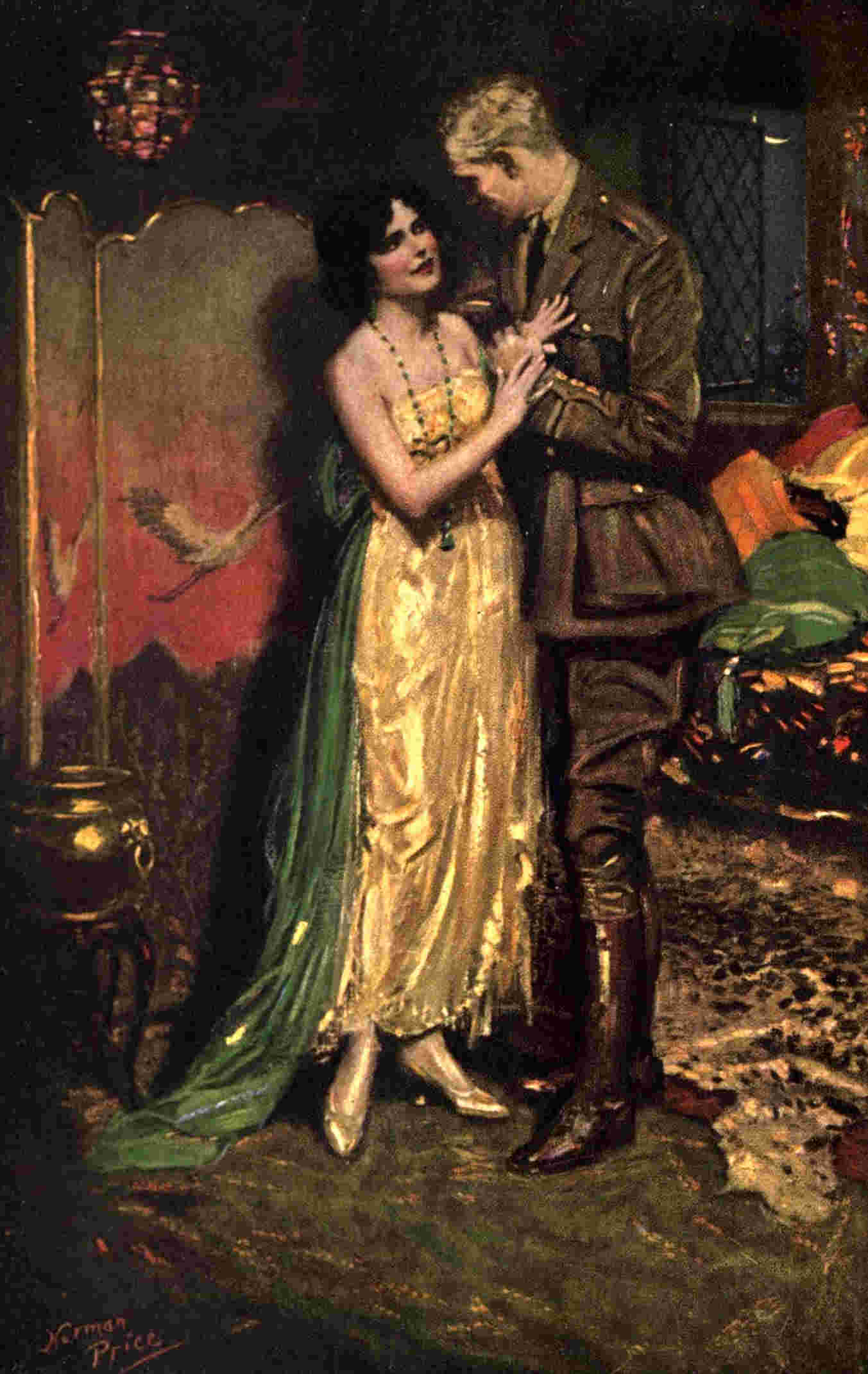
And then the door opened, and Kitty came
in.
She did not wait to be announced as “Miss
Costrelle.” She simply threw a long, blue chiffon
scarf on a chair, followed by a gold handbag
and a perfectly insufficient umbrella with
a jeweled handle; then she embraced Daphne.
“I know I oughtn’t to have come,” she said
apologetically, for the only welcome Daphne
gave her was to say reproachfully, “O Kitty!
Kitty!”
“It was only tea. I literally was dying for
some on the doorstep, and the next house was
miles off and full of women who hate me like
poison, and won’t say so except when they think
I’m looking the other way. And I thought
you wouldn’t like Jimmy to find me just dead
on the mat. It would make him think you
such a bad housekeeper.
“This is your brother, isn’t it? I’ve met
Miss Mellicot before, I believe. I’m awfully
afraid of her. You are the one who went
to Girton, aren’t you? I can’t think why
Daphne has such awfully clever friends; she
isn’t a bit clever herself, really, is she, Captain
Arden? Of course I know you are, but men
don’t matter. One isn’t afraid of their cleverness.”
“Give her her tea,” said Daphne, resignedly.
She seemed to be simultaneously annoyed
and amused at the appearance of her unexpected
visitor. “She’s not really afraid of
anybody’s cleverness.”
Kitty laughed over her tea-cup at Anthony.
Her eyes, which were almost black and a little
narrow at the corners, laughed, too; her long
emerald ear-rings laughed at him. Everything
about her glittered and sparkled, and
seemed in some strange way directed straight
at Anthony.
She took what color there was out of Miss
Mellicot as sunshine takes the light out of a
fire.
“Of course I’ve heard all about you,” she
said, making room for Anthony on the sofa
beside her. “Daphne’s really awfully fond of
me, though you mightn’t think it. I’m one of
her secret sins. She keeps me for dull, rainy
days, as you keep chocolates and tell people you
have a headache, and then shut yourself up
with a box of them and a good detective story.
Don’t you ever do that? Don’t you, Miss Mellicot?”
“I never eat chocolates,” said Ruth, coldly.
Daphne groaned inwardly. It was not the
moment for Ruth to repudiate chocolates.
Kitty opened her eyes wider than ever. She
had black lashes which curled upward, and
when she laughed her eyelashes swept together
and made her look as if her eyes were shut.
“Wouldn’t Miss Mellicot make a good food-controller?”
Kitty murmured. “Perhaps you
were one during the war, Miss Mellicot? I
often wondered who the Government really got
hold of. I don’t believe men did that kind of
thing themselves, poor dears. There must
have been some really clever people behind the
scenes who knew just how much food there
really was, and what was absolutely necessary
for babies. Somebody very competent who
didn’t mind people not having what they
wanted.”
“Do you suppose that women are the only sex
who wish to deprive others of what they want?”
asked Miss Mellicot, disdainfully. “You
don’t appear to have a high opinion of your
sisters.”
“They’re the only people who really seem to
mind my having what I want,” said Kitty,
plaintively. “Still, of course, it wouldn’t be
any fun getting it if nobody minded your having
it, would it? Do you play billiards, Captain
Arden? Yes?” Anthony nodded.
“They have a really good table here,” Kitty
said, directing a glance at Daphne’s increasing
gravity. “I’ve finished my tea now, and it’s
begun to rain again, so I can’t possibly go home.
It would be such a pity to spoil this hat,
wouldn’t it, Miss Mellicot? But perhaps you
don’t wear hats?”
“Not such perishable ones—in the country,”
agreed Miss Mellicot, smoothly.
“It would die in a good cause,” said Anthony
with appreciation, studying the golden wing
that rested on Kitty’s dark, wavy hair.
Miss Mellicot’s lips tightened. It was the
first time Anthony had seen her with tight
lips. They accentuated her likeness to Minerva.
Kitty smiled at Anthony. Then she turned
coaxingly to Daphne.
“We may just as well have a game now,
mayn’t we, Daphne?” she urged. “Or is it
bad for Captain Arden to play billiards?”
“It’s remarkably good for him,” said Anthony,
quickly.
He had an intense desire to get Kitty away
from Miss Mellicot. Of course it was Kitty
who was behaving badly, but, curiously
enough, it was not Miss Mellicot whom Anthony
wished to take away from Kitty.
Miss Mellicot behaved extremely well. It
is quite compatible with behaving well to look
like one of the Muses in the Vatican. There is
a didactic Muse fronting the stairs, who keeps a
thin little finger very levelly lifted. She seems
to warn the approaching onlooker not to be
carried away by his feelings.
Miss Mellicot did not lift her finger. She
merely turned her eyes a little fixedly on Anthony.
Anthony avoided her glance. Perhaps
some day it would be his domestic duty to
meet fixed glances and reply to them, but at
present he slipped into fluidity. He hurried
out of the room behind Kitty.
When they were in the hall, with the door
shut, Kitty turned and laughed at him.
“Now,” she said, “I know you are really
brave, Captain Arden. Do you know how I
should describe Miss Mellicot?”
“No,” said Anthony; “but I have no doubt
your description would be picturesque and a little
unfair.”
“No, it wouldn’t,” said Kitty, petulantly,
throwing open the billiard-room door. “I
shouldn’t be a bit unfair to her. I should describe
her as a perfect wife and mother.”
Anthony found himself saying in a tone
which he had never dreamed of using with Ruth
Mellicot:
“You deserve to have your ears boxed.”
But it was a perfectly suitable tone to use with
Kitty. She merely made a face at him over
her shoulder.
He watched her with delight swing down her
cue and chalk it. She had fine little hands and
delicate wrists; her short skirts revealed the
neatest feet and ankles Anthony had ever seen.
Every line of her small, graceful figure told.
She was beautifully dressed, with that unnecessary
expensive luxury which Ruth and Anthony
had mutually deplored in modern
women.
Anthony could hear the rustle of her silk petticoats
as she swung round, and see through her
transparent chiffon blouse the lace and ribbons
under it. Kitty’s lips were artificially reddened,
and her small, tip-tilted nose was powdered.
She had taken no pains to disguise the
fact. She was a minx, a flirt, and a perfectly
obvious danger-signal to any sane man.
And yet almost all sane men would have done
precisely what Anthony did. He followed her
into the billiard-room to see what she was up to.
She heaved a little sigh of relief when the
door closed.
“I don’t really like women, you know,” she
told him, “except Daphne, and not Daphne
when she’s cross with me, and she’s awfully
cross with me to-day. Still she’s generally
kind to me; other women aren’t.”
“I should hardly suppose that you gave them
much reason to be,” said Anthony, with his eyes
on the poise of her figure bending over the
table.
“Still,” said Kitty, looking up at him with
dancing eyes, “I don’t know that I give men
much reason, and yet men are always kind to
me, even awfully clever ones like you. And
even when I behave—and I do sometimes behave,
you know—like a perfect fiend.”
“I can well believe it,” said Anthony. “Do
you like to start, or shall I?”
Anthony did not believe that Kitty could
really play billiards. He thought billiards was
one of her ways of escape from other women.
But he was mistaken. Kitty played a most excellent
game of billiards, and was really fond
of it; only she could play more than one game
at a time.
“I’m being a fiend now,” said Kitty in a
low voice, like a subdued child’s. “Perhaps
you didn’t know it, but I am—a fiend to
Daphne. I promised not to come all the while
you were here. Wasn’t it awful to break it,
when Daphne’s been so tremendously good to
me, and Jim, too, only Jim doesn’t count.
And it wasn’t true about the tea—it was just
curiosity.”
“Well,” said Anthony, “I hope your curiosity
is satisfied agreeably. May I ask why
you promised not to come here during my
visit?”
Kitty measured her shot carefully, took it
successfully, and looked up at him.
“Daphne thought I should be bad for you,”
she said. “You see, I am usually supposed to
be rather bad for men.”
Anthony aimed, and missed. It was an easy
stroke and Anthony couldn’t think how he had
come to miss it.
“Do you try to be?” he asked her.
Kitty hung her head.
“Sometimes I try to be,” said Kitty.
“Are you trying now?” Anthony asked her.
“Because I rather fancy you’re putting me off
my game.”
“I don’t want to do that,” said Kitty,
quickly; “not a bit. Do you like Miss Mellicot?
Is she a great comfort to you, I mean?
If you were unhappy, you couldn’t put your
head against her as if she were a cushion, could
you? It would be rather like leaning against
one of those marble block tombstones, the ones
that lie flat on the ground, and you feel no one
could resurrect under them. Of course she has
quite a good figure, really; only I’m sure her
bones are hard.”
“I have not attempted to take that particular
form of comfort from Miss Mellicot, if that is
what you are asking me,” said Anthony, trying
hard to keep his gravity. “It’s your turn,
I think. I’ve missed again; there must be
something wrong about my confounded cue.”
“Use mine for a change,” said Kitty,
sweetly. “I hope you don’t mind what I said
about Miss Mellicot’s bones?”
Anthony did not mean to touch Kitty’s hand;
the thing simply happened. He felt it slim and
warm under his fingers. Kitty’s long eyelashes
fell over her eyes and hid them. He
could not tell if what had happened had happened
purposely; he only knew that it was difficult
to take away his hand.
“You haven’t said if you really like her,”
declared Kitty after a pause.
“I really like her very much,” said Anthony,
dryly.
“Now it’s your turn again,” said Kitty,
gaily. “You ought to be more careful this
time, Captain Arden. I don’t believe you took
aim properly before. I’m rather glad you like
her as little as that.”
It occurred to Anthony that probably when
other men were alone with Kitty, and she said
this kind of thing, they kissed her. The
thought of it stung him intolerably.
“Look here,” he said fiercely, “why do you
talk to me as if you cared a hang what I think
of anybody? You know you don’t. I suppose
it’s your usual way of talking to men
you’ve met half an hour ago, but I tell you
plainly I don’t care for it. You’ve no right to
behave as if it mattered to you what I think
when it doesn’t, or as if it mattered to me what
you think when—when—”
“When it doesn’t?” asked Kitty, softly.
“It’s rather horrid of you to say that, even if
it’s true.”
“Well, you haven’t any right—” said Anthony,
sulkily. He wouldn’t look at her, but
he knew perfectly well what she looked like.
She had caught her upper lip with one of her
teeth and was trying to prevent herself smiling.
“As if having rights mattered,” said Kitty.
“You are silly, Captain Arden.”
Anthony put down his cue deliberately and
faced her.
“I don’t know this game,” he said quietly.
“Am I supposed to kiss you? Because in
about twenty seconds that is what is going
to happen whether I am supposed to or
not.”
Kitty tossed her head defiantly, then said unexpectedly:
“Oh, I am a mean little cur to break my
promise to Daphne,” and without a word of
explanation she flung herself into one of Jim’s
neat leather arm-chairs, buried her head in her
arms, and shook pitifully with sobs.
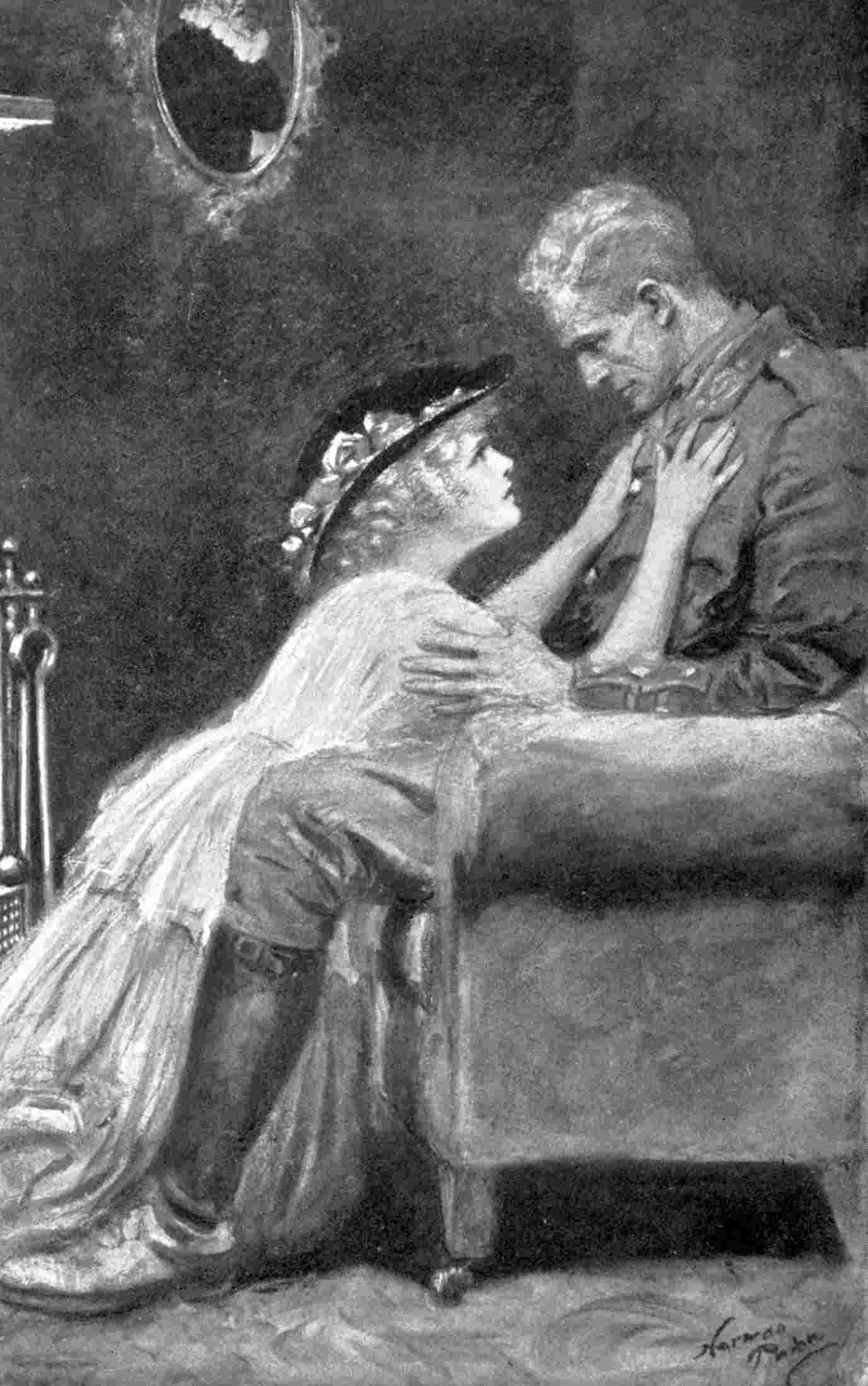
Anthony found himself on his knees beside
her, with one arm across her shoulders.
“Don’t; don’t, my dear child, my dear baby!”
he whispered. “If I was a brute and rough,
I’m awfully sorry. I won’t touch you. You
can say whatever naughty, silly thing you like.
Is that what you’re crying for?”
Kitty shook her head. She was crying without
tears, as boys do who have been beaten in
a race.
Anthony drew her into his arms and held
her close against him. She made no effort to
release herself, nor did she seem aware of him.
She fought silently to control her sobs. Anthony
felt as if he had a bird’s heart throbbing
under his hand. She was such an exquisite,
delicate creature! Perfume and softness
breathed from her small crushed figure. At
last Kitty raised her head and pushed away his
encircling arms.
“I’ll tell you,” she said. “I know it wasn’t
fair even to cry; but I couldn’t help that.
Just for a moment you looked, when you were
angry, so like Dick—that was why I came to
see you; I have such a funny feeling, as if I
must see the men who do come back. You see,
Dick and I were engaged. But he went off so
quickly, before we could be married. He was
in the regular army—Mons—and then he was
missing. I couldn’t stop hoping. I hoped
quite awfully and steadily for two years, then
I knew it was no good. I didn’t care what
happened then. I don’t care now, and I never
shall in the least care what happens. I just
amuse myself.”
Anthony put his hands on her shoulders and
met her defiant eyes; beneath the defiance he
saw her frightened, broken heart.
He saw her as Daphne had seen her, not as
the easier men who flirted with her saw her, or
as the angry women whose jealousy she roused
saw her. The pity and the waste of it went
through him like a knife.
“You poor little thing!” he said gently.
“You poor, dear little thing!”
She sprang away from him quickly.
“No, no,” she said; “I’m not like that. I’m
not poor. You needn’t be sorry for me. I do
just as I like, and I enjoy myself awfully. I
dare say I shall enjoy myself awfully with you.
I’m sorry I made such a fuss. I haven’t
cried like that for ages. It was just—that you
reminded me; besides, I could see you’ve had
a pretty bad time yourself. If you’d really
liked that woman, I’d have left you alone.
You do believe that, don’t you?”
“I propose to believe everything you ever tell
me,” said Anthony, steadily. “But aren’t you
going to leave me alone?”
She turned and faced him.
“Do you want me to?” Kitty asked. Her
eyes widened again, the corners of her mouth
quivered, all of her became as it had been before—a
glittering, dancing, creature, as bright
and strong as a steel magnet.
Anthony made a few steps toward her.
“No,” he said reluctantly; “I suppose I don’t
want you to leave me alone.”