BY
WILLIAM LE QUEUX AUTHOR OF
“Zoraida,” “The Great War in England in 1897,” “Guilty Bonds,”
“Stolen Souls,” “The Temptress,” “Devil’s Dice,” &c.
SECOND EDITION
London: Ward, Lock & Co., Limited Warwick House, Salisbury Square, E.C.
New York and Melbourne
1896
[All rights reserved]
PREFACE.
While writing for The Times a series of articles
dealing with the Russian Revolutionary movement
and the condition of political exiles in
Siberia, I became acquainted with the original
of Anton Prèhznev. Strange as his stories
chronicled in these pages may appear, there
are nevertheless in London at the present
moment many refugees from the Tzar’s empire
who could relate facts of an even more startling
character. Tzaricide is unfortunately as popular
in Russia as it ever was, and the so-called
Nihilists have, since the accession of Nicholas
II., relinquished none of their activity. There was
but little genuine mourning for Alexander III., and
the feigned national affliction was speedily succeeded
by joyful anticipations of a new and prosperous
era. But Russia has already found that
her golden hopes have faded. The powerful, unscrupulous
officials surrounding the young sovereign,
prompted by those evil principles that
made Russia under Alexander III. a blot upon
European civilisation, have, by painting in lurid
colours a rude and ungrateful nation whom to
govern is now his thankless task, quickly succeeded
in crushing any projected reforms. Thus the
despairing nation continues to writhe under the
oppression of corrupt officials, and those who
dare lift their voices in protest are arrested and
hurried without trial to far Siberia. The land is
inundated with the swelling flood of the people’s
sorrow as rivers in spring, abundant with water,
overflow the fields, and it will always be as long
as an irresponsible, cruel, and despotic autocracy
holds and directs her destinies.
The Tzar knows little of the horrors committed
in his name. He has never been inside the
tenth pavilion in Warsaw Citadel, where starving
people have, times without number, been
knouted to death. He knows nothing of the
dark underground dungeons overrun with vermin
in the Peter-Paul Fortress; he has never
breathed their fœtid, poisoned atmosphere.
Even when he crossed Siberia the officials who
surrounded him took every precaution to prevent
him from witnessing the troops of wretched,
shivering humanity trudging through trackless
snows and driven to their gloomy tombs with
knouts and butt-ends. Revolutionists are the
creation of circumstances, of the general discontent
of the people, of the striving of Russia after
a new social framework. Discontent only grows
the more when it is repressed. For this reason
the places of slain and imprisoned Revolutionists
are constantly taken by individuals who come
forth from among the people in ever-increasing
numbers, and who are still more embittered, still
more energetic. Truly the Imperial Autocracy is
tottering towards its doom.
By a special order issued from the Press Bureau
at St. Petersburg copies of this book are prohibited
from entering the Russian Empire, while, not content
with the formal interdiction of my novel,
“Guilty Bonds,” which deals with a political
conspiracy, the Russian Government has also
sent one of its emissaries to my house in London
to inform me of the fact. This, I believe, is a
personal attention received by no other English
author. The methods of the agents of the
Russian Secret Police in London and the measures
taken by the Revolutionists to repress their
activity will probably be a revelation to English
readers, some of whom will doubtless recognise
a few of the following chapters as having appeared
in my “Strange Tales of a Nihilist,”
now out of print. That I have been compelled
to bestow fictitious names upon the actors in
these dramas, add and suppress certain incidents,
and change the scene in more than one instance,
is obvious; nevertheless, I anticipate that many
will recognise in Anton Prèhznev’s stories solutions
of more than one sensational mystery that
has startled Europe.
A SECRET SERVICE. BEING STRANGE TALES OF A NIHILIST. — CHAPTER I. WHY I BECAME A NIHILIST. — FOOTNOTES
Brief forewords are necessary to this record of
an adventurous life.
At the outset it is my earnest desire to disabuse
the minds of English readers that the Narodnaya
Volya, or the Party of Freedom, are mere murder
leagues. Unfortunately, English writers, unacquainted
with Russian life, ignorant of the true
objects of the organisation, or of its inner working,
and only recognising its far-reaching influence,
have surrounded Nihilism with a glamour and
mystery that would be highly amusing to us were
it not for the fact that their sensational and sanguinary
narratives injure our cause. So little
does the average Englishman know of the conditions
of life under the Tzar, that any argument
in favour of Nihilism would be useless and wearisome,
therefore I leave him to decide for himself,
after reading the exciting episodes of a strange
career, whether Autocracy or Freedom is to be
preferred.
I, Anton Prèhznev, subject of the Tzar, now in
exile in England, hereby make free and full confession
of my secret alliance with the so-called
and mis-called Nihilist Party. We, who are
struggling to effect a change for the better in the
internal and economical condition of the Russian
people, look with envy upon every Englishman,
at the same time regarding him as a brother. To
overthrow the dynasty by murder is not our
object, although, alas! human life has been sacrificed,
as my narrative will show. We desire
peace; and while staying our hand and refraining
from dealing the blows that are at this
moment in our power to strike at the Imperial
Autocracy, we are living in the expectation that
the flood of popular indignation will sweep off
the face of the Russian soil the bureaucracy, the
tchinovniks, and the present ruinous and shameful
system of organised robbery and tyranny,
and create something better than the existing
brutality and corruption that has plunged so
many millions in abject misery.
Prior to narrating the exciting incidents of my
career, it will be necessary, in order that it should
be rightly understood why I lifted a hand against
the rule of the Tzar, Alexander III., or his successor
the Tzar Nicholas, to describe the tragic
events which led to the overflow of my indignation
against tyranny, and caused my subsequent
alliance with the Brothers of Freedom.
Few English readers rightly understand the
claims of the Russian Revolutionists, therefore it
will be well to make an explanation, and I
cannot do better than quote from the secretly
printed manifesto issued by the Narodnoe Pravo
(“Popular Right”) Party. This manifesto, which
was recently circulated widely by clandestine
means throughout the Russian Empire, and even
in Siberia, points out in forcible language that
Russia must now determine her further destinies,
and consider the question of political freedom.
It proceeds as follows:—
“As there is not, and cannot be, a hope that
the Government will willingly enter upon the
path indicated, there is but one course remaining
to the people, to oppose by the force of organised
public opinion the inertness of the Government
and the narrow dynastic interests of the autocracy.
The Narodnoe Pravo has in view the
creation of this force. In the opinion of the
Party popular right includes in itself alike the
conception of the right of the people to political
freedom, and the conception of its right to secure
its material needs upon the basis of national production.
The Party considers the guarantees of
this right to be:—Representative government on
the basis of universal suffrage; freedom of religious
belief; independence of the Courts of
Justice; freedom of the Press; freedom of meeting
and association; inviolability of the individual,
and of his rights as a man.
“Thus understanding popular right, the Party
sets itself the task of uniting all the oppositional
elements of the country, and of organising an
active force which should, with all the spiritual
and material means at its disposal, attain the
overthrow of autocracy, and secure to every one
the rights of a citizen and a man.”
I commenced life under a disadvantage, for I
am a Jew.
In Russia the law declares all Hebrews to be
“aliens whose several rights are regulated by
special ordinances,” and my race is regarded as
a pariah caste in consequence. The memory of
my earlier years it is unnecessary to recall. My
father, Isaac Prèhznev, was a well-known operator
on the Bourse in Petersburg, and he and my
mother moved in good society. Our house in
the Isàkievskaya was well known to people with
long-sounding titles and long pedigrees, and, as
children, my sister Mascha and I had made a
practice of standing upon the stairs on Thursday
nights, watching the arrival of the uniformed and
much-decorated men and handsome ladies who
attended the receptions which my parents gave
weekly during the season.
Mascha, three years my junior, was petted by
the guests and servants none the less than I had
been, for we were a pair of over-indulged children,
and lived a life of uninterrupted happiness.
At last I arrived at an age when departure from
home became compulsory, and one eventful day I
bade farewell to those I loved and was drafted to
Vologda to perform my military service. From a
life of luxurious ease to a soldier’s existence in
the barren district around Lake Kubinskoi was
by no means a pleasurable change, especially as,
according to law, no Jew can rise to the rank of
officer, although he is bound to serve in the rank
and file like all other Russians. Nevertheless, I
endured the wearying monotony of eternal drill,
receiving occasional letters that came from my
distant home like brief rays of sunshine upon my
otherwise dark, unhappy life. Suddenly, when I
had been at Vologda about two years, they ceased.
Several times I wrote, but received no answer.
I telegraphed, but with the same result. I wrote
to relatives in Petersburg inquiring the cause of
my parents’ strange silence, yet even these letters
remained unanswered.
Unable to obtain leave of absence, the days
passed slowly, and I grew sorely puzzled at the
mystery.
Imagine my feelings when one morning a comrade,
who had had a Novoë Vremya sent to him,
handed me the newspaper and pointing to a line,
asked—
“Is he any relation of yours?”
I looked eagerly where he indicated. My heart
stood still, and the paper fell from my nerveless
grasp.
It was an announcement to the effect that
“Isaac Prèhznev, Jew, of the Isàkievskaya, St.
Petersburg,” had formed one of the convoy of
prisoners exiled by administrative process to
Siberia during the past week!
Ignorant of the whereabouts of my mother and
sister, and apprehensive regarding their future, I
was refused leave and forced to continue my
military service until the day arrived when I was
free to return and seek them.
To preserve the continuity of this narrative,
events must here be described which were afterwards
related to me by Mascha.
From some unknown cause my unfortunate
father had fallen into disfavour with the Tzar,
although nothing was known of it until one night,
during the progress of a ball at home, half-a-dozen
men from the Okhrannoë Otdelenïe,[1] entered and
arrested him. A fortnight later he was sent,
without trial, to the mines of the Trans-Baikal,
all he possessed was confiscated by the Government,
and my mother and sister turned into the
streets to starve.
Our relations were poor and could do little to
assist them; therefore, in order to hide their
poverty, Mascha and her mother went to Mstislavl,
a small sleepy town in the Government of
Moghilev, where for nearly a year they earned a
precarious livelihood by doing needlework and
making lace. But the year was disastrous to
Russia, for a terrible famine spread over the land,
and, alas! for my unfortunate family, its effects
were keenly felt in Moghilev. At the time I
arrived at Petersburg in search of them, they had
no work and were starving.
Stretched upon a straw mattress in the corner
of a cold, bare room in a wretched isba, lay my
mother, her thin, haggard face, protruding cheek
bones, and sunken eyes showing unmistakably
that death was at hand.
Mascha stood, pale and motionless, looking
sorrowfully down upon her. In the grey light of
the brief autumn day the dismal place presented
a woeful aspect, being almost devoid of furniture,
the round discoloured stove having gone out
several days ago. Notwithstanding her plain
shabby dress, it was certain that Mascha was
beautiful; all Mstislavl, if called upon, would bear
witness to this fact. About eighteen years of age,
she was tall, slender, graceful, with beautifully
rounded throat and arms, fair wavy hair drawn
back upon her brow, a dazzling complexion,
and eyes of clear child-like blue. When she
smiled her charms were enhanced by an
expression of indescribable simplicity and frankness.
At this moment, however, she presented a sad
picture, for her hair had fallen dishevelled about
her handsome face, and her eyes were red with
weeping. As her mother tossed wearily upon
her pallet, moaning in pain, Mascha fell upon her
knees and kissed the cold, drawn face.
“Are you suffering much, mother dearest?”
she asked, tenderly, smoothing away the dark hair
from the clammy forehead.
“Yes—I—I’m sinking fast, my child,” she replied
in a faint, hoarse voice. “I shall leave you
very soon, Mascha, and you will be alone, with
no other protector except God, to whose mercy I
confide you. Trust in Him in the hours of affliction
or misfortune, and by His infinite power He
will guide your footsteps and protect you from
all harm.” She paused, and added, “Though you
may be scoffed at and persecuted by Orthodox
Russians, never forget that you are one of God’s
chosen, and while resenting insult, always refrain
from revenge.”
“I can’t bear to hear you talk like this,” cried
my sister, bursting into tears. “You must not—you
shall not die!” Springing suddenly to her
feet, she stifled her sobs, and said, “You sha’n’t
starve! I’ll save you, even if compelled to beg
bread from the Gentiles. I shall not be long, and
I will bring you food.”
With these words, she threw a cloak around her
shoulders, and opening the door, disappeared;
while her mother closed her wearied eyes and
prayed earnestly for succour.
Through the old uncleanly Ghetto—the quarter
in which Jews were suffered to reside—Mascha
wandered aimlessly, wondering where she could
discover a person generous enough to give her a
morsel of bread. She knew it was useless to ask for
food of the people of her own faith, for they were
all in terrible distress. Owing to the failure of the
harvest for two consecutive seasons food was so
scarce in Western Russia, that in many places the
peasants were subsisting on grass and roots, while
hundreds were dying daily of sheer starvation.
But worst of all, the feeling against the Jews had
become greatly embittered, from the fact that
the moujiks, in their ignorant fanaticism, had
been taught to believe by the village popes that
the Hebrews had brought the famine upon the
land. Hence Jew-baiting had become rife. Unfortunate
Israelites were cuffed and assaulted in
the open streets, and were unable to obtain redress,
and in dozens of towns in Little and Central
Russia the Ghettos had been looted and afterwards
burned.
In these anti-Semitic excesses Jews were treated
worse than dogs, often ruthlessly murdered without
a hand being stretched forth to save them,
while women were outraged in sight of their
children, and there were committed diabolical
atrocities that had raised the indignation of
every European nation. Murder and pillage ran
riot through the Tzar’s domains, side by side with
the grim spectre Famine, that had spread starvation
and death through the great Empire from
the White Sea to the Caucasus.
The Ghetto at Mstislavl was the oldest quarter
of the little town, consisting of one dark, evil-smelling
street, into which the sun never seemed
to shine. The black wooden houses, with numerous
poles projecting from the windows, further
increased the darkness of the narrow lane. From
end to end Mascha walked through it, but found
no one who could render her assistance. The
place seemed deserted, the houses were all
closed; the usually noisy colony seemed hushed
by death.
Leaving the Jews’ quarter, she made her way
through the town and entered the market-place,
where a little business was still being carried on.
Groups of moujiks in their dirty sheepskins were
standing about idly, their thin, pinched faces
showing that they, too, were feeling the effect of
the dearth of food. While wandering along, engrossed
in her own sad thoughts, Mascha chanced
to look up, and her eyes fell upon a buxom young
woman, who held a large piece of bread in her
hand, from which she was feeding a great black
dog.
The thought flashed across her mind that she
must get food by some means, and save her
mother’s life. Without a moment’s reflection,
she stifled her pride, and rushing wildly across to
where the woman stood, begged for a portion of
the bread.
“You!—Give bread to you!” cried the woman,
with a harsh, brutal laugh. “Hebrews are dogs,
but this”—and she pointed to the animal at her
feet—“this is a Christian dog, and I would rather
feed him than you.”
“For my mother’s sake!” implored Mascha.
“She’s dying!”
“Bah! If she dies it will be one Jewess the
less. Your people are our curse. Go home and
die too!”
And the woman spat upon her contemptuously,
and turning her back upon the supplicant, continued
feeding the dog.
Mascha, crestfallen and dejected, was walking
slowly away when she suddenly felt a heavy hand
upon her shoulder.
“Now, girl; what do you want here?” inquired
a rough, coarse voice.
Glancing up quickly, she recognised the sinister
features and shifty feline eyes of Ivan Osnavitsch,
the ispravnik.[2]
“I want bread; my mother is starving,” she
replied.
“Starving? Like all the other dogs that infest
the Ghetto kennels, eh? Well, you’ve no right
to beg of Christians. The law of the Mir forbids
it, and I ought to take you to prison as a vagabond.
If you want food you should go to the
Governor. His Excellency has received relief
for distribution, and if you call upon him he
may probably give you some. Tell him that I
sent you.”
“Oh, thank you,” she replied, gratefully; “I’ll
go at once.”
Turning, she directed her steps hurriedly towards
the palace of the Government, about a mile
from the town on the Lubkovo road, while the
ispravnik laughed, muttering as he watched her
retreating figure: “His Excellency is a connoisseur
of pretty faces. He will thank me for sending
her.”
Feeling that not a moment was to be lost,
Mascha walked quickly along the muddy highway,
that ran through a bare, barren country,
beside the sedgy bank of the swiftly-flowing Soj.
Only by repute was General Martianoff, the
Governor of Mstislavl, known to her. She knew
that by the inhabitants of the Ghetto he was
dreaded as a cruel, drunken, and depraved official,
and she had heard the Rabbi warn them against
breaking any of the thousand tyrannical laws
which comprise the Swod, or penal code. A
Russian District Governor is locally as much of
an autocrat as his Imperial Master, the Tzar. He
can do exactly what he pleases with the poor,
cringing wretches over whom he is given authority.
He can condemn Jew or Gentile to prison without
trial; he can order any one who displeases him
to be knouted, and with his colleague, the ispravnik,
and his myrmidons, can enforce inhuman
tortures not a whit the less terrible than those
of the Spanish Inquisition.
General Martianoff, an average specimen of the
nachalniki, ruled his district with the knout, and
hating Jews, considered death without torture too
good for them. He had even ordered unoffending
Hebrews to be flogged because their children
omitted to doff their caps to Government officials
whom they met in the streets!
It was of this harsh, inhuman Governor that
my poor, trusting sister, famished and desperate,
sought aid for her dying mother.
The General was lazily smoking a cigar and
reading the Novosti in his own well-furnished
room, when a man-servant entered, and, after
saluting, said, “A young girl desires to see your
Excellency. I told her you could not give audience
to any one.”
“Idiot! Why did you send her away?”
“She was only a Jewess, your Excellency. But
she is still here. She’s the daughter of the financier
Prèhznev, of Petersburg, who was sent to the
mines.”
“Prèhznev!” repeated the General, in surprise.
“Ah! Show her in—and—and see we are not
disturbed, Ivanovitch—you understand.”
“Yes, your Excellency.” And the man saluted
and disappeared.
In a few seconds Mascha, pale and trembling,
advanced timidly into the room. The Governor
was standing near the door when she entered, and
as he closed it after her he pushed the small
brass bolt into its socket. Then he turned sharply,
and asked—
“Well, girl, what do you want?”
“Your Excellency,” said Mascha, bowing with
that fawning humility which every Hebrew is
bound to show towards Government officials, “I
have been sent by our good ispravnik, Ivan Osnavitsch.”
“Very kind of him to select beauty for me
and send it to my door, I’m sure,” remarked the
General, under his breath.
Continuing, Mascha briefly explained that she
and her mother were starving, and that her parent
was dying of sheer want.
“But you are a Jewess,” he said sternly. “The
relief which my Imperial Master has entrusted me
to distribute is only for Orthodox Russians.”
“Have pity; have mercy upon us,” she cried
earnestly. “I know that I, a Jewess, have no
right to ask a favour of your Excellency, but my
dear mother is dying!”
“I cannot prevent that, my pretty one,” he
said more kindly, stroking her fair, dishevelled
hair.
With a quick movement he placed his arm
around her waist, and grasping her tightly,
pressed her against his breast, adding, “Come,
I must have a kiss!”
Before she could evade him, she felt his hot
breath upon her face, and his lips pressed her
soft, dimpled cheek. Trembling with fear and
flushed with indignation, she struggled and succeeded
in freeing herself from his hateful clutches.
But she did not upbraid him, although her face
became more woeful than before.
Frowning, he regarded her with an expression
of displeasure, saying: “The wife and child of a
political exile classed among dangerous Nihilists
can expect no relief from His Majesty’s private
purse.”
“It is to your sympathy that I appeal,” Mascha
exclaimed imploringly. “Although my people
and yours are of different creed, we all adore the
same Father, our Tzar.”
“And Isaac Prèhznev was sent to Siberia by
étape for conspiring against his life! Curious
adoration, eh?”
“It’s false!” she cried hotly. “He was
wrongly accused; denounced by some unknown
enemy, and sent straight to Irkutsk without any
chance of defence.”
“Ha! ha! my pretty champion. So that is
the way you speak of the justice of His Majesty!
Your words betray you: they show that you,
too, have become imbued with the revolutionary
teaching of the propaganda.”
Mascha saw she had been trapped. In a
moment she knew that he suspected her of
Nihilistic tendencies.
Martianoff noticed her alarm, and said: “You
need not fear. I don’t intend that you should share
your father’s fate. You are too pretty for that.”
“Have you decided to give me food?” she
demanded, her brows knit in displeasure.
His coarse, sensual features again relaxed into
a leering smile, as he suddenly flung his arm
around her neck. Bending, he placed his lips
close to her ear, and whispered some words.
“No! no!” she cried wildly. “God protect
me!” And she struggled to free herself from
his hateful embrace.
“You refuse?” he said, in a stern, harsh voice.
“I would rather die than agree to such terms,”
she replied, her eyes flashing with indignation.
“Very well,” he snarled, as he thrust her from
him impatiently. “Go back to your hovel and
die, you daughter of a dog. Begone!”
“But your Excellency—I——”
“No more words,” he thundered, adding a
curse. “Go! or I’ll fling you out.”
Staggering to the door, sorrowful and crestfallen,
she drew back the bolt and went out, her
eyes half-blinded by tears.
The moment she had gone, the General touched
a gong, at the same time muttering: “The
dainty, obstinate little bird must be brought to
her senses. She must be put into a cage and
tamed.”
“Ivanovitch,” he said aloud, addressing his
servant. “That Jewess is a Nihilist. Order
Osnavitsch to have her closely watched.”
Then he viciously bit the end off another cigar,
and taking up the paper, resumed his reading.
Mascha, after leaving the Palace of the Governor,
had wandered about for several hours in
search of some one who would give her bread;
but all her efforts were futile, and when she
returned to the Ghetto she had found that her
mother had passed away.
With the moonlight full upon her she was
kneeling beside the body, her face buried in the
ragged covering, and sobbing as if her heart
would break. Unable to restrain her flood of
emotion, she did not notice the cautious opening
of the door, or the entrance of a tall, dark figure
that crept noiselessly up behind her and stood
in the shadow watching, and listening to her
murmurings.
“It’s cruel,” she said aloud, suddenly drawing
a long breath and clenching her teeth in despair.
“To the Tzar is due the dire misfortune that has
fallen upon our house. He has taken our money
and cast us forth to die like dogs! It is he—the
Tzar—the murderer!—who is responsible for my
mother’s death. He is a vampire who lives on
the blood of such as us.” Raising her white,
tear-stained face and looking up to the bright
moon, she cried despairingly: “What can I
do? My father exiled, my mother dead, Anton
on military service, and I am left alone—alone!”
she added, in a half-fearful whisper, “to seek
revenge!”
“Very pretty sentiments indeed,” remarked a
gruff, harsh voice.
Springing to her feet, she confronted General
Martianoff.
“You!” she gasped. “Why—why do you
come here?”
“To see you, my pretty one,” he replied, throwing
off his great sable-lined shuba. He endeavoured
to place his arm around her waist, but
she drew back quickly.
“And you have followed me here,” she said, in
a tone full of reproach and disgust; “here, into
the room where my mother lies dead, in order to
continue your hateful attentions—to insult me
before her corpse!”
“Ho! ho!” he exclaimed, annoyed. “Then
you have not reconsidered your decision?”
“No,” she replied firmly. “Have I not already
told you that I prefer death?”
He argued with her, flattered her, laughing all
the time at her indignation, and treating it with
flippancy. Suddenly she turned upon him with
angry passion, saying: “I desire none of your
detestable caresses. It is such heartless officials
as you who curse our country, who carry out the
ukases of the Autocrat with fiendish delight, and
who are the catspaws of the Persecutor of our
race. What mercy ought I to expect from you,
General Martianoff, who sent Anna Ivanovna to
the mines merely because she displeased you, and
who condemned Paul Souvaroff to solitary confinement
in Petropaulovsk for no offence except
that he endeavoured to save a defenceless woman
from your merciless clutches. It is——”
“Silence! Wench!” he thundered.
“I will not be hushed when you insult me!
You talk of love—you—whose dissolute habits
are as well-known as the yellow ticket of shame
you would thrust upon us Jewesses. I begged
bread from you, and you refused. See! there is
the result!” and she pointed to where the body
lay.
His face had grown livid, and rushing towards
her, he grasped her roughly by the shoulder. “I
have not come here on a fool’s errand,” he said
fiercely; “I don’t intend that you shall evade me—you
understand?”
“Let me go!” she demanded, struggling to get
free. “Help! help!” she cried.
“Silence! Curse you!” he growled, striking
her a heavy blow upon the mouth. Although
stunned for a few moments she continued to
struggle desperately.
Suddenly he lifted her from her feet and tried
to drag her by sheer force to the door leading to
the room beyond. She saw his intention, and for
several minutes fought fiercely with a renewed
strength of which she had not believed herself
capable.
Presently, in the heat of the struggle, something
heavy fell from his pocket. She stooped
and snatched it up. At that moment she felt her
strength failing, and exerted every muscle.
“Will you let me go?” she shrieked, her lips
cut and swollen by the cruel blow he had dealt
her.
“No, I will not,” he replied, with an imprecation.
As he uttered the words something bright
glittered in her hand. He grasped her arm,
endeavouring to gain possession of it, but was
too late.
There was a flash, a loud report, and General
Martianoff staggered back against the wall with
an agonised cry.
“You—you’ve shot me!” he gasped hoarsely,
and then sank upon a chair, inert and helpless,
with blood streaming from a wound in his
shoulder.
Mascha, in desperation, had resorted to the last
extremity in defence of her honour.
That night was an eventful one in Mstislavl.
The ignorant moujiks, encouraged by the
officials of the Government, had heaped every
indignity possible upon the Jews, and the anti-Semitic
feeling reached a climax when it became
known that a Jewess had attempted to assassinate
the Governor.
Led by a wild-haired local agitator, a mob of a
thousand persons proceeded to the Ghetto and
carried out a frightful work of destruction. They
surged down the narrow street, and after entering
the houses and treating the inmates with shocking
brutality, looted and set fire to their homes. The
enraged rioters wrecked the Synagogue and killed
the Rabbi, shouting, “Clear out the rats’ nest!
Kill them all!” Screams of pain mingled with
wild yells of triumph, and through the long night
the Ghetto was a veritable Pandemonium.
The scene was terrible. The street ran with
blood. Many Jewish women fell victims to the
brutal lust and frantic frenzy of the mob, and
were so barbarously maltreated that eleven succumbed,
while a dozen men were shot or
stabbed.
Before dawn the Ghetto had been totally destroyed
and its unfortunate inhabitants, having
lost everything they had, were compelled to seek
shelter in the forest on the Kritchev road, where
many afterwards died of exposure and starvation.
General Martianoff lost no time in wreaking
vengeance upon my hapless sister. She had
been arrested and taken to prison immediately
after firing the shot, and he had condemned her
to receive fifty lashes of the knout. Such a
sentence was tantamount to death, for punishment
by the knout is so barbarous a torture that
few strong men could survive so many strokes.
Yet whippings were of everyday occurrence in the
Tzar’s empire, and even women are not spared by
the officials.
It was about ten o’clock on the following
morning when Mascha emerged from the grimy
portals of the prison, and under a strong escort
walked across the market-place to the temporary
platform that had been erected. A great crowd
had assembled to witness the chastisement of
“the pretty Jewess,” and as she mounted the
steps, with pale, determined face, they greeted
her with fierce yells of triumph.
She looked round upon the sea of upturned
countenances contemptuously.
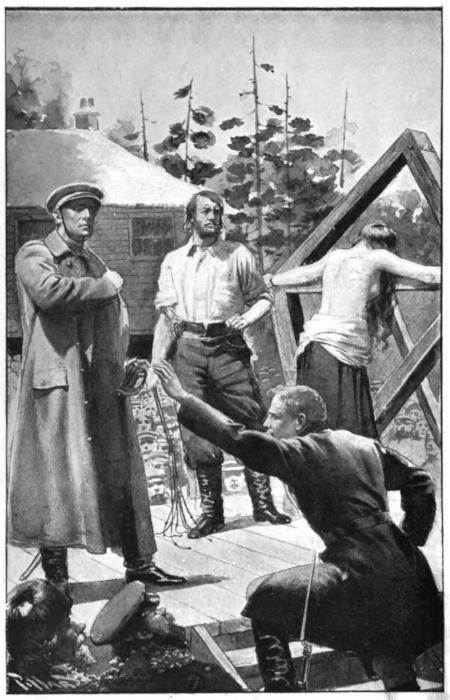
On the platform there had been set up a square
wooden frame. Unceremoniously, the brutal
moujiks, who assisted the executioner, grasped
her with their coarse, dirty hands and tore off
her clothing, exposing her bare, white back
down to the waist.
The mob roared with approbation when they
saw this preparation. A few moments later she
was forced upon the black frame, and her wrists
and ankles secured so tightly that the tension
almost caused dislocation of the joints. Then
the executioner, whose duty it was to carry out
the sentence, seized the knout—a number of
triangular thongs of leather fixed into a short
whip handle—and looked round for the signal to
commence. As he did so, General Martianoff,
with his shoulder bandaged, made his way
through the expectant crowd, and shouted—
“Come, get to work. Don’t spare her, but
keep the death-blow till last.”
Hushed and open-mouthed, the spectators
awaited the result of the first blow.
The executioner receded, swung the terrible
torture instrument over his head, and giving it
a peculiar twist, brought it down upon the
victim’s back with a sound like a pistol-shot.
The cruel thongs cut their way into the flesh
and the blood gushed forth. Time after time
the blows fell monotonously, until the quivering
flesh was beaten to a pulp, and both victim and
executioner were covered with blood.
Such was the scene of fiendish brutality that
met my gaze on my arrival at Mstislavl, after
having traced my mother and sister from Petersburg.
I was making my way through the shouting
populace when, out of mere curiosity, I glanced
at the face of the unfortunate girl, and recognised
her.
Was it surprising that I rushed wildly up and
endeavoured to stop the horrible punishment?
So suddenly did it all happen, however, that I
remember very little about it, except that in my
wrathful indignation I cursed the Tzar’s myrmidons,
and struck in the face the inhuman
Governor who attempted to throw me from the
platform. Thinking that I was Mascha’s lover,
and enraged at the blow, he thereupon ordered
me to receive thirty lashes.
I saw them carry away the insensible, mutilated
form of my poor sister. Then they tied me to
the frame.
I felt the thongs cut into my back like knives.
Once! Twice! Thrice! The pain became
excruciating. My head reeled, and a moment
later all became blank.
When I regained consciousness I found myself
in the prison hospital with warders rubbing salt
into my wounds. I asked after Mascha, and was
informed that she was still alive, and recovering.
One morning, while exercising in the prison
yard, I saw her for a few brief moments, and she
told me the story I have narrated.
Two days later my warder announced that
we had both been condemned by General
Martianoff as assisting in the dissemination of
revolutionary propaganda, and sentenced to hard
labour for life in the Siberian mines!
Then I made a solemn vow of revenge, and from
that moment became a Nihilist.
During six weary months I had been kept in
solitary confinement in a small, cold, ill-lit cell
in the Fortress of Peter and Paul at Petersburg,
whither I had been transferred from Mstislavl.
Dispirited by solitude, weakened by lack of exercise,
and ill through want of proper medical
attention, I began to fear that the confinement
would cause my reason to give way; therefore it
was with a feeling of relief that one day I greeted
the announcement of my warder that we were to
start for Siberia on the morrow.
A detailed description of the frightful hardships
of my long and terrible journey would fill a volume,
but it is only my intention to outline them briefly.
With a hundred other men and women of all
ages we left the grim fortress at midnight, a sorry,
smileless band, whose clanking chains formed an
ominous accompaniment to the loud shouts and
cracking of whips of our Cossack escorts. We
were each attired in grey kaftan, strong knee-boots,
and sheepskin bonnet. Our breasts bore a metal
plate with a number, while strapped over our
shoulders was the rug, the mess tin, and the
wooden spoon that comprised our travelling kit.
With ankles fettered by long heavy chains
held to the waist by means of a rope, we
were fastened together in gangs and passed out
upon the Chudova road on the first stage of the
weary tramp to that bourne whence few exiles
return. The rumbling of the springless carts in
the rear, for those who might fall ill on the way,
awoke the echoes of the silent thoroughfares, and
following us were several Cossacks who with
lanterns carefully examined the road over which
we had passed, in order that no letter should be
dropped clandestinely.
The night was wet and stormy as our weird,
dismal procession passed through the slumbering
city and out upon the broad highway on its journey
eastward to the Ourals. Our wet clothes clung to
us as we walked; the icy wind that blew across
the wide open plain chilled our bones. Nevertheless,
we plodded doggedly onward in silence,
for conversation had been forbidden, and those
who had spoken had felt the heavy thongs of the
escort’s knout. The settled look of despair, and
the sighs that frequently escaped my fellow-exiles,
plainly showed what were their feelings at being
banished from their native land.
Since the day I had seen Mascha in the prison-yard
I had heard nothing of her. A thousand
times I had wondered what had been her fate;
yet now, in my despair, I had relinquished all
hope of seeing her again. Indeed, irreparable
ruin had descended upon myself and my family
so swiftly, that already I had grown callous as
to my ultimate fate.
Without trial, I had been sentenced by the Provincial
Governor of Moghilev, upon the report of
General Martianoff, to hard labour for life. Such,
alas! was my punishment for endeavouring to
rescue my poor defenceless sister from the
inhuman wrath of the dissolute representative
of the Tzar! I was well aware that for the
Russian political convict is reserved a death by
slow torture to which any other means of ending
life is preferable. The silver mines in the terrible
district beyond Lake Baikal are the tombs of
political suspects. The Government is well
aware that the conditions under which convicts
work at Kara, Nerchinsk, Pokrovski, and the other
distant mining settlements to which “politicals”
are sent, are such as to cause death in from five
to seven years. With that refinement of cruelty
for which the Government has earned an unenviable
notoriety, it has abolished the death sentence
and substituted one more torturing in that distant
land where God is high and the Tzar is far away.
The prisons and étapes of Siberia are foul,
insanitary, half-ruined wooden structures where
human beings perish like flies. Typhoid, diphtheria,
and other epidemic diseases prevail there
constantly, and infect all who have the misfortune
to be huddled into the awful places. The
grievously sick, for want of attendance, wallow
on the floor in the midst of filth, and their clothes
rot on their bodies; while so over-crowded are
these pestilential kameras by persons of all ages
and both sexes, that for those who are not fever-stricken
there is neither room to sit nor lie.
The exiles who are consigned underground are
convicts of the worst type, and political offenders
of the best. The murderer for his villainy, the
intelligent honest Muscovite who expresses
Liberal opinions—not a whit more revolutionary
than the ideas of English Radicals—are deemed
equally worthy of slow, agonising death.
Having reached Chudova, we were conveyed by
train to Nijni Novgorod, and there placed in a
sort of cage on board a large barge, and taken
down the Volga and up the Kama to Perm,
whence we took train to Ekaterinbourg, a town
of considerable proportions beyond the Ourals.
Here our weary journey on foot across Siberia
commenced, and long before the Asiatic frontier
was reached, the paucity of human habitations,
the barrenness of the soil, and the increasing
bleakness of the climate, had had their effect
upon even the hardiest among us. But we still
pushed onward, ill, hungry, footsore.
I well remember the day we crossed the frontier,
and bade farewell to our native land.
Already we had walked three hundred versts
from Ekaterinbourg, along the Great Post Road,
at that season covered by a deep snow, and
only marked by the long straight line of black
telegraph posts and wires. Away, as far as the
eye could reach, nothing was visible but the broad
plain of dazzling whiteness, and the grey, snow-laden
sky, when suddenly we came to a tall,
square, brick-built obelisk, bearing on one side
the arms of the European province of Perm,
and on the other those of the Asiatic province of
Tobolsk. It was the boundary-post of that great
lonely prison-land, Siberia.
No other boundary-mark in the world has
witnessed so much human suffering, or, according
to Mr. George Kennan, has been passed by
such a multitude of heart-broken people. As it is
situated about half-way between the last European
and the first Siberian étape, the captain allowed
our convoy to halt for rest, and for a last farewell
to home and country. The Russian peasant,
even when a criminal, is patriotic, and deeply
attached to his native land; and there was a
heart-rending scene when our wearied band
stopped before the crumbling obelisk. Some
gave way to wild hysterical grief; some comforted
the weeping; others knelt and pressed
their faces to the loved soil of their native land,
and collected a little earth to take with them into
exile, while a few of the women, pale, tragic
figures in their black-hooded cloaks, pressed
their thin, pale lips to the European side of
the cold brick pillar, kissing good-bye to all it
symbolised.
The officer commanding our escort, who had
been smoking a cigarette, and looking with calm
indifference upon this touching scene, suddenly
shouted the stern order, “Stroisa!” (“Form
Ranks”), and at the word “March,” a few
moments later, we crossed ourselves, and with
a confused jingling of chains and leg-fetters,
moved slowly away, past the boundary post,
into Siberia.
Day after day, week after week, hungry, cold,
and fatigued, we trudged across the bleak, snow-covered
steppes, until life became so burdensome
that we longed for death.
Sometimes we passed the night in an insanitary
étape in one of the wretched little villages along
the road, but often we camped out in the open,
and, after our meagre ration of soup, wrapped our
rugs around us, and slept upon the ground around
the fire we had lit. The hardships of the long,
monotonous marches were bad enough for men
to bear, but the women—who numbered about
twenty, including several of noble birth, condemned
to the mines as Nihilist conspirators—fared
worst of all.
One of them, Madame Marie Koutowzow, was
a young widow I had met in Petersburg society.
She told me that she had incurred the special
animosity of a tschinovnik, or Government official,
by refusing to marry him, and he, anxious to
avenge himself, had caused her arrest, and had
heaped up the hardships which might hurry her
out of life. Death had released three of these
delicately nurtured ladies from their misery, and
we had buried them, without coffin or religious
ceremony, ere we reached Tobolsk.
When at length we arrived at the latter town,
we were lodged in the great convict prison, and
allowed to rest for two days, after which we
resumed our journey eastward to Tomsk, arriving
there three weeks later, with our clothing in rags,
and almost shoeless.
Although our experiences had been terrible
enough during our forced marches, the most
horrible of all was our sojourn at the perisilni
at Tomsk—the prison where exiles remain until
their fate is decided upon by the authorities.
The horrors of this den of vileness were indescribable.
The kamera, or public cell, into which
we were driven like cattle, was a long low room,
ill-ventilated, and disgustingly dirty. Already
there were fully fifty convicts in it, and the
smell of humanity that greeted us as the great
iron door was opened I shall never forget. When
I looked around and noted the dreadful groups,
ragged, unkempt, unwashed, some lying on the
sloping wooden shelves which formed the common
beds, others crouching on the filthy floor, I
shuddered with horror, and was appalled.
Amid this filth disease was rife. No fewer
than four men and two women were at that
moment dying of typhoid, while the body of a
girl who had succumbed was lying unheeded in
a corner. No notice whatever was taken of invalids
by the officials, and I afterwards learnt that
this room, originally intended as an infirmary,
had been converted into a common cell for the
accommodation of the ever-increasing crowds of
exiles, 12,000 of which pass through the prison
annually.
Coarse brown bread and tschi were our two
articles of diet. The former was flung to us as
to dogs, and owing to the rations never being
sufficient to satisfy all, a fierce fight for a morsel
of food invariably resulted. Ravenously hungry
men struggled with one another to secure bread
for their wives and children who had voluntarily
accompanied them into exile, while friendless
females, too ill to move, were left in corners
to die.
It was hardly surprising that Marie Koutowzow,
a refined and delicate woman, should become
infected by the fever that was raging. Very soon
she grew too ill to participate in the daily fight
for food, and I obtained her rations for her.
Lying upon one of the plank beds at the further
end of the kamera, she bore the ravages of the
disease bravely, praying that death might release
her. Her desire was fulfilled, for six days after
she had been attacked the malady proved fatal.
For three whole days the body was allowed to
remain in that crowded den of filth. None dare
complain. We knew too well that the reward for
pointing out the fact to the officials would be an
unceremonious knouting, for in Siberia the lash is
used at the slightest provocation.
In the same ragged dress that I had worn
during my three months’ tramp from European
Russia, and which was insufficient to protect me
from the intense cold, I was taken from this
Dantean kamera at dawn one day and chained
to a large gang of convicts. Then I learned that
my sentence was subterranean hard labour at
Kara, the most terrible mines in the whole of
Siberia!
To the exiles who had been my companions
from St. Petersburg I bade farewell, and as one
of a convoy of criminals of the most dangerous
class, I left the forwarding-prison and wearily
dragged my chains across the endless snow-covered
steppes, en route for the dreaded district
beyond Irkutsk. The thought that each step took
me nearer to my living tomb rendered me desperate.
Why should I, innocent of crime, be
tortured to death in the same manner as murderers
and hardened criminals?
I resolved to endeavour to escape. It was a
mad project, I admit, for there was but little
chance of crossing the wastes of snow which
stretched away three thousand miles before civilisation
could be reached. Nevertheless I determined
to risk all. If I died in the snow, or
starved, it would end my miserable existence,
and prevent further tortures being heaped upon
me.
In this frame of mind hope returned, and I
walked on day after day, watching for a chance
to carry my hazardous design into effect. After
leaving Krasnoyarsk the chains that bound us to
one another were removed, and we were allowed
to walk in groups. One day while trudging along
the road leading to Irkutsk we halted at a post-station.
The weather being intensely cold, the
captain commanding the Cossacks sometimes
allowed those of us who had money to purchase
vodka. On this occasion, however, when we
knocked at the door, our summons remained
unanswered. It was evident that the two men
placed in charge of the low log house had gone
to visit their neighbours, the nearest of whom were
twenty versts distant; so after a further endeavour
to open the door, we were compelled to resume
our weary tramp. About ten versts farther on we
encamped for the night on the border of a gloomy
pine forest. This was the first occasion we had
slept near anything that might act as cover,
therefore I resolved, when my comrades were
asleep, to slip past the sentries, and make a dash
for liberty. Tying my leg chain tighter to my
waist to prevent it jingling, I threw myself down
after eating my evening ration, and waited with
breathless impatience. The minutes seemed hours,
until at last the camp became hushed in slumber;
then I carefully rose, while the Cossack sentry’s
back was turned, and plunged swiftly and silently
into the great, dismal forest.
It was an exciting moment. Every second I
expected to hear the hue and cry raised, but as
I gradually increased the distance between my
captors and myself, it seemed as though my
escape remained undiscovered. For an hour I
walked in a straight line through the trees, and
at length I doubled, in the hope of finding the
post-road I had left. My anticipations were
realised, and during the remainder of the long,
dark Siberian night I sped along as fast as my
tired legs would carry me over the road we had
travelled on the previous day.
The almost insurmountable obstacles to my
escape never entered my head, so elated was I
at the prospect of freedom.
Dawn came, and the weak, yellow rays of the
sun were struggling forth, when by chance I
turned and looked behind me.
What I saw caused me breathless terror and
dismay. In the distance, looking like three
black ants on the snowy horizon, were a trio of
mounted Cossacks riding at full gallop.
It was evident they had seen me!
I looked round for some means of concealment,
but there was none. In the distance,
about a verst away, I saw the deserted post-house
we had passed on the day previous. Without
knowing what impelled me, I started running
as hard as I could in that direction; but as I
glanced round from time to time I saw the
Cossacks were fast gaining upon me.
They shouted to me to stop, but I took no
heed. Some superhuman strength seemed to
possess me, and I ran swiftly and lightly over
the snow towards the house. Gradually they
drew nearer, and then I heard the report of a rifle,
but finding myself unhurt, I redoubled my pace.
As the triumphant yells of the galloping
Cossacks broke upon my ears, I gained the rear
of the house and halted for a moment to discover
some safe retreat.
There was none. The doors were fastened as
they had been on the day before. Not a moment
was to be lost, for already I heard the thud of
the horses’ hoofs upon the snow. I had to
choose between a brief life of horrible torture
that would follow my recapture, and instant
death! I chose the latter.
Glancing round wildly, I sought means of
suicide. As I did so the yelling soldiers, with
revolvers drawn, came tearing round the side of
the house.
“Surrender! or we’ll fire!” they cried.
I looked determinedly into their faces. It was
a case of life or death, and they were driving me
to the latter.
Before they could anticipate my intention or
level their weapons at me, I made a dash for a
deep well, situate about twenty yards distant,
shouting in my despair—
“I’ll kill myself rather than go back!”
A moment later I had jumped headlong into
it.
How long I remained in a state of semi-consciousness
I had no idea. I remember lying
silent and motionless listening to the voices of
the soldiers above, and scarce daring to breathe.
“See!” cried one, “it’s useless to get him out.
His neck is broken or he could never be crushed
into a heap like that.”
The second man suggested that I might be
merely stunned, but the third exclaimed—
“He’s dead enough, poor devil. Why should
we trouble ourselves to take him out? Leave
that work for the post-house keeper when he
returns.”
“He was no fool either,” observed the first man
grimly. “I should kill myself if I had the same
choice.”
Although the second man did not persist in his
demand for my extrication, he fired his revolver
down the well, afterwards remounting and riding
slowly back with his companions.
When I thought they had departed I rose, and
to my intense delight found myself uninjured.
The well being frozen, the ice was covered with
a thick layer of snow, and this had considerably
diminished the concussion of my fall. The
Cossack’s bullet had not struck me, and beyond
a bruise on my elbow I was none the worse for
my reckless leap.
At this moment I discovered that the chain
used to draw up water was unwound from the
windlass and suspended close to my hand. With
an exclamation of joy I grasped it, and after
ascertaining that it was fast at the top, quickly
clambered to the surface and in a few moments
again stood before the post-house.
Then the thought suggested itself that if I
could effect an entrance I might discover food
and clothing, for it was impossible for me to go
far in a convict’s dress with a yellow diamond
upon the back, without being rearrested. I tried
both doors, but they were securely fastened.
After a search, however, I came across a long
piece of iron in an outhouse, and with it contrived
to wrench off the latch of a window-shutter.
Afterwards I broke open the double
windows and clambered in. The one large room
facing the road was a bare-boarded, dirty apartment,
and, like all Siberian post-houses, devoid
of any furniture beyond a plain deal table, a
couple of rush-bottomed chairs, and a bench.
In the centre stood a large, round stove, while
on the wall was a badly executed picture of the
Virgin. There was some food upon the table,
and the room bore evidence of recent occupation.
As I passed into the sleeping apartment beyond,
I started and drew back in alarm, for lying
upon the unclean straw mattress, fully dressed,
and covered with a heavy fur overcoat, lay a
man. His face was turned from me, but after
a moment’s hesitation I shook him gently by the
shoulder. He did not stir.
I placed my hand upon his face, but drew it
back instantly, for its contact thrilled me. It
was icy cold! The man was dead!
As I realised the truth, my eyes fell upon a
piece of paper lying upon the chair beside him.
Taking it up, I read the following words written
in pencil in a feeble, shaky hand—
“I shall die before you can return with medical
aid. I order you in the name of the Tzar to send
on the despatches by a trusty messenger. You will
be repaid.—Ivan Drukovitch.”
On searching the body I found the dispatches
referred to secreted in the money-belt around his
waist. There were three official letters, secured
by the Imperial seal, and addressed to General
Sergius Okoulow, Governor of the District of
Kolymsk, the Arctic exile settlement in the Province
of Yakoutsk. With the letters I found about
500 roubles in notes, and a passport which declared
the bearer to be “Ivan Drukovitch, messenger
in the service of His Imperial Majesty the Tzar,
on official business to the Governor of Kolymsk.”
It did not take me long to decide what course
to adopt. Divesting myself of my rags—which
I put in the stove and set fire to—I attired myself
in the dead man’s uniform, strapped the
money-belt with its contents around my waist,
together with a revolver, and destroyed the note
the dead man had written. After a brief search
I discovered a file among the tools belonging to
the post-house keeper, and in half an hour had
succeeded in freeing my ankles of the galling
fetters. Getting out of the window, I went to the
stable, where I found the courier’s horse, and
having saddled it mounted and rode away in the
direction the convoy had taken.
Fortunately, my head had not been shaved,
as is usual with criminals entering upon the life
sentence. The transformation from convict to
Imperial messenger was complete. My official
dress, with its brass double-headed eagle on the
cap, was an effectual disguise. The wide collar
of my riding-coat was turned up, and just as it
was growing dusk I overtook the convoy. As I
saluted the officers they responded, and I rode
past, inwardly chuckling, and soon left the sorry
band of malefactors far behind.
Mine was a terribly lonely and monotonous
journey. Instead of following the road to Irkutsk,
I rode due north until I came to the mighty Lena,
afterwards travelling along its bank a distance of
700 English miles, until I reached Yakoutsk.
Remaining there for a couple of days, I again bade
farewell to all human companionship, and set out
for the terrible regions within the Arctic circle.
From the first I had recognised that it would
be useless to attempt to return to Petersburg by
recrossing the Ourals, for the passport was endorsed
with dates so recent that if I presented
it at the European frontier it would be at once
discovered that I had not had time to travel to
Kolymsk. This, combined with various other
reasons, caused me to assume the rôle of courier
and deliver the Tzar’s dispatches to the person to
whom they were addressed.
It is needless to refer in detail to my journey
of 2,500 versts from Yakoutsk across the great
uninhabited desert and over the moss-covered
tundras, or Arctic swamps, to the most northerly
exile settlement. Lonely and weary, I sometimes
rode for three and four days without reaching
a post-house or seeing a single human being, and
frequently I was in a half-starved, half-frozen
condition. Time passed, and I kept no count of
it. My thoughts were only of eventual freedom.
Having destroyed the note left by the dying man,
together with my convict’s rags, I knew the post-house
keeper would be puzzled at finding the
corpse had been plundered, and as there was no
telegraph to Yakoutsk, I was confident that I
should not be forestalled by the news of the
courier’s death.
After an incessant journey, lasting two
months, I arrived at Sredne Kolmysk, a small
town of log huts situate at a point far beyond the
Arctic circle, where the deep river Ankudine
flows into the Kolyma. The houses, scattered
about in disorder, are inhabited by Cossacks,
Mieshchany, Yakouts, and exiles. The highest
erection is a log church, and the only curiosity
a small wooden tower, crooked with age, which
stands within the church enclosure, and was built
by the conquerors of the country as a protection
from raids of hostile tribes. The condition of the
unfortunate exiles there was terrible, even for
Siberia. In that land, where winter commences in
August and lasts till May, and where the temperature
varies from nine degrees above freezing-point
to thirteen degrees below, man is utterly powerless.
Only a handful of wretched savages inhabit the
fearful region, having been driven to outer darkness
by the tribes with more vitality and energy.
It takes about eighteen months to reach this
extremity of the habitable globe, and by introducing,
as a part of the penal system, exile to the
Arctic zone, the Russian Government has overstepped
even its broad allowance of iniquity.
This hamlet is a penitentiary colony for political
exiles, whose punishment is purposely aggravated
by physical suffering, and who are compelled to
exist in a perpetual state of famine in dwellings
that are simply wretched huts built of upright
beams, with rafters laid across and covered with
layers of earth. From the Government store
musty rye flour is eked out to them at intervals,
and for the rest, they subsist upon what fish they
can catch in the river.
I was not long in discovering General Okoulow’s
residence, and, acting as Imperial messenger,
delivered the dispatches in as ceremonious a
manner as I could. As I had anticipated, they
contained several pardons, and when this became
known in the little colony I was fêted and treated
with every courtesy and kindness. Although such
a reception was pleasant after the wearying monotony
of the Verkho-yansk Desert, yet I was anxious
for an opportunity to shake the snow of Siberia
from my feet. Having waited several days while
the Governor was preparing his reports for Petersburg,
I one morning made a request—not without
trepidation, I admit—that he should endorse my
passport so as to enable me to go on a brief visit
to a brother in Petropaulovsk before returning to
Russia. To my joy, the accommodating Governor
saw no objection to this course, and with a light
heart I set out at dawn on the following day
towards the Stanovoi mountains.
Crossing them, I rode onwards for four weeks
through the wild grey mountains until my jaded
horse sank and died of sheer exhaustion. Being
compelled to perform the remainder of the
terrible journey on foot, I walked by slow, weary
stages across the great lone land, where nothing
marked my route except the sun, and the country
being totally uninhabited I had to eat grass and
willow-leaves for sustenance. Suddenly, however,
at the close of a dull, stormy day, I had
the satisfaction of seeing, for the first time, the
broad, grey waters of the Pacific stretching away
to a limitless horizon.
Even when I had arrived at Petropaulovsk I
had by no means eluded the police. The journey
to Kolymsk I had undertaken because I recognised
how extremely dangerous it would have
been to travel to the coast with a passport which
distinctly stated my route and destination. The
police at Siberian ports are ever-watchful for
escaping convicts, but in my eagerness for freedom
it never occurred to me that information
would be telegraphed to that extreme corner of
the empire of the theft of the dead man’s papers.
This carelessness nearly resulted in disaster.
It was late one afternoon when I descended the
hill at the entrance to the town, and passed along
the quay. In doing so I noticed a ship anchored
about a mile distant. Of a fisherman I casually
inquired what the vessel was, and when she would
sail. He replied that it was a Canadian sealer,
and that it would sail on the morrow. During
the remainder of the day I wandered about the
dirty, wretched town in search of some means of
escape. I had only twenty roubles left, but with
these I intended to bribe some foreign sailor to
let me embark as a stowaway.
When it had grown dark and I was looking
about for lodging for the night, I discovered, to
my dismay, that I was being closely watched by a
police spy. In order to allay suspicion, I sought
the police bureau, and entering boldly, presented
my passport. The ispravnik chanced to be there,
and when he glanced at it a curious smile passed
over his features.
“The Imperial courier, Ivan Drukovitch, is
dead,” he said, looking at me searchingly. “Consider
yourself arrested!”
I waited for no more. Ere he had uttered the
last sentence I had dashed out of the door and
down the street. Half-a-dozen policemen were
instantly in full cry after me, but in desperation I
was determined not to be apprehended just as I
was within an ace of securing my freedom. Exerting
every muscle, I ran up and down the
narrow streets until I suddenly found myself upon
the quay. In the glimmering starlight my eyes
caught sight of a moored boat. Without a
moment’s hesitation I jumped into it and cut the
cord that held it. Before my pursuers could gain
the water-side the swift current had taken the
boat down beside some great piles and I was
effectually hidden in the darkness.
It was an intensely exciting moment.
I heard the hurrying footsteps pass close to
where I was concealed, and listened to them
receding in the distance. Then I breathed again.
Taking the oars, and dreading lest I should be
discovered, I pulled swiftly across the bay to the
moored ship I had noticed in the afternoon.
The captain, a genial, kind-hearted man, took
compassion upon me when I had related my
story, and a few hours later I had the gratification
of watching the twinkling lights of Petropaulovsk
disappear at the stern.
Three weeks later I landed at Victoria, Vancouver,
and after a short residence there was
provided with funds by our Organisation, and left
for England.
CHAPTER III. MY FRIEND, THE PRINCESS.
The majority of Londoners are unaware that the
headquarters of the most powerful secret organisation
in the world exist in their midst. The
unsuspecting persons who pass up and down a
certain eminently respectable thoroughfare in a
north-west suburb, would be somewhat surprised
if they knew that in one of these houses the
Executive Committee of the Russian Revolutionists
holds daily council and matures the plots
which from time to time startle Europe.
The thoroughfare, which, for obvious reasons,
I shall designate as Oakleigh Gardens, is formed
of large, old-fashioned, detached houses which
stand somewhat back, with gardens in front. It
is lined on each side by fine old elms, and the
residences are for the most part built of red brick,
with those square, white-framed, unornamented
windows of the Georgian era. The house in
question is hidden from the quiet road by a high
wall in which is a heavy wooden door, but inside
one finds a well-kept flower garden and a roomy
old house which bears an unmistakable air of
wealth and prosperity. Here exiles, whose escape
from Siberia Fortune has favoured, find an
asylum.
In this house I took up my abode when I
arrived in London. Smarting under the terrible
punishment to which I had been unjustly subjected,
I had long ago taken the oath, and thereby
fettered myself body and soul to the Party. I
was determined to revenge myself upon the
oppressors who had starved my mother, knouted
my sister, and sent my father to the mines,
although all had been perfectly innocent of any
crime. Thus, from a devil-may-care recruit I had
developed into an ardent revolutionist whose sole
ambition was to assist in the struggle for freedom,
and who was prepared to go to any length in
order to accomplish the object towards which the
Organisation was striving.
From an early age I had been taught English
and French, being now able to speak both languages
almost as fluently as my own. This
knowledge I found of the utmost service, inasmuch
as I had been selected by the Executive to
perform certain special duties of secret service.
They did not hide the fact that the work would
require considerable courage and tact, and that
my life might sometimes be at stake. But I was
fearlessly enthusiastic.
After a six months’ residence in Oakleigh Gardens,
during which time I gained a knowledge of
London life and made myself acquainted with
the majority of those devoted to our Cause resident
in the metropolis, the first matter was placed
in my hands.
A few months previously, Ivan Grigorovitch,
one of our Party, had been chosen to convey
some instructions to the Petersburg centre. As
he was well known to the Secret Police, he disguised
himself as a French commercial traveller,
and with a French passport journeyed from Marseilles
to Odessa by steamer, intending to proceed
thence to Petersburg, the ordinary route from
London being considered too dangerous. His
intentions, however, were frustrated, inasmuch as
the Odessa police, who had been apprised of his
advent, arrested him immediately on landing. A
disaster resulted, for the papers found upon him
were compromising, the plot was discovered, and
wholesale arrests were made in Petersburg in
consequence.
Twenty-three persons of both sexes were tried
in secret, and, according to the Novosti, the evidence
given against them by Princess Kochkaryòv
caused life sentences to be passed upon each of
them.
From facts that came to our knowledge, it was
evident that some one who had learned our secret
had divulged it to the police, therefore the five
men forming the Nihilist Executive Committee—who
must be known here as Paul Pétroff, Alexander
Grinevitch, Nicolas Tersinski, Isaac Bounakoff,
and Dmitri Irteneff—sat in council and
condemned the Princess to death.
We cast dice, and it fell to me to carry out
the sentence!
The cool, flippant manner in which my fellow-conspirators
spoke of murder awed me. They
noticed my scruples and pointed out that the
woman had, by giving false evidence, been instrumental
in the deportation of more than twenty
innocent persons, therefore she must die. As I
had taken an oath to carry out all commands of
the Executive under penalty of death, I was
compelled to obey.
I had not far to search for Madame the Princess,
for she was residing temporarily in London,
having taken a furnished flat at Albert Hall
Mansions, overlooking Hyde Park.
In the stalls at the Avenue Theatre I first
obtained an uninterrupted view of her. She was
seated next to me, a fair form in a black evening
dress that revealed her delicate chest and arms,
with a gleaming diamond necklet around her
white throat. Her age was about twenty-four,
and her perfect oval face had a shade of sadness
upon it, notwithstanding the great languishing
violet eyes, and the tender winning mouth, while
her auburn hair had been deftly coiled, and was
fastened with a diamond star that flashed and
sparkled with a thousand fires. In short, I thought
her the most lovely woman I had ever seen.
And I was plotting to kill her!
I gazed into her face, entranced by her marvellous
beauty. Toying with her Watteau fan, she
turned her eyes full upon me, and the faintest
flush suffused her cheek; then she made pretence
of reading her programme, and afterwards became
interested in the performance. When I went out
to smoke during the entr’acte I passed her, and in
doing so uttered an apology in Russian, to which
she responded in the same language, with a kindly
smile.
According to information I had obtained, she
was the wife of Prince Kochkaryòv, a noble in
the third degree, some twenty years her senior.
Their marriage had been fraught with much unhappiness,
and after a year they agreed to separate.
Since that time the Prince had remained at his
gloomy old palace near Markovka, in Little Russia,
while his wife, accompanied by an old man-servant
and her maid, had resided for brief
periods in Petersburg, Paris, and London.
Since her arrival in England it was apparent
that she was fulfilling some mission as a Russian
Government agent, yet the suspicion she excited
in some quarters in no way hindered her
from obtaining social influence, and she dispensed
hospitality to a very select circle. She went
everywhere, and her daily doings were chronicled
in the personal columns of the newspapers. I
had been watching her for several days, and on
this evening had followed her to the theatre in
order, if possible, to become acquainted with
her.
When the curtain descended and we rose to
leave I turned, and said to her politely in
Russian—
“You are alone, Madame. Will you permit
me to find your carriage?”
“Thanks, you are very kind,” she said in English,
with a pretty hesitating accent. “My man
has buff livery.”
“And the name, Madame?”
“The Princess Kochkaryòv,” she replied, adding,
“We are compatriots, are we not, m’sieur?”
“Yes,” I replied, smiling. “It is always pleasant
to meet Russians in a foreign land,” at the
same time handing her a card which gave my
name as Vladimir Mordvinoff and my address at a
suite of furnished chambers I rented in Shaftesbury
Avenue.
A few moments later I handed her into her
carriage, and as she thanked me and drove away,
I walked, morose and thoughtful, up Northumberland
Avenue towards my rooms.
During the week that followed we met several
times. She showed herself in no way averse to
my companionship, for she told me that she was
always at home on Thursdays and would be
pleased to see me. This invitation I accepted,
and thus I became a frequent visitor.
One afternoon I had called and lingered. The
guests had departed.
In the fading light of the summer’s evening I
was sitting with her in her pretty drawing-room
that overlooked the dusty trees. As she lolled
gracefully against the window the last ray of sunlight
fell upon her, and she looked daintily
bewitching.
I admit that I loved her madly, passionately.
Overwhelmed by the contemplation of her beauty,
enchanted by the magic of her voice, which made
the sweetest music out of the merest phrases, I
thought of nought but her, and was only happy
when at her side. Yet when I remembered the
difference in our social position, and her marriage
with the Prince, I was almost beside myself with
despair; I knew that mine was an adoration that
could only end in unhappiness.
Involuntarily my hand touched my pocket and
struck something hard. I drew it away in horror.
What terrible irony of fate! The woman I
loved dearer than life was doomed to die by my
hand!
She had been gazing dreamily out of the window,
when suddenly with a mischievous smile she
exclaimed—
“You are very silent, m’sieur.”
I scarcely know what prompted me, but, jumping
up quickly, and grasping her tiny, bejewelled
hand, I raised it to my lips and in English poured
forth a declaration of my love.
She trembled. Her breath came and went in
short, quick gasps, but she did not attempt to
arrest the flood of passionate words that escaped
me. Ere I had concluded, my heart was filled
with joy, for I saw my passion was reciprocated.
Vainly striving to overcome her emotion, she
exclaimed excitedly—
“I—I was unprepared—I did not think you
loved me, Vladimir. Do you doubt I care for
you? Have you not seen it? Mon Dieu! my
married life has been only a grim and dismal
tragedy. I loved no man until I met you!”
“Do you really think sometimes of me, Princess?”
I asked, scarcely believing the truth.
“To you I am Irene,” she said in pretty broken
English. “All my life has been wasted hitherto.
You have asked me; I have give you answer. I
love only you. Some day you will know me better.
Now, you know me only for the mad passion
I bear for you. But yourself shall make satisfy
of my past, my truth, my honour, and—and I
shall get—what you call—divorce from the Prince,
and we two will marry—eh? Of you I ask not
one single question. You are my lover, the only
man for whom I have affection, and—and in
return I am your serf.”
She buried her flushed face upon my shoulder
and sobbed.
Taking her in my arms, I swore to her everlasting
constancy. All my heart was in the
declaration. In the glamour of that hour we
were reckless and egotistical as most lovers, heedless
of the shadow that was growing up behind
the sunshine of our happy vows of undying
affection. When she grew calm, she looked up
searchingly into my eyes and said: “You cannot
understand me. You do not know the bitterness
of my life.”
“No, Irene. Tell me about yourself,” I said.
Hesitatingly she seated herself in a wicker chair,
and motioned me to a seat at her side.
“No, no,” I said, laughing. “At your feet,
Princess; always at your feet,” and, casting myself
upon a low footstool, I took her hand in
mine.
“My life has been wasted,” she said mournfully.
“My mother was French; my father an Imperial
Councillor of Russia. My earlier life was passed
at Moscow, and afterwards at the Court at Petersburg.
I was forced by my father to marry the
Prince, who, as you are well aware, is rich and
powerful. But, ma foi! from the first he treated
me cruelly. Within six months of our marriage
he commenced to ill-use me brutally; indeed, I
bear upon my body the scars of his violence.
The world was débonnaire while I was triste and
downcast, for I found he had a liaison with a
French danseuse. I bore his insults and blows
until I was in fear of my life; then I came here.”
“How could he be so cruel?” I cried in
indignation.
“Ah, I have not told all, Vladimir,” she said
with a sorrowful sigh. “The Prince plotted with
his friend, Stepán Nekhlindoff, in order to obtain
a divorce, but I thwarted their vile scheme.
Nekhlindoff tried to compromise me, but I repelled
his advances, for although I have so far
abandoned my marriage vow as to love you while
I am still wedded, I have done nothing by which
my husband can obtain the freedom he seeks.
Since I left Markovka I have wandered about, to
Paris, Vienna, Brussels, with no protection against
the dishonourable conspiracy. I grew tired of
life—I—”
“You have a friend in me,” I interrupted.
“Ah, yes, my love,” she exclaimed, stroking
my hair tenderly, and bending to kiss me.
“Though I have been in the midst of luxury
and gaiety, my life has been very dark and
dreary. But happiness has now returned.”
“It gives me joy to hear you speak like this,
Irene,” I said. “Nothing will, I hope, occur to
part us, or cause our love to be less stronger than
it is at this moment.”
“What can?” she asked quickly, raising her
eyebrows. “We trust one another. I have money
enough for both. What more?”
The horrible thought that the knife in my
pocket must sooner or later be plunged into her
heart flashed across my mind, causing me to
shudder.
“No,” I replied with a feigned, hollow laugh,
“I—it is only a foolish fancy on my part. My
joy seems almost too perfect to be lasting.”
“I am yours; you are mine,” she said passionately.
“We shall marry and live together always
as happy as we are to-day.”
Twilight had faded, and it had grown almost
dark. I had risen and was standing beside her
chair, bending and kissing her soft cheek, when
suddenly the door opened and the maid entered
to light the lamps.
“Pardon, Madame,” exclaimed the girl, starting
back, “I thought you had gone out.”
“No, Nina, I shall not go out to-night,” said her
mistress. “Tell cook that M’sieur Mordvinoff will
remain and dine.”
When the maid had lit the lamps and departed,
I returned to where the Princess sat, and noticed
how her face had changed. Instead of the cold,
haughty expression usual to her, her flushed
countenance beamed with tender, womanly love,
an expression that was supremely fascinating. As
I stood admiring her, a morbid fancy crept over
me. Why should I not take her life now she was
in the zenith of her happiness? It would be better
so, I argued; better than allowing her passion to
develop and overwhelm me.
I was too well aware that the violation of my
oath would mean death to me as well as to her,
and as I stood behind her chair I placed my hand
upon the hilt of the knife in my pocket and half
drew it from its sheath. But I could not bring
myself to commit the crime. Drawing a long
breath, I pushed the keen blade into its leather
case with a firm determination to overcome my
thoughts, and again seating myself upon the stool
at her feet, continued talking of our plans for the
future.
A fortnight later I was summoned before a
council meeting of the Executive.
“We understand,” exclaimed Pétroff, the President
of the Council, “that you hesitate to carry
out the sentence of death upon the Princess Kochkaryòv.
Why?”
I glanced round at the pale, determined faces of
the five desperate revolutionists who were sitting
at a table in the well-furnished dining-room in
Oakleigh Gardens.
“I—I want time,” I stammered.
“Time! You have already had three months.
We are well aware that you admire her; but she
must not escape. Remember the oath you took
upon this knife,” and he pointed to a long bright
dagger that lay unsheathed on the table before
him. “The Executive have decided that the
traitress must die. If she escapes, you will pay
the penalty. We trust in you.”
In a frenzy of mad despair I walked the London
streets one day a week later, seeking some means
by which to avert the death of the woman I loved.
The decree of the Executive was irrevocable.
Their terrible far-reaching vengeance is known
throughout the world, and it is their proud boast
that of those whom they have condemned to
death, not one has ever escaped.
After wandering aimlessly for many hours, my
footsteps led me involuntarily to Albert Hall
Mansions.
It was late in the evening, somewhere about ten
o’clock, when the old servant Ivan admitted me.
As I entered the drawing-room she did not at first
observe my presence, and I stood for a few
moments watching her. She wore a dainty
evening gown of cream relieved by amber
ribbons, and was reclining in an armchair,
reading a novel. The mellow light of the
shaded lamp fell upon her fair head pillowed
on the satin cushion, and her whole attitude
was one of peace and repose. Between her
dainty fingers she held a cigarette.
Suddenly my movement startled her.
“Ah! Vladimir! Quel plaisir!” she cried,
tossing aside her book and rising to bid me
welcome. “All day I have expected you.”
After kissing her upturned face I sank into a
chair without a word.
“What ails you?” she asked, starting up in
alarm, noticing my pale countenance and mud-bespattered
clothes. “You—you are ill. Tell me.”
“It’s nothing,” I assured her, striving to smile.
“A slight faintness, that’s all.”
Accepting the explanation, she re-seated herself
and we commenced to chat. Of what we said I
have no recollection. I know that when she lifted
my hand to her lips I drew it away as if I had
been stung. She was caressing the hand that was
so soon to take her life! The thought was horrifying,
and she was at a loss to understand the meaning
of my action.
“You are not well to-night, Vladimir,” she said
half-reproachfully.
“No, no, Irene,” I replied, “I’m well enough in
health. It is the knowledge of our love that
troubles me.”
“Of our love?”
I cast her hand aside, and jumping to my feet,
paced the room in desperation. She clutched my
arm, entreating me to tell her the cause of my
agitation. Suddenly I stopped before her.
“Princess,” I whispered hoarsely, grasping her
slim, white wrist, “hear me! I am base, ignoble:
I have deceived you!”
“What! You love me not—you——”
“I love you better than life. I would do anything
to save you, yet, by a devilish conspiracy of
circumstances I am compelled to kill you!”
“Kill me!” she gasped in Russian. “God!
You are an imbecile—mad!”
Her face blanched; she tottered and almost
fell.
“Yes, I was mad,” I said bitterly. “Mad to
love you when I knew that I must kill you. I am
a Nihilist!”
“A Nihilist!”
“Yes. By your evidence some members of our
Organisation have been sent to Siberia, and the
sentence the Executive has passed upon you is
death.”
“Ah!” she cried wildly. “My God! It is the
statement in the Novosti! Listen, Vladimir!”
Pausing to gain breath, she shuddered at the
sight of the long knife that I had drawn and
held in my hand. “It was a vile lie concocted by
my husband in order that the Nihilist vengeance
should fall upon me. When Stepán Nekhlindoff’s
plot failed he resorted to this scheme, and got
some journalist he knew to insert the libellous
statement, well knowing that I should not escape
death.”
“Is the allegation untrue, then?” I asked,
amazed.
“Yes. I swear it is. At the time of the trial I
was at Odessa with the Archduchess Paul, and was
perfectly ignorant of everything until I saw the
paragraph. I wrote contradicting it, but they did
not publish my letter. It was the Prince who
desired that the Organisation should remove me
and leave him free.”
“I accept your explanation, Princess,” I said.
“Yet how am I to save you? By my oath I am
bound to obey the mandate of our Circle and
encompass your death.”
“I am innocent, Vladimir. Am I compelled to
die?” she asked, glancing apprehensively at the
knife that flashed so ominously in the lamplight.
“Can I not have time—time to prepare for death?”
“How long?”
“Three days, or more. I—I shall not try to
escape. I swear.”
“Very well,” I replied in a low voice. “It is
agreed. Three days.” And bidding her a strained,
sorrowful farewell, I left her.
At eight o’clock on the evening of the third day
the door of the flat was flung open by Ivan in
response to my summons.
“Is the Princess at home?” I asked of the grave-faced
old man.
“Alas, m’sieur,” he replied in a grief-stricken
voice, “Madame is dead.”
“Dead!” I gasped. “When did she die?”
“She—she has been murdered!” he exclaimed
in an awed tone. “I discovered her body two
hours ago. The doctor and police are now in her
room.”
I rushed along the hall to the apartment in
which I heard low voices. It was a large, well-furnished
bedchamber dimly illuminated by two
candles. Upon a couch near the window lay the
body of the Princess wrapped in a white Cashmere
shawl, the breast of which was only slightly stained
with blood.
Heedless of the doctor and two police inspectors
who were conversing together, I went over to the
body and gazed upon it.
What I saw amazed me. I staggered, yet by
presence of mind managed to conceal my agitation.
The fair, handsome face of the Princess had
been slashed with the knife in the form of a cross,
and the mutilation gave it a terribly ghastly appearance.
Something bright in the hands of one of the
police officers attracted my attention. He was
examining it by the light of the candles as I peered
over his shoulder.
It was a dagger which, in an instant, I recognised
as mine!
I felt in my pocket. The sheath was there but
the weapon had gone! I was aghast in horror
and amazement. I had been forestalled, and the
Princess had been murdered with the knife stolen
from me!
The officer, after questioning me, took my
assumed name and address, explaining that I
should be required at the inquest.
In reply to my inquiries, Ivan told me that the
Princess, intending to leave for Paris on the
morrow, had sent on Nina, her maid, in advance
to secure her rooms. At five o’clock, while in
the dining-room, he heard the outer door slam,
and concluded that his mistress had gone out.
Two hours later he entered the bedroom and
discovered the crime.
The Executive sat on the following evening
and I attended to make my report. It was a
mere formality, for the papers were full of the
mysterious crime.
“Princess Kochkaryòv is removed,” I said,
briefly, when interrogated by Pétroff.
“Thanks to the assistance of Dmitri,” he added
grimly.
“Irteneff!” I repeated, glancing at the dark,
middle-aged man indicated, who sat with his
elbows leaning upon the table.
“Yes,” the man said, laughing, “I knew how
difficult it is to assassinate the woman one loves,
so I assisted you.”
At the inquest I identified the body, and Ivan
related his brief story. Twice the inquiry was
adjourned, and subsequently a verdict was returned
that the Princess had been murdered by
“some person or persons unknown.” The Prince
was communicated with by telegraph, but he took
no notice, and at the funeral Ivan and myself
were the only mourners.
The police could discover no clue to the
assassin, and thus another was added to London’s
long list of unfathomable mysteries.
One day, about six weeks after the funeral, I
received a hurried note from Ivan, asking me to
meet him at half-past seven that evening under
the railway bridge adjoining the Charing Cross
Station of the Underground Railway.
Thinking that he might have something of
importance to tell me, I kept the appointment.
The road which runs under the bridge is not too
well lit, and the spot is rather quiet about that
hour.
Big Ben had just boomed the half-hour, when
I felt a slight pressure on my arm, and heard my
Christian name uttered.
Turning quickly, I confronted a female figure
enveloped in a travelling cloak, and wearing a soft
felt hat and a veil through which the features
were recognisable in the lamplight.
It was the Princess Kochkaryòv!
“Irene!” I cried, “is it really you?”
“Yes. I am no apparition,” she replied, with
a laugh. “But I must not be seen. Let us walk
this way.”
In a few moments we were strolling under the
trees on the Embankment.
“It was quite simple,” she said, in reply to my
eager questions. “I always was a little inventative.
You remember that on the night you told
me of my doom you found me alone reading?
Well, that night Nina was ill, and I had been
attending her. I did not call a doctor, as I had
no idea that she suffered from a weak heart. She
died, poor girl, shortly before five o’clock on the
afternoon you had promised to return. Then a
thought occurred to me that, as her hair was the
same colour as my own, I might pass off her body
as mine. I took Ivan into my confidence, telling
him of the attempt which would be made upon
my life——”
“You did not mention my name?” I asked
anxiously.
“Of course not. After I had dressed the body
in one of my own wraps, we carried it to my
room and placed it upon the couch. Nina was
about my build, therefore I attired myself in her
clothes, and taking the most valuable of my jewels,
left at once for Paris. Meanwhile Ivan remained.
From what he has told me it appears that he
watched and saw a middle-aged man enter the
flat by means of a latch-key. After searching
several rooms he went into my bedroom. There
the man saw a female form which he thought was
myself, and stabbed it to the heart. All this
occurred within half an hour of Nina’s death.”
“And it was the mutilation of the face that
prevented me from discovering that it was Nina,”
I remarked.
“Exactly. Yet no crime has been committed,
and I have escaped.”
“Wonderful!” I exclaimed, astounded at the
curious combination of circumstances.
“The Prince thinks me dead; therefore I am a
free woman,” she said, as we walked up Villiers
Street. “I am no longer Princess, but Madame
Valakhina. I still love you, Vladimir, but I can
see it is useless, for if we met often the Nihilists
would discover how they have been tricked. I
must therefore leave you. To-night I go to
Brussels and afterwards to Yvoir, on the Meuse,
where I have taken a villa. Ivan is there already.
When you can safely leave London, come to
me.”
We had ascended the steps and entered the
Charing Cross terminus. The hands of the great
clock pointed to twenty-five minutes past eight.
“See,” she added, “I must go to the carriage.
The train leaves at eight-thirty.”
We walked along the platform, and she entered
an empty first-class compartment, in which a
porter had already arranged her wraps.
When the man had taken his tip and departed,
I said—
“Farewell, Irene.” My heart was too full to
say more.
“No, no, Vladimir. Not farewell,” she sobbed,
her large violet eyes wet with tears. “Au revoir.
We shall meet again—some day.”
And, as the Continental train moved slowly
out of the station, she kissed her tiny hand to me,
again murmuring—
“Au revoir! I owe my life to you.”
CHAPTER IV. THE BURLESQUE OF DEATH.
The Secret Police attached to the Russian Embassy
in London are ever-watchful and untiring
in their efforts to discover the plans and movements
of our Party. It is, therefore, our constant
endeavour to lead them upon false scents and
direct their attention to quarters in direct opposition
to that in which we are working.
No monarch possesses such a prodigious
organisation of police spies and agents provocateurs
as the Tzar. His emissaries are in every European
city, and it must be admitted that for
cunning and astuteness they are unequalled.
Attached to each Embassy is the Okhrannoë
Otdelenïe, consisting of some twenty or thirty
detectives, whose duty it is to closely watch
political suspects and forward elaborate reports
of their movements to General Sekerzhinski, chief
of the department at Petersburg.
The stratagems practised by these agents and
their insolence are unbounded. In smaller States,
such as Bulgaria, Roumania, Switzerland, and
Italy, both law and political decency are violated,
and these men act as if they were in a Russian
provincial town. No one in the Balkan Peninsular
doubts that the two Bulgarians who attempted to
assassinate Mantoff, the Prefect of Rustchuk, when
he was so imprudent as to go to Bucharest, were
the tools of Yakobson, then third secretary of the
Russian Embassy in Roumania. Again, it was
proved that they offered people bribes to clandestinely
introduce implements for false coining
into the lodgings of a well-known literary man,
the Russian refugee, Cass-Dobrogeanu. In dozens
of cases attempts have been made—often successfully—to
introduce bombs and explosives into
the houses of Russian suspects abroad in order
that they may be accused and imprisoned, thus
removing their revolutionary influence. After a
recent trial in Paris where six men were condemned
to long terms of imprisonment for having
dynamite in their possession, it was proved most
conclusively that into the houses of four of them
the explosive had been introduced by persons
bribed by a provocating agent of the Tzar’s
Government!
It is also well known in our Circle that in the
beginning of the last decade Colonel Soudeikin,
the then chief of spies and provocating agents in
Petersburg, proposed to his principal confidential
agent—afterwards his murderer—Degayeff, in
order to strengthen his reputation in revolutionary
circles, that he should murder an unimportant
fellow-spy, P⸺, first exposing him to the revolutionists.
“Of course,” remarked Soudeikin, “it
is hard on him, but what can one do? You must
gain their confidence in some way, and in any
case P⸺ will never be good for anything.”
Indeed, the man referred to was already suspected
of being a spy, and all the revolutionists were on
their guard against him.
At such a level of morality the prospect of a
“paying job” is sufficient to inspire the agents of
the Russian “State police” with a spirit of boundless
enterprise. The advantage thus gained by the
Russian Government is enormous; provocation
is the surest way to give false impressions about
the Russian patriots and to terrorise foreign public
opinion to the detriment of the liberation movement.
Recently the foreign branch of the “higher
police” has been strengthened and re-modelled.
In London the section now works independently.
Paris has been constituted the centre from which
operations in other towns are superintended; then
come university towns, such as Montpellier,
Zurich, and Berne, and the towns specially frequented
by Russians, as Nice and Mentone.
From Paris “flying brigades” of spies and provocators
are sent out to places where “special
activity” is required. The staff of employees in
the French capital has within the past year been
“renewed,” and their numbers greatly augmented.
As an instance, no fewer than twelve new agents
were sent from Russia immediately after the assassination
of General Seliverstroff in Paris.
More attention is bestowed upon London than
elsewhere, because it has become known that
many of the foremost of the so-called Terrorists
reside in the English metropolis. The satellites
of the “Security Section,” however, baffled by
the watchfulness of our own spies, are unable to
make much progress with their inquiries owing
to the traps we lay for them. Indeed, finding
their activity counteracted, they have now founded
in London a kind of Russian institution, which by
its artistic and literary attractions induces Russians
living in the metropolis to visit it; the aim being
to facilitate the obtaining of information and
the choice of future victims for provocation.
Members of the Party are, however, too wary to
visit it.
At the time the events related in this chapter
occurred, the Executive had resolved upon decisive
action.
As a protest against the increasing tyranny of
the late Tzar Alexander, it had been decided that
a grand coup should be made at the Winter Palace
at Petersburg, where two members of our Organisation
were engaged as trusted servants in the
Imperial household. News of the plot was conveyed
secretly to the various Circles on the Continent,
while we in London set about arranging
the various details.
To Nicolas Tersinski, who lived in Heygate
Street, Walworth, was the work of manufacturing
a dynamite clock entrusted. He had been a locksmith
in Warsaw and was skilled in mechanical
contrivances. It was he who made the bombs
which wrecked the Imperial train near Grodno,
and the machines that had caused several other
“outrages” were due to his ingenuity.
While these preparations were in progress, it
was of course highly essential that our secret
should be strictly guarded and that our ubiquitous
enemies, the police spies, should entertain no
suspicion of our intentions. Nevertheless, we
were one day amazed and startled to discover
that the “Security Section” had suddenly grown
more active than usual, and that there were unmistakable
signs that they had gained some knowledge
of the conspiracy.
The Executive held a hurried meeting to consider
the best means of averting their espionage. I
was still living expensively as a young man about
town, and as I rarely visited the house in Oakleigh
Gardens, my connection with the revolutionists
was unknown to the police. For this reason I
was chosen, together with Grinevitch, to assist in
the work of “shadowing” the spies in order that
Pétroff and the committee might complete their
plans and get the machine safely to Petersburg.
The work was exciting and somewhat risky;
but it suited my adventurous spirit. The daring
with which our Organisation acted inspired me
with confidence, and I went fearlessly about
attired in various garbs, tracking the minions of
the Tzar into all sorts of queer corners of London.
They were indefatigable; but, owing to our
headquarters being temporarily abandoned, they
were entirely off the scent. It was my object to
further puzzle them, and, assisted by half a dozen
other members of the Party, I think I succeeded.
Meanwhile the clock was being completed and
the plans for the coup elaborated.
While sitting one evening at a small table in
the Café Royal in Regent Street, smoking, sipping
kummel, and lazily scanning the Petit Journal, a
word in guttural Russian addressed to the waiter
caused me to glance across to a tall dark man in
evening dress, who had seated himself alone and
unnoticed at the other side of the table opposite
me. A momentary glance was sufficient for me
to recognise in him the original of a photograph
that had been given me and pointed out as
Guibaud, the renowned French detective, who
had recently been placed at the head of the
“Security Section” in London.
He was lighting his cigar and flashing a fine
diamond upon his finger, when I suddenly asked
him for the lighted match for my cigarette. By
that means I opened a commonplace conversation,
and I quickly felt confident that he had no
suspicion that I was a Terrorist. After spending
nearly an hour together, and drinking at each
other’s expense, we strolled to Oxford Circus,
where we parted, not, however, before we had
exchanged cards, he giving me one with the name
“Jules Guibaud,” while upon mine was inscribed
the words “Pierre Noirel—National Liberal Club.”
He told me that he was a glove merchant in the
Rue de la Paix, while I made him believe that
I was a young Belgian of independent means
living in England for the purpose of acquiring
the language.
On leaving him, I jumped into an omnibus
going in the direction of the Marble Arch;
but as soon as the conveyance had travelled
about five hundred yards, I alighted and followed
the astute chief spy, who was then retracing his
steps down Regent Street. Eventually I discovered
that he resided in Russell Square, Bloomsbury,
and from that evening I haunted him like a
shadow, in order to obtain an insight into his
methods. I quickly ascertained how closely day
and night the prominent members of our Circle
were being watched, not only by the Russian
police, but by detectives from Scotland Yard,
whose aid they had invoked. Guibaud and I
met on several occasions, and always as friends.
One afternoon when I called at the house of
Isaac Bounakoff in Aspland Grove, Hackney, to
which our headquarters had been temporarily
transferred, Pétroff made a statement that caused
me considerable amazement and dismay. Notwithstanding
our precautions, the spies had discovered
Tersinski’s house in Walworth, and were
watching it. Isaac had recognised one of the
“Security Section” men standing at the corner of
the street. He had completed the machine, and
was anxious to remove it to a place of safety
before search was made by the English police.
It was imperative that the incriminating object
should be got out of the house without delay, and
after some discussion the task of removing it
devolved upon me, Grinevitch volunteering to
assist.
Returning at once to my chambers, I contrived,
by the aid of a grey wig and the contents of my
“make-up” box, to assume the appearance of an
elderly man. Attiring myself in a seedy suit, I
donned an apron, which I rolled up around my
waist, so that when, an hour later, I alighted from
an omnibus in the Walworth Road, I presented
the appearance of a respectable mechanic. It
was now quite dark, and as I turned down the
quiet street I met an ill-clad man sauntering up
and down, smoking a short, clay pipe. The light
of a street lamp fell upon features which I recognised
as those of Guibaud! He gave me a sharp,
inquiring glance, but was unsuspicious; therefore I
walked on until I came before Tersinski’s house—an
eight-roomed dwelling, with area and basement
of the usual South London type. Then
I looked round suddenly, and seeing the spy’s
back turned, darted up the steps leading to the
front door, and swiftly let myself in with the
latch-key.
The unfamiliar interior was pitch dark, and I
was afraid to strike a match lest the detective’s
attention might be attracted. Groping my way
carefully up the stairs, I ascended to Tersinski’s
workshop on the top floor, where he had told
me I should find the box.
After a few moments’ search I found it standing
under a bench near the window. Handling it
with the utmost care—for it was already charged
with a sufficient quantity of dynamite to wreck
the whole street—I drew it forth and found it had
the appearance of a small, black, tin deed box,
with handles at each end, while upon the side the
name “F. Evans, Esq.,” had been painted in
white capitals.
I was just bending to lift it from the ground,
when I was startled at feeling myself seized from
behind.
“Ah! You are my prisoner!” cried a voice,
which, in a moment, I recognised as that of
Guibaud, who had evidently followed me into
the house.
At first both my arms seemed pinioned, but not
for long. In a few seconds I had recovered my
breath, wrested my right arm free, and drawn my
revolver.
It flashed across my mind that we were alone,
and that it was imperative I should overpower him.
“Let me go, curse you!” I cried in French.
“I give you warning that if you don’t I’ll fire into
that box and blow you to the devil!”
“Do it,” he replied. “You would die too. I
arrest you for the manufacture of explosives.”
“Don’t make too sure of your prey,” I said, at
the same time taking him off his guard, and freeing
myself by dint of a great effort.
In the dim uncertain light, I saw something
lying upon the bench, and snatched it up. It
was a hammer.
“Sacré,” hissed Guibaud, “you shall not escape
now I have caught you in the act,” and his dark
form darted forward.
I was only just in time. Raising the hammer, I
brought it down with a crushing blow upon his
skull.
Uttering a loud cry of pain, he reeled backwards
and fell.
Without a moment’s hesitation I cast the
hammer aside, thrust the revolver into my pocket,
and grasping the box, dashed downstairs to the
street door.
At that moment I heard a man passing outside,
whistling a music-hall air. It was Grinevitch; I
knew that no one was watching outside. Opening
the door, I carried the box down the steps
and hurried quickly away in the opposite direction
to that by which I had approached. Walking
down Deacon Street, in order to return to
the Walworth Road, I was surprised to find so
many police constables, for fully a dozen passed
me. Nevertheless, I was unmolested, and on
gaining the main thoroughfare hailed a passing
hansom, and placing the box on the seat beside
me, drove to my chambers.
I had not been joined by Grinevitch as I had
arranged, and supposed that he had remained
behind to ascertain the cause of the sudden
arrival of the police.
It was well that I left the house as quickly as I
did, for I afterwards learnt that a raid was made
upon the place almost immediately. But beyond
finding three rooms full of furniture, some locksmith’s
tools, and the chief spy lying insensible,
their vigilance was unrewarded.
A week later Guibaud had recovered from the
blow I had dealt him, and I was again “shadowing”
him. He was walking along the Strand, in
the direction of Trafalgar Square, when I passed
him and appeared to suddenly recognise him.
After a few minutes’ conversation I found he was
going into Oxford Street, therefore I proposed
that he should accompany me along Shaftesbury
Avenue, and call at my chambers for a whisky
and soda, an arrangement to which he made no
objection.
Soon afterwards he sat before my sitting-room
fire admiring the artistic decorations of my
little flat, while I stood upon the hearthrug
smoking a cigarette, watching him with anxious
expectation. He was foolishly unsuspicious, or he
would not have drunk the liquor I offered him.
Almost immediately after emptying his glass he
became dazed.
“I—I don’t know how it is—but—I feel
strangely unwell,” he exclaimed, with an attempt
to laugh, at the same time drawing his hand
across his brow. “Dieu!—my head is swimming—I—I——”
And after struggling to rise, he fell back in the
armchair unconscious.
Unbuttoning his coat, I quickly abstracted the
contents of his pockets.
There were only several letters and a well-worn
pocket-book. Carefully examining the entries in
the latter, I found they consisted of the names,
addresses, and descriptions of various Russian
refugees. Some of the names had a cross against
them, evidently denoting that they were revolutionists.
In the cover of the book was a
letter on thin foreign paper, which had been
carefully preserved. Eagerly reading through
the communication, I discovered that the writer
had betrayed our secret, and gave a detailed outline
of the conspiracy.
It was written in Russian by a person who gave
his address at 88, Rue Royale, Dieppe, and signed
with the initials “P. P.” But the caligraphy was
unmistakable, for I had had a number of communications
in that handwriting, which I recognised
as that of Antìp Patrovski, a prominent
member of the Paris Circle. A number of
members of that branch of the Organisation had
recently been arrested and sentenced to imprisonment,
and now, from the letter I had discovered,
it was clear that this traitor to our Cause
was in the pay of the Secret Police. Taking a
pencil and paper, I scribbled out a copy of the
evidence of Patrovski’s treachery.
It was his death-warrant!
After I had made myself acquainted with the
contents of the other letters, I replaced them all
in the pockets of the insensible man, and then
endeavoured to restore him to consciousness.
When at last he opened his eyes and roused
himself, I treated the matter jocularly, attributing
the result to the strength of the whisky combined
with the heat of the room. Almost the first thing
he did was to feel in his breast pocket. Finding
both pocket-book and letters safe, his suspicions
were apparently allayed, and after drinking a little
brandy he pulled himself together and took a cab
home.
Little did he dream that within half a dozen
yards of where he had been seated was the dynamite
clock which I had taken from under his very
nose, and for which the police of London, Paris,
and Berlin were busily searching.
Next day I reported Patrovski’s treachery to the
Executive, and sentence was passed.
A week later news was received from Petersburg
that all arrangements there had been perfected.
An emissary from the Russian capital
was to travel to Brussels and there receive the
clock from the Executive. Every port of departure
for the Continent was, however, being carefully
watched by the police, and passengers by
the various mail trains were closely scrutinised at
the London termini. Even had they not been
watched, the ordinary routes would have been
useless, for the Customs examination at any
foreign port would have been fatal to our project.
The exact size of the box had been sent to Petersburg,
and arrangements had been made for
smuggling it across the German and Russian
frontiers.
At length, after much discussion, the Executive
resolved that as the box was in my possession, I
should undertake the handing of it over to the
representative from Russia.
Owing to the spies at London stations, I was
compelled to leave the beaten track. On the day
following the final decision, I placed the box in a
small portmanteau, together with some wearing
apparel, and, calling a cab, drove to Croydon,
thence taking train to the quaint old town of Deal.
As there is no service of boats to the Continent
from the sleepy little place, I felt secure, and took
up my quarters at the “Ship,” an old-fashioned
inn opposite the beach, frequented mainly by
fishermen.
On the afternoon following my arrival, I was
seated in the dingy little bar-parlour scanning a
limp, beer-stained newspaper three days old, when
an elderly toiler of the sea entered.
“Arf’noon, sir. Fresh breeze outside,” was his
greeting in a deep, hoarse voice.
I acquiesced, and as he seated himself in the
window-bench and ordered his rum of the ruddy-faced
waiting-maid, I commenced to chat. From
his conversation I learnt that he was the owner of
a small smack, and that he and his three companions
were going to “have a turn around the
Goodwins at midnight.” When, with a landsman’s
ignorance, I asked whether the fishermen
of those parts were on good terms with the coastguard,
he winked knowingly and remarked—
“There’s a good deal wot comes ashore here as
don’t pay duty, you bet.”
This remark gave me confidence in my man.
“Look here,” I said in a low tone, after we had
been discussing the various modes of evading the
Customs dues. “The fact is, I’ve got something
that I don’t want to pay duty upon. How much
do you want to run me over to Belgium to-night—eh?”
The man looked keenly at me, and his features
relaxed into a curious smile. Removing the long
clay pipe from his lips, he gazed thoughtfully into
his glass.
“Where do you want to land?” he asked.
“Anywhere that’s safe. My bag contains jewels—their
description is in the hands of the police—you understand?”
“Stolen,” he muttered, nodding his head. “I’ve
done the same thing afore for gents,” and he took
a deliberate pull at his pipe. “Wenduyne ’ud be
the best place to run into. Nobody about; and
you could take the dilly-gance to Blankenberghe
and then go by train direct to Brussels.”
“Very well; how much?”
“Twenty poun’.”
I tried to convince him that the sum asked
was too much, but he argued that it was “a contraband
job,” and that there were three of his
mates to be paid out of it.
At last I consented.
“All right,” he said, “we’ll start at seven and
land you afore daybreak.”
The evening was dark and stormy, but at the
hour appointed I managed to get the portmanteau
out of the inn unobserved, and met him on
the beach. Quickly assuming the oilskin and
sou’-wester he handed me, I jumped into a
small boat with the four men—about as rough-looking
a quartette as one could imagine—and a
quarter of an hour later we boarded the smack
that lay at anchor some distance from the
shore.
We lost no time in preparing to start, and soon
hoisted sail, let go our moorings, and set our bows
around the Goodwins in the direction of the
Belgian coast. Gradually the weather grew more
boisterous, and our boat laboured heavily through
the rolling seas until midnight, when the storm
abated.
The men were on deck managing the craft,
while I, with the portmanteau under the bench
near me, sat alone in the corner of the narrow,
dirty little cabin, smoking and reading a newspaper
by the uncertain light of a swinging oil
lamp. The motion of the boat must, I think,
have lulled me to sleep, for I was suddenly
awakened by hearing whispering near me.
The lamp had gone out and I was in total darkness.
I listened, feeling convinced that I had heard
subdued voices.
Suddenly hoarse, ominous words broke upon
my ear.
“Garn. Don’t be a fool, Ned. He’s got jewels
in the bag wot he’s stole. There ain’t no reason
why we shouldn’t share.”
It was the voice of the skipper.
“Hush! You’ll wake him,” exclaimed another
voice.
“If he stirs, darn him, we’ll chuck him overboard,
like we did the other cove, that’s all.”
I sat breathless, hesitating to move. It was
plain that the men were a gang of unscrupulous
villains who intended to rob me.
While I was reflecting upon my position, I
heard the portmanteau being dragged from under
the seat where I had placed it. I knew I must act.
“Well, what do you want with my bag, pray?”
I cried, jumping to my feet.
“Lie still, won’t you,” replied the skipper’s gruff
voice; “we’re going to have our pick o’ the
stones, and if you utter a word we’ll put you over
where you can’t walk home.”
“Oh, indeed,” I shouted, drawing my revolver
and standing erect and resolute. “Although I
can’t see you, you devils, the first one who touches
my bag is a dead man.”
A blow was immediately aimed at me, but
fortunately it fell upon my left arm. At that
moment one of the men struck a light, and I
found that all four were in the little cabin with
me.
The skipper, who had a life-preserver in his
hand, noticed my revolver and hesitated.
“Twenty poun’ ain’t enough,” he said fiercely,
“so me and my mates mean to have some of
your jewellery.”
As these words fell from his lips, one of the
men, a tall, burly fellow, in a dirty yellow oilskin,
grasped the handle of the portmanteau as if to
carry it upon deck.
“We want no jaw,” exclaimed the skipper.
“Say a word, and we’ll drown you like a rat.”
“Put that down,” I shouted to the man. “If
you don’t, I’ll fire.”
But he laughed mockingly.
Pointing the pistol over his head, I pulled the
trigger. The bullet whizzed past his ear, and
smashed the little square mirror that was hanging
up behind where he was standing. The man
dropped the bag, and drawing a knife, was in the
act of rushing upon me, but one of his companions
held him back.
“No,” cried the fellow who had grasped his
arm. “Give him one more chance of life. If he
hands over the bag to us, we’ll guarantee to land
him at Wenduyne.”
“I sha’n’t give it up,” I replied in anger. “In
the first place, you cowardly brutes have been
caught in your own trap. There are no jewels
inside, but stuff that you’d rather not have on
board this craft. All that’s inside is dynamite!”
“Dynamite!” ejaculated the men, in alarm.
“Yes,” I replied. “Now, listen! You mistook
your man. I’m not an absconding thief, as you
thought; but, nevertheless, I mean that you shall
take me to Wenduyne, and what’s more, land
me there before sunrise. If you don’t, my mission
will be useless. I’m tired of life, and if you fail to
fulfil your contract, I shall touch the spring inside,
and it will send us all to kingdom come. Now,
you infernal cut-throats, do as you please. I shall
remain here, and if you value your lives, you’ll
carry out the agreement for which I’ve paid you.”
Then I unlocked the portmanteau, and showed
them the box concealed inside.
My fierce, determined attitude cowed them.
Like beaten dogs, they returned on deck without
scarcely uttering a word.
The announcement that I had such a quantity
of explosive had its effect, for, just as dawn was
spreading, I was put ashore in a small boat upon
a lonely part of the beach, about three miles north
of Wenduyne, and directed to the road down
which the diligence to Blankenberghe would pass.
That afternoon I took my seat in the mail train
for the Belgian capital.
At the dinner hour on the same day I had taken
my place at the table d’hôte at the Hôtel de l’Europe
at Brussels, when a tall, handsome woman entered,
and bowing stiffly, took a vacant chair opposite
me. She was about thirty-five, and dressed with
taste and elegance. Her dark, piercing eyes looked
into mine inquiringly for a moment, while I gazed
steadily at her. Then, to my surprise, she gave
the sign of our Organisation. Immediately I gave
the countersign, and glanced at her reassuringly.
During the meal we carried on a commonplace
conversation in French, and when it had ended
we rose to separate. As we were passing out of
the salle à manger, she whispered to me in
Russian—
“My room is number 64. Meet me there in
half an hour.”
I obeyed, and entered her private sitting-room
unobserved. From the breast of her dress she
drew forth her credential, a letter signed by the
chief of the Petersburg Circle. As my room was
in the same corridor, I experienced no difficulty
in secretly conveying the box from my apartment
to hers, and opening her dressing-case, she placed
the clock in the side which had been specially
constructed to receive it.
We sat talking for some time, she telling me of
the progress of the propaganda in the Venice of
the North, and explaining how, on the occasion
of the festival of the Knights of St. George at the
Winter Palace, the coup was to be made.
“I have been here four days,” she said, in reply
to a question. “Early to-morrow morning I
must leave on the return journey. I have now
only five days, for it is imperative I should be
back in time.”
“Well,” said I, rising to take my leave, “the
Executive send you greeting, Madame, and wish
you bon voyage. May this forthcoming blow to
Autocracy prove decisive.”
“Merci, m’sieur,” she replied. “I am utterly
devoted to the Cause.” And we grasped hands.
Next morning, when I went down to breakfast,
I learned that Madame had already left—for
Ostend they believed. After eating my meal I
returned to my room, and was astonished to
observe a well-dressed man emerging. A
moment later I met Guibaud face to face.
“Why, my dear fellow,” he exclaimed, “they
told me you were not up, so I came to make an
early call. Well, what are you doing over here?
A little love affair, eh?”
“No, I’ve just run over to see a couple of old
chums. I was at college here, you know.”
“Ah, of course,” he said thoughtfully. “I
remember, you told me. Well, I’m going down
to get something to eat. Come into the salle à
manger presently, will you? We’ll spend the
day together.”
I replied in the affirmative, and left him.
Entering my room, I at once discovered that
my portmanteau had been opened, and its contents
turned over.
But the vigilance of the great detective had been
frustrated, for he had arrived a couple of hours
too late.
At evening, six days later, I was walking down
Pall Mall when a newsboy held a paper under my
nose suddenly, crying, “’Ere y’are, sir. Extra
spe-shall! Attempt to murder the Tzar! Spe-shall!”
I purchased a copy, and read the brief telegram
regarding the explosion at the Imperial Palace.
The Salle Blanche, and the adjoining State apartments,
had been wrecked, and although no lives
had been lost, several persons had been injured.
We regarded the plot as successful, for once
more, without the sacrifice of human life, we
had terrified his Imperial Majesty, and showed
him that, notwithstanding his rigorous measures,
Nihilism was still active.
In the same journal, under the heading, “A
Paris Mystery,” was the report of the discovery
of a body in the Seine, and from the description
I knew it was that of the traitor Patrovski.
CHAPTER V. SOPHIE ZAGAROVNA’S SECRET.
On the kerb in the Strand, opposite the entrance
to the Gaiety Theatre, I was, one wet winter’s
night, selling newspapers.
Ill-clad and unwashed, I lounged about with
the cab touts who were waiting for the conclusion
of the performance, and although for the past
hour I had shouted the contents of the papers
under my arm, I had only sold three copies. The
dirty ragged rabble from the slums off Drury
Lane eyed me with askance as a new hand, little
suspecting that I was acting the part of detective.
I was engaged in watching one of my compatriots
who had recently arrived in England,
and whom the Party regarded with suspicion.
Ostensibly he was the agent of a firm of merchants
in Moscow, but from secret information
we had received from the Circle in that city,
we shrewdly suspected that his real mission was
that of agent of Secret Police. Owing to his
failure to discover the authors of the plot at the
Winter Palace, Guibaud had been summarily
dismissed from the service, and we believed
that this man who called himself Albert Jacolliot
was his successor. The vigilant observation
which for the past fortnight I had kept upon
him went to show conclusively that he was in
London on some secret errand.
Assuming all sorts of disguises, I had watched
him continuously since the first hour we had
received warning that he was near us, and under
the pretence of selling newspapers, I was now
awaiting his reappearance so that I might follow
him.
Whilst standing on the kerb, wet and uncomfortable,
gazing wistfully into the warm,
brilliantly-lit vestibule, a tall, beautiful girl descended
the broad flight of stairs. She was in
evening dress, with a pink opera-cloak around
her shoulders, and a black lace shawl over her
head. Slight and delicate, she had large brown
lustrous eyes, wavy hair, a firm mouth, and a
nose that was just tip-tilted enough to give the
face an expression of piquancy.
Several touts rushed up to her, crying, “Keb
or kerrige, lady?” But she took no heed.
Standing at the entrance for a moment she
looked anxiously up and down, and then espied
me.
Drawing her cloak closer around her, she
walked across to where I stood.
“Paper, lady?” I asked. “Globe, Echo, Star?”
“Give me anything you like, Anton Prèhznev,”
she replied in Russian, at the same time uttering
a pass-word that is known to the Russian Revolutionary
Party throughout the world.
I stood for a moment amazed. Noticing my
surprise, she exclaimed in a low tone, “Give me
a paper.”
I gave her one, and in return she handed me a
penny and a piece of paper folded small.
“An order from the Executive—conceal it,” she
said, and turning quickly, entered a hansom
that was standing near and drove away.
Presently, when no one was watching, I walked
up Catherine Street and opened the note under a
street lamp.
The contents were brief, but to the point.
“The bearer is Sophie Zagarovna. Call upon
her at 11 a.m. to-morrow at 76, The Terrace,
Richmond, and render all assistance possible.—Paul
Pétroff.”
Sophie Zagarovna! I knew her by reputation
and had been anxious to meet her, for she was
one of the most daring of the Zurich Nihilists.
The boldness and success of her plots had
more than once caused them to be a source of
comment throughout the world. It was she who,
alone and unaided, entrapped General Yagodkin,
Chief of the Moscow Police, and shot him dead
because of the wholesale arrests of innocent
persons which he made after the attempt to
wreck the Winter Palace. For the past three
years she had lived in Zurich, where she had
been the idol of the students. Young, refined,
and eminently beautiful, she was queen of that
centre of learning, and the Russians and Germans
studying at the colleges vied with one
another to secure her smiles. She knew well
the advantages of beauty, and influenced her
young admirers to join the Party, afterwards
prevailing upon them to go to Russia and perform
various risky missions.
In more than one instance a young man,
madly in love with her and enthusiastic in the
cause of freedom, had journeyed to the land of
his birth determined to strike a blow against
Tzardom in order to secure her favour, yet, alas!
the result has been fatal—either death, or the
mines. Vain, and fond of admiration, she had
numbers worshipping at her shrine, yet through
all the breath of scandal had never touched her.
Indeed, so intensely bent was she upon her purpose,
that her heart appeared steeled against love,
and she treated those who paid her court with
queenly reserve. Of her parentage or real name
nothing was known except that she took the oath
in Petersburg and afterwards went to Switzerland,
where she speedily developed into one of the
most fearless of Terrorists.
I returned to the theatre-entrance after reading
the order from Pétroff. I saw my man emerge,
and followed him to the Westminster Palace
Hotel, where he was staying.
Punctually at the time appointed, I was ushered
into a pretty sitting-room at Richmond, the windows
of which commanded a broad view of the
Terrace Gardens and the picturesque valley of the
Thames. In a few moments Sophie Zagarovna
entered, and greeting me with a winning smile and
pleasant words, sat down and commenced to chat.
“I am here, in England, upon a secret mission
from our Circle,” she said in Russian, replying to
my inquiries. “The Executive have recommended
you as one who can assist me. It is for
our Cause, but its true object must not be known
just yet. You must understand that it is not
because you are distrusted, but because there are
spies in the very walls. Will you help me?”
“For the Cause—yes,” I replied.
“Then listen. For the future I shall be known
as Sophie Kalatenka, daughter of the late General
Kalatenka, Governor of Smolensk, and you are
my brother Ivan. We shall both change our
residence and live at a West End boarding-house,
where the other boarders will know us as brother
and sister.”
“Yes,” I said, puzzled.
“You wonder why?” she added, arching her
brows and laughing. “Well, you will see. No
one knows you at the Embassy, do they?”
“No.”
“Then leave all to me, and we shall succeed.”
I remained and lunched with her, spending a
very pleasant couple of hours discussing the
prospects of the revolutionary programme, and
criticising its weak points. Then I took leave of
her, promising to meet her in London on the
morrow.
Two months later we were one night guests
at a grand ball given at the Russian Embassy,
Chesham House.
I had assumed the character of the handsome
girl’s brother, and we had taken up our quarters
at an expensive boarding-house at South Kensington.
By means unknown to me Sophie had procured
invitations for us both, and it was about ten
o’clock when we alighted from our hired carriage,
and shortly afterwards entered the fine ball-room.
The uniforms of the men added brilliancy to the
gay scene, but among the women there was not
one so beautiful as my “sister,” who, attired in a
dress of pale heliotrope, looked fresh and fair as a
spring flower.
Soon we were parted, and for the first hour I
only caught occasional glimpses of her as she
waltzed with various partners. Her flushed face
betokened pleasure, and she laughed merrily at
me over her partner’s shoulder.
Later in the evening, when I grew tired of
dancing, I sought the quietude of the conservatory,
which led out from an adjoining room.
Casting myself upon a seat behind a great palm,
where I was completely hidden from view, I gave
myself up to reflection, vaguely wondering what
was the nature of Sophie’s secret mission.
Once, when she had been left alone for a
moment during an interval, I sat beside her, and
asked how she was enjoying herself.
“Very much,” she replied in a low whisper
behind her fan. “If a tragedy occurs to-night,
you need not be surprised.”
This warning puzzled me.
Suddenly, words broke on my ear. I was not
alone, as I had imagined. As I listened I heard
a man’s short, derisive laugh as he replied to an
eager question put by a woman.
I recognised the tones of the latter as those of
Sophie.
“Then you are not afraid of these murderous
Nihilists?” she was asking. “Are they not
dreadful people?”
“Bah!” he replied confidently. “We are
fully able to cope with such scum. Siberia is
large enough to hold them all, and before long
we shall stamp out the spirit of revolt from
among the scoundrels. I myself have sent
dozens of Nihilists to the mines, and for that
reason my life has been threatened.”
“And you are not afraid of their vengeance?”
she inquired.
“Scarcely,” he replied, laughing. “The
cowardly idiots dare not touch me.”
“But they are fearless,” she observed. “Their
emissaries are everywhere. They might kill
you!”
“They are perfectly at liberty to do their
worst,” he replied grimly. “But why talk of
such a subject, when all here are so gay? You
look charming!”
“Thanks for the compliment,” she said. “But
to hear about Nihilists always interests me. I
suppose you sometimes discover plots, do you
not?”
“Yes, very often,” he answered. “Indeed, I
am causing investigations to be made now, at
Moscow, and have obtained information which
implicates between thirty and forty persons. I
shall be returning to Russia in about a fortnight,
and as the life of the Tzar must be protected, I
shall give orders for the arrest and transportation
of the whole batch of conspirators. But surely
one so happy as yourself ought not to trouble your
head about such things,” he added, laughing.
Then I heard him utter words of love, and the
sound of a kiss fell upon my ear.
Presently, when he had declared his affection,
and she had admitted in faltering tones that she
loved him, they rose and passed out into the ball-room.
I followed them unobserved.
The man upon whose arm she leaned, radiant
and content, was Captain Feodor Matvyèich, a
tall fellow of thirty-five, with a well-shaped head,
and in whose fiery grey eyes there lurked a
joyous twinkle, which told of a right merry
nature within. He was the very incarnation of
robust, mirthful manhood, and I knew that
during the brief period he had been in England
he had been exceedingly popular among the
attachés. I had no idea, however, that he was
the Chief of the Secret Police of Moscow, and
that he was in London endeavouring to elucidate
some mystery connected with the plot he had
discovered.
When, shortly before the dawn, Sophie and I
were driving home, I remarked that the Captain
was a pleasant fellow, in order to cause her to
talk of him.
But with a pre-occupied air she merely
answered, “Yes, charming.” Then she turned
our conversation into a different channel.
A few days later Matvyèich called, and I was
introduced by Sophie as her brother. Soon he
became a constant visitor, and we three frequently
dined and afterwards went to places of amusement
together.
As time went on it was plain that Sophie’s love
for him increased, while on his part he adored
her, sending her boxes of choice flowers daily,
and making her several costly presents of jewellery.
I became more puzzled as to the object of
her mission by an event which occurred about
three weeks later. I had been out during the day,
and returned about seven o’clock. As I passed
the door of our sitting-room I noticed that it was
ajar, and pushing it open, entered noiselessly.
Sophie, who did not notice my entrance, stood
facing the fire, bending and examining intently
something she held in her hand.
Creeping up behind her, and peeping over
her shoulder, I saw, to my surprise, that she
held in her hand a morocco case, containing
a pretty ornament, evidently intended for the
adornment of the hair. It was in the shape of a
rapier, the tapering blade being of steel, while the
hilt was set with diamonds.
Intending to frighten her, I suddenly grasped
her wrist, and snatched the ornament from its
bed of crimson satin.
“Dieu!” she cried, “I—I didn’t know you
were here, Anton. You startled me!”
“What a pretty pin,” I remarked. “Where did
you get it from?”
“It is mine,” she replied.
At that moment I made pretence of lunging
at her with it, when she shrank back with
expressions of fear and repugnance that amazed
me.
“Is it sharp?” I inquired, feeling the point
with my thumb.
“Gran’ Dieu! what would you do? You will
kill yourself!” she cried in alarm.
“What do you mean?” I asked, as she wrested
the pin from my fingers.
“I mean that a puncture with this would prove
fatal,” she said in a low, serious tone. “You
understand?”
“Is it poisoned, then?”
She nodded her head, and, holding the pin
nearer the shaded lamp, showed that for about an
inch from the point it was discoloured by some
black substance.
“Why do you carry about such a dangerous
weapon?”
“Cannot you guess?” she asked hoarsely, at
the same time unbuttoning the breast of her dress,
and drawing forth a letter, which she handed me.
Then she sank into a chair, and covering her face
with her small white hands, burst into tears.
The letter was in Russian. It acknowledged
receipt of the facts regarding Feodor Matvyèich,
and stated that the death sentence had been passed
upon him. Appended was the warrant of the
Moscow Circle, ordering her to kill him.
In a moment the object of her secret mission
was plain.
“And you love him, Sophie?” I said in a low
tone.
“Yes,” she sobbed. “I came here to discover
how he intended to act on his return to Moscow.
I have betrayed him, and the Circle have passed
sentence. In spite of myself, I have grown to
love him, and must save him. But how can I?
To warn him would be to place the whole Circle
in danger, besides bringing the vengeance of the
Party upon myself.”
Jumping up, she paced the room excitedly,
while I stood watching her sorrowfully, unable
to give advice or render assistance.
As I stood, meditative and silent, a servant
entered with a card. She glanced at it, drew a
long breath, and exclaimed, “Captain Matvyèich!
Show him up!”
Closing the little morocco case with a snap,
she put it quickly into the pocket of her dress,
and replaced the letter in her breast. Scarcely
had she rebuttoned her bodice, when Feodor
entered, and she went forward to meet him with
a smile and an expression of glad welcome. He
grasped her hand—the hand that was ordered to
deal the death-blow!
Then he greeted me, and we seated ourselves
before the fire.
“Well,” he said, after we had been conversing
for several minutes, “this is my last visit here.”
“Are you going away?” asked Sophie, in
dismay.
“Yes, dearest, I start for Moscow to-morrow.
I have some important work to perform, and
have come to-night to wish you farewell.”
“So soon?” she said sorrowfully. “When
will you return?”
“Perhaps never. I only came here to endeavour
to discover a woman whose Christian
name was the same as your own.”
“What did you want with her?”
“To arrest her, and demand her extradition.
It was she who killed my predecessor—General
Yagodkin.”
“Ah, I remember,” I said. “She escaped from
Russia.”
“Yes, she’s a most dangerous Nihilist, and
many recent plots have been due to her inventative
genius. If I find her she will go to the
gallows.”
“Oh, don’t talk of such horrors, Feodor!”
exclaimed Sophie, who had turned somewhat
pale, and involuntarily shuddered. “How cold
it is! I must go and get a shawl.”
And she rose and went out.
For nearly half an hour she was absent, while
Matvyèich and I smoked, drank our whiskys
and sodas, and chatted. Then she returned, and
together we wished him farewell and bon voyage.
Several weeks passed. Sophie and I, by means
of false passports, had journeyed to Moscow.
She had decided to run all risks in warning her
lover of his impending danger, and had persuaded
me to accompany her, in order to allay suspicion.
We had taken up our quarters at the Hôtel
de Dresde, and frequented the boulevards and
summer gardens daily, in order to meet him
alone, for we dare not call at the Bureau of
Police.
By means only known to the members of our
Party we were quickly introduced into the circle
of official society, in order that Sophie might
complete her mission. One evening we accepted
an invitation to dine at the house of a wealthy
merchant who lived in the Bolshoi Dmietriefka,
having previously ascertained that Feodor Matvyèich
was also to be a guest.
His surprise and pleasure were unbounded
when we met prior to going in to dinner.
Sophie looked bewitching and brilliant in a
well-fitting evening gown, with her hair dressed
in Grecian fashion; but one thing caused me
alarm. She wore in her hair the poisoned
ornament.
The dinner party was a large one, and Matvyèich
sat between myself and my “sister.” Over
the meal we chatted merrily, she explaining how,
owing to financial business connected with her
late father’s estate, she had been compelled to
travel to Russia. After we had joined the ladies
in the drawing-room I saw her in earnest conversation
with him, and noticed that they
presently walked together into an adjoining
room, which was unoccupied. From her movements
and agitated manner I surmised that the
time had come when she intended to warn him,
therefore I followed noiselessly, and overheard
their conversation.
“Well, ma chère, what is this great secret of
yours?” he asked, smiling and balancing himself
upon the edge of the table.
“Hush!” she whispered. “Some one may
hear us. If they did, it would be fatal.”
“What do you mean? Why all this mystery?”
“I mean that you are condemned to die!”
“To die?”
“Yes. You will die in the same manner as
General Yagodkin. The Nihilists have condemned
you.”
“Tell me—how do you know?” he asked,
breathlessly excited, and pale with alarm.
“Hush!” she urged. “Speak lower. I—I
know you love me, Feodor. I have not forgotten
your words when in London. You asked me to
be your wife; but, alas! I can never be more
to you than what I am—a friend—although we
love one another so well.”
Her voice faltered as she spoke; the last words
of the sentence were almost lost in choking sobs.
“And why?” he asked, slipping his arm around
her waist and drawing her head down upon his
gold-braided uniform coat.
She shuddered, gently disengaging herself from
his embrace.
“Listen,” she said, in a hoarse, fierce whisper.
“I have journeyed here, to Moscow, on purpose
to warn you of your danger. I leave to-night,
and you will never again see me. I am here
at great risk, for my life would be taken by the
Terrorists if they knew I had given you warning;
whereas, if the Bureau of the Third Section knew
of my presence on Russian soil, they would undoubtedly
arrest me.”
“Who, then, are you?” asked the Captain, in
surprise.
“You know me, surely?” she answered, with
a harsh, strained laugh.
At that moment I heard voices behind me,
and, turning quickly, saw three police officers
in uniform at the door.
“There she is!” cried one. “I recognise her.”
“Yes; let us enter.”
Brushing past me, the men unceremoniously
burst into the room.
“What means this intrusion?” demanded
Matvyèich fiercely.
The men saluted, but before they could explain
a grey-headed man in ordinary dress pushed
forward, and, walking up to my “sister,” exclaimed—
“Sophie Zagarovna! I arrest you for murder,
by order of our Imperial Master, the Tzar!”
“Dieu!” cried the Chief of Secret Police.
“Sophie Zagarovna! You—you must be mistaken.”
“Tseklinski!” gasped Sophie, deathly pale,
shrinking from the man who had addressed her.
“It is you! By Heaven! then we meet, and—and
you are the victor! Once I spared your life
as I have spared Feodor’s, and this is how you
repay me—by arrest! I love Feodor, but I know
there is no hope of happiness now I have fallen
into your clutches.”
“You have deceived me,” cried Matvyèich,
angry and bewildered at this revelation. “I have
loved and trusted a murderess!”
“I—I have risked my life to save you,” she
said wildly. “Kiss me once—for the last time,”
she implored.
He flung her from him with an expression of
disgust, coupled with an oath.
“You—you cast me aside!” she cried, in
dismay. “Then I care nothing for my future.”
Addressing Tseklinski, whom I recognised as the
renowned and expert Petersburg detective, she
shrieked, “When you were my lover I protected
you; and through me you escaped the plot
for your assassination. Now you arrest me for
murder, merely because I removed a tyrant whose
inhuman delight was to send innocent persons to
Kara——”
“Enough, jade!” cried Tseklinski, his face
flushed with rage. “We have sought for you
long enough, and if Captain Matvyèich is weak
enough to be tricked and fooled by you, I am
not.”
Turning to the officers, he added—
“Arrest her, and take her to the Bureau at
once.”
The men advanced to obey their chief’s command,
but ere they could lay a finger upon her
she had staggered backward, and had fallen
fainting upon the floor.
They stooped to raise her, but a look of horror
overspread their countenances as one of them
removed his hand from the back of her head
and found blood upon it.
Tseklinski bent, gazed into her face, placed
his hand upon her heart, and listened intently.
“Dead!” he exclaimed, in a tone of awe.
I rushed forward to ascertain the truth. In
a moment it flashed upon me. The pin she
had worn in her hair had, by the force of the
fall, been driven into her scalp, and the deadly
Obeah poison upon the point had caused almost
instant death.
It was a strange vagary of Fate. The harmless-looking
weapon with which she had originally
intended to assassinate the newly-appointed Chief
of Police had caused her own death. Yet even
that was preferable to the punishment that awaited
her had she lived.
For a brief moment only I glanced upon the
blanched, handsome features, then hurried from
the house. Before midnight I had left Moscow,
and was on my way back to London.
CHAPTER VI. BY A VANISHED HAND.
I met Felix Karelin in a rather curious manner.
I had been visiting two refugees, Dobroslavin
and Bolomez, who lived in Little Alie Street,
Whitechapel, and about six o’clock one July
evening was walking along Leman Street towards
Aldgate Station, intending to take train to the
West End. As I turned the corner into Commercial
Road, an aged, decrepit, blind man accidentally
stumbled against me. Bent, haggard,
and attired in a ragged frock-coat, green with
age, wearing a battered silk hat, the nap of which
had long ago disappeared, he looked unutterably
miserable and melancholy.
Halting, and tapping with his stick, he exclaimed
in broken English: “I beg your pardon,
sir.”
He was moving onward when I caught him by
the arm. There was an accent in his voice that
I recognised.
“What nationality are you?” I asked in
Russian.
In the same language he replied that he was a
native of Petersburg, and an escaped political
exile.
“A political!” I repeated, in surprise, as all
escaped revolutionists in London were well
known to us, and many received money regularly
from our fund.
“Yes,” he said; “I escaped from the Algachi
silver mines a year ago. But you are Russian
also.”
I replied in the affirmative. He at once urged
me to accompany him to his lodgings, where we
could talk. “It is only in Briton’s Court, St.
George’s Road, not far from here,” he urged.
Feeling a sudden interest in the old man, I
acceded to his request, and he led me up and
down several narrow, squalid streets, with which
he was evidently well acquainted. At length we
turned down a dirty, evil-smelling court, and he
stopped before a small house at the further end.
He opened the door with a latch-key, and I
followed him upstairs.
When we entered his sitting-room on the
upper floor I was astonished to find it bright
and comfortably furnished. One would never
have expected such a clean, cosy room in a house
of that character, situate as it was in one of the
lowest quarters of the metropolis. Crimson
damask curtains hung from a neat gilt cornice;
in the centre of the room was a round table,
upon which tea was laid, and seated at the
window, reclining in a cane rocking-chair, was
a pretty fair-haired girl of about sixteen reading
a novel.
Rising as we entered, she glanced shyly at me.
“Elyòna, I’ve brought a friend, one of our
compatriots, whose name, however, I have not
the pleasure of knowing.”
“Ivan Lipatkin,” I replied, uttering the first
name that crossed my mind. I considered it
politic to conceal my identity until I knew more
about him.
His daughter smiled, shook hands, and welcomed
me.
“You are more comfortable here than in
Algachi,” I said, glancing around.
“Yes,” he replied. “Although I am blind
and helpless, I am not exactly destitute.”
We took tea together, and were quite a merry
trio. Elyòna Karelin was charming, and her
father’s conversation was that of an educated
and cultured man.
After I had given him a fictitious account of
myself, he told me his story. He was a lapidary
in Petersburg, and had been thrice arrested and
confined in one of the bomb-proof casemates of
the Prison of Petropaulovsk, because it was
alleged that his freedom was “prejudicial to
public order.” On the last occasion of his arrest
he was condemned to hard labour for life, and
sent across Siberia to the dreaded mining district
beyond Irkutsk. His daughter went into voluntary
exile with him, and they remained at Algachi
four years. At length, aided by a Cossack officer
who took compassion on the decrepit old man
and his devoted child, Karelin succeeded in
escaping. He then became a brodyag, or escaped
convict who wanders about the country
subsisting upon what he can beg or steal, but
always travelling towards the west. In this way
he managed to walk nearly a thousand miles
towards the Ourals, when by good chance he
fell in with a train of freight sleighs going to
Nijni Novgorod fair. One of the drivers had
fallen ill and died, therefore he disguised himself
in the dead man’s clothes and took his place,
having first, however, succeeded, with the help
of some of the other men, in filing away his leg-irons.
His clothes with the yellow diamond
upon them he buried in a snowdrift, and with
the dead man’s passport was allowed to pass
safely back to Europe, after an absence of nearly
five years.
Soon after his arrival, however, he was stricken
down by fever, and lost his eyesight. In Kazan
he was joined by Elyòna, who had followed him.
Afterwards they came to England.
The story of the daughter’s earnest affection
was a touching one, and as the old man related
it tears fell from his sightless eyes. The whole
narrative was intensely interesting to me, inasmuch
as his description of the terrible hardships
of deportation by road, of life in the filthy,
insanitary étapes, and the horrors of the Tomsk
perisilni, were all well known and vivid in my
own recollection. It was evident that the poor
old man had been subjected to the same inhuman
brutality that had wrecked so many
thousand lives, and none could sympathise with
him more sincerely than myself.
Without giving him any idea that I also had
been exiled to the Great Prison Land, I questioned
him upon various points, and his replies,
one and all, were those of a man who had
suffered in the same manner. Besides, his head
had been shaved, for upon one side his white
locks were thin, while on the other they grew
thickly, and were of an iron grey.
“What can I do?” he asked mournfully, when
he had concluded his story. “The money I
have will not last me much longer. I must seek
work.”
“But you are blind!” I exclaimed, looking
into his dull, bleared, stony eyes.
“Yes; nevertheless I can still do my work.
One can feel to cut and polish gems better than
using the keenest eyesight. For three months
prior to coming here I was employed at the
Roeterseiland factory at Amsterdam. Do you
know any one in London who wants a workman?”
I was silent. I happened to know a wealthy
Jew diamond merchant, Goldberg by name, who
lived in that dingy thoroughfare which contains
more wealth, perhaps, than the whole of the rest
of London—Hatton Garden.
“Ah! you do not speak,” he said entreatingly,
laying his thin hand upon my arm. “If you do
know any one, give me an introduction to them,
and as a Russian and a brother, I shall thank
you.”
“Yes, do,” urged Elyòna, jumping to her feet
and placing her arm affectionately around her
father’s neck. “He must do some work, or we
shall starve.”
I hesitated, reflected upon the curious fact that
this man, being an escaped “political,” was not
included in our list. It was useless to give him
the Nihilist sign, for he could not see.
“Well,” I said presently, “I know one gentleman,
a dealer in gems, who frequently employs
lapidaries. If you like I’ll speak to him to-morrow.”
Both father and daughter thanked me effusively,
and I took a leaf from my pocket-book
and wrote Goldberg’s name and address, at the
same time promising to call personally and
interest myself on his behalf.
Soon afterwards I bade them farewell, and
walked homeward through the city in a very
meditative frame of mind.
Within a week of my first meeting with Karelin,
he was engaged by Goldberg, who found him an
excellent workman. The delicate sense of touch
that he had developed caused him to exercise far
greater care over his work than the ordinary
lapidary, and Goldberg expressed a belief that
the old man was the best diamond polisher in
London.
I was glad I had been enabled to render the
blind man a service, while on his part he continually
overwhelmed me with heartfelt gratitude.
We met frequently, and although I refrained
from explaining my connection with the Revolutionary
Party, I introduced him to several minor
Members of Parliament and other persons who
were advocates of Russian freedom, and who
made the National Liberal Club their headquarters.
The old blind man and his daughter
were invited to numbers of houses, and much
sympathy was shown them. Elyòna was petted
by the ladies, and her father appeared never
tired of describing the terrors of administrative
exile.
Once or twice he lectured; on the first occasion
at the National Liberal Club, and afterwards
at various halls in the metropolis. The title of
his lecture was “My Life in Siberia,” and great
crowds assembled to hear him, while the newspapers
reported his observations and criticisms
at unusual length.
Although he had been exiled as “a dangerous
political,” he denied that he had ever entertained
revolutionary ideas, and expressed his disagreement
with the propaganda of the Nihilists. By
reason of that expression I refrained from admitting
that I was a Terrorist. Of course I had
reported to the Executive, and my instructions
were to watch him narrowly and penetrate the
mystery enveloping his past.
At this period it chanced that we were unusually
active with our propaganda, especially in
Poland, and the Government viewed their futile
efforts to suppress the circulation of revolutionary
literature with increasing alarm. They were
aware that the majority of the books, pamphlets,
and manifestoes came from England, yet they
were utterly unable to discover the means by
which they evaded the censorship.
One noteworthy document which was being
circulated by hundreds of thousands throughout
the length and breadth of the Russian Empire
was the new programme of the Executive Committee.
“By fundamental conviction we are Socialists
and Democrats,” was the translation of the opening
sentence. Then it proceeded as follows:
“We are satisfied that only through socialistic
principles can the human race acquire liberty,
equality, and fraternity; secure the full and
harmonious development of the individual as well
as the material prosperity of all; and thus make
progress. The welfare of the people and the will
of the people are our two most sacred and most
inseparable principles.” The document went on
to criticise severely the condition of the country
under the Tzar Alexander III., and pointed out
that in view of the stated aim of the Party its
operations might be classified under the heads of
propaganda, destructive activity, the organisation
of secret societies, and the organisation of the
revolution.
Clause 2, headed “Destructive and Terroristic
Activity,” was perhaps the one most calculated to
inspire the Tzar and his Government with feelings
of insecurity and fear. The intentions of the
Party were expressed boldly in the following
terms: “Terroristic activity consists in the destruction
of the most harmful persons in the
Government, the protection of the Party from
spies, and the punishment of official lawlessness
and violence in all the more prominent and
important cases in which such lawlessness and
violence are manifested. The aim of such
activity is to break down the prestige of Governmental
power, to furnish continuous proof of the
possibility of carrying on a contest against the
Government, to raise in that way the revolutionary
spirit of the people, and inspire belief in the practicability
of revolution, and, finally, to form a body
suited and accustomed to warfare.”
So active were the police that it had been impossible
to establish a secret press in Russia with
any degree of safety; hence it was that Boris
Dobroslavin and Isaac Bolomez, two working
printers of Warsaw, had come to London for the
purpose of printing revolutionary literature, which
was afterwards smuggled across the Russian
frontier.
The house in which they had established themselves
was one of those small, old-fashioned,
grimy private dwellings of the usual type found
in the East End, and in the back parlour they
had fitted up a hand-press, while in an upstairs
room they did the work of composing in Russian
type which they had brought from Poland.
Here the manifestoes and pamphlets issued by
the Executive were printed, and by means only
known to our Organisation conveyed into Russia
and Siberia to be circulated secretly. For nearly
a year the dissemination of Terrorist literature had
been going on, and we were gradually flooding
the Empire with documents advocating freedom.
Dobroslavin and Bolomez were pleasant, easy-going
fellows, and one day while walking with
Karelin in the Whitechapel Road I met them and
introduced him. They had previously heard me
speak of the blind exile, and were at once interested
in him, inviting him to their house. During the
weeks that followed we four often spent evenings
together at Little Alie Street, although it must be
remembered that no intimation was ever given to
Karelin of the nature of the business that was
carried on there, or was he ever shown into the
work-rooms.
Elyòna sometimes accompanied her father, and
on those occasions would sing some of those old
Polish love-songs that touch the heart of the
exiled patriotic Russian. She possessed a pretty
contralto voice, and generally accompanied herself
upon an old mandoline, which she played
with considerable skill.
One evening an incident occurred that puzzled
me greatly. We had been chatting together in
the front sitting-room, and Boris and Isaac had
left the room in order to consult in private upon
a note they had just received from the Executive.
Karelin and myself were sitting in armchairs
on either side of the fireplace, when I
noticed that on a table, immediately behind my
companion, there lay a half-printed copy of a
sixteen-page pamphlet entitled “To-morrow,”
which, couched in inflammatory language, had
been so largely circulated as to cause the greatest
consternation among members of the “Third
Section,” who were utterly at a loss to discover
who was primarily responsible for the multiplication
of this severe and ruthless criticism of the
Imperial Autocrat.
As I sat watching the old man’s expressionless
face I could not help reflecting that it was a rash
proceeding to allow such a document to lie about
openly. Yet I remembered that the old man was
blind and could not possibly ascertain the nature
of the printed paper. Just at that moment Bolomez
put his head inside the door and called me
into the next room to join in their conference.
When, five minutes later, I returned to the
sitting-room, Karelin was still in the attitude in
which I had left him, but the pamphlet was no
longer there!
Its disappearance surprised me, for it seemed
quite as impossible that any one had entered the
room and taken it during my brief absence as that
the blind man had discovered it. It was upon
my tongue to remark upon it, but I hesitated,
perceiving that to refer to it might whet the old
man’s curiosity and arouse his suspicions.
Nevertheless, the disappearance of the pamphlet
was a mystery, and I determined upon finding out
whether he had purloined it, and if so, the object
of the theft.
A few days later I called upon Goldberg. His
house was at the end of that long row of gloomy
second-rate-looking residences, with deep basements
and flights of stone steps leading to the
front doors, which line one side of Hatton Garden.
There was nothing in the exterior to attract the
attention of any enterprising burglar, with the
exception, perhaps, of the iron bars which protected
the windows in the area, and even the
shining brass plate bore simply the name, “F.
Goldberg,” without any indication of his business.
Inside, in the room used as office, the feature one
would have expected to find—namely, a great
green-painted iron safe with enormous handles
and hinges—was absent. The room was nothing
more than a comfortable library with well-filled
bookcases around the walls.
When I entered Goldberg was busy writing
letters. Rising, he grasped my hand, and, greeting
me warmly, bade me be seated in the client’s
chair.
“You would like to see your blind protégé at
work, eh?” he said, when we had been chatting
some time. “Well, you shall. He’s a marvellous
workman. See, here’s a stone he finished this
morning;” and taking from a drawer in his
writing-table a tiny round cardboard box, he
removed the lid and handed it to me. Lying in
its bed of pink cotton wool was an enormous
yellow diamond, which flashed and gleamed in
the ray of sunlight that strayed into the room.
“How much is it worth?” I inquired.
“My price is a thousand pounds,” he replied.
“That particular one, however, has been ordered
by a jeweller, and is to form the centre of an
ornament which, in a few weeks’ time, will be
presented by a bridegroom to his bride.”
“I should like to see Karelin at work,” I said.
My friend acquiesced willingly, and took me
upstairs to a small back room, where the old man
was seated. He was busily engaged “cleaving”
a rough diamond by means of another sharp-edged
gem. In order that he should not be aware
of my presence, I did not speak. His master
addressed some words to him regarding his work,
which the old lapidary answered without turning
his sightless eyes towards us. The careful and
accurate manner in which he worked was little
short of marvellous, for he stopped every few
moments to feel with the tip of his forefinger the
precise dimensions of the incision he was making
in the stone.
My object in seeing him at work was twofold.
The first was to watch the movement of his face,
but I found that it wore the blank, expressionless
look of a blind man. The second was to make
an investigation. His coat was hanging upon a
nail behind the door, and holding up my finger
to my friend as an indication of secrecy, I crossed
noiselessly to the garment, and placing my hand
in the breast-pocket, abstracted its contents.
A momentary glance was sufficient to detect the
object which I sought, for, folded in half and lying
among a number of letters and bills, was the
missing copy of the revolutionary pamphlet.
I pushed the papers back hurriedly, and with
Goldberg left the old man’s workshop. I was
sorely puzzled to know what the blind man wanted
with a document of that description, and after
replying evasively to Goldberg’s questions, I bade
him farewell, and left.
One evening I visited the house in Little Alie
Street and found Dobroslavin, Bolomez, and
Karelin smoking together in the dingy little sitting-room.
We sat gossiping for an hour, when
the old man knocked the ashes from his pipe, and
rising, said, “I must be going now. I promised
Elyòna to return early. She will be so lonely,
poor child.”
The tender manner in which he spoke of her
touched me, and I reflected upon her dull and
lonely life, for she was unable to speak English,
and had no friends.
“I will see you home,” I said, and presently we
set out and walked together to his humble abode.
Elyòna was sitting as usual, bright and cheerful,
ready to welcome him. She jumped to her feet,
kissed him affectionately, ran to get his slippers,
and bestowed upon him various little attentions
which showed how great was the affection between
father and daughter.
After remaining chatting with her for half an
hour, I returned to Little Alie Street, but judge
my astonishment when I found that a crowd had
assembled outside the house. Hastily inquiring
the nature of the disturbance, I was informed
by a lad that a police inspector had entered the
place. Such intelligence naturally caused me a
good deal of consternation, but I remembered
that it was no offence against English law to print
Russian pamphlets.
I resolved to put on a bold front and enter the
premises.
As I was forcing my way through the crowd to
the door, the latter opened, and I saw Dobroslavin
and Bolomez in the custody of several constables.
“For what am I arrested?” I heard Bolomez
ask in his broken English.
“You’ve already been told,” the constable
replied. “Come, you’d best go quietly.”
Neither of my two fellow-conspirators saw me,
for I was standing among the crowd of Whitechapel
rabble; but as soon as they started to walk
I followed them to the Leman Street Police
Station—famed in the history of London crime
as the headquarters of the police when searching
for “Jack the Ripper.” On arrival I hesitated
whether to follow them into the station, but at
length decided not to do so, lest I might run
unnecessary risks and be identified as a too-frequent
visitor at the house that had just been
raided.
Having in vain attempted to ascertain the exact
nature of the offence with which Dobroslavin and
Bolomez were charged, I hurried away to Aldgate
and went by rail to Edgware Road, taking a cab
thence to Oakleigh Gardens in order to report
our misfortune to the Executive.
With feelings of intense anxiety I sat in the
Thames Police Court on the following morning,
awaiting the two prisoners to be brought before
the magistrate. Presently, after the usual applications
for summonses and the hearing of night
charges, my two compatriots were placed in the
dock.
“Boris Dobroslavin and Isaac Bolomez, you
are charged with having forged Russian banknotes
in your possession, and further, with manufacturing
them at No. 132, Little Alie Street,”
exclaimed the clerk of the court.
Forged notes! Impossible, I thought. The
press was used for no other purpose than for
printing revolutionary literature. The evidence,
however, was extraordinary. As I sat listening to
it I could scarce believe my ears.
The first witness was a police inspector, who
made the following statement: “A warrant to
search the premises, 132, Little Alie Street, was
given into my hands, and last night I went there
with other officers. In answer to a knock, the
prisoner Bolomez opened the door, and we at
once searched the place. In the back room on
the ground floor we found a printing-press and
printers’ materials, together with a very large
number of pamphlets and circulars in Russian.
On searching the front sitting-room, I found
concealed under the cushion of the sofa four
engraved copper plates, which have been used for
printing Russian notes of the value of one and
five roubles. In a drawer, in the same room, I
found the bundles of forged notes I produce. They
are all new, and represent a sum of 18,000 roubles.
Two small tins of blue and yellow lithographic
ink I found concealed behind a sideboard. I
then caused both prisoners to be arrested.”
In reply to the magistrate, the officer said that
a very large number of forged Russian notes were
in circulation, and the Russian Finance Department
had obtained information showing that
they were being printed in London. A heavy
reward had been offered, but although the
London police had been endeavouring to trace
the offenders, they had not succeeded until the
present occasion.
The other evidence was corroborative. I was
dumb with amazement, and the two prisoners
seemed too much astonished at hearing the extraordinary
charge against them to make any effort
to cross-examine the witnesses. At length the
case was remanded, and I left the court.
That day the Executive held a meeting to discuss
the situation, but no solution of the mystery
was forthcoming; even the solicitor we employed
to defend entertained little hope of being able to
make a satisfactory defence in the face of such
undeniable evidence.
For three days following the arrest of Boris
and Isaac, and the seizure of our press, I was too
busy to call on Karelin, but I expected that he
had heard of the reports in the papers, with the
sensational headlines, “Clever Capture of Banknote
Forgers: Thousands of False Notes.” On
the fourth morning, about nine o’clock, I chanced
to be walking along Farringdon Road, when it
suddenly occurred to me to call at Goldberg’s,
and tell the old lapidary how narrowly he had
escaped arrest.
When the lad admitted me I met his master
talking excitedly with two men in the hall.
“It’s a most clever robbery,” I heard one of
the men say. “The thief was evidently an expert.”
“Robbery!” I echoed. “What’s the matter,
Goldberg?”
“My safe has been ransacked!” he cried
wildly. “See, here!” and he pulled me into his
private room.
Bookcases completely lined the walls, but one
of these was false, containing only the backs of
books behind a glass door. On pressing a spring it
opened, revealing a great safe imbedded in the
wall, and large enough for a man to enter. Both
doors now stood open, and the place was in great
confusion. The drawers in the safe had been
sacked, the little boxes that had contained cut
and uncut gems had been emptied and cast aside,
while papers had been tossed carelessly upon the
floor.
“What does this mean?” I asked, amazed.
“It means that I have lost every gem I possessed.
They were worth twenty thousand pounds,
and included the great yellow diamond which
Karelin cut so beautifully. The burglars, whoever
they were, gained admittance by the area window
after filing away three of the bars.”
One of the detectives remarked that it was
strange Karelin had not come to work as usual
that morning, and at his request I accompanied
him in a cab to Briton’s Court.
My knock at the door was answered by an
obese, slatternly woman, who, in reply to my
question, said—
“Mr. Karelin’s gone away.”
“Gone!” I gasped.
“Yes, he came ’ome yesterday about five
o’clock, and an ’our afterwards left with his
daughter. They took a small box with them, and
said they would probably be absent a month
or so.”
“He is the thief,” the detective briefly remarked,
turning to me.
We searched his rooms, but found nothing to
show the direction of his flight. I then accompanied
the officer to Leman Street Police Station,
where I gave a detailed description of the fugitive
and his daughter, which was wired to every police
station in the metropolitan area. An hour later
information was telegraphed to the ports of departure
for the Continent, together with a description
of the stolen gems. As, however, weeks
passed without tidings of him, it was evident that
he and his affectionate daughter had succeeded
in getting out of England with their booty.
The celebrated case of forging Russian notes,
tried at the Old Bailey, is no doubt still remembered
by many readers. The evidence for the
prosecution was conclusive, the jury returned a
verdict of “guilty,” and Dobroslavin and Bolomez
were each sentenced to seven years’ penal servitude.
Subsequent inquiries made by our Party, together
with an incident that occurred at Amsterdam,
revealed some remarkable facts. Six
months after the two innocent men had been
sentenced we unravelled the mystery surrounding
Karelin, and discovered that he was a genuine
escaped exile, but not a “political.” On the
contrary, he was accredited by the Russian police
as the most expert diamond thief in the whole
empire, and for robbing a jeweller in Kovno he
had been sent to Siberia with a yellow diamond
upon his back. For many years he had had an
affection of the eyes, but his blindness was only
feigned, and the girl Elyòna was not his daughter,
but a clever accomplice.
After his escape from the mines he entered the
Russian Secret Service as spy. The Government,
viewing with alarm the increasing flood of revolutionary
literature emanating from England, saw
that the only way to stop it was to get the men
who were responsible imprisoned for a term of
years. With this object the agent provocateur we
knew as Karelin assumed the character of a blind
lapidary, obtained an entrance to the house in
Little Alie Street, and, when his plans were ripe,
secreted the plates and forged notes in the room,
first, however, giving anonymous warning to the
Metropolitan Police. The result was that two
innocent men were convicted, and placed where
they could do nothing to annoy the Government
of Russia.
Although Dobroslavin and Bolomez are still at
Portland, Karelin met with his deserts. He did
not escape our vigilance, for our Party found him
in Amsterdam some months afterwards endeavouring
to sell the great yellow diamond that he had
polished. He was arrested, extradited to England,
and sentenced to ten years’ imprisonment, while
about half of Goldberg’s property was recovered.
No trace, however, has yet been discovered of
the charming Elyòna.
CHAPTER VII. A ROMANCE OF THE STEPPE.
Our final glasses had been clinked; Mademoiselle
had crossed herself devoutly before the ikon hanging
over the door of the dingy old post-house at
Uziansk, at the foot of the Ourals; and in a few
moments our sleigh-bells were jingling merrily,
and our runners hissing over the frozen snow, as
the pretty Russian and myself sped along in the
bright moonlight on our journey of over two
thousand miles into Siberia. I was on my way
to the little town of Lebiázhia, on a secret mission,
and was travelling, as usual, with a false passport.
At the last moment I had been asked by my old
friend, Paul Cherniávski, lieutenant in the Tzar’s
Dragoons, to allow a friend of his to travel with
me to Irkutsk; and having consented, I had discovered,
to my surprise, that his friend—who was
introduced to me only a quarter of an hour before
as Mademoiselle Mariána Néstoff—was an exceedingly
handsome, dark-eyed young lady of about
twenty-two.
Who she was I had no idea, and Paul did not
enlighten me. He was the best of good fellows,
but in Petersburg he had always had a reputation
among the fair sex; and one or two of his
little affairs of the heart had afforded subjects for
gossip, notably the coupling of his name with that
of La Belle Estelle—a little French circus-rider,
about whom he fought a duel.
But our adieux had been said; he had grumbled
at being quartered in that out-of-the-world village;
and soon my fair charge and I were out upon the
open, snow-covered steppe, where the telegraph
poles and verst-posts ran in a long black line to
the horizon; and for a couple of hours the horses,
eager for a spin, galloped steadily, taking us along
swift as the wind.
“Why are you going to Irkutsk?” I asked, after
chatting for a long time with my pretty travelling
companion, who, under her rich furs, had nestled
warmly at my side, and was smoking a cigarette.
“You will pardon me, M’sieur, if I do not
answer that question,” she replied in musical
French, moving uneasily. Then she whispered
into my ear, “It—it is a secret!”
We were silent. I drew up the collar of my
heavy coat and sat silent and puzzled; while upon
my fair companion the rhythmic jingle of the
bells and gliding motion of the sleigh must have
had a soothing effect, for very soon she closed
her great lustrous eyes, and her head gradually
pillowed itself upon my shoulder. She fell fast
asleep, and I drew her soft otter hood across her
white cheek to prevent frost-bite.
She was evidently tired out, for through the
long night she slept soundly, now and then
murmuring low words that I could not catch.
Her beauty had enchanted me; the mystery surrounding
her added to the intense interest I felt
in her. Even when, cramped by remaining in
the same position so as to allow her head to rest
comfortably, my arm stole gently around her
waist and drew her towards me, she did not wake.
Indeed, she remained oblivious to her surroundings
until, just as the wintry dawn was spreading,
Ivan, our driver, pulled up at the post-house of
the little village of Rytsaieva, having accomplished
our first stage.
Then, on opening her eyes and finding herself
in my embrace, she blushed deeply, apologised
for being such an uninteresting companion, and,
shivering, alighted and entered the small log-built
house.
During that day and the following night we
remained at the post-house. Then each day
passed much as its predecessor. While the light
lasted we sped onward, putting up each night at
the wretchedly dirty post-houses, at last crossing
the frontier at Zverinogolovsk and entering that
dreaded prison-land, Siberia. Gaining the Great
Post-Road, we continued upon it day after day,
week after week, over the barren snow-covered
country through Ishim, Omsk, and Kolivan, until
we reached Tomsk, one thousand miles from our
starting-point. Mariána was an enigma, and, even
before we had been companions a week, I found
myself admiring her. Yet the mystery surrounding
her was most tantalising. Though apparently
a provincial, she spoke of people in the highest
circle in Petersburg in a manner which showed
them to be intimate friends, for many of the
people about whom she gossiped so pleasantly
were my own acquaintances.
At times I was inclined to regard her as a pure-minded
girl whose safety had been entrusted to
me by Paul; yet, when I remembered that his
life had been one of joys without sorrow and
loves without a morrow, I felt more inclined to
suspect her to be a handsome adventuress.
Time after time we passed convicts dragging
their leg-irons onward; men and women with
hope left far beyond the Ourals, and with looks of
unutterable despair upon their care-lined brows,
were trudging wearily through the snow with
footsteps hastened by the terrible knout wielded
by fierce, brutal Cossacks.
Mariána, as she gazed with pitying looks at the
miserable, smileless bands, would sigh heavily and
lapse into deep thought. Once only when, just
as we were passing, a Cossack’s whip fell heavily
upon the shoulders of a young woman who
seemed very weak and ill, the sight moved her to
angrily declare that the Russian penal code was
a blot on the progress of modern civilisation.
“Such thoughts are best left unuttered here,
Mademoiselle,” I said. “To recklessly criticise
his Majesty’s actions is a serious matter.”
“I care nothing for that,” she answered defiantly.
“If you knew half as much of the injustice,
the bribery, and corruption that exist all
over the empire as I do, you would find it difficult
to restrain your tongue.”
She spoke earnestly in French, so that Ivan, the
driver, could not understand; and the vehemence
of her words showed her to be suffering from
some injustice. I was amazed at her violent
denunciation. Suddenly a thought occurred to
me, and bending, I whispered into her ear.
“So Mademoiselle is a Nihilist?”
She started, turning pale. With trembling
fingers she clutched my arm and gasped—
“Who—who told you? Have I betrayed my
secret?”
“Words are an index to one’s convictions,” I
replied briefly, smiling. “Now that I know that
you are working for the Cause, surely I may know
why you are going to Irkutsk.”
“Ah,” she cried, terribly agitated. “Do not
let us discuss it. The driver may understand,
and—and it would mean death!”
“Your secret is quite safe with me, Mariána,” I
said, reassuringly, taking her gloved hand in mine,
and I uttered one word that gave her confidence.
“I—I do trust you,” she replied, in a low,
faltering voice. “Ah! You do not know my
past!” And her breast heaved and fell in a long,
deep-drawn sigh.
“May I not know it? Are the recollections so
very bitter?”
“Bitter!” she cried. “It is a story of wretched
duplicity and dishonour. If you knew all you
would hate me; therefore it is best that I should
keep my secret hidden, and when we part you
will perhaps sometimes remember me with kindly
thoughts.”
“But tell me one thing,” I demanded anxiously.
“Is Paul Cherniávski your protector?”
She held her breath, and as she looked at me I
saw tears welling in her bright eyes.
“Yes,” she faltered. “He—he is my only
friend.”
The silence that ensued was long and painful.
The truth, as far as it went, was out, and I felt
angry with myself.
That night, having halted at the lonely post-house
of Artinsk, we sat in the uncleanly common-room,
and Mariána, as usual, served tea to Ivan
and myself from the samovar. As she handed
the driver his cup I noticed that his hand trembled
and he looked at her with a strange, almost
demoniacal expression of hatred. In a moment,
however, it had passed; yet throughout the evening,
while Mariána and I smoked our cigarettes
and chatted to the old post-house keeper and his
wife, the sole occupants, I pondered over it, and
at night little sleep came to my eyes.
Was there some secret between them, or had he
understood Mariána’s confession?
Rising early, I went out into the clear, crisp air
to smoke and think. It was a lonely place, sixty
miles to the nearest village. When I returned I
found the post-house keeper speechless with
terror, and at once apprehended that some strange
event had occurred. Judge my amazement and
horror, however, when he half dragged me to a
room where I saw Ivan, the driver, lying upon
his truckle bed fully dressed. He had been
stabbed to the heart!
Mariána, who came from her room a moment
later, was horrified, though she declared that she
was too much upset to enter to view the murdered
man’s corpse. Pale, nervous, and haggard, she
whispered in French a wish to get away as quickly
as possible, and so agitated did she become when
I announced my intention of going on to Irkutsk,
four hundred versts distant, to inform the police,
that suspicions were at once aroused in my mind.
I noticed, too, a deep scratch across her delicate
wrist. How did she get it? Her actions
were strange, and she was so anxious to get away
from the scene of the crime that I at last became
convinced of her guilt.
My fair travelling companion was a murderess!
We arrived in the Siberian city of Irkutsk one
afternoon in December, and took tea at the post-house.
Before we had finished our meal Mariána,
who, though very pale, looked undeniably beautiful
in a dress richly trimmed with otter, suddenly
disappeared.
“Has any one seen the lady who arrived with
me?” I asked presently of the men who were
warming themselves around the stove.
“Yes,” replied a man who had just entered, and
was shaking the snow from his sheepskin. “I
saw her entering the Governor’s Palace.” Then
he added, with a wink, “His Excellency has an
eye for feminine beauty—he has.”
I waited for no more. Struggling into my
shuba, I crammed my cap on my head and
hurried to the Palace, only a few hundred yards
away. Of the sentry at the gate I learned that a
lady had called upon his Excellency, and been
admitted. After a short conversation with a
flunkey, the man pocketed one hundred roubles
as a bribe, and I was conducted through the great
handsomely-furnished residence of the representative
of the Tzar, and shown into a small anteroom,
shut off from another apartment by heavy
plush curtains.
As I entered I heard voices in the adjoining
room.
“So you have come, my little one,” a man’s
gruff voice exclaimed.
“Yes—at last,” was the reply. The words
were Mariána’s.
Peeping through the curtains I found I could
observe all that went on in the luxuriant gaudy
apartment. Before the glowing fire a tall, elderly
man, in the white uniform of the Imperial Guard,
with his breast covered with orders, was standing;
and near him Mariána, pale, erect and
queenly.
“I have come, General Korolénko, to free myself
from the hateful toils you cast about me three
years ago, when you were Chief of the Third Section
of Police in Petersburg,” she said, regarding
him steadily. “I was a Nihilist, and you, taking
advantage of my youth and inexperience, gave
me a choice of alternatives. You ordered me to
the mines, and then gave me a chance of regaining
my liberty and of saving my brother’s honour
by becoming one of your contemptible spies. I
agreed. For three years I have been your puppet.
I have acted my ignominious, dishonourable part
in Petersburg society, and been the means of
sending dozens of unoffending persons to their
terrible doom—to rot in the dungeons under the
Neva, or toil in the dark silver mines of the Trans-Baikal—while
you, the ex-Chief of Secret Police,
live here in luxury and pose before your Imperial
Master as the great detector of conspiracies!”
“And what of that?” he cried angrily. “Is
my conduct to be criticised by a mere chit of a
girl? Remember, you are an agent of the Third
Section charged with the protection of the person
of his Majesty, and as such you will remain. If
not, recollect you are now in Siberia, and I have
merely to sign this order here and you will go to
hard labour at the mines for the remainder of
your life, where my Cossacks will soon teach you
obedience. So go, jade, and don’t let me hear or
see any more of you,” and he stretched forth his
hand to ring the bell.
“Hear me out!” she cried hoarsely. “I intend
to change my despicable mode of life. I tell you
that you must sign this paper releasing me from
our secret compact and give me complete immunity
from arrest,” and she drew a paper from
her breast. “Otherwise I shall take——”
“Oh! You use threats—eh? Well, my dear,
and what can you do, pray?” he asked with a
sneer.
“Once you held me in your power,” she continued
angrily. “Now the tables are turned.
Refuse, and I shall send to his Majesty proofs,
together with the signed confession, of the miserable
coward who in Petersburg one night struck
Marie Smirnitskaya dead!”
The General started, and his face blanched.
“How—how do you know?” he gasped.
“The confession is signed by you! Perhaps
you forget that we, the Nihilists, tracked you
down, compelled you to confess, and spared your
life in consequence. Besides, have I not had
another instance of your murderous villainy only
last week at Artinsk, where one of your hired
assassins brutally did our driver, Ivan, to death,
because he knew the identity of the murderer of
Marie Smirnitskaya!”
“You—you lie!” he cried, livid with rage.
“You—you would wreck my life, and bring me
to the mines! But, diable, you shall not!” he
hissed, drawing a revolver and advancing towards
her. “You—you too shall die!”
In a second I parted the curtains and sprang
upon him. I was not a moment too soon, for he
fired, and the bullet sped over Mariána’s head,
smashing one of the great mirrors.
Wrenching the weapon from his grasp, I
covered him.
“The safety of this lady has been entrusted to
me, sir,” I said. “I have overheard all that has
transpired, and as soon as you sign the document
we will withdraw. Until then, we shall
remain.”
He turned upon me, threatening to have me
arrested; but I laughed, informing him that I
was an official of the Tzar, holding his Majesty’s
personal passport, therefore he had no power to
detain me. For nearly half an hour he endeavoured
to evade appending his signature, but at
last he did so, and we left, Mariána telling him
that if she were arrested as a Nihilist her brother
would see that his confession was sent immediately
to the Tzar.
“Who is your brother?” I asked, at last, as we
slowly walked together down the frozen road.
“My brother and protector is your friend, Paul
Cherniávski,” she answered.
“Paul—your brother!” I cried, half beside
myself with delight. “Then I have no longer
any hesitation in asking you to become my
wife.”
Before we again entered the bare smoke-blackened
post-house she had given her promise.
CHAPTER VIII. THE VELVET PAW.
On leaving Petersburg I had been compelled to
part from Mariána Néstoff, nevertheless she
wrote me weekly letters full of tenderness. Six
months after my return to London an exciting
and extraordinary adventure befel me.
One foggy December evening I had entered an
empty second-class carriage at the Temple Station
of the Metropolitan District Railway, when I was
followed by a tall girl, neatly attired in black, who
seated herself in a corner opposite me. I noticed
she was fairly good-looking, about twenty years
of age, with auburn hair, clear blue eyes, and
well-moulded features; then, after a furtive
glance, I took up my newspaper and commenced
reading.
Scarcely had the train moved off, however,
when I felt a light touch upon my arm, and heard
a musical voice utter my name with true Russian
accent.
“I confess you have the advantage of me,” I
said, surprised.
“Yes, possibly,” she replied, in Russian.
“When last we met it was in Petersburg. But
we never spoke.”
“In Petersburg! You are Russian, then?”
She nodded, adding a word by which I knew
at once that she was a Nihilist.
“You are a friend,” she continued earnestly;
“Jakovleff has told me so. Moreover, I have
read your articles in the English magazines, in
which you exposed the vile treachery of the
Secret Police, described the prison horrors, and
told the English public the truth about our
oppressed people. You have rendered our cause
great assistance, and,” she added, looking frankly
into my face, “I—I wonder whether I, personally,
might count upon your aid!”
“What is the nature of your difficulty?” I
asked, rather interested.
“Well,” she said, after a moment’s hesitation,
“I expect my brother to join me at South Kensington.
If you will accompany us home, I will
explain all to you. I am in great peril—how great
you cannot imagine. Indeed, if you refuse your
assistance, I shall probably lose my life.”
“What do you mean?” I asked in consternation.
“Is your life threatened?”
“Hush!” she cried. “Although we are
strangers, nevertheless our common Cause, the
freedom of Russia, unites us.” Then, noticing
how perplexed I was over her strangely sensational
announcement, she said quickly, “Pray pardon
my omission. I ought to have told you my name—Axinïa
Pankrátiévna.”
By her manner and conversation I saw she was
a political enthusiast, and suspected that she was
in England for some reason connected with the
operations of the Circle. My curiosity having now
been thoroughly aroused, I told her I would do
whatever lay in my power to help her.
On alighting at South Kensington, we failed to
meet her brother as she expected; but, notwithstanding
the fog, we walked together a considerable
distance through several quiet thoroughfares,
until we came to a large, old-fashioned house,
standing in a square.
An elderly man-servant opened the door, and
after I had divested myself of my overcoat I was
ushered into a small drawing-room, while my fair
hostess ascended the stairs.
The moment I entered the house I experienced
a vague feeling of regret that I had accepted her
invitation. There was something about the place
I did not like. The room was dimly lit by one
pink-shaded lamp, the furniture had a frowsy,
faded appearance, and there was an odour of
pastilles that was sickening.
For fully ten minutes I had been patiently
awaiting the mysterious Axinïa’s reappearance,
when suddenly I experienced a strange dizziness,
and at the same time a terrible pain shot across
my forehead.
A fit of coughing seized me—my breath came
and went in short, quick gasps, and I felt myself
choking.
Rising, I walked quickly across the room, and
then discovered something that increased my
suspicions. Everything was thickly coated with
dust. The place had evidently not been used for
years!
Halting before the fireplace, and glancing at
the fire burning clear and bright, I discovered, to
my horror and dismay, that it was of charcoal!
Then it suddenly dawned upon me that I had
been entrapped into a lethal chamber!
Rushing to the door I tried to open it, but it
was securely fastened; every crevice had been
stopped up from the outside! I went to the
window, but, on drawing aside the curtains,
found that the heavy shutters were held in
position by a padlocked bar! The chimney,
too, had been closed by an iron plate, which I
could not remove.
I was being asphyxiated!
Stirring the fire, I endeavoured to subdue it,
but it only burned more brightly! Unable to
breathe on account of the poisonous fumes, and
feeling my strength fast failing, I tied my handkerchief
across my mouth and nose. Then,
taking up a heavy fender, I commenced a
frantic but unsuccessful endeavour to batter
down the door.
In mad despair I rushed from side to side of
the apartment, shouting for help, but I could
hear no sound, and my voice seemed so hollow
and hoarse that I doubted whether it could be
heard even outside in the hall.
The objects around me were slowly fading
from my gaze. Seconds seemed hours. I remember
hearing a sound as if something heavy
had fallen in the room above. Confused voices
whispered about me, and I have a distinct recollection
of strange, ominous words.
A heavy weight seemed to press upon my
brain; my palsied limbs failed to support me,
and I fell backward upon the dust-encrusted
carpet.
Then all became an utter blank.
Gradually I regained consciousness. Awakening
as if from some terrible nightmare, I opened
my eyes and gazed wonderingly around.
The gray light of the wintry dawn showed that
the room, small and unfamiliar, was evidently
used for lumber. Half-reclining in an old and
rickety armchair, I felt some cold object in my
right hand, and found it was a revolver, some
of the chambers being loaded. My hand, too,
was covered with blood that had dried.
Staggering to my feet, and noticing that a half-open
door communicated with the adjoining
apartment, I walked across and entered a small,
shabbily furnished sitting-room. The sight that
met my gaze filled me with horror and amazement.
Stretched upon the floor lay the woman Axinïa
Pankrátiévna.
I touched the face! Its contact thrilled me;
it was icy cold. Around her was a pool of
blood, and on examination I discovered she had
a bullet wound in the region of the heart, and
that the breast of her dress was singed, showing
that the weapon had been discharged close
against her.
A horrible thought took possession of me. I
still held the revolver in my hand, and blood
was upon my fingers! Was not this circumstantial
evidence that I had been guilty of
murder?
For several moments I stood in hesitation, my
eyes fixed upon the ghastly face of the corpse.
At length I turned, made my way downstairs, and,
after inspecting the various apartments and finding
the place empty, stole out at the front door.
So suspicious were the circumstances in which
I had discovered myself that I refrained from
giving information to the police, and resolved to
keep my secret and watch the newspapers, in
order to see what sensation would be caused
when the body of my mysterious hostess was
discovered.
Having noted the number of the house, and
ascertained that it was in Onslow Square, I found
my way into Brompton Road, and turned my
footsteps in the direction of Gray’s Inn, where
I at that time had chambers.
On arrival home I found I had lost my latch-key,
and had therefore to seek the assistance
of a locksmith before I could enter. An additional
surprise was in store for me, for when I
walked into my sitting-room, I discovered that
burglars had effected an entrance during the
night and ransacked the place. Every drawer
in my writing-table had been turned out, and the
contents investigated in a methodical manner,
after which the thieves had apparently inspected
a chest of drawers, a nest of pigeon-holes, several
trunks, and one or two cupboards. The carpets
had been disturbed, and every nook or corner
where anything might be concealed had been
turned out.
Evidently the thieves had sought for something
of value they believed I had in my possession,
and were disappointed; for, as far as I could
discover, they had stolen nothing. My first impulse
was to send for the police, but on reflection
I resolved to remain silent on this matter also.
The days passed, but no announcement of the
discovery of the body appeared in the papers.
There was a possibility of something belonging
to me being found in the house by the police.
My pockets had been almost emptied on that
night; but whether the contents had fallen out
or been abstracted I was unable to determine.
It was, however, certain that clues to my identity
were not wanting, and I confess that the fearful
suspicion that I was the actual murderer caused
me constant and terrible anxiety. Inquiries I
made regarding the house revealed that it belonged
to a well-known baronet, who was abroad
in the diplomatic service; that it had been to let
furnished, but that for nearly five years it had
remained unoccupied.
With the object of recovering anything which
might serve as evidence against me, I called upon
the house-agent, and, representing myself as a
likely tenant, obtained the key. The afternoon
was wet and gloomy when I revisited the place.
Being alone, I felt rather unnerved as I ascended
the wide, old-fashioned stairs to the chamber
of death; but when I entered the inner room
I found, to my amazement, that the body was
not there! It had mysteriously disappeared!
All traces of the crime had been carefully
obliterated. Even the portion of threadbare
carpet that had been stained with blood had been
cut out, revealing the dust-covered boards. The
other apartments were just as I had left them,
and in the drawing-room—where, by unknown
means, I had so narrowly escaped death—the
ashes of the charcoal still remained. A streak
of grey light that came in over the top of the
shutters enabled me to inspect the room, and,
although I failed to find any of the missing
contents of my pockets, I saw that the dust that
lay thickly upon a little rosewood table had been
disturbed. There was a small mark—the perfect
imprint of a woman’s hand.
All endeavours to solve the mystery were in
vain. I had been the victim of an extraordinary
plot; but the fact of my friendliness towards
the Revolutionists made its object appear the
more incomprehensible.
One gloomy day I was sitting before the fire in
my bachelor den, lazily enjoying my pipe and a
novel, when there came a heavy knock at the
outer door, and a boy handed me a telegram.
Tearing it open, I read words that caused me
to utter a cry of dismay. They were—
“Mariána Néstoff arrested. She left Petersburg
by étape for Siberia yesterday.—Jakovleff.”
“Arrested!” I cried aloud. What, I wondered,
could be her crime? She had evidently fallen
into the drag-net of the Russian police as a
“political,” otherwise Jakovleff would not have
telegraphed.
The horrors of the journey on foot thousands
of versts beyond the Ourals, the privations,
the brutality of Cossack escorts, and
the terrible existence in the mines to which
political exiles are doomed, shut out from the
light of hope or mercy, all occurred to me. A
dozen times I re-read the telegram, pacing the
room in anxiety and despair; then I resolved to
leave that night for Petersburg, obtain a permit
to travel in Siberia, and endeavour to save her.
There was no time to be lost, for it was already
three o’clock and I should be compelled to draw
money from the bank.
My only thought was of Mariána. How
bitterly I regretted having left her in Russia, and
reproached myself for not having warned her
against associating too closely with those suspected
of holding pronounced political views.
For myself I cared nothing; being prepared to
run any risk in order to rescue her from the
terrible fate.
I had taken out a large portmanteau, and was busy
thrusting into it some things I should require on
my journey, when I was startled by another loud
rat-tat. On opening the door a tall, fair-haired
woman entered. She was well dressed; wearing
a small, close-fitting bonnet, and a fashionable
cape trimmed with costly fur. At first I did not
recognise her; but when she had passed through
into my sitting-room and lifted her veil, I saw
with astonishment that the young and handsome
face was that of Agraféna Teréshkevna, a wealthy
woman whom I had known in Petersburg as an
active member and generous supporter of the
Nihilists.
“It is with much pleasure that I meet you
again, m’sieur,” she exclaimed in Russian, smiling,
and extending her hand. “Since you left us I
have often thought of you,” she added, seating
herself as if quite at home. Then, glancing
round, she said, “Ugh! What an untidy room!
You want a wife to keep things straight.”
Although I assured her how greatly I appreciated
the honour she had done me by calling,
I was no means pleased at her visit. Though
but twenty-four years of age, she had already
been a widow two years. At twenty, in order
to secure a set of diamonds and a position, she
had bound herself to an aged merchant king,
who, two years later, died suddenly of heart
disease. After a brief period of mourning she
became one of the leaders of fashion in the
Russian capital, and the brilliant entertainments
she gave at her great house in the Nevski were
attended by the smartest set. At her salon I was
always a welcome guest, and it was the remembrance
of certain mild flirtations that now caused
me some little uneasiness.
“My rooms are certainly rather untidy,” I said
mechanically. “But I am preparing to start on
a long journey.”
“To where?”
“To Siberia.”
“Dieu! Are you going there voluntarily?”
she inquired, shuddering.
“Yes.”
“For what reason?”
“To seek a dear friend.”
“A woman, I presume?” she asked, with an
ill-disguised sneer.
“Yes, Madame, it is a woman.”
“And her name is Mariána Néstoff, eh?” she
asked slowly, watching my face.
“You are right. But how did you know?”
“I heard of her arrest. It is the common talk
of Petersburg. The police made a raid at one
of the meetings, and captured twenty of our
comrades. Some explosives were found in
Mariána’s room, and she has been sent to
Sredne Kolymsk.”
“My God!” I cried. “Why, that is beyond
the Arctic Circle—the worst region in all
Siberia!”
She nodded, sighing slightly. “It must indeed
be a terrible blow to you,” she said.
“I—I love her,” I said hoarsely.
“Yes, yes, I understand. But do not take it
to heart so much, Anton,” she urged. “Mariána
has been unfortunate; but for what reason should
you sacrifice your own liberty? You are known
by the police as a Nihilist; therefore, if you go
to Siberia, you are almost certain to be detained
there. Besides, even if you found her, you would
be unable to secure her liberty.”
“No; I must do my best,” I replied.
“Do not run such an unnecessary risk,” she
exclaimed, rising suddenly, and coming behind
my chair in an endeavour to console me. “You
remember that once you told me you cared for
me?”
“What—what do you mean?” I cried wildly.
“I mean—I mean that I love you, Anton!”
“Love me!” I stammered, in amazement.
“Yes,” she said earnestly. “You know how
passionately I have loved you, yet this is the
first time I have admitted it. Surely you are not
blind? Since I first saw you I have thought
of no other man. It is you—you only—that I
care for.”
“But I——”
“Say the word,” she implored. “Tell me that
you will cast aside that pink-and-white, ill-bred
doll, whose prettiness is already fading, and I,
Agraféna Teréshkevna, am ready to become your
wife as soon as the marriage formalities can be
arranged.”
I shook my head.
“Think!” she urged. “I have wealth, position,
and—and men say I have beauty. I am at your
feet. See...!”
And, casting herself upon her knees, she lifted
my hand to her lips, covering it with passionate
kisses.
“Madame,” I said, withdrawing my hand
firmly, “this interview is painful. The tête-à-tête
we had some months ago amused us; it had
a savour of romance, but I did not dream that
you had taken my foolish words seriously. Let
us part, and forget all that has passed between
us to-day.”
For a moment she was pale and mute, her
hands clenched, her body rigid as marble. Then,
struggling to her feet, she gave vent to a sudden
passionate outburst, tearing the furs from her
throat.
“You cast me aside!” she cried. “You!—who
declared your affection for me—prefer
that red-faced, uncouth furrier’s wench! So!
We shall see!”
“Pray calm yourself,” I exclaimed.
“Calm myself! Davolno, Anton Prèhznev!
Have I not been befooled? This latest idol
of yours has gone to Siberia, and you will
follow! Good! When you are toiling in the
gloom of the lead-mines beyond Irkutsk you
will perhaps remember that you forsook the
woman who loves you better than her life—that
she whom you insulted was Agraféna
Teréshkevna.”
With a momentary glance at the mirror over
the mantel-shelf she rearranged her bonnet.
Then, mortified and affronted, she bowed stiffly,
swept past me, and disappeared, slamming the
door after her.
Six weary, anxious weeks passed.
Under a grey, lowering sky, a boundless, snow-covered
plain stretched far away into the mist.
It was already sixteen days since my driver and
myself had left Ekaterinbourg—the last Russian
town—and a fortnight since we had gained the
great Siberian post road. With three horses, which
we changed at the post-stations, we had travelled
almost night and day; yet I did not experience
fatigue, for the expectation of finding Mariána
sustained me.
Sitting back in the sleigh, wrapped in a heavy
otter shuba, and half buried under thick rugs,
painful thoughts were produced within me by
the loneliness and gloom as the last rays of the
short wintry day were fading amidst the icy
vapours. The snorting of the horses, the jingling
of the bells on the wooden arch over their heads,
and the hissing of the sleigh-runners, combined
to produce a noise that was indescribably irritating
and monotonous.
I had already visited Tiumen, where there is a
great exile-forwarding prison, through which all
persons condemned to banishment, colonisation,
or penal servitude have to pass. On inquiry at
the Prikaz o Silnikh, or Chief Bureau of Exile
Administration, I had learnt that Mariána had
left a week before with a convoy of katorzhniki
(hard-labour convicts) on foot for Tomsk. With
the object of overtaking them, I was now travelling
incessantly. The thought that she, innocent
of crime, was compelled to mix with murderers,
robbers, and common criminals, sharing the same
filth, enduring the terrible hardships of the march,
and living in the same entourage in the vile, fever-infected
étapes, goaded me almost to madness.
It grew quite dark, and the icy wind blew in
fierce, sharp gusts, while the snow, which commenced
to fall thickly, beat into my face.
“How far is the next station?” I asked, in
Russian, of the driver.
“Two versts, your High Nobility,” he replied.
“Very well,” I said, “let us hasten. We must
remain there to-night, I suppose.”
As I paid him to drive me with all possible
speed and without resting, he had not grumbled
at being compelled to travel during the night, but
my decision apparently proved gratifying to him,
for he whipped up his horses, and within half an
hour I was thawing myself before the great stove
in the log-built post-house of Abatskaya, distant
two thousand miles from Petersburg. Early on
the following morning we were again on the
road, continuing throughout the day. In the dull
afternoon, soon after we had changed horses at
Kalmakova, and were speeding across the great
undulating plain towards Omsk, the driver turned
suddenly, and, pointing with his whip to a distant
hill, exclaimed excitedly—
“See! there they are!”
Jumping to my feet, and straining my eyes
eagerly in the direction indicated, I descried what
appeared to be a black, winding streak disappearing
over the brow of the hill.
“Perhaps, after all, it may be only a train of
freight sleighs,” I said.
“No! I can see the Cossacks’ bayonets,” he
replied; for his practised eyes could detect objects
on the snow-covered plains where I could see
nothing.
For an hour we travelled at increased speed,
until we gradually overtook the convoy. My
thoughts went back to the ever-to-be-remembered
days when I was a “political.” Trudging wearily
onward through the deep snow, they were a sorry
band. The men wore flat caps on their half-shaven
heads, long grey overcoats with diamond-shaped
patches of black or yellow on the back,
and leg-fetters that filled the air with an
ominous clinking. The women, too, wore coarse
and ragged clothes of grey homespun, with
woollen squares tied tightly over their heads,
while in the rear of the sad procession were
several telegas filled with the sick.
Driving on past the party, we came up to
the captain of the Cossack escort. Jumping
eagerly from the sleigh, I saluted him, telling
him whom I sought, and at the same time
handing him an official paper bearing the seal
of the Minister of the Interior.
Opening it, he shouted an order to halt, and
at that moment a ragged, unkempt-looking
woman rushed towards me and flung her arms
wildly about my neck. So tightly was the kerchief
bound over her head for protection from
the icy blast, that it was only on second glance
that I recognised Mariána. She shed tears of
joy.
“What’s this?” exclaimed the officer, carefully
examining the document. “An order from the
Ministry for the immediate release of the convict
Mariána Néstoff?”
“Yes,” I said. “Here are my identification
papers.”
“An order for my release, Anton?” she cried.
“How did you obtain it?”
“It was simple, darling,” I replied, caressing
her tenderly. “General Korolénko now occupies
a high position in the Ministry of the Interior in
Petersburg. In exchange for his written confession
of the mysterious death of Marie Smirnitskaya
I obtained the document by which you are released,
and I have brought it personally in order
to take you back again to civilisation and
happiness.”
We conversed with the officer for a few
minutes. Then he turned to her and said,
“Death is preferable to the life to which you
had been consigned. You are indeed fortunate
to obtain release, and you both have my best
wishes for your future welfare.”
Wishing me bon voyage, he shouted the order
to march, and a moment later the envious,
despairing band of exiles moved slowly onward
towards their doom.
As we drove back together in the direction of
Kalmakova I asked her about her arrest. What
she related astounded me.
“The spy who denounced me to the police was
Madame Teréshkevna. There are claws beneath
the velvet paw,” she said.
“Agraféna Teréshkevna!” I cried. “I thought
she was a member of the Circle?”
“Yes. But it has since been ascertained that
she is also in the pay of the Secret Police, and
that she gives her brilliant entertainments in
order to seek victims against whom to give
information.”
As she went on to describe the circumstances
of her arrest, and the horrors of her imprisonment
in the Fortress, I sat silently listening, and
wondering whether I should ever solve the mysteries
connected with my adventure in Onslow
Square.
The solution came in a curious manner about
six months afterwards. Mariána and I, whose
marriage was now publicly announced, had taken
up our residence in London, and were frequently
the guests of the Revolutionary refugees. At the
house of one of these I met an elderly man who
was introduced as Ivan Ivanovitch, which was,
of course, an assumed name. It was he who
explained the conspiracy against me.
“The Third Section received orders to suppress
you,” he said. “It was hinted to an agent provocateur
that your death would be gratifying, and
Axinïa—who for some time had acted as maid to
Agraféna Teréshkevna—aided by an adventurer
named Goltmann, who assumed the part of
‘flunkey,’ formed a plot to kill you. We, however,
were determined to frustrate their designs,
and, assisted by Paul Maiefski, I kept a close
watch upon them. We saw the girl Axinïa
induce you to go to the house in Onslow
Square, a key of which she had obtained, and
where she had prepared a very ingenious death-trap.
Madame was in the house at the time,
as well as Goltmann, and the object was first
to murder you, and secondly to secure the
contents of your pockets, which they suspected
contained letters from ‘politicals.’ Soon after
you had been admitted Maiefski and I entered
through a window, afterwards unlocking the door
of the drawing-room and dragging you out of
the suffocating fumes. There were sounds of
quarrelling upstairs, and we took you up with
us. The high words between Madame and her
maid prevented us from being heard, and, leaving
you insensible on the landing, we entered the
room unobserved. The women were quarrelling
about you, when Axinïa uttered some insulting
words to Madame, and the latter, without more
ado, drew a revolver from her pocket and shot
the girl dead.
“It was then we appeared. Madame, startled
at finding her crime had been witnessed, gave
vent to a loud shriek, whereupon Goltmann decamped,
taking with him your latch-key and a
number of letters, including one from Mariána
Néstoff, for he had rifled your pockets the
moment we had left you.”
“Then that accounts for my rooms being
ransacked on that night!” I exclaimed.
“Yes,” he continued. “The letters and papers
were forwarded by Madame to Petersburg, with
the result that Mariána and the others were
arrested. It was no doubt one of the chief
objects of the plot to get Mariána exiled, because
Madame herself loved you; but when she
participated in the conspiracy she did not intend
that you should die, and it was over this that the
fatal quarrel arose. In order to make you believe
you had committed the murder, she placed the
revolver in your hand, and on the following day,
fearing detection, she and Goltmann removed
the body secretly. The whole motive of the
plot, it seems, was the fact that she loved you,
and desired to get Mariána out of the way.”
“And where is Madame now?” I asked.
“In Brussels. The Executive have sentenced
her to death as a spy.”
A fortnight later the newspapers contained a
telegram from Brussels headed, “Mysterious
Death of a Russian Lady.” It stated that the
body of the wealthy and beautiful Madame
Teréshkevna, of St. Petersburg, had been found
floating in the Meuse near Namur.
CHAPTER IX. THE JUDAS-KISS.
Bah! How I detest tuberoses! Their odour is
gruesome. There is death in their breath.
How overpowering the scent is! How it clings
to the nostrils and stirs the memory!
Shall I never be able to forget? Shall I never
succeed in drawing the veil? Tuberoses and—
Phew! Where did that whiff of chloroform
come from? Is it my imagination playing me
tricks, or is that man at my side a surgeon, fresh
from some murderous horrible operation? They
are all alike, those doctors, licensed to butcher.
Tuberoses and chloroform! Chloroform and
tuberoses! Faugh! they go well together. The
grim spectre breathes the one and wears the
other.
I suppose it is remorse. How horrible remorse
is! Bearing you down, gripping you by
the throat and strangling you until your brain
whirls, your senses are dulled, and you see all
over again the scenes you desire most to forget.
It is a couple of years since, yet how fearfully
vivid it all is!
That pallid face, whiter than the white pillow;
the closed eyes, the ashen-brown hair!
By Heaven! I see it all before me even now.
A hideous reality. The dénouement of a terrible
drama in our struggle for freedom.
Mine was a delicate mission. My readers will
probably remember that about two years ago a
new Russian literary and social star appeared in
the London firmament, in the person of Madame
Vera Kovalski. Her sudden appearance in English
society, and her ostentatious parade of wealth
aroused our suspicions that she was an agent of
the Russian Government, a surmise which was
quickly confirmed, for one morning we saw in
certain London daily newspapers a long letter
signed by her in defence of Russian bureaucracy,
and eulogising the humane Tzar for his paternal
interest in the millions who called him “father.”
From that day she was the object of vigilant
watchfulness. Communications with the various
Circles in Russia elicited nothing regarding her
past, until one day the Executive received a letter
from the Kiev centre, informing us that the woman
who called herself Kovalski was the young wife
of Colonel Paul Krivenko, chief of police of that
town. Her husband, with his grey-coated myrmidons,
had for a long time past endeavoured to
stamp out the revolutionary movement among
the students at the University, but although
dozens of innocent persons had been arrested
and sent without trial to Verkhni Udinsk and
Yakoutsk, he had, up to the present, been unable
to discover any members of the Circle proper.
His wife had earned an unenviable reputation
by giving information which led to the arrest of
a dozen unfortunate students, who were brought
before the special court at Petersburg. Evidently
fearing to return to Kiev, she had afterwards
mysteriously disappeared.
The portrait—taken from a lady’s newspaper—which
we had sent, had been identified, and the
communication warned us that she was in England
for the purpose of espionage.
Such were the circumstances in which I was
entrusted with the discovery of her object in
visiting London, and the extent of her knowledge
of our movements. Matters were again ripe for a
further attempt to overthrow the Imperial power,
and the Executive had in preparation an elaborate
and desperate plot which seemed likely to be as
successful as that which—unfortunately for Russia—removed
Alexander II.; providing the astute
members of the “Third Section” could be baffled
and led upon a wrong scent. It was highly
desirable that we should know what Madame
Vera was really doing, and with whom she was
in communication in Russia; therefore it devolved
upon me to watch her.
At frequent intervals signed articles and letters
from her pen were appearing in the press in
defence of the Imperial Autocrat, and endeavouring
to prove, by relating personal narratives, that
the prison horrors of Siberia as revealed by George
Kennan and other travellers existed merely in the
imagination. She even went so far as to assert
that “the condition of the much-talked-of forwarding
prison at Tomsk would do credit to any
London hospital.”
This paid defender of Russian tyranny was but
one of a number, each of whom has flourished in
London society for a season or so and disappeared
as mysteriously as they came. Some have succeeded
in performing the secret services for which
they were sent out from Petersburg, while upon
others has fallen a relentless vengeance.
In order that my connection with the revolutionist
colony in Oakleigh Gardens should not be
discovered, I never visited them there. We had
another place of meeting when I desired a conference.
Indeed, I had found it necessary to
remove my quarters from Shaftesbury Avenue to
Dane’s Inn, that queer grimy abode of bachelors
situate off Wych Street—the oldest and quaintest
thoroughfare in London—under the shadow of
the Law Courts. There, in chambers, I led the
rollicking life of a Bohemian of independent
means, had artists, authors, and actors, for my
friends, and was known to them as Pierre
Delorme. Speaking French fluently, I had no difficulty
in disguising my nationality, and assuming
the rôle of a subject of the French Republic.
The Rectory of the sleepy little Northamptonshire
village of Kingsthorpe was a spacious old
Jacobean house, hidden by ivy, with red, lichen-covered
roofs, tall chimneys, and diamond-paned,
mullioned windows. Standing back from the
broad, white highway, a large, old-fashioned,
flower-garden lay in front, while at the rear an
orchard and well-kept lawn sloped down to the
picturesque river Nene. The Reverend George
Farrar, the rector, was a rubicund, happy-looking
man, a true type of the port-drinking, fox-hunting
British parson, and with his wife and two handsome
daughters, was popular with all throughout
his rural parish, from the Earl at the Hall down
to the most humble and impecunious cottager.
Though he hunted with the Fitzwilliam Pack,
and could handle a cue with dexterity acquired
by long practice, nevertheless there was no cant
about him, and he was both pious and charitable.
It was at Kingsthorpe that Madame Kovalski
was visiting during August, she having met the
Farrars frequently in London and dispensed to
them the hospitality of her house in Lexham
Gardens, Kensington. By dint of a little artful
manœuvring and the exertions of a mutual friend,
I also had contrived to make the acquaintance of
the warm-hearted old rector, and had responded
to his cordial invitation to spend a fortnight at
“Sleepy Hollow,” as he called it.
There were several other guests, but my attention
was devoted to Madame Vera, with whom
I very soon became on terms of pleasant friendship.
We were idling away one hot afternoon together
in a punt up a romantic and picturesque
backwater of the Nene. Behind us the ground
rose, covered thickly with beeches and hawthorn.
A small weir, with a few eel baskets of brown
osier, closed in the creek. The water was still,
and around us masses of white water-lily studded
the surface with silver stars. Beneath the deep
emerald leaves, perch and dace darted from time
to time, or lazily sucked in some drowning moth
or wandering fly.
The atmosphere was stifling in the sun, yet
beneath the protecting willow to which I had
chained the punt there was a pleasant soothing
breeze that kept the gnats away and made the
afternoon quite enjoyable.
Vera looked ravishing. I had no idea that the
woman upon whom I had to keep observation
was so young and beautiful. Her broad white
hat, set back on her shapely head, threw out her
copper hair and deep-blue eyes. The olive silk
that clung round her firm shoulders and waist
outlined the broad curve of her limbs and fell in
soft draperies about her little feet. The lace
sleeves through which her white arms showed
were a pretty idea, but far too tempting for a
bachelor. I had found her not averse to flirtation,
otherwise I should not have spoken as I
did.
“Vera, you are a pretty woman!” I said;
“yours are the longest eye-lashes, I think, I ever
saw! Your complexion is simply faultless, while
the crisp little curls of brown around your forehead
take a copper hue in the warm sun I have
never yet seen out of Titian.”
“Why do you flatter me so?” she asked,
laughing and puckering up her rosy lips.
She was lolling upon the cushions at the end
of the punt, having flung down her novel heedlessly.
“I suppose I may be permitted to admire you,”
I said, smiling. “Parisians are connoisseurs of
beauty. You do not want to read? Then talk
to me. Shall I tell you your voice is as sweet as
a carillon of silvery chimes? That your presence
is as graceful and bewitching as the vision of an
houri? Well, I won’t be idiotic, but as sensible
as a man can be when he has for companion the
most charming woman in England.”
“How ridiculously you talk!” she exclaimed,
with a merry mischievous smile. “Remember,
I’ve been married two years—and my husband—I——”
“You are not devoted to him, Vera.”
“How—how did you know?” she asked, starting.
“Who told you?”
“No one. But why deny it?”
“I do not deny it. Indeed, I have tried to be
good to him, Pierre, but he is almost double my
age; so cold, so careless, and I hear so many
awful stories of his dissipated habits that it is quite
impossible to love him. We are, therefore, best
apart.”
“Poor Vera! I fear your life is not a happy
one if we knew all.”
“Ah, no, alas!” she sighed. “I’ll tell you
something of it and you can judge, Pierre.
Indeed, I am lonely and wretched.”
She did not speak for some minutes; but her
head changed its position from the cushion where
it lay, and by some aberration of mind rested itself
lightly upon my shoulder. There was really no
harm. She did not know it.
There was such a sweet odour of stephanotis
wafted across my senses that I looked at the
copper halo on my arm and wondered if it was
not some rare orchid or tropical moss that had
fallen there. She had turned her head away, and
her hand was playing with the water-lily leaves
waving gently in the stream.
Her skin was like alabaster. Little curls formed
arabesques over the nape of her neck; and her
ear, pink and transparent, tempted me to whisper
into it words of passionate love. There is no
situation in the human drama so interesting as a
tête-à-tête with a pretty woman; and when that
woman is married, with a grievance against her
husband, the tête-à-tête is all the more attractive.
She told me a sad story, how she had been
forced to marry Colonel Kovalski, but she did not
mention that his real name was Krivenko, or that
he was an officer of Imperial Police. She merely
told me that he held an important official position,
and that, having discovered his unfaithfulness,
she had left him and come to England,
where she had no enemies to gloat over her
unhappiness.
A tear stole down her cheek as she related her
narrative, and a sob escaped her.
“Do not think of it, Vera,” I said, endeavouring
to console her. “Think of the charming afternoon.
Look at that gorgeous butterfly that hovers
over the stream; look at its wings, now brown,
now purple, with its orange tips and blue eyes,
staring like Psyche at her discovered Cupid.”
“Ah, yes,” she replied, with a heavy sigh; “but
you, a Frenchman, cannot understand one’s social
position in Russia.”
“Tell me,” I exclaimed with sudden interest;
“I have heard and read so much of Nihilism that
my curiosity has been aroused, and I’m always
eager to improve my knowledge.”
“Nihilism!” she repeated in surprise. “Why
do you ask me about it? How can I know anything
about conspirators?”
“But every Russian has a knowledge of the
Terrorists.”
“Yes, they are everywhere,” she admitted.
“And, indeed, I don’t wonder. Wrong a man,
deny him all redress, exile him if he complains,
gag him if he cries out, strike him in the face if
he struggles, and at last he will stab and throw
bombs. In the light of facts recently brought to
light, Terrorism ceases to be an unnatural or inexplicable
phenomenon. Our Government manufactures
murderers.”
“Are you, then, in favour of the Revolutionists?”
I asked, greatly surprised at this
expression of opinion in such direct contrast to
the views set forth in her various articles.
“A Russian never dares to publicly express his
or her political convictions. As for me—well, I
have ceased to trouble my head about them. In
a sense, I am an exile.”
What an admirable actress she was; yet how
charming! I had not been thinking of her as an
accomplished spy, but as a woman who yearned
for sympathy and affection. As the sun declined,
the river grew more tranquil, and the cawing of
the rooks, as they went to bed, told that day was
drawing to a close.
She offered me a cigarette from her case, and
taking one herself, lit them both with the air of
an inveterate smoker. What could be more
delicious? A balmy breeze, full of the odour of
meadow-sweet, a bewitching woman by one’s side,
with nothing absolutely to do but admire her eyes
and lips, while she discoursed with logical clearness
upon the struggle of the Russian people
against the iron rule of the Great White Tzar.
“I’ve heard of your articles,” I said, after she
had been describing incidents in connection with
the expulsion of the Jews from Odessa.
“Ah, I write sometimes,” she replied. “It is a
pleasant and profitable amusement; yet one does
not always express one’s real political opinions
when writing for the press.” And she laughed
lightly. “Had you lived in Russia you would
recognise the extreme danger of commenting
adversely upon the Government or criticising its
administrative exile system.”
Our conversation was interrupted by the clock
of Kingsthorpe Church striking six. Half-past
was the dinner hour at the Rectory, therefore I
unloosened the moorings, and, taking up the
pole, pushed the punt lazily homeward, chatting
to my fair freight, expressing the enjoyment her
companionship afforded me, and amusing her
with tittle-tattle until we stepped ashore on the
Rectory lawn.
But before we had left our secluded little backwater
I had kissed her, and in return received a
fierce and fond caress.
I had imprinted a Judas-kiss upon her lips!
Next morning at breakfast I was sitting beside
her. We had just finished the meal when the
servant entered with letters. Beside her plate the
maid placed two missives, one a tiny note with
a superscription in a feminine hand; but the
appearance of the other was a revelation to me.
It lay for a moment unheeded, and by a quick,
sidelong glance I saw that the large, square
envelope bore the official frank stamp and
double-headed eagle of the Ministry of the
Interior at Petersburg. When she noticed it
she hurriedly folded it in half and thrust it
into her pocket without examining its contents.
That evening, when we joined the ladies in the
drawing-room after dinner, I noticed she was not
with them. Leaving the room, I inquired of one
of the maids, and learnt that the fair diplomat,
wearing her cloak and hat, had been seen to cross
the lawn in the direction of the river’s bank.
Some influence impelled me to follow. The
summer’s night was still and starlight; scarcely a
leaf stirred, and the quiet was only broken by the
distant rushing of the weir. Passing out by a
gate at the side of the lawn, I walked along
a by-path that ran through the meadows by
the water’s edge. Large alders grew beside the
stream, and in their shadow I advanced noiselessly
over the grass.
Suddenly I heard voices, and halted to listen.
I recognised hers! She was speaking in Russian.
“Tell me. What’s to be done?” she was asking.
“Act as before,” replied a man’s voice in the
same language. “You received your instructions
from the Ministry to-day.”
“They might have spared themselves the trouble,
for I have already completed my investigations.”
“You have!” cried the man. “What is the
plot? Explain it to me.”
“I have not yet made out my report,” she
replied coldly. “Besides, I am in the employ
of the Ministry, not in yours.”
“Ah! my dear Madame, pardon me if I have
given offence. It was out of sheer curiosity that
I asked.”
“Curiosity of a kind that would ruin me, eh?
You would sell the secret to General Gresser, and
claim the reward; but I am as wary as yourself,
m’sieur.”
“I beg Madame’s pardon—she speaks too
harshly. Indeed, your secret would be quite
safe——”
“As safe as when, by your devilish ingenuity,
you learnt of the conspiracy I had unearthed in
Paris, and telegraphed it in detail to Petersburg
as the result of your own vigilance. On that
occasion who was rewarded?—who was decorated
by the Emperor? Why, you! As for me, I——”
“But you are my wife. What does it matter?”
“Wife—bah!” she replied, in intense disgust.
“We have parted, and you have no claim whatever
upon me. By what right, pray, have you
followed me here? Cannot I carry out this
hateful work without your detestable companionship?”
“But I assist you,” he urged. “Besides, I—I
sometimes think, Vera, that we might accomplish
much better work if we combined our efforts.”
“With you—never,” she replied angrily. “It
is true that I married you, but we have never
lived together—and never shall.”
“Do you forget that I once saved you from
death?”
“Was not that a husband’s duty?” she asked,
adding, “I cannot stay longer; my hostess will
miss me.”
“But you shall remain and hear my proposal.
I intend that you shall return to Russia, and live
with me.”
“Indeed? Then I may at once tell you, Paul
Krivenko, that I hate you; that I would rather
die than be your cat’s-paw,” and she laughed
scornfully.
“You!—you speak like that to me!” he cried
in rage. “I—I’ll kill you!”
“Bah! do your worst,” she exclaimed defiantly.
“Not another word,” he hissed, adding a foul
oath. “You’ll explain the whole of this conspiracy
you have discovered, or—or I’ll wring
your white neck, and fling you into the river here.
Now, you have your choice.”
There were sounds of a scuffle, and I heard
Vera cry hoarsely, “Let me go! You hurt my
throat—you coward! Help, for God’s sake!”
Creeping from my hiding-place, I peered round
the clump of hawthorns, and in the faint light
beheld Madame struggling with her husband. He
was about fifty years of age, foppishly dressed,
and wore his moustache waxed. I could discern
that his eyes were unusually close together, his
features were small, except his mouth, which
was wide, his lips thin, the effect being vulpine.
By repute I knew Colonel Krivenko as one of
the most cunning bloodhounds connected with
the “Third Section.” He was a master of his
craft, and, characteristic of the mercenary spy
all over the world, he was true to nobody, not
even to his employers, not even to his hatreds, for
he had accepted service both for and against the
Nihilists, both for and against his Imperial Master,
the Tzar.
I saw he was bending over his young wife. He
had clutched her by the throat, and was forcing
her upon her knees, at the same time uttering
terrible imprecations, and demanding to be informed
of the result of her secret investigations.
Just as I had turned, intending to retreat to
my place of concealment, having gained knowledge
that would put the Executive on its guard,
I heard Krivenko give vent to a fierce guttural
oath.
Then a woman’s shrill cry rang out in the still
air, followed by a great splash.
Returning quickly, I looked cautiously behind
the bush, but neither the man nor woman were
there. Upon the surface of the water were great
eddying rings, momentarily growing larger, plainly
showing that the dark stream had closed over
some heavy body. I gazed for a few moments
at the circling rings, not knowing how to act.
Nothing appeared on the surface, and the waters
gradually resumed their tranquillity.
Then I searched the bank, behind trees and
bushes, and in every nook, but could discover
no one.
Shuddering, I retraced my steps to the Rectory,
and joined the ladies in the drawing-room.
Days passed, but Vera Kovalski did not return.
Her mysterious disappearance caused a great
sensation in Kingsthorpe and the neighbourhood.
Although telegrams were despatched in all directions,
no tidings could be gleaned of her. The
strange affair cast a gloom over the usually merry
household, for every one appeared to have forebodings
that some unknown catastrophe had
occurred, and the guests, feeling the solemnity
irksome, departed, an example I quickly followed.
Before I left the Rectory, however, I examined
the whole of Madame’s belongings, in the hope
of finding something which might serve as a
clue to the discovery of the “conspiracy” about
which she had spoken. But the search was futile.
On returning to London I informed the Executive
of the occurrence, a council was held, at
which it was decided that every agency possessed
by our Party should be requisitioned, in order to
discover whether either Colonel Krivenko or his
wife were really still alive. For the success of
our plot—which was a bold venture, involving
the partial destruction of the Castle of Schlusselburg
and the release of the political prisoners
confined there—it was of supreme importance
that we should know if Madame Kovalski still
lived, and if so, the extent of her knowledge.
Descriptions and photographs, circulated among
our members, both in England and on the Continent,
failed to elicit any clue.
With Dmitri Irteneff as companion, I was ever
vigilant in the London streets for many weeks,
hoping to meet her, while Grinevitch continually
kept Madame’s house in Lexham Gardens, Kensington,
under observation. We have such a
perfect method of tracing those who incur our
displeasure that, when once the order is issued
by the Executive, escape is hopeless.
Colonel Krivenko’s body had already been
found floating in the Nene near Peterborough,
and having satisfied ourselves that his wife had
not returned to her friends in London, we
directed our attention to other quarters, and
continued our search through many weeks.
A heavy, thick mist was blowing on the gale
which swept fiercely in gusts down the English
Channel. The yellow light of the November
afternoon had already begun to dwindle. No
sun had shone on the dreary Sussex coast that
day. The tide was out, and the wide, wet sands
stretched from the cliffs to the selvage of white
foam that flickered in the grey light far off, where
the waves broke in hissing spray.
In this tempestuous afternoon Irteneff and I
were walking along the top of the cliffs between
Eastbourne and Beachy Head. Suddenly, as we
rounded a point, we saw below a single human
being on the level foreshore. At first it was
merely a speck, traversing the sand along the
margin of the wind-whitened sea. We waited for
its approach, and as it drew nearer Dmitri took
a small binocular from his pocket. Having
focused it upon the moving object, he quickly
handed it to me, exclaiming briefly—
“At last! We have found her!”
I looked eagerly, and saw the form of a woman
walking with her head bent against the roaring
wind. I recognised the figure and gait as that of
Vera Kovalski!
As she moved along towards Eastbourne, we
retraced our steps, and followed her to the
Queen’s Hotel, where Irteneff, on inquiry, found
she had been staying for nearly a month under
the name of Mrs. Axford, and also that on several
occasions gentlemen had called upon her.
Two hours later I had transferred my abode
from the Cavendish to the Queen’s, and having
duly installed myself in a room in the same
corridor as Madame, I resolved to act promptly.
I did not go down to dinner, but waited till
she returned. I heard her close her door; then
placing a small phial in my vest pocket, and
taking a clean handkerchief from my bag, stole
along the corridor and entered her sitting-room
without knocking.
She had flung herself upon a couch, but started
up on my entrance.
“Ah, my dear Madame,” I commenced, as I
closed the door behind me. “So I have found
you at last!”
“Found me!” she cried in alarm, springing to
her feet. “What do you mean by entering my
room in this manner? I know who you are—that
your real name is Anton Prèhznev, and that
you are a Nihilist. I’ll ring for the servants!”
And she made a dash forward. I was compelled
to act without hesitation.
“You’ll do nothing of the sort,” I said, determinedly.
As I uttered the words I took out the
tiny phial and emptied the contents upon the
handkerchief, which a moment later I held firmly
over her nose and mouth.
In a few seconds, and with only a long sigh, she
fell back into my arms, an inert and helpless burden.
Placing her upon the couch, I entered her bedroom
and searched her trunk and dressing-case.
In the latter I discovered some letters from the
Ministry of the Interior and some photographs,
all of which I crushed into my pockets. While
doing so, a thought crossed my mind that she
would probably conceal about her person the
more important documents.
When I re-entered the sitting-room she was
lying just as I had left her. I placed my hand in
the bodice of her gown, and as I did so a spray
of tuberoses fell to the floor. Feeling crisp paper
inside her bodice, I drew it forth. It was an
envelope, the contents of which I immediately
examined.
I discovered that it was the report for which I
had been searching. Breathless with excitement,
I read it through from beginning to end. Our
plot was completely exposed! Moreover, it gave
names and descriptions of the Executive and
prominent members resident in London, myself
included.
When I had devoured the contents, I placed it
carefully in my pocket, afterwards turning to cast
a farewell glance at her. With alarm I noticed
that in the few minutes during which I had been
reading an ashen pallor had overspread her countenance.
I laid my hand softly upon her breast.
The heart had ceased to beat! Then the
terrible truth dawned upon me. I had administered
an overdose! Vera Kovalski was dead,
and I had murdered her!
For a moment my senses reeled, so overcome
was I by the mingled odours of chloroform and
tuberoses. But I managed to recover myself and
creep noiselessly out.
Is there any wonder why I have never since
been able to endure the combined sickly scents
of chloroform and tuberoses.
I can smell them now! Faugh!
CHAPTER X. AN IMPERIAL SUGAR PLUM.
The incident at Borki, when the train in which
the Tzar Alexander and Tzarina were travelling
was wrecked and partially burned, will no doubt
be remembered by the majority of readers.
Although generally attributed to a Nihilist plot,
the perpetrators of the outrage have never been
discovered. It is true that thirty-seven persons of
both sexes were arrested at Kirsanoff and Atkarsk
and sent to the Kadainski silver mine in Eastern
Siberia as a “precautionary measure,” but all
were innocent, and notwithstanding the strenuous
efforts of the Russian “Security Section,”
aided by the police of the whole of Europe, the
matter has always been regarded as a mystery.
Now, for the first time, I have resolved to explain
the manner in which that attempt was made,
the cause of its failure, and the means employed
by the conspirators to effect their escape.
Foreign critics—those in the pay of the Russian
Government—frequently stigmatise Nihilists as
frenzied enthusiasts who seek to reform society
and reconstitute their country by the aid of dynamite
and bombshells. Nevertheless, although the
means employed may, perhaps, appear reprehensible,
yet the majority of patriotic Englishmen
are in sympathy with the cause of Russian
freedom. Have we not had many examples thrust
upon us of the tyranny and callousness of the
late Tzar? When the Lord Mayor, representing
the City of London, petitioned his Imperial
Majesty regarding the inhuman treatment of
Jews, what answer did he receive? The representative
of English liberty was snubbed; the
petition was returned with a curt reply that
Russian Jews did not concern the Lord Mayor.
Such an illustration of Muscovite despotism
should be borne in mind by those who look
upon Nihilists as murderers.
Our object is to free our beloved country from
the terrible yoke. In the great sorrow-stricken
land, tens of thousands of our countrymen groan
beneath the curse of infamous laws and the
burden of unjust taxation. The young Tzar
on his throne is powerless, his myrmidons who
surround him keep their grip upon the desolated
country, and no man can breathe with absolute
freedom. The police are infamous spies who will
sell a man’s life for a few kopecks; the magistracy
is corrupt, and justice a burlesque. Poverty,
misery, and starvation are rampant, and happiness
is unknown, beneath the crushing weight of
this monstrous form of despotism. The so-called
Nihilists desire to free their country from this
curse, and would do it by peaceable means, and
without bloodshed, were it possible. But it is
not, and therefore the Executive are compelled
to be merciless, and are determined to strike
enemies of Russia without pity or remorse.
To sweep the Autocrat from his throne, to
break his power, to destroy the corrupt ministers
and infamous advisers by whom he is surrounded,
to bring enlightenment, peace, and freedom to
millions of honest, God-fearing men, women, and
children in Russia, are the objects and aims of
those who are so frequently designated as murderers.
Yet the work goes on, silently, steadily, deadly.
Each day brings the power of the Tzar’s nearer
its disastrous termination; each day increases
the hopes of those thousands of “political suspects”
buried alive in Siberian snow-drifts; each
night brings us nearer the dawn of a bright and
prosperous day.
Already my readers have learnt the reason I,
Anton Prèhznev, loyal soldier of his Imperial
Majesty, became transformed into a revolutionist.
My case is but one of many thousands. In
Russia, one must be either a flunkey or a Nihilist,
and most persons prefer to work for the cause of
freedom.
It was in a small room over a dingy and uninviting-looking
café in Gerrard Street, Soho—to
which our headquarters had been transferred, in
order to elude the vigilance of the spies of the
Embassy—that there was arranged one of the
most bold and terrible plots since the assassination
of Alexander II.
The meeting was held hurriedly at midnight,
and I attended. Paul Pétroff—who had that day
returned from Petersburg—presided, and Tersinski,
Irteneff, Grinevitch, and Bounakoff were
present.
“Brothers,” exclaimed Pétroff, after we had
seated ourselves and transacted some preliminary
business, “our time has arrived. By the
exercise of due caution we shall be enabled to
strike a blow that will paralyse Europe, and remove
the Tyrant and his underlings. Shall we
do so?”
“Yes,” we replied, with one accord.
“Now that the lips of that traitress, Vera
Kovalski, are sealed, we are free to act,” he
continued. “The Zemliá i Vólia (”Land and
Liberty“) group in Petersburg have supplied us
with information. The Tzar and Tzarina will
leave the Winter Palace this day fortnight for
Astrakhan.”
He took from the papers at his elbow a large
map of Russia, upon which was marked in red
the route by which the Imperial party were to
travel. It showed that they would go by way of
Moscow, Riazan, Tambov, Atkarsk, to Saratov,
and thence by steamer down the Volga.
“You observe, brothers,” he said, “the train
will pass over several unimportant branch lines.
It is suggested by the Circle in Petersburg that
a disaster should occur on one of these, as they
will not be so closely watched as the trunk lines.”
“What kind of a disaster?” I asked.
Pétroff ran his fingers through his long, dark
hair, and fixed his searching eyes upon me.
“We have yet to decide,” he replied. “Besides, as
it would be extremely dangerous for any member
of the Petersburg group to undertake the attempt,
one of us will be compelled to put the plans into
execution, receiving assistance, of course, from
our brothers in the capital.”
“There are many ways of causing a disaster,”
observed Tersinski. “A charge of dynamite
under the metals, as at Moscow, might prove
effective.”
“Or destroy a bridge, as we did at Elizabethgrad,”
suggested Bounakoff.
“And wreck the pilot engine only,” remarked
the President. “No, neither will do. The only
way it can be done effectually is from the train
itself.”
“But how?” asked Grinevitch, who had been
sitting thoughtful and silent.
Pétroff then entered into a minute explanation,
producing plans of the various lines that he had
brought from Petersburg, together with a sketch
of the Imperial train, and a list of the suite and
ministers who would, in all probability, travel
by it. We sat together until the small hours of
the morning, and at length arranged every detail.
Then came the momentous question as to who
should be deputed to carry out the project. It
was at first suggested that Grinevitch should be
entrusted with the mission, but eventually we
decided to cast lots as usual. We threw dice,
and Fate decreed that the choice should fall
upon me.
A September night. The rain was falling at
intervals from bars of ragged, fleecy cloud, and
the lights of Petersburg cast long, uncertain reflections
upon the bosom of the dark Neva. The
clock of the Izaak Church had long ago struck
the hour of one; the theatres were emptied, and
the last café had been closed.
The rain plashed gloomily upon the pavement
of the Nevski Prospekt as I trudged onward. I
was making my way to friends who would assist
me in my mission. Only half an hour before I
had arrived from England, but I was no stranger
to the city, although some years had elapsed since
I had last walked its broad streets.
Already the rain had soaked through my thick
travelling ulster, my teeth were chattering, my
limbs ached from being cooped up in a close
railway carriage for five days, and I felt generally
depressed and uncomfortable. As I was passing
the Hôtel de l’Europe my attention was arrested
by the quick passage of a figure through the light
shed by a street lamp—a short man, whose head
was sunk between his shoulders, with sharp
features and small keen eyes—who glanced
sharply at me and passed rapidly on.
I thought nothing of the occurrence at the
time, because I was fearless. My passport was
perfectly legitimate, stating that my name was
Alexandrovitch Charushin, Russian subject, born
at Odessa, and living in Munich; that my calling
was that of chef, and, further, that I had returned
to Petersburg in search of employment. So completely
was I disguised by the removal of my
beard and moustache, and the application of
theatrical “make up,” that even the spies of the
London division of the Secret Police would pass
me by unnoticed. Therefore I felt confident of
security.
Presently I turned from the Nevski into a
dingy by-street, and having walked through to
the farther end, halted before a confectioner’s,
and rang the private bell.
My handbag was heavy, and I set it down until
I should be admitted.
In a few moments the door opened mysteriously,
and on my entrance was quickly closed
again, leaving me in darkness.
“Welcome, friend, to Petersburg,” said a man’s
voice in a low tone. “Walk forward, and upstairs.”
I obeyed, and on gaining the landing entered a
small sitting-room. The two occupants—a man
and a woman—rose to greet me.
“At last,” exclaimed the young fellow, who
subsequently introduced himself as Ivan Liustig,
medical student. “You must be hungry. Mascha,
here, will get you something to eat.”
I turned to glance at his companion. Our eyes
met. Our voices mingled in a cry of joy. I had
at last found my sister Mascha!
In the hour that followed we both related
briefly our adventures. She had grown older,
more matronly, yet still more beautiful than when
I had last seen her writhing under the terrible
torture of the knout in the open market-place of
Mstislavl. As I felt the soothing touch of her
hands, and looked into the deep-blue eyes, I saw
fathomed there a wealth of love, and patience,
and pity.
Sitting at table with Liustig and Boris Soliviof—the
proprietor of the confectioner’s shop, who
had admitted me—I watched Mascha’s face as she
chatted and drew tea from the shining samovar.
In repose, its expression was one of infinite
gentleness; yet in a moment, at a word regarding
the revolutionary movement, it would change:
the rosy, child-like lips would meet, the fair
cheeks glow, the delicate nostrils dilate, and the
eyes would flame with an enthusiasm begotten of
wrong and long suffering.
She described to me her life since that day
when we last met at Mstislavl; how she had been
kept in prison for three years, two of which were
spent in the Fortress of Peter and Paul, merely
because she was suspected of political enthusiasm.
She was never brought to trial; but, after the
long years of solitude in damp, mouldy cells,
during which her health was shattered, she contracted
typhoid fever, and was set at liberty.
Since that time she had allied herself with the
Zemliá i Vólia, and had been considered one of
the most daring members of the group. She
earned her living by fur-sewing, and was engaged
to be married to Ivan Liustig.
My real name had never transpired in connection
with the work of the Executive, therefore she
had all these years believed that I was still in
exile in Siberia, where she had heard our father
had died while chained to his wheel-barrow in
the Nerchinsk mine.
I was relating how I escaped, when the opening
of the street-door by a latch-key, and flying
footsteps on the stairs startled us. The handle of
the door was turned, and a thin, dark-haired
young man dashed into the room. He must
have sped quickly, for he put his hand to his side,
and with difficulty gasped—
“Quick! They are searching. The police are
already on their way here!” Then turning to
me, said, “Hide! hide, for your life!”
Mascha wrung her hands, crying, “Fly! fly,
Anton! They must not discover you! Fly!”
I was making blindly for the door, when
Liustig’s voice arrested me.
“No—no time; they will meet you—you must
hide!”
“Where can I?” And I looked round the
room in dismay.
“The window—it is dark.” Mascha spoke,
pointing upwards. The man who had warned us
had already disappeared.
My sister saw my hesitation. The window was
high in the wall, and I could not reach it.
“Take the bag with you. Jump on my
shoulders,” gasped Liustig, turning his back and
lowering his body.
Something of their anxious energy was lent to
me in that supreme moment. I sprang with
agility upon the proffered shoulders—I opened
the window, and with a rush of cold wind came
to me the measured tramp of the police on the
stairs.
As I crawled outside and closed the window
after me, the fury of the storm was such that I
felt it would sweep me from my insecure retreat.
I clutched the window-frame—my feet were on a
sloping roof, which seemed to move away under
them. In my desperation I felt disposed to let
myself go, for the precious bag I had brought up
seemed to drag me down. In a few moments,
however, I had found a secure resting-place for
it, and, moving cautiously sideways, discovered a
projection, upon which I obtained a firm grip.
Thus, by bending forward, I was enabled to see
into the room, myself unseen.
One cup had been hidden, and Mascha sat by
the stove with a book in her hand. Her eyes
were turned to the door as if in startled surprise.
The picture she thus presented, with the two men
calmly smoking cigarettes, was tranquil, innocent,
and natural.
Next second five police officers burst into the
room. Liustig’s manner was perfect. His eyebrows
were raised, and he looked astonishment
personified. Soliviof had gone to the door, and
with a polite gesture of the hand, seemed to invite
the intruders to enter, search, and examine anything
they liked.
There was an expression of mystification upon
the faces of all the officers as their glances
travelled round the room. Mascha had risen to
her feet, and stood with proud uplifted head in
mute protest at the unseemly interruption. The
ispravnik stepped forward in front of Soliviof, and
holding him with stern eye, evidently questioned
him. Although I strained every nerve to hear
what was being said, the howling of the wind
prevented me distinguishing a single word. I
could only guess what was transpiring by a close
observation of the dumb show.
Soliviof fixed steady unflinching eyes upon his
examiner, and gave prompt replies, which apparently
satisfied him. Liustig was submitted to
the same cross-examination, but with perfect coolness
leaned against the wall, smoking his cigarette
with a half-amused air. Then came Mascha’s
turn. She bore herself like an outraged queen.
I saw that her manner impressed the officer, who,
when handing back her “permit to reside,” bowed
courteously. But Russian officers are mostly impressionable,
and this ispravnik would go through
the same insipid polite formalities were he conducting
my sister to the scaffold.
Mascha sat down and was silent, but watched
every movement of the men, who, inactive during
the examination, now received orders to prosecute
a search.
They left no corner, probable or improbable,
uninvestigated; and whilst they were busy a
sudden panic of dread seized me that before they
went one of them might think of the roof.
I drew my body up until I lay pressed flat and
close to the side of the dormer window. Just as
I had done so, the window opened, and a head
appeared defined distinctly against the sky. The
eyes pierced the gloom in my direction, but only
for an instant. I scarcely dared to breathe.
“There’s nobody up here,” I heard him exclaim
to his companions, then slowly the head
disappeared.
I remained undiscovered, and the officers proceeded
to other rooms to prosecute their search
for incriminating papers, of which they found
none.
At last I heard their heavy tramp below in the
silent street. It grew gradually fainter, until it
died away in the distance. Then I breathed a
prayer of thanksgiving, and, grasping my bag,
descended into the room. We all four uttered
mutual congratulations upon having had such an
excellent escape, and at once set about preparing
to retire for the remainder of the night. Liustig,
however, remained up in order to give the alarm,
should we again be surprised.
“Pashol!”
The engine of the Imperial train whistled
loudly, the lines of blue-coated soldiers upon the
platform saluted and cheered, and the long saloon
cars glided slowly out of the great station on their
way to Moscow. Five of the carriages were
occupied by the royal party and suite—which
included the Ministers of Finance and the Interior,
as well as General Bieli of the Secret
Police—while the sixth, which was next the
engine, was the travelling kitchen. Among the
servants in this latter were Liustig and myself.
How I came to be enrolled in the Imperial
service matters little. With our Organisation
everything is possible. It is sufficient to say that
two of the chef’s assistants were taken ill—perhaps
purposely for aught I know—and that, at
the last moment, Soliviof supplied us to fill their
places. In the car with us was an officer of the
“Security Section,” disguised as a waiter; therefore
my companion and myself were compelled
to exercise the utmost caution.
Hour after hour we travelled across that great
flat tract of country between the Valdai Hills and
the Volga. But our pace was slow, and such
were the extraordinary precautions taken, that the
whole distance between St. Petersburg and Moscow
was lined by troops, who seemed to sustain
a continuous cheer as we passed. Arriving at
Moscow in the evening, we did not break the
journey, but continued over the Tambov line
through Central Russia.
It was about two o’clock in the morning. The
upper servants had retired to the sleeping compartments
in order to snatch an hour’s repose,
and there were only two others beside Liustig
and myself in the kitchen. I had occasion to
carry some wine through to the Imperial dining-car,
and was met at the door by the waiter-detective;
nevertheless, I managed to obtain a
glimpse of the interior. I saw that the Tzarina
had gone to her private saloon, and that his
Majesty was seated with two officers of his suite,
calmly smoking and laughing over his wine.
Returning to my small compartment at the
extreme end of the kitchen-car, I resumed my
work of scouring pans, when suddenly Liustig,
with white, scared face, entered, closing the door
quickly after him.
“By heaven! we’re lost!” he gasped, in a
hoarse, frightened whisper. “Some one has
placed it on end!”
“How long ago?” I asked, startled at the
position, which I at once recognised as extremely
critical.
“I don’t know. Perhaps a quarter of an hour.”
Without hesitation I opened the door, and,
affecting carelessness, passed to the centre of the
car, where there was a cupboard in which were
stored our provisions. On looking inside, I saw
on the lower shelf an object which I had conveyed
from London. It was certainly not suspicious-looking;
merely a small-sized loaf of
white sugar, the conical top of which had during
the day been broken off and used, while part of
its original blue paper wrapping still remained.
During the whole of the journey I had exercised
the greatest caution that it should be kept
in a horizontal position; but one of the servants,
probably noticing it rolling backwards and forwards
with the oscillation of the train, had set it
on end in a corner of the cupboard. Stooping, I
was about to replace it in its original position,
when my fingers came in contact with some
sticky liquid.
I saw it was too late! Closing the cupboard,
I quickly rejoined Ivan.
“Well,” he whispered, “what can we do?”
“Nothing,” I replied breathlessly. “We have
but one chance.”
“What’s that?”
“To leap for life.”
“From the train?”
I nodded, peering through the window into
the darkness, and suddenly recognising a station
through which we passed a moment later. “We
are about eighteen versts from Borki, and close
to the spot that had been arranged. If you
remain here, you know what fate awaits you,” I
added, noticing his hesitation.
The door was open, and the two men in the
kitchen beyond were smoking cigarettes and
drinking vodka.
“Come,” I said aloud, so that they should
overhear. “We are nearing Borki, I think.
Let’s go outside and see. I once lived close by
when I was a youth.”
He followed me. As we stepped out upon the
platform at the end of the car and adjoining
the engine, I undid the latch of the little iron
gate.
Our pace had quickened, and we were travelling
through the wide open country in the teeth of a
fierce storm of rain and wind.
“Follow me,” I said briefly, and without
glancing round, sprang out upon the line.
I have a dim recollection of sustaining a severe
blow on the top of the skull. Then all was
oblivion.
On regaining consciousness, I found myself
lying upon a grassy bank near the line, with
Liustig bending over me. Day was just dawning.
“Come, pull yourself together, Prèhznev,”
he urged; “we must fly, or we shall be discovered.”
Staggering to my feet, I rubbed my eyes, and
then remembered the exciting events of the past
few hours.
“The train! Where is it?” I inquired.
“How should I know?” he asked. “I leapt
after you and it went on—to the devil most
probably.” And he grinned. “But we’ve ourselves
to look after now,” he continued. “See!
our brothers of Tambov have not forgotten us!”
and he pointed to a heap of clothes that lay upon
the ground.
“You have found them, then?”
“Yes, they were concealed in the shed yonder.
We took our leave of our Imperial Master just at
the right spot.”
While he was speaking, he commenced to
divest himself of his clothes, afterwards attiring
himself in the worn and ragged dress of a moujik,
finally enveloping himself in a polushuba, or outer
garment of sheepskin, an example which I quickly
followed. This completed, we burned our passports,
and making up our clothes into a bundle,
put several heavy stones in with them and sank
them in a stream near by.
From servants of the Tzar’s household we
were transformed into two poor peasants whose
passports, signed by the Zemski Natchalnik,
allowed us to leave our Mir and emigrate abroad
in search of employment.
During the whole day we tramped along the
white road that led across a barren desolate
steppe, subsequently arriving at Arkadak, a quaint
rural town, where we were sheltered for the
night by the village pope, who was a member of
our Organisation. Facilities for our escape had
been well arranged by the Tambov Circle, for on
our departure on the following morning we found
a country cart awaiting us at a lonely part of the
road, and in it we were driven along the Koper
valley and through the fertile country of the Don
Cossacks to Filinovskaia, a small station on the
Tzaritzin-Lipetsk railway.
This being one of the trunk lines, running
right across the Empire, we were enabled to
travel direct to Dunabürg, thence to Vilna, afterwards
crossing the frontier at Wirballen and
reaching Königsberg, where we at once took
passages as emigrants for England.
A dozen times during our adventurous journey
to the frontier suspicious police officers examined
our passports, but they were always found in
order, and we were allowed to proceed.
On our way we purchased the Moscow Gazette,
the Donskoi Pchela, and other newspapers in order
to ascertain whether the Imperial travellers had
arrived at their destination, but none of the
journals mentioned the Tzar’s journey. The
reason of this was, as we afterwards discovered,
that all references to the affair were forbidden by
the censorship.
Fatigued and nauseated by the foulness of the
steerage, we at length arrived in London.
Sitting in an easy-chair in the bright, comfortable
dining-room at the house in Oakleigh
Gardens I first learnt of the result of the attempt.
Pétroff handed me a copy of the Times, pointing
to a brief report in the top corner of the page.
It was a telegram from its Moscow correspondent,
headed “Terrible Disaster in Russia: Narrow
Escape of the Imperial Family,” and ran as
follows:—
“A terrible catastrophe is reported from Borki.
The Imperial train, with the Tzar, Tzarina, and
suite, which left St. Petersburg for Saratov, has
been totally wrecked and partially burned. The
royal party had a most miraculous escape, for
nineteen persons in the train were killed, and
two of the servants are missing. It is evident
that an explosion of some kind occurred, for all
the carriages were completely shattered, and a
deep wide hole was made in the permanent way,
which could not possibly have been caused by
the train leaving the rails. Full details have not
yet transpired, as an order has been issued prohibiting
the publication of any information. It
is stated, however, that all the Imperial servants
have been placed under arrest pending an inquiry.”
We had been within an ace of success.
Perhaps never had an explosion been more
cleverly concealed as on that occasion. The loaf
of sugar was so innocent-looking that the Tzar
and his family had actually eaten some of it!
Inside, however, was a most ingenious contrivance—if
it is admissible to admire mechanical
genius in the construction of such machines. It
consisted of a small American clock attached to
two glass tubes containing liquid explosives of
the most powerful description, the component
parts of which, however, it is unnecessary to
describe. The delicate machinery was so arranged
that, providing the sugar loaf remained in a
horizontal position after being set, twenty-four
hours must elapse before the tubes were broken
and the liquids allowed to come into contact
with one another. If, however, it was placed on
end, the clock in question would only run for a
quarter of an hour, when the tubes would be
broken, and a terrific explosion ensue.
This arrangement had been made so that, in
the event of our inability to enter the Imperial
service, we might smuggle it into the kitchen
along with the provisions, in which case a quarter
of an hour after the departure of the train it
would have been wrecked.
The failure of what was one of the most daring
attempts upon the life of the Tzar could only be
explained by the machine standing in an upright
position, as, had it exploded horizontally, it would
have destroyed everything near its own level, and
none of the Imperial family would have escaped.
As it was, it exploded in a downward direction,
making the great hole in the railway track, and
causing the loss of nineteen lives, a result which
no one more deeply deplored than we did ourselves.
CHAPTER XI. THE CONFESSION OF VASSILII.
I met Vassilii Poklévski at the post-house at
Durnovskaia, a small village a few miles from
Astrakhan. He had been recommended to me
as a steady, intelligent yamstchik (driver) of superior
education to the average Muscovite, and
he would, I was assured, serve me faithfully and
well on the long journey I had been compelled
to undertake. I therefore engaged him. Outwardly,
he was a rough, uncouth-looking fellow
with unkempt grey hair and unshorn beard, but
very soon I ascertained that he was well read, and
that he spoke French quite fluently.
We set out together in a rather rickety telega
drawn by a pair of shaggy horses I had purchased,
and for a fortnight had travelled along the post-road
that follows the Volga. To inquiries as to
where he had picked up his knowledge of literature
and languages Vassilii always gave evasive
replies, and although I knew he was an ardent
supporter of the Cause, I began to suspect that
his past was enveloped in some mystery, a surmise
which proved correct.
At Nijni Novgorod we encountered the first
snow, and exchanged our telega for a sleigh.
One afternoon, just as twilight was setting in,
we were crossing the wide snow-covered steppe
which stretched out on one side from Veliki
Usting as far as the eye could reach towards
Vondokurskoi, in Vologda Province, while on
the other was a dense forest of tall gloomy pines,
rendered picturesque by the hoar-frost upon the
branches. Vassilii was wrapped in his sheepskin
until only his eyes and moustache were visible,
while I, enveloped in my heavy fur-coat, sat back
in the sleigh ruminating.
The drive was weary, monotonous, and comfortless.
In those parts of the road sheltered by
trees the coating of snow was absent, but the
ground was covered with ice. The runners of
my sleigh would grind over the bare patches, and
the ragged-coated little horses would flounder
about on the frozen surface, while Vassilii would
crack his long-thonged whip and yell imprecations
at the horses, at the ground, at the snow because
it was not there, and at the devil as the author of
all his troubles.
He had driven about fifteen versts from the
little town of Nikolskoi towards Gorodezkoi,
when suddenly we came upon the ruins of a
good-sized house that had evidently been burned
down a considerable time before, as ivy had
thickly overgrown part of the bare blackened
walls. It stood near the road, overlooking the
frozen river, while at the rear was a cluster of
wooden isbas, which I afterwards learnt formed
the village of Nagorskoie. The ruin came into
view as we rounded a bend in the road, and I
was startled at the effect it had upon Vassilii.
He turned, looked at the black crumbling walls
for a moment, then, crossing himself and uttering
a brief exhortation to the Virgin, gathered up his
reins. “Shiväi! shiväi!” (“Faster! faster!”) he
cried to his horses, and as he brought the long
thongs of his whip into play we redoubled our
pace and quickly left the dilapidated building far
behind.
I did not seek any explanation just then, but a
couple of hours later, when we were sitting
together in the post-house at Gorodezkoi, where
we had put up for the night, I referred to the
incident.
The bare room had that air of discomfort
characteristic of the Russian post-station. A
table, a few chairs, and a large round stove
comprised the furniture, while upon the walls
hung a cheap portrait of his Majesty the Tzar
and a badly executed picture of the Virgin. A
steaming samovar stood on the table between
us, for we were taking tea and cigarettes after
our meal, and conversing in French so that the
inquisitive keeper of the place should not understand
what we said.
When I mentioned the ruined house and his
apparent desire to get away from it, Vassilii drew
a long breath, passed his hand across his eyes,
and gazed up to the ikon hanging opposite. His
papiroska trembled a little in his lean brown hand,
and he began in a voice that had a strange quiver
in it.
“You noticed that woman—the one with fair
hair and pale complexion—who came in for a
letter just now? I spoke to her. There was
such a remarkable resemblance that I could not
refrain from asking her a question—and yet how
foolish!
“I am not an old man, scarcely sixty, nevertheless
I might have seen a century of things in the
years that have passed since I last sat in this
post-station. I feel as though I have utterly
wasted my life; still I do not know that I regret
that the sweets came first, all at once, and the
dregs afterwards. Why not? One may at least
sit and rail at the present, though he envy his
neighbours.
“You know nothing of the tragedy that has
overshadowed my life? No. Then I will tell
you. See! I wear the ribbon of St. Andrew in
my buttonhole. It is worn, and the colours have
faded. The Tzar bestowed it upon me for bravery
in the Crimea. Bravery! Bah! it was not valour
but sheer recklessness, because I had no desire to
live longer.
“The story is a queer one, and still more queer
perhaps that it should be I who tell it.
“In that house the ruins of which we passed
this afternoon I once lived with my father, Count
Alexander Nechaieff. My mother died soon after
my birth, and all my earlier days were passed in
that great gloomy old place without any companions
of my own age. My father, the barin
of that wretched little village of Nagorskoie,
owned many serfs. He was cruel, harsh, unjust,
and hard-hearted, and the peasants regarded him
with terror. This part of Vologda is, you see,
flat and exposed; the soil is poor, the population
sparse, and the long winter is always more severe
than away in Petersburg. The consequence of
this was that the inhabitants of Nagorskoie had
become wild and embittered, for my father’s
exactions had reduced his serfs to the direst
poverty; the isbas were devoid of all but absolute
necessities, the fields neglected, and the wretched
moujiks starving. In the majority of the cottages
the stove had gone out owing to lack of fuel, and
the samovar disused because there was no tea.
The poverty was worse than in previous years,
and the peasantry were driven to despair.
“One day, in the bitterest season of that
merciless winter, my father and I were sitting
before the stove in the dining-room, smoking our
papiroski after our mid-day meal. I was then
only twenty, having just returned from my studies
at Moscow. The room in which we sat was cosy
and well furnished, for my father, arrogant and
selfish, denied himself no luxury, and led a life
of idleness and ease, spending half his time at
Petersburg, and the remainder at Nagorskoie.
“Suddenly Artem Makaroff, my father’s secretary,
entered. I had always disliked him, for he
was an oleaginous, soft-spoken man whose ugly
face always wore a sinister expression. Addressing
my father, he said—
“‘Barin, some of the people desire to see you.
They are waiting outside.’
“‘To see me!’ asked my father, in surprise.
‘What do they want?’
“‘They refuse to tell me, barin. They say they
must see you personally.’
“‘Oh! very well!’ cried my father, rising
angrily and standing with his back to the stove.
‘If there is any grumbling or sign of disaffection,
I’ll teach them a lesson. Let them enter.’
“Artem retired, and a few moments later the
starosta came in, accompanied by about a dozen
half-starved, shivering moujiks with white, haggard
faces and ragged sheepskins.
“‘Well!’ exclaimed my father, scanning them
with angry eye. ‘What does this mean, pray?
What right have you to come here in a body?’
“‘Have pity, barin,’ implored the elder, bending
himself almost double. ‘We have come to
beg mercy of you, to cast ourselves upon your
sympathy.’
“‘What for?’
“‘We are starving, our cattle are dying, our
homes have been denuded of almost everything,
and—and we cannot pay your rent, your High
Nobility. We have come to beg you to allow us
time.’
“The serfs held their tattered caps in their
hands and fidgeted uneasily while their starosta
was speaking. There was a look of intense
anxiety upon their pinched faces, for they had
been driven to the last extremity.
“‘It is your duty to pay me,’ replied my father
impatiently. ‘If you do not I shall treat it as
insubordination. You know what that means.’
“‘Batiushka!’ exclaimed the white-haired old
man whose head was bowed. ‘We cannot pay
just yet, even if our Father the Tzar came himself
and demanded the tax.’
“‘Silence!’ thundered my father. ‘You shall
pay it. I’ll hear no excuses, you understand.
It must be paid within a week from to-day—every kopeck.’
“The starosta shook his head sorrowfully,
saying—
“‘Your High Nobility, it is impossible. We have
no money, and we have nothing that we can sell.’
“‘No more words!’ my father cried. ‘I’ll not
be dictated to. You have nothing that you can
sell, have you? Very well. I give you one week
in which to find the money.’
“‘Have you no pity, barin?’ implored the old
man.
“My father smiled sarcastically. ‘Begone!
You know my decision,’ he said coldly, and,
lighting a fresh cigarette, turned his back upon
them.
“Broken-hearted and despairing, the starving
moujiks filed slowly out of the warm, well-furnished
room, and with revenge in their souls
sought their own cheerless homes. I endeavoured
to mediate on behalf of the poor wretches, but
to my supplications my father turned a deaf ear.
‘No, I’ll teach the brutes a lesson,’ he said.
“He kept his word, for within a week the knout
fell heavily upon the backs of some of the
defaulters. These arbitrary acts nearly caused a
revolt, but this was rapidly suppressed by my
father, who caused the ringleaders, together with
the starosta to receive publicly two hundred
lashes, as a warning to all who tried to oppose
his authority.
“The weeks passed, the snow disappeared, and
spring came.
“My favourite spot was at the bottom of the
lower garden, on a little bridge that was thrown
over a small swamp. The view was extremely
restricted, but very melancholy and pleasing.
There was a small pond with overgrown banks,
directly behind it was the dense pine forest, and
drooping over the pond was an ancient birch
clinging to the damp bank with its thick roots,
and swaying its curling branches over the unruffled
surface of the pool, which gave back the
reflection of the drooping boughs and surrounding
greenery.
“Seated one afternoon upon an old stump I was
smoking, enjoying the bright sunshine and calm
solitude, when suddenly I discovered an intruder.
Leaning on the railing of the little bridge, with
her profile towards me, and looking down into
the water, was a young girl. She had evidently
forgotten herself, and had no thought that she
was being observed. Her large eyes were full of
intent observation, of deep clear thought, her pose
was unaffected, yet hers was the most beautiful
face I had ever seen.
“A tall, graceful figure, well set off by her
picturesque peasant dress, tiny hands, delicate
and white, a clear, fresh complexion, deep violet
eyes with long black lashes, wavy auburn hair,
and small white teeth just visible between a pair
of lips that seemed made alone for kisses, while
her features had that sweet, half-sad expression
that is the birth-gift of every Russian woman,
rich or poor.
“I rose, and advancing, greeted her. She
blushed deeply and appeared confused. Very
soon, however, we were chatting in friendly
manner, and she told me her name was Natiónka,
and that she was the daughter of old Savischnoff,
one of my father’s serfs.
“After an hour’s pleasant gossip I walked with
her to her home, a small, lonely cottage in the
heart of the forest, five versts along the road to
Seniki. Had she been of noble birth she could
not have treated me with more queenly reserve,
and before I bade her good-bye we had arranged
to meet on the morrow.
“From that time I waited for her daily in a
secluded part of the forest, into which no one
ever penetrated. As you may well guess I fell
violently in love with her, even though she was
but the daughter of a poor wood-cutter. We
kept our secret, meeting clandestinely with only
the chattering birds in the trees above as witnesses.
As a token of affection I had given her
a small heart-shaped locket of blue malachite set
round with diamonds and containing my miniature.
This she wore concealed in the breast of
her dress.
“So four months passed—bright months, sunny
months. I adored her with all my being, and
she, in return, loved me passionately.”
Vassilii tossed his dead cigarette away, and
passed his hand again wearily over his eyes, brushing
away what appeared suspiciously like a tear.
Sighing heavily, as if the recollection of Natiónka
stirred sad and painful memories, he murmured
an apology. Then he went on, talking to himself
rather than to me.
“I summoned courage at last to go to old
Savischnoff. His isba was poorly furnished but
clean, and the ikon was over the door—always a
good sign. When we were alone I told him how I
loved his daughter, and the effect of the announcement
was almost magical.
“‘What! You love her? You love Natiónka?’
the old man gasped in a fierce whisper. ‘No,
no, you must not,’ he urged. ‘What would the
barin say? If he knew, he would kill my
child.’
“I laughed at his consternation. ‘Have no
fear,’ I said. ‘I shall marry her, and as my wife
she will be under my protection.’
“‘No. A thousand times, no!’ he declared.
‘Think! It would bring ruin and death upon
us.’
“‘Bah! Leave it all to me,’ I said. I was
young, madly impetuous, and Natiónka was my
idol. Little did I imagine that the drama would
have such a dénouement.
“Our wedding took place on a day in bright
autumn. I told the Count that I had grown
tired of Nagorskoie, and intended to go to Nijni
for a change. To this he raised no objection,
and I set out alone with a tarantass. Twelve
versts along the road I found Natiónka awaiting
me, and we drove together to the village pope
at Dinkova, who, according to previous arrangement,
made us man and wife. Then we travelled
on to Nijni, and after three weeks’ absence returned
to Nagorskoie. We were still bound to
keep our marriage secret, therefore Natiónka went
home and we both led the same lives as before,
spending whole days together in the solitude
of the great pine forest, happy in each other’s love.
“She was charming. But, alas! how brief a
paradise was ours.
“Standing one evening at our favourite spot
in the wood, with my wife clasped to my breast,
I was uttering words of passionate affection and
tenderness.
“‘I want you to assume your proper position,’
I said. ‘Yet I confess, Natiónka, that I dare not
tell my father.’
“‘No, do not tell him,’ she urged earnestly.
‘For the present let us remain as we are. If your
father knew he would separate us. He would
send me to another serf-owner, as he did Anna
Ivanovna, Marya Zadlewski, and the others.’
“‘Fear not, little one,’ I replied reassuringly.
‘He dare not send you away now you are my
wife.’
“‘Could you not take me to Petersburg or
Moscow, where we could live together unknown?’
she suggested. ‘You have enough money to do
that, haven’t you?’
“‘Yes, dearest. But unfortunately you are
still a serf. If you left the estate he could have
you arrested. He even has the right by law to
exile you to Siberia for desertion. This latter
course he would certainly adopt if he knew we
were wedded.’
“‘Ah! You are right,’ she replied sorrowfully.
‘I never thought of that.’
“At that moment we were startled at hearing
the cracking of dried twigs, apparently broken by
footsteps. Holding our breath we listened.
“‘A wolf perhaps!’ exclaimed Natiónka in
alarm.
“I drew my revolver and waited.
“‘No!’ I exclaimed aloud, as I caught a
glimpse of a figure moving stealthily among the
trunks of the trees. ‘Not a wolf, but a more
dangerous animal, Artem Makaroff, my father’s
agent!’
“It was evident that he had followed us,
listened to our conversation, and overheard the
declaration I had made regarding our marriage! I
felt certain that sooner or later he would betray us.
“On my return home that night the Count
was unusually gracious towards me, and, after
watching him narrowly, I came to the conclusion
that Artem had not informed him of the
incident. In the course of the evening, however,
my father’s habitual moroseness returned, and he
sat smoking and thinking. Suddenly he grew
confidential, and said—
“‘Vassilii, will you do me a favour? I am in
a financial difficulty, and I want you to take a
letter to our friend Mikhailovitch, at Vasilova,
and bring back the money he will give you.’
“‘Very well,’ I replied. ‘When shall I start?’
“‘At daybreak. You must be in Vasilova by
the day after to-morrow, otherwise he will have
departed for Petersburg.’
“I announced my readiness to go, and he
wrote the letter. At dawn I set out on horseback
for Mikhailovitch’s, distant two days’ journey by
road. Unsuspicious of any double dealing, I had
not told Natiónka of my departure, for as I should
only be absent four days I knew she would not
feel any uneasiness.
“It was not before noon that the suspicion
crossed my mind that I had been sent on the
errand for an ulterior purpose. Try how I would
I could not get rid of the thought that I had left
Natiónka unprotected. Indeed, a strange presage
of evil seemed to possess me, forcing me at last
to turn and ride with all speed back to Nagorskoie.
The afterglow was in the sky when I spurred my
horse into the village. Something unusual had
evidently happened, for all the inhabitants had
collected in the tiny market-place.
“As I dismounted and turned the corner into
the open space a shrill scream broke upon my
ear. Looking round upon the white, scared
faces of the assembled moujiks, I saw that the
cause of the commotion was a public knouting.
“Elbowing my way to the centre of the throng,
I reached the whipping-post, where a scene of
inhuman brutality met my eyes, causing the spirit
of murder to enter my soul.
“Stretched face downwards was the form of a
woman, whose wrists and ankles were bound
tightly to an inclined wooden frame. Her back
was covered with blood, the flesh having been
cut into strips by the thongs of the terrible knout,
which, wielded by a brawny brutal servant of my
father’s, was falling with monotonous regularity
upon the victim. The Count, with folded arms,
stood near, watching the torture with undisguised
satisfaction.
“At first I could not see the face of the unfortunate
girl, but a few seconds later I recognised the
colour of the hair and the distorted features. It
was Natiónka!
“Rushing forward with a wild cry I flung
myself upon the man who was administering the
horrible punishment. I was young and athletic,
and succeeded in arresting the blow that was
falling, an action which was regarded with
approval by the crowd of indignant but trembling
serfs.
“‘You have no right here,’ cried the Count,
white with rage. ‘Return to the house at
once!’
“‘What is the meaning of this?’ I demanded
fiercely. ‘What has she done?’
“‘It is no business of yours. The wench is insubordinate;
to-morrow she starts for Siberia.’
“‘She will not. She is my wife,’ I cried.
“‘I am well aware of that,’ he answered coldly.
Then, turning to the grinning brute who had been
interrupted, he added, ‘Ivan, give her the death-blow.’
“I knew that if the knout fell it would prove
fatal. The death-blow seldom fails to despatch
the victim. Springing towards him I endeavoured
to arrest the stroke.
“But too late! The heavy leaden-weighted
thongs struck the insensible girl with a noise like
a pistol-shot.
“Turning upon my father I cursed him. But
he merely laughed, and, lighting a fresh cigarette,
affected to treat my angry passion with utter
indifference.
“With my pocket-knife I severed the cords
that bound my hapless wife to the reeking frame,
and, lifting her off, held her in my arms.
“I kissed her ashen, blood-smeared face, and
eagerly placed my hand upon her breast.
“There was no movement. She was dead!
“When I withdrew my hand the little blue
malachite heart fell to the ground. It had been
broken in half by the pressure of the body against
the frame.
“Lifting my face to heaven, I swore that the
murder of the woman I loved should be avenged.
“But my father only laughed sarcastically.
‘Bah! you’re but a lad,’ he said contemptuously,
as he turned away. ‘And, after all, death under
the knout is preferable to work in the mines.’”
Vassilii was silent and thoughtful. Then, with
a muttered imprecation, he ground his teeth, and
his lean hands clenched tightly.
Several minutes passed before he resumed.
“Yes, my father caused my wife to be murdered.
The wretched peasants, who were compelled by
their master to witness his brutality, were ripe for
revolt, this inhuman act having aroused their
fiercest indignation and hatred.
“Insane with grief, I wandered alone in the forest,
but on the night of the second day, when I sought
food and shelter at old Savischnoff’s isba, I was
surprised to find a dozen determined-looking men
assembled there. Without hesitation they boldly
informed me that it was their intention to proceed
to the Barin’s house and avenge Natiónka’s death.
Heedless of consequences I assumed the leadership
of the band. In the dead of night we broke
into the house, and three of us crept stealthily upstairs
to where the Count lay sleeping. When I
struck a match he sprang up in alarm, but I
clutched him tightly by the throat.
“Recognising me, and noticing the long keen
knife in my hand, he gasped——
“‘Mercy, Vassilii! Surely you would not kill
me?’
“‘What mercy did you extend to her?’ I cried.
‘Why, none. You murdered her.’ At that moment
I seemed possessed of fiendish strength,
and in my mad demoniacal grasp he was absolutely
powerless.
“Laughing at his entreaties, I raised the weapon
and plunged it deep into his heart.
“Then, appalled by my horrible crime, I stole
out of the room and left the house with the
murderous band; not, however, before they had
set fire to the place in order to destroy the
evidence of the murder.
“Before the sun rose I was already on my
journey south, and the house was a pile of
smouldering ruins. For weeks I, a conscience-stricken
parricide, rode onward until I reached
the Caspian shore. Assuming the name of Vassilii
Poklévski I obtained employment as a post-driver
at Durnovskaia, where I have lived ever
since. The police subsequently discovered that
my father had been murdered, and searched
diligently for the assassin, but it never occurred
to them that he had adopted the disguise of a
Volga yamstchik.
“So the years have passed. I have never visited
the spot where I committed my crime until to-day,
lest I should betray myself.
“Poor Natiónka! Is it surprising that I am
sad to-night? Is it surprising that I am a revolutionist?
One memento only I possess of her—the
blue heart. See! here it is. Broken! An
emblem of her own tragic end.”
Vassilii handed me the two halves of the malachite
ornament, which he had taken from a small,
well-worn bag of chamois leather. I saw how
costly the locket must have been when new, for
the diamonds set around the edge were large and
of the first water. When, after examining the
broken portions, I handed them back to him, he
sighed, and carefully replaced them in his pocket.
Then rising, he wished me “Good-night” in a
strained, harsh voice, and sought his room.
Next day we continued our journey to Onega.
CHAPTER XII. FALSE ZERO.
A bright July evening, a white dusty Italian road,
and a fugitive from justice mounted upon a stout
pony, with an outfit consisting of a well-filled
canvas valise and a revolver.
The police were searching for me, and in
consequence I had a few weeks before escaped
from England, and set out upon a wandering
journey eastward across Europe. I was in Emilia,
lonely, tired, and dispirited, having left Piacenza
at early morning and ridden on throughout the
scorching day. It had, however, grown cooler,
for which I was thankful. The wind had risen,
blowing softly from mountain and from sea across
the plains, through the pines of Pavia, and across
the oak forests at the base of the Apennines.
Now and then a puff of blue wood-smoke rose
through the branches from charcoal-burners’
cabins; now and then some great magnolia
flower shivered its rosy needles upon me as I
passed beneath the trees; far away below the Ave
Maria was chiming from the church towers in the
plain; above, low rain clouds, fretted and edged
with amber, floated near the sun; over all the
day was of that wondrous hue which is like the
soft violet blue of the iris, and is clear yet mystical,
as children’s eyes when they wake from dreams
of angels.
As I road slowly up the long mountain road, I
was overtaken by a horseman, who, light-hearted
and happy, was singing to himself staves of contadini
choruses. He rode up beside me with a
genial, “Buona sera, signore.”
He was a fine-looking man of about thirty,
with a dark, pointed beard and waxed moustaches.
We rode on together up the hill, and fell into
conversation. He inquired where I was from,
and my destination, to which I replied that I
was travelling for pleasure. He told me that he
was a vine-grower living in Marengo, and that he
was returning from a business visit to Cremona.
When we stopped for water at a roadside spring,
he asked me to carry a small pair of saddlebags,
as his horse was tired out. I complied cheerfully,
and we pushed on up the steep road. Arrived at
the top, he took a cross-road, remarking that he
believed we should reach the albergo of Padrone
Vincenti before the moon rose.
I found him a pleasant, entertaining Italian,
and being, no doubt, conceited, imagined that he
found me the same. It was dusk when we rode
up to a ruined villa, high upon the mountain-side—vast,
crumbling, desolate. It was one of those
old villas, of which there are hundreds in Italy,
standing on their pale olive slopes. Those who
are strange to them see only the peeling plaster,
the discoloured stone, the desolate courts, the
grass-grown flags, the broken statues, the straying,
unkempt vines, the look of utter loneliness and
decay. But those who know them well, love
them and learn otherwise; learn the infinite
charm of the silent halls, of the endless echoing
corridors, of the wide, frescoed, wind-swept, and
sun-bathed chambers, and of the shadowy logge
where the roseglow of the oleander burns in the
dimness of the arches, and the lizards bask in the
sunlight.
It was charmingly situated. The old place had
once belonged to a great family, but was now half-ruined;
the few rooms remaining intact having
been transformed into an inn.
As we rode up to the porch, a slender girl of
about seventeen, with big black eyes, and dark
hair coiled tightly, fastened with a Genoese filigree
pin, came running round the corner of the house.
She looked as wild as the goats on the mountain-side,
and my first thought was, “What a beauty
she will some day be!” I raised my wide-brimmed
sun hat, and asked if we could obtain accommodation
for the night.
“I don’t know,” she said shortly. “But I will
ask father,” and she darted into the house.
A moment later an old man made his appearance,
rubbing his hands and smiling benignly.
“How are you, signori?” he asked in his patois.
“Want to stop? Very well. Here, Ninetta, call
Giovanni to take the horses.”
I had just dismounted, and started to remove
the saddlebags, when a glance at my travelling
companion checked me. He was gazing down
the road and listening intently. I saw an anxious
look overspread his face. The next moment he
stuck spurs into his horse, and, without a word
galloped down the road in the opposite direction
in the gathering gloom.
Surprised and alarmed, I sprang into the saddle,
and, as the sound of horses approaching at a rapid
rate greeted my ears, I started off down the road
after my late companion. My first thought was
that brigands were upon us.
Glancing back, I saw a number of horsemen
riding furiously down upon me. I heard loud
oaths in Italian, and orders to halt. Without
heeding them, I spurred on, and drawing my
revolver, determined to sell my life as dearly as
possible. The next moment a volley of shots rang
out, and my horse stumbled and fell.
Before I could rise I was surrounded by three
gendarmes and a rough crowd of men, nearly all
of whom were half mad with drink and excitement.
Cries of joy were heard on all sides, and
a dozen hands seized me in no gentle grasp.
“What do you want?” I cried.
“We want you,” replied one of the gendarmes,
stepping forward, “Your name is Anton Prèhznev!”
My heart stood still. The police had tracked me!
“Well, and if it is? What then?” I asked.
“We arrest you for murder and conspiracy!”
His words gave my arms a demoniacal strength.
In a moment I had freed myself, and scarcely
knowing why I did so, I quickly pointed my revolver
at a man who attempted to recapture me,
and pulled the trigger.
There was a bright flash, a report, and the man
fell back into the arms of one of his companions.
Cries of “Kill him!” “Shoot him!” “Hang
him!” were heard on all sides, while I stood,
revolver in hand, ready to defend myself.
“Let’s take him back to old Vincenti’s and hear
what he’s got to say,” said a tall man, who seemed
to be leader.
This proposition met with general disfavour,
especially from one officious man, the leader of
the band of brigands who had resolved to assist
the gendarmes in my capture, who produced a
long pair of reins, and leading the way to a
spreading oak-tree that stood near, exclaimed,
“Here’s a good limb. Come, fetch him along.”
But the tall man demurred and had his way.
“If he can’t give a proper account of himself,
we’ll make short work of him,” he said.
I attempted to explain, but a pistol was held at
my head with a peremptory command to be silent.
My arms were then bound, and I was marched
back to the half-ruined villa and placed in one
corner of the common room of the inn.
The crowd demanded wine, which was served
by Vincenti. The girl Ninetta stood at the door
looking at me curiously, and I thought rather
pityingly. My trial then began. It was brief
and to the point. They had received my description
from both the English and Russian police,
and by the latter a large reward had been offered
for my capture. They had tracked me thus far,
and by the random shot I had fired I had mortally
wounded one of their companions.
Without admitting that I was the man they
were looking for, I made up a fictitious story,
declaring my innocence. It was listened to incredulously
by most of them, but among a few I
thought I saw looks that encouraged me, and I
wound up with an impromptu appeal for life
which I felt must touch them. I was doomed to
bitter disappointment, when the man who had
been so officiously anxious to hang me at once,
rose, remarking with a harsh laugh: “No, no,
you can’t deceive us in that way. Come on.
Let’s hang him!”
Several rose, and with loud, deep, voluble oaths
supported the suggestion. My blood ran cold as
I realised my imminent peril. These rough fellows
from Piacenza felt perfectly justified in
hanging me to the nearest tree, seeing that I had
shot one of their number. What could I do? I
gazed from one to the other like a hunted animal.
“Surely you would not hang a man without
evidence,” I cried. “I can show you letters to
prove who I am.”
The tall man, whom they called Luigi, stepped
up and unbound my hands. I drew forth a note
I received while in Paris. It contained a carte-de-visite
of my sister Mascha, which fell to the
floor as I drew out the letter. Luigi picked it up.
“It is my sister’s picture,” I cried. “Here,
read the letter any of you. It will prove that I
am an honest man.”
Luigi gazed earnestly at the picture. “Dio mio!
she’s a beauty!” he remarked.
The picture was passed round, but opinions
were freely expressed that she was not my sister
at all. Ninetta crowded in among the men and
asked to see the photograph. Luigi handed it to
her, jocosely remarking that he would marry her
when she grew to be as handsome as that.
She quietly replied: “He speaks the truth!”
and gazed intently on the photograph. “I’ll
swear that’s his sister,” she added presently.
“I’m inclined to think so, too,” remarked Luigi.
“I think we’d better wait and take him back to
Piacenza.”
At this there was a dissenting murmur, which
grew so strong that my courage failed again. Suddenly
Luigi turned to the crowd and cried. “Let
us give him a chance. I’ll play him at dominoes.
If he loses we’ll end his troubles. What do you
say?”
“Capital idea. Let him be tried by his skill
with the ivories!” cried one of the men, and the
scheme seemed to tickle the fancy of the crowd.
They evidently had confidence in Luigi’s ability
to play dominoes. Unfortunately it was a game
of which I knew nothing, and I told them so.
Ninetta was still standing beside Luigi. “Let
me play for him,” she said eagerly. “Luck is
always with me.”
“Yes, let her play,” cried the men, evidently
amused at the novelty of the thing, and also
sure that the old Italian’s superior skill would
win. “Yes, let Ninetta play for him. Give her
your money,” they said, addressing me.
I looked at the girl curiously. Her big dark
eyes were glittering with excitement, but she was
cool and self-possessed. Taking out my purse
which contained my wealth, about £70 in fifty
lire notes, I handed it to her.
The dominoes were produced, and in a few
moments she and Luigi were seated opposite
each other, and the game began.
It was a weird scene, and I had the odd feeling
that I was simply a spectator and in no way
concerned. I remember wishing for paints that
I might transfer it to canvas. What a picture it
would make! The quaint, old-fashioned, frescoed
room; the smoky lamps shedding a sickly
light upon the eager group around the table. I
could see the face of Ninetta, and knew that in
all probability my life hung upon her skill.
She played in silence, except when she shuffled
the clicking dominoes underneath her small sun-tanned
hands. It was an even game for a while,
until the old Italian began to win, and her pile of
notes steadily diminished. She played coolly on,
despite the comments of the crowd. She was
down to her last note when the luck turned in
her favour. She won steadily, gathering back the
notes, until Luigi had scarcely any left. He
began to turn up his dominoes cautiously, having
evidently no desire to be beaten by a girl.
I watched Ninetta’s face closely for some sign
of excitement, but none was visible. She was
thoroughly self-possessed, and the fact that she
held my life in her hands had no outward effect
upon her. Fortune favoured Luigi again, and
they were soon about even. The men who
crowded around the table grew impatient. “Siete
un figurino, Luigi! Sta a voi giuocare. Bah!
you’re afraid of her! you don’t bet,” and like
expressions were heard, while the others encouraged
my little champion. Her father came
to where she sat, and patting her upon the
shoulder, remarked, “Ninetta was always a lucky
girl.”
They commenced to play, and it was the man’s
shuffle. The betting was high. Ninetta glanced
at her dominoes in an uncertain way, and then at
the few limp notes at her elbow. She had thirty
lire less than he. The excitement was intense.
For a moment only heavy breathing could be
heard; then the bright-eyed girl laughed nervously
and pushed the whole of the notes into the pool.
Her opponent threw in the rest of his money,
breaking into a discordant laugh.
“It’s the last game,” he said, glancing over at
me. “Sorry for you, but you can prepare for
death. Well, what have you got, Ninetta?”
She quietly turned up the double-six, and one
by one exhibited dominoes of high denomination.
He struck the table a blow that made the ivories
jingle. “Dio! Domino! Luck is always on your
side; I’d have staked my last couple of soldi that I
held a winning hand, but the double-six was too
much for me! Come, comrades, let’s have some
wine and drink to my bad luck!”
He led the way to the small bar at the end of
the room, followed by the crowd and the gendarmes,
now appearing in the best of humours.
Ninetta calmly swept up the notes, crushed them
into my purse and handed it to me, remarking
laconically, “You’d better take this and get over
the Apennines to Vernazza, where you can get a
passage on board a steamer.”
“I don’t want it all,” I exclaimed. “Only what
is mine.”
“Keep it all. It’s yours. They’ve killed your
horse,” and before I could say anything further,
my fair protector had left the room.
My first impulse was to put as much distance
as possible between myself and the uncouth
crowd, but on reflection I remembered that there
was no other house for miles, that I knew nothing
of the country, and if I started out on foot I was
liable to be attacked by the thieves who infested
the district. I therefore put on a bold front and
asked old Vincenti to give me a lodging for the
night. He picked up a guttering candle, called
Ninetta, and told her to show me upstairs. We
entered a large chamber that had evidently once
been the ball-room of the villa. There were
several beds in it, and on a table beside one she
placed the candle, and was about to leave when I
detained her.
“Ninetta, I have not thanked you for what you
have done for me to-night. My life is not worth
much, but I should have hated to give it up in
such a manner. Is there nothing I can do to
show my gratitude?”
She laughed in an embarrassed manner. “Why,
it wasn’t anything. I like to play; I’d have done
it for anybody.”
“I’m sure of that; but is there nothing I can
do for you?”
She hesitated a moment. “No,” she replied,
“there is nothing you can do now. Some day,
perhaps, I shall be glad of your assistance.”
“You will always find me your willing servant,”
I replied fervently.
I grasped her hand warmly, and she wished me
a merry “Buona notte.”
I did not see her about the house next morning.
The fierce party of the night before had left.
I inquired for Ninetta, but was informed that
she had gone off early to attend to her goats
on the mountain-side. The old Tuscan woman
who acted as cook provided me with a hearty
breakfast, and presently a peasant’s cart halted
on its way to Vernazza. Arranging with the
driver to give me a lift, I mounted beside him
with a feeling of inexpressible relief. Half an
hour later, as we rounded a curve in the
mountain road, we came face to face with
Ninetta. She was mounted on a mule, and
galloped rapidly past, her hair streaming in the
wind. I had only time to raise my hat in
response to a smile of recognition, when she
passed, as I then thought, out of my life for ever.
Two days afterwards I arrived at Leghorn,
and, taking a passage on board a steamer bound
for New York, bade farewell to the sunny garden
of Europe, which, I felt convinced, was a
decidedly dangerous place wherein to sojourn,
having regard to the curious circumstances of
my capture and release.
After two years of aimless wandering and
hiding from the police I again trod Italian soil.
Even in far-off Manitoba intelligence had reached
me of punishments imposed upon the gendarmes
who had acted so leniently towards me. Two
years, however, is a long time, and having a
mission to execute for our Cause in Italy—my
personal appearance being so altered as to be
unrecognisable—I returned.
The long, bright day had drawn to a close.
The west was a blaze of gold against which the
ilex and the acacia were black as funeral plumes,
while in the quaint, crooked streets of ancient
Nervi people were moving, enjoying the bel fresco
after the burden of the scorching day.
The sun glowed and sank beyond the calm,
sparkling Mediterranean, and in the tender violet
hues of the east the moon rose. Crimson clouds
drifted against the azure, and were reflected as
in a mirror on the broad Gulf of Genoa. San
Giovanni’s tower stood out clear against the
yellow sky, and its bells chimed solemnly.
As the hour wore on, evening fell. Boats
glided over the glassy sea; on the hills the
cypresses were black against the faint gold that
lingered in the west, and there was an odour of
carnations and acacias everywhere. Noiseless
footsteps came and went. People passed softly
in shadow. The moonlight was sweet and clear
upon the ancient tower and time-worn stones;
in the stillness the little torrents made sad rushing
sounds as they plashed towards the sea. Across
the moss-grown piazza an old monk walked slowly
and thoughtfully.
Leaving the osteria where I had taken up a
temporary abode, I strolled through the quaint
little half-deserted town, and out upon the road
which ran by the sea-shore towards old Savona.
Engrossed in my own thoughts, I had been
standing watching the shadows chase the sun-rays
on the dusky purple sides of the Apennines,
and the fireflies dancing away their brief lives
among the boughs of the magnolias and over
the fields of maize.
A cigarette between my lips, I was heedless of
where I walked. As I passed a row of small
cottages, and emerged upon the broad Corniche
Road, the strains of mandolines played by happy,
light-hearted fishermen greeted my ears, accompanied
by snatches of peasant songs.
I am not a fatalist, neither have I any spiritualistic
tendencies, but there are times when I
am half inclined to believe in a distinct power—magnetic,
if you will.
I think I must have slept, as I have only the
most vague recollection of my promenade.
When I became fully aware of things around
me, I found myself sitting in an armchair, with
my chin resting upon my hands. There was a
dim, indistinct consciousness of realising that a
storm had occurred—that I had seen a light and
knocked timidly at a cottage door.
A young woman in peasant costume, and
very beautiful, was sitting beside me. I glanced
slowly round the humble interior. We were
alone. Little by little I remembered. It was
she who had opened the door and bade me
welcome.
Though sad, her face pleased me. Were it not
for her light breathing I should think she was
of wax.
I cannot tell what air of recognition I found
in her voice and manner. Instantly, however,
I remembered a half-forgotten period, like a
queer dream; a name was upon my lips, but I
could not utter it. I stammered a question.
“Well, well,” she said, amused; “they tell me
I have altered; yet—why, don’t you remember
Ninetta?”
“Ninetta! Do you remember when last we
met?” I asked earnestly.
“Yes,” she murmured; “but do not speak of
it. Such memories are painful.”
“If to you, none the less to me, Ninetta,” I
replied, looking into her sad, wan face.
Her lips quivered, and tears stole down her
cheeks.
During a whole hour it was nothing but expressions
of surprise and vague regret. To the
depth of our beings we felt the voice of these
recollections. We were speaking of them, when
suddenly she withdrew her hand, and a red flush
mounted to her forehead.
“But you soon forgot me when you went
away,” she said reproachfully. “And I have
never ceased to think of you. It was strange,
playing a game of dominoes for your life, wasn’t
it?”
I rose and gazed at her. She was seated, her
eyes riveted on the dying embers of the fire,
her cheek resting upon her hand, appearing to
have forgotten my presence. There was nothing
awkward in the long silence that followed. We
both felt too deeply for idle words. As we contemplated
our past, the wind whistled without,
the thunder pealed, and the rain fell furiously.
“Ah!” she exclaimed at last, looking up at me
seriously, “I am foolish to speak so, now that I
am married.”
“Married!” I gasped in astonishment, at the
same time noticing the ring upon her finger. “I
thought this cottage was your father’s—that you
kept house for him.”
There was a brief silence. Then she spoke.
Her voice made me tremble, careless ingrate that
I was. She uttered the words without moving,
as though giving utterance to the thought that
possessed her. For an hour I remained talking
to her, then went forth again into the darkness.
The morning was chill and dull as I again
walked along the beach-road until I came to the
door of the cottage. I had spent a restless
night; her misery tortured me, and despite her
entreaty, I was now on my way to proffer assistance.
With trepidation I approached the door
of the humble abode, and knocked.
No one stirred. Everything seemed strangely
silent.
A moment later I noticed the door was unlatched.
Pushing it open, I entered, at the same
time uttering her name.
As I stepped into the neat, well-kept room I at
first saw nothing, but on glancing round the
opposite side of the table my eyes encountered a
sight that thrilled me with horror.
Stretched on the floor lay Ninetta, partially
dressed, the pale morning light falling across her
calm, upturned features. Falling on my knees, I
touched her face with my hand. It was cold as
marble. She was dead!
In her breast a knife was buried up to the
hilt, and from the cruel wound the blood had
oozed, forming a dark pool beside her.
My recollection of the events immediately
following this ghastly discovery is but faint. I
have a hazy belief that my mind became unhinged;
that I left the place without informing
any one of the tragedy, then walking many miles
through woods and vineyards, I reached Ovada,
whence I took train for Turin.
The one thing most vivid in my mind was the
terrible look of blank despair in the glazed eyes.
I have never forgotten it.
One dusty autumn day I was wandering in
quaint, old-world Genoa, that city which the
bright-eyed, laughing Ligurians love to call “La
Superba.” It was in festá, and all the ladder-like
streets were ablaze with flags, and the many-coloured
façades of the old sea-palaces glowed
in the fervid noon-heat reflected by the sapphire
water. It was the hour of the siesta. The
blazing sun beat down mercilessly upon the
white streets; the shops were closed, and behind
green jalousies the Genoese were taking their
noon-day rest.
Pétroff was with me. Together we walked on
the shady side of the deserted Via Roma, and
having crossed the Piazza ’Nunziata, were passing
the Palazzo di Giustizia, when a knot of persons
talking excitedly attracted our attention.
A conversation we overheard between two
soldiers aroused our curiosity as to a case in
progress in the Criminal Court, and glad to seek
shelter from the heat, we entered. As the soldier
opened the swing-door of the cool, dimly lit
court, I slipped inside with my companion. The
judge had risen, and was standing solemn and
statuesque. Above him hung a great gilt crucifix.
He was uttering words in Italian, that caused a
sensation it was impossible to mistake.
“Prisoner Lorenzo Bertini,” he said, addressing
the wild-eyed looking man who stood in fetters
before him, “in this Court of Justice of His
Majesty the King you have been found guilty of
wilfully murdering your wife Ninetta, at Nervi.
I therefore condemn you to death, and in the
name of the Almighty I call upon you to repent!”
I held my breath, and fixed my gaze upon the
unhappy man.
In a few seconds I had sufficiently recovered
to inquire of a young priest who stood beside
me the nature of the tragedy. The condemned
man, he told me, had confessed that the motive
of his crime was jealousy. He was intoxicated,
and having discovered his wife kissing a stranger
who had visited her in his absence, he had
entered the house and deliberately stabbed her to
the heart.
A sickening sensation crept over me. I pleaded
that the intense heat had brought on faintness,
and we retraced our steps to our hotel. That
evening we left Genoa, and a fortnight later I
read in the Secolo that Lorenzo Bertini had paid
the penalty of his crime.
CHAPTER XIII. THE FATE OF THE TRAITOR.
Pale yellow sunset had poured out its cold
half-light upon the roofs, and gradually in the
depths of the London streets everything grew
grey and dim. In the clear deep blue the first
star was already shining. Objects began to
assume a disordered aspect, and melt away in
the darkness. The city, worn out with the
vanity of the day, had become calm, as if
gathering strength to pass the evening in the
same vanity and turmoil.
Already the lights of the street lamps in Oakleigh
Gardens were springing up, forming long,
straight lines, as I drew down the blind and
flung myself into the inviting armchair before
the cheerful fire. Taking from the table an open
letter written in cipher, I read it through by the
flickering firelight. It was addressed to Pétroff,
and ran as follows:—
“Nicolas Kassatkin, who will arrive in London
on Tuesday next, is a trusted and valued member
of our Circle at Novgorod. He has been twice
imprisoned, first at Petropaulovsk, and secondly
at Schlusselburg, whence he has escaped. We
are sending him to you because we are confident
that he can be of assistance. He is daring, enthusiastic,
and speaks several languages. Being
in possession of a private income, he will not
need any financial help from the Executive. He
will be the bearer of a note to you.—Signed, on
behalf of the Novgorod Brothers of Freedom—Solomon
Goldstein, Alexander Rostovtzeff.”
I replaced it upon the table, and leaning back
in the chair, smoked reflectively.
Having called to consult the Executive on
some urgent business, Pétroff had asked me to
remain and welcome the newcomer. By repute
I knew him as a fearless Revolutionist, who had
taken an active part in several plots which had
for their object the removal of corrupt officials,
and had been more or less successful.
I was plunged in reverie, induced perhaps by
the dim, uncertain light of the fire and the
soothing properties of nicotine, when a loud ring
at the hall-bell aroused me. Almost immediately
afterwards I heard the voices of Pétroff, Tersinski,
and Grinevitch welcoming the stranger in Russian,
and a few moments later they entered and introduced
him to me.
We shook hands cordially, and as Grinevitch lit
the gas I saw that the stranger was a man of
medium height, and about thirty years of age. His
face was of a rather low type. He had deep-set,
grey eyes, with a fixed stare, a large, fair moustache,
prominent cheek bones, and fair, lank, unkempt
hair, while his deeply-furrowed brow spoke
mutely of long imprisonment and infinite pain
and suffering. Removing his heavy travelling-coat,
he seated himself before the fire to thaw, at
the same time taking a letter from his pocket and
handing it to Paul Pétroff.
Presently we sat down to dinner together, and
during the meal Kassatkin showed himself to be
an entertaining companion and vivacious talker.
I sat next him, and he told us of the progress of
the revolutionary movement in Novgorod, declaring
that there were unmistakable signs of
general upheaval, of an awakening of the public
spirit, of patriotism, and of opposition, foreshadowing
a coming struggle. He was bitter
in his condemnation of the dark deeds of the
Tzar’s officials, and expressed an opinion that if
Russia could tell something approaching to the
full truth about what was going on within her
boundaries—the crimes committed in darkness,
the malversations practised, the real state of the
exchequer, the desperate tricks of the financiers—it
would inflict upon the Autocracy a
more severe blow than many conspiracies could
strike.
“Tell us of your escape,” I said, after he had
related the story of his arrest and imprisonment
for carrying on propaganda among the soldiers of
the Novgorod garrison.
“Ah!” he exclaimed, his face brightening. “It
has been a terrible experience, but I was driven to
desperation.” Turning to Pétroff he said: “You
know the frightful horrors of Schlusselburg—the
cold wet cells below the water?”
“I have, alas! much cause to remember them,”
Paul answered, with a heavy sigh. “My wife,
whom I loved so well, was imprisoned there at
the same time as myself. The solitary confinement
and the horrors of her cell drove her hopelessly
insane. She is now an inmate of the
criminal asylum at Krasnoje Selo.”
“Madness is the fate of the majority of prisoners
there,” said Kassatkin. “In my case the many
months of absolute silence and lack of exercise
drove me into a state bordering on insanity. In
order to check the imbecility that was slowly
but surely taking possession of me, I used to pace
my damp, dark cell and compose verses. For days,
weeks, months, I had no other occupation than the
composition of poems, which I afterwards committed
to memory, having no writing materials.
This was the only mental employment I had, and,
although I grew strangely lightheaded, yet my
self-imposed tasks prevented my mind becoming
totally unhinged. An opportunity for escape
presented itself in a most unexpected manner.
A large batch of ‘common law’ prisoners had
been sent from Petersburg, and the prison being
already over-crowded, I was removed from my
cell and confined in a room in the fire-tower. It
thus happened that I was locked up in an ordinary
room, with a window looking upon the bridge.
It was rather high, but it was near the waterpipe
running along the wall outside, and there was a
slanting roof of the lower storey which could be
utilised for the descent. I could not lose such an
opportunity, and, in the dead of night, I opened
the window and descended upon the bridge connecting
the prison with the bank, congratulating
myself upon a happy escape.”
“Were you discovered?” I asked.
“Yes, almost immediately. By ill-luck a sentry
noticed me and gave the alarm. It was an exciting
moment as I made a dash for the forest
and disappeared among the trees. Half-a-dozen
soldiers pursued me, but only for a short distance,
and apparently considering that they had a poor
chance of capturing a fugitive in a forest, they
returned to the prison for assistance. I concealed
myself and waited. Presently about twenty
mounted soldiers galloped past along the forest
road. When they were out of sight I left my
hiding-place and walked on. My position was,
however, critical, therefore I returned to the
Neva, as I could not lose my way beside the
river. I soon came to the water’s edge. By the
opposite bank were some islands and something
like a lake or arm of the river, near which I could
see what in the fog appeared to be masts. Close
beside me on the bank sat a group of fishermen,
and a little way off an old man was doing something
to a boat. Having two or three roubles in
my pocket, I went up and asked the old man to
ferry me across the river. He consented, but
asked in a conversational way why I wanted to
go across. Remembering the masts, I replied that
I had to go on board a schooner that lay in the
distance. The old man looked at me suspiciously.
“He asked who I was, and I told him that I
was a working-man from Tichvin. The old man
put on a very suspicious air and began a minute
interrogation. I was at my wits’ end, and ready
to make a dash for it; but that was out of the
question: the fishermen were close by and would
have caught me in five minutes. I resolved to
take the bull by the horns, so I told the man that
I had simply made up the former story, and that,
in reality, I was an escaped political prisoner
seeking a hiding-place. When the old man had
asked me numerous other questions, he said:
‘Well, I won’t ferry you across myself, but I’ll
tell my boy to. He’ll land you on the island, and
you can stop there until to-morrow night. You’re
all right so far. Only, look here, don’t you go
telling anybody that you have to go to your
schooner. In my young days there used to be
plenty of schooners there, but for thirty years
past there hasn’t been one near the place.’
“The old man then called a young fisherman,
and told him to row me across to the island. On
parting from the man who ferried me, I started
to explore the place, which I found to be very
marshy. The morning broke wet and cheerless,
and I spent the day in a disused hut. When
evening set in, it became too cold for me to spend
the night shelterless, and as I was suffering
severely from hunger, I wandered up and down
the swampy forest looking for a village. By the
time I succeeded in finding one it was quite dark.
I knocked at a cottage door, but the people would
not let me in. I went to a second and third
cottage, but with no success. Finally I lost my
temper, and addressing an obdurate householder,
asked him where the starosta lived.
“The peasant directed me to the starosta’s cottage,
and then slammed his door. I tapped at
the door of the residence indicated, and it was
opened by a woman. When I asked for the
official I was in search of, she replied, ‘I am the
starosta. What do you want?’ It appeared that
she really was the starosta. The office was filled
by all the peasants in the village in turn; and she,
being an independent householder, took her turn
like the men. I rattled off a wild story, how I
had come for a holiday from Petersburg with
some friends; how they had become intoxicated,
and, for a practical joke, had returned home,
leaving me alone on the island. The female
starosta evinced the warmest sympathy with my
misfortune, gave me supper, and allowed me to
pass the night in her cottage.
“Next morning I hired a boat, arrived safely in
Petersburg, and found my friends, who hid me
for some time, while the police scoured the roads
and country around Schlusselburg, and searched
all the houses that appeared to them suspicious.
When the excitement died down, I travelled as an
ordinary passenger to the frontier, and have now
arrived here.”
That evening I took Kassatkin to live with me
at my chambers, and found him a pleasant, easy-going
fellow, whose shrewdness proved most
valuable to me in the various matters upon which
I was from time to time engaged. We went
about a good deal, and made many friends. I
had always been considered a fair amateur actor,
and was prevailed upon to join a well-known
dramatic club which gave frequent performances
at Kensington Town Hall.
Many of my friends belonged to the club, and
I found the rehearsals a pleasant and amusing
recreation, inasmuch as the people with whom I
was brought into contact were useful to me in a
variety of ways. They knew I was a foreigner,
but believed me to be French, little suspecting
that I was a Nihilist.
One evening there had been a dress-rehearsal
of a new comedy which we were about to produce
for copyright purposes. I was cast for the part of
an affected English curate, one of the chief
characters in the piece.
The rehearsal passed off satisfactorily, and it
was nearly midnight when I left the hall and
started on my walk homeward. I had a good
hour’s tramp through the West End before me;
but, as the night was clear and warm, I enjoyed
the prospect rather than otherwise. As I walked
along Kensington Gore there was scarce a sound
in the street, save the occasional tread of a policeman,
or the hurried footfall of the belated pleasure-seeker,
breaking the stillness of the night
suddenly, and then dying away in a succession
of faint echoes.
Had any friend met me I should scarcely have
been recognised, from the fact that I was still in
clerical attire, having dressed myself at home to
avoid trouble. I wore a long black coat of
orthodox cut, black unmentionables, a clerical
collar, a soft, wide-brimmed hat, and was effectually
disguised, though I thought nothing of the
circumstances at the time, having frequently worn
my stage clothes out of doors.
I had walked for perhaps half an hour in silent
contemplation, when I suddenly became aware
that I had taken a wrong turning and that my
footsteps had involuntarily carried me into that
patrician of Kensington thoroughfares, Cromwell
Road.
At that moment I was passing a large, handsome-looking
house, the outward appearance of
which had an unmistakable air of wealth. The
other houses were in darkness, but several of the
windows of this one were brilliantly lit.
Suddenly I heard something that caused me
to pause. It sounded like a long, shrill scream.
A moment later the door was opened by a man-servant,
who ran hurriedly down the steps. As
he confronted me he stopped short, and peering
into my face, said—
“Sir, would you have the kindness to step
inside for a few minutes. His lordship sent me
to look for a gentleman, and it is fortunate I found
one so near.”
“A gentleman!” I exclaimed, astonished. “But
I——”
“His lordship’s daughter is dying, sir, and he
told me to get the first gentleman I could find.”
The man led the way up the steps, and, dumbfounded
by the sudden manner in which I had
been accosted, I followed.
He ushered me into a small but very elegantly
furnished room, and then went to find his
master. Just at that moment I heard the footsteps
of two other men, who apparently entered
from the street and walked down the hall to the
room adjoining the one in which I was. I
had hardly time to look about me, when the servant
returned, accompanied by a strange-looking
old man. He was well dressed, but seemed out
of place in the clothes he wore. Small and thin,
he had snow-white hair, sunken cheeks, and eyes
in which shone a peculiar lustre. The manner in
which he advanced to greet me was strange, for
he seemed to glide noiselessly across the room.
His face was colourless, and would have seemed
almost devoid of life had it not been for his restless,
glittering eyes.
“His lordship,” explained the servant.
I bowed, and the man retired. For a moment
the old gentleman’s eyes shifted and roved, then
he fixed my gaze with them, and said slowly, in a
squeaky voice—
“I have a theory that everything may be purchased;
that every man has his price. Do you
agree with me?”
I was surprised. I shrank from him, and
despised and hated him.
“Most things can undoubtedly be bought; but
not everything,” I replied.
He smiled sadly.
“Of course, neither life nor intellect can be
purchased; but the securing of any service from
any person capable of performing it is merely a
question of money.”
I nodded approbation of this remark, wondering
what service he needed at my hands.
“I am quite at my wits’ end, and I require a
small service from you,” he said suddenly, as a
look of blank, unutterable despair swept over his
face. He looked wearied and despondent; I
pitied him.
“If I can render you that service I shall be
pleased,” I replied.
His face brightened; the haggard expression
vanished.
“Thank you,” he said. “It is perhaps a strange
request, still I can find many men who will be
only too eager to accept my offer.”
“But I am not——”
“Never mind,” he interrupted; “allow me to
explain. I am the Earl of Wansford.”
I gave vent to an ejaculation of surprise, for
the Earl was a well-known figure in the diplomatic
world, and until three years ago had been British
Ambassador to Russia. He smiled as he noticed
my astonishment, and continued—
“I have but one daughter, who, alas! is dying.
The physicians say hers is a hopeless case, and
I desire that her last moments shall be made
happy.”
“Ah! you want me to attend at the bedside
and minister words of consolation. I am
sorry I cannot——”
“No,” he snarled, “she is religious enough, and
does not require you in that capacity.”
“But surely a dying person, whether prepared
for the next world or not, should see a clergyman!”
I said.
“True; but Muriel is insane,” he replied.
“You remember what I said a minute ago, that it
is only a question of money to any man?”
“What!”
“Why, marriage.”
I was puzzled. I could not comprehend his
meaning.
“But what do you want of me?” I asked.
“A trifling service. You can perform it now;
but if you refuse, you will always regret.”
“Tell me what it is, and I will give my
answer.”
“It is this. Some time ago—perhaps about
three years—while we were living in St. Petersburg,
I became ill, and was obliged to go to the
South of France. During my absence my
daughter met a Russian for whom she conceived
a violent fancy. Since I returned and brought
her home to England, she has done nothing but
mope and mourn for him, with the result that her
intellect is impaired.”
“But will not the man marry her?” I asked,
interested in the romance.
“He disappeared mysteriously, and although I
have made the most strenuous efforts to trace
him, he cannot be found. Of course she would
marry him if she could; but her mental faculties
are so weak that she would marry any one
else and believe it to be him. But here’s the
point——”
He felt in his pocket, and producing a wallet,
took from it a roll of clean crisp Bank of England
notes. He counted twenty of them, each
for one hundred pounds, and held them towards
me.
“These are yours,” he said slowly, “if you will
consent to be my daughter’s husband!”
The strange proposal caused me to gasp. Two
thousand pounds! Did ever temptation stand in
man’s path in a more alluring guise? I had but
little money of my own, and with this sum I
could do many things.
Here was a dying girl whose passage to the
grave would be rendered brighter by my marrying
her; who would die in a few days, or weeks
at most, and know no difference. Nobody need
be aware of this strange midnight adventure, or
the manner in which I had been bought. I
hesitated.
“I give you my word that none know of her
insanity except myself, and that she is upon her
death-bed,” said my tempter.
Still I paused. I was wondering what could
be the Earl’s ulterior motive. Besides, I had no
desire to enter the ranks of Benedicts.
“Come, decide. I have a clergyman ready and
a licence. Some one shall make my darling’s last
moments happy. Is not the money enough?
Well, here’s another thousand. Will you accept
it?”
I summoned courage, and drawing a long
breath, stretched forth my hand and grasped the
notes, which I thrust hastily into my pocket.
I had sold myself. I had offered myself as a
sacrifice to Mammon, as others had done. My
purchaser opened the door, and called softly,
“It’s all right.”
“Is it?” asked the clergyman who entered.
“You are, I understand, the affianced husband of
Lady Muriel?” he asked, addressing me.
“Yes,” I replied. Was it not true? Had I
not three thousand pounds in my pocket as
evidence of the fact?
“Come,” said the old man impatiently, as he
led the way upstairs to a large bedroom on the
first floor, where the light was so dim that I could
hardly more than distinguish the shape of the bed
and the form of some one closely covered up in
it. The footman, who had accosted me in the
street, entered behind us, and we took our places
at the bedside.
Gradually, as my eyes grew accustomed to the
semi-darkness, I could see that my future wife
was lying upon her side, and with her face turned
from me.
“Take her hand,” commanded the man to
whom I had sold myself.
I obeyed.
“Proceed with the ceremony.”
The clergyman droned off the service by heart
with the characteristic nasal intonation. Probably
I faltered a little at the responses, but my dying
bride never hesitated. Though her voice was low
as distant music, her every word was prompt and
clear.
I gave the alias I frequently used, Vladimir
Mordvinoff, and when I uttered the name I
fancied that she started.
“Mojnoli?” she gasped in a strange half-whisper,
but she did not turn to look at me. It
was evident, however, that she spoke Russian.
The ceremony concluded, we were pronounced
man and wife; I was the husband of a girl who
was insane, and whose face I had never looked
upon!
Was ever there a stranger marriage? The thin
wasted fingers that lay in my grasp were cold.
A strange sense of guilt crept over me when I
remembered that I had bound myself irrevocably
to her, deceiving her during her last moments
upon earth.
“Come,” exclaimed his lordship. “Let us go
downstairs and sign the necessary documents.”
We all descended to the library, where the
register was filled up and the signatures affixed,
the clergyman handing me the certificate with a
murmur of congratulation. A bottle of champagne
was produced, and we each drank a glass,
after which I was allowed to return to the room
alone to make the acquaintance of my wife.
I entered on tiptoe, almost breathlessly, and
paused for a moment beside the bed, trying to
speak. At first my mouth refused to utter a
sound. What could I say? Suddenly the
Nihilist pass-word flashed across my mind, and
I uttered it. It’s effect was almost magical.
Struggling, she endeavoured to rise, but could
only support herself upon her elbow, at the same
time giving me the secret countersign.
I was anxious to see her countenance, so I
turned up the gas, afterwards bending down to
look upon her. It was a pretty, delicate face,
but cut and swollen as if by savage blows, discoloured
and disfigured, a blanched face in which
were obvious signs of insanity!
When our eyes met she started, scrutinised me
closely, and uttered a shrill scream of joy.
I recognised her instantly. While I was
living in Petersburg several years before, she had
been admitted to our Circle. She gave the name
of Muriel Radford, but beyond the fact that she
was English and that she apparently had plenty
of money at her disposal, we knew nothing of
her. At the meetings of the Circle we often met
and had many a pleasant tête-à-tête. I had admired
her and more than once was tempted to
declare my love, but I refrained from doing so
until too late, for suddenly, one snowy night in
midwinter, I was compelled to fly from the Russian
capital. Since then I had neither seen nor
heard of her.
Now I had discovered her under these extraordinary
circumstances.
She kissed me fondly, passionately, and I was
about to explain our strange marriage, when the
terrible light of insanity in her eyes caused me to
hesitate. Of what use was it to speak? She did
not understand.
Taking a small bunch of keys from under her
lace-edged pillow, she handed them to me, saying—
“Go to that cabinet over there and unlock the
second drawer. In the right-hand corner you will
find a packet. Bring it here and open it.”
I did as I was commanded, and brought to
the bedside a small packet of letters secured with
crimson ribbon. As I untied the knot a cabinet
photograph fell out upon the bed. I picked it
up and looked at it.
It was a picture of myself!
“How did you obtain this?” I asked eagerly.
“I have never ceased to think of you,” she
replied. “I prevailed upon one of your friends
in Petersburg to give me the picture. But there
is another photograph there. Take it out and
look at it.”
Searching among the papers, I found the
picture she indicated.
When I turned it face upwards in the gaslight
it almost fell from my grasp, for I recognised it
as a portrait of my companion with whom I
shared chambers.
“Do you know Kassatkin?” I asked, in
astonishment.
“Yes, I do,” she said, and raising herself upon
her elbow, she continued earnestly: “Listen,
Anton! You are now my husband, although I
know I am dying. Nothing can save me, and I
shall not live to inflict upon that cursed spy the
punishment he deserves. I know——”
“Is he a spy?” I interrupted breathlessly.
“Yes. When you had left Petersburg they admitted
him into the Circle, believing him to be
trustworthy. Soon afterwards, however, the
police arrested nearly the whole of the members,
and had I not been the daughter of the British
ambassador I should have been arrested also.
Inquiries I afterwards made proved conclusively
that Paramòn Markoff—or Nicolas Kassatkin,
as he calls himself—was an officer of Secret
Police; that he was admitted to the Circle by
means of forged introductions, and that through
his instrumentality over one hundred members
of our Cause were exiled.”
“But what proof have you?” I asked excitedly,
remembering how much Kassatkin knew of the
conspiracy we were forming.
“The papers you hold in your hand will prove
what I allege,” she replied. Then she continued
wildly: “Find the spy. Let death be his reward
for ingenuity and double-dealing. Kill him!
Promise me! Do not let him send to Siberia
other innocent supporters of the Cause!” Clutching
my hand, she added, “Tell me that you will
avenge the deaths of the men and women who
fell victims to his treachery. Promise me!”
“I promise,” I replied. “If he is a spy he
shall die.”
“Ah! At last he will receive his well-merited
punishment. And he had the audacity to love
me!” She uttered the words feebly, sinking
wearily back upon her pillow.
Her face had changed, becoming paler and
more drawn. She did not move, and I stood
watching, not knowing what to do. The excitement
had proved too much for her. Suddenly
she opened her eyes, and whispered my name.
Then she gave vent to a long, deep-drawn sigh,
shuddered, and lay strangely still.
I knew then that my wife had passed away!
I was kissing her pale lips and closing the
glazing eyes, when the footman entered hurriedly,
and whispered that I was required in the library
at once. He dashed downstairs, and I followed.
On going into the room a sight met my gaze
which I shall never forget, for, lying stretched
upon the couch was his lordship, writhing in the
horrible agonies of death from poisoning. A
small bottle standing upon the table and a broken
champagne glass had but one tale to tell.
He had taken his own life!
The clergyman was kneeling by his side, but in
a few moments the old Earl gave a final sigh, and
ere I had realised it, he passed to the land that
lies beyond human ken.
I learned from the doctor who attended that
the Earl of Wansford had, since relinquishing his
post at Petersburg, showed signs of madness.
During a fit of insanity, a year before, he had
struck down his daughter, inflicting such injuries
that she had been an invalid ever since. Her
mind, too, became unhinged. It was supposed
that, seized by sudden remorse, his lordship had
imbibed the fatal draught.
Morning was breaking, cold and grey, as I
ascended the stairs to my chambers. Opening
the door with my latch-key, I entered the sitting-room.
The lamp was still burning, and there
were evidences that Kassatkin had not returned.
Upon the table was a note addressed to me.
I tore it open, and read as follows:—
“In the matter upon which we were engaged
last week I have made an important discovery,
which necessitates me leaving for the Continent
to-night. Will let you know shortly where I am.”
It suddenly crossed my mind that, having
ascertained the details of the plot we were preparing,
he had left for Petersburg to give information
to the police.
That morning I placed the papers my dead
wife had given me before the Executive, and the
same evening Tersinski and I, having discovered
the route the spy had taken, were on our way to
the Continent, following the man upon whom the
sentence of our Order had been passed.
A week later the special edition of the Pall Mall
Gazette contained the following among its general
foreign news:—
“Reuter’s Cologne correspondent reports that
a mysterious murder has created considerable
sensation in Germany. Yesterday the body of a
man was discovered floating in the Rhine, near
Bonn, and on being taken from the water it was
found that the man had been stabbed to the
heart. From papers found upon him, it appears
that the name of the murdered man was Nicolas
Kassatkin, a Russian, who has recently been
living in London.”
CHAPTER XIV. AN IKON OATH.
Ivan Liustig was not like any one else. His
friends of the Petersburg Circle were conscious
of some lack of foundation beneath the graceful
superstructure of his character. But they did
not array themselves, as his critics, against him.
They smiled at him, but they loved him.
Since he had escaped with me after the
wrecking of the Tzar’s train near Borki, he
had returned to Russia, whither I had also gone
with Bounakoff upon a secret quest.
When, in Petersburg, I heard of him as investigating
psychical phenomena as encoiled in
psychology, it seemed another versatile phase at
which again to smile. For Ivan, who was an
enthusiastic medical student, was sure to have,
here, as elsewhere, some exceptional experiences;
was sure to pour out the recital of the same in
due time to his chosen associates with a fulness
of picturesque detail that shed a new light on all
the question involved. But when it appeared
that it was not psychical research in the abstract,
but a feminine psychist in the concrete that held
Ivan in thrall, there was an altered feeling inducing
a graver view.
“I hope all this we hear is an airy joke,” I said
to him one day after a meeting of the Circle. He
honoured me, as his elder, with some deference
in his friendship; and the quality of the latter
sentiment had been exceptionally warm between
us since our journey together in the Imperial
train.
He looked at me steadily with his handsome
blue eyes.
“What do you mean?”
“You must know well enough. They say that
you are spending all your leisure with some
shady female, who, at one and the same time,
expounds spirits, magnetic psychology, and exploits
the pockets of the credulous.”
To my surprise he turned very pale.
“Were you not one of my best friends, Anton,
I’d knock you down for that.”
“By the Virgin, you’re lost!” I cried.
I was about to turn away on my heel, but he
drew me back. His anger had been appeased.
“Don’t mind me,” he said in his tractable,
normal tone. “But don’t join the herd of fools
who won’t understand. I looked for sympathy
and comprehension from you. You can’t judge
till you know her—till you know this wonderful—most
wonderful woman.”
“I daresay,” I assented dryly. “Who, however,
and what is she?”
“She is half Russian, half German, and wholly
a citizen of the world.”
“Ah! I know the type—”
“You know nothing!” he exclaimed, flushing
angrily. “But”—he shrugged his shoulders—“the
prejudices of the world count for—what?
Nothing at all. The curse of the Philistine is his
Philistinism.”
“Very well. Forget what I have said. I
approach the Russo-German in the properly
reverential spirit to apprehend the phenomena.
They say she is young and pretty. And what,
especially, does she do?”
“You may see, some day.” His gaze grew
bright, soft, and vague, as one who catches a
glimpse of the floating garments of supernatural
mysteries. “Ah! she is wonderful. She is
charming!”
It was shortly after this that I obtained
an introduction to Ivan Liustig’s goddess. She
lived in the Vosseressenski quarter, on the third
floor of a tall house, but with a degree of relative
elegance that argued either some personal means
or a thriving trade. I had expected to see an
electric, opalescent person, with rouged face and
a Cleopatra manner calculated to enmesh the
unwary. I met instead a little blonde woman
with great eyes, soft as black pearls and limpid as
a brook. I had understood from Ivan that she
had been married and widowed. But with her
loops of flaxen braid tied deftly with ribbon, she
looked no more matured than a schoolgirl. Her
dress, from head to foot, was tasteful and pleasing,
but of the simplest. And she had a way, after she
had greeted you, of sitting upon the edge of chairs
and sofas and listening in grave-eyed confidence
that made you think of some precocious child
forced, through the loss of its natural protectors,
to face the blackness of an unfamiliar world alone.
She was introduced as Wanda Waluiski.
“Your friend tells me that you are interested
in psychical phenomena,” she said to me, after a
few moments. “But I fear I can show you
nothing much to-night. The conditions do not
seem favourable, somehow.”
I made a murmur of regret.
“Are these things dependent on atmospheric
conditions?”
“To a certain degree. But other obstacles step
in—opposing mental attitudes and currents.”
She passed her hands over her eyes as she spoke,
as if to rid herself of some invisible oppression.
“A common charlatan, after all,” said I to
myself. “She sees I am sceptical of the validity
of her claims and that prevents the full operation
of the trickery.”
Ivan ardently assured her that it was of no
moment; that we would return another day.
Wanda was silent for an instant, and I had begun
to think her manner at least peculiar, when she
turned her eyes full upon me.
“I ought not to let you come here again,” was
her extraordinary remark. “I have been warned
this moment, I was warned the moment you
entered the roam that unhappiness must come
to me through you. But one’s earthly fate cannot
be fought against. My forbidding you to
come here would not delay or turn aside the
onward march of events.”
“I assure you I have no wish to inflict an
unwelcome presence upon you,” I hastened to
explain.
“No—no.” Her pale, child-like face was overspread
with a strange air of weariness. “All we
can do is of no use. Come. Come when you
choose.”
When we were in the street Ivan broke out in
apologies, urging that I should not feel myself
insulted.
“I do not feel insulted,” I said. “In fact, I
find Madame Waluiski much more interesting
than I expected.”
And this was truth. If she were an impostor,
an adventuress, I had been impressed with the
fact that she was one clever enough to be worthy
of study. But again, how doubt a personality
apparently so unlike that of a trickster, a face
so transparent, a whole being so unusual, so
ingenuous?
I knew not what to think.
The scene was, perhaps, one of the most
picturesque in Petersburg. After the dust and
heat of the August day Mascha, Bounakoff, and
myself were sitting at dinner in the beautiful
Gardens of Catherinenhoff. With the sunset a
cool wind had sprung up from the Neva, rendering
Andrejeff’s Restaurant an exceedingly pleasant
retreat under the clear sky and brilliant stars. At
one of the small al fresco tables we were in the
full enjoyment of our meal. It was a band night,
and those who have visited the Russian capital
know how upon such occasions the Gardens are
illuminated and the tables filled by a fashionable
throng of men and women.
Ivan was sitting at the next table, and we had
invited him to join us, but as he had already
finished his dinner he was waiting until we commenced
to smoke.
Those of my readers who have refreshed themselves
at Andrejeff’s will remember that one of
the tables is placed against a large trellis covered
with tangled masses of creepers, which screens it
from the gaze of passers-by, and makes it a very
cosy nook. It was here that Ivan sat alone, contemplatively
smoking a cigarette and sipping from
the glass of port beside him, while at our table we
chaffed and laughed merrily together. Conversation
was general, and the hearty laughter and gay
tones of French voices mingled with the guttural
exclamations of the Tzar’s subjects as they walked
under the linden trees beside the lake, while ever
and anon a burst of military music reached us
from over the water.
As I sat watching the crowd of promenaders
two figures that passed engaged my attention.
Why, I cannot tell. One was that of a lady,
apparently about forty years of age, good-looking,
well-preserved, and attired fashionably in a black
jet-trimmed evening dress, with a lace mantilla
over her head. Alone, she walked past slowly
and deliberately, at the same time casting a
searching glance in our direction. In the dim
half-light I could see she was undeniably handsome,
but in a few moments she had passed out
of my sight, and I, joining in my companions’
conversation, forgot her.
The other figure which followed some minutes
later was that of Wanda Waluiski.
A few minutes later a lad, son of the dvornik at
Ivan’s lodging, brought him some letters, being
accompanied by his sister, a bright little girl of
ten. The student complimented the child on the
way she was dressed, patted her upon the cheek,
and gave her some grapes, rewarding the lad with
a few kopecks. Then the girl laughed pleasantly,
displaying an even row of white teeth, afterwards
making a dignified little bow, and turning away
with her brother.
They had scarcely gone when we were startled
by a terrible cry.
Turning quickly, we saw that Ivan had risen
from his chair, his face flushed and distorted.
One hand grasped his wine-glass, while the other
clutched convulsively at his throat, for he was
choking.
Staggering a few uneven steps towards us, he
stumbled. The glass fell from his nerveless
fingers, and was shattered. We sat speechless
in surprise and alarm.
His face became blanched in a moment, and
he passed his hand across his agonised brow.
“Ah!—Heaven!” he gasped with great effort.
“You fellows—my wine!—can’t you see?—I—I’m
poisoned!”
With one accord we sprang to our feet and
rushed towards him, but before we could stretch
forth our hands he had staggered forward with a
loud cry and fallen heavily upon the gravel.
Our endeavours to raise him were useless.
“Let me alone!” he shouted hoarsely. “The
poison—was put into my glass—through the
trellis! You cannot save me. Ah! I—I’m
dying! The cowards have killed me!”
I knelt and raised his head upon my arm.
“Don’t touch me!” he cried. “Can’t you let
me die?” Writhing in paroxysms of intense
pain, his face livid, his body horribly distorted,
he ground his teeth and foamed at the mouth.
The sight was awful; yet we were utterly
powerless.
A violent trembling suddenly shook his whole
frame, and his palsied limbs stretched themselves
out rigidly in the final struggle for existence.
Then he gasped. The breath left his body, and
he lay pale and motionless under the starlight.
Ivan Liustig was dead!
So quickly had all this happened, that scarcely
any one had been attracted. As we lifted the body
and carried it tenderly into the restaurant the
strains of the “Boje Zara chrani,” floating over
the lake, formed a jarring, incongruous dirge to
our silent, sorrowful cortège.
A doctor was quickly procured, but as soon as
he touched him he removed his hat respectfully,
and pronounced him beyond human aid. I
handed him the pieces of broken glass which I
had picked from the gravelled walk. He smelt
them, and finding a drop of wine remaining,
dipped the tip of his little finger into it, and
placed it upon his tongue.
“Strychnine,” he remarked. “Without a
doubt.”
Reverently they covered the body with a tablecloth,
and it was subsequently conveyed away.
It is unnecessary to refer in detail to the events
that immediately followed. That Ivan had been
murdered in the most cowardly and secret
manner possible was plain, but the identity of
the person who had placed the poison in the glass
from the opposite side of the trellis was a mystery.
The police quickly apprehended the dvornik’s son
and daughter, both of whom were submitted to a
searching cross-examination. There was such an
utter absence of motive, however, and so plain
and straightforward were their answers, that the
officials were quickly convinced of their innocence.
But I had my own suspicions. Later that night
I took a drosky to the Vosseressenski quarter and
sought the dead man’s idol, intending to break
the news to her, and closely observe the manner
in which she received it.
Wanda Waluiski, when I entered, was sitting
alone, dressed in semi-loose drapery of white,
that made her child-like figure seem only the
more youthful under the light of the bright lamp.
Her eyes met mine instantly as I came in, and
their gaze had a fulness of significance I could
not fathom. I offered her my hand.
“I never shake the hand of any one,” she
observed gently, not moving her own. “It
induces loss of power in psychic sensitives.”
I was looking into her weirdly delicate visage,
with its large eyes whose expression was so
haunting, and a certain thrill of quickened zest
suddenly replaced the sensation of repugnance in
my mind.
“I have come to break bad news to you,” I
said gently.
“I know,” she replied. “I—I am aware that
Ivan is dead.”
“Who told you?” I asked quickly, but my
inquiry was not answered.
At that moment the door was flung open unceremoniously,
and two police officers entered.
“Wanda Waluiski,” exclaimed the elder of the
two, advancing towards her, “I arrest you, in the
name of our Father the Tzar, for the murder of
one Ivan Liustig!”
“For murder!” she gasped, half-rising from
her chair. “I—I am innocent!”
“Upon whose information do you make the
arrest?” I asked.
The officer referred to the paper in his hand,
and replied: “One Mascha Prèhznev alleges
that this woman placed the poison in the victim’s
glass.”
“My sister!” I exclaimed involuntarily.
“Ah!” said Wanda, who had risen and stood
stern and haggard before me. “I told you on the
first occasion you visited me that unhappiness
must come to me through you.” Turning quickly
towards the gilded ikon upon the wall, she
crossed herself reverently, murmuring, “Before
Heaven, I swear I am innocent!”
Then she took up her fur-lined cloak lying upon
the couch, and throwing it about her shoulders,
drew the hood over her head and announced her
readiness to accompany the officers. As they
were about to descend the stairs two police spies
in civilian dress entered and received orders to
search the place. I remained behind in order to
ascertain what was discovered, but after an hour’s
investigation they had to acknowledge the absence
of any clue.
During the time they were rummaging in holes
and corners I chanced to take up a photograph
album, and was looking casually through it when
my eyes fell upon a cabinet portrait of a well-preserved,
handsomely attired woman, evidently
moving in fashionable society.
In a moment I recognised it as the counterfeit
presentment of the woman I had seen strolling in
the Catherinenhoff Gardens almost immediately
before I had noticed Wanda! I closed the album
and kept the discovery to myself. Within an hour
I saw Mascha, and asked her upon what grounds
she had given the information that had led to the
mysterious Wanda’s arrest.
“She loved Ivan and was my rival,” she replied,
shrugging her shoulders. “I saw her emerge from
behind the trellis. That is all the proof I have.”
I pointed out that the allegations were of so
serious a character that, in all probability, Wanda
would be kept in prison while the matter was
being investigated, which would certainly be
several months, perhaps years.
“But she stole him from me,” my sister replied,
with flashing eyes. “She will now have to prove
her innocence.”
I could see that Mascha was revengeful, and
that all argument was useless.
The murder created a good deal of sensation in
Petersburg; and, as I had anticipated, Wanda
was confined in the grim fortress of Peter and
Paul. Days, weeks, months passed, but she was
not brought before the Court—the police were
still investigating. At length, after nearly seven
months had gone by, the case was brought to
trial, and the accused was acquitted.
Strange how Fate directs our course through
life. It was about a year afterwards. I had
returned to London, and drifting into journalistic
work, was representing a certain daily newspaper,
that shall be nameless, in the gallery of the House
of Commons. I had a reason for entering
journalism, but that has nothing to do with the
present story.
The hour was midnight. The Speaker had
ordered a division upon an important question
affecting Ireland, and honourable members,
stretching themselves, had risen wearily and were
strolling out to vote. Many of my confrères had
flung down their pens and made for the Press bar;
but I was busy. The debate had been almost
historical, for, in answer to the objections of the
Opposition, Mr. Balfour had made a brilliant and
telling reply, therefore I was unfortunately compelled
to continue writing, and that at express speed.
The frou-frou of silk, mingled with frivolous
feminine laughter, caused me to look upward.
The ladies’ gallery is over that devoted to the
Press, and somewhat in the rear, being irreverently
termed the “gridiron,” because feminine
beauty is hidden from the curious gaze of honourable
members by ornamental iron-work. From
the side seats, however, we obtained a good view
of the fair ones who came to hear their husbands,
fathers, and lovers descant upon their country’s
ills, and as I glanced up, I saw two faces behind
the iron bars peering down upon the half-empty
benches.
One was that of an elderly white-haired lady,
evidently a patrician. The other was younger,
and her features struck me as strangely familiar.
Where could I have seen her before? I tried
to think, but, with tantalising contrariness, my
memory refused to answer. Yet I felt a curious
desire to remember who she was. It was almost
like a presage of evil.
I looked again. Her eyes met mine in a cold,
haughty stare, but in a second I had recollected
her. She was the woman I had noticed in the
Catherinenhoff Gardens!
My pen almost fell from my grasp.
Although I felt positive I had not mistaken the
face, yet I admit the identification was so sudden
that I found myself doubting whether it was
really the woman I had seen in the dimly illuminated
grounds.
“Campbell,” I said, beckoning one of the
attendants, “there’s a lady upstairs with blue birds
in her hat. Don’t notice her for a moment, but
look up presently and tell me if you know who
she is.”
“Very well, sir,” he replied with a significant
smile, arranging his gilt chain of office over his
glossy shirt-front, and strolling away along the
gallery.
Returning in a few moments, he bent over me
and exclaimed, “That lady, sir.”
“Yes,” I said anxiously.
“She’s Mrs. Elworthy, wife of the Member for
North-west Huntingdon. She’s well known in
society, and comes as regularly when her husband
speaks as Mrs. Gladstone does.”
“Mrs. Elworthy!” I ejaculated. “Ah, thanks,”
I added.
Remarking that I was welcome to the information,
Campbell walked away.
Mrs. Elworthy! My thoughts were only of
her. I knew her by reputation as a leader of
fashion; the centre of a dashing set. She joked
pleasantly with her elder companion, uttering a
low, musical laugh. The diamonds on her slim
wrist sparkled as the daintily gloved hand grasped
the iron-work.
I was watching that hand surreptitiously, when
a strange thought occurred to me. I wondered
whether it was the same that had reached through
the creeper-covered trellis in Petersburg two years
before!
But as these grave thoughts took possession of
me, the “House” filled, the tellers advanced to
the table, and the result of the division was
declared.
I went out to hand it to my telegraphist in the
lobby. When I returned the object of my thoughts
had gone. It was certainly a curious coincidence
that we should thus meet, yet what proof had I
that she was a murderess? Nothing beyond a
strange, fitful fancy.
In a handsome drawing-room in Brook Street,
Grosvenor Square, where the wintry twilight
filtered through pale-blue silk curtains, I was,
about two months later, sitting alone with Mrs.
Elworthy.
Through a friend of the family I had succeeded
in obtaining an introduction to her, and now
regularly received cards for all her little festivities.
Both she and her husband welcomed me warmly
whenever I called, and very soon I found myself
one of a very pleasant, if extravagant set. I made,
however, two discoveries of a somewhat remarkable
character. Firstly, that Mrs. Elworthy was a
Russian, and, secondly, that the fascinating girl I
had known as Wanda Waluiski was living with
her, and was, in reality, her daughter!
On this particular afternoon I had remained
behind after the other visitors had departed, and
was chatting with Mrs. Elworthy, who, with all a
woman’s cunning, had chosen a vieux rose tea-gown,
which, falling in artistic folds, gave sculptural
relief to her almost angular outline.
For a woman, she was unusually conversant with
political questions, and I had purposely turned our
discussion upon the prevalence of famine in Russia.
“Were you ever in Petersburg?” I asked,
glancing at her suddenly.
She gazed at me inquiringly, and the smile died
from her face.
“No,” she replied quickly. “I came from
Odessa. I have never been to the capital. But
of course you have.”
“Yes,” I said reflectively. “Unfortunately,
however, my last visit was marred by a very sad
occurrence.”
“What was it?” she asked, lounging languidly
in her chair.
“The murder of my friend Ivan Liustig,” I
replied calmly, gazing straight into her eyes.
The announcement did not produce the effect
I had intended. She stirred uneasily, but merely
raised her eyebrows and uttered a low exclamation
of horror.
“The poor fellow was poisoned,” I continued,
at the same time drawing my wallet from my
pocket. “Here is his photograph,” I added,
handing her a carte de visite.
She looked calmly at the pictured face.
“Very sad—very sad indeed,” she remarked.
“And was the murderer caught?”
She kept her eyes upon the photograph as she
asked the question.
“Murderess,” I said, in as unconcerned a tone
as I could.
“A woman, then?”
“Yes, and, moreover, I have traced the assassin.”
She looked up sharply into my face. Her
handsome features presented a strange haggard appearance,
and she toyed nervously with her rings.
“Why—what—what do you mean?” she
gasped.
“Disguise is useless, Mrs. Elworthy,” I said
sternly, as I rose to my feet. “I mean I can
prove that you poisoned Ivan Liustig!”
She started from her chair and glared at me.
“You—you say this! You insult me, sir—in
my own house—brand me a murderess! I’ll call
the servants and have you shown out instantly,”
she cried angrily, at the same time making a
motion as if to ring the bell.
I stayed her hand.
“No, madame,” I said, “you will do nothing of
the kind. Your daughter has probably not told
you that I was present when she was arrested on
suspicion. Since then your guilt has been proved,
and it is useless to deny it. The bottle still containing
a portion of the poison sold to you by
Wagner, the chemist in the Nevski, is here,” I
continued, taking it from my pocket and holding
it before her eyes. “Besides, a Russian lad is
now in London who actually saw you pour it
into Ivan’s glass!”
“He lies—I—I—never was in Petersburg in
my life! I never knew Ivan——”
The proud, handsome woman, now pale to the
lips, stopped suddenly. Her tongue refused to
articulate; she reeled, clutched at the table for
support, but, tottering back, fell heavily to the
floor. Ringing for the servants, I told them that
their mistress had fainted. Then hurrying on my
coat, I crammed my hat upon my head, and left
the house.
Lazily smoking before the fire in my chambers
a fortnight afterwards, with my feet upon the
fender, I had given myself up to reflection. My
reverie was somewhat puzzling, for, truth to tell,
I was in love, and the object of my affection was
none other than Wanda Elworthy. Her face
smiled down upon me from a cabinet photograph
that stood upon the mantel-shelf; yet, as the smoke
curled before it, I could not help thinking how
much it resembled that of her unhappy mother.
Suddenly my meditations were interrupted by
a loud rat-tat at the door. Opening it, I was
surprised to discover a lady, who passed me
without a word, and entered my sitting-room.
Closing the door I followed her, and found it
was Mrs. Elworthy.
“Good afternoon,” I said, halting before the
fire, with my hands behind my back. “I confess
I’m puzzled, madam, as to the object of this
call.”
Frowning slightly, she tapped the floor impatiently
with her shapely foot.
“My object is to come to terms with you.”
“Then you admit your guilt?” I remarked,
amazed.
“It is useless, I suppose, to deny it. You have
discovered my secret, and I am prepared to pay
the price you name.”
Her features were pale and set—a haggard
face almost statuesque.
“Pardon me, madam,” I replied warmly; “I
decline to accept gold as a bribe to conceal the
murder of my friend.”
“You misunderstand me. I have no intention
of offering you money.”
“Then what request have you to make, pray?”
I asked, looking fixedly at her.
“You know the original of that photograph
behind you?” she exclaimed in a harsh, strained
voice, pointing at it.
“I do.”
“It has come to my knowledge that you love
her.”
I nodded, but did not speak.
“Then the object of my visit is to make a
compact with you. It is this: If you will marry
Wanda within three months from to-day she
shall have a dowry of twenty thousand pounds.”
We were both silent for a moment. Then I
said—
“Which proposal means that you are prepared
to sacrifice your daughter for the preservation of
your own secret, eh?”
She did reply, but bowed her head in humiliation.
“Madam,” I said severely, “I admit I love
Wanda, but your proposition is absolutely loathsome.”
“Think—think—she cares for you! Besides,
if you had money you would no longer be compelled
to work for an existence.”
“Impossible,” I replied decisively.
“Ah, don’t say that!” she cried hoarsely, as,
with a sudden impulse, she threw herself upon
her knees before me. “See! I implore you for
mercy. God knows I have tried to atone and
do my duty, but I yielded to temptation, and this
is my punishment!”
Drawing a long breath, she burst into tears.
“You—you do not know all, Anton Prèhznev,
or you would find the circumstances extenuating,”
she sobbed bitterly. “I—I confess it was I who
poisoned Ivan! He—he was my son!”
“Your son?”
“Yes. I—I’m a vile wretch; as degraded as
the woman who walks the pavement. I killed
my son! For twenty years he was ignorant of
his parentage, but, alas! he discovered the secret
of his dishonourable birth. As the living evidence
of my shame he declared he would denounce
me—I, who had supplied him with money and
secretly guided his career. When he knew I was
his mother he loathed me; he cursed me for my
sin! His hatred stung me; he threatened to
expose me to my husband. Moreover, he fell in
love with my lawful daughter, Wanda, then studying
in Petersburg! What was I to do?”
She paused. Her hands were clasped; her
agonised face was uplifted in supplication.
“Ah! do not shrink from me!” she cried.
“Have mercy, for here, before Heaven, I swear I
am penitent! Exposure meant ruin. Death only
could rid me of the terrible Nemesis. I went to
Petersburg—followed him—and—and—you know
the rest. I—his mother—murdered him!”
Her chin rested upon her breast; her white
lips moved again, but no sound came from them.
“Madam,” I said at length, taking her hand
and assisting her to rise, “this interview is painful
to us both, let us end it.”
“Will you not spare me? will you not be
merciful and accept my offer?” she implored.
“I cannot. I pity you, and hope forgiveness
may be yours.”
“You will not accept the dowry?”
I shook my head.
She turned slowly, and, blinded by tears, tottered
out, closing the door gently after her.
The newspapers of the following evening
contained a sensational item of news, headed
“Suicide of an M.P.’s wife.” It ran as
follows:—
“Mrs. Elworthy, wife of Mr. Harold Elworthy,
M.P., of Brook Street, Grosvenor Square, was
discovered dead in her dressing-room this morning.
A small bottle containing arsenic was found
at her side, together with a letter which leaves no
doubt that she committed suicide. The contents
of the letter have not been made public, but it is
rumoured that the confession is of a very remarkable
character.”
An inquest was held, and a verdict of “suicide
whilst temporarily insane” returned. Immediately
following this came the announcement that the
member for North-west Huntingdon had accepted
the stewardship of the Chiltern Hundreds
and gone abroad, accompanied by his daughter
Wanda. They have never returned.
CHAPTER XV. THE TZAR’S SPY.
A chaos of terrible recollections bewilders me.
I have the sense of having trodden a stony highway
during long years, but have now taken my last
step for the present in the blood-spotted pathway
to Revolution.
The windows at the rear of the Château de
Trélatête, a quaint old-world place, near the high
road from St. Germain to Paris, look out upon a
wide, well-kept lawn, flanked by dark yew hedges,
and backed by the winding Seine, on the opposite
bank of which a sparsely timbered slope leads up
to a small farm. Zigzag up this slope runs a path—probably
it has so run for centuries, for at the
foot of it is a ford across a small stream—which
in spring is almost invisible, but in autumn is
brown and rutty.
Two men strolled down this path one September
evening not long ago. One, a young fellow under
thirty, fair-haired and pink-cheeked, was something
of a fop, while the other was a tall man, about
fifty-five, of military bearing, with a pair of keen
eyes, sharply cut features, and hair and moustache
turning grey. Attired in a rather shabby velvet
coat and gaiters, he looked like a gamekeeper, but
was, in fact, General Martianoff, late Governor of
Mstislavl, and now Chief of the Russian Secret
Police in Paris.
“I really can’t make you out, Gaston,” he said,
as they sighted the Château; and, shifting his
gun to the other shoulder, he took occasion to
glance searchingly at his companion. “How
confoundedly glum you are!”
The younger man laughed, but not very merrily,
and there was a touch of sullenness in his tone
as he answered—
“How absurd! A man cannot be always
grinning.”
“No; but pâté de foie gras is not man’s ordinary
meat,” retorted the General imperturbably. “My
dear Guéneau.”
“Well?” said the other snappishly.
“You are in a mess; that is my opinion! Now,
take my advice, and make a clean breast of the
matter. You have some tie or other which weighs
upon your mind and of which we are ignorant.”
The young man turned his face to his companion,
and General Martianoff, albeit a very cool
personage, was taken aback by the change which
anger or some other emotion had worked in it.
Even Gaston Guéneau’s voice was altered.
“And what if I have?” he asked hoarsely,
stopping short so suddenly that the pair confronted
one another. “What if I have, m’sieur?”
The chief spy twirled his moustache thoughtfully.
“Well,” he said, outwardly unmoved, “you must
break it—get rid of it. That is all, Guéneau.”
“And if I am unable?”
“Unwilling, you mean.”
“No, cannot, cannot!” declared the younger
man with vehemence.
“But you must. You hear! you must! Otherwise
it will be your ruin.”
“Bah! Don’t talk like that. Come with me
to the Château?”
“No!” answered the General violently. And
without more, without a word of farewell, he
turned his back and strode away through the
long grass to a point half a mile higher up the
river, where a wooden bridge gave access to
the station of Le Pecq, whence he returned
to Paris.
I had followed the pair, and overheard their
conversation.
The news that M. Lozé, the Préfect of Paris
Police, had called and had a prolonged interview
with the Tzar’s spy had caused considerable excitement
in the Revolutionist settlement at La
Glacière. It was anticipated that the General
and the Préfect were putting their heads together
for the purpose of getting the worst-noted of the
refugees entrapped by the Russian police. In
order, therefore, to watch Martianoff’s movements
closely, I had been sent to Paris with instructions
to ascertain, if possible, who were the suspected
persons and what system of espionage was being
adopted.
Was it surprising that upon this brutal agent
of his Imperial Majesty, who had wrecked the
careers of my sister and myself, I kept a watchful
eye? He was a ferret in human shape, and with
the dozen Russian detectives under him, he had
a keen scent for Revolutionists and criminating
circumstances. Since his resignation from the
governorship of Mstislavl he had graduated at
the Bureau of Secret Police in Petersburg.
He lived in the Boulevard Haussmann, at the
corner of the Avenue de Messine, where he
occupied an entresol which looked out into the
courtyard, leading the life of a man with an
adequate income. He only had two saddle
horses, with a groom of all-work brought by
him from Russia, and he contented himself with
a hired brougham. He breakfasted in his rooms,
dined at the fashionable restaurants, showed himself
in the Bois of an afternoon, at theatrical first-nights,
knew all Paris—the “tout Paris” of the
Boulevard—and was received in a very exclusive
set. Yet he had few intimate friends, he seldom
received his habitual acquaintances at his rooms,
and often absented himself for several days without
saying where he was going.
His concierge revered him, and never expressed
astonishment when he saw rather seedy-looking
people climb the stairs leading to the apartments
of this rich and respectable tenant. General
Martianoff made a show of philanthropy, and,
according to the hall-porter, his reputation as a
charitable gentleman exposed him to the visits of
needy-looking individuals.
I did not return to Paris by the same train as
the spy, but lingered in order to make inquiries
regarding the companion he had so unceremoniously
quitted. With that object I remained at a
small estaminet on the road which runs through
the Bois de Vésinet to Montesson, chatting to an
old wood-cutter, and eliciting some facts regarding
the Guéneau family. The Château belonged to
Count Jules Guéneau, a wealthy old gentleman,
who, according to the wood-cutter’s statement,
had held important Government offices under the
Empire, but who was now on the verge of senile
imbecility, and lived in seclusion with his son
Gaston. The latter had travelled a great deal, and
had quite recently settled down at the Château, at
the old Count’s request.
The sun had set, and it was growing dusk as I
left the estaminet. I had just emerged from the
wood and turned into the high-road when I perceived,
about a hundred paces from me, a figure
rapidly approaching. I slipped behind a tree and
watched its progress. It was that of a tall, slender
girl, exquisitely graceful, with rounded throat and
arms, her dark, wavy hair drawn back from
her brow, a flawless complexion, and handsome
brown eyes. As she passed I recognised her
as Natalya Lebedeff, daughter of a prominent
member of our Organisation, who, about four
years before, had fled from Russia and taken
refuge in Paris, where he now kept a tobacconist’s
in the Rue d’Amsterdam, close to the St. Lazare
terminus.
The road that she followed was bordered with
oak-trees and quickset hedges. I walked after her
cautiously, for I was curious to know what had
brought her to St. Germain.
After making several turns, the road sloped
gently towards a stone bridge thrown across the
small stream. Close by was a hamlet built upon
the side of a hill, and surrounded by walnut-trees,
while the green waters, bubbling over the pebbles
that formed its bed, rushed onwards towards the
Seine.
Upon the bridge stood Gaston, and she moved
directly towards him.
When they met she did not take the hand he
offered. Withdrawing it quickly, he said, “You
are right, Natalya, I am a villain!” The words
seemed to come from his inmost heart. Then he
continued, “Spurn me from you, as I deserve. I
scarcely expected that you would come from Paris
to keep the appointment. Here are the papers;
do what you please with them.”
As he finished speaking she shook her head.
“I have forgiven all,” the girl said. Eagerly
seizing the papers, and folding them small, she
placed them in the pocket of her dress.
She shivered slightly as they walked together.
The path they entered followed the course of the
stream and led down to the river. They were
silent, absorbed in thought. One seemed filled
with grief, remorse, and expectation; the other
felt her destiny weighing heavily upon her, and
thought she heard within the woods the agitated
beating of a heart which was kept in motion only
by its fears.
From my hiding-place I watched them disappear
in the fast-falling gloom; then I turned and
hurried to Le Pecq, where I arrived just in time
to catch a train for Paris.
An hour later, while walking down the Rue de
Monceau on my way to my unpretentious hotel in
the Rue de Lisbonne, I passed General Martianoff.
He was in evening dress, and walking away from
the house in which he lived, evidently on his way
to dine.
Then a thought suddenly occurred to me, and,
after a moment’s hesitation, I turned down the
Avenue de Messine to the corner house on the
boulevard.
Ascending the stairs unnoticed by the sleepy
concierge, I knocked at the door of the General’s
apartments. Replying to my inquiry in Russian,
the man-servant, a thin, cadaverous-looking fellow,
informed me that his Excellency was out, and his
return was uncertain.
“But I have to see him upon official business,”
I said, at the same time slipping a ten-franc piece
into his ready palm. “Show me to his room, and
I will wait.”
Conducting me along the hall, he showed me
into a large well-furnished room, the two windows
of which looked out upon the boulevard. The
heavy curtains were drawn, a large brass lamp
burned brightly under a shade of crimson silk,
and the spacious saddle-bag armchairs gave the
apartment an air of cosiness. It was half library,
half sitting-room, and the littered writing-table that
stood in a recess near the fireplace showed that
the ex-Governor had considerable correspondence.
It was to ascertain the nature of his communications
that I had ventured into the spy’s sanctum.
When the servant had withdrawn and closed the
door, I immediately commenced my investigations.
Rapidly glancing at the open letters and
memoranda, I saw they related to various persons
suspected of Nihilism, resident in Paris.
Presently I took up a large folded blue paper
and opened it. The document revealed how
closely Russian suspects were being watched. It
was the report of a Secret Police agent who had
been told off to keep observation upon Israel
Lebedeff, the father of Natalya. In order that
my readers may fully understand the manner in
which the “Security Section” carries out its
system of espionage, I give the following copy of
the printed questions:—
IMPERIAL POLICE DEPARTMENT.
THE FOLLOWING QUESTIONS TO BE FILLED IN
WEEKLY:—
1. What is the Christian name, paternal
name, and family name of the person under
observation?
2. Where is his (or her) residence? In
what district, street, and house? What is
the number of the room? How many
rooms?
3. Where did you first see him, and under
what circumstances? Has he seen you?
4. How long has he resided at his present
address? Whence did he come? Give particulars
of his last place of residence.
5. Does he live alone, or with some one?
In the latter case with whom? State particulars
of such person.
6. Has he any servants? If so, what are
their names? If not, who looks after his
room, or rooms? What things has he in his
rooms? To whom is his dirty linen sent?
State name and residence of his laundress?
7. Does he have his meals at home, or elsewhere?
In the latter case, where?
8. Does he visit any library, and if so, which
one? State what books he has borrowed in
the course of the week.
9. At what o’clock does he leave his rooms,
and when does he return?
10. How does he spend his time at home?
11. Has he a wife, or children? If the
latter, how many?
12. Is he paying attention to any woman?
If so, who is she and where does she live?
Where do they meet?
13. Who has visited him in the course of
the week? At what times? a.m. or p.m.?
14. Has any one (male or female) spent the
night in his rooms? If so, what person or
persons? Their residence?
15. Has he ever been in a state of intoxication?
16. Does he receive letters or papers from
Russia?
17. What hour is best for his arrest?
All these questions were answered with a
minuteness of detail that was astounding, the
document being signed by the officer of surveillance,
and countersigned by General Martianoff.
Absorbed in the perusal of the report, I
did not notice the presence of the servant, who
had entered stealthily, and suddenly stood before
me, causing me to start and replace the paper
hurriedly.
“Anton Prèhznev,” he said, “you had better
leave before the General returns.”
“You know me?” I gasped in bewilderment.
For answer he smiled, and gave me the sign of
our Order.
“How came you in the spy’s service?” I asked.
“What is your name?”
“I’m Paul Shiryàlov. The General engaged
me as his servant when he visited Petersburg last
year.”
“You know the contents of the papers brought
here by the spies?”
“I make copies of them all and forward them
to the Petersburg Circle.”
“Has Lebedeff been warned?”
“Yes. He has sold his business, and is
arranging to leave Paris for London.”
“And what of Natalya, his daughter?”
“Hark!—the General has returned. Quick!”
He almost dragged me through a door which
led into an adjoining room, whence I passed out
upon the staircase.
I hurried downstairs, and a few moments afterwards
was walking along the Rue de la Pepinière
towards my hotel.
A loud knocking at the door of my bedroom
and a voice demanding admittance aroused me.
When I unlocked the door, Paramòn Pouzàtov,
a refugee, rushed in.
“They have arrested Lebedeff!” he exclaimed
breathlessly. “Last night four sergents de ville
went to the house, searched, and discovered some
bombs in course of manufacture and some literature
from the secret press. He was arrested and
taken to the Prefecture.”
“But he was warned in time to escape,” I said.
“Yes, but he is now in their grip.”
“Where is Natalya?”
“She went out yesterday afternoon, and has
not yet returned.”
“Very well,” I said. “But we must secure his
release at all hazards.”
Paramòn seated himself and chatted to me
while I dressed. It puzzled me that the Paris
police should have found explosives on the
tobacconist’s premises, especially after the ample
warning that Shiryàlov had given.
Several days passed. Lebedeff was detained
for inquiries, and nothing had been heard of
Natalya. Although our Organisation exerted
every effort to trace the girl, no clue to her
whereabouts could be discovered. She had mysteriously
disappeared, and we were seriously handicapped
in our search by the fact that it was not
considered wise policy to inquire of Gaston
Guéneau, as he evidently had some secret understanding
with General Martianoff.
One morning, a fortnight after Lebedeff’s arrest,
I was present at the Correctional Court of the
Seine, when he was charged with being in the
possession of explosives, contrary to the Code.
Evidence was given by several detectives, while
Martianoff, disguised as an honest-looking workman,
stood at the rear of the Court watching the
proceedings.
When the evidence regarding the bombs was
complete the Public Prosecutor made an application.
He stated that the prisoner had been
identified by police agents from Petersburg as
one who was “wanted” in that city in connection
with the laying of a mine of dynamite under the
Norwinski Strasse, in order to make an attempt
upon the life of the Tzar. Further evidence was
then given by an attaché of the Russian Embassy
and two agents of the Secret Police, the prisoner
eventually being formally committed for extradition
to Russia.
I left the court with a conviction that the
escape of my compatriot was hopeless, and that
Siberian hard labour would inevitably be his
sentence.
While walking along the Boulevard des Italiens,
immersed in my own thoughts, Paramòn Pouzàtov
accosted me, and dragged me into a quiet
café.
“Look,” he exclaimed in a low tone, producing
from his pocket a soiled and crumpled copy of
that day’s Gaulois; “Read that!” and he pointed
to a paragraph.
The few lines were as follows:—
“Last night a bargeman, named Hovelacque,
while steering his craft on the Seine near Croissy,
noticed a dark object floating in the water. He
grappled it with his boat-hook, and when he drew
it on board was horrified to find that it was the
body of a well-dressed young girl. Nothing was
found upon her whereby her identity could be
established, and the body was conveyed to the
Morgue.”
“Well?” I said, interrogatively, after I had
read it.
“Do you think it can be Natalya Lebedeff?”
“Ah!” I ejaculated, suddenly recollecting her
mysterious disappearance. “We will go to the
Morgue and ascertain.”
We at once left the Boulevard and proceeded
to the house of the dead behind Notre Dame.
It needed not a second glance at the rigid body
lying upon its cold slate slab to tell that Pouzàtov’s
surmise was correct. The body was that
of the pretty Natalya. Instantly my thoughts
reverted to Gaston Guéneau. Could he be her
murderer?
Half an hour afterwards I called at General
Martianoff’s, when Shiryàlov handed me secretly
a sheet of paper folded small, which I quickly
transferred to my pocket. It was a detailed
account of the movements of the Chief of Secret
Police during the last twenty-four hours.
At midnight the prominent members of the
Circle of Paris met at a house in La Glacière. I
produced reports and papers which conclusively
showed that General Martianoff was the head of
the Russian spies in the French capital, and
Shiryàlov, who also attended, made a statement.
The manner in which Lebedeff had been watched,
arrested, and sent back to Petersburg had aroused
the ire and hatred of every man present, and it
was unanimously agreed that the ex-Governor of
Mstislavl, being a sworn enemy of Russian freedom,
should be sentenced to death.
The president of the Tribunal then took a
number of pieces of paper, and upon one
sketched roughly the death-emblem of our Order.
The papers were then folded carefully, placed in
a box, and every man drew one. The drawing
was carried on in silence. The one to whose
lot it fell to strike the fatal blow made no
sign, and none in that assembly were aware who
had been selected to carry out the sentence.
Silence is always preserved in such cases in order
to ensure absolute secrecy, and to give the
murderer a better chance of evading the police.
That night, as Shiryàlov and I were returning
to Paris together, I noticed he appeared thoughtful
and morose, and asked the reason.
“I must leave the General’s service to-morrow,”
he replied. “There is an urgent reason that I
should do so.”
“Could I not apply for the situation?” I
suggested, as a scheme suddenly entered my
mind.
“Yes, why not?” he said, brightening. “You
could then continue watching.”
“Very well,” I replied. “Give notice to-night,
and I will apply at mid-day to-morrow. I already
have a recommendation as a valet and trustworthy
servant,” I added, laughing.
“Who from?”
“A Captain of Cossacks with whom I travelled
a few years ago.”
Then he smiled and once more assumed his
usual gaiety.
A week afterwards I was duly installed as valet
to the General, while Shiryàlov had been engaged
as messenger to the Franco-Russian Club in the
Rue Royale. My work was not particularly heavy,
for the chief mouchard was out for greater part
of each day, which gave me opportunities for investigating
and making copies of the reports of
espionage that arrived daily from male and female
secret agents.
One morning, about three weeks after the
meeting of the Circle at La Glacière, I chanced to
take up a paper, and my eyes fell upon a telegram
from Petersburg, stating that Israel Lebedeff had
been tried by court-martial, found guilty of an
attempt upon the life of the Emperor, and had
been sentenced to hard labour for life in
Siberia.
Soon afterwards the door bell rang, and I
admitted a short, stout, shabbily attired Frenchman,
who, without addressing me, walked straight
through to the room in which the General was
sitting, closing the door after him.
The fact that he had a newspaper in his hand
aroused my curiosity, and by placing my ear at
the keyhole I was enabled to catch part of the
conversation.
“Ah! So they found him guilty, eh?” I heard
the General exclaim. “Well, we shall be commended
by his Majesty for our shrewdness.”
“Shrewdness!” observed the visitor, with a
hollow laugh. “True, we may call it so, but entre
nous, I do not like the aspect affairs might assume
if all the facts were known.”
“What do you mean? One Nihilist, more or
less, surely cannot matter!”
“The arrest was made at the cost of the girl
Natalya’s life.”
“She committed suicide,” replied the Tzar’s
agent quickly. “And what is more, her body has
been buried without identification.”
“She did not commit suicide,” said the detective
calmly. “She was murdered!”
“How are you aware of that?”
“The spies of the Secret Police are everywhere.
One was present when she was flung into the
river—it was I.”
“Hush! speak lower,” urged the General.
“My servant might overhear.” Then he added:
“Listen, and I will prove to you that our action
was justifiable. Gaston Guéneau, who was an
attaché at Petersburg, and whose father owns
the Château, was likely to be of service to
Russia, and for that reason I carefully courted
his companionship. I was not long in discovering
that he entertained Nihilistic views, and that he
was an old friend of Lebedeff’s. Gaston and
Natalya, although not lovers, frequently met
clandestinely in the interests of the revolutionary
movement. Natalya, by some unaccountable
means, discovered that I was connected with
the Imperial Police, and on informing Gaston,
prevailed upon him to steal some papers relating
to our investigations regarding her father. He
called upon me one day, and I was incautious
enough to leave him here alone for a few
moments, during which time he purloined a
most important letter, one, that if ever produced,
would be most damning evidence against us, and
probably cause our expulsion from France. It
exposed our little plot against Lebedeff, and explained
the manner in which the bombs were to
be introduced into his house. Of course, you
quite understand that the Bureau at Petersburg
was growing impatient, and we were bound to
arrest some one.”
“One Nihilist is as good as another, providing
you can fasten a conspiracy upon him, eh?”
remarked the visitor with sarcasm.
“Just so,” continued Martianoff. “When I
found the letter was missing, I had strict watch
kept upon both Guéneau and the girl, by which
means I discovered that he handed her the papers
without reading them himself, for she had asked
him not to do so. It was clear that, when she
read them, she would place her father upon his
guard, and there was also a possibility of us being
caught like rats in a trap. Hence it was imperative,
both for the success of our plans and the
prestige of the Imperial Police, that we should
secure her silence. There was but one way to do
this—death! I returned to St. Germain that
night——”
“I know the rest,” interrupted the spy; “I
followed you, thinking you might require assistance.
You met the girl on the river bank, after
she had left Gaston, and having taken the papers
from her pocket, gripped her by the throat and
threw her into the river.”
“Bah! she was only a Jewess,” said Martianoff
unconcernedly. “Had she escaped she would
have probably taken the papers to one of the
Socialist Deputies, an interpellation would have
been made in the Chamber, and the letter produced.
With what result? Disaster, disgrace,
and public opinion so strong against us that we
should be compelled to quit France.”
“Instead of which we shall receive commendation,
and perhaps decoration, from the Tzar,”
observed the Frenchman. “Ah! you were right,
M’sieur le Général. You are always right. His
Majesty should, indeed, be gratified at possessing
such a diplomatic agent as yourself. The murder
shall not be mentioned again between us.”
At that moment there were sounds as of some
one walking across the room, therefore I left the
door abruptly and consequently heard no more.
After the departure of the stout Frenchman I
was sent to deliver a letter in the Avenue de
l’Opéra, and after an absence of half an hour
returned and continued my work in my own room.
Scarcely had I resumed when the door-bell
again rang. Opening it, I was confronted by Paul
Shiryàlov, who held a letter in his hand.
“An invitation to a ball at the Franco-Russian
Club; to be delivered personally,” he whispered
significantly, as he passed me and entered the
General’s room unannounced. There was nothing
unusual in this, for he frequently brought
messages, therefore I returned to my work of
dusting books.
A moment later, however, I heard a low exclamation
of surprise, followed by a peculiar
noise as if some heavy article had fallen upon the
floor, and I saw Shiryàlov, with pale, affrighted
face, hurrying out.
I rushed into Martianoff’s room to ascertain
what had happened, but at first saw nothing unusual.
On the opposite side of the writing-table,
however, a horrifying sight met my gaze.
Lying upon the rug before the fireplace was
the General. Blood was upon his hands, and a
brief examination showed that he had been shot
in the breast with a revolver. He was still
breathing, and as I lifted his head upon my arm
he gasped the one word in Russian, “Revenge!”
The respiration immediately became fainter,
and in a few seconds he died.
The chief spy had been assassinated. His
papers were in disorder, and the fact that a bureau
had been broken open showed that the murderer
had searched for something he particularly
desired.
I quickly summoned medical aid, and was
afterwards closely examined by the juge d’instruction,
but as I kept Shiryàlov’s identity a secret,
and could throw no light upon the mysterious
crime, I was set at liberty.
The tragedy created a great sensation throughout
Paris, especially when it became known that
General Martianoff, who was popular in society
and supposed to be a retired officer possessed of
ample means, was in reality Chief of the French
Section of Secret Police. The funeral took place
at Père Lachaise a week afterwards, but neither
the mouchards of M. Goron nor the spies of the
Tzar discovered the murderer.
Information by some means, however, reached
the police that Shiryàlov had not returned to the
club in the Rue Royale. He was at once suspected,
especially when it was discovered that
immediately after the murder he had left for
Brussels. But the far-reaching influence of
Nihilism had already been set in motion, and
although the police of Europe were watching
for the fugitive, yet they were baffled at every
turn. He moved from place to place with an
alacrity almost incredible. Secret information we
received showed that after leaving Paris he fled
to Namur, thence to Brussels, Antwerp, London,
Palermo, Malta, and Gibraltar. While at the
latter place he became despondent, and a fiasco
nearly resulted. So rapidly had he travelled that
the money collected for him in Geneva and
London did not reach him, consequently he
found himself at the “Rock” penniless and
starving. In this condition he was walking the
streets and had determined to give himself up to
the English authorities, when a delegate from the
Paris Circle found him, and supplied him with
funds, by which he was enabled to sail for
America.
For several months nothing further was heard
of him, although a member of the La Glacière
colony, who was connected with the Havas Press
Agency, from time to time circulated reports as to
the movements of the fugitive, in order to place
the police on false scents.
One morning, however, the papers published
what appeared to be an authentic account of
Shiryàlov’s suicide, which had taken place in a
remote village in Texas. The pistol with which
he had shot himself bore the name of a well-known
Paris politician, who was known to have
aided the criminal in his flight. Photographs
that were afterwards forwarded to France were
those of Shiryàlov. Moreover, some of the lists
of Revolutionists resident in the French capital,
which were abstracted from the spy’s bureau,
were found upon the body, together with a
written confession of the crime.
No doubt was therefore entertained by the
police as to the suicide’s identity, and the search
for the assassin was consequently relinquished.
One winter’s afternoon several months afterwards,
I was sitting at home, in London, when I
received an unexpected visit from Mascha.
“Congratulate me, Anton,” she said gaily, after
we had exchanged warm greetings. “I have
married!”
“Married!” I ejaculated.
“Yes, our wedding took place in Paris yesterday.
Although you know my husband by sight,
you have never spoken to him.”
“What’s his name?”
“Gaston Guéneau.”
“The son of Count Jules Guéneau?” I asked,
surprised.
“Yes,” she replied, laughing. “I knew him
when he was an attaché at the French Embassy
at Petersburg, and although after poor Ivan’s
death we became engaged, we resolved to keep
the matter a secret. He joined our Circle, but
his revolutionary tendency was discovered by the
police, and he was recalled to France. In one
of his letters he told me that he had become
friendly with a General Martianoff. Knowing
that our enemy, the ex-Governor of Mstislavl,
was in the service of the ‘Third Section,’ I suspected
that he was being drawn into the cleverly-woven
web. Therefore I proceeded to Paris in
order to keep watch upon the spy, and warn
Gaston against him. I had no idea that you were
engaged in the same matter, or that you had
discovered who murdered Natalya Lebedeff until
one day, quite recently, when they were talking of
it at a meeting at La Glacière.”
“But you were aware that Shiryàlov had killed
the General?”
“Ah! there, even you are mistaken,” she said,
with a smile. “Paul was innocent.”
“How can that be?” I asked. “I was present
when he entered the room, and when he left the
house after the assassination.”
“Exactly. But although he sought the spy
intending to carry out the sentence of death that
had been passed, he did not commit the deed.
It was through me that the tyrant of Mstislavl
was killed. On the night previous to the tragedy
I was with Paramòn Pouzàtov who, as you know,
was one of my admirers. I related to him the
story of my life at Mstislavl, and the brutal treatment
you and I had received at the hands of
Martianoff. My description of his brutality,
coupled with the vile conspiracy against Lebedeff,
so incensed him that he swore he would remove
the Tzar’s chief spy with his own hand. I did
not regard his words seriously, but on the following
morning, while I was waiting in the Boulevard
in order to follow Martianoff when he emerged
from his house, he approached me. He was
wild-looking and haggard-eyed. ‘I have killed
him!’ he whispered, at the same time handing
me some papers. Then he hurried along the
Boulevard and was quickly lost to view. The
next I heard was that Shiryàlov was suspected.”
“But Paul fled to America.”
“True. But only in order to baffle the police.
He has not committed suicide, for I have here a
letter which he wrote from New York to my
husband only a week ago.”
I took the note and read it. There was no
doubt it was from him, for I recognised the handwriting.
Subsequent inquiries I made fully confirmed
Mascha’s solution of the mystery. It had fallen
to Paul Shiryàlov’s lot to encompass the death of
General Martianoff, but prompted by vengeance
Pouzàtov—one of the most desperate of the
Terrorists—had entered the room and assassinated
the Chief of Secret Police while I was
absent delivering the letter in the Avenue de
l’Opéra.
After Shiryàlov had made good his escape, and
Pouzàtov considered himself secure, he pressed
Mascha to marry him. But she refused, and kept
her promise to Gaston.
Count Guéneau having died, she now lives
happily at the Château with her husband. Both
are still enthusiastic and sanguine as to the
ultimate success of the struggle for freedom, and
being possessed of an ample fortune, contribute
generously to the Revolutionary Fund.
The Terrorists are now pausing. They believe
that the ravages caused by recent famines in
Russia can never be repaired. The vast Empire
of the Tzar has now no alternative but to resign
herself and gradually sink to the position of a
decaying power like Turkey, or to throw open
her gates to European progress, that goes hand in
hand with freedom. At present there is no
corner in the Russian Empire where the moujik
is not moaning. In the fields and along the
highways, in prisons and dungeons, at the mines
in shackles of iron, by the side of hayricks and
empty barns, under the waggons and on the
steppes, the air is everywhere filled with groaning—groaning
in hovels, cursing even the sunlight,
groaning before the palaces of justice, and
buffeted at the entrance of garish mansions,
groaning alike in town and village, the wretched
moujik is even ready to rise and strike a desperate
blow for liberty. Sounds of woe float over the
mighty Russian rivers from Archangel to the
Caspian. They call it a song, the chant of the
bourlaki (workmen) dragging the boats along, but
alas! it is the sorrowful dirge of an endless
agony.
Until the new era dawns—as it certainly must
ere long—the Great White Terror will continue
its deadly combat with the cruel and despotic
Autocracy; its Damoclean force becoming even
stronger and more irresistible, until it brings
another disaster upon the House of the Romanoffs
that will startle the world. Then a time will
follow like that under Ivan the Terrible. When
the day will come no man knows; but none the
less sooner or later—and perhaps the time is not
far distant—the people will shake their limbs, and
Russia will tremble to her very foundations. The
people who vainly awaited liberation at the hands
of their rulers will then free themselves. They
will demand an eye for an eye, a tooth for a
tooth. The sins of the past will be visited on the
guilty with all the horrors to which the oppressed
in time past have been subjected by them. Then
the Polish revolution will be mere child’s play in
comparison with the great drama on the day of
vengeance, and that such a day will surely come
is inevitable.
The Russian people will judge who insulted
them, who mistrusted them, who enslaved them,
who spilt their blood. They will act in the manner
of the French nation, and amid the ruins of
wrecked palaces and the débris of a fallen dynasty,
the condemned torturers will cry for mercy. The
burning scene at Moscow will be repeated on a
larger scale, not for the purpose of killing French
soldiery, but of serving as a beacon fire to proclaim
to Russians the Day of Redemption.
UNWIN BROTHERS, THE GRESHAM PRESS, WOKING AND LONDON.