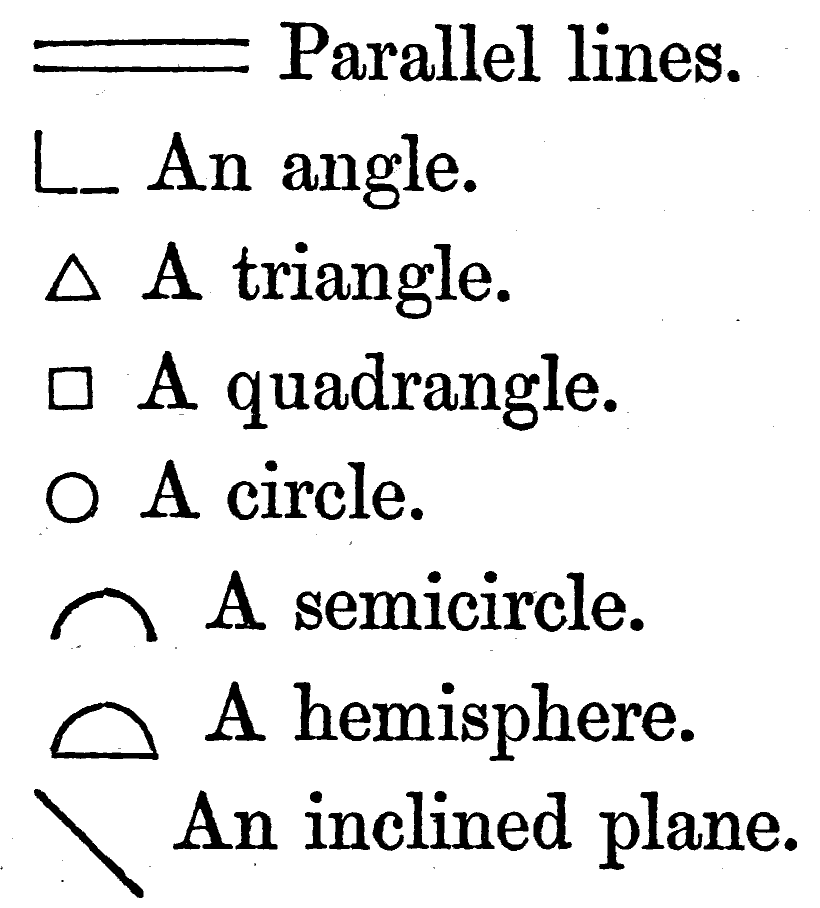
A SECOND DAY IN MARY CARROW’S SCHOOL. — STORY OF THE GOOD MUFFIN-MAN.
7
A cool, rainy morning. The boys and
girls all came to school with thick shoes on,
and coats and shawls to protect them from
the wet. When Mary came, she told her
scholars she was glad to find the rain had
not kept them at home. Mary smiled, and
looked around to see if they had all come, and
she counted. Charles Linn and Harry Linn,
8and their sister Lucy. Lily Forester, and
her brother Eddy. Susan Field, and Ellen
Raby.
All here, but Carry Deacon. Mary said,
“Who can tell why Carry has not come to
school? I do not like to miss one of my
little scholars. I like to have them all with
me.”
No one could tell why Carry had not come.
Mary then helped the smaller scholars to
take off their coats and shawls; and she
showed them how to hang up their wet
things to dry on the pegs in the entry; and
she bade them put their umbrellas into a
pail, which stood by the door on purpose to
receive them. Mary asked if they had all
brought their dinners? And one said, “I
9have brought mine.” And another said, “We
have brought ours.” And Mary said, “We
have brought ours.” It was not far for Mary
and the Linns to go home to dinner; but she
liked to indulge her scholars when she could,
and she knew she could not please them
better than to stay and dine with them on
rainy days.
The boys and girls put their dinner-baskets
into a little closet outside the school-room
door; and then Mary rang her bell—the
signal that it was time to collect. While
they were putting their dinner-baskets away,
Harry Linn said to Lily Forester,
“Lily, are you glad it’s a rainy day? I
am.”
Lily said, “I am glad, too.”
10“Harry, what have you got for dinner?”
“I don’t know,” Harry said. “Mary put
up our dinner while I was looking at father
when he was getting into the wagon.”
“I’ll tell you what I’ve got, Harry,” said
Lily; “a little pie with my name on it! Do
you remember about Anne Lyle, and the little
pie with her name on it? I told mother
about it, when I went home, and she said if
I was a good girl, she would make me a little
pie, and put my name on it. Look here,
Harry. I will show you.” And Lily lifted
up the cloth that was over their dinner, and
there was a little patty-pan pie, with L. F.
plainly stamped on it.
Harry said, “How nice that is! Will you
give me some of it, Lily?”
11And Lily told Harry she would cut it in
halves at dinner-time, and give him the largest
half.
Mary rang her little bell again, and Harry
and Lily went into school.
While the scholars were taking their seats,
Carry Deacon arrived. She was very wet,
and her face was red; and she looked fretted
and tired. Mary said,
“I am glad to see you, Carry; but what
is the matter? How did you get so wet?”
Carry told Mary her umbrella was broken,
and it did not keep the rain off.
“You are so wet, Carry,” said Mary, “that
I fear you will be sick; and you are too far
off from home to be sent back in the rain.”
Mary thought a minute what she should
12do, and then she told Charles Linn, (who was
the largest boy in the school,) to run home
to his mother, and ask her to please to lend
a pair of Lucy’s shoes and stockings, for a
little girl to wear, who had come to school
very wet. Charles Linn was an obliging, lively
boy, and he ran off at once. While he was
gone, Mary took off Carry’s wet shawl, and
sent her into the little room adjoining the
school-room, to wash her face and her feet.
There was a pitcher of water out in the little
room, and soap, and a basin, and a cup, and
a towel. Before Carry had done washing
her feet, Charles Linn came back with the
dry shoes and stockings. Then Mary went
out to Carry, and she helped her to put them
on. And she took a little pocket comb out
13of her pocket, and combed Carry’s hair
smoothly, and then brought her into school.
Mary was sure Carry had done something
wrong, but she did not ask her about it, because
Carry always told the truth. Mary
thought she would be very kind to Carry,
and then Carry would perhaps come and tell
her about the mishaps of her walk to school,
without being asked. Carry was a very
giddy, careless little girl, and she sometimes
forgot to do as she was told, when she did
not really mean to be naughty.
This was Grammar morning; and while
Mary attended to the grammar-class, Harry,
and Lily, and Ellen Raby, looked over their
spelling-lesson.
Charles Linn was at the head of the grammar-class.
14Mary asked Charles if he could
tell her what a Noun was? Charles said, a
noun was the grammatical name of any thing
that we could see, or feel, or taste, or smell.
Mary asked the scholar who stood next in
the class, to point to something in the room
which was a noun. She pointed to a book,
and Mary said, “That is right.” Then Mary
asked the next one, why book was a noun,
and her little scholar could not tell. The
one who stood below her answered. She
said, book was a noun because we could see
it; and she went above the girl who had
missed. Mary said to one, “Think of a noun
which you can taste, and tell me what it is.”
And he answered, “Apple.”
Carry Deacon was the one who had missed,
15and Mary asked Carry to think of something
which she liked to look at and play with.
Carry said, “Kittens.”
“Now tell me, Carry, what a noun is?”
Carry answered, “A noun is the name of
any thing that we can see.”
“Then what is a kitten?”
“O, now I know,” Carry said. “Kitten is
a noun, because I can see it.”
Mary questioned her scholars until she
thought they understood all about a noun;
and then she told them, the next grammar-lesson
would be the Adjective.
“Now you may take your seats,” Mary
said, “and look over your reading-lesson,
while I hear the little ones spell.”
Harry Linn, and Lily Forester, and Ellen
16Raby, said a spelling-lesson; and there were
some words in their lesson which Mary explained
to them, because they did not understand
what these words meant. Ellen Raby
spelled Wild Deer, and she asked Harry Linn
if he knew what a wild deer was? Harry
said, “I guess it is a goat. Let us ask
Mary.”
Mary told them it was not a goat, and she
would see if she could find a picture of a
wild deer to show them. She had a large
book, full of pictures; and there were horses,
and cows and goats, and many different kinds
of animals in it.
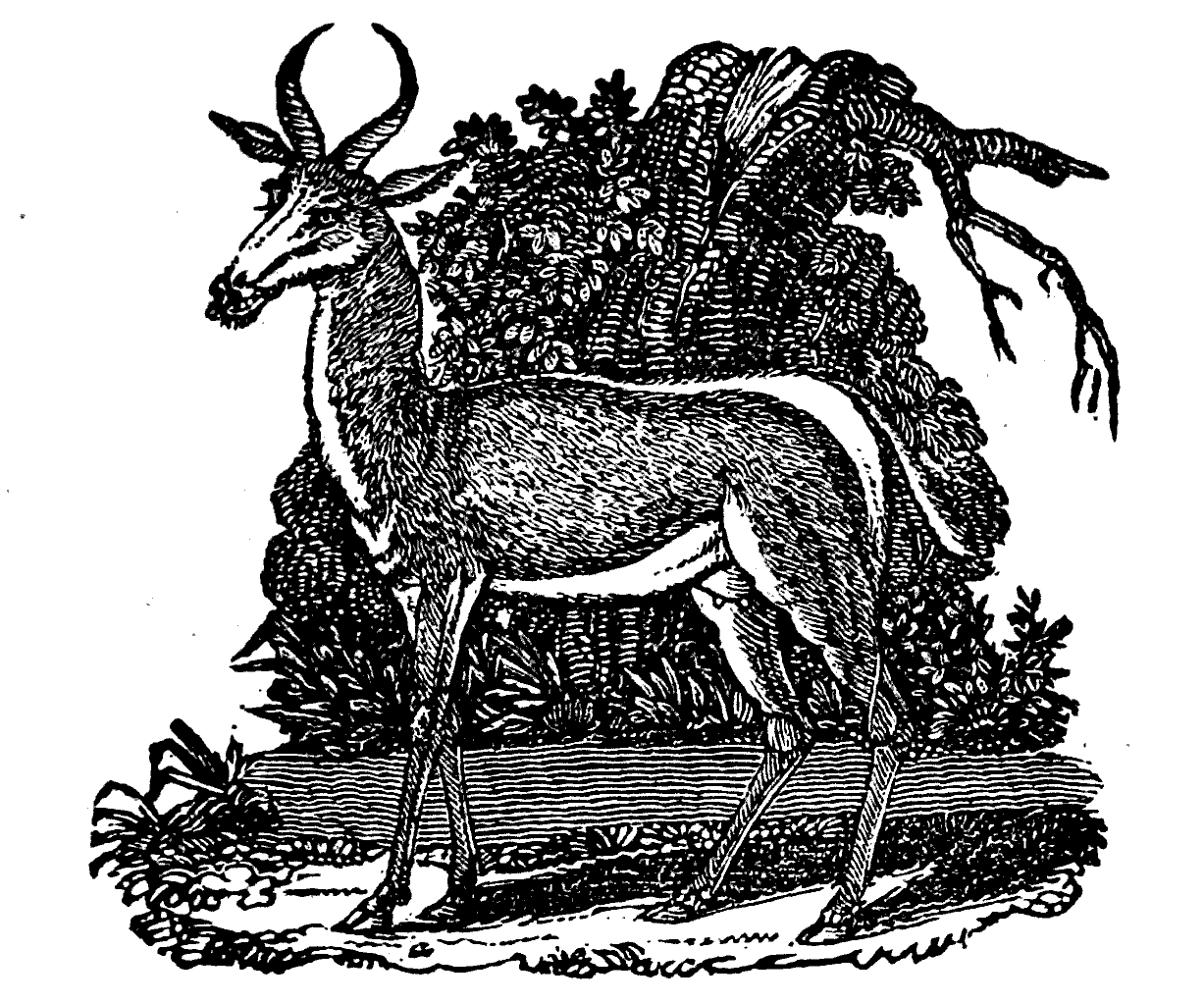
Mary soon found a picture of a wild deer,
and all the scholars wished to come and
look at it. She told them they might come.
17And they asked her to please to tell them
something about a wild deer. Mary told them,
that the part of America where they lived,
and where the school-house stood, was once
a great forest of trees, where only Indians
lived, and wild deers and other animals. She
told them that the Indians used to hunt the
wild deer, and shoot them, that they might
18have them to eat. Their flesh was very
tender and good, and was called venison.
“Why are there not any wild deer here
now, Mary?” asked Ellen.
“Because there is no place for them to live
in. The forests, where they like to live, are
all cut down; and now, instead of forests, we
have fine farms, and houses on them to live
in.”
“Who cut down the forests, Mary?” said
Ellen.
“Our forefathers, who came here a great
while ago.”
“But why did not our forefathers let the
pretty little wild deers stay here, Mary?”
“They would not stay,” Mary said. “They
are afraid of people, of men and women, and
19of little boys and girls, and they ran away
from them.”
“Where did they go, Mary?”
“Away into the forests, which are many
hundreds of miles from here. When our
forefathers came here, they wanted houses to
live in, and something to eat; and they built
themselves houses, and cut down the trees
before they could plant corn, and wheat, and
rye, and potatoes. They had to cut down
the trees before they could make farms.”
Carry looked as if she did not quite understand
Mary, and Mary said, “You know,
Carry, your mother told you, you might have
a little garden of your own, and she gave
you a little piece of ground to make your
garden of, which was full of cedar bushes;
20and do you not remember, you asked your
father if he would cut down the cedar bushes,
so that you could have a nice smooth place
for your flower seeds?”
Carry said, “Yes, I remember it, and father
cut down all the cedar bushes for me, and
then he dug up the ugly roots, and he took
out a spade one morning and dug up the
ground and made it soft. And then mother
gave me some flowers out of her garden, and
she showed me how to plant them in my
garden; and she gave me some seeds, and
she showed me how to make little holes in
the ground to hold the seeds. I put the
seeds in the little holes and covered them up
with the soft earth, and mother says they
will grow into beautiful flowers by and by.”
21“Do you understand now, Carry,” said
Mary, “why our forefathers cut down the
forest trees?
“The land was covered all over with trees,
just as your little garden was covered over
with cedar bushes; and you know you could
not have a garden of flowers, until the cedar
bushes were cut away.”
Carry said, “Yes, I understand now. The
people who came here wanted to plant wheat,
and rye, and corn, and they could not plant
seeds till the great trees were cut down.”
Charles Linn said he would like to have
another look at the wild deer picture; and
Mary allowed him and all the scholars to
examine it.
Eddy Forester said, “The deer’s horns were
22like some his father had at home, to hang up
his Sunday hat on; and his father called
them antlers.”
“Did your father ever tell you where they
came from, Eddy?” asked Mary.
“Yes,” said Eddy. “He told us one night—Lily
and me—that they were the horns of a
deer, which our great-grandfather shot a long
time ago, on the spot where our house now
stands.”
“Oh, yes,” Lily said, “I remember, it was
before we went to bed. I was sitting on
father’s lap, and Eddy was sitting on my
little stool, and mother was making me a
new frock, when father told us about the
Indians.”
“Yes,” Eddy said, “he told us that when
23our great-grandfather came to this country
from England, there was only a great forest
of trees here, and no houses to be seen. He
lived in a log-hut, which he, and the men
who came with him, built for themselves:
and they had not any thing to eat but the
deer and wild turkeys which they shot.
Father told us all that, and he said the
antlers had been kept ever since our great-grandfather
shot the wild deer in the forest.”
Mary said, “Now I will put away the large
picture book, and you may all take your
seats, while I prepare the black board.” Mary
told all her scholars to stand up, and they
answered in concert the questions she asked.
She drew a mark on the black board thus,
24—— and told them to say what she had
drawn; and they answered in concert, “a
straight line.” Then she drew other figures,
thus:
After Mary had exercised her boys and
girls in this way, until she thought they
knew all the figures she had drawn, she told
them to say the multiplication table in concert.
Ellen Raby called this class the concert class,
25and they liked to be in a class
altogether.
Lily said she would like black board exercises
every day; but Mary was wiser than
her little scholar, and she knew that Lily
would get very tired of doing the same thing
every day. Mary liked her scholars to be
“always busy, never weary,” and she gave
them different lessons for each day.
Now it was recess time. And what do my
little readers think Mary’s scholars did during
recess time, when it rained so fast that they
could not go out of doors to play? They
played in the school-room. They played
Blindman Buff and “Poor Pussey wants a
corner,” and “Hunt the Slipper.” Mary lent
them her shoe to play with, and when they
26were tired of playing Hunt the Slipper, and
Puss in the Corner, they gave Mary her shoe
again, and asked her if they might play
Blindman Buff. She said they might, but
not in the school-room. She told them to
go into the little room adjoining the school-room,
where Blindman Buff, whoever he
might happen to be, could not do any mischief.
There was no ink nor desks in the
little room, and he could walk or run about
there without danger of hurting himself.
They begged Mary to go with them, and she
said she would. They all ran off, singing,
Here we go
All together,
We have fun
In rainy weather.
27One, two, three,
Four, and away,
We are glad
Of a rainy day!
Mary took her handkerchief and asked,
who would be Blindman Buff first. They
all wanted to be blindfolded first; and Mary
said, “What shall I do to please all my little
scholars? You cannot all be Blindman Buff
at once; so I will take the oldest first.”
Charles Linn was the oldest scholar; and
after Mary had bound her handkerchief over
his eyes, he could not see any thing at all.
He put out his hands, and felt about the
room, and at last he caught little Ellen Raby.
Ellen was so much delighted, and laughed so
merrily to see how queer Charles looked, that
28he knew by the sound of her voice where to
find her. Carry Deacon came up to Mary
and looked as if she wanted to say something
to her, and as if she did not like to say it.
Then Mary took Carry by the hand, and she
said,
“Do you want to talk to me, Carry?”
Carry said, “Yes, but not before anybody.
Let us go back into the school-room.” Mary
went with Carry into the school-room while
the scholars were at play, and she said, “Now,
Carry dear, come and tell me all about your
getting to school so late this morning.”
Carry.
“I stopped to see Mike Terry’s kittens.”
Mary.
“How did you know about the kittens?”
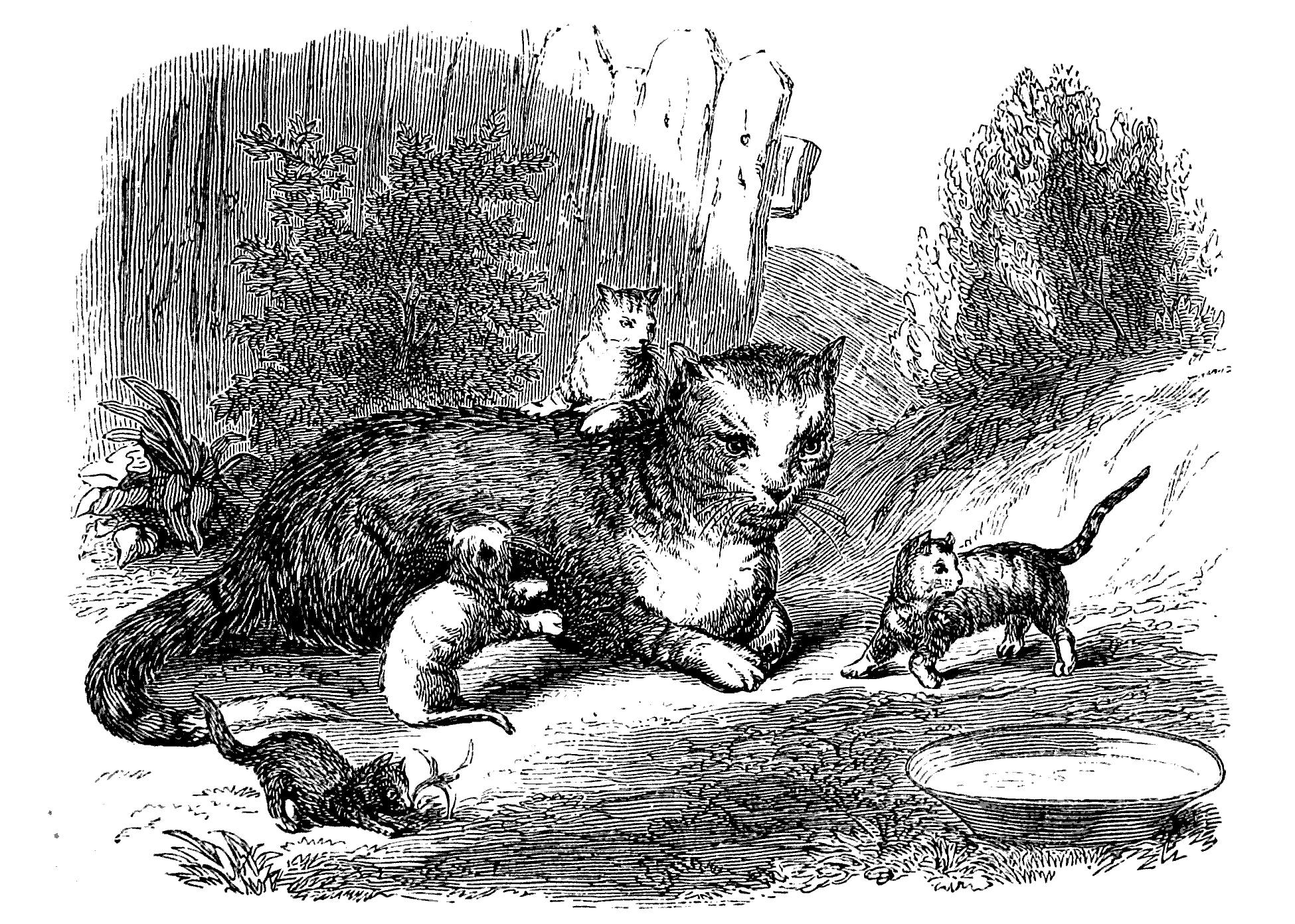
Second Day.
“I stopped to see Mike Terry’s Kittens.” p. 28.
Carry.29
“When I was going past neighbour Terry’s, Mike came out, and he had a porringer of milk,
and he was carrying it with both his hands for fear it would spill.”
Mary.
“Well, Carry, did you stop and ask Mike what he had in the porringer?”
Carry.
“Yes! Mike said it was milk for the cat. He said, the old cat had some kittens in the
night, and he was going to feed her.”
Mary.
“What else did Mike say?”
Carry.
“He said the kittens were down in the barn, and the old cat took hold of the kittens by
their necks, with her mouth. Mike asked me to come and see them.”
Mary.
“Did you tell Mike you were on your way to school, and had not leave to stop?”
30
Carry.
“I only told him I was going to school, I did not tell him about leave to stop.”
Mary.
“What did Mike say to that?”
Carry.
“He said he did not like to go to school. The master was cross. He would rather stay at
home and play; and then I went with him to see the kittens. One was black, and one had
white spots on its tail, and one was yellow, just like the old cat, only it was a kitten.
The kittens were little bits of things. They stayed close together. They climbed over one
another’s backs and heads. Mike said that did not hurt them at all. It was the way they
kept one another warm.”
Mary.
“How long did you stay, Carry?”
Carry.
“I don’t know, but not a great while. The kittens were so pretty, I liked 31to
look at them. I and Mike waited to see if the big cat would take them up by the neck,
with her mouth. Mike said it looked as if she would eat them up.”
Mary.
“How did you feel, while you were there?”
Carry.
“I felt most about the kittens, they were such little dear tiny things. I wanted to take
them up, and kiss them, but Mike said if I did, the old cat would scratch me.”
Mary.
“Did you think about school?”
Carry.
“Yes. When I had done looking at the kittens, I did. I told Mike, now, I must go, I am
afraid it is late. Mike said, if he was me, he would not go to school at all. It was
pleasant to stay at home and play. I told Mike we had a pleasant time at our
32school, rainy days as well as sunny days, and I liked to go all days. Then Mike
showed me a new way to school. He said it was nearer than to go by the road. I got lost,
and did not know where I was. I cried, and wished I had not gone with Mike.”
Mary.
“I thought you told me your umbrella was broken: how was it done, Carry?”
Carry.
“I forgot to put it away the last time it rained, and it was in the kitchen, and somebody
broke it.”
Mary.
“How did you get to school at last?”
Carry.
“I walked and walked, and I ran some of the way, and I called ‘Mother,’ and ‘Mary.’ I was
afraid. When I walked a little farther, I got to the play-woods, and then 33I saw
the tool-house where we keep our playthings. And then I was glad, and I knew I was almost
here.”
Mary.
“Does my little Carry think she has suffered enough to make her remember that she should
not stop by the way coming to school? You know, Carry, the rule is, that the scholars
must not stop on their way to school, nor when they are returning, without leave from
their parents, or from me.”
Carry.
“I forgot that.”
Carry was a very affectionate little girl,
and she put her arms round Mary’s neck, and
said, “Will you kiss me now, Mary, and forgive
me?”
Mary kissed Carry, and said, “I will forgive
you, dear, but do you not know that
34when we do wrong, even in a very little
thing, we must ask our Heavenly Father to
forgive us? Whenever you do wrong, a stain
is left upon your soul—upon that part of you
which lives for ever and ever. God’s good
spirit within you makes you sensible of this
stain; makes you feel that all is not right
with you; and then you are unhappy, uncomfortable;
and you cannot feel happy
again until the stain is taken away. I do
not see it. I cannot take it away: but God sees
it, and can take it away. And if you are really
sorry and ask Him, He will take it away,
and make you happy again. I will give you a
little prayer to learn; and before you lie down
in your bed to-night, think over what you
have been doing to-day. You must try to ask
35your Heavenly Father’s forgiveness before
you go to sleep, and then you can repeat
these verses.”
“Will you say the little prayer to me,
Mary?”
“Yes.”
Heavenly Father! I am little,
And I often go astray;
Wilt Thou love me, and forgive me,
When I do not keep thy way?
I have read about Thy mercy,
In the Holy Bible shown;
Wilt Thou bring me to my Saviour,
For I cannot come alone?
He once took up little children,
And they leaned upon His arm,
And I want Him to take me up,
So that I’ll be safe from harm.
36Then Mary lent Carry the little book which
had the prayer in it, and she told her she
might take it home with her.
“There is one thing more, I wish to say to
you, Carry. I wish you to try to think about
what you are told to do. What shall I do
to make my little Carry remember?”
Carry.
“Don’t call me careless Carry, will you?”
Mary.
“Does any one call you so?”
Carry.
“Yes! And I do not like to be called careless Carry.”
Mary.
“Suppose you try not to deserve the name.”
Carry.
“How shall I try, Mary?”
Mary.
“I will help you.”
Carry.
“Shall we begin now?”
37
Mary.
“Yes. All the scholars, except you, put away their books and slates, before they went out
to play, and yours are all out of place. Go, now, and put them neatly into your desk.”
Carry ran away to do as Mary told her.
And then Mary rang the bell for school.
Now it was reading time. Harry Linn,
and Lily Forester, and Ellen Raby, were in
a class by themselves. They were just learning
to read. Ellen Raby was older than
Harry and Lily, but she did not know enough
to be in the first class.
After all the scholars had done reading,
they took their slates to do sums, and make
figures. Mary showed those who could cipher,
how to do their sums, and she set lines
38of figures for the little ones. Mary made
pens, and set copies in the copy books for
afternoon.
One of the copies was,
Another copy was,
Another copy was,
When morning school was done, Mary had
all the books and the slates neatly put into
their places. Carry Deacon came running up
to Mary to tell her that she had put every
thing into her desk that belonged there, and
39that the lid would shut down closely. Mary
went to Carry’s desk to look into it, and she
found that the things were not all tumbled
in, helter-skelter, but that each book was
in its right place; and she said Carry was
a good little girl, because she was trying to
improve.
Carry looked very much pleased, when
Mary praised her. And she said, “I do love
you, Mary, you are so kind to me. You never
call me careless Carry.”
The boys and girls amused themselves as
they liked until dinner-time.
My little readers will remember, that they
had all brought their dinner to school, because
it was a rainy day. They will remember
too, that Mary lived with Harry Linn’s
40father and mother. Her basket was quite a
large one, with dinner enough in it for four:
Charles and Lucy and Harry Linn and Mary.
When it was dinner-time, Mary had the
napkins taken out of each basket, and she
spread them all upon a little table which
stood in the corner of the school-room, and
these served for a table-cloth. Then she took
out of every basket all that was in it. There
was bread and butter and cold meat and
biscuit and apple pies. Mary had brought
a large pie, and some of the scholars had
brought small pies. Mary placed the large
pie in the centre of the table, and the little
pies around it. Lily Forester’s patty-pan pie,
with her name on it, was the least of all. Lily
capered around the table, and was wild with
41delight. Ellen Raby said the large pie was
the mother-pie and the little pies were the
children.
Charles Linn took the pitcher and brought
some fresh water from the spring, and Mary
put the little mug which was in the wash-room,
on the table, for a drinking cup. When
the table was arranged, Mary allowed Ellen
Raby to ring the bell. She rang the bell very
loud, and she ran about, saying to every one,
“Please to come to dinner.”
Before they began to eat, they sat in silence[A]
42for a little while; and then Mary asked her
scholars, if they knew why we sit in silence
before we partake of our meals? Charles
Linn said, “We do it that we may think of
our Heavenly Father, before we eat our food,
because He gives it to us.” “Yes,” said Mary,
“He gives us every good thing that we have,
and we should try, when we receive his gifts,
to ask Him to give us grateful hearts for
them. We cannot give ourselves kind parents
and pleasant homes and health, nor
abilities to provide food and raiment. God
must give them to us or we must go without
them.
“Shall I repeat to my little scholars some
verses which my mother taught me to say
when I was about as old as Lily Forester?”
43They all said, “Yes, oh do, before we eat
our dinner.” And Mary repeated:
When my little daughter comes
To the board with plenty spread,
She should try to think of Him,
By whose bounty she is fed.
From our Heavenly Father’s hand
Come our blessings, health and food,
Parents, homes, and all we have,
All we know and think of good.
Then, my darling, try to say
To thyself a little prayer;
Ask God for a grateful heart
At thy meals, and everywhere.
Mary talked with her scholars while they
ate their dinner; and after dinner was over,
each scholar put the plates and other things
44that belonged to her into her own basket.
There was not much left, for they were all
very hungry. Then they went into the
wash-room, one at a time, and washed their
hands and faces. Mary required her scholars
to eat slowly and chew their food well; and
eating their dinner and washing and putting
their baskets away, had occupied so much
time, that now it was almost two o’clock, and
school in the afternoon commenced at two
o’clock. Mary had no recess during the afternoon
on rainy days, and she closed her school
at four o’clock. She said it was not healthful
to remain longer than that time in a close
room. It had rained so fast all day that the
scholars could not go out to take the air.
45When Mary said it was school-time,
Charles Linn called out, “Now for school.”
“Now for school.” “May I ring the bell?”
Mary told him he might. And he rang the
bell.
Carry Deacon did not come when the bell
was rung, nor Ellen Raby, nor Harry Linn,
nor Lily Forester. Mary asked Charles
to go and look for them, and he found them
in the wash-room. They had taken all the
dinner-baskets out of the closet, and they
were playing “Go to market and sell apples.”
Carry Deacon had a basket on her head, and
Ellen Raby had one on her arm, and Harry
Linn had tied a string to their large basket,
and he and Lily Forester were pulling it
along. They pretended the basket was a
46cart, and that it had apples in it, and that
Harry was Sam the driver, and Lily was
Sam’s wife, and she was going to market with
him to measure out the apples in a half-peck
measure.
They were all in high glee, and Carry Deacon
said, “Isn’t it nice on rainy days?”
Charles Linn told them it was school-time.
They asked Charles to help them put the
baskets away. Charles was a kind little boy,
and he helped them, and he untied the string
which Harry had put to the large basket, and
then they all came into school.
When the scholars were in their seats, Mary
said, “Which of my little boys and girls have
their Definitions ready?”
The little ones did not learn definitions, but
47the larger ones did, and they had been studying
their lessons between schools. After
Mary had heard the definition-class, she called
the little ones, and asked them if they remembered
what lesson they said on the second
day of the week. Carry Deacon said,
“Oh, yes, this is question-afternoon.” Mary
said, “That is true, Carry, and I am glad to
find you remember it.”
These are some of the questions which
Mary asked her little scholars.
How many hands have you?
How many feet have you?
How many fingers?
How many thumbs?
How many toes on each foot?
How many on both feet?
48Which is your right hand?
Which is your left hand?
How many senses have you?
What are your senses called?
What do you taste with?
What do you smell with?
What do you hear with?
What do you handle with?
What do you see with?
Now, my little readers, suppose you try to
answer these questions. Your kind mothers,
or your older brother or sister, will tell you
if you answer them correctly. Mary’s little
scholars missed some, but they answered most
of them correctly.
When they had done answering questions,
Mary told them they might go to their seats
49and write on their slates. Their copies were
already set.
Instead of having a recess, Mary read to
her scholars a pretty story. It was a true
story about a good muffin-man.
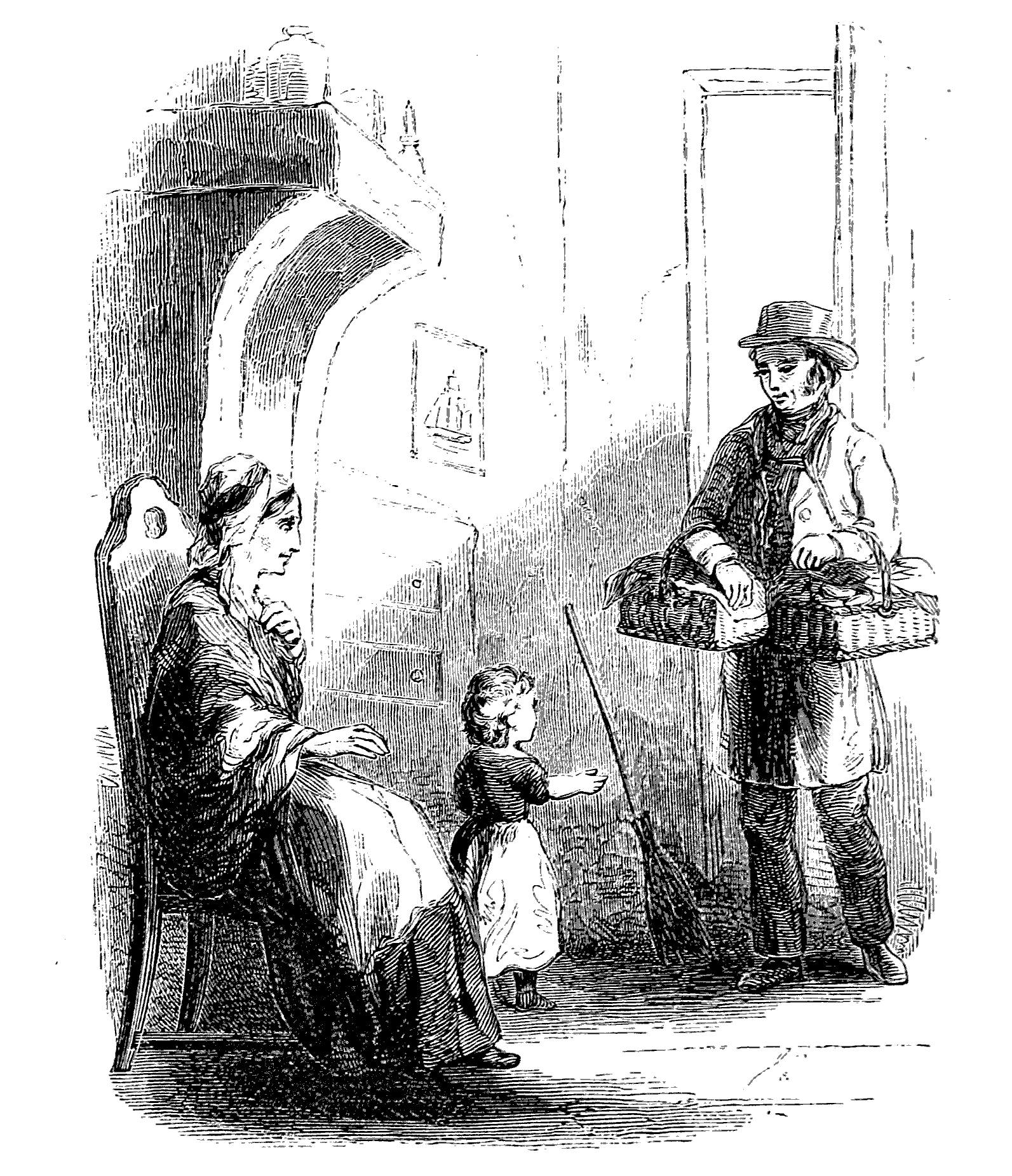
Second Day.
The good muffin-man. p. 49.
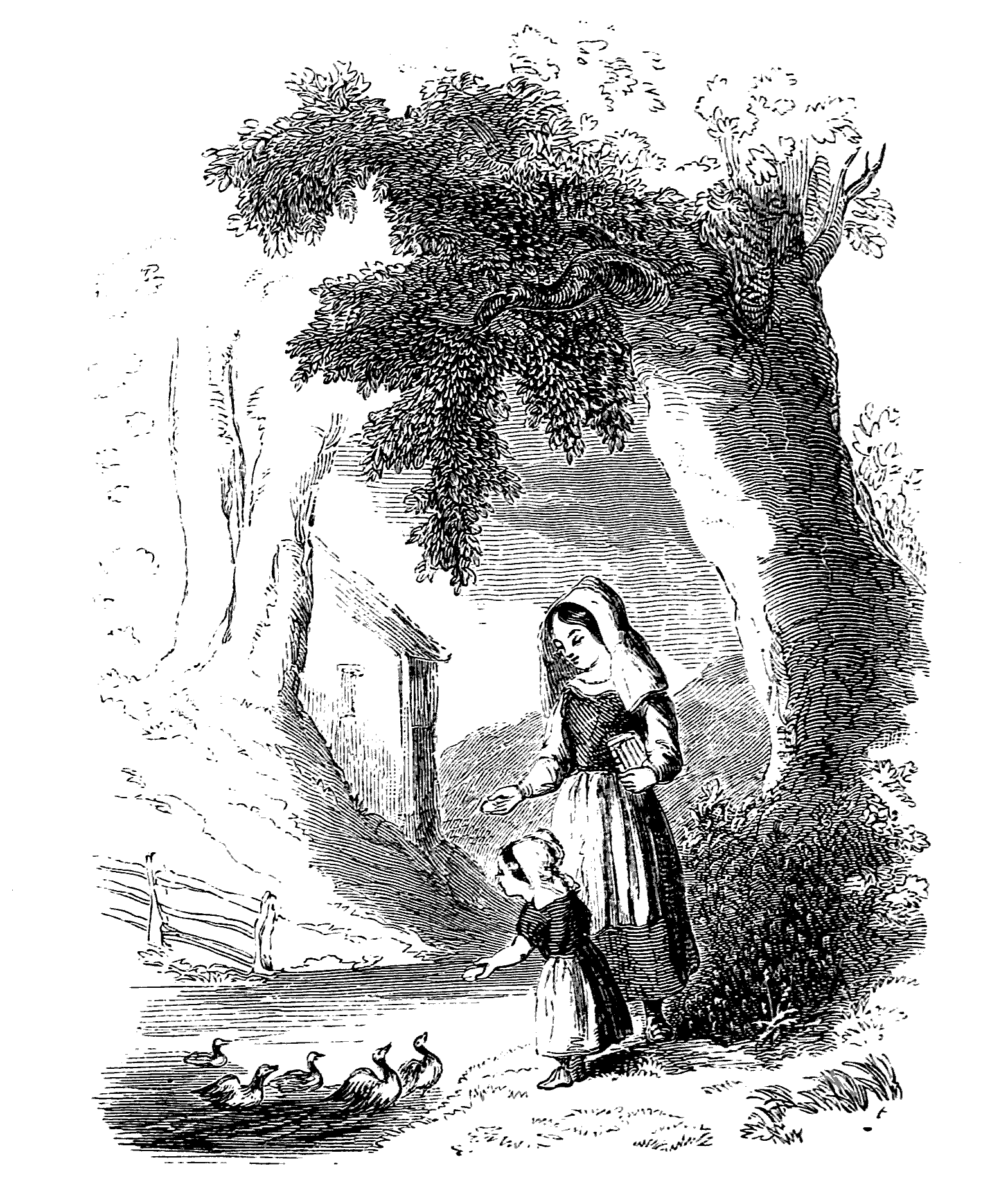
There was once a muffin-man who carried
muffins about the streets of a large city to
sell. He carried them in two square baskets,
on his shoulders. In the street where he
served the people with muffins, a poor sailor’s
wife lived. She was sick, and she could not
work, and she had not any body to give her
money, for her husband was a sailor, and he
was out at sea in a great ship. She had a
50young child, and she was so poor that she had
not even enough money to buy bread. The
good muffin-man stopped every day and gave
her some muffins out of one of his baskets to
eat. Whenever the muffin-man stopped, the
little child would run away from her mother
to come to him, because she was so
glad to see him.
Mary’s scholars thought the muffin-man
was very good and kind. There was a picture
over the story, and Mary showed them
the picture. After they had talked about
the poor sailor’s wife, and the little child, and
the muffin-man, Carry Deacon asked, “Why
the people did not make muffins at home?”
Mary told her, “That in large cities, such as
Boston, New York and Philadelphia, the
51people who lived there bought many things,
which the country people made at home.
They bought their milk and their butter and
their meat and their eggs, because the houses
were built up closely together, and there was
not room enough, in towns, to keep cows and
pigs and chickens. Mary asked Carry if she
had never seen people carrying milk and
bread and fruit about, when she was in
Philadelphia.” Carry said, “Yes, she had
seen a man carrying a bucket with bright
hoops around it; and her aunt, at whose
house she stayed, told her the bucket had milk
in it.” And Carry said, “She saw a woman
carrying oranges in a basket, and the woman
knocked at people’s doors, and asked them to
buy her oranges.”
52
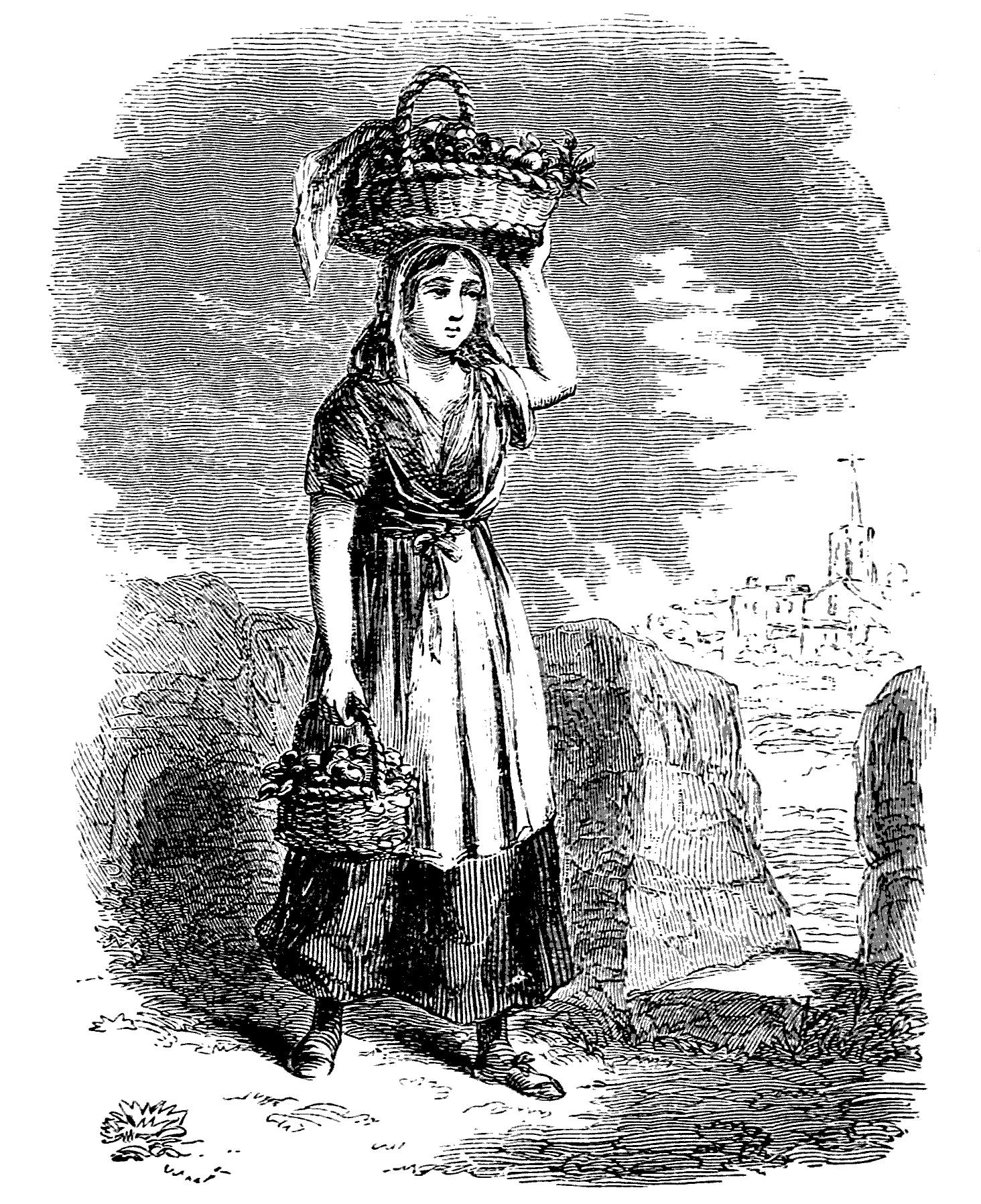
Second Day.
The fruit woman on her way to town p. 51.
Mary went around among her scholars,
while they were writing, to see that they
held their pens and pencils properly. She
rubbed out some of Lily Forester’s straight
marks and round o’s, because her strokes
were crooked and her o’s were not well
formed, and Lily said she would try again.
While the scholars were writing, Mary
looked over the Bible to select a chapter to
read at the close of the school.
Carry Deacon came up to Mary and whispered
to her, to please to read about the beautiful
garden where Adam and Eve lived a
great while ago and talked with our Heavenly
Father.
When school was done, Mary called her
little boys and girls to come and sit around
53her while she read to them the Bible. She
read to them about God creating the world;
and how he made the heavens, and the bright
stars, and the earth and all the people that
live on it, and the flowers, and the birds and
beasts, and every thing that has life. And
then she read to them about Adam, the first
man, and Eve, the first woman, and about
the beautiful garden, called the garden of
Eden, where they lived, and where they were
very happy, until they were disobedient; and
because they were disobedient they had to
go out of the beautiful garden of Eden.
“Is God, who made every thing, our Heavenly
Father, Mary?” said Harry Linn.
“Yes, Harry.”
“Did God send Adam and Eve out of the
54beautiful garden because they were disobedient?”
asked Carry Deacon.
“Yes,” said Mary.
“But, Mary, I thought you said our Heavenly
Father loved us, and was kind to us.
I do not think it was kind to send poor Adam
and Eve away. Why did not God forgive
them for being disobedient, as you did me
this morning?”
“They did not ask God to forgive them,”
Mary said; “And you know, Carry, that when
we have done wrong, we cannot be forgiven,
until we are sorry that we have done wrong,
and sincerely ask our Heavenly Father to
forgive us.”
“Did Adam and Eve know they were to be
sent away, if they were naughty?” asked Carry.
55Eddy Forester said, “Do you not remember,
Carry, Mary read to us, that God showed
Adam and Eve one tree in the garden, and
told them not to touch it? and he told them
if they ate the fruit on that tree, they should
surely die.”
“Oh, yes,” Carry said, “I remember now,”
and the scholars all said they remembered that.
“Well,” Mary said, “you know God is
true. He always keeps his word. We must
believe every word of God; but if God should
not do what he said He would do, we could
not believe Him. He said he would punish
Adam and Eve, if they ate the fruit which
he told them not to touch, and if he had
not punished them, how could we believe
every word God had spoken?”
56Carry said, “Does God love us any more,
when He punishes us, Mary?”
“Yes,” Mary said, “He punishes us sometimes
when we do wrong, because He loves
us and wants to make us love and obey
Him. You know, Carry, your mother sends
you away from her, when you are naughty,
to punish you; and she does it because she
wants to make you a good, obedient little
girl; and do you not think your mother loves
you?”
“Oh, yes,” Carry said; “my mother says
she loves me, and I know she does.”
Little Ellen Raby was leaning against
Mary; she was very tired. Harry and Lily
had slipped off from the bench where they
were sitting, and they were lying on the floor,
57looking up into Mary’s face while she was
talking.
Then Mary said, “My little scholars
are weary, they have been at school long
enough.”
The bigger boys and girls begged Mary
to talk to them some more about Adam
and Eve. They said they were not weary.
Charles Linn said he would hold Ellen Raby
on his lap, while Harry and Lily rested on
the floor. But Mary looked at her watch,
and she said, “We will not talk any more
now. It is after four o’clock. It is time
for us all to go home. It does not rain
much now, and we can go home without
getting very wet.”
Then Mary put away the Bible, and she
58went and brought Carry Deacon’s shoes and
stockings to her.
“Now Carry, dear,” Mary said, “go and
take off the borrowed shoes and stockings,
and put on your own. Yours are quite
dry.”
Carry did as she was bidden, and then
Mary took the shoes and stockings which
Carry left off, and put them into her basket;
for my little readers will remember they belonged
to Lucy Linn, and we must never
forget to return carefully and in good season
any thing that we borrow. Mary took care
that each scholar had the right umbrella and
the right dinner-basket, and then she kissed
them all, and they went home.
Charles Linn said he did not care for a
59little rain, and he took the large basket and
ran home. He left the umbrella for Mary
and his little brother Harry, and his sister
Lucy, and Mary and Lucy and Harry walked
home together.
TRANSCRIBER’S NOTE:
Perceived typos have been silently corrected.
Inconsistencies in hyphenation have been standardized.
Archaic or variant spelling has been retained.