This being the morning fixed for the departure
of our small expedition against the Sekarrans, the
Phlegethon weighed at eight and proceeded down the
river to await the collection of force.
Among those who accompanied us was the Pangeran
Budrudeen, the intelligent brother of the
Rajah already noticed. This was an unusual event
in the Royal Family, and the departure from the
Rajah’s wharf was imposing. The barge of state
was decked with banners and canopies. All the
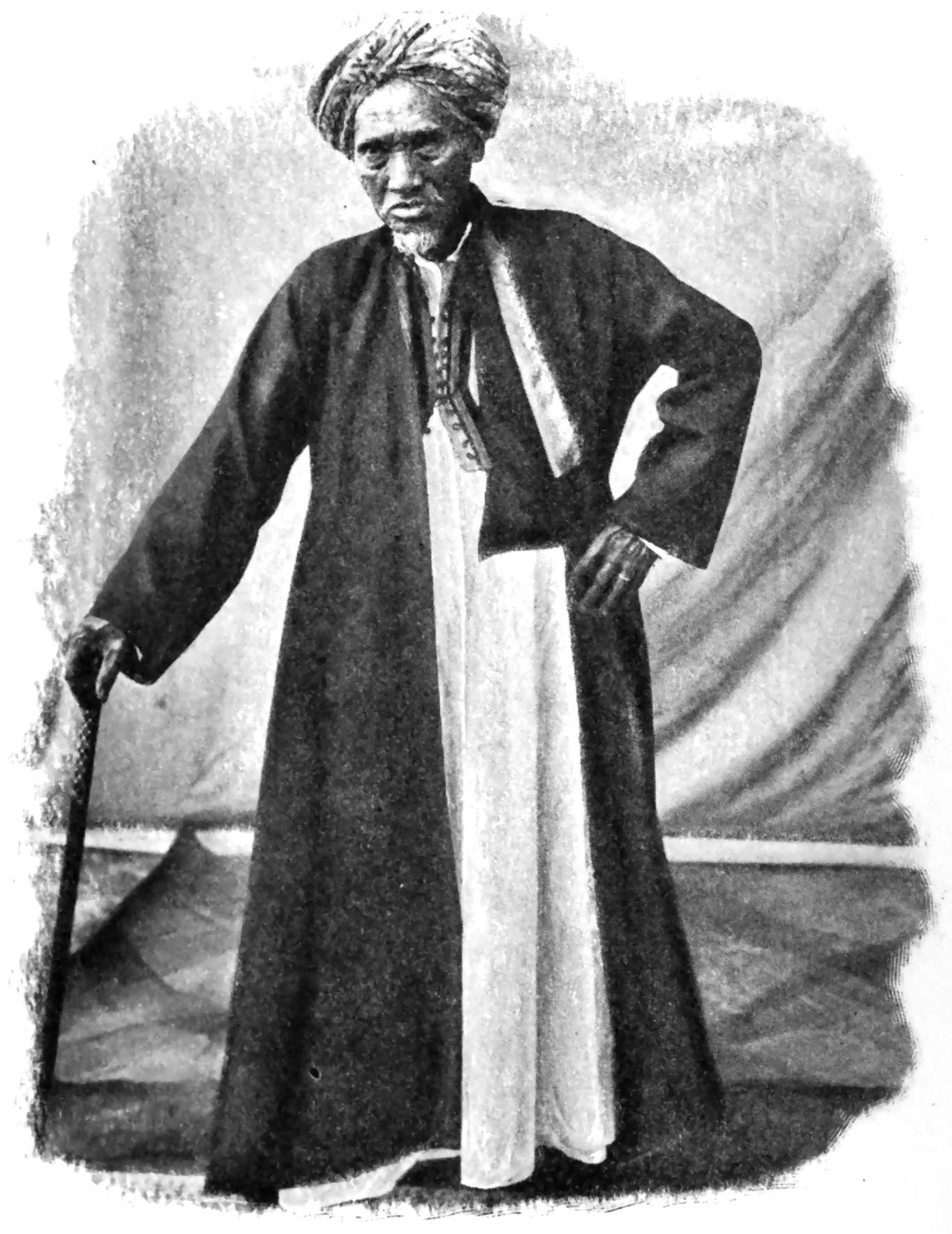
chiefs attended, with the Arab priest Mudlana at
their head, and the barge pushed off amid the firing
of cannon and a general shout to invoke the blessing
of Mahomet.
Having seen the last boat off, Brooke and I took
our departure in the gig, when another salute was
fired from the wharf. Three hours brought us to
the steamer. Here we heard that a small boat from
the pirate country had, under pretence of trading,
been spying into our force, but decamped on our
appearance. We now got fairly away, the smaller
boats keeping near the shoals in-shore, while the
steamer was obliged to make an offing some miles
from the coast. From the masthead we distinctly
made out the small boat that had left the mouth of
the river before, pulling and sailing in the direction
of Batang Lupar, up which the Sekarran country
lies; and it being desirable that they should not get
information of our approach, at dusk, being well
in advance, our auxiliary force following, we despatched
Brooke’s sampan and one of Dido’s cutters
in chase.
Aug. 6.
With the flood-tide arrived the well-appointed
little fleet, and with it the cutter and sampan with
two out of the three men belonging to the boat of
which they had been in chase, the third having been
speared by Seboo on showing a strong inclination to
run amuck in his own boat. From these men we
learned that Seriff Sahib was fully prepared for defence—his
harem had been removed—and that he
would fight to the last.
We anchored in the afternoon at the mouth of
the Linga, and sent a messenger to caution the chief,
Seriff Jaffer, against giving any countenance to either
Seriff. The Batang Lupar, thus far, is a magnificent
river, from three to four miles wide, and in most
parts from 5 to 7 fathoms deep.
Aug. 7.
Weighed at daylight. Shortly after eleven, with
a tide sweeping us up, we came in sight of the fortifications
of Patusen. There were five forts. Getting
suddenly into 6 feet of water, we anchored. We
were well within musket range, but not so formidable
a berth as we might have taken up had we been
aware of the increasing depth of water nearer the
shore; but we approached so rapidly there was no
time to ascertain.
The Dido and Phlegethon’s boats were not long
in forming alongside. They consisted of the following:—
Pinnace: Lieutenant C. F. Wade; R. Beith,
assistant-surgeon; 13 seamen; 5 marines.
Jolly Bachelor: Lieutenant E. W. Turnour; Mr.
C. Johnson, midshipman; 21 seamen; 7 marines.
First cutter: Mr. E. H. H. D’Aeth, mate; 8
seamen; 8 marines.
Second cutter: Mr. Robert Jenkins, acting-mate;
8 seamen; 2 marines.
Second gig: Mr. R. C. Allen, Master; 6 seamen.
Phlegethon’s first cutter: Mr. S. Caverley, first
officer; 15 men.
Second cutter: Mr. Simpson, second officer; Mr.
A. Barton, midshipman; 15 seamen.
Third cutter: Mr. H. Comber, acting-mate of
Dido; 12 seamen.
Fourth cutter: Mr. G. S. Darby, fourth officer;
12 seamen.
In all, 13 officers; 108 seamen; 16 marines.
We had no steam, and to direct a fleet of boats
how to attack a succession of half a dozen forts was
beyond me. They were off, and they were there!
From the Phlegethon we had no difficulty in setting
fire to the thatched roofs of the forts. Reinforcements
came across the extensive shelter of Patusen
Harbour. These we might easily have sunk with
Phlegethon’s guns, but there was excitement for them
on landing! They never once checked in their advance,
but the moment they touched the shore the
crews rushed up, entering the forts at the embrasures,
while the pirates fled at the rear. In this sharp and
short affair we had but one man killed, poor John
Ellis, a fine young man, and captain of the maintop
in the Dido. He was cut in two by a round-shot
while in the act of ramming home a cartridge in the
bow-gun of the Jolly Bachelor, of which Lieutenant
Edward Turnour was in command. This, and two
others badly wounded, were the only casualties on
our side.
Our native allies were not long in following our
men on shore. The killed and wounded on the part
of the pirates must have been considerable. Our
native followers got many heads. There were no
less than sixty-four brass guns of different sizes,
besides many iron, found in and about the forts.
The town was extensive, and after being well looted
made a glorious blaze. Our Sarawak followers, both
Malays and Dyaks, behaved with gallantry, and with
our lads dashed in under the fire of the forts. In
fact, like their country, anything might be made of
them under a good Government.
After our men had dined, and had a short rest
during the heat of the day, we landed our force in
two divisions to attack a town situated about two
miles up, on the left bank of a small river called the
Grahan, the entrance to which had been guarded by
the forts, and immediately after their capture the tide
had fallen too low for our boats to get up. Facing
the stream, too, was a long stockade, so that we determined
on attacking the place in the rear, which,
had the pirates waited to receive them, would have
caused an interesting skirmish. Brooke was away
independently in the gig. They, however, decamped,
leaving everything behind them.
In this town we found Seriff Sahib’s residence,
and among other things his curious and extensive
wardrobe. It was ridiculous to see our Dyaks
dressed out in all the finery and plunder of this
noted pirate, whose very name a few days ago would
have made them tremble.
Aug. 6, 7.
We likewise found a magazine in the rear of
Sahib’s house, containing about 2 tons of gunpowder,
which I ordered to be thrown into the river.
It was evident we attacked Patusen at the right
moment: the preparations for its defence were
nearly completed, and a delay of a week would have
resulted in considerable loss of life. It was the key
to this extensive river, the resort of the worst of
pirates, and each chief had contributed his share of
guns and ammunition towards its defence.
We returned to our boats and evening meal
rather fatigued, but much pleased with our work,
after ascending near seventy miles from the mouth
of the river. The habitations of 5000 pirates had
been burnt to the ground, five strong forts destroyed,
together with several hundred boats, upwards of
sixty brass guns captured, and about a fourth of that
number of iron ones spiked and thrown into the
river, besides vast quantities of other arms and
ammunition, and the powerful Sahib, the great
pirate patron for the last twenty years, ruined past
recovery, and driven to hide his diminished head in
the jungle.
Aug. 8, 9.
The 8th and 9th were spent in burning and destroying
the remains of the staggering town and a
variety of smaller boats.
Aug. 10.
As soon as the tide had risen sufficiently to take
us over the shoals, we weighed in the steamer for the
country of the Sekarran Dyaks, having sent the boats
on before with the first of the flood.
About fifteen miles above Patusen is the branch
of the river called the Undop. Up this river I sent
Lieutenant Turnour, with Mr. Comber, in the Jolly
Bachelor and a division of our native boats, while we
proceeded to where the river again branches off to
the right and left, as on the tongue of land so formed
we understood we should find a strong fort; besides,
it was the highest point to which we could attempt
to take the steamer. We found the place deserted
and houses empty.
We now divided the force into three divisions—the
one already mentioned, under Lieutenant
Turnour, up the Undop; another, under Mr. D’Aeth,
up the Lupar; while Lieutenant Wade, accompanied
by Brooke, ascended the Sekarran. I had not calculated
on the disturbed and excited state in
which I found the country: two wounded men
having been sent back from the Undop branch,
brought accounts of pirates, chiefly Malays, collected
in great numbers both before and in the rear of our
small force.
An attempt had been made to cut off the bearer
of this information, Nakodah Bahar, who had had a
narrow escape, and had no idea of being the bearer
of an answer unless attended by a European force.
I had some difficulty in mustering another crew from
the steamer, and left my friend Captain Scott with
only the idlers, rather critically situated. I deemed
it advisable to re-collect our whole force, and before
proceeding to the punishment of the Sekarrans to
destroy the power and influence of Seriff Muller,
whose town was situated about twenty miles up, said
to contain a population of 1500 Malays, without
reckoning the Dyak tribes.
Having despatched boats with directions to Lieutenant
Wade and Mr. D’Aeth to join us in the
Undop, a tributary of the Batang Lupar, proceeded
to the scene of action; leaving the Phlegethon to
maintain as strict a blockade of the Sekarran and
Lupar branches as, with her reduced force, she was
capable of.
On my joining Lieutenant Turnour, I found him
just returned from a very spirited attack which he
had made, assisted by Mr. Comber, on a stockade
situated on the summit of a steep hill, Mr. Allen, the
Master, being still absent on a similar service on the
opposite side of the river.
The gallant old chief Patingi Ali was likewise
absent in pursuit of the enemy that had been driven
from the stockades, with whom he had had a hand-to-hand
fight, the whole of which, being on the rising
ground, was witnessed by our boats’ crews, who could
not resist hailing his return from his gallant achievement
with three hearty cheers.
We had now to unite in cutting our way through
a barrier across the river similar to that described
in the attack on the Sarebas, which having passed
we brought up for the night close to a still more
serious obstacle in a number of huge trees felled,
the branches of which, meeting midway in the river,
formed apparently an insurmountable obstacle. But
“patience and perseverance” overcame all obstacles.
By night only three of the trees remained to be
cleared away. On the right bank, about 50 yards
in advance of the barrier, stood a farm building,
which we considered it prudent to occupy for
the night.
Having collected fifty volunteers (Brooke and
Wade had then not rejoined), I took Brooke’s schoolfellow
Steward, Williamson, and with me Comber, a
corporal and four marines, my gig’s crew, and, of
course, my trusty John Eager, the sound of whose
bugle meant mischief. The remainder composed of a
medley of picked Malays and Dyaks.
The house being 100 yards in advance of our
party, and 80 from the river, it was difficult of
approach, especially at night. The ground swampy,
with logs of trees, over which I stumbled, and was up
to my arms in mud and water. Nevertheless, there
was no noise. It was a roomy building. In one
corner I found an enclosure, forming a square of about
8 feet; of this I took possession, and while in the place—it
was pitch dark—I quietly divested me of my wet
trousers.
“Tiga” (three) was the watchword, in case of a
stranger finding his way in. I was contemplating
whether my duck trousers were sufficiently dry for
me to get into, when every one was disturbed by
a most diabolical war-yell. In a moment every
man was on his legs—swords, spears, and krisses
dimly glittered over our heads. It is impossible
to describe the excitement and confusion of the
succeeding ten minutes; one and all believed we
had been surrounded by the enemy and cut off from
our main party.
I had already thrust the muzzle of my pistol close
to the heads of several natives, whom in the confusion
I had mistaken for Sekarrans; and as each
in his turn called out “Tiga!” I withdrew my
weapon to apply it to somebody else, until at last
we found we were all “Tigas.” I had prevented
Eager more than once from sounding the alarm,
which from the first he had not ceased to press for
permission to do.
The Dyak yell had, however, succeeded in throwing
the whole force afloat into a similar confusion,
who, not hearing the signal, concluded they, and not
we, were the party attacked. The real cause we
afterwards ascertained to have arisen from the alarm
of a Dyak, who dreamt, or imagined, he felt a spear
thrust upwards through the bamboo flooring of our
building, and immediately gave his diabolical yell.
The confusion was ten times as much as it would
have been had the enemy really been there. So
ended the adventures of the night in the wild jungle
of Borneo.
CHAPTER XXXIII
Dido: Second Expedition
1844.
Aug. 11.
At daylight we were joined by Wade and Brooke,
their division making a very acceptable increase to
our force, and by eight o’clock the last barrier was
cut through between us and Seriff Muller’s devoted
town.
With the exception of his own house, from which
some eight or nine Malays were endeavouring to remove
his effects, the whole place was deserted. They
made no fight, and an hour afterwards the town had
been plundered and burnt.
The only lives lost were a few unfortunates, who
happened to come within range of our musketry
in their exertions to save some of their master’s
property.
A handsome large boat belonging to Seriff Muller
was the only thing saved, and this I presented to
Budrudeen.
After a short delay in catching our usual supply of
goats and poultry, with which the place abounded, we
proceeded up the river in chase of the chief and his
people, our progress much impeded by the immense
trees felled across the river.
We ascertained that the pirates had retreated to a
Dyak village, situated on the summit of a hill, some
twenty-five miles higher up the Undop, five or six
miles only of which we had succeeded in ascending,
as a most dreary and rainy night closed in, during
which we were joined by D’Aeth and his division
from the Lupar River.
The following morning, at daybreak, we again
commenced our toilsome work. We should have
succeeded better with lighter boats, and I should
have despaired of the heavier boats getting up had
they not been assisted by an opportune and sudden
rise of the tide, to the extent of 12 or 14 feet, though
with this we had to contend against a considerably
increased strength of current.
It was on this day that my ever active and zealous
First Lieutenant, Charles Wade, jealous of the advanced
position of our light boats, obtained a place
in my gig.
That evening the Phlegethon’s first and second
cutters, the Dido’s two cutters, and their gigs, were
fortunate enough to pass a barrier composed of trees
recently felled, from which we concluded ourselves to
be so near the enemy that, by pushing forward as
long as we could see, we might prevent further
impediments from being thrown in our way. This
we did, but at 9 P.M., arriving at a broad expanse of
the river, and being utterly unable to trace our course,
we anchored our advance force for the night.
Aug. 14.
The first landing-place we had no trouble in discovering,
from the number of deserted boats collected
near it. Leaving these to be looted, we proceeded
in search of the second, which we understood was
situated more immediately under the village, and
which, having advanced without our guides, we had
much difficulty in finding. The circuit of the base
of the hill was above five miles.
During this warfare, Patingi Ali, who, with his
usual zeal, had here come up, bringing a considerable
native force of both Malays and Dyaks, was particularly
on the alert; while we in the gig attacked
Seriff Muller himself.
Patingi nearly succeeded in capturing that chief
in person. He had escaped from his prahu into a
fast-pulling sampan, in which he was chased by old
Ali, and afterwards only saved his life by throwing
himself into the water and swimming to the jungle;
indeed, it was with no small pride that the gallant
old chief appropriated the boat to his own use.
In the prahu were captured two large brass guns,
two smaller ones, a variety of arms, ammunition, and
personal property, amongst which were also two pairs
of handsome Wedgewood jars.
While my crew were employed cooking, I crept
into the jungle and suddenly fancied I heard the
suppressed hum of many voices not far distant. I
returned to our cooking party and bade Wade take
up his double-barrel and come with me. I had not
penetrated many yards before I came in sight of a
mass of boats concealed in a snug little inlet, the
entrance to which had escaped our notice. These
boats were filled with piratical Dyaks and Malays,
and sentinels posted at various points on the
shore.
My first impulse was to conceal ourselves until the
arrival of our force, but my rash though gallant
friend deemed otherwise, and, without noticing the
caution of my upheld hand, dashed in advance, discharging
his gun, calling upon our men to follow.
It is impossible to conceive the consternation and
confusion this our sudden sally occasioned among the
pirates. The confused noise and scrambling from
their boats I can only liken to that of a suddenly-roused
flock of wild-ducks.
Our attack from the point whence it came was
evidently unexpected; and it is my opinion that they
calculated on our attacking the hill, if we did so at
all, from the nearest landing-place, without pulling
round the other five miles, as the whole attention of
their scouts appeared to be directed towards that
quarter.
A short distance above them was a small encampment,
probably erected for the convenience of their
chiefs, as in it we found writing materials, two or
three desks of English manufacture, on the brass
plate of one of which, I afterwards noticed, was
engraved the name of “Willson.”
To return to the pirates: with our force, such as
it was—nine in number—we pursued our terrified
enemy, headed by Wade.
They foolishly themselves had not the courage to
rally in their judiciously selected and naturally protected
encampment, but continued their retreat (firing
on us from the jungle) towards the Dyak village on
the summit of the hill. We collected our force,
reloaded our firearms; and Wade, seeing from this
spot the arrival at the landing-place of the other
boats, again rushed on in pursuit.
Before arriving at the foot of the steep ascent on
the summit of which the Dyak village stood, we had
to cross a small open space of about 60 yards,
exposed to the fire from the village as well as the
surrounding jungle. It was before crossing this
plain that I again cautioned Wade to await the
arrival of his men, of whom he was far in advance.
We suddenly came on to the snuggest and best-sheltered
boat harbour I ever saw. The land was
high towards the river, with a narrow and well-concealed
entrance opening to the river, so high that
an impromptu bridge in the shape of a large tree
had been thrown across. It was along this that
Wade was proceeding in advance, calling “Come on,
my boys!” And I am afraid I did not disguise my
gratification at seeing him disappear into the branches
of a large tree growing beneath.
By this time the cutter and other boats had landed
at our point and were coming up. I had scarcely got
across the tree-bridge, when I saw my friend scrambling
up the opposite side, himself unhurt, his gun not
discharged.
Our men were now landing fast, and it was for
very shame I could not allow Wade to proceed
alone. Only a few minutes afterwards, while still
trying to check him, a bullet from the hill took his
thumb and twisted him in my direction; while a
second shot struck him in the ribs and lodged in the
spine—and he fell.
By this time a strong party were up, whom I
directed to pass on, while I ascertained that poor
Wade’s heart had ceased to beat.
We laid the body in a canoe, with the Union Jack
for a pall, and descended the river. In the evening,
the force assembled, committed the body to the deep.
I read that impressive service from a Prayer-Book
brought up by poor Wade himself—as he put it, “in
case of accident.”
Before we again got under way, several Malay
families, no longer in dread of their piratical chief,
Seriff Muller, gave themselves up to us as prisoners—the
first instance of any of them having done so.
We found sundry suspicious documents, exposing
deep intrigues and conspiracies, and brought up for the
night off the still burning ruins of Seriff Muller’s
town.
Aug. 15.
On Tuesday we again reached the steamer. We
still had something to settle with the Sekarrans, and,
having rested for two days, started on the 17th on
our last expedition.
Aug. 17.
The weather was unusually fine, and we squatted
down to our curry and rice with better appetites.
Aug. 18.
Our approach was made known by fires; but we
once dropped, without their being aware of our
approach, upon a boatful of Dyaks, dressed for
war, with feather cloaks, brass ornaments, and scarlet
caps. The discharge of our muskets and the capsizing
of the war-boat was the work of an instant, and
those who were uninjured escaped into the jungle.
We experienced some difficulty in finding a
suitable place for our bivouac. While examining
the most eligible-looking spot on the bank of the
river, the crew of one of the Phlegethon’s boats,
having crept up the opposite bank, came suddenly
on a party of Dyaks, who saluted them with a
war-yell and a shower of spears. The Phlegethon’s
men took to the water, much to our amusement
as well as the Dyaks.
The place we selected for the night was a large
house, about 40 yards from the edge of the river.
Here we united our different messes and passed a
jovial evening. The night, however, set in with a
fearful thunderstorm. The rain continued to fall
in torrents, but cleared up at daylight, when we
proceeded.
As yet the banks of the river had been a continued
garden, with sugar-cane and bananas; the scenery
now became wilder.
Aug. 19.
We were in hopes that this morning we should
have reached their capital, Karangan, supposed to
be about ten miles further on. Not expecting to
meet with any opposition for some miles, we gave
permission to Patingi Ali to advance cautiously with
his light division, with orders to fall back on the
first appearance of any natives. As the stream was
running down strong, we held on to the bank,
waiting for the arrival of the second cutter, in which
were Brooke and Jenkins.
Our pinnace and second gig having passed up,
we remained about a quarter of an hour, when the
report of a few musket-shots told us that the pirates
had been fallen in with. We immediately pushed
on, and as we advanced the increased firing from our
boats, and the war-yells of some thousand Dyaks,
let us know that we had met.
It is difficult to describe the scene as I found it.
About twenty boats were jammed together, forming
one confused mass—some bottom up; the bows and
sterns of others only visible, mixed up, pell-mell,
with huge rafts—and amongst which were nearly all
our advanced division.
Headless trunks, as well as heads without bodies,
were lying about; parties hand to hand spearing and
krissing each other, others striving to swim for their
lives; and entangled in the common mêlée were our
advanced boats, while on both banks thousands of
Dyaks were rushing down to join in the slaughter,
hurling spears and stones on the boats below.
For a moment I was at a loss what steps to take
for rescuing our people from the position in which
they were, as the whole mass, through which there
was no passage, were floating down the stream, and
the addition of fresh boats only increased the confusion.
Fortunately, at this critical moment one of the
rafts, catching the stump of a tree, broke this floating
bridge, making a passage, through which my gig
(propelled by paddles instead of oars)—the bugler,
John Eager, in the bow—was enabled to pass.
It occurred to Brooke and myself simultaneously,
that by advancing in the gig we should draw the
attention of the pirates towards us, so as to give time
for the other boats to clear themselves. This had
the desired effect. The whole force on shore turned,
as if to secure what they rashly conceived to be their
prize.
We now advanced mid-channel, spears and stones
assailing us from both banks. Brooke’s gun would
not go off, so, giving him the yoke-lines, I, with the
coxswain to load, had time to select the leaders from
amongst the savage mass, on which I kept up a rapid
fire.
Allen, in the second gig, quickly coming up,
opened upon them from a Congreve rocket-tube
such a destructive fire as caused them to retire behind
the temporary barriers where they had concealed
themselves previous to the attack on Patingi Ali,
and from whence they continued, for some twenty
minutes, to hurl their spears and other missiles,
among which were short lengths of bamboo loaded
with stone at one end. The sumpitan was likewise
freely employed, and although several of our men
were struck, no fatal results ensued. Mr. Beith, our
assistant surgeon, dexterously excised the wounds,
and what poison remained was sucked out by comrades
of the wounded men.
From this position, however, the Sekarrans retreated
as our force increased, and could not again
muster courage to rally. Their loss must have been
considerable. Ours might have been light had poor
old Patingi Ali attended to orders.
He was over confident. Instead of falling back,
as particularly directed by me, on the first appearance
of any of the enemy he made a dash, followed by
his little division of boats, through the narrow pass.
The enemy at once launched large rafts of bamboo
and cut off his retreat. Six war-prahus bore down,
three on either side, on Patingi’s devoted followers.
One only of a crew of seventeen escaped to tell the
tale.
When last seen by our advanced boats, Mr.
Steward and Patingi Ali were in the act (their own
boats sinking) of boarding the enemy. They were
doubtless overpowered and killed, with twenty-nine
others. Our wounded in all amounted to fifty-six.
A few miles further up was the capital of Karangan,
which we carried without further opposition.
Having achieved the object of our expedition, we
dropped leisurely down the river; slept in our boats,
with a strong guard on shore.
Aug. 20.
On the 20th we reached the steamer, where
we remained all the next day attending to the
wounded.
Aug. 22.
On the 22nd we reached Patusen, finding everything
in the wretched state we had left it. At 8 P.M.
we heard the report of a gun, which was repeated
nearer at nine, and before a signal rocket could be
fired, we were hailed by the boats of the Samarang,
Captain Sir Edward Belcher, and the next moment
he was alongside the Phlegethon with the welcome
news of having brought our May mail.
It appears that, on arrival of Samarang off Morotoba,
Sir Edward heard of the loss we had sustained,
and, with his usual zeal and activity, came to our
assistance, having brought his boats no less than 120
miles in about thirty hours.
There were two accidents just at this moment
which might have been more serious. D’Aeth, hearing
of the mail, hurried on board the Samarang in a
small sampan, and was capsized. His skill in swimming
saved him; his one paddler caught hold of a
boat near. No sooner than these had been cared for,
when Brooke, whose ears, always on the alert for
native cries, heard voices in trouble, and, jumping
into his Singapore sampan, pushed off with Siboo to
the assistance of our Dyak followers, who had been
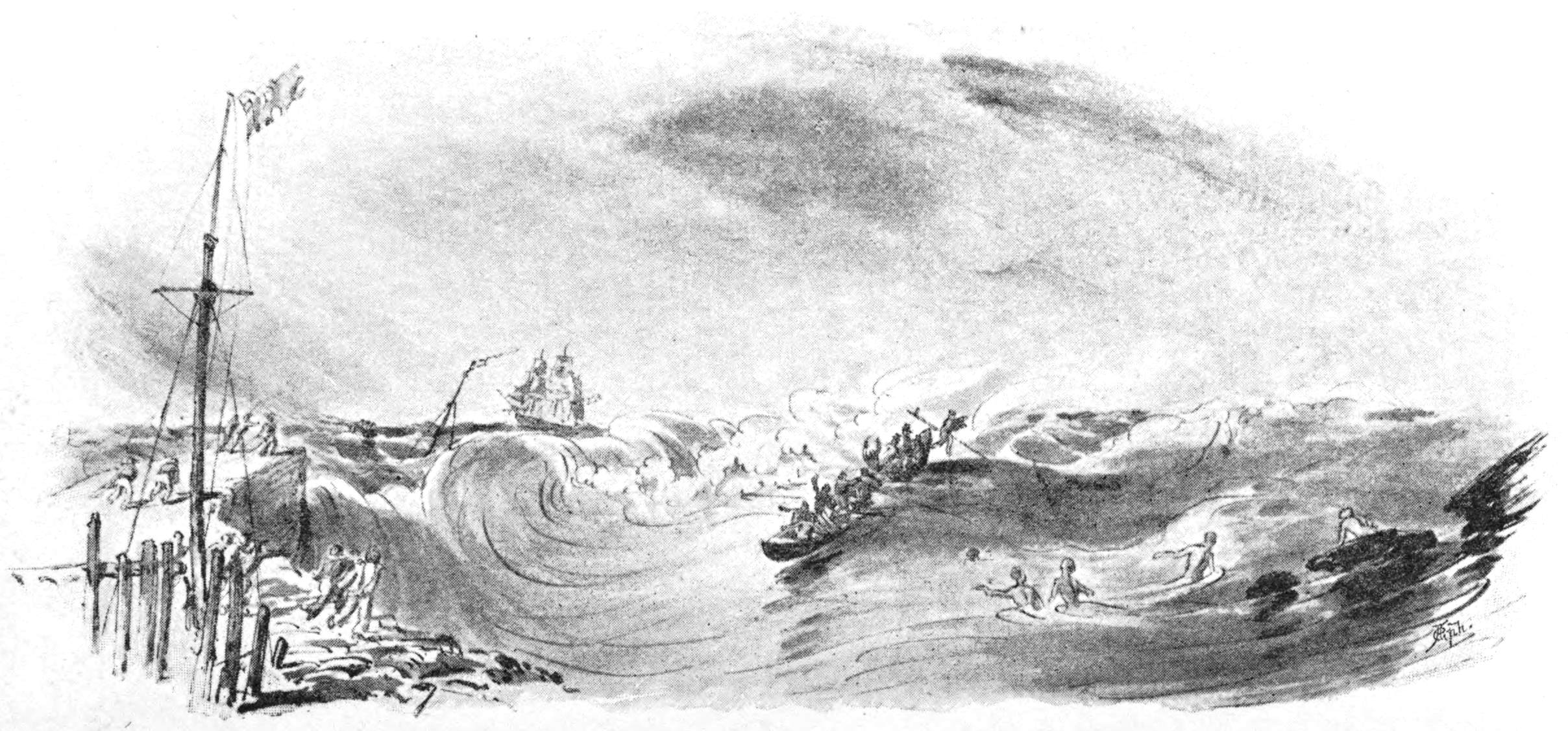
capsized by the bore. He rescued three out of a
crew of eleven, and these were half drowned when
he reached them.
Aug. 23.
We moved down as far as the mouth of the
Linga, and on the night of the 24th were once again
in Sarawak. Here the rejoicings of the previous
year were repeated.
Aug. 28.
But having received information that Seriff Sahib
had taken refuge in the Linga River, and, assisted
by Seriff Jaffer, was again collecting followers, we
were off again on the 28th, with the addition of the
Samarang’s boats. And, determining to crush this
persevering pirate, in the middle of the night came
to an anchor inside the Linga River.
When our expedition had been watched safely
outside the Batang Lupar on its return to Sarawak,
all those unfortunate families that had concealed
themselves in the jungle after the destruction of
Patusen and Undop, emerged from their hiding-places,
and by means of rafts, canoes, packerangans,
or anything that would float, were in the act of
crossing towards Bunting, a flourishing place. Their
dismay can well be imagined when at daylight on
the morning of the 29th they found themselves
carried by the tide close alongside the terror-spreading
steamer, in the midst of our augmented fleet.
Escape to them was hopeless; nor did the women
seem to mind. It was a choice between starvation
in the jungle or coming under submission to the
white man.
I need not say that, instead of being molested,
they were supplied with such provisions and assistance
as our means would permit, and allowed to pass
quietly on. We sent several of our native followers
into the Batang Lupar to inform the fugitives that
our business was with the chiefs and instigators of
piracy, and not with the ryots of the country.
Aug. 29.
With the ebb-tide a number of boats came down
from the town containing the principal chiefs, with
assurances of their pacific intentions; welcoming us
with presents of poultry, goats, fruit, etc., which we
accepted, but paying for them, either in barter or
hard dollars, the fair market price. We learned that
Seriff Sahib had arrived at Pontranini, some fifty
miles beyond their kampong.
We immediately proceeded in chase of him, at
the same time despatching two boats to look out for
Macota, who was expected at the mouth of the river.
We knew what the fate of this once powerful chief
would be if he fell into the hands of our friendlies.
He was captured alive in a deep muddy jungle into
which he had thrown himself when our men arrived.
Leaving Macota a prisoner on board the Phlegethon,
with the flood-tide we pushed forward in pursuit of
Seriff Sahib.
Aug. 30.
For two days we dragged our boats twenty miles
up a small jungly creek; but Seriff Sahib fled across
the mountains in the direction of the Pontiana River.
So close were we on his rear that he threw away his
sword, and left behind him a child, whom he had
hitherto carried, in the jungle. Thus this notorious
chief was driven, single and unattended, out of the
reach of doing any further mischief.
The boats returned, and took up a formidable
position off Bunting, where Seriff Jaffer was summoned
to a conference, which he attended, but under
compulsion from his people, who feared their kampong
being destroyed.
On this occasion I had the satisfaction of witnessing
a splendid piece of oratory delivered by Brooke
in Malay. The purport of it was, as I understood,
to point out the horrors of piracy on the one hand,
which the British Government determined to suppress,
and on the other the blessings arising from peace and
trade, which it was equally our wish to cultivate;
and he concluded by fully explaining that the
measures adopted by us against piracy were for the
protection of the peaceful communities along the
coast. The people listened with great attention; a
pin could have been heard, had it dropped, during
Brooke’s fine speech.
Sept. 4.
The force again reached Sarawak, and thus terminated
a successful expedition against the worst
class of pirates on the coast of Borneo.
CHAPTER XXXIV
Dido
1844.
Sept. 5.
Steamer’s crew cutting wood, I writing distressing
letters to the friends of Wade, as well as to the
father of Dr. Simpson. Hospitably entertained by
Belcher.
Landed sundry parties after deer and hog.
Oysters fine, the best things here.
Sept. 9.
At an early hour started on a pleasure excursion.
Late at night anchored in the Lundu River,
having tiffed by the way at one of the small islands
on splendid oysters.
Sept. 10.
Anchored off the town; visited, and was hospitably
entertained by, the Dyaks. In the evening had
a feast and a war-dance; was in other ways much
amused. Slept in the Dyak “scullery” house.
Sept. 11.
Collected all the dogs and beaters and proceeded
to the mouth of the river. All sport confined to
the Dyaks, we never getting a shot; very good fun,
though—a hog was caught by dogs and speared by
natives.
Sept. 12.
Landed again early; more hogs taken by the
natives. Working on towards Santobong; capital
luncheon on the finest oysters. Dined on board the
Samarang.
Sept. 13.
Brooke and self returned to Dido in gig, twenty-five
miles’ pull. Found heavy sick-list, one marine
just expired of dysentery.
Took up quarters with Brooke at The Grove.
Deputations and tenders of allegiance from all the
surrounding chiefs satisfactory.
Sept. 14.
Preparing for moving down. Boats to finish;
spars to get on board; captured guns to embark.
Visited the Rajah and the Datu, “Father of Hopeful,”
his women sprinkling us with yellow rice and
gold-dust—one graceful and pretty and well dressed.
Sept. 15.
Too much to do on board. Did not go off to
muster.
Sept. 16.
At daylight saw from my window Dido salute
Rajah and commence dropping down the river.
Sept. 18.
Went down after breakfast, accompanied by
Brooke, and found my Dido at anchor off the junction.
Moved further down on rising of tide.
Sept. 20.
Williamson, Turnour, Partridge, Charlie Johnson,
and Douglas came down from Sarawak to dinner.
Sept. 21.
Cruikshank and Williamson to dinner. Finished
my claret.
Sept. 22.
Reached the mouth of the river. Present of
warlike weapons from Budrudeen. Took leave of
dear Rajah Brooke, and worked the ship over the
bar of the Maratabu.
Singapore,
Oct. 1.
Arrived in Singapore. Ordered home. More
anxious for passage than my one cabin can hold.
Selected a rough diamond, but great character, one
Michael Quin, lately Captain of Minden, hospital
ship, also Lieutenant Inglefield. I had but one cabin,
but could swing more than two cots.
Pleasure of thoughts of home damped by news
of the death of my sister, Lady Leicester.
Oct. 3.
News of Pelican having sprung a leak; hope not.
Phlegethon off for Brooke and Borneo. Dined with
Oxley. His nutmeg plantation worth seeing—cinnamon
and cloves.
Oct. 5.
Lots of rain. Napier spliced this morning.
Tiffin at Balestiers’ to meet the happy pair. Good
fellow Napier, and a pair well matched.
Oct. 9.
Up very early. On board Diana steamer with
Governor and Mrs. Butterworth. Lady party;
Dido’s band. Returned by Rhio Straits. Dance on
board. Pleasant day.
Oct. 10.
Called on the Blundells. Like her and her sister
much. Dined with Stevenson.
Oct. 11.
A snug little dinner of ten good fellows prior to
a dance given by Tom Church in honour of the
Dido’s Captain. Band got drunk.
Oct. 14.
My Dido visited by Governor and Mrs. Butterworth,
Mrs. Blundell, and sister—the three nicest
women in Singapore. A grand parting dinner given
to me by the inhabitants of Singapore. Nervous,
very, making my speech.
Oct. 15.
Old Balestier, American Consul, on board; salutes,
etc., Governor, giving a grand dinner to “meet
Captain Keppel”; ladies there; more nervous in
returning thanks.
Oct. 16.
Weighed from Singapore. Fort saluting me.
Invalids improving.
Oct. 19.
Passed mouth of the Moowar, of bygone memories.
Came to off Malacca at sunset.
Oct. 20.
Called on Governor; both nice people. Visited
Salmona and stopped to dinner; drove in with
Morrison afterwards.
Oct. 22.
Young Barney Rodyk embarked; sadly pressed
for room; made sail. Wolverine in co.
Oct. 23.
Well ahead of Wolverine. Came to off Parcelar
Hill; boarded by a boat from a ship full of
pilgrims from Mecca, having struck on a bank with
loss of rudder and hard up for water. Sent Wolverine
to her assistance.
Oct. 26.
No use fretting about the wind. Hardly consider
myself as homeward bound until round Acheen
Head.
Oct. 28.
Decided, against Master, on southern passage, and
anchored off Penang at sunset. Went to Captain’s
house, the most comfortable quarters in India.
Issued invitations: “Captain Keppel and officers
request the pleasure of everybody’s company to-morrow
evening.” Dined with Sir William and
Lady Norris. Mrs. Hall at home.
Oct. 30.
Visited various hospitals with Cantor—one of
lunatics of all sorts. Got “Chopsticks” from school.
Dined with old Lewis. Capital ball and supper given
by “Didos.” Kept up till daylight did appear.
Oct. 31.
Weighed before turning in; very seedy, though.
Fort saluted me with 13 guns. Really off for home.
Nov. 1.
Lots of talk about the ball; everybody pleased.
Nov. 5.
One of the invalids from Driver died—a young
man; the effects of Hong Kong climate. Committed
his remains to the deep. Sensible to the last that he
was going, but did not seem to trouble himself as to
the road; a good man, too, in his way.
Nov. 22.
Anniversary of the birthday of Princess Royal.
Run of 251 miles in last twenty-four hours.
Simon’s Bay,
Dec. 4.
My cabin-meeting of the fine arts. Inglefield
doing me pictures of my Dido. Ran into Simon’s
Bay with a leading wind, saluting the flag of my
kind friend Sir Jos. Percy, of Mediterranean memory,
whose flag was now flying on board Winchester—Captain
Charles Eden. Found George Woodhouse
here in the Thunderbolt, 6, a steam vessel.
In fact, I felt myself already at home—scarcely a
stone on shore that did not convey some pleasant
reminiscence of happy days. In every house a
home. While refitting I had scarcely time to call
on half my kind friends. Among those I undertook
to entertain at my table, in addition to my two
passengers, was Edward Drummond, a nephew of
the Admiral, and about to enter the Church.
[Years afterwards I was his guest at Cadland,
Southampton, and he the head of the great Drummond
Bank at Charing Cross.] My other guest, a
quiet, retiring Swede, who had served his term in our
service, by name Adleborg, a clever artist as well as
a good fellow.
Dec. 16.
Luncheon with Lady Sarah Maitland—like the
Lennoxes, nice family. At Wynberg; a very agreeable
dinner and evening. Kerr Hamilton there.
Dec. 18.
Ship ready. Stopped to luncheon with Admiral
at one. Went over Winchester: nice order and
beautifully clean. My Dido under way, Charles
Eden putting me on board. Outside, a freshening
breeze from the south-east, but we had to weather
the Cape. Topgallant sails over double-reefed topsails;
a strong set against us. It was not until close
to the Anvil and Bellows that we felt the full
strength of the current. The Master and self had
taken our position on the forecastle, each holding on
to the up-and-down part of the fore-topsail sheets,
spray breaking over us. We now became aware of
what we had undertaken. On looking under the foot
of the fore-sail, the Cape and South Africa appeared
to be rushing at us: it was too late either to bear
up or attempt to tack. Held on, I am afraid, with
eyes closed. The Master was the first to call out,
“Wave weathered”; the offset from the rocky
Cape alone saved us: we appeared to be rushing
up the west side of the African coast. On the
weather-quarter the Cape appeared close to, but
towering far above our mast-heads. By degrees, but
slowly, we drew off the west coast. I do not
believe that any other ship could, under the circumstances,
have been saved.
Dec. 20.
Adleborg a first-rate artist, clever at allegorical
sketches of Dido, which I value; very clever and
witty they are.
Dec. 27.
2 A.M.—Anchored at St. Helena. Visited old
Solomon and his shop; also Colonel and Mrs.
Trelawney. Weighed at 1.30 P.M. According to
notice, made sail 3 P.M. Found Larne and Rapid.
1845.
Jan. 13.
Sails splitting and ropes giving way; foolish
economy, ships not being better supplied.
Jan. 27.
Breeze freshening up; thermometer falling;
bitter cold, hazy weather. Hauled in; made the
land to the eastward of Bill of Portland; bore up
for the Needles: arrived at Spithead. Reported
myself to my old friend Hyde Parker, Admiral
Superintendent of the Dockyard, Commander-in-Chief
Sir Charles Rowley being on leave. It was blowing
fresh from the S.E., but having an experienced pilot,
gave the Master leave to stay on shore the night,
and sent my gig on board.
Jan. 27.
Admiral Parker said I had better call in the afternoon,
as he had telegraphed to the Admiralty. I
then visited my old friend Casher, the wine merchant,
and inquired if he knew anything of the whereabouts
of my wife, as he had always forwarded parcels between
us. He informed me that she had come
home from Boulogne: only two days ago he had
sent parcels to my place at Droxford, where she had
joined her father, who, with his family, had taken
possession.
The days were short, and it was dark before I got
back to the Admiral; he informed me that Dido was
ordered to Sheerness. I ventured to state that I
had ordered my gig on board. He said: “I have
anticipated that; you will find the Fanny tender
fast to a buoy at the harbour, with orders to take
you off.”
Now this was a go; I had been more than four
years absent: my wife within thirteen miles.
I went to Casher’s and inquired if he had a man
acquainted with Gosport, or any one who could find a
Mr. Allen, Master of the Dido, and bring him to
me. I waited a good while, in cocked hat, sword, and
epaulettes, before the poor Master appeared in pea-jacket
and oilskin, etc. I soon explained the state of
affairs.
He was just about my size. It ended by my saying
that he must change clothes with me. The Fanny
was waiting at the buoy. He would personate me,
find orders on board, and obey them. Allen muttered
something about losing my commission. We went
off in a wherry. On his getting on board he received
his orders, opened and read them. I touched my hat,
and said “Goodbye, Sir,” and told the waterman to
land me at Gosport. Reached Droxford in time for
dinner! Brother-in-law soon rigged me in proper
costume.
Following morning took wife and self off in a
yellow post-chaise, but my danger of being found
out was not over. The Captain Superintendent,
W. H. Shireff, was an old friend of mine; fond of
driving a team of horses, and we used to think he
managed it in a seamanlike way.
Sheerness,
Jan. 28.
When we arrived at the dockyard gates it was
luckily quite dark. Drove to the Superintendent’s
house and took him at once into my confidence.
Jan. 29.
No news of Dido! Shireff gave us a steamer to
Sheerness. Took a fly to the pilot, where we had
lodged while fitting out.
Jan. 31.
It was the third night before Dido arrived, when,
in the early morning, the good pilot Taylor took me
off and I returned the Master his hat and pea-jacket.
Soon after 8 A.M. reported arrival of Dido to Vice-Admiral
Sir John Chambers, K.C.B.
Feb. 3.
My Dido inspected for last time by Admiral Sir
John White. Very cold and rainy weather. Men
showed themselves well to the last. My brother
Tom came down.
Feb. 4.
Getting on with the dismantling. Went on
board with Tom and wife. Bitter cold weather.
Tom stopping with us—affectionate, good fellow.
Feb. 6.
Preparations for paying progressing. Dirty and
bitter cold weather continuing. Custom House
people troublesome. Smuggling progressing. Paying
off days much alike!
Feb. 12.
My reign in Dido finished this morning. Paid
off, men receiving about £4000. Glad as I am to
get back, I do not leave my ship without feelings of
regret.
CHAPTER XXXV
England
1845.
Feb. 12.
Dido paid off. Arrived with wife in London to
enjoy half-pay! My father living in Berkeley Square,
we knew where to find a dinner.
Feb. 18.
Summoned to Admiralty. Gracious reception by
Lord Haddington.
Feb. 22.
News from Brooke. Labuan ceded to the British
Government. Brooke had entrusted me with his
private diary, and a carte-blanche to use my discretion
about publishing—a more responsible charge
than I was then aware of. I had a friend, Jerdan,
editor of the Court Journal. After consultations
it was decided to publish, under the title of
“Expedition to Borneo of H.M.S. Dido.”
Feb. 23.
At my brother-in-law, Stephenson’s, in Arlington
Street, always had a bed.
Woolwich,
Feb. 23.
To Woolwich to see Commodore Sir Francis
Collier, in charge of the dockyard, his broad pennant
flying on the William and Mary yacht.
Visited also George Goldsmith, now married, living
there.
Mar. 3.
Went to Portsmouth on a visit to my late Chief,
Admiral Hyde Parker and his charming family.
Remained a week.
Mar. 12.
Attended levee with Granville Loch. Presented
by Sir William Parker on return from China. Her
Majesty said something nice to me, which, in my
nervousness, I was sorry not to have heard.
Mar. 13.
My Mids, D’Aeth and Jenkins, passed first and
second out of the lot at Portsmouth. My father
gave me the copy of a correspondence between Lord
Haddington and himself about my being the only
Captain not recommended for the C.B. Lord Haddington
wrote: “Captain Keppel’s ship had not been
under fire in action.” Father stated that Dido was
not the only ship. Lord Haddington replied: “It
is evident you allude to the Endymion, Captain Grey,
whose name had been mentioned to General Sir Hugh
Gough by Brigadier-General Schoedde.” Father could
not help thinking it was a hard case, which Lord
Haddington admitted, and promised that my name
should be down for the first vacancy. I mention
this here, as the subject was alluded to years afterwards.
Sir Grey Skipwith, recollecting my weakness,
offered me a mount with the Warwickshire Hounds,
and before leaving town I dined with that distinguished
soldier, Sir William Keir Grant.
Mar. 26.
Quickly found my way to Newbold Hall. Sir
Grey and his large family charming as ever.
Mar. 27.
Started from stables, the usual dozen red coats.
Meet at Shuckborough, found at Cranborough. Got
away with the first flight. Not recollecting the
country, found myself with about a score charging
the river Leam. Reached opposite bank, which was
rotten. Fell back and found the bottom. I believe
only two got out safe. My new pink came out
black.
Mar. 28.
Back to London to dine with Sir Thomas Trowbridge.
Mar. 30.
To Greenwich by rail, to dine in hospital with that
grand old Admiral, Sir Robert Stopford, his happy
lady and family looking so well.
April 11.
Templer and I enjoyed an excellent dinner Jerdan
gave us at the Garrick Club.
April 24.
Mr. Edward Ellice kindly lent us his house, 18
Arlington Street. Admiral and Mrs. Sam Rowley
dined with us on their way through London, she
informing me I was left in his will, heir and executor.
May 2.
We attended the Queen’s Drawing-Room.
May 18.
Lunched with the Hawleys, who had established
themselves in Halkin Street. He had a charming
yacht, the Mischief, with a woman for figurehead,
which his wife disapproved of. An image of a
monkey was executed to replace the lady; but there
was so much trouble and legal expense in changing
a figurehead, that the monkey was transferred to a
box seat over my coach-house door. As I had no
carriage the groom was not jealous.
May 19.
Archie MacDonald dined with us prior to the
Queen’s Ball. On that occasion, although an old
Fusilier Guardsman, he hid himself behind a screen
till the ceremony was over.
Droxford,
May 22.
Glad to take possession of our snug little place at
Droxford. A four-horse coach running between
Gosport and London passed our door twice daily:
a great convenience. William Garnier’s place,
Rooksbury Park, was within two miles of us.
July 3.
In London met Sir Henry Pottinger: had a walk
and a talk about China times.
Droxford,
July 9.
Arthur Cunynghame, our China friend, came to
stay with us. Also Fred Horton.
July 15.
Met George Delmé at the station. With niece to
see departure of the fleet from Spithead. Too late
to get out, so took a cruise in the Freemart Fair.
July 28.
At Cams. In Delmé’s drag to Goodwood Races.
Delmé Radcliffe, Onslow, the two Foleys, etc. My
father being of the Goodwood party, wife and I
were invited into the Duke’s end of the grand stand.
Unaccustomed to racing society, my wife was a trifle
nervous. However, observing my father in deep
conversation with a light weight in a blue coat with
brass buttons, yellow, leathers and mahogany tops,
she inquired of Lady Albemarle if that was His
Lordship’s jockey. To which this amiable lady
replied in a loud voice: “No, my dear. That is
the Duke of Bedford.”
July 29.
In Delmé’s drag. Ten outside!
July 30.
The great Cup Day. Twenty-one horses started.
Aug. 1.
Concluded a splendid week’s racing.
Sept. 6.
We left London for Quidenham. Glad to be
where I had passed my youth. The dear old father,
no longer able to shoot, had taken to breeding bloodstock.
The park near the river was cut into paddocks,
where I saw some promising youngsters for the
Derby. I was not sorry when Lady Albemarle inquired
of my wife how long we were going to stay.
We had some dear old friends in the neighbourhood:
Partridges, Surtees, Eyres, and others. Went to
Hockham on the 22nd.
Sept. 29.
A day in London on business. By rail to Chesterford,
and chaise to my friend Alexander Cotton:
the same who, as a lieutenant, was capsized with me
at the mouth of Portsmouth Harbour in October
1830, he having now succeeded to the Hildersham
property. Cotton’s house very comfortable; his
claret uncommon good.
Oct. 1.
Rode after breakfast to Newmarket. In my
father’s stables saw “Emperor,” “Smuggler Bill,”
“Little Dorrit,” “Sir Rupert.”
Oct. 2.
Cotton and self to Newmarket.
Oct. 3.
Left Cotton to visit the Partridges at Hockham.
Met at Harling Road by my old shipmate George
Partridge.
Oct. 4.
Out shooting. I killed eleven partridges and one
pheasant.
Oct. 6.
Champion Partridge came over. With the exception
of a couple of days with George Birche’s Harriers
had a capital week’s shooting.
Oct. 12.
Walked over to Larling Parsonage, where I found
my old friend Colonel Eyre, 98th, with his brother
Edward the clergyman.
Oct. 16.
George Wodehouse, Charles Partridge, and I rode
over to Quidenham to see the brood-mares and
young stock. Left Hockham for London. I was
now in possession of a couple of hunters. Intending
to enjoy myself, sent them on to Newbold, having
business in London.
Oct. 26.
From London by rail, in company with Joseph
Hawley, George Payne, Shelley, Greville, and other
turf men to Chesterford. They to Newmarket. I
to friend Cotton.
Hildersham,
Oct. 27.
To Newmarket. Racing particularly good. Cambridgeshire
stakes won by “Alum.” Twenty-eight
started, beating “Baron,” the winner of St. Leger,
and Cæsarwitch, etc.
Oct. 30.
This morning’s racing good. Backed my father’s
colt “Radulphus” in the Glasgow, and lost my money.
Newbold,
Nov. 7.
Went with Harry Skipwith to Warwickshire
Hunt; meet at Stonleigh Park, a beautiful place.
Next day to see the Athelstane; meet at the
Cross. Some pretty fencing from cover to cover
and plenty of foxes.
Nov. 10.
Sent horses to Leighton Buzzard. A hearty
welcome by Delmé Radcliffe at Hitchin Priory.
The Eliot Yorkes staying there.
Nov. 12.
Having sent horses on with Delmé Radcliffe, to
Brand’s hounds, Delmé having been Master of
Hounds was proud to mount “Heki,” and delighted
with him, as I was with my “Tom.” The run
good for this country. We went and returned in a
yellow post-chaise.
Hitchin
Priory,
Nov. 15.
Mounted by Radcliffe. Went with the Harriers
on his “Touch-and-Go”; supposed to be the best
pack of the sort in England. Good for pastime,
but it does not do after fox-hunting.
Nov. 17.
With Brand’s hounds: rode “Heki,” nothing
particular by way of a run. Pleased with my horse
though.
Nov. 20.
Harriers met at the Priory. Pretty and fast
thing. Radcliffe hunting them.
Nov. 21.
With Brand’s hounds. Rode “Tom.” Found at
Boxwood. Good run of 52 minutes. Was to the
front the whole time. Radcliffe got the brush for
my wife in commemoration of “Tom’s” performances.
Killed at Yardley.
Nov. 22.
A right good run on “Heki” with the Harriers.
Nov. 25.
In afternoon rode “Tom” with the Harriers and
had an excellent run of 50 minutes, the hare running
better than many foxes.
Nov. 26.
Sent “Heki” on to meet the Cambridgeshire at
Shear Hutch. Sharp run over heavy country. I got
the brush.
Nov. 27.
No meet. Rode to see the Charles Radcliffes at
Halwell.
Nov. 28.
With Radcliffe to meet the Puckeridge at Bedlington:
a sharp thing. Got a cropper, but was in
time to get the brush.
Gilston
Park,
Dec. 1.
By rail to Burnt Mill, where I met Henry Seymour
and Brice Pearse, who took us to Gilston Park, a
nice old place he had hired for farming purposes.
Dec. 2.
Seymour and myself to meet the Puckeridge
Hounds at Pelham. Rode “Heki”: a good gallop,
leaving off fourteen miles from home.
Dec. 3.
With Brice Pearse to a city stable. Ostler
brought out an Irish chestnut mare just under fifteen
hands. On my inquiring if she could jump, a six-barred
gate was placed across the paved passage road
leading to the stables, which she jumped without
trouble or hesitation. I paid £23 for her, and
named her “Ticket” because she cleared the gates.
She could not walk, but persevered in a jog trot to
the end of the longest day. End of season, sold
her for £70 to the Pytchley Hunt for a whip’s horse.
Dec. 5.
An idle day; mostly passed in the stable. Rode
Pearse’s pony to Harlow with Henry Seymour.
Dec. 6.
Henry Seymour and I posted twenty-two miles
to meet of Puckeridge Hounds. Had sent “Heki”
on; a good run well worth the distance.
Dec. 8.
By early train to London and on from Euston
Square to Catton Hall. Fred Horton met us at the
station.
Catton
Hall,
Dec. 9.
Catton, a nice old place. Pretty grounds—good
stabling. Drove with Fred Horton in a
dogcart. Granville Loch arrived.
Dec. 10.
Four guns. Bromley, Horton, Loch, and self to
shoot. Pretty shooting: 42 head returned. I
bagged 2 rabbits, 5 pheasants, and 11 hares. Fred
Horton shot, as he thought, a hare creeping in a
hedge, which proved to be a fox. Gave one of the
beaters half a sovereign to bury it!
Dec. 11.
Stormy morning. Rode “Ticket” to meet of
Meynall Ingram’s hounds at Gorsley Ley. Found
immediately; was fortunate in getting well away.
Pretty run for some twelve miles in an enclosed
country. Long ride home.
Catton
Hall,
Dec. 12.
The Donnington Hounds met near Derby; rode
over to Osmaston to dine and sleep.
Dec. 13.
Sat with Lady Wilmot. My China boy “Chopsticks”
much grown and very spoiled.
Dec. 14.
After breakfast rode back to Catton by Twyford
Ferry: best road for riding.
Dec. 15.
Ingram Meynall’s hounds meeting at Drakelow.
Mr. and Lady Sophia De Veux. Rode “Ticket”:
bad scenting day, and huntsmen no great things.
Ergo no run; though a find at Drakelow.
Dec. 17.
Rode “Heki” with the Atherstone. Meet at
Warton; much pleasanter having a companion to
ride to covert with. Two good runs; though a
rainy afternoon.
Catton,
Dec. 18.
General A’Court to dinner with a handsome
daughter.
Newbold,
Dec. 20.
Took leave of Lady and Miss Horton. I rode
“Heki”; groom on “Ticket” to Osmaston. Fred
Horton took care of wife by rail. Lord John Russell
unable to form a ministry.
Dec. 25.
Christmas Day. My first in England for some
time.
Dec. 27.
The Donnington Hounds met at Cork Park. A
beautiful place belonging to Sir John Crewe. “Ticket”
fell at a fence and gave me a cropper.
Dec. 31.
Wife to Newbold Vicarage. I on to London,
en route for Hockham.
CHAPTER XXXVI
Shore Time—Study Steam
1846.
Jan. 1.
At Hockham shooting.
Jan. 7.
By rail to Rugby and on to Newbold.
Jan. 10.
Mounted Grey Skipwith. Hunt with the Atherstone
at Coombe Abbey. A goodish run. “Heki”
a trifle lame.
Jan. 12.
Departure of Skipwiths in various directions,
preparatory to the Warwickshire Hunt Ball.
Jan. 17.
Grey, Sidmouth, and I to meet the Pytchley at
Crick. Certainly the finest run I had witnessed;
George Payne giving me the brush.
Jan. 22.
Went shares in a pair of posters with Grey Skipwith
to meet the Warwickshire at Shuckborough.
“Ticket” sent on from Newbold. Found, and fell
at a brook.
Jan. 27.
At Admiralty. Saw Lord Haddington. By
steam to Woolwich. Only time to look at Terrible
of large dimensions. Dined with Frank Collier.
Jan. 28.
Breakfast with Tufnell and Fred Horton.
Attended dinner given by Naval Club to Lord
Haddington on leaving Admiralty.
Jan. 29.
Up early for Rugby, where I had “Ticket” and
hunting things sent. With the Warwickshire Hounds.
Meet at Dunchurch. Capital run. Returned to
Newbold.
Jan. 31.
Rode “Heki” with Grey Skipwith to Leamington.
Took his mare and £30 in exchange for “Ticket.”
Leamington,
Feb. 2.
“Heki” falling lame, left him at Leamington and
returned by rail to Rugby.
Feb. 3.
Took leave of Newbold. Established ourselves
in lodgings at Leamington, for wife to be near
Doctor Jephson. Horses at Stanley’s. “Heki” still
lame.
Feb. 4.
Feb. 7.
Grey Skipwith came to dine and sleep. Letter
from Mrs. Rowley announcing death of grand old
Admiral Sir Josias, and enclosing a copy of his will,
in which, should he survive his wife, after legacies,
he had left everything to me—a kindness I had no
right to expect.
Feb. 10.
Leamington full of lame hunters. By train to
London.
London,
Feb. 11.
Horton appointed to command of Cygnet, 6 gun
brig, on coast of Africa. Attended levee of First
Lord.
Feb. 12.
Great naval dinner at Thatched House Club.
Prince George of Cambridge there.
Feb. 13.
Eleven train to Leamington. Wife better.
Leamington,
Feb. 18.
Rode with Grey Skipwith to see the Steeplechase
at Southam. An amusing scene, but Leamington is
not the most amusing place for a man who cannot
keep horses.
Feb. 21.
Sold “Heki” for £15. Once refused 100 guineas!!
Feb. 28.
Dined with First Lord of the Admiralty.
Mar. 1.
By steamboat to see Frank Collier at Woolwich.
He, Nic Lockyer, and I went over the Terrible, an
enormous vessel, 1847 tons, 800 horse-power.
London,
Mar. 4.
News from the Enlightened States. More warlike
than ever. Lost no time in tendering services
to Lord Ellenborough.
Mar. 5.
Met Sir Charles Fitzroy, with boys, Augustus
and George, grown into men: little Mary into a
tall handsome mother of three children.
Mar. 10.
At Leamington. Dined at Lady Farnham’s:
grub good, but seven ladies!! Saunders and self
only gentlemen.
Mar. 11.
To Coventry races. Racing good as far as horses
being well matched. Rough attendance.
Leamington,
Mar. 18.
Sported phaeton and pair of horses for the three
days’ racing.
Delmé Radcliffe, Gore, and two Skipwiths to dine
with us.
Mar. 19.
Steeplechase Day. Leamington full of ’legs and
all sorts of rogues. Party of six to dine. “Grand,
for us!” First-rate steeplechase.
Mar. 21.
Acted as chaperon to Amelia Williams; she
riding Wood’s horse. Warwickshire meet at Stonleigh,
afterwards steeplechase at Southam.
Mar. 22.
Bury came to us from London to go to the second
ball: he dancing mad.
Leamington,
Mar. 23.
A good steeplechase at Warwick—country heavy—“Pioneer”
winning—a splendid horse.
Mar. 24.
Mounted J. Wood to see the meet at Ladbrook.
Mar. 25.
Dining with Stephenson, Fox Maule, Lord Ebrington,
Maria, and brother Edward.
London,
Mar. 27.
Dined with the Duchess of Inverness; large
party.
Mar. 28.
Talk with Lord Francis Egerton about Brooke
and Borneo. Constance frigate offered to Walker,
who appears undecided. Dined with the Hawleys—family
party. That beast “Chow” dying.
Mar. 29.
Went to Woolwich to look for lodgings for my
studying steam. By Frank Collier’s advice closed
with a Captain Dwyer—not much; however, the best.
London,
Mar. 30.
Took leave of Fred Horton at the club, lucky
that he has not more than a year to run in Cygnet
on the coast. Dined with Ralph Brandling; Adelphi
afterwards.
Mar. 31.
By express to Portsmouth. Dined with the Hyde
Parkers in Dockyard; Admiral in great form.
Leamington,
April 19.
Dined with the Gores, who have been very kind
to us. Fare-thee-well Leamington. With horses
and money I should find you more agreeable.
April 23.
Took departure for London. Letter from Brooke,
and news from Borneo not pleasing to Wise. Government
slow in acting for him. To Droxford by 3 P.M.
train.
May 1.
Took our departure from our snug little Droxford.
In London by 2 P.M. Got Mrs. Rowley her
pension at Admiralty. To Woolwich by steamer.
Took up quarters in Captain Dwyer’s house. Wife
not taken with our new abode.
May 3.
To church in a sail-loft in the Dockyard. Went
to Greenwich in the afternoon: looked at houses.
May 5.
To Greenwich. Decided on No. 17 Croom’s
Hill at £150 per annum; nice situation, looking into
the Park.
May 6.
Letter from Commander Dwyer refusing to let
me off under three months’ rent! Unlucky dog
that I am, £36 thrown away. So much for having
to deal with a gentleman.
May 8.
To see the Horse Artillery exercise. Edward
Coke and Sir E. Poore to call; they going to West
Indies in June for amusement.
May 9.
To London. Saw my father; well in health;
going to Newmarket.
May 12.
Receiving a letter from Sir William Symonds,
asking if he might nominate me to command his
Spartan, started for Somerset House, and found
from Edge that I was wanted, as in case of Constance,
as a second string to his bow.
May 15.
Attended the meeting of the Committee for
the Foundation of a Church Mission-House and
School in Borneo. Some large subscriptions received.
May 21.
Again over to Greenwich; hard bargain with
Mrs. Kemp. Georgie Crosbie and early dinner.
May 23.
Took my first lesson in steam at Woolwich.
Hearing that a foreigner was inquiring after me,
avoided him; it turned out afterwards to be an old
Spanish friend, General Mazzerado of Barcelona,
who stopped to dinner.
By Templer heard of a most diabolical massacre
committed in Borneo Proper.
May 25.
Commencing steam study in earnest.
A Princess born. (Princess Helena.)
May 26.
Breakfast at half-past eight. Start at nine to be
in Dockyard by ten. Pleasant enough while the
weather is fine. Dined at Greenwich Hospital with
Sir Robert Stopford to celebrate Her Majesty’s
birthday. Pleasant party.
May 27.
Derby Day, and I not there. Won by Mr. Gully’s
“Phyrrus.”
May 28.
The sad news of the massacre of Rajah Muda
Hassim and family, and his gallant brother, Budrudeen.
June 2.
Greenwich Fair. Joined George King and his
party in a small Whitebait dinner at the “Crown and
Sceptre.” Paraded the Fair afterwards.
June 11.
Dined with Sir James Gordon, Lieutenant-Governor
of Greenwich Hospital. Though he lost a leg in
Hostes’ Lissa frigate action, Gordon frequently walks
from London.
London,
June 13.
Attended the wedding of Amelia Williams and
Mark Wood—also to déjeûner given by the Bulkeleys.
Lovely day; pretty wedding; good breakfast; everything
right.
June 14.
Early dinner with the Hawleys. Tattersalls and
Park afterwards.
June 15.
To Woolwich Dockyard, Dined with Colonel
Parker to meet kind friend, his brother, the
Admiral.
June 16.
Dined with Commander and Mrs. Dalyell in the
Hospital. He was for nine years a prisoner of war at
Verdun; released when Napoleon I. went to Elba.
Anyone interested in the record of a sailor’s life
during the end of the last century and early part of
this should read that of my old friend, who was now
a pensioner, with apartments in Greenwich Hospital.[1]
The Dalyells are kind people and have exceedingly
good taste.
June 17.
To Woolwich by steam, meeting on board Lord
Selkirk, Captain Ross, and Ranelagh. Went to
Arsenal. Georgie and Jack Crosbie and Grey
Skipwith to dine.
June 18.
An impertinent letter from Wise: answered him.
June 19.
To Woolwich by steam.
June 21.
Called on Sir James Gordon and on Sir Watkin
Pell.
Sir Watkin Pell—a wooden leg, and a wonderful
clever pony on which he used to ride on a three-plank
bridge when visiting ships fitting out in dock.
June 24.
Dined at the Stopfords.
June 25.
Dined in London with my father; returning afterwards
to Greenwich.
June 27.
We went to see the muster of Greenwich schoolboys.
Interesting sight. 800 of them dining in
same room. Ministers about to resign.
June 30.
Represented Brooke at the christening of Templer’s
boy, named James Lethbridge Brooke.
July. 13.
Business at Admiralty. Saw Lord Auckland about
Borneo.
July. 16.
Concocted a letter for Lord Auckland, recommending
possession of Labuan.
July 17.
Capital dinner with Sir Watkin Pell. To the
Artillery ball at Woolwich. Nothing could be better
done.
July. 21.
Dined with Sir Robert Stopford. Greenwich ball
in the evening; very good.
July. 24.
To London with Jack Templer to see Lord
Auckland concerning Brooke.
Very mysterious. Government evidently doing
something. Afraid, I think, of Mr. Hume.
July. 29.
To steam studies. Met Board of Admiralty in
the Dockyard. Received intimation that my services
would be again required in Borneo.
July. 30.
Skipwith and ourselves to dine with the
Newdigates, who have pretty place at Blackheath.
Aug. 3.
After studies visited famous mulberry tree in
Collier’s garden.
Aug. 5.
Students in steam met at Blackwall to examine the
machinery of the Sir Henry Pottinger, a merchant
steamer.
Aug. 20.
Accompanied Captain Stewart in the Trinity yacht
to meet the Admiralty Board at Gravesend to inspect
several plans for lights to be carried by steamers at
sea to prevent collision.
Aug. 25.
Invited Roberts to dinner, to meet Edward Rice,
who did not arrive until late.
Rice to join Amphion should I get her!
Aug. 27.
At Admiralty to stop Comber being sent off to
sea. Partly succeeded. Came back to dine with Sir
Watkin Pell.
Sept. 2.
Woolwich, preparatory to being examined by
Lloyd. Passed an hour in the Superintendent’s
mulberry tree!
Sept. 7.
By Gravesend steamer to Purfleet, where Sir
Thomas Lennard sent his carriage to take us to
Belhus for three days; brother Tom having married
his daughter. Large party; hearty welcome. This
is a nice old-fashioned place. Our room the one
in which Queen Elizabeth slept.
Sept. 9.
After luncheon we were taken a drive with the
team round the country. Went to Mr. Tower’s
place: he has some fine old pictures.
Sept. 10.
Took leave; pony carriage taking us to Gray’s
Pier. Embarked for Blackwall loaded with game
and fruit.
Sept. 17.
I dined with the Artillery mess at Woolwich.
Sept. 23.
To London to attend Borneo Church Mission.
Capture of Brunei. Saw Mundy’s letter to Baillie
Hamilton at the Admiralty relative to the affairs there.
On return found Edward Rice from Dane Court.
Sept. 25.
To Admiralty to deposit with Lord Auckland my
father’s correspondence with Lord Haddington relative
to my not getting the C.B.
Sept. 28.
We took the two charming Dalyell girls to the
Woolwich Garrison races. Very good fun: heats and
that sort of thing; gentlemen riders.
Oct. 1.
Visited Sir Samuel Brown of chain-cable notoriety,
and saw several ingenious inventions.
Oct. 7.
To London. Wife on a visit to the Roes at
Fulham.
Among the intimate friends of the Crosbie
family were Sir Frederick and Lady Roe. His
father was a well-to-do merchant residing in the
City. My father amused me with the following:—As
Master of the House he had to attend State
occasions. On going to the City, Sir Frederick Roe
was so active with his mounted police as to draw the
attention of His Majesty, who inquired who he was.
Father informed the King that it was Sir Frederick
Roe, the Head of the Police. His Majesty noticed
another officer equally active, and very like Sir
Frederick, who my father informed His Majesty was
a younger brother, likewise in the Police, who helped
his brother on these occasions, and they went by the
name of “Hard” Roe and “Soft” Roe. This amused
His Majesty so much that he wanted to know about
the father. This rather puzzled my parent, who,
having volunteered so much, did not like to plead
ignorance, but answered “They call him, Sir, Paternoster
Row!”
Oct. 8.
Ascertained at the Admiralty they had no idea of
forming a Settlement on the Bornean coast.
Power of a “wise” confidential agent beginning
to tell.
Oct. 10.
To Ranelagh House, Fulham, to join wife at Sir
Frederick and Lady Roe’s.
Oct. 15.
Having been invited by Sir Charles and Lady
Mary Fox to dinner at Addison Road, sent to Greenwich
for clothes. Wife dining with the Dalyells.
London,
Oct. 16.
Found letter at club from Symonds, stating that
he had applied to Lord Auckland to appoint me to
Cambrian for trial with Thetis.
Dined with Sir Robert Stopford; a large party.
Oct. 17.
To Admiralty to inquire about the Cambrian;
find I am the favourite, Lord Auckland hovering
between Smith and myself for the appointment.
Oct. 21.
Dined on Guard at St. James’ with Colonel
Codrington.
Oct. 22.
Nothing decided about Cambrian, Lord Auckland
waiting for Sir Charles Adam’s opinion. Still
hope.
Dined at the Newdigates.
Oct. 23.
Reports of my appointment to Cambrian; hope
they may prove true. Stephenson writing to thank
Lord Auckland.
Dined with John Doyle and Lady Susan North.
Oct. 24.
To see Admiral Dundas. Early proposal of
appointing me to Amphion. No fancy for her,
while there is a chance of Cambrian.
We dined at Colonel Parker’s. On return found
letter from Dundas, a damper on hopes of Cambrian.
Oct. 27.
Baillie Hamilton in the Rangers’ House. Commander
Henry Eden married to Miss Rivers. Wish
to get Lieutenant Rivers as my First.
Oct. 29.
Dined with Lord Auckland.
Dane
Court,
Oct. 31.
At Dane Court with the Rices; like Dane Court
and all its people. Everybody receiving me so kindly;
the children too, as if they had known me all their
lives.
Nov. 2.
A walk with Fanny and Anne in forenoon.
Afternoon to Dover. Saw 43rd and H. Skipwith
inspected on the heights.
Nov. 4.
Received twelve guineas due to members of Old
Navy Club, Bond Street. Retirement list out, of
180 Captains.
Nov. 5.
Dined with my father. Shireff wanting me as
Flag-Captain.
Nov. 6.
To Woolwich to see Sir Frank Collier for last
time as a Commodore.
Nov. 8.
Dined in London with Stephenson. Meeting
Hastie and Sir John Hobhouse.
Nov. 9.
Lord Mayor’s Day. Promotion in Army and
Navy. Dined with Admiral Dundas. Large party
at Lord Auckland’s in the evening.
Nov. 10.
Club full in anxious expectation of “Gazette.”
The greatest boon that has been granted to the Navy.
Dined with General Mundy and family. Disappointed
about the promotions.
Nov. 16.
Dined with Sir Robert Stopford.
Nov. 17.
Farewell dinner with the Dalyells. We have been
treated at Greenwich with the greatest kindness and
hospitality.
Nov. 19.
Dined at Club. A meeting of old “Magiciennes,”
Plumridge, Knox, Forbes.
Nov. 24.
Called for Stephenson at the Excise: with him
to Cambridge, where, after having enjoyed much
worth seeing, dined with Henry Coke: Augustus
Stephenson and young Lord Durham of the party.
We slept at the University Arms.
Nov. 27.
Visited my brother George at his office, Downing
Street. Chance of my being appointed to Amphitrite.
Returned with Pearse to Gilston.
Nov. 28.
Brice Pearse mounting me; after several hours,
without finding, finished with a fast twenty minutes
with Conyer’s hounds. In first at the death, and
got the brush.
Nov. 30.
Party to shoot. Keeper reserved best ground
until too dark—only a small bag.
Elsenham,
Dec. 3.
Took leave, after luncheon, of our friends. On a
visit to the Rushs at Elsenham: a pretty place.
Much taste and considerable expense in the making.
H. Byng, alias “Buckets,” with his wife to dinner.
Newbold,
Dec. 5.
By early train to London. In time to leave
Euston Square for Newbold by eleven o’clock.
Dec. 12.
Sharp frost. Hunters more expense than profit.
Dec. 25.
Enjoyed Christmas at Newbold, sitting down
twenty all told. Sir Grey presiding. Eight sons,
five daughters, two husbands and wives and ourselves.
The younger son—a nervous boy, studying for Holy
Orders—was called on to say grace; after hesitation
got up and said: “For what we are going to receive,
the Lord have mercy on us.” A more cheery
Christmas could not be.
Having business in London, and hoping for
employment, left my poor invalid under care of the
celebrated Doctor Jephson, at Leamington.
Dec. 28.
To my second home, the Stephensons in Arlington
Street.
Dinner off Norfolk turkey, and a hot devil
by sister.
Dec. 29.
At Hockham shooting, with the Partridges,
Charles, George, Paterson, and self. Shot with my
new Westley-Richards. Much pleased with it.
CHAPTER XXXVII — Postscript to 1847
Shore Time
1847.
Jan. 2.
As brother Tom could not, with increasing family,
come to me, I went to his parsonage at Creake in
Norfolk, where we were joined by my other clergyman
brother Edward. Creake only a walk from
Holkham.
This entailed visits to other dear friends; but as
these have not much to do with the promised sailor’s
life, must not detain readers.
Jan. 3.
Sunday.—Both brothers preached; I suppose the
elder had choice. Reserved opinion.
Recollect some time ago, when brother Edward
preached at Quidenham, venturing to remark that
his sermon was rather lengthy. He replied: “It
now lies at the bottom of a heap and you won’t
hear it again for three years.”
Jan. 5,
Holkham.
Went out, fifteen guns, 1085 head.
Jan. 6.
Drove back with Napier, rector at Holkham,
elder brother of Brooke’s Singapore friend.
Jan. 7,
Holkham.
Shooting the end of the park in the direction of
Warham; twelve guns, 973 head.
Jan. 8.
Another good day’s shooting; 1073 head.
Jan. 9.
News of the safety of Edward Coke, who had
been buffalo-shooting in the United States. Never
once doubted it.
Jan. 11.
Tom and I drove to cousin Fred Keppel’s at
Lexham, about eighteen miles. Hearty welcome.
No better fellows than Fred and Edward Keppel,
“the Cheeryble Brothers.”
Lexham,
Jan. 12.
Went out to enjoy the best shooting Fred had
left. Six guns: Fred Fitzroy, Derrick Hoste, Fred,
Edward, Tom, and self.
Jan. 13.
Wife improving at Leamington under Jephson.
Fred Keppel and brother Tom doing magistrates’
business at Litcham.
Jan. 14.
Party breaking up. Fred Fitzroy dropping me
at friend Rev. C. D. Brereton’s.
Jan. 16.
Took leave of Brereton. Drive of eleven miles
to Creake. Bitter cold. Henry Coke arrived from
Holkham.
Jan. 18.
To Bobby Hammond’s, now a rich banker;
change from a mid’s berth.
Jan. 22.
Fred Keppel drove me to brother Edward’s.
Quidenham
Parsonage,
Jan. 23.
Looked over the Quidenham Stud paddocks.
Some old brood-mares and four yearlings. A colt,
“Borneo,” promising looking.
Jan. 25.
Fred Keppel taking me back to Lexham, sent
things to Anthony Hammond’s at Westacre.
Followed in afternoon. Charming place as well
as host.
Jan. 26.
Anthony, Bob Hammond, Henry Coke, and
others came to dinner.
Jan. 28.
Henry Coke and I took departure from Westacre,
posting to Brandon, by rail to Cambridge. Henry
having left the Navy had lodgings there: a quiet
dinner with him.
Jan. 29.
To London; with Stephensons in Arlington
Street.
Feb. 6.
Joined wife at Leamington.
Feb. 8.
To London. Father recovering from illness.
Feb. 10.
Letter from Admiralty requesting me to sit on
a Commission to report on Naval Uniforms—Chairman,
Rear-Admiral Bowles, C.B. Committee:
Rear-Admiral Sir F. Collier, C.B.; Captains A.
Fanshawe, C.B.; J. Shepherd; Hon. F. Pelham;
A. Milne; Lord Clarence Paget; and W. F.
Martin.
Feb. 19.
Poor Thistlewayte quite blind.
Droxford,
Feb. 20.
Rode to Collier’s new house at Wickham.
Nothing more neat, complete, and comfortable.
Feb. 25.
Wife and I on a visit to Southwick. George
Delmé came to dinner.
Mar. 1.
Walked from Southwick to Droxford, and afterwards
to Rookesbury. Thistlewayte sending wife
there in carriage. Good William Garnier insisted
on our all staying at Rookesbury.
Rookesbury,
Mar. 2.
William Garnier mounting me, we rode to the
Dean’s at Winchester. Sister Caroline out. Called
on Walter Longs on our way back. Collier and
Campbells to dinner.
Mar. 5.
On Garnier’s hack to see Hambledon Meet.
Many friends, but a bad scenting day.
Portsmouth,
Mar. 6.
In break, picking up Wickham’s Admiral,
Collier, on the way. Lunched with the Hyde
Parkers. Sphynx in harbour after six weeks on
rocks at back of Isle of Wight.
Mar. 8.
By coach to stay with Sivewrights, Symington.
Years since Edward Sivewright and I met. At
Symington, canvassed for brother George.
Droxford,
Mar. 11.
Busy with accounts. How much I want money,
and have wanted, for some time. Still here we are
jogging on. One-half the world never knows how
the other half lives!
Visit to Cousin Delmé’s at Cams.
Cams,
Mar. 13.
Admiral Sir William Gage came to Cams.
Mar. 15.
By rail to Winchester, leaving wife at the Deanery.
George Delmé and I went to see sundry blood-stock
at Dilly’s and Stockbridge. Expensive playthings!
“Venison” a fine horse.
Cams,
Mar. 16.
In Delmé’s drag to meet the Hampshire Hounds
at Rockwood, Colonel Greenwood’s. Delmé sending
a hack for me. Martin Haworth master. No finer
day, though, to see hounds and horns.
Mar. 19.
Delmé sending me a mount with the Hambleton.
Good gallop over the Downs. Lost near Ditcham.
Winchester,
Mar. 24.
Fast Day—Appointed to be kept by the Government
on account of the distressing famine in Ireland
and Scotland. Properly and strictly observed (to
all appearance) throughout the country.
Mar. 25.
Rode pony over to Campbell Wyndham’s at
Exton. Accompanied Mrs. Wyndham to see Hants
Steeplechase. Sport bad, company good, day fine.
Good dinner and party at Wyndham’s; slept there.
Mar. 31.
Rev. Mr. M‘Dougal volunteered for Borneo.
Good man.
April 2.
Good Friday.—Salt fish and thirst!
April 14.
May 20.
Letter from Harry Stephenson announcing birth
of the finest boy in creation. Saw in the papers
death of the Earl of Bessborough, Lord-Lieutenant
of Ireland—a national loss.
May 22.
By rail to London. Friends Crawfurd Kerrs
arrived from China.
May 25.
Sir Charles Napier going to apply for me as his
Flag Captain!
May 26.
This day my old friend Jonas Coaker had his
little boy christened Keppel Coaker.
May 27.
Hawley’s mare “Miami” won the Oaks, ridden
by Sim Templeman. Dined with the First Lord of
the Admiralty, Lord Auckland. Full dress, to
commemorate Her Majesty’s birthday.
May 28.
May 30.
Mail from India. James Brooke coming home
by July mail. Dinner with Sir William Eden,
meeting Admiral Parry’s daughter and Charlie Eden.
Admiral taken ill.
Blackheath,
June 2.
Took up our quarters in the Blackheath house.
Greenwich Park, and country round, looking perfection.
London,
June 4.
Dined with Lady Wilmot Horton, meeting
Bromleys, Commander Lord Byron, and others.
June 5.
Dined with Charlie Eden to meet Admiral Hyde
Parker.
June 8.
First Lord’s levée. As far off employment as
ever.
Blackheath,
June 11.
Took the Dalyell ladies to see Review of Horse
Artillery. Grand Duke Constantine. Duke of
Wellington in Russian uniform. I dined with
Colonel Parker to meet his brother the Admiral.
June 15.
Poor Sir Robert Stopford very ill; sad loss to
Greenwich and service.
June 17.
Review in Hyde Park. Seen from Mr. Thistlewayte’s
house in Connaught Place.
Dinner to Lord Auckland at Thatched House;
well attended. Lift back to Greenwich with Sir
Watkin Pell.
June 20.
By steamer, and to Wimbledon by rail to see
Ingestre and family. Lady Sarah as handsome as
ever. The little Susan a woman; twelve years since
we met. Missed train. Shake-down at Ingestre’s!
June 21.
By rail with Ingestre to London. News from
China: Bogue Forts taken, Canton threatened.
With brother George to dine with aged Mrs.
Clavering, wonderful, dear old lady.
June 24.
Called on James Brooke’s sister, Mrs. Savage—pretty,
nice person; strong resemblance to him.
Got tickets for Astley’s. It is not what it used to be.
June 25.
At two this morning that fine old Admiral and
dignified old gentleman, Sir Robert Stopford, departed
this life!
June 30.
Bayley having lent me his yacht Nymph, took
the Dalyell girls and Augustus Stephenson a sail
down the river to Gravesend and back.
July 1.
Dined Thatched House Club. Walpole in chair.
Jolly party.
July 2.
Attended in full uniform the funeral of Sir Robert
Stopford; the whole ceremony conducted in a manner
worthy of so great and good a man.
Dined in South Street with Sir James Kempt; met
Colonel Brereton and others.
Southampton,
July 8.
Visited Admiral Sir Charles Bullen, who gave
me a model of Dido. He had been Captain-Superintendent
of Pembroke Dockyard when she was
building.
By rail to Gosport. Dined with the Hyde
Parkers. Had a chat with Lord Saltoun at George
Hotel.
July 14.
By steamer to Ryde, and four-horse coach to
Dudley Pelham at St. Lawrence.
St. Lawrence,
July 15.
Rode Pelham’s pony; re-visited Apple-de-Combe.
July 26.
Went to Bill Crosbie’s, Emsworth; a jolly party.
Goodwood with Bill’s party, on Delmé’s drag.
July 29.
Letter from brother George requesting my presence
at Lymington. When I got to Portsmouth, found
this day fixed for the election; Ergo, no use my
going, so rejoined the party for Goodwood.
July 30.
Party going to the ball at Chichester; returned
with wife to Portsmouth on a visit to old friends,
the Cashers at Southsea.
Aug. 4.
Bill Crosbie and two handsome Miss Leithbridges
coming over. Made a party to bazaar at Lord
Down’s, Binstead. The Leithbridges dined with us.
Aug. 5.
By steam to Portsmouth. Cambrian given to
Plumridge.
Aug. 6.
In Lord Hardwicke’s yacht to his place Sydney
Lodge, on the banks of Southampton Water. Nice
breeze. Good dinner. Lady Hardwicke singing
delightfully.
Aug. 7.
Rainy, stormy morning; strong breeze. Returned
in the Susan. She was a yawl-rigged, half-decked,
30-ton boat which his Lordship steered himself.
Ryde,
Aug. 8.
Invited by Sir Augustus Clifford to meet Lord
Auckland at dinner. Borneo affairs to be brought
under immediate consideration.
Aug. 10.
A couple of days at Dudley Pelham’s lovely place
at St. Lawrence. Met Love, brother officer, who
danced hornpipe nearly as well as T. P. Cooke.
London,
Aug. 14.
Met Admiral Shireff. Offer of his Flag-Captain
in case of his getting Pacific; accepted same on conditions.
Cowes,
Aug. 24.
A sail in the Pearl and dined afterwards with Lord
Anglesey at Cowes Castle.
Aug. 25.
By steamer to Southampton. Embarked in
Chamberlayne’s Arrow, sailed through Needles passage
for Plymouth. Mr. Weld on board—charming old
boy.
Aug. 26.
Got into Plymouth. Regatta in full force.
Hundreds of people on the Hoe. Weather fine.
Went to the Regatta Ball.
Aug. 28.
Arrow sailing for a cup, time race, which she lost
by six seconds only, coming in first. Sailed while at
dinner for Cowes.
Aug. 29.
Lucky in our fine weather. Came close round
the Bill of Portland within the race. Shortened
sail for dinner, yacht fashion. Arrived at Cowes
10 P.M.
Joining wife at the Vines, Puckaster.
Aug. 31.
Steam to Portsmouth. Rail to Farnham. Fly to
kind good friends at Rookesbury.
Sept. 1.
William Gamier, Frank Collier, and Walpole to
dinner.
Rookesbury,
Sept. 3.
That donkey, “the Honest Bishop” of Bond
Street, not having sent my gun, spoiled a good day’s
shooting, having only a tool with the lock of the
right barrel broken.
Sept. 6.
Garnier kindly giving permission for me to invite
one of the Cashers to shoot, William came. Ten
brace between us. Casher to dinner and sleep.
Sept. 7.
Casher to have another day’s shooting. Bagged
twenty-two brace. No house in England so enjoyable
as this Rookesbury; no people so kind and
generous.
Sept. 13.
Drizzly rain. Took leave of our kind friends
at Rookesbury. At Southwick.
Sept. 14.
Plenty of birds. Lady Farnham staying here.
Sept. 22.
Letter from Admiral Dundas requiring me to
decide between Flag-Captaining to Sir Charles
Napier and a sixth-rate to India.
To Admiralty. Difficult point to decide between
inclination and economy.
London,
Sept. 23.
Breakfasted with Admiral Dundas; decided on
India. Wrote letter of thanks to Lord Auckland.
Offered appointment as First Lieutenant to Bowyear.
Oct. 1.
By rail with wife to Quidenham.
Oct. 9.
Father and Lady Albemarle off to Newmarket.
Oct. 11.
Adieu to Quidenham—for how long? Wife to
Blackheath. Found Brooke at Mivart’s Hotel.
United Service Club giving him a dinner, which was
crowded.
Oct. 12.
Business at Admiralty. To Greenwich. Dined
with Sir James Gordon to meet Brooke.
Oct. 13.
Met Brooke at Lord John Russell’s office,
Downing Street. My old friend, Charles Gore, his
Private Secretary.
Oct. 15.
Breakfasted with Brooke at Mivart’s. Meeting
of Borneo Mission. £3000 subscribed.
Oct. 18.
Dined with Lord Auckland to meet Brooke:
Lord and Lady Grey, Lord and Lady Palmerston,
Lord and Lady Clanricade and pretty
daughter, Lords Lansdowne and Morpeth, and Dr.
Hooker.
Oct. 20.
Accompanied Brooke to Frank Grant’s, who was
painting his portrait, indeed a striking likeness.
Grant the first artist in the country.
London,
Oct. 21.
Anniversary of Trafalgar. Dined at Club of
1765. Some fine old “Salts” present.
Oct. 22.
With Brooke to Admiralty. He invited to
Windsor Castle.
Oct. 24.
To Greenwich School. Inspected some nice-looking
lads for Mæander.
Oct. 29.
Brooke received the Freedom of the City of
London, and made a speech.
London,
Oct. 30.
Admiral Dundas informed me that I should commission
Mæander at once.
As I was anxious to be employed, I had tried
hard for the Active, one of Symonds’ beautiful
ships he wished me to have. However, that
lovely frigate was never commissioned. To Portsmouth.
Ordered outfit. Arranged rendezvous on
the Hard.
Nov. 1.
My commission appointing me to the command
of the Mæander frigate, 44, at Chatham, made out.
Allowed to name such officers as I wished.
First Lieutenant—George Leger Bowyear.
Second Lieutenant—Charles B. Read.
Third Lieutenant—Henry W. Comber.
Third Lieutenant—R. Brice Oldfield.
Master—Francis H. May.
Marines—First Lieutenant—Rodney V. Allen.
Paymaster—George Simmonds.
Surgeon—John Clarke.
Assistant-Surgeon—William Smith.
Second Master—William Turton.
Dined with the Lord Mayor to meet Brooke.
Nov. 2.
Business at Admiralty. Other appointments
made. Every vacancy filled up.
Nov. 6.
To breakfast with Brooke. By Great Western
to Chippenham, on visit to Lord Lansdowne at
Bowood. Large party.
Nov. 7.
Sunday.—A day for a short walk. Church in
private chapel; beautiful organ and music.
Nov. 8.
Many of the party leaving. In afternoon Brooke
and I a ride with Lords Lansdowne and Morley.
Nov. 9.
Back to London with Brooke.
Sheerness,
Nov. 11.
With young Spalding to Sheerness. Breakfasted
with Captain-Superintendent. Took Spalding on
Board Ocean to be examined. Made my bow and
presented Commission to Admiral.
Returned to Chatham. First Lieutenant Bowyear,
Read, and Spalding to dinner.
Nov. 15.
Some good men joining.
Nov. 18.
Letter from brother George urging me to meet a
party at dinner. Up in time to a family feed; very
good though. Put up at Mivart’s.
Nov. 19.
Back to Chatham in time to muster Ship’s Company.
Charlie Graham also down to sign papers;
dined together.
Nov. 20.
Admiralty complying with most of my requests,
to the astonishment of dockyard.
Nov. 22.
Attended a meeting of the Borneo Mission at
Hanover Square. Had to second resolution and
make a speech. More than 1000 present; chiefly
ladies—nervous work.
Nov. 24.
Frock-coats introduced into the service; good
things and comfortable.
Chatham,
Nov. 26.
As senior officer had to inspect men sent from
Admiralty.
Nov. 30.
Vice-Admiral Sir Durnford King sent steamer
for me to be interviewed at Sheerness relative to
my refusing drafts from Ocean. Returned in
steamer.
Dec. 2.
Heard of Admiral Shireff’s death. Good fellow.
A week ago as hale and healthy a man as any on the
list.
Dec. 3.
Reprimand from Admiralty for having refused
the splendid men they sent! Mæander entering
better hourly.
Dined with Royal Marines. Cheery mess.
Dec. 4.
Dined with Stephenson at Beef Steak Club.
Kind Rajah gave wife handsome bracelets of
Borneo gold.
Sheerness,
Dec. 7.
Snug and comfortable quarters on board Hussar,
hulk.
Ship removed from dock to alongside hulk.
Chatham,
Dec. 10.
Dined with Royal Marines’ Barracks mess with
Colonel Whylock.
Dec. 16.
Met two young Egertons at Nine Elms Station.
Accompanied them to shoot at Lord Ellesmere’s near
Weybridge. Prettiest grounds and wild shooting.
Back by return ticket.
Had a capital dinner at Hastie’s—Stephenson,
Brooke and others.
Dec. 18.
We left London for Woburn Abbey. Harvey
and Brooke with us. A large house; nice and
agreeable party.
Dec. 20.
Brooke and I put four horses to a stage coach,
and with wife, and servants, posted across country
to Cambridge, by rail to Dereham, coach to Wells,
and in Leicester’s carriage to Holkham, making
a tedious journey of fifteen hours. Late for
dinner.
Holkham,
Dec. 21.
Some nice people here: Edward Digby, Archie
MacDonald, Porter, 9th Lancers, Henry Coke, and
others.
Dec. 22.
A good day’s shooting, my bag 87 head.
Margaret Coke drove me over to Creake. Decided
on taking Tom’s little fellow Leicester with me.
Servants’ ball in evening. Great fun.
Dec. 23.
Shot the Wareham side: not so much game as I
have seen. I killed 57 head. Brooke not shooting,
but making himself particularly agreeable.
Dec. 24.
To shoot fourteen miles off. Wet, dirty day.
Leicester not well enough to dine downstairs; the
youngsters got rather by the head and a little
noisy.
Christmas
Day,
Dec. 25.
To Lexham, Brooke, wife and I, Fred Keppel
and his brother Edward receiving us. Nice, quiet,
and comfortable house and party.
Lexham
to Hockham,
Dec. 27.
Put posters to Fred Keppel’s carriage, sending
servants and luggage by fly to Hockham. Found
large party to meet the Rajah.
Hockham,
Dec. 28.
Brooke returned in Fred Keppel’s carriage to
Lexham. Breretons, Dover, C. Partridge, Reynardson,
and self to shoot.
Dec. 29.
Snow. Regular winter’s day.
Quidenham,
Dec. 30.
Partridge, sending us to Quidenham; Brooke
arriving in time for dinner. Kindly welcomed by all.
George and his son Willie, Edward and Maria,
Eustace Hill, Sir Robert Adair, Miss Hunloke and
selves, a party of twelve.
Dec. 31.
Brooke took his departure for Norwich to visit
the Bishop. Family party to dinner. My dear
father in great force. Knowing his dislike to saying
good-bye, took advantage of his going out of the
room to walk off to bed. I trust I may find him as
well, should I live to return. He is in his seventy-sixth
year, and I am going to India on peculiar
service. Four years is a long time to look forward
to. Our meeting again doubtful!
The next three or four years are likely to be the
most eventful of my life.
I cannot close my diary this year without mention
of the sore trouble in which my friend Brooke was
involved. The commencement, indeed, of the persecution
from which he emerged stainless, but at the
cost of mental anxiety which ultimately caused his
death.
As early as 1843, Brooke thought he had reason
to suspect the good faith and honour of his London
agent, Mr. Henry Wise of Austin Friars.
In his confidential letters to his friend, Jack
Templer, he had referred to his growing uneasiness
at Wise’s management of his affairs.
Letters passed upon the subject: Wise’s replies
seldom being satisfactory. In spite of facts, Brooke
did not break off relations with him.
Brooke had placed his “Journal” at my disposal,
and Templer brought a mass of private letters from
Brooke relating to his policy and doings in Sarawak.
Not deeming myself competent to undertake the
construction of the Dido book, I placed these materials,
as well as my diaries, in the hands of Mr. Jerdan,
editor of the Court Journal, and a former acquaintance.
We conferred continually, as the record already
written has shown, and worked amicably enough
together.
Jerdan improperly allowed Wise access to these
letters, as well as Brooke’s “Journal,” in spite of their
containing references of a disparaging nature about
Wise. In this way the seeds of future mischief were
sown. Wise saw that Brooke suspected him, and
under legal compulsion only did he return the letters
to Templer. However, he had made copies and used
them as he willed.
Then came the formation of the Eastern Archipelago
Company (without sanction from Brooke),
which had at bottom a scheme to buy out Brooke’s
rights in Sarawak and work the country from one
point only—that of making money.
Brooke refused to give up the trust reposed in
him by the Rajah and people of Sarawak, came home
later on, brought a lawsuit against the Directors of
the Eastern Archipelago Company, and won it.
The Directors were convicted of fraud in putting
a false certificate on the charter as to the amount of
capital subscribed. It was, in fact, a bogus prospectus.
Mr. Wise had got £18,000 out of it, and much more
besides.
Finding a ready ear in Mr. David Hume, better
known in the Navy as the “Revenue Cutter,” and
who loved a grievance, Wise tried to turn the tables
on Brooke once more, alleging his “dreadful treatment”
of the Dyaks as an excuse.
However, “this cock would not fight.” Brooke
was the lion of the hour in 1847, and was appointed
Governor of Labuan.
I have always held that ropes were pulled by
Wise’s familiars and himself to get Brooke, Napier,
myself, and other truthful witnesses out of England
in order to further their plans in floating this fraudulent
company.
CHAPTER XXXVIII
The Mæander
1848.
Jan. 1.
Adieu for a while to Quidenham. Farewell, dear
father.
By rail to London. Business at Admiralty.
Jan. 4.
Called with Brooke on Lord Ellesmere. Dined
with Lord Auckland: agreeable company.
Jan. 5.
Early boat to Gravesend and Chatham. Ship
beginning to look well.
Mæander Fitting.
Jan. 6.
Splendid boats; nearly finished. Hydra, friend
Grey Skipwith sailing for Rio in command; good
fellow as well as seaman.
Jan. 7.
Order from Admiral, to move to Sheerness.
Private letters from Admiralty to remain where
we are! Cabins building for passengers.
Jan. 11.
Bent sails.
Jan. 16.
At 8.30 taken in tow by the Charon steamer.
Master attendant no nerve to move ship under
canvas!
Jan. 18.
A party of friends and relations from London: a
jovial party. Gave them the best I could, Admiral
kindly lending his steam tender to take many of
them back as far as Chatham.
Sheerness,
Jan. 19.
Attempt to get out, but pilot not willing. Jolly
party still on board.
My brothers remaining; also old Rouse, of Naval
College 1822, and now from Greenwich school, as
well as other friends.
Jan. 20.
Slipped moorings at 11.30, and with the assistance
of steam got as far as Little Nore. Brother George
obliged to leave with his boy. Saluted Admiral,
Sir Edward Durnford King.
Jan. 21.
Stephenson and his boys, Augustus and Sussex,
not able to remain longer.
Jan. 22.
Early morning, the Launch paddled alongside
with her small engine puffing away. Admiral had
ship inspected by Captain Price, as much to his satisfaction
as to mine.
Jan. 23.
Steamer alongside and fore and aft sails set—our
nervous pilot got under way—nice breeze; made
sail over the flats and cast off steamer, in which old
friend Rouse went.
Jan. 24.
Brothers Tom and Edward, as well as Harvey,
delighted with their sail. Nine, anchored at Spithead;
breeze too fresh for wife to land in boat. Admiral
kindly sent his tender. Dined with Admiral, Sir
Charles Ogle.
Jan. 25.
To London by express train. Business at Admiralty.
Jan. 26.
Returned to Portsmouth.
Jan. 27.
At two o’clock Board of Admiralty, consisting of
Lord Auckland, Lord John Hay, Milne, Eden, Ward,
and Berkeley, with Lady Ellesmere and two charming
daughters, came on board.
Feb. 1.
Leave-takings over, weighed from Spithead.
Feb. 2.
Party on board—Sir James Brooke, Mr. and
Mrs. W. Napier, daughter and baby; Mr. Hugh
Low, Mr. Spencer St. John, Mr. Scott, Captain
Hoskins, Mr. Gwynne, my guest; Captain Peyton,
and Lieutenant Müller, the latter a Norwegian
naval officer.
Feb. 3.
Breeze freshening from westward. Came to in
Plymouth Sound at 10 P.M. with watch.
Plymouth,
Feb. 4.
Landed with Lieutenant Oldfield. Met his father,
who invited us to drive on the morrow. Visited
George Goldsmith, now Flag Captain to Lord
Dundonald on board Wellesley.
Feb. 5.
8 A.M.—Met on landing by Lieutenant Oldfield,
whose mother had been found dead in her bed!
Attended with George Goldsmith a lecture on
electricity by Captain Sir W. Harris—lightning
conductors. Dined with Lady Hillyar, a good, dear
old lady. She entertained Captains after the battle of
Trafalgar, Gibraltar!
Feb. 6.
Wind veering to N.W.; weighed from Sound.
Stood out by Eastern Passage.
Mæander leaving Plymouth.
Feb. 7.
Wind back to W.S.W., accompanied by a smash
of crockery. Appearance of worse weather.
Feb. 10.
Took shelter in Cork Harbour. Brooke and I
dined with Admiral Mackay.
Feb. 14.
Took Mrs. and Miss Napier, and my young
nephew, Leicester Keppel, to Cork. Sent valentines
to Bijou Dalyell, Collier, and Georgie
Johnson.
Feb. 15.
Wind veering round to northward; took leave of
Admiral, and borrowed his latest newspapers. At
11 A.M. under weigh and stood out of Cork Harbour.
Adieu to Europe.
Feb. 16.
Sea getting up; breeze freshening into a gale; ship
plunging and rolling. Little Leicester announced
that he was going to die. Smash among chairs and
what was left of crockery.
Feb. 17.
At daylight Napier’s little boy, James Brooke,
aged five months, was found dead in its bed. Sad
blow to the parents. Supposed to have gone off in
a fit. Poor Mrs. Napier—poor Napier! Nurse in
hysterics.
Feb. 18.
Wind dead on end. Napier wretched. Leaden
coffin made for the small thing; in evening screwed
it down in a mahogany one, and covered over with
a Union Jack, to be landed at Madeira.
Feb. 20.
Divine service performed in cabin. Gunroom
table too crowded for my party to dine there. I
had ever looked forward to the command of a
frigate as the height of my ambition. I copy the
following from Sir Spenser St. John’s book, he having
been one of my passengers:—
There is no greater error in the world than turning
vessels of war into passenger ships, particularly when ladies
are concerned.
Every spot is occupied beforehand, so that the unfortunate
passengers soon discover that they are de trop, and
the comfort of the officers and discipline of the ship suffer
from having a miscellaneous crowd of idlers.
Though every desire was shown by captain and officers
to render passengers comfortable, it had but poor success!
Mr. Scott, Mr. Hoskins, and myself were stuffed into one
small cabin with only two beds; I had to resign myself to
swinging in a hammock.
The main-deck guns, as far forward as the mainmast,
were dismounted; the ports fitted in as windows,
and the deck divided into cabins—the ship having
the appearance of one of Mr. Green’s fine Indiamen,
without the accommodation.
My cabin was called the “saloon,” my servants
“waiters,” and when the ship gave an extra plunge,
sundry “brandies and sodas” were called for.
Madeira,
Feb. 23.
Anchored in Funchal Roads at daylight. Kindly
received by Consul Stoddard, an old friend, celebrated
for his hospitality. Youngsters on shore with
different friends. Leicester staying with the Scott
Surtees.
Brooke and I had the honour of dining with
Her Majesty the Queen Dowager.
Feb. 24.
Duke of Saxe-Weimar, Princes Edward and Herman,
Lord Northland, Major de Winton, Consul
Stoddard, and a party came to visit and lunch on
board.
Stoddard invited us to meet the two Princes and
a party at dinner, and he also got up an expedition
to see the Corral. A dance given by the officers
was spoilt by dirty weather.
Feb. 25.
Band landed to perform at a picnic in Mr. Stoddard’s
garden.
Brooke and I took our farewell dinner with
Her Majesty, who, very prettily, drank health
and happiness to wife and self, it being the
anniversary of our wedding day, and also drank
success to Brooke.
Feb. 26.
12.20 A.M.—Weighed from Funchal Roads;
weather cold for the latitude.
Feb. 27.
Feb. 28.
Divine service performed in my cabin; it being
still too cold for the quarter-deck, although getting
warmer. Flying-fish and dolphins, as well as
other indications of the tropics. Weather being
fine, the youngsters commenced school in my fore-cabin.
Mar. 1.
Three successive good runs, 235, 238, and 234.
Mar. 9.
In the evening the ship was hailed by Neptune,
who sent his messenger over the bows in a blaze
of light; in witnessing the function the passengers
got wet.
Mar. 10.
Neptune came on board and performed the usual
foolery, 160 men underwent
the operation
of shaving amid much
merriment and fun.
Mar. 11.
Westley Richards,
the well-known gun maker,
had an agent,
by the name of Bishop;
a character, he
had visiting cards on
which he styled himself
“The Bishop of
Bond Street.” He
was a dog-fancier, and
restored many a lady’s
lost dogs.
“The Bishop.”
When a regiment
of Guards marched
through Bond Street,
I often saw “the
Bishop” stand in front of his shop in his white
apron, presenting arms with a double-barrelled
gun.
He presented me with a thoroughbred Scotch
terrier; of course the dog could have no other name
than Bishop. It is difficult to take a thoroughbred
across the Equator. Sailors are fond of animals,
dogs in particular.
After leaving Madeira, one forenoon Bishop was
pronounced to be mad, foaming at the mouth, and
snapping at everything, there was no mistake.
I was in the fore-cabin, through which he rushed;
the youngsters at school, their legs dangling; but
none were bitten. On his journey forward he encountered
the sailmaker repairing a main-split topsail.
One blow with a huge marling spike finished the
poor dog.
I wondered afterwards what effect he must have
had on a shark’s stomach. It was a mercy no one
was bitten in the school cabin.
Mar. 13.
Made the island of Fernando Noronha.
This night a fine young A.B., George Robinson,
in a fit of delirium got out of his hammock and
jumped through a main-deck port, saying, “Good-bye,
shipmates,” as he went. Boats were down on the
instant, but to no purpose!
Mar. 16.
Preparing for painting cabin guns. Dined on
deck, abaft mizen mast, screened in—much discomfort,
but how fond people are of a change.
Boat from an American whaler came alongside
about sunset wanting news only!
Mar. 24.
Close off the Port of Rio at daylight; had to wait
the sea breeze. Glad to land passengers for a while.
Found my old friend Tennyson d’Eyncourt in the
Comus.
William Partridge, unfortunately invalided from
Grecian, had gone home in the Packet.
Mar. 25.
Invalided Read. Poor fellow! Sorry to lose him,
but no command of himself. With Brooke to call
on our Minister, Lord Howden.
Mar. 26.
Napier tired of shore; came on board with
belongings; a bore just now.
Mar. 27.
Determined, with my cargo, on not calling at
Simon’s Bay. Provisioned accordingly. D’Eyncourt
dined with me: his ship, the Comus, having committed
the crime of getting on shore! it was necessary
to heel her over in the River Plate. In doing this
she lost her balance and found the bottom, this time
in soft mud.
I believe the Plate takes its name from Plata
(silver), but any water more like pea-soup in colour
I never was in. (No time to apply for details to
Admiral of the Fleet, Sir J. E. Commerell, G.C.B.,
V.C., A.D.C., who was midshipman on board
Firebrand at this time, and just going home for his
examination as mate.)
However, with a fine crew and help of Captain
Hope of Firebrand, they got the Comus up, minus a
keel, in which state my friend d’Eyncourt was taking
her home with a good freight on board. There was
a suspicious-looking clipper lying off the mouth of the
harbour at the time, but he thought “a bird in the
hand,” etc.
Mar. 28.
Got under way at daylight, and ran out with the
land breeze. Breeze still holding, enabling us to
make southing.
Mar. 30.
My passenger friend Peyton, a very good fellow.
April 6.
April 10.
Dirty weather. Gig’s crew baling water out of
fore-cabin. One of my cows dead, the other not
much.
April 19.
In the forenoon made Prince Edward’s Island in
46° 23´ S. Not often made by ships going to India.
Best and shortest route though!
April 20.
A slashing breeze. Twelve knots logged for
eight successive hours. By log 274 miles, to which
may be added 25—easterly set, making 299 miles.
April 26.
Once more within the limits of the East Indian
Station (Batta), having crossed the 75° of longitude;
good run of 270 miles by log.
April 27.
While at breakfast John Wallis, a fine young
fellow, fell overboard from the main topsail yard-arm.
Mæander hove to.
In lowering boats Comber fell out of the cutter:
recovered much exhausted, but poor Wallis had sunk
to rise no more alive, the sea had closed over him.
He was only twenty-four, and Second Captain of the
Top: a favourite with the ship’s company, who
expressed a wish to send his mother, whom he supported,
a day’s pay.
Lots of albatross and other sea-birds about; some
endeavoured to flap Comber on the head with their
powerful wings while he was in the water; much
exhausted, but swam manfully.
Comber in Danger.
May 2.
Occasional heavy squalls, in one of which the
chain bowsprit shroud carried away the bowsprit badly
sprung; wind driving aft, enabling us to repair
damages without altering course.
Spring in bowsprit was just outside the knight-heads
and nearly through. Got spare boat’s masts
out as supporters on each side; secure but not handsome,
it enabled us to carry the jib with care.
May 5.
Miss Napier having this day attained her nineteenth
year, champagne and a dance in the fore-cabin.
Think there is something in the wind between
her and Low!
May 8.
On referring to my Dido log, curious how near
together the running of the two ships over a space of
seven thousand miles: never having been a hundred
ahead of one another.
May 12.
Made Christmas Island at 3 A.M. A few days
over six years since I did so in Dido.
Singapore,
May 14.
Within the Straits of Sunda: squally weather.
Master and self piloting ship past the numerous
shoals: anchored off Singapore. Mail in.
1848.
Stunning news of Revolution in France; Louis
Philippe an exile in England; a Republic proclaimed,
and other extraordinary facts.
Heard of Admiral Inglefield’s death at Bombay
from wearing cocked hat in the sun. Cambrian here
with Plumridge, my old Magicienne Captain, flying
First-Class Commodore’s broad pennant!
May 22.
Brooke was received with all the honours due to a
Governor, and on the following day preparations
commenced for establishing the new colony of
Labuan.
An office was opened in Singapore, and contracts
received for the frameworks of temporary
residences to be erected for the Government
functionaries.
Singapore has now become a rich and extensive
town. By no act of his life did Sir Stamford Raffles
manifest greater discernment and foresight than by
founding this settlement; steam then not dreamed of.
It has become the emporium of all the trading communities
of the Eastern Archipelago, as well as of
that of extensive trade carried on by all nations with
China and India. Here twice a month now come the
steam-vessels of the Dutch from Batavia, of Spain
from Manila, and our own from China, to meet the
European mail.
Colonel Butterworth, the present Governor, has
had roads opened in all parts of the island, and
thrown substantial bridges across its streams.
Met Captain M‘Quhae of the Dædelus, lunched
with him.
May 23.
The Governor gave a ball and supper to commemorate
Her Majesty’s birthday.
May 24.
Brooke, Read, Napier, and some others dined
with old M‘Quhae, on board the Dædelus, before
the ball. M‘Quhae got a little by the head, ships
and forts having saluted at noon. Took possession
of Navy House, a nice building, once poor Whitehead’s.
May 25.
Dædelus sailed, and I assumed command of the
Straits Station. Society much enlarged: impossible
to get through the necessary calls in one day. Band
on shore in the evenings for the amusement of our
friends. Peyton and I dined with Tom Church, our
Resident Councillor.
May 30.
In pulling about in my gig among the numerous
prettily wooded islands on the westward entrance to
the Singapore river, was astonished to find deep
water close to the shore, with a safe passage through
for ships larger than the Mæander.
Now that steam is likely to come into use, this
ready-made harbour as a depot for coal would be
invaluable.
I had the position surveyed, and sent it, with my
report, to the Board of Admiralty; as it was, the
forge was landed, boats repaired, and artificers employed
under commodious sheds, all under the eyes
of the officers on board.
New Harbour, Singapore.
New Harbour has another advantage over Singapore
Roads. In the latter a ship’s bottom becomes
more foul than in any known anchorage in these
seas; perhaps from the near proximity to the bottom.
This is not the case in New Harbour, through
which there is always a tide running, while a
current of air passing between the islands keeps it
comparatively cool.
June 9.
Despatched Phlegethon with the pioneers of the
new settlement at Labuan, also to relieve the Auckland.
June 19.
Mariner, 16, arrived from the Cape, having made
a long voyage going the old track, Commander
Mathieson taking up his quarters with me.
June 21.
Officers of 21st dined “Mæanders,” inviting the
Napiers to meet them.
Singapore,
June 23.
A tiger brought in by some Malays was given me
by the Governor. Clarke kindly skinned the beast.
The flesh is in great demand by natives, who fancy that
eating it makes them strong and brave.
The Malays stated, when they found the monster
in a hole which had been dug on purpose, they threw
quicklime in his eyes, and the unfortunate beast,
while suffering intense pain, drowned himself in some
water at the bottom of the pit, though not more
than a foot in depth.
The annual loss of human life from tigers, chiefly
among the Chinese settlers, is fearful—averaging one
per diem. Great exertions are still being made for
the destruction of them, which is effected by pitfalls—cages
baited with dog, goat, monkey, or other restless
animal, also by sundry cunning contrivances, but the
strait between Johore and Singapore is but a short
swim.
One of the recent victims was the son of the head
man at Passir Pâdi, who, having gone into the jungle
behind his father’s house to cut wood, was attacked
by a tiger. The father, hearing screams, rushed
just in time to grasp his boy’s legs as the brute was
dragging him.
The father pulled and the tiger growled: it was
only on other people arriving that he quitted his
prey; but the unfortunate lad was dead.
There is a procession and much parade in bringing
these tigers to the Government offices for the
reward. The tigers are made to look as fierce
as possible—propped up in a standing position
by pieces of bamboo, the mouth open, and tail on
end.
So great is the virtue of tiger flesh as a pick-me-up
from fever that a portion of my beast found its
way to the sick-room of a friend in the 21st Madras
Native Infantry.
He was recovering from fever, and expressed
surprise at the tough meat in his curry, when his
native servant explained his reason for supplying it.
Although out on various occasions, I was never
fortunate enough to fall in with a live tiger. With
wild hog we had excellent sport, and occasionally with
deer.
June 24.
Comber was made a Freemason of the
lodge “Zetland in the East” (to which I
subsequently belonged). The members gave a
farewell dinner to Read, and invited me to meet
him. Brooke was also a guest, and made an
excellent speech.
June 27.
Auckland steamer in from Labuan; Sekarran
pirates requiring a visit. Captain Young of Auckland
took up his quarters with me.
Drove with the Governor. Assembly ball in
evening.
Singapore,
June 28.
Mæander hoisted Royal Standard and saluted on
anniversary of the Coronation.
Our worthy old Purser, Simmons, departed this
life while staying at Whampoa’s country house.
Whampoa was a fine specimen of his country,
and had for many years been contractor for fresh
beef and naval stores. His generosity and honesty
had long made him a favourite.
He had a country house, and of course a garden;
also a circular pond in which was a magnificent lotus,
the Victoriæ regia, a present from the Regent of Siam,
who sent it to him by W. H. Read. The huge lily
grew splendidly, and bore leaves over eleven feet in
diameter.
When in blossom, Whampoa gave sumptuous
entertainments to naval officers: although our host,
he would not eat with us, but sat in a chair, slightly
withdrawn from the table.
At midnight, by the light of a full moon,
we would visit this beautiful flower, which faced
the moon and moved with it until below the
horizon.
Amongst other pets he had an orang-outang,
who preferred a bottle of cognac to water. Dear old
Whampoa’s eldest son was sent to England for
education, and while there became a Presbyterian.
When I was at Singapore, years after, the young
man returned, and had the assurance to reappear
before his father, fresh and well, but minus a tail,
and consequently was banished to Canton until it regrew
and he consented to worship the gods of his
fathers. I now hear from the then lad that he
holds his father’s place.
June 29.
Attended the funeral of Simmons: no kinder or
better man.
July 1.
Dined at a farewell dinner, given by the Frasers
to the Reads. Albatross, 12, arrived from Rio.
Commander Farquhar, a good fellow, took up his
quarters with me.
July 3.
Mail steamer from China, bringing old friend
Tottenham to take Lieutenant Read’s vacancy.
July 4.
Large dinner at Government House to meet His
Excellency Sir James Brooke.
July 6.
Dined with Cooke and Hessey, 21st Regiment:
a large party. Brooke came to stay with me.
July 10.
Took leave of the Governor and Mrs. Butterworth,
who are leaving on the morrow to visit the
various settlements.
July 13.
Low gave a dinner at the hotel to self and
friends.
July 17.
On board Mæander; got under way to accompany
Farquhar in Albatross, after dining we parted
company, she proceeding to Bombay.
July 18.
Landed at 4 A.M. with the youngsters to draw
the seine; great fun.
July 19.
Weighed at 10 A.M., and ran into New Harbour.
Rajah Brooke far from well, our departure for
Sarawak postponed.
July 23.
A snake five feet long found under one of
the main-deck guns. How he got there, they
wondered!
July 24.
Having a large party on board, got under way.
Ran through the Eastern Passage, round St. John’s,
and returned by Western Entrance. Auckland
steamer joined us in New Harbour.
July 31.
At 5 P.M., on the rising of the moon, fired a salute
of eight guns to please the Tumongong of Singapore,
in celebration of the close of a Mahommedan Fast.
Ever since meeting him in Singapore in this year,
my friend, James Meldrum (Dato), has always kept
me informed of all matters connected with the doings
of the Tumongong and his family.
Aug. 7.
Arrived mail steamer, on board which was my old
friend, Sir Francis Collier, as Commander-in-Chief.
His birthday too!
Hoisted and saluted his flag on board Mæander.
Put him up in Read’s house, now empty, Admiral’s
flagship Hastings to follow. The pleasure of meeting,
I flatter myself, was mutual. Drove out with
him after early dinner.
Aug. 10.
Attended the Admiral in returning many calls.
Aug. 12.
Assisted at Miss Napier’s cheery wedding with
Hugh Low: déjeûner given by Napier.
Aug. 14.
Occupied with Admiral, returning calls. He
having ventured on the favourite native fruit, Durian,
will not forget the taste!
Egerton,
Aug. 15.
Youngsters Karslake and Granville on shore
preparatory to riding at the races. I won the
lottery.
Aug. 19.
Last day of the races: better sport because fairer
weights; good fun.
Aug. 21.
Great preparations for the instalment of James
Brooke. Pity the Governor is not here to perform
the ceremony.
Aug. 22.
Aug. 25.
Installation of Brooke with the order of K.C.B.:
great business; Napier, Her Majesty’s Representative,
performing ceremony. Ball in evening at
Assembly Rooms.
Aug. 28.
Captain Young and officers of Auckland gave a
ball on board their steaming frigate to the
“Mæanders.” Very well done.
Aug. 29.
Brooke returned from short visit to the country;
sailed with him for Labuan. Left dingey in Read’s
garden for Admiral’s flag. Taylor of Artillery with
me.
At Sea.
Aug. 30.
Again on the way to Sarawak. My friend
Brooke under different circumstances than when he
went in Dido, 1843.
Aug. 31.
Rounded Tanjong Datu: entered within the limits
of Brooke’s territory.
All Sail set.
Sarawak,
Sept. 2.
Being off the Santabong entrance sent second gig
to Sarawak, with letters from Rajah Brooke. Sunset,
anchored in the Marotobas entrance off Tanjong
Po: some 12 miles from Kuching.
Sept. 4.
The whole Sarawak population appeared to
be afloat; all their largest and finest boats had
been put in requisition, and came with tom-toms
beating, streamers and colours flying to greet their
Rajah.
The first boat alongside contained the Bornean
Princes: survivors of the Brunei Massacre,
relatives of poor Muda Hassim and the gallant
Budrudeen.
Among them I recognised Pangeran Oman Alli,
with a desperate wound in the face and a frightful
gash across the breast.
While preparing for my guests in proper form,
their Highnesses found their way into my cabin,
thereby evading all ceremony—where I will leave
them a few minutes while I insert here a short extract
from Rajah Brooke’s letter, dated on board
Phlegethon, August 27, 1846.
“Here I am with a few of the unhappy survivors
of Muda Hassim’s family.
“I cannot pretend to detail all that has occurred,
even in a long letter, for events now, as when you
were with me, progress far faster than the decisions
of ministers.
“You will have heard of the brutal massacre of
Muda Hassim, the noble Budrudeen and the other
brothers, except two.
“They were taken by surprise, their houses
fired, and during the fire attacked by about fifty
men.
“Budrudeen, with two men, fought until wounded
in the wrist and cut over the head; he then blew
himself and family up.
“Muda Hassim escaped with several of his brothers
to the opposite side of the river, having lost his guns,
powder, and property, and then shot himself.”
The pleasure on both sides at meeting was
unfeigned, and indeed—setting aside those social
ties which must bind us all, more or less, to the land
of our birth—no one, witnessing the real pleasure
which the return of Sir James Brooke afforded these
simple people, could wonder at his preferring a
country where such a reception awaited him to
colder if more civilised England.
With the first of the flood, our Rajah embarked in
the Mæander’s barge, and, quitting the ship under a
salute and manned yards, attended by his picturesque
fleet he proceeded up the river, the war prahus
keeping up a firing of guns.
After Brooke’s departure we stood out to sea, in
search of the Jolly Bachelor. When off Tanjong
Datu we hoisted out our boom-boats, sending them
in all directions, standing ourselves towards St.
Pierre.
We afterwards met the tender off the entrance of
the Sarawak River. Marryat having mistaken his
orders, went in by the Santobong entrance.
Sept. 8.
Ran into the river. The largest ship that has
ever been or likely to come up as far as the Quop.
Took up my quarters in Brooke’s house; found
him surrounded by a happy and contented people.
Sept. 11.
Preparing boats to accompany a small force
to be sent by Rajah to the Sadong: twenty-five
boats in all.
Sept. 13.
This afternoon tide brought the Auckland steamer,
with the July mail.
Sept. 14.
Went up during a stormy night with young
Brooke to join his uncle; returned with the ebb.
Auckland having brought up our new steam
tender, built at Singapore and christened Ranee,
took a small trip in her. The engines, however, not
of sufficient power. The steam launch was the
astonishment of the natives.
Sept. 17.
Boats returned from their expedition to Sadong,
which was most successful, but a sad accident had
occurred.
Two seamen and a marine were going on shore in
a sampan, when the seamen began rocking the canoe
by way of lark, and upset the small vessel, drowning
the marine and one sailor.
While the First Lieutenant was reporting to me
the sad accident, a lad fell overboard from the Ranee,
and sank at once, probably seized by an alligator
not visible in muddy water. Very sad the number
of deaths in this ship: manned by as fine a crew
as ever left England.
Sept. 20.
Attended a grand feast given by the Datu
Patinggi to the Rajah. Great preparations had been
made; flags and streamers flying, gongs sounding,
and salutes fired ad libitum from the Datos
Lelahs.
We were received by the still pretty and graceful
Inda, mother of Fatima, the youthful heiress to
Datu Gapoor’s property. Her beauty has attained a
celebrity throughout the Malayan Archipelago.
The fair Fatima sprinkled us with coloured rice
and gold dust, to which was added a gentle shower
of rose water.
Verses from the Koran were chanted, the book
being handed from one to another, without regard
to precedence or sanctity, the man with the strongest
lungs taking the longest pull at it. Then came feasting,
with undeniably good curries.
Sept. 21.
Brooke held a Bichara. All the leading Chiefs,
Datus, and Pangerans attended. Every part of the
audience-chamber was crowded: light and air being
almost excluded by the multitude of eager faces
that filled the openings which served for windows.
We were in uniform and found it oppressively
hot.
A new flag, which Brooke had brought from
England, was unfurled—a black and red cross on
yellow ground—henceforth the national flag of
Sarawak.
It was hoisted and saluted in due form; the
Mæander’s band, playing lively airs, contributed to
effect.
The function over, pipes and cigars were introduced.
We then threw off our jackets, appearing in
full Sarawak uniform, viz. shirts and trousers only,
and discussed with less ceremony and more comfort
the past, the present, and the future, finishing by
dining with the generous Hunting, who has become
a landed proprietor.
Sept. 22.
Up early and down to the ship at the Quop and
on to Tanjong Po.
Sept. 25.
The Rajah having embarked with friends Treacher
and Macdougal we sailed for Labuan, and in four
days landed him, although far from well.
Labuan.
But where was the Governor’s house? Where
the Lieutenant-Governor? Where was any one in
authority to answer for the miserable huts we found
raised on the most unhealthy-looking spots on the
island?
The flat selected for the settlement is below the
level and out of sight of the sea, from which it is
protected by a silted-up bank. It cost the lives of
many marines, and, later, some of my best able seamen.
Landed Brooke under a salute. He and Napier
were sworn in, and so commenced the Government
of Labuan.
Oct. 6.
We again received on board the Governor and
his staff, His Excellency purposing to pay a visit
of ceremony to the Sultan of Brunei.
Oct. 7.
Hoisted out the launch. Got caught in a squall,
with her and steam tender in tow. Before the sail
could be got off the launch capsized, with a brass
gun for ballast; the steam tender did not take in so
much as a spoonful of water.
However, we picked up the two boat-keepers, and
the greater part of the gear; came to and hoisted in
the launch. While thus employed the Royalist hove
in sight, having been dismantled in same squall.
The bob-stays had given way, the bowsprit came
in-board, and the three masts, with royal yards across,
lay amidships.
Oct. 14.
Leaving her at Labuan to refit, and a volunteer
party of marines for duty on shore, we re-landed
His Excellency and sailed for Singapore.
Oct. 17.
A marine, William Southcote, another victim,
departed this life.
Oct. 19.
Another this evening in Corporal Chalmers, also
a steady, good man. Have my fears for those
poor fellows left at Labuan.
Oct. 31.
At daylight arrived at Singapore. My wife
had previously arrived from England, and was
kindly received by the Governor and Mrs. Butterworth.
Nov. 2.
Admiral hoisted flag on board. I took Whampoa’s
house in the country.
Nov. 11.
Hastings, 72—Captain, Francis Austen; Commander,
Edward Rice—arrived in the night. Shifted
flag to her and saluted. Glad she has arrived.
She had been towed up by Fury, 6, from Java
Head.
Nov. 16.
Auckland, arriving from Labuan with Royalist in
tow: decided that Mæander takes part of 21st
Regiment on board for Labuan station.
Nov. 17.
Inquiry, with Captain Morgan, on board Royalist,
as to steps taken by Gordon when she was dismasted.
Approval of steps taken.
Nov. 22.
Company of Sepoy troops embarked on board
Mæander. Weighed immediately.
Mæander passing astern of
Hastings.
Nov. 24.
Lucky in our breeze. Fell in with and passed
close under the stern of the Hastings in tow of Fury,
she having left thirty hours before us. She would
have done better under canvas.
Nov. 28.
Arrived at Labuan.
We found nearly the whole colony down with
fever. More marines had died; many seriously ill,
and of the survivors the poor Governor in the worst
condition. He had been delirious, and lay apparently
with but little hope of recovery. Doctor Treacher,
his medical attendant, was nearly as bad.
I saw that some steps should be immediately taken,
and, making my way to the sick bedside, I begged
Sir James to prepare for removal, giving him choice
of Auckland or Mæander. Brooke selected the
latter.
Nov. 29.
Feeling better in the morning, he undertook to
sign a few papers, but fainted twice during the
day.
When I called just before sunset with the barge’s
crew to convey him on board, he was so exhausted
that our surgeon declared it would be dangerous to
move him.
With great reluctance on my part, he was left to
imbibe for another night the fœtid air of Labuan.
Dec. 1.
Poor Hannan, our Chaplain, showing strong
symptoms of delirium; imagines the Queen to be
coming to Labuan to put things to rights.
Dec. 2.
Found Brooke not improving. I decided on
saving his life if possible.
Dec. 3.
In spite of remonstrances of the faculty, as well
as those of some of his staff, my gig’s crew gently
shouldered the cot on which he lay, and so conveyed
His Excellency to the barge. The sea was smooth;
those on board were prepared: he was hoisted up;
once in my cabin no one could approach him
except through me, and I was proud and hopeful of
my charge.
CHAPTER XXXIX
Mæander—Cruising
1848.
Labuan,
Dec. 3.
Sir James Brooke had duties to perform as Her
Majesty’s Commissioner to the Sultan of Borneo,
and the Chiefs of the Malayan Archipelago; but
he was only able to indicate to me the direction he
wished to go.
Our chief object being the restoration of his
health, we managed, by keeping the ship under easy
sail during the day, and anchoring in the evening, to
give him the advantage of undisturbed rest at night.
Among the invalids were the A.D.C., Captain
Brooke, poor Dr. Treacher, a mere shadow of what
he was, young Charles Grant, and the good-tempered
Spenser St. John, whose kindness to the
sick had been unabated.
Dec. 4.
Weighed at daylight, and with fair wind, smooth
water, and fine weather, coasted along in the direction
of Pulo Tiga, the scenery increasing in beauty
as we got to the northward.
Running between Pulo Tiga and Tanjong Klias,
we shaped a course for the Kimanis River, up which
there was a fine old Orang Kaya (chief man), Istur
by name, a friend of our Rajah. It was dark when
we came to. This was formerly a great haunt of the
Illanuns and other pirates.
Map—Eastern Archipelago.
Dec. 5.
Having obtained the necessary information from
native fishing boats, sent the second gig up the river
to inform the Orang Kaya of the Rajah’s arrival, as
well as to solicit a pilot for the River Mengatal.
I had intended to go up in the cool of the evening,
but in the afternoon the unusual appearance, in these
waters, of a boat with a European sail was reported,
coming along shore. She proved to belong to the
Minerva schooner, bringing the master and mate of
that vessel, which they had left on a coral bank near
Balambangan.
In the master, Lonsdale, I recognised an old
acquaintance, who formerly commanded the Maria,
one of the transports under convoy of the Dido
during the Chinese war. He stated that, having run
on the reef, and finding that his vessel could not be
got off without being lightened, he was throwing
her cargo of teak overboard when he observed
several prahus coming out from under a point of
land. Having no arms he had taken to his long-boat,
with the few valuables he could hastily collect, manned
by his Lascar crew, making eighteen in all.
Ten of the Lascars afterwards left him on his
landing at a part of the island for fuel and water.
He then went on, intending to coast down as far as
Labuan.
While at morning quarters, off Kimanis, a swarm
of bees, attracted perhaps by the sound of the band,
came round the ship, and finally settled on the under
quarter of the cross-jack-yard, presenting an extraordinary
appearance. By clinging to one another,
they formed themselves into a bag 12 or 14 inches
deep, the mouth of which, attached to the cross-jack-yard,
occupied a space of about 2 feet in length by
1 wide, which was shaken and moved by the wind.
Fearing that the men might get stung on going
aloft, I tried to dislodge the bees, first by discharging
a musket with a double charge of coarse powder at
them from the mizzen-rigging, within 4 yards.
This having no effect, it was fired at the same
distance with a charge of sand, by which a few fell.
The vacancies were immediately filled up, and the bag
seemed to stick closer than ever.
They remained two days, during which time we
were twice under way, making and shortening sail,
in each of which operations the chain topsail sheet
ran through the centre of the bag and disturbed large
portions of them in its passage; but the bees returned
and repaired the damage as soon as the sheet or
clew line had been belayed.
The disaster of the Minerva induced me to defer
our visit to the village, in order that we might repair
to the scene of the wreck and render assistance.
Dec. 8.
Early the following morning, having hoisted the
boat on board, we weighed with a fresh southerly
wind, along the coast, a couple of miles off-shore,
with the noble mountain of Kina-Balu in the background
raising its magnificent head above the clouds.
Kina-Balu.
Dec. 9.
Nothing could be finer than the scene before us;
our poor invalids were much too ill to enjoy it, but
this was the first day in which I had been able to discover
the slightest improvement in Brooke’s condition.
As might be supposed, when we found the wreck,
not only had she been completely gutted, but burned
to the water’s edge, for the sake of the copper and
iron bolts. We saw, in fact, native boats in the
distance making off with the plunder.
The appearance of Balambangan is far from
inviting, and the approaches to it are shoal and
intricate.
Weighed, and stood into Malludu Bay. On our
way we fell in with a native prahu, belonging to
Seriff Hussein, a son of the unfortunate Seriff Osman,
who made such a gallant resistance in August 1845
up the Malludu River, when attacked by the boats
of the Vestal, Captain Talbot.
Dec. 10.
Seriff Hussein was reticent on his first interview
with Rajah Brooke, but opened out more fully on
his second visit. He and the chiefs with him complained
of the unprotected state and want of government
under which they lived. Each petty chief
quarrelled with and attacked his weaker neighbours,
while they in turn lived in constant dread of an
attack from the more formidable Bajow or Sulu
pirates.
These people were particularly obliging and civil,
and sent their men to show us the best shooting-ground,
rather appearing to like our visit, though we
were not long enough together to establish implicit
confidence.
Having pulled and poled over a bar, and up a
shallow salt-water creek, on the east side of the bay,
a little to the northward of where we were anchored,
we landed a small shooting party, and were shown
some particularly likely-looking ground, covered
with long grass and intersected in all directions by
the fresh tracks of wild cattle. A hog was the result
of our sport; but three large deer made their appearance
on the edge of the jungle, just as the guns had
been discharged at our less-dignified game.
Dec. 11.
With our tender, Jolly Bachelor, in company, we
weighed and stood towards the Island of Mallewali
and soon entered among the dangers of the Sulu Seas.
As far as the eye could reach from the masthead,
patches of sand and coral banks were visible, but the
weather was fine, the water smooth and clear; time
our own, and with our tender sounding ahead, we
proceeded, nothing daunted by appearances. We
could always pick our way by daylight and anchor
at sunset.
Mallewali is surrounded by coral reefs and sandbanks.
There appears to be a fine harbour to the
eastward, but certainly no safe entrance for a ship
the size of Mæander.
Exploring parties landed and the island was well
traversed, but no traces of inhabitants were seen,
and only rumours of tracks of game.
Mallewali, Dec. 13.
At 10 A.M. expired, in the prime of life, one of
our finest young men, John Jago, another victim
to Labuan fever; he had several times rallied, but
two days previous to his death he sent to take leave
of me, and I was some time endeavouring to cheer
him up.
The sick were suspended in cots on both sides of
the main-deck; and when a death occurred it was
difficult to hide from the others what had taken
place.
Jago was the last of the barge’s crew who was
taken ill, and had attended most of his shipmates
through their attacks of fever. There was a happy
expression of countenance and a generosity about
this poor fellow that had endeared him to officers
and men. He left me the address of his mother,
and of a young girl to whom he was betrothed.
Dec. 15.
Sulu, Dec. 18.
We weighed as soon as the sun was high enough
to show us the dangers, standing under easy sail to
the eastward, with Jolly Bachelor sounding ahead.
After some little difficulty in winding the ship between
the shoals, and an occasional scrape on some
projecting point of coral that had outgrown the
bed to which it belonged, we made Cagayan Sulu
on the 18th, but before coming to an anchor on
the eastern side, we buried George Martin, a young
marine.
Dollars not being a current medium of exchange
among most of these islands, glass beads, looking-glasses,
coloured cottons, etc., had been brought by
us for purposes of barter.
We were very anxious to obtain a supply of
bullocks, to keep our people as much on fresh meat
as possible. The purser and interpreter, with a party
of officers, went in a boat to communicate with a
house which struck us in passing—from its size and
plantations round it—as probably belonging to some
chief, by whose assistance we hoped to get a supply
of cattle.
Having, with difficulty, got inside the shoals, and
effected a landing, our party was received in the
politest manner by a fine-looking old Malay, who
came down with his family to meet them.
They made him understand our wants; and he
sent immediately to the chief of the district, and
acquainted him with our wishes, appointing the next
morning at nine as the time to receive the chief’s
answer.
Our people left the shore much pleased with their
friend, who, as I have before remarked of the well-bred
Malays, was a gentleman, polite, easy, and
dignified.
Dec. 19.
The next morning the same party landed with
the necessary articles for barter, expecting to meet
the chief or his deputy, and make a bargain for the
cattle. Their friend of the previous evening received
them in the same kind manner.
They waited some time in expectation of the
cattle arriving, instead of which, parties of natives
kept thronging in, well armed with kris, spear, and
shield—their tom-toms beating outside.
After a while came the chief with a numerous
train—himself a humpbacked, ferocious-looking
savage—with all his men in padded jackets, and
regular fighting costume. He made no reply to the
questions of our party about bullocks, but kept his
hand on his kris, and appeared undecided how to
act.
We were only eight in number, and destitute of
arms, with the exception of my double-barrel, the
kind behaviour of their friend the night before
having completely removed all suspicion of any
sinister behaviour.
Surrounded now by about sixty well-armed,
rascally-looking thieves, of hostile demeanour, we
thought it best to put on as bold a front as possible,
and at the same time quietly to retire. Nor did we
underrate our good fortune in regaining the boat
without further molestation, the ship being some
miles distant, and shut from view by projecting
headlands.
This was a lesson not to venture, in future, out
of sight of the ship among the natives of these islands
without an apparent superiority of force. Their
white flags were hung out as much for the purpose
of entrapping the weak as of bartering with the
strong. Finding our wishes not likely to be
attained, and not liking our berth, which was exposed
to the eastward, we weighed, and ran round
to the opposite side of Cagayan Sulu. This island,
from its size and population, is next in importance
to Sulu itself.
The scenery, at this stage of our wanderings, was
the perfection of tropical beauty, with just sufficient
cultivation to redeem it from the appearance of
wildness.
As we ran past the bungalows and small villages
on the southern shore, the inhabitants showed great
alacrity in displaying pieces of white cloth; we
ourselves keeping a white flag constantly flying, to
show our peaceable intention and desire to communicate
with them.
Dec. 20.
Having stood out for the melancholy purpose of
committing to the deep the body of a marine,
named Allan Cameron, another victim to Labuan
fever, we came to an anchor on the south-west side,
off the principal village of Cagayan Sulu.
We here encountered none of the menacing
style of rogues on the eastern side; the people were
willing to exchange cattle, poultry, and vegetables for
our articles of barter. Red and white cotton were
the most attractive, while empty bottles and midshipmen’s
anchor buttons fetched their full value.
Dec. 22.
Weighed and stood towards Mambahennan, a
small island to the southward, intending to come to
for the night; but finding no anchorage, and the sea
being now comparatively clear of shoals, we stood
to the eastward, came to under the lee of an island,
a sandy point.
Dec. 23.
About noon made some islands. Chart too
incorrect to make out what they are. Found anchorage
under the lee of one of them.
Dec. 24.
Invalids improving but slowly. Our clergyman,
Hannan, very far from well; symptoms of breakdown
of brain. Also the return of his delusion that the
Queen was coming to Labuan to put things to
rights.
Dec. 25.
Not the merriest Christmas I ever passed. Ship’s
company landed in evening to amuse themselves
in the jungle with their muskets. No accidents
occurred. Passengers dined with me. Poor Rajah
still ill, also his nephew, Brooke Brooke, the
A.D.C.
Sulu,
Dec. 27.
It was late when we came to an anchor. A good
sprinkling on the sea of fishing and trading boats,
of picturesque build and rig, gave to this place a
pleasing appearance of life and animation, such as
we had not before witnessed.
The ship had been seen from the high land long
before, and we were not surprised by the appearance
of some bustle taking place in the town: lights were
moving about all night. We imagined, and afterwards
found it to be the case, that they were removing
their valuables, with their women and children, to
the mountains, as a precaution in case our visit was
hostile.
We had looked forward with much interest to
our visit to Sulu, and were not, on the whole, disappointed—though
perhaps it may be considered
rather curious than interesting.
The English ensign was flying over a house,
which we knew at once must be that of Mr.
Windham. An officer was sent to communicate and
obtain information.
The town is built, like most Malay places, partly
on land and partly in the sea; the former part was
strongly stockaded and flanked with batteries mounting
heavy guns. The Sultan, under the influence
and counsel of the Rajah of Sarawak, had become
opposed to piracy and anxious for its suppression.
That portion of the town which is not within the
stockades is built in regular Malay fashion, on piles.
The houses run in rows or streets; and outside
them is a platform about six feet wide. These rows
of birdcage-looking buildings extend into the sea for
half a mile, over a shoal which is nearly dry at low
water. The population are principally fishermen and
Chinese traders.
Dec. 28.
Mr. Windham’s house was built on one of these
rickety platforms, and at low water it was necessary
for us, who wore shoes and stockings, to be carried
from the boat and deposited on his accommodation-ladder,
where a kind welcome awaited us.
We found him dressed in Malay costume, and
from long residence among them he had assumed
much of the appearance and manner of a native.
He willingly undertook the task of communicating
with the Sultan, and arranging an audience for Sir
James Brooke.
The usual salutes were exchanged. Mr. Windham
informed us that a short time previously, when
he was absent attending the pearl-fishing at the
Ceroo Islands, two Dutch men-of-war had arrived
at Sulu, who, after visiting and exchanging the usual
salutes, suddenly attacked the town; this accounted
for the panic on the night of our arrival.
The Dutchmen, having fired on the town for
some time, landed and burnt a few houses, paying
Mr. Windham the compliment of making particular
inquiries for his, which they destroyed, together with
much valuable property. He took us a short walk,
I fancy about as far as he dared himself venture, into
the interior.
What we saw of the country was highly cultivated,
consisting, with intervals of jungle, of pasture-grounds
and gardens, and an abundance of cattle.
Our appearance excited much curiosity with the
natives, and many questions were asked, but the
presence and explanation of Mr. Windham satisfied
them.
Before commencing our watering, it was necessary
to make certain arrangements, as a French squadron
under Admiral Cecille had been much molested
during that operation a short time previously, and
an attempt had been made to poison the springs; all
necessary precautions, therefore, were taken on our
part.
The Jolly Bachelor was first placed a few yards
from the watering-place, which her howitzers completely
covered.
Our people were charged to avoid offending the
natives in any way during their casual intercourse.
Under these auspices our watering progressed quickly
and well.
It was not considered prudent to venture into
the interior on shooting excursions, but we heard that
there were partridges and quail, wild ducks, snipe,
and teal. Monkeys, doves, and pigeons we saw.
The beef we found particularly good.
We went to see what they call their races, which
were held in an open space not far from the town,
and observed groups of savage, but picturesque-looking
men, mounted on spirited, strong-built
small horses, of the Manila or Spanish breed; they
were generally well armed, bearing each a spear or
lance.
Presently a man would dash out from the rest
as a challenge; then one from another group, or
perhaps from the same, would ride up alongside;
then both would start off in lines of their own
choosing, in a brisk trot; at which pace the races were
generally contested.
On several occasions I noticed a ruffian, apparently
mounted no better than his neighbours, start out
from the crowd; but no one seemed to accept the
challenge.
These men were a sort of bravos, whom nobody
cared to quarrel with, and such an offence as beating
them at a race would be sure to end in a brawl.
Dec. 30.
This was the day appointed for Sir James Brooke’s
interview with the Sultan of Sulu. We landed in
full dress at ten o’clock. Having walked over the
sea suburbs, and arrived at the beach, we found a
guard of honour and attendants waiting to conduct
Brooke to the Sultan’s presence; they were a motley
group, but made themselves useful in clearing the way.
Passing within the outer stockade, we arrived, after
a few minutes’ walk, at the royal residence.
It was walled in and fortified. A large space was
enclosed by double rows of heavy piles driven into
the earth, about 5 feet apart, and the space filled
up with large stones and earth, making a solid wall
15 feet high, with embrasures, or rather portholes, in
convenient places for cannon, out of which we noticed
some rusty muzzles. Passing through a massive
gateway, well flanked with guns and loopholes, we
entered a large court, in which some two thousand
persons were assembled, armed, and in their best
apparel, but observing no sort of order. It was a
wild and novel sight.
Malays are always armed. The kris to them is
what the sword was to an English gentleman in the
Middle Ages. Every person who, by virtue of his
rank, or on any other pretext, could gain admittance,
was in attendance on this occasion; for our Rajah
had become a justly celebrated man in the great
Eastern Archipelago, and was an object of curiosity.
The audience-chamber was not large. A table
covered with green cloth ran across the centre of it.
Above the table, and round the upper end of the
room, sat a brilliant semicircle of personages, the
Sultan occupying a raised seat in the centre.
His Highness gave us a gracious reception, shaking
hands with each officer as he was presented.
This ceremony over, chairs were placed for Sir
James and his suite. The scene was striking and
gay.
The Sultan is a young-looking man, but with a
dull and vacant expression, produced by too frequent
a use of opium. His lips were red with the mixture
of betel-nut and siri leaf which he chewed. He was
dressed in rich silks, red and green the predominant
colours. A large jewel sparkled in his turban, and
he carried a magnificent kris.
The entire court was dressed in rich coloured
brocades and silks, and many of the guard wore
ancient chain armour, covering the arms, and reaching
from throat to knee, their heads protected by
skull-caps to match.
Those armed with sword, spear, and kris did not
look amiss, but two sentries, placed to guard the
entrance to this ancient hall of audience, each shouldering
a shabby-looking old Tower musket, of which
they seemed very proud, had an absurd effect.
Although no actual treaty was concluded, Sir
James Brooke paved the way for opening up commerce,
and for cultivating a better understanding
with the natives.
Mr. Windham had been trying to persuade the
Sulus to hoist the St. George’s Cross in their trading
prahus, as a badge of peaceful mercantile occupation,
by which they might be known to our cruisers, but
this suggestion had not yet been adopted.
CHAPTER XL
Mæander—Cruising in the Sulu Sea
1849.
Jan. 3.
We quitted Sulu with regret. I liked Windham—a
comical mixture of English honesty and native
cunning.
Standing along the coast to the eastward, at 8 P.M.
came to in a beautiful and secure anchorage,
protected by the Island of Toolyan, said to belong
to the English. Natives frightened. The scenery,
although no Kina-Balu, was more beautiful than any
we had yet seen.
Our late arrival caused the same consternation as
at Sulu. The same noise and flitting about of lights;
until one fine fellow, determined to risk his life for
the community, paddled alongside. When our pacific
intentions were made known confidence was quickly
established.
This island is separated from Sulu by a narrow
strait. It appeared well cultivated; there were gardeners
on shore and fishermen afloat, the people
more peaceably inclined than their neighbours; but
we did not trouble them, and proceeded for Samboangan.
Jan. 4.
Our invalids improved, with the exception of the
chaplain, whose health caused anxiety.
The excitement and interest of our cruise rather
increased as we proceeded. On the 5th we anchored
off the Bolod Islands, and landed to search for the
eggs of a bird which, from the description given us,
we supposed to be the Megapodius.
Jan. 8.
Anchored off the west coast of the island of
Basilair, the largest of the Sulu Archipelago, on which
the Spaniards have established a small settlement, not
without trouble, the inhabitants being hostile and
warlike, keeping their garrison on the alert. The
French squadron, under Admiral Cecille, sustained
some loss in an attack by boats here. The next
day we worked our way between numerous small
but beautiful islands, only regretting we had not
time to explore them.
The
Philippines.
At 9 P.M. we came to off the fort of Samboangan.
On the following morning saluted the Spanish flag.
The settlement is on the south part of the
Philippine group, and its population reinforced by
convicts from Manila.
Jan. 9.
The inhabitants are fierce, and celebrated for their
piratical propensities. We much enjoyed a few days
in this comparatively civilised place.
Owing to the clever management of the Governor,
Don Cayetano de Figueroa, Colonel of Engineers, a
very sociable system of society prevailed, uniting all
classes—the proud Spanish dames not refusing to
meet in the same ballroom the pretty half-caste
women who during the mornings were engaged in
washing clothes or retailing eggs and poultry in the
market.
The hospitality of the Governor provided for us at
his residence early every morning a cup of excellent
chocolate. After chôta hazari, horses being in
readiness, he would accompany us, pointing out
everything worth seeing.
The settlement of Samboangan lies within narrow
boundaries; but in the immediate vicinity of the town
the land was highly cultivated.
In our rides we were attended by boys carrying
our guns, the jungle abounding in varieties of doves
and pigeons, also a bantam fowl.
We had dances and dinners on shore and on
board; indeed it was with no small regret we took
leave of our kind and hospitable friends.
Jan. 14.
There is much in these regions to interest the
conchologist and to reward his researches among the
rocks and seaweeds: finding I was a collector, the
officers of the Spanish marine supplied me from
their private collections with some beautiful specimens
of the spondylus and chama.
We left Samboangan in company with a fleet of
gunboats that would have done credit to any nation.
It must be confessed that in systematic protection
to the commerce of their respective seas both Spain
and Holland surpass us. The Spaniards, alive to
the truth that commerce and piracy cannot co-exist,
have long since maintained such a naval force as
has not only driven away, but keeps at a distance
from the Philippine Islands, those hordes who used
to inflict on their marine traffic such sacrifice of life
and property.
The Dutch, true to the same policy, and perhaps
even more happy in its exercise, have by a system of
vigilance along the whole coast of Java, so eradicated
piracy from the Celebes, that murderers have
been converted into merchants.
Jan. 16.
Observing a sandbank to the north-west not
mentioned in our charts, we hauled up, intending to
anchor near it and ascertain its correct position.
With reduced sail we neared the island; and with
the leads going, look-out men at the masthead, and
occasional cast of the deep-sea lead, we approached
the lee side and got within cables’ length of the beach
without obtaining bottom at 120 fathoms.
A line of breakers with overfalls extended off the
north-west end, having the appearance of a shelf of
rocks, but these proved to be nothing but a tide
ripple as we stood near. The island was small, and
had the same appearance all round. On landing
we found a patch of glaring white sand, without
a vestige of vegetation, surrounded by a belt of
coral about a mile and a half in circumference, and
so steep that I believe we might have rubbed the
sides of the Mæander against it without obtaining
bottom.
We found on this lonely coral island the solitary
grave of a Mussulman. Here was, indeed, a resting-place
likely to be undisturbed.
Cagayan
Sulu,
Jan. 19.
Came to in ten fathoms, about a mile off the
south side of Cagayan, and commenced our examination
of the curious circular lake before mentioned.
The entrance is by a gap. This, however, is crossed
by a bank of coral, which at low water is nearly dry,
so to exclude any boat larger than a canoe. Just
outside the middle of the bar was a small island of
rock and sandstone, with a sufficient shelter to make
an excellent shaded spot for our picnic.
On passing the bar we found ourselves inside a
magnificent circular lake of deep blue water, with
a circumference of about three miles, and completely
encircled by sandstone cliffs, upwards of 200 feet
in height and nearly perpendicular, covered with
shrubs.
In the natural barriers of this remarkable enclosure
only two small breaks occurred—one was the gap
by which we entered, the other was on the E.N.E.
side.
Nothing could be more luxuriant than the growth
of trees and shrubs, their trunks and branches covered
with a variety of beautiful orchids in brilliant blossom
hanging in festoons to the water’s edge.
Over our heads, disturbed by such unusual visitors,
numbers of pigeons flew to and fro, while many
varieties of the parrot uttered remonstrances.
Formed ourselves into small parties—some to
haul the seine, others in search of shells, while a
third explored the gap on the north-east side, clambering
up without any anticipation of a further
treat.
At a height of about eighty feet another beautiful
but smaller lake burst in sight, circular in form, and
as nearly as possible similar to that which they had
left.
The two lakes were separated by a natural wall;
and the spectator standing on its narrow edge could,
by a turn of head, look at the depth of thirty feet on
the inner lake, or on the outer one, eighty feet beneath
him.
Men and axes were procured from the ship, the
trees were cut down and a path made up the gap, and
so over to the fresh-water lake. A raft was constructed,
and with a small boat belonging to the
tender launched upon the water.
Our operations drew some natives to the spot,
who expostulated and informed us that the water of
the upper lake was sacred, and had never yet been
desecrated by the presence of a canoe; that the Spirit
of the Lake (by description, a fiery dragon of the
worst order) would be annoyed at the innovation:
nothing would induce them to venture on it.
These scruples were, however, got over by a glass
of grog.
The inner lake was the finer of the two; it might
at one time, by some volcanic convulsion, have risen
and burst through its barriers at this spot into the
lower basin, which in turn may have formed the gap
in the outer side.
Jan. 20.
We now took up our old berth in the south-west
bay of Cagayan Sulu, and commenced an active
barter for stock; this, however, was brought to a
sudden close on the 22nd, the natives taking fright
at our shell practice. We were exercising at general
quarters, and a few of them had remained to see
the shot strike the target; but the double report
produced by these missiles was too much for Sulu
nerves.
Jan. 23.
Sailed, making for the northward of Banguey,
anchoring occasionally.
Jan. 28.
Came to in Victoria Bay, Labuan, and soon
after landed Rajah Brooke, restored to comparative
health.
Found orders for our being in China by the end
of March. Labuan is much improved, residences
having been shifted to where they ought to have been
at the beginning. Hugh Low better.
Jan. 30.
Breakfasted with, and took leave of, the Rajah,
who shortly after went to Sarawak. Weighed for
Singapore.
Jan. 31.
Young Dalyell dined with me to keep his pretty
sister Bijou’s birthday.
Feb. 1.
Anchored in Singapore Roads. Further orders
for China, the Commander-in-Chief thinking it
advisable to have a force ready in case the Government
should have to enforce the treaty made by Sir
John Davis with the Chinese Government in 1847,
by which the gates of the city of Canton were to be
opened to foreigners.
This treaty was likely to be disregarded by the
Chinese, according to opportunity, when the immediate
danger should be removed: it was made at
the bayonet point, while our troops were in possession
of the environs of the Celestial City.
Feb. 2.
Among memos the Chief left was one directing
any ship on her way to Hong Kong to bring three
heavy spars that were waiting passage to the Government
House for mast, topmast, and yard.
One was ninety-six feet long, a beautiful straight
stick, but heavy as lead, which no other ship on the
station could or would carry. How to get it on
board was a difficulty.
Luckily we had a brig-of-war at anchor: I removed
the cabin stern windows on the starboard
side, and the bulkheads of the fore and after cabins.
Secured the main-deck guns in-board fore and aft.
The war-brig undertook to lift one end of the spar
to the level of our main-deck.
On board we had power enough to draw it to
a snug berth, which gave us a list. The topmast
and yard we secured to the main and mizzen chains
on the port side.
We were going to Hong Kong, but were not
afraid of the war junks even in our disabled state.
Feb. 17.
Sailed for China, shaping our course so as to communicate
with Sarawak and Labuan.
Auckland sailed before us with our marines, and
poor Hannan, our chaplain, invalided. I shall miss
him much. Eleven of this fine corps of marines had
become victims to Labuan fever.
Feb. 25.
Left the ship, which came to off Santobong, in
gig, up the river to Sarawak.
Kindly received by Brooke, who had returned.
The place flourishing, but too many useless hangers-on
about him! Took up the mail; no time to
spare.
Feb. 26.
Up early. Succeeded in getting on board in one
tide. Weighed at once.
Mar. 22.
Caught a shark this afternoon—the first, by the
bye, in this ship. Measured about 5 feet, but amazingly
powerful. He was cut up and eaten within
twenty minutes of his coming on board.
Mar. 30.
Arrived early in Hong Kong Harbour. Found
the Admiral recovering from the effects of a paralytic
stroke—poor, dear old boy!—very game though.
When I reported having the spars on board, he
said, “More fool you; if I could not bring them in
a line-of-battle ship, how were you to do it in a
frigate?”
A most effective squadron met together, commanded
by an unusually nice set of fellows:—
Hong
Kong,
Mar. 31.
Hastings (Flag), Albatros, 12, Commander, Arthur
Farquhar; Scout, 14, Commander, Frederick Johnstone;
Pilot, 12, Edmund M. Lyons; Columbine,
16, John C. D. Hay; Arab, 12, William Morris;
Inflexible, 6, steam sloop, John C. Hoseason; and
the Fury, 6, steam sloop, James Wilcox; the two
latter at Whampoa. Tiffin with Farquhar.
April 2.
Dined with General Staveley, C.B.; he an old
friend at the Mauritius in 1829.
April 4.
Chinese reply, refusing to comply with the Treaty
of Sir John Davis, and we about to pocket the
insult.
April 10.
Finding there was no intention on the part of our
Government to enforce the Davis Treaty, the Chief
left in Inflexible to visit the northern ports; he ordered
Hastings to Singapore, dispersed the sloops, Albatros
to Borneo, and the others to their respective stations
at the ports in China, opened to trade by the Pottinger
Treaty. Mæander was left to take care of Hong
Kong.
How little our Government knew about China.
Mæander, Hong Kong.
Manned Yards on Departure of Sir Francis Collier.
CHAPTER XLI
Mæander—Hong Kong
1849.
Hong
Kong,
April to
May.
Nothing unusual took place during our stay here.
Various acts of piracy, attended by cruel murders,
occurred between Hong Kong and the entrance to
the Canton River; but this could not be called
unusual.
Some of the rogues were taken by the Inflexible,
and six of them hanged at West Point; but so little
effect had this example that a fresh act of piracy was
committed within sight of the suspended sinners and
the sentry’s musket.
The Admiral returned in the Fury on the 20th
May, much benefited by his trip to the northern
ports.
He sailed again on the 26th, leaving us to await
the arrival of the Amazon, 26, from England. She
came in the following day, and we prepared to return
to our old station in the Eastern Archipelago; but
before our departure an event occurred which gave
an unanticipated notoriety to our short sojourn.
Were I to pass it unnoticed, my motive might be
mistaken; but as the narrative must unavoidably be
egotistical, those of my readers who have no inclination
to discuss a point of international law, nor to see
how it was decided, on this occasion at least, by a
British boat’s crew and a party of marines, may pass
to the next chapter.
Just before the arrival of the Amazon, I received
an invitation, through my young friend, Mr. Robert
Ellice (Honorary Secretary on the occasion), to act
as joint umpire with Commodore Geisinger, United
States Navy, at a regatta which had been got up,
chiefly by Mr. Bush, the American Consul at Hong
Kong—he kindly giving a cup to be sailed for.
June.
The event was to come off, weather permitting,
on the 8th June. To this proposal I cheerfully
acceded.
As the Medea, Commander Lockyer, was cruising
outside for the suppression of piracy, and the Columbine,
Commander John Dalrymple Hay, was coming
down from Whampoa about that time for provisions,
I wrote to each of these officers, inviting them to
meet me; and as I had to give up the charge of the
station to Captain Troubridge of the Amazon (which
could be done as well at Macao), we agreed to meet
there on the 7th.
Macao,
June 7.
The American squadron, consisting of the Plymouth,
the Peebles, and the Dolphin, added to our
own, made a gay show in the roads; the Hong
Kong steamers were also called into requisition, and
brought nearly all those who had not found their
way in the men-of-war.
Having fired the usual salute on arrival, I proceeded
with Captain Troubridge on the following
morning to pay our respects to the Governor, Don
Joao Maria Farriera do Amaral.
I may here mention he was a captain in the
Portuguese Navy—a gallant and distinguished
officer.
He lost his right arm by a cannon shot, when
eighteen years of age, leading a storming party at
Itaparica in Brazil.
He had served also in the fleet of Don Pedro
under Sir Charles Napier, and spoke and understood
English as well as we did.
Don Joao received us most cordially, and in the
course of conversation said he had broken through
a rule, by accepting an invitation to dine with Mr.
Forbes (an American gentleman to whom we were
likewise engaged), as he would not forego the pleasure
of meeting his brother officers.
Taking our leave, we proceeded to the room in
which we were to arrange the starting of the vessels
for the cup.
At the door I was met by Captain Staveley, Military
Secretary to his father, General Staveley, C.B., commanding
at Hong Kong, who requested my assistance
in getting a gentleman released, who had been imprisoned
the previous evening, he believed, for not
saluting the “Host,” during a procession on the Feast
of Corpus Christi.
I immediately expressed my willingness to apply
to the Governor, remarking that he was a very good
fellow, and I was sure would not hesitate to comply
with my request.
Accordingly, Troubridge and myself, accompanied
by Captain Staveley, returned to the Government
House.
Without waiting to be announced, we proceeded
at once to the apartment in which we had just before
left Señor Amaral, and we found him seated with the
French Chargé d’Affaires, M. le Baron de Forth
Rouen.
I apologised for the intrusion; His Excellency,
rising, accompanied me to one of the windows.
I then stated that I was come to ask a favour—that
he would be so kind as to give an order for the
release of a Mr. Summers, who, it appeared, had been
confined in the common prison all night for not
saluting the “Host.”
I concluded by remarking that, in all probability,
His Excellency had heard nothing of the business.
To this he sharply replied, that not only did he
know all about it, but that the person in question
had been confined by his order.
I then remarked to His Excellency that the
punishment (Mr. Summers had been confined in
the common jail, without food, since five o’clock
the previous afternoon) had surely been equal to
the offence; and I again expressed a hope that the
Governor would order his release.
On this he stated that Mr. Summers was sent to
prison, not for any disrespect to the “Host,” “for
which he (the Governor) cared, perhaps, as little as
I did,” but for disobeying his order.
I inquired, “What order?”
He replied, “The order I gave him to take his
hat off.”
I then said, “Do I understand your Excellency
rightly, that you could order any person you chose
to take off his hat in the open streets?”
To this he replied, “Exactly so.”
I then said that this altered the case, and that I
must now request the immediate liberation of Mr.
Summers, as I could not consider that the alleged
offence for which he was imprisoned was any crime
at all.
I further added that I could hardly believe that
I had heard now, in the nineteenth century, the
Governor of a Portuguese settlement assert that he
had imprisoned a British subject for refusing to take
his hat off in the open streets, when ordered by him,
through a soldier, to do so.
The Governor replied that I was not acquainted
with Portuguese law.
I said, “Very likely not, but I know what common
justice is”; and, having bowed, retired.
When I had got halfway down the steps, the
Governor, calling me by name, asked if I came to
demand Mr. Summers’s liberation as a right, or to ask
it as a favour.
I replied, that while I believed Mr. Summers had
neglected to take off his hat, as was customary, on
the passing of one of the religious ceremonies of the
country, I had asked it as a personal favour; but since
His Excellency had explained that Mr. Summers was
confined for what I conceived to be no crime at all,
I really could not, in the position I then occupied,
ask for his liberation as a favour.
After this unexpected termination to our interview,
we retired to the residence of my friend, Mr.
Patrick Stewart, situated within a few doors of
Government House, to consider with Captain Troubridge
what steps should next be taken.
I felt it my duty to demand in writing the
immediate release of Mr. Summers; considering,
however, the warm temperament of Señor do Amaral,
and the bearing towards me which he had already
assumed, I could scarcely augur for the more formal
application that success which had been denied to my
friendly intercession.
June 8.
I thought it advisable, therefore, to make the
necessary arrangements in anticipation of denial.
Owing to the shoalness of the water, no ship of
any size could anchor within three miles of the landing
place. The boats of the squadron were preparing
to pull at the regatta.
I sent a gig off to the First Lieutenant of the
Mæander, with an order to him to make the signal,
“Prepare to land boats for service.”
Captain Staveley, in the meantime, undertook to
make himself acquainted, without exciting suspicion,
with the position and state of the prison, the route to
it, and how it was guarded, etc.
To effect this he assumed a white jacket, the
usual costume of mercantile gentlemen; and, taking
with him a basket of fruit, he walked up and obtained
an interview with the prisoner, returning with the information
we required.
I wrote and sent off by Captain Troubridge an
official letter to the Governor, demanding, as senior
naval officer, the immediate release of Summers.
To which he replied, saying he considered himself
within his right in ordering the man to take his hat
off, and waiving the religious aspect of the offence.
To dance attendance beyond this point on Portuguese
justice at Macao seemed to me unworthy of
my position and hopeless as to the object.
I was referred to the Judge, who, in his turn, would
have referred me back to the Governor, whose tool he
was, and with whom alone I could properly hold
official intercourse; in the meantime Mr. Summers
must lie in prison awaiting the “course of law,”
which had before now left British subjects to die incarcerated
in this very prison.
I decided on liberating him at once.
To do so with the least possible risk of a disastrous
incident was now the great object.
A second boat being despatched to the Mæander,
with directions that the signal should be made “Boats
to land immediately,” I went on board the Canton
steamer, which was moored off the town, and took my
place as umpire at the regatta, which was about to
commence.
We started the sailing-boats, and, shortly afterwards
observing some of the boats on their way to
the shore in obedience to signal, I excused myself
for a few minutes and again landed.
The first boat to arrive was the Mæander’s barge,
commanded by Mr. Burnaby, with a crew of twelve
blue-jackets and six marines. I asked Staveley
whether he thought he could, by a coup-de-main,
release Mr. Summers with that one boat’s crew?
To this he gallantly replied that he had no
objection to try, stipulating only, like a good general,
that I should secure his retreat.
Upon this I requested Burnaby, who had charge
of the barge’s crew, to attend to his wishes.
Passing quickly through a house which had a back
entrance to the Senate Square, and so to the street in
which the prison stood, Staveley and his party immediately
proceeded.
The cutter from the Mæander arriving next, I
directed its crew to take charge of the house through
which Captain Staveley had passed, placing sentries at
each door.
The third boat had just arrived, when my attention
was attracted towards Senate Square by the report of
musketry.
Leaving orders with the officer in charge of the
landing-place to pay every attention to His Excellency
should he land before my return (which was not improbable,
since he must have seen all that was going
on from on board the Plymouth), I was hastening
to the scene of action, when I met Captain Staveley
walking down, arm-in-arm, with Mr. Summers, the
rear brought up by the barge’s crew.
I immediately sent to stop the disembarkation of
any more men.
The whole business from the landing of the
barge’s crew until their return to the boat with Mr.
Summers did not occupy a quarter of an hour.
The arms from the launch and barge were transferred
to the pinnace, and the boats, with the exception
of those which were to pull for the prizes,
were ordered back to their respective ships.
I returned to the Canton, and had the pleasure of
seeing the two best prizes won by the launch and
barge of the Mæander.
I learned from Staveley that his party had to cross
the Square to get to the street in which the prison
was situated. On the left side of the Square was the
entrance to the arsenal, near which was a battery of
four field-pieces with a guard.
When abreast of this battery, Staveley directed
Burnaby, with the blue-jackets, to possess themselves
of the guns and remain there until his return, he
proceeding with the marines to the prison.
The sentry at the prison presented his musket
at Staveley, upon which the corporal of marines
wounded him in the arm, causing him to drop his
musket. This proved to be superfluous, as the
musket was found to be unloaded.
The jailer dropping his bunch of keys, and the
guard having vanished, the liberation of Mr. Summers
was the work of a few seconds.
I am sorry, however, to add that this object was
not effected without one serious casualty: a Portuguese
soldier was killed by a musket-shot, whether
from the weapon of his countrymen we could not
determine; the victim was said to have been unarmed.
Captain Staveley in his official report stated that
some shots were exchanged between our men and
the Portuguese, the latter firing into the Square
from the windows of the barracks, in which way they
probably killed their own comrade; but the point is
not worth discussing, as it could neither lessen nor
increase my responsibility.
For this I was reprimanded by the Admiralty, and
thanked by Lord Palmerston.
CHAPTER XLII
A Spanish Galleon.
In Eastern Seas
1849.
Macao,
June 9.
We left the scene of this “untoward event” on the
morning of June 9. On the 21st anchored in
Manila Bay.
Respecting either the Bay or the City, it would
be difficult to write anything new, having so recently
described the visit of the Dido to this hospitable
place.
June 21.
We were interested in the remains of an old
Spanish galleon, at anchor off Cavite Point; the
same class so greedily sought by our cruisers in
days gone by.
July 2.
Sailed from Manila, July 2.
Balabec,
July 16.
In these intricate seas it took most of the day for
the master and myself to study the charts and sailing
directions, as supplied by the Admiralty.
We so arranged that the master should keep the
middle, while I took charge of the morning watch.
July 17.
It was on the 17th that I relieved the master; he
assuring me that we were now past, as far as the
Admiralty charts and directions were concerned, all
dangers, and that I might wash decks or make sail
as I liked.
Decided on making sail, standing to the westward
in open sea; nothing in sight.
This done, we were in the act of coiling up
ropes for washing decks, while on the starboard-hammock
netting I felt that unpleasant sensation of
the ship scraping the bottom, just as the headsman
sang out, “nine fathoms.”
She would not answer her helm, but stuck
fast.
As the sails came down and hands turned up,
boatswain piped “Out boats,” the other watch rushed
to their stations, as good men will, without inquiring
the cause.
We had taken the ground at the top of high-water;
boats went away to sound. Booms and
spars over the side to support her, as the tide left;
guns slung, buoyed, and cast overboard.
Pinnace, Lieutenant Comber, sent to Labuan for
assistance. The launch laid out best bower-anchor
in the direction in which we came.
July 18.
The next morning at half-past seven the ship
lifted.
The heaviest part was the weighing and replacing
guns. The launch lifted the guns and brought
them alongside; the main-yard tackle, properly
secured, had to weigh them, the fall was passed
round the quarter-deck capstan.
Boys manned the bars and ran round; but
when the gun reached the surface it required men
at the capstan to hoist it over the hammock netting.
Mæander on Shore.
I mention this to show what every engineer
knows, the extraordinary power and buoyancy of
salt water.
July 19.
By breakfast-time we were steering, with all sail
set, for Balambangan; and, if the rusty appearance
of the muzzles of the guns had not told tales, no
one who met us could have seen that anything had
happened.
July 20.
Met in Kimanis Bay the H.E.T.C. steam-frigate
Semiramis, Commander Daniell, with our
pinnace in tow. They manned the rigging and
gave us three hearty cheers.
Comber told me that, after the tide fell, the ship
had the appearance of lying on the top of a hill.
July 22.
Came to off Coal Point, Labuan. Coal had
become so scarce at Singapore that the Commander-in-Chief
had sent to borrow some from the Dutch
Government at Batavia.
All the surface coal had been picked off by the
then contractors, before the Charter was granted
to the Eastern Archipelago Company to supply
our steamers, and that part of the seam at which
they were now working was some 200 yards from
the water’s edge.
By working in the cool of the morning and
evening, we put on board in a few days 150 tons,
filling the after-hold.
Aug. 13.
We had just completed our dirty job, when the
news reached us that the Sekarran and Serebas
pirates had put to sea, and that the Albatros, Captain
Farquhar, accompanied by Sir James Brooke
and his native force, was out in search of them: by
the time we got to the Bornean coast the fleet of
pirates had been destroyed. Conceive my ill-luck!
Lucky Farquhar!
Aug. 20.
Arrived at Singapore. Ran with our cargo into
New Harbour by the western entrance.
Aug. 24.
Hastings, with flag flying, arrived in the roads
in tow of Fury from Trincomalee.
Having reported to the Admiralty the natural
advantages of the Inner Harbour of Singapore as
a coaling-station over twelve months ago, and no
notice having been taken of my letter, I now sent a
similar statement, with survey, to the Secretary of
the P. and O. Company.
Found the Australia schooner at Singapore, sent
to us by the Admiral from Trincomalee, to man and
take to Sydney for the Colonial Government. Sent
Lieutenant Comber and eight men in charge of
her.
Sept. 13.
Hastings left for China in tow of Fury; a farewell
salute for Sir Francis Collier.
[To my sorrow we never met again. He died
in China shortly after we left the station.]
Sept. 24.
We took leave of our many kind friends, and
proceeded on a more interesting voyage than usually
falls to the lot of a man-of-war.
Our orders were, after having removed the garrison
and stores from Port Essington, to visit Sydney
and Auckland, and call at the Friendly and Society
Islands on our way to Valparaiso.
With these instructions came a private letter from
Rear-Admiral J. W. Deans Dundas, Second Sea
Lord, from which I quote the following:—
I need not recommend Lead and Look Out to ye, but
the Straits are difficult and so are Society Islands.
Keep Mæander off the ground, and when there is a
doubt, put her head round. God speed ye.—Yours faithfully,
J. W. D. Dundas.
The Australia was sent in advance, with
directions to wait for us in the Straits of Sunda.
We ran between the Islands of Banca and Billiton
on the 29th, and anchored in Anjer roads on
October 1.
Anjer is nothing in itself: a small Dutch town
and fort, clean, as Dutch places are, with a large,
comparatively dirty-looking Malay village attached,
inhabited partly by Chinese.
The tree of Anjer is a striking object, a Banyan
of great size, growing close to the landing-place.
From its summit rises a flagstaff, from which floats
the tricoloured flag of the Netherlands Government.
Oct. 1.
Anjer is the resort of vessels passing through the
Straits, and may be considered the key of the
Eastern Archipelago. Letters left here, properly
addressed, find their way to any part of the
world.
The boats which come alongside are laden with a
variety of fruits, vegetables, live-stock, monkeys,
parrots, etc., to suit the tastes and wants of the outward
or homeward bound traders.
Having despatched the schooner to Sydney by the
western coast of Australia, we weighed on the afternoon
of October 3.
Our route to the eastward for the next 3000
miles lay between the 6th and 10th degrees of
latitude, during which we should pass a succession of
beautiful islands, with the sea in all probability so
smooth that a canoe might live in it: the finest
weather and the prevailing winds in our favour.
Java,
Oct. 6.
A short run carried us into Batavia Roads. On
nearing this spacious anchorage, in which the flags
of all nations may be seen, from the prahus of the
Spice Islands to the fine traders of the United
States, you are at once impressed with the idea that
you are approaching a large and opulent city.
We passed inside the fortified island of Onrust,
on which stands the great Naval Arsenal.
Saluted the Dutch Admiral, while running in,
with 13 guns, and the Netherlands flag with 21.
A United States ship near us had a cargo of
Wenham Lake ice, the master of which sent to
inform our officers that they were welcome to as
much ice as they liked.
I have always found much generosity and frankness
among the officers of the American marine.
They “calculate” and they “guess,” and have
a fair notion of the value of a dollar, and are
smart fellows at a bargain; they occasionally deal
a little in the marvellous sea-serpent line, but they
are amusing, with one exception, which will appear
hereafter.
Batavia deserves a great deal more notice than we
had time to bestow upon it, being the capital of all
the Dutch possessions in the Far East, with a mixed
population, chiefly Javanese, of about 120,000.
Like Manila, the city is approached from seaward
by a long straight canal, running between two
massive walls; and, as there is a strong current
generally setting out, the easiest way to stem it is to
land the crew and track the boat.
The houses near the sea, although large and
handsome buildings, are used for business purposes
only. The situation is on a swampy flat, and at
certain times unhealthy.
The appearance of a British man-of-war is so
uncommon, that the Mæander excited considerable
speculation; but when we had stated our destination,
and that our chief object was to pay our respects to
His Serene Highness, Duke Bernard of Saxe-Weimar,
the explanation seemed to be satisfactory.
I had met His Serene Highness last year at
Madeira.
We were entertained at a grand dinner given by
the Duke of Saxe-Weimar, General and Commander-in-Chief,
whose example was followed by several of
the heads of departments. Dinners and balls followed
in rapid succession.
The Batavia races took place while we were there,
most of the prizes being carried off by horses of
English breed. The enterprising members of this
Turf Club gave a ball and supper, and made their
appearance in scarlet coats.
Even during this short stay in the roads, some of
those whose hammocks were in the fore-part of the
ship, and got the first of the land breeze, did not
escape the fatal effects of malaria.
Oct. 16.
Sailed 16th. Kept along the Java Coast.
The fishing-boats, or “flying canoes of Java,” as
they are not inaptly styled, were objects of surprise
and admiration. They are long, with just beam
enough to enable a man to sit between the gunwales.
Passing Maduira and Java, we came abreast of
the Island of Bali, the only island in the Archipelago
where the two great forms in the Hindoo
religion, the Brahminical (the original) and the
Bhuddist (the reformed), exist together, undisturbed.
Bali has a remarkably high peak; and looks like
a mountain sloping out into extensive fertile and rich
plains, producing two crops a year; and as we passed
along we saw abundance of cattle, fruit-trees, and
vegetables.
Nov. 5.
It would be superfluous for me to attempt to
describe all the beautiful islands we passed.
Beyond the influence of Dutch protection, no
more fishing canoes enlivened the scene; no smoke
rose from the numerous inlets along the coasts to
indicate the abodes of human beings. In the dense
green vegetation of the jungle, death-like stillness
reigned supreme.
In the course of our run, we passed numerous
volcanic mountains; and when in the 123rd degree
of longitude, two islands attracted special attention.
One, Comba, of a conical shape, had all day been
shooting up vast volumes of smoke. After dark,
when at the distance of a couple of miles, we opened
out the eastern side and observed the crater boiling
over in immense masses, rolling down the side of
the mountain, losing none of its brightness until it
reached the sea, boiling the water.
Comba.
After passing Timor, and shaping a course more
to the south-east, between the two small islands of
Babi and Kambing (Pig and Goat), leaving Welta
on our port side, we steered for Port Essington. A
strong current set us to the westward.
When working up the Australian coast, we were
boarded by a canoe, with a crew of six of the veriest-looking
savages we had yet beheld.
Nov. 11.
One pair of trousers, the only article of apparel
between them. The then wearer announced himself,
in tolerable English, as one of the tribe attached to
the settlement of Port Essington.
Nov. 12.
We came to on the evening of November 12,
in the outer anchorage, and communicated to
Captain M‘Arthur, then in command of the Royal
Marines, the agreeable and unexpected intelligence
that we were come to remove them.
While the garrison rejoiced, the natives, especially
the women, showed their grief by cutting their
heads and faces with sharp flints, and otherwise disfiguring
their already unprepossessing persons.
Port Essington is situated on Coburg Peninsula,
at the most northern part of Australia. It was
discovered by Captain Philip King, in his survey
between the years of 1818 and 1821; and formed,
after the settlements of Melville Island and Raffles
Bay had been abandoned, a harbour of refuge for
vessels bound through Torres Straits, as well as a
convenient place for holding commercial intercourse
with the Eastern Archipelago.
The settlement was established by Captain Sir J.
Gordon Bremer in the Alligator, assisted by Commander
Owen Stanley in the Britomart in October
1838.
They named the town Victoria: it consisted of a
few wooden houses and small huts, sufficient for the
accommodation of the garrison, built near the head of
the harbour, some sixteen miles from the entrance.
A better site might have been selected nearer the sea,
which would have been cooler, and better supplied
with water.
Mæander off Port Essington.
A deeper anchorage, too, might have been considered;
although, for convenience, we took the
Mæander up off the settlement, we were much too
near the bottom had it been the stormy season.
The country about Port Essington is undulating;
there are ranges of hills 10 or 15 miles from the
settlement, rising to about 450 feet, visible from the
harbour.
It is an unhealthy climate; the most frequent
afflictions are intermittent fevers and impairment
of the digestive organs, caused by the moist heat of
the land-locked harbour, the swamps, and mangrove
marshes.
There are tribes of natives on Coburg Peninsula,
differing but little in physical appearance, manners,
and customs, but speaking a different dialect. They
meet occasionally to make corroboree, a kind of
dramatic dance, more famous for its noise than
anything else.
A dread of invasion from the cannibal tribes in
the interior made them unite, and was another cause
of regret at the removal of the marines.
An Australian Grave.
When a native dies, he is wrapped in the bark of
a tree, and bound round with cord.
A stage is made, by placing two forked branches,
eight or ten feet in height, upright in the ground,
the forks uppermost, distant from each other about
five or six feet and facing the tree.
A piece of wood is placed transversely, resting on
the upright branches. Upon this inclined stage the
body, wrapped in its coffin of bark, is laid, and there
it remains.
These places of deposit are avoided by the natives.
Evil spirits haunt them; when they are obliged to
pass, they carry a fire-stick to propitiate the spirit
of darkness. Curiously enough, this mode of disposing
of their dead is common all over Australia,
and, to their credit, the blacks have never disturbed
or defaced the graves of the Europeans buried at
Port Essington.
We only remained long enough to be amused and
interested with everything we saw, enjoying excursions
into the country; and the fact of my having
control over a quantity of damaged bread made the
natives very obliging.
We had corroborees so often, that the kangaroo
dance was as well performed on the main-deck of the
Mæander, thousands of miles from where it originated,
as we had seen it on the spot.
During our stay, shooting-parties were got up.
The best of the lagoons are situated on the eastern
side of the harbour; where there is a succession of
them. The jungle, through which we rode, was
open below but shaded overhead.
We were attended by marines who had been
longest on the station, more intelligent in the jungle
than the natives, who joined us for the sake of what
they were likely to get to eat, were cheerful and
obliging, and useful in carrying our ammunition,
provender, and tents.
Among the marines there were a few who, having
a taste for that sort of life, had for years supplied the
settlement with game, and eventually became experienced
hunters, and excelled the natives in sagacity
in all that appertains to the mysteries of the jungle.
These men alone were enough to make a bush-party
agreeable.
Highest in military rank was Sergeant Copp, a
steady, untiring, keen sportsman. Corporals Rowe,
Chalford, and Jeffries were all good shots, good-tempered,
hard-working fellows, for whom the
natives would do anything.
It was wonderful to see the dexterity with which
they would light a fire and erect a bush-hut.
They were all cooks; Private Crayton, super-excellent.
He had been a London butcher, and was
sharp and intelligent.
Among them was Hutchings, a huge fellow. He
used to prefer going alone, and never returned
empty-handed; more generally hung round with
game,—fifteen or twenty geese, a whole flock
of ducks, a native companion or two as long
as himself, two or three kangaroos, and a handkerchief
full of small birds (specimens of natural
history), the only part of him visible being his
great red face, besmeared with perspiration and
blood.
At the time of our visit these extensive swamps
were, with the exception of occasional patches and
a few holes, quite dry, and covered over with a
crust of land clay sufficiently strong to bear our
weight, but not that of our horses; the latter were
nearly bogged on more than one occasion.
It was late the first day when we arrived on our
ground, and we had only time to light fires and pitch
our tents on the banks of a stream when the sun went
down.
While we were preparing for supper, an iguana
about two feet long ran past me, and at the same
pace mounted a tree. I pointed out the disgusting
animal to one of our natives. In less time than it
takes me to write, he was caught by the tail, split
up the back, spread out with skewers, roasted, and
eaten.
Long before the break of day we heard that
peculiar noise occasioned by the wings of wild-fowl:
then came the low, distant cackle of geese, and
the strange noise of the whistling-duck passing
overhead.
I believe we were all alike in a state of excitement.
Daylight came at last, but with it an excitement of
another kind.
No one experiencing what we did, could ever forget
the myriads of flies. Everything was black with them—the
ground, the air, our food. They clung to our
clothes, they stuck to our faces. To rid ourselves of
them, we stripped and rushed into the water, diving
to get clear—but no! they would hover about and
swarm on any part of our bodies that appeared
above the surface.
We were not entirely free for one moment, until
we left them and our sport together. Never before
had I fully understood the curse of that particular
plague of Egypt.
However, by spreading a silk handkerchief over
the head, and keeping it in its place with a light
straw hat, we succeeded in protecting our necks and
faces from the thickest of them; and as there was
just sufficient wind to keep the corners of the head-dress
flapping about, we thus partially disappointed
our tormentors.
With the exception of this one drawback, better
sport we could not have had. There was room for
any number of guns.
The geese have one peculiarity—they perch upon
trees, so that an unskilful sportsman may have, in
his way, as much amusement as the man who brings
down his geese right and left from a considerable
height.
In spite of the flies we remained several days in
nearly the same locality. Those who disliked them
and preferred more violent exercise found it in
the pursuit of kangaroo, only obtained with some
pains and labour, but the tail afforded excellent
soup.
The geese and ducks also we found delicious
eating.
The lagoons, too, were excellent places for sport:
they are between 200 and 300 acres in extent,
surrounded by forest trees, and with numerous
little retiring coves about them, in which we might
conceal ourselves and watch for the game; but,
except as retreats from the sun, which was oppressively
hot, these hiding-places were not necessary, as the
geese were such geese that they did not understand
the use of powder and shot, and at the same time
it seemed they imagined that on the top of a tree they
were safe. If, after a while, one particular set got
more knowing, there were often lagoons with fresh
geese at no distance.
The natives will kill almost every kind of bird with
their spears or throwing-sticks. With water-fowl they
are so expert that by stealing close to them, or lying
motionless for a while in one of the patches of water
when the lagoons are dry, they catch their legs with
their hands.
On observing, while shooting, a spot that looked
as if it had only just been quitted by some wild beast,
and not feeling quite comfortable, I questioned a
native as to what it meant; he immediately imbedded
his body into the muddy hole, and had I not seen
him go in I should have trodden on him. One
of their ways of taking a dirty advantage of the
game!
On one occasion, while near the entrance to the
harbour, a whole tribe of natives,—men, women,
children, and dogs,—without the slightest hesitation
entered the river to swim across, the small children
holding on to the long hair of the mothers.
Within a few yards I observed a huge alligator
asleep in the sun.
When the dusky tribe were safe across, I awoke
my sleepy friend with the contents of both barrels.
He lifted his head and sloped into the water, being
only tickled with my No. 4.
We destroyed, according to orders, what still
remained of the settlement. The buildings could
have been of no use to the natives, and would probably
have been the cause of bloodshed.
I said one day to “Bob,” an intelligent savage,
“Do you intend to take possession of the Governor’s
house after we are gone?”
He replied with an air of indifference, “I suppose
I must.”
We heard afterwards that Bob had grown so
conceited that they were under the necessity of
putting a spear through his body.
We had another reason for not leaving the houses
in anything like a habitable state: had they looked
too comfortable there would have been an inducement
to other parties to try their hands at a settlement on
the same spot—an object that was not considered
desirable by the Government.
There is no doubt that there should be some port
or refuge for disabled ships or wrecked crews on this
coast; and as soon as the corrected charts of the
surveys of that zealous and indefatigable officer, the late
Captain Owen Stanley, shall have been published, the
channel by Torres Straits will be oftener frequented.
From what I could learn no better place could be
found than Cape York or Port Albany, which have
all the advantages Port Essington lacks, and are not
more than a mile out of the way of vessels going
from Sydney to India.
There were two schooners of forty or fifty tons
that I amused myself in destroying with five-inch
shells and a fuse which burns under water—passing
a line under the bow and bringing the ends as far aft
as the main-mast.
It was easy to attach a fuse and draw the shell
close up to the keel. There was plenty of time to
take up a position in my gig, half cable length astern,
before the burning fuse reached the shell, when the
explosion was beautiful. Some of the spars went
into the air, while the bow and stern shook hands as
they went below.
Besides what had been used for domestic purposes,
there was a small mountain of empty casks which
made a glorious attempt at fireworks before we left.
We left behind at Port Essington a number of
cattle; there were already many quite wild in the
bush that had escaped from the settlement at an
earlier period and increased in numbers.
Several horses were also left. In our excursions I
frequently noticed the footprints, not only of those
that had been running wild for years, but of young
foals.
The garrison, marching down to embark, with the
band at their head, did not excite sufficient interest to
draw the blackfellows, except a few of the softer sex,
from their search for what they could find among the
ruins of the buildings.
During our stay we lost our surgeon, Mr. John
Clarke—a man who, by his kind and gentle manner
and his amiable disposition, endeared himself to us all.
He contracted a disease at Hong Kong, from which
he never perfectly recovered.
CHAPTER XLIII
Mæander
1849.
Nov. 30.
Completed embarkation of the party composing
the late settlement, consisting of the Commandant,
Captain M‘Arthur, Captain Lambrick, Lieutenant
Dunbar, three sergeants, three corporals, twenty-seven
privates, four women, and one kid; also
Mr. M‘Arthur, a commissioned agent, and son to
the Commandant.
We also brought away, besides stores, stock of all
kinds—bullocks, sheep, and goats—guns left by
Pelorus.
Starting with only fifty tons of not the best water,
we decided on going to Sydney by the route north
of New Guinea, and watering at either Banda or
Amboyna.
Proceeding to the northward and again crossing
the chain of islands between the Serwatty and
Tenimber groups, we were carried by a few days’
pleasant sailing to the Banda Islands.
Banda,
Dec.
The principal of the group are three in number:
Banda-Neura—on which the town is built—and
Gunong Api, a volcanic island close to, and in a line
with it; they have a narrow but deep channel between
them.
Opposite, and to the southward of these two, in a
semicircular form, is the larger island of Banda,
having a rather narrow passage at either end. The
space thus enclosed forms the very charming harbour
of Banda.
We were becalmed in the western entrance, and
while the current swept us up mid-channel to the
anchorage, we furled sails and hoisted our boom-boats
out; and when we came to, close off the
capital, we were in proper harbour costume.
The view of the islands from the ship would form
a beautiful panorama.
The picturesque town, which is built on a flat,
ought, from the appearance of Fort Belgica, above
and in the rear of it, to be well protected.
Gunong Api, a striking feature in the scene, is
high and conical in shape. Smoke issued from the
top, but an eruption had not taken place in the
memory of residents.
From the crater downwards, one-third of the
distance, it appeared a mass of cinders; from that
point vegetation commences, increasing towards its
base, where stand many cottages and fishing huts.
The opposite and more mountainous island surpasses
the other two in beauty of appearance.
Little rivulets of cool, delicious water run from
the high land to the harbour, from which we watered
the ship. The jungle abounds in a variety of beautiful
birds, especially of the pigeon sort. Deer are to be
obtained with a little trouble. Some of the merchants
and most of the proprietors of the hunting plantation
have houses on this side.
We were most hospitably received by the Dutch
authorities; nothing that the island produced, which
could be considered a novelty to us, that we were
not presented with.
It would be difficult to describe the endless variety
as well as beauty of the parrots and lowries that were
sent on board; also the magnificent crown pigeon
of Papua, nearly as large as a turkey. We had as
many as eighteen at one time, three pairs of which
were twenty months on board, and some of them are
now in the gardens of the Zoological Society.
One very pretty compliment was paid to us,
which I must not omit to record.
A ball was given by the Governor in honour
of our visit; and in the course of the evening,
shortly before midnight, the dance suddenly stopped,
glasses were put into our hands, champagne
flowed into them, and the health of Queen Victoria
was proposed by His Excellency in an appropriate
speech.
We swallowed our wine as the clock struck
twelve, the band playing our National Anthem, while
a royal salute was firing over our heads from the
fort, during which we were expected to be continually
refilling glasses.
The following evening we were invited to a dance
given on the opposite shore.
Our boats were in requisition, and as they passed
under the stern of the frigate at eight o’clock, we
took advantage of the opportunity to return the
compliment by saluting the Netherlands flag, which
we hoisted at the yard-arms, giving His Excellency
and family three British cheers.
A fine bull, named “John,” from Port Essington
was much admired. I presented him to His Excellency,
and hope he has not taken possession of the
island.
Leaving Banda, en route to Pitt’s Straits, we
touched at the Ceram Islands, and under the pilotage
of Mr. James M‘Arthur came to, in certainly not
the most secure-looking anchorage.
Ceram,
Dec. 17.
The island of Ceram is the second in size of the
Moluccas, having an estimated area of about 10,000
square miles, but owing to the jealousy of my friends,
the Dutch, it is but imperfectly known. Their
object, until of late years, has been the extirpation of
the clove and nutmeg trees, so as to confine the
monopoly to the islands on which they have established
governments.
The mountains are from six to eight thousand feet
in height, sending down innumerable streams to the
sea. The vegetation is luxuriant; the trees gigantic.
I have now in my possession a circular slab of
wood from the island, three and a half inches thick,
eight and a half feet in diameter.
The sago palm in particular is more abundant
and productive than on any of the adjoining islands.
Cloves and nutmegs grow wild.
The Malays are cunning and enterprising
traffickers, and carry on a great trade with the
Chinese in Bêche-de-Mer. They hoist the Dutch
flag, and while one end of the island claims the
protection of Banda, the other has that of Amboyna.
Our conchologists added considerably to their
collection here.
We did not remain long at Ceram, and sailed
December 18.
Dec. 18.
There is always more excitement in navigating
imperfectly-known seas than in passing over the
more frequented tracks; and on the present occasion
our charts were of little use.
By anchoring in the evenings, and by keeping
a good look-out from aloft, and leads constantly over
the side, we were enabled to thread our way through
strange places. Occasionally canoes came off, as the
tide swept us along.
The jungle was too dense for us to make out
habitations, but their locality was indicated by the
appearance of the cocoanut. I obtained two fine
specimens of the black Bird of Paradise in exchange
for an old musket.
The rest of their cargoes were composed of fruits,
bows and arrows, parrots, shells, spears and tortoise-shell.
The natives are well-proportioned, but ugly-looking
savages, with a profusion of hair, frizzed out in
an extraordinary manner, which I have no doubt they
thought handsome, but which impressed us with the
idea of a harbour for filth and vermin.
As there is no anchorage, it is desirable that a
ship should get through Pitt’s Straits in one tide,
which feat we just succeeded in accomplishing by
sunset.
On emerging from the Straits we found the wind
still blowing fresh from the westward with a following
swell, and a strong easterly set; and as our
course now lay in that direction, before the following
morning we were many miles on our voyage, and
thereby missed seeing a large portion of the northern
coast of New Guinea, a country about which there
appears to be more interesting mystery than any we
had visited.
New
Guinea.
The interior of this beautiful island, 900 miles in
length, is little known, and it is supposed not only to
abound in minerals, but to possess fertility of soil.
No country is richer in beautiful rare birds and
beasts.
The little we saw of the natives confirmed what
we had heard: that they are a finer race than any of
the islanders. On the southern side, which is protected
by a coral reef, the people appear to live as much on
the water as in their jungle.
Dec. 30.
Observed a succession of islands; and steered for
one that appeared the easternmost of the Admiralty
group.
On nearing the land just after midnight, and
obtaining no soundings with the deep-sea lead, we
sent boats ahead to sound.
This being observed by the natives, whom we
supposed to be fishing, they started yelling.
Wind having died away, the tide carried us into
about fifty fathoms’ depth of water, where we held
on with the kedge-anchor until daylight.
If our boats had created a sensation among the
savages, great indeed was their surprise at the appearance
of the ship.
The noise produced by blowing into a shell of
the Triton species was everywhere heard; and having,
I doubt not, buried or otherwise concealed a vast
quantity of rubbish, they disappeared themselves; so
that shortly after daylight there was not the vestige
of a habitation nor a human being to be seen.
It was curious to watch, when they found we took
no steps to draw them out, how carefully and
cautiously the savages came from their hiding-places.
One emerged from the bush, naked as he was
born; we thought at first that this was his way of
proving to us how little we might expect to get from
him, but they were all in the same undress.
Then another would come forth, spear in hand;
soon after, the snout of a small canoe was seen to
protrude from under the bush.
It would be tedious to enumerate the cunning
and cautious “dodges,” the number of times they
retreated and again hid themselves, on the slightest
movement on our parts, before any of them ventured
to approach; before ten o’clock, however, the water,
for a cable’s length round the ship, was covered with
grotesque canoes, and still more odd-looking people.
A general barter soon commenced, accompanied
by a noise and screeching that was deafening; and
reciprocal confidence was soon established.
These natives are fine-looking men of a dark olive
colour, with long black hair, which they confine in a
lump at the back of their head by a small hoop or
band.
There was one old lady with gray hair, seated
under a canopy in her canoe, who was paddled round
the ship several times, and appeared much interested
in what was going on; but she did not venture very
near. Several dialects were attempted between us,
but none succeeded.
Their canoes were of various sizes; a few must
have measured seventy or eighty feet in length,
carrying about twenty men each.
CHAPTER XLIV
En route to Sydney
1850.
Jan. 4.
On the morning of January 4 we passed to the
northward of Sandwich Island, and found it thirty-five
miles E.S.E. of the position it has on the
chart.
We were visited along the coast by a succession
of canoes. Natives very similar to those of the Fiji
Islands.
We were puzzled at one time to make out the
use of a curiously-formed piece of wood, about four
feet long, shaped like a whale-boat, but solid.
From a hole in the centre descended a strong
cord of twisted rôtan, forming a running noose, like a
hangman’s knot. As I was leaning out of the cabin
window, when there was just sufficient wind to give
the ship steerageway, I observed a shark swimming
leisurely along, some ten fathoms below the surface.
The natives, from their canoes, observing the
monster dropped several of these oddly-shaped buoys
into the water.
Some of our men fancy they saw them sprinkle a
powder in a sort of magic circle round the buoys,
but certain it is that a shark rose, and was fool
enough to shove his head into the noose, when he was
as completely hanged in his own element as ever
rogue was from the gallows. The buoyancy of the
float prevented his diving with it.
Having flourished his tail for a few minutes he
was drawn up by his head on a level with the water
and belaboured with the heavy ends of their paddles,
then tumbled bodily into the canoe and hurried on
shore amidst the yelling of the flotilla.
Jan. 8.
Stood over to the New Ireland coast, and then
to the southward, between that and New Britain.
We now looked out for a harbour near the
southern end of New Ireland—discovered by and
named after a Captain Carteret, where fresh water was
to be obtained.
It is a place occasionally visited by English and
American whalers, as was proved by a salutation
which reached our ears while we were nearing the
shore.
“What ship that?”—then an oath. “Rum
got?” “Give rope.” While delivering himself of
these lessons in English and American, without
waiting for an invitation the native sprang into the
main-chains and thence on to the quarter-deck.
The manners of these savages were not at all
improved by their intercourse with civilised nations.
Feb. 5.
Made the Australian coast, and on the 7th arrived
at Port Jackson, Sydney.
CHAPTER XLV
Sydney to Hobart Town
1850.
Sydney,
Feb. 7.
We ran up the beautiful harbour of Port Jackson
with the first of the sea-breeze and came to in Farm
Cove, close to the hill on which stands Government
House.
I can well understand how it was that Captain
Cook in the first instance overlooked the entrance
and stood on to the exposed shallow harbour of
Botany Bay: now crowded with sharks, affording
sport for gun or spear.
There is a fine dock forming on Cockatoo Island,
the advantage of which will be incalculable.
We found the Rattlesnake, Captain Owen
Stanley.
Here I was in the midst of friends—Sir Charles
Fitzroy, the Governor, with Lady Mary—his daughter,
“little Mary,” now grown into the tall and handsome
Hon. Mrs. Keith Stewart, mother of a charming
family; also Captain Augustus Fitzroy, A.D.C., and
George, Private Secretary; another brother, Arthur,
was at sea.
To the long and kind nursing of this family I
owe my life, but from the way I was received it
would appear that the debt of gratitude was due from
them!
Mæander at Sydney.
Of that family there are none alive; the father
and sons died in distant parts of the world, far from
one another, as will hereafter appear. I was near
each one of them at the end.
While at luncheon some one remarked on the
extraordinary noise caused by the ringing of a bell,
near, or on board the Mæander.
I exclaimed, I hoped not, as that meant fire.
Looking from the window we saw dense masses
of smoke issuing from the position of the after
magazine. A youngster was running to inform
me.
The Rattlesnake had slipped her cables to be out
of the way.
On board I found a scuttle cut through the gun-room
deck into the bread-room to pour water, just
big enough for me. I was nearly suffocated.
We really had a narrow escape. The fire was
subdued. The powder had been smartly removed,
but the wood framing had, as in the case of the
Magicienne, been burnt down to the copper-lining.
March.
During our refit we discovered the head of our
mizen-mast to be rotten, and as there was a spar of
same dimension in the Anson, convict ship at Hobart
Town, which was originally made for the Southampton,
I sent my trusty “First” to apply to the Governor of
Van Dieman’s Land for permission to appropriate it.
Sir Charles Fitzroy, who was going to make a
short tour into the interior, not only kindly took
me with him, but mounted me from his first-rate
stable.
As His Excellency rode some six stone more than
I could boast of, I never knew what it was to ride a
tired horse.
While we rode, a light van conveyed our commissariat
and luggage: certainly the most agreeable
mode of seeing any country.
While we were absent on this tour, a little more
than a fortnight after our first arrival, the Naval
Service sustained a sad loss by the sudden death of
Captain Owen Stanley; it was necessary to despatch
a messenger for my recall, as his papers could not be
opened nor his body buried in the absence of the
senior officer.
We had for many years been acquainted, and I
cannot help expressing here deep regret and sympathy
with the many to whom he was so justly dear.
Previous to the death of my friend Owen Stanley,
I had made the acquaintance of the distinguished
artist who had been cruising with him, Mr. Oswald
Brierly, who had arrived in Australia in 1842,
in the yacht Wanderer, the property of Mr. Benjamin
Boyd, a man of means, and of an adventurous
turn.
Brierly.
Brierly was already a student of naval architecture,
with a love of the sea—in fact he began by studying
for the service itself.
Mr. Boyd’s schemes were many, one of them a
whaling establishment at Twofold Bay, which he
placed under Brierly’s control. Boyd then betook
himself to the Eastern Archipelago, to collect pearls
and pearl-shells, diamonds, etc., and while exhibiting
these on board his yacht to a respectable-looking
pirate his head fell between his legs, and the yacht
disappeared from the scene.
Brierly had made friends in Sydney and might
have done well, but his heart was on the sea, and
he could not resist the offer of a cabin in the Rattlesnake.
On Owen Stanley’s death he accepted a similar
offer from me, until I could land him in England.
Mar. 20.
Sailed from Port Jackson on March 20.
It being the time of the recess, a very agreeable
party were enabled to accompany us to Tasmania.
Among my guests were Captain Fitzroy, A.D.C.,
with his brother George, Private Secretary, master of
a scratch pack of hounds, also Mr. Deas Thompson,
whom my friend Colonel Mundy describes as the
“Prince of Colonial Secretaries,” and, judging from
the directions I received from the Governor as to the
care and attention to be shown him, he was not less
appreciated at headquarters.
Mar. 25.
Pleased as we were with the appearance of everything
about Sydney, we were still more so with that
of Hobart Town, where we arrived March 25.
Mæander at Hobart Town.
As we entered the harbour it was difficult to
imagine ourselves in the Antipodes. English fruits
and vegetables exposed for sale. Grapes, peaches,
and nectarines, in the open air, were breaking the
trees down.
As soon as we anchored Bowyear came on board
to report. Owing to deaths and invalids we had
many vacancies.
“What chance of men?” I asked. Pointing to a
ship lying near, he said, “The whole crew have
volunteered.”
It was a female convict ship.
The doctor who had come out in her told me the
most moral were the Irish, the Scotch the least so.
In the streets the public carriages, as well as
horses, reminded one of the good old coaching
days; indeed the road from Hobart Town to Launceston
is little inferior to that from London to
Birmingham.
Tasmania,
March.
The country we passed through, the quickset
hedges, turnpikes, farmhouses, stacks of corn and
hay; the roadside inns, at which the coach changed
horses or stopped a few minutes to dine; the
good roast leg of mutton, potatoes and onions, hot
and ready; the “coming” waiter, with bad brandy
and worse cigars, all reminded us of home. The
arrival of the Mæander was scarcely known in the
country.
It was the hunting season. The Governor, Sir
William Denison, who was a lover of the sport,
kindly mounted me, he himself an invalid and confined
to his bed. My first meet was at Oatlands.
I was carefully got up in leathers and boots, my
pink rather stained below the pockets.
Quickset hedges had not reached far into the
interior; their substitutes were the upper branches of
large trees, with bark off, supposed to be impossible
for cattle, but not for kangaroo.
When I arrived, the hounds had gone; horns
were blowing. On nearing the hunters, my inexperienced
eye saw an opening which I considered big
enough.
The tip of a stiff snag caught the Governor’s mare
on the shoulder; we came a stunning fall into the
next field, where we lay for, I suppose, a minute.
I was first up, patted, and spoke kindly to the mare;
she then got up. I told her, seeing nothing else, we
must go back the same way we came. She understood.
We walked a few yards back for room, and then
turned. She landed safely among the hunting men.
Never was a more sincere and hearty cheer raised.
Striking the pipeclay out of his leathers with his
fist, the master, whose name was Long, roared out, “By
Jove! That fellow ought to be King of England.”
I soon made acquaintance with as nice a set as I
ever met.
Rode quietly to the Governor’s stables, mounted
my hack, and from my room wrote the kind Governor
the sad news that I had lamed his favourite mare!
Besides hounds, there were in the neighbourhood
a first-rate pack of beagles.
Just before we sailed from Hobart Town, I received
a letter which I much prized—from Mr.
William Allison, one of the young men with whom
I had crossed the country.
His father was a squatter, who had been an officer
in the Navy, and had served his country throughout
the eventful period of the late war—one of the finest
specimens I ever saw of an old mariner.
His son had the management of 40,000 acres,
with a flock of 20,000 sheep, and was deeply interested
in the welfare of the colony.
Speaking of sport, in which he knew I should be
interested, he says: “We had the most glorious run
on Saturday I ever saw, or perhaps shall ever see,
with my brother’s beagles. After a run of 12
miles, the kangaroo, a forester, jumped dead, 10
yards in front of the hounds. We had no check,
and during the last 4 miles we frequently viewed him.
There were only Nat, myself, a younger brother,
and a Mr. Difrose in at the death. Had you been
with us, as we have often wished, you would have
been there too. Mrs. Lord sent you the kangaroo,
which we hope reached safely.”
The Hobart Town races came off during our stay,
and afforded good sport. There was a Governor’s
cup to be run for.
Apr. 18.
The 99th Regiment, whose acquaintance I made
in Mauritius days,—the “Neuf Neufs,” as the French
called them,—and ourselves amused the inhabitants of
Hobart Town by a sham fight.
The soldiers were to occupy some Government
ground called “The Paddocks,” and oppose an
invasion.
As soon as the 99th had taken up their position
in a wood to the rear, the invading force effected a
landing, and were driving in the enemy’s pickets,
when they were suddenly outnumbered, and obliged
to retire on their boats, making a gallant
stand at the end to cover the re-embarkation of their
artillery.
Much ammunition was expended, and we were
told so large a concourse of people had never before
been seen in Hobart Town.
The Sham Fight.
Apr. 20.
Before taking our departure, I had the gratification
of receiving Sir William Denison on board. Saluted
him, and made sail down the river as far as the
“Iron Pot,” Derwent River, and then worked back
again. Hove to off the anchorage, and landed
His Excellency; and having collected our Sydney
contingent, sailed for that port.
CHAPTER XLVI
Mæander between Sydney Heads.
Sydney
1850.
April 26.
Made at noon the south head of Botany Bay.
3 P.M.—Between the heads entering Port Jackson.
While running up, exchanged numbers with the
Havannah, 20, Captain J. E. Erskine, and the Rattlesnake.
Came to in Farm Cove; making a running moor.
I now heard of the death of my dear father.
My old friend Erskine was in charge of the
Australian station, and naturally felt jealous of the
intrusion of a captain who was his senior.
It was far from me to interfere, but the death of
poor Owen Stanley obliged me to open the directions
of the Hydrographical Office before he could be
buried. In fact, I was recalled from a tour I was
enjoying with Sir Charles Fitzroy.
The Hydrographical instructions were simple
enough, stating, in case of the death of the captain,
or any other, the officer who was to succeed. Acting
upon them, I gave Lieutenant Yule orders to take
command of the Rattlesnake. This offended
Erskine; who informed me that, on my departure
for the Pacific, he would supersede my acting order.
May 2.
The Rattlesnake’s time was up, so I gave her the
order to return to England, and remained in harbour
long enough to give her twenty-four hours’ start.
She sailed May 2.
The Rattlesnake.
May 3.
We left Port Jackson in continuation of our
route for Port Nicholson and Auckland; but, the
wind heading, we stood for Norfolk Island, which
we made on the evening of May 7; and hove to.
May 8.
Next morning some of the officers started in a
whale-boat that had been sent by the Governor.
There being an awkward sea running, they capsized
off the end of the rickety pier. Owing to precautions
taken and the activity of convicts, no lives lost.
Unaware of this accident, I followed with young
Leicester in the gig, and, waiting for an auspicious
moment, we landed safely.
From outside, Norfolk Island has the appearance
of a lonely rock, but is very different on shore.
Mr. Price, the Governor, kindly took us a
charming ride to Mount Pitt, and showed us the
military barracks, which are capable of holding a
regiment.
The convict houses are three storeys high, fitted
for all sorts and conditions of men; some it was
necessary to confine in huge iron cages. Their
language, addressed to us strangers, was uncommon
strong! There were 115 of these ruffians separately
confined. I saw three chapels, Protestant and Catholic.
Every trade was encouraged: shoes, boots, coats,
and trousers that would have caused envy in the
bosoms of Hoby and Stultz. I was glad when the
Governor took us to higher land and change of
scene.
We were soon passing through orange and lemon
groves and wooded scenery.
The fir peculiar to the island was conspicuous.
The india-rubber tree was in full force. Some of the
officers from the ship had joined us. The youngsters
soon found out that, by striking the drooping plant
with a stick, the juice ran out like cream, which no
marine servant could extract from a uniform cloth
jacket. To spoil this fun the Governor thought it
advisable, unless we liked to remain the night, that we
should be getting down to the boats. The same
whaler took them off. I preferred the gig in which
we had landed.
Every precaution was taken by the Governor and
his officers in case of a capsize. In addition to
convicts in cork-jackets, there were others with large
round corks netted over with long cords attached,
that could be thrown a great distance.
In the gig, in addition to young Leicester Keppel,
I had some fir-plants of the island, and other odds
and ends. Our boat bow was scarcely abreast of the
pier head, when a roller lifted the bow into the air
and turned over on us.
The only precaution I had taken was to get rid
of my uniform jacket. I believe a capsize is always
great fun for the convicts. On my asking to whom
I was indebted for my life, a convict informed me that
his name was Emerson, and that he had been in the
service of my father.
Rescue by Convicts. Norfolk Island.
I found later that Emerson had been employed at
Newmarket, and having “done his horses down,”
was taking a stroll in the evening when he came
across an old gentleman who did not seem to know
his way, and “borrowed his watch.” I had three
sovereigns in my pocket, and offered them to him,
but he said they were no more use to him than the
same number of buttons! I mentioned his case to
the Governor, who would see to it.
Norfolk Island was, in 1787, colonized by Captain
Philip King, R.N., by free settlers and prisoners
from New South Wales. In 1809 a combined,
but unsuccessful attempt was made by the settlers,
the military, and the prisoners, to take possession of
the island.
Our second attempt to reach the ship was successful.
At sunset filled, and made sail.
May 11.
If my readers are sick of the sea, or sea-sick, I
advise them to skip the journal until the 19th of
June.
Since leaving Norfolk Island, the wind, with a
strong lee set, prevented our reaching Auckland by
the northern route.
May 19.
We entered Cook’s Straits, and in the evening
came to off Port Nicholson.
May 20.
10 A.M.—Weighed and attempted to work up
under double-reefed topsails, with topgallant sails
over, but were obliged to come to again with both
bower-anchors between Barrett reef and the eastern
shore in the afternoon.
May 21.
Wind lulled, weighed, ran up, and came to
in Lampton Harbour. Found our fore-yard
sprung.
May 24.
At noon fired a royal salute in commemoration of
Her Majesty’s Birthday.
May 25.
Weighed and made sail, running down the harbour.
Before, however, we could get clear of Pencarrow
Head, we were met by a strong southerly breeze;
reefed topsails, and worked out by sunset.
The breeze outside freshened to a gale, against
which we worked all night!
New
Zealand,
May 26.
At daylight found ourselves off Cape Porirua;
bore up. At 10.30 A.M. came to with both bower-anchors
in 23 fathoms, off Kapiti Island. The
anchorage none of the best, but any port in such a
storm as that we had just taken shelter from.
May 28.
Weighed at 5 A.M. to a light N.E. wind, and ran
along the land.
June 2.
Came to in 7 fathoms in Waitemata Harbour.
Port Nicholson and Auckland are both splendid
harbours.
Much to be done, which British capital and
enterprise will achieve. At present there is neither
watering nor landing-place. As a proof of the latter,
the port captain at Auckland visited the ship in a
pair of long jack boots—his usual costume! These
colonies are rapidly rising into importance.
June 8.
Weighed and stood out of the harbour.
June 9.
Worked into the Bay of Islands. Came to in
Kororareka Bay. Did not find the facility we hoped
for in obtaining spars.
The town contains but few inhabitants, and was
reduced to half its former size, by shot-holes in the
church and other buildings, made during the war with
the brave Heki. The bay, however, deserves all the
praise that has been bestowed upon it.
June 10.
Weighed at 8 P.M., made sail, and ran out of the bay.
June 13.
Breeze freshened into a northerly gale, which,
veering round to N.E., blew hard and reduced us to
a close-reefed main topsail.
June 14.
First cutter washed away. More moderate towards
afternoon.
June 19.
Made the land at daylight; not an inviting coast
for a stranger.
Fired a signal gun and got a native pilot.
A Coral Island.
Noon.—Came to in 13 fathoms off the capital
of Tonga Tabu, Malanga. The coast is bound by
a coral reef about 200 yards in width, inside which
boats will float at low water, when landing is disagreeable.
A Stockade.
The island is well managed by an English
missionary, who had King George well under control.
In the afternoon His Majesty came on board, and
was received and entertained with due honours.
He is a Christian and intelligent, but rather too
prejudiced against the French for his own interests.
The King once got into a scrape. Drifting about in
his canoe on a Sunday, he observed a huge turtle
floating in the warmth of the sun.
His Majesty could not resist the temptation, but
quitting his canoe, swam carefully up and grasped the
hind-fins of the turtle; which, with so much stern
weight, could not dive, but was able to make rapid
headway with his fore-fins, and towed His Majesty a
good mile before he let go. The King got severely
reprimanded for his desecration of the Sabbath.
I visited the two schools, crowded with promising
children of both sexes. Tonga Tabu is a fertile island
with an industrious population.
June 22.
Weighed. It was curious navigation between the
coral reefs. Suddenly, while weighing, a flaw of wind
veered and caused our stern to touch the edge of a
coral bank, with 80 fathoms under our chains. She
was easily backed off.
June 25.
We started with a fair wind, which turned into a
gale.
Mæander in a Gale.
We had not many pets, but the purser had a gray
parrot, the right African sort, who would not talk
or be taught, and was voted a nuisance.
June 26.
During one of our frequent squalls, in a lee lurch,
everything was capsized and sent to the scuppers, some
of us sent off our legs, decanters, tumblers, lamps, the
parrot’s cage, etc. In the midst of broken crockery
and glass, a voice was calling out “Abaft there!”
“A glass of grog!” It was this much-abused
parrot!
Ship under close-reefed topsails, main trysail, and
fore-staysail. Weather soon moderated.
June 29.
We were now drawing towards Tahiti, carrying
a mail from Sydney.
Point Venus, Tahiti.
July 8.
Late in the afternoon a sail was reported, which
we made out, from the round sort of baskets at the
fore- and main-topmast-heads, to be a whaler; she
had boats in the water. We hove to. She hoisted
American colours: her captain came on board—a
respectable-looking old salt, with gray hair.
Invited him to my cabin, where, with accompaniments
of Manila cheroots and Jamaica rum, we had
an agreeable chat.
On his leaving, I presented him with a box of
cheroots, saying we had been six months without
European news.
On which he “guessed” that I must be aware of
the war between France and England.
He evidently noticed my astonishment, and added
that the French Admiral was at sea looking for the
English fleet.
We shook hands and so parted. It was then
too dark to see the name of his ship. We made
sail.
I invited the First Lieutenant to consult on the
news we had received. It was decided that we
would load every gun with round shot, grape, and
canister.
Tahiti Harbour.
July 9.
Soon after daylight we were off the harbour, and at
about seven the English pilot we had heard of,
but accompanied by a French officer, undertook the
steerage.
I was so interested at the navigation between coral
banks, the beauty of the harbour, the merchant ships,
two fine frigates, with sundry small craft, that I quite
forgot about the guns.
Bowyear.
Had my gig manned, and directed Bowyear first
to salute the Admiral’s flag,
and when he saw me leaving
to salute the Governor and
French flag.
He replied: “You forget,
sir, that we have round
shot, grape, and canister in
every gun. I have nothing
but this scoop to draw them,
nor can we get outside
against the sea-breeze to
empty them. I could not
fire a pistol here without
hitting some one.”
I had, however, to call on the Governor. On
getting alongside the flagship, an officer informed
me that I should find him at the Government House,
On landing I was received by His Excellency in
full dress, a guard of honour with band playing our
National Air, and all officers attending. I never felt
so guilty or so small.
The Governor, M. Bonard, Capitaine de Vaisseau
and Commodore, who included in his person that of
Governor and Naval Commander-in-Chief, kindly
put his arm in mine and led me away into his house,
where he said luncheon would be getting cold.
Eimeo.
They all spoke or understood English as well as
myself. The luncheon was excellent, wine to match,
and I was hungry.
After a while the Governor drew his chair near to
mine, and, without alluding to my not having fired
the usual salutes, stated that they were six months
without news from Europe; and that if ever so small
a yacht or strange fishing-vessel hove in sight, it
caused excitement. Telescopes were brought to bear,
and he said, “You may imagine the appearance of a
British frigate——”
Inland Scenery.
Before I could commence my explanation he
added, “Every five minutes I am receiving reports
of the withdrawal of round shot, grape, and canister
from every gun in your frigate.”
I then explained my interview with the master of
the American whaler.
Every one of the gallant French captains
rose without a moment’s hesitation, shook me
by the hand, expressing a hope that under similar
circumstances their officers would have done the
same!
In due time the salutes were fired and returned,
and we mixed as one family. I have ever found
French naval officers perfect gentlemen.
Monsieur Gizholme, Lieutenant commanding
the Cocyte steamer, managed everything: balls,
dinners, dances, picnics in a lovely and interesting
country. Brierly meanwhile happy with his sketch-book.
Tahiti.
Among guests I had the honour of entertaining
Queen Pomare. She had been, and appeared very
happy, and was treated with every kindness and
attention.
Monsieur D. P. Nicolai, commanding the troops,
added considerably to my collection of shells.
I had the pleasure of renewing acquaintance in the
Baltic with Commodore Bonard, with Gizholme, and
other officers.
July 18.
Having come from the west, owing to our
difference in longitude, found I had a day to spare,
which was a good excuse for lingering in Tahiti,
therefore we gave ourselves a second “Thursday,
July 18.”
July 21.
Pilot on board, weighed. Having saluted the
French flag and that of Commodore Bonard, stood
over for the island of Guimo. Came to in 19
fathoms in Opuum Harbour, where we have a depot
of coals wasting for want of covering. This is likewise
a beautiful and well-sheltered harbour with good
fresh water easily obtained.
July 23.
Weighed at daylight; ran out of harbour. Worked
over to Papeete to land our pilot and pick up their
mail. 10 P.M.—Boat returned filled, and made sail
to the northward of the island.
Valparaiso,
Aug. 23.
After a month’s light and variable winds, saluted
the flag of Rear-Admiral Phipps Hornby, flying on
board Inconstant, 36, Captain John Shepherd.
We were towed into the anchorage by the boats
of French and English men-of-war.
There were besides Driver, steam sloop, 6, Commander
C. Johnson; Champion, 14, Commander
John Hayes.
A Coral Atoll.
On my reporting myself to the Commander-in-Chief,
he informed me he had two reprimands from
the Admiralty—one for the affair at Macao, and the
other for interfering with the senior officer on the
Australian Station.
I applied, in proper form, through my Admiral, to
the Board of Admiralty for two courts-martial.
The Admiral informed me that the Inconstant had
a freight on board and was homeward bound, but
that I being senior, and Mæander longer in commission,
might take freight out of Inconstant and
so go home, or remain on the station for another year
and take the chance of picking up a freight myself.
It took me but a few minutes to decide, knowing,
too, that such arrangement would exactly suit Captain
Shepherd, officers, and men of both ships as well as
friend Brierly.
The Admiral’s was a charming establishment.
Besides Mrs. Phipps Hornby, and her sister Mrs.
Parker, there were three daughters. Their son,
Geoffrey, was Flag-Lieutenant.
They were in the house lately vacated by the
Admiral’s predecessor, Sir George Seymour, where
they were sure to find good stabling if nothing
else.
Aug. 24.
This morning our Chargé d’Affaires, Mr. William
Pitt Adams, arrived from Lima, bringing me a letter
of thanks from Lord Palmerston for the prompt way
in which I had acted at Macao.
Aug. 26.
Joined royal salute in commemoration of the
Prince Consort’s birth.
Sept. 2.
At sunset hoisted Admiral’s flag, Inconstant having
sailed for England.
Sept. 3.
Matthew Ash, captain of mizen-top, while on
leave was murdered by one of the crew of a Chilian
frigate, who was subsequently apprehended.
Ship caulking inside and out, not before it was
needed.
Watered ship from the luxury of a tank.
Sept. 13.
Asia, 84, Captain Robert F. Stopford, arrived,
to whom was transferred the Admiral’s flag.
Sept. 18.
Fired royal salute in commemoration of Chilian
Independence.
Sept. 19.
Kindly invited to join Admiral’s party to witness
a rancho: which means to drive wild cattle over a
space of eighty to a hundred square miles into a
strong enclosure.
Our preparations were amusing, especially to our
pretty lady companions, who looked as if they had
never been out of the saddle.
Mæander at Valparaiso.
We started after luncheon for our 10-mile ride
to Pitama.
The accommodation afforded by our ranchero
host was a long low building, having a floor, but
no ceiling, mere wooden truckle-beds to sleep on.
The Admiral and family took possession of one
end, we, the other: within hail, but outside talking
distance.
Sept. 20.
We were up early, but the wild cattle were already
in a disturbed state: bulls and pigs, horses and cows
rushing across each other. The rancheros or drivers
had been out a week. The ground was rough and
varied, but nothing stopped our fair riders.
It was dusk before half the cattle within the
outer ranchero could be secured. Torches added
to the wildness of the scene.
The unbroken horses that had been captured by the
young rancheros, and ridden when their own knocked
up, began to lie down.
The ladies of our party, who had ridden the
whole day, appeared as fresh as their brother; but
the Admiral, who was as hard as nails, himself made
the signal to return home.
I always regarded him with admiration and
respect. He had commanded the Volage in our
Norfolk hero’s, Sir William Hoste’s, frigate action off
Lissa.
Sept. 24.
Weighed from Valparaiso Roads on our northern
cruise.
Later I saw Driver standing out. She was a
full-rigged ship and what our American friends
called a “side wheeler.” Her captain was under the
delusion he could beat us sailing, but our three topsails
only were sufficient to convince him of his mistake.
Coquimbo,
Sept. 27.
Came to in Coquimbo Bay.
Coquimbo.
While cruising in my gig I observed an ancient-looking
church, and landed to inspect it.
Like other Catholic churches it had the usual
images; but I noticed over a side door a white
marble slab, on which was engraved: “En el año
1578 esta iglesia ha sido profanado par el pirata
ingles Francisco Draki.”
Sailed 28th.
Callao,
Oct. 5.
Arrived in Callao Roads. Found United States
Vandalia, also Naiad with stores and topgallant-yards
across.
Saluted Peruvian flag with twenty-one guns.
Much to the distress of Commander William
Browne I had directions to convert the once beautiful
frigate Naiad into a store-ship.
Oct. 10.
Weighed and made sail. Observed French
Commodore Fourichon standing for Callao.
A fresh south-easter carried us across the Equator
in 113° west, after which we had a long and tedious
voyage.
San
Blaas,
Nov. 12.
At daylight made Piedra Blanca de Tierre: a
remarkable white rock, some twelve miles from the
coast, appearing in the distance like a large ship. At
noon came to in San Blaas Roads. Purchased cedar
planks for making treasure boxes.
Nov. 17.
Came to in Mazatlan Harbour. Saluted the
Mexican flag with twenty-one guns.
Nov. 24.
Saluted Mr. Charles Bankhead, English Minister,
on his visiting the ship.
Mazatlan.
An English brig, the Gazelle, arrived at Mazatlan
with a number of passengers from San Francisco,
several of whom died on the passage from dysentery
and other diseases contracted before embarking.
The brig touched at Cape St. Lucas, where many
of them landed and refused to return on board.
The Gazelle sailed; they came round in a boat a
few days afterwards.
At the instigation of well-known characters calling
themselves “lawyers,” and forming part of the Civil
Courts of Justice, the passengers lodged a complaint
against the Master of the Gazelle for ill-treatment,
and his having thereby been the cause of deaths on
board.
At the request of the Captain of the Port I
detained the Gazelle and communicated with our
Consul, who, on investigation, decided there were no
grounds for complaint; but, on the contrary, they
had received such treatment as I should have expected,
knowing the high character of Mr. Wood, the master,
whom I had met in India.
At a later date I received information to the
effect that these “gentlemen lawyers,” Gaxiola and
Cainow, had made an offer to the supercargo of
the Gazelle, whom they met on shore, that they
would cancel the proceedings against his ship for
six hundred dollars.
I also heard that a like sum had been offered by
them to the Captain of the Gulnare, an American
brig under almost similar circumstances, but the
Master not having the money, the brig now lies
rotting in the harbour. I allowed the Gazelle to
proceed to sea, offering myself to answer any charges
preferred against the Captain.
Nov. 26,
Mazatlan.
The Governor of Mazatlan visited the ship and
was saluted.
Nov. 27.
Foreign Consuls and party were entertained on
board. Saluted them on leaving.
Dec. 9.
Sent launch in charge of Lieutenant Oldfield to
communicate with merchants at Guyamas. The
pinnace in charge of C. H. Johnstone, mid, left for
San Blaas. At Mazatlan we moored head and
stern on account of tides, with no room to swing.
Ciervo Island, close by, is a convenient place, on
which we repaired our boats and landed the blacksmith’s
forge, the men working under the eye of the
officers on board. The centre of the island was tall
bush, so that the opposite side could not be seen
except from the masthead.
Sharks at Mazatlan.
Dec. 22.
Departed this life George Fuller, A.B. He had
been long lingering, and had an extraordinary twist
in his backbone. He was buried at the back of the
island with due honours. I was kindly entertained
and had a room on shore, but by day was much away
in the gig.
Dec. 24.
In the morning the First Lieutenant found the
boatswain missing, and, later, the doctor. He began
to smell a rat, but thought it advisable to say nothing.
The dingey too was missing. On my coming on
board Bowyear told me the surgeon, John Crawford,
on hearing from his assistant of the death and burial
of the poor fellow, whose backbone he coveted, was so
excited that Bowyear stated that the ship’s company
would not like to have the body disturbed; but the
doctor was pertinacious, promising that he could
manage it without anybody knowing. At midnight
he and the boatswain landed in the dingey and
hauled the small boat up on the beach.
Dec. 25.
When I got on board, at muster, nothing had been
seen of either the dingey or the boatswain.
At noon an American schooner, sailing near us
with a cargo of sheep, hailed. Stating he “guessed”
he had picked up one of our boats at sea, and casting
off the painter, we received our dingey. Doctor and
boatswain hid till midnight and got on board unseen.
The lagoons which succeed one another for
several miles in a line with the coast to the northward
were full of wild game. It is difficult to
imagine prettier shooting. The water is not above
three or four feet deep, and sufficiently wide to
enable a gun on each side to drive the game. Care
should be taken to drop your birds on the land, as
alligators are in possession of the water.
One of the midshipmen and myself bagged fifty-two
couple of ducks of various sorts in an afternoon.
Snipe are also plentiful. To get at the river there
is an extensive bar to cross, which troubled our boats
till they got used to it.
CHAPTER XLVII
Mæander
1851.
Mazatlan,
Jan. 1.
Weighed and made sail, running to the southward
to meet the pinnace, expected from San Blaas with
treasure.
Jan. 2.
Came to at the entrance to the Chamatla River.
A nasty bar, impassable at low water; heavy surf
breaks along the coast. Two of our boats were
swamped in attempting to land. Saved them with loss
of anchors only. Good wild shooting is to be had by
ascending the river in canoes. On the banks, near the
entrance, were hundreds of alligators. Deer in plenty
were seen on the opposite side of a narrow lagoon
which runs parallel with the beach.
Jan. 5.
Pinnace returned. Weighed following day.
Came to in Mazatlan Harbour.
Jan. 6.
Having made arrangements for leaving pinnace
and barge in charge of Mr. May, master, took pilot
on board. Weighed at 5 P.M.
Jan. 17.
Came to in Guyamas Harbour. A convenient
port for target practice. Distance from the shore
from eight hundred to a thousand yards; the shot
easily recovered. The weather is generally fine. We
were enabled to send boats to distant points to assist
the merchants; the men enjoyed the change. Bowyear,
the First, was equally contented to remain, and,
by drill and various exercises, keep the remaining crew
happy and contented. Among the youngsters, a
universal favourite was a son of Lord Ellesmere, now
about sixteen years of age. In a letter before leaving
England his father wrote: “It is wrong to have a
favourite in a family, but you take with you the
Benjamin of my flock.”
Jan. 27.
In the evening, returning on board, I noticed the
sad looks of officers as well as men. Bowyear informed
me I should find young Egerton laid in my cabin badly
wounded. The poor boy breathed, but knew me not.
I remained until the end, which came only too soon.
Jan. 28.
Among our friends at Guyamas was the liberal
Catholic Priest, who appeared to rule supreme.
He had a portion of the churchyard, half a mile
from the landing-place, selected for the grave of our
poor young shipmate, who was there buried with
full military honours—a firing party of marines,
band playing that impressive Dead March in “Saul,”
which brought tears from many lookers-on. The
remains were followed by the merchants and authorities
of the place. Ships in port lowered colours.
The Cemetery at Guyamas.
I was before this too sad to clearly state cause of accident.
I mentioned that the First Lieutenant was well
pleased with the position of our anchorage, as the
open spaces, as well as position of land and rocks,
afforded good opportunities for target practice, as
well as for musket drill in boats. On the present sad
occasion a mark had been whitewashed on the face of
a huge rock; the boats passing dropped alternate oars
and took shots. We were short of officers: the boatswain
was in the stern-sheets, with the young mid in
charge. In unnecessary haste, the musket of one of
the crew went off, with the sad result.
Guyamas is worse off than Mazatlan for water;
all the drinking water comes in skins and small
casks on the backs of mules and donkeys from wells
dug a couple of miles out of the town in the Hermosilla
Road. A sufficient supply was so brought
down to the end of the pier at a charge of $150 per
ton. The country abounds with large hares, difficult
to shoot, except on horseback, within eighty yards, so
they are seldom killed except with ball—a pretty
amusement for good rifle shots. Deer and wild-fowl
are plentiful, but in different directions.
Feb. 4.
We landed our whole force with field-pieces for a
sham fight. The spot selected was adapted for the
purpose, having a sufficient level, besides low brushwood
and elevated rocky ground for manœuvring.
We had erected stones to represent a circular fort
on an eminence, in which four brass boat guns were
mounted, and a piratical flag hoisted to represent the
enemy.
The field battery having been placed in position,
the force advanced to the assault, but, being repulsed,
they divided, and by circuitous marches on each side
gained some high ground in rear of, and commanding
the fort, when the field battery, a little in advance of
its original position, again opened fire. The fort was
carried, the Mexican flag hoisted; the band played
their National Air, and the army, as well as spectators,
cheered, consisting of the whole population of
Guyamas.
Feb. 15
Being spring tides, weighed and ran out into
deeper water. Came to in five fathoms off the islands
of Paxaros. During our stay here we received about
$400,000, none of which paid Custom dues.
Feb. 17.
1 P.M.—The Governor of Guyamas having come
on board, weighed. Shortened sail on passing the cave
on Vincente Point, where a number of our Guyamas
friends, particularly ladies, had assembled to wave last
adieus. Mutual regrets at parting. Saluted the
Governor on his quitting the ship. Cheered from
the rigging and made sail.
Feb. 23.
Came to off San Blaas for water, which is obtained
by rolling casks about 400 yards from the beach
to a river, in which the inhabitants of San Blaas
(both sexes) wash themselves and clothes. The
water, however, is better than that at Mazatlan or
Guyamas.
Feb. 28.
Champion, 14, Commander John M. Hayes,
arrived from Mazatlan. Supplied her with stores
and provisions.
Mar. 1.
Weighed, standing for Piedra de Mer, off which
we were to pick up our boats.
Mar. 2.
At noon the pinnace and cutter came alongside
with treasure. Sailed, having on board $868,927;
with the exception of the Inconstant’s, the smallest
shipment that had been made from this coast. More
than three months had elapsed since the boats and
officers had all been on board together. The long sea
cruise before us comes in well to recover from the
naturally demoralising effects of the frequently prolonged
absence of boats from ship.
Mar. 10.
Twenty minutes before midnight exercised at
general quarters; fired the first gun in two minutes
and forty-five seconds from the beating of the
drum.
Mar. 12.
After evening quarters exercised shifting topsails.
Fresh northerly breezes carried us across the equator,
giving us fair prospects of a good passage to
Valparaiso.
Mar. 24.
Midnight.—Beat to quarters; first gun fired in
three minutes and a half.
Mar. 28.
After evening quarters shifted topsail-yards.
April 1.
Commenced the new scale of provisions according
to Admiralty circular, a step towards improving the
condition and discipline of the seamen.
April 8.
Observed a stranger we had seen two days previously
was still gaining. Tacked to try rate of
sailing. Trimmed ship; re-set sails and communicated
by signal with her, the Balmoral of Aberdeen,
from San Francisco, bound to Valparaiso.
Passed to leeward, tacked in her wake and left her
in an extraordinary manner, proving how much might
be gained in a long voyage by trimming, and a little
attention to the set of sails. By sunset she was hull
down.
April 21.
Noon.—Came to in Valparaiso Bay. Found here
the United States frigate Raritan, and Russian corvette
Oambylea. Rear-Admiral Fairfax-Morseby relieves
Rear-Admiral Phipps Hornby, who had sailed on
a cruise.
April 22.
Sent boats to tow the Russian corvette to sea.
Taking in water and provisions preparatory to sailing
for England.
May 3.
4 A.M.—Weighed and made sail. Dark morning,
lee shore. Vessels at anchor; both sides in thirty-six
fathoms, a long heave up and down. Got
the first of a northerly wind. Got up stump
topgallant masts. Carried our breeze as far as
43° south.
May 8.
Exchanged numbers with the Amphitrite, 24,
Captain Charles Frederick from England. Frederick
strongly advised us not to attempt Straits of Magellan.
Uneasy motion of the ship made havoc among our
live stock; obliged to throw several bullocks overboard.
May 10.
After a calm got a light northerly wind. Shaped
a course for Cape Pillar, intending to run through the
Straits. As the breeze freshened the weather came
on thick and dirty.
Straits of
Magellan,
May 13.
Running for the land; fresh breeze, hazy weather.
10.40 A.M.—Observed rocks N.N.E. 11.10.—Another
break in the mist showed us land ahead.
Reefed topsails. 1 P.M.—Passed Cape Pillar. 2.30.—Came
to in Mercy Harbour.
May 14.
2.15 P.M.—Entered Long Reach. Passed Half
Port Bay. 4.50.—Came to in seven and a half
fathoms, Playa Parda Harbour.
May 15.
Weighed and made sail. 2 P.M.--Came to in
Fortescue Bay. Found an American brig, and an
English barque Caspar and brig Isabella Thompson
dismasted in Port Gallant. A snug and beautiful
harbour. Supplied the brig with one jib-boom for a
main-mast, and the barque with our stream chain.
May 16.
4.20 A.M.—Weighed. 8.45.—Rounded Cape
Froward. On passing San Nicolas Bay observed
a Chilian man-of-war brig, and American and
Chilian ships at anchor. Came to at 1 P.M. in Port
Famine.
Port
Famine,
May 17.
4 A.M.—Weighed. 11.15.—Came to in seventeen
fathoms off the settlement to the southward of
Sandy Point. Saluted the Chilian flag. This
penal settlement, under its present Governor, Meños,
a captain in the Chilian Navy, is situated between
the prairie, on which cattle thrive, and the
wooded country, containing the necessary material for
building, is likely to become a large and useful colony.
It has rich soil, an agreeable, bracing climate, and
a coal-mine within a few miles, inland, from which a
stream of good water runs into the sea close to the
settlement.
May 18.
Weighed, and worked to windward. Came to at
11.10 in Loreda Bay.
1851.
May 19.
Weighed to run between Elizabeth and Magdalene
Islands; got through, but before we could get into
Royal Roads to anchor the flood-tide set us back.
12.30.—Brought up in eight fathoms off N.E. end of
Elizabeth Island.
May 20.
Weighed, and worked up against N.E. wind to the
entrance of the second narrows. Wind heading,
worked into Gregory Bay. Came to at 11.45.
In the Straits of Magellan.
May 21.
Landed parties to try for guanacoes and ostriches,
stated in the chart to abound here. A few birds
were seen in the distance, as well as animals.
May 22.
Weighed 5 A.M., and ran towards the entrance of
the first narrows, passing to the northward of the
Triton Bank. Succeeded, with the assistance of a
strong tide, in getting through, making two tacks only
towards the eastermost end. 10.30.—Trimmed
and set studding-sails. 3.40.—Rounded Dungeness Point.
4.30.—Taken aback. Came to in fourteen fathoms
off Dungeness Point.
May 23.
7.15—Weighed and made sail on port tack. 9.—Cape
Virgin, W by S. ½ S. 10.—Stowed anchors.
May 24.
Heavy swell from N.E.
May 25.
Light northerly winds; veered round to S.W. and
blew. This was the heaviest gale I ever experienced:
wind constantly shifting, the sea had no time to get
up. Our close-reefed main topsail was blown to
ribbons, and a close-reefed foresail was blown out
of the bolt ropes. That part secured to the yard
by reef points was blown into knots as big as a
Norfolk turnip, and so hard that neither chisel nor
nails could be driven into it. Of the fore staysail
nothing remained. Our quarter galleries and half-ports
were stove in.
Quarter-deck boats had been well secured, but
the one on the starboard side had been so encrusted
with fibres of the mizen trysail as to have the appearance
of whitewash, which was only removed by three-cornered
iron scrapers.
As already stated, the sea had no time to rise to
any considerable height. At daylight the gale
moderated. We set a spare fore topsail, reefed, as a
foresail, bent and set main staysail.
May 29.
Breeze moderated and changed to the northward.
May 30.
More bad weather. Split the improvised foresail.
May 31.
June 2.
Wind more moderate. Bent proper foresail and
made sail, wind veering round to S.W.
June 9.
Shifted topgallant masts from stump to regulation.
Standing for Cape Frio, opened the entrance of Rio
Janeiro. Observed a barque being towed out by a
Brazilian steam tug.
Being becalmed the Plumper towed us into our
anchorage. Met the Cormorant, steam sloop, Captain
Herbert Schomberg, coming out; he having received
information from the Consul that the tug Satrap was
assisting a slaver.
The Plumper, having towed us to a berth, joined
in the chase. Cormorant fired into the tug, and
knocked away her funnel; on being boarded fifteen
slaves were found secreted under hatches, and part of
a slaver’s cargo.
The tug was anchored and placed under a guard.
The barque got away, but Plumper put a shot into her.
The Commander-in-Chief, Rear-Admiral Barrington
Reynolds, was absent at Monte Video.
Found here Tweed, sloop, 18, Commander Lord
Francis Russell. She had been my first ship: then a
28-gun donkey frigate!
There was also a heavy-looking French frigate
Penelope. Also two handsome Spanish corvettes,
Esmeralda and Arragon, said to have been built
on White’s lines, the United States corvette Dale,
and a Dutch brig. Saluted the Brazilian flag,
21 guns.
June 12.
4.30 A.M.—Weighed and ran out of the harbour
with a light land breeze.
July 5.
Gave the ship her last coat of paint, and remounted
carronades; neither useful nor ornamental.
July 28.
Arrived at Spithead. Saluted the flag of Admiral
the Hon. Sir T. Bladen-Capel, K.C.B. The steam
tender Sprightly came off for our freight, $900,000,
consigned to my friend E. Casher, for transhipment
to the Bank of England. At sunset weighed for
Chatham.
July 29.
Anchored at Sheerness. Saluted flag of Vice-Admiral
the Hon. Josceline Percy. Glad to again
renew an acquaintance which commenced when I
commanded Childers in Mediterranean and was renewed
at the Cape in the Dido, when Sir Josceline
was Commander-in-Chief.
July 30.
Paying off commencing. Sad to think out of
360 fine fellows, only 150 are left!
CHAPTER XLVIII
At Home
1851.
Aug. 7.
While Mæander was dismantling, I attended the
wedding of my nephew, Edward Coke, and Miss
Agar-Ellis, daughter of Lord Dover, whose house
was close to the Admiralty, and into which I walked
after the breakfast, wearing my wedding favour.
I was shown into the First Sea Lord’s room, with
whom I had been on terms of intimacy some years.
Before many minutes the door was thrown open,
and Sir Francis Beaufort, head of the Hydrographical
Department, attended by his staff, addressed me—“Captain
Keppel, before I hold out the hand of
welcome, I come in the name of myself and Board
to thank you for the manner in which you upheld
the dignity of this branch of the service on the
Australian station.” After shaking hands they withdrew.
Being alone with my friend Admiral Deans
Dundas, I ventured on a little chaff, asking him
where their Lordships’ reprimand was. He told me
that they had given the reprimand stronger to Erskine,
on whose report they had acted. This amused me.
The Admiral then led me into the presence of
Sir Francis Baring, the First Lord, saying, “Here’s
this fellow Keppel. I can do nothing with him,” and
withdrew. A more straightforward, upright man than
Sir Francis there could not be. He invited me to go
into the business, which ended in his asking if there
was anything that I wanted at the Admiralty.
I replied that if he would kindly promote my
First Lieutenant I should not care a straw about the
reprimands! He then said that if my Lieutenant
was in every way eligible he should be promoted.
(Bowyear shortly afterwards served as Commander
in the Vengeance, 84, with Captain Lord Edward
Russell. He is now an Admiral, living in Guernsey,
and often comes across in the summer, when we
talk over old times.)
My invalid wife and self moved into the pretty
lodge in Hyde Park, lent us by my brother-in-law,
Harry Stephenson, Deputy Ranger. The First Exhibition
was in full force, in Hyde Park, the idea having
been originated by the Prince Consort. Weeks passed
before I was tired of the novel scene. Everything
was there, except ships.
What seemed to astonish our foreign neighbours
most were the size of our bath-tubs, jugs, and basins.
I found that great and good Rajah, Sir James
Brooke, still under the persecution of his former
agent, Mr. Wise, who was assisted by what we called
“The Revenue Cutter,” Mr. Hume! Sir James was
a wreck of his former self. Among our Norfolk
friends and relations I had plenty of shooting.
Sept.
Near Quidenham was Edward Eyre, Rector of
Larling. His was a charming family, consisting of
wife, four daughters, and a young son. Eyre kindly
offered to help me in a book I was perpetrating, with
a view to vindicate the character of Rajah Brooke.
Norfolk is a genial county; in spite of politics they
all work together.
My father on his deathbed had said to his wife
that she would be the first lady who ever won the
Derby. He had at the time a promising bay colt,
“Bolingbroke,” who had won the “Hopeful” stakes
at Newmarket in 1849, also the “Prendergast” at the
second October meeting of that year. Edwards was
his trainer. In 1850 Bolingbroke ran sixth in the
Derby stakes in Edwards’s name. Report was strong
that he had been got at. He won the Don stakes at
Doncaster.
I frequently dined with Rous, and held the
sovereigns when matches were made. My brother-in-law,
Joseph Hawley, was getting up a promising
racing stud. After Goodwood I went with the Rajah
and Brierly for the Cowes Regatta. There were
rumours of old friend Schetky retiring from the office
of marine painter to the Royal Yacht Squadron: the
very thing for Brierly, at all events he might make
friends among the members.
Every one was anxious to see the clipper yacht
America, which won the R.Y.S. Cup. She had
unusually taunt spars, and was sold for £4000.
In the match against Titiana she beat her by four
minutes, twelve seconds. Heard of Tom Spring’s
death—good fellow; he had “benefit of clergy”
too.
Nov.
Holyoake of 78th was now at home, and made
me a kind offer of a mount with the Pytchley. My
hunting kit was always ready. I think the meet
was Cottesmore. We were riding down the slope
of a turnip-field, a stiffish hedge at the bottom, a
gate in the left corner. A fox got up in front,
and was through the hedge in a moment.
There was a cry of “keep your line”; mine was
to the right of the post. Just as my horse sprang
for his jump, some heavy farmer on my right turned
my horse into the bottom of the ditch, which held
water.
Unluckily I was undermost, and my spur penetrated
the left shoulder of the horse, who was got
out, lame as a tree. Friend Holyoake was near at
hand. We had then a walk of four miles. The
next time with the Pytchley I was known as the
“Post Captain.”
CHAPTER XLIX
Shore Time
1852.
To Admiralty.
London,
Jan. 12.
Jan. 13.
At Woolwich; saw Agamemnon, nearly ready for
launching. Royal Albert, 120; will be the finest ship
in the world.
Jan. 20.
To Lodge, Club, and Admiralty. Death of the
good Vice-Admiral, Sir William Montague, C.B.,
puts friend Walpole on Flag List.
Feb. 18.
Went to Brighton, with possession of Rajah
Brooke’s lodgings, 6 Marine Parade.
July 29.
To Cams for Goodwood. Weather fine. Usual
load on Delmé’s drag.
July 30.
A jolly week finishes to-day.
Aug. 8.
In London. Walked to Twickenham to dine with
the Dowager Lady Albemarle, who made me promise
to meet her solicitor there on Wednesday for my
advantage! Went on Wednesday, but did not see
advantage!
Aug. 29.
Dined on guard at St. James’s.
Sept. 3.
London dull without money! Great idea of
applying for the Coast of Africa Station. Early
September found me among kind Norfolk friends,
within easy distances. Luckily for myself, but
hardly so for friend Eyre, Larling Rectory was the
centre—besides there was the book. He tried to
make me believe that it amused him as much as it
did me. Close by were the Birches at Skipdom,
Partridges at Hockham, and Lord Colborne, whose
keeper at Banham was at my disposal.
At Quidenham with brother Edward, but the
blood-stock in the neighbourhood had frightened
away the game. Further north had equally kind
welcomes. In those days there was no driving, and
as some of the turnip-fields held more water than
birds, my unwelcome baths were frequent.
Sept. 14.
The great Duke of Wellington died.
Quidenham,
Sept. 17.
Dined with Lord Colborne, meeting Fanny
Albemarle, who was staying with brother Edward.
Sept. 23.
Agamemnon to be given away. Reported self
ready to First Sea Lord. Dined with Hyde Parker
at the Admiralty.
Sept. 24.
Visited Baldwin Walker, who had nominated me
to the First Sea Lord.
Sept. 25.
To Reigate to visit Rajah Brooke.
Sept. 26.
Busy drawing up a report for the best means of
suppressing piracy.
Sept. 27.
To the Admiralty at an early hour. Agamemnon
given to Sir T. Maitland.
Sept. 28.
To friend Eyre at Larling. Book progressing.
Portsmouth,
Nov. 4.
The following letter raised my spirits:—
Admiralty, Nov. 3, 1852.
My dear Keppel—If there is employment in the
Baltic, or elsewhere, for one of your rank, I will not forget
you.—Yours sincerely,
(Signed) M. F. H. Berkeley.
Nov. 18.
Funeral of the Duke of Wellington. After the
procession had passed the Club, having ticket for
St. Paul’s, tried to work my way, but found I was
not big enough.
Dec. 1.
By train to Portsmouth and Ryde, en route to
Puckaster for wedding of Fanny Vine and Captain
Times: happy match. Déjeuner for forty-five persons.
Had to propose “Bride and Bridegroom.” Everything
went off well. Dinner at Sir John and Lady
Harrington’s.
After the wedding my invalid wife was left
under the care of her sisters. I accompanied Fanny
Albemarle to stay with her sister at Mamhead Park,
a charming place near Exeter, belonging to Sir
Lydston Newman, who, being in the Guards, left his
uncle in the family mansion to take care of his young
sister, with whom I was on visit.
There was a lake which ran parallel with the sea,
full of wild-fowl—swans, ducks, geese, etc.—a most
enjoyable place, with a railway station conveniently
near for excursions.
CHAPTER L
St. Jean d’ Acre
1853.
May.
Warlike rumours. Did not like the idea of
being far from the Admiralty, where I had friends.
My wife was again established in our pretty cottage
at Droxford. The Crosbie family, although separated
by marriages, were kind to their invalid sister. A
gem of same name, daughter of Lord Brandon, Mrs.
Yorke—now a widow—had a son in the Navy.
For neighbours we had Tom Garnier, the kind
Dean of Winchester. His son, who was afterwards
Dean of Lincoln, married my youngest sister
Caroline.
May 21.
Captain Sir Baldwin Walker, Comptroller, had
built the finest two-decker. The constructor of
a new type of ship had generally been allowed to
nominate the captain. To Sir Baldwin I was indebted
for my appointment to the St. Jean d’ Acre,
then fitting at Devonport. She was 3400 tons,
mounting 101 guns on two decks: crew, with officers
and men, 900.
Devonport,
May 23.
Acre was commissioned by Commander Peter
Cracroft; most of the officers joined in the first week.
As this will be the fourth ship my kind readers have
helped me to fit out, they should be spared the
intricacies of a dockyard. That everything passed
pleasantly I have only to mention that my kind friend
Commodore Michael Seymour was superintendent,
with whose charming family I chiefly lived. Admiral
Sir John Ommaney, K.C.B., a rough diamond, was
Commander-in-Chief. Miss Ommaney, equally kind,
managed the household. Took charge of Bellona
hulk.
May 30.
Marine artillerymen and seamen, gunners joined
from Impregnable, marines from headquarters, making
in all 200.
June 4.
My old friend, Colonel Yea, and officers of the
Royal Fusiliers, who were at Malta when I was in the
Childers, kindly made me an honorary member of
their mess.
June 15.
Admiral came on board to muster and inspect
ship’s company. Manned yards. Got steam up and
successfully tried engines. Got the first of Rodgers’s
iron-stocked bower anchors at the cat-head, 93 cwts.;
neat and serviceable-looking. First experience of
coaling. Received 509 tons. Took us five days.
Turned over from hulk to ship. Bent sails.
July 30.
Slipped moorings, ran out under screw, two miles
beyond the Eddystone. 3 P.M.—Returned to the
Sound.
Sept. 15.
3 P.M.—Sir James Graham and some Lords of the
Admiralty came on board unofficially. Steamed out.
Saluting flag of Commander-in-Chief, stood out
beyond the Eddystone, and returned to the Sound.
Sept. 19.
Commodore Michael Seymour came on board and
paid advance.
Sept. 20.
8 A.M.—Weighed, made sail; raised and stowed
screw.
Sept. 22.
9 A.M.—Off entrance of Cork Harbour, observing
court-martial flag. Stood off until afternoon. On
running in and shortening sail, saluted flag of Rear-Admiral
Sir William F. Carroll, K.C.B., and made
signal, “Where to anchor?” Reply, “Where
convenient.”
There were nineteen ships, in two lines, composing
the Channel Squadron, under Rear-Admiral Sir
Armand Lowry Corry. It was slack water, and the
ships, although moored, were in various positions.
The Gondola, cutter yacht, Lord Lichfield, could
scarcely get through. There was no room for us to
haul to the wind. The screw was up. Nothing left
but to sheet home top and topgallant sails, and run
the gauntlet between the lines. As stated, they were
across the tide. Several flying and standing jib-booms
had narrow escapes. At the end of the lines
we anchored.
The Jenny d’ Acre, as the seamen called her, got
kudos: her performance talked of at the clubs in
London. On one occasion Lord Adolphus Fitz-Clarence
remarked on the great advantage of an
auxiliary screw. To which Sir James Graham
replied, “Hang the fellow! He had no screw
down!”
Friend Brierly was on board, and made a very
clever sketch of Gondola and the Acre.
Sept. 30.
Fleet weighed, outermost ships first. Steamed and
sailed out of harbour. On getting outside we found
Agamemnon, 91, screw steamship, Captain Sir Thomas
Maitland, Commander Robert Hall; Hogue, 60,
Captain William Ramsay; Blenheim, 60, Captain Hon.
Frederick T. Pelham; Imperieuse, 50, screw steam
frigate, Captain Rundle B. Watson (Viscount Gilford,
a lieutenant); Tribune, 30, screw steam frigate,
Captain Hon. S. T. Carnegie; Vulture, 6, steam
frigate, Captain Fred. H. H. Glasse; Desperate, 8,
screw steam ship, Captain William W. Chambers;
and Sidon, 22, paddle wheel, Captain George Goldsmith.
Parted company.
Remainder formed in two divisions—Weather:
consisting of Prince Regent (flag), 90, Captain
Frederick Hutton; St. Jean d’ Acre, 101; Amphion,
34, screw steam frigate, Captain Astley C. Key;
Highflyer, 21, screw steam frigate, Captain John
Moore. Lee Division: Duke of Wellington, 130,
screw steamship, Commodore Henry B. Martin;
London, 90, Captain Charles Eden; Arrogant, 47,
screw steamship, Captain Hastings R. Yelverton;
Valorous, 16, Captain Claude Buckle.
Oct. 3.
8 A.M.—Made all plain sail to try rate of sailing
(per signal) on a wind. Trial chiefly between the
Duke of Wellington and St. Jean d’ Acre, in which the
latter had the advantage, a trifle only; the rest
nowhere. Acre requiring trifle more false keel!
5 P.M.—Formed order of sailing.
Oct. 5.
Tried rate of sailing off the wind, in which St.
Jean d’ Acre was best.
Oct. 8.
9 A.M.—Got steam up. Admiral on board.
Hoisted his flag. Tried speed with Duke of Wellington—about
equal. Engineers complaining of the
coals. 2 P.M.—Admiral returned to his ship, taking
flag with him.
Oct. 10.
9.30 A.M.—Laid out targets. Fleet exercised at
general quarters, firing at a mark.
Oct. 12.
10 A.M.—Got steam up to try rate with Duke of
Wellington under steam and canvas together; just as
we got our steam well up, Duke broke down.
Oct. 15.
Came to at Spithead with the fleet. Moored.
Found Blenheim, 60; Leopard, 12; brig Rolla, 6;
and Sidon, 22; also a Russian corvette.
Oct. 17.
At Admiralty: met Sir Edmund Lyons, who had
been promised a command. He was trying to find
out what ship they would give him. He was just
then the only flag officer I would care to serve in
the capacity of flag captain, and offered ship and
self for that purpose. On ascertaining that I really
meant what I said, he appeared to be equally satisfied
and went direct to the First Lord, but without success.
Oct. 18.
Vice-Admiral Sir Thomas Cochrane visited and
inspected without notice.
Oct. 25.
4 P.M.—Weighed. Steamed into Portsmouth
Harbour and secured alongside Camperdown.
Nov. 12.
Not sorry to receive enclosed:—
Admiralty, Nov. 10, 1853.
My dear Keppel—When St. Jean d’ Acre is ready for
sea you will be ordered on a cruise to the southward in order
that you may get your ship’s company into proper training,
and I quite agree with you of the necessity for doing so.—Always
yours sincerely,
Hyde Parker.
Nov. 14.
Turned over to hulk.
Nov. 15.
In steam basin, additional false keel having been
placed from 3 inches forward to 9 abaft, exactly what
I wanted.
Nov. 19.
Noon.—Ship out of basin to hulk. Steam up at
9 A.M. for amusement of dockyard officials. Ship
coaling. Cleaning hulk, and shifting over.
Nov. 26.
Dressed ship masthead flags. Ships in harbour
manning yards and saluting on Her Majesty’s embarking
from Royal Clarence Victualling Yard.
Ships at Spithead doing same on Fairy passing
through en route to Osborne.
Dec. 3.
11.20 A.M.—Cast off from hulk and steamed out
of harbour. Saluted flag of Vice-Admiral Sir Thomas
Cochrane. Proceeded to Stokes Bay. Tried speed
under steam at measured mile. Mean of six trials just
under 12 knots per hour. 3.30 P.M.—Came to at
Spithead.
Dec. 5.
Got on board powder and shell. Received
supernumeraries for fleet at Lisbon.
Dec. 6.
3 P.M.—Weighed and made sail, standing towards
St. Helens.
Plymouth,
Dec. 7.
8.40.—Came to in the Sound. Found Hogue
and Magicienne.
Dec. 12.
Commodore-Superintendent Michael Seymour came
on board and paid advance to newly raised men. Crew
complete. 7 P.M.—Weighed; made sail and stood
out of the Sound to join fleet in Tagus.
Off
Tagus,
Dec. 18.
Took pilot on board and ran into the Tagus by
northern passage. Pilot informing me there was no
quarantine, ran past Belem without picking up health
boat. 3 P.M.—Shortened, and while furling sails,
signal from flag to take up a different berth from
that for which we were prepared.
Being carried up by the tide, and but little steerage
way, had difficulty in clearing Imperieuse, and in
swinging carried away Desperate’s jibboom. Placed
in quarantine. Signal from flag to “Moor.” When
completed, signal to “Weigh immediately and proceed
to Belem.” Before under weigh, another signal,
“Despatch is necessary.” Wind failing and flood
making, came to in centre of stream.
Lisbon,
Dec. 19.
Daylight.—Weighed and dropped down to Belem.
Fleet in river, consisting of Prince Regent, flag; Duke
of Wellington, Commodore H. Martin; Imperieuse,
Arrogant, Tribune, Valorous, Desperate, Odin,
Amphion and Cruizer.
Dec. 20.
Having got pratique, 2 P.M., weighed and made
sail. Worked up. Fired two royal salutes, in
company with the fleet, on the young King of
Portugal visiting and leaving. 4.30—Came to, as
per signal, in 26 fathoms, Packet Stairs, N.E. by
E. Measles in the ship; sent cases to hospital.
Dec. 24.
Light and contrary winds with falling tides.
Signal made for particular ships to weigh. 10.40
A.M.—Weighed to allow Duke of Wellington to pass
clear. At 11, having water-tank alongside, came to
in 22 fathoms. Fleet under way, working down.
Breeze freshening, found ship dragging anchor.
Stood as close as we could, with safety, in-shore to
get out of the way.
Desperate missing stays, and having got stem
way fell thwart our hawse, carrying away mainmast
and portion of her bulwarks, we losing jib and flying
jibboom, and bowsprit cap starting. After this and
other mishaps, fleet came to an anchor. Chief more
at home in Cowes Roads.
Off
Lisbon,
Dec. 28.
11.30.—Weighed. Noon.—Made sail, running
down the Tagus for a month’s cruising for the purpose
of exercising newly raised men. Cruising ground
between Cape Roca and Madeira. Wind blowing
fresh from the N.E., made for the islands.
Dec. 31.
1 P.M.—Came to in 40 fathoms, Funchal Roads.
Saluted the Portuguese flag.
CHAPTER LI
St. Jean d’ Acre—Cruising
1854.
Madeira,
Jan. 2.
Many friends on shore, besides residents; among
them Frederick Grey, with his charming but invalid
wife. My intention was, weather permitting, to
anchor in the Roads on Saturdays, remain Sundays,
and proceed on a cruise Monday mornings. Among
sailing and yachting friends was Sir Charles Lyall,
requiring change of air.
Frederick Grey had brought his wife, but she was
delicate, and preferred the shore; in such an open
anchorage the swell is uncertain. Regular exercise
improved health and strength of crew. We sometimes
anchored among the Deserter Islands. On
Saturdays, if smooth, the poor invalid ladies, mostly
young and consumptive, used to come on board in
charge of their doctors. Music was always at hand,
and very willing partners.
It was pitiable to see the pretty girls, with that sad
hectic flush on the cheek, pleading with their doctors
for “one, only one” quadrille, and the doctors reminding
their patients of the one month, or so many
weeks, they had to live, and that each dance would
shorten life so many days. Most of the poor dears
preferred the dance.
Jan. 13.
Anchored in Porto Santo, leaving Grey to amuse
himself. Started in gig to explore the interior
harbour. On nearing the land, found a surf breaking:
pulled to the eastward. Approaching the
Stone, further on, observed smooth water inside the
surf. I entered, pulling a good half mile in perfect
safety. We amused ourselves in dredging for shells, etc.
Gunnery Exercise.
On returning on board found that Fred Grey
had watched the gig carefully through my best
Dolland. Seeing her disappear behind the surf, he
told me that he had written the Admiralty an
account of my loss, and requested he might be
appointed to the vacancy!
Jan. 14.
Weighed at daylight, arriving next day in
Funchal Roads.
Jan. 17.
Had a party on board to breakfast and dance.
Jan. 19.
Weighed and made sail, having been most hospitably
entertained during our visit.
Jan. 21.
The last month’s cruise gave me thorough
confidence in the crew. We had throughout the
usual exercise before sunset in reefing and other
manœuvres. The officers of the night watches were
at liberty to use their discretion in making or shortening
sail, reporting any change to the Captain.
Weather beautiful. Until midnight I had walked
the deck with the officer of the watch. My cot
was under the poop.
Jan. 22.
About an hour after I heard the “pat” of single
drops of rain. Recollecting the old saying, “Rain
before the wind, take topsails in; wind before the
rain, make sail again,” I rang the bell for the officer
of the watch. He said it was a beautiful night.
I cautioned him to keep a good look-out, hands by
halyards, etc. Not many minutes after, the three
topgallant masts were over the side. The ship was
hove to. The wreck was cleared by daylight.
Jan. 23.
The wind abated, but not the sea, and, horror of
horrors, at daylight the main topmast was found sprung
just below the rigging. The main topmast of such a
ship was heavy, and with ever so light a swell difficult
to control, but I determined to risk the responsibility.
The chief danger was, after the head of the new
topmast had been passed through the main cap, a
lurch might spring the head of the mainmast.
A victory after a fight could not have given me
greater pleasure than when the fid was in its place,
and support spread like a cobweb. Fair readers,
forgive my attempting to describe the event; such a
thing can never happen again. Nor should you hear
of it now, had I not registered a vow to tell the
“truth, the whole truth, and nothing but the truth,
so help me ——.” By the 31st we were in Gibraltar
Bay, and soon got rid of every vestige of our mishap.
Gibraltar,
Feb. 4.
12.30.—Weighed and steamed out, having received
orders to rejoin the Fleet at Lisbon, without
delay.
Feb. 5.
3 P.M.—Observed the fleet in the Tagus, Rear-Admiral
Corry having shifted his flag from blue to
white. 4.30.—Came to in 12 fathoms off Belem
Castle, having eight days’ quarantine to complete
from the time of leaving Gibraltar.
Feb. 6.
De Crispigny promoted to rank of Lieutenant,
and appointed to James Watts. Put him on board
Desperate as she steamed past on her way home.
Lisbon,
Feb. 12.
11 A.M.—Weighed, rejoined fleet, came to off
Packet Stairs.
Feb. 15.
Weighed and made sail as per signal. Hove to
for fleet at noon; filled and took station in line-of-battle
astern of flag, Duke of Wellington leading
division.
At Sea,
Feb. 21.
9 A.M.—Fleet formed ahead of lee column. Hove
to; laid out targets and exercised at general quarters.
Mar. 1.
Arrived Spithead. Found Princess Royal with
flag of Vice-Admiral Sir Charles Napier; Edinburgh,
flag of Rear-Admiral Chads; Boscawen, Hogue,
Odin, Leopard, Magæra, Dragon, Simoom, and
Frolic. 5 P.M.—Sailed Simoom, one of our early
magnificent class of transports, with First Battalion
Scots Fusilier Guards en route to Crimea. Manned
rigging and cheered.
Mar. 2.
Completed water. Sent Phipps, one of our
promising youngsters, to the hospital. Laid out,
and had constant practice at target (an exercise
which continued to end of the chapter!).
Mar. 5.
Arrived Royal George, Codrington.
Mar. 10.
Arrived Duke of Wellington, and hoisted flag of
Admiral Sir Charles Napier. Manned yards, fired
royal salute, and cheered as Her Majesty passed
through the fleet.
Mar. 11.
12.30—The Queen visited the fleet in the Fairy
yacht. Cheered from the rigging as Her Majesty
passed. Later, signal from the yacht for Admirals
and Captains to be presented to Her Majesty by the
First Lord of the Admiralty.
Each ship had friends on board. I had my due
proportion of visitors. Among them Brierly, nephew
Bury; Edward, now Lord Digby; young Harry
Stephenson, whose father, my brother-in-law, had
quarrelled with me not long before for having offered
to take one of his boys to sea. He now was the
greatest child, dancing a hornpipe on the forecastle in
Hessian boots! His son Harry, too young to enter
the Navy, was stowed away, and remained with me,
as did Brierly and Bury.
The wind was west-north-west. Made sail before
weighing. Yards braced for casting to port. Although
on the poop with friends had assumed charge. Signal
made, “Fleet to weigh.” Her Majesty in yacht
ready to lead.
The master at that moment reported there was
only one ship’s length between us and the head of
the Spit. The anchor was already at the cathead.
Piped “Belay.” “Man starboard braces.” As she
came head to wind, ran the jibs up, heading towards
the Spit. With the stern-way thus secured we were
in deep water, and shortly in position next astern of
the flag. Old seamen may ask, “Why starboard
instead of port braces?”
For increase of purchase I had the head braces,
when they reached the main bitts, led across, which
was quickly understood by that useful body of men
the Royal Marines. When this little manœuvre was
explained, Digby went below and wrote a cheque
for £100. Never was a tip more welcome. Her
Majesty led the fleet as far as the Nab. 2.30.—Hove
to. Friends left according to their arrangements
as we ran slowly along the coast. Wind fair,
weather fine, and constant communication. Many
remained until following day. With yachts and
pleasure boats it was a grand sight. At 4 P.M. we,
by signal, formed into two lines—
Port.
Edinburgh.
Hogue.
Blenheim.
Ajax.
Tribune.
Amphion.
Starboard.
Duke of Wellington.
St. Jean d’ Acre.
Royal George.
Princess Royal.
Imperieuse.
Arrogant.
Frigates: Leopard, flag of Admiral Plumridge,
Valorous and Dragon.
Mar. 12.
Hecla joined with Baltic pilots. Rough lot; huge
pipes, sealskin caps, and waistcoats!
Mar. 13.
Fleet weighed. Proceeded. Dense fog.
Mar. 15.
No rendezvous given.
Mar. 16.
Admiral firing a gun every fifteen minutes. Fog
continuing. Several of the fleet missing.
Vinga
Sound,
Mar. 19.
Admiral shifted flag to Valorous and proceeded
to Copenhagen.
Mar. 22.
Sunset.—Valorous returned with Commander-in-Chief,
bringing lots of cherry brandy.
Vinga
Sound,
Mar. 23.
Weighed in company with fleet. Formed prescribed
order of sailing, proceeded towards the Great
Belt. 3. P.M.—Neptune, with flag of Rear-Admiral
Corry, in sight. Salutes exchanged between Admirals.
Signal made “Prepare to anchor.” The usual routine
of manœuvring, firing at targets, etc., went on. St.
Jean d’ Acre being one of the few fitted with distilling
apparatus, we were constantly supplying other ships
with pure water.
Kioga
Bay,
April 3.
Squally weather. 1.30.—Parted B.B. cable while
veering quickly after letting go, but saved fouling
Royal George. Struck topmasts and let go sheet-anchor.
April 4.
Succeeded in hooking B.B. cable, but too much
swell to weigh. Succeeded later.
Following communication made from Commander-in-Chief
by signal flags from each yard-arm as well
as masthead.
“Lads! war is declared; with a bold and
numerous enemy to meet.
“Should they offer us battle, you know how to
dispose of them.
“Should they remain in port we must try and get
at them.
“Success depends on the precision and quickness
of your firing.
“Lads! sharpen your cutlasses, and the day is
your own!”
St. Jean d’Acre.
CHAPTER LII
The Baltic Fleet
1854.
Kioga
Bay.
My cabin was the after-part of the main-deck,
with its accommodation and comforts; but under
the impression that business was intended I did away
with luxuries. Instead of drawers I had tin cases to
fit neatly overhead between the beams. One quarter-gallery
was my bath and dressing-room; no bulkheads
of any sort. At dinner-time a temporary
canvas-screen fitted, after we went to the stern walk,
which did duty of after-cabin. Exercising at quarters,
we transferred the foremost guns from each side, and
fired them out of my cabin windows.
On visiting Clarence Paget in the Princess Royal
I found a cot hung up, with a chubby-faced boy down
with fever. It was Victor Montagu, the young son
of Lord Sandwich, midshipman and nephew of his
captain. We met afterwards in China and elsewhere.
April 12.
Daylight.—Fleet weighed and made sail as per
signal. In all, 39 pennants.
April 25.
Dressed ships with masthead flags in honour of
the birthday of the Princess Alice.
May 1.
Arrived the Austerlitz, 100 guns, screw propeller,
Captain Laurençin, the first of the French fleet.
She had been several days at different rendezvous.
On board was my friend Gizholme of Tahiti as second.
Our meeting was cordial: we embraced as Frenchmen.
Beyond the exchange of salutes, no further public
mark shown of how we appreciated the alliance, but
the figureheads, “Napoleon and Wellington,” were
confronting one another.
Elgsmabben,
May 4.
Arrived, Captain Henry Seymour, from West
Indies and England. We had long been on the
look-out for the Cumberland. It was a pleasure and
amusement to initiate Seymour into the mysteries of
this warlike fleet, which no one seemed to understand.
My friend had a charming younger brother, Wilfrid,
with him, whose profession had not been decided on.
Henry was full of life and spirits, looking forward to
great things—yet to be done.
May 5.
Fleet weighed as per signal, screws under steam,
and proceeded through the Daläräo Channel. Rendezvous
Golska Sands. Austerlitz in co. Before
the leading ships had reached the Landsort Lighthouse,
the whole fleet was enveloped in fog.
May 7.
Commander George Wodehouse joined the
fleet.
May 8.
Intelligence having reached of death from drowning
of Captain Foote of the Conflict, the Admiral promoted
Commander Cumming of the Gorgon into the
vacancy, appointing Commander Cracroft of this ship
to the Gorgon; sending the Commander of the
Cressy, John Dorville, who was anxious for a change
anywhere, to the St. Jean d’Acre; and promoting the
first lieutenant of the Duke, an arrangement which
appeared to give satisfaction to all parties except
myself, who had parted with an esteemed friend and
good officer. I was glad, however, to get Dorville.
May 17.
A division of ships placed under command of
Rear-Admiral Corry. Remainder formed into two
lines:—
Duke of Wellington.
Hogue.
St. Jean d’Acre.
Blenheim.
Austerlitz.
Edinburgh.
Cressy.
Cæsar.
Princess Royal.
Running
for
Hangö.
We used to be next astern of the flag, but I fancy
the Chief got tired of our figurehead—a fine half-figure
of Sir Robert Stopford—always looking into the
stern-windows of his cabin!
Running
for
Hangö
Island.
11 A.M.—Signal made for us to proceed in chase
of a stranger ahead. May 14 having been fixed as
the latest day on which neutral vessels quitting a
Russian port would be allowed to pass the line of
blockade, brought in sight a number of vessels, from
whom we obtained accurate information of the position
and force of the Russian fleets at Kronstadt and
Helsingfors. 8 P.M.—Resumed station in line of battle.
May 18.
Signal made for us to look out on starboard beam
of flag.
May 19.
7 A.M.—Boarded several vessels that had left
Kronstadt or Narva on or before the 14th. 8.30 P.M.—Resumed
station.
May 21.
Arrived Arrogant and Hecla with Russian prize
barque, which they had cut out at Eckness. They
were cheered on joining the fleet.
May 22.
Received from the St. George our spare screw propeller,
seven tons weight; awkward to stow. Placed
it athwart, and between the end of the booms and
galley-funnels. Still supplying distilled water!!
May 24.
Fired royal salute in commemoration of Her
Majesty’s birthday.
Hangö
Roads,
May 26.
9.30 A.M.—Commander-in-Chief came on board,
nominally to inspect, and left again after having
made some unjust remarks relative to the gunnery
and drill of the ship, such as, if reported to the
Admiralty, might be considered by them as an
excuse for his having for so long persistently avoided
the neighbourhood of the enemy’s ships.
June 2.
8.45.—Came to with the fleet in Barösund.
June 3.
Arrived Hecla, who supplied us with eight oxen,
without fodder! Slaughtered them. Received
more potatoes than we could consume.
June 4.
Arrived Pigmy, Lieutenant James Hunt, my Dido
shipmate.
June 9.
Stood out of Barösund.
June 12.
5.30 A.M.—Weighed under steam, standing to
the eastward. Imperieuse and Arrogant joined, we
being on their cruising-ground. Fleet came to off
Helsingfors, from which place, by telescope, the masts
of some of the Russian fleet could be seen at anchor
in the harbour.
June 13.
At 5.30 A.M.—Fleet weighed and made sail.
6.30.—Observed the French fleet to the westward.
The French Vice-Admiral, M. P. Deschênes,
hoisted the English ensign at the main, and saluted
flag of Sir Charles Napier. Salute returned. English
fleet saluting French flag. 10.—Shortened and
furled; proceeded under steam.
On joining company, found French fleet to consist
of the Inflexible, 90, Vice-Admiral Deschênes; Du
Guesclin, 90, Rear-Admiral Penana; Hercule, 100,
Captain Louien; Jemappes, 100, Captain Robin du
Parc; Taga, 100, Captain Fabore; Duperié, 82,
Captain Penana; and Trident, 82, Captain F. de
Maussion de Condé, with seven frigates, besides
steamers. French fleet hove to, while our fleet
passed heading into Barösund. Paddle-wheel
steamers assisting in towing French fleet in.
1 P.M.—Came to in sixteen fathoms. After the
French fleet had anchored, the allied forces in Barösund
consisted of 19 English ships of the line (11
of these screws), 8 French ships of the line (1 screw)
4 French, and one English frigate, 13 steamers of
both nations. We had also the Belleisle (Hospital)
and Resistance, store-ship, making a total of 47
men-of-war. There were in the anchorage Esmeralda,
and R.Y.S. Gondola, Lord
Lichfield’s yacht, besides
colliers and transports,
making altogether a goodly
sight. The French fleet
had 2000 marines on board,
beyond their complement.
June 14.
Admiral Sir Charles
Napier visited the French
Commander-in-Chief in the
Inflexible; the French fleet
manning yards and cheering.
The Commander-in-Chief.
Barösund,
June 15.
French Vice-Admiral,
Parseval Deschênes, returned
Sir Charles Napier’s visit.
The captains of the British
ships attended on board the
Duke of Wellington, when
they were introduced to the
French Admiral, and honours
paid him similar to those
received by Sir Charles Napier. Received powder
and shot from Resistance.
June 16.
Laid out targets at 750 yards, and exercised at
general quarters. Practice particularly good at mark—a
single staff cut down over and over again. Received
shot from Resistance, 10, troop-ship, Master
Commander Manser Bradshaw.
June 20.
Dressed ship with masthead flags, and at noon
both fleets fired a royal salute in honour of anniversary
of Her Majesty’s accession.
Sestran
Island,
June 24.
French fleet proceeded to eastward, Admirals
communicating, when it was proposed by Parseval
Deschênes to Sir Charles Napier that, to prove to
the Russians the entente cordiale that existed between
our nations, the English screw-liners should each take
a French liner in tow, and proceed in line past the
Russian forts, the French Admiral, as senior officer,
waiving his right of precedence. His proposition was
not acceded to by Sir Charles Napier; the excuse
that “His Captains were too inexperienced to undertake
such an operation”!
Off
Kronstadt,
June 26.
5 A.M.—Fleet weighed under steam. French fleet
in co., proceeding easy to eastward. 11 A.M.—Approached
near enough to Kronstadt to observe
the mastheads of the Russian fleet and then wore.
1.50.—Came to in 16 fathoms. Anchored in two
columns. Frigates and steamers sent to reconnoitre.
June 27.
Driver arrived. Cholera made its appearance on
board both fleets. Elliot, Clarence Paget, and myself
took advantage of a kind invitation from Lord Lichfield
for a sail on board the Gondola, as we might run
pretty close to the entrance of Kronstadt without
attracting attention.
The Gondola Yacht off Tolbeacon Light.
We were some distance inside the Tolbeacon
Lighthouse, as were also the cruising frigates, when
we observed a large Russian steamer standing out.
When it was thought advisable for us to haul to
the wind, the sudden change of motion and difference
of size of ships had the effect on me of a stomach
pump; and when it was reported that the Russian was
steering for us, I considered myself a Russian prisoner!
However, cruisers quickly discovered our position
and ran towards the Russian, which returned to
Kronstadt. This led to a report getting into the
English papers that we had been chased by the
Emperor Nicholas in person.
June 28.
Hoisted masthead flags, and at noon both fleets
fired a royal salute in honour of anniversary of Her
Majesty’s coronation. On these occasions the French
and English flags were hoisted together. My distillery
was never at rest, supplying fleet with the
purest of water.
June 29.
9.30 A.M.—Weighed; made all plain sail for
exercise. During our stay off Kronstadt, steamers and
boats from the fleet were continually sounding on the
north side of the island, thereby pointing out from
whence an attack might be expected, when nothing of
the sort was ever contemplated.
July 1.
There was a creek that ran up a considerable distance
to the rear of the Kronstadt Batteries. Scarcely
a ship of the line that did not submit to the consideration
of the Commander-in-Chief an exact model
of the boats and spars, with weight and draught of
each, by which heavy ordnance could be conveyed to
the rear of the Russian Batteries. The Commander-in-Chief’s
fore-cabin was half full of these clever
and interesting models, which were not even acknowledged.
July 2.
9.30.—Weighed under steam. Fleets in co.
6 P.M.—Came to off Seskan Island.
No encouragement given by Chief to mix with
cheery allies.
July 13.
Sailed Majestic, on a cruise, being sickly with
cholera.
July 18.
Arrived Dauntless, 33, screw-steamer frigate.
Captain Alfred P. Ryder. Joined Mr. Stanley Graham,
son of First Lord, midshipman from Dauntless.
July 21.
Admiral Corry returning to England in Dauntless,
ships remaining were placed under the orders
of Commodore Martin, and proceeded to cruise in
the Gulf of Finland. 4.30 P.M.—Arrived Admiral
Plumridge in Leopard; with a division of steamers
joined company. 7 P.M.—Rounded Lagskar Lighthouse.
9.45.—Came to in 13 fathoms in Ledsund.
July 22.
Notice having been received that 10,000 French
troops were coming out, preparations were made for
an attack on the fort at Bomarsund. The destruction
of which might, with little or no difficulty, have
been accomplished in the month of April by a division
of the British fleet.
At daylight the block-ships and Amphion under
Admiral Chads, and steam division under Admiral
Plumridge, proceeded towards Bomarsund—a safe
channel for ships of any draught having been discovered
by Captain William Hall of Hecla, and
afterwards buoyed off by Captain Sullivan.
July 24.
Marines inspected by Colonel Graham, who
pronounced them the finest body of men he had seen
in the fleet.
July 26.
Odin arrived; Captain Francis Scott, old friend of
my lieutenant days.
July 29.
Supplied Cumberland with water. Sent three
cholera cases to Belleisle.
July 31.
Four more cholera cases; making us anxious for
health of crew. Arrived General Barraguay d’Hilliers
and staff in the French Emperor’s yacht La Reine
Hortense from Stockholm; received him with cheers
and yards manned. Visits exchanged between Chiefs
and others. Manning of yards.
Aug. 1.
French and English Generals and engineer officers
visiting Bomarsund to make arrangements prior to
attack. Steam vessels constantly on the move between
this anchorage and Åland Islands. More cholera
cases! Ordered by Commander-in-Chief to send
field-pieces, without men, on board Driver for conveyance
to Admiral Chads.
Aug. 5.
Another death, a marine, from cholera, making,
since its first appearance on 27th June, twenty cases,
of which twelve proved fatal.
Aug. 6.
French ships proceeding towards Bomarsund, four
of their largest ships, with both Admirals, besides
frigates, steamers, and transports.
Aug. 7.
Sent scaling ladders to Bulldog for conveyance to
Admiral Chads. General Barraguay d’Hilliers proceeded
to Bomarsund in La Reine Hortense. Embarked
seventy marines under command of Captain
Clavell, and Lieutenants Brooke and Davidson, on
board Dawn, in compliance with a request made by
Barraguay d’Hilliers, but reluctantly acceded to by
Sir Charles Napier, for land service.
Not, as the General informed me, that he required
the force, but that he was anxious we should share in
all operations; such being the express wish of the
French Emperor. Lieutenant Lennox attended as
A.D.C. to Colonel Graham. All remaining transports
and steamers proceeded up. Commander-in-Chief,
attended by the Captain of the Fleet, Rear-Admiral
Seymour and suite, hoisted his flag in Bulldog.
CHAPTER LIII
The Bombardment of Bomarsund
1854.
Before Bomarsund was regularly invested there were
places where our wardroom officers could land by
twos and threes for exercise, when it was not worth
while for the Russian Circular Towers to expend
ammunition.
On one occasion, when the officers had taken my
nephew, Harry Stephenson, a round shot buried itself
within a few yards of them. They dispersed in haste,
all but young Harry, who picked up a pointed stick
and commenced digging at his first trophy.
The St. Jean d’Acre and the Cumberland were,
with many others, at Ledsund, five-and-twenty miles
from Bomarsund; but Seymour and I thought, for
the good of the Service, we should be eye-witnesses of
the preparations. The troops left for Bomarsund
on the afternoon of the 7th. Late in the evening
Henry Seymour and I started in my gig, sailing or
pulling easily.
Aug. 8.
In a thick fog, about 3 A.M., we landed on a
wooden pier to cook an early coffee. While this was
going on we heard three heavy explosions. Seymour
thought it must be the Admirals’ daylight guns. But
there were only two Admirals!
Although in a dense fog, with our boat’s compass
we knew pretty well where we ought to be, and found
ourselves alongside the Blenheim, 60, Captain Hon.
Fred Pelham, who gave us all the information we
required.
The ball was to open at daylight, by the French
steamer Phlegethon and English frigate Amphion, who
had ascertained the exact range of the Russian fort
that was intended to destroy any force that might
attempt a landing.
After a while we found ourselves close to the very
fort on which the frigates were to open fire. Neither
seeing anything nor hearing the slightest noise we
entered by one of the embrasures. It was deserted,
but before doing so the Russians had attempted to
burst the guns, and had only partially succeeded.
One gun had the muzzle blown off; one only had
completely burst; a third had gone off, but half-buried
itself in the earth. There were in all five
heavy eight-inch guns. These three explosions were
what Seymour and myself had heard while drinking
our coffee on the wooden pier.
It was now about the appointed time that the
frigates were to open fire on the fort we were in;
they had taken the exact range the previous evening.
We lay off, the fog as dense as ever. We were
none too soon. The Amphion and Phlegethon fired
shell, which, bursting in the fort, had the appearance
in the fog of a return fire.
After a while there was a lull. Presently we
heard distant cheering. This was from the crews coming
to take possession of the fort they had silenced.
The fog continued, and it was high time we took
care of ourselves. On the south-eastern end of the
anchorage, in Lumpar Bay, was the Odin steamer, 16
guns, commanded by our young old friend, Frank
Scott. Here we were well taken care of and jolly,
narrating our adventures. Wilfrid Seymour had
joined us from the Sphynx.
It was between 2 and 3 P.M. when the officer of
the watch reported the Admiral coming. What
were we to do? Frank Scott had a lumber cabin in
which he kept spare furniture when clear for action.
In this we hid. When he and Sir Charles had sat
down to the usual grog, the Chief said to Scott:—“That
was a dom’d fine thing of the frigates this
morning.” Scott replied, without thinking, “Why,
I hear there was no one in the fort”! To which the
old Chief replied, “Who has been telling you a dom’d
lie? Why, Chaads saw, from the masthead, at least
five hundred soldiers rush out”!
On the morning of the 10th the disembarkation
of the guns commenced. Each ship had been
ordered to prepare two sledges, made according to
a pattern by Captain Ramsay of the Hogue.
Amongst the officers so employed was H.S.H.
Prince Victor of Hohenlohe, mate of the Cumberland,
who was put in charge of a 12-pounder field-piece,
with which he kept one of the circular forts
employed. He was very happy, pounding away at
the fort, all the while puffing at his pet meerschaum
“peep.”
It is not my intention to trouble my readers
with a sailor’s opinion of the capture of Bomarsund.
Experienced officers, both French and English, worked
well together.
I was like the boy that was sent to a French
school, who, on inquiry of his parents when he got
home for the holidays, said, “We had nothing to do,
and we did it.” But with my friend Henry Seymour,
who had his younger brother (now General Lord
William Seymour, in command of our troops in
Canada), we had great fun; with a tent between us
and our ships’ gigs we really enjoyed ourselves. On
one occasion, when camped under a hill, the Russian
shot passed over our heads into the country beyond.
The next morning Henry felt a little nervous on
account of the young brother, and proposed shifting
our tent nearer the hill; the change was only just
completed, when a round shot dropped into the site
of our former position.
Circular Fort, Bomarsund.
CHAPTER LIV
St. Jean d’ Acre
1854.
Ledsund.
Aug. 17.
Ships and steamers coming from Bomarsund.
Launches employed in conveying prisoners from
steamers to troop-ships. The lately promoted Rear-Admiral
Michael Seymour hoisted his flag in Duke of
Wellington.
Aug. 19.
Plumridge sailed in Leopard to relieve Henry
Martin, in command of the reserve division at
Nargen.
Aug. 20.
Sailed Hannibal, Commodore Hon. Frederick
Grey, Algiers, St. Vincent, Royal William, Termagant,
Sphynx, and Gladiator with Russian prisoners. Several
pleasure steamers from Stockholm passed on their way
to Bomarsund.
Aug. 22.
Three block-ships, with Bulldog, bearing flag of
Commander-in-Chief, came down from Bomarsund.
Aug. 26.
Dressed ship with masthead flags, and at noon
fired a royal salute in commemoration of Prince
Albert’s birthday.
Sept. 1.
Cuckoo arrived from Bomarsund with flag of
Rear-Admiral Seymour, which was transferred to
the Duke.
Sept. 2.
All the paddle-steamers went up to assist in
towing transports with French troops; they, as
well as the French men-of-war, preparing to quit
Bomarsund on the destruction of the forts.
It was a grand sight, the blowing up of the
forts: expensive as well.
Sept. 3.
Heard that my old shipmate of Dido, Jim Hunt,
now in command of Pigmy, had gone wrong side of
the red buoy and was on shore. Went in gig to
ascertain amount of assistance required. Found
that anchor had been laid out, but the crew were tired
or else too lazy to work. It was evident that they
had been observed by Russians on the high ground
beyond the Narrows, and shortly two pieces of artillery
hove in sight.
My boat’s crew were ready to help, when Jim
Hunt thus addressed his crew:
“The enemy in sight with guns! We shall be
made prisoners. You,—you lazy blackguards, will
be marched off to Siberia, fed on sour krout and tallow
candles; while I shall be fêted and fed on shore in
the best society!”
Ledsund.
The speech told. Pigmy arrived at Ledsund.
Field-Marshal Barraguay d’Hilliers came down
from Bomarsund in a French war steamer. Both
fleets manned yards, the flagships saluting, and at
3 P.M. he sailed for France.
Sept. 12.
Arrived La Reine Hortense, bringing a Field-Marshal’s
baton for General Barraguay d’Hilliers.
Sept. 14.
Leopard, with flag of Rear-Admiral Martin,
came from Bomarsund, having remained to witness
destruction of all the works completed.
Sept. 19.
Fleet weighed per signal and proceeded under
steam. French fleet in company. Formed order of
sailing in two columns. French Admiral saluted. On
his salute being returned by the Duke, fleet hoisted
French colours. Parted company with French fleet.
Sept. 20.
Arrived Russian steamer with flag of truce, and
communicated with Commander-in-Chief. Fleet
weighed, proceeding under steam. Formed order of
sailing in two columns.
Sept. 21.
Euryalus joined company. Came to, per signal,
off Nargen Island.
Nargen
Island,
Oct. 10.
2 P.M.—Arrived Bulldog with mail. Dressed
ship with masthead flags, and fired a royal salute in
commemoration of the victory gained by the Allied
Army at Alma on September 20 in the Crimea.
The Battle of the Alma.
Oct. 23.
Came to in Kiel Harbour. Received the following
interesting letter from my nephew, Augustus
Stephenson:—
Rooksbury, October 12, 1854.
My dear Uncle—We have this day received your letter of
October 3, and are delighted at so good an account of yourself.
We hope before you receive this that little Harry will
have rejoined you.
By your letter I suppose you have heard of the false news
we received here in England of the taking of Sevastopol.
The news was false at the time; though I believe it
was only premature, as before now, I trust, we are in the
possession of it.
The papers of to-day say that the bombardment commenced
at 5 P.M. on the 4th of this month.
You say you now receive no newspapers, though before
you receive this you will no doubt have heard of the glorious
victory of the Alma, on the 20th.
The despatches are too large to put into this letter, and,
moreover, you must get them before you receive this.
It seems to have been a wonderful affair.
Menschikoff, whose private papers, carriage, etc., were
taken by the French, had written to the Emperor to say
he could hold the position for three weeks at least.
It was stormed in three hours!
Poor Wenny (Coke), after all his trouble to be in time,
was left in charge of the baggage at Varna!
We had a letter from him, written in the highest spirits;
he was to have embarked (as he then thought) on the
following day.
Our friends in the Fusilier Guards have been sadly knocked
about. Chewton is reported as having died since. That report
is now contradicted, but he is fearfully wounded. He was
bayonetted on the ground and has eleven wounds.
Haygarth was lying with his leg broken, and a Russian,
attempting to blow his head off, shot away the upper part of
his shoulder.
He, however, has got as far as Malta on his way home.
Astley, I hear, has written home for all his friends in
hospital. He himself is shot through the neck, but says he
would not have been altogether missed on any account!
Buckley very badly shot. Eumismore many wounds.
Black Dal, but slightly wounded in the knee. Hepburn
lost an arm. Bulwer hit in the head only.
I believe you know most of these men. You remember
Hugh Drummond at Woolmer; he is reported to have
bagged three Russians, who came at him after his horse
was shot, with his revolvers!
Burghersh, who brought home the despatches, says that
the pluck of our troops was perfectly wonderful.
The only Guardsman killed was Cust: leg carried off by
a cannon ball. He died after undergoing amputation. As
for family news, we are all well. I am off to-morrow on my
sessions and hope to come to you when you arrive to
welcome you back all safe.
Love from all to you and the young ’un.—Ever your
most affectionate nephew,
(Signed) Augustus K. Stephenson.
Kiel,
Nov. 9.
Dressed with masthead flags, and at noon fired a
royal salute in commemoration of the birth of the
Prince of Wales.
Nov. 22.
Signal to Princess Royal and Acre to “Prepare for
sea.”
My vanity may be excused in inserting the following
paragraph from a book published recently by
my friend Clarence Paget:—
At last came the joyful day when we were to return to
England.
We were to hoist Seymour’s flag and take St. Jean d’ Acre
with us. I know not why we were always sent in couples;
perhaps it may be that we were known by the authorities to
be what is called “chummy ships,” but we are always in
company, and very good company she is with her jolly,
cheerful skipper, Harry Keppel, brave as a lion, gentle as a
lamb.
Nov. 24.
Rear-Admiral Michael Seymour hoisted his flag
on board Princess Royal and exchanged salutes with
Commander-in-Chief, Acre being placed under his
orders.
Nov. 25.
Daylight.—Weighed under steam. Exchanged
cheers from rigging with James Watt, George Elliott’s
ship, which was disapproved of by signal from Commander-in-Chief,
Princess Royal in company.
Nov. 30.
Weighed and proceeded under easy steam in wake
of flag.
Dec. 2.
2 P.M.—Furled sails. Came to at 4.30 in West
Port, Christiansund. Landed and bought in market
twelve brace of capercailzie. Country covered with
frozen snow, over which we drove in carriages.
Dec. 3.
Being the Sabbath, coals not to be obtained until
the afternoon, when Princess Royal took in some
from lighters sent alongside, containing about fifteen
tons each.
Dec. 4.
Decks covered with 5 or 6 inches of snow. Weighed
and followed Princess Royal.
Dec. 8.
Westerly wind and dirty weather. Asked permission,
per signal, to stand in under shelter of
Yarmouth. Answer, “Rendezvous, Plymouth,” in
case of parting company. At 7 lost sight of flag.
Dec. 9.
6.15.—Came to in the Downs. Landed Baltic
pilot, he having been on board nine months, at fifteen
shillings a day, without being of the slightest use.
Dec. 10.
2.30 A.M.—Came to in Plymouth Sound. Found
Princess Royal, Cæsar, and Monarch. Saluted flag
of Admiral Sir William Parker, K.G.C.B.
Dec. 13.
Steamed into harbour; ship’s company turned over
to Bellona hulk. Ship taken into Keyham Dock.
Plymouth,
Dec. 18.
Orders to prepare ship for reception of troops, and
proceed to the Crimea. Seeing no other chance I
started for London before their arrival, and was
followed by a most kind letter from the First Lord
to dine en famille and so meet his son on Christmas
Day.
What could have been more agreeable? But I
had to take leave of a dear shipmate, Fred Horton, of
whom the doctors gave a bad account, to prepare
to receive a General and Staff, and embark 1200
troops at Cork for the Crimea.
Dec. 26.
Slipped moorings and proceeded under steam into
the Sound.
Dec. 30.
Received the following from Admiralty:—
December 30, 1854.
My dear Keppel—Make haste or you will be too late
for the fun.
Admiral Lyons writes in high spirits, date 13th inst.
Admiral Seymour, to whom I have written, will do all
that is right about cabins for your passengers.
Lyons is not the man I take him for if he does not find
you something to occupy you, even if you are not in time
to charge the barrier across Sevastopol Harbour.—Yours
sincerely,
(Signed) M. F. H. Berkeley.
CHAPTER LV
The Crimea
Plymouth Sound.
1855.
Jan. 1.
2 P.M.—Slipped moorings. Came to in the
Sound. Obliged to close lower deck ports to prevent
watermen pitching parcels on board for the Crimea.
New Year’s dinner with Admiral Sir William Parker,
my old Chief in China.
Plymouth,
Jan. 2.
Glad to meet again, residing here, Mrs. Keith
Stewart; accompanied her to lunch with Lord Mount
Edgcumbe. Dinner with the Charles Edens to meet
my passengers, Generals Barnard and Lord Rokeby.
Jan. 3.
Lord George Lennox down to sail to Cork with
us. 3 P.M.—Crimean Generals came alongside in a
steamer. Was obliged to leave young Graham, Birch,
and George Wodehouse to follow.
Cork,
Jan. 4.
Arrived in afternoon at Cove of Cork, saluting
flag of Admiral Carrol. Generals and I dined with
him; Miss Carrol managing her father’s house.
Received 645 troops, drafts for different regiments
in the Crimea, consisting of the following:—
Not sorry to receive telegram to wait for Graham.
So need not sail on Friday.
Jan. 5.
Shifted berth into Fairway. Schetky, late drawing
master of Royal Naval College, breakfasted with me.
Jan. 6.
Got fairly away by 8 A.M., George Lennox
leaving with the pilot. We exchanged binoculars
by mistake. My guests, Generals Barnard and Lord
Rokeby, Colonels Warde and Arthur Lowry Cole,
A.D.C’s. Wellesley and Barnard, all good fellows.
Lord Rokeby, a soldier of Waterloo, the cheeriest
of all; but he, poor fellow, had lately lost a promising
young and only son. I was admitted to his
confidence. Bright and cheery as he was in company,
it was a sad consolation for him to describe in private
the loss he had sustained; outside, no one could have
detected that he had a trouble in the world.
It was the depth of winter. On the way out I
had made for my Generals and Colonels canvas bags,
impervious to wet or cold, in which they could lie
down with uniforms on....
Jan. 7.
People and luggage beginning to shake down into
their places. Officers, determined to be pleased, made
no complaints. Among the passengers were some for
whom it was difficult to find a berth. The good Chaplain
“Thomas” spotted one[2] so situated, and ascertaining
that he knew not where to sleep, put him into his,
the Chaplain’s cabin, making for himself a bed under
the wardroom mess-table.
Map—Strait of Gibraltar.
Jan. 11.
Soldiers are naturally fond of lounging about the
boom-boats. Discovered afterwards our cheery Irish
recruits had devoured half a ton of raw turnips that
had been sent on board for the sheep.
Gibraltar,
Jan. 12.
At sunset we were off the entrance of the Straits
of Gibraltar. Strong easterly wind, and the usual
inrush of sea; but as it was about our dinner time, I
had sails furled, and left the Master to steer by the well-lighted
Spanish coast. When I came on the poop-deck,
shortly followed by my guests, a bright light,
broad on the port bow, made me inquire of the Master
what it was. He informed me it was Tarifa Point.
Having ascertained the bearings, I saw at once
that it must be Europa Point, some twenty miles in
advance, and ordered “Starboard the helm.”
Twenty years had elapsed since, when in command
of Childers brig, I had made almost monthly
visits to meet the English mail at Gibraltar. My
poor nervous Master, who could not have reckoned
on the rush of sea into the Mediterranean, exclaimed,
before my Generals and other guests: “You forget,
sir, that you have on board 1200 men in addition to
the ship’s company.” Ordered him to his cabin under
arrest!
What my guests in charge of the 1200 troops
must have thought I know not, but they behaved
like the noble fellows they were. I was younger
than most of them, and there must have been many
persons on that deck who can still corroborate what
I write. The angle formed in our wake caused the
propelling screw to cut the lead lines, which were
also cut as soon as replaced. However, in a few
minutes we had the full blaze of lights on the Rock
itself; the harbour was a mass of shipping. We
could only obtain proper anchorage by passing under
the stern of the largest transport I could find.
We had fortunately here about the most promising
of our young Captains, George Grey, in charge of the
dockyard. His perfect arrangements for coaling
made the work easy.
Jan. 13.
Self and party dined with the Governor, Sir
Robert Gardiner.
Jan. 14.
After church visited Pagets; Mrs. Paget, of the
charming Williams family, having just returned.
Early dinner with George Grey. 320 tons of coal
on board. Made another start at 11 P.M.
Jan. 15.
The General harangued the troops, while I pitched
into sundry delinquents: effects of coaling!
Malta,
Jan. 19.
At 4 A.M. lights were reported. We entered
Malta Harbour at 12.30. Steamed in and secured to
a buoy.
Commenced coaling, watering, etc. Met H.R.H.
The Duke of Cambridge. The same kind manner,
but looking reduced and low in spirits. He seemed
unprepared for the kind and hearty reception that
awaited him on his return home. Put up at Durnford’s
Hotel. Saw many old friends: Pocklington,
Fred Arkwright, and others. Stores, horses, cases,
etc., sent on board without mercy. Dined with
Admiral Houston Stewart.
Jan. 20.
5 P.M.—Slipped from buoy—steamed and made
sail.
Jan. 23.
Entered the Dardanelles.
Jan. 25.
At daylight found ourselves in the Sea of Marmora.
Kept the northern coast to avoid current.
10 A.M.—Came to in the entrance to the Golden
Horn, off that wonderful city, Constantinople.
Map—The Bosporus.
Jan. 26.
Found Rear-Admiral Boxer the senior officer.
Frederick Grey, as Commodore, ready to relieve
him. Visited the hospital at Scutari, and had an
interview with Miss Nightingale. Put up at Misseri’s
Hotel. Dined at the Embassy, meeting there Mrs.
Ives and Miss Stanley.
Jan. 27.
After breakfast joined Lady Stratford de Redcliffe’s
party, and visited bazaars, etc., on Constantinople
side. Interview and long chat with Mrs. Ives,
Emma Maynard that was. Dined at Embassy in thin
boots; a filthy walk back to hotel.
St. Jean d’Acre off Balaclava.
Jan. 28.
Weighed at 8 A.M., having slept on shore.
Cheered Queen and Vengeance on passing them in
Beicos Bay. 10.—Entered the Black Sea. Two
more friends added to my mess in Hugh Drummond
of Fusilier Guards, and Colonel Norcott of Rifles.
Jan. 29.
Wardroom officers gave a dinner to our Generals
and staff. Sat down sixty-three: some speeches
made and much harmony.
Jan. 30.
1 A.M.—Made the Khersonesia Light. 2.—Came
to between the Algiers and Agamemnon, the latter
flying the flag of Sir Edmund Lyons, off Sevastopol
Harbour. Went on board; found Admiral in
bed. At 8, Generals and self breakfasted with him,
and then shifted round to Balaclava.
Jan. 31.
Feb. 1.
Generals disembarked this morning. I also
landed, and picked up Wenny Coke, who had a bad
cold. Put him on our sick list. The Generals returned
on board to dinner. I had brought some
Southdown sheep, knowing how welcome they would be.
After breakfast guests off to their respective posts.
On landing near the head of the harbour, found
the snow a foot deep, with the exception of the foot-trodden
paths.
The Royal Marines occupied the lower ground.
To the north, above them, were the Guards, and on
higher land were the 93rd Highlanders. I was
looking for Sir Colin Campbell.
The first person I came up with was a long
soldier, without coat or jacket, braces hanging down
his back, carrying a bucket of water in one hand, and
lugging a goat up with the other. He accosted me
with, “How are you, Keppel?” I replied, “All
right, thanks,” and passed on. On arriving at the
Guards’ ground, the first person I saw standing at his
tent door was friend Mark Wood. While chatting,
the soldier with braces down passed. I asked, “Who
is that soldier? he seems to know me.” Wood
said, “Of course he does; that is Prince Edward of
Saxe-Weimar.”
I found Sir Colin Campbell on the high ground,
his jacket flying open as if it were summer. Our
meeting was cordial. I asked him whether he would
have his Southdown cut up, or whole. He preferred
it home fashion, with the saddle.
I got him to tell me whether it was true he had
refused to form square to resist the Russian Cavalry
at Balaclava. He said a double line of Highlanders
was enough, and if I did not mind the snow he would
show me the Russian horses. Seeing the carcases
lying in the snow, I remarked I was not aware that
the Russians docked their horses so close; he said it
was done by the French, who took them to make
bouillon soup.
When I got down I was anxious to write my
name in Lord Raglan’s book, and inquired my way
to headquarters. A soldier informed me that at the
next bend on the right I should find “a dead horse and
a nasty stink on the left. The same all the way up.”
As “all the way up” was four miles, I preferred
returning to the ship.
All the way up.
Feb. 2.
I was flattered to find my Generals preferred
sleeping on board; however, hearing heavy firing in
the night, they landed prepared to fight. Wenny Coke
was much amused when he found the Generals went
off so suddenly; he said, if they had only awoke him he
could have informed them the same thing happened
every night. Was struck yesterday with the cheeriness
of officers and men. Visited the post-office;
observed in one corner an ominous-looking bag, which
appeared full, marked “Dead.”
The troops, both officers and men, form a motley
mixture. It is difficult to recognise any one by his
dress. They have now, when too late, warm clothing:
fur caps, sheep-skin coats, and brown boots.
Feb. 3.
Sharp frost, with cold cutting wind, it having
snowed hard during the night. Rokeby in his
canvas bag, his moustache frozen white. Bromley,
Colonel Carlton, Sir James Dunlop and nephew,
Henry Hill, on board to dine and sleep. Landed
Henry with stock of brandy, poultry, and tongue.
Thermometer below 19°.
Feb. 4.
Carlton and Bromley landed after breakfast,
Dunlop and Wenny remaining. Weighed in afternoon.
Anchored off Sevastopol.
The
Guards’
Camp.
While the ship was at Balaclava I met on shore no
end of old friends. In the Guards’ camp, although
they, what was left of them, were bright and cheery,
I avoided inquiring about the many I missed.
I dined quietly one afternoon with my kinsman,
Bob Lindsay, but it was difficult to draw from him
what his thoughts and feelings were on the occasion
when he so gallantly carried the Guards’ colours at
the Alma.
There was Billy Russell, ever bright and cheery,
but never seemed inclined to be pumped as to what
he had seen and knew.
I had repeated gallops with one or other of the
Inkerman heroes. When that ride was proposed I
never admitted I had been over the field before, and
delighted to hear over and over again answers to my
questions. The most melancholy spectacle was the
wretched condition of the horses, ten and twelve
being harnessed to an ammunition waggon that on
other occasions would be drawn by four.
The painful subject everywhere was the thinned
ranks of infantry regiments. The Guards were reduced
from 4100 to 500. Poor Lord Rokeby tried
to hide his tears when he saw the remnant of the
Brigade. It will take from fifteen to twenty years to
make them what they were a year ago.
After a while no one knew the whole country
better than Lord Rokeby. I enjoyed my rides with
him; always as fast as his good mounts could carry us.
The barrier of sunken ships across the harbour of
Sevastopol I do not think much of, but there is a
mysterious-looking line about two cables’ length inside
the sunken ships that I cannot make out, leading
about two-thirds of the way across. Carlton and
Bromley landed after breakfast, Dunlop and Wenny
Coke remaining. Up screw, weighed in afternoon,
and worked round to anchorage off Kamiesch Bay.
Kamiesch,
Feb. 5.
Accompanied Admiral Sir Edmund Lyons on
horseback to Lord Raglan’s headquarters. Very
interesting conversation by the way, giving me a clear
insight into state of things.
Feb. 6.
Princess Royal, Captain Lord Clarence Paget,
arrived, bringing General Sir Harry Jones. Received
a letter from Lady Wilmot announcing sad death of
my poor Fred Wilmot Horton. Too down to dine
with Admiral.
Feb. 7.
Accompanied Admiral in Terrible to see entrance
to the harbour. Ugly and formidable-looking batteries.
Barriers of sunken ships’ bars, spars, and cables across;
some tempting-looking liners inside. Dined with Sir
Edmund. Right man in right place.
Feb. 8.
George Goldsmith of Sidon, 22, paddle wheel,
came to a quiet dinner.
Feb. 9.
Thompson to dinner; he had visited the muddy
camp. More snow falling.
Feb. 10.
Admiral Houston Stewart arrived from Malta in
Spiteful. Captain Ryder and young Yorke to dinner.
Feb. 12.
The enemy keeping pace with us in forming
defences against our increase of batteries, likewise in
their reinforcements of supplies and troops. Sevastopol
likely to hold out until completely invested.
Dined with Commander-in-Chief. Breeze blowing
up, stopped the night.
Feb. 14.
Telegraph by Admiral; change of Ministry.
Lord Palmerston, Premier, and Sir James Graham
still at Admiralty, which I like.
Feb. 16.
Visited our worthy Chief. Flag shifted to the
Royal Albert.
Feb. 17.
Charlie Talbot to dine, also Oldfield from the
trenches, and Commander Willie Partridge.
Feb. 18.
Ship looking clear and clean; herself again.
Being near, commenced building a stable: a weakness
I have long had.
Feb. 20.
Thermometer 7 degrees below freezing. French
ship on shore, must go to pieces. (Which she did
with a cargo of horses and bullocks. Seven horses
saved out of forty. No human lives lost.)
How the Guards looked.
Feb. 23.
Mail in. F. Johnson promoted. Good fellow—a
loss to us.
Feb. 24.
Carpenters while on shore erecting stables, discovered
a small French town, which smelt so strongly
of brandy that my building was delayed.
Feb. 25.
Dined with the Admiral. Rodney laid up near,
crew had landed with Naval Brigade, she having no
steam power.
Feb. 27.
Walk on shore with Talbot. Stable progressing.
Sad quantity of dead horses about. Of a fresh
heap of eighteen, several appeared in good condition.
Dined with Talbot. The horses were French.
Feb. 28.
Mail in during the night. Harry Stephenson has
entered the navy, his brother Sussex in the Fusilier
Guards.
Mar. 1.
Another “no communication” day. My company,
young Stanley Graham, recovering from
chickenpox.
Mar. 2.
Went in with portmanteau to dine with Admiral.
Put up by Mends.
Mar. 3.
After breakfast went to see Jack Lyons in
Miranda, and then outside to George Goldsmith,
Sidon; with him paid an interesting visit to the
extreme left of the French lines and into the ruins of
Khersonese. Dined with Admiral and slept on board.
Mar. 4.
Visit from George Broke of Gladiator, also
George Goldsmith. Webb from Australia and
Dalyell.
Mar. 5.
Curious to see the temporary towns and shops
established by the French.
Mar. 6.
On going on board to dine with Admiral, heard
of the Emperor of Russia’s death. On returning
communicated same to Charlie Talbot and Clarence
Paget. Curious the unsettled state of mind people
are in, through the Czar’s death. What strange surmises
as to the future.
Mar. 8.
Early arrival of mail. News anything but cheery.
Sir James Graham no longer First Lord. Kind letter
from him. Bread riots. No Government. Well-earned
good service pension to Milne.
Mar. 9.
Accompanied Admiral Houston Stewart in Beagle
steamer to Balaklava. Found guards quartered
close. Wenny Coke, Robert Lindsay, and other
friends dined with Lord Rokeby. Put up on
board Diamond with Peel. Great improvements in
Balaklava. Harbour crowded. Dangerous quantity
of powder afloat.
Mar. 10.
Peel and I, mounted by Sir Colin Campbell, rode
to St. George’s Monastery. Beautiful scenery, ditto
weather. Peace and quiet. Strange contrast with
encampments close by.
Mar. 12.
Omar Pasha arrived in Valourous. Cheered him
in passing.
Mar. 13.
Maitland Lennox and his artillery brother to dine
and stay the day on board.
Mar. 14.
Outside squadron dining with Houston-Stewart.
Jolly!
Mar. 15.
Brisk exchange of shots between the front and
Russians. No results. Dined with Clarence Paget.
Mar. 20.
Dined with Commander-in-Chief. Death of the
Russian Admiral Istoma, one of the perpetrators of
the Sinope tragedy.
Mar. 21.
A man died this morning from a virulent attack
of smallpox. Dined with Commander-in-Chief,
having previously taken Dalrymple Hay a walk.
Off
Sevastopol,
Mar. 22.
Dined with Pasley on board Agamemnon: we
had been messmates when I was a mid in Tweed.
Play on board Algiers, C. Talbot. Acting good.
Heavy firing. Town apparently on fire.
Mar. 23.
General Barnard having sent a horse, rode to the
front. After luncheon walked into the trenches to
see the effect of last night’s attack on our lines.
Camp,
Mar. 24.
Flag of truce hoisted at noon for two hours to
enable both sides to bury their dead. Extraordinary
sight. Russians, French, and English mixed, looking
for their respective dead. 500 corpses lying about.
Walked at night with friend General Charles Windham.
Mar. 25.
Attended divine service in the open air. 4th
Division of the army square formed. Parson with
moustache! Ride with General Barnard to the site of
the charge at Inkerman. Dined with the general,
meeting Charles Windham, who agrees with me
about employing the ships to draw fire off the
trenches. Interesting view of the town, also the
fortifications recently made by the Russians.
Mar. 26.
Attended races of 3rd Division. Curious and
novel sight: soldiers and sailors only. Put up on
board Gladiator, Captain Broke, now Sir George, and
son of the famous Shannon and Chesapeke hero.
Mar. 27.
Returned on board after inspecting stables and
my new old pony. Walk with Thompson: had to
bob to a Russian shell, my gold lace cap having, they
said, attracted attention. Two 10½-inch Russian
shells not exploded, had them conveyed on board.
Pasley, M‘Cleverty, and Elphinstone to dine.
Mar. 28.
Mar. 29.
Another case of smallpox. Admiral suggested
our getting under weigh, by way of cutting off communication.
Thought it advisable to have mids and
youngsters vaccinated; having the necessary lymph
on board, they were ordered to my cabin. Some,
seeing the doctor’s preparations, rather hesitated, on
which I requested the surgeon to perform on me
first, when all went on smoothly.
Mar. 30.
Weighed at daylight, running past the entrance of
the harbour, and came to off Eupatoria. Hoisted
quarantine flag. George Hastings came alongside.
Omar Pasha’s army is encamped in the town.
CHAPTER LVI
Omar Pasha’s Arab.
St. Jean d’ Acre
1855.
Eupatoria,
April 3.
Landed yesterday and paid a visit to the Turkish
Admiral and Omar Pasha. He is a fine-looking man.
It is astonishing the excellent earthworks his army
have thrown up round Eupatoria during the last
fortnight. The place is now secure against surprise
or assault. Omar mounted me on his favourite charger,
an Arab said to be very valuable. Never saw so
beautiful an animal. Rode with a party and visited
the Turkish advanced cavalry picquets.
The country round Eupatoria is a vast open
plain, with here and there hillocks supposed to be
of Roman construction. On these the advanced
Turkish picquets were stationed in pairs. A short
distance beyond them were the advanced Russian
picquets, looking warlike. Behind them again were
different squadrons of cavalry, all ready mounted for
work. But on Omar’s charger I was safe. He has
more than 45,000 men, 7000 of which are cavalry
and artillery. I cannot say when I have had so
interesting a day.
Had party on board to dine. Colonel Simmonds,
Ogilvie, and Commanders present. Weighed at midnight.
Nineteen cases of smallpox. Took Surgeon
with me to the Admiral, and got permission to land
on a small uninhabited island and build huts.
April 4.
Weighed at daylight; went on shore at Balaklava
to get huts from Admiral Boxer, who had not turned
out. Boxer was a salt of the old school. He gave
me the order for the houses, and advised me to go
on shore and rouse up the soldiers in charge, and he
would follow. On my remarking that he had not
breakfasted, he replied—“I am an old first lieutenant,
and always breakfasts with me hat under the table.”
Returned to Kazatch, selected ground, marked
out sites, and had two houses up by sunset. Yellow
flags hoisted and regular lazaretto established.
April 5.
Thirty-nine cases of smallpox. Hospital establishment
creditable to the designer. Patients doing well.
Landed band in afternoon to cheer them. At
suggestion of surgeon, walked through my newly
erected hospital; airy and clean. The smallpox room
was a trial. Having obtained the names, I endeavoured
to say something consoling to each. Their heads were
swollen into the shape and appearance of huge plum-puddings:
eyes closed—their own mothers could not
have recognised them. Prompted by the doctor, I was
enabled to say something cheery to each and could see
by a slight move of their heads that it gave pleasure.
April 6.
Building huts, making wells and wards about
the hospital—an amusement!
April 11.
Banshee arrived with mail, little Harry on board;
just in time to see the bombardment.
Letter to
H.F.S.
April 13.
The nearest point to us is the entrance left of the
French entrenchment, abutting on the sea. This
entrenchment and battery being “end on,” we see
the Frenchmen load and fire and crouch down. We
see the Russians doing the same. We easily trace
the whole course of the shells, see them burst, sometimes
throwing heaps of earth and dirt over the men
as they throw themselves down when they see or hear
the missive coming.
Higher up in the landscape we see the famous
Round Tower and the Mamelon (this last the one the
French never ought to have allowed the Russians to
take), keeping up a desperate fire on Gordon’s and
Chapman’s batteries, which is returned with interest;
then again, further still, are ours and the French
batteries blazing away on the Russian fort, while
they in the background are firing from numerous
newly-raised batteries on the Inkerman heights to
the north of the Khersonese.
When it is calm or the wind off the land, the concussion
from the reports of the guns shakes the ship.
This is kept up night and day, at least it has been
so for the last four days, and will go on.
We cannot well make out the amount of damage
done to the Russian batteries, but the fire from them
gets very slack towards the afternoon, and sometimes
is silenced altogether; but they manage to repair
damages in the dark, and commence in the morning
much the same. Nearer to us we have seen the
Frenchmen’s battery, considerably damaged, but they
replace their gabions and sand-bags, and go at it again.
In fact, judging from the supply of shot and shell
in rear of his battery, the enemy means to keep the
ball going for some time.
We get occasional accounts from the camp. Up
to yesterday the bluejackets appear to have suffered
most. Two lieutenants, Twyford and Douglas,
killed. Captain Lord John Hay wounded, jaw
broken, teeth knocked out and throat cut by the
fragment of a shell: doing well though, and wishes
to return to the trenches. Seventy-six seamen hors
de combat, and Lord Raglan asking for more. They
are decidedly the best shots, but take no care of themselves.
I am sorry the town of Sevastopol shows as yet
little or no symptoms of damage: on the top of one
of their sea batteries, I can see ladies admiring, as
we suppose, our Fleet. While all this is going on on
shore we (French and English ships) form a long and
imposing line across the harbour. Our daily routine,
muster, bands playing; everything going on as if
we were in Plymouth Sound or at Spithead.
Journal.
Visited hospital, all patients except one doing well.
Pasley and Talbot to dine. Paget and Drummond
went into the harbour after dark in the Valourous,
and caused a slight diversion by opening fire on the
forts.
April 14.
With Admiral to visit Lord Raglan: unusual on
mail departure days.
April 15.
Until the place is invested cannot see use of the
present expenditure of ammunition.
About this time Clarence Paget conceived the
idea of placing two lights on shore in such a position
that, by bringing them in one, we might on the
darkest nights approach the batteries and deliver our
fire in succession; in the hope that the enemy, not
being able to see the ships, would fire at random and
probably miss us, whereas we, knowing exactly the
distance and direction, could point our guns with
unerring aim. Sir Edmund Lyons, as stated by
Paget, brightened on the occasion. Paget with his
master had sounded the line the ships had to take.
I expected great things of my Jenny d’ Acre when
her turn should come.
Headquarters.
This was Gladiator’s turn for night attack on
batteries, and as it would be my “Jenny d’ Acre’s” turn
next, I got friend Broke to take me on board a little
after midnight. All lights out, the paddles just
turning noiselessly. I was on the paddle-box when a
flash from the shore and the approach of a burning
fuse showed how correctly the Russians had calculated
the spot. The master fell just before me, and the shell
exploded over the opposite box, while a third person
fell from the bridge. On inquiry I found that no
one was hurt. The master from the Princess Royal
was on the bridge and had thrown himself down.
The officer on the opposite bridge had done likewise.
The young man who fell off the bridge had taken his
tea a little too strong, and lost his balance; no harm
done.
April 17.
Fresh case of smallpox, ditto breaking out in
Royal Albert, sent their cases to our new hospital.
With permission of Admiral, shifted berth to off
Kazatch, to finish hospital. Landed strong party.
Dined with Houston-Stewart.
April 21.
Oldfield in from trenches. Respite from firing.
Things much the same as when trenches opened
first.
April 22.
Visit from Inspector of Hospitals, Dr. Deas.
April 23.
Order from Commander-in-Chief to hoist quarantine
flag, and consider ourselves in strict quarantine.
April 24.
Lord Rokeby and Baillie having come down, met
them at stables with luncheon. Great farce this
quarantine!
May 2.
Invited to meet Admiral on shore. Plan for an
attack on Kertch with 12,000 French and 3000
English discussed. No work, though, for these big
ships. Alma troopship arrived. Friend John Astley,
recovered from his wound in the neck at Alma, rejoined
Fusilier Guards.
May 3.
Interruption in hospital works. General signal
for captains and ordinary sailing: rendezvous and
places of landing issued. Things looking more like
business. Weighed at 8 P.M., and steered towards
Odessa, altering course for eastward after dark.
May 4.
Early morning found Fleet enveloped in fog.
Marines preparing to land. Fog dispelled by heat
of sun. Signal, to cook three days’ provisions.
Weather fine, all hands full of hope and expectation.
As we drew near, general signal for “Captains to
repair on board flag.” Disappointment great when
it was announced that the expedition was at an end.
French Admiral being recalled by Canrobert.
Kertch,
May 5.
Before we turned our sterns on Kertch, Lord
Lyons told me that he had tried to persuade General
Brown, who commanded our troops, to go on with
the forces we had to Kertch. But the strict disciplinarian
declined. Had he consented, on the appearance
of our top-gallant yards above the horizon,
the Kertch forts, which had had been prepared a month
previously, would have been blown up, the war ended,
and millions saved to the country.
Kazatch
Bay,
May 6.
Ran ahead of Fleet and came to before 8, off
Kazatch Bay. Cutter capsized in sailing on shore.
Pilkington in her. No one drowned. Rode “Bashi”
up to headquarters. Returned with Admirals. Blowing
fresh, so did not dine with them.
May 8.
Arthur Williams came on board, having arrived
in Himalaya from India with his charming wife.
All smallpox cases being in hospital, could put my
friends up on board. Admiral Houston-Stewart
to call upon Mrs. Williams.
May 9.
Williams, Colville, and Foley down from camp
to dine. Friends Talbot, Horton, and others to
dinner. Found Arthur Taylor had called on board,
having arrived in charge of artillery in cargo transport.
May 12.
Dined with Admiral H. Stewart to meet Commander-in-Chief.
Foley and Colville coming down
from camp.
May 13.
Held survey on and invalided Captain Sir George
Broke. After divine service, sent friends in launch
and took Mrs. Ives in gig to Streletska Bay; landed
and visited French trenches and left attack. Dined
in Wardroom.
May 14.
Dined with Pasley. Received pictures of Nelson
and Lyons. Foley and Colville took their departure
for camp in the afternoon.
May 15.
Dined with Pasley—best cook in the Fleet.
May 16.
Friends from camp—Wenny Coke, Bob Lindsay,
Thynne of Rifles, Baillie, and Fraser, the Master of
Lovat, to dinner. Jolly party, having killed the
last of my Southdowns. Baillie and Fraser returning
at night.
May 17.
Commander-in-Chief promising to dine, prepared
accordingly. Admiral Stewart sending me turtle
soup and fish. Lord Rokeby down too in time
from camp. Baillie. Seventeen to, for these times,
a first-rate dinner.
May 18.
Dined with Commander-in-Chief, to meet Mrs.
F. Grey.
May 20.
With Admirals to visit by water, in Telegraph
steamer, Prince Woronzoff’s place Onianda Aloupka,
the Emperor’s Palace, and village of Yalta. Mrs.
F. Grey, Mrs. and Miss Stewart, Lady George
Paget, Lord Burgesh, Rose, and others, an agreeable
party. Admiral, however, was obliged to go to
headquarters. Found Enchantress yacht, Sir Thomas
Whichcote, with Freke and George Bentick on board;
offered to tow him to Kertch! Another expedition
decided on.
May 21.
Dined with Wardroom officers to celebrate two
years in commission.
May 22.
Called on board York Herald, Captain Furber,
meeting Mrs. Pentland, and Miss Furber.
Map of Crimea.
CHAPTER LVII
Second Expedition to Kertch
1855.
May 22.
I thought this would be a pleasant trip for my
yacht friends in the Enchantress, and advised Whichcote
to be prepared after dark to pick up the end of
a hawser with as little noise as possible, which he
would find over the stern of the St. Jean d’ Acre,
and not cast off until he heard from me; and gave
Stella the option of doing likewise.
At 8.10 P.M. we were moving in line as slowly
as the screw would allow, when we perceived the
P. & O. steamer Colombo, carrying troops, on starboard
bow, creeping out from one of the small inlets,
so near that unless she at once stopped she must
foul us.
We hailed without effect. We could not stop
without fouling next astern: a musket was fired.
Colombo stopped, but too late. A crash, and I saw a
twelve-foot figurehead drop with a loud splash into
the water. My tows astern, not injured. We had
quietly embarked 600 Turkish troops.
Theodosia,
May 23.
Dense fog during the night. Fleet assembled
during the day, and I had time to seek the Colombo,
whose captain found his way on board the Acre.
Something was wrong with the machinery; he had
been unable to stop his ship in time to save her
figurehead. The Crimea is to Russia what the Isle
of Wight might be to England.
Kertch,
May 24.
Arrived at Kertch. Army landed during the afternoon
and bivouacked on the beach. Princess Royal
and St. Jean d’ Acre had similar cargoes of Turkish
troops, which we landed without either trouble or
complaint. The Russians blew up their magazine,
set fire to their stores, ships, etc.
A large open space appeared to be covered with
tumuli, varying in size, shaped like the roofs of
barns, from which you could not see far without
mounting to the top, as Clarence Paget and I did,
selecting the highest.
From the top, not more than three miles distant,
we saw the Russians evacuating the Citadel. A
battery of artillery faced the spot where our troops
had landed. In rear of the guns, the Russians, bag
and baggage, were retreating.
We returned to the landing-place, and had to pass
through a regiment of French Rifles enjoying a rest
and sleep in the sun. Paget, who spoke French,
told the French officer commanding that there were
a thousand Russian troops passing within three miles
of him. The officer appeared not to credit the
statement, whereupon Paget put his glass into his
hand and asked him to mount the nearest tumulus
and see for himself.
The officer then drew his sword, calling out, “Aux
armes,” in which he was joined by the whole
regiment. A mile of fishermen’s nets were soon in a
blaze. Later in the afternoon I took young Stephenson,
when we mounted on one of these tumuli and
noticed a Russian galloping towards us.
The troops of the expedition were now all alive
and had formed across the small peninsula in open
skirmishing order, and were advancing to capture the
small garrison which Paget and I had seen pass out
towards Arabat four hours previously. The Russian
was unaware of the danger he was galloping into;
he pulled up, but, not understanding us, galloped on.
It was now time for us to retreat within our own lines.
The Russian, too, who had seen our skirmishers, was
in full retreat.
Kertch,
May 25.
The next day I went into Kertch in a steamer with
Sir Edmund Lyons and party, and had no difficulty
in recognising our Russian friend owner of the fishing
nets, as well as other property. In the afternoon
joined Paget in a foraging party. Took thirty-five
bullocks for the Fleet, and milch cows for ourselves.
May 27.
Dundas, Turner, and Peck on board to church.
Dined on board Enchantress.
May 29.
Remained on board, admiring Brierly’s Baltic
sketches. Dined with Houston-Stewart.
May 30.
Landed abreast of ship and got some green gooseberries,
big enough for a tart. Dined with Pasley
on board Agamemnon.
May 31.
Admiral made signal for opportunity to go to
Kertch and Yenkali. Visited Sir George Brown and
the camp. On return found news from Sea of Azov
of smart doings there by squadron. Dined with
Commander-in-Chief.
June 1.
Launches off at daylight to join force in Sea of
Azov. Took cruise in Stella yacht with Frankland.
Arrival of 3000 troops from Balaclava. Farewell
dinner to Whichcote and party on board Enchantress.
June 2.
Lieutenant H.S.H. Prince Victor of Hohenlohe
joined. Party to dinner, Pasley, Paget, Talbot, Prince
Victor, Frankland from Stella, and Jackson.
June 3.
Dined self and youngsters, Prince Victor, Graham,
Stephenson, and Campbell, with Admiral Houston-Stewart.
June 4.
A cruise with Frankland and Jackson in Stella to
Yenkali; council of war being held there. Spoony
decision not to go to Anapa: younger blood required
in council.
June 5.
Dined with Commander-in-Chief to meet the
French and Turkish Admirals.
June 6.
News of energetic proceedings in the Sea of
Azov; proof of the advantage of employing young
men.
June 7.
Cruise in Stella. Landed on sandy spit, Asiatic
side; tried to stalk a Cossack. Picked up some sea-birds
eggs much the same as plovers. Signal from
flag, “Obstacles removed and free to be attacked.”
June 9.
Mamelon taken by the French. Kertch Government
buildings on fire. War, a terrible thing!
June 11.
Accompanied Commander-in-Chief on farewell
visit to Kertch. Dined with him; got permission
to go in Stella to Anapa. Took Prince Victor, and
weighed before turning in.
June 12.
Arrived off Anapa by breakfast time. Place in
ruins; picturesque Circassians moving about.
June 13.
After breakfast returned to Kertch Straits. Not
sorry to find our allies had already started.
June 14.
Fleet weighed at daylight to visit the deserted
Anapa; remained a couple of hours there. Ice the
only thing worth bringing away. 8 P.M.—Picked up
Stella and took her in tow.
June 15.
In running in, ship grounded off Sevastopol. Not
my fault this time! Got off, too, without damage.
June 16.
Brierly mounted on “Bashi,” self on “Princess,”
rode up to camp. Dined with Admiral Houston-Stewart
after hot ride to headquarters. Champagne
iced.
June 17.
All in high force at the idea of entering Sevastopol
to-morrow.
Off
Sevastopol,
June 18.
Got under weigh at 2.30 A.M. Strongly impressed
that this would be the anniversary of another glorious
victory. But it was not to be. The French attack
on the Malakoff and the English on the Redan
repulsed with loss. Sad! Sad! We cruising off
the harbour.
There was no particular order of sailing. St.
Jean d’ Acre drifted near enough to tempt a fire
from the northern entrance to the harbour,
and for us to see our troops retreat from the
Redan!
June 19.
Landed in Italiska Bay, and rode part of the way
to headquarters with Maitland Lennox; returned in
time for Admiral Houston-Stewart’s dinner to meet
Commander-in-Chief.
June 20.
Brierly back from camp, and with him William
Colville to stay a few days.
June 21.
On examination of mids, passed three: young
Graham first class.
June 23.
Preparation by Quartermaster John Shepherd to
destroy, alone, a Russian three-decker. Called with
Clarence Paget on newly-made French Admirals. On
return found St. George Foley from camp, attached
to General Pellissier.
June 24.
Took John Shepherd to Admiral. Landed St.
George Foley at Streletska. Received General Codrington
on board Acre. He with self and friends
dined in Wardroom.
June 25.
Arthur Williams and his charming wife on board,
he returning to camp after dinner.
June 27.
Firing from batteries slack. Colonel Campbell
and Colonel Pereira of 90th. Phipps and Kingston
to dinner.
June 29.
Telegraphic signal announcing the sad intelligence
of Lord Raglan’s death. A leader not to
be replaced. Friend Lord Mark Kerr arrived
at Balaclava from Gibraltar in command of 13th
Regiment.
CHAPTER LVIII
Naval Brigade
1855.
July 3.
A report going that George King, commanding
Rodney, 74, whose crew, she having no steam power,
had been landed with the Naval Brigade, was about
to invalid. It occurred to me that nothing could
be done afloat with a dual command, and that if
George King would, with Admiral’s approval, exchange
ships, I might stand a chance of seeing more
service on shore than afloat. Mine was a selfish idea.
If ever a man was proud of, and happy in, his ship it
was myself.
Consulted my kind friend Admiral Sir Edmund
Lyons, who required time to consider. My brother
officers decidedly disapproved. Dined early with
Houston-Stewart to attend later the embarkation of
the remains of Lord Raglan, deeply lamented, on
board the Caradoc, Commander Derriman. It was
an imposing but sad spectacle.
The Admiral having approved of the exchange,
allowed Acre to be shifted into Kazatch Bay. Now
it was settled, a sinking of the heart came on at the
idea of removing myself from the good fellows with
whom I had been serving.
July 7.
I had promised Lady Churston, Sir Robert Newman’s
sister, to remove his remains from “a green
field through which ran a small stream by the stump
of a tree.”
This was my only description. To Cathcart’s Hill,
however, I had sent a party from the Rodney, early,
with the necessary implements to work through
granite, and when about it to make a grave large
enough to hold two. It took me hours to find
the place. At last I examined a space occupied
by 3000 Turkish soldiers without a particle of green
on it. Stumps of two small trees, a quarter of a
mile apart, caused me to think they could not
now be standing unless fed by water.
We had not far to dig. I had prepared a coffin
large enough to hold that in which poor Newman
might have been buried. But, alas! we found only
bones, rats had been at work. The only thing that
made me believe I had the right remains was a pair
of brown silk socks. All we could collect was carefully
arranged, and the coffin screwed down: the
Union Jack spread over it.
July 9.
Rode to the artillery camp at Balaklava, and
obtained from the officer in charge a corporal and a
six-horse limber waggon, on which the coffin was placed.
With my smart corporal we rode through the
camp on our five or six mile journey. Among
others we met Honourable William Colville of Rifle
Brigade; he was a good draughtsman, and kindly
dismounted, taking from his sabretasche pencil and
paper, and made a sketch of this cavalcade for me to
send to Newman’s sister.
Sketch by Col. Hon. W. Colville.
Jack, to newly-arrived subaltern, “Sorry I can’t obleege you with a horse,
but I have a quiet dromedary I can sell you.”
July 10.
After breakfast read commission on board Rodney,
King reading his on board St. Jean d’ Acre. Sad day
for me. In the evening escorted Mrs. Williams on
board Europa for passage to Scutari. Dined with
Charlie Talbot on board Algiers.
July 11.
Early dinner in Wardroom. Pretended to be
going to Rodney, and so avoided taking leave of my
good fellows. Young Harry Stephenson and Thompson
transferred to Rodney.
July 12.
Dined with General Barnard, who had just been
appointed Chief of Staff.
July 13.
Dined with General Simpson, now Commander-in-Chief,
and reminded him of our meeting at his
mess when he commanded the 29th at Mauritius in
1829, I then a mid of the Tweed.
Letter to
M. S.
July 14.
Find our Jacks queer fellows; they deal in horses
or anything else, and as soon as they come out of
the trenches they are all over the soldiers’ camps,
doing work for the officers, repairing tents and
that sort of thing, receiving part payment in grog,
and then share it with the first “soger” they
meet.
I avoid too many restrictions, as long as men
appear at the 10 A.M. muster, properly dressed, with
their arms cleaned and correct, with correct numbers
of the men and battery they have to relieve. They
are then dismissed, and find their own way by trenches
or over the open. In a body they are pretty sure to
draw the enemy’s fire.
In
Camp,
July.
In our camp we are tolerably comfortable. My
tent is pitched on a patch of ground on the edge of
a hill. There is a long open avenue in front, on
either side are the tents of the officers and seamen,
which they decorate in the most fantastic way. All
sorts of devices for weathercocks, etc. The shells
that annoy us most are those that burst in the air.
We are very close to one another in some places,
but I expect we shall soon shut the Russians up, as
they fire very wild when fired at; our fellows are
as steady as ever; the more casualties, the more
jokes are cracked!
In front of our batteries, between us and the
Redan and Malakoff Towers, are the trenches, and
the Quarries, formerly a Russian position—taken
by us before Inkerman, at present held by the
guards and other troops. While no particular bombardment
is going on, our orders are, to watch the
enemy’s batteries, and only fire on them when they
fire on our advanced parties in the trenches, so that the
soldiers are, in a measure, partly under our protection.
In this way we get some pretty shooting. A shell
from the Redan bursts over our soldiers in the trenches;
bang goes an 8-inch shell from the sailors’ battery,
generally right into the embrasure, from which the
mischief came. Another shell reaches them from our
Left Attack. The French, too, take it up and pop
one into them from the Mamelon, and then for the
next half-hour a general scrimmage takes place,
exciting to a degree. A very little precaution
teaches you to know, by every gun that the enemy
fires, whether they are shot or shell. The shot we
do not care for. I saw one of our Jacks make a low
bow to a shot that he saw coming directly at him:
at the right moment he bobbed his head, and it
passed about a foot above his body. There are
small hollow places on ground above our batteries
in which sailors are employed making gabions:
having expended their materials the bluejackets were
amusing themselves by running at one another with
the gabions over their heads, when an enemy’s shell
exploded without serious damage to any one. Most of
the shot strike the parapet and throw a cloud of dust,
dirt, and small stones into our batteries. Each day
I have been so covered that you could not have told
the proper colour of my dress. The shot are very
good fun, but the shells are beastly things from which
it is difficult to escape. They are no respecters of
persons. On Sunday a man was killed by the fragments
of a shell while he was sitting in the supposed
most secure place inside the entrance to one of our
magazines.
Sketch by Col. Hon. W. Colville. 1855.
In Rear of the Lancaster Battery.
Wenny Coke goes into the trenches to-night, and
to-morrow I shall be in our batteries all day and will
give such a dusting to any Russian battery that has
the impudence to molest my favourite Fusiliers. I
am going to take grub, and have invited Wenny
to dinner in the deepest part of his trench. Had I
had time, I could fill a quire with the absurdities of
the soldiers as well as sailors, who have given many a
good laugh. Directly little Harry heard of my
appointment, he got leave and galloped up to my
tent.
July 15.
Visited our right division in trenches. Thompson
performing divine service in open air to the Naval
Brigade; “Little Harry” with him. A man killed
while sitting in the battery reading his Bible.
July 16.
Among arrivals from home in Balaklava was a
cargo of ice for use of Naval Brigade hospitals.
For some unknown reason doctors objected to receive
ice in the hospitals! After my superiors afloat had
been supplied, the Commander of the Naval Brigade
came in for a share. We were not far from the
French headquarters. I sent a couple of blocks to
General Pellissier, who invited me to déjeuner. He
had clever fittings with green branches, etc., for
luxury and comfort reminding me of Vauxhall
gardens in bygone times. Dined with General
Barnard.
Letter to
H. F. S.
July 18.
Wenny Coke in the trenches last night bowled
over by a spent round. On visiting his tent I found
him cheery, but round shot don’t touch gently.
I was about to sit on a fur coat, rolled up near the
head of his bed, when he called out, “Don’t sit there,
Uncle Harry. A cat from Sevastopol came out last
night and dropped nine kittens in the sleeve!”
Shepherd, one of the petty officers of the St. Jean
d’Acre, had conceived the idea that he could, single-handed,
blow up a man-of-war in Sevastopol harbour.
The contrivance appeared simple enough. I had
already taken him with his apparatus to the Admiral,
who was amused and approved, leaving the time for
the experiment to me. The plan was this. To prepare
a light iron case a foot long by eighteen inches, with
a loop at each end. The case to be fitted with a
Bickford’s fuse, which burns under water. A sort
of canvas duck punt was to be fitted to exactly hold
the case amidships. The after part was to hold one
sitter, who could easily steer with a canoe paddle
without noise. The Russians had been in the habit
of sending three or four thousand men across the
entrance end of the harbour. The night fire of war-ships
had so inconvenienced this passage of their
transport boats, they shifted the line of their passage
higher up the harbour.
The dark night for our expedition arrived at
last. The spot for embarkation was only separated
by a spur of land covered by thick scrub and
bush, but the darkness of the night enabled our
guide to take us to the water. At half-past twelve
the punt left the rough slips and was immediately
lost to sight, nor was there the slightest sound.
At the expiration of three hours nothing had
occurred, and there were signs of daybreak. With
us was Colonel St. George Foley, attached to
General Pellissier’s staff. We were within range
of the Russian sentries, and had to creep through
scrub and bushes until we were inside the French
lines: we soon commenced on our refreshments. I
was distressed at having helped to lose poor John
Shepherd—as, if caught, he would be shot as a spy.
St. George Foley was put out at the loss of his horse,
servant, and haversack. My coxswain, who, I think,
had been washing his mouth out, was sent in search
among an acre of gun carriages, waggons, etc., and
returned, announcing to Foley that “The beggar was
gone, but had left his painter.” Poor Foley applied
for explanation. Painter was a rope spliced in a
ring in the bow of a boat, and most likely the horse
had slipped his head out of halter and gone home—the
servant losing no time in following. In fact, all
during the night the white light of shells had
been flying over our heads from three different
Russian batteries at a French mortar battery. Great
was my delight an hour after my arrival in camp to
hear of Shepherd’s safe return. The plucky fellow
had pulled past and between a number of Russian
steamers, and was within 400 yards of the three-deckers,
when a whole string of Russian boats
pushed off from the western shore to convey troops
across.
For an hour he lay in his little punt hoping for an
opening to pass through. Daylight came and he had
not time to return the distance to where we were; he
therefore struck at once for Careening Bay, one side
of which he knew was in the possession of the French.
Lord Charles Paget’s plan of night attack had caused
the Russians to change the route for conveying
reliefs across.
July 19.
On returning from batteries got news of Lushington’s
promotion and my appointment to the command
of the Naval Brigade! Lucky dog that I am!
July 20.
Early ride to Kamiesch and breakfast with the
Admiral. Kind and confidential chat.
July 21.
Assumed command of Naval Brigade: Prince
Victor of Hohenlohe, A.D.C.; Rev. Josiah Thompson,
Chaplain; forage allowance for five horses.
Early morning, a cavalry corporal with two
orderlies at my tent door. Reported myself at
headquarters.
July 22.
Sunday, divine service in open air. Visited
Right Attack and Quarries with Sir Harry Jones;
dined with him.
In the
batteries
of Naval
Brigade,
July 23.
Instructions from headquarters to prepare for a
sortie, and that I had better communicate with the
General at the Quarries. The day was far advanced:
a storm brewing. Had an experienced and good
officer in Captain Moorsom, who had been in the
Naval Brigade from the beginning. Of course Moorsom
opened a sharp fire on the Russian batteries,
which eventually drew part of their fire off our
advanced trenches. He knew the bearings of the
Russian forts on which our batteries could tell best.
Could not do better than leave him in charge, while
I went to the quarries for further instruction. Storm
commencing, shifted into pea-jacket and jack-boots,
sword and cap. Rain fell heavily. Zig-zags being
on the slope, I was soon washed out and took to the
open. Dark, too, came on with the storm; lost my
way, but knew by descending, and the constant discharge
of musketry, I must come to our own troops—which
I did; but no one could hear or attend to me.
I knew not the way. Took to the right. Came on
the Guards, whom I knew by their bearskins; they
were equally busy. It was no use pulling their coats;
the thunder of guns and muskets rendered one’s
voice equally useless, so crept on. The storm began
to break. Laid hold of a soldier’s coat and bellowed
to him. He bellowed “sergeant,” who bellowed me
what my name was. When I told him, he said:
“That lie won’t do. I know Captain Keppel of the
Grenadiers. You must come to our officer.” I
pleaded inability to walk further. Another bearskin
on my left! No alternative. The storm and sortie
were over.
By the time we reached the officers, they were
enjoying a little rest as well as refreshment. One of
them asked the sergeant: “What have you there?”
“A prisoner, sir.” After a while there was a laugh.
Most of them knew and had made me out.
With the assistance of grog and a feed I got
back to my tent, but the sun was well up. The
kind Lord Rokeby pretended to be angry, and
offered that if I attended the camp, the Brigade
should march past me; but I don’t think my poor
father, had he been alive, would have recognised me
in my trench costume.
Letter to
M. S.
July 28.
Our batteries are getting so close to the enemy’s
that casualties are frequent, and the Naval Brigade
gradually reducing, without a chance of recruiting,
except in officers, whose vacancies are replaced from
the Fleet. Although they hear, afloat, the jokes played,
when the time comes they forget. Our chief battery
on the left is at the foot of a hill, and a favourite mark
for the enemy’s shells. The fuses burning in the air
are often heard before the shells are seen. We have
trained look-out men who know by the sound about
where the shell was likely to drop. They call out,
“Right,” “Left,” “Front,” “Rear,” when those
present rush to any point they fancy, dodge close to
a gun carriage, or jump through the embrasure, and
so risk a Russian bullet.
The favourite resort was the magazine passage,
cut out of the hill with a bend in it. The first
there, the best chance. The new arrival affords
the best sport, and is prepared for. The dirtiest
stretcher, on which some bleeding body had lately
been carried, is at hand. The shell bursts; the
new arrival is struck behind the ear by moist clay,
is immediately seized, laid on the dirty stretcher,
carried off, without resistance, by bearers to the zig-zag
cutting and upset into the ditch, which generally
holds water. Of course he is received with cheers,
and watches anxiously for the next newcomer.
Dined yesterday with the Commander-in-Chief at
headquarters and met our War Minister, the Duke
of Newcastle; I have established a mess-room, where
we meet at supposed dinner at eight o’clock. Most
of my time is passed in the batteries.
July 30.
Visited Left Attack. Found remains of the gallant
Colonel Norcott’s horse and servant just killed by
the same shot. He always rode this white charger
in front of his rifle regiment. Mail in. Letter from
First Lord, Sir Charles Wood, informing me of my
having the Good Service Pension. Visited hospital
in Cossack Bay and Admiral Freemantle.
CHAPTER LIX
Trenches—Before Sevastopol
1855.
Aug. 1.
Heavy fall of rain. Whole country as in winter.
Trenches under water.
Aug. 2.
Bought a beautiful Arab from an officer going
home, of 10th Hussars. Lord Rokeby and Bob
Lindsay to dine at our mess.
Aug. 3.
An attempt at a sortie made last night. Russians
driven back easily. Breakfasted with Hugh Rose,
French headquarters. Minute inspection of Mamelon
with Lord Rokeby, troops marching past. Curious
custom: the French dig large holes as burial-places
in sight of those going to the trenches.
Aug. 4.
Rode to Monastery to arrange for Warde’s going
afloat. Wenny Coke wounded last night in trenches.
We have advanced our batteries and trenches nearer the
enemy’s guns without thickening them in proportion.
A shot has no business to pass through a parapet.
I had a man turned over yesterday by a round shot; he
was not killed, as the strength of the shot was expended
before it got through the parapet. One of the stones
gave me a clip in the back; but the Russians had been
riled by our cutting a cart in two just before.
Aug. 5.
Sunday, muster and divine service. On visiting
the hospital I found one of my poor fellows
carving a heart on a ring, part of his own thigh-bone,
which had been amputated. On asking him what he
was going to do with it, he replied, “To send it to
my girl, sir.” Another was busy securing the sides of
his hat into the shape of a Greenwich pensioner’s:
a curtain hung round his jacket to look like a
long-tailed coat. He had only one leg.
A day or two ago I rode with Lord Rokeby
to see a division French lines—3000 Chasseurs
d’Afrique, cream of French cavalry. Saw a Russian
lady in Sevastopol flying a kite; the wind was
in the direction of the Mamelon. I pointed it
out to the French General Linois, who ordered his
riflemen to fire; they cut the string and down came
the kite just inside the trenches. He gave it to Lord
Rokeby, who sent it home. The French general
raised his cap by way of apologising to the lady, and
ordered the riflemen to raise theirs on the points of
their bayonets. A round of Russian grape shot sent
one cap flying and broke two muskets. A broiling
day—face burnt cruel.
Aug. 6.
Dined with Lord Rokeby. George Goldsmith up
to breakfast. Visited Right Attack. Saw, the other
day, feeding together in the trenches, Wilbraham
Oates Lennox, Royal Engineers, V.C., Captain
John Maitland Lennox, R.M.L.I., and Augustus
Frederick, Captain Royal Artillery, sons of my
friend Lord George Lennox. Dined with General
Codrington.
Aug. 7.
Called on Chief of Artillery. Rode with Lord
Rokeby to Cossack Bay and hospital to see poor
D’Aeth, first lieutenant Sidon, dying of cholera.
He was a youngster with me in the Dido; a
more gallant fellow there could not be. He was
taken ill at one this morning, having been dining at
Kamiesch, and was given over five hours afterwards.
He had a locket containing the miniature of a pretty
Portuguese girl at Lisbon, and requested it might
be buried with him. Went on board Læander.
Aug. 8.
Visited Left Attack. Both Admirals up; met at
headquarters. Stopped to luncheon. While in Right
Attack trenches received directions from headquarters
to show the Duke of Newcastle the Quarries.
His Grace following with attendants, I explained
the impossibility of such a staff: the feathers alone
would bring on us the whole Russian fire. We were
three or four only. Although shot and shell passed
over our heads we were right enough, until near
the Quarries, when a shell burst, sending fragments
close to us: one so near that it almost touched the
Duke, and lodged in a gabion on my side. His
Grace expressed a wish to have the piece; a soldier
dislodged it with his bayonet. I held it out to the
Duke, but it was so hot that he dropped it. I believe
it is now at Clumber, with two empty thirteen-inch
Russian shells picked up close to our Brigade
batteries. General Barnard and staff dined at naval
mess.
Aug. 9.
Threatening, heavy-looking weather, which came
down in a deluge.
Aug. 10.
Visited St. George, my Chief of Artillery. Rode
over to Balaklava to see Freemantle after his fall.
Wenny Coke and other friends to dinner.
Aug. 11.
Visited all Right Attack with General Jones.
Wenny Coke, E. Somerset, Curzon, and other friends
to dinner.
Aug. 12.
Broiling hot. Artillery under orders to be ready
at daylight following morning in the field.
Enclosed is a specimen of the notices I so often
received in the batteries, worth all the foolscap that
could be written:—
Dear Uncle Harry—In case you have not been
warned, I am desired by the General to give you notice
that an attack from the enemy is expected upon our trenches
at 3 A.M. to-morrow. The covering parties in the trenches
have been doubled, first division in the Right Attack.—Yours
sincerely,
Robert J. Lindsay.
Aug. 13.
Poor Hughie Drummond, Adjutant of Scots
Fusilier Guards, killed in trenches.
Aug. 15.
Prince Victor, Thomas, and self rode to Balaclava.
I to see Admiral; they to get material for
a stable.
One of my horses, “Vladimir,” was an “ever-lasting.”
He had been captured on Balaclava
day from Prince Vladimir’s regiment. He was
savage, and one foreleg was held up to enable me to
mount. He would jump anything I asked him.
Prince Victor often had difficulty in keeping me in
sight. He shod his own horses, and I think was
sorry when the war was over.
Battle of
Tchernaya,
Aug. 16.
Orders from headquarters to be prepared for a
sortie, which, not coming off, enabled me to ride with
Prince Victor to the Tchernaya, where a desperate
attack was being made by the Russians on the Italians,
the French going to their assistance. On the high
ground on our way we met the dead and dying being
brought up on mules, stretchers, and backs of men,
then laid out in subdivided areas as most convenient
for the French and English surgeons to get
at. We descended to the river; the Russians, who
had retreated to the high ground, continued to fire
shot and shell on those who were helping the dying
and wounded. The Tchernaya is a small river, but
required a bridge to get over it. One of the painful
sights was the badly wounded trying to drag themselves
to the river, calling for drink. While contemplating
the body of a young Russian officer (judging
from his uniform and spurs), whose upper jaw had
been shot clean away, the lower had an uninjured
row of white teeth, heard a voice over my shoulder,
remarking, “Il ne mange plus.” Further on a
Russian soldier had his left arm stretched out straight.
Thought he must be alive and rode up, to find him
stiff and dead. On a finger was a large ring.
Without dismounting, drew it off, thinking I had a
memento of the battle, but finding it was only brass,
I was very near giving it back.
Aug. 17.
Notice from headquarters to be prepared for a
determined assault on our Right Attack batteries.
On my way met my late shipmate, Lieutenant Oldfield,
weeping: a round shot had just taken his
artillery brother’s head off! Our batteries, not
having been formed at the same time, were somewhat
irregular, and it had been necessary to prevent the
men rushing from one battery to the assistance of
another: a friendly hint was given from headquarters
that our men should leave their muskets and side arms
behind! We had a large battery, with three or four
smaller, on each side. In the main battery I selected
and made a pile of empty shell cases, forming a platform
for self to stand on. Returning after final inspection,
found Captain Hammett in possession of my pile.
Caused him to dismount, though he seemed to object,
but having learned which of the Russian batteries
could bear on our own, I took possession. The
ball had commenced. After a few minutes I called
from the position, “Look out, a round shot direct
for our battery.” Hammett gave the notice to the
men, who sprang from either side, but did not move
himself. The shot touched the muzzle of the gun,
and doubled up poor Hammett. There was a
youngster bending over; I hoped there were not
two down. Found the poor lad was sick at the
sight of Hammett’s wounds. My gig’s crew bore
him to our camp, some three miles off. Some one
in camp with a telescope, seeing a gold lace cuff from
under the stretcher borne by the Captain’s gig’s crew,
announced my end. Total: five killed, nineteen
wounded.
Plan of Sevastopol.
In Naval
Brigade,
Aug. 18.
Continued vigorous bombardment on our side,
but enemy nearly shut up. Whole day on Right
Attack. Six men only were wounded on Left
Attack. Dined with Charlie Windham, the almost
too plucky Brigadier General of Second Division.
Met Duke of Newcastle.
Aug. 19.
Sunday.—Bombardment continuing. Getting
used to narrow escapes; had two on Left Attack.
Dog killed on Right Attack in afternoon. Redan
much cut up, also Malakoff. General Barnard, staff
and Steele to dinner.
Aug. 20.
Visit from Bob Stopford. Returned to usual
routine of firing. Visited Left Attack. Sir Thomas
Pasley and son coming there. Young Pasley just
made a Commander to take Hammett’s place.
Generals Barnard and Bentick to dine.
Aug. 21.
Threatened sortie. Troops out. Visited Right
Attack; fired some long range near the Russian
three-decker and bridge, etc.
Aug. 22.
Accompanied Lord Rokeby to show him our long
range practice on Right Attack. But little time to
go elsewhere. Dined with General Sir William Eyre
to meet the Duke of Newcastle.
Aug. 23.
Introduced Pasley to Right Attack. Not much
going on. Threw several shot round, if not into
Russian ship. Mail arrived. Wynyard, Wenny,
Connell, and others to dine.
Aug. 24.
To headquarters and Balaklava and hospital,
Cossack Bay. Lieutenant Everett, severe wound in
battery. General Sir William Eyre to dine.
Aug. 25.
Turned out at 2.30 A.M. to meet expected sortie.
No go. Lord Rokeby and Wenny to dine.
Inside the Naval Brigade Battery.
Aug. 26.
In batteries at an early hour (3 A.M.). Billy
Fyler and Fitzroy to dinner.
Aug. 27.
Grand meeting at headquarters to invest certain
parties with order of G. and K.C.B. Visited Right
Attack and demolished new works on the salient of
Redan.
Aug. 28.
Lord Rokeby, who was, I might say, “all over
the place,” had visited the French lines that extended
from the Malakoff in the direction of Inkerman.
The officers complained how annoyed they had been
by a hole made by the Russians at the foot of the
Malakoff, through which, on a dark night, they
managed to creep, and having but the sky for a
background, themselves unseen, managed to pick off
the French sentries. Rokeby having spotted where
the hole was, thought it was within range of our
Naval Brigade batteries, and having found me, pointed
out the fresh stopped hole. To make sure, I decided
on visiting the place myself. Mounted my pony,
found the French lines and tried to explain in bad
French what I had come for. They assisted me
through the stopped embrasure, at right angles with
the Malakoff. I had not been there more than a
minute than a “pat, pat” noise struck the bushes.
It was a noise I had heard before, and thinking I had
seen quite enough, struggled to get back, but found
that instead of help, I was detained from within by
pressure on the soles of my boots. I reserved the best
French that I could think of until I got back, and
then let out at my then comrades in the foulest
French I could muster. They laughed good-humouredly!
It being late I rode across an open
space and was as near as possible spotted by a Russian
round shot. I got back in time to point such guns
as would bear on the spot; if it had not been for
the good Rokeby I felt inclined to lay the guns in
another direction.
CHAPTER LX
The Redan
1855.
Extract
from letter
home,
Sept. 1.
Our allies are not yet ready for the next and, I
trust, final assault; their sap appears to touch the
edge of the Malakoff. We, too, are not ready, being
in want of ammunition. We are all anxious that
something should be done, as we know not when to
prepare for winter quarters. If the Malakoff falls,
it must naturally be followed by that of the remaining
works of the enemy. On the south side we shall
advance somewhat nearer to our work. The Russians,
too, appear to be preparing for a move. They have
established a bridge across the harbour and are fast
removing their goods and chattels. Everything leads
us to suppose that the winter will not find us in our
present position. The enemy will contest every inch
of ground. We do not, on our side, grow wiser from
experience. The other night our working party on the
Right Attack was surprised and some taken prisoners
by a small body of Russians who made a sortie.
Officers have over and over again been surprised and
taken prisoners while planting their advanced sentries
at night by Russians lying concealed in the shrubs
and grass. A little more care would have prevented
this. My silly fellows unnecessarily expose themselves
in spite of warnings and examples.
We have two casualties; besides, an amateur
youngster from the Curaçoa must mount the parapet
and borrow a sergeant’s musket, to take a shot at a
Russian. This young Gambier mounted on the top
of the parapet, had a Miniè ball through his thigh in a
moment. One of my “Rodneys” got shot through
the head yesterday, having gone outside the embrasure
to pick up sticks to cook his dinner. Yesterday our
bluejackets acted a play in the open air. Stage, the
side of a hill; a ballet dancer did Taglioni to
perfection. The Duke of Newcastle dined at our
mess. Never enjoyed better health: lots of excitement
and plenty to do. In fact I have knocked up
in succession all my staff, viz. my A.D.C., secretary,
and the stout Padre, “Thomas.” But I must not
crow till out of the wood.
Sept. 4.
Dined with Rokeby, meeting John Dugdale
Astley, Scots Fusilier Guards, returned with wound
cured, and others. Was going to write a line; an
unusual rattle of musketry announced a sortie.
Galloped to our batteries, found them blazing away.
The attack was on our right on the French, who,
being well prepared, gave the Russians a dressing. I
have not heard to what amount.
I must beg allowance of my readers for difference
of expression in the “Right” and “Left” Attack.
Naval Brigade batteries faced Sevastopol, while the
military maps faced inland.
The moon was rising, and the outlines of hills,
forts, and figures showing. In each trench, standing
up with musket in hand, were several rows of our
soldiers ready to jump at a call in support of those
further in advance, or to attack should the French
have driven the Russians back in that direction.
But their attack had been on the Mamelon from the
Malakoff. We were expecting and ready to repel a
similar sortie from the Redan, but none came. When
I reached the front Captain Pechell, only son of Sir
George, Bart., R.N., had just been shot down with six
men of the 77th. It is customary at night for each side
to throw out sentries in advance directly it is dark
enough to cover the persons so advancing. Just
between the foot of the ditch outside the Redan and
our advanced trenches there is a cave, the mouth of
which faces towards the works on our right. Directly
it is dark the object between the Russians and ourselves
is to try which can first get possession of it.
We have generally succeeded, but last night the
officer of the 88th, who went to take possession,
mistook his way. Pechell, who had been in it before,
volunteered, but it was then too late, the Russians
being in possession, and at same time entirely hid by
the darkness of the cave; they allowed Pechell and his
six men to approach near enough to make sure, and
then potted them all.
Sept. 8.
A bombardment, in earnest, commenced at 6
this morning; at 11.30, the usual resting-time of the
Russians, the French surprised and carried the Malakoff.
Our attempt on the Redan was to follow the
hoisting of the French flag on the Malakoff, which
was too late for any further surprises. We could
now see clearly what our Naval Brigade had to do.
Leaving the higher batteries, I went down to our
extreme left, on the real Right Attack, and found a
fresh battery had been made during the night by
engineers, and in charge of a young artillery officer.
I had already been advised at headquarters that our
men should leave their small arms behind. General
Simpson may have heard that on a previous occasion,
when the Naval Brigade were told off to carry the
scaling ladders under the gallant Peel, directly they
observed the slope of the Redan fortification they
proposed to drop the ladders, saying they could get
in better without them. After visiting the main
batteries, where my most experienced hands were,
I joined our later, extended battery. We made a
bad beginning, inasmuch as our magazine was blown
up, which rendered eight guns less effective.
The rush for the Redan had now commenced, and
in the excitement our men wanted to draw the stakes
out of the gabions, and to rush in. I noticed, on
high ground to my left, the two Generals, Simpson
and Gascoigne, one wounded in the head. Directly
opposite, within 300 yards, was a Russian battery
playing on our men; half the effect of our battery
was spoilt by being unable to fire, except by dropping
shots into the Russians opposite. Shortly after an
A.D.C. came galloping, giving me an order to
“cease firing.” Our soldiers were being mowed
down, chiefly by grape shot. The young artillery
officer had ceased firing. I ran to his small battery
and inquired the reason. He, too, had received
orders, same effect. I told him I had received the
same, but on no account to cease firing, and offered
to send as many spare hands as he could employ,
which he accepted. The Russians used grape shot,
which came hopping along, many of them stopping
in the ditch in front of our battery. The bombardment
was kept up till sunset. Augustus Fitzroy,
whose battery was on our left, on returning to camp
joined two of our officers who preferred the open.
Before reaching his tent he was knocked over by a
bullet, which must have come from the Redan; the
Russians having returned to that end, which the
gallant Windham had held.
“Redan” Windham.
Windham was one of my oldest friends; we were
boys together and remained friends till his death,
February 2, 1870, at the early age of fifty-nine. He
was properly called the Hero of the Redan, for by
his gallant bearing on that day he did much to
retrieve our good name. Dead against the first attack
himself, its numbers, place, etc. etc., he nevertheless
led it in the most gallant
manner, being first in
the work—and after his
three messengers had been
disabled had the moral
courage to go back himself
and solicit reinforcements.
Sept. 9.
Early this morning
visited Sir Colin Campbell;
a few Highlanders
had during the night
crept into the Redan and
found it deserted. On
Sir Colin’s invitation we
rode into the Redan
by the salient angle.
Horrors met us at every step. Two instances
of faithful, but half-starved dogs were sitting
on bodies, from which no coaxing could draw
them. In a small hut on a table, leaning against the
wall, was a Russian officer, looking smart in his
uniform; on my speaking to him I found that he
was dead. In the higher part noticed excavations
and could trace wires for explosions. Sevastopol had
been evacuated during the night—magazines blown
up—town blazing—ships sank—others on fire. The
Russians had put themselves on the safe side of the
harbour by blowing up the east end of the floating
bridge. Strolling about I found myself close to the
ground floor of a hospital. On entering I was
between two long rows of Russian soldiers, dead and
dying, on broad wooden stretchers. I will not
attempt to describe the horrors, but each body was in
a position as if trying to escape. At the further end
I found a young English officer in uniform who said
he had been expecting us some time—he was wandering
in his mind. A flag of truce was hoisted about
noon. The Russians sent steamers to remove their
dead and dying. One, the Vladimir, was commanded,
I think, by Captain Etholin, who had done
a gallant thing earlier in the war by capturing
and taking into the harbour an English transport
that had grounded in sight of our combined fleets.
While the truce flag was up I moved three guns
down to the edge of the harbour. When the Russian
steamers had landed their dead and dying and returned
to their moorings, in front of where we stood
in a sort of hostile parade, one of the three Naval
Brigade guns went off and smashed Vladimir’s
quarter boat. That same night we were building a
screen, from behind which we could destroy any
attempt at landing to interfere with our newly
appointed Governor, Charles Windham. At midnight,
superintending the work, I observed the
Vladimir make a move in our direction. Not a
sound from on board. When she got near mid-channel,
she stopped and gradually turned with her
head up the harbour. When broadside on I gave
the order to lie down behind our newly made screen,
whereupon Vladimir quietly settled herself at the
bottom of the harbour, leaving nothing but the upper
masts. It was from the foremast of that ship that
all flags of truce and communications were made.
Sept. 10.
Word was sent to me that poor Augustus Fitzroy’s
wound was considered mortal. Wrote to
prepare his father for the sad event, and then to
receive his last instructions. Poor dear, unlucky,
gallant fellow. I had known the whole family from
the time I had landed, as a skeleton boy, at the Cape
of Good Hope in 1827. In pain I took down the
items as he wished them to be disposed of: poor boy!
They were but few. He was buried on Cathcart’s
Hill with full military honours, in the grave next to
Sir Robert Newman, which I had made big enough
to hold two.
Sept. 11.
The inspection of the evacuated forts showed how
destructive had been the fire of our batteries and
how great a share the Naval Brigade had in the Fall
of Sevastopol. It is an immense place, but there was
not a spot where our shot had not penetrated. It
was a sad spectacle; so precipitate had been the
Russian retreat that they had cut off the communication
by their bridge and left some 2000 wounded in
barracks. Looking at the mastheads of their line-of-battle
ships, and the still smoking ruins of their
public buildings, I was in hopes that this would
bring the war to a conclusion.
Naval Brigade ordered to prepare for re-embarking.
Was frequently in the artillery camp arranging details.
One morning, in the Colonel’s marquee, we noticed
a sailor coming from the town. As he was steering
wildly, I thought it best to retire into the shade.
The Colonel asked where he was from: if he had
any loot. He replied he had not, and added, “To-morrow,
I intends to ewacuate the Crimea.”
CHAPTER LXI
After Fall of Sevastopol
1855.
Sevastopol,
Sept. 16.
The breaking up for embarkation of our Brigade
was a curious scene. First started off 160 mules,
with baggage, etc. Such a collection! Then came
our men, divided into three divisions, according to
their destinations. I go to the Rodney at Kazatch,
and officers to the different ships at Balaklava. Two
regiments kindly sent their bands: the 14th, in which
my brother was at Waterloo, and the 18th Royal
Irish with ours. The Naval Brigade went with flags
of all descriptions flying, and no end of cheering—with
“one more for Captain Kaple.”
Sept. 17.
The more I visit the Russian works and town of
Sevastopol, the more wonderful does everything connected
with the siege appear. One hardly knows
which is the most extraordinary—the perfect destruction
of every building in the town by shot and
shell, or the stupendous works erected by the Russians
for their defence. The Redan and Malakoff are
nothing compared to the Flagstaff and Garden
Batteries. The latter were impregnable, and might
have held out any length of time. The Malakoff was
taken by surprise by the French, as they had done the
Mamelon. Of all, the Redan appeared the least difficult
to assault—but that is a subject we all try to
forget. Of our generals, Colonel, now Brigadier-General
Charles Windham, comes out the best. The
Russians have left vast stores of guns, etc., they could
not, in their haste, carry away.
Sept. 22.
Little Harry (Stephenson), with symptoms of fever,
on board Rodney, despatched at once with Thompson
to Serapia Hospital. Dined with Windham as
Governor in city of Sevastopol. A shell burst
within ten yards as I mounted pony to go home.
Sept. 23.
Visited with General Barnard, La Marmora’s look-out
houses over the Tchernaya and adjacent country.
On Saturday pitched my tent near General Barnard.
Sept. 24.
Hugh Rose sent me from French headquarters the
two last captured Cossack spears. (The last I saw of
them was at Sir Thomas Whichcote’s, Ashwerby Park,
to which I afterwards added a link of the chain that
formed the slings of the main yard of the Twelve
Apostles.)
Sept. 28.
Having exchanged with Moorsom, Connell found
an artillery waggon for my traps, rode down to
Balaclava, taking up quarters on board Læander. My
servant, having left Bury’s much-valued clock in tent,
sent him back.
Sept. 29.
Like my Admiral, and like having work to do.
Sept. 30.
Took Washington and his son a ride on to
Balaclava Plain, and round by headquarters.
Oct. 1.
Commenced duties as Flag Captain. Dockyard
affording amusement, especially erection of stables.
Oct. 3.
Sid Skipwith and I dining with Methven, commanding
P. and O. Colombo.
Oct. 5.
Busy embarking Royal Marines, the finest body
of men now in the Crimea.
Oct. 7.
Embarking troops. Rode in afternoon with the
Duberlys, 8th Hussars, to Baidar to hear the
Sardinian Band.
Oct. 8.
Cavalry and horse artillery embarking for
Eupatoria. Lady Paulet on board Oscar. Lord
William Paulet to stay with Admiral.
Oct. 13.
Put box with poor Augustus Fitzroy’s bequests
on board Ripon for conveyance to his sister, Hon.
Mrs. Keith Stewart.
Oct. 14.
Rode over to Kazatch to ascertain means for embarkation
of Highland Brigade.
Oct. 15.
Dined with the Duberlys, Windham and St. George
Foley.
Oct. 19.
Dinner at a Kamiesch restaurant—Duberlys,
Vansittart, St. George Foley, Charlie Windham,
and Lewis and Earle, A.D.C.’s, Prince Victor and
Thompson, Sir William Gordon and Lord Dunkellin.
Oct. 23.
Dined on board Belgravia with Lady Paulet,
Mrs. Mitchell and Lady Manson.
Oct. 24.
Review of cavalry and horse artillery: none like
them in the world: near 3000 strong.
Oct. 28.
Picnic at Baidar—Belgravian ladies, Prince Victor,
T. Duberly, etc. Former lost their way coming back.
Oct. 29.
Started with Thompson for Kazatch. My “Rajah”
kicking him in play, had him carried off on stretcher
to Connell’s camp.
Nov. 3.
We formed a cheery party for a ride towards
Bilbek, consisting of Prince Victor, the Duberlys,
Mark Kerr, Coleraine, Vansittart, and self, about 13
miles distant. The country hilly, grassy, and bushy;
weather perfect. The attendants had arranged our
picnic on a flat space on a hilly point. We had arranged
ourselves to feed, when one of our party found we
had disturbed a cavalry vedette of our own countrymen
on an adjacent point. A ravine between, they
could not conveniently get at us.
Sketched from life by Hon. Col. W. Colville. 1855.
A Vidette of Cossacks.
While things were getting ready rode to the
western edge of our selected spot and found we had
likewise disturbed a nest of Cossacks. Our small
party were not long in packing up this nice little
picnic. Being well mounted, I waited to take a farewell
peep, and from my position saw a greasy Cossack,
about 30 feet below me, looking about with his
carbine across his saddle, I suppose for something to
eat. Being hungry myself, I overtook our party
about to picnic a quarter of a mile off, Mark Kerr
riding, as usual, without his hat.
Nov 4.
Accompanied Lady Paulet to breakfast with
Windham. Rode afterwards to Kazatch; dined with
Beauchamp Seymour.
Nov 5.
Breakfast with Sir E. Lyons. Transacted business,
rode back to Balaclava, putting up a large covey of
partridges by the way.
Nov 6.
8th Hussars embarking. Shall miss them and
Mrs. Duberly.
Nov 8.
With Wenny Coke to look after covey of partridges
seen by me. While preparing luncheon, observed
a French soldier stalking a bird that flew from
bush to bush. Asked Wenny to shoot the bird for
him while I prepared luncheon. When he came
back I asked if the man was pleased. He replied,
“I don’t know! I have the bird in my pocket.” I
said “What a brute you are,” when he produced a
woodcock, which we at once cooked.
Nov 11.
With my Admiral to headquarters. Took leave
of General Sir James Simpson, also Willy Colville,
who accompanies him to England. Mark Kerr was
there. Admiral and I dined with Dupuis.
Nov 15.
A fearful explosion between 3 and 4 P.M. in
French Artillery Park, near the Mill. Rode over,
sad sight. Loaded shells bursting, contents flying
in a horizontal direction about seven feet from the
ground, killing almost every horse that was on its legs.
It being dinner hour most officers escaped. There
was a large windmill used as a powder magazine. It
was a sight to see the gallant engineers mounting
ladders with wet blankets to nail on the outside of
the Mill, to prevent falling fire igniting powder. I
got so excited that I found myself letting go the
reins to clasp my hands over my cap, as if that
could preserve my brain box from falling fragments
of shell. There was no distinction of nationality.
It is fortunate that the first horizontal explosion took
place while officers were dining. I was still looking
on, when a working party of the 18th Royal Irish
came rushing and formed up. I asked the sergeant
what they were waiting for. He answered “Orders.”
I said, “That was not your form when we were in
China, and danger in sight.” They were off at
once, officers and all, into the igniting shells. Nearly
the last wounded I saw was a young officer carried on
a stretcher, the boots on his legs heels uppermost.
I think his name was Dashwood: a more painful
sight than any fight. Thirty tons of powder lately
arrived from England were destroyed.
Nov. 18.
Rode with my Admiral over to Kazatch to visit
Commander-in-Chief; with him to take last look at
Sevastopol Docks before destruction. Russians still
numerous on north side.
Nov. 24.
Took leave of Wenny Coke.—homeward bound.
Party to dine: Steele and Rose.
Nov. 28.
Vansittart, taking his departure, leaves me his
horse to forward to his mother.
Nov. 30.
Young Dalyell makes his appearance from Constantinople.
From prisoners that had been exchanged, it appeared
that the Russians made a difference in their
treatment of those they took prisoners and those
who allowed themselves to be taken. They treated
the latter with great contempt, and used them ill.
The Times paid a just tribute to the manly bearing
of the officers of the Russian army. The naval
officers—some of them—were fine fellows.
Dec. 3.
Dirty appearance of weather. My Admiral agreeing
to remain on shore another day, took two
youngsters, Wellesley and Molyneux, to see steeple
chase. Weather turning fine. Sport very good.
Rode back with boys to dine with Sir Edmund
Lyons.
Dec. 8.
Accompanied my Admiral to headquarters, then
to Kazatch to stay with Sir E. Lyons, and meet
Curzon and St. George Foley and Beauchamp
Seymour. Jolly dinner.
St. George Foley, Lord Raglan’s A.D.C., died
whilst Governor of Gibraltar.
Dec. 10.
Function on board French ships in memory of
Admiral Bruat, Royal Albert firing 59 guns.
Dec. 11.
Visit from Cecil Rice—6 feet 2.
Dec. 12.
Rode to front. Young Willy Barnard ill. Mail
in. Sir E. Lyons a full Admiral: am so glad.
Confidential despatch summoning him to a conference
in Paris, also Pellissier and La Marmora.
Dec. 14.
Accompanied my Admiral to headquarters.
Admiral and I dined with Hardinge, meeting
Generals Barnard and Dupuis.
Dec. 15.
My Admiral, Prince Victor, and self to Kazatch,
on a visit to Sir E. Lyons. Brigadier Spencer and
large party to dinner.
Dec. 16.
Across to Kaimesch to see Inglefield’s sketches
and walk with him. Hugh Rose joined dinner
party.
Dec. 17.
Snow and frost, slippery riding. Returned to
Balaklava.
Dec. 19.
Thousands upon thousands of that beautiful bird
the bustard (there are two sorts, one much larger),
continually passing over to the northward. Several
of them shot from the heights in time for Christmas.
Dec. 23.
Rode to headquarters. George Cadogan and I
to Kazatch on visit to Beauchamp Seymour. Found
Fitz Berkeley. We making jolly quartette on board
Meteor.
Dec. 25.
Ate my Christmas dinner with Charlie Windham:
jolly party. Letter from Sir Charles Wood, offering
me division of gunboats: the thing of all others I
most coveted! Took passage in Orinoco.
Dec. 27.
Rode up with my Admiral to headquarters to take
leave: uncommon good luncheon.
Dec. 28.
Mail in from England. My name in papers as
Commodore!
Dec. 29.
Took leave of my kind chief and Seymour, the
latter agreeing to go as my captain in case of my
being a real Commodore. Embarked on board
Orinoco at 1 P.M. from Balaklava.
Dec. 30.
Came to, in afternoon, in the entrance to the
Golden Horn. Dined with Borlase on board Melapus,
42, to meet the Admiral, Sir Houston-Stewart.
Constantinople,
Dec. 31.
No end of friends going both ways. Misseri’s
full; H. de Bathe on way to Crimea. At Embassy
found Lady George Paget; Lady Powlett at
Misseri’s. Dined with Admiral on board Hannibal.
Met there the Turkish Admiral, our Adolphus Slade.
CHAPTER LXII
Arrival from Crimea—Thence in Colossus—Shore
Time
1856.
Jan. 1.
Constantinople.—Put up at Misseri’s Hotel, when
Dalrymple Hay, of Flagship, announced that Orinoco
only waited for Captain Keppel. Adieu to Constantinople.
Malta,
Jan. 5.
Arrived early in Malta. Found Lady Talbot,
Lady Victoria looking beautiful, but, I fear, not long
for this world. Charlie Talbot dining with me. To
opera, and re-embarked.
Jan. 6.
Steamed at an early hour.
England,
Jan. 17.
Passed through the Needles passage a little before
8 A.M. Landed at Southampton and started for
London by train. Dined with Stephenson, felt there
was “no place like home.”
London,
Jan. 18.
First visit to the Admiralty; well received.
Found myself appointed to Colossus and division
of gunboats. Relieving old schoolfellow,
Captain Robinson. Dined with Sir Maurice
Berkeley.
Jan. 19.
Business at Admiralty, carpet-bag full of letters,
no rest. Dined with First Lord; Lords Lansdowne
and Stanley there.
Jan. 20.
By ’bus to visit Dowager Lady Albemarle at
Twickenham; met Edwards, her trainer.
Jan. 21.
Visited Georgie Kennedy at Northbank. Jolly
family dinner at Stephenson’s.
Jan. 22.
Called on Lady Fremantle and Lady William
Paget, Arundels and Sir Edmund Lyons. By rail to
Portsmouth. Lodgings at Chambers on the Hard.
Portsmouth,
Jan. 23.
No uniform to hand, nevertheless visited privately
Admiral Sir George Seymour and Admiral-Superintendent
W. F. Martin. On board Colossus and
Rodney.
Jan. 25.
Took up commission for Colossus. Seven gunboats
defective. Dined with Admiral-Superintendent.
Jan. 28.
Got through two courts-martial on engineer and
assistant-paymaster, both pleading guilty, thereby
saving our time, but not their sentences. D’Eyncourt,
Bowyear, Moorsom, and Clifford taking chop with
me.
Jan. 31.
Early telegraph from Lord Arundel, that Sir E.
Lyons dined at home. But post brought order to
dine with Her Majesty at Windsor! Just saved my
bacon, buying a pair of shoes as I passed through
London.
Windsor
Castle,
Feb. 1.
Invited by H.R.H. Prince Albert to shoot.
Borrowed coat of Colonel Bowater. Shooting perfect.
Back by 2 P.M. Visited Duchess of Kent at
Frogmore. Went over Castle armoury, etc. Took
Mrs. Phipps into dinner. Prince Albert taking
leave over night.
Feb. 2.
By 10 o’clock train to London. Attended John
Robb’s wedding and breakfast.
Feb. 3.
Long chat with Sir James Graham. At Harry
Stephenson’s, another family gathering. Leicester
and his brothers there. Edward Coke and wife,
Archie Macdonald and wife, all jolly and happy.
London,
Feb. 6.
Dined with Duke of Cambridge. All Crimean
men. Have seldom seen a meeting of twelve men so
well satisfied with their dinner as well as with one
another.
Feb. 7.
Dined with Baldwin Walker.
London,
Feb. 8.
Ascertained by this day’s Gazette that I was to
have the C.B.
Feb. 9.
By 5 P.M. train to Portsmouth. In same carriage
as George Lennox; dined with him.
Portsmouth,
Feb. 12.
Handsome mention made of me by Sir Charles
Wood in house last night.
Saturday,
Feb. 16.
By train to London.
Feb. 18.
Dined with First Lord.
I must now take my readers back fourteen years,
when the decorations on the conclusion of the China
war came out. My good father, not understanding
the rules of the Service, seeing that I was the only
captain not to receive the C.B., wrote privately to
the then First Lord, Lord Haddington. A correspondence
ensued admitting the hardness of my case,
Lord Haddington informing my father that I should
have the first vacancy. On my arrival from the
East Indian Station (which then included China) in
1845, my father gave me this correspondence. On
leaving England in the Mæander for the same
station, without keeping any copy, I respectfully
enclosed the letters to Lord Auckland, and have no
doubt they were transferred to the Private Secretary’s
Clerk’s office, and may be there now.
But to return to the present. My predecessor in
command of the Naval Brigade in the Crimea, on his
promotion, received the K.C.B. and returned to
England. Sir Edmund Lyons appointed me to
succeed Lushington. I felt that my command of
the Brigade having terminated successfully I might
receive a similar distinction.
Feb. 19.
Early to see my friend Berkeley at the Admiralty,
who, having well considered the case, took me into
the presence of the First Lord, Sir Charles Wood.
With him was his brother-in-law Sir Frederick Grey.
Admiral Berkeley having clearly stated my case, the
First Lord, rather excited, addressed me.
“Perhaps, Captain Keppel, you would like me to
explain to Her Majesty that you would rather decline
the C.B.”
I replied, “Exactly, sir, I feel more distinguished
as I am.”
Admiral Berkeley here interfered, saying, “Keppel,
we are old friends. The order comes so directly
from Her Majesty that you cannot decline it without
offence.”
I replied, “Many thanks, sir, that is the last thing
I would do.” Made my bow and retired.
Feb. 20.
Attended levee. Dined with De Cliffords. Dance
at Lady John Russell’s. Evening party at Lady
Mary Woods: everybody there!
Feb. 22.
Attended Installation of the Order of the Bath
at Buckingham Palace; was decorated with the
Companionship by Her Majesty!
London,
Mar. 8.
Dined with brother George to meet my new,
pretty niece Sophy Bury.
Mar. 9.
By train to Portsmouth.
Mar. 11.
Inspected gunboats at Motherbank. Dined with
Fred Pelham to meet Admiral Hon. Sir R. Dundas.
Getting Colossus cabin ready. Mid-day visit to
Motherbank.
Portsmouth,
Mar. 12.
On usual morning attendance on the Commander-in-Chief.
Sir George, looking unusually serious, said:
“I am afraid I must address you as ‘Captain Keppel.’
I have repeatedly spoken about the carelessness of
officers in command of gunboats, and now I find
that one of your Division has been trying to break
through Ryde Pier. Now the damage done by
them, chiefly at night, averages £85 per week.” I
was sorry, and ventured to ask how he knew the
culprit belonged to my Division? He replied, “By
the number on the bow.” To which I said, “I beg
your pardon, sir, the most mischievous of these young
scamps, when going at night where they ought not,
carry spare boards with any number on them but their
own.” He rang the bell and sent for the board,
which luckily proved to be that of the only gunboat
that was, and had been fitting alongside the Colossus!
I think the Admiral was as pleased as myself at the
mistake. Clifford and I dined with Hope to meet
Sir Richard Dundas, now our Baltic Chief.
Mar. 14.
On a visit to my kinsman H. H. Lindsay at
West Dean, a charming place in Sussex.
Mar. 16.
Palm Sunday. Afternoon walked to Goodwood,
Duke and Duchess out. Lady Cecilia looking lovely;
Lady William Paget charming. Got drenched
walking back.
Mar. 17.
Early train, via Chichester, to Portsmouth. Of
course, plenty to attend to. Pelter, commanded by
Lieutenant H. Round, my gunboat for the week.
Mar. 18.
Shifted shore quarters to Portland Hotel. Dined
with Commander-in-Chief.
Mar. 20.
To the Motherbank. Got Division under weigh
round the Nab. Some successful manœuvring.
Mar. 22.
By afternoon train to Chichester. Met at station
by George Lennox. With him to Goodwood. So
kindly received. Most enjoyable.
Goodwood,
Mar. 23.
Easter Sunday. To morning service. Walk after
church to West Dean to luncheon. Walked back,
having taken another pleasanter walk with the excellent
Duchess.
1856.
Mar. 24.
Lords March and George Lennox returning with
me for a cruise in gunboats. Flotilla under weigh.
They much pleased. Dined with Commander-in-Chief.
First Lord and Admiral Berkeley there.
Mar. 25.
Admiralty Lords in Black Eagle. Colossus and
gunboats under weigh by signal, and proceeded in
company to Portland. Lord Mulgrave, H. Corry,
and party on board. Dined on board Black Eagle.
Portland,
Mar. 26.
Breakfasted on board Black Eagle. Inspected
with First Lord the works in progress. Easterly
wind, too strong for gunboats to return with Black
Eagle. Dined with Lord Mulgrave on board
Titania yacht. Slept where I dined.
Mar. 27.
On board Colossus to breakfast.
Mar. 28.
Luncheon with Lady Hastings. Montagu
Thomas taking me to Dorchester. By rail to
Southampton and Portsmouth.
Portsmouth.
Luncheon with Cousin Cecilia Yorke. Colossus
with gunboats arriving in afternoon from Portland.
Reported them and self to Admiral.
Mar. 30.
Peace proclaimed at Paris; great illuminations and
rejoicings.
Apr. 1.
Took up quarters on board Colossus in harbour.
Apr. 3.
Stanley Graham joined ship and dined with me.
Apr. 8.
My White Division giving a ball at Ryde. The
best that had been given, so they all said!
Apr. 9.
Slept at Ryde Pier Hotel for a few hours. Went
to Lady Hastings with cousin Cecilia.
Apr. 11.
Arrived Conqueror, Exmouth, and Dee. Commander-in-Chief
came out in Fire Queen, and
inspected position of gunboats.
Spithead,
Apr. 14.
11 A.M.—Weighed, and proceeded to Spithead to
take station in line with the fleet in Port Division.
Apr. 15.
Imperieuse and Desperate arrived and took
station.
Apr. 16.
Arrived Euryalus and Falcon. Division of gunboats
under weigh exercising.
Apr. 17.
Apr. 18.
Arrived Pylades, Amphion, and Centurion. 1 P.M.—Fleet
weighed to exercise. Sir George Seymour’s flag
flying in Arrogant. Stood round pivot-ship, and
returned to station in line at Spithead.
Apr. 19.
Rodney and London, took station as pivot-ships off
the Nab.
Apr. 20.
Sea-horse arrived. Gunboats arriving daily.
Spithead,
Apr. 23.
Grand Review of the whole Fleet. Noon, fired
Royal Salute as Her Majesty passed up between the
two lines, followed by the four Divisions of gunboats.
First and Second Division leading with two gunboats
each, making four abreast. As soon as the gunboats
had passed through and divided to starboard and
port round the headmost ships of the Line, the whole
Fleet weighed and stood to the southward, and so
round the pivot-ships. The gunboats having taken
position in front of Southsea beach afterwards opened
fire on a signal from Royal Yacht. Her Majesty
returned into harbour under a second Royal Salute
from the whole Fleet, the ships coming to an anchor
in prescribed order. 9 P.M.—The whole Fleet
illuminated and burnt rockets.
Apr. 29.
4.30 P.M.—Weighed with the White Division, ran
down to Spithead for orders. 5.30.—Proceeded to
eastward.
Apr. 30.
Communicated in gunboats with Dover. 10.40.—Rounded
to in the Downs and received pilot. Ran
through Princes Channel. 8.10.—Came to off the
Little Nore. White Division in company.
May 1.
6.20 A.M.—Weighed with White Division.
Saluted flag of Rear-Admiral Honourable William
Gordon, and proceeded into harbour. Moored
on north side. Proceeded by permission to London.
Boulogne,
May 2.
The proclamation of peace affected movements of
Division of gunboats, which had been destined to
take part in operations in the Baltic. After breakfast
to Admiralty. Offer of Broad Pennant in
India. Would a duck like a swim! By steamer to
Boulogne. Friend Admiral Julien de Gravière on
board. We lunched on board Sir John Bayley’s
yacht Nymph.
May 5.
9 A.M. steamer to Folkestone. By train to Shoreditch,
so to Romford; met by Mark Wood, with
him to his place, Bishop’s Hall, and his charming
wife, Miss Williams that was. Lady Thorold too,
from Lincolnshire, so sorry could not stay longer.
May 12.
May 14.
To Sheerness, dined with the Vice-Admiral, Sir
William Gordon, a dear steady old gentleman: at
table, good for five hours. He had invited Frank
Scott and Henry Yorke to dinner. Usual routine
with division of gunboats.
May 29.
On arriving at St. George’s Place, Harry Stephenson
informed me that Colossus had sailed for Crimea.
At Admiralty, ascertained that Royal George and
Colossus had passed the Downs. I being on leave,
Captain Robinson had been reappointed to Colossus.
Telegraphed to detain Centurion or Royal George for
me at Plymouth.
May 30.
By 1 P.M. train, arriving 2 A.M. at Morshead’s,
Plymouth.
May 31.
Daylight brought in Royal George, Colossus having
passed on. Found that my telegraph to Torquay had
effected what I wanted. At 8 sailed in Royal George
from Plymouth.
At Sea,
June 2.
Making a fine weather passage. An idler I.
June 6.
Once more the Rock of Gibraltar in sight.
9 A.M.—Came to in the Bay. Went on shore to the
good George Greys, 10 P.M.—Colossus arrived.
June 7.
Stewart Paget coming on board for a cruise. 7
P.M.—Weighed and steamed out of the Bay.
Malta,
June 14.
Arrived in Malta. Ship coaled and ready before
dark, but a little rest for stokers necessary.
June 15.
Cast off from buoy, 4 A.M.
June 18.
Once again in the Archipelago, having passed
Cape St. Angelo in middle watch. Should have
been at Queen’s Ball to-night “if not otherwise
engaged.”
June 19.
Entered the Dardanelles. Met Queen full of
troops in tow of Terrible.
June 20.
In the Sea of Marmora. 1 P.M.—Anchored in
the Golden Horn.
June 21.
3 P.M.—Weighed; ordered by Rear-Admiral Sir
F. Grey to tow transport up the Bosphorus!
Crimea,
June 23.
Anchored off Kazatch. In Comber’s steamer
Viper to Sevastopol Harbour. Visited north side,
from maintop of Twelve Apostles, brought away
slings of main yard. Went over fortifications,
docks, Malakoff and Redan. Rode to Cathcart’s
Hill. Visited graves of my two friends.
June 24.
Luncheon at headquarters. With Charlie Windham
to Balaclava. Dined with Freemantle, and
slept on board Leander.
June 25.
Colossus off the harbour by 7.30. Embarked
754 officers and men of the 44th Regiment. Old
friend Colonel Charles Stanley in command. Out
and away at 10.30. Percy Herbert and Romaine on
board.
June 26.
Ran past Constantinople during the afternoon,
telegraphing to Flag, without stopping, the regiment
and number of troops on board. Clear away without
a trooper in tow!
June 27.
Centurion full of fuel, and with a clean bottom,
steamed past us this morning in an unpleasant
manner. Clear of Dardanelles. Found a slashing
north-easter blowing.
June 28.
I have often thought how easy it would have
been with our united fleets to have stopped up
the mouth of Sevastopol Harbour between Forts
Nicholas and St. Michael. We had material enough
in useless old ships to block the entrance assisted
by the débris from the aforesaid Forts, where during
the winter months, mud washed down from the rivers
and adjacent streams would have formed a lake, to
be continually renewed until it became arable, and in
some future time the farmer’s plough might strike
the Vladimir’s funnel or remove the head of the
Twelve Apostles.
June 29.
Passed through the Doro passage in middle watch
and rounded Cape St. Angelo.
Fuel falling short: obliged to economize, always
a bore! Was in too great a hurry passing Constantinople.
Divine Service to troops and seamen.
4 P.M.—Fell in with a collier consigned to French
Government, she not knowing of her whereabouts
eased her of fifty tons.
Malta,
July 1.
Arrived at Malta before 8 A.M. Admiral the
Hon. Sir Montague Stopford in command. Coaled,
and off by 4 P.M.
July 2.
Rounded Cape Bon. Impatient I!
July 8.
6 A.M.—Anchored at Gibraltar. While coaling
passed time pleasantly enough between George Grey
and Pagets. Dined with the General. Got everybody
on board by 11 P.M. Weighed at midnight.
Spithead,
July 18.
At daylight passed the Needles, and at an early
hour anchored at Spithead, within two hours of
Centurion. George Lennox dined with me on board,
returned his binoculars. Her Majesty passing
through Spithead came close by Colossus. Great
cheering.
Spithead,
July 19.
Disembarked troops. No men could have behaved
better than our 44th throughout the voyage.
Dined with the good Admiral, Sir George Seymour.
July 21.
Colossus coming into harbour, accompanied
Admiral and family to Cowes. Wrote my name in
lodge-book at Osborne.
July 23.
By 2.30 train to London; put up with Harry
Stephenson. To Haymarket, by appointment with
Lord William Paget.
July 24.
Edward Eyre to breakfast. Hack cab to
Twickenham to dine with Dowager Lady Albemarle.
July 29.
Letter from Sir Charles Wood announcing his
intention of giving me a broad pennant in India.
Started by train for Chichester. Thomas and I to
Goodwood Races. Sent traps to West Dean, walked
there from races.
Goodwood,
July 30.
To Goodwood Races. Met many friends: George
Payne, Admiral Rous, T. Whichcote, Crosbie, Joseph
Hawley, Colonel Vansittart, etc. Dined at Goodwood.
Found General Barnard on return to West
Dean.
July 31.
Cup Day. Sent traps to Goodwood and took up
quarters which had been vacated by H.R.H. Duke
of Cambridge. Dinner for sixty each day.
Aug. 1.
Another splendid day. After races went to West
Dean to take leave. Duchess and party to Chichester
Ball.
Aug. 2.
To Drayton Station by 8.30 train to London.
Lost portmanteau. To club; met General Barnard.
At Antrobus with Romaine to Jack Templer, and
arranged the foundation of a reconciliation between
Brooke and the Eastern Archipelago Company—a
most desirable event. Back to London Bridge Station—no
tidings of lost portmanteau—horrid bore!
By 4.30 train to Snodlands and Leyburn Grange.
Found Georgie and Sara Hawley, Coleraine and
Diana coming afterwards. A love of a place this
Grange. Everything in good taste and perfect
order.
Interesting inspection of Hawley’s extensive
paddocks. Dinner and cooking in keeping with
everything else in this cheery spot.
Aug. 5.
Visited Commander-in-Chief. Dined with Cashers.
Portmanteau recovered by the good “Thomas”[3] at
Drayton Station.
Aug. 8.
To Cowes Regatta Ball with Lady Montagu and
Miss Leeds. Good ball.
Aug. 9.
Started for Portsmouth. Went on board Royal
George. Found Henry Yorke in sick bay with
sprained ankle. Brought him on shore.
Aug. 11.
“Thomas” and I by steamer to Cowes Regatta.
Sailed in Frankland’s Stella.
Aug. 12.
Visited Admiral, who gave me his likeness.
Aug. 16.
With Admiral in Fire Queen to Spithead, he
visiting Sardinian and Dutch frigates. To an afternoon
déjeûner at Lord and Lady Downes at beautiful
Binstead.
Aug. 18.
Made calls with Henry Seymour. Dined with
Admiral Sir George Seymour to meet Dutch officers,
he taking us all to Southsea rooms. Dancing!
Aug. 21.
Dined with Admiral. Letter from Torquay deciding
that Henry Yorke’s health will prevent his
going to India.
Aug. 24.
Hired a fourwheeler and got kicked out, but
succeeded in getting to Northlands before dinner was
over.
Osborne,
Aug. 26.
Prince Victor and self were to dine at Osborne, he
having a room there. We crossed early. Strolling by
self in afternoon, came suddenly on Her Majesty and
the Prince Consort. Tried to get behind a bush—too
late! Was beckoned to by Her Majesty, who appeared
in the best of spirits. The Queen asked me how I
liked the change of uniform. Replied, “I like it
very much, your Majesty, but this morning I was
taken for a railway official.” At this Her Majesty
laughed heartily, giving His Royal Highness a little
nudge, and added: “Have they not taken away your
epaulettes?” Unfortunately I did not then know the
improvement was His Royal Highness’s idea. Took
in Lady Caroline Barrington to dinner. Concert
afterwards, it being Prince Albert’s birthday; and
a dance in servants’ hall, which was attended by
charming Lady Churchill, Miss Cathcart and household.
English country dance, Roger de Coverley,
etc.: great fun! Slept at Osborne.
Aug. 27.
Her Majesty and family off at 10 for London.
Returned by 5 P.M. boat to Portsmouth.
Aug. 28.
Called on Sir George and Lady Seymour. Off
Slaughter House Pier Thomas tried Francis’ patent
iron lifeboat, and was nearly drowned. We dined
with George Lennox.
Aug. 29.
Board of Admiralty arrived.
Aug. 30.
Sir Charles Wood informed me that he had
decided on my hoisting the broad pennant in the
Raleigh for East Indies.
Aug. 31.
Went over Raleigh with Turnour: a magnificent
frigate. Last of the sailers.
CHAPTER LXIII
The Raleigh
1856.
Sept. 1.
Portsmouth.—Dined with Admiral-Superintendent
to meet First Lord and Board.
Sept. 2.
Morning’s post brought letters for the Commodore!
Dined with Sir Charles Wood and Board
of Admiralty at George Hotel; jolly on the
whole.
Sept. 3.
Admiralty Board off to town.
Sept. 4.
Took up commission for Raleigh. Pennant
hoisted by boatswain’s wife—good-looking woman,
ought to bring luck!
London,
Sept. 5.
No end of business at Admiralty getting officers
appointed, etc.
Chichester,
Sept. 13.
Breakfast and shot with Sir Maurice Berkeley;
11½ brace between us. Dined and slept there.
Sept. 19.
Started on parting visits. By 8 P.M. train from
Euston Station for Aberdeen. Travelling all night,
and still whirling along.
Sept. 20.
Gordon
Castle,
Sept. 21.
From Aberdeen by train to Huntly. Picked up
there by Prince Edward of Saxe-Weimar in britzska
and conveyed to Gordon Castle; cordial welcome by
everybody to this delightful place.
Sept. 22.
Drove with Duke and Duchess to the Sea. Lord
and Lady Churchill arrived. Deer-shooting party
going some distance, was allowed with keeper to
shoot in park; made capital shot at a buck. Time
passing only too quickly.
Sept. 24.
Walk to bridge to see swollen Spey.
Sept. 25.
Shot another buck, cleverly too! Took leave of
kind Duchess and friends.
Sept. 26.
Posted to Huntly; train to Aberdeen and Edinburgh.
Put up at Graham’s Hotel; oyster supper.
Sept. 27.
By train to Carlisle 9 A.M. Met Isteads, Horrocks,
and Campbell. Posted to Netherby. Kind
and hearty welcome by Sir James and Lady Graham.
Bishop of Oxford here.
Sept. 28.
Forenoon service at Longtown, sermon by Bishop:
an excellent and forcible preacher as well as a most
agreeable man.
Sept. 29.
Went out shooting with young Graham; 20 brace
partridges.
Ashwarby
Park,
Sept. 30.
Early fly to Carlisle. Train to Newcastle, York,
and Grantham. Posted to Ashwarby Park. Whichcote
away shooting, not having received my letter.
Lady Whichcote at home, three Miss Yorkes, and
Mrs. Turner.
Oct. 2.
Rode to Syston; found Cecilia Yorke and Mrs.
Broke Turner. Lady Thorold very nice; men shooting.
After luncheon with ladies to Grantham. I to
Newark and Lincoln by train and dogcart—joined
Whichcote’s party—shooting over pointers: turnips,
holding water by bucketsful. George Fitzroy,
Freke, G. Bentinck. Party bagged 80½ brace. After
dinner in dogcart to Lincoln. Slept at Great
Northern.
Norfolk,
Oct. 3.
By 7 train to Peterborough; on to Ely. Saw
Cathedral. On by train to Harling Road. Met by
Eyre and family—my best friends.
Oct. 4.
After luncheon conveyed to Quidenham. Susan
and girls, George, Mrs. and Miss Trotter, Miss
Hamilton, Mrs. Holford. Dear girls, my nieces.
Am again under the paternal roof. Slept in the
room brother Francis died in. To forenoon church,
brother Edward performing.
Oct. 7.
By train to London. Business at Admiralty.
Oct. 9.
By express to Portsmouth. Raleigh progressing.
Oct. 10.
Dined with Commander-in-Chief Admiral Sir
George Seymour.
Oct. 14.
Before 10 superintended paying off Cæsar. Remained
till 6 P.M.
Oct. 15.
Presented with handsome sword by much-esteemed
young friend Henry Seymour. [By permission, have
since worn no other.]
Oct. 17.
Dined with Commander-in-Chief Martin, Lady
Elizabeth Smith, and Sir Charles Ogle, a fine old salt!
Oct. 19.
Dined on board Nymph with Sir John and Lady
Bayley.
Oct. 20.
Dined with Admiral to meet Oglanders.
Oct. 23.
Glad to find “Thomas” at lodgings. Harry
Stephenson coming in afternoon.
Oct. 27.
Ship alongside hulk.
London,
Nov. 6.
Lindsay up from West Dean. Took him to
dine with Stephenson. Meeting Albemarle and
Bury.
Nov. 11.
As Commodore, left the fitting-out much to old
shipmate, Commander Turnour!
Nov. 12.
Wife and I by train to Portsmouth, where we
put up at the comfortable Quebec Hotel. Joined
by friends Rev. E. Eyre and wife.
Nov. 13.
Attended Admiral at a meeting at the Sailor’s
Home; had to propose a resolution.
Nov. 15.
It was the kind Commander-in-Chief’s intention
to give me a parting dinner on sailing of Raleigh.
But to make clear a small contretemps, I must
explain. Among the Wardroom officers of the
Raleigh was my old friend the Rev. Josias Thompson.
He had been with me many years, and, as is usual
among old shipmates, had established the nickname
of “Thomas.” Many knew him, as did the kind
Chief, by no other. The morning for our leaving
the regular Admiralty pilot, whose name was
Thomas, was on board. Two steam tugs ordered
from Dockyard in attendance; the wind being fair,
had no idea, in a sailing frigate, of being towed.
Took charge, and was in the act of making sail,
when the dear Chief, who had been to Haslar to
attend the funeral of an old shipmate, suddenly
appeared on board, and turning to me said, “Don’t
let me interfere, but is Mr. Thomas on board?” I
said he was. “Where is he?” “Forward on the
starboard side, standing on a gun carriage.” I was
too busy making sail to go with him—the tide
was rising. On inquiring who had attended the
Commander-in-Chief, I found that he had gone
forward, and making a bow to the pilot, stated that,
as the Commodore was going to take a parting dinner,
he hoped to have the pleasure of Mr. Thomas’s company.
The ship ran out like the beauty she was,
saluting Admiral’s flag before coming to anchor.
Near dinner-time wife and self were among early
arrivals. We noticed a gentleman standing on the rug
by the fire with a white choker and new suit of clothes;
no one seemed to know him. Dinner announced, the
Admiral took in my wife, I, Lady Seymour. The
turtle soup had been served, when the Admiral
addressed our strange friend with, “Mr. Thomas,
will you have the goodness to say grace?” The poor
Pilot’s neighbour whispered to him, “Say ‘Thank
God.’” Dinner over, the dear Admiral nudged my
wife, saying, “That’s a queer parson of yours.”
And then, in a louder voice, called out, “Mr.
Thomas, have the goodness to return thanks.” I at the
same time asking Lady Seymour “who Mr. Thomas
was?” Lady Seymour turned to the butler and
sent him to tell the Admiral that Captain Keppel had
never seen that man before. At this moment some
of the senior captains spotted our friend the pilot!
He never afterwards met his friends in Portsmouth
that they did not ask him to say grace.
Raleigh,
Nov. 17.
Took leave of the clinker-built Quebec, the most
comfortable hotel in Portsmouth. Brother Tom and
I dining in gunroom.
Nov. 18.
Inspected by Commander-in-Chief Sir George
Seymour.
Nov. 19.
Paid farewell visits. “Thomas” and I dined
with George Lennox. Friend Edward Eyre arrived;
embarked him and Lennox. After men’s dinner
weighed and ran out by St. Helen’s. Brother Tom,
in ill-health, going with me as far as the Cape of
Good Hope.
CHAPTER LXIV
The Raleigh
1856.
Raleigh,
Nov. 20.
A fine frigate has ever been the favourite class of
ship with seamen as well as officers, and I venture to
state a finer crew never left a port.
List of officers:—
Commander—Edward W. Turnour.
Secretary—Matless G. Autey.
Lieutenants—James G. Goodenough, Viscount
Gilford, H.R.H. Prince Victor of Hohenlohe, James
S. Graham, W. F. Johnson.
Master—William H. Williams.
Captain of Marines—Thomas Magin.
Second Lieutenant of Marines—Charles L. Owen.
Chaplain—Josiah Thompson.
Surgeon—John T. Crawford.
Paymaster—James G. G. Simmonds.
Naval Instructor—John L. Laverty.
Assistant-Surgeon—J. G. T. Forbes.
Midshipmen—Lord Charles Scott, Hon. Victor
A. Montagu, Hon. F. G. Crofton, Henry F. Stephenson,
A. E. Dupuis, F. R. Foster, Hugh B. Hammersley,
Edward Pilkington, A. Paget, Hardy M‘Hardy.
At Sea,
Nov. 20.
Friends Henry Seymour, Eyre, and George
Lennox enjoying themselves.
Nov. 21.
Late in the evening before we came to Plymouth
Sound.
Nov. 22.
Saluted Sir William Parker’s flag at 9 A.M.
Called on Newmans at Royal Hotel, where I took a
room. Visited Hartmans at Saltram, where I found
my cousins Mrs. Yorke and daughter. Dined with
Sam Truscott—a character.
Nov. 23.
Breakfasted with Caroline and Louisa Newman.
In afternoon Prince Victor, Graham, Lord Charles
Scott, Harry Stephenson, and I to Saltram to dine
and sleep.
Nov. 24.
Returned after breakfast to Plymouth. Took
Cecilia Yorke and Miss Coryton on board Raleigh.
Nov. 25.
Was allowed to see Lord Mount-Edgecumbe;
cruel wreck of a handsome and intellectual man.
Too down to dine anywhere. Tea with Newman
girls.
Nov. 26.
Weighed at 11 and ran out of the Sound. What
may not happen before I again land in England!
Madeira,
Dec. 9.
Anchored before 1 in Funchal Roads. Kindly
received by friend Stoddard, putting up brother Tom
and four youngsters. Hired for the time a horse
Miss O’Rorke used to ride.
Dec. 10.
Drove Miss Stoddard in pony carriage. Before
leaving my brother-in-law, Harry Stephenson, commissioned
me to bring home a pipe of the best
Madeira. I applied to my friend of many years,
now Consul, Mr. Stoddard. He had ceased to be a
wine merchant, and the remaining pipes of the best
were put aside as part of the marriage portion of his
charming daughters; he left it to me to make
interest with them to obtain a couple of pipes of this
precious wine. I had the pipes encased in extra
casks and stowed in the hold of the Raleigh. (It is
well I did so.)
Dec. 11.
Prince Victor, good fellow! wishing another day
in Madeira, consented to remain over Friday. Rio
given up. Rode with Miss Lund. Evening at
Stoddard’s.
Dec. 12.
“Thomas” and I rode over to the Beans. Same
hospitable couple I had sojourned with in 1824.
Dec. 13.
Weighed early. Everybody pleased with their
visit to Madeira.
At Sea,
Dec. 23.
A marine fell overboard, and was saved by a
gallant fellow of the name of Moodie, second-class
ordinary. The night was dark, and the two life-buoys
let go by a marine, stationed for the purpose,
without first pulling the igniting trigger, were lost.
Dec. 25.
Christmas Day. All the youngsters and warrant
officers, including Turnour, Autey, Thompson, and
brother Tom, to dine—sixteen in all. How many of
us will meet next Christmas! “Qui en sabe?”
Dec. 26.
Neptune came on board and performed the usual
ceremonies.
CHAPTER LXV — FOOTNOTES
Cape to China
1857.
Simon’s
Bay,
Jan. 17.
9 P.M.—Arrived in Simon’s Bay, just five weeks
from Madeira, and the fastest passage by a sailing
ship on record.
Jan. 18.
This cape always brings happy recollections of
bygone days, when I was free as the air and without
a care or thought beyond the present.
Jan. 19.
Hired a two-wheel pair-horse cart and drove
brother Tom, three youngsters, and Thompson to
Cape Town. Parke’s hotel. Called with Tom on
Mrs. Stoll, Longmores, and the Lorentzs. At
Lorentz’s met their daughter Louisa, whom I had last
seen as a pretty child, riding like a boy on a goat.
She was now a widow; the handsome mother of six
children.
Jan. 20.
A regular Cape north-easter blowing. Nothing
to be done afloat. Tom and I breakfasting with the
Stolls. Dined at table d’hôte—a large party.
Jan. 21.
To Sans Souci to call. Tea at Lorentz’s, meeting
Stolls.
Jan. 24.
Landed £50,000 in gold; sent £300 in copper
to Penelope. Governor kindly lending his eight-horse
waggon, started for Simon’s Bay, calling at
Sans Souci and on the Bishop.
Jan. 29.
Dined to-day with the midshipmen. We sat down
twenty-four. Not only was their mess good and
comfortable, with everything clean and in good taste,
but one could not have met a nicer set of lads. They
appeared in clean white waistcoats. Felt proud of
my boys!
Mar. 9.
At last we have rounded Acheen Head and passed
through the “Surat” passage into the Malacca
Straits.
Mar. 11.
In a calm let go first anchor in India. From this
date our batta commences.
Mar. 12.
Came to in Penang Roads; was saluted. On
landing took up my quarters with friend Lewis. Old
Jack Rodyk here. With Lewis, two daughters, one
just from England, and a Miss Neubrouner.
Penang,
Mar. 13.
Ship taking in water and otherwise getting ready,
but contrary to my religion to start on a Friday.
Dined with Campbell, late of Singapore.
Mar. 14.
Weighed before daylight.
Mar. 15.
Came up with the barque on board of which were
Miss Blundell and Amy Neubrouner. Serenaded
them in passing.
Singapore,
Mar. 19.
Arrived in New Harbour; so altered and improved.
Called on Governor, who lodged me on the hill.
Dined with Biddle at Adelphi; met Anabassim: the
rogue still alive.
Mar. 20.
The saddest news of a treacherous and murderous
attack made by Chinese on my noble friend, James
Brooke, at Sarawak. Dear and noble Rajah, would
that I could rush to his assistance.
Singapore,
Mar. 21.
Received a “welcome back” in an address signed
by most of the residents. Dined with Sir William
Hoste on board Spartan.
Mar. 22.
Dined with friend Davidson in his new capacity of
married man.
Mar. 23.
Dined with Napier and his wife, meeting Mrs.
Earle with a ten-year-old child, a most promising
filly! (Met her again as Mrs. Alt.)
Mar. 24.
Spartan, Sir William Hoste, starting in tow of
steamer to the assistance of Brooke, taking Prince
Victor with him, to rejoin us at Hong-Kong. Delayed
departure until after dark. Dined with Governor
Blundell.
Mar. 25.
Weighed in the night.
Mar. 28.
Poor Laverty departed this life at 2. Yesterday
week overtook him and Owen walking up from new
harbour to Singapore in the heat of the day, and
admonished them for their rashness. They have
since been delirious with fever, which in Laverty’s
case ended fatally.
Mar. 29.
Committed the remains of poor Laverty to the
deep. How preferable such a burial and grave to a
shore funeral!
April 13.
During the forenoon passed through bamboo
fishing buoys, too numerous to be avoided, but we did
them no injury, the bamboo floating perpendicularly
some six or eight feet out of the water, and distinguished
by a small flag or rag on the top.
April 14.
Early, we made the land to the southward of
Macao. Shortly after noon, running through the
usual passage between the islands—guns loaded to
salute the flag—I had just signed the usual returns,
when we felt as if the ship had struck some heavy
floating timber: the leadsman calling “By the
mark, seven,” at the same time reports from the lower
deck that daylight could be seen through the rent in
the ship’s side. We beat to quarters: an unusual
event during the men’s dinner hour! I knew we
were nearly equidistant from Hong-Kong and
Macao. I took a second view from below. With
the easterly wind we might fetch Hong-Kong, but
for Macao, we should have to run before it. We
bore up. My trusty Turnour repeated orders clearly
and distinctly. I took charge of the conning of the
ship, the men working cheerfully. My object was to
ground in shoal water. While running we passed so
close to more than one small island that a man might
have dropped on shore from the rigging. After a
while, from the hammock-netting where I stood, a
ship at anchor off Macao was seen. With a glass we
made her out to be a frigate flying the French
Admiral’s flag. The first lieutenant was directed to
lower fore royal, hoist French flag and fire a salute.
The foremost main-deck guns had been run aft to
prevent the ship from settling forward; they were
already loaded for our own flag. Most of our after-ports
had more than one muzzle protruding. A boat
was seen coming from the French ship, but there was
nothing to show that we were in distress beyond our
ensign at the peak, hoisted Union Jack downwards,
which could not be seen from Macao on account of
studding sails. It was a few minutes after this, I felt
we were nearing the bottom. By feeling the bow
rise ever so gently I knew we had touched the mud-bank
between the Roko and Typa Islands. The
French boat was alongside before we knew that we
were no longer forging ahead.
The officer was quickly informed what had
happened. The frigate was the Virginie, carrying the
flag of Rear-Admiral Guérin, who came himself to see
how he could help us. His officer met him at the gangway
and without delay explained what had happened.
The gallant Guérin no longer thought of nationalities.
He embraced and kissed me, exclaiming, “C’est magnifique!
C’est magnifique!” A British frigate
saluting the French flag while sinking! If we had
been French we could not have received more kind
assistance. In the meantime marines with their
officers were landed to clear the island of Chinese,
and select a suitable place for our encampment.
When the ship stopped in the mud at 3 P.M., she
had ten feet of water in the hold. By eight o’clock
she had eighteen. With the assistance of our allies,
the ship’s company’s hammocks and bags, goods and
chattels, as well as ship’s sails, had been landed. On
the way out we had built a bridge across before the
mizen-mast, and over the wheel. On this I remained,
the kind Frenchmen sending me food and some
uncommon good claret. The French Admiral had
despatched the Catinat with Lieutenant Goodenough
to Hong-Kong.
April 15.
Bittern, Lieutenant Butler, arrived.
April 16.
The Admiral, Sir Michael Seymour, who had
been absent, came himself. The ship settled down
in her soft bed as if she intended never to rise again.
April 17.
Captain Keith Stewart, Nankin, 50, and Inflexible
arrived; we really did not require them.
The Commander-in-Chief was now busy preparing
for the destruction of the China Fleet, which, being
up rivers and creeks, our men were more useful in
boats than on board ship.
April 20.
My broad pennant was hoisted on board the
Alligator, hospital ship. With the Raleigh’s crew
alone we dismantled and cleared the ship even to the
ballast. It was something to get lower masts out,
and with the assistance of our spars only. The bowsprit
was the most difficult. Clearing the holds was
disagreeable. After a while the bilge water began to
smell. My two pipes of Madeira, fortunately double-cased,
were not affected. After the ship’s stores we
looked out for ourselves. Chronometers, etc., were
removed to my cabin, under sentry’s charge—from
there, with a trustworthy crew of five men and a
coxswain, to the Alligator. Later, my steward, no
more trusty man in the ship except my coxswain,
Spurrier, came to me with sad face to state that Lord
Gilford’s pet chronometer watch, which was kept and
used with those of the Government, was missing!
Search was made in vain, poor White offering £10
reward.
Macao.
Those princely merchants, Dent and Co., as well
as Mathieson, kept open house. They lived in
palaces. I had apartments at the Dents’ bungalow at
Hong Kong as well as rooms at Macao—passenger
steamers running daily. On a late occasion the
Chinese passengers had risen, took possession,
murdered the Europeans. A ship’s captain, Cleverly
by name, as well as by nature, jumped overboard.
He was badly wounded while swimming, but was
picked up and had rooms at Dent’s Macao house. I
need not say that after this Chinese passengers were
accommodated in an iron cage, where they enjoyed
their opium.
April 24.
Lieutenants Prince Victor and Johnson, who had
gone with Hoste in Spartan from Singapore to visit
Rajah Brooke at Sarawak, rejoined us.
Hong
Kong,
April 25.
The dockyard at Hong Kong full of Raleigh’s
stores, guns, anchors, cables, shot, etc.—sails spread
out to dry.
April 28.
Excellent dinner at French Minister’s. Madame
Bourboulon charming. Smokes regalias only.
April 29.
Renewed acquaintance with pretty Mrs. Endicott
and Mrs. Parkes.
April 30.
Mail arrived. Ministers beaten on China question.
Parliament to be dissolved: nevertheless,
Plenipo and troops coming out. Inspection held
on my Raleigh. My boys, Victor Montagu and
Harry Stephenson, on shore.
Macao,
May 1.
Letter from Turnour’s brother asking me to break
to that good-hearted fellow the death of his father.
Went on board in Gibb’s yacht, the Zouave. Dined
with him.
May 3.
Hope my Raleigh will be got up. Doubts
whether Admiral will attempt it.
Hong
Kong,
May 5.
Met Admiral and large party at dinner at Dent’s.
Judge Hulm fine old fellow.
May 6.
Gilford and I to dine with Pereira and William
Dent. Excellent dinner and everything to match.
May 7.
Business with my worthy chief about Calcutta;
transferred youngsters to that ship.
May 12.
Great and good feed at friend Cane’s, now Lieutenant-Governor.
Dinner to meet me. Some six-and-twenty
sat down.
May 13.
Arrival of Highflyer and gunboats. With Admiral
in Coromandel to visit vessels in Canton River. Came
to near Sybille below second fort.
May 14.
Went on as far as Macao Fort. Left Raleigh’s
band there. All the vessels, as well as their commanders,
ready for work. Came to near Niger.
Mandarin junks’ masts in sight.
May 18.
Tenders for raising Raleigh not such as the
Admiral could accept. Alas! my poor ship—now
to be considered lost; she must be sold where she is,
and I to be tried by court-martial!
May 21.
Laid up the last three days, attended by kind
Doctor Anderson.
The original has a sidenote at the start of every page to indicate
the current year and sometimes a reminder of the current location.
Where the year and location are clear from the text and previous
sidenotes, these page-top notes have been omitted.
Footnotes have been renumbered consecutively and relocated to
the end of the text.
Punctuation and other obvious typographic inaccuracies were silently
corrected.
Archaic and variable spelling has been preserved.
Variations in hyphenation and compound words have been preserved.
The index that appears in volume III has been replicated into
volumes I and II. Only those page numbers pertaining to this volume
have been linked.