"You did? Then we would advise you to
pull ashore immediately, for that is something
you will not see this day."
"Won't we, indeed? You'll soon tell a
different tale. In less than an hour you will
pull off those blue rosettes and throw them
overboard."
"On the contrary, in less than an hour the
boys who wear those blue rosettes will be
cheering the champions of the State."
2"Ha! Tell that to the marines. Perhaps
they will believe it."
This conversation took place between the
occupants of two little sailboats, the Sunbeam
and the Firefly, which had been thrown up into
the wind and now lay almost motionless side by
side, while the boys who made up their passengers
and crews lounged on the thwarts, fanning
their flushed faces with their hats, and ever and
anon turning their eyes toward the shore in
an eager, expectant manner, as if they were
waiting for something.
From the positions in which the little vessels
lay, their crews had a good view of the
bay for ten miles on every side, and the sight
presented to their gaze was one worth going
a long way to see. The water was dotted
with small craft of every description—tugs,
skiffs, single-oared shells and sailboats, the
latter all flying the colors of the Lone Star
Yacht Club, and the shore in front of the
academy was lined with carriages and people.
It was a gala day in Elmwood, and almost
every man, woman and child for miles around
had come in to witness an event that had been
3the topic of conversation for weeks—a race
between two of the best boat clubs in the
State.
Elmwood was situated on an extensive bay
which indented the coast of one of our Southern
States. It was a wealthy and thriving
place, and in spite of the fact that the war
was only just over, it boasted of as fine an
academy as could be found anywhere. There
were two hundred students and more on the
rolls, and although you could have picked out
from the number any number of lazy, mischievous
boys—such fellows intrude themselves
everywhere—you could not have found
one who did not love the school and all its
surroundings. It was no wonder that the institution
stood high in the estimation of both
scholars and patrons, for the faculty were
men who believed in making it a pleasant
place for the boys under their charge.
Innocent sports of every kind were not only
tolerated but encouraged, the professors often
taking part in them with as much eagerness
as the boys themselves. Just now everything
except aquatics was at a discount, and
4this state of affairs had been brought about
by accident.
Among the boys who spent all their spare
time upon the bay were two crews who were
looked up to by the rest of the students as
authorities on all matters pertaining to boats
and rowing. The head man of one of these
crews was Gus Layton, and the owner and
stroke of the other was Bob Nellis, his cousin.
The former rowed in a shell called the Mist,
while Bob and his men took their daily airings
in a beautiful little craft called the
Zephyr.
One evening, while the crew of the Mist,
who called themselves the champions of Elmwood,
were taking a pull on the bay to exercise
their muscles and cool their brains after
a long siege of study in the school-room, they
fell in with Bob Nellis and his men, who were
out for the same purpose, and of course a race
ensued. The self-styled champions expected
to walk away with their opponents very easily,
but to their intense chagrin and the overwhelming
astonishment of fifty or more students
who stood on the shore watching the
5contestants, the Zephyr went ahead rapidly,
and rounded to in front of the academy the
winner by more than a dozen lengths. Bob
and his crew were so highly elated over the
result of the race that they immediately challenged
the crew of the Mist to a contest for
the championship, which was promptly accepted,
and this particular day had been set
for the trial.
The excitement began to run high directly.
The students at once declared themselves the
adherents of one or the other of the rival
clubs, and took to wearing rosettes on their
jackets. Bob and his men wore a white uniform,
and Gus and his men dressed in blue,
and by looking at the rosettes a student wore
one could tell which side he favored without
asking any questions.
For weeks nothing but the race had been
talked of. The enthusiasm of the students
was so contagious that even their fathers,
older brothers, and mothers and sisters became
interested. The ladies, old and young, took
to wearing rosettes, and manufactured them
by the dozen, blue or white, as their fancy
6and their preference dictated. Mr. Sprague,
the father of one of the Mist's crew, purchased
a beautiful pitcher and cup, both bearing
suitable inscriptions, which were to be presented
to the winning crew by the prettiest
young lady in Elmwood, and so the young
oarsmen had something besides the championship
to work for.
The Blues were confident, as they had reason
to be. The crew of the Mist handled
their oars with a grace and skill that were
surprising, and the way they made their light
shell dance over the water, when once they
settled fairly down to their work, frightened
all the other academy boys, who allowed them
to claim and boast of the championship without
a single contest to prove their superiority.
Bob and his men acknowledged that the odds
were against them, and devoted every spare
moment to preparations for the race. Jack
Phillips, the coxswain of the Zephyr, measured
off a two-mile course at the upper
end of the bay, and twice each day his crew
pulled over it in a heavy yawl. They swung
Indian clubs and dumb-bells to harden their
7muscles, ran long races over the road to increase
their powers of endurance, and all this
while attended regularly to their school duties
and kept pace with their classes. They were
the favorites among the students by long odds,
as any one could have told by counting the
rosettes, and it was whispered about among the
students that if all the crew of the Mist were
like Gus Layton, its owner, there wouldn't
have been a blue rosette to be seen. He was
the most unpopular boy in school—so very
unpopular, indeed, that any of the Blues,
when asked why they wore his colors, felt
called upon to explain that it was not on
his account, but for the sake of Sprague,
Haight and Bright, other members of his
crew, whom everybody acknowledged to be
good fellows. No one, not even his particular
crony, said that Gus was a good fellow, and
the reason for this will be seen as our story
progresses.
"I say, Johnny," exclaimed Tom Thayer,
continuing the conversation which we have so
unceremoniously interrupted, "you don't
want to see Bob Nellis beaten. Let me pull
8off that blue rosette and give you another that
will correctly express your feelings."
Tom Thayer wore a white rosette and held
the helm of the Sunbeam, while Johnny Parker
wore a blue and was seated at the helm of
the Firefly.
"I have no sympathy for Gus, that's a
fact," said Johnny, raising his arm to shield
the colors that were pinned to his breast.
"But there's Sprague, you know; he is my
chum."
"I am aware of it," replied Tom; "but
with all due respect to you and him, I must
say that he is keeping very bad company. He
deserves to be beaten."
Johnny had no reply to make to this. It
had long been a matter of wonder and discussion
among the students that so good a fellow
as Sprague should associate with such a
scamp as Gus Layton, and as Johnny did not
know what to say in defense of his friend's
conduct, he brought the Firefly before the
wind and filled away for the opposite side of
the bay.
"I say, fellows," continued Tom, as soon as
9the very light wind that was blowing had carried
the Firefly a hundred yards or so away,
"did you notice how Simpson acted?"
"I was just about to ask the same question,"
said one of Tom's passengers. "He is
almost bursting with some secret or other. Let's
call him back and find out what it is. Isn't
it strange how that fellow gets hold of every
bit of news that's floating about?"
The boy referred to was seated in the Firefly
with Johnny Parker. Next to Gus Layton
he was the most unpopular boy in school,
and the reason was, because he was an incorrigible
tale-bearer. His tongue was so unruly
that he never could keep a secret, no matter
how damaging it might be to others, or even
to himself. This unfortunate habit had got
him into numberless scrapes, but he never
seemed to learn wisdom by his rough experience.
While the conversation we have recorded
was being held, Simpson kept twisting about
on his seat, smiling and winking at his companions
in a way that would have excited the
astonishment and mirth of a stranger, but
10which told the boys present as plainly as
words that he knew something which he
could hardly keep from telling. By the time
the two boats separated his secret had so
swelled within him that he could contain it no
longer.
"The Whites seem confident," said he, and
as he spoke his companions, who had been
lounging about the boat in various attitudes,
started up quickly to hear what was coming,
"but I will bet the contents of the next box
I receive from home that the Blues beat
them. I'll even bet that the Zephyr is not
rowed over two hundred yards of the course,"
he added, with a knowing shake of his head.
"You will?" exclaimed Johnny.
"Yes, sir. I suppose we are all friends.
We all wear the same colors."
"Speak out, Simp," exclaimed one of
Johnny's passengers. "You know you can't
keep it any longer."
"And it is a wonder he has kept it as long
as he has," said another.
"I think I have held my tongue pretty
still since you fellows poured that bucket of
11water over me for telling the professors who
it was that knocked the pickets off the fence,"
replied Simpson. "But I will tell you this,
for it is much too good to keep. Bob's oar is
cut half in two."
As Simpson said this he leaned back on his
elbow in the stern-sheets and looked from one
to the other of his companions to see what
they thought about it. To say that they were
astonished would not half express it. True
they had heard of numerous plots, in all of
which Simpson was implicated, to injure the
Zephyr so that she could not be pulled in the
race, but the boat and everything belonging
to her had been so closely watched that Bob
and his friends were positive that no advantage
had been taken of them.
"Yes, sir," repeated Simpson. "Bob's oar
will break the very first time he lays out his
strength on it."
"Did you cut it?" asked Johnny, as soon
as he had recovered from his amazement.
"No, I didn't; but I know who did. It
was Mr. Layton, Gus's father."
"Well, now, if that wasn't a pretty piece
12of business for a man to engage in I wouldn't
say so," cried Johnny, indignantly. "Simp,
you and the crowd you run with are too contemptible
for anything!"
"Oh, now, what's the matter with you?"
whined that worthy. "I have a good notion
not to tell you another word. Don't you want
the Blues to win?"
"How did Mr. Layton get a chance to interfere
in this business?" inquired Johnny,
without answering Simpson's question. "He
is a hundred miles from here."
"I know it, but he has interfered with it,
all the same, no matter if he is a thousand.
You see, Gus is afraid of Bob, and he never
intended to run a fair race. His first idea
was to knock a hole in the Zephyr, and we
came pretty near carrying it out, too."
"We?" echoed Johnny. "Did you have a
hand in it?"
"Of course I did. I watched at the window
of the boat-house while Gus went in;
but just as I handed him the axe, who should
come prowling around but one of the professors,
and we had to take to our heels. The
13next morning Bob found the window of the
boat-house open and the axe lying on the
floor, and knowing in a moment that something
had been going on he set a watch over
the building, and we couldn't get near it afterward."
"Well, what has that got to do with the
oar that was tampered with?" demanded
Johnny, almost fiercely.
"Now I would just like to know what
makes you so cross," whined Simpson. "I
believe you want our fellows to get beaten."
"Never mind that. Tell me about the
oar."
"Ain't I coming to it as fast as I can? The
very morning that Bob found the axe in the
boat-house he sprung a row-lock while he and
his crew were practicing, and thinking he
might as well have a new rig while he was
about it, he sent to Clifton after another shell
and a set of oars. Mr. Layton—he is Bob's
uncle and guardian, you know—heard of it
through Gus, and countermanded the order
as far as the shell was concerned, but wrote to
Bob that the oars should be forthcoming.
14When they were done he wouldn't let the
man who made them send them to Bob, but
took them to his own house, removed the
leather from Bob's oar—he could easily tell
it from the rest, because Bob always has his
oars made with a larger grip than the others—sawed
it half in two, filled up the crack
with putty or something, so that it could not
be seen, and put the leather on again just as
it was before. Then, instead of sending up
the oars three or four days ago, as he promised
to do, Mr. Layton kept them until the last
moment, and they arrived only an hour or
two ago, so that Bob had no chance to examine
them or practice with them. Oh, his
goose is cooked, I tell you, and the Blues are
bound to win. Now, what is the matter with
you fellows? You don't act as if you were
glad at all."
It was easy enough to see that Johnny and
his friends were anything but delighted at
what they had heard. If one might judge
by the expression on their faces they were
very much disgusted.
CHAPTER II. JOHNNY IS DISGUSTED.
15
"Simp," said Johnny, after trying in vain
to find words strong enough to express
his feelings, "I've a good notion to duck you
in the bay for not telling of this before. Get
out of my boat!"
"Oh, now, I can't get out and walk ashore,
can I?" whined Simpson.
"That's so; but I can soon put you ashore;
and, Simp, don't you ever speak to me as long
as you remain at this academy."
"I would like to know what is the matter
with you fellows," demanded the culprit,
greatly astonished and utterly at a loss to account
for so much feeling on Johnny's part.
"I am sure I did nothing but what you would
have done if you had been in my place."
In his opinion, anything that helped to insure
the defeat of a rival was perfectly fair
16and honorable. He had expected that Johnny
and his friends, after listening to his revelation,
would be all enthusiasm and admiration
for the shrewdness Gus had exhibited in getting
to windward of his opponent, but instead
of that they all appeared to be very indignant,
and Johnny had expressed a desire to
throw him overboard. He could not understand
it.
"I don't believe you want our fellows to
win," repeated Simpson.
"Yes I do, if they can win honorably. But
I'll tell you what is a fact: Gus Layton shall
not have that silver pitcher. I will blow the
whole thing, and in the presence of all the
spectators, too."
"Oh, don't do that!" gasped Simpson, almost
paralyzed at the thought. "I wouldn't
have my name mixed up with this business
for anything. Gus would half kill me if he
knew what I have told you."
"Don't let that distress you," replied
Johnny. "From this time forward no one
shall ever hear your name pronounced by me.
I shall take no more notice of you and the
17rest who have a hand in this mean business
than if you did not exist."
"I say," suddenly exclaimed one of
Johnny's companions, all of whom had listened
in silence to this conversation, "Sprague
would never row in that boat if he knew what
has been going on."
"That's a fact," exclaimed Johnny, an idea
striking him. "Let's go over there and stop
the whole thing."
"Oh, it is of no use; you can't do it,"
drawled Simpson. "There they come now."
Five o'clock, the time set for the race, had
arrived, and those of the spectators who had
come out in boats to obtain a fair view of the
contest were beginning to grow restless, and
to cast frequent and impatient glances toward
the academy grounds. Even as Simpson spoke
there was a commotion among the crowd
gathered about one of the boat-houses on the
beach, the door flew open, and a light shell,
propelled by four boys dressed in blue, darted
out and moved rapidly up the bay toward the
starting-point. It was the Mist. The Blues
were on the alert, and the moment their
18favorites came in sight they were greeted
with a clapping of hands, waving of handkerchiefs
and prolonged cheers.
While the Mist was taking her position
alongside the tug where stood one of the professors
who was to act as starter, her rival, the
Zephyr, came in sight, her crew pulling a long,
sweeping stroke, and feathering their oars as
neatly as old men-of-war men selected to row
the captain's gig. Then another and louder
uproar arose among the spectators, and continued
until the Zephyr came up alongside
the Mist and the starter stepped into view.
While he was getting the boats into position,
and giving the crews their final instructions,
we will glance rapidly at some scraps of the
history of two of the contestants who have an
important part to play in our story.
First in meanness, treachery, and almost
everything else that is bad, comes Gus Layton,
and so we will devote our attention to
him. He is, as we have said, Bob's own
cousin, a fact that has given rise to much
doubtful speculation in the minds of the students,
for they do not see how two boys, so
19widely different in dispositions, tastes and
habits, can possibly be connected by ties of
blood. He is a cross, sullen-looking boy, with
a hooked nose, a low, retreating forehead, and
an oily, insinuating manner, which, while it
draws some toward him, repels a great many
more. He is too lazy to study, and consequently,
although he is sixteen years of age,
he is in one of the lowest classes in school.
He pulls a good oar, is a passable gymnast
and ball-player, shows a wonderful faculty for
shirking hard work, displays cunning in getting
himself out of the numerous scrapes he
falls into, and these are about all the accomplishments
he possesses.
During the lifetime of Mr. Nellis, Bob's
father, Gus had been a sort of protégé of that
gentleman, who bestowed on him more care
and attention than his own father did. By
placing him at the academy Mr. Nellis gave
him every advantage for fitting himself for
usefulness in after life; and, more than that,
he took care to neglect nothing which he
thought would add to his comfort and pleasure.
Was Bob presented with a new shell, a
20sailboat, a uniform, or a supply of pocket-money,
the same boat which brought them to
Elmwood brought a like supply for Gus Layton.
Was Bob sent off during the long summer
vacation to ramble among the hills of
New England, or to fish in the trout streams of
the Adirondacks, Gus was never compelled to
remain behind. One would suppose that
under such circumstances Gus would have
been a happy boy, and that he would have
felt grateful to the uncle, and that, if he had
no affection for his cousin, he would at least
have treated him civilly in return for his
father's kindness and liberality; but such was
not the case. His jealousy made him morose,
cross and fretful, and he despised and hated
his cousin from the bottom of his heart.
And was this feeling reciprocated by Bob?
Not at all. Although, to quote from the students,
he did not take much stock in his
cousin, he always treated him kindly, and
was as cordial and friendly with him as Gus
would permit him to be.
Bob's father, even after the war, was looked
upon as the wealthiest man in Clifton; but
21since his death, which occurred a few months
previous to the beginning of our story, it had
been whispered about that he had but little
property, and that little had been willed to
his brother-in-law, Mr. Layton, no provision
having been made for Bob, who was left as his
uncle's ward. Many who had refused to believe
this story at first were beginning to put
some faith in it now, for Mr. Layton's refusal to
allow Bob to purchase a new shell—a thing
his father never would have done—and the
advice he had of late so often given him that
it was high time he was paying less attention
to his boating and more to his studies, as he
might at no distant day be obliged to earn
his bread before he could eat it, made it evident
that there was some foundation for the
reports that had got abroad. Bob did not
know what to make of the situation, and was
only waiting for the close of the school year
to have a plain talk with his uncle. He
wanted to know just where he stood.
Bob Nellis, the owner and stroke of the
Zephyr, was a splendid fellow in every respect.
Every one said so except Gus Layton
22and his set. They did not like him, and the
reason was because they were jealous of him.
He always stood among the first five in his
class, and in athletic sports, in which Gus
was particularly anxious to excel, Bob was as
far ahead of him as he was in his studies.
But Bob had been a changed boy of late. He
was almost as gloomy as Gus himself. His
mother died when he was too young to remember
her, and now that his father was gone
he was alone in the world. Besides his uncle
he had not a relative to whom he could go for
advice or assistance, and to apply to him for
either he had already made up his mind was
quite out of the question. The students all
sympathized with Bob in his troubles, and
this was another thing that aroused the ire of
Gus Layton, who declared he could not see
what there was in that pauper to draw the
fellows to him. This much to introduce our
two principal characters, and to show how
they stand with regard to each other and to
the world.
While the rival crews were taking their
stations and listening to their final instructions,
23the Firefly, with Johnny Parker at the
helm, was making as good use of her time as
she possibly could with the very light breeze
that was blowing, and presently ran her bow
upon the beach.
"Now, Simp, make yourself scarce about
here, and remember that henceforth I want to
see and hear as little of you as possible," said
Johnny, jumping out and running up the
bank, waving his handkerchief above his head
as he went. "A boy who knows all that you
do, and who goes until this late day without
telling it to anybody, I have no use for."
"Oh, now, he's going to blow on me!"
whined Simpson, his face growing white with
alarm. "Come back here, Johnny. Just
consider what a mess you will get me into.
Call him back, boys!"
"Just consider what a mess Sprague will be
in if he rows in that race," replied Johnny,
plunging recklessly into the crowd.
The spectators looked after him as he elbowed
them right and left, and wondered if
he had taken leave of his senses. Johnny
was a lively runner for a little fellow, but he
24had a good distance to go, and the crowd was
so dense that he could scarcely work his way
through it. Still he succeeded in attracting
the attention of his friend Sprague, who, believing
that Johnny was urging him to do his
best to win the race, gave him a sign of recognition,
and then he grasped his oar with a
firmer hold, as if to show that he understood
him.
While Johnny was yet too far off to make
his words heard, he saw the eight rowers suddenly
bend their bodies forward, hold their
oars poised in the air for a moment, and then
dip them so nearly together that they all
seemed to strike the water at the same instant.
Johnny was too late to stop the race. With a
sigh of regret he worked his way out of the
crowd, and seating himself upon an elevated
part of the shore, where he was comparatively
alone, he fixed his eyes upon the Zephyr and
waited to see Bob's oar snap in his hand.
The two boats moved away together and
for a few yards kept side by side; but it was
only for a few yards, for Bob, who had set
out to win, and could be satisfied with nothing
25else than taking the lead at once and
keeping it through to the end, put on a desperate
spurt, in which he was faithfully
backed by his crew, and in less time than it
takes to tell it the Mist was behind, and falling
further behind every moment. But why
did not Bob's oar break? He was rowing
with more vigor and determination than
Johnny had ever seen him exhibit before,
and although the tough piece of wood he held
in his hand bent like a whipstock, it never
cracked. Surely no oar that had been cut
half in two could stand any such outlay of
strength. Johnny was completely bewildered,
and so were a score of other students, all Gus
Layton's friends, who were waiting with a
good deal of anxiety and impatience for the
catastrophe which Johnny so much dreaded.
There was still another who was interested in
the matter, and who was just then learning
something about it Johnny would have been
delighted to know. It was Simpson.
That young gentleman thought from the
expression on Johnny's face that he had better
take him at his word and make himself
26scarce about there. Filled with apprehension,
and wondering what would become of him if
Johnny succeeded in stopping the race, he
sprang ashore, ran up the bank, and stationed
himself where he could see all that
passed. When he saw the boats start off in
spite of Johnny's frantic signals he drew a
long breath and once more turned his face
toward the beach, intending to be on hand to
hear what Bob had to say about his broken
oar when he came back. In order to avoid
the crowd he was obliged to pass close to the
academy building, and as he was hurrying
along he heard his name pronounced in low
and cautious tones. Looking up, he saw one
of Gus Layton's right-hand men, Scotty,
(quite as often called Friday, for the reason
that Gus always looked to him to do any
work that he did not feel inclined to do himself),
who was leaning half-way out of a third-story
window, beckoning eagerly, and at the
same time taking care to be seen by no one
but the boy below.
"Oh, Simp, don't say a word, but come up
here directly," whispered Scotty, in great
27excitement. "It is all out, and there's bound
to be an awful row when the boats get back."
"No!" exclaimed Simpson.
"But I say yes. Some fellow has let the
cat out of the bag, and if Gus doesn't have a
fight on his hands before he goes to bed I am
no prophet. Nellis is just red-hot and still
heating."
"Does he—does he know who—" stammered
Simpson.
"Yes, he knows all about it. Come up
here."
If Johnny Parker had heard this he might
have known how to account for Bob's extra
strong pulling.
CHAPTER III. SCOTTY'S PLAN AND HOW IT ENDED.
28
"I say, Simp," continued Scotty, in the
same cautious whisper, "don't you hear
me? Come up here. We must get Gus out
of this scrape, if there is any way to do it."
Simpson thought no more about the boat-race.
Trembling for fear of the exposure that
was coming, and the investigation that would
be sure to follow close upon the heels of it, in
which his name would bear a prominent part,
he darted into the building and hurried up
the stairs to his dormitory. At the door he
met Scotty, whose usually stolid face was all
aglow with excitement and triumph. A
brilliant thought had just occurred to him.
"Simp," he hurriedly exclaimed, "the only
way to get Gus out of this trouble is to destroy
the evidence against him."
29"What evidence is there?" asked Simpson.
"Why the oar itself—the one Mr. Layton
cut for him. You see," added Scotty, so
eager to get through with what he had to say
that he could scarcely speak plainly, "about
half an hour ago, as I was going through the
hall, who should come in but Bob Nellis
and three or four of his particular friends.
Bob carried an oar in his hand, and I saw
that it was one of the new ones he had just
received, and that the leather had been removed.
If I needed any other evidence to
convince me that he knew just what had been
going on I should have had it in the look his
face wore and the words he uttered. I heard
him say, as he went up the stairs, 'There's not
another boy in school who would have put up
with that Gus Layton's meanness as long as I
have, and I'm not going to do it any longer.
If anything about our boat breaks during the
race to-day I shall believe it is because he has
tampered with it in spite of our watchfulness,
and I shall come back here and expose him in
the presence of the professors and of the students.'"
30"Well?" said Simpson, when Scotty paused
to take breath.
"Well, they went up to their dormitory,
and presently I heard a door slammed and
locked. They have hidden the oar in their
closet; and I propose that, if we can get at it,
we take it out and hide it somewhere else.
Then we'll watch our chance and tell Gus of
what we have done, and suggest to him that
if there is any row raised all he has to do is
to deny the whole business, for there is no
evidence against him—eh?"
"But Gus can't keep a secret, you know,"
said Simpson, unconsciously making use of
almost the very words that one of Johnny's
friends had addressed to himself, "and perhaps
he has told some of the fellows that his
father cut the oar."
"I know he has. He has told you and me
and all the rest of his friends; but we will
not blow on him."
"I—ah—that is—oh, no, of course not,"
stammered Simpson, his heart fairly coming
up into his mouth when he reflected that he
had already committed the secret to half a
31score of boys who would not countenance any
such trickery as this which Gus and his father
had been guilty of.
"See here, Simp," said Scotty, looking suspiciously
at his friend, "that doesn't come
from the heart. Are you White?"
"Not much. I am so Blue it will rub
off."
"Then you had better do something to
prove it. You must help me get that oar. I
have tried all my keys, but none of them will
fit the lock. Here's something, however, that
will open the way for us," said Scotty, producing
from under his jacket a large chisel
which he had abstracted from the carpenter's
chest. "If you are Blue clear through, as
you say you are, take this and burst open the
door."
Simpson, eager to prove himself true to his
colors, replied by seizing the chisel and running
out into the hall, Scotty following close
at his heels. A few rapid steps carried them
up the stairs to Bob's dormitory, and a few
more to the closet in which the telltale oar
was hidden. Here Simpson's courage began
32to fail him, and he felt the strongest desire to
back out.
"What will the professors say, I wonder?"
said he, making a feeble attempt to force an
entrance into the closet.
"We don't care what they say. They'll
never find out who did it, for I ain't a-going
to tell, I bet you. You will be more likely
to tell yourself."
"You don't give me credit for much sense,
do you?" said Simpson.
"Well, you have done such things before
now, haven't you? That is no way to get in
there. Cut the casing around the bolt."
The casing, which was a thin pine board,
could not long resist their efforts. A few
blows with the chisel brought off a piece of
it, and then the lock was no longer an obstacle
to them. As the door flew open Scotty
seized the oar and hurried away with it, while
Simpson, anxious to conceal his work as long
as possible, lingered to shut the closet and
press the piece of casing he had cut off back
into its place. As all the students, and every
one else belonging to the academy, were out
33watching the race, the young scapegraces had
the building to themselves and were in no
danger of being discovered. They ran quickly
down the back stairs and into the carpenter's
shop, where the oar was speedily hidden away
under a pile of boards.
"It will stay there until doomsday," said
Scotty, "for these boards are seldom disturbed."
"Yes," said Simpson, "but I can propose
something better for it. Some night, as soon
as it becomes dark, I'll take it out and sink it
in the bay. Then I would like to see anybody
find it."
"That's sensible, although these boards
have never been disturbed since I have been
to this school. Now, the next thing is to run
down to the beach and whisper a word of
warning in Gus Layton's ear. Are you up to
it?"
"Yes, sir; of course I am."
Scotty and his friend worked to such good
advantage that they had plenty of time to do
all this, which we have been so long in describing,
and to run out on the bank in season
34to witness the conclusion of the race. They
left the shop by different doors, and when they
came within sight of the bay saw that the
Zephyr had already turned the stakeboat and
was well on her way home, while the Mist was
so far behind that it was quite impossible for
her to make up her lost ground. Bob and
his men were still pulling with all the power
of which they were capable, saying by their
actions as plainly as they could have said it
in words that in defeating those who would
have beaten them by fraud they were taking
all the revenge they desired. Presently Simpson
found himself standing near a group of
students whom he knew to be Blues, but who,
he was surprised to see, had discarded their
favorite colors. The subject of Gus Layton's
underhanded dealings was being discussed by
them in an animated manner. Indeed it had
somehow got abroad among the students, and
was the only topic of conversation.
"I declare it is a downright shame!" exclaimed
Claxton, one of the group, "and it is
a great pity it was not known before the race
began. If I were Nellis I would make the
35school too hot for Gus Layton. He's got proof
enough against him."
"Ah! but has he, though?" cried Simpson.
"Where is it?"
"The oar, my dear fellow—the oar that
was cut by Gus Layton's orders. Have you
seen anything of it?"
"But perhaps Bob doesn't know where it is."
"Why, he took it into the academy and
locked it up."
"I don't suppose it could have been spirited
out of that lock-up and hidden somewhere else,
could it?" said Simpson, with a look that
spoke volumes. "Always be sure of your
evidence before you hang a man."
The students were amazed. They looked
at each other and at Simpson for a few seconds
without speaking, and then the one who
had thus far acted as spokesman said, coaxingly:
"Now, Simp, tell us all about it; there's a
good fellow. Somehow you have a way of
finding out everything that goes on within a
mile of the academy. What has become of
the oar? Where is it hidden?"
36"It is in the carpenter's loft, concealed
under a pile of boards," answered Simpson,
speaking before he thought. "I declare,"
he added, mentally, and growing
frightened at what he had done, "I have told
it, just as Scotty said I would. I say, fellows,"
he continued, trying to recover himself, "you
don't suppose I am green enough to tell every
thing I know, do you?"
The cheers, long and loud, which arose at
this moment, as the Zephyr flew by the tug
on which the judges were standing, put a stop
to the effort Simpson was about to make to
repair the damage he believed he had done.
He was borne with the crowd toward the
beach, and joined with it in so heartily applauding
the victors that his friend Scotty,
had he been there, might have thought he
had good reason for believing that he was not
as Blue as he professed. Slowly the defeated
crew pulled down the home-stretch, and the
feeble attempt to cheer them as they passed
the judges' stand did not serve as a balm to
their wounded feelings. Gus was so filled
with rage and jealousy that he could scarcely
37see what was going on around him. He sent
his shell into the boat-house so swiftly that, in
spite of the efforts of the coxswain and the
rest of the crew, she received injuries which
placed her far out of the lists forever, so far as
racing was concerned. Hastily dressing himself,
he left the boat-house without saying a
word to any of his companions. He knew
the cause of his defeat. Bob had been warned
by somebody, and instead of using the new
oars his uncle had sent him he had rowed
the race with others which had, on more than
one occasion, proved perfectly trustworthy.
But who was the traitor? Gus had asked
himself this question more than a score of
times during the race, and each time, as if
in response to the inquiry, the image of a
red-headed, cringing youth, with round shoulders
and stooping gait, had risen before his
mental vision. Gus hurried off to find the
original of the image, and was not long about
it, for the youth in question was impatient to
find him. Gus met him hurrying down the
bank toward the boat-house, full of news,
which he was eager to communicate.
38"Simp," said he, taking the red-headed
youth by the lapel of his coat, "a word in
your private ear."
He looked all around to make sure that
there was no one within hearing, and then
fastened his eyes sternly upon the face of the
boy before him.
"Simp," said Gus, "did you ever read the
fable of a man who found a torpid adder, or
some other kind of a serpent, and took it
home with him and warmed it, and after he
had restored it to life the serpent turned on
him and bit him?"
"Oh, now, that doesn't apply to me," said
Simpson, fairly shaking in his boots.
"I have been good to you, haven't I?"
"Yes, you have."
"I took you in hand and made friends for
you when none of the other fellows would
have anything to do with you, because of that
tongue of yours—didn't I?"
"Yes, you did."
"Simp, there's a traitor about here somewhere,
and I am looking for him. If I can
find him I'll—I'll—"
39"Well, you can just look farther," whined
Simpson, growing more and more alarmed, for
he had never seen Gus so utterly overcome
with rage as he was at that moment. "You
don't see any traitor in me, I can tell you."
"I took you into my confidence and told you
that Bob's oar would not hang together while
he was pulling two hundred yards, didn't I?
Now, did you ever repeat that to anybody?"
"I never did," declared Simpson, as if he
were perfectly horrified at the thought. "As
sure as I live and breathe, I never whispered it
to a living soul!"
"Think again; it got out somehow."
"I don't care if it did; I didn't let it out,
as sure as you're a foot high. If the fellows
say anything to you about it, deny it and
stick to it. Say that you are above all such
meanness."
"What good will that do? Bob has got
the oar."
"No, he hasn't. I saw him take it up to
his dormitory and lock it up, and I went and
got Scotty, and he and I stole it out and hid
it where no one will ever think of looking
40for it. I had to cut the door open to get it,
too. I wouldn't have run so much risk if I
had been a traitor to you, would I? I say
again, if they accuse you of trying to win by
fraud, deny it up hill and down. They can't
bring any evidence against you."
Gus let go Simpson's collar, and stepping
back a pace or two looked at him without
speaking.
CHAPTER IV. GUS HAS A BENEFIT.
41
GUS took a few moments in which to think
over this extraordinary proposition.
He was well aware that all the students had
by this time heard of the meanness of which
he had been guilty—if there chanced to be
any who were ignorant of it they would not
remain long so—and the idea of facing them
and saving himself from disgrace by a bold
denial was something that had never occurred
to him. The audacity of the thing pleased him.
"I declare, Simp," said he, at length, "two
heads are better than one, if one is a red-head.
I was afraid that the fellows would make
things so uncomfortable for me that I would
have to leave school; but I have a different
opinion now. If Bob says anything about
the oar I can say, you know, that he wants to
42injure me, and ask him to produce his evidence."
"That's the very idea," assented Simpson.
"Don't lisp a word of what you have told
me to anyone else," said Gus. "We mustn't
let it get out."
"Ah! Trust me for that. Do you think
I am a greenhorn?"
Gus, feeling as if a heavy weight had been
removed from his shoulders, walked off snapping
his fingers, and Simpson stood congratulating
himself on his shrewdness—he never
thought to give Scotty any credit for it—when,
happening to cast his eye toward the
academy, he saw a sight that filled him with
great consternation.
A crowd of students were coming from the
direction of the carpenter's shop, and the
foremost of them, Claxton by name, who had
acted as spokesman of the group he had met
a short time before, carried over his shoulder
the identical oar which had been stolen from
the closet and so carefully hidden in the lumber-pile.
Simpson knew it the instant he put
his eyes on it. His under jaw dropped down,
43and for a moment or two he stood staring at
Claxton as if he could hardly make up his
mind whether he was awake or dreaming.
Then it flashed upon him again that he had
done just what Scotty predicted he would do—revealed
his complicity in an affair which,
should it reach the ears of the faculty, would
cause his expulsion from the academy.
"Simp," said an angry voice close at his
elbow.
The culprit turned and found Scotty at his
side.
"Simp, look there!" said the latter, pointing
toward the academy door through which
Claxton was just disappearing with the oar.
"What did I tell you? You're not a greenhorn,
are you?"
"Oh, now, Scotty, you just want to clear
out," exclaimed Simpson, who, when taken to
task either by the professors or the students,
always fell back on the line of defense he had
suggested to Gus Layton. "I would like to
know why you fellows always pounce upon
me when anything goes wrong about the
academy?"
44"Simply because you know you are the
guilty one, that's why. What induced you to
tell Claxton where that oar was hidden?"
"I didn't tell him. I haven't spoken to
him in a month," declared Simpson, earnestly.
"Then how did he find it out? I didn't
tell him."
"I don't know how he found it out. Perhaps
he was watching us when we hid the
oar."
"That's highly probable," replied Scotty,
with a sneer. "Good-bye, Simp; you'll not
do to tie to. I have at last satisfied myself of
that fact. I don't know what Layton will do
to you."
Simpson didn't know, either, and that was
what troubled him just then more than
anything else. Believing it best to keep out
of sight for a while, he made his way out of
the academy grounds without being discovered
and directed his course toward the village
of Elmwood, which lay about a mile distant.
Having no other way of passing the
time he roamed about the streets until seven
45o'clock, and then with great reluctance turned
his face toward the academy. The buildings
were closed at half-past seven, and all the
students who were not in their dormitories at
that hour were obliged to account for their
absence to the professors the next morning.
As Simpson was passing the wharf he saw
the little steamer which plied up and down
the coast getting under way. The gangplank
had been hauled in, the lines cast off,
and then, in obedience to some hurried orders,
the plank was once more shoved out again
and the steamer made fast to the wharf. At
the same time a hack, driven at furious speed,
came down the road from the direction of the
academy, and it was in response to the shouts
of the driver and the frantic signals of some
one inside that the steamer had delayed her
departure. Simpson had a good view of the
passenger, who was leaning more than half-way
out of the window flourishing his hand-kerchief,
and his heart gave a great bound
when he saw that it was Gus Layton. He
watched him until he was safe on board the
vessel, saw the porters take charge of his baggage,
46and then hurried out of the village with
a much lighter heart than he had brought
into it.
"Thank goodness he is gone and I am
safe!" said Simpson, to himself. "I do not
know what the other fellows will do to me,
but of one thing I am satisfied—they'll not
beat me."
Yes, Gus was gone, and that, too, with
the determination of never coming back. His
departure had been hastened by something
that transpired at the academy shortly after
his interview with Simpson. He saw Claxton
when he went into the building with the
oar, and he noticed, too, that while the Whites
still wore their colors, there was not a Blue
rosette to be seen. Even Scotty's impudence
could not hold out in the face of public opinion
so generally and forcibly expressed, and
he had thrown aside his Blue rosette; and,
furthermore, he seemed anxious to avoid Gus,
for when he saw him coming he slipped
around the building and out of sight.
"Rats desert a sinking ship," said Gus, enraged
at the conduct of his man Friday. "I
47must be getting low down in the world when
such fellows as Scotty go back on me."
As Gus entered the hall he saw Bob and
his victorious crew surrounded by a crowd of
students, who were congratulating them on
their success, and among the most enthusiastic
Gus was surprised to see three of his own men,
Sprague, Haight and Bright. They seemed
to have eyes and ears for no one but the members
of the winning crew—there was not one
of them who took the least notice of him.
Gus knew the meaning of this, and it was
more than he could stand. Hastily leaving
the academy, he made the best of his way to
the boat-house. Pausing a moment to look
at the Mist, once his pride and delight, but
which now lay in her dock shattered and
half-filled with water, Gus passed into a little
anteroom, in which the club held their meetings,
and sat down to think over his troubles
and determine upon some course of action.
Scarcely was he seated when the door opened,
admitting Sprague, Haight and Bright.
"Well, old fellow," said Sprague, throwing
his leg over the table beside which Gus was
48sitting, "here's a pretty kettle of fish. We're
beaten out of sight, and come back to find all
sorts of stories and resolutions afloat. The boys
have sent you to coventry."
"I am aware of it," said Gus, bitterly. "I
saw it very plainly when I was in the hall
just now. I have some traitor to thank for
this, and I only wish that I could find him.
I would give him a lesson he would not soon
forget."
"Do you really wish to know who it was
that put Bob on his guard?"
"Of course I do!" exclaimed Gus, starting
up in his chair. "If you will tell me who it
was I will make him repent it in less than five
minutes. Who was it?"
"Well, sir," said Sprague, folding his arms
and looking Gus squarely in the eye, "I am
the fellow! I would do the same thing again,
under like circumstances."
Gus was so utterly confounded by this bold
and unexpected declaration that he could
neither move nor speak. He sat staring
blankly at Sprague, hardly able to comprehend
that he had heard aright. He showed
49no inclination to carry out the threat he had
just made, for Sprague was two years older
than himself, and, furthermore, he had been
through some tight places.
"Perhaps I ought to add a word by way of
explanation," continued Sprague. "When
you told us what your father had done by
your request, we three fellows, who are now
here, got together and talked the matter over.
The only thing that kept us from withdrawing
from your crew was the fact that we
wanted this matter of the championship decided,
and in order that it might be decided
fairly we thought that some one had better
speak to Bob, and I was the one selected to
do it. I mentioned no names, but told him
if he was wise he would carefully examine his
shell and everything belonging to her before
he took her out of the boat-house. I judge
he did so, for he rowed the race with his old
oars."
"And then you fellows played off on me
and let him beat!" said Gus, angrily.
"No, we did not. We pulled our level
best. The Zephyrs beat us, and they can
50beat any crew that can be raised in this academy.
Somehow, the part you and your father
have played has become known, and there's no
one who approves of it, unless it be some contemptible
fellow like Simp or Scotty, who has
no honor about him. Things look squally,
Gus, and I tell you plainly that if you stop
here you must make up your mind to swim
in the hottest kind of water."
"But I'll not stay here!" cried Gus, suddenly
jumping to his feet. "I'll be on my
way home in less than an hour!"
Without saying another word to his companions
Gus ran out of the boat-house. He
hunted up the janitor and sent him for a carriage,
and then, hurrying to his dormitory,
began packing his wardrobe into his trunk.
The news that he was getting ready to leave
the academy quickly spread among the students,
who, thinking it was a good time to
show their opinion of him, went quietly to
work to get up a "benefit" for him. Bob
and Sprague and a few of the order-loving
ones did all they could to prevent it; but seeing
that the students were not to be turned
51from their purpose, they withdrew to their
rooms, so that they might not seem by their
presence to countenance any such proceeding.
By the time the carriage arrived everything
was arranged. When Gus descended the
stairs he found the students drawn up four
deep on each side of the hall, and so loud
were the yells of derision, so deafening the
tooting of tin horns and banging of tin pans
when he made his appearance, that the horses
attached to the hack took fright and Gus
came very near being left behind. He did
manage, however, to spring upon the steps
just as the horses started off, and banging the
door after him, he sank down into the farthest
corner and stopped his ears with his hands.
"Bob is at the bottom of this," said he to
himself when the noise had been left behind,
"and if he don't suffer for it it will be because
I can't make him. School will be out in a
week, and by the time he gets home I will
have everything fixed for him. The house
his father once owned belongs to my father
now, and Bob, while he stays there, shall be
reminded of the fact a thousand times a day.
52But he shall not stay there long. I'll get rid
of him somehow. I'll send him so far on the
other side of the world that he'll never find
his way back again."
This was a plan that Gus had been revolving
in his mind for months—ever since the
death of Bob's father. He believed that
when he had once seen the last of him his
troubles would all be over. His cousin had
never in his life injured him by word or deed.
There was not a single act of his to which
Gus could point that was in any way detrimental
to him; and yet he hated him—hated
him because he was so popular everywhere,
especially at the academy; because it came as
natural and easy to him as it does to an Indian
to hate a white man. The starting-point
of this hatred was a fierce quarrel which his
father had with Mr. Nellis in the years gone
by. It originated over some money which
Mr. Nellis, who was at that time a sailor, had
placed in the hands of his brother-in-law for
safe-keeping. The money disappeared, and
not only Mr. Nellis, but everyone else who
knew anything of the circumstances, believed
53that Mr. Layton had appropriated it to his
own use.
In process of time Mr. Nellis left the sea
and became a prosperous merchant in Clifton,
his native village. When he retired from
active business he made his brother-in-law his
agent, and gave him full control of his affairs.
He thought that the breach between them had
been closed forever; but no one else thought
so—not even Bob, who, boy as he was, believed
that Mr. Layton was only awaiting a
favorable opportunity to take a terrible revenge
on his father. The sequel proved that
he was right in this opinion, and that Mr.
Layton had been secretly plotting for years to
ruin his generous brother-in-law.
Gus, knowing how matters stood—for his
father often conferred with him—took up the
cudgel against Bob, as he believed himself in
honor bound to do, and made his life as unpleasant
for him as he could. Now he had a
wider field for his operations. Mr. Nellis
was out of the way, the property was all in
his father's hands, and if Mr. Layton chose
to say the word Bob had not where to lay his
54head. Gus was resolved that his father should
say that word, if he could by any means induce
him to do so, and if not, he would say
it himself, and back it up with actions so
effectual that nobody should ever hear of Bob
Nellis again. Gus thought of it all the way
home, and by the time the spires of Clifton
came in sight he had decided upon a plan of
operations which promised to do the business
for Bob in fine style.
CHAPTER V. FATHER AND SON.
55
Clifton was a thriving little place, the
centre of a rich farming region, and as
all the cotton that was produced in the country
for a circle of twenty miles around was
shipped at its wharves, it could, at certain
seasons of the year, boast of an amount of
business that one would hardly expect of so
small a town. It was the home of many
wealthy gentlemen, and conspicuous among
the noble mansions which adorned the hills
south of the village stood that which had
once been occupied by Mr. Nellis. It was
situated in the midst of extensive grounds,
away from the noise and bustle of the town,
and there Bob was born, and there he had
lived, surrounded by every comfort that affection
could suggest and money supply. The
hunting, too, was fine—so much so that the
56neighboring planters came from far and near
to enjoy it. During the season there was
hardly a day passed but that some of the village
hunters would be called upon to act as
guides to some of those who were bound to
fill their game-bags before they went home.
A few miles farther out quails were abundant,
and squirrel were so thick they were almost
a nuisance. Wild turkeys and deer
were often brought in, and finally it came
about that one of the hunters who belonged
in the village discovered something that
worked a great change in his fortunes.
Towards home, his home it was now, Gus
Layton hurriedly bent his steps as soon
as the steamer touched the wharf, leaving
his baggage, which he had given into
the charge of a drayman, to follow more leisurely.
As the ponderous iron gate clanged
behind him he looked around with a smile
of satisfaction. The last time he entered
there he was dependent on the bounty of a
man whom he despised; now he was master
there, or his father was, which amounted to
the same thing.
57"And I shall lose no time in making my
power felt," thought Gus. "Bob and I have
changed places now, and it will do him good
to know by experience how I have felt during
the last few years of my life. How different
the world looks to a rich man! And
how different he looks to the world," added
Gus, philosophically. "The world sees in
him many things to admire that it does not
see in a poor man. With horses and dogs,
and boats and money and good clothes at my
command, I shall occupy a rather higher position
here in Clifton than I did few months
ago."
Soliloquizing thus, Gus strolled along with
the air of a young lord, passing through the
wide front door, which stood open, and up
the stairs to the library, which he entered
without the ceremony of knocking. He
found his father there, as he expected, and
was not a little surprised at the look of alarm
his sudden appearance had called to his face.
Mr. Layton was a little, dried-up man,
scarcely larger than the sixteen-year-old boy
who stood before him, and the hooked nose
58and round shoulders, as well as the deprecating,
insinuating air which belonged to his son,
were particularly noticeable in him, and
would have attracted the attention of a
stranger at first glance. His eyes were small
and sharp, and just now had a wild look in
them, and their owner had a habit of turning
them from side to side, something after the
manner of a frightened deer.
"Why, Augustus," he exclaimed, rising
from his chair and approaching his son, "how
you startled me! I was not expecting you
for a week or two. Is your school out?"
"How are you, governor?" replied Gus,
placing a passive hand in his father's eagerly-outstretched
palm. "But I say, what's the
matter with you? You look like some wild
animal that has been driven to bay by the
hounds."
"Augustus, hush!" exclaimed his father,
quickly. "After all I have done and dared
for you I should think you would treat me with
more respect."
"Oh, I didn't mean anything, governor; it
is merely my way. But really you have
59changed during the last few months. See
how your hands tremble!"
"It is nothing," replied Mr. Layton. "You
frightened me by your abrupt entrance; that's
all. Is school out?"
"No, nor will it be until next week. You
wonder what brought me here, I suppose?
Well, the fellows sent me to coventry, and as
I couldn't stand that, I came away."
"Coventry? Where's that?"
"I presume they didn't do such things
when you went to school. They got mad at
me and told me they wouldn't speak to
me or notice me any more than they would a
crooked stick. That is what is meant by
sending one to coventry."
"They were angry, I suppose, because you
beat them in the race."
"But as it happens I didn't beat them.
Bob found out that his oar was cut, and he
and his crew took their old ones and won as
easily as falling off a log. You ought to see the
style that Bob has been putting on ever since!
He feels too big to walk on the ground. By
the way, where will he go when school is out?"
60"So he beat you at last, did he!" exclaimed
Mr. Layton, in great surprise. "How did he
find out that the oar was cut?"
"Sprague says he was the guilty party that
told him, but I don't believe it. I bet you I
will find means to get even with him when he
comes home. What are you going to do with
Bob?"
"Why, this is the only home he has, and I
suppose he will come here."
"Well, then, you will have to take your
choice between him and me, for if he stays I
shan't."
"But what shall I do with him?" asked
Mr. Layton.
"That's for you to decide. Send him to
sea—send him anywhere, so long as you get
rid of him."
"And what if he refuses to go?"
"Make him go. You do not intend to send
him to school next year, do you?"
"His father made no provision for it in his
will."
"Then tell him so. Has he any money?"
"There was none left to him."
61"Tell him that also. Tell him that he has
got his own living to make from this time on,
and the sooner he sets about it the better for
him, and for us, too," said Gus, rising to his feet
and moving toward the door.
"Don't go," said Mr. Layton, hastily. "I
have been so lonely with no one to talk to,
and now that you have come home you want
to run away from me. Sit down."
"Don't worry," replied the dutiful son. "I
am not going far. My trunks have arrived
and I want to see them brought up stairs."
"I have given you rooms in the south wing
over the parlors," said Mr. Layton. "When
you have looked at them, tell me how you like
them and the way they are furnished."
Gus slammed the door without waiting to
hear what his father had to say, and at the
head of the stairs met a negro coming up with
some of his luggage.
"That trunk and the others go into the
north rooms," said Gus.
"Sah?" exclaimed the darky. "Old Moster
say dem rooms 'longs to young Moster
Nellis."
62"And do you hear what I say?" demanded
Gus. "I say those trunks go into the north
rooms, which belong to me."
"Yes, sah! Yes, sah! Dat's all right,
sah!" replied the obsequious darky, and into
the north rooms the trunks went.
"That's the first step," said Gus to himself.
"What would Bob think, if he knew it?"
One, to have taken a single glance at these
apartments, could have told why Gus ordered
his trunks taken in there. There were three
of them—a sitting-room, bedroom, and a sort
of conservatory, which Bob had fitted up as a
museum. By the aid of his father and his
father's sea-captains he had there gathered
together such a supply of curiosities from all
quarters of the globe that, the room being unable
to contain them all, they had flowed into
the others, and filled every nook and corner
of them likewise. Here Gus settled himself
down with the air of a conqueror. Not because
the rooms were any pleasanter or more
desirable than others in the house did he select
them, but simply because he had determined
to show his cousin that their circumstances
63were exactly reversed—that he was
the favored child of fortune now and Bob the
poor relation. The curiosities he cared nothing
about. Indeed he told himself that when
he felt in the right humor he would have
them all removed and bundled into the garret
as so much useless lumber. He expected to
take quiet possession of everything that belonged
to Bob, and whether or not he did so
we shall presently see.
"Now, boy," said Gus, addressing himself
to the negro after he had seen his trunks
stowed away to his satisfaction, "what's your
name?"
"Sam, sah; dat's my name."
"Well, Sam, I suppose my ponies are in
the barn?"
"Yes, sah, de ponies is dar."
"My father has a hostler, I presume?"
"Sah? Oh, yes, sah."
"Then tell him to hitch the ponies to a
light buggy and have them at the door in a
quarter of an hour. I'll go out and take an
airing," said Gus to himself, when the darky
had disappeared. "There are a good many
64people here in Clifton who used to snub me
when I was at home last summer, and I want
to see if they will do it now."
Having performed his ablutions, Gus proceeded
to make his toilet with much more care
than usual, but he was ready by the time the
carriage was at the door. Taking his seat in
the vehicle, he drove through the gate and
spent the next hour in exhibiting upon the
principal streets of the town the best suit of
clothes and the best pair of kid gloves he had
ever worn. Bob's fine turnout, which was
well known in the village, attracted some attention,
but it did not bring Gus any more
smiles and bows than he had been wont to receive
when he trudged through the streets on
foot. The people knew him too well; and,
besides, there were some of them (how surprised
Gus would have been to know it) who
believed he had no business in that fine carriage.
Having shown himself off to his satisfaction,
Gus turned the ponies' heads toward the
wharves, closely scrutinizing the signs on each
side of the street as he passed along. Presently
65he seemed to discover the one he
was in search of, for he drew up to the sidewalk
and got out of the carriage. After
hitching the ponies he entered the door under
the sign and found himself in a small, dingy
bar-room, whose only occupant was a gray-headed,
dissolute-looking man, with a wooden
leg. This personage started up as Gus entered,
and hobbling around the counter waited
for him to make known his wants, at the same
time looking fixedly at him, as if he saw something
about him that was familiar.
"Well, Barlow, how are you?" said Gus.
"Now, I swan, I thought I knowed the cut
of your jib!" exclaimed the old man, extending
across the counter a huge, begrimed paw,
which Gus pretended he did not see. He was
a gentleman now, and gentlemen did not shake
hands with such characters as Barlow. Besides,
he had his new kids on and did not want
to soil them. "It's young Mr. Layton, isn't it?"
"Yes, Barlow, that's who it is," replied Gus.
"I thought I knowed your face, but them
good clothes of your'n rather got the best of
me. You're dressed up within an inch of
66your life, ain't you? You don't look much
like the dirty, barefoot boy that I used to
see playing about the gutters a few years ago.
Your father used to live in that little shanty
opposite the breakwater, and was so poor that
he used to be glad to come to me to find him
a job of stevedorin'. I suppose he would turn
up his nose at me now."
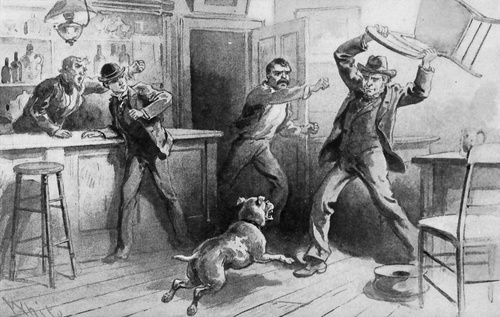
Gus had come to Barlow's saloon for a particular
purpose, but it was not to discuss such
matters as these. He did not like to hear
about them, so as soon as he saw a chance he
broke in with—
"The wheel of fortune has turned a spoke
or two in my favor since I last saw you, that
is true. But what is the news here in Clifton?
I have been away a year, you know."
"Well, there ain't no news 'cepting that ole
Cap'n Nellis has slipped off, and that I suppose
you knowed long ago. Folks ain't got
done talkin' about it, and never will."
"Rather sudden and mysterious, wasn't it?"
asked Gus, carelessly.
"Yes, rather sudden, and mebbe mysterious
to them as don't suspect nothing. But I can
67easy account for it. Howsomever, it ain't no
consarn of mine, and I don't meddle with
other people's business. Savin' your presence,
Mr. 'Gustus, he's the meanest man that ever
stepped, is Cap'n Nellis."
"He was the meanest man, you mean,"
suggested the visitor.
"No, I don't mean anything of the kind,"
insisted Barlow. "I say he is, 'cause, barring
accident that is likely to fall to men in any
part of the world, he's as hale and hearty this
minute as me and you be, the old villain!"
"Whew!" whistled Gus, opening his eyes
in amazement and looking a little alarmed.
"It's a fact, I tell you," declared Barlow,
"'cause I know. But if I did see a few
things one dark and rainy mornin', and by
putting this and that together got at the whole
of the story, so that I can tell it to-day as
straight as them that done the business, 'tain't
no consarn of nobody's, is it? If I had had a
hand in the matter he wouldn't ever turn up
again, as he is likely to do."
Gus was too astonished to speak. Here was
a startling revelation indeed.
CHAPTER VI. BOB AT HOME.
68
Before Gus had time to fairly digest
what he had heard or to recover himself
sufficiently to elicit further information by inquiry,
the old man went on:
"Some folks makes a bungle of everything
they do, and you just wait and see if that old
scamp don't turn up again some day, and before
he is wanted, too. But I oughtn't to
abuse him before you, seeing that he is your
own dead mother's brother."
"Oh, you needn't apologize for that," said
Gus, as soon as he could speak. "I hate him
as heartily as you do."
"And hain't I got good reason to hate
him?" asked Barlow, elevating his wooden
leg above the counter. "Just look at that!
Wasn't he a nice cove to go and wing me and
69set me to stumping around on this thing all
the rest of my days?"
Gus was well acquainted with the circumstances
to which the man referred, and knew
that he richly deserved the punishment he
had received. In the years gone by Barlow
had been a sailor, and had on one occasion
shipped on a vessel commanded by Captain
Nellis. He was so very turbulent that he was
kept in irons almost half his time; and once,
just after he was released from a long confinement,
he, without the slightest provocation,
attacked the mate of the vessel so fiercely,
and with such evident intention to do him some
serious injury, that the captain, in order to
save his officer, disabled the ruffian with a
ball from his pistol which shattered the bone
and rendered amputation necessary. Barlow
never forgave his captain for that; and,
moreover, when he once got started on the
subject he never seemed to be able to stop
talking about it.
"I ask you wasn't he a nice fellow to go
and do that?" continued the old man, growing
more and more enraged the longer he dwelt
70upon it. "But for him I might to-day 'a 'been
the master of as fine a vessel as ever sailed;
but here I am, laid up in ordinary, trying to
turn an honest penny by keepin' a sailors'
boarding-house."
"And turning many a dishonest one by being
a land-shark," thought Gus.
"I hate the whole tribe—every one that
bears the name of Nellis," the old man went
on, fiercely. "If I had my way I'd sweep
them all off the earth."
"So would I," said Gus, heartily.
"Now, I'll tell you what's gospel," continued
Barlow, leaning over the counter
toward his visitor and sinking his voice almost
to a whisper—"is that son of his coming
here this summer?"
Gus replied that he was.
"Well, if men are as scarce as they were
last year he had better keep himself close, or
he'll make out the tail-end of a crew as sure as
I can get my hands on him."
Gus started back and gazed at the old man
in great amazement. Was the latter able to
read the thoughts that were passing in his
71mind? It certainly looked like it. He had
heard that men, even landsmen who knew
nothing of the ways of the world, had been
kidnapped and shipped off to sea to fill up a
crew that could not be completed by voluntary
enlistment, and it had occurred to him that
that would be a good way to rid himself of
the presence of his cousin, if he could only
find some one to undertake the task. Knowing
the deadly enmity that Barlow cherished
toward Captain Nellis, Gus had visited him
on purpose to ascertain whether or not he was
ripe for such a scheme, and was delighted to
know that he had found a willing tool—so
willing, indeed, that he himself need have
nothing to do with the matter. All he had to
do was to remain in the background, and Barlow
would do all the work and run all the risk.
This was a highly encouraging state of
affairs, and Gus would have felt perfectly at
his ease had it not been for the hints Barlow
had thrown out in connection with Mr. Nellis's
disappearance. Gus turned the conversation
back to this subject as soon as he could,
but all he learned was that one morning, following
72a remarkably stormy night, Mr. Nellis's
boat had been found on the reefs with a
hole knocked in her, and the supposition was
that her owner had been out on one of his
fishing excursions and had been caught in the
storm and drowned. At any rate, he was
never seen or heard of afterward. This was
no news to Gus, for he had heard it long ago.
He wanted to know what Barlow had seen on
that stormy morning, but on this subject the
old man refused to talk. It was none of his
business, he said, and with that the boy was
obliged to be contented.
Gus left the sailors' boarding-house heartily
wishing that he had never gone near it. He
had felt sure of his position before, but he did
not feel so now. His uncle had been treacherously
dealt with, that was plain, but instead
of being safely out of the way was likely to
make his appearance at any moment. He
could not be far away, either, for Barlow had
confidently assured him that he would be certain
to turn up, and that, too, before he was
wanted. Then what would happen? Gus
trembled when he thought of it.
73"Father had a hand in it," said he, as he
climbed into the buggy. "I can now account
for that wild look in his eye, and understand
what he meant when he said that after all he
had done and dared for me I ought to treat
him with more respect. I declare it is the
worst thing I ever heard of. If I am to be a
party to this business I ought to know just
what has happened, so that I can be prepared
for any emergency."
But this was something Gus never found
out. He visited Barlow a dozen times during
the next two days, but could gain nothing
further from him. He had several interviews
with his father, during which he hinted so
broadly at what he had heard that Mr. Layton
exhibited the same signs of alarm he had
shown when his son first came home; but he
volunteered no information, and Gus dared
not ask for it. These things made such an
impression on him that on the morning of the
day Bob was expected home from Elmwood
Gus had all his luggage removed to the rooms
in the south wing that had been prepared for
him, and saw that everything was arranged
74in his cousin's room just as he had found it.
As matters now stood Bob's star was in the
ascendant, and Gus did not think it would be
policy to begin an open warfare with him.
But he did not for an instant lose sight of
what had for the last few months been the
main object of his life.
After Gus left the academy affairs went on
in much the usual way. True, there was less
wrangling and quarrelling among the students,
and such fellows as Simpson and Scotty were
obliged to keep themselves altogether in the
background. The "cut-oar matter," as the
boys called it, was thoroughly investigated,
and every one who was in any way mixed up
with it, and there proved to be at least a score
of them, was sent to coventry without ceremony.
The culprits at first assumed an independent
attitude, and tried to show themselves
as indifferent to the students as the latter were
to them; but this plan did not succeed very
well, and in their hearts they wished they had
had nothing to do with Gus Layton and his
attempted fraud.
Examination week ended and the closing
75exercises over, the students began to separate
to their homes, all of them apparently light-hearted
and joyous, and speaking confidently
of meeting again at the beginning of the next
school-year. Bob Nellis was melancholy and
low-spirited. As far as he knew, he had no
home to go to. There was no kind father
waiting to receive him and tell him that he
was satisfied with his conduct at school and
of the progress he had made there. He was
going among those who were almost strangers
to him, and who he knew had no interest in
him. He took a sorrowful leave of the
school and of his mates, and with Sprague for
a companion—he lived in the same village
that Bob did—set out for home. As long as
he remained in sight of the familiar buildings
he kept looking back at them as if he never
expected to see them again. He did go back
to them, however, and prepared for college
there; but he first passed through some adventures
the like of which he had never
dreamed of.
"Now, Bob, I want you to tell me what is
the matter with you," said Sprague, laying
76his hand affectionately on his companion's
shoulder. "Ever since your uncle countermanded
your order for that new shell you
haven't acted at all like yourself. Do you
think your uncle has gone back on you?"
"I know it," said Bob. "But, Sprague,
you will excuse me for not saying too much.
When I get home I shall know just how the
land lays. I may be wrong, but that's the
way things look now."
"Only just one question more and then I'll
drop the matter," said Sprague, earnestly. "I
heard before I came here that your father
used to be worth a lot of money. Has your
uncle got hold of it?"
Bob nodded.
"Well, I am sorry for you, and I know
how to appreciate your feelings; but I will
tell you this, Bob: Whenever things get too
hot for you, come to my house."
Bob thanked him from the bottom of his
heart. It served to show him that he had at
least one friend left in Clifton.
Bob left the academy on Thursday evening,
and awoke the next morning to find the steamer
77in which he had taken passage tied up to the
wharf in Clifton. There was the usual crowd
to meet her, early as it was, and among the
lookers-on Bob found many friends and acquaintances
who were all eager to shake him
by the hand. Although he was glad to see
them he excused himself as soon as he could,
and having given his luggage into the charge
of a drayman, hurried away. He wanted to
see his home once more, even if had no right
there. There was one friend, at least, who
would be glad to see him, and Bob was disappointed
as well as surprised that he did not
find him on the wharf, waiting for him. It
was old Ben Watson, his father's gardener.
But Bob knew where to find him, and he intended
to visit him before he presented himself
to his uncle. Perhaps Ben could tell him
some things he wanted to know. With this
determination, Bob went through the iron gate
which opened into the grounds that had
once belonged to his father; but instead of
following the broad carriage-way that led up
to the door he turned into a by-path, and
presently found himself standing before a neat
78little cottage that was hidden away among the
trees. There was an air of desolation about
it that Bob had never noticed before. The
door did not open at his knock, and when he
looked in at the window he was surprised to
see that the house was deserted—there was no
furniture in it. Bob did not know what to
make of it.
With a sigh of regret he turned into the
path again, and after a few minutes' walk
reached the stables. Here another disappointment
awaited him. He found a man dressed
as a hostler, and he was engaged in rubbing
down one of Bob's own ponies; but the face he
turned toward him was not that of old Jack
Couch, who had charge of the stables during
his father's lifetime. It was the face of a
negro, and one Bob had never seen before.
If there had not been a person in the world
with whom he was acquainted, Bob could not
have felt more desolate and friendless than
he did at that moment. When his father
was alive there were four servants employed
on the place—two in the house, one in
the stables, and one in the garden. They
79were all men, and every one of them was a
sailor who had grown gray in his father's service.
Bob was a favorite with them all; and
if any of them held a higher place in his estimation
than the others, it was Ben Watson, the
gardener. Many a relic and curiosity had the
old fellow brought to him from over the sea, and
many an hour had he spent in his cabin listening
to his thrilling tales of the deep; and it
was there, beside Ben's fire, that he had promised
his father that, come what might, he
would never be a sailor. The boy had often
thought of old Ben since his father's death,
and impatiently counted the hours of meeting
him, but now he was gone.
"They're all gone," thought Bob, turning
away from the stable without returning the
hostler's civil greeting, "and I am left alone.
They have been cast adrift in their old age, in
spite of father's promise that they should always
be cared for; and if I may judge by
uncle's letters, I must go, too. If I had never
made that promise I would be at sea in less
than twenty-four hours; but it is as binding
now as it was while father was living."
80"Sah! Sah!" said a voice, arousing him
from his reverie.
Bob looked up and saw a negro hurrying
toward him.
"Sah!" repeated the negro, "ole Moster
Layton done sent me to tell you dat dese is
private grounds, an' he don't 'low no trespassin'
from anybody."
Bob was thunderstruck. Did his uncle intend
to cast him off in that style?
"I hates to say it to a gemman," continued
the negro, "but ole Moster say dem's his 'perative
orders."
"Does—does he know I am Bob Nellis?"
asked our hero, at a venture.
"Sah?" yelled the darky. "Is you Moster
Bob? 'Fore Moses, we's expectin' you.
Your rooms am all done fix up nice. I fix 'em
myself. Come dis way, sah. Your uncle is
in de library."
Bob, whose equanimity was not altogether
restored by this assurance and the change his
name had produced in the darky's bearing
toward him, followed to the house, and was
presently ushered into the library. His uncle
81was there, busy with some papers, which he
hastily bundled out of sight as his nephew entered.
"Why, Bob!" he exclaimed, with more
apparent cordiality than the boy had expected
to see him exhibit, "I didn't know
that was you when I sent Sam to order you
out. Sit down. You are welcome to my
house."
This was said with so much emphasis on
the pronoun that Bob took his cue from it
and at once decided on his course.
"Uncle Luther," said he, suddenly, "I
should like to know just how matters stand
here. You said in one of your letters that you
would explain everything when you saw me."
(Bob had noted, with some bitterness, that
his uncle did not say, "When you come
home.")
"Never mind that now," said Mr. Layton,
hastily. "We will have some breakfast before
we talk business. I can tell you everything
you wish to know in two minutes."
"Then please tell me now," persisted Bob.
"I have ordered my luggage brought to this
82house because I did not know where else to
send it; but if I have no right or interest
here, of course I don't want to stay."
"H'm," said Mr. Layton.
"I hope you'll be plain with me, for I am
prepared for the worst," continued Bob.
His uncle settled back in his chair and
coughed ominously once or twice, as if he
were preparing to say something disagreeable.
"Well, Bob," said Mr. Layton, speaking
hurriedly, as if he wished to get through with
a very unpleasant duty, "I must tell you
plainly that no provision has been made for
you. I supposed, of course, as every one else
did, that you were to be your father's heir, and
why you were not I am sure I cannot tell; perhaps
you can. I can tell you, however, that
a codicil to his will, in which the property was
left to you, makes me the sole heir. The will
has been admitted to probate, and you can obtain
a copy of it for a dollar or two, which I
will cheerfully furnish you, if you are out of
funds. As I suppose, you want to do something
now for yourself, I have taken the liberty
to make arrangements for you which I
83hope you will like. I trust that you have
made the most of your opportunities, for that
school is a very expensive one, and none but
wealthy men can afford to send their sons
there."
Bob listened to this speech, and when it
was concluded told himself that if his uncle
had not repeated it in private until he had
learned it by heart, he certainly spoke and
acted as if he had. Of one thing he was now
satisfied, and that was, he was not to return
to the academy. His uncle could not afford
it. Bob could not help recalling the fact
that his father had kept Gus there three years
at his own expense, but he said nothing about it.
"As your father followed the sea for a livelihood
during the earlier part of his life, I
suppose you must have some love for the
water, and I suggest that you adopt his profession,"
continued Mr. Layton. "You will
have opportunities to see different countries,
and under my patronage promotion will be
certain if you prove yourself worthy of it."
"I cannot do it," said Bob. "I promised I
would never be a sailor."
84"But at the time your father extorted that
promise from you he probably did not imagine
that you would ever be thrown upon your
own resources. Besides, he is dead."
"But the promise is binding, all the same,"
said Bob.
"Then what do you intend to do?" asked
his uncle, with some impatience. "You have
got to do something."
"I have not made up my mind. I can
turn my hand to almost anything, and shall
not starve."
"Well, perhaps you will need a little time
to look about you, and meanwhile your rooms
are quite at your service. Now that we have
settled the matter we'll go to breakfast."
But Bob did not feel in the humor for
breakfast. He could not have eaten a mouthful
at Mr. Layton's table if he had tried—his
heart was too full. He wanted to get away
by himself, so he made his excuses to his
uncle, who did not seem at all unwilling to
part with him, and hurried out of the house.
CHAPTER VII. BEN SURPRISES EVERYBODY.
85
And where was Gus all this while? He
was just where he had been every day
since he came from Elmwood, and that was in
Barlow's saloon. The boarding-house keeper
was almost the only one there was in the village
who would have anything to do with
him, and Gus liked to be in his company, for
the old man talked of nothing but the
"meanness" of which Captain Nellis had
been guilty, and was never tired of rehearsing
the plans he had laid against his son. Gus,
knowing that Bob was expected on this particular
morning, dropped into the saloon as if
by accident, but in reality for the purpose of
directing Barlow's attention to him in case
the old man did not happen to see him when
he landed from the steamer. But Barlow always
knew who landed in that port, day or
86night. His house fronted on the wharf, and
by taking his stand in the door he could see
everyone who passed. This morning Bob was
almost the first passenger that left the steamer,
and Barlow knew him at once.
"There's that conceited young prig now,"
said he, quickly. "I didn't tell you that I
had got things all fixed for him, did I, Mr.
'Gustus?"
"No," replied the boy.
"Well, I will tell you," said Barlow, leaving
the door and walking to his accustomed
place behind the counter, "because I know
the secret will be safe with you, and perhaps
I shall want you to help me."
"Be careful," interrupted Gus, nodding his
head toward a sailor who was seated near the
end of the counter with his hat drawn down
over his eyes, as if fast asleep.
"No fear of him," replied Barlow. "He
has been snoring there for the last hour. As
I was going to say, a ship is to sail to-night
for Australia and the Spice Islands, and the
cap'n has been here a dozen times during the
last few days, begging me to raise a crew for
87him by fair means or foul. I've got all but
two aboard, and I've got them in my eye.
Bob Nellis is one, and there's the other," said
Barlow, pointing to the sailor before spoken of.
"Who is he?" asked Gus.
"Why, don't you know? Then it must be
because he keeps his hat down over his face.
If he would raise it for a moment you would
see that he is old Ben Watson, your uncle's
gardener. When your father got possession
of the place he kicked out all the old servants,
as you know, and hired niggers to fill their
places. I suppose he don't want them about,
to remind him of his brother-in-law, and I
don't blame him. Ever since he was discharged,
Ben has been layin' around with no
heart to go at anything, and he owes me
twenty dollars for board and grub. I've tried
my best to ship him in a crew by fair means, for
Ben is a good sailor, but the old fellow says
he has too many years on his shoulders. But
I must have him for the J. W. Smart, 'cause
I can't find anybody else that is goin' to sail,
and so I shall have to doctor his tea to-night."
88"Drug it?" asked Gus.
"Yes; put him to sleep and take him
aboard before he awakes. And now about
Bob. He is going up to your house, I suppose,
and if you will keep an eye on him, and
get him out into the garden to-night about
eight o'clock, me and my barkeeper will slip
up and take him in tow, and no one will be
the wiser for it. I shall make sixty dollars
by shipping him and Ben, and I'll give you
ten of it. What do you say?"
"It is a bargain," replied Gus, wondering
at the readiness with which he accepted the
villainous offer. "I will be on hand when
you want me."
"You will never see him again when once
he is aboard that ship," continued Barlow.
"Cap'n French is the hardest ship-master that
ever sailed, and when a man doesn't do to
suit him, he quietly knocks him overboard.
More than that, the ship belongs to old man
Brock, who feeds his hands on nothin' and
pays them the same. He has to promise them
thirty dollars a month, for that is what they
are payin' out of this port, but he always
89orders his skippers to treat them harshly, so
that they will desert the first chance they get,
and the cap'n fills their places with cheaper
hands, which they can always find in foreign
ports. Between the belayin'-pins which
Cap'n French slings about so reckless, and
the yellow fever, and the niggers among whom
they are going to trade, Mr. Bob will have
a lively time of it. Now, don't forget to have
him out of the house to-night at eight o'clock
sharp, and me and my barkeeper will do the
rest. We'll just slip up there—"
Barlow suddenly paused and startled his
auditor with the heaviest kind of an oath.
Gus followed the direction of his gaze and
saw that it rested on the sailor, who had raised
his hat from his face and was looking at them
with wide-open eyes. It was old Ben Watson,
sure enough, and he had heard every word
of the conversation.
Never in his life had Gus been more astounded
and alarmed. He leaned against the
counter and stared stupidly at old Ben, and
even Barlow seemed to be at his wits' end.
The old sailor was the only one who retained
90his presence of mind. Hastily putting on
his hat he arose and started for the door; but
his indignation got the better of his prudence,
and he stopped to say a parting word to the
conspirators.
"You'll kidnap me and Bob and ship us
off to foreign parts against our will, will you!"
he exclaimed. "Not if I know myself. I'll
have the pair of you arrested in less'n an hour!"
These words seemed to bring Barlow to his
senses. Like all men of his class he had
faithful assistants close at hand, who had lent
their aid in more than one emergency like
the present, and he shouted out their names
with so much earnestness that they lost no
time in making their appearance.
"Here, Bull! Bull! I say, Samson! Show
yourself!" he roared.
The first was a huge bull-dog which was
lying on the steps in front of the house, and
the second was the barkeeper, a man who,
judging by his size and apparent muscular
power, was rightly named. These two worthies
came in at opposite doors at the same
instant. The dog at once launched himself
at the sailor's throat, but was met half-way by
a heavy chair, which Ben caught up and
threw at him with such accuracy of aim that
the fierce brute was stretched motionless on
the floor. In an instant he turned upon the
barkeeper. Just as he put out his hands to
seize Ben from behind he was met by a stunning
blow in the face—a regular one-two,
which showed that the old sailor had received
some early training in boxing—and he, too,
was stretched on the floor, quivering like a
man who had just had his death-wound.
91
Ben on his mettle.
93"Got any more help?" said Ben. "I
ought to put you by the side of them, you old
land-shark, and I will, too, if you open your
head."
But it seems that Ben was not alone. There
was a scurrying of feet out in front of the
house, and who should come in but Leon
Sprague and his father. They had had some
business on the docks and were just going
home when their attention was attracted by
the noise of the fight going on in Barlow's
saloon. Mr. Sprague was a man the boarding-house
keeper was not at all delighted to
94see. During the short time he had been in
the village he had been elected police magistrate,
and of course he had it in his power to
get at the bottom of the matter.
"What is the meaning of this?" he exclaimed.
"Put down that chair!"
"Gus Layton!" said Sprague, astonished
almost beyond measure to find his old stroke
there in the saloon.
"Yes, sir; it is Gus Layton," responded
Ben. "He and that old land-shark have
been laying their plans to kidnap Bob and
me to-night and send us off to foreign parts.
They would have taken me at once if I hadn't
laid the bull-dog and barkeeper out. I want
the pair of them arrested."
"It's a lie!" said the barkeeper, arousing
himself at this moment.
"Yes, of course it is!" exclaimed Barlow,
catching at the idea thus thrown out. "It's
a lie out of the whole cloth. Ain't it, Gus?"
"Ye-es," said Gus, who didn't know
whether he stood on his head or his feet, so
frightened was he. "Of course it is a lie.
He was asleep, and dreamed it all."
95"That's the idea," echoed Barlow. "He
was asleep there on that table, with his hat
over his eyes, and dreamed about being kidnapped.
There ain't a word of truth in it.
Gus came in here to ask me—to say that he
had seen—to ask me how I was, in fact, and I
told him I was pretty well—"
"If I ain't telling you the truth I don't
want to lay up anything for old age," said
Ben, earnestly; and one couldn't have looked
into his honest face and accused him of telling
a falsehood. "I was just as wide-awake
as I am at this moment, and heard them talk
the matter all over. When I got up to go,
Barlow yelled for the barkeeper and the bull-dog."
"I believe that is so," Sprague whispered
to his father. "You are Ben Watson, are you
not?"
"Yes, sir; that's who I am."
"Well, did you know that Bob has come
home?"
"I never knew it until to-day, sir. I want
to see him the first thing I do."
"I wouldn't make out a warrant for anybody's
96arrest until Ben has had an interview
with Bob," said Sprague to his father. "I
have heard a good deal about Ben Watson,
but I never heard of his telling a lie yet.
Come on. I'll go up to the house with you."
"Now let me tell you something before I
go away," said Mr. Sprague. "You are beginning
to keep a most disorderly house here, and
the very next time you have a fight here I
shall shut you up."
"I tell you, sir, we ain't been keepin' no
disorderly house," replied Barlow. He was
as mad a man as ever stepped, but he took
good care not to show it. "That fellow has
been asleep and dreamed—"
"I understand all about it," said Mr.
Sprague. "I only caution you against having
another fight here."
Barlow walked around behind the counter,
the barkeeper got up and rubbed his face,
which began to be puffed out around the eyes,
the bull-dog staggered to his feet and began
reeling across the floor, and Gus leaned on the
place where the drinks were served, so utterly
amazed and bewildered that he could not speak.
97"Those two are going up to your house,"
said Barlow, recovering his speech with an
effort. He had first uttered a volley of oaths
when he saw his bull-dog and his barkeeper
worsted, and had gathered up a chair to take
a hand in the muss, but his swear-words grew
soft the moment Mr. Sprague entered. He
knew that the magistrate had a right to fine
him for every oath to which he gave utterance.
"They are going up to your house, and they'll
see Bob there."
"That's just what I am afraid of," said
Gus, walking up and down in front of the
counter and wringing his hands. "I don't
see what made me come here, anyway."
"No more do I," said Barlow, looking savagely
at him. "The whole thing is out on
us. You had better get out of here as soon
as you can, and don't come to us with any
more trickery."
"Why, this was your own doing!" said Gus,
surprised to learn that he was the cause of all
Barlow's trouble. "You hollered for the barkeeper
and the bull-dog—"
"But I wouldn't 'a' done it if you hadn't
98been here!" retorted the old man, angrily.
"Come now, get out!"
Barlow came out from behind the counter
and Gus made haste to get through the open
door into the street; but where should he go?
He pulled his hat down over his eyes, thrust
his hands deep into his pockets, and walked
along, thinking the matter over.
"If that man ever gets into another row
I'll shut him up," repeated Mr. Sprague, as
they hurried on in the direction of the house
which had once been Bob's home. "I have
heard of such things as shipping a lot of
landsmen to make up a ship's company, but
I never thought it would be brought home to
me in this manner. Watson, you're sure you
were not asleep and dreamed it all?"
"I told you nothing but the truth," said
Ben, as if he hoped in some way to make Mr.
Sprague believe it. "I can repeat every word
they said. You ask Bob, and see if he will
believe me. I never told a lie in my life, except
when I was telling some stories of the
sea."
"Well, Leon will go around there with you
99and I'll go home. And I want you to add
my earnest invitation to Leon's, and tell Bob
that if he can't see his way clearly to stopping
there he must come up to my house."
Ben promised compliance, and Mr. Sprague
turned up the street that led to his residence.
"I'll tell you another thing," said Ben.
"That man Barlow says I owe him twenty
dollars for grub and lodging. I'll go there
to-morrow and pay him, though to tell the
truth I didn't suppose I owed him anything.
I've got money that I saved while Cap'n Nellis
was here, and if Bob wants it he can have it."
"You say when Mr. Nellis was here," replied
Leon. "Then you don't think he is
dead?"
"He's as lively as you or I at this minute,"
said Ben, earnestly.
"Then why don't you go and get him?"
asked Leon.
"Ah! That's the trouble. We don't know
where he is. The ocean is large, and there's
a heap of islands scattered around in it."
"But Barlow might have killed him. They
went for you pretty rough."
100"They didn't kill nobody; Barlow hasn't
stooped quite low enough for that yet. I don't
say that Barlow had a hand in it, but I think
I know who had. And this 'will' business. I
tell you it is all a fraud."
Ben became silent after this, and said no
more until they had opened the iron gate and
moved up the sidewalk to the door that led to
Bob's home; for it was Bob's home in spite
of all that happened, and Ben acknowledged
the fact. It didn't make any difference how
many people came there to live, the will wasn't
right, even though it had been admitted to
probate. Mr. Layton was on hand, and he
sent Sam with orders to clear them out. He
knew Sprague and Watson, and he was afraid
to have them come there.
"Sah, it's moster's positive commands dat
you," began Sam—
"Never mind that," said Sprague. "We
have come here to see Bob. If he is about
the house ask him to come here."
"I—I don't know, sah," hesitated Sam,
"but I think he has gone away. He hain't
been around de house since 'arly dis morning.
101I will go and see what moster say about
it."
The negro disappeared, locking the front
door behind him, whereupon Sprague looked
at Ben and smiled. It made Ben madder
than ever. It was the first time he had ever
had that front door locked upon him. The
darky passed along the hall until he reached
the library door, upon which he pounded
with his fingers. He opened it in response to
the summons from the inside, and found Mr.
Layton pacing the floor. He was paler now
than he was the first time we saw him, and
trembled so visibly that any one could have
noticed it.
"Dem gemmen out dar gwine to see Moster
Bob," said Sam, in a tone of voice that
Mr. Layton did not like. It showed that the
darky understood that there was something
wrong. "Yes, sah; they gwine to see him.
Mebbe he up in his room, sah."
"That's a pretty way to talk!" said Mr. Layton.
"They come onto my grounds without
being invited, and then say they are going to
see somebody. Did you lock the front door?"
102"Oh, yes, sah; I locked it."
"Then let them ring until they are tired.
They will soon get weary of it and go away.
Have you seen Augustus lately? Well,
when he comes, tell him that I want to see
him."
But it seems that Sprague was not in the
habit of ringing the bells on doors that had
been locked against him. He had another and
a better way of reaching the ears of the boy
he wanted to see. After waiting a sufficient
length of time for the negro to open the door
he threw back his head and whistled, shrilly,
three long whistles and a short one, and he
knew that if Bob was anywhere about the
house that signal would be sure to bring him
out. Nor was he disappointed. One of the
upper windows was thrown up and Bob's head
was thrust out. He did not look much like
the stroke of the winning boat that had been
rowed in the race at Elmwood. His face was
pale and sunken, and his eyes looked as
though they had long been in want of sleep.
But his voice was as strong as ever.
"Halloo, Sprague; I didn't expect to see
103you again so soon," said he. "Why, isn't
that Ben Watson? I'll be down directly."
In a few moments they heard his steps
coming down the stairs. He tried the door,
but it was locked, and he stopped to turn the
key. When he appeared on the porch his
face wore an angry expression which even
Sprague had never seen there before.
"I didn't lock it, boys," said he, as he hurried
down the steps to shake Watson by the
hand. "I heard you talking, but I didn't
know who it was. It is the first time a
door has been locked in the face of my
friends."
"But that ain't the worst of it, Mister Bob,"
said Ben, lifting his hat to the boy out of respect
to his old commander. "You know
that saloon that is run by that old land-shark
Barlow, don't you?"
"I know of it, but I have never been
there," returned Bob. "What of it? Has
anything been going on there?"
"Well, I should say so," said Ben. "Gus
Layton has been there, and him and Barlow
have made all arrangements for shipping us
104on the ship Smart and sending us off to foreign
parts."
Bob was utterly amazed, and began to see
that Gus was not quite so helpless as he
thought he was. He looked toward Sprague
to confirm the story, and he nodded his head.
"Did you hear it?" asked Bob.
"No; but we got there in time to help
Ben. He had the bull-dog and the barkeeper
laid out and was getting ready to defend himself
against Barlow, who had a chair."
"And then they said I was asleep and
dreamed it all!" chimed in Ben. "I never
was more wide-awake in my life. Mister
Bob, you don't want to go near the garden
to-night."
"I will see a lawyer about it this very
afternoon," said Bob, with a very determined
expression on his face. "I am not going to put
up with this thing any longer. They seem
to think that, because they have taken my
father's property away, they can drive me
out of town; but I'll show them that they
can't."
"Good for you, Mister Bob!" said Ben;
105and he reached out his hand for another
shake. "I always said that you would come
out at the top of the heap. I've got some
money, and you can have it all."
"Thank you, Ben; but I don't think I
shall have need for it."
"Let us go a little farther away from the
house before we do any more talking," said
Sprague. "These windows are open, and it
would be any easy matter for someone to slip
up and hear everything we said."
"Now, Ben, I want you to begin and tell
me all about that kidnapping business," said
Bob, as they walked along toward the gate.
"How was he going to do it?"
As they walked away somebody behind one
of the curtains, near one of the open windows,
straightened up and staggered toward the
library. It was Mr. Layton, and he had heard
every word of their conversation. When he
reached the library he sank into the nearest
chair and rang the bell for the negro, who
presently appeared.
"Sam," said Mr. Layton, in a trembling
voice, "put on your cap and see if you can
106find Augustus somewhere about the streets.
If you can, tell him that I want to see him
directly—directly, mind you. Those are my
imperative orders."
CHAPTER VIII. BOB GETS SOME MONEY.
107
Sam was a long time finding Gus Layton,
and when he did he was sitting in the
shade of a warehouse watching a vessel that
was getting under way. How heartily he
wished that Bob Nellis and old Ben Watson
were on board that ship! She was going away
for a two years' cruise, and Gus was certain
that something would happen to them before
they came back.
"Hi, Moster 'Gustus, I found you at last!"
exclaimed the darky, as he hurried up.
"Your father wants to see you at home this
blessed minute. Dem is his 'perative orders."
"Sam," said Gus, putting his hand into his
pocket and pulling out a piece of money, "has
anything been going on there?"
"Thank you, sah. Not de fustest thing.
108Ebberything is just as it was when you were
dar."
"Nobody to see me, I suppose?"
"Dar's been nobody dere to see you, but
dere's been somebody dere to see Moster Bob."
"I don't see what you fellows call that snipe
'Mister' for," said Gus, impatiently. "That
title belongs to me. Who were there to see
Bob?"
"Wal, sah, Moster 'Gustus, dere was one
man dere dat used to be your uncle's gardener,"
replied Sam. "And de other one
was—"
"Watson?" cried Gus.
"I reckon so, sah. And de other one was
a right smart-lookin' chap, just about your
size. Is you comin' home, sah?"
"It was Sprague, I'll bet," said Gus.
It was a very short road with Gus that had
no turning, and here he was, right in the
midst of his schemes for mischief, and they
began to come back to him. How he wished
that Watson had kept out of that saloon, or
rather, how he wished he had kept away from
it himself!
109"Is you comin' home?" inquired the
darky.
"You go on ahead at your usual gait and
tell father that I will be with him soon," replied
Gus. "I may as well face it down one
time as another," he added to himself. "What
can I say that will induce father to believe I
was in that saloon by accident? I tell you, I
wish I had steered clear of Barlow!"
Gus arose to his feet and started toward
home, but with every step he took he felt that
he was drawing nearer to his doom. The
closer he came to the iron gate the more confused
his thoughts seemed to grow, and when
he went down the hall and opened the door
of the library, without the ceremony of knocking,
he had made up his mind that Watson
had been asleep and dreamed it all; that nobody
had said a word about kidnapping him.
He found his father pacing back and forth,
wringing his hands as if he were in great
bodily distress.
"Why, what's the matter?" he asked, innocently.
"Augustus, how does it come that you were
110in Barlow's saloon?" asked his father. "Have
I not often told you to keep away from those
places? What did you hear about kidnapping
Bob and that old gardener?"
"Why, nothing at all," said Gus, opening
his eyes in surprise. "Ben Watson was in
there asleep, and when he woke up he accused
Barlow of getting up a scheme against him.
Has he been here? What did he say?"
"He has said enough in Bob's ears to
prompt him to call on a lawyer this very
afternoon," said Mr. Layton, looking sharply
at Gus.
This was rather more than Gus had bargained
for. He looked around for the nearest
chair and sat down. For once the face he
turned toward his father was as white as a
sheet. That was one thing that Gus was always
afraid of. He might get a lawyer to examine
into the matter, and he would be pretty
apt to find a screw loose somewhere.
"I don't like this lawyer business," said Gus.
"Why, Augustus, it is perfectly straight,"
said his father. "The more lawyers he gets
the better I shall like it. They will have
111every facility granted them for making a
thorough investigation. One would think,
from the way you talk, that you suspected
something yourself."
"Father, there's no need of your beating
about the bush any longer," said Gus, who
thought, if he had to make a clean breast of
the matter, it was time his father did so, too.
"What makes you so nervous and excited?"
"It is the trouble you have got into with
that fellow Barlow," said Mr. Layton. "I
know all about it, and there's no use for you
to try to deceive me. Now, I want you to tell
me the whole thing. I have a little influence,
and perhaps I can bring some good out of it."
"What do you know?"
"I know that you went into that saloon
without anybody sending for you; that Ben
Watson was asleep there on the table—or had
his head pillowed on his arms as if he was
asleep, but he was in reality wide-awake; that
you began talking about the crew of the
Smart; that you made up a scheme for kidnapping
Bob—"
"I never did it in this world!" interrupted
112Gus. "You go and ask Barlow, and see if
anything of the kind happened."
"I think I see myself going near that skin-flint!"
said Mr. Layton. "Anyhow, you had
your plans made up for taking Ben and Bob
off on board that ship, and it was when Bob
roused up and told you of it that Barlow
shouted for his bull-dog and barkeeper."
"It isn't so! it isn't so!" said Gus, pounding
with his fingers on the table.
"And to make the matter still worse, Mr.
Sprague and his boy came in at that moment,"
pursued Mr. Layton, paying no heed to the
interruption. "I tell you, Augustus, you
have got yourself into a scrape. You begin
to see it now, don't you?" he added, as Gus
looked down at the carpet. "I don't know
what will become of you if you keep on this
way. Bob was doing well enough, and I don't
see why you couldn't let him alone."
There was silence for a few minutes, for
Gus had about got to the end of his rope. His
father knew all about it, and he couldn't
think what else to say. After waiting in vain
for Gus to speak, he said:
113"I got the most of this while listening at the
window when Bob was talking to Leon and
Ben. What more they had to say I don't
know, for they walked away, so that I
couldn't hear them; but by putting this and
that together I got at the true story of the
matter. You can tell me the rest I want to
know. Are you willing to do it? I may
be able to bring some good out of it, as I said
before."
Thus urged, Gus determined that the best
thing he could do would be to tell the truth.
He began at the beginning and told everything
Barlow had said, touching lightly upon
what he had said himself, however, and when
he had finished he settled back in his chair as
if he was glad to have the load off his mind.
His father did not interrupt him until he got
through, and then he said:
"I don't see why you did not tell me this
at the start. As I said a little while back,
you have got yourself in a pretty scrape.
Suppose something should happen to Bob, and
he should be kidnapped and sent to sea against
his will; where would you be?"
114"By George! I never thought of that,"
said Gus, growing frightened again.
"Barlow knows that I do not approve of
such doings as that," continued Mr. Layton,
"and after Bob had been gone for a month
or two, he would come to me for money."
"For what?" asked Gus. "You wouldn't
hire him to send Bob off to sea."
"That may all be. I might never have
dreamed that he had such a thing in mind;
but don't you know that he would come to
me for money to make him keep his mouth
shut?"
"That's something new to me," said Gus,
fairly trembling with excitement and fear.
"He could do it as easy as falling off a log,
couldn't he? But I don't suppose that Barlow
knows enough to do that."
"Don't worry about it. He would come
for money, and if I refused to give it to him,
how long would it be before everybody in
town would hear of it?"
"He would be as deep in the mud as you
are," suggested Gus. "If you went to jail he
would have to go, too."
115"But, Augustus, I don't want to go to jail,"
said Mr. Layton, in a trembling voice.
"Think what a position it would be for me.
Now, I think I can see a way out of it, and
that is by buying Bob."
"How are you going to do it?" asked Gus,
who became interested at once.
"I will give him a hundred dollars a
month if he will take his trunks out of this
house and never come back here again," said
Mr. Layton.
"That's the idea!" exclaimed Gus, unconsciously
uttering the same expression that
Barlow had made use of a short time before.
"But a hundred dollars is a power of money,
father. Don't you suppose if you were to
offer him seventy-five dollars it would do just
as well?"
"No, I don't think it would. Bob has always
had money when he chose to call for it,
and a hundred dollars is little enough. Ben
has got a nice little house down here, and Bob
can go there and live as well as not. Of one
thing we will be sure, anyway: Bob will never
come to this house again."
116"That's the idea!" said Gus, again. "How
will you send him the money—by check?"
"I'll send him a check the first of every
month; that will save him the trouble of coming
here."
"That won't interfere with what you are to
give me?"
"Not at all; and I think it is the best thing
we can do. I wish you would be around when
I talk to him—"
"Oh, that's asking too much," said Gus,
getting upon his feet. "You must remember
that I was in the saloon when we talked of
kidnapping him, and that it would hardly do."
"Perhaps, after all, you had better stay
away," said Mr. Layton, after reflecting a
moment. "But I will put in a good word for
you when I see a chance. I will tell him that
you and I were talking the matter over, and
concluded it wasn't right to turn him loose to
face the world without a cent, and that we
have decided to give him a part of our incomes."
"That will be better than if I was here,"
said Gus. "But what if Bob won't take it?"
117"Eh? Oh, I don't think he will go back
on a hundred dollars. You see, Bob won't
have to do any work after he gets to Ben's
house, and that will take a heap off his
mind."
"A hundred dollars is enough for him,"
answered Gus.
"You couldn't stay around and see him
when he comes in, I suppose?"
"Well, I'll stay around, and if he looks
good-natured when he comes in I'll tell him
you want to see him; but if he looks cross I
won't open my head. You had better see
him yourself."
This much having been decided upon, Gus
went up to his room to remain there until his
father had had an interview with Bob, while
Mr. Layton opened the door of the library so
that he would be sure to see Bob when he
came in.
"I'll tell you I wouldn't stay in this house
after what has happened down there at Barlow's
saloon, and if Bob has the pluck I have
given him credit for he'll not stay, either,"
said Gus, drawing one of the curtains before
118the window and seating himself so that he
could see his cousin when he came down the
walk. "I would get away from here as soon
as I could. He must know he is not wanted
here."
In a few minutes he saw Bob coming, and
he fairly trembled with excitement when he
saw how enraged he was. He walked like a
boy who had made up his mind that he wasn't
going to stand that nonsense any longer. He
bounded up the steps as though he had a right
there, to quote from Gus, and stamped through
the hall as though there was somebody waiting
for him. And so there was. Mr. Layton
came out of the library, his face all wrinkled
up with smiles; but it was strange how quickly
those smiles all went away when he caught
sight of Bob's face. He began to fear that
he was going to have trouble with the boy.
"Ah, Bob! I was just waiting for you,"
said he.
"Oh, you were, were you?" said Bob, with
something like a sneer.
"Yes. Come in. I want to talk to you."
"You will have to talk to me mighty clever
119to put me out of the notion of having Gus
and Barlow arrested," said Bob, seating himself
in the nearest chair and placing his hat
upon the table. "I never heard of such a
thing before. Why, it is downright—"
"Why, what is the matter?" asked Mr.
Layton. He thought he spoke calmly enough,
but his voice trembled in spite of himself.
"There's no use of feigning ignorance,"
said Bob, in a tone of deep disgust. "Gus
and Barlow have been laying a plan to kidnap
Ben and me to-night and send us off to some
country we never dreamed of. Gus has told
you all about it, I suppose? If he didn't, he
ought to. You sympathize with him more
deeply than anybody else."
"Yes, I heard about that," said Mr. Layton.
"Ben was asleep and dreamed it all. You
surely don't suppose that I would agree to
anything of that sort?"
"You may not have agreed to it, but the
plot has been laid, all the same. What were
you going to say to me?"
"Gus has just been here, talking about you,
and if he was going to send you off to foreign
120countries I don't see why he should propose
to give you a hundred dollars a month."
"Have you agreed to that?"
"I have."
"Then I will take it, glad to get that much
out of you. But I'll tell you, Mr. Layton, it
will not keep me from putting a lawyer on
the track of this 'will' business. That much
I have determined upon."
"You may have all the lawyers you want,"
said Mr. Layton. "If it will be of any use
to you, I will get one of my own and put him
on the case with you."
It must be confessed that this remark
pretty nearly took Bob's breath away. He
looked sharply at his uncle to see if he really
meant what he said, and Mr. Layton met his
gaze without flinching.
"You seem to think there is something
wrong with your father's will," said the latter.
"I assure you there is not. I wouldn't have
touched a cent of his property if it hadn't
been willed to me. I trust you know me
well enough to believe that."
"Oh, yes; I know you. What I am going
121to find out is, whether or not the will is
all right. Now, if you will count out my
hundred dollars I will go up stairs and pack
my luggage."
"It shall be ready for you when you come
down," said Mr. Layton, with much more
eagerness than he had thus far shown. "I
hope you are not going away out of town, are
you?"
"Oh, no; I shall be here, and give Gus another
chance to kidnap me, if he wants to. I
shall be at hand, too, to give that lawyer any
assistance he may wish."
"I wish you would get over your idea of
Gus trying to kidnap you," said Mr. Layton,
impatiently. "He never did it in this world."
"Of course I will believe it when he proves
it before a magistrate's court," said Bob; and
he couldn't help smiling when he thought of
the way his lawyer would wind him up on his
cross-examination. "But he will find that
a difficult thing to do."
Without waiting to hear what else his uncle
had to say, Bob went up stairs to his room;
and as he had not yet wholly unpacked his
122trunk, it did not take him long to get the
things together that he wanted to take with
him. One trunk generally held all the things
he needed when he went to Elmwood, but this
time he took three, his little fowling-piece
and his fishing-rod not being forgotten. By
the time he had them all packed the carriage
appeared, with Ben Watson on the box beside
the driver. Ben didn't hesitate to come in
now, as he would if he had been alone. The
house was Bob's, he could swear to that, and
he had a right to go where he pleased in it.
"Now, you take these trunks down and I
will go and bid my uncle good-bye," said
Bob.
"Aw! Are you going to see that fellow
again?" inquired Ben. "It's small good-bye
he will give you, seeing that you are going to
live with me."
"But, Ben, I've got a hundred dollars coming
to me," said Bob. "He offered to give it
to me of his own accord."
"Well, that's better than I expected of
him. I guess he's mighty fearful that the
captain will turn up yet."
123Bob went down to the library and found
his uncle there alone. A roll of bills lay
upon the table, with a paper-weight on them
to hold them down. He looked all around
for Gus, but could not see anything of him.
He wanted to say a word to him before he
went, but Gus was still in his own room.
"Is this money intended for me?" asked
Bob. "Then I will take it and bid you good-bye."
"Good-bye, Bob," said Mr. Layton, holding
out his hand, but seeing that Bob did not
take it he speedily drew it in again. "Are
you going to live here in town? I want to
know, so that I can send you a check on the
first of every month."
"Address it to me here at this post-office
and I will get it all right," said Bob. "I will
tell you, for your satisfaction, that I am going
to live with Ben Watson."
"Ah! Ben is a good fellow."
"I know he is. He thinks father was
foully dealt with on that morning he disappeared,
and he will be near at hand to give
my lawyer some points."
124"That's a good thing. I am glad you are
going to investigate it. Good-bye."
The trunks being all brought down by the
time Bob got out of the library, he took his
seat in the carriage and was whirled away to
his new home. Of course he felt bad on
leaving the place of his boyhood, but there
was no help for it. Gus held the curtain
aside so that he could watch him, and when
the carriage had disappeared through the iron
gate he opened the door and went down to
his father.
CHAPTER IX. BOB CALLS ON A LAWYER.
125
"There!" said Bob, when his uncle's
gates had closed behind him and the
carriage was fairly under way for his new
home; "I hope I shall never go inside those
grounds again unless my father is here to go
with me. Now, Ben, I would like to know
what you mean by going inside that saloon?
You wouldn't have done so when my father
was here."
"No indeed, I wouldn't," said Ben, with a
hearty shake of his head. "But the truth was
I didn't have a heart for any work, and somehow
I wanted to be near where I could see the
ships come in. But I don't owe him no
twenty dollars for grub and lodging."
"Did you ever spend a cent in his house?"
"Yes, sir. I have treated some of my old
mates, but I paid him right down. As for
126lodging, you will say, when you see my little
house, that I don't need to go to the saloon to
find a bed."
"Then I wouldn't pay him a cent. Don't
you go near him again. He is worse than I
ever thought him. He's a land-shark. But,
Ben, I don't believe that Barlow had anything
to do with my father's disappearance."
"No more do I; but the question is, who
did? If it hadn't been for what Barlow said
when he thought I was asleep I should think
the cap'n was dead; but he says he is liable
to come back when nobody isn't expecting
him. I tell you, that proves something."
"It certainly does," said Bob, becoming excited.
"I will see Mr. Gibbons about it this
afternoon."
"That's what I say. That man can see
through it, if anybody can. Barlow says it is
no concern of his; but I'll bet if he is brought
up before a court of law he'll have to tell
something he don't want to."
Bob became all life and animation now.
The idea that Barlow might tell something
that was no concern of his made him impatient
127to see a lawyer and find out what he
thought about it. The Mr. Gibbons of whom
Bob had spoken was an old-time friend of his
father's, and he was sure that if there was a
flaw in the will that gentleman would find it
out.
Meanwhile the carriage sped on, and in a
few moments drew up in front of Ben's house.
It was a small place, surrounded by about
half an acre of ground, and so hemmed in by
bushes and trees that one could scarcely see it
from the road. The garden occupied almost
all Ben's attention. It was only when he
grew lonesome and longed for his old captain
that he went down to Barlow's, to be where
he could see the vessels come in, and he never
spent any money there except what he was able
to "pay right down." His story that Ben
was indebted to him was made up all out of
his own head.
"So this is where you live?" said Bob,
after the trunks had been carried in on the
porch and the hackman discharged. "It
seems to me that you ought to be contented
here."
128"I am," replied Ben. "I call this my 'ordinary,'
for I have never been satisfied to live
here only until my cap'n comes back. I believe
now that he is alive, and that some day
I'll see his old gray head coming in here. My
gracious! wouldn't that be fine?"
"I tell you it would," said Bob, seating
himself in the nearest chair, "but I am most
afraid of it. Any way, we'll make Barlow tell
what he knows. Now, what have you got
for dinner? I have not had a bite to eat
since I have been at my uncle's."
"Well, you go in and start a fire in the
stove and I'll soon have dinner ready for you.
You will find everything arranged there as it
used to be in the Anchorage."
Bob went into the house, and Ben bent his
steps for the garden to gather some fresh vegetables
for dinner. The Anchorage was the
name Watson had applied to the house Captain
Nellis had given him because he thought
he wasn't going to move any more. He
thought he was going to live and die under
that roof. When Mr. Layton told the old
fellow that he was done with his services, Ben
129was almost heart-broken. He tried to argue
the point with that gentleman, but when the
latter told him that he had hired negroes to
take the places of all the house-servants, Ben
had nothing more to say.
"Niggers!" he said in disgust. "I can remember
the time, and it was not so very long
ago, when the niggers were slaves and glad to
take what they could get, and now they come
around and crowd a white man out of his
place. This house won't stand a great while."
Bob started a fire in the stove, and that was
easy enough, for everything was handy, and
then went into the bedroom to examine things
there. His bunk was nicely made up on the
side opposite Ben's, as if the old fellow had
been expecting him that very night. All the
war relics were there, too, which Bob had not
been able to find room for in his apartments
at home, including a model of the rebel iron-clad
Atlanta, just as she appeared on the day
that Ben helped sink her.
"I almost believe I am in the old room at
the Anchorage," said Bob. "There is one
thing sure: Barlow will have a time getting
130at me here to shanghai me. I'd like to see
him try it. And to think that my cousin
should uphold him in such a trick! I tell
you, that beats me."
Bob put some more wood on the fire and
then went out on the porch to wait for Ben.
He was so long in coming that finally Bob
got impatient and strolled through the bushes
to meet him. The way he took led him to
the beach, and almost the first thing he saw
was the ten-ton schooner in which he had taken
so much delight in going fishing and exploring
the inlets of the bay. He had so many
things to think of that he had forgotten all
about her until he caught sight of her. It
did not seem possible that his father would
have taken his schooner away from him, even
if he had made a codicil to his will, and he
determined to speak to Mr. Gibbons about it
that very afternoon.
"It is bad enough to have taken my horses
without saying a word to me, but I didn't believe
he would so far forget himself as to take
my schooner," said Bob, seating himself upon
the grass. "If he had only left me that and
131the ponies I should have been satisfied—that
is, if he is dead; but that is something I won't
believe until I receive proof of it. Now, then,
what has become of Ben?"
Barlow's chance words, that it was no concern
of his what he had seen on that stormy
morning, had put Bob on his mettle, but for
all that, he was not inclined to put faith in
anything that man said or did; consequently
he was disposed to make the best of a bad
bargain. He had all along supposed that his
father was dead, but the hint Barlow had
thrown out that he might turn up again when
nobody was expecting him worked a change
in Bob in spite of all he could do to prevent
it. But he intended to wait until he could
see Mr. Gibbons about it.
"I won't put any confidence in what that
old land-shark said," soliloquized Bob,
stretching himself out flat on the grass. "If
Mr. Gibbons says he is alive I will believe it;
and if he says he is dead, I shall believe that,
too. I will think no more about it. I am
ready for anything that happens. There's
Ben; he has been to town. I object to his
132going on in this way in regard to me; but
first I am going to speak about that boat.
Say," he added, rising to his feet and taking
some of the parcels from the old sailor, "do
you see that boat over there?"
"Yes; and I know it's your'n."
"It ought not to have been taken away
from me, ought it?"
"No; nor your ponies, either."
"That's all right. I shall speak to Mr.
Gibbons about it this afternoon. Now, Ben,
what made you go to town? Don't you know
that I can live on the grub that you do?"
"Say, Bob," replied the sailor, who did not
care to argue this point, "you haven't had
any scouse or dough-boy lately, have you?
Well, now, you just sit down in that chair
and watch me get them ready for you. I'll
have them ready while you are thinking about
it."
Ben enforced the order by pushing Bob
into the nearest chair, while he went on dishing
up the scouse and dough-boy. While
Ben worked he talked about almost everything
else than the subject that was upper-most
133in Bob's mind, and when at last the dinner
was ready they sat down to it with most
ravenous appetites. They took their time,
and it was nearly an hour before they had got
all they wanted, and when the dishes had
been washed and put away, Bob announced
that he was going to see a lawyer.
"You don't want to let grass grow under
your feet," said Ben. "Go and see him at
once and have the matter settled. It's my
opinion that there is something in that codicil
that will benefit you."
Bob closed the gate behind him, and with
long and earnest strides took his way to the
lawyer's office. Of course he met many persons
along the road who had not seen him before,
and they all wanted to stop and shake
him by the hand; but Bob thought there was
a little sadness mixed with it all. They would
have felt a great deal better if they knew that
he was the heir to his father's property.
"Everybody in town seems to feel that
way," soliloquized Bob, as he ran up the steps
that led to the lawyer's office. "I don't know
but I am the heir, after all."
134Pushing open the door of the lawyer's
office, he found the gentleman of whom he
was in search alone. He had his feet elevated
upon his desk and was examining some legal
documents. When he saw who his visitor
was he got up from his chair and greeted him
with cordiality.
"Why, Bob, how are you?" he exclaimed.
"I heard you had come home, but I didn't
expect to see you. Sit down."
"Are you quite alone?" inquired Bob, accepting
the proffered hand.
"I am all alone. Did you want to see
me?"
"Yes. And I wish you would lock your
door, so that no one can come in to bother us.
I wish to have a few moments' conversation
with you."
The lawyer's face fell. He knew that Bob
had come there to see him about the will. He
locked the door and sat down and looked at
Bob without speaking.
"You used to have a good deal to do with
my father's business during his lifetime, Mr.
Gibbons?" began Bob.
135"I had a great deal to do with it until he
got that rascally brother-in-law of his to take
my place," replied Mr. Gibbons.
"Do you call him rascally?" inquired Bob.
"Yes; and so would anybody else. You
ought to be the heir to the property your father
left, and I know it."
"Well, is he dead? That's what I want to
know."
"I am sorry to say that there's no doubt
about that," said Mr. Gibbons, gazing thoughtfully
out of the window. "Everything goes
to prove it. It was an awful stormy night on
the bay, and the next morning in came his
boat, half-filled with water. His hat was lying
loose in the boat, and two or three days
afterward his fish-pole was picked up. Oh,
there's no doubt about his being dead."
"Did they find the body?"
"Why, no. It was probably swept out to
sea."
"Is there any way in which I can contest
the will?"
"Did you sign a paper?" asked the lawyer.
"Yes, I signed some sort of a paper, but I
136was in such a flurry that I didn't take time to
examine it. The lawyer that was with him
told me that it was just a form."
"Who was it?"
"I don't know who it was. He was a
stranger to me."
The lawyer got up and searched his desk
for some paper that he was anxious to find.
Presently he brought out a document entitled,
"Notice for Probate of Will." Holding the
paper in his hand he pointed to a note printed
in smaller letters, and said:
"Did you sign such a thing as this: 'I
hereby accept full service and waive all time
of Notice of the within Citation.' Did you
sign that?"
"It seems to me that I did; but I would
not be positive."
"And the lawyer told you that it was a mere
form? And when he got you back at school
your uncle put these papers in to probate,
and after that he had you just where he
wanted you."
"That is just about the way of it, I guess."
"Bob, you are the most confiding boy I
137ever saw. You ought not to have signed that
citation. You have put it out of your power
to contest the will. You ought to have a
guardian appointed for you."
This was a very unwelcome piece of news
to Bob, but he did not rebel against it. He
knew that the lawyer was in a situation
to understand such matters better than he
was.
"I am sorry, but I can see no other way
than for you to accept the situation," said Mr.
Gibbons. "By the way, what sort of a penman
is that uncle of yours?"
"He writes a very poor hand, but I can
make out to read it. Why do you ask?"
"Oh, nothing, but I just happened to think
of it. You haven't seen a copy of the will,
have you? Well, I will have a copy here to-morrow,
and you can see what your father
says in that codicil. I know he didn't intend
to take away everything you had."
"Then he wouldn't have taken away my
boat?"
"Certainly not. Nor your ponies, either."
"Do you think I would be doing wrong if
138I should go down there and run my boat up
to Ben's house, where I am living now?"
"Of course not," replied the lawyer, glad
to bring the interview to a close. "I will go
with you."
Mr. Gibbons put on his hat, and together
they started toward the place where the boat
was moored. It was on the beach opposite an
old fisherman's shanty, and when they arrived
there they were gratified to find the man sitting
on the bench beside the door, enjoying
his pipe. He was delighted to see Bob. He
remembered that, just before he started to
school, he had given the old fisherman a few
pieces of silver, with instructions to keep an
eye on his schooner, and had always found
everything all right about her when he returned.
"The top of the morning to you, Mister
Bob," said the man, extending his hand.
"The schooner is all right and tight. Be you
wanting her this morning?"
"There hasn't been anybody aboard of her
since I left?" said Bob.
"Nary soul," answered the man. "She's
139yours, and Gus Layton ain't got no business
with her."
"I guess it's all right, Bob," said Mr. Gibbons,
turning away. "You can take her
home with you. Remember, I shall have a
copy of that will to-morrow. Good-bye."
"Say, Mister Bob, is it true that old Layton
has got all of your property?" said the
old fisherman, whose name was Oakes. "I
think it's a mighty mean piece of business.
Do you want to go off to her? Jump into my
boat. I'll get the key to the cabin."
"I don't think I am doing right until I see
the codicil," said Bob, hesitatingly. "If
father thought I could have her, well and
good; if he didn't, I wouldn't touch her."
"Who's going to have her, then?" exclaimed
Oakes. "Not your cousin, I bet you.
I've seen him since he come back, driving your
ponies around, and I tell you I wanted to
take them away from him. Get into the
boat and I will soon set you aboard. Where
are you living now; up to Ben's? Then
there's nothing to hinder you from taking her
right up there."
140Mr. Oakes got the key to the cabin, and,
seizing Bob by the arm, was gently forcing
him into the boat when a loud shout came to
their ears. The two looked up and saw Hank
Lufkin coming toward them. He was a boy
who stood well in that community, although
he was nothing but a market-shooter. His
clothes were patched, but aside from that he
looked as neat as a new pin. Rumor said he
didn't get along very smoothly when he was
at home, and perhaps you will know the reason
when we say that his father was a lazy,
do-nothing sort of fellow, and every cent
Hank made he had to hide, for fear his
father would get hold of it. His mother kept
an account of all his earnings, while his father
was obliged to live from hand to mouth,
spending such sums as he could make by sawing
wood about the village. If he had owned
a boat he would have been all right, for then
he would have gone a-fishing; but every day
he was obliged to stand on shore and watch
other men when they returned with the
cargoes which they had gathered from their
nets—men no better than he was, he often declared—and
141of course he did not feel very
jubilant over it. And right there was what
was the matter with Mr. Lufkin; he was
jealous of anybody who held a position he
could not hold himself, but he never thought
of going to work to better his own condition.
"I am just as good as they are," said Mr.
Lufkin to his wife, "and I'll bet you that
nobody gives me a boat."
"Why, those men had to earn their boats,"
said his wife. "If you would just throw off
your coat and go to work you could soon have
one."
"Work! I might work till I am gray-headed,
and I wouldn't be nearer a boat than
I am now. Mark my words: I'll have a boat
before another year passes over my head."
This was the kind of a man that Hank
Lufkin lived with, and of course his life was
not a happy one. Hank did not own a boat,
but he had an old-fashioned single-barreled
gun with which he managed to kill a few
squirrels and quails, and by sitting for long
hours on the end of the pier he often succeeded
in catching a string of flounders which the
142neighbors were always willing to buy; but
Hank was not satisfied. He wanted a boat as
bad as his father did, but he was willing to
work to earn it. Just now his prospects were
rather dim. There hadn't been much shooting
lately, and the fish seemed to have gone
somewhere else; so Hank didn't have much
to do, and he was ready to go with Bob anywhere
he wanted to sail, for Hank knew
Bob well. He always made some money when
he went fishing with him.
"Halloo, Hank!" exclaimed Bob, as he
came up. "Are you very busy? Then get
in with me and help me navigate this schooner
up the bay."
Hank was just waiting for this invitation,
and, besides, he had something he wanted to
show to Bob and ask him what he thought
about it. He shook hands with him and got
into the boat, picked up an oar and pulled
off to the Curlew, for that was the name by
which Bob's ten-ton schooner was known.
CHAPTER X. A TWO-HUNDRED-DOLLAR PEARL.
143
"I tell you, she looks natural!" exclaimed
Bob, as a few swift strokes
with the oars brought him alongside the
schooner. "I believe I'll hold out in the bay
for a little while. Mr. Oakes, can you go?"
"No; I have got to fix up my nets for to-morrow's
fishing," replied the fisherman.
"There's a stiff breeze blowing, and she will
take you out all right. There's the cabin,"
he added, as he unlocked the doors; "step in
and see if there's anything missing."
Bob laughed and went in, declaring that it
would be a mighty slick thief who could take
anything out of that cabin while it was under
such care. The cabin needed airing, so the
windows were opened; after that the sails
were cast loose, Mr. Oakes stepped into his
boat and wished them a pleasant voyage,
144Hank undid the fastenings, Bob seated himself
in the stern, and as soon as the canvas
felt the full force of the wind she took a big
bone in her teeth and went bowling along
toward the entrance of the bay. Bob thought
of the many times his father had sat in that
boat, giving him instructions in regard to
sailing her, or telling him some stories of the
sea, and a mist gathered in front of his eyes.
"I don't wonder that you feel lonely," said
Hank, who readily divined the thoughts that
were passing in Bob's mind. "Did your
father not leave you anything besides the
schooner?"
"I can't tell whether or not he left me the
schooner until I see the codicil," said Bob,
sadly. "The way it looks now he has left me
out in the cold. I am taking this without
saying a word to my uncle about it. But I
don't mean to give it up. Father gave me
the money to buy the boat, and I had it made
to order."
"Then it is yours," said Hank.
"I expect Gus will come after it as soon
as he finds out that I have it, and how I
145shall keep him from getting it I don't know,"
said Bob. "I wish I could get my ponies."
"So do I. I tell you it made me mad to
see him driving around with those kid gloves
and going to that saloon. What did he go
there for?"
"He had some business with Barlow, I
suppose," said Bob, who had not yet got into
the way of telling Hank everything he
wanted to know. "Now, Hank, what have
you been doing since I have been gone?
Have you made your fortune?"
"No, I haven't," said Hank, looking out
over the sea. "Father goes sometimes for a
month without doing any work at all, and
then he wants some money and he goes to
mother for it. If I had a hundred dollars he
would soon get it away."
"What makes your mother let him know
she has any money?"
"She can't help it. He looks at what
comes on the table and makes his calculations
from that. I tell you father is a sharp one.
But I have something I want to show you,"
said Hank, thrusting his hand into his pocket
146and hauling out a parcel carefully wrapped
up in several pieces of paper. "I carried it
loose in my pocket until I went hunting with
a man from Baltimore, and I showed it to him.
He offered me five dollars for it, and furthermore
he seemed so determined to have it that
it was all I could do to take it away from
him. That made me think that if it was
worth five dollars it was worth more, and so I
wrapped it up, being resolved to show it to you
and Leon Sprague. Now tell me if I made a
mistake in not taking five dollars for it."
Bob gave up the wheel to Hank, took the
parcel, and found inside of it a fresh-water
pearl about the size of a pea. Bob didn't
know anything about pearls. He was acquainted
with the fact that where they were
found it was necessary to dry the oysters in
order to discover them, and that a teacupful
of them was worth a hundred thousand dollars,
and he didn't think this pearl of Hank's
was worth much.
"It is as clear as crystal, isn't it?" said Bob,
holding it up to the light. "Where did you
find it?"
147"On a little stream up here," replied Hank;
"and there are more of them there, too. But
I see very plainly by your looks that I made
a mistake in not accepting five dollars for it."
"You mustn't judge anything by me," replied
Bob, hastily, "because I don't know
what it is worth. Let me have it and I will
ask the jeweller. He will know something
about it."
"Oh, he will laugh at me. The idea of
asking him what a fresh-water pearl is worth!"
"He needn't know that you found it at
all. I will say that I found it and want to
know what it is worth."
"Well, under those circumstances you may
take it; but you may make up your mind to
be laughed at."
Bob folded up the pearl and put it into his
pocket, and told himself that unless he had
shot wide of the mark Hank's find was worth
ten or fifteen dollars at least. He had never
heard of pearls being found so far south. He
knew that there were some in New Jersey,
and some others in Wisconsin, that they were
being worked at the rate of twenty-five thousand
148dollars each year, and he didn't see why
it was that pearls were not found further south.
In that case Hank's fortune was made, for he
was the only one who knew where the pearls
were, provided some one else did not suspect
him—his father, for instance—and watch him
to see where he went and what he did to increase
his income.
"You say there are plenty more pearls
where this one came from?" said Bob at
length.
"Why, I have seen as many as twenty-five
or thirty scattered along the banks of that
creek, but I never thought to look at them,
for I did not think they were worth any
money," replied Hank. "This one was
found out in plain sight, and so I took it up
and put it into my pocket."
"Well, I just want to tell you that you had
better keep mum in regard to these pearls. If
they turn out valuable you want them all
yourself, don't you?"
"I should say so. There's nobody needs
them worse than I do."
"You just keep still until I see the jeweller,"
149said Bob. "It may be that your fortune is
made."
"Oh, I don't hope for that. If I can make
ten dollars out of that one you have in your
pocket, well and good. I don't know that I
can find the others, anyway."
"Well, you can try, can't you?"
Yes, Hank was satisfied that he could do
that, and he wouldn't take anybody with him
to show them where the pearls were except
Leon Sprague and Bob Nellis.
In half an hour Bob had enjoyed as much
of a sail as he wanted to, so he brought the
Curlew about and headed her toward the low
wooden pier that had been there when Ben
bought the place. The man who lived in that
house had a sailboat, with buoy and anchor
all complete, and Ben, who stood upon the
bank and saw Bob coming, stepped into this
light skiff and pulled out to where the buoy
was. He waved his hands to Bob to show him
that he was near the anchorage, and in a few
minutes the schooner rounded to with her sails
shaking in the wind. The boat drew so much
water that of course she had to ride where she
150would be free of every obstacle. If a storm
had come up she would have pounded herself
to pieces on the wharf.
"I've got her, Ben!" shouted Bob. "Now
we'll see what sort of work Gus will go
through to get her back. Mr. Oakes said he
shouldn't have her, anyway."
"Gus will not try to get her back," said
Ben, pulling up to the bow to be in readiness
to take the anchor-rope when Hank passed it
down to him, "and I guess he will give up
the ponies as well. What did Mr. Gibbons
say about the codicil?"
"Father is dead, Ben. There are no two
ways about that."
"Did you tell him what Barlow said—that
it was no concern of his what he saw on that
stormy morning?"
"No, I didn't."
"Well, why didn't you? You ain't worth
a cent to go to see a lawyer. The next time
I send you on such an errand I'll go myself."
"I really wish you would, Ben. He
knocked everything out of my head by saying
that father was dead, and so I didn't think
151of half I wanted to say to him. Now, Hank,
make the sails fast, as they were before. I
don't believe that Gus will be willing to leave
the boat here, and I'll just take the tiller
ashore with me."
Ben had by this time climbed aboard the
schooner, and under his skilful management
the sails were neatly stowed away, after which
he closed and fastened the cabin windows,
locked the door, and gave the key to Bob.
The schooner was all right now for anything
that might come up, and they got into Ben's
skiff, and in a few minutes were put safely on
the wharf. Hank took leave of them and
was about to go away when Bob called to
him.
"Here, Hank, I don't want you to do this
for nothing," he said, putting his hand into
his pocket.
"Do you suppose I am going to take pay
for the first sailboat ride I have had for
many a day?" said Hank. "Keep that until
the first time I go fishing with you. Good-bye."
"I didn't tell him that we have had nothing
152but bread and tea for the last four or
five days, and that I am getting awful tired
of that style of living. But then Bob isn't
worth as much as he used to be, and I don't
believe in bothering him. Dear me, I wish
that pearl would be worth fifteen dollars at
least. I tell you, it wouldn't take me long to
get something for mother to eat," he said to
himself as he closed the gate behind him and
started for the place he called home. "But I
shall have no such luck as that. I've got to
work for every cent I get."
"Now, Ben," said Bob, when Hank had
passed out of hearing, "I am going down
town."
"I guess you had better keep away from
there," said Ben, slowly shaking his head.
"A boy who will go to town as you did—"
"I know all about that; but then I can
speak to Mr. Gibbons about it to-morrow.
You can go with me, if you like."
"No; I believe I'll stay and work in the
garden. I've been neglecting it of late, and
now that I have got two to provide for I think
I had better bestow some attention on it.
153You're sure you ain't a-going to see that lawyer
again?"
"Not until to-morrow. Good-bye!"
"I am going as straight to that jeweller as
I can go," he soliloquized. "I have been
thinking a good deal about this pearl, and I
don't see why it shouldn't be worth money,
seeing that they make so much out of them in
Wisconsin. At any rate, I'm going to ask
him."
Bob met many friends he knew on the
street, and was obliged to stop and shake
hands with them, but in due time he reached
the jeweller's store. He found the jeweller
there, but he was engaged in waiting upon
somebody who was a stranger to him; but he
shook hands with Bob, and said he would attend
to him in a few minutes, so Bob had
nothing to do but look around the store. The
stranger was satisfied at last, and then the
man turned to him and wanted to know when
he had returned.
"I came this morning," said Bob. "But
that isn't what I came to see you about.
Here's a fresh-water pearl that came from a
154little stream, and I would like to know what
it is worth."
"It isn't worth much," said the jeweller, as
he watched Bob undoing the parcel. "I've
had to pass upon a heap of such things as
that, and the best of them are not worth more
than a dollar or two. Why, Bob," he added,
as he took the pearl and held it up to the
light, "where did you get this? I tell you,
that is a beauty!"
"Is that worth more than a dollar or two?"
asked Bob.
"Well, I should say so!" exclaimed the
jeweller. "It is worth two hundred dollars
at least."
Bob was amazed.
"You never found this," said the jeweller,
looking at Bob in surprise. "Where did you
get it?"
"No, I didn't find it, that's a fact," said
Bob; who then went on, under a pledge of
secrecy, to repeat everything that Hank had
said to him. "I brought it here because he
was afraid you would laugh at him, and Hank
don't like to be laughed at."
155"Well, I guess I shouldn't have laughed at
him. Are there any more where this came
from?"
"Hank says there are from twenty-five to
thirty there, but he didn't suppose they were
worth any money, and so he never stopped to
pick them up. Two hundred dollars! You
are sure you haven't made a mistake?"
"No, indeed. It is worth more than that,
but I can't tell how much more until I send
it away. That boy's fortune is made. Twenty-five
more at two hundred dollars! His father
can loaf now just as long as he pleases. He
will never have to work again. You don't
know the stream where this came from?"
"No, and if I did I shouldn't tell."
"That's all right. I don't ask you to go
back on Hank, for he is too good a boy; but
you can tell him for me that he needn't go
shooting any more. Do you want to sell
this?"
"Of course I do. It is of no use to me."
"I will give you two hundred dollars, cash
money, for it. Mind, I do not say that is all
it's worth. I shall have to send this to New
156York, and if they pay me any more for it I
will give him half what I get."
"That is very kind of you, Mr. Vollar,"
said Bob. "If you will give me the money I
will take it and give it to Hank. I wish you
could go with me. You will see an astonished
fellow when I give him the proceeds."
"I'd like to, but I can't leave just now, for
I am very busy. You bring him here, and
I'll see how he acts."
"I will. I'll bring him here to thank you.
He didn't think that pearl of his was worth
more than fifteen dollars. But two hundred
dollars! I believe it will take his breath
away."
The jeweller was busy with his safe, during
which he counted out the money, which he
handed over to Bob. The latter took it, and
left the store with a much lighter heart than
when he had gone into it. He felt rich, for
Hank was a particular friend of his, and he
was interested in everything he did.
"Now the next question is, how am I going
to keep his father from knowing anything
about it?" said Bob, as he hurried along.
157"Of course he has the right to take every cent
Hank earns, but I don't mean that he shall
know he has earned this much. He would go
to that stream and gather every pearl there
was to be found, and then what would Hank
do? If the old man is at home I will pull
Hank off on one side."
It was quite a long walk to Hank's house,
and when he reached it Bob could not help
saying to himself what a nice place it could
have been made if Hank's father had been
possessed of a little more energy; for Mr. Lufkin
had been better off in the world, but the
war left him penniless, and he was too lazy
to go to work and earn more. If it had not
been for his wife he would have gone supperless
to bed many a night. She washed
clothes and did mending for neighbors who
were better off; and some days, when she got
home with her money in her pocket, it all
went to buy that ragamuffin a pair of new
trousers or a new shirt. Hank never asked for
any. He made what he earned by the hardest
of knocks; and more than once, when he
told his mother that he had supper, he hadn't
158had a bite since morning. While he was
thinking of all these things Bob arrived at
Mr. Lufkin's gate. Hank was sitting there
on the porch with his father, and his face was
as long as your arm. He brightened up
when he saw Bob approaching, and straight-way
came down to the gate to meet him.
"Halloo, Hank!" exclaimed Bob. "I want
you to go fishing with me to-morrow. How
do you do, Mr. Lufkin."
The latter took his pipe from his mouth
long enough to say "Howdy," and went on
with his smoking. He was the only one
about the village that didn't think enough of
Bob to shake his hand.
"Come on down the road apiece," continued
Bob, "and I will talk to you about what
I want you to do to-morrow."
"Your lines are all up at your father's, I
suppose," said Hank. "I can furnish you
with some—"
"Oh, bother the fish-lines," said Bob, sinking
his voice to a whisper. "I didn't come
here to talk to you about them. I have been
down to the jeweller's."
159"And did you take that pearl along?" inquired
Hank.
Bob winked his eye.
"How much did he give you for it?"
"Guess," said Bob.
"Ten dollars."
"Good gracious, man. You must think
your find is valuable. Guess again."
"Didn't he give you but five? Well, I
might have known it. I don't meet with any
such luck as some folks do."
"You're doing so good at guessing suppose
you guess again," said Bob, smiling; and
there was something in the way he spoke that
made Hank open his eyes. "You began at
ten dollars; now suppose you begin there and
go the other way."
"Did he give you twenty dollars for it?"
"He came down a little heavier than that,"
said Bob.
"Did he give you forty?" said Hank.
"Well, no. He gave me more than that."
"Look here, Bob, I want to know how
much that man gave you. Did he give you
a hundred?"
160"Yes, he gave me more than that," said
Bob, paying no attention to Hank's expression
of bewilderment. "Let's go into the
bushes here, beside the road. No one can see
us there, and I will give you the money."
Hank was so excited that he could scarcely
stand still. He followed Bob into the bushes,
and the latter drew out the money and handed
it to him. It was all in small bills, and made
a pretty tolerable-sized package. Hank took
it in amazement. He ran his fingers over the
bills, and when he saw the fives and tens
scattered through the bundle he couldn't talk.
"It's all yours," said Bob, heartily enjoying
the sight; "and he said that if there are
more of them up there your fortune is made."
"Did—did he give you all this?" faltered
Hank.
"He certainly did, and it did not take him
two minutes to decide upon the worth of the
thing. He said it is worth more than that,
but he couldn't tell until he had sent it to
New York; and whatever they give him in
advance of that he will give you half. I tell
you, old fellow, your shooting is about over."
161"Well, I am beaten!" said Hank, when he
had in some measure recovered his wits.
"Ever since father came home from the Confederate
army we have been living from hand
to mouth, you may say, and I never supposed
my luck would take such a turn as this. Bob,
I am ever so much obliged to you, and you
must come around some time, when father
isn't here, to let mother thank you."
"That's all right," said Bob. "But you
looked awful downhearted when I went to
your house just now. What was the
trouble?"
"Father was scolding me because I didn't
ask some money of you when I went out to
take that sailboat ride," answered Hank,
looking down at the ground. "I told him
that you were as hard up as we were, and he
wouldn't listen to it."
"I am, and that's a fact."
"You see he is hard pressed for a pair
of shoes, the ones he now wears being so
far gone that they let his feet out on the
ground."
"Then let him go to work. The idea of
162his laying around and doing nothing! I will
find him a job of sawing wood to-morrow
morning."
"But he don't want that. He wants to
have money coming in when he isn't doing
anything to earn it."
"Oh, that's the trouble, is it? Well, he'll
wait a long time before he finds that day.
Now, Hank, you want to put that money
where he won't get it."
"I know it, and I want you to take charge
of it. Give me ten dollars to buy a good
supper for mother, and do what you please
with the balance."
"Well, suppose you come around to Ben's
house in the morning, and I will go to the
bank with you and put it there. It is too late
now, for the bank is closed. You can trust
your mother that far, can't you?"
"Oh, yes. As long as she has not got the
money in her possession it is all right. It is
all mine, isn't it? I never thought I should
have so much money of my own."
"It is all yours if you don't let your father
get it away from you," said Bob, handing out
163the bill which Hank had asked for. "You
must keep it away from him, at all events."
"And that is going to be a harder job than
you imagine," said Hank, as he walked with
Bob toward town. "He watches everything
that comes on the table, and he knows in a
minute when I have got any money."
"Tell him I gave you this to pay you for
going fishing with me. I hope I shall be
somewhere one of these days where I will not
have to tell so many lies. Good-bye. Remember
and come in the morning about nine
o'clock. In the afternoon I have to see a
lawyer."
Hank promised to be on hand, and the two
separated, one to go in and throw old Ben
Watson into an ecstacy of bewilderment and
delight when he heard of Hank's lucky find,
and the other to pass on to town to purchase
a good supper for his mother.
CHAPTER XI. LEON'S WAR RECORD.
164
Everybody in town knew Hank, and
everybody felt sorry for him, too. He
and his mother were obliged to work so hard,
and his father, presuming on his war record,
did nothing but loaf. He had been wounded
three times while in the service, but that did
not hurt him any, and Mr. Sprague had
threatened to arrest him and put him where
he would be obliged to do something; but his
wife and Hank always stood in the way. It
would have mortified them beyond measure to
have Mr. Lufkin sent to the workhouse, and
Mr. Sprague didn't know what else to do with
him.
It took Hank a long time to purchase his
supply of provisions, there were so many
things he wanted which he was obliged to let
alone; but at last he started homeward with a
full basket on each arm. Among other things
165he had purchased a pair of new shoes for his
mother—she needed shoes almost as badly as
her husband—and he had two dollars left.
He knew right where they would go.
"Father is bound to have what is left, and
I can't hinder him from taking it," he said, as
he put his baskets down in a doorway to rest.
"I shan't resist at all when he asks for it. If I
was satisfied that this would be the last time
he would ask me for it, he could take it and
welcome; but it won't be. He'll be after me
for some plug-tobacco, and I have already spent
as much money for that as I can afford. But
two hundred dollars! I'm going to take
mother's breath away when I tell her that."
When Hank drew near to his home he
couldn't see anybody, but the sound of a loud
voice coming from the inside, his father's
voice, told him that his mother had returned
from her day's washing. His father was angry
about something, for his stentorian voice was
raised so high in his excitement that it could
have been heard across the street, while his
mother answered in a mild tone, which seemed
to increase the man's fury.
166"Why didn't you get it?" he heard his
father ask, as he unlatched the gate. "Here
I am going around barefooted, and you are
making a sight of money by washing. I tell
you I don't want to go around this way any
longer."
"The woman was not at home when I left,"
said Mrs. Lufkin. "And supposing I do get
the money, what good will it do you? It
amounts to only one dollar, and you can't get
a pair of shoes for less than two."
"Well, if you ain't got any money how am
I to get things to eat? I can't live on nothing."
"I am sure I don't know. The tea is gone,
the bread is pretty nearly gone, and what we
are to do I don't know. There was a man inquiring
about you to-day. He says he can
easily give you a job in the hay-field, if you
are willing to go to work."
"But I tell you I can't work. This wound
in my side bothers me more than I can tell. I
wish that fellow had it. I tell you he would
give that hay-field a wide berth."
This was all that Hank heard of the confab
167between husband and wife, for just then the
gate clicked and he went merrily up the
porch with his two baskets on his arm. He
walked into the room and placed them on the
table.
"There, mother," said he. "You'll find
grub enough in those baskets to last you three
or four days. When that is gone I can easily
get more."
"Why, Henry, how did you make so much
money?" exclaimed his mother in surprise.
"Bob Nellis gave it to me," replied Hank.
"How much did he give you?" asked his
father.
"Ten dollars."
"And all for doing nothing!" exclaimed
Mr. Lufkin. "I think I heard you say that
Bob is about as hard up as we are. His
giving away ten to you looks like it."
"Well, he gave it to me, anyway," said
Hank. "I suppose he has a right to do
what he pleases with his own. The money
was in his hands, and so he gave it to me."
"I would have gone with him for five, and
I could show him some places where he could
168catch fish," snarled Mr. Lufkin, who did not
see that Hank was trying to get around the
question without telling a lie. "You always
seem to be making money, and I never see
you do anything. You must have some of
this ten dollars left?"
"Yes, sir, and there it is."
Hank felt in his pocket and drew out the
two dollars, which he placed in his father's
palm. Mr. Lufkin was surprised, and so was
his mother. They had never seen Hank so
willing to part with money before.
"Is this all you have got?" asked Mr. Lufkin.
"Yes, sir, that's all. If you don't believe
me you can search me."
This little incident will suffice to show that
his father was not above going through his
son's clothes to find his money. Hank had seen
him do it often, and he knew that his father
had searched his mother's clothing also.
"I'll take your word for it," said his father;
"but it beats me how you can make so much
money catching fish when you never catch
any. I reckon I had best go down town now.
169You'll have supper ready by the time I get
back, Molly?"
"Oh, yes, I'll have supper by that time,"
said his wife, who, when she had got through
admiring her new shoes, turned her attention
to the other things in the baskets. "Henry
has a good many things here that don't need
cooking."
Mr. Lufkin put on his hat and walked out
of the house with the air of a man who had
a million dollars in his pocket. It always
made him feel big to know that he had some
money, even though he did not make it himself.
Hank watched him go through the gate,
and finally went out and leaned over it to
make sure that he had gone, and at last he
went back to his mother.
"He is safely out of sight now, and I want
you to come here and listen to me for a few
minutes," said Hank, taking the groceries out
of her hand and laying them on the table.
"Oh, I haven't been doing any harm, you
can rest assured of that; but that pearl you
saw me have was worth two hundred dollars."
170Paying no attention to his mother's expressions
of astonishment, Hank went on and gave
her a full history of the pearl and of his interview
with Bob Nellis, and ended with Bob's
offering to take it and sell it.
"He disposed of it just before he came up
here," said Hank, "but he saw father about
the house, and so took me off on one side to
talk to me about going fishing. He showed
me the money, and I got ten dollars of him
to buy groceries with."
"Do you think there are more pearls up
there?" asked his mother.
"I am sure of it. I may not find them
again, but they are there. I found this one
lying around loose. I was just wading across
the creek to get a shot at some quails I had
marked down there, and saw this stone and
put it into my pocket. But, goodness me! I
didn't think I had made so much out of it."
"Where is the rest of the money? You
will have to take mighty good care that your
father don't find it out."
"Let him. The money is given into Bob's
hands, and to-morrow I am going down to
171put it in the bank. But here is another thing
that I have just thought of. If I put it in in
your name or mine, and father should find it
out, then what?"
"I don't know," replied Mrs. Lufkin.
"Your father would make us draw it, whether
we wanted to or not."
"That's just what I was thinking of. Suppose
I put it in in Bob's name? Of course I
would have to go to him every time I wanted
to draw any money."
"It would be better so. Bob is honest, and
you could get the money from him as readily
as if it was in your own name."
"And father couldn't get it. That's what
I am thinking the most of. Now, mother,
what shall I spend it for—a boat?"
"I don't think I would draw on this money
for anything," said his mother. "You had
better wait until you find some more pearls."
It was astonishing what an effect the word
"money" had upon the two inmates of the
house. Mrs. Lufkin, who had been so down-hearted
a little while before because the tea
and bread were gone, went about getting supper
172as she had done in the days gone by, when
Joe first came back from the army, and Hank
sat in the doorway, where he could keep watch
of his father, nursed his left leg, and talked
of what those two hundred dollars might
bring them, until he saw Lufkin coming
briskly along the road. He felt better, for he
had a pair of new shoes on.
"Halloo!" he exclaimed, when he came
into the house. "Supper is ready, ain't it?
I am in just the right humor to tackle it. I
haven't had anything fit to eat since I came
back from the army, nor before, either, I
might say. Just before we surrendered up
there to Richmond we didn't have nothing
but corn to eat, and a man mighty soon gets
tired of that. Grant furnished us with rations,
and I never felt so good as I did when I filled
out on them."
Joe seated himself at the table without
waiting for an invitation to do so, and
straightway helped himself to two of the
slices of salmon, which he proceeded to eat as
though he was still serving in the army under
Lee. When the supply of salmon was gone
173he called for more, and when the two platesful
had disappeared he got up feeling that he
had enjoyed a good meal. Hank had seen
the time when he was rather opposed to his
father's ravenous eating, but he didn't mind
it now. He filled a cob-pipe with some tobacco,
unwrapped his old shoes, threw them
down on the floor for his wife to pick up,
and seated himself in the doorway, prepared
to enjoy a paper which was a week old. He
read the advertisements and everything else
that was in print, until his eyes rested on an
article that instantly riveted his attention.
He read it over several times, and then rested
his paper on his knee, leaned back against the
side of the house, and went off into a brown
study. The article referred to ran as follows:
"A Piratical Prognosis.
"A tramp is represented as musing thus at Elberon:
'I suppose that in the cottages between here
and the West End, a distance of maybe a mile,
there's a million dollars' worth of easily portable
stuff, such as money, jewelry, silverware, fine wearing
apparel and household decorations. Two policemen
are on duty along that stretch of seashore.
174Well, now, suppose that on some dark night a small
vessel should anchor off the place, and a band of
well-armed men should land in row-boats, gag the
inmates, pack up the valuables, and sail away with
the cargo? Doesn't it seem to you that such a raid
might be made successfully? It does to me, upon
my word.' The listener says he thought of this
when, in a hotel parlor, he saw thousands upon
thousands of dollars scintillating upon fair dancers—in
their ears and hair, at their wrists, and among the
trimmings of their dresses. Even in the presence of
many men he thinks a gang of active and reckless
robbers might have dashed into the assemblage, surprised
and cowed everybody into submission by a
few pistol-shots, picked handsful of precious stones
like berries from a bush, and scooted away before the
most quickly valiant of the lazy loungers could
make any effort at resistance."
This was the article that drew Joe's attention,
and it impressed him so much that he
pulled out his knife, cut out the piece and put
it into his pocket. Then he got up and
strolled down to the gate, leaned upon it, and
thought about it some more.
"I don't know where Elberon is, but there's
a place just like it about five miles down the
bay," soliloquized Mr. Lufkin, "and if it could
175be worked at Elberon, what's the reason it
couldn't be worked at Middletown? There's
a heap of these big Southern planters who go
there to escape the hot weather, and once, when
I was down there with a load of fish, I saw a
woman with so much jewelry on I just wish I
could have got hold of it. This is news to me,
and I tell you I have got to think of it. I
wonder if Bob Nellis has his boat? Hank,"
he added, turning about and speaking so loud
that they could hear him in the house, "did
Bob leave his schooner up there for Gus to
take charge of?"
"No, sir. Bob's got her, and he never said
nothing to his uncle about it."
"Is that the one you are going fishing in
to-morrow?"
"If we go at all we shall go in her."
"Well," said Joe, who knew he ought to
say something, "you won't catch any fish. I'd
have gone with Bob for half what he gave you,
and I'd had some beauties to show when I
came back. So Bob has got his schooner,"
added Joe, facing about and going on with his
soliloquy. "Now, if I could only find some
176determined men to help me steal that schooner
some dark night, and run down to Middletown
and pick off those precious stones like
you was pulling berries from a bush, I tell
you I wouldn't do any more work. I've got
something to think of now, and who knows
that—by George! I believe I can do it. I'll
just go down to Middletown and see how
things look."
Joe Lufkin didn't sleep much that night,
for he was thinking about his new scheme,
and it was long after midnight before he went
to bed. Whenever he stumbled upon any
new thing, and it looked well to him, he was
accustomed to build air-castles; and this idea
of his formed the foundation for many an airy
building. Hank slept soundly, and when he
awoke, the first thing he thought of was his
good fortune. He thought he would speak to
his mother about it. She had labored long
and industriously to keep the family in food
and to supply her lazy husband with wearing-apparel,
and now Hank thought it about time
she was taking a good long rest. He waited
until his father had disposed of two men's
177share of the breakfast and started off, no one
knew where, and Hank was busy with the
dishes, when he said to his mother:
"Where are you going to-day?"
"I haven't got any place to go to," said
Mrs. Lufkin. "I thought that, seeing that
we had so much money, I could take a breathing
spell for a week."
"Take two weeks," said Hank. "It won't
be any too long to enable you to get your
breath. I don't see why father won't go to
work. He can make as much as I can, and
he wouldn't have to keep bothering me for
money. I wonder if all fathers are like him?"
"No, they are not. There's Captain Nellis,
for instance."
"I tell you he was a father worth having.
That boy had nothing to do but go to school,
and when he came home his father was always
glad to see him. What a pity it is that Bob
is so low down in the world as to have to depend
on his uncle for money."
"Does his uncle give him any money?"
"I don't know, but I think he does. He is
living now with old Ben Watson, and they
178are just as happy as two bugs in a rug. Say,
mother, I guess I will put on my good clothes
to-day."
His mother did not raise any objection, and
when the breakfast dishes had been washed
and things put to rights about the house
Hank disappeared, and when he came out
again he looked very unlike the ragged boy
who had gone into the bedroom a few minutes
before. To have taken a single look at him, a
stranger would have thought he was the son
of a well-to-do man.
"I remember that I saved my money for six
months to buy this suit of clothes," said Hank
to himself, surveying as much of his person
as he could in the little seven-by-nine looking-glass
that stood in his mother's room.
"How mad father was! I thought he was
going to take the clothes away and pawn
them; but thank goodness he has not got so
low in the world as that comes to. If he
should get into the way of pawning things it
would be all over with us. He would have to
go to the work-house, sure."
When Hank arrived at Ben's house he
179found the old sailor there on the porch, together
with Bob Nellis and a new-comer,
Leon Sprague, whom he had not seen before
since his return from school. Leon was sitting
with Captain Nellis's sword unsheathed
in his lap, and appeared to be listening to
something old Ben was telling him, but he
jumped up and greeted Hank very cordially.
"Hank, I congratulate you on your streak
of good luck," said Leon. "I suppose you
don't care if Bob has told me about it?"
"No, indeed. I intended to show you the
pearl before it was sold, but Bob received a
good price for it. I tell you, it beats me."
"It is always darkest just before daylight,"
said Leon. "It has been very dark with you,
but now you are in a fair way to make a man
of yourself. But how did you keep your
father from knowing it?"
"I told him Bob had given me ten dollars
to go fishing with him, and he said it was all
humbug. He would have gone with him for
five, and showed him where he could catch
some beauties, too."
An audible smile ran around the group as
180Hank said this, and Bob wanted to know why
it was that Joe didn't hire a boat and catch
some of those beauties. He could sell them
at Middletown as fast as he could haul them
in. Hank didn't answer, and Bob continued:
"We have been listening to some stories
Leon was telling us about the war."
"I didn't know that Leon had been in the
war," said Hank.
"Oh, yes; I was in it from the time the
first gun cracked. It was only two years ago
that the war closed, and I am now almost
twenty-two."
"Then you have been through the same
mill that father has."
"Well—no. I was in the Confederacy,
but I wasn't on the Confederate side. You
see, Jones county, in Mississippi, was rather a
hard place to raise soldiers for the rebellion.
We were most all lumbermen, and we weren't
in favor of the South seceding; so when the
South withdrew from the Union we held a
meeting in Ellisville and got up a series of
resolutions seceding from the Southern Confederacy."
181"Why, would they let you do that?" exclaimed
Hank, who was greatly astonished.
"They couldn't help themselves. And it
was in Jeff Davis's own State, too."
"Did you have any fighting?"
"Well, we saw more than we wanted," said
Leon, with a smile. "We stole wagons that
were loaded down with provisions, and the
deserters came in from Union and rebel sides
until there were twenty thousand of us, all hid
away in the swamps."
"Where did you get your money?" said
old Ben, bluntly.
"I found it."
"Well, where did you find it?"
"It all came about through an old bachelor,
Smith by name, who belonged to our regiment,
and who seemed to take a liking to me
ever since I was a little fellow," said Leon.
"When he was shot he revived long enough
to tell me where I would find this money, so I
went there with father, when the war was
over, and dug it up."
"Didn't he have any relatives to share it
with him?"
182"None at all. We got every cent of it—one
hundred thousand dollars."
"Whew!" whistled Bob.
"Oh, we got more than that, for gold was
worth something in those days. We went
there one dark and stormy night," continued
Leon, growing enthusiastic when he thought
of it; "but, dark as it was, we found somebody
there waiting for us. These lumbermen were
just as poor as they could be, and although
they were brave men when fighting for the
Union, they didn't mean to stand by and let
a hundred thousand dollars go out of their
county if they could help it, and I tell you we
had a race with them. But we got away."
"I declare, you have had some experience,"
said Bob, "and one of these days I want to
hear your story from beginning to end; but
just now I have to go to the bank. Are
you all ready, Hank?"
Hank was all ready, and after the Captain's
sword had been put away, the three boys put
on their hats and started for town.
CHAPTER XII. "BEN WATSON DREAMED IT ALL."
183
When the boys arrived at the post-office
Leon found some mail there for his
father, so he took leave of Bob, promising to
see him again that afternoon.
"Don't you forget that I told you if you
wanted help to come to our house for it," said
Leon. "You seem to be as happy as you
want to be, living there with old Ben Watson,
but there's no telling what will happen."
"I will remember, and I thank you for the
assurance," said Bob. "I don't think I shall
be in any danger so long as I have Ben to
back me up."
Bob and Hank's first care was to go to
Mr. Vollar and thank him for his kindness
in regard to that pearl—paying two hundred
dollars for it when he might just as well have
had it for a fourth of that sum—and their
184next to call at the bank and deposit Hank's
money. When Bob joined his companion
again he had the bank-book, with his name
written across the top, which he put into his
pocket.
"There!" said Hank, with a long-drawn
sigh of relief. "I'd like to see father get
that money."
"He won't, unless you draw it for him,"
said Bob.
"And mighty clear of my doing that. I
think that five dollars a week will be about
all that I shall ask of you."
"You can have it. Just give me a little
notice, and your money will be ready for you.
Now I am going up to see Mr. Gibbons. You
just hang around here on the street, and I
will see you when I come down."
"May good luck attend you," said Hank.
Bob ascended the stairs that led to the lawyer's
office, and found that gentleman there
alone. He sat in his usual way, with his feet
perched on the desk, and he had a legal document
in his hand; but he was looking out of
the window when Bob came in.
185"Halloo!" he exclaimed, in his usual cheery
manner. "You are on hand, ain't you?
There's the will and the codicil. I got a copy
of them after you went home last night. I'm
afraid it is no go. You have got your little
things, such as your ponies and boat, and other
articles that you can carry away with you; but
as for the rest—well, read it yourself. You can
get a better idea of it."
Bob took the document, and first devoted
himself entirely to the reading of the will.
He found that, with the exception of several
sums that were made payable to the servants,
the residue of the property was bequeathed to
him. Even Ben Watson came in for a thousand
dollars.
"Have you heard of Uncle Layton paying
these amounts to the servants?" said Bob.
"I never heard a word of it," said the lawyer.
"Well, he is a mighty mean man to cheat
the servants in that way. Father thought the
world of the men who waited on him. Do
you know where they are now?"
"Gone off to sea, I suppose. Go on and
186read further. You will find that in the codicil
he revokes all wills and testaments by him
made, and that he speaks only of you. I declare,
it makes me mad to read it."
The codicil was something our hero did not
like to see. The writer referred to Bob, and
said he was glad to leave him to the care of
such a guardian and protector as his Uncle
Layton, who would do everything in the world
that was best for him.
"Uncle Layton is not my guardian at all,"
said Bob, astonished beyond measure. "If
he is, what did he turn me away for? He
just as good as told me that I had my own
living to make, and that I could not stay
around his house any longer."
"I expect he did not want you around,"
said the lawyer. "I know I should not have
wanted you in sight if I had treated you so
meanly."
"I never heard of such a thing. But father
says I am to have my ponies and boat. He
can't take them away from me."
"No; he can't take them away, no matter
how much he dislikes to see you have them.
187I confess that codicil bothers me more than a
little," said the lawyer, who was at times
so nervous that he could scarcely sit still. "It
is written with a sputtering pen, such as your
father always used, and I find not a letter in
it that I can't find in the body of the will."
"What do you mean by that?" asked Bob.
"Why, I did not know but he had practiced
on your father's hand until he got so that he
could copy it exactly. Such things have been
done before now."
"By George! I never thought of that! I
wonder if he has been imitating my father's
writing?"
"There is only one way in which you can
prove it."
"And that is by bringing my father back
here."
"Yes, sir, that is the way; but, Bob, I tell
you that thing is not possible. Your father
is dead, and we will never see him again. I
wish to goodness I could tell you otherwise, but
I can't."
"By the way, that reminds me of something
Barlow said. He declared that it was no concern
188of his what he saw, but he can prove
that my father isn't dead. He saw some things
on that stormy morning that he won't tell to
anybody."
"Do you know what they were?" demanded
Mr. Gibbons, greatly astonished.
"He said he wouldn't tell them to anybody,
much less to me. Now, I think if he were
brought before a court of law he would have
to tell it; don't it look that way to you?"
"Well, I guess it does. But don't you
think it was a blind? He may have said a
good many things that he can't prove."
"No, I don't think it was. He told it to
my cousin. I don't mind telling you, Mr. Gibbons,
that Barlow had a scheme made up to
kidnap Ben and me, and send us to sea on
board the Smart."
"Why, you don't tell me!" exclaimed the
lawyer, growing more amazed.
"Yes, sir; that's his way of doing business.
It is his way of making up a crew. He was
in a fair way to make a prisoner of Ben. He
set his bull-dog and his barkeeper at him, but
Ben laid them both out; and just as Barlow
189grabbed a chair and stepped up to hit Ben
with it, Mr. Sprague came in and put a stop
to it."
"Well, that beats me! Why didn't he
have them arrested?"
"His son urged him not to do it. He evidently
thought it best to consult a lawyer first.
But I wish I could have my ponies. Mr.
Gibbons, suppose you go up there and get
them for me."
"Well, I'll do it; and perhaps I shall be
able to tell whether or not your Uncle Layton
has had any hand in this business. If he
has, I think he will show it. Now, Bob, you
must give me plenty of time to look into this
matter. Do you want any money?"
"Why, no, sir, since I get a hundred dollars
a month from Uncle Layton for keeping
away from his house. That sounds as though
you expected my father to come back."
"I don't know whether I do or not," said
Mr. Gibbons, shaking his head. "I don't
know what to make of his way of kidnapping
you. If the will is all right, why should he be
so anxious to be rid of you? So your uncle
190gives you a hundred dollars a month. I suppose
you take it?"
"Of course I do. It is mine."
"Well, it looks suspicious."
"To my mind there are many things that
look suspicious, and that is one of them. You
may take all the time you want. I won't come
near you again until I get notice from you,"
said Bob, putting on his hat. "You will go
up now and get those ponies?"
"I'll not delay a moment," said the lawyer,
rising to his feet and feeling in his pocket for
his keys. "When I see you again, in the
course of an hour, I will have your horses
ready for you, and you can go and take a ride.
It does not take long to get through an interview
with Bob," he added, as the door closed
behind his client. "That kidnapping is what
bothers me, and I am going to speak to old
Layton about it. I guess I will take a copy
of this will along, so as to be ready to refresh
the old scamp's memory."
After a few moments of rapid walking, such
as the lawyer indulged in, the ponderous iron
gate clanged behind him, and he mounted the
191steps and rang the bell. It was answered in
due time by Sam, who held the door open and
peeped through a crack at the visitor.
"Mr. Layton isn't in, sah," said he.
"How did you know that I wanted to see
him?" asked the lawyer.
"'Cause everybody that comes hyar wants to
see him, and he's gone away boat-riding," replied
Sam.
"Who's boat has he got?"
"Sah? Oh, he's got Mr. Gus's boat, and
don't allow to be back before to-morrow morning."
"Well, I guess you had better give him
that card and tell him I must see him," said
Mr. Gibbons. "I am Bob's attorney, and if
I don't see him now I shall see him before a
justice's court. Tell him that."
Sam reluctantly took the card and disappeared,
and in process of time the lawyer
heard Mr. Layton coming along the hall. He
did not open the door as Sam had done, but
opened it wide and greeted Mr. Gibbons with
great warmth.
"I never was more surprised in my life
192than I was when Sam told me that he said I
was out boat-riding, and that I wouldn't be
back until to-morrow morning," said Mr.
Layton, extending his hand to Mr. Gibbons,
and at the same time ignoring the fact that he
had told Sam to deliver that message not
five minutes before. "I did intend to go
boat-riding, but something happened to prevent.
Come in."
The lawyer wanted to smile, but did not.
He knew why it was that Mr. Layton came
out to see him. The knowledge that he would
be summoned before a justice of the peace to
answer the questions that were to be propounded
to him had quickened his perceptions
wonderfully. He followed Mr. Layton
along the hall to the library, and the door was
closed upon him.
"Sit down," said his host, who seemed to
think that by rapid talking he could put off
the questions a little longer. "Let me take
your hat."
"Thank you. I can put it here on the
table just as well," said Mr. Gibbons. "I
shall not be able to stop long."
193"You see," added Mr. Layton, "Gus has
lately come into possession of a new boat, and
is anxious to try her. I don't know anything
about sailing—"
"The new boat you speak of belongs to
Bob," interrupted the lawyer, who knew he
was going to listen to a lie. "It is moored
back of old Ben Watson's place."
"Why—why, what has he got it there
for?" asked Mr. Layton. "The schooner
doesn't belong to Bob."
"Yes, I think it does, together with his
ponies also. I came up here to speak about
them," said Mr. Gibbons, when he noticed
Mr. Layton changing color.
"Well, Gus has taken quite a fancy to
those ponies, and I think it best to keep them
for him," replied Mr. Layton. "Anything
else he wants he can take. I don't believe in
being hard on the boy, for goodness knows he
has enough to contend with. If he is so awfully
bent on having those ponies I will purchase
them."
"Bob is not bent on having anything
but what is his by right," said the lawyer,
194drawing a copy of the will from his pocket.
"The ponies were the last things his father
gave him, and he went off to school and never
saw his father afterward. It won't do for you to
buy them. Bob wants the ponies, and nothing
else."
"Well, of course if you put it that way
he'll have to have them," said Mr. Layton,
who did not want to hear the codicil read.
He touched a little bell that stood on the
table and went to the door to meet Sam. "Go
to the stable and tell the hostler to hitch up
the ponies. Will you have the covered buggy
or the dog-cart?" he added, turning to the
lawyer.
"I will take them both. Bob wants everything
that belongs to him."
Mr. Layton gave the necessary order, and
then came back and plumped into his chair.
He was trembling, but he was mad, too.
"It seems to me that this is a very queer
will," said he. "What did he bequeath all
Bob's things to my son for, and then go to
work and take them away?"
"I have the authority for doing it right
195here," said Mr. Gibbons, tapping the will as
he spoke. "Do you want to hear it read?"
"No!" exclaimed Mr. Layton, hotly. "I
have heard more about that codicil than it is
worth."
"I think myself that you made a slight
mistake in drawing it up," said the lawyer;
and out of the corner of his eye he watched
the effect of his words upon Mr. Layton.
"You did not expect that your son was going
to take such a fancy to the boat and the
ponies, and so you willed them to Bob. Now,
I am going to tell you one thing before I
leave: You know where that man is."
"What man do you mean?" stammered
Mr. Layton.
"Captain Nellis," replied the lawyer.
"Why, do you think that man is alive?
He is dead. His boat came in the next morning—"
"You may think so, but I don't," said Mr.
Gibbons, who had of late changed his ideas
on that subject. "Then think of the two
worthless men you brought up to sign that
codicil. When Captain Nellis made his will
196he got two of the best men in town to witness
his signature, and men, too, that you could
find every day in the week. Where are those
men you got to sign for you?"
"Look here, Mr. Gibbons," began Mr. Layton.
"Just answer my question, please."
"They have gone to sea, I suppose. That's
their way of making a living."
"Yes; and I suppose you had some hand
in sending them there, too."
"Look here!" said Mr. Layton, arising and
placing his hand upon the signal-bell, "I
don't propose to be insulted this way any
longer!"
"Ring that bell, if you please, and I will
summon you where you will answer not only
these, but numerous other questions which I
shall ask you," said the lawyer, firmly. "I
am bound to get at the root of this matter
sooner or later. Sit down. Now," he added,
as Mr. Layton sank back in his chair, "what
is this story I hear about Barlow kidnapping
Bob and Watson?"
"Old Watson was fast asleep in the saloon
197and dreamed it all," said Mr. Layton, confidently.
"There was not a word said about
kidnapping him, or Bob either."
"I expected that would be your excuse, but
it seems that he got up a lively fight on the
strength of it," said the lawyer, putting on
his hat. "These questions are mere feelers.
I think you will be obliged to answer some
others."
"Whenever I am brought before a court
and asked questions by somebody who has a
right to an answer, I assure you that I shall
be on hand," replied Mr. Layton, taking no
note of the fact that he had answered every
one of Mr. Gibbons's questions without thinking
to inquire if he had a right to a reply.
"I have nothing that I wish to conceal."
"This old villain is certainly responsible
for Captain Nellis's disappearance," thought
Mr. Gibbons, as he stood at the table pulling
on his gloves. "Now, if I could only fasten
it upon him!" Then aloud he said: "This
Captain Johnson, who took Captain Nellis to
sea against his will, had a miscellaneous cargo
aboard, and he was to use it in trading among
198the savages in the South Sea Islands; consequently
Captain Nellis must be there."
"Don't I tell you that he is dead? His
boat—"
"I don't care to hear about his boat any
more. I was there, and I know all about it.
As everybody in town is interested in this
matter it will pay to hunt up Captain Nellis.
Good-morning!"
"When you get ready to make the move,
just call on me. I will pay my share most
willingly. Good-morning!"
Mr. Gibbons went out at the door and
around the house toward the stables, and Mr.
Layton, as soon as he had seen him go, carefully
locked the door and flung himself into a
chair as if he hadn't a particle of strength left.
At the same time a curtain that covered one
of the windows was pushed aside, and Gus
stepped into the room. He had been engaged
in a consultation with his father when the coming
of the lawyer was announced, and instead
of going up stairs to his room he went into
the window, so he could hear what the men
had to talk about. Gus was fully as pale as
199his father, but he did not tremble so much.
He was mad, too—so mad that when he took
a chair he caught up a heavy paper-weight
and slammed it down on the table.
"Now, father, you have done it!" he exclaimed.
"I wondered where that schooner
had gone, but the man who had charge of it
was so cross and ugly that I didn't care to
question him; and now Bob has got it without
saying so much as by your leave. And
now my horses are gone, too! I don't see
what made you let that man insult you. Why
didn't you ring the bell and call for Sam to
show him the door?"
"Oh, Gus, it is all out on—" He was
about to say that it was all out on him, but
checked himself in time, and springing to his
feet he walked up and down the room, wringing
his hands until there didn't seem to be a
drop of blood in them. "Gus, I have been
bothered so many times since I came into this
property that sometimes I feel like giving it
all up. I feel as though it wasn't mine."
"Yes; and a pretty sight you would be,
giving up all that money just to please a little
200cub who has done nothing but insult and
abuse me ever since I have been at school!"
said Gus, in a disgusted tone. "But, father,
is the will all right?"
"The will is all right. I defy him or any
lawyer to find a thing in it that isn't just as
it should be."
"Then it is yours, and I don't see why you
should give it up. But I am sorry that little
cub has got those horses. You will have to buy
me another pair."
"I can easily do that, but first I must wait
until this will case is settled. I don't know
what to do. At times, when I go down town,
there isn't a person on the streets who will
notice me. You heard what Mr. Gibbons
said about everybody being in favor of hunting
up Captain Nellis?"
"What do you care for that? All you have
to do is to jingle some dollars in your pocket,
and think how much better off you are. I bet
any of them would gladly change places with
you."
"I don't know of anybody who would
change places with me," moaned his father.
201"He's got a mighty slim chance to work
on."
"Who has?"
"That man Gibbons. You heard what he
said about arresting Captain Johnson the next
time he comes back here, didn't you?"
"Yes; and I reckon he'll have a lively
time doing it. He won't be back under two
or three years, and I'll watch my chance and
send word to him. He shall not come back
here if I can help it. There goes Mr. Gibbons
now, and he's got the dog-cart behind
him," said Gus, throwing as much contempt
into his tones as he could. "I wish those
ponies would run away with Bob the first time
he goes out riding, and spill him out and break
his neck!"
"So do I," said Mr. Layton, mentally. "So
do I. It would be a heap of bother off my
shoulders. The amount of it is, I must do
something. I can't stand this way of living
any longer."
CHAPTER XIII. ONE DISPOSED OF.
202
Joe Lufkin having eaten his breakfast
had started away on one of his useless
errands—at least that was what Hank and his
mother thought about it; but the truth was
he had set out for Middletown, to see how his
new scheme would work. He hadn't done
much sleeping the night before, for his plan
seemed to have banished slumber from his
eyes. Of course, he indulged in building
some gorgeous air-castles on the strength of it.
After he got a little way from home he stopped
and took the clipping out of his pocket.
"Like pulling berries off the bushes," he
soliloquized, as he put the clipping back, having
finished reading it, and went on with his
walk. "That would hit me, I tell you. I
wonder what men I can get to help me."
While Joe was revolving this problem in
203his mind he came within sight of Barlow's
saloon. There were two men standing there,
and they were engaged in earnest conversation.
The one was Barlow, and the stranger
in the light suit he took to be the captain of
the Smart. It was hard work to raise a crew
at that time of the year, and the captain had
come in to see what Barlow could do to assist
him. As he approached them he heard the
one-legged man say to him:
"Captain, you just go on board your boat
and never mind it. I'll have the men there
ready for you to-night."
He didn't hesitate to talk this way before
Joe Lufkin, for the latter was a man who
could be hired to keep his mouth shut. As
the captain moved away Barlow turned and
gave Joe a sign, who followed him into his
saloon and into a little back room, the door of
which was closed and bolted.
"Well, Joe, where are you going to-day?"
said Barlow, seating himself on the table. "I
don't generally see you move so fast."
"Read that," said Lufkin, handing him the
article he had cut from the paper the night
204before. "It seems to me that if such a thing
could be worked at one place it could be at
another. Don't it to you?"
Barlow read the clipping and then ejaculated,
"By George!" and crossed his uninjured
leg over the stump and read it again.
"Where did you get this?" he asked.
"It came around my shoes last night," answered
Joe. "Do you think I can get anybody
to help me?"
"Why, in course you can't, although such
people have no right to have diamonds and
rubies. You'll have to get away out of this
country, and never come in it again. If such
a thing could be thought of, and men got together
to help, what's the reason that them
fellers up about New York haven't tried it
before?"
"We'll go masked," said Joe.
"Whose boat are you going to get?"
"I think Bob Nellis's boat would be about
right."
"It will come out on you, as sure as the
world. Suppos'n somebody pulls your mask
off! Joe, you had better let that thing out."
205This decision was a great disappointment to
Joe. The very first man he had applied to
for assistance had thrown cold water upon it.
"But I have something better for you than
that, and you won't have to go away, either,"
continued Barlow. "You know the Captain
of the J. W. Smart is finding it hard work to
raise a crew. I've got two men on my mind,
and will give you fifty dollars if you will get
them for me."
"Fifty dollars is a heap of money, but it
ain't a patching to what I could make out of the
other thing," said Joe. "Who are the men?"
"They are Bob Nellis and ole Ben Watson,"
said Barlow in an earnest whisper. "I
know you don't like either of them any better
than I do."
"That there's a fact, and I am glad that ole
Cap'n Nellis is played out. Why don't you
go and get 'em yourself?"
"Well, you see, I have had a fuss here in
the house, thanks to that ole Watson, and Mr.
Sprague told me that the next row I raised
here he would shut me up. Now, I don't
want to be shut up. I want to raise a crew
206for that vessel, and at the same time I want to
be right here in my saloon, so that I can prove
it."
"And you want me to do the work for you?"
"In course I do. If you would go up
there and get 'em, why I should be just that
much ahead."
"But it is impossible to get those two men,"
said Joe, after thinking a moment. "They
are there, right together, and how are you going
to get them apart?"
"I don't ask you to go up there alone; my
barkeeper will go with you, and after he captures
Watson you mustn't be surprised if he
gives him a lick or two to pay him off for the
punching he gave Samson in my saloon yesterday.
Samson is awful mad about that."
"I don't care how often he punches him, so
long as he lets me alone. But there's one
thing that bothers me: Suppos'n Cap'n Nellis
should come back; wouldn't I get fits to
pay me for the part I took in carrying it out?
You see, I have got to look out for things."
"You don't suppose, because they took a
different ship, that they are going to meet Captain
207Nellis, who left this port six months ago!"
said Barlow, with a laugh. "Such a thing
isn't to be thought of. You see, you don't
know how badly the mates will treat them.
They are mighty soft and easy around here,
but when they get them afloat and draw near to
some port at which they can ship cheaper hands,
then you want to look out. They'll haze 'em
till they are ready to jump overboard. It
will be a year or two before they get back,
even if they live so long, and by that time
you can easily make up some sort of a story to
tell them. Fifty dollars is a heap of money
for a man like you. You needn't do any
work as long as it lasts."
"You are certain you won't tell anybody
of it?"
"Good land of Goshen! Ain't I as deep
in the mud as you are? You don't imagine
that I am going to split on myself? If the
folks around here don't find out who shipped
'em till I tell 'em, they'll never find it out."
Joe rested his elbows on his knees and
thought about it. Fifty dollars was a heap
of money for him to make by one night's
208work, and he wished there had not been so
much danger in it. Aside from Captain Nellis
coming back, he wasn't so certain that he
could make a prisoner of old Ben Watson.
He was afraid that Ben might see through
the plot and go to work and whip him and
Samson both; then there would be the very
mischief to pay. But fifty dollars! That was
worth trying for.
"You see, I am down on everyone who
bears that name," said Barlow, hitting the
table a sounding whack with his fist. "His
ole pap laid me up in ordinary when I might
to-day have been the master of as fine a ship
as ever sailed, and I have been waiting for an
opportunity to get even with him; but he has
gone off to sea, although I had no hand in
sending him there—more's the pity—and so I
must take revenge on somebody else."
"That Bob of his always was stuck up,"
said Joe.
"Did you ever see the like? I never did.
He won't come near my house, although he
knows that I used to be one of his father's
best hands. And yet the ole feller had to go
209and pop me over when there wasn't no need
of it."
"Well, let me out, and I'll go somewhere
and think it over," said Joe. "There's most
too much risk in it."
"Well, be in a hurry," said Barlow, "for
you have got till dark to make up your mind.
I wish I had two good legs, and I wouldn't
ask anybody to go for me. I'd go myself, and
be glad of the chance."
Barlow did not unlock the entrance which
gave admission into the saloon, for he heard
voices in there, but a side door, which opened
into an alley; and Joe Lufkin, after sticking
his head out and making sure that there was
no one in sight, slipped out and took his way
down the street.
"And so Barlow thinks I had better let
that job out," said he, pulling off his hat and
digging his fingers into his hair to stir up
his ideas. "I just won't do it. Fifty dollars
ain't a patching to what I could make if I
could only get somebody to help me. And
suppos'n I did have to go away—I guess I'd
have money enough to last me all my lifetime.
210I'll just think about it. And now, what am
I to do in regard to those two men? I tell
you, there's a heap of risk in it; but fifty dollars!
That's a power of money."
Almost unconsciously Joe Lufkin turned
his steps toward Ben Watson's house, and by
the time he got through thinking about it he
found himself in front of the gate. He
thought he would go in and see how matters
lay, and perhaps when the time for action arrived
something would suggest itself to him;
so he unlatched the gate and went up the
gravelled walk that led to Watson's domicile.
Old Ben did not happen to be in the house.
He had been neglecting his garden of late,
and was now busy with the weeds that choked
his tomato-plants. He heard Joe coming, and
stopped and leaned upon his hoe.
"Howdy," said Joe.
Ben did not answer. He simply nodded his
head; and as he stood there, with his sleeves
rolled up and showing all the muscles on his
arms, which looked as solid as iron, Joe came
to the conclusion that he would need somebody
stronger than Samson to help secure him.
211"I just thought I would come in here to
see how you are getting on," said Joe, who
thought he ought to make some apology for
his appearance. "Where's Bob, this fine
morning?"
"He's just gone down to a lawyer's," said
Ben. "I tell you, he ain't a-going to let this
thing rest till he gets his money."
The sailor went on with his hoeing, and
Joe strolled up until he came quite close to
him. How big and strong he looked, as Joe
thought of knocking him down! Once down,
with his hands bound and a gag thrust into
his mouth, he would be all right. There was
Ben's boat, with a tarpaulin buttoned over it
to keep the waves out; and if Ben were laid
away in that boat, with the tarpaulin thrown
over him, Joe could easily row him down to
the city. Something prompted him to make
the attempt. There was nobody in sight.
With all the strength he had he drew his
right arm back, and with the speed of a
thunderbolt shot it straight out from the
shoulder. It was a deadly blow, and Ben
dropped on the instant.
212"There!" said Joe, trembling all over with
excitement, "I reckon you will lay there until
I can get some ropes to tie you with. I've
hit enough of them blows during my experience
in the army to know that you won't
get over it for ten or fifteen minutes."
Joe gathered his victim up and made all
haste to carry him into the bushes, out of
sight, and there he laid him down while he
went back toward the house to place things
to rights. He first picked up the hoe, and
with it destroyed all the footprints that he
had made in the garden; and after that he
put the hoe up against the side of the house,
as Ben might have done when he got through
using it. Then he went into the wood-shed
to find a piece of cloth for a gag, and some
pieces of rope with which to confine Ben when
he came to himself. The rope and the gag
were quickly made use of, and even Ben,
strong as he was, would have found himself
powerless.
The next thing was the boat. There was
still no one in sight, and Joe walked out on
the wharf as though he had a right there.
213He unbuttoned the tarpaulin, got in and got
out the oars and pulled up a little way, where
he knew there was no prospect of anyone seeing
him. It was but the work of a few minutes
to carry Ben down to the boat, put
him in, and draw the tarpaulin over him, and
then Joe began his ride to the village. All
this while he was uneasy, for he feared that
Bob might return; but he succeeded in reaching
the upper wharf and pulling under it
without attracting anybody's attention. If
anyone saw him rowing in the boat, they
probably thought he had a load of fish. Ben
lay perfectly still; and, after examining his
bonds to make sure that he could not get
away, Joe fastened the boat, got out, and
bent his steps toward Barlow's saloon. There
was no one in except the proprietor, and Joe
leaned over the counter and whispered to
him.
"I've got one," said he.
"What?" exclaimed Barlow.
"I say I've got one, and he is now bound
and gagged in a boat under a wharf a little ways
from here," repeated Joe. "It's Watson; and
214I tell you I wouldn't make a prisoner of him
again for four times fifty dollars. I hit him
a blow right behind the ear, and he fell as if
he had been shot."
"And in broad daylight, too?" said Barlow,
who was utterly confounded. "Are you sure
no one saw you?"
"As sartin as I can be. I kept a watch out
for Bob, for fear that he would come back, but
he never came. Now, you want to go down
there and be ready to take him off to the vessel."
Joe went one way and Barlow the other—Joe
to walk around and get over some of his
excitement, and Barlow to hunt up his barkeeper
and get him to attend to the saloon
during his absence, and in a few minutes he
was making good time toward the wharf.
Samson was mad about it. He fully expected
to give the unconscious Watson "a whack or
two" in payment for the drubbing he had
administered a day before, and he didn't like
the idea of having him captured by anybody
else. He came into the saloon and looked all
around for Joe, but he had gone.
215Barlow went under the wharf, and there he
found the boat with a tarpaulin spread out in
the bow. He lifted it, and underneath lay
Ben, so white and still that Barlow began to
think he was dead.
"You know too much for me," said he,
grimly. "I guess if you are out of the way
for a year or two I will stand a chance of
making some money. I'll teach you to punch
my barkeeper up, as you did yesterday."
Everything depended on getting Ben
aboard the vessel before he came to, and Barlow
lost no time in going about it. He replaced
the tarpaulin again, backed the boat
out from under the wharf, and pulled down
the middle of the harbor to reach the ship,
which was anchored a short distance from
shore, waiting for the tide to turn. But Barlow
knew that the tide had little to do with
the ship's movements. She had a crew, ready
to sail, with the exception of two men, and
the captain, being anxious to keep them, resolved
to put a little clear water between him
and the shore. They couldn't desert without
being seen by somebody.
216Barlow put out all his strength on the oars,
and at the end of half an hour ran his boat
under the vessel's bow, where he laid hold of
a bobstay and waited for some one to hail
him. He was not obliged to wait long, for in
a few minutes the first mate stuck his head
over the rail.
"Halloo, Barlow! What have you got
there?" he asked.
The man laid hold of the tarpaulin and
threw it aside, so that the mate could see the
form of Ben Watson.
"That's one I have brought for you," said
he. "He's a sailor-man, too. I'll have the
other ready for you to-night."
"Are you certain that no one saw you?"
asked the mate, who was profoundly astonished.
He saw that Ben Watson had been
overpowered, but that made no difference to
him. During the years he had followed the
water he had seen many a man brought
aboard the ship dead drunk, and if he were
questioned in regard to Ben he could easily
say that he had come aboard in the same
way.
217"There was nobody hailed me, and no one
came near me while I was coming up here,"
said Barlow. "I guess he is all right. Now,
you want a whip to get him up there."
"He isn't dead, is he?"
"Dead! No. Throw two or three buckets
of water over him and he will come around—though,
to my mind, he'll have a headache.
You had better let him sleep it off."
"Lay for'ard, a couple of you fellers, with a
rope!" shouted the mate. "Bring a long one,
mind."
In a few minutes a couple of sailors appeared
beside the mate, and two ends of a
rope were passed down to Barlow. One end
he made fast under Ben's arms, the other was
tied around his knees, and presently the unconscious
sailor was hoisted to the vessel's deck
and laid down with as much ceremony as if
he had been a log of wood. Then Barlow
breathed easier. Ben was disposed of for a
year at least, and by the time he got back
he hoped to be doing business somewhere
else.
"Is the captain aboard?" asked Barlow.
218"No, he's ashore. You'll get your advance
when you bring off the other one."
Barlow lost no time in shoving off and
pulling back to the wharf where he had found
the boat. The only person he saw was Joe
Lufkin, who was loafing about in the rear of his
saloon. No doubt he would have given the
world, had he possessed it, to be able to undo
the work of the last hour; but he had gone
too far to back out.
"It's all right," said Barlow. "I wasn't
hailed at all. You are sure you can get the
other one?"
Joe said he was certain of it. He had already
accomplished the hardest part of the
work in securing Ben Watson.
"Because, if you don't, I can't pay you the
money I promised you," said Barlow. "The
captain's ashore, and I can't get any advance
until I take the other one up there."
Joe's countenance fell on hearing this. He
supposed he was going to have twenty-five
dollars to jingle around in his pockets.
"Now, you take the boat and place it
where it was before," continued Barlow. "I
219haven't been gone more'n an hour, have I?
Then you can easily get it back before Bob
comes. Good luck to you. But remember
this, Joe: don't capture him in broad daylight;
there's too much risk in it."
"Look here," said Joe, when Barlow was
about to move away; "I want half that
money you promised me. I have done half
the work, and the man you all feared is now
aboard the vessel. I've got some things to
get before I go home."
"But I can't pay you," said Barlow. "If
I find the captain ashore I can get it."
"Well, you have some of your own money
that you can pay me with, haven't you?"
Barlow looked at Joe as if he was more
than half-inclined to get angry, but he thought
better of it. There was a sullen look in Joe's
eyes which he did not like to see. It would
be very easy for him to knock the whole thing
in the head.
"Oh, well, if you put it that way, of
course I have money that I can pay you. You
stay here a minute and I will go in and get it.
You mean to have every cent that is due you—don't
220you?" muttered Barlow, as he opened the
side door and disappeared in the saloon. "You
want to watch out, or some day I will ship
you off to sea."
Barlow was gone not more than five minutes,
and when he returned he held a package
of bills in his hand, which he gave to Joe.
Joe ran his eyes over them to make sure that
they were all right, and when he straightened
up and put them into his pocket he felt he
was almost, if not quite, a millionaire. It was
a long time since he had so large a sum of
money before. Did he want to buy anything
for the house? He wanted them in his pocket,
so that he could feel them and congratulate
himself on his success, for it was a long
time since anybody had got away with old
Ben single-handed; and, since Barlow would
not praise him for it, he felt more like applauding
himself.
"I know that they all feared that man, and
here I went and captured him alone," said
Joe, as he retraced his steps to the boat. "So
he punched Samson, yesterday! Well, he
didn't punch me!"
221As Joe drew near the wharf to which the
boat belonged he became uneasy again for fear
that Bob had already come back from the
lawyer's; but Bob was waiting on the street
for his ponies, intending to take a ride, if Mr.
Gibbons succeeded in his object. He reached
the staple to which the boat was confined,
fastened it just as it was before, placed the
oars where they belonged, and buttoned down
the tarpaulin just as Ben had left it. Then he
walked along the wooden pier until he came
to the bushes, into which he plunged, and
never came out until he was opposite his own
house.
CHAPTER XIV. JOE SUCCESSFUL AGAIN.
222
"Well, Hank, I made it. I am to have
my ponies and boat, and Uncle Layton
can't take them away from me, no matter
how much he dislikes to see me have them."
It was Bob Nellis who spoke. He had
come down the stairs and looked all around
for Hank, and finally found him standing in
front of a store, waiting for him.
"There he goes now," continued Bob, gazing
toward the opposite side of the street,
where Mr. Gibbons was moving along with his
swinging stride. "In a few minutes he will
be coming back this way with the ponies. Now,
I will go up to Jones's livery-stable and see
what they are going to charge me a week for
keeping the two horses. Of course Watson
will have to fix a place for the barn before we
can build it. The schooner is mine, too."
223Hank was highly delighted to know that
his friend had got all he asked for, and
told himself that he wished he was as well off
in the world. With a span of ponies and a
fine sailing boat and a hundred dollars a
month he was certain that he would be pretty
well contented. He walked with Bob until they
reached the livery-stable, and there they found
the proprietor, who smiled all over when he
saw Bob.
"Want a horse?" said he, shaking hands
with Bob. "I have just the nicest little—"
"No, sir, I don't want a horse, but I have
come to ask you what you will take to board a
couple for me—my ponies, you know," said
Bob. "It will be some time before Ben can
build a barn to keep them in, and I want to
know how much you will charge me, say by
the month."
"Why, those ponies are not yours!" said the
liveryman. "They belong to Gus Layton."
"The codicil says they are mine," said
Bob. "Anyway, I shall bring them around
here for you to keep."
"Bob," said Mr. Jones, extending his hand
224again, "I am glad you have got your horses.
I saw Gus Layton driving them around, and
he didn't look to me like the right fellow behind
them. Well, I have always got fifteen
dollars a month for boarding horses, but as
yours are so much smaller it won't take much
to feed them and clean them, and so I will
keep them for thirteen dollars; and that includes
everything except shoeing."
A bargain was soon struck, and Bob pulled
out his hundred dollars and paid the livery-stable
keeper twenty-six of them, for which
he was promptly given a receipt. After that
the boys turned and left the stable. They
wanted to get as far toward Uncle Layton's as
they could, to meet Mr. Gibbons when coming
back with the ponies.
"I don't doubt that Bob's ponies will make
just as much trouble as big horses, but somehow
I couldn't find it in my heart to charge
him full price," said Mr. Jones to one of his
men. "I've seen the time when I would
charge him fifteen dollars a month and think
nothing of it; but now he is short of money.
I guess I treated him all right."
225In a few minutes Bob and Hank reached
the street on which was located the house that
Uncle Layton called his own, and just as they
arrived within sight of the gate it swung open,
and Mr. Gibbons and the ponies came out.
He had got everything that belonged to Bob,
the dog-cart as well as the top buggy.
"I tell you, Mr. Gibbons is the man to do
things!" said Hank. "If he was in your
place he would have that money back."
"I don't care about the money," said Bob.
"I wish he would bring my father back. I
wouldn't ask anything else. But that is
something he can't do, although I really think
that Mr. Gibbons believes he is alive."
"Halloo! there. You see I've got your
ponies for you," exclaimed the lawyer, at the
same time wrapping the reins around the whip
and getting out of the buggy. "Now you
take charge of them."
"Mr. Gibbons, you don't know how grateful
I am to you," said Bob.
"That's all right," said the lawyer. "I
just told him that the ponies were willed to
you, and that settled it. He said that Gus
226had taken a powerful shine to the horses, and
he thought he would buy them."
He didn't make any remark about the other
things on which Mr. Layton had committed
himself, for he wanted time to work them up.
He had just as good as told him that he knew
where the other man—that is, Captain Nellis—was,
and he wanted to be sure of it before he
went any further.
The boys got into the buggy, Hank took
the thills of the dog-cart under his arm, and
the two set off for the livery-stable, and after
that they started out for a drive. What was
it that impelled Bob to turn away from his
home instead of going to it as fast as he could?
He would have arrived there in time to catch
Joe Lufkin in the act of pulling out of the
bay with Ben Watson stowed away under the
tarpaulin, and that would have saved him an
immense amount of trouble. He turned away
and went out into the country, and no boy
ever enjoyed himself as Bob did during that
ride.
"Uncle Layton said that Gus had taken a
powerful shine to the ponies, and that he would
227have to buy them," said Bob. "He hasn't
got money enough to buy them. They are
mine, and nobody but myself or a friend
shall ever hold a line over them again."
The boys were gone almost all day, until
they and the ponies began to get tired of their
ride, and then turned toward the livery-stable.
The ponies were turned over to those who had
a right to care for them, and then they went
to the post-office, and continued on their way
home. Bob had made it up with Hank that
he was to go fishing with him in the morning,
and the next day they were to pay a visit to
the place where Hank had found the pearls.
"I expect we'll get rich when we go up
there," said Bob. "We'll find the pearls so
thick that we won't know which one to take
first."
"I don't know that I can find any of them,"
said Hank. "All I know is that I have seen
an abundance of them there. And suppose
we do find a pocketful of them, there isn't one
chance in ten that we shall find another one
worth two hundred dollars."
"Well, come over early to-morrow morning,
228and we'll go fishing. We certainly will
not get rich at that. Good-bye."
Bob kept on to the house, which he found
with the doors and windows wide open, but
could discover no signs of Ben. He went
from room to room, calling out Ben's name,
but no answer was returned. He found the
hoe beside the wood-shed, showing that Ben
had been at work in the garden, and even
went down the path that led to the beach.
There was Ben's boat tied to its staple, and
his schooner riding at anchor just as he had
left it; so Ben could not have gone to town.
"Well, I don't see what has become of the
old fellow," said Bob. He was not at all
alarmed, for Ben was big enough to take care
of himself, but he was provoked at being
treated that way. "I'll bet I'll give him a
piece of my mind when he comes back. And
now I'll go and get supper for him. There's
no fire in the stove, and he must have gone
without his dinner."
To build the fire and put the tea-kettle on
was but the work of a few minutes, and to
search the cupboard to find the remnants of
229the food that had been put away from their
breakfast was easily done, for Ben had been
on board a man-of-war before he began sailing
with Captain Nellis, and had learned to
do everything up in ship-shape. All the
while he listened for the return of Ben Watson,
but he listened in vain. Finally, when
six o'clock came, his supper was ready, and
Bob sat down to it feeling a little uneasy.
"I declare it beats the world where Ben
has gone to," said he. "I never knew him
to wander off like this, and I'll just put the
toast and tea over to keep them warm for
him, and then I'll wash up the things that
are left. Perhaps by that time he will be
here."
In process of time this work was completed,
the food on the table covered and the lamps
lighted, and then Bob strolled out to the gate
to see if he could see any signs of the missing
one. The only man he saw was Joe Lufkin,
who walked leisurely along, as if he was not
going anywhere in particular. It wasn't at
all likely that he had met Ben, seeing that he
had just come from home, but Bob was
230anxious to tell somebody, and so he appealed
to Joe.
"Good evening, Mr. Lufkin," said he.
"Have you met Ben Watson, lately?"
"Howdy! Ben Watson? No, I haven't
seen him since twelve o'clock this morning.
He was down at the dock then. Has he gone
back on you?"
"No, he hasn't gone back on me, but he's
gone, and I don't know where to look for him,"
said Bob. "He has gone afoot, too, for the
schooner and the skiff are in their places. I
wish, if you meet him down town, you would
tell him to hurry up. I am getting tired of
waiting for him."
"Well, I will," said Joe. "But there is
one thing I would like to speak to you about,"
said the man, gazing up and down the street
to make sure that there was no one within
sight. "Let's go back to the house. It is
something I don't like to speak to you about,
but I have got it to do," he added, unlatching
the gate and walking in.
"Something you don't like to speak about?"
repeated Bob. "By George! I wonder if he
231could have found out about that pearl?" he
added, mentally. "He won't get any money
out of me on the strength of it."
Wondering what excuse he could make to
Joe for having Hank's money deposited in
his name, Bob turned and walked toward the
house, never suspecting treachery from the
man who had known him since he was born.
He noticed that Joe kept a little way behind
him, instead of walking up beside him, but
he paid no attention to that, although he often
afterward thought of it. Arriving at a place
where the path turned and the bushes effectually
concealed him from the gate, Joe was
all ready for him. His sinewy right arm was
drawn back, and Bob sank down beneath a
blow as strong as that which felled Ben Watson
a few hours before. He had just time to
gasp "Joe Lufkin!" and then all was blank
to him.
"Yes, sir; it's Joe Lufkin that wants you,"
said the man, picking up Bob's inanimate
form and carrying him with all speed toward
the house. "I've got fifty dollars, and that's
a heap more money than I have had since
232General Lee's paymaster paid me a whole
pocketful of worthless paper for my share in
the service. It's good money, too."
Joe conveyed his prisoner to the open door
of the wood-shed and laid him down until he
could get some cloth and ropes with which to
confine him. He had kept his eyes open when
he was there before, and knew right where
the articles lay. He secured them without any
trouble at all, and in a few seconds Bob was
helpless. As there was no danger that any
one would discover him—it was now pitch-dark—Joe
worked with more confidence than
he did a while before, and in less than half
an hour Bob was lying insensible in the boat
under the wharf, and Joe was making good
time toward Barlow's saloon. He found the
man in front of his house, where he had kept
himself ever since Joe began his work, and a
very slight sign made him lead the way to his
back room. When he had closed and locked
the door Joe said:
"I've got the other one."
"Bully for you!" exclaimed Barlow.
"Where is he?"
233"He's under Scotter's wharf, where I left Ben.
You want to be quick in getting him aboard
the vessel. He may come to, you know."
"All right. I'll have him there in a jiffy.
Now, you stay around here and I'll have that
other twenty-five dollars to hand you. You
have made a pretty good haul. Fifty dollars
for one afternoon's work is more than you can
make very day."
Barlow went after his hat, and Joe went
out of the side door to the front of the saloon,
where he met Samson, the barkeeper. He
ought to have been warned by the evil look
in that man's eye; but Joe was thinking only
of the money that was to come to him and
how much pleasure he would take in it, and
to know that he had earned it all.
"You are a pretty fellow, I must say," said
Samson, in a low tone.
"Why, I didn't do any more than you
would have done," said Joe.
"To go around and take twenty-five dollars
out of my pocket!" continued Samson. "I
was to get something for helping you. Never
mind—I will be even with you yet."
234"What are you going to do?" asked Joe.
He thought of the two blows he had struck
Ben Watson and Bob Nellis, and made up
his mind that if Samson got one of them
he would be a long time in getting even with
him.
"I'll ship you off to sea—that's what I'll
do," said Samson, in savage tones; "and I'll
get twenty-five dollars for that. So be careful
what you do."
Joe was thunderstruck. He looked at
Samson in a frightened sort of way and then
continued on his walk up the street.
"I never thought of that!" said he, with a
dazed looked on his face. "The only thing I
can do now is to get my money and steer clear
of Barlow in the future, for he could ship me
off to sea as well as not."
Joe was uneasy after that; and to show that
he was terribly frightened he kept in the
light of the stores as much as possible. At
the end of an hour, when he thought Barlow
had been allowed time to go to the vessel and
return, he started toward Scotter's wharf; but
he did not walk along as a man would who
235had great confidence in himself. Every two
or three steps he would turn and look behind
him, as if he was afraid that somebody would
slip up and give him one of those deadly blows.
"I'll tell you what's a fact: I've gone and
put my foot in it," soliloquized Joe, turning
once more to make sure that there was no one
dogging his footsteps. "I've got to keep in
my house after nightfall as sure as the world.
Ah! there you are. Did you make it?"
"I did," replied Barlow, "and here's your
boat ready for you to take back. Here's your
money."
He had reached the dock just in time to
catch Barlow on his return. He handed him
the painter with one hand and with the other
produced a roll of bills.
"You are all right for one year at least,"
said he. "They won't be back before that
time, and when they come you will have to
make up some story to tell them."
"Well, say, Barlow, Samson is awful mad."
"Well, he was going to get a little something
for helping you capture them men," replied
Barlow, indifferently. "Wouldn't you
236be mad, too, if somebody bad taken twenty-five
dollars out of your pocket?"
"But he says he is going to get even with
me. He is going to ship me off to sea."
"Aw! don't you let that bother you. He
told you that just to frighten you."
"But you won't stand by and see him do
that?"
"In course I won't. I may want you to
help me again."
"'Cause, Barlow, I don't know anything
about a vessel," said Joe, earnestly. "I am
too old to learn."
"Course you are. A man has to learn that
business when he is young. Now you go
home with the boat—be sure and leave everything
there just as it was—and if anybody
says anything to you about this night's work,
you may bet that I didn't tell 'em."
"No doubt you will want me to help you
again," soliloquized Joe, as he climbed down
into the boat with the painter in his hand,
"but it's a long time before you'll get Joe
Lufkin. I tell you I am well out of this
scrape now, and if I ever get into it again
237you can shoot me! Let somebody else try
their hand, and see how they will come
out."
Somehow Joe Lufkin experienced a desire
he had never known before, and that was to
be safe at home. He always felt safer when
at his wife's side than he did when alone. He
pulled with all his might, and in due time
arrived at the wooden wharf and made the
boat fast where she belonged. Everything
was placed just as it was before, and then he
walked rapidly toward the path which ran by
the house. The doors and windows stood invitingly
open, but Joe did not want to go in
there. Everything seemed to tell him of the
inmates he had torn from their home, and
whether or not they would ever come back
again was a mystery. When he reached the
gate he looked up and down the road, and
seeing no one in sight, he went out and closed
it behind him.
"Whether they ever come back again or
not, I've got fifty dollars," said he, with a
chuckle, taking the two rolls of bills from his
pocket and folding them into one. "Now
238when I get time I am a-going to think up
some story to tell them, as Barlow suggested.
But Samson's shipping me off to sea—that's
what bangs me! Howsomever, I am safe from
him so long as I stay here at my house."
Joe's first thought was to get a candle and
go over the bills one by one, and see if Barlow
had cheated him; but he soon came to the
conclusion that it would be safer to do that
when his wife and son were in bed. He entered
the door without saying anything to
anybody, threw off his hat and coat, filled his
pipe, and sat in his usual place in the doorway
and smoked and meditated. All of a
sudden he thought of something.
"Say, Hank, you ain't got nothing to do,
and I propose that you stay around and watch
me," said he.
"Stay around and watch you do nothing?"
exclaimed Hank. He had been engaged in
an earnest conversation with his mother, but
it was cut short when his father unlatched
the gate. He was now looking up a book, to
put in the hours until bedtime arrived.
"Father, I can't do it. I am engaged to go
239fishing with Bob Nellis to-morrow, and the
next day I am going hunting with him."
He didn't say anything about the pearls he
expected to find. He was well enough acquainted
with his father to know that he
would haunt that stream night and day as
long as a single pearl remained.
"Bob Nellis!" said Joe, in disgust.
It was right on the point of his tongue to
tell Hank that by the time he got ready to go
fishing with him Bob would be a long ways
from there; but he didn't say it. He must
keep that with the utmost secrecy. His family
did not know that he had anything to do with
Barlow, and the longer they could remain in
ignorance of it the better it would be for him.
"Yes, Bob Nellis," said Hank. "I don't
see what you have against that fellow since
he has lost his money."
"I hain't got anything against him," said
Joe, as if he were profoundly surprised. "I
never said a word against him."
"I know you haven't, but you always sneer
whenever his name is mentioned. What do
you want me to keep watch of you for?"
240"To see that Barlow's barkeeper doesn't
ship me off to sea," said Joe, impressively.
"When did he say that?" asked Hank,
who did not know whether to believe it or
not.
"A little while ago. I was coming by his
saloon, and Barlow and his barkeeper were
sitting out in front, just getting ready to go
to bed, I believe, and Samson said it would
be a nice thing to ship me off on board a vessel.
I tell you, the way he spoke it made me
afraid of him."
"I tell you, I guess he has got enough of
sending men to sea," said Hank. "He tried
his best to capture Ben Watson, but Ben
whipped them all."
"Well, I'll bet he didn't lick—"
Joe was about to let the cat out of the bag,
but caught his breath just in time. He hid
his confusion under a paroxysm of coughing.
"You will bet he didn't lick whom?" asked
Hank, with no suspicion of the truth.
"I'll bet he wouldn't have licked me if I
had been there," said Joe. "I am down on
all such worthless fellers as Samson is."
241"So is every white man. Did he say he
had got his plans already laid to send you to
sea?"
"No, he didn't say that, but he said it
would be nice if he could do it. But I suppose
you would rather go a-fishing with Bob
Nellis than to watch me and see that I ain't
carried off?"
"I tell you, father, I can't do it. I want
to make some money, don't I? I make all
there is that is coming into the house."
"Mighty clear of you're making all the
money that comes into the house," said Joe
Lufkin to himself as he thrust his hand
into his pocket and grasped the roll of
bills he had made that day. "I've got
fifty dollars that you don't know anything
about."
"Bob gives me something every time I go
fishing with him, and I tell you, a little comes
handy sometimes," continued Hank. "You
can look out for yourself. I have got other
fish to fry."
"Well, then, go and fry them. I guess by
the time you see your paw sent off to sea you'll
242wish you had paid more attention to him and
less to that Bob Nellis."
Mrs. Lufkin took no part in this conversation
because she saw that Hank was able to
defend himself. After that there was silence
in the house. Mrs. Lufkin went on with her
sewing, Hank pored over his book, and Joe
sat in his place and smoked and meditated.
Finally the clock struck nine, and as Hank had
an early start to make he bade his father and
mother good-night and went to his room.
Mrs. Lufkin sewed a little while longer, and
then she, too, retired, and then Joe got up and
began to bestir himself. He took a seat by
the lamp, pulled his roll of bills from his
pocket, and went over them one by one, to see
that Barlow had not cheated him. They
were all there.
"It's good money, too," said Joe, holding
them in one hand and slapping the other
over them. "Fifty dollars is a heap of money
for me, now I tell you. I wonder where Bob
and Ben are by this time? They're out on
the ocean, and I am free from them for at
least a year. Now, I guess I will go to sleep."
243Without removing his clothes, Joe lay down
on the lounge in the sitting-room; but slumber
was quite out of the question. The immense
amount of money he had in his pocket
prevented that.
CHAPTER XV. GUS HEARS THE NEWS.
244
For long hours Joe Lufkin lay there
upon the lounge, with his left hand
thrust deep into his pocket, so that he could
feel the bills, and all the while he was wondering
how he was going to spend his money.
He wanted a boat more than anything else,
and he wished more than once that he had
stuck out for a hundred dollars. Nobody
could buy a boat worth anything for fifty dollars;
and suppose he paid the cash for it, the
inquiry would naturally rise, where did he get
so much money?
"I declare it seems as though I have got to
keep my money, now that I have got it," said
Joe, getting so nervous that he could scarcely
lie still. "I never thought of the way I was
going to spend it, and here I am no better off
245than I was before. But I've got fifty dollars,
and that's more than every man can say."
Finally the cat-birds and the robins began
to sing, and that admonished him that morning
was coming; and in a few minutes more
Hank's door opened and the boy came out.
He was surprised to find his father lying
there on the lounge with his clothes on, as if
he hadn't been to bed at all.
"Why, father, when did you get up?" he
asked.
"I've been this way all night," said Joe. "I
didn't shut my eyes in sleep last night."
"Were you sick?"
"No; I have been worrying about myself.
Here you are making all the money that
comes into the house and I ain't making a
thing. I get that way sometimes," said Joe,
drawing on his imagination, "and I don't sleep
for three or four nights."
"But, father, if you would only try to get
work we could get along a great deal better,"
said Hank.
"I can't find any work to suit me. This
wound in my side bothers me awful."
246Hank didn't say any more. When he got
to talking about the wound in his side, which
he wouldn't have known he had there if he did
not look at the scar now and then, it shut off
all argument. He went into the kitchen and
started the fire, after which he came out with
his hat on.
"I guess I'll go now," said he. "Bob always
has a cup of coffee waiting for me. Good-bye."
"I reckon all the fishing you do with Bob
Nellis to-day won't hurt you much," said Joe,
with a chuckle. "If the J. W. Smart is as
swift as they say she is, she's a hundred miles
at sea. I will go and hide this money while I
am about it, for if anything should get out on
me I'd be in a fix."
He sat up on the lounge, yawned and
stretched himself, and went out behind the
house. He found a hoe there, where it had
remained in all sorts of weather—ever since,
in fact, he had got through hoeing a half-row
of peas—and with it in his hand he vanished
behind some currant-bushes. Joe was
a worker if he set about it, and in five minutes
247he had a hole dug and his roll of bills
covered up. When his wife called him to
breakfast he was busy in pulling the weeds
from some string-beans.
"I have been working at that just to see if
I could stand it in the hay-field," said Joe,
placing his hand on his side and sinking
down on the lounge, "but I find that I can't.
Halloo, Hank! What brought you back to
the house all on a sudden? Your face is pale,
too."
"Father," said Hank, in a trembling voice,
"where did you say you saw Samson last
night?"
"Out in front of his saloon," replied Joe.
"He and Barlow were out there the whole
evening. Why do you ask that question?"
"They have been up to something, and I
wish I could prove it on them," said Hank,
seating himself in the nearest chair and resting
his elbows on his knees. "Bob and Ben
Watson have not been home since last night."
"Well, what of that? They have gone off
a-fishing, likely."
"But their beds haven't been slept in. The
248doors of the house are all open and the lamp
burning, just as it was when Bob left there."
"Why, what do you think has become of
them?" asked Mrs. Lufkin, who stood by
holding a dish of fried potatoes in her hand.
"They have been shipped off to sea; that's
what's the matter with them. The J. W.
Smart isn't in her berth, either. She's
gone."
Mrs. Lufkin was overcome with astonishment,
while Joe drew his chair up to the table
and sat down to his breakfast as if nothing
had happened.
"You mark my words: They have gone
off somewhere, and of course there wasn't
anybody to leave word with where they had
gone. They'll be around all right in the
course of the day."
"Where are you going?" asked Mrs. Lufkin,
as Hank arose to his feet.
"I am going down to see Mr. Gibbons about
it," said Hank.
"Better sit up and have some breakfast
first," said his father.
"No, sir. It is too serious a matter to
249waste time eating breakfast. If Mr. Gibbons
thinks they have gone, all right. I am going
to see him the first thing I do."
"Why, Gibbons don't know any more
about it than you," said his father. "They
went off—"
But Hank was already on his way toward
the gate. Having made up his mind that the
lawyer was the one to see, he lost no time in
getting there; but when, after half an hour's
rapid running, he rang the bell and Mr. Gibbons
came to the door, he saw by the blank
look on the gentleman's face that he did not
comprehend the matter any better than he
did.
"Why, I can't imagine what sent them
away," said Mr. Gibbons. "I did not know
that they intended to go anywhere."
"But, Mr. Gibbons, they have been shipped
on board some vessel that they never signed
articles for," said Hank, earnestly. "They
would never go off in this way without letting
me know it, for I agreed to go fishing with
Bob to-day."
Mr. Gibbons started as if he had been shot.
250He got his hat and started toward Ben Watson's
house (all the while he moved so fast
that Hank had to trot to keep pace with him),
and during the walk he inquired closely in
regard to what Barlow and Samson had been
doing the night before.
"They did not have any hand in doing it,
Mr. Gibbons," said Hank. "Father saw them
when he came by the saloon about ten o'clock,
and Samson said how nice it would be if he
could capture him and send him off to sea.
Barlow and Samson were around their saloon
all the evening."
Being thus baffled at the very outset, Mr.
Gibbons did not come to any conclusion regarding
the mysterious disappearance of his
two friends. When he reached the house with
Hank he went all over it, but not the smallest
thing did he find in the shape of a clue. Remember,
the two men had been captured out
of doors, and consequently there was not the
first thing in the house disturbed. He put
out the lamp and went down to the beach, to
where the boats lay. Not a thing had been
disturbed there, either; but, looking in the
251direction that Hank pointed, he saw that the
J. W. Smart had left her moorings. There
was one thing about it, he told himself: "Ben
and Bob were aboard that vessel; but who was
to blame for putting them there?"
"This beats me!" said he, in an undertone.
"I wish I knew who is at fault in this."
"So do I," said Hank, his eyes filling with
tears. "Bob wanted to let every fellow alone,
and they wouldn't let him. They had to interfere
with him and send him off to sea.
There's no knowing whether he will come
back or not."
"Let us hope that he will," said the lawyer,
fervently. "Now, the next thing is something
else."
"What are you going to do?"
"I am going to lock the house up and take
the key with me," said Mr. Gibbons, "and
then I am going around to the livery-stable
to inquire if he has been there. If his horses
are still in the stable, I shall get out a warrant
for Barlow's and Samson's arrest. I am going
to make them tell, under oath, where they
were last night."
252Hank did not say a word to Mr. Gibbons
about it, but he determined to keep near him
until he found out what had become of Bob
Nellis. He accompanied him toward the
livery-stable, and was not much surprised to
hear the proprietor say that he hadn't seen
Bob since he brought his ponies there to be
taken care of. There was something on
Hank's face that made the livery-stable
keeper inquire:
"What's wrong about Bob? Has he gone
off?"
"I should say he has," replied Mr. Gibbons.
"He has gone off, and nobody seems
to know where he is. His house was open
and the lamp was lighted, just as it would be
if Bob was going to come back to it in the
dark."
"He's aboard the Smart; that's where he
is," said Hank. "And he did not sign articles,
neither."
"The Smart?" echoed the proprietor. "I'll
bet there's just where he is, for yesterday the
captain came to me and asked me, in a joking
sort of way, if I could find a man to help
253him out. He had a man or two less than he
wanted, and he would be short-handed even
then."
"I guess Barlow and Samson can tell all
about it," said the lawyer. "At any rate, I
am going to try them."
"Are you going to arrest them? I think
that will be a good plan. I will go with you.
Those pestiferous men have been a heap of
mischief in this town, and I should be glad to
see them swept out of it."
The three left the livery-stable, and in due
course reached 'Squire Sprague's office. There
were half a dozen persons in the room, one of
whom was a constable. Mr. Gibbons stated
his grievance, to which all present listened
with interest, and finally asked for a warrant
for Barlow and Samson.
"I reckon you've got them this time,"
said 'Squire Sprague, during which he drew a
sheet of paper toward him. "I ought to have
arrested them when I went in to stop a fight,
but my boy thought that a lawyer had better
be consulted first. We will have them up
here in short order."
254The warrant was speedily made out, and the
constable took it and disappeared down the
stairs. While he was gone, Mr. Gibbons explained
that he was arresting them merely on
supposition; that Bob and Ben Watson were
gone, and that Barlow's conduct was such that
they naturally connected him with it. He
wanted him to state positively where he had
been the night before. While he was talking
about it the constable and his prisoners came
up; and this was not all of them, either. All
the hangers-on about his saloon accompanied
them—some as witnesses, and some merely to
look on. Barlow was mad, there was no two
ways about that, while his barkeeper was as
indifferent as you please.
"Look a-here, 'squire," said Barlow, in a
gruff voice, "I'd like to know what I have
been arrested for now."
"Take off your hat and sit down, and in a
few minutes you will find out," said the
'squire. "Do you want a lawyer?"
"No, I don't. I am innocent of any wrong,
and I am able to defend myself. I ain't had
a fuss in my house since you was there."
255After a few preliminaries had been gone
through Mr. Gibbons took up the questioning,
and informed him that Bob and Ben Watson
had been missing ever since the night before,
and Barlow was supposed to know where they
were. He had threatened to kidnap Ben
Watson and send him aboard ship—
"I didn't, neither," interrupted Barlow.
"Ben was asleep and dreamed it all."
—"Send him aboard a ship," continued the
lawyer, paying no heed to the breaking of his
speech; and they wanted to know right where
he had kept himself when Bob and Watson
were captured. Where was he the night before?
Barlow listened attentively to all the
lawyer had to say, as if the news was quite
new to him, and more than one in the courtroom
believed that he had heard it for the
first time. When Mr. Gibbons asked him
this question he said:
"I don't know where the boy is any more
than the man in the moon. I was around my
house the whole evening except about an hour,
when I went into the back room to take a short
nap; and my man Samson knows it. Just
256'cause ole Ben Watson fell asleep and dreamed
that we were going to kidnap him and send
him off to sea, you suspect me when anything
turns up."
"You are strongly blamed for everything
that has happened in regard to men going off
to sea," said Mr. Gibbons.
"But that ain't the kind of proof you want
here," said Barlow. "You want to know I did
it. You can't put your thumb on a man that
I have kidnapped and sent off to sea."
That was just the trouble with Mr. Gibbons.
He could not prove anything, although
he was like hundreds of others in the village—he
suspected Barlow had a hand in most of it.
"You ask any of these men around here,"
continued Barlow. "They were all around
my saloon last night."
The lawyer tried by every means in his
power to get Barlow to confess where he was
during the hour he was absent from his saloon,
but all he could gain was that he was in
the back room and fast asleep. He hadn't
any idea what had become of Bob Nellis. As
he paused a moment in his questioning, Mr.
257Sprague arose from his seat and moved into a
remote corner of the room, and Mr. Gibbons
followed him. The two gentlemen engaged
in an earnest whisper, and finally the lawyer
said:
"I haven't got to that case yet. He is
easily frightened, I know, but I want to get
the dead wood on him, sure."
Mr. Sprague was speaking of Captain Nellis,
and of the scenes Barlow had witnessed
on the stormy morning, which he wouldn't
tell to anybody. Mr. Sprague wanted Mr.
Gibbons to take that up and question Barlow,
but the lawyer was not ready to do it yet.
He didn't expect Barlow would tell the truth
(he knew that he had told him a pack of lies
during this examination); and although Mr.
Layton was the man who was easily frightened,
he was anxious to confront him with the
strongest testimony.
"Well, Barlow," said the lawyer, coming
back to his seat, "you can go. I have got
done with you."
"All right, sir," returned Barlow, putting
on his hat. "I knew you would let me go
258when you knew the facts of the case. I don't
like the reputation I have got of kidnapping
men and sending them off to sea. It will
take me years to get out of it."
"It will probably stay with you as long as
you remain in this village," said 'Squire
Sprague. "And understand, Barlow, this
isn't the last of it. You may be summoned
to appear before me again at any time."
"Very good, sir. Whenever you want me
you know where to find me."
The lawyer had not taken more than an
hour with his examination, but the court-room
was crowded, not only with Barlow's friends,
but with those who were anxious to know
what had become of Bob Nellis and Ben
Watson. Barlow crowded his way through
them without receiving a smile from anybody,
and in a few minutes gained the street.
"I hope that man, ole Ben Watson, is
where he will get his pay for dreaming that
thing about me," said Barlow. "I may be
summoned to appear again at any time, may
I? Well, he can't hear any different story
from me than what he has heard already. If
259I knew where Bob Nellis was I'd tell him in
a minute."
Among those who heard about Bob Nellis's
and Ben Watson's disappearance was one who
was utterly confounded, and did not know
whether he stood on his head or his heels
when he listened to it. It was Gus Layton,
who had come down to the post-office for his
mail, his father having taken a good deal to
staying around the house of late. It was told
to him by one who was as mean as himself—a
boy who could not keep a secret if he tried.
He was to the village what Simpson was to
the academy.
"Ah! Gus, good-morning to you," said he.
"You have been back some time, but I haven't
seen you before. Clifton is in an uproar
this morning, isn't it?"
"I noticed that something was up," replied
Gus, "and everyone looks at me as though I
had some hand in it. What's up?"
"You didn't have a hand in it, did you?"
"In what?"
"In sending Bob and Ben off to sea."
"Why, I don't understand you."
260"Didn't you know that those two men had
gone to sea? Well, they have. They went
last night, and never said good-night to anybody.
They have had Barlow down to the
'squire's, examining him, but I'll bet they
didn't get at the truth of the story. You are
all right now, ain't you?"
Gus was thunderstruck at first, but as he
listened to the story—some meagre outlines
were all the boy could tell him—he felt like
yelling and dancing a hornpipe; but knowing
that that wouldn't do, he held his peace
and gazed down at the ground very solemnly.
He said he was sorry, for Bob was not cut out
for a sailor, expressed himself as being glad
that his father and mother were gone, so that
they couldn't hear of it, and then got his
mail and turned his steps homeward.
"And this will be my home, now, forever,"
said Gus, hardly able to control himself.
"Bob and Ben are gone, and there will be
no one to interfere with me. I guess I had
better go and get those ponies the first thing
I do. He probably left them at the livery-stable,
and they won't want to take care of
261them, now that there is no one to pay for
them. Hoop-pe! I am in luck."
He kept up a slow and dignified tread, and
walked with his head down as long as he remained
on the street, for fear that somebody
was watching him; but the moment the gate
closed behind him, and the bushes shut him
off from all pedestrians on the road, he broke
into a run, made his way up the steps and
into the hall. Giving his hat a fling at the
hat-rack, he went into the library, the door of
which he closed and fastened.
"Why, Augustus, have you taken leave of
your senses?" asked his father.
"I have got the best news you have had
for many a day," whispered Gus, drawing a
chair up beside his father. "No more hard
work for either of us. Bob Nellis and old
Ben Watson were kidnapped last night and
sent to sea."
Mr. Layton, who had been in the act of
unfolding a paper, dropped it into his lap and
turned paler than usual. He gazed at Gus,
but had nothing to say.
"They have had Barlow before the 'squire's
262court, but didn't make anything out of him,"
added Gus.
"Augustus, are you crazy?" said his father.
"I never was more sane than I am at this
minute," replied Gus. "I feel as though I
should fly. Here's just the way it happened."
Gus went on and told the story just as he
heard it from the boy in the post-office. There
wasn't much to tell, of course, but it was
enough to make Mr. Layton see that his
troubles were ended for the time being. He
even smiled, and that was the first effort Gus
had seen him make in that line since he came
home.
"I am very sorry to hear that about Bob,"
said Mr. Layton, with a long-drawn sigh.
"So am I," said Gus. "They will treat
him dreadful. But Barlow is true-blue," he
added to himself. "If he had told what happened
there in his house before Mr. Sprague
came in he would have got father and me in
a dreadful fix." Then he said aloud: "But,
father, there are those ponies. There will
be nobody to pay for their board, and I
might as well have them as anybody else."
263"Where do you suppose he left them?"
"At the livery-stable."
"Well, let us wait a little while. We
mustn't be too quick to take advantage of
Bob's absence. Now, Gus, suppose you leave
me alone for a short time. I am sure I can't
get over this. You're sure they are gone?"
"As certain as I can be," replied Gus, earnestly.
"The whole village is in an uproar,
and I couldn't make out what it was until this
boy told me. I declare, that Bob Nellis has
got more friends than I ever had. I'd like to
see how many he'll get on shipboard."
"Augustus, I am surprised at you," said his
father.
"Well, father, if you had been in my place,
and taken all the abuse I have, you would say
the same thing," replied Gus. "Of course he
will have more enemies than he's had here,
and there won't be anybody to toady to him
because he is the son of the wealthiest captain
in Clifton. Well, if you want to be alone
I'll go away for a little while. I know what
you want," he added, in an undertone. "You
want to be alone, so that you can gloat over
264Bob's disappearance. Now, I will go down
and see about those ponies the first thing I
do."
Gus found his hat on the hall floor, put it
on and struck up a lively whistle as he bent
his steps toward the gate; but as soon as the
gate closed behind him and he began to meet
the pedestrians on the street he cut short his
whistle and walked along with his gaze fastened
on the ground. It seemed as if everybody
he met looked at him with a sidelong
glance, as if to say that they knew he was in
some way responsible for Bob's disappearance.
Probably his guilty conscience had something
to do with it. After a few minutes he reached
the stable, and he knew by the looks of the
men that the news had got around there also.
They were all angry about something, he
could see that plainly enough.
"Halloo, Gus!" exclaimed the proprietor
as he came in. "You are clear of your cousin
now, at any rate."
"So I have heard," said Gus. "He has
gone off to sea and never said a word about it.
Do you know where he is?"
265"Do I? I guess you had better go aboard
the J. W. Smart, and you will find him there."
It was plain that Gus did not want to talk
to the livery-stable keeper too much. It was
evident that he had something back of it.
"Did Bob bring some horses here yesterday
for you to take care of?" he asked, going
into his business at once.
"He did," replied the proprietor.
"Well, now, there isn't anybody to pay for
their keeping—"
"Oh, yes, there is. Bob paid for them for
a whole month."
"A whole month! Then he must have
known that he was going away."
"No, I don't reckon he did. Did you want
to take the ponies and take care of them?
You will have to see Mr. Gibbons about that.
He is the man who stands closer to Bob than
anybody else. Besides, Bob will be back some
day, and I want to turn his horses over to him
in just as good condition as when they were
received."
"Then I had better get an order for them."
"Exactly. That's the way for you to do."
266"It beats the world, but you can't throw a
stone in any direction without hitting one of
Bob's friends," said Gus, as he turned and
left the stable. "Everybody is friendly to
him. Mighty clear of my going to Gibbons
for that order. The ponies can stay there
until they die of old age before I try to get
them out. But he says Bob was going to
come back some day. That bothers me worse
than anything else."
Gus walked briskly away, as if he were going
to the lawyer's office, but when he had
turned three or four corners and got out of
sight of the stable he bent his steps toward
home.
CHAPTER XVI. A SAILOR IN SPITE OF HIMSELF.
267
And where were Bob Nellis and old Ben
Watson all the time that this uproar
was being raised in the village? They were
on board the J. W. Smart, and two hundred
miles at sea. We confess that we do not like
to accompany Bob on the water, for there
were many interesting things that happened
during the next few months to which we had
rather devote our attention. We know by
experience that it is the meanest and most
miserable life that a boy ever entered into.
The second mate of the Smart was a brutal
fellow, and he more than once hazed the men
till they were on the point of jumping over-board.
Bob's blow could not have been so severe
as the one which knocked Ben Watson down,
for he had no sooner been tumbled into his
268bunk than he came to himself. All that Joe
Lufkin had done, and the sailors working
over him to get him aboard, was lost upon
him. He was untied, the gag was gone from
his mouth, and he was at liberty to throw his
arms about as he pleased. He raised himself
upon his elbow and looked about him. At
first he did not know where he was, but the
unsavory smell of bilge-water that saluted his
nostrils told him that he was in the forecastle
of a ship that was outward bound. He could
easily tell that by listening to the hoarse commands
and the sounds of hurrying feet over
his head. Then he thought of Joe Lufkin,
and felt of the lump behind his ear.
"I have been shanghaied," said Bob, lying
down again and covering his face with his
hands. "And that Joe Lufkin is at the bottom
of it. I am not a sailor, and I don't want
to learn to be one. If I get a chance I'll
jump overboard and drown myself."
The forecastle was dark, but Bob thought
he could easily find his way to the door.
Slowly and cautiously he let himself out of
the bunk, and then his ears told him that
269there were three other men fast asleep, and
waiting until the whiskey they had taken had
died out. Of course, men who were dead
drunk couldn't be expected to handle a ship.
"My goodness, I wonder if old Ben Watson
is here!" said Bob. "I am going to find out,
for I couldn't think of going away and leaving
him."
With trembling hands he began feeling in
one of the bunks, searching for Ben's whiskers.
He was certain that he could recognize them
anywhere. The first fellow proved to be a
moustached man, but with no whiskers at all
on his chin, and as Bob was about to turn
away to begin an examination of the occupant
of the next bunk there came a warning from
the man he had just left. A sinewy arm shot
out and a fist shot close by his head; but Bob
was just out of reach.
"Shay!" exclaimed the proprietor of that
fist, in maudlin tones, "you just want to
keep your hands away from me! Hear me,
don't you? I've got money, but you ain't
a-going to have it!"
"And it is mighty little you will find about
270your clothes when you wake up," added Bob,
who felt sick at heart. "Somebody has been
through you before this time. I declare, here's
Ben. Wake up and speak to me, Ben!"
But Ben was past speaking to anybody just
then, and Bob leaned against the bunk which
contained his companion and for a moment
gave himself up to despair. He could not
think of saving himself while Ben was in
danger. And the worst of it was, there was
Joe Lufkin, a man whom nobody had ever
suspected of treachery, to blame for it all.
"What will the folks at home say to him
if they find it out?" said Bob, fairly shuddering
when the thought came into his mind.
"He'll have to go to State's prison, sure, or
else run away and hide himself. And what
will Hank do? But I mustn't let this weakness
get the start of me. It will kill me. I
must go to work."
Bob had scarcely come to this conclusion
when a key grated harshly in the lock—that
showed Bob that he could not have got out if
he tried it—and a hoarse voice shouted:
"Jones, show yourself on deck."
271"Jones isn't here, sir," said Bob, looking
around. "If he is, he's asleep."
"He is, eh!" shouted the voice. "And
who are you?"
"I am Bob Nellis, sir."
"Well, I'll Bob Nellis you if you don't
come out of that in less time than you can
say 'scat!"
As Bob afterward learned, Barlow had
shipped him under the name of Jones. Of
course he did not know that at the time, but
still he did not delay obeying the order to
show himself on deck. Just as he reached
the top of the ladder a man standing there
dealt him a severe blow, and as Bob gathered
himself up—for he was knocked flat—shouted:
"I am second mate of this ship, my hearty.
Take that for your impudence. Fore-top-mast
stay-sail halliards."
Fortunately Bob was acquainted with a good
many ropes, and knew where to go to find
them. He did not understand what he was
expected to do with the halliards, but he staggered
to the foremast and uncoiled the rope
just as the crew came hurrying forward to
272hoist the stay-sail. While he was hauling
with the others he made out to cast a glance
over the fife-rail. The night was pitch-dark,
there was a heavy breeze on, and the J. W.
Smart, propelled by a favorable wind, was
doing her best to make an offing before the
storm, which had been threatening them all
the afternoon, came up. But when the storm
came up it proved to be a mere capful of
wind the bulk of the tempest having passed
to the northward of them. It became necessary
to shorten sail, and Bob, being always in
the way, received many a kick and blow there-for,
and it was two o'clock before he was permitted
to go below. He had no clothes for his
empty bunk, but he turned in and slept soundly
in spite of his gloomy thoughts, for he was utterly
exhausted. At the first peep of day he
was awakened by the hoarse voice of the second
mate, and, recalling his last night's experience,
lost no time in throwing on the few clothes he
had taken off before lying down and hurrying
to the deck. Almost the first man he saw
when he reached the head of the ladder was old
Ben Watson. The recognition was mutual, but
273before Bob could speak to the old sailor Ben
gave him a meaning gesture and turned away.
Bob was overjoyed to find that his friend had
so easily got over the blow that made him a
prisoner on board the Smart. Here was just
what he needed in his helpless situation—a
person to whom he could go for sympathy and
advice; one who would teach him his duty, and
thus enable him to avoid the kicks and blows
of the second mate.
"Wait a while before you tell me your
story," whispered Ben. "I know how you
came here, and if I ever get back to Clifton
I'll get even with that Joe Lufkin."
"Here, too," said Bob, in the same cautious
whisper. "He has swelled your head up awfully."
At breakfast Bob met the two men who
had been sleeping off their potations the night
before. They felt mean and sneaking indeed,
but like old sailor-men they knew that they
must accept what the fates had in store for
them.
"Look at that," said the one who had
struck at Bob the night before; and as he
274spoke he pulled out his ditty-bag to show that
it was empty. "I had two hundred dollars in
good and lawful money in that bag when I
went ashore, and where is it now? I am
wholly to blame for it. If I had placed my
money in the bank, where I determined I
would put it when I left my vessel, I would
have had it now."
"Do you know who put you here?" asked
Bob.
"No, I don't. The last I remember is of
lying down in a dark alley and going to
sleep. The next thing I knew I found myself
in my bunk. I tell you, whiskey is a bad
thing for sailor-men."
"I will bet Barlow had a hand in that,"
said Bob. "He is always on the lookout for
a scheme like that."
"Who's Barlow?" asked the man.
"He is the man who is responsible for
sending me and my friend off to this vessel.
He hired a man to knock us down."
"Well, I wish I had been myself and that
somebody had tried to knock me down," said
the sailor, doubling up his huge fist and
275bringing it down on the deck with a sounding
whack. "I'll bet you I wouldn't be here
now."
"Fo'castle, there!" shouted a voice at the
head of the ladder. "You have got done eating
or you couldn't pound the deck that way.
Come up here and prepare to straighten up."
The men responded "Aye, aye, sir!" and
although some of them had not had time to
taste their breakfast, they set down their kits
and hastened to obey the order. When Bob
was going up the ladder the second mate laid
his hand on his collar.
"See here, Jones, I will give you an easy
job," said he. "Go back and gather up all
the dishes that are left in the fo'castle and
take them to the doctor, and help him until I
call for you."
"Very good, sir," replied Bob.
He knew that the "doctor" was the cook
of the vessel, and it would be new business to
him to help the cook. He was a fat, jolly
man, and seemed to be as good-natured as the
second mate was cross and surly. He went
into the forecastle and began gathering up the
276dishes, and when he thought that the second
mate had gone forward to superintend the
men he thrust his hand into his pocket and
pulled out his wallet.
"Thank goodness that is safe," said he,
running over the bills to make sure that they
were all there. "It is all in my wallet, with the
exception of the twenty-six dollars that I paid
to the livery-stable keeper for the keeping of
my ponies. I tell you, Joe Lufkin didn't
know how much money he was handling
when he knocked me down."
"Hi yah, boy!" exclaimed the doctor, as
he came into the galley with his arms full of
dishes. "Has you been detailed to help me?"
"Detailed," said Bob. "That sounds as
though you had been in the service."
"Thank goodness, I was dar," replied the
doctor. "I belonged to General Potter's brigade,
an' was in the Fifty-fifth Massachusetts
when we marched into Charleston. Every
one of us used to be slaves. Yes, sar; I was
dar."
"Then you won't be very hard on me," said
Bob. "My father used to command a gun-boat
277during the war, and my friend used to be
boatswain's mate of her."
"Say, look here, boy." The doctor tiptoed
to the door, thrust his head out to make sure
there was no one within hearing, and then
stepped back again. "You ain't got no business
here. I saw you ashore yesterday, driving
a span of ponies. Did dem ponies b'long
to you?"
"Yes, they are mine, although a relative
tried to cheat me out of them."
"I wonder if you ain't that boy in Clifton
that everybody is making so much fuss about?"
said the darky. He glanced out of the galley
window and saw the second mate approaching,
and that made him change his
tune. "Dar, now, put dem dishes right down
dar an' den go back an' get the balance. You
hear me?"
Bob went out, and in two more trips brought
the dishes all in. The next thing was to wash
them. It was not a very agreeable job, for the
dishes were greasy, and the cook did not wash
them as though he intended to get the grease
all off. He found a cloth, to which the darky
278directed his attention, and forthwith proceeded
to wipe them.
"You'll have to handle your fingers a little
more easy than that, 'cause we's bound to go
to work an' get dinner right away," said the
cook; but by this time the second mate had
gone away and he began to speak in his ordinary
tone of voice. "You mustn't think hard
of anything that I say to you while the second
mate is around. I don't feel that way toward
you at all."
"I know you don't," replied Bob. "That
second mate acts as though he hadn't been
well brought up."
"Well, we'll never mind him. Is you the
boy they have been taking all the money
away from? If you is, you ain't got any
business here."
"Yes, I guess I am the one you have reference
to. I was kidnapped by one I had no
reason to fear, and brought aboard this ship
insensible."
"'Fore de land! I never heard of such
doings before. An' you did not sign the articles?"
279"I never saw them. I don't know where
the vessel is bound."
"If I was in your place, boy, I'd desert."
"That's what I mean to do, although I
haven't said anything to my friend about it.
Do you know the first port at which we will
touch?"
"No, I don't."
"Do you mean to say that you signed the
articles and never noticed which way the ship
was going?" asked Bob, in astonishment.
"Yes, sir, I done just that. You see, I can't
read writing."
If there was anything for which Bob blessed
his lucky stars it was that Barlow did not ship
him under the rate of an able seaman, but had
told the second mate, when he came aboard to
get his advance, that he was a landsman.
This was the reason the second mate gave him
a place in the galley. The work was steady;
he did not have a moment's time to sit down,
but it was comparatively easy, and he was in
no danger of getting blows from some one
without knowing what they were for. Once,
during the day, he heard the call for all hands
280to shorten sail, and when the cook dropped
his frying-pan, which he was washing, and
rushed out on deck, grabbed a rope and laid
out his strength upon it, Bob was close at his
heels, although he did not know where the
rope led to. At the end of an hour the work
was done, and the doctor went back to his
dish-washing and Bob put more wood in the
stove.
"Dat's right, boy," said the cook, encouragingly.
"Whenever you hear the call 'All
hands,' you drop everything you've got in
your hands an' grab a rope an' pull the best
you know how. Then the mate won't have
no cause to whack you."
"There is one thing I would like to speak
about," said Bob, first making sure that the
second mate was not anywhere around. "Do
they have such a thing as a slop-chest aboard
this ship?"
"No, they don't. They have 'em aboard
the whale ships that are going out for a three
years' cruise, but they don't have 'em here."
"Then I don't know what I am going to
do. I didn't have any bundle when I was
281brought aboard, and how am I going to provide
clothes for my bunk?"
"Hain't you got any?"
"Not a thing. The bunk is just as bare
as the floor."
"Well, I reckon I can give you some. It
won't be much, but it will be enough to keep
you off'n the boards."
This much was settled, and Bob breathed
easier after that. He would get a good night's
sleep, anyway, provided the mate didn't find
it necessary to shorten sail too often. All
that day Bob was kept busy in the galley,
and when the dishes were washed up after
supper he was done for the day. The cook
filled his pipe and went out for a smoke, and
Bob strolled out to find Ben Watson.
CHAPTER XVII. THE DESERTERS.
282
"Ah! Here you are," said Ben, who had
moved up as close to the galley as he
could get. "You have come to hear how I
got aboard this craft, haven't you?"
"Where did you get your pipe?" asked
Bob, seeing that Ben was puffing industriously
at a well-blackened briar-root which Bob had
never seen him use before.
"I got it of one of the sailors," said Ben.
"Say, Joe Lufkin didn't bring you aboard
here in broad daylight?"
"No, he did not," replied Bob, indignantly.
"He waited until after dark, and then knocked
me down."
"Well, he brought me off here before
noon," said Ben, who got so angry when he
spoke of the circumstance that it was all he
could do to make himself understood. "He
283knocked me down in daylight and brought
me here."
"Why, how did that come? I didn't suppose
there was a man in the world that could
do that to you."
"He did it, and he did it as slick as grease,
too," said Ben, pulling off his hat and digging
his fingers into his hair. "Oh, don't I wish
I could see that man now!"
With this introduction Ben went on and
told the story of his capture. There wasn't
much to tell, of course, for he did not remember
a thing after he permitted Joe to come
close to him. The next thing he knew he
was in the bunk in the forecastle, with an
aching head and a stomach that was parched
for water.
"I've got over that now, and I am all right
again," said Ben. "I only wish I was sitting
on my own porch."
"That man must have a power of muscle,"
said Bob, who was astonished at the ease with
which Ben had been captured. "But I don't
know but he made a prisoner of me just as
easy. I was standing just inside of the gate
284looking for you, and he said there was something
he wanted to speak with me about, and
when I turned to lead him to the porch, that
was all I knew. I wonder what Hank will
say when he knows what his father has been
guilty of?"
"We don't care for Hank," said Ben, hotly.
"His father has been guilty of murder in the
first degree, and we'll jug him for that. But
first I must have the opportunity of pounding
him. I'll prove to him that Ben Watson
ain't the easy man to get away with that he
supposed."
"I don't know that we can arrest him for
murder in the first degree," began Bob, smiling
when he thought of such a thing.
"I'd like to know if he wasn't guilty of
murder when he sent us off here?" said Ben.
"How did he know but that the mates would
knock us overboard if they got half a chance?
How did he know but that they would haze
us until we would be glad to go to Davy
Jones's locker? I tell you one thing, Bob,
the mates ain't half so bad as folks allow. I
believe we will be treated all right as long
285as we do our duty. The mates are down on
anything that looks like sojering, but they
will do fair if we only jump when we hear
the word. They have a crew of sailor-men
here, and they know it."
"Why, then, you ain't going to desert?"
said Bob.
"Yes, I am, if you will go; but if you
won't, I won't. Let me tell you: This vessel
has a miscellaneous cargo aboard, and is bound
on a trading voyage among the islands of the
South Pacific. When we strike one of those
islands we'll skip."
"That's me. I wish we were there to-night."
"Don't the darky treat you all right?"
"Yes; but I am not used to being ordered
around by such a fellow as that second mate.
But still I have got to take what is in store
for me."
"That's sensible. Do whatever you are
ordered, and don't make any fuss about it. I
will put myself out to give you an insight
into your duties, and, as we belong to the
same watch, I will promise to be on hand
286whenever I can to assist in any work you may
have to do. I'll keep you out of the hands
of the mate."
"By the way, Ben, have you any clothes
for your bunk?"
"I have," replied the old sailor. "I got
them of some of the men, and I guess I shall
have to go to them to get a change of duds,
for there is no slop-chest aboard."
"I got some of the cook. I wonder what
my father would say if he knew where I am?
I promised that I would never go to sea, and
here I am, a sailor in spite of myself."
"Your father didn't know that you had
some enemies at home who would help you
go to sea," said Ben. "If he had, he might
have told you to look out for them."
If time and space would permit we might
tell of many interesting and some thrilling
events which happened during the next few
months, all of which Bob witnessed, and in
several of which he was the principal actor;
but when one reads a story of the sea it is
like telling it over again. The sailors were
treated on this voyage no worse than they
287were on any other voyage they ever made—not
even during the hurricane off the Mauritius,
when a belaying-pin from the mate's
hand and a sailor disappeared at the same
time and were never heard of afterward. It
was an accident, and the second mate so reported
it; but such "accidents" did not happen
every day, and Bob, who saw the whole
proceeding, was anxious to get out of the
power of such a man. But such incidents as
these must be hurried over, because they have
no bearing on our story. It will be enough
to say that the J. W. Smart passed the Cape,
went safely through the hurricane of which
we have spoken, and a few days later made
her first stop at a small, uninhabited island, to
refill the water-casks, which the captain had
emptied to lighten the ship during the gale.
It was night when they got there, and Bob
and old Ben, who stood the first anchor watch,
seriously discussed something they had often
talked of during the voyage—desertion.
They did not decide upon anything definite
that night, but Ben promised to think it over
and be ready on the following morning with
288a plan that would surely succeed. This assurance
enabled Bob to carry to bed with him
a lighter heart than he had known for many
a day.
"Doctor, I'm going off now," said he, as he
met his friend and ally in the galley. The
negro had often talked to him of desertion,
and sometimes, when Bob thought it too hard
to undertake, he had always gone to work to
cheer him up.
"'Fore de land!" he exclaimed, rolling the
whites of his eyes up in delight. "But I
ain't seed you get in de boat yet."
"No, but I am going to get in one when it
is called away."
"Yes; but do you know what de mate will
say to you when he sees you in that boat?
He say: 'Here, you boy, you can't pull an
oar alongside of them big fellers. You get
out and let a white man get in dar.' Yes, sir,
dat's what he will say to you. My only trouble
is that he will want you to help me, an' won't
let you go off."
Early the next morning, after a hasty
breakfast had been disposed of, the order was
289given to hoist out the water-casks, and while
it was being obeyed Ben found opportunity
to whisper some instructions to Bob.
"As soon as the casks are in the water a
boat will be called away to tow them up the
creek," said Ben, "and you and I must be
two of the crew. While the casks are being
filled we'll watch our chance and slip away,
one at a time, and hide in the bushes until the
ship sails."
"And what will we do then?" asked Bob.
"Stay here on the island and starve to death?
I see no signs of inhabitants."
"Neither do I; but I would rather starve
ashore than be sent overboard by a belaying-pin,
as that fellow was served off the Mauritius.
No one has said a word to me, but I
know we are not the only ones who think of
deserting. Be sure you make one of that
boat's crew."
The first mate, who was superintending the
operation of getting the casks into the water,
very soon became aware that he had a boy
there whom he had not seen very often during
the voyage. He was an easy-going fellow,
290very different from the second mate, who went
about trying to find fault with the men, and
pretty soon he called out to Bob:
"Here, boy, don't you belong in the galley?"
"Yes, sir," promptly replied Bob, releasing
his hold upon the rope and stepping up in
front of the mate.
"If you please, sar, I can get along widout
him," said the cook, stepping up and pulling
his topknot. "De boy hasn't been to sea so
long before, an' he's anxious to get ashore an'
stretch his legs."
The mate said no more, and Bob returned
to his work of hoisting out the casks.
"Bully for the first mate," he said to himself.
"If the second mate had spoken to me
he would have sent me into the galley, sure.
Now, if I can get into the boat I'm all right."
At the end of two hours the last cask had
been hoisted from the hold, and while it was
being lowered into the water Bob and Ben, anticipating
the next order, began to overhaul
the cutter's falls; and when the mate told the
crew to lay aft and lower away, they sprang
291in, one at the bow and the other at the stern,
to unhook the falls when she touched the
water. As Ben had expected, almost every
hand volunteered when a crew was called for
to man the cutter—so many that the mate was
obliged to order some of them back, and Ben
felt not a little alarmed lest one of the brawny
fellows should be ordered to take Bob's place,
and the latter be compelled to remain on
board. But nothing of the kind happened.
The captain kept a sharp eye on him as the
boat was being rowed around the vessel to the
long line of water-casks, but seeing that he
knew how to handle an oar he allowed him to
keep his place.
Bob had always plumed himself on being a
good and enduring oarsman, but on this occasion
his powers were tested to the utmost.
The sun was broiling hot even at that early
hour; the tow was a heavy one, and the officer
in charge of the boat was constantly urging
the crew to greater exertions, now and
then casting his eyes over his shoulder toward
a bank of clouds that was slowly rising above
the horizon. Bob was seaman enough to
292know that those clouds might prove friends to
him and Ben. There was wind in them, and
when it came the ship would be obliged to put
to sea or run the risk of being dashed on a
lee shore.
After following the windings of the creek
for a mile or more, the mate drew up alongside
the bank and the work of filling the
casks began. It was brackish water, as Bob
found when he came to taste of it, but it
would do them until they reached a place
where they could get better. The officer had
doubtless been instructed by his superior to
keep a sharp eye on the men while they were
thus engaged; at any rate, he did so, stationing
himself on the bank above them, where
he could see all their movements. Bob's
heart sank within him as the work progressed
without any signs of decreasing watchfulness
on the part of the officer, and he had almost
made up his mind that he had to go back on
board the ship and abandon all idea of going
home, when, as he happened to cast his eye
toward the upper end of the line, where Ben
had been at work, he was surprised to find
that he was not in sight. He had found opportunity
to slip away unobserved.
293
The Escape.
295"By George! Ben has made it," said he,
and his heart beat like a trip-hammer. "Now,
what is the reason I am not as sharp as Ben?
I am going to try it. That officer can't any
more than shoot at me, and I will bet he don't
hit me if I once get inside the bushes."
At that moment the officer was engaged in
rating some of his men for what he called
their "lubberly way of doing business," and
his back was turned toward Bob. It was now
or never. Hastily dropping his bucket, the
boy ran quickly along the water's edge until a
projecting root hid him from the sight of the
mate, and then crawling up the bank he
plunged into the woods. The tropical vegetation
was so dense that he could scarcely
work his way through it; but he made the
best progress he could, unmindful of the heavy
falls and severe scratches he received, and
heedless of the other dangers he might run
into. All he thought of was Ben's order to
get as far away from the creek as possible. He
might have saved himself a deal of unnecessary
296work if he had only known it, for no search
was made for him. Of course the officer very
soon discovered that he and Ben were gone,
but he said nothing about it, knowing that if
he sent his men into the woods to hunt them
up he would lose every one of them. He
simply redoubled his vigilance and hastened
the work of filling the casks, in response to a
warning gun from the ship; and when it was
done he made fast to his tow and started down
the creek.
Bob remained in his concealment nearly an
hour, listening for sound of pursuit, and hardly
daring to move for fear of guiding his enemies
to his hiding-place, and then, believing that
all danger was passed, made the best of his
way back to the creek. When he emerged
from the woods he saw the old sailor sitting
on the bank, waiting for him.
"Oh, Ben, we've done it, haven't we?"
exclaimed Bob, who was so excited that he
could hardly speak plainly. "I couldn't
feel any better if I was sailing into Clifton
harbor."
"Well, I tell you, I would feel 'nough sight
297better than I do now," said Ben. "Where
are we going to get something to eat?"
"I am sure I don't know. I left all that
for you to attend to."
"Oh, you did, did you? Well, I have got
news for you. Just around the bend above
here lies a little trading-vessel, and I propose
we go up and see if we can ship on her."
"You don't say! That's the best piece of
news you have had for me in a long while,"
said Bob. "And what if our own ship comes
back?"
"Do you suppose that a ship is a-going to
waste time in picking up two discontented
hands who have deserted her?" exclaimed
Ben. "Them fellows that are left will have
to look out for a belaying-pin now. But
there's no danger of the Smart coming back.
We're going to have a worse blow than we
have had yet, so far, and if the ship isn't
wrecked she'll be a long ways from here to-morrow.
Let's go and see what they can do
for us. I declare I am almost afraid to go
with you."
"Why, how is that?" asked Bob, in surprise.
298"You said if you could feel the solid ground
under your feet, such as you used to be accustomed
to at home, you would be yourself
again," said Ben. "But you don't look a bit
different now from what you did aboard the
ship."
"That will wear off after a while, Ben,"
answered Bob. "Come on, and let us see
what they can do for us."
Ben slowly arose to his feet and walked up
the creek, and Bob followed close at his heels.
In a few minutes they came within sight of
the vessel of which the old sailor had spoken.
She was riding at anchor, and her crew was
engaged in hoisting a water-cask on board.
There were but three white men on her deck,
and the rest were all—
"Negroes, by George!" said Bob, in disgust.
"No, they ain't. They are Malays," replied
the old sailor. "You had better be
careful how you talk to them or they'll knock
you flat. I wish that second mate had this
crew to deal with."
"Why do you?"
299"'Cause he'd be a little careful how he
handles them, that's why. If he got on the
rampage and tried to knock them around they
would turn on him and throw him overboard.
We don't want to hail the vessel while the
crew is busy, so we will sit down here, and I'll
tell you something about them."
Bob and the old sailor accordingly seated
themselves on the bank, and the latter proceeded
to relate short scraps of his own experience,
which were of great interest to Bob, as
they in some measure prepared him for the
thrilling events that were so soon to follow.
Among other things, Ben told his young companion
that the majority of vessels trading
among those islands employed Malays for
foremast hands. They were good sailors, and
civil and orderly enough when well treated,
but they were ready to use their knives on
the slightest provocation; and, moreover, they
had laws and customs of their own which
everybody must respect, from the cabin-boy
up to the master. Besides the three white
officers who managed the vessel, the Malays
had officers of their own, called the first and
300second tindals, whose duties corresponded to
the work of first and second mates. Did the
officer on watch desire to shorten sail or
change the course of the vessel, he gave the
necessary order, not to the men direct, but to
the tindal who was on watch with him, and
who saw that the work was executed. When
punishment was found to be necessary—and
that happened nearly every day—the white
officers did not inflict it themselves, but described
the offense to the tindals, who dealt
with the culprit as they saw fit. Sometimes
the offender was flogged until he could
scarcely move, and sometimes he was treated
with mysterious indignities, which no one but
himself and companions could understand.
If the officers ever so far forgot themselves
as to take the management of affairs into
their own hands, a mutiny was the certain
result.
"I tell you, a fellow has to keep his wits
about him," said Bob.
"You're right he does," said Ben, in conclusion.
"These traders are mostly all Englishmen,
and that's one thing I don't like
301about this vessel. But it's go there or stay
here, and which had you rather do?"
"Let us go aboard the vessel," said Bob.
"We can't be much worse off there than we
are here on shore, for these woods look as
though they might be full of wild animals.
You will be near enough to tell me if I do
anything out of the way. This is a queer
way of getting back to Clifton, ain't it?"
"Well, you are going there, all the same,"
said Ben. "We shall probably sail for Singapore,
and that is right on our way home.
We can't get there afoot, can we?"
"I should like to know if I am ever going
to find my father."
"Why, of course you are going to find him.
He is somewhere among these islands, and I'll
bet anything on it. He wasn't drowned."
This was the way the old sailor always
talked to Bob when he could exchange a word
with him in private, and it did much to encourage
him. He kept a close watch of the
vessel while he talked, and when, at the end of
a quarter of an hour, the cask was hoisted and
stowed away, Ben waved his hat and shouted:
302"Schooner ahoy!"
"Ay! ay!" came the answer, in gruff tones.
"We want to ship. Will you take us on
board?"
"Who are you?"
"We belong to the American ship J. W.
Smart, who came in here after water. She
had to make an offing, and went away in such
a hurry that she left us behind."
The officers of the schooner could see no
reason to doubt this story. They had come
in there for water themselves, and if they
had not run so far up the creek would also
have been obliged to haul off shore to escape
the wind that was already howling through
the trees. They held a short consultation,
and presently their boat was manned by two
of the Malays, who came over and took Bob
and Ben on board the schooner. Bob took a
good look at the Malays, and told himself
that he really wished he was back aboard the
Smart.
CHAPTER XVIII. A MUTINY.
303
Ben and his young companion at once presented
themselves on the quarter-deck,
where the captain was waiting to receive them,
and after the old sailor had repeated the story
he had made up for the occasion, and answered
a few questions the officer had to ask
him, they were told that they would be in the
second mate's watch and were ordered to turn
to, which meant go to work. They were going
as straight to Singapore as they could
go, and once there the castaways would be
able to look out for themselves. When he
concluded, Ben thanked the captain for his
kindness, and then put on his hat and started
forward.
"Master Bob," said the old sailor, as soon
as he had an opportunity to gain the boy's
ear for a moment, "make up your mind to
304one thing, and that is, we have jumped right
out of the frying-pan plump into the fire."
"I was just thinking so myself," replied
Bob. "These Malays are an awful set—"
"It isn't that," whispered Ben, hastily.
"Do your duty faithfully and you will have
no trouble with them. But this is an English
craft, as I told you. I made one short voyage
under this flag, and I know that greater
tyrants than these Johnny Bulls never
stepped. We have been supping sorrow with
a big spoon so far, but we've got to take it by
the bucketful now."
"Why, I thought you said these officers
wouldn't dare show any tyranny around where
the Malays are."
"Neither will they where the Malays are
concerned, that is if they understand their
business and don't take on too much red-eye,
which the cap'n and his mates never go back
on, judging by the looks of their noses, and
me and you have got to walk a chalk-mark or
take what comes. You'll see something on
board this schooner that you never saw before—a
man triced up and flogged like a beast.
305Look there!" said Ben, jerking his thumb
over his shoulder toward the fife-rail.
Bob looked, and his blood ran cold when
his eyes fell upon the instrument of torture
there suspended. It was a cat—he knew it in
a moment from the descriptions he had often
read of it. The handle was about a foot long;
the lashes, of which there were a dozen or
more, were cut out of stiff leather, and, to
make the blows given by them more severe,
they were drawn into three or four hard
knots. Altogether it was a terrible-looking
affair, and Bob thought, from its appearance,
it had been recently used.
"Do they use that thing on these Malays?"
asked Bob, shuddering, he scarcely knew why,
as he returned to his work.
"Sure, and on the whites, too. That's
what keeps the men straight. Be careful you
don't get it over your back before you know
it," was Ben's warning whisper.
As often as he found opportunity, Bob
turned to look at the officers of the schooner,
and he was forced to believe, with Ben, that
unless their looks belied them he had not in
306any way bettered his situation. They were
brutal-looking men, and very overbearing, as
Bob soon found, for not even on board the
Smart had he been ordered about as he was
during the hour the crew were employed in
putting things to rights. Before the work
was done he saw the cat in use. The negro
cook was "started" by the captain—that is,
he was flogged from the cabin to the deck, because
he had allowed the bean soup to get
smoked. The only improvement on the
Smart was in the food, which Ben assured
him was as good as any sailor ever received.
During the three days that the schooner lay
weather-bound in the creek Bob had time to
learn something of his new mates and become
acquainted with their customs. They were all
brawny, fierce-looking fellows, except the first
tindal, who was a stripling scarcely older than
himself; but that he was a sailor was evident
from the manner in which the decks and the
rigging were kept. The schooner was as neat
and trim as a little man-of-war. Ben quickly
worked his way into the Malay's good graces.
When he made up his mind to desert the J.
307W. Smart he secreted his whole stock of tobacco
about him, and as the schooner's company
had nearly exhausted their stock of the
article, the old sailor freely distributed his
supply among them. The Malays, in return
for this, gave him and Bob a bountiful supply
of bedclothing, so that they managed to fare
very well, and would have been pleased with
their new quarters had it not been for the
dreaded cat, which they saw every time they
passed the mainmast. On the third day the
wind began to abate, and on the morning of
the fourth the boats were got out and the
schooner towed down the creek. Sail was
made, and in an hour more their vessel was
bounding over the waves toward Singapore.
For a time nothing exciting happened on
board the schooner. Of course there was the
usual amount of punishment—not a day
passed that did not see the cat brought into
use—and even Bob and old Ben came in for
a share, the latter being knocked flat by a
blow from the mate's fist, and the boy being
sent to the mast-head under a broiling sun.
What their offense was neither of them had
308the slightest idea. The nearer the vessel progressed
toward her destination the more overbearing
and exacting the mates became and
the closer the captain clung to his bottle, of
which he was very fond. Finally he got so
under the influence of its contents that he was
obliged to keep his bunk for two days, and his
reappearance on deck was the signal for a
scene, the remembrance of which disturbed
Bob's sleep for many a night afterward. It
had been blowing hard all day, and at last
the officer of the watch, after the main-top-mast
had been carried away, concluded that
it would be best to shorten sail. The work
had just been completed and the wreck cleared
away, and the schooner was beginning to make
better weather of it, when the captain staggered
up the companion-way.
Bob had never before seen such a fiendish-looking
man as he was at that moment. The
captain seemed to be greatly enraged, and the
boy knew instinctively that something was
going to happen. The negro cook, who was
well used to his moods, must have thought so
too, for he darted into the galley and hid behind
309the door, and even the surly second mate
backed out of his way.
"What's been a-going on 'ere?" roared the
captain, glaring about as if seeking some object
to take vengeance upon. "What was all
that bloody crash I 'eard just now?"
"We carried away the topmast about two
hours ago, sir," replied the mate, with more
civility than he usually threw into his tones
when addressing his superior, "and we
thought it would be best to clear up things
before you came up."
"But what was that bloody noise I 'eard
just now?" repeated the skipper with an
oath. "I 'eard a terrific fuss and rumpus up
'ere."
"We have been clearing away the wreck
and shortening sail, sir," was the mate's reply.
"You 'ave, hey? Been shortening sail
without horders, hey? Don't you know that
I command 'ere? Where's the tindal?"
"He's below, with his watch, sir."
"Well, I will soon snake him up and learn
him not to shorten sail without horders from
310me!" yelled the skipper, blundering toward
the forecastle. "I command 'ere, and I'll
learn you, and him, too, that it is best not to
shorten sail without horders from me. I wish
you wasn't an officer, and I would trice you
up."
Bob and the old sailor were standing in the
waist, and as the frenzied captain went staggering
by, swinging his arms wildly about his
head and fairly foaming at the mouth, they
gave him all the room he wanted. Their
efforts to avoid attracting his attention drew
the savage glare of the old man toward them,
and seemed to increase his fury, for Bob was
sent aft with a bleeding nose and a dizzy
head, while Ben ducked like a flash just in
time to escape a vicious back-hander which
the skipper aimed at him. The latter thundered
across the deck toward the forecastle,
and missing his footing at the head of the
stairs, went headlong among the watch, who
were eating their supper. Bob heard him
swearing and storming below, and presently
saw him reappear at the head of the ladder,
pushing before him the first tindal, whom he
311had seized by the back of the neck, and who
was helpless in his powerful grasp. Close behind
him came the watch, who swarmed up
the ladder like bees, and were speedily joined
by their friends on deck. They all looked as
fierce as the skipper himself, and some of them
carried their knives in their hands.
"Heaven help us, for our time has come at
last!" gasped old Ben. "That drunken fool
is going to be the death of us."
"Will they spare none of us?" stammered
Bob. "I am sure I never harmed any of
them."
"It makes no difference. The last one of
us will have to go. Good-bye, Bob. Old Ben
will stick to you to the last."
Bob was too terrified to move or speak
again, and so he watched the captain with his
unresisting prisoner. He pushed him to the
mast and looked around for some one to help
him. The second mate had retreated to the
cabin, and Ben and Bob were the only ones
near him. The skipper's eye fell upon them,
although they tried to make themselves as
small as they could.
312"Come 'ere, you two, and 'elp me trice hup
this man," said he.
The boy at first did not move, but old Ben,
always prompt to obey orders, sprang at the
word; and Bob, knowing that the old sailor's
judgment and experience would show him
what ought to be done under the circumstances,
thought it best to follow his example,
although he would much rather have assisted
in tying up the captain. He caught up a rope
and fastened one of the tindal's hands to the
shrouds, hauling down on it, in obedience to
the captain's order, until the captive's toes
just rested on deck.
"Now, I'll show these bloody heathen
who's master 'ere!" exclaimed the skipper,
snatching up the cat and panting with the
violence of his exertions. "'Ere, Watson,
take this and lay on till I tell you to stop.
We'll learn these bloody heathen—Eh?
You won't do it?"
Ben drew back a step or two.
"Cap'n," said he, "it is something I never
done, and never will do. I had rather be
there myself."
313"You would, hey?" shouted the skipper,
brandishing the cat in the air. "Well, we
will soon have you there, and you'll know
how good it feels. Hi, boy! Call hup my
two hofficers, and tell 'em to bring my pistols.
'Ere's a bloody mutiny!"
Bob, to whom this command was addressed,
ran to the cabin, but found the door fastened.
He called to the mates and repeated the captain's
order, but there was no response. Had
he gone to the stern and looked over, he
would have found that one of the small cabin
windows was open, and that the second mate
was trying to squeeze his burly form through
it to reach the boat that hung at the davits.
The two officers knew what was likely to be the
result of the skipper's unreasonable behavior,
and were preparing to leave him to his fate.
"Now, then, boy!" screamed the captain,
"where are they?"
"I can't make them answer, sir, and the
door is locked," replied Bob.
"Call louder! Tell 'em I want 'em! Knock
the door down!" roared the skipper, stamping
furiously about the deck. "I'm master 'ere!"
314The captain bared his arm as he spoke,
grasped the cat with a firmer hold, and swung
it in the air; but just as the blow descended
upon the tindal's back the Malays made the
rush that Ben had long been expecting, flourishing
knives and handspikes and yelling
hideously. The old sailor, loyal to the last,
threw himself in front of his officer to protect
him, but was instantly stretched on deck by a
blow from a handspike, and a moment later
the captain lay motionless by his side. Bob
gave himself up for lost. There was no place
to which he could retreat for safety, and resistance
was not to be thought of. He could
only remain passive and await the fate he was
powerless to avert. He turned away and
leaned upon the rail, looking down at the
water, and expecting every instant that a blow
from a knife or a handspike would put an end
to his existence. But nothing of the kind
happened, and Bob finally ventured to cast
his eye over his shoulder to see what was going
on behind him.
315
The revolt of the Malays.
317The Malays were gathered in a group in the
waist, and while some were busy binding the
captain the others were cutting down the tindal.
While he gazed, old Ben was lifted to
his feet and stood unharmed in the midst of
them. No one showed the least inclination to
molest him, but, on the contrary, several of
the crew gave him hearty slaps on the back,
which were doubtless intended to assure him
that he had nothing to fear. The old sailor
looked around, and seeing Bob standing beside
the rail, pale and trembling, quietly joined
him.
"Cheer up, my hearty!" said he. "I knew
what I was doing when I refused to use the
cat on that man. You and me and the doctor
are safe, but all the salt in the sea won't
save the officers."
"Oh, Ben, this is just awful!" said Bob.
"What do you suppose they will do with the
officers? Perhaps we might say something
that would make them hold their hands—"
"Don't you open your head," said Ben, earnestly.
"You will bring death upon yourself
if you attempt it. We will never know what
they are going to do with them. A man
stands a poor show of life who strikes one of
318these fierce fatalists. As for us, they are going
to turn us adrift in a boat."
"They might as well make an end of us at
once," said the boy, gazing at the angry white
caps that were rolling on every side. "We
can't live five minutes out there."
"When we get back to Clifton I am going
to tell your father that he had better send you
to school until you get your sea-legs on," said
Ben, cheerfully. "A boat will live in a worse
sea than this."
The first tindal having been released, the
Malays held a short consultation, and then an
axe was procured and the crew marched aft
to the cabin. The door was quickly beaten
from its hinges and the Malays rushed in. A
fierce struggled followed, loud yells were
mingled with the reports of fire-arms, for the
mates were brave as well as brutal, and then
the crew reappeared bringing with them two
more prisoners, who were laid on deck beside
the captain, and the bodies of three of their
number, who had been stricken down by the
bullets from the mates' pistols.
"There; you see how useless it would be for
319us to ask them to spare their lives, don't you?"
said Ben, as the three dead Malays were
brought up. "It is no use in talking. If
we get safe off ourselves we are going to do
well. We'll know all about it in short order."
The first tindal, who was now master of the
schooner, at once began to bestir himself, and
Bob judged by his actions—for they had not
been aboard the vessel long enough to understand
any of their language—that he knew
just what ought to be done. He sent some
of the crew below to bring up a supply of provisions
and water, and commanded two of the
others to lower away the boat. As soon as it
touched the water, Bob, the old sailor and the
negro cook were told to get in, the Malays cut
the falls with their knives, and, waving a farewell
to them, the schooner dashed on, leaving
the boat to the mercy of the waves. Bob
thought this the worst thing that ever happened
to him; but if he had been able to look
far enough into the future to see what was to
come of it, he would not have been back
aboard the schooner for any price.
"Brace up, my hearty!" said Ben, giving
320the boy a shake which brought his hands
down from his face. "You are worth three
or four dead men yet. This ain't any sea at
all; is it, doctor?"
"No, sir; oh, no, sir," answered the cook,
who saw that much depended on keeping up
Bob's courage. "I was wrecked once in de
Solferino, and we had to take to de boat, and—Laws!
You had oughter seen dem waves.
Dese ain't a patching to 'em."
"It is not so much being cast adrift in a
small boat that I complain of," said Bob,
"but I would like to know what is going to
become of us. Here we are, miles out of the
track of any vessels—"
"Oh, belay your jaw! We are miles out
of the track of any vessel? We are right in
their track. How long will it be before another
English vessel will turn up here?
There'll be somebody along directly."
"I wonder if any boy ever had as many
adventures as I have had?" said Bob, running
over in his mind the various dangers that had
befallen since the night he was kidnapped.
"If Joe Lufkin knew where I was now he
321wouldn't expect to see me again. Bob, I wonder
what it was that induced him to act as he
did."
"Barlow was at the bottom of it," said the
old sailor, angrily. "But you will see him
again, don't worry about that. I don't want
you to go home until you get your father."
"It is useless to think about that," said
Bob, despairingly. "My father I shall never
see again, so I must make the best of a bad
bargain. I wish I knew what the Malays are
going to do with those three prisoners. Can't
we take the law on them when we get to Singapore?"
"You ain't reached Singapore yet by a
mile or two," replied Ben, with a laugh, "and
when we get there you'll find that the law
ain't for such fellows as we are. In the first
place, how are you going to prove the
Malays?"
Bob stared hard at Ben, then rested his elbows
on his knees and looked down at the
bottom of the boat and said nothing.
"The Malays all look alike, and if you
were to see one or two hundred of them
322brought in, how are you going to pick out the
ones that did the mischief? And you would
be shut up in jail for a witness. I tell you
that the best thing you can do would be to
hold your jaw and say nothing."
The three castaways kept their eyes fastened
upon the vessel as long as she was in
sight, hoping to gain some clue to the fate
that was in store for the captain and his
mates, but for the next half an hour the
Malays remained standing on the quarter-deck
as if engaged in consultation, and finally
the increasing darkness shut her out from
view, and they were alone on the deep.
CHAPTER XIX. A FAMILIAR FACE.
323
How Bob managed to survive during that
dreadful night he scarcely knew. He
ever afterward thought of it as a dream, for
his mind was in such confusion that he could
not realize what was going on around him.
Ben and the doctor managed the boat, while
Bob lay stretched under the thwarts in a half-sensible
condition, from which he never
aroused himself until the sun arose and a
joyous exclamation from the old sailor infused
new life into him.
"Land, ho!" shouted Ben, seizing Bob by
the leg and jerking him about. "I would
about as soon see that as I would to find myself
back aboard an English trader. Wouldn't
you, my hearty? Here's land in plain sight.
Get up and take a peep at it. Now we will
live a Robinson Crusoe life, won't we?"
324Land was indeed in plain sight, as old Ben
had declared, and Bob finally mustered up
energy enough to straighten up and look
about him. He relieved Ben at the oar, and
the latter busied himself in overhauling the
provisions to see what they had to eat; for he
wisely concluded that a little something on
Bob's empty stomach would go far to refresh
him. He first decided to pass the jug of
water (for Bob acted as though he was very
thirsty), for Ben had been careful of his provisions,
not knowing how soon they would
strike a place from which they could get
more. He was not certain that they could
get any on the island toward which they were
being driven with all the speed that Bob and
the doctor could put into their oars, but he
concluded to risk it.
"There, Bob," said he, uncorking the jug
and passing it forward, "you have something
to drink our health in. May your shadow never
grow less."
Bob took the jug, and as he raised it to his
lips he quickly put it down again and slowly
got upon his feet. He could distinctly make
325out the spars of a vessel that was lying in the
bay toward which their boat was heading.
"Now, then, what do you see over there?"
inquired Ben.
"I see a ship of some kind," said Bob, in a
trembling voice.
"So you do," exclaimed Ben, after running
his eye along the shore. "And she isn't a
trader, either. She's one of our own vessels."
"An American?" shouted Bob. "Look
again, and don't deceive me."
"She's an American, as sure as you live!"
said the old sailor, after he had taken as good
a view of the ship as he could get on account
of the surrounding trees. "You never saw a
clumsy-looking trader with such spars and
such rigging as she has. Bob, give me a
place at the oar, and you sit in the stern and
steer as straight for her as you can go. By
George! We're in luck."
Bob made the change, and for the next two
hours forgot how hungry and thirsty he was.
By the end of this time the vessel was within
hailing distance. She was anchored in a little
cove that set into the island, and her boats
326were drawn up in line on the beach, where
most of her crew were assembled, apparently
engaged in trading with the natives.
"She is an American, I declare!" said Bob,
hardly able to contain himself. "Hail her,
Ben, and find out."
"Who are you and where did you come
from?" asked the captain of the ship, who appeared
at the side in answer to Ben's hail.
The old sailor did the talking, trying to
make his long story as short as possible, and
while he was speaking Bob made a thorough
examination of the vessel. There was something
about her that looked familiar; and
after he run his eyes over her from truck to
water-line, he told himself that if he had not
seen that ship in the harbor of Clifton more
than once, he had seen one there that looked
exactly like her. Old Ben himself certainly
discovered something about her to attract his
attention, for he suddenly began to stammer
and hesitate, and it was only by a great effort
of will that he was able to go on with his
story. He did not look at the man to whom
he was talking, but kept his eyes fastened
327upon the after-part of the vessel. Bob looked
in the same direction, and saw that a bull's-eye,
which probably opened into one of the
cabin state-rooms, was unclosed, and that a
face was pressed close to it—a pale, handsome
face, with thick gray whiskers and moustache,
and a pair of large black eyes which seemed
to be looking straight through him. If it
was the same face he had probably known in
the days gone by, how changed it was! He
rubbed his eyes and looked again, but the face
had disappeared.
"Ben!" he cried, in great excitement.
"Avast, there!" replied the old sailor. "The
cap'n's going to speak."
"I've got all the crew I want," said the
captain, "but if you have a mind to come
aboard and behave yourselves you can work
your passage to Singapore."
"We'll do our duty the best we know how,
sir," said Ben.
"All right, come aboard, then; but bear in
mind that I am a sailor all over and a hard
man to suit."
"Ben," repeated our hero, as the boat
328was pulled under the fore-chains, "Ben, I
saw—"
"Avast, there, will you! What's the good
of so much chin-music?" exclaimed the sailor.
"But can't I speak?" demanded Bob,
greatly surprised and excited. "Ben, I tell
you, I saw—"
"You saw nothing. Belay your jaw."
"But I tell you, I saw my father looking
out of that bull's-eye," insisted Bob.
"Your father?" exclaimed the doctor, opening
his eyes in amazement.
"Yes, sir, my father. And, Ben, he was
crazy. I never saw him look so at me in his
life."
"He saw his grandmother," interrupted
Ben. "The boy is crazy himself, and that is
what's the matter with him. His father has
been under hatches for five years and better.
Get aboard, doctor. Now," he added, turning
almost fiercely upon Bob, "not another
word out of you about what you saw if you
want to keep on the right side of me. Mind
that. Up you go."
Bob made the best of his way to the deck
329and looked about him. Then he was certain
he knew the ship. She was the Boston, and
she had once belonged to his father. More
than that, his father was aboard of her at that
very moment, for he had seen him with his
own eyes.
"Well, boy, what are you staring at?" demanded
the captain. "Did you never see a
ship before? Turn to at once, for we don't
allow idlers here. Doctor, go into the galley
and lend a hand there. What's your name,
you graybeard?"
"Smith, sir," replied Ben.
"Well, Smith, you will find work enough
with this chaffing-gear to keep you busy the
rest of the day. And you, boy—"
"On deck, there!" shouted a voice from aloft.
"Fore-top," replied the captain.
"Can I have a marline-spike and about five
minutes' help?" asked the voice.
"Jump up there, boy," said the captain,
turning to Bob.
Our hero, having heard the request, knew
just what to do. He caught up a marline-spike
and ran aloft with it, and met with another
330surprise so great that he came very near
letting go his hold and going back to the deck
in a much greater hurry than he went up.
The sailor who was at work was an old companion
and friend. He it was who had built
his first model yacht and taught him to sail
it on the bay, and many an hour had he
passed in old Ben's cabin telling him stories
of the sea. He had heard Bob promise his
father that under no circumstances would he
ever make a first voyage as a sailor. He had
been employed by some of the country houses
to do various kinds of work, but one night he
disappeared, and was never heard of afterward.
The most of the people believed that
he had grown tired of work ashore and had
gone off to sea.
"Sweet!" exclaimed Bob, hardly able to
believe his eyes.
"Not a word out of you," said the sailor,
glancing below to make sure that the captain
was not watching. "I was glad to see you at
first, but now I am sorry, for you came very
near letting the cat out of the bag when you
first came alongside."
331"Why, Sweet, how came you here?" said
Bob, lowering his tone. "Did you get tired
of the shore?"
"Tired? No; I was shanghaied and sent
to sea against my will, and I know who was
at the bottom of it."
"But when I came alongside I saw my
father," said Bob, earnestly.
"And Ben saw him, too, didn't he? But
he was too smart to make a fuss about it."
"Make a fuss? I tell you, I will raise a
fuss here—"
"Avast, there! You won't raise no fuss
until Ben and I say the word. If you do,
you will spoil everything."
"I don't see that you need to fix anything,"
said Bob, forgetting in his excitement that
there were men below him. "My father was
kidnapped and taken aboard this vessel—"
"And Ben wouldn't let you say anything
about him? That shows that his head is
level. He was afraid you would say something
before the captain. Here, hold fast to
the end of the rope, for you must do something
while you are up here or you'll be
332ordered down again," said the sailor, speaking
hurriedly, as if he wished to say as much as
possible in the shortest space of time. "We've
got things all fixed, and you mustn't go to
spoiling them for us. The cargo will be
aboard at sundown, and we sail at the turn of
the tide; but when we do sail your father will
be in command."
"Then he is aboard, isn't he?" exclaimed
Bob, almost overcome by excitement and delight.
"I was sure of it."
"Of course he's here, but we foremast hands
ain't supposed to know it. And we didn't
find it out until we reached Cape Town, and
then we found it out by accident. He's got
five good friends—seven, now that you and
Ben have come—"
"Eight," interrupted Bob, "counting in
the darky that came with us. He will do
anything for Ben."
"That will be enough," said the sailor.
"We're going to shake out the sails when the
last boat goes off this afternoon, and as soon
as that is done we'll be ready to begin operations."
333"But, Sweet, you have not yet told me how
my father came here and what the captain is
going to do with him," said Bob.
"I can't tell you what he means to do with
him. Mebbe he intends to leave him to starve
on some desert island, and mebbe he's going
to watch his chance to knock him overboard.
But he has waited too long to carry out his
plans, whatever they are. He won't allow
him on deck, for he says he's crazy."
"That's just what I was afraid of," said
Bob, in a despairing tone.
"Avast, there!" said the sailor.
"I tell you, I never saw him look at me
with such eyes before," insisted Bob.
"I reckon you would look at a man with
crazy eyes too if you were in his place. As
to how he came here, that's your uncle's doings.
He wanted your father's money, and
not having the courage to put him out of the
way himself, he hired the captain and his first
mate to do the work for him. But mind you,
they didn't steal him out of his house at dead
of night, as they do with every man that is
shanghaied."
334"How did they work it, then?"
"They found him in a small boat, ten miles
out at sea, and took him aboard. He was
luny then; at least, the captain said so. He
said he was Cap'n Nellis, that he used to own
this vessel, and wanted to get up and command
her, and so the cap'n shut him up. That's
the whole story in a few words, and I couldn't
make it any plainer if I should take an
hour."
"Then it seems that Barlow did not have
a hand in kidnapping him? The captain
found him at sea in a storm and took him
aboard, and he wanted to command the vessel."
"Yes, sir. That's just the way the thing
stands."
"Then Barlow is innocent, and that's what
he meant when he said that he had some
things in his head that he wouldn't tell to
anybody. And in order that you may know
how things worked at home, I will tell you
that they are going just as my uncle hoped
they would. He's got my father's property
and has literally turned me away from home.
335He says my father willed it to him. But who
are these friends you spoke of, and how are
you going to manage to have them left on
board the ship this afternoon?"
"Well, it took some thinking, that's a fact,"
replied the sailor, who did not much like the
idea of Bob believing that his father was
crazy. "First, there's the second mate, you
know. He's a friend, and he'll be left in
charge this afternoon. The only way I could
manage to stay aboard was to sprain my wrist
so that I couldn't pull an oar, and I had to
be put on light duty. All gammon, you know,
but I didn't know what else to do. Then
there's our doctor. Of course he'll be aboard,
for he will be getting supper. The others are
Bret and Jackson. As they belong to the
long-boat's crew, it was a safe thing to bet
that they would be ashore when we wanted
them aboard, so what did they do this morning
but get up a sham fight and draw knives
on each other. Of course they are in double-irons
in the forecastle, and they'll stay there
till we want them."
"Fore-top there!" shouted the captain. "It
336does not take two of you to splice a rope, does
it? Lay down, boy."
"Aye, aye, sir!" replied the sailor, as Bob
prepared to descend to the deck. "Keep your
eyes open, but say nothing to nobody. Things
are all fixed, and you will see your father this
afternoon. But I say, Bob," added Sweet,
hastily, "it would be better for you to let go
all holds and fall down to the deck head first
than to go into the presence of the cap'n with
that face you have got on now. If he finds out
who you are, or you give him any reason to
suspect you, he'll knock our plans higher'n
the moon."
Bob's exultation and impatience were so
great that he could scarcely contain himself—exultation
to know that he was within speaking
distance of his father, from whom he had
been separated for almost nine dreary months;
to know that he must not see him until others
gave him permission to do so, and impatience
to have the time wear away so that he could
throw himself into that father's arms. You
can imagine how you would have felt under
the same circumstances. Bob believed that
337his father was crazy; and if that was the
case, all their arrangements for rescuing him
were "knocked higher'n the moon." He was
obliged to keep his feelings under restraint and
be constantly on his guard, lest his thoughts
should find expression in his face and be seen
by some one who would not know how to interpret
them.
The afternoon moved along on leaden wings.
That nothing had yet happened to endanger
the success of the plans that had been formed
for the release of Captain Nellis was evident
from the encouraging glances which Sweet and
old Ben bestowed upon our hero every time
they met him. It was plain, too, that somebody
had found opportunity to tell the second
mate who Bob was, for once, when nobody was
looking, the officer slipped something into the
boy's hand, and told him in a whisper to hold
himself in readiness to use it. It looked like
a broken key, and Bob, not knowing what it
was or what he was expected to do with it,
showed it to Ben and asked instructions.
"It's the key to the irons on those fellows
in the forecastle," whispered the sailor. "Keep
338your eye on the mate, and he will tell you
when to use it."
"But Ben, I am sure that my father is—"
"Belay your jaw, will you? I have a good
notion to knock you overboard! When the
old man comes on deck you will find him able
to take command. Now, don't say anything
more about his being crazy."
Three o'clock came at last, and the order
was given to shake out the sails. It was accomplished
in very much less time than usual,
and then the boats all put off for their last
trip to the beach, the captain and the first
mate going with them, and leaving no one but
the mutineers aboard. The second mate stood
leaning over the rail watching the boats, and
when they touched the beach he made a sign
to Bob, who darted into the forecastle.
"Halloo, here!" exclaimed one of the sailors,
as Bob made an effort to unlock his irons.
"Where did you come from? I never have
seen you before."
"Nor have I seen you," replied Bob.
"But as you are a friend of Captain Nellis', go
on deck. The second mate is waiting for you."
339Being freed from their irons the sailors
hurried on deck, and Bob kept close at their
heels. The second mate and Ben were not
there, but they heard an axe used in the cabin.
The next moment Captain Nellis rushed upon
deck. One look at his face was enough. He
was as crazy a man as Bob ever saw.
CHAPTER XX. WHO WROTE THE CODICIL?
340
"By the great horn-spoon!" It was Mr.
Vollar's clerk who uttered the above
ejaculation. The time was when Bob Nellis
brought the valuable pearl there for his employer
to pass judgment upon. If we were to
say that the man was astonished we should
but hardly express his feelings. He was in
the back part of the store, making out some
accounts against his customers, and of course
he heard all that passed between Mr. Vollar
and the boy who had come there to see him.
When Bob was offered two hundred dollars
for his pearl and the jeweller opened the safe
to take out the money, he laid his pen upon
his desk and settled back in his chair in
speechless amazement. He could not see
what passed between them, for he was at
work behind a board partition; but his ears
341told him just what happened at the counter.
He knew when Bob received the money,
heard him say that Hank Lufkin would be
almost overcome, and then go out.
"By the great horn-spoon!" said the clerk.
"If that worthless little jackanapes hasn't
struck it at last, I'm a Dutchman. Who
would have thought that he could have found
a pearl worth two hundred dollars! I declare,
it beats me."
Sam Houston, for that was the clerk's name,
had a great desire to be rich. He was getting
only a dollar a day for his services in the store,
and that much money did not go very far toward
relieving his actual necessities, to say
nothing of his getting a horse and buggy of
Mr. Jones every Sunday afternoon for the
purpose of taking an airing in the country.
He had held that position for almost two years
and he saw little chance of promotion. It
was the same thing over and over every day,
and although he kept a bright lookout for
other chances outside of the store, nothing
seemed to present itself. He remembered
how he used to envy Bob Nellis, with his
342rich father, but when the report got around
town that Bob had been cast off, and that his
cousin had taken his place, then he used to
cast envious eyes upon Gus Layton.
"That's always the way it is with everybody,"
said he; and one would think that he
had been cheated out of the money instead of
Bob Nellis. "All the fellows in the world
can get rich instead of me. Don't I wish I
had some rich uncle to die and leave me a
pocketful of rocks? But then I wouldn't stay
here, I bet you. I would go to New York,
where I could put on style."
To make matters worse, Sam Houston had
got in the way of going in debt. Mr. Jones
had hinted rather pointedly that he would be
glad to have that seven dollars and a half
that he owed him the next time he came
around after a horse, and there were half
a dozen other creditors who were getting
alarmed for their money; and by counting it
all up on his fingers Sam made it out that
he owed fifty dollars there in Clifton, and he
did not know where in the world it was to
come from. And here this ragamuffin, this
343son of a man who was too lazy to go into the
hay-field on account of wounds which he must
have forgotten long ago, was getting rich in
spite of him.
"Now, I say that that way of doing things
isn't right," said the clerk, with a good deal
of petulance in his tones. "What I owe is a
mere pittance to what this boy is going to get
for picking up a stone that came in his way,
and he will be so lordly that he won't look at
anybody else; and here I am—"
He picked up his pen again and went to
work at the accounts with alacrity. He heard
Mr. Vollar's step, and that proved that he was
coming back to see how he got on with them.
"I guess I shall have to get some more
money to carry on my business," said he with
a smile.
"I should say you had," replied Sam.
"Who would have supposed that boy,
Hank Lufkin, would have struck it so rich?"
his employer continued. "I declare, it kind o'
takes the wind out of my sails. Of course
you heard what passed between Bob Nellis
and myself?"
344"Of course I did, for I could not help it. I
was as much astonished as you were."
"Well, you won't say anything about it?"
"Oh, no, sir. Bob evidently wants to keep
it still, and so would I if I were in his place.
Do you suppose that Bob will put that money
in the bank to his own account?"
"Certainly he will. Everything depends
upon keeping it from the knowledge of that
lazy father of Hank's. If he ever gets hold
of it he will raise heaven and earth but that
he will have it all; and if he once gets his
hands on the money, that will be last of it."
Mr. Vollar looked over some of the accounts
that had been made out, put them into his
pocket, and left the store. When the door
had closed behind him the clerk put down his
pen and once more settled back in his chair,
with his hands in his pockets.
"That is just what I was afraid of," said he.
"Bob is mighty sharp, and he is going to take
care of that money. Now, had I better see
old Joe about it, or what had I better do?
For I want it understood that if there are any
more pearls to be found on that stream I am
345going to have some of them. I can easily get
Joe to bring them to me, for I can tell him
that Vollar doesn't begin to pay him what
they are worth. Two hundred dollars! I
believe if I knew there were any more pearls
on that stream I would throw up my present
position and become a pearl-hunter. Wouldn't
I feel big, going around with money, while no
one else knew where I got it?"
Here was something that Sam Houston
could build air-castles on, and he was engaged
in this agreeable occupation when he heard
Mr. Vollar coming back. There was one
question that Sam wanted to have answered,
and he asked it as soon as he had a fair
chance.
"Did Bob Nellis say that there were any
more of these pearls where this one came
from?" he inquired, as the jeweller was engaged
in putting some money into the safe.
"Why, Sam, are you going out pearl-hunting?"
asked Mr. Vollar, with a laugh.
"Oh, no; but I thought I would just like
to know."
"There must be, because I have often been
346called upon to pass judgment on stones coming
from there. At least I took it for granted
that they came from that stream, because I
never heard of many pearls being found about
here. He says there are between twenty-five
and thirty scattered around, but of course he is
mistaken in that. There is probably not another
pearl on that stream that is worth as
much as the one Bob Nellis sold me to-day.
At any rate, it wouldn't pay anybody to look
for them."
"And you don't know where the stream is,
either?"
"No, I don't; and if I did I wouldn't tell.
Bob Nellis told me that Hank didn't even tell
him where it was."
"I don't care for that," said Sam to himself.
"If Joe Lufkin is as expert at trailing
things as he claims to be he will soon find
that pearl-mine. If they are worth ten or
fifteen dollars to Hank, as I think I heard
Bob remark, they are worth a fortune to me.
At any rate, I am going to try it early to-morrow
morning, if I can find Joe Lufkin."
Sam did not do much work that day. He
347shut up the store at ten o'clock and took a
stroll around the streets in the vain hope of
meeting Joe, and then went home and tumbled
into bed. The more he thought of his prospects
the brighter they seemed to become to
him, and when at last he arose from his couch,
after passing an almost sleepless night, he resolved
that his plan should prove successful.
"You see, I have not yet decided to possess
myself of any portion of Hank's two hundred
dollars, which he has doubtless given
into Bob's keeping, but of the pearls that are
left on the shores of that stream I am determined
to have my share," he exclaimed, as he
pulled on his clothes. "The idea that that
boy can go around all day doing nothing—I
don't see it! Here I have to work and slave
from morning until night, and have done so
for almost two years, and never a body has
said to me, 'Sam, here's a little more money
than I have thus far been able to offer you.
Take that, with my compliments.' Has anybody
said that to me? I am done with the
store now."
Filled with such thoughts as these, and
348growing more and more angry the oftener
they came into his mind, Sam went down and
opened the store, but saw no signs of Joe
Lufkin. He was getting his breakfast at
home before starting out to see how his piratical
scheme would work, and Hank was just
about setting out for Bob Nellis's to see about
depositing his money. So Sam saw nothing
of them that day, not even when he closed
the store at night and took a walk around the
streets. The next day was the same, for Joe
did not appear. He was at home building
air-castles on the strength of certain schemes
he had worked the night before; but Sam saw
somebody else that was almost as good. It
was Hank Lufkin, who was hurrying along
as if his very life depended upon the use he
made of the next few minutes. He was tired
of running, and had settled into a rapid walk
toward Mr. Gibbons's house.
"Halloo, Hank!" exclaimed Sam. "Where
are you going in such haste? Hold up a
minute. I would like to talk to you."
"You have not got anything interesting
that I want to hear, unless you can tell me
349what has become of Bob Nellis and Ben Watson,"
replied Hank, coming to a standstill in
front of the clerk and fanning himself with
his hat. "Bob was to have gone fishing this
morning, but now he has gone off, and I can't
find a thing of them."
"What has become of them?" asked Sam.
"That is just what I asked. The house is
open, and the lamp is burning as if it was
waiting for them; but Ben and Bob don't
show up."
"Why, where in the world are they?" said
Sam, growing somewhat interested.
"That is just what I want to know. I am
going up to Mr. Gibbons's house to see about
it."
"Does Mr. Gibbons know where they
are?"
"No; but he is Bob's lawyer, and he will
know about them if anybody does. My
idea is," continued Hank, "that they have
been kidnapped and sent off to sea."
"Well, if that don't beat me!" said Sam,
lost in wonder. "Who do you suppose could
have done it?"
350"That is what I want to know. But I must
go along, now, and see what Bob's lawyer
thinks about it."
"One minute before you go, Hank," exclaimed
Sam. "I want to speak to you about
something."
"To-morrow will do just as well," replied
Hank, who, being rested a little by his short
pause, broke at once into a run toward Mr.
Gibbons's house.
"But I want to talk to you about that pearl
you found a few days ago," said Sam, desperately.
"I know something about it that you
had better listen to."
Hank was so amazed to find out that the discovery
of his pearl, which he had so carefully
guarded from the knowledge of all persons in
the village, had become known, that for a
moment he stopped; but remembering that
he was now looking for Bob Nellis, he kept
on his way by replying that to-morrow would
do just as well. The clerk stood and looked
at him, and then turned about and went into
the store and busied himself in dusting off the
counters.
351"He thinks more of Bob than he does of
that pearl," said Sam to himself. "I was in
hopes he would come back when I told him
that, and if he had, what would I have said
to him? I must make up something. So
Bob has gone off to sea, has he? I never
heard of a fellow who was kidnapped coming
back again."
Sam went on dusting the counters, and as
he worked his thoughts were busy with that
pearl, and never once reverted to the news he
had concerning Bob. Any boy who lived on
the sea-coast was liable to be kidnapped and
sent off, but it was not every day that a fellow
found a pearl worth two hundred dollars.
For be it known that Sam had thought and
dreamed about this matter so much that he
had about decided to leave the store and go
to hunting pearls. Any how, it did not take
very much to bring him to some conclusion
on that point.
When his employer came down Sam told
him about Bob, and was utterly amazed to see
the way he took it to heart. The jeweller
could not believe it at first, and required his
352clerk to go over it again until he learned all
about it.
"I am very glad indeed that his father
isn't here to know about it," said he, walking
up and down the store. "He promised his
father that he would not by any means go to
sea, and now he has become a sailor in spite
of himself. I'll tell you what's a fact, Sam:
There is somebody in this town that knows all
about it."
"That's what I have said all along," replied
Sam, who at that moment forgot that he
had said nothing at all about it. "I believe
Barlow knows something about it."
"I don't know whether he does or not; but
when Mr. Gibbons starts in he is going to
find something out. I tell you, lynching is
too good for a man who will slip upon another
and send him to sea. My goodness, I
think I should die if such a trick were played
upon me."
Mr. Vollar put on his hat and went out to
see what other folks thought of it, and Sam
was left alone. He was left alone for almost
the forenoon, in fact, for when the jeweller
353came back it was to report that Barlow had
been before the justice, and that all the attempts
to gain anything from him were useless.
"I've got the idea, from something Gibbons
said, that he is going to take Mr. Layton
down there," said Mr. Vollar.
"Before the justice?" asked Sam, in astonishment.
The jeweller nodded significantly.
"Why, what in the world has he got to do
with it?"
"He may not have anything to do with it,
but Mr. Gibbons is going to make him tell
what he knows about kidnapping people.
He's got an idea that Captain Nellis was on
board the Boston when she sailed, and he
wants to ask Layton something about it."
"Why, the idea is ridiculous!" said Sam,
more astonished than ever. "The Boston
sailed that morning, but that doesn't prove
that Captain Nellis was aboard of her. To
my mind, you will find that Captain Nellis is
a thousand fathoms deep in the sea."
"Put this and that together and see what
you make of it," said Mr. Vollar. "I will
354bet you that Captain Nellis will come back;
and if he does, it will go hard with somebody
who wrote that codicil."
"Didn't he write it himself?"
"Maybe he did, and maybe he didn't. I
don't want to say so out loud, but that codicil
is a glaring fraud on the face of it."
"I declare, that beats me!" said Sam, so
surprised that he could scarcely get his breath.
"There's lots of little things in law that a
fellow doesn't think about, isn't there?"
Just then a customer came in and Mr.
Vollar moved forward to wait upon him. The
topic of conversation of course was what happened
to Bob, and although Sam listened
eagerly, he didn't catch anything that could
be of use to him; for the clerk had resolved
to use what he had learned about the codicil
to help him along with certain schemes he
had suddenly laid against Gus Layton. There
might be something wrong with the pearl-mine—perhaps
there were not so many pearls
scattered around there as Hank had at first
supposed—and if anything should happen to
disappoint his expectations, would it not be
355well to have that will business to fall back
upon?
"By George! that has only just occurred
to me, but it is two strings to my bow," said
Sam. "If one fails, the other will be sure
to shoot somewhere. Now I will go to dinner
and see how it looks when I come back."
But Sam was not obliged to wait as long as
that, for on his way he overtook Gus Layton,
who was just returning home after his visit
to the livery-stable. Gus had been there in
the hope of obtaining the ponies to take care
of, but found that Bob had paid for them a
month's board in advance, and that the only
way he could secure them was by going to
Mr. Gibbons for an order. Gus was in a very
bad humor, and when Sam stepped up and
touched his hat to him he mentally wished
him by Bob's side on board the J. W. Smart.
"How are you, Gus?" said Sam, with a
cheerful attempt at familiarity.
"How are you?" said Gus.
"Oh, now, you needn't throw your head in
that lofty manner," said Sam. "You will see
the day when you will be glad to speak to me.
356I know something about the will that you
would be glad to know. I know who wrote
the codicil."
Gus stopped and stared at Sam.
"Yes. That's a clause added to the will,
so that, in a few words, it doesn't make any
difference how long the body of the instrument
is, you can undo everything that has
been done. For example—"
"I do not care to hear anything about it,"
interrupted Gus. "My father is the man for
you to see."
"Well, I would just as soon see him as
anybody, but as I thought I could see you
first, I had better speak to you before going
to him. Now, Gus, I know all about it—"
"Go and see my father about it," returned
Gus. "I have nothing whatever to do with
it."
"Well, good-bye, if you call that going.
But there is no need of his knowing anything
about it."
"I tell you I have nothing to do with it."
"All right. But when you speak to your
father about it just remember this: Mr. Gibbons
357is talking of bringing him before 'Squire
Sprague to answer some questions he shall ask
him. I'll be there when he wants me, and
shall be ready to tell what I know about the
codicil. Good-bye."
Gus Layton was never more frightened
than he was when he opened the iron gate
and started up the walk to see his father. He
easily found his way into the library, for the
door was not locked. He discovered his father
pacing up and down the room.
"Why, Augustus, where have you been?"
he demanded. "I have sent all around the
house and grounds for you."
"I told you I was going to go up and see
about those ponies, did I not?" replied Gus.
"Well, Bob has got the advantage of us. He
has paid a month's board for them, and we
can't get them. He wanted me to go to that
old skinflint, Mr. Gibbons, for an order, but
I could not see it. We haven't got quite so
far down as that yet."
"You did right and proper. We have no
business to go to him for anything," said his
father. "But, Augustus, you look sort of
358worried about something. Has anything happened
to disturb you?"
"Well, yes. While I was coming up here
from the livery-stable," said Gus, fixing his
eyes upon his father, "Sam Houston came
up and asked me if I knew who wrote that
codicil."
"Who is Sam Houston, and what does he
know about the codicil?" asked Mr. Layton,
leaning one arm upon the mantel-piece and
rubbing his hands together. His face grew
a shade paler, and Gus was sure he was on the
right track.
"He said you wrote it. And he said, further,
that he could tell me something about it
that I wanted to know. I referred him to
you."
"That was all right. But what do you
suppose he could have told you about the will
that I don't know?"
"I don't know; but Mr. Gibbons can."
"Mr. Gibbons?"
"Yes; he is going to bring you before
'Squire Sprague. But, father, you didn't
touch that will, did you?"
359"What an idea! Do you suppose it would
have been admitted to probate if it hadn't
been all right? Now, Gus, I am going to ask
you to leave me for a while. I have some
business that needs attending to. I will call
you after a few minutes."
Mr. Layton hardly waited for his son to
take his leave when he threw himself into a
chair and covered his face with his hands.
He remained thus for a few minutes, and then
got up and walked the floor.
"Oh, I wrote it! I wrote it!" he cried out
in agony. "I forged Captain Nellis's name
to it. What will become of me if it is found
out?"
CHAPTER XXI. SAM IS DISCHARGED.
360
"So far so good," said Sam Houston, as he
finished his dinner at his boarding-house
and stood on the front steps picking his
teeth. "Now, if Gus speaks to his old man
about the codicil, and the father wants to
know what I know about it, what shall I tell
him? That, and what I am going to tell
Hank about that pearl, will require a little
study. However, it is all in a lifetime."
Sam Houston went down to the store again,
and shortly afterward the proprietor went to
his dinner. He was gone about an hour, and
then Hank Lufkin came into the store very
soon after he did. Mr. Vollar was busy at
something behind the board partition and
Sam stepped quickly forward to wait upon
him; but before he could lift a finger or utter
a sound Hank broke in with:
361"Now, Mr. Houston, what have you to tell
me about that pearl? If Mr. Vollar has paid
me too much for it, it is only right that I
should give the money back. I'll do it just
as soon as Bob comes."
These words operated very differently upon
the two men who heard them. Sam's face
grew as red as fire, and the jeweller stepped
around the board partition looking his astonishment.
"What is that you had to say about that
pearl, Hank?" he asked.
The boy repeated the same request he had
made of Sam, adding:
"I gave the whole of my money into Bob's
hands, and he has gone away and left my
funds in the bank so that I can't get them;
but I will make it all right as soon as he
comes."
"Who told you that I had given you too
much?" asked the jeweller, fastening his
angry eyes upon Sam.
"No one told me so, but I couldn't think
what else you had to tell me about it, and so
I came to find out," said Hank, looking first
362at Sam Houston and then at the jeweller. He
could not imagine what had happened to make
the latter so angry at the clerk.
"Well, Hank, you can go home again, and
every time you think of that pearl you can
tell yourself that it is worth every cent of two
hundred dollars," said Mr. Vollar. "I knew
what I was talking about when I gave Bob
Nellis the money."
"I am glad to hear you say so," said Hank,
who was greatly relieved. "You are sure it
is worth two hundred dollars?"
"Not only that, but it is worth ten or fifteen
dollars more. I shall surely have that
much to divide with you."
"I don't know what Mr. Houston could
have to tell me about it," began Hank.
"That's all right. He had nothing to tell
you. You know the place where you found
the pearl, and if you are wise you will keep
still about it. Nobody has any right to find
out where it is."
"I'll keep still about it," said Hank with a
laugh. "I don't know that I can find others
like it, but I can find out. Good-bye."
363Hank opened the door and went out, and the
jeweller leaned on the counter and looked at
Sam.
"What did you have to tell him about
that pearl?" said he.
"I was going to ask him where he got it,"
replied the clerk.
"And then what did you intend to do?" continued
Mr. Vollar. "You were going to become
a pearl-hunter, were you?"
"Yes, I was. I think it is mighty queer
that a boy who does nothing can stumble onto
a lot of money like that. I think I have as
much right to it as he has."
"Well, if you want that berth you can give
up the one you hold here in the store," said
the jeweller, straightening up and putting his
hands into his pockets. "You won't make a
cent at it, I can tell you that much. But I
believe you will make as much as you do
here."
"Are you not satisfied with my work?"
asked Sam.
"No, I am not. You don't do half that
you ought to."
364"Very well. Then I will leave the store."
"All right. Make out your account, whatever
it is, and I will pay you off."
This was all that passed between Mr. Vollar
and his clerk, but it showed that they
were of the same opinion regarding Sam seeking
another branch of business. The proprietor
was perfectly willing to let him go, and
Sam was willing to be released from the
shackles he had worn for so long without any
promise of promotion. Once out of the store
he was his own master. He need not get up
until he felt like it; and, besides, wasn't there
a pearl-mine all ready for him to work?
It is true he didn't know where that pearl-mine
was, but—by George! Come to think
of it, he still had two strings to his bow. He
would seek an interview with Joe Lufkin before
the sun set, tell him what Hank had discovered,
and depend upon getting it out of him.
"That's my best hold," he muttered, as he
took down the book and turned to his account.
"Of course he can't get the money out of the
bank, for Bob's got that shut up until he
comes back, but he can demand to know
365where that pearl-stream is. I tell you, that
is worth thinking of."
In a few minutes the clerk had his account
made out and presented it to Mr. Vollar with
a receipt made out in full. It was a mighty
small sum of money that he had due him, not
more than three dollars and a half, but he was
certain that by the time that was gone he
would have a hundred times that sum in his
pocket.
"There's your money, Sam," said the jeweller,
picking up the receipt and looking at it.
"I should be much better satisfied if you were
going to leave me to go into some honorable
business."
"You are not satisfied with me, and so I
quit," replied Sam.
"That's all nonsense," replied Mr. Vollar,
who felt some anxiety in regard to his clerk.
Sam had been with him so long that he hated
to have him go on such a wild-goose chase as
pearl-hunting. "I know that you never would
have thought of going if you hadn't been
here when Bob Nellis came in."
"I must say that it gave me a show," said
366Sam, who thought he might as well tell the
truth and be done with it. "I know I don't
stand much chance, but at the same time I
may come to you with as much money as I
could earn here in six months. I needn't ask
you to keep this still?"
"No, indeed," said the jeweller, as if the
very thought of such a thing was foreign to
him. "I ain't a-going to let anybody know
that you left me to go pearl-hunting. Good
luck to you and good-bye."
Sam Houston left the store feeling much as
a school-boy does who has been released from
a long siege of study. He was a free man,
and he could go where he pleased, and it
pleased him just then to turn his steps toward
Joe Lufkin's house. He thought he might as
well make hay while the sun shone; but suppose
anything should happen so that he could
not get Joe to go in search of that mine? He
would have to go after it himself, and he almost
dreaded the experiment. He knew that
the streams, as he remembered them, were
all tangled up with brush and drift-wood,
and he lacked a pair of boots that would resist
367water and dirt; so what would he do if
he came to a body of water that had to be explored
while wading up to his knees?
"I'll get Joe to do that," said Sam, as he
came within sight of the house. "Ah! There
he is, sitting on the porch. Now, how am I
going to get him away from there?"
Joe Lufkin was sitting in front of the door
smoking his pipe. He looked surprised and
alarmed when he saw Sam approaching,
pulled his pipe from his mouth and partly
got upon his feet, and when Sam touched his
hat and said "Good day, Mr. Lufkin," the
man hardly knew what reply to make. He
hadn't expected to meet Sam up there, and he
might know something about that kidnapping
scheme and came there to talk to him about it.
"Howdy," said Joe.
"Are you very busy just now?" said Sam,
although he could see for himself that Joe
wasn't doing anything. "If you are not,
come out here a minute."
"What do you reckon you want of me?"
asked Joe. "You might as well tell me here."
"Come here to the gate so that I can speak
368to you," he added. "I declare if the man
hasn't been up to something," he said to himself.
"I wonder what it is?"
Joe very reluctantly got upon his feet and
came down the steps, but he did not neglect
each step of the way to cast his eyes up and
down the road to assure himself that Sam was
alone.
"You have been doing something, that's
what's the matter with you," said Sam.
"Look a-here, Houston, I don't allow anybody
to talk to me that a-way," said Joe,
growing angry.
"I am not going to talk to you about that,"
Sam hastened to explain. "Is Hank in the
house?"
"No; there ain't nobody here but me.
What do you want?"
"Do you know," added Sam, lowering his
voice, "that Hank has discovered a pearl
worth two hundred dollars?"
"Aw! Go on."
"Don't talk so loud. He certainly has, and
Bob brought it to Vollar to say how much it
was worth."
369"Be you telling me the exact truth?" said
Joe, who did not know whether to believe
this strange story or not.
"I am, and I got discharged from the store
on the strength of it. He gave the money to
Bob, and Bob has gone off to sea, with nobody
here to get the money."
"I'll get it," answered Joe, who grew mad
in a minute that anybody should try to conceal
matters from him. "I'll go up and tell
'em it's mine and I have got to have it. But
how did you happen to find out all about
this?"
"You can't get the money, for it is in Bob's
name. I found out all about it while listening
in the store. I was making out some bills,
and heard every word that passed between
my employer and Bob."
"Then Bob didn't give him ten dollars to
go fishing with him?" asked Joe.
"Not that I know of."
"Then the little fool has been lying to me.
He came home with two basketfuls of truck
he purchased at the store, and said he got the
money by agreeing to go fishing with Bob.
370Bob must have given him some of that money
to buy the grub with."
"Of course he did. And I will tell you
another thing: The reason why Bob took the
money and put it into the bank was so as to
keep it from you. Vollar says you would
raise heaven and earth to get it all."
"What right has Vollar to stick his fingers
in this pie?" asked Joe, who was about
as mad as a fellow could well be. "Of
course I'll raise things fit to split if I don't
get some of that money. You're sure you're
telling me the truth?"
"I am not in the habit of lying to gain my
points," said Sam, loftily, "and I am ready
to prove it to you by going in search of that
stream at once."
"Not much I won't go in search of that
stream," replied Joe, who had by this time
got so angry that he was walking up and
down on the other side of the fence. "I
know a trick worth two of that. When
Hank comes home I'll just bounce him for
that money."
"You can't get it, I tell you," answered
371Sam. "Hank himself can't get it, for it is
not in the bank in his name. Or else," added
Sam, a bright idea striking him, "you might
go to Gibbons and get some of it from him."
"What has Gibbons got to do with it?"
"He is Bob's lawyer, you know. By telling
him that your wife is ill—"
"That wouldn't do at all. He would see
her on the street every day."
"Well, put yourself in some old clothes
and go up there. Tell him that you are
mighty hard up for some raiment, and that
you've got to have it. I will bet that you
could get some money out of him in that
way."
"The idea that that boy should earn so
much money and then put it in the bank and
keep me from getting it! That's what beats
me," said Joe, pounding the top of the gate
with his fist. "Why didn't he give it to me
in the first place? Here I need new shirts
and a new pair of breeches, and I hain't got
no money to get them with. I tell you, that
boy is going to give me some of that money."
"I tell you he can't do it," said Sam.
372"The funds are in the bank in Bob Nellis's
name, and Bob has got to get it. You had
better try Hank or Mr. Gibbons first."
"Well, I'll think about it," said Joe.
"That's all right. Now, Joe, since I have
told you about this money you must give some
of it to me."
"You?" ejaculated Joe.
"Yes, me. You wouldn't have known anything
about it if it hadn't been for me."
"How much do you want?"
"I want half of what you get. That's
nothing more than fair."
"Well, I don't know but I will give you
half. Now you had best run away, for Hank
and his mother will be along directly."
Joe emphasized the order by turning about
and going up the steps, and Sam stood and
looked at him as if he did not know whether
to take him in earnest or not. Finally he
said:
"You must remember and give me half, or
I will stop it all on you. I'll go to Hank and
Gibbons and tell them that you want the
money to spend."
373"You just wait till I get that money in my
hands and I'll give you half. You ought to
have it, for I shouldn't have known a thing
about it."
"Then you think you won't go and look
for that stream now?" said the clerk, who was
much disappointed in going back to the village
as empty-handed as he was when he came
out.
"No. I'll try Hank and Gibbons first."
Joe went into the house and walked once
or twice across the floor, and when he looked
out again Sam Houston was gone. Then he
lighted his pipe and sat down in his old, accustomed
place. He took a few pulls before
he could bring his mind to bear upon the
story he had heard.
"That for giving you half!" said Joe, snapping
his fingers in the air. "The money is
mine, and if I get hold of any portion of it
it will all be mine. The idea that that boy
should find a pearl worth two hundred dollars
and then go and hide it from me! I wish the
boy wasn't so big; I'd like to lick him!"
Joe was so uneasy that he could not remain
374long in one position, and after a little while
he got up, went to the gate, and looked for
Hank and his mother. Joe did not know it,
but the truth of the matter was Mrs. Lufkin
and her son had gone off for a walk on purpose
to be out of hearing of Mr. Lufkin.
They wanted to exchange ideas in regard to
Bob Nellis's disappearance, and consequently
they took a longer time for their stroll than
Joe approved of. After leaning over the gate
for some time Joe opened it and went out.
"I don't know where they were going, but
it seems to me that they are taking a long
time for it," said Joe, impatiently. "I can
stay here and starve, for all they would do to
hurry up. I'm bound to have some of that
money."
Before he had taken many steps down the
road Joe saw the objects of his search, and
then for the first time he began to feel his
courage forsaking him. It was only the
knowledge of the fact that Hank was not yet
of age that kept him up, and then he braced
himself and walked forward as though he had
something on his mind.
375"See how father walks!" said Hank. "He
has found out something, or I shall miss my
guess."
And he was not long in finding out what it
was. His father paid no attention to their
civil greetings, but placed himself by Hank's
side.
"Look a-here, son," said he, and when Joe
addressed him in that way the boy knew that
something was coming, "what about that
pearl that you found the other day?"
Hank was thunderstruck. His father knew
all about it in spite of his efforts to keep it
from him. He couldn't say a word.
"Because if you have found one, it isn't
natural in you to hide it from me," said Joe.
"You see how I want new clothes, and you
had oughter give me some of the money.
How much did you get for it?"
"Two hundred dollars," said Hank, who had
been allowed a little time to recover his wits.
"And how much have you used?"
"Ten dollars."
"And the rest is shut up in the bank where
nobody but Bob Nellis can get it?"
376"Yes, sir, that is just where it is. And
Bob has gone off to sea and I can't get it till
he comes back."
"I don't know what makes you think that
Bob's coming back," said Joe, uneasily. "If
he can come back from sea his father will
come, too."
"That's what I look for," said Hank. "I
expect to see Bob and his father walking
along these streets."
"Mebbe he will, and mebbe he won't. But
that's neither here nor there. Now, Hank, I
want you to give me some of the money."
"I can't. Nobody can get it except Bob."
"And does the law allow you to take any
money you may find and give it to another to
take charge of for you?"
"I don't know whether it does or not. I
did it, anyhow."
"Well, Hank," said Joe, with a sigh of
resignation, "you have undone all the good
that I have done you for years. When you
was a little fellow I took care of you and sent
you to school, and this is the way you repay
me. I hope that money will bring anything
377but blessings to you as often as you
touch it."
So saying, Joe turned on his heel and
walked away toward the village, and Hank
and his mother kept on toward home. When
they reached the gate they turned and looked
after Joe. He was walking along with his
head down, and one would think he had
lost the last friend he had upon earth. They
went into the house, and Hank sat down in
his father's accustomed place on the porch.
"Well, mother, what do you think of it?"
asked Hank. When his father began to talk
about what he had done for him the boy felt
repentant, and almost wished that he had the
money in his pocket to give him.
"You told the truth," said Mrs. Lufkin.
"And you can see right where your money
would go if you were to surrender it."
"But, mother, I have an idea in my head
that he is going to work at something else.
Why didn't he rant and swear, and go on as he
usually does when he asks money of you?"
"I looked to see him do it, but fortunately
he did not."
378"And that's what makes me think he is up
to something. I do not know what it is, but
I believe I will keep watch of him."
With the words Hank jumped off the porch
and followed down the road after his father.
In a few minutes he came within sight of him.
There was Joe Lufkin, walking along with
his head up, and acting for all the world like
a man who was going somewhere on business.
He had got out of reach of his wife and son,
and consequently was able to conduct himself
as he always did. There was nothing at all
the matter with him.
"I guess father is all right," said Hank, as
he turned toward the house. "He won't get
any money in going down there, for everybody
is on the lookout for him. Now, I must
get my nerve up against he comes back. He
may have something more decided to say
then."
CHAPTER XXII. THE TELEGRAM.
379
"Hank has got it!" said Joe Lufkin, as
he took long strides toward the village.
"He didn't try to lie me out of it at
all. When I told him that he had a pearl
worth two hundred dollars he was completely
dumfounded. I reckon he'll wonder how I
found it out. He's got it, as sure as the world!
Now I'm going to try Gibbons. It can't be
that a boy can give his money into another's
hands, as Hank has done with Bob, and so
shut me out of the whole of it. At any rate,
that's a point I am going to have settled."
Joe was a rapid walker, and in due time he
reached Mr. Gibbons's steps. As he ascended
them he drew on his long face again, and
when he opened the lawyer's door a stranger
would have supposed that he had nothing to
live for. He found Mr. Gibbons there with
380his feet perched upon the desk, and he had a
legal document in his hand.
"Howdy," said Joe, taking off his hat and
making a profound bow.
"Why, Joe, I haven't seen you for a long
time," said the lawyer. "Sit down. Did you
come here to see me?"
"I reckon I can't stop long," said Joe, sitting
down in a chair and whirling his hat in
his hand. "I just want to tell you something."
"Well, speak out. We are here alone."
"Mr. Gibbons, that boy of mine has discovered
a pearl worth two hundred dollars,"
said Joe.
"Well, I declare!" exclaimed the lawyer,
opening his eyes. "He was lucky, wasn't
he?"
"Yes, he was. Now what does this Hank
do but give his money into Bob Nellis's
hands, and now Bob has gone to sea and he
ain't here to give me any money."
"Are you sure he put it all into the bank
in Bob's hands?" asked the lawyer, who
thought it was about as smart a trick as he
381ever heard of. "Perhaps he's got some of it
laid out somewhere."
"No, he ain't, because if he had he'd 'a' told
me. Now I want some of that money, if I
can get it."
"Um! Well, what do you expect me to
do about it?"
"I want you to get some of it for me," said
Joe, looking down at his clothes. "You can
see for yourself that I want a new shirt and
a new pair of breeches."
"I don't see that you do," said the lawyer.
"Your clothes are about as good as mine.
There isn't a hole in them."
"Winter is coming on, and I want some
thicker clothes than these to wear. It wouldn't
look well for me to go around wearing summer
clothes, for some of the boys might ask
me what I had been doing all the season."
The lawyer laughed loudly. It wouldn't
be hard work to tell what Joe had been doing
all summer. He was right where he could
borrow money of his wife when he needed it.
"Well, I want you to understand that I
can't get any money for you," said Mr. Gibbons.
382"You see, I didn't know anything
about this pearl until you told me just now,
consequently I had no hand in putting the
money in the bank. You will have to go to
the president and see what he has got to say
about it; though, to tell you the truth, it won't
do you any good."
"Oh, the president is a worse man than you
are," said Joe, in consternation. "I wouldn't
go to him."
"That's the only thing you can do. You
see, they don't know that the money belongs
to Hank any more than I do. It is there to
Bob's credit, and Bob is the only one who can
get it. I don't see any other way for it but
for you to go to work."
"I can't. The wound in my side bothers
me so that I don't know what my name is."
"Well, then, there's the poor-house; you
can go to that by getting a commission—"
"Poor-house! Not much I won't go
there."
"I think myself that you will be safer in
trusting to your wife. They are pretty strict
in the poor-house."
383"You just bet your life that I ain't a-going
there," said Joe, confidently. "But can't I
get none of this money?"
"Not out of me, you can't."
"Why, I thought, as Bob's lawyer, you
would have something to do with it."
"Well, I can't help you there. When Bob
comes home, which will be in the course of a
few months, then it will be easy for you—Halloo!
What's the matter?"
"I don't see why you always stick to that,"
said Joe, impatiently.
"Stick to what?" asked the lawyer, a dim
suspicion being awakened in his mind.
"About Bob's coming back. He'll be miles
under the sea before the time comes for him
to come back."
"Why of course he's coming back," said
the lawyer. "Haven't you heard about his
deserting at Cape Town? Well, he has, and
he'll be at home as quick as a clipper-ship can
bring him. Don't go."
"I must. If you can't get any of that
money for me there's no use of my staying
here."
384"Come to think of it," replied the lawyer,
"I wouldn't advise you to go near the president.
He might ask you what has become of
Bob, you know."
"Why, human natur'! I don't know what
has become of Bob," returned Joe, opening
his eyes and trying hard to look surprised,
but all he succeeded in doing was to call guilt
to his face plainly enough.
"I know you don't; but you will remember
that the J. W. Smart sailed from this
port the morning after Bob disappeared. You
recall that, don't you?"
"Well, I must be going. I am sorry you
can't give me any money."
"So am I, but you see I can't do it. Keep
away from the president; that's all you have
got to do."
Joe closed the door and went out, and the
lawyer resumed his old position, with his feet
upon the desk; but this time he did not have
that legal document in his hand.
"That man has been up to something, and
I know it," said Mr. Gibbons. "The poor,
foolish fellow don't know enough about geography
385to know that Bob hasn't had time to
reach Cape Town yet, being only one day at
sea; but, to my mind, he's had a hand in
sending him off. Now, what's to be done?
Of course he must have got something for it,
and I'll just watch him and see about the
money he spends. That will be rough on
Hank, won't it? Well, he knew he was
running the risk of States prison when he
tried it, and I don't know that he has anybody
to blame but himself."
Joe Lufkin walked away from the lawyer's
office like one in a dream. He did not dare
to lift his eyes to meet the gaze of anybody
who passed him on the streets, and consequently
he did not see his son Hank, who, by
dodging around the nearest corner, hid himself
in a doorway until his father had passed
out of sight. Then he came out and hurried
toward Mr. Gibbons's office, and he was
pretty nearly out of breath when he got
there. The lawyer hadn't got done thinking
about Joe when the door opened to admit
Hank.
"Halloo, Hank!" exclaimed Mr. Gibbons.
386"I was just wondering what had become of
you."
"Has father been here?" asked Hank.
"Well, yes, he has been here."
"What did he want of you? Did he ask
you to draw some of that money for him?"
"Hank, that was about the sharpest trick
you ever did," said Mr. Gibbons, laughing
outright. "Yes, he wanted me to draw some
of it for him; but I told him I couldn't do it.
The money is all in Bob's hands, and there it
will have to remain until Bob comes back."
"I am glad to hear you say that," said
Hank, who was immensely relieved. "You
see, mother and I got to wondering how in the
world he could have found it out, and it occurred
to me that, you being Bob's lawyer, he
would come to see you about it; so I came
down. He can't get any of it, can he?"
"I don't know of any way in which he can.
The authorities at the bank don't know that
you are in any way interested in that money.
By the way, how did you happen to find that
pearl?"
Hank explained in a few words, adding
387that Houston was in the store at the time Bob
called upon Mr. Vollar, and had heard all
that passed between them.
"I believe that Houston is at the bottom of
this," said Hank. "He told me this morning,
while I was going after you, that there
was something he wanted to tell me about this
pearl, and when I came back I went to see
what it was. I supposed that Mr. Vollar had
paid me more than the pearl was worth, and I
wanted to give it back; but I could see that
the jeweller was very angry at Houston."
"Whew!" whistled Mr. Gibbons. "Hank,
you are in a scrape all around."
"That's what I think. I gave the money
to Bob Nellis to put in the bank, and no one
but Leon Sprague and Ben Watson knew a
thing about it; but now I find that father's
got hold of it."
"Did you intend to go to that stream and
gather some more pearls?" asked the lawyer.
"Yes. That's what I intended to do."
"And nobody knows where it is?"
"Not a living soul. I should have had
things all my own way."
388"Well, Hank, you can rest easy. When
you go home you can tell your mother that your
father can't get the money, that you are the
only one who knows where that stream is, and
that I hope you will gather pearls enough to
make you as rich as Captain Nellis was. You
said that the money will have to remain in
Bob's hands till he comes back. When do
you expect him?"
"It may be months, for it takes a sailing
vessel a long time to go anywhere, but
he's coming," replied Hank, as if he felt
that to-morrow would be the time when he
could take Bob by the hand. "And I
shouldn't be surprised if he had his father
with him."
"That's just what I think," replied the
lawyer, as Hank arose to his feet. "But I
don't see how he is going to find his father
aboard another vessel."
"Stranger things than that have happened
in the world," replied Hank. "The Pacific
Ocean is mighty big, and there's a heap of
islands scattered around through it, but somehow
I am certain that they are going to come
389back. Now, you just see what sort of a
prophet I am."
"I hope your prediction will turn out true,"
muttered the lawyer as Hank closed the door
and hastened down stairs. "But won't they
raise things if they do come back? Joe Lufkin,
it's my opinion that you will have to dig
out."
Hank went away from Mr. Gibbons's office
feeling very unlike his father, who went away
from there but a short time before. It is true
that he was at his rope's end. He would begin
now, just where he was before he found
that pearl to give into Bob's hands, but he
didn't care for that. He had always made a
living, and as long as he kept his health he
trusted to be able to do so.
"Mother will have to go to work again,
and that's what I am troubled about. But
there is one thing, father isn't going to get
the money," said Hank, as he trudged along.
"I've got my nerve up, and I am going to
wait and see what he will have to say to me
when I get back."
But that was one thing he need not have
390troubled his head about. His father sat in his
accustomed place, pipe a-going, but he was so
deeply interested in other matters that he never
moved out of the way when Hank entered the
house. The question that occupied the whole
of his mind was, How much did Mr. Gibbons
know about him? Did he know he had
knocked Bob down and sent him off to sea?
He did not know where Cape Town was.
"Hank," said he, arousing himself by an
effort, "whereabouts in the world is Cape
Town?"
"It is a long way from here—as much as
three or four thousand miles, probably."
"Oh, pshaw! Then that old Gibbons has
been fooling me," he added mentally. Then
aloud he said: "Then Bob will have plenty
of time to fall overboard before he reaches
there."
"Why, of course he will. But Bob isn't
the kind to fall overboard. He's coming back
as sure as you live."
"That's neither here nor there. Mebbe
he'll come back, and mebbe he won't," said
Joe to himself. "But there is one thing
391about it: Houston isn't going to get half the
pearls I make. Where is that stream you
found the pearls on, Hank?"
"It is up the country a piece, and I am going
to keep it to myself."
Joe went on with his smoking, but to himself
he added:
"I'll bet that about the time you get there
looking for more pearls I will be close at your
heels. You needn't think that because you
have money I am going to have none. So
Bob hasn't got to Cape Town yet. Then I
can rest easy on what money I have got."
Joe didn't go to bed at all that night, but
lay on the lounge, as he had done the night
before. Hank was up before the sun, but this
time he didn't have anything to say to his
father about being sick. He ate his breakfast
without saying much, and then put off, nobody
knew where, and Hank was left to talk
to his mother.
"Now, you have got to begin your washing
again," said he. "That's what worries me."
"Never mind," said his mother. "You
think that Bob will come back some time, and
392then the money will be of just as much use to
us as though we had it now."
"If I could just find one more pearl I
would be satisfied," replied Hank. "But I
am almost afraid there isn't any more. Here's
that Houston. Mother, I know he is the
man that told father of it. He is the only
one who overheard what Mr. Vollar said to
Bob." And with the words he appeared at
the door to hear what Houston had to say, for
the man leaned upon the gate as if he was
afraid to venture in.
"Good-morning," said Sam. "Is Mr. Lufkin
about?"
"No, sir. He went away bright and early
this morning, and nobody knows where he has
gone."
Mr. Houston seemed surprised to hear it.
He looked up and down the street, and finally
moved away without saying another word. It
was evident that he would have to hunt for the
pearl-mine himself, for the sum he had received
from Mr. Vollar wasn't going to last him always.
He started back toward the village,
and ran onto Joe Lufkin almost before he
393knew it. He seized Joe by the lapel of his coat
and pulled him into a doorway out of sight.
He knew that people would think it strange
of him to be seen talking to such a man.
"Look here, Joe, what made you go off and
leave me so suddenly this morning?" said
Sam. "Have you been to see Gibbons about
that money?"
"Yes, I have; and I won't go there again,
I bet you. He talked to me as though I
knew where Bob Nellis was. And he can't
give me any money, either."
"What did I tell you? Now, the next
best thing you can do is to call upon the president
of the bank."
"And I won't go there, either. He says if
I can't get along any other way I can go to
the poor-house."
"Well, then, that thing is up stump, and
there's nothing left but for you and me to go
and hunt up that pearl-stream. I'll start
with you now, if you want to."
"I ain't a-going to hunt up any pearl
streams," returned Joe. "I was up to a
stream this morning before you was up, and
394I couldn't see no signs of any pearls. You
can go and hunt them up if you have a mind
to, but I'll stay right here."
"Going to give it up, are you?" said Sam,
in great disgust. "You had rather be here,
dependent on your wife, than to go and hunt
up some more for yourself."
"I know what I am doing, and if you don't
just like my style you can go elsewhere," returned
Joe, defiantly. "All the pearls you
get up there you can stick in your eye."
Joe turned about and left him in the doorway,
and Sam, after gazing at him a moment
or two, turned and went, too, but in a different
direction. There was nothing left for him
now but to examine the streams for himself,
and this he determined to do before he had
eaten another meal at his boarding-house. He
went, and in less than half an hour after he
reached the first stream he wished that he was
safe back in Mr. Vollar's. Of all the cluttered-up
streams that he ever saw that was the
worst. There was no beach at all upon which
he could prosecute his search, but every foot
of the way seemed obstructed by logs and
395drift-wood. But Sam was persevering, and
when night came he was ten miles from home
and as hungry as a wolf.
"Hank never found any pearls in this
stream," said Sam, as he worked his way
through the brush toward the road. "It
must have been on some other one. Never
mind. There's more than one day coming,
and I'll find that stream yet. I am glad it is
dark," he muttered, looking down at his shoes
and clothes, "for I should be ashamed to be
seen going about the streets in this way. I
wouldn't feel so bad if I knew I had a stone
worth two hundred dollars in my pocket."
To make a long story short, Sam Houston
worked two weeks in this way, and never once
found a pearl or the sight of one. His land-lady
looked surprised when he came home
with his clothes all spattered with mud, and
a little more surprised when his week's board
became due and he said not a word about paying
it. In the meantime his shoes were giving
out—he had but one pair—and he did not
know where he was going to get any more.
He was getting pretty near desperate, and he
396even thought of running away; but he soon
concluded that that wouldn't do, for where
was he going to run to? The small sum he
received from the jeweller had been spent
long ago, and it didn't do him any good, for
it all went for cigars. Finally, after passing
an almost sleepless night upon his bed, he got
up at daylight and went down to the store,
and there he found Mr. Vollar in the act of
sweeping out. The latter had not seen him
for some time, and he was astonished at his
appearance.
"Halloo, Sam!" he exclaimed, as soon as
he had somewhat recovered himself. "How
goes the pearl business?"
"I want you to take me back," said Sam,
almost ready to cry. "The pearl business
don't go at all. I don't believe there is any
such thing out there."
"Give it up as a bad job, have you? Well,
Sam, I have been expecting this—you see I
haven't got anybody to take your place—and
I will take you back on one condition: That
you will mind your own business in future."
"I'll do it," said Sam. "Nobody shall
397ever have occasion to complain of me from
this time on."
"I will advance you enough to pay your
board and furnish you with new clothes, and
you can go right along here as though you
had been on a vacation. But mind you, Sam,
no dipping into my business."
And so it was settled that Sam got a new
outfit, and when he went home to breakfast
that morning he was dressed in a new suit of
clothes and paid his landlady the two weeks'
board that was due her. She never knew that
anything was wrong, for Mr. Vollar had solemnly
kept his promise.
"I am all right," said Sam, as he hung his
hat up on its old nail and gazed after his employer,
who had just gone out to his meal.
"I don't care if some one finds a gold-mine
up there, Sam Houston will have no hand in
looking for it. I'll stay right here and take
my six dollars a week. I hope that everybody
will come out as slick as I did—all except Joe
Lufkin. I shall always think hard of him."
Those two weeks that Sam Houston had
devoted to finding the pearls were enough to
398bring everybody back to their old, legitimate
way of living; and so it run along for the nine
months that Bob was absent from Clifton. No
one heard a word from him, and almost everybody
thought he was dead—all except Mr.
Gibbons and Hank. They believed that he
would come back. The lawyer kept close
watch of Joe to see how much money he
spent, but Joe was very sly about it. If Joe
wanted a shirt or some tobacco, he took from
his buried bundle just the sum he wanted,
and no more, and Mr. Gibbons supposed he
was drawing on his wife. Leon Sprague went
to school and completed his course there, and
went to college; but it was a very different
school from what it was when Bob was there.
All the boys had heard what had become of
Bob, and wondered if they were ever going
to see him again. Gus Layton did not go
back to the academy, for the "benefit" the
boys had given him the last afternoon he
passed there still rung in his ears. He stayed
at home with his father, and as he had no one
to associate with, the life he led there was
monotonous in the extreme. He kept away
399from Sam Houston, for he didn't want to hear
anything more about that codicil. His father
had told him that he had not touched the
will, and that was all Gus cared to know
about it. Mr. Layton bought him a pair of
high-stepping horses, which were far ahead
of the ponies he had lost, but no one seemed
to care a cent for him when he went out riding.
Mr. Jones had kindly offered to keep
the ponies for a year, Mr. Gibbons paying
their board in the meantime, and if, at the
end of that time, Bob did not make his appearance,
then something else was to be done
with them. Hank Lufkin was in a hard row
of stumps, indeed; but then it was no worse
than he had been in before. After a while he
renewed his efforts to find more pearls, but at
last he was impelled to give it up. Not a single
pearl did he find. Mr. Vollar called him into
the store and divided fifty dollars with him, and
Hank put that where he knew it would be safe.
Things went on in this way until one bright
spring morning there came a telegram to Mr.
Curtis, the president of the bank. It was
from San Francisco, and read as follows:
400"I will be with you next week. That codicil is a
fraud. Don't let Luther Layton have any more
money on my account. Let him and Joseph Lufkin
know about it, but don't attempt to arrest them
if they try to leave the village."
Mr. Curtis was wild with excitement. He
sent at once for his cashier, and showed him
the telegram.
"I really wish they had been more explicit,"
said he. "It is signed by Robert
Nellis, but it doesn't say whether he's the old
man or the boy. At any rate, you will let
Luther Layton have no more funds. He
will be down here some time to-day, for
he wants money to pay his hands with,
and you tell him that I want to see
him."
Gus Layton came just before the hour of
closing up, and presented a check for one
hundred dollars. The cashier looked at it a
moment, and then remarked that Mr. Curtis
wanted to see his father.
"He is sick," answered Gus. "He has
not been out of the house for several weeks."
"Well, I guess you will do. Step back in
401his private room. He will have something to
say to you before I cash this check."
Lost in wonder, Gas turned toward the
room in which the president was occupied,
and when he came out again he looked very
unlike the boy who had gone in there a few
moments before. He felt faint. The president
had shown him the telegram, and, furthermore,
it spoke about not arresting his
father if he attempted to leave the village.
That proved that his father had been
guilty of a violation of the law. Hardly
knowing what he did, he made his way
home, blundered into the library, where his
father was, and threw himself into the nearest
chair.
"There's your check, father," said Gus,
"and you can't have any more money. A
telegram has come from San Francisco this
morning, and it says the will is a fraud. You
may not have touched the will, but you
touched the codicil."
Mr. Layton settled back in his chair and
covered his face with his hands. It was all
out on him now.
CHAPTER XXIII. CONCLUSION.
402
Never was there greater consternation
exhibited by a lot of mutineers than
was shown by the seven men on board the
Boston when Captain Nellis set his foot upon
the quarter-deck. He hadn't waited to receive
any greeting at all from the men who had
released him, but pushing them roughly aside
sprang up the stairs that led to the place
where he could breathe the air of freedom.
But when he got to the deck he stopped. He
gazed about him with an irresolute air, and
then seeing Bob, who had worked his way
around him to get an opportunity to look in
his face, he stretched out his hands toward
him; but before he could utter a sound he
reeled and fell senseless to the deck. Bob
jumped to his rescue at once, raised his head
and placed it upon his knee, while the tears
he could not repress coursed down his cheeks.
403"What's to be done now?" he asked, looking
up in the second mate's face.
"I don't know the first thing about navigation
here," replied the officer. "Can you
take the vessel out?"
"No, I cannot," replied Bob. "I never
was at sea before in my life."
"Then we've got to wait for the captain;
that's all there is about it. Catch hold of
him, Ben, and we'll take him down and put
him in his bunk."
Only those who have engaged in mutiny on
board a ship can tell what the feelings of
those men were as they stood there on deck
and saw the man on whom they had depended
to navigate the vessel carried below. The captain
knew that something had been going on,
for he and his first officer were standing up
in their boats looking at the ship. She hadn't
yet slipped her anchor, but she was all ready
to do it when Captain Nellis came up to take
command. When the captain had been laid
away in his bunk the second mate came on
deck again and took his stand by the rail.
"Don't look so despondent over it," said
404he, addressing himself to the mutineers.
"There are seven men of us, and we can make
a lively fight if he forces it upon us. I will
do the talking."
By this time it became evident that the
captain was coming back. He came up in a
few minutes, and the second mate and Ben
passed the man-ropes down to him so that he
could easily climb aboard.
"What's the meaning of all this?" he asked,
gazing around him with flashing eyes. "Have
you been trying to get up a mutiny?"
"It means, sir, that we have had Captain
Nellis out of his state-room and had him up
here to command the vessel; but he is as
crazy as a loon," said the second mate. "This
here young man is a son of his."
"This young man here?" said the captain,
with a start of surprise. "Turn to, all hands,
and run up the boats. Bob, if you will go
below and attend to your father, I will be
down there and explain everything. Now,
where do you want me to go?"
"To San Francisco," said Bob. "That's
the nearest port there is around here, and I
405know if I could once get him there he would
be taken care of."
"All right. Now, men, as soon as we get
the ship under way I will make everything
clear to you. Turn to and do your duty."
Bob was dumfounded with this captain's
way of dealing with a mutiny. It was all
over in two minutes. The men turned to
with alacrity, and Bob, seeing them all at
work, bent his steps to the cabin to wait upon
his father. But he found that there was little
waiting to be done. Captain Nellis lay
upon his bunk in a deep stupor, and his face
was so pale and his breath came at such long
intervals that Bob began to think him past
such medicines as he had at hand. The only
thing he could do was to get the captain's
pitcher of water and bathe his face with it.
For a long time he kept water upon his face,
and then the captain stirred in his stupor,
opened his eyes, and looked at Bob.
"It's all right, Bob," said he, and the boy
could hardly repress a cry of joy when he
heard himself addressed in these familiar
words. "This ship is still on an even keel."
406"Oh, father, have you come back to me?"
asked Bob, and he was so nearly overcome
that it was all he could do to keep from laying
his head beside his father's and going off in a
burst of tears.
"Eh?" said the captain.
"Oh, yes, this ship will take you where
you want to go," said Bob. He did not dare
to say any more, for fear that he would say
too much.
"Well, you are here now and I will go to
sleep," said the captain. "Be sure and
waken me up when we touch Clifton."
So saying the captain turned over, and he
put as much strength into the manœuver as a
well man could, and composed himself to
sleep. Bob was electrified. He did not know
what to do about it. He wished that Ben
Watson would come down, so that he could
tell him that his father had come to in his
right mind and that he had spoken to him,
but while he was thinking about it the captain
came down.
"Bob, this is the first time I have met you,
and I am glad to see you here," said the officer,
407extending his hand. "You look better.
Has something happened?"
"Yes, sir," said Bob, joyfully. "My father
has come to and has spoken my name."
"That's what I thought he would do," said
the captain, and his joy was almost as boundless
as Bob's. "He hasn't slept any to speak
of since he has been aboard the ship."
"Now, I want to know what made you
bring him away out here when you knew he
was crazy," said Bob. "You picked him up
ten miles out at sea."
The captain's story was a short one, and he
told it in a way that convinced Bob of its
truthfulness. When he picked Captain Nellis
up at sea he didn't know that he was the
owner of the ship in which he sailed. The
storm was so great that for three or four days
he had to be on deck most of the time, and
the captain, being insensible when brought
aboard, was put into a bunk in the forecastle.
When the storm began to abate some
of the forecastle hands began telling him what
the castaway said, and then he went down and
looked at him.
408"I never was more surprised in my life than
I was when I found that I had Captain Nellis
aboard," said the captain. "Of course, I had
him carried back to my state-room, but I was
too far gone on my voyage to take him back.
I thought I would put him off at the Azores,
and write somebody at home where they could
find him; but when I came up there I found
that they had no place for him."
The captain then went on to say that he
was put to his wits' end to know what to do
with the man, for he began to grow unruly and
to talk about coming on deck to take charge
of the vessel, so he had to confine him in a
state-room. He next decided upon an asylum
at Cape Town, but when he got there he
found that the insane patients were so meanly
treated that he couldn't bear the thought of
leaving him there alone, and so he took him
to sea again, hoping that the fresh air and some
medicine which he had received from a doctor
at Cape Town would do for him what the asylum
might do if had been allowed to remain
there. But nothing seemed to benefit the
captain.
409"Your men knew that you had him on
board?" said Bob.
"Yes, and they thought I was to blame for
all of it. The threats have come to my ears
that if I didn't let him out they would take
the ship. But mercy knows I was doing the
best I could for him. I intended as soon as I
got my cargo here to put for home. I was
afraid the crazy man might die on my hands.
Now you have my story. The men are not
entirely satisfied with it, and you will help
me and make the voyage smoother if you go
amongst them."
"I will do it," said Bob. "You are certain
you do not intend to take any revenge on
them for their mutiny?"
"Oh, no. I saw through it all, and I knew
that the thing could be easily settled. Perhaps
you had better speak to them about that.
The mutineers are gaining others as fast as
they can talk to them."
"I would like to have Ben Watson sent
down here to relieve me," said Bob. "Somebody
ought to be with father the whole time."
The captain replied that he would go himself.
410He got upon his feet and went on deck,
and in a few minutes old Ben came down.
He was very much distressed for his captain,
and he wanted to have a good look at him before
he said a word to Bob.
"He came to himself, and pronounced my
name all right," said Bob. "You must be
careful what you say to him when he awakes.
He thinks he is a few miles from Clifton."
"Say," said Ben, who was overjoyed to hear
this; "you didn't think you would see your
father this trip, did you?"
"No, nor you didn't think so, either. You
made that up just to have something to say.
But, Ben, how do the men feel in regard to
the mutiny?"
"Well, we have brought all of them to our
way of thinking," replied Ben. "They say
that if the captain doesn't take the ship to
San Francisco they will take it themselves,
and put the first mate in command."
"That will never do. I must go up and
talk to them. There is not one captain in a
hundred who would deal with a mutiny in the
way this captain did. He would have shot
411some of us down and had the rest in double-irons."
Bob took just one look at his father and
then went on deck and mingled with the men.
As fast as he could get three or four around
him he talked to them, and the consequence
was that in less than half an hour he brought
all the sailors to side with him. They believed
that the ship was going to San Francisco,
and with that they were satisfied.
Things went on in this way for thirty-six
hours, and still the captain slept. Bob was
attending to him when the captain awoke. He
did not know it at once, for his gaze was fastened
upon another part of the cabin; but when
he turned to look at his father his eyes were
opened, and a smile of intelligence overspread
his face. The long, refreshing sleep he had
enjoyed, together with the medicine the doctor
at Cape Town had given him, worked
wonders in his case.
"Bob, how are you?" asked the captain,
and his hand came out; but it was pale and
emaciated, and it shook considerably.
"Oh, father!" exclaimed Bob, with tears
412of gratitude in his eyes. "You have come to
yourself all right, haven't you?"
"Oh, yes, I am all right," said the captain.
"But it is a wonder that storm was not the
death of me. How far are we away from
Clifton?"
"We are quite a little distance from there
yet," said Bob. "Now, father, you mustn't
talk any more. You may keep still and think
all you have a mind to."
"I know, but that does not hit my case,"
said the captain, with a smile. "I seem to
think that something has been going on here—something
which feels to me like a dream.
I think that I am in foreign parts, and that
I have got a long ways to sail in order to get
home."
"That's the result of that storm you were
out in. But you mustn't think anything more
about it. I am here with you, and you are
perfectly safe."
"Oh, I know I am safe. But what ship is
this?"
"It is the Boston."
"And Captain Morris is in command?
413That's all right. Go and tell the captain I
want to see him."
Bob knew by the way the words were
uttered that it was intended for a command,
and he lost no time in going on deck. He
found the captain planking the weather side,
keeping a sharp eye on the sails, and to him
Bob carried his news with a face that was
beaming with pleasure. He told him that
Captain Nellis believed he was in foreign
parts, and that he had a long distance to sail
before he could reach home, and cautioned
the captain to be careful what he said. Captain
Morris went down and held a long interview
with the owner of the vessel, but Bob
thought, from the expression of his eyes, that
he was suspicious. However, he said nothing
until afternoon, when Bob lay down to sleep
and old Ben Watson came in to wait on him.
Then he straightened up in his bed and told
Ben to shut the door.
"I don't mean the door of this state-room,
for that has been of but little use since you
fellows used an axe on it to get me out," said
the captain. "I want you to shut the door
414of the cabin, so that our voices will not be
heard by those on deck."
"But, Captain," began Ben.
"Shut the door!" said Mr. Nellis. "Now,"
he added, when Ben reluctantly complied, "I
want you to go to work and tell me everything
that has happened since I came aboard this
ship. You are not like Bob, who thinks I
can't stand it. Go on, now."
Ben, who didn't know how to refuse an
order, drew a long breath, and began and told
the captain everything that had transpired
since that memorable day when he went out
duck-hunting in his boat. He told him that
he was picked up ten miles out at sea, that he
was insensible when he was brought aboard,
and that he had been out of his head all that
time since. Then he came to Bob Nellis's
going home, and told how Mr. Layton had
informed him that a codicil had been added
to his father's will which left him his ponies
and sailboat; and when he got that far Captain
Nellis doubled his fist up and his face expressed
the utmost anger.
"My will had no codicil!" said he. "Layton
415made it up himself. The only time that
I can think of when Layton could have made
up that clause to my will was when he found
that this ship had picked me up and carried
me out to sea. Then he went to my room, got
the will, and added the codicil. Oh, the ingratitude
of man! And so he took it all, did
he? I should think, from the way I treated
that boy of his, that he might have been a
little easier on Bob. Well, go on."
"I think, Capt'n," began Ben, who judged
that he had said enough, "that we had better
quit. Bob will tell you the rest."
"Go on!" said the captain. "There's more
happened after that. How did you and Bob
come here? That boy promised me that he
wouldn't go to sea, no matter what happened."
Ben didn't have so much compunction of
conscience in going on with the rest of his
story. He told how Joe Lufkin had knocked
him down and taken him on board the J.
W. Smart; and the worst of it was, he didn't
mention Barlow's name at all. He laid it all
to Joe. When the next morning came and
416he woke up with a splitting headache, he was
surprised to find Bob there also. They had
deserted the Smart on some island, and had
there found an English trader, with a crew
of Malays; but the drunken captain forgot
himself and brought on a mutiny, and Bob
and the darky and himself had been put into
a small boat and happened by chance to run
onto the island where the Boston was moored.
"Yes, I remember that, and it was the first
glimpse of reason I had," said Captain Nellis.
"Ben, I am surprised at you. You stand still
and let a man like Joe Lufkin knock you
down!"
"The matter ain't settled yet," said Ben,
baring his brawny arms. "You just wait
until I get Joe ashore, and see if I don't pound
the daylights out of him!"
"That may all be, but I don't think you
will catch him ashore. Now, Ben, bring me
my clothes."
"Oh, what will Bob say to me?" faltered
Ben, amazed at the proposition. "He is
going to kill me now for telling you this
story."
417"Bob won't say anything while I am
around. Bring me my clothes."
Ben brought the clothes, and with sundry
protests proceeded to help his captain dress.
He watched him while he washed his hands and
face and brushed his hair, and when his toilet
was completed he felt a thrill of pride when
he looked at him. It was his old commander,
sure enough.
"Now, Ben, I want you to go ahead of
me with a chair and place it where I can see
everything that is going on," said the captain.
"I haven't forgotten that I used to
command this vessel once myself."
Great was the astonishment on the deck of
the Boston when Captain Nellis appeared. He
shook hands with all the officers, and finally
turned to Sweet, whom he greeted cordially.
"Captain, I don't want to interfere with
your business at all—I am not here for that
purpose; but don't you think you can get
studding-sails on her and make her go through
the water a little livelier?" said Captain Nellis.
"There's a heap of money depending on
this."
418The captain gave the order, and in an instant
the men were at work, and the captain sat
there and watched them, as he had done when
he had charge of the ship. The invigorating
air brought the flush of health to his cheeks,
and it was not very long before he left his
chair and began pacing the deck with Captain
Morris. He stayed there until Bob had
his sleep out and came upon deck. To say he
was surprised would not half express his
feelings; but he ordered the captain down below
after he had been there awhile, and his
father was ready to comply with his demands.
After that the captain was on deck nearly
every day, and at last, to his immense relief,
the headlights of the entrance of the Golden
Gate appeared in sight. It was two days before
they came to anchor, and then Bob posted
off with that telegram which was to create
such an uproar in the village.
The next day his father went ashore to
visit some of the merchants with whom he had
done business, for it will be remembered that
he had no money. The merchants were all
very glad to see him, listened with amazement
419when he told his story, and freely offered the
funds he needed to take him home. They
offered to take him as a guest, for Captain
Nellis had been pretty well known when he
did business on the water; but he remembered
how long he had been absent from home, and
said that his affairs demanded his attention
immediately; so the next train that steamed
away from San Francisco took Bob and his
father with it. Ben Watson went, too; nor
must we forget the sailor, Sweet, and the old
"doctor," who brought him his food when he
was confined in his state-room.
"I don't know what has become of my cook,"
said Captain Nellis. "He has probably gone
to sea, as I wasn't there to look out for him, and
I may never set eyes on him again; but I
shall want some skouse and dough-boy, and I
don't know anybody who can fix them up
better than the doctor. I guess I had better
take him with me."
The journey to Baltimore was made without
trouble, and then they boarded the little
steamer Abbie, which was to land them at the
watering-place.
420"There is Mr. Gibbons, Mr. Jones, Mr.
Curtis, the president of the bank—in fact,
everybody is there to welcome us," said Bob,
as he stood regarding the crowd on the wharf
through his father's binoculars. "But who is
that fellow in a blue uniform? I don't know
him, but he must know some of us, for he is
constantly waving his handkerchief."
Bob gave his binoculars up to Ben Watson,
ran down the stairs, and took his stand beside
the men who were getting ready to shove the
gang-plank out. As soon as he saw that he
could clear the space that intervened between
the boat and the dock he gave a tremendous
jump, and landed fairly in the arms of Mr.
Gibbons. He spent a few minutes in talking
to him, and then turned to the boy in blue,
whom he found out to be Hank Lufkin.
"Why, Hank, how is this?" said he, setting
down the boy after he had picked him up
and whirled him around two or three times.
"You must have been having luck since I
have been away."
Hank made some reply—we shall tell all
about it in the concluding volume of this
421series—and then conducted Bob to the place
where lay a ten ton cutter, which he said belonged
to him. Bob was astonished, but he
and his party got in and rode home with Hank.
He was still more amazed at some other
things Hank had to tell him. Mr. Layton
and all their other enemies had disappeared,
and they had nothing to do but to enjoy
themselves in the old way. They were glad
to get home.
Joe Lufkin's piratical scheme was not
dead yet; but before we tell about it we
must interrupt the thread of our story long
enough to tell about Leon Sprague's war record.
Although he was only twenty-two years old
he had passed through some rough times. It
made him and his father rich, too; and what
he did during the war, and how he came out
of it, shall be told in A Rebellion in Dixie.
423The Famous Castlemon Books.
BY
Harry
Castlemon.
Specimen Cover of the Gunboat Series.
No author of the present day has become a greater favorite with boys than
"Harry Castlemon;" every book by him is sure to meet with hearty reception
by young readers generally. His naturalness and vivacity lead his
readers from page to page with breathless interest, and when one volume is
finished the fascinated reader, like Oliver Twist, asks "for more."
Any volume sold separately.
GUNBOAT SERIES.
By Harry Castlemon.
6 vols., 12mo. Fully illustrated. Cloth, extra, printed in colors.
In box $7 50
Frank, the Young Naturalist 1 25
Frank in the Woods 1 25
Frank on the Prairie 1 25
Frank on a Gunboat 1 25
Frank before Vicksburg 1 25
Frank on the Lower Mississippi 1 25
424GO AHEAD SERIES.
By Harry Castlemon
3 vols., 12mo. Fully illustrated. Cloth, extra, printed in colors.
In box $3 75
Go Ahead; or, The Fisher Boy's Motto 1 25
No Moss; or, The Career of a Rolling Stone 1 25
Tom Newcombe; or, The Boy of Bad Habits 1 25
ROCKY MOUNTAIN SERIES.
By Harry Castlemon.
3 vols., 12mo. Fully illustrated. Cloth, extra, printed in colors.
In box $3 75
Frank at Don Carlos' Rancho 1 25
Frank among the Rancheros 1 25
Frank in the Mountains 1 25
SPORTSMAN'S CLUB SERIES.
By Harry Castlemon. 3 vols.,
12mo. Fully illustrated. Cloth, extra, printed in colors.
In box $3 75
The Sportsman's Club in the Saddle 1 25
The Sportsman's Club Afloat 1 25
The Sportsman's Club among the Trappers 1 25
FRANK NELSON SERIES.
By Harry Castlemon.
3 vols., 12mo. Fully illustrated. Cloth, extra, printed in colors.
In box $3 75
Snowed Up; or, The Sportsman's Club in the Mts 1 25
Frank Nelson in the Forecastle; or, The Sportsman's
Club among the Whalers 1 25
The Boy Traders; or, The Sportsman's Club among
the Boers 1 25
BOY TRAPPER SERIES.
By Harry Castlemon.
3 vols., 12mo. Fully illustrated. Cloth, extra, printed in colors.
In box $3 75
The Buried Treasure; or, Old Jordan's "Haunt" 1 25
The Boy Trapper; or, How Dave Filled the Order 1 25
The Mail Carrier 1 25
425ROUGHING IT SERIES.
By Harry Castlemon.
3 vols., 12mo. Fully illustrated. Cloth, extra, printed in colors.
In box $3 75
George in Camp; or, Life on the Plains 1 25
George at the Wheel; or, Life in a Pilot House 1 25
George at the Fort; or, Life Among the Soldiers 1 25
ROD AND GUN SERIES.
By Harry Castlemon.
3 vols., 12mo. Fully illustrated. Cloth, extra, printed in colors.
In box $3 75
Don Gordon's Shooting Box 1 25
Rod and Gun 1 25
The Young Wild Fowlers 1 25
FOREST AND STREAM SERIES.
By Harry Castlemon.
3 vols., 12mo. Fully illustrated. Cloth, extra, printed in colors.
In box $3 75
Joe Wayring at Home; or, Story of a Fly Rod 1 25
Snagged and Sunk; or, The Adventures of a Canvas
Canoe 1 25
Steel Horse; or, The Rambles of a Bicycle 1 25
WAR SERIES.
By Harry Castlemon.
4 vols., 2mo. Fully illustrated. Cloth, extra, printed in colors.
In box 5 00
True to his Colors 1 25
Rodney, the Partisan 1 25
Marcy, the Blockade Runner 1 25
Marcy, the Refugee 1 25
OUR FELLOWS;
or, Skirmishes with the Swamp Dragoons.
By Harry Castlemon.
16mo. Fully illustrated. Cloth, extra 1 25
426Alger's Renowned Books.
By
Horatio Alger, Jr.
Specimen Cover of the Ragged Dick Series.
Horatio Alger, Jr., has attained distinction as one of the most popular
writers of books for boys, and the following list comprises all of his best
books.
Any volume sold separately.
RAGGED DICK SERIES.
By Horatio Alger, Jr.
6 vols., 12mo. Fully illustrated. Cloth, extra, printed in colors.
In box $7 50
Ragged Dick; or, Street Life in New York 1 25
Fame and Fortune; or, The Progress of Richard
Hunter 1 25
Mark, the Match Boy; or, Richard Hunter's Ward 1 25
Rough and Ready; or, Life among the New York
Newsboys 1 25
Ben, the Luggage Boy; or, Among the Wharves 1 25
Rufus and Rose; or, the Fortunes of Rough and
Ready 1 25
TATTERED TOM SERIES.
(First Series.)
By Horatio Alger, Jr.
4 vols., 12mo. Fully illustrated. Cloth, extra, printed in colors.
In box 5 00
427Tattered Tom; or, The Story of a Street Arab 1 25
Paul, the Peddler; or, The Adventures of a Young
Street Merchant 1 25
Phil, the Fiddler; or, The Young Street Musician 1 25
Slow and Sure; or, From the Sidewalk to the Shop 1 25
TATTERED TOM SERIES.
(SECOND SERIES.)
By Horatio Alger, Jr.
4 vols., 12mo. Fully illustrated. Cloth, extra, printed in colors.
In box $5 00
Julius; or the Street Boy Out West 1 25
The Young Outlaw; or, Adrift in the World 1 25
Sam's Chance and How He Improved it 1 25
The Telegraph Boy 1 25
LUCK AND PLUCK SERIES.
(FIRST SERIES.)
By Horatio Alger, Jr.
4 vols., 12mo. Fully illustrated. Cloth, extra, printed in colors.
In box $5 00
Luck and Pluck; or John Oakley's Inheritance 1 25
Sink or Swim; or, Harry Raymond's Resolve 1 25
Strong and Steady; or, Paddle Your Own Canoe 1 25
Strive and Succeed; or, The Progress of Walter
Conrad 1 25
LUCK AND PLUCK SERIES.
(SECOND Series.)
By Horatio Alger, Jr.
3 vols., 12mo. Fully illustrated. Cloth, extra, printed in colors.
In box $5 00
Try and Trust; or, The Story of a Bound Boy 1 25
Bound to Rise; or Harry Walton's Motto 1 25
Risen from the Ranks; or, Harry Walton's Success 1 25
Herbert Carter's Legacy; or, The Inventor's Son 1 25
CAMPAIGN SERIES.
By Horatio Alger, Jr.
3 vols., 12mo. Fully illustrated. Cloth, extra, printed in colors.
In box $3 75
Frank's Campaign; or, The Farm and the Camp 1 25
Paul Prescott's Charge 1 25
Charlie Codman's Cruise 1 25
428BRAVE AND BOLD SERIES.
By Horatio Alger, Jr.
4 vols., 12mo. Fully illustrated. Cloth, extra, printed in colors.
In box $5 00
Brave and Bold; or, The Story of a Factory Boy 1 25
Jack's Ward; or, The Boy Guardian 1 25
Shifting for Himself; or, Gilbert Greyson's Fortunes
1 25
Wait and Hope; or, Ben Bradford's Motto 1 25
PACIFIC SERIES.
By Horatio Alger, Jr.
4 vols., 12mo. Fully illustrated. Cloth, extra, printed in colors.
In box $5 00
The Young Adventurer; or, Tom's Trip Across
the Plains 1 25
The Young Miner; or, Tom Nelson in California 1 25
The Young Explorer; or, Among the Sierras 1 25
Ben's Nugget; or, A Boy's Search for Fortune. A
Story of the Pacific Coast 1 25
ATLANTIC SERIES.
By Horatio Alger, Jr.
4 vols., 12mo. Fully illustrated. Cloth, extra, printed in colors.
In box $5 00
The Young Circus Rider; or, The Mystery of
Robert Rudd 1 25
Do and Dare; or, A Brave Boy's Fight for Fortune 1 25
Hector's Inheritance; or, Boys of Smith Institute 1 25
Helping Himself; or, Grant Thornton's Ambition 1 25
WAY TO SUCCESS SERIES.
By Horatio Alger, Jr.
4 vols., 12mo. Fully illustrated. Cloth, extra, printed in colors.
In box $5 00
Bob Burton 1 25
The Store Boy 1 25
Luke Walton 1 25
Struggling Upward 1 25
New Book by Alger.
DIGGING FOR GOLD.
By Horatio Alger, Jr.
Illustrated 12mo. Cloth, black, red and gold 1 25
429A New Series of Books.
Indian Life and Character
Founded on
Historical Facts.
Specimen Cover of the Wyoming Series.
By Edward S. Ellis.
Any volume sold separately.
BOY PIONEER SERIES.
By Edward S. Ellis.
3 vols., 12mo. Fully illustrated. Cloth, extra, printed in colors.
In box $3 75
Ned in the Block House; or, Life on the Frontier 1 25
Ned in the Woods. A Tale of the Early Days in
the West 1 25
Ned on the River 1 25
DEERFOOT SERIES.
By Edward S. Ellis.
Containing the following. 3 vols., 12mo. Illustrated
In box $3 75
Hunters of the Ozark 1 25
Camp in the Mountains 1 25
The Last War Trail 1 25
LOG CABIN SERIES.
By Edward S. Ellis.
3 vols., 12mo. Fully illustrated. Cloth, extra, printed in colors.
In box $3 75
430Lost Trail $1 25
Camp-Fire and Wigwam 1 25
Footprints in the Forest 1 25
WYOMING SERIES.
By Edward S. Ellis.
3 vols., 12mo. Fully illustrated. Cloth, extra, printed in colors.
In box $3 75
Wyoming 1 25
Storm Mountain 1 25
Cabin in the Clearing 1 25
New Books
by Edward S. Ellis.
Through Forest and Fire. 12mo. Cloth 1 25
On the Trail of the Moose. 12mo. Cloth 1 25
By C. A. Stephens.
Rare books for boys—bright, breezy, wholesome and instructive; full of
adventure and incident, and information upon natural history. They blend
instruction with amusement—contain much useful and valuable information
upon the habits of animals, and plenty of adventure, fun and jollity.
CAMPING OUT SERIES.
By C. A. Stephens.
6 vols., 12mo. Fully illustrated. Cloth, extra, printed in colors.
In box $7 50
Camping Out. As recorded by "Kit" 1 25
Left on Labrador; or The Cruise of the Schooner
Yacht "Curfew." As recorded by "Wash" 1 25
Off to the Geysers; or, The Young Yachters in Iceland.
As recorded by "Wade" 1 25
Lynx Hunting. From Notes by the author of
"Camping Out" 1 25
Fox Hunting. As recorded by "Raed" 1 25
On the Amazon; or, The Cruise of the "Rambler."
As recorded by "Wash" 1 25
By J. T. Trowbridge.
These stories will rank among the best of Mr. Trowbridge's books
for the young—and he has written some of the best of our juvenile
literature.
JACK HAZARD SERIES.
By J. T. Trowbridge.
6 vols., 12mo. Fully illustrated. Cloth, extra, printed in colors.
In box $7 50
431Jack Hazard and His Fortunes $1 25
A Chance for Himself; or, Jack Hazard and his
Treasure 1 25
Doing His Best 1 25
Fast Friends 1 25
The Young Surveyor; or, Jack on the Prairies 1 25
Lawrence's Adventures Among the Ice Cutters,
Glass Makers, Coal Miners, Iron Men and Ship
Builders 1 25
—GOOD BOOKS—
Suitable for Girls between the Ages of 12 and 15.
Ways and Means. A Story for girls.
By Margaret Vandegrift.
With four illustrations. 12mo. Cloth, extra 1 25
The Queen's Body-Guard. A Story for Girls.
By Margaret Vandegrift.
With four illustrations. 12mo. Cloth, extra 1 25
Rose Raymond's Wards. A Story for Girls.
By Margaret Vandegrift.
Illustrated with four engravings on wood.
12mo. Cloth, extra 1 25
Doris and Theodora. A Story for Girls.
By Margaret Vandegrift.
Illustrated with four engravings on wood.
12mo. Cloth, extra 1 25
Dr. Gilbert's Daughters. A Story for Girls.
By Margaret Harriet Mathews.
Illustrated with four engravings on wood.
12mo. Cloth, extra 1 25
Esther's Fortune. A Romance for Girls.
By Lucy C. Lillie.
Illustrated.
12mo. Cloth, extra, brown and gold 1 25
Helen Glenn; or, My Mother's Enemy.
A Story for Girls
By Lucy C. Lillie.
Illustrated with eight illustrations.
12mo. Cloth, extra 1 25
The Squire's Daughter.
By Lucy C. Lillie.
12mo. Illustrated. Cloth, extra 1 25
For Honor's Sake.
By Lucy C. Lillie.
12mo. Illustrated. Cloth, extra 1 25
Marion Berkley. A Story for Girls.
By Lizzie B. Comins (Laura Caxton).
12mo. Illustrated. Cloth, extra, brown and gold 1 25
Hartwell Farm. A Story for Girls.
By Lizzie B. Comins (Laura Caxton).
12mo. Illustrated. Cloth, extra, brown and gold 1 25
432THE HANDSOMEST AND CHEAPEST GIFT BOOKS.
The "Bells" Series.
The "BELLS" Series has been undertaken by the publishers with a
view to issue original illustrated poems of a high character, at a
price within the reach of all classes.
Small 4to $1 50
Ivory surface 1 50
Embossed calf, gilt edges 1 50
GEMS FROM TENNYSON.
By Alfred Tennyson.
Elegantly illustrated by Hammatt Billings.
BEAUTIES OF TENNYSON.
By Alfred Tennyson.
Elegantly illustrated with twenty engravings, from
original drawings by Frederic B. Schell.
Beautifully printed on the finest plate paper.
FROM GREENLAND'S ICY MOUNTAINS.
By Bishop Heber.
Elegantly illustrated with twenty-two engravings, from
original drawings by Frederic B. Schell.
Beautifully printed on the finest plate paper.
LADY CLARE.
By Alfred Tennyson
Elegantly illustrated with twenty-two engravings,
from original drawings by Alfred Fredericks, F. S. Church, Harry Fenn,
F. B. Schell, E. P. Garret and Granville Perkins.
Beautifully printed on the finest plate paper.
THE NIGHT BEFORE CHRISTMAS.
By Clement C. Moore.
Never before has this popular poem—a favorite with both the old and
the young—been presented in such a beautiful dress. It is elegantly
illustrated with twenty-two engravings, from original drawings by
F. B. Schell, W. T. Smedley, A. Fredericks and H. R. Poore.
BINGEN ON THE RHINE.
By Caroline E. Norton.
Elegantly illustrated with twenty-two engravings,
from original drawings by W. T. Smedley, F. B. Schell, A.
Fredericks, Granville Perkins and E. P. Garrett.
THE BELLS.
By Edgar Allan Poe.
Elegantly illustrated with twenty-two engravings,
from original drawings by F. O. C. Darley, A. Fredericks, Granville
Perkins and others.
THE DESERTED VILLAGE.
By Oliver Goldsmith.
Elegantly illustrated with thirty-five engravings,
from drawings by Hammatt Billings.
THE COTTER'S SATURDAY NIGHT.
By Robert Burns.
Elegantly illustrated with fifty engravings, from drawings
by Chapman.
433Standard Histories.
History of England, from the Accession of
James the Second.
By Thomas Babington Macaulay.
Standard edition.
With a steel portrait
of the author. Printed from new electrotype plates
from the last English edition. Being by far the most
correct edition in the American market. 5 vols.,
12mo. Cloth, extra, per set $5 00
Sheep, marbled edges, per set 7 50
Half Russia (imitation), marbled edges 7 50
Half calf, gilt 10 00
History of the Decline and Fall of the Roman
Empire.
By Edward Gibbon. With notes by Rev.
H. H. Milman. Standard edition. To which is
added a complete Index of the work. A new edition
from entirely new stereotype plates. With portrait on
steel.
5 vols., 12mo. Cloth, extra, per set 5 00
Sheep, marbled edges, per set 7 50
Half Russia (imitation), marbled edges, per set 7 50
Half calf, gilt, per set 10 00
History of England, from the Invasion of
Julius Cæsar to the Abdication of James
the Second, 1688. By David Hume. Standard
edition. With the author's last corrections and improvements,
to which is prefixed a short account of his
life, written by himself. With a portrait on steel. A
new edition from entirely new stereotype plates.
5 vols., 12mo. Cloth, extra, per set 5 00
Sheep, marbled edges, per set 7 50
Half Russia (imitation), marbled edges, per set 7 50
Half calf, gilt 10 00
434Miscellaneous.
A Dictionary of the Bible.
Comprising its Antiquities,
Biography, Geography, Natural History and
Literature. Edited by William Smith, LL.D. Revised
and adapted to the present use of Sunday-school
Teachers and Bible Students by Revs. F. N. and
M. A. Peloubet. With eight colored maps and 440
engravings on wood.
8vo. Cloth, extra $2 00
Sheep, marbled edges 3 00
Half morocco, gilt top 3 50
History of the Civil War in America.
By the Comte de Paris.
Translated with the approval of the
author. With maps faithfully engraved from the originals,
and printed in three colors. 8vo.
Cloth, extra, per vol 3 50
Red cloth, extra, Roxburgh style, uncut edges, per vol 3 50
Sheep, library style, per vol 4 50
Half Turkey morocco, per vol 6 00
Volumes I, II, III and IV now ready, put up in a neat
box, or any volume sold separately.
The Battle of Gettysburg.
By the Comte de Paris. With maps.
8vo. Cloth, extra 1 50
Comprehensive Biographical Dictionary.
Embracing accounts of the most eminent persons of all
ages, nations and professions. By E. A. Thomas.
Crown 8vo.
Cloth, extra, gilt top 2 50
Sheep, marbled edges 3 00
Half morocco, gilt top 3 50
Half Russia, gilt top 4 50
The Amateur Photographer.
A manual of photographic
manipulations intended especially for beginners
and amateurs, with suggestions as to the choice of
apparatus and of processes. By Ellerslie Wallace,
Jr., M.D. New edition, with two new chapters on
paper negatives and microscopic photography. 12mo.
Limp morocco, sprinkled edges 1 00
Transcriber's Note
The original spelling and punctuation have been retained.
Except were noted.
Variations in hyphenation and compound words have been
preserved.