IEROT and Pierotte were a small
brother and sister who were always
wishing to be something that they
were not, or to have something which they had
not. They were not unhappy or discontented
children,—far from it. Their home, though
poor, was comfortable; their parents, though
strict, were kind: they were used to both, and
desired nothing better. Wishing with them
was a habit, an idle game which they were forever
playing. It meant little, but it sounded
ill; and a stranger, listening, would have judged
them less well-off and cheerful than they really
were.
"I wish I needn't wake up, but might lie
still all day," was Pierotte's first thought every
morning; while Pierot's was, "I wish Pierotte
wasn't such a sleepy-head, for then we could
get out before sunrise, and gather every mushroom
in the meadow while the Blaize children
are still snoring in their beds." Then later, at
breakfast, Pierotte would say, "I wish I were
the Princess, to have coffee and white bread for
my déjeuner, instead of tiresome porridge. I
am tired of porridge. White bread and coffee
must be better,—much better!" But all the
time she spoke, Pierotte's spoon, travelling between
her bowl and mouth, conveyed the
"tiresome" porridge down her throat as rapidly
as though it were the finest Mocha; and
Pierotte enjoyed it as much, though she fancied
that she did not.
"I wish I were the young Comte Jules,"
Pierot would next begin in his turn. "No
fagots to bind, no cow to fodder, no sheep to
tend. Ah! a fine life he leads! Beautiful
clothes, nothing to do. Six meals a day, two
of them dinners, a horse to ride,—everything!
I wish—"
"And a nice yellow skin and eyes like
boiled gooseberries," chimed in his mother.
"Better wish for these while you are about it.
Much you know of noblemen and their ways!
Didst ever have an indigestion? Tell me that.
When thou hast tried one, wish for it again, if
thou canst."
Then Pierot would laugh sheepishly, shoulder
his hatchet, and go off after wood, the
inseparable Pierotte trotting by his side. As
they went, it would be,—
"I wish I were a bird," or "I wish we could
jump like that grasshopper;" or, "Pierotte, I
wish our godfather had left us his money. We
should be rich then."
For the children had the same godfather.
Pierotte first, and then Pierot having been
named after their father's cousin, a well-to-do
peasant, who it was expected would remember
his little relatives in his will. This hope had
been disappointed, and the children's regrets
were natural and excusable, since even the
wise dame, their mother, did not conceal her
opinion of Cousin Pierre's conduct, which she
considered irregular and dishonest. Children
soon learn to join in chorus with older voices,
and Pierot and Pierotte, in this case, found it
particularly easy, as it chimed with the habit
of their lives.
One warm July morning their mother roused
them for an early breakfast, and sent them into
the forest after wood.
"My last fagot is in," she said. "You must
bind and tie smartly to-day. And, Pierotte,
help thy brother all that thou canst, for the
father cannot spare him to go again this week,
and on Saturday is the sennight's baking."
So they set forth. The sun was not fairly
risen, but his light went before his coming, and
even in the dim forest-paths it was easy to distinguish
leaf from flower. Shadows fell across
the way from the trees, which stood so motionless
that they seemed still asleep. Heavy dew
hung on the branches; the air was full of a rare
perfume, made up of many different fragrances,
mixed and blended by the cunning fingers of
the night. A little later, and the light broadened.
Rays of sun filtered through the boughs,
a wind stirred, and the trees roused themselves,
each with a little shake and quiver. Somehow,
the forest looked unfamiliar, and like a new
place to the children that morning. They were
not often there at so early an hour, it is true,
but this did not quite account for the strange
aspect of the woods. Neither of them knew,
or, if they knew, they had forgotten, that it
was Midsummer's Day, the fairies' special festival.
Nothing met their eyes, no whir of wings
or sparkle of bright faces from under the fern-branches,
but a sense of something unusual
was in the air, and the little brother and sister
walked along in silence, peering curiously this
way and that, with an instinctive expectation of
unseen wonders.
"Isn't it lovely?" whispered Pierotte, at
last. "It never looked so pretty here as it does
to-day. See that wild-rose,—how many flowers
it has! Oh! what was that? It waved at
me!"
"What waved?"
"The rose. It waved a white arm at me!"
"Nonsense! It was the wind," replied
Pierot, sturdily, leading the way into a side-path
which led off from the rose-bush.
"Is it much farther where we get the wood?"
asked Pierotte, for the children had been walking
a considerable time.
"Father said we were to go to the hazel
copse," answered Pierot. "We must be almost
there."
So for half an hour longer they went on and
on, but still no sign of fallen trees or wood-choppers
appeared, and Pierot was forced to
confess that he must have mistaken the
road.
"It is queer, too," he said. "There was
that big red toadstool where the paths joined.
I noticed it the other day when I came with
the father. What's the matter?" for Pierotte
had given a sudden jump.
"Some one laughed," said Pierotte, in an
awe-struck tone.
"It was a cricket or tree-toad. Who is here
to laugh?"
Pierotte tried hard to believe him, but she
did not feel comfortable, and held Pierot's
sleeve tight as they went. He felt the trembling
of the little hand.
"Pierotte, thou art a goose!" he said; but
all the same he put his arm round her shoulders,
which comforted her so that she walked
less timorously.
One path after another they tried, but none
of them led to the cleared spot where the fallen
trees lay. The sun rose high, and the day
grew warmer, but in the forest a soft breeze
blew, and kept them cool. Hour after hour
passed; the children had walked till they were
tired. They rested awhile, ate half their dinner
of curds and black bread, then they went on
again, turned, twisted, tried paths to right and
paths to left, but still the dense woods closed
them in, and they had no idea where they were
or how they should go.
Suddenly the track they were following led
to a little clearing, in which stood a tiny hut,
with a fenced garden full of cherry-trees and
roses. It was such a surprise to find this fertile
and blooming spot in the heart of the wild wood,
that the children stood still with their mouths
open, to stare at it.
"How strange!" gasped Pierot, when at
last he found his voice. "The father always
said that ours was the only hut till you got to
the other side the forest."
"Perhaps this is the other side," suggested
Pierotte.
An odd chuckling laugh followed this remark,
and they became aware of an old woman sitting
at the window of the cottage,—a comical old
woman, with a stiff square cap on her head,
sharp twinkling eyes, and a long hooked nose.
As the children looked, she laughed again, and,
extending her finger, beckoned them to come
nearer.
Timidly they obeyed, setting down their big
wood-basket at the gate. The old woman
leaned over the window to await them, her
hand on a square glass jar full of yellow liquid,
in which floated what seemed to be a pickled
serpent with his tail in three coils, and the tip
in his mouth. Pierotte shuddered at the serpent,
but Pierot was bolder.
"Did you want us, good madam?" he asked.
"Want you? No," replied the "good
madam." "How should I want you? I saw
you staring at my house as if your eyes would
pop out of your heads, and I thought, perhaps,
you wanted me."
"It was only—we were only—surprised,"
stammered Pierot. "Because we didn't know
that there was a house here."
"There was none last night, and there won't
be any to-morrow morning—at least—none
for children to stare at," replied the old woman,
coolly.
"What do you mean?" cried Pierot, astonished
beyond measure. "How can a house be
built in one night? And why won't it be here
to-morrow?"
"Because to-morrow won't be Midsummer's
Day—and to-day is," replied the old woman;
"and a fairy-house is visible to mortal eyes at
that time, and no other."
"Fairy-house!" faltered Pierot; while Pierotte,
jumping more rapidly to a conclusion,
fairly screamed: "Oh, Pierot! Madam, then,
is a fairy! A real fairy! Pierot, think of it,
only think of it!"
"Very much at your service," said the old
woman, with a malicious smile. "Do you like
fairies, then? Do you admire my pickled
snake? Would you wish to pull some
flowers?"
Something in the smile made Pierotte draw
back; but Pierot said politely,—
"One rose, perhaps—since Madam is so
good."
The fairy leaned out and plucked a rose
from the vine which grew on the wall close by.
"Now listen," she said. "Each of my roses
encloses a wish. You are great wishers, I
know;" and her eyes twinkled queerly. "This
time the wish will come true, so take care what
you are about. There will be no coming to
get me to undo the wish, for I shan't be visible
again till this time next year on Midsummer's
Day,—you know."
"Oh, Pierot! what shall we wish for?" cried
Pierotte, much excited; but the old woman
only repeated, "Take care!" drew her head
in at the window, and all in a minute—how,
they could not explain—the cottage had vanished,
the garden, the gate,—they were in the
wood again, with nothing but trees and bushes
about them; and all would have seemed like
a dream, except for the red and fragrant rose
which Pierot held in his hand.
"What shall we wish for?" repeated Pierotte,
as they seated themselves under a tree to talk
over this marvellous adventure.
"We must be very careful, and ask for
something nice," replied Pierot.
"It would be better to wait and think for a
long time first," suggested Pierotte.
"Thou art right. We will. Art thou not
hungry?"
"Oh, so hungry! Let us eat the rest of our
bread now. I can't wait any longer."
So Pierot produced the big lump of bread,
and divided it into two equal portions.
"Look, look!" cried Pierotte, as her teeth
met in the first mouthful. "A cherry-tree,
brother,—a real cherry-tree here in the woods!
And with ripe cherries on it! How good some
would be with our bread!"
"First-rate!" cried Pierot; and, putting
their bread carefully on the grass, both ran
to the tree. Alas! the boughs grew high, and
the cherries hung far beyond their reach.
Pierot tried to climb the tree, but the stem
was both slight and slippery. Then they
found a forked stick, but vainly attempted to
hook and draw down a branch.
"Oh, dear! I wish we were both grown up,"
cried Pierot, panting with exertion.
"So do I. If we were as old as father and
mother, we could reach the boughs without
even getting on tiptoe," chimed in Pierotte.
Luckless words! As Pierot spoke, the rose,
which he had stuck in his cap, shrivelled and
faded, while a queer sensation as if he were
being carried up into the air swept over him.
He clutched at something to hold himself
down. That something was the cherry-tree
bough! He could reach it now, and as his eyes
turned with dismay toward Pierotte, there she
stood, also holding a twig of the tree, only two
or three inches lower than his own. Her pretty
round cheeks and childish curls were gone, and
instead of them he beheld a middle-aged countenance
with dull hair, a red nose, and a mouth
fallen in for lack of teeth. She, on her part,
unconscious of the change, was staring at him
with a horrified expression.
"Why, Pierot!" she cried at last, in a voice
which sounded as old as her face, "how
queer you look! You've got a beard, and
your forehead is all criss-cross and wrinkly,
and your chin rough. Dear me, how ugly you
are! I never thought you could be so ugly."
"Ugly, eh! Perhaps you would like to see
your own face," said Pierot, enraged at this
flattering criticism. "Just wait till we get
home, and I show you the old looking-glass.
But stay, we needn't wait;" and he dragged
Pierotte to the side of a little pool of still
water, which had caught his eye among the
bushes. "Here's a looking-glass ready made,"
he went on. "Look, Pierotte, and see what a
beauty you have become."
Poor Pierotte! She took one look, gave a
scream, and covered her face with her hands.
"That me?" she cried. "Oh! I never,
never will think it! What is the matter with
us, Pierot? Was it that horrid fairy, do you
think? Did she bewitch us?"
"The wish!" faltered Pierot, who at that
moment caught sight of the faded rose in his
cap. "I wished that we were both grown up,
don't you remember? Oh, what a fool I was!"
"You horrid boy! You have gone and
wished me into an ugly old woman! I'll
never forgive you!" sobbed Pierotte.
"It was your wish too. You said you would
like to be as old as father and mother. So you
needn't call me horrid!" answered Pierot,
angrily.
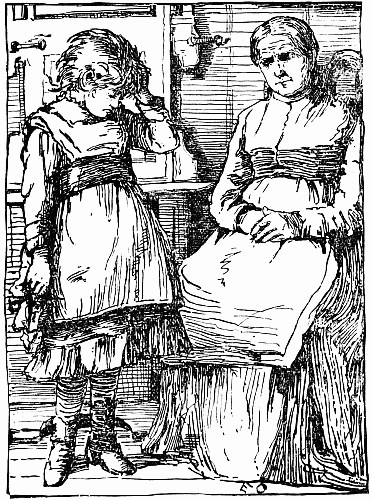
Silence followed, broken only by Pierotte's
sobs. The two old children sat with their
backs to each other, under different trees. By
and by Pierot's heart began to smite him.
"It was more my fault than hers," he
thought; and, turning round a little way, he
said coaxingly, "Pierotte."
No answer. Pierotte only stuck out her
shoulder a little and remained silent.
"Don't look so cross," went on Pierot. "You
can't think how horrid it makes you—a woman
of your age!"
"I'm not a woman of my age. Oh, how
can you say such things?" sobbed Pierotte.
"I don't want to be grown-up. I want to be
a little girl again."
"You used to be always wishing you were
big," remarked her now big brother.
"Y—es, so I was; but I never meant all at
once. I wanted to be big enough to spin—and
the—mother—was—going—to teach
me," went on poor Pierotte, crying bitterly,
"and I wanted to be as big as Laura Blaize—and—pretty—and
some day have a sweetheart,
as she had—and—but what's the use—I've
lost it all, and I'm grown up, and old
and ugly already, and the mother won't know
me, and the father will say, 'My little Pierotte—Cœur
de St. Martin—impossible! get out,
you witch!'" Overcome by this dreadful picture,
Pierotte hid her face and cried louder
than ever.
"I'll tell you what," said Pierot, after a
pause, "don't let us go home at all. We will
just hide here in the woods for a year, and
when Midsummer's Day comes round, we'll
hunt till we find the fairy house again, and beg
the fairy, on our knees, for another wish, and if
she says 'yes,' we'll wish at once to be little
just as we were this morning, and then we'll go
home directly."
"Poor mother; she will think we are dead!"
sighed Pierotte.
"That's no worse than if she saw us like
this. I'd be conscripted most likely and sent
off to fight, and me only twelve years old!
And you'd have a horrid time of it with the
Blaize boys. Robert Blaize said you were the
prettiest girl in Balne aux Bois. I wonder what
he'd say now!"
"Oh, yes, let us stay here," shuddered
Pierotte. "I couldn't bear to see the Blaize
boys now. But then—it will be dark soon—shan't
you be frightened to stay in the woods
all night?"
"Oh! a man like me isn't easily frightened,"
said Pierot, stoutly, but his teeth chattered a
little.
"It's so queer to hear you call yourself 'a
man,'" remarked Pierotte.
"And it's just as queer to hear you call yourself
a little girl," answered Pierot, with a glance
at the antiquated face beside him.
"Dear, how my legs shake, and how stiff my
knees are!" sighed Pierotte. "Do grown-up
people feel like that always?"
"I don't know," said Pierot, whose own legs
lacked their old springiness. "Would you like
some cherries now, Pierotte? I can reach them
easily."
"Cherries! Those sour things? No, thank
you. They would be sure to disagree with me,"
returned Pierotte, pettishly.
"Times are changed," muttered Pierot; but
he dared not speak aloud.
"Where shall we sleep?" asked Pierotte.
"Under the trees, so long as the summer
lasts."
"Gracious! We shall both die of rheumatism."
"Rheumatism? What an idea for a child
like you!"
"I wish I were a child," said Pierotte, with a
groan. "Here's a tree with grass below it, and
I'm getting tired and sleepy."
When the brother and sister woke it was
broad sunlight again.
"One day gone of our year," said Pierot,
trying to be cheerful.
It was hard work as time went on, and with
all their constant walking and wandering they
never seemed to find their way out of the forest,
or of that particular part of it where their
luckless adventure had befallen them. Turn
which way they would, the paths always
appeared to lead them round to the same spot;
it was like bewitchment; they could make
nothing out of it. The dulness of their lives
was varied only by an occasional quarrel.
Pierot would essay to climb a tree, and Pierotte,
grown sage and proper, would upbraid him for
behaving so foolishly,—"just like a boy,"—or
he would catch her using the pool as a mirror,
and would tease her for caring so much for
a plain old face when there was nobody but
himself to look. How the time went they had
no idea. It seemed always daylight, and yet
weeks, if not months, must have passed, they
thought, and Pierot at last began to suspect the
fairy of having changed the regular course of
the sun so as to cheat them out of the proper
time for finding her at home.
"It's just like her," he said. "She is making
the days seem all alike, so that we may not
know when Midsummer comes. Pierotte, I'll
tell you what, we must be on the lookout, and
search for the little house every day, for if we
forget just once, that will be the very time,
depend upon it."
So every day, and all day long, the two old
children wandered to and fro in search of the
fairy cot. For a long time their quest was in
vain; but at last, one bright afternoon, just
before sunset, as they were about giving up the
hunt for that day, the woods opened in the
same sudden way and revealed the garden,
the hut, and—yes—at the window the pointed
cap, the sharp black eyes. It was the fairy herself;
they had found her at last.
For a moment they were too much bewildered
to move; then side by side they hurried
into the garden without waiting for invitation.
"Well, my old gaffer, what can I do for you,
or for you, dame?" asked the fairy, benevolently.
"Oh, please, I am not a dame, he is not a
gaffer," cried Pierotte, imploringly. "I am
little Pierotte"—and she bobbed a courtesy.
"And this is Pierot, my brother."
"Pierot and Pierotte! Wonderful!" said the
fairy. "But, my dear children, what has caused
this change in your appearance? You have
aged remarkably since I saw you last."
"Indeed, we have," replied Pierot, with a
grimace.
"Well, age is a very respectable thing.
Some persons are always wishing to be old,"
remarked the fairy, maliciously. "You find it
much pleasanter than being young, I dare
say."
"Indeed, we don't," said Pierotte, wiping
her eyes on her apron.
"No? Well, that is sad, but I have heard
people say the same before you."
"Oh, please, please," cried Pierot and Pierotte,
falling on their knees before the window,
"please, dear, kind fairy, forgive us. We don't
like to be grown-up at all. We want to be
little and young again. Please, dear fairy,
turn us into children as we were before."
"What would be the use?" said the old
woman. "You'd begin wanting to be somebody
else at once if you were turned back to
what you were before."
"We won't, indeed we won't," pleaded the
children, very humbly.
The fairy leaned out and gathered a rose.
"Very well," she said. "Here's another
wish for you. See that it is a wise one this
time, for if you fail, it will be of no use to
come to me."
With these words, she shut the blinds suddenly,
and lo! in one second, house, garden,
and all had vanished, and Pierot and Pierotte
were in the forest again.
There was no deliberation this time as to
what the wish should be.
"I wish I was a little boy," shouted Pierot,
holding the rose over his head with a sort of
ecstasy.
"And I wish I was a little girl, the same
little girl exactly that I used to be," chorused
Pierotte.
The rose seemed to melt in air, so quickly
did it wither and collapse. And the brother
and sister embraced and danced with joy, for
each in the other's face saw the fulfilment of
their double wish.
"Oh, how young you look! Oh, how pretty
you are! Oh, what happiness it is not to be
old any longer! The dear fairy! The kind
fairy!" These were the exclamations which the
squirrels and the birds heard for the next ten
minutes, and the birds and the squirrels seemed
to be amused, for certain queer and unexplained
little noises like laughs sounded from
under the leaves and behind the bushes.
"Let us go home at once to mother," cried
Pierotte.
There was no difficulty about the paths now.
After walking awhile, Pierot began to recognize
this turn and that. There was the huntsman's
oak and the Dropping Well; and there—yes,
he was sure—lay the hazel copse where the
father had bidden them go for wood.
"I say," cried Pierotte, with a sudden bright
thought, "we will wait and bind one fagot for
the mother's oven—the poor mother! Who
has fetched her wood all this time, do you
suppose?"
Plenty of sticks lay on the ground ready for
binding. The wood-choppers had just left off
their work, it would seem. Pierotte's basket
was filled, a fagot tied and lifted on to Pierot's
shoulders, and through the gathering twilight
they hurried homeward. They were out of the
wood soon. There was the hut, with a curl of
smoke rising from the chimney; there was the
mother standing at the door and looking toward
the forest. What would she say when she saw
them?
What she said astonished them very much.
"How long you have been!" were the
words, but the tone was not one of surprise.
"O mother, mother!" cried Pierotte, clinging
to her arm, while Pierot said, "We were
afraid to come home because we looked so old,
and we feared you would not know us, but now
we are young again."
"Old! young!" said the mother. "What
does the lad mean! One does not age so fast
between sunrise and sunset as to be afraid to
come home. Are you dreaming, Pierot?"
"But we have been away a year," said
Pierot, passing his hand before his eyes as if
trying to clear his ideas.
"A year! Prithee! And the sheets which I
hung out at noon not fairly dry yet. A year!
And the goats thou drovest to pasture before
breakfast not in the shed yet! A year! Thou
wouldst better not let the father hear thee prate
thus! What, crying, Pierotte! Here's a pretty
to-do because, forsooth, you are come in an
hour late!"
An hour late! The children looked at each
other in speechless amazement. To this day
the amazement continues. The mother still
persists that they were absent but a few hours.
Where, then, were the weeks spent in the wood,
the gray hair, the wrinkles, the wanderings in
search of the old woman and her hut? Was
all and each but a bit of enchantment, a trick
of the mirth-loving fairies? They could not
tell, and neither can I. Fairies are unaccountable
folk, and their doings surpass our guessing,
who are but mortal, and stupid at that!
One thing I know, that the two children since
that day have dropped their foolish habit of
wishing, and are well content to remain little
Pierot and Pierotte till the time comes for them
to grow older, as it will only too soon.
 Toinette and the Elves.