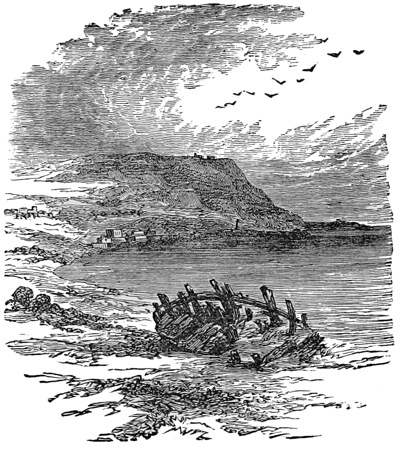
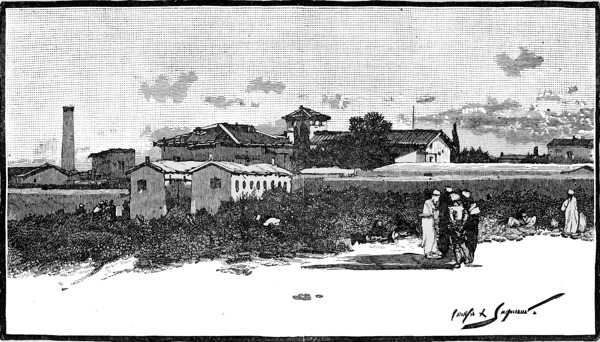
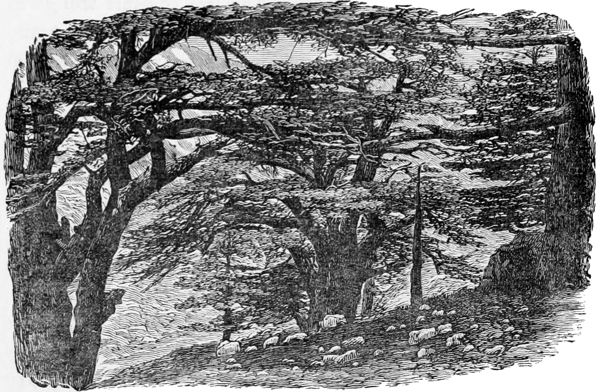
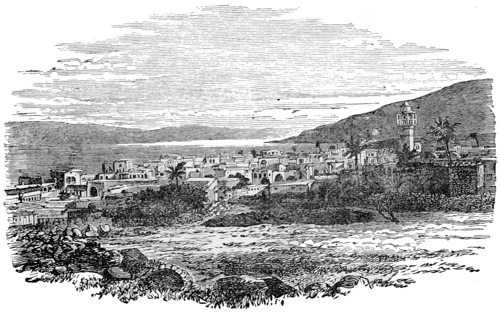
Tiberias was our last halting place. After a
grateful dip in the buoyant lake waters we leave
early next day for Safed, the highest inhabited
place in Galilee, said to be the “city on a hill that cannot be
hid,” for it is situated so high that it is visible far and wide,
but the term ‘city on a hill’ might almost equally well apply
to Bethlehem, the “city of our Lord.” In the distance the
snow-white houses of Safed glisten on the dark mountain side
like diamonds set in the breast-plate of a mighty giant.
Leaving the Latin Convent of Tiberias, we ride along the
shore of the Sea of Galilee for about an hour, until we reach
Medjil, or Magdala, the home of the Magdalene, now a collection
of wretched mud hovels, then across the fertile but
neglected plain of Gennesaret, in the midst of which we see a
fine stone circular fountain, evidently once the centre of a great
city, considered by some to be Capernaum; it is now overgrown
with vegetation and the centre of a wilderness, no other
trace of a town near. We pause awhile to think of those great
cities which in our Saviour’s time lined the shores of the lake,
and see how thoroughly their doom has been fulfilled. Tyre
still exists as a place to dry nets on, and Sidon as a habitation
for fishermen; but Chorazin, Capernaum, the two Bethsaidas
11and the other great lake cities—where are they? Their very
sites are not a certainty, and on the lake, where the Romans
once fought a great naval battle with the Jews, are now only
three wretched fishing boats, in one of which we take a
voyage. They were “exalted to heaven,” they are indeed
“brought down to hell.” We leave the sites of these
formerly great cities on our right, and soon after pass along
sloping ground where there is much grass (here, in all probability,
Christ miraculously fed the multitude). A mountain
near by was in the middle ages known as Mensa, alluding
perhaps to the place where our Saviour made a table for the
multitude in the wilderness. We lunch at Ain-et-Tabighah,
a pleasant spring in the mountains, said to be the site of
Bethsaida (there are ruins near by), and starting again skirt
the Wady-el-Hamân, or Valley of Doves, and soon after find
ourselves high up in the mountains of Naphtali, near Safed;
we ascend the hill behind the city to the ruins of the old
Crusaders’ Castle, whence we obtain one of the finest views
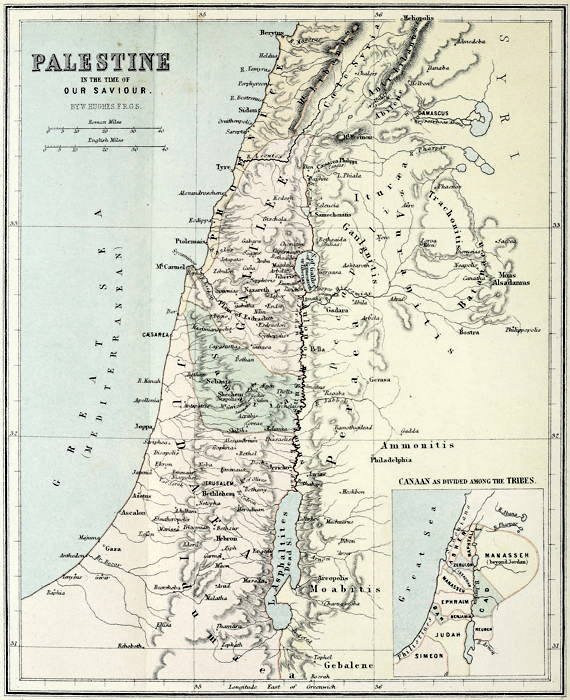
of Palestine. To the east we look over the Sea of Galilee,
across Basan and the wild Hauran, almost into the Arabian
Desert, taking in, in the far south-east, the mountains of
Moab and Ammon, with a long stretch of the Jordan Valley—on
the south and south-west we see Carmel and Tabor—on
the west the sea-coast—on the north the view is bounded by
the high mountains of Lebanon. We hire a Moslem house
for the night, after, of course, being asked for a month’s rent;
we put our horses in the basement and sleep in the upper
room, as usual without any kind of furniture or glass window,
and the floor a mud one, but the view from it is magnificent.
The Jews cook for us, but are so fanatical that they will not
taste the food they themselves have prepared for us. Our
bed is a stone ledge a few feet from the floor, but better however
than we have in many other places; we soon learn the
12way of making ourselves as comfortable as circumstances will
permit, sleeping often sounder on our stony couches than
many do on down beds. My dragoman shares my apartment,
the others sleep outside in the open. It is 5 a.m. when the
Muzeddin, from the summit of the minaret chants out the
first hour of prayer, and we set about enjoying our frugal
Frühstück, as the Polish Jews here call it, and soon after are
in the saddle.
Safed Olim Saphet, one of the four sacred cities of the Jews,
is built on terraces one above the other on the side of the
mountain, so that the flat roofs of one terrace serve very
well as promenades for the houses immediately above, also
affording extra facilities for cats and pariah dogs, jackals, &c.,
to intrude upon our nocturnal privacy. From Safed we
travel up and down the mountains, having beautiful views of
the plain where Jabin of Hazor gathered together his iron
chariots against Joshua; of the waters of Merom (Lake
Huleh), and the swamps and jungles of the Jordan, with
herds of half wild buffaloes almost hidden in the high rushes.
On our left we pass a large khan, built to accommodate the
Circassian cut-throats, exiled for committing the Bulgarian
atrocities; then on our right is a rock-hewn cistern of vast
size, evidently made for some other purpose than to supply a
few sheep here in the wilderness.
Deshun, an African colony sent from Algeria when the
French conquered that country, is next reached; the people
seem to be industrious and prosperous. We observe that their
houses are detached and have sloping roofs, seldom seen in
this country except in European settlements, and altogether
they appear more civilised than the Arab inhabitants around
them. About noon we pass the site of Hazor, whose kings
we hear of in Holy Writ under the common name of Jabin,
which was probably the hereditary title of their kings, as
13Hazael of Syria, Hiram of Tyre, Pharaoh of Egypt, &c.
After a ride of about 11 miles, we halt for tiffin in the olive
grove of Kedes, (Kadesh Naphtali) one of the cities of refuge,
and the home, it will be remembered, of Barak, as also of
Heber the Kenite. It was one of the royal cities of the
Canaanites. There are great masses of débris and ruins here,
and some fine single and double sarcophagi lying about. The
Turkish people are excavating huge trenches and digging out
large quantities of ancient worked stones, not however, with
any love or regard for archæology, for they are at once
utilised to erect modern buildings or burnt for lime. We
acquire a very ancient lamp for about three half-pence. Our
zeal for antiquities a Turk or Arab does not understand; he
will sooner build a bizarre new mosque (as at Cairo) than
repair the grand old one next door; if a building goes to ruin,
he says resignedly “Mâshâllah” (God wills it), and leaves
it to decay.
Lake Huleh (Semachonitis), which lies under Mount
Hermon, is between four and five miles long and about four
miles broad. Nebu Husha, or the tomb of Joshua, looks
down upon it. The views all along the shores (where the
hills of Naphtali and Basan close upon the lake) and the vista
of the Jordan valley and mountains beyond, especially
Hermon, are very fine. We now, as there is a deal of ground
to cover before sundown, try a short cut into the valley
without going by Hunin, the usual way. We hear of a path
from the Bedouin, and after some difficulty find it. It is not
known to the travellers’ guides, and it is just as well that it
should not be, for it is a difficult dangerous descent, and one
of our horses slipping in a bad place, very nearly brings great
grief, both to himself, his rider, and the writer, who suddenly
finds himself, with a frightened horse in front slipping, falling,
and struggling, wedged in a track so narrow and precipitous
14that it is difficult to find room to dismount; once off, we do
not remount until we reach the plain, and no greater damage
is done than the loss of a bridle, but a halter is almost as good
for an Arab horse. The animal bolted after his fall but we
managed to catch him. The path afterwards, when we could
find one, being little better than a goat track, we have some
trouble to get the horses to face the steep descents. It saves
however some hours of time, and is of immense service to us,
as otherwise we should have been benighted in the difficult,
dangerous, rough and swampy country at the head of the
Jordan valley. As it is we are out 11½ hours in an almost
tropical country, and do not get into Banias until after sunset,
a bad time to enter any Eastern town, and then have to look
for a lodging. But to go back a little, we get down into the
Jordan valley, near Ain Belat, at the tents of the Ghawarineh
Arabs. “Rob Roy” gives them a bad character, and says
they attacked him, but they give us water and behave
civilly. However we should not trust them too far, nor after
dark. We are so glad to get down to level ground, so severe
is the descent, that we think little of any danger from the wild
denizens we drop down on. The scene here is remarkable,
the black Bedouin tents, the dusky herds of buffaloes roaming
among the marshes, the impenetrable jungles, the almost
naked swarthy barbarians, together with the intense heat,
make us imagine ourselves to be in the midst of the dark
continent. Our advice to travellers going from Safed by
Kedes to Banias, is to make a two day’s trip of it, and not
one as we did, and then to keep up on the mountain, and
descend by Hunin to the plain.
Hunin, which we pass under, was the Beth-rehob of Joshua,
the limit of the land searched by the spies, for here Syria may
be said to begin on the slopes of the Anti-lebanon. We now
cross the Hasbâny, the most northerly source of the Jordan,
15by an old ruined Roman bridge, Jisl-el-Ghugar, where my
men dismount again, but I have more confidence in my
horses hoofs than my own boots, and stop in the saddle, and
the surefooted sagacious animal carries me over the holes and
boulders safely, whereat I score a point against the dragoman,
and now after another rough ride for about three miles over
stones and swamps, at length we reach Tell-el-Kadi, the
(fertile) hill of the Judge or Dan, which in the Hebrew also
signifies Judge.
Dan, it will be remembered, was the extreme northern limit
of the promised Land, as Beersheba was the most southern.
Its Canaanitish name was Laish, it was a colony of Sidon,
and dated back to the days of Abraham. The Danites took
it easily by surprise, as the inhabitants were a peaceable
people devoted to commerce and the manufacture of pottery.
It was always a “high place” or sacred city with the
Phœnicians, who called it Balinas, or the city of Baal, as
later on with Jeroboam, whose Calf was a venerated idol with
the local heathen of that day, as it is still curiously with the
native ignorant Druse peasants at the present day. When
cursed by a Mahommedan they are often called “Sons of
a Calf,” as we ourselves heard: so Jeroboam did not
necessarily take his idea from the golden calf of Mosaic
times, but may have simply adopted the indigenous idolatry;
yet “Calfolatry” may have originally come from Egypt, as
Dan, being a city of palm trees and water, was a favourite
trysting place for the Egyptian as well as the Assyrian, being
on the road to Damascus, which was the objective point of
every invader, whether warrior or merchant.
Dan is now a mound some 500 feet or so long, and 40 feet
high, visible for a long distance over the low plain; here,
under a fine oak tree, near a grotto sacred to Pan, is another
most copious source of the Jordan, forming a large stream
16immediately it springs from the ground, said to be the
largest source of any river in the world, as it forms a good
flowing river at once. It is called by Josephus the Little
Jordan, and is considered by many the chief source, but it
is not the most northerly. We get a grand view here of
the great Jordan Valley, looking down upon a sea of waving
corn, spread out in one vast field, almost as far as the eye
can reach. A long ride through lanes and pleasant wooded
country, the road often paved with ruined pillars and old
Phœnician worked stones, brings us at last to Banias, the
site of ancient Cæsarea Philippi, so called Cæsarea by Philip
the Tetrarch, in honour of Tiberius Cæsar, the agnomen
Philippi being added by the same gentleman in honour of
himself, and to distinguish it from Cæsarea on the coast near
Jaffa. Agrippa II. called it Neronias in honour of Nero, but
in later times it regained its original name Paneas (which it
took from the Temple of Pan then there), and that was
easily corrupted to its present name Banias. It was once
at least visited by Christ (Matt. xvi.).
Banias is beautifully situated on a spur of Hermon, on the
direct road to Damascus, which we do not intend to take,
preferring to go two days longer journey round to visit the
less frequented parts of Syria. We are received into a
Mahommedan house, and have, as usual, the upper chamber
allotted to us; and have, what is not usual, the daughter of
the house to attend upon us. Veils are dispensed with in
this establishment, except by the mother, who after a while
thinks it proper to drape up the lower part of her face which
somewhat improves her appearance. The accommodation
is the same old story, four bare walls. It is quite an Oriental
scene at night. The moon shines brightly on the one-storeyed
flat mud-roofed huts. On the top of each are the members
of the various families sleeping al fresco. Some more
17fastidious or important personages rig themselves up a leafy
bower on four supports about three or four feet from the roof—a
cool retreat undoubtedly, forming little tents such as
might have been seen in ancient Jerusalem during the feast
of Tabernacles. A cat or two of course come in through the
paneless windows during the night in search of our saddle
bags, but a heavy boot well shot at an Oriental cat helps
him out quite as quickly as it would one of our own domestic
favourites. One time, however it misses the mark and alights
on our sleeping dragoman. It was at Banias, by-the-bye,
that Titus celebrated with gladiatorial games the capture
of Jerusalem, and many thousand prisoners perished in the
“Sports.”
Early next morning we visit the massive ruins of the old
gate, the grotto of Pan, which gave the name to the city, and
the Banias fountains of the Jordan. The rocks just above
the latter are sculptured with shrines and niches in which
statues once stood; there are also Greek inscriptions which
are not very legible.
We now leave Banias by the old western gate, and riding
over a slope of Hermon enter Syria proper. The whole
country including Palestine is often described as Syria, and
was all under one Pashalic so called until lately—Palestine
originally included only the country of the Philistines. We
breakfast in a poplar grove in the prosperous Christian
village of Rasheyat el Fûkhar, celebrated for its pottery,
which it supplies to the whole of the northern part of
Palestine and Syria, as far as Damascus. It is refreshing to
come across an industrious manufacturing population, so
rare in Palestine except at Gaza and Ramleh in the south,
where jars and lamps are made, and at Nablous (ancient
Shechem), where a coarse native soap is made of olive oil,
and exported as far as Egypt. The Germans at Caifa (under
18Mount Carmel) are cultivating this industry also, and turn
out a much finer article, which finds a sale in America, but
has not yet made a market in Palestine, which prefers its
native make to that of the Feringhee. We next descend the
mountains by a precipitous path, a new one not tried before
by our guide, down which we with great difficulty drag our
horses to Hibberiyeh, prettily situated in one of the western
gorges of Hermon: here we visit a very ancient well-preserved
temple built of Phœnician bevelled stones principally,
but curiously with pilasters and columns having
Ionic capitals—an old Sidonian shrine to Baal probably (as
it faced his temple on the summit of Mount Hermon) altered
by the Greeks to accommodate one of their own deities. The
valley is remarkably a Valley of Rocks; some isolated ones
seem to have been formerly sculptured to imitate the human
form divine. The ascent up the other side of the valley we
find very laborious, having again to lead or rather drag our
horses, until at length we arrive at Hâsbeyâ, our quarters for
the night, of which more in our next. The shortest way to
Damascus is that through the wilderness of Damascus by
which St. Paul travelled; but the most beautiful road is that
we select, which leads round the slopes of Hermon.
19

CHAPTER III.—Hasbêya to Mount Hermon. — THE DRUSES. — ASCENT OF MOUNT HERMON.
Hasbêya is a small town beautifully situated some
2,000 feet above the sea, on the western side of
Hermon, in an amphitheatre of hills well cultivated
and inhabited by Maronite Christians, Druses and Moslems,
all very fanatical, hating and fearing each other intensely,
and not, as far as the Christians are concerned, without
cause, for here they were treacherously massacred by the
Druses in 1860. They were decoyed into the Konak, or
Governor’s Castle, by the Turkish commander under pretence
of protection, induced to part with their arms, and then the
Druses being admitted men women and children were
massacred without mercy. The French army of the Lebanon
avenged these cowardly murders partially, and but for the
milder (and doubtfully humane) counsels of the English,
would have done so effectually. We saved the Druse
scoundrels from their just fate then, and consequently they
are quite ready to repeat the crime now. This our rulers
would do well to remember that maudlin sentimentality is
often another name for weakness and not true mercy which
is frequently obliged “to be cruel to be kind.” Orientals do
not practice and do not understand undeserved clemency.
The Christians in the Anti-Lebanon feel the effects of a too
20lenient policy, and are periodically in a panic about their
ruffianly neighbours, and the Moslem feeling too is often
inflamed against Christians, the old rumour that the five kings
of Europe (as the great powers are called) are about to
depose the Sultan and upset Islamism, being for fanatical
purposes often revived. This rumour was one of the causes
which led to the rebellion of Arabi in Egypt. If Arabi
had not been crushed, there would probably have been
a general rising of Arabic Islam against the Ottoman
Caliphate and European interference—and it may come yet.
The Ottomans are no longer a nation—they are quite effete—but
the Arabs are as vigorous a race as they were in the days
of Alexander the Great and Mahomet. The Arabs and the
Jews, the children of Abram’s two sons, are destined to
endure for ever distinct races in the midst of a heterogeneous
world, everlasting monuments of the truth of the Bible story.
Hasbêya is thought by many to be the Hermon and Baal-Gad
of the Bible, but others identify the latter with Baalbec.
We will not attempt to decide that on which many doctors differ.
We lodge in one of the best houses at the head of the valley,
near the Konak. A sort of stretcher, much resembling an
oriental bier, is hastily run up for us as a place to sleep on.
Round the room and in the courtyard below we see ranged a
number of immense jars, each large enough to contain one of
the “forty thieves,” some in fact could have accommodated
two. We find them to be mostly full of new wine, which is
rather too rich and luscious to take much of. Just as the day
is dawning an oriental maiden enters our room and makes for
one of the jars (to get something out of it) and we are forcibly
reminded that we are in the land of the “Arabian Nights.”
Next day, after about three hours toiling over mountain
paths, we pass the mouth of the Wady-et-Teim, in which is
the source of the Hasbâny, the highest and most northerly
21source of the Jordan, the Banias and Dan branches of which
it joins just above the waters of Merom, or Lake Huleh,
after running almost parallel with them for some distance.
We crossed this stream lower down by an old Roman bridge
on our way from Kadesh to Dan and Banias.
The Druses make the Hasbâny Valley their religious
centre, as their prophet, Ed Darazi, is supposed to have been
born there. Their religious books having been lost (or rather
stolen by the Egyptians), their religion, which is of more recent
origin than Mahometanism, is traditional only, and it is
difficult to say what it really is, but it seems to have been
founded on an ancient form of freemasonry. It consists of
several degrees. The Druses hate Moslem and Christian
pretty equally, but are more tolerant of the former, with
whom they often associate for the purpose of plunder, but
they would murder either without compunction. At the same
time, with an appreciable regard to expediency, their religion
allows them to live under whatever creed is supreme. They
have, since the 1860 massacres, migrated in large numbers
from the Lebanon to the Hauran, east of Jordan, which they
hold practically independent of any Government whatever,
although nominally subject to the Turkish Sultan. They are
distinguished by white turbans. Lebanon being now a
separate pashalic, under a Christian governor with a native
Christian army, the Druses would find it more difficult to
occupy that district now than they did in 1860; but in Anti-Lebanon
they are more formidable. When a fanatical
Mahommedan wishes to annoy a Druse (as was done by our
muleteer in our presence) he calls him “a worshipper of the
calf.” This is curious, as the golden calf set up at Dan was
only a day’s march from here. The Druses have no mosques
22or temples, but worship in a room outside a village, and only
the higher initiated members are admitted to the whole performance
or allowed to learn what is known of their sacred
records, which are imparted by oral instruction only, and
never reduced to writing. Very few indeed are acquainted
with all the mysteries of their religion, and to the higher
degrees no man under 30 is ever admitted, the women, we
think, never. The most sacred shrine of the Druses is a
secluded cave half-way up Hermon, and there only the
most secret rites are performed. A pretty ride of about six
hours brings us to Rashêya.
Rashêya, the Syrian Heliopolis, or City of the Sun, is finely
and healthily situated high up on the slope of Hermon. I
have never been mobbed in any Eastern town as I was here, a
European being quite a rara avis. Men women and children
cluster round me, and even crowd into my little room to stare
at me and touch my clothes, prompted, I suppose, by either
curiosity or superstition or both; many seem to think me a
medicine man, and bringing sick children ask me to touch
them; but unfortunately I am not a doctor. A few of the
younger women, having confidence in their good appearance,
beg of me to draw their portraits, but my first sketch soon puts
the other fair candidates to flight. Two or three enterprising
young ladies, clasping my hand in theirs, entreat me to take
them back with me to England and make them members of
my family. I have to explain to them that the social system
of the West does not allow of any such extensive adoption as
that of the East. We have often been asked by mothers to
take their children and bring them up as Feringhees, but
think that in most cases this is done to frighten the children.
The Rashêya folk are strong healthy-looking people, but
have a barbarous habit of tattooing their bodies (which is
seldom seen in the East), the hands especially with stripes
23looking like the seams of gloves. We have, as usual, the
floor only to sit and sleep on. We are beginning to be quite
clever at squatting à la Turc, but must admit that we think
chairs, tables and beds more comfortable. The Rashêya
Christians in 1860, were, as in Hasbêya, decoyed into the
castle by the Turks, and by them basely betrayed to the
Maronite Druses, who massacred man, woman and child.
Mount Hermon, we believe, has not been ascended to the
summit by any Englishman for some years. It is called by
the Arabs the Snowy Mountain: misled probably by this the
text books on the subject boldly assert that its summit is
perpetually covered with snow, but this is not the case, nor
is it so even with the loftier peaks of Lebanon, on the opposite
side of the plain. From Hermon the snow disappears some
two months at least, and although we find it cold there is
not a trace of snow anywhere. The bare white limestone
sides of mountains are often mistaken at a distance for snow,
but few travellers ever attain the summit, and hence the
perpetuation of the perpetual snow fable.
Hermon, being isolated from the Anti-Lebanon, and the
three peaks rising abruptly some 3,000 feet above the lower
ridges, has an apparent altitude much greater than many
higher mountains. The grandeur of the Matterhorn, for
instance, although a monarch of mountains, is diminished by
the magnitude of its mighty neighbours, Monte Rosa and the
Breithorn (which latter we ascended a few years since, so can
judge from experience). The Matterhorn is a giant among
giants, a king of kings; but Hermon stands alone in its
glory—is, as it were, a sturgeon amongst minnows, and owes
its prestige, not to its height, which is under 10,000 feet, but
to its isolated position and abrupt elevation; and the same
24may be said of Carmel, which Swiss travellers would scarcely
dignify with the name of a mountain at all.
Hermon, the Sirion of the Sidonians, and Shenir of the
Amorites, is called by the Arabs, Jebel el Sheikh, the
Monarch of Mountains; it was once encircled by shrines
to the Sun God, Baal, all facing the great central temple on
the summit of the southern peak; there is only one of these
remaining now, between Banias and Hasbêya, which we
have already described.
Baal, literally interpreted Lord, was probably applied first
to the greatest hero, then to the favourite deity of the
day. We hear of it as Bel applied to Nimrod; and we
trace it in many other names, such as Bel Shazzar, which
means King under the Lord Baal, a sort of divine right we
suppose. The Phœnicians generally patronised the Sun, the
Israelites probably called their golden calf Baal. After the
Greek conquest, Baal and the other Gods were very much
mixed up, and the Romans later on, to appease the conquered
Syrians, identified their Jupiter with Baal, and their Venus
with Astarte, or Ashtaroth. It may be interesting to note
here that a memorial of Sun worship survives in Scotland in
the Bel tane (Bel’s fire) fair still held at Peebles. It is commemorated
on May-day morning. Our actual ascent of the
mountain is without much interest, except that on the way
we pass a very well-preserved wine press, hewn out of the
solid rock. The horses are at the door at four a.m., but not
until six can we venture out, for Hermon is veiled in dark
cloud, and over the Rashêyan Valley bursts a terrific
thunderstorm, the thunder reverberating grandly among the
mountains. A continuous bombardment by the biggest guns
ever launched from Woolwich would have been infants’
rattles compared to it. At six a.m. a ray of sunshine breaks
through the black firmament above, and we set out briskly,
25and in about four hours scramble up to the southern—the highest
peak—where we find extensive and massive remains of two
temples, dedicated to Baal, also a large cave in which we
tiffin. Time and space would fail to describe the grand
panoramic picture displayed from this sacred summit, no high
peaks near to intercept the view. During the ascent, to the
summit, which is some 5,000 feet above Rashêya, we have a
fine sight of the coast from Carmel to Tyre, but on the summit,
the greater part of Palestine and Syria are opened out as a
map—to the west, the Mediterranean coast; to the north, the
ranges of the Lebanon stand boldly out; the plain of
Damascus, bounded by the six day’s desert, flanked by Abana
and Pharpar, is in the extreme north-west; Dan, Cæsarea
Philippi, Kadesh Naphtali, Safed, &c., nestle beneath on the
near south-east; further south the broad waters of Merom,
and the silver streak of the Jordan glisten in the noon-day
sun, and in the far east the lofty plains of Basan and the
Mountains of Moab bound the distant horizon; on the south,
Mount Tabor raises its beautifully wooded crest over
Nazareth; Gilboa near by seems lost in the plains of
Esdraelon; and further west, in the dim distance on the
coast, Carmel slopes away to the sea. We enjoy the view
only a short time, as a blinding hailstorm comes down and
causes us to beat a very precipitate retreat; but as the black
thunder clouds gather above and beneath us, and the sun at
intervals shines through and upon them, the mélange of earth
and sky, sunshine and cloud, gold and colour, is grand in the
extreme. Mountain and meadow bathed in black and gold,
here and there mellowed with the most delicate tinges of
purple green and orange, form an effect, which if fixed on the
canvas, would be called an impossible picture, and we could
now well understand and feel that enthusiastic praise so often
in the Bible bestowed on Hermon, “that Tower of Lebanon
26which looketh towards Damascus.” The ascent is neither
difficult nor dangerous to a careful and vigorous climber, but
extremely laborious, being a steady steep and continuous
scramble over loose stones, on which it is difficult to retain a
footing; there is no defined path to the summit, and it should
not be attempted without a local guide, as the clouds gather
round and envelope Hermon very quickly, and sleet or snow
may come on suddenly, in which case there would be but little
chance for any but the most experienced guides. Hermon is
thought by some to have been the scene of the transfiguration
as Banias, where our Saviour started from, is near by.
On our way up we try to track a bear, but fortunately fail to
find him. If our curiosity had been gratified, we probably
should not have written this account.
27

CHAPTER IV.—Damascus.
Rasheya is again our resting place after our descent
from Hermon, and next morning we make an early
start for Damascus. In about 40 minutes we
arrive at Rûkleh where there are ruins of temples, and a
mountain ride of another two hours brings us to Deir-el-Ashair,
where again, on a small elevated plateau, we see
extensive and massive remains of ancient temples with
fragments of Ionic columns. After a short ride we now reach
the French diligence road, the only decent bit of road in
Syria, over this the French have a monopoly of wheeled
traffic and transport for nearly 99 years, riding horses pass
free, but all pack animals and caravans have to pay, which
however the native caravans evade by still using the old
track up and down the mountains which runs almost parallel.
The ride through the Abana, or Barada Valley, for the last
three hours is very pleasant, being well watered, wooded, and
sheltered from the sun—a most agreeable contrast to the
dreary desert of Sahira, through which we have to ride some
two hours to reach it. We may here remark that Sahira in
the Koran is the Arabic term used for Hell, and anyone who
has been in the burning desert at noontide (the hot dry wind
making the skin like parchment and drying up all moisture in
28the lips and body) will have an idea that any kind of Hell
must be a most uncomfortably hot place, life being in the
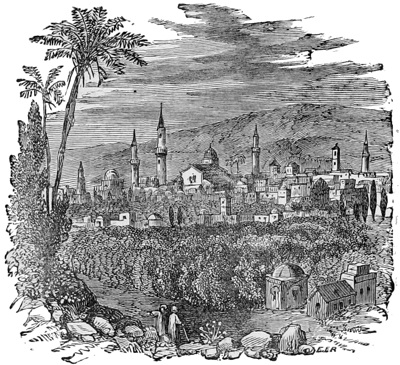
burning desert a burden almost unbearable. The first sight
of Damascus, unlike that of Jerusalem, realises all we have
heard of it, it is indeed magnificently situated in the midst of
an extensive plain, intersected in all directions by the rills of
the rivers Pharpar and Abana, which mæander through and
round the whole city, and finally lose themselves in the
meadow lakes beyond.
We see the Wali, or Governor, Hallett Pasha, sitting alone
on a chair by the river side enjoying otium sine dignitate; his
guards at a distance standing by their horses ready to look
after him, if necessary. He politely returns our passing
salute in true Parisian style. Like all other Turkish Pashas he
will have to make hay while the sun shines and be sharp
about it. His predecessor, Midhat Pasha (of mournful
memory) did not enjoy the sunshine long, and Hallett’s may
be a similarly short summer. It costs money to be a
Damascus Pasha, some £4000 has to be first found for the
Palace Cabal at Stamboul. The official pay of the appointment
is under £3000 a year, so the moment a Pasha gets to his
government he has to set to squeezing; he squeezes backsheesh
out of the higher officials, and they squeeze the lower and the
public, who are fair game for all. Justice, not at all blind
here, is continually looking out for the dollars. But to return
to Damascus. The plain in which it is situated is surrounded
on three sides by mountains, Lebanon, Anti-Lebanon and
Hermon; on the east it is bounded by the Syrian desert, in
the midst of which is the city of palm trees, Palmyra, the
ancient Tadmor, the city of Zenobia, the Boadicea of the
Syrians. Well might the Moslem, arrived in this ever-verdant
plain, after six days dreary riding across the desert, when he
came across this city embosomed in beautiful gardens and
29orchards, when he saw the rills of living water flowing in all
directions and rising in fountains in the very court-yards of the
houses, well might he imagine that he had lighted at last upon
the Garden of Eden. We find comfortable quarters at
Demetri’s, the only Frank hotel, and are glad again to see
some signs of western civilisation.
My flying visit here without tents, traversing the country
by little known paths, creates some curiosity, even among the
Europeans, who wish to know if I am travelling under diplomatic
orders; a negative answer to such a question is not, of
course, worth much. The Turkish police give vent to their
curiosity by visiting me in my bedroom and cross-examining
my dragoman as to my intents and purposes, position in life,
&c., &c. Things are rather strained here. The attitude of
the allied Powers to Turkey makes this fanatical people never
well disposed to Christians, now still less so, and to make
matters worse, Arab placards have been posted here and at
Beyrût in the Bazaars, summoning the natives to revolt
against the Turks, asking reasonably what common interest
the Arabs have with their now imbecile and insolent
conquerors, the Osmanli usurpers of the Khalifate, who
monopolise all place and power, using them only to oppress
the people, whose language they do not even understand, and
whose lives, liberties, and properties they either cannot or do
not care to protect. This is a sign of the times—a writing
on the wall to warn the feeble despots of Stamboul of their
doom. This movement has since developed into an organised
Arab League, following the example of the Albanians.
An Armenian League probably is not far behind. The
collapse of the rule of the Osmanlis is merely a matter of time.
They may retain Asia Minor for the present (if England does
not seize it to save it from Russia), but they will have to clear
out of Europe, and Syria, Lebanon and Palestine must ere
30long be like Egypt, semi-independent vice-royalties under
European protection, or they will become Russian and French
appanages. The Turkish Government have authorised their
postmasters in Syria to detain telegrams and open letters at
their pleasure. A remedy for that is to give the letters to the
Consul who forwards them in his bag. The Consul here lives
in a hired house liable to a notice to quit at any moment.
What a pity that our Government does not buy itself a
consular residence in such an important post as this? It is
so undignified for an English Consul to have to turn out at the
bidding of a Moslem landlord, and troublesome in the extreme
to have to move all the archives every few years; and in case
of an intrigue, which is not uncommon in these parts, we
might find it difficult to find a suitable place for the Consul
at all. In one of the squares we see a crowd and several
soldiers looking at the dead body of an Arab. This poor
fellow was, with others, in charge of a caravan of camels,
some Druses swooped upon them within only a few hours of
Damascus, all ran except the murdered man, who stuck to
his post; they of course soon killed him and cleared off with
the camels. This is the security for life and property which
Turkey provides for its subjects in the neighbourhood of a
great city. We will now take a stroll through this thoroughly
Eastern city, where the far East and the far West meet more
than in any other city in the world, more so even than in
Tanjiers and Tunis. Here we see English tourists in tweed
suits, black-coated Americans in tall hats, Bedouins in dirty
bornous, Druses with white turbans and blood-stained hands,
Turks in officials fezzes, orthodox Moslems in flowing robes
and showy green turbans, Circassians with breast full of
cartridges (murderous looking rascals), Kurds in rough sheep
skin cloaks, Persians, Afghans, Pariahs and Parsees, slipshod
veiled Eastern women, gorgeous Jewesses and smartly dressed
31Parisian dames, all these meet together in this metropolis of
the East, jostling each other in the narrow unpaved bazaars.
Camels also, and mules, horses and donkeys, with perhaps a
drove of long-tailed sheep, from the far steppes of Turkestan,
press on amidst this motley crew, “Oua garda”—take care,
take care, get out of the way quickly! A pack mule is no
respecter of persons, he cares not for your Consul, and over
you go if you do not get out of his way, unless by a vigorous
shove you send him over, just as in self-defence we were
obliged to do once. A pack mule on his back, legs up in the
air, is a helpless, pitiable spectacle.
Metropolis did I call Damascus? Indeed it is rightly so
called, for is it not the mother of all cities, the oldest living
city in the world? (not even excepting Hebron), for here
Abraham’s steward Eliezer lived; these streets the patriarch
himself must often have traversed as a trader in flocks and
herds, and through these lanes, once at all events, he drove the
Hivite Kings of Hermon before his avenging spear, for near
here he rescued Lot and the King of Sodom from their Syrian
captors. It was conquered by David after a protracted
struggle, but recovered its independence in the reign of
Solomon. It was subsequently subdued by the Assyrians.
Rome may call itself, Damascus is the Eternal City, founded
probably soon after the flood by a Semitic grandson of Noah.
Damascus has never ceased to exist as a great city, and from
its unique position, probably never will. The prey of every
ambitious conqueror, it has seen the rise and survived the
fall of every great empire. Assyrian, Persian, Greek, Roman,
Crusader and Saracen, each in turn have dominated the
garden city—and died—but Damascus still lives and has
out-lived all its rivals of every age. Sidon, Tyre, Antioch and
Tarsus survive only as uninteresting towns, Babylon,
Palmyra and Nineveh are no more, but Damascus is still the
32“Head of Syria” as it was in the days of Abraham—Damascus
a green island in the midst of a golden sea of sand,
bounded by the desert, surrounded by its rivers, has always
been and must for ever remain the mother city of the world.
To brace ourselves up for our rambles, we now take a bath
in the waters of the Abana, which are, as its Syrian name
Barada indicates, remarkably cool and pleasant. Having
tried Jordan too, we must endorse Naaman’s opinion, that the
bathing in the former is decidedly the best. In the midst of
the city, we are shown a sycamore tree, 42 feet in girth;
certainly a curiosity in any city, but especially so in a
Mahommedan one, where the process of destruction is
carried on by man and that of re-construction or re-placement
left to “Allah.” We also see another tree in the horse
market close by, used as a gallows, but public executions are
very rare in Turkey. A good Moslem is peculiarly sensitive—he
does not object to strangle a wife or two quietly at home
if they are annoying, but he objects to a fellow male Moslem
being publicly executed even for a murder. We look into the
great mosque; in its courtyard are the remains of a small
ancient temple to the sun—it was once a Roman temple, then
a Greek basilica, and was in more ancient times probably the
site of the very temple in which Naaman bowed the knee to
Rimmon, when his master worshipped there. We found it
easier to enter St. Sophia at Stamboul, the mosque of
Omar at Jerusalem, and the grand mosque at Cairo, than
this, the people being so fanatical. St. Sophia, in fact, we
got into by only paying a few francs to the door-keeper, but
here it costs a lot to get in. We are next shown the tomb
of the great Saladin, who died 1193, but as it is very
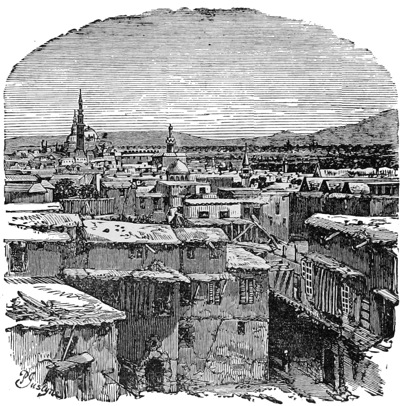
sacred, cannot view the interior. We now come to the street
called “Straight,” above a mile long, running through the
city east to west, and on our way we call at the traditional
33house of Ananias, now a small Latin Church; then just
outside the east gate we pass the reputed house of Naaman,
now appropriately a leper hospital, and come upon that part
of the wall from which it is said St. Paul was let down in a
basket at the time when Aretas, the Petræan ruler of Arabia,
was King. Aretas was the name of the dynasty, like,
Ptolemy and Pharaoh of Egypt, Candace of Ethiopia, &c.
The conversion of St. Paul is said to have taken place just
outside the city—the spot is shown: bright indeed must have
been the light before which an eastern sun at mid-day paled.
A walled up gate is also shewn as that by which St. Paul
entered the city.
The Bazaars are very interesting, here is to be found
merchandise collected by caravans from all corners of the
earth; Merchants from Manchester, Paris, Vienna,
Constantinople, Aleppo, Bagdad, Persia, Afghanistan, India,
Egypt, Nubia, and Arabia as far as Mecca, crowd its
exchanges. The native manufactures are chiefly silk, leather
and metal work; the population is principally Moslem. We
34of course pay a visit to old Abu Antika (father of antiquities),
and possess ourselves of a Damascus blade. A friend of ours,
an artist, was about to give 100 francs for one at Cairo, we
asked to look at it, and saw engraved on it “warranted best
steel.” We asked the old Arab swindler what language it
was; he unblushingly answered “Arabic”! my answer
induced him to hastily put away the Damascus blade and my
friend put his 100 francs back into his pocket. Tricks are
sometimes played upon travellers. We see in old Abu
Antika’s booth an English Countess wasting a lot of money
on spurious antiquities, we did not know her then so could
not interfere, but she introduced herself to us later on and
was a very pleasant and intelligent fellow traveller. The
houses of the rich Damascenes are very handsomely fitted up;
on visiting one, we enter by an archway into a great open
courtyard, with a fountain in the centre and trees and plants
all around. A divan, roofed in, but open to the courtyard at
one end, is fitted with a luxurious lounge; this serves as
a public reception room. On each side of the court is a
large room, one used as a Summer and the other as a
Winter sitting room, according to the seasons. All are
magnificently decorated with marble and mirrors. The
sleeping rooms are on the first floor and are entered from a
verandah above. Running water from the Abana flows
through all the best houses. The public buildings and
barracks built during the Egyptian occupation are very good
for a Turkish city, and the citadel, an old mediæval castle, is
interesting, but access is not allowed to it. Abdel-Kader,
who so long kept the French at bay in North Africa, lived in
Damascus, and had a quarter allotted to him and his Algerian
fellow exiles. Damascus is not the dirty city it once was.
Midhat Pasha greatly improved it in that respect, and also in
other ways, for we see a large quarter of Damascus in ruins
35and are told that it was set fire to by Midhat Pasha (after the
fashion of Nero) to make room for a new wide street. This
is a much shorter and more economical way (to the government)
of making street improvements than that we have in
England, but as no notice of the contemplated improvement
is given, it must be rather inconvenient to the inhabitants.
Damascus is called by the Arabs El Sham, and in the eyes of
the Moslem world is second in sanctity only to Mecca.
36
CHAPTER V.—The Anti-Lebanon.
Damascus must now be left behind, adieu, we wish
we could say au revoir to its lovely lanes and
pleasant orchards, its curious motley crowded
bazaars, its marble palaces and murmuring waters, and its
grand associations with all time—for did not through Damascus
pass those archaic caravans whose descendants colonised the
four quarters of the globe? Shem probably here said goodbye
to Ham on his way to Africa, and both bade God-speed
to Japhet, in quest of a new world farther north; and Noah
himself—did not he pass here on his way to leave his bones
as near as possible to Eden; and are we not shown his tomb,
and that of Adam, Abel and Seth, cum multis aliis near here
even to this day? Adieu also to the comfortable hotel of
Demetri, an oasis in the desert of barbarism we pass through.
We follow back the diligence road a few miles as far as
Dummar, and then start upon the upper road to Baalbec, viâ
Zebedâni, one of the prettiest rides in Syria; but first to get
a zest for better things we pass across the arid desert of
Sahrâ. We see on the way several rock-cut tombs, and soon
enter the upper part of the Abana watershed, which might
well be called the “Happy Valley,” in this part of the world
where there is so much desert and wilderness. We pass
several Mohammedan villages having a clean prosperous
37appearance, the women looking better and healthier than
any we have yet seen. We now enter the narrow gorge
of the Abana, a very romantic looking defile, and soon after
about five hours from Damascus, come upon Ain El Fijeh
(one of the principal tributaries of the Barada), a little river
which springs up suddenly from the earth so abundantly as
at once to form a large stream, which, although not broad, is
very deep. It must be, we should think, the shortest river in
the world. Over these springs, half-hidden by the beautiful
foliage of the fig and pomegranate, rise the massive remains
of two temples, one across the stream, one in it, all around is
a grand luxurious grove; this is a fine halting spot and a good
place for a bath. Fruit trees of all kinds—walnut, fig and
orange, mulberry, vine and lemon line the banks of this most
lovely little stream, and where its crystal current mixes with
the turbid Barada, there is a “Meeting of the Waters,” more
beautiful even than the “Moore” famed meeting of the
Avonbeg and Avonmore in the once picturesque Vale of
Avoca. Here the giant poplar, the graceful palm, the
spreading sycamore, the sombre cypress and the stately oak,
are found forming little forests wherever a rill of living water
can force its way. If the ruined aqueducts of Tyrian and
Roman times were only, and they could easily be, reformed,
the whole land would again laugh and sing, and paradises as
of old, would replace the present deserts. God made the
land a garden of Eden, man, by neglecting the watercourses,
has turned it into a wilderness. We continue our journey,
following the course of the Barada for some two hours, having
a succession of pretty woodland views until we come to Sûk
Wady Barada, supposed to be the site of the ancient Abila,
the chief town of the district of Abilene, of which (according
to St. Luke) Lysanias was tetrarch in the reign, of Tiberius
Cæsar.
38Abila is said to derive it name from Abel, who according
to tradition was here slain by Cain. A Wely on an overhanging
height (Neby Hâbyl) is pointed out as Abel’s tomb.
This first murder, according to tradition was avenged by
Lamech, who slew Cain on Mount Carmel, not far from
Mahrakah the rock of sacrifice, where Elijah slaughtered the
prophets of Baal. We now reach the narrowest part of the
Barada gorge, where the river descending in small cataracts
is spanned by a very tumbledown bridge, attributed by some
writers to Zenobia, but more probably the work of the Roman
engineers who built the aqueducts and cut out the corniche
roads.
In the cliff above—now inaccessible—we see numerous rock-cut
tombs, tunnels which once contained an aqueduct, and
the remains of a high-level mountain road, works well worthy
the finest engineering of the West. Here by the stream, near
a murmuring waterfall we spread our carpet for tiffin, the
lofty overhanging cliffs, the rushing eddying waters, the
greensward and cool shade of trees (all so uncommon at this
season in the East), combining to make it a very delightful
resting place. On resuming our ride we pass some fine
waterfalls and ruined bridges, and then enter the mountain-girt
grass plain of Zebedâni, one of the most fertile in the
land, well watered and well cultivated; then, after passing
some more ruins, we ride through some pretty English-like
lanes to the town, which is the half-way halting place
between Damascus and Baalbec. The population is chiefly
Moslem, but there are many Maronites also. We lodge with
the chief priest. We may here remark that the Maronites are
a primitive community of Christians who acknowledge the
Roman Pontiff as their nominal head, but cannot be called
orthodox Roman Catholics, for they are really ruled by their
own patriarch and do not carry out the Roman ritual. They
39might almost equally well acknowledge the Archbishop of
Canterbury as their chief. The Maronite women are distinguished
by a black band on the forehead.
Zebedâni is a small town, finely situated in the midst of most
luxurious vegetation, and almost surrounded by mountains.
It boasts a small Bazaar. Its low mud houses are built
closely together, only one or two having a first floor; most
have a small courtyard, into which the goats and cattle are
driven at night. The low flat roofs of the houses are used
much more for getting about the village than the dark, dirty
ill-paved lanes; and, as in other villages, the people sleep
in the open on the roof; and when in the early morning
sleeper after sleeper raised his or her head from beneath
the coverlet, gave a yawn and a stretch and tried to escape
from dreamland, the effect was comical in the extreme. All
turned out at dawn of day—lodgers on the cold ground are
as a rule early risers. The room we have is clean, contains
the usual curtained recesses in the walls for cupboards, and
a wooden ledge round top of room for stores, and, what is
the only piece of furniture ever seen in these parts, a large
damasceened chest for the valuables of the household. The
mural decorations consist of English willow pattern plates
cemented into the walls—this is a decided improvement
on hanging them up by wires, as they are not liable to be
broken by domestic dusting. We have seen the outside
as well as the inside of dwellings decorated in this manner,
and our Western sisters are long forestalled in this kind of
mural ornaments by their barbaric sisters in the East. Our
worthy host is rather nervous about being massacred by
Druses, and we try to reassure him by saying that times are
changed since 1860, and that there is not any occasion to
fear; but we should not like to back this opinion too heavily,
for we believe that the fanatical Moslems and Druses are as
40bloodthirsty against Christians as ever they were; soon
after writing above there was a collision between Moslems
and Christians at Beyrût, and several of the latter were
massacred. There was also an attack on Christians in the
Hauran by the Druses. A Turk only recently said to me
what Froude said in September, 1880, in his admirable
article on Ireland: “The idea of Government had almost
ceased to exist, and that every one had to look after his own
immediate interest,” and in the case of a collapse of Turkish
rule (not unlikely), Arabs would swarm in from the desert like
locusts, murder all round, and in all probability permanently
occupy the whole country. When we mount our horses at
daybreak the summits of the hills are brightly gilded with the
rising sun. No poetical expression, no fancy pen-picture this
gilding of the hills—far too beautiful to be expressed in
language, far too bright to be pictured in painting, is the
grand mise-en-scène of black and gold set in silver frame
produced by the rays of the rising sun mingling with the
disappearing darkness. We have seen it also on many
former occasions; once notably when after sleeping 10,000
feet high in the Théodule hut under the Matterhorn we saw
the Italian mountains literally bathed in the brightest gold as
the sun climbed up to the summits of the highest peaks and
crept down the opposite sides into the valley.
At Zebedâni, by-the-bye, we have a good opportunity of
seeing the Syrian sheep, remarkable for their tremendous
tails, and watch the women stuffing the vine leaves down the
sleepy animals’ throats, for the purpose of creating the
enormous quantity of fat, which flies to the tail and is used to
fatten the frugal dish of sour milk and rice, which, with a
salad of olives, fruit and vegetables, all jumbled together into
one great hotch-pot, form their staff of life called (as our
German friends would say aptly) Leben. To this meat is
41added in times of plenty. We soon leave the lovely valley of
Zebedâni behind, and passing under Bludàn, the summer
residence of the European Consuls, arrive at the upper source
of the Barada, near the watershed of the Anti-Lebanon, the
streams now flowing towards Damascus south-east, and
towards the Bukâa and Lebanon north-west. The first
fountain on the northern slope is that of Eve, in whose transparent
waters the mother of all was, according to poetical
tradition, admiring herself when her future lord and master
(as he is euphemistically called) first caught sight of her. We
infer from the Bible description that the Garden of Eden was
by no means a small one, and must have included all Syria
Mesopotamia, Palestine and Egypt, if not the whole of the
world. As we are soon leaving Anti-Lebanon, we may
observe that this mountain range extends from Banias, at the
head of the Jordan Valley, to the plains of the Bukâa, in
which is Baalbec. Hermon is sometimes reckoned as part of
it, but on account of its almost isolated position, is often
considered to be as a mountain in business for itself. On
our way we cross two Roman bridges, now on their last legs,
but they have done well to have lasted 1800 years.
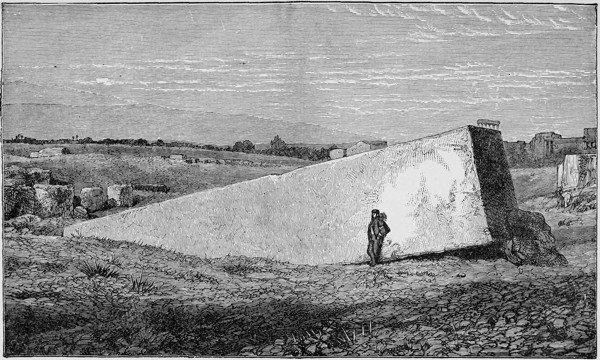
Baalbec—The Great Stone in the Quarry.
Between Rashêya and this place we have seen two ancient
wine presses, hewn out of the solid rock; they date over 2,000
perhaps 3,000 years back; they enable one to understand
what building a wine press meant, and what a terrible loss
and disappointment it would be to the builder, if, when he
“looked for grapes, he found but wild grapes.” The Cactus
hedges too, with which the vineyards are surrounded to keep
out the “little foxes that spoil the vines,” also take great
trouble and many years before they form that impenetrable
barrier through which even the wild boar cannot break his
way. We pass through Surghaya and halt for lunch in the
Wady Yafûfeh, on the banks of the Saradah, which we cross
42by a single arched Saracenic bridge, and on resuming our
journey leave on our left Nadu Shays, the reputed tomb of
Seth. Ham is said to be buried a little further east.
A beautiful panorama of Lebanon now bursts upon our view,
separated from us by the great plain of the Bukâa, or valley
of the Litany (the accursed river). We next pass near the
village of Brêethen, thought to be the Beroshai of Samuel,
and soon come in sight of the many-rilled orchard gardens
and grand Acropolis of Baalbec, the great ancient shrine of
Baal in Phœnicia, the Heliopolis, or City of the Sun of the
Greeks and Romans, and the Baal-gad, according to many,
of Joshua, formerly a station like Palmyra on the great
caravan road from Tyre to India, which we may mention was
the original overland route, and if history repeats itself
will be so again. What shorter route to India can there be
than rail to Brindisi, steamer to Corinth through the canal
now being made to Piræus, across the Ægean, to Smyrna,
and thence all the way by rail through the iron gates of
Cilicia, viâ the two Antiochs, Syria, Mesopotamia, Persia and
Afghanistan, to India—there are no difficulties which modern
engineers could not overcome. But perhaps we are waiting
for the French or Germans to show the way.[1] Before entering
the town we visit the ancient quarries out of which were
hewn the enormous Cyclopean stones which formed the very
ancient Phœnician or Hittite foundation. One block lies
there already hewn but not quite separated from the quarry,
it is about 70 feet long, 14 feet wide and 14 high, weighing
some 10,000 tons; other large stones are seen lying about
partially hewn—why they were thus left unfinished in the
workshop—whether it was an Assyrian or Persian invader
who made the busy mason so suddenly throw away the
43gavel to seize the sword will now never be known. We
put up at a small hotel facing the ruins, and find it fairly
comfortable; but are quite alone in our glory until late in the
evening, when an English countess and her niece come in with
two Turkish guards as guides, with whom they can only
converse in the primitive language of signs—the result being
that when next morning they want to see the ruins, they are
taken from them, to a hill some miles off, where they see them—from
a distance—a fine effect probably, but not what was
wanted. However, we coming to the rescue, they get a closer
inspection in the afternoon, and having previously gone
through it all ourselves, are quite eloquent in dragomanic
descriptions. Their guides, if not useful as Cicerones, were
we must admit extremely picturesque and pleasant barbarians.
The younger lady has we believe by this time immortalized
them and the ruins on canvas, and we hope with supreme
effect, for we planted the fair artist on a high pinnacle of the
Temple from which the coup d’oeil was magnificent.
Soon after, we see another instance of the inconvenience of
having a guide whose language is unintelligible. On our way
to Beyrût we meet a man and his horse at cross purposes,
endeavouring in vain to find out the reason from his Arab
guide. He appeals to us; “Well,” we say, “you and your
horse certainly do not appear to be friends.” “No,” the
traveller replies, “he does not understand me, and I do not
understand my guide, who only speaks Arabic; my horse is
a brute.” “Not so, my friend,” we rejoin, “you are riding
him with an Arab bridle in English fashion.” He was, in
fact, unknowingly the greater brute of the two, for he was
torturing the poor beast, and the injured animal might, if he
had been so gifted as the Scriptural ass, have appropriately
replied, “Tu quoque brute.” The Arab bit is in the shape of
a gridiron (minus interior bars), a ring hangs from the flat
44broad end of it, in which the lower jaw of the animal is placed
the handle of the gridiron is in the mouth, and by a pull of
the reins is forced up into the roof of the mouth, causing
considerable pain; the reins are bunched in the hand, and
the animal is guided by laying the left rein across the neck
when wishing to go to the right, and vice versâ. Pulling the
rein English fashion would simply hurt and puzzle the animal.
We explain the process and leave the man and his beast
better friends; they now understand each other. (How
many of us would also like each other better if we were less
impatient, and took more trouble to understand). Horse and
rider now go on their way as reconciled to one another as
Balaam to the ass after the departure of the Angel.
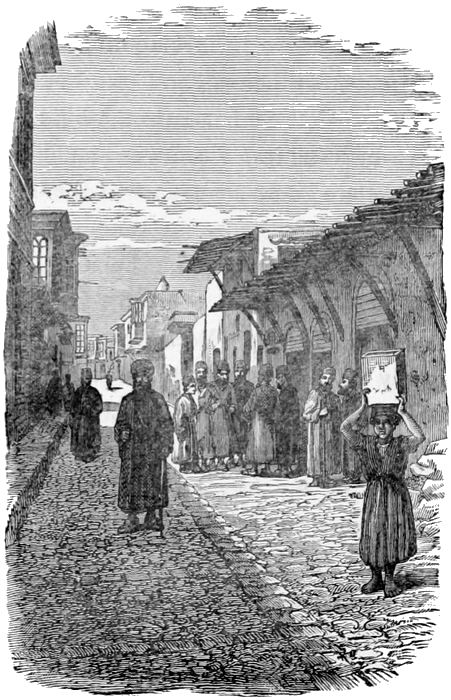
A Street called “Straight,” Damascus.
45
CHAPTER VI.—Baalbec.
Baalbec, more correctly, we believe, Baalbak, is
situated about forty-five miles north of Damascus
but slightly to the west, on the lowest slope of
Anti-Lebanon, near the source of the Leontes or Litany.
The Litany and Orontes rivers rise six miles west from Baalbec
within one mile of each other. The Litany runs west down
the Bukâa or Cœlesyria, and falls into the sea between Sidon
and Beyrût. The Orontes, El Asi or rebellious river, so
called because it changes its course in a remarkable manner,
flows north and falls into the Gulf of Antioch. Baalbec is the
point where the great roads from Damascus, Tyre, Beyrût
and Tripoli converge, hence probably its great ancient
importance, and it was also the entrance gate to Padan Aram
or Upper Syria where Terah lived, whence Abram emigrated
and whither Jacob went to seek a wife among the daughters
of his uncle Laban, who was also his cousin and subsequently
his father-in-law, a very mixed up series of relationships; even
more puzzling than that which befell the proverbial American
who married his stepmother’s mother, and was driven to
despair, insanity and death, because he never could make out
what relation he was to himself.
The ancient city of Baalbec must have been between two
and three miles in circumference. Some learned writers
46attribute its foundation to Solomon, arguing that the colossal
stones used in the substructure, of which we will speak more
in detail hereafter, are similar in size and bevel to those in the
temple foundations at Jerusalem. They identify it with
Baalath, which Solomon is recorded in I. Kings, IX., to have
built at the same time as Tadmor (by them supposed to be
Palmyra), in the wilderness. Now it must be noted that
Solomon lost Damascus to the Syrians, which David his
father had taken from them. It is not likely that having so
lost Damascus, he held Baalbec to the north of it, and
built Palmyra six days journey in the desert beyond it,
neither would he if he dominated the cedar country have
troubled Hiram to send him cedars for the Temple. We may
also observe that Baalaath and Tadmor are described as being
built along with Gezer, Megiddo, and other cities in the land,
i.e., Solomon’s own land of Israel, where these last cities
undoubtedly were, in the plain of Esdraelon, &c. Baalaath is
more likely to have been Banias, and as for Tadmor, the city
of palms, there are plenty of palm trees and wildernesses in
Palestine without locating Tadmor in the great Syrian desert,
then held by the hostile kings of Syria; and further, we are
informed that Solomon gave Hiram, king of Phœnician Tyre,
certain Galilean cities which he named “Cabul,” Solomon
could surely have much better spared, if he had had them to
give, Baalbec and Phœnician cities, further beyond his base of
operations, but equally conveniently situated for Hiram and
much more acceptable to him. Baalbec was probably a
Hittite fortress anterior to the time of Hiram, who however
might have added to it. The similarity of some of the stones
to those in Jerusalem is easily explained by the historical fact
that Solomon employed Hiram’s Phœnician workmen to
prepare the Temple materials, the woodwork of which was
undoubtedly, and the stonework perhaps too, obtained from
47the Anti-Lebanon mountains of Tyre, and floated down along
the coast on rafts to Joppa. But we will now visit the
celebrated ruins, the grandest probably in the world, only
approached in sublimity of position, but not equalled by those
on the Acropolis at Athens. We first see just outside the
village a beautiful little Temple of Venus, called by the
natives Barbara el Ahkah, quite a gem of architecture, semicircular
in shape, the architraves, cornices, &c., richly
ornamented with the fair goddess, doves, and flowers. It has
a peristyle of eight Corinthian columns, each made of a
monolith. It was last used as a Greek church, to which era
the trace of frescoes still remaining must be attributed. Near
by are the remains of a large mosque, which looks very like
having been built from the ruins of Constantine’s basilica and
other temples previously existing—the capitals and columns
being terribly mixed up, one or other being always too large
or too small. Some of the porphyry pillars must have been
very fine.
The great Trilithon Temple, the Acropolis of Baalbec,
and its massive, mighty ruins are now before us—they have
been so often pictured by the painter that their external
appearance must be familiar to many. We enter from the
east, where once was the principal entrance, a noble flight of
steps ascending to a colonnade supported by twelve mighty
columns. This grand approach was destroyed by the Turks
when they converted the Acropolis into a fortress. Passing
under this, through a portico, we find ourselves in a long lofty
corridor, richly ornamented; facing us are three large doors,
the centre, 23 feet wide, brings us into an outer court of
hexagonal form about 190 feet long and 240 wide; three
gates again from this leading to the grand court, about 440
feet long and 370 wide; on the north and south sides are
vast somewhat semicircular alcoves, with three Exedrae,
48rectangular recesses on each side with arched roofs, but open
to the central court; these are elaborately decorated with
niches, Corinthian pillars, shrines, &c., the various designs
of ornament on the latter scrolls, birds, flowers, &c., being
very beautiful and still in fine preservation, so numerous and
varied that it has been said that it would take an artist a lifetime
to copy them in detail. This court leads us up to what
was once the great Temple, at first dedicated to Baal and
then to all the gods, so as not to offend any. The only
remains of this Temple are six magnificent columns of the
peristyle, each 60 feet high and 7½ feet in diameter; they are
visible at a great distance in the plain below, and have a very
grand impressive effect, especially when seen from below at a
distance standing out boldly in an evening sky.
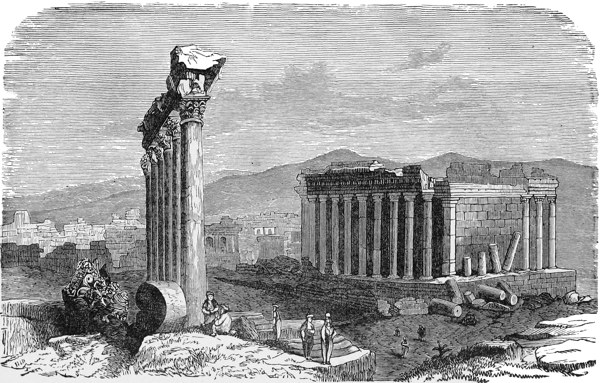
Baalbec—General View of Ruins.
This temple was probably about three hundred feet long,
and stood upon the old Phœnician foundation, built of
Cyclopean masses of stone, many of which are thirty feet long
and ten feet thick; but there are three stones (which gave the
name of Trilithon to the Temple) each over sixty feet long,
thirteen feet high, and as many thick. How they could have
been carried from the quarry, and raised to the height they
now occupy, it is difficult to explain, unless they were hauled
up great inclined planes of earth which were afterwards
carted away, as represented in the bas reliefs of Birs Nimroud.
To the left of the great Temple, on a somewhat lower level,
having formerly an approach of its own from the plain,
probably a noble flight of steps, is the Temple of the Sun (by
some called that of Jupiter), one of the best preserved and
finest ruins in the world; the ornamentation somewhat florid,
but very beautiful and varied. It was surrounded by forty-six
columns, about sixty-five feet high and six feet in diameter;
the portico, twenty-five feet deep, was supported by a double
row of columns; the door itself was forty-two feet high and
49twenty-one broad, and on each side of it were lofty hollow
pillars containing spiral staircases leading to the roof.
The cornices are rich in design and elaborate in execution,
the Cella or interior is in fair preservation, and at the end of
it is a raised platform where the altar stood. Underneath the
altar was a vault whence concealed priests sent up Delphic
responses to unsuspecting votaries who imagined that they
were listening to the voice of inspiration. The symbol of the
Syrian Eagle, sacred to the Sun as the bird which flies
highest and is supposed to be able to look at the Sun
unflinchingly, predominates everywhere about these ruins.
The temple area is undermined by vast vaulted corridors, now
used as approaches in the same way as the Temple platform
at Jerusalem. The emperors Constantine and Theodosius
converted the great Temple into a Basilica; at the Moslem
conquest it was used as a fortress. When some five hundred
years later the tide turned again in favour of Christianity, it
was converted back by the Crusaders into a church, and
when the Saracens under Saladin wrested it from them, it
became again a fortress, and it probably remained so until its
final decay in about the 15th century, when it was destroyed
by Tamerlane the Tartar when he raided through Syria.
While at Baalbec, we witness an extraordinary hailstorm,
the stones being larger than pigeons’ eggs—almost as large as
a walnut; very pretty elliptical in shape, the centre about
the size of a large pea was cloudy ice, then a large, clear,
crystal-looking ring, the outer ring again cloudy ice.
The storm lasts about an hour, and the stones do not melt
for some time; it is accompanied by a sharp thunderstorm.
We now bid farewell to Baalbec, and wend our way across
the plain of the Bukâa, bound for Beyrût.
The Bukâa, supposed to be the Bikath Aven of the
Hebrews (Amos i, 5), is a long plain extending about one
50hundred miles between the Lebanon and the Anti-Lebanon
mountains, leading down to the Jordan valley, and the
Mediterranean. It was anciently called Cœlesyria or Hollow
Syria, and was the natural highway of the invading armies of
Egypt, Persia, Assyria, &c., from all time. It is mentioned
in the Bible as the “entering in of Hamath,” but was only
for a short time in the possession of the Kings of Israel.
Along this plain commander Cameron projected a railway
between Damascus, viâ Baalbec, Homs, Hamah and Aleppo
northwards, with a branch from Homs to Tripoli westwards,
and to Jerusalem along the western side of the Jordan valley—all
possible enough to make, but scarcely probable to pay.
The railway was to be commenced at Tripoli, taking a détour
to Damascus to avoid the mountains. This enterprising
project was to embrace, eventually, a Euphrates valley line
to Bombay, viâ the Persian Gulf, and to Northern India, viâ
Persia and Afghanistan, and the system was to be connected
with Constantinople by a line through Asia Minor, viâ
Diarbekir to Ismid, where it would join the railway to Scutari
and the Bosphorus, opposite Stamboul. It is a pretty
project on paper, a magnificent prophecy of the future, and
we hope that commander Cameron will live to see his
great scheme a paying reality. Soon after leaving Baalbec
we come across an isolated ruin, the shrine of some Moslem
saint reared evidently out of the ruins of the Acropolis.
The Bukâa plain is fertile, but the absence of trees renders
a journey through it rather monotonous for some hours. We
lunch at a small Arab Khan, and passing several villages
reach at length that of Kerak Nûh, where we are shown the
tomb of Noah, one hundred feet long, eight feet wide and
three deep, very like a length of an ancient aqueduct, so this
ante and post diluvian patriarch must have been slightly out
of proportion. How he was accommodated in his own ark,
51which was smaller than the Great Eastern, only about fifty
feet high, and then divided into three decks, my Moslem
guide did not inform me. Noah’s ark, by-the-bye, is said to
have been built at Jaffa, where we first entered the Holy
Land. The next largest ship of ancient times spoken of by
Lucian is that of Ptolemy Philadelphus, and was probably
about 1,100 tonnage—it seems however soon to have come
to grief. According to Moslem tradition, Hezekiah is said to
be buried near Noah. We next pass through Mulaka, a
prosperous Moslem town, full of Manchester prints, which
is almost joined to Zahleh, a large Maronite Christian town
on the frontier of the Lebanon; it is a manufacturing town,
finely situated at the entrance of the Sannin gorge, in an
amphitheatre of high mountains; it was the headquarters of
the Druses during the 1860 massacres. We now ride through
many miles of vineyards and mulberry trees to Shtôra, the
principal station on the Damascus diligence road, and put up
for the night at the little inn there. Our last day’s ride is to
Beyrût, about nine hours along the diligence road over the
Lebanon. We soon have to take our last look at Hermon,
the Baalbec plain and the Anti-Lebanon, and ascending to
the summit of the pass catch a first glimpse of the sea. The
Lebanon mountains here are nearly 7,000 feet high, and
Beyrût shrouded in pine forest, lies nestled at the foot of
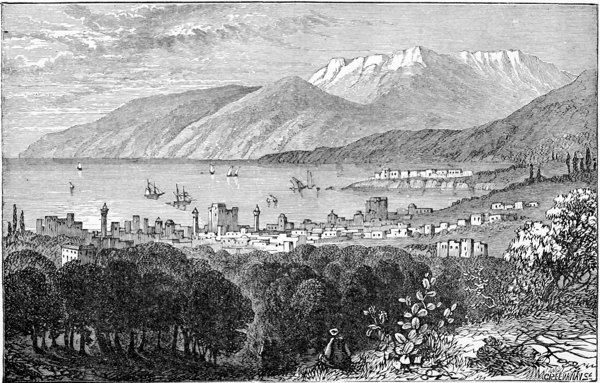
them on the low coast line.

52