After proceeding in this way for rather more than ninety days, they
arrived at a country called Java-dvîpa, where various forms of error
and Brahmânism are flourishing, while Buddhism in it is not worth
speaking of. After staying there for five months, (Fâ-hien) again
embarked in another large merchantman, which also had on board more
than 200 men. They carried provisions for fifty days, and commenced
the voyage on the sixteenth day of the fourth month.
Fâ-hien kept his retreat on board the ship. They took a course to the
north-east, intending to fetch Kwang-chow. After more than a month,
when the night-drum had sounded the second watch, they encountered
a black wind and tempestuous rain, which threw the merchants and
passengers into consternation. Fâ-hien again with all his heart
directed his thoughts to Kwan-she-yin and the monkish communities of
the land of Han; and, through their dread and mysterious protection,
was preserved to day-break. After day-break, the Brahmâns deliberated
together and said, ‘It is having this Śramaṇa on board which has
occasioned our misfortune and brought us this great and bitter
suffering. Let us land the bhikshu and place him on some island-shore.
We must not for the sake of one man allow ourselves to be exposed to
such imminent peril.’ A patron of Fâ-hien, however, said to them, ‘If
you land the bhikshu, you must at the same time land me; and if you
do not, then you must kill me. If you land this Śramaṇa, when I get
to the land of Han, I will go to the king, and inform against you.
The king also reveres and believes the Law of Buddha, and honours the
bhikshus.’ The merchants hereupon were perplexed, and did not dare
immediately to land (Fâ-hien).
At this time the sky continued very dark and gloomy, and the
sailing-masters looked at one another and made mistakes. More than
seventy days passed (from their leaving Java), and the provisions and
water were nearly exhausted. They used the salt-water of the sea for
cooking, and carefully divided the (fresh) water, each man getting two
pints. Soon the whole was nearly gone, and the merchants took counsel
and said, ‘At the ordinary rate of sailing we ought to have reached
Kwang-chow, and now the time is passed by many days;—must we not
have held a wrong course?’ Immediately they directed the ship to the
north-west, looking out for land; and after sailing day and night for
twelve days, they reached the shore on the south of mount Lâo,8 on
the borders of the prefecture of Chʽang-kwang,8 and immediately got
good water and vegetables. They had passed through many perils and
hardships, and had been in a state of anxious apprehension for many
days together; and now suddenly arriving at this shore, and seeing
those (well-known) vegetables, the lei and kwoh,9 they knew indeed
that it was the land of Han. Not seeing, however, any inhabitants nor
any traces of them, they did not know whereabouts they were. Some
said that they had not yet got to Kwang-chow, and others that they had
passed it. Unable to come to a definite conclusion, (some of them) got
into a small boat and entered a creek, to look for some one of whom
they might ask what the place was. They found two hunters, whom
they brought back with them, and then called on Fâ-hien to act as
interpreter and question them. Fâ-hien first spoke assuringly to
them, and then slowly and distinctly asked them, ‘Who are you?’ They
replied, ‘We are disciples of Buddha?’ He then asked, ‘What are you
looking for among these hills?’ They began to lie,10 and said,
‘To-morrow is the fifteenth day of the seventh month. We wanted to
get some peaches to present11 to Buddha.’ He asked further, ‘What
country is this?’ They replied, ‘This is the border of the prefecture
of Chʽang-kwang, a part of Tsʽing-chow under the (ruling) House of
Tsin.’ When they heard this, the merchants were glad, immediately
asked for (a portion of) their money and goods, and sent men to
Chʽang-kwang city.
The prefect Le E was a reverent believer in the Law of Buddha. When
he heard that a Śramaṇa had arrived in a ship across the sea, bringing
with him books and images, he immediately came to the seashore with an
escort to meet (the traveller), and receive the books and images, and
took them back with him to the seat of his government. On this the
merchants went back in the direction of Yang-chow;12 (but) when
(Fâ-hien) arrived at Tsʽing-chow, (the prefect there)13 begged
him (to remain with him) for a winter and a summer. After the summer
retreat was ended, Fâ-hien, having been separated for a long time
from his (fellow-)masters, wished to hurry to Chʽang-gan; but as the
business which he had in hand was important, he went south to the
Capital;14 and at an interview with the masters (there) exhibited
the Sûtras and the collection of the Vinaya (which he had procured).
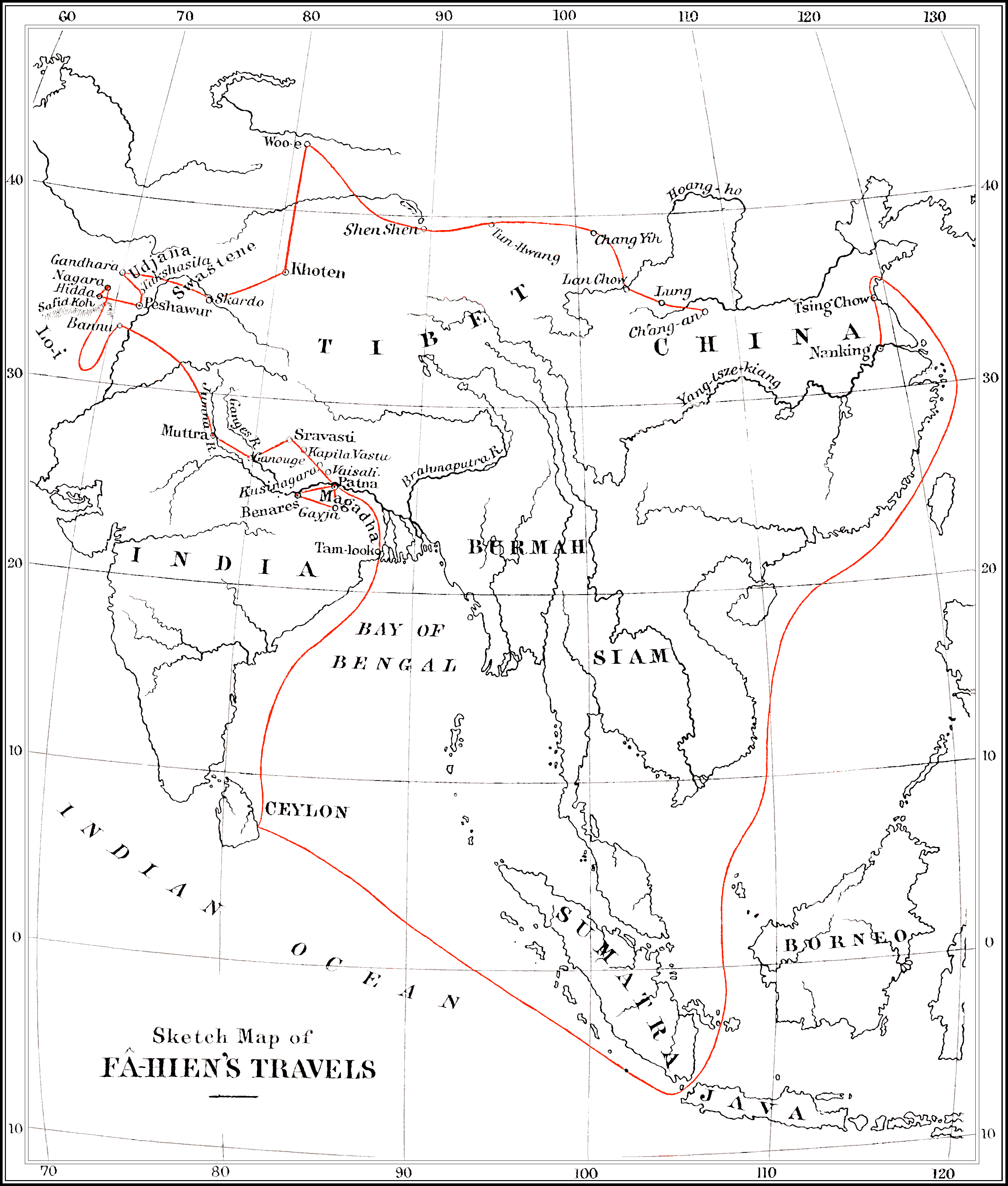
After Fâ-hien set out from Chʽang-gan, it took him six years to reach
Central India;15 stoppages there extended over (other) six years;
and on his return it took him three years to reach Tsʽing-chow. The
countries through which he passed were a few under thirty. From
the sandy desert westwards on to India, the beauty of the dignified
demeanour of the monkhood and of the transforming influence of the Law
was beyond the power of language fully to describe; and reflecting how
our masters had not heard any complete account of them, he therefore
(went on) without regarding his own poor life, or (the dangers to be
encountered) on the sea upon his return, thus incurring hardships and
difficulties in a double form. He was fortunate enough, through
the dread power of the three Honoured Ones,15 to receive help and
protection in his perils; and therefore he wrote out an account of his
experiences, that worthy readers might share with him in what he had
heard and said.15
Â-e (Asita, ṛishi), page 65.
Â-le, 54.
Abhayagiri monastery, 102, 105, 106, 107. Hall of Buddha in, and
statue of jade, 102, 103.
Abhidharma, 10 et al.
Ajâtaśatru (king), 76, 81, 82, 85.
Alms-bowl of Buddha, 34, 35, 109, 110.
Âmbapâlî, 72.
Anâgâmin, 57, 86.
Ânanda, 33, 44, 45, 72, 74, 83; death of, in Samâdhi, 75–77.
Aṅgulimâlya, 56.
Anna (mount), 109.
Anuruddha, 48.
Arhan, the, or Arhat (in Chinese Lo-han), 24, 40, 57, 71, 75, 86.
Cremation of an Arhat, 107, 108.
Ârya, 57.
Asaṅkhyeya-kalpa, 105.
Aśoka, 31, 50; his spirit-built palace, and halls, 77; his brother,
77; his great tope and inscription, 80; his vihâra and pillar. 50,
51; his city and pillar of Ne-le, 80; wished to build 84,000 topes,
69; legend of his naraka, 90–92.
Bhikshu, 13, 29, 75, 83, 86, 91, 92, 113. Suicide of, 86. Bhikshuṇî,
45.
Bimbisâra (king), 81, 82.
Bo tree, the, in Ceylon, 103, 104. In Gayâ, 88. Both are called in
mistake by Fâ-hien the patra tree.
Bodhisattva, 19. Legends of Buddha, when Bodhisattva, 30, 31, 32,
38, 73, 74, 75. Maitreya Bodhisattva, 25.
Books of Discipline, the. See Vinaya.
Brahmâ (king), the first person of the Brahmânical Trimurti, 49, 89.
Brahmâns, 47, 55, 60, 61. The Brahmân Râdha-sâmi, 78.
Buddha, incarnation of the, 65; incidents of his early life, 65, 66;
where he renounced the world, 70; where he died, 70; where he endured
austerities, 87; legends of that time, 87, 88. His attainment of the
Buddhaship, 89; first labours afterwards, 89. In Ceylon, 101; his
wonderful stride and footprint, 102. Buddha’s preaching, 54, 66.
Buddhism, Fâ-hien’s name for, 30.
Buddhists, different estimates of the number of, 5–8.
Central India, or the Middle Kingdom, 28. Condition and customs of,
42, 43.
Chakravartti king, 49, 90.
Champâ, 100. Topes and monasteries in, 100.
Chañchamana, 60.
Chaṇḍaka, 70.
Chaṇḍâlas, 43.
Chʽang-gan, 9, 10, 115.
Chang Kʽeen, 27.
Chang-yih, 11.
Charcoal tope, the, 70.
Che-yen (pilgrim), 11, 15.
China, or the land of Han, 13, 24, 58, 100, 109, 113.
Council in Śrataparṇa cavern, 85; of Vaiśâlî, 75.
Dakshiṇa, 96–98.
Dâna and dânapati, 11, 52.
Danta-kâshṭha, legend of Buddha’s, 54, 55.
Desert of Gobi, 12.
Deva, or Brahmânic god, 19, 50, 79.
Devadatta, 60, 86; followers of, 62.
Devâlaya, ‘The Shadow Covered,’ 60, 61.
Devaloka, 25.
Dharma, the Law, one of the constituents of Buddhism, 28 et al.
Dharma-gupta, 106, 107.
Dîpâṅkara Buddha, 38.
Discourse or sermon of a devotee in Ceylon, 110.
Dragons or nâgas, 29, 67, 101; the dragon of the Râma tope, 69; the
white-eared dragon, 52; Elâpattra, 96.
E-he (period), 116.
Endowments of the monkish communities, and offerings to them, 22,
23, 43, 44, 108, 109.
Fâ-hien. His surname, and notices of his early life, 1, 2; lived to
the age of eighty-eight, 2, 3. Genuineness of his narrative, 3, 4.
Different recensions of it, and especially the Corean text appended
to this volume, 4. Stages of his travels:—Chʽang-gan, 10; Lung, 10;
kingdom of Kʽeen-kwei, 10; that of Now-tʽan, 10; Chang-yih, 11;
Tʽun-hwang, 11; desert of Gobi, 12; Shen-shen, 12; Woo-e, r4;
Yu-teen, 16; Tsze-hoh, 21; Yu-hwuy, 21; Kʽeeh-chʽâ, 22; Tʽo-leih, 24;
crosses the Indus, 26; Woo-chang, or Udyâna, 28; Soo-ho-to, or
Swastene, 29; Gandhâra, 31; Takshaśilâ, 32; Purushapura, or Peshâwar,
33; He-lo, or Hidda, in Nagâra, 36; Nagâra, 38–40; Little Snowy
mountains, 40; Lo-e, 41; Poh-nâ, 41; recrosses the Indus, 41;
Pe-tʽoo, or Bhida, 41; Mathurâ, or Muttra, 42; Sarikâśya, 47;
Kanyâkubja, or Canouge, 53; Â-le, 54; Shâ-che, 54; Śrâvastî in
Kośala, 55; Too-wei, 63; Na-pei-keâ, 64; Kapilavastu, 64; Râma, 68;
Kuśanagara, 70; Vaiśâlî, 72; confluence of the five rivers, 75;
Pâṭaliputtra, or Patna, 77; Râjagṛiha, 80; Nâla, 81; New Râjagṛiha,
81; Gṛidhra-kûṭa hill, 83; Śrataparṇa cave, 85; Gayâ, 87; mount
Gurupada, 92; Vârâṇasî, or Benâres, 93; Kâśî, 94; Kauśâmbî, 96;
Patna, 98; Champâ, 100; Tâmaliptî, 100; Singhala, or Ceylon, 101;
Java, 113; Shan-tung, in China, 114; the Capital, 115.
First image made of Buddha, 57.
Foo Kung-sun, 15.
Four great topes in North India, 32; in Central India, 90.
Four places of regular occurrence in the history of all Buddhas, 68.
Four spiritual truths, and four classes of disciples, 57.
Gandhâra, 31, 33, 109.
Ganges, 54, 93, 100.
Gayâ, 87–90.
Gomati monastery, 17.
Gośîrsha Chandana wood, 39, 57.
Gṛidhra-kûta hill, 80, 82. Legends connected with, 83. Fâ-hien
spends a night on, 83.
Grove of the Getting of Eyes, 58, 59.
Gurupada (mount), 92.
Habits of the Khoteners, 16, r7.
Hall of Buddha, 20, 102.
Han, the land of. See China.
He-lo, 36.
Hînayâna, 14, 15, 23, 41, et al.
Ho-shang, name of, 58.
Hwăng-che (period), 9.
Hwuy-keen (pilgrim), 11, 15.
Hwuy-king (pilgrim), 9, 18, 22, 29, 36. Death of, 40, 41.
Hwuy-tah (pilgrim), 18, 29, 36.
Hwuy-wei (pilgrim), 10, 15.
Hwuy-ying (pilgrim), 10. Death of, 36.
India, 10, 14. (North), 24, 28, 29. (Central), 28, 42. (South), 47.
Indus, the, 26. Crossing it, 26; recrossing it, 41.
Jambudvîpa, 34, 48, 80.
Jâtaka stories, 30, 31, 32, 73, 74, et al.
Jetavana vihâra, 56; burning of the, 57. Sympathy of the monks at,
with the pilgrims, 58. Park of the, 59.
Jîvaka, 82.
Kanishka (king), 33; and his tope, 34.
Kanyâkubja, or Canouge, 53, 54.
Kan Ying, 27.
Kâo-chʽang, 15.
Kapilavastu, 64–68.
Karaṇḍa Bamboo garden (Karaṇḍa Veṇuvana), 84.
Kâśî, 94.
Kaśyapa brothers and their disciples, 89.
Kaśyapa Buddha’s entire skeleton, 93.
Kauḍḥinya and his companions, 94, 95.
Kauśâmbî, 96.
Keah-yin (year), 116.
Kʽeeh-chʽâ, 18, 22.
Kʽeen-kwei, 10.
Ke-hâe (year), 9.
Kharachar, 109.
Khoten, 16–20, 109.
King Prasenajit, 55.
King’s New monastery, 19.
Kophene, 21.
Kośala, 55.
Kwang-chow, 114.
Kwan-she-yin, 46, 112, 113.
Le E (prefect), 115.
Le Hâo, 12.
Legends of Buddha in North India, 29, 30, 39; as Bodhisattva, 31. Of
his danta-kâshṭha, 54, 55.
Legends of Takshaśilâ, 32.
Legends of topes and monastery, 53, 73.
Lichchhavis, 71, 72, 76.
Little Snowy mountains, 40.
Lo-e, 41.
Lumbinî (garden), 67. Birth of Buddha in, 67.
Lung, 10.
Madhyamayâna, 14.
Mahâkaśyapa, 45, 85.
Mahâ-maudgalyâyana (Mugalan), 44, 48, 82.
Mahâ-prajâpatî, 55, 66.
Mahâyâna, 14, 16, 21, 41, et al.
Maitreya Bodhisattva, 25; statue of, 25, 28, 109.
Mañjuśrî, 46, 79 (a Brahmân).
Mâra, king, 74; Piśuna, 83; 88.
Mathurâ, or Muttra, 42.
Merchants (five hundred), 89.
Monasteries, or Saṅghârâmas, 17, 28, et al.
Monastery (Gomati), 17.
Monastery of the Great Heap, 52.
Monastery (Pigeon), 96–98.
Monkish customs, 44–47.
Monkish food out of the ordinary hours, 44.
Monks (4000 in Shen-shen), 13; (4000 in Woo-e), 15; (several myriads
in Khoten), 15. Influence of the, 42. Quinquennial assembly of, 22, 23.
Mother of Buddha (Mahâ-mâyâ), 48, 56, 65.
Muchilinda (dragon), 89.
Nagâra, 29, 36.
Nâla, 81.
Nanda, 65.
Naraka, 90.
Ne-le city and pillar, 80.
New Râjagṛiha, 81.
Ninety-six sorts of erroneous views, 62.
Nirgrantha, the, 82.
Nirvâṇa, 14, 27, 33, et al.
Now-tʽan, 10.
Onion mountains, 20, 21, 23, 24.
Pâo-yun (pilgrim), 11, 15, 36.
Pâramitâs, the, 46; Prajñâ-pâramitâ, 46.
Pari-nirvâna, 33, 57, 73.
Park of ‘The ṛishi’s Deer-wild,’ 94.
Pâṭaliputtra, or Patna, 77; monasteries of, 78, 79; hospitals and
dispensaries of, 79, 97–99. Manuscripts copied there, 98–99; the
Mahâsâṅghika rules, Sarvâstivâdâḥ rules,
Saṃyuktâbhidharmahṛidaya-(śâstra), Sûtra of 2500 gâthas, the
Parinirvâṇa-vaipulya Sûtra, Mahâsâṅ-ghikâḥ Abhidharma, 99.
Pe-tʽoo, or Bhida, 41.
Pʽing (king of Chow dynasty), 27.
Plain (Central and South India), 47.
Poh-nâ, 41.
Poonah, or Jumna river, 42.
Prasenajit. See King
Pratyeka Buddhas, 40, 53, 74.
Procession of images at Khoten, 16–19; at Patna, 79; in Ceylon, 106,
107.
Purushapura, or Peshâwar, 33.
Quinquennial assembly of monks, 22.
Râhula, 46.
Râjagṛiha (new and old) legends and incidents, 80–86.
Râma and its tope, 68, 69.
Relics of Buddha:—spittoon, 23; alms-bowl, 23, 34, 35, 89, 109;
tooth, 23, 105, 107; skull-bone, 36, 37; pewter staff, 39; Saṅghâli,
or Saṅghâṭi, 39; hair and nails, 39 et al.; shadow, 39, 88.
Retreat (the summer), 10, 11, 22, 29, 113, 117, et al.
Śakra, 30, 34, 49, 50, 60, 80, 81.
Sâma, 106.
Samâdhi, 76.
Saṅghâli. See Relics.
Săng-king (pilgrim), 11, 36.
Săng-shâo (pilgrim), 11, 21.
Saṅkâśya, 47.
Śâriputtra, 44, 81, 82.
Shâ-che, 54.
Shadow of Buddha. See Relics.
Shay-e, 63.
Shen-shen, 12.
Shikshâpada, or ten commandments, 46.
Singhala, or Ceylon, 100–111. Manuscripts obtained in, 111.
Śmaśânam, 84.
Snow mountains, 24.
Soo-ho-to (Swastene), 29, 30.
Śramaṇa (Śraman, Shâ-măn), 14 et al.
Śrâmaṇera, 45, 69, 70.
Śrataparṇa cave, or cave of the First Council, 84, 85.
Śrâvastî, 55, 56. Topes and legends of, 56–61.
Śrotâpannas, 67, 86.
Subhadra, 71.
Sudâna, 106.
Sudatta, 56.
Śuddhodana, 64.
Sympathy of Indian monks with pilgrims, 41.
Takshaśilâ, 32.
Tamâliptî, 100.
Tâo-ching (pilgrim), 9, 18, 29, 36, 99.
Tathâgata, 63.
Three Buddhas anterior to Śâkyamuni, 63, 64.
Tʽo-leih, or Darada, 24.
Topes, 17, 40, 53, et al. Buddha himself assisted in building a
model tope, 39. 40.
Trayastriṃśas heaven, legend of Buddha’s ascent to and descent from,
48, 49.
Treasuries of the monasteries in Ceylon, 103; rule regarding, 104.
Tripiṭaka, 10.
Trîsharaṇa, 46.
Tsʽin, 15, 23.
Tsʽing-chow, 115.
Tsze-hoh, 21.
Tʽun-hwang, 11, 12.
Tushita heaven, 25.
Upâli, 66.
Upasena, 82.
Utpala bhikshuṇî, 49.
Vaiśakha (mother), 59.
Vaiśâlî, 72.
Vaiśyas, chiefs of, 38, 47.
Vanity of life and of the body, 54, 91.
Vârâṇasî, or Benâres, 94.
Vihâra, 36, 37, et al. King’s grant of a new vihâra to monks in
Ceylon, 108.
Vimoksha tope, 38.
Vinaya, or Books of Discipline, 9, 10,
98, et al.
Virûdhaha (Vaidûrya), king, 63, 67.
When the law of Buddha first went to the East, 27, 28.
Woo-chang, or Udyâna, 28, 29.
Woo-e, 14.
Yang-chow, 115.
Yang-low, 10.
Yu-hwuy, 21.
Yu-teen, or Khoten, 16.