“Was ever woman in this humour
woo’d?
Was ever woman in this humour won?
I’ll have her,—but I will not keep her
long.”
—“Richard
III.”
There was no doubt about it that
Harley, true to his purpose, was making a good fight to conquer
without compulsion, and appreciated as much as I the necessity of
reducing his heroine to concrete form as speedily as possible,
lest some other should prove more successful, and so deprive him
of the laurels for which he had worked so hard and suffered so
much. In his favor was his disposition. He was a man of
great determination, and once he set about doing something he was
not an easy man to turn aside, and now that, for the first time
in his life, he found himself baffled at every point, and by a
heroine of no very great literary importance, he became more
determined than ever.
“I’ll conquer yet,” he said to me, a week or
so later; but the weariness with which he spoke made me fear that
victory was afar off.
“I’ve no doubt of it—ultimately,” I
answered, to encourage him; “but don’t you think
you’ll stand a better chance if you let her rest for a
while, and then steal in upon her unawares, and catch her little
romance as it flies? She is apparently nerved up against
you now, and the more conscious she is of your efforts to
put her on paper, the more she will rebel. In fact, her
rebelliousness will become more and more a matter of whim than of
principle, unless you let up on her for a little while.
Half of her opposition now strikes me as obstinacy, and the more
you try to break her spirit, even though you do it gently, the
more stubborn will she become. Put this book aside for a
few weeks anyhow. Why not tackle something else?
You’d do better work, too, after a little
variety.”
“This must be finished by September 1st, that’s
why not,” said Stuart. “I’ve promised
Herring, Beemer, & Chadwick to send them the completed
manuscript by that time. Besides, no heroine of mine shall
ever say that she swerved me from doing what I have set about
doing. It is now or never with Marguerite
Andrews.”
So I left him at his desk, and for a week was busy with my own
affairs. Late the following Friday night I dropped in at
Harley’s rooms to see how matters were progressing.
As I entered I saw him at his desk, his back turned towards me,
silhouetted in the lamp-light, scratching away furiously with his
pen.
“Ah!” I thought, as my eye took in the picture,
“it goes at last. I guess I won’t disturb his
train of thought.”
And I tried to steal softly out, for he had not observed my
entrance. As luck would have it, I stepped upon the sill of
the door as I passed out, and it creaked.
“Hello!” cried Harley, wheeling about in his
chair, startled by the sound. “Oh! It’s you, is
it?” he added, as he recognized me. “What are
you up to? Come back here. I want to see
you.”
His manner was cheerful, but I could see that the cheerfulness
was assumed. The color had completely left his cheeks, and
great rings under his eyes betokened weariness of spirit.
“I didn’t want to disturb you,” said I,
returning. “You seem to have your pen on a clear
track, with full steam up.”
“I had,” he said, quietly. “I was just
finishing up that Herring, Beemer, & Chadwick
business.”
“Aha!” I cried, grasping his hand and shaking
it. “I congratulate you. Success at last,
eh?”
“Well, I’ve got something done—and
that’s it,” he said, and he tossed the letter block upon
which he had been writing across the table to me.
“Read that, and tell me what you think of it.”
I read it over carefully. It was a letter to Messrs.
Herring, Beemer, & Chadwick, in which Stuart asked to be
relieved of the commission he had undertaken:
“I find myself utterly unable to complete
the work in the stipulated time,” he wrote, “for
reasons entirely beyond my control. Nor can I at this
writing say with any degree of certainty when I shall be able to
finish the story. I have made constant and conscientious
effort to carry out my agreement with you, but fruitlessly, and I
beg that you will relieve me of the obligation into which I
entered at the signing of our contract. Of course I could
send you something long enough to cover the required
space—words come easy enough for that—but the result
would be unsatisfactory to you and injurious to me were I to do
so. Please let me hear from you, releasing me from the
obligation, at your earliest convenience, as I am about to leave
town for a fortnight’s rest. Regretting my inability
to serve you at this time, and hoping soon to be able to avail
myself of your very kind offer, I beg to remain,
“Yours faithfully,
“Stuart Harley.”
“Oh!” said I. “You’ve finished
it, then, by—”
“By giving it up,” said he, sadly. “It’s the strangest thing that ever
happened to me, but that girl is impossible. I take up my
pen intending to say that she did this, and before I know it she
does that. I cannot control my story at all, nor can I
perceive in what given direction she will go. If I could, I
could arrange my scenario to suit, but as it is, I cannot
go on. It may come later, but it won’t come now, and
I’m going to give her up, and go down to Barnegat to fish
for ten days. I hate to give the book up, though,” he
added, tapping the table with his pen-holder reflectively.
“Chadwick’s an awfully good fellow, and his firm is
one of the best in the country, liberal and all that, and here at
my first opportunity to get on their list, I’m completely
floored. It’s beastly hard luck, I think.”
“Don’t be floored,” said I.
“Take my advice and tackle something else. Write some
other book.”
“That’s the devil of it!” he replied,
angrily pounding the table with his fist. “I
can’t. I’ve tried, and I can’t. My
mind is full of that woman. If I don’t get rid of her
I’m ruined—I’ll have to get a position as a
salesman somewhere, or starve, for until she is caught between
good stiff board covers I can’t write another
line.”
“Oh, you take too serious a view of it, Stuart,” I
ventured. “You’re mad and tired now. I
don’t blame you, of course, but you mustn’t be
rash. Don’t send that letter yet. Wait until
you’ve had the week at Barnegat—you’ll feel
better then. You can write the book in ten days after your
return; or if you still find you can’t do it, it will be time
enough to withdraw then.”
“What hope is there after that?” he cried, tossing
a bundle of manuscript into my lap. “Just read that,
and tell me what’s the use. I’d mapped out a
meeting between Marguerite Andrews and a certain Mr. Arthur
Parker, a fellow with wealth, position, brains, good
looks—in short, everything a girl could ask for, and
that’s what came of it.”
I spread the pages out upon the table before me and read:
“I
have not seen
So likely an ambassador of love.”
—“Merchant of
Venice.”
Parker mounted the steps lightly and rang the bell.
Marguerite’s kindness of the night before, which was in
marked contrast to her coolness at the MacFarland dance, had led
him to believe that he was not wholly without interest to her,
and her invitation that he should call upon her had given him a
sincere pleasure; in fact, he wondered that he should be so
pleased over so trivial a circumstance.
“I’m afraid I’ve lost my heart again,”
he said to himself. “That is, again if I ever lost it
before,” he added.
And his mind reverted to a little episode at Bar Harbor the
summer before, and he was not sorry to feel that that wound was
cured—though, as a matter of fact, it had never amounted to
more than a scratch.
A moment later the door opened, and Parker entered, inquiring for
Miss Andrews as he did so.
“I do not know, but I will see if Miss Andrews is at
home,” said the butler, ushering him into the parlor.
That imposing individual knew quite well that Miss Andrews was at
home, but he also knew that it was not his place to say so until
the young lady had personally assured him of the facts in so far
as they related to this particular caller. All went well
for Parker, however. Miss Andrews consented to be at home
to him, and five minutes later she entered the drawing room where
Parker was seated.
“How do you do?” she said, frigidly, ignoring his
outstretched hand.
(“Think of that, will you?” interposed
Harley. “He’d come to propose, and was to
leave engaged, and she insists upon opening upon him frigidly,
ignoring his outstretched hand.”
I couldn’t help smiling. “Why did you let
her do it?” I asked.
“I could no more have changed it than I could
fly,” returned Stuart. “She ought never to have
been at home if she was going to behave that way. I
couldn’t foresee the incident, and before I knew it
that’s the way it happened. But I thought I could fix
it up later, so I went on. Read along, and see what I got
let into next.”
I proceeded to read as follows:)
“You see,” said Parker, with an admiring glance at
her eyes, in spite of the fact that the coolness of her reception
rather abashed him—“you see, I have not delayed very
long in coming.”
“So I perceive,” returned Marguerite, with
a bored manner. “That’s what I said to Mrs.
Willard as I came down. You don’t allow your friends
much leeway, Mr. Parker. It doesn’t seem more than
five minutes since we were together at the card party.”
(“That’s cordial, eh?” said Harley, as I
read. “Nice sort of talk for a heroine to a
hero. Makes it easy for me, eh?”
“I must say if you manage to get a proposal in now
you’re a genius,” said I.
“Oh—as for that, I got reckless when I saw how
things were going,” returned Harley. “I lost my
temper, and took it out of poor Parker. He proposes, as you
will see when you come to it; but it isn’t
realism—it’s compulsion. I simply forced him
into it—poor devil. But go on and read for
yourself.”
I did
so, as follows:)
This was hardly the treatment Parker had expected at the hands
of one who had been undeniably gracious to him at the card-table
the night before. He had received the notice that she was
to be his partner at the tables with misgivings, on his arrival
at Mrs. Stoughton’s, because his recollection of her
behavior towards him at the MacFarland dance had led him to
believe that he was personally distasteful to her; but as the
evening at cards progressed he felt instinctively drawn towards
her, and her vivacity of manner, cleverness at repartee, and
extreme amiability towards himself had completely won his heart,
which victory their little tête-à-tête during
supper had confirmed. But here, this morning, was reversion
to her first attitude. What could it mean? Why should
she treat him so?
(“I couldn’t answer that question to save my
life,” said Stuart. “That is, not then, but I
found out later. I put it in, however, and let Parker draw
his own conclusions. I’d have helped him out if I
could, but I couldn’t. Go on and see for
yourself.”
I resumed.)
Parker could not solve the problem, but it pleased him to
believe that something over which he had no control had gone
wrong that morning, and that this had disturbed her equanimity,
and that he was merely the victim of circumstances; and somehow
or other it pleased him also to think that he could be the victim
of her circumstances, so he stood his ground.
“It is a beautiful day,” he began, after a
pause.
“Is it?” she asked, indifferently.
(“Frightfully snubbish,” said I, appalled at the
lengths to which Miss Andrews was going.
“Dreadfully,” sighed Harley. “And so
unlike her, too.”)
“Yes,” said Parker, “so very beautiful that
it seemed a pity that you and I should stay indoors, with plenty
of walks to be taken and—”
Marguerite interrupted him with a sarcastic laugh.
“With so much pity and so many walks, Mr. Parker, why
don’t you take a few of them!” she said.
(“Good Lord!” said I. “This is the
worst act of rebellion yet. She seems beside
herself.”
“Read on!” said Harley, in sepulchral
tones.)
This was Parker’s opportunity. “I am not
fond of walking, Miss Andrews,” he said; and then he added,
quickly, “that is, alone—I don’t like anything
alone. Living alone, like walking alone,
is—”
“Let’s go walking,” said Marguerite,
shortly, as she rose up from her chair. “I’ll
be down in two minutes. I only need to put my hat
on.”
Parker acquiesced, and Miss Andrews walked majestically out of
the parlor and went up-stairs.
“Confound it!” muttered Parker, as she left
him. “A minute more, and I’d have known my
fate.”
(“You see,” said Harley, “I’d made up
my mind that that proposal should take place in
that chapter, and I thought I’d worked right up to it, in
spite of all Miss Andrews’s disagreeable remarks when,
pop—off she goes to put on her hat.”
“Oh—as for that—that’s all
right,” said I. “Parker had suggested the walk,
and a girl really does like to stave off a proposal as long as
she can when she knows it is sure to come. Furthermore, it
gives you a chance to describe the hat, and so make up for a few
of the words you lost when she refused to discuss ball-dresses
with Mrs. Willard.”
“I never thought of that; but don’t you think I
worked up to the proposal skilfully?” asked Harley.
“Very,” said I. “But you’re
dreadfully hard on Parker. It would have been better to
have had the butler fire him out, head over heels. He could
have thrashed the butler for doing that, but with your heroine
his hands were tied.”
“Go on and read,” said Harley.)
“She must have known what I was driving at,”
Parker reflected, as he awaited her return. “Possibly
she loves me in spite of this frigid behavior. This may be
her method of concealing it; but if it is, I must confess
it’s a case of
‘Perhaps it was right to dissemble your
love,
But—why did you kick me down-stairs?’
Certainly, knowing, as she now must, what my feelings are, her
being willing to go for a walk on the cliffs, or anywhere, is a
favorable sign.
(“Parker merely echoed my own hope in
that remark,” said Harley. “If I could get them
engaged, I was satisfied to do it in any way that might be
pleasing to her.”)
A moment later Marguerite appeared, arrayed for the
walk. Parker rose as she entered and picked up his
gloves.
“You are a perfect picture this morning,” said
he.
“I’m ready,” she said, shortly, ignoring the
compliment. “Where are we scheduled to walk?—or
are we to have something to say about it ourselves?”
Parker looked at her with a wondering smile. The aptness
of the remark did not strike him. However, he was equal to
the occasion.
“You don’t believe in free will, then?” he
asked.
(“It was the only intelligent remark he could
make, under the circumstances, you see,” explained
Harley.
“He was a clever fellow,” said I, and resumed
reading.)
“I believe in a great many things we are supposed to do
without,” said Marguerite, sharply.
They had reached the street, and in silence walked along
Bellevue Avenue.
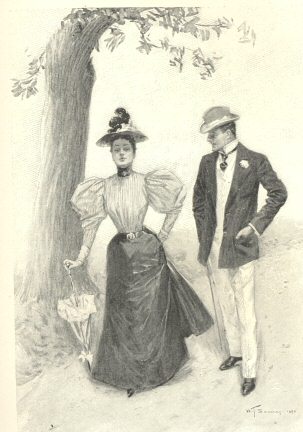
“There are a great many things,” vouchsafed
Parker, as they turned out of the avenue to the cliffs,
“that men are supposed not to do without—”
“Yes,” said Marguerite,
sharply—“vices.”
“I did not refer to them,” laughed Parker.
“In fact, Miss Andrews, the heart of man is supposed to be
incomplete until he has lost it, and has succeeded in getting
another for his very—”
“Are you an admirer of Max Nordau?”
interposed Marguerite, quickly.
(“Whatever led you to put that in?” I asked.
“Go on, and you’ll see,” said Harley.
“I didn’t put it in. It’s what she
said. I’m not responsible.”)
“I don’t know anything about Max Nordau,”
said Parker, somewhat surprised at this sudden turn of the
conversation.
“Are you familiar with Schopenhauer?” she
asked.
(“It was awfully rough on the poor fellow,” said
Harley, “but I couldn’t help him. I’d
forced him in so far that I couldn’t get him out. His
answer floored me as completely as anything that Miss Andrews
ever did.”)
“Schopenhauer?” said Parker, nonplussed. “Oh
yes,” he added, an idea dawning on his mind.
“That is to say, moderately familiar—though, as a
matter of fact, I’m not at all musical.”
Miss Andrews laughed immoderately, in which Parker, thinking
that he had possibly said something witty, although he did not
know what it was, joined. In a moment the laughter
subsided, and for a few minutes the two walked on in
silence. Finally Parker spoke, resignedly.
“Miss Andrews,” he said, “perhaps you have
noticed—perhaps not—that you have strongly interested
me.”
“Yes,” she said, turning upon him
desperately. “I have noticed it, and that is why I
have on two separate occasions tried to keep you from saying
so.”
“And why should I not tell you that I
love—” began Parker.
“Because it is hopeless,” retorted
Marguerite. “I am perfectly well aware, Mr. Parker,
what we are down for, and I suppose I cannot blame you for your
persistence. Perhaps you don’t know any better;
perhaps you do know better, but are willing to give yourself over
unreservedly into the hands of another; perhaps you are being
forced and cannot help yourself. It is just possible that
you are a professional hero, and feel under obligations to your
employer to follow out his wishes to the letter. However it
may be, you have twice essayed to come to the point, and I have
twice tried to turn you aside. Now it is time to speak
truthfully. I admire and like you very much, but I have a will
of my own, am nobody’s puppet, and if Stuart Harley never
writes another book in his life, he shall not marry me to a man I
do not love; and, frankly, I do not love you. I do not know
if you are aware of the fact, but it is true nevertheless that
you are the third fiancé he has tried to thrust
upon me since July 3d. Like the others, if you insist upon
blindly following his will, and propose marriage to me, you shall
go by the board. I have warned you, and you can now do as
you please. You were saying—?”
“That I love you with all my soul,” said Parker,
grimly.
(“He didn’t really love her then, you know,”
said Harley. “He’d been cured of that in five
minutes. But I was resolved that he should say it, and he
did. That’s how he came to say it grimly. He
did it just as a soldier rushes up to the cannon’s
mouth. He added, also:”)
“Will you be my wife?”
“Most certainly not,” said Marguerite, turning on
her heel, and leaving the young man to finish his walk alone.
(“And then,” said Harley, with a chuckle,
“Parker’s manhood would assert itself in spite of all
I could do. He made an answer, which I wrote
down.”
“I see,” said I, “but you’ve scratched
it out. What was that line?”
“‘“Thank the Lord!” said Parker to
himself, as Miss Andrews disappeared around the
corner,’” said Stuart Harley.
“That’s what I wrote, and I flatter myself on the
realism of it, for that’s just what any self-respecting hero
would have said under the circumstances.”
A silence came over us.
“Do you wonder I’ve given it up,” asked
Stuart, after a while.
“Yes,” said I, “I do. Such opposition
would nerve me up to a battle royal. I wouldn’t give
it up until I’d returned from Barnegat, if I were
you,” I added, anxious to have him renew his efforts; for
an idea had just flashed across my mind, which, although it
involved a breach of faith on my part, I nevertheless believed to
be good and justifiable, since it might relieve Stuart Harley of
his embarrassment.
“Very well,” I rejoiced to hear him say.
“I won’t give it up until then, but I haven’t
much hope after that last chapter.”
So
Harley went to Barnegat, after destroying his letter to Messrs.
Herring, Beemer, & Chadwick, whilst I put my breach of faith
into operation.)


