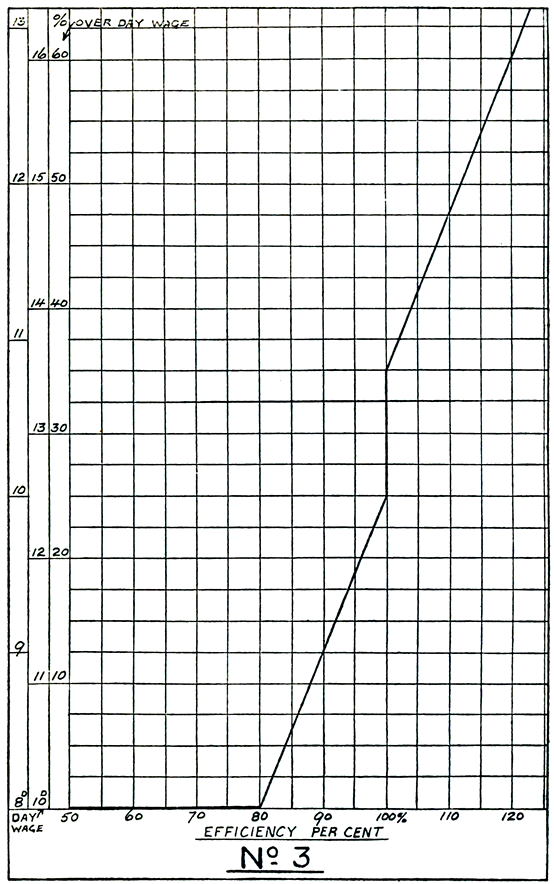
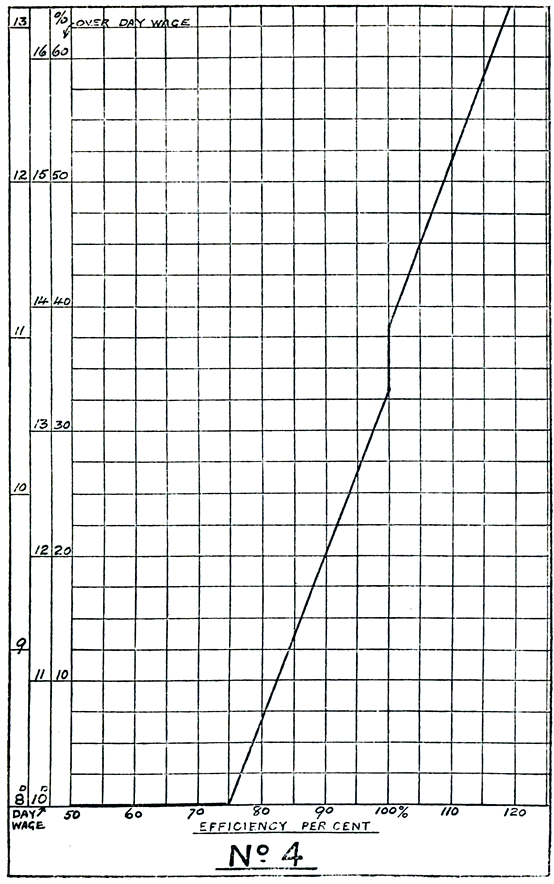
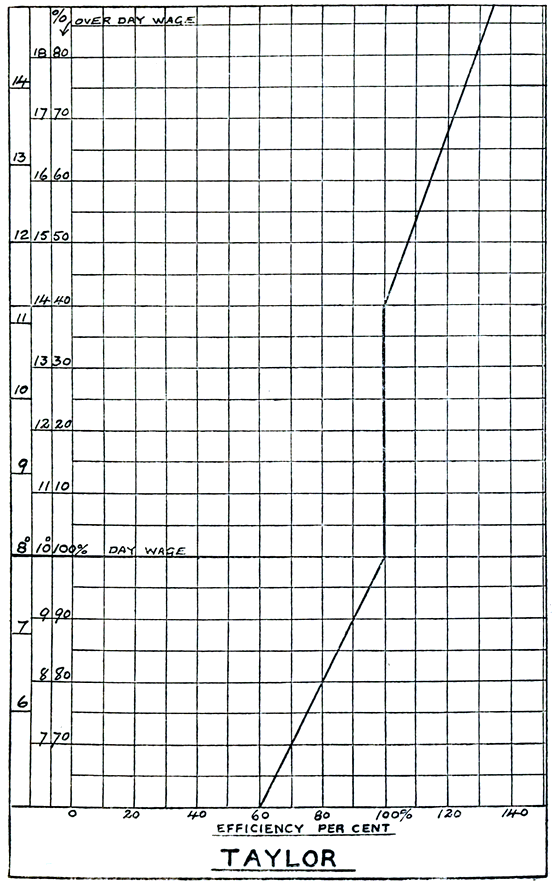
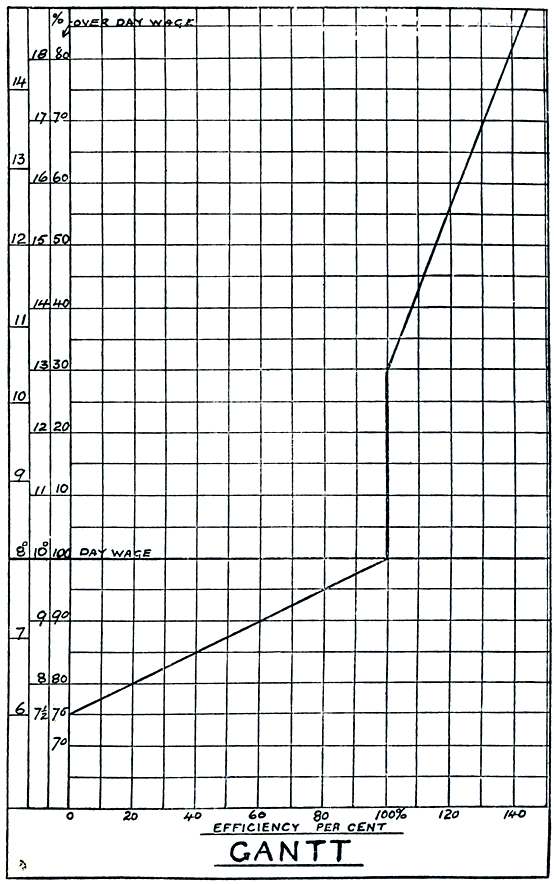
The rational study of work and the worker shows
the following principles to be essential when general
and continuous efficiency is the end in view:
1. The greatest efficiency is obtained when the
worker is most contented.
2. There is a limit to endurance, and efficiency
cannot be maintained if this limit be exceeded.
3. The working environment must be agreeable.
4. The nature of the work must be considered
in determining the working hours and conditions.
5. There must be no penalties or price cutting.
6. Suggestions must be encouraged and suitable
rewards given for those which are acted upon.
7. There must be an incentive to efficiency, which
should take the form of an addition to wages when
a certain minimum of production is exceeded.
8. Work must be carefully studied in detail so
as to discover conditions which give every worker
the same opportunity of reaching a high efficiency.
9. Earnings in excess of the day rate should be in
proportion to efficiency.
10. The generally accepted day rate of wages
must be absolutely guaranteed to the worker, no
matter what his efficiency.
All this is not pampering the worker or making
concessions to him. The hard fact remains that
it is only by adopting these principles that the
greatest efficiency can be obtained—viz., greater
production of a better quality of work for the same
or less expenditure in wages and works costs. That
it also gives the worker more income, better health,
less fatigue, greater contentment, are happy circumstances
that make for a rational and equable
understanding between employer and worker with
a maximum of benefit to both sides, that entail no
sacrifice of principle on either side, and enable us
to look forward to a national efficiency which will
be the achievement and the pride of every class of
which the State is composed.
But under what circumstances can these principles
be put into practice?
As they evolved out of the methodical and patient
study of production and the application of common-sense
ideas to labour and its ways, we have not far
to seek. The recorded results have been unified
into a system which has been and which may be
applied to all sorts and conditions of labour; this
system, so far as it directly affects the worker, is
denoted herein by the short expression, the Reward
System.
It is a method whereby a worker is paid according
to his efficiency. There is a guaranteed minimum
which is equal to his ordinary wage; after
that, the greater his efficiency the more he is paid.
In order that he may have every opportunity of
reaching a high efficiency without undue strain or
discomfort during his work, every detail of the
work, the machines, and the conditions, receives
consideration.
He is not left to do the job in the best way he
can think of, with any tools he may consider suitable.
Before he starts any job under the Reward
System, both the job and the machine on which
it must be done have been studied and timed; the
best tools for the purpose have been selected; the
right speeds have been chosen; the correct depth
and speed of cut have been decided upon, and so
on. Also the comfort of the worker has received
attention, and if he can do the work better sitting
than standing, a chair is provided.
All this means that, as far as possible, the job
is equalised for every worker who is put on it, and
every job is put on a time and condition basis, which
results in every worker having an equal opportunity.
It is therefore quite clear that, as conditions are
the same for every worker, the amount of work done,
and in consequence the amount of reward earned,
depends entirely on the energy and ability of the
worker himself.
The above is, of course, only a statement, and
the worker will want to know just how the right
times and conditions are arrived at, and what
assurance he has that conditions will not be altered
once they are fixed.
Here we will consider the general principles; an
example with fuller detail is given in Part II.
First, all the details of the work to be done, the
material of which it is to be made, the method of
manufacture, are carefully considered by the design
and planning departments of the factory.
The particulars of the job, together with a drawing,
if necessary, are handed to the time study
engineer in order that he may see the finished and
unfinished sizes, the quality of material, the machine
and tools to be used, etc.
The position of time study engineer is one of the
most onerous and responsible in the whole field of
the scientific study of work and the worker. He
should be a man of considerable skill and experience;
he must be thoroughly practical, and should have
had a shop training in addition to his scientific
studies; he should be able to divide the work up
into elements suitable for the machine on which
the work has to be done, and to suggest improvements
in the methods of performing it; he must be
able to see that the work is carried out in the most
expeditious way; he should be well educated apart
from his engineering training, and should have a
knowledge of hygiene, physiology, and psychology,
in order that he may understand the effect of work
on different workers, the causes and prevention of
fatigue, and what surroundings are best for the
health and happiness of the worker.
Such a man should be chosen with the greatest
care, as so much depends on his engineering ability,
his sympathetic judgment, and his broad outlook
on the question of production from the point of
view of both worker and employer.
And, in consequence, his standing in the firm
should be correspondingly high, if he is to fulfil his
duties satisfactorily to himself and to those with
whom he is associated—worker, trade-union, and
employer.
When the job goes into the shops, a few of the
articles are passed through each operation in order
that the worker may become familiar with it. This
also enables the time study engineer to see that
tools and speeds are satisfactory and to cut out
useless motions.
A special time study is then made of each detail
or element of the work from the time it comes to
the worker to the time it leaves him. Every change
that occurs—for instance, when the machine is
stopped or another tool is brought into position—is
the end of one element and the beginning of another,
and each element is timed and recorded. For this
work a good average worker is chosen, and he is
paid time and a quarter during the study.
The reason for this separation into elements and
the careful timing of each is in order to find out
exactly what time each element should take. These
are averaged out when a certain number have been
timed, and the average is assumed to be the correct
time for each element. Then the average times of
all the elements are added, and this gives the time
of the operation which that particular worker is
engaged upon.
In this manner the best method is found, and one
that puts all workers on exactly the same basis,
which is the essence of the system.
It is not claimed that the time study is perfect
and that the records obtained are absolutely exact.
Even with the greatest care errors will creep in and
the times will be incorrect. This especially is the
case with hand work. Again, the skill of the worker
increases very considerably, and he himself finds
quicker methods of doing the work. All that is
claimed for the time study method is that the
dividing up of the operation into elements, and
timing them as carefully as possible and eliminating
all unnecessary movements, gives the nearest approach
to perfection of rate setting yet discovered;
there is a bed-rock character about it that is not
found in any other system.
The time thus obtained is considered to be the
fastest time in which the operation can be done.
Actually, it is not the fastest time for two reasons,
one being that any time so obtained may be improved
on when the worker becomes thoroughly
used to the job, and the other being that a good
average worker is chosen for the time study, and
therefore a first-class man can improve on the time
obtained. But it is considered to be the fastest
time, and we will call it the "base time."
It is quite evident that this cannot be reached
regularly by every worker, and this is taken into
consideration when determining the standard time.
To obtain the standard time—namely, the time
in which the work is expected to be done—an allowance
is made on the base time. This allowance
depends on the nature of the work, greater allowances
being made for jobs that necessitate a good
deal of handling than for jobs that are nearly all
cutting, because cutting is independent of the
worker.
This standard time is the basis of the Reward
System, and is therefore the most important time.
It is so fixed in relation to base time that every
worker put on that work should be able to reach
it. If he does so, he is said to have reached an
efficiency of 100 per cent.
A worker who reaches continuously 100 per cent.
is a high efficiency man.
This efficiency should always be reached by a
worker who follows the instructions and works
diligently.
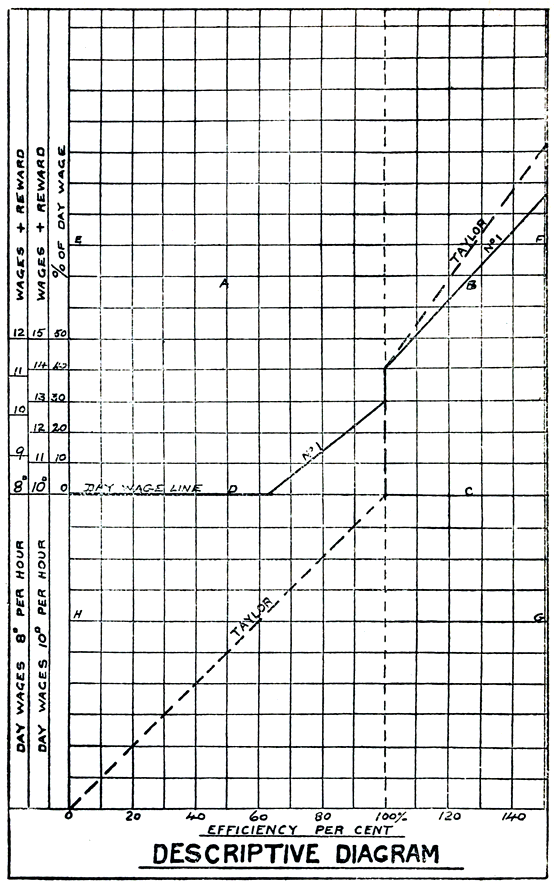
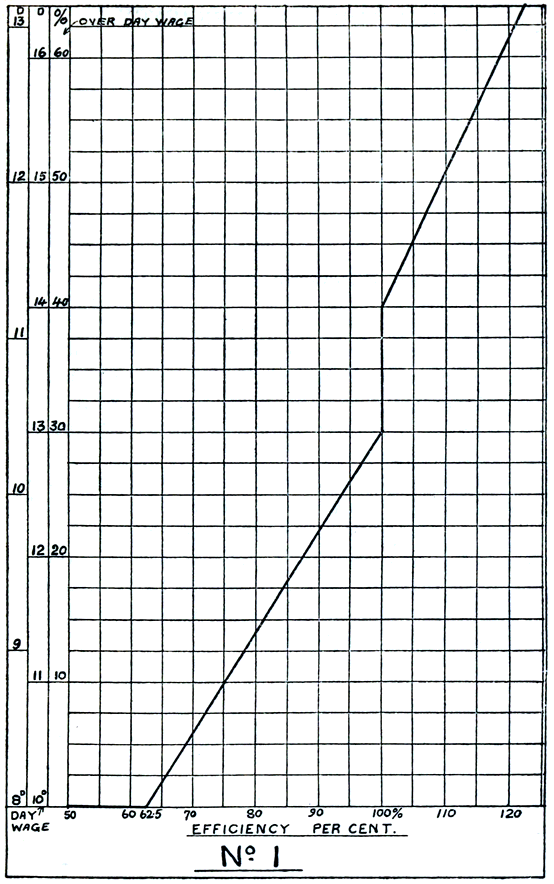
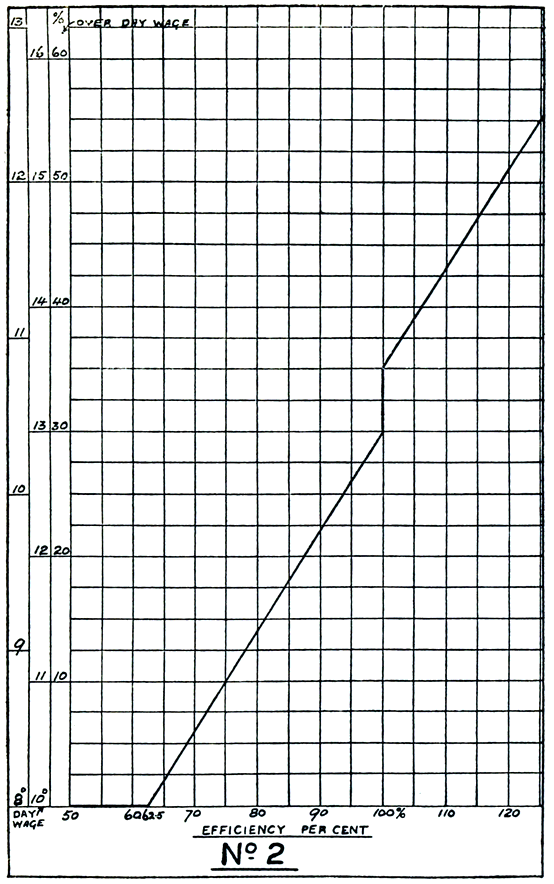
Reward begins, however, considerably before
this point is reached, because it may be necessary
for a worker to be on a job some time before he
reaches a high efficiency. Again, sometimes one
worker is naturally slower than another, and although
his work is good he can reach 100 per cent.
efficiency only by special effort. There would be
little encouragement if reward did not begin until
the worker had reached the 100 per cent. point.
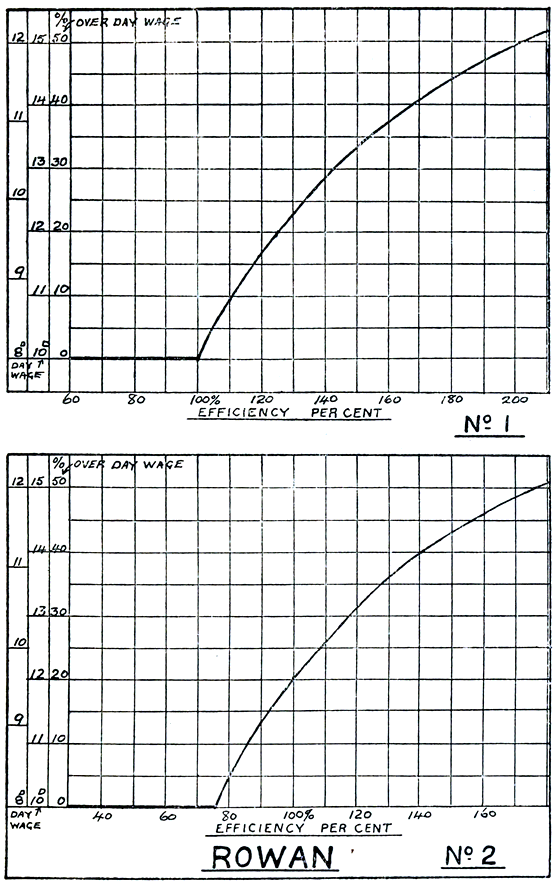
For these reasons, and as an incentive to every
man to become as highly efficient as possible,
reward begins when the worker reaches 75 per cent.
efficiency.
(This particular figure of 75 per cent. is taken to
illustrate the method, and because it is frequently
used as the reward point. Any percentage may be
used, and several methods are given in Part III.)
This means that a time addition of 33⅓ per cent. is
made to the standard time or standard production
in order to obtain a new figure, which is called
"reward time" or "reward production," because
it is the point where reward begins.
The following are three brief examples showing
the working out of the reward earned:
| I. | II. |
|---|
| Base time | 12 hours | 8 hours |
| Standard time (= base + 25%) | 15 hours | 10 hours |
| Reward time (= standard + 33⅓%) | 20 hours | 13·3 hours |
| Time taken | 16½ hours | 8·5 hours |
| Time saved | 3½ hours | 4·8 hours |
| Rate per hour | 9d. | 9d. |
| Reward | 3½ × 9 = 2s. 8d. | 4·8 × 9 = 3s. 7d. |
| Reward, week of 48 hours | 7s. 9d. | 20s. 2d. |
| Weekly day wage | 36s. 0d. | 36s. 0d. |
| Total earnings | 43s. 9d. | 56s. 2d. |
| Efficiency | 91% | 117·5% |
| III. |
|---|
| Base quantity | 40 per hour |
| Standard quantity (= base - 10%) | 36 per hour |
| Reward quantity (= standard - 25%) | 27 per hour |
| Time worked | 6 hours |
| Quantity produced | 220 |
| Reward quantity for 6 hours | 162 |
| Excess quantity | 58 |
| Reward at 27 for 6d. | 1s. |
| Reward for week of 48 hours | 8s. |
| Weekly day wage | 24s. |
| Total earnings | 32s. |
| Efficiency | 102% |
The two first examples are on a time basis, and
the third on a quantity basis. These are worked
out in detail in Part II.
The first thing that strikes one when these figures
are examined is that wages are considerably increased.
In view of this increase the worker will
want to know more about the conditions under
which the work is done, and whether such earnings
can be maintained continuously without special
effort.
The reply is that such earnings not only can be,
but are being, made regularly, and the workers have
a greater degree of comfort in their work than they
have under usual working conditions.
This is because of the time study method. Every
detail of the work is carefully studied, as has been
explained, and everything that will aid the worker
to increase his output has been provided. The
work is brought to the machine and taken away by
labourers, the tools are all specially designed and
exactly suited to the work. Instruction cards are
given to the worker, so that he can see exactly
what he has to do, how he has to do it, and the
time he should do it in. If he can do the work
sitting better than standing, a chair or stool is
provided.
In fact, everything is done to assist the worker
to reach a high efficiency, as this means greater
production besides greater reward.
The Reward System is, clearly, far better than
either day work or piece work. The time study
shows what is the best time in which a good average
worker can do the job. A trustworthy worker and
one who appreciates the time study principle must
be selected for the study. If this were not done, a
false time might be obtained, and this would lead
to doubts as to whether the times of other jobs were
correct. This is a difficulty that hardly ever arises,
because the worker knows that he is being fairly
dealt with, and there is nothing to be gained by
getting a false time.
Times once obtained are never altered so long as
the conditions remain the same.
Some exceptionally good workmen can make
large rewards every week, and it is to the firm's
benefit that they should do so. Suppose the price
was lowered because of this high reward. The
general efficiency of all the workers would fall immediately,
and the dissatisfaction with the alteration
in price and with the firm's attitude would result
in serious loss to all concerned.
The following is an example of what happens under
an ordinary bonus scheme when times are reduced:
| Time
allowed. | Time
taken. | Time
saved. | Reward
at 10d. | Works Costs at 2s.
per Hour, including
Labour. |
|---|
| Cost. | Reward. | Total. |
|---|
| Hours. | Hours. | Hours. | s. | d. | s. | d. | s. | d. | s. | d. |
| Original time | 5 | 4 | 1 | | 10 | 8 | 0 | | 10 | 8 | 10 |
| Cut to | 4 | 3½ | ½ | | 5 | 7 | 0 | | 5 | 7 | 5 |
| Cut to | 3½ | 3 | ½ | | 5 | 6 | 0 | | 5 | 6 | 5 |
| Cut to | 3 | 7 | — | | — | 14 | 0 | | — | 14 | 0 |
| Increased to | 4 | 7 | — | | — | 14 | 0 | | — | 14 | 0 |
| Increased to | 5 | 3½ | 1½ | 1 | 3 | 7 | 0 | 1 | 3 | 8 | 3 |
| Cut to | 4½ | 7 | — | | — | 14 | 0 | | — | 14 | 0 |
In this case the original piece time allowed for
the work was five hours, this being an estimate
based on the time taken when working under day
work. The men were paid at the rate of 10d. per
hour, and the works costs, including labour,
amounted to 2s. per hour. Bonus was paid on the
time saved.
The workers completed the job in four hours, a
reduction of one hour on the time set, and thereby
earned a bonus of 10d. The time was cut to four
hours, and the work was done in three and a half
hours, the workers earning a bonus of 5d. It was
then cut to three and half hours, and the workers
completed the job in three hours. Again the time
was cut, but the patience of the workers had reached
its limit, and the time taken was seven hours, with a
correspondingly increased works cost.
The time was immediately increased to four hours,
but with no effect. On increasing the time to the
original five hours the workers completed the job
in three and a half hours, and earned a very good
bonus. Once again the time was cut, with the
result that the workers' suspicion was aroused, and
the time promptly jumped to seven hours. The
workers had learned their lesson!
Neither worker nor employer can be satisfied
with such a result, and mutual suspicion is the
natural outcome. Yet all rates must be juggled
with in this manner in the absence of a method
whereby the time may be accurately determined.
It follows that, in the first place, the firm will
not cut prices, and, in the second, that the first-class
worker may earn the highest reward in his
power, with the knowledge that he is not injuring
the welfare of his fellow-workers in any way.
Now, suppose for some reason a worker takes
longer than reward time to do a job, or suppose he
produces less than reward quantity. It only means
that he gets no reward. His day wages, 36s. or
24s. a week, or whatever it may be, are absolutely
guaranteed. Whatever happens, his day wage is
not interfered with. It must be kept in mind always
that—Day wages are for attendance; reward, is for
efficiency. The two things are distinct, and it is
advisable to pay wages and reward earnings at
different times. The firm must see to it that when
the worker is in the works he earns his day wage,
and in this respect the day wage standard is equivalent
to reward production or reward time. If the
worker does less than these he is not earning his wage,
although he gets it, and such a case calls for the
immediate attention of the firm as well as of the
worker.
Let us sum up the foregoing points:
1. The time study gives all the workers the same
opportunity of earning reward.
2. Reward is paid for all production above a
certain minimum.
3. Reward begins at such a production that
everyone should be able to earn some reward.
4. The standard production is so calculated that
all workers should reach it by diligence and careful
attention to the instructions.
5. No matter how large a worker's reward may
be, prices cannot be cut.
6. The worker is safeguarded by the conditions
of the system.
7. The day wage is guaranteed even if the production
be less than the reward point.
8. As reward is proportional to profit (the higher
the reward the greater the efficiency, and the greater
the efficiency the greater the firm's profit), the worker
is encouraged to earn high reward. This can only
be done by good conditions and freedom from
fatigue, and therefore the comfort of the worker is
assured by the principles of the system.
Besides the reward described in the foregoing
explanation, special reward is given to all high
efficiency workers—that is, to those who reach
100 per cent. efficiency all through the week.
This special reward takes the form of paying the
worker a bonus either in the form of a sum of money
or an additional percentage on the standard time.
If the worker's efficiency reaches 100 per cent.
or more for any one week, and the hours on reward
are, say, forty or more, a cash reward of 1s. or 2s.,
or other suitable amount depending on the status,
etc., of the worker, is given in addition to the
reward earned by production. It is necessary to
base this special reward on the number of hours
worked; otherwise, if the worker happened to be
only an hour or so on reward during the week, and
his efficiency for that hour was 100 per cent., he
would get the special reward, and this would be
absurd as well as being unfair to workers who had
been on reward all the week.
In the other case, when the worker reaches
100 per cent. efficiency on any one job, no matter
how long it takes, his reward for that job jumps
5 per cent. or 10 per cent., or whatever special proportion
be decided upon. If the reward point be
75 per cent., then at 100 per cent. efficiency the
reward is 33⅓ per cent. of the job rate. To this
would be added, say, 5 per cent., thus making the
reward 38⅓ per cent. of the job rate.
A very important matter in connection with the
Reward System is that of deciding the right kind of
worker for the different classes of work.
For work requiring much skill and close application,
or work which requires skilled handling, the
highest class of worker is necessary and the job
rates will be high. For work which is automatic
or semi-automatic, boys or girls may be employed.
For work such as rough drilling or heavy unskilled
handling, men who have no special skill or training
may be suitable. But the point where one grade
of labour merges into another is not easily defined
and needs very careful consideration.
The circumstances of different trades vary so
greatly that it is impossible to apply any rules in
such general notes as these. It must be left to the
employer, the workers, and their trade-unions, to
settle these grades between them, and from the
trade practice there should not be much difficulty.
One thing stands out—namely, the worker who
has a continuously high efficiency in any grade is
easily distinguishable, and would be selected to pass
into a higher grade with higher wages when opportunity
occurred.
It may be asked how it is that a firm can afford
to begin paying reward when a job is done in twenty
hours, while the time study shows that the same job
can be done in twelve hours?
The reply is, First, that under ordinary day work
the waste of time on the job is so great that the job
would certainly take longer than twenty hours;
second, that by giving reward there is a decided
incentive for the worker to do the work in a shorter
time; third, that twelve hours is the shortest possible
time with a good average worker working
under the most favourable conditions, and this
happens so seldom that it may be considered accidental,
though it is necessary to observe these conditions
when making a time study in order to find
an absolute basis on which to pay reward; fourth,
for every hour saved on the job the overhead charges
are reduced proportionally, and this lowers the
works cost.
If a job takes twenty-four hours under day work,
it is clear that, if the same job be done in nineteen
hours, some reward may be allowed, while if it be
done in fifteen hours an extra bonus may be given.
The training in efficiency habits of work is also
very valuable, and means economy all round. A
man not used to these habits may expend twice as
much energy and produce half as much work as an
efficient man.
The time study is in itself an absolute safeguard
against cutting times. It is quite impossible for
a job to be done in less than a certain time by an
average worker after all the elements have been
studied and tested. So long as the elements do not
change, the times must hold good, and a new study
will confirm this if any doubt arises.
So that if the workers are all taking high rewards
it is clear proof that they are of high efficiency.
Suppose a firm cuts the time with the object of
getting more profit. One result is shown on p. 27.
Another result is that the good workers will leave,
because efficient men can always get good jobs elsewhere.
As a matter of fact, however, rates are practically
never cut. It does not pay to cut rates, because if
efficient men leave, and only inefficient men are
left, the firm loses heavily, and their own time
studies together with the general efficiency of the
workers show how valuable their men are.
This is why the time study is a decided safeguard
against cutting rates.
One method of rate revision sometimes occurs.
When a job is found to be rated too highly from
some cause or other, and the worker is taking excessive
reward on that job, a change is made in the
conditions of the work and the job is restudied.
Two reasons are given for this procedure: first,
that it is unfair to the other men for one man to be
taking exceptionally heavy reward, and, second,
under the new conditions the job is still on exactly
the same basis as all other jobs in the factory, and
standard efficiency with its proportionate reward
can be made just as easily as in other cases.
There is another safeguard. The relation between
standard and reward times is so arranged that when
a worker reaches standard he gets at least 25 per
cent. of the job rate. This is an accepted principle,
and must be conceded always. It is an irreducible
minimum in connection with the Reward System.
It may be said that, however much the principle
is accepted, it does not follow that the employer
will stick to it.
But he must! If he does not do so, what is the
alternative? Either he gives less than 25 per cent.
reward or he gives none until the standard time is
reached. In the first case, if he gives less than
25 per cent., reward is not worth working for, and
the worker will not trouble about it, thereby rendering
the whole system useless. If the worker gets
no reward until standard time is reached, the effort
required by the men is so great in order to get
reward that it is not worth it, and the men do not
try for it.
So that this principle must be accepted by the
employer whether he likes it or not, if the system is
to be a success.
It is not to the interest of the employer to treat
the worker badly. Firms with brains and foresight
enough to adopt time study methods are not going
to spoil the whole business by getting the workers
up against them. It is more to the firm's interest
than to the worker's to get a continuously high
efficiency; that is why time study and reward
methods were introduced by the employers, and not
by the workers.
It must be clearly understood that the Reward
System does not pretend to be by any means a
solution of all the difficulties between employer and
worker.
Without mutual good-will no system will work
satisfactorily. What is claimed for the Reward
System is that it provides a basis upon which a
good understanding and a mutual interest in increased
production can be built up and maintained.
The time study shows beyond argument the very
quickest time in which a job can be done by an
average man with the means at his disposal. If this
is followed up by a rational organisation, the Reward
System will be entirely successful. But if an employer
endeavours to foist the time study and
Reward System on an existing rule-of-thumb organisation,
it will undoubtedly fail, and will cause
deep suspicion in the mind of the worker as well as
being wholly unsatisfactory to the employer. It
will be looked upon as an endeavour to get more
out of the worker without an adequate return, and
this, as a matter of fact, is just what it will be.
One thing is certain: No employer will adopt the
Reward System unless he sees clearly that it is to
his direct financial benefit, and there is no reason
why he should. He, on his part, would be foolish
to take on an increased responsibility without adequate
return.
It follows, therefore, that the system is part of
the rational organisation of production, and it
cannot be properly carried on without such organisation.
Even when such a system is adopted, there are
ample opportunities for letting things slide and for
unfair conditions to creep in. This is why the
worker should understand the system, because then
only will he be able to assert his position and see that
conditions are fair.
The following are some of the things to watch
out for:
Time study must not be used for speeding up
day workers. There is a tendency to do this when
it is found that a job can be done in half the time,
but it must be remembered that conditions are
quite different and the incentive is lacking. The
remedy is to put all workers on reward as far as
possible, and to adopt a profit-sharing or other
scheme to stimulate day workers.
Overstrain and fatigue must be carefully guarded
against. This means, as a rule, guarding the worker
against himself. He wishes to earn as much reward
as he can, but if he feels tired out at the end of the
day he is doing too much, and he will wonder why
his efficiency drops. One part of the system is to
consider fatigue, and to make an allowance on the
base time to cover necessary rests during the day.
Cutting the rates need hardly be mentioned,
because it is very bad policy on the part of the
employer, and always means loss of efficiency and
hence loss of profit.
The question of keeping machinery in order and
bringing up supplies is one that the worker must
watch. It is no use trying to reach a standard
time when one gets let down by lack of attention
on the part of other people. It is true that a day
time allowance may be given, but this is not altogether
satisfactory. It means that reward cannot
be earned for the day time period, and, besides that,
there is a possibility of not receiving the allowance.
It is possible, also, that the superintendent may
refuse allowances, and so dissatisfaction results.
Day time allowances and allowances for exceptional
conditions (such as bad metal), which increase the
machine time, are open to abuse. If a worker reach
99·5 per cent. efficiency or thereabouts, it is quite
possible that an unfair allowance of an hour, or
even half an hour, on the job will put him over
the 100 per cent. efficiency mark, and his reward
rate would be considerably increased. With regard
to bringing up supplies and attending to slight
machine breakdowns—broken belts, for instance—the
labourer or other person responsible should be
put on reward, his reward being in proportion to
the average reward of the workers he serves.
The worker must see that proper allowances are
made for bad work which he is not responsible for.
For instance, if he is on small parts on an automatic
machine, and the inspector throws out several
pieces as spoiled, it may be the fault of a bad adjustment
which the worker cannot help. It is the
worker's duty to stop his machine and draw attention
to the fault; but if it can only be found on close
inspection in the inspection room, and if it consists
of, say, a capstan becoming loose, it may be
impossible for the worker to detect the fault while
the work is in process, and it is no fault of his.
The proper counting of the quantity of work
done is a point that must be insisted on. On large
work it is simple enough, but on small parts that
are counted by weighing it is easy to make serious
mistakes.
Proper check must be kept on the gears used for
a particular job. On automatic machinery a change
of gear is frequently necessary, and if the change is
not properly recorded it may mean that cycle time—the
time of all the elements done by the machine
on that part—is quite wrong, and an efficiency
much too high or too low is the result.
Reward is reckoned either on each job taken by
itself or on the net result of the week's work. The
former is better for the worker, but it is not always
fair to the employer, because there is a tendency
for the worker to take it easy on difficult jobs where
there is little chance of earning reward. With an
exact time study and close attention to instructions,
such cases, theoretically, should never occur; but
they do, because it is impossible to get every job
on exactly the same basis, and the worker after a
little experience knows what jobs are easy and what
are difficult. In some shops the experiment of
deducting inefficiency from efficiency has been
tried. That is, suppose a worker was 10 per cent.
below reward efficiency one week, then that 10 per
cent. has been deducted from his efficiency the
following week before reward has been allowed.
Result: Disaster! The fairest way is to take the
balance of efficiency on the week's work, and if a
particular job is a bad one from the worker's point
of view, he can always draw attention to it.
Another important matter is that of determining
the class of work which is to go to the worker.
Automatic work will go to comparatively unskilled
workers, but the dividing line between classes of
work is sometimes a very fine one. Skilled handwork
must be given to the skilled worker, of course;
but it is impossible to lay down any rules in this
connection, and the worker must keep his eyes open,
and either draw attention to doubtful cases or consult
his trade-union.
The greatest difficulty is in fixing the allowance
on the base time in order to obtain standard time.
It is easy to fix it so that the worker cannot reach
standard time, and that means a loss of efficiency
and of reward. This is essentially a point for
trade-union interference, and it is here that the
supreme value of the time study is best appreciated.
Most of the foregoing items are in connection
with the practical working of the system, and it is
to the interests of both employer and worker that
all such interferences with production should be
prevented.
Each trade will have its special loopholes where
miscalculations can creep in, and the worker must
watch for these and have them corrected immediately
they are discovered.
It is sometimes stated that under time study
methods a man cannot attain the same skill as a
day work man, and that he loses what skill he had
if he becomes a "team" worker.
Let us consider this contention.
Suppose a man leaves a "reward" shop and goes
to work in a day work shop; is he any less efficient
under day work because of his training under the
Reward System?
Now, in the first place, he has been trained and
used to care and diligence, to working to definite
instructions. Is that any disadvantage to him?
It is clear that such an experience is a distinct
advantage. But has he the same knowledge and
adaptability and initiative as the older-fashioned
worker? Can he tackle a difficult job with the
same chance of success?
Well, what difficulties has he to face? It does
not follow that because he has been working to
instructions he remains in ignorance of the essential
factors of his trade. On the contrary, instructions
scientifically worked out give him far more knowledge
than if he is compelled to work them out for
himself. The men who work out these instructions
are highly paid men who have all the advantages
of a shop training and a scientific engineering education
combined, and this is an expensive and
arduous business. If a man prove a failure, one
may be sure he will not be allowed to continue
planning out such instructions as we are discussing.
Therefore one must assume that the men who
make out the instructions have studied every element
of the case. The brains of these men are in
the methods and instructions used by the workman,
and if the latter is worth his salt he will soon know
far more than the old rule-of-thumb man.
If the worker is a man of ordinary common sense,
he cannot help but take notice of the ways in which
jobs are done; of the best and most satisfactory
tools, both shape and material; of proper speeds and
proper depths of cut for roughing and finishing; and
many other details that are constantly before him.
"But this system converts the workman into a
mere machine, and already his work is too dull and
mechanical!" That has been said, but not by anyone
who understands the system or who has had
direct experience of it.
That work under present conditions is often dull
and mechanical is only too true. One of the reasons
why this Reward System is so attractive to the worker
is because it removes these conditions. When a
man knows he is being paid for efficiency, the work
immediately ceases to be dull; as soon as a man is
interested in producing as much work as he can,
that work immediately ceases to be mechanical.
Some jobs will always be mechanical and dull, and
the only thing to do in such cases is to change the
worker at frequent periods.
The conditions under which the Reward System
is run must be agreeable, because it means a loss
of efficiency if they are not; and when a man is
working under agreeable conditions, when he knows
he gets a reward for his efficiency, when he knows
that rates cannot be cut, when he knows he is doing
no injury to his fellow-workers by earning big
rewards, he is happier at his work, he takes greater
interest in it, he comes to it with a certain degree
of pleasure, and he leaves it with far less fatigue
and with greater contentment than under any other
system.
One can say with certainty that a man who is a
good workman under any other system will be a
better workman under the Reward System. A bad
workman will be bad under any system, but such a
one can "find himself" much more certainly under
the Reward System than under any other. In many
cases, too, a very moderate workman will find some
one particular job where he can do good work and
earn good money. He will want to stay on that
job, of course, and if he keeps up his efficiency the
employer will agree that he shall stay on it.
There is one remarkable thing that no other
method of wage payment shares—namely, it is to
the direct and immediate benefit of both worker
and employer that the greatest efficiency be obtained.