When
the news of the Sirdar’s splendid victory
reached England, the British nation may be said to
have breathed again, and when the great rush was
made for the cheap edition of “Ten Years’ Captivity,”
which was extensively advertised with my portrait to
catch attention, the few known details of Gordon’s
death became as fresh again in people’s minds as they
had been years before. I was constantly asked to relate
all I had heard concerning Gordon. When I had done
so I was invariably met with quotations and readings
from “Mahdism,” “Ten Years’ Captivity,” “Fire
and Sword,” and other works; for what I had been
told of Gordon’s death by eye-witnesses was an
entirely different history to those published.
The first to relate the story of Gordon’s death was
a man whose tongue Gordon had threatened to cut
out as the only cure for his inveterate lying, and
when he escaped and reached Cairo, in telling his
tale he sustained his reputation. All accounts of
Gordon’s death have apparently been based upon
this first one received. Gordon, the world has been
|301|
made to believe, died as a coward, for what other
construction may be placed on the assertion that he
turned his back upon his assailants, and in his back
received his mortal wound? It is an infamous lie; but,
then, what was to be expected from a man whom
Gordon knew so well, and who, maybe, had good
reason to invent the tale he did? I quote, side by
side, what may be called the three official accounts of
Gordon’s death:―
MAHDISM.
“He (Gordon)
made a gesture of
scorn with his right
hand, and turned his
back, where he received
another spear
wound which caused
him to fall forward
and was most likely
his mortal wound. . . .
He made no resistance,
and did not
fire a shot from his
revolver.”
“. . . One of them
rushing up, stabbed
him with his spear,
and others then followed,
and soon he
was killed. . . . He
(Nejoumi) ordered
the body to be dragged
downstairs into the
garden, where his
head was cut off.”
OHRWALDER.
“The first Arab
plunged his huge spear
into his body. He
fell forward on his
face, was dragged
down the stairs,
many stabbed him
with their spears,
and his head was
cut off and sent to
the Mahdi.”
SLATIN.
“The first man up
the steps plunged his
huge spear into his
body; he fell forward
on his face without
uttering a word. His
murderers dragged
him down the steps to
the palace entrance,
and here his head
was cut off and at
once sent over to the
Mahdi.”
|302|
It will be noticed that Father Ohrwalder’s account
appears to be a condensation of the first given, while
it is hard to believe that a coincidence only accounts
for Slatin giving the history in almost the identical
words used by Ohrwalder. It is still more extraordinary
that the first account should ever have been
believed and published, and still more extraordinary
that it was not corrected by Ohrwalder and Slatin, for
when I arrived in Omdurman, in 1887, the real details
of the death of Gordon were the theme of conversation
whenever his name was mentioned, and there
are many eye-witnesses to his death—or were until
the battle of Omdurman, who could tell a very
different tale.
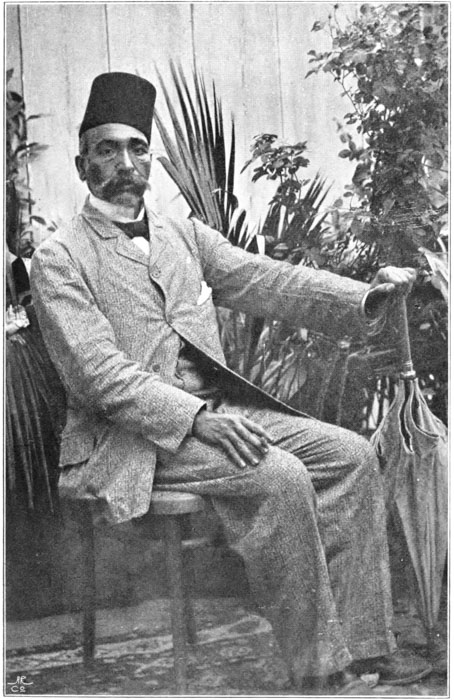
KHALEEL AGHA ORPHALI.
Those who knew Charles George Gordon, will
believe me when I aver that he died, as they must all
have believed that he died—in spite of the official and
semi-official accounts to the contrary—as the soldier
and lion-hearted man he was. Gordon did not rest his
hand on the hilt of his sword and turn his back to his
enemies to receive his mortal wound. Gordon drew
his sword, and used it. When Gordon fell, his sword
was dripping with the blood of his assailants, for no
less than sixteen or seventeen did he cut down with it.
When Gordon fell, his left hand was blackened with
the unburned powder from his at least thrice-emptied
revolver. When Gordon fell, his life’s blood was
pouring from a spear and pistol-shot wound in his
right breast. When Gordon fell, his boots were
slippery with the blood of the crowd of dervishes he
shot and hacked his way through, in his heroic attempt
|303|
to cut his way out and place himself at the head
of his troops. Gordon died as only Gordon could
die. Let the world be misinformed and deceived
about Soudan affairs with the tales of so-called guides
and spies, but let it be told the truth of Gordon’s death.
A week before the fall of Khartoum, Gordon had
given up hopes. Calling Ibrahim Pasha Fauzi, he
ordered him to provision one of the steamers, get all
the Europeans on board, and set off for the north. To
their credit be it said, they refused to leave unless
Gordon saved his own life with theirs. Finding him
obdurate, a plot was made to seize him while asleep,
carry him off, and save him in spite of himself; but he
somehow heard of the plot, smiled, and said it was his
duty to save their lives if he could, but it was also his
duty to “stick to his post.” As the troops must be
near, then sail north, he told them, and tell them to
hurry up.
Each day at dawn, when he retired to rest, he bolted
his door from the inside, and placed his faithful
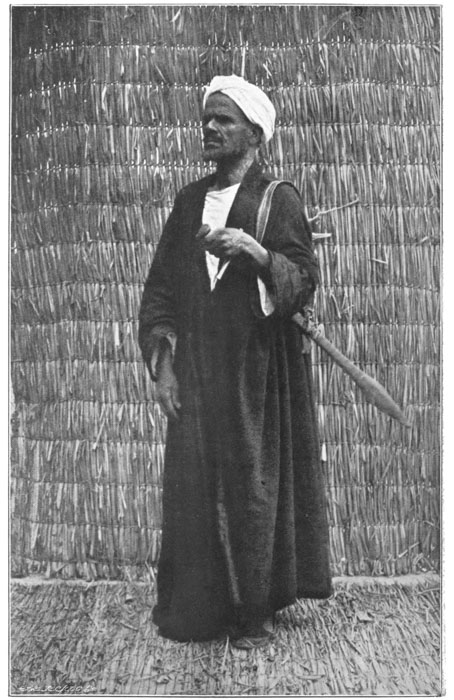
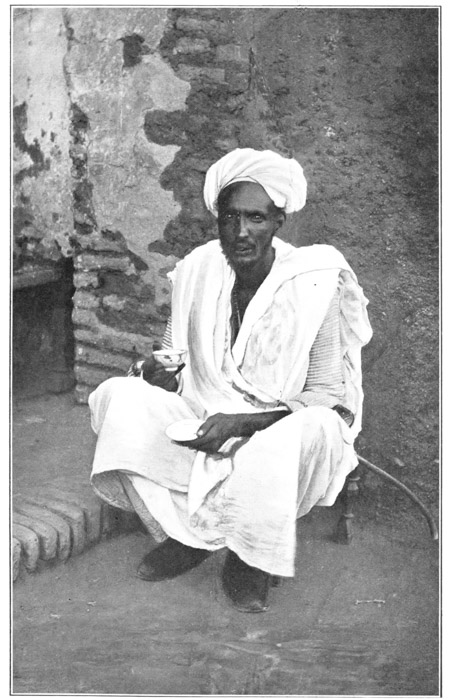
body-servant—Khaleel
Agha Orphali—on guard outside it.
On the fatal night, Gordon had as usual kept his vigil
on the roof of the palace, sending and receiving telegraphic
messages from the lines every few minutes,
and as dawn crept into the skies, thinking that the
long-threatened attack was not yet to be delivered, he
lay down wearied out. The little firing heard a few
minutes later attracted no more attention than the
usual firing which had been going on continuously
night and day for months, but when the palace guards
were heard firing it was known that something serious
|304|
was happening. By the time Gordon had slipped
into his old serge or dark tweed suit, and taken his
sword and revolver, the advanced dervishes were
already surrounding the palace. Overcoming the
guards, a rush was made up the stairs, and Gordon
was met leaving his room. A small spear was thrown
which wounded him, but very slightly, on the left
shoulder. Almost before the dervishes knew what was
happening, three of them lay dead, and one wounded,
at Gordon’s feet—the remainder fled. Quickly reloading
his revolver, Gordon made for the head of
the stairs, and again drove the reassembling dervishes
off. Darting back to reload, he received a stab in his
left shoulder-blade from a dervish concealed behind the
corridor door, and on reaching the steps the third time,
he received a pistol-shot and spear-wound in his right
breast, and then, great soldier as he was, he rose almost
above himself. With his life’s blood pouring from his
breast—not his back, remember—he fought his way
step by step, kicking from his path the wounded and
dead dervishes—for Orphali too had not been idle—and
as he was passing through the doorway leading
into the courtyard, another concealed dervish almost
severed his right leg with a single blow. Then Gordon
fell. The steps he had fought his way—not been
dragged—down, were encumbered with the bodies of
dead and dying dervishes. No dervish spear pierced
the live and quivering flesh of a prostrate but still
conscious Gordon, for he breathed his last as he turned
to face his last assailant, half raised his sword to strike,
and fell dead with his face to heaven.
|305|
Even had I not been specially requested, as the last
of the Soudan captives, to relate in my narrative all that
I had heard and learned concerning Gordon, I should
have done so to a certain extent at all events, for he
was no more the hero of the British people than he
was mine, and the belief that he was still alive had no
little to do with my ill-starred journey in 1887. The
truth about his death, which is now published for the
first time, is ample justification for what follows concerning
him while still alive. It is true, as I have
been told, that all I can have to say will be from
“hearsay;” but then all the reports published concerning
Gordon’s last days are from hearsay. I have
the advantage over all others in this—that I was
maybe the one man, captive or not, in Omdurman
whom Mahdist and “Government” man alike could
trust implicitly and confide in, for there was no
questioning what my attitude was towards Abdullahi
and Mahdieh. The consequence was that old “Government”
people and the powerful men who from time
to time became my fellow-prisoners, and, as a consequence,
enemies of Abdullahi, gave me confidences
which, if given in other quarters, might have resulted
in the loss of a head.
Again, almost all the tales told about the Soudan
may be classed in one of two categories; the first,
tales like mine, related by people interested in putting
their own version upon events and incidents with
which they were personally connected, and the second,
tales told by people with versions for which they
believed their questioners were hankering, so that what
|306|
was white to “A” became black to “B,” if it was
considered that this colour pleased “B” best. The
system scarcely puts a premium on accuracy.
But before proceeding to my comments on the
criticisms, a few introductory remarks are called for to
prevent misconceptions and misunderstandings arising
in the minds of my readers. As an evidence that the
following is not intended—far from it—to lacerate the
feelings of any of those who suffered with me, I might
mention that I have read over the notes of this
chapter to many of my fellow-captives, and have, at
their suggestion, cut out a series of incidents well
known to Gordon, which influenced him in the stand
he took towards certain people, and other incidents
which prove how clear and long-sighted he was, and
how events justified his taking up the stand which
he did. One incident ought to be written, to punish
on this earth, if possible, the man whose escape has not
been recorded, and whose deserted and broken-hearted
wife lies by the side of their unshriven baby-boy in the
sands of the Soudan. However, maybe Gordon, had
he come back alive to meet all the calumnies directed
against him, would have hesitated to help his “clearance”
by stabbing the living with a dead hand, and
out of respect to his memory this incident, with a
number of others, has been expunged.
I have already told Father Ohrwalder that, in
commenting upon what he says in “Ten Years’
Captivity,” when speaking of Gordon’s actions, the
remarks I may feel called upon to make are not
intended for him personally, and although I foresee
|307|
that I must in the main have to speak as to the
second person, I think Father Ohrwalder quite understands
that the second person in this instance is his
book, not himself. I do not, as I have told him,
consider that he is directly responsible for the opinions
he is credited with in “Ten Years’ Captivity,” and
this notwithstanding the remark, “The reader is
reminded that all opinions expressed are those of
Father Ohrwalder.” Considering that Father Ohrwalder
is a priest and missionary, and has ventured
upon thin ice in attacking Gordon’s memory, such
a statement is hardly fair to him, as in the preface
to the book it is stated, that “Father Ohrwalder’s
manuscript, which was in the first instance written in
German, was roughly translated into English by
Yusef Effendi Cudzi, a Syrian; this I entirely rewrote
in narrative form; the work therefore does
not profess to be a literal translation of the original
manuscript. . . .”
I should have thought that when Gordon was
being attacked the original manuscript might have
been treated a little differently. Of course it is
easily understandable that when a Syrian, with
Arabic for his mother tongue, translates from
one difficult language which he has picked up into
another equally difficult, and translates roughly too,
when moreover this rough translation is handled in
the manner admitted, errors may have crept in or
been passed unnoticed, whilst salient points were lost
sight of. It is also quite possible that the peculiar
idioms of the Arabic, German, and English languages
|308|
got into a hopeless tangle, and were left so. Whatever
the cause, there is no gainsaying the fact that
Father Ohrwalder is credited with the expression of
opinions which he, as a priest and missionary, ought
to be one of the last on this earth to give utterance
to. That he did not appreciate to the full the real
import of the opinions he is credited with, I feel
certain of after my long interview with him, when,
with the Bible in one hand and a copy of “Ten
Years’ Captivity” in the other, we compared the
opinions expressed in the latter with the teachings of
Christ in the former.
Father Ohrwalder may or may not have been ill-advised
in omitting or suppressing the relation of
well-known incidents, which accounted for Gordon’s
attitude in certain cases. It was only by omitting to
mention these incidents that the criticisms on Gordon
were rendered possible, or I should say that, had those
incidents been included, the criticisms would not have
lived a day. It would have been far better to tell
everything to the generous and sympathetic world
which he and Slatin met when they escaped, and to
leave it to condone, if any condoning was called for,
and to sympathize with them in the parts force of circumstances
compelled them to act, which must have
been so repugnant to them; for to omit, when criticizing
Gordon, the relation of the very acts which
compelled him also by force of circumstances to act
as he did, was, to say the least of it, very unwise.
In “Ten Years’ Captivity” the reader is led into a
maze of opinions, and left there. Once inside, you
|309|
discover that you can neither gain the centre of the
maze or return to the starting-point; you must either
wander round for an eternity, or do as I shall do, cut
your way through the hedges planted to bewilder
you, and thank Heaven when on the outside that
you are clear of the tortuous passages. Compare, for
instance―
“He (Cudzi) added that Gordon should have no anxiety about
Berber as long as Hussein Pasha Khaleefa was Mudir,”
with,
“Gordon himself committed a mistake by which he gave a deathblow
to himself and his mission. On his way to Khartoum, he
stopped at Berber, and interviewed the Mudir Hussein Pasha
Khaleefa; he imprudently told him that he had come up to remove
the Egyptian garrisons, as Egypt had abandoned the Soudan.”
Gordon cannot be blamed for confirming, as
Governor-General of the Soudan, the news telegraphed
to his subordinate, the Mudir of Berber, through whose
hands the retiring garrisons must pass, nor can he
be blamed if, when his suspicions were aroused, he
deferred to the opinion of the man who was acting
British Consul, Government representative, and his
own agent, when he wrote and telegraphed as he did,
“Trust in Hussein Pasha.”
“The catastrophe which had overtaken Hicks filled the inhabitants
of Khartoum with indescribable dismay. Several of them returned
to Egypt, and the members of the Austrian Mission, with their blacks,
quitted Khartoum on the 11th December, 1883.”
I therefore take it for granted that Father
Ohrwalder’s fellow-workers saw that all was hopeless
|310|
two months before Gordon’s name had been suggested to
the Egyptian Government, yet, in the face of this, we
are first asked―
“What could Gordon do alone against the now universally
worshipped Mahdi?”
and then told―
“General Gordon’s arrival in Khartoum gave fresh life and hope
to the inhabitants.”
Then,
“As it appeared to us in Kordofan, and to the Mahdi himself,
Gordon’s undertaking was very strange; it was just as if a man
were attempting to put out an enormous fire with a drop of water,”
and,
“I have not the slightest hesitation in saying that had the Egyptian
Government not sent Gordon, then undoubtedly the evacuation originally
ordered could have been carried out without difficulty.”
One is simply staggered by such an assertion.
When Gordon arrived in Khartoum, the whole of the
western Soudan had fallen. The town was overrun
with the mourning women and children—the widows
and orphans, I should say—of the troops who, under
Hicks Pasha, had been annihilated a few months
before on their way to extricate the garrisons. Slatin
had surrendered Dara to Zoghal. Said Bey Gumaa,
the last man to fight for the Government in the
western Soudan, was compelled to capitulate very
shortly before Gordon’s arrival, and this only after a
second siege when his men were dying with thirst.
|311|
Bahr-el-Ghazal fell before Gordon had had time to
turn round, and, for all that he or the Mahdi knew,
the Equatorial province had fallen also. The town
was hemmed in by the Mahdists, and the commanders
of the garrisons which Gordon was expected to
extricate were holding various commands in the
dervish army, while Slatin had taken part already as
a Mahdist in the subjugation of his subordinate,
Said Bey Gumaa of El Fasher, who had refused to
surrender. Am I not justified in saying that only
the suppression of such facts made possible such
attacks upon Gordon?
We are next told―
“Those who escaped massacre in Khartoum have often told me
that they were perfectly ready to leave, and it was only Gordon’s
arrival that kept them back, but Gordon’s arrival without troops had
rather disappointed them. Had he been accompanied by five
hundred British bayonets, his reputation in the Soudan might have
been maintained, and probably the Mahdi would never have left
Kordofan.”
Why did not those perfectly ready to leave leave
with the members of the Austrian mission, or leave
between the date of their departure, December 11,
and the early days of February, when the news
of Gordon’s mission first reached Khartoum? Who
prevented their leaving during that interval of at least
two months from the moment when they were all
thrown into “indescribable dismay” until they heard
of Gordon’s appointment? And if, when he did arrive,
they were so bitterly disappointed at his not being
accompanied with five hundred British
|312|
bayonets—much good these would have been against the “universally
worshipped Mahdi” in extricating those who
had surrendered to him—why did they stay on? Did
not Gordon beg them to leave? did he not try and
compel them to do so? did he not put boats at their
disposal to sail north or south as best suited them?
And has not Gordon himself given the real reason for
their staying on?—though to this should be added
their unbounded faith and confidence in Gordon.
Gordon, I venture to believe, sustained his reputation
in the Soudan up to the end—up to the moment
when, with the hand of Death on him, he fell facing
his last assailant. True, he lost his reputation for
telling the truth, but there are few men in this world
whose telling of an untruth would startle and astonish
a community. The people of Khartoum, their eyes
dry and wearied with looking for a sign of the returning
steamers which Gordon had sent off three months
before to bring up the troops expected to arrive at
the beginning of November, turned to each other, and,
in an amazed whisper, said, “Gordon has told a lie,”
and were startled and afraid at their own words.
Having dealt as tersely as possible with this curious
collection of contradictions, I proceed to the quotation
of and replies to the criticisms passed upon Gordon in
the book I have already quoted from.
1. “Looking back on the events of the siege of Khartoum, I cannot
refrain from saying I consider Gordon carried his humanitarian
views too far, and this excessive forbearance on his part added to
his difficulties.”
2. “It was Gordon’s first and paramount duty to rescue the
|313|
Europeans, Christians, and Egyptians, from the fanatical fury of the
Mahdi, which was especially directed against them. This was
Gordon’s clear duty, but unfortunately he allowed his kindness of
heart to be made use of to his enemy’s advantage.”
3. “Thus, in his kindness of heart, did Gordon feed and support
the families of his enemies. It was quite sufficient for a number of
women to appeal to Gordon, with tears in their eyes, that they were
starving for him to order that rations of corn should be at once
issued to them, and thus it was that the supplies in the hands of the
Government were enormously reduced.”
4. “Gordon should have recognized that the laws of humanity
differ in war from peace time, more especially when the war he was
waging was especially directed against wild fanatical savages, who
were enemies to all peace.”
5. “He was entirely deceived if he believed that by the exercise
of kindness and humanity he was likely to win over these people to
his side; on the contrary, they ridiculed his generosity, and only
thought it a sign of weakness. The Soudanese respect and regard
only those whom they fear, and surely those cruel and hypocritical
Mahdists should have received very different treatment to civilized
Europeans.”
6. “I also think that Gordon brought harm on himself and his
cause by another action, which I am convinced led to a great extent
to his final overthrow. Such men as Slatin, Lupton, Wad-el-Mek,
and others, had offered, at the risk of their lives, to come and serve
him. . . . Gordon would not, however, vouchsafe an answer to the
letters of appeal these men wrote to him.”
In the first five extracts, Father Ohrwalder, from an
initial mistake in forgetting or being unaware of the
presence in Khartoum of the thousands of widows and
orphans of the soldiers of Hicks’ army, flounders on
until, as I have said, he is credited with opinions which
he should be the last to give utterance to. It is passing
strange that any missionary should place limits to
the humanitarian views and forbearance of a military
commander in time of war, who may invariably be
|314|
depended upon to err on the wrong side from the
biblical point of view. Gordon, in keeping in mind
the Sermon on the Mount, and acting up to its precepts
as far as the exigencies of a state of war permitted,
performed no act derogatory to him as a
military commander. Gordon was no worse a
Christian than he was a soldier—and the world never
saw a better soldier. And whatever Gordon’s paramount
duty may have been, it certainly was not his
paramount duty to weaken his little garrison by sending
an expedition into Kordofan to rescue, say, a dozen
people who, as far as Gordon and every one else in
Khartoum knew, had disavowed the Christian religion
and adopted that of the Mahdi.
There is another aspect to the case. Gordon’s
troops were Muslims. The “Christians” had adopted
the “true faith” and become Muslims also. Why,
then, should Muslim lives be sacrificed to “rescue”
them from Islam and bring them back to Christianity?
And it must not be forgotten that Slatin, so far from
denying his conversion, excused himself on the ground
that his religious education had been neglected at
home. Gordon is not to be blamed for having believed
that the “Christians” had sincerely adopted Islam, for
apart from the mere adoption of the religion, people
sworn to celibacy and chastity had entered the matrimonial
state, which was considered a further evidence
of their conversion. While the gardener of the
Khartoum Mission was bewailing the money he had
sent to the “apostates,” Consul Hansal wrote, asking
that the matter be kept secret, to the Austrian
|315|
Consul-General in Cairo, informing him of what had occurred.
Had there been any “Christians” to rescue from the
Mahdi, doubtless Gordon’s paramount duty would
have exhibited itself in some action. Nor is there
any evidence that the Mahdi’s “fanatical fury” was
in any single instance especially directed against the
“Christians,” but there is a great deal of evidence to
the contrary. With the exception of putting Slatin
in chains, when he believed that he was playing him
false, I know of no case of wanton cruelty practised
by the Mahdi towards the “Christians,” and I am
not sure whether “clemency” would not be the proper
word to use in Slatin’s case, when it is remembered
what happens to prisoners of war who break their
parole, for Slatin and the others had sworn the oath
of allegiance.
Extract No. 3, apart from the extraordinary censure
on Gordon for feeding the families of his enemies, and
being moved to pity at the sight of the tears of
starving women, calls for a more detailed reply to the
criticism. Gordon, according to “Ten Years’ Captivity,”
ought to have turned these women out of the
town to be at the tender mercies of the “wild fanatical
savages” and been responsible for the rehearsal under
his own eyes of the hunt for lust which followed on
the fall of Khartoum. Father Ohrwalder can never
have heard of England’s proud roll of heroes who
on land and sea have given their lives to save
those of helpless women and children. In feeding
these women—even had all been the wives of his
enemies, which they were not—Gordon committed
|316|
no graver military crime than did the commander of
the troops on board the Birkenhead, when, instead of
seeing first to the safety of the soldiers for whose lives
he was responsible, he placed the women and children
in the boats which could have saved the troops, and
called upon his men to present arms as the boats left
the side of the ship—and to stand to attention as the
vessel sank under them. So much for British principle,
apart from Christ’s teachings, in peace and war; now
for the facts in Gordon’s case.
When Gordon arrived in Khartoum, he found
wandering—hungry and helpless—the thousands of
widows and orphans of the soldiers who a few months
before constituted Hicks Pasha’s army. Throughout
his journals you will discover constant reference to the
food question, with accounts of his successful search
for the stolen biscuits, which had “enormously reduced”
the supplies in the hands of the Government. Gordon
had calculated that the relieving army would reach
him at the beginning of November, so that we find
him writing on the 2nd of that month that he has six
weeks’ food supplies. In making this estimate he
was allowing for full rations to the troops (who were
also in receipt of the money with which to buy those
rations), and the wants of the poor. On the 11th of
that month he discovers nearly a million pounds of
stolen biscuits. On the 21st he writes, “I do not
believe one person has died of hunger during the
months we have been shut up.” On December
14—that is a month after the latest date he had
estimated for the arrival of the relief expedition, he
|317|
says that unless the troops come in ten days the town
may fall, and this because he had on November 12
written, “Omdurman fort has one and a half months’
supply of food and water.” With the fall of this fort,
he knew that the end would soon come.
But up to this date the soldiers, who were not entitled
to rations since they received money for their
purchase, were given full rations, and there is every
reason to believe that the pinch only came when Omdurman
fort fell on January 14 or 15, and the town
was completely hemmed in. Food was short, no
doubt, but, eight days before the fall of the town,
Gordon could spare from the stores fifteen hundred
pounds of biscuits to provision a boat for the Europeans.
One should only be filled with amazement
that Gordon held out so long after the date when he
had expected relief, and it is not only ridiculous but
monstrous to attack him, because he did not calculate
that the expedition would only arrive seventy-eight
instead of seventy-six days late, when we know for
certain that his troops were receiving full rations which
they were not entitled to for at least a month after
the date of the expected arrival of the expedition.
It is true that Gordon, seeing the food supplies
giving out, recommended people to leave him and
join the Mahdi, but this was only after more days had
slipped away after the “ten days from December 14.”
He had then abandoned all hope, and saw that his
prophecy was to come true—the expedition would
arrive just “too late.” In comparison with the
number of widows whom Gordon had had to support
|318|
for ten months, without the slightest assistance or aid
from outside, the number of wives of his “enemies” in
the Mahdi’s camp was so insignificant as to be
unworthy of notice. But even supposing that all the
starving women who went to Gordon crying for the
bread which Father Ohrwalder suggests should have
been represented by a stone, were the wives of his
enemies, his own writing justifies Gordon’s feeding of
them, for he says, “These crafty people thus assured
themselves that, should the Mahdi be victorious, their
loyalty to him would ensure the safety of their families
and property in Khartoum, while, on the other hand,
should Gordon be victorious, then their wives and
families would be able to mediate for them with the
conquerors.”
It is quite evident, then, that these people who
went over to the Mahdi’s camp did so, not from
conviction of his divine mission, but to save the
lives of their wives and families, whom by preference
they entrusted to Gordon even at the last hour, and
nearly a year after the date when his arrival without
five hundred British bayonets is supposed to have
ruined his reputation in the Soudan. I am inclined
to think that the “craftiness” displayed by some in
trying to secure their wives and daughters against
violation and death, was no less justifiable than the
“craftiness” displayed by others for an entirely
different purpose. What a tribute these “crafty”
people paid to Gordon! I mean the crafty people
who left Khartoum in January, 1885, and trusted
Gordon with the lives of their wives and children.
|319|
In discussing this food question with Khartoum
survivors, I laid particular stress upon the feeding of
the women and children, and I can do no better than
give the summing-up of it in the words of a native
survivor, after I had translated to him the criticisms I
am replying to—“What! Would Gordon Pasha
send away the hungry women and children of
soldiers who had been killed fighting for the Government?”
I pass over extract No. 5 for the moment to refer to
No. 6. The use of my portrait in advertising the
book I am quoting from led most to believe that I
approved of the criticisms it contained, and I have
taken this opportunity of showing how thoroughly I
disagree with them. To say that Slatin and others
had offered, at the risk of their lives, to join Gordon
is hardly correct, and if Gordon did not vouchsafe
a written answer to the letters he received, he
probably had good reason for not doing so, especially
as it appears likely that some of Said
Bey Gumaa’s letters addressed to the Governor-General
before Gordon’s appointment had succeeded
in getting through to Khartoum, and from these
and deserters from the Mahdi, Gordon must have
learned all.
Under pretence of intending to submit, Gumaa
gained time, and tried to hurry up reinforcements, but
this having been suspected, Zoghal ordered Slatin,
Tandal, the President of the Civil Court, Aly Bey
Ibrahim-el-Khabir, Slatin’s head-clerk Ahmad Riad,
and a few others, to send in an ultimatum to Gumaa,
|320|
and await his reply. The reply travelled quickly; as
soon as he read the letter, Gumaa opened fire upon the
spot where Slatin and his companions were awaiting
him. During the first siege of El Fasher, Gumaa
must have accounted for at least fifteen thousand
dervishes, and utterly defeated the army which retired
to Walad Birra, from whence a party was sent off to
Dara to bring up the ammunition which, as appears
from Gordon’s Journal, was handed over to the
Mahdists by Slatin when he surrendered the province.
This occupied eleven days, and then the second siege
was laid. The wells were filled up, thus depriving
the garrison of water; but for seven or eight days
they held out, dying of thirst, while the town was
constantly bombarded with Government ammunition.
Said Bey Gumaa has always protested that
had it not been for the ammunition handed over by
Slatin to the Mahdists he could have held out—and
more.
The knowledge of these things must have influenced
Gordon, especially when Slatin writes to him, through
Consul Hansal, offering to place his services at his
disposal, but only on condition that Gordon should
guarantee never to surrender, for, if he did, Slatin
would be maltreated by the Mahdists when they laid
hands upon him. Gordon was the best judge as to
the value of services offered under such conditions.
For “moral and political reasons,” Gordon considered
it unadvisable to have anything whatever to do with
what he called “apostate” Europeans in the Mahdi’s
camp, but appreciating the enormous responsibility
|321|
thrown upon his shoulders, he appealed to the Ulema
for their advice, as these apostates were now
their co-religionists, and they decided to have nothing
whatever to do with their “proposals of treachery,”
as no good could come of it. Matters were made still
worse by Slatin writing to Gordon asking him to be
a party to proceedings very foreign indeed to Gordon’s
nature at all events. Slatin’s request to Gordon was
to write to him personally one letter in French, and
another letter in Arabic, “asking him to obtain permission
from his Master to come to Omdurman and
discuss with him the conditions of his (Gordon’s) surrender,”
which letter he could use in order to obtain
permission to come to Omdurman. If Gordon had
written that Arabic letter. . . .
If all these facts were not known to Father
Ohrwalder before 1892, six years is quite long enough
time to have learned them, and now I have no
hesitation in saying that to assert that Gordon
brought about his downfall by refusing the services
of people willing to risk their lives in reaching him
is, to put it charitably, pure fiction.
Irrespective of the opinions expressed in the first
four extracts given, extract No. 5 makes out a very
good case for the Sirdar to write in large letters at the
Soudan Frontier, “No Missionaries Admitted,” for
Father Ohrwalder proves conclusively that they can do
no good. Honestly I believe that for many years to
come the only religious teachers allowed to penetrate
into the Soudan should be enlightened exponents of
the Quoran. Consider that for sixteen years the
|322|
Soudan has been in the throes—is still in the throes
of one of the greatest religious upheavals known.
While this revival of Islam has been in progress in
the Soudan proper, the converts at Uganda and elsewhere
have been snicking each other’s throats to
evidence their zeal for the rival Christian creeds. In
the Soudan, missionaries have openly avowed to
thousands their acceptance of the “true faith”—Islam,
the very religion from which they had gone out
to convert the Blacks. I have not the slightest hesitation
in saying myself that for some time to come
religious revivalism in the Soudan will, if permitted to
take place, very soon spell
REBELLION. Time must
be given for the bad (?) effect produced on the native
mind by the conversion of the Soudan missionaries to
die out, and goodness knows the poor country requires
a rest. If missionaries must be sent, then let them
be honest traders, the best missionaries for savage
countries. When the Soudan has again been opened
up, and the natives have become a little more civilized
through their contact with trade, and so Europeanized
that their simple faith, “There is one God, and He
is God,” is not sufficient for them, but they must
needs snarl and fight over creeds, then and only then
remove the “No Admittance” signboard.
I trust that no religious body or society of earnest
Christians will think from the foregoing that I am
either sneering or scoffing at religion, or that their
disinterested efforts to spread the gospel of peace to
the remotest ends of the earth have not my sincerest
sympathy. I have spoken plainly and to the point,
|323|
for I consider that the occasion calls for it. The
missionaries required in the Soudan now are clean-minded,
honest traders, who will do more for you by
a few years’ preparing the ground for “talking”
missionaries than the missionaries can do in a score
of years of preaching. It is men like Gordon who,
though not preaching religion, yet practise it in
their every act, whom the Soudan requires. Ask any
one in the Soudan what is his opinion about Gordon,
and he will reply, “Gordon was not a Christian; he
was a true Muslim; no Christian could be so good
and just as he was,” and I believe that this saying,
or estimate of him, emanated from the Mahdi himself.
I draw your particular attention to the word “just,”
which proves that, in the eyes of the Mahdists and
Soudanese alike, his justice ranked with his goodness.
If any Soudanese or Mahdist ridiculed to Father
Ohrwalder Gordon’s generosity, and considered it a
sign of weakness, it must have been done for a purpose.
During my twelve years amongst all shades of people
of the Soudan, I never heard a single word against
Gordon, nor did I hear one until I came amongst his
own flesh and blood. I cannot do better than relate
another example of the esteem he was held in, and this
example is from a Christian source.
My friend Nahoum Abbajee, when he reached Cairo,
prepared a petition which he had intended forwarding
to her Majesty the Queen, asking that the British
Government should restore part of the fortune accumulated
by him during his twenty-three years’ residence
in the Soudan. His argument was that, trusting to
|324|
Gordon, he had delayed in Khartoum until Stewart’s
departure was arranged for, when, acting on the advice
of Gordon, he sold off his goods, realizing but half their
value, accepted Gordon Bonds in payment, bought a
boat, as no one then would hire one out, set off with
Stewart, and was captured by the dervishes. This
would not have happened, had not the commander of
the gunboat disobeyed Gordon’s orders by steaming
off to Khartoum, instead of bombarding Berber for
three days, and Gordon was consequently responsible
for the delinquencies of his subordinate.
On being asked what his personal impressions of
Gordon were, he said that his thoughtfulness for every
one, his goodness, justice, and innumerable virtues
would take years to relate; and then when he was told
that his claim could only be sustained on his proving
that Gordon was to blame for the loss of Stewart’s
party, ill as he was, he rose from his couch, tore up the
petition, and, with his hand raised, prayed Heaven that
if the bit of bread to save him from starvation should
be purchased with money obtained through laying a
fault upon Gordon, it might choke him. One had
to witness the scene really to appreciate it. Ruined,
broken down in health, too old to make a new start
in life, his eyes lost their dulness and glistened as
he breathed his prayer and fell back on his couch
exhausted with the effort. Nahoum, I am afraid, will
have joined Gordon by the time this appears in
print.
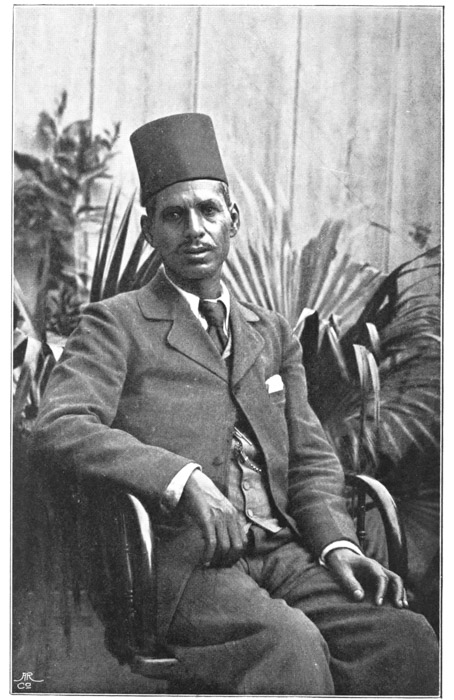
HASSAN BEY HASSANEIN.
APPENDICES — A PPENDIX I HASSAN BEY HASSANEIN
When
Gordon heard of the murder of Colonel Stewart and
his companions, he held a sort of court-martial on himself,
and, after reviewing all the arrangements which he had made
for their safety, he came to the conclusion that Stewart must
have been invited on shore and murdered. Then, as if endowed
with second sight, he almost exactly described what actually
happened. The Abbas, drawing less than two feet of water,
ought not to have stranded, as it was High Nile. Treachery
on the part of the crew he had guarded against by sending
a bodyguard of highly paid Greeks. The cutting adrift of
their boats just after passing Berber contributed to the
catastrophe, for had they been with the steamer at the
time she struck, it is hardly likely that the inhabitants of
the village would have planned the treachery they did. As
interpreter to the party, Gordon gave them the man he could
least spare, and one in whom he had every confidence—Hassan
Bey Hassanein. Gordon himself writes, “thus the
question of treachery was duly weighed by me and guarded
against,” yet, in “Ten Years’ Captivity,” we find the contrary
stated. “It is said that the interpreter, Hassan, arranged the
betrayal.” Moreover, to clinch the matter, and to show that
Gordon had selected a traitor in the very man whom the
|326|
lives of the party might depend upon, it is added, “And I
was afterwards told that, when he got into difficulties later,
he sent a petition to Mohammad-el-Kheir, in which he said
that he was entitled to reward for having secured Colonel
Stewart’s death. He is still living in Omdurman.”
Hassan Bey Hassanein has lived to come back to Egypt
and bear witness to the goodness and virtues of the heroic
defender of Khartoum. The only bit of treachery Hassan
Bey acknowledges is that—with his fellow-clerk, Sirri—he
cut the Khaleefa’s telegraph and telephone communications
as the troops were advancing, to prevent communication
between Omdurman and Khartoum and the outpost at
Khor Shambat. It was Hassan Bey who ran out of the
telegraph-hut as the gunboats advanced and attempted to get
on board in order to warn them of the mines. He succeeded
in attracting attention, and barely got off with his life, for his
shouts in English were drowned by the report of the rifles as
the men “potted” at his dervish dress.
Hassan Bey Hassanein, speaking English, French, and
Arabic, was sent to Khartoum in July, 1883, for telegraphic
work. When Gordon arrived, in 1884, he wrote an official
letter detailing him for his special service. Orders were
given that he was to have access to him at all hours of the
day and night. It was Hassan Bey who used to mark the
words Gordon required to use at a forthcoming interview, in
his Arabic dictionary. Before giving his version of the
murder of Stewart’s party, a few words concerning him and
his relations with Gordon will prove that, in selecting him
as interpreter to the party, Gordon “well-guarded against
treachery.”
One of Hassan Bey’s first missions after the arrival of
Gordon was to seek out the widow of Bussati Bey; for, on
arrival at Berber, he had telegraphed to Bussati Bey, not
knowing that he had been killed with Hicks. Having found
the widow and her children in dire straits, he returned with
one of the children to Gordon, and then took the child back
carrying a handkerchief containing a hundred pounds. “Bis
|327|
dat qui cito dat” was certainly Gordon’s motto in Khartoum,
from the hundreds of tales which I have heard. On handing the
money to the widow, she brought out her husband’s uniform
and sword, and, handing them to Hassan Bey, said, “As you
take the place of my husband at Gordon’s side, then take
his sword and uniform.” Hassan Bey took it to Gordon, who
asked what it was worth, and being told “perhaps ten pounds,”
sent twenty pounds to the widow to make sure, and told Hassan
Bey to keep the uniform, as it might yet come in useful.
Later on, when Hassan Bey, who was then but “effendi,”
had had a particularly hard spell of night and day work,
Gordon asked him which he would prefer—an increase of pay
or a rank. Hassan Bey left the matter to Gordon, and he
gave him both, writing the “firman” himself. On the
Friday following, Hassan Bey presented himself to Gordon
in Bussati’s uniform—for uniform was worn on Fridays and
feast days. Gordon was evidently much amused at his interpreter
and telegraph-clerk appearing in the uniform of a
lieut.-colonel, although the rank he had bestowed upon him
was nothing more nor less. Telling Hassan Bey that such a
uniform did not look well without a decoration, he pinned on
to his right breast one of the decorations he had had struck
to commemorate the siege of Khartoum, and Hassanein
walked off a proud man to delight the eyes of his wife, then
nearing her confinement. Fifteen days before the departure
of the Abbas, he presented himself to Gordon, and told him
that he was the father of a boy. “No, I am the father,”
replied Gordon, and, knowing Hassan Bey’s house, he hurried
off at a quick walk, which Hassan Bey had to run to keep up
with. Pushing his way through the women assembled in the
outer room, he tapped gently on the door where mother and
child were lying, and asked, “Mary, tyeeb-tyeeb?” (“Is all
well?”) and then, as the child’s “father,” he insisted upon
entering, took the child in his arms, crooned to it, kissed it,
and then hurried off and wrote a note to the Finance Office
to pay a hundred pounds from his salary “to his boy.”
Mother and child were to meet with a tragic death.
|328|
Two days before the departure of the Abbas, Gordon told
Hassan Bey that he had selected him to accompany Colonel
Stewart as interpreter. He was to accompany the party as
far as Dongola, at all events, but there was the possibility of
Stewart requiring him as far as Cairo, therefore his wife
collected a number of presents for her relatives in Cairo,
which Hassan Bey was to present in uniform and decorations,
so that all should understand how highly she had married.
I must now, having given an idea of the relations existing
between Gordon and the man who “betrayed” Colonel
Stewart, and who had left with Gordon his wife and fifteen-day-old
boy, give his account of what actually occurred. I
purposely leave out all the incidents of the voyage until the
boats reach the island opposite the village of El Salamanieh.
A discussion arose between the two Reises (pilots) as the
island was neared, as to what course to take; the river
was running strong, and between the island and mainland
resembled a mill race. One reis contended for the left bank
and the other for the right. Stewart, who spoke Turkish and
Arabic, asked what was the matter, and decided that judgment
was to rest with the oldest of the reises, and he selected the
right bank. Instead of coming through the race stern first,
it was decided to put on full steam and “shoot” what might
be called the rapids. While the decision was being given,
the steamer had come end on with the island, and when full
steam ahead was signalled, she steamed ahead at an angle of
about seventy-five degrees to the southern spit, and before
reaching the race proper, struck—swung round, and struck
again. Colonel Stewart took down his revolver, and threatened
to shoot both reises, upon which they dived overboard and
swam to the right bank of the Nile, but thirty or forty yards
distant. Colonel Stewart did not fire at them as they swam
off. This occurred about an hour before mid-day.
About an hour later, the two reises—Mohammad el Dongolawi
and Ali el Bishtili—returned to the vessel, said they had
spoken to the people of the village, who had declared they
acknowledged the authority of Mustapha Pasha Yawer, the
|329|
Mudir of Dongola; they at the same time begged that
Stewart would not molest them in any way, and they would
provide camels to take the whole party to Dongola. Colonel
Stewart spiked the cannon, and threw it overboard along
with the ammunition. He then ordered Hassan Bey, with
one of Gordon’s cavasses, and the clerk Mahmoud Ghorab,
to go on shore and interview the people. At first they
demurred, as, being Egyptians, they felt sure they would be
murdered, and asked that the small boat should be sent as
far as a village near Derawi, where it was certain “friends”
would be met with. Colonel Stewart, after first threatening
to throw them into the river, took his revolver again and
threatened to shoot all three if they did not obey instantly.
They obeyed, and went on shore to meet the men awaiting
them—a blind man named Osman, and two men of the
Wadi Kamr tribe. On reaching the reception-room of the
Sheikh-el-Belad (headman of the village), a copy of the Quoran
was produced, and upon this Osman and his companions
swore loyalty to the Government. Osman remained behind
while the other two accompanied Hassan Bey and the others
to the island where Stewart’s party had then landed. Here
again the oath of allegiance to the Government was taken,
and the men left, promising to send for camels to be ready
on the following morning.
At about ten o’clock the next day they returned, and
suggested that all should come to the right bank and pack
up their effects, to be ready for the camels when they
arrived. About two hours after mid-day, while all were
either seated on the bank or fastening up their effects,
a man came, said that the Sheikh-el-Belad had arrived,
and invited the “Pasha” and the Consuls to his house.
Colonel Stewart ordered Hassan Bey to accompany him as
interpreter. On reaching the reception-room, they found
about forty or fifty people assembled to receive them.
The Sheikh-el-Belad was seated in the centre of the room on
the left. Two angareebs were placed at each side of the
doorway: Stewart and Power seated themselves on the
|330|
angareeb on the right, and Hassan Bey and Herbin on
the angareeb to the left. Some minutes were taken up in
the usual salutations, and before they had time to speak
about the journey, the natives rose, and, saying the camels
were approaching, left the room, only to rush back a few
minutes later shouting, “Salaamoo tisslaamoo ya kaffarah”
(“Become Muslims, you infidels, and you will be spared”);
but at the same moment Herbin had his head smashed in
with an axe, and Hassan Bey was stabbed in the right arm
with a crease knife, and, as he was falling, received a large
spear wound in the left leg. He fell unconscious, and did
not see how Stewart and Power were killed. While the
bodies were being dragged out of the room, some time after
sunset, Hassan Bey was found to be still alive; it was
proposed to kill him, but the brother of the Sheikh-el-Belad,
he heard afterwards, pleaded for him, as his
“stomach felt sick.”
After the murder of Stewart and the others, the party
made their way to the river, and a long fight ensued between
them and the crew of the vessel, the latter being killed
to a man. Hassan Bey was given some engine-oil from the
steamer with which to dress his wounds, and, when he
recovered, was sent to attend the flocks of the tribe. About
fifty to sixty days later, he was sent to Berber on the
orders of Mohammad-el-Kheir, and there imprisoned for four
months, and, on the death of the Mahdi, was, with other
prisoners, sent to Omdurman, to take the oath of allegiance
to Khaleefa Abdullahi.
In 1889–90 he was sent to Kassala, and, on the breaking
out of the famine, he, with his wife and child, and many others,
made up a party to return to Omdurman. Hassan Bey’s group
consisted of his family, a man named Ismail, with his wife
and daughter, and a man with two women. They ran short
of water, and, leaving the others, who were worn out, to rest
under some shrubs, Hassan Bey and Ismail set off in search
of water. In about four hours’ time they reached some pools
near the Atbara, and filling their water-skins, set off to rejoin
|331|
their families. On reaching the spot, they found that they had
been devoured by lions; the heads of Hassan’s wife and boy—then
between six and seven years of age—and the heads of
Ismail’s wife and daughter were all that remained. No trace
was left of the heads of the man and the other two women, and
it is surmised that they must have escaped, for the lion never
eats the head of its victim. Half mad, the two wandered on,
living on roots and leaves, until, on reaching the village of
El-Mughetta, on the banks of the Atbara, they were taken
prisoners and made slaves. Ismail had to work at the ferry,
but Hassan Bey, being weak and ill, was allowed to wander
about until, meeting with a caravan bound for Geddaref,
he joined it, and then made his way to Omdurman, being
employed, first, as clerk under Abdallah Sulieman, the head
of the cartridge-factory, and then transferred to the telegraph
service.
A PPENDIX II ORPHALI
The
account which I have given of how Gordon died differs
so very little in essentials from the account which I have since
received from Khaleel Agha Orphali, and which has been read
to Khartoum survivors with the idea of comparing the statements
made with what was related at the time, that I think it
advisable to allow my account to stand, and to append that
of Orphali, giving a few details concerning Orphali himself.
I might mention that Gordon was credited with having killed
a much greater number of dervishes than I have given, but
the error arose from his being credited with the killing of
the dervishes on the “Gouvernorat” (E) staircase; but these
were killed by the guards. The fact of his having killed so
many as he did, is to be accounted for in two ways; first, the
people who first assailed him on the private staircase were
unaccustomed to the use of the small spears they carried—indeed,
it is safe to say that they had only been dervishes
outwardly for half an hour or so; and, secondly, as they were
packed on a narrow staircase, every shot told on the mass.
To assist the reader in following Orphali’s narrative, I have
drawn from memory a rough plan of the palace as I remembered
it while it stood intact, and, with the assistance of
Fauzi Pasha and others, have been able to name each of
the rooms.
Khaleel Agha Orphali joined the army for service in the
Soudan in the Coptic year 1591 (1873–74). After taking part
in a number of engagements, he was promoted to the rank
of Bulok Bashi (commander of twenty-five men), and when
|333|
Gordon reached Kulkul, in 1878–79, Orphali and his men had
been without pay for months. They presented themselves to
Gordon and clamoured for their pay; he recommended them
to go to Khartoum for it, upon which they became abusive,
and Gordon drew his revolver. Orphali followed suit, but
neither fired. Gordon quietly ordered the cavasses to remove
their chief in custody, which they did. Shortly afterwards,
Gordon sent for Orphali, told him he was a “man,” gave him
a present of money, and offered him the post of cavass to
himself, which Orphali at once accepted, accompanying
Gordon to Khartoum, and remaining with him until he left.
On Gordon’s return, in 1884, he found Orphali then in
Khartoum, and made him his chief cavass. Orphali is one
of those men who know but one master, and believe that
master to be the ruler of the universe. He, therefore, was no
great favourite with some in the administration, as, during the
siege, he was never away from Gordon’s side, and his cavasses
were allowed to do nothing but keep their arms clean, and be
ready to surround Gordon in case of trouble. They were
strictly forbidden to leave their posts to carry coffee, bread,
run messages, or perform all the other little services which
they had been accustomed to perform for the katibs (clerks).
Orphali’s ideas as to the duty of his cavasses were the cause
of constant bickerings, which came to a climax about twenty
days before the fall of Khartoum, when he espied one of
them carrying an ink-bottle behind Geriagis Bey—the head-clerk,
who succeeded Rouchdi Bey. This was too much
for Orphali. Grasping the brass inkstand, he drove it with
all his force against Geriagis’ chest, and this assault Gordon
could not pass over. Orphali was in disgrace for eight days,
and “confined to barracks,” that is to say, the palace precincts,
but he slept at Gordon’s door as usual. Twelve days before
the fall, he was re-instated in favour, and never again left
Gordon’s side for a moment.
Orphali—as Gordon is not alive to speak for him, and as so
many knew from Gordon himself of his threat to shoot him
many years before—has been afraid, since his return, to talk
|334|
about his relations with Gordon, and was not a little surprised
when I assured him that, if he appeared in “Londra,” he need
have nothing to be afraid of from the English people.
Having introduced the man, I now give his description of the
night of the 25th January, keeping as much as possible to his
own words, and only, to give a complete account, mentioning
the incidents occurring in other parts of the palace while
Gordon and he fought the upper floor:―
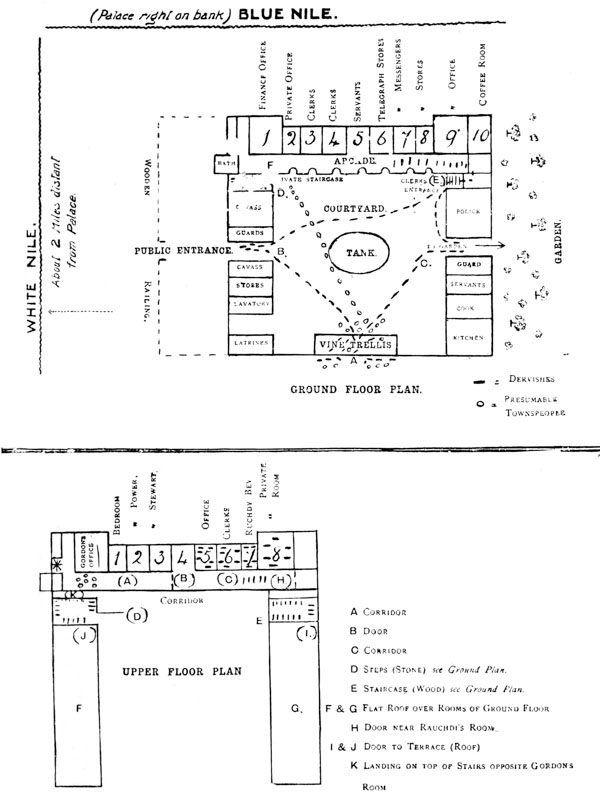
PLANS OF PALACE AT KHARTOUM
ILLUSTRATING THE DEATH OF GORDON.
His excellency was not an early sleeper, and on the night
the dervishes entered Khartoum he was in his room. At
eight o’clock, Consul Hansall, Consul Leontides and the
Doctor, Abou Naddara (he of the spectacles), came to see
him, and remained until midnight. After their departure, he
did not go to sleep, but sat reading and writing letters, and
sometimes pacing the room. At one o’clock in the morning,
he sent me to the telegraph-office to inquire about the
enemy’s movements, as he had received confirmed news of
the intended attack, and his excellency had issued general
orders to the soldiers and employés to be on guard to attack
and withstand the dervishes. Ali Effendi Riza, Mohammad
Effendi Fauzi, and Youssef Effendi Esmatt were on duty, also
the messenger Mohammad Omar. They reported all was
quiet, and this news I gave his excellency. Half an hour
later, perhaps, firing was heard from the land side (i.e. to the
south); I was sent to seek information. Bakhit Bey, from
Buri, telegraphed that a few dervishes had attacked, but had
been driven off, and when I told his excellency, he prepared
to sleep, and gave me the customary order to bolt his door,
and this I did. Then I closed the door of the terrace (I, plan),
then the door of the Gouvernorat (H), near Rouchdi Bey’s room,
and returning along the corridor leading to the private apartments,
closed the door in the middle (B), and then went down
the private staircase (D), gave the usual orders to the guards,
and returned to my sleeping place opposite the pasha’s room
(K), after I had told the telegraph-clerks to bring information
as soon as any news came from the lines. About three
o’clock, Mohammad Omar, the messenger, with Cavass Ali
|335|
Agha Gadri, roused me and said that an attack was being
made at Kabakat (boats) on the White Nile. I informed the
Pasha, who told me to run to the telegraph-office for more
news, and there I met Hassan Bey Bahnassawi, who was on
duty, and we heard that an attack had been made, but had
been repulsed.* On informing the Pasha, he told me to close
the door of his room again, which I did, and sat down to
make coffee. Then we heard more firing from the White
Nile, and the cavasses, having run to the terrace, called to
me that the dervishes were coming into the town. I ran
down to Buluk Bashi Ibrahim El Nahass, who had twenty-four
men; fifteen we placed at the windows (rooms on right
ground-plan), and nine on the terrace overlooking the garden
(G). There were also twenty-four cavasses and ferrashes;
thirteen were placed at the windows (left of ground-plan)
under my second, Niman Agha, eight on the terrace (F), and
three at the door of the palace (B). Each man had ten dozen
cartridges, besides which, each party had a spare case of
ammunition. All these arrangements did not take five
minutes, as each knew his place. I then ran up to the
Governor-General’s room, and informed him of the arrangements.
The day had now come (dawned). The dervishes
who ran to the front of the palace were killed by the fire
from the steamer. About seventy were killed in the garden
by the soldiers firing on them from the terrace, and then we
saw the dervishes coming over the rukooba (vine-trellis A),
and they were met with the fire from the windows and terraces.
They came in great numbers very quickly. Some ran to the
entrance (B), killed the guards and opened the door; then
they all ran to the Gouvernorat door and killed the telegraph-clerks,
all except Esmatt, who hid among the sacks in the storeroom;
they then went to the terrace (G) and killed the soldiers,
and Nahass, seeing the massacre, jumped from the window.
Four men were on guard at the private stairs, but when the
|336|
dervishes came back from the Gouvernorat door (E) they
were soon killed, and some of the dervishes ran to the terrace
(F), and killed the soldiers there; others came up the steps
to the private apartment, and broke the door; Gordon Pasha
met them with his sword in his right hand and his pistol
(revolver) in his left, and killed of them two who fell at the
door, and one who fell down the stairs,† and the others ran
away. Then we heard the dervishes breaking the private
door (B), while the Pasha was loading his revolver. I went
forward and received a little wound in the face, and when the
Pasha came, he received a wound in the left shoulder; the
man who wounded him was a half-blood slave. We followed
them to Rouchdi Bey’s room, killing three and wounding
many, and the others ran away and fell down the stairs. We
went back to the Pasha’s room and reloaded, but the
dervishes came back, and I received a slight wound in my
right leg from a sword, but I warded the blow, and the cut
was nothing. We attacked the dervishes on the private
stairs (D), and while we were passing the door a native of
Khartoum, dressed as a dervish, stabbed the Pasha with a
spear on the left shoulder; seeing this man’s hand coming
from behind the door, I cut at it, and he ran and fell on a
spear held by one of his companions on the steps, and was
killed. At this time more dervishes were coming along the
corridor (from H), and we returned to meet them; I received
a thrust in the left hand, but the Pasha cut the man down
with his sword, and kicked him on the head and he died;
then the dervishes ran into the clerks’ offices (5, 6, 7, upper-floor
plan), and while we were standing in the corridor, a tall
negro fired a shot from the door (H) near Rouchdi Bey’s
room, and the bullet struck the Pasha in the right breast, and
the Pasha ran up and shot the man dead. The dervishes
then came out of the offices, and we turned, and they ran to
the private stairs, and we fired into them, but the Pasha was
getting weak from loss of blood. We fought these dervishes
down the stairs till we reached the last one, and a native of
|337|
Katimeh speared the Pasha in the right hip, but I shot him,
and the Pasha fell down on the cavasses’ mat at the door, and
he was dead, and as I turned to seek refuge in the finance-office
(F plan), I was struck down and lost my senses, and I
was lying down with the dead. In the afternoon, a man of
El Katimeh—Abd-el-Rahman, whom I knew, helped me to
go to the river for water, and I saw the body of the Pasha at
the door (D), but the head was not there. I was helped to
my house, and found my wife and children and property all
missing. . . . I was taken by a friend and Abd-el-Rahman to
El Dem-el-Darawish, and left on the plain all night, and in
the morning I was taken before Wad en Nejoumi . . . and I was
stripped to see if I had any money and papers, but I had not;
and when I said that I was ignorant of any treasure, I was
heavily beaten, though much wounded, and was very ill for
seventeen days, and my wife found me.
All who were taken to see the steps where Gordon fell
remarked upon the number and extent of the blood stains,
for they could not believe that all had come from one body.
These stains were shown to me in 1887. It has been stated
on good authority that “Stains of blood marked the spot
where this atrocity took place, and the steps from top to
bottom for weeks bore the same sad traces.” Here is what I
choose to consider not only a confirmation of Gordon having
died fighting, but a confirmation of Orphali’s narrative, for
there were only two people on the upper floor—Gordon and
Orphali, and all the fighting must have been done by them.
It is quite impossible that the steps “from top to bottom”—four
flights-could have been stained as they were stained
with large patches of blood left by a body which had been
dragged downstairs some time after death. The steps were
stained with the blood of the dervishes through whom I
have said Gordon shot and hacked his way in his heroic
attempt to reach his troops.
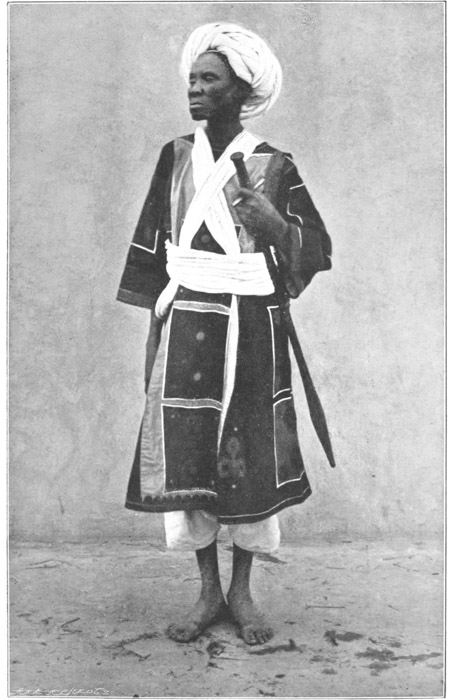
A PPENDIX IV IBRAHIM PASHA FAUZI-GORDON’S FAVOURITE OFFICER
When
Gordon arrived in Khartoum, in 1874, Ibrahim Pasha
Fauzi was then a second-lieutenant. Gordon had applied
to the then Governor-General of the Soudan, Ismail Pasha
Ayoub, for four companies of soldiers to accompany him to
the Equatorial Provinces. Ayoub was not at all pleased at
Gordon’s mission, as he took it as a slight upon his administration,
so that when Gordon’s application for troops was
received, Ayoub selected for the purpose his most worthless
men, with the double object of getting rid of them, and
making Gordon’s mission a failure. Fauzi, anxious to see
some service, had volunteered to accompany Gordon, and, for
doing so, Ayoub placed him under arrest. Gordon, hearing
of the matter, sent to Ayoub demanding that the officer who
had volunteered his services should be sent to him immediately.
Fauzi was sent to Gordon’s head-quarters, when
Gordon first asked him, “Are you the officer who volunteered
your services?” following up the question, when Fauzi in reply
said, “Yes, sir,” the only two words he then knew of English,
by asking why he had done so. On learning that Fauzi
wished to see service, he promised that his wish should be
gratified. “But,” added Gordon, “I wish you to answer me
as an officer—why did the Governor place you under
arrest?” Fauzi gave the reason—Ayoub was afraid that
|341|
Gordon would discover, before departure, that he had been
sent the worst troops. Sending back the four companies, he
requisitioned four companies indicated by Fauzi, and, Fauzi
being too young for a command, he appointed him commandant
of his body-guard, and a sort of adjutant-major to
the little force.
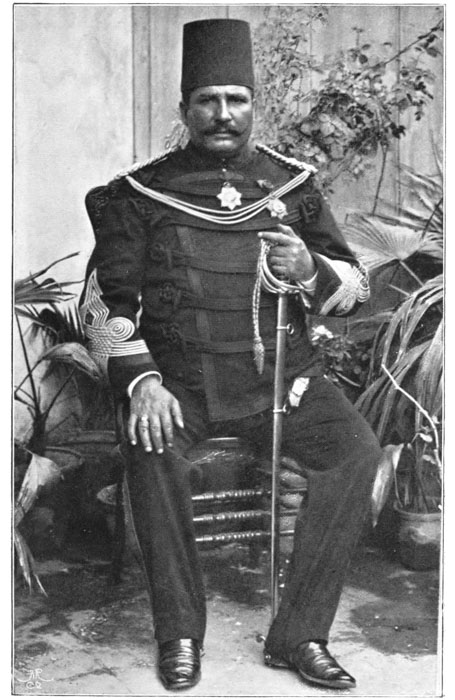
FAUZI PASHA IN UNIFORM.
Fauzi accompanied Gordon to the Albert Nyanza, returned
with him to Khartoum, was gazetted major in consideration
of his services, and appointed Mudir (Governor) of Bohr,
but given two months’ leave of absence before taking up his
post. Gordon left for England, and Fauzi came to Cairo
for his leave, on the expiration of which he set out for the
Soudan, but, on reaching Berber, he found a telegram awaiting
him from Gordon telling him not to go further than Khartoum,
as he (Gordon) was returning as Governor-General.
When Gordon reached Khartoum, it was to hear that Darfur
was in revolt, and that the Bahr-el-Ghazal province was
joining the rebels. A council of war was held, when Gordon
asked the officers present to select one of themselves to head
an expedition to the Bahr-el-Ghazal province, while he took
another into Darfur; he had expected all of them to volunteer
for the command, but they believed that such an expedition
had more the elements of defeat and death in it than of glory
and distinction. Told that they must name an officer, they
named Fauzi, who was not present, and Gordon at once
accepted him, sending him off with 4000 troops and the
clerks for the civil administration. Fauzi succeeded in
setting the province to rights without fighting, and while
travelling about setting the administration right in the
districts, he often met, and assisted with food and money,
a holy man then living as a sort of hermit at Abba and the
neighbourhood. The man’s name was Mohammed Ahmed—whom
the world was to hear of six years later as the Mahdi.
Breaking down in health, Gordon ordered Fauzi to
Khartoum, for rest, promoted him to the rank of full colonel,
and named him Governor of Equatoria, in which province he
spent about a year carrying out Gordon’s instructions to the
|342|
letter, and making a host of enemies amongst the officials
whose peculations and interest in the slave-trade he put a
stop to. He accompanied Gordon to Cairo in 1879, and
when Gordon decided upon resigning, he asked Fauzi whether
he would prefer to remain in Cairo or return to the Soudan.
Fauzi saw that, without Gordon to back him up, his tenure of
office would be but of short duration, unless he engaged himself
in the maladministration of the provinces; he elected to
remain in Cairo, where, at Gordon’s request, he was gazetted
Colonel commanding the 1st Regiment of the 3rd Brigade.
Gordon made it a point to be present at Fauzi’s first parade,
congratulated him on the handling of his men, and bidding
him farewell, gave him three hundred pounds as a souvenir of
their days together in the Soudan. At the outbreak of the
Arabist rebellion, Fauzi’s regiment, with others under the
command of Kourschid Pasha, was ordered to Rosetta, and
after the defeat of Arabi, at Tel-el-Kebir, he was, with other
colonels, ordered to surrender to Sir Evelyn Wood at Kafr
Dawar. Sent to Alexandria, he was tried, degraded, and then
dismissed in disgrace.
Some days before the arrival of Gordon, in 1884, H. E.
Nubar Pasha and Sir Evelyn Wood sent for Fauzi, and told
him to be in readiness to proceed to the Soudan, as Gordon
had asked for his services. When Fauzi said that he had
been dismissed, and was no longer on the army-list, Nubar
Pasha replied, “General Gordon will see to the matter.”
It had not been Gordon’s intention to call at Cairo, and
Fauzi was to have gone to Suez or viâ the Nile, as Gordon
might decide. However, Gordon was stopped at Port Said,
and asked to come through Cairo; Fauzi went to the station
to meet him, and Gordon, on alighting, went up to his old
Soudan lieutenant, and asked how it was that he was not in
uniform. Fauzi detailed his dismissal, upon which Gordon
turned to Sir Evelyn Wood, and asked him how it was. It
appears that when Gordon saw Fauzi’s name amongst the
names of the colonels to be tried, he wired, or wrote—or both—to
Sir Evelyn Wood, asking him to look after Colonel
|343|
Ibrahim Fauzi. General Wood did do so, but there was
another Colonel Ibrahim Fauzi; and while Gordon’s Fauzi
was dismissed in disgrace, the other Fauzi retired in glory
and with a pension.
Gordon had some difficulty in seeing Fauzi reinstated, for
his enemies were powerful; but, not to be thwarted, he took
Fauzi direct to His Highness the Khedive, and carried his
point. Two days later, Fauzi took his seat in the carriage
with Gordon and Stewart, and left Bulac Dacroor station on
that journey from which he only was to return alive, and that
fourteen years later.
On the way to Khartoum, Gordon named Stewart sub-Governor-General
of the Soudan, and Fauzi Director of
Military and Marine, and, in communicating these appointments
to Cairo, he wrote of Fauzi, “I especially recognize in
Fauzi Bey the desired activity which he has displayed with
me while previously in the Soudan; he has already given
proof of his abilities, and I am more than ever satisfied
with him.”
Soon after his arrival at Khartoum, Fauzi was entrusted
with the clearing out of the rebels from Khor Shambat and
Halfeyeh, and the restoring of the telegraphic communications
which they had cut. Fauzi won his dual victory, and
restored the line, but, in leading his men, he was hit in the
right leg with a bullet fired from an elephant-gun, which split
and shattered the bone. Owing to want of skill on the part
of the Greek doctor, the broken bone was allowed to overlap,
and a suppurating wound set in from the unextracted fragments,
which kept Fauzi confined to his official residence for
about six months, although he was able to transact the executive
part of his duties. On the departure of Stewart, Gordon
named Fauzi Governor of Khartoum and Commandant of
Troops, calling a special parade for the occasion. Fauzi Pasha
must be left to relate, at some future date, the incidents of
the siege of Khartoum; I pass on to January 25, 1885.
About three o’clock in the afternoon, Gordon called Fauzi
to the roof of the palace, to see the activity taking place in
|344|
the dervish camp. He had a large tripod telescope fixed
on the roof immediately over his room.*
About 3.30, Fauzi, riding a donkey, accompanied Gordon
on what proved to be his last visit to the lines. Most of
the troops were lying down exhausted and hungry; as
they saw Gordon approach, they wished to present arms, but
he kept calling out to them, “Rest, rest; but keep your eyes
open.” At sunset they regained the palace, and walked up
and down for some time discussing the situation. As the
dinner-hour approached, Gordon told Fauzi that he was sorry
he could not invite him to dinner, as he had nothing to eat.
Fauzi said he had, for himself and guards, the hearts of four
date trees, and would send one to the palace, upon which
Gordon ran in and brought out his dinner—also the heart of
a date tree. This was the last Fauzi was to see of Gordon.
At midnight, Fauzi Pasha, as usual, went his rounds of the
posts in the town, reaching his guards at about 2 a.m. While
giving orders in the courtyard of his official residence, a sound
as of shouts in the distance was heard. This was towards
dawn. Fauzi went to the roof, and, through his binoculars,
could faintly make out hand-to-hand fighting going on in the
lines. Hurrying down, he drew up his men, and set off for
the palace, being joined by ten Greeks who had been on
duty. On coming in sight of the palace, they were met by
two bands of dervishes, but succeeded in cutting their way
through one, only to be met by a troop of dervish horse.
The little party was forced back, fighting every step, and
when close to his house all rushed inside, closed the doors,
and commenced to fight through the windows, but for every
shot they fired, a score came back in reply. The little
garrison assembled in the courtyard for a last stand as the
dervishes were then beating down the doors. Fortunately,
the sight of other dervishes rushing past with loot drew the
|345|
besiegers off on a similar errand, and the party was able to
hold its own against successive parties until the Mahdi sent
word to stop the massacre. When Fauzi was taken before
the Mahdi, he was asked, “Why is it that you, a good Muslim,
have never written to me when every one else has done so,
expressing their loyalty? Have you forgotten the days at
Abba, and the instruction I gave you? If you have, I have
not;” and, kissing him, the Mahdi told him to “go in peace.”
The Mahdi was very wroth at the death of Gordon, for he
really admired and respected him, and he had given strict
orders that he was not to be harmed in any way.
As, during his captivity, Fauzi used to receive moneys from
Cairo, he had, to explain his being able to live, to engage in
some occupation, and took to lime-burning, a business which
cost him more than he ever got out of it. As an Egyptian, he
was under the surveillance of Youssef Mansour, who, after the
escape of Slatin, refused to be responsible for Fauzi any longer.
Failing to get him executed for having assisted in Slatin’s
escape, he succeeded in getting him committed to the Saier,
where he remained as a prisoner for four years, until released
by the Sirdar.
A PPENDIX VI THE SOUDAN: ITS PAST, PRESENT, AND FUTURE — INDEX
To
the present generation the history of the Soudan may
be said to commence with the date of its partial conquest by
Mohammad Ali Pasha, the Viceroy of Egypt. To go further
back than this is to compile from various sources, all more or
less inaccurate, a mass of information which, where not misleading,
would be next to useless to the would-be correct
historian. Even the recent history of the benighted country
has from force of circumstances been compiled from sources
not the most reliable, and it is extremely difficult for the
moment to sift the facts from the legends. The Soudan is
still an unknown and unconquered land. Small tribes have
been magnified into nations, and petty chiefs and sheikhs into
kings and sultans who evidenced their exalted position in the
possession of a few more sheep, goats, donkeys, and slaves,
than their neighbours. No single tribe or sheikh ever held
general supremacy over the others; Zubeir was within an ace
of making himself the Sultan of the Soudan, when he accepted
an invitation to visit Cairo; that was twenty-five years ago,
and he is still here. The Soudan was nothing more nor less
than a collection of little commonwealths; occasionally a
number of these would acknowledge allegiance to one particular
headman, and, in such instances, the “nation” might
have boasted almost as great a population as some small and
obscure provincial town. But that such instances were rare
|350|
is proved by the facility with which Mohammad Ahmed and
Abdullahi set the various sections of tribes fighting among
themselves.
When Mohammad Ali established his government, and
when later Ismail Pasha attempted to extend his empire, they
each took advantage of the chronic anarchy reigning in the
Soudan to further their schemes, but the tribes soon found
that they had but stepped from the frying-pan into the fire,
and waited patiently for the strong man who was to rid them
of the thraldom of the now hated and detested Turks, from
whom they had hoped so much. From the time when, what
the Soudanese call the “Turk” rule, was established, until the
rebellion of 1882, nothing whatever was done to develop
the natural resources of the country—indeed, the reverse. The
only trade the officials fostered was that of slaves, and these
were invariably drawn from peaceful and agricultural districts;
the adult male population of whole districts was swept away
in those raids organized to supply the hareems of Arabia,
Algeria, Egypt, and Turkey, with eunuchs and concubines.
The mineral wealth of Sennar, Darfur and Kordofan was
neglected, as when the soldiers reached the gold, silver and
copper mines, they discovered that the precious metals did
not exist in the pure blocks they had expected to find, and
that to extract the metals meant work.
The population of the half-conquered provinces was robbed
in every conceivable manner by tax-collectors, who were
seldom or never paid their salaries of from twenty-five to
thirty shillings a month, and they were assisted in the duties
of tax collecting by companies of irregular soldiers whose
salaries also were never paid. Where money was not forthcoming,
the taxes were collected in kind, and it may be
imagined what the result of tax collecting was. The people
were driven farther and farther away from the cultivated
lands and watercourses. The “Sudd,” that rank growth of
weeds which obstruct the navigation of the Nile and its
tributaries, was left to accumulate year after year, the little
clearances which the inhabitants themselves made formerly,
|351|
being abandoned as they but aided the passage of boats conveying
soldiers on tax collecting or conquest of territory
expeditions.
Admitting, for the sake of argument, that some of the
Soudan tribes may have risen to the dignity of independent
kingdoms, their history may be written with one word—“anarchy,”
and when the “Turk” government was established,
general rebellion was rife from the beginning until it culminated
in the rising of Mohammad Ahmed.
The population of the Soudan was, and still is, divided into
three great classes, (1) the pure Arab to whom manual labour
has been unknown since the day his ancestor Ishmael mixed
the mortar with which to cement the stones of the Kaaba or
House of God, which Abraham built at Mecca; (2) the
Negroid, who will perform a few light duties, but who has
absorbed all the worst to the exclusion of the few better
qualities of his progenitors,—and, (3) the Black—naturally
indolent and too lazy to work,—without ambition, and whose
presumed avarice only extends to the possession of a little
more than he can eat. For centuries the Black has been the
slave of the Arab, and performed all the manual labour, such as
the collection of gum and senna leaves, indiarubber, ivory, the
cultivation of cereals, and the navigation of the rivers; but
taking it all in all, the lot of the black slave might be envied
by millions of workers in other parts of the world. With the
introduction of the “Turk” government, all three classes were
considered as “prey”; the slave proper had to work harder
so that his master might be able to satisfy the rapacity of his
master—the official, and the slave knew this; the negroid,
who believed in cultivating only so much dourra as was
requisite for his needs, found that he had to cultivate enough
to feed the soldiers quartered in his province, and to pay
taxes not only on what he grew for himself, but on what he
grew for nothing for the soldiers. It is no wonder, then, that
the three waited the coming of some strong man to rid them
of the common enemy.
Although a religious element was introduced into
|352|
Mohammad Ahmed’s movement, many fail to grasp the fact that
religion here takes the place of politics in Europe, and when
the Arabs rise against the powers that be, they are backed up
by some “religious” question, for their laws are based entirely
upon the Quoran. Mohammad Ahmed had for years been
preaching against the extortions of the Turk officials, and had
it not been suggested to him, it is unlikely that he would ever
have assumed the rôle of Mahdi, though as a holy man only,
it is almost certain that his crusade would have succeeded
equally as well as it did. The country was ripe for rebellion,
and when the followers of Mohammad Ahmed overcame the
first “Turk” sent against him, and against whom he had been
preaching for years, success was assured, and thousands
flocked to him. His crusade, therefore, in the beginning, was
not a religious movement pure and simple as we understand
such; it was the rising of an oppressed people against a
government that had but lately tried to establish its authority
over them. It is true that once having had the rôle of Mahdi
forced upon him, Mohammad Ahmed did his best to act up to
it; his miracles—in the way of annihilating successive armies
sent against him were very real indeed, and if thousands flocked
to his banner in consequence of them, they should not be too
severely criticized and charged with fanaticism and unreasoning
superstition, for while they flocked to see the worker of these
very real miracles, just as many thousands of people in more
enlightened climes were making pilgrimages to caves, grottoes
and shrines in the belief that the miracles they were praying
for would be performed. Nor, considering that the faith in
dreams and visions is almost as strong in the east as it was
when Pharaoh had his dreams interpreted by Joseph, should
Mohammad Ahmed and his successor be blamed for taking
advantage of the credulity of the most credulous people on
earth in the relating of visions, when but a little time since
thousands of people in a highly civilized country were flocking
to the doors of one who pretended to be the mouthpiece on
earth of the angel Gabriel—a much more mythical being than
either the prophet Mohammad or the Mahdi.
|353|
Had Mohammad Ahmed lived, there is no doubt but that
he would have succeeded in establishing some form of government
which, if not better, would certainly have been no worse
than the one he had overturned. With the Mahdi’s death,
Abdullahi found himself with a trust which, as he saw immediately,
only a powerful military despotism could enable him to
keep. Threatened with attack from all points of the compass,
he had also internal dissensions to combat, and met them
unflinchingly. While his atrocities have been made much
of, he invariably went through the farce of trying people for
disobedience during his reign of martial law before carrying
out the capital sentence; perhaps, if Abdullahi’s atrocities
were placed side by side with those associated with revolutions
in other countries, his list would be found not the
longest. Oppression doubtless was great, but it was concentrated
in one place, and being more seen, was as a consequence
more felt. Still opinions may be said to be equally
divided as to whether oppression was any greater during the
worst days of the reign of Abdullahi than it had been under
the old government. The foregoing is not written in defence of
Mohammad Ahmed or Abdullahi—and I have little reason to
say a single good word for the latter, but it is time that the
Soudan should be seen through clear glasses. Jealousy of
power was Abdullahi’s besetting sin, and to this must be
attributed the swift punishment meted out to those who in the
slightest degree exhibited disobedience of orders. To this
jealousy must be added vanity of his power also. I have
heard since my release, from people of the Muslimanieh
quarter, some of the reasons for Abdullahi’s sparing of my
life. I had forgotten the incident, but am reminded that
when on my arrival at Omdurman I was taken to the gallows
in chains to be hanged, I turned to the Emirs and shouted
“Has your Mahdi (I used this name at the time) no other
way of exhibiting his power but by hanging a bound man
before all his soldiers? Take off my chains, and I will fight
you, or else get on with your work.” Abdullahi was told this
while I was still being played with, and said, “A man who will
|354|
talk like that when he is going to be hanged is a man! He is
a big man; I will not hang him; a man who is not afraid of
me is not to be hanged; I will keep him.” This was said to
the Muslimanieh and others. Abdullahi had not made up his
mind whether I was a merchant, spy, medicine man or general.
Then, again, he kept me alive in order to prove that he was
more powerful than my Malek (the Emperor of Germany). I
am told that he very often said to people, “You have heard of
Abdalla Nufell; he is not afraid of me; his Malek has
millions of soldiers like him, but he dare not bring his armies
to release him; he is afraid to meet my ansar.”
There are other stories of Abdullahi’s many references to
me, but, as they are of a complimentary nature, I must leave
others to relate them; the above are only given for the
purpose of affording a slight insight into the man’s complex
character, and to give an idea of the small actions which
could influence him.
The Past of the Soudan may be said to close with the
battle of Omdurman; the Present may be given in one word—Transition.
Its Future is still in the future; but from
what I have written, those intending to make a rush to the
Soudan as soon as it is declared open for trade, will understand
that a settled government has yet to be established.
The Soudan has had but one government, and I have given an
idea of what that government was to the inhabitants; the
next government established will, as a matter of course,
be looked askance at. Although the Khaleefa’s army was
smashed up at Omdurman, his influence still remains with
great numbers, and time must be given for the Soudanese to
learn that there are governments and governments. All they
are conscious of now is, that the Government they turned out
has come back again, and they expect from it no better treatment
than they received formerly, if they do not expect worse
as a punishment for their rebellion. The possession of slaves
will be forbidden, and this will give umbrage to the Arabs,
while the slaves will no more appreciate or enjoy their freedom
than would so many cage-bred birds theirs. There is a
|355|
considerable amount of ignorance in Europe on the subject of
slavery in Mohammedan countries, but I must confine myself
to the Soudan on this question. Slave raiding should of course
be put down with a strong hand, and there should be, when a
raider is captured, no other formality than that of loading
the rifles or affixing the rope; the trial might take place at
some future date, so that the fact of his execution might be
recorded. I wish to speak now only of those who are already
called “slaves,” for, in the majority of cases, it is but a name.
I have remarked that the Black is naturally lazy, and will
do no more work than he is compelled to; if liberated unconditionally,
he will, unless drafted into regiments, loaf about,
and occasionally do a little work for the sake of a meal; but
he will refuse to keep to any work long unless some sort of
pressure is brought to bear, and he will be only too glad if it
is. As a slave, his master must keep him in food and clothes,
and also support his wife and children in return for his services,
and, being “property,” he is well looked after; he is, as I
have said, a slave but in name, but the name has an ugly
sound to Europeans. The new Government might open a
slave register, have a few inspectors to go round and “ask
for complaints,” and either give an age, or name a date, when
all holding of slaves would be a breach of a law yet to be
made. Treaties are all very well when dealing with countries
boasting a civilized Government, but it is not an easy matter
to compel petty chieftains in the heart of Africa to agree
to laws which upset the whole political economy of their
domains—and this only to please people who know nothing of
the existing conditions. However the whole question bristles
with difficulties and with arguments for and against leaving
matters as they are—only suppressing raiding as I have said
already—but as those difficulties do exist, it would be well not
to be rash, or to burden the still unconquered and unsettled
country with revolutionary laws. Far better to make haste
slowly, for laws are of little use unless a breach of them
is quickly punished, and the Soudan Arabs have yet to be
taught to respect laws emanating from a “Government.”
|356|
These few remarks on the unsettled state of the country are
intended for those who may be going out as entire strangers
to the Soudan. They must be prepared to meet with difficulties
great and small, disappointments, much discomfort, and many
annoyances big and little; but it is to be hoped that they
will endure these for a time, and not pester the little and still
half-formed new administration with big complaints about
petty quarrels or troubles. Any reprisals asked for in case
of small annoyances or unpleasantnesses, can but bring in
their train much bigger ones; you want but to earn the respect
of both Arab and Soudanese to earn his devotion, and you
may have both by at least treating him as a man and not as
a beast. When speaking of my having borrowed money from
the guides whom I entrusted with the arrangements I made
for my escape, I drew attention to the strange fact of my
borrowing money from them. This was putting the principle
I have pointed out into practice; I required their aid. I
went further, and gave evidence that I was entirely in their
hands—a weakling, but they understood that if they helped
me in my weakness, I would help or protect them in my
strength; above all, they valued my trust and confidence.
There are limits, I know, to both, but you must learn those
limits.
The great want of the Soudan at the present time is means
of communication; there are enormous tracts of land on which
cereals can be raised with the minimum of cost and labour,
but without means of transport they might as well not
exist. Some talk has been made of a line of rail connecting
Khartoum with the Red Sea, and this, certainly, would provide
the means of transport and enable the Soudan to compete
with almost any other country in cereals, but it is a question
whether it would be worth while to construct a railway for
the sake of the grain trade, if the trucks which take it to the
seaboard have to be hauled back empty, and, maybe, left idle
for the greater part of the year. It is possible that during
the last fifteen years Nature has to a great extent repaired
the enormous damage done to indiarubber and gum trees,
|357|
when the plants and trees were destroyed in order to obtain
a big enough crop to satisfy the rapacity of the “Turk”
officials. The forests abound in ebony and other hard
woods, but power to saw them into beams or planks of
suitable dimensions for transit is requisite before this valuable
industry can be developed. From what prisoners from the
south told me, in places an almost pure iron is found on
or near the surface; this the Shilluks and Dinkas smelt in
mud furnaces about six to eight feet high and three to four
feet in diameter. The spear heads of the Shilluks and
Dinkas, beside their shape being different from all others, are
readily distinguishable from their peculiarly deep black shade,
while the spear heads made from imported iron are many
shades lighter, and in comparison, when polished, have a
tinny appearance. If coal is found, and I believe it will be,
if the description I was given of “black stones” which took
fire is correct, then one might say that there is no limit to
the development of the country. Should the Nile and its
tributaries be cleared of the “sudd,” considerable development
would be immediately possible, but the whole country
must first be studied, and its present condition with its existing
means of transport thoroughly grasped, before people will
be justified in subscribing for big ventures, for the failure of
one means the failure of others, and a retarding, for want of
new capital, of present possibilities in the way of development.
It is quite impossible to compile any statistics of the former
import and export trade of the Soudan, that is to say reliable
statistics, and as the whole trade of the country was governed
by the slave trade—now abolished—a new condition of things
has been introduced but not yet established. Barter must,
for some time to come, be the medium of trade and exchange,
and, here again, new conditions are certain to be met with.
Formerly the principal imports were cheap cotton goods,
earthenware, ironware, dried and preserved provisions, sugar,
perfumes, and such like, which generally came in the category
of things which are “cheap and nasty.” There are two
great reasons why all this must now be changed; with almost
|358|
20,000 regularly paid troops in the country, and troops, too,
who have, in a measure, been living in the lap of luxury,
since 1882, their demands must be met. The sight of well-fed,
well-housed, and well-clothed troops, will excite the admiration
and cupidity of the Soudanese for similar luxuries, and a
demand for articles formerly unknown to them will at once be
created. I hesitate to specify some of the goods which I
know there will be a demand for, not that I am in any way
interested in the subject for the moment, but only to guard
against numbers of people exporting large quantities of
merchandise of the same class far in excess of the actual
demand. I cannot too strongly advise manufacturers to
study on the spot the requirements of the people, and to
comply with their requirements, whatever the article might
be. Disappointment and loss can only ensue if articles
they do not want, or which do not meet with their requirements,
are attempted to be forced upon them, for while
engaged upon this suicidal policy, some one else will certainly
be studying the question with the intention of meeting the
wishes of his prospective customers. I would strongly deprecate
the formation of big syndicates and companies for the
exploitation of the Soudan; the country, granted certain
facilities for transport, has a great future, but it would be very
unwise to lock up large capitals, the greater part of which
would be lying unused. Small companies, with all the capital
employed, will pay best for the time being, and the pioneers
of such companies might be accompanied by a mineralogist,
to examine the gold, silver, copper, lead, and other mineral
deposits. That gold exists is well known, but the richness of
the quartz I cannot speak of; one thing, though, is certain,
gold can be obtained with little or no difficulty and labour,
otherwise the small bags of gold I saw at Khartoum and
Omdurman would not have been brought in. Lead and
copper will be found to the west and south-west of Darfur—and
possibly silver also, but whether it would pay to work
the mines can only be ascertained after an examination of
the districts.
|359|
To sum up. The Soudan is a country which for nearly
a century has been fighting against the establishment of any
foreign government; its experience of a “benevolent” administration
is of the very worst; the inhabitants sank all or
nearly all differences between them when they rose to turn
out the hated Turks; their experience of Christians has
evidently not been of the best, else why the saying concerning
Gordon? Large numbers are still loyal to the Khaleefa
Abdullahi, and it will require but a very little mistake
to make the inhabitants flock to his banner, or, what is
worse, they will retire to the west and leave the country
denuded of the population it stands in so much need of.
Strangers are not wanted—they will be looked upon with
suspicion until they have given evidence of their honest
intentions towards the villagers; traders, before they may
look for success, must overcome the prejudice of the people
against European traders, a prejudice based upon experience
of them formerly. And it is necessary for me to say that, after
recent experience, it will take some time before the Muslim
will believe that the Christian religion is anything but what
he believes it to be, and he will be convinced that the boasted
superiority of the European over the Arab does not hold good
in the Soudan at all events. If those going to the Soudan
will bear these points in mind, they will save themselves
and others an infinity of trouble, and all barriers will be
surmounted, if they keep in mind always the reputation
Gordon made for himself for “Goodness and Justice,” and
make Goodness and Justice their motto.
-
- A
- Abbas,
246
- Abbas, The,
325–328
- Abdalla Rouchdi,
232,
333–336
- Abdallah Sulieman,
236,
331
- Abd el Kader Bey,
161,
189
- Abd es Semmieh,
181,
209,
234
- Abou-el-Gassim,
276
- Abou Hamad,
232,
248
- Abyssinian embassy,
246
- Abyssinian expedition,
155,
221
- Adultery, punishment of,
136,
137
- Ahmed Abdel Maajid,
86,
121
- Ahmed Youssef Kandeel,
346–348
- Aid to wounded,
286–288
- Ajjab Abou Jinn,
84,
102,
121
- Ali Khaater,
180–182,
209
- Alti,
182
- Ansar, the,
42,
60,
97,
100–102,
130,
354
- Arab tribes―
- Ababdeh,
9,
153
- Alighat,
10,
23,
30,
31,
50,
60
- Baggara,
212,
217,
230,
264–269,
276,
277,
281–283
- Bedawi,
40,
55
- Dabaanieh,
83
- Danagli,
48
- Dar Hamad,
8,
13,
54,
55
- Digheem,
276
- Dinkas,
357
- Fellati,
171,
176,
209
- Gawaamah,
98,
139,
188
- Habbanieh,
276
- Hadendowas,
88,
89
- Hammadah,
84
- Jaalin,
37,
59,
231,
244,
260,
266
- Kabbabish,
2,
5,
8,
11,
22,
53,
54,
105,
167
- Rhizaghat,
276
- Shilluks,
357
- Shukrieh,
84
- Taaishi,
264,
267,
276,
346
- Ardagh, Colonel,
5
- Arsenal,
89,
178,
212,
226,
237–239
- Assouan,
4–8,
52,
65,
77,
160–162
- Atbara, battle of,
248,
249,
271
- Austrian Consulate-general,
164,
168,
314
- Austrian mission,
164,
233,
309
- Awad el Kerim,
84; his three sons,
85
- Awwad el Mardi,
226–239,
242,
244
- B
- Bakah Wells,
53
- Bakhita,
240
- Beit-el-Amana,
264,
273
- Beit-el-Mal (Treasury),
13,
33,
34,
36,
51,
85,
87,
100,
125,
155,
157,
171,
174,
179,
206,
210,
214,
241,
276; Amin or Director
of,
46,
49,
64,
145,
147,
175,
210,
226,
234
- Berber,
86,
155,
165,
193,
198,
237,
309
- Blackmail (see Nebbi Khiddr)
- Black population of Soudan,
351,
355
- Burleigh, Bennet,
244,
279
- Bussati Bey,
326
- C
- Cairo, start from,
2–7; return to,
1,
290
- Caravan, constitution of,
4,
8,
11,
12; betrayal of,
2,
3,
21,
22,
60,
61,
68,
106,
167,
168
- Catarina,
114,
116
- Coinage,
171,
210–215,
223
- Cromer, Lord,
247
- D
- Dara,
310
- Darfur,
181,
203,
350,
358
- Derawi,
7–10,
245,
329
- Dervishes, horsemanship of,
41,
44,
49; treachery of,
285,
288
- Desert routes,
12,
15–23
- Divorce laws,
123,
180,
190–192
- Dongola,
10,
39–43,
54,
59,
66,
67,
328,
329; capture of,
232,
248,
249,
346
- E
- Earle, General,
3
- Egyptian War Office (Intelligence Department),
105,
167,
168,
197,
291,
295,
298
- El Agia,
15,
16,
19–22
- El Etroun,
15,
23
- El Fasher,
203,
311
- El Fun,
143,
144
- El Kiyeh,
15,
22,
23
- El Obeid,
10,
220
- Elias, clerk to Neufeld,
8,
12,
14,
24–29,
35,
36,
43,
50,
66
- Elias Pasha,
4
- Emirs―
- Abd-el-Baagi,
257,
261,
264
- Ahmed Fedeel,
176,
243
- Ali Wad Saad,
91
- Makin en Nur,
37,
59
- Mohammed Hamad'na Allah,
176–179,
186
- Mohammed Hamza,
27,
37–40,
43,
44,
59
- Mohammed Taher,
88
- Nur Angara,
70,
76
- Wad Bessir,
59,
121
- Wad en Nejoumi,
27–34,
39,
46–59,
64–67,
78,
118,
132,
139,
155,
337,
346–348
- Wad Eysawee,
59
- Wad Farag,
27–35,
44,
59–61,
173,
174
- Wad Umma,
59
- Yacoub,
148,
175,
176,
186,
216,
221,
235,
242,
249,
257,
263,
267,
271,
273,
348
- F
- Famine,
112,
116–119,
147
- Fettering, method of,
72,
79,
80,
91,
93,
229,
235,
279
- Fitton, Major,
261
- Flogging,
41–43,
126,
127,
129–132
- Forts,
239,
243,
244,
254,
266
- G
- Gebel Ain,
8,
15
- Gebel Ragaf,
111,
220
- Gebel Roiyan,
68
- German Consulate,
154,
160,
162–165,
168,
291
- Germany, Emperor of,
354
- Gordon,
68,
89,
212,
218,
228,
300–324,
325–328,
332–337,
340–345;
relief expedition,
3,
65,
132,
229,
247,
316–321
- “Gordonizing,”
159
- Grenfell, General,
347
- Guides―
- Abdallah,
197–201,
214
- Ali el Amin,
8,
12,
17–24,
31,
36,
49,
60,
67
- Darb es Safai,
21–29,
49,
50
- Hassan,
12–24,
30,
50,
60–62,
67
- Hassib el Gabou,
8–16,
22,
48,
52–58,
64,
106,
107,
255
- Hawanein,
196,
201,
207,
214
- Ismail,
11–26,
57,
61
- Mohammad Ali,
153,
154,
156,
163
- Moussa Daoud Kanaga,
54,
154,
156,
163–166
- Onoor Issa,
223,
226,
233,
239–244,
254
- Zecki,
220
- Gunboats,
240,
250–256,
257,
265,
270,
290,
326
- Gunpowder manufacture,
175–182,
209,
224,
232–241,
289,
296
- H
- Halfeyeh,
176–178,
198,
261,
265,
270
- Hamad Wad el Malek,
246
- Hamaida,
234,
237
- Hanafi,
110,
151
- Hassan Bey Hassanein,
325–331
- Hassan Hosny,
181,
209,
234
- Hassan Zecki,
174,
177,
232
- Hasseena,
4,
8–12,
25–29,
32–36,
40–46,
50–52,
68,
72,
81,
102,
103,
108,
109,
118,
135,
185–194,
195
- Hassib Allah,
59,
60
- Hicks Pasha,
88,
101,
178,
309,
310,
313,
326
- Hogal Dufa'allah,
4–14,
54,
58,
62,
78,
245,
255
- Hunter, General,
293
- Hussein Pasha Khaleefa,
308,
309
- I
- Ibrahim Pasha Fauzi,
167,
208,
218,
224,
244,
260,
263,
266,
277,
303,
332,
340–345
- Ibrahim Wad Adlan,
121,
143,
145–159,
165,
166,
170,
216
- Ibrahim Wad Hamza,
246,
260
- Ismail Pasha Ayoub,
340,
350
- J
- K
- Kadis Hassein Wad Zarah,
222
Ahmed
221
- Kassala,
181
- Kerreri,
248,
258,
260,
274
- Khaleefa, Abdullahi―
- His cruelty,
69,
73–75,
84,
85,
110,
353; his
superstition,
99,
103,
120,
249,
257,
263,
267;
respect for Neufeld,
132,
143,
204,
230,
353;
objection to traders,
149,
155; encouragement of
marriage,
123,
139,
186–189,
224; relations with
Slatin,
204–208; his flight,
274–277; opposition
to him among Mahdists,
66,
85,
146–148,
245–247,
254–256,
305,
345,
346
- Ali Wad Helu,
44,
264,
273
- Shereef,
146,
264,
273
- Khaleel Agha Orphali,
303,
332–337
- Khaleel Hassanein,
89,
98,
178,
182,
212,
216,
235,
242,
249,
252
- Khartoum,
29,
47,
83,
89,
175,
178,
181,
212,
218,
228,
266,
284,
303,
309,
310
- Khedive,
247
- Kirbekan, battle of,
3,
89,
286
- Kordofan,
2,
4,
7,
61,
146,
289,
310,
350
- Korosko,
65
- L
- M
- Macdonald, Colonel,
271,
274
- Mahdi,
3,
66,
69,
78,
86,
98,
103,
273,
309–318,
330,
341,
345,
351–353
- Mahdieh,
70,
85,
88,
99,
101,
110,
145,
205,
257,
260,
262,
273
- Mahdi’s Ratib,
94,
271
- Mahdi’s Tomb,
44,
70,
151,
155–157,
267
- “Mahdism,”
300
- Makkieh,
141,
178,
185,
192
- Mankarious Effendi,
77,
152–154,
160,
195
- Marriage customs,
86,
121–123,
126,
135–138,
189
- Maxwell, Colonel,
281
- Mecklenburg, Duke of,
291
- Mehkemmeh, the,
105,
110,
163
- Metemmeh,
68,
247
- Mihrab,
267
- Mimbar,
267
- Mohammad Ali Pasha,
349,
350
- Mohammad Effendi Rafai,
167
- Möller,
68,
153,
154,
160
- Moxley, Hewett,
298
- N
- Nahoum Abbajee,
114,
186,
188–190,
209,
226–232,
323
- Nebbi Khiddr,
101–104,
112,
113,
120,
128,
173,
216
- Negroid population,
351
- Neufeld―
- Official accounts,
1–4,
53,
61,
68,
167;
newspaper accounts,
1,
79,
134,
166,
169,
291–299; as trader,
3,
9,
10,
46,
47,
76,
105,
149,
168; as Government spy,
37,
46,
47,
53,
145,
156,
239; letters to his manager and Mankarious,
77,
152–154,
160–165,
199; letter to General
Stephenson,
294,
338,
339; named Abdallah,
77,
91,
102,
151,
269; interview with the Khaleefa,
76,
79,
90,
92; practises medicine,
106,
124,
130,
175,
197,
224,
240,
250,
272; plans to
escape,
107,
143,
152–157,
160–169,
198–201,
227,
293; floggings,
127,
131; relations with
Hasseena,
4,
10,
40,
108,
109,
118,
135–139,
185–194,
290; conversion,
132,
150,
167,
205,
224; not a German subject,
162,
293; native
wives,
139,
167,
186–189; English wife,
4,
163,
166–169,
194,
289; furnishes information to
Government,
239,
243–245,
254,
261,
289; employed
under the Khaleefa (see Coinage, Arsenal, and
Gunpowder Manufacture); offers from publishers,
291,
299; reception in Cairo,
290–299; relations
with Gordon,
3,
132,
228,
305; views on
missionaries,
321–323; views on trade,
356–359
- Newnes, Sir George,
299
- Nubar Pasha,
342
- O
- Ohrwalder,
6,
114–116,
119,
182,
187,
223; his
escape,
183,
280,
295; his book, “Ten Years’
Captivity,”
300,
306–323; criticisms of Gordon,
306–323,
325
- Ombeyehs (war-trumpets),
72,
73,
76,
158,
257,
275,
277
- Omdurman,
1–3,
54,
62–65,
67,
69,
71; battle of,
44,
258,
265–277,
281,
326,
354; looting of,
281
- Osman Digna,
243,
248,
254,
264
- Osta Abdallah,
224,
235–239,
242,
249,
252
- P
- Perdikaki,
177–181
- Pink, Colonel,
274
- Prison (Saier)―
- Horrors of,
2,
81,
93–96,
116–119,
218;
Idris es Saier,
82,
91,
98–105,
112,
121,
127,
130,
135,
138,
158,
171–174,
216,
262,
266,
272,
277,
278; the Umm Hagar,
94,
95,
106,
113,
128,
218,
262,
266,
269; the Bint Umm Hagar,
221;
escape from,
96,
107,
120–123; food,
112,
113,
116–119,
143; subordinate gaolers,
123,
127–129,
173,
174,
262; women’s prison,
125,
126
- R
- S
- Sabalooka,
243,
249,
257
- Said Abdel Wohatt,
175,
178–182,
209
- Said Gumaa,
91,
203
- Selima Wells,
11–15,
19–23,
59,
78
- Sennar,
84,
350
- Shayba (yoke),
38,
219
- Sheiks―
- Ahmed Nur ed Din,
54,
105–109,
111,
127
- Ed Din,
130,
233,
264,
271,
273,
274
- Hamad El Nil,
85,
102,
103
- Mahmoud Wad Said,
83,
90,
118,
121,
247
- Saleh Bey Wad Salem,
2–6,
11–22,
28,
31,
46–49,
55–57,
61,
68,
77,
105
- Shereef Hamadan,
201,
216,
231–233
- Shwybo,
171–174,
228
- Sirdar,
225,
228,
262,
271,
276–279,
290,
321,
345; rumours concerning,
97,
155,
232,
233,
259;
advance of,
240,
245,
247; charges against,
284,
286
- Sirri,
230,
233,
251,
326
- Slatin,
6,
70,
71,
76,
79,
91,
110,
280; his
escape,
87,
201–207,
214,
220,
223,
295,
315,
345; kindness to Neufeld,
119; Austrian Consul’s
letter,
164; his letter to the Khaleefa,
202,
295; position with the Khaleefa,
204; conversion,
205; his wives,
206; reception at Cairo,
295,
308; his book, “Fire and Sword,”
300; relations
with Said Bey Gumaa,
203,
310
- Slave Trade,
350,
354
- Soudan, future of,
322,
323,
349–359
- Spies―
- Government,
62,
106,
150,
158,
244,
250,
255,
256,
261,
305
- Mahdist,
62,
65,
66,
82,
97,
150,
244,
259,
305,
346
- Stanley, Emin, expedition of,
139
- Stephenson, General,
2–6,
47,
48,
56,
76,
145,
261,
294,
338
- Stewart, Colonel,
324,
325–330,
343
- Sulieman Haroun,
153
- Surghani hill,
273
- T
- Toki, battle of,
139,
156
- Torpedoes,
243,
249,
251–256,
280
- Tuti island,
228,
243,
265
- Typhus fever,
108
- U
- W
- Wadi El Kab,
8,
15,
19,
22,
23,
33,
56–60,
67
- Wadi Halfa,
5–13,
30,
31,
42,
48–51,
57,
61,
65,
71,
77,
89,
141,
280
- Wakih Idris,
3,
135
- Wass, Count,
164
- Wilson, Sir Charles,
69
- Wingate, Major,
223
- Wood, Sir Evelyn,
342
- Worrak,
245,
261
- Y
- Youssef Jebaalee,
114,
116
- Youssef Mansour,
205,
220,
244,
250,
252,
256
- Yunis,
264,
274
- Z
THE END