THE VOLATILE OILS USED IN PERFUMERY.
The volatile oils, as previously mentioned, may be divided
into three groups, viz: the pure hydrocarbons,
oxygenated oils, and sulphuretted oils. Chemically, this
division is, however, of little value, since, among bodies
which should be classed according to it in one of the
groups, combinations are found which vary very much
in a chemical respect, and belong partially in the groups
of alcohols, indifferent bodies, acids, etc.
It is, therefore, preferred not to attempt a classification
of the volatile oils according to their chemical composition,
but simply to enumerate them in alphabetical
order.
Acacia, oil of, commonly called oil of cassie. The
flowers or buds of the acacia Farnesiana yield a somewhat
thickly-fluid, greenish-yellow oil of a very intense
but delightful odor. The oil may be obtained either by
extraction or absorption. The acacia is cultivated in
special plantations along the Riviera di Genova. These
plantations being controlled by a few perfumers, the oil
is not allowed to reach the market, and does not form an
article of commerce. The green-colored extrait d'acacia
is a solution of the oil in alcohol.
Almond oil (bitter) (oleum amygdalae amaræ) is obtained
by submitting bitter almond cake (left after the expression
of the fixed oil from bitter almonds) to distillation
with water. The volatile oil does not exist ready
formed in the bitter almond, nor in the almond cake,
but results from the decomposition of a glucoside called
"amygdalin," contained in the cake, under the influence
of emulsin and water, the emulsin acting as a ferment,
into benzylic aldehyde, glucose and prussic acid. The
almond tree grows wild, but is also cultivated in Southern
Europe, Africa, Barbary, Palestine and Syria. The
bitter almonds brought from Barbary are considered the
best. Besides, in almonds, amygdalin occurs in various
other plants; for instance, in the leaves of the cherry
laurel, the leaves and kernels of the peach, the kernels
of the black cherry and other varieties of prunus and
amygdalus, they all yielding, after maceration with
water, a distillate containing prussic acid and oil of
bitter almonds.
Instead of the comparatively expensive bitter almonds,
peach kernels freed from their hard shells are extensively
used in the fabrication of oil of bitter almonds. The oil
is prepared as follows: The press cakes of bitter almonds
or peach kernels are ground and soaked about twenty-four
hours in twice their weight of water to which one-third
their weight of salt has been added. The whole
is then submitted to distillation. The temperature of
the water should not exceed 113° to 122° F. The
emulsin contained in the almonds possesses only within
certain limits of temperature the power of decomposing
amygdalin, and, if heated to 176° F., becomes inoperative.
Hence, if the almond paste is quickly heated to
boiling, the emulsin becomes inoperative before all the
amygdalin is decomposed, and a portion of it being consequently
lost, the yield is insufficient. The distillation
of the almond paste is effected in a current of steam.
A portion of the prussic acid formed by the decomposition
of the amygdalin adheres tenaciously to the oil.
This content of prussic acid makes the oil of bitter
almonds exceedingly poisonous, while in itself it is non-poisonous.
It can be freed from the prussic acid by
shaking with ferrous sulphate (blue vitriol) solution.
By then distilling over burnt lime the originally yellow
or yellowish oil is obtained colorless. It is then thinly
fluid, of a peculiar agreeable odor and strongly nutty
taste. Its specific gravity is 1.043 at 59° F., but varies
a little with age. It boils at 356° F., and dissolves in
13 parts of water, but more readily in alcohol and ether.
In the air it is rapidly converted into benzoic acid by
the absorption of oxygen. It has to be carefully protected
from air and light and kept in well-closed bottles
in a dark place. The crude oil, containing from 2 to 5
per cent. prussic acid, has generally a yellowish color.
Oil of bitter almonds may be prepared artificially in
many ways. By allowing chlorine to flow into boiling
toluene, the latter is converted into benzyl chloride:-
| C6H5(CH3) | + Cl2 = | C6H5(CH2Cl) | + HCl |
| toluene | chlorine | benzyl chloride | hydrogen chloride |
By withdrawing the chlorine and one atom hydrogen
from the benzyl chloride and introducing for it one
atom oxygen, the benzyl chloride is converted into benzaldehyde.
This conversion is readily effected by continuously
boiling, best with the introduction of carbonic
acid, 1 part of benzyl chloride with 1½ parts of lead
nitrate and 10 parts of water, and finally distilling the
benzaldehyde off by steam. The decomposition takes
place according to the following equation:—
2[C6H5(CH2Cl)] + Pb(NO3)2 =
2[C6H5(CHO)] + PbCl2 + N2O3 + H2O.
The crude benzaldehyde thus obtained is agitated
with warm solution of acid sodium sulphite, the solution
formed thereby is separated from undissolved
oily particles and cooled, whereby a combination of
benzaldehyde with acid sodium sulphate crystallizes
out. This combination is separated from the remaining
fluid, decomposed by acid and submitted
to distillation, whereby benzaldehyde passes over.
Large quantities of benzaldehyde are at present prepared
according to this method. The identity of
benzaldehyde with oil of bitter almonds has been
established by Lippmann and Hawliczek.
Genuine oil of almonds is much adulterated, chiefly
with alcohol, nitrobenzole, and various cheaper oils.
An addition of 3 to 5 per cent. of alcohol is frequently
made by Italian dealers in order to conceal a content of
water, which at a low temperature is apt to render the
oil turbid. To detect the presence of alcohol, moderately
heat a sample of the oil in a distilling apparatus
and compound the drops, first passing over with sodium
carbonate solution and then with potassium iodide solution.
In the presence of alcohol a yellowish crystalline
precipitate of iodoform is formed.
An addition of synthetically composed oil might seem
of no importance, since the natural oil does not differ
from it. However, for very fine perfumery the natural
oil cannot be replaced by the artificial, it having been
thus far impossible to obtain the latter absolutely chemically
pure. It always contains small quantities of
undecomposed chlorine combinations which injure the
taste and odor. To detect such oil in the natural oil,
bring a few drops upon a tuft of cotton and ignite it.
Over the burning flame invert a beaker moistened inside
with water. On the moist sides of the beaker the soot
and hydrochloric acid formed by the combustion of the
chlorine combination are precipitated. When the flame
is extinguished, the beaker is rinsed out with water, the
fluid filtered and tested for chlorine with nitrate of
silver. An addition of 10 per cent. artificial oil can in
this manner be accurately determined.
If genuine oil of bitter almonds containing prussic acid,
be heated with an excess of alcoholic potash lye, and the
excess of the latter be neutralized with hydrochloric acid,
benzoin amounting to 40 to 50 per cent. of the weight of
oil of bitter almonds is, according to A. Kremel, separated.
By subjecting artificial oil of bitter almonds to the same
treatment, no benzoin is separated, so that the genuine
oil can in this manner be distinguished from the artificial.
Kremel further found that oil of bitter almonds
prepared from apricot kernels, when treated in an analogous
manner, yielded considerably less benzoin, and
that cherry-laurel oil containing prussic acid, which has
been considered identical with oil of bitter almonds, separated
no benzoin whatever. Should further experiments
prove the constancy of this phenomenon, this reaction
would be a convenient means of distinguishing the four
products.
An adulteration with nitrobenzole and other volatile
oils is recognized by mixing 2 drops of the oil with 100
drops of distilled water, and shaking vigorously. Pure
oil must completely dissolve. However, the test yields
accurate results only with the use of actually pure distilled
water and by accurately observing the above-mentioned
proportions. If to 5 cubic centimeters of 90
per cent. alcohol and an equal quantity of distilled water
in a test-tube, 10 drops of the oil be added, and, after
closing the tube with the finger, mixture be effected by
gently turning the tube twice upside down, a clear solution
will immediately result if the oil is pure. If, however,
it contains nitrobenzole, even only 1 per cent., the latter
separates, at first rendering the fluid turbid, but in the
course of a minute, when gently agitated, it floats in the
form of minute drops upon the fluid, while, when at
rest, these drops collect to larger ones on the bottom of
the test-tube. If the oil becomes only turbid, adulteration
with other volatile oils is indicated. Another test,
given by Wagner, is based upon the difference in the
specific gravity of mixtures of oil of bitter almonds with
oil of mirbane. The specific gravity of commercial oil
of bitter almonds varies between 1.040 and 1.043 and
that of oil of mirbane between 1.180 and 1.201.
5 c. c. of pure oil of bitter almonds weigh 5.29 grammes.
5 " mixed with ¼ oil of mirbane " 5.39 "
5 " " " ½ " " " 5.57 "
5 " " " ¾ " " " 5.75 "
5 " of pure " " " 5.90 "
Oil of bitter almonds is much used in the fabrication
of perfumery. In a pure state its odor is by no means
agreeable, but rather strong and stupefying. When
strongly diluted it is, however, very pleasant.
Angelica oil is obtained by distillation with water
from the root of Angelica Archangelica L., natural
order Umbelliferae. The oil is lighter than water, possesses
the spicy odor of the root and an aromatic pungent
taste. It consists mostly of a terpene which turns
the plane of polarization to the right, and boils at
320° F.
Besides the oil from the root, one obtained from the
seeds also occurs in commerce. It is, however, more
expensive. In a fresh state it is amber-yellow, and has
a specific gravity of 0.8549 at 59° F.; older oil is
thickly-fluid, brown, and has a specific gravity of O.9086.
It contains a terpene which turns the plane of polarization
to the right, and has a lemon-like odor. It is
used for fine perfumery.
Anise-seed oil (oleum anisi). The anise (Pimpinella
anisum L.), natural order Umbelliferae, contains volatile
oil in all parts, but chiefly in the seeds. Dry anise-seed
yields by distillation 2½ to 3 per cent. of oil, while the
peduncle and chaff contain at the utmost 1 per cent. of
oil, which is said to be richer in stearoptene. The anise-seed
oil prepared in Southern Russia has always been
highly valued, but as it is generally considerably adulterated,
the Leipsic manufacturers of volatile oils prefer
to import the seed and distill it themselves.
Freshly prepared anise-seed oil is colorless or straw-yellow,
has the odor of anise and a sweetish taste, leaving
a burning sensation upon the tongue. It is thinly
fluid at 68° F., but commences to congeal at a somewhat
lower temperature, and the sooner the more stearoptene
it contains. Good oil should become solid at from 57.2°
to 60.8° F. It has a specific gravity of 0.980 to 0.995
at 59° F. The specific gravity varies with the content
of stearoptene; the greater the latter the higher the
specific gravity. Good anise-seed oil contains 5 to 10 per
cent. of terpene and 90 to 95 per cent. of a stearoptene,
called anethol, C10H12O, on which the value of the oil
depends. The anethol can be separated from the oil by
cooling to 32° F., and forms colorless crystals. It has
an agreeable odor and intensely sweet taste, is sparingly
soluble in water, but readily in alcohol, ether, and other
solvents of volatile oils. Good anethol has a specific
gravity of 0.986, and melts at 69° to 70° F. By frequent
contact with the air a small portion of the anethol
is oxidized, very likely to anisaldehyde. By this process
the specific gravity is raised and the melting point
lowered.
Anise-seed oil is soluble in 5 parts of 90 per cent.
alcohol, and with 3½ times its volume of petroleum-ether
yields a clear mixture. Its mixture with four
times its weight of petroleum-ether is turbid, but becomes
clear in ten minutes, while that with five times
its volume of petroleum-ether remains for a longer time
turbid. In a fluid state the oil, when exposed to the
air, becomes resinous and loses its property to crystallize.
It should, therefore, be kept in tightly-closed
bottles in a cool, shady place.
Anise-seed oil is used in perfuming soaps and mouth
waters. It should, however, be used with prudence,
since the sweetish, penetrating odor of the oil readily
overcomes the other volatile oils in the mixture, and renders
them inoperative.
Star anise oil very much resembles the ordinary anise-seed
oil. It is obtained from star anise, the fruit of
Illicium anisatum, a tree formerly supposed to be indigenous
to Cochin China, and cultivated in China, Japan,
and the Phillipine Islands. However, according to
Messrs. Bourgeoin-Meiffre, a French firm of Hanoï
(Tonkin), the star anise oil found in commerce is exclusively
produced in the French colony Tonkin (Province
Langson), the French government having made over the
entire sale of the oil to the above-mentioned firm.
According to a memoir published by Dr. Blondel, of
Paris, the star anise tree is not indigenous to the Chinese
provinces Yunnan, Quang-si, and Fo-Rien, but to the
province Langson, which has by conquest passed into
French possession. Hence, the producers of star anise
and star anise oil are now under French control and, as
it seems, are obliged to sell all the oil produced to the
above-mentioned firm. If these statements should
prove correct, the Chinese harbors Macao and Hong
Kong, from which the greater portion of star anise oil
was formerly exported, will lose their importance in this
respect and the product find its way direct from Hanoï
via Hayphong to Marseilles. The first shipment from
Bourgeoin-Meiffre arrived in Europe in December, 1890.
According to Messrs. Schimmel & Co.'s report, the product
is put up and packed exactly like that formerly
shipped from Hong Kong, and the oil of excellent quality.
Star anise oil differs from the ordinary oil in containing
a much smaller quantity of anethol, and hence
congealing only at a temperature of from 41° to 50° F.
Besides the odor of the terpene contained in star anise
oil differs from that of the ordinary oil. Admixtures of
star anise oil can, therefore, be generally recognized by
the odor. Other methods recommended for its detection
are unreliable.
Balm oil.—The leaves of this plant, Melissa officinalis,
yield by distillation a volatile oil sometimes called oil of
melissa. It is colorless or yellowish, of a pleasant odor,
has a specific gravity of 0.85 to 0.92, shows a slightly
acid reaction and dissolves in 2 to 3 parts of alcohol.
It must not be confounded with the so-called East
India oil of melissa or citronella oil from Andropogon
Nardus L. Balm oil is occasionally used in the preparation
of eau de Cologne.
Basil oil is distilled in Southern France from the fresh
leaves of Ocymum basilicum L., natural order Labiatæ.
The oil shows the peculiar odor of the herb and crystallizes
a few degrees above 32° F. In perfumery it is
used as an addition to violet and other preparations.
The French also prepare a pommade basilique, which
serves as a cheap substitute for violet pomade.
Bayberry oil, or oil of bay leaves, is extracted by distillation
from the leaves of Myrcia acris or the bayberry
tree. Many varieties of the tree exist throughout
the West Indies, which are scarcely to be distinguished
botanically, but have quite a different odor from that of
the genuine tree. Great care must, therefore, be taken
in the collection of the leaves which are to be used, as
the admixture of a small quantity of the other leaves
may entirely spoil the product of distillation. Two oils
are obtained, a light oil of specific gravity of 0.870 to
0.990, and a heavy oil with specific gravity 1.023 to
1.037. When first distilled the oil is colorless, but by
exposure to the air quickly acquires a yellowish tint and,
if the exposure be continued, becomes quite dark in color.
The odor of the freshly-distilled oil is rank, but in the
course of from three to six months it becomes mellow,
and ripens into the agreeable fragrance so much liked in
the best specimens of bay-rum. The oil is soluble in
all proportions in 95 per cent. alcohol, also in ether and
petroleum benzine. Its chief use is for the preparation
of bay-rum.
Bergamot oil is obtained from the rinds of the fruit of
citrus bergamia, a tree belonging to the natural order
Aurantiaceæ. The rind is grated and the oil running
off separated from the aqueous fluid and cellular substance
by means of a separating funnel, or the grated
mass is distilled in a current of carbonic acid. The oil
is very fluid and pale yellow, but poorer qualities are frequently
greenish or brownish. When distilled with
water it becomes perfectly colorless, but is less durable.
Its odor is very pleasant, somewhat like a mixture of
orange and lemon oils. Its specific gravity is 0.87 to
0.89. By standing for some time, the oil separates
white crystalline scales (stearoptene), which melt at 223°
F. The oil becomes solid a few degrees below the freezing
point. The Messina oil of bergamot is considered
the best. From other volatile oils of the orange family,
bergamot oil differs in dissolving readily in caustic potash,
forming a clear solution. It has, however, the same
property as other oils of a similar origin, of igniting
with iodine and not dissolving santalin, the red resinous
coloring matter of santal-wood.
Bergamot oil may be tested as to its purity by mixing
it with alcohol. It becomes pale gray-yellow, forms a
sediment which adheres firmly to the vessel and, on
shaking, floats about in the form of flakes. After two
days the sediment is inconsiderable and difficult to
divide into flakes in the clear yellow fluid by shaking.
The oil is frequently adulterated with alcohol. To
detect such adulteration, Righini recommends the following
method: Mix 15 parts of the oil with a like quantity
of pure olive oil or oil of sweet almonds. If
alcohol is present, it immediately separates, like water,
from the fat oil; if no separation takes place the oil is
not adulterated with alcohol. The tannin test also gives
reliable results. In storing oil of bergamot great care
must be exercised to exclude air and light, as it is one
of the most changeable oils and soon acquires an odor
resembling that of turpentine.
Large quantities of oil of bergamot are used in perfumery.
It forms, so to say, the basis for most of the
finer products. In Cologne water it forms the principal
constituent in the mixture of volatile oils.
Cajeput oil (oleum cajeputi).—This oil is obtained by
distillation from the leaves of several species of Melaleucæ,
natural order Caryophyllaceæ, indigenous to the East
Indies, Banda, and Malabar. The ordinary oil has a
greenish color and possesses a strong odor of camphor
and a pungent taste. It is chiefly imported by way of
Amsterdam, where it is partially discolored by rectification,
so that two kinds, the white and green cajeput
oil, are brought into commerce. The color of the latter
is generally supposed to be due to a resinous substance
containing chlorophyl, though others assert that it originates
from the copper of the distilling apparatus and the
copper flasks in which it is dispatched. The specific
gravity of the oil varies between 0.910 and 0.940,
though specifically lighter and heavier oils are said to
occur.
It is claimed that an artificial cajeput oil is often prepared
from camphor and rosemary oil, the green color
being obtained by distillation with milfoil. The
presence of camphor may be readily determined by
thoroughly triturating a few drops of the oil with sugar
and then dissolving in water, whereby the particles of
camphor separate in the form of white flakes upon the
surface.
Cajeput oil is frequently adulterated with oil of turpentine
and rosemary oil. Such adulteration is recognized
by pure cajeput oil dissolving clear in equal parts
of 90 per cent. alcohol, which is not the case with the
other two oils.
Camomile or chamomile oil (oleum anthemidis).—Two
varieties of oil of camomile are found in commerce, one
green and the other blue. The first is derived from the
flowers of the genuine or Roman camomile (Anthemis
nobilis) and the blue from the common variety (Matricaria
chamomila). The last oil is the one chiefly used
in the manufacture of perfumery and in medicine.
Blue camomile oil is generally obtained by distillation.
In distilling, metal Florentine flasks should be used, as
the oil adheres tenaciously to glass vessels and the distillate
has to be treated with ether. The pure oil has a
beautiful blue color, and on heating forms blue vapors.
It has a penetrating odor which only by strong dilution
becomes similar to that of camomile. By storing in
the light and the simultaneous presence of air, the oil
turns green; later on, brown, and is finally converted
into a thickly-fluid, brownish mass.
Green camomile oil from the genuine or Roman camomile
possesses an agreeable odor of fresh lemons; it is
more seldom used than the other.
On account of the slight yield obtained from the
flowers, camomile oil is rather expensive.
Caraway oil (oleum carui) is obtained by distillation
from the seeds of the well-known aromatic plant Carum
carui, or the caraway, natural order Umbelliferæ. In a
fresh, purified state the oil is colorless, very thinly-fluid
and possesses a pungent taste. The oil prepared from
cleansed Dutch seed is best liked, while that distilled
from Norwegian or Tyrolese seed is not much in demand,
its taste and odor not being so pure on account of the
many impurities mixed with these kinds of seed.
Caraway oil consists mainly of a terpene, C10H16,
called carvene, specific gravity 0.870, and of carvol, specific
gravity 0.960. The richer the oil in carvol, the
higher its specific gravity. Good caraway oil should
have a specific gravity of 0.900 to 0.910. The carvol
being the actual bearer of the aroma, the value of the
oil exclusively depends on the content of it. In the
better varieties of oil, the content of carvol amounts to
from 45 to 50 per cent., while poorer qualities generally
contain only from 40 to 42 per cent. The carvol and
carvene are now frequently separated by fractional distillation.
The carvol, which has three times as strong
an odor and taste as the carvene, dissolves with much
greater facility in alcohol. The carvene being offered
at very low prices might be suitable for perfuming cheap
soaps.
Caraway oil obtained by distillation from the plant
has a less agreeable odor than that from the seed, and
possesses an acrid resinous taste.
The purity of caraway oil is recognized by its dissolving
clear in equal parts of 90 per cent. alcohol. If such
is not the case, the oil contains either an admixture of
oil of turpentine or does not possess the full normal
content of carvol. Pure caraway oil does not detonate
with iodine, which is the case with oil containing oil of
turpentine.
Caraway oil is chiefly used for perfuming soap; for
handkerchief perfumes it is not suitable.
Cedar oil (oleum cedri) is obtained by distillation from
the shavings of the wood of the American or Virginia
cedar (Juniperus virginiana). For the distillation of oil
the waste falling off in the manufacture of lead-pencils
is almost exclusively used. It yields about 2 to 3 per
cent. of oil. The oil is thinly-fluid, of specific gravity
0.9622, of a greenish color, and an agreeable but not
very penetrating odor. It is a mixture of a terpene,
boiling at about 540° F., and of a hydrocarbon. The
latter, which is called cidrin, forms the fluid portion of
the oil. It has a specific gravity of 0.984, and boils
at about 459° F.
Cedar oil is extensively used in the manufacture of
toilet soap, it serving as the basis for other perfumes.
Care must, however, be taken that its odor does not
preponderate, as in such case it readily produces an unpleasant
effect. The oil being cheap, adulteration is
scarcely to be feared.
A volatile oil is also obtained by distillation from the
leaves of the Juniperus virginiana. In odor it resembles
savin oil, and is unfit for perfuming purposes.
Cherry-laurel oil (oleum laurocerasi) is the volatile oil,
which contains prussic acid, obtained from the leaves of
the cherry-laurel (Prunus laurocerasus, L.). Like bitter
almonds, the leaves contain some amygdalin. Hence
they are macerated with water and allowed to stand in
a warm place for 24 hours. By subsequent distillation
a volatile oil is obtained which closely resembles oil of
bitter almonds, but differs in some respects. It is colorless
or yellowish, rarely reddish, and of specific gravity
1.05 to 1.06. In its behavior towards air, solvents, and
reagents, it does not essentially differ from oil of bitter
almonds.[5]
To detect oil of mirbane in cherry-laurel oil, Enrico
Pega adds some alcohol to the oil to be tested and then
mixes it with some alcoholic potash lye and a few drops
of ferric chloride solution. After standing for a few
hours the mixture is shaken and distilled. A small
portion of the oil distilling over is freed from water,
poured upon a few small pieces of pure caustic potash
in a test-tube, and heated over a lamp. If the sample
is pure it remains colorless; in the presence of oil of
mirbane it acquires a dark coloration in consequence of
the formation of nitrobenzide and aniline, a few drops
of calcium chloride solution brought into the mixture
producing, for this reason, a violet coloration.
Cherry laurel oil is but seldom used for perfuming
purposes.
Cinnamon oils.—There are four different kinds of this
oil, viz., Ceylon cinnamon oil, cassia oil, cinnamon root
oil, and oil of cinnamon leaves. Though the first two
are very much alike, the Ceylon oil is considered the
best.
Ceylon cinnamon oil (oleum cinnamoni ceylonici).—Formerly
this oil was exclusively distilled from chips
and waste of the genuine cinnamon bark of the Cinnamonum
ceylonicum, Nees, and came into commerce from
Ceylon. However, the fabrication of the oil from cinnamon
waste or chips is now extensively carried on in
Germany, and this oil, being prepared with the assistance
of more perfect apparatus, has almost entirely supplanted
that exported from Ceylon.
When fresh, the Ceylon oil is colorless, but when
stored for some time it becomes first golden yellow and
later on brownish. It is thickly-fluid and heavier than
water, its specific gravity being 1.060 to 1.090. It has
an agreeable, aromatic odor and a biting but pure, sweet
taste. Its principal constituent is cinnamaldehyde
(C9H8O), and it contains, besides, 4 to 8 per cent. of
eugenol. The presence of the latter in cinnamon oil
may be established by shaking with 15 per cent. soda-solution,
whereby the eugenol is dissolved, and decomposing
the aqueous solution with hydrochloric acid.
The eugenol separated thereby gives in alcoholic solution,
when compounded with a trace of ferric chloride,
a beautiful blue color.
Cassia oil (oleum cassiæ).—In China and Cochin China
this oil is obtained by distillation from the bark, unripe
fruits, buds, and other waste of the Cinnamonum cassia
or Cinnamonum aromaticum, Nees, a tree indigenous to
those countries. It has a pale yellow color, which in
time becomes brown. It is thickly-fluid, of specific
gravity 1.05 to 1.07, and possesses a sweet taste with
an acrid after-taste. Like cinnamon oil, it consists
chiefly of cinnamaldehyde, but contains no eugenol, and
hence can be readily distinguished from Ceylon oil by
the above-mentioned reaction. One part of pure cassia
oil dissolves in two parts of 80 per cent. alcohol.
Cinnamon root oil and oil of cinnamon leaves.—Neither
of these oils contains cinnamaldehyde, but abundant
quantities of eugenol, the root oil as much as 50 to 70
per cent. The root oil is quite limpid and has an
agreeable odor of cinnamon and cloves. The leaf oil
is thickly-fluid, of the consistency of castor oil.
The Ceylon oil is frequently adulterated with cassia
oil. Such adulteration is very difficult to detect, and
can only be recognized by experts by the odor and taste.
The quality of cassia oil is recognized by the taste and
odor, especially on heating, and the high specific gravity,
in consequence of which the oil sinks in water. According
to Hager, cassia oil is frequently adulterated with
oil of cloves. This is, however, scarcely probable, the
price of oil of cloves being, on an average, higher than
that of cassia oil. The latter, however, is frequently
adulterated with cheaper thickly-fluid volatile oils, especially
with cedar oil. In this case the oil does not
dissolve in the above-mentioned proportion in alcohol.
The value of cassia oil is dependent on its contents
of cinnamaldehyde. Hence, the establishment of its
actual value requires a quantitative determination of its
contents of cinnamaldehyde, which unfortunately presents
great difficulties. For this purpose Schimmel &
Co. proceed indirectly as follows: 75 grammes of cassia
oil in a capacious boiling flask are mixed with 300
grammes of a boiling-hot 30 per cent. solution of acid
sodium sulphite, whereby cinnamaldehyde-sodium sulphite
is immediately separated. The whole is then
vigorously agitated and allowed to rest for a short time.
(With oils rich in aldehyde considerable heating generally
takes place, which must eventually be moderated
by the addition of cold water.) Next add about 200
grammes of hot water and heat the whole, with frequent
shaking, in the water-bath until the combination of the
aldehyde with the acid-sodium sulphite is completely
dissolved, and the non-aldehydes in the form of an oily
layer float upon the solution of the aldehyde salt. Now
allow the whole to cool, then shake twice with ether;
first, with about 200 cubic centimeters, and then with
100; combine the ethereal extracts of the non-aldehydes
separated by means of a separatory funnel, and filter
them into a capacious, previously-weighed beaker provided
with a platinum wire, the lower end of which is
bent in the form of a spiral. Now evaporate the ether
as much as possible, by placing the beaker in hot water.
When by swinging the beaker the remaining fluid no
longer foams up, allow to cool off and weigh. Now
return the beaker-glass to the water-bath for ten minutes,
weigh again after cooling, and repeat the operation
until the difference between two weighings does not
amount to more than 0.3 gramme at the utmost. The
weighing previous to the last is taken as the correct one.[6]
The weight of the non-aldehydes thus obtained is
deducted from the cassia oil used, the difference giving
the content of cinnamaldehyde in the latter.
For example:—
| Used 79.71 grammes of oil. | |
| First weighing of the beaker after evaporating the ether | 147.55 | grammes |
| Second | 146.84 | " |
| Third | 146.58 | " |
| Tare of the beaker | 128.34 | " |
| Hence non-aldehydes in the oil | 146.84 grammes. | |
| | Less tare | 128.34 " | |
| | ——— | |
| | = 18.50 grammes. | |
| Calculated to per cent., 23.1 per cent. | | |
| 100 - 23.1 = 76.9 per cent. cinnamaldehyde. | | |
By accurately following the directions given, the difference
between two controlling determinations will be
only a few tenths per cent., seldom as much as 1 per
cent. For practical purposes, for which alone this
method is intended, this is more than sufficient.
According to the reports of Schimmel & Co., all the
cassia oil brought into commerce from China was for a
considerable time adulterated with resin and petroleum,
they having found as much as 30 per cent. of resin in
the oil. Such adulteration can be established by the
determination of the specific gravity and distilling the
oil. Good cassia oil should show a specific gravity of
1.05 to 1.07 at 59° F., and by distillation 90 per cent.
of pure cassia oil must pass over. The residue should
not solidify after cooling and acquire the character of a
brittle resin; it must remain at least thickly-fluid, and
under no conditions amount to more than 10 per cent.
Citron oil (oleum citri), from the peel of the fruit of
Citrus medica or the citron tree. The oil is prepared in
a similar manner to that of oil of bergamot, either by
expression or distillation, the latter process yielding more
and purer oil.
Rectified citron oil is colorless, of an agreeable penetrating
odor and acrid taste, and very sensitive to light
and air. By exposure to light it turns yellow, and if air
be admitted at the same time, it is first converted into
a fluid which, on account of its content of ozone, possesses
strong bleaching powers. The oil at the same
time acquires a disagreeable odor, resembling that of
oil of turpentine, and is finally converted into a resinous
mass.
Citron oil is frequently adulterated with oil of orange
and sometimes with oil of bergamot. These adulterations
are readily detected by an experienced person by
the odor, this being in fact the best guide. The specific
gravity of citron oil is 0.850 at 59° F.; it boils at
from 332.6° to 343.4° F. and congeals at 4° F.
Citronella oil (oleum citronellæ) is chiefly distilled in
Ceylon from the lemon grass, Andropogon Nardus, L.
It is quite limpid, of a greenish-yellow to brown color,
and has an odor resembling that of genuine citron oil.
Its specific gravity is 0.896 at 59° F., and it boils at
from 392° to 410° F. Of the various oils reaching the
market that with the trade-mark "Fisher" is most
in demand, it being distinguished by special purity.
Edward Kremers has found in citronella oil an aldehyde,
C7H14O, a terpene, C10H16, citronellol, which is
isomeric with borneol; further, acetic acid and valerianic
acid.
The Indian distillers, it is claimed, adulterate the
citronella oil with petroleum, an addition up to 25 per
cent. being not uncommon.
According to experiments by Schimmel & Co., pure
citronella oil must give a clear solution, when 1 part
of the oil is vigorously shaken with 10 parts of 80 per
cent. alcohol. If, in executing the test, the kind of turbidity
is observed, and whether the portion insoluble
in alcohol separates, after standing, upon the surface or
on the bottom of the fluid, and further, if the above-mentioned
quantity of alcohol is not added at one time,
but at first only 1 or 2 parts of it, a conclusion may be
drawn as to the kind and quantity of the adulterant.
Petroleum causes a milky-white turbidity, while in
the presence of fat oil the mixture becomes turbid, but
not actually milky. As a rule, fat oil deposits, after
standing, on the bottom, while petroleum floats upon
the surface of the fluid. Citronella oil adulterated with
fat oil does not dissolve in 1 to 2 parts nor in 10 parts
of 80 per cent. alcohol, while oil adulterated with not
too large a quantity of petroleum, gives a clear solution
with 1 to 2 parts. The determination of the specific
gravity may also serve for the detection of adulterations.
This holds good, however, only for petroleum, which
reduces the specific gravity, an addition of fat oil producing
no deviation in this respect. The specific gravity
of the oil should not be below 0.895 at 59° F.
Citronella oil is much used for perfuming cheap hair
oils and toilet soaps; it is the chief constituent of all
perfumes for honey-soaps. In the American soap industry
it is extensively used, the yearly consumption
being estimated at 1½ million ounces.
Cloves, oil of (oleum caryophylli), is obtained by distillation
with steam, or by extraction from the cloves of
commerce, which are the dried unexpanded flower buds
of Caryophyllus aromaticus, L., or the clove tree. Oil
of cloves, when fresh, is almost colorless, but on exposure
to air acquires a brownish coloration and a thickly
fluid consistency. It has the aromatic taste and odor of
cloves, and a specific gravity of 1.300 to 1.065. It frequently
shows a slightly acid reaction, boils at 482° F.,
and congeals at 4° F. It is readily soluble in alcohol,
ether, and strong acetic acid. It consists of a terpene
(C10H16) and eugenol (C10H12O2), the odor of the oil
being due to the latter. The terpene has a specific
gravity of 0.918, and in distilling passes over first (light
oil of cloves). The eugenol, when fresh, is colorless,
has the odor and taste of cloves, a specific gravity of
1.063 at 65° F., boils at 487.4° F., is insoluble in water
and glycerin, but soluble in alcohol, ether and glacial
acetic acid. Its alcoholic solution is colored magnificently
blue by ferric chloride. If in an alkaline solution
it is oxidized with potassium permanganate, vanillin
being formed.
An inferior quality of oil is obtained from the stems
of the clove buds. It dissolves with greater difficulty
than the oil prepared from the buds, and has a darker
red-brown color.
To test the value of oil of cloves, introduce, according
to Stohman, into a graduated glass cylinder 10 volumes
ether, 10 oil of cloves, and 30 of a 10-per cent. soda
solution. After vigorous shaking, the eugenol dissolves;
the increase in volume of the aqueous fluid is then proportional
to the quantity of eugenol present. For more
exact determinations, dissolve a weighed quantity of
oil, repeatedly shake the aqueous fluid with ether to remove
the terpene, then decompose the eugenol-sodium
with dilute sulphuric acid, dissolve the separated eugenol
in ether and weigh after evaporating the ethereal fluid.
Good oil of cloves does not contain less than 80 per
cent. of eugenol, and frequently 90 per cent. or more.
Oil of cloves is chiefly adulterated with copaiba oil
and cedar oil. Such adulteration is recognized by the
oil not forming a clear solution in every proportion with
alcohol, as is the case with pure oil of cloves.
Oil of cloves is much used for perfuming purposes.
Eucalyptus oil (oleum eucalypti) is obtained from the
leaves of various trees of the eucalyptus family. According
to Merk two kinds of oil must be strictly kept
apart: oleum eucalypti from the leaves of eucalyptus
globulus and oleum eucalypti australe, the former being
used in medicine, and the latter, which is considerably
cheaper, chiefly for perfuming purposes. However,
Piesse's opinion that eucalyptus oil, as far as its odor is
concerned, does not deserve to be classed among perfumes
is undoubtedly correct. It has an odor between
that of oil of turpentine and cajeput oil, and as long as
perfumery is the art of sweet odors, such oil cannot be
designated a perfume.
When not rectified, eucalyptus oil is mostly yellowish
or bluish. In a rectified state it is colorless, clear,
limpid, lighter than water, of a strong odor, and acrid
taste. The oil from eucalyptus globulus has a specific
gravity of 0.900 to 0.925, and dissolves in every proportion
in 90 per cent. alcohol. It is optically inactive
or turns the plane of polarization slightly to the right.
On standing with sodium it acquires a yellowish coloration,
and does not detonate with iodine. The oil from
eucalyptus australe has a specific gravity of 0.86 to 0.87,
and is but sparingly soluble in 90 per cent. alcohol, so
that even a solution prepared in the proportion of 1:15
is turbid. It turns the plane of polarization strongly to
the left; acquires, on standing with sodium, a red coloration,
and detonates with iodine.
Eucalyptus oil consists of eucalyptol and eucalyptene,
and perhaps other hydrocarbons. The content of the
first, on which depends the medicinal value of the oil,
varies very much in the oils from the different species
of eucalyptus, the oil from some species, it is said, containing
no eucalyptol whatever.
Eucalyptol (C24H20O2) is limpid, colorless, turns the
plane of polarization, has a specific gravity of 0.905,
and boils at 347° F. Its vapor mixed with air has an
agreeable, refreshing taste, and its dilute solutions remind
one of roses. Eucalyptene (C24H18) has a specific
gravity of 0.836, and boils at 329° F.
Fennel oil (oleum fœniculi) is derived by distillation
from the fruits of Fœniculum vulgare, Gaertner. Large
quantities of it are produced in Saxony, and also
in Galicea. It is quite colorless, limpid, of specific
gravity 0.940 to 0.970 and, with a full content of stearoptene,
possesses a nauseous sweet taste and odor. It
contains 60 to 70 per cent. of anethol and congeals at
from 41° to 50° F. to a crystalline mass. The leaves
of the plant also contain a volatile oil, which is, however,
less valued than the seed-oil.
Good fennel oil should dissolve clear in 1 to 2 parts
of 90 per cent. alcohol. Direct adulterations of this
oil do not occur, but the stearoptene is frequently withdrawn
by fractional distillation whereby the oil loses
much in value. Such oil freed from stearoptene does
not congeal, has a more bitter than sweet taste and does
not dissolve in the above-mentioned proportion in alcohol.
In perfumery fennel oil is but little used; sometimes
in connection with other volatile oils for perfuming
soaps.
Geranium oil, palmarosa oil, Turkish geranium oil is
obtained from Andropogon Pachnodes. It is yellowish,
limpid, of specific gravity 0.890 at 59° F., possesses a
very agreeable rose-like odor resembling that of geranium
oils from Pelargonium radula, Aiton, and for
this reason is generally designated as Turkish geranium
oil. The odor of the oil is improved by shaking it with
water containing lemon juice, any content of copper
being thereby removed. The washed oil is then brought
into shallow dishes and exposed for two or three weeks
to the sun, whereby its odor becomes still more like that
of rose oil. The oil thus prepared is much used for
adulterating rose oil. Turkish geranium oil is also
much used for the adulteration of genuine geranium oil
and is itself adulterated with oil of turpentine. It is
extensively employed in perfumery, especially for perfuming
hair oils and pomades, and in conjunction with
geranium oils for rose soap.
East Indian geranium oil is obtained, chiefly in the
Presidency of Bombay, from Andropogon Schoenantus,
L. It is greenish-yellow to yellow-brown, has a specific
gravity of 0.906 at 59° F., and consists mainly of
geraniol (C10H18O). Its odor is rose-like, though modified
by a lemon-like odor. It is principally used for
perfuming cheaper articles.
French and African geranium oils (oleum geranii) are
obtained by distillation with water from the leaves of
various species of pelargonium. Many different kinds
of this oil are found in commerce. The finest and most
expensive are the Spanish and French geranium oils, so-called
rosé, which are distinguished by their fine odor,
closely resembling that of rose oil. They are derived
from Pelargonium radula, and are either yellowish,
brownish, or pale green, the brownish oils being preferred.
It congeals at 60.8° F. and turns the plane of
polarization to the right. Another good geranium oil is
the African, which is chiefly prepared in Algiers from
Pelargonium roseum, Wildenow, and P. odoratissimum,
Aiton. It closely resembles the French oil, but turns
the plane of polarization to the left.
French geranium oil is said to be frequently adulterated
with fat or copaiba oil; but geranium oil being
soluble in 70 per cent. alcohol, such adulterations are
readily detected. Add to 5 cubic centimeters of 70 per
cent. alcohol (specific gravity 0.890) at 59° to 62.5° F.,
10 drops of the oil, and shake. If a clear solution results
the oil is very likely unadulterated.
The so-called Turkish geranium oil is frequently
found mixed with cocoanut oil. To detect this, place
the oil in a test-tube in ice or a cold mixture for several
hours, whereby the cocoanut oil separates as a white
substance. Adulterations of upward to 20 per cent. are
said to frequently occur.
Reliable tests to detect an adulteration of the better
qualities of geranium oil with those of a lower grade
do not exist, the odor being the only guide.
Jasmine oil or oil of jessamine, from the flowers of
Jasminium officinale, L., and J. grandiflorum.—The oil
is exclusively obtained by the absorption process, and
is the most prized by the perfumer. It is, however, exceedingly
rare on account of the enormous cost of its
production. The extract of jasmine, the "essence de jasmine"
of the French manufactories, is a solution of the
oil, as obtained by extraction with lard or beef suet, in
strong spirit of wine. The odor of jasmine oil is so
peculiar that it is without comparison, and as such
cannot be imitated.
Juniper oil (oleum juniperi) is obtained by distillation
from the fruits of Juniperus communis, L., or juniper.
The berries used for the purpose should be fully grown
and fresh and bruised before being placed in the still.
Unripe berries yield a smaller quantity and an oil of
somewhat different properties than ripe berries. The
oil obtained by distillation with steam is colorless and
that by ordinary distillation yellowish, the former having
a specific gravity of 0.840 to 0.860 and the latter
of 0.850 to 0.900. It consists mainly of terpenes. By
standing, a stearoptene is separated, which crystallizes in
feathery needles from hot spirit of wine. The odor and
taste of juniper oil remind one at the same time of juniper
berries and oil of turpentine.
Juniper oil has a great tendency to thicken; it becomes
resinous, acid and thickly fluid, formic acid being
formed. It should be kept in well-closed bottles, and
protected from light. It is frequently adulterated with
oil of turpentine and juniper-wood oil. It may be tested
by its behavior towards alcohol, as well as by the taste.
A drop of the oil rubbed up with sugar, and shaken
with 500 grammes of water, should not impart an acrid
taste to the water. Juniper oil gives a clear solution
with ½ part absolute alcohol; by a larger quantity it is
rendered turbid.
Lavender oil (oleum lavandulæ.)—Large quantities of
this oil are distilled in Southern France, in the neighborhood
of Grasse and Nimes, from the flowers of
lavandula officinalis, Chaix, which grows wild in that
region. It is limpid, colorless, or yellowish, has a strong
odor and a pungent, aromatic, somewhat bitter taste.
With 90 per cent. alcohol it mixes clear in every proportion,
boils at 320° F., and has a specific gravity of
0.876 to 0.905. It turns the plane of polarization to
the left.
The best French lavender oil, distilled from pure
flowers only, is brought into commerce under the name,
"Essence de Lavande Montblanc." It is distinguished
from all other kinds, in the preparation of which more
or less stems and leaves are used, by its extremely agreeable
odor.
Lavender is also extensively cultivated in Mitchan
and Hitchin, England, and used for the preparation
of an especially fine oil, the odor of which surpasses
even that of the best French product. It is, however,
comparatively expensive.
From the leaves and flowers of lavandula spica the
spike oil is obtained by distillation. It is colorless, or
yellow, and in odor approaches rosemary oil more than
lavender oil. Its boiling point, like that of lavender
oil, is at 366.8° F., and its specific gravity 0.96. Spike
oil turns the plane of polarization only slightly to the
left, the deviation scarcely ever exceeding 0.8°.
Lavender oils are very sensitive to light and air, they
becoming ozonized under their influence, and acquire an
odor like turpentine. Hence they must be kept in well-closed
vessels in a dark place.
Oil of lavender is frequently adulterated, chiefly with
alcohol, fat oils, oil of turpentine, and spike oil. To
test the oil, mix a drop of it with 10 cubic centimeters
of warm water, and test the odor, which should be pure
and agreeably lavender-like. The taste of the vigorously
agitated water should be transiently bitter aromatic.
One volume of the oil should give a turbid mixture
with one volume of dilute alcohol (specific gravity
0.895), but a perfectly clear one with three volumes.
On shaking 0.5 cubic centimeter of the oil with a few
grains of rosaniline it remains uncolored, but, in the
presence of even a trace of alcohol, it acquires a red
coloration. By mixing in a graduated cylinder equal
volumes of the oil and distilled water, and shaking
vigorously, the oil, after the water has settled, shows a
decrease in volume if alcohol be present. The presence
of fat oil can be readily recognized by bringing a drop
of the oil to be tested upon filtering paper; a grease
stain is formed, which disappears neither at the ordinary
temperature nor by heating. Adulteration with
oil of turpentine is recognized by the boiling point, that
of oil of turpentine being 312.8° F., and that of oil of
lavender, as previously stated, 366.8° F.
Spike oil should mix clear with equal parts of 90 per
cent. alcohol; the contrary would indicate adulteration
with oil of turpentine.
For perfumery, lavender oil is of great importance,
it being much employed by itself, as well as mixed with
other oils.
Lemon oil (oleum limonis) is obtained by various processes
from the rinds of lemons. The best and most
delicately-scented oil is obtained by the so-called sponge
process in use in Southern Italy and Sicily. The rinds
are soaked from fifteen to twenty-five minutes in water,
to which sometimes a little soda is added. They are
taken up singly in the right hand and the outer surface
of each is firmly pressed against a large and rather
hard-grained sponge held in the left hand and secured
by a strap. Two or three sharp turns of the wrist impart
what may be called a screw-pressure to the rind,
thus effectually fracturing the oil cells, the sponge absorbing
the contents. The sponge is constantly held
over an earthen jar and occasionally squeezed into it.
The fluid in the jar quickly separates into three different
products—the dregs or deposit of mucilaginous and
cellular matter, some fruit juice, and the pure oil, which
floats on the top. The latter, when bright and clear, is
passed, by means of a small glass siphon, into the cans
of thin copper, in which, after sealing, it is stored
away for export.
The above described primitive mode of fabrication
furnishes the most highly prized oils of commerce; they
are called hand-pressed oils or essences preparées a
l'éponge. In the same manner are obtained the oils from
the sweet and bitter pomegranate, the bergamotte, and
mandarin orange.
Another method of expressing the oil is that of the
écuelle à piquer, much used in the region about Nice.
The oils obtained by this method, which are also of a
very fine quality, are marked essence à l'écuelle or au
zeste. The apparatus consists of a round shallow pan
of copper or brass, having a receptacle for the oil at its
lowest part and a lip on one side for pouring, and
studded on its concavity by strong blunt spikes. The
workman takes the fruit and rolls it gently but quickly
around the inside of the écuelle; the spikes prick the
oil sacs, whereupon the oil, running down the spikes and
the concavity of the pan, collects in the reservoir at the
lowest part. The oil is filtered and then poured into
clean glass bottles, in which the impurities are allowed
to settle.
In Reggio, where especially much bergamot oil is
manufactured, sheet-metal bowl-like vessels, studded
inside with sharp ribs, are used. Six to eight fruits are
placed in the vessel. A movable lid closes the vessel,
so that there is just enough space for the fruits between
the lid and the bottom of the vessel. If now the lid be
revolved by hand-or steam-power, the rinds of the fruit
are torn apart, and the oil together with the juice runs
through the sieve-bottom of the apparatus into a cylindrical
vessel where it clarifies.
The third method of obtaining the oil is by expression.
The grated rind is placed in hair mats, and subjected to
powerful pressure by means of a screw or lever press.
The process of distillation is carried on as follows:
The peels, which should be from select fruit, are sprinkled
with powdered salt, and a few hours afterwards sufficient
water to moisten them is poured over them. A day or
two afterwards more water is added, and the whole is
distilled until either no more oil separates or the steam,
at first purely fragrant, begins to acquire a rank and
rather unpleasant smell. The oil obtained by distillation
is inferior to the others.
Fig. 20.
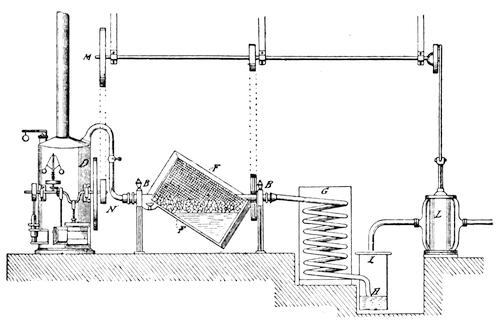
Lately a combination of the écuelle and distilling processes
has been introduced by Domenico Monfalcone,
which has given excellent results. It is shown in Fig.
20. F F is a hollow cylinder, of sheet-iron, the interior
surface of which is studded with a large number of
small metallic knife-points. This cylinder revolves on
two axles attached to it at diagonally opposite points.
The cylinder having been half-charged with lemons,
together with a small quantity of water, is set in motion
by aid of the shafting and pulleys driven by the small
steam engine. The fruits are thereby made to come in
contact with the metallic lancets, and their whole surface
gradually becomes punctured sufficiently to rupture the
cells containing the volatile oil, which escapes. The
cylinder F F has double walls, the space between them
being intended for the circulation of a current of steam,
which is admitted to heat the water and to facilitate the
extraction of the oil, while at the same time the vapors are
rarefied or aspirated by the vacuum pump L. The
axles of the cylinder on both sides are hollow; that on
the side looking towards the engine is imbedded in
such a manner that steam from the boiler D may be admitted
at will, either into the double walls of the cylinder,
or into the interior of the cylinder itself, while
the hollow passage in the other axle communicates with
a condensing worm, G, the outlet of which, H, descends
into a cylindrical vessel, I, intended to receive the condensed
products, consisting of water and volatile oil.
When the apparatus is first set in motion the pump L
begins to produce a vacuum during the first revolutions
of the cylinder. Steam being now cautiously admitted
into the double walls of the cylinder, the water is raised
to boiling at a comparatively low temperature, and the
vapors charged with the volatile oil pass over into the
receptacle, where they separate into two layers. The
product obtained by this process is claimed to be equal
in quality to that obtained by mechanical means, and
the yield nearly double.
During the months of November to March the average
yield from 1000 lemons in the factories of Palermo is
320 grammes of oil; in those of Messina, where a better
quality of fruit is employed, the yield is about 400
grammes. The same number of lemons yield about
10 gallons of juice, the collection of which is, of course,
a necessary accompaniment of the manufacture of volatile
oil.
Pure oil of lemons is almost colorless and has the
odor of the fruit. Its specific gravity varies between
0.8752 and 0.8785; it boils at 298.4° F., and is soluble
in all proportions in absolute alcohol and glacial acetic
acid. It contains, according to G. Bouchardat and J.
Lafont, besides a little cymene, several hydrocarbons, the
most abundant of which is citrene, C10H16, boiling near
352.5° F., having a rotatory power exceeding +105°,
and yielding a solid optically inactive dihydrochloride.
Oil of lemons is frequently adulterated with oil of turpentine.
This may be detected, according to G. Heppe,
by slowly heating the oil in a dry test-tube with a small
piece of copper butyrate to about 338° F., taking care
that the temperature does not exceed 356°F. The copper
salt will dissolve in pure oil of lemons with a green color,
while in the presence of oil of turpentine a yellow turbid
mixture is obtained, reddish-yellow cuprous oxide being
separated. This test is also applicable to oils of bergamot
and of orange-peel.
Lilac oil is obtained from the flowers of Syringa vulgaris,
the lilac, by aqueous distillation and subsequent
extraction with benzine. It is also frequently prepared
by the absorption process. It is used for the most expensive
perfumes, and is seldom found in commerce.
Limes, oil of (oleum limettæ), is derived from the rind
of the fruit of Citrus limetta, or lime. The oil is obtained
in the same manner as oil of lemons, which it
somewhat resembles. Its mean specific gravity is 0.8734
at 84° F. The oil made by the écuelle process is of a
decidedly yellow color, varying in intensity, being darker
in the fresh product. The difference in flavor and aroma
is so marked as scarcely to require any other means of
distinguishing the oil made by the écuelle process from
that obtained by distillation, the first having a decided
fragrant lemon smell, whilst the distilled oil is very inferior,
frequently possessing little more than the smell
of turpentine. Large quantities of oil of limes are
manufactured in Dominica, but most of the oil exported
from there is of an inferior quality and was
formerly solely used for adulterating oil of lemons.
Lately it has also been employed for scenting soaps and
in the manufacture of the common essences and perfumes.
Licari oil, linaloë oil, is obtained, partially in Mexico
and partially in Cayenne, from the wood of the white
cedar (bois de rose femelle), Licari canali. It is limpid,
has an agreeable odor, reminding one of roses, and does
not become solid at 4° F. Its specific gravity is 0.868
at 59° F., and it boils at 388.4° F.
Marjoram oils.—By distilling the leaves of Origanum
marjorana, L., the marjoram oil (oleum marjoranæ) is obtained.
It is yellowish or green-yellowish, but becomes
reddish-brown by age. If badly kept it finally becomes
thickly-fluid and sticky, sometimes depositing a reddish
stearoptene. The odor of marjoram oil is less agreeable
than that of the plant, and the taste peculiar, bitter,
cooling. The oil dissolves readily in 90 per cent.
alcohol, and when mixed with equal parts of it yields a
clear solution. Its specific gravity is 0.89 to 0.91. It
should be kept in entirely filled, well-closed bottles in a
shady place. On coming in contact with air, it absorbs
oxygen with avidity and forms a white, odorless, crystalline
mass.
From Origanum vulgare, L., the ordinary marjoram
oil (oleum origani vulgaris) is obtained. It is yellowish
or reddish, limpid, of specific gravity 0.90 to 0.95, and
has a camphor-like odor.
Spanish marjoram (oleum origani cretici) is obtained
by distillation from the flowering plants of several
varieties of marjoram (Or. creticum, Or. hirtum, Or.
smyrnæum). It is brought into commerce from Trieste,
Smyrna, Salonica, and other Mediterranean seaports.
The oil exported from France appears to be derived
from another variety of marjoram; at least it shows a
different behavior and approaches more the ordinary
marjoram oil. The genuine oil is thickly-fluid, generally
yellow-brown; of specific gravity O.95 to O.97; has a
strong, aromatic odor, and produces upon the tongue a
sharp continued burning. It dissolves in equal parts of
90 per cent. alcohol. It is chiefly adulterated with
copaiba oil, the presence of which can be recognized by
the oil dissolving with greater difficulty.
The marjoram oils are but little used for perfuming
purposes.
Mignonette oil (oleum résédæ). The well-known
mignonette, Réséda odoratissima, yields a thick yellowish
oil, either by maceration and absorption, or by
extraction with ether or petroleum-ether. It has a penetrating,
disagreeable odor, which can only be rendered
agreeable by greatly diluting the oil. In gathering
the flowers care must be had not to mix them with
leaves, as this spoils the odor of the oil.
Myrrh oil (oleum myrthæ) is obtained from the leaves
of Myrtus communis, L. It is yellowish, dextrorotatory,
of specific gravity 0.910 at 60.8° F., and commences to
boil at 320° F. As its principal constituents, Jahns
has established a terpene (C10H16), boiling at from 316.4°
to 320° F., and turning the plane of polarization to
the right, and cineol (C10H16O), which boils at 348.8°
F. Besides these principal constituents there seems to
be present a very small quantity of a camphor, corresponding
very likely to the formula C10H16O. Myrtol, which
was formerly supposed to exist in myrtle oil, has been
found to be a mixture of the dextrorotatory terpene and
of cineol.
Nutmeg oils.—From mace, the fresh aril of the
nutmeg (Myristica fragrans, Houtt, natural order
Myristicaceæ), mace oil (oleum macidis), is obtained by
distillation. It is straw-yellow or yellowish, later on
yellow-reddish, clear, somewhat thickly-fluid, of a strong
odor resembling that of mace, and a taste at first mild,
but later on pungent and aromatic. It mixes clear in
every proportion with absolute alcohol, but of 90 per
cent. alcohol, 5 to 6 volumes are required for a clear
solution. The specific gravity of the oil varies from
0.87 to 0.92. With iodine it detonates, vapors being
emitted. The oil obtained from dried mace has a less
agreeable odor.
The oil is frequently adulterated with tincture of nutmeg
prepared with absolute alcohol. Such an adulteration,
as well as any content of alcohol, is recognized by
shaking 0.5 cubic centimeter of the oil with a grain of
rosaniline. In the presence of alcohol the oil acquires
a red coloration, while pure oil remains uncolored.
From the nutmegs, the seed of Myristica fragrans,
freed from the seed-coat and aril, a volatile oil
(oleum nucistæ æthereum) is also obtained by distillation.
It is generally yellowish, seldom colorless, somewhat
thickly-fluid and has the odor and taste of nutmegs. It
is readily soluble in alcohol and ether and of specific
gravity, 0.93 to 0.95. It consists of two oils, one specifically
lighter and fluid, and the other heavy and crystalline.
On standing it deposits a stearoptene, called
myristicin.
The nutmeg oils are but seldom used in perfumery.
Opopanax oil is obtained from opopanax.[7] It is of
gold-yellow color and an agreeable balsamic odor reminding
one somewhat of myrrh. Its specific gravity is
0.9016, and it boils between 392° and 572° F.
On account of its strength, the oil must be very carefully
handled in perfuming, but if used in the correct
proportion it is very advantageous.
Orange-peel oil, also called Portugal oil or essence of
Portugal, is obtained in Italy from the fresh peels of the
orange, the fruit of Citrus vulgaris, Risso. It is prepared
in a manner similar to that of oil of lemons (which
see). In commerce a distinction is made between the
Messina oil, which is of inferior quality, and the Calabria
oil, which is of a better quality. The Messina oil has a
yellow color, frequently not much darker than that of
oil of lemons, while the color of Calabria oil is dark yellow,
nearly brown. The oil prepared from the peels of
the bitter orange (Citrus bigaradia, Duhamel), is of
the same color as the sweet Messina oil. It is more used
in the preparation of liqueurs than for perfuming.
Orange-peel oils are limpid and have a specific gravity
of 0.819 to 0.9. One part of orange-peel oil should, according
to its age, dissolve clear in 5 to 10 parts of 90
per cent. alcohol.
Very similar to orange-peel oil, though differing
somewhat in odor, is the mandarin oil obtained from
the fresh peels of the mandarin orange, the fruit of
Citrus sinensis. It is brought into commerce from
Reggio and is said to form a constituent of the genuine
ess-bouquet. It has a specific gravity of 0.852 at 50° F.
and is dextrorotatory.
While from the peels the volatile oil is but seldom
obtained by distillation, this process is exclusively used
for gaining volatile oils from the flowers, leaves, and
young branches. In this connection two kinds of volatile
oil have chiefly to be considered, viz: orange-flower
oil and petit-grain oil.
Orange-flower oil or neroli oil (oleum florum aurantii;
ol. neroli; ol. naphæ) is obtained by distillation from the
flowers of the bitter orange; while the flowers of the
sweet orange yield the so-called neroli-Portugal oil, which
is far inferior to the other.
On the French Riviera, the orange is especially cultivated
for obtaining blossoms and leaves for distilling
purposes. At Cannes, Le Cannet, Golfe-Juan, Vallauris,
Biot, Vence, Le Bar, Antibes, Le Cap, Nice,
and Mentone, the bitter orange, whose flowers are
very numerous and especially suitable for perfumery, is
chiefly cultivated. Cannes and Le Cannet alone possess
150,000 to 160,000 such trees, and Golfe-Juan
and Vallauris 200,000. The flowers harvested in
Golfe-Juan amount to about 700,000 lbs., in Le Cannet
to about 330,000 lbs., at Cannes to about 130,000 lbs.,
and in Antibes, Mentone, and Nice to about 260,000 lbs.
One orange tree yields, according to its age, from 2 to
17 lbs. of flowers. The distillation of neroli oil has
also been lately commenced in Sicily and Calabria, but
as far as quality is concerned, the oil thus far brought
into commerce cannot compete with the French oil.
Oil of orange flowers is at first nearly colorless or
straw-yellow, but becomes reddish-yellow when kept for
some time. In a clear glass it opalizes bluish. It is
limpid and has a slightly bitter taste and a strong but
very delicious odor. Its specific gravity varies between
0.85 and 0.90. It is but sparingly soluble in water,
but imparts to the latter an agreeable odor; the solution
is colored red by sulphuric acid. With 1 to 2 parts
of 90 per cent. alcohol, the oil gives a clear solution
which becomes turbid by a further addition of alcohol
and, after standing quietly, a flaky separation of stearoptene
is observed. If not carefully kept the oil becomes
darker and even acquires a disagreeable odor. By rectification
with water oil thus spoiled can be restored.
With sodium the oil does not evolve hydrogen gas; it
detonates with iodine.
Of the various oils of orange blossoms occurring in
commerce "Neroli petale" is the best.
Neroli oil being a very expensive oil is exposed to
many adulterations. Mierzinski even asserts that no
genuine unadulterated neroli oil occurs in commerce, because
it is a well-known fact that what is sold as genuine,
pure neroli oil, consists on an average of 4/8 genuine neroli
oil, 1/8 oil of bergamot, and 3/8 petit-grain oil. Furthermore,
it is no secret that besides the flowers of all kinds
of Aurantiaceæ, unripe fruits or fresh peels of ripe fruits
and even young shoots of the branches and leaves are
subjected to distillation. This assertion perhaps goes
too far, but nevertheless it is advisable to procure the
oil only from a thoroughly reliable firm.
A very frequent adulteration consists in an addition
of petit-grain oil. Such an addition can only be recognized
by the taste and odor. For this purpose add to
3 drops of oil in a small bottle 10 grammes of distilled
water, and, after shaking vigorously, test as to the odor
and taste. According to Chevalier, pour 1 or 2 drops
of the oil upon sugar and stir the latter in water; if the
oil is not genuine the water acquires a bitter taste.
Hager recommends the following test: Mix 3 drops of
the oil in a test-tube with 40 to 50 drops of alcohol; add,
after complete solution, about ⅓ the volume of the solution
of concentrated sulphuric acid, and effect mixture
by careful shaking. Pure oil gives a turbid, reddish,
dark-brown mixture (with old oil, dark brown); almost
all other oils, which may be substituted, give paler-colored
(reddish, red, or ocher-color) mixtures; or, in case the
genuine oil is adulterated with non-genuine, the mixture
exhibits a considerably less dark-color. When this test
has been several times executed with genuine oil, no
room for doubt is left. If the mixture be diluted with
four times its volume of water, it becomes yellowish and
milky.
The odor of orange flowers is, according to Soubeiran,
due to two volatile oils, of which the one having the
most delicious odor is soluble in water. The other
volatile oil, of which the neroli oil of commerce chiefly
consists, is sparingly soluble in water, and does not possess
such a delicious odor. This is the reason why good
orange-flower water cannot be prepared by saturating
water with neroli oil. The genuine orange-flower water
is obtained as a by-product in distilling the oil.
Neroli oil is much used for the finer perfumes, it being
especially a necessary constituent of eau de Cologne. It
has to be carefully protected from air and light. For
perfuming purposes it is only sufficiently ripe after
having been stored for at least one year. If, however,
it becomes too old, it inclines towards rancidity, which
may be prevented by compounding it with an equal
volume of fine spirit. Portugal oil being of inferior
quality can only be used for lower grade products.
Petit grain oil (oleum petit grain) is obtained by distillation
from the leaves, young shoots and unripe fruits
of different Aurantiaceæ. The best oil is that distilled
from the leaves of the bitter orange, it possessing an odor
similar to that of neroli oil, but, of course, not so fine.
Southern France was formerly the chief place for the
production of this oil, but considerable quantities of it
are now manufactured in Paraguay, and the oil at present
brought from there into commerce being of quite a
good quality and considerably cheaper than the French
oil, has almost entirely supplanted the latter.
Orris root, oil of (oleum iridis), is obtained by distillation
with steam from the rhizomes of Iris florentina,
which is cultivated in Southern France, Dalmatia, and
other regions. It has a yellow color and, at an ordinary
temperature, a quite solid consistency like butter
or wax, so that it can be rendered fluid only by heating.
It consists chiefly of a rigid odorless body to which
the liquid odoriferous oil adheres. The solid portion
was formerly designated orris-stearoptene; according to
Flueckiger it is, however, myristic acid.
Oil of orris root is one of the oils which keep for
years without suffering injury. It is recommended to
keep it in stock in alcoholic solution so that the myristic
acid contained in it may to a certain degree be etherized,
and cannot injuriously affect the odoriferous principle.
Oil of orris root serves as a substitute and for
strengthening the natural odor of violets. It can, however,
be employed only for very fine expensive perfumery
since, on account of the very slight yield from the
root (from 1000 parts ½ to ¾ part of oil), its price is
very high, generally exceeding that of rose oil.
An admixture of other volatile oils of less value
would render the oil fluid at the ordinary temperature.
Patchouli oil.—By the name of patchouli are known,
according to L. Wray, Jr., the leaves of Pogostemon
patchouli, Pellet, natural order Labiatæ, indigenous to
the East Indies, and known and used for centuries in
the various regions of China, Assam, and the Malayan
Islands. Most of the patchouli comes from the East
Indies. Before exportation it is sorted into three qualities:
1. Selected, consisting of leaves only. 2. Mixed,
leaves with slight peduncles and few stems. 3. Stalky
leaves. The best quality occurs seldom in commerce since
the picking of the leaves does not cover the expense.
According to Wray, the leaves are intentionally mixed
with those of the ruku (ocimum basilicum, L.), an herb
indigenous to the Malayan Islands. The leaves of the
latter are broader than those of pogostemon patchouli,
and the stalks thinner and round. Seed-capsules are
also frequently found among the leaves, though patchouli
seldom flowers and bears seeds.
In Europe, patchouli has been an article of commerce
since 1841. In the Orient it is highly esteemed as a
perfume. The Arabs even ascribe remedial properties
to it, and it is customary with them to fill their pillows
with the leaves to protect them from infection and prolong
their lives.
The peculiar, penetrating, though not exactly agreeable,
odor of patchouli leaves, is due to a volatile oil, of
which they contain 1.5 to 2 per cent. In the Orient
this oil has for many years been obtained by distillation.
In the Penang market two kinds of oil, one green
and the other gold-brown, are distinguished. Though
both are sold at the same price, there is a greater demand
for the green oil. According to the statements
of the distillers, the brown oil is derived from the leaves
of old plants and the green oil from the leaves of young
plants. It would seem, however, that the color is dependent
on the soil upon which the plants are grown, as
well as upon atmospheric influences. When ruku is
distilled with patchouli leaves, the oil is yellow and
thickly-fluid.
In Germany, the oil is now distilled from imported
leaves. It is thickly-fluid, of a brown color, and, in an
undiluted state, possesses a disagreeable, almost musty
odor. However, when sufficiently diluted and suitably
mixed with other volatile oils, the odor is far more
agreeable, and for this reason it has for some time
played an important part in the manufacture of perfumery.
It has the advantage of being very yielding
and lasting, but, on the other hand, possesses the disadvantage
of not combining with other perfumes, so that
its odor is always perceptible. It should always be
used in very small quantities or much diluted.
In commerce Penang oil and French oil are distinguished,
the first having a specific gravity of 0.959 and
the latter of 1.012. When kept for any length of time
the oil deposits patchouli-camphor (C15H28O) in prismatic
crystals of 1.045 specific gravity and melting at
127 to 129° F. These crystals have a peculiar, very
lasting odor.
Patchouli oil is soluble in equal parts of 90 per cent.
alcohol, the contrary indicating that it is not pure. It
is chiefly adulterated with cedar oil.
Peppermint oil.—The Mentha family furnishes commerce
with three oils differing essentially from each
other—oil of curled mint, peppermint oil, and poley oil.
Oil of curled mint (oleum menthæ crispæ) is separated
by distillation with water from the leaves of Mentha
crispa, Linn. It is limpid, yellowish, sometimes greenish;
in time it becomes darker and more thickly-fluid.
Its specific gravity varies between 0.890 and 0.965. It
has a strong odor of curled mint and a pungent, somewhat
cooling, slightly bitterish taste. It is soluble in
all proportions in 90 per cent. alcohol. In commerce a
distinction is made between German and American oil
of curled mint, the latter generally containing oil of
turpentine and oil of sassafras. Odor, taste, and the
alcohol test suffice for the determination of the quality
of the oil.
Oil of curled mint contains a terpene, C10H16, and a
body isomeric with carvol, the carvol of curled mint,
C10H14O. Its specific gravity, boiling point and chemical
properties are the same as those of the carvol of caraway
oil, but it differs from it by its odor and turning the
plane of polarization to the opposite direction. In conjunction
with other volatile oils, oil of curley mint is
sometimes used for perfuming soaps.
Peppermint oil (oleum menthæ piperitæ) is obtained
from the fresh flowering peppermint, Mentha piperita,
natural order Labiatæ. In commerce, German, English,
American and Japanese peppermint oils are distinguished.
As regards fineness, the German oil is inferior
to the English and better kinds of American oils, but
superior to the Japanese. The best and most expensive
oil is the English so-called "Mitcham oil of peppermint,"
which dissolves in 50 parts of 50 per cent. spirit of wine
and possesses a fine, pure taste, it being for this reason
preferred by distillers for the fabrication of liqueurs.
For perfuming purposes, however, the American as well
as the German oils are very suitable. Of American oils
that of H. G. Hotchkiss, L. B. Hotchkiss, Hale & Parshall,
and Fritzsche Bros. enjoy a high reputation. The
Japanese oil is distinguished from the rest by a peculiar
train-oil-like odor and taste, and is in but little demand.
Crude oil of peppermint is yellowish to greenish and
contains much mucus; it has therefore to be subjected
to another distillation with water. The rectified oil is
clear as water, limpid, of a strong but pleasant odor and
a specific gravity of 0.900 to 0.902. Old oil thickens
and then shows an acid reaction. The greater portion
of the oil congeals at the freezing point of water; many
kinds, however, requiring but slight cooling in order to
become solid. The solid portion of the oil, Menthol,
(C10H12,H2O) is a colorless, finely crystallized body with
an intense odor of peppermint. It melts at 107.6° F.,
is quite fluid at an ordinary temperature and boils at
413.6° F. Menthol is found in all oils of peppermint
most abundantly in the Japanese oil, which contains
from 50 to 55 per cent. of it. Mitcham oil is also very
rich in menthol, it containing from 40 to 45 per cent.,
while the American oil contains only from 20 to 25 per
cent.
American, German and English oils of peppermint
may be distinguished as follows: By adding to 5 or 6
drops of the oil, 25 to 30 drops of pure white concentrated
sulphuric acid, American oil of peppermint becomes
heated and emits vapors, the mixture acquiring a dark
brownish red coloration. After mixing with 8 to 10
cubic centimeters of 90 per cent. alcohol, the fluid
becomes turbid, pale yellowish brown, or reddish brown,
and on boiling clear pale brown. When mixed with
sulphuric acid, German oil of peppermint becomes heated
without emitting vapors, becomes yellowish red, not
very dark, and turbid. After diluting with alcohol, the
fluid becomes turbid and yellowish red, and on boiling
somewhat more transparent and currant-red. English
oil of peppermint treated in the same manner as the
others with sulphuric acid becomes very slightly heated
without any emission of vapor. After diluting with
alcohol, it becomes clear and raspberry red.
As adulterants of peppermint oil are mentioned:
fat oils, alcohol, oil of turpentine, copaiba oil, mustard
oil, and ginger oil. The most frequent adulteration is
an admixture of oil of turpentine. It is recognized by
the oil not dissolving clear in equal parts of 90 per
cent. alcohol, as is the case with the pure product. To
detect the presence of copaiba oil, mix 5 drops of the
oil to be tested with 15 to 20 drops of fuming nitric
acid, shake and allow it to stand for 1 to 2 hours.
After this time the oily portion should be neither entirely
nor partially congealed, but remain fluid. To detect
traces of mustard oil, bring 10 drops of the oil into a
wide reagent glass, then add 3 to 4 cubic centimeters
of absolute alcohol, 2 to 3 drops of silver nitrate solution
and 12 to 15 drops of ammonia. The mixture is
clear and colorless, and remains so on heating to boiling.
In the presence of mustard oil turbidity and blackening
take place in consequence of the formation of silver
sulphide. After boiling, allow the fluid to stand quietly
for 2 or 3 hours. If it then shows a grayish turbidity,
the oil is adulterated with another volatile oil.
Instead of pure American oil of peppermint, a product
compounded with camphor oil, and mostly freed
from menthol, is said frequently to occur in commerce.
According to E. C. Federer, this is recognized by dissolving
one volume of oil of peppermint in 2 volumes
of 94 per cent. alcohol, adding water and shaking. Pure
peppermint oil is then separated with a certain portion of
the alcohol. For example, mix 10 cubic centimeters of oil
of peppermint in a graduated cylinder of 45 to 50 cubic
centimeters' capacity with 20 cubic centimeters of 94 per
cent. alcohol, then add 10 cubic centimeters of water of
50° F. and shake. After allowing the mixture to stand
quietly, two layers are formed, the upper one of which, if
the oil is pure, will amount to 14 cubic centimeters, but
only to 12.5 cubic centimeters if the oil is freed from
menthol and compounded with camphor oil. A larger
or smaller addition of water to the alcoholic mixture is
without influence upon the height of the upper layer
separated.
In perfumery peppermint oil serves chiefly for aromatizing
dentifrices, etc. It should be kept in well-closed
bottles in a shady place; an addition of 0.5 per cent. of
alcohol helps to preserve the oil for a long time.
Poley oil (oleum menthæ pulegii).—In Southern France
and Spain this oil is obtained by distillation from the
leaves of Mentha pulegium. It has an odor resembling
that of peppermint, is at first colorless, but soon becomes
yellow, has a specific gravity of 0.927, boils at 361.4°
to 370.4° F., and contains neither menthol nor carvol.
It is used for perfuming herb soaps.
Pimento oil, or oil of allspice (oleum pimenta) from the
bruised fruit of Eugenia pimenta, allspice, natural order
Myrtaceæ. The oil is pale yellow, becoming reddish-brown
by age; it has a very pungent taste and intense
odor, very much resembling that of cloves. It is heavier
than water, its specific gravity being from 1.021 to 1.037.
It mixes with glacial acetic acid in all proportions. When
treated with nitric acid, pure pimento oil assumes a red
color, with strong effervescence.
Rose oil or attar of roses (oleum rosæ) comes almost
exclusively from Bulgaria, where it is obtained by distillation
with water from the flowers of Rosa damascena.
The small quantities of an excellent quality of rose oil
prepared in Southern France from Rosa provincialis
remain in the country of their production and do not
even cover the local demand. The small productions of
Persia and India need also not be taken into consideration.
In Tunis, where formerly much rose water was
prepared from Rosa canina and also rose oil of a very
fine quality, the distillation of roses has, according to
Christo Christoff, been entirely abandoned, geranium oil
only being now produced. In the summer of 1884,
Schimmel & Co., of Leipzic, Germany, made the experiment
to obtain oil on a large scale from indigenous
roses. The result was very satisfactory, 2000 lbs. of
rose leaves yielding about 1 lb. of oil, the extraordinarily
agreeable odor of which was so superior to that
of the Turkish oil, that notwithstanding the high price—double
that of Turkish oil—it found ready purchasers.
At the ordinary temperature the Leipzic oil is solid, it
only melting at 89.6° F.
In Bulgaria, Kazanlik, in the Tundscha Valley, is
the centre of the entire industry and the principal
market. Rose oil is there called "gul-jag" (gul, the
rose, and jag, oil). The annual production of Kazanlik
and neighboring places, amounting 50 years ago to from
450 to 650 lbs., has within a few years risen to the enormous
figure of 5500 lbs.
In Kazanlik two varieties of roses, known as the
"white rose" and "red rose," are cultivated; the former
being Rosa alba, L., and the latter Rosa damascena,
Miller. By distillation the white rose yields an oil of
little perfume, but rich in stearoptene. On account of
its slight odor, the white rose is seldom distilled by
itself, but occasionally white and red roses are mixed
in order to obtain an oil rich in stearoptene, so that a
fraudulent admixture of a larger quantity of geranium
oil may be effected without great danger of detection.
The large plantations consist only of bushes of red roses.
But on the edges of the field a strip, a few feet wide,
is planted with white roses, so that only flowers of little
commercial value may be plucked by passers-by.
The flowers are gathered before sunrise, and, if possible,
the same day subjected to distillation. The latter
is effected in a very crude apparatus, over a direct fire.
The flowers are distilled with double their weight of
water, one-half of which is drawn off. The product of
several operations thus obtained is combined and again
distilled, when, however, only one-sixth is drawn off.
This distillate is allowed to stand for one or two days in
a place warmer than 59° F., when the oil floating on
the top is skimmed off. It may be supposed that on an
average 6600 lbs. of roses are required to obtain 2.2
lbs. of oil, and that these 6600 lbs. of roses correspond
to an area of 1 hectare (2.471 acres) planted with rose
bushes.
Pure, carefully-distilled rose oil is at first colorless,
but soon turns yellowish.[8] Its specific gravity is between
0.830 and 0.890. It consists of a liquid oil and
a stearoptene, the content of the latter varying very
much. It is a pure hydrocarbon, odorless, of specific
gravity, 0.840 to 0.860, and distils at 572° F. Hence
it is lighter than the elæoptene on which alone the odor
of the rose oil is dependent. Rose oil generally congeals
between 50° and 60° F., though sometimes at a higher
or lower degree, according to its content of stearoptene.
While some oils require the cold of winter for congealing,
others are in the heat of summer either entirely solid, or
form a fluid filled with many crystals. The odor of
rose oil is peculiarly honey-like, and too intense to be
agreeable, its entire deliciousness being only developed
by strong dilution, be it by dissolving in water or
alcohol, or by distribution upon large quantities of rigid
bodies, fats, soaps, etc. In alcohol it dissolves with
greater difficulty than all other volatile oils, 1 part of it
requiring for solution 140 to 160 parts of alcohol of
0.815 specific gravity.
The larger or smaller content of stearoptene in rose
oil seems to be dependent on climatic conditions, it
having been remarked that the quantity is the greater
the lower the temperature of the region. The oil from
the coldest and highest regions of the Balkan is richer
in stearoptene than that from the lower and warmer
regions.
The genuineness of rose oil is generally judged by its
odor, its capacity of congealing, and the manner of its
crystallization. The odor is by all means the most reliable
criterion, but requires much experience, and especially
reliable pure standard samples for comparison.
The capacity of congealing at certain conditions of temperature,
is, to be sure, also a requirement of genuine
rose oil, but, as previously mentioned, this property
varies very much, and is subject to different influences, so
that a fixed standard at which pure rose oil must congeal
cannot be established. Attention must, however, be
called to the fact that the quality of a rose oil does by
no means rise with its greater capacity to congeal, since
only the liquid oxygenated portion possesses odor.
Schimmel & Co. bring at present into commerce a
liquid rose oil freed from stearoptene which can be
highly recommended for finer alcoholic perfumes. It
remains fluid at 32° F., but in a cold mixture congeals
to a gelatinous mass, and hence is not absolutely free
from stearoptene. It has an extremely fine and powerful
odor, and when dissolved in alcohol does not give
the disagreeable crystalline separations of the ordinary
rose oil, which produce a disturbing effect, especially in
the preparation of extracts.
For the insulation and determination of the stearoptene
in rose oil, Schimmel & Co. proceed as follows:
Heat 50 grammes of oil together with 500 grammes of
75 per cent. alcohol to from 158° to 176° F. In cooling,
the stearoptene separates nearly quantitatively.
Separate it from the fluid, treat it again in the same
manner with 200 grammes of 75 per cent. alcohol, and
repeat the operation until the stearoptene is entirely free
from odor. Two treatments of the crude stearoptene
are generally sufficient. In this manner Schimmel &
Co. obtained from 1887 German rose oil 32½ per cent.
stearoptene, from 1888 German rose oil 34 per cent.,
from 1887 Turkish rose oil 12 to 13 per cent., and from
1888 Turkish rose oil 14 per cent.
It is evident that such a valuable product as rose oil
is much subjected to adulteration, it being even said
that oils containing scarcely 10 per cent. of genuine rose
oil occur in the market. The chief adulterant used by
the Bulgarians is the so-called geranium oil, but actually
ginger-grass oil derived from India, which is brought
by way of Arabia to Constantinople, and prepared for the
purpose of adulterating rose oil by treatment with lemon
juice and bleaching in the sun. The sophistication is
generally effected by sprinkling the ginger-grass oil
thus prepared upon the rose leaves before distilling.
The general characters of this oil are so similar to those
of rose oil that detection, when the adulteration is kept
within certain limits, is very difficult, so that during the
distilling time large buyers and exporters of rose oil are
forced to pay, besides their other officers in Kazanlik,
confidential native agents who constantly move around
in the distilling regions and report where distillation has
been carried on honestly, and where the ginger-grass oil
bottle has been seen. However, the prepared ginger-grass
oil is frequently not even distilled with the rose
leaves, but simply mixed with the finished rose oil.
Whether a rose oil is free from geranium or ginger-grass
oil is tested in Bulgaria, according to Christo
Christoff, by the freezing method, which is, however,
unreliable. It is based upon the fact that an addition
of geranium oil reduces the congealing point of rose oil.
Pure Bulgarian rose oil congeals at from 63.5° to 68°
F.; by the addition of geranium oil, the same oil congeals
at 61.25°, 59°, 56.75°, or at a still lower temperature,
according to the quantity added. The buyer when
purchasing oil carries with him two basins, one containing
hot and the other cold water, which he mixes in
order to obtain a fixed temperature, the operation being
controlled by a Réaumur thermometer. In the water
thus prepared he completely submerges a 20 gramme
flask containing 15 grammes of the oil to be tested. In
three minutes, needle-like crystals of the separating
stearoptene must appear, and in ten minutes crystallization
must be complete. According to the congealing
point thus established, the product is paid for. Oil
congealing below 59° F. being evidently adulterated is
rejected and bargained for at a special price.
Many attempts have been made to fraudulently make
this congelation appear within the limits of temperature
permitted, paraffine which dissolves well in rose oil being
formerly frequently added. In such case the oil may
congeal at from 65.75° to 68° F., but the crystals are
opaque, dirty yellow, and dissolve to a turbid paste
which collects on the surface. The simplest method is
to distil white roses with the red. The resulting product
has not as fine an odor as that from red roses
alone, but is richer in stearoptene. Such oil, which, unadulterated,
congeals perhaps at 68° F., can by the addition
of geranium oil be reduced to from 63.5° to 65.75°
F., thus keeping within the limits permitted.
Numerous attempts have been made to find a rapid
and sure way for the detection of geranium oil in rose
oil, but thus far in vain. Attention must also be drawn
to the fact that the adulterant is frequently itself adulterated
with oil of turpentine before being sold to the
distillers of rose oil.
Besides the above-mentioned ginger-grass oil, the
actual geranium oils from Pelargonium odoratissimum
and P. roseum, as well as rosewood oil, sandal-wood
oil, spermaceti, paraffine, and fat oils have been mentioned
as adulterants of rose oil. The geranium oils
having a by-odor of lemon oil, by which their presence
could be readily detected are not suitable for the purpose.
Neither can rosewood or sandal-wood oils be used, or
at least such adulteration would be so clumsy as to be
immediately recognized. Attempts to adulterate rose
oil by the addition of a fat crystallizable body together
with another volatile oil fail on account of the characteristic
properties of rose oil stearoptene, which resembles no
other body at present known. While rose oil stearoptene
is lighter than elæoptene and entirely volatile, spermaceti
possesses essentially different qualities. It does
not form such long and specifically light crystals as
rose oil stearoptene; hence it readily separates on the
bottom and on shaking exhibits a peculiar iridescent
loamy formation. Furthermore it melts at 122° F.,
and not being volatile, leaves, on heating, a greasy stain
upon paper, while the stearoptene melts at 95° F. and,
on heating, volatilizes completely without leaving a
greasy stain behind.
If a rose oil is to be tested, expose the bottle containing
the oil to a moderate heat until the contents are entirely
liquid; then gently shake the bottle in order to
bring about an intimate mixture of elæoptene and stearoptene.
Now pour some of the oil into a cylindrical
glass flask of 20 to 40 cubic centimeters' capacity and
allow it to congeal; then, while heating in the hand,
observe how the rigid portions act in liquefying. These
rigid, crystalline portions should be transparently clear
and, being lighter than the fluid portion, float, while
liquefying, in the upper layer of the fluid. Hence, if
now the fluid be again allowed to congeal, the crystals
should appear within the upper half of the oil. The
above-mentioned volatile oils partially lack the property
of separating a stearoptene in crystals at from
33.8° to 50° F., and though they may have a rose
odor, it is not the mild, fragrant odor of genuine rose
oil. To recognize the latter, Guibourt makes use of
pure concentrated sulphuric acid. Stir together in a
watch-crystal an equal number of drops of the oil and
of the acid; pure rose oil preserves its characteristic
odor, while the foreign oils exhibit a disagreeable odor
even when mixed with genuine rose oil.
Schimmel & Co. give a method for an approximate
quantitative determination of spermaceti in rose oil:
Boil 3 to 5 grammes of stearoptene, separated in the
manner above given, with 20 to 25 grammes of 5 per
cent. alcoholic potash lye for 5 to 6 hours; then evaporate
the alcohol and compound the residue with hot
water. In cooling, the greater portion of the stearoptene
separates in a crystalline mass upon the surface.
Now pour off the alkaline fluid, wash the stearoptene
with cold water, then melt it again in hot water, allow
it to cool, pour off the water, and repeat the same operations
until the wash-water is neutral. The combined
aqueous fluids are twice shaken with ether to remove any
stearoptene suspended in them. The alcoholic lye separated
from the ether is acidulated with dilute sulphuric
acid and again extracted with ether. After evaporation
no residue (fatty acids) should remain. To control
the experiment weigh the regained stearoptene dried at
194° F., adding, of course, the ether used for extracting
the alkaline fluid. There will be a small loss, since
small quantities of stearoptene always evaporate in
drying.
Rosemary oil (oleum rosemarini or ol. anthos) is obtained
in Southern Europe, especially in Southern France, Dalmatia
and Northern Italy, by distillation from the flowering
rosemary, Rosmarinus officinalis, natural order
Labiatæ. It is, when fresh, limpid, colorless, or yellowish,
of a penetrating, camphor-like odor and taste, and
specific gravity 0.880 to 0.915. By age it becomes
darker and thickly-fluid. The French rosemary oil is
the best and most expensive. It is distinguished from
the Italian oil by its much more pleasant odor. Pure
French rosemary oil dissolves in an equal part of 90
per cent. alcohol, while the Italian product requires
2 to 3 parts. The cheaper rosemary oils are generally
adulterated with oil of turpentine, which is recognized
by the oil not dissolving in the above-mentioned proportion
in alcohol, as well as by the iodine test. Rosemary
oil does not detonate with iodine, but simply dissolves
with heating and perhaps the emission of vapors.
The French rosemary oil forms one of the ingredients
of eau de Cologne and is used in other perfumery.
Rosewood oil or rhodium oil (oleum ligni rhodii), is obtained
by distillation from the wood of the root and
lower trunk of Convolvulus scopiarius and C. floridas, L.,
two plants indigenous to the Canaries. The waste falling
off in the manufacture of rosewood beads is chiefly
used for the purpose. The oil is of a pale yellow color
becoming brown by age. It has a pleasant odor resembling
in some slight degree the fragrance of the rose. It
is sometimes used in cheap perfumery as a substitute
for rose oil.
Sandal-wood oil (oleum ligni sandali) is distilled from
the white West Indian or dark yellow East Indian sandal-wood
(Santalum myrtifolium). For the purpose of
distillation the wood is rasped as finely as possible. The
oil obtained from the East Indian wood is the better
and more valuable. It has a dark yellow to brown color
and a pleasant intense, rose-like odor, while the West
Indian oil is pale yellow and of a less agreeable odor.
Both oils are very thickly-fluid. The quality and value
of sandal-wood oil are best judged by the odor, an
adulteration with cedar oil being readily detected thereby.
Sassafras oil (oleum ligni sassafras), from the bruised
root of the sassafras tree, Sassafras officinale, natural
order Lauraceæ. Sassafras is one of the most widely
distributed trees of North America, being found in
Canada, in all of the United States, east of the prairies,
beyond the Mississippi, and in Mexico. The largest
amount of oil distilled is within sixty miles of Baltimore,
Md., which is the principal depot for its commerce.
Oil of sassafras varies in color from colorless to
yellow and red. Its taste is pungent and aromatic,
being agreeable to most persons. It has a pleasant
odor resembling that of fennel, and is heavier than
water, its specific gravity being 1.08 to 1.09. It is
soluble in 4 to 5 parts of alcohol of 0.85 specific gravity,
and consists of a mixture of various oils, among which
is safrene (C10H16), a dextrorotatory terpene which boils
between 311° and 314.6° F. By strongly cooling in a
cold mixture, safrol, a crystallizing stearoptene of the
composition C10H10O2, is separated. Safrol is the chief
constituent of sassafras oil. It is obtained in abundance
by cooling, at a temperature of 13° F., the portion
boiling between 442.4° and 455° F. It melts at 46.4°
F., and at a medium temperature forms a colorless clear
oil of pungent taste, characteristic odor, and specific
gravity 1.104. When the crystals have been heated to
above 158° F., they congeal only after remaining for
weeks at a temperature below 32° F., but on being
melted at 68° F., the fluid mass again congeals readily
on cooling. The safrol is neutral, optically inactive,
boils at 449.6° F., and is soluble in alcohol and ether.
Sassafras oil is said to be frequently adulterated with
oil of turpentine, which is, however, readily detected by
the energetic reaction and by distilling a sample of the
suspected oil.
Safrol is very suitable for perfuming ordinary soaps.
It has in a still higher degree than camphor oil the
property of removing the disagreeable odor of some fats,
while at the same time it imparts to the soaps an
aromatic, refreshing odor. As a rule 8 to 11 ozs. are
used for 220 lbs. of soap; but if it shall at the same
time serve for removing the disagreeable odor of low
quality fats, especially those extracted with bisulphide
of carbon or benzine, it is advisable to take 2.2 lbs., or
still better, 4.4 lbs. for 220 lbs. of soap. In this case the
safrol should be added to the fat after melting and before
saponification and thoroughly mixed with it by stirring.
An excellent perfume for ordinary soaps is a mixture of
safrol and citronella oil, it being at any rate preferable
to oil of mirbane.
The standard of value for safrol is its specific gravity,
which should not be below 1.104 at 59° F. Specifically
lighter kinds contain camphor oil and other impurities.
Thyme oil is obtained in Southern France and Spain
by distillation from the flowering thyme, Thymus vulgaris,
L. It is greenish-yellow to red (red thyme oil,
oleum thymi rubrum), but by rectification becomes colorless
(white thyme oil, oleum thymi album). Both oils
are quite limpid and possess a strong thyme odor. The
specific gravity of the red oil is 0.91 to 0.94, and that
of the rectified oil 0.87 to 0.89. The oil prepared from
the fresh plant shows, as a rule, a higher specific gravity
than that from the dried plant. Thyme oil consists
essentially of thymene (C10H16) besides some cymene
(C10H14) and thymol (C10H14O), the latter forming an
essential constitutent of the oil. Oils from which the
thymol has been withdrawn occur in commerce. Pure
thyme oil dissolves clear in every proportion in 90 per
cent. alcohol; if such is not the case, adulteration with
oil of turpentine is probable.
The oil distilled from the field thyme, Thymus serpyllum,
L., is limpid, yellowish to gold yellow, and of specific
gravity 0.89 to 0.91. Old oil is red or brown and
no longer limpid. Good oil is soluble in every proportion
in 90 per cent. alcohol and emits only slight vapors
when brought in contact with iodine. It consists largely
of thymene and cymene, and contains a few per cent. of
phenol-like bodies.
Turpentine, oil of.—Under the general name "oil of
turpentine" are comprised the volatile oils obtained by
distillation from the resins or other portions of different
species of the pine. There is a large number of these
oils, the most important ones of which shall here be mentioned,
though but a few are of interest to the perfumer.
Austrian oil of turpentine, from Pinus laricio, Poir.—It
is colorless or yellowish, transparent; specific gravity,
0.864; boiling point, 311° to 314° F.; turns polarized
light to the left; soluble in 6 parts 90 per cent. alcohol.
When rectified it has a specific gravity of 0.862, and is
soluble in 7 parts of 90 per cent. alcohol.
German oil of turpentine, from Pinus sylvestris, P.
abies, P. vulgaris, P. picea, and P. rotundata, resembles
the former; specific gravity, 0.860 to 0.870; boiling
point, 311° to 320° F.; turns polarized light to the
left. When rectified it is soluble in 7 parts of 90 per
cent. alcohol.
French oil of turpentine, from French turpentine of
Pinus maritima.—It is colorless or faint yellowish;
specific gravity, 0.860; boiling point, 313° to 315°
F.; turns polarized light to the left; odor peculiar;
taste burning. With 7 parts of 90 per cent. alcohol it
gives a clear solution.
Venetian oil of turpentine, from Venice turpentine of
Larix decidua, Mill., is laevorotatory and resembles
the preceding, but has a more agreeable odor. Venice
turpentine is mostly obtained in Southern Tyrol and in
Piedmont, and yields 18 to 25 per cent. of oil.
American oil of turpentine, from American turpentine
of Pinus australis, Mich., and P. Taeda, L.—It resembles
French turpentine, but turns polarized light to the right.
Specific gravity, 0.864; boiling point, 302° to 312.8° F.
Pine oil (oleum abietis) is obtained by distilling with
water the leaves or green cones of Pinus picea, L., Abies
pectinata, D. C. Its odor is much finer than that of ordinary
oil of turpentine. It is soluble in 7 parts of 90
per cent. alcohol.
Dwarf pine oil, Krummholz or Latschenoel (oleum pini
pumilionis), is obtained by distilling the young tops and
cones of Pinus pumilio with water. It has an agreeable
odor, reminding one of juniper; specific gravity, 0.865;
boiling point, 338° F. The oil is laevorotatory and
soluble in 12 to 15 parts of 90 per cent. alcohol.
Pine-leaf oil is obtained by distilling the leaves of
Pinus sylvestris or P. abies by means of steam. It is
dextrorotatory; has a fine aromatic odor; boiling point,
320° F.; specific gravity, 0.875 to 0.876.
Templin oil (Kienoel) (oleum pini, ol. templinum) is obtained
chiefly in some sections of Switzerland and Tyrol
by distilling the wood, branches, leaves, cones, etc., with
water. It has a lemon-like odor; specific gravity, 0.860
to 0.880; boiling point, 320° to 327° F., and is laevorotatory.
Balsam-pine oil (oleum abietis canadensis) is obtained
in Canada from the branches of Abies balsamea, D. C.
It has a slightly yellowish color, a very agreeable and
refreshing odor; specific gravity, 0.902; boiling point
at 320° to 330.8° F., and turns polarized light to the
right.
Of the different varieties of oil of turpentine mentioned
only pine oil and dwarf pine oil are used in
perfumery.
Oils of turpentine must be kept carefully protected
from light and air. When badly kept they gradually
become resinous with formation of formic and acetic
acids. When exposed to the air oil of turpentine absorbs
ozone; with iodine it detonates violently. When brought
in contact with a mixture of concentrated sulphuric acid
and nitric acid it ignites.
Verbena, oil of, from the lemon verbena, Aloysia citriodora,
Hooker. The plant is cultivated in the gardens
of Grasse. The oil is extracted from the leaves by distillation
in August, but on account of its high price is
almost out of market, it being everywhere substituted
by the oil of lemon grass, Andropogon citratus.
Violet, oil of.—The perfume of the violet, Viola odorata,
natural order Violaceæ, is due to a volatile oil of
a green color and of such a penetrating odor as to cause
headache; it acquires the agreeable odor of the violet
only by strong dilution. The violet farms from whence
the flowers are procured for the production of the oil,
are very extensive at Nice and in the neighborhood of
Florence. The oil is only obtained by the absorption
process, all other methods to procure it having failed up
to this time. It is scarcely obtainable in commerce, as
the French manufacturers, who prepare the greater part
of it, use the very small yield for manufacturing fine
perfumery.
Vitivert or vetiver oil (oleum iva ranchusa) from the
so-called cuscus, the rhizome of an Indian grass, Anathereum
muricatum. The oil is obtained by distillation,
either from the fresh root in India, or from the imported
dried root in Europe. The yield is very small. The oil
is thickly-fluid, of a red-brown color, and has an intense,
but agreeable odor very much like that of oil of orris
root. Like the latter, it possesses the valuable property
of diffusing a lasting perfume. Its value can only be
judged by the odor, and hence it should only be purchased
from a thoroughly reliable firm.
Wintergreen oil (oleum gaultheriæ) is obtained by distillation
from the wintergreen, Gaultheria procumbens,
a plant common in North America. It is thickly fluid,
yellowish green to gold yellow, of a sweetish, aromatic,
pungent taste and penetrating, narcotic odor, which
becomes agreeable only by strongly diluting the oil.
By rectification the oil becomes entirely colorless. Its
specific gravity is 1.170 to 1.190 (according to Gladstone,
1.142). It is sparingly soluble in water, but
readily so in alcohol, ether, chloroform, etc. The aqueous
or dilute alcoholic solution is colored deep violet by
ferric chloride.
Wintergreen oil boils at 392° F.; the boiling point,
however, soon rises to 431.6° F., when it remains constant.
Between 392° and 428° F. a terpene (C10H16)
constituting about 1/10 of the oil distils off; the rest corresponds
to the composition C8H8O3; it is methyl salicylate
Wintergreen oil is also obtained by distillation from
Gaultheria punctata and Gaultheria leucocarpa. An
oil, very closely resembling wintergreen oil, is in this
country distilled from the young shoots of the American
species of birch, Betula lenta, variously called sweet
birch, black birch, cherry birch, and mountain mahogany.
According to Procter, the oil does not exist in the birch
but is formed by the action of the water upon an odorless
body, called gaultherin, which is converted into
volatile oil by the reaction of another substance analogous
to emulsin. Hence the formation of oil is similar
to that of oil of bitter almonds. To obtain the oil from
Betula lenta, the material is chopped up and placed in
the still, as much as this will hold, a sufficient quantity of
water being then added to fill the still about one-third full.
The still is generally permitted to remain in this condition
over night, a fire is made in the morning and distillation
proceeds nicely. The manufacture of birch
oil is carried on at quite a large scale by Mr. A. H.
Seidle, of Middleport, Schuylkill County, Pa.
Methyl salicylate may also be artificially prepared by
heating a mixture of methyl alcohol, sulphuric acid and
salicylic acid whereby at first methyl-sulphuric acid is
formed which is then converted into methyl ether and
sulphuric acid:—
| ┌OH | | ┌OCH3 |
| SO2 | ┤ | + CH3OH = SO2 | ┤ | + H2O |
| └OH | | └OH |
| ┌OCH3 | | ┌OH |
| SO2 | ┤ | + C6H4 | ┤ | = |
| └OH | | └COOH |
| ┌OH | | ┌OH |
| C6H4 | ┤ | + SO2 | ┤ |
| └CO.OCH3 | | └OH. |
Etherification succeeds without difficulty, it being sufficient
to heat the mixture for some time and then pour
it into water whereby the ether separates as a heavy
layer of oil. After washing with water distil in a direct
current of steam. The ether thus obtained is as clear
as water and, as regards its other properties, does not
differ from the naturally occurring oil. This artificial
wintergreen oil is now much used for perfuming
purposes.
Wintergreen oil is said to be frequently adulterated
with sassafras oil which is also specifically heavier than
water. If, according to Hayer, 5 drops of the oil in a
test-tube be mixed with 10 drops of crude concentrated
nitric acid, a deep blood-red fluid results in one minute
if oil of sassafras is present. In the course of another
minute, the fluid separates a brown resinous mass. Pure
oil, on the other hand, is but little altered.
According to P. MacEwan the adulteration of wintergreen
oil with camphor oil is carried on at a large scale.
The presence of camphor oil may be recognized by the
specific gravity, 0.900, while that of pure wintergreen
oil is, on an average, 1.18. A crude test—which is,
however, readily executed—is as follows: Stir a few
drops of the suspected oil in water. If pure, the oil
in a few seconds sinks to the bottom, but if it contains
camphor oil several minutes elapse before it deposits,
and there is time to observe that the particles of oil
assume different forms, but not a globular one.
Ylang-Ylang oil (oleum unonæ) is obtained by distilling
the flowers of Unona odoratissima, indigenous to
the Philippine Islands, the Straits of Malacca, and Indian
Archipelago. The oil is colorless to yellowish.
Its color and specific gravity, however vary very much,
according to the season of the year in which it is prepared,
the oil distilled in the cold season being more
colorless and limpid than that produced in the warm
season. The oil has an exquisite odor, partaking of the
jasmine and the lilac, and is used in the manufacture of
the finest perfumery. Various kinds are found in commerce,
that marked "Sartorius" being preferred.
The difference in quality of the many kinds of oil
found in commerce is chiefly due to the method of preparation
and the selection of the flowers, which possess
the finest aroma when freshly gathered. In distilling,
the first light volatile portions passing over have an
incomparable perfume, while the oil distilling over later
on possesses an insipid odor. Hence the manufacturer,
who only obtains the first portions, will furnish the
finest quality of oil, and it is this method of preparation
which has gained the "Sartorius" oil its high reputation.
While according to Schimmel & Co.'s report, 220 lbs. of
fresh ylang-ylang flowers yield 2.64 lbs. of oil, Sartorius
for the preparation of his fine oil distils off only about
half the quantity.
Conanga oil is a poorer quality of ylang-ylang oil,
obtained from the same plant. Two varieties are distinguished
in commerce, viz: the Javanese and Indian.
The Java oil is the best, and may be used where
ordinary qualities of ylang-ylang oil will do. According
to Schimmel & Co.'s report the cheaper Indian oil is
very resistant and durable in soaps, especially when
combined with licari or linaloë oil.