A new art of procuring artificial light, which
consists in burning the gazeous fluid obtained
by distillation from common pit-coal, has of
late engaged the attention of the public, under
the name of gas-light.
The encouragement that has been given for
some years past by the legislature to this system
of lighting, has induced certain individuals
to apply the coal-gas light for the illumination
of streets, houses, roads, and public edifices.
And it is sufficiently known that a company
has been incorporated by charter under the
name of the “Gas Light and Coke Company,”
to apply this new art of procuring light, by
way of experiment, on a large scale, in lighting
the streets of the metropolis.[10]
The power and authorities granted to this
corporate body are very restricted and moderate.
The individuals composing it have
no exclusive privilege; their charter does not
prevent other persons from entering into competition
with them. Their operations are confined
to the metropolis where they are bound
to furnish not only a stronger and better light
to such streets and parishes as chuse to be
lighted with gas, but also at a cheaper price
than shall be paid for lighting the said streets
with oil in the usual manner. The corporation
is not permitted to traffic in machinery for
manufacturing or conveying the gas into private
houses, their capital or joint stock is limited
to 200,000l. and His Majesty has the power
of declaring the gas-light charter void, if the
company fail to fulfil the terms of it.
Pit-coal exists in this island in strata, which,
as far as concerns many hundred generations
after us, may be pronounced inexhaustible;
and is so admirably adapted, both for domestic
purposes and the uses of the arts, that
it is justly regarded as a most essential constituent
of our national wealth. Like all other
bituminous substances, it is composed of a
fixed carbonaceous base or bitumen, united to
more or less earthy and saline matter constituting
the ashes left behind when this substance
is burnt. The proportions of these
parts differ considerably, in different kinds of
coal; and according to the prevalency of one
or other of them, so the coal is more or less
combustible, and possesses the characters of
perfect pit-coal; and by various shades, passes
from the most inflammable canel-coal, into
blind, Kilkenny, or stone-coal; and, lastly,
into a variety of earthy or stony substances;
which, although they are inflammable, do not
merit the appellation of coal.
Every body knows that when pit-coals are
burning in our grates, a flame more or less
luminous issues from them, and that they frequently
emit beautiful streams of flame remarkably
bright. But besides the flame, which is
a peculiar gas in the state of combustion, heat
expels from coal an aqueous vapour, loaded
with several kinds of ammoniacal salts, a thick
viscid fluid resembling tar, and some gases that
are not of a combustible nature. The consequence
of which is, that the flame of a coal-fire
is continually wavering and changing, both
in shape, as well as brilliance and in colour, so
that what one moment gave a beautiful bright
light, in the next, perhaps, is obscured by a
stream of thick smoke.
But if coals, instead of being suffered to
burn in this way, are submitted to distillation
in close vessels, all its immediate constituent
parts may be collected. The bituminous part
is melted out in the form of tar. There is
disengaged at the same time, a large quantity
of an aqueous fluid, contaminated with a portion
of oil, and various ammoniacal salts. A
large quantity of carburetted hidrogen, and
other uninflammable gases, make their appearance,
and the fixed base of the coal remains
behind in the distillatory apparatus in the form
of a carbonaceous substance, called coke.
All these products may be separately collected
in different vessels. The carburetted
hidrogen, or coal-gas, may be freed from the
non-inflammable gases, and afterwards forced
in streams out of small appertures, which,
when lighted, may serve as the flame of a candle
to illuminate a room or any other place.
It is thus, that from pit-coal a native production
of this country, we may procure a pure,
lasting, and copious light; which, in other
cases, must be derived from expensive materials,
in part imported from abroad.
It is chiefly upon the power of collecting the
products afforded by coal, with convenience
and cheapness, that the promoters of the gas-light
illumination found their claims to public
encouragement. They conceive that the flame
which pit-coal yields, as it is now consumed, is
turned to very little advantage: it is not only
confined to one place, where a red heat is more
wanted than a brilliant flame, but it is obscured,
and sometimes entirely smothered, by the
quantity of incombustible materials that ascend
along with it and pollute the atmosphere.
That much inflammable matter is thus lost,
is evident from facts that come under our daily
observation. We often see a flame suddenly
burst from the densest smoke, and as suddenly
disappear; and if a light be applied to the
little jets that issue from the bituminous parts
of the coal, they will catch fire, and burn with
a bright flame. A considerable quantity of a
gazeous fluid, capable of affording light and
heat continually escapes up the chimney,
whilst another part is occasionally ignited,
and exhibits the phenomena of the flame and
light of the fire.
The theory of the production of gas-light is
therefore analogous to the action of a lamp or
candle. The wick of a candle being surrounded
by the flame, is in the same situation of the
pit-coal exposed to distillation. The office of
the wick is chiefly to convey tallow, by capillary
attraction, to the place of combustion. As
it is decomposed into carburetted hidrogen gas
it is consumed and flies off, another portion
succeeds; and in this way a continued current
of tallow and maintenance of flame are effected.
See page 15.
The combustion of oil by means of a lamp
depends on similar circumstances. The tubes
formed by the wick serve the same office as a
retort placed in a heated furnace through which
the inflammable liquid is transmitted. The oil
is drawn up into these ignited tubes, and is decomposed
into carburetted hidrogen gas, and
from the combustion of this gas the illumination
proceeds. See p. 15. What then does the
gas-light system attempt? Nothing more
than to generate, by means of sufficient furnaces
and a reservoir of sufficient capacity,
desired quantities of the gas, which is the same
material of the flame of candles or lamps; and
then by passing it through pipes to any desired
distance, to exhibit it there at the mouths of
the conducting tubes, so that it may be ignited
for any desired purpose. The only difference
between this process and that of an ordinary
candle or lamp, consists in having the furnace
at the manufactory, instead of its being in the
wick of the candle or lamp—in having the
inflammable material distilled at the station,
instead of its present exhibitions in oil, wax, or
tallow, and then in transmitting the gas to any
required distance, and igniting it at the orifice
of the conducting pipe instead of igniting it at
the apex of the wick. The principle is rational,
and justified by the universal mode in which
all light is produced. Indeed, this discovery
ranks among the numerous recent applications
of chemical science to the purposes of life,
which promise to be of the most general
utility.
It is evident from the outline here given of
the production and application of coal-gas, that
all the uses of pit-coal are not exhausted; it
will be sufficient to observe, that the complete
analysis of coal, which has been hitherto
confined to the laboratory of the chemist, requiring
skill and nicety in the operator, and
attended with great trouble and expence, is
now so far simplified, that many chaldrons of
coals may be decomposed by one gas-light apparatus
in the space of six hours, and all the
component parts produced in their most useful
shape, at an expence out of all proportion below
the value of the products.
To assist the reader in comprehending the
nature and object of substituting coal-gas for
tallow or oil, for the purpose of obtaining
light, it may be proper to touch slightly upon
the successive discoveries that have been made
as to the decomposition of coal, and the application
of its different ingredients. Such a
sketch will add to the many examples that occur
in the history of science and art, showing
the slow progress of mankind in following up
known principles, or extracting from acknowledged
facts every possible advantage.
In the Philosophical Transactions of the
Royal Society, V. XLI. so long ago as the year
1739, is recorded a paper, exhibiting an account
of some experiments made by Dr. James
Clayton, from which it appears that the inflammable
nature of coal-gas was then already
known. Dr. Clayton having distilled Newcastle
coal, obtained, as products of the process,
an aqueous fluid, a black oil, and an inflammable
gas, which he caught in bladders,
and by pricking these he was enabled to
inflame the gas at pleasure.
It is further known, that in the beginning of
the last century, Dr. Hales[11] on submitting pit-coal
to a chemical examination, found, that
during the ignition of this fossil in close vessels,
nearly one-third of the coal became volatilized
in the form of an inflammable vapour.
Hence the discovery of the inflammable nature
of coal-gas can no longer be claimed by any
person now living.
In the year 1767, the Bishop of Llandaff[12]
examined the nature of the vapour and gazeous
products evolved during the distillation of pit-coal.
This learned philosopher noticed, that
the volatile product is not only inflammable as
it issues from the distillatory vessel, but that it
also retained its inflammability after having
been made to pass through water, and suffered
to ascend through two high curved tubes. The
solid matters obtained by this venerable prelate,
were, an aqueous ammoniacal fluid, a
tenaceous oil, resembling tar, an ammoniacal
liquor, and a spongy coal, or coke.
The first discovery and application of the
use of coal-gas for the purpose of illumination is
claimed by Mr. Murdoch.
Dr. W. Henry of Manchester, has published
the following account[13] of this discovery.
“In the year 1792, at which time Mr.
Murdoch resided at Redruth, in Cornwall, he
commenced a series of experiments upon the
quantity and quality of the gases contained in
different substances. In the course of these
he remarked, that the gas obtained by distillation
from coal, peat, wood, and other inflammable
substances, burnt with great brilliancy
upon being set fire to; and it occurred
to him, that by confining and conducting it
through tubes, it might be employed as an economical
substitute for lamps and candles. The
distillation was performed in iron retorts, and
the gas conducted through tinned iron and copper
tubes to the distance of 70 feet. At this
termination, as well as at intermediate points,
the gas was set fire to, as it passed through
apertures of different diameters and forms, purposely
varied with a view of ascertaining which
would answer best. In some the gas issued
through a number of small holes like the head
of a watering pan; in others it was thrown
out in thin long sheets; and again in others in
circular ones, upon the principle of Argand’s
lamp. Bags of leather and of varnished silk,
bladders, and vessels of tinned iron, were filled
with the gas, which was set fire to, and carried
about from room to room, with a view of
ascertaining how far it could be made to answer
the purpose of a moveable or transferable
light. Trials were likewise made of the
different quantities and qualities of gas produced
by coals of various descriptions, such as the
Swansea, Haverfordwest, Newcastle, Shropshire,
Staffordshire, and some kinds of Scotch
coals.
“Mr. Murdoch’s constant occupations prevented
his giving farther attention to the subject
at that time; but he again availed himself
of a moment of leisure to repeat his experiments
upon coal and peat at Old Cumnock, in
Ayrshire, in 1797; and it may be proper to
notice that both these, and the former ones,
were exhibited to numerous spectators, who,
if necessary, can attest them. In 1798, he
constructed an apparatus at Soho Foundry,
which was applied during many successive
nights to the lighting of the building; when
the experiments upon different apertures were
repeated and extended upon a large scale. Various
methods were also practised of washing
and purifying the air, to get rid of the smoke
and smell. These experiments were continued,
with occasional interruptions, until
the epoch of the peace in the spring of 1802,
when the illumination of the Soho manufactory
afforded an opportunity of making a public
display of the new lights; and they were
made to constitute a principal feature in that
exhibition.”
In the year 1803 and 1804, Mr. Winsor
exhibited at the Lyceum in London the general
nature of this new mode of illumination
though the machinery for procuring, and the
manner of purifying the gas, he kept a secret.
He exhibited the mode of conducting the gas
through the house, and a number of devices
for chandeliers, lamps, and burners, by which
it might be applied. Among these he proposed
long flexible tubes suspended from the ceiling,
or wall of the room, and at the end communicating
with burners or lamps of different
kinds. This gentleman showed also by experiment,
that the flame of the gas-light, produced
no smoke; that it was not so dangerous
as the flame of candles or lamps; that it could
not produce sparks; and that it was not so
readily extinguished by gusts of wind or torrents
of rain.
Mr. Winsor’s display of gas-lights took
place more than two years before Mr. Murdoch’s
priority of right was heard of.
In stating these facts I do not mean to say
that Mr. Murdoch derived the hint of applying
the coal-gas from the previous exhibition
of Mr. Winsor, because it is quite within
the bounds of probability that the ideas of Mr.
Murdoch may have arisen totally independent
of all acquaintance with Mr. Winsor’s.
The claims of invention, or the determination
of the right of priority, concerns the public
only so far as the honour and estimation of any
useful discovery conferred on the inventor may
induce other individuals to devote their talents
to similar pursuits; by means of which, more
discoveries may be made, and the subject of
human invention become extended, or rendered
more useful. For as the mere benefits which
mankind may derive from any particular discovery,
they are certainly more indebted to the
person who first applied the discovery to actual
practice, than to him who first made it, and
merely illustrated it by barren experiments.
Mr. Winsor certainly pressed on the mind of
the public with unremitted perseverance and
diligence the extensive application of gas-light
in the year 1802, but he made no new discovery
with regard to the composition of coal; he
did not even invent the mode of conducting the
gas through tubes; and if he has pointed out
the particulars of the process, he has made a
very important, though not the most brilliant
improvement in this line of business. Mr.
Winsor’s publications are, perhaps, but ill
adapted to promote his cause; and the exaggerated
calculation which the sanguine mind
of a discoverer is naturally disposed to indulge
in, have, to superficial observers, thrown an
air of ridicule and improbability on the whole
scheme of lighting with gas.
It may, however, be safely affirmed, that
if the same facts had come forward, under
the sanction of some great name in the chemical
or philosophical world, the public incredulity
would long since have been subdued;
and the plan, which for many years has been
struggling for existence, would have been eagerly
adopted as a national object.
On the 18th of May, 1804, Mr. Frederick
Albert Winsor, took out a patent for combining
the saving and purifying of the inflammable
gas (for producing light and heat), the
ammonia, tar, and other products of pit-coal,
with the manufacture of a superior kind of
coke (see Repertory, 2d Series, v. 172). And,
lately, the same gentleman has taken out a
second patent, for further improvements in
these processes.
In the year 1805, Mr. Northern, of Leeds,
also directed the attention of the public to the
application of coal-gas, as a substitute for
tallow light, as will be seen by the following
extract of the Monthly Magazine for April,
1805.
“I distilled in a retort, 50 ounces of pit-coal
in a red heat, which gave 6 ounces of
a liquid matter covered with oil, more or less
fluid as the heat was increased or diminished.
About 26 ounces of cinder remained in the
retort; the rest came over in the form of air,
as it was collected in the pneumatic apparatus.
I mixed part of it with atmospherical air, and
fired it with the electric spark with a tolerable
explosion, which proves it to be hydrogene.—Whether
any of the other gases were mixed
with it, I did not then determine. In the receiver
I found a fluid of an acid taste, with a
great quantity of oil, and, at the bottom, a
substance resembling tar.
“The apparatus I make use of for producing
light is a refiner’s crucible, the top of
which (after filling with coal) I close with a
metal cover, luted with clay or other luting,
so as to prevent the escape of the gas; a metal
pipe is soldered into the cover, bent so as to
come under the shelf in the pneumatic trough,
over which I place a jar with a stop-cock and
a small tube; the jar being previously filled
with water, the crucible I place on the common
or other fire as is most convenient; and
as the heat increases in it, the gas is forced
rapidly through the water into the jar, and
regularly displaces it. I then open the cock
and put fire to the gas, which makes its escape
through the small tube, and immediately a
most beautiful flame ensues, perfectly free
from smoke or smell of any kind. A larger
light, but not so vivid or clear, will be produced
without passing the gas through water,
but attended with a smoke somewhat greater
than that of a lamp charged with common
oil.
“I have great hopes that some active mechanic
or chemist will, in the end, hit on a plan
to produce light for large factories, and other
purposes, at a much less expence, by the above
or similar means, than is at present produced
from oil.”
Soon afterwards, Mr. Samuel Clegg[14] of
Manchester, Engineer, communicated an account
of his method of lighting up manufactories
with gas-light to the Society of Arts,
for which he received the silver medal.
Since that time, the application of gas-light
has spread rapidly, and numerous manufactories
and other establishments have been
lighted by coal-gas.
In France, the application of gas-lights to
economical purposes, was pointed out long
before it was publicly introduced into this
country. M. Le Bon had a house fitted up in
Paris, in the winter of 1802, so as to be entirely
illuminated by gas-lights, which was seen
by thousands with admiration; and had a brevet
d’invention (patent) granted to him by the
French government, for the art of producing
light from wood, ignited in close vessels.
Many other attempts have been made to
derive advantage from the different ingredients
of coal; but they are too obscure to
merit particular enumeration.
In the year 1808, Mr. Murdoch presented
to the Royal Society his account of the application
of gas-light, and was complimented
with Count Romford’s medal for the same.
The following statement is taken from Mr.
Murdoch’s paper.
“The whole of the rooms of the cotton mill
of Mr. Lee, at Manchester, which is I believe
the most extensive in the United Kingdom, as
well as its counting-houses and store-rooms,
and the adjacent dwelling house of Mr. Lee,
are lighted with the gas from coal. The total
quantity of light used during the hours of
burning has been ascertained, by a comparison
of shadows, (see page 23) to be about equal
to the light which 2500 mould candles, of six
to the pound, would give; each of the candles
with which the comparison was made consuming
at the rate of 4-10ths of an ounce
(175 grains) of tallow per hour.
“The gas-burners are of two kinds: the
one is upon the principle of the Argand lamp,
and resembles it in appearance; the other is
a small curved tube with a conical end, having
three circular apertures or perforations, of about
a thirtieth of an inch in diameter, one at
the point of the cone, and two lateral ones,
through which the gas issues, forming three
divergent jets of flame, somewhat like a fleur-de-lis.
The shape and general appearance of
this tube has procured it, among the workmen,
the name of the cockspur burner.
“The number of burners employed in all
the buildings amounts to 271 Argand, and 653
cockspurs, each of the former giving a light
equal to that of four candles of the description
above-mentioned; and each of the latter a
light equal to two and a quarter of the same
candles; making therefore the total of the gas-light
a little more than equal to that of 2500
candles, six to the pound. When thus regulated,
the whole of the above burners require
an hourly supply of 1250 cubic feet of the gas
produced from cannel-coal; the superior quality
and quantity of the gas produced from that
material having given it a decided preference
in this situation over every other coal, notwithstanding
its higher price.
“The time during which the gas-light is
used may, upon an average of the whole year,
be stated at least at two hours per day of 24
hours. In some mills, where there is over
work, it will be three hours; and in the few
where night work is still continued nearly 12
hours. But taking two hours per day as the
common average throughout the year, the
consumption in Messrs. Philips and Lee’s mill
will be 1250 × 2 = 2500 cubic feet of gas
per day; to produce which 700 weight of
cannel-coal is required in the retort. The price
of the best Wiggan cannel-coal (the sort used)
is 131⁄2d. per cwt. (22s. 6d. per ton) delivered
at the mill, or say about eight shillings for the
seven hundred weight. Multiplying by the
number of working days in the year (313,)
the annual consumption of coal will be 110
tons, and its cost 125l.
“About one-third of the above quantity, or
say forty tons of good common coal, value ten
shillings per ton, is required for fuel to heat
the retorts, the annual amount of which is 20l.
“The 110 tons of cannel-coal, when distilled,
produce about 70 tons of good coke, which is
sold upon the spot at 1s. 4d. per cwt. and will
therefore amount annually to the sum of 93l.
“The quantity of tar produced from each
ton of cannel-coal is from 11 to 12 ale gallons,
making a total annual produce of about 1250
ale gallons, which not having been yet sold, it
cannot yet be determined its value.
“The interest of the capital expended in the
necessary apparatus and buildings, together
with what is considered as an ample allowance
for wear and tear, is stated by Mr. Lee at about
550l. per annum, in which some allowance is
made for this apparatus being made upon a scale
adequate to the supply of a still greater quantity
of light, than he has occasion to make use
of.
“Mr. Lee is of opinion that the cost of attendance
upon candles would be as much, if not
more, than upon the gas apparatus; so that, in
forming the comparison, nothing need be stated
upon that score, on either side.
“The economical statement for one year,
then, stands thus:
| Cost of 110 tons of cannel coal |
£ 125 |
| Ditto of 40 tons of common ditto, to carbonise |
20 |
| In all |
145 |
| Deduct the value of 70 tons of coke |
93 |
| The annual expenditure in coal, after deducting the value of the coke, and without allowing any thing for the tar, is therefore |
52 |
| And the interest of capital sunk, and wear and tear of apparatus |
550 |
| Making the total expence of the gas apparatus per annum, about |
600 |
“That of candles, to give the same light,
would be about 2000l. For each candle, consuming
at the rate of 4-10ths of an ounce of
tallow per hour, the 2500 candles burning,
upon an average of the year, two hours per day,
would, at one shilling per pound, the present
price, amount to nearly the sum of money
above-mentioned.
“If the comparison were made upon an average
of three hours per day, as in most cases,
would perhaps be nearer to the truth, and the
tear and wear remaining nearly the same as on
the former case, the whole cost would not exceed
650l. while that of the tallow would be
3000l.”
Mr. Ackerman in this metropolis, has shown
that the art of gas-light illumination is not confined
to great manufactories, but that its advantages
are equally applicable to those on a
moderate scale. The whole of Mr. Ackerman’s
establishment, his public library, warehouse,
printing-offices and work-shops, together with
his dwelling house, from the kitchen to the
drawing-room, has, for these four years past,
been lighted with gas, to the total exclusion of
all other lights. The result of the whole of
this proceeding will be obvious from the following
letter:
To Mr. ACCUM.
Sir,
“In answer to your request with regard to my gas-lights, which
I now have in my house, I take this mode of informing you, that
I charge two retorts with 240lbs. of coal, half cannel and half
Newcastle, from which I extract 1000 cubic feet of gas. To obtain
this quantity of gas, when the retorts are cold, I use from
100 to 110lb. of common coals; but when they are in a working
state, that is to say, when they are once red hot, the carbonising
fuel amounts to about 25lb. per retort. The bulk of gas thus obtained
supplies 40 Argand’s lamps, of the large size, for four
hours per night, during the long winter evenings, together with
eight Argand’s lamps and about 22 single cockspur burners, for
three hours per night: in addition to which my printers employ
16 cockspur burners for ten hours per day to heat their plates
instead of charcoal fire. In the depth of winter we charge two
retorts per day: but, upon an average, we work 365 retorts in
365 days.
Now 365 retorts containing 120lb. of coal each, make 43800lb.
which is equal to ten chaldrons of Newcastle and eight tons of
cannel coal.
| 10 |
chaldrons of Newcastle coals, at 65s. make |
£ 32 |
10 |
0 |
| 8 |
tons of cannel coal,[15] (this coal is sold by weight) at 100s. per ton |
40 |
0 |
0 |
| 7 |
chaldrons of common coals for carbonising, at 55s. |
19 |
5 |
0 |
| To wages paid the servant for attending the gas apparatus |
30 |
0 |
0 |
| Interest of money sunk |
30 |
0 |
0 |
| |
The wear and tear of the gas-light apparatus I consider to be equal to the wear and tear of lamps, candlesticks, &c. employed for oil, tallow, &c. |
|
| Total expence of the gas lights |
151 |
15 |
0 |
| DEDUCT |
| 23 |
chaldrons of coke, at 60s. per chaldron |
69 |
|
| Ammoniacal liquor |
5 |
|
| Tar |
6 |
|
| Charcoal employed by the copper-plate printers to heat their plates, which is now done with the gas-light flame, cost, annually |
25 |
|
| Two chaldrons of coals minus used as fuel, for warming the house, since the adoption of the gas-lights, at 65s. per chaldron |
6 |
10 |
|
| |
111 |
10 |
0 |
| Nett expences of the gas-lights |
£ 40 |
5 |
0 |
| The lights used in my Establishment, prior to the gas-lights, amounted annually to |
160 |
0 |
0 |
| My present system of lighting with gas costs, per ann. |
40 |
5 |
0 |
| Balance in favor of the gas for one year |
£ 119 |
15 |
0 |
Such is the simple statement of my present system of lighting,
the brilliancy of which, when contrasted with our former lights,
bears the same comparison to them as a bright summer sun-shine
does to a murky November day: nor are we, as formerly, almost
suffocated with the effluvia of charcoal and fumes of candles and
lamps. In addition to this, the damage sustained by the spilling
of oil and tallow upon prints, drawings, books and paper, &c.
amounted annually to upwards of 50l. All the workmen employed
in my establishment consider their gas-lights as the greatest
blessing; and I have only to add, that the light we now enjoy,
were it to be produced by means of Argand’s lamps or candles,
would cost at least 350l. per annum.
I am, with respect,
Yours,
Strand, March 13,
1815.
R. ACKERMAN.”
Another manufacturer who was one of the
first that adopted the use of this method of illumination
in the small way, and who gave a
statement of its advantages to the public, is Mr.
Cook, a manufacturer of metal toys, at Birmingham,
a clear-headed, prudent man, not
apt to be dazzled by a fanciful speculation, but
governed in his transactions by a simple balance
of profit and loss. There is a naïveté in his own
account of the process which will amuse as well
as instruct the reader.
“My apparatus is simply a small cast-iron
pot, of about eight gallons, with a cast-iron
cover, which I lute to it with sand. Into this
pot I put my coal. I pass the gas through water
into the gasometer or reservoir, which holds
about 400 gallons; and, by means of old gun-barrels,
convey it all round my shops. Now,
from twenty or twenty-five pounds of coal, I
make perhaps six hundred gallons[16] of gas; for,
when my reservoir is full, we are forced to burn
away the overplus in waste, unless we have
work to use it as it is made: but, in general,
we go on making and using it, so that I cannot
tell to fifty or a hundred gallons;—and, in
fact, a great deal depends on the coals, some
coals making much more than others. These
twenty-five pounds of coal put into the retort,
and say twenty-five pounds more to heat the
retort, which is more than it does take one time
with another, but I am willing to say the utmost,
are worth four-pence per day. From
this four-pence we burn eighteen or twenty
lights during the winter season.”
Thus are the candles which Mr. Cook used
to employ, and which cost him three shillings
a day, entirely superseded. But, besides his
expence in candles, oil and cotton for soldering,
used to cost him full 30l. a year; which
is entirely saved, as he now does all his soldering
by the gas flame only. For “in all
trades in which the blow-pipe is used with oil
and cotton, or where charcoal is employed to
produce a moderate heat, the gas flame will be
found much superior, both as to quickness and
neatness in the work: the flame is sharper,
and is constantly ready for use; while, with oil
and cotton or charcoal, the workman is always
obliged to wait for his lamp or coal getting up;
that is, till it is sufficiently on fire to do his
work. Thus, a great quantity of oil is always
burned away useless; but, with the gas, the
moment the stop-cock is turned, the lamp is
ready, and not a moment is lost.” We must
refer to Mr. Cook’s letter for the details of
expence, which he gives with faithful minuteness,
and always leaning to the side unfavourable
to the gas. The result of the whole is,
that he saves 30l. out of the 50l. which his lights
formerly cost him: and, when we consider that
his calculation allows the gas-lights to burn
the whole year, and the candles only twenty
weeks, there can be little doubt, that the savings
in this case follow nearly the same proportion
as in the former. If the apparatus be
erected even on a smaller scale, “the saving,”
Mr. Cook assures us, “will still be considerable:
for the poor man, who lights only six candles,
or uses one lamp, if the apparatus is put up in
the cheapest way possible, will find it only cost
him 10l. or 12l. which he will nearly, if not
quite, save the first year.”
Mr. Ackerman having, in this town, set the
example of lighting his establishment with gas,
several other individuals soon followed the attempt.
The following statement will show,
that this species of light may be made use of
with the greatest advantage, upon a still smaller
scale, where no great nicety with regard to the
apparatus for procuring gas is required. The
following report I have received from Messrs.
Lloyd, of Queen Street, Southwark, thimble
manufacturers and whitesmiths, who have used
the gas-light for soldering and other purposes
these five years past.
| From 4 pecks or 1 bushel of coals, weighing 69lbs. for which we now pay (1809) 1s. we produce 43⁄4 pecks of coke and 1⁄2 peck of coal not carbonised remains in the distilling pot, which together with the coke weighs 58lbs. 6 oz. value at 1s. per bushel |
0 |
1 |
4 |
| we procure 6lbs. 4 oz. of tar which we use as pith—it saves us |
0 |
1 |
0 |
| |
0 |
2 |
4 |
| Deduct for coal |
0 |
1 |
0 |
| Profit on coke and tar |
0 |
1 |
0 |
| The gas yielded by the 4 pecks of coals in the pot, make 42 brilliant lights, which burn 7 hours. To keep 42 tallow candles which were formerly used in the manufactory burning for the same time, required 7lbs. which at 1s. per lb. cost |
0 |
7 |
0 |
| To this, add profits on coke and tar |
0 |
1 |
0 |
| Gained out of every bushel of coal |
0 |
8 |
0 |
“The gas-burners made use of in our manufactory
produce jets of flame, which in our
business, where much soldering with the blow-pipe
must be done, have a decided superiority
over Argand’s lamps. We are not nice concerning
the quality of the gas—a great part of
it is burned from the gasometer, without allowing
it to purify itself in the gasometer, because
our gasometer is not large enough to store
up the whole quantity of gas we want for use.”
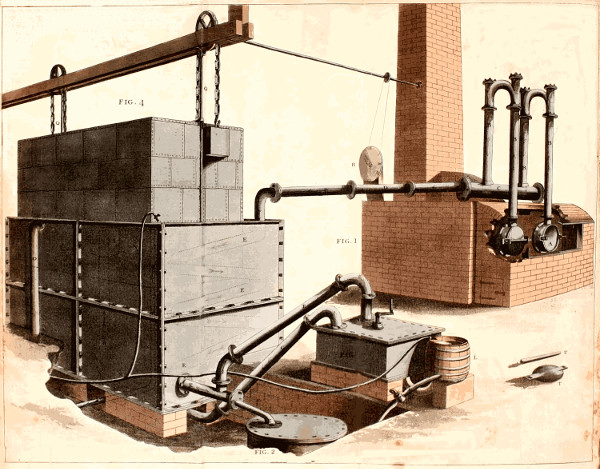
To obtain carburetted hidrogen, or coal-gas,
from common pit-coal, and to apply it for the
purposes of illumination, the coal is introduced
into large iron cylinders, called retorts, to the
apertures of which iron pipes are adapted, terminating
in a vessel, or vessels, destined to purify
and collect the gas. The retorts charged
with coals and made air-tight, are placed upon
the fire, the action of which extricates the gazeous
products from the coals, together with an
aqueous ammoniacal vapour, and a tenaceous
bituminous fluid, or tar, &c. The liquid substances
are conveyed into proper vessels, and
the gazeous products are conducted, by means
of pipes, under the gasometer, where the
gas is again washed, and remains ready for
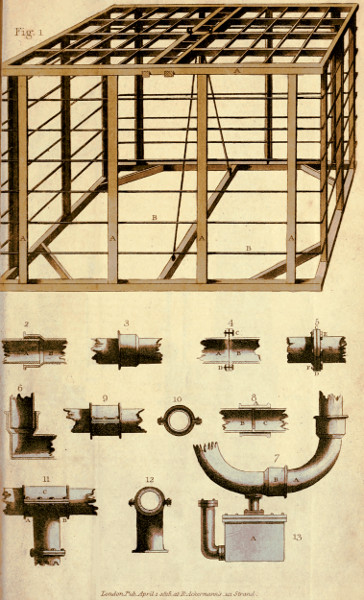
use. There are also other pipes leading from
the gasometer, which branch out into smaller
ramifications, until they terminate at the places
where the lights are wanted. The extremities
of the pipes have small apertures, out of which
the gas issues, and the streams of gas being
lighted at those apertures burn with a clear and
steady flame as long as the supply of gas continues.
All the pipes which come from the
gasometer are furnished at their extremities
with stop-cocks to regulate the admission of
the gas. The burners are formed in various
ways, either a tube ending with a simple orifice,
at which the gas issues in a stream, and if once
lighted will continue to burn with the most
steady and regular light imaginable, as long as
the gas is supplied; or two concentric tubes of
brass, or sheet-iron, are placed at a distance of
a small fraction of an inch from each other, and
closed at the bottom. The gas which enters between
these cylinders, when lighted, forms an
Argand lamp, which is supplied by an internal
and external current of air in the usual manner.
Or the two concentric tubes are closed at the
top with a ring having small perforations, out of
which the gas alone can issue, thus forming
small distinct streams of light.
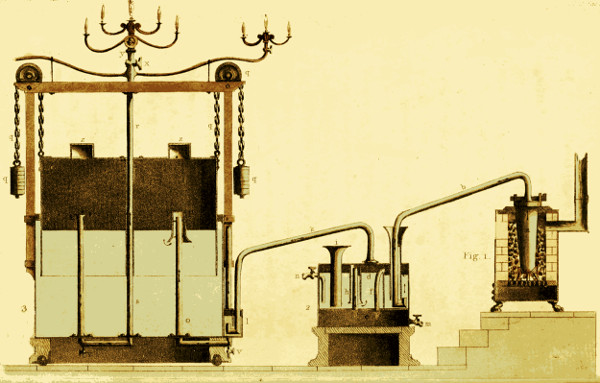
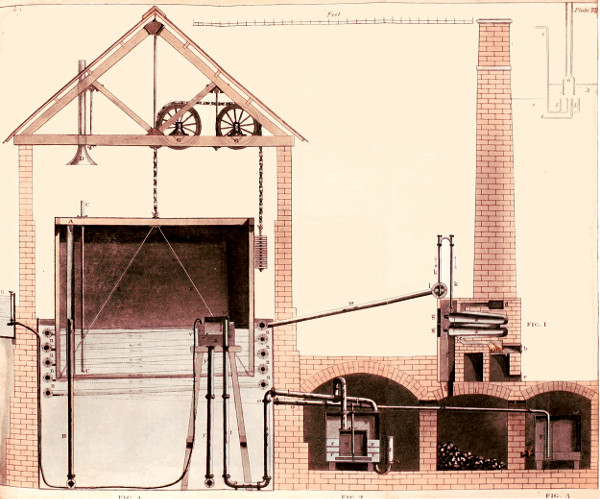
The gas-apparatus, plate 2, will be found
very convenient for exhibiting, in the small
way, the general nature of this new art of
illumination, whilst at the same time it may
serve to ascertain, at a trifling expence, the
comparative value of different kinds of coals intended
to be employed for the production of
this species of light, as well as other occasional
purposes connected with the gas-light system
of illumination.
It consists of three distinct apparatus:—namely,
a portable furnace, fig. 1, plate 2, by
means of which the gas is prepared—fig. 2, a
purifyer, or condenser, which separates and
purifies the products obtained from the coal, so
as to render the gas fit for the purpose of illumination—fig.
3, a gasometer, or reservoir for
receiving and preserving the purified stock of
gas, and from which it may be transferred and
distributed as occasion may require. The following
statement will explain more fully the
general nature of this portable chamber apparatus:—a,
represents a cast iron retort, such as
is used for chemical operations in the small
way. This retort rests upon a tripod of hammered
iron, placed upon the bars of the grate
of the chemical furnace. Into this retort the
coals are put for furnishing the gas. It is provided
with a solid iron stopper ground air-tight
into the mouth of the retort, and the stopper
is secured in its place by an iron wedge
passing over it in the centre; by means of which
the mouth of the retort when charged with
coal is readily made air-tight, and the stopper
may easily be removed by knocking out the
iron wedge. b. is a metal pipe which conveys
all the distillatory products from the retort into
the purifier fig. 2. This tube is bent at right
angles at the extremity where it enters the intermediate
vessel fig. 2. The purifier fig. 2, is
divided into three compartments marked c. d. e.
The first compartment is filled with water, and
by means of it an air-tight communication is
established with the retort which furnishes the
gas. The second compartment, d, contains a
solution of caustic pot-ash composed of about
2 parts of caustic pot-ash and 16 of water, or
a mixture of quick-lime and water of the consistence
of very thin cream. The object of
this compartment is to separate the non-inflammable
gases and other products evolved during
the distillation of the coal, from the carburetted
hidrogen or coal-gas, so as to render it fit for
use. The third compartment e is left empty
to receive the tar and other liquid products.
Into the first compartment c, all the gazeous
and liquid products are delivered, as they
become evolved during the distillation, by
means of the pipe b. The compartment d, of
the purifier, or alcali vessel, is furnished with
a wide perpendicular pipe, which serves to
make an air-tight communication with the
retort, by allowing the tube b, to pass readily
through it. From the chamber c, the liquid
and gazeous products pass to the tar-chamber,
or compartment e, by means of the descending
pipe f. The tar and other condensible substances
are therefore deposited at e, whilst the
gazeous products alone ascend from the tar-chamber
e, by the pipe g, and down again
the pipe h, (which is closed at the top) into
the compartment d, of the vessel or purifier,
fig. 2. The gas being thus made to pass from
the compartment e, up into the pipe g, and
down the pipe h, (which is closed at the top)
into the purifier d, is brought into contact with
the liquor in that vessel, where it is opposed to a
pressure in proportion to the perpendicular
height of the column of liquid which it contains.
The funnel in the compartment c, is
considerably higher than the purifying apparatus,
it therefore allows the liquid which it
contains, when pressed upon by the gas, to
ascend into it, without overflowing the apparatus,
and to descend again as the pressure diminishes—i
is another wide-mouth funnel, by
means of which the chamber d, is filled with
the alcaline solution, or mixture of lime and
water. The carbonic acid gas and sulphuretted
hidrogen, evolved during the distillation
of the coal, are thus made to combine with the
alcali or lime, in the compartment d, of the
purifier, forming carbonate and hidro-sulphuret
of lime. The carburetted hidrogen, being
left more or less pure, is conveyed through the
pipe k, into the gasometer, fig. 3. The communication
of the purifier, fig. 2, with the gasometer,
is made by means of the well-known
water-valve l, placed so that the communicating
tube k, may be easily removed at pleasure—m,
is a cock for drawing off the tar, &c.
n, a gauge-cock for ascertaining the height of
the liquid in the chamber d. The gasometer,
fig. 3, the object of which is to store up the
gas, consists of two principal parts—namely, a
large interior vessel designed to contain the gas,
and an outer cistern or vessel, of rather greater
capacity, in which the former is suspended,
designed to contain the water by which the
gas is confined. The interior vessel which
contains the gas is suspended by chains or
cords hung over pullies, to which weights are
attached, so as to nearly equipoise it. o is a
pipe, which communicates with the water-valve
l, and by means of which the gas passes
from the purifier, fig. 2, into the gasometer.
The upper end of this pipe is covered, in the
manner of a hood, by a cylindrical vessel p,
open at bottom, but partially immersed beneath
the surface of the water contained in
the outer cistern of the gasometer, and perforated
round near the lower edge with a
number of small holes. The gas displaces the
water from this receiver p, and escapes through
the small holes, rising in bubbles through the
water, so as to expose a large surface to its action,
that it may be properly washed, &c.
After rising through the water the gas enters
the gasometer, which is suspended to move up
and down by the chains, pullies, and balance-weights,
q. From the centre of the gasometer
a tube, r, descends, which includes a pipe, s,
fixed perpendicular from the bottom of the
cistern. The fixed pipe r, forms a guide to
keep the gasometer always perpendicular. t is
also an iron pipe made fast in the centre of the
inner vessel, and communicates with the upright
tube, s, in the outer vessel. This contrivance
obliges the gas to pass into the pipe t,
whilst it also serves to keep the gasometer
steady when nearly out of the outer cistern.
When the operation commences, the gasometer
is sunk down nearly to a level with the
surface of the water in the outer cistern, and is
consequently filled with water; but as the gas
enters, it rises up to receive it. It is to be noted,
that the balance-weights q q, should not be
quite so heavy as the gasometer, in order that
some pressure may be exerted, to force the gas
out of the burners with a proper jet. The gas
which issues from the retort enters the purifier
as stated already, and ascends the pipe o, into
the vessel, p, from which it displaces the
water, and passes out at the small holes, as
before described, rising through the water into
the gasometer, and raising it up: the gas then
passes away to the burners, u u. In this manner
the process proceeds until the whole of the
volatile products of the coal in the retort is
evaporated. The use of the gasometer is, to
equalize the emission of the gas which comes
from the retort more quickly at some time
than others. When this happens, the interior
vessel rises up to receive it, and when the
stream from the retort diminishes, the weight
of the gasometer expels its contents. When
the process is finished, the retort is suffered to
cool, and its ground stopper is then removed
to replenish it with coal. The residue found in
the retort is coke. v v are cocks to let off any
liquid that may collect in the pipe o or t; for
if the smallest portion of liquid were to obstruct
the free passage of the gas to the burners,
the consequence would be, that the
lights would not burn steadily—they would,
as it is called, dance, or become extinguished.
x is the main stop-cock which communicates
with the burners—these, of course, may be
placed as convenience may require. z z are
two projecting parts in the top of the gasometer;
they are intended to receive the hood p,
and the upper extremity of the pipe t, so as
to allow the gasometer to be wholly immersed
into the cistern. The wheels or pullies of the
gasometer have a groove to allow the links of
the chain to pass freely.
In this apparatus there is no provision made
for the unequal pressure which the gas suffers,
accordingly as the gasometer is more or less
immersed in water. It will be observed that,
in this apparatus, the weight of the interior
vessel is constantly increasing, in proportion
as it fills with gas, and rises out of the water,
and consequently, if a constant, uniform,
counterpoising weight, equal only to that of
the gasometer in the first moment of its rise,
be employed, the gas becomes gradually more
and more compressed by that part of the
weight of the gasometer which is not counterpoised,
and if its pressure or quantity be
then estimated by the bulk which it occupies,
without making allowance for the increasing
pressure, a material error must arise, and this,
in the large way, would give rise to insurmountable
difficulties with regard to the regulation
of the size of the flames; which could
not be rendered uniform.
Suppose the cistern or exterior vessel full of
water, and the gasometer partly filled with
gas and partly with water, it is evident that
the balance-weight may be so adjusted, as
to occasion an exact equilibrium, so that the
external air shall not tend to enter into the gasometer
nor the gas to escape from it; and in
this case the water will stand exactly at the
same level both within the gasometer and
within the outer cistern. On the contrary, if
the balance-weights be diminished, the gasometer
will then press downwards from its own
gravity, and the water will stand lower in the
gasometer than it does in the cistern; in this
case, the included air or gas will suffer a degree
of compression above that experienced by
the external air, exactly proportioned to the
weight of a column of water, equal to the
difference of the external and internal surfaces
of the water.
To compensate for this increasing weight of
the gasometer, and render a scale of equal
graduations accurate, some have ingeniously
adopted the plan of a spiral pulley to the chain,
which has the effect of gradually avoiding the
evil, but the best way of accomplishing it
will be stated hereafter.
With regard to the philosophy or the production
of coal-gas, it proves that pit-coal
contains solid hidrogen, carbon, and oxigen.
When the intensity of the heat has reached a
certain degree, a part of the carbon unites with
part of the oxigen and produces carbonic acid,
which by means of caloric is melted into the
gazeous state and forms carbonic acid gas; at
the same time, part of the hidrogen of the
coal combines with another portion of carbon
and caloric, and forms the carburetted hidrogen
gas, which varies considerably in its
constitution, according to the circumstances
under which it is produced; a portion of
olifiant gas, carbonic oxid, hidrogen, and sulphuretted
hidrogen, is also produced during
the process. The quantities of these products
vary according to the nature of the coal employed
in the process.
Pit-coal is not the only substance which affords
carburetted hydrogen; this gazeous fluid
may be obtained in a great variety of ways,
and with very considerable differences in specific
gravity and proportion of ingredients.
It is found plentifully native or ready formed
on the surface of stagnant waters, marshes, wet
ditches, &c. through which, if examined closely,
large bubbles will be seen to rise in hot
weather, and may be increased at pleasure by
stirring the bottom or mud with a stick.
In close still evenings if a lighted candle is
held over the surface, flashes of blue lambent
flame may sometimes be perceived spreading
to a considerable distance. All that is not fabulous
concerning the ignis fatuus is probably
derived from this source. This species of gas
is termed for distinction the carburetted hydrogen
of marshes. In the purest form in which
it can be collected it is mixed with about 20
per cent. of azot or nitrogen.
To procure the gas for the purpose of philosophical
amusement, fill a wide-mouthed
bottle with the water of the ditch, and keep it
inverted therein with a large funnel in its neck,
then with a stick stir the mud at the bottom
just under the funnel, so as to cause the bubbles
of air which rise from the mud to enter
into the bottle; when by thus stirring the mud
in various places, the air may be catched in the
bottle.
Carburetted hidrogen gas is also given out
very abundantly by all kinds of vegetable matter
when subjected to a scorching heat sufficient
to decompose them. When heated in
close vessels much more gas is obtained than
when burnt in the open air. If moistened charcoal
be put into an earthen retort and heat be
applied till the retort becomes ignited; gas will
be evolved, consisting partly of carbonic acid,
and partly of carburetted hidrogen. A gas of
similar properties is obtained by causing steam
to pass through a tube filled with red-hot charcoal;
by passing spirit of wine, or camphor,
through red-hot tubes; by distilling oils, wood,
bones, wax and tallow, or any animal or vegetable
body whatever.
Indeed it would be endless to enumerate the
various sources of this gazeous fluid. A most
curious variety of carburetted hidrogen gas has
been discovered by the associated Dutch chemists
(Van Dieman, Troostwyck, and others)
which is procured from ether or alcohol, and
has the remarkable property of generating
a heavy oil when in contact with chlorine gas.
Hence it has been termed oily carburetted hidrogen,
or olifiant gas—it consists of carburetted
hydrogen, supersaturated with carbon. The
oil generated is heavier than water, whitish,
and semi-transparent. By keeping, it becomes
yellow and limpid; its smell is highly fragrant
and penetrating—its taste somewhat sweet—it
is partly soluble in water, imparting to it, its
peculiar smell. A portion of this gas always
accompanies the common carburetted hidrogen
obtained from coal, and those sorts of coal that
afford the largest quantity of it are best suited
for the production of gas-light.
The nature of carburetted hidrogen obtained
from coal varies considerably according to the
conditions under which it is obtained. The
first part is always much heavier than the last,
though still lighter than common air, and holds
in solution a portion of oil, for on standing
for some time over water it becomes lighter,
and is found to require less oxygen for saturation
than before. The oil which it held suspended,
then becomes precipitated. The average
specific gravity of the first and last gas
mixed, which may be taken as an average of
the whole specific gravity is to that of common
air as 2 to 3—112lb. of common cannel coal produce
at its minimum, from 350 to 360 cubic feet
of carburetted hidrogen gas; but the same quantity
of the best Newcastle coal, that is to say,
such as coke, which, when laid on the fire readily
undergoes a kind of semi-fusion, and sends out
brilliant streams of flame, produces upon an average
from 300 to 360 cubic feet of this gazeous
fluid, besides a large portion of sulphuretted hidrogen,
carbonic oxid and carbonic acid. Half
a cubic foot of this carburetted hidrogen, fresh
prepared, that is to say, holding in solution or
suspension, a portion of the essential oil, which
is generated during the evolution of the gas, is
equal in illuminating power to from 170 to 180
grains of tallow, (being the quantity consumed
by a candle six to the pound in one hour.)
Now, one pound avoirdupoise is equal to 7000
grains, and consequently one pound of candles
of six in the pound, burning one at a time in
succession, would last (if we take 175 grains of
tallow to be consumed in an hour) 7000175 = 40
hours. To produce the same light we must burn
one half of a cubic foot of coal-gas per hour;
therefore, one-half multiplied by forty hours
is equal to twenty cubic feet of gas in 40 hours,
consequently equal to one pound of candles,
six to the pound, provided they were burnt
one after another. One hundred and twelve
pounds of cannel-coal, produce, at its minimum,
three hundred and fifty cubic feet of gas;
and are equal to three hundred and fifty,
divided by twenty, which last is equivalent to
one pound of tallow, making one hundred and
twelve pounds of cannel-coal, equal to 35020 =
171⁄2lbs. of tallow. Further, one hundred and
twelve pounds of cannel-coal, divided by seventeen
and a half of tallow make six and
four-tenths of cannel-coal, equal to one pound
of tallow.
With regard to Newcastle coals[17], it may be
stated that one chaldron of Wall’s-End coal may
be made to produce in the large way upwards
of 11,000 cubic feet of crude gas; which, when
properly purified, diminishes to nearly 10,000
cubic feet.
The production of carburetted hydrogen,
both with regard to quantity and quality from
the same kind of coal depends much upon the
degree of temperature employed in the distillatory
process. If the tar and oil produced during
the evolution of the gas in its nascent state,
be made to come in contact with the sides of
the red hot retorts, or if it be made to pass
through an iron cylinder or other vessel heated
red hot, a large portion becomes decomposed
into carburetted hydrogen gas and olifiant
gas, and thus a much larger quantity of gas is
produced than would be obtained without such
precaution from the same quantity of coal.[18]
The distillation of the coal, (if gas be the
chief object) should therefore not be carried
on too rapidly. Most of the retorts used in
the large way, are calculated for containing
about one hundred weight of coal, and in general,
when previously heated, produce from
two and one-half to three cubic feet of gas,
in four hours for each pound of coal they contain;
but when the layer of coals in them does
not exceed four inches in depth, three and one-half
to four feet of gas may be obtained in the
same time.
The retorts best calculated for large gas-light
works are seven or eight foot long (without the
mouth-piece) and twelve inches in diameter,
tapering down to ten inches—if they are larger
the coal which they contain cannot be heated
properly. The advantages that may be derived
from the circumstances before stated are of
greater value in the gas-light manufacture than
is often imagined, and the quantity as well as
the quality of the gas is very much influenced
by such circumstances. If coal be distilled with
a very low red heat scarcely observable by daylight,
the gas produced gives a feeble light—if
the temperature be increased so that the distillatory
vessel is of a dull redness, the light is
more brilliant and of a better colour—if a bright
or cherry-red heat be employed the gas produced,
burns with a brilliant white flame, and
if the heat be increased so far that the retort
is almost white hot, and consequently in danger
of melting, the gas given out, has little illuminating
power, and burns with a clear blueish
flame;[19] or if the coal abounds in pyrites or
sulphuret of iron, as is sometimes the case with
Newcastle coal, a large quantity of sulphuretted
hidrogen is likewise evolved, which although
it increases the illuminating power of the coal-gas,
has the capital disadvantage, of producing
an intolerable suffocating odour, when the gas
is burnt which is particularly perceptible in low
rooms illuminated with such gas.
These observations also apply to the distillation
of tar, which when distilled either in a
vaporous or nascent state, during its first production
from coal in the ordinary process, or if
it be submitted to a second distillation, mingled
with a fresh portion of pit-coal, a practice usually
had recourse to when this product cannot
be disposed of more advantageously. The best
depth of coal in the retort for procuring excellent
gas, and at the same time for yielding the
greatest quantity from the same weight in the
shortest possible time, is about six inches.
The brightness of the coal-gas flame is rather
diminished when the gas has been long kept
over water, and hence for illumination it should
be used as soon as prepared, but of course properly
purified.
The quantity of gas taken up by water is
affected by temperature, because the temperature
increases its elasticity; the quantity of gas
absorbed, diminishes as the temperature increases,
and increases as the temperature diminishes.
1⁄27 part of its own bulk of pure coal-gas
is absorbed by the water over which it is confined
in the gazometer.
The chemical constitution of this gazeous
fluid is best ascertained by burning it in a vessel
of oxygen gas, over lime-water in a pneumatic
reservoir, by means of a bladder and bent
brass pipe. Two products are then obtained,
viz. water and carbonic acid. That water is produced,
may be shown by burning a very small
stream of the gas in a long funnel-shaped tube
open at both ends. The formation of carbonic
acid is evinced, by the copious precipitation of
the lime-water in the foregoing experiment.
If carburetted hydrogen be mixed with a
sufficient quantity of oxygen gas or common
air and fired by the electric spark, or by
any other method, an explosion takes place
more or less violent according to the quantity
of carbonaceous matter condensed in the
hydrocarbonat; and the remaining gas consists
of carbonic acid, together with any unconsumed
gas, or excess of oxygen, whilst the
water condenses in drops on the sides of the
vessel. A few cubic inches of the mixed airs
is as much as can be conveniently managed at
a single explosion; and when any portion of
olefiant gas is present, even this quantity will
endanger very thick glass jars. A very vivid red
flame appears at the moment of the explosion,
and a great enlargement takes place in an instant,
after which the bulk is suddenly reduced
to much less than the original quantity. When
the carbonic acid is absorbed by lime-water, if
the gasses have been properly proportioned, no
gazeous residue is left, except accidental impurities.
Though carburetted hydrogen gas, is
sometimes naturally produced in coal-mines,
and occasionally mixes with common air, producing
dreadful explosions, yet when coal-gas
is mixed with common air, it does not explode
unless the gas be to the air as 1 to 10 nearly.
Such are the leading chemical habitudes of this
gazeous product. The varieties of carburetted
hydrogen gas all agree in being inflammable;
but they possess this property in various degrees,
as is evinced by the variable brightness
of the flame which they yield when set on fire.
“Messrs. Sobolewsky and Horrer, of St.
Petersburgh, have employed wood for the purpose
of producing carburetted hydrogen gas.
The pyroligneous acid obtained in this operation,
when freed from the empyreumatic oil with
which it is mixed, becomes acetous acid, and is
applicable to all the uses of vinegar. A cubic
cord of wood equal to 2.133 French metres (a
metre being rather more than an English yard),
yields 255 Paris pounds of charcoal, and 70
buckets of acid. The latter gives 30 pounds of
tar, after the extraction of it 50 buckets of good
vinegar remain. The same quantity of wood
furnishes 50,000 cubic feet of gas, sufficient
for the supply of 4000 lamps for five hours.”[20]
From what has been stated in the preceding
pages it becomes obvious, that a substance
yielding an artificial light may be obtained
from common coal in immense quantities. The
attempt to derive advantage from so valuable
a discovery is surely no idle speculation. Let
us therefore now consider to what objects of
public and private utility this mode of procuring
light may be applied with effect. It is
obvious that coal-gas may be preserved in a reservoir
for any length of time and that it may
be conveyed by means of tubes to any distance
flowing equably and regularly like water.
Those, indeed, who have not seen the contrivance
will find it difficult to imagine with
what ease it is managed. The gas may be distributed
through an infinity of ramifications of
tubes with the utmost facility. Near the termination
of each of the tubes through which
it flows, it is confined by a valve or stop-cock,
upon turning which, when required to be
lighted, it flows out in an equable stream and
ascends by its specific levity. There is nothing
to indicate its presence; no noise at the opening
of the stop-cock or valve—no disturbance
in the transparency of the atmosphere—it instantly
bursts on the approach of a lighted taper,
into a brilliant, noiseless, steady and beautiful
flame. Its purity is attested by its not blacking
or soiling in the least degree the metallic orifice
from which it issues, nor even a sheet of white
paper, or polished surface brought in contact
with it. There is no escape of combustible
matter unconsumed, which is so great a nuisance
in all our common lights. The products
of the combustion are water and carbonic acid
gas[21]. The accurate and elegant experiments
of Dr. W. Henry have shewn in the most
satisfactory manner, that considerably less carbonic
acid is produced by the flame of coal-gas,
than by that of oil, tallow, or wax[22], which
sufficiently refutes the absurd notions that have
been circulated respecting the pernicious effects
of gas-lights. But if the gas from Newcastle
coal is badly prepared, or not deprived of the
portion of sulphuretted hydrogen, which it
usually contains, it then emits fiery sparks and
produces a portion of sulphureous acid by virtue
of the union of the oxygen of the air with the
sulphur dissolved in the gas, the consequence
of which is, a suffocating odour, which is particularly
observable in the higher stratum of
the air of apartments in which the gas is burnt.
Such gas likewise tarnishes all metallic bodies—it
discolours the paintings effected with metallic
oxids, and always produces a suffocating
odour very noxious to health. It is freed from
the sulphuretted hydrogen and may be rendered
fit for illumination by passing it repeatedly
through very dilute solutions of sub-acetate of
lead, green sulphate of iron, quicklime and
water, or hyper-oxymuriate of lime.
As to the brilliancy of the flame, an appeal
may be made to every one who has witnessed
the gas-light illumination, whether it be not
superior to the best wax candle-light, or the
light of Argand’s lamps.
It may be described as a rich compact flame,
burning with a white and agreeable light. It
is also perfectly steady, when the flame is limited
to a moderate size: in large masses, it
is subject to that undulation which is common
to it with all flames of certain dimensions, and
is caused by the agitation of the surrounding
atmosphere. The gas flame is entirely free
from smell. The coal-gas itself certainly has
a disagreeable foetid odour before it is burnt,
so has the vapour of wax, oil, and tallow, as
it comes from a lamp or candle newly blown
out. This concession proves nothing against
the flame of gas which is perfectly inodorous, a
white handkerchief, passed repeatedly through
it and applied to the nose, excites no odour.
Another peculiar advantage of the gas flame
is, that it may be applied in any direction we
please, as there is nothing to spill and the gas is
propelled by a certain force which is always
the same, it will burn equally well in an almost
horizontal as in an upright position; and
we can thus obviate two great objections to all
our artificial lights, that their least luminous end
is directed downwards where the light is generally
most wanted, and that a shade is cast below
by the stand or support of the combustible
matter.
The size, shape and intensity of the gas-flame
may be regulated by simply turning a
stop-cock which supplies the gas to the burner.
It may at command be made to burn with an
intensity sufficient to illuminate every corner of
a room, or so low and dim as barely to be perceived.
It is unnecessary to point out how
valuable such lights may be in nurseries, stables,
warehouses, in the chambers of the sick, &c.
From the facility with which the gas-flame
can be conveyed in any direction, from the diversified
application, size and shape which the
flame can be made to assume, there is no other
kind of light so well calculated for being made
the subject of splendid illuminations.
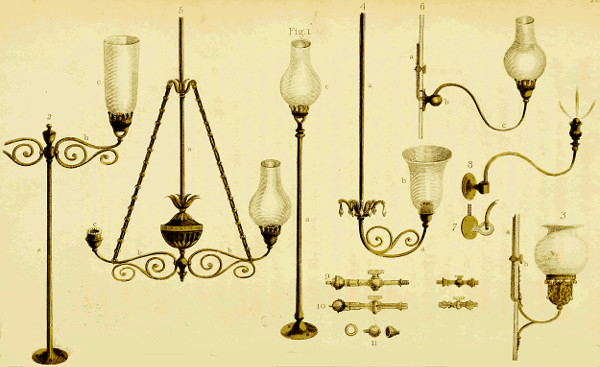
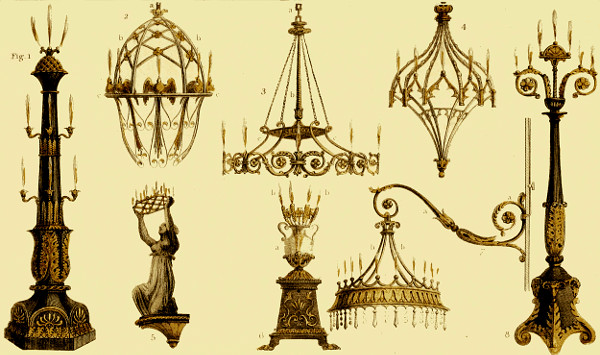
Where lustres are required in the middle of
a room, the best mode of conducting the gas to
the chandelier, is to pass the gas-pipe through
the ceiling from the room above, immediately
over the lustre. This can be easily done without
injury to the apartment.
Where side-lights and chandeliers are required
the tubes need never appear in sight, but
may be concealed in the wall or floor of the
house. When transparencies are wanted as
decorations for halls, lobbies, &c. more than
light, recesses may be filled with different coloured
media, or paintings, and any intensity of
light may be thrown on the object.
If a number of minute holes are made in
the end of a gas pipe, it forms as many jets
de feu, which have a very brilliant appearance;
these may sometimes be placed in the
focus of a parabolic reflector. In cases where
the light is required to be thrown to a distance,
other burners are constructed upon the same
principle as the Argand lamp, forming a cylinder
of flame, and admitting a current of air
both to the inside and outside.
On comparing the flame of a gas-light with
the flame of a candle whatever its size may be,
it appears just as yellow and dull as the flame
of a common lamp appears when compared
with that of a lamp of Argand. The beautiful
whiteness of gas-light never fails to excite the
surprize and admiration of those who behold
it for the first time.
A large edifice or manufactory lighted by gas,
contrasted with one of the same kind lighted by
candles or lamps, resembles a street on the
night of a general illumination, compared with
the glimmering light of its ordinary parish
lamps.
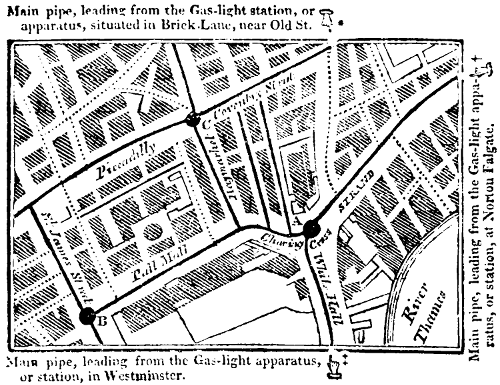
The intensity of one of the parish gas-light
lamps, now exhibited in the streets of this metropolis,
will bear ample testimony of this assertion;
the light of the parish gas-lamps, is to
the intensity of the parish oil lamps as 1 to 12.
One of the most obvious applications of the
gas-light illumination unquestionably consists
in lighting streets, shops and houses; and let
it be observed that as this is found safe and economical,
it proves all that the most ardent
friends of the gas-light system can desire. For
in contending with the common mode of lighting
the streets and shops, the new lights must
beat out of the market the cheapest of all artificial
lights; and as it has succeeded in doing
this it shews in the most satisfactory point of
view, the prodigious advantages of gas-lights
when compared with the materials of tallow
and oil.
The original expence of laying the pipes for
conveying the gas, together with the cost of the
machinery, is all that is required; the preparation
of the gas being itself a lucrative process,
no doubt will pay all its expences besides the
interest of capital, and leave a surplus of profit.
Indeed the application of the coal-gas, as a
substitute for tallow and oil, to illuminate
houses, shops, &c. is no longer problematical,
a considerable extent of this capital, together
with numerous shops and houses being already
supplied with this species of light.[23]
Enough therefore, has been done to prove the
possibility of lighting houses, and streets, with
gas, which would have been regarded twenty
years ago as an extravagant paradox.[24]
The Church of St. John the Evangelist in
this metropolis has been illuminated with gas-lights
for upwards of two years: the lights employed
in this edifice is equal to 360 tallow candles
eight to the pound. The avenues to the
House of Lords and House of Commons, Westminster-hall,
Westminster-bridge; the house
and offices of the Speaker of the House of Commons,
the Mansion-house, and many other
places, deserve to be named, as having already
adopted this species of illumination.
Another advantageous application of the gas-light
must be the supplying of light-houses.
From the splendour and distinguishing forms
which the gas-light flame is capable of assuming,
no light is better calculated for signal-lights
than this. By means of one single furnace
as much gas might readily be procured
as would furnish a flame of sufficient intensity,
during the longest winter night, exceeding in
brilliancy or intensity of light any light-house
in Britain or elsewhere.
If every light-house round this island were
possessed of a gas-light furnace, one-half part
of the enormous expence which they at present
require would furnish a much more brilliant
light. The cheapness of this light and its efficacy
for the purpose, would soon multiply the
number of light-houses, and thus most essentially
contribute to the security of navigation on
our coast. The gas may be made to issue from
tubes by long narrow slips, and a surface of
flame produced of any given dimensions, and
free from all smoke that would obscure the reflectors.
The ease with which the largest gas-light
flame is instantly extinguished by shutting the
stop-cock, and the readiness with which a long
line of gas catches fire by applying a lighted
taper to one extremity, are properties that cannot
fail to recommend it for the purposes of
telegraphic communications by night. Another
application of the gas unquestionably might be
the lighting of barracks, arsenals, dock-yards,
and other establishments where much light is
wanted in a small place.
The annual expence of lighting the barracks
of Great Britain is said to fall little short of
50,000l. a small part of which on the new plan,
would supply them with a much purer and
safer light.
The uses of the gas-lights already enumerated
must of themselves, justify us in attaching great
importance to the discovery, and if reduced to
practice all over the kingdom, would employ
a large capital in a way the most advantageous
and productive. But the utility of this light
will be almost indefinitely increased to the use
of private families. That such an application
is practicable, in all towns of Great Britain, is
obvious, from what has been done already, and
that it would be highly economical and ornamental,
there can be little doubt.
By means of gas we may have a pure and
agreeable light at command in every room of
our house, just as we have the command of
water, with this singular advantage, that these
lights may burn for hours within an inch of
the most combustible substance without danger,
because they neither can burn down like
a candle nor emit sparks. These properties
make the gas-lights a most desirable light on
board our ships of war, where severe regulations
are necessary to prevent danger from fire,
which after all are frequently evaded. The
gas-light might be used in the store-rooms,
and even in the powder magazine, and the captain
would completely command the supply of
light by the possession of the key which opens
and shuts the stop-cock. A small apparatus
which may be erected at a trifling expence
would be sufficient for that purpose.
In shops, counting-houses, and public offices,
the advantages are a white light, nearly equal
to day-light, a warmth which almost supersedes
the use of fires, a total absence of smoke, smell,
and vapour, and great economy of labour.
The heat produced by gas-lights must be
observed by every one who has had an opportunity
of attending to it in the most superficial
manner, and the reason why gas-lights produce
more heat than oil or candle-light will
not appear strange to our chemical readers (and
who is there now that does not know something
of chemistry?) when it is considered that
the gas-light flame condenses more air than the
flame of oil and tallow, and consequently must
produce more heat.
The flame of gas may be produced in so
large a surface, as to be applied to heat the
most spacious apartments as well as to light
them.
If the gas is made to issue by a circular rim
of about twelve inches diameter; it forms a sort
of an Argand lamp on a great scale, and it is
manifest that a circumference of three feet of
flame will heat the air very rapidly, and with
such uniformity that we need no longer be
exposed to the partial heating occasioned by the
strong draft of a large fire. A lamp of this
description in the centre of a large room, with
a very small fire to secure a gradual renewal of
the air would enable us to enjoy the most healthful
and agreeable temperature.
From trials made on this subject, I am enabled
to state, that three Argand’s lamps,
consuming five cubic feet of gas per hour, are
sufficient to keep a room 10 feet square at a
temperature of 55° Fahr. when the air without
doors has a temperature of freezing.[25]
In all processes of the arts where a moderate
heat is wanted the gas-light flame will be found
very advantageous—even on a large scale this
flame may be used with profit. It possesses
advantages which cannot be obtained from flaming
fuel, where much nicety is required; because
no fuel can be managed like the flame of
coal-gas. For it is well known, that when too
little air be given to flaming fuel it produces
no flame, but sooty vapour; and if too much
air be admitted to make those vapours break out
into flame, the heat is often too violent. It is
a fact, that flame, when produced in great quantity,
and made to burn violently, by mixing
with a proper portion of fresh air, driving it
on the subject, and throwing it into whirls
and eddies, thereby mixing the air with every
part of the hot vapour, produces a very intense
heat.
The great power of a gas-flame does not
appear when we try small quantities of it, and
allow it to burn quietly, because the air is not
intimately brought into contact with it, but
acts only on the outside; and the quantity of
burning matter in the surface of a small flame
is too minute to produce much effect.
But when the flame is produced in large
quantity and is freely brought forward into contact
and agitated with air, its power to heat
bodies is immensely increased. It is therefore
peculiarly proper for heating large quantities of
matter to a violent degree, especially if the
contact of solid fuel with such matter is inconvenient.
As the gas-flame may be made to assume
any shape and intensity, and as there is nothing
to spill, it may be exhibited under such variety
of forms and designs, as cannot fail to give rise
to the most tasteful ornamental illumination.
Plates III. IV. and V. exhibit such designs
of different kinds of gas-lamps, chandeliers,
lustres, candelabras, &c. as are already in use
in this Metropolis.
Plate III. fig. 1, represents a Rod Lamp.
The gas passes through the rod a, to the Argand
burner, which is surrounded by a cylindrical
chimney, c, swelling out at the lower
extremity. The construction of the Argand
burner we have mentioned already, p. 78.
In all the gas-light burners, constructed on
Argand’s plan, care should be taken that the
flame be in contact with the air on all sides,
and that the current of air be directed towards
the upper extremity of the flame. This may be
effected by causing a current of air to rise up
perpendicular from the bottom of the chimney
glass, and to pass out again through the
contracted part, or upper extremity of the
chimney; but no other current of air should
ever be permitted to come near the gas-flame,
or enter the glass chimney which covers or
defends the light; for if more air be permitted
to mix with the flame than is sufficient for the
compleat combustion of the coal-gas, it necessarily
diminishes the heat, and consequently
reduces the quantity of light.
Fig. 2. A Rod Gas Lamp, with branches.
The gas passes through the hollow rod, a, and
part of the hollow branch, b, to the burner of
the lamp. The cylindrical shaped glass, c, exhibited
in this figure, is not so well adapted for
the compleat combustion of coal-gas, as the
belly-shaped chimney, c, represented in fig. 1,
3, 5, 6, because the ascending current of fresh
air is not turned out of its perpendicular course,
and thrown immediately in a concentrated
state, into the upper part of the flame where
the combustion of the gas is less perfect.
The exterior current of air which enters at
the bottom into the lamp, rises merely with
a velocity proportioned to the length of the
cylinder, and to the rarefaction of the air in
the same, but without being propelled to the
apex of the flame, as it should do, and is made
to do, in the bellied glass adapted to the lamp,
fig. 1.
Fig. 3. A Bracket Lamp. a, the tube
which conveys the gas to the burner; b, the
stop-cock of the tube.
Fig. 4. A Pendent Rod Lamp; in which the
gas is supposed to come from a pipe above,
through the ceiling, into the pipe, a, to supply
the burners. The tulip-shaped chimney, b,
of this lamp, is likewise ill adapted for gas-light
burners.
Fig. 5. A pendent double-bracket Lamp.
The gas passing through the perpendicular
tube, a, into the brackets, b b; c shows the
Argand burner.
Fig. 6. A swing Bracket Lamp. a, the
gas-pipe with its stop-cock; b, a brass ball,
communicating with the pipe, a; c, the conducting
tube, ground air-tight into the ball,
b, and communicating with the burner of the
lamp, so as to allow it to have an horizontal
motion.
Fig. 7. Shews the construction of the ball
b, and pipe, c, of the lamp, fig. 6.
Fig. 8. A Swing Cockspur Lamp, constructed
upon the same plan as fig. 6. These two
lamps are very convenient for desks in counting-houses,
&c.
Fig. 9. A stop-cock with ball and socket,
which, when adapted to a gas-light pipe, allows
it to have an universal motion, so that
the light may be turned in any direction.
Fig. 10. Section of the stop-cock, with ball
and socket.
Fig. 11. Shows the ball and socket, fig. 9,
in perspective.
Plate IV,[26] fig. 1. A Candelabrum; the gas
pipe ascending from the floor of the apartment,
through the column a, and terminating
in the burner of the lamp.
Fig. 2. A fancy pendent Cockspur Lamp.
The gas being transmitted to the burners, c c,
by means of the pipe, a.
Fig. 3. A Pedestal Argand Lamp. a, the
pipe and stop-cock, which transmits to, and
shuts off the gas from the burner of the lamp.
Fig. 4. A Pedestal Cockspur Lamp. a, the
stop-cock and gas-pipe.
Fig. 5. A fancy bracket Cockspur Lamp,
intended merely to show that the coal-gas, as
it passes to the burner, is perfectly devoid of
colour, and invisible. a is a glass vessel furnished
at its orifice with a brass cap, c, and
perforated ball, out of which the gas-flame
proceeds. b, the pipe which conveys the gas
into the glass vessel, a.
Fig. 6. A Bracket Argand Lamp. a and b,
the gas pipe communicating with the burner.
Fig. 7 and 8. A Horizontal Bracket Lamp.
a, the gas pipe, supposed to be concealed
in the ceiling. b, the communicating pipe,
which, together with c, branches out at right
angles at d d. e e, are the burners of the lamp.
Plate V. fig. 1. A Candelabrum, into which
the gas-pipe ascends from the floor of the
apartment, the lateral branches communicating
with the central tube.
Fig. 2. An Arabesque Chandelier. The gas
enters from the ceiling of the room into the
rope-shaped pipe, a, from which it proceeds
through one of the arched ribs, b b, into the
horizontal hoop, or pipe, c.
Fig. 3. A Roman Chandelier. The gas enters
through the inflexible hollow chain, a, into
the central tube, b, from whence the burners
are supplied by the lateral branches, c c.
Fig. 4. A Gothic Chandelier. The gas is
transmitted to the burners through the rope, a,
which includes a tube, and the communication
with the burners is established through the
lateral branches.
Fig. 5. A Pedestal Figure Lamp. The gas is
here made to pass by means of a pipe through
the body of the figure into the lattice-work
plateau, constructed of hollow and perforated
brass tubes.
Fig. 6. A Pedestal Vase Lamp. The gas-tube
enters through one of the claw-feet of the
altar-shaped pedestal, into the glass vase, a, at
the bottom of which it joins the tubes communicating
with the metallic corn-ears, b, at the
upper extremities of which it forms jets de feu.
Fig. 7. A Girandole. The gas enters through
the bracket, a, and is conveyed to the burners
by the descending tubes, b b.
Fig. 8. A Candelabrum, having a central
pipe, through which the gas is conducted to
the burner at the top.
Having thus far considered the nature of
coal-gas as a substitute for the lights now in
use, it will be necessary to attend more particularly
to some other products which are obtained
during the production of this species
of light: namely, coke, tar, ammoniacal liquor,
&c.
Coke.—The substance called coke, which
constitutes the skeleton of the coal, or its carbonaceous
base, is left behind in the retort, after
all the evaporable products have been expelled
from the coal by heat.—See page 85.
It is sufficiently known, that coke is a more
valuable fuel than the coal from which it is
obtained.
Hence, immense quantities are prepared in
the large way, but the gazeous and other substances
are lost in the process employed for
carbonizing the coal.[27] In the manufacture
of coal-gas, the coke comes from the retort,
enlarged in size, and greatly diminished in
weight, when compared with the original
coal. In whatever state the coal may be
when introduced into the retort, the coke is
uniformly taken out in large masses, so that
the refuse coal, or dust, and sweepings of the
pit, which are now thrown away, may be
employed and converted into an excellent
fuel. Coke is decidedly superior to coal for
all domestic, and more especially for culinary
purposes; the heat which it throws out being
more uniform, more intense, and more durable.
No flame, indeed, accompanies it, and
it seldom needs the application of the poker,—that
specific for the ennui of Englishmen;
but these deficiences are more than balanced
by the valuable property of emitting no sparks,
of giving more heat, and burning free from
dust and smoke.
That coke must give out more heat during
its combustion than coal, will at once become
obvious, when we consider that the quantity
of matter which, in the combustion of coal is
changed from a solid to a state of elastic
fluidity, must necessarily carry off a portion
of caloric, which then becomes converted in
a latent state without producing heat, whilst
the glow of the coke radiates caloric with an
intensity unimpaired by any demand of this
kind.
It is thus that coke, though somewhat more
difficult of ignition than common coal, always
gives out a more steady, a more lasting, and
a more intense heat.
The only inconveniences that attend the use
of coke is, that, as it consumes, it leaves much
more ashes than common coal, charcoal, or
wood; and these much heavier too, which
are, therefore, liable to collect in such quantity
as to obstruct the free passage of air
through the fire; and further, that when the
heat is very intense, these ashes are disposed
to melt or vitrify into a tenacious drossy substance,
which clogs the grate, the sides of the
furnace and the vessels. This last inconvenience
is only troublesome, however, when the
heat required is very great. In ordinary heats,
such as are produced by kitchen or parlour
grates, the ashes do not melt, and though
they are more copious and heavy than those
of charcoal or wood, they do not choke up
the fire, unless the bars of the grate be too
close together.
The relative effects of heat produced by
coke and coal are as follows:—
Six hundred pounds of pit-coal are capable
of evaporating 10 cubic feet of water in 20
hours, and 430lb. of coke are capable of evaporating
17 cubic feet of water in 12 hours
and a half.[28]
The Earl of Dundonald has shown that, in
the application for burning lime, a quantity
of coke uniformly burns a given portion of
lime-stone in one-third part of the time that
the quantity of coal from which the coke had
been made could do.
This effect is to be accounted for from having
previously freed the coal, or rather its
coke, from the moisture and the tar, which
it sends out during combustion, and which
condenses on the middle and upper strata of
stratified limestone and coal in the lime kiln,
and impedes the whole mass of materials from
coming into a rapid and compleat ignition;
because the greater the quantity of materials,
and the sooner the whole is ignited, the better
and more economically the lime is burned,
both as to coals and time; the saving of which
last is a material object, especially at lime-kilns
where there is in the summer time a great demand
for lime, the coke occasioning the kilns
to hold a third more lime at the same time.
In the art of making bricks, in the smelting
of metallic ores, and the drying of malt, the
advantages of coke over coal, are sufficiently
known.
The following account given by Mr. Davis,[29]
shows that the advantages that may be derived
in the processes of burning lime, plaster of
paris, and bricks, by means of coke, are greater
than at first sight might be imagined.
“The coke obtained in the gas process is
so valuable, that it appears inexplicable that
men should not avail themselves of this mode
of procuring light, to the almost total exclusion
of all other methods now in use. As a
landholder, placed among an industrious but
wholly illiterate society of men, I have had
the more opportunity of trying this species of
fuel or coke, which I could not otherwise procure
in this sequestered spot, at a tolerably
cheap rate, for purposes to which it has not,
as far as I know, been hitherto employed. I
must tell you that I am my own lime-burner,
plaster of paris baker, and brick-maker; and
that in these processes of rural economy I
have derived the greatest benefits from this
species of fuel, which I now prepare at a
cheap rate, although I waste almost the whole
of the light of the coal gas intentionally. The
coal which I employed formerly for the burning
of limestone into lime, is a very inferior
kind of small coal, called here Welsh culm.
The kiln for burning the limestone into lime
is a cup-shaped concavity, surrounded with
solid brick-work, open at the top, and terminating
below by an iron grate. It has a
stone door that may be opened and closed
for charging and emptying the furnace when
required. This furnace I formerly charged
with alternate strata or layers of small coal
and limestone, the latter being broken previously
into pieces not larger than a man’s fist,
until the kiln was completely filled. The
stone is thus slowly decomposed; the upper
part of the charge descends, and when it has
arrived at the bottom of the furnace new strata
are super-imposed, so as to keep the furnace
continually full during a period of 50 hours.
The quantity of lime I procured with small
coal formerly amounted to 85 bushels. The
strata of coal necessary for the production of
this quantity of lime require to be four inches
thick, and the time necessary for calcination
was, as stated already, 50 hours.
“On applying coke instead of coal, the
produce of lime may be increased to nearly 30
per cent. from the same furnace, and the time
required to effect the calcination of this quantity
of lime-stone is reduced to 39 hours: it
also requires less attendance and less labour,
and the whole saving, thus accomplished,
amounts to more than 50 per cent. on the
lime-kiln.
“I have lately also employed coke for the
burning of bricks. My bricks are burnt in
clamps, made of bricks themselves. The place
for the fuel, or fire-place, is perpendicular,
about three feet high. The flues are formed
by gathering or arching the bricks over, so as
to leave a space between each of a brick’s
breadth; and as the whole of the coal, if this
fuel be employed, must, on account of the
construction of the pile, be put in at once,
the charge of the bricks is not, and never can
be, burnt properly throughout; and the interference
of the legislature, with regard to the
measurement of the clamp, is a sufficient inducement
for the manufacturer to allow no
more space for coal than he can possibly
spare.
“If coke be applied instead of coal, the
arches, or empty spaces in the clamp or pile,
as well as the strata of the fuel, may be considerably
smaller: the heat produced in this
case is more uniform and more intense, and a
saving of 30 per cent. at least is gained.
“In the baking my own plaster-stone I also
employ coke. The calcination of the stone for
manure I perform in a common reverberatory
furnace, and the men who conduct the process
(who are otherwise averse to every thing new)
are much pleased with the steadiness of the
fire, and little attendance which the process
requires, when coke is used instead of coal.
“These are the few facts I wish to state,
with regard to the useful application of this
species of fuel, which, no doubt, hereafter will
become an object of economy of incalculable
advantage to individuals, if its nature be better
understood than it is at present.”
The quantity of coke obtainable from a
given quantity of coal varies according to the
nature of the coal employed. One chaldron
of Newcastle coal produced, upon an average,
in the gas-light manufacture, from one chaldron
and a quarter to one chaldron and a half
of well formed coke. If the carbonization of
the coal has been carried to its utmost point,
the coke produced, has a brilliant silvery lustre.
Such coke is excellent for metallurgical operations,
because it stands the powerful blast
of the bellows, but for culinary and other purposes
of domestic economy, the carbonization
should not be carried so far, because, the coke
then produced, kindles more readily and makes
a more cheerful fire.
Coal-tar, Oil, and Pitch.—Another, valuable
product obtainable from pit-coal, is coal-tar.[30]
This substance is deposited, in the purification
of the coal-gas, in a separate vessel destined
to receive it.
The coal-tar is so called from its resembling
common tar in its appearance, and most of its
qualities.
Several works have been, at different times,
erected both in England and on the continent,
to procure from coal a substitute for tar; but
they turned out unprofitable speculations. In
1781, the Earl of Dundonald invented a mode
of distilling coal in the large way, which enabled
him not only to form coke, but, at the
same time, to save and collect the tar. Even
this process however, for which a patent was
taken out, has gained very little ground. Its
object was still too limited; for though some
of the ingredients of coal were procured, they
were procured at an expense that nearly balanced
the profits; and no attention whatever
was paid to the coal gas, which constitutes the
most important part of coal.
Coal-tar may be used with advantage for
painting and securing wood that is exposed to
the action of air or water. The wood being
warmed, the tar is applied cold, and penetrating
into the pores, gives the timber an uncommon
degree of hardness and durability.
One chaldron of Newcastle coal produces in
the gas-light manufacture from 150 to 180lb
of tar, according to the circumstances under
which it is produced. See page 94.
The tar obtained from Newcastle coal-tar is
specifically heavier than that produced from
cannel-coal; hence it sinks in water, whereas
the latter swims on the surface of that fluid.
To render the tar fit for use, it requires to
be evaporated to give it a sufficient consistence.
If this process be performed in close vessels, a
portion of an essential oil is obtained, which
is known to colourmen by the name of oil of
tar. To obtain this oil, a common still is filled
with the coal-tar, and, being properly luted,
the fire is kindled and kept up very moderate,
for the tar is very apt to boil up in the early
part of the process. The first product that
distils over is principally a brown ammoniacal
fluid, mixed however with a good deal of oil.
As the process advances, and the heat is increased,
the quantity of ammoniacal liquor
lessens, and that of oil increases, and towards
the end of the distillation the product is chiefly
oil.
The oil and ammoniacal water which distil
over do not mix, so that they may be easily
separated by decantation. The oil is a yellowish
inferior kind of oil of turpentine, which is
very useful in painting ships, for making varnishes,
and other coarse out-door work.
Two hundred pounds of tar produce, upon
an average, fifty-three pounds of essential oil.
If the coal-tar is wanted to be converted
into pitch, without obtaining the oil which it is
capable of furnishing, the evaporation of it
may be performed in a common boiler; but
as it is extremely liable to boil over, the
greatest precaution is necessary in conducting
the evaporation. A boiler constructed on the
following plan is very convenient for the conversion
of coal-tar into pitch. The contrivance
consists in adding a spout, or rim, to the
common boiler, into which the tar spreads
itself as it rises, and by this means becomes
cooled, and the boiling over is checked.
Kettle for boiling Tar.
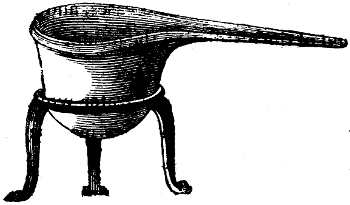
1000lb. of coal-tar produce, upon an average,
from 460 to 480lb. of pitch. A subsequent
fusion, with a gentle heat, converts the coal-pitch
into a substance possessing all the characters
of asphaltum.
Ammoniacal Fluid.—The properties of the
ammoniacal liquor, which accompanies the tar,
and which is deposited in the tar-cistern, has
not yet been fully investigated. It is employed
already in the manufacture of muriate
of ammonia (sal ammoniac). One chaldron
of coal affords from 220 to 240lb. of this
ammoniacal fluid, which is composed chiefly
of sulphate, and carbonate of ammonia.—Such
are the products obtainable from coal.
However certain the practicability of extending
the new lights to the dwelling houses
of every town and village is, it cannot be
expected that such an event should take place
speedily and generally. To eradicate prejudice,
and to alter established habits, is a work which
nothing but time can effect; because prejudice
is the effect of habit, and can seldom be eradicated
from the minds of such individuals as
consider the ready occurrence of a proposition
as a test of its truth. To establish a new philosophical
theory has, in every instance, required
time sufficient to educate an entire generation
of men. The rejection of the Aristotelian philosophy—the
adoption of experimental research—the
substitution of the doctrine of gravitation
instead of that of vortices, and the rejection
of phlogiston by modern chemists, are
sufficiently illustrative of this assertion. New
arts, and new practices, are still more difficult
to be introduced. The new art of bleaching
need merely be mentioned to prove this assertion.
The new grammar—the new rudiments
of science—the new stile—or the new instrument,
however superior to the old in simplicity,
facility, and truth, must be less valuable
to the ordinary teacher or artisan, whose memory
is familiarized with the precepts of the
latter, and whose only ambition is to earn his
subsistence with the least possible exertion.
The slowness with which improvements of
every kind, make their way into common use,
and especially such discoveries as are most calculated
to be of an extended or general utility
is very remarkable, and forms a striking contrast
to the extreme avidity with which those
unmeaning changes are adopted, which folly
and caprice are continually sending forth into
the world under the auspices of fashion.
On the first view of the subject it appears
very extraordinary, that any person should
neglect, or refuse to avail himself of a proposed
invention, or improvement, which is
evidently calculated to economise his labour,
and to encrease his comforts; but when we
reflect on the power of habit, and consider how
difficult it is for a person even to perceive the
disadvantages or imperfections of former modes
to which he has been accustomed from his
early youth, our surprize will be diminished,
or vanish altogether.
Many other circumstances, besides prejudice,
are unfavourable to the introduction of
new and useful discoveries. Among these
jealousy, malice, envy, and revenge, have too
often their share in obstructing the progress
of real improvement, and in preventing the
adoption of plans evidently calculated to promote
the public good.
A plan like the present, which proposes not
only to trench upon domestic habits, but to give
an entire new direction to a portion of the skill
and capital of the country, must necessarily
encounter the most strenuous opposition. It
is thus that some individuals have mustered all
their strength against the introduction of this
new art. An endeavour has been made to
move the public opinion by dismal forebodings
of the Greenland trade, and the subsequent loss
of a nursery of British seamen. This objection
is nothing more than the common clamour
that is always set up against every new means
of abridging labour, to which had the public
listened, an interdict would have been laid
upon the spinning and threshing machines, the
steam engine, and a thousand other improvements
in machinery.
Indeed such clamour scarcely ever fails to be
made when the extension of machinery and the
abridgement of labour or the application of inanimate
powers are considered. On such occasions,
it is stated by certain humane but mistaken
objectors, that the scheme of mechanical
and chemical improvement is pointed against
the human species—that it tends to drive them
out of the system of beneficial employment—that
the introduction of machinery is injurious
to the labouring class of society, by abridging
their work. Two creatures offer themselves for
employment and support—a man and a horse.
I must invariably prefer the latter, and leave
the former to starve. Two other beings—a
horse and a steam-engine, are candidates for
my favour. My preference to the latter tends
to exterminate the species of the former. In
both cases it is stated, that the number of intelligent
creatures capable of the enjoyment of
happiness must be diminished for want of support;
and that, on the whole, the sum of the
proposed improvement is not only a less proportion
of good to society, but a positive accession
of misery to the unemployed poor.
On this wide and extended argument, which
can in fact be maintained against all improvements
whatever in no other way than by insisting
that the savage state of man, with all
its wants, its ignorance, its ferocity, and its
privations, is preferable to the social intercourse
of effort and division of labour we are habituated
to prefer, it may be sufficient to observe
that it includes matter not only for reasoning
and induction, but also for experiment. By
reference to the matter of fact, though it must
be allowed that new improvements, which
change the habits of the poor, must at first
expose them to a temporary inconvenience and
distress, against which, in fairness, it is the duty
of society to defend them; yet the invariable
result of such improvements is always to better
the condition of mankind. A temporary inconvenience
to individuals must often be incurred
for the sake of general national benefit.
It is to manufactories carried on by machinery
and to the abridgment of labour, that this
country is indebted for her riches, her independence
and pre-eminent station among the
nations of the world.
But let us return to the subject.—The progress
of the new mode of lighting with coal-gas
can never wholly supersede the use of
candles and moveable lights. The objection
with regard to the Greenland trade is equally
futile. This traffic, might with more propriety
be called a drain, than a nursery, of
the naval force. The nature of the Greenland
service requires that the crew should consist
chiefly of able-bodied sailors; and being protected
men, not subject to the impress law,
they are thus rendered useless for national defence.
The nursery of British seamen is the
coasting trade; and if the gas-light illumination
be put in practice to a large extent, it will
increase that trade as much as it will diminish
the Greenland fishery.
Even on the extreme supposition that it
would annihilate the Greenland fisheries altogether,
we should have no reason to regret the
event. The soundest principles of political
economy must condemn the practice of fitting
out vessels to navigate the polar seas for oil, if
we can extract a superior material for procuring
light at a cheaper rate from the produce of our
own soil.
Indeed the fisheries will find ample encouragement,
and the consequence of lighting our
streets with gas can prove injurious only to
our continental friends, one of whose staple
commodities, tallow, we shall then have less
occasion to purchase.
There will be less waste indeed, but a greater
consumption of coal. The lower classes of the
community are at present very scantily supplied
with firing; and nothing but a reduction
of price is necessary to increase to a very large
amount the whole average quantity of fuel consumed
in the country. The lightness of the
coke produced in the gas-light manufacture
diminishing the expence of land carriage, will
facilitate its general diffusion—the comforts of
the poor will be materially augmented, and
a number of useful operations in agriculture
and the arts be carried on, which are now
checked and impeded by the price of fuel.
If any additional want were wanted for the
coke it will readily be found in the continental
market; coke being much better suited than
coal to the habits of most European nations.
The gas-light illumination cannot tend to
diminish the coal-trade; on the contrary it
will prove beneficial to it; it will contribute to
lower the price of the superior kinds of coal,
and keep a level which cannot be shaken under
any circumstances; it will contribute to prevent
combinations which do certainly operate
to the prejudice of the public, and do sometimes
put this great town at the mercy of particular
proprietors in the north, who deal out
coal in the way they please. The competition
thus produced, it is impossible not to consider
as an advantage, which would prevent in future
such combinations, and put those in London
out of the reach of them.
It is worthy observation, that the annual
importation of coal into this Metropolis, is
above one million and eighty-eight thousand
chaldrons.[31]
It may be objected to the universality of our
conclusion, that the price of coals, differing
very much in different places, will occasion a
variation in the expence of the new mode of
illumination. But there are two reasons why
this should have less place, because we find,
in Mr. Murdoch’s statement, page 69, that
of 600l. the estimated yearly expence of lighting
the cotton mill, 550l. consist of interest of
capital, and tear and wear of apparatus, leaving
the cost of coal only 50l. a sum so trifling,
when we reflect that it replaces 2000l. worth
of candles, that the price of coal, even where
it is highest, can but slightly affect the general
profits.[32]
2dly, The coal, by yielding the gas and other
products,—namely, tar, pitch, ammoniacal liquor,
&c. of which we have treated already, is
converted into a substance, increased in bulk,
and in the power of producing heat, namely,
coke; and as a manufactory generally requires
heating as well as lighting, there will be a gain
both ways. The manufacturer, by distilling
his coal, instead of burning it as it comes from
the pit, will save his candles and improve his
fuel. One effort at the outset, in erecting a
proper apparatus, will reduce his annual disbursement,
for these two articles of prime necessity,
much in the same manner, (though in
a far greater degree) as the farmer gains by
building a thrashing machine and laying aside
the use of the flail.
The principal expence in the pursuit of this
branch of civil and domestic economy is therefore
the dead capital employed in erecting the
machinery destined for preparing and conveying
the gas; the floating or live capital is comparatively
small. At the same time, were we
to offer an advice to the public on this subject,
it would be, that no private individual resident
in London should attempt to light his premises
for the sake of economy with coal-gas by means
of his own apparatus, whose annual expence
for light does not exceed 60l. because the expence
of erecting and attending a small apparatus
is almost as great as one constructed on a
larger scale would be. For if the quantity of
gas wanted is not sufficient to keep the retorts
continually in a red-hot or working state, the
cost of the gas will be considerably enhanced;
because either the empty retorts must be continued
red-hot, or the fire must be suffered to
go out; and the retorts, when cold, cannot be
brought to a working state, that is to say, be
made red hot again, but at a considerable
expence of fuel, which must be wasted to no
purpose. Whereas, if the retorts are constantly
kept red hot and in action, one half of the coal
necessary to produce a given quantity of gas
will then be saved. But when a street, or a
small neighbourhood is wanted to be lighted,
and the retorts can always be kept in a working
state, that is to say, red hot, the operation
may be commenced with safety; because the
sum required for erecting the apparatus, and
the labour attending it, together with the interest
of money sunk, will then soon be liquidated
by the light which it will afford.
Individuals, therefore, may engage in the
distillation of coal, and trade with advantage
in the articles produced by that process, and
the lighting of cities may be accomplished
without the aid of incorporated bodies; and
parishes may be lighted by almost as many
individuals as there are streets in a parish.
From experiments, made by Mr. Clegg, on
the effects produced by a number of gas-lights,
of a certain intensity, there is reason to believe
that the streets of small towns might be illuminated
at a cheaper rate, by means of a
tower, or pagoda, furnished with gas-lamps,
than can be done in the ordinary way by
street lamps: the gas being conducted to the
top of the building from the apparatus below,
and the light directed down again, upon the
objects to be illuminated, by means of reflectors
placed at a certain angle. By this contrivance,
all the main pipes which convey the
gas through the streets, as well as those collateral
ones that branch out from them to the
street lamps, would be saved, and thus compensate
for the expense of the tower.
The most beneficial application of gas-lights
unquestionably is in all those situations where
a great quantity of light is wanted in a small
place: and where light is required to be most
diffused, the advantages of this mode of illumination
are the least.—Hence, as already
stated, the lighting of the parish, or street-lamps
only, without lighting shops or houses,
can never be accomplished with economy.
We have noticed before the reason why
the price of coals can have little effect upon the
gas-light; because the very refuse, or small
coals, called slack, which pass through the
screen at the pit’s mouth, and which cannot
be brought into the market—nay, even the
sweepings of the pit, which are thrown away,
may be employed for the production of coal-gas.
It makes no difference in what form the coal is
used, and this circumstance may contribute to
enable the coal-merchant to furnish coals in
larger masses, and as they come from the mine,
instead of increasing the bulk by breaking them
into a smaller size,[33] which is a practice commonly
adhered to. This unquestionably reduces
the value of coals; because the quantity
of radiant heat generated in the combustion
of a given quantity of any kind of fuel depends
much upon the management of the
fire, or upon the manner in which the fuel is
consumed. When the fire burns bright, much
radiant heat will be sent off from it; but when
it is smothered up, very little will be generated:
most of the heat produced will then be
expended in giving elasticity to a thick dense
vapour, or smoke, which is seen rising from
the fire; and the combustion being very incomplete,
the carburetted hidrogen gas of the
coal being driven up the chimney without
being inflamed, the fuel is wasted to little purpose.
Nothing can be more perfectly devoid of
common sense, and wasteful and slovenly at
the same time, than the manner in which
chimney fires, where coals are burnt, are
commonly managed by servants. They throw
on a load of (perhaps all small) coals at once,
through which the flame is hours in making
its way; and frequently it is not without
much care and trouble that the fire is prevented
from going quite out. During this time
no heat is communicated to the room; and,
what is still worse, the throat of the chimney
being occupied merely by a heavy dense vapour,
not possessed of any heating power, and,
consequently, not having much elasticity, the
warm air of the room finds less difficulty in
forcing its way up the chimney and escaping,
than when the fire burns bright, and the coal-gas
is ignited. And it happens not unfrequently,
especially in chimnies and fire-places ill-constructed,
that this current of warm air from
the room which presses into the chimney,
crossing upon the current of heavy smoke and
aqueous vapour which escapes slowly from
the fire, obstructs it in its ascent, and beats it
back into the room. Hence it is that chimnies
so often smoke when too large a quantity of
fresh coals is put upon the fire. So many
coals should never be put on the fire at once
as to prevent the free passage of the flame between
them, or to prevent them becoming
quickly heated, so as to give out the carburetted
hidrogen gas which they are capable
of furnishing, and to cause it to be inflamed,
In short, a fire should never be smothered:
and when attention is paid to the quantity of
coals put on, there is little use for the poker;
and this circumstance will contribute much to
cleanliness, and the preservation of furniture.
The author of a paper in the Plain Dealer
asserts, that, of the various perversions of
abilities, there is none that makes a human
being more ridiculous, than that of attempting
to stir a fire without judgment; to prevent
which he lays down the following rules:—1.
Stirring of a fire is of use, because it makes
a hollow where, the air being rarefied by the
adjacent heat, the surrounding air rushes into
this hollow, and gives life and support to the
fire, and carries the flame with it. 2. Never
stir a fire when fresh coals are laid on, particularly
when they are very small, because they
immediately fall into the hollow place, and
therefore ruin the fire. 3. Always keep the
bottom bars clear. 4. Never begin to stir the
fire at the top, unless when the bottom is
quite clear, and the top only wants breaking.
There is one subject more on which it is
necessary to speak.—In the present instance,
the public has been alarmed by representations
that the general adoption of gas-lights
would expose us to innumerable accidents,
from the inflammable nature of the gas, and
the explosion of the apparatus in which it is
prepared, or the bursting of the pipes by
which it is conveyed. But there is no ground
for such fears.
Those who are familiar with the subject
will readily allow, that there is no more risk
in the action of a gas-light machinery, properly
constructed, than there is in the action
of a steam-engine, built on just principles.
The manufacture of the coal-gas requires
nothing more than what the most ignorant
person, with a common degree of care and
attention, is competent to perform. The heating
of the gas-furnace, the charging of the
retorts with coal, the closing them up air-tight,
the keeping them red-hot, and discharging
them again, are the only operations required in
this art; and these, surely, demand no more
skill than a few practical lessons can teach to
the meanest capacity. The workman is not
called upon to exercise his own judgment,
because, when the fire is properly managed,
the evolution of the gas goes on spontaneously,
and without further care, till all the gas is extricated
from the coal.
No part of the machinery is liable to be out
of order,—there are no cocks to be turned, no
valves to be regulated; nor can the operator
derange the apparatus but by the most violent
efforts. And when the stock of gas is prepared,
we may depend on its lighting power as much
as we depend on the light to be obtained from
a certain number of candles or oil-lamps.
The diversified experiments which have been
made by different individuals, unconnected
with each other, have sufficiently established
the perfect safety of the new lights; and numerous
manufactories might be named in
which the gas-lights have now been in use for
upwards of seven years, where nothing like an
accident has occurred, though the apparatus
in all of them is entrusted to the most ignorant
man.
It would be easy to state the causes which
have given rise to some of those accidents
that have spread alarm amongst the public;
but of this it is not my business to speak
at length. It is sufficient, on the present
occasion, to state, that those melancholy
occurrences which have happened at some
gas-light establishments which I have had an
opportunity of examining, were totally occasioned
by egregious failures committed in the
construction of the machinery. Thus, an
explosion very lately took place in a manufactory
lighted with coal-gas, in consequence
of a large quantity of gas escaping into a
building, where it mingled with common air,
and was set on fire by the approach of a lighted
candle. That such an accident could happen,
is an evident proof that the machinery was
erected by a bungler, unacquainted with the
most essential principles of this art; because
such an accident might have been effectually
prevented, by adapting a waste pipe to the
gasometer and gasometer house. By this
means, if more gas had been prepared than
the gasometer would contain, the superfluous
quantity could never have accumulated, but
would have been transported out of the building
into the open air, in as an effectual manner
as the waste-pipe of a water cistern conveys
away the superfluous quantity of water, when
the cistern is full. Such an expedient did not
form part of the machinery.
Other instances might be named, where explosions
have been occasioned through egregious
mistakes having been committed in the
erection of the gas-light machinery, were this
a subject on which I meant to treat.
That the coal-gas, when mixed with a certain
portion of common air, in close vessels,
may be inflamed by the contact of a lighted
body, as has been stated, page 98, is a fact
sufficiently known. But the means of preventing
such an occurrence in the common application
of gas-lights, are so simple, easy, and
effectual, that it would be ridiculous to dread
danger where there is nothing to be apprehended.
In speaking thus of the safety of the
gas-light illumination, I do not mean to deny
that no possible circumstances may occur
where the coal-gas may be the cause of accident.
It is certain that the gas, when suffered
to accumulate in large quantities in close
and confined places, where there is no current
of air, such as in cellars, vaults, &c. and where it
can mix with common air, and remain undisturbed,
that it may be liable to take fire when
approached by a lighted body; but I do not
see how it is probable that such an accumulation
of gas should take place in the apartments
of dwelling houses. The constant current
of air which passes continually through
the rooms, is sufficient to prevent the possibility
of such an accumulation ever to take
place. And with regard to the bursting of the
pipes which convey the gas, no accident can
possibly happen from that quarter; because the
gas which passes through the whole range of
pipes sustains a pressure equal to the perpendicular
weight of about one inch of water only,
and such a weight of course is insufficient to
burst iron pipes. Nor could the town when
illuminated by gas-lights, be thrown suddenly
into darkness, as has been asserted might happen
by the fracture of a main pipe, supposing
such an event should take place; because the
lateral branches, which supply the street-lamps
and houses, are supplied by more than one
main; and the consequence of a fracture
would be only an extinction of the few lamps
in the immediate vicinity of the broken pipe,
because the rest of the pipes, situated beyond
the fracture, would continue to be supplied
with gas from the other mains, as will become
obvious from the sketch exhibited in the next
page.
Main pipe, leading from the Gas-light station or
apparatus,
situated in Brick Lane, near Old St.[34]
Main pipe, leading from the gaslight apparatus,
or station, at Norton Falgate.[35]
Main pipe, leading from the gaslight apparatus,
or station,
in Westminster.[36]
The black lines represent the gas-light
mains, or largest pipes, from which the smaller
pipes branch off: they are connected with
each other at the places marked A B C; and
the dotted lines represent the smaller mains,
or collateral branches before-mentioned. The
main pipes are all furnished with valves, or
cocks, placed at about 100 feet distant from
each other. Now let us suppose that a main
pipe, in any part of the street marked in the
sketch, Pall Mall, should break, it is evident,
on mere inspection, that the gas which is
passing through the main in the Strand, and
which is also connected with the main in the
Haymarket, Piccadilly, and Coventry Street,
would continue to supply the broken pipe, and
the valve nearest to the fracture being shut,
would prevent the loss of any considerable
quantity of gas, and the few lamps situated
between the two valves and the fracture would
therefore only become extinguished.
Further, let us suppose a main pipe should
break in Piccadilly; in that case, the valve
being shut on each side of the fracture, the gas
would be supplied from the mains in the Haymarket
and St. James’s Street. And the same
effect would be produced in any part of the
town, supplied with gas-pipes. Besides all
this, in the statement thus far given, we have
assumed that all the gas-light mains are supplied
with gas from one manufacturing station
only, but which in reality is not the case. The
range of pipes that convey the gas is connected
with three gas-light establishments, situated
at different parts of the town; and the gas
which is supplied from these stations is connected
with the whole system of pipes in the
streets.[37] If, therefore, one of the manufactories
should be annihilated, it would make no
difference, because the lights would be amply
supplied from the other two manufacturing
stations. Hence it is obvious, that the fracture
of any of the gas-light mains, or even the total
destruction of one or more of the manufactories
themselves, would be attended with no
serious consequence; and as the system of
lighting with gas becomes more extended,
the manufactories, or stations for supplying
it, will also be multiplied, to give effect and
security to the whole.
In fact, no danger can arise from the
application of gas-lights in any way, but
what is common to candle-light, and lamps
of all kinds, and is the fault of none of them.
Even in this case the gas-lights are less
hazardous. There is no risk of those accidents
which often happen from the guttering or
burning down of candles, or from carelessly
snuffing them. The gas-light lamps and
burners must necessarily be fixed to one place,
and therefore cannot fall, or otherwise become
deranged, without being immediately extinguished.
Besides, the gas-light flames emit
no sparks, nor are any embers detached from
them. As a proof of the comparative safety
of the gas-lights, it need only be stated, that
the Fire-offices engage themselves to insure
cotton-mills, and other public works, at a less
premium, where gas-lights are used, than in
the case of any other lights.[38] The excessive
expence of insurance arising from the numerous
candles employed in most of the first rate
manufactories, and the combustible nature of
the structure of the buildings; the great difficulty
of retrieving the injury resulting to a
well-organised business, from the accidental
destruction of the machinery, are objects
alone sufficient to furnish the strongest economical,
as well as political recommendations,
for the adoption of the new lights in all manufactories
where work is done by candle-light.
After considering the facts so far detailed,
many other advantages, connected with the
gas-light illumination, will naturally suggest
themselves to the reader. I have endeavoured
merely to point out the leading characters of
the new lights, as they are at present. Ingenious
men may speculate from what has been
done to what remains to be effected, which,
no doubt, will embrace objects of the greatest
utility and most extended national importance.
The public attention is awakened to the
new properties of coal, and will not rest till
they are extensively applied to economical
purposes. The consequence will be, a considerable
defalcation in the revenue. For, in
proportion as the gas-lights are more or less
generally adopted in all towns of the country,
the consumption of oil and tallow will be diminished,
and the impost on those articles
become less productive; and when this takes
place, Government, no doubt, will share in
the profits, by levying a tax on the new lights.
The Exchequer will thus have nothing to
fear; as one branch of the revenue fails, another,
and a more productive one, will supply
its place.
Upon the whole, when we reflect that the
object of the gas-light illumination is to open
a source of national wealth, of which nothing
can deprive us, to create, we may almost say,
new articles of value, its friends cannot be
thought guilty of great presumption, if they
look forward with confidence to the successful
extension of this new art of civil economy;
and if, contrary to all expectations, the effects
of jealousy and prejudice should, in some respect
or other, continue here and there its
influence against this new art of procuring
light, a firm perseverance of its application
must at length remove that ignorance which
alone can give them birth.
EXHIBITING
The quantity of Gas, Coke, Tar, Pitch, Essential Oil, and Ammoniacal Liquor, obtainable from a given
quantity of Coal; together with an Estimate of the quantity of Coal necessary to produce a quantity of Gas,
capable of yielding a Light equal in duration of time and intensity to that produced by Tallow Candles of
different kinds.
| |
Cost of Coal. |
Weight of Coal. |
Produce of Gas, in cubic feet. |
|
- |
[39]Equal to as many tallow candles, 12 in the pound, burning two hours; or to |
Candles. |
| |
Mini-
mum. |
|
Maxi-
mum. |
|
Aver-
age. |
Min. |
|
Max. |
|
Aver. |
Min. |
|
Max. |
|
Aver. |
9,516
8,651 |
11
10 |
to the pound.
to thdo. |
One Chal.
of Coal,
from 25
to 28 cwt. |
|
- |
40 |
s |
|
to |
60 |
s |
|
— |
50 |
s |
|
2,800 |
|
to |
3,136 |
|
— |
2,968 |
|
8,906 |
to |
11,872 |
— |
10,388 |
[39] |
7,786
6,921
6,556
5,194 |
10
9
8
7 |
to thdo.
to thdo.
to thdo.
to thdo. |
| One Ton |
30 |
s |
|
to |
48 |
s |
|
— |
38 |
s |
6 |
d |
|
2,240 |
|
6,720 |
to |
8,960 |
— |
7,840 |
|
4,325 |
5 |
to thdo. |
| One Sack |
3 |
s |
4 |
d |
to |
5 |
s |
|
— |
4 |
s |
2 |
d |
233 |
|
to |
261 |
|
— |
247 |
|
741 |
to |
988 |
— |
814 |
|
3,463 |
4 |
to thdo. |
| One Bushel |
1 |
s |
2 |
d |
to |
1 |
s |
8 |
d |
— |
1 |
s |
5 |
d |
78 |
|
to |
87 |
|
— |
82 |
1⁄2 |
247 |
to |
330 |
— |
290 |
|
2,595 |
3 |
to thdo. |
| One Peck |
|
3 |
1⁄2 |
to |
|
5 |
d |
— |
|
4 |
1⁄4 |
19 |
1⁄2 |
to |
21 |
1⁄4 |
— |
20 |
1⁄4 |
61 |
to |
82 |
— |
71 |
1⁄2 |
1,730 |
2 |
to thdo. |
| One Pound |
|
1⁄4 |
|
1 |
|
3 |
to |
4 |
— |
3 |
1⁄2 |
866 |
1 |
to thdo. |
| |
Coke.—One chaldron of coal, from 25 to 28 cwt. gives 11⁄4 to 1½ chaldron of Coke. |
| |
Tar.—One chaldron of coal, from 25 to 28 cwt. gives from 150 to 180lb. of Tar,[39] or 15 to 18 ale gallons, 10lb. each. |
| |
Ammoniacal Liquor.—One chaldron of coal, gives from 220 to 240lb. of Ammoniacal Liquor, or 22 to 24 ale gallons. |
Tabular View, exhibiting the illuminating power of Coal-Gas, compared with the illuminating power
of Tallow Candles of different sizes.
| One chaldron of Coal produces, according to weight and quality, |
| |
Burning. |
Candles. |
12 to 1lb. |
|
6 to 1lb. |
| Cubic feet of Gas. |
Average. |
1 |
hour |
= |
21,000 |
= |
10,500 |
| From |
9,000 |
to |
12,000 |
10,500 |
2 |
hours |
= |
10,500 |
= |
5,250 |
| |
6,000 |
|
8,000 |
7,000 |
3 |
ditto |
= |
7,000 |
= |
3,500 |
| |
4,500 |
|
6,000 |
5,250 |
4 |
ditto |
= |
5,250 |
= |
2,625 |
| |
3,600 |
|
4,800 |
4,400 |
5 |
ditto |
= |
4,400 |
= |
2,200 |
| |
3,000 |
|
4,000 |
3,500 |
6 |
ditto |
= |
3,500 |
= |
1,750 |
| |
2,571 |
|
3,428 |
3,005 |
7 |
ditto |
= |
3,005 |
= |
1,502 |
| |
2,250 |
|
3,000 |
2,625 |
8 |
ditto |
= |
2,625 |
= |
1,312 |
| |
2,000 |
|
2,666 |
2,333 |
9 |
ditto |
= |
2,333 |
= |
1,166 |
| |
1,800 |
|
2,100 |
2,100 |
10 |
ditto |
= |
2,100 |
= |
1,050 |
| |
1,636 |
|
2,191 |
1,913 |
11 |
ditto |
= |
1,913 |
= |
956 |
| |
1,500 |
|
2,000 |
1,750 |
12 |
ditto |
= |
1,750 |
= |
875 |
| |
1,384 |
|
1,846 |
1,615 |
13 |
ditto |
= |
1,615 |
= |
807 |
| |
1,285 |
|
1,714 |
1,499 |
14 |
ditto |
= |
1,499 |
= |
749 |
| |
1,200 |
|
1,600 |
1,400 |
15 |
ditto |
= |
1,400 |
= |
700 |
| |
1,125 |
|
1,500 |
1,312 |
16 |
ditto |
= |
1,312 |
= |
656 |
| |
1,058 |
|
1,111 |
1,234 |
17 |
ditto |
= |
1,234 |
= |
617 |
| |
1,000 |
|
1,333 |
1,166 |
18 |
ditto |
= |
1,166 |
= |
583 |
| |
947 |
|
1,263 |
1,105 |
19 |
ditto |
= |
1,105 |
= |
552 |
| |
900 |
|
1,200 |
1,050 |
20 |
ditto |
= |
1,050 |
= |
525 |
| |
857 |
|
1,143 |
1,000 |
21 |
ditto |
= |
1,000 |
= |
500 |
| |
818 |
|
1,095 |
956 |
22 |
ditto |
= |
956 |
= |
478 |
| |
783 |
|
1,044 |
913 |
23 |
ditto |
= |
913 |
= |
456 |
| |
750 |
|
1,000 |
875 |
21 |
ditto |
= |
875 |
= |
437 |
N. B. If it be required to know, for how many hours one pound,
or one peck, or one bushel, or one sack, of coal will produce Gas
Light equal to that of a certain number of well-snuffed Tallow Candles,
the proportion of each of the average weights of a pound, peck,
bushel, or sack, to that of the average weight of a chaldron of coal,
is as follows:
| |
1 |
lb. |
= |
2968th |
part of a chaldron. |
| One peck |
20 |
|
= |
148th |
ditto. |
| One bushel |
82 |
|
= |
36th |
ditto. |
| One sack |
248 |
|
= |
12th |
ditto. |
Rule.—Divide with either of the above parts of weight, the
number of lights opposite to their hours, and the product will be the
number of lights burning for the same number of hours.
Example.—To know how many lights one peck of coal will
give for six hours, divide the 148th part in 3,500, opposite to the
number of six hours, the product is almost 24 lights. The same
rule holds good for any given quantity or number of pounds of coal,
in a chaldron, to find how many lights, or candles, 12 to the lb. or
6 to the lb. they will give for a given number of hours.
Exhibits a perspective view of a gas-light apparatus,[40]
for lighting factories, or small districts of
houses. It consists of the following parts: which
may be considered separately.
Fig. 1. The Retort Furnace, for distilling the
coals. It is built of brick-work. The bricks which
are exposed to the immediate action of the fire,
are Welch tumps, or fire-bricks; they are bedded
in clay, or Windsor loam.
Fig. 2. The Tar Cistern, to collect the coal-tar,
and other condensible products obtained during the
distillation of the coals. It is a cast-iron hollow
cylinder, closed at the top with a cast-iron cover,
which has a very small hole to allow the air to escape
as the liquid enters into the vessel.
Fig. 3. The Lime Machine, for purifying the
crude coal-gas, and to render it fit for use. The
construction of this machine will be explained in
plate VII. It is put together of cast-iron plates.
Fig. 4. The Gasometer, for collecting and preserving
the purified gas, and for distributing and
applying it as occasion may require. It consists
of two principal parts—namely, a large interior
vessel closed at the top and open at the bottom,
made of sheet iron, designed to contain the gas,
and an outer cistern or vessel, of rather greater capacity,
constructed of cast-iron plates, in which the
former vessel is suspended. The latter contains the
water by which the gas is confined. The interior
vessel which contains the gas is suspended by chains
hung over wheels or pullies, to which weights are
attached, so as to be just sufficient to balance the
weight of the gasometer, all but a small difference,
and allowing its slow descent in the manner which
is found as nearly adapted as can be to the proper
supply of the lamps. The weight of the chains must
be equal to the specific gravity of the material of
which the gasometer is composed, so as to compensate
accurately for the quantity of water which the
gasometer displaces, or what is the same, it must be
equal to the loss of weight which the gasometer
sustains, when immersed in the water; and the
counterpoise weight must be equal (or nearly so)
to the absolute weight of the gasometer.
The action of these different parts of the apparatus
will be obvious from the following explanation:
A, A, are two iron retorts, placed horizontally,
and side by side, in the furnace; the mouth of the
retorts where the coals are introduced, projects into
an arched chamber, situated in front of the furnace,
as shewn in the drawing by the broken down brick-work.
The object of suffering the mouth of the
retorts to project into a separate chamber, is merely
to discharge with convenience the red hot coke from
the retorts when the process is at an end; the coke
being suffered to fall to the bottom of the chamber,
where it cools, without becoming troublesome to
the operator. It may be removed from this fire-safe
chamber by the door represented at the end
view of the furnace.
When the operation commences, the inner vessel
of the gasometer, fig. 4 is sunk down, to expel the
air which it contains to a level with the exterior
vessel, or outer cistern, of the gasometer; and,
consequently, becomes filled with water. As the
distillation of the coal in the retorts proceeds, the
liquid and gazeous products evolved from the coals
are transmitted by means of the perpendicular syphon
pipes B, B, into the horizontal pipe or main
condenser C, with which they are connected. The
liquid which is distilled, collects in the pipe, or
main condenser, C, where it is retained until its
quantity has risen so high as to discharge itself into
the pipe D, which is connected with the upper part
of one of the extremities of the condenser, C. One
of the extremities of the pipes, B, B, therefore become
immersed into the liquid contained in the
main condenser or pipe C, whilst the vaporous or
condensible fluid, after having overcome the pressure
there opposed to it, is transported into the pipe E,
which, after passing in a serpentine direction, E, E,
&c. through the exterior vessel or cistern of the gasometer,
terminates in the tar-vessel, fig. 2. Thus the
vaporous fluids are condensed by passing through the
serpentine pipe, E, E, &c. and become deposited in
the tar-cistern, fig. 2; whilst the non-condensible or
gazeous products are made to proceed by the pipe F,
which branches off from the pipe E, into the lime
machine, fig. 3. In this apparatus the gas, as it
is evolved from the coals, comes into contact with
slaked lime and water; the object of which is,
to strip it of its sulphuretted hydrogen and carbonic
acid gas with which it always abounds,
and to render it fit for illumination. This being
accomplished, the purified gas is conducted away
out of the lime machine by means of the pipe G,
into the perpendicular pipe H, which branches up
through the bottom of the gasometer cistern. The
upper extremity of this pipe is covered, in the manner
of a hood, by a cylindrical vessel I, open at
bottom, but partially immersed beneath the surface
of the water contained in the outer cistern of the
gasometer, it is also perforated round near the lower
edge with a number of small holes. The gas, as it
passes out of the pipe H, displaces the water from
the receiver I, and escapes through the small holes,
and is thus made to pass through the water in the
cistern, in which the hood of the pipe I, is partly immersed,
so as to expose a large surface to its action,
that it may once more be washed, and deprived of
all the foreign gazeous products which might have
escaped the action of the lime, whilst it was agitated
with this substance in the lime machine, fig. 3.
After rising through the water in the gasometer
cistern, it enters into the gasometer, which then ascends
as the gas accumulates in it.
In this manner the process proceeds, until the
whole of the volatile products of the coal in the
retort are disengaged. The use of the gasometer is,
partly to equalize the evolution of the gas which
comes from the retort more quickly at some time
than others. When this happens, the vessel rises up
to receive it, and when the stream from the retort
diminishes, the weight of the gasometer expels its
contents, provided the main-cock be open. When
the process is finished, the retort is suffered to cool,
and its lid is then removed to replenish it with coal.
When the main stop-cock is then opened, the gasometer
descends, and the gas passes from the gasometer
through the pipe K, to the burners, or main
pipe, which communicates with the gas burners or
lamps. L, is a wooden tub or barrel, containing the
mixture of lime and water, for charging the lime
machine; and into which the contents of the barrel,
L, may be conveyed by the curved pipe M, without
admitting common air. N, N, is a water-pipe, to
convey fresh water into the gasometer cistern occasionally;
because it is essential that the water used
for washing and purifying the gas should be changed
for fresh as soon as it becomes dirty; and unless
this is done, the gas will not be perfectly purified
by washing, but produce a disagreeable odour when
burnt; the same holds good with regard to the lime
machine, the contents of which should be renewed
occasionally. This pipe also conveys the necessary
water into the barrel, L. O, is a waste-pipe, to convey
the water as it becomes impregnated with the
impurities of the gas, out of the gasometer cistern.
P, is an agitator, to stir up the contents of the lime
machine occasionally, Q, Q, are two iron rods, which
serve as stays to guide the motion of the gasometer.
R, is an index, connected by means of a shaft and
pulley with the axis of one of the gasometer wheels.
This index is graduated to the capacity of the cubical
contents of the gasometer, so as to indicate, by the
rising and falling of the gasometer, its relative contents
of gas expressed in cubic feet. S, is the waste
pipe of the lime machine, to remove the insoluble
parts of the lime. T, represents the iron cover, or
lid, which is turned on the lathe, and ground air-tight,
to close up the mouth of the retort, so as to
make readily an air-tight fitting. U is an iron wedge
to secure the cover of the retort. The left-hand
retort in the design shows the retort closed up,
and the cover, or lid of the mouth of it secured by
means of the wedge, in its place, so as to render the
mouth of the retort perfectly air tight.
There is a safety valve attached to this gasometer
which could not be represented in the drawing; and
the object of which is, to convey away any portion
of gas that might happen to be produced by a careless
operator, when the gasometer is full, and which
is thus prevented from accumulating in the place
where the gasometer is erected. It is represented in
the right-hand corner of plate VII. where fig. 1
shows the edge of the gasometer; 2, the surface of
the water in the inside of the gasometer; 3, the surface
of the water in the outside of the gasometer, or
in the cistern; 4, a pipe issuing from the lower edge
of the gasometer, and surrounded at its upper extremity
with a cup marked 5; 6, the waste pipe, the
mouth of which is immersed in water. It is obvious
that, when the gasometer is full, if an additional
quantity of gas should be attempted to be put into
it, it will be transported by means of the pipe 4, into
the waste-pipe 6; the upper extremity of which
reaches out of the building, and there communicates
with the open air.
Represents a Portable experimental Gas Apparatus
for exhibiting, in the small way, the general
nature of the gas-light illumination.—It is described
page 79.
Show designs of various kinds of Gas Lamps,
Chandeliers, Candelabras, &c.—See pages 114, 118,
140.
Fig. 1. Exhibits a design of the gasometer
framing, or skeleton, which serves to give stability
and strength to the gasometer. It consists of
wooden frame work, marked A, A, A, interlaced
with iron rods, B, B, B, &c. The whole framing is
so disposed that it will float in the cistern horizontally,
and therefore keep the gasometer perfectly
steady and level with the surface of the water.
The rest of the sketches represent various kinds
of gas pipes employed as mains for conveying the
gas, and the methods of connecting them.
Fig. 2. Represents a longitudinal section of a
Spigot and Faucet Pipe. These kinds of pipes are
applicable in most cases as mains for conveying gas.
A, is called the spigot, and B, the faucet. They
are joined together, and made air tight, by iron
cement, the composition of which is as follows:
Take two ounces of sal ammoniac, one ounce of
flowers of sulphur, and sixteen ounces of cast iron
filings or borings. Mix all well together, by rubbing
them in a mortar, and keep the powder dry.
When the cement is wanted for use, take one
part of the above powder, and twenty parts of
clean iron borings or filings, and blend them intimately
by grinding them in a mortar. Wet the
compound with water, and when brought to a
convenient consistence, apply it to the joints with
a wooden or blunt iron spatula.
By a play of affinities, which those who are at
all acquainted with chemistry will be at no loss
to comprehend, a degree of action and re-action
takes place among the ingredients, and between
them and the iron surfaces, which at last causes
the whole to unite as one mass. In fact, after a
time, the mixture and the surfaces of the flanches
become a species of pyrites (holding a very large
proportion of iron,) all the parts of which cohere
strongly together.
The inner parts of the faucet ought to be no
larger in diameter than just to fit the spigot. This
supports the pipe, independently of the cement, and
prevents the risk of hurting the joint from any
external stress. The inner faucet is commonly made
about 21⁄2 inches deep, and has the spigot inserted
11⁄2 inch into it. The practice of some workmen, is
to make the outer faucet, or that which contains the
cement, six inches deep, for all pipes above six
inches diameter; and to make the faucets of all
pipes below six inches, the same depth as the diameter
of the pipes. It is usual to make the space
for the cement, all round the spigot, from 1 to 11⁄2
inch; that width is required, in order that the
cement may be firmly driven into the joint. When
the space is very narrow, this cannot be done. On
the other hand, when too wide, there is a waste of
cement, and a risk of injury from unequal expansion.
Fig. 3. Exhibits a profile view of these kinds of
pipes when joined together. The spigot and faucet
pipes are liable to burst from the great expansion
of the spigot, and the risk of this accident is increased
by increasing the space between the spigot and faucet,
which requires to be filled with cement.
Fig. 4. Represents a longitudinal section of two
flanch pipes, and the modes of connecting them.
A and B, show the parts of the pipes; and C and
D, the flanches. These pipes are also joined together,
and rendered air-tight, by interposing between
the flanches rope-yarn, hemp, or some other pliable
material, and iron cement, and then screwing up the
faces of them by means of the bolts and screw nuts.
Fig. 5. Profile view of the same kind of pipes
connected together, A and B, the pipes; C and D,
the flanches; E and F, the bolts.
Fig. 6. Represents the method of joining spigot
and faucet pipes when they are to have a turn or
angle. This method is convenient when the place
where the turn required to be made is previously
known, and the pipes cast accordingly.
Fig. 7. Exhibits the method of connecting spigot
and faucet pipes when they have a round turn. A
and B, the junctures of the pipes.
Fig. 8. Represents a longitudinal section of the
mode of joining pipes by means of what is called
a thimble joint. The junctures of the pipes to be
connected, are made air tight, as mentioned already,
by iron cement. A, the thimble or small cylinder,
with projecting edges, which unites the pipes B, C.
Fig. 9. A thimble joint made in two parts, which
is sometimes convenient to join pipes. The parts
are joined together by screw bolts, and nuts, in the
usual manner.
Fig. 10. Section of the same.
Fig. 11. Represents a profile view of what is
called the saddle joint. It is employed for taking
off a branch-pipe. The branch has a piece A B,
formed on its end, and fits round one-half of the
outside of the pipe from which it is to proceed.
C, is called the saddle, which fits round the other
half of the pipe. The parts are secured together
by screw bolts, and iron cement. By this method
a branch may be formed on any part of a gas-pipe,
by cutting a hole there, and applying the
branch to that place. Where there is much risk
of the inequality of expansion, the joints at certain
places, should be secured by a soft stuffing
of hemp and tallow; but in most cases the joints
may be made with iron cement. Lead is frequently
used for making the joints of gas pipes instead of
iron cement, though cheaper and more easy of
repair. The galvanic action which takes place
between the lead and iron, soon renders the joints
leaky, and the danger is increased by the unequal
expansion of the two metals.
Fig. 12. Section of the saddle-joint.
Before the gas is suffered to enter into the pipe,
they should be proved to be sound, by the usual
process of forcing water into them: The pipes
serving as mains, are placed perfectly solid, so that
they cannot give way; their course should be rectilinear,
having a descent of about 1 inch in 9 or
10 feet, to allow the water of condensation which
may be deposited from the gas by a change of temperature
to collect readily at the lowermost part.
Fig. 13. Shows a reservoir for collecting the water
of condensation which might accumulate in the
pipes. It consists of a receptacle, A, in which the
water may pass; B, a branch-pipe closed at the top,
by means of which the water may be removed, by
drawing it out with a syringe. This receptacle is
placed in those situations where pipes incline towards
each other.
Exhibits a perpendicular section of a gas-light
apparatus, calculated for lighting towns, or large
districts of streets and houses.
Fig. 1. The Retort Furnace. The retorts are
placed over each other in one or more rows; so
that a certain number of them may be heated by
separate fire-places. A, A, shows two of the retorts
placed horizontally above each other; B, the fire-place;
C, the flue which causes the fire to circulate
round the retorts so as to heat them equally in
every part; D, the opening of the flue where the
fire passes into the chimney; E, the ash-pit; F, a
chamber in front of the retort furnace, into which
the orifice or mouth of the retorts project; G, G, the
doors of the chamber, to enable the workmen to
charge and discharge the retorts; H, a funnel shaped
hole at the floor of the chamber F, through which
the red hot coke as it is discharged from the retorts
passes into the arched vault I; K, the syphon tube;
L, the horizontal condenser[41]—the action of both of
these pipes have been already explained, p. 168;
M, main pipe, which conveys the liquid substances
from the condenser, to the tar cistern, fig. 3, and
which conducts also the gazeous products into the
lime machine, fig. 2; N N, shows that part of the
pipe which is interposed between the tar cistern,
fig. 3, and the condensing pipe M,—it passes in a
serpentine direction along the inner sides of the
gasometer cistern, and, like the so-called worm in
a distillatory apparatus, condenses the products
which escape in a vaporous state from the condenser
L; O, shows the place where the serpentine pipe
N N, passes again out of the gasometer cistern, and
its communication with the lime machine, fig. 2, and
tar chamber, fig. 3. The action of the lime machine
is as follows: The liquid products evolved from the
coal, having been deposited in the tar cistern, fig. 3,
by means of the serpentine pipe N, N, the gazeous products
which accompany it, are conveyed by means of
the pipe P, which branches out from the pipe O, into
the interior receptacle of the lime machine marked Q,
which consists of a vessel open at the bottom, and
closed at the top, where it communicates with the
pipe O. As the gas accumulates in the interior part Q,
of the lime machine, it is made to pass through the
liquid which it contains, namely, slaked lime and
water; and escapes through appertures made in
the horizontal partitions R, R, R, R, into the outer
vessel, S, of the lime machine and from thence it is
conducted away by the pipe T, T, T, into the additional
washing apparatus, of the gasometer; fig. 4,
the construction of this apparatus, greatly resembles
the lime machine, fig. 2, namely, V, is a water
pipe, proceeding from a cistern U, placed 3 or 4 feet
above the orifice of the pipe V; T, T, is the gas-pipe,
covered with a hood, marked W, and immersed in a
small cistern, having horizontal perforated shelves,
like those in the lime machine—they fit close to the
hood. The gas which enters the hood W, meets with
a shower of water delivered by the pipe V. The gas,
as it passes through the holes in the horizontal partitions,
is, therefore, again washed and thoroughly
purified from foreign gases which may have escaped
the action of the lime machine; Y, is a waste pipe,
the lower extremity of which is sealed by being immersed
in water,—it serves to carry away the water
delivered by the pipe V, as it has been acted on by
the gas. The summary action of this gas apparatus
is, therefore, as follows: The liquid products obtained
from the coal during the distillation are first
deposited in the main condenser L, by means of the
pipe K, and from whence they cannot escape until
a quantity of tar has accumulated in it to a certain
height, and by this means, one of the extremities of
the pipes K, K, becomes immersed and hermetically
sealed by the liquid which the condenser L, contains.
The liquid products, after having accumulated to a
certain height in the condenser, overflow the perpendicular
portion which it contains, and discharge
themselves into the pipe M, from whence they are
transported into the tar cistern, fig. 3, by means of
the system of pipes N, N, O, whilst the gazeous products
are made to pass by means of the branch
pipe P, into the lime machine, fig. 2. From this
part of the apparatus the gas passes through the
pipe T, T, T, into the additional or smaller washing
apparatus placed upon a tressel in the cistern of the
gasometer, where it is again exposed a second time
to the action of a current of fresh water; and from
this vessel the gas ascends into the gasometer. The
gasometer is furnished with a pipe A, closed at the
top, and fixed in one corner of the gasometer, but
open at the bottom; it includes another pipe marked
B, which communicates with the main pipe leading
to the burners, or place where the gas is wanted. The
pipe A, which slides over the pipe B, is perforated at
the top, the gas passes through these perforations
and is thus made to enter into the pipe B, and
disposed of as mentioned. C, C, is a tube of safety
adapted to the gasometer; its lower extremity remains
sealed by the water in the cistern so long as
the gasometer is not overcharged with gas; but, if
more gas should be made to enter the gasometer
than it is destined to receive, this pipe then delivers
the gas into the funnel-shaped tube D, which reaches
through the roof of the gasometer house, and thus
the superfluous quantity of gas is conveyed away
into the open air.
The cylindrical vessel P, of fig. 3, surrounding
the orifice of the pipe O, which delivers the tar into
the tar cistern, fig. 3, serves to keep this pipe constantly
immersed into a portion of tar, so that the
contents of the cistern may be drawn off by the cock
without admitting air into any part of the apparatus.
The tar cistern has a small hole at the top, to allow
the air which it encloses to escape, as it becomes filled
with tar and ammoniacal liquor. The main condenser
L, is placed, as shown in the drawing, higher
than the level of the water in the gasometer cistern,
to allow a free descent of the distillatory liquids as
they pass from this vessel along into the pipes M, N, O,
&c. The cistern of the gasometer, as well as the lime
machine, and tar cistern, are constructed of cast iron
plates, bolted and cemented together with iron cement.
The gasometer is made of sheet iron plates
rivetted together—E, E, are two iron stays—G, G, are
friction wheels.
We have mentioned already that the pressure of
the gas in the gasometer should be invariable, for it
is obvious that the weight of the gasometer is constantly
increasing in proportion as it fills with gas,
and rises out of the water—see p. 88, and 167. To
render its pressure uniform, we first take the absolute
weight of that part of the gasometer which becomes
immersed in the water, and knowing the specific
weight of the substance of which it is composed,
we divide its absolute weight by the specific weight
of the substance of which it is composed; and this
being done, we make part of the chain, (measured
at right angles from the axis of the wheels over
which it passes downwards towards the top of the
gasometer,) which is equal to the length of that part
of the gasometer which becomes immersed in water,
equal in weight to the specific gravity of the substance
of which the gasometer is composed. For example,
let us suppose that the part of the gasometer which
becomes immersed in water weighs 861 lb. and that
it is composed of sheet iron, the specific gravity of
which, in round numbers, we will take to be 7. It
is then evident, that the part of the chain of the gasometer
measured downward from the axis of the
wheel over which it passes, and which is equal in
length to the height of the gasometer, must be loaded
with a weight of, or must itself weigh, 123lb. for this
would be the weight of the water displaced by the
gasometer; or let us suppose the gasometer to be
made of sheet copper, the specific weight of which
(omitting decimals) is 8; and that the absolute
weight of the gasometer is 1792lbs. then the chain
of the gasometer equal in length to the height of
the gasometer, immersed into the water must weigh
224lb. for this would be the weight of the quantity
of water which the gasometer displaces. This being
accomplished by then adding or diminishing the absolute
or balance weight of the gasometer, any desired
uniform pressure may be effected, and the same bulk
of gas will always be of the same specific gravity.
Particular care must be taken to make the joints
of the mouth-pieces of the retorts perfectly air tight,
which may be done in the following manner:—Take
some common clay, dry, pulverize, and sift it, then
add as much water as will make it into the consistency
of treacle; make the mouth-piece and the
lid of the retort clean, lay this luting thinly over
the turned part of the lid, press the lid so luted
gently to the mouth-piece, and then secure it moderately,
by means of the iron wedge: if the workman
observes this rule, he will never fail to make
good joints; but if, on the other hand, the operator
is careless and neglects to remove the old luting,
&c. from the turned or smooth part of the mouth of
the retort, and thereby cause a bad joint, the consequence
will be the loss of a considerable quantity of
gas, and a very disagreeable smell and smoke.
The bridge or row of bricks of the flue C, of the retorts,
should never be made hotter than a bright red,
which may be regulated by the door of the ash-pit
being kept close shut when the fire is getting too hot.
If the operator neglects this, and suffers the fire-bricks
to arrive at a bright white heat the retorts
will soon be destroyed, and bad gas be produced.
The gasometer should be well examined, at least
once a week, to see if it leaks, by the following method,
viz. Let the main stop-cock be shut, then
make a mark on the gasometer at the water’s edge
when it is full or nearly of gas, there being no gas
coming from the retorts at the time, and if the mark
sinks in the water, the gasometer leaks; to find out
the place, walk slowly round it, and you may perceive
the leak by the smell, apply a lighted candle to
the part suspected, and if there be gas issuing from
it, it will take fire, and perhaps appear like a small
blue flame—blow it out, and mark the place: thus
proceed round the gasometer till you have found all
the places; if you perceive a smell, and yet cannot
produce a flame in the part suspected, take a brush
with a little thin white-lead paint, and lay it on the
part where you think the leak is, and, if it be there,
the gas which escapes from the leak, will immediately
turn the paint brown. After the sides of the gasometer
have been well examined, and secured by dipping a
piece of cloth about the size of a shilling, into some
melted pitch, tempered with a little bees-wax
and tar, apply the cloth whilst hot to the place
with the end of your finger, rubbing it till it is quite
cold; next examine the top of the gasometer in the
same manner,—when it is about two feet high in
the cistern, it will then be better to get at. The
water in the cistern should always be kept within 3
or four inches of the top, if suffered to sink much
lower without replenishing, the gas will not pass
through a sufficient quantity of water, and oily particles
will be apt to condense in the pipes, to their
great detriment.
The only thing to be observed in the place lighted
is, that the lamps and pipes are not suffered to be
touched on any pretence whatever, but by the person
entrusted with their care. When a lamp is not wanted,
it must be completely shut off from the pipe
which supplies it, by a stop-cock provided for the
purpose, and not opened again but when a flame is
held over it; not a lighted candle, as the tallow is liable
to drop into the lamps; lighted paper is better.
Capable of affording, every 24 hours, Light equal to 40,000 Tallow
Candles, six in the pound, burning one hour.
| |
£. |
s. |
| Gasometer, to contain 10,000 cubic feet of gas |
236 |
0 |
| Wheel-work, regulating chain, ballance-weight for ditto, with wooden framing |
160 |
11 |
| Wrought iron cistern for gasometer—36 feet wide, 24 feet long and 16 feet deep |
500 |
0 |
| (It would weigh about 16 tons.) |
| Wooden framing built around it, to secure ditto |
150 |
0 |
| Condenser, cistern and communicating pipes |
126 |
0 |
| Lime machine, made of cast iron plates |
82 |
0 |
| Gasometer-house, built of frame-work and weather-boarded |
250 |
0 |
| Twenty-four retorts set in brick-work, with furnaces for ditto, compleat |
336 |
0 |
| Sundries |
100 |
0 |
| |
£ 1940 |
11 |
A gas-light apparatus complete for work, capable of affording
every twenty-four hours a quantity of light equal to
1,400 Argand’s Lamps, each lamp equal in intensity to
six candles, six in the pound, burning for five hours, will
cost 3,500l. if erected in this metropolis.
| Sheet-iron pipes brazed. |
| |
s. |
d. |
|
| |
1⁄4 |
inch in diameter |
0 |
4 |
|
a foot |
|
- |
in 15
to 18
feet
lengths. |
| |
3⁄8 |
ditto |
0 |
4 |
|
ditto |
| |
1⁄2 |
ditto |
0 |
5 |
|
ditto |
| |
5⁄8 |
ditto |
0 |
6 |
|
ditto |
| |
3⁄4 |
ditto |
0 |
6 |
1⁄2 |
ditto |
| |
7⁄8 |
ditto |
|
7 |
|
ditto |
| 1 |
|
inch, ditto |
0 |
7 |
1⁄2 |
ditto |
| 1 |
1⁄4 |
ditto |
0 |
9 |
|
ditto |
| 1 |
1⁄2 |
ditto |
0 |
10 |
1⁄2 |
ditto |
| 1 |
3⁄4 |
ditto |
0 |
11 |
|
ditto |
| 2 |
|
inch, ditto |
1 |
1 |
1⁄2 |
ditto |
| 2 |
1⁄4 |
ditto |
1 |
4 |
|
ditto |
| 2 |
1⁄2 |
ditto |
1 |
5 |
|
ditto |
| 3 |
|
inch, ditto |
1 |
6 |
1⁄2 |
ditto |
| Copper pipes brazed 1⁄4 inch |
0 |
4 |
|
per foot |
|
| Ditto, ditto, ditto 3⁄8 inch |
0 |
5 |
1⁄2 |
ditto |
|
| Gas-light cockspur burners with stop-cock 2s 6d to 3s 6d |
| Argand’s lamps, with glass-holders, from 3s to 4s 6d |
| Cast-iron retorts, weighing 7 cwt. at 15s 6d per cwt |
£5 |
8 |
6 |
| Mouth-piece for ditto, compleat |
1 |
14 |
8 |
| Cast-iron door frames for retort furnace |
1 |
0 |
0 |
| Furnace bars 10s. per cwt. |
| Sheet iron for gazometer (No. 23) 24s. per cwt. |
| Gazometer chains, 5d per lb. |
| Ballance weights [Plates] for gazometer, 9l 10s per ton. |
| Cast-iron cistern plates |
| ----------------------- smaller size for lime machine, 18l per ton. |
| ----------------------- middling size for tar cistern, 16l ditto |
| ----------------------- largest size for gazometer cistern 14l ditto |
| Cast-iron flanch pipes |
2 |
- |
inch diameter, at |
5s |
|
per yd. in |
6 |
feet lengths |
| ditto |
3 |
ditto |
6s |
|
ditto |
6 |
ditto |
| ditto |
4 |
ditto |
8s |
6d |
ditto |
9 |
ditto |
| ditto |
5 |
ditto |
10s |
|
ditto |
9 |
ditto |
| ditto |
6 |
ditto |
12s |
|
ditto |
9 |
ditto |
| ditto |
7 |
ditto |
13s |
6d |
ditto |
9 |
ditto |
| ditto |
8 |
|
- |
11l. 5s. per ton |
9 |
ditto |
| ditto |
9 |
| ditto |
10 |
| ditto |
11 |
| 1⁄2 inch nuts, screws and washers to put iron pipes together |
7d. |
per lb |
| 5⁄8 ditto |
7d. |
ditto |
| 3⁄4 ditto |
6d. |
ditto |
| English bar-iron |
13l. |
per ton |
| Best, ditto |
18l. |
ditto |
FINIS.