SOLUBLE COTTON—MANIPULATION—PLAIN COLLODION—BROMO-IODIZED
COLLODION FOR POSITIVES—DITTO FOR
NEGATIVES—SOLUTION OF BROMIDE AND IODIDE OF POTASSIUM AND
SILVER—DOUBLE IODIDE OF POTASSIUM AND SILVER—DEVELOPING
SOLUTION—FIXING THE SOLUTION—BRIGHTENING AND FINISHING
THE IMAGE—PHOTOGRAPHIC CHEMICALS.
The chemistry of Photography requires the attention,
in a greater or less degree, of every practitioner. It is of
the utmost importance, that those who wish to meet with
success in the various processes given, should not only be
provided with a good selection of chemicals, but also understand
the nature of the agent employed. To give a
perfectly complete and full list of every agent used would
require more time and space than can be given in this
work. I shall confine myself to some of the most important,
and to such articles as are of the greatest interest to
the practitioner.
Soluble Cotton.
I have, in my practice and trade, adopted the term
soluble cotton as the one most appropriate, making a desirable
distinction from the article sold as gun cotton, they being
of a somewhat different nature—gun cotton being the
most explosive and least soluble, while the other preparation
is more soluble and less explosive.
There are two methods employed in the preparation of
soluble cotton; one being by the use of nitric and sulphuric
acids, and the other with sulphuric acid and nitrate of
potash. The last of these I would recommend as being
the most convenient for those who require only a small
quantity of cotton. Persons experimenting in the preparation
of this article should exercise much care and judgment.
A good cotton is not the result of hap-hazard operation.
The operator should be acquainted, as nearly as
possible, with the quality of the chemicals employed, and
the proper mode of manipulation.
Articles necessary.—One quart Wedgewood mortar and
pestle, or evaporating dish; one glass rod; one pane of
glass, large enough to cover the mortar or dish; one ordinary-sized
pail two-thirds full of pure rain or distilled
water, and at least ten times that quantity of water at
hand; twelve ounces (by weight, avoirdupois) of nitrate
of potash (Dupont's refined, pulverized); twelve ounces
(by measure) of commercial sulphuric acid; and three
hundred and forty grains of clean, pure cotton wool.
Remarks.—It is advisable that the mortar or dish be
deep and narrow, as the mixture can be better formed in
a vessel of this shape. If not convenient to procure a
mortar, a common earthen bowl will answer; glass is objectionable,
as the heat generated in the combination of
the acid and nitre is liable to crack it. A new pail should
not be used, especially if it is painted, as the acids attack
the paint, and injure the cotton. I prefer one that has
been used for some time, and has been frequently cleaned.
A common earthen wash-bowl, or any large glass dish,
will answer in place of the pail. Metal pails or vessels
should not be used.
Nitrate of Potash (saltpetre) should be dry and
finely-powdered. I use none other than Dupont's refined; this
is very nearly, if not absolutely, chemically pure.
The commercial Sulphuric Acid (oil of vitriol) of
America is of great uniformity of strength, as sold by druggists
generally. I use a test-bulb graduated to the proper
density, and have been very successful in my experiments.
In some twenty different samples of acid, used in different
cities in the United States, I found only one that produced
a poor cotton, and this might have been influenced
by the moisture of the atmosphere, it being a very rainy
day when I used it.
During my recent and somewhat extensive practice, I
have thought that the fine long fibres of cotton wool do not
make so desirable a soluble cotton as that which is heavy
or common. Four or five very careful experiments upon
this point, have had the effect to produce in me a strong
belief that my ideas are entitled to some consideration.
I should not select the finest cotton for making soluble
cotton, but now invariably take that which is thick or
coarse.
The result of my experience is (other things being
equal), that cotton prepared in fine dry weather has a
greater degree of solubility than when prepared in a moist
atmosphere: hence I would recommend the experimenter
to choose fine, clear weather for preparing it.
Manipulation.
Having at hand every article requisite, proceed as follows:—Put
the nitrate of potash into the mortar or dish;
be sure it is dry and well powdered, and then add the
acid; stir them well with the pestle and glass rod, so that
the lumps will be all (or nearly so) out, and a pasty solution
formed. This operation should not occupy more than
two minutes' time. Then put in the cotton, about one-quarter
of the whole bulk at a time: it should be well
picked apart, so that it may come immediately in contact
with the acids, and should be kneaded, with the pestle and
glass rod, into the solution, and as soon as wetted, another
quarter should be added and wetted as soon as possible;
so continue until all is in: then knead with the pestle and
mortar for at least four minutes, or until every fibre of the
cotton is saturated with the liquid; then the mortar should
be covered over with the pane of glass, and allowed to
stand for fifteen or twenty minutes; then the entire contents
of the mortar should be thrown into the pail two-thirds
full of water, and stirred with the glass rod as rapidly
as possible: if this rapid stirring is omitted, the cotton
will be injured by the action of the acids in combining
with the water. The water should be poured off, and
another change put into the pail.
After about three changes, the hands may be used in the
farther washing. The hands should be perfectly clean,
and free from all chemicals. The changes of water and
washing should be continued until every trace of acid has
disappeared, which can be seen by testing with blue litmus
test-paper. After it is thought that the cotton has
become free, the water may be squeezed out of a little
lump about the size of a pea, and then placed between
the fold of the test-paper, and if it reddens the paper,
there is acid present, and the washing should be continued
until there is no change in the paper. When this is done,
the cotton can be put into the folds of a dry towel or cloth
(which has been thoroughly rinsed, so that no soap be present),
and wrung out as dry as possible, and then it may
be picked apart and put aside, exposed to a moderate temperature
(say 100° Fahr.) to dry, when it is ready for use.
I employ the method (for convenience, nothing more)
of displacing the water by the use of alcohol. [Cutting's
patent—see patents.] I wring out the water as before,
then place the cotton in strong alcohol, stir and press it,
and then pour it off; wring it out again, then put it in a
change of alcohol, let it soak for about five minutes, then
wring it out as dry as possible, pick it apart, and it will dry
immediately, and place it in a close stoppered bottle; or,
if wanted for use at once, put it into the dissolving solution
immediately.
I will here remark that, since the first edition, I have
had occasion to use large quantities of soluble cotton, and
have found that if it be kept in an atmosphere of alcohol
and ether, its solubility is somewhat improved: that
is, in the case of its not being used immediately after its
preparation. This is easily kept, by dropping a few drops
of ether or alcohol into the bottle containing it, and then
sealing close until wanted for use. In the event of the
water being displaced by alcohol, it is not necessary to thoroughly
dry it, but put in a perfectly close bottle to keep.
Remarks.—There are a few precautions necessary to be
observed in the preparation of soluble cotton. I should
select a fine clear day, if time is no object; nevertheless I
have made a good article in a moderately dense atmosphere.
Sulphuric acid has a powerful affinity for hydrogen,
consequently, in damp weather, it is more or less reduced
by the moisture in the air.
It is advisable to prepare the nitro-sulphuric acid mixture
on a roof, or between two doors or windows, where
there is a good current of air, in order to prevent the
inhalation of white vapors which arise, and are very poisonous
to the lungs. As a preventive, in case of inhaling
these vapors, I apply the fumes of aqua-ammonia. It
is best for every one to have six or eight ounces of this
always at hand; it neutralizes all acid that maybe spattered
on the clothes, prevents its destructive powers, and
restores the color.
Yellow vapors sometimes appear when putting the cotton
in contact with the solution: this arises from its not
being wet; and when they do appear, the cotton where
they are should be quickly put under the liquid and
kneaded rapidly, which will prevent a continuance of these
vapors. I have had them appear, and used the cotton, and
could not observe that any bad effect had been produced.
The temperature is worthy the attention of the operator:
if it be low, as in winter, and the cotton be left in the
nitro-sulphuric mixture for fifteen or twenty minutes, the
whole becomes a thick, stiff mass, bedded together, and
has not had proper action, giving a bad article. A good
temperature is about 140° Fahr. for the last of the time the
cotton is in the mixture. This is not always convenient; so
the operator will be governed by circumstances, taking
his chance of having a good article. In some cases I have
heated a thick iron plate, at a moderate temperature, placing
the mortar upon it, and thus aided in regulating the
temperature. This is the most convenient method I have
employed.
It has been thought advisable to publish in full the
account of Edw. Ash Hadow's experiments and investigations
upon the subject of soluble cotton. The following
is an account of them as it appeared in Humphrey's Journal,
vol. VI. p. 12:—
"Having, in my earlier experiments on the collodion process
of photography, experienced some difficulty in always
producing a collodion of uniform quality with regard to
sensitiveness, tenacity and fluidity, although making use of
the same materials for its preparation, and this I find being
the complaint of many others, it has been my study lately
to determine the variations in quality to which the ingredients
are liable, and the effects of these variations on the
sensitive film, and likewise to ascertain whether the excellent
qualities of some samples of collodion depend on the
materials in ordinary use, or on some substances accidentally
or intentionally added. Researches in the preparation
of collodion may appear superfluous, now that it is
supplied of the best quality by so many makers; but as
some persons of an independent turn of mind still prefer
manufacturing their own, I venture to bring forward the
subject with the hope of benefiting them. In this beautiful
process so much depends for success on the quality of
the collodion, that when in possession of a good specimen,
it becomes one of the easiest and most simple, and ought
to be the most certain of all the processes yet devised;
for here no material of uncertain composition is introduced,
such as paper, and thus we have nothing to fear
from plaster of Paris, alumina, or specks of iron or copper,
which continually endanger or modify the calotype process;
each ingredient can and ought to be obtained in a
state of perfect purity, and with this precaution the degree
of success depends upon the skill of the operator
himself.
"Of all the substances used in this process, the gun-cotton
is usually the only one actually prepared by the operator
himself; in this he cannot fail to have observed the
great variations in the solubility, and, when dissolved, the
transparency and tenacity of the films, to which it is liable;
the various processes also that are given appear at first
sight unaccountably different, some directing ten minutes,
others a few seconds immersion. In consequence of this
I have specially examined into the cause of all these variations,
with a view to obtain certainty, and also have endeavored
to discover how far they affect the sensitiveness of the
prepared surface. If we take a mixture of the strongest
nitric and sulphuric acids and immerse as much cotton
as can be wetted, after some minutes squeeze out
the acid as far as possible, then immerse a second portion
of cotton, and again express the acids for a third portion
of cotton, and so on until the liquid is exhausted, we
shall find, on comparing the cottons thus treated, after
washing and drying, that there is a gradual alteration in
their properties, the first being highly and perfectly explosive,
and each succeeding portion less so, until the portion
last immersed will be found hardly explosive, leaving
distinct traces of charcoal or soot when burned. This may
not appear surprising at first sight, as it may be imagined
that the latter portions are only a mixture of gun-cotton
and common cotton; this is, however, not the case, for if
each quantity be immersed sufficiently long, it will not
contain a fibre of common cotton, and may yet become
charred on burning like unaltered cotton. The most remarkable
difference, however, is discovered on treating
them with ether containing a little alcohol, when, contrary
to what might have been anticipated, the first or strongest
gun-cotton remains untouched, while the latter portions dissolve
with the utmost ease, without leaving a trace behind,
which alone is sufficient proof that no unaltered cotton remains.
This difference in properties is owing to the gradual
weakening of the acid mixture, in consequence of the
nitric acid being removed by the cotton, with which it becomes
intimately combined, at the same time that the
latter gives out a proportionate quantity of water. In
consequence of these experiments, a great many mixtures
of these acids were prepared of various strengths, each
being accurately known, both to determine whether there
were more than one kind of soluble gun-cotton, and, if
there were, to ascertain exactly the mixture required to
produce the most suitable to photographic purposes. By
this means, and by, what I believe has not been pointed
out, varying the temperature, at least five varieties were
obtained;—first, gun-cotton, properly so called, as before
stated, quite insoluble in any mixture of alcohol and sulphuric
ether. Secondly, an explosive cotton, likewise insoluble,
but differing chemically from the first, obtained by
a mixture of certain strength when used cold. If warm,
however, either from the heat produced spontaneously on
mixing the two acids; or by raising the temperature artificially
to about 130°, the cotton then immersed becomes
perfectly soluble, producing a third variety; if, however,
it be thoroughly dried, it becomes in a great measure insoluble.
The fourth is obtained by the use of weaker acids
used cold, and the fifth when the mixture has been warmed
to 130° previous to the immersion of the cotton; in either
of the two last cases the product is perfectly soluble, but
there is a remarkable difference between their properties,
for on dissolving 6 grains of each in 1 ounce of ether, the
cotton treated with warm acids gives a perfectly fluid solution
(which is likewise the case with the third variety
produced by acids something stronger), while that obtained
by the use of cold acids makes a mixture as thick as castor-oil.
"Having obtained these more strongly marked varieties,
as well as intermediate kinds, with all gradations of solubility,
it was necessary, before I could select any particular
formula for preparing the cotton, to compare their photographic
properties, with especial reference to sensitiveness,
opacity of the reduced silver in negatives, and its
color in positives. A certain weight of each being dissolved
in a portion of the same mixture of alcohol and
ether previously iodized, the comparison was made, by
taking the same objects with each collodion in succession,
and likewise by pouring two samples on the same plate of
glass, and thus exposing them in the camera together, side
by side; this last proved to be much the most satisfactory
plan, and was repeated many times for each sample, taking
care to reverse the order in which they were poured
on, that there might be no mistake arising from the difference
of time elapsing between the pouring on of the collodion
and its immersion in the sensitive bath. By these
experiments I had confidentially hoped to have solved the
question as to the cause of difference in sensitiveness and
other photographic properties of collodion; but in this I
was disappointed, for, after repeated experiments, I believe
I may safely affirm that they are precisely similar as regards
their photographic properties. The same I believe
may be said of Swedish paper collodion, judging from a
few comparative experiments I have made, and indeed it
is difficult to discover what is the superiority of this material
over clean cotton-wool; the ease of manipulation
which some allege is a matter of taste, but I should decidedly
prefer the open texture of cotton to that of a substance
like filtering paper, composed of a mass of compacted
fibres, the innermost of which are only reached
when the acids have undergone a certain degree of weakening
by the water abstracted from the outer fibres; and
when we consider that from cotton alone we have the
means of preparing all varieties of collodion, from the most
powerfully contracting and transparent to the weakest and
most opaque, and each if required with equal and perfect
certainty, there appears to be choice enough without resorting
to another material, differing only in being more rare
and more difficult to procure. But, although the photographic
properties of these varieties of collodion-wool are
so similar, other circumstances, such as fluidity, tenacity,
and transparency, render its preparation of some importance,
and indicate that the acid mixture should always
be used warm; and it is chiefly in consequence of this very
circumstance, that greater success attends the use of nitrate
of potash and sulphuric acid than that of mixed acids; for
the former when mixed, produce the required temperature,
and must be used while warm, since on cooling the mixture
becomes solid, whereas acids when mixed do not
usually produce so high a temperature, and being fluid
can be used at any subsequent period; another obstacle
to their use is the great uncertainty of the strength
of the nitric acid found in the shops, requiring a variation
in the amount of sulphuric acid to be added,
which would have to be determined by calculation or
many troublesome trials. When a proper mixture is obtained,
the time of immersion is of no importance, provided
it be not too short, and the temperature be maintained
at about 120° or 130°; ten minutes is generally
sufficient; (though ten hours would not render the cotton
less soluble, as is sometimes asserted.)
"In using the mixed acids, the limits are the nitric acid
being too strong, in which case the product is insoluble,
or too weak, when the cotton becomes immediately matted
or even dissolved, if the mixture is warm. I have availed
myself of these facts in order to produce collodion-wool
by the use of acids, without the trouble of calculating
the proper mixture according to their strength. Five
parts by measure of sulphuric acid, and four of nitric acid
of specific gravity not lower than 1·4, are mixed in an
earthenware or thin glass vessel capable of standing heat;
small portions of water are added gradually (by half
drachms at a time, supposing two ounces to have been
mixed,) testing after each addition by immersion of a
small portion of cotton; the addition of water is continued
until a fresh piece of cotton is found to contract and dissolve
on immersing; when this takes place, add half the
quantity of sulphuric acid previously used, and (if the
temperature does not exceed 130°, in which case it must
be allowed to cool to that point,) immerse as much cotton,
well pulled out, as can be easily and perfectly soaked; it
is to be left in for ten minutes, taking care that the mixture
does not become cold, and then transferred to cold
water, and thoroughly washed; this is a matter of much
importance, and should be performed at first by changing
the water many times, until it ceases to taste acid, and
then treating it with boiling rain-water until the color of
blue litmus remains unchanged; the freedom from all
trace of acid is insured by adding a little ammonia before
the last washing. Cotton thus prepared should dissolve
perfectly and instantaneously in ether containing a little
alcohol, without leaving a fibre behind, and the film it produces
be of the greatest strength and transparency, being
what M. Gaudin terms 'rich in gun-cotton.'
"The mixture of nitrate of potash and sulphuric acid is
defective chiefly from the want of fluidity, in consequence
of which the cotton is less perfectly acted on; this may
be remedied by increasing the amount of sulphuric acid,
at the same time adding a little water; a mixture of 5
parts of dried nitre, with 10 of sulphuric acid, by weight,
together with 1 of water, produces a much better collodion
wool than the ordinary mixture of 1 of nitre with 1½ of
sulphuric acid. The nitre is dried before weighing, in
order that its amount, as well as that of the water contained
in the mixture, may be definite in quantity; it is
then finely powdered, mixed with the water, and the sulphuric
acid added; the cotton is immersed while the mixture
is hot, and afterwards washed with greater care even
than is required when pure acids are used, on account of
the difficulty of getting rid of all the bisulphate of potash
that adheres to the fibres, which both acts as an acid and
likewise causes the collodion to appear opalescent when
held up to the light; whereas the solution should be perfectly
transparent."
Plain Collodion.
PLAIN COLLODION.
To dissolve the soluble cotton (pyroxyline), and form
plain collodion, proceed as follows:
Take of
| Sulphuric ether (concentrated), |
10 |
ounces |
| Alcohol, from 90 to 95 per cent., |
6 |
" |
Soluble cotton enough to give the solution a consistency
such as will allow it to flow evenly over the surface of the
glass, and impart to it quite a thick and transparent coating.
If the coating is opaque, the cotton has not been properly
prepared, the acid mixture has been too weak.
Remarks.—It is desirable for every operator to use chemicals
of uniform strength, and the better method to adopt
is to employ those purchased from some one respectable
manufactory, and not take those furnished by irresponsible
and unconscientious parties. At least one-half of the
failures experienced by beginners is from want of good
chemicals. It is not economy to purchase a cheap article.
Alcohol is an article that can be procured in almost any
small village in the United States, and is in general fit for
collodion purposes. I have used 88 per cent, in the
above proportions, also the intermediate varieties to 98 per
cent., and have been quite successful; but feel convinced
that the ordinary 98, as marked (which usually stands by
actual test 95 to 97 per cent.), is preferable, except in
cases where water is employed in dissolving the iodizing
salts, when I would use fully 98 per cent.
Before concluding the subject on plain collodion, I will
introduce the account given by Mr. E. A. Hadow of his
interesting and valuable experiments, as published in
Humphrey's Journal, Vol. VI, page 18.
"Having obtained good collodion-wool, the next point of
inquiry was with regard to the solvent; to ascertain whether
the addition of alcohol beyond what is necessary to
cause the solution of the gun-cotton in ether, were beneficial
or otherwise. For this purpose ether and alcohol were
prepared perfectly pure, and mixtures were made of 1 of
alcohol to 7 of ether, 2 to 6, 3 to 5, 4 to 4 and 5 to 3. In
one ounce of each were dissolved 6 grains of gun-cotton
and 4 grains of iodide of ammonium (iodide of potassium
could not be employed, since it requires a certain amount
both of water and alcohol to keep it in solution); they
were then compared, using a 35-grain solution of nitrate
of silver, both by pouring on separate glasses, and likewise
by covering two halves of a plate with two samples,
as in examining the gun cottons, thus placing them under
the same circumstances during the same time; in this way
the effect of adding alcohol was very clearly perceived,
since the difference between the collodions was much
greater than could have been anticipated.
"The first mixture containing only 1/8th of alcohol was
quite unfit for photographic purposes, from its being almost
impossible, even with the most rapid immersion, to
obtain a film of uniform sensitiveness and opacity throughout,
the surface generally exhibiting nearly transparent
bands, having an iridescent appearance by reflected light.
"The second mixture with 1/4th of the alcohol is liable to
great uncertainty, for if there be any delay in pouring off
the collodion the same appearances are seen as in the first,
and like it the surface is very insensitive to light, while if
the plate be rapidly plunged in the bath, the collodion
film becomes much more opaque than before, and is then
very sensitive.
"The third proportion of 3 of alcohol to 5 of ether is decidedly
the best, giving without the least difficulty a beautifully
uniform and highly sensitive film, at the same time
perfectly tough and easily removable from the glass if required.
A further addition of alcohol, as in the two last collodions,
was not attended with any corresponding advantage
or increase of sensitiveness; on the contrary, the large
proportion of alcohol rendered them less fluid, though with
a smaller quantity of gun cotton they would produce very
good collodions, capable of giving fine films: the cause of
the weakness of the film, observed on adding much of the
ordinary alcohol, is the large amount of water it usually
contains.
"This surprising improvement, caused by the addition of
a certain quantity of alcohol, is referable to causes partly
chemical, partly mechanical, for, on examining the films,
it will be found in the first, and occasionally in the second
collodion, that the iodide of silver is formed on the surface,
and can be removed entirely by friction without destroying
the transparent collodion film below, while in those
collodions that contain more than one-fourth of alcohol,
the iodide of silver is wholly in the substance, and in this
state possesses the utmost sensitiveness.
"This difference of condition is owing to the very sparing
solubility of ether in water, which in the first case prevents
the entrance of the nitrate of silver into the film,
consequently the iodide and silver solutions meet on the
surface; but on addition of alcohol, its solubility enables
the two to interchange places, and thus the iodide of silver
is precipitated throughout the substance in a state of
the utmost division. This difference is clearly seen under
the microscope, the precipitate being clotted in the one
case, while in the other the particles are hardly discoverable
from their fineness.
"The presence of a little water considerably modifies
these results, since it in some degree supplies the place of
alcohol, and is so far useful; but in other respects it is injurious,
for, accumulating in quantity, if the collodion is
often used, it makes the film weak and gelatinous, and
what is worse, full of minute cracks on drying, which is
never the case when pure ether and alcohol are used.
Since the ether of the shops almost always contains alcohol,
and frequently water, it is important to ascertain their
amount before employing it for the preparation of collodion;
the quantity of alcohol may be easily ascertained
by agitating the ether in a graduated measure glass (a
minim glass does very well) with half its bulk of a saturated
solution of chloride of calcium; this should be poured
in first, its height noted, and the ether then poured on its
surface, the thumb then placed on the top, and the two
agitated together; when separated, the increase of bulk
acquired by the chloride of calcium indicates the quantity
of alcohol present, and for this allowance should be made,
in the addition of alcohol afterwards to the collodion.
"Water is readily detected, either in ether or alcohol by
allowing a drop to fall into spirits of turpentine, with which
they ought to mix without turbidity; this is immediately
produced if they contain water: for detecting water in
alcohol, benzole is a more delicate re-agent than spirits of
turpentine (Chemist, xxix, 203). It is also necessary that
ether should be free from a remarkable property it acquires
by long keeping, of decomposing iodides and setting free
iodine, which thus gives the collodion a brown color; the
same property may be developed in any ether, as Schonbein
discovered by introducing a red hot wire into the vapor
in the upper portion of a bottle containing a little
ether and water; if it be then shaken up and a solution
of iodide poured in, the whole rapidly becomes brown;
this reaction is very remarkable and difficult to explain
for even a mixture of the ether and nitric acid fails to produce
a color immediately. Ether thus affected can only be
deprived of this property by rectification with caustic
potash."
Bromo-Iodized Collodion for Positives.—No. 1.
IODIZED COLLODION FOR POSITIVES.
One very important object in connection with this part
of the collodion process is to have chemicals of a good
quality, and always employ those of a fixed standard.
| Plain collodion, |
10 |
ounces. |
| Solution of bromide, and iodide of
potassium and silver, (page 61) |
3 |
drachms. |
| Iodide of ammonium, |
10 |
grains. |
| Hydro-bromic acid |
6 |
drops. |
Double iodide of potassium and silver (see page 62)
enough so that when the plate comes from the nitrate of
silver bath, it will have an opaque cream color.
Remarks.—In the preparation of this sensitive collodion,
it is necessary to be cautious and not add too much of the
iodide of potassium and silver, for in that case the coating
would flake off, and falling into the silvering solution, the
operator would be obliged to filter it before he could silver
his plate with safety as regards spotting it.
The method I employ is to add the plain collodion, bromide
and iodide of potassium and silver, iodide of ammonium
and hydro-bromic acid, and then cautiously add the
double iodide of potassium and silver from five to ten
drops at a time, trying the collodion from time to time
by pouring a little on a narrow strip of glass, which I dip
into the silvering solution, and let it remain for two
minutes. If the coating assumes the proper color (a cream
color), I shake the contents of the bottle, and then stand
it aside to settle: it is better after it has stood for a week
or two.
This collodion I have used after it has been made eight
months, and produced fine and satisfactory results, and use
this nearly altogether in practice. Since the first edition
of this work has been issued, I have sold over two thousand
pounds of this preparation, and the demand is on the increase.
I will append another preparation (No. 2) which
I have successfully employed, and some operators prefer.
Bromo-Iodized Collodion for Positives.—No. 2.
| Plain collodion |
10 |
ounces. |
| Iodide of potassium |
30 |
grains. |
| Bromide of ammonium |
20 |
" |
Enough of the double iodide of potassium and silver to
give the coating a cream color when it comes from the
silvering solution. It will take from one to three drachms.
Or this last may be omitted, and a few drops of a saturated
solution of dry iodine in alcohol may be added. Either of
these plans have been successful in my practice.
Remarks.—The iodide of potassium being insoluble in
the collodion, it should be first dissolved in as little water
as possible; i. e., take the quantity, 30 grains, put it into
a one-ounce graduate, and with a glass rod stir it, adding
water, drop by drop, only until all of the salt is dissolved.
Then it may be poured into the collodion, and there will
be a white powdery precipitate.
The bromide of ammonium will dissolve in the collodion,
and can be put into it. When all of the accelerators are
in, it should be well shaken, and then allowed to settle
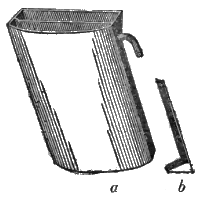
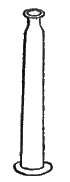
and become clear. When wanted, a sufficient quantity
may be poured into a vial (see Fig. 34) for use, and the
main or stock bottle should not be disturbed oftener than
necessary. This last collodion is not as durable as the
first, but is less trouble to prepare.
Bromo-Iodized Collodion for Negatives.
IODIZED COLLODION FOR NEGATIVES
| Plain collodion |
8 |
ounces. |
| Iodide of potassium (dissolved as per page 62) |
24 |
grains. |
| Bromide of ammonium |
16 |
" |
This collodion should be allowed to stand and settle
twenty-four hours before it is used: when wanted, it
should be poured off into a collodion vial. The more free
the collodion is from sediment and small particles of dust
or undissolved cotton, the softer and more perfect will be
the impression it makes.
In case the above proportions of iodide of potassium
should not produce a cream-colored coating, when it comes
from the nitrate of silver bath, more may be added: for
example, if the coating is of a bluish tint, I would dissolve
6 grains of iodide of potassium in water, as before, and
then try it: shake well, and test it by putting a little on a
slip of glass, and dipping it into the silvering solution; if
it coats to a cream-color, it is right.
It should be borne in mind, that after the addition of
iodide of potassium here recommended, the collodion
should be allowed to stand until settled, before undertaking
to produce a picture, although the coating may be
previously tested by means of a slip of glass.
Solution of Bromide and Iodide of Potassium and
Silver.
Dissolve 130 grains of crystallized nitrate, of silver in 4
ounces of pure water, in a long 8-ounce vial. Then in a
clean 1-ounce graduate, or some other convenient vessel
containing half an ounce of water, dissolve 130 grains
bromide of potassium. When this and the nitrate of silver
are both dissolved, pour the solution of bromide of potassium
into the vial containing the silver, and a thick yellow
precipitate will fall. This is the bromide of potassium
and silver. This should be washed by nearly filling the
vial with water; shake it, and then let it settle, which it
will readily do, and then pour on the water, leaving the
yellow mass in the bottom of the vial; continue this operation
of washing for at least ten changes of water; then,
after draining off the water as close as possible, put into
the vial four ounces of alcohol, shake it well and let it
settle; then pour off as close as possible. By this means
the water is nearly all taken out.
Pour into the vial three ounces of alcohol; then in a small
mortar finely pulverize one ounce of iodide of potassium, and
the solution, which was before clear, will be more or less
of a yellow color, and the bulk of the yellow precipitate
will be diminished. I have sometimes completely re-dissolved
the yellow precipitate, but this does not often occur,
except there be more water present than is advisable. It
is better to have an excess of bromide of potassium in the
solution. This can be seen by its being white, and remaining
undissolved in the bottom of the vial. This solution
should be prepared in the evening, or in a dark room,
and only the light of a lamp or candle employed.
Double Iodide of Potassium and Silver.
This solution is made in the same manner as in the
foregoing article, substituting the iodide of potassium for
the bromide—no bromide being used in this preparation.
The yellow precipitate in this case will be re-dissolved
and taken up in the solution: it may require more than
one ounce of pulverized iodide of potassium to effect this,
but it may be added in excess, so that the solution shall
contain a quantity in powder.
Developing Solution.
DEVELOPING SOLUTION.
| Protosulphate of iron, |
3 |
ounces. |
| Rain or distilled water, |
1 |
quart. |
Put these into a quart bottle, and shake until the crystals
are all dissolved, and this can be kept for a stock bottle,
and when wanted for use pour into another bottle.
| Of the above solution, |
5 |
ounces. |
| Acetic acid (No. 8) |
1 |
" |
| Chemically pure nitric acid |
20 |
drops. |
Shake this mixture well, and filter through a sponge,
and it is ready for use. I file a mark in this bottle indicating
five ounces, and another for 1 ounce: this will save
time in mixing the solution.
Remarks.—In my recent tour of the United States, I
found it difficult to obtain a good article of protosulphate
of iron, and in its stead I used the common copperas, such
as I could find almost in any store. I employ from one-fourth
to one-half more than the quantity given above. If
it looked a clear green, and free from a white or brownish
powder, about one-fourth addition: i. e., four ounces,
instead of three, as given above. If the solution in the
stock bottle is not wanted for a week or more, a few crystals
of the protosulphate of iron should be added, as it
decomposes, and the strength is depreciated.
There is quite a difference in the strength of the acetic
acid as sold by out country druggists, and the operator
should be sure that he has No. 8, to which quality the
above proportions are adapted. I never have employed
the developing solution but once, but can see no objections
to use it for a number of glass plates, but it should be
filtered every time before using. The quantity of nitric
acid may be increased, so long as a proper proportion is
preserved with the strength of the bath. The effect of
this addition of acid will be to brighten the impression;
but if carried too far, the reduction (developing) will be
irregular, and the harmony of the impression injured.
Fixing Solution.
FIXING SOLUTION.
| Water, |
8 |
ounces. |
| Cyanide of potassium, |
about 1 |
drachms |
Remarks.—I put enough of the cyanide of potassium
into the water to make the solution of such strength as to
dissolve off the iodide of silver ("coating") in from twenty
to sixty seconds. The operation is quite similar to that of
hyposulphate of soda upon the coating of the Daguerreotype
plate. A too concentrated solution is likely to injure
the sharpness of the image.
Brightening and Finishing the Image.
HUMPHREY'S COLLODION GILDING.
The article I now employ for finishing off my Positives
is in market, and known as Humphrey's Collodion Gilding.
It is a new preparation, and exerts a powerful influence
upon the image, having the same brightening effect
as chloride of gold on the daguerreotype. There is no article
now in market that equals this. I have until quite
recently used a varnish for this purpose, but having something
that is of far greater value, I have discarded it. It
is one of the most valuable improvements since the application
of the Collodion Film as a vehicle for producing photographic
images. It is a new discovery, and is being rapidly
brought into use by the first ambrotypers and photographers
in America. It adds at least one-half to the beauty of
an ambrotype, above any method heretofore in use. It is
imperishable, giving a surface almost equal in hardness to the
glass itself. It is easy of application; it gives a brilliant finish;
it is not affected by a moist atmosphere; it is not affected
by pure water; it is the best article ever used for finishing
ambrotypes; it will preserve glass negatives for all
time; it will preserve the whites in the ambrotype; it
gives a rich lustre to drapery; it will bear exposure to the
hot sun; it preserves positives and negatives from injury
by light. It is an article that, when once tried, the operator
upon glass (positive, negative, or albumenized plates)
will not do without.
The ingredients in the composition of this gilding are
neither patented nor published, but it can be procured from
any dealer in photographic chemicals.
Nitrate of Silver Bath.
NITRATE OF SILVER BATH.
I here give what I consider an improvement on the bath
mentioned in the first edition of this work. I first published
it in Humphrey's Journal, No. 23, Vol. VII.:
The nitrate of silver solution is an important mixture in
the chemical department of the ambrotype process, and
requires the especial care of the operator in its preparation.
I give the following as one of the most approved
for general practice. It is well adapted to the production
of positives, and its action is of great uniformity.
| Pure water |
1 |
ounce. |
| Nitrate of silver in crystals [neutral to acid test] |
45 |
grains. |
| Nitric acid C. P. [Quantity as given below]. |
This proportion is to be observed for any quantity of
solution. If I were to prepare a bath 40 ounces, I would
proceed as follows:
| Water |
40 |
ounces. |
| Nitrate of silver |
1800 |
grains. |
Measure the water, and put into a two-quart bottle;
then pour out 8 oz. of it in a pint bottle, and into this put
the whole of the nitrate of silver (1800 gr.); shake it well
until it is all dissolved. This forms a concentrated solution—into
which put the following prepared iodide of silver:—
Dissolve in a 3 or 4 oz. bottle containing 1 oz. water,
10 gr. nitrate of silver; and in another bottle or graduate
containing a little water, dissolve 10 grains of iodide of
potassium; pour this into the 10 grain solution of nitrate
of silver, and a yellow substance (iodide of silver) will
precipitate; fill the bottle with water, and let it settle;
then pour off the water, leaving the yellow mass behind;
again pour on it clean water, shake it, and let it settle as
before, and pour off again; repeat this for about six
changes of water.
Then it (the iodide of silver) is to be put into the bottle
containing the 8 oz. water and 1800 gr. of nitrate of silver;
shake it well, and it will nearly or quite all dissolve;
pour this into the two-quart bottle, and shake well; it
will be of a yellowish white tint, and should be filtered
through asbestos or sponge, when it will become clear.
When clear, test the solution with blue litmus-paper; if
it turns it red, it is sufficiently acid; if it does not change
it, add one or two drops of nitric acid, chemically pure;
then test it again; if it does not change it, add one or two
drops more, or just enough to change the paper to the
slightest red.
A solution prepared in this proportion will, like others,
improve by age. An old bath is considered far more valuable
than one newly prepared. These remarks may appear
to old photographic operators as of no importance,
but they must bear in mind that there are hundreds just
adopting this new process of picture taking.
This solution will work more satisfactorily than the one
I formerly used. It will work quicker in the camera, and
is equally durable.
Acknowledgment.—The following pages, under the
head of Vocabulary of Photographic Chemicals, and treating
upon the Chemicals used in Photography, are taken
from the third edition of "Hardwich's Photographic Chemistry:"—
Vocabulary of Photographic Chemicals.
VOCABULARY OF PHOTOGRAPHIC CHEMICALS.
Acetic Acid.
Symbol, C{4}H{3}O{3} + HO. Atomic weight, 60.
Acetic acid is a product of the oxidation of alcohol.
Spirituous liquids, when perfectly pure, are not affected
by exposure to air; but if a portion of yeast, or nitrogenous
organic matter of any kind, be added, it soon acts as
a ferment, and causes the spirit to unite with oxygen
derived from the atmosphere, and to become sour from formation
of acetic acid or "vinegar."
Acetic acid is also produced on a large scale by heating
wood in close vessels; a substance distils over which is
acetic acid contaminated with empyreumatic and tarry
matter; it is termed pyroligneous acid, and is much used
in commerce.
The most concentrated acetic acid may be obtained by
neutralizing common vinegar with carbonate of soda and
crystallizing out the acetate of soda so formed; this acetate
of soda is then distilled with sulphuric acid, which
removes the soda and liberates acetic acid: the acetic acid
being volatile, distils over, and may be condensed.
Properties of Acetic Acid.—The strongest acid contains
only a single atom of water; it is sold under the name of
"glacial acetic acid," so called from its property of solidifying
at a moderately low temperature. At about 50° the
crystals melt, and form a limpid liquid of pungent odor
and a density nearly corresponding to that of water; the
specific gravity of acetic acid, however, is no test of its
real strength, which can only be estimated by analysis.
The commercial glacial acetic acid is often diluted with
water, which may be suspected if it does not solidify during
the cold winter months. Sulphurous and hydrochloric
acids are also common impurities. They are injurious
in photographic processes from their property of precipitating
nitrate of silver. To detect them proceed as follows:—dissolve
a small crystal of nitrate of silver in a
few drops of water, and add to it about half a drachm of
the glacial acid; the mixture should remain quite clear
even when exposed to the light. Hydrochloric and sulphurous
acids produce a white deposit of chloride or sulphite
of silver; and if aldehyde or volatile tarry matter be
present in the acetic acid, the mixture with nitrate of silver,
although clear at first, becomes discolored by the action
of light.
Many photographers employ a cheaper form of acetic
acid, sold by druggists as "Beaufoy's" acid;[A] it should be
of the strength of the acetic acid fortiss. of the London
Pharmacopœia, containing 30 per cent, real acid, and must
be tested for sulphuric acid (see sulphuric acid), and also
by mixing with nitrate of silver.
Acetate of Silver.
(See Silver, Acetate of.)
Albumen.
Albumen is an organic principle, found both in the animal
and vegetable kingdom. Its properties are best studied
in the white of egg, which is a very pure form of
albumen.
Albumen is capable of existing in two states; in one of
which it is soluble, in the other insoluble in water. The
aqueous solution of the soluble variety gives a slightly
alkaline reaction to test-paper; it is somewhat thick and
glutinous, but becomes more fluid on the addition of a
small quantity of an alkali, such as potash or ammonia.
Soluble albumen may be converted into the insoluble
form in the following ways:—
1. By the application of heat.—A moderately strong
solution of albumen becomes opalescent and coagulates on
being heated to about 150°, but a temperature of 212° is
required if the liquid is very dilute. A layer of dried
albumen cannot easily be coagulated by the mere application of heat.
2. By addition of strong acids.—Nitric acid coagulates
albumen perfectly without the aid of heat. Acetic acid,
however, acts differently, appearing to enter into combination
with the albumen, and forming a compound soluble
in warm water acidified by acetic acid.
3. By the action of metallic salts.—Many of the salts of
the metals coagulate albumen very completely. Nitrate
of silver does so; also the bichloride of mercury. Ammoniacal
oxide of silver, however, does not coagulate albumen.
The white precipitate formed on mixing albumen with
nitrate of silver is a chemical compound of the animal
matter with protoxide of silver. This substance, which
has been termed albuminate of silver, is soluble in ammonia
and hyposulphite of soda; but after exposure to light,
or heating in a current of hydrogen gas, it assumes a brick-red
color, being probably reduced to the condition of a
salt of the suboxide of silver. It is then almost insoluble
in ammonia, but enough dissolves to tinge the liquid wine-red.
The author is of opinion that the red coloration of
solution of nitrate of silver employed in sensitizing the
albumenized photographic paper is produced by the same
compound, although often referred to the presence of sulphuret
of silver.
Albumen also combines with lime and baryta; and
chloride of barium has been recommended in positive
printing upon albumenized paper, probably from this
cause.
Chemical composition of albumen.—Albumen belongs to
the nitrogenous class of organic substances. It also contains
small quantities of sulphur and phosphorus.
Alcohol.
Symbol, C{4}H{6}O{2}. Atomic weight, 46.
Alcohol is obtained by the careful distillation of any
spirituous or fermented liquor. If wine or beer be placed
in a retort, and heat applied, the alcohol, being more volatile
than water, rises first, and is condensed in an appropriate
receiver; a portion of the vapor of water, however,
passes over with the alcohol, and dilutes it to a
certain extent, forming what is termed "spirits of wine."
Much of this water may be removed by redistillation from
carbonate of potash; but in order to render the alcohol
thoroughly anhydrous, it is necessary to employ quick lime
which possesses a still greater attraction for water. An
equal weight of this powdered lime is mixed with strong
alcohol of ·823, and the two are distilled together.
Properties of Alcohol.—Pure anhydrous alcohol is a limpid
liquid, of an agreeable odor and pungent taste; sp. gr.
at 60°, ·794. It absorbs vapor of water, and becomes
diluted by exposure to damp air; boils at 173° Fahr. It
has never been frozen.
Alcohol distilled from carbonate of potash has a specific
gravity of ·815 to ·823, and contains 90 to 93 per cent,
of real spirit.
The specific gravity of ordinary rectified spirits of wine
is usually about ·840, and it contains 80 to 83 per cent, of
absolute alcohol.
Ammonia.
Symbol, NH{3} or NH{4}O. Atomic weight, 17.
The liquid known by this name is an aqueous solution
of the volatile gas ammonia. Ammoniacal gas contains 1
atom of nitrogen combined with three of hydrogen: these
two elementary bodies exhibit no affinity for each other,
but they can be made to unite under certain circumstances,
and the result is ammonia.
Properties of Ammonia.—Ammoniacal gas is soluble in
water to a large extent; the solution possessing those properties
which are termed alkaline. Ammonia, however,
differs from the other alkalies in one important particular—it
is volatile: hence the original color of turmeric paper
affected by ammonia is restored on the application of heat.
Solution of ammonia absorbs carbonic acid rapidly from
the air, and is converted into carbonate of ammonia; it
should therefore be preserved in stoppered bottles. Besides
carbonate, commercial ammonia often contains chloride
of ammonium, recognized by the white precipitate
given by nitrate of silver after acidifying with pure
nitric acid.
The strength of commercial ammonia varies greatly;
that sold for pharmaceutica purposes, under the name of
liquor ammoniæ, contains about 10 per cent, of real ammonia.
The sp. gr. of aqueous ammonia diminishes with
the proportion of ammonia present, the liquor ammoniæ
being usually about ·936.
Chemical Properties.—Ammonia, although forming a
large class of salts, appears at first sight to contrast strongly
by composition with the alkalies proper, such as potash
and soda. Mineral bases generally are protoxides of metals,
but ammonia consists simply of nitrogen and hydrogen
united with oxygen. The following remarks may perhaps
tend somewhat to elucidate the difficulty:—
Theory of Ammonium.—This theory supposes that a substance
exists possessing the properties of a metal, but different
from metallic bodies generally in being compound in
structure: the formula assigned to it is NH{4}, 1 atom of
nitrogen united with 4 of hydrogen. The hypothetical
metal is termed "ammonium," and ammonia, associated
with an atom of water, may be viewed as its oxide; for
NH{3} + HO plainly equals NH{4}O. Thus, as potash is the
oxide of potassium, so ammonia is the oxide of ammonium.
The composition of the salts of ammonia is on this view
assimilated to those of the alkalies proper. Thus, sulphate
of ammonia is a sulphate of the oxide of ammonium;
muriate or hydrochlorate of ammonia is a chloride of ammonium, etc.
Ammonio-Nitrate of Silver.
(See Silver, Ammonio-Nitrate of.)
Aqua-Regia.
(See Nitro-Hydrochloric Acid.)
Baryta, Nitrate of.
(See Nitrate of Baryta.)
Bichloride of Mercury.
(See Mercury, Bichloride of.)
Bromine.
Symbol, Br. Atomic weight, 78.
This elementary substance is obtained from the uncrystallizable
residuum of sea-water, termed bittern. It exists
in the water in very minute proportion, combined with
magnesium in the form of a soluble bromide of magnesium.
Properties.—Bromine is a deep reddish-brown liquid of
a disagreeable odor, and fuming strongly at common
temperatures; sparingly soluble in water (1 part in 23,
Lowig), but more abundantly so in alcohol, and especially
in ether. It is very heavy, having a specific gravity of 3·0.
Bromine is closely analogous to chlorine and iodine in
its chemical properties. It stands on the list intermediately
between the two; its affinities being stronger than
those of iodine, but weaker than chlorine.
(See Chlorine.)
It forms a large class of salts, of which the bromides of
potassium, cadmium, and silver are the most familiar to
photographers.
Bromide of Potassium.
Symbol, KBr. Atomic weight, 118.
Bromide of potassium is prepared by adding bromine to
caustic potash, and heating the product, which is a mixture
of bromide of potassium and bromate of potash, to redness,
in order to drive off the oxygen from the latter salt. It
crystallizes in anhydrous cubes, like the chloride, and
iodide, of potassium; it is easily soluble in water, but
more sparingly so in alcohol; it yields red fumes of bromine
when acted upon by sulphuric acid.
Bromide of Silver.
(See Silver, Bromide of.)
Carbonate of Soda.
Symbol, NaO CO{2} + 10 Aq.
This salt was formerly obtained from the ashes of seaweeds,
but is now more economically manufactured on a
large scale from common salt. The chloride of sodium is
first converted into sulphate of soda, and afterwards the
sulphate into carbonate of soda.
Properties.—The perfect crystals contain ten atoms of
water, which are driven off by the application of heat,
leaving a white powder—the anhydrous carbonate. Common
washing soda is a neutral carbonate, contaminated to a
certain extent with chloride of sodium and sulphate of
soda. The carbonate used for effervescing draughts is
either a bicarbonate with 1 atom of water, or a sesquicarbonate,
containing about 40 per cent, of real alkali; it is
therefore nearly double as strong as the washing carbonate,
which contains about 22 per cent, of soda. Carbonate
of soda is soluble in twice its weight of water at 60°,
the solution being strongly alkaline.
Carbonate of Potash.
(See Potash, Carbonate of.)
Caseine.
(See Milk.)
Charcoal, Animal.
Animal charcoal is obtained by heating animal substances,
such as bones, dried blood, horns, etc., to redness,
in close vessels, until all volatile empyreumatic matters
have been driven off, and a residue of carbon remains.
When prepared from bones it contains a large quantity of
inorganic matter in the shape of carbonate and phosphate
of lime, the former of which produces alkalinity in reacting
upon nitrate of silver. Animal charcoal is freed from
these earthy salts by repeated digestion in hydrochloric
acid; but unless very carefully washed it is apt to retain
an acid reaction, and so to liberate free nitric acid when
added to solution of nitrate of silver.
Properties.—Animal charcoal, when pure, consists solely
of carbon, and burns away in the air without leaving any
residue: it is remarkable for its property of decolorizing
solutions; the organic coloring substance being separated,
but not actually destroyed, as it is by chlorine employed as
a bleaching agent. This power of absorbing coloring
matter is not possessed in an equal degree by all varieties
of charcoal, but is in great measure peculiar to those derived
from the animal kingdom.
China Clay or Kaolin.
This is prepared, by careful levigation, from mouldering
granite and other disintegrated felspathic rocks. It consists
of the silicate of alumina,—that is, of silicic acid or
flint, which is an oxide of silicon, united with the base
alumina (oxide of aluminum). Kaolin is perfectly insoluble
in water and acids, and produces no decomposition
in solution of nitrate of silver. It is employed by photographers
to decolorize solutions of nitrate of silver which
have become brown from the action of albumen or other
organic matters.
Chlorine.
Symbol, Cl. Atomic weight, 36.
Chlorine is a chemical element found abundantly in nature,
combined with metallic sodium in the form of chloride
of sodium, or sea-salt.
Preparation.—By distilling common salt with sulphuric
acid, sulphate of soda and hydrochloric acid are formed.
Hydrochloric acid contains chlorine combined with hydrogen;
by the action of nascent oxygen (see oxygen), the hydrogen
may be removed in the form of water, and the
chlorine left alone.
Properties.—Chlorine is a greenish-yellow gas, of a
pungent and suffocating odor; soluble to a considerable extent
in water, the solution possessing the odor and color of the
gas. It is nearly 2½ times as heavy as a corresponding
bulk of atmospheric air.
Chemical Properties.—Chlorine belongs to a small natural
group of elements which contains also bromine, iodine,
and fluorine. They are characterized by having a strong
affinity for hydrogen, and also for the metals, but are
comparatively indifferent to oxygen. Many metallic substances
actually undergo combustion when projected into an
atmosphere of chlorine, the union between the two taking
place with extreme violence. The characteristic bleaching
properties of chlorine gas are explained in the same
manner:—Hydrogen is removed from the organic substance,
and in that way the structure is broken up and the
color destroyed.
Chlorine is more powerful in its affinities than either
bromine or iodine. The salts formed by these three elements
are closely analogous in composition and often in
properties. Those of the alkalies, alkaline earths, and
many of the metals are soluble in water, but the silver
salts are insoluble; the lead salts sparingly so.
The combinations of chlorine, bromine, iodine, and
fluorine, with hydrogen, are acids, and neutralize alkalies
in the usual manner, with formation of alkaline chloride
and water.
The test by which the presence of chlorine is detected,
either free or in combination with bases, is nitrate of silver;
it gives a white curdy precipitate of chloride of silver, insoluble
in nitric acid, but soluble in ammonia. The solution
of nitrate of silver employed as the test must not
contain iodide of silver, as this compound is precipitated
by dilution.
Chloride of Ammonium.
Symbol, NH{4}Cl. Atomic weight, 54.
This salt, also known as muriate or hydrochlorate of
ammonia, occurs in commerce in the form of colorless and
translucent masses, which are procured by sublimation, the
dry salt being volatile when strongly heated. It dissolves
in an equal weight of boiling, or in three parts of cold
water. It contains more chlorine in proportion to the
weight used than chloride of sodium, the atomic weights
of the two being as 54 to 60.
Chloride of Barium.
Symbol, BaCl+2HO. Atomic weight, 123.
Barium is a metallic element, very closely allied to calcium,
the elementary basis of lime. The chloride of barium
is commonly employed as a test for sulphuric acid,
with which it forms an insoluble precipitate of sulphate
of baryta. It is also said to affect the color of the photographic
image when used in preparing positive paper;
which may possibly be due to a chemical combination of
baryta with albumen: but it must be remembered that
this chloride, from its high atomic weight, contains less
chlorine than the alkaline chlorides.
Properties of Chloride of Barium.—Chloride of barium
occurs in the form of white crystals, soluble in about two
parts of water, at common temperature. These crystals
contain two atoms of water of crystallization, which are
expelled at 212°, leaving the anhydrous chloride.
Chloride of Gold.
(See Gold, Chloride of.)
Chloride of Sodium.
Symbol, NaCl. Atomic weight, 60.
Common salt exists abundantly in nature, both in the
form of solid rock-salt and dissolved in the waters of the
ocean.
Properties of the pure Salt.—Fusible without decomposition
at low redness, but sublimes at higher temperatures;
the melted salt concretes into a hard white mass on cooling.
Nearly insoluble in absolute alcohol, but dissolves in
minute quantity in rectified spirit. Soluble in three parts
of water, both hot and cold. Crystallizes in cubes, which
are anhydrous.
Impurities of Common Salt.—Table salt often contains
large quantities of the chlorides of magnesium and calcium,
which, being deliquescent, produce a dampness by
absorption of atmospheric moisture: sulphate of soda is
also commonly present. The salt may be purified by repeated
recrystallization, but it is more simple to prepare
the pure compound directly, by neutralizing hydrochloric
acid with carbonate of soda.
Chloride of Silver.
(See Silver, Chloride of.)
Citric Acid.
This acid is found abundantly in lemon-juice and in
lime-juice. It occurs in commerce in the form of large
crystals, which are soluble in less than their own weight
of water at 60°.
Commercial citric acid is sometimes mixed with tartaric
acid. The adulteration may be discovered by making
a concentrated solution of the acid and adding acetate
of potash; crystals of bitartrate of potash will separate if
tartaric acid be present.
Citric acid is tribasic. It forms with silver a white insoluble
salt, containing 3 atoms of oxide of silver to 1
atom of citric acid. If the citrate of silver be heated in
a current of hydrogen gas, a part of the acid is liberated
and the salt is reduced to a citrate of suboxide of silver;
which is of a red color. The action of white light in reddening
citrate of silver is shown by the author to be of a
similar nature.
Cyanide of Potassium.
Symbol, K, C{2}N, or KCy. Atomic weight, 66.
This salt is a compound of cyanogen gas with the metal
potassium. Cyanogen is not an elementary body, like
chlorine or iodine, but consists of carbon and nitrogen
united in a peculiar manner. Although a compound substance,
it reacts in the manner of an element, and is therefore
(like ammonium, previously described) an exception
to the usual laws of chemistry. Many other bodies of a
similar character are known.
Ether.
Symbol, C{4}H{5}O. Atomic weight, 37.
Ether is obtained by distilling a mixture of sulphuric
acid and alcohol. If the formula of alcohol (C{4}H{6}O{2}) be
compared with that of ether, it will be seen to differ from
it in the possession of an additional atom of hydrogen and
of oxygen: in the reaction, the sulphuric acid removes
these elements in the form of water, and by so doing converts
one atom of alcohol into an atom of ether. The
term sulphuric applied to the commercial ether has reference
only to the manner of its formation.
Properties of Ether.—It is neither acid nor alkaline to
test-paper. Specific gravity, at 60°, about ·720. Boils at
98° Fahrenheit. The vapor is exceedingly dense, and
may be seen passing off from the liquid and falling to the
ground: hence the danger of pouring ether from one bottle
to another if a flame be near at hand.
Ether does not mix with water in all proportions; if the
two are shaken together, after a short time the former
rises and floats upon the surface. In this way a mixture
of ether and alcohol may be purified to some extent, as in
the common process of washing ether. The water employed
however always retains a certain portion of ether
(about a tenth part of its bulk), and acquires a strong
ethereal odor; washed ether also contains water in small
quantity.
Bromine and iodine are both soluble in ether, and gradually
react upon and decompose it.
The strong alkalies, such as potash and soda, also decompose
ether slightly after a time, but not immediately.
Exposed to air and light, ether is oxidized and acquires a
peculiar odor.
Ether dissolves fatty and resinous substances readily,
but inorganic salts are mostly insoluble in this fluid.
Hence it is that iodide of potassium and other substances
dissolved in alcohol are precipitated to a certain extent by
the addition of ether.
Fluoride of Potassium.
Symbol, KF. Atomic weight, 59.
Preparation.—Fluoride of potassium is formed by saturating
hydrofluoric acid with potash, and evaporating to
dryness in a platinum vessel. Hydrofluoric acid contains
fluorine combined with hydrogen; it is a powerfully acid
and corrosive liquid, formed by decomposing flour spar,
which is a fluoride of calcium, with strong sulphuric acid;
the action which takes place being precisely analogous to
that involved in the preparation of hydrochloric acid.
Properties.—A deliquescent salt, occurring in small and
imperfect crystals. Very soluble in water: the solution
acting upon glass in the same manner as hydrofluoric
acid.
Formic Acid.
Symbol, C{2}HO{3}. Atomic weight, 37.
This substance was originally discovered in the red ant
(Formica rufa), but it is prepared on a large scale by
distilling starch with binoxide of manganese and sulphuric
acid.
Properties.—The strength of commercial formic acid is
uncertain, but it is always more or less dilute. The
strongest acid, as obtained by distilling formiate of soda
with sulphuric acid, is a fuming liquid with a pungent
odor, and containing only one atom of water: it inflames
the skin in the same manner as the sting of the ant.
Formic acid reduces the oxides of gold, silver, and mercury,
to the metallic state, and is itself oxidized into carbonic
acid. The alkaline formiates also possess the same
properties.
Gelatine.
Symbol, C{13}H{10}O{5}N{2}. Atomic weight, 156.
This is an organic substance somewhat analogous to
albumen, but differing from it in properties. It is obtained
by subjecting bones, hoofs, horns, calves' feet, etc., to the
action of boiling water. The jelly formed on cooling is
termed size, or when dried or cut into slices, glue. Gelatine,
as it is sold in the shops, is a pure form of glue.
Isinglass is gelatine prepared, chiefly in Russia, from the
air-bladders of certain species of sturgeon.
Properties of Gelatine.—Gelatine softens and swells up
in cold water, but does not dissolve until heated: the hot
solution, on cooling, forms a tremulous jelly. One ounce
f cold water will retain about three grains of isinglass
without gelatinizing; but much depends upon the temperature,
a few degrees greatly affecting the result.
Gelatine forms no compound with oxide of silver analogous
to the albuminate of silver; which fact explains
the difference in the photographic properties of albumen
and gelatine.
Glycerine.
Fatty bodies are resolved by treatment with an alkali
into an acid—which combines with the alkali, forming a
soap,—and glycerine, remaining in solution.
Pure glycerine, as obtained by Price's patent process of
distillation, is a viscid liquid of sp. gr. about 1·23; miscible
in all proportions with water and alcohol. It is peculiarly
a neutral substance, exhibiting no tendency to combine
with acids or bases. It has little or no action upon nitrate
of silver in the dark, and reduces it very slowly even when
exposed to light.
Gold, Chloride of.
Symbol, AuCl{3}. Atomic weight, 303.
This salt is formed by dissolving pure metallic gold in
nitro-hydrochloric acid, and evaporating at a gentle heat.
The solution affords deliquescent crystals of a deep orange
color.
Chloride of gold, in a state fit for photographic use may
easily be obtained by the following process:—Place a
half-sovereign in any convenient vessel, and pour on it
half a drachm of nitric acid mixed with two and a
half drachms of hydrochloric acid and three drachms of
water; digest by a gentle heat, but do not boil the acid, or
much of the chlorine will be driven off in the form of gas.
At the expiration of a few hours add fresh aqua-regia in
quantity the same as at first, which will probably complete
the solution, but if not, repeat the process a third
time.
Lastly, neutralize the liquid by adding carbonate of soda
until all effervescence ceases, and a green precipitate
forms; this is carbonate of copper, which must be allowed
several hours to separate thoroughly. The solution then
contains chloride of gold in a neutral state, and free from
copper and silver, with which the metallic gold is alloyed
in the standard coin of the realm.
The weight of a half-sovereign is about 61 grains, of
which 56 grains are pure gold. This is equivalent to 86
grains of chloride of gold, which will therefore be the
quantity contained in the solution.
The following process for preparing chloride of gold is
more perfect than the last:—dissolve the gold coin in
aqua-regia as before; then boil with excess of hydrochloric
acid to destroy the nitric acid, dilute largely with
distilled water, and add a filtered aqueous solution of common
sulphate of iron (6 parts in 1 part of gold); collect
the precipitated gold, which is now free from copper;
re-dissolve in aqua-regia, and evaporate to dryness on a
water bath.
Avoid using ammonia to neutralize chloride of gold, as
it would be liable to occasion a deposit of "fulminating
gold," the properties of which are described immediately
following.
Properties of Chloride of Gold.—As sold in commerce it
usually contains excess of hydrochloric acid, and is then
of a bright yellow color; but when neutral and somewhat
concentrated it is dark red (Leo ruber of the alchemists).
It gives no precipitate with carbonate of soda, unless heat
be applied; the free hydrochloric acid present forms, with
the alkali, chloride of sodium, which unites with the chloride
of gold, and produces a double salt, chloride of gold
and sodium, soluble in water.
Chloride of gold is decomposed with precipitation of
metallic gold by charcoal, sulphurous acid, and many of
the vegetable acids; also by protosulphate and protonitrate
of iron. It tinges the cuticle of an indelible purple
tint. It is soluble in alcohol and in ether.
Gold, Fulminating.
This is a yellowish-brown substance, precipitated on
adding ammonia to a strong solution of chloride of gold.
It may be dried carefully at 212°, but explodes violently
on being heated suddenly about to 290°. Friction also
causes it to explode when dry; but the moist powder may
be rubbed or handled without danger. It is decomposed
by sulphuretted hydrogen.
Fulminating gold is probably an aurate of ammonia,
containing 2 atoms of ammonia to 1 atom of peroxide of
gold.
Gold, Hyposulphite of.
Symbol, AuO S{2}O{2}. Atomic Weight, 253.
Hyposulphite of gold is produced by the reaction of
chloride of gold upon hyposulphite of soda.
The salt sold in commerce as sel d'or is a double hyposulphite
of gold and soda, containing one atom of the former
salt to three of the latter, with four atoms of water
of crystallization. It is formed by adding one part of
chloride of gold, in solution, to three parts of hyposulphite
of soda, and precipitating the resulting salt by alcohol;
the chloride of gold must be added to the hyposulphite of
soda, and not the soda salt to the gold.
Properties.—Hyposulphite of gold is unstable and cannot
exist in an isolated state, quickly passing into sulphur,
sulphuric acid, and metallic gold. When combined with
excess of hyposulphite of soda in the form of sel d'or, it is
more permanent.
Sel d'or occurs crystallized in fine needles, which are
very soluble in water. The commercial article is often
impure, containing little else than hyposulphite of soda,
with a trace of gold. It may be analyzed by adding a
few drops of strong nitric acid (free from chlorine) diluting
with water, and afterwards collecting and igniting the yellow
powder, which is metallic gold.
Grape Sugar.
Symbol, C{24}H{28}O{28}. Atomic weight, 366.
This modification of sugar, often termed granular sugar,
or glucose, exists abundantly in the juice of grapes, and in
many other varieties of fruit. It forms the saccharine
concretion found in honey, raisins, dried figs, etc. It may
be produced artificially by the action of fermenting principles,
and of dilute mineral acids, upon starch.
Properties.—Grape sugar crystallizes slowly and with
difficulty from a concentrated aqueous solution, in small
hemispherical nodules, which are hard, and feel gritty
between the teeth. It is much less sweet to the taste
than cane sugar, and not so soluble in Water (1 part dissolves
in 1½ of cold water). Grape sugar tends to absorb
oxygen, and hence it possesses the property of decomposing
the salts of the noble metals, and reducing them by
degrees to the metallic state, even without the aid of lights
The action however in the case of nitrate of silver is slow,
unless the temperature be somewhat elevated. Cane
sugar does not possess these properties to an equal extent,
and hence it is readily distinguished from the other variety.
Honey.
This substance contains two distinct kinds of sugar,
grape sugar, and an uncrystallizable substance analogous
to, or identical with, the treacle found associated with common
sugar in the cane juice. The agreeable taste of
honey probably depends upon the latter, but its reducing
power on metallic oxides is due to the former. Pure grape
sugar can readily be obtained from inspissated honey, by
treating it with alcohol, which dissolves out the syrup, but
leaves the crystalline portion.
Hydrochloric; Acid.
Symbol, HCl. Atomic weight, 37.
Hydrochloric acid is a volatile gas, Which may be liberated
from the salts termed chlorides by the action of sulphuric
acid. The acid, by its superior affinities, removes
the base; thus,—
NaCl + HO SO{3} = NaO SO{3} + HCl.
Properties.—Abundantly soluble in water, forming the
liquid hydrochloric or muriatic acid of commerce. The
most concentrated solution of hydrochloric acid has a sp.
gr. 1·2, and contains about 40 per cent, of gas; that commonly
sold is somewhat weaker, sp; gr. 1·14 = 28 per cent.
real acid.
Pure hydrochloric acid is colorless, and fumes in the
air. The yellow color of the commercial acid depends
upon the presence of traces of perchloride of iron or
organic matter; commercial muriatic acid also often contains
a portion of free chlorine and of sulphuric acid.
Hydriodic Acid.
Symbol, HI. Atomic weight, 127.
This is a gaseous compound of hydrogen and iodine,
corresponding in composition to the hydrochloric acid. It
cannot, however, from its instability, be obtained in the
same manner, since, on distilling an iodide with sulphuric
acid, the hydriodic acid first formed is subsequently decomposed
into iodine and hydrogen. An aqueous solution
of hydriodic acid is easily prepared by adding iodine to
water containing sulphuretted hydrogen gas; a decomposition
takes place, and sulphur is set free; thus: HS + I = HI + S.
Properties.—Hydriodic acid is very soluble in water,
yielding a strongly acid liquid. The solution, colorless
at first, soon becomes brown from decomposition, and liberation
of free iodine. It may be restored to its original
condition by adding solution of sulphuretted hydrogen.
Hydrosulphuric Acid.
Symbol, HS. Atomic weighty 17.
This substance, also known as sulphuretted hydrogen,
is a gaseous compound of sulphur and hydrogen, analogous
in composition to hydrochloric and hydriodic acids. It is
usually prepared by the action of dilute sulphuric acid
upon sulphuret of iron, the decomposition being similar to
that involved in the preparation of the hydrogen acids
generally:—
FeS + HO SO{3} = FeO SO{3} + HS.
Properties.—Cold water absorbs three times its bulk of
hydrosulphuric acid, and acquires the peculiar putrid odor
and poisonous qualities of the gas. The solution is faintly
acid to test-paper, and becomes opalescent on keeping,
from gradual separation of sulphur. It is decomposed by
nitric acid, and also by chlorine and iodine. It precipitates
silver from its solutions, in the form of black sulphuret
of silver; also copper, mercury, lead, etc.; but
iron and other metals of that class are not affected, if the
liquid contains free acid. Hydrosulphuric acid is constantly
employed in the chemical laboratory for these and
other purposes.
Hydrosulphate of Ammonia.
Symbol, NH{4}S HS. Atomic weight, 51.
The liquid known by this name, and formed by passing
sulphuretted hydrogen gas into ammonia, is a double
sulphuret of hydrogen and ammonium. In the preparation,
the passage of the gas is to be continued until the
solution gives no precipitate with sulphate of magnesia
and smells strongly of hydrosulphuric acid.
Properties,—Colorless at first, but afterwards changes
to yellow, from liberation and subsequent solution of sulphur.
Becomes milky on the addition of any acid. Precipitates,
in the form of sulphuret, all the metals which
are affected by sulphuretted hydrogen; and, in addition,
those of the class to which iron, zinc, and manganese,
belong.
Hydrosulphate of ammonia is employed in photography
to darken the negative image, and also in the preparation
of iodide of ammonium; the separation of silver from
hyposulphite solutions, etc.
Hyposulphite of Soda.
Symbol, NaO S{2}H{2} + 5 HO. Atomic weight, 125.
The hyposulphite of soda commonly employed by photographers
is a neutral combination of hyposulphurous
acid and the alkali soda. It is selected as being more
economical in preparation than any other hyposulphite
adapted for fixing.
Hyposulphite of soda occurs in the form of large translucent
groups of crystals, which include five atoms of
water. These crystals are soluble in water almost to any
extent, the solution being attended with the production of
cold; they have a nauseous and bitter taste.
Hyposulphite of Gold.
(See Gold, Hyposulphite of.)
Hyposulphite of Silver.
(See Silver, Hyposulphite of.)
Iceland Moss.
Cetraria Islandica.—A species of lichen found in Iceland
and the mountainous parts of Europe; when boiled
in water, it first swells up, and then yields a substance
which gelatinizes on cooling.
It contains lichen starch; a bitter principle soluble in
alcohol, termed "cetrarine;" and common starch; traces
of gallic acid and bitartrate of potash are also present.
Iodine.
Symbol, I. Atomic weight, 126.
Iodine is chiefly prepared at Glasgow, from kelp, which
is the fused ash obtained by burning seaweeds. The
waters of the ocean contain minute quantities of the
iodides of sodium and magnesium, which are separated
and stored up by the growing tissues of the marine plant.
In the preparation, the mother-liquor of kelp is evaporated
to dryness and distilled with sulphuric acid; the
hydriodic acid first liberated is decomposed by the high
temperature, and fumes of iodine condense in the form of
opaque crystals.
Properties.—Iodine has a bluish-black color and metallic
lustre; it stains the skin yellow, and has a pungent smell,
like diluted chlorine. It is extremely volatile when
moist, boils at 350°, and produces dense violet-colored
fumes, which condense in brilliant plates. Specific gravity
4·946. Iodine is very sparingly soluble in water, 1 part
requiring 7000 parts for perfect solution: even this minute
quantity however tinges the liquid of a brown color. Alcohol
and ether dissolve it more abundantly, forming dark-brown
solutions. Iodine also dissolves freely in solutions
of the alkaline iodides, such as the iodide of potassium, of
sodium, and of ammonium.
Chemical Properties.—Iodine belongs to the chlorine
group of elements, characterized by forming acids with
hydrogen, and combining extensively with the metals (see
chlorine). They are however comparatively indifferent to
oxygen, and also to each other. The iodides of the alkalies
and alkaline earths are soluble in water; also those
of iron, zinc, cadmium, etc. The iodides of lead, silver,
and mercury are nearly or quite insoluble.
Iodine possesses the property of forming a compound of
a deep blue color with starch. In using this as a test, it is
necessary first to liberate the iodine (if in combination),
by means of chlorine, or nitric acid saturated with peroxide
of nitrogen. The presence of alcohol or ether interferes
to a certain extent with the result.
Iodide of Ammonium.
Symbol, NH{4}I. Atomic weight, 144.
This salt may be prepared by adding carbonate of ammonia
to iodide of iron, but more easily by the following
process:—A strong solution of hydrosulphate of ammonia
is first made, by passing sulphuretted hydrogen gas into
liquor ammoniæ To this liquid iodine is added until the
whole of the sulphuret of ammonium has been converted
into iodide. When this point is reached, the solution at
once colors brown from solution of free iodine. On the
first addition of the iodine, an escape of sulphuretted hydrogen
gas and a dense deposit of sulphur take place.
After the decomposition of the hydrosulphate of ammonia
is complete, a portion of hydriodic acid—formed by the
mutual reaction of sulphuretted hydrogen and iodine—attacks
any carbonate of ammonia which may be present,
and causes an effervescence. The effervescence being
over, the liquid is still acid to test-paper, from excess of
hydriodic acid; it is to be cautiously neutralized with ammonia,
and evaporated by the heat of a water-bath to the
crystallizing point.
The crystals should be thoroughly dried over a dish of
sulphuric acid, and then sealed in small tubes containing
each about half a drachm of the salt; by this means it
will be preserved colorless.
Iodide of ammonium is very soluble in alcohol, but it
is not advisable to keep it in solution, from the rapidity
with which it decomposes and becomes brown.
The most common impurity of commercial iodide of
ammonium is sulphate of ammonia; it is detected by its
sparing insolubility in alcohol.
Iodide of Cadmium.
Symbol, CdI. Atomic weight, 182.
This salt is formed by heating filings of metallic cadmium
with iodine, or by mixing the two together with
addition of water. It is useful in iodizing collodion intended
for keeping, since it does not become brown from
liberation of free iodine with the same rapidity as the
alkaline iodides.
Iodide of cadmium is very soluble both in alcohol and
water; the solution yielding on evaporation large six-sided
tables of a pearly lustre, which are permanent in the air.
The crystalline form of this salt is a sufficient criterion
of its purity.
Iodide of Iron.
Symbol, FeI. Atomic weight, 154.
Iodide of iron, in a fit state for photographic use, is
easily obtained by dissolving a drachm of iodine in an
ounce of proof spirit—that is, a mixture of equal bulks
of spirits of wine and water—and adding an excess of
iron filings. After a few hours, a green solution is obtained
without the aid of heat. The presence of metallic
iron in excess prevents the liberation of iodine and deposit
of peroxide of iron which would otherwise speedily occur.
It is very soluble in water and alcohol, but the solution
rapidly absorbs oxygen and deposits peroxide of iron;
hence the importance of preserving it in contact with metallic
iron, with which the separated iodine may recombine.
By very careful evaporation, hydrated crystals of
protoiodide may be obtained, but the composition of the
solid salt usually sold under that name cannot be depended on.
The periodide of iron, corresponding to the perchloride,
has not been examined, and it is doubtful if any such
compound exists.
Iodide of Potassium.
Symbol, KI. Atomic weight, 166.
This salt is usually formed by dissolving iodine in solution
of potash until it begins to acquire a brown color;
a mixture of iodide of potassium and iodate of potash
(KO IO{5}) is thus formed; but by evaporation and heating
to redness, the latter salt parts with its oxygen, and is
converted into iodide of potassium.
Properties.—It forms cubic and prismatic crystals, which
should be hard, and very slightly or not at all deliquescent.
Soluble in less than an equal weight of water at 60°; it
is also soluble in alcohol, but not in ether. The proportion
of iodide of potassium contained in a saturated alcoholic
solution, varies with the strength of the spirit,—with
common spirits of wine, sp. gr. ·836, it would be
about 8 grains to the drachm; with alcohol rectified from
carbonate of potash, sp. gr. ·823, 4 or 5 grains: with absolute
alcohol, 1 to 2 grains. The solution of iodide of
potassium is instantly colored brown by free chlorine; also
very rapidly by peroxide of nitrogen; ordinary acids, however,
act less quickly, hydriodic acid being first formed,
and subsequently decomposing spontaneously.
Iodide of potassium, as sold in the shops, is often contaminated
with various impurities. The first and most
remarkable is carbonate of potash. When a sample of iodide
of potassium contains much carbonate of potash, it
forms small and imperfect crystals, which are strongly
alkaline to test-paper, and become moist on exposure to
the air, from the deliquescent nature of the alkaline carbonate.
Sulphate of potash is also a common impurity; it
may be detected by chloride of barium.
Chloride of potassium is another impurity; it is detected
as follows:—Precipitate the salt by an equal weight of
nitrate of silver, and treat the yellow mass with solution
of ammonia; if any chloride of silver is present, it dissolves
in the ammonia, and after nitration is re-precipitated
in white curds by the addition of an excess of pure
nitric acid. If the nitric acid employed is not pure, but
contains traces of free chlorine, the iodide of silver must
be well washed with distilled water before treating it
with ammonia, or the excess of free nitrate of silver dissolving
in the ammonia would, on neutralizing, produce
chloride of silver, and so cause an error.
Iodide of potash is a fourth impurity often found in
iodide of potassium: to detect it, add a drop of dilute
sulphuric acid, or a crystal of citric acid, to the solution of
the iodide; when, if much iodate be present, the liquid
will become yellow from liberation of free iodine. The
rationale of this reaction is as follows:—The sulphuric
acid unites with the base of the salt, and liberates hydriodic
acid (HI), a colorless compound; but if iodic acid
(IO{5}) be also present, it decomposes the hydriodic acid
first formed, oxidizing the hydrogen into water (HO), and
setting free the iodine. The immediate production of a
yellow color on adding a weak acid to aqueous solution of
iodide of potassium is, therefore, a proof of the presence
of an iodate. As iodate of potash is thought to render
collodion insensitive (?), this point should be attended to.
Iodide of potassium may be rendered very pure by recrystallizing
from spirit, or by dissolving in strong alcohol
of sp. gr. ·823, in which sulphate, carbonate, and iodate
of potash are insoluble. The proportion of iodide
of potassium contained in saturated alcoholic solutions
varies with the strength of the spirit.
Solution of chloride of barium is commonly used to detect
impurities in iodide of potassium; it forms a white
precipitate if carbonate, iodate, or sulphate be present.
In the two former cases the precipitate dissolves on the
addition of pure dilute nitric acid, but in the latter it is
insoluble. The commercial iodide, however, is rarely so
pure as to remain quite clear on the addition of chloride
of barium, a mere opalescence, therefore, may be disregarded.
Iodide of Silver. (See Silver, Iodide of.)
Iron, Protosulphate of.
Symbol, FeO SO{3} + 7 HO. Atomic weight, 139.
This salt, often termed copperas or green vitriol, is a most
abundant substance, and used for a variety of purposes in
the arts. Commercial sulphate of iron, however, being
prepared on a large scale, requires recrystallization to render
it sufficiently pure for photographic purposes.
Pure sulphate of iron occurs in the form of large, transparent
prismatic crystals, of a delicate green color: by exposure
to the air they gradually absorb oxygen and become
rusty on the surface. Solution of sulphate of iron, colorless
at first, afterwards changes to a red tint, and deposits
a brown powder; this powder is a basic persulphate of
iron, that is, a persulphate containing an excess of the
oxide or base. By the addition of sulphuric or acetic acid
to the solution, the formation of a deposit is prevented, the
brown powder being soluble in acid liquids.
The crystals of sulphate of iron include a large quantity
of water of crystallization, a part of which they lose
by exposure to dry air. By a higher temperature, the salt
may be rendered perfectly anhydrous, in which state it
forms a white powder.
Aqueous solution of sulphate of iron absorbs the binoxide
of nitrogen, acquiring a deep olive-brown color: as
this gaseous binoxide is itself a reducing agent, the liquid
so formed has been proposed as a more energetic developer
than the sulphate of iron alone.
Iron, Protonitrate of.
Symbol, FeO NO{5} + 7 HO. Atomic weight, 153.
This salt, by careful evaporation in vacuo over sulphuric
acid, forms transparent crystals, of a light green color,
and containing 7 atoms of water, like the protosulphate.
It is exceedingly unstable, and soon becomes red from
decomposition, unless preserved from contact with air.
The following process is commonly followed for preparing
protonitrate of iron:—
Take of nitrate of baryta 300 grains; powder and dissolve
by the aid of heat in three ounces of water; then
throw in, by degrees, with constant stirring, crystallized
sulphate of iron, powdered, 320 grains. Continue to stir
for about five or ten minutes. Allow to cool, and filter
from the white deposit, which is the insoluble sulphate of
baryta.
In place of nitrate of baryta, the nitrate of lead may
be used (sulphate of lead being an insoluble salt), but the
quantity required will be different. The atomic weights
of nitrate of baryta and nitrate of lead are as 131 to 166;
consequently 300 grains of the former are equivalent to
380 grains of the latter.
Iron, Perchloride of.
Symbol, Fe{2}Cl{3}. Atomic weight, 164.
There are two chlorides of iron, corresponding in composition
to the protoxide and the sesquioxide respectively.
The protochloride is very soluble in water, forming a
green solution, which precipitates a dirty white protoxide
on the addition of an alkali. The perchloride, on the
other hand, is dark brown, and gives a foxy-red precipitate
with alkalies.
Properties.—Perchloride of iron may be obtained in the
solid form by heating iron wire in excess of chlorine; it
condenses in the shape of brilliant and iridescent brown
crystals, which are volatile, and dissolve in water, the solution
being acid to test-paper. It is also soluble in alcohol,
forming the tinctura ferri sesquichloridi of the Pharmacopœia.
Commercial perchloride of iron ordinarily contains
an excess of hydrochloric acid.
Litmus.
Litmus is a vegetable substance, prepared from various
lichens, which are principally collected on rocks adjoining
the sea. The coloring matter is extracted by a peculiar
process, and afterwards made up into a paste with chalk,
plaster of Paris, &c.
Litmus occurs in commerce in the form of small cubes,
of a fine violet color. In using it for the preparation of
test-papers, it is digested in hot water, and sheets of porous
paper are soaked in the blue liquid so formed. The
red papers are prepared at first in the same manner, but
afterwards placed in water which has been rendered
faintly acid with sulphuric or hydrochloric acid.
Mercury, Bichloride of.
Symbol, HgCl{2}. Atomic weight, 274.
This salt, also called corrosive sublimate, and sometimes
chloride of mercury (the atomic weight of mercury being
halved), may be formed by heating mercury in excess of
chlorine, or, more economically, by subliming a mixture of
persulphate of mercury and chloride of sodium.
Properties.—a very corrosive and poisonous salt, usually
sold in semi-transparent, crystalline masses, or in the
state of powder. Soluble in 16 parts of cold, and in 3 of
hot water; more abundantly so in alcohol, and also in
ether. The solubility in water may be increased almost
to any extent by the addition of free hydrochloric acid.
The protochloride of mercury is an insoluble white
powder, commonly known under the name of calomel.
Milk.
The milk of herbivorous animals contains three principal
constituents—fatty matter, caseine, and sugar; in addition
to these, small quantities of the chloride of potassium,
and of phosphates of lime and magnesia, are
present.
The fatty matter is contained in small cells, and forms
the greater part of the cream which rises to the surface of
the milk on standing. Hence skimmed milk is to be preferred
for photographic use.
The second constituent, caseine, is an organic principle
somewhat analogous to albumen in composition and properties.
Its aqueous solution however does not, like
albumen, coagulate on boiling, unless an acid be present,
which probably removes a small portion of alkali with
which the caseine was previously combined. The substance
termed "rennet," which is the dried stomach of the
calf, possesses the property of coagulating caseine, but the
exact mode of its action is unknown. Sherry wine is also
employed to curdle milk; but brandy and other spirituous
liquids, when free from acid and astringent matter, have
no effect.
In all these cases a proportion of the caseine usually remains
in a soluble form in the whey; but when the milk
is coagulated by the addition of acids, the quantity so left
is very small, and hence the use of the rennet is to be preferred,
since the presence of caseine facilitates the reduction
of the sensitive silver salts.
Caseine combines with oxide of silver in the same manner
as albumen, forming a white coagulum, which becomes
brick-red on exposure to light.
Sugar of milk, the third principal constituent, differs
from both cane and grape sugar; it may be obtained by
evaporating whey until crystallization begins to take place.
It is hard and gritty, and only slightly sweet; slowly
soluble, without forming a syrup, in about two and a half
parts of boiling, and six of cold water. It does not ferment
and form alcohol on the addition of yeast, like grape
sugar, but by the action of decomposing animal matter is
converted into lactic acid.
When skimmed milk is exposed to the air for some
hours it gradually becomes sour, from lactic acid formed in
this way; and if then heated to ebullition, the caseine
coagulates very perfectly.
Nitric Acid.
Symbol, NO{5}. Atomic weight, 54.
Nitric acid, or aqua-fortis, is prepared by adding sulphuric
acid to nitrate of potash, and distilling the mixture
in a retort. Sulphate of potash and free nitric acid are
formed, the latter of which, being volatile, distils over in
combination with one atom of water previously united
with sulphuric acid.
Properties.—Anhydrous nitric acid is a solid substance,
white and crystalline, but it cannot be prepared except by
an expensive and complicated process.
The concentrated liquid nitric acid contains 1 atom of
water, and has a sp. gr. of about 1·5: if perfectly pure it
is colorless, but usually it has a slight yellow tint, from
partial decomposition into peroxide of nitrogen: it fumes
strongly in the air.
The strength of commercial nitric acid is subject to
much variation. An acid of sp. gr. 1·42, containing about
4 atoms of water, is commonly met with. If the specific
gravity is much lower than this (less than 1·36), it will
scarcely be adapted for the preparation of peroxyline.
The yellow nitrous acid, so called, is a strong nitric acid
partially saturated with the brown vapors of peroxide of
nitrogen; it has a high specific gravity, but this is somewhat
deceptive, being caused in part by the presence of the
peroxide. On mixing with sulphuric acid the color disappears,
a compound being formed which has been termed
a sulphate of nitrous acid.
Chemical properties.—Nitric acid is a powerful oxidizing
agent; it dissolves all the common metals, with the exception
of gold and platinum. Animal substances, such
as the cuticle, nails, etc., are tinged of a permanent yellow
color, and deeply corroded by a prolonged application.
Nitric acid forms a numerous class of salts, all of which
are soluble in water. Hence its presence cannot be determined
by any precipitating re-agent, in the same manner
as that of hydrochloric and sulphuric acid.
Impurities of Commercial Nitric Acid.—These are principally
chlorine and sulphuric acid; also peroxide of nitrogen,
which tinges the acid yellow, as already described.
Chlorine is detected by diluting the acid with an equal
bulk of distilled water, and adding a few drops of nitrate
of silver,—a milkiness, which is chloride of silver in suspension,
indicates the presence of chlorine. In testing
for sulphuric acid, dilute the nitric acid as before, and
drop in a single drop of solution of chloride of barium; if
sulphuric acid be present, an insoluble precipitate of sulphate
of baryta will be formed.
Nitrous Acid.
(See Silver, Nitrate of.)
Nitrate of Potash.
Symbol, KO NO{5}. Atomic weight, 102.
This salt, also termed nitre or saltpetre, is an abundant
natural product, found effloresced upon the soil in certain
parts of the East Indies. It is also produced artificially in
what are called nitre-beds.
Nitrate of potash is an anhydrous salt,—it contains
simply nitric acid and potash, without any water of crystallization;
still, in many cases, a little water is retained
mechanically between the interstices of the crystals, and
therefore it is better to dry before use. This may be
done by laying it in a state of fine powder upon blotting-paper,
close to a fire, or upon a heated metallic plate.
Nitrate of Baryta.
Symbol, BaO NO{5}. Atomic weight, 131.
Nitrate of baryta forms octahedral crystals, which are
anhydrous. It is considerably less soluble than the chloride
of barium, requiring 12 parts of cold and 4 of boiling
water for solution. It may be substituted for the nitrate
of lead in the preparation of protonitrate of iron.
Nitrate of Lead.
Symbol, PbO NO{5}. Atomic weight, 166.
Nitrate of lead is obtained by dissolving the metal, or
the oxide of lead, in excess of nitric acid, diluted with 2
parts of water. It crystallizes on evaporation in white
anhydrous tetrahedra and octahedra, which are hard, and
decrepitate on being heated; they are soluble in 8 parts
of water at 60°.
Nitrate of lead forms with sulphuric acid, or soluble sulphates,
a white precipitate, which is the insoluble sulphate
of lead. The Iodide of lead is also very sparingly soluble
in water.
Nitrate of Silver.
(See Silver, Nitrate of.)
Nitro-Hydrochloric Acid.
Symbol, NO{4} + Cl.
This liquid is the aqua-regia of the old alchemists. It
is produced by mixing nitric and hydrochloric acids: the
oxygen contained in the former combines with the hydrogen
of the latter, forming water and liberating chlorine,
thus:—
NO{5} + HCl = NO{4} + HO + Cl.
The presence of free chlorine confers on the mixture the
power of dissolving gold and platinum, which neither of
the two acids possesses separately. In preparing aqua-regia
it is usual to mix one part, by measure, of nitric
acid with four of hydrochloric acid, and to dilute with an
equal bulk of water. The application of a gentle heat
assists the solution of the metal; but if the temperature
rises to the boiling point, a violent effervescence and escape
of chlorine takes place.
Oxygen.
Symbol, O. Atomic weight, 8.
Oxygen gas may be obtained by heating nitrate of potash
to redness, but in this case it is contaminated with a
portion of nitrogen. The salt termed chlorate of potash
(the composition of which is closely analogous to that of
the nitrate, chlorine being substituted for nitrogen) yields
abundance of pure oxygen gas on the application of heat,
leaving behind chloride of potassium.
Chemical Properties.—Oxygen combines eagerly with
many of the chemical elements, forming oxides. This
chemical affinity however is not well seen when the elementary
body is exposed to the action of oxygen in the
gaseous form. It is the nascent oxygen which acts most
powerfully as an oxidizer. By nascent oxygen is meant
oxygen on the point of separation from other elementary
atoms with which it was previously associated; it may
then be considered to be in the liquid form, and hence it
comes more perfectly into contact with the particles of the
body to be oxidized.
Illustrations of the superior chemical energy of nascent
oxygen are numerous, but none perhaps are more striking
than the mild and gradual oxidizing influence exerted by
atmospheric air, as compared with the violent action of
nitric acid and bodies of that class which contain oxygen
loosely combined.
Oxymel.
This syrup of honey and vinegar is prepared as follows:—Take of
| Honey |
1 |
pound. |
| Acid, acetic, fortiss. (Beaufoy's acid) |
11 |
drachms. |
| Water |
13 |
drachms. |
Stand the pot containing the honey in boiling water
until a scum rises to the surface, which is to be removed
two or three times. Then add the acetic acid and water,
and skim once more if required. Allow to cool, and it
will be fit for use.
Potash.
Symbol, KO + HO. Atomic weight, 57.
Potash is obtained by separating the carbonic acid
from carbonate of potash by means of caustic lime. Lime
is a more feeble base than potash, but the carbonate of
lime, being insoluble in water, is at once formed on adding
milk of lime to a solution of carbonate of potash.
Properties.—Usually met with in the form of solid
lumps, or in cylindrical sticks, which are formed by melting
the potash and running it into a mould. It always
contain some atoms of water, which cannot be driven off by
the application of heat.
Potash is soluble almost to any extent in water, much
heat being evolved. The solution is powerfully alkaline
and acts rapidly upon the skin; it dissolves fatty and
resinous bodies, converting them into soaps; Solution of
potash absorbs carbonic acid quickly from the air, and
should therefore be preserved in stoppered bottles; the
glass stoppers must be wiped occasionally, in order to prevent
them from becoming immovably fixed by the solvent
action of the potash upon the silica of the glass.
The liquor potassæ of the London Pharmacopœia has a
sp. gr. of 1·063, and contains about 5 per cent; of real
potash. It is usually contaminated with carbonate of potash,
which causes it to effervesce on the addition of acids;
also, to a less extent, with sulphate of potash, chloride of
potassium, silica, etc.
Potash, Carbonate of.
Symbol, KO CO{2}. Atomic weight, 70.
The impure carbonate of potash, termed pearlash, is obtained
from the ashes of wood and vegetable matter, in
the same manner as carbonate of soda is prepared from
the ashes of seaweeds. Salts of potash and of soda appear
essential to vegetation, and are absorbed and approximated
by the living tissues of the plant. They exist in
the vegetable structure combined with organic acids in the
form of salts, like the oxalate, tartrate, etc., which when
burned are converted into carbonates.
Properties.—The pearlash of commerce contains large
and variable quantities of chloride of potassium, sulphate
of potash, etc. A purer carbonate is sold, which is free
from sulphates, and with only a trace of chlorides. Carbonate
of potash is a strongly alkaline salt, deliquescent,
and soluble in twice its weight of cold water; insoluble in
alcohol, and employed to deprive it of water.
Pyrogallic Acid.
Symbol, C{8}H{4}O{4} (Stenhouse). Atomic weight. 84.
The term pyro prefixed to gallic acid implies that the
new substance is obtained by the action of heat upon that
body. At a temperature of about 410° Fahr., gallic acid
is decomposed, and a white sublimate forms, which condenses
in lamellar Crystals; this is pyrogallic acid.
Pyrogallic acid is very soluble in cold water, and in alcohol
and ether; the solution decomposes and becomes
brown by exposure to the air. It gives an indigo blue
color with protosulphate of iron, which changes to dark
green if any persulphate be present.
Although termed an acid, this substance is strictly neutral;
it does not redden litmus-paper, and forms no salts.
The addition of potash or soda decomposes pyrogallic acid,
at the same time increasing the attraction for oxygen;
hence this mixture may conveniently be employed for
absorbing the oxygen contained in atmospheric air. The
compounds of silver and gold are reduced by pyrogallic
acid even more rapidly than by gallic acid, the reducing
agent absorbing the oxygen, and becoming converted
into carbonic acid and a brown matter insoluble in water.
Commercial pyrogallic acid is often contaminated with
empyreumatic oil, and also with a black insoluble substance
known as metagallic acid, which is formed when
the heat is raised above the proper temperature in the process
of manufacture.
Sel D'or.
(See Gold, Hyposulphite of.)
Silver.
Symbol, Ag. Atomic Weight, 108.
This metal, the luna or diana of the alchemists, is found
native in Peru and Mexico; it occurs also in the form of
sulphuret of silver.
When pure it has a sp. gr. of 10·5, and is very malleable
and ductile; melts at a bright red heat. Silver does not
oxidize in the air, but when exposed to an impure atmosphere
containing traces of sulphuretted hydrogen, it is
slowly tarnished from formation of sulphuret of silver. It
dissolves in sulphuric acid, but the best solvent is nitric
acid.
The standard coin of the realm is an alloy of silver and
copper, containing about one-eleventh of the latter metal.
It may be converted into nitrate of silver, sufficiently pure
for photographic purposes, by dissolving it in nitric acid
and evaporating the solution to the crystallizing point: or,
if the quantity be small, the solution may be boiled
down to complete dryness, and the residue fused strongly;
which decomposes the nitrate of copper, but leaves the
greater portion of the silver salt unaffected. (N. B.
Nitrate of silver which has undergone fusion contains
nitrite of silver, and will require the addition of acetic
acid if used for preparing the collodion sensitive film.)
Silver, Ammonio-Nitrate of.
Crystallized nitrate of silver absorbs ammoniacal gas
rapidly, with production of heat sufficient to fuse the resulting
compound, which is white, and consists of 100
parts of the nitrate + 29·5 of ammonia. The compound
however which photographers employ under the name of
ammonio-nitrate of silver, may be viewed more simply as
a solution of the oxide of silver in ammonia, without
reference to the nitrate of ammonia necessarily produced in
the reaction.
Very strong ammonia, in acting upon oxide of silver,
converts it into a black powder, termed fulminating silver,
which possesses the most dangerous explosive properties.
Its composition is uncertain. In preparing ammonio-nitrate
of silver by the common process, the oxide first precipitated
occasionally leaves a little black powder behind,
on re-solution; this does not appear, however, according
to the observations of the author, to be fulminating silver.
In sensitizing salted paper by the ammonio-nitrate of
silver, free ammonia is necessarily formed. Thus:—
Chloride of ammonium + oxide of silver in ammonia
= chloride of silver + ammonia + water.
Silver, Oxide of.
Symbol, AgO. Atomic weight, 116.
If a little potash or ammonia be added to solution of
nitrate of silver, a brown substance is formed, which, on
standing, collects at the bottom of the vessel. This is
oxide of silver, displaced from its previous state of combination
with nitric acid by the stronger oxide, potash.
Oxide of silver is soluble to a very minute extent in pure
water, the solution possessing an alkaline reaction to litmus;
it is easily dissolved by nitric or acetic acid, forming
a neutral nitrate or acetate; also soluble in ammonia
(ammonio-nitrate of silver), and in nitrate of ammonia
hyposulphite of soda, and cyanide of potassium. Long
exposure to light converts it into a black substance, which
is probably a suboxide.
Properties of the Suboxide of Silver.—Suboxide of
silver bears the same relation to the ordinary brown protoxide
of silver that subchloride bears to protochloride of
silver.
It is a black powder, which assumes the metallic lustre
on rubbing, and when treated with dilute acids is resolved
into protoxide of silver which dissolves, and metallic
silver.
Silver, Chloride of.
Symbol, AgCl. Atomic weight, 144.
Preparation of Chloride of Silver by double decomposition.—In
order to illustrate this, take a solution in water
of chloride of sodium or "common salt," and mix it with
a solution containing nitrate of silver; immediately a
dense, curdy, white precipitate falls, which is the substance
in question.
In this reaction the elements change places; the chlorine
leaves the sodium with which it was previously combined,
and crosses over to the silver; the oxygen and nitric
acid are released from the silver, and unite with the
sodium: thus
Chloride of sodium + nitrate of silver = Chloride of silver + nitrate of soda.
This interchange of elements is termed by chemists
double decomposition.
The essential requirements in two salts intended for the
preparation of chloride of silver, are simply that the first
should contain chlorine, the second silver, and that both
should be soluble in water; hence the chloride of potassium
or ammonium may be substituted for the chloride of
sodium, and the sulphate or acetate for the nitrate of
silver.
In preparing chloride of silver by double decomposition,
the white clotty masses which first form must be washed
repeatedly with water, in order to free them from soluble
nitrate of soda, the other product of the change. When
this is done, the salt is in a pure state, and may be dried,
etc., in the usual way.
Properties of Chloride of Silver.—Chloride of silver
differs in appearance from the nitrate of silver. It is not
met with in crystals, but forms a soft white powder resembling
common chalk or whiting. It is tasteless and insoluble
in water; unaffected by boiling with the strongest
nitric acid, but sparingly dissolved by concentrated hydrochloric
acid.
Ammonia dissolves chloride of silver freely, as do solutions
of hyposulphite of soda and cyanide of potassium.
Concentrated solutions of alkaline chlorides, iodides, and
bromides are likewise solvents of chloride of silver, but
to a limited extent.
Dry chloride of silver heated to redness fuses, and concretes
on cooling into a tough and semi-transparent substance,
which has been termed horn silver or luna cornea.
Placed in contact with metallic zinc or iron acidified
with dilute sulphuric acid, chloride of silver is reduced to
the metallic state, the chlorine passing to the other metal
under the decomposing influence of the galvanic current
which is established.
Preparation and properties of the Subchloride of Silver.—If
a plate of polished silver be dipped in solution of perchloride
of iron, or of bichloride of mercury, a black stain
is produced, the iron or mercury salt losing a portion of
chlorine, which passes to the silver and converts it superficially
into subchloride of silver. This compound differs
from the white chloride of silver in containing less chlorine
and more of the metallic element; the composition
of the latter being represented by the formula AgCl, that
of the former may perhaps be written as Ag{2}Cl. (?)
Subchloride of silver is interesting to the photographer
as corresponding in properties and composition with the
ordinary chloride of silver blackened by light. It is a
pulverulent substance of a bluish-black color, which is
decomposed by ammonia, hyposulphite of soda, and cyanide
of potassium, into chloride of silver which dissolves,
and insoluble metallic silver.
Silver, Bromide of.
Symbol, AgBr. Atomic weight, 186.
This substance so closely resembles the corresponding
salts containing, chlorine and iodine, that a short notice of
it will suffice.
Bromide of silver is prepared by exposing a silvered
plate to the vapor of bromine, or by adding solution of
bromide of potassium to nitrate of silver. It is an insoluble
substance, slightly yellow in color, and distinguished
from iodide of silver by dissolving in strong ammonia and
in chloride of ammonium. It is freely soluble in hyposulphite
of soda and in cyanide of potassium.
Silver, Citrate of.
(See Citric Acid.)
Silver, Iodide of.
Symbol, AgI. Atomic weight, 234.
Preparation and Properties of Iodide of Silver.—Iodide
of silver may be formed in an analogous manner to the
chloride, viz. by the direct action of the vapor of iodine
upon metallic silver, or by double decomposition between
solutions of iodide of potassium and nitrate of silver.
When prepared by the latter mode it forms an impalpable
powder, the color of which varies slightly with the
manner of precipitation. If the iodide of potassium be
in excess, the iodide of silver falls to the bottom of the
vessel nearly white; but with an excess of nitrate of silver
it is of a straw-yellow tint. This point may be noticed,
because the yellow salt is the one adapted for photographic
use, the other being insensible to the influence
of light.
Iodide of silver is tasteless and inodorous; insoluble in
water and in dilute nitric acid. It is scarcely dissolved by
ammonia, which serves to distinguish it from the chloride
of silver, freely soluble in that liquid. Hyposulphite of
soda and cyanide of potassium both dissolve iodide of silver;
it is also soluble in solutions of the alkaline bromides
and iodides.
Silver, Fluoride of.
Symbol, AgF. Atomic weight, 127.
This compound differs from those just described in being
soluble in water. The dry salt fuses on being heated, and
is reduced by a higher temperature, or by exposure to
light.
Silver, Sulphuret of.
Symbol, AgS. Atomic weight, 124.
This compound is formed by the action of sulphur upon
metallic silver, or of sulphuretted hydrogen, or hydrosulphate
of ammonia, upon the silver salts; the decomposition
of hyposulphite of silver also furnishes the black
sulphuret.
Sulphuret of silver is insoluble in water, and nearly so
in those substances which dissolve the chloride, bromide,
and iodide, such as ammonia, hyposulphites, cyanides,
etc.; but it dissolves in nitric acid, being converted into
soluble sulphate and nitrate of silver.
Silver, Nitrate of.
Symbol, AgO NO{5}. Atomic weight, 170.
Nitrate of silver is prepared by dissolving metallic silver
in nitric acid. Nitric acid is a powerfully acid and
corrosive substance, containing two elementary bodies
united in definite proportions. These are nitrogen and
oxygen; the latter being present in greatest quantity.
Nitric acid is a powerful solvent for the metallic bodies
generally. To illustrate its action in that particular, as
contrasted with other acids, place pieces of silver foil in
two test-tubes, the one containing dilute sulphuric, the
other dilute nitric acid; on the application of heat a violent
action soon commences in the latter, but the former
is unaffected. In order to understand the cause of the
difference, it must be borne in mind that when a metallic
substance dissolves in an acid, the nature of the solution
is unlike that of an aqueous solution of salt or sugar. If
you take salt water, and boil it down until the whole of
the water has evaporated, you obtain the salt again, with
properties the same as at first; but if a similar experiment
be made with a solution of silver in nitric acid, the
result is different: in that case you do not get metallic
silver on evaporation, but silver combined with oxygen and
nitric acid, both of which are tightly retained, being, in
fact, in a state of chemical combination with the metal.
If we closely examine the effects produced by treating
silver with nitric acid, we find them to be of the following
nature:—first, a certain amount of oxygen is imparted to
the metal, so as to form an oxide, and afterwards this oxide
dissolves in another portion of the nitric acid, producing
nitrate of the oxide, or, as it is shortly termed, nitrate of
silver.
It is therefore the instability of nitric acid, its proneness
to part with oxygen, which renders it superior to sulphuric
acid in the experiment of dissolving silver. Nitric
acid stands high in the list of "oxidizing agents," and it
is important that the photographer should bear this fact
in mind.
Properties of Nitrate of Silver.—In the preparation of
nitrate of silver, when the metal has dissolved, the solution
is boiled down in order to drive off the excess of nitric
acid, and set aside to crystallize. The salt, however,
as so obtained is still acid to test-paper, and requires either
recrystallization, or a careful heating to about 300° Fahrenheit,
to render it perfectly neutral.
Pure nitrate of silver occurs in the form of white crystalline
plates, which are very heavy and dissolve readily
in an equal weight of cold water. The solubility is much
lessened by the presence of free nitric acid, and in the
concentrated nitric acid the crystals are almost insoluble.
Boiling alcohol takes up about one-fourth part of its
weight of the crystallized nitrate, but deposits nearly the
whole on cooling. Nitrate of silver has an intensely bitter
and nauseous taste; acting as a caustic, and corroding the
skin by a prolonged application. Its aqueous solution is
perfectly neutral to test-paper.
Heated in a crucible the salt melts, and when poured
into a mould and solidified, forms the lunar caustic of commerce.
At a still higher temperature it is decomposed,
and bubbles of oxygen gas are evolved. The melted mass,
cooled and dissolved in water, leaves behind a black powder,
and yields a solution which is faintly alkaline to test-paper.
The alkalinity depends upon the presence of nitrite
of silver associated with excess of oxide, in the form
probably of a basic or sub-nitrite of silver.[B]
Solution of nitrate of silver is decomposed by iron,
zinc, copper, mercury, etc., the nitric acid and oxygen
passing to the other metal, and metallic silver being precipitated.
Silver, Nitrite of.
Symbol, AgO NO{3}. Atomic weight, 154.
Nitrite of silver is a compound of nitrous acid, or NO{3},
with oxide of silver. It is formed by heating nitrate of
silver, so as to drive off a portion of its oxygen, or more
conveniently, by mixing nitrate of silver and nitrate of
potash in equal parts, fusing strongly, and dissolving in a
small quantity of boiling water; on cooling, the nitrite
crystallizes out, and may be purified by pressing in blotting
paper. Mr. Hadow describes an economical method
of preparing nitrite of silver in quantity, viz. by heating
1 part of starch in 8 of nitric acid of 1·25 specific gravity,
and conducting the evolved gases into a solution of
pure carbonate of soda until effervescence has ceased.
The nitrite of soda thus formed is afterwards added to
nitrate of silver in the usual way.
Properties.—Nitrite of silver is soluble in 120 parts of
cold water; easily soluble in boiling water, and crystallizes,
on cooling, in long slender needles. It has a certain
degree of affinity for oxygen, and tends to pass into the
condition of nitrate of silver; but it is probable that its
photographic properties depend more upon a decomposition
of the salt and liberation of nitrous acid.
Properties of Nitrous Acid.—This substance possesses
very feeble acid properties, its salts being decomposed even
by acetic acid. It is an unstable body, and splits up, in
contact with water, into binoxide of nitrogen and nitric
acid. The peroxide of nitrogen, NO{4}, is also decomposed
by water and yields the same products.
Silver, Acetate of.
Symbol, AgO (C{4}H{3}O{3}). Atomic weight, 167.
This is a difficultly soluble salt, deposited in lamellar
crystals when an acetate is added to a strong solution of nitrate
of silver. If acetic acid be used in place of an
acetate, the acetate of silver does not fall so readily, since
the nitric acid which would then be liberated impedes the
decomposition.
Silver, Hyposulphite of.
Symbol, AgO S{2}O{3} . Atomic weight, 164.
In order to understand, more fully how decomposition of
hyposulphite of silver may affect the process of fixing, the
peculiar properties of this salt should be studied. With
this view nitrate of silver and hyposulphite of soda may
be mixed in equivalent proportions, viz. about twenty-one
grains of the former salt to sixteen grains of the latter,
first dissolving each in separate vessels in half an ounce
of distilled water. These solutions are to be added to
each other and well agitated; immediately a dense deposit
forms, which is hyposulphite of silver.
At this point a curious series of changes commences.
The precipitate, at first white and curdy, soon alters in
color: it becomes canary-yellow, then of a rich orange-yellow,
afterwards liver-color, and finally black. The
rationale of these changes is explained to a certain extent
by studying the composition of the hyposulphite of silver.
The formula for this substance is as follows:—
AgO S{2}O{2},
But AgO S{2}O{2} plainly equals AgS, or sulphuret of silver,
and SO{3}, or sulphuric acid. The acid reaction assumed
by the supernatant liquid is due therefore to sulphuric
acid, and the black substance formed is sulphuret of silver.
The yellow and orange-yellow compounds are earlier
stages of the decomposition, but their exact nature is uncertain.
The instability of hyposulphite of silver is principally
seen when, it is in an isolated state: the presence of an
excess of hyposulphite of soda renders it more permanent,
by forming a double salt.
In fixing photographic prints this brown deposit of sulphuret
of silver is very liable to form in the bath and upon
the picture; particularly so when the temperature is high.
To obviate it observe the following directions:—It is
especially in the reaction between nitrate of silver and hyposulphite
of soda that the blackening is seen; the chloride
and other insoluble salts of silver being dissolved, even to
saturation, without any decomposition of the hyposulphite
first formed. Hence, if the print be washed in water to
remove the soluble nitrate, a very much weaker fixing
bath than usual may be employed. This plan, however,
involving a little additional trouble, is, on that account,
often objected to, and, when such is the case, a concentrated
solution of hyposulphite of soda must be used, in
order to dissolve off the white hyposulphite of silver before
it begins to decompose. When the proofs are taken at
once from the printing frame and immersed in a dilute
bath of hyposulphite (one part of the salt to six or eight of
water), a shade of brown may often be observed to pass
over the surface of the print, and a large deposit of sulphuret
of silver soon forms as the result of this decomposition.
On the other hand, with a strong hyposulphite
bath there is little or no discoloration and the black deposit is absent.
But even if, by a preliminary removal of the nitrate of
silver, the danger of blackening be in a great measure
obviated, yet the print must not be taken out of the fixing
bath too speedily, or some appearance of brown patches,
visible by transmitted light, may occur.
Each atom of nitrate of silver requires three atoms of
hyposulphite of soda to form the sweet and soluble double
salt, and hence, if the action be not continued sufficiently
long, another compound will be formed almost tasteless
and insoluble. Even immersion in a new bath of hyposulphite
of soda does not fix the print when once the yellow
stage of decomposition has been established. This
yellow salt is insoluble in hyposulphite of soda, and consequently
remains in the paper.
Sugar of Milk.
(See Milk.)
Sulphuretted Hydrogen.
(See Hydrosulphuric Acid.)
Sulphuric Acid.
Symbol, SO{3}. Atomic weight, 40.
Sulphuric acid maybe formed by oxidizing sulphur with
boiling nitric acid; but this plan would be too expensive
to be adopted on a large scale. The commercial process
for the manufacture of sulphuric acid is exceedingly ingenious
and beautiful, but it involves reactions which are
too complicated to admit of a superficial explanation. The
sulphur is first burnt into gaseous sulphurous acid (SO{2}),
and then, by the agency of binoxide of nitrogen gas, an
additional atom of oxygen is imparted from the atmosphere,
so as to convert the SO{2} into SO{3}, or sulphuric
acid.
Properties.—Anhydrous sulphuric acid is a white crystalline
solid. The strongest liquid acid always contains
one atom of water, which is closely associated with it, and
cannot be driven off by the application of heat.
This mono-hydrated sulphuric acid, represented by the
formula HO SO{3}, is a dense fluid, having a specific gravity
of about 1·845; boils at 620°, and distils without decomposition.
It is not volatile at common temperatures, and
therefore does not fume in the same manner as nitric or
hydrochloric acid. The concentrated acid may be cooled
down even to zero without solidifying; but a weaker compound,
containing twice the quantity of water, and termed
glacial sulphuric acid, crystallizes at 40° Fahr. Sulphuric
acid is intensely acid and caustic, but it does not destroy
the skin or dissolve metals so readily as nitric acid. It
has an energetic attraction for water, and when the two
are mixed, condensation ensues, and much heat is evolved;
four parts of acid and one of water produce a temperature
equal to that of boiling water. Mixed with aqueous
nitric acid, it forms the compound known as nitro-sulphuric acid.
Sulphuric acid possesses intense chemical powers, and
displaces the greater number of ordinary acids from their
salts. It chars organic substances, by removing the elements
of water, and converts alcohol into ether in a similar
manner. The strength of a given sample of sulphuric
acid may generally be calculated from its specific
gravity, and a table is given by Dr. Ure for that purpose.
Impurities of Commercial Sulphuric Acid.—The liquid
acid sold as oil of vitriol is tolerably constant in composition,
and seems to be as well adapted for photographic
use as the pure sulphuric acid, which is far more expensive.
The specific gravity should be about 1·836 at 60°.
If a drop, evaporated upon platinum foil, gives a fixed residue,
probably bisulphate of potash is present. A milkiness,
on dilution, indicates sulphate of lead.
Test for Sulphuric Acid.—If the presence of sulphuric
acid, or a soluble sulphate, be suspected in any liquid, it
is tested for by adding a few drops of dilute solution of
chloride of barium, or nitrate of baryta. A white precipitate,
insoluble in nitric acid, indicates sulphuric acid. If
the liquid to be tested is very acid, from nitric or hydrochloric
acid, it must be largely diluted before testing, or a
crystalline precipitate will form, caused by the sparing
solubility of the chloride of barium itself in acid solutions.
Sulphurous Acid.
Symbol, SO{2}. Atomic weight, 32.
This is a gaseous compound, formed by burning sulphur
in atmospheric air or oxygen gas; also by heating oil of
vitriol in contact with metallic copper, or with charcoal.
When an acid of any kind is added to hyposulphite of
soda, sulphurous acid is formed as a product of the decomposition
of hyposulphurous acid, but it afterwards disappears
from the liquid by a secondary reaction, resulting in
the production of trithionate and tetrathionate of soda.
Properties.—Sulphurous acid possesses a peculiar and
suffocating odor, familiar to all in the fumes of burning
sulphur. It is a feeble acid, and escapes with effervescence,
like carbonic acid, when its salts are treated with
oil of vitriol. It is soluble in water.
Water.
Symbol, H{2}O. Atomic weight, 9.
Water is an oxide of hydrogen, containing single atoms
of each of the gases.
Distilled water is water which has been vaporized and
again condensed: by this means it is freed from earthy
and saline impurities, which, not being volatile, are left
in the body of the retort. Pure distilled water leaves no
residue on evaporation, and should remain perfectly clear
on the addition of nitrate of silver, even when exposed to the
light; it should also be neutral to test-paper.
The condensed water of steam-boilers sold as distilled
water is apt to be contaminated with oily and empyreumatic
matter, which discolors nitrate of silver, and is therefore
injurious.
Rain-water, having undergone a natural process of distillation,
is free from inorganic salts, but it usually contains
a minute portion of ammonia, which gives it an
alkaline reaction to test-paper. It is very good for photographic
purposes if collected in clean vessels, but when
taken from a common rain-water tank should always be
examined, and if much organic matter be present, tinging
it of a brown color and imparting an unpleasant smell, it
must be rejected.
Spring or river water, commonly known as "hard
water," usually contains sulphate of lime, and carbonate
of lime dissolved in carbonic acid: also chloride of sodium
in greater or less quantity. On boiling the water, the
carbonic acid gas is evolved, and the greater part of the
carbonate of lime (if any is present) deposits, forming an
earthy incrustation on the boiler.
In testing water for sulphates and chlorides, acidify a
portion with a few drops of pure nitric acid, free from
chlorine (if this is not at hand, use pure acetic acid); then
divide it into two parts, and add to the first a dilute solution
of chloride of barium, and to the second nitrate of
silver,—a milkiness indicates the presence of sulphates in
the first case or of chlorides in the second. The photographic
nitrate bath cannot be used as a test, since the iodide
of silver it contains is precipitated on dilution, giving a
milkiness which might be mistaken for chloride of silver.
Common hard water can often be used for making a
nitrate bath when nothing better is at hand. The
chlorides it contains are precipitated by the nitrate of silver,
leaving soluble nitrates in solution, which are not injurious.
The carbonate of lime, if any is present, neutralizes
free nitric acid, rendering the bath alkaline in the
same manner as carbonate of soda. Sulphate of lime,
usually present in well water, is said to exercise a retarding
action upon the sensitive silver salts, but on this point
the writer is unable to give certain information.
Hard water is not often sufficiently pure for the developing
fluids. The chloride of sodium it contains decomposes
the nitrate of silver upon the film, and the image
cannot be brought out perfectly. The New River water,
however supplied to many parts of London, is almost free
from chlorides and answers very well. In other cases a
few drops of nitrate of silver solution may be added to
separate the chlorine, taking care not to use a large excess.
Black Varnish.
Asphaltum, dissolved in Spirits or Oil of Turpentine.—The
asphaltum may be coarsely pulverized and put into
a bottle containing the turpentine, and in a few hours, if it
be occasionally shaken, it will be dissolved and ready for
use. It should be of about the consistency of thick paste.
I use the above, but will now give two more compositions,
for any who may wish to adopt them:
Black Japan.—Boil together a gallon of boiled linseed
oil, 8 ounces of amber, and 3 ounces of asphaltum. When
sufficiently cool, thin it with oil of turpentine.
Brunswick Black.—Melt 4 lbs. of asphaltum, add 2 lbs.
of hot boiled linseed oil, and when sufficiently cool, add a
gallon of oil of turpentine.
The following is from Humphrey's Journal, Vol. viii,
number 16.
Black Varnish.—I generally purchase this from the
dealer; but I have made an article which answered the
purpose well, by dissolving pulverized asphaltum in
spirits of turpentine. Any of the black varnishes can be
improved by the addition of a little bees'-wax to it. It is
less liable to crack and gives an improved gloss.
Before closing this chapter, it has been thought advisable
to remark, that one of the most important departments
of Photography is the practice of its chemistry. Many
of the annoying failures experienced by those who are
just engaging in the practice of the art, arise from the
want of good and pure chemical agents, and the most
certain way to avoid this, is to purchase them only from
persons who thoroughly understand both their nature and
mode of application. As many who may read this work
might wish to know the prices of the various articles
employed in the practice of the processes given, they can
be informed by addressing the author, who will furnish
them with a printed Price List.
PRACTICAL DETAILS
OF THE
POSITIVE
OR
AMBROTYPE PROCESS.