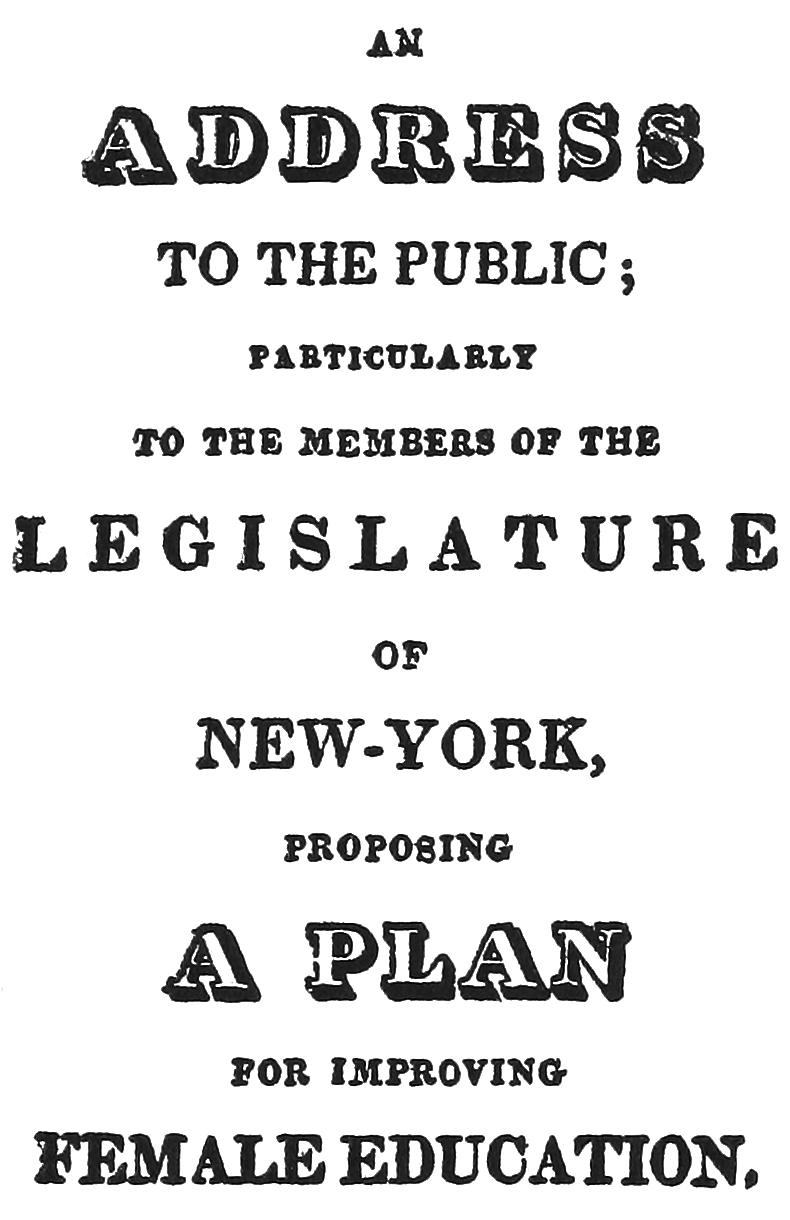
ADDRESS, &C. — DEFECTS IN THE PRESENT MODE OF FEMALE EDUCATION, AND THEIR CAUSES. — OF THE PRINCIPLES BY WHICH EDUCATION SHOULD BE REGULATED. — SKETCH OF A FEMALE SEMINARY. — BENEFITS OF FEMALE SEMINARIES.
The
object of this Address, is to convince the
public, that a reform, with respect to female
education, is necessary; that it cannot be
effected by individual exertion, but that it
requires the aid of the legislature; and further, by
shewing the justice, the policy, and the magnanimity
of such an undertaking, to persuade that body to endow
a seminary for females, as the commencement of
such reformation.
The idea of a college for males will naturally be
associated with that of a seminary, instituted and endowed
by the public; and the absurdity of sending
ladies to college, may, at first thought, strike every one
to whom this subject shall be proposed. I therefore
hasten to observe, that the seminary here recommended,
will be as different from those appropriated to the
other sex, as the female character and duties are from
the male. The business of the husbandman is not to
waste his endeavours, in seeking to make his orchard
attain the strength and majesty of his forest, but to
rear each, to the perfection of its nature.
That the improvement of female education will be
considered by our enlightened citizens as a subject of
importance, the liberality with which they part with
their property to educate their daughters, is a sufficient
evidence; and why should they not, when assembled
in the legislature, act in concert to effect a noble object,
which, though dear to them individually, cannot be
accomplished by their unconnected exertions.
If the improvement of the American female character,
and that alone, could be effected by public liberality,
employed in giving better means of instruction;
such improvement of one half of society, and that half,
which barbarous and despotic nations have ever degraded,
would of itself be an object, worthy of the most
liberal government on earth; but if the female character
be raised, it must inevitably raise that of the other sex:
and thus does the plan proposed, offer, as the object of
legislative bounty, to elevate the whole character of the
community.
As evidence that this statement does not exaggerate
the female influence in society, our sex need but be considered,
in the single relation of mothers. In this character,
we have the charge of the whole mass of individuals,
who are to compose the succeeding generation;
during that period of youth, when the pliant mind takes
any direction, to which it is steadily guided by a forming
hand. How important a power is given by this
charge! yet, little do too many of my sex know how,
either to appreciate or improve it. Unprovided with
the means of acquiring that knowledge, which flows
liberally to the other sex—having our time of education
devoted to frivolous acquirements, how should we
understand the nature of the mind, so as to be aware
of the importance of those early impressions, which we
make upon the minds of our children?—or how should
we be able to form enlarged and correct views, either
of the character, to which we ought to mould them, or
of the means most proper to form them aright?
Considered in this point of view, were the interests
of male education alone to be consulted, that of females
becomes of sufficient importance to engage the public
attention. Would we rear the human plant to its perfection,
we must first fertilize the soil which produces
it. If it acquire its first bent and texture upon a barren
plain, it will avail comparatively little, should it be
afterwards transplanted to a garden.
In the arrangement of my remarks, I shall pursue the
following order.
I. Treat of the defects of the present mode of female
education, and their causes.
II. Consider the principles, by which education
should be regulated.
III. Sketch a plan of a female seminary.
IV. Shew the benefits which society would receive
from such seminaries.
Civilized nations have long since been convinced that
education, as it respects males, will not, like trade, regulate
itself; and hence, they have made it a prime object
to provide that sex with everything requisite to facilitate
their progress in learning: but female education
has been left to the mercy of private adventurers; and
the consequence has been to our sex, the same, as it
would have been to the other, had legislatures left their
accommodations, and means of instruction, to chance
also.
Education cannot prosper in any community, unless,
from the ordinary motives which actuate the human
mind, the best and most cultivated talents of that community,
can be brought into exercise in that way. Male
education flourishes, because, from the guardian care of
legislatures, the presidencies and professorships of our
colleges are some of the highest objects to which the
eye of ambition is directed. Not so with female institutions.
Preceptresses of these, are dependent on their
pupils for support, and are consequently liable to become
the victims of their caprice. In such a situation, it
is not more desirable to be a preceptress, than it would
be, to be a parent, invested with the care of children,
and responsible for their behaviour, but yet, depending
on them for subsistence, and destitute of power to enforce
their obedience.
Feminine delicacy requires, that girls should be educated
chiefly by their own sex. This is apparent from
considerations, that regard their health and conveniences,
the propriety of their dress and manners, and
their domestic accomplishments.
Boarding schools, therefore, whatever may be their
defects, furnish the best mode of education provided for
females.
Concerning these schools it may be observed:
1. They are temporary institutions, formed by individuals,
whose object is present emolument. But they
cannot be expected to be greatly lucrative; therefore,
the individuals who establish them, cannot afford to
provide suitable accommodations, as to room. At night,
the pupils are frequently crowded in their lodging
rooms; and during the day they are generally placed
together in one apartment, where there is a heterogeneous
mixture of different kinds of business, accompanied
with so much noise and confusion, as greatly to
impede their progress in study.
2. As individuals cannot afford to provide suitable
accommodations as to room, so neither can they afford
libraries, and other apparatus, necessary to teach properly
the various branches in which they pretend to instruct.
3. Neither can the individuals who establish these
schools afford to provide suitable instruction. It not
unfrequently happens, that one instructress teaches, at
the same time and in the same room, ten or twelve distinct
branches. If assistants are provided, such are
usually taken as can be procured for a small compensation.
True, in our large cities, preceptresses provide
their pupils with masters, though at an expense, which
few can afford. Yet none of these masters are responsible
for the general proficiency or demeanour of the
pupils. Their only responsibility, is in the particular
branch which they teach; and to a preceptress, who
probably does not understand it herself, and who is,
therefore incapable of judging, whether or not it is well
taught.
4. It is impossible, that in these schools such systems
should be adopted and enforced, as are requisite
for properly classing the pupils. Institutions for young
gentlemen are founded by public authority, and are permanent;
they are endowed with funds, and their instructors
and overseers, are invested with authority to
make such laws, as they shall deem most salutary.
From their permanency, their laws and rules are well
known. With their funds they procure libraries, philosophical
apparatus, and other advantages, superior to
what can elsewhere be found; and to enjoy these, individuals
are placed under their discipline, who would
not else be subjected to it. Hence the directors of
these institutions can enforce, among other regulations,
those which enable them to make a perfect classification
of their students. They regulate their qualifications
for entrance, the kind and order of their studies,
and the period of their remaining at the seminary.
Female schools present the reverse of this. Wanting
permanency, and dependent on individual patronage,
had they the wisdom to make salutary regulations, they
could neither enforce nor purchase compliance. The
pupils are irregular in their times of entering and leaving
school; and they are of various and dissimilar acquirements.
Each scholar, of mature age, thinks she has a right to
judge for herself respecting what she is to be taught;
and the parents of those, who are not, consider, that
they have the same right to judge for them. Under
such disadvantages, a school cannot be classed, except
in a very imperfect manner.
5. It is for the interest of instructresses of boarding
schools, to teach their pupils showy accomplishments,
rather than those, which are solid and useful. Their
object in teaching is generally present profit. In order
to realize this, they must contrive to give immediate
celebrity to their schools. If they attend chiefly to the
cultivation of the mind, their work may not be manifest
at the first glance; but let the pupil return home, laden
with fashionable toys, and her young companions,
filled with envy and astonishment, are never satisfied
till they are permitted to share the precious instruction.
If it is true, with the turn of the fashion, the toys, which
they are taught to make will become obsolete; and no
benefit remain to them, of perhaps the only money, that
will ever be expended on their education; but the object
of the instructress may be accomplished notwithstanding,
if that is directed to her own, rather than her
pupil’s advantage.
6. As these schools are private establishments,
their preceptresses are not accountable to any particular
persons. Any woman has a right to open a school
in any place; and no one, either from law or custom,
can prevent her. Hence the public are liable to be imposed
upon, both with respect to the character and acquirements
of preceptresses. I am far, however, from
asserting that this is always the case. It has been before
observed, that in the present state of things, the
ordinary motives which actuate the human mind, would
not induce ladies of the best and most cultivated talents,
to engage in the business of instructing, from
choice. But some have done it from necessity, and
occasionally, an extraordinary female has occupied herself
in instructing, because she felt that impulse to be
active and useful, which is the characteristic of a vigorous
and noble mind; and because she found few avenues
to extensive usefulness open to her sex. But if
such has been the fact, it has not been the consequence
of any system, from which a similar result can be expected
to recur with regularity; and it remains true,
that the public are liable to imposition, both with regard
to the character and acquirements of preceptresses.
Instances have lately occurred, in which women of
bad reputation, at a distance from scenes of their former
life, have been entrusted by our unsuspecting citizens
with the instruction of their daughters.
But the moral reputation of individuals, is more a
matter of public notoriety than their literary attainments;
hence society are more liable to be deceived
with regard to the acquirements of instructresses than
with respect to their characters.
Those women, however, who deceive society as to
the advantages which they give their pupils, are not
charged with any ill intention. They teach as they
were taught, and believe that the public are benefitted
by their labours. Acquiring, in their youth, a high
value for their own superficial accomplishments, they
regard all others as supernumerary, if not unbecoming.
Although these considerations exculpate individuals,
yet they do not diminish the injury which society
receives; for they show, that the worst which is to be
expected from such instruction, is not that the pupils
will remain ignorant; but that, by adopting the views
of their teachers, they will have their minds barred
against future improvement, by acquiring a disrelish,
if not a contempt for useful knowledge.
7. Although, from a want of public support, preceptresses
of boarding schools have not the means of
enforcing such a system as would lead to a perfect
classification of their pupils; and although they are
confined in other respects within narrow limits, yet,
because these establishments are not dependant on
any public body, within those limits, they have a power
far more arbitrary and uncontrolled, than is allowed the
learned and judicious instructors of our male seminaries.
They can, at their option, omit their own duties, and
excuse their pupils from theirs.
They can make absurd and ridiculous regulations.
They can make improper and even wicked exactions
of their pupils.
Thus the writer has endeavoured to point out the
defects of the present mode of female education; chiefly
in order to show, that the great cause of these defects
consists in a state of things, in which legislatures,
undervaluing the importance of women in society, neglect
to provide for their education, and suffer it to become
the sport of adventurers for fortune, who may be
both ignorant and vicious.
To contemplate the principles which should regulate
systems of instruction, and consider how little those
principles have been regarded in educating our sex,
will show the defects of female education in a still
stronger point of light, and will also afford a standard,
by which any plan for its improvement may be measured.
Education should seek to bring its subjects to the
perfection of their moral, intellectual and physical nature:
in order, that they may be of the greatest possible
use to themselves and others: or, to use a different expression,
that they may be the means of the greatest
possible happiness of which they are capable, both as
to what they enjoy, and what they communicate.
Those youth have the surest chance of enjoying and
communicating happiness, who are best qualified, both
by internal dispositions, and external habits, to perform
with readiness, those duties, which their future life will
most probably give them occasion to practice.
Studies and employments should, therefore, be selected,
from one or both of the following considerations;
either, because they are peculiarly fitted to improve
the faculties; or, because they are such, as the
pupil will most probably have occasion to practise in
future life.
These are the principles, on which systems of male
education are founded; but female education has not
yet been systematized. Chance and confusion reign
here. Not even is youth considered in our sex, as in
the other, a season, which should be wholly devoted to
improvement. Among families, so rich as to be entirely
above labour, the daughters are hurried through
the routine of boarding school instruction, and at an
early period introduced into the gay world; and, thenceforth,
their only object is amusement.—Mark the different
treatment, which the sons of these families receive.
While their sisters are gliding through the
mazes of the midnight dance, they employ the lamp, to
treasure up for future use the riches of ancient wisdom;
or to gather strength and expansion of mind, in
exploring the wonderful paths of philosophy. When
the youth of two sexes has been spent so differently, is
it strange, or is nature in fault, if more mature age has
brought such a difference of character, that our sex
have been considered by the other, as the pampered,
wayward babies of society, who must have some rattle
put into our hands, to keep us from doing mischief to
ourselves or others?[1]
Another difference in the treatment of the sexes is
made in our country, which, though not equally pernicious
to society, is more pathetically unjust to our
sex. How often have we seen a student, who, returning
from his literary pursuits, finds a sister, who was his
equal in acquirements, while their advantages were
equal, of whom he is now ashamed. While his youth
was devoted to study, and he was furnished with the
means, she, without any object of improvement,
drudged at home, to assist in the support of the father’s
family, and perhaps to contribute to her brother’s subsistence
abroad; and now, a being of a lower order, the
rustic innocent wonders and weeps at his neglect.
Not only has there been a want of system concerning
female education, but much of what has been done, has
proceeded upon mistaken principles.
One of these is, that, without a regard to the different
periods of life, proportionate to their importance,
the education of females has been too exclusively directed,
to fit them for displaying to advantage the
charms of youth and beauty. Though it may be proper
to adorn this period of life, yet, it is incomparably more
important, to prepare for the serious duties of maturer
years. Though well to decorate the blossom, it is far
better to prepare for the harvest. In the vegetable creation,
nature seems but to sport, when she embellishes
the flower; while all her serious cares are directed to
perfect the fruit.
Another errour is, that it has been made the first
object in educating our sex, to prepare them to please
the other. But reason and religion teach, that we too
are primary existencies; that it is for us to move, in the
orbit of our duty, around the Holy Centre of perfection,
the companions, not the satellites of men; else,
instead of shedding around us an influence, that may
help to keep them in their proper course, we must accompany
them in their wildest deviations.
I would not be understood to insinuate, that we are
not, in particular situations, to yield obedience to the
other sex. Submission and obedience belong to every
being in the universe, except the great Master of the
whole. Nor is it a degrading peculiarity to our sex, to
be under human authority. Whenever one class of
human beings, derive from another the benefits of support
and protection, they must pay its equivalent, obedience.
Thus, while we receive these benefits from our
parents, we are all, without distinction of sex, under
their authority; when we receive them from the government
of our country, we must obey our rulers; and
when our sex take the obligations of marriage, and
receive protection and support from the other, it is
reasonable, that we too should yield obedience. Yet is
neither the child, nor the subject, nor the wife, under
human authority, but in subservience to the divine.
Our highest responsibility is to God, and our highest
interest is to please him; therefore, to secure this interest,
should our education be directed.
Neither would I be understood to mean, that our sex
should not seek to make themselves agreeable to the
other. The errour complained of, is that the taste of
men, whatever it might happen to be, has been made a
standard for the formation of the female character. In
whatever we do, it is of the utmost importance, that the
rule, by which we work, be perfect. For if otherwise,
what is it, but to err upon principle? A system of education,
which leads one class of human beings to consider
the approbation of another, as their highest object,
teaches, that the rule of their conduct should be
the will of beings, imperfect and erring like themselves,
rather than the will of God, which is the only standard
of perfection.
Having now considered female education, both in
theory and practice, and seen, that in its present state,
it is in fact a thing “without form and void,” the mind is
naturally led to inquire after a remedy for the evils it
has been contemplating. Can individuals furnish this
remedy? It has heretofore been left to them, and we
have seen the consequence. If education is a business,
which might naturally prosper, if left to individual
exertion, why have legislatures intermeddled with it at
all? if it is not, why do they make their daughters
illegitimates, and bestow all their cares upon their sons?
It is the duty of a government, to do all in its power
to promote the present and future prosperity of the
nation, over which it is placed. This prosperity will
depend on the character of its citizens. The characters
of these will be formed by their mothers; and it is
through the mothers, that the government can control
the characters of its future citizens, to form them such
as will ensure their country’s prosperity. If this is the
case, then it is the duty of our present legislators to
begin now, to form the characters of the next generation,
by controlling that of the females, who are to be
their mothers, while it is yet with them a season of improvement.
But should the conclusion be almost admitted, that
our sex too are the legitimate children of the legislature;
and, that it is their duty to afford us a share of
their paternal bounty; the phantom of a college-learned
lady, would be ready to rise up, and destroy every good
resolution, which the admission of this truth would
naturally produce in our favour.
To shew that it is not a masculine education which
is here recommended, and to afford a definite view of
the manner in which a female institution might possess
the respectability, permanency, and uniformity of operation
of those appropriated to males; and yet differ
from them, so as to be adapted to that difference of
character and duties, to which the softer sex should be
formed, is the object of the following imperfect
From considering the deficiencies in boarding
schools, much may be learned, with regard to what
would be needed, for the prosperity and usefulness of a
public seminary for females.
I. There would be needed a building, with commodious
rooms for lodging and recitation, apartments
for the reception of apparatus, and for the accommodation
of the domestic department.
II. A library, containing books on the various subjects
in which the pupils were to receive instruction;
musical instruments, some good paintings, to form the
taste and serve as models for the execution of those who
were to be instructed in that art; maps, globes, and a
small collection of philosophical apparatus.
III. A judicious board of trust, competent and desirous
to promote its interests, would in a female, as in
a male literary institution, be the corner stone of its
prosperity. On this board it would depend to provide,
IV. Suitable instruction. This article may be subdivided
under four heads.
- Religious and Moral.
- Literary.
- Domestic.
- Ornamental.
1. Religious and Moral. A regular attention to religious
duties would, of course be required of the pupils
by the laws of the institution. The trustees would be
careful to appoint no instructors, who would not teach
religion and morality, both by their example, and by
leading the minds of the pupils to perceive, that these
constitute the true end of all education. It would be
desirable, that the young ladies should spend a part of
their Sabbaths in hearing discourses relative to the peculiar
duties of their sex. The evidences of Christianity,
and moral philosophy, would constitute a part of
their studies.
2. Literary Instruction. To make an exact enumeration
of the branches of literature, which might be
taught, would be impossible, unless the time of the
pupils’ continuance at the seminary, and the requisites
for entrance, were previously fixed. Such an enumeration
would be tedious, nor do I conceive that it would
be at all promotive of my object. The difficulty complained
of, is not, that we are at a loss what sciences
we ought to learn, but that we have not proper advantages
to learn any. Many writers have given us excellent
advice with regard to what we should be taught,
but no legislature has provided us the means of instruction.
Not however, to pass lightly over this fundamental
part of education, I will mention one or two of
the less obvious branches of science, which, I conceive
should engage the youthful attention of my sex.
It is highly important, that females should be conversant
with those studies, which will lead them to
understand the operations of the human mind. The
chief use to which the philosophy of the mind can be
applied, is to regulate education by its rules. The
ductile mind of the child is intrusted to the mother:
and she ought to have every possible assistance, in acquiring
a knowledge of this noble material, on which
it is her business to operate, that she may best understand
how to mould it to its most excellent form.
Natural philosophy has not often been taught to our
sex. Yet why should we be kept in ignorance of the
great machinery of nature, and left to the vulgar notion,
that nothing is curious but what deviates from
her common course? If mothers were acquainted with
this science, they would communicate very many of its
principles to their children in early youth. From the
bursting of an egg buried in the fire, I have heard an
intelligent mother, lead her prattling inquirer, to understand
the cause of the earthquake. But how often does
the mother, from ignorance on this subject, give her
child the most erroneous and contracted views of the
causes of natural phenomena; views, which, though he
may afterwards learn to be false, are yet, from the laws
of association, ever ready to return, unless the active
powers of the mind are continually upon the alert to
keep them out. A knowledge of natural philosophy is
calculated to heighten the moral taste, by bringing to
view the majesty and beauty of order and design; and
to enliven piety, by enabling the mind more clearly to
perceive, throughout the manifold works of God, that
wisdom, in which he hath made them all.
In some of the sciences proper for our sex, the books,
written for the other, would need alteration; because,
in some they presuppose more knowledge than female
pupils would possess; in others, they have parts not
particularly interesting to our sex, and omit subjects
immediately relating to their pursuits. There would
likewise be needed, for a female seminary, some works,
which I believe are no where extant, such as a systematic
treatise on housewifery.
3. Domestic Instruction should be considered important
in a female seminary. It is the duty of our sex
to regulate the internal concerns of every family; and
unless they be properly qualified to discharge this duty,
whatever may be their literary or ornamental attainments,
they cannot be expected to make either good
wives, good mothers, or good mistresses of families:
and if they are none of these, they must be bad members
of society; for it is by promoting or destroying the
comfort and prosperity of their own families, that females
serve or injure the community. To superintend
the domestic department, there should be a respectable
lady, experienced in the best methods of
housewifery, and acquainted with propriety of dress
and manners. Under her tuition the pupils ought to be
placed for a certain length of time every morning. A
spirit of neatness and order should here be treated as a
virtue, and the contrary, if excessive and incorrigible,
be punished with expulsion. There might be a gradation
of employment in the domestic department, according
to the length of time the pupils had remained
at the institution. The older scholars might then assist
the superintendant in instructing the younger, and the
whole be so arranged, that each pupil might have advantages
to become a good domestic manager by the
time she has completed her studies.
This plan would afford a healthy exercise. It would
prevent that estrangement from domestic duties, which
would be likely to take place in a length of time devoted
to study, with those, to whom they were previously
familiar; and would accustom those to them,
who, from ignorance, might otherwise put at hazard
their own happiness, and the prosperity of their families.
These objects might doubtless be effected by a
scheme of domestic instruction; and probably others
of no inconsiderable importance. It is believed, that
housewifery might be greatly improved, by being
taught, not only in practice, but in theory. Why may it
not be reduced to a system, as well as other arts?
There are right ways of performing its various operations;
and there are reasons why those ways are right;
and why may not rules be formed, their reasons collected;
and the whole be digested into a system to
guide the learner’s practice?
It is obvious, that theory alone, can never make a
good artist; and it is equally obvious, that practice unaided
by theory, can never correct errors, but must establish
them. If I should perform any thing in a wrong
manner all my life, and teach my children to perform it
in the same manner, still, through my life and theirs,
it would be wrong. Without alteration there can be no
improvement; but how are we to alter, so as to improve,
if we are ignorant of the principles of our art, with
which we should compare our practice, and by which
we should regulate it?
In the present state of things, it is not to be expected,
that any material improvements in housewifery
should be made. There being no uniformity of
method, prevailing among different housewives, of
course, the communications from one to another, are
not much more likely to improve the art, than a communication,
between two mechanics of different trades,
would be, to improve each in his respective occupation.
But should a system of principles be philosophically
arranged, and taught, both in theory and by practice,
to a large number of females, whose minds were expanded
and strengthened by a course of literary instruction,
those among them, of an investigating turn,
would, when they commenced housekeepers, consider
their domestic operations as a series of experiments,
which either proved or refuted the system previously
taught. They would then converse together like those,
who practise a common art, and improve each other by
their observations and experiments; and they would also
be capable of improving the system, by detecting its
errors, and by making additions of new principles and
better modes of practice.
4. The Ornamental branches, which I should recommend
for a female seminary, are drawing and painting,
elegant penmanship, music, and the grace of motion.
Needle-work is not here mentioned. The best
style of useful needle-work should either be taught in
the domestic department, or made a qualification for
entrance; and I consider that useful, which may contribute
to the decoration of a lady’s person, or the convenience
and neatness of her family. But the use of
the needle, for other purposes than these, as it affords
little to assist in the formation of the character, I should
regard as a waste of time.
The grace of motion, must be learnt chiefly from instruction
in dancing. Other advantages besides that of
a graceful carriage, might be derived from such instruction,
if the lessons were judiciously timed. Exercise
is needful to the health, and recreation to the cheerfulness
and contentment of youth. Female youth could
not be allowed to range unrestrained, to seek amusement
for themselves. If it was entirely prohibited, they
would be driven to seek it by stealth; which would lead
them to many improprieties of conduct, and would have
a pernicious effect upon their general character, by inducing
a habit of treading forbidden paths. The alternative
that remains is to provide them with proper recreation,
which, after the confinement of the day, they
might enjoy under the eye of their instructors. Dancing
is exactly suited to this purpose, as also to that of
exercise; for perhaps in no way, can so much healthy
exercise be taken in so short a time. It has besides,
this advantage over other amusements, that it affords
nothing to excite the bad passions; but, on the contrary,
its effects are, to soften the mind, to banish its
animosities, and to open it to social impressions.
It may be said, that dancing would dissipate the attention,
and estrange it from study. Balls would doubtless
have this effect; but let dancing be practised every
day, by youth of the same sex, without change of place,
dress, or company, and under the eye of those, whom
they are accustomed to obey, and it would excite no
more emotion, than any other exercise or amusement,
but in degree, as it is of itself more pleasant. But it
must ever be a grateful exercise to youth, as it is one,
to which nature herself prompts them, at the sound of
animating music.
It has been doubted, whether painting and music
should be taught to young ladies, because much time
is requisite to bring them to any considerable degree of
perfection, and they are not immediately useful.
Though these objections have weight, yet they are
founded on too limited a view of the objects of education.
They leave out the important consideration of
forming the character. I should not consider it an essential
point, that the music of a lady’s piano should
rival that of her master’s; or that her drawing room
should be decorated with her own paintings, rather
than those of others; but it is the intrinsic advantage,
which she might derive from the refinement of herself,
that would induce me to recommend to her, an attention
to those elegant pursuits. The harmony of sound,
has a tendency to produce a correspondent harmony of
soul; and that art, which obliges us to study nature, in
order to imitate her, often enkindles the latent spark of
taste—of sensibility for her beauties, till it glows to
adoration for their author, and a refined love of all his
works.
V. There would be needed, for a female, as well as
for a male seminary, a system of laws and regulations,
so arranged, that both the instructors and pupils would
know their duty; and thus, the whole business, move
with regularity and uniformity.
The laws of the institution would be chiefly directed,
to regulate the pupil’s qualifications for entrance, the
kind and order of their studies, their behaviour while at
the institution, the term allotted for the completion of
their studies, the punishments to be inflicted on offenders
and the rewards or honours, to be bestowed on
the virtuous and diligent.
The direct rewards or honors, used to stimulate the
ambition of students in colleges, are first, the certificate
or diploma, which each receives, who passes successfully
through the term allotted to his collegiate
studies; and secondly, the appointments to perform certain
parts in public exhibitions, which are bestowed by
the faculty, as rewards for superior scholarship. The
first of these modes is admissible into a female seminary;
the second is not; as public speaking forms no
part of female education. The want of this mode,
might, however, be supplied by examinations judiciously
conducted. The leisure and inclination of both
instructors and scholars, would combine to produce a
thorough preparation for these; for neither would have
any other public test of the success of their labors.
Persons of both sexes would attend. The less entertaining
parts, might be enlivened by interludes, where
the pupils in painting and music, would display their
several improvements. Such examinations, would
stimulate the instructors to give their scholars more attention,
by which the leading facts and principles of
their studies, would be more clearly understood, and
better remembered. The ambition excited among the
pupils, would operate, without placing the instructors
under the necessity of making distinctions among them,
which are so apt to be considered as invidious; and
which are, in our male seminaries, such fruitful sources
of disaffection.
Perhaps the term allotted for the routine of study at
the seminary, might be three years. The pupils, probably,
would not be fitted to enter, till about the age of
fourteen. Whether they attended to all, or any of the
ornamental branches, should be left optional with the
parents or guardians. Those who were to be instructed
in them, should be entered for a longer term, but if this
was a subject of previous calculation, no confusion
would arise from it. The routine of the exercises being
established by the laws of the institution, would be uniform,
and publicly known; and those, who were previously
acquainted with the branches first taught,
might enter the higher classes; nor would those who
entered the lowest, be obliged to remain during the
three years. Thus the term of remaining at the institution,
might be either one, two, three, four, or more
years; and that, without interfering with the regularity
and uniformity of its proceedings.
The writer has now given a sketch of her plan. She
has by no means expressed all the ideas, which occurred
to her concerning it. She wished to be as concise as
possible, and yet afford conviction, that it is practicable,
to organize a system of female education, which shall
possess the permanency, uniformity of operation, and
respectability of our male institutions; and yet differ
from them, so as to be adapted, to that difference of
character, and duties, to which early instruction should
form the softer sex.
It now remains, to enquire more particularly, what
would be the benefits resulting from such a system.
In inquiring, concerning the benefits of the plan proposed,
I shall proceed upon the supposition, that female
seminaries will be patronized throughout our country.
Nor is this altogether a visionary supposition. If
one seminary should be well organized, its advantages
would be found so great, that others would soon be instituted;
and, that sufficient patronage can be found to
put one in operation, may be presumed from its reasonableness,
and from the public opinion, with regard to
the present mode of female education. It is from an
intimate acquaintance, with those parts of our country,
whose education is said to flourish most, that the writer
has drawn her picture of the present state of female instruction;
and she knows, that she is not alone, in perceiving
or deploring its faults. Her sentiments are
shared by many an enlightened parent of a daughter,
who has received a boarding school education. Counting
on the promise of her childhood, the father had anticipated
her maturity, as combining what is excellent
in mind, with what is elegant in manners. He spared no
expense that education might realize to him, the image
of his imagination. His daughter returned from boarding
school, improved in fashionable airs, and expert in
manufacturing fashionable toys; but, in her conversation,
he sought in vain, for that refined and fertile mind,
which he had fondly expected. Aware that his disappointment
has its source in a defective education, he
looks with anxiety on his other daughters, whose
minds, like lovely buds, are beginning to open. Where
shall he find a genial soil, in which he may place them to
expand? Shall he provide them male instructors?—Then
the graces of their persons and manners, and
whatever forms the distinguishing charm of the feminine
character, they cannot be expected to acquire.—Shall
he give them a private tutoress? She will have
been educated at the boarding school, and his daughters
will have the faults of its instruction second-handed.
Such is now the dilemma of many parents; and it is
one, from which they cannot be extricated by their individual
exertions. May not then the only plan, which
promises to relieve them, expect their vigorous support.
Let us now proceed to inquire, what benefits would
result from the establishment of female seminaries.
They would constitute a grade of public education,
superior to any yet known in the history of our sex;
and through them, the lower grades of female instruction
might be controlled. The influence of public seminaries,
over these, would operate in two ways; first,
by requiring certain qualifications for entrance; and
secondly, by furnishing instructresses, initiated in their
modes of teaching, and imbued with their maxims.
Female seminaries might be expected to have important
and happy effects, on common schools in general;
and in the manner of operating on these, would
probably place the business of teaching children, in
hands now nearly useless to society; and take it from
those, whose services the state wants in many other
ways.
That nature designed for our sex the care of children,
she has made manifest, by mental, as well as physical
indications. She has given us, in a greater degree than
men, the gentle arts of insinuation, to soften their
minds, and fit them to receive impressions; a greater
quickness of invention to vary modes of teaching to
different dispositions; and more patience to make repeated
efforts. There are many females of ability, to
whom the business of instructing children is highly acceptable,
and, who would devote all their faculties to
their occupation. They would have no higher pecuniary
object to engage their attention, and their reputation
as instructors they would consider as important;
whereas, whenever able and enterprizing men, engage
in this business, they consider it, merely as a temporary
employment, to further some other object, to the attainment
of which, their best thoughts and calculations
are all directed. If then women were properly fitted
by instruction, they would be likely to teach children
better than the other sex; they could afford to do it
cheaper; and those men who would otherwise be engaged
in this employment, might be at liberty to add to
the wealth of the nation, by any of those thousand occupations,
from which women are necessarily debarred.
But the females, who taught children, would have
been themselves instructed either immediately or indirectly
by the seminaries. Hence through these, the
government might exercise an intimate, and most beneficial
control over common schools. Any one, who has
turned his attention to this subject, must be aware, that
there is great room for improvement in these, both as
to the modes of teaching, and the things taught; and
what method could be devised so likely to effect this
improvement, as to prepare by instruction, a class of
individuals, whose interest, leisure, and natural talents,
would combine to make them pursue it with ardour.
Such a class of individuals would be raised up, by female
seminaries. And therefore they would be likely
to have highly important and happy effects on common
schools.
It is believed, that such institutions, would tend to
prolong, or perpetuate our excellent government.
An opinion too generally prevails, that our present
form of government, though good, cannot be permanent.
Other republics have failed, and the historian
and philosopher have told us, that nations are like individuals;
that, at their birth, they receive the seeds of
their decline and dissolution. Here deceived by a false
analogy, we receive an apt illustration of particular
facts, for a general truth. The existence of nations,
cannot, in strictness, be compared with the duration of
animate life; for by the operation of physical causes,
this, after a certain length of time, must cease: but
the existence of nations, is prolonged by the succession
of one generation to another, and there is no physical
cause, to prevent this succession’s going on, in a
peaceable manner, under a good government, till the
end of time. We must then look to other causes, than
necessity, for the decline and fall of former republics.
If we could discover these causes, and seasonably prevent
their operation, then might our latest posterity
enjoy the same happy government, with which we are
blessed; or if but in part, then might the triumph of
tyranny, be delayed, and a few more generations be
free.
Permit me then to ask the enlightened politician of
my country, whether amidst his researches for these
causes, he cannot discover one, in the neglect, which
free governments, in common with others, have shown,
to whatever regarded the formation of the female character.
In those great republics, which have fallen of themselves,
the loss of republican manners and virtues, has
been the invariable precursor, of their loss of the republican
form of government. But is it not in the
power of our sex, to give society its tone, both as to
manners and morals? And if such is the extent of female
influence, is it wonderful, that republics have
failed, when they calmly suffered that influence, to become
enlisted in favour of luxuries and follies, wholly
incompatible with the existence of freedom?
It may be said, that the depravation of morals and
manners, can be traced to the introduction of wealth,
as its cause. But wealth will be introduced; even the
iron laws of Lycurgus could not prevent it. Let us
then inquire, if means may not be devised, to prevent
its bringing with it the destruction of public virtue.
May not these means be found in education?—in implanting,
in early youth, habits, that may counteract
the temptations, to which, through the influence of
wealth, mature age will be exposed? and in giving
strength and expansion to the mind, that it may comprehend,
and prize those principles, which teach the
rigid performance of duty? Education, it may be said,
has been tried as a preservative of national purity. But
was it applied to every exposed part of the body politic?
For if any part has been left within the pestilential
atmosphere of wealth, without this preservative,
then that part becoming corrupted, would communicate
the contagion to the whole; and if so, then has the
experiment, whether education may not preserve public
virtue, never yet been fairly tried. Such a part has
been left in all former experiments. Females have been
exposed to the contagion of wealth without the preservative
of a good education; and they constitute that
part of the body politic, least endowed by nature to
resist, most to communicate it. Nay, not merely have
they been left without the defence of a good education,
but their corruption has been accelerated by a bad one.
The character of women of rank and wealth has been,
and in the old governments of Europe now is, all that
this statement would lead us to expect. Not content
with doing nothing to promote their country’s welfare,
like pampered children, they revel in its prosperity,
and scatter it to the winds, with a wanton profusion:
and still worse,—they empoison its source, by diffusing
a contempt for useful labour. To court pleasure their
business,—within her temple, in defiance of the laws
of God and man, they have erected the idol fashion; and
upon her altar, they sacrifice, with shameless rites,
whatever is sacred to virtue or religion. Not the
strongest ties of nature,—not even maternal love can
restrain them! Like the worshipper of Moloch, the
mother while yet yearning over the new born babe,
tears it from the bosom, which God has swelled with
nutrition for its support, and casts it remorseless from
her, the victim of her unhallowed devotion!
But while, with an anguished heart, I thus depict the
crimes of my sex, let not the other stand by and smile.
Reason declares, that you are guiltier than we. You
are our natural guardians,—our brothers,—our fathers,
and our rulers. You know that our ductile minds,
readily take the impressions of education. Why then
have you neglected our education? Why have you
looked with lethargic indifference, on circumstances
ruinous to the formation of our characters, which you
might have controlled?
But it may be said, the observations here made, cannot
be applied to any class of females in our country.
True, they cannot yet; and if they could, it would be
useless to make them; for when the females of any country
have become thus debased, then, is that country
so corrupted, that nothing, but the awful judgments
of heaven, can arrest its career of vice. But it cannot
be denied, that our manners are verging towards those
described; and the change, though gradual, has not
been slow: already do our daughters listen with surprise,
when we tell them of the republican simplicity of
our mothers. But our manners are not as yet so altered,
but that, throughout our country, they are still
marked with republican virtues.
The inquiry, to which these remarks have conducted
us is this—What is offered by the plan of female education,
here proposed, which may teach, or preserve,
among females of wealthy families, that purity of manners,
which is allowed, to be so essential to national
prosperity, and so necessary, to the existence of a republican
government.
1. Females, by having their understandings cultivated,
their reasoning powers developed and strengthened,
may be expected to act more from the dictates of
reason, and less from those of fashion and caprice.
2. With minds thus strengthened they would be
taught systems of morality, enforced by the sanctions
of religion; and they might be expected to acquire juster
and more enlarged views of their duty, and stronger
and higher motives to its performance.
3. This plan of education, offers all that can be done
to preserve female youth from a contempt of useful labour.
The pupils would become accustomed to it, in
conjunction with the high objects of literature, and the
elegant pursuits of the fine arts; and it is to be hoped
that both from habit and association, they might in future
life, regard it as respectable.
To this it may be added, that if housewifery could be
raised to a regular art, and taught upon philosophical
principles, it would become a higher and more interesting
occupation; and ladies of fortune, like wealthy agriculturalists,
might find, that to regulate their business,
was an agreeable employment.
4. The pupils might be expected to acquire a taste
for moral and intellectual pleasures, which would buoy
them above a passion for show and parade, and which
would make them seek to gratify the natural love of
superiority, by endeavouring to excel others in intrinsic
merit, rather than in the extrinsic frivolities of dress,
furniture, and equipage.
5. By being enlightened in moral philosophy, and in
that, which teaches the operations of the mind, females
would be enabled to perceive the nature and extent, of
that influence, which they possess over their children,
and the obligation, which this lays them under, to watch
the formation of their characters with unceasing vigilance,
to become their instructors, to devise plans for
their improvement, to weed out the vices from their
minds, and to implant and foster the virtues. And surely,
there is that in the maternal bosom, which, when its
pleadings shall be aided by education, will overcome
the seductions of wealth and fashion, and will lead the
mother, to seek her happiness in communing with her
children, and promoting their welfare, rather than in a
heartless intercourse, with the votaries of pleasure:
especially, when with an expanded mind, she extends
her views to futurity, and sees her care to her offspring
rewarded by peace of conscience, the blessings of her
family, the prosperity of her country, and finally with
everlasting happiness to herself and them.
Thus, laudable objects and employments, would be
furnished for the great body of females, who are not
kept by poverty from excesses. But among these, as
among the other sex, will be found master spirits, who
must have pre-eminence, at whatever price they acquire
it. Domestic life cannot hold these, because they
prefer to be infamous, rather than obscure. To leave
such, without any virtuous road to eminence, is unsafe
to community; for not unfrequently, are the secret
springs of revolution, set in motion by their intrigues.
Such aspiring minds, we will regulate, by education, we
will remove obstructions to the course of literature,
which has heretofore been their only honorable way to
distinction; and we offer them a new object, worthy of
their ambition; to govern, and improve the seminaries
for their sex.
In calling on my patriotic countrymen, to effect so
noble an object, the consideration of national glory,
should not be overlooked. Ages have rolled away;—barbarians
have trodden the weaker sex beneath their
feet;—tyrants have robbed us of the present light of
heaven, and fain would take its future. Nations, calling
themselves polite, have made us the fancied idols
of a ridiculous worship, and we have repaid them with
ruin for their folly. But where is that wise and heroic
country, which has considered, that our rights are
sacred, though we cannot defend them? that tho’ a
weaker, we are an essential part of the body politic,
whose corruption or improvement must affect the
whole? and which, having thus considered, has sought
to give us by education, that rank in the scale of being,
to which our importance entitles us? History shows
not that country. It shows many, whose legislatures
have sought to improve their various vegetable productions,
and their breeds of useful brutes; but none, whose
public councils have made it an object of their deliberations,
to improve the character of their women. Yet
though history lifts not her finger to such an one, anticipation
does. She points to a nation, which, having
thrown off the shackles of authority and precedent,
shrinks not from schemes of improvement, because
other nations have never attempted them; but which,
in its pride of independence, would rather lead than
follow, in the march of human improvement: a nation,
wise and magnanimous to plan, enterprising to undertake,
and rich in resources to execute. Does not every
American exult that this country is his own? And
who knows how great and good a race of men, may yet
arise from the forming hand of mothers, enlightened
by the bounty of that beloved country,—to defend her
liberties,—to plan her future improvement,—and to
raise her to unparalleled glory?