“Duo illum
sequor? In Persas.”—Plautus.
“Halas! diséit-elle, faut-il que je
périsse sous les pattes d’une araignée, moi
qui viens de me tirer des griffes d’un
lion?”—Fables
d’Ésope.
New plans and new preparations—We leave
Bagdad for Persia—Wild boar hunting in the Wudian—A
terrible accident—We travel with a holy man—Camps of
the Beni Laam—An alarm.
Amongst the letters awaiting our
arrival at Bagdad, we had found an invitation from Lord and Lady
Lytton to spend the summer, or part of it, with them at
Simla. It seemed that this would be an opportunity, which
might never again occur, of going on to India by land, a plan
which might be made to include a visit to the Bactiari mountains,
where our acquaintance of the pilgrimage, Ali Koli Khan, had his
home. Ali had often talked to us of his father, and of a
wonderful stud of thoroughbred Arabians possessed by his family,
and the prospect of seeing these, and a tribe reputed to be the
most powerful in Persia, was an attraction that could not be
denied. He had indeed proposed to travel there with us,
and introduce us himself to his people, and if circumstances had
been propitious, no doubt we might have accomplished this part of
our journey comfortably enough. Unfortunately, when we took
leave of the Haj at Meshhed Ali, our friend was not there for us
to concert arrangements with him, nor even to wish him
good-bye. He had been lost in the sandstorm, already
mentioned as having occurred on the last day but one of the
pilgrimage; and though before going on to Kerbela we had received
news of his safety, we had no opportunity of meeting him.
The consequence was that he neither came with us, nor gave us so
much as a letter to his father; and in the end we started alone,
a mistake we had ample reason to repent. The plan of
travelling from Bagdad to India by land appeared to me of
doubtful wisdom under the circumstances; but Wilfrid’s
thirst for exploration was not yet slaked. He argued that
spring was just beginning, and a spring journey through Persia
must of necessity be the most delightful thing in the world, and
that we could at any moment get down to some port of the Persian
Gulf, if the weather became too hot for us. Our means of
transport were ready. We should find some difficulty in
disposing of our camels at Bagdad, and had better make use of
them; and though we were now without servants, servants might
easily be found. Thus, in an evil day, and without due
consideration of the difficulties and dangers which were before
us, we determined to go on. A final circumstance decided
the matter beyond recall. Captain Cameron, the African
traveller, arrived at Bagdad, with the object of surveying a line
for an Indo-Mediterranean railway from Tripoli to Bushire, and
thence to the Indus, having already made the first stages of his
survey; and Wilfrid now proposed to assist him in the more
serious part of his undertaking. It was agreed between them
that they should take different lines from Bagdad, and meet again
either at Bushire or Bender Abbas, thus comparing notes as to the
most practicable railway line from the Tigris to the Persian
Gulf. Captain Cameron was to follow the left bank of the
river as far as Amara, and then to strike across the marshy
plains to Ahwas and Bender Dilam, while we should keep further
east, skirting the Hamrin and Bactiari hills. So presented,
the project sounded useful, if not agreeable, and acquired a
definite object, which, if it ran us into unnecessary dangers,
served also to carry us through them afterwards. The
expedition was accordingly a settled thing.
Our preparations were made, unfortunately, with as little
reflection as the decision. On arriving at Bagdad, we had,
as has been mentioned, said goodbye to Mohammed and the
camel-men, and had, moreover, allowed Hanna and Ibrahim, who were
homesick, or tired of travelling, to depart. The difficulty
now was how to replace them. It is always a dangerous
experiment to begin a serious journey with untried followers, and
it was our first misfortune that we were obliged to do this.
Colonel Nixon, as he had done last year, kindly lent us a cavass;
but, alas! Ali, the intelligent fat man who had been of such
assistance to us in our Mesopotamian tour, was not fit to leave
Bagdad. He was lying ill of a fever, and could not be
disturbed. The cavass given us was consequently a stranger,
and might be good or bad, useful or useless, for anything we
knew. It was necessary, too, that somebody should know
Persian, and we engaged a Persian cook, Ramazan by name, highly
recommended, but equally untried. A young Bagdadi next
volunteered as groom, and, lastly, the Sheykh of the Agheyls, an
old friend, sent two of his men as camel-drivers.
None, however, of these attendants, the two last excepted, had
seen each other before, nor knew anything of our way of
travelling or our way of life. We did not even start
together, as it would have been wise to do. The country
round Bagdad is bare of pasture for many miles, and we thought to
better matters for our camels by sending them on some marches
down the river, intending to join them later with our baggage by
boat, a most unfortunate arrangement, for the men being stupid
timorous fellows, seem, when left to themselves, to have lost
their heads, and instead of obeying their orders, which were to
travel slowly, pasturing the animals as they went, drove them
without halting to the village we had named as a meeting-place,
and kept them there, half-starved in dirty stables, till we came, a
piece of negligence which cost us dear. When we joined
them, one, the black delúl was already missing, dead they
informed us; and a second, Shayl, a camel which, when we left
Damascus, had been a model of strength and good looks, was so
reduced as to be unfit for further travelling, while the
remaining six were but a shadow of their former selves.
Only Hatheran, the giant leader, who had saved our fortunes in
the Nefûd, was still fit for a full load; and to him once
more we had mainly to trust during all that was to come.
It is difficult for those who have never owned camels to
imagine how much attached one becomes to these animals on a long
journey, and what a variety of character they possess. Each
one of ours had its name, which it knew well, and its special
quality of courage, or caution, or docility.
Wilfrid’s white delúl, “Helweh”
(sweetmeat), was gentle and obedient; the Meccan,
“Hamra,” thoughtless and vain; “Ghazal,”
affectionate, but rude and inclined to buck (poor thing, she was
far from bucking now); “Hatheran,” especially, was a
camel of character. He was evidently proud of his strength
and his superior understanding, and possessed a singular
independence of opinion which compelled respect. It was his
pride to march ahead of the rest, who accepted him as guide, and
followed his lead on all doubtful occasions. He cared
little for the beaten track, choosing his ground as seemed best
to him and always for good reasons. He was never
impatient or put out, and in difficulties never lost his
head. He could carry twice the load of the others, and
could walk faster, and go longer without water. At the same
time, he considered himself entitled to extra rations when we
made up the evening meal, and would leave us no peace till he was
satisfied. I mention these things now, for feeding and
driving and tending these camels was to be our chief occupation
during the rest of our journey, and on them depended the safety
of our march, and, in great measure, of our lives. I say it
with no little vanity, that, starting under the unfavourable
circumstances we did, we nevertheless marched our camels without
accident five hundred miles over mountain and plain, through
swamps and streams never before traversed by camels, and across
nine large rivers, one of them bigger than the Rhine; and that we
brought them in to their journey’s end fat and well.
I must not, however, forestall matters.
On the 20th of March, having thus sent on our camels with the
Agheyls, we embarked on board an English river steamer, with our
servants, our horses, our greyhounds, and Rasham, the falcon who
had followed our march from Haïl, and were taken down about
eighty miles to a point of the river below Kut, where several
streams run into the Tigris from the east, thus giving the
district the name of Wudian (streams).
It was a cheerless start, for all down the river we steamed
through driving rain, till at last the steamer was brought to,
amid the downpour, in front of a bare round bank, and we were
invited to descend. There was nothing but mud and a few
bushes to be seen for miles, and it seemed impossible we should
step out of the luxury of a civilised English cabin into what
seemed a mere slough, and that without means of transport further
than the bank, for of camels and men there was nothing at all to
be seen. But the die was cast; this was the place we had
agreed on, and, without more ado, we landed, first our horses and
then our baggage, and then ourselves. While this was in
operation, some Arabs had appeared on the scene, and to one of
them, an old man in a green turban, Captain Clements, before he
said good-bye, confided us. Seyd Abbas, he told us, was an
old acquaintance, and an honest man; and though the rest, it was
easy to see, were of the lowest order of felláhin Arabs,
we were fain to be content with this assurance and make what
friends we could, at least with the old man. Sitting
disconsolately on our camel bags in the rain, we then made our
last farewell to all on board, and having watched the steamer
till it steamed out of sight, set ourselves in earnest to the
work that was before us. [119] I resume my
journal:
“The tent was soon rigged up on a piece of sounder
ground than the rest, and the horses fettered and turned out to
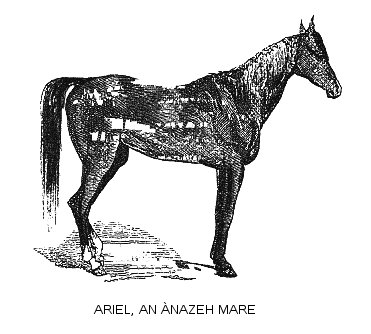
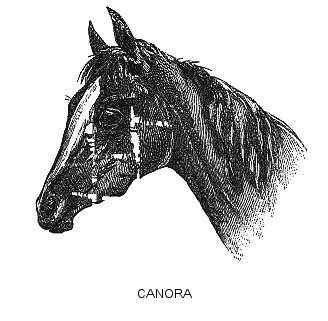
graze. My new mare, Canora, so called after the Canora or
Nebbuk tree which grows in the Residency yard, is certainly a
great beauty, and attracts much, too much, attention, from the
rather thievish-looking people of this place. Wilfrid has
been to the encampment, which is about half a mile off, with Seyd
Abbas, and has made friends with their chief people, but he has
no agreeable impression of those he has seen. They appear
to be, he says, a mixed collection of felláhin from all
the Iraki tribes, and can lay no claim at all to good
birth. Their Sheykh alone, for Seyd Abbas is not their
Sheykh, claims gentility as coming from the Beni Laam, but we do
not like his looks. The Beni Laam, Seyd Abbas tells us, are
three days’ journey from here, and there is war going on
amongst them just now, owing to a quarrel between their Sheykh,
Mizban, and one of his brothers. He gives rather a terrible
picture of them, and has been trying to dissuade us from going
further; but we think that with the letters we have for Mizban,
there can be no difficulty. The Beni Laam are, at any rate,
a true Bedouin tribe, not felláhin, like the people
here. Old Hajji Mohammed (the cavass) stayed with me while
Wilfrid was away. He was once in the army, and insisted on
standing sentry in the rain in spite of all I could do to make
him sit down under the flap of the tent. He has evidently
small confidence in the people here.
Some
fowls have been brought from the camp, and there are sticks
enough to make a fire. Now we shall see what our Persian
cook can do. If the camels were here, our being detained
would not so much matter. We heard of them at Kut as we
passed by in the steamer, but that is twenty-five miles off; and
with this rain it is impossible to say when they may arrive.
March 22.—The weather has cleared, and we can see
the Hamrin hills to the east, not so very far off. The
country is less hideous than it seemed yesterday in the
rain. This place is a sort of peninsula or island, formed
by two rivers, which come from the Hamrin hills and fall into the
Tigris. These seemed to be joined higher up by a canal, so
that the space inside is cut off from the desert. It is
partly a swamp, partly a thicket of guttub bushes, with here and
there patches of cultivation made by felláhin. These
call themselves Saadeh, but Seyd Abbas says they come from all
parts. He himself is brother to the Sheykh of Ali Ghurbi, a
village on the other side of the Tigris. There are no
villages at all on this side after Kut, and this island of Wudian
is the only inhabited spot. The felláhin are very
poor, and complain bitterly of the government, which ruins
them. They are completely under the thumb of the Turks, now
that the government has steamers on the river, and the
tax-gatherers take (if we may believe them), about two-thirds of
their crops. They have also to pay ten beshliks (francs) for each
tent, half a beshlik for each sheep, two beshliks for each
buffalo they keep, and a capitation tax of two and a half
beshliks besides. Moreover, they are visited now and then
by zaptiehs, who take their horses from them if they do not
manage to hide them away, on the pretence that they cannot afford
to keep them, while Mizban makes them pay tribute for protection
too, or rather for the right of being left alone. The
government does absolutely nothing in return for what it
takes. They are indeed in a wretched plight, and one
wonders why they take all this trouble of cultivation for so
little, but perhaps it is a choice between that and
starvation.
The great feature of Wudian is its wild-boars. These
literally swarm in the fields, trotting about in open day-light,
and doing exactly as they like. The people are afraid of
them, and keep out of their way, and no wonder, for they are
gigantic beasts. A man who was at our tents to-day, shewed
us a terrible wound he had received from one which charged him
quite without provocation. The people have only their short
spears to protect themselves with. The beasts come almost
inside the camp, and Wilfrid found one this afternoon fast asleep
under a bush, within ten yards of the path which leads to the
tents. The people passing along, went a long way round so
as not to disturb it, for it lay quite exposed to view.
Seyd Abbas begged him to destroy some of them, and Wilfrid has
ridden out on Ariel, and taken the Winchester rifle to see what
he can
do. I have felt feverish, and have stayed at home drying
the things which had got wet.
The people here are all Shias, and very fanatical, and Seyd
Abbas as a descendant of the Prophet enjoys a high position among
them. Among the Ánazeh and Shammar, the Bedouins
think nothing of saints and seyyids, but here they have everybody
at their feet. Bashaga, the Sheykh, though a Beni Laam and,
as such, a “gentleman,” is not nearly so important as
the old man in the green turban. The latter has been
talking to me this morning and promises to take us to
Mizban’s camp, if we insist on going, though he advises
strongly not. He says that with him we shall be safe, as
they also have a great respect for Seyyids, and besides he has
married into Mizban’s family. Seyyid or not, he eats
and drinks with us freely; so we feel a certain amount of
confidence in him.
Wilfrid has returned triumphant. He was not more than
two hours and a half away, and he has killed five boars and a
sow. Ariel behaved wonderfully, following the pigs without
any need of urging, and without flinching when they
charged. It seems to have been splendid sport.
Amongst the victims was the old boar that had been seen asleep,
and which charged most viciously. It is lucky the dogs were
not taken, as they would certainly have got hurt. The Arabs
are highly delighted at the result, and we hope it may put us on
better terms with them. They have dragged one of the
corpses, a disgusting object, to the bank of the river,
intending, they say, to send it to the British Resident at Bagdad
by the next steamer. No news, alas, of the camels.
March 23.—A fearful storm in the night, and the
whole place under water. Wilfrid went out early to try and
get news of the camels, riding Job, the grey horse we bought of
Col. Nixon. He did not get far, for the streams are so
swollen that they are impassable, at least for one who does not
know the fords; and Job is a rather timid horse to get into
difficulties with. He is young, and fairly bolted when a
pig jumped up from out of a bush near him. We are both
going out now for some more boar-hunting. I should enjoy it
better if I was sure we should ever get away from this swampy
place.
* * * * *
We have had a great misfortune. Ariel is badly
wounded. We went out to-day, a large party, people on foot
with spears and hoes, and one or two on sorry little mares.
It was a beautiful day after the rain, birds singing in all the
bushes, francolins calling, hoopoes flying about, and woodcocks
starting from guttub thickets. The island was half under
water, and droves of pigs, boars, sows and little ones, turned
out of the bushes, where they generally lie in the day-time, were
grunting and trotting and splashing about everywhere. We
singled out a great red boar, and all gave chase, but the ground
was heavier than yesterday, and we had a longish gallop to
come up to him. It was difficult, too, to keep to the boar
we had chosen, where there were so many. At last he
charged, and was hit, but not enough to stop though it turned
him, and then we had another gallop, and another shot rolled him
over. The people on foot, who were following them, rushed
in, but just as they got near him up he jumped, and bolted
towards some deep water, where there was a high guttub
bush. I was in front, and Wilfrid shouted to me to turn
him, which I would have done if I could, but instead, he turned
me, coming at me with a savage grunt and a toss of his head which
I knew was dangerous. Then he plunged into the deep water,
but instead of going on, suddenly changed his mind, and came back
to where the bush was on the land, and before we were aware, had
charged right in among us. Wilfrid turned his mare, but,
alas, not fast enough, firing as he turned. To my horror, I
saw the hideous beast catch Ariel and give her a toss, such as I
have seen in the bull-ring given by a bull. He seemed to
lift horse and rider clean off the ground. Ariel staggered
away, while the boar lay down, and was soon after dispatched by
the Arabs.
We meanwhile had torn off our kefiyehs and scarfs, and were
trying to staunch a ghastly wound in the poor mare’s
leg. The leg was ripped up inside from the hock to the
stifle, and an artery had been cut. For a long while it was
all in vain. We could not stop the flow, and no words can
describe our misery as we watched the blood pouring fast upon
the ground. We were in despair, for besides the fact of her
being thus precious in race, we are much attached to the mare for
her own sake, as who would not be, for Ariel is the noblest and
best and gentlest creature that ever was. She has a
pathetic look in her eyes, and is absolutely patient under her
suffering. We have now some hope of her recovery, but
Wilfrid fears she must be abandoned, for the sinew is cut bare,
and she cannot put her foot to the ground.
While we were engaged in tending her, suddenly the camels
appeared. It would have given us immense pleasure a few
hours ago. Now all seemed indifferent. Their
presence, however, enabled us to bring our camp here, where the
mare is.
March 24.—This certainly is an ill-starred
journey. The stupid Agheyls have so neglected our camels
that Abdeh is dead, and Shayl unable to go further. Nor are
the rest in much better case. We had some discussion this
morning about giving up our present plan, and taking the next
steamer which passes by for Bussora where we could make a fresh
start. This would have been the best chance of saving the
mare. But we decided to push on, and accordingly we left
Wudian this morning, fording the canal, which is about four feet
deep, fortunately without accident, and marching slowly in a
south-east direction across a perfectly level plain. Ours
is a melancholy caravan, for poor Ariel walks with great
difficulty, her leg being terribly swollen; but she has
such courage that we hope she may yet pull through. It was
a choice of evils, bringing or leaving her; for leaving her would
mean that we should never see her again. Bashaga could not
be trusted with her, nor any of the Arabs of Wudian except Seyd
Abbas, and he has come with us. Seyd Abbas is mounted on a
sorry little white kadish, and his son Hassan, who has come too,
marches on foot. Wilfrid is mounted now on Job, and Hajji
Mohammed on the hamra. Thus we have travelled about ten
miles. The plain is here for the most part absolutely bare
alluvial soil, like that of Irak, but mixed with saltpetre, and
so producing nothing. Here and there, however, there is a
swamp, with a little show of verdure, and we have encamped in the
middle of a patch of thistles, the first bit of pasture we have
come to. We have met no one, but there are some tents now
at a distance, with camels feeding, supposed to belong to the
Beni Laam. Hajji Mohammed has been to the tents, but he
does not seem to know how to manage among the Bedouins, and has
come back empty-handed, declaring that the owners were rude to
him. We ought, I suppose, to have gone ourselves, but we
are in such distress about the mare that we do not like to leave
her. We have been dressing her wounds with Holloway’s
ointment, as she lies on her side at our tent door. The
thistles are of the spotted sort, and all the animals, including
Ariel, seem to enjoy them.
March 25.—We hoped that Ariel was better, she had
eaten well over-night, and though very stiff this morning, was
able to start with us; but after travelling a couple of miles,
she staggered and fell down, and though she got up again, she
again fell. The third time she refused to move, the pain
being too great, and there she lay on her side as if dead.
It was useless to try to bring her further, and as we happened to
be passing within half a mile of the tents we had seen yesterday,
it was agreed that Hassan, Seyd Abbas’ son, should stop
with her and get her gradually to them, and so back to
Wudian. We have promised him a handsome reward if he
succeeds in recovering her and sending her back to Bagdad, and he
has protested he will do everything he can. All the same, I
do not doubt that we have bid good-bye to Ariel for ever.
She lifted up her beautiful head as we took leave of her, and
seemed to understand what was happening, for Arab horses
understand things as people do. Wilfrid brought her a
bucket of water, which she drank, and then she laid her head upon
the ground again, and we went away. [128]
Travelling without her to-day has seemed unnatural. It
is impossible to enjoy looking at the sunshine or the Hamrin
hills, though these have been very beautiful. We are again
encamped in the open plain not ten miles from these hills, and
three or four perhaps from the river, which we have been marching
almost parallel with.
A new complication has arisen in the behaviour of Ramazan, the
cook, who has proved so insubordinate that he is to be sent about
his business. Seyd Abbas is to go to-morrow to Ali Ghurbi
on the river, to make purchases of rice and dates for us, and he
will take Ramazan with him, as also the groom, who declares he
has got fever, caught in the Wudian swamps, and will go no
further. Thus our party is melting away at the outset; but
we are in the meanwhile to go on, with a young man Seyd Abbas
brought with him from last night’s tents, to a large camp
of the Beni Laam, which is said to be just under the hills, and
wait there till the Seyyid joins us.
March 26.—Four hours’ march has brought us
to the hills. As we got near them, we found the usual signs
of a Bedouin encampment, distant flocks of sheep and then
shepherds, all moving with that exaggerated, mysterious
appearance of speed the mirage gives. We galloped on to
reconnoitre from a tall tell in front of us, and soon made out
the camp. There was a stream of water just below, and the
tell and the plain near it were covered with something like turf,
while the hill sides were visibly green with grass. A
shepherd told us that the camp was Musa’s, the sheykh we were in
search of; and, waiting till the camels came up with us, we went
on there.
Musa ibn Sollal was absent, and we were directed to his
brother Akul’s tent. We found him fast asleep in a
corner of the tent, but he woke up when we entered, and received
us politely. He told us that the Sheykh had gone to Amara,
at a summons from the mutesserif of that town, to meet his
brother Mizban, and have their quarrel made up. It seems
that Musa, Akul and Homeydi, all sons of one mother, are making
war against their half-brother, Mizban, who is head of the Ibn
Sollal family, as well as principal Sheykh of all the Beni Laam;
and the quarrel is now a serious affair, for Mizban has killed
one of Musa’s sons. There can be little chance of its
being patched up by Turkish intervention, for the present
mutesserif is weak “like a lady,” they say, and not
at all the man to deal with a blood-feud.
Akul is an elderly man, with a grey beard, and devoted to
children. He has been doing his best to entertain us, as
well as to amuse a little group of small children who came
clustering around him when he awoke. His tent is a poor
one, small and hot like a stewpan; and we escaped from it the
moment we could with propriety go to our own, pitched only a few
yards off—too few, alas! for comfort, for the people here,
though well-behaved, cannot resist their curiosity to
“farraj.”
These Beni Laam must be counted as true Bedouins,
as none of them are felláhin, or would lift a finger to
till the ground, for which purpose they employ such low tribes as
our friends the Saadeh and the Abiad. But they are quite
different from any other true Bedouins I have visited, not only
in manners but in looks; and there seems to be among them a great
mixture of races. Seyd Abbas has told us that they
intermarry with Persian and Kurdish tribes, and that they also
receive and adopt into their own tribe vagabonds from no one
knows where; and this account is fully borne out by their
appearance. Mixed descent may be read in their faces.
Neither do they, as far as I can make out, lay much claim to good
breeding, except in the ruling family, Ibn Sollal, which is proud
of its ancestry in the male line. Akul and his brother
Homeydi, who visited us in the evening, talked a great deal about
their Nejdean descent. According to their own account they
(the Ibn Sollal) came from Nejd twelve generations ago and I do
not doubt the correctness of the tradition; but their Arabian
blood has since become so much diluted with foreign additions,
that in Nejd itself they would not be accepted as nobly
born. They do not deny their marriages with the daughters
of the neighbouring lands, but seem to think it a matter of no
consequence. They will even marry with townspeople and
Bagdadis; and we heard on board the steamer of a relative of
Mizban’s married to a certain Jazin Sabunji, a tradesman in
Bagdad. His brother, Ahmet Sabunji, had, on the
strength of the connection, given us a letter to add to our
packet of introductions to Mizban.
The horses here seem to be of small account. Fifteen or
twenty mare’s, wearing the usual iron shackles, are grazing
about a mile off, some with foals by their sides, all standing in
water above their fetlocks. We walked round to examine
them, and saw one good-looking white mare that may be
thoroughbred, and also a bay somewhat better than the rest, but
they are inferior animals. A foal was born last night, and
was being removed with its mother, a wretched little creature, to
the dry ground at the camp. There were no camels to be
seen. They and the sheep are at pasture at a considerable
distance.
A couple of Bagdad sheep-dealers have come by with a large
flock just purchased from Mizban’s people. Their
description is glowing of the wealth and grandeur, and excellent
reception to be met with at the great Sheykh’s tents.
They are travelling quietly, and apparently without precaution or
fear of being attacked by the ghazús, so much talked
about. But I suppose they know what they are doing.
Several women came to see me, accompanied by some children,
two or three of whom were really beautiful, one little boy
especially. Their visit soon attracted a crowd, for
everybody who passed stopped to join the circle in front of our
tent. They were good-humoured and rather encroaching and
forward, but kept in check by a middle-aged man with a big
stick, who undertook the office of master of the
ceremonies. His method was rough and ready; every now and
then to effect a complete dispersion of the party by rushing into
the midst of them and dealing out blows on every side without
distinction of age or sex. The visitors then ran away in
all directions laughing, and almost immediately returned more gay
and merry than before. One young lady, Basha by name,
proposed to accompany us on our journey, and my answer,
“Marhaba, fetch your mare and come,” brought down on
her endless chaff.
A few small presents have made Musa very amiable, and he has
sent us a guard for our tents. There is, it would seem,
some apprehension of attack on the part of the hostile section of
the tribe who are not far off, and a ghazú from Mizban is
much talked of. So the conference of the two brothers at
Amara does not prevent their followers from carrying on the
war.
March 27.—Nothing worse happened during the night
than a thunderstorm. Wilfrid started early on Job to try
and find old Seyd Abbas, of whom nothing was heard
yesterday. He went alone, and cantered for about ten miles
in the direction of the river, but finding a large marsh between
him and it, and, moreover, that Ali Ghurbi was beyond the river,
he returned. He met, he tells me, a number of Arabs whom he
believes to have been Mizban’s people. They made some
show of trying to circumvent him, but were too ill-mounted to be
dangerous. At midday the Seyyid arrived with two donkey
loads of provisions from the village. We had all but given
him up for lost, and in our dearth of friends, we now begin to
feel something like affection for him, seeing him return.
We have made so little progress this week that we could not
consent to stay another night with Musa, and have come on, in
spite of tempestuous skies and alarming rumours of a
ghazú, which is said to be on the march from
Mizban’s. We have, however, hitherto, escaped all
these dangers. The thunderstorms, though rattling like
artillery, right, left, in front, and behind us, spared us
overhead; and we have seen no living soul all the
afternoon. It is a wild, strange piece of country, but
covered in places with excellent pasture, so that we have the
satisfaction of seeing our dear camels growing fat beneath our
eyes. We have stopped for the night at the edge of an
enormous red morass, the haunt of innumerable birds. There
are two little tells close by, and a pool of rain water good to
drink. We have now left the neighbourhood of the Tigris for
good, so that these swamps have nothing to do with it. They
seem to be caused by small streams running from the Hamrin Hills,
and caught in this great flat plain. The railway, in
Wilfrid’s opinion, if it is ever made, ought to run along
the foot of the hills where the ground is sounder. It is
difficult, however, to imagine the use of a railway in such
an uninhabited country.
The tells where we are, are called Doheyleh; but there is
nothing in the shape of a village anywhere this side the Tigris,
nor are there any Bedouins except these Beni Laam.
March 28.—A good morning’s march has
brought us safely to Mizban’s. It seems that after
all we ran some danger last night, for a ghazú was really
out between the two Beni Laam camps, and we find Mizban’s
people in commotion. A few miles from the camp we were met
by a body of horsemen advancing in open order, who, as soon as
they saw us, galloped at full speed towards us, and seemed as if
intending to attack. But Seyd Abbas rode forward to meet
them on his old grey kadish and waved his cloak and shouted to
them to stop. “It is I,” he called, “Seyd
Abbas.” Whereupon the horsemen pulled up, and
dismounting, kissed the old man’s hand. They were a
ghazú, they told us, from Lazim, Mizban’s eldest
son, and they were following on the track of some robbers from
Musa’s, who had carried off seventeen camels in the
night. They cross-questioned Seyd Abbas as to Musa’s
whereabouts, but the old man would not let out the secret.
It would have been a breach of the hospitality he had just
received from Musa. They did not stop long, however, to
talk, but went on their way, leaving a couple of the party only
to show us to Mizban’s tent.
The
tents of the Beni Laam are peculiar. Instead of being, like
every other Arab tent we have seen, set on a number of poles each
of different height, these are shaped like regular pent-houses,
with gable roof and walls. Such, at least, is
Mizban’s mudíf, a construction corresponding
with the kahwah of a town house, and used only for
reception. The living tents are smaller, and the word
beyt house here applies only to the harim. The
mudíf is a fine airy room, very pleasant in the hot
weather we are beginning to have. It is pitched close to
the river Tibb in the middle of a very large camp, several
hundred tents, and looks imposing enough. The country all
round is very bare and trodden down, having been exposed last
night to a fearful hail storm, which has wrecked all the
vegetation. The hailstones, they say, were as big as
dates.
The Tibb is much swollen, and flowing through a deep cutting,
looks anything but easy to cross,—a turbid yellow river
cutting its way through the alluvial plain without valley of any
sort, so that you do not know it is there until you come close to
it. It is about fifty yards wide.
At the door of the mudíf we alighted, and presently
made the acquaintance of our host—not Mizban, for he, as we
heard before, is away at Amara, but his son Beneyeh—a
rather handsome but not quite agreeable looking youth, whose
forward, almost rude manners show him to be, what he no doubt is,
a spoilt child. We have been rather reserved with him in
consequence, and have left to Hajji Mohammed the task of
explaining our name and quality, and delivering the letters which
we have with us for his father. Beneyeh is not the eldest
son, and I do not quite understand why he does the honours of his
father’s tent instead of Lazim. It is difficult to
know exactly how to treat him; but we think it better to be on
the side of politeness, so we have sent him the cloak intended
for the Sheykh, and have added to it a revolver, with which he
seems pleased. We are so completely in his hands for our
further progress, that we must do what we can to secure his good
will. I have paid a visit to the harim, and have been well
received by Beneyeh’s mother, Yeddi, a fat jovial person,
young-looking for her age. She is very proud of her son,
and the evident cause of his spoiling. Her stepdaughter
Hukma, and daughter-in-law Rasi, are both rather pretty; though
the latter, like the mother-in-law, shows signs of foreign blood,
being inclined to fat, and being red-haired and fair
complexioned. The occasion of my visit to them was a
distressing one. We had hardly retired to our own tent when
a loud explosion was heard, and immediately afterwards a man came
running to us to beg us to come, for an accident had
happened. In the storm last night some gunpowder belonging
to Beneyeh had got wet, and a slave had been set to dry it at the
fire in the women’s tent, with the result of a blow up and
fearful burning of the unfortunate creature. They wanted us,
of course, to cure him; and we gave what advice we could, but
with little chance of success. The poor slave lay groaning
there behind a matting all the time I was in the tent, but Yeddi
and the rest chattered, and laughed, and screamed, regardless as
children. Sick people get little peace in the Desert.
* * * * *
Wilfrid believes he has arranged matters with Beneyeh, who
came to dine with us this evening, and talked matters over
afterwards with Seyd Abbas. He declared at first that a
journey across the frontier into Persia was out of the question,
that nobody had ever been that way, that the Beni Laam were at
war with the Ajjem (Persians) and could not venture into the
neighbourhood of Dizful, or any town of Persia, and that his
father was away, and he had no men to spare as escort.
After much talking, however, and persuasion on the Seyyid’s
part, he has agreed to start with us to-morrow with thirty
horsemen and see us safely to the camp of one Kerim Khan, chief
of a Kurdish tribe, which lives on the river Karkeria, beyond
which Persia proper begins, and that he will take £10 for
his trouble. The sum is hardly excessive if he fulfils his
part of the bargain, for the country between Turkey and Persia
has the reputation of being quite impracticable, not only from
the robber bands which inhabit it, but from the rivers which must
be crossed. Hajji Mohammed is very gloomy about the whole
matter.
In
the middle of our conversation a fearful hubbub arose in the camp
round, followed by some shots and the galloping of horses, and
Beneyeh exclaiming, “A ghazú, a ghazú!”
jumped up and rushed out of the tent. Our first thought was
to put out the candle, and our second to stand to our arms and
look outside. In the dim starlight we could see what seemed
to be a fight going on inside and round the mudíf; and
though night attacks are very unusual in the desert, we were
convinced an enemy was sacking the camp. Though the quarrel
was no affair of ours, and we should probably be in little danger
had it been daylight, now in the darkness we could not help
feeling alarmed. Wilfrid served out cartridges, and gave
the order that all should kneel down so as to be prepared for
action if the tide of battle should come our way, an arrangement
which resulted only in Hajji Mohammed’s letting off his gun
by accident, and very nearly shooting one of the Agheyls.
The mares had their iron fetters on, and with the keys in our
pockets we knew they could not be lost. Still it was an
anxious moment. At the end of a quarter of an hour,
however, Beneyeh came back in great excitement to say that a
ghazú had come from Musa’s, and that some camels had
been driven away; that the hubbub in the tent was not fighting,
but preparation to fight; and that he was come to borrow a rifle
as he and his friends were starting in pursuit. Wilfrid
gave him one of the guns and offered to ride with him on his
expedition, but Seyd Abbas, who had all the time been cheering us
with an assurance that “it was not our affair,” would
not hear of this; and, after a long discussion, it was decided
that we should all stay together, as indeed is only
prudent. I do not believe the ghazú has been
anything very serious; for, though Beneyeh and some of his men
have galloped off in the supposed direction of the enemy, by far
the greater number have remained, preferring shouting and singing
to actual fighting. They are now chaunting in chorus
“Aduan—Mizban
(enemies—Mizban)—Aduan—Mizban,” and
striking their spears on the ground to beat time. A great
fire has been lit and is blazing in the mudíf, and the
dark figures passing and repassing in front of it make the whole
thing wild and savage in the extreme.
Gloucester. “’Tis true
that we are in great danger,
The greater therefore should our courage be.”
Shakespeare.
“La plus mauvaise rencontre dans le désert est
celle de l’homme.”
Guarmani.
We are betrayed into the hands of
robbers—Ghafil and Saadun—We diplomatise—A
march across “No-man’s-land”—Night
terrors—We claim protection of a Persian prince.
March 29.—The event of last night, though in
truth it was less alarming than it seemed, made us anxious not to
remain longer at Mizban’s than could be helped.
Wilfrid accordingly no sooner saw Beneyeh this morning, than he
began to urge our departure on him, as it had been arranged
over-night. The young man was in a bad humour, his pursuit
of the ghazú having been either unsuccessful, or, as we
suspect, never seriously made; and at first he would hear of
nothing but that we should go back to Amara, instead of crossing
the frontier, which he again declared to be impracticable.
He was put out, moreover, because we did not allow him to keep
the gun which he had borrowed in the night; and but for old Seyd
Abbas, whom he is bound to treat with respect, I doubt if he
would have kept to his bargain with us. I begin to regret
now that he at last allowed himself to be persuaded, for we seem
to have got into a very awkward pass.
Our troubles to-day began early. First of all we had to
say farewell to Seyd Abbas, our last connecting link with
respectability. The old man said he dared not go further;
that in the country where we were going his condition as a seyyid
would not be respected, nor could he do more for us than wish us
well through it. He washed his hands, in fact, of the whole
proceeding, and protested that he had gone farther than he ought
in bringing us thus far. We could not indeed find fault
with him for wishing to return, and thanking him heartily for
all, and so recommending him once more to see to Ariel, we let
him go. Since then all has gone wrong. We had first
the river to cross, a not very easy proceeding, for the banks
were of mud, and the water up to our horses’
shoulders. Still, nothing untoward happened till we had all
got over. Then the two Agheyls, our camel-drivers, declared
that they too would go no further. The journey into Persia
frightened them, they said, as well as Seyd Abbas, and though
they gave a variety of reasons besides, it always came back to
this, that they did not like to die in a foreign land. It
was no use arguing with them that they should not die, and that
we would provide handsomely for their return to Bagdad by sea; no
offers could move them, nor even the threat of their
Sheykh’s displeasure, which we held in terrorem over
them. It was impossible to be really angry, yet our case is
a forlorn one without them. To-day we and Hajji Mohammed
have had to load and drive the camels ourselves, for he is the
only servant left us, and Beneyeh and his Arabs would do nothing,
contenting themselves with galloping about and shouting out their
unasked-for advice. It was very annoying.
Beneyeh’s manner has changed alarmingly. Finding
us practically in his power, now we have crossed the Tibb and
cannot retreat, he has become most insolent, trying all day to
pick a quarrel with us about the revolver we gave him, and which
he has put out of order by his clumsiness, and asking for one
thing and another belonging to us exactly like a rude, ill-bred
child. Wilfrid was obliged to speak sharply to him and bid
him be ashamed of himself, as his manners are those of an Iraki
fellah, not of a Sheykh’s son. Still he went on, now
asking for Wilfrid’s sword, now proposing to buy my mare,
impertinences both, till, on being told he was a fool, he rode on
in a huff with his men. There were nine of them, and one
only remained with us, an older man who seemed ashamed of his
young chief, and with whom we got on more pleasantly. Still
it is a disagreeable prospect to have to travel with such rascals
all the way to Persia. The party are tolerably mounted, the
Beni Laam having a few asil mares, principally of the Wadnan
breed, and at Mizban’s camp there was a horse which they
called a Nusban, a name new to us.
The country, after passing the Tibb, is a fine rolling down,
with capital pasture in the hollows, so that to our other
difficulties we are fortunately spared that of anxiety about our
camels. It is worth something to see them feeding on rich
green grass as they go, making up at last for their long
winter’s fast.
At two o’clock we sighted some tents, where we found
Beneyeh with his men, waiting for a dinner of lamb which was
being prepared. Hungry as we were, we should have much
preferred passing on unfeasted, for we are now suspicious of our
host, and feel anxious when away from our horses. Still
there was no refusing, or seeming to doubt or be afraid, and we
joined with as good a grace as we could in the rather rude
entertainment. The meal lasted upwards of an hour, and when
we were ready to start there were still delays, so that it was
dark before we reached the camp which was to be our resting-place
for the night. The late rains have put much of the
low-lying country under water, and we are now in a broad valley,
formerly, one may guess, a rich agricultural district, but long
deserted. We passed about sunset the mounds of an ancient
city, which are not marked on any of our maps, and which the
people here call Jeréysiat; and near these we came upon
the camp where we now are.
What its inhabitants are we do not yet know. Dakher, the
chief man, is, it would seem, a Beni Laam, but the rest have more
the appearance of outlaws than of respectable Bedouins.
They have the most evil countenances of any people we have met on
any of our travels, and Hajji Mohammed says roundly they are
Kurdish robbers. Dakher and his brother Ghafil look capable
of any treachery. They have a soft manner, with great
flabby faces, and a black look in their eyes, which, with their
rows of glittering white teeth, give one a shudder. They
received us at first with some show of hospitality in their
“mudíf,” which was a large one; but though a
fire of logs was blazing in the middle, and pots were standing
round, nobody gave us coffee, a very disagreeable omen; and when
I asked just now for water, they would not bring it me in one of
their own pans, but took ours. They are Shias, probably,
and rude on principle. We have pitched our tent the best
way we could in the dark, and piled up all our luggage inside,
for every man here looks like a thief—I might say like a
murderer.
March 30.—Last night, before we lay down to
sleep, Beneyeh came to our tent with Dakher, and began bullying
again and begging, but Wilfrid would give him nothing except the
sum of £10 agreed on, for which he promised, and Dakher
promised, that thirty khayal should go on with us to Dizful, a
distance of about ninety miles. Beneyeh himself refused to
go, saying that Ajjem (Persia) was not his
country, but Dakher should go for him, or Ghafil. This was
a distinct breach of agreement, but we were only too pleased to
get rid of him, and Wilfrid, after some show of expostulation,
accepted the substitute. Then Beneyeh made a pretence of
writing letters to certain khans or chiefs of the frontier
tribes, but I suspect these are not worth much, for having no
seal of his own with him, the young jackanapes signed the letters
with a seal lent him by a bystander, an irregular and rather
suspicious proceeding, but we made no remark, being thankful at
any price to be freed from his company. With the grimace of
one who has played a successful trick he pocketed the money, and
then, without saying good-bye, mounted and rode off, our only
friend, the middle-aged man, to our sorrow following him.
We were now left alone with Dakher and his crew, who sat round
us while with infinite labour we loaded our camels. Poor
old Hajji Mohammed in his rusty uniform, with his sword dangling
between his legs, was anything but an efficient camel-man, and in
spite of the best will in the world things proceeded
slowly. It was as much as we could get out of Dakher that
he should tell one of his sulky fellows to lend an occasional
hand to the work, and keep the rest from getting in our
way. The help was given grudgingly, and in obedience rather
to Wilfrid’s command, for he was now obliged to talk loud,
than of good-will. Dakher, however, kept up a
semblance of politeness, being still our host, a position sacred
even in the eyes of the most abandoned, and when his brother
Ghafil appeared, announcing himself as our escort, we were
suffered to depart.
Once on our horses, and with the camels driven in front of us,
we felt more at ease; yet all were not a little anxious. We
should, I think, have turned back now but for the recollection of
Beneyeh and the river Tibb behind us, evils we knew of while the
unknown evils before us seemed preferable. For a while,
too, we flattered ourselves with the idea that Ghafil was to be
our only company, and for a mile or two the illusion lasted, and
we were reassured. There is something, besides, in a very
bright morning’s march through a beautiful country, for we
were close to the hills, which prevents one feeling anxious, and
whatever its inhabitants may be, this frontier-land of Persia
looks like a Garden of Eden, with its grass and flowers knee deep
in every hollow.
Ghafil is another and a worse edition of Dakher, having, over
and above his brother’s vices of countenance, a most
abominable squint. His face looks always like a
thunder-cloud, and the smiles on it, (for he smiles sometimes,
showing a wonderful set of white teeth from ear to ear) are like
the smiles of a wild beast. He has, too, a sort of
cat’s manner, soft and cowardly, but very offensive.
At starting, and as long as he was alone with us, he seemed
amiable enough, but at the end of about an hour we came up with
the rest of the party in whose company we were to travel, and
then his demeanour changed. These were not horsemen, or an
escort at all, but a collection of the most extraordinary
vagabonds we have ever seen. There were about forty of
them, with about twice as many beasts, camels, and oxen, which
they were driving before them loaded with empty sacks.
Amongst them were two women on foot, and there was a single
horseman heading the procession, mounted on a little white
mare. We asked them where they were going, and they
answered, “To Dizful, to buy corn,” and then in
return plied us with a hundred questions. Many of these
were not a little impertinent, but by parrying some, and
affecting not to understand the rest, we managed to hold our own,
even returning some of their small wit with interest on
themselves. Hajji Mohammed, however, poor man, was soon
singled out as a special butt for their mirth. His old
uniform coat they found supremely absurd, and he was as
mercilessly chaffed about his tailor as if he had been amongst a
party of roughs on the Epsom Downs, while he had not the sense
always to keep his temper. There was, besides, something
more than mere high spirits in their wit. He was a Suni,
and they were Shias, and religious bitterness made them
bitter. From words at last they seemed rapidly coming to
blows, when Wilfrid interfered, making his horse
curvet amongst them, and dispersing them for a while. But
they soon returned, and it was all we could do to prevent the
poor cavass from being maltreated. One called on him to
dismount and give him a ride, another to let him have a shot with
his gun, and a third to fill him a pipe of tobacco, to none of
which demands the unfortunate Hajji knew how to give the proper
refusal. “Ya Hajji,” “Ya Hajji,”
was the perpetual cry all the morning long; “Where is your
pipe? where is your tobacco? Quick, I am thirsting for a
smoke.” Ghafil in the meanwhile would do nothing or
could do nothing in the way of control, sitting on his camel
gloomily in silence, or talking in an undertone with a great
one-eyed rascal, more villainously hideous than himself.
The position was often almost unbearable, and only the doctrine
of patience which we had learned in Arabia, and a constant show
of good humour to the crowd, made it tolerable. In the
course of the afternoon, however, we managed to get upon some
sort of friendly terms with two or three of the rabble, so that
by the evening, when we stopped, we had established a little
party among them in our favour. This, I believe, was the
means of preventing a worse disaster, for it is nearly certain
that Ghafil and the more serious of the party meant us deliberate
mischief.
About an hour before sunset we came to a broad river, broader
and deeper than the Tibb, and here Ghafil decreed a halt.
If we had been a strong enough party to shift for ourselves,
and if we could have crossed the river alone, we should now have
gone on and left our persecutors behind; but in our helpless
state this was impossible, and we had no choice but to
dismount. It was an anxious moment, but I think we did what
was wisest in showing no sign of distrust; and we had no sooner
stopped than we gave one a horse to hold, and another a gun,
while we called on others to help us unload the camels, and get
out coffee and provisions for a general feast. This seemed
to most of them too good an offer to be declined, and we had
already distributed a sack of flour and a sack of rice amongst
them, which the two women had promised to bake into loaves for
the whole party, when Ghafil and the one-eyed man, who had been
down to look for a ford, arrived upon the scene. They were
both very angry when they saw the turn things had taken, and were
at first for forbidding the people to eat with us, alleging that
we were kaffirs (infidels), so at least the people informed us
later, but this was more than they could insist on. They
would not, however, themselves eat with us or taste our coffee,
and remained apart with those of the party which had not made
friends with us. The women were on our side, and the better
sort of the young men. Still it was a terribly anxious
evening, for even our friends were as capricious as the winds,
and seemed always on the point of picking an open quarrel.
Later, they all went away and left us to our own devices,
sitting round a great bonfire of brushwood they had built up,
“to scare away lions,” they said. We managed to
rig up our tent, and make a barricade of the camel-bags in such a
way that we could not be surprised and taken at a
disadvantage. I did not shut my eyes all night, but lay
watching the bonfire, win my hand on my gun. Hajji Mohammed
once in the darkness crept out and got near enough to overhear
something of their talk, and he assures us that there was a
regular debate as to whether and when and how we should be
murdered, in which the principal advocate of extreme measures was
the one-eyed man, a great powerful ruffian who carried a sort of
club, which he told us he used to frighten the lions, beating it
on the ground. The noise, he declared, sounded like a gun
and drove them away. With this tale of horror Hajji
Mohammed returned to comfort us; nor was it wholly a delusion,
for in the middle of the night, Wilfrid being asleep, and Hajji
Mohammed, whose watch it was, having fallen into a doze, I
distinctly saw Ghafil, who had previously come under pretext of
lions or robbers to reconnoitre, prowl stealthily round, and
seeing us all as he thought asleep, lift up the flap of the tent
and creep under on Wilfrid’s side. I had remained
motionless, and from where I lay I could see his figure plainly
against the sky. As he stooped I called out in a loud
voice, “Who goes there?” and at the sound he started
back, and slunk away. This woke Hajji Mohammed, and nobody
slept again, but I could see Ghafil prowling like an hyæna
round us the best part of the night. [152]
Hajji Mohammed has behaved very well, though he owns himself
much frightened. So am I, only I conceal my alarm better
than he does. Indeed I am sure that putting on a bold face
is our only chance of safety, for nothing but cowardice now
prevents Ghafil and his set from attacking us. We are well
armed, and he knows he could not do it with impunity. As
long as we are on horseback, I believe we run no great risk, but
the night is a disagreeable time. If we had only open
desert in front of us we could set them all at defiance.
March 31.—The morning broke tempestuously, and we
were afraid the river might have risen in the night, a
complication which would have probably decided our fate; but
though the clouds lay black and heavy on the hills there was no
flood. After trying several places, all of which proved too
deep, our akid, the man on the white mare, found a ford, if such
it can be called, for the water was over his mare’s back,
and all the party followed him. The robbers, for so I now
call them, passed easily enough, for their camels were unloaded,
but ours barely managed it. The current was very strong,
and though Hatheran and the strongest of them came on boldly, two
of them stopped in the middle and seemed on the point of turning
down and being swept away, when Wilfrid rode back below them,
into the deep water, and drove them on. It was nervous work
to watch them, seeing nothing of rider and horse but their heads,
but Job swam very well, and the camels were saved and all got
safely over. This incident proved a fortunate one, for it
impressed the better sort of the robbers with an idea of our
determination, and there was again a party in our favour.
It was fortunate that it was so, for we were no sooner across
than Ghafil and the one-eyed monster, Saadun, came forward with a
more menacing manner than they had yet dared to show, and said we
should proceed no further. It was plain enough what they
meant, but we affected not to understand them, and declaring in a
cheerful tone that it was a charming spot to stay in, with plenty
of grass and water for the beasts, at once consented to a
halt. Wilfrid begged Ghafil to sit down and smoke a pipe
with him, and when the man sulkily demurred, insisted on
it. “Now, Ghafil,” he said, “here you are
my guest, as we have been yours; what can I do for you to make
you happy?” “Wallah, ya Beg,” interposed
Saadun, “you have done nothing for him or any of us, and
now you must.” “Must? Indeed, I shall be
too delighted. Tell me only in what I can assist
you—what it is that Ghafil wants.” Ghafil then
began a long history about his dignity as Sheykh of the
expedition, and the disgrace it was to him to have received no
cloak of honour from the Beg, and the insult that he had thus
received from us—at all which Wilfrid expressed the
greatest possible pain and surprise. [154] “There
has been some mistake here,” he said; “I would not
for the world that anyone should be treated with less respect
than was his due by me. The disgrace would be mine;”
and he made a show of taking off his own cloak to give him; still
Ghafil seemed dissatisfied. “No, no, it is not
that,” said Saadun, in a stage whisper, “what the
Sheykh wants is money—money, do you see?—money for
all of us.” “And is it possible,”
exclaimed Wilfrid, “that you have all remained
unpaid?—that Beneyeh gave you nothing of what he received
from me?—that you have been working for me,
‘balash,’ for nothing? This is indeed a
disgrace. Come, Saadun, let us talk this matter over and
repair the mistake.” He then took the one-eyed man by
the arm and led him aside for a private conference, while Ghafil
sat on gloomily with me. Wilfrid’s first care, when
he got the Kurd alone, was to square him with a present of ten
krans (francs) for his own account, and a promise of twenty more
when we got to the Kerkha, judging rightly that this fellow was
in fact our most dangerous enemy. Then he intrusted him
with negotiating the rest of the blackmail with Ghafil. We
were prepared now for almost any demand, for we were
completely in their power, and had a sum of nearly £100
with us, besides property to the value of perhaps as much
more. We were consequently no little relieved when Saadun
returned with a demand of one hundred krans, and a silk abba, in
return for Ghafil’s protection. This, after much
affected reluctance to part with so enormous a sum, and a
declaration at one moment that rather than pay we would stay
where we were for a month, we at last produced—giving the
robber the very silk abba which had been one of Ibn
Rashid’s presents to us in Nejd—a white silk one,
embroidered with gold, but the only one we had; which being done
we were suffered to proceed. The truth of the matter
probably is that Ghafil dared not drive us to extremities, partly
from physical fear, for we soon had proof sufficient of his
cowardice, and partly because many of his men would not have
joined him in a deed of violence. Bloodshed is a thing no
Arab willingly consents to, however low his morality, especially
where a guest, or one who has been a guest, is in question; and
though the mongrel Kurds and Persians, who made up more than half
the band, would have abetted him, the rest would not. One
of the women, too, was Ghafil’s wife, and the women were
openly friends with us. Another consideration may have been
that we were entering now upon an enemy’s country, for the
Dueri is the limit of Beni Laam authority, and our men were too
miserable cowards not to count upon us for something in case of
attack. Part of our agreement with Ghafil was that we were
to fight for him in case of need against the Persians, a promise
we readily gave. The atmosphere now was somewhat cleared,
and we started afresh under rather better conditions. The
teasing of Hajji Mohammed continued, but we ourselves were
treated with respect, and the one-eyed Kurd even occasionally
lent a hand in driving the camels, in company with a youth
clothed in green, who had hitherto been one of our worst
persecutors.
The whole party proceeded cautiously, avowing without the
slightest shame their immense fear of the Ajjem (the Persians),
whom they expected to meet at every turn of the road.
Beyond the Dueri we found ourselves in a beaten track, which
winds up and down over an undulating bit of desert, the last
ripple of the Hamrin hills which are now behind us. The
akid usually rode on in front to spy out possible enemies, and
all had orders to keep together. Ours, however, was such a
noisy party, that one would have thought its passage could have
been heard for miles round. The bullocks were getting tired
and required a great deal of driving, and the shouting and
screaming reminded one of an Irish fair. So we went on
without a halt till three o’clock, when a halt was ordered
in a hollow, where we were out of sight of enemies, and where
there was a quantity of wild celery, and another edible plant
called “hakallah,” which we found good, for we had
eaten nothing all day. Not far off were some sand mounds,
with tufts of what looked very like ithel, but we dared not leave
our camels to inspect them. The halt was only for
half-an-hour; then with shouts of “Yalla yalla, erkob,
erkob,” the mob went on.
We stopped again suddenly about an hour before sunset, and
this time in alarm. The akid, who had ridden to the top of
a low hill, was seen waving, as he came back, his abba, and
instantly the cry arose, “El Ajjem, el Ajjem.”
In an instant everybody was huddled together in a hollow place,
like a covey of partridges when they see a hawk, and we were
entreated, commanded to dismount. A few hurried words with
the akid confirmed the terrible news of danger to the band, and
all seemed at their wits’ end with terror. “How
many horsemen?—how many?” we inquired.
“Five,” was the answer, “but there are more
behind; and then these are the Ajjem!”
“And if they are the Ajjem, and only five of them,
are you not forty of you here and able to fight?”
“No, no!” they screamed, “you do not
understand. These horsemen are Persians—Persians;
every one of them capable of killing five of us.” I
did not think men could be so craven-hearted. A few of the
least cowardly now crept up to the hill-top and one by one came
back to report; the number of horsemen seen rose rapidly from
five to fifteen and eventually to fifty. When the
last number was reached, the coward Ghafil, who had kept well in
the middle of the mob, so as to be in the least possible danger,
came to us with his softest and most cringing manner, forgetful
of all his bullying, and begged us to be sure and do our best in
the battle which was imminent. “You should stand in
front of the others,” he said, “and shoot as fast as
you can, and straight, so as to kill these Ajjem—dead you
understand—it is better to shoot them dead. You,
khatún, know how to shoot, I am sure—and you will
not be afraid.” We could not help laughing at him,
which shocked him dreadfully. Presently a man came rushing
up to say the enemy was coming, and again there was unutterable
confusion. The boy in green had begged some percussion caps
of Wilfrid for his gun, and had been given fifty, and this now
led to a wrangle, as he refused to share his prize with the
rest. Everybody was trying to borrow everybody else’s
gun or spear or bludgeon, for they were very rudely armed, and
nobody would stand in front, but everybody behind. The
women alone seemed to have got their heads, while Ghafil, white
in the face, walked nervously up and down. We and the
cavass stood a little apart from the rest, holding our horses,
ready to fire and mount, and Wilfrid occupied the interval of
expectation with giving me instructions what to do if we got
separated in the fray. I was too well mounted to be
overtaken, and was to make for the Kerkha river,
which we knew could not be far away to the east, and put myself
under the protection of the first Persian khan I should meet
there; if possible, Kerim Khan, to whom I had a letter in my
pocket, and who is a vakil of the Persian Government. We
hoped, however, that we might be able to keep together, and beat
off the enemy. Wilfrid called out to Ghafil, “You
must tell me when to fire,” but Ghafil was too frightened
to reply. Several of the men, however, called out,
“Shoot at anybody you see—everybody here is an
enemy.” The camels had been made to kneel down, and
the cattle had been huddled together; only a few of all the mob
looked as if they really meant to fight. They were silent
enough now, talking only in whispers. So we remained
perhaps for half-an-hour; then somebody ran up the hill again to
look, and Wilfrid, tired of waiting, proposed that we should eat
our dinner, as we had had nothing all day. I got some bread
and a pomegranate out of the delúl bag, and we were soon
at work, much to the disgust of the rest, who were shocked at our
levity in such a moment. Presently there was another alarm
and the people called to me to come inside their square, meaning
kindly I think, but of course we would do no such thing, being
really much safer where we were with our mares. Still no
enemy came, and when we had finished our meal we tied our
horses’ halters to our arms and lay down in our cloaks; we
were very tired and soon were sound asleep. Nothing more was heard
of the enemy that night.
But our troubles were not to end here. We were hardly
comfortably asleep, before a tremendous crash of thunder roused
us and a downpour of rain. On putting our heads out of our
cloaks we saw our valiant escort rigging up our servants’
tent for themselves. They were terribly afraid of getting
washed in the rain, and were shrieking to us to come inside too,
indignant at Wilfrid’s “ma yukhalif”
(“never mind”), with which he had already treated
their remonstrances on other occasions. Indeed, “ma
yukhalif” had now become a sort of nickname with them, and
no dishonourable one, I think, for the person concerned. We
neither of us could think of joining them in the tent, but having
managed to get a couple of horse-rugs from the delúl bag,
we covered ourselves over again and went to sleep; Sayad and
Shiekha creeping in under them to keep us company. All of a
sudden the rain stopped, and before we were well aware, the mob
was again on the march. It was pitch dark, and we were
within an ace of being left behind, a circumstance which perhaps
we should have hardly regretted. Still, now we felt that
our position with the robbers was such, that we ran less danger
in their company than alone; and we all hurried on
together. Ghafil was polite again; and the rest, feeling, I
suppose, that the journey was nearly over, and their power over
us vanishing, even made us offers of assistance. A
long, weary night march we had, and at dawn found ourselves
descending rapidly into a broad plain, knee deep in
pasture. This was the valley of the Kerkha; and as it grew
light we became aware of a long line of mounds, with two kubbrs
or shrines in front of us, which Ghafil told us were the ruins of
Eywan. At seven o’clock we saw tents within the
circuit of the ancient city, and some shepherds in conical felt
caps, and sheepskin dresses, the costume of the Bactiari and
other tribes of Kurdish origin. We were in Persia.
Ghafil now went forward to announce our arrival to Sirdal
Khan, the chieftain at whose tents we now are. But I must
leave further details for to-morrow.
“Henceforth in safe assurance may ye
rest,
Having both found a new friend you to aid,
And lost an old foe that did you molest,
Better new friend than an old foe is said.”
Faëry
Queen.
A prince in exile—Tea money—Rafts
on the Kerkha—Last words with the Beni Laam—Kerim
Khan—Beautiful Persia—We arrive at Dizful.
Sirdal Khan is a Shahzade, or
member of the Royal family of Persia, many of whom are to be
found living in official, and even private capacities in
different parts of the kingdom. He himself had fallen into
disgrace with the Court many years ago, and had been exiled from
Persia proper, a misfortune which led to his taking up his
residence with a section of the semi-dependent Seguand tribe of
Lurs, where he became Khan or Chieftain. Both in looks and
in manner, he stands in striking contrast with the people round
him, having the handsome, regular features, long nose and
melancholy, almond-shaped eyes of the family of the Shah, which,
I believe, is not of Persian origin, and a certain dignity of
bearing very different from the rude want of manners of the
Lurs. These would seem to be of Tartar origin,
coarse-featured, short-faced men, honest in their way and brave,
but quite ignorant of those graces of address which even
the worst Arabs are not wholly without. Sirdal, when he
arrived among the Lurs, was possessed of considerable wealth,
which he invested in flocks and herds, and until a short time
before our visit he was living in Bedouin magnificence. But
his enemies it would seem still pursued him, and not satisfied
with his disgrace, molested him even in his exile. By some
means, the rights of which we did not learn, they managed to
instigate against him a rival chief, one Kerim Khan, who, under
Government sanction, made a successful raid upon his flocks,
stripping the unfortunate prince of everything, and driving him
and his tribe across the Kerkha river into the No Man’s
Land, which lies between Persia and Turkey, and which we had just
crossed. In this position he has been obliged to maintain
himself as he could, making terms with Mizban and the Beni Laam,
who are his nearest neighbours westwards. The river Kerkha
is considered the boundary of Persia, and as it is a large and
rapid river, nearly half a mile across, he is in comparative
safety from the east. Ghafil, therefore, as a Beni Laam,
was on friendly terms with him, though it was easy to see that he
despised and had no kind of sympathy with him or the ruffians of
his band. By Hajji Mohammed’s advice, and to secure
ourselves against further risks at their hands, we accordingly
placed ourselves at once under the Khan’s protection.
Hajji Mohammed fortunately knows both Persian and Kurdish, and
soon explained to Sirdal the circumstances of our position, and
he, delighted to meet once more with respectable people, readily
assented. He received us with great kindness, made us
comfortable in his tent, which, in spite of his poverty, was
still more luxurious than any found among the Arabs; having
partitions of matting worked in worsted with birds and beasts,
carpets, and a fire, and gave us what we were much in want of, an
excellent breakfast of well served rice and lamb. Then,
when we had pitched our own tent just outside, he provided us
with an efficient guard of Lurs, who soon sent our robber
acquaintance of the last few days about their business.
There is no love lost between them and the Arabs. Presently
I received a visit from the Khan’s wife, whom he has lately
married, and his mother, a well-bred person with perfect manners,
and a refined, pleasing face. She was in black, in mourning
she explained for a son; she has five sons, including the Khan,
whose brothers live with him. A crowd of Seguand ladies
came in her company, and an Arab woman who had been nurse to one
of the Khan’s children, and who served me as
interpreter. Ghafil’s wife, too, one of the poor
women who had travelled with us, came in and joined the
conversation. She is loud in her complaints of Ghafil, who
treats her ill. He is now very polite, and presented
himself during the afternoon at our tent as if nothing had happened, with
a little girl named Norah in his arms whom he told us was his
niece, he having a sister here married to one of Sirdal’s
men. I had a carpet spread for the ladies outside our tent,
for it could not have held them all, and they sat round me for an
hour or more, curious and enquiring, but exceedingly
polite. They admired especially my boots and gloves, which
I pulled off to show them. One of them, turning up my
sleeve, exclaimed at the whiteness of my wrist. At the end
of an hour the elder lady rose, and wishing me affectionately
good morning, took her leave, the rest following.
We then had a pleasant day of peace and a sound night’s
rest, hardly disturbed by the ferocious shouting and singing of
our guard, which, under other circumstances, might have been
frightening. Anything more wild and barbarous than their
chaunting I never listened to, but to us it was sweet as music,
for we knew that it was raised to scare our jackals, the Beni
Laam.
April 2.—Next day we crossed the Kerkha.
When we saw the size of the river, swollen with melted snow and
running eight miles an hour, and as wide as the Thames at
Greenwich, we felt thankful indeed for having met Sirdal
Khan. Here there would have been no fording possible, and
we, or at least our goods, would have been at the mercy of our
robber escort. The Khan, however, agreed for a sum of
money, 100 krans (nothing in Persia is done for nothing, either by
prince or peasant), to have us ferried over with our baggage to
the Persian shore, and our camels and horses swum after us.
Hospitality is not a virtue real or pretended with the Persians,
and the Khan, prince as he was and a really charming man,
explained to Hajji Mohammed without affectation, that sixty of
the one hundred krans he would count as “tea money,”
or as the Spaniards would say, “ruido de casa,”
payment for board and lodging. To this, however, we were
indifferent, and appreciate none the less his kindness and good
manners. He rode with us himself to the river on a
well-bred Arabian mare he told us was “asil,” as it
well might be, and saw that all things in the matter of the rafts
were done as they should be. At first we rode through the
mounds of Eywan, which are disposed in a quadrangle fronting the
river, and where we found plentiful remains of pottery; then past
the kubbr of I forget what Mohammedan saint, facing a similar
kubbr on the eastern bank; then across some fordable branches of
the river and islands clothed with guttub and canora trees, to
the main body of the Kerkha, where we found a raft
preparing. The canora bushes had fruit on them, which the
Khan politely picked, and gave me to eat, little yellow fruits,
pleasantly acid, like medlars, and with stones inside.
The passage of the river was a tedious, not to say difficult,
process, the single raft being composed of twenty
skins only, and very crank. We found besides, to our
disgust, and also waiting to take advantage of our passage, our
late disagreeable companions, Ghafil, the one-eyed Kurd, and all
the rest, who presently began a loud argument with the Lurs as to
who should pilot our camels through the water, a ticklish duty,
which required both knowledge of the animals and skill in
swimming, to perform successfully. At first we were
naturally in favour of the Lurs, and unwilling to trust any part
of our property with the mongrel Arabs; but when it came to the
point of testing their capabilities, the Lurs broke lamentably
down, being hardly able to manage the camels even on dry land, so
by the Khan’s advice we let the Bedouins manage the
business, which I must say they performed with no little courage
and skill. It takes two men to swim a camel safely.
First of all the beast must be unloaded to the skin. Then a
cord is tied to the tail for one man to hold by, and another
mounts on his back. Thus he is driven into the water, and
pushed on gradually till he loses his legs. The man on his
back then floats off down stream of him, and holding with one
hand by the hump, splashes water in the camel’s face to
keep his head straight, while the other urges him from
behind. The camel seems heavier than most animals in the
water, showing nothing but the tip of his nose above the surface,
and he is a slow swimmer. It was an anxious quarter of an
hour for
us while they were crossing, and great was the speculation among
the bystanders as to the result. “Yetla,”
“ma yetla,” “he does it,” “he
doesn’t,” were the cries as they were carried down
the river. The strongest pushed fairly straight across, but
those in the worst condition seemed borne helplessly along till
camel and men and all disappeared out of our sight,—and we
had already given them up as lost, when we saw them emerging
quite a mile down upon the bank. Then we ourselves and the
luggage were put across, the mares swimming with us, though they
got across much quicker than we did. The raft was hardly
eight feet square, a rough framework of tamarisk poles lashed
together on twenty goat skins. Our luggage went first, with
Hajji Mohammed perched on the top of it, booted and cloaked, and
loaded with gun and cartridge bag, sublimely indifferent, though
an accident would have sent him like lead to the bottom. We
ourselves were more prudent, and divested ourselves of every
superfluous garment before taking our seats, which we did in the
company of our dogs and bird, and of Ghafil’s wife, who
nearly upset us at starting by jumping in from the shore upon
us. Our feet were in the water all the way, and our hearts
in our mouths, but by the mercy of Providence, we finally reached
land amid a chorus of such “betting on the event” as
had accompanied the camels. The last creature of our party
was the little hamra mare, which Sirdal’s servant had been
holding,
and which, slipping her halter, came bravely across alone.
Just across the river lives Kerim Khan, Sirdal’s enemy,
a Kurdish chief in government pay. To him we had letters,
and nothing more remained but to go to his camp, and ask his help
to forward us to Dizful.
Our former enemies now came round us like a swarm of gnats,
begging and praying us to let them be of some use. They
wanted to tack themselves on to our party, and so go to Dizful in
safety, under cover of our companionship; for it appears that
they dare not go further than this without protection. The
Persian authorities here are apt to imprison any of the Beni Laam
who enter their district, and these people therefore seldom
venture beyond the Kerkha, or just this side of it. Even
so, they are sometimes caught: we saw a Beni Laam last night who
had just arrived at the Seguand camp on his way home after three
or four months’ imprisonment at Dizful, besides having to
pay a fine of one hundred and fifty krans. He was accused,
no doubt justly, of sheep stealing, and he told us that several
others of Mizban’s people are at this moment in jail at
Dizful.
The elder Ghafil finding that nothing could be got from us by
persuasion, tried a little of his old blustering and threats, but
several of Kerim Khan’s people were standing by, and he was
powerless here, so we had the pleasure of giving him a piece of
our mind before he retired. His younger namesake,
the man in green, could not contain his rage at our escape, and
openly expressed his regret that we had not been killed in the
wilderness as had been intended. After this little scene we
saw no more of either of them, for though we afterwards heard of
them in Kerim Khan’s camp, they never dared come back into
our presence.
There now came forward to welcome us a funny little boy with
half-shut eyes, riding a good-looking chestnut mare. He
dismounted, introduced himself as the Khan’s son, and
invited us to his father’s tents. These he said lay
close by, but we were not yet at the end of this day’s
difficulties. A network of irrigation, and a deep muddy
canal had to be passed, and the camels which had so successfully
escaped the dangers of the river, were again nearly perishing,
and more ignobly, in the mud. The Kurds on this side the
river were useless to assist us, as in their ignorance of camels
they only made matters worse, and but for the sudden reappearance
of the one-eyed giant, who had been once our greatest enemy, I
think we should have all stuck fast. But now he made amends
for part of his misdeeds and ill-designs by lending a powerful
hand. He and Wilfrid between them unloaded the camels, and
carried the luggage over on their heads up to their waists in
holding mud, and then dragged through the camels. The boy,
meanwhile, had gone to fetch help from his father; and we were
hardly across, when he reappeared, still on his chestnut
mare, a Kehîleh Harkan, he told us, from the Beni Laam, for
all the tribes here get their horses from the Arabs. And
then we saw a cavalcade approaching, and in the midst a portly
figure on an old grey mare, whom the boy introduced to us as the
Khan.
Kerim Khan is, after Huseyn Koli Khan of the Bactiari, the
most powerful chief of Luristan. His tribe occupies most of
the district formerly known as Susiana, and from his camp on the
Kerkha the ruins of Susa, now merely mounds, were visible.
The land east of the river is very fertile, and being moreover
well irrigated, is mostly under cultivation. Though living
in tents, these Lurs can hardly be called nomadic, for their
camps are permanent ones, at least for many months
together. The one where we now found ourselves was in
appearance quite as much a village as it was a camp, the tents
being pitched close together in rows, and from their pent house
shape looking exceedingly like houses. In the centre of the
camp is a large open space, within which the sheep and cattle of
this section of the tribe are driven at night. These,
however, are not numerous, for Kerim Khan’s people are
cultivators of the soil, rather than shepherds. We noticed
many good-looking horses about, procured, they told us, mostly
from the Beni Laam.
The tent in which we were lodged was a most elaborate
construction. Its roof was of the same material as that
used by the Arabs, goat’s hair cloth, but the side walls were of
carpet stuff, with intervals of open grass matting, through which
the air circulated pleasantly. It had, besides, a regular
door, while inside were some handsome Persian carpets spread near
a lighted fire, which we soon made use of to dry our clothes, for
we were wet through, with the rivers and canals we had
crossed. The Lurs themselves differ even more from the
Arabs, than their habitations from Bedouin tents. They have
none of the Bedouin dignity of manner, and their dress is a mean
one, a square coat of felt, and a little felt skull-cap, from
under which their black hair curls up in a single greasy
wave. Their voices, too, to one coming from among the
Arabs, sounded exceedingly absurd, as they have a sort of
sing-song intonation, and are pitched so high as to be almost in
falsetto. This with the drawl, which we had noticed before
in Ali Koli Khan, made us at first inclined to laugh. Kerim
Khan keeps his people in excellent order, and no crowding round
us or importunate questioning was permitted. The great man
himself, though far from dignified in appearance, was
well-mannered, and when he came, after having first sent us
breakfast, to see us in our new tent, conversed politely, first a
few words of Arabic, and afterwards in Kurdish, which Hajji
Mohammed interpreted. We told him of our adventures, and of
our intended visit to the Bactiari chieftain, with whom he was
well acquainted, and of our journey from Haïl with Ali Koli Khan,
his son. I am not sure that he altogether believed us, when
Hajji Mohammed added, that we were persons of distinction
travelling for amusement. In Persia, it is the custom to
judge strangers entirely by the appearance they make, and we,
travelling in our poor Arab clothes, and accompanied by a single
servant, gained less credit in his eyes than we should have found
with Arabs, who care nothing for externals. He promised,
however, to send us on with two horsemen on the following day to
Dizful, and thence, if we would, to the Bactiari. In a
private conference, however, later with the cavass, he imposed
his conditions. We were to pay him ten tomams (four pounds
sterling), as “tea-money,” an exorbitant demand,
which we were nevertheless obliged to accede to.
Hospitality here is never given gratis, nor has anyone much shame
of begging, for even our little friend and first acquaintance
here, the boy on the chestnut mare, though his father is
evidently a very rich man, spares no occasion of asking money,
“for his bride,” he says. Gold is what he likes
best.
April 3.—The Khan and his son rode with us for
half a mile this morning, to see us started on our way to
Dizful. He has given us two horsemen as he promised, so at
least we have something for our money, and they seem respectable
people. We had hardly ten miles to go, and the road, for
there was a road, was in tolerable order, and the men helped us
drive our camels according to such lights in camel
driving as they possessed. At first, we made a circuit, so
as to cross the canal at a place where there was an old stone
bridge, and in so doing we passed not two miles from Shush, the
ancient Susa. Wilfrid would have liked to visit the mound,
but I was impatient to get on, and in fact there is nothing
above-ground by all accounts to see. Then we travelled
through a beautiful plain, bounded by the splendid line of the
Bactiari mountains, still covered almost to their base with snow,
a refreshing sight, for the sun was now very hot. At their
foot, we could make out the town of Dizful, indistinctly at
first, and then clearly, while all around us lay well-cultivated
fields of waving corn just turning yellow. Here and there
grew shady canora trees, and there were many rills of
water. Now and then, too, a village shaped like a fortress,
with a surrounding wall of sun-dried bricks, on the roofs of
which storks had built their nests, and were clattering with
their bills. In the fields, we heard francolins calling and
quails; and the roadside was gay with flowers, red, blue, and
yellow. Several times we stopped in the shade of a tree,
and let the horses and camels graze on the crops, for so our
horsemen insisted we should do, and there was no hurry.
Travellers here are probably too scarce for grazing rules to be
enforced against them. Nor did the peasants we met seem to
mind. We were in Persia at last, and the country seemed
very delightful.
At eleven o’clock, we came to a large village by the side of
a broad shallow stream of transparent water, flowing over a bed
of pebbles, and overhung by shady trees. A group of women
were washing their clothes, and the road was full of country
people on foot and donkey-back, crossing the ford. A pretty
picture, such as we had hardly seen since we left Syria.
This, and a second river which we passed presently, are called
the Bellarú, and cover with their various branches nearly
a mile of country. The water in them was cold enough to
make a pleasant coolness in the air, coming like the Kerkha water
from the snows. Then at two o’clock, we found
ourselves close to Dizful, set picturesquely on the great river
Diz, which is spanned by a fine old bridge of squared masonry,
the work of ancient times. The town itself occupies some
high ground beyond the river, that is to say on its left bank,
but on this side, there is not a single house. The bridge
is the main feature. It has twenty-one arches, some
pointed, some round, with buttresses to break the stream.
It is very much out of repair, there being one hole in it big
enough for a camel to fall through. It would seem to belong
in part to the age of the Persian monarchy, in part to that of
the Caliphs, but I have not sufficient knowledge of architecture
to feel sure about this.
In any case, here we are at Dizful, and once more under a
settled government, with police and soldiers, and all the other
blessings of civilisation at our call. We may be thankful
that it is so.
“In Xanadu did Kubla Khan
A stately pleasure-house
decree,
Where Alph the sacred river ran,
Through caverns measureless by man,
Down to a sunless sea.”
Coleridge.
Pleasures of town life—The Khani’s
court—Bactiari shepherds—Shustar—Its palace,
its river, and its garden—A telegraph clerk.
April 4.—Dizful, though still alive with a
population of 30,000 persons, and a certain amount of traffic,
for it is the corn market of the tribes westwards on the Ottoman
frontier, and eastwards on the Bactiari, now possesses but the
shadow of its past prosperity, if we may judge from the neglected
condition of its magnificent bridge and the ruined walls which
remain to mark its former circumference. Between these and
the limit within which the present inhabited town has shrunk,
lies a widish strip of unoccupied land. Here we have our
camp in a hollow out of sight from the road, and here we had
hoped to remain unnoticed and undisturbed. But alas, it was
Friday, and the whole population turned out at daybreak, and
there was no chance of escaping discovery. All the
inhabitants of Dizful, men, women, and children, have been idling
about, holiday-making in their best clothes all day long, with
apparently nothing to do but stare at us. I am sure they
consider the arrival of a party of strangers as a God-send, for
from early dawn until an hour ago, at the asr when the
governor sent three soldiers to disperse them, they have
literally swarmed round our tent like their own flies. Not
content, as Arabs are, with looking on from a reasonable
distance, these Persians persist in trying to thrust their way
inside the tent, and not succeeding, they sit down in rows so
close to it that we cannot stir without pushing somebody
away. Besides, they cannot look with their eyes; they must
touch everything with their fingers, and they must laugh and
talk, and have answers to all their foolish questions. They
mean no harm, but it is very tiresome, and has hindered us not a
little in our repairs and preparations. The camel saddles
and bags wanted mending, the camels had to be doctored for mange,
with an ointment which had first to be mixed, the horses to be
shod, the stores looked through, purchases to be made of rope and
provisions, and all this with several hundred persons at
one’s elbow; each ready with advice and interference.
Our appearance, I have no doubt, is a great temptation to
them, for there can be few things more unutterably dull than one
of their festivities. Pigeon-flying is here as much the
fashion as it is at Aleppo, and there is the same element of
gambling in the performance. The birds are let loose from
their separate dovecots, and allure each other home; such at
least is the explanation given us of the excitement shown in
watching them. Whoever gets most birds from his neighbour
wins. Then there are dervishes and seyyids in green clothes
who go about selling sugar-plums and collecting alms; and a few
of the richest have horses on which they gallop about. We,
however, in our Arab dresses, are a perplexity and an endless
source of inquiry to all; and our dogs, and our falcon, and our
camels, excite almost as much interest as they might in Hyde Park
or the Champs Elysées. We should have done far
better to stay the other side of the river, where there is an
honest bit of desert much more in keeping with our establishment,
and where nobody comes. Rasham, too, to add to our
troubles, got loose and flew wildly about over the crowd, and
could not be caught till Wilfrid climbed to the top of a tower
there was in the city wall, and lured him down. We were
almost at our wits’ end with the mob when the
governor’s guard arrived, and restored order. I
profit by the quiet thus secured, and by the last hour of
daylight, to write my journal.
Besides the vulgar populace, several polite and well-to-do
inhabitants have called on us; the most agreeable of them, a
party of four, came in the morning, and afterwards spent the day
sitting under the shade of the ruined wall close by, where Wilfrid
returned their visit. In the afternoon they came
again. They were Ardeshir Khan, a very dignified and very
fat man; Pasha Khan, next in dignity and fat; Yusef Khan, thin
and very dark; and lastly, Aga Shukra Allah, red-haired and
speaking a little Arabic, and thus able to converse with us and
interpret for his friends.
The wife of one of these gentlemen sent to propose to come and
see me, and on my accepting, arrived immediately with a score of
attendants. We sat together on my carpet, which I ordered
to be spread near the tent; but with the best will in the world,
our conversation was but halting; Hajji Mohammed is not a fluent
dragoman, and he grows deafer every day. A seyyid also
called on us and brought his little girl, named Khatún, a
funny little thing of five, to whom I gave a silver kran; then
some rather ill-mannered persons calling themselves
Sabæans. [179]
Two or three people have been riding about on horseback; one
on a very handsome little bay horse, said to be of Nejd origin,
brought back by a pilgrim, as it is the fashion for pilgrims who
can afford to do so, to bring back a colt from Nejd.
This year’s pilgrims they tell us have not yet returned,
and we are the first to announce their arrival at Meshhed
Ali. We hoped to have heard something here of our friend
Ali Koli Khan, but are disappointed. He intended to go by
water from Bagdad to Mohammra or Ahwas, and so to Shustar and
home—the usual route, in fact—for ours is not a road
travelled by respectable people. Dizful communicates with
the outer world only by Shustar. It is of no use, however,
waiting for Ali Koli. We cannot spare the time, and must
pay our visit to Huseyn Koli Khan now or not at all. No one
can tell us exactly where to find the Bactiari chief, some saying
he is at Shustar, some at Teheran, while all agree that some of
his people are encamped between this and Shustar, and to Shustar
we consequently mean to go.
Our last visit was from the governor or deputy-governor, who
being, we suspect, not quite sober, (for the Persians drink wine)
behaved so oddly that Wilfrid had to beg him to take himself off
there and then. On the whole, our day’s rest at
Dizful has been hardly a pleasant one.
April 5.—Shaking the dust of this very tiresome
city from our feet, we resumed our march to-day. We are
depressed at the poor reception we have received after all in
Persia, the country we have heard of so long as famed for its
politeness, but perhaps we ourselves are to blame. Hajji
Mohammed tells us we should have travelled in a different way,
and he is probably right. The Persians, he says, judge only
from what they see, and have no idea that people travelling
without servants can be respectable. We should have come
with a retinue, an escort of fifty men and half as many
servants. Then we should have been fêted
everywhere. But it is too late now, and we must travel on
as we can.
We took the Shustar road this morning, a well-travelled track,
passing at first through corn-fields and villages, and then
across a fine plain of grass. The soil here looks richer
than any I have ever seen in any part of the world, and it is
well-watered and wooded with canora trees. We are marching
parallel with the mountains, a lovely range crowned with snow,
and quite 8000 to 10,000 feet above the sea. Immediately to
our right, a wonderful square-topped hill stands out in front of
the main range; a diz, or fortress, the people call
it. We have passed several encampments of Bactiari;
wild-looking people, who when you ride up to their tents, run at
once to their guns as though they expected constantly to be
attacked. They are guarded by some of the most ferocious
dogs I ever saw, which were with difficulty prevented from
attacking Shiekha and Sayad. Their masters, however, are
not inhospitable when things are explained, and we had several
basins of milk offered us on the way. From them we have
learned that the Khani, as they call their chief, is somewhere on
the road, and the prospect has cheered us not a little.
To-night we are encamped all alone, except for the company of an
old Arab and his wife, who joined us on the road—Chaab
Arabs they call themselves—who have been useful, helping us
with the camels. There are many Bedouin Arabs, it appears,
in this part of Persia. We have got a sheep to-night, and
are to have a feast.
April 6.—The Bactiari tents are like those of the
Arabs, but the men are dressed as I have described the Seguand,
and Kerim Khan’s people. They keep horses, and carry
lances or guns, but I saw no horses which seemed well-bred.
Early in the morning a man came from one of their tents, and told
us that the Khani had passed the night not ten miles from where
we were, at a place called Obeyd, which our two guides from Kerim
Khan knew well. It lay off the high-road to the left, just
under the square-topped hill we noticed yesterday. Though
anxious now to get on to Shustar, where alone we can procure
servants (and they are a necessity we feel more and more every
day), we could not of course forego our visit to Ali Koli’s
father, and taking a line in the direction pointed out, struck
out to the north somewhat back from our yesterday’s line of
march. It was a rough bit of travelling over broken rocky
ground, cut up here and there with streams. Very beautiful,
however, for in every hollow there grew real turf brilliantly
green, and sprinkled over with borage flowers and anemones; and
wherever there was a pool of water, frogs were croaking among the
weeds. Our progress was slow, for Assad, one of our men,
had bought a donkey at the camp, with a new born foal, and as the
foal could not walk, he carried it before him on his horse.
He was continually letting it slip off, and stopping to hoist
it up again. Towards nine o’clock, we came to a ridge
of limestone, overlooking a wide valley out of which the square
crag we had been following rose like a wall of masonry, five
hundred feet or more; beyond which again, lay the snow range of
the Bactiari. While we were looking and admiring, we heard
shots fired, and knew that there must be a camp in the valley,
the Khani’s, we hoped, and so it proved. But before
descending, the two Persians insisted upon going through an
elaborate furbishing of themselves and their clothes. There
was a little pool close by, and there they washed and combed
themselves, and then washed their clothes, spreading them
afterwards on the rocks to dry. We in the meanwhile found a
bit of shade under a rock and slept. It was about noon when
we woke and went down to the valley, where we presently saw a
large building, the fort of Obeyd, with half-a-dozen white canvas
tents grouped round it. This was Huseyn Koli Khan’s
travelling camp, and the fort was also his. It is modern
and in good repair, a square building flanked with towers,
surrounding a courtyard.
In the middle of the camp stood the Khani’s reception
tent like a great umbrella, for the side walls were taken down
for the heat. There Huseyn Koli sat in state surrounded by
a kind of court.
Huseyn Koli Khan is the greatest chieftain of all Western
Persia. He is said to be able to put 20,000
horsemen into the field, and this may very well be true, as the
whole of the south-western slopes of the mountains are occupied
by his tribe. In person he is imposing without being
particularly good-looking; he is a thick-set rather heavy man,
with a broad face, brown beard and hair, and I think grey
eyes. He reminds me of a picture I have seen somewhere of
Ghenghis Khan, or another Mongul prince, from whom it is not
altogether impossible he may be descended. His manner is
very straightforward and plain, and he gives one the impression
of being altogether an honest man. He received us very
cordially, made us sit down by him in the middle of his courtiers
who were standing obsequiously round him, and gave us some cups
of excellent tea.
The manner of tea-making in Persia deserves notice, inasmuch
as the tea is there put into the boiling water, while with us the
boiling water is poured on the tea; and tea made in the Persian
fashion is without the bitter taste too often the result of our
method.
We spent an hour or two thus with the Khan, giving him the
latest news of his son, who it appears is expected daily now from
Ahwas, and learning much about the road which still lies between
us and Bushire. The Khan is on his way to Teheran, where he
has rank under the Shah as a general in the army, so is unable to
invite us to visit him in the mountains where his home is, and where
he keeps the stud of Arab mares for which his name is
famous. This would be more unfortunate if we did not now
recognise the necessity of getting without further delay to the
coast. The weather in the last two days has become suddenly
hot, and it would be folly to allow ourselves to be caught by the
summer with so long a march before us. Besides, we are
hardly in such travelling order as to allow of great
experiments. In spite of all our exertions, and all our
offers of high wages, we cannot get any one to drive our
camels. The fact is, the camel is almost as strange a beast
here as he would be in England, and camel-drivers about as
scarce. So we are to go to Shustar to-morrow accompanied by
a confidential man of the Khani’s, who will put us into
good hands.
We had a grand debate on returning to our tent whether or not
to send presents to our host; but on Hajji Mohammed’s
advice, and rather against our own judgment, at last did
so. But our host would receive nothing, saying that it was
for him to do honour to his guests, and that he wanted
nothing. He has sent us a most excellent dinner now,
consisting of half-a-dozen really well-cooked dishes, things we
had not tasted since we left Bagdad. There is also a live
lamb to take with us to-morrow, and two large boxes of sweetmeats
made of fruits and flowers.
April 7.—Our visit to Huseyn Koli Khan, though a
disappointment in some ways, for it was but a
morning call, has been none the less a good fortune to us.
The confidential man whom the Khan sent with us brought us early
into Shustar, and through his intervention we are now comfortably
established in a really delightful place, the deserted palace of
the Shahzade, or Prince Governor of the province, which is to us
as a haven of repose, fortress and palace and garden in
one. But all this requires description.
Shustar from the river is extraordinarily like Dizful.
The Karkería, on which it stands, is the Diz over again,
but I think a larger river; and there is a stone bridge
apparently of the same date. The bridge of Shustar is a
fine work. It is the broadest I have ever seen out of
Europe, for one might drive a coach across it but for the holes;
and it is quite fifty feet high above the water. The most
singular feature of it is that it is built in a zigzag, and that
it has immense piers to the buttresses, some of which seem to
have held waterwheels. The parapet is very low, and the
whole thing so much out of repair, that crossing it as we did, in
a hurricane of wind, we were rather nervous about the
camels. Below it is an immense weir, over which the river
falls with a deafening roar. A fine arched gateway shuts it
off from the city, and just above stands the castle, where we
are.
Shustar seems a larger town than Dizful, but it is said to be
less flourishing. They both have great empty spaces within
the walls, and plenty of ruins. The kalat is an immense rambling
place, enclosing a number of different buildings. First,
there are rows of vaulted buildings, intended probably for
barracks, with a large outer court, full just now of green
pasture, a sort of mallow, on which we have turned our camels out
to graze. These outbuildings are two storeys high, with
loop-holes to shoot out of. From the outer court a paved
causeway leads up to a narrow gate, the entrance of an inner
castle, built round a large square court, with trees and
flower-beds in the middle. From this again a flight of
fifteen steps leads up to a terrace, garden, and pavilion three
storeys high. This last is the hammam, and is the building
specially placed at our disposal. The Shahzade is absent,
and the only inhabitants of his kalat are a garrison of about a
dozen soldiers, but they live in the outer circle of buildings,
and will not disturb us. The prince-governor’s
absence is a disadvantage to us, although we profit by it to
inhabit his house, for our letters are to him, and we do not know
what sort of wakil he has left here. To-day, however, we
have seen nobody, and have been very happy and content in the
coolness and peace of all around. Only the river makes a
distant roar, far below, for from the terrace one looks sheer
down at least eighty feet to the water.
April 8.—This spot is like a thing in a fairy
tale. Our pavilion contains several rooms on the
ground-floor, grouped round a central piece where there is a
fountain; and above this is a gallery with more empty rooms round
it. We live on the ground-floor, and our windows open on to
a narrow terrace with a low stone parapet, from which one can
throw a stone down into the river. The Karkeria makes a
sharp bend just above Shustar, round what looks like the most
beautiful park, a level greensward with immense dark green shady
trees, standing as if planted for ornament. Here we sit,
and late in the evening and early in the morning I see a pair of
pelicans swimming or flying below. The terrace communicates
with the garden, which is gay with poppies, pink and lilac and
white, in full bloom. There is a little tank, and a row of
stunted palm-trees, where rollers, green and blue birds like
jays, sit, while swifts dart about catching mosquitoes and flies,
only a few hundred, alas, out of the millions that torment
us. For there is no rose without a thorn, nor is this
lovely kiosk and garden full of blooming poppies without its
plague. The flies and mosquitoes are maddening, and to-day
the heat of summer has burst upon us. After a hot night,
the day dawned hotter still, and a sultry wind blew up dark
clouds, till now the sky is black all round.
Towards evening we had thunder and lightning, but hardly a
drop of rain; and to-night the air is heavy as lead. I am
getting anxious now about the heat. I wish we could get
away, either to the hills or the sea but I fear we shall be
detained some days. The storm has prevented the
Shahzade’s wakil from paying us the visit he announced this
morning, and we cannot even prepare to go on without seeing him;
we are, in fact, dependent on his assistance. We sent him
our letter for the Shahzade early this morning, and Hajji
Mohammed brought back word that he was coming immediately; but we
have been waiting all day, and he has not come. What is
still more tiresome is the unfortunate circumstance that no
letter has come for us from the British Consul at Bussora.
This puts us into an awkward position; we had given out that we
expected the letter, and it is worse to say that one expects such
a letter and not to get it, than never to have mentioned it.
Several visitors have been to see us, two or three merchants,
a doctor, and others; they all, on hearing we had not received
the countenance we had expected, looked on us somewhat
doubtfully, in spite of our talking about our letter of
recommendation to the Shahzade. However, we shall see what
the wakil says to-morrow.
April 10.—This is the evening of our fourth day
at Shustar, and we are not absolutely sure of starting, though we
hope to get away to-morrow morning. . . . Yesterday was a
wretched day. The night before last Wilfrid was suddenly
taken ill, and though the attack has now passed off, it has left
him weak. A serious indisposition makes all minor
difficulties seem trifles; but these become important
when they cause delay, and we have been in much trouble about
getting servants.
This town life is certainly not healthy in the great heat (and
summer has come upon us in earnest); and every day wasted will
make travelling more difficult, and the heat greater. We
hope, however, that we have settled all with the governor, but
until we are actually off I shall not be at ease.
The wakil has reluctantly promised us an escort for Bebahan,
protesting that the country between it and Shustar is so unsafe,
that he cannot guarantee our safety, but he may at the last
moment recall his promise. And we are still without a
servant, except a little man who takes the camels out to graze in
the morning, and brings them home at night. This little man
says he will go with us, but I doubt his doing so when the moment
comes; so many people have offered their services and then backed
out, amongst them the so-called “Sheykh” Mohammed,
our acquaintance of the mill and not a sheykh at all, only a
zellem of Chaab extraction, and a householder of Shustar.
But we do not like him, nor any of the candidates, except two
soldiers, and these we cannot have, as they belong to the small
garrison of the kalat, and the governor refuses to give them
leave.
The governor has been very suspicious of us, and thrown all
the obstacles he could in our way. He came yesterday,
fortunately not till Wilfrid was better and able to receive him,
and was evidently indisposed to further our wishes. His manner,
though extremely polite, showed that he was determined we should
go to Ahwas, not Bebahan. He strongly urged us to give up
all notion of taking the Bebahan road; the country was unsafe; no
escort short of a thousand men would suffice to get us through,
and that number he had not at his disposal; and besides, we
should be wanting in respect to the Shahzade if we did not go and
present our letter to him; we were really bound to go to Ahwas,
where we should find him. As to a letter from the English
balioz (consul) at Bussora, no such communication had been
received; and he the wakil, knew nothing about us. He could
only repeat that he would do nothing for us except forward us to
Ahwas. He positively refused an escort for any other
object.
Things were in this position when the wakil left, and we were
at our wits’ end, when fortunately, a young gentleman
called who belongs to the telegraph office, Mirza Ali Mohammed,
of Shiraz, “captain of telegraphs,” who talks a
little Arabic, and a little French. It then occurred to
Wilfrid to telegraph to the Legation at Teheran, requesting that
the government there should be asked to order the wakil of
Shustar to give us an escort to Bebahan. The captain of
telegraphs carried off this message, which he had written and
translated into Persian for us, and the money for its
transmission; but this morning he returned the money,
with news that the telegram could not be sent. The fact is
he dared not send it without informing his superior, who declined
to let it go. But it has had its effect. The governor
has no pretext now for doubting our respectability, for
suspicious characters would not want to communicate with the
central government at Teheran. So instead of a thousand, we
are to have an escort of six men and a sergeant to accompany us
to Bebahan. It has been unwillingly granted, and I shall
not be surprised if it should even yet be withdrawn.
Later.—There seems to have been a storm
somewhere; the air is clear, and we hope for less oppressive
weather. But the foretaste of heat we have had, is a
warning. We have talked over our plans, and agreed to give
up all idea of pushing on to Bender Abbas, and to be satisfied
with reaching Bushire. There can be no difficulty in
finding Captain Cameron, for he will be obliged to pass between
Bebahan and the sea, but we must make haste or he will have
crossed our line before we can get to the coast. His
intention was to keep as near to the coast as possible, so that
we ought to meet him near or at Bender Dilam.
Three or four respectable merchants of Shustar have waited
upon us this evening, and given us much friendly advice about the
dangers of travel in which we do not much believe. They
shook their heads when Wilfrid remarked, that surely under the
administration of the Shahzade and his excellent wakil, the
country must be safe, and assured us that the wakil was perfectly
justified in dissuading us from our undertaking. It would
be much safer to go to Ahwas. Another, Hajji Abdallah, had
with him a letter in English from an English firm at Bushire,
which he begged us to translate. It was far from
complimentary, and we had some difficulty in disguising it under
a form of Arabic politeness. He, too, was loud in his
dissuasion of our journey.
Our visitors shewed no sign of going away, and I believe they
would have sat on all through the night talking, had we not
dismissed them. Hajji Abdallah’s last words were an
entreaty to reconsider our decision, and abandon the foolish plan
of going to Bebahan. He has once been that way he says, and
would not for the world go again; there are not only dangerous
wild tribes, but mountain passes and impassable rocks. We
listened unmoved, and in fact we had no choice.
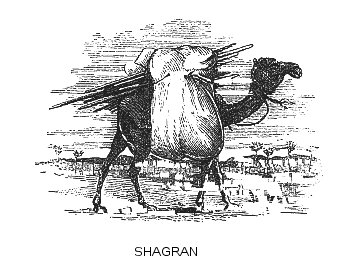
“Solitudinem faciunt, pacem
appellant.”
Tacitus.
Illness and misery—A Persian
escort—The Shah’s Arab subjects—Ram Hormuz and
its nightingales—Night marching—Deserted
villages—How they collect taxes in
Persia—Bebahan.
Friday, April 11.—It would be easy to
quote unlucky starts on Fridays, and I am afraid this is
one. Wilfrid is ill again, a passing fatigue we hope, from
loading the camels this morning in the hot sun, and riding all
day long in it. He is lying down now in the tent and trying
to rest, but the flies are intolerable.
Our plan in leaving Shustar was to go with our escort, seven
soldiers on foot, armed six with matchlocks and one with a
narghileh, to Ram Hormuz, a small town eighty miles on the road
to Bebahan, and there get a reinforcement from the Ferraz-bashi
or deputy governor of the place for the other eighty miles.
This sounded well enough, but already our escort has deserted us,
and we are alone.
After delays of all sorts, for till the moment of starting we
were still without servants, we got our camels loaded, and about
ten o’clock rode out of the palace gate and through the streets
of Shustar, and over a stone bridge, which spans the second of
the two branches of the river on which the town stands, and into
the open country beyond. It was terribly hot, and the whole
country is a plague of flies, which buzz about one all day long,
and settle on one’s head at night.
Our camels have profited by the mallows in the court of the
palace to such an extent that they are all fat and frisky, and we
had some trouble in loading them. But, at the last moment,
we had an unexpected offer of assistance. A young Arab,
dressed in a green calico jibbeh, suddenly appeared upon the
scene, and volunteered his services. He had a pleasant
face, so that we were taken with him at once. He told us
that he was a native of some village on the Tigris near Bagdad,
and that he had been impressed by the Turks for their navy, in
which he had served three years, that he had then managed to
desert while in port at Bussorah, and had fled across the border
to Mohamrah. He had since earned his bread by working as
horse-keeper for one of the Bawiyeh sheykhs, and later, tiring of
that, in service with different Persians at Shustar. His
idea now, was to get down to the sea once more, and he begged us
to take him with us to Bushire. By accident Hajji Mohammed
knew something of some of his relations at Bagdad, and as such a
person was exactly what we most wanted, we accepted him at once,
on his own terms. This young fellow’s coming has been an
advantage to us in more ways than one, for it had the immediate
effect of inducing another of the crowd who were witnessing our
departure to volunteer, and a little red-haired Persian in blue
frock and trowsers, came forward to enlist in our service.
Thus we are no longer wholly dependent on our old cavass and on
ourselves.
As soon as we were outside the town, our sergeant and the six
soldiers began to give themselves airs of military importance,
advancing in front of us in skirmishing order, and enjoining us
to keep close together, although the country had a quite
peaceable appearance, the road much frequented by country people
on donkeys, unarmed and peaceable folks. The track led
through undulating ground chiefly barren, here and there a patch
of cultivation, often between high banks. Our brave
defenders here shewed their zeal by running up to the tops of the
steepest and highest of these banks, firing off their guns at
random, generally in the air, but one of the shots hit a lizard
sitting in its hole. Their energy, however, cooled as the
heat increased; and towards noon, they were satisfied to trudge
along with only an occasional diversion to look out for
enemies. By a quarter to one o’clock, they all seemed
tired, and we too were glad to halt for three quarters of an
hour, under a large shady canora tree, in the midst of a field of
oats. Here we ate our luncheon, while the animals fed on
the oats. Wilfrid complained a little of the sun, but it was not
till we had gone on again for a couple of hours that he
acknowledged he felt really ill. We were just turning off
the track to the north, to go to the tents of a certain Hassan
Khan, known to the soldiers, when he said he could have gone no
further. The tents were not a mile from the road, but
getting there was almost too much for him. We found them
set in a circular enclosure, fenced in by a hedge of branches,
like a new made Sussex fence, and evidently intended to last
longer than a true Bedouin camp ever does. Here there are
about a dozen small tents, half hair, half matting. Outside
the enclosure, a few mares and foals grazing, among them one
rather nice filly, Wadneh Hursan they say, and animals of all
sorts, cows, sheep, and goats have been brought inside the hedge
for the night.
Wilfrid is extremely tired. The rest seems to have done
him no good. He complains of his head and of pains all
over. I hope fatigue and the heat are sufficient to account
for his feeling ill. I dread a return of the attack he had
at Shustar. I wish we had not left the town. This is
a forlorn spot to be ill in, and though at Shustar we should be
no better off, as far as concerns getting out of the country,
there would be a few more comforts, and a chance of sending for
help to Bussora. If he gets worse we shall be in an almost
hopeless position. Every place seems frightfully far off
the moment there is a difficulty about moving; to get back to Shustar
would be almost as impracticable as to go on to Ram Hormuz.
Seven hours’ travelling seems now an impassable gulf.
I have arranged a sort of mosquito net for Wilfrid against the
flies, but it only keeps them out for a time, and then a few
manage to get inside it, and it has all to be rearranged.
But now it is nearly sundown, and the flies will go to sleep at
dark; and if the night is cool he may get some sleep.
Everybody here is fortunately kind. Hassan Khan, the
chief, is away at Shustar, but his brother Kambar Aga received us
well. He has good manners, speaks Arabic pretty fairly, and
has been telling me about his tribe, a section of the Bawiyeh of
Ajjem, as distinguished from the Bawiyeh of the Ottoman
dominions. The people and their chief seem to be very
poor. Kambar professes himself ready to accompany us
to-morrow to another camp not far off, and on our line of march,
that of Hajji Salman, an Arabic-speaking tribe; this is
fortunate, as our escort has deserted. They probably never
meant to come further than this, but however that may be, they
have in fact abandoned us and gone home to Shustar. In the
middle of the day, while we were sitting under the canora tree,
they demanded money, and Hajji Mohammed foolishly, without asking
us, gave them as much as they ought to have had for the whole
journey to Ram Hormuz, and as a consequence, having secured their
pay, and with no further motive for taking trouble they
departed. Their company is no loss, they were
disagreeable and tiresome, but they were of value as a mark of
government protection, and in that respect it is unfortunate that
they have left us.
Escort or no escort I care not, if only Wilfrid would get
better, and he seems no better.
Saturday evening, April 12.—Wilfrid
alarmingly ill all night. He got rapidly worse, and then
seemed unconscious of all around; it seemed hopeless, but now he
has rallied, and I think the worst is over. Still I have
made up my mind not to look beyond the necessity of the moment,
and indeed these twenty-four hours blot out past and
future. I don’t know why I write a journal. He
cannot sit up yet, though he says he shall be able to travel
to-night. I don’t know what to think, but the wish to
move is something gained; a short time ago he could hardly speak,
and if he really has turned the corner, a few hours may make a
great difference. He now says that by travelling at night
only, he shall be able to go on.
Ghada, our new Arab, has behaved very well. I hardly
know what I should have done without him to keep the fire up all
night, and help to make medicines and beef-tea. In the
evening and night I tried everything I could think of out of our
small stock of medicines, and in vain. The sun rose and
blazed fiercely, and the flies swarmed as before. But in
the afternoon the illness took another turn, and now, at any
rate, the danger seems to be past.
To
please Wilfrid, though I doubt his being able to travel, I have
packed up everything and got the tents down, and each separate
load put ready; for to carry out the plan of night-travelling, we
must load after dark, that is, by the light of a very small moon,
when it rises about one o’clock. We are then to be
off, Wilfrid to ride his delúl, and we are to get as far
as we can; I have got cold tea and beef-tea in bottles, to be
accessible at any moment. He has remained lying down on his
rugs and pillow, the only things not yet packed, which, when the
time comes, will be put on his delúl.
Kambar Aga and his tribe are good people. Nothing could
be kinder than they have been. Hassan Khan has sent a third
brother from Shustar, Aga Ibrahim, who is to accompany us with
six of his men to Hajji Salman’s camp.
April 13.—Wilfrid was able to travel for four
hours, and though much exhausted seems really none the
worse. We reached the Salamat camp about six this
morning. We hope to set out presently—about
sunset.
The moon rose last night towards one o’clock, but owing
to the slowness of everybody the loading took more than an
hour. They all wanted to wait till the moon should be high
in the sky before starting. We first struck across the
plain of pasture and scrub to get back to the track, and then
pursued our way along it eastwards. At half-past five we saw
some tents to the south, but these our guides said were the wrong
ones. An hour later met two zellems, who told us the
contrary, but too late for us to return; and they added that they
came from a camp of Salamat Arabs an hour or so further
east. It was already hot, but we pushed on, the road good
and level, splendid pasture, hills to the left, an interminable
plain in front and to the right, extending to the Karkeria and
beyond it. Some tents were pointed out to us, said to be on
the opposite bank of the river. We reached the Salamat
camp, Sheykh Abeyeh, at eight o’clock.
A few fairly good-looking but very small mares are to be
seen. The camp has been evidently on the spot for weeks,
and is accordingly unsavoury, more like a village than a
camp.
We have, or rather had, for I write while waiting to start,
our tent on a small tell separated by a dip in the ground from
the Salamat encampment. The ground here is covered with a
horrid little spiked grass, like miniature barley to look at,
which pricks through everything. Its barbed thorns are like
fish-hooks, very difficult to extract, and all our clothes and
bedding are full of them.
Wilfrid spent the day lying down in the tent, able to talk
though tired. The people here are not ill-bred, and they
have even been kind to us. Their Sheykh, Abeyeh, with
several of his friends, and relations, came to see us soon after
our arrival. Abeyeh told us that his tribe belongs to the
Ahl
es-Shimal, and he knows all about the tribes of the Hamád
and their horses. His brother Rashid showed us a very
beautiful grey colt, which he offered to exchange for our hamra
mare, who is suffering from a sore back. The colt is too
young, or might have been worth taking; the owner says he would
not part with it but that the Shahzade has intimated an intention
of buying it. The Shahzade is, it seems, in the habit of
purchasing all the good-looking horses he hears of, and does not
pay for them, but he does not take mares; this, at least, is the
tale told to us. Our mare, though thoroughbred, is in such
wretched condition that the Shahzade would hardly care to seize
her.
Abeyeh readily agreed to escort us to Ram Hormuz with six
khayal, Rashid proposed to accompany us on foot as camel driver,
and Aga Ibrahim (from Hassan Khan’s), also offers to go
on. It is five o’clock, time to pack.
* * * * *
Eight o’clock. Wilfrid felt so ill an hour ago
that all these arrangements seemed to be vain. But he is
better, and now we are off.
April 14.—Our new plan of travelling by night
seems to answer well. Wilfrid was able to go on from nine
till five o’clock. He is recovering, though reduced
to the extreme of thinness. The heat during the day is
insufferable, and even if there had been no cause of anxiety, we
could hardly have continued marching by day. The flies are
intolerable, they follow us, and are found everywhere;
at night when we are riding they are sitting in swarms upon our
heads, and if driven off, perch again in spite of darkness.
However, in the dark they are quiet unless disturbed, which is
some small relief. Last night our track went a good deal up
and down, crossing small ravines and watercourses, and pools and
ditches full of water. Sometimes we waded through tall
grass, splendid stuff, growing quite wild and uncared for.
The moon serves us hardly at all, but we could see dimly by
starlight. The constellation of the Scorpion is now our
guide, rising as it does in the south-east. I have slept
little lately, and once last night I fell fast asleep on
horseback, and woke with a start at a sound of munching. It
was my mare grazing eagerly knee-deep in wild oats. Where
the camels were I could not see, but heard them soon afterwards
some way off ahead. Wilfrid bore up as long as he could,
till at five o’clock he said he could not go a yard
further, and we camped for the day, pitching the tent on a tell
commanding all surrounding tells. Our escort objected to
this halt. “The Shirazi will come down from those
hills and rob us,” said Abeyeh, “and the town of Ram
Hormuz is only three or four hours further. Let us go
on.” His objection was natural; this is very exposed
ground, and close to us on the north rises a range of crags, from
which the Shirazi robbers may be watching us. But perched
on the tell we get a little air, and this is worth some
risk. Besides, they have not come yet, and we
shall he gone presently. Abeyeh argued in vain; if there
had been legions of robbers in sight, I don’t think Wilfrid
would have moved. He was indeed unfit to stir, and has been
lying on the ground under the shade of the tent ever since.
A halt like this is not much of a rest; the heat is too
overpowering, the flies too troublesome. Beyond the rocky
range we see high snow peaks, very tantalising in this furnace,
and looking the other way, there is just below us a fine piece of
meadow land on the banks of a running stream. In all the
hollows there is rich pasture. Abeyeh and his men have kept
a good look-out, some posted about on heights, and the rest
watching the mares hobbled, and turned loose to graze.
It is four o’clock; the heat lessening, and Wilfrid says
he is ready to go on. We must pack.
* * * * *
April 15.—We have at last reached Ram Hormuz, or
as it is pronounced “Ramuz.” We left our
bivouac on the tell at five o’clock yesterday
afternoon. Wilfrid tried riding on horseback, but found the
effort too great, and had to give it up and mount his
delúl. Our way lay through more long grass, and
ditches, and water. I, as sleepy as the night before, was
constantly dozing off and waking suddenly in the middle of some
long dream, unable to remember where I was. There is
nothing so painful as this struggle with sleep, and it lasted all
night long. At last we came suddenly in sight of some camp
fires about half a mile away to our right, and Abeyeh,
fearing to advance further, ordered a halt. There was
danger, he said, in coming on an encampment unawares, lest we
should be taken for enemies. We did not stop to argue, but
with delight obeyed, and in a few minutes were sound asleep upon
the ground—nor did we wake till day was already
breaking.
A discussion now arose what further was to be done. The
tents, we were informed, belonged to the Khamis, an Arab tribe,
half Bedouin, half fellah, and Abeyeh was for spending the day
with them. But the sound sleep had done Wilfrid good, and
as it grew light we could see the palm groves of Ram Hormuz,
apparently ten miles off, and we knew that there we should get
refuge from the sun. So leaving the rest to follow or not
as they would—we got on our horses and started at a gallop,
Shiekha and Sayad bounding on in front of us delighted at this
unexpected run. At first there was no road, and we got
entangled in a series of watercourses, but scrambling through
these we reached a footpath where the going was good, and
presently overtook a party of Arabs, men and women, riding in on
donkeys to market at the town. They all expressed
themselves much pleased to see us, taking us to be Arabs like
themselves, and here in Persia they always seem delighted to meet
their countrymen. They pointed us out the town, for there
was more than one grove of palms, and in the mirage which hid
everything as the sun rose, we had lost sight of
it. At half-past six we stopped at the ferraz-bashi’s
door, and in another minute were sitting in a cool court-yard
under the shade of a wall, waiting till the respectable
functionary, our host, had finished his devotions.
On the sight of our letters from the governor of Shustar he
made us very welcome—conversing through the medium of his
secretary, who knows Arabic. Carpets were brought, and tea
made—the most delicious draught we ever tasted in our
lives—flavoured with orange and some acid fruit. The
gallop has cured Wilfrid, and he says he shall not be ill
again.
Our caravan having arrived, we have moved outside the town,
for the ferraz-bashi’s house is not big enough to hold us
all, and are encamped on a little mound overlooking the gardens
which skirt Ram Hormuz. I wish I could describe the beauty
of this place. Round us lie a few acres of green wheat, in
which quails and francolins are calling, and through which a
little stream of running water winds. Close by, on another
mound, stands a beautiful little kubbr, the tomb of some saint,
and on either side gardens half run wild, a delicious tangle of
pomegranate, fig, and vine, with here and there lemon and peach,
and groups of palm. The pomegranates now are in full
flower, and so are the roses, and every thicket is alive with
nightingales. It is nearly sunset, and groups of
blue-gowned Persians are coming across the fields from the town,
to wash
and say their prayers at the stream and the kubbr. The town
itself is half hidden in the gardens, but shows picturesquely
through, backed by a range of crimson hills, scored and lined
with blue shadows. We have been following the edge of these
hills all the way from Shustar. They are the same which are
supposed to hold the Shirazi robbers our Arab escort feared so
much.
The position of the Arabs here is a miserable one. At
war with these Shirazi, and pillaged by the Government which does
nothing to protect them, they still cling to their little bits of
cultivation wherever there is water near the hills. They
are half the year nomadic, going south and west with the flocks,
but in the spring return to the hills, plough up a few acres, and
gather in a crop if possible before the tax-gatherer has found
them out. The Persian Government is weak, and the garrison
of Ram Hormuz is generally only sufficient for its duty of
holding the town, but every now and then a reinforcement arrives
from Ahwas or Fellahieh and then a raid is made under pretext of
a collection of arrears, and horses and cattle are driven off in
payment. This seems to be the plan throughout the
province. We asked Abeyeh and the Khamis Sheykh who came
with him to-day to our camp, why they put themselves into this
government trap by coming to the hills, when they might remain
unmolested in the plain, or go where they would. “It
is the soil,” they exclaimed, “the soil which is so
rich. Where should we find another like it?”
Indeed, the whole of this side of Persia seems meant to be a
garden. Unlike the plains of Bagdad, which never can have
been cultivated except with irrigation, the land here grows crops
as in Europe, watered by the rain from heaven. The range of
Bactiari hills by attracting clouds gives it this rare
advantage.
Ram Hormuz itself must have been a great city once. Its
position at a point where several rivers meet, and at the foot of
a gorge, leading through the mountains to Shiraz, makes it
naturally a place of importance, but it is little more now than a
market for the Bedouin tribes and a military station.
The ferraz-bashi has been very amiable to us, though, like
everyone else, averse to our further progress in the direction of
Bebahan. The road, he says, is most unsafe, every village
at war with its neighbour, and he dares not send troops with us
even if he had them. There is, however, in the town, a
certain potentate of the district first to be traversed, one
Mohammed Jafar, Khan of the village of Sultanabad, who can
protect us if any one can. To him we are to be recommended,
and perhaps he will go on with us to-morrow. Abeyeh and his
men, alas, can go no further. They are Arabs, and honest
men, and camel drivers, and we have bid them good-bye with
regret. But the people further on are Persian, and Persian
and Arabian are everywhere at odds. The idea is not
agreeable of plunging into a hornet’s nest, such as the
country beyond us is described to be, but there is no help for
it; to return is impossible. Every day becomes more and
more fearfully hot, and our only hope now is the sea.
April 16.—We are refreshed by a good
night’s rest, such as we have not had since leaving
Shustar. The ferraz-bashi called again this morning,
walking out in the cool of sunrise, with a rose in his hand, to
pay us his compliment. It seems to be the fashion among the
Persians to go about with flowers, which they present to each
other as polite offerings, and just now it is the season of
roses. His Excellency informed us that Kaïd Mohammed
Jafar would be ready to start for Sultanabad at the asr (about
half past three), so we have made all our preparations for
departure. Although the heat has been great, 96° at
coolest, I have managed to make a sketch of Ram Hormuz, but
nothing can do justice to its beauty. We have been more
pleasantly received here, than anywhere else in Persia, and I
feel sure we might make friends with the people if only we could
speak their language. Travelling without knowing the
language, is like walking with one’s eyes shut.
April 17.—Mohammed Jafar arrived soon after four,
and immediately we started. It was of importance that no
time should be lost, for we had a river to cross, the Jerrahi
which comes down here from the mountains, and runs into the Persian
Gulf, at Fellahieh. The country, till we came to it, was a
difficult one for camels, being a very network of irrigation,
with the channels crossed by treacherous little bridges.
But the camels managed it all without accident. The river,
of which we crossed two branches, flows over a bed of gravel, and
was nowhere over our horses’ girths. The water very
cold, with melted snow, so that a delicious breeze of iced air
followed the current. It was now past sundown, and we were
anxious to be clear of the inclosed ground, before it should be
absolutely night; but the Kaïd, tiresome man, had made an
arrangement with some friends at a little village beyond the
river to dine with them, and then go on in the night, a plan
which did not at all suit us. Indeed it was impossible for
us, with our camels, to halt in such a spot, where we could not
have prevented them trampling the standing corn, and where we
should have been helpless after dark. So declining, as
politely as we could, the hospitality offered, we left the
Kaïd to take his meal with his four horsemen, and pushed on
alone. A villager was sent to show us the way, for we were
not a mile from open ground, and night was falling and every
minute precious, and we were resolved to reach it if we
could. Road, however, it soon appeared there was none, for
to reach the village, the Kaïd had taken us away from the
main path, and as it grew darker we got more and more entangled,
in dykes and ditches. At one moment things seemed almost
hopeless with us, a deep canal barring all further progress, and
the villager who had brought us to this pass, profiting by the
confusion, having run away. Fortunately Wilfrid perceived
this flight in time, and riding after him fired his pistol in the
air, and brought him back, when, under the compulsion of fear, he
showed us where to cross. It was a poor ford, and some of
the loads got wet, but beyond it we were on hard ground, and able
now to wait in patience till the Kaïd and his men should
come. Our shot seemed to have disturbed their feast, and we
had not long to wait. Then we marched on in silence and
utter darkness, but over a good road, till half-past one in this
morning, when a loud barking of dogs announced our arrival at
Sultanabad.
Here the Kaïd has a house to which he at once retired,
leaving us to lie down in our cloaks, with our camels and horses,
till daylight. He would willingly have invited us in, but
we dare not leave our beasts and property, and now we have
pitched our tent for the day, looping it up as usual, like an
umbrella, to get every breath of air. When day dawned, we
saw the Kaïd’s house on one side of us, with three big
canora trees overshadowing its entrance, and a walled garden at
the back of it; on the other side the village with its barley
fields and splendid grass crops. The houses of the village,
built of sun-dried brick, are in a cluster together, about two
hundred yards from our mound; in front of them two or three black
tents. The Kaïd’s house is of considerable size,
and appears to contain several court-yards. Sultanabad is
itself a poor, mean-looking place, but if Hajji Mohammed is to be
believed, a very nest of brigands, any one of whom for one single
kran would kill a man, a real stronghold of robbers, and as such
keeping the neighbouring country in terror. But I
don’t know what to think, for Hajji Mohammed believes every
tale he hears, and the horsemen have been cramming him all the
way along with stories of Mohammed Jafar’s exploits, to
enhance their chief’s importance. How he does what he
likes in the teeth of the government, who dare not punish him for
having killed several of the Shahzade’s people only a
couple of years ago, how only he and his Sultanabadis can travel
safely on the Bebahan road; and one can hardly blame poor Hajji
Mohammed for expecting us to lead him into mischief, for we have
before done so, and he thinks us reckless of danger. He is
always lecturing us on prudence, though he himself is an odd
combination of caution and rashness; he once at a critical moment
wanted to stuff his revolver into an inaccessible bag, merely
because the strap of the belt belonging to it was broken; another
time he would have given his gun to a stranger to carry, had we
not prevented his doing so. We spent this morning drinking
tea and eating eggs and butter and a kid, and spreading wet things to
dry. Fortunately no serious damage has been done, and the
fierce sun soon dried everything. A breeze sprang up, too,
which helped the drying, and drove away the flies.
Hajji Mohammed was commissioned in the course of the morning
to negotiate terms with the Kaïd, who had been already
sounding the cavass as to how much money could be got from
us. He has really done it very well, and arranged that at
Bebahan we are to pay the Kaïd one hundred krans. The
great man at first asked for an abba or a cashmere shawl, but
here Hajji Mohammed seems to have spoken with proper
firmness.
We want to start at half-past four, and ought to pack now, but
the servants are dawdling over the remains of the kid; they will
not move till they have devoured the last morsel. Besides,
they have got several girths to mend before we can load.
April 18.—We had a great deal of trouble to start
at all yesterday afternoon, and after a difficult march we have
got no farther than the village of Jazûn, about fifteen
miles, which was reached at five A.M. this morning. At this rate we
shall be a month getting to Bebahan, especially if the pass over
the range of rocky hills we must cross, is as rugged as report
says.
It turned out that the Kaïd himself did not intend to
start with us, but to send his nephew with four people on foot,
and follow himself with the four horsemen. He stood by as
we loaded, and then wished us good evening. When all was ready
he asked us the favour to take with us a bundle of brown wool for
Bebahan, and as it was not heavy we agreed. While Wilfrid
turned to look at this package, a villager took the rifle off his
delúl, but hastily put it back on Wilfrid’s shouting
“Stop thief,” and ran off accompanied by the little
crowd which had gathered round us, no doubt equally guilty at
heart, and expecting blows. Then we started—it was
about half-past five, a fine evening with a breeze, which, alas,
died away at sunset, after which for two hours the air was
extremely sultry. The Sultanabad field crops had to be
crossed, but they were on dry land, with only a few easy
ditches. Then we came to ground like a park, formerly
cultivated, but now abandoned to nature; canora trees dotted
about like handsome hawthorn trees, as if planted for ornament,
the grass all crops run wild, splendid oats and barley now in the
ear. Here and there an abandoned village, the walls
gleaming red in the setting sun. Some of these were
inhabited not very long since, and we were told various tales
regarding them; from one place the inhabitants had gone away of
their own accord quite lately to escape the tax-gatherer’s
next visit, leaving their corn standing; from another they had
been driven by fire and sword, the soldiers burning the village
after sacking it.
After about two hours we crossed the river Abn’l Faris; it
is not many yards wide nor is it deep, but the banks are steep
and overgrown with trees and thick bushes. A narrow and
nearly perpendicular path leads down to the ford. The
camels have become skilful, and managed the scramble admirably;
Shakran now carries our personal baggage, he has completely
recovered, and is the cleverest of them all. Hajji Mohammed
sat imperturbable on Wilfrid’s delúl, and nearly got
his head caught in the tangle of branches. After this we
had another water or two to cross in the dark, the approaches to
which were always announced by the croaking of frogs; then the
chirping of grasshoppers replaced the croaking, and we were again
on hard ground, the country a good deal up and down and broken up
into ravines and fissures caused by rains. At ten
o’clock, as far as we could make out by starlight, we were
on good flat pasture land, real pasture not crops, and trees
growing in groups as in a park, with a low ridge on the
left. Here we halted for an hour to eat, and thought to
have a nap; but Mohammed Jafar, who after all joined us some time
before, would not hear of this. It would be dangerous; the
Shirazi would swoop down from those hills to the north. He
altogether declined remaining longer than necessary, and there
was an earnestness in his manner that brought conviction with it;
he really believed in the danger he talked of. The night
was fine, and it would have been a pity not to make use of it; we
pushed on over good ground for an hour, and after that
through mud, ditches, and frogs; about one o’clock a wide
ditch completely barred further progress. We had for a good
while been again among crops, so rank that wading through them
was hard work, and on reaching this ditch, we all groped about,
trying to find a passage for the camels. There was no sort
of track; the horsemen had, in fact, got off the road and could
not find it again, but there was no difficulty as to general
direction, the Scorpion being our guide. Here, however, we
were stuck fast by irrigation works, for at this particular spot
the ditch was impracticable for camels, and all efforts in the
dark to hit upon a ford were vain. The horsemen had already
got across, and were shouting to us to follow; indeed, they had
for the last hour guided us in a haphazard way by shouts and
singing. One of them sang remarkably well, and kept up a
sort of refrain:

But now they screamed, shouted, and sang to no purpose.
We refused to waste any more time in a useless search, and sat
down to wait for daylight. One of the khayal then returned
and sat with us till four A.M.
talking all the while to Hajji Mohammed about the Shirazi.
We lay down and went to sleep. By half-past four we had
found a passage through the mud and water of the canal, and
beyond it got on to desert ground, on which we passed several
small detached oasis-like palm gardens. Half an
hour’s march further took us to Jazûn.
Jazûn is the only village left of many which once
existed between Sultanabad and Bebahan, and whose ruins we have
passed. They were deserted only a few years ago; the
governors of the province, who found it impossible to collect
taxes from them, having solved the difficulty by destroying
them. This village is now a collection of little mud houses
on the left bank of a natural stream of running water. It
is surrounded by fields and groups of palm trees. Our
horses are tethered out by long ropes fastened to palm trees, to
feed on green barley; the camels are further off with
Shafi. Shafi is an excellent worker, but he does not speak
a word of Arabic, or I should tell him how well satisfied we are
with him. We ourselves have encamped on the high bank
backed by the stream, so that the villagers, who are a tiresome
set of people, can only approach us on one side.
Jazûn as well as Sultanabad, belongs to the family of
Mohammed Jafar. He has been sitting here talking to us
through Hajji Mohammed. He tells us that his family,
although they now no longer talk Arabic, are of the Safeyeh
tribe, and came originally from Nejd, bringing their horses with
them; and that a beautiful little white mare his nephew
rides, and which we admired yesterday evening, is a Hamdanyeh
Simri. This mare is very small, 13·2 at most, but
almost perfect; the head very fine with black nose, black round
the eyes as if painted, jebha prominent, and
mitbakh extremely fine; tail properly set on and carried,
a good style of going, bones rather small, but legs apparently
wiry and strong. One of the men rides a chestnut mare said
to be Kehîleh Sheykhah, about 14 hands, with four white
feet, handsome head, and mitbakh. Mohammed Jafar
mentioned that the particular breeds now possessed by his tribe
are Hamdani Simri, Abeyan, Hadban, Wadnan, Meleyhan, Seglawi and
Kehîlan. His own grey mare does not look
thoroughbred, and he did not say anything about her.
Mohammed Jafar now informed us that his nephew would proceed to
Bebahan with us while he himself must go home, and he wished to
have the whole sum of one hundred krans paid to him at
once. After some talk he agreed to take seventy krans as
his share, the rest to be given to his nephew at the end of the
journey. He certainly gets the lion’s share, but
beggars cannot be choosers, and we are dependent on his goodwill
to pass us through this part of the country, so that on the whole
we ought to be glad that he has not asked more. We are
altogether in a false position, too weak to insist upon our own
terms, and our best plan is to march as fast as we can to
Bebahan. Unfortunately there are not only crags to
cross, but the Kurdistan river has to be forded.
April 19.—A disagreeable twenty-four hours has
passed, and we have scaled the crags, and escaped from the
Jazûn people, who, it seems, had some evil design.
But there is still the Kurdistan river between us and
Bebahan.
We managed to set out from Jazûn soon after two
o’clock in the afternoon, getting at once off the plain on
to broken ground, which became more and more broken till at seven
o’clock, when we halted, we were involved in a confused
mass of hills apparently tossed together at random. We had
crossed several small streams in deep ravines, and one narrow
ledge of rock at the head of a ravine, which would have been
unpleasant in the dark. Saw three or four gazelles, luckily
not perceived by the greyhounds, for we cannot stop for
sport. Sand-grouse, beebirds, plovers, and doves
abounded. By seven o’clock we had done about ten
miles and ascended over 600 feet, and Wilfrid proposed to halt
for some hours. I was pleased, not liking passes and steeps
in the dark, and we still had the pass itself before us, but
Abdallah Khan, the Kaïd’s nephew, remonstrated and
protested danger. Wilfrid, however, gave a peremptory order
to unload the camels and we sat down to drink tea and make a
frugal meal, and proposed afterwards to make aliek for the
camels, as they have had a tiring march and cannot feed now in
the night. Before we had done eating Hajji Mohammed came to
announce that forty Jazûnis were following to attack and
plunder us. Shafi, he said, had found this out, and told
him, and he added that the welled Abdallah Khan had also been
told of the plot and warned by the villagers not to stay with
us. He called the youth, who confirmed the tale, as did all
the others, the four men on foot who had come all the way with
Abdallah. It seems probable that an attack really was
contemplated, for Shafi could gain nothing by inventing such a
story. But, as Wilfrid suggested, it may have been only a
way of “expressing the polite feelings of the inhabitants
of Jazûn.” He however agreed that we ought to
be on the watch and start as soon as possible—at this
moment it was really impossible. Guns and revolvers were
placed ready and sentinels posted, and Abdallah earnestly assured
us he would stand by us. I think he would, he had been a
much better guide than his uncle and was besides always ready to
help and to wait for the camels at difficult places. After
all this agitation, nothing happened except one or two false
alarms, and I don’t think I ever slept a sweeter sleep than
between nine and two o’clock this night—no mosquitoes
and no flies.
It took us more than an hour to load in the dark, and we were
not off till past three o’clock; at first feeling our way
in single file, led by Abdallah, along a very broken and steep
road. For part of the way we had a little assistance from a
red crescent moon. At a quarter to six, we had gained the
highest point of the ridge, between 1600 and 1700 feet above the
sea, making about 900 feet ascent from Jazûn. Here
there was at last an open view, down towards the Kurdistan river,
with the palm village of Kaïkus plainly visible, and other
palm villages beyond the river, and still further something
vague, said to be Bebahan.
A gradual descent brought us on to a strip of plain, swarming
with cuckoos, beebirds, doves, francolins, and sandgrouse, and
dotted with canora trees, singly or in clumps, here and there
fields of corn.
The sight of a mound commanding air, if air there should be,
decided us to halt, and here we now are, waiting for the decline
of day to set out again and ford the river. This plain by
the river is hardly more than three hundred feet below the top of
the pass we came over this morning.
Sunday, April 20.—Bebahan has been reached
at last. Our final march, though not a long one, took us
till towards midnight to accomplish, for we had the Kurdistan
river to cross. This was the deepest of any we had forded,
and there was a long delay in choosing a safe place; and then the
water was up to our saddle bows, and running almost like a mill
race. But the camels are now so used to water in every form
from mud to torrents, that all marched bravely through, a portion
only of the luggage getting wet. Unfitted though the country
has been in many ways for camels, we may nevertheless
congratulate ourselves with the thought that with no other beasts
of burden could we have got our luggage across the rivers at
all. Loaded mules must have been swept away.
The Kurdistan forms the boundary on this side of the
cultivated plain of Bebahan. Beyond it, we found ourselves
travelling entirely between cornfields, and along a broad highway
towards the capital of Khusistan. When two hours from the
town we sent on Hajji Mohammed to announce us to the governor,
but the governor was already asleep, and it was with some
difficulty that we were admitted by the guard within the gate;
nor was it possible in the utter darkness of the night to choose
our ground within for camping. In the first open place we
stopped, and as we were, lay down and slept (we care little now,
how or where it is we lie, the ground is always soft as a
feather-bed). Then, with the first light, we went on
through the town and stopped again in front of the
Seraï. Here I have been writing my journal and
sketching the picturesque old palace, with its tottering minarets
covered with storks’ nests. “The Shahzade is
still sleeping,” say the sentries, “and will not be
awakened.”
“Last scene of all . . . . . .
A mere oblivion.”—Shakespeare.
A last rush through the sun—We arrive at
Dilam on the Persian Gulf—Politics of the Gulf—A
journey “in extremis”—Bushire—The
End.
The rest of our journey was little
better than a feverish dream of heat and flies. After a day
spent at Bebahan, where we were hospitably entertained by the
Shahzade, Ahtesham ed-Daulah, a Persian nobleman of real good
breeding, we recommenced our weary march, thinking only now to
get down to Bushire alive.
The kind invitations of our host could not detain us, nor the
polite attentions of his wives, nor the amiable visits of
merchants, calendars, and other idle persons, who thronged our
lodgings from dawn to dusk. The truth is Bebahan was like a
furnace, and we felt that it was more than our strength would
stand, to prolong our sufferings over another week. The
lowlands of Persia, bordering on the Persian Gulf, are one of the
most oven-like regions of the world, and though Bebahan lies
nearly 1400 feet above the sea, it shares the climate of the
Gulf. We had now, besides, nothing further to fear in the way
of robbers or marauders, and prepared ourselves for a last
desperate rush through the sun to Bushire. The distance was
hardly more than a hundred and twenty miles, but between Bebahan
and Dilam there lay a region of hills, worse, according to
report, than any we had yet passed, and absolutely impassable for
camels. Still we had good reason to feel confident in the
climbing powers of our beasts, and could not think of leaving
them behind. Accordingly the next day we started, our
courage well screwed to the sticking point of endurance, and
under escort of three of the Shahzade’s horsemen.
We set off at six in the afternoon, making the best of what
daylight yet remained to get well started on our road. The
difficulties are almost always greater close to the town, and
once fairly on the beaten track, our camels would have no
temptation to wander. From Bebahan to Dilam there are two
considerable lines of ridges or hills—steps, as it were,
and extremely precipitous ones, down to the sea coast. At
first it was easy going for the camels, but presently, about an
hour after dark, we found ourselves in broken ground, where,
after stumbling on till half-past nine, we were brought to a dead
halt by finding ourselves at the brink of a deep gulf, in which
the road seemed to disappear. This made it necessary we
should wait till daylight, and we lay down with our camels on the
road, and slept soundly till the first streak of dawn at
half-past four. Then we discovered we had left the road,
though only a few yards, and that the fissure before us was a
sufficient reason for the halt we had made. The chief
formation of these hills is not rock but clay, which being
entirely without vegetation except in favoured spots, is furrowed
into ravines and fissures by the action of the rain, making the
district impassable except along the beaten track. We had
risen some hundred feet from Bebahan, and so had nearly reached
the summit of the first pass, where to our joy we saw something
far away which we knew by instinct must be the sea. This
raised our spirits, and we began our descent at once.
The path was very precipitous, and looking down from the edge
it looked impossible that a camel should get down the thousand
feet of zigzag which one could see plainly to the bottom.
In some places rocks jutted out of the soil, making awkward
narrow passes, and in others there were drops of three feet and
more. Our horses of course made no difficulty, but watching
the camels was nervous work, knowing as we did how little could
be done to help them. Still we did what we could, going in
front and calling them “Hao-hao,” according to
Bedouin fashion, which they understand so well. They know
us now and trust in us, and so came bravely on. Even the
Mecca delúl and the Safra, the young and giddy ones, have
learned sobriety. Three hours exactly it took to get
down, and without accident. Another hour brought us to
Zeytun, a pretty village on the river Zorah, with palm gardens
and a good patch of cultivated land. At the river we
stopped, exhausted already by the sun and overcome by the sight
of the cool running water. Here we lay frizzling till the
afternoon.
At four we crossed the river, as broad but a little less deep
than the Kurdistan (both have gravelly bottoms), and resumed our
march. A last cup of the ice-cold water was indulged in,
but it could not slake my thirst, which nothing now can cure,
though as a rule we drink nothing till the evening. Our
march was a repetition of last night’s, a long stumble half
asleep along a break-neck road ending as before in an
“impasse,” and the rest of the night spent on the
ground. We are plagued now, especially in these night
halts, where we cannot see to choose a bed, with the horrible
little spiked grass. Every bit of clothing we have is full
of these points. These and the flies make it impossible to
sleep by day, and we are both very weary, Wilfrid almost a
skeleton.
April 23.—At a quarter past three, we again went
on, by the light of a false dawn, the Scorpion, still in front of
us. We know exactly now the rising of these stars in the
south-eastern sky. The ascent this time was longer and more
gradual, and the descent shorter than the former one, but quite
as difficult. This second ridge is considerably lower than the
first, and at the foot of it our path followed a sort of valley
in which we found a few pools of water. Then suddenly the
gorge opened and we found ourselves at eight o’clock in the
plain, with a village near us, and about eight miles away Dilam
and the sea, simmering like melted lead to the horizon.
Eight miles, it sounds an easy march; but the heat, which now
on the sea coast is more insufferable than ever, stopped us half
way, and again we rigged up our tent on the plain, and lay under
it till evening. Then we rode into Dilam. Our first
question was for Captain Cameron, whose road should here have
joined our own; but no Frank or stranger of any kind had passed
that way. [227]
Dilam, like most maritime villages on the north-eastern shore
of the Persian Gulf, is inhabited by people of Arab race, who
have carried on a mixed trade of commerce and piracy there from
time immemorial. Of the two, the piracy seems to have been
the more profitable trade, for since its suppression by the
English or rather Indian navy, the villages have
languished. The Arab idea of piracy by sea, is exactly the
same as that of ghazús by land. Any stranger not in
alliance with the tribe, or under its protection, is held to be
an enemy, and his goods to be lawful prize. The greater part,
however, of the armed expeditions, formerly made in the Gulf were
directed by one tribe or village against another tribe or
village, and were called in Arabic ghazús no less than if
they had been made by land. The British Government,
however, naturally found these ideas antiquated and the practice
inconvenient, and in the interests of its commerce undertook,
thirty or forty years ago, to keep the police of the Gulf.
It compelled the Sheykhs of the various towns and villages to
enter into what is called the Truce of the Gulf, and piracy has
disappeared. Expeditions henceforth, if made at all, were
to be made by land, and armed vessels, if met by an English
cruiser, were confiscated. This sealed the fate of the
coast villages, for the commerce of the Gulf alone being
insufficient to support them, their inhabitants took up new
quarters further inland, and from sailors became cultivators of
the soil. The sea-port villages, where ports there are,
still live on but poorly, and where there are no ports, the coast
is abandoned. Dilam possesses no regular port, except for
small boats, but the anchorage is good, and I believe the
roadstead is considered one of the best in the Gulf. It has
been talked of as the terminus of an Indo-Mediterranean
railway.
Dilam now is a poor place of perhaps two hundred houses, but
there are a few well-to-do people in it who presently came out to
pay us their respects. The English name is well known on
the coast, and there was no danger now of any lack of
courtesy. We were besieged at once with hospitable offers
of entertainment for man and beast, but as usual preferred our
camp outside the town. This we placed on a strip of sand
dunes fronting the sea, and dividing it from the level plain
which runs inland ten miles to the foot of the hills. This
strip was scattered over with thorn bushes, in one of which a
pair of cormorants were sitting. Our visitors remonstrated
with us on choosing such a spot, assuring us that it was full of
poisonous snakes, but this no doubt was nonsense. Among the
rest came a wild-looking man with a gun, who told us he was a
Beluch, and sent by the governor of Dilam as a guard, to protect
us during the night. He had been in Turkish service, and
was now in the Persian. This was our first meeting with
anything Indian. We liked the man. In the evening,
when it was dark and all were gone, Wilfrid gave himself the
luxury of bathing in salt water.
We had now done what few if any Europeans had done
before,—come all the way by land from the Mediterranean to
the Persian Gulf: our journey had been over two thousand
miles.
April 24.—There was now a great debate whether we
should go on still by land for the other hundred miles which
remained to us before we could reach Bushire, or whether, selling
our camels here at Dilam, we should hire a sefineh, or native
boat, to convey us with our things by sea. Wilfrid was much
taken with this last idea, thinking that the arrangement would
save us from another week’s toil in the overwhelming heat;
but to me the sight of the rickety boats in which we should have
had to trust ourselves and our horses to the mercy of the winds
and waves, was sufficient to make me rejoice that the negotiation
about a sea journey failed. Then it was decided to march on
as before. There seemed something sad, too, in abandoning
our camels here, and taking to the ships of the sea where they
could not follow us; and though we knew our parting from them was
anyhow at hand, it was a respite to take them on. We had
got, from our long care of them, to take great pride in their
condition, and they were now fat and free from mange, a triumph
of management which only those who have travelled far and loved
their camels will understand.
On the afternoon of the 24th, having spent just twenty-four
hours at Dilam, we struck our tents, and began our last
march.
The country bordering the Persian Gulf is here a dead flat,
little, if anything, raised above the level of the sea. It
is very barren, and impregnated for the most part with saltpetre,
while here and there broad tidal creeks intersect it, wherever a
stream runs into it from the hills. These formed the only
obstacle to our march, and we travelled more easily now by night,
for there began to be a moon.
I
hurry over these last days, indeed the heat and the march
absorbed all our faculties and thought. Our plan was to
start about three o’clock in the afternoon, when usually a
light breeze sprang up from the south-east, and travel on till
the moon set, or till some creek barred passage for the night;
then sleep upon the ground till dawn, and on again till
eight. By that hour the sun had become a fierce and
importunate thing, beating as if with a weight upon our heads;
and, choosing a place where there was some show of pasture, we
unloaded and turned out our beasts to graze, and then rigged up
the tent and lay gasping under it in the breathless air,
supporting life with tea. Hajji Mohammed now was only
capable of tea-making. In all things else he had become
idiotic, sitting half back on his beast, or in the tent,
ejaculating: “Allah kerim,” God is generous.
Our tempers all were severely tried, and we could do little now
to help each other. Ghada and Rahim, Arab and Persian, were
at daggers drawn. The horses’ backs for the first
time were getting sore, and the dogs were run nearly off the
soles of their feet. Shiekha and Sayad in a course in which
they killed a gazelle were injured, the former having cut her
feet badly on the glazed edges of some dry cracked mud she had
galloped over. Lastly, and this was a terrible grief, one
of the camels being badly loaded had slipped its pack, and in the
fall Rasham had been crushed. The falcon’s leg was
broken, and for the last three days of our journey, it seemed impossible
he should live, clinging as he was obliged to do by one leg to
the saddle. It was all like a night-mare, with no redeeming
feature but that we knew now the end was close at hand.
On the 25th we reached Gunawa, on the 26th Bender Rik and on
the 27th, Rohalla, where we crossed the river, and then marching
on without halting through the night, we forded a shallow arm of
the sea, and found ourselves the next morning about dawn upon the
edge of the Khor, or salt lake of Bushire. As the sun rose
Bushire itself was before us, and our long march was at an
end.
It was now necessary to abandon our nomadic life, and shipping
all our goods in a “baggara,” and leaving the
unloaded camels to be driven round at low tide to the neck of the
Bushire peninsula, we put ourselves and our dogs and bird on
board, and with a fresh breeze ran in two hours to the
custom-house landing. There, taken for Arabs, we had long
to wait, but in the end procuring porters, walked in procession
through the streets to the Residency. When we arrived at
the door of the Residency, the well-dressed Sepoys in their smart
European uniforms, barred us the door with their muskets.
They refused to believe that such vagabonds, blackened with the
sun, and grimed with long sleeping on the ground, were English
gentlefolks or honest people of any sort.


