Fiddling Jackey.
There was once a little boy, who led a
very unhappy life, for his father was
tipsy from morning till night, and he
had no mother to soothe and console him
when he had met with ill-treatment, which happened
almost daily.
I cannot tell you exactly how long ago this was,
but it must be a long, long time, for there were
fairies then, and the birds, trees, and flowers sang
and spoke, which you know has not happened within
your recollection, at all events.
Jackey’s father, for Jackey was the little boy’s
name, was village musician, and had once played the
violin remarkably well, but since he had taken to
drinking had grown so careless that his scraping
was a horror to all who could hear at all, that the
dogs even howled in disgust, and probably in pain,
for the noise they made was piteous in the extreme.
Now, when the drunken fiddler reeled home at
night, accompanied by the most dissolute of the
village, the shouting of these, the horrid scraping
of the fiddle, and the discordant chorus of some
twenty or thirty dogs, made the more steady and respectable
portion of the community tremble in their
beds, with some undefined fear.
All this, you must know, happened in Germany,
where in every cottage of the villages there is, at
least, one dog, and where the watchman, who is
generally the swineherd as well, no doubt was not
over sober himself, and more likely to add to the
noise than stop it.
Though the fiddler was a sad reprobate, and his
playing of the worst description, he was tolerated;
for the fact is that the most of the elder portion
of the villagers cared only for drinking, and the
younger ones thought of nothing but dancing; so
he was good enough for them after all.
His disorderly life and cruelty had killed his poor
wife, Jackey’s mother, who would have looked upon
death as a real blessing, had she not feared for the
future of her young son; however, Jackey, who was
eight years old, had the thoughtlessness of youth
and good health to support him, though, it is true,
he cried bitterly after his father had been beating
him, and felt sorrowful enough when he had not
enough to eat, which happened but too often.
Jackey still remembered the time when, though
at rare intervals, his father played really well; and
the sweet sounds of music had so entered his very
soul that he felt a secret consolation within him,
amidst all his troubles.
This love of music, though it consoled him, occasionally
caused him more bitter sorrow than the
most cruel beatings; for when he looked at the
violin, hanging against the wall, neglected and
covered with mud, he thought of the sweet sounds
that were still within it, though there was no one
to bring them out.
Now, one day, when Jackey had been staring
longer than usual at the violin, and his mind was
filled with sad thoughts, his father happened to come
in, and the poor boy, mustering up all his courage,
said—
“My dear Father, do not be angry if I ask what
the poor fiddle has done to you that you neglect it
so? Take care or it will die too, as my dear good
mother did, of a broken heart.”
The only answer to this was a sound thrashing;
and, as the beating had been more severe than usual,
so Jackey cried longer and more bitterly, all by himself,
for his father had gone again; but, as the pain
grew less, his crying was not so violent nor loud;
then he thought he heard a voice, like sobbing,
come from the wall.
There was no mistaking it, the sobbing proceeded
from the violin, and Jackey’s tears burst forth afresh;
but there must be an end to all things, and when
he had become calmer, he got on a chair, so as to
be nearer the instrument, and whispered—
“My dear Fiddle, you pity me, and now I have a
friend in the place of my good lost mother. But
you, too, I am afraid, are not more happy than she
was. Tell me if I can do anything for you.”
“I do pity you,” the violin answered, “for you
are a good boy, and I wish to console you for the
loss of your mother, and make you forget all the
hardships you have to suffer. At the same time,
you can do me a very great service. Take me down,
and when you have cleaned me and put me in proper
order, I will teach you how to make me sing again,
better than ever I used to do. Then I shall be
happy, and you, my poor Boy, will forget your sorrow,
for I know that sweet sounds will console you
in all your troubles.”
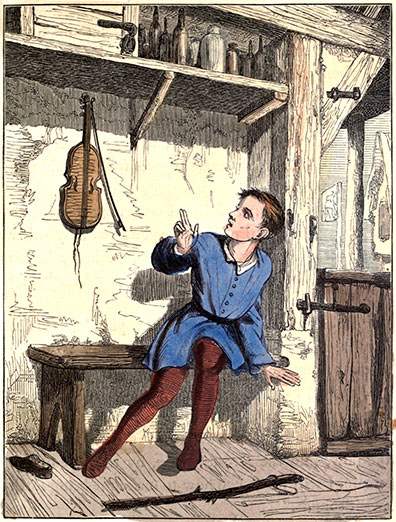 The neglected Fiddle repining.
Jackey said, sorrowfully, “Oh, how I wish to
make you happy! But if I take you down, my father
will beat me, and, what is worse, perhaps, in his
passion, throw you against the wall, and dash you
to pieces.”
“Be not afraid, but do as I tell you,” the violin
answered; “you know that your father is at the
tavern all day long till dusk, when he comes to fetch
me, and if, by chance, he does come in, he never
notices anything. I promise you no harm shall
happen to you; so take me down and carry me, with
the bow, into the forest, where, by the side of the
stream, I will teach you how to make me bring forth
sweet sounds.”
“You know better than I do what is safe to do,
so I will take you to the forest, as you tell me.”
As he said this, Jackey took down the violin, and
having cleaned and tuned it, according to its own
directions, he carried it and the bow into the forest,
where he seated himself by the side of the
rivulet.
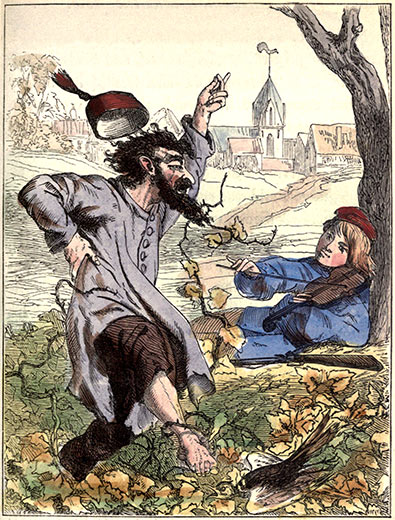
The breeze played between the leaves and branches
of the trees, the leaves and branches rustled, the birds
sang sweetly, the stream murmured softly, and all
seemed to say—
“Welcome, Jackey! welcome to the forest!”
“Oh, how delightful it is here!” Jackey cried;
“and now, my dear Fiddle, teach me to imitate all
these sweet sounds.”
The violin told him how to hold the bow and
where to place his fingers; and all the birds came
round him, first one whistling a note till he could
imitate it, and then another giving him the next
note, and so on; the rivulet, too, and the wind assisted;
and then came the nightingale and taught
him how to join the different notes together, that
they might harmonize and form sounds agreeable to
the ear.
Jackey was so attentive, and did all so well, that
the trees, the flowers, the stream, and all the birds
cried out—
“Bravo, Jackey!”
As soon as evening began to draw near Jackey
put up his fiddle and prepared to go home, when
all the voices, with one accord, cried—
“Come again soon, and we will sing together.”
Jackey went the very next day, and every succeeding
day, and he made the flowers join in the universal
harmony. His dear fiddle seconded him in all his
endeavours, so that very shortly he imitated all the
voices of the forest with the greatest accuracy.
It happened about this time that the landlord of
the village inn died, leaving a widow, who wished
for nothing better than to give him a successor as
speedily as possible; but though she was rich, and
the business most thriving, yet no suitors appeared.
Jackey’s father, in his drunken moments, thought
he would propose to the widow, for he said to himself
that, when master of the inn, he could have as
much drink as he liked without paying for it; but
when a little more sober his courage failed him, for
she was the veriest shrew, and the charms of her
person were no more engaging than those of her
character.
Her hair was neither red, brown, nor black, but a
sort of dirty coloured mixture of the three, and each
hair seemed to go a different way. Her nose was
very, very long, not projecting, but hanging down,
like the beak of some of the small tribes of parrots.
I think the love-birds have such beaks, but I can
scarcely compare her to those, for certainly she had
nothing of the love about her. Well, her nose, anyhow,
was like a parrot’s beak, but flattened down, and
that on one side, or else it would have covered her
mouth, which would have been no great harm, for
that was as ugly a feature as any other, and not
improved by having only half the due number of
teeth, which, unlike the nose, stuck out instead of
hanging down. Her eyes were like those of a cat,
and one squinted awfully. Shaggy eyebrows and a
pointed hairy chin complete her portrait. Her
figure was long, lank, and shapeless—shapeless not
meaning no shape at all, but an ugly shape.
Most people have some redeeming qualities, or
quality at least, but no one had yet discovered
hers, and no one had been found bold enough to
propose to the interesting widow, though she let it
be clearly understood that she wished to remain a
widow no longer.
Jackey’s father had so often made up his mind
to make her an offer that at last his mind became
familiarized to the horror, and if not in love with
the widow, he was decidedly so with her beer and
spirits; so one evening, having screwed up his courage
to the highest pitch, he, in a few words, offered
himself as a husband.
The widow took but a few minutes to consider,
that, though he was a drunken, worthless fellow, he
was better than no husband at all; so she did not
give him time to draw back, but accepted him with
all his faults.
The wedding followed with the least possible loss
of time, and the guests drank deeply to the health
and happiness of the bride and bridegroom, but the
happy husband drank more than any of them. This
was a happy beginning; but how short-lived is happiness,
for to his this was not only the beginning but
also the end.
How changed was everything the very next day!
Beer and spirits were carefully locked up, and the
poor fiddler was put under the water-cure treatment,
and this was the first of a series of strictly sober days.
He did not resign himself to petticoat government
without a struggle, but in every way she was more
than his match.
Adversity is the bitterest of all medicines, but
frequently acts most beneficially on the soul, if not
on the body. So it proved with the fiddler, for
though, during the first few days of his new life,
his temper was sourer than ever, by degrees his
spirit was broken, and the outbursts of passion became
less frequent. Passion was of no avail, for it never
gained him his object, and his amiable spouse still
remained his better half.
Example had its effect also, for as he daily suffered
from his wife’s intolerable temper, her unamiability,
which at first roused his anger, now caused disgust
and horror, and occasionally he could not help reflecting
that in many respects he had been like her.
As yet the improvement in his character was involuntary,
forced upon him, as it were, and failed to
soothe his mind and feelings; but Jackey, being
treated with less harshness, began to feel for the first
time that he had a father.
The good boy, looking on his father now without
fear, saw the dejection he was constantly labouring
under, and, as much as he had dreaded and almost
abhorred the harsh brutal man, he now pitied his suffering
father, so that he took every opportunity to
get near to him, sometimes venturing a remark; and
one day, when he saw him in a particularly desponding
mood, he fetched the violin and played the voices
of the forest to him.
Jackey’s father was at first bewildered by the
tender emotions to which his heart had so long been
a stranger, but as the sweet sounds continued, it
seemed as if his nature were changed and a new
life dawned upon him. He clasped his son to his
breast and burst into tears. When he became a
little calm, he said—
“How beautifully you play, Jackey! How did
you learn? But why inquire? You have always
been a good boy, and kinder, better spirits than those
of the earth, seeing you so neglected by your unnatural
father, have taken compassion on you. I have
led a bad life, but now I see my faults, and I will
be always kind to you, my Son. Oh, Jackey, your
good mother will forgive me for all my past cruelty
when she sees how I watch over her dear child!”
“Dear Father,” Jackey said, “my dear, good
mother, who is in heaven, forgives you now. Oh,
if she were but here to share our happiness!”
“Play me that tune once more,” his Father said,
“and then we will go to your step-mother, and I
will beg and pray of her to send you to school, for
I can do nothing, my poor Boy.”
They went to that amiable lady, with whom,
however, all prayers were in vain. She said she
would not spend a farthing of her money on father
or son, but that Jackey should be a shoemaker;
that she would send him to her brother, who was
a shoemaker in a neighbouring village, where he
would soon be broken of his idle habits. Jackey
said he would not be a shoemaker; whereupon she
gave him a slap on the face, which made his ears
sing and bright spots dance before his eyes, promising
at the same time to break his fiddle over his head.
Jackey, however, was none the less determined
not to be a shoemaker, and his only trouble was how
to keep the dear fiddle out of her way. The next
morning very early he was waked by a kiss from
his father, who said—
“Get up quickly, my Boy, and dress yourself, for
I cannot do anything for you here, not even protect
you, and it will be better to trust to the kindness of
strangers than go to that cruel woman’s brother,
who no doubt is as bad as herself. We must part,
my dear Jackey, but I do not fear for you, for wherever
you play the airs you played me yesterday, you
will be sure to find friends. Take your fiddle then,
and wander forth into the world, and if you remain
a good boy, as you have hitherto been, God
will watch over you and protect you. Make haste;
and in the meantime I will see what I can find to
eat for you to take with you.”
Jackey was ready when his father returned with
some provisions done up in a bag. “Now follow
me,” he said, “and take care that you do not make
any noise, so that no one may hear us.” They got
out safely and went straight to the forest, where
Jackey’s Father stopping, said to him, “You are
now safe out of the clutches of your wicked stepmother,
and we must part; but, my dear Boy, we
will put our trust in Providence, and, if my life
is spared a few years longer, I shall see you again,
for when you prosper in the world, and prosper
you will, my Son, you will not forget your old
father.”
“Let me remain with you, my dear Father,”
Jackey said, “for you are not happy, and I will try
to cheer you with my fiddle. I do not mind my
stepmother’s cruelty.”
“No, my Child, it must not be,” his Father
answered, “I have deserved my fate, and will try
and bear it with resignation; but fortune awaits you
in the world, far from here. Do not cry; and now,
with my blessing on you, we must part.” He
pressed his son to his breast, and turned back without
uttering another word.
Jackey watched him till he was out of sight, and
then sadly went on his way into the forest, he knew
and cared not whither. After a time he reached
the very spot, by the side of the rivulet, where he
had first sat with the violin and listened to the voices
of the forest; and as he seated himself, the rustling
in the trees and the murmuring of the stream joined
with the different notes of the birds in forming the
harmony of music. The sadness of his heart gradually
became softened, and, taking the violin out of
the bag in which he always kept it, he again imitated
the various sounds he heard, the birds vieing
with each other to teach him something new.
Returning cheerfulness and the freshness of the
air reminded Jackey that he had not yet eaten anything,
so he made a good breakfast off the provisions
put up by his father, not forgetting to give
some crumbs to the birds that gathered about him;
and with a light heart he continued his journey
deeper into the forest. He thus wandered on all
day, and neither found the time long, nor was he
weary; for there was constantly something new to
see, and hear, and imitate upon his dear fiddle.
The sun had sunk below the horizon, tingeing a few
feathery clouds with a beautiful pink, and the little
wanderer saw no end to the forest; but that did not
trouble him, and he chose a soft mossy spot for a
bed, on which he lay down, and was soon fast
asleep, forgetful of time and everything else.
Nothing disturbed his quiet slumbers till about
midnight, when a sudden light flashing across his
eyes awakened him. He started up, and saw it as
light as day all around. Yet it was not daylight;
it was more like the light of the moon, but milder
and warmer. He looked through some bushes,
where the light seemed strongest, and stood transfixed
with amazement at what he saw. Hundreds
of the most lovely beings were dancing in a circle,
whilst thousands of others seemed to fill the air
around. Some were sitting, swinging backwards
and forwards, on the different flowers, whilst others,
in countless numbers, appeared gliding up and down
the rays of light. He thought he had never seen
anything so beautiful as the little aerial beings before
him. Though so very small—for they were not
nearly the size of Jackey—their forms were fully
developed, and of the most exquisite elegance and
grace. The maidens in particular, who seemed all
of the age of seventeen or eighteen, were lovely in
the extreme.
Jackey knew they must be fairies; and two of the
number who were a little taller, and, if possible, more
beautiful than the rest, besides that they wore silver
crowns, he judged to be the king and the queen.
Dazzled by the light and the beauty of the scene
before him, he was for a time lost in admiration;
but gradually the sweet tones, as the fairies sang,
gained the ascendancy, and all the other senses
seemed absorbed by that of hearing. As the fairies
danced, they sang, and were joined by thousands of
other voices—in sounds, now of the most lively merriment,
then softly till they became solemn, when
again they burst forth in the wildest strains. The
dance never ceased; but as some withdrew from the
ring their places were taken by others, who began
the song anew.
Jackey had no knowledge of time, whether the
music continued for minutes only or for hours; however,
it became fainter and fainter till it melted away,
and he found himself in darkness; but long, long
after he lay down again it seemed as if he still heard
the fairy song, and when he awoke in the morning
it still sounded in his ears.
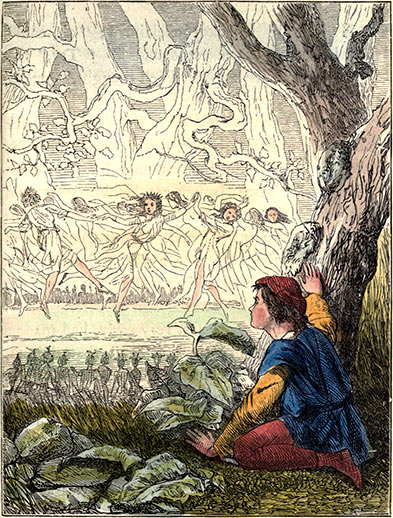 The Sight Jackey saw.
“How lovely!” Jackey exclaimed; “oh, could
I but imitate those sweet sounds!” “Try,” the
violin said from its bag. “Well thought,” Jackey
cried; and taking it out, immediately began to
play the fairy song. He played it over and over
again, and each time better, till at length he said,
kissing his dear violin, “Well done, Fiddle, we can
do it now.” Then Jackey ate his breakfast, and
having tried the song once more, he resumed his
wanderings through the forest. He stopped several
times to play the fairy song again, trying also his
other tunes, to see that they had not been driven
out of his memory by these still sweeter sounds;
and having had his breakfast very early, had made a
finish of his stock of provisions, but that did not
trouble him, though there seemed no end to the forest.
About mid-day, however, he began to feel hungry
again, and hastened his steps, in hopes of finding
some outlet from the forest, or at least some woodman’s
hut. He began to feel some anxiety for the
future; but he did not despair, for he was a good
boy, and put his trust in Providence. The birds
sang merrily, as if to cheer him; and soon he saw
that the forest became lighter, nor was it long
before he found himself on the highway, and at no
great distance stood a village.
Anxious as he was to reach some human habitations,
when he was outside the forest he turned
round to bid it farewell, and thank his dear birds for
their kindness to him. A farewell sounded back,
and cheerfully he went on his way to the village.
He remembered his father having said that wheresoever
he played he would be sure to find friends;
and no sooner did he reach the first houses, than he
took out his violin and began to play. First he
played the voices of the forest, and soon all the
people were at their windows and their doors, listening
to him; but when he played the fairy song,
they came out and surrounded him, and he had to
begin again and again.
There was now a contest amongst the principal
inhabitants of the village who should take the wonderful
boy to their home, when the clergyman and
his wife carried him off.
Jackey would not accept their kindness without
telling them that he could not stay long, for his
father had sent him to seek his fortune in the world,
that his father was not happy at home, and that he
was going back to fetch him as soon as he had made
his fortune.
The good people promised that they would not
keep him longer than he felt inclined to remain
with them. They were, however, so kind that
week after week still found him there, and he was
so intelligent and docile that every one loved him.
Living now with people of good education, Jackey
soon felt his ignorance, and applied himself so diligently
to his studies, in which he was assisted both
by the clergyman and his wife, that he made rapid
progress.
He did not neglect his music, and frequently went
back into the forest—no one interfering with his
wanderings. Neither did he forget his father, nor
give up the intention of seeking his fortune in the
world, though he was delayed by the persuasion
of his kind protectors, who, however, gave their
consent to his departure after he had been with them
about a year, providing him with every necessary for
his journey, as also with a small supply of money.
Jackey had improved as much in person as in
mind, but retained his former innocent simplicity
of heart and kindly feelings, so that his feathered
friends loved him still, and he was as happy as the
day was long.
He visited one country after another, passing
from village to village, and from town to town; and
wherever he played, both old and young surrounded
him, and every one was ready to befriend him.
Thus year after year passed away, and Jackey had
grown to be a tall, handsome youth of about nineteen,
with flowing black hair, large dark eyes, and
an expression of cheerfulness and good humour.
His playing was celebrated far and wide, but, more
particularly, when he played the fairy song every
one was carried away by admiration and surprise.
In each country he visited many inducements
had been held out to detain him; but a secret impulse
drew him on till he came to a large and
powerful kingdom, which he found plunged in the
deepest mourning; for not only had the queen just
died, but the most beautiful of princesses, her daughter,
was brought to the very verge of death by grief
at the loss of her beloved mother.
Her royal father, whose only child she was, in
the utmost despair, had promised half his kingdom
to the physician who should save her; but the only
remedy the most learned could propose was any excitement
that would distract her from her grief, for
it was that alone that was consuming her. This
remedy was beyond their art, and the king proclaimed
that whoever cured the princess should be
the inheritor of his throne and the husband of his
daughter, if she consented to marry him.
Jackey, on hearing this proclamation, determined
to try what his art could do to cure the princess,
since all that was required was to enliven her, and
make her forget her grief. He trusted that, with
the help of Providence, he should succeed; and that,
if even the princess would not marry him, which
he scarcely dared to hope, he might still receive
a reward sufficient to secure his old father’s future
happiness, besides having the consolation of saving
the life of a young lady universally beloved.
He went boldly to the palace, where he was immediately
admitted, on stating what his errand was;
for the king had given orders not to refuse admittance
to any one, however humble, who came to
cure his daughter.
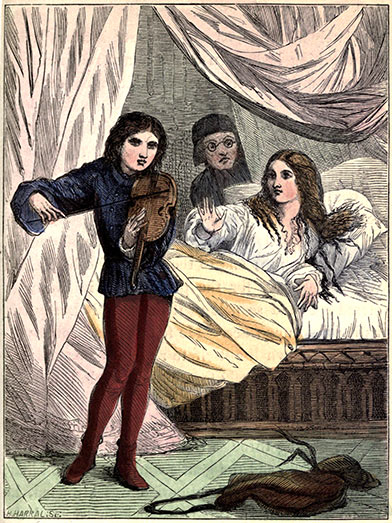 Jackey playing to the Princess.
The king was much surprised and disappointed
when he saw Jackey; but after he had received an
explanation of the means intended to be employed,
he became more reconciled, and ordered him to be
conducted to the princess’s apartment.
Jackey gazed with admiration at the beautiful
form before him; and to the interest he before felt
was added pity, for the princess lay in bed with
closed eyes and so pale as if death had already laid
its icy hand upon her. He felt that he would willingly
lay down life itself to restore colour and animation
to that lovely face, and determined to exert
his utmost skill in her behalf.
First he played the voices of the forest—the soft
breeze gliding through the leaves, the low murmur
of the stream, and the gentle warbling of the birds;
then, as the princess’s attention was attracted, he
made his violin speak louder and louder, and the
Princess exclaimed, “How came I into the forest?
Oh! how delightful it is! Sing on, you darling
birds!” At length she opened her eyes, and sitting
up in the bed, looked about her in amazement.
Jackey now played the fairy song; and when he
had finished, she said—“Go on, gentle Youth, I entreat
you. You have been sent by heaven to call
me back to life.” She sank back upon her pillow,
and as Jackey continued to play, she fell into a soft
sleep, with a smile on her lovely face.
The king, having been informed of all that had
happened, hastened to his daughter’s room; and the
calm expression of her features, together with the
assurance of the head physician that all danger had
now passed over, made him, for the moment, forget
all his sorrow; and embracing Jackey, he assured
him of his everlasting gratitude.
The next day the princess awoke, restored to
health; and when her preserver was presented to
her by the king, she received him with the sweetest
smile, and thanked him in the kindest terms. But
that was not all Jackey’s reward; for when the princess
was told of the promise made by her royal
father to whoever should save her life, she declared
herself ready to fulfil that promise, as soon as the
time of mourning for her departed mother had
passed.
They were, however, betrothed before the whole
court, and the king publicly proclaimed that, next
to himself, Jackey should be the first in the land.
An establishment in every way befitting a prince of
the royal blood was appointed him, and he lived in
the closest intimacy with the king and his amiable
daughter.
Jackey, however, in all his splendour, and by the
side of his future bride, did not forget his old father,
nor the promise he had made him; so he begged
permission of the king to go and visit him, which
was immediately granted.
He set out on his journey to the village where he
was born, attended by a numerous retinue, travelling
day and night till he reached the forest where he had
learned the first notes of music, the foundation of all
his fortune. He remembered all the trees, but the
whole generation of birds that had known him had
long since died. In his heart, however, he thanked
them for their kindness, and in remembrance of
them he passed on in silence, having left his attendants
at the beginning of the forest.
His heart beat with anxiety and fear, lest his
father should no longer be living, for it was more
than ten years since he had left his home; but when
he reached the stream where he had first sat in the
forest he saw an old man sitting by its side. Jackey
immediately recognized his father, but the old man
did not see him, for he was plunged in sorrow.
Wiping a tear from his eyes, he said, “Am I
never to see my dear Jackey again? For how many
years have I come here every day, till gradually all
his friends have died off—and he, too, I am afraid,
must be dead; and I am the cause of his death, for
it was I persuaded him to go out into the world.”
Jackey now took out his violin, which he had carried
with him, and played the tune with which he
had first soothed his father’s grief. The old man
recognized the notes, and he cried out, “That is my
own Jackey! Come to my arms, my dear Boy!”
It was long before either could find words; but
then the old man told him that his stepmother was
dead; and Jackey related all his adventures, and his
present happiness and splendour. Jackey went with
his father to the village; but the next day he had
him removed to where he had left his followers, and
they all returned, without loss of time, to the king,
and Jackey’s future wife.
Jackey and his father were received with great
rejoicings, and when the time of mourning for the
late queen was over, Jackey was married to the
lovely princess, with whom he spent a long life of
happiness and peace, reigning with justice and wisdom
over the kingdom after the king and his own
old father were dead.