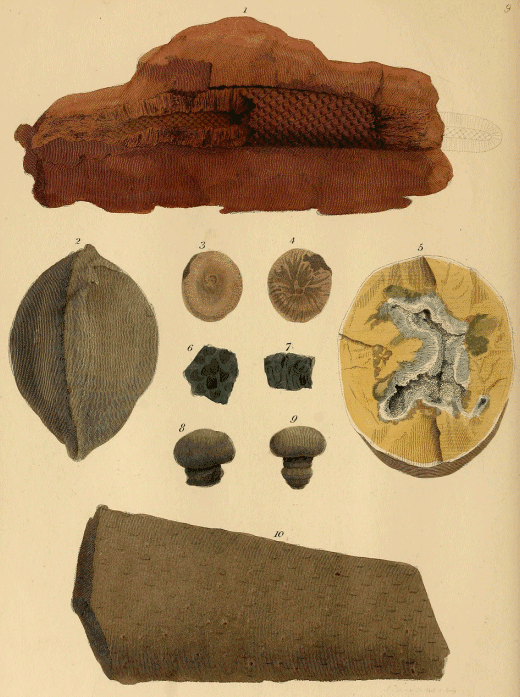
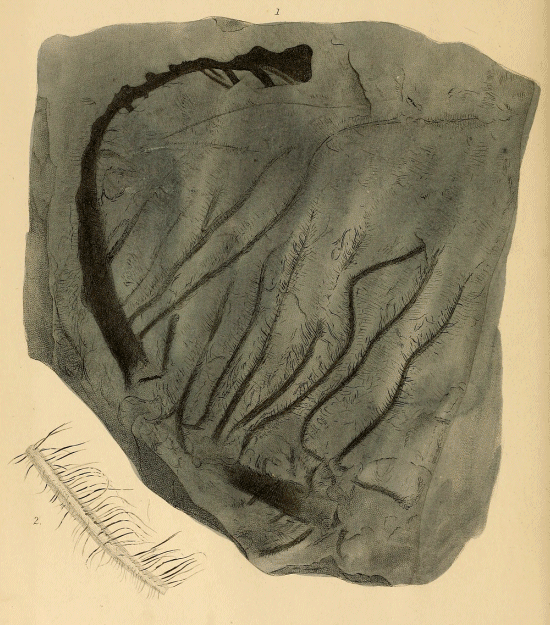
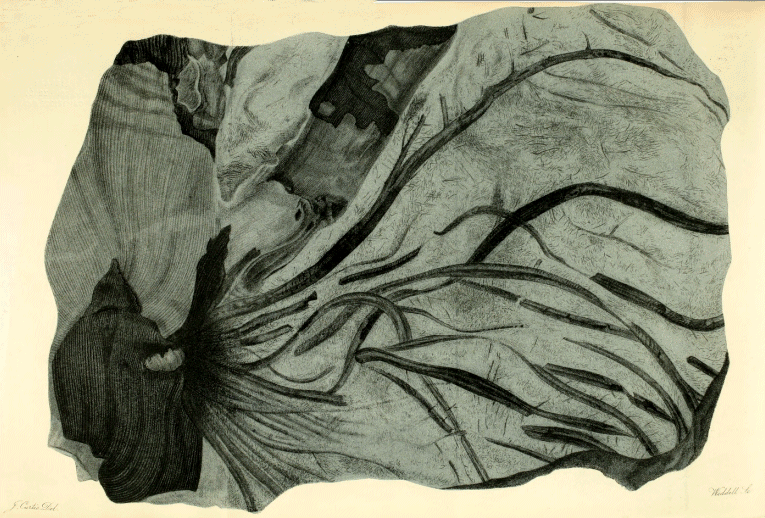
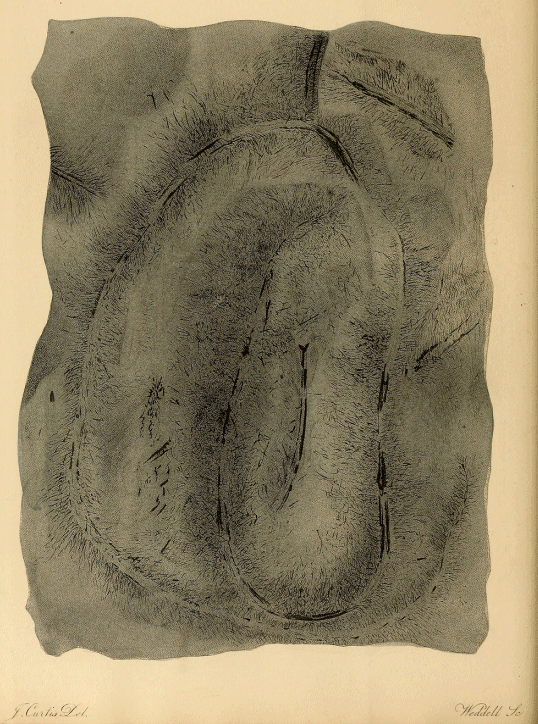
I. Fossil Bears of the Caverns. (Plate LXXIII.) For many centuries certain caves in
Germany have been celebrated for their osseous treasures, particularly those in Franconia. The
most remarkable of these caverns is that of Gaylenreuth, which lies to the north-west of the village
of that name, on the left bank of the river Wiesent, on the confines of Bayreuth.[80] The entrance
to this cave is in the face of a perpendicular rock, and leads to a series of chambers from fifteen
to twenty feet high, and several hundred feet in extent, terminating in a deep chasm. The cave
is quite dark; and the icicles and pillars of stalactite, reflected by the light of the torches, which
it is necessary to use, present a highly picturesque effect. The floor is literally paved with bones
and fossil teeth, and the pillars and corbels of stalactite also contain similar remains. The bones
are generally scattered and broken, but not rolled; they are lighter and less solid than recent
bones, and are often incrusted with stalactites. Three-fourths of the bones belong to two
species of bears (Ursus), the remainder to hyænas, tigers, wolves, foxes, gluttons, weasels, and
other small carnivora. Those belonging to bears are referable to two extinct species: the
largest has the skull more prominent on the front than any living species; it is named Ursus
spelæus, or cavern bear; the other has a flat forehead, and is the Ursus priscus of Cuvier. The
Hyena was allied to the spotted hyena of the Cape, but differed in the form of the teeth and
skull. Bones of the Elephant and Rhinoceros are said to have been discovered, together with
those of existing animals, and fragments of sepulchral urns of high antiquity.[81]
Similar ossiferous caves occur in England; of these, the most remarkable now accessible are
Kent's Hole, near Torquay, and Banwell Cave, in the Mendip Hills, near the village of
Banwell. The latter may be easily visited, as the Exeter railway passes within three miles of
the village, and there is a station, with vehicles to convey passengers to Banwell.
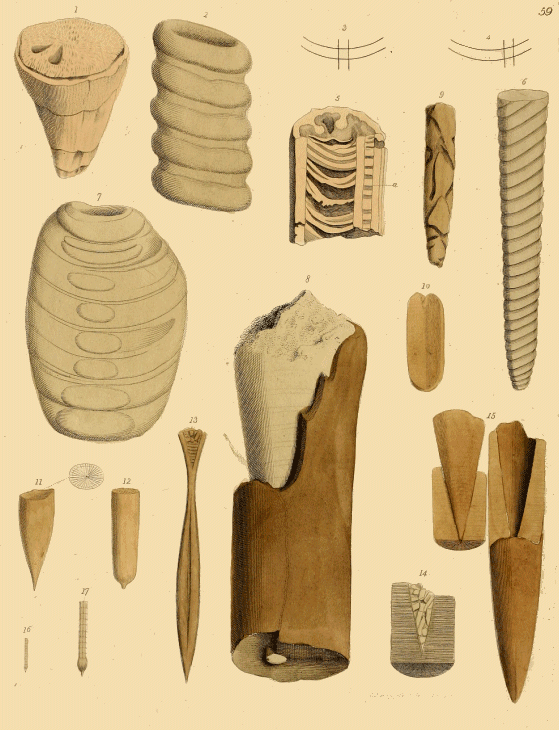
II. The Belemnite. (Plates LIX. and LX.) Among the innumerable relics which abound
in the secondary deposits, there are perhaps no fossil bodies that have excited so much curiosity, or
given rise to so many fanciful conjectures as to their nature and origin, as the long, cylindrical,
fusiform, crystalline stones, called Belemnites by naturalists, and thunderbolts by common
observers. Mr. Parkinson gives an amusing account (vol. iii. p. 122) of the discordant opinions
entertained at various times respecting the nature of these bodies.
It would be irrelevant to dwell on the history of the successive attempts that have been
made to elucidate the origin and structure of the Belemnite. It will suffice to describe concisely
the present state of our knowledge as to the organization of the original.
Mr. Miller, in 1823,[82] showed that the Belemnite was the rostrum or osselet of an animal
allied to the Sepia, or Cuttle-fish, and gave a restored outline of the supposed form of the
original, with the Belemnite in its presumed natural situation. Dr. Buckland and M. Agassiz
imagined that they had traced a natural connexion between certain species of Belemnites that
abound in the Lias, and the ink bag and other soft parts of the Sepiæ or Calamaries found
associated with them; and they suggested the name of Belemno-sepia for the supposed animal of
the Belemnite,[83]
In 1842, the late Mr. Channing Pearce described, under the name of Belemnoteuthis antiquus,
a naked (destitute of a shell,) cephalopod, which occurs in immense numbers in certain beds
of the Oxford clay, especially at Christian Malford, in Wiltshire. This animal has at the
lower apical part a conical osselet of a horny substance, and fibrous structure, enclosing a
chambered siphunculated shell, which becomes gradually thinner at the upper part, and forms
a cup-like receptacle, in which is placed the ink-bag. The soft body of an elongated oval form,
with a pair of lateral palleal fins, two large sessile eyes, and with eight uncinated arms and
a pair of long tentacula, are preserved in a more or less distinct and perfect state in several
specimens that have lately been discovered. Mr. Channing Pearce, Mr. Cunnington, and other
collectors of these interesting remains, were convinced that this cephalopod was entirely distinct
from the animal to which the Belemnite belonged.
In 1844, Professor Owen laid before the Royal Society "A description of certain Belemnites
preserved with a great proportion of their soft parts in the Oxford clay, at Christian Malford,
Wilts."[84] In this memoir (for which one of the royal medals of the Society was awarded) the
author describes as the soft parts of the Belemnite the remains of the animal which Mr. Channing
Pearce had two years previously shown to belong to a different genus (Belemnoteuthis). Belying
on the correctness of Professor Owen's views, I gave an abstract of this memoir in my "Medals
of Creation," and stated that belemnites had been discovered with the osselet, receptacle, and ink-bag,
in their natural position, and with remains of the mantle, body, fins, eyes, and the tentacula,
with their horny rings and hooks.[85]
The discovery by my son (Mr. Reginald Neville Mantell) of some remarkably perfect specimens
of belemnites in the Oxford clay, exposed in the railway works on which he was engaged, near
Trowbridge, in Wilts, led me to examine the structure of the Belemnoteuthis with more
attention than I had hitherto done, as well as the evidence adduced by Professor Owen in proof
that the fossil osselet, the Belemnite, belonged to the same genus of cephalopoda. I found that no
specimen had been obtained in which the phragmocone, or terminal chambered part of the Belemnoteuthis
(of Pearce), was situated in the alveolus of a Belemnite; but Professor Owen having assumed that the
osselet of the former must have originally been protected by a rostrum, or guard, described
the soft parts as belonging to the animal of the Belemnite, conceiving that the phragmocone
of the Belemnoteuthis was that of a Belemnite that had slipped out of the guard.
In a communication to the Royal Society, in 1848, I demonstrated how utterly at variance
with the facts were these conclusions, and pointed out the essential distinctive characters that
separated the two extinct genera, so far as the specimens then discovered would warrant.[86] Other
[ 171 ]
illustrative examples of the Belemnite have since been obtained; and
in a supplementary paper read before the Royal Society, February 14th,
of the present year (1850), I have stated what appears to me to be the
extent of our present knowledge of the organization of the Belemnite.
I subjoin an abstract of that paper, which embodies the result of an
examination of many hundred specimens of Belemnites and Belemnoteuthites.
The annexed outline, or diagram, shows the known structures
of the Belemnite; of the soft parts of the animal, a few imperfect carbonaceous
traces, apparently of the mantle, around and between the
shelly processes of the upper part of the phragmocone, are the only
vestiges I have been able to detect. The most perfect Belemnite hitherto
discovered consists of,

1. An external Capsule (e) which invested the osselet or sepiostaire,
and extending upwards, constituted the external sheath of the receptacle.
2. The Osselet, characterized by its fibrous radiated structure, terminating
distally in a solid rostrum or guard (i), having an alveolus, or
conical hollow (g), to receive the apical portion of the chambered
phragmocone, and expanding proximally into a thin cup, which became
confluent with the capsule, and formed the receptacle (b, b,) for the
viscera.
3. The Phragmocone (d), or chambered, siphunculated (c), internal
shell; the apex of which occupied the alveolus (g) of the guard, and
the upper part constituted a capacious chamber, from the basilar margin
of which proceeded two long, flat, testaceous, processes (a, a,).
These structures comprise all that are at present known of the
animal to which the fossil commonly called "Belemnite," belonged.
Of the Belemnoteuthis, the cephalopod which Professor Owen
considers to be a Belemnite, many examples of the body with eight
uncinated arms and a pair of long tentacula, and with an ink-bag, and
palleal fins, have been discovered. The osselet of this animal, like that
of the Belemnite, has a fibro-radiated structure, investing a conical
chambered shell; but this organ, for reasons fully detailed in the memoir,
could never have been contained within the alveolus of a Belemnite.
No certain evidence has been obtained of the occurrence of an
ink-bag in natural connexion with a Belemnite.
Diagram of the known Structures of the Belemnites Puzosianus, from Trowbridge.
a, a, dorsal processes.
b, b, the receptacle.
c, c, the siphuncle.
d, d, the phragmocone.
e, the capsule.
f, the inferior end of the phragmocone.
g, the alveolus of the guard.
h, vertical section of the guard.
i, the guard, or rostrum of the osselet.
k, sulcus, or furrow, on the ventral aspect of this species of Belemnite.
l, capsule, or periostricum.
m, the dorsal line.
n, transverse section, showing the fibrous radiated structure of the guard.
In the annexed outline the several parts are represented in their
natural relative positions. The capsule, or most external investment, (e)
is seen only in section, being removed to expose the rostrum or guard
(the fossil body generally known as the Belemnite). The upper three-fourths
of the rostrum are also taken away, to show the phragmocone
which it originally enveloped. The straight transverse lines denote the
[ 172 ]
chambers of the phragmocone; the latter is seen extending downwards till it terminates in a point
or apex; that part of the cavity in the guard is called the alveolus. The siphuncle, or tube which
extends through the entire series of chambers, and is situated on the ventral margin, is indicated
at c, c. The dorsal processes (a, a) are seen on their inner aspect at the upper part; the diverging
lines (m) between them indicate the impressions of the soft parts, of which some traces remain.
III. Fossil Remains of Birds.—The Moa, or Dinornis of New Zealand. The bones of birds are
of extreme rarity in a fossil state. Throughout the immense series of the palæozoic and secondary
formations—the accumulated sedimentary deposits of innumerable ages—no unquestionable indications
of the existence of this class of highly organized beings have been brought to light.
In the Triassic, or New Red argillaceous sandstones of the valley of the Connecticut River,
in North America, some very remarkable phenomena have, however, been discovered, and which
in the opinions of many eminent observers render it highly probable, that at the period when
these strata were deposited, numerous birds, some of colossal magnitude, abounded on the then
dry land. When slabs of these sandstones are split asunder, or exposed, so as to exhibit the
sedimentary surface which separates one layer from another, the foot-prints of many species of
bipeds are perceived deeply impressed on the stone, and disposed in such manner as to prove
that they are the tracks of animals that walked over the surface of the deposit when it was in a
soft or plastic state. The close analogy of these imprints to those of birds' feet, not only in their
general resemblance, but also in the disposition of the tracks, and in the relation of the distance
of the stride, and the depth and shallowness of the impressions, to the size of the respective
feet, tends to corroborate the inference first enunciated by Professor Hitchcock, and subsequently
confirmed by other geologists, that these mysterious markings on the rock, are natural records of the
existence of various tribes of birds during the Triassic period;[87] but unfortunately the only
certain evidence of the correctness of this opinion—remains of the skeletons—is wanting; not
a vestige of a vertebrated animal of a higher class than fishes and reptiles has been discovered.[88]
In the vast fluviatile formation—the Wealden—of the south-east of England, which abounds
in the remains of terrestrial plants and reptiles, many fragments of bones of such tenuity as to
indicate that they belonged to animals capable of flight, have from time to time been collected
since my first discovery and announcement, in 1822, of supposed birds' bones in the strata of
Tilgate Forest. Some of these relics were declared by Baron Cuvier, and subsequently by
Professor Owen, to be unquestionably those of birds; probably some species of waders. But
recent observations have rendered it doubtful whether all the specimens of this class from the
Wealden, like those from Stonesfield, are not to be regarded as referable to flying reptiles
(Pterodactyles).[89]
In the chalk of Kent several bones of a very large flying animal have been obtained from
a quarry at Burham, near Maidstone; some of these are figured and described in Professor
Owen's beautiful work on British Fossil Mammals and Birds, as those of a bird allied to the
Albatross; but the occurrence in the same quarry of jaws with teeth, and other undoubted
remains of a gigantic Pterodactyle,[90] and the absence in the specimens figured of osteological
characters exclusively ornithic, seem to support the conclusion that these also must be ascribed to
flying reptiles.
In the most ancient tertiary strata unquestionable vestiges of birds occur; in the Sub-Himalaya
eocene deposits, they are associated with bones of the extinct elephantine mammalia
of India; in those of the Paris basin with the remains of the Palæotheria, &c. In the miocene
and pliocene formations, the bones and even egg-shells of several species and genera have been
detected. The remains of birds, however, even in comparatively recent deposits, were of such
rare occurrence as to be ranked by the collector of fossils among the most precious of his
acquisitions; but a few years ago, a most extraordinary discovery in our Antipodean colony.
New Zealand, astonished and delighted the palæontologist, by placing before him hundreds
of bones of numerous extinct genera of birds, some of which far exceed in magnitude those of
the most gigantic living species, the Ostrich.
In various localities of the maritime districts of New Zealand, there had been observed
in the beds of rivers and streams, fossil bones of birds of colossal magnitude, belonging to many
species and several genera, associated with similar relics of smaller species. These bones had
attracted the attention of the natives long ere the country was visited by Europeans; and
traditions are rife among the New Zealanders that this race formerly existed in great numbers,
and served as food to their remote ancestors. They also believe that some of the largest species
have been seen alive within the memory of man; and even affirm that individuals still exist
in the unfrequented and inaccessible parts of the interior of the country. They call the bird
Moa, and state that its head and tail were adorned with magnificent plumes of feathers, which
were worn by their ancient chiefs as ornaments of distinction.
Nine years since, a fragment of a thigh-bone of a bird larger than that of the Ostrich was
brought to England by Mr. Rule, and submitted to the examination of Professor Owen, who pronounced
it to belong to a gigantic bird of the Struthious (Ostrich) order. A few years afterwards
several collections of vertebræ, bones of the extremities, &c. were transmitted to England by
Messrs. Williams, Wakefield, Earle, &c., which corroborated that opinion, and proved that there
formerly existed in the islands of New Zealand, colossal birds of a type distinct from any known
in other parts of the world. In 1846 and 1847, my eldest son, Mr. Walter Mantell, who has
resided in New Zealand several years, made an extensive and highly interesting collection of
these fossil remains, which arrived in England in 1848. This series contains skulls, with the
mandibles or beaks, bones of other parts of the skeleton, and portions of the egg-shells, of several
extinct species and genera of birds; presenting remarkable deviations from the previously known
types to which they are most nearly allied.
This valuable accession to our knowledge of the osteology of this extinct race of Ostrich-like
birds—some individuals of which must have attained a height of from ten to twelve feet—has
yielded important results as to the form, structure, and economy, of these colossal bipeds, and the
prevailing characters of the terrestrial fauna of New Zealand in very remote periods. The
collection, consisting of above 700 specimens, is now in the British Museum: it was obtained
chiefly from a bed of menaccanite or titaniferous iron-sand, that had evidently been washed down
by torrents from the volcanic region of Mount Egmont; that snow-capped ridge which forms
so striking a feature in the physical geography of the North Island, and is the source of the
fresh-water streams that discharge themselves into the ocean along the western shore. The
tract of sand from which my son dug up these relics, is on the coast near the embouchure
of a small river called Waingongoro, between Wanganui and Waimate. That stream evidently
once flowed into the sea far from its present course, for lines of cliffs extend inland from the
now dry sand-spit, and bear marks of the erosive action of currents.[91] A few months since,
[ 174 ]
I received from my son another most interesting collection of fossil bones (comprising above
500 specimens), chiefly obtained from the eastern shores of the Middle Island of New Zealand,
when engaged as Government Commissioner for the settlement of native claims. These were
dug up from a morass of small extent, lying in a little creek or bay at Waikouaiti, some twenty
miles north of Otago. This swamp, which is only visible at low water, is composed of vegetable
fibres (apparently of the Phormium tenax), sand, and animal matter. The bones are of a deep
brown colour, and almost as fresh as if recently taken from a tar-pit. Among the specimens
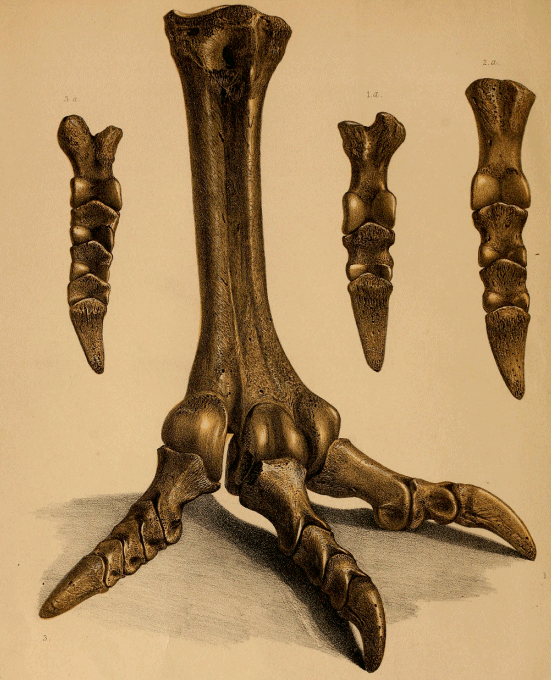
are crania and mandibles, and bones of enormous size. The most remarkable are the entire
series of phalangeals, and the two tarso-metatarsals, (26 in number,) of the right and left foot of
the same individual bird (Dinornis robustus), which were found standing erect, one a yard in
advance of the other; as if the bird had sunk into the mire, and unable to extricate itself, had
perished on the spot. These bones were carefully exhumed and numbered seriatim, and are the
only instances of the bones of the foot and metatarsus found in natural connexion; they are, consequently,
the first certain examples known of the structure of the feet of the colossal birds of
New Zealand. The foot of the Moa, to which these bones belonged, must have been 16 inches
long, and 18 inches wide; and the height of the bird about ten feet. (See the Frontispiece.)
It would extend this article far beyond the limits assigned to this work, were I to attempt
even a cursory account of all the facts and inferences connected with these discoveries. The
anatomical and physiological characters of many species and genera will be found in the admirable
Memoirs on the Dinornis, Palapteryx, Notornis, &c. by Prof. Owen, in the Transactions of the
Zoological Society.[92]
From the facts at present known as to the position of the ossiferous deposits of New Zealand,
there is reason to conclude that they bear the same relation to the present state of the country,
as the alluvial loam and clay containing the bones of mammoths, Irish Elks, &c. to that of Great
Britain. I think we may safely infer that at a period geologically recent, but historically
very remote, those islands were densely peopled by tribes of ostrich-like birds of species and
genera which have long since become extinct; that many species existed contemporary with
the Maories or native human inhabitants, and that the last of the family were exterminated,
like the Irish Elk, and the Dodo, by man. If, as the natives affirm, some of the race still exist
in the unfrequented parts of the country, they are probably diminutive species, like the Apteryx
or Kivi-Kivi, which is the only living representative known to naturalists, of this once numerous
tribe of colossal Struthionidæ. The only fossil osseous remains from New Zealand not referable to
birds are bones of two species of Seals, and one femur and a few other bones of a Dog. Associated
with the relics of the Dinornis and other extinct genera, and unquestionably coeval with them,
are crania, mandibles, and other bones, of the living species of Apteryx, Albatross, Penguin,
Notornis, Nestor, Water-hen, &c.
The fragments of egg-shells of Dinornis, from Rangatapu, belong to three distinct types,
each of very large size; my son, to convey an idea of the magnitude of one egg, of which he
dug up a large portion, says, "a gentleman's hat would make a capital egg-cup for it." The
markings on the surface of the shells bear a greater resemblance to those on the eggs of the Rhea
and Cassowary than of the Ostrich.
A remarkable fact mentioned by my son throws some light as to the comparatively recent
extirpation of the Moa. In one spot the natives pointed out some little mounds covered with
herbage, as consisting of heaps of ashes and bones, the refuse of the fires and feasts left by their
remote ancestors. Upon digging into them, a quantity of burnt bones was discovered: these
belonged to Man, Moa, and Dog, and were promiscuously intermingled. These calcined bones
present no traces whatever either of the earthy powder or manaccanite sand which the cells
and pores of the fossil bones invariably contain. If, as the natives affirm, these are the
rejectamenta of the feasts of the aborigines, the practice of cannibalism by the New Zealanders
must have been of very ancient date, and could not have originated, as Professor Owen
supposed, from the want of animal food in consequence of the extirpation of the colossal birds.
(See ante, p. xi.)
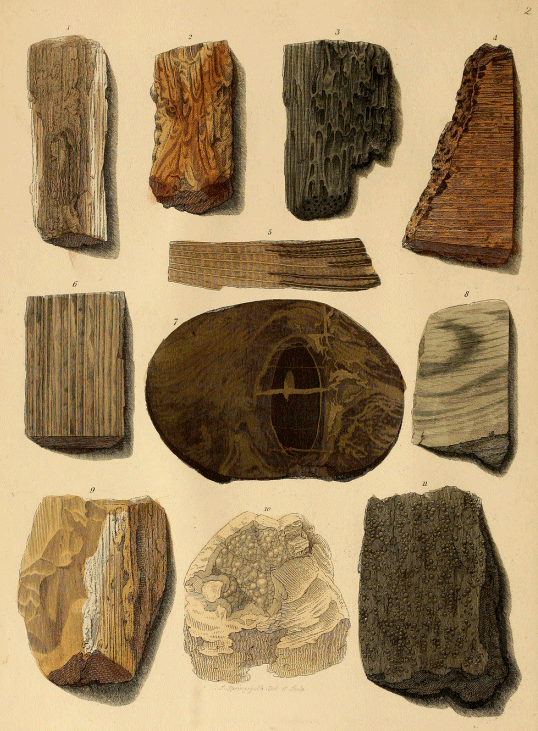
IV. Botanical arrangement of Fossil Vegetables.—Mr. Artis, in the Introduction of
his work, offers some judicious observations as to the proper method in which the study of Fossil
Botany should be pursued. He remarks, "that from the imperfect state in which fossil vegetables
are generally found, the ordinary characters by which recent plants are referred to their congeners,
can scarcely ever be detected in them. The sexual organs on which the systems of
Linnæus and Jussieu are founded, and even the integuments of those organs while in the state
of flowering, have uniformly perished. The external parts of the seed or fruit exist, indeed,
in a fossil state, but they are almost always insulated from the other organs. If leaves are found,
it is almost certain that scarcely any portion of the stem will be attached to them; if the
external parts of a trunk, then very rarely any vestiges of the branches and foliage. And when
traces of the internal structure can be discovered, it is seldom that the external character of the
stem remains.
"In consequence of this deficiency of the essential characters on which the determinations
of the botanist are founded, there exists a necessity for examining more minutely and accurately
than has yet been done, the internal structure of recent plants; their habits of growth, the
cicatrices or scars left on the stem by the leaves that are spontaneously shed, the different
appearances which their fruits exhibit in their various stages of development—all these points
must be minutely studied before we can obtain any certainty as to the identity of fossil and
living species of plants.
"It is not by publishing detached and unconnected delineations and descriptions of fossil
plants, as they occasionally occur, that the knowledge of them can be considerably promoted.
A systematic arrangement must be formed; and the first step to this is the accurate determination
of the species. Hoc opus, hic labor est."
"It will be seen," he observes, "in the course of this work, how easy it would be to
imagine parts of the same specimen to be different species, when they happen to be broken
and dispersed. I can confidently assert, that in at least a thousand different specimens which
I have had in my possession, not more than a hundred distinct species can be recognised.
Furthermore, still fewer indeed can be referred to any living species; for it is not the fern-like
leaf of a plant, the palm-like cicatrix, or the cane-like joint of a stem, that will suffice
to identify them with those tribes of the vegetable kingdom. The whole anatomy of the
plant must be studied. The subject has, indeed, been begun by Professor Martins, in his
comparison of certain fossil stems of plants with those of the living plants growing in the Brazils,
but the study is as yet too new to afford certain results. Accordingly, several of that professor's
opinions are at variance with those of M. Adolphe Brongniart, who has also compared the recent
[ 176 ]
and fossil vegetables together on this plan. But by following up the comparison, which has
been so successfully adopted by Baron Cuvier, in the study of fossil animals,[93] similar results
may be expected, and a knowledge of the extinct plants be at length attained."
Mr. Artis then gives an abstract of the systems of Baron Schlotheim, Count Sternberg,
Professor Martins, and M. Adolphe Brongniart, which I am Induced to subjoin as a useful
record of the state of fossil botany twelve years ago:—
"The Baron Schlotheim, who published in 1804 the first part of a Flora der Vorwelt,
followed up his researches of this kind by a catalogue of his cabinet, under the title of 'Die
Petrefactenkunde auf ihrem jetzigen Standpunkte erläutert,' published in 1820, to which two
Appendices have since been added in 1822 and 1823.
"The arrangement made by the Baron, so far as regards the vegetable part of his cabinet,
is as follows. His specimens are first divided into five Sections, or Orders:—
1. Dendrolithes, containing the remains of trees, which are subdivided into three
sub-sections.
A. Lithoxylites, of which no characters are given, but from the specimens mentioned by
him, he evidently arranges in this place the wood-stone and wood-opal of the mineralogists.
B. Lithanthracites, in which are placed the bituminized stems, and other parts of trees.
C. Bibliolithes.—Fossil leaves, mostly of the later formations.
2. Botanolithes.—Comprising those kinds of fossil plants which cannot be considered
either as trees or shrubs, nor as belonging to the plants of the old coal formation.
All the specimens belonging to the preceding sections are merely enumerated, and not distinguished
by generic and trivial names, as is the case with the following.
Phytotypolithes.—Fossil plants of the stone-coal formation. These are divided systematically
into genera and species. The genera are as follow:—
a. Palmacites, containing fifteen species.
b. Casuarinites, " five.
c. Calamites, " ten.
d. Filicites, " twenty-three.
e. Lycopodiolithes, " five.
f. Poacites, " four.
In the whole sixty-two species.
4. Carpolithes.—Of which he enumerates fifteen species as present in his collection. This
division is considered as a genus, as is also the next.
5. Anthotypolithes.—The cabinet contains only one species, namely the Anthotypolithes
ranunculiformis."
In 1820, Gaspard Count Sternberg published in German, the first number of a work which
has been translated by the Comte de Bray, under the title of "Essai d'un Exposé Geognostico-Botanique
de la Flore du Monde Primitif." Of this translation a second and third part
appeared in 1823 and 1824. In these successive numbers the Count has communicated the state
of his knowledge as it grew up under his hands, in consequence of his own labours and those
of his friend, Baron Schlotheim. The genera, as they are successively developed in the work,
are the following:—
1. Lepidodendron.—Stem scaly; the scales leaf-bearing, surrounding the stem spirally.
In a subsequent number, what are here called scales, are denominated scale-like cicatrices.
This genus is subdivided in the first number into two sub-genera, but this division is not
noticed in the additional species quoted in the succeeding numbers.
Lepidotæ.—Scales convex.
Alveolariæ.—Scales sub-concave.
2. Variolariæ.—Stem shield-bearing, or warty; shields leaf-bearing, surrounding the
stem spirally.
3. Calamitæ.—Stem striated, intercepted with sutures at the articulations.
4. Syringodendron.—Stem arborescent, in the form of pipes agglutinated together, with
naked glandules surrounding the stem spirally.
In the second number the following genera are given:—
5. Rhytidolepis.—Stem arborescent, streaked longitudinally with elevated wrinkles; shields
surrounding the stem spirally.
6. Flabellaria.—Leaves part stalked, divided and expanded like a fan.
7. Schlotheimia.—Stem jointed, contracted at the articulation, verticillate.
8. Annularia.—Leaves disposed in a whirl, inserted in a proper ring.
9. Nœggerathia.—Stem as thick as a goose-quill; leaves alternate, approximate, reverse-ovate,
half embracing the stem, pectinato-toothed at the top, the remainder of
the edge uncut.
10. Osmunda. } This and the following have no generic characters assigned to them,
11. Asplenium. } the recent genera being referred to.
12. Rotularia.—Leaves verticillate, expanded in the form of a small wheel.
The third number contains the following additional genera:—
13. Lepidolepis.—Scale-like cicatrices truncated at their top.
14. Thuites, of which he gives no characters, but refers to his figures.
15. Antholites.
16. Carpolites.
17. Conites.—Fossil strobili.
18. Sphenopteris.
19. Polypodiolithus.
20. Myriophyllites.
21. Phyllites.
22. Algacites, which the French translator, on obtaining the opinion of Professor Agardh,
has changed into Sargassum; that celebrated algologist having considered it as
identically the same as that genus of recent algæ.
The genera thus successively established, may be arranged in the following order:—
A. Fossil plants of unknown origin, in which the stem is large, and forms the only, or at
least the most prominent character; including, 1. Lepidodendron; 2. Variolaria;
3. Calamites; 4. Syringodendron; 5. Rhytidolepis; 13. Lepidolepis.
B. Fossil plants, of unknown origin, in which the leaves form the prominent character;
including, 6. Flabellaria; 7. Schlotheimia; 8. Annularia; 9. Nœggerathia; 12. Rotularia.
C. Fossil parts of unknown plants; including, 15, Antholites; 16. Carpolites; 17. Conites.
D. Fossil plants, or parts of plants referable to living types; including, 10. Osmunda;
11. Asplenium; 14. Thuites; 18. Sphenopteris; 19. Polypodiolites; 20. Myriophyllites;
22. Algacites.
In November 1821, Professor Martins read to the Botanical Society of Ratisbon, a paper
which was afterwards published in its Memoirs for 1822. This paper was entitled, "De Plantis
nonnullis Antediluvianis ope specierum inter tropicos viventium illustrandis;" in it several of the
species mentioned by Baron Schlotheim and Count Sternberg are referred to the orders and
genera of recent plants; and the following genera are proposed:—
1. Filicites, analogous to the Arborescent ferns.
2. Palmacites, analogous to the Palmæ.
3. Bambusites, analogous to Bambusia, and other arborescent grasses; these are the
Calamites of other authors.
4. Yuccites, analogous to the Cuciphoræ, Dracenæ, Pandani, Yuccæ, and Velloriæ, of
botanical writers.
5. Cactites, analogous to the Cacti.
6. Euphorbites, analogous to the Cereiform species of Euphorbia.
7. Lychnophorites, analogous to Lychnophora, a genus of plants found by Martius in Brazil,
which belongs to the order of the Compositæ, and is allied to the Vernoniæ of Linnæus
and the Pollalestæ of Humboldt.
M. Adolphe Brongniart has given the following classification of fossil plants, in his Essay
"Sur la Classification et la Distribution de Végétaux Fossiles" inserted in the "Mémoires du Muséum
d'Histoire Naturelle;" and also printed separately in quarto, Paris, 1822:—
STEMS.
Class I.—Stems whose internal organization is recognisable.
1. Exogenites.—Wood formed of regular concentric layers.
2. Endogenites.—Wood composed of insulated bundles of vessels, which are more numerous
towards the circumference than at the centre.
Class II.—Stems whose internal organization is no longer distinct, but which are characterised
by their external form.
3. Culmites.—Stem jointed, smooth; a single impression at each articulation.[94]
4. Calamites.—Stem jointed, regularly striated; impressions rounded, small, numerous,
forming a ring round each articulation, or sometimes wanting.[95]
5. Syringodendron.—Stem channelled, not jointed; impressions dot-like or linear,
arranged in quincunx.[96]
6. Sigillaria.—Stem channelled, not jointed; impressions in the form of disks, arranged
in quincunx.
7. Clathraria.—Stem neither channelled, nor jointed; impressions in the form of
rounded disks, disposed in quincunx.[97]
8. Sagenaria.—Stem without joints, or furrows, covered with conical rhomboidal tubercles
disposed in quincunx, having at their upper extremity an impression in the form of a
disk.[98]
9. Stigmaria.—Stem without joints, or furrows; impressions rounded, distant, disposed in
quincunx.[99]
FOLIAGE.
10. Lycopodites.—Leaves linear, or setaceous, without ribs, or traversed by a single rib,
inserted all round the stem, or in a double row.
This genus is subdivided into four sections, as follow:—
a. Leaves narrow, lanceolate, inserted in a regular manner all round a stem having
the characters of Sagenaria.
b. Leaves setaceous, inserted in a double row only; stem not reticulated. These he
considers as the proper Lycopodites.
c. Leaves broad, without any apparent ribs, inserted irregularly all round the stem.
These differ much from the rest of the genus.
d. Leaves blunt, short, closely applied to the stem.
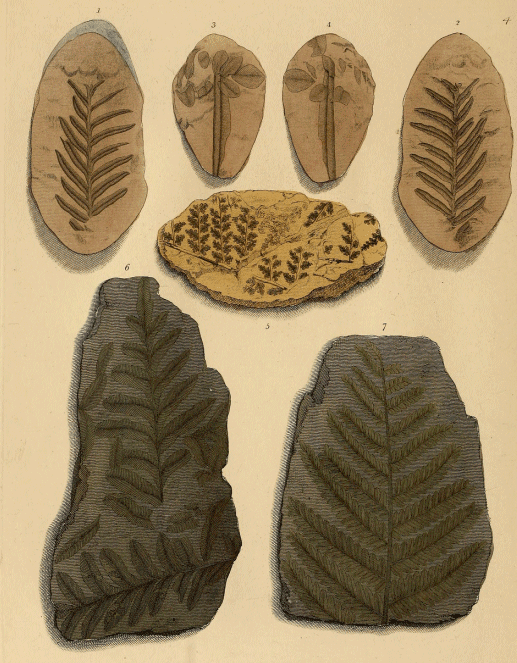
Class III.—11. Filicites.—Frond disposed on a flat surface, symmetrical; secondary rib
simple, forked, or rarely anastomosing.
These are divided Into five sub-genera:—
a. Glossopteris.—Frond simple, not jagged, traversed by a single mid-rib, without
distinct secondary ribs.
b. Sphenopteris.—Pinnules wedge-shaped, rounded or lobed at the extremity; ribs
palmate or radiating from the base of the pinnule.
c. Neuropteris.—Pinnules rounded, not lobed, nor adhering to the rachis by their base;
ribs scarcely visible beyond the base, in general very distinct, and two-forked.
d. Pecopteris.—Frond pinnatifid; pinnules adherent by their base to the rachis,>
traversed by a mid-rib; secondary ribs pinnate.
e. Odontopteris.—Pinnules adhering to the rachis by the whole of their base; mid-rib
none; secondary ribs running out perpendicularly from the rachis.
12. Sphœnophyllites.—Leaves verticillate, wedge-shaped, truncate; ribs radiating, two-forked.[100]
13. Asterophyllites.—Leaves verticillate, with a single rib.[101]
14. Fucoides.—Frond not symmetrical, often disposed on a flat surface; ribs none, or
badly defined.
15. Phyllites.—Leaves with ribs well defined, repeatedly divided, or anastomosing.[102]
16. Poacites.—Leaves linear; ribs parallel.
17. Palmacites.—Leaves fan-shape.
Class IV. Organs of fructification.
Order I. Carpolithes.—Fruits or seeds.
Order II. Antholithes.—Flowers.[103]
The numerous additions and modifications, which subsequent experience and discoveries
have led M. Brongniart to introduce into his classification, will be found in an article recently
published (1849) in the "Dictionnaire Universel d'Histoire Naturelle," under the title of
"Tableau des Genres de Végétaux Fossiles, considérés sous le point de vue de leur classification
botanique et de leur distribution géologique."
V. Fossil Cephalopoda, Nautilus, Ammonite, &c.—The fossil remains of the molluscous
animals, named Cephalopoda, from their organs of prehension being arranged around the head or
upper part of the body, are the most ancient, numerous, and interesting, of this class of animated
nature in the mineral kingdom. These relics are among the most varied and striking of the extinct
beings that occur in the sedimentary strata, from the most ancient secondary formations, to the
most recent tertiary. The living species are but a feeble representation of the countless myriads
which must have swarmed in the ancient seas.
The animal of the Cephalopods is composed of a body, which is either enclosed in a shell, as
in the Nautilus, or contains a calcareous osselet or support, as in the Sepia or Cuttle-fish; it has
a distinct head, and eyes as perfect as in the vertebrated animals, with complicated organs of
hearing, and a powerful masticating apparatus, surrounded by arms or tentacula. Below the
head there is a tube which acts as a locomotive instrument, to propel the animal backwards, by
the forcible ejection of the water that has served the purpose of respiration, and which can be
ejected with considerable force by the contraction of the body.
Their fossil remains consist of the external shell and the internal osselet; and in the naked
tribes, of the soft parts of the body, the ink-bag, &c., as noticed in the account of the Belemnite
and Belemnoteuthis.
The shell varies exceedingly in the different genera. In the group characterised by smooth
septa, and a medial or submedial siphuncle, as the Nautilus, the earliest or most ancient type is
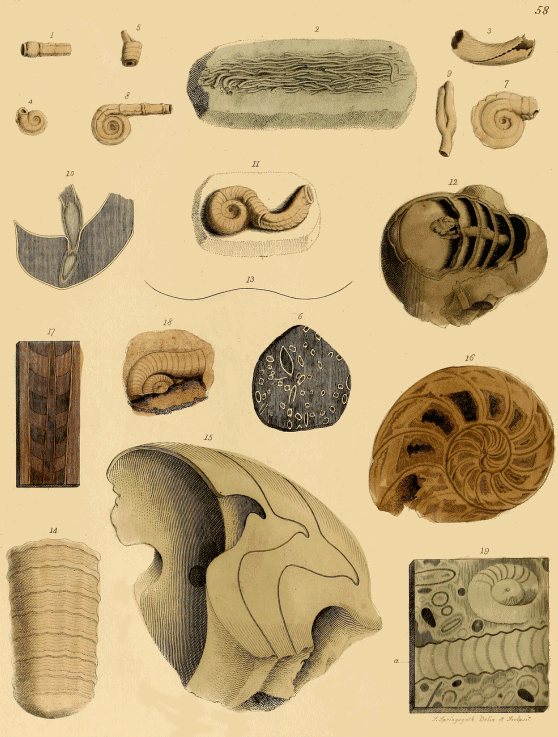
straight, as in the Orthoceras (Plate LVIII. fig. 14) of the palæozoic formations; the intermediate
forms present various modifications of the spiral, and terminate in the completely discoidal shell of
the living genus; while the other group, that with sinuous or foliated septa and a dorsal siphuncle,
commences in a discoidal type—the Ammonite, which gradually passes through the various
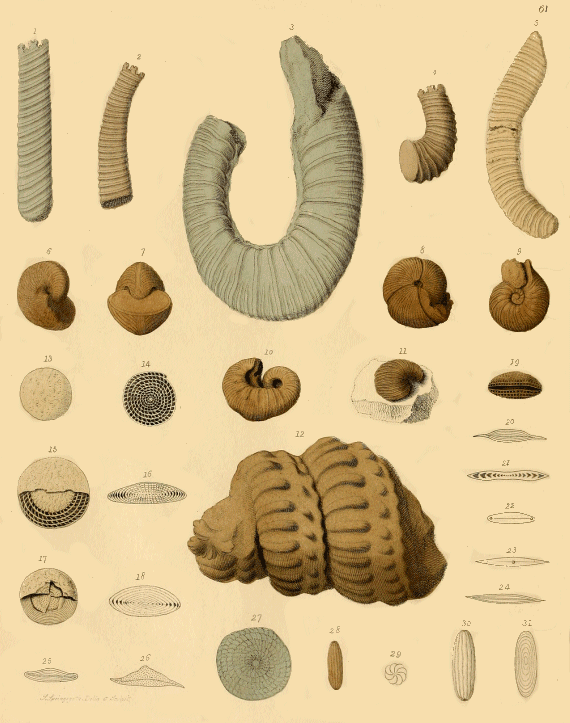
modifications of Crioceras, Scaphites (Plate LXI. fig. 10), Hamites (Plate LXI. fig. 3), Turrilites
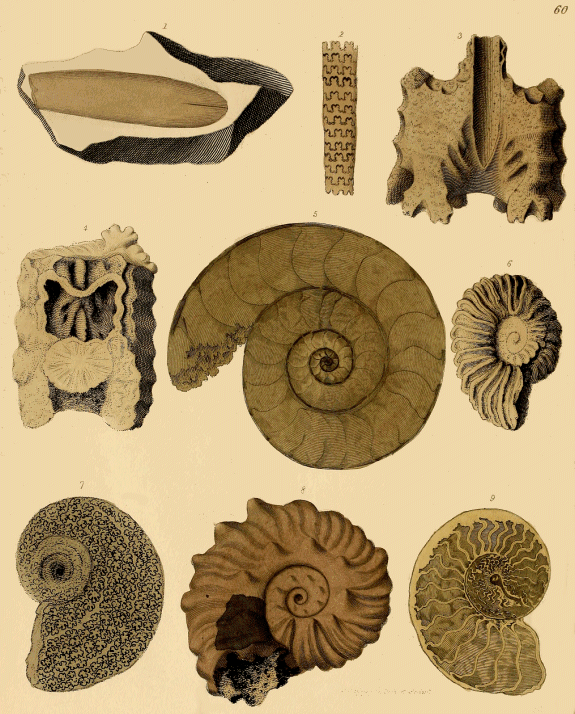
(Plate LXI. fig. 12), &c.; and finally becomes extinct in the straight Baculites (Plate LX. fig. 2).
In argillaceous strata, as the Kimmeridge and Oxford clay, London clay, &c., the shells of
Cephalopoda are oftentimes beautifully preserved; the chambers are frequently filled with the
solid matrix, but in many instances these cavities are lined either with brilliant pyrites or spar.
Stony or sparry casts of the cells or chambers, the shell having perished, are another common
[ 181 ]
state in which vestiges of these animals occur. Sometimes the cast of each chamber is isolated,
so as to present a series from the innermost to the outermost cell. Sections of those casts, in
which the chambers are filled up with spar, constitute specimens of great beauty and interest.
The so-called snake-stones are, of course, mere casts of Ammonites;[104] those of Whitby, from the
lias limestone, are well known to every collector; the casts of a very large species are common in
the oolite, especially at Swindon, in Wiltshire, and in the neighbourhood of Bath.
VI. The Carboniferous Deposits, or Coal Measures.—The various deposits of Coal have
manifestly been formed under different local circumstances. Some have been peat-bogs, to
which repeated additions have been made by successive subsidences of the land; others have
been deposited at the bottom of lakes and rivers, and these are associated with remains of fresh-water
shells and Crustacea; others have accumulated in the abyss of the ocean, having been
formed by the drifting and engulfing of immense rafts of trees and other vegetable matter, like
those of the Mississippi; others in inland seas, the successive layers of vegetables having been
supplied by periodical land-floods. There can be no doubt that coal has been, and may be,
produced under all these conditions; and at different periods, and in various localities, all these
causes may have been in operation. But the great series of ancient coal-formations present a
remarkable uniformity of character, not only throughout Europe, but also in America and other
parts of the world. A coal-field (as a group of strata of this kind is commonly termed), is
generally composed of a series of layers of coal, clay, shale, and sand, of variable thicknesses,
based on grit or limestone, abounding in marine shells and corals; and the most remarkable
phenomenon is the constant presence beneath every bed of coal, of a thick stratum of earthy clay,
and of a layer of shale or slaty clay above it. One of the series of triple deposits of which a coal-field
consists, presents therefore the following characters:—
1. Under-clay; the lowermost stratum. This is a tough argillaceous earth or clay, which on
drying becomes of a grey colour, and very friable; it is occasionally black, from an intermixture
of carbonaceous matter. This bed almost invariably contains an abundance of Stigmariæ (see
Plates XXII. XXIII.), of considerable length, with their rootlets attached, and which extend in
every direction through the clay (as shown in the figures 1, 2, 6, pp. 199, 201). These roots
commonly lie parallel with the planes of the stratum, and nearer to the top than to the bottom.
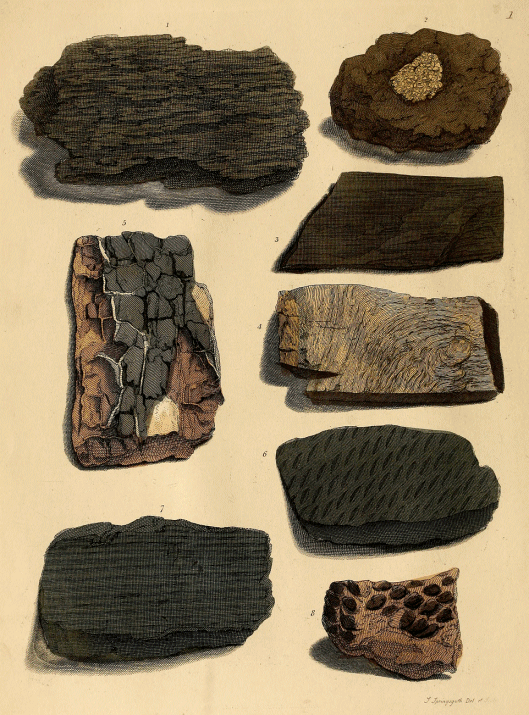
2. Coal.—A carbonized mass, in which the external forms of the plants and trees composing
it are obliterated, but the internal structure, in many instances, remains. Large trunks, and
stems, and leaves, are rarely found in it.
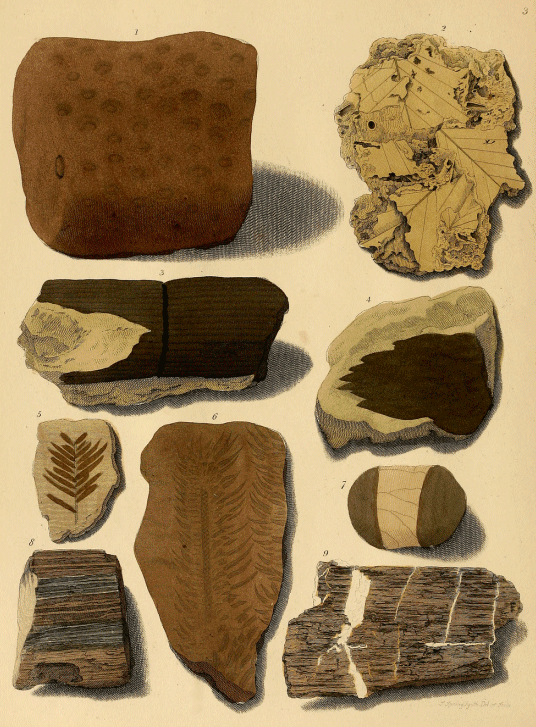
3. The Roof, or upper bed.—This consists of slaty clay, abounding in leaves, trunks and
branches, fruit, &c.; it includes layers and nodules of ironstone, inclosing leaves, insects,
Crustacea, &c. In some localities beds of fresh-water shells, in others of marine shells, are
intercalated with the shale; finely laminated clay, micaceous sand, grit, and pebbles of limestone,
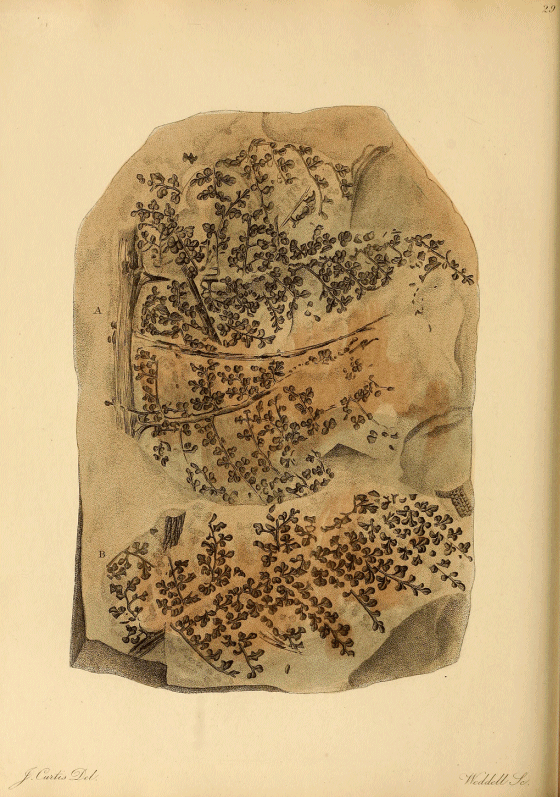
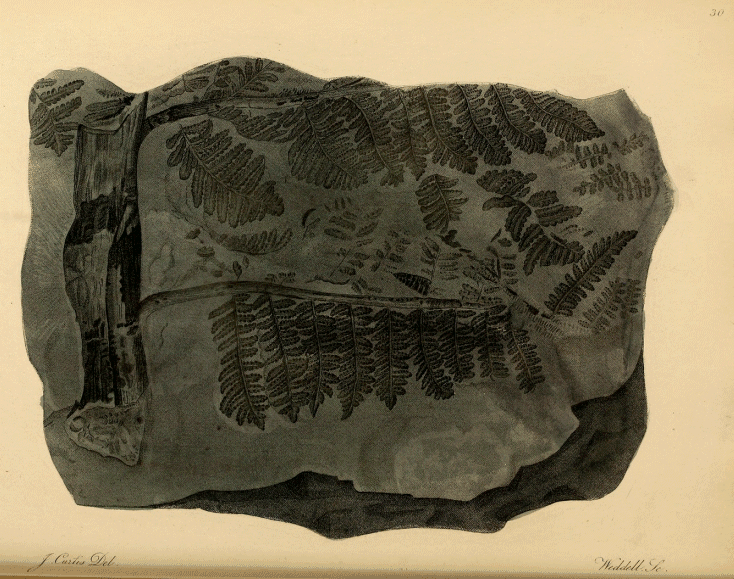
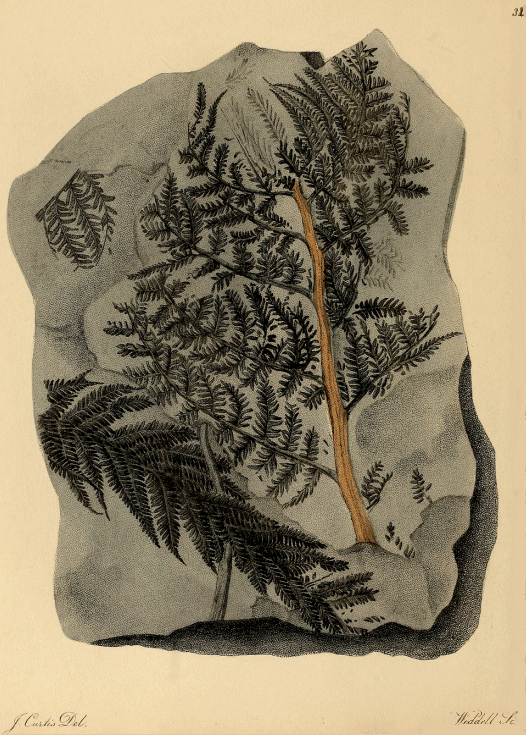
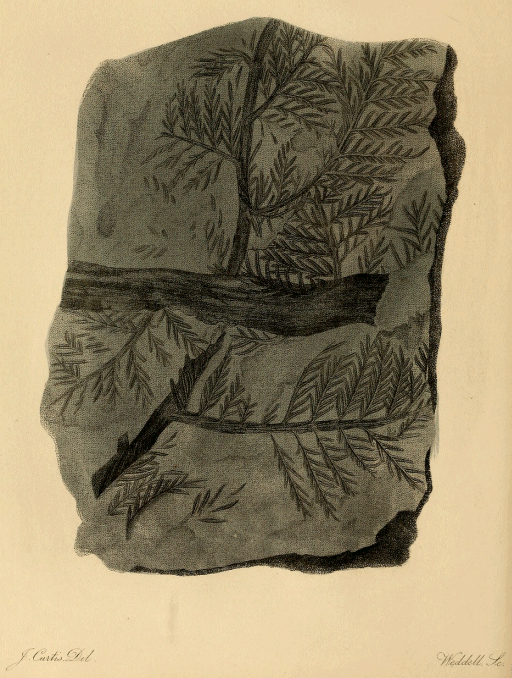
sandstone, &c. are also often interstratified. The principal illustrative specimens of the leaves,
fruit, &c. (as those in Plate XXX. to Plate XXXIV.) are found in this bed.
Thus an uninterrupted series of strata, in which triple deposits of this kind are repeated,
(often thirty or forty times, and through a thickness of several thousand feet,) constitutes the
predominant character of the ancient coal formations wherever they have been explored. The
difficulties attending a satisfactory solution of this problem, are fully stated in the last edition of
my Wonders of Geology (Vol. ii. Lecture vii.), and to that work I must refer the reader for a
more extended consideration of this highly interesting subject.
VII. Coal.—The numerous fossil plants from the carboniferous strata that are figured in
this work, render it necessary to put the general reader in possession of a concise view of the
nature and mode of formation of those ancient accumulations of vegetable matter, which now
constitute the beds of mineral fuel termed coal.
Although at the present time no one at all conversant with geology doubts the vegetable
origin of Coal, the period is not distant when many eminent philosophers were sceptical on this
point; and the truth in this, as in most other questions In natural philosophy, was established
with difficulty. The experiments and observations of the late Dr. Macculloch mainly contributed
to solve the problem as to the vegetable origin of this substance; and that eminent geologist
successfully traced the transition of vegetable matter from peat-wood, brown coal, lignite, and jet,
to coal, anthracite, graphite, and plumbago. Nor must the important labours of Mr. Parkinson
in this field of research be forgotten. The first volume of the "Organic Remains of a former
World," which treats of vegetable fossils, contains much original and valuable information on the
transmutation of vegetable matter, by bituminous fermentation, into the various mineral substances
in which its original nature and structure are altogether changed and obliterated; and that work
may still be consulted with advantage by the student.
But though the vegetable origin of all coal will not admit of question, yet evidence of the
original structure of the plants or trees whence it was derived is not always attainable. The
most perfect coal seems to have undergone a complete liquefaction, and if any portions of the
vegetable tissue remain, they appear as if imbedded in a pure bituminous mass. The slaty coal
generally preserves traces of cellular or vascular tissue, and the spiral vessels and dotted cells of
coniferous trees may often be detected by the microscope. In many instances the cells are filled
with an amber-coloured resinous substance; in others the organization is so well preserved, that
on the surface of a block of coal cracked by heat, the vascular tissue, and the dotted glands, may
be observed. Some beds of coal appear to be wholly composed of minute leaves or disintegrated
foliage; for if a mass recently extracted from the mine be split asunder, the exposed surfaces are
found covered with delicate laminæ of carbonized leaves and fibres matted together; and flake
after flake may be peeled off through a thickness of many inches, and the same structure be
apparent. Rarely are any large trunks or branches observable in the beds of coal; but the
general appearance of the carboniferous mass is that of an immense deposit of delicate foliage
shed and accumulated in a forest, and consolidated by great pressure while undergoing that
peculiar process by which vegetable matter is converted into carbon.
The essential conditions for the transmutation of vegetable substances into coal, appear to be
the imbedding of large quantities of recent vegetables beneath deposits which shall exclude the
air, and prevent the escape of the gaseous elements when released by decomposition from their
organic combination; hence, according as these conditions have been more or less perfectly
fulfilled, coal, jet, lignite, brown-coal, peat-wood, &c. will be the result.
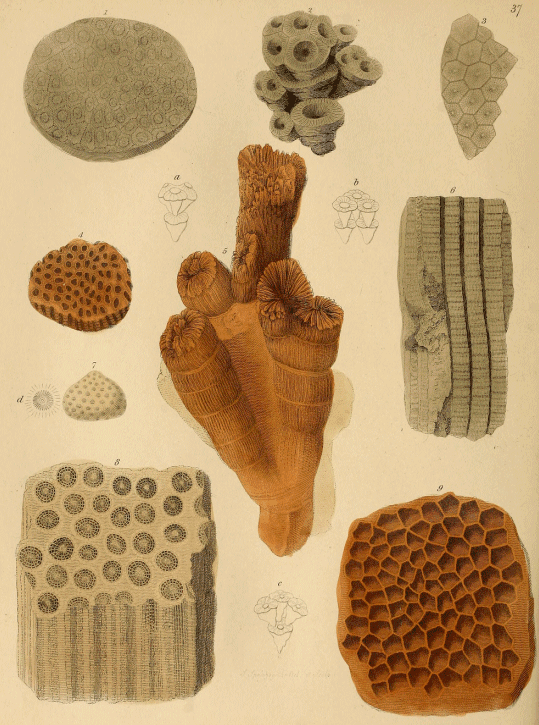
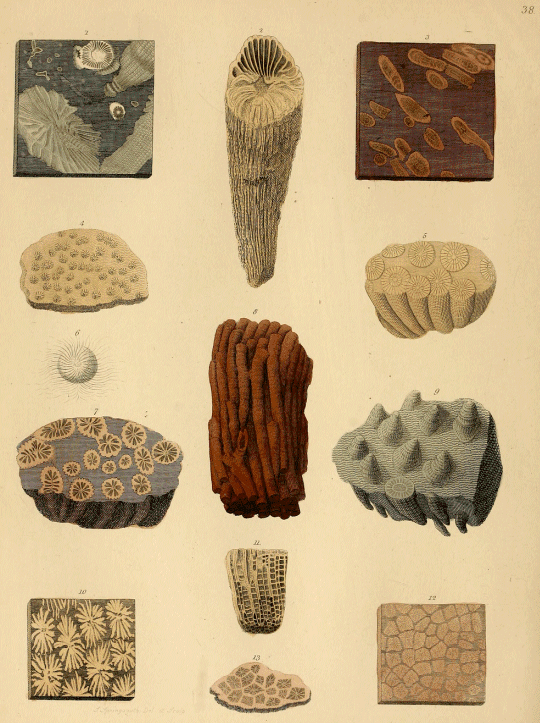
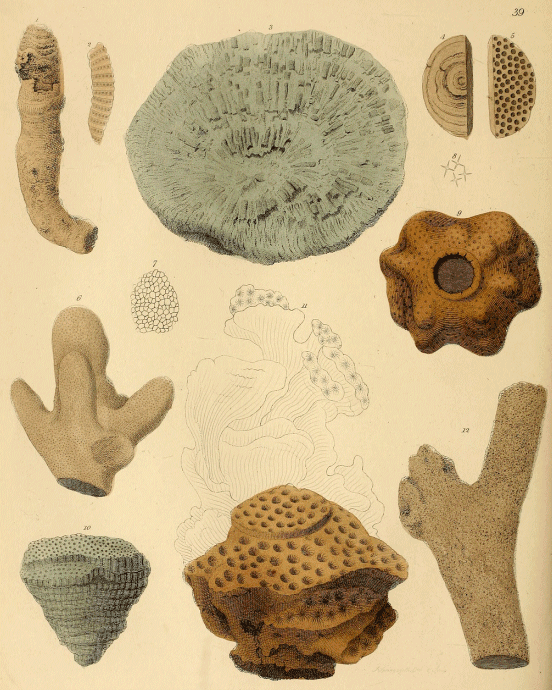
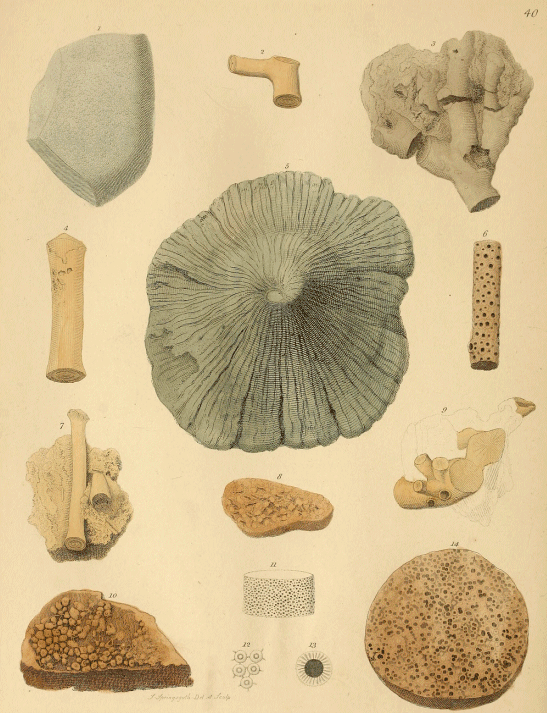
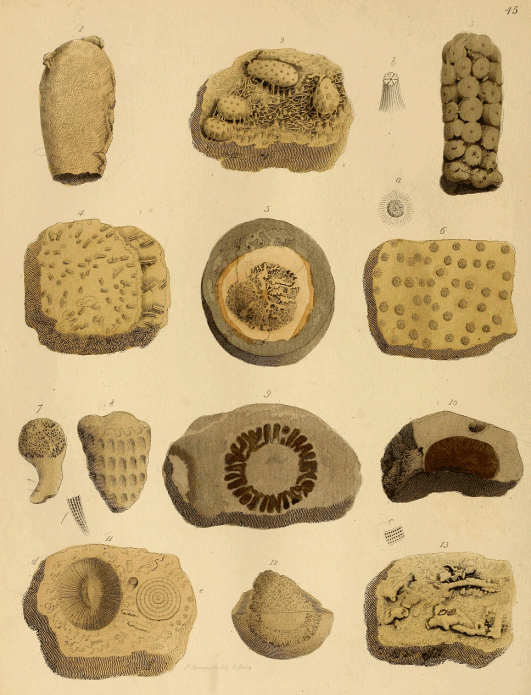
VIII. Fossil Corals.—The real nature even of recent Corals is in general so imperfectly
understood by the intelligent reader who has not paid especial attention to the department
of natural history which treats of the class of animated nature termed Zoophytes, that in
describing the Fossil Corals In my Wonders of Geology, I felt it necessary to devote one Lecture
to the consideration of Corals and Crinoidea, in order to afford a popular exposition of the
structure and economy of these highly Interesting tribes of animal existence.[105]
A very prevalent error regarding their nature Is, that the beautiful stony substances generally
[ 183 ]
called corals, are fabricated by the animalcules which inhabit the cells when living, in the same
manner as is the honeycomb of the bee and wasp. This opinion is utterly erroneous: the coral
is secreted by the integuments or membranes with which when recent it was invested and
permeated; in like manner as are the bones of the skeleton in the higher orders of animals
by the tissues designed for that especial purpose, and wholly without the cognisance or control
of the creature of which they constitute the internal support.
A general idea of the nature of the compound coral-zoophytes may be obtained by the
examination of the common Flustra or Sea-mat. This form of polyparia, when taken out of
the water, appears to the naked eye like a patch of fine varnished net-work, adhering to a piece
of sea-weed or stone; when viewed with a magnifying lens of moderate power, the surface
is found beset with pores regularly disposed: and if the Flustra be examined while immersed in
sea-water, its surface is seen to be invested by a gelatinous substance, and every pore is the
aperture of a cell, whence issues a tube fringed at the extremity with long tentacula or feelers.
These expand, then suddenly contract, withdraw into the cell, and again issue forth: the whole
surface of the Flustra being studded with the hydra-like animalcules; each enjoying a distinct
existence, the entire group being united by one common integument or calcareous frame-work.
When the Flustra is exposed to the air, the polypes soon perish, the animal matter rapidly
decomposes, and the calcareous lace-like skeleton alone remains. In the larger and more
compact corals the phenomena are similar, differing only in degree. In a fossil state, the durable
remains of the corals consist for the most part of the calcareous frame-work (or polyparium,
as it is termed), which often possesses a crystalline structure; and in some instances is completely
transmuted into silex, as in specimens from Antigua, the Falls of the Ohio, and from Tisbury
in Wiltshire. (See Plate XXXVIII. figs. 12, 13.)
I must refer to the Wonders of Geology for a more extended notice of fossil corals, and
other zoophytes, and will only add that the calcareous and siliceous spines or spicula, not only
of sponges, but also of Gorgoniæ, and other corals, are often met with in a fossil state.[106]
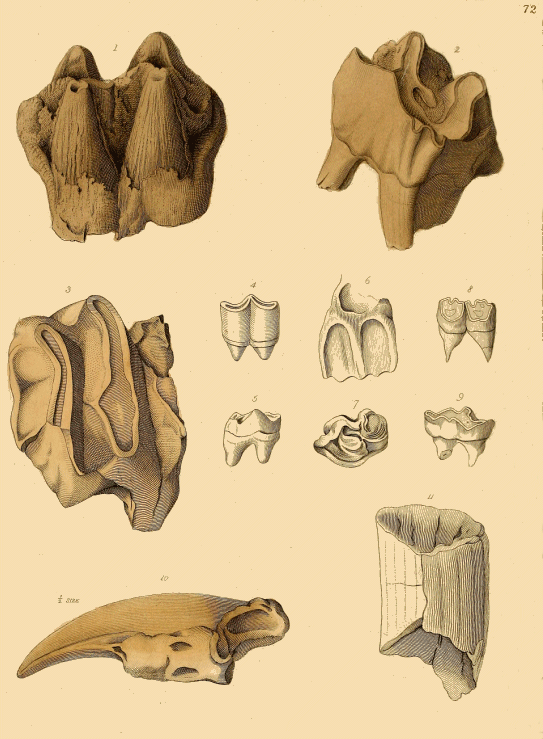
IX. Cuvier's Discoveries. The Fossil Quadrupeds of Montmartre. (Plate LXXII.)—The
Palæotheria, Anoplotheria, and other genera of extinct quadrupeds related to the Tapir, whose
remains were first noticed in the gypseous limestone of Montmartre, near Paris, and which have
since been found in many other localities of the same strata, are familiar to every one, from the
just celebrity attached to the labours of the illustrious Cuvier, who restored as it were these
lost denizens of an earlier world, in their native character and forms, and distinguished them
by names long since become classical in the sciences which treat of the ancient history of the
earth and its inhabitants.
The gypsum quarries spread over the flanks of Montmartre were many years since known
to contain fossil bones of extinct quadrupeds, and some of these had been figured and described
in 1768 by Guettard, and afterwards by Pralon, Lamanon, and Parumot: but it was not till the
attention of M. Cuvier was directed to the subject by some specimens put into his hands by
M. Vuarin, that the interest and importance of these fossils were understood. The curiosity
of Baron Cuvier was so much excited by an inspection of a large collection of these bones, soon
after he had been successfully engaged in the investigation of the remains of fossil Elephants
and Mastodons, that he immediately began to obtain specimens from the quarries, and by
liberally rewarding the workmen, and by unremitting personal research, he soon accumulated
an immense quantity of bones of all sorts, belonging to numerous individuals. He now perceived
[ 184 ]
that a new world was open to his view: and to use his own expressive language, he found
himself in an ancient charnel-house, surrounded by a confused multitude of mangled skeletons
of a great variety of unknown beings. To arrange each fragment in its proper place, and
restore order to these heterogeneous materials, seemed at first a hopeless task: but a knowledge
of the immutable laws by which the organization of animal existence is governed, soon
enabled him to assign to each bone, and even fragment, its proper place in the skeleton; and
the forms of beings hitherto unseen by mortal eye appeared before him. "I cannot," he
exclaims, "express my delight in finding how the application of one principle was instantly
followed by the most triumphant results. The essential character of a tooth and its relation
to the skull being determined, all the other elements of the fabric immediately fell into their
proper places; and the vertebra, ribs, bones of the legs, thigh, and feet, seemed to arrange themselves
even without my bidding, and in the very manner I had predicted." The principles of
the correlation of structure which his profound researches in comparative anatomy had enabled
him to establish, conducted to these important results, and laid the foundation of that science
which has since received the name of Palæontology.[107] The mode of induction adopted by this
illustrious philosopher, has been the mighty instrument by which subsequent labourers in this
department of science have so largely contributed to our knowledge of the ancient condition
of the earth, and of the structure and economy of the tribes of beings which have successively
dwelt upon it. The examination of the fossil teeth (in Plate LXXII. figs. 4-9) showed that the
animals were herbivorous; and the crown of the tooth being composed of two or three simple
crescents, as in certain pachydermata, proved that they differed from the ruminants, which have
double crescents, and each four bands of enamel. The two principal genera first established were
the Palæotherium and Anoplotherium. The first approximates to the Tapirs in the number and
disposition of the teeth; the second is remarkable in having no projecting canines, and in all
the teeth forming a continued series, as in the human race. Remains of both these genera
have been found in the eocene tertiary strata of the Isle of Wight,[108] and on the coast of
Hampshire.
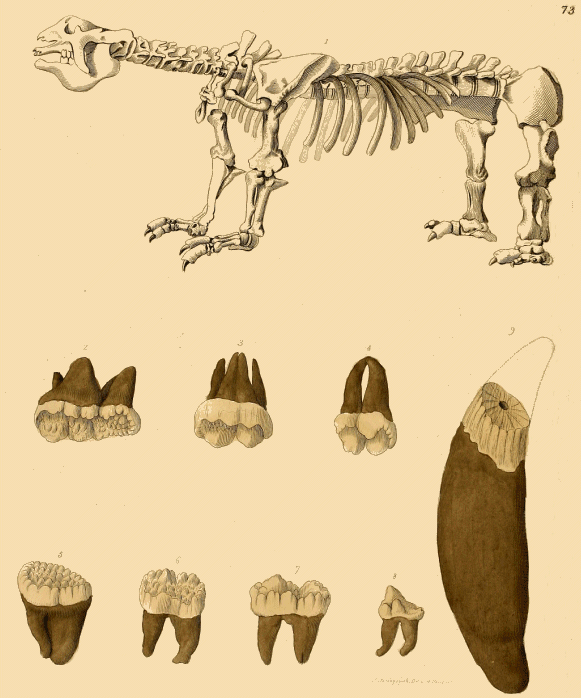
X. Fossil Edentata. Megatherium, and Megalonyx. (Plates LXXII. and LXXIII.)—The
remains of these and other allied forms of the extinct gigantic Edentata, which once inhabited
South America, occur in immense quantities throughout the Pampas—those vast plains which present
a sea of waving grass for 900 miles. These plains consist of alluvial loam and sand, containing
fresh-water and marine shells of existing species; they were evidently once, like Lewes Levels,
a gulf or arm of the sea. Since the publication of Mr. Parkinson's work, vast numbers of bones
have been exhumed, and many most interesting specimens sent to England by Sir Woodbine
Parish, and Charles Darwin, Esq., in whose charming "Journal of Researches into the Natural
History and Geology of the Countries visited during the Voyage of H.M.S. Beagle round
the World," will be found many highly graphic notices of the discovery of these remains.[109]
Mr. Darwin, under the head of Bahia Blanca,[110] describes the remains of no less than nine great
quadrupeds found imbedded within the space of 200 square yards. They consisted of three
heads and other bones of the Megatherium, of enormous dimensions; and bones of the Megalonyx.
Of the Scelidotherium, an allied animal, Mr. Darwin obtained an almost perfect skeleton; it must
have been as large as a rhinoceros; in the structure of the head, it approaches nearest the Cape
ant-eater, in other respects it is related to the armadilloes. Remains of a different species of
Mylodon, of another gigantic edental quadruped, and of a large animal with an osseous dermal coat
in compartments, very like that of the Armadillo. Of this last, which has been named Glyptodon,
there is a very fine specimen in the Hunterian Museum. Teeth and bones of an extinct species
of horse, and of an unknown pachyderm, a huge beast with a long neck like the camel. Lastly
the Toxodon (so named from the remarkable curvature of the teeth); this is perhaps one of the
strangest animals ever discovered. In size it equals the elephant or megatherium, but the
structure of its teeth shows it to have been intimately related to the gnawers—the order which
at the present day includes the smallest quadrupeds. In many details it approaches to the
pachydermata; judging from the position of its eyes, it was probably aquatic, like the Dugong
and Manatee, to which it is also allied.
The beds containing the above fossil remains, consist of stratified gravel and reddish mud,
and stand only from fifteen to twenty feet above the level of high water; hence the elevation of
the land has been small since the great quadrupeds wandered over the surrounding plains; and
the external features of the country must then have been very nearly the same as now.
In another place, Mr. Darwin observes,—"The number of the remains of these large
quadrupeds imbedded in the grand estuary deposit which forms the Pampas and covers the
granitic rocks of Banda Oriental, must be extraordinarily great. I believe, a straight line drawn
in any direction through the Pampas, would cut through some skeleton or bones. Besides those
which I found during my short excursions, I heard of many others; and the origin of such names
as, 'the stream of the animal,' 'the hill of the giant,' is obvious. At other times, I heard of the
marvellous property of certain rivers, which had the power of changing small bones into large;
or as some maintained, the bones themselves grew. As far as I am aware, not one of these
animals perished, as was formerly supposed, in the marshes or muddy river-beds of the present
land, but their bones have been exposed by the streams intersecting the subaqueous deposit, in
which they were originally imbedded. We may conclude that the whole area of the Pampas
is one wide sepulchre of these extinct gigantic quadrupeds."[111]
XI. Flint.—Animal Remains in siliceous nodules.—So many beautiful specimens of siliceous
petrifactions—that is, animal and vegetable remains transmuted into silex or flint—are figured
in the subjoined plates, that it may be useful to offer a few remarks on this subject.[112] In
many instances the organic remains in chalk-flints are simply incrusted by the silex; such is the
state of numerous sponges which are as it were invested by the flint, and have all their pores and
tubes filled up by the same material, the original tissue appearing as a brown calcareous
substance. In other examples, the sponge has been enveloped in a mass of liquid flint, and has
subsequently perished and decomposed; in this manner have been formed those hollow nodules,
which on being broken present a cavity containing only a little white powder, or some fragments
of silicified sponge; in many instances the cavity is lined with quartz crystals, or mammillated
chalcedony. Frequently but part of the zoophyte is permeated by the silex, and the other
portion is in the state of a friable calcareous earth imbedded in the chalk. Sponges and other
zoophytes often form the nuclei of the flint nodules; the original substance of the organic
[ 186 ]
body being in general silicified, and the most delicate internal structure preserved. Shells,
corals, and the minute cases of foraminifera, are often immersed as it were in pure flint, appearing
as if preserved in a semi-transparent medium.
But there are innumerable flint nodules in which no traces of spongeous tissue are apparent,
and veins, dikes, and sheets of tabular flint, that are in a great measure free from organic
remains; containing only such as may be supposed to have become imbedded in a stream of
fluid silex that flowed over a sea-bottom. Wood perforated by lithodomi and silicified, is
occasionally met with; and fuci or algæ are sometimes found, appearing as if floating in the
liquid flint.
For the most part, the minute shells in the chalk and flint are filled with amorphous mineral
matter; but in many examples, (as I have ascertained by direct experiment,) the soft parts of
foraminifera remain in the shell.
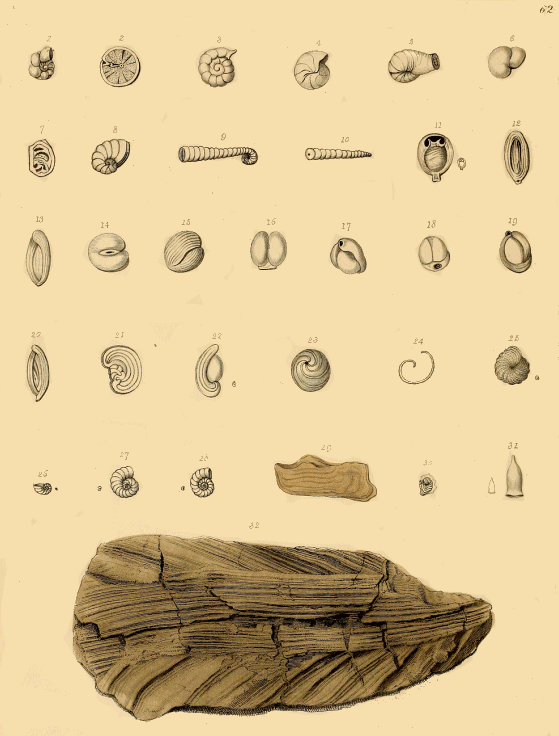
XII. Foraminifera.—Plate LXII. contains figures of several species belonging to various
genera of those minute fossil shells, the discoidal involute forms of which were once considered
to belong to the Cephalopoda, and to be related to the Nautilus, Spirula, &c., but which are now
grouped in one family, under the name of Foraminifera; a term derived from the foramina or
perforations with which their shells are traversed, and which have relation to the peculiar
organization of the animals.
Since microscopic observations have become so general, thanks to the genius and enthusiasm
of Ehrenberg, these fossil bodies have acquired a degree of interest and importance, unsurpassed
by more obvious organic remains. Whole mountain chains and extensive tracts of country are
now known to be almost entirely composed of the aggregated shells of a few genera of these
microzoa.[113] In other deposits their remains are associated with those of Infusoria,[114] (both animal
and vegetable,) still more infinitesimal. As much error prevails among collectors as to the
real nature of the fossil foraminifera, I am induced to annex the following remarks.[115]
The foraminifera are marine animals of low organization, and, with but few exceptions,
extremely minute: in an ounce of sea-sand between three and four millions have been distinctly
enumerated. When living, they are not aggregated, but always individually distinct; they are
composed of a body (or vital mass) of a gelatinous consistence, which is either entire, and round,
or divided into segments, placed either on a simple or alternate line, or coiled spirally, or
involuted round an axis. This body is covered with an envelope or shell, which is generally
testaceous, rarely cartilaginous, and is modelled on the segments, and follows all the modifications
of form and contour of the body. From the extremity of the last segment, there issue, sometimes
from one, sometimes from several openings of the shell, or through numerous pores or foramina,
very elongated, slender, contractile, colourless filaments, more or less divided and ramified,
serving for prehension, and capable of entirely investing the shell. The body varies in colour,
but is always identical in individuals of the same species,—it is yellow, fawn-coloured, red,
[ 187 ]
violet, blue, &c. Its consistence is variable; it is composed of minute globules, the aggregation
of which determines the general tint. It is sometimes entire, round, and without segments, as
in Gromia, Orbulina, &c., which represent, at all ages, the embryonic state of all the other genera.
They increase, without doubt, by the entire circumference. When the body is divided by lobes
or segments, the primary lobe, as in the permanent condition of the Gromia, is at first round or
oval, according to the genus; once formed it never enlarges, but is enveloped externally by
testaceous matter; it may be compared to a ball on which is applied a second larger one, then a
third still larger, and so on during the life of the animal.
The annexed figure of the animal of Nummulina (as given by MM. Joly and Leymerie) will
serve to convey a general idea of the living Foraminifera.

THE ANIMAL OF THE NUMMULINA.]
The segments, as the body increases, are agglomerated in six different ways, and these modifications
are the basis of M. D'Orbigny's classification. The discoidal forms, as the Rotalia,
Rosalina, Cristellaria, &c. are involuted like the nautilus, and divided by septa or partitions, the
different lobes of the body occupying contemporaneously every chamber, and being connected by
a tube or canal that extends through the entire series. In the spiral forms, the Textilaria, &c.
the same structure is apparent. These two groups are the most abundant in the cretaceous
strata; many beds of the white chalk consist almost wholly of the aggregated shells of the
Rosalinæ, Rotaliæ, and Textilariæ.[116] Whatever the form of the body, the filaments always consist of
a colourless matter as transparent as glass; they elongate from the base to six times the diameter
of the shell. They often divide and subdivide, so as to appear branched. Though alike in form
in the different genera, they vary much in their position. In some they form a bundle which
[ 188 ]
issues from a single opening, and is withdrawn into the same by contraction; in others the
filaments project only through each of the pores in the shell which covers the last segment; in
others they issue from both the large aperture and the foramina. In fine, these filaments or
pseudopodia fulfil in the foraminifera the functions of the numerous tentacula in the Asteriadæ,
or Star-fishes, serving as instruments of locomotion and attachment.
Neither organs of nutriment nor of reproduction have been detected. In the genera having
one large aperture from which the filaments issue and retract, we can conceive nutriment to be
absorbed by that opening; but this cannot be the case in the species which have the last cell
closed up; in these the filaments issuing through the foramina are probably also organs of nutrition.
M. D'Orbigny considers the Foraminifera as constituting a distinct class in zoology; less
complicated than the Echinoderms and the Polypiaria in their internal organization, they have
by their filaments the mode of locomotion of the first, and by their free, individual existence—not
aggregated and immovably fixed—they are more advanced in the scale of being than the latter.
To me they appear to be merely hydra-form polypes of the most simple structure, protected
by shells;[117] those composed of different segments, I conceive to be a single aggregated individual,
and not a successive series of beings.
The white chalk is well known to be largely composed of a few kinds of foraminifera, but the
occurrence of the soft bodies of these animalcules in a fossil state was first discovered by me, in
1845, in chalk-flints, and was announced in a paper, read before the Geological Society, entitled,
"Notes of a Microscopical Examination of Chalk and Flint."[118] This statement was regarded
by some eminent palæontologists as so "startling and unsatisfactory," that I resumed the investigation,
and communicated the result to the Royal Society, in a memoir "On the Fossil Remains
of the Soft Parts of Foraminifera discovered in the Chalk and Flint of the South-East of England;"[119]
and with the kind assistance of that able chemist and microscopist, Mr. Henry Deane, of Clapham
Common, I obtained, by immersing chalk in dilute hydrochloric acid, and mounting the residue in
Canada balsam, several specimens of the entire integuments of the bodies of Rotaliæ, as distinct
as if recent! This fact is now admitted; and the experiment has been successfully repeated in
India, by Mr. Carter, on the limestones of that country;[120] and in America, by Dr. Bailey, &c.[121]
In some limestone recently collected by my eldest son, Mr. Walter Mantell, in the Middle
Island of New Zealand, and which, like our cretaceous strata, is almost entirely made up of
foraminifera, I have detected the soft parts of the bodies of Rotaliæ in the cells of the fossil shells,
as distinctly as in the chalk of England; and two of the species appear to be identical with
European forms.
M. D'Orbigny gives the following summary of the distribution of the known fossil species of
Foraminifera:—
There are 228 species in the Tertiary deposits of Vienna alone, of which twenty-seven species
are known living in the Adriatic and the Mediterranean.
Foraminifera are unknown in the Silurian and Devonian formations.
One species only is known in the Carboniferous system of Russia, the Fusulina cylindrica.
Jurassic or Oolitic formation Genera 5 Species 20
Cretaceous " 34 " 280
Tertiary " 56 " 450
Living in the present seas " 68 " 1,000
Of these last, 575 species inhabit tropical seas, 350 the seas of temperate, and 75 the seas of
cold climates.
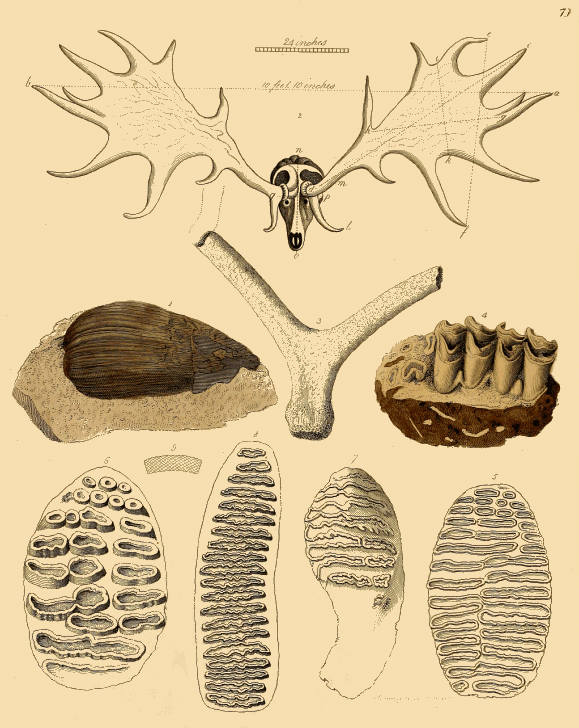
XIII. Fossil Elk of Ireland, or Cervus megaloceros. (Plate LXXI.)—The shell-marls of
Ireland contain in abundance the bones of an animal, which like the Dodo, was once contemporary
with the human species, but has long been extinct: the last individuals of the race were, in all
probability, exterminated by the early Celtic tribes. The remains of this noble creature
generally occur in the deposits of marl that underlie the peat-bogs, which are apparently, like
those of Scotland, the sites of ancient lakes or bays. In Curragh immense quantities of these
bones lie within a small area; the skeletons appear to be entire, and are found with the skull
elevated, and the antlers thrown back on the shoulders, as if a small herd of these Elks had
sought refuge in the marshes, and had been engulfed in the morass, in the same manner as the
Mastodons of America. (See description of Plate LXXIV., ante, p. 167.)
This creature far exceeded in magnitude any living species of elk or deer. The skeleton is
upwards often feet in height to the top of the skull, and the antlers are from ten to fourteen feet from
one extremity to the other. The fine perfect skeletons in the British Museum, College of Surgeons,
and in the Museum at Edinburgh, render a particular description unnecessary. The bones
are generally well preserved, of a dark brown colour, with patches of blue phosphate of iron. In
some instances they are in so fresh a condition, that the hollows of the long bones contain marrow
having the appearance of fresh suet. Remains of this majestic animal have been found collocated
with ancient sepulchral urns, stone implements, and rude canoes, in such manner, as to leave no
doubt that this now extinct deer was coeval with the early human inhabitants of these Islands.
Its bones and antlers have been found at Walton, in Essex, associated with the remains of the
Mammoth, or fossil elephant.[122]
XIV. Fossil Infusoria—Infusorial Earths.—In the note on Foraminifera some account is
given of various rocks composed of the fossil remains of those minute animals; but the durable
relics of the yet more infinitesimal organisms designated by the terms Infusoria, or Infusorial
animalcules, form deposits of equal interest and importance. Strata of great extent and thickness
are wholly, or in great part, made up of innumerable layers, consisting of the aggregated siliceous
cases or shields of Infusoria: and similar structures are found to be the chief constituents of the
white earthy deposits of lakes, rivers, and basins of brackish water, in every part of the world.
Slowly, imperceptibly, but incessantly, are the vital energies of the feeblest and minutest
animal and vegetable existences separating from the element in which they live, the most
enduring of mineral substances, silex—fabricating it into structures of the most exquisite forms
and sculpturing, and thus adding to the accumulations of countless ages, which make up the
sedimentary strata of the crust of the globe.
In the "Medals of Creation"[123] will be found a summary of what was then known as to the
formation and composition of many tertiary deposits which the indefatigable Ehrenberg, Dr.
Bailey, and other eminent observers, had carefully investigated and described. The five years
[ 190 ]
that have since elapsed have been fruitful in results of the most important and interesting
character; from every quarter of the world, from the loftiest mountain peaks, and from the
deepest recesses of the ocean which the plummet can reach, from the ashes of volcanoes and
from the snow of the glaciers, the durable remains of Infusoria have been obtained. That
excellent scientific periodical, Silliman's American Journal, contains numerous interesting
communications on this subject from the eminent chemical professor of the Military College
at West Point, Dr. J. W. Bailey; and the labours of Mr. Bowerbank, Williamson, and other
active members of the Microscopical Society of London, have yielded much interesting information
on the infusorial deposits of our own country.
The present note will be restricted to remarks on the nature of the organisms which enter
so largely into the composition of certain tertiary deposits; since the opinion once entertained
of the animal nature of many infusoria, now regarded as true vegetables, materially affects the
geological conclusions respecting the persistence of certain species of organisms through long
periods of time, during which the mollusca, zoophytes, &c. underwent repeated mutations both
in the species and genera. Thus, for example, the polierschiefer, or polishing-slate of Bilin,
and the berghmehl of Tuscany, are described by Ehrenberg as masses of the siliceous shells
of animalcules of such extreme minuteness, that a cubic inch of the stone contains upwards of
forty millions; the infusorial earth of Richmond, in Virginia, in like manner, is stated to be
made up of the siliceous skeletons of animalcules of infinitesimal minuteness. But later investigations
have (I conceive) satisfactorily established, that the greater part of these fossil organisms
belongs to the vegetable and not to the animal kingdom.[124] The whole of the figures in Plate IV.
of the "Medals of Creation," described as living Infusoria, on the authority of Ehrenberg, are
undoubted vegetables, belonging to the great botanical groups called Diatomaceæ (from the
angular segments into which they separate by partial division), and Desmidiaceæ.[125] The entire
family of Bacillaria belongs to this group. These simplest forms of vegetable structures abound
in every lake or stream of fresh and brackish water, in every pool, or bay, and throughout the
ocean, from the equator to the poles; they secrete siliceous envelopes, which present an endless
variety of form and structure, and after the death and decomposition of the perishable tissues
of the plants, remain as perfectly transparent colourless shields of pure silica; such are the
Gaillonellæ, Euastra, Closteria, Naviculæ, Synhedræ, Podospheniæ, Xanthidia, &c., which constitute
so large a proportion of the infusorial earths described by Ehrenberg and other authors.[126]
The extent of this infinitesimal flora throughout regions where no other forms of vegetation
are known, is strikingly demonstrated by the observations of the eminent botanist and traveller.
Dr. Hooker, in his account of the Antarctic regions.
"Everywhere," he states, "the waters and the ice alike abound in these microscopic vegetables.
Though too small to be visible to the unassisted eye, their aggregated masses stained the
iceberg and pack-ice wherever they were washed by the sea, and imparted a pale ochreous
colour to the ice. From the south of the belt of ice which encircles the globe, to the highest
latitudes reached by man, this vegetation is everywhere conspicuous, from the contrast between
its colour and that of the white snow and ice in which it is imbedded. In the eightieth degree
[ 191 ]
of south latitude all the surface ice carried along by currents, and the sides of every berg, and
the base of the great Victoria barrier itself—a perpendicular wall of ice, from one to two
hundred feet above the sea-level—were tinged brown from this cause, as if the waters were
charged with oxide of iron. The majority of these plants consist of simple vegetable cells,
enclosed in indestructible silex (as other Algæ are in carbonate of lime); and it is obvious that
the death of such multitudes must form sedimentary deposits of immense extent.
"The universal existence of such an invisible vegetation as that of the Antarctic ocean, is u
truly wonderful fact, and the more so, from its being unaccompanied by plants of a high order.
This ocean swarms with mollusca, and entomostracous crustaceans, small whales, and porpoises;
and the sea with penguins and seals, and the air with birds: the animal kingdom is everywhere
present, the larger creatures preying on the smaller, and these again on those more minute; all
living nature seems to be carnivorous. This microscopic vegetation is the sole nutrition of the
herbivorous animals; and it may likewise serve to purify the atmosphere, and thus execute in
the antarctic latitudes the office of the trees and grasses of the temperate regions, and the broad
foliage of the palms of the tropics."[127]
Dr. Hooker also observes, that the siliceous cases of the same kind of Diatomaceæ now
living in the waters of the South Polar Ocean, have contributed in past ages to the formation
of European strata; for the tripoli and the phonolite stones of the Rhine contain the siliceous
shields of identical species. Such are the comments of one of our most eminent botanists on
the phenomena under review. The reader will probably ask,—What, then, are the essential
characters which separate the animal from the vegetable kingdom? To this question it is
impossible to give a satisfactory reply: perhaps the only distinction that will be generally
admitted by zoologists and botanists is the following:—animals require organic substances for their
support; vegetables derive their sustenance from inorganic matter.
The facts thus cursorily reviewed throw much doubt on many of M. Ehrenberg's statements
as to the identity of species of animalcules now living, with those whose remains occur in the
eocene, and in the secondary strata. The so-called Xanthidia of the chalk, are certainly
altogether distinct from the recent diatomæ to which the name was first applied; the chalk
organisms are probably the gemmules of sponges or other zoophytes.[128]
Infusorial earths may therefore be composed either of microscopic vegetable or animal remains,
or of both. The brackish and fresh-water deposits I have examined are siliceous and almost wholly
diatomaceous: the marine calcareous strata composed of microscopic organisms, consist chiefly of
various kinds of foraminifera, a large proportion belonging to the polythalamia, or chambered
shells. I am not certain as to the animal or vegetable nature of some of the beautiful siliceous disks
(Coscinodisci, Arachnoidisci, Actinocyclus, &c.) so abundant in the Richmond, Barbadoes, and Bermuda
infusorial earths, and which occur in so splendid a state in the Guano deposits of Ichaboe.
With the corrections which the above remarks will enable the reader to make, I would refer
to the account of Fossil Infusoria in the Medals of Creation, and Wonders of Geology. [129]
XV. The Mosasaurus, or Fossil Reptile of Maestricht. (Plate LXX.) The occasional
discovery of bones and teeth of an unknown animal in the limestone of St. Peter's Mountain, near
Maestricht, and the innumerable shells, corals, teeth of fishes, claws of crabs, echini, and other
[ 192 ]
organic remains, had long since attracted the attention of naturalists, and rendered these quarries
celebrated throughout Europe. In 1770, M. Hoffman, the surgeon of the Fort, who had for some
years been assiduously collecting the fossils of this locality, had the good fortune to discover
a specimen which has conferred an enduring celebrity on his name. Some workmen, on blasting
the rock in one of the caverns of the interior of the mountain, perceived to their astonishment
the jaws of a large animal attached to the roof of the chasm. The discovery was immediately
made known to M. Hoffman, who repaired to the spot, and for weeks presided over the arduous
task of separating the mass of stone containing these remains from the surrounding rock. His
labours were rewarded by the successful extrication of the specimen, which he conveyed in
triumph to his house. This extraordinary discovery soon became the subject of general conversation,
and upon reaching the ears of the Canon of the cathedral which stands on the mountain,
excited in that functionary a determination to claim the fossil, in right of being lord of the
manor; and he unfortunately succeeded, after a long and harassing lawsuit, in obtaining this
precious relic. It remained for years in his possession, and Hoffman died without regaining his
treasure, or receiving any compensation. At length the French revolution broke out, and the
armies of the republic advanced to the gates of Maestricht. The town was bombarded; but at
the suggestion of the committee of savans who accompanied the French troops to select their
share of plunder, the artillery was not suffered to bombard that part of the city in which the
celebrated fossil was known to be preserved. In the mean time, the Canon of St. Peter's,
shrewdly suspecting the reason why such peculiar favour was shown to his residence, removed
the specimen, and concealed it in a vault; but when the city was taken, the French authorities
compelled him to give up his ill-gotten prize, which was immediately transmitted to the Jardin
des Plantes, at Paris, where it still forms one of the most striking objects in that magnificent
collection.[130]
The beautiful model of this most interesting fossil in the British Museum, was presented to
me by Baron Cuvier. It is four and a half feet long, and two and a half wide; it consists of the
jaws, with teeth, palatal bones, and the tympanic bone, or os quadratum, a bone possessed by
reptiles, as well as birds, and in which the auditory cells are contained. There are likewise some
fine portions of jaws, with teeth, in the British Museum, presented by Camper. The original
animal was probably a terrestrial reptile, holding an intermediate place between the Monitors and
Iguanas. It was about twenty-five feet long.
I discovered, many years since (1820), some vertebræ in the chalk near Lewes, which closely
resemble the corresponding bones of the Mosasaurus, and in all probability belong to another
species. In the cretaceous strata of New Jersey, Dr. Harlan found and described, and my
friend. Dr. Morton, of Philadelphia, sent me, in 1834, teeth which cannot be distinguished from
those of Maestricht. Vertebræ, and other bones, have since been obtained from the same deposits
by Professor Rogers, and described by Professor Owen in the Geological Journal.
XVI. Fossil Reptiles. Although when Mr. Parkinson's work was published many fossil bones
and teeth of reptiles had been discovered in various parts of England, yet the abundance and
variety, and the extraordinary modification of form and structure of this class of vertebrated animals,
which prevailed throughout the secondary geological formations, were not for a moment suspected.
The few examples of the remains of fossil reptiles described by Mr. Parkinson, serve to mark the
[ 193 ]
degree of knowledge which then existed respecting a department of palæontology that rapidly
acquired an importance and interest unsurpassed by any other branch of fossil osteology.
The announcement of the founder of palæontology,[131] that there was a period when the lakes
and rivers of our planet were peopled by reptiles, and cold-blooded oviparous quadrupeds of
appalling magnitude were the principal inhabitants of the dry land; when the seas swarmed with
saurians, exclusively adapted for a marine existence, and the regions of the atmosphere were
traversed by winged lizards instead of birds; was an enunciation so novel and startling, as to
require all the prestige of the name of Cuvier, to obtain for it any degree of attention and
credence, even with those who were sufficiently enlightened to admit, that a universal deluge
would not account for the physical mutations which the surface of the earth and its inhabitants
had, in the lapse of innumerable ages, undergone.
Subsequent discoveries have established the truth of this proposition to an extent beyond
what even its promulgator could have surmised; and the "Age of Reptiles" is now admitted into
the category of established facts.
During the incalculable ages which the formation of the various systems of secondary strata
must have comprised, we find no evidence in the fossils hitherto observed, of the existence of birds
and mammalia, as the characteristic types of the faunas of the dry land. On the contrary,
throughout the immense accumulations of the spoils of the ancient islands and continents, amidst
innumerable relics of reptiles of various orders and genera, a few jaws and bones of two or three
kinds of extremely small marsupials, and the bones of a species of wader, are the sole indications
of the presence of the two grand classes of Aves and Mammalia, which now constitute the chief
features of the terrestrial zoology of almost all countries.
The earliest indications of air-breathing vertebrata in the ancient secondary formations are
those of small saurian reptiles in the carboniferous strata; a few vestiges occur in the succeeding
group, the Permian. In the next epoch, the Triassic, colossal Batrachians (Labyrinthodonts) appear;
and on some of the strata of this formation are the footmarks of numerous bipeds, presumed to be
those of birds; but at present the evidence of the bones of the animals that made those imprints
is required to establish the hypothesis.
In the succeeding eras, the Lias, Oolite, Wealden, and Cretaceous, swarms of reptiles of
numerous genera and species everywhere prevail; reptiles fitted to fly through the air, to roam
over the land, to inhabit the lakes, rivers, and seas; and yet not one identical with any existing
forms! These beings gradually decline in numbers and species as we approach the close of the
secondary periods, and are immediately succeeded in the eocene epoch, by as great a preponderance
of warm-blooded vertebrata—birds and mammalia—as exists at the present time; and an
equal decadence in the class of reptiles. With the Cretaceous Formation the "Age of Reptiles"
may be said to terminate.
XVII.—Fossil Reptiles of the Wealden. The Iguanodon. The fluviatile deposits (termed
Wealden), which in the south-east of England, and in the north of Germany, are intercalated
between the oolitic and cretaceous formations, abound in the bones of terrestrial, fresh-water,
and marine reptiles, comprising some of the most colossal land-saurians which have hitherto been
brought to light. These remains belong to various genera of Chelonians, Saurians, and Crocodilians;
and with these are associated those of flying lizards (Pterodactyles), Plesiosauri, gigantic
whale-like reptiles (Cetiosauri), and of other oviparous quadrupeds of unknown species and genera.
The occurrence of fossils of this nature in the strata forming the districts denominated the
Wealds of Sussex and Kent, was first brought under the notice of geologists in 1822, in my
work on the "Fossils of the South Downs," in which the remains of several unknown reptiles
were described; and among them the teeth and bones of that extraordinary herbivorous lizard,
the Iguanodon, on which I am induced to offer a few observations in this place; the recent discovery
of some previously undetermined parts of the skeleton, having materially elucidated the
structure and economy of the original.[132]
Since the first announcement of the discovery of the remains of the Iguanodon, vast quantities
of bones belonging to a great number of individuals of all ages have been collected; but until a
few years since, not a vestige of the jaws had been observed, notwithstanding the most diligent
research. In the early part of the year 1848, I was surprised and highly gratified by receiving
from Capt. Lambart Brickenden (at that time a personal stranger to me), who then resided at
Warminglid, near Cuckfield, in Sussex, the greater part of the right side (or ramus) of the lower
jaw, with several successional teeth in their natural position, of an adult Iguanodon.[133] See p. 202.
In the course of last summer I obtained a very instructive fragment of the middle part of the
right ramus of the lower jaw of a much larger Iguanodon, found by Mr. Fowlestone, with some
enormous bones of the extremities, in the Wealden strata of the Isle of Wight. A portion of
the upper jaw (without teeth) was discovered some years since in Tilgate Forest, and is deposited,
with the whole of the collection I formed at Brighton, in the gallery of organic remains of the
British Museum. These three specimens are the only parts of the jaws of the Iguanodon, with
the exception of a fragment of the angular bone, that I have had the opportunity of examining.
The other portions of the skeleton hitherto discovered are the following: the tympanic bone;[134]
cervical, dorsal, lumbar, and caudal vertebræ, and chevron bones; ribs; the iliac bones, and
sacrum composed of six anchylosed vertebræ;[135] the coracoid, scapula and clavicles; humerus,
radius? metacarpals; femur, tibia and fibula, metatarsals and ungueals. The cranium, carpals,
and tarsals, have not been discovered.
With the exception of the assemblage of bones promiscuously grouped together in a block of
Kentish rag (of the greensand formation), found in a quarry near Maidstone, by Mr. Bensted,
[ 195 ][136]
a few connected caudal vertebræ, and two or three instances in which a femur, tibia, and fibula
and some metatarsals, were found in contiguity, all the bones were isolated. They have been
obtained from the quarries in St. Leonard's and Tilgate Forests, near Loxwood, Rusper,
Horsham, Cuckfield, and Battel; and from the cliffs at Hastings, and in Sandown, and Brixton,
and Brook Bays, on the southern shore of the Isle of Wight.
So anomalous is the osteology of the Iguanodon compared with that of existing saurians, that
from my discovery of the first vestige of this reptile—a fragment of a tooth—thirty years ago,
to the recent important acquisition of the jaws, I have had to contend with the opposition of
eminent naturalists, who have refused assent to the physiological inferences suggested by the
specimens which were from time to time brought to light, because the modifications of structure
in a colossal herbivorous reptile, essentially differed from the hypothetical archetype skeleton of the
class to which it belonged. When the first discovered teeth were shown to Baron Cuvier, he
pronounced them to be the incisors of a Rhinoceros; the metatarsals, those of a Hippopotamus;
the fragment of a femur, with a medullary canal, that of some large mammalian. But the candour
and liberality of the founder of Palæontology were worthy of his transcendent genius; upon
receiving further evidence, he immediately acknowledged the error, and expressed his conviction
that the teeth and bones belonged to an herbivorous reptile more extraordinary than any that had
previously been brought under his notice.[137]
Even the lower jaw, which presents characters so peculiar as to admit, as I conceive, of but
one interpretation—that enunciated in my memoir on the teeth and jaws of the Iguanodon,[138]—has
been adduced as affording a signal instance of the incorrectness of my physiological deductions.
And why? Because in the entire class of living reptiles there is not a single species that has
cheeks and flexible lips, which, according to my view of the subject, the Iguanodon must have
possessed. But I do not hesitate to affirm that the structure and arrangement of the teeth, and
the mammalian character of the bones of the extremities, are in perfect accordance with my
exposition of the probable structure and functions of the maxillary organs of the original. The
naturalists who advance these objections, forget that among the existing mammalia there is one
genus, the Ornithorhynchus, or Duck-billed Platypus, that exhibits as striking a deviation from
the typical maxillary structure of its class, as does the Iguanodon. If before the discovery of
New Holland the jaw-bones of the Ornithorhynchus had been found in a fossil state in the strata
of Tilgate Forest, and I had ventured to infer that the original, though a true mammalian, and
giving suck to its young, had the extremities of the jaws covered with flat horny beaks, like
those of a duck, instead of with the fleshy lips and integuments which are the peculiar attributes
of its class, what censures would not my temerity have called forth! We cannot too often be
reminded of the profound remark of William Penn: "Experience, which is continually contradicting
theory, is the only test of truth."
The following are the physiological inferences relating to the structure and habits of the
Iguanodon, which Dr. Melville and myself conceive our investigations have established: the
[ 196 ]
discovery of the cranium, and of perfect examples of the upper and lower jaws with both
successional and mature molars in their natural position, may modify, but, we believe, will in no
material respect invalidate these conclusions.
In instituting a comparison between the maxillary organs of the Iguanodon, and those of
the existing herbivorous lizards, we are at once struck with their remarkable deviation from all
known types in the class of reptiles. In the Amblyrhynchi (of the Galapagos Islands), the most
exclusively vegetable feeders of the Saurian order, the alveolar process beset with teeth is
continued round the front of the mouth: the junction of the two rami of the lower jaw at the
symphysis presenting no edentulous interval whatever, the lips not being more produced than in
other reptiles; but this creature only bruises its food; it cannot grind or masticate it. In fact,
the edentulous, expanded, scoop-shaped, procumbent symphysis of the lower jaw of the
Iguanodon, has no parallel among either recent or fossil reptiles; and we seek in vain for organs
at all analogous, except among the herbivorous mammalia. The nearest approach is to be found
in certain Edentata; as for example in the Cholæpus didactylus, or Two-toed Sloth, in which the
anterior part of the lower jaw is destitute of teeth, and much prolonged. The correspondence is
still closer in the extinct gigantic Mylodons, in which the symphysis resembles the blade of a
turf-spade, and has no traces of incisor sockets; and were not this part of the jaw elevated
vertically in front, and the two sides confluent, it would present the very counterpart of that of
the Iguanodon. The great number and size of the vascular foramina distributed along the outer
side of the dentary bone in the Wealden reptile, and the magnitude of the anterior outlets which
gave exit to the vessels and nerves that supplied the front of the mouth, indicate the great
development of the integuments and soft parts with which the lower jaw was invested.
The sharp ridge bordering the deep groove of the symphysis, in which there are also several
foramina, evidently gave attachment to the muscles and integuments of the under lip; and there
are strong reasons for supposing that the latter was greatly produced, and capable of being
protruded and retracted so as to constitute, in conjunction with a long extensile tongue, a suitable
instrument for seizing and cropping leaves and branches, which, from the construction of the
teeth, we may infer was the food of the Iguanodon.
Thus we find the mechanism of the maxillary organs of the Wealden herbivorous saurian,
as demonstrated by recent discoveries, in perfect harmony with the remarkable dental characters
which rendered the first known teeth so enigmatical. In the Iguanodon we have a solution of
the problem, how the integrity of the type of organization peculiar to the class of cold-blooded
vertebrata was maintained, and yet adapted by simple modifications to fulfil the conditions
required by the economy of a gigantic terrestrial reptile, destined to obtain support exclusively
from vegetable substances; in like manner as the extinct colossal sloth-like Edentata of South
America. In fine, we have in the Iguanodon the type of the terrestrial herbivora, which in that
remote epoch of the earth's physical history—the Age of Reptiles—occupied the same relative
station in the terrestrial fauna, and fulfilled the same general purposes in the economy of nature,
as the Mylodons, Mastodons, and Mammoths, of the tertiary periods, and the large pachyderms
of modern times.
Although some important data are still required to complete our knowledge of the structure
of the Iguanodon, we are warranted in concluding that this colossal herbivorous reptile was as
bulky as the elephant, and as massive in its proportions: for, living exclusively on vegetable
substances, the abdominal region must have been largely developed. Its limbs must have been
of proportionate size to support and move so enormous a carcass. The hinder extremities
probably presented the unwieldly contour of those of the Hippopotamus, and were based on
[ 197 ]
strong short feet, protected by broad horny ungueal phalanges, or nails. The fore-legs appear to
have been less bulky, and adapted for seizing and pulling down plants and branches: the
teeth and jaws demonstrate the nature of its food; and the fossil remains of coniferous trees,
arborescent, ferns, and cycadeous plants, with which its relics are commonly associated, indicate
the character of the flora adapted for its sustenance.[139]
XVIII. The Pelorosaurus.—The humerus of a terrestrial reptile of enormous magnitude, has
lately been discovered by Mr. Peter Fuller of Lewes, in the quarry near Cuckfield, from which
many remains of the Iguanodon and Hylæosaurus were obtained in my early researches. This
bone more nearly resembles the humerus of the Crocodiles, than that of the Lizards. It Is four
and a half feet in length, and of corresponding proportions; it has a large medullary canal.
As to the size of the animal to which it belonged, while disclaiming the idea that any certain
conclusion can be drawn from a single bone, I may mention, with the view of conveying some
general notion, that in a Gangetic crocodile eighteen feet long, the humerus is one foot:
according to this scale the fossil animal would be eighty-one feet in length. I have proposed the
name of Pelorosaurus (from πἑλωρ—pelòr—monster), or Colossal-saurian, for this new genus of
reptiles which Inhabited the country of the Iguanodon.[140]
XIX. Silicification, or petrifaction by flint.—The various forms in which silex occurs have
depended on its state of fluidity. In quartz crystals the solution was complete; in agate
and chalcedony it was in a gelatinous state, assuming a spheroidal or orbicular disposition
according to the motion given to its particles. Its condition appears also to have been modified
by the influence of organic matter. In some polished slices of siliceous nodules, the transition
from flint to agate, chalcedony, and crystallized quartz, is beautifully shown. The curious
fact that the shells of Echinites In chalk are almost invariably filled with flint, while their
crustaceous shells are changed into calc-spar, is probably in many instances to be attributed
to the animal matter having undergone silicification; for the most organized parts are those
which appear to have been most susceptible of this transmutation. In some specimens the
oyster is changed into flint, while the shell Is converted into crystallized carbonate of lime. In
a trigonia from Tisbury, formerly In the cabinet of the late Miss Benett, of Norton House, near
Warminster, the body of the mollusk was completely metamorphosed into pure chalcedony, the
branchiæ or gills being as clearly defined as when the animal was recent. In specimens of wood
from Australia (presented to the British Museum by Sir Thomas Mitchell), which are completely
permeated by silex, there are on the external surface some spots of chalcedony, that have
apparently originated from the exudation of the liquid silex from the interior in viscid globules
filled with air, which burst, and then collapsed, and became solidified in their present form.
In silicified wood, the permeation of the vegetable tissues by the mineral matter appears
to have been effected by solutions of silex of a high temperature. In some examples mineralization
has been effected simply by replacement: the original substance has been removed, atom
by atom, and the silex substituted in its place. One of the most eminent naturalists and mineralogists
of the United States, Mr. J. D. Dana,[141] suggests that the reason why silica is so common
[ 198 ]
a material in the constitution of fossil wood and shells, as well as in pseudo-morphic crystals,[142]
consists in the ready solution of silex in water at a high temperature (a fact affirmed by
Bergman[143]) under great pressure, whenever an alkali is present, as is seen at the present time
in many volcanic regions, and its ready deposition again when the water cools. A mere
heated aqueous solution of silica, under a high pressure, is sufficient to explain the phenomenon
of the silicification of organic structures. Mr. Dana states that "a crystal of calc-spar in
such a fluid, being exposed to solution from the action of the heated water alone, the silica
deposits itself gradually on a reduction of temperature, and takes the place of the lime, atom by
atom, as soon as set free. Every silicified fossil is an example of this pseudo-morphism;
but there seems to be no union of the silica with the lime, for silicate of lime is of rare
occurrence."[144]
XX. Stigmaria, Sigillaria, &c.—The most remarkable peculiarity of the flora of the carboniferous
period is the immense numerical preponderance of the vascular or higher tribes of cryptogamic
plants, which amount to two-thirds of the species described. With these are associated a
few Palms, Coniferæ, Cycadeæ, and dicotyledonous plants, allied to the Cacteæ and Euphorbiaceæ.
The number and magnitude of the vegetables bearing an analogy to the Ductulosæ, but differing
from existing species and genera, constitute therefore the most important botanical feature of
the carboniferous flora. Thus we have plants allied to the Equisetum, or mare's-tail (Calamites),
eighteen inches in circumference, and from thirty to forty feet high; Zamia-like coniferæ
(Sigillariæ) fifty feet high; and arborescent club-mosses (Lepidodendra) attaining an altitude
of sixty or seventy feet. Of this ancient flora, the fossil plants whose stems have been named
Sigillaria (see Plate XXI.), and their roots Stigmaria, are especially remarkable in consequence
of the peculiar circumstances under which upright examples of these trees are occasionally
met with. Referring for details to "Wonders of Geology," Lecture VII., I purpose describing
in this place the facts recently brought to light, which prove that certain species of Stigmaria
are the roots of Sigillariæ; while others in all probability belong to Lepidodendra:—an opinion
maintained more than thirty years ago by the Rev. H. Steinhauer.[145] To the late Mr. Binney
we are indebted for the first confirmation of the inference of my friend, M. Adolphe Brongniart,
(derived from an examination of the structure of those bodies,) that the Stigmariæ are the veritable
roots of Sigillariæ. At St. Helen's, near Liverpool, Mr. Binney discovered, in 1844, an upright
trunk of a Sigillaria, nine feet high, to which were attached ten roots, several feet long,
that extended into the under clay in their natural position;[146] and these roots were unquestionable
Stigmariæ, the tubercles with their attached rootlets being clearly displayed.
In the floor of the Victoria Mine at Dunkinfold, near Manchester, at the depth of 1,100 feet
from the surface, Mr. Binney also discovered a magnificent specimen of Sigillaria, which
exhibited on its stem the respective characters of three supposed species, and had stigmaria-roots
extending twenty feet.
In the Sydney coal-field at Cape Breton, Mr. Richard Brown has observed several upright
[ 199 ]
stems of Sigillariæ and Lepidodendra, with stigmaria-roots attached; and the same fact has been
noticed in the Picton coal, in Nova Scotia. The following figures and notes from Mr. Brown's
description of these interesting phenomena, will place the subject before the reader in a clear
point of view.[147]
The main bed of coal is six feet in thickness, and is overlaid, as usual, by a roof of shale
abounding in foliage and fragments of branches. As the coal is dug out, large masses of the
shale fall in, and occasionally hollow spaces, called by the workmen pot-holes, are left in the roof;
the fallen masses being the roots and truncated stems of Sigillariæ and other trees, which
separate at the parting formed by the coaly bark covering the roots, when the supporting coal
is removed.
The following sketch represents one of the specimens of the base of a stem of a Lepidodendron,
with the roots (stigmariæ) attached. This figure (1) shows the position of the tree above the bed
of main coal, with the inclination and length of two of the principal roots, so far as they could be
distinctly traced; and the following sketch (2) represents the trunk, with its branching roots,
constructed from careful measurements of the dimensions and position of each root, drawn on the
spot. The stem at the part marked A, was encrusted with a coaly bark, covered by the usual
cicatrices of the Lepidodendra, and the roots at B, C, D, with a similar carbonaceous investment,
impressed with the characteristic pits or areolæ of Stigmariæ.

Fig. 1.
STEM OF LEPIDODENDRON WITH ROOTS.

Fig. 2.
In the Instance of the upright stems of Sigillariæ in the same coal-field, the roots were also
unequivocally Stigmariæ. Fig. 3, represents one of these erect stems, sixteen Inches high and
twelve inches in diameter at the top, which dropped from the roof of the bed after the coal had
[ 200 ]
been removed. Part of the coaly bark remains at c. The decorticated part of the trunk is covered
with minute scales as far as the point h, a few inches below the first ramification of the roots.
The carbonaceous crust investing the roots was thick at the upper part, but gradually became
thin, and at a, and b, was a mere friable pellicle, that fell off upon the slightest touch.
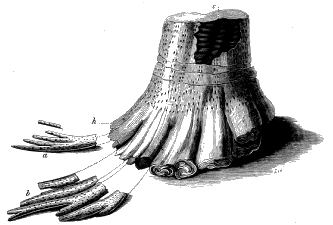
Fig. 3.
STEM OF SIGILLARIA ALTERNANS, 1/12 natural size.
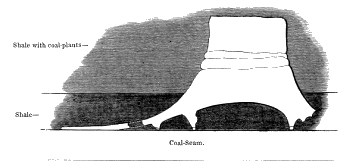
Fig. 4.
The exact position of the tree in relation to the underlying coal is shown in the above section.
Fig. 4. Immediately over the coal there is a bed of hard shale, six inches in depth, in which no
fossils are found; this is overlaid by a softer shale abounding in coal-plants; all the upright
stems were rooted in the six-inch shale. Upon clearing the base of this tree, a complete set of
conical tap-roots was discovered, arranged as in the annexed sketch. Fig. 5. There are four large
tap-roots in each quarter of the stump, and five inches below these another set of smaller tap-roots;
the total number amounting to eighteen. The horizontal roots are seen to branch off in
a regular manner, the base being divided into four nearly equal parts by deep channels, extending
from the centre to the points i, k, l, m.
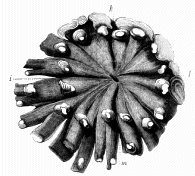
Fig. 5.
The under surface of Fig. 3, showing the conical tap-roots
of the tree, 1/12 natural size.
Mr. Brown remarks, that these short thick tap-roots were evidently adapted only to a soft
wet soil, such as we may conceive was the nature of the first layer of mud deposited upon a bed
of peat which had settled down slightly below the level
of the water. He supposes, from the presence of a
layer of shale without fossil plants immediately over
the coal, that the prostrate stems and leaves which
occur in such large quantities in the next superincumbent
bed, fell from trees growing on the spot, and were
entombed in layers of mud held in suspension in the
water, which at short intervals inundated the low
marshy ground on which they grew; for had the
plants been drifted from a distance, he conceives they
would also occur in the first layer of shale, as well as
in those higher up.
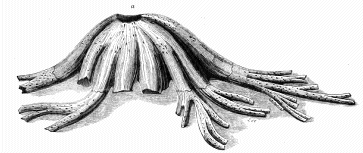
Fig. 6.
STEM OF A SIGILLARIA BROKEN OFF CLOSE TO THE ROOTS, 1/12 natural size.
Having thus shown that the Sigillaria alternans
was provided with roots adapted for a soft muddy soil,
Mr. Brown next describes the specimen represented in
Fig. 6, which is the stem of the same species of tree
broken off near the roots; the hollow cylinder of bark (a) having been bent down and doubled
over by the pressure of the surrounding mud, so as effectually to close up the aperture, leaving
only a few irregular cicatrices, of three or four inches in length, converging at the apex; the
structure, arrangement, and number of the tap-roots, as well as the horizontal ramifications, are
similar to those in Fig. 5. This fossil clearly explains the nature of the "dome-shaped" plant
figured in the "Fossil Flora of Great Britain."[148]
"The roots of the preceding fossils repeatedly ramify as their distance from the stem
increases, and ultimately terminate in broad flattened points. The whole of the spreading roots
of these trees (the Sigillariæ) cover only an area of thirty square feet each; whilst those of the
Lepidodendron (Fig. 1), whose stem is only two or three inches larger in diameter, covered
a space of two hundred square feet. Since it is well known, from numerous examples, that the
[ 202 ]
Lepidodendra were lofty trees, with spreading branches, which therefore required wide bases for
support, may we not conclude that Sigillariæ of the species described were, on the contrary, trees
of low stature, without heavy branches?"
I cannot quit this subject without again adverting to the remarkable phenomenon mentioned
In a previous note, namely, that in the bed of pulverulent earth—the under-clay—on which the
coal invariably reposes, the roots (or Stigmariæ) of large trees are generally the only organic
remains met with. The constant occurrence of these fossils in the under-clay, and their rarity in
the coal and shale, was long ago pointed out by Mr. Martin, Dr. Macculloch, and other geologists;
but the importance of the fact was not appreciated till Mr. Logan drew attention to it. In the
Welsh coal-field, through a depth of 1,200 feet, there are sixty beds of coal, each of which lies on
a stratum of clay abounding in Stigmariæ. In the Appalachian coal formation of the United
States, the same phenomena occur.
Thus it appears that the under-clay is the natural soil in which the roots (Stigmariæ) of the
Sigillariæ and Lepidodendra grew; the coal above it is composed of the carbonized stems and
foliage of those trees; and the roof or coal-shale is formed by the leaves and branches of a forest
overwhelmed and buried beneath the transported detritus of distant rocks. These phenomena may
be explained by supposing that a plain, densely clothed with a luxuriant intertropical vegetation,
was either inundated by an irruption of the sea, or overwhelmed by a flood, from the sudden
breaking up of the barrier of an inland lake; or by the subsidence of the country on which the
forests grew. But when we find an uninterrupted series, in which triple deposits of this
character are repeated through many thousand feet, the solution of the problem is beset with
difficulties, which the hypothesis of repeated periodical subsidences, however ingenious, does
not, in my opinion, remove.[149]
∵ Jaw of the Iguanodon.—Additional note to p. 194.—Since the preceding pages were
struck off, I have, through the kindness and liberality of Samuel H. Beckles, Esq., of Hastings,
obtained two portions of jaws from the Wealden of the Sussex Coast. One of these is a fragment
of the left side of the lower jaw, with six well-defined dental sockets; the other specimen
exhibits the position of the mature molars and the successional teeth in the upper jaw; and
confirms the accuracy of the views of Dr. Melville and myself as to the ruminant character of
the arrangement of the dental organs in the upper and lower jaws of the Iguanodon, as described
in my memoir on the structure of the jaws and teeth; Philos. Trans. 1848, p. 183. When this
specimen is completely developed, it will probably exhibit distinctly the relative position of the
germs and mature teeth, and the form of the inner alveolar parapet.