On losing sight of the Californian coast, we steered southwards, to take
advantage as soon as possible of the trade-wind, proposing by its means
to sail direct for the Sandwich Islands. A strong and lasting
north-wester favoured our intention, and on the 3rd of December we
crossed the tropic of Cancer in the latitude 133° 58', gained the
trade-wind, and began our run westward, supposing ourselves secure from
storms in this tropical region; we were, however, mistaken: already on
the 5th a high wind from the south-east compelled us to take in all
sail; on the 6th it shifted to the west, and on the 7th to the north. We
experienced from this quarter some violent gusts, after which the
heavens cleared, the storm abated, and towards evening on the 8th, we
regained the ordinary trade-wind. I mention these storms, only because
they are almost unexampled at so great a distance from land, between the
tropics, and especially as coming from the west; but it appears that
this year was quite out of the ordinary course, and produced a number of
strange phenomena of which we heard complaints wherever we went.
The weather, after treating us so ill, again became friendly, and the
remainder of our voyage proceeded swiftly and favourably under the
magnificent tropical sky: agreeable it was sure to be; for the peculiar
charm of a sail between the tropics is appreciated by all seamen. An old
English captain, with whom I became acquainted during this voyage,
assured me that he could imagine no greater luxury for the remainder of
his life, than to possess a good quick-sailing ship, to keep a good
table, and to sail between the tropics, without ever making land. I
cannot, I confess, altogether participate in this true seaman-like
taste: on my voyages, the mere sight of land has always been my great
source of pleasure. The conduct of a vessel through distant seas, and
through its conflicts with the variable element, is not indeed an
uninteresting occupation; but the object which has always chiefly
attracted my inclinations, is an intimate knowledge of various countries
and their inhabitants; and I have always considered the time spent at
sea, as a necessary hardship submitted to with this reward in view.
Perhaps I was not born for a sailor: an accident, by no means calculated
upon in my previous education, made me such in my fifteenth year.
We sailed in the night past O Wahi, the principal of the Sandwich group,
with its celebrated giant mountain Mou-na-roa. At break of day on the
13th, we saw in the west the elevated island of Muwe, and continued our
course along the northern shore of this and its neighbour Morotai, to
Wahu, where we intended to land. The landscape of a tropical country is
always pleasing, even when, as here, high lava hills, and masses of
sometimes naked rocks piled like towers upon each other, form the
principal features of the coast, at first inspiring the navigator with
doubts of its fertility. But how agreeably is he surprised, on reaching
the southern shores of these islands, to meet with the most smiling
scenery, and most luxuriant vegetation. In the middle of the channel,
between the islands Muwe and Morotai, lie two small uninhabited islands,
which, strange to say, are not marked on Vancouver's map. We took some
pains to ascertain their exact situation.
At four o'clock in the afternoon, the high yellow rock which forms the
eastern point of the island of Wahu, became plainly visible above our
horizon. We could not reach the secure harbour of Hanaruro, which lies
on the southern side of this promontory, before nightfall, and therefore
thought it advisable to lay-to between the islands Wahu and Morotai. In
the morning, after doubling the conical mountain called the Diamond
Mountain, we suddenly came in sight of the harbour, containing a number
of ships decorated with the flags of various nations.
I must here make a few remarks for the benefit of such navigators as are
not well acquainted with these waters. Whoever wishes to sail in
between the islands of Wahu and Morotai, must remember, that throughout
the year a strong current always sets here towards the north-west; and
that the eastern point of Wahu should be doubled within the distance of
three miles from the coast; as farther out to sea, calms are very
prevalent here, whilst in the neighbourhood of the land, a fresh breeze
regularly sets, in the morning, from the land, and from noon till
evening from the sea.
Behind its harbour, safely sheltered by the coral reefs, lies the town
of Hanaruro, consisting of irregular rows of dwellings scattered over an
open plain. Here and there among the huts are seen houses built of stone
in the European fashion. The former lie modestly concealed, under the
cooling shade of palm-trees; the latter stand boldly forward, braving
the burning sunbeams and dazzling the eye by their overpowering
whiteness. Close to the shore the fortress rears its strong turreted
walls in a quadrangular form, planted with cannon, and bearing the
striped national flag of the Sandwich Islands. The country above the
town rises in an amphitheatre, planted with tarro-root, sugar-cane, and
banana, and the view to landward is bounded by precipitous mountains
invading the clouds, and thickly overgrown with fine trees. In this
beautiful panorama we see at once that the island of Wahu deserves the
appellation it has acquired,—of the garden of the Sandwich Islands.
As we approached the harbour, I made the usual signal for a pilot, and
we soon after saw a boat of European construction making towards us; it
was rowed by two naked Kanachas, as the lower class of people are here
called, the pilot sitting at the rudder in an European dress. When he
came on board, I recognised him for the Englishman, Alexander Adams, who
on my former voyage in the Rurik had commanded the ship Kahumanna,
belonging to King Tameamea; he was now chief pilot. The wind did not
immediately allow us to run into the harbour, but in a few hours it
became favourable, and our skilful pilot guided us safely through the
intricacies of its narrow entrance. Our ship was the largest that had
ever passed through this channel, which would be impracticable for
first-rate vessels.
Some of the ships we found in the harbour were English and American
whalers, which had put in here for provisions; others were on trading
voyages to the north-west coast of America for skins, or returning
thence with their cargoes. Some were from Canton, laden with Chinese
produce, which finds a good market in the Sandwich Islands; and one was
a French ship from Bordeaux, which having carried a cargo of iron wares
to Chili, Peru, and Mexico, had brought the remains of it here. All the
captains visited me in the hope of hearing news from Europe; but many of
them had left it later than we had, and accommodated us with their
London newspapers.
If we consider that scarcely fifty years have elapsed since these
islands were first introduced by Captain Cook to the knowledge of the
European public, and that the inhabitants were then completely what we
call savages, that is, that they were wholly destitute of any conception
of the arts, sciences, or habits of civilized life, we shall find with
surprise that the harbour of Hanaruro already bears a character almost
entirely European, reminding us only by the somewhat scanty clothing of
the natives, of the briefness of their acquaintance with our customs.
My readers, I think, will take some interest in a short account of this
people, whose rapid progress in civilization would perhaps by this time
have placed them on a level with Europeans, if unfavourable
circumstances had not thrown obstacles in the way of their improvement,
which it will require another such governor as Tameamea to overcome.
The eleven islands named by Cook after his patron, the Earl of Sandwich,
but for which the natives have no common appellation, lie between the
nineteenth and twenty-second degrees of north latitude. They are all
high and volcanic. O Wahi, the most easterly, and by much the largest,
is eighty-seven miles long and seventy-five broad: it has three
mountains, which may well bear a comparison with the highest in the
world. The climate of these islands is particularly beautiful and
healthy. Their population is estimated by Captain King at four hundred
thousand; whose colour, form, language, and manners, testify their
relationship with the other islanders of this great ocean, though they
have very little knowledge of them. Their earliest history consists of
traditions of truths interwoven with fables, which ascend to the first
peopling of the islands, and are not yet embodied in the relation of any
voyage. I have collected them carefully from the accounts of the most
distinguished and intelligent man in Hanaruro, my friend Karemaku, a
Spaniard named Marini, who had long resided here, assisting as
interpreter.
According to a belief not long ago universally prevalent, the mighty
spirit Etua-Rono reigned over these islands before they were inhabited
by men. Ardently desirous of seeing his country peopled, he was
melancholy, and shed torrents of tears on the mountain Mou-na-roa,
because he had no offspring; and his loving wife, the beautiful goddess
Opuna, was not in a situation to console him. At length Fate heard his
prayers. On the south-east point of the island of O Wahi two boats were
stranded, having on board some families, who brought with them hogs,
fowls, dogs, and several edible roots. To the present day are the first
footsteps of man on this land to be seen. Rono was at that time absent,
catching fish on the northern islands for his wife. The fire-god, his
subject, unpropitious to man, taking advantage of this circumstance,
made an effort to repulse the new-comers. He approached them with
terrible gestures, and asked whence they came. They answered—"We come
from a country which abounds in hogs, dogs, cocoa-nuts, and bread-fruit.
We were overtaken by a violent storm when on a voyage to visit some
neighbours; and the moon changed five times before we reached this
land." They then begged permission to remain, which the fire-god cruelly
refused, and continued inexorable, although they offered to sacrifice a
hog to him.
Rono, however, observing that a strange smell proceeded from O Wahi,
suddenly returned, and was greatly surprised at the sight of the men.
Encouraged by his friendly deportment, they made their petition to him,
relating the harsh treatment they had endured from the fire-god. Rono,
enraged at this intelligence, threw the fire-god into the crater Kairuo,
on the side of the mountain Mou-na-roa, where he still chafes in vain.
The men now lived tranquilly on O Wahi, increased in numbers, and
sought, by great sacrifices, to prove their love and thankfulness to
their protector, Etua-Rono. To his honour were established the solemn
yearly games called Makahiti, in which whoever obtained the victory in
running, wrestling, and warlike evolutions, was crowned with a verdant
wreath and presided as king over the ensuing feast.
The other islands were gradually peopled from O Wahi; the number of the
gods also increased; but they all remained subject to Etua-Rono.
Mankind had enjoyed a long period of peace and content under the
beneficent protection of Rono, when their happiness was suddenly
disturbed by a distressing occurrence. The goddess Opuna, the beautiful
consort of Rono, degraded herself by a clandestine connexion with a man
of O Wahi. Her husband, furious on the discovery of his wrongs,
precipitated her from the top of a high rock, and dashed her to pieces;
but had scarcely committed this act of violence when, in an agony of
repentance, he ran wildly about the islands, bestowing blows and kicks
on every one he met. The people, astonished at this frantic behaviour of
the god, enquired the reason of it; on which, with the bitterest
expression of grief, he exclaimed, "I have murdered her who was dearest
to me!" He bore the remains of Opuna into the Marai on the Bay of
Karekakua, and there remained a long time sunk in the deepest grief. At
length he determined to quit the islands, where every thing reminded him
of the happiness he had enjoyed with his beloved wife. The people were
overwhelmed with sorrow by the communication of his intention; and he
endeavoured to console them with the promise that he would one day
return on a floating island, furnished with all that man could desire,
and make his favourite people happy. He then embarked in a vessel of
peculiar construction, and set sail for a distant country.
With Rono's departure terminated the Golden Age of this island. Wars
and tumults arose; the gods still increased in number; but their
influence was no longer so friendly to man as when they were under the
superintendence of the revered Rono. Now also commenced many evil
customs, such as human sacrifices, which had been unknown in the good
old time: cannibalism, however, does not appear ever to have disgraced
them. A long period elapsed, of which no record remains; and the story
is resumed at the landing of five white men in Karekakua Bay, near to
the Marai, where the body of the goddess Opuna reposed. The inhabitants
supposed them to be superior beings, and offered no opposition when they
proceeded to take possession of the Marai, on which holy place they were
not only exempted from persecution, but also by the offerings daily
placed there before the images of the gods, from any danger of suffering
a scarcity of food. Here, then, they lived very comfortably; and from
their having, immediately on their arrival, taken up their abode in the
Marai, the people, who were all acquainted with the story of Opuna,
concluded they were sent thither by Rono, to watch over the grave of
his beloved consort. To this opinion they were indebted for a veneration
greater than that entertained for the gods themselves. The priests alone
had the privilege of providing for their wants, which they did with the
utmost care: the people were not even allowed to approach the
neighbourhood of the Marai.
The white men, however, soon found their time hang heavy in this entire
seclusion, and formed a more intimate connexion with the priests, whom
they assisted in the holy rites and ceremonies, and at length even made
their appearance among the people: the latter then discovered them to be
mortals like themselves, differing only in colour, but still retained a
high respect for their superior knowledge and good deportment. Maidens
of the highest rank were given to them for wives; and each of them was
installed governor of an island. "The descendants of these strangers,"
said Karemaku, "may still be distinguished by their whiter colour."
Here, as at Tahaiti, the Yeris differ from the lower classes in their
superior size, and some also by a greater degree of fairness.
The helmets and short mantles which Cook and King have described as
worn by this people, were introduced by these white strangers. At first,
the kings only appeared in this costume; but in Cook's time it was
common also among the Yeris. Now that European fashions have quite
banished those of the original inhabitants, it is only preserved and
shown to strangers as a relic of the past. The helmet, of wood covered
with small red and yellow feathers, and adorned with a plume, perfectly
resembles those of the chivalrous knights of yore; and the short mantle,
also most ingeniously made with feathers to supply the want of woven
stuff, forms a complete representation of the mantles worn by those
ancient heroes: hence it is sufficiently evident that the white men who
landed on O Wahi were Europeans; and that we are therefore more nearly
connected with, at least, a part of the inhabitants of the Sandwich
Islands, than with the other South Sea islanders.
With the arrival of the white men begins the chronology of O Wahi, from
the first white king to Tameamea, making seven successive reigns.
During this period, but long before Cook's time, two vessels are said to
have been wrecked on the north-east side of O Wahi. Tradition is not
unanimous in the account of what became of the crews. According to some,
they were lost in the wreck, but others say they were murdered by the
natives. My informant, Karemaku, mentioned only one ship, which was seen
at a distance; and although the iron anchors found at O Wahi and at Muwe
prove that they must have been there, he could give no account of them.
It is very probable that the Spaniards, who often made a mystery of
their discoveries in the South Seas, already knew of the existence of
these islands before their discovery by Cook.
Their authentic history begins with this event, in 1778, when, as has
already been mentioned, Cook bestowed on them the name of the First Lord
of the Admiralty at that period. They were not then, as now, united
under one King; but each island had its particular sovereign, called
Yeri-Rahi, who possessed full power over the lives of his subjects, and
to whom the proprietors of land paid tribute. The name of the monarch
of O Wahi, on Cook's arrival, was Teraiopu, or, as he writes it,
Terreobu.
Captain King, the companion of Cook, gives the following description of
the Sandwich Islanders:—
"They are in general of the middle size,[3] and well-proportioned. Their
movements are graceful, they run swiftly, and are able to carry great
weights. The men, however, are inferior to the Friendly Islanders, in
strength and activity; and the women are not so delicately formed as
those of Tahaiti: their colour is also a little browner, and they are
not so handsome, but the features of both sexes are open and agreeable;
the females especially have beautiful eyes and teeth, and a sweet
expression of countenance. Their hair is dark-brown, not so smooth as
that of the American Indians, nor so woolly as that of the negroes of
Africa, but between the two.
"Here, as on the other South Sea Islands, the Yeris are advantageously
distinguished in form from the lower classes, and are seldom disfigured
by the swellings and ulcers frequent among the latter, which we ascribed
to the great use of salt in their preparations of meat and fish; the
former, however, are much injured by immoderate indulgence in the Ava
drink. Those who suffered most from it had their whole bodies covered
with a white eruption: their eyes were red and inflamed, they trembled
much, and could scarcely hold up their heads. This beverage does not
shorten the lives of all who use it too freely, as Teraiopu, Kau, and
several other chiefs addicted to it, were old men; but it brings on
premature and diseased old age. Fortunately, this luxury is the
exclusive privilege of the chiefs. The son of Teraiopu, a boy of twelve
years old, often boasted of having obtained the right of drinking Ava,
and showed with much complacency a spot on his loins where the eruption
was already visible.
"Notwithstanding the great and irreparable loss which the sudden
violence of these Sandwich Islanders has occasioned us," (in the death
of Cook,) "I must in justice declare, that they are usually gentle and
kind, and by no means so changeable and volatile as the Tahaitians, nor
so reserved and melancholy as the Friendly Islanders: they live on the
best possible terms with each other, and in peace and kindness in their
families. We have often admired the care and tenderness with which the
women treated their children, while the men assisted them in their
domestic occupations with a readiness and good-will which did them great
credit.
"If however we should pronounce on the degree of civilization to which
they have attained by the estimation the female sex enjoys among them,
they would rank but low in the scale. The women are not only forbidden
to eat with the men, but the best kinds of food are denied them. They
are not allowed to eat pork, turtle, or several kinds of fish and
bananas; and we were informed that a poor girl had been severely beaten
for having tasted of these prohibited viands on board our ship. The
females seemed indeed almost to live in a state of separation from
their lords; and although we never perceived that they were ill treated,
it is certain they are held in little respect.
"We were always received when we came ashore with the greatest
friendliness and hospitality. As soon as we landed, the inhabitants vied
with each other in bringing us presents, preparing food for us, and
showing us every mark of kindness. The old people were much pleased when
they obtained permission to touch us; and they showed much modesty and
humility in the comparisons they made between us and themselves.
"In mental capacity, the Sandwich Islanders do not appear at all
inferior to any other people. Their progress in agriculture, and their
skill in handicrafts, is fully proportionate to their means and
situation. The earnest attention which they paid to the work of our
smiths, and the various means they devised, even before our departure,
to give any required form to the iron they obtained from us, convinced
us at once of their industry and ingenuity.
"Our unfortunate friend Kancena, (he was shot by one of the Englishmen
whom he had always treated with the greatest friendship) had a great
desire for knowledge, an admirable natural understanding and a vivacity
of mind seldom met with amongst uncultivated nations. He made
innumerable inquiries concerning our manners and customs, our King, our
form of government, the population and produce of our country, and the
manner in which our ships and houses were built. He wished to know if we
waged wars, with whom, and for what cause, what God we worshipped, and
many other things; which showed an extensive range of thought."
This testimony of Captain King to the good disposition of the Sandwich
Islanders becomes the more worthy of credit, when we consider that the
English always treated them with great severity, and that Captain Cook
only fell a sacrifice to his own error. King has also defended them from
the imputation of being cannibals, of which Anderson and several of
Cook's companions had accused them.
The propensity to theft was as common among the lower classes here, as
on the other South Sea islands; and this it was which occasioned the
thoughtless severity of Cook, who was always judge in his own cause,
and suffered himself to be hurried into unjustifiable acts of violence.
Had he been a philanthropist, as well as a great navigator, he would not
have lost his life at O Wahi.
The custom of tattooing existed also among the Sandwich Islanders; their
faces were frequently marked with lines crossing each other at right
angles, and some even had their tongues tattooed; pretty drawings were
frequently seen on the hands and arms of the women. The ordinary dress
of both sexes was nothing more than a piece of stuff folded round their
bodies. The females adorned themselves besides with necklaces of
muscle-shells, or little red shining beans, and with bracelets of
various ornamental materials; they sometimes wore collars of beautiful
feathers ingeniously blended together; their hair was also decorated
with feathers and with garlands of flowers.
The Sandwich Islanders lived in villages or little hamlets of from one
to two hundred dwellings, standing irregularly, pretty near each other,
and communicating by a winding path. Some of them were surrounded by
gardens, enclosed with hedges. The food of the lower classes consisted
chiefly of fish, yams, sweet potatoes, tarro-root, bananas, sugar-canes,
and bread-fruit. Those of higher rank also indulged in pork, and the
flesh of dogs, prepared in the same manner as on the Society Islands.
The tame poultry of Europe was also found here, but it was scarce, and
not very much prized. These people were particularly clean, and their
cookery was preferred by Englishmen to that of their own country.
The Yeris were chiefly employed in the building of vessels and the
manufacture of mats; the females prepared a stuff of the paper kind,
which was so pressed and coloured as to resemble our calico; and fishing
or agriculture was the chief business of the servants. These
occupations, however, left leisure for various pastimes, particularly
dancing, which the young people of both sexes delighted in. Drums of
several sorts were their only musical instruments, but their songs were
very pleasing. They often played at a game much resembling our draughts;
it is played with black and white stones on a piece of board, and from
the great number of pieces, seems to require much attention. In another
game, a stone was hidden under a large piece of stuff, and the player
was to point out the precise spot in which it lay. Running races, in
which the girls took part, and apparently dangerous exercises in
swimming amidst the surf, were also among their amusements. In wrestling
and boxing, they did not display so much strength and skill as the
Friendly Islanders. The children often handled their balls with great
dexterity, throwing several at once into the air and catching them
again.
Their vessels were very well built; the largest, a double one, seventy
feet long, twelve broad, and three and a half deep, belonged to
Teraiopu. The most remarkable of their utensils were the vessels
appropriated to drinking Ava; they were usually eight or ten inches in
diameter, perfectly round and very well polished, and were supported by
three or four little images of men in various attitudes, sometimes
bearing the vessel on their heads, sometimes on their shoulders, or on
their hands raised above their heads. These figures were very well
executed, the proportions correctly preserved, and even the proper
action of the muscles well defined.
Among the arts in which the Sandwich Islanders excelled, was that of
preparing salt: the English obtained from them a large quantity of the
best kind. Their arms consisted of clubs, lances, and daggers, made of
hard wood. War was of frequent occurrence amongst the inhabitants of the
several islands; the battles were often very bloody, and usually at sea,
the vessels grappling. The Yeris, when they went to battle, wore the
decorated helmets already described, and the mantles covered with black,
red, and yellow feathers: those of the Yerirahis, or kings, were of
yellow only. Images of the god of war, cut in wood; dreadful caricatures
of the human figure in a threatening posture, the mouth open and armed
with dogs' teeth, were always carried before the kings into battle; and
the chief aim of the enemy was to capture them, as this achievement
usually put an end to the war. A part of the prisoners were sacrificed
to the gods; but as the shedding of blood in this rite was forbidden,
they were strangled, and laid down before the images of the gods in the
Marai, with their faces turned to the earth.
The burial of the dead was a very sacred ceremony, and accompanied with
many forms. The corpse was laid in a pit till the flesh decayed, the
bones were then cleaned, and a part of them distributed among the
relations and friends to be preserved as relics, part laid in
consecrated ground. Dying persons sometimes desired that their bones
should be thrown into the crater of the volcano at O Wahi, which was
inhabited by the revered god Pelai. It has already been mentioned, that
the women were prohibited from eating many kinds of food; they were also
forbidden, under pain of death, to enter a house where the men were
eating, and they were entirely secluded from the Marais; with these
exceptions, they enjoyed great freedom, and even had a voice in the
deliberations concerning war and peace.
The religious regulation of the Tabu, or interdict, existed here as well
as on many other of the South Sea islands. A person declared under a
Tabu was inviolable; a piece of land under a Tabu must not be trodden
by any one; nor must a species of animal so declared, be injured or shot
until the Tabu was again taken off. Thus Tameamea declared the diamond
mountain under the Tabu, because an Englishman, finding there a piece of
quartz-crystal, considered it to be diamond; and the King, finding these
were of great value, supposed he possessed in the mountain an
inexhaustible treasure, till he discovered his mistake, and the Tabu was
taken off.
The vessels first seen by the Sandwich Islanders must have been very
small, for when Cook's appeared, they took her for a swimming island,
and believed that Etua-Rono, for whom they always retained the most
profound veneration, had at length fulfilled his promise and returned to
them. The joy was universal; and it was determined to receive the
beneficent god, so long absent, who was to restore the Golden Age upon
the island, with all possible honours. Neither Cook nor his companion
seemed to have had any notion that they were saluted with divine
honours; but they considered the ceremonies enacted by the rejoicing
people as marks of distinction commonly bestowed on persons of
importance. His being called by them "O Rono," (the Rono) did not
enlighten him on the subject, as he was unacquainted with the tradition;
but he contented himself with the conjecture, that the appellation was a
title of honour, signifying chief or priest. Had the conduct of Cook
made it possible for the islanders to retain their beneficial error, the
good understanding between them and the English would never have been
interrupted; but he himself was the first to convince them that he could
not be their divine benefactor.
Some of the populace conceived themselves entitled to appropriate a
portion of the presents which Rono, according to his promise, had
brought them—a licence which was immediately punished by Cook with
great severity: the offenders taken in the fact were whipped; those who
fled were fired upon; and several persons, some of whom were innocent,
lost their lives. Rono could not be so cruel and unjust; and Tute, as
they called Cook, immediately sunk in their estimation to the rank of
ordinary mortals. He was henceforth feared as a mighty chief, but
venerated no longer. This change of sentiment was very evident when he
returned hither from his voyage northward. The islanders met the ship as
before, with hogs and fruits; but they set a price upon them, instead of
presenting them, as formerly, in the character of offerings, and
accepting the returns made them as gratuitous gifts. Finding that they
obtained what appeared to them an exorbitant price for their provisions,
they supposed the strangers to come from a land of scarcity for the mere
purpose of satisfying their appetites; and the common people wholly
ceasing to regard them with reverence, became bolder in their
depredations. The King, the Priests, and many of the principal Yeris,
still however continued firm in their attachment to the English. A Yeri,
named Parea, gave a striking proof of this kindly disposition, which
Captain King has thus related:—Some Kanackas, having stolen certain
articles, were pursued with muskets; and though every thing was
recovered, an English officer thought himself justified in taking
possession of a canoe lying on the shore belonging to Parea, who, being
perfectly innocent of the theft, reclaimed his property. The officer
refused to surrender it; and in the subsequent contest, Parea received
so violent a blow on the head with an oar, that he fell senseless to the
ground. In the mean time the islanders had assembled, and, irritated at
this undeserved outrage on a chief, began to throw stones at the
English, who were obliged to swim to a neighbouring rock for safety. The
victorious people, thus left in possession of the field of battle, fell
upon the English boat, which they would have destroyed but for the
interposition of Parea, who had now recovered his senses. He dispersed
the crowd, made a signal to the English that they might return, restored
their boat, and sent them back in it to their ship. Parea afterwards
followed them, taking with him a midshipman's hat, and some other
trifles which were missing; expressed his sorrow for the dispute that
had arisen, and inquired whether O Rono desired his death, or whether he
might come again to the ship.—(It appeared from this that he still
looked upon Cook as the deity, or at least affected this belief to
propitiate the English.)—He was assured that he had nothing to fear,
and would always be welcome; he then touched the nose of the officers,
in sign of amity and reconciliation, and returned to land.
Since Parea had hindered his countrymen from wreaking their vengeance on
one boat, they indemnified themselves by stealing another, and in the
night cut through the rope which fastened it to the ship. Cook, enraged
at this occurrence, determined to bring the King himself on board his
ship, and detain him there as a hostage till the boat should be
restored; a measure which on another island he had already successfully
adopted on a similar occasion. He therefore went ashore with a party of
soldiers well armed, having given orders that none of the boats
belonging to the natives should be suffered to leave the bay, as it was
his determination, in case gentler measures should prove ineffectual, to
destroy them all. All the boats of both ships, well manned and armed,
were therefore so placed as to enforce obedience to this command.
Cook was received, according to King's account, with the greatest
respect: the people prostrated themselves before him. He proceeded
direct to the old King, and invited him on board his ship. The King
immediately consented; but some of the Yeris endeavoured to dissuade
him; and the more earnestly Cook pressed his going, the more strenuously
they endeavoured to prevent it. Cook, at length, seized the King by the
arm, and would have carried him off by force; which in the highest
degree irritated the assembled multitudes. At this moment a Yeri, who in
crossing the bay from the opposite side had been fired upon by the
English boats, rushed with blood streaming from his wound into the
presence of the King, and cried aloud to him to remain where he was, or
he would certainly receive similar treatment; this incident wound up the
rage of the people to its utmost pitch, and the conflict commenced, in
which Cook lost his life.
Karemaku, who, when a young man, had witnessed these circumstances,
related them to me; and the accounts of Cook's companions upon the whole
agree with his. Some isolated facts are differently stated by them; but
I was assured by all the natives of Wahu, that Karemaku had strictly
adhered to the truth. Even if we give entire credit to the English
narrative, we shall find that they were the aggressors,—that the
islanders acted only on the defensive, and that Cook's fate, however
lamentable, was not entirely undeserved.
John Reinhold Forster, in his preface to a journal of a voyage of
discovery to the South Sea, in the years 1776 to 1780, gives an extract
from a letter written to him by an Englishman in a responsible
situation, in which he says of Cook—"The Captain's character is not the
same now as formerly: his head seems to have been turned." Forster gives
the same account concerning the change in Cook, when he says—
"Cook, on his first voyage, had with him Messrs. Banks and Solander,
both lovers of art and science. On the second, I and my son were his
companions, enjoying daily and familiar intercourse with him. In our
presence, respect for his own character restrained him; our mode of
thinking, our principles and manners influenced his, and prevented his
treating the poor harmless South Sea Islanders with cruelty. The only
instance of undue severity we ever witnessed in his behaviour, was when
on account of some petty theft he once allowed his cannon to be fired
upon the fugitive offenders; fortunately, however, no one was injured by
this rash act. But having in his last voyage no other witnesses of his
actions, than such as were entirely under his command, he forgot what he
owed to his own great name, and was guilty in many instances of extreme
cruelty. I am therefore convinced, that if Messrs. Banks and Solander,
Dr. Spaarmann, or I and my son, had been with him on the last voyage,
his life would not have been lost in the manner it was."
The first ships which visited the Sandwich Islands after Cook's death
were those of Meeres, Dickson, and Coke, in the years 1786–9. They
traded in skins between China and the North-west Coast of America, and
found these islands very convenient to touch at. They were well
received; and some of the islanders made the voyage to America with
them. Tianna, one of the first Yeris of O Wahi, went with Meeres to
China. These voyages, and the continual intercourse with Europeans,
which their increasing trade in fur produced, necessarily enlarged the
ideas of these children of Nature; and as they were not under the
dominion of that folly which, in common with the Greenlanders, possesses
some of the most civilized nations in Europe, of considering themselves
the first people upon earth, they soon acquired our manners, and derived
all the advantage that could be expected from the opportunities of
improvement thus afforded them. Vancouver found, in 1792, that many
remarkable changes had taken place on these islands since Cook's time.
King Teraiopu did not long survive that eminent navigator. His son
Kawarao succeeded to the government of the greater part of the island of
O Wahi; the rest fell to his relation Tameamea. Kawarao was a tyrant,
and governed with unexampled cruelty. At certain periods of the moon, he
declared himself holy, or under a Tabu: the priests alone had then the
privilege of seeing him so long as the sun was above the horizon; and an
immediate death of the severest torture was the melancholy lot of any
individual not belonging to this sacred order, who by whatever accident
should cast but a momentary glance upon the voluntarily secluded
monarch. To this cruelty of disposition, Kawarao united an unbounded
ambition, which prompted him to make war on his kinsman Tameamea. This
young and powerful chief early distinguished himself, and soon became
celebrated throughout these islands for superiority of intellect and
skill in arms. Kawarao, although he had greatly the advantage in
numbers, could never obtain a victory; fire-arms were not then in use
here, and success long vibrated between the contending rivals. Both
parties at length determined to put the final issue of the war to the
test of a single combat, stipulating that the conqueror should acquire
the sovereignty of the whole island. The two kings armed; their
respective priests carried the images of their gods to the field, and
the fight commenced. Kawarao trusted to his skill in throwing the
javelin; but Tameamea could defend himself from several antagonists at
once, and scarcely ever missed his aim. After some fruitless efforts of
both combatants, Tameamea's spear pierced the side of his bloodthirsty
enemy, who fell dead on the field.
This duel, by which Tameamea became King of O Wahi and of Muwe, which
had also belonged to Kawarao, took place in the year 1781. To establish
his dominion on a firmer basis, Tameamea married the daughter of the
vanquished monarch, and acquired the love of his subjects by his wise
and moderate government. Himself endowed with uncommon powers of mind,
he entrusted the important offices of state only to such as were capable
of discharging them efficiently. He made a very fortunate choice in
Karemaku, who, while quite a young man, entered into all the enlightened
and comprehensive views of his master, forwarded them with ability and
energy, and continued his faithful servant till the death of Tameamea.
The English called him the Pitt of the Sandwich Islands.
Several Europeans now established themselves at O Wahi; among whom Davis
and John Young have been the most useful to the rising nation. Under
their direction, houses and ships have been constructed in the European
fashion; the island has been enriched with many useful plants; and their
advice has been successfully followed in the affairs of government.
With the appearance of Vancouver, arose the fortunate star of these
islands. Among the innumerable benefits he conferred upon them, they are
indebted to him for the possession of sheep and cattle. Tameamea
declared these animals under a Tabu for ten years, which allowed time
for so large an increase, that they now run wild in the forests. Had
Vancouver enjoyed Cook's advantages, the islanders might still have
believed him their Rono.
Tameamea, during Vancouver's visit, swayed the sceptre only over the
islands of O Wahi and Muwe, and was engaged in wars with his neighbour
kings, whom he fought with the assistance of cannon purchased from
European ships. He commanded in every battle, both by sea and land; and
Karemaku, as first in authority under him, was his constant companion.
The O Wahians, however, could not have well understood the use of their
cannons and other fire-arms, as, after Vancouver's departure, the war
was maintained for ten years. O Tuai, the most north-westerly island,
even then held out, though the others had submitted. In the year 1817,
Tameamea conquered this also, after many unsuccessful attempts, and
thus became the supreme governor of the whole Archipelago.
From this time all his efforts were directed to the education of his
people, and the improvement of their trade. Salt and sandal-wood were
the chief articles of exportation. The latter, though bought at rather a
high price by the North-American ships, which almost exclusively
monopolized this trade, sold for a large profit at Canton.
I have been told, that the Americans have purchased sandal-wood here to
the amount of three hundred thousand Spanish dollars a-year. Tameamea
bartered this wood for some large American merchant-ships, manned them,
and other ships built in the Sandwich Islands, partly with his own
subjects, and partly with Europeans, and traded on his own account. He
had even found means to create a small fleet of ships of war; and his
warehouses, built of stone, were filled with European and American
merchandise. He possessed a considerable treasure in silver money and
utensils; his fortresses were planted with cannon of a large calibre,
and he maintained a force of fifteen thousand men, all armed with
muskets, in the use of which they had been carefully exercised. He took
much pains, assisted by the Spaniard Marini, to introduce the
cotton-tree, which answered very well, and yielded fine cotton; and
endeavoured to improve the native flax, already much superior to that of
New Zealand, and to profit by it as an article of commerce. Nothing
which promised advantage to his country escaped his penetrating mind; he
exerted, in short, every faculty of his mind to place the Sandwich
Islands in a state of progressive assimilation to the most prosperous
nations. Vessels of every nation were as secure from injustice or insult
in his ports, as in those of Europe, if not more so. As soon as a
strange ship arrived, criers were employed to give notice that the new
comers were friends, and must be hospitably received, and that any
incivility shown them would be severely punished.
When Tameamea first sent a ship to Canton with sandal-wood, he was
obliged to pay a considerable duty for anchorage; whereupon he argued,
that what was exacted from himself, he might with a safe conscience
demand from others; and every ship is now required to pay forty Spanish
dollars for anchorage in the outer, and eighty in the inner harbour of
Hanaruro.
Wahu is the most fertile of all the islands, and the only one enjoying a
secure harbour; it therefore naturally advances the most rapidly in
civilization. Several European and American traders have settled in
Hanaruro; shops have been opened, and houses built in the European
style, of wood and stone; some of the former were made in America, and
brought here to be put together. The exertions of Marini introduced here
many European vegetables, the vine and other fruits, which are all in a
flourishing state. He collected and tamed a herd of cows. Goats, sheep,
and poultry of all kinds are common. The frequent voyages which the
Sandwich islanders now made, partly in Tameamea's vessels, partly
foreign ones, on board which they served as sailors, gradually
familiarised them with the manners of more civilized nations. They
adopted our costume, but after the Tahaitian fashion; considering a
complete suit as an unnecessary luxury. Even Tameamea himself, for his
usual attire, wore only a shirt, trowsers, and red waistcoat, without a
coat; he possessed, however, many richly embroidered uniforms, but kept
them for grand occasions.
These islanders had made great progress in the English language: many of
them could speak it very tolerably. Tameamea understood, but did not
speak it. If any of my readers should wish for a farther acquaintance
with the character of this distinguished sovereign, I must refer them to
Vancouver, and to my former voyage; but for the benefit of those who may
not be disposed to take this trouble, I cannot forbear repeating from
the latter some of his remarks to myself. He presented me with a collar
most ingeniously worked with coloured feathers, which he had sometimes
worn in war, and on solemn occasions, saying, "I have heard that your
monarch is a great warrior, and I love him, because I am a warrior
myself; bear to him this collar, which I send as a token of my regard."
Once as he embraced an image in his Marai, he said, "These are our Gods
whom I adore; whether in so doing I am right or wrong, I know not, but I
follow the religion of my country, which cannot be a bad one, since it
commands me to be just in all my actions."
On the 8th of May, in the year 1819, Tameamea terminated his meritorious
career, to the great sorrow as well of the foreign settlers as of his
native subjects. His remains were disposed of according to the rites of
the religion he professed. After they had remained some time in the
Marai, the bones were cleaned, and divided among his relatives and the
most distinguished of his attendants. According to the custom of this
country, two persons had long before been destined for interment with
him at his death; but by his express desire this ceremony was dispensed
with.
His eldest son and legitimate successor, Lio Lio, or, as the English
call it, Rio Rio,—for there is some difficulty in distinguishing
between the L and the R of the Sandwich Islanders,—now assumed the
government, under the name of Tameamea the Second. Unhappily, the
father's talents were not hereditary; and the son's passion for liquor
incapacitated him for ruling with the same splendid reputation an infant
state, which, having already received so strong an impulse towards
civilization, required a skilful guide to preserve it from degeneracy
and error.
The chiefs of some of the islands, and especially of O Tuai, had, even
in Tameamea's lifetime, founded a hope of future independence, on the
weakness of his successor, and immediately upon his death proceeded to
attempt the accomplishment of their desires. But Karemaku, the faithful
friend and counsellor of the deceased King, to whom the whole nation
looked up with affection, and whose penetration easily discerned the
evil consequences that would ensue from a political disunion of the
islands, devoted to the son all the zeal and patriotism with which he
had served the father. By the influence of his eloquence, and the force
of his arms, he quelled the insurrection, and re-established peace and
order; but to enthrone the new monarch in the hearts of his people
exceeded his ability; and their disaffection proved that the germ of
future disorders was not wholly extinct. The King chose Wahu for his
residence, because this island was in the best state for defence; and
giving himself up entirely to dissipation, sunk lower and lower in the
estimation of his subjects. Karemaku was the good genius who watched
over the welfare of the country, while its monarch was wasting his hours
and his health in orgies, at which he was frequently known to empty a
bottle of rum at a draught. It was not to be supposed that a king
addicted to such habits should conceive any projects of utility or
advantage for his people; he wished, however, to distinguish himself by
some effort in their favour, or at least to relieve them from the
trammels of superstition. He was a freethinker in a bad sense. He hated
the religion of his country, because it laid some restraints upon his
inclinations, and he determined to overthrow it; not for the purpose of
introducing a better, a task to which his feeble mind was unequal, but
for that of at once relieving himself and his subjects from ceremonies
which he considered useless, because he undervalued the precepts of
morality interwoven with them, and for the sake of which his father had
always conscientiously observed them.
In the fifth month of his reign, he proceeded in a violent and brutal
manner, notwithstanding all the remonstrances of Karemaku, to the
execution of his design. Having previously arranged his plans with some
chiefs, the companions of his excesses, he invited the principal
inhabitants of the islands to a sumptuous banquet. After the wine and
rum had produced their wonted effects, females were introduced, and
compelled to partake of the feast. These poor creatures, having no
suspicion of the King's intentions, shrunk with terror from a
profanation punishable with death. But their resistance was unavailing:
they were not only constrained to sit down to the repast in company with
the men, but even to eat pork; and thus, to the great astonishment of
such guests as were not in the secret, to violate, at the royal command,
a double Tabu. A murmur arose; but the greater part of the company were
under the influence of liquor, and the King now openly proclaimed his
intentions. His auditors inquired in alarm what crime the Gods had
committed, that they should be thus unceremoniously dismissed; and
besought him not to occasion his own destruction and that of the
country, by provoking their indignation. The King started from his seat,
and exclaimed with violent gestures, "You see we have already violated
the strongest Tabus, and yet the Gods inflict no punishment, because
they have no power; neither have they power to do us good. Our faith was
erroneous and worthless. Come, let us destroy the Marais, and from
henceforth acknowledge no religion!" The immediate dependents of the
King rose to second him: the inhabitants of Hanaruro had been depraved
by their intercourse with foreign sailors, and a tumultuous crowd, who
held nothing sacred, soon followed the revellers. Arrived at the royal
Marai, some of them, terrified by the aspect of their idols, would have
receded; but when the King himself, and his friends and followers, began
to maltreat them, and no divine vengeance followed, the courage of the
multitude revived, and the Marais were soon utterly destroyed. This
outrage to what the people at large most venerated, introduced a scene
of confusion and violence, and would indeed have entailed destruction
both on the King and the country, had not Karemaku again stood forward
in their defence. Several Yeris who, disapproving the sentiments of the
King, had retired privately from the banquet, joined the priests in
exciting the people to defend their gods by force of arms. An army was
raised, and, animated by the presence of the war-god, commenced
hostilities against his sacrilegious opponents. When the news of the
destruction of the Marais reached the other islands, insurrections also
broke out in each of them. Karemaku had condemned the sacrilege, and
abstained from any part in it; but as it could not now be prevented, and
he foresaw the mischievous consequences of civil commotions, he
assembled an army, and, victorious wherever he appeared, succeeded in
restoring tranquillity. On the large island O Wahi, however, he
encountered a formidable resistance; but at length, after several bloody
contests, he captured the war-god: the insurgents, who had also lost
their leaders in the last battle, believing themselves quite abandoned
by the gods, now dispersed, and Karemaku, on the restoration of
tranquillity, returned to Wahu.
It is a remarkable fact, that a people who regarded their faith and
their priests with so much reverence, as I had myself witnessed
previously to this occurrence, should in so short a period, acquiescing
in the decree which denounced their creed as error, and consigned their
sanctuaries to demolition, contentedly submit to the total deprivation
of all external signs of religion. Karemaku had judgment enough to
perceive that this state of things would not endure, and that a religion
of some kind was indispensable to the people; he therefore resolved to
set his countrymen a good example, and yielding to an inclination he had
long entertained, to declare himself publicly a convert to Christianity.
In the same year, 1819, Captain Freycinet, on his voyage round the
world, landed at Hanaruro, and a clergyman accompanying him, Karemaku
and his brother Boki received the sacrament of baptism according to the
forms of the Catholic Church.
At this time, a society of missionaries was formed in the United States
of America, for the purpose of introducing Christianity into the
Sandwich Islands. Of the extinction of the ancient faith, which must of
course facilitate their undertaking, they had as yet received no
information. Six families of these missionaries arrived at Wahu in
1820, bringing with them two young Sandwich Islanders, who had been
previously prepared in their schools. The King, hearing of their
intention, would not allow them to land, but commanded them immediately
to depart from his shores. Here, again, Karemaku interposed, and
endeavoured to convince the King that the Christian religion would be
one of the greatest benefits he could confer on his subjects. The King
then assembled the most distinguished Yeris, and after fourteen days'
deliberation, decreed that a piece of land should be granted to the
missionaries, with permission to build a church, and to preach their
doctrines, under the condition that they should immediately leave the
island if the experiment should be found to have a prejudicial influence
on the people. The missionaries agreed to the terms, took up their
residence on Wahu, and from thence extended settlements over the other
islands. Their first efforts were successfully directed to the
conversion of the King, his family, and the most distinguished Yeris.
When these personages had openly professed the new faith, the
Missionaries considered themselves firmly established, and proceeded
with more confidence to the full execution of their plan. They quickly
acquired the language of the islands, which from the largest of them
they called the O Wahi language, printed the first book in it, (a
collection of Hymns,) in the year 1822, and instructed the natives, who
proved apt scholars, in reading and writing. These missionaries were
Protestants; but the Catholic Karemaku, having no notion of the points
of doctrine in dispute between the Churches, joined without hesitation
in communion with them; and the Christian religion spreading rapidly
among the Sandwich Islanders, without any of the constraint or
persecution which had disgraced it at O Tahaiti, promised the happiest
effects.
Notwithstanding, however, all the efforts of Karemaku, the people were
not yet entirely pacified. The former faith had still many secret
adherents, and the King was unable to acquire either the esteem or
affection of his subjects. Insurrections were continually dreaded; and
Rio Rio, not feeling sufficiently secure even in his entrenchments at
Wahu, determined, by the advice of some Europeans, to make a voyage to
England, in the hope that these discontents would subside during his
absence. He confided the administration of the government to the
faithful Karemaku, and Kahumanna, the favourite wife of his father, and
in the year 1824 sailed for England in a North American ship,
accompanied by his consort, Karemaku's brother Boki, and some other
persons of rank; taking with him twenty-five thousand Spanish piastres
from the treasure amassed by his father.
Soon after the King's departure, a regular rebellion broke out in the
island of O Tuai. Its former ruler, Tamari, was dead, and his son, a
young man who had been brought up in the United States of America, and
had unfortunately fallen into bad company, was desirous to recover for
himself the independent dominion of the island. Karemaku and Kahumanna
immediately hastened thither with an army, and on our arrival at
Hanaruro we found the war still raging at O Tuai, though it was supposed
to be near its close. The government of Wahu was entrusted, during the
absence of the Regents, to another wife of Tameamea, named Nomahanna,
conjointly with a Yeri called Chinau.
On the morning after our arrival, I rowed ashore with some of my
officers, to pay my respects to the Queen Nomahanna, and on landing was
met by the Spaniard Marini, who accompanied us to her Majesty as
interpreter. On the way I was recognised by several old friends, with
whom I had become acquainted on my former visit. They saluted me with a
friendly "Aroha." I cannot say there was much room for compliment on
any visible improvement in their costume; for they still wore with much
self-complacency some ill-assorted portions of European attire.
The residence of Nomahanna lay near the fortress on the sea-shore: it
was a pretty little wooden house of two stories, built in the European
style, with handsome large windows, and a balcony very neatly painted.
We were received on the stairs by Chinau, the governor of Wahu, in a
curious dishabille. He could hardly walk from the confinement his feet
suffered in a pair of fisherman's shoes, and his red cloth waistcoat
would not submit to be buttoned, because it had never been intended for
so colossal a frame. He welcomed me with repeated "Arohas," and led me
up to the second floor, where all the arrangements had a pleasing and
even elegant appearance. The stairs were occupied from the bottom to the
door of the Queen's apartments, by children, adults, and even old
people, of both sexes, who, under her Majesty's own superintendence,
were reading from spelling-books, and writing on slates—a spectacle
very honourable to her philanthropy. The Governor himself had a
spelling-book in one hand, and in the other a very ornamental little
instrument made of bone, which he used for pointing to the letters. Some
of the old people appeared to have joined the assembly rather for
example's sake, than from a desire to learn, as they were studying, with
an affectation of extreme diligence, books held upside down.
The spectacle of these scholars and their whimsical and scanty attire,
nearly upset the gravity with which I had prepared for my presentation
to the Queen. The doors were, however, thrown open and I entered, Chinau
introducing me as the captain of the newly-arrived Russian frigate. The
apartment was furnished in the European fashion, with chairs, tables,
and looking-glasses. In one corner stood an immensely large bed with
silk curtains; the floor was covered with fine mats, and on these, in
the middle of the room, lay Nomahanna, extended on her stomach, her head
turned towards the door, and her arms supported on a silk pillow. Two
young girls lightly dressed, sat cross-legged by the side of the Queen,
flapping away the flies with bunches of feathers. Nomahanna, who
appeared at the utmost not more than forty years old, was exactly six
feet two inches high, and rather more than two ells in circumference.
She wore an old-fashioned European dress of blue silk; her coal-black
hair was neatly plaited, at the top of a head as round as a ball; her
flat nose and thick projecting lips were certainly not very handsome,
yet was her countenance on the whole prepossessing and agreeable. On
seeing me, she laid down the psalm-book in which she had been reading,
and having, with the help of her attendants, changed her lying for a
sitting posture, she held out her hand to me in a very friendly manner,
with many "Arohas!" and invited me to take a seat on a chair by her
side. Her memory was better than my own; she recognised me as the
Russian officer who had visited the deceased monarch Tameamea, on the
island of O Wahi. On that occasion I had been presented to the Queens;
but since that time Nomahanna had so much increased in size, that I did
not know her again. She was aware how highly I esteemed her departed
consort; my appearance brought him vividly to her remembrance, and she
could not restrain her tears, in speaking of his death. "The people,"
said she, "have lost in him a protector and a father. What will now be
the fate of these islands, the God of the Christians only knows." She
now informed me with much self-gratulation that she was a Christian, and
attended the prayer-meeting several times every day. Desirous to know
how far she had been instructed in the religion she professed, I
inquired through Marini the grounds of her conversion. She replied that
she could not exactly describe them, but that the missionary Bengham,
who understood reading and writing perfectly well, had assured her that
the Christian faith was the best; and that, seeing how far the Europeans
and Americans, who were all Christians, surpassed her compatriots in
knowledge, she concluded that their belief must be the most reasonable.
"If, however," she added, "it should be found unsuited to our people, we
will reject it, and adopt another."
Hence it appears that the christianity of the missionaries is not
regarded with the reverence which, in its purity, it is calculated to
inspire in the most uncultivated minds. In conclusion, Nomahanna
triumphantly informed me, that the women might now eat as much pork as
they pleased, instead of being, as formerly, limited to dog's flesh. At
this observation, an intrusive idea suddenly changed her tone and the
expression of her features. With a deep sigh, she exclaimed—"What would
Tameamea say if he could behold the changes which have taken place here?
No more Gods—no more Marais: all are destroyed! It was not so in his
time:—we shall never have such another king!" Then, while the tears
trickled down her cheeks, she bared her right arm, and showed me,
tattooed on it in the O Wahi language—"Our good King Tameamea died on
the 8th of May 1819." This sign of mourning for the beloved monarch,
which cannot be laid aside like our pieces of crape, but accompanies the
mourner to the grave, is very frequent on the Sandwich Islands, and
testifies the esteem in which his memory is held: but it is a still more
striking proof of the universal grief for his loss, that on the
anniversary of his death, all his subjects struck out one of their front
teeth; and the whole nation have in consequence acquired a sort of
whistle in speaking. Chinau had even had the above words tattooed on his
tongue, of which he gave me ocular demonstration; nor was he singular in
this mode of testifying his attachment. It is surprising that an
operation so painful, and which occasions a considerable swelling,
should not be attended with worse consequences.
Nomahanna spoke with enthusiasm on the subject of writing. Formerly, she
said, she could only converse with persons who were present; now, let
them be ever so far distant, she could whisper her thoughts softly to
them alone. She promised to write me a letter, in order, she said, that
I might prove to every one in Russia that Nomahanna was able to write.
Our conversation was interrupted by the rattling of wheels, and the
sound of many voices. I looked from the window, and saw a little cart to
which a number of active young men had harnessed themselves with the
greatest complacency. I inquired of Marini what this meant, and was
informed that the Queen was about to drive to church: an attendant soon
after entered, and announced that the equipage was ready. Nomahanna
graciously proposed my accompanying her; and rather than risk her
displeasure by a refusal, I accepted the invitation with many thanks,
though I foresaw that I should thus be drawn in as a party to a very
absurd spectacle.
The Queen now put on a white calico hat decorated with Chinese flowers,
took a large Chinese fan in her hand, and, having completed her toilette
by drawing on a pair of clumsy sailor's boots, we set out. In descending
the stairs, she made a sign that the school was over for the present; an
announcement that seemed very agreeable to the scholars, to the old
ones especially. At the door below, a crowd had assembled, attracted by
curiosity to see me and their Queen drive out together. The young men in
harness shouted for joy, and patiently waited the signal for the race.
Some delay, however, occurred in taking our seats with suitable dignity.
The carriage was very small, and my companion very large, so that I was
fain to be content with a seat upon the edge, with a very good chance of
losing my balance, had not her Majesty, to obviate the danger, encircled
my waist with her stout and powerful arm, and thus secured me on my
seat; our position, and the contrast presented by our figures, had no
doubt a sufficiently comical effect. When we were at length comfortably
settled, the Governor Chinau came forth, and with no other addition than
a round hat to the costume already described, mounted a meagre unsaddled
steed, and off we all went at full gallop, the Queen taking infinite
pains to avoid losing me by the way. The people came streaming from all
sides, shouting "Aroha maita!"—our team continually increasing, while
a crowd behind contended for the honour of helping to push us forward.
In this style we drove the whole length of Hanaruro, and in about a
quarter of an hour reached the church, which lies on an ugly flat, and
exactly resembles that at O Tahaiti both in external and internal
appearance.
The congregation was very small. Nomahanna and an old lady were the only
individuals of their sex; and Chinau, myself, and a few others, the only
males present. Even the people who had drawn us did not enter the
church; from which I infer, that the influence of the missionaries is by
no means so considerable as at O Tahaiti; and certainly the converts are
not yet driven with a stick into the house of prayer: nor would it be
easy to fasten on the minds of the people the fetters so patiently
endured on the Society Islands, where the labours of the missionaries
are seldom interrupted by the intervention of strangers. The Sandwich
Islanders are engaged in constant intercourse with foreign sailors,
mostly of licentious characters, who indeed profess the Christian
religion; but brought hither by the desire of gain, or the necessity of
laying in provisions for their ships, are generally wholly occupied in
driving crafty bargains, and certainly are no way instrumental in
inspiring the islanders with ideas of religion or morality, but on the
contrary, set them examples which have a direct tendency to deprave
their minds. Such among these crews as have been guilty of offences on
board ship, frequently run away and settle on the islands. This was
severely prohibited in Tameamea's time, but is now permitted, from
Christian charity. Such characters as these, reckless of every thing
sacred, do not hesitate to make a jest of the missionaries, whose
extraordinary plans and regulations offer many weak points to the shafts
of ridicule.
When Mr. Bengham had concluded a discourse in the O Wahi language, which
might possibly have been highly edifying, but that it was addressed to
little else than empty benches,—for I did not understand him, and the
minds of the few other persons present were evidently occupied with very
different matters,—we returned to the palace in the same style that we
had left it. I then took my leave, having received a promise of being
amply supplied with provisions: the Queen also, at my request, ordered
a small house near her own to be prepared for our astronomical
observations, and our astronomer, M. Preus, took possession of it on the
following day.
Our arrival had created a great sensation on the island. A foreign ship
of war is an uncommon spectacle here—one from Russia more especially,
as the attempt of the insane Dr. Scheffer, in 1816, to raise the island
of O Tuai against Tameamea, in the hope of annexing it to the empire of
Russia, had naturally introduced a fear of similar projects, although
the absurd design was entirely discountenanced by the Emperor Alexander.
The English also, even in their writings, have contributed to spread the
ridiculous idea, that Russia entertained views against the independence
of the Sandwich Islands; and that Rio Rio's voyage was only undertaken
for the purpose of imploring the assistance of England against our
government. From the air of protection which England has for some time
past assumed towards these islands, it is probable that she herself
secretly harbours such a design, and only waits a favourable opportunity
for its execution; although the English always profess to acknowledge
the sovereignty of the native monarch, and the King of England, in
writing to Tameamea, calls him, "Your Majesty."
I am, however, far from desiring to maintain this opinion as founded on
any sufficient grounds. The alarm of the islanders, on the present
occasion, had been in great measure excited by a paragraph in a Mexican
newspaper, recently imported, which contained a new version of the
English fiction. The mistrust, however, did not long subsist. My
assurances of friendship, and the particularly good behaviour of the
whole crew, by which they were advantageously distinguished from those
of the other ships lying here, soon attracted towards us the confidence
and esteem of the natives and their governors. During the whole of my
stay on the island, I had not the slightest cause to be dissatisfied
with the conduct of my men, notwithstanding the temptations to which
they were exposed, from the example of other sailors. All that could be
spared from the ship were, every Sunday, allowed to go ashore; this
being generally known in Hanaruro, a crowd of Wahuaners were always in
waiting to welcome the arrival of our boat. The friendly intercourse
which at all times subsisted between our people and the islanders was
truly gratifying.
I observed with regret, in my daily visits to Hanaruro, that the
Wahuaners had lost the simplicity and innocence of character which
formerly distinguished them. The profligate habits of the settlers of
all nations among them, and of the numerous foreign sailors with whom
they constantly associate, have most prejudicially affected their
morals. Fraud, theft, and burglary, never heard of in Tameamea's time,
are now frequent. Murder implies a degree of wickedness to which they
have not yet attained; but a circumstance that occurred shortly before
our arrival, may perhaps become an example even for this worst of
crimes. The crew of an English whaler, in which much drinking had been
permitted, mutinied, and the Captain received a blow on the head, which,
though it did not destroy life, produced insanity; nor could all the
efforts of our physician wholly restore his reason. He had indeed lucid
intervals, during which he became reconciled to his crew, and at length
sailed for England; but I have reason to believe the vessel never
reached its destination.
One very unpleasant consequence has attended progressive civilization in
Hanaruro:—painted signs, that the means of intoxication might be
purchased within, hang from many of the houses: their keepers are
runaway sailors, who, to increase their own profit, naturally have
recourse to every means that may tempt the people to excess; and these
liquor-shops accordingly enjoy a constant overflow of visitors. Others
are fitted up in a superior style, for the exclusive accommodation of
Yeris and ships' officers, admission being refused to Kanackas and
sailors. Carousing is here also the order of the day, but billiards and
whist form part of the entertainments; the latter game especially is a
great favourite with the Wahuaners, who play it well. Whist parties may
be seen every where seated on the ground, in the streets or in open
fields, among whom large sums of money and valuable goods are at stake.
The players are always surrounded by spectators, who pronounce their
opinions very volubly at the close of every game. The parties themselves
are extremely animated, and the affair seldom terminates without a
quarrel. Many other games are also in favour; and through the prevalence
of a custom which cannot be observed without regret, this once
industrious and flourishing people are rapidly acquiring confirmed
habits of idleness and dissipation. A great part of the well cultivated
tarro-fields, which formerly surrounded Hanaruro, now lie waste. On the
great market-place, horse and foot races are proceeding all day long,
and give occasion to extensive gambling. The Wahuaners have as great a
passion for horse-racing, as the Malays for cock-fighting, and without
hesitation venture their whole stock of wealth on a race. The purchase
of a horse is, indeed, the great object of their ambition; and little
attention having hitherto been directed to the breeding of these
animals, they are imported from California, at an expense of from two to
three, or even five hundred piastres; so that many a Wahuaner is obliged
to hoard his whole earnings for years together, to raise the means of
indulging in this luxury. In these races the horse is not saddled, and a
string supplies the place of a bit; the rider is usually quite naked,
but very skilful in the management even of the wildest horse; but, as
the treatment is injudicious, they are soon worn out.
Large sums are also staked at the ship-games, as they are called, in
which the islanders display their seaman-like tastes. The players are
usually clever ship-builders. They build pretty little vessels, in
conformity with the rules of art, and, by their good management of the
keel, make them good sailers; they rig them completely, and decorate
them with flags and streamers. Then assembling on the banks of some
large pond, the owners spread the sails, make the helm fast, and launch
the little fleet. The ship which is best built and rigged, first gains
the opposite shore, and wins the prize. The spectators take great
interest in the game, and a loud shout announces the victory. The
children also, in imitation of their fathers, make little ships, and
have sailing-matches on the smaller pieces of water.
From the partiality of the Sandwich Islanders for a sea-life, and from
their geographical situation, it is probable that, in time, they will
become powerful at sea. Tameamea left to his successor above a dozen
good ships, all manned with natives. They obtain excellent nautical
educations on board the United States' vessels trading between America
and Canton; and the Americans, who are equal to the English as seamen,
bear witness to the abilities of the islanders.
Luxury has made great advances in Wahu. Even among the lowest class of
the people, some article of European clothing is universal. The females
especially set their hearts upon the most fashionable mode of dress:
whatever the Queen wears is their model, which they imitate to the
utmost of their power. The men are importuned to gratify this feminine
vanity; and if their means will not enable them to do so fairly, they
will often have recourse to fraud. The love of foreign wares, and
especially of such as serve for dress and ornament, is by far the most
fertile source of crime. The shopkeepers are emulous to make their
assortment of goods as attractive as possible, and sometimes allow
their customers credit, in which case they never fail to charge double,
though their profits are at all times enormous. I have myself seen young
girls paying two Spanish dollars for a string of common glass-beads
which would scarcely reach round the throat. The tradespeople practise
every species of deception with impunity, for the laws are not yet
sufficiently civilized to meet offences of this description; which
therefore inflict a double injury on their dupe, by robbing him of his
property, and affording him an example of successful fraud, which he
will generally at least endeavour to imitate. On Sunday, the inhabitants
of Wahu make their appearance at church in full dress to be admired; and
if the spectacle on these occasions is not so thoroughly laughable as at
O Tahaiti, it is certainly sufficiently comic.
The domestic utensils, formerly in use here, have entirely disappeared
even from the poorest huts; and Chinese porcelain has superseded the
manufactures from the gourd or the cocoa-nut.
Fourteen days after our arrival, I received a message from Karemaku, who
was still at O Tuai. He assured me that he was rejoiced at my coming,
stated that he had sent orders to Chinau to supply my ship with the best
provisions, and added, that having happily concluded the expedition, he
should soon return to Hanaruro.
Meanwhile, we had no cause to complain of our situation: every thing was
to be had for money; and Nomahanna overwhelmed us with presents of fat
hogs and the finest fish, putting all the fishermen into requisition to
provide abundantly for our table. We had all reason to be grateful for
her attention and kindness, and are all therefore ready to maintain that
she is not only the cleverest and the most learned, but also the best
woman in Wahu, as indeed she is considered both by the natives and
settlers. But I can also bear testimony to another qualification, of
equal importance in her estimation—she has certainly the greatest
appetite that ever came under my observation. I usually visited her in
the morning, and was in the habit of finding her extended at full length
upon the floor, employed in inditing her letter to me, which appeared to
occasion her many a head-ache. Once, however, I called exactly at
dinner-time, and was shown into the eating-room. She was lying on fine
mats before a large looking-glass, stretched as usual on her prodigious
stomach: a number of Chinese porcelain dishes, containing food of
various kinds, were ranged in a semicircle before her, and the
attendants were busily employed in handing first one and then another to
her Majesty. She helped herself with her fingers from each in its turn,
and ate most voraciously, whilst two boys flapped away the flies with
large bunches of feathers. My appearance did not at all disturb her: she
greeted me with her mouth full, and graciously nodded her desire that I
should take my seat in a chair by her side, when I witnessed, I think,
the most extraordinary meal upon record. How much had passed the royal
mouth before my entrance, I will not undertake to affirm; but it took in
enough in my presence to have satisfied six men! Great as was my
admiration at the quantity of food thus consumed, the scene which
followed was calculated to increase it. Her appetite appearing satisfied
at length, the Queen drew her breath with difficulty two or three times,
then exclaimed, "I have eaten famously!" These were the first words her
important business had allowed her time to utter. By the assistance of
her attendants, she then turned upon her back, and made a sign with her
hand to a tall, strong fellow, who seemed well practised in his office;
he immediately sprang upon her body, and kneaded her as unmercifully
with his knees and fists as if she had been a trough of bread. This was
done to favour digestion; and her Majesty, after groaning a little at
this ungentle treatment, and taking a short time to recover herself,
ordered her royal person to be again turned on the stomach, and
recommenced her meal. This account, whatever appearance of exaggeration
it may bear, is literally true, as all my officers, and the other
gentlemen who accompanied me, will witness.
M. Preuss, who lived in the neighbourhood of the lady, frequently
witnessed similar meals, and maintains that Nomahanna and her fat hog
were the greatest curiosities in Wahu. The latter is in particular
favour with the Queen, who feeds him almost to death: he is black, and
of extraordinary size and fatness: two Kanackas are appointed to attend
him, and he can hardly move without their assistance.
Nomahanna is vain of her tremendous appetite. She considers most people
too thin, and recommends inaction as an accelerator of her admired
embonpoint—so various are the notions of beauty. On the Sandwich
Islands, a female figure a fathom long, and of immeasurable
circumference, is charming; whilst the European lady laces tightly, and
sometimes drinks vinegar, in order to touch our hearts by her slender
and delicate symmetry.
One of our officers obtained the Queen's permission to take her
portrait. The limner's art is still almost a novelty here; and many
persons of rank solicited permission to witness the operation. With the
greatest attention, they watched every stroke of the outline, and loudly
expressed their admiration as each feature appeared upon the paper. The
nose was no sooner traced, than they exclaimed—"Now Nomahanna can
smell!" When the eyes were finished—"Now she can see!" They expressed
especial satisfaction at the sight of the mouth, because it would enable
her to eat; and they seemed to have some apprehension that she might
suffer from hunger. At this point, Nomahanna became so much interested,
that she requested to see the picture also: she thought the mouth much
too small, and begged that it might be enlarged. The portrait, however,
when finished, did not please her; and she remarked rather peevishly—"I
am surely much handsomer than that!"
On the 17th of January, Karemaku arrived with a squadron of two and
three-masted ships, and many soldiers, before the harbour of Hanaruro,
after having terminated the war at O Tuai quite to his satisfaction. The
fleet being unable to enter the harbour, on account of a contrary wind,
was obliged to cast anchor outside. I immediately sent off an officer
with my shallop, to convey to the King's deputy my congratulations on
his arrival; he and his young wife (his wife, of whom I spoke in my
former voyage, was since dead,) returned in the shallop, and came on
board my ship. I fired a salute as he approached, which pleased him
much, as he said this compliment from a Russian ship of war would tend
to remove from the minds of his countrymen their injurious suspicions
of the intentions of Russia.
Karemaku seemed sincerely glad to see me again, and, after a most
cordial embrace, presented his young and pretty wife to me. He minutely
examined all parts of the ship, expressed his approbation of much that
was new to him, and at length exclaimed—"How wide a difference there
still is between this ship and ours!—would that they could be made to
resemble it! O, Tameamea, thou wast taken from us too soon!" In my
cabin, he spoke of the death of his royal friend in terms which Marini
declared it impossible to translate, as no other language would express
such depth of thought united with such ardent feeling. I rather
apprehend that Marini, who is not a man of much education, was not
competent to give effect to powerful emotion in any language: but the
missionaries also declare that there is considerable difficulty in
translating from the O Wahi language, which is particularly adapted to
poetry.
Karemaku touched also on the change that had taken place in the religion
of the country.—"Our present belief," said he, "is preferable to that
which it has supplanted; but the inhabitants of the mountains cannot
understand its superiority; and strong measures are necessary to prevent
their relapsing into idolatry. The King should not have so suddenly
annihilated all that they held sacred. As a first consequence, he has
been obliged to seek for safety in a foreign country. How all will end,
I cannot foresee; but I look forward with fear. The people are attached
to me, and I have influence over them; but my health declines, and the
Government, which I have scarcely been able to keep together, will
probably not survive me. Blood will be spilt, and anarchy will prevail.
Already the island of O Tuai has revolted, even during my life." These
fears are not without foundation: they are shared by the natives and the
foreign settlers; and many of the Yeris seem persuaded that the monarchy
will be dismembered on Karemaku's death. Some have already fixed upon
the districts they mean to appropriate, and do not even take any pains
to conceal their intentions. Yet has the aged and infirm Karemaku
hitherto maintained order among these turbulent spirits, permitting no
one to disturb the general tranquillity with impunity.
During my former visit here, the painter Choris, who made the voyage
with me, and was afterwards murdered in Mexico, took an excellent
likeness of Tameamea. I now presented to the venerable Karemaku a
copper-plate engraving from this picture. The joy with which he received
it was really affecting; he gazed on the picture with delight, and
kissed it several times, while the tears rolled down his cheeks. On
taking leave, he begged that he might have the medical assistance from
our physician, as he had been long indisposed. He pressed my hand,
saying, "I too am a Christian, and can read and write." That a warrior,
and a statesman, should pride himself on such advantages as these above
all others, proves the estimation in which they are held. The Sandwich
Islanders know that these are the ties which connect them with civilized
nations.
Karemaku and his wife were, notwithstanding the extreme heat, dressed
entirely in the European fashion. He wore a dark surtout, and black
waistcoat, and pantaloons, both of very fine cloth. He was still in
mourning for his beloved Tameamea, and his hat was bound with crape. The
lady's dress was of black silk. A crowd of people of both sexes
assembled to welcome the Regent. His foot had scarcely touched the
shore, when they all began to rub each other's noses, and at a given
signal, to weep aloud. This is the established etiquette in welcoming a
great chief. Some of the old women of rank surrounded Karemaku, under
Chinau's direction, and rubbing each other's noses, sang in a plaintive
tone a song to the following effect:
"Where hast thou stayed so long, beloved ruler? We have wept for thee
every day. Heaven be praised that thou art here again! Dost thou feel
how the earth rejoices under thy footsteps? Dost thou hear how the pigs
which scent thee, joyfully grunt their welcome? Dost thou smell the
roasted fish that waits thy eating? Come, we will cherish thee, that
thou mayest take comfort among us." It must be confessed, that if the O
Wahi language be peculiarly adapted for poetry, this composition does
not do it justice. Karemaku laughed at this reception, and allowed
himself to be conducted in grand procession to Nomahanna, who had not
condescended to meet him. The excitement lasted the whole day. Nothing
was spoken of but Karemaku's heroism, and the rebel son of Tamaris, whom
he had brought with him a prisoner. This young man is called Prince
George; he is about five-and-twenty, and not of a prepossessing
appearance. He dresses like a European; but although educated in the
United States of America, he scarcely equals a common sailor in moral
attainments, and is remarkable only for his vices. Karemaku never loses
sight of him. Two Yeris are appointed for his keepers; and he knows that
he should be strangled if he attempted to escape.
Kahumanna still remained in O Tuai, to maintain the newly-restored
tranquillity. This female, who had already distinguished herself in
Vancouver's time, unites a clear understanding with a masculine spirit,
and seems to have been born for dominion.
Karemaku's arrival proved extremely useful to us. We had made the
disagreeable discovery that a great part of the copper with which the
ship was bottomed had become loose, and the hull thereby liable to
injury from worms. To repair this damage in the ordinary way, the
laborious task of unlading and keel-hauling must have been undertaken;
but our noble friend, on hearing of our difficulties, put us upon an
easier method of managing the business. He sent me three very clever
divers, who worked under the water, and fastened new plates of copper on
the hull, two of them provided with hammers to drive in the nails, while
the third held the materials. We found that these men could remain at
work forty-eight seconds at a time. When they emerged, their eyes were
always red and starting; the effect of the violent strain upon the optic
nerve which the use of the sight under water produces. We had some
skilful divers among our own sailors, who, although they could not have
attempted this work, were able to inspect what was done by the
Wahuaners, and to report that it was properly executed.
Some days after Karemaku's arrival, came an ambassador from Nomahanna,
with instructions to demand an audience of me. I received him in the
cabin. His only clothing, except a pocket of plaited reeds that hung
round his neck, was a shirt, and a very broad-brimmed straw hat. The
fellow looked important and mysterious, as if he had a mighty secret to
impart; but converse with each other we could not, for he understood
only his mother-tongue, of which I was entirely ignorant; he therefore
informed me by signs that his pocket contained something for me, and
drew from it a packet. One by one, a multitude of envelopes of the paper
manufactory of the country were removed, till at length a letter came to
light, which he handed to me with the words, "Aroha Nomahanna!" a
salutation from Nomahanna. He then explained to me, in pantomime, that
it was the Queen's intention to visit me to-day, and that she requested
I would send my boat to fetch her. After saying a great deal about "Pala
pala," he left me, and I summoned Marini, who gave me the following
translation of the letter.
"I salute thee, Russian! I love thee with my whole heart, and more than
myself. I feel, therefore, on seeing thee again in my country, a joy
which our poor language is unequal to express. Thou wilt find all here
much changed. While Tameamea lived, the country flourished; but since
his death, all has gone to ruin. The young King is in London. Karemaku
and Kahumanna are absent; and Chinau, who fills their place, has too
little power over the people to receive thee as becomes thy rank. He
cannot procure for thee as many hogs and sweet potatoes, and as much
tarro as thou hast need of. How sincerely do I regret that my great
possessions lie upon the Island of Muwe, so far away across the sea!
Were they nearer, thou shouldst daily be surrounded by hogs. As soon as
Karemaku and Kahumanna return, all thy wants shall be provided for. The
King's brother comes with them; but he is yet only an inexperienced boy,
and does not know how to distinguish good from evil.
"I beg thee to embrace thine Emperor in my name. Tell him, that I would
willingly do so myself, but for the wide sea that lies between us. Do
not forget to carry my salutations to thy whole nation. Since I am a
Christian, and that thou art also such, thou wilt excuse my indifferent
writing. Hunger compels me to close my letter. I wish that thou also
mayst eat thy hog's head with appetite and pleasure.
I am,
With royal constancy
And endless love, thine,
Nomahanna."
This curious epistle is very neatly written in a firm hand. The letters
are large, well-formed, and very intelligible. The superscription bears
only the words with which the letter begins—"Aroha Rukkini!" The
composition had taken her many weeks to complete; she made some progress
in it every day; but what was once inserted she never altered; the same
clean page that had been transmitted to me, being the identical one on
which the letter was commenced.
It was soon known in Hanaruro that the Queen had written to me; and as
all she did was imitated, I was presently in a fair way for being
honoured with many similar letters. All my intended correspondents,
however, would require at least as much time to express their thoughts
on paper, as Nomahanna had taken; I must therefore have waited for their
favours much longer than would have been convenient.
According to Nomahanna's request, I sent off an officer with the shallop
to fetch her: some hours, however, elapsed before she came, her
Majesty's toilette having, said my officer, occupied all this time. When
at length it was completed, she desired him to give her his arm and
conduct her to the shallop. This is another imitation of European
customs.
For a lady of the Sandwich Islands, Nomahanna was this day very
elegantly attired. A peach-coloured dress of good silk, trimmed at the
bottom with black lace, covered her Majesty's immense figure, which a
very broad many-coloured sash, with a large bow in the front, divided
exactly into two halves. She had a collar round her neck of native
manufacture, made of beautiful red and yellow feathers; and on her head
a very fine Leghorn hat, ornamented with artificial flowers from Canton,
and trimmed round the edge with a pendant flounce of black lace; her
chin lying modestly hidden behind a whole bed of flowers that bloomed
on her mountain bosom. In somewhat striking contrast to all this finery
were the clumsily accoutred feet, and stout, ill-shaped, brown,
unstockinged legs, which the shortness of her Majesty's petticoats,
proportioned originally to the stature of a European belle, displayed to
a rather unsightly extent.
As yet, the shoemaker's craft does not flourish in the Sandwich Islands;
so that all the shoes and boots worn there are imported from Europe and
America. But as neither of these Continents can produce such a pair of
feet as those of Queen Nomahanna, the attempt to force them into any
ready-made shoes would be hopeless; and her Majesty is therefore
obliged, if she would not go bare-foot, which she does not consider
altogether decorous, to content herself with a pair of men's galloshes.
Such trifles as these were, however, beneath her notice, and she
contemplated her dress with infinite complacency, as a pattern of
princely magnificence. In these splendid habiliments, with a parasol in
her hand, slowly and with difficulty, she climbed the ship's stairs, on
which, with some of my officers, I was in waiting to receive her; on
the highest step she endeavoured already to give us a proof of her
acquaintance with our customs, by making a courtesy, which was intended
to accord with the most approved rules of the art of dancing, though the
feet, not perfectly tutored in their parts, performed in rather a comic
style. In attempting this feat, she lost her balance, and would have
fallen into the water, if a couple of strong sailors had not caught her
illustrious person in their arms.
She was much delighted with all that she saw on board, especially with
my cabin, where the sofa paid dearly for the honour of her
approbation,—she sat upon it, and broke it down. The portrait of the
Emperor Alexander attracted her particular attention; she sat down
opposite to it upon the floor, where she could cause no farther
destruction, and said, after gazing upon it for some minutes with much
interest, "Maitai, Yeri nue Rukkini!" (the great Governor of the
Russians is beautiful!) She told me, that she knew a great deal about
Russia. A Sandwich Islander, named Lauri, who, in 1819, had made the
voyage thither, in the Russian ship Kamtschatka, with Captain Golowin,
and had afterwards returned to his own country, had told her many things
concerning Petersburg and the Emperor. She said she would have liked to
make the voyage herself, but that Lauri's fearful description of the
cold had terrified her. He had told her, that it was necessary to
envelope the body entirely in fur, and that even this would not obviate
all danger of losing the nose and ears; that the cold changed the water
into a solid substance, resembling glass in appearance, but of so much
strength that it was used for a high road, people passing over it in
huge chests drawn by horses, without breaking it; that the houses were
as high as mountains, and so large, that he had walked three days in one
of them without coming to the end of it. It was evident that Lauri had
stretched a little; but Nomahanna had no notion of incredulity. She
approved of our inventions for warming the inside of our houses, and
thought, that if she were at Petersburg, she would not go out at all
during the cold weather, but would drive her carriage about the house.
She inquired how it could possibly be so warm at one season of the
year, and so cold at another. I endeavoured to accommodate my answer to
her powers of comprehension, and she seemed satisfied.
"Lauri was in the right," she observed; "there are very clever people in
Russia." Her acknowledgment of my abilities, however, proved rather
inconvenient, for she now overwhelmed me with a host of questions, some
of them very absurd, and which to have answered with methodical
precision, would have required much time and consideration. For
instance, she desired me to tell her how much wood must be burnt, every
year, to warm all the countries of the earth? Whether rain enough might
not fall, at some time or other, to extinguish all the fires? And
whether, by means of such a rain, Wahu might not become as cold as
Russia? I endeavoured to cut the matter as short as possible; and, in
order to divert her thoughts to other subjects, set wine before her; she
liked it very much, and I therefore presented her with a bottle; but her
thirst for knowledge was not thus to be quenched, and during a visit of
two hours, she asked such incessant questions, that I was not a little
relieved when, at length, she proposed to depart. In taking leave, she
observed, "If I have wine, I must have glasses, or how can I drink it?"
So saying, she took the bottle that had been given her, in one hand,
and, with the other, seizing without ceremony the glasses that stood on
the table, she went upon deck. There she made a profound courtesy to all
present, and again took her seat in the shallop. Thus ended this
condescending visit, with the royal appropriation of my wine glasses.
Nomahanna had, however, been so liberal to us, that she had a right to
suppose she would be welcome to them.
The illness of Karemaku had very much increased since his arrival in
Wahu; he had every symptom of dropsy. Our physician, however, succeeded,
in a great measure, in restoring him to health, and when I paid him a
congratulatory visit, I found him very grateful for the benefit he had
received, full of spirits, and very facetious. I adopted his tone, and
jestingly told him, that we would certainly complete his cure, even if
we should be obliged to rip open his stomach, take out the bowels,
clean them, and replace them. Karemaku laughed, and said he would submit
to the operation, if it was necessary to his perfect recovery. Some old
women, however, who were present, took the matter in sober seriousness,
and spread among the people a report of the dreadful treatment their
beloved Karemaku was threatened with; a terrible disturbance in Hanaruro
was the consequence. The people believed I intended to kill him, and
were excessively irritated against me. Karemaku himself sent me this
intelligence through Marini; adding a request, that I would not come
ashore again till he had overcome this foolish idea, which was
accomplished in a few days. The feeling manifested on this occasion was
certainly honourable both to the governor and the governed.
An epidemic disease prevailed this year throughout the Sandwich Islands.
It produced a great mortality, death generally following the attack
within a few days. In Hanaruro I saw many corpses daily carried to their
burial; but nowhere is recovery from serious illness so improbable as
here. As soon as the patient is obliged to take to his bed, he is
immediately surrounded by his nearest relations, especially of the
female sex, who, weeping, and singing mournful songs in a most
lamentable tone, propose to themselves, by this means, to effect his
recovery, or at least to procure him some relief from his sufferings.
The worse he grows, the larger the assembly, and the louder the noise
becomes; even his friends and acquaintances come flocking in: when there
is no more room within the house, they congregate round the door, and
continue mourning, crying, and howling, inside and outside, till the
sufferer expires. This perpetual disturbance, the constant remembrance
of death it occasions, and the infection of the air from the number of
breaths in the crowded apartment, naturally produce a very prejudicial
effect, and no doubt many die rather in consequence of these proofs of
sympathy than of their disease.
Kahumanna, having concluded her business in O Tuai, arrived at length in
Hanaruro with the King's brother, a handsome boy of thirteen. I paid her
a visit, and was very graciously received. She is considerably older
than Nomahanna; but, though large and corpulent enough, not by much such
a prodigy of size. Her countenance bears traces of former beauty; she
dresses entirely like a European, and has a more intimate knowledge of
our customs and manners than Nomahanna. Her house, built partly of wood
and partly of stone, is larger than the one I have described as the
habitation of the other Queen; like that, it has two stories and a
balcony, and it is similarly furnished. Near it is the abode of the
missionary Bengham. Kahumanna, as well as Nomahanna, has the date of
Tameamea's death marked upon her arm; otherwise they are not tattooed,
which indeed few are, and those only the most aged people.
Kahumanna honoured me several times with visits on board, and
condescended to write me a letter, which, Marini assured me, contained
nothing but expressions so inflated and pompous that he could not
understand, and therefore could not translate them.
The appointed time for our return to New Archangel now approached. Our
vessel had been fully prepared for encountering the violent and
continued storms of the North, and I waited the return of our
mineralogist, M. Hoffman, who had gone to O Wahi, for the purpose of
climbing the mountain Mou-na-roa, in which however he did not succeed.
By command of Queen Nomahanna, assistance had indeed been afforded him;
but the two Kanackas, who accompanied him as guides, refused to proceed
farther than seven thousand feet above the level of the sea, or about
half-way up the mountain; a height to which the most courageous O Wahian
will scarcely venture, from fear partly of the spirits which haunt the
summit of the mountain, partly of the cold, which is almost too severe
for an inhabitant of the tropics to endure. At this point the Kanackas
threw themselves flat upon the earth, nor would they stir another step,
although certain of punishment for their refusal. In vain M. Hoffman
tried to shake their resolution, first by offering them large presents,
and then by threatening them with a loaded pistol; they were immoveable,
and he was forced to return. His expedition, however, was not altogether
fruitless: besides his mineralogical observations, he discovered an
extraordinary cave, running at an acute angle several hundred feet deep
into the mountain, where he found a sheet of water, which stretched as
far as the light of the torches permitted the light to reach through the
fearful darkness. It would have been interesting to have traversed this
subterranean sea in a boat. It is most remarkable, that the water of
this lake is salt, and that the alternate ebb and flow of the tide is as
perceptible here as on the coast. M. Hoffman will probably publish other
particulars respecting this natural curiosity.
On the 31st of January 1825, we left the harbour of Hanaruro, having the
pleasure to be accompanied by our friend Karemaku, who, by the help of
our physicians, felt himself well enough to venture thus far. He brought
with him several double canoes, which, as there was no wind, towed the
ship quite out of the harbour, and far enough to sea to obviate any
danger from the reefs; Karemaku then took leave of us with the most
cordial expressions of friendship, wishing us a prosperous voyage and a
speedy return. On a signal from him, the fortress fired five guns, which
salute we immediately returned. Karemaku waved his hat from his boat,
and continuing his "Arohas" so long as we were within hearing, was rowed
back to the harbour. A fresh wind at this moment springing up, we lost
sight of the beautiful island where we had passed our time so agreeably,
and prepared, with far less prospect of satisfaction, to encounter the
wintry storms of the North. I chose the channel between the islands of
Wahu and O Tuai, as the most convenient outlet into the open ocean, for
ships going northward from Hanaruro. We passed through it on the
following day, and sailed direct for New Archangel.
The reader will willingly spare me any particular description of this
troublesome voyage: I must only mention that, on the 14th of February,
in latitude 35° and 155° longitude, we sailed over a point where,
according to the assertion of some whale-fishers in Wahu, an island
lies; but though the horizon was perfectly clear, we could discover no
sign of land. Our voyage proved safer and more expeditious than is usual
at this season.
Our astronomical observations on the Sandwich Islands gave the
following results:—
| Latitude of Hanaruro | 21° 17' 57" |
| Longitude | 158° 00' 30" |
| Longitude of the Eastern point of the | |
| island Muwe | 156° 13' 10" |
| Longitude of the Western point | 156° 48' 11" |
| Latitude of one of the small islands | |
| East of Maratai, which are not | |
| given in Vancouver's map | 21° 13' 30" |
| Longitude | 156° 49' 12". |
The account of our residence at New Archangel is contained in the tenth
Chapter.
On our return voyage to Wahu, we had constantly fine weather, though but
little wind, so that it was not till the 29th of August we found
ourselves in latitude 34°, where we first, in a clear star-light night,
saw the comet which was then visible in the neighbourhood of Aldebaran;
it had a tail four degrees and a half long. On the 4th of September we
sailed over a point, occupied in Arrowsmith's chart by the island
Laxara, without perceiving the smallest trace of it; the existence
therefore of this island, which is said to have been early discovered by
the Spanish navigators, remains doubtful.
When we reached the tropic, a brisk trade-wind carried us quickly to
the Sandwich Islands, and on the 12th of September we already saw the
Mou-na-roa quite clearly, at a distance of a hundred and twenty-four
miles, rising high above the horizon. On the following morning, we again
dropped anchor before the harbour of Hanaruro, after a sail of
thirty-five days from New Archangel.
As I only intended to take in a supply of fresh provisions and water,
and then continue my voyage without farther delay, I considered it
unnecessary to run into the harbour, and remained in the roads, although
the south-wind to which they are exposed is sometimes dangerous to ships
riding there. This wind, however, blows only at certain seasons, and is
always announced by an over-clouded sky, long enough to afford time for
taking shelter or standing out to sea.
On the morning after our arrival, a remarkable phenomenon occurred, of
which we were witnesses throughout its duration. While the heavens were
quite clear, a thick, black cloud formed itself over the island, resting
its lower verge on the summits of the mountains, the densest portion of
the cloud hanging over the little town of Hanaruro. The wind was
perfectly calm, till on a sudden a violent gust blew from the
north-east, and at the same time a crashing noise proceeded from the
cloud, as if many ships were firing their guns; the resemblance was so
perfect, that we might have supposed we heard alternately the individual
shots of the opposing broadsides. The concussion lasted some minutes;
and when it ceased, two stones shot from the cloud into the street of
Hanaruro, and from the violence of the fall broke into several pieces.
The inhabitants collected the still warm fragments, and judging by
these, the stones must have weighed full fifteen pounds each. They were
grey inside, and were externally surrounded by a black burnt crust. On a
chemical analysis, they appeared to resemble the meteoric stones which
have fallen in many countries.
In the short period of our absence, some important events had taken
place. My readers will remember that the King and Queen of the Sandwich
Islands arrived safely in London, and were there treated with
particular attention by the English Court; and that they both died in
that country, having previously expressed their desire to be buried in
their native land. This wish was fulfilled by the English Government.
The bodies, having been embalmed, were laid in magnificent coffins
decorated with gold, and Lord Byron was appointed to carry them and the
royal suite, back to Wahu. When he arrived there, and the news of the
deaths of the King and Queen transpired, it produced a great but varying
sensation. Some of the people lamented the loss, but the greater number
rejoiced to be relieved of a ruler in whom they had no confidence; our
friend Karemaku seemed much grieved, possibly from old attachment to the
royal family, or from patriotism, as he had hoped that the King's visit
to England would have been very advantageous to him, and no one was at
the moment qualified to assume the reins of government as his successor.
On the 11th of May, both coffins were carried in solemn procession to
the church, the fortress and the English frigate firing their guns. The
people cried and howled, as custom requires on these occasions, but all
the while greatly admiring the magnificence of the coffins; some
remarked that it must be a pleasure to die in England, where people were
laid in such beautiful boxes. The following inscriptions in the English
language were on the coffin-lids:
"Tameamea II., King of the Sandwich Islands, died in London on the 24th
of July 1824, in the 28th year of his age. Respected be the memory of
our beloved King Jolani."
(The King was sometimes known by this appellation.)
"Tamehamelu, Queen of the Sandwich Islands, died in London, on the 8th
of July 1824, in the 22nd year of her age."
The funeral procession was arranged in the following order: Twelve
Yeris, in the national costume, with beautiful coloured feather mantles
and helmets, walked first; they were followed by a band of musicians
playing the dead-march, and a company of soldiers from the frigate
Blond. Then came the chaplain of the frigate, and with him the
missionaries, immediately followed by the coffins in hearses, each drawn
by forty Yeris. Directly behind the coffins came the heir to the
throne, the brother of the King, a boy about thirteen, dressed in
European uniform. Lord Byron, his officers, and the royal family,
followed, the procession being closed by the people, who, attracted by
the novelty of the spectacle, assembled in great multitudes. All wore
crape as a sign of mourning, or, if they could not procure this, Tapa.
In the church, which was entirely hung with black, the chaplain of the
English frigate read the funeral-service, and the procession afterwards
repaired, in the order above described, to a small stone chapel, where
the coffins were deposited, and where they still remain.
Soon after the funeral, the new King was proclaimed by the title of
Tameamea the Third, at the command of Karemaku, who retained the regency
during the minority, in conjunction with the Queen Kahumanna. The
regents were thus nominally the same; but Karemaku was too ill to take
an active share in the government, and the missionary Bengham found
means to obtain such an acendency over the imperious Kahumanna, and,
through her, over the nation, that in the course of only seven months an
entire change had taken place:—we might have imagined ourselves in a
different country. Bengham had undertaken the education of the young
monarch, and was keeping him under the strictest surveillance. He
meddles in all the affairs of government, and makes Kahumanna, and even
sometimes Karemaku, the instrument of his will; pays particular
attention to commercial concerns, in which he appears to take great
interest; and seems to have quite forgotten his original situation and
the object of his residence in the islands, finding the avocations of a
ruler more to his taste than those of a preacher. This would be
excusable, if his talents were of a nature to contribute to the
instruction and happiness of the people; if he understood the art of
polishing the rough diamond, to which the uncorrupted Sandwich Islander
may aptly be compared, so as to bring out its intrinsic value, and to
increase its external splendour. But the fact is widely different; and
one cannot see without deep regret the spiritual and temporal weal of a
well-disposed people committed to the guidance of an unenlightened
enthusiast, whose ill-directed and ill-arranged designs are inimical to
their true and permanent interests.
Mr. Stewart, also a missionary, but more recently settled here than
Bengham, is a judicious and well-informed man, and would remedy many of
the evils incident to the present state of affairs; but Bengham, who has
usurped the absolute control of the spiritual administration, will have
every thing accommodated to his whims. Stewart therefore, finding
himself unable to follow the course prescribed by his active zeal and
strong understanding, for the benefit of the islanders, proposes to
leave the country.
That Bengham's private views may not be too easily penetrated, religion
is made the cloak of all his designs, and the greatest activity and
strictness prevail in its propagation, and in the maintenance of church
discipline. The inhabitants of every house or hut in Hanaruro are
compelled by authority to an almost endless routine of prayers; and even
the often dishonest intentions of the foreign settlers must be concealed
under the veil of devotion. The streets, formerly so full of life and
animation, are now deserted; games of all kinds, even the most
innocent, are sternly prohibited; singing is a punishable offence; and
the consummate profligacy of attempting to dance would certainly find no
mercy. On Sundays, no cooking is permitted, nor must even a fire be
kindled: nothing, in short, must be done; the whole day is devoted to
prayer, with how much real piety may be easily imagined. Some of the
royal attendants, on their return from London, at first opposed these
regulations, and maintained that the English, though good Christians,
submit to no such restraint. Kahumanna, however, infatuated by her
counsellor, will hear of no opposition; and as her power extends to life
and death, those who would willingly resist are compelled to bend under
the iron sceptre of this arbitrary old woman.
A short time before our return, a command had issued, that all persons
who had attained the age of eight years should be brought to Hanaruro,
to be taught reading and writing. The poor country people, though much
discontented, did not venture to disobey, but patiently abandoning their
labour in the fields, flocked to Hanaruro, where we saw many families
bivouacking in the streets, in little huts hastily put together, with
the spelling-books in their hands. Such as could already read were made
to learn passages from the Bible by heart. Every street in Hanaruro has
more than one school-house: they are long huts, built of reeds, without
any division. In each of these, about a hundred scholars, of both sexes,
are instructed by a single native teacher, who, standing on a raised
platform, names aloud every single letter, which is repeated in a scream
by the whole assembly. These establishments, it may be supposed, are
easily recognised afar off; no other sounds are heard in the streets;
and the human figure is seldom to be seen amidst this melancholy
stillness, except when the scholars, conducted by their teachers, repair
to the church. Every sort of gaiety is forbidden.
Lord Byron had brought with him from England a variety of magic
lanterns, puppet-shows, and such like toys, and was making preparations
to exhibit them in public, for the entertainment of the people, when an
order arrived from Bengham to prevent the representation, because it did
not become God-fearing Christians to take pleasure in such vain
amusements. The nobleman, not wishing to dispute the point, gave up his
good-natured intentions.
That a people naturally so lively, should readily submit to such gloomy
restrictions at the command of their rulers, proves how easily a wise
government might introduce among them the blessings of rational
civilization. Well might Karemaku exclaim, "Tameamea, thou hast died too
soon!" Had this monarch doubled the usual age of man, and accorded his
protection to such a reformer as Stewart, the Sandwich Islanders might
by this time have acquired the respect of all other nations, instead of
retrograding in the arts of civilization, and assuming under compulsion
the hypocritical appearance of an affected devotion.
In taking a walk with an American merchant established here, I met a
naked old man with a book in his hand, whom my companion addressed, and
knowing him for a determined opponent of the new system, expressed his
surprise at his occupation, and enquired how long he had been studying
his alphabet. With a roguish laugh which seemed intended to conceal a
more bitter feeling, first looking round to make sure that he should
not be overheard, he replied, "Don't think that I am learning to read. I
have only bought the book to look into it, that Kahumanna may think I am
following the general example; she would not otherwise suffer me to
approach her, and what would then become of a poor, miserable, old man
like me? What is the use of the odious B A, Ba? Will it make our yams
and potatoes grow? No such thing; our country people are obliged to
neglect their fields for it, and scarcely half the land is tilled. What
will be the consequence? There will be a famine by and by, and "Pala,
Pala" will not fill a hungry man."
It is doubtless praiseworthy in a government to provide for the
instruction of the people, but to force it upon them by such
unreasonable measures as those adopted by Kahumanna and her counsellor
must have a prejudicial effect: so far the old man was right.
A striking instance of the severity with which the Queen sometimes
prosecutes her purpose, fell under our observation. An old man of
seventy, who rented a piece of land belonging to her, many miles
distant from Hanaruro, had always paid his taxes with regularity, and
hoping that the distance, and his advanced age, might dispense with his
attendance at the church and the school, acted accordingly; but for this
neglect, Kahumanna drove him from his home. He sought her presence,
implored her compassion for his destitute condition, and represented the
impossibility of learning to read at his age. But in vain! The Queen
replied with an angry gesture, "If you will not learn to read, you may
go and drown yourself."
To such tyranny as this, has Bengham urged the Queen, and perhaps
already esteems himself absolute sovereign of these islands. But he
reckons without his host. He pulls the cord so tightly, that the bow
must break; and I forewarn him, that his authority will, one day,
suddenly vanish: already the cloud is gathering; much discontent exists.
The injudicious summons of country people to Hanaruro has enhanced the
price of provisions, partly on account of the increased consumption,
partly because so much time spent in study and prayer leaves but little
for the labours of agriculture. Thus will the approaching pressure of
want be added to the slavery of the mind, and probably urge the
islanders to burst their fetters. I have myself heard many of the Yeris
express their displeasure, and the country people, who consider
Bengham's religion as the source of all their sufferings, one night set
fire to the church: the damage sustained was trifling, and the flames
were soon extinguished; but the incendiaries were not discovered.
Karemaku is suffering under a confirmed dropsy. Lord Byron's surgeon
tapped him; but, by the time we arrived, the increase of his disorder
required a repetition of the operation; it was performed with great
success by our surgeon. But it is impossible he can survive long, and
his death will be the signal of a general insurrection, which Bengham's
folly will certainly have accelerated.
Our second visit to Hanaruro was as disagreeable as the first had been
pleasant: even our best friend, Nomahanna, was quite altered, and
received us with coldness and taciturnity, we therefore laid in our
stock of provisions and fresh water as quickly as possible, and
rejoiced in being at liberty to take leave of a country from whence one
wrong-headed man has banished cheerfulness and content.
Several whalers were lying in the harbour, and among them the Englishman
we had met with in St. Francisco, and who had then been so unsuccessful.
Fortune had since been more propitious to him, and he was now returning
from the coast of Japan with a rich cargo of spermaceti valued at
twenty-five thousand pounds sterling: he had touched here to take in
provisions for his voyage homewards.
I learnt from another captain the particulars of an accident that had
happened to one of his companions, which shows the dangers whale-fishers
are exposed to, and is a singular example of a providential escape.
A North American, Captain Smith, sailed in the year 1820 in a
three-masted ship, the Albatross, for the South Sea, in pursuit of the
spermaceti whale. When nearly under the Line, west of Washington's
Island, they perceived a whale of an extraordinary size. The boats were
all immediately lowered, and, to make the capture more sure, they were
manned with the whole crew: the cook's mate alone remained at the helm,
and the ship lay-to. The monster, as it peaceably floated on the surface
of the water, was eagerly followed, and harpooned. On feeling the stroke
of the weapon, it lashed its powerful tail with fury, and the boat
nearest it was obliged to dart with all speed out of the way, to avoid
instant destruction. The whale then turned its vengeance on the ship,
swam several times round her with prodigious noise, and then struck her
so violently on the bows, that the cook's mate could compare the effect
of the blow only to the shock of an earthquake. The fish disappeared,
but the tremendous leak the ship had sprung sank her in five minutes
with all that she contained. Her solitary guardian was with difficulty
saved.
The crew were now left in four open boats, several weeks' voyage from
the nearest land, and with no provision but the little biscuit they
happened to have with them. After a long discussion upon the best course
to pursue, they separated: two of the boats steered for the Washington
or Marquesas Isles; and the other two, with the Captain in one of them,
towards the south, for the island of Juan Fernandez. The former have
not since been heard of; but the latter were, a fortnight afterwards,
picked up by a vessel, when the captain and four only of his men were
found alive: the other ten had died of hunger, and their corpses had
afforded nourishment to the survivors.
On the 19th of September, when the first rays of the sun were gilding
the romantic mountains of Wahu, we spread our sails, and bade adieu to
the Sandwich Islands, heartily wishing them what they so greatly
want—another Tameamea, not in name only, but in spirit and in deed.
THE PESCADORES,
THE RIMSKI-KORSAKOFF,
THE ESCHSCHOLTZ,
AND THE
BRONUS ISLES.
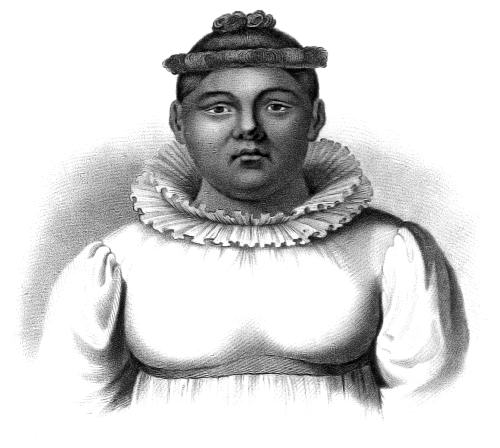 NOMAHANNA,
QUEEN OF THE SANDWICH ISLANDS.
NOMAHANNA,
QUEEN OF THE SANDWICH ISLANDS.