This beautiful island, so richly endowed by nature with every thing that
its simple and innocent natives can require for the enjoyment of
existence, was perhaps first seen by the Spanish voyager Quiras, when,
in the year 1606, he made an expedition from Lima, "to win," as a
countryman of his expresses it, "souls for Heaven, and kingdoms for
Spain." Since, however, the position pointed out by him is extremely
incorrect, it is uncertain whether the island which he called Sagittaria
was really O Tahaiti or not. More probably, the honour of the discovery
belongs to the English Captain Wallis, who in the year 1767 landed
there, and took possession of the country by a solemn declaration, in
the name of his King. As, however, the Tahaitians did not understand
him, this act remained unknown to them; and, notwithstanding a
subsequent renewal, has fallen into oblivion. Captain Wallis gave it the
name of King George the Third's Island.
Eight months after him, the French Captain Bougainville visited it; and
not knowing that Captain Wallis had been there before him, considered
himself the first discoverer, and called it, from the most remarkable
custom of the natives, Nouvelle Cythère, but heard that they
themselves called it Tahaiti, or with the article, O Tahaiti; and this
name it has retained.
The celebrated Englishman, Cook, stopped there in each of his three
voyages, between the years 1769 and 1778. He remained much longer in
communication with the inhabitants than any of his predecessors had
done; brought back Omai, to whom in London it had been attempted to give
an European education, to his native land, and made use of the
narrations he obtained from him during the voyage. Since that time, Cook
and his companions, particularly the two Forsters, father and son, have
given us considerable information concerning the condition of the
Tahaitians before their conversion to the Christian faith.
To estimate the effect of this great change, we must compare Christian
Tahaiti as it now is, with the accounts these early voyagers have left
us of its heathen times; and as every reader may not be conveniently
able to do so, a short review of them may not be considered unwelcome.
The Society Islands, of which Tahaiti is the largest, are, like many
others, either fragments of a Southern continent swallowed up by
earthquake, or a mass of rock ejected from the bottom of the sea by
subterranean fire, which gradually becoming covered with a fertile soil,
is now adorned by the most beautiful vegetation. It consists of two
peninsulas united by a narrow isthmus, which together are about one
hundred and twenty miles in circumference; towards the centre of each
rise wild rocky mountains, intersected by deep ravines, from the side of
which, thickly wooded almost to their summits, flow numerous streamlets
of pure transparent water, forming the most picturesque cascades as
they descend from every direction into the sea. The high mountains are
uninhabited, and the settlements made only in the valleys, more
especially in the low land between the mountains and the sea-shore.
In these charming amphitheatrical landscapes, their houses, consisting
only of roofs resting on stakes, surrounded and shaded by bananas,
bread-fruit and cocoa-trees, are scattered at small distances from each
other.
Attached to every house are enclosed fields, where the proprietors
cultivate their yams, sweet potatoes, and other wholesome and pleasant
roots, which form their chief nourishment.
The rest of the cultivated land is filled by plantations of bananas and
plantains, or little forests of cocoa and bread-fruit trees, so
luxuriantly interwoven, that the burning rays of the sun cannot
penetrate to injure the bright verdure which clothes the soil. The
neatly kept grass footpaths leading through these groves from one
dwelling to another, are variegated with flowers of the richest colours
and most fragrant perfumes, and enlivened by the notes of innumerable
birds arrayed in all the splendid hues of the Tropics. Although Tahaiti
is only seventeen degrees from the Equator, the heat is so much
moderated by refreshing breezes that it is very supportable even to an
European. Bougainville never found it above twenty-two, and often under
eighteen degrees of Reaumur. That indeed was during the winter; but even
in January, the middle of the Tahaitian summer, the atmosphere is much
cooled by the frequent rains. The air is usually dry, clear, and
particularly healthy; sick people brought ashore from a sea voyage
recover rapidly. Here are neither ants, musquitoes, nor any of the
tormenting insects so common in tropical climates; no beast of prey, no
destructive worm nor serpent; even the scorpion (of which a small sort
is to be met with) here loses its poison. The only plague of this kind
is a large rat, which does much mischief in the fields, and sometimes
even bites the Tahaitians during their sleep.
Bougainville says, "The inhabitants of Tahaiti consist of two distinct
races, which remain such, although their language and manners are the
same, and they appear to mingle indiscriminately with each other. One,
the most numerous, produces the tallest men, commonly six feet and
upwards; and I have never seen better proportioned, or finer forms. A
sculptor could not choose a more suitable model for a Mars or a
Hercules. There is nothing to distinguish their features from those of
Europeans; and if they were clothed, and less exposed to the air and the
burning sun, they would be quite as fair. Their hair is usually black
(Wallis saw fair people, and Banks even Albinos). The other race is of
middle stature, with coarse curling hair, and resembles the Mulatto in
complexion and features."
Cook and his companions considered this difference among the Tahaitians
to arise from the circumstance of the tall fair race, (called Eris,
which is pronounced Yeri,) the more distinguished class, being less
exposed to the sun and to hard labour, and their women more reserved and
less licentious.
We were however more inclined to agree with Bougainville, who supposed
the dark Tahaitians to be the original inhabitants, and the Yeris
invaders, who at some remote period had subjugated them; for the latter
are the exclusive possessors of the land; the others obtaining only a
certain remuneration in fruits and vegetables for cultivating the fields
and plantations of their masters. The kings and all great personages are
of this race, which is held by the common people in much veneration.
That the language and customs of both races should have assimilated is
natural; but with respect to their intermarriages, Bougainville was in
error; the pride of the Yeris keeps them aloof from any such
connections, which, had they subsisted, must have long since destroyed
the broad and acknowledged line of distinction. It is, however, only
fair to confess, that this hypothesis of an invasion is unsupported by
any Tahaitian tradition.
"The men of both races," continues this traveller, "allow the lower part
of the beard to grow, but shave the whiskers and the upper lip. Some cut
their hair short off, others bind it together at the top of the head;
both hair and beard they grease with the oil of the cocoa-nut. A girdle
round the middle often serves for their only clothing; but the people
of rank generally wear a large piece of stuff which falls as low as the
knee. This is the principal garment of the women, who put it on in a
very becoming manner. The female Yeris, who never expose themselves to
the sun, and wear a hat of reeds adorned with flowers, which shades the
face, are fairer than the men: their features are handsome, but they are
chiefly remarkable for the beauty of their figures, which are not
spoiled by the artifices of European fashions. They paint their cheeks
red, and colour the lower part of the body dark blue, as an ornament and
a distinction of rank.
"Both sexes are tattooed, and both hang rows of pearls or flowers
through holes pierced in their ears. The greatest cleanliness reigns
among them; they bathe regularly, and wash themselves before and after
meals."
The descriptions of other travellers agree perfectly with this; all
appear to feel the greatest kindness for these "nurselings of joyous
nature," as some one calls them; and to have been particularly charmed
with the women, of whom Wallis says, "They are all handsome, and some
excessively lovely."
The companions of Cook also speak in the highest terms of their
attractions. Their tall and slender figures; the form of their faces,
which is agreeable, though rather round than oval; the tender
transparency of their skin; the complexions which, whether fair or
brown, are always blooming; the expressive eyes, now flashing fire and
now swimming in tenderness; the small white, even teeth, and fascinating
smile, are rapturously described by the younger Forster.
The nose only is defective in these beauties, it is usually too flat,
but may sometimes be seen as perfectly formed as in the females of
Europe.
The curse, "in the sweat of thy brow shalt thou eat bread," falls
harmless on the Tahaitians. Three bread-fruit trees are sufficient for a
man's subsistence during a year; and he has here only to stretch out his
hand to obtain this and many other fruits whose variety may please his
palate. Nutritious roots are cultivated with great ease; and the sea
yields abundance of shell and other fish, for the trifling trouble of
catching it: the brooks also contain fish, and a species of crab. The
opulent eat fowls and pigs roasted over hot stones in a hole in the
ground, the flavour of which is very agreeable even to an European; and,
by way of variety, they roast dogs which have been fed upon
vegetables, and are considered great delicacies.
Several families often live together in the same house, in the greatest
concord. Their furniture consists simply of a few ingeniously-woven mats
for sleeping on, and some vessels made of gourds and cocoa-nut shells.
The disposition of the Tahaitians is gentle, benevolent, open, gay, and
peaceable, although some of them show scars of wounds received in war,
which prove that they are not deficient in courage. To hatred and
revenge they are wholly strangers. Hardly and unjustly as Cook sometimes
treated them, he was pardoned immediately that he required their
assistance, and showed the slightest wish to pacify them. Individuals of
his crew often ventured to pass the nights alone and unarmed upon the
island: they were every where received with the greatest hospitality,
and overwhelmed with marks of friendship. The simple inhabitants, wholly
devoid of envy, rejoiced in each other's good fortune, and when one
received a present, all seemed equally gratified. Their feelings readily
broke out either into smiles or tears: even men were often seen to weep;
and their joys and sorrows were as fugitive as those of children. Nor
are their minds more stable: notwithstanding the great curiosity with
which they gazed at and required an explanation of every object in the
ship, it was as impossible, says the elder Forster, to rivet their
attention for any time, as to make quicksilver stand still.
They seemed incapable of either mental or bodily effort, and their time
was passed in indolence and enjoyment. They were, however, skilful in
manufacturing a soft paper from the barks of trees; nets and lines from
the fibres of the cocoa-nut; and hooks from muscle-shells; in weaving
their rush mats, and especially in building canoes and war-boats. The
latter, large enough to contain forty men and upwards, were made of
planks laboriously split from the trunks of trees with sharp stones,
for want of better implements, fastened together with cocoa threads, and
well caulked. The value they set on our axes and nails may therefore be
easily imagined.
Like all islanders, they are expert seamen, but especially dexterous in
swimming and diving. They fetch any thing with ease from the bottom of
the sea, even at very considerable depths. The upsetting of a boat
causes them no uneasiness; men and women swim round it till they succeed
in righting it again; and then, baling out the water, continue their
voyage with the utmost unconcern.
These voyages, sometimes extending to considerable distances, have made
the observation of the stars, their only guides, absolutely necessary to
them. They have thus attained some astronomical knowledge.
They distinguish the planets from the fixed stars, and call the former
by particular names. They divide the year into thirteen months of
twenty-nine days each, with the exception of one, which has less,
apparently for the purpose of reconciling this lunar with a solar year.
The day and night are each divided into six parts of two hours each,
which they measure exactly in the day by the position of the sun, and at
night by the stars. Medical men have considered them to possess much
skill in surgery, from the kindly healing of wounds which, by their
scars, have evidently been severe.
The Tahaitians are particularly distinguished by their superior
civilization from all other savages, among whom indeed they scarcely
deserve to be ranked. Their language sounds agreeably, and is not
difficult to learn. The vowels occur much more frequently than the
consonants, our c, g, k, s, and p, being entirely wanting. Cook and his
companions made considerable progress in it; and one of them says—"It
is rich in figurative modes of expression; and I am convinced that a
nearer acquaintance with it would place it on a level with the most
distinguished for boldness and power of imagery."
By means of this knowledge of their language, however imperfect, many
details concerning the religion of the Tahaitians were gained. The elder
Forster enters rather at large into the subject.
They believed in one supreme God, Athua-rahai, creator and governor
of the world, and of all other gods. They gave him a consort, who
however was not of the same nature, but of a material and very firm
substance, and therefore called O-te-Papa, that is to say, Rock.
From this pair proceeded a goddess of the moon, the gods of the stars,
the winds, and the sea, and the protecting deities of the several
islands. After the chief god had created the sun, he conveyed his
consort, the mighty Rock, from the West to the East over the sea: in
their progress, some portions of her substance separated from her, and
formed the islands.
Besides the gods of the second rank, they believed also in inferior
deities, and in a wicked genius, who killed men suddenly at the
requisition of the priests—an article of faith which this order
doubtless found very convenient. They also supposed that a genius dwelt
in every man, thinking and feeling in him, and separated himself from
the body after death, but without removing from it; often inhabiting the
wooden images which are erected in the burial-places, but sometimes
stealing at night into their habitations, and killing the sleepers,
whose hearts and entrails he devoured. This belief in ghosts is perhaps
not more universal in Tahaiti than among civilized nations.
According to another of Cook's companions, the supreme God united
departed souls with his own existence, which was signified by the
phrase, "He eats them." This was purification, after which the soul, or
the genius, reached the abode of eternal happiness. If a man, for some
months before his death, had kept himself apart from women, he did not
require this purification, but went direct to Heaven. The pride of the
Yeris prompted them to believe in a Heaven peculiar to themselves, where
they should associate only with their equals in birth.
The Tahaitians of rank had each a Marai sacred to themselves, and
which served for their religious assemblies. The greatest and most
solemn of these meetings were held at the Marai of the Kings. Here the
priests harangued the people; and here was performed the rite which
stained the otherwise amiable character of these islanders—the offering
of human sacrifices! Cook was once present at one of these detestable
oblations, and describes it circumstantially. Its object was to
propitiate the assistance of the Gods, in a war about to be undertaken.
The victim was always of the lower class. He was first killed, and the
ceremonies were afterwards performed by the priests, and many prayers
recited, in presence of the King and people. One of the formalities was
the presentation of the left eye to the King, which however he did not
receive. From this, Cook infers that the Tahaitians had at some period
been eaters of human flesh, and that this morsel was offered to the King
as a delicacy. If this conjecture be well-founded, which I think it is
not, so horrible an appetite must have long since disappeared, as not a
trace of it now remains. It is besides altogether contrary to the
character and manners of the people. So, indeed, is the oblation of
human victims; but this horrible rite had certainly been introduced by
the priests, for the purpose of attracting towards their office an
increased degree of veneration and awe. The burial of the dead was
accompanied by many religious ceremonies, but with the birth of a
child, or the celebration of marriage, their religion was no way
concerned.
If a woman bore her lover a child, which he acknowledged to be his, the
marriage was concluded without further ceremony, but was easily
dissolved and a new connexion formed.
A married man would sometimes entertain a concubine, but never had more
than one wife. The kings only formed an exception to this rule. The last
monarch married at the same time the four daughters of a neighbouring
king, and during our visit they were all living and respected as his
widows. One only of them had brought him children; and when during the
latter years of his government he became a convert to the Christian
religion, this one only passed for his lawful consort.
In both peninsulas of Tahaiti the form of government was monarchical,
and each had its own king, assisted by a council of Yeris, whom he
consulted on all important occasions. These were held in great
veneration among the people. No one, not even a female or a Yeri of the
highest rank, might appear before them without uncovering the upper part
of the body—a token of respect which was usually paid only to the Gods
in prayer or in passing a Marai. Before the princesses, the female sex
only uncovered themselves. All his subjects were much attached to the
sovereign, who reigned under a most singular law of succession.
As soon as a son was born to him, the sovereignty passed from the king
to the infant, in whose name, and during whose minority only, the father
continued to exercise the Regency.
The several districts were governed by deputies chosen from the class of
Yeris, who were also the sole administrators of justice; which amongst
this well-disposed people was generally very mild. The punishments in a
great measure depend on the injured party, and consist chiefly in
stripes. A native assured me that thieves are sometimes hung on a tree;
but they more frequently escape with a few strokes, or sometimes
altogether with impunity.
The two kingdoms of Tahaiti were often in a state of mutual warfare,
though they sometimes fought as allies against a common enemy. Cook and
his companions saw the preparations for a war with the neighbouring
island of Eimeo, and were present at a review of his naval force by the
King O Tu. From the number of warriors who manned this fleet, the elder
Forster estimated the entire population at not less than a hundred and
thirty thousand souls. According to his opinion, Tahaiti was capable of
containing and supporting an infinitely greater number of inhabitants,
and he therefore conjectured that in a short time it would be found
greatly increased. Experience has unfortunately proved this inference to
be erroneous, as will appear in the sequel.
Notwithstanding their usually gentle character, they treated their
prisoners of war with barbarity, but in their defence may be urged the
well-known fact, that in the heat of battle an unwonted rage will
sometimes take possession of the best disposed minds, even amongst
civilized nations; and it was only while this unnatural excitement
lasted that the conduct of the Tahaitians laid them open to the
imputation of cruelty.
Both sexes and all ranks were given to stealing; and so dexterous were
they in plundering the Europeans, that notwithstanding the utmost
vigilance and precaution, few days passed without something being
stolen. The young, beautiful, and noble Marorai stole, as the younger
Forster relates, a pair of sheets from the cabin of an officer, where
she had remained unnoticed during the general confusion occasioned by
the ship running aground. Even the princesses appropriated trifles
whenever they had an opportunity. Our experience, however, proves that
the lessons they have received from their Christian pastors on the
disgracefulness of theft have had a practically good effect.
Neither can I deny that the morals of the Tahaitians were very
exceptionable in another point, in which also the influence of the
Missionaries has been beneficially exerted. If the modesty which
conceals the mysteries of love among civilized nations be the offspring
only of their intellectual culture, it is not surprising that a wholly
uninstructed people should be insensible to such a feeling, and in its
unconsciousness should even have established public solemnities which
would strike us as excessively indelicate.
The coarse hospitality of the Tahaitians went so far as to present to a
welcome guest, a sister, a daughter, or even a wife; and they have been
known to sell them for pearls, pieces of glass, or implements of iron.
The women who distributed their favours indiscriminately, were almost
always of the lowest class; but a most licentious association called
Ehrioi, including both sexes, existed among the higher. Renouncing
matrimony, and the hopes of progeny, its members rambled about the
island leading the most dissolute lives; and if a child was born among
them, the laws of the society compelled its murder, or the expulsion of
the mother. The men were all warriors, and stood in high estimation
among the people. The Ehrioi themselves were proud of the title, and
even the King O Tu belonged to this profligate institution, to which,
fortunately, the Missionaries have put an end.
Where such manners prevailed, and woman was regarded merely as an object
of pleasure, she could not stand in very high estimation; and love, in
its best sense, remained wholly unknown among them. Hence the women of
Tahaiti, although not so much secluded as among many other nations, were
not permitted to eat with the men, and when the King and the Royal
Family visited Cook, on board his ship, he was obliged to entertain even
the princesses in a separate cabin.
The fidelity of a wife among the Tahaitians required that she should not
favour any man without the knowledge and consent of her husband; and a
beating was the punishment generally incurred by a violation of this
duty.
Among the failings of the Tahaitians, their love of the intoxicating
liquor which they prepared from the much cultivated Ava root, must not
be omitted. Nor have the Missionaries been wholly unsuccessful in this
respect. The drink is no longer allowed to be prepared, nor even the
root to be cultivated; but unfortunately, its place has been partly
supplied by the introduction of our wine and brandy; we, however, never
saw a drunken person.
Having now noticed all that was reprehensible in the otherwise amiable
character of the Ante-christian Tahaitian, I hope the reader, in
consideration of his many good qualities, will forgive his faults, and,
in a friendly disposition towards him, cast a glance upon his innocent
amusements, which were chiefly derived from music, dancing, mock-fights,
and theatrical representations.
Their musical instruments were very simple, and of two kinds only: the
one, a sort of flute, producing four notes, and blown with the nostrils;
the other, a drum, made of the hollow trunk of a tree; but the
accompanying songs, usually extempore poems, were pretty, and showed the
delicacy of their ear. The girls excelled in the dance; the married
women were forbidden to take part in it, and the men never did. The
dancers executed a species of ballet, and, according to the judgment of
travellers, they might with little trouble become capable of performing
on our theatres. The English dances they soon learnt, and in the
well-known hornpipe, especially, displayed much grace.
The mock-fights were of course in imitation of their serious warfare,
and they parried with admirable dexterity the blow of a club or thrust
of a lance, by which otherwise they must have been severely wounded. The
dramatic pieces were performed by both sexes, and sometimes by persons
of the highest quality. They were of a mixed character, serious, and
comic, but for want of a thorough acquaintance with the language, they
have been very imperfectly described to us. Thus, oppressed by no care,
burdened by no toil, tormented by no passion, seldom visited by
sickness, their wants easily satisfied, and their pleasures often
recurring, the Tahaitians passed a life of enjoyment under the
magnificent sky of the tropics, and amid scenes worthy of Paradise.
On the 12th of March, a beautiful bright morning, we had the pleasure to
perceive Tahaiti before us, like a light cloud in the clear horizon. All
that we had read of its loveliness now rose to our remembrance,
heightened by the vivid colouring of the imagination; but seventy miles
were yet to be traversed ere we could tread the land of expectation, and
a very slow progress, occasioned by a flagging wind, tried our patience.
We continued, however, to advance, and the light cloud became larger,
and denser, and higher, soon assuming the appearance of three separate
hills belonging to different islands; the highest point, eight thousand
feet above the level of the sea, is the summit of a mountain,
distinguished from the others by its conical form.
We next recognized the large rugged masses of rock of the interior,
which have a most romantic appearance. The country gradually unfolded
all its charms; the luxuriant growth of the trees, even to the
mountains' tops, reminded us of the scenery of Brazil, and the
picturesque valleys, with their thickets of bread-fruit, orange, and
cocoa-trees, their cultivated fields, and plantations of bananas, became
at length distinctly visible.
It was not till the 14th that we reached the Cape, called by Cook Cape
Venus, because he there observed the transit of this planet over the
sun; and from its beauty, it deserves to be named after the charming
goddess herself. It is a low narrow tongue of land, running out
northward from the island, thickly shadowed by cocoa-trees, and forming,
by its curve, the harbour of Matarai, not a very secure one, but
generally preferred by sailors on account of the celebrity bestowed on
it by Cook.
When we were still a few miles distant from Cape Venus, we fired a gun
to draw attention to the flag hoisted at the fore-mast, as a signal for
a pilot. We soon saw a European boat steering towards us; it brought us
a pilot, who, to our great surprise, addressed us in the Russian
language, having recognized our flag as belonging to that nation: he was
an Englishman of the name of Williams, who had first been a sailor on
board a merchant ship, afterwards entered the service of the Russian
American Company on the north-west coast of America, and was at length
settled for life in Tahaiti. His wife was a native of the island; he was
the father of a family, and carried on the occupation of a pilot in the
Bay of Matarai. Wanderers of this kind often settle in the islands of
the South Sea; but while they bring with them many vices peculiar to the
lower classes in civilized life, are generally too ignorant and rough to
produce any favourable influence on the natives. They are not all liable
to this censure; and of about twenty English and Americans whom I found
so naturalized in Tahaiti, some assuredly do not deserve it.
Having a pilot on board, we steered direct for the extreme point of Cape
Venus, where floated the national standard of Tahaiti. This flag
displays a white star in a field of red, and, like many of the present
arrangements, owes its origin to the Missionaries, who do not indeed
bear the title of Kings of the island, but exercise an unlimited
influence over the minds of the natives. We passed safely by the
shallows lying before the Matawai Bay, (upon which Captain Wallis
grounded, and which he called, after his ship, the Dolphin,) round the
headland, to the western side, and at last anchored opposite the village
of Matawai, at a distance of two hundred fathoms from the shore, in a
black clay bottom of fifteen fathoms depth.
Our frigate, as it entered the Bay, attracted to the beach a crowd of
curious gazers, who greeted our arrival with a shout of joy. Numerous
boats laden with all kinds of fruits, provisions, and other articles of
merchandize, immediately put off from the shore, and we were soon
surrounded by gay and noisy Tahaitians. As soon as the sails were taken
in, I gave them permission to come on board, of which they eagerly
availed themselves. With their wares on their backs, they climbed
merrily up the sides of the ship, and the deck was soon transformed
into a busy market, where all was frolic and fun; the goods were offered
with a jest, and the bargains concluded with laughter. In a short time
each Tahaitian had selected a Russian associate, to whom, with a
fraternal embrace, he tendered his wish to exchange names,—a ceremony
which implied a pledge to surrender to the new friend whatever he might
wish for.
It is probable that these sudden attachments were not quite
disinterested; a view of procuring a better barter for their goods might
have had some effect in producing the zeal with which they were struck
up; but they certainly had every appearance of sincerity and cordiality,
and in less than an hour these friendly allies were seen walking in
couples, arm in arm, about the deck, as though they had been acquainted
for years.
Our clothing appeared to be prized by the Tahaitians above every thing
we offered them, and the possession of any article of this kind set them
leaping, as if out of their wits, for joy. On this day we saw no
females; and when we were afterwards occasionally visited by the women,
they always behaved with the greatest propriety.
When the sun declined, our new acquaintances left us to return to their
homes, satisfied with their bargains, and delighted with the presents
they had received, and without having stolen any thing, although above a
hundred of them had been on board at once.
I had sent a message to the Missionary Wilson, by an officer who now
returned, bringing for answer an assurance that the Missionary would
with pleasure do all in his power to assist us in procuring our
supplies; a promise he faithfully kept.
On the following morning we were greeted by the sun from a cloudless
sky, with a most superb illumination of the country opposite to his
rising. His rays glittering on the mountain-tops before they reached our
horizon, gradually enlivened the variegated green that clothed their
sides down to the vales, till the King of Day burst upon our sight in
all his splendour, arraying the luxuriant landscape of the shore in
still more enchanting beauty. Among the thickets of fruit-trees were
seen the dwellings of the happy inhabitants of this great
pleasure-ground, built of bamboos, and covered with large leaves,
standing each in its little garden; but, to our great astonishment, the
stillness of death reigned among them; and even when the sun stood high
in the heavens, no one was to be seen.
The warm friendships formed but yesterday seemed already to have cooled;
we were quite forgotten. At length we obtained from the boat, sent off
to us at break of day with provisions, an explanation of this enigma.
The inhabitants of Tahaiti were celebrating the Sunday, on which account
they did not leave their houses, where they lay on their bellies reading
the Bible and howling aloud; laying aside every species of occupation,
they devoted, as they said, the whole day to prayer. According to our
reckoning, the day was Saturday. This difference proceeded from the
first Missionaries having reached Tahaiti from the west by the way of
New Holland, while we had come eastward by Cape Horn.
I resolved to go ashore and pay a visit to Mr. Wilson, that I might
procure, through his means, a convenient place for our astronomical
observations. We landed at the point of the Cape, because the shade of a
thick palm grove there offered us immediate protection. No one received
us on the strand; no human being, not even a dog, was visible. The very
birds seemed here to celebrate the Sunday by silence, unless, indeed, it
was somewhat too hot for singing. A little brook, meandering among
shrubs and flowers, alone took the liberty of mingling its murmurs with
the devotions of the Tahaitians. I sauntered along a narrow trodden path
under the shade of palms, bananas, orange, and lemon-trees, inhaling
their fragrance, and delighting in the luxuriance of nature. Though
beautiful as this country is, it does not equal Brazil in the variety of
its productions, and in the numbers of its humming-birds and
butterflies. The loud prayer of the Tahaitian Christians reached my
ears, as I approached their habitations. All the doors were closed, and
not even the children allowed to enjoy the beauty of the morning.
The small but pleasant house of the Missionary, built after the
European fashion, stands in the midst of a kitchen-garden richly
provided with all kinds of European vegetables.
Mr. Wilson gave me a cordial welcome to his neat and simple dwelling,
and presented to me his wife, an Englishwoman, and two children, besides
two Englishmen, whom he named as Messrs. Bennet and Tyrman. They
belonged to the London Missionary Society, and had left England three
years before to visit the Missionary Settlements in the South Sea.
The chief Missionary, to whom the others are subordinate, is named Nott,
and lives in the capital where the King resides. He is now far advanced
in life. He has made himself master of the Tahaitian language, and was
the first who ever wrote it. He has translated the Bible, a Prayer Book,
and some Hymns; and has printed a Grammar of the language, under the
title of, "A Grammar of the Tahaitian Dialect of the Polynesian
Language. Tahaiti: printed at the Mission Press, Burder's Point, 1823."
He also first instructed the Tahaitians in reading and writing, which
acquirements are now tolerably common among them. I am sorry not to
have known Mr. Nott better, and therefore not to have it in my power to
judge of the man as well as the Missionary. His character stands very
high. Wilson, also an old man, has now lived twenty years in Tahaiti; he
was originally a common sailor, but has zealously devoted himself to
theology, and is honest and good-natured. Including Nott and Wilson,
there are six Missionaries in Tahaiti alone, and only four among all the
other Society Islands. Each Missionary possesses a piece of land,
cultivated by the natives, which produces him in superfluity all that he
requires, and he also receives an annual allowance of fifty pounds from
the London Missionary Society. This Society has also sent Missionaries
to Tongatabu, one of the Friendly Islands, and to Nukashiva, lately made
known to us by Krusenstern.
Besides these English Missionaries, some native Tahaitians, after
receiving a suitable education, are sent to spread Christianity among
the islands of the dangerous Archipelago. In Russia, a careful education
and diligent study at schools and universities is necessary to qualify
any one to be a teacher of religion. The London Missionary Society is
more easily satisfied; a half savage, confused by the dogmas of an
uneducated sailor, is, according to them, perfectly fitted for the
sacred office.
It was now church-time, and Wilson requested me to be present at the
service,—an invitation which I accepted with pleasure. A broad straight
path, planted with the cocoa and lofty bread-fruit tree, leads from his
house, about a ten minutes' walk, to the place of worship. The
church-yard, with its black wooden crosses, impresses the mind with a
feeling of solemnity: the church itself is a handsome building, about
twenty fathoms long and ten broad, constructed of light wood-work
adapted to the climate, and whitened on the outside, which gives it a
pretty effect among the green shades that surround it. The numerous
large windows remain unglazed, because a free admission of the air is
here desirable in all seasons; the roof, made of ingeniously plaited
reeds, and covered with immense leaves, is a sufficient defence against
the heaviest rain; there is neither steeple nor clock. The interior of
the church is one large hall, the walls of which are neatly kept; it is
filled with a number of benches, so placed, in long rows, that the
occupants can have a convenient view of the pulpit in the centre. When
we entered, the church was full even to crowding, the men seated on one
side, and the women on the other; they almost all had psalm-books lying
before them; the most profound stillness reigned in the assembly. Near
the pulpit, which Wilson mounted, was placed a bench for Messrs. Bennet
and Tyrman, on which I also took my seat.
Notwithstanding the seriousness and devotion apparent among the
Tahaitians, it is almost impossible for an European, seeing them for the
first time in their Sunday attire, to refrain from laughter. The high
value which they set on clothes of our manufacture has already been
remarked; they are more proud of possessing them than are our ladies of
diamonds and Persian shawls, or our gentlemen of stars and orders. As
they know nothing of our fashions, they pay no sort of attention to the
cut, and even age and wear do not much diminish their estimation of
their attire; a ripped-out seam, or a hole, is no drawback in the
elegance of the article. These clothes, which are brought to Tahaiti by
merchant-ships, are purchased at a rag-market, and sold here at an
enormous profit. The Tahaitian therefore, finding a complete suit of
clothes very expensive, contents himself with a single garment; whoever
can obtain an English military coat, or even a plain one, goes about
with the rest of his body naked, except the universally-worn girdle; the
happy owner of a waistcoat or a pair of trowsers, thinks his wardrobe
amply furnished. Some have nothing more than a shirt, and others, as
much oppressed by the heat under a heavy cloth mantle as they would be
in a Russian bath, are far too vain of their finery to lay it aside.
Shoes, boots, or stockings, are rarely met with, and the coats, mostly
too tight and too short, make the oddest appearance imaginable; many of
their wearers can scarcely move their arms, and are forced to stretch
them out like the sails of a windmill, while their elbows, curious to
see the world, peep through slits in the seams. Let any one imagine such
an assembly, perfectly satisfied of the propriety of their costume, and
wearing, to complete the comic effect, a most ultra-serious expression
of countenance, and he will easily believe that it was impossible for
me to be very devout in their presence. The attire of the females,
though not quite so absurd, was by no means picturesque; some wore
white, or striped men's shirts, which did not conceal their knees, and
others were wrapped in sheets. Their hair was cut quite close to the
roots, according to a fashion introduced by the Missionaries, and their
heads covered by little European chip hats of a most tasteless form, and
decorated with ribbons and flowers, made in Tahaiti. But the most
valuable article of dress was a coloured gown, an indubitable sign of
the possessor's opulence, and the object of her unbounded vanity.
When Wilson first mounted the pulpit, he bent his head forward, and
concealing his face with an open Bible, prayed in silence; the whole
congregation immediately imitated him, using their Psalm-books instead
of Bibles. After this, the appointed psalm was sung to a most
incongruous tune, every voice being exerted to its utmost pitch, in
absolute defiance of harmony. Wilson then read some chapters from the
Bible, the congregation kneeling twice during the intervals; the
greater part of them appeared very attentive, and the most decorous
silence reigned, which was, however, occasionally interrupted by the
chattering and tittering of some young girls seated behind me. I
observed that some threatening looks directed towards them by Messrs.
Bennet and Tyrman, seemed to silence them for a moment, but their
youthful spirits soon overcoming their fears, the whispering and
giggling recommenced, and glances were cast at the white stranger, which
seemed to intimate no unwillingness to commence a closer acquaintance.
After the conclusion of the sermon, another psalm was sung, and the
service concluded. The display of costume, as the congregation strolled
homewards in groups, with the greatest self-complacency, through the
beautiful broad avenue, their psalm-books under their arms, was still
more strikingly ludicrous than in church. I had by this time, however,
lost all inclination to laugh.
I had assisted at a great religious assembly of the new, devoted, so
called Christian Tahaitians; and the comparison naturally arising in my
mind, between what I had seen and the descriptions of the early
travellers, had introduced reflections which became less and less
agreeable, in proportion as I acquired a greater insight into the recent
history of the island.
After many fruitless efforts, some English Missionaries succeeded at
length, in the year 1797, in introducing what they called Christianity
into Tahaiti, and even in gaining over to their doctrine the King Tajo,
who then governed the whole island in peace and tranquillity. This
conversion was a spark thrown into a powder magazine, and was followed
by a fearful explosion. The Marais were suddenly destroyed by order of
the King—every memorial of the former worship defaced—the new religion
forcibly established, and whoever would not adopt it, put to death. With
the zeal for making proselytes, the rage of tigers took possession of a
people once so gentle. Streams of blood flowed—whole races were
exterminated; many resolutely met the death they preferred to the
renunciation of their ancient faith. Some few escaped by flight to the
recesses of the lofty mountains, where they still live in seclusion,
faithful to the gods of their ancestors. Schiller's
exclamation—"Furchtbar ist der Mensch in seinem wahn,"[3] was
dreadfully confirmed.
Ambition associated itself, as usual, to fanaticism. King Tajo, not
content with seeing in the remains of his people none but professors of
the new faith, resolved on making conquests that he might force it on
the other Society Islands. He had already succeeded with most of them,
when a young warrior, Pomareh, King of the little island of Tabua, took
the field against him. What he wanted in numbers was supplied by his
unexampled valour, and his superiority in the art of war.
He subdued one island after another, and at last Tahaiti itself, and
having captured its King, offered the zealot murderer of his innocent
subjects as a sacrifice to their manes. In the end, he subjected to his
sceptre all the islands which had hitherto remained independent, and as
sovereign of the whole Archipelago, took up his residence in Tahaiti. He
left to the conquered Kings the government of their islands, requiring
from them a yearly tribute in pigs and fruits; and to consolidate his
dominion by family connexion, he married a daughter of the most powerful
of these royal vassals, her three sisters, according to an ancient
custom, becoming at the same time his wives.
Peace was thus restored to Tahaiti and the whole Archipelago. Pomareh
was a wise and mild ruler. He left his subjects undisturbed in their new
religion, although he did not profess it himself. The Missionaries, now
limited to their powers of persuasion, found means to retain their
disciples in their adopted faith, so that the refugees of the mountains
preferred remaining in their retreats, to finding themselves objects of
hatred and contempt amongst their old friends and relations. At length
Pomareh himself, with his whole family, yielded to the arguments of the
Missionary Nott, allowed himself to be baptized, and died as a
Christian, in the prime of life, in consequence of an immoderate
indulgence in the spirituous liquors which he had obtained from the
ships of his new brethren.
An unconquerable passion for ardent spirits had acquired an entire
dominion over him, although he was so well aware of their deleterious
effects, as to have often exclaimed, when under the influence of
intoxication, "O King, to-day could thy fat swine govern better than
thou canst!" This weakness was, however, so much over-balanced by his
many good qualities, his well-tried valour, his inflexible justice, his
constant mildness and generosity, that he possessed to the last the
universal esteem and love of his subjects, by whom his loss was still
deplored when we arrived at Tahaiti, almost two years after his death,
although he had reigned as an unlimited monarch, and they now possessed
a constitution resembling, or rather aping, that of England. This had
been introduced by the influence of the Missionaries, whose power over
the minds of the Tahaitians is unbounded; they had persuaded the people
to adopt it during the minority of Pomareh's son, a child of four years
old at the period of our visit; but from the general regret with which
the days of the absolute King were remembered, it did not appear to have
given much satisfaction.
According to this Constitution, Tahaiti is divided into nineteen
districts, and the neighbouring island of Eimeo, having no especial
viceroy, into eight. Every district has its governor and its judge,
whose business is to settle disputes and maintain order. The first is
appointed by the Parliament, and the latter elected by the people. These
nominations are for one year only—but may be renewed at the expiration
of the term. Important affairs are submitted to the Parliament, which,
consisting of deputies from all the provinces, possesses the
legislative, as the King does the executive power.
The Tahaitians, accustomed to a blind reverence for the Missionaries,
consult them in all their undertakings, and by means of the Constitution
have so confirmed their power, both as priests and rulers, that it would
be difficult for governor, judge, or member of parliament, to retain
their offices after having incurred their displeasure. They have shown
their artful policy in the choice of a guardian for the young King. It
has fallen on the tributary King of the island of Balabola,
distinguished by his giant height of seven feet, and by his enormous
corpulence, which almost prevents his moving, but by no mental
qualification.
This mountain of flesh, that at a distance might rather be taken for
some unknown monster than for a man, naturally finds it more convenient
to his indolence to be merely the mouthpiece of the Missionaries, and
that their dominion may also be secured for the future, Mr. Nott has the
sole charge of the young monarch's education, and will not fail to bring
him up in the habit of implicit obedience.
The actual document securing the Constitution had not yet appeared; the
Missionaries were still employed on it, well convinced, that whatever
they should insert would be received without opposition. When complete,
it will probably issue in due form from their Printing-Office, and will
be interesting, if some future traveller should bring us the
translation.
Firm as the foundation of the Missionaries' power appeared, one little
cloud was visible in the political firmament. A son of the vanquished
King Tajo yet existed, and was not entirely without adherents. If by any
chance he should succeed in gaining possession of the throne, he might
remember that these men had assisted in excluding him from it. For this
reason, they resolved to confirm the title of the young Pomareh, by a
solemn coronation; and to strengthen his party, all the tributary
princes of the whole Archipelago were invited to be present at the
ceremony.
The preparations for this solemnity had long been carrying on, and as it
was now soon to take place, nearly all the kings, with numerous suites,
had arrived in Tahaiti. Among them was the powerful ruler of Ulietea,
the grandfather of the infant sovereign; he had brought with him several
hundred warriors, many of them armed with muskets.
We wished much to have been present at this first coronation of a King
of the Society Islands; but as our time would not permit it, I obtained
from Mr. Tyrman an account of the order and plan of the ceremony.
The kings, princes, members of parliament, and other high officers, were
to assemble at the residence of the Queen, and thence in a regular
procession, arranged according to their several ranks and dignities, and
headed by the young King and the Missionaries, to pass to an appointed
open space, where a throne of stone had been erected, on which the
little Pomareh was to be seated. The procession was then to form a
circle round him, and Mr. Tyrman, after making a speech, was to set on
the King's head a crown, resembling in shape that of England, in which
country it had been made. A Bible was then to be placed in his hand,
with the admonition, "According to this Law, thou shall govern thy
people." Upon this, the train being marshalled as before, the King
should descend from his throne, and proceed to the church, where, after
the performance of divine service, he should be anointed. The ceremonies
should then conclude with a grand banquet.
It is remarkable that the Bible, and not the Act of the Constitution,
was to be given to the King, as the rule of his government. Was not a
sly mental reservation perhaps intended by this? If the Constitution
should not have exactly the effect intended, and the Tahaitians,
emboldened by it, should seek to withdraw themselves from their
leading-strings, then might the pupil of Nott, bound to them by no oath,
come forward to them boldly, and force them back under the yoke of the
Missionaries; all the while conscientiously obeying the rule of conduct
which had been delivered to him, according to the interpretation he had
been taught to put on it.
How this coronation turned out—whether the son of Tajo allowed it to
pass quietly—whether he has met the fate of many an unfortunate
European pretender, or survives to become the originator of a civil war,
which may yet give another destiny to Tahaiti, remains to be learnt from
the accounts of some future traveller.
Religion and political institutions may raise a nation in a short period
to a high point of civilization, and they may also serve, as in case of
the Turks, to retain them in perpetual barbarism. How will these mighty
powers operate on the Tahaitians? How can they, the qualifications of
their authors considered!
True, genuine Christianity, and a liberal government, might have soon
given to this people, endowed by nature with the seeds of every social
virtue, a rank among civilized nations. Under such a blessed influence,
the arts and sciences would soon have taken root, the intellect of the
people would have expanded, and a just estimation of all that is good,
beautiful, and eternally true, would have refined their manners and
ennobled their hearts. Europe would soon have admired, perhaps have
envied Tahaiti: but the religion taught by the Missionaries is not true
Christianity, though it may possibly comprehend some of its doctrines,
but half understood even by the teachers themselves. That it was
established by force, is of itself an evidence against its Christian
principle. A religion which consists in the eternal repetition of
prescribed prayers, which forbids every innocent pleasure, and cramps or
annihilates every mental power, is a libel on the Divine Founder of
Christianity, the benign Friend of human-kind. It is true, that the
religion of the Missionaries has, with a great deal of evil, effected
some good. It has abolished heathen superstitions, and an irrational
worship, but it has introduced new errors in their stead. It has
restrained the vices of theft and incontinence, but it has given birth
to bigotry, hypocrisy, and a hatred and contempt of all other modes of
faith, which was once foreign to the open and benevolent character of
the Tahaitian. It has put and end to avowed human sacrifices, but many
more human beings have been actually sacrificed to it, than ever were to
their heathen gods.
The elder Forster estimated, as we have already seen, the population of
Tahaiti at one hundred and thirty thousand souls. Allowing that he
over-calculated it, by even as much as fifty thousand, still eighty
thousand remained:—the present population amounts to only eight
thousand; so that nine-tenths must have disappeared. The diseases
introduced by the ardent spirits, the manufacture of Europe and America,
may, indeed, have much increased the mortality, but they are also known
in many islands in the South Seas, without having caused any perceptible
diminution in the population. It is not known that plague of any kind
has ever raged here: it was, therefore, the bloody persecution
instigated by the Missionaries which performed the office of a
desolating infection. I really believe that these pious people were
themselves shocked at the consequences of their zeal; but they soon
consoled themselves; and have ever since continued to watch with the
most vigilant severity over the maintenance of every article of their
faith. Hence, among the remains of these murdered people, their former
admirable industry, and their joyous buoyancy of spirits, have been
changed for continual praying, and meditating upon things which the
teachers understand as little as the taught.
The Tahaitians of the present day hardly know how to plait their mats,
make their paper stuffs, or cultivate a few roots. They content
themselves with the bread-fruit, which the soil yields spontaneously in
quantities more than sufficient for their reduced population. Their
navy, which excited the astonishment of Europeans, has entirely
disappeared. They build no vessels but a few little paltry canoes, with
which they fish off the neighbouring coral islands, and make their
longest voyages in American and European boats which they have
purchased. With the method of producing those commodities of civilized
nations which they prize so highly, they are still as much as ever
unacquainted. They possess sheep, and excellent cotton; but no
spinning-wheel, no loom, has yet been set in motion among them; they
choose rather to buy their cloth and cotton of foreigners for real gold
and pearls; one of our sailors sold an old shirt for five piastres.
Horses and cattle have been brought to them, but the few that remain
have fallen into the possession of strangers, and have become so scarce,
that one hundred piastres was asked for an ox, that we wanted in
provisioning the ship. The Queen alone possesses a pair of horses, but
she never uses them. The island contains but one smith, though the
assistance of the forge and bellows would be so useful in repairing the
iron tools which have superseded those of stone formerly in use. It is
extraordinary that even the foreigners established here carry on no kind
of mechanical trade. Can it be that the Missionaries object to it? It is
certain that they possess great influence even over the settlers. An
American, however, was planning the introduction of a sugar
manufactory, and promised himself great profit from it.
By order of the Missionaries, the flute, which once awakened innocent
pleasure, is heard no more. No music but that of the psalms is suffered
in Tahaiti: dancing, mock-fights, and dramatic representations are no
longer permitted. Every pleasure is punished as a sin, among a people
whom Nature destined to the most cheerful enjoyment. One of our friends
having begun to sing for joy over a present he had received, was
immediately asked by his comrades, with great terror, what he thought
would be the consequence, should the Missionaries hear of it.
It is remarkable that the degenerate Tahaitians are no longer even in
person such as they are described by the early travellers. Their
religion appears to have had an effect inimical to their beauty. The
large-grown Yeris, solely employed in praying, eating, and sleeping, are
all, men and women, excessively fat even in early youth. The smaller
common people, constrained to some degree of industry, look plump and
well fed, but not so swollen as their superiors, and more fine forms
are therefore to be seen among them than among the Yeris: the latter
also frequently suffer under a most disfiguring disease caused by want
of exercise and excess of nourishment: the legs swell to such a degree
from the knees downward, that the form of the calf and foot is entirely
lost, and the thick cylinders which usurp the place of legs, and from
under which the toes only project, resemble nothing but the legs of
elephants; thence the name of elephantism has been bestowed on the
complaint by Europeans. It does not appear to cause much pain.
The men of both classes shave the beard, and both sexes cut their hair
so close, that the skin can be seen under it; a fashion ugly enough for
any face, but especially so with their brown complexions, as it gives
them an ape-like appearance. As, however, a compliance with this custom,
is a mark of Christianity, and the heathen fugitives to the mountains
have retained their long hair, even the young females are proud of thus
disfiguring themselves.
All vanity is sin, and all care of the person is vanity. Hence the fat
Yeri beauties no longer shelter their skins from the burning rays of
the sun, and are become as brown as the rest. All the graces have
departed from them; their fascinating smiles have vanished; and the
rancid cocoa-oil with which they smear themselves may be smelt at many
paces distance. In short, either the picture drawn of them by the early
travellers was a monstrous flattery, or they are altogether different
from what they were. I saw but one handsome girl at Tahaiti; she was the
sister of the little King, only fourteen years old, and already the
bride of her uncle, the Prince of Ulietea. The men far surpass the women
both in form and feature.
The Missionaries have abolished the custom of tattooing, and so far at
least spared the Tahaitians some useless torment. These marks are now
only to be seen on people of the middle age and upwards—never on the
young. The first voyagers who visited this island, describe the
tattooing as representing half-moons, birds, and irregular or zig-zag
lines; but on a better acquaintance with Europeans, the fashion changed,
and drawings of our tools, animals, and even compasses and mathematical
instruments, were executed with the greatest exactness on their bodies.
Pantaloons being articles in particular request among them, he who could
not obtain a pair, comforted himself by having the representation of
them etched on his legs. Many of these are still to be seen.
We much wished to have had an opportunity of comparing the soi-disant
Christian Tahaitians, with the heathen inhabitants of the mountains; but
it would have taken too much time to seek them out in their retreats,
which they leave only at night for the purpose of robbing the dwellers
in the valleys, among whom they dare not appear in the day.
If the religion of the Missionaries has neither tended to enlighten the
Tahaitians nor to render them happy, just as little can be expected from
the Constitution founded upon it, which seems adapted only to draw yet
tighter the bonds in which this amiable people are held by their zealous
converters, and to retain them wholly under their authority.
By the influence of Wilson, a small house situated on Cape Venus was
cleared for our astronomical observations: we were told it stood
precisely on the same spot where Cook's Observatory had formerly been
erected. As a particular favour from the Government, I was also
accommodated with a royal pleasure-house in its neighbourhood for my
private residence. This very large building, which resembled an ancient
temple in appearance, had been a favourite abode of the deceased monarch
Pomareh, and since his death had remained uninhabited, out of respect
for his memory. A number of utensils which had belonged to him, and a
canoe, on which he had obtained many splendid victories, were still
preserved here as memorials of the beloved king. The house was wholly
without walls—the roof of leaves resting on numerous pillars; a mode of
construction extremely well adapted to this warm and dry climate. The
environs were very beautiful: high trees covered with thickest foliage
invited to repose under their shadows, and a brook clear as crystal
offered an inviting bath. The air was filled with the perfume of a
neighbouring orange-grove, which scattered its fruit upon the earth. The
lemons and oranges, which we found delicious, the Tahaitians despised as
too common. Since I could only afford to remain a very short time at
Tahaiti, Dr. Eschscholz and myself immediately took possession of my new
abode, and erected our little observatory. After a long, wearisome
voyage, I cannot express the delight I experienced in reposing amidst
such enchanting scenes of natural beauty. We passed a charming evening,
and a most refreshing night under our roof of leaves.
In the morning, as we were drinking our coffee and smoking our pipes,
while laying the plan of our observations so as to employ our short time
to the best advantage, a messenger arrived from the Queen requesting to
speak with me.
I desired he might be admitted, and a giant Yen strode proudly in,
accompanied by our pilot as interpreter. His only garment, with the
exception of the girdle always worn by the men, was an old worn-out
sand-coloured coat, with great shining buttons, in the fashion of the
last century, and so much too small for its present possessor, that he
could not button it, while his naked arms stuck out more than a quarter
of a yard below the sleeves. His bald head was covered by a red
night-cap, which, to show his knowledge of the customs of civilized
nations, he raised a little on his entrance.
He uttered, as he came towards me, the word Jorona (good day), stretched
out his great hand to me, and then, without waiting for my invitation,
seated himself on the ground close to my feet, with his legs crossed in
the Turkish fashion. The Queen had sent him to inform me, that she was
curious to see the Commander of a Russian frigate, and would gladly have
entertained me at her court; but as she feared I would not absent myself
so long from Matarai, she had resolved to pay me a visit accompanied by
the whole Royal Family. The ambassador added, that these exalted
personages, who had travelled by water, would soon arrive, and that he
must hasten to receive them; then rising, he pressed my hand, repeated
his jorona, touched his night-cap, and disappeared.
I had scarcely time to prepare for the reception of my illustrious
guests, when the concourse of people hastening to the shore announced
their approach. A man soon appeared as avant courier, in the short,
red uniform-jacket of an English drummer, an uncommonly showy,
many-coloured girdle, and the rest of his body, according to custom,
quite naked. His legs were adorned by a tattooed representation of
pantaloons; and when he turned his back and stooped very little, he
showed also a drawing of a large compass, with all the two-and-thirty
points executed with striking exactness. In his hand he held a rusty
broad-sword, and on his head was proudly displayed an old torn
three-cornered hat, with a long red feather. Our interpreter described
him as the royal Master of the Ceremonies; but it afterwards appeared,
that though not apparently belonging to the Yens, but to the smaller
race, he held several other offices in conjunction with this—those of
cook and chamberlain, for example: his talent, however, seemed most to
incline to that of court-fool or harlequin.
In all his motions, gestures and grimaces, he displayed so singular a
vivacity, that he might have been considered insane. Without the least
ceremony, or paying the slightest attention to me, he took possession of
my whole house. Several servants, in the livery of nature, followed him
with the various articles necessary to the convenience of the Royal
visitors. He immediately ordered that the whole floor should be covered
with matting, and had every thing placed as he thought proper, leaping
about all the while with both feet in the air, as if his life depended
on the velocity of his motions. No one of the servants pleased him; his
tongue ran incessantly; and his sword was flourished about in all
directions.
His preparations were not yet complete, when we saw a long procession of
Tahaitians approach, two and two, bearing on their shoulders various
kinds of provisions fastened on bamboo poles. This set our caperer upon
increased activity. Two or three springs having carried him out of the
house, he commanded the bearers to set down their burdens, which were
presents from the Queen to me, in a certain order, in front of my
dwelling. Three large pigs formed the right flank; and opposite to them
were piled potatoes, yams, sweet potatoes, and all kinds of delicious
fruit. When the Master of the Ceremonies had arranged them all to his
satisfaction, he turned, for the first time, to me, and endeavoured,
with many comical pantomimic gestures, to make me understand that all
were mine. At length the Queen herself appeared, followed by a numerous
train of attendants. She walked first, carrying the little King in her
arms, and holding her daughter, the betrothed of the Prince of Ulietea,
by the hand. After her came her three sisters, all like herself, large
fat women, and then the whole crowd of the Court. The rear was brought
up by a multitude of people of the lower class, bearing viands for the
Royal entertainment, in utensils made of various kinds of gourds. Among
the dainties was a live pig, which squeaking and grunting in
anticipation of its fate, supplied to this orderly procession the
absence of a musical band.
The Queen and her three sisters were wrapped in sheets; and their straw
hats still bore streamers of black crape, as signs of mourning for the
late King. The little Pomareh, a pretty, lively boy, was dressed quite
in the European fashion, in a jacket and trowsers of bombasin; he wore a
round hat, but his feet, like those of all the other Tahaitians, were
bare. They object that any kind of shoe hinders their walking. The
young bride, a handsome girl, as I have before said, was very lightly
clad in a short striped shirt, without any covering on her head. The
giant Yeris who formed the Court, mostly wore white shirts, and round
straw hats with black ribbons.
It was the first time, since the death of her consort, that the Queen
had entered these precincts, and a shower of tears fell from her eyes at
the remembrance of the past. The whole court, as in duty bound, was also
immediately dissolved in grief; but this sorrowful mood did not last
long; their faces gradually cleared up—the Queen dried her tears, and
greeted me kindly. The Master of the Ceremonies then conducted the Royal
Family to the best mats, on which they sat down in the Asiatic fashion.
One of my chairs was placed opposite the Royal Family, and I was invited
to take my seat. In the mean time, the Master of the Ceremonies had
vanished to prepare the repast.
When the Queen, after surveying me from head to foot, had communicated
her remarks and opinions to the company, I requested the interpreter to
thank her, in my name, for my friendly reception on the island—for the
presents she had made me, and for the high honour conferred on me in
this visit. She received my thanks very graciously, and ordered some
questions to be put me, which I answered with all due respect. She
inquired how old I was?—whether my voyage had been long?—whether I was
a Christian?—and how often I prayed daily? This last question
afforded me an opportunity, had I thought fit, to give her Majesty some
new ideas on the subject of the Missionary religion; but I did not feel
myself quite capable of entering into a theological dispute, and
therefore merely replied, that Christianity taught us, that we should be
judged according to our actions rather than the number of our prayers. I
do not know how the interpreter rendered my answer, or whether the Queen
considered me as a heretic, but this I conjectured, from her speaking no
more on religious subjects, and asking me, in order to change the
conversation, whether the earth were really round? I assured her Majesty
that I could answer from my own experience, as I was now sailing round
it for the third time. This appeared to excite some astonishment; but
my assertion concerning its spherical form still gained but small
credit.
I then produced some presents for the Queen, her family, and their
immediate attendants, which, though in themselves extremely trifling,
were received with great pleasure, and produced a degree of hilarity
little consistent with the symbols of mourning worn by the Royal party,
or the feelings they had displayed on their first arrival.
To the Queen I presented a piece of calico four or five yards long, a
coloured silk handkerchief, a small looking-glass, a pair of scissors,
and some glass beads; to the young Princess, a silk handkerchief, beads,
and a looking-glass; to the sisters of the Queen, cotton handkerchiefs,
glasses, and scissors; their attendants, among whom were four ladies,
were content with knives.
During this time the Master of the Ceremonies had killed the pig, and
baked it in the earth in the Tahaitian manner. As soon as the Royal
Family had resumed their seats he brought it in, and placed it before
the Queen, on a great banana-leaf, other servants spreading yams,
potatoes, and bread-fruit upon the ground. My chair was brought and
placed opposite to the Queen, who invited me, with much friendliness, to
partake of the meal. I preferred, however, being an idle spectator, for
it was still very early in the day, and I had no appetite. When all the
provisions were brought in, the Master of the Ceremonies made a leap
into the air, flourished his rusty broad-sword, and then repeated a loud
prayer. All the company hung down their heads, and prayed with him in
silence. The prayer being concluded, the Master of the Ceremonies seized
the baked pig by the hind-legs and tore it in two; then, having carved
the whole with his broad-sword, laid a tolerably large portion on leaves
before each member of the Royal Family, who immediately attacked it with
a good appetite, helping themselves with fingers and teeth, instead of
knife and fork. During the repast, the suite ate nothing, but remained
looking on, and I did not perceive that they were indemnified for their
abstinence, even when the residue of the feast was carried out. When the
repast was over, and a prayer said as before, the Royal personages
washed their hands with water, and their mouths with cocoa-milk, and
then lay down altogether to sleep; the attendants retiring. I offered to
her Majesty the use of my bed, which she condescendingly accepted; and
during the siesta, I returned to my plans for our astronomical
observations. On awaking, the Queen expressed a wish to see my frigate;
my time was not at my own disposal, but I entrusted to one of my
officers the charge of doing the honours of the ship to our Royal
guests, as well as circumstances would permit. On leaving me, the Queen
pressed my hand in the most friendly manner, and repeated her jorona
several times; her whole train followed her.
On the strand, according to the account of my officer, the canoes lay in
readiness for the excursion. The Queen, accompanied by her family and
our officer, put off in her own European boat; the Master of the
Ceremonies took his station in the fore-part of the boat, turning his
compass to the company, and continued, during the passage, his
ridiculous harlequinades with his limbs and broad-sword, as if he had
been afflicted with Saint Vitus's dance. When they reached the frigate,
the deck was already occupied by Tahaitians, carrying on their trading
with so much eagerness and noise, that scarcely a word could be
distinguished. The vessel was also surrounded by a crowd of canoes
filled with all kinds of wares for barter; and so little attention was
paid to the Royal Family, that it was with much difficulty our people
could clear the way for their boat. Nor did the presence of these high
personages attract much more notice when they had climbed the deck;
their subjects continued to drive their bargains without interruption,
and scarcely vouchsafed the slightest salutation. Very different would
have been their conduct on the arrival of a Missionary. The Queen was
probably hurt by this neglect, for she went directly into my cabin,
followed by her family, and remained there till she quitted the ship.
The construction of the vessel was not likely to excite her curiosity,
as she was herself the owner of a well-built English merchant ship.
The goods in the cabin, however, delighted the ladies, who admired and
wanted every thing; nor was it easy to convince them, that each article
they coveted was indispensable to our convenience.
The officers exerted themselves to maintain the good-humour of their
guests by trifling presents, and, amongst other things, gave them a
piece of sham gold-lace, several yards in length, which was received
with extraordinary eagerness. The Royal sisters divided it between them,
and added it to the black crape trimming of their hats; and so great was
the admiration excited by this novel article of finery, that the rage
for gold-lace became an absolute fever among the more distinguished
Tahaitian ladies. Vain now proved the severe lessons of the
Missionaries, forbidding all adornment of the person. There was no end
to petitions for lace, and the more our store of it diminished, the more
highly did they value the smallest piece they could obtain. The
tormented husbands came every day to the ship, willingly offering a fine
fat pig and eight fowls for half an ell of the false lace, to satisfy
the longings of their wives. They beset me incessantly in my dwelling
on shore, for this new and invaluable appendage of luxury; and were
astonished beyond measure, that I, the commander, should possess none of
it. The ladies who finally were unsuccessful in procuring the means of
imitating a fashion thus accidentally introduced by the Royal sisters,
tout comme chez-nous, actually fell ill and gave themselves up to the
boundless lamentations of despair.
While the Royal Family remained below in the cabin, their attendants
were engaged on deck in purchasing from our sailors all sorts of old
clothes for a hundred times their value, in Spanish piastres. The
Tahaitians have yet no notion of the value of money, which they get from
the ships that touch at the island, and by their trade in cocoa-oil with
New Holland.
The Missionaries have done their utmost to draw money into the country,
and for this purpose have fixed prices on every article of provision,
under which no one dares to sell them to foreign ships. These prices
are, however, so high that nothing but necessity would induce any one to
pay them, so that the ships in general rather provide themselves with
old clothes, utensils of various kinds, and toys, which enable them to
make most advantageous barters, and frequently even to bring away money.
The plan of the Missionaries, therefore, like many other financial
regulations, has been found in operation to produce a result directly
contrary to the effect intended.
During the visit to my vessel, the young Princess had found an
opportunity to bargain with a sailor for a sheet; having secured this
treasure, she ran with it upon deck in the most extravagant joy, viewed
it over and over with delight, and there formed it into a really very
becoming drapery. She appeared quite conscious of her increased
attractions in this attire, leaped about in the most sprightly manner,
and called on all the persons of the Court to admire her. In short, a
young European lady on first decorating herself with the most costly
Persian shawl, would not have been half so happy as this young Princess
dressed in the sailor's sheet.
At four o'clock, the dinner was served to our guests and their suite,
entirely in the Russian mode; except the etiquette of placing the Royal
Family a little apart from the rest of the company. The infant King had
long before begun to cry from weariness, and had been carried back into
the boat, where he had quietly fallen asleep. A prayer was repeated
before and after dinner. The visitors seemed to think our dishes very
palatable, and even the Royal Family ate with good appetite, though they
had so recently made a substantial meal. Their conduct was extremely
decorous, and showed much aptitude in imitation. They made use of the
knives, forks, and spoons as readily as if they had been always
accustomed to them; and the wine, though by no means despised, was very
moderately enjoyed.
After dinner a general conversation took place, in which a man of
seventy years of age distinguished himself by his animation and
intelligence. He was the only individual present who had personally
known Captain Cook. He asserted that he had been his particular friend,
and for this reason still bore his name, which he pronounced quite
correctly, although there is neither a C nor K in the Tahaitian
alphabet. He boasted not a little of having accompanied Cook in his
coasting voyages about the islands, and of having often slept in the
same tent with him. He knew the names of all Cook's company, and could
recollect the particular pursuits of each officer. To describe the
manner in which Cook had observed the height of the sun, he asked for a
sextant, placed himself in a stooping position, and looking fixedly upon
an angle, often called with a loud voice, Stop!
He could relate the Bible-history in short extracts, from the Creation
to the birth of Christ; and in order to explain the doctrine of the
Trinity, he held up three fingers, pressed them together, and looked
towards the Heavens. The old Cook (as he called himself,) was not
entirely ignorant of geography. He said he possessed a map presented to
him by his friend;—that England was an island, and much smaller than
Russia; and traced out, on a map of the World being opened before him,
the way by which we had come to Tahaiti.
At sunset our Royal visitants departed, highly gratified with their
entertainment, and returned to the capital. This visit being over, I
hoped to be at liberty to pursue my occupations in peace, but in this I
was disappointed. Though my habitation was surrounded by sentinels, I
was continually disturbed by swarms of curious islanders, who,
troublesome as they were, were yet so gentle and good-tempered that it
was impossible to be angry with them. They were particularly pleased
with Dr. Eschscholz's little museum, and took pains to collect from
every corner of the island, butterflies, beetles, birds, and marine
productions, by way of showing their sense of the kindness with which he
exhibited his treasures, often receiving from him in return some
trifling present, which they considered of great value. One of them was
fairly overpowered with gratitude by the gift of an old coat. With much
admiration of such profuse generosity, and many expressions of rapture,
he at length succeeded in cramming his large body into the garment of
the infinitely smaller and more slender philosopher, and strutted about
with his back hunched up, and his arms sticking out, envied by all his
acquaintances for the magnificence of his attire.
Though the vice of theft has certainly greatly diminished among the
Tahaitians, they cannot always refrain from endeavouring to appropriate
the articles they prize so highly. For instance, I think if any one of
the Tahaitian ladies had found an opportunity of stealing a bit of the
mock gold lace, the temptation would have been too great to withstand.
Every theft however is, on discovery, punished without distinction of
persons, and the criminal, on conviction, is generally sentenced to work
on the highway. A road has been made round the island, on which those
who have committed great transgressions, are condemned to labour; but it
is probable that neglect of prayer, or any trifling offence against the
Missionaries, would also entail this punishment upon them.
We had an opportunity of observing the severity with which theft is
punished. A complaisant husband could not resist the entreaties of his
wife, who longed for one of our sheets. One day, when the sailors were
washing in the river, he took an opportunity, unperceived as he thought,
to snatch up one of these coveted articles and run off with it. Some of
his countrymen, who had watched him, directly brought him back, bound
him to a tree, and informed me and a Missionary of the circumstance. On
reaching the spot, I already found the Judge of the district and the
Missionaries Wilson and Tyrman standing beside the thief, who was still
bound to the tree. Mr. Tyrman, who was especially bitter, could not
refrain from abuse: he called the criminal a brute, who was not worthy
to be treated as a human creature, and acted altogether as if the affair
were his. This would have surprised me, as the judge of the district was
present, and Mr. Tyrman had no official appointment on the island, but
he was a member of the Missionary Society,—et tout est dit. I was now
asked if I wished the offender to be whipped, as he had not the means of
paying the forfeit of three pigs to the person robbed, which the law
demands, in addition to the punishment of ignominious labour. I forgave
him the equivalent for the pigs, and begged that he might be dismissed
with a severe admonition upon the disgrace of theft, and an earnest
warning for the future. This request, however, was not granted, and the
unfortunate offender was taken away, still tied, to work on the highway:
the Judge and Mr. Wilson concurred in assuring me that he was not a
Tahaitian, but an inhabitant of another island, who had come hither with
one of the tributary kings, and declared that a Tahaitian would not have
stolen the sheet. The only article which we lost besides this, was an
iron hoop from a barrel, and as the thief was not discovered, it
remained undecided whether their assertion was well-grounded or not. At
all events, it appears certain that thefts do not take place oftener
than among civilized nations.
With the chastity of the Tahaitian women, the case is similar; and it
does not appear to me that the breaches of this virtue are more frequent
on the whole than in Europe. It was with the utmost caution and secrecy,
and in the most fearful anxiety lest their errors should be betrayed to
the Missionaries, that the females complied with the desires of our
sailors. An accidental occurrence proved that their terrors were not
groundless. A married man who possessed a house of his own, was induced
to barter, according to the custom of his ancestors, the favours of his
wife for some pieces of iron: he had also assisted a young man in an
intrigue with a woman whose husband was not so complaisant, by lending
his house as a place of rendezvous. Suddenly the owner and his wife
disappeared in the night, the house was found empty next morning, and we
could never learn what had become of its proprietors. Have the
Missionaries already introduced the Oubliettes?
Having occasion one morning to visit Wilson on business, I found his
door, which usually stood open, closed and fastened: I knocked several
times; but the whole house seemed buried in the repose of death: at
length, after loud and repeated strokes, the door was opened by Wilson,
whose cheeks bedewed with tears made me apprehensive that some great
calamity had befallen him; I was however soon satisfied that devotion
alone had caused this emotion. In an ante-room I found four or five
naked Tahaitians, of the highest rank, as Wilson told me, on their knees
reading the Bible. Having apologized for what appeared to be an
unseasonable intrusion, I was about to retire, but was invited by
Wilson, in a friendly manner, into the inner apartment, where I found
his whole family, with Messrs. Bennet and Tyrman, kneeling round a
breakfast-table, on which coffee and various kinds of meat were
arranged. Tyrman was praying aloud, the rest silently joining him. He
thanked God for the progress the Missionaries had made in spreading
Christianity. How willingly would I have concurred in his thanksgiving,
had the religion they taught been true, genuine Christianity, propitious
to human virtue and human happiness.
The prayer lasted yet a quarter of an hour; on its conclusion, the
company rose and breakfasted with a good appetite; but offered nothing
to the distinguished personages in the other apartment, who were
suffered to leave the house unnoticed.
I found the bread-fruit, as baked in the ovens by the Europeans here,
excellent. The natives retain their old custom of baking in the earth.
During breakfast, Wilson related the difficulties he had encountered in
the conversion of the Tahaitians. They would not allow that his faith
was superior to their own; and when he appealed to the miracles which
confirmed the truth of the Christian doctrine, they required that he
also should restore sight to the blind and raise the dead to life; the
confession of his inability was met with derision, and for many years he
gained no disciples. How different, in all probability, would the effect
have proved, had he, instead of the miraculous history of his religion,
directed the attention of the susceptible Tahaitians to its pure
morality, leading so naturally to the idea of a common Father, and a
fellowship of charity. O, ye Missionaries, how much blood might ye not
have spared!
I received another visit from the Royal Family, accompanied this time by
many of the Vice-Kings then in Tahaiti, with their consorts. Among them
was the grandfather of the little monarch Pomareh the Second. After some
preliminaries, my illustrious guests unanimously preferred a request in
the most modest, yet pressing manner. They wished me to get a pair of
boots made for the little King. His coronation, they said, would soon
take place, and they did not think it decorous, on so solemn an
occasion, for the Sovereign of all the Society Islands to sit barefooted
on his throne.
I immediately ordered my shoemaker to provide for the Royal necessity;
the measure was taken, and my complaisance rewarded by the gratitude of
the whole company. At this visit, also, the guests ate and slept. I took
advantage of this opportunity to observe the method of preparing the
pig, always the chief dish in their feasts. A sufficiently large round
hole was dug in the earth, and filled with stones. A fire was then
lighted in it, and kept burning till the stones were red-hot, when the
ashes and cinders were taken out, and the stones covered with large
banana-leaves, upon which the pig was laid, after being thoroughly
cleaned, and stuffed with the glowing stones; more leaves were spread
upon it, and covered with hot stones, and finally, the hole was filled
up with earth. After a certain time it was taken out, and proved a more
tender and delicate roast, than the best European cook could have
produced. They dress their vegetables in the same manner, and the
flavour is excellent; the bread-fruit, only, I preferred as baked in
Wilson's European oven.
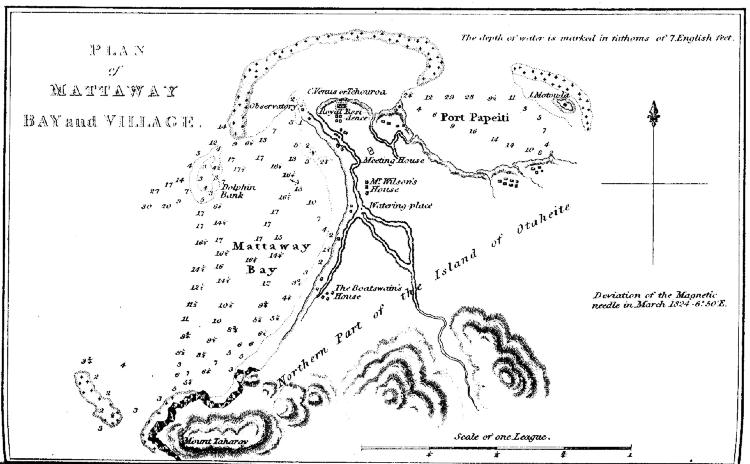 PLAN OF MATTAWAY BAY AND VILLAGE
Matarai Bay is rich in finely flavoured fish, of various, sometimes
extraordinary form, and beautiful colours. The Tahaitians eat them
raw, or only steeped in sea-water. Their fishing-tackle consists of
nothing more than bad angling lines and hooks; to make nets as their
forefathers did, would trespass too much upon the time they are obliged
to spend in prayer. Hence fish is so great a rarity to them, that their
eager desire for it sometimes prompts them to belie their good
character, of which we had an example. One of our large nets having
brought up a multitude of fine fish, the temptation was too strong to be
resisted, and our friends would have forcibly shared our acquisition
with us, had not our severe reproof, and the accidental appearance of
the judge of the district, restrained them. They then tried to obtain
the fish by barter, and offered their most valuable tools for the
smallest and worst of them; I gave them, however, so many, that for once
their appetite was fully satisfied with a luxurious repast.
I had heard much of an institution established by the Missionaries for
the instruction of the people, and was desirous to learn what progress
the Tahaitians had made in the rudiments of science. Being informed
that the lessons commenced at sunrise, the first rays of that luminary
found me one morning at the school-house, as I conceived the simple
structure before me to be. Its walls were formed of bamboo canes,
erected singly, at sufficient distances to admit the refreshing breeze
from all sides, and supporting a good roof. The interior was one
spacious quadrangular apartment, provided with benches, and raised seats
for the teachers.
I had not waited long before the pupils of both sexes entered. They were
not lively children, nor youths, whom ardour for the acquisition of
knowledge led to the seat of instruction, but adults and aged persons,
who crept slowly in with downcast looks, and prayer-books under their
arms. When they were all assembled and seated on the benches, a Psalm
was sung; a Tahaitian then rose, placed himself on an elevated bench,
and read a chapter from the Bible. After this they sang again, and then
knelt with their backs to the reader, who, also kneeling, repeated with
closed eyes a long prayer. At its conclusion, the orator resigned his
place to another Tahaitian, when the whole ceremony commenced anew;
another Psalm, another chapter, and another prayer were sung and said;
again and again, as I understood, a fresh performer repeated the
wearisome exercise; but my patience was exhausted, and, at the second
course, with depressed spirits and painful impressions, I left the
assembly.
Several such meetings are established in different parts of the island,
but no schools of a different character. The children are taught a
little reading and writing in their parents' houses, and beyond this,
knowledge is mischievous. It is true, that most of the Missionaries are
incapable of communicating further instruction; but the opinion that it
is easier to govern an ignorant than a well-educated community, seems
here, as elsewhere, to form a fundamental principle of policy.
To pray and to obey are the only commands laid upon an oppressed people,
who submissively bow to the yoke, and even suffer themselves to be
driven to prayers by the cudgel!
A police-officer is especially appointed to enforce the prescribed
attendance upon the church and prayer-meetings. I saw him in the
exercise of his functions, armed with a bamboo-cane, driving his herd to
the spiritual pasture. He seemed himself to be conscious of the
burlesque attaching to his office,—at least he behaved very absurdly in
it, and many a stroke fell rather in jest than in earnest. The drollery
of the driver did not, however, enliven the dejected countenances of his
flock.
In the prayer-house, which at first, in my simplicity, I had taken for a
school, no Missionary was present. The assembly consisting, except
myself, of natives only, though tolerably quiet, was not so profoundly
silent as at church. I endeavoured to read in the countenances of those
around me, what might be the thoughts which at the moment occupied their
minds, and few were the eyes which did not, as they passed muster, speak
of other matter than devotion and the Bible. Most of them appeared
engaged in very profane speculations: friendly glances occasionally
interchanged, betrayed the hopes of the younger devotees; while many a
stately Yeri was probably considering by what means he should procure
from my ship's-company an old waistcoat, or a pair of torn pantaloons
in which he might appear with suitable dignity at the approaching
coronation; and among the ladies, some might be weighing the pleasure of
possessing a sailor's sheet, against the risks they must run to obtain
it.
Exactly facing me was seated a fair one most becomingly enveloped in
this envied habiliment, and enjoying with modest complacency, but
visible triumph, the admiration with which the eyes of her country-women
were fixed upon her garment.
I had heard from the Missionaries many wonderful accounts of the Lake
Wahiria, situated among the mountains which rise in the centre of the
northern peninsula. They had themselves never seen it, and considered it
almost impossible for an European to reach it; even the boldest
Tahaitians rarely visit it; and a saying is current in the island, that
it is inhabited by an evil demon. Its depth they report to be
unfathomable, and cannot conceive from what cause this huge body of
water can be stationary at so great a height.
Mr. Hoffman, our mineralogist, an active young man, resolved to
undertake this expedition, accompanied by three Tahaitians:—Maititi,
who on our arrival had concluded a treaty of friendship with him, and
adopted the name of Hoffman; Tauru, a respectable elderly man; and
Teiraro, a brisk and lively young fellow. The two latter could write
their own names. At first they raised many objections, assuring him that
the journey, at all times difficult, was now dangerous from the waters
being swollen by the rains; however, a shirt promised to each of them
overcame all these obstacles, and the travellers set out at mid-day in
excellent spirits. Maititi, a soldier in the royal Tahaitian army, bore
the insignia of his rank in a musket, to which nothing but the lock was
wanting, and a cartouche-box without powder. He had learnt a few English
words, and, by their help, advised Mr. Hoffman to carry with him some
presents for his countrymen: for he observed, that though hospitality
and the consequence attaching to the stranger's appearance would secure
him a good reception, it was desirable that a man with whom he had
united himself in the bonds of friendship, should also command respect
by his liberality.
They travelled on a broad fine path through forests of fruit trees, and
several villages, and considered the population of this district to
exceed that in the neighbourhood of Matarai. In the country of Weijoride
they began to climb the mountains, and soon entered a charming valley
stretching to the south-southwest, and enclosed by high steep rocks,
basaltic, like those of Matarai. Down their precipitous sides clothed
with the richest green rushed innumerable streamlets to swell the
largest and most rapid rivulet on the island, which watered the whole
extent of this luxuriant valley. Here the cocoa, palm, and the
bread-fruit tree disappear, but bananas and oranges flourishing wild,
produce finer and more juicy fruit than our best hot-houses.
A few scattered huts raised on the margin of the little river, gave
tokens of human habitation. In one of these, occupied by an old married
pair, our travellers passed the first night. Maititi seemed to consider
himself quite on a foraging party, and Mr. Hoffman was under the
necessity of begging him to moderate his zeal, and leave the care of the
entertainment to their host. The old man fetched a pig, and Maititi,
with great dexterity, played the part both of butcher and cook. Mr.
Hoffman describes the operation of lighting the fire on this occasion,
in the following manner:—A Tahaitian took two pieces of wood of
different degrees of hardness, laid the softer upon the ground, and very
rapidly rubbed its length backwards and forwards with the harder. This
made a furrow, in which the dust rubbed from the wood collected, and
soon became hot; it was then shaken among dry leaves and burst into a
flame. The whole process seemed easy and quick; but Mr. Hoffman could
not succeed in it though he made many attempts. Before supper, the
master of the house recited a prayer aloud, the family repeating it
after him, but not audibly. They then ate a hearty but silent meal, and
prayed again before lying down to sleep. The couch offered to Mr.
Hoffman was a raised platform in the hut, thickly spread with mats, with
a pair of sheets of the Tahaitian manufacture, called Tapa, for its
covering.
The volubility of his guides, restrained during the repast by the more
important business of satisfying their appetites, now broke out to his
great disturbance. They chattered almost incessantly during great part
of the night with the host, whom they were probably entertaining with an
account of our ship, which he had not yet visited, and of their
intercourse with us. Mr. Hoffman, on taking leave in the morning, gave
his host a knife, an important present, which the old man received very
gratefully, as far exceeding his expectations.
The valley as they proceeded became wilder, but more beautiful: it
opened to greater width, the precipices around rose to a thousand feet
in height, covered from their black summits down to the valley with
green shrubs of a thousand hues, through which cascades glittering like
silver in the sun, rushed gurgling and foaming to the river.
At noon the travellers reached a hut inhabited by a friend of Maititi,
named Tibu; the owner also of another hut some miles further up, where
his wife lived with the pigs and dogs! This being the last station on
the road to the Wahiria Lake, it was determined to spend the night here.
Before they set forward in the morning, a large pig was tied up, to be
prepared for killing on the expected return of Mr. Hoffman and his
associates, whom the hospitable Tibu accompanied on the remainder of
their journey.
Here every vestige of a path disappeared. At a height of seven hundred
and eleven feet above the level of the sea, the travellers found
enormous blocks of granite lying in a south-easterly direction. The way
to Wahiria lay towards the south-south-west. They continued ascending
till they reached a marsh in a rocky basin, where wild boars were
running about.
Another steep precipice was to be climbed before they could reach the
Valley of the Wahiria. This stretches from north to south, and forms an
oval, in the centre of which lies the lake, according to barometrical
measurement, one thousand four hundred and fifty feet above the level of
the sea. The surrounding rocks rise perpendicularly more than two
thousand feet. The lake is above a mile and a quarter in
circumference,[4] and receives the springs from the mountains. A little
brook also flows into it from the north, but no channel could be found
by which its waters might be carried off. The depth of the lake near the
shore is eleven, and in the middle not more than seventeen toises. After
Mr. Hoffman had satisfied his curiosity, he returned with his companion
to Tibu's hut, and happily reached its shelter before a heavy storm that
followed them had begun to discharge its fury. Exhausted by the fatigue
of the march, and the oppressive heat, Mr. Hoffman threw himself on his
couch to take a little repose, while his companions killed and roasted
the pig. The storm now burst in tremendous violence over the hut. The
thunder rolled fearfully along the valley, and reverberated from the
rocks; the lightnings gave to the thick darkness a momentary
illumination equal to the brightness of mid-day, and the rain pouring
down in torrents, suddenly swelled the rivulet, near which the frail
dwelling was erected, far above its natural channel. Whoever has
witnessed a violent storm in the high mountains of a tropical country,
will never lose the impression of its awfulness.
The following day being Sunday, Tauru, immediately on rising, repeated a
long prayer, and then read a chapter of the New Testament, of which at
least one copy was to be found in every hut. After a good breakfast, Mr.
Hoffman wished to proceed, but his guides were not to be moved, and
threats and entreaties were equally unavailing. They assured him that a
continuation of the journey would be a profanation of the Sabbath, a
crime for which they would be hanged, should it come to the knowledge of
the Missionaries. This was a little too strongly expressed; and the
tempting remains of the roasted pig had, no doubt, as much influence in
supporting their resolution, as their religious scruples, or their fears
of the Missionaries. The next morning they made no objection to setting
out. Our travellers were joined on the road by many families, laden
with mountain bananas, so that they arrived in a large company at
Matarai.
Mr. Hoffman made several other journeys into the interior of the island,
and visited Arue, the present residence of the Court. The mineralogical
and geological observations made on these excursions, are reserved for a
separate treatise; but some particulars concerning his intercourse with
the inhabitants, may be properly introduced here.
The houses are merely built of perpendicular bamboo-canes, standing at
some distance apart, to give free admission to the air. The roofs of
palm-leaves are strong enough to defy the heaviest rain.
As curious after novelty as more civilized infants, the heads of the
children were thrust out from every hut he passed, and the parents
hospitably asked him in. When he accepted the invitation, he was always
conducted to the seat of honour, a raised bench covered with matting and
tapa stuff; and, after freely partaking of the best the house afforded,
was considered to have paid handsomely for his entertainment with a
knife. Bedsteads made of bamboo-canes, and filled with soft matting, are
placed along the walls, and make very comfortable, easy couches. These
pleasant little abodes, in which the greatest cleanliness is everywhere
observable, are all surrounded by cultivated gardens. In the evening,
they are lighted by the oily nuts of the taper-tree, fastened in rows on
splinters.
Mr. Hoffman's visit to the house of his friend Maititi, excited the
greatest joy. His host presented to him his wife and children, and
entertained him in the most splendid manner his means would allow.
In the capital Mr. Hoffman found nothing remarkable. The palace
inhabited by the Royal Family, was a spacious hut, with an ante-chamber
or outer house, in which eight of the guard kept watch. Their only
weapon was an old pistol fastened on a plank; this was frequently fired,
probably to accustom the young King to the tumult of battle. The old
King lies buried under a stone monument, in front of which three guns
are kept; but, to prevent accidents, they are nailed up.
We have already mentioned the trade in cocoa-oil carried on by the
Tahaitians, and the ship possessed by the Queen. This is commanded by an
Englishman, and a part of the crew is also English. It was just returned
from a voyage among the Society Islands, where it had been to collect
tribute, and was preparing to carry a cargo of cocoa-oil, stowed in
thick bamboo-canes, to Port Jackson. From the Captain, who visited me, I
gained much information concerning the present state of affairs in these
seas. He had learnt from ships returned from the Friendly Islands, that
their King had recently conquered the Navigator Islands, which now paid
tribute to him.
The map of Matarai, and of the bay which bounds it on the north-east,
completed by us with the utmost care from trigonometrical surveys, is
attached to this volume, and renders any further description of the
coast it embraces unnecessary. In December and January, the Tahaitian
summer months, the trade-wind is often interrupted by violent
north-westers. Rain and storms are then frequent, and often last till
April; in the other months the trade-winds blow without intermission,
and the sky is always serene. For this reason, what is here called the
summer, might pass for the actual winter; and as the roads of Matarai
are open to the west wind, it is advisable for ships visiting Tahaiti at
this season, to run into the harbour, which lies eight miles west of
Venus Point. It is spacious, formed by coral reefs, protected against
all winds, and has two entrances so convenient, that ships may sail
either in or out with almost any wind.
The ebb and flow of the tide in the Matarai Bay differs entirely from
the ordinary rules, and appears wholly uninfluenced by the moon, to
which it is everywhere else subject. The rise and fall is very
inconsiderable. Every noon the whole year round, at the moment the sun
touches the meridian, the water is highest, and falls with the sinking
sun till midnight. This phenomenon serves, as well as the sun's motion,
to supply the place of clocks to the inhabitants.
According to Humboldt, the altitude of the highest mountain in Tahaiti
is ten thousand feet; according to the barometrical measurement of Mr.
Long, only eight thousand feet above the level of the sea.
Our first observation by chronometers, on our arrival at Matarai, gave
the longitude of Venus Point as 149° 20' 30"; the true one, as given by
Admiral Krusenstern on his map, is 149° 27' 20"; consequently, the error
of our chronometers was 6' 50". This correction has been made in all the
longitudes taken by us in the dangerous Archipelago. From our
observatory on Venus Point, we found its latitude 17° 29' 17", and its
longitude 149° 29'.
The variation of the needle was 6° 50' east, and its inclination 29°
30'.
The barometer ranged from 29' 80" to 29' 70"; Reaumur's thermometer from
twenty-three and a half to twenty-four and a half.
The islands which I discovered on my former voyage in the ship
Rurik,—the Romanzow, Spiridow, Dean's Islands, the Rurik's Chain, &c.
whose longitude I had not then an opportunity to rectify upon Venus
Point, lie 5' 36" more to the west than I at first supposed.
The longitude given by Captain Bellingshausen for the island which he
discovered, appeared to us by 3' 10" too great.
On the morning of the 24th of March, we broke up our tent on the Venus
Point, left our dwelling-house, and shipped all our instruments and
effects. The afternoon was appointed for our departure. The Tahaitians
now boarded the ship, bringing as many provisions as they could carry.
They expressed great regret at losing us; and, to prove the
disinterestedness of their good-will, would accept no presents in
return. They unanimously assured us, that of all nations whose ships had
visited their island, none pleased them so well as the Russians. They
took leave of us with the most cordial embraces, and many of them shed
tears. They accompanied us in their canoes to the mouth of the Bay, and
were standing out to sea, when a sudden and violent gust of wind forced
them to return. The same gust very nearly carried away one of our sails,
and the proximity of the land placed us for a minute or two in a
critical situation, but the coolness and skill of our officers and men
relieved us from the momentary danger. In half an hour the regular
trade-wind returned, and with the liveliest wishes for the future
welfare of the good Tahaitians, we lost sight of their lovely island.
To the remarks concerning them already made, I will add some on their
language, from the work on this subject which I have before mentioned.
The author says, "The language spoken on most of the islands of the
South Sea, and therefore called the Polynesian, may be considered either
as primitive, or as related to, and descended from, a common source with
the Malay." It is undoubtedly very old, for these people have been from
an unknown period separated from all others, and before the arrival of
Europeans among them, considered themselves as the whole human race.
Although, in comparison with European languages, that of Tahaiti, as
belonging to an ignorant and uncultivated people, is necessarily very
defective, it perhaps surpasses all others in strength, precision, and
simplicity,—in the personal pronouns especially. Its resemblance to the
Hebrew, in the conjugation of the verbs, as well as in the roots of
some of the words, can easily be proved. Many of the words really appear
of Hebrew origin: as for example, mate, dead; mara, or maramosa,
bitter; rapaon, to heal, &c.
The Polynesian language being so widely extended, and spoken by the
inhabitants of so many islands, who have little or no intercourse with
each other, it naturally branches into many dialects. These are indeed
so various, that they cannot readily be recognised as derivatives from
the same stock.
The principal dialects are,—that spoken in the Sandwich Islands, or the
Hawaiian; that of the Marquesas; that of New Zealand; the Tongatabuan,
spoken by the inhabitants of the Friendly Islands, and the Tahaitian.
All the others, as far as they are known, are more or less related to
these.
The Tahaitian dialect is distinguished by its melody, as it has no broad
or hissing consonants. The pronunciation is rendered difficult by its
numerous diphthongs.
The substantives do not change their terminations in declension; but
the cases, of which there are but three, are formed by syllables
prefixed: for example—
SINGULAR.
| Nom.—Te taata—the man. |
| Poss.—No te taata—of the man. |
| Object.—He taata—to the man—and the man. |
PLURAL.
| Nom.—Te mau taata—the men. |
| Poss.—No te mau taata—of the men. |
| Object.—He mau taata—the men—and to the men. |
The Tahaitians have a great number of definite and indefinite articles,
and prefixes, which they apply in a peculiar manner. The article te
often stands before proper names; also before God, Te Atua; sometimes
o, which then appears to be an article; as, O Pomare, O Huaheine,
O Tahaiti. Sometimes this o is placed before the personal pronouns in
the nominative case.
O vau, I; o oe, thou; o oia, she, he, it. In these pronouns the
Tahaitian, and those languages to which it bears affinity, are
particularly rich. They have not only the dual of the Orientals, but
two first persons in the singular as well as plural: for example—
O Taua—thou and I.
O Maua—he and I.
O Tatou—you and I.
O Motou—we three, or several.
By this the conjugation of the verbs is made more complicated than in
other languages, but it again becomes easier from neither the person nor
the tense changing the word itself, but all the variations being
expressed by particular particles: for instance—motau, to fear; te
matau nei au, I fear; te matau ra oau, I feared; i motau na oau, I
have feared; e matau au, I shall fear.
Since my readers will hardly wish to study the Tahaitian language very
thoroughly, I here close my extracts from its grammar.—Whoever really
desires to learn it must go to Tahaiti. I must, however, warn him to arm
himself with patience; for though the Tahaitians are very ready with
their assistance, they have quite as bad a habit as ourselves of
laughing at any one who speaks their language ill,—I say this from
experience.
Some months before us, the French Captain Duperré had visited Tahaiti
upon a voyage of discovery, in the corvette Coquille. He returned home
in safety, and is about to publish his travels, of which he has already
had the goodness to send me some portions. An important acquisition to
science may be expected from this work.
THE PITCAIRN ISLAND.
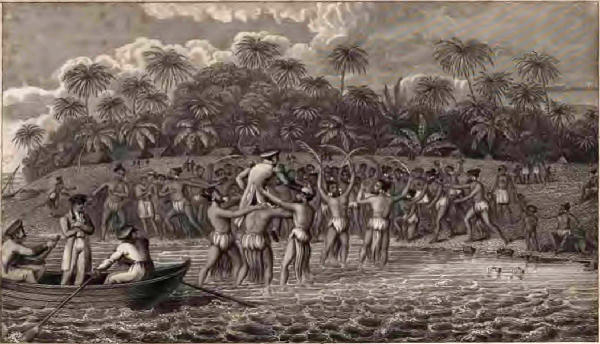 S. Freeman, Sc.

