Καθολου δε
φασιν (ὁι
Αιγυπτιοι)
τους
Ἑλληνας
εξιδιαζεσθαι
τους
επιφανεστατους
Ἡρωας τε,
και Θεους,
ετι δε και
αποικιας
τας παρ'
ἑαυτων. Diodorus Sicul. l. 1.
p. 21.
It has been my uniform purpose, during the whole process, which I have
made in my system, to shew, that the Grecians formed Deities out of
titles; and that they often attributed to one person, what belonged to a
people. And when they had completed the history, they generally took the
merit of it to themselves. By means of this clue we may obtain an insight
into some of the most remote, and the most obscure parts of antiquity.
For many and great achievements have been attributed to heroes of the
first ages, which it was not possible for them singly to have performed.
And these actions, though in some degree diversified, and given to
different personages, yet upon examination will be found to relate to one
people or family; and to be at bottom one and the same history.
If we consider the history of Osiris, he will appear a wonderful
conqueror, who travelled over the face of the whole earth,
winning new territories, wherever he came; yet always to the advantage of
those whom he subdued. He is said to have been the son of Rhea: and his
chief attendants in his peregrinations were Pan, Anubis, Macedo, with
Maro, a great planter of vines; also Triptolemus much skilled in
husbandry. The people of India claimed Osiris, as their own; and
maintained, that he was born at Nusa in their country. Others supposed his
birth-place to have been at Nusa in Arabia, where he first planted
the vine. Many make him a native of Egypt: and mention the rout of his
travels as commencing from that country through Arabia, and Ethiopia; and
then to India, and the regions of the east. When he was arrived at the
extremities of the ocean, he turned back, and passed through the upper
provinces of Asia, till he came to the Hellespont, which he crossed. He
then entered Thrace, with the King of which he
had a severe encounter: yet he is said to have persevered in his rout
westward, till he arrived at the fountains of the Ister. He was also in
Italy, and Greece: from the former of which he expelled the giants near
Phlegra in Campania. He visited many places upon the ocean: and though he
is represented as at the head of an army; and his travels were attended
with military operations; yet he is at the same time described with the
Muses, and Sciences in his retinue. His march likewise was conducted with
songs, and dances, and the sound of every instrument of music. He built
cities in various parts; particularly Hecatompulos, which he
denominated Theba, after the name of his mother. In every region, whither
he came, he is said to have instructed the people in planting,
and sowing, and other useful arts. He particularly introduced the vine:
and where that was not adapted to the soil, he taught the natives the use
of ferment, and shewed them the way to make wine of barley, little inferior
to the juice of the grape. He was esteemed a great blessing to the
Egyptians both as a Lawgiver, and a King. He first
built temples to the Gods: and was reputed a general benefactor of mankind.
After many years travel they represent him as returning to Egypt in great
triumph, where after his death he was enshrined as a Deity. His Taphos,
or high altar, was shewn in many places: in all which he in aftertimes
was supposed to have been buried. The people of Memphis shewed one of
them; whereon was a sacred pillar, containing a detail of his life, and
great actions, to the following purport. My father was Cronus, the
youngest of all the Gods. I am the king Osiris, who carried my arms over
the face of the whole earth, till I arrived at the uninhabited parts of
India. From thence I passed through the regions of the north to the
fountain-head of the Ister. I visited also other remote countries; nor
stopped till I came to the western ocean. I am the eldest son of Cronus;
sprung from the genuine and respectable race of (Σωος) Sous, and am related to the
fountain of day. There is not a nation upon earth, where I have not been;
and to whose good I have not contributed.
This is a very curious piece of antient history: and it will be found
to be in great measure true, if taken with this allowance, that what is
here said to have been achieved by one person, was the work of many.
Osiris was a title conferred upon more persons than one; by which means
the history of the first ages has been in some degree confounded. In this
description the Cuthites are alluded to, who carried on the expeditions
here mentioned. They were one branch of the posterity of Ham; who is here
spoken of as the eldest son of Cronus. How justly they conferred upon him
this rank of primogeniture, I will not determine. By Cronus we
are here to understand the same person, as is also represented under the
name of Soüs. This would be more truly expressed Σωον, Soön; by which is meant the Sun:
All the Amonian families affected to be styled Heliadæ, or the offspring
of the Sun: and under this title they alluded to their great ancestor the
father of all: as by Osiris they generally meant Ham. Σωον, Soön, is the same as Zoon, and
Zoan, the fountain of day. The land of Zoan in Egypt was the nome of
Heliopolis: and the city Zoan the place of the Sun. The person then
styled here Soüs can be no other than the great Patriarch under a title
of the Sun. He is accordingly by Philo Biblius called Ousoüs in an
extract from Sanchoniathon. He makes him indeed reside, where Tyre was
afterwards built; but supposes him to have lived at a time, when there
were great rains and storms; and to have been the first constructor of a
ship, and the first who ventured upon the seas. In respect to the travels
of Osiris we shall find that the posterity of Ham did traverse at
different times the regions above-mentioned: and in many of them took up
their abode. They built the city Memphis in Egypt; also Hecatompulos,
which they denominated Theba, after the name of their reputed mother.
They also built Zoan, the city of the Sun.
Osiris is a title often conferred upon the great patriarch himself:
and there is no way to find out the person meant but by observing the
history, which is subjoined. When we read of Osiris being exposed in an
ark, and being afterward restored to day; of his planting the vine, and
teaching mankind agriculture; and inculcating religion, and justice; the
person alluded to stands too manifest to need any farther elucidation.
And when it is said of Osiris, that he went over most parts of the
habitable globe, and built cities in various regions; this too may be
easily understood. It can allude to nothing else, but a people called
Osirians, who traversed the regions mentioned. They were principally the
Cuthites, who went abroad under various denominations: and the histories
of all the great heroes, and heroïnes of the first ages will be found of
the same purport, as the foregoing. Osiris is supposed to have been
succeeded in Egypt by Orus. After Orus came Thoules; who was succeeded by
Sesostris.
Perseus was one of the most antient heroes in the mythology of Greece:
the merit of whose supposed achievements the Helladians took to
themselves; and gave out that he was a native of Argos. He travelled to
the temple of Ammon; and from thence traversed
the whole extent of Africa. He subdued the Gorgons, who lived in Mauritania,
and at Tartessus in Bœtica; and defeated the Ethiopians upon the
western ocean, and the nations about mount Atlas: which mountain he
only and Hercules are said to have passed. Being arrived at the extremity
of the continent, he found means to pass over, and to get possession of
all the western islands. He warred in the East; where he freed Andromeda,
the daughter of Cepheus king of the eastern Ethiopia, who was exposed to
a sea-monster. Some imagine this to have happened at Joppa in
Palestine, where the bones of this monster of an
extraordinary size are supposed to have been for a long time preserved.
He is said to have built Tarsus in Cilicia, reputed the
most antient city in the world; and to have planted the peach tree at Memphis.
The Persians were supposed to have been his descendants. He travelled
through Asia Minor, to the country of the Hyperboreans upon the Ister, and
the lake Mæotis; and from thence descended to Greece. Here he built
Mycene, and Tiryns, said by many to have been the work of the Cyclopians.
He established a seminary at Helicon: and was the founder of those
families, which were styled Dorian, and Herculean. It is a doubt among
writers, whether he came into Italy. Some of his family were there; who
defeated the giant race in Campania, and who afterwards built Argiletum,
and Ardea in Latium. Virgil supposes it to have been effected by Danae,
the mother of this Hero:
Ardea —— quam dicitur olim
Acrisioneïs Danäe fundâsse colonis.
But Servius says, that Perseus
himself in his childhood was driven to the coast of Daunia. He is
represented as the ancestor of the Grecian Hercules, supposed to have
been born at Thebes in Bœotia. In reality neither Hercules,
nor Perseus, was of Grecian original; notwithstanding the genealogies
framed in that country. The history of the latter came apparently from
Egypt, as we may learn from Diodorus: Φασι δε και
τον Περσεα
γεγονεναι
κατ'
Αιγυπτον.
Herodotus more truly represents him as an Assyrian; by which is meant a
Babylonian: and agreeably to this he is said to have married Asterie,
the daughter of Belus, the same as Astaroth and Astarte of Canaan; by
whom he had a daughter Hecate. This, though taken from an idle system of
theology, yet plainly shews, that the history of Perseus had been greatly
misapplied and lowered, by being inserted among the fables of Greece.
Writers speak of him as a great Astronomer, and a person of
uncommon knowledge. He instructed mariners to direct their way in the sea
by the lights of heaven; and particularly by the polar constellation.
This he first observed, and gave it the name of Helice. Though he was
represented as a Babylonian; yet he resided in Egypt, and is said to have
reigned at Memphis. To say the truth, he was worshipped at that place:
for Perseus was a title of the Deity; Περσευς, ὁ
Ἡλιος; Perseus was no other than
the Sun, the chief God of the Gentile world. On this account he had a
temple of great repute at Chemmis, as well as at Memphis,
and in other parts of Egypt. Upon the Heracleotic branch of the Nile,
near the sea, was a celebrated watch-tower, denominated from him. His
true name was Perez, or Parez, rendered Peresis, Perses, and Perseus: and
in the account given of this personage we have the history of the
Peresians, Parrhasians, and Perezites, in their several peregrinations;
who were no other than the Heliadæ, and Osirians abovementioned. It is a
mixed history, in which their forefathers are alluded to; particularly
their great progenitor, the father of mankind. He was supposed to have
had a renewal of life: they therefore described Perseus as inclosed in an
ark, and
exposed in a state of childhood upon the waters, after having been
conceived in a shower of gold.
Bochart thinks that the name both of Persis and Perseus was from פרס,
Paras, an Horse: because the Persians were celebrated horsemen, and took
great delight in that animal. But it must be considered that the name is
very antient, and prior to this use of horses. P'aras, P'arez, and
P'erez, however diversified, signify the Sun; and are of the same analogy
as P'ur, P'urrhos, P'oros, which betoken fire. Every animal, which was in
any degree appropriated to a Deity, was called by some sacred title.
Hence an horse was called P'arez: and the same name, but without the
prefix, was given to a lion by many nations in the east. It was at first
only a mark of reference, and betokened a solar animal, specifying the
particular Deity to whom it was sacred. There were many nations, which
were distinguished in the same manner; some of whom the Greeks styled
Parrhasians. Hence the antient Arcadians, those Selenitæ, who were
undoubtedly an Amonian colony, had this appellation. A people in Elis had
the same. The Poets described the constellation of Helice, or the Bear,
by the title of Parrhasis, Arctos, and Parrhasis Ursa. This asterism was
confessedly first taken notice of by Perez or Perseus, by which is meant
the Persians.
Versaque ab axe suo Parrhasis Arctos erat.
In the east, where the worship of Arez greatly prevailed, there were
to be found many nations called after this manner. Part of Media,
according to Polybius, had the name of
Parrhasia. There were also Parrhasii and Parrhasini in Sogdiana;
and the
like near Caucasus: also a town named Parasinum in the Tauric
Chersonesus. The people styled Parrhasians in Greece were the
same as the Dorians and Heraclidæ; all alike Cuthites, as were the
antient Persians. Hence it is truly said by Plato, that the Heraclidæ in
Greece, and the Achæmenidæ among the Persians were of the same stock: Το δε
Ἡρακλεους
τε γενος και
το
Αχαιμενεους
εις Περσεα
τον Διος
αναφερεται.
On this account Herodotus makes Xerxes claim
kindred with the Argives of Greece, as being equally of the posterity of
Perses, the same as Perseus, the Sun: under which character the Persians
described the patriarch, from whom they were descended. Perseus was the
same as Mithras, whose sacred cavern was styled Perseüm.
Phœbe parens—seu te roseum Titana vocari
Gentis Achæmeniæ ritu; seu præstat Osirin
Frugiferum; seu Persëi sub rupibus antri
Indignata sequi torquentem cornua Mithram.
AND THE
From a notion that the Amazons were a community of women, historians
have represented the chief personage of their nation as a female. She
is mentioned by some as having flourished long before the æra of Troy: and
it is by others said more precisely, that she lived in the time of Orus,
the son of Isis and Osiris. This removes her history far back; so as to
make it coeval with the first annals of time. Her dominions lay in the
most western parts of Africa, at the extremity of
Atlas; where the mountain terminated in the ocean, to which it gave name.
This country was called Mauritania; and was supposed to have been
possessed by the Atlantes and Gorgons. The Grecian writers, who did not
know that the same family went under different titles, have often made
the same nation at variance with itself. And as they imagined every
migration to have been a warlike expedition, they have represented Myrina
as making great conquests; and what is extraordinary, going over the same
ground, only in a retrograde direction, which Osiris had just passed
before. Her first engagement was with the Atlantes of Cercene: against
whom she marched with an army of 30,000 foot, and 2,000 horse; whom she
completely armed with the skins of serpents. Having defeated the
Atlantes, she marched against the Gorgons, whom she likewise conquered;
and proceeding forward, subdued the greater part of Africa, till she
arrived at the borders of Egypt. Having entered into an alliance with
Orus, she passed the Nile, and invaded the Arabians, whom she defeated.
She then conquered the Syrians, and Cilicians, and all the nations about
Mount Taurus; till she arrived at Phrygia, and the regions about the
river Caïcus. Here she built many cities, particularly Cuma, Pitane, and
Priene. She also got possession of several islands; and among others, of
Lesbos and Samothracia, in which last she founded an asylum. After these
transactions, Myrina, accompanied with Mopsus the diviner, made an
expedition into Thrace, which was the ultimate of her progress; for she
was supposed to have been here slain. According to Homer she died in
Phrygia: for he takes notice of her tomb in the plains of Troas; and
represents it as a notable performance.
Εστι δε τις προπαροιθε πολεως αιπεια κολωνη,
Εν πεδιῳ απανευθε, περιδρομος ενθα και ενθα·
Την ητοι ανδρες Βατιειαν κικλησκουσιν,
Αθανατοι δε τε σημα πολυσκαρθμοιο Μυρινης.
The tomb of this heroïne was in reality a sacred mound, or high altar;
and Myrina a Gentile divinity. In her supposed conquests we may in great
measure see the history of Osiris, and Perseus, reversed, and in some
degree abridged; yet not so far varied, but that the purport may be
plainly discerned. Indeed there is no other way to obtain the hidden
meaning, but by collating the different histories, and bringing them in
one view under the eye of the reader.
Similar to the foregoing are the expeditions of Hercules, and the
conquests which he is supposed to have performed. After many exploits in
Greece, the reputed place of his nativity, he travelled as far as mount
Caucasus near Colchis, to free Prometheus, who was there exposed to an
eagle or vulture. Upon the Thermodon he engaged with the Amazons, whom he
utterly defeated; and then passed over into Thrace. Upon his return into
Greece he was ordered to make an expedition into Iberia, a region in the
farthest part of Spain; where Chrusaor, a prince of great wealth,
resided. Hercules accepts of the commission; but, I know not for what
reason, goes first to Crete, and from thence to Libya; and what is extraordinary,
proceeds to Egypt. This makes the plan of his supposed rout somewhat
irregular and unaccountable. After some time spent in these parts, he
builds the city Hecatompulos, said before to have been built by Osiris:
and then traverses the whole of Africa westward, till he arrives at the
Fretum Gaditanum. Here he erects two pillars; which being finished, he at
last enters Iberia. He defeats the sons of Chrusaor, who were in arms to
oppose him; and bestows their kingdom upon others. He likewise seizes
upon the oxen of Geryon. He then marches into the country of the Celtæ,
and founds the city Corunna, and
likewise Alesia in Gaul. He afterwards
fights with the giants Albion and Bergion near Arelate, in the plain
styled Campus Lapideus; where are the salt waters of Salona. He then
passes the Alpes; and upon the banks of the
Eridanus encounters a person of shepherd race; whom he kills, and seizes
his golden flocks. In his way
homeward he visits Hetruria, and arrives at the mountain Palatinus upon
the Tiber. From thence he goes to the maritime part of Campania, about
Cuma, Heraclea, and the lake Aornon. Not far from hence was an adust and
fiery region; supposed to have been the celebrated Phlegra, where the
giants warred against heaven: in which war Hercules is said to have assisted.
Here was an antient oracular temple; and hard by the mountain Vesuvius,
which in those days flamed violently, though it did not for many ages
afterwards. During his residence here he visited the hot fountains near
Misenus and Dicæarchea; and made a large causeway, called in aftertimes
Via Herculanea, and Agger Puteolanus. After having visited the Locrians,
and the people of Rhegium, he crossed the sea to Sicily; which sea he
swam over, holding by the horn of an ox. At his arrival some warm springs
burst forth miraculously, to give him an opportunity of bathing. Here he
boxed with Eryx; defeated the Sicani; and performed many other exploits.
What is remarkable, having in Spain seized upon the cattle of Geryon, he
is said to have made them travel over the Pyrenean mountains, and
afterwards over the Alpes, into Italy; and from thence cross the sea into
Sicily; and being now about to leave that island, he swims with them
again to Rhegium: and ranging up the coast of the Adriatic, passes round
to Illyria, from thence to Epirus; and so descends to Greece. The whole
of these travels is said to have been completed in ten years.
He was also reported, according to Megasthenes and others, to have
made an expedition into India, and to have left many
memorials of his transactions in those parts. He travelled likewise into
the region called afterwards Scythia; the natives of which country were
his descendants. He also visited the
Hyperboreans. In all these peregrinations he is generally described as
proceeding alone: at least we have no intimation of any army to assist in
the performance of these great enterprises. He is indeed supposed to have
sailed with six ships to Phrygia: but how he came by them
is not said; nor whence he raised the men, who went with him. At other
times he is represented with a club in his hand, and the skin of an
animal upon his shoulders. When he passed over the ocean, he is said to
have been wafted in a golden bowl. In Phrygia he freed Hesione
from a Cetus, or sea monster, just as Perseus delivered Andromeda. He is
mentioned as founding many cities in parts very remote: the sea-coast of
Bœtica, and Cantabria, was, according to some writers, peopled by him. By
Syncellus he is said to have resided in Italy, and to have reigned in Latium. The
Grecians supposed that he was burnt upon Mount Œta: but the people
of Gades shewed his Taphos in their city, just as the Egyptians
shewed the Taphos of Osiris at Memphis, and elsewhere. Hence it was
imagined by many, that Hercules was buried at Gades. The philosopher
Megaclides could not be brought to give the least assent to the histories
of this hero: and Strabo seems to have
thought a great part of them to have been a fable. In short, the whole
account of this personage is very inconsistent: and though writers have
tried to compromise matters by supposing more persons than one of this
name, yet the whole is still incredible, and can never be so adjusted as
to merit the least belief. How they multiplied the same Deity, in order
to remedy their faulty mythology, may be seen in the following extract
from Cicero. Quanquam, quem potissimum
Herculem colamus, scire velim: plures enim nobis tradunt ii, qui
interiores scrutantur et reconditas literas. Antiquissimum Jove natum,
sed item Jove antiquissimo: nam Joves quoque plures in priscis Græcorum
literis invenimus. Ex eo igitur et Lysito est is Hercules, quem
concertâsse cum Apolline de tripode accepimus. Alter traditur Nilo natus,
Ægyptius; quem aiunt Phrygias literas conscripsisse. Tertius est ex Idæis
Dactylis, cui inferias afferunt. Quartus Jovis est, et Asteriæ, Latonæ
sororis, quem Tyrii maxime colunt; cujus Carthaginem filium ferunt.
Quintus in Indiâ, qui Belus dicitur. Sextus
hic, ex Alcumenâ quem Jupiter genuit; sed tertius Jupiter: quoniam, ut
docebo, plures Joves accepimus.
Hercules was a title given to the chief deity of the Gentiles, who
have been multiplied into almost as many personages, as there were
countries, where he was worshipped. What has been attributed to this god
singly, was the work of Herculeans; a people who went under this title
among the many which they assumed; and who were the same as the Osirians,
Peresians, and Cuthites. They built Tartessus in Bœtica, and
occupied great part of Iberia. They likewise founded Corunna in
Cantabria, and Alesia in Gaul: of which there
are traditions to this day. Some of them settled near Arelate;
others among the Alpes: also at Cuma, and Heraclea
in Campania. They were also to be found at Tyre, and in Egypt; and even
in the remotest parts of India. In short, wherever there
were Heraclidæ, or Herculeans, an Hercules has been supposed. Hence his
character has been variously represented. One, while he appears little
better than a sturdy vagrant; at other times he is mentioned as a great
benefactor; also as the patron of science, the God of eloquence, with the Muses
in his train. On this account he had the title of Musagetes;
and the Roman general Fulvius dedicated a temple which he had erected to
his honour, and inscribed it Herculi Musarum. There are
gems, upon which he is represented as presiding among the Deities of Science. He
is said to have been swallowed by a Cetus, or large fish, from which he
was after some time delivered. This history will hereafter be easily
decyphered. He was the chief deity of the Gentile world; the same as
Hermes, Osiris, and Dionusus; and his rites were introduced into various
parts by the Cuthites. In the detail of his peregrinations is contained,
in great measure, an history of that people, and of their settlements.
Each of these the Greeks have described as a warlike expedition; and have
taken the glory of it to themselves. He is said to have had many sons.
One of these was Archemagoras; by which is meant
the father or chief of the Magi. There are many others enumerated: the
principal of whom are said to have been; Sardus, or Sardon; Cyrnus,
Gelonus, Olynthus, Scythus, Galathus, Lydus, Iberus, Celtus, Poimen. As
these are all manifestly the names of nations, we may perceive by the
purport of this history, that the Sardinians, Corsicans, Iberians, Celtæ,
Galatæ, Scythæ, &c. &c. together with those styled Shepherds,
were Herculeans; all descended from that Hercules, who was the father of
Archemagoras the chief of the Magi.
The history of Dionusus is closely connected with that of Bacchus,
though they were two distinct persons. It is said of the former, that he
was born at Nusa in Arabia: but the people
upon the Indus insisted, that he was a native of their country;
and that the city Nusa, near mount Meru, was the true place of his birth.
There were, however, some among them, who allowed, that he came into
their parts from the west; and that his arrival was in the most antient
times. He taught the nations, whither he came, to build and to plant, and
to enter into societies. To effect this, he collected the various
families out of the villages in which they dwelt, and made them
incorporate in towns and cities, which he built in the most commodious
situations. After they were thus established, he gave them laws, and
instructed them in the worship of the Gods. He also taught them to plant
the Vine, and to extract the juice of the grape; together with much other
salutary knowledge. This he did throughout all his travels,
till he had conquered every region in the East. Nor was it in these parts
only, that he shewed himself so beneficent a conqueror; but over all the
habitable world. The account given by the
Egyptians is consonant to that of the Indians: only they suppose him to
have been of their own country; and to have set out by the way of Arabia
and the Red Sea, till he arrived at the extremities of the East. He
travelled also into Lybia, quite to the Atlantic; of
which performance Thymætes is said to have given an account in an antient
Phrygian poem. After his Indian expedition, which took him up three
years, he passed from Asia by the Hellespont into Thrace, where Lycurgus
withstood him, and at last put him to flight. He came into Greece; and
was there adopted by the people, and represented as a native of their
country. He visited many places upon the Mediterranean; especially
Campania, and the coast of Italy, where he was taken prisoner by the
Hetrurian pirates. Others say, that he conquered all Hetruria.
He had many attendants; among whom were the Tityri, Satyri, Thyades, and
Amazons. The whole of his history is very inconsistent in respect both to
time and place. Writers therefore have tried to remedy this by
introducing different people of the same name. Hence Dionusus is
multiplied into as many personages as Hercules. His
history was looked upon as very interesting; and therefore was the chief
theme of all the antient bards. His flight, styled φυγη
Διονυσου, was
particularly recorded. He was the same as
Osiris; and many of the later mythologists acknowledged this truth. Αιγυπτιοι
μεν γαρ τον
παρ' αυτοις
θεον Οσιριν
ονομαζομενον
φασιν ειναι
τον παρ'
Ἑλλησι
Διονυσον
τουτον δε
μυθολογουσιν
επελθειν
πασαν την
οικουμενην—Ὁμοιως
δε και τους
Ινδους τον
θεον τουτον
παρ' ἑαυτοις
αποφανεσθαι
γεγονεναι.
The Egyptians, says Diodorus, maintain that their
God Osiris is no other than the Dionusus of Greece: And they farther
mention, that he travelled over the face of the whole earth—In like
manner the Indi assure us, that it is the same Deity, who wan conversant
in their country.
Dionusus, according to the Grecian mythology, is represented as having
been twice born: and is said to have had two fathers and two mothers. He
was also exposed in an ark, and wonderfully preserved.
The purport of which histories is plain. We must however for the most
part consider the account given of Dionusus, as the history of the
Dionusians. This is twofold. Part relates to their rites and religion; in
which the great events of the infant world, and the preservation of
mankind in general, were recorded. In the other part, which contains the
expeditions and conquests of this personage, are enumerated the various
colonies of the people, who were denominated from him. They were the same
as the Osirians and Herculeans; all of one family, though under different
appellations. I have shewn, that there were many places which claimed his
birth; and as many, where was shewn the spot of his interment. Of these
we may find samples in Egypt, Arabia, and India; as well as in Africa,
Greece, and its islands. For the Grecians, wherever they met with a grot
or a cavern sacred to him, took it for granted that he was born there:
and wherever he had a taphos, or high altar, supposed that he was there
buried.
The same is also observable in the history of all the Gods.
From what has been said we may perceive that the same history has been
appropriated to different personages: and if we look farther into the
annals of the first ages, we shall find more instances to the same
purpose. It is said of Cronus, and Astarte, that they
went over the whole earth; disposing of the countries at their pleasure,
and doing good wherever they came. Cronus in consequence of it is
represented as an universal benefactor; who reclaimed men
from their savage way of life, and taught them to pass their days in
innocence and truth. A like account is given of Ouranus, the great king
of the Atlantians, who observing mankind
in an unsettled and barbarous state, set about building cities for their
reception; and rendered them more humane and civilized by his
institutions and laws. His influence was very extensive; as he is
supposed to have had the greater part of the world under his rule. All
this, and what was above done by Cronus and Astarte, the Grecians
attributed to Apollo and Themis. Strabo mentions from the historian,
Ephorus, that the oracle at Delphi was founded by these two deities at
the time, when Apollo was going over the world doing good to all mankind.
He taught the nations, where he came, to be more gentle and humane in their
manners; and to abstain from their wild fruits, and foul banquets:
affording them instructions how to improve themselves by cultivation.
Some of these persons are mentioned as proceeding in a pacific manner:
but these peregrinations in general are represented as a process of war;
and all that was effected, was supposed to have been by conquest. Thus
Osiris, Hercules, Perseus, Dionusus, displayed their benevolence sword in
hand: and laid every country under an obligation to the limits of the
earth. The like is said of Zeuth, the Zeus of Greece, who was an
universal conqueror and benefactor: Τον Δια
κυριον
γενομενον
τον ὁλων
επελθειν
ἁπασαν την
οικουμενην,
ευεργετουντα
το γενος των
ανθρωπων·
διενεγκειν
δε αυτον και
σωματος
ῥωμῃ και
ταις αλλαις
ἁπασαις
αρεταις, και
δια τουτο
ταχυ κυριον
γενεσθαι
του
συμπαντος
κοσμου. Zeus (or
Jupiter) having got the entire supremacy marched over the whole earth,
benefiting mankind wherever he came. And as he was a person of great
bodily strength, and at the same time had every princely quality, he very
soon subdued the whole world.
No mention is made of any conquests achieved by Orus: and tho reason
is, because he was the same as Osiris. Indeed they were all the same
personage: but Orus was more particularly Osiris in his second state; and
therefore represented by the antient Egyptians as a child. What is
omitted by him, was made up by his immediate successor Thoules; who like
those, who preceded, conquered every country which was inhabited. Ειτα Οσιρις,
μεθ' ὁν Ωρος,
και μετα
αυτον
Θουλης, ὁς
και ἑως του
ωκεανου
πασαν την
γην
παρειληφεν.
After him (that is, Söus, or Sosis,) came Osiris; and then
Orus: to whom succeeded Thoules, who conquered the whole earth quite to
the ocean. The like history is given of him by Suidas, and
by the author of the Chronicon Paschale.
These accounts I have collated, and brought in succession to one
another; that we may at a view see the absurdity of the history, if taken
in the common acceptation. And however numerous my instances may have
been, I shall introduce other examples before I quit the subject. I must
particularly speak of an Egyptian hero, equally ideal with those
abovementioned; whose history, though the most romantic and improbable of
any, has been admitted as credible and true. The person to whom I allude,
is the celebrated Sesostris. Most of the antient historians speak of his
great achievements; and the most learned of the modern chronologists have
endeavoured to determine his æra, and point out the time of his reign.
But their endeavours have been fruitless; and they vary about the time
when he lived not less than a thousand years: nay, some differ even more
than this in the æra, which they assign to him.
Among the writers who have written concerning this extraordinary
personage, Diodorus Siculus is the most uniform and full; and with his
evidence I will begin my account. He informs us, that, when this
prince was a youth, he was entrusted by his father with a great army. He
upon this invaded Arabia: and though he was obliged to encounter hunger
and thirst in the wilds, which he traversed; yet he subdued the whole of
that large tract of country. He was afterwards sent far into the west;
where he conquered all the legions of Lybia, and annexed great part of
that country to the kingdom of Egypt. After the death of his father he
formed a resolution to subdue all the nations upon earth. Accordingly,
having settled everything at home, and appointed governors to each
province, he set out with an army of six hundred thousand foot, and
twenty-four thousand horse, and twenty-seven thousand armed chariots.
With these he invaded the Ethiopians to the south; whom he defeated, and
made tributaries to Egypt. He then built a fleet of ships upon the Red
sea: and he is recorded as the first person who constructed vessels fit
for distant navigation. With these, by means of his generals, he subdued
all the sea-coast of Arabia, and all the coast upon the ocean as far as
India. In the mean time he marched in person, with a puissant army, by
land, and conquered the whole continent of Asia. He not only overran the
countries, which Alexander afterwards invaded; but crossed both the Indus
and the Ganges; and from thence penetrated to the eastern ocean. He then
turned to the north, and attacked the nations of Scythia; till he at last
arrived at the Tanäis, which divides Europe and Asia. Here he founded a
colony; leaving behind him some of his people, as he had just before done
at Colchis. These nations are said
to the last to have retained memorials of their original from Egypt.
About the same time Asia Minor, and most of the islands near it, fell
into his hands. He at last passed into Thrace, where he is said to have
been brought into some difficulties. He however persisted, and subdued
all the regions of Europe. In most of these countries he erected pillars
with hieroglyphical inscriptions; denoting that these parts of the world
had been subdued by the great Sesostris, or, as Diodorus expresses his name,
Sesoosis. He likewise erected statues of himself, formed of stone, with a
bow and a lance: which statues were in length four cubits and four palms,
according to the dimensions of his own height and stature. Having thus
finished his career of victory, he returned laden with
spoils to Egypt, after an absence of nine years; which is one year
less than was attributed to the expeditions of Hercules.
The detail given by this historian is very plain and precise: and we
proceed very regularly and minutely in a geographical series from one
conquest to another: so that the story is rendered in some degree
plausible. But we may learn from Diodorus himself, that little credit is
to be paid to this narration, after all the pains he may have taken to
win upon our credulity. He ingenuously owns, that not only the Grecian
writers, but even the priests of Egypt, and the bards of the same country
varied in the accounts which they gave of this hero; and were guilty of
great inconsistence. It was therefore his chief labour to collect what he
thought most credible, and what appeared most consonant to the memorials
in Egypt, which time had spared: Τα
πιθανωτατα,
και τοις
υπαρχουσιν
ετι κατα την
χωραν
σημειοις τα
μαλιστα
συμφωνουντα
διελθειν. But, as
these memorials consisted chiefly in hieroglyphics, I do not see how it
was possible for Diodorus to understand what the bards and priests could
not decypher. The adjustment of this history, had it been practicable,
should have been the work of a native Egyptian, and not of a person
either from Greece or Sicily. This writer afterwards mentions the mighty
works of
Sesostris upon his return into Egypt: the temples which he built, and the
great entrenchments which he made to the east, to guard the country from
the Arabians: and having enumerated the whole of his actions, he
concludes with an ingenuous confession, that little could be obtained that was
precisely true. He has, without doubt, culled the most probable
achievements of this hero; and coloured and arranged them to the best
advantage: yet they still exceed belief. And if, after this care and
disposition, they seem incredible, how would they appear in the garb, in
which he found them? Yet the history of this personage has been admitted
as credible by the most learned writers and chronologists:
though, as I before mentioned, they cannot determine the æra of his reign
within a thousand years. Sir John Marsham and Sir Isaac Newton suppose
him to have been the Sesac of the scriptures; and consequently bring his
reign down to the time of Rehoboam king of Judah. But the only reason for
this, as far as I can perceive, seems to be, that Sesostris is
represented as a great conqueror; and Sesac is presumed, from his large
army, to
have been so likewise. But there is nothing more said of Sesac, than that
he formed a plan of conquering the king of Judah; and accordingly came
with the army before mentioned, to put his design in execution. But the
capital
being delivered into his hands without the least resistance, and the king
intirely submitting himself to his will; he contented himself with the
rich plunder, which he found, and which he carried away at his departure.
We may also infer from the servitude, to which the people of Judah were
reduced, that he imposed upon them some future contributions.
This is the whole of the history of Sesac, or Shishak; by whom no
other expedition was undertaken that we know of: nor is there mention
made upon record of a single battle which he fought. Yet from a notion
that Sesac was a great warrior, he is made the same as Sesostris: and the
age of the latter is brought down very many centuries beneath the æra, to
which the best writers have adjudged it. When we differ from received
tradition, we should not pass over in silence what is said on the
contrary part; but give it at large, and then shew our reasons for our
departure from it. I have taken notice of the supposed conquerors of the
earth: and among them of the reputed deities of Egypt, who came under the
names of Osiris, Perseus, Thoules, &c. These are supposed, if they
ever existed, to have lived in the first ages of the world, when Egypt
was in its infant state; and Sesostris is made one of their number. He is
by some placed after Orus; by others after Thoules; but still referred to
the first ages. He is represented under the name of Sethos, Sethosis,
Sesoosis, Sesonchosis, Sesostris; but the history, with which these names
are accompanied, shews plainly the identity of the personage. Eusebius in
reckoning up the dynasty of kings, who reigned after Hephaistus or
Vulcan, mentions them in the following order: Then succeeded his son Helius;
after him Sosis, then Osiris, then Orus, then Thoules, who conquered the
whole earth to the ocean; and last of all Sesostris. The Scholiast
upon Apollonius Rhodius calls him Sesonchosis; and places him immediately
after Orus, and the third in succession from Osiris: giving at the same
time an account of his conquests. He adds that he was the person whom
Theopompus called Sesostris. The same Scholiast quotes a curious passage
from Dicæarchus, in which Sesonchosis maintains the same rank, and was
consequently of the highest antiquity. Dicæarchus in the first book
of his history mentions, that immediately after the reign of Orus, the
son of Isis and Osiris, in Egypt, the government devolved to Sesonchosis:
so that from the time of Sesonchosis to Nilus were two thousand
years. Cedrenus calls him Sesostris; and mentions
him after Osiris, and Orus, and Thoules; which last was by the above
writer omitted. Οσιρις.
Ωρος. Θουλης.
μετα δε
τουτον
Σεσωστρις.
The author of the Chronicon Paschale makes Orus to have been succeeded by
the same personage, as is mentioned above, whom he calls Thoulis; and
next to him introduces Sesostris. He relates all his great conquests; and
gives us this farther information, that this prince was the first of the
line of Ham, who reigned in Egypt; in other words, he was the first king
of the country. Εν τουτοις
μετα ταυτα
χρονοις
εβασιλευε
των
Αιγυπτιων
πρωτος εκ
τες φυλης
ΤΟΥ ΧΑΜ Σεσωστρις.
Aristotle speaks of Sesostris; but does not determine the time of his
reign on account of its great antiquity. He only says that it was long
before the age of Minos, who was supposed to have
reigned in Crete. Apollonius Rhodius, who is thought to have been a
native of Egypt, speaks of the great actions of this prince; but mentions
no name: not knowing, I imagine, by which properly to distinguish him, as
he was represented under so many. He however attributes to him every
thing which is said of Sesostris; particularly the
settling a Colony at Colchis, and building innumerable cities in the
countries which he traversed:
μυρια δ' αστη
Νασσατ' εποιχομενος.
He represents him as conquering all Asia and Europe; and this in times
so remote, that many of the cities which he built, were in ruins before
the æra of the Argonauts.
From what has been said, we may perceive that if such a person as
Sesostris had existed, his reign must have been of the earliest date. He
is by some represented as succeeding Thoules: according to others he
comes one degree higher, being introduced after Orus, who in the catalogue of
Panodorus is placed first of the Demigods, that reigned in Egypt; but by
Herodotus is ranked among the
deities. According to Dicæarchus the reign of Sesostris was two thousand
five hundred years before Nilus: and the reign of the latter was four
hundred and thirty-six years before the first Olympiad. I do not place
the least confidence in these computations; but would only shew from them
that the person spoken of must be referred to the mythic age, to the æra
of the Demigods of Egypt. Some of these evidences are taken notice of by
Sir John Marsham; who cannot extricate
himself from the difficulties with which his system is attended. He has
taken for granted, that Sesostris and Sesonchosis are the Sesac of the
Scriptures; though every circumstance of their history is repugnant to
that notion. I know not, says
he, what to make of this Sesonchosis; who is represented as five
thousand years before Menes, and who is referred to the time of the
Demigods. In another place: Sesostris, who is in the twelfth
Dynasty of Africanus, and whose æra extends higher, than the Canon of
Eusebius reaches, reigned according to Scaliger's computation in the
1392d year of the Julian Period. By this calculation Sesostris is made
prior to Sesostris; and this too by no less than 2355 years: for it is
manifest, as I will shew from Scripture, that Sesostris undertook his
expedition into Asia, and got possession of Jerusalem in the 3747th year
of the Period abovementioned. What is said in the sacred writings, I
have taken notice of before. Not a word occurs about Sesostris, nor of
any such Asiatic expedition. I am obliged to say, that through the whole
of this learned writer's process, instead of a proof, we find nothing
else but the question begged, and some inferences of his own in
consequence of this assumption. He indeed quotes the authority of
Manethon from Josephus to prove that the great actions of Sesostris were
the same as were performed by Sesac. But Manethon says no such thing: nor
does Josephus attribute any such exploits to Sesac: but expressly says
more than once, that Sesac, and Sesostris were two different persons. It
is no where said of Sesac, that he made an expedition into Asia; much
less that he conquered it, as is supposed of Sesostris. Sesac went up
against Jerusalem, and took it, αμαχητι, without
meeting with any opposition. Upon this he departed, and carried with him
the treasures which he had there seized: in other words, he went home
again. There is not the least mention made of his invading Samaria, or
the country about Libanus, and Sidon; or of his marching to Syria: all
which made but a small part of the great Continent, called in aftertimes
Asia: much less did he visit the countries of the Assyrians, and
Babylonians; or the regions of Elam and the Medes. All this, and much
more he must have done, to have come up to the character, to which they
would fain entitle him.
I will not enter into any farther discussion of the great conquests
attributed to this supposed monarch Sesostris. They are as ideal as those
of Sesac, and sufficiently confute themselves. First Osiris is said to
have conquered the whole earth: then Zeus, then Perseus, then Hercules,
all nearly of the same degree of antiquity, if we may believe the best
Mythologists. Myrina comes in for a share of conquest in the time of
Orus. After her Thoules subdues the whole from the Eastern Ocean, to the
great Atlantic: and as if nothing had been performed before, Sesostris
immediately succeeds, and conquers it over again. Herodotus
informs us, as a token of these victories, that Sesostris erected pillars
and obelisks with emblematical inscriptions: and that he saw some of them
in Phrygia, and in other countries, which had been conquered. He without
doubt saw pillars: but how did he know for certain, by whom they were
erected? and who taught him to interpret the symbols? Pausanias takes notice of a
colossal statue in the Thebäis, and says that the history given of it was
not satisfactory. He tells us, that it stood near the Syringes, in upper
Egypt; and he viewed it with great admiration. It was the figure of a man
in a sitting posture; which some said was the representation of Memnon
the Ethiopian: others maintained, that it was the statue of Phamenophis:
and others again, that it related to Sesostris. There were here emblems,
and symbols; yet a diversity of opinions. I want therefore to know, how
Herodotus could interpret in Phrygia, what a native could not decypher in
Egypt. The same question may be asked about the people of Syria, among
whom were obelisks attributed to the same person. How came they to be so
determinate about an Egyptian work; when people of that country in the
same circumstances were so utterly at a loss? the whole undoubtedly was
matter of surmise. I shall not therefore say any thing more of Sesostris;
as I must again speak of him, when I come to the kings of Egypt.
If we compare the above histories, we may perceive that they bear a
manifest similitude to one another; though they are attributed to
different persons. They contain accounts of great achievements in the
first ages: in effecting which these antient heroes are represented as
traversing immense regions, and carrying their arms to the very limits of
the known world: the great Tartarian ocean to the east, and the Atlantic
westward, being the boundaries of their travel. Some of them seem to have
been of the same age; and to have carried on these conquests at nearly
the same time: and those, whose æra may possibly differ, have this in
common with the others; that they visit the same countries, march for the
most part by the same rout; and are often joined by the same allies, and
are followed by the like attendants. They are in general esteemed
benefactors, wherever they go: and carry the sciences with them, as well
as their religious rites; in which they instruct the natives in different
parts of the world. These are to be sure noble occurrences; which however
could not possibly have happened, as they are represented above. It is
not to be supposed, that any person in those early ages, or in any age,
could go over such a tract of country; much less that he should subdue
it. It is still more improbable, that such extensive conquests should be
so immediately repeated: and that they should in some instances be
carried on by different people at nearly the same time. They, who speak
of mighty empires being founded in those early days, know little of true
history; and have formed a very wrong judgment of the politics, which
then universally prevailed. The whole earth, as far as we can learn, was
divided into little coördinate states: every city seems to have been
subservient to its own Judge and Ruler, and independent of all others. In
the land of Canaan thirty-one kings were
subdued by Joshua, between Jordan and the sea: and some were still left
by him unconquered. In those days, says the learned Marsham, quot urbes,
tot regna. The like was for many ages after observable in Greece, as well
as in Latham, Samnium, and Hetruria. A powerful enemy made Egypt unite
under one head: and the necessities of the people in a time of dearth
served to complete that system. The Israelites too, when settled in
Canaan, formed a large kingdom. Excepting these two nations we know of
none of any considerable extent, that were thus united. The Syrians and
the Philistim were in separate states, and under different governors. The
kingdoms of Nineve and Babylonia consisted each of one mighty city, with
its environs; in which were perhaps included some subordinate villages.
They were properly walled Provinces; and the inhabitants
were in a state of rest for ages. The Assyrian did not till about seven
hundred years before Christ, begin to contend for dominion, and make
acquisition of territory: and we may form a judgment, from what he then
gained,
of what he was possessed before. The cities Hala, Habor, Haran in
Mesopotamia, with Carchemish upon the Euphrates, were his first
conquests: to these he added the puny states Ina, Iva, and Sepharvaim
upon the same river. He then proceeded to Hamath, Damascus, and other
cities of Syria; and at last came to Samaria. The line of conquest points
out the route, which he took; and shews that there were in Mesopotamia
numberless little states, independent of Babylon and Nineve, though in
their immediate vicinity. Consequently the notion of the extent,
dominion, and antiquity of those Monarchies, as delivered by Ctesias and
others, is entirely void of truth. The conquests likewise of those Heroes
and Demigods, who are made coeval with the supposed foundations of those
Monarchies, must be equally groundless. To say the truth, the very
personages are ideal, and have been formed out of the titles of the
Deity: and the history, with which they are attended, related not to
conquest, but to peregrinations of another nature; to Colonies which went
abroad, and settled in the countries mentioned. The antients, as I have
repeatedly said, have given to a person, what related to a people: and if
we make this small allowance, the history will be found in great measure
true.
Having given an account of the mythic heroes of Egypt, I think it
necessary to subjoin an history of two others of the like stamp, who have
made no less figure in the annals of Babylon and Assyria. The persons, to
whom I allude, are Ninus and Semiramis; whose conquests, though they did
not extend so far as those above, are yet alike wonderful, and equally
groundless. It is said of Ninus, that he was the first king of Assyria:
and being a prince of great power, he made war on his neighbours the
Babylonians, whom he conquered. He afterwards invaded the Armenians;
whose king Barsanes, finding himself much inferior to his adversary,
diverted his anger by great presents, and a voluntary submission.
The next object of his ambition was Media, which he soon subdued; and
getting Phanius, the king of the country, into his hands, together with
his wife and seven children, he condemned them all to be crucified. His hopes
being greatly raised by this success, he proceeded to reduce all the
nations to his obedience between the Tanaïs and the Nile: and in
seventeen years he made so great a progress, that, excepting Bactria, all
Asia submitted to him as far as the river Indus. In the series of
conquered countries Ctesias enumerates Egypt, Phenicia, Coile Syria,
Cilicia, Pamphylia, Lycia, Caria, Phrygia, Mysia, Lydia, Cappadocia, and
the nations in Pontus, and those near the Tanaïs. To these are added the
Dacians, Hyrcanians, Derbicians, Carmanians, Parthians, with all Persis
and Susiana, and the numerous nations upon the Caspian sea. After these
notable actions he laid the foundation of the great city Nineve: which by
mistake is said to have been built upon the banks of the Euphrates.
His last expedition was against the Bactrians: at which time he first saw
Semiramis, a woman of uncommon endowments, and great personal charms. He
had an army which amounted to seven millions of foot, and two millions of
horse, with two hundred thousand chariots with scythes. For the
possibility of which circumstances Diodorus tries to account in favour of
the historian, from whom he borrows. By the conduct of Semiramis the
Bactrians are subdued; and Ninus takes the capital of the country: upon
which, in return for her services, he makes Semiramis his queen. Not long
after he dies, leaving only one son by this princess, who was called
Ninyas.
The history of Semiramis is variously related by different authors.
Some make her a native of Ascalon; and say that she was exposed in the
desert, and nourished by pigeons. She was in this situation discovered by
a shepherd named Simma. He bred her up, and married her to Menon; whom
she deserted for Ninus. During her son's minority she assumed the regal
state: and the first work which she undertook was the interment of her
husband. She accordingly buried him with great splendor; and raised over
him a mound of earth, no less than a mile and a quarter high, and
proportionally wide at bottom: after which she built Babylon. This being
finished, she made an expedition into Media; and wherever she came left
memorials of her power and munificence. This was effected by erecting
vast structures, forming lakes, and laying out gardens of great extent;
particularly in Chaonia and Ecbatana. In short, she levelled hills, and
raised mounds of an immense height,
which retained her name for ages. After this she invaded Egypt, and
conquered Ethiopia, with the greater part of Lybia: and having
accomplished her wish, and there being no enemy to cope with her,
excepting the people of India, she resolved to direct her forces towards
that quarter. She had an army of three millions of foot, five hundred
thousand horse, and one hundred thousand chariots. For the passing of
rivers, and engaging with the enemy by water, she had procured two
thousand ships, to be so constructed as to be taken to pieces for the
advantage of carriage: which ships were built in Bactria by experienced
persons from Phenicia, Syria, and Cyprus. With these she entered into a
naval engagement with Strabrobates king of India; and at the first
encounter sunk a thousand of his ships. Upon this she built a bridge over
the river Indus, and penetrated into the heart of the country. Here
Strabrobates engaged her; but being deceived by the numerous appearance
of her elephants, at first gave way. For being deficient in those
animals, she had procured the hides of three thousand black oxen; which
being properly sewed, and stuffed with straw, formed an appearance of so
many elephants. All this was done so naturally, that the real animals
could not stand the sight. But this stratagem being at last discovered,
Semiramis was obliged to retreat, after having lost a great part of her
army.
Soon after this she resigned the government to her son Ninyas, and died.
According to some writers, she was slain by his hand.
The history of Ninus and Semiramis, as here represented, is in great
measure founded upon terms, which have been misconstrued; and these
fictions have been invented in consequence of the mistakes. Under the
character of Semiramis we are certainly to understand a people styled
Semarim, a title assumed by the antient Babylonians. They were called Semarim
from their insigne, which was a dove, expressed Semaramas, of which I
shall speak hereafter more at large. It was used as an object of worship;
and esteemed the same as Rhea, the mother of the gods: Σεμιραμιν
και την Ῥεαν
καλουμενην
παρ'
Ασσυριοις.
If we take the history of Semiramis, as it is given us by Ctesias and
others; nothing can be more inconsistent. Some make her the wife of
Ninus: others say that she was his daughter: and about the time of
her birth they vary beyond measure. She is sometimes made cöeval with the
city Nineve: at other times she is brought down within a few centuries of
Herodotus. She invades the
Babylonians before the city was built, from whence they were
denominated: and makes sumptuous gardens at Ecbatana. Hence that city is
introduced as coëval with Nineve: though, if the least credit may be
given to Herodotus, it was built many ages
after by Deïoces the Mede. The city Nineve itself is by Ctesias placed
upon the Euphrates; though every other
writer agrees, that it lay far to the east, and was situated upon the
Tigris. This shews how little credit is to be paid to Ctesias. The whole
account of the fleet of ships built in Bactria, and carried upon camels
to the Indus, is a childish forgery. How can we suppose, that there were
no woods to construct such vessels, but in the most inland regions of
Asia? The story of the fictitious elephants, made out of the hides of
black oxen, which put to flight the real elephants, is another silly
fable. Megasthenes, who wrote of India, would not allow that Semiramis
was ever in those parts. Arrian seems to speak of
it as a groundless surmise. Her building of Babylon
was by Berosus treated as a fable.
Herennius Philo maintained, that it was built by a son of Belus the wise,
two thousand years before her birth. Suidas says, that she
called Nineve Babylon: so uncertain is every
circumstance about this Heroine. She is supposed to have sent to Cyprus,
and Phenicia, for artists to construct and manage the ships
abovementioned; as if there had been people in those parts famous for
navigation before the foundation of Nineve. They sometimes give to
Semiramis herself the merit of building the first ship; and likewise the
invention of weaving cotton: and another invention more extraordinary,
which was that of emasculating men, that they might be
guardians, and overseers in her service. Yet, it is said of her, that she
took a man to her bed every night, whom she put to death in the morning.
How can it be imagined, if she was a woman of such unbridled lust, that
she would admit such spies upon her actions? We may as well suppose, that
a felon would forge his own gyves, and construct his own prison. Claudian
thinks, that she did it to conceal her own sex, by having a set of
beardless people about her.
Seu prima Semiramis astu
Assyriis mentita virum, ne vocis acutæ
Mollities, levesque genæ se prodere possent,
Hos sibi junxisset socios: seu Parthica ferro
Luxuries nasci vetuit lanuginis umbram;
Servatosque diu puerili flore coegit
Arte retardatam Veneri servire juventam.
In respect to Semiramis I do not see how this expedient could avail.
She might just as well have dressed up her maids in mens clothes, and
with less trouble. In short the whole of these histories in their common
acceptation is to the last degree absurd, and improbable: but if we make
use of an expedient, which I have often recommended, and for a person
substitute a people, we shall find, when it is stripped of its false
colouring, that there is much truth in the narration.
It was a common mode of expression to call a tribe or family by the
name of its founder: and a nation by the head of the line. People are
often spoken of collectively in the singular under such a patronymic.
Hence we read in Scripture, that Israel abode in tents; that Judah was
put to the worst in battle; that Dan abode in ships; and Asher remained
on the sea-coast. The same manner of speaking undoubtedly prevailed both
in Egypt, and in other countries: and Chus must have been often put for
the Cuthites, or Cuseans; Amon for the Amonians; and Asur, or the
Assyrian, for the people of Assyria. Hence, when it was said, that the
Ninevite performed any great action, it has been ascribed to a person
Ninus, the supposed founder of Nineve. And as none of the Assyrian
conquests were antecedent to Pul, and Assur Adon, writers have been
guilty of an unpardonable anticipation, in ascribing those conquests to
the first king of the country. A like anticipation, amounting to a great
many centuries, is to be found in the annals of the Babylonians. Every
thing that was done in later times, has been attributed to Belus,
Semiramis, and other, imaginary princes, who are represented as the
founders of the kingdom. We may, I think, be assured, that under the
character of Ninus, and Ninyas, we are to understand the Ninevites; as by
Semiramis is meant a people called Samarim: and the great actions of
these two nations are in the histories of these personages recorded. But
writers have rendered the account inconsistent by limiting, what was an
historical series of many ages, to the life of a single person. The
Ninevites and Samarim did perform all that is attributed to Semiramis,
and Ninus. They did conquer the Medes, and Bactrians; and extended their
dominions westward as far as Phrygia, and the river Tanais, and to the
Southward as far as Arabia, and Egypt. But these events were many ages
after the foundation of the two kingdoms. They began under Pul of Nineve;
and were carried on by Assur Adon, Salmanassur, Sennacherib, and other of
his successors. Nineve was at last ruined, and the kingdom of Assyria was
united with that of Babylonia. This is probably
alluded to in the supposed marriage of Semiramis and Ninus. Then it was,
that the Samarim performed the great works attributed to them. For,
exclusive of what was performed at Babylon; There are, says Strabo,
almost over the face of the whole earth, vast mounds of earth, and walls, and
ramparts, attributed to Semiramis; and in these are subterraneous
passages of communication, and tanks for water, with staircases of stone.
There are also vast canals to divert the course of rivers, and lakes to
receive them; together with highways and bridges of a wonderful
structure. They built the famous terraces at Babylon; and those beautiful
gardens at Egbatana, after that city had fallen into their hands. To them
was owing that cruel device of emasculating their slaves, that their
numerous wives, and concubines might be more securely guarded: an
invention, which cannot consistently be attributed to a woman. They found
out the art of weaving cotton: which discovery has by some been assigned
to those of their family, who went into Egypt: for there were Samarim
here too. In consequence of this, the invention has been attributed to a
Semiramis, who is here represented as a man, and a king of the country:
at least it is referred to his reign. Επι τε
Σεμιραμεως
βασιλεως
Αιγυπτιων
τα βυσσινα
ἱματια
ἑυρησθαι
ἱστορουσιν.
The Samarim of Egypt and Babylonia, were of the same family, the sons of
Chus. They came and settled among the Mizraim, under the name of the
shepherds, of whose history I have often spoken. The reason of their
being called Semarim, and Samarim, I shall hereafter disclose, together
with the purport of the name, and the history, with which it is
attended.
The celebrated Zoroaster seems to have been a personage as much
mistaken, as any, who have preceded. The antients, who treated of him,
have described him in the same foreign light, as they have represented
Perseus, Dionusus, and Osiris. They have formed a character, which by
length of time has been separated, and estranged, from the person, to
whom it originally belonged. And as among the antients, there was not a
proper uniformity observed in the appropriation of terms, we shall find
more persons than one spoken of under the character of Zoroaster: though
there was one principal, to whom it more truly related. It will be found,
that not only the person originally recorded, and reverenced; but others,
by whom the rites were instituted and propagated, and by whom they were
in aftertimes renewed, have been mentioned under this title: Priests
being often denominated from the Deity, whom they served.
Of men, styled Zoroaster, the first was a deified personage,
reverenced by some of his posterity, whose worship was styled Magia, and
the professors of it Magi. His history is therefore to be looked for
among the accounts transmitted by the antient Babylonians, and Chaldeans.
They were the first people styled Magi; and the institutors of those
rites, which related to Zoroaster. From them this worship was imparted to
the Persians, who likewise had their Magi. And when the Babylonians sunk
into a more complicated idolatry, the Persians, who succeeded to the
sovereignty of Asia, renewed under their Princes, and particularly under
Darius, the son of Hystaspes, these rites, which had been, in a great
degree, effaced, and forgotten. That king was devoted to the religion
styled Magia; and looked upon it as one of
his most honourable titles, to be called a professor of those doctrines.
The Persians were originally named Peresians, from the Deity Perez, or
Parez the Sun; whom they also worshipped under the title of Zor-Aster.
They were at different æras greatly distressed and persecuted, especially
upon the death of their last king Yesdegerd. Upon this account they
retired into Gedrosia and India; where people of the same family had for
ages resided. They carried with them some shattered memorials of their
religion in writing, from whence the Sadder, Shaster, Vedam, and
Zandavasta were compiled. These memorials seem to have been taken from
antient symbols ill understood; and all that remains of them consists of
extravagant allegories and fables, of which but little now can be
decyphered. Upon these traditions the religion of the Brahmins and
Persees is founded.
The person who is supposed to have first formed a code of institutes
for this people, is said to have been one of the Magi, named Zerdusht. I
mention this, because Hyde, and other learned men, have imagined this
Zerdusht to have been the antient Zoroaster. They have gone so far as to
suppose the two names to have been the same; between which I can scarce
descry any resemblance. There seem to have been many persons styled
Zoroaster: so that if the name had casually retained any affinity, or if
it had been literally the same, yet it would not follow, that this Persic
and Indian Theologist was the person of whom antiquity speaks so loudly.
We read of persons of this name in different parts of the world, who were
all of them Magi, or Priests, and denominated from the rites of
Zoroaster, which they followed. Suidas mentions a Zoroaster, whom he
styles an Assyrian; and another whom he calls Περσο-Μηδης,
Perso-Medes: and describes them both as great in science. There was a
Zoroaster Proconnesius, in the time of Xerxes, spoken of by Pliny.
Arnobius mentions Zoroastres Bactrianus: and Zoroastres Zostriani nepos
Armenius. Clemens Alexandrinus
takes notice of Zoroaster Medus, who is probably the same
as the Perso-Medes of Suidas. Zoroastres Armenius is likewise mentioned
by him, but is styled the son of Armenius, and a Pamphylian. It is
said of him that he had a renewal of life: and that during the term that
he was in a state of death, he learned many things of the Gods. This was
a piece of mythology, which I imagine did not relate to the Pamphylian
Magus, but to the head of all the Magi, who was reverenced and worshipped
by them. There was another styled a Persian, whom Pythagoras is said to
have visited. Justin takes notice of
the Bactrian Zoroaster, whom he places in the
time of Ninus. He is also mentioned by Cephalion, who speaks of his
birth, and the birth of Semiramis (γενεσιν
Σεμιραμεως
και
Ζωροαστρου
Μαγου) as of the same date. The
natives of India have a notion of a Zoroaster, who was of Chinese
original, as we are informed by Hyde. This learned man supposes
all these personages, the Mede, the Medo-Persic, the Proconnesian, the
Bactrian, the Pamphylian, &c. to have been one and the same. This is
very wonderful; as they are by their history apparently different. He
moreover adds, that however people may differ about the origin of this
person, yet all are unanimous about the time when he lived. To
see that these could not all be the same person, we need only to cast our
eye back upon the evidence which has been collected above: and it will be
equally certain, that they could not be all of the same æra. There are
many specified in history; but we may perceive, that there was one person
more antient and celebrated than the rest; whose history has been
confounded with that of others who came after him. This is a circumstance
which has been observed by many: but this ingenious writer
unfortunately opposes all who have written upon the subject, however
determinately they may have expressed themselves. At quicquid
dixerint, ille (Zoroaster) fuit tantum unus, isque tempore Darii
Hystaspis: nec ejus nomine plures unquam extitere. It is to be observed,
that the person, whom he styles Zoroaster, was one Zerdusht. He lived, it
seems, in the reign of Darius, the father of Xerxes; which was about the
time of the battle of Marathon: consequently not a century before the
birth of Eudoxus, Xenophon, and Plato. We have therefore no authority to
suppose this Zerdusht to have been the
famous Zoroaster. He was apparently the renewer of the Sabian rites: and
we may be assured, that he could not be the person so celebrated by the
antients, who was referred to the first ages. Hyde asserts, that all
writers agree about the time, when Zoroaster made his appearance: and he
places him, as we have seen above, in the reign of Darius. But Xanthus
Lydius made him above six hundred years prior. And Suidas from
some anonymous author places him five hundred years before the war of
Troy. Hermodorus Platonicus went much farther, and made him five thousand
years before that æra. Hermippus, who professedly
wrote of his doctrines, supposed him to have been of the same antiquity.
Plutarch also concurs, and allows him five
thousand years before that war. Eudoxus, who was a consummate
philosopher, and a great traveller, supposed him to have flourished six
thousand years before the death of Plato. Moses Chorenensis, and Cephalion,
make him only contemporary with Ninus, and Semiramis: but even this
removes him very far from the reign of Darius. Pliny goes beyond them
all; and places him many thousand years before Moses. Est et alia
Magices factio, a Mose, et Jamne, et Lotapea Judæis pendens: sed multis
millibus annorum post Zoroastrem. The numbers in all these authors, are
extravagant: but so much we may learn from them, that they relate to a
person of the highest antiquity. And the purport of the original writers,
from whence the Grecians borrowed their evidence, was undoubtedly to
shew, that the person spoken of lived at the extent of time; at the
commencement of all historical data. No fact, no memorial upon record, is
placed so high as they have carried this personage. Had Zoroaster been no
earlier than Darius, Eudoxus would never have advanced him to this degree
of antiquity. This writer was at the same distance from Darius, as Plato,
of whom he speaks: and it is not to be believed, that he could be so
ignorant, as not to distinguish between a century, and six thousand
years. Agathias indeed mentions, that some of the Persians had a notion,
that he flourished in the time of one Hystaspes; but he confesses, that
who the Hystaspes was, and at what time he lived, was uncertain.
Aristotle wrote not long after Eudoxus, when the history of the Persians
was more known to the Grecians, and he allots the same number of years
between Zoroaster and Plato, as had been before given. These accounts are
for the most part carried too far; but at the same time, they fully
ascertain the high antiquity of this person, whose æra is in question. It
is plain that these writers in general extend the time of his life to the
æra of the world, according to their estimation; and make it prior to
Inachus, and Phoroneus, and Ægialeus of Sicyon.
Huetius takes notice of the various accounts in respect to his
country. Zoroastrem nunc Persam, nunc
Medum ponit Clemens Alexandrinus; Persomedum Suidas; plerique
Bactrianuni; alii Æthiopem, quos inter ait Arnobius ex Æthiopiâ interiore
per igneam Zonam venisse Zoroastrem. In short, they have supposed a
Zoroaster, wherever there was a Zoroastrian: that is, wherever the
religion of the Magi was adopted, or revived. Many were called after him:
but who among men was the Prototype can only be found out by diligently
collating the histories, which have been transmitted. I mention among
men; for the title originally belonged to the Sun; but was
metaphorically bestowed upon sacred and enlightened personages. Some have
thought that the person alluded to was Ham. He has by others been taken
for Chus, also for Mizraim, and Nimrod: and by Huetius for Moses.
It may be worth while to consider the primitive character, as given by
different writers. He was esteemed the first observer of the heavens; and
it is said that the antient Babylonians received their knowledge in
Astronomy from him: which was afterwards revived under Ostanes; and from
them it was derived to the Egyptians, and to the Greeks.
Zoroaster was looked upon as the head of all those, who are supposed to
have followed his institutes: consequently he must
have been prior to the Magi, and Magia, the priests, and worship, which
were derived from him. Of what antiquity they were, may be learned from
Aristotle. Αριστοτελης
δ' εν πρωτῳ
περι
φιλοσοφιας
(τους Μαγους)
και
πρεσβυτερους
ειναι των
Αιγυπτιων.
The Magi, according to Aristotle, were prior even to the
Egyptians: and with the antiquity of the Egyptians, we are well
acquainted. Plato styles him the son of Oromazes, who was the chief Deity
of the Persians: and it is said of him, that he laughed upon the day on
which he was born. By this I imagine, that
something fortunate was supposed to be portended: some indication, that
the child would prove a blessing to the world. In his childhood he is
said to have been under the care of Azonaces: which I should imagine
was a name of the chief Deity Oromazes, his reputed father. He was in
process of time greatly enriched with knowledge, and became in high
repute for his piety, and justice. He first
sacrificed to the Gods, and taught men to do the same. He likewise instructed them
in science, for which he was greatly famed: and was the first who gave
them laws. The Babylonians seem to have referred to him every thing,
which by the Egyptians was attributed to Thoth and Hermes. He had the
title of Zarades, which signifies the Lord
of light, and is equivalent to Orus, Oromanes, and Osiris, It was
sometimes expressed Zar-Atis, and supposed to belong
to a feminine Deity of the Persians. Moses Chorenensis styles him Zarovanus,
and speaks of him as the father of the Gods. Plutarch would insinuate,
that he was author of the doctrine, embraced afterwards by the
Manicheans, concerning two prevailing principles, the one good, and the
other evil: the former of these was named
Oromazes, the latter Areimanius. But these notions were of late date, in
comparison of the antiquity which is attributed to Zoroaster.
If we might credit what was delivered in the writings transmitted under
his name, which were probably composed by some of the later Magi, they
would afford us a much higher notion of his doctrines. Or if the account
given by Ostanes were genuine, it would prove, that there had been a true
notion of the Deity transmitted from Zoroaster, and kept up by the
Magi, when the rest of the gentile world was in darkness. But this was by
no means true. It is said of Zoroaster, that he had a renewal of life: for I
apply to the original person of the name, what was attributed to the
Magus of Pamphylia: and it is related of him, that while he was in the
intermediate state of death, he was instructed by the Gods. Some
speak of his retiring to a mountain of Armenia, where he had an
intercourse with the Deity: and when the mountain
burned with fire, he was preserved unhurt. The place to which he retired,
according to the Persic writers, was in the region called Adarbain;
where in aftertimes was the greatest Puratheion in Asia. This region was
in Armenia: and some make him to have been born in the same country, upon
one of the Gordiæan mountains. Here it was, that he
first instituted sacrifices, and gave laws to his followers; which laws
are supposed to be contained in the sacred book named Zandavasta. To him
has been attributed the invention of Magic; which notion has arisen from
a misapplication of terms. The Magi Were priests, and they called
religion in general Magia. They, and their rites, grew into disrepute; in
consequence of which they were by the Greeks called απατεωνες,
φαρμακευται:
jugglers, and conjurers. But the Persians of old esteemed them
very highly. Μαγον, τον
θεοσεβη, και
θεολογον,
και ἱερεα,
ὁι Περσαι
ὁυτως
λεγουσιν. By a
Magus, the Persians understand a sacred person, a professor of theology,
and a Priest. Παρα
Περσαις Μαγοι ὁι
φιλοσοφοι,
και
θεοφιλοι. Among
the Persians, the Magi are persons addicted to philosophy, and to the
worship of the Deity. Dion. Chrysostom, and Porphyry
speak to the same purpose. By Zoroaster being the author of Magia, is
meant, that he was the first promoter of religious rites, and the
instructor of men in their duty to God. The war of Ninus with Zoroaster
of Bactria relates probably to some hostilities carried on between the
Ninevites of Assyria, and the Bactrians, who had embraced the Zoroastrian
rites. Their priest, or prince, for they were of old the same, was named
Oxuartes; but from his office had
the title of Zoroaster; which was properly the name of the Sun, whom he
adored. This religion began in Chaldea; and it is expressly said of this
Bactrian king, that he borrowed the knowledge of it from that country,
and added to it largely. Cujus scientiæ sæculis priscis
multa ex Chaldæorum arcanis Bactrianus addidit Zoroastres. When the
Persians gained the empire in Asia, they renewed these rites, and
doctrines. Multa deinde (addidit) Hystaspes
Rex prudentissimus, Darii pater. These rites were idolatrous; yet not so
totally depraved, and gross, as those of other nations. They were
introduced by Chus; at least by the Cuthites: one branch of whom were the
Peresians, or Persians. The Cuthites of Chaldea were the original Magi,
and they gave to Chus the title of Zoroaster Magus, as being the first of
the order. Hence the account given by Gregorius Turonensis is in a great
degree true. Primogeniti Cham filii Noë fuit
Chus. Hic ad Persas transiit, quem Persæ vocitavere Zoroastrem. Chus, we
find, was called by this title; and from him the religion styled Magia
passed to the Persians. But titles, as I have shewn, were not always
determinately appropriated: nor was Chus the original person, who was
called Zoroaster. There was another beyond him, who was the first deified
mortal, and the prototype in this worship. To whom I allude, may, I
think, be known from the history given above. It will not fail of being
rendered very clear in the course of my procedure.
The purport of the term Zoroaster is said, by the author of the Recognitions,
and by others, to be the living star: and they speak of it as if
it were of Grecian etymology, and from the words ζωον and αστηρ. It is certainly compounded
of Aster, which, among many nations, signified a star. But, in respect to
the former term, as the object of the Persic and Chaldaic worship was the
Sun, and most of their titles were derived from thence; we may be pretty
certain, that by Zoro-Aster was meant Sol Asterius. Zor, Sor, Sur, Sehor,
among the Amonians, always related to the Sun. Eusebius says, that Osiris
was esteemed the same as Dionusus, and the Sun: and that he was called Surius. The
region of Syria was hence denominated Συρια; and is at this day called
Souria, from Sur, and Sehor, the Sun. The Dea Syria at Hierapolis was
properly Dea Solaris. In consequence of the Sun's being called Sor, and
Sur, we find that his temple is often mentioned under the name of Beth-Sur,
and Beth-Sura, which Josephus renders
Βηθ-Σουρ. It was also
called Beth-Sor, and Beth-Soron, as we learn from Eusebius,
and Jerome. That Suria was not merely
a provincial title is plain, from the Suria Dea being worshipped at Erix
in Sicily; and from an inscription
to her at Rome. She was worshipped under
the same title in Britain, as we may infer from an Inscription at Sir
Robert Cotton's, of Connington, in Cambridgeshire.
Syria is called Sour, and Souristan, at this day.
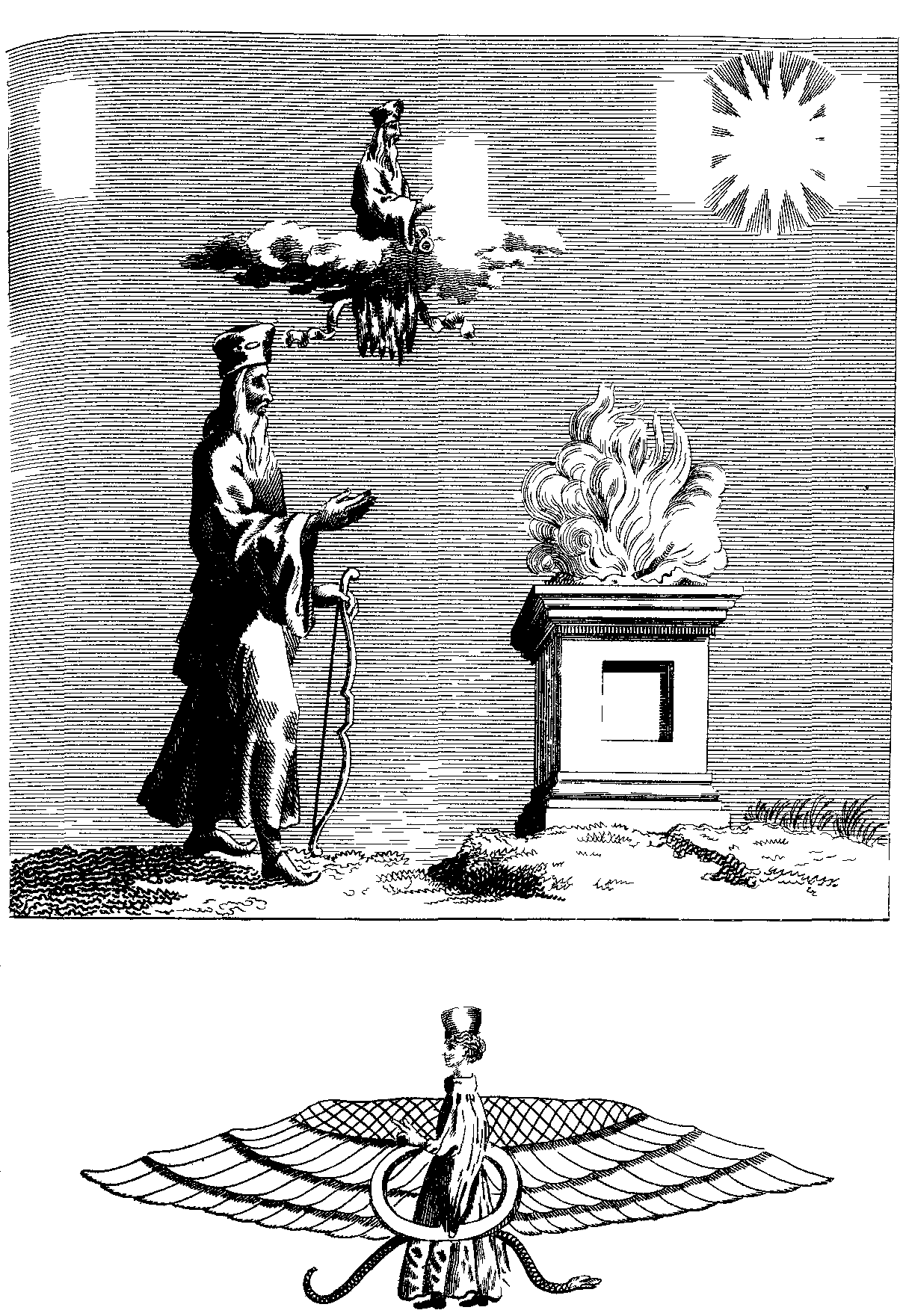
The Grecians therefore were wrong in their etymology; and we may trace
the origin of their mistake, when they supposed the meaning of Zoroaster
to have been vivens astrum. I have mentioned, that both Zon and Zoan
signified the Sun: and the term Zor had the same meaning. In consequence
of this, when the Grecians were told that Zor-Aster was the same as
Zoan-Aster, they, by an uniform mode of mistake, expressed the latter
ζωον; and
interpreted Zoroaster αστερα
ζωον. But Zoan signified the Sun. The city
Zoan in Egypt was Heliopolis; and the land of Zoan the Heliopolitan nome.
Both Zoan-Aster, and Zor-Aster, signified Sol Asterius. The God Menes was
worshipped under the symbol of a bull; and oftentimes under the symbol of
a bull and a man. Hence we read of Meno-Taur, and of Taur-Men, in Crete,
Sicily, and other places. The same person was also styled simply Taurus,
from the emblem under which he was represented. This Taurus was also
called Aster, and Asterius, as we learn from Lycophron, and his Scholiast.
Ὁ Αστηριος
ὁυτος εστιν
ὁ και
Μινοταυρος.
By Asterius is signified the same person as the Minotaur. This
Taur-Aster is exactly analogous to Zor-Aster above. It was the
same emblem as the Mneuis, or sacred bull of Egypt; which was described
with a star between his horns. Upon some of the entablatures at Naki Rustan,
supposed to have been the antient Persepolis, we find the Sun to be
described under the appearance of a bright star: and nothing can better
explain the history there represented, than the account given of
Zoroaster. He was the reputed son of Oromazes, the chief Deity; and his
principal instructor was Azonaces, the same person under a different
title. He is spoken of as one greatly beloved by heaven: and it is
mentioned of him, that he longed very much to see the Deity, which at his
importunity was granted to him. This interview, however, was not effected
by his own corporeal eyes, but by the mediation of an angel.
Through this medium the vision was performed: and he obtained a view of
the Deity surrounded with light. The angel, through whose intervention
this favour was imparted, seems to have been one of those styled Zoni,
and Azoni. All the vestments of the
priests, and those in which they used to apparel their Deities, had
sacred names, taken from terms in their worship. Such were Camise,
Candys, Camia, Cidaris, Mitra, Zona, and the like. The last was a sacred
fillet, or girdle, which they esteemed an emblem of the orbit described
by Zon, the Sun. They either represented their Gods as girded round with
a serpent, which was an emblem of the same meaning; or else with this
bandage, denominated Zona. They seem to have been
secondary Deities, who were called Zoni and Azoni. The term signifies
Heliadæ: and they were looked upon as æthereal essences, a kind of
emanation from the Sun. They were exhibited under different
representations; and oftentimes like Cneph of Egypt. The fillet, with
which the Azoni were girded, is described as of a fiery nature: and they
were supposed to have been wafted through the air. Arnobius speaks of it
in this light. Age, nunc, veniat, quæso, per
igneam zonam Magus ab interiore orbe Zoroastres. I imagine, that by
Azonaces, Αζωνακης,
beforementioned, the reputed teacher of Zoroaster, was meant the chief
Deity, the same as Oromanes, and Oromasdes. He seems to have been the
supreme of those æthereal spirits described above; and to have been named
Azon-Nakis, which signifies the great Lord, Azon. Naki, Nakis, Nachis,
Nachus, Negus, all in different parts of the world betoken a king. The
temple at Istachar, near which these representations were found, is at
this day called the palace of Naki Rustan, whoever that personage may
have been.
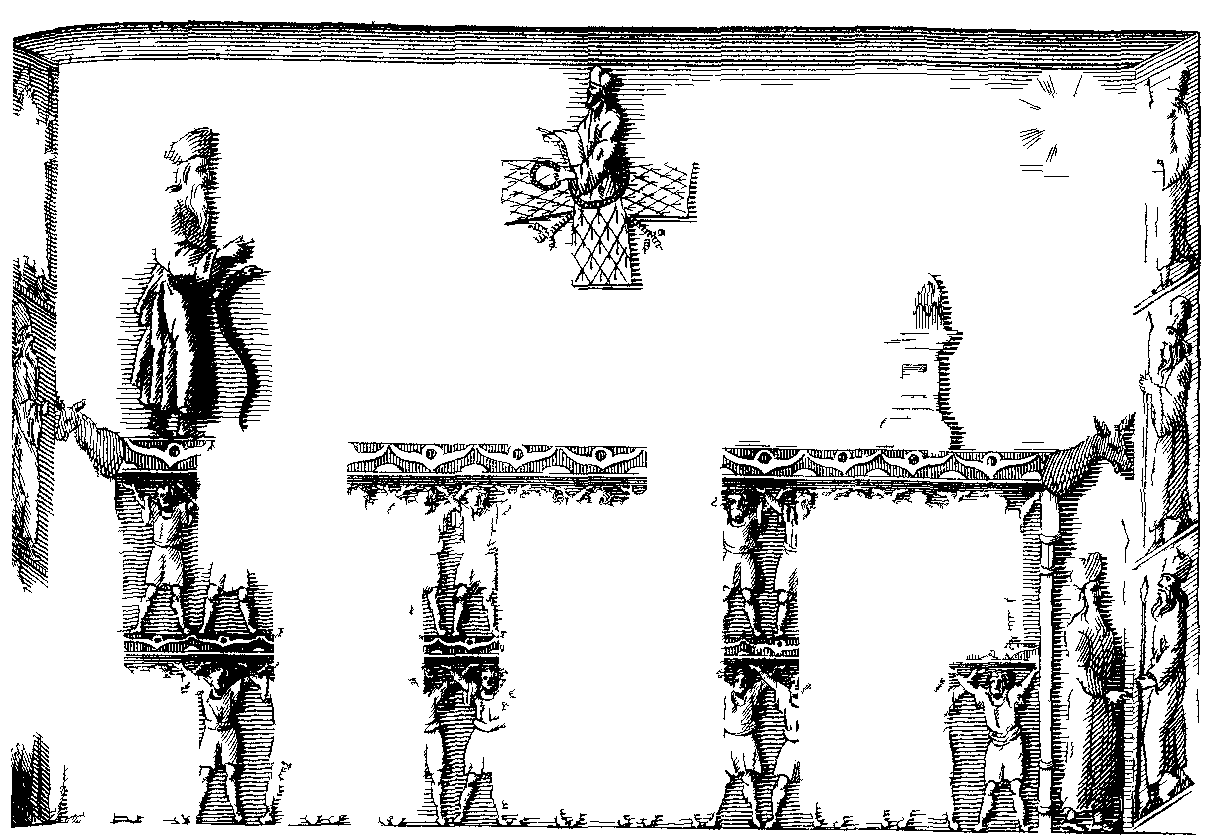
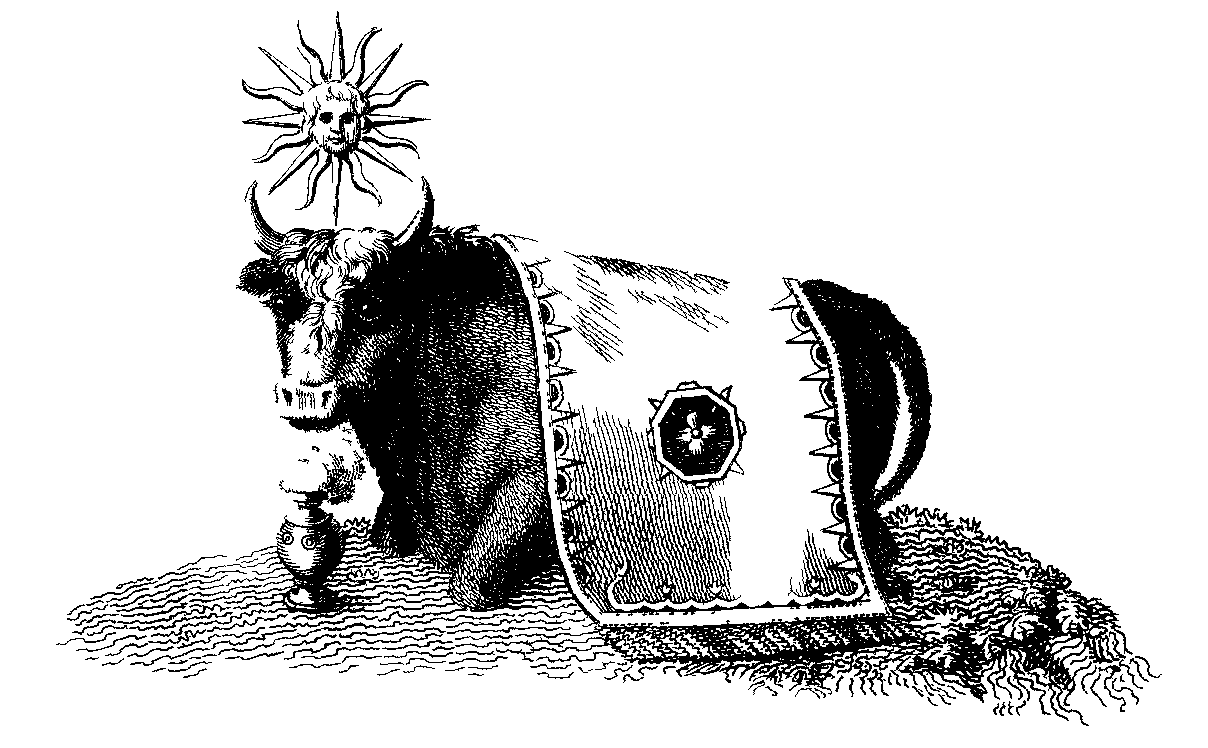
The character of Orpheus is in some respects not unlike that of
Zoroaster, as will appear in the sequel. He went over many regions of the
earth; and in all places, whither he came, was esteemed both as a priest,
and a prophet. There seems to be more in his history than at first sight
appears: all which will by degrees be unfolded. His skill in harmony is
represented as very wonderful: insomuch that he is said to have tamed the
wild beasts of the forest, and made the trees follow him. He likewise
could calm the winds, and appease the raging of the sea. These last
circumstances are taken notice of by a poet in some fine verses, wherein
he laments his death.
Ὁυκ ετι κοιμασεις ανεμων βρομον, ουχι χαλαζαν,
Ου νιφετων συρμους, ου παταγευσαν ἁλα.
Ωλεο γαρ. κλ.
He is mentioned, as having been twice in a state of death;
which is represented as a twofold descent to the shades below. There is
also an obscure piece of mythology about his wife, and a serpent; also of
the Rhoia or Pomegranate: which seems to have been taken from some
symbolical representation at a time, when the purport was no longer
understood. The Orpheans dealt particularly in symbols, as we learn from
Proclus. Ορφικοι δια
συμβολον,
Πυθαγορειοι
δια εικονων,
τα θεια
μηνυειν
εφιεμενοι.
His character for science was very great; and Euripides takes particular
notice of some antient tablets, containing much salutary knowledge, which
were bequeathed to the Thracians by Orpheus: ἁς Ορφειη
κατεγραψε
γηρυς. Plato styles his works βιβλων
ὁμαδον, a vast lumber of
learning, from the quantity, which people pretended had been
transmitted from him. He one while resided in Greece; and particularly at
Thebes in Bœotia. Here he introduced the rites of Dionusus, and
celebrated his Orgies upon mount Cithæron. He is said to have
been the first who instituted those rites: and was the author of all
mysterious worship. Πρωτος
Ορφευς
μυστηρια
Θεων
παρεδωκεν.
All these were accompanied with science of another nature: for he is
reputed to have been skilled in many arts.
From Thebes he travelled towards the sea-coast of Chaonia, in order to
recover his lost Eurydice; who had been killed by a serpent. According to
Agatharchides Cnidius it was at
Aorthon in Epirus, that he descended for this purpose to the shades
below. The same account is given by Pausanias, who calls the place
more truly Aornon. In the Orphic Argonauts it is said to have been
performed at Tænarus in Laconia. He likewise resided in
Egypt, and travelled over the regions of Libya; and every where
instructed people in the rites, and religion, which he professed. In the
same manner he went over a great part of the world.
Ως ἱκομην επι γαιαν απειρετον, ηδε ποληας,
Αιγυπτῳ, Λιβυῃ τε, βροτοις ανα θεσφατα φαινων.
Some make Orpheus by birth a Thracian; some an Arcadian: others a
Theban. Pausanias mentions it as an opinion among the Egyptians, that both Orpheus,
and Amphion, were from their country. There is great uncertainty about
his parents. He is generally supposed to have been the son of
Œagrus, and Calliope: but Asclepiades made him the son of Apollo, by
that Goddess. By some his mother was
said to have been Menippe; by others Polymnia. He is also mentioned
as the son of Thamyras. Plato differs from
them all, and styles both Orpheus, and Musæus, Σεληνης και
Μουσων
εγγονοι, the
offspring of the Moon, and the Muses: in which account is contained
some curious mythology. The principal place of his residence is thought
to have been in Pieria near mount Hæmus. He is also said to have resided
among the Edonians; and in Sithonia, at the foot of mount Pangæus; also
upon the sea-coast at Zona. In all these places he displayed his
superiority in science; for he was not only a Poet, and skilled in
harmony, but a great Theologist and Prophet; also very knowing in
medicine, and in the history of the heavens. According to Antipater
Sidonius, he was the author of Heroic verse. And some go so far as to
ascribe to him the invention of letters; and deduce all knowledge from him.
Many of the things, reported to have been done by Orpheus, are
attributed to other persons, such as Eetion, Musæus, Melampus,
Linus, Cadmus, and Philammon. Some of these are said to have had the same
parents. Authors in their
accounts of Orpheus, do not agree about the manner of his death.
The common notion is, that he was torn to pieces by the Thracian women.
But, according to Leonides, in Laërtius, he was slain by lightning: and
there is an epitaph to that purpose. The
name of Orpheus is to be found in the lists of the Argonauts: and he is
mentioned in the two principal poems upon that subject. Yet there were
writers who placed him eleven generations before the war of Troy,
consequently ten generations before that expedition. Γεγονε προ
ια γενεων
των
Τρωικων—βιωναι
δε γενεας θ·
ὁι δε ια
φησιν. He was born eleven ages
before the siege of Troy, and he is said to have lived nine ages; and
according to some eleven. This extent of life has been given him in
order to bring him down as low as the aera of the Argonauts: though, if
we may believe Pherecydes Syrus, he had no share in that expedition.
To remedy the inconsistences, which arise in the history of Orpheus,
writers have supposed many persons of this name. Suidas takes notice of
no less than four in Thrace. But all these will not
make the history consistent. Vossius therefore, with good reason, doubts
whether such a person ever existed. Nay, he asserts, Triumviros istos Poeseos,
Orphea, Musæum, Linum, non fuisse: sed esse nomina ab antiquâ
Phœnicum linguâ, quâ usi Cadmus, et aliquamdiu posteri. There is
great truth in what Vossius here advances: and in respect to Orpheus, the
testimony of Aristotle, quoted by him from Cicero, is very decisive. Orpheum
poetam docet Aristoteles nunquam fuisse. Dionysius, as we learn from
Suidas, affirmed the same thing. Palæphatus indeed admits the man; but
sets aside the history. Ψευδης και
ὁ περι του
Θρφεως
μυθος. The history too of Orpheus
is nothing else but a fable. From what has been said, I think it is
plain, that under the character of this personage we are to understand a
people named Orpheans; who, as Vossius
rightly intimates, were the same as the Cadmians. In consequence of this,
there will sometimes be found a great similarity between the characters
of these two persons.
I have shewn, that Colonies from Egypt settled in the region of
Sethon, called afterwards Sethonia, upon the river Palæstinus. They were
likewise to be found in the countries of Edonia, Pieria, and Peonia: in
one of which they founded a city and temple. The Grecians called this
city Orpheus: Ορφευς εστι
πολις υπο τῃ
Πιεριῃ. Orpheus is a city
of Thrace, below Pieria. But the place was originally expressed
Orphi, by which is meant the oracular temple of Orus. From hence, and
from the worship here instituted, the people were styled Orphites, and
Orpheans. They were noted for the Cabiritic mysteries; and for the
Dionusiaca, and worship of Damater. They were likewise very famous for
the medicinal arts; and for their skill in astronomy and music. But the
Grecians have comprehended, under the character of one person, the
history of a people. When they settled in Thrace, they introduced their
arts, and their worship, among the barbarous natives, by whom they were
revered for their superior knowledge. They likewise bequeathed many
memorials of themselves, and of their forefathers, which were probably
some emblematical sculptures upon wood or stone: hence we read of the
tablets of Orpheus preserved in Thrace, and particularly upon mount Hæmus.
The temple which they built upon this mountain seems to have been a
college, and to have consisted of a society of priests. They were much
addicted to celibacy, as we may judge from their history; and were, in
great measure, recluses after the mode of Egypt and Canaan. Hence it is
said of Orpheus, that he secreted himself from the world, and led the
life of a Swan: and it is moreover
mentioned of Aristæus, when he made a visit to Dionusus upon mount Hæmus,
that he disappeared from the sight of men, and was never after seen.
According to the most common accounts concerning the death of Orpheus, it
was owing to his principles, and manner of life. He was a solitary, and
refused all commerce with womankind: hence the Mænades, and other women
of Thrace, rose upon him, and tore him to pieces. It is said, that his
head, and lyre were thrown into the Hebrus; down which they were wafted
to Lemnos. What is here mentioned of Orpheus, undoubtedly relates to the
Orpheans, and to their temple upon mount Hæmus. This temple was in
process of time ruined: and there is great reason to think, that it was
demolished upon account of the cruelties practised by the priests, and
probably from a detestation of their unnatural crimes, to which there are
frequent allusions. Ovid having given a character of Orpheus, concludes
with an accusation to this purpose.
Ille etiam Thracum populis fuit auctor amores
In teneros transferre mares: citraque juventam
Ætatis breve ver, et primos carpere flores.
Those of the community, who survived the disaster, fled down the
Hebrus to Lesbos; where they either found, or erected, a temple similar
to that which they had quitted. Here the same worship was instituted; and
the place grew into great reputation. They likewise settled at Lenmos.
This island lay at no great distance from the former; and was
particularly devoted to the Deity of fire. It is said by Hecatæus, that
it received the name of Lemnos from the Magna Dea, Cybele. She was styled
by the natives Λημνος, and at her shrine
they used to sacrifice young persons. Απο μεγαλης
λεγομενης
Θεου· ταυτῃ
δε και
παρθενους
εθυον. They seem to have named the
temple at Lesbos Orphi, and Orpheï caput: and it appears to have been
very famous on account of its oracle. Philostratus says, that the
Ionians, and Æolians, of old universally consulted it: and, what is
extraordinary, that it was held in high estimation by the people of Babylonia. He calls the place
the head of Orpheus: and mentions, that the oracle proceeded from a
cavity in the earth; and that it was consulted by Cyrus, the Persian.
That the Babylonians had a great veneration for a temple named Orphi, I
make no doubt: but it certainly could not be the temple at Lesbos. During
the Babylonish empire, Greece, and its islands, were scarcely known to
people of that country. And when the Persians succeeded, it is not
credible, that they should apply to an oracle at Lesbos, or to an oracle
of Greece. They were too refined in their religious notions to make any
such application. It is notorious, that, when Cambyses, and Ochus,
invaded Egypt, and when Xerxes made his inroad into Greece, they burnt
and ruined the temples in each nation, out of abomination to the worship.
It was another place of this name, an oracle of their own, to which the
Babylonians, and Persians, applied. For it cannot be supposed, in the
times spoken of, that they had a correspondence with the western world.
It was Ur, in Chaldea, the seat of the antient Magi, which was styled
Urphi, and Orphi, on account of its being the seat of an oracle. That
there was such a temple is plain from Stephanus Byzantinus, who tells us,
Μαντειον
εχειν
αυτους
(Χαλδαιους)
παρα
βαρβαροις,
ὡς Δελφοι
παρ'
Ἑλλησι. The Chaldeans had
an oracle as famous among the people of those parts, as Delphi was among
the Grecians. This temple was undoubtedly styled Urphi. I do not
mean, that this was necessarily a proper name; but an appellative, by
which oracular places were in general distinguished. The city Edessa in
Mesopotamia seems likewise to have had the name of Urphi, which was given
on account of the like rites, and worship. That it was so named, we may
fairly presume from its being by the natives called Urpha,
at this day. It was the former temple, to which the Babylonians, and
Persians had recourse: and it was from the Magi of these parts, that the
Orphic rites and mysteries were originally derived. They came from
Babylonia to Egypt, and from thence to Greece. We accordingly find this
particular in the character of Orpheus, ειναι δε τον
Ορφεα
μαγευσαι
δεινον, that he was great
in all the mysteries of the Magi. We moreover learn from Stephanus
Monachius, that Orphon, a term of the same purport as Orpheus, was one of
the appellations, by which the Magi were called. Orphon,
quod Arabibus Magum sonat. In short, under the character of Orpheus, we
have the history both of the Deity, and of his votaries. The head of
Orpheus was said to have been carried to Lemnos, just as the head of
Osiris used to be wafted to Byblus. He is described as going to the
shades below, and afterwards returning to upper air. This is similar to
the history of Osiris, who was supposed to have been in a state of death,
and after a time to have come to life. There was moreover something
mysterious in the death of Orpheus; for it seems to have been celebrated
with the same frantic acts of grief, as people practised in their
lamentations for Thamuz and Osiris, and at the rites of Baal. The
Bistonian women, who were the same as the Thyades, and Mænades, used to
gash their arms with knives, and besmear themselves with blood,
and cover their heads with ashes. By this display of sorrow we are to
understand a religious rite; for Orpheus was a title, under which the
Deity of the place was worshipped. He was the same as Orus of Egypt, whom
the Greeks esteemed both as Apollo, and Hephaistus. That he was a deity
is plain from his temple and oracle abovementioned: which, we find, were
of great repute, and resorted to by various people from the opposite
coast.
As there was an Orpheus in Thrace, so there appears to have been an
Orpha in Laconia, of whose history we
have but few remains. They represent her as a Nymph, the daughter of
Dion, and greatly beloved by Dionusus. She was said, at the close of her
life, to have been changed to a tree. The fable probably relates to the
Dionusiaca, and other Orphic rites, which had been in early times
introduced into the part of the world abovementioned, where they were
celebrated at a place called Orpha. But the rites grew into disuse, and
the history of the place became obsolete: hence Orpha has been converted
to a nymph, favoured of the God there worshipped; and was afterwards
supposed to have been changed to one of the trees, which grew within its
precincts.
Many undertook to write the history of Orpheus; the principal of whom
were Zopurus of Heraclea, Prodicus Chius, Epigenes, and Herodorus. They
seem all to have run into that general mistake of forming a new personage
from a title, and making the Deity a native, where he was inshrined. The
writings, which were transmitted under the name of Orpheus, were
innumerable: and are justly ridiculed by Lucian, both for their quantity,
and matter. There were however some curious hymns, which used to be of
old sung in Pieria, and Samothracia; and which Onomacritus copied. They
contain indeed little more than a list of titles, by which the Deity in
different places was addressed. But these titles are of great antiquity:
and though the hymns are transmitted in a modern garb, the person,
through whom we receive them, being as late as Pisistratus, yet they deserve
our notice. They must necessarily be of consequence, as they refer to the
worship of the first ages, and afford us a great insight into the
Theology of the antients. Those specimens also, which have been preserved
by Proclus, in his dissertations upon Plato, afford matter of great
curiosity. They are all imitations, rather than translations of the
antient Orphic poetry, accompanied with a short comment. This poetry was
in the original Amonian language, which grew obsolete among the
Helladians, and was no longer intelligible: but was for a long time
preserved in Samothracia, and used in their
sacred rites.
Although I have said so much about Dionusus, Sesostris, and other
great travellers, I cannot quit the subject till I have taken notice of
Cadmus: for his expeditions, though not so extensive as some, which I
have been mentioning, are yet esteemed of great consequence in the
histories of antient nations. The time of his arrival in Greece is looked
up to as a fixed æra: and many circumstances in chronology are thereby
determined. He is commonly reputed to have been a Phenician by birth; the
son of Agenor, who was the king of that country. He was sent by his
father's order in quest of his sister Europa; and after wandering about a
long time to little purpose, he at last settled in Greece. In this
country were many traditions concerning him; especially in Attica, and
Bœotia. The particular spot, where he is supposed to have taken up
his residence, was in the latter province at Tanagra upon the river
Ismenus. He afterwards built Thebes: and wherever he came, he introduced
the religion of his country. This consisted in the worship of Dionusus; and in the rites,
which by the later Greeks were termed the Dionusiaca. They seem to have
been much the same as the Cabyritic mysteries, which he is said to have
established in Samothracia. He fought with a mighty dragon; whose teeth
he afterwards sowed, and produced an army of men. To him Greece is
supposed to have been indebted for the first introduction of letters;
which are said to have been the letters of his country Phenicia, and in
number sixteen. He married Harmonia, the daughter of Mars and Venus: and
his nuptials were graced with the presence of all the Gods, and
Goddesses; each of whom conferred some gift upon the bride. He had
several children; among whom was a daughter Semele, esteemed the mother
of Bacchus. After having experienced great vicissitudes in life, he is
said to have retired with his wife Harmonia to the coast of Illyria,
where they were both changed to serpents. He was succeeded at Thebes by
his son Polydorus, the father of Labdacus, the father of Laius. This last
was the husband of Jocasta, by whom he had Œdipus.
Bochart with wonderful ingenuity, and equal learning, tries to solve
the ænigmas, under which this history is represented. He supposes Cadmus
to have been a fugitive Canaanite, who fled from the face of Joshua: and
that he was called Cadmus from being a Cadmonite, which is a family
mentioned by Moses. In like manner he imagines, that Harmonia had her
name from mount Hermon, which was probably in the district of the
Cadmonites. The story of the dragon he deduces from the Hevæi, or
Hivites; the same people as the Cadmonites. He proceeds afterwards with
great address to explain the rest of the fable, concerning the teeth of
the dragon, which were sown; and the armed men, which from thence arose:
and what he says is in many particulars attended with a great shew of
probability. Yet after all his ingenious conjectures, I am obliged to
dissent from him in some points; and particularly in one, which is of the
greatest moment. I cannot be induced to think, that Cadmus was, as
Bochart represents him, a Phenician. Indeed I am persuaded, that no such
person existed. If Cadmus brought letters from Phenicia, how came he to
bring but sixteen; when the people, from whom he imported them, had
undoubtedly more, as we may infer from their neighbours? And if they were
the current letters of Greece, as Herodotus intimates; how came it to
pass, that the tablet of Alcmena, the wife of Amphitryon, the third in
descent from Cadmus, could not be understood, as we are assured by Plutarch? He says, that in the
reign of Agesilaus of Sparta, a written tablet was found in the tomb of
Alcmena, to whom it was inscribed: that the characters were obsolete, and
unintelligible; on which account they sent it to Conuphis of Memphis in
Egypt, to be decyphered. If these characters were Phenician, why were
they sent to a priest of a different country for interpretation? and why
is their date and antiquity defined by the reign of a king in Egypt? Τους τυπους
ειναι της
επι Πρωτει
βασιλευοντι
γραμματικης.
The form of the letters was the same as was in use when Proteus
reigned in that country. Herodotus, indeed, to prove that the
Cadmians brought letters into Greece, assures us, that he saw specimens
of their writing at Thebes, in the temple of Apollo Ismenius: that there was a
tripod as antient as the reign of Laius, the son of Labdacus; with an
inscription, which imported, that it had been there dedicated by
Amphitryon upon his victory over the Teleboæ. I make no doubt, but that
Herodotus saw tripods with antient inscriptions: and there might be one
with the name of Amphitryon: but how could he be sure that it was the
writing of that person, and of those times? We know what a pleasure there
is in enhancing the antiquity of things; and how often inscriptions are
forged for that purpose. Is it credible that the characters of Amphitryon
should be so easy to be apprehended, when those of his wife Alcmena could
not be understood? and which of the two are we in this case to believe,
Herodotus or Plutarch? I do not mean that I give any credence to the
story of Alcmena and her tablet: nor do I believe that there was a tripod
with characters as antient as Amphitryon. I only argue from the
principles of the Greeks to prove their inconsistency. The Pheneatæ in
Arcadia shewed to Pausanias an inscription upon the basis of a brazen
statue, which was dedicated to Poseidon Hippius. It was said
to have been written by Ulysses, and contained a treaty made between him
and some shepherds. But Pausanias acknowledges that it was an imposition;
for neither statues of brass, nor statues of any sort, were in use at the
time alluded to.
It is said of Cadmus, that he introduced the rites of Bacchus
into Greece. But how is this possible, if Bacchus was his descendant, the
son of his daughter Semele? To remedy this, the latter mythologists
suppose, that there was a prior Bacchus, who was worshipped by Cadmus.
This is their usual recourse, when they are hard pressed with
inconsistencies. They then create other personages, to help them out of
their difficulties. They form, with great facility, a new Semiramis, or
Ninus; another Belus, Perseus, Minos, Hermes, Phoroneus, Apis, though to
little purpose: for the mistake being fundamental, the inconveniencies
cannot be remedied by such substitutes. We are told that Cadmus was a
Phenician: but Diodorus Siculus speaks of him as assuredly of Egypt; and
mentions moreover, that he was a native of the Thebaïs: Καδμον εκ
Θηβων οντα
των
Αιγυπτιων.
Pherecydes Syrus also, from whom most of the mythology of Greece was
borrowed, makes Cadmus an Egyptian, the son of Agenor and
Argiope, who was the daughter of Nilus. By others he is said to have been
the son of Antiope, the daughter of Belus: consequently he must
originally have been of Babylonish extraction. His father Agenor, from
whom he is supposed to have been instructed in the sciences, is
represented by Nonnus as residing at Thebes.
Πατρια θεσπεσιης δεδαημενος οργια τεχνης,
Αιγυπτιης σοφιης μεταναστιος, ημος Αγηνωρ
Μεμφιδος ενναετης ἑκατομπυλον ῳκεε Θηβην.
We learn the same from the Scholiast upon Lycophron, who styles the
king Ogugus. Και ὁ
Ωγυγος
Θηβων
Αιγυπτιων
ην Βασιλευς,
ὁθεν ὁ
Καδμος
ὑπαρχων,
ελθων εν
Ἑλλαδι τας
Ἑπταπυλους
εκτισε. Moreover Ogugus was
king of Thebes in Egypt: of which country was Cadmus, who came into
Greece, and built the city styled Heptapulæ. It was from the same
part of the world, that the mysteries were imported, in which Cadmus is
represented as so knowing: and here it was, that he was taught
hieroglyphics, and the other characters, which are attributed to him. For
he is said to have been expert Χειρος
οπισθοποροιο
χαραγματα
λοξα
χαρασσων. These
arts he carried first to the coast of Sidon, and Syria; and from thence
he is supposed to have brought them to Greece: for, before he came to
Hellas, he is said to have reigned in conjunction with Phœnix, both
at Sidon and Tyre. Φοινιξ και
Καδμος, απο
Θηβων των
Αιγυπτιων
εξελθοντες
εις την
Συριαν
Τυρου και
Σιδωνος
εβασιλευσαν.
Phœnix and Cadmus came from Thebes in Egypt, and reigned at Tyre
and Sidon.
Thus I have taken pains to shew, that Cadmus was not, as has been
generally thought, a Phenician. My next endeavour will be to prove that
no such person existed. If we consider the whole history of this
celebrated hero, we shall find, that it was impossible for one person to
have effected what he is supposed to have performed. His expeditions were
various and wonderful; and such as in those early times would not have
been attempted, nor could ever have been completed. The Helladians say
little more, than that he built Thebes, and brought letters into Greece:
that he slew a dragon, from the teeth of which being sowed in the ground
there arose an army of earthborn men. The writers of other countries
afford us a more extensive account: among the principal of which are to
be esteemed Herodotus, Diodorus, Strabo, and Pausanias. Some of them had
their doubts about the reality of
this adventurer: and from the history which they have transmitted, we may
safely infer, that no such person existed, as has been described under
the character of Cadmus.
He is said to have sailed first to Phenicia and Cyprus; and
afterwards to Rhodes. Here he instructed the
people in the religion which he professed; and founded a temple at
Lindus, where he appointed an order of priests. He did the same at
Thera, and afterwards was at Thasus: and proceeding in his
travels partook of the Cabiritic mysteries in Samothracia. He visited Ionia,
and all the coast upwards to the Hellespont and Propontis. He was at
Lesbos, which he named Issa: where some of his
posterity were to be found long after. He was also at Anaphe, one of the
Sporades; which island was denominated Membliaros from one of his followers. Mention is made of
his being upon the Hellespont, and in Thrace. Here
he resided, and found out a mine of gold, having before found one
of copper in Cyprus. Hence he is said to
have procured great wealth. Ὁδε Καδμου
πλουτος
περι Θρακην,
και το
Παγγαιον
ορος. We hear of him afterwards in Eubœa; where there are to
be found innumerable traces of him, and his followers. He was likewise at
Sparta, as we may infer from
the Heroüm erected to him by Eurotas, and his brethren, the sons of
Huræus. He must have resided a great while in Attica; for there were many
edifices about Athens attributed to him. He settled at Tanagra in
Bœotia; where he lost all his companions, who were slain by a
dragon. He afterwards built Thebes. Here he was king; and is said to have
reigned sixty-two years. But as if his wanderings
were never to be terminated, he leaves his newly founded city, and goes
to Illyria. Here we find him again in regal state. Βασιλευει
Καδμος των
Ιλλυριων. He
reigns over the country which receives its name from his son. Ιλλυρια—απο
Ιλλυριου
του
Καδμονος
παιδος. Now whoever is truly
acquainted with antiquity, must know, that, in the times here spoken of,
little correspondence was maintained between nation and nation.
Depredations were very frequent; and every little maritime power was in a
state of piracy: so that navigation was
attended with great peril. It is not therefore to be believed, that a
person should so often rove upon the seas amid such variety of nations,
and reside among them at his pleasure: much less that he should build
temples, found cities, and introduce his religion, wherever he listed;
and this too in such transient visits. Besides, according to the Egyptian
accounts, the chief of his adventures were in Libya. He married Harmonia
at the lake Tritonis; and is said to have
founded in that part of the world no less. than an hundred cities:
Λιβυστιδι Καδμος αρουρᾳ
Δωμησας πολιων ἑκατονταδα.
Some of these cities seem to have been situated far west in the
remoter parts of Africa.
Και Λιβυες στρατοωντο παρ' Ἑσπεριον κλιμα γαιης,
Αγχινεφη ναιοντες Αλημονος αστεα Καδμου.
Carthage itself was of old called Cadmeia: so that he may be
ranked among the founders of that city. Καρχηδων,
Μητροπολις
Λιβυης—εκαλειτο
δε Καινη
πολις, και
Καδμεια. He is mentioned
by Moses Chorenensis to have settled in Armenia, where there was a
regio Cadmeia not far from Colchis. He reigned here; and is said to have
been of the giant race, and to have come from Babylonia. And as the city
Carthage in Libya was called Cadmeia, so in this region Cadmeia, there
was a city Carthage: Καρχηδων
πολις
Αρμενιας.
Such are the expeditions of Cadmus. But is it credible that any person
could have penetrated into the various regions, whither he is supposed to
have gone? to have founded colonies in Phenicia, Cyprus, Rhodes, Thera,
Thasus, Anaphe, Samothracia? to have twice visited the Hellespont? to
have worked the mines in the Pangean mountains, and in other places? to
have made settlements in Eubœa, Attica, Bœotia, and Illyria?
and, above all, to have had such territories in Afric? He is represented
as heir to the kingdom of Egypt: this he quitted, and obtained a kingdom
in Phenicia. He leaves this too; and after much wandering arrives in
Greece; where he founds several cities, and reigns sixty-two years. After
this, hard to conceive! he is made king in Illyria. He must also have
reigned in Afric: and his dominions seem to have been considerable, as he
founded an hundred cities. He is represented as a king in Armenia; and
had there too no small territory. Sure kingdoms in those times must have
been very cheap, if they were so easily attainable. But the whole is
certainly a mistake; at least in respect to Cadmus. No person could
possibly have effected what is attributed to him. They were not the
achievements of one person, nor of one age. And place Cadmus at any given
æra, and arrange his history, as may appear most plausible; yet there
will arise numberless inconsistencies from the connexions he must have in
respect to time, place, and people; such as no art nor disposition can
remedy.
It may be asked, if there were no such man as Cadmus, what did the
antients allude to under this character? and what is the true purport of
these histories? The travels of Cadmus, like the expeditions of Perseus,
Sesostris, and Osiris, relate to colonies, which at different times went
abroad, and were distinguished by this title. But what was the work of
many, and performed at various seasons, has been attributed to one
person. Cadmus was one of the names of Osiris, the chief Deity of Egypt.
Both Europa, and Harmonia are of the like nature. They were titles of the
Deity: but assumed by colonies, who went out, and settled under these
denominations. The native Egyptians seldom left their country, but by
force. This necessity however did occur: for Egypt at times underwent
great revolutions. It was likewise in
some parts inhabited by people of a different cast; particularly by the
sons of Chus. These were obliged to retire: in consequence of which they
spread themselves over various parts of the earth. All, who embarked
under the same name, or title, were in aftertimes supposed to have been
under the same leader: and to him was attributed the honour of every
thing performed. And as colonies of the same denomination went to parts
of the world widely distant; their ideal chieftain, whether Cadmus, or
Bacchus, or Hercules, was supposed to have traversed the same ground: and
the achievements of different ages were conferred upon a fancied hero of
a day. This has been the cause of great inconsistency throughout the
mythology of the antients. To this they added largely, by being so lavish
of titles, out of reverence to their gods. Wherever they came they built
temples to them, and cities, under various denominations; all which were
taken from some supposed attribute. These titles and attributes, though
they belonged originally to one God, the Sun; yet being manifold, and misapplied, gave
rise to a multitude of Deities, whose æra never could be settled, nor
their history rendered consistent. Cadmus was one of these. He was the
same as Hermes of Egypt, called also Thoth, Athoth, and Canathoth: and
was supposed to have been the inventor of letters. He was sometimes
styled Cadmilus, another name for Hermes; under which he was worshipped
in Samothracia, and Hetruria. Lycophron speaking of the prophet Prulis,
in Lesbos, tells us, that he was the son of Cadmus, and of the race of
Atlas. And he was the person, who was supposed to give information to the
Greeks, when they were upon their expedition towards Troy.
Ὡς μη σε Καδμος ωφελ' εν περιῤῥυτῳ
Ισσῃ φυτευσαι δυσμενων ποδηγετην.
These are the words of Cassandra: upon which the Scholiast observes;
Πρυλις,
ὑιος του
Καδμιλου,
και Καδμου,
ητοι Ἑρμου:
Prulis of Lesbos was the son of Cadmilus, or Cadmus, the same as
Hermes. And afterwards he mentions, ὁ Καδμος,
ητοι Ἑρμης,
Cadmus, who is the same as Hermes. In another place he takes
notice, that the name of Hermes among the Hetrurians was Cadmilus: and it has been
shewn, that Cadmilus, and Cadmus, are the same. To close the whole, we
have this further evidence from Phavorinus, that Cadmus was certainly an
epithet or title of Hermes. Καδμος, ου
κυριον
μονον, αλλα
και Ἑρμου
επιθετον.
Harmonia, the wife of Cadmus, who has been esteemed a mere woman,
seems to have been an emblem of nature, and the fostering nurse of all
things. She is from hence styled παντροφος
Ἁρμονια. And when Venus
is represented in the allegory as making her a visit, she is said to go
εις
δομον
Ἁρμονιας
παμμητορος,
to the house of the all-productive parent. In some of the Orphic
verses she is represented not only as a Deity, but as the light of the
world.
Ἁρμονιη, κοσμοιο φαεσφορε, και σοφε Δαιμον.
Harmonia was supposed to have been a personage, from whom all
knowledge was derived. On this account the books of science were styled
κυρβιας
Ἁρμονιας, the
books of Harmonia, as well as the books of Hermes. These were four in
number, of which Nonnus gives a curious account, and says, that they
contained matter of wonderful antiquity.
Ειν ἑνι θεσφατα παντα, ταπερ πεπρωμενα κοσμῳ
Πρωτογονοιο Φανητος επιγραφε μαντιπολος χειρ.
The first of them is said to have been coeval with the world.
Πρωτην κυρβιν οπωπεν ατερμονος ἡλικα κοσμου,
Ειν ἑνι παντα φερουσαν, ὁσα σκηπτουχος Οφιων
Ηνυσεν.
From hence we find, that Hermon, or Harmonia, was a Deity, to whom the
first writing is ascribed. The same is said of Hermes. Ἑρμης
λεγεται
Θεων εν
Αιγυπτῳ
γραμματα
πρωτος
ἑυρειν. The invention is also
attributed to Taut, or Thoth. Πρωτος εστι
Τααυτος, ὁ
των
γραμματων
την ἑυρεσιν
επινοησας,—ὁν
Αιγυπτιοι
μεν
εκαλεσαν
Θωυθ,
Αλεξανδρεις
δε Θωθ,
Ἑρμην δε
Ἑλληνες
μετεφρασαν.
Cadmus is said not only to have brought letters into Greece, but to have
been the inventor of them: from whence we may fairly conclude, that under
the characters of Hermon, Hermes, Taut, Thoth, and Cadmus, one person is
alluded to. The Deity called by the Greeks Harmonia, was introduced among
the Canaanites very early by people from Egypt: and was worshipped in
Sidon, and the adjacent country, by the name of Baal Hermon.
Europa likewise was a Deity; according to Lucian the same as Astarte,
who was worshipped at Hierapolis in Syria. He visited the temple, and had
this information from the priests: ὡς δε μοι
τις των
Ἱρεων
απηγετο,
Ευρωπης
εστι (το
αγαλμα) της
Καδμου
αδελφεης. He is
speaking of the statue in the temple, which the priests told him belonged
to a Goddess, the same as Europa, the sister of Cadmus. She was also
esteemed the same as Rhea; which Rhea we know was the reputed mother of
the gods, and particularly the mother of Jupiter.
Εστ' αν Ῥεια τεκοι παιδα Κρονῳ εν φιλοτητι.
Pindar speaks of Europa, as the daughter of Tityus: and by
Herodotus she is made the mother of Sarpedon and Minos.
I have mentioned, that Cadmus was the same as the Egyptian Thoth; and
it is manifest from his being Hermes, and from the invention of letters
being attributed to him. Similar to the account given of Cadmus is the
history of a personage called by the Greeks Caanthus; this history
contains an epitome of the voyage undertaken by Cadmus, though with some
small variation. Caanthus is said to have been the son of Oceanus; which
in the language of Egypt is the same as the son of Ogus, and Oguges; a
different name for the same person. Ogus, and with the
reduplication Ogugus, was the same as Ogyges, in whose time the flood was
supposed to have happened. Ogyges is represented both as a king of Thebes
in Egypt, and of Thebes in Bœotia: and in his time Cadmus is said to
have left the former country, and to have come to the latter, being sent
in quest of his sister Europa by his father. Caanthus was sent by his
father with a like commission. His sister Melia had been stolen away; and
he was ordered to search every country, till he found her. He accordingly
traversed many seas, and at last lauded in Greece, and passed into
Bœotia. Here he found, that his sister was detained by Apollo in the
grove of Ismenus. There was a fountain of the same name near the
grove, which was guarded by a dragon. Caanthus is said to have cast fire
into this sacred recess; on which account he was slain by Apollo. His
ταφος, or tomb, was in aftertimes
shewn by the Thebans. We may perceive, that the main part of this
relation agrees with that of Cadmus. Melie, the sister of Caanthus, is by
some spoken of as the mother of Europa: which shews, that there
is a correspondence between the two histories. The person also, who sent
these two adventurers, the sister, of whom they went in quest, and the
precise place, to which they both came, exhibit a series of circumstances
so similar, that we need not doubt, but that it is one and the same
history. It is said, that Caanthus threw fire into the sacred grove:
which legend, however misconstrued, relates to the first establishment of
fire-worship at Thebes in the grove of Apollo Ismenius. The term Ismenius
is compounded of Is-Men, ignis Menis. Meen, Menes, Manes, was one of the
most antient titles of the Egyptian God Osiris, the same as Apollo, and
Caanthus. What has been mentioned about Cadmus and Caanthus, is repeated
under the character of a person named Curnus; who is said to have been
sent by his father Inachus in search of his sister Io.
Inachus, Oceanus, Ogugus, and Agenor, are all the same personages under
different names; and the histories are all the same.
That Cadmus was of old esteemed a Deity may be farther proved from his
being worshipped at Gortyna in Crete, as we learn from Solinus.
Iidem Gortynii et Cadmum colunt, Europæ fratrem. He had moreover an
Heroum at Sparta, which was erected by people styled the sons of Huræus.
We learn from Palæphatus, that according to some of the antient
mythologists, Cadmus was the person, who slew the serpent at
Lerna. And according to Nonnus he contended with the giant Typhasus, and
restored to Jupiter his lost thunder. By this is meant, that
he renewed the rites, and worship of the Deity, which had been abolished.
These are circumstances, which sufficiently shew, that Cadmus was a
different personage, from what he is generally imagined. There was a hill
in Phrygia of his name, and probably sacred to him; in which were the
fountains of the river Lycus. There was also a river
Cadmus, which rose in the same mountain, and was lost underground. It
soon afterwards burst forth again, and joined the principal stream.
Mountains and rivers were not denominated from ordinary personages. In
short Cadmus was the same as Hermes, Thoth, and Osiris: under which
characters more than one person is alluded to, for all theology of the
antients is of a mixed nature. He may principally be esteemed Ham, who by
his posterity was looked up to as the Sun, and worshipped under his
titles: a circumstance, however, which was common to all, who were styled
Baalim. That he was the same as Ham, will appear from the etymology of
his name. I have before shewn, that the Sun was styled Achad,
Achon, and Achor: and the name, of which we are treating, is a compound
of Achad-Ham, rendered by the
Greeks Acadamus and Academus, and contracted Cadmus. Many learned men
have thought, that the place at Athens called Academia was founded by
Cadmus, and denominated from him: and of the latter circumstance I make
no doubt. Ab hoc Cadmo Eruditi Academiam,
quasi Cadmiam deducunt: quo nomine indigitari locum musis studiisque
sacratum notissimum est. The true name of Cadmus, according to this
supposition, must have been, as I have represented, Acadamus; or, as the
Ionians expressed it, Academus, to have Academia formed from it.
Herodotus informs us, that, when the Cadmians came to Attica, they
introduced a new system of Architecture; and built temples
in a style different from that to which the natives had been used. And he
describes these buildings as erected at some distance from those of the
country. This was the situation of the place called Academia, which stood
at the distance of a few furlongs from Athens. It was a place of
exercise and science; and by all accounts finely disposed: being planted
with a variety of trees, but particularly Olives, called here (Μοριαι) Moriæ. There were
likewise springs, and baths for the convenience of those who here took
their exercise. The tradition among the Athenians was, that one Ecademus,
or Academus, founded it in antient times; from whom it received its name.
Laërtius styles him the hero Ecademus: Απο τινος
Ἡρωος
ωνομασθη
Εκαδημου. And
Suidas to the same purpose; Απο
Εκαδημου
τινος Ἡρωος
ονομασθεν.
But Eupolis, the comic writer, who was far prior, speaks of him as a
Deity: Εν ευσκιοις
δρυμοισιν
Ακαδημου
Θεου. The trees, which grew within the
precincts, were looked upon as very sacred, οντως
ἱεραι, and the place itself in
antient times was of so great sanctity, that it was a profanation to
laugh there; προτερον εν
Ακαδημιᾳ
μηδε
γελασαι
εξουσιαν
ειναι.
The Ceramicus at Athens had the same name; and it was undoubtedly
given from the same personage. Ακαδημια.
καλειται δε
ὁυτως ὁ
Κεραμικος.
Hesych. The common notion was, that it was denominated from the hero Ceramus,
the son of Dionusus. This arose from the common mistake; by which the
place was put for the person, to whom it was sacred, and whose name it
bore. Ham was the supposed hero: and Ceramus was Cer-Ham, the tower or
temple of Ham, which gave name to the inclosure. This abuse of terms is
no where more apparent than in an inscription mentioned by Gruter; where
there is a mixed title of the Deity formed from his place of worship.
Cir-Adon was the temple of Adon, or Adonis; the Amonian title of the
chief God. In like manner near mount Laphystium in Bœotia, the God
Charops was worshipped, and
styled Hercules Charops. But Char-Ops, or Char-Opis, signified the temple
of the serpent Deity: and was undoubtedly built of old by the people
named Charopians, and Cyclopians; who were no other than the antient
Cadmians. Ceramicus was an Egyptian name; and one of the gates or towers
of the gates at Naucratis in that country was so
called. It was also the name of an harbour in Caria, probably denominated
from some building at the entrance.
I may possibly be thought to proceed too far in abridging history of
so many heroic personages, upon whose names antiquity has impressed a
reverence; and whose mighty actions have never been disputed. For though
the dress and colouring may have been thought the work of fancy, yet the
substance of their history has been looked upon as undeniably true. To
which I answer, that it was undoubtedly founded in truth: and the only
way to ascertain what is genuine, must be by stripping history of this
unnatural veil, with which it has been obscured; and to reduce the whole
to its original appearance. This may be effected upon the principles
which I have laid down; for if instead of Perseus, or Hercules, we
substitute bodies of men, who went under such titles, the history will be
rendered very probable, and consistent. If instead of one person, Cadmus
traversing so much ground, and introducing the rites of his country at
Rhodes, Samos, Thera, Thasus, Samothrace, and building so many cities in
Libya, we suppose these things to have been done by colonies, who were
styled Cadmians, all will be very right, and the credibility of the
history not disputed. Many difficulties may by these means be solved,
which cannot otherwise be explained: and great light will be thrown upon
the mythology of the antients.
The story then of Cadmus, and Europa, relates to people from Egypt,
and Syria, who went abroad at different times, and settled in various
parts. They are said to have been determined in their place of residence
by an ox, or cow: by which this only is meant, that they were directed by
an oracle: for without such previous inquiry no colonies went abroad. An
oracle by the Amonians was termed Alphi, and Alpha, the voice of God. In
Egypt the principal oracular temples were those of the sacred animals
Apis and Mneuis. These animals were highly reverenced at Heliopolis, and
Memphis, and in other cities of that country. They were of the male kind;
but the honours were not confined to them; for the cow and heifer were
held in the like veneration, and they were esteemed equally prophetic.
Hence it was, that they were in common with the Apis and Mneuis styled
Alphi, and Alpha: which name was likewise current among the Tyrians, and
Sidonians. In consequence of this, Plutarch, speaking of the letter
Alpha, says, Φοινικας
ὁυτω καλειν
τον Βουν. The
Phenicians call an ox Alpha. And Hesychius speaks to the same
purpose. Αλφα, βους. Thus
we find that Alpha was both an oracle, and an oracular animal. The
Grecians took it in the latter acceptation; and instead of saying that
the Cadmians acted in obedience to an oracle, they gave out, that Cadmus
followed a cow. What is alluded to in the animal, which was supposed to
have been his guide, may be known by the description given of it by
Pausanias: Επι δε
ἑκατερας
της βοος
πλευρας
σημειον
επειναι
λευκον,
εικασμενον
κυκλῳ της
Σεληνης. There was a
white mark on each side of the cow like the figure of the moon. The
poet quoted by the Scholiast upon Aristophanes speaks to the same
purpose. Λευκον σχημ'
ἑκατερθε
περιπλοκον,
ηυτε Μηνης.
This is an exact description of the Apis, and other sacred kine in
Egypt: and the history relates to an oracle given to the Cadmians in that
country. This the Grecians have represented, as if Cadmus had been
conducted by a cow: the term Alphi, and Alpha, being liable to be taken
in either of these acceptations. Nonnus speaks of Cadmus as bringing the
rites of Dionusus, and Osiris, from
Egypt to Greece: and describes him according to the common notion as
going in quest of a bull, and as being determined in his place of
residence by a cow. Yet he afterwards seems to
allude to the true purport of the history; and says, that the animal
spoken of was of a nature very different from that, which was imagined:
that it was not one of the herd, but of divine original.
Καδμε ματην περιφοιτε, πολυπλανον ιχνος ἑλισσεις·
Μαστευεις τινα Ταυρον, ὁν ου βοεη τεκε γαστηρ.
Under the character of Europa are to be understood people styled
Europians from their particular mode of worship. The first variation from
the purer Zabaism consisted in the Ophiolatria, or worship of the
serpent. This innovation spread wonderfully; so that the chief Deity of
the Gentile world was almost universally worshipped under this symbolical
representation. The serpent among the Amonians was styled Oph, Eph, and
Ope: by the Greeks expressed Οφις, Οπις,
Ουπις: which terms were continually
combined with the different titles of the Deity. This worship prevailed
in Babylonia, Egypt, and Syria: from which countries it was brought by
the Cadmians into Greece. Serpentis eam venerationem acceperunt Græci a
Cadmo. Vossius. It made a part in all
their mysteries; and was attended
with some wonderful circumstances: of which I have before made some
mention in the treatise de Ophiolatriâ. Colonies, which went abroad, not
only went under the patronage, but under some title of their God: and
this Deity was in aftertimes supposed to have been the real conductor. As
the Cadmians, and Europians, were Ophitæ, both their temples, and cities,
also the hills, and rivers, where they settled, were often denominated
from this circumstance. We read of Anopus Asopus, Oropus, Europus,
Charopus, Ellopis, Ellopia; all nearly of the same purport, and named
from the same object of worship. Europa was a Deity: and the name is a
compound Eur-Ope, analogous to Canope, Canophis, and Cnuphis of Egypt;
and signifies Orus Pytho. It is rendered by the Greeks as a feminine,
upon a supposition, that it was the name of a woman; but it related
properly to a country; and we find many places of the like etymology in
Media, Syria, and Babylonia: which were expressed in the masculine
Europos, and Oropus. The same also is observable in Greece.
I have shewn, that Cadmus was Taut, or Thoth; the Taautes of
Sanchoniathon. It is said of this person, that he first introduced the
worship of the serpent: and this so early, that not only the Tyrians and
Sidonians, but the Egyptians received it from him. From hence we may
infer, that it came from Babylonia, Την μεν ουν
του
Δρακοντος
φυσιν, και
των οφεων,
αυτος
εξεθειασεν
ὁ Τααυτος,
και μετ'
αυτον αυθις
Φοινικες τε,
και
Αιγυπτιοι.
The learned writers, who have treated of the Cadmians, have failed in
nothing more, than in not considering, that they were a twofold colony,
which came both from Egypt, and Syria: from Egypt first; and then from
Syria, and Canaan. In their progress westward they settled in Cyprus,
Crete, Rhodes, Samos, Lesbos, Thrace: also in Eubœa, Attica, and
Bœotia. In process of time they were enabled to make settlements in
other parts, particularly in Epirus and Illyria: and to occupy some
considerable provinces in Italy as high up as the Padus. Wherever they
passed they left behind them numberless memorials: but they are to be
traced by none more plainly than by their rites, and worship. As they
occupied the greatest part of Syria, that country was particularly
addicted to this species of idolatry. Many temples were erected to the
Ophite God: and many cities were denominated from him. Both Appian
and Stephanus Byzantinus mention places in Syrophenicia called Oropus.
Upon the Euphrates also in Mesopotamia were the cities Amphipolis, and Dura,
both called of old Oropus. The chief Syrian God had the title of Bel,
Baal, and Belial: which last the Greeks rendered Βελιαρ. Hence Clemens instead
of saying, what agreement can there be between Christ and Belial, says Τις δε
συμφωνησις
Χριστου
προς
ΒΕΛΙΑΡ. This Belial, or
Beliar, was the same as Belorus, and Osiris, who were worshipped under
the symbol of a serpent. Hence Hesychius explains the term Beliar by a
serpent. Βελιαρ—δρακων.
Beliar is the same as a dragon or serpent. The Cadmians are said
to have betaken themselves to Sidon, and Biblus: and the country between
these cities is called Chous at this day. To the north is the city, and
province of Hama: and a town, and castle, called by D'Anville Cadmus; by
the natives expressed Quadamus, or Chadamus. The Cadmians probably
founded the temple of Baal Hermon in Mount Libanus, and formed one of the
Hivite nations in those parts. Bochart has very justly observed, that an
Hivite is the same as an Ophite: and many of this
denomination resided under Mount Libanus, and Anti-Libanus; part of which
was called Baal Hermon, as we learn from the sacred writings. Now
these are the nations, which the Lord left to prove Israel, namely, five
Lords of the Philistines, and all the Canaanites, and the Sidonians; and
the Hivites that dwell in Mount Lebanon from Mount Baal Hermon unto the
entering in of Hamath. There were other Hivites, who are mentioned by
Moses among the children of Canaan. But the Cadmonites, and
many of the people about Mount Libanus were of another family. The
Hivites of Canaan Proper were those, who by a stratagem obtained a treaty
with Joshua. Their chief cities were
Gibeon, Cephirah, Beeroth, and Kirjath Jearim. These lay within the the
tribe of Judah, and of Benjamin, who
possessed the southern parts of Canaan. But the other Hivites, among whom
were the Cadmonites, lay far to the north under Libanus, at the very
extremities of the country. The sacred writer distinguishes them from the
Canaanites, as well as from the other Hivites, by saying, the Hivites of
Baal Hermon. And he seems to distinguish the Sidonians from the genuine
Canaanites, and justly: for if we may credit prophane history, the
Cadmians had obtained the sovereignty in that city: and the people were
of a mixed race. Καδμος—Τυρου
και Σιδωνος
εβασιλευεν.
The Cadmians extended themselves in these parts quite to the Euphrates,
and westward to the coast of Greece, and Ausonia; and still farther to
the great Atlantic. They went under the name of Ellopians, Oropians, Cadmonites, Hermonians, Ophitæ,
and wherever they settled there will be always found some reference to
their antient history, and religion. As they were particularly styled
Ophitæ, or Hivites, many places whither they came, were said to swarm
with serpents. Rhodes was under this
predicament, and had the name of Ophiusa: which name was given on account
of the Hivites, who there settled, and of the serpent-worship, which they
introduced. But the common notion was, that it was so called from real
serpents, with which it was infested. The natives were said to have been
of the giant race, and the Heliadæ or offspring of the
Sun; under which characters the antients particularly referred to the
sons of Chus, and Canaan. Their coming to the island is alluded to under
the arrival both of Danaus and Cadmus, by whom the rites, and religion
of the Rhodians are supposed to have been introduced. In Greece were
several cities named Oropus, by which is signified Ori Serpentis civitas.
One of these was near Tanagia upon the border of
Attica, and Bœotia. This is the very spot where the Cadmians first
resided: and the city was undoubtedly built by them. It stood near the
warm baths of Amphiaraus, whose temple belonged to the Oropians; and who
was particularly worshipped by them. We are informed by Strabo, that the
temple of Amphiaraus was built either in imitation, or in memory, of one
called Cnopia at Thebes. Cnopia is a contraction
for Can-Opia; and the temple was certainly founded by people from Egypt.
It took its name from Can-ope, or Can-opus, the Ophite God of that
country; and of the people likewise, by whom the building was erected.
The natives of Bœotia had many memorials of their having been
originally Ophites. The history of their country had continual references
to serpents and dragons. They seem to have been the national insigne: at
least they were esteemed so by the people of Thebes. Hence we find, that
upon the tomb of Epaminondas there was figured a shield with a serpent
for a device, to signify that he was an Ophite, or Theban.
The Spartans were of the same race: and there is said to have been the
same device upon the shield of Menelaus, and of Agamemnon. The story of Cadmus,
and of the serpent, with which he engaged upon his arrival in
Bœotia, relates to the Ophite worship, which was there instituted by
the Cadmians. So Jason in Colchis, Apollo in Phocis, Hercules at Lerna,
engaged with serpents, all which are histories of the same purport; but
mistaken by the later Grecians.
It will not, I think, be amiss to take notice of some of those
countries westward, to which Cadmus is said to have betaken himself. From
Bœotia he is supposed to have passed to Epirus and Illyria; and it
is certain, that the Cadmians settled in many places upon that coast. In
Thesprotia was a province of the Athamanes; who were denominated from
their Deity Ath-Man, or Ath-Manes. Here were the rivers Acheron, and
Cocytus, the lake Acherusia, and the pestiferous pool Aornon
Here was the city Acanthus similar to one of the same name about forty
miles above Memphis: and a nation of people
called Oreitæ: all which have a
reference to Egypt. The oracle at Dodona was founded by people from the
same country, as we are assured by Herodotus and others. And not
only colonies from that country, but people from Canaan must have betaken
themselves to these parts, as is evident from names of places. This will
appear from the city Phœnice: and from another
near Oricum, called Palæste; and from the coast and region styled
Palæstina. This was the spot where Cæsar landed, before he marched to
Pharsalia. Postridie terram attigit
Cerauniorum saxa inter, et alia loca periculosa, quietam nactus
stationem. At portus omnes timens, quod teneri ab adversariis
arbitrabatur, ad eundem locum, qui adpellatur Palæste, omnibus navibus
incolumibus, milites exposuit. Lucan takes notice of the same
circumstance, and the coast Palæstina.
Inde rapi cœpere rates, atque æquora classem
Curva sequi; quæ jam, vento fluctuque secundo
Lapsa, Palæstinas uncis confixit arenas.
Here was the haven Comar, or Comarus, near the pool Aornus:
and a city Oropus, similar to the Oropus
of Syria, and Bœotia. And higher up was a region Europa, styled
Europa Scythica by Festus Rufus. It is observable that there was a city
in Epirus called Tecmon, similar to one in
Canaan, as we may infer from the chief of David's captains being styled
the Tecmonite.
Some of this family proceeded to the western part of the Adriatic
gulf, and settled upon the Eridanus, or Po. Here were the Orobians, the
same as the Oropians, whose chief city was Comus: near which the consul
Marcellus overthrew the Galli Insubres. The story of
Phaethon, who was supposed to have fallen into the Eridanus, is
manifestly of Egyptian original; as the fable of Cycnus is from Canaan.
Phaethon is by some represented as the first king, who reigned in Chaonia,
and Epirus. He was in reality the same as Osiris, the Sun; whose worship
was in there very early, as well as upon the Padus. The names of the
Deities in every country are generally prefixed to the list of kings, and
mistaken accordingly. Cycnus is supposed to have resided not only in
Liguria, but in Ætolia, and Phocis. There was in these parts a lake Conope,
from Cycnus called also Cycnëa; which names undoubtedly
came from Egypt, and Canaan. The colonies upon the Padus left many
memorials of their original; especially those, who were from the
Caphtorim of Palestina. Some of them had carried on a great work upon the
part of the river, where they settled; which from them was called Fossa
Philistina; and Fossiones Philistinæ. Of this I have made mention before.
It is said of Cadmus, that at the close of his life, he was, together
with his wife Harmonia, changed to a serpent of stone. This wonderful
metamorphosis is supposed to have happened at Encheliæ, a town in
Illyria, which circumstance is taken notice of by Lucan.
Tunc qui Dardaniam tenet Oricon, et vagus altis
Dispersus sylvis Athamas, et nomine prisco
Encheliæ, versi testantes funera Cadmi.
The true history is this. These two personages were here enshrined in
a temple, or Petra: and worshipped under the symbol of a serpent. Scylax
Caryandensis, speaking of this part of Illyria, says, Καδμου και
Ἁρμονιας ὁι
λιθοι εισιν
ενταυθα, και
ἱερον. In this region are two
stones sacred to Cadmus, and Harmonia: and there is likewise a temple
dedicated to them. Lucan, who calls the place Encheliæ, speaks of the
name as of great antiquity. It undoubtedly was of long standing, and a
term from the Amonian language. Encheliæ, Εγχελιαι, is the
place of En-Chel, by which is signified the fountain of heaven; similar
to Hanes, Anorus, Anopus in other parts. The temple was an Ophite Petra:
which terms induced people to believe, that there were in these temples
serpents petrified. It is possible, that in later times the Deity may
have been worshipped under this form: whence it might truly be said of
Cadmus, and Harmonia, that they would one day be exhibited in stone.
Λαϊνεην ημελλον εχειν οφιωδεα μορφην.
But the notion in general arose from a mistake; and was owing to a
misinterpretation of the word Petra. On this account many personages were
said to have undergone this change. Pollux, who was of a character
superior to what is generally imagined, was said to have been turned to a
stone.
Εις λιθον αυτοτελεστον εμορφωθη Πολυδευκης.
Ariadne underwent the like change. Also Battus, Atlas, Alcmena,
and others. All these histories relate to personages, enshrined in
temples styled Petra, who had a στυλος or rude pillar erected
to their honour. This was the usage in all parts, before the introduction
of images. There are allusions to these Ophite temples, and to these
pillars, upon the coins of Syria, and Tyre. Upon these the Deity is
represented between two rough stones, with two serpents on each side of him. A
temple of this sort, which betrayed great antiquity, stood in the
vicinity of Thebes, and was called the serpent's head. Pausanius speaks
of it as remaining in his time. The same author affords
another instance in his account of Achaia; which is attended with some
remarkable circumstances. He tells us, that at Pheræ, a city of that
region, was a fountain sacred to Hermes; and the name of it was Hama.
Near this fountain were thirty large stones, which had been erected in
antient times. Each of these was looked upon as a representative of some
Deity. And Pausanias remarks, that instead of images, the Greeks in times
of old universally paid their adoration to rude unwrought stones.
That the Cadmians were the people, whom I suppose them, may I think be
proved from many other circumstances. There are some particulars in the
history of these emigrants, by which they may be as effectually
distinguished, as by any national mark of feature, or complexion. I have
taken notice in a former treatise of the Cuthites, who came from
Babylonia and settled in Egypt; and who were afterwards expelled the
country. They came under different titles; and were styled Phenicians,
Arabians, and Ethiopians; but they were more particularly distinguished
by the name of Oritæ, and of shepherds. These appellations must be
carefully kept in remembrance, for they will be found to occur in almost
every part of the world, wherever any of this family settled. In the
histories above given of Osiris, Dionusus, and others, we find, that the
sons of Chus are represented as great travellers, and at the same time
general benefactors: and it is to be observed, that the same characters
occur in every history: the great outlines are the same in all. They
appear to have been zealous worshippers of the Sun; and addicted to the
rites of fire: which mode of worship they propagated, wherever they came.
They are described as of superior stature, and were reputed the sons of
Anac, and Urius, from Canaan, and Babylonia. In respect to science, they
seem to have been very eminent, if we consider the times when they lived.
They were particularly famed for their knowledge in astronomy,
architecture, and music. They had great sagacity in finding mines,
and consequently were very rich. Lastly, there continually occurs in
their history some allusion to shepherds. Every one of these particulars
may be met with in the accounts given of the Cadmians: but it was the
turn of the times to make every thing centre in their imaginary leader,
Cadmus. He is supposed to have found out mines in Cyprus, and Thrace: and
to have been the inventor of letters, and the introducer of science. To
him are ascribed the temples at Rhodes; and the buildings in Attica and
Bœotia. We find him celebrated as a great theologist and astronomer: and
it is reported of Cadmus, as it was also of Orpheus, that he left behind
him many valuable remains, which Bion Proconnesius is said to
have translated. But all these gifts, so lavishly bestowed upon one
person, should be transferred to a people, who went under the name of
Cadmians: and in whom all these requisites are to be found. If we make
this allowance, the history will be found to be true. This people, in
their migrations westward, were accompanied by others from Canaan, and
Syria. I have shewn that they settled at Rhodes, where they were called
Ophites, or Hivites. Another of their titles was Heliadæ, or children of
the Sun. They were looked upon as
adepts in every branch of science, and particularly famed for their skill
in astronomy. They were the first navigators of the seas; and the
division of time, with the notification of seasons, is ascribed to them.
Ὁι δε
Ἡλιαδαι
διαφοροι
γεγονοτες
των αλλων εν
παιδειᾳ
διηνεγκαν,
και μαλιστα
εν
Αστρολογιᾳ·
εισηγησαντο
δε και περι
της
ναυτιλιας
πολλα, πολλα
δε και περι
τας ὡρας
διεταξαν. All
these arts, if we may believe Herodotus, took their rise in Babylonia: from whence they
were carried by the Oritæ into Egypt: and from Egypt westward to Rhodes,
and to various parts besides. The Oritæ, or Auritæ, were the same as the
Heliadæ, denominated from the great object of their worship, the Sun. He
was among other titles styled Orites: as we learn from
Lycophron: which is by his Scholiast interpreted the Sun. Ωριτην θεον,
τον αυτον
Ἡλιον. The Deity, which is
termed Orites, is no other than the Sun. These Heliadæ were Ophitæ;
and introduced at Rhodes, and in other places, the worship of the
serpent. Hence they occur in Greece under various titles, such as
Ellopians, Europians, Oropians, Asopians, and the like, being so
denominated from places which they consecrated to Ops, and Opis, the
serpent. The Cadmians settled in Eubœa, which was called Ellopia
from Ellops, a supposed brother of Cothus. Plutarch gives an
account of Cothus himself coming to Eubœa in company with another
named Arclus. Κοθος, και
Αρκλος, ὁι
Ξουθου
παιδες εις
Ευβοιαν
ἡκον
οικησαντες.
By Cothus and Arclus are meant Cuthites and Herculeans, people of the
same family, who settled in this island. The Oritæ of Egypt were also
styled Arabians; and the Arabian nome was denominated from them. The
Cadmians, who settled in Eubœa, may be traced under the same names.
Strabo calls the people, who were supposed to attend Cadmus, Arabians, Αραβες, ὁι
συν Καδμῳ. One
district in the island was denominated from them, Æthiopium: Αιθιοπιον,
ονομα
χωριου εν
Ευβοιᾳ. This is more
particularly described by Stephanus, as the passage is happily corrected
by Salmasius. Αιθιοπιον,
χωριον
Ευβοιας
παρα Δηλιου,
πλησιον του
Ευριπου. There is a
part of Eubœa hard by Delium, and near to the Euripus, called
Ethiopium. But the most critical mark, by which any of these islands
were distinguished, was that of Oritæ. This is the express
title of the shepherds in Egypt; which they assumed both on account of
the Deity, whom they worshipped, and in reference to the city Ur in
Chaldea, from whence they were in part derived. They founded a city of
the same name in Eubœa, which the Greeks expressed Oria:
whence came the provincial title of Oritæ. Here Orion was supposed to
have been nursed, whose history we know
was from Babylonia. The natives had a tradition, that he was the son of
Urieus, and of the gigantic
race: the purport of which, I think, cannot be mistaken. They passed, as
I have shewn, from Eubœa to Attica, and Bœotia. Here also was a
city Ur, like that in Chaldea, and a
tradition about Orion being born in these parts. They likewise pretended
to shew his tomb. This city Ur, or Uria,
was in the district of Tanagra, and stood directly opposite to the
province of Ethiopia in Eubœa, being separated only by the narrow
frith of the Euripus. They settled also at
Træzen, where Orus is said to have resided: by which we are to understand
his worshippers, the Oritæ. Φασι δε Ωρον
γενεσθαι
σφισιν εν γῃ
πρωτον·
εμοι μεν ουν
Αιγυπτιον
φαινεται,
και ουδαμως
Ἑλληνικον
ονομα Ωρος
ειναι.
Βασιλευσαι
δ' ουν φασιν
αυτον, και
Ωραιαν απ'
αυτου
καλεισθαι
την γην. The people of
Træzen, says Pausanias, give out, that one Orus was the first in
their country. But the name Orus to me seems to have been of Egyptian
original. They farther relate, that this Orus was a king, and that the
province was from him called Oraia. Uria above, and Oraia here,
however differently expressed, signify literally the land of Ur. In all
these places the Cuthites went under various appellations, but
particularly of Cyclopians, Ellopians, and Europians from their worship.
Agreeably to the account which has been above given, we find, that the
Heroum of Cadmus at Sparta was built by Europus, and his brethren: and
they likewise are represented as the sons of Uræus. As we are
acquainted with the eastern manner of speaking; and know that by the
daughter of Tyre, the daughter of Jerusalem, the children of Moab, the
children of Kedar, the children of Seir, the children of the east, are
meant the inhabitants of those places: may we not be assured that by
Europus and the sons of Urius and Uræus, are pointed out a people styled
Europians of Babylonish extraction, who were ab origine from Ur in
Chaldea? And is it not plain, that the history of Cadmus is founded upon
terms ill understood, and greatly misapplied? Yet the truth is not
totally defaced, as I hope, that I have made appear. By Moses Chorenensis
Cadmus is represented as of the giant race; and he is said to have come
from Babylonia. Nonnus mentions his
planting in Greece a colony of giants.
Και σταχυς αυτολοχευτος ανηεξητο Γιγαντων.
Hence the Cadmians were styled Ανακες, and Ανακτες; and the
temples of their Gods, Ανακτορια,
Anactoria. These terms were imported from the Anakim of Egypt and Canaan:
but as the people, who brought them, were Oritæ, and the sons of Urius,
they must ultimately have come from Babylonia. Here astronomy, and the
other sciences first commenced; and the worship of the Sun was first
instituted: where the priests, and professors were styled Oritæ, and Orchani.
Lucian indeed says, that astronomy was not derived to the Greeks either
from the Egyptians, or the Ethiopians; but from Orpheus. This however
intimates, that the Ethiopians, under which name the sons of Chus are
mentioned by the Greeks, were supposed to have
introduced science into this country; otherwise this caveat had been
unnecessary. But we shall in the end shew, that Orpheus was from the same
quarter. And to put the matter out of all doubt, we find Herodotus
maintaining very determinately, that the knowledge of the heavens, and
every thing relating to the distribution of time, was imported from Babylonia. As these
Babylonians, these sons of Urius, manifestly came to Greece by the way of
Egypt, it appears pretty evident, that they were the sons of Chus, of the
shepherd race, who so long held the sovereignty in that kingdom. Hence it
is, that throughout the whole mythology of the Grecians there are
continual allusions to shepherds; a title, which we know was peculiar to
the Auritæ of Egypt. Nonnus, in his allegorical poem, describes Cadmus in
a pastoral habit, playing upon an instrument, and reclining himself under
the shade of an oak.
Κλινας γειτονι νωτον ὑπο δρυι φορβαδος ὑλης,
Και φορεων αγραυλον αηθεος ἑιμα Νομηος.
He gives to him the same powers in harmony which were attributed to
Orpheus. Hence Cadmus is made to say that he could charm the woods upon
the mountains, and sooth the wild beasts of the forest: that he could
even calm the ocean, and stop the course of its turbulent waters.
Θελξω δενδρεα παντα, και ουρεα, και φρενα θηρων·
Ωκεανον σπευδοντα παλινδινητον ερυξω.
Almost all the principal persons, whose names occur in the mythology
of Greece and Italy, are represented as shepherds. Not only the Gods
Faunus, Apollo, Pan, Sylvanus, Pales, Adonis, but Eumelus, Triptolemus,
Ericthonius, Eumolpus, Aristæus, Battus, Daphnis, Terambus of Egypt, and
Osiris, are represented of that profession. Hence it is, that we find
altars, and inscriptions to the shepherd Gods. Apollo was styled Νομευς, and Ποιμνιος; and was
said to have been educated in Arabia. When Rhea produced to
the world Poseidon, she gave him to the care of a shepherd
to bring him up among the flocks. Atlas, the great astronomer, is
represented as a shepherd. Ατλας
μαθηματικος
ην Λιβυς
ανηρ.—Πολυειδος
δε ὁ
διθυραμβοποιος
τον Ατλαντα
τουτον
ΠΟΙΜΕΝΑ
Λιβυν
φησιν. Atlas the great
mathematician, was a person of Libya. The Dithyrambic poet Polueidos
says, that Atlas was a Libyan shepherd. There was a tradition that
the temple of Ammon in Libya was built by a shepherd, from whom it
received its name; απο του
ἱδρυσαμενου
ποιμενος. It is
reported of the Muses, that they were of shepherd extraction, and tended
flocks, which they entrusted to their favourite Aristæus.
Και μιν ἑων μηλων θεσαν ηρανον, ὁσσ' ενεμοντο
Αμπεδιον Φθιαν Αθαμαντιον, αμφι τ' ερυμνην
Οθρυν, και ποταμου ἱερον ῥοον Απιδανοιο.
This is the person by Virgil styled Pastor Aristæus. Zethus and
Amphion are described as of the same profession, though kings of Thebes,
Ζηθος δε και
Αμφιων
αδελφοι
ησαν
ποιμενες. Even the
monster Polyphemus is taken notice of as a musician, and a shepherd. Macrobius mentions,
that among the Phrygians the Sun was worshipped under a pastoral character, with a pipe and a
wand. Tiresias, the prophet, is by Hyginus styled Tiresias, Eueri filius,
or as some read it, Tiresias, Eurii filius, Pastor. This was also
one of the titles out of many conferred upon the Phenician Hercules, to
whom they attributed the invention of purple. He was the chief Deity, the
same as Cham, and Orus, the God of light; to whom there is a remarkable
invocation in the Dionusiaca of Nonnus.
Αστροχιτων Ἡρακλες, αναξ πυρος, Ορχαμε κοσμου,
Ηελιε, βροτεοιο βιου δολιχοσκιε ΠΟΙΜΗΝ.
Some of the pyramids in Egypt were styled the pyramids of the shepherd
Philitis; and were said to have
been built by people, whom the Egyptians held in abomination: from whence
we may form a judgment of the persons, by whom those edifices were
erected. Many hills, and places of reputed sanctity were denominated from
shepherds. Caucasus, in the vicinity of Colchis, had its name conferred
by Jupiter in memory of Caucasus a shepherd. Το ορος εις
τιμην του
Ποιμενος
Καυκασον
μετονομασας.
Mount Cithæron in Bœotia was called Asterius; but received the
former name from one Cithæron, a shepherd, supposed to have been
there slain. I have mentioned from Herodotus, that the Cadmians built the
temple of Damater, or Ceres, in Attica,
where they introduced her worship. And there is a remarkable circumstance
mentioned in consequence of this by Hesychius, who tells us, that the
priests of this Goddess were of a particular family, called Ποιμενιδαι,
or the Shepherd race. Ποιμενιδαι,
γενος, εξ ὁυ
ὁ Δημητρος
ἱερευς. The Cadmians
therefore, from whom this priesthood came, must have been in a peculiar
manner shepherds. The mountain Apæsantus in Argolis is said to have been
named from Apæsantus, a shepherd. The
Cuthites settled in Thrace near Hæmus, in Sethonia; of whom Stephanus
gives this short but remarkable history: εκαλουντο
προτερον
Νομαιοι. The author does
not say, that they were shepherds; but that they antiently were so
called: so that it was not so much the profession, as the title of the
people. They settled in Hetruria, and Latium; in which last province
stood the city Præneste, of which I have before spoken. It was said to
have been of high antiquity, and was founded by Cœculus,
Vulcano genitum pecora inter agrestia Regem,
Inventumque focis, omnis quem credidit ætas.
We find here, that the founder of this city was a shepherd, and a
king, and the reputed son of Vulcan, the same as Urius. It is said of
him, that he was, inventum focis, because he was ab origine from the land
of fire; by which is meant Ur of Chaldea. So the personage, represented
under the character of Cacus upon Mount Aventine, is by Livy said to have
been a shepherd. Pastor accola ejus loci, nomine
Cacus, ferox viribus. He likewise is said to have been the son of the God
of Fire: Huic monstro Vulcanus erat
pater. The first city which the Cadmians built in Bœotia was named
Poimandris; or as Eustathius
renders it Poimandria, Ποιμανδρια;
the same which was afterwards called Tanagra. It is said to have been so
denominated from one Poimander. This name is by interpretation a
shepherd, or rather a shepherd of men. It answers to the title of Ποιμην
λαου, so frequently to be met with in
Homer. That excellent Poet was wonderfully fond of every thing, which
savoured of antiquity: and has continual references to the antient
history of Egypt, and to the rites of that country. He sometimes seems to
adhere superstitiously to obsolete terms, thinking probably, that they
enriched his verse, and gave a venerable air to the narration. Of these,
no one occurs more frequently than the title of a shepherd Prince, which
he bestows on many of his leaders. It is the translation of a title,
which the sons of Chus, as well as the Egyptians, gave to their Deities,
and to their kings. Hence the writings of Hermes were inscribed the works
of the Shepherd Prince, as we may infer from the Greek transcript: for
that was written in imitation of the former, and called Poimandras.
Thus have I endeavoured to state the progress of the Cuthites under
their different appellations to Greece; and to describe the rout which
they took in their peregrinations, I have shewn, that under the title of
Phenicians and Cadmians, they first settled in Canaan, and in the region
about Tyre and Sidon: from whence they extended themselves towards the
midland parts of Syria; where they built Antioch. Κασος, και
Βηλος,
Ιναχου
παιδες, προς
τῳ Οροντῃ
ποταμῳ την
νυν
Αντιοχειαν
της Συριας
πολιν
εκτισαν. Casus, and
Belus, two sons of Inachus, built the city in Syria, which is now called
Antioch upon the river Orontes. By Casus is meant Chus; and Belus is
a Babylonish title of Ham, as well as of his immediate descendants, who
are here alluded to. From Syria they penetrated to the Euphrates, and
from thence to Armenia: and that there were colonies here of Amonians,
and particularly of the Cuthites, may be known from the history of
Cadmus: but more especially from the similitude of language, person, and
manners, which subsisted among these nations. Zonaras is very
explicit upon this head. He mentions the incroachments of the sons of Ham
in these parts, and shews the extent of the trespass, of which they were
guilty. Ὁιδε γε
παιδες του
Χαμ την απο
Συριας και
Αβανου και
Λιβανου των
ορων γην
κατεσχον,
και ὁσα προς
θαλασσαν
αυτων
ετετραπτο,
μεχρις
ωκεανου,
κατειληφασι.
In respect to the sons of Ham, they seized upon all the inland
country, which reaches from Syria, and particularly from the mountains
Albanus, and Libanus: and all the region, which from thence extends
towards the sea, even as far as the Ocean. Of these emigrants Tacitus
has given a curious account, which has never been sufficiently heeded. He
takes notice of those who settled in Canaan, as well as those who passed
higher towards the north. Sunt, qui tradant Assyrios
convenas, indigum agrorum populum, parte Ægypti potitos, ac mox proprias
urbes, Hebræasque terras, et propiora Syriæ coluisse. As the Cadmians
settled about Byblus and Sidon, there seems in consequence of it to have
been a religious correspondence kept up between this colony and Egypt. It
is said according to the enigmatical turn of the times, that the head of
Osiris was annually wafted by the floods to Byblus. It was reported to have
been just seven days in its passage; and the whole was performed θειῃ
ναυτιλιῃ, by a
voyage truly miraculous. There are many proofs that the religion of Syria
came in great measure from Egypt. The rites of Adonis, and the
lamentations upon his account at Sidon, and Byblus, were copies of the
mourning for Osiris, and represented in the same manner.
Lucian, having described the pompous temple at Hierapolis, says, that
there was another in the neighbourhood, not of Assyrian, but Egyptian
original; the rites of which were received by the natives from Heliopolis
in that country. This he did not see:
but speaks of it as very grand, and of high antiquity.
These particulars I have thought proper to discuss thoroughly, in
order to disclose the true history of the Cadmians, as I am hereby
enabled to prove the great antiquity of this people; and to shew who they
were, and from whence they came. It has been observed by many of the
learned, that some particular race of men spread themselves abroad, and
got access among numberless nations. Some have thought that they were
Scythians: others, that they were Egyptians: others still, that they were
from Phenicia, and Canaan. What they have said upon the subject,
however they may seem to differ from one another, may in some degree be
allowed. But I believe, that the true account is that which I have here
given. I have endeavoured, with great pains, to sift the history to the
bottom: and it is to me manifest, that they were for the most part the
Auritæ, those shepherds of Egypt. This people had spread themselves over
that country like a deluge: but were in time forced to retreat, and to
betake themselves to other parts. In consequence of this they were
dissipated over regions far remote. They were probably joined by others
of their family, as well as by the Canaanites, and the Caphtorim of
Palestina. They are to be met with in Persis, and Gedrosia, under the
name of Oritæ. They are to be found in Bœtica upon the Atlantic
under the same name. They settled in Colchis,
Thrace, Phrygia, Sicily, and Hetruria; and upon the extreme parts of the
Mediterranean: Diluvio ex illo tot vasta per æquora vecti.
These are the migrations, of which the antient historian Istrus
wrote in a curious treatise, long since lost; which he inscribed περι των
Αιγυπτιων
αποικιας. We meet
with a summary account of them in Diodorus Siculus, who mentions, that
after the death of Isis and Osiris the Egyptians sent out many colonies,
which were scattered over the face of the earth. Ὁ δε ουν
Αιγυπτιοι
φασι και
μετα ταυτα
αποικιας
πλειστας εξ
Αιγυπτου
κατα πασαν
διασπαρηναι
την
οικουμενην.
Of these migrations there were two remarkable above the rest: the one of
the sons of Chus, concerning whom I have been treating; the other of the
Israelites, which was somewhat later than the former. The author above
takes notice of both these occurrences, in a most valuable extract
preserved by Photius; wherein he does not sufficiently distinguish the
particular families of these emigrants, nor the different times of the
migration: yet the account is very curious; and the history of each
transaction plainly delineated. Ευθυς ουν
ὁι
ξενολατουμενων
των
αλλοεθνων
ὁι
επιφανεστατοι,
και
δραστικωτατοι
συστραφεντες
εξεῤῥιφησαν,
ὡς τινες
φασιν, εις
την Ἑλλαδα,
και τινας
ἑτερους
τοπους,
εχοντες
αξιολογους
ἡγεμονας·
ὡν ἡγουντο
Δαναος, και
Καδμος, των
αλλων
επιφανεστατοι.
Ὁδε πολυς
λεως
εξεπεσεν
εις την νυν
καλουμενην
Ιουδαιαν. Upon
this, as some writers tell us, the most eminent and enterprising of those
foreigners, who were in Egypt, and obliged to leave the country, betook
themselves to the coast of Greece, and also to other regions, having put
themselves under the command of proper leaders for that purpose. Some of
them were conducted by Danaus, and Cadmus, who were the most illustrious
of the whole. There were beside these a large, but less noble, body of
people, who retired into the province called now Judea.
When therefore we speak of the history of Greece as far back as we can
carry it, and of the rites and religion introduced into that country, we
may accede to the account given of them by Zonaras. Εκ Χαλδαιων
γαρ λεγεται
φοιτησαι
ταυτα προς
Αιγυπτον
κακειθεν
προς
Ἑλληνας. All these
things came from Chaldea to Egypt; and from thence were derived to the
Greeks. The same is attested by Josephus. What preceded the
arrival of the Cadmians, and other Cuthites, in these parts, is utterly
unknown. With them commences the history of the country. It is true,
there are accounts concerning Erectheus, Ericthonius, Cecrops, and other
antient kings: but they were superadded to the history of Attica, just as
the names of Inachus, Phoroneus, Apis, were to that of Argos. It was
therefore matter of great surprise to Solon, when he was informed by the
Egyptian priests of the antient occurrences of their country, and of the
wars of the Atlantians, to find the same names stand at the head of their
histories, as were observable in those of Greece: Κεκροπος τε,
και
Ερεχθεως,
και
Εριχθονιου,
και
Ερισιχθονος,
των τε
αλλων. For instance, the names of
Cecrops, Erectheus, Ericthonius, Erisicthon, and others. Και
τα των
Γυναικων
και ταυτα. The
names also of their women were the same. In reality, they were all
titles of the Deity, as might be easily shewn. Erectheus for instance was
the God of the sea, and as such worshipped by the very people who
enlisted him among their kings. This may be proved from Athenagoras. Αθηναιος
Ερεχθει
Ποσειδωνι
θυει. The Athenian sacrifices to
Erectheus the same as Poseidon. Strabo seems to think, that most of
the antient names were foreign; such as Cecrops, and Codrus,
and Arclus, and Cothus: and he is certainly right in his opinion.
What I have here said, may in some degree prove a basis for the
history of Greece. We may indeed talk of Xuthus, Ion, and Hellen: also of
the Leleges, and Pelasgi, and thus amuse ourselves in the dark: but no
real emolument can possibly arise, till the cloud, with which history has
been so long obscured, be done away. This cannot well be effected, till
some of the first principles, upon which we are to proceed, be made out,
and these great truths determined.
This inquisition I have been obliged to make concerning some of the
principal personages in the annals of Greece. For it is impossible to lay
a foundation for a future history unless what is true, and what is false,
be previously determined. All those, of whom I have been treating, stand
foremost in the lists of antiquity, and have been admitted with too
little consideration. Many of the first Fathers in the Christian church,
seeing the high pretensions of the Grecians, tried to invalidate their
claim, by shewing that all their antient heroes were subsequent to Moses.
This was the repeated labour of Clemens of Alexandria, Theophilus,
Eusebius, Tatianus, and others. It was a point urged by them continually
in their recommendation of the Scriptures, as if priority of time were
necessarily a mark of truth. The best chronologers likewise admit these
personages in their computations; and great pains have been used to
reconcile the contradictions in their histories, and to ascertain the æra
when they flourished. These learned men acted upon a very laudable
principle, but failed in the very beginning of their process. For, as I
have before taken notice, the question should not have been about the
time when these persons lived, but whether they ever existed. The fathers
proceeded upon very precarious grounds, and brought their evidence to a
wrong test. They indeed state things very fairly, and have authorities
for all that they advance. But the traditions of the Greeks were not
uniform. And if any Gentile writer, instead of carrying the æra of
Inachus and Phoroneus, or of Dionusus and Perseus, towards the time of
Moses, had extended it to the times of the first kings in Egypt, I do not
see what they could have done; for this person, in his turn, could have
produced authorities. They might indeed have disputed the point, and have
opposed evidence to evidence, but nothing certain could have ensued.
W. Marchant, Printer, 3, Greville-street, Holborn.
In all antient
accounts of the Romans the term was expressed Poini, and Poinicus. Poinei
stipendia pendunt. Poinei sunt soliti suos sacrificare puellos. Ennius. Annal. vii. Afterwards it
was changed to Pœnus, and Punicus.
Simon the Canaanite.
Matth. c. 10. v 4. Also the woman of Canaan. Matthew. c. 15. v. 22.
Ausonius. Epigram.
25. Ph'Anac, the Great Lord.
Apuleius. l. xi. p.
246.
Zachlas adest
Ægyptius, propheta primarius,—et cum dicto juvenem quempiam linteis
amiculis intectum, pedesque palmeis baxeis indutum, et adusque deraso
capite, producit in medium. Apuleius. l. 2. p. 39.
Pedes ambrosios
tegebant soleæ, palmæ victricis foliis intextæ. Ibid. l. 11. p. 241.
Euripides in Ione. v.
920.
Cantic. c. 7. v.
6.
Psalm 93. v. 12.
Plutarch
Symposiac. l. 8. c. 4. Adversus pondera resurgit. Gellius. l. 3. c.
6.
Pliny. Hist. Nat.
l. 13. c. 4. Ἱερον
Ἑλιου το
φυτον,
αγηρων τε
ον. Juliani Imp. Orat. v. p. 330.
Revelations. c. 7.
v. 9. Περιβεβλημενοι
στολας
λευκας, και
Φοινικες εν
ταις χερσιν
αυτων.
John. c. 12. v.
13.
Ἑκκαιδεκατη
δυναστεια
Ποιμενες
Ἑλληνες
Βασιλεις.
Syncellus. p. 61.
The Lords of the
Philistines; and the Princes of the Philistines. 1 Samuel. c. 29. v. 2,
3, 4.
Ezekiel. c. 26. v.
16.
Isaiah. c. 23. v.
8.
Ezekiel. c. 28. v. 2.
Herodotus brings
the Phœnicians from the Mare Erythræum; by which he means the Sinus
Persicus. l. 7. c. 89. l. 1. c. 1.
Philo, mentioning
the march of the Israelites towards the Red Sea, and the Amalekites,
adds: νεμονται δ'
αυτην
Φοινικες. De V.
Mosis. vol. 2. p. 115.
Φοινικων
κωμη, in Edom. Procopius. Persic. l. 1. c.
19.
Phœnicus, in
Crete. Steph. Byzant.
Αφροι
Φοινικες.
Glossæ.
Κατα
Βουθρωτον
Φοινικη. Strabo. l. 7.
p. 499.
Mount Olympus, in Lycia, was styled, by way of eminence, Phoinic.
Ολυμπος
πολις
μεγαλη και
ορος
ὁμωνυμον, ὁ
και
Φοινικους
καλειται. Strabo.
l. 14. p. 982. Bochart supposes Phœnic and Phœnices (Φοινικες) to be
derived from Beni Anac, changed to Pheni Anac, i.e. the sons of Anac: but
how can this be applicable to a mountain, or to the Palm tree? I am
happy, however, that in a part of my etymology, and that a principal
part, I am countenanced by that learned man.
Bishop Cumberland derives it from Anac torquis. Orig. p. 302.
Hesychius.
A city and
mountain in Bœotia, called Phœnice: the natives,
Phœnicians. Strabo. l. 9. p. 629.
Chron. p. 27.
Syncellus. p. 126.
from Eusebius.
Βηλος απ'
Ευφρηταο.
κτλ. Nonnus.
Bochart.
Hierazoican. l. 2. c. 7.
Gellius. l. 2. c.
26.
Gellius.
Ibidem.
Iliad ψ. v.
454.
John. c. 12. v.
13.
1 Maccab. c. 13.
v. 51.
Ibidem. c. 13. v.
37.
Varro apud Nonium
Marcellum.
Horapollo. l. 1.
c. 7. p. 11.
Ælian de
Animalibus. l. 7. c. 60.
He cites Hermippus and Aristotle for vouchers.
Εθνος ειναι
φασιν
Αιθιοπων,
ὁπου, κυων
βασιλευει,
και
βασιλευς
προσαγορευται,
και ἱερα και
τιμας εχει
βασιλεων.
Ανδρες δε
πρασσουσιν,
ἁπερ
ἡγεμοσι
πολεων
προσηχει,
και
αρχουσιν. Plutarch
adversus Stoïcos. vol. 2. p. 1064.
Ibid.
Lycophron. v.
439.
Comment. upon
Lycophron. p. 68.
Lucan. Pharsalia.
l. 9. v. 787.
Ausa Jovi nostro
latrantem opponere Anubim. Propert. l. 3. El. 11.
Ἑξης δε
εστιν ὁ
κυνοπολιτις
νομος, και
Κυνων πολις,
εν ᾑ Ανουβις
τιμᾳται, και
τοις κυσι
τιμη, και
σιτις
τετακται
τις ἱερα. Strabo. l.
17. p. 1166.
Σεληνην δε
γραφοντες, Η
ΟΙΚΟΥΜΕΝΗΝ,
η γραμματεα,
η ἱερεα, η
οργην, η
κολυμβον,
κυνοκεφαλον
ζωγραφουσι.
l. 1. c. 14. p. 26.
Ἱερογραμματεα
τε παλιν, η
προφητην, η
οσφρησιν, η
πταρμον, η
αρχην, η
δικαστην,
βουλομενοι
γραφειν
κυνα
ζωγραφουσιν.
l. 1. c. 39. p. 52.
Εω γαρ τους
Αιγυπτιους,
ὁιπερ και
δεισιδαιμονεστατοι
εισι
παντων·
ὁμως τοις
θειοις
ονομασιν
εις κορον
επιχρωμενους·
σχεδον γαρ
τα πλειστα
ΕΞ ΟΥΡΑΝΟΥ
εστιν. Lucian de imaginibus.
See Observations on Antient History. p. 166.
Solebant autem Ægyptii sibi suisque Deorum patriorum nomina plerumque
imponere.—Moremque hunc gens illa servare perrexit, postquam
salutari luce Evangelicâ diu fruita esset. Jablonsky. v. 1. l. 1. c. 5.
p. 105.
It is possibly
alluded to in Psalm 80. v. 16. and in Jeremiah. c. 6. v. 20.
Plutarch. Isis et
Osiris. p. 365. Χενοσιρις.
The purport of the
term Cahen, or Cohen, was not totally unknown in Greece. They changed it
to κοης,
and κοιης; but still supposed it to
signify a priest. Κοιης,
ἱερευς
Καβειρων, ὁ
καθαιρωμενος
φονεα. Hesychius. Κοιᾳται
ἱερᾳται. Ibid.
It was also used for a title of the Deity. Κοιας, ὁ
στρογγυλος
λιθος; scilicet Βαιτυλος.
Moscopulus. p. 5. The Bætulus was the most antient representation of the
Deity. See Apollon. Rhod. Schol. ad. l. 1. v. 919.
Ου, καθαπερ
τα λοιπα ζωα
εν ἡμερᾳ
μιᾳ
τελευτᾳ,
ὁυτω και
τουτους:
αλλα μερος
αυτων καθ'
ἑκαστην
ἡμεραν
νεκρουμενον
ὑπο των
Ἱερεων θαπτεσθαι.
κτλ.
Ἑως δ' αν ἁι
ἑβδομηκοντα
και δυο
πληρωθῳσιν
ἡμερας, τοτε
ὁλος
αποθνησκει.
Horapollo. l. 1. c. 14. p. 2.
Εις ἱερον
επειδαν
πρωτα
κομισθη
Κυνοκεφαλος,
δελτον αυτῳ
παρατιθησιν
ὁ Ἱερευς,
και
σχοινιον,
και μελαν,
πειραζων, ει
εκ της
επισταμενης
εστι
συγγενειας
γραμματα,
και ει
γραφει. Horapollo. l. 1. c.
14. p. 28.
Horapollo. l. 1.
c. 16 p. 30. Δωδεκατις
της ἡμερας
καθ' ἑκαστην
ὡραν ουρει·
τοδε αυτο
και ταις
δυσι νυξι
ποιει. κτλ.
Speaking of the two Equinoxes.
Hoffman:
Cunocephalus.
Vossius de Idol. vol. 2. l. 3. c. 78.
What Orus Apollo
attributes to the Cunocephalus, Damascius (in Vitâ Isidori) mentions of
the Cat. Photii Bibliotheca. c. 242. p. 1049.
By Strabo
expressed Κειπος, who says, that it was
reverenced by the people at Babylon, opposite to Memphis. l. 17. p. 1167.
Κειπον δε
Βαβυλωνιοι
ὁι κατα
Μεμφιν
(σεβουσι).
Babun, Βαβυν, of
Hellanicus Lesbius. Athenæus. l. 15. p. 680. called Bebon, Βεβων, by
Manethon. Plutarch. Isis et Osiris. p. 371, 376. Babon was thought to
have been the same as Typhon: by some esteemed a female, and the wife of
that personage. Plutarch. ibid.
The Ape and Monkey were held sacred, not in Egypt only, but in India,
and likewise in a part of Africa. Diodorus Sicul. l. 20. p. 793. Maffeus
mentions a noble Pagoda in India, which was called the monkeys' Pagoda.
Historia Ind. l. 1. p. 25: and Balbus takes notice of Peguan temples,
called by the natives Varelle, in which monkeys were kept, out of a
religious principle. See Balbi Itinerarium.
Martianus Capella.
l. 4. sub initio.
Astronomia is made to speak to the same purpose.—Per immensa
spatia seculorum, ne profanâ loquacitate vulgarer, Ægyptiorum clausa
adytis occulebar. Martianus Capella. l. 8.
Johannes
Sarisburiensis Metalogic. l. 2. p. 787. Editio Lugd. Bat. anno 1639.
He speaks of Parmenides as if he were a native of Egypt; and seems to
have understood that Parmenides took up his residence in the Egyptian
seminary, in order to obtain a thorough knowledge in science. Et licet
Parmenides Ægyptius in rupe vitam egerit, ut rationem Logices inveniret,
tot et tantos studii habuit successores, ut ei inventionis suæ totam fere
præripuerint gloriam.
Hermes was the
same as Anubis Latrator. Jablonsky. l. 5. c. 1.
Κυνα
σεβεις·
τυπτω δ'
εγω. Anaxandrides apud Athenæum. l. 7. p.
300.
Ἑρμην
κυνα. Plutarch. Isis et Osiris.
Strabo. l. 17. p.
1167. Κυνοκεφαλον
δε (τιμωσιν)
Ἑρμοπολιται.
Ἑρμοπολιτικη
φυλακη. Strabo. ibid.
Analogous to this
we read in Herodotus, that the Persian brigade, whose deficiencies were
supplied by continual recruits, was styled αθανατος,
immortalis. Herodotus. l. 7. c. 83.
It consisted of ten thousand men.
Herodotus. l. 2.
c. 37.
Δωδεκατις
ἡμερας καθ'
ἑκαστην
ὡραν ΟΥΡΕΙ
Κυνοκεφαλος.
Horapollo. l. 1. c. 16.
Herodot. l. 4. c.
191.
Upon the Mare Erythræum, ἱδρυμα
Κυνοσκεφαλων
καλουμενον.
Strabo. l. 16. p. 1120. Also Pliny. l. 6. c. 30. and l. 7. c. 2. of
Cunocephali in Ethiopia and India.
Herodot. l. 4. c.
191.
Many places were
named Cunocephale: all which will be found upon inquiry to have been
eminences, or buildings situated on high, agreeably to this etymology.
Κυνοσκεφαλη,
ΛΟΦΟΣ τις
Θεσσαλιας.
Stephanus Byzant. from Polybius. l. 17.
Κυνωγκεφαλαι
near Scotiussa. ΛΟΦΩΝ
πυκνων
παραλληλων
ΑΚΡΑΙ. Plutarch in Flaminino, of the
same place.
The citadel at Thebes was called Κυνοσκεφαλη
by Xenophon. Those who speak of the Cunocephali as a people, describe
them as Mountaineers. Megasthenes per diversos Indiæ montes esse scribit
nationes caninis capitibus. Solinus. c. 52.
A promontory of this name upon the coast of the Red Sea, mentioned
above from Strabo. Another promontory Cunocephale in Corcyra. Procopius.
Goth. l. 3. c. 27.
Solinus. c. 4. and
Isidorus. Origi l. 9. de Portentis.
Steph.
Byzantinus.
Ptolemy. l. 3. c.
15.
Hesychius. Also a
family at Lacedæmon, Φυλη
Λακωνικη: and
Cunosouroi, the name of a family at Megara. See Alexander ab Alexandro.
l. 1. c. 17.
Esse duas Arctos, quarum Cynosura petatur
Sidoniis; Helicen Graia carina notet. Ovid. Fastor. l. 3. v. 107.
L. 3. p. 207.
V. 99.
Palæphatus περι
εφευρησεως
κογχυλης.. p.
124.
Cassiodorus of the
purple. Cum fame canis avida in Tyrio littore projecta conchylia
impressis mandibulis contudisset, illa naturaliter humorem sanguineum
diffluentia ora ejus mirabili colore tinxerunt: et ut est mos hominibus
occasiones repentinas ad artes ducere, talia exempla meditantes fecerunt
principibus decus nobile. l. 9. c. 36.
See also Chronicon Paschale. p. 43. Achilles Tatius. l. 3. Julius
Pollux. l. 1. c. 4. p. 30. Ed. Amstel. Pliny. l. 9. c. 36.
Cyrus Prodromus
επι
αποδημῳ τῃ
φιλιᾳ.
Nonni Dionysiaca.
l. 40. p. 1034.
Etymologicum
Magnum.
Johannes
Antiochenus, who tells the story at large, says, that purple was the
discovery κυνος
ποιμενικου
which in the original history was undoubtedly a shepherd king.
Plutarch. Isis et
Osiris. p. 355.
Ουδε
Σωκρατης
τον κυνα και
τον χηνα
ομνυς
επαιζεν. Porphyry de
Abstinentiâ. l. 3. p. 286.
It is said to have been first instituted by Rhadamanthus of Crete:
Εκελευσε
(Ῥαδαμανθυς)
κατα χηνος,
και κυνος,
και κριου
ομνυναι. Eustathius upon
Homer. Odyss. Υ. p. 1871.
See Aristophan. Ορνιθες. Scholia, v.
521. Ομνυναι
κελευσαι
(Ῥαδαμανθυν)
χηνα, και
κυνα, κτλ. from
Socrates. l. 12. de Rebus Creticis.
The antient Abantes of Eubœa styled Zeus himself Cahen; called in
aftertimes Cenæus. There was a promontory of the same name: Κηναιον
ακρωτηριον
(Αβαντων) Steph. Byzant.
Here Hercules was supposed to have sacrificed after his conquest of
Æchalia.
Victor ab Æchaliâ Cenæo sacra parabat
Vota Jovi. Ovid. Metamorph. l. 9 v. 136.
Sophocles in Trachin. v. 242, mentions, Βωμους,
τελητ'
εγκαρτα
Κηναιῳ
Διι.
Plato in Gorgiâ.
vol. 1. p. 482.
Porphyry. l. 3. p.
286. so corrected by Jablonsky. l. v. c. 1. p. 10
Clementis
Cohortatio. p. 32.
Pliny. l. 8. p.
446.
Anthologia. l. 1.
Epigram. 144.
Theophrast.
Charact.
Hesychius.
Diodorus Siculus
de pompâ Isiacâ. l. 1. p. 78.
Huetius. Præp.
Evang. p. 86. from Cornutus de naturâ Deorum.
A like history is given of serpents in Syria by Aristotle, περι
θαυμασιων
ακουσματων:
and by Pliny and Isidorus, of birds in the islands of Diomedes.
Nonni Dionysica.
l. 3. p. 94.
Ibid.
Homer. Odyss. l.
8. v. 92.
Τον Κυνα τον
χρυσεον
απεδειξεν (ὁ
Ζευς)
φυλαττειν
το ἱερον εν
Κρητῃ. Antoninus Liberalis. c. 35.
p. 180.
Pausanias of
Tænarus. l. 3. p. 275.
—— of
Trœzen. l. 2. p. 183.
—— of
Hermione. l. 2. p. 196.
Dionys. Περιηγης. v. 791.
This temple stood, according to Diodorus Siculus and Arrian, in the
country of the Cimmerians, near the Acherusian Chersonese. See Scholia to
Dionysius above.
Oppida tota
canem venerantur. Juvenal. Sat. 15. v. 8. Diodorus. l. 1. p. 16.
Herodotus. l.
2. c. 66.
Plutarch. Isis
et Osiris. p. 368.
Εξω
κυνες was a proverbial expression
among the Jews.
Deuteronomy. c.
23. v. 18.
In this golden
cup Hercules was supposed to have passed over the ocean. Χρυσεον ——
δεπας, εν ᾡ
τον ωκεανον
διεπερασεν
Ἡρακλης. Apollodorus.
l. 2. p. 100.
There was likewise in the same place a story about a golden belt.
Philostratus: Vita Apollon. l. 5. p. 212.
Palæphatus.
Edit. Elz. 1642. p. 76. the author would not say σφοδρα
πλουσιοι, but
keeps to the antient term χρυσοι, though it is scarce
sense.
Pindar. Olymp.
Ode 2. στροφ. δ. p. 25.
Χρυσοφορουσι
δ' εκ του
Καυνασου
πολλαι
πηγαι ψηγμα
αφανες. Appian de Bello
Mithridat. p. 242. Salauces, an antient king of Colchis, was said to have
abounded with gold. Pliny. l. 33. c. 15. p. 614. Arrian supposes that
they put fleeces into the river, to intercept (ψηγμα
αφανες) this imperceptible
mineral; and that hence arose the fable of the Golden Fleece.
Pindar. Olymp.
Ode 7. p. 64.
Callimachus.
Hymn to Apollo. v. 34.
In like manner there was a shower of gold at Thebes, in Bœotia.
Pindar speaks of Jupiter Χρυσῳ
μεσονυκτιον
νιφοντα. Isthm. Ode 7.
p. 746.
Callimachus.
Hymn to Delos. v. 260.
Homer. Hymn to
Apollo. v. 135.
Πευκης
ειδος
ἑτερον·
λειβεσθαι δ'
ἁιματι,
καθαπερ τῳ
χρυσῳ την
Ἡλιαδα
αιγειρον.
Philostratus. l. 5. p. 211. Æschylus mentions the Arimaspians as living
upon a golden stream:
Ὁι Χρυσοῤῥυτον
Οικουσιν αμφι ναμα Πλατωνος πορου. Prometheus. p. 49.
Hence the
celebrated city in Egypt had the name of Cherchusora. Some traces of
Orcus may be found in Zeus Hircius, and Orcius, mentioned by Pausanias.
l. 5. p. 442. He supposes the name to be from ὁρκος, an oath, and mentions a
legend to that purpose.
Hesiod. Theog.
v. 281.
Χρυσαορις,
πολις
Καριας——Επαφροδιτος
δε την
Καριαν
πασαν
Χρυσαοριδα
λεγεσθαι
(φησι). Steph. Byzant.
Strabo. l. 14.
p. 975. Zeus was a title conferred upon more than one of the family.
Herodotus. l.
2. c. 15. Also c. 17. and 97. called by Strabo Κερκεσουρα.
l. 17. p. 1160.
Sanchoniathon
apud Euseb. Præp. Evan. l. 1. p. 35.
Diodorus Sic.
l. 4. p. 224.
Hesiod. Theog.
v. 287.
Τρισωματον
βοτηρ'
Ερυθειας.
Euripides. Hercules Furens. v. 423.
Homer. Iliad.
Ο. v. 256.
Homer. Hymn to
Apollo. v. 123.
Second Hymn to
Diana. v. 3.
Perseus is styled Χρυσαορος
in Orpheus de Lapid. c. 15. v. 41.
Homer. Hymn to
Apollo. v. 131.
Ibid. v.
126.
Apollo was
represented as the author of the lyre, called among the oriental nations
Kinor, and Cuthar: from the latter of which came κιθαρις, and cithara in
the west.
Pindar. Pyth.
Ode 1.
Χρυση, ἡ
πολις του
Απολλωνος
εγγυς
Λημνου—και
της Λεσβιας
τοπος· και
Πανηφαιστια
της Λημνου
ακρωτηριον—και
εν Βιθυνιᾳ,
και περι
Χαλκηδονα,
και της
Καριας· και
εν τῃ
Ἁλικαρνασιδι
Δωριον
πεδιον· και
εν
Ἑλλησποντῳ·
εστι και
αλλη
Χεῤῥονησος
της
Ινδικης· εν
δε τῃ εκτος
Γανγου
Ινδικῃ. Stephanus Byzant.
See also Χρυσοπολις
ibidem.
Cedrenus. p.
12.
Strabo. l. 16.
p. 1095.
Hoffman
Lexic.
Plutarch de
fluminibus. p. 1151. The original name was Chrusaor, which had no
relation to a golden stream: at least that part of it was so named which
ran through the city Mastaura. See Stephanus Byzant. Μασταυρα.
כתם of of the
Hebrews.
Dionysius περιηγης. v. 589.
Scholia ibidem.
The antients,
as I have before observed, were not consistent in their theology. The Sun
was properly Cham, styled also Orus, but, as a title, was bestowed upon
more persons than one.
Josephus of
Salatis, the first Shepherd King; Ὁυτος εν τῃ
Μεμφιδι
κατεγινετο.
Contra Apion. l. 1. §. 14.
Diodorus Sic.
l. 1. p. 88.
Josephus contra
Apion. l. 1. c. 14.
Justin Martyr
mentions this: Εγνω γαρ και
τεμενος
Χρυσης
Αφροδιτης
εν Αιγυπτῳ
λεγομενον,
και πεδιον
Χρυσης
Αφροδιτης
ονομαζομενον.
Cohort, p. 28. Chruse Aphrodite is plainly the Cuthite Venus; the Deity
of the Cuthim.
Pocock's and
Norden's Travels, and maps of the country about Cairo.
Colchis, near
Comar. Arrian Periplus maris Erythræi. Geog. Vet. vol. 1. p. 33.
Κατασχειν
δε φασι και
ες Πηγαδας
της των
Ωρειτων
χωρας. Ὁιδε
Ωρειται,
χαλκαι μεν
αυτοις ἁι
πετραι,
χαλκη δε ἡ
ψαμμος,
χαλκουν δε
ψηγμα ὁι
ποταμοι
αγουσι.
Χρυσιτιν
ἡγουνται
την γην δια
την
ευγενειαν
του Χαλκου.
Philostratus. Vita Apollon. l. 3. p. 155.
The Petra and
Pagoda were the same: both names for temples.
This mistake
arose from Cal-Chus being styled the region of the Cuthim.
Scholia upon
Pindar. Pyth. Ode 4. p. 259.
Ibid. Isth. Ode
5. p. 462.
Sanchoniathon
apud Euseb: Præp. Evan. l. 1. c. 10. p. 35.
Ibid.
Lucian de
Electro. vol. 2. p. 523. Edit. Salmurii.
Ovid.
Metamorph. l. 1. v. 751.
Homer. Odyss.
l. λ. v. 15. Phaëthon was universally allowed to be the Sun by the
antient mythologists of Greece; to whom we must appeal, and not to the
Roman poets. Orpheus says,
Ηελιον Φαεθοντα εφ' ἁρμασι πωλοι αγουσι. de Lapid. v. 90.
And in another place;
Ευθυς ὁτ' εκ περατων γαιης Φαεθων ανορουσων, κλ.
Phaëthon was the same as Phanes: and there is something very
mysterious in his character. He is represented as the first born of
heaven: Πρωτογονος
Φαεθων
περιμηκεος
Ηερος
ὑιος—Hunc ait (Orpheus) esse omnium
Deorum parentem; quorum causâ cœlum condiderit, liberisque
prospexerit, ut haberent habitaculum, sedemque communem: Εκτισεν
Αθανατοις
δομον
αφθιτον. Lactantus de
falsâ religione. l. 1. c. 5. p. 15. His history will be explained
hereafter.
Phœnices
post multos deinde annos, a Rege Ascaloniorum expugnati, navibus appulsi,
Tyron urbem ante annum Trojanæ cladis condiderunt. Justin. l. 18. c. 3.
See Isaiah. c. 23. v. 11. They enlarged Tyre: but it was a city before:
for it is mentioned Joshua. c. 19. v. 29. as the strong city Tyre.
Porphyry de
Abstinentiâ. l. 2. p. 158.
Apuleius de
genio Socratis.
Argonautica. v.
32. See Clementis Cohortatio. p. 12.
Nonni
Dionysiaca. l. 19. p. 520.
Joseph. Antiq.
l. 11. c. 5. p. 563.
Nehemiah. c. 8.
v. 9.
1 Esdras. c. 9.
v. 52, 53.
Nehemiah. c. 8.
v. 11.
Sanchoniathon
alludes to the songs of Canaan, and their great sweetness, when he is in
an allegorical manner speaking of Sidon; whom he makes a person, and the
inventress of harmony. Απο δε
Ποντου
γινεται
Σιδων, ἡ καθ'
ὑπερβολην
ευφωνιας
πρωτη ὑμνον
ῳδης
ἑυρεν. Apud Euseb. P. E. lib. 1. c.
10. p. 38.
Stephanus
Byzant.
Sanchoniathon
apud Euseb. l. 1. c. 10. p. 39.
Υκ καθ'
ἱεραν
γλωσσαι
βασιλεα
σημαινει. Josephus
contra Ap. l. 1. c. 13. p. 445.
Osiris, Υσιρις, according to
Hellanicus. Plutarch de Iside et Osiride.
Verse 129.
Homer's Hymn to
Apollo. v. 92.
Ichnaia was a
city in Sicily, and elsewhere.
Αχναι πολις
Θεσσαλιας—εστι
και πολις
Βοιωτιας. Steph.
Byzant.
Αραχναιον
ορος
Αργους. Ibid. Ar-Achnaion is
the hill of Canaan, or the Canaanitish mount.
See Radicals.
p. 106.
Pliny. l. 3. p.
173.
Milton.
Paradise Lost. l. 1. v. 416. See also Ezekiel. c. 8. v. 14.
Hyginus. Fab.
154. p. 266. not. 7. Ἑτεροι δε
φασι,
δικαιοτατον
αυτον ειναι
Νειλον. Eratosthenes.
Catasterism. 37.
Καλειται δε
ὑπο των
εγχωριων
Βυχερνος.
Αιγυπτιοι
δε φασι
Νειλον
ειναι τον
κατηστηρισμενον.
Scholia in Aratum. p. 48.
Plutarch de
Fluminibus. vol. 2. p. 1154.
Eustathius in
Dionysium. v. 239. See Steph. Byzant. Αιγυπτος.
Plutarch περι τον
εκλελοιποτων
χρηστηριων.
vol. 1. p. 409.
Strabo. l. 16.
p. 1101. There was supposed to have been a person in Thessaly named
Cycnus, the son of Apollo. He lived upon a lake Uria; which was so called
from his mother.
Inde lacus Hyries videt, et Cycnëia Tempe,
Quæ subitus celebravit olor. Ovid. Metam. l. 7. v. 371.
Uria was also a river in Bœotia: and here was a Cycnus, said to
have been the son of Poseidon. Pausan. l. 10. p. 831.
Ερασθεντα
δε Πασιφαης
Δια
γενεσθαι
μεν Ταυρον·
νυν δε αετον
και κυκνον.
Porphyry de Abstin. l. 3. p. 285.
Που νυν
εκεινος ὁ
αετος; που
δαι ὁ
κυκνος; που
δαι αυτος ὁ
Ζευς. Clemens. Alex. Cohort. p. 31.
Nonni
Dionysiaca. l. 24. p. 626.
Προς Γοργονεια πεδια Κισθενης, ἱνα
Ἁι φορκιδες ναιουσι, δηναιοι κοραι,
Τρεις κυκνομορφοι, κοινον ομμ' εκτημεναι. Æschyli Prometheus. p. 48.
Ἁι μεν
φορκιδες
τρεις—ειχον
ειδος
Κυκνων. Scholia ibidem.
Φορκυν ην
ανηρ
Κυρηναιος·
ὁιδε
Κυρηναιοι
κατα γενος
μεν εισιν
Αιθιοπες.
Palæphatus. Edit. Elz. p. 76.
Τατε ωτα,
και τους
οφθαλμους
ὁι
δημιουργουντες
εξ ὑλης
τιμιας
καθιερουσι,
τοις Θεοις
ανατιθεντες
εις τους
νεως· τουτο
δηπου
αινισσομενοι,
ὡς παντα
θεος ὁρᾳ,
και ακουει.
Clemens Alexand. l. 5. p. 671.
See Diodorus. l. 3. p. 145. This may have been one reason, among
others, why the Cyclopians and Arimaspians are represented with one eye:
τον μουνωπα
στρατον
Αριμασπον.
Æschylus Prometh. p. 49. The Arimaspian history was written by Aristeus
Proconnesius, and styled Αριμασπεια
επη.
Plutarch. Ει. vol. 2. p. 387.
Porph. de Abst.
l. 3. p. 286.
Aristophanes.
Aves. Κυκνῳ
Πυθιῳ και
Δελιῳ. v. 870.
Plato de
Republicâ. l. 10. p. 620. vol.2.
Porph. de
Abstin. l. 4. p. 364.
Lycophron. v.
426. Scholia Ibidem.
Callimachus.
Hymn to Delos. v. 249.
Fragmenta Lini.
Ex Aristobulo. See Poesis Philosoph. H. Steph. p. 112.
Ovid.
Metamorph. l. 14. v. 509.
Plato in
Phædone. vol. 1. p. 84. Plutarch. in Ει. v. 2. p. 387.
Cicero Tusc. Quæst. l. 1. Pliny. l. x. c. 23.
Ælian de Animal. l. 2. c. 32. l. x. c. 36.
Philostratus. Vita Apollon. l. 3. c. 23.
De Animalibus.
l. 9. Και τινες
ηδη
πλεοντες
παρα την
Λιβυην
περιετυχον
εν τῃ
θαλαττῃ
πολλοις
αδουσι φωνῃ
γοωδει· και
τουτων
ἑωρων
αποθνησκοντας
ενιους. vol. 2. p. 423.
See Brown's
Vulgar Errors. l. 3. c. 27.
Ὁ δε
Μυνδιος
φησιν
Αλεξανδρος
πολλοις
τελευτωσι
παρακολουθησας
ουκ ακουσαι
αδοντων. Athenæus. l. 9.
c. 11.
Epigram. in
Erinnam. l. 3. p. 280. H. Steph.
Lucretius. l.
4. v. 182.
See Vossius de
Idol. vol. 2. l. 3. c. 88. p. 1212. and Pierius de Cygnis. p. 254.
Herod. l. 2. c.
109.
Γεωμετριας
τε αυ
ἑυρεται
γεγονασιν
(ὁι
Αιγυπτιοι.)
Clemens. Strom. l. 1. p. 361.
L. 4. v.
279.
Apollonius
Rhodius. l. 4. v. 279.
Dionys. Περιηγησις.
v. 688.
Clem. Alexand.
speaks Περι τε της
Κοσμογραφιας
και
Γεωγραφιας
κτλ.—Χωρογραφιας
τε της
Αιγυπτου,
και της του
Νειλου
διαγραφης.
Strom. 6. p. 757.
Σεσωστρις
δε, φασιν, ὁ
Αιγυπτιος,
πολλην
περιεληλυθως
γην πιναξι
τε δεδωκε
την
περιοδον,
και της των
πινακων
αναγραφας
ουκ
Αιγυπτιοις
μονον, αλλα
και Σκυθαις
εις θαυμα
μεταδουναι
ηξιωσεν. Eustath. Præf.
Epist. to Dionys. p. 12.
Ægyptios primos
omnium tam cœlum quam terram esse dimensos: ejusque rei scientiam
columnis incisam ad posteros propagâsse. Petavii Uranalogia. p. 121.
taken from Achilles Tatius.
Homer. Odyss.
l. α. v. 52.
The Atlantians
were styled [Greek Ouraniônes], or sons of heaven. The head of the family
was supposed to be the brother of Saturn. Diodorus. l. 3. p. 193.
Euseb. Ἱστοριων
συναγωγη. p. 374.
c. 2.
L. 3. 194.
Strabo. l. 1.
p. 13.
Diog. Laert.
Anaximander.
Laertius. l. 1.
p. 74.
In
Pherecyde.
Josephus cont.
Apion. l. 1. c. 2.
Clemens. Strom.
l. 6. p. 741.
Diodorus Sic.
l. 1. p. 12.
Ibid. l. 1. p.
17.
P. 30.
Chron.
Paschale. p. 34. Zonaras. p. 16.
See Salmasius upon Solinus. c. 35. concerning Ogen. Also, Windelini
Admiranda Nili. p. 12. and 16.
Metamorph. l.
2. v. 9.
V. 119.
Iliad. l. 18.
v. 483. and v. 606.
Nonni Dionus.
l. 40. p. 1040.
Catull.
Epithalamium of Peleus and Thetis. v. 47.
Plutarch. Life
of Theseus.
Add to this,
what I have before taken notice of, the great absurdity of making the
Grecian Argo the first ship which sailed upon the seas: Illa rudem cursu
prima imbuit Amphitriten: when the poet, at the same instant, is
describing Theseus, previous to the Argo, in a ship, and attended
with fleet of ships.
Namque fluentisono prospectans littore Diæ
Thesea cedentem celeri cum classe tuetur,
Indomitos in corde gerens Ariadna furores.
Catulli. Epithal. Pel. et Thet. v. 52. See Famiani Stradæ Prolus. l.
3. p. 285.
Nonni
Dionysiaca. l. 41. p. 1070.
Orphica ex
Macrobio Saturn. l. 1. c. 18. p. 202.
Maps, and books
too, when writing was introduced, were made of skins, called διφθεραι. Τας βιβλους
διφθερας
καλεουσι
απο του
παλαιου ὁι
Ιωνες. Herodot. l. 5. c. 58.
A Zone, of curious imagery, is given by Homer to Hercules. Odyss. l.
Λ. v. 609.
Χρυσεος ην
τελαμων, ἱνα
θεσκελα
εργα
τετυκτο.
A remarkable passage, from Isidorus Basilidis, quoted by Clemens
Alexandrin. Και γαρ μοι
δοκει τους
προσποιουμενους
φιλοσοφειν,
ἱνα μαθωσι,
τι εστιν ἡ
ὑποπτερος
δρυς, και το
επ' αυτῃ
πεποικιλμενον
ΦΑΡΟΣ. Παντα
ὁσα
Φερεκυδης
αλληγορησας
εθεολογησεν,
λαβων απο
της του Χαμ
προφητειας.
Strom. l. 6. p. 767.
In the former verses from Nonnus we may see the method of deviation.
Pharos, a tower, is taken for Pharos a garment; and this altered to Χιτων:
and, after all, the genuine history is discernible, notwithstanding the
veil which is spread over it. The author says, that, at the bottom, εϋκλωστοιο
Χιτωνος, of the
well-woven garment, flowed the Ocean, which surrounded the world. This is
certainly a misinterpretation of the term φαρος: and, in the original
writings, whence these verses were copied, the history related to a
tower: and it was at the foot ΦΑΡΟΥ
ΕΥΚΛΥΣΤΟΙΟ
that the ocean beat, by which the earth was encircled.
Bochart Geog.
Sacra. l. 1. c. 228. p. 524. of תור.
Strabo. l. 16.
p. 1110.
Diodorus
Siculus. l. 4. p. 231.
Strabo. l. 11.
p. 762.
Τυνδαριοι
σκοπελοι.
Ptolemæus. p. 122. See Strabo. l. 17. p. 1150.
Dionysius. v.
688. Pliny styles them oppida.
Oppida—in ripâ celeberrima, Tyndarida, Circæum, &c. l. 6. c.
4.
The Minotaur
was an emblematical representation of Menes, the same as Osiris; who was
also called Dionusus, the chief Deity of Egypt. He was also the same as
Atis of Lydia, whose rites were celebrated in conjunction with those of
Rhea, and Cybele, the mother of the Gods. Gruter has an inscription, M.
D. M. IDÆ, et ATTIDI MINOTAURO. He also mentions an altar of Attis
Minoturannus. vol. 1. p. xxviii. n. 6.
Diodor. Sicul.
l. 16. p. 411.
Meen was the
moon: and Meno-Taurus signified Taurus Lunaris. It was a sacred emblem,
of which a great deal will be said hereafter.
See Paruta's
Sicilia nummata.
Τυρις, ὁ
περιβολος
του
τειχους. Hesych. From
whence we may infer, that any place surrounded with a wall or
fortification might be termed a Tor or Turris.
Ταρχωνιον
πολις
Τυῤῥηνιας.
Stephan. Byzant.
Scholia upon
Lycophron. v. 717.
Scholia upon
Lycophron. v. 1242.
The Poet says of Æneas, Παλιν
πλανητην
δεξεται
Τυρσηνια. v.
1239.
Lycophron. v.
1248.
Ταρκυνια
πολις
Τυῤῥενιδος
απο
Ταρχωνος·
το εθνικον
Ταρκυνιος.
Steph. Byzant.
Strabo. l. 5.
p. 336. Ταρκωνα, αφ'
ὁυ Ταρκυνια
ἡ πολις.
Lycophron. v.
116.
Ἡ
Τορωνε, γυνη
Πρωτεως. Scholia
ibidem.
Τυῤῥηνοι
σαλπιγγα. Tatianus
Assyrius. p. 243.
L. 17. p.
468.
Scholia upon
Lycophron. v. 754.
Pausanias. l.
9. p. 749.
Pausanias. l.
7. p. 524.
Δειμε δε τοι
μαλα καλον
Ανακτορον.
Callimachus. Hymn to Apollo. v. 77.
Homer. Odyss.
λ. v. 105. Strabo supposes Trinakis to have been the modern name of
the island; forgetting that it was prior to the time of Homer. l. 6. p.
407: he also thinks that it was called Trinacria from its figure: which
is a mistake.
Hymn to Diana.
v. 56. I make no doubt but Callimachus wrote Τρινακια.
Pliny. l. 5. c.
31.
Etymolog.
Magn.
Stephanas
Byzant.
Τραχιν, ἡ
νυν
Ἡρακλεια
καλουμενη.
Hesych. or, as Athenæus represents it, more truly, Ἡρακλειαν,
την
Τραχινιαν
καλεομενην.
l. 11. p. 462.
Τριαινα
τοπος
Αργους·
ενθα την
τριαιναν
ορθην
εστησεν ὁ
Ποσειδων,
συγγινομενος
τη Αμυμωνη,
και ευθυς
κατ' εκεινο
ὑδωρ
ανεβλυσεν, ὁ
και την
επικλησιν
εσχεν εξ
Αμυμωνης. Scholia
in Euripidis Phœniss. v. 195.
Eusebius. Præp.
Evan. l. 3. c. 11. p. 113.
Palæphatus. p.
56.
Ibid. p.
96.
Palæphatus. p.
20.
Iliad. Σ.
v. 486.
Diodorus
Siculus. l. 3. p. 324.
Pindar. Pyth.
Ode 4. p. 243.
Homer. Odyss.
Λ. v. 306.
Chron.
Paschale. p. 36.
Νεβρωδ——καλουσιν
Ωριωνα. Cedrenus. p. 14.
Homer. Odyss.
Λ. v. 571.
Strabo. l. 3.
p. 259.
Alorus was the
first king of Babylon; and the same person as Orion, and Nimrod. See
Radicals. p. 10. notes.
Ἑλωρος,
ενθα ψυχρον
εκβαλλει
ποτον. Lycophron. v. 1033.
Ῥειθρων
Ἑλωρου
προσθεν. Idem. v. 1184.
Ὁ ποταμος ὁ
Ἑλωρος εσχε
το ονομα απο
τινος
βασιλεως
Ἑλωρου. Schol. ibid. There
were in Sicily many places of this name; Πεδιον
Ἑλωριον. Diodorus. l.
13. p. 148. Elorus Castellum. Fazellus. Dec. 1. l. 4. c. 2.
Via Helorina. Ἑλωρος
πολις. Cluver. Sicilia Antiqua. l.
1. c. 13. p. 186.
Diodorus
Siculus. l. 4. p. 284.
Nonni
Dionysiaca. l. 13. p. 356.
Κατα μεσην
δε την πολιν
ἡ ακροπολις,
ἡν εκαλουν
βυρσαν,
οφρυς
ἱκανως
ορθια. Strabo. l. 17. p. 1189.
See also Justin. l. 18. c. 5. and Livy. l. 34. c. 62.
Ζαγκλη
πολις
Σικελιας—απο
Ζαγκλου του
γηγενους.
Stephanus Byzant.
Scholia in
Lycophron. v. 328.
Ωριων—κατα
τροπην του
ου εις ω απο
του ουριων
εστιν απο
ἱστοριας
του ουρησαι
τους θεους
εν τῃ βυρσῃ,
και
γενεσθαι
αυτον. Etymolog. Mag. Ωριων.
Τιτθη,
τιτθος,
τιτθιον,
μαστος. Hesychius.
Pausanias. l.
10. p. 878.
Ορος—ὁ δε
Τιτθειον
ονομαζουσιν
εφ' ἡμων,
τηνικαυτα
δε εκαλειτο
Μυρτιον. Pausan. l. 2.
p. 170.
Callimach. Hymn
in Delon. v. 48. Μαστοι, often taken notice of
by Xenophon. Αναβας. l. 4. p. 320. A hill
at Lesbos. Εν Λεσβῳ
κλεινης
Ερεσου
περικυμονι
ΜΑΣΤΩ. Athenæus. l. 3. p. 111. Εχει δ' εν
αυτῳ και
μαστον. Polyb. l. 1. p.
57.
Strabo mentions
in Cyprus, Αμαθους
πολις—και
ορος
μαστοειδες
Ολυμπος. l. 14. p.
1001.
The Circean
promontory in Italy seems to have been named Tit-On; for, the bay below
is by Lycophron styled Titonian. Τιτωνιον τε
χευμα. v. 1275. Rivers and seas were
often denominated from places near which they flowed.
Of the Cyclopes
I shall hereafter treat at large.
Strabo. l. 16.
p. 1080. Azara signified a treasure.
Strabo. l. 16.
p. 1106.
Bell. Jud. l.
7. p. 417.
Canticles. c.
8. v. 10.
Jeremiah. c.
49. v. 27.
Amos. c. 1. v.
7.
Ibid. c. 1. v.
10.
Ibid. c. 1. v.
14.
It is
remarkable, that in many of the very antient temples there was a
tradition of their having suffered by lightning.
Canticles. c.
8. v. 8.
2 Chron. c. 27.
v. 3.
Strabo. l. 16.
p. 1096.
Canticles. c.
7. v. 4.
Pervenit ad Draconis speluncam ultimam,
Custodiebat qui thesauros abditos. Phædrus. l. 4. Fab. 18.
See Macrobius. Saturn. l. 1. c. 20. of dragons guarding treasures.
Apollonius
Rhodius. l. 2. v. 405.
Nonni
Dionysiaca. l. 14. p. 408.
Nonni Dionys.
l. 33. p. 840.
Ibid. l. 35. p.
876.
Ibid. l. 6. p.
186.
Strabo. l. 17.
p. 1183.
Εν δε τοις
εδειξε και
ζωον
ὑπερφυες,
Διονυσου
αγαλμα, ᾡ
Ινδοι εθυον.
Δρακων ην,
μηκος
πενταπλεθρον·
ετρεφετο δε
εν χοριῳ
κοιλῳ, εν
κρημνῳ
βαθει,
τειχει
ὑψηλῳ ὑπερ
των ακρων
περιβεβλημενος·
και
ανηλισκε
τας Ινδων
αγελας. κτλ.
Maximus Tyr. Dissert. 8. c. 6. p. 85.
Strabo. l. 15.
p. 1022.
Μακρα
πεδιον. Εν
τουτῳ δε
Ποσειδωνιος
ἱστορει τον
Δρακοντα
πεπτωκοτα
ὁραθηναι
νεκρον,
μηκος
σχεδον τι
και
πλεθριαιον,
παχος δε,
ὡσθ' ἱππεας
ἑκατερωθεν
παρασταντας
αλληλους μη
καθορᾳν·
χασμα δε,
ὡστ' εφιππον
δεξασθαι,
της δε
φολιδος
λεπιδα
ἑκαστην
ὑπεραιρουσαν
θυρεου. Strabo. l. 16. p.
1095. The epithet πεπτωκως could
not properly be given to a serpent: but to a building decayed, and in
ruins nothing is more applicable. A serpent creeps upon its belly, and is
even with the ground, which he goes over, and cannot fall lower. The
moderns indeed delineate dragons with legs: but I do not know that this
was customary among the antients.
Virgil. Æneis.
l. 6. v. 595.
Homer. Odyss.
l. Λ. v. 575.
Quintus Calaber styles him πουλυπελεθρος.
Πουλυπελεθρος εκειτο κατα χθονος ευρυπεδοιο. l. 3. v. 395.
Τιτυον μεγαν, ὁν ῥ' ετεκεν γε
Δι' Ἑλαρη, θρεψεν δε και αψ ελοχευσατο Γαια.
Apollon. Rhodius. l. 1. v. 761.
Αιγυπτος—εκληθη
Μυσαρα—και
Αερια, και
Ποταμιτις,
και ΑΕΤΙΑ,
απο τινος
Ινδου
Αετου. Stephanus Byzant.
Eustathius mentions, Και Αετια,
απο τινος
Ινδου Αετου.
κτλ. In Dionysium. v. 239. p. 42.
Orus Apollo
styles it in the Ionian manner Ηθ. l. 1. c. 7. p. 10. Τοδε Ηθ
καρδια.
Αιγυπτον δε
γραφοντες,
θυμιατηριον
καιομενον
ζωγραφουσι,
και επανω
καρδιαν. l. 1. c. 22. p.
38. It also signified an eagle.
See the whole
in Nonnus. l. 5. p. 148. It seems to have been a winged machine, which is
called Κημος, from Cham the Sun. Hence the
notion of the chariot of the Sun, and horses of the same.
Καυκασου εν
κνημοισι,
Τυφαονιη
ὁτε πετρη.
Apollonius Rhodius. l. 2. v. 1214.
Typhon was a
high place; but represented as a Giant, and supposed to be thunderstruck
here, near the city Antioch. Strabo. l. 16. p. 1090. Here was Νυμφαιον,
σπηλαιον τι
ἱερον. p. 1091.
Strabo. l. 16.
p. 1089. He mentions a place near the fountains of the river Orontes
called Paradisos: Μεχρι και
των του
Οροντου
πηγων, ἁι
πλησιον του
τε Λιβανου
και του
Παραδεισου.
Strabo. l. 16. p. 1096.
Diodorus
Siculus. l. 4. p. 283.
Servii Comment.
in Virgil. Æneid. l. 2. v. 204.
Nonni Dionys.
l. 25. p. 668.
Tot jugera
ventre prementem. Ovid of the Pytho of Parnassus. Met. l. 1. v. 459.
See Pausanias. l. 10. p. 695. He says, the extent related to the
place, ενθα ὁ
Τιτυος
ετεθη.
Ὡς δε αυθις
επανηκειν
(τον Κλεοντα)
ες τα
Γαδειρα,
ανδρα
ἑυρειν
θαλασσιον
ΕΚΠΕΠΤΩΚΟΤΑ
ες την γην·
τουτον
πλεθρα μεν
πεντε
μαλιστα
επεχειν,
κεραυνωθεντα
δε ὑπο του
θεου
καιεσθαι. Pausan.
l. 10. p. 806.
Diogenes
Laertius. Proœm. p. 5.
Τεμενος·
ἱερον
χωριον
αφωρισμενον
Θεῳ. Scholia in Homer. Il. l. Γ. v.
696.
Και τεμενος
περιπυστον
Αμυκλαιοιο
Κανωβου. Dionysius.
Περιηγης. v.
13.
Ασυλον
τεμενος at Daphne upon
the Orontes. See above. p. 428.
Lycophron. v.
6l3.
Ovid.
Metamorph. l. 11. v. 56.
Apollonius
Rhodius. l. 3. v. 1176.
Βη δ' επ' εραν
Διας φευγων
οφιωδεα
Κυπρον. Parthenius, as
corrected by Vossius. See Notes to Pompon. Mela. p. 391.
Lycophron. v.
110.
Apollonius
Rhodius. l. 2. v. 707.
Hyginus. Fab.
140.
Plutarch de
Oraculoram defectu. v. 1. p. 417.
Clemens
Alexand. Cohort. p. 29.
Prolegomena to
the Pyth. Odes of Pindar.
P. 39.
Silius Ital. l.
3. v. 29.
Λυχνον
ασβεστον. Plutarch
de Defect. Orac. vol. 1. p. 410.
Porphyr. de
Abstinentiâ. l. 2.
L. 1. p.
63.
Το δε
λυχνιον εν
Πρυτανειῳ.
Theoc. Idyll. 21. v. 36.
Πυρος τε
φεγγος
αφθιτον
κεκλημενον.
Æsch. Χοηφοροι. v.
268.
See Hyde Relig.
Vet. Persarum: and Stanley upon the Chaldaic religion.
Αει
δε τοι
αεναον πυρ.
Callimach. Hymn to Apollo. v. 84.
Vol. 2. p.
84.
Clima. 4. p.
213.
Leviticus. c.
6. v. 13. Hence the ξυλοφορια;
a custom, by which the people were obliged to carry wood, to replenish
the fire when decaying.
It is said in
the Scriptures, that there were giants in the earth in those days; and
also after that. Genesis. c. 6. v. 4. The word in the original for
giants is Nephelim.
C. 2. p. 6.
V. 22.
Orphic.
Argonaut. v. 395.
De Venatione.
p. 972.
Pyth. Ode 4. p.
244.
Ibid. p.
246.
Justin. Martyr
de Monarchiâ. p. 42.
De Venat. p.
972.
Æsculapius was
of Egypt. Cephalus is said to have lived in the time of Cecrops αυτοχθων: or, as
some say, in the time of Erectheus; many centuries before Antilochus and
Achilles, who were at the siege of Troy.
Æsculapius was
the Sun. Euseb. Præp. Evang. l. 3. p. 112.
Oratio in
Herculem. vol. 1. p. 64. Oratio in Æsculapium. p. 67.
Homer. Iliad.
Λ. v. 831.
Clemens
Alexand. Strom. l. 1. p. 361.
Μονιμος δε
ἱστορει, εν
τῃ των
θαυμασιων
συναγωγῃ, εν
Πελλῃ της
Θετταλιας
Αχαιον
ανθρωπον
Πηλει και
Χειρωνι
καταθυεσθαι.
Clementis Cohort. p. 36.
Pocock's
Travels. v. 1. p. 65.
Ibid.
Παρα την
λιμνην την
καλουμενην
Αχερουσιαν.
Diodorus Sic. l. 1. p. 86.
In
Phrygiâ—juxta specus est Acherusia, ad manes, ut aiunt, pervius.
Mela. l. 1. c. 19. p. 100.
River Acheron,
and lake Acherusia in Epirus. Pausan. l. 1. p. 40. Strabo. l. 7. p. 499.
Thucydides. l. 1. p. 34.
Near Corinth
Acherusia. Pausan. l. 2. p. 196.
In Elis Acheron. Strabo. l. 8. p. 530.
Celsæ nidum
Acherontiæ. Horat. l. 3. Ode. 4. v. 14.
Near Avernus.
In like manner there were πεδια
Ηλυσια in Egypt, Messenia, and
in the remoter parts of Iberia. See Plutarch in Sertorio, and Strabo. l.
3. p. 223.
Also Libri
Tarquitiani Aruspicum Hetruscorum, so denominated from Tar-Cushan.
Marcellinus. l. 25. c. 2. p. 322.
Herodot. Vit.
Hom. c. 3.
Hesychius.
L. 1. p.
77.
Fleetwood's
Inscript. p. 42.
P. 319. n.
2.
Sat. 14. v.
259.
Pausanias. l.
2. p. l6l, 162.
There was a hill called Anakeion: Ανακειον·
ορος, η των
Διοσκουρων
Ἱερον. Suidas.
It is said of the celebrated Polygnotus, that he painted τας εν τῳ
θησαυρῳ και
εν τῳ
Ανακειῳ
γραφας. Harpocration. The
treasury we may suppose to have been a part of the temple.
Homer. Iliad.
Γ. v. 237.
Homer. Odyss.
Μ. v. 323.
Cicero in
Verrem. Orat. 7. sect. ult.
Pausanias. l.
9. p. 741.
Apollodorus. l.
3. p. 154.
Hyginus. fab.
68, and 75.
Antonin.
Liberalis Metamorph. c. 22.
Hymn. in Dian.
v. 204.
Cicero de Nat.
Deorum. l. 3. 23.
She is supposed to be the same as Diana. Καλουσι δε
την Αρτεμιν
Θρακες
Βενδειαν,
Κρητες δε
Δικτυναν,
Λακεδαιμονιοι
δε Ουπιν. Palæphatus. c.
32. p. 78.
Scholia in
Callimach. Hymn. in Dianam. v. 204.
Ωπιν, και
Ἑκαεργην—εκ
των
Ὑπερβορεων.
Pausan. l. 5. p. 392.
Metuenda feris Hecaerge,
Et Soror, optatum numen venantibus, Opis.
Claudian in Laudes Stilic. l. 3. v. 253.
2 Kings. c. 23.
v. 10. 2 Chron. c. 28. v. 3.
C. 7. v. 31.
and c. 19. v. 5. There was a place named Tophel (Toph-El) near Paran upon
the Red Sea. Deuteron. c. 1. v. 1.
Zonar. vol. 2.
p. 227. Τουφαν
καλει ὁ
δημωδης και
πολυς
ανθρωπος.
Bedæ. Hist.
Angliæ. l. 2. c. 16.
De legibus
specialibus. p. 320.
The Greek term τυφος, fumus, vel fastus, will
hardly make sense, as introduced here.
Plutarch. Isis
et Osiris. v. 1. p. 359.
Virgil. Æn. l.
2. v. 713.
Την ταφην
(Διονυσου)
ειναι φασιν
εν Δελφοις
παρα τον
Χρυσουν
Απολλωνα. Cyril.
cont. Julian. l. 1. p. 11.
Callimach.
Hymn. in Jovem. v. 8.
Ὡδε μεγας κειται Ζαν, ὁν Δια κικλησκουσι.
Porphyr. Vita Pythagoræ. p. 20.
Hence Hercules
was styled Τριεσπερος.
Lycoph. v. 33.
Ζευς τρεις
ἑσπερας εις
μιαν
μεταβαλων
συνεκαθευδε
τῃ
Αλκμηνῃ. Schol.
ibid.
Abbe Banier.
Mythology of the Antients explained. vol. 4. b. 3. c. 6. p. 77, 78.
Translation.
Plaut.
Amphitryo. Act. 1. s. 3.
Cicero de Nat.
Deor. l. 1. c. 42.
Αλλα και
ταφον αυτου
(Ζηνος)
δεικνυουσι.
Lucian. de Sacrificiis. v. 1. p. 355.
Maximus Tyrius.
Dissert. 38. p. 85.
Clementis
Cohort. p. 40.
Arnobius contra
Gentes. l. 4. p. 135. Clem. Alexand. Cohort. p. 24.
Tertullian.
Apolog. c. 14.
Πευσομαι δε
σου κᾳ 'γω, ω
ανθρωπε,
ποσοι Ζηνες
ἑυρισκονται.
Theoph. ad Autolyc. l. 1. p. 344.
Newton's
Chronology. p. 151.
Pezron.
Antiquities of nations. c. 10, 11, 12.
Virgil. Æn. l.
7. v. 48.
Sir Isaac
Newton supposes Jupiter to have lived after the division of the kingdoms
in Israel; Pezron makes him antecedent to the birth of Abraham, and even
before the Assyrian monarchy.
Arnobius has a
very just observation to this purpose. Omnes Dii non sunt: quoniam plures
sub eodem nomine, quemadmodum accepimus, esse non possunt, &c. l. 4.
p. 136.
Antiquus Auctor
Euhemerus, qui fuit ex civitate Messene, res gestas Jovis, et cæterorum,
qui Dii putantur, collegit; historiamque contexuit ex titulis, et
inscriptionibus sacris, quæ in antiquissimis templis habebantur;
maximeque in fano Jovis Triphylii, ubi auream columnam positam esse ab
ipso Jove titulus indicabat. In quâ columnâ gesta sua perscripsit, ut
monumentum esset posteris rerum suarum. Lactant. de Falsâ Relig. l. 1. c.
11. p. 50.
(Euhemerus), quem noster et interpretatus, et secutus est præter
cæteros, Ennius. Cicero de Nat. Deor. l. 1. c. 42.
Lactantius de
Falsâ Relig. l. 1. c. 11. p. 52.
Varro apud
Solinum. c. 16.
Epiphanius in
Ancorato. p. 108.
Cyril. contra Julianum. l. 10. p. 342. See Scholia upon Lycophron. v.
1194.
Callimach.
Hymn. in Jovem. v. 6.
Ταφον θεας
αξιον. Pausan. l. 2. p. 161.
Diodor. Sicul.
l. 1. p. 23. Ταφηναι
λεγουσι την
Ισιν εν
Μεμφει.
Osiris buried at Memphis, and at Nusa. Diodorus above. Also at Byblus
in Phenicia.
Εισι δε
ενιοι
Βυβλιων, ὁι
λεγουσι
παρα σφισι
τεθαφθαι
τον Οσιριν
τον
Αιγυπτιον.
Lucian. de Syriâ Deâ. v. 2. p. 879.
Τα μεν ουν
περι της
ταφης των
Θεων τουτων
διαφωνειται
παρα τοις
πλειστοις.
Diodor. l. 1. p. 24.
Procopius περι
κτισματων.
l. 6. c. 1. p. 109.
Αιγυπτιοι
τε γαρ
Οσιριδος
πολλαχου
θηκας, ὡσπερ
ειρηται,
δεικνυουσι.
Plutarch. Isis et Osiris. p. 358. He mentions πολλους
Οσιριδος
ταφους εν
Αιγυπτῳ. Ibid. p.
359.
L. 1. p. 79.
Περι της
Βουσιριδος
ξενοκτονιας
παρα τοις
Ἑλλησιν
ενισχυσαι
τον μυθον·
ου του
Βασιλεως
ονομαζομενου
Βουσιριδος,
αλλα του
Οσιριδος
ταφου
ταυτην
εχοντος την
προσηγοριαν
κατα την των
εγχωριων
διαλεκτον.
Strabo likewise says, that there was no such king as Busiris. l. 17. p.
1154.
Bou-Sehor and
Uch-Sehor are precisely of the same purport, and signify the great Lord
of day.
Pausanias. l.
2. p. 144.
Altis, Baaltis,
Orontis, Opheltis, are all places compounded with some title, or titles,
of the Deity.
2 Chron. c. 33.
v. 14.
2 Chron. c. 27.
v. 3. On the wall (חומת) of Ophel he built
much: or rather on the Comah, or sacred hill of the Sun, called
Oph-El, he built much.
Apollon. Rhodii
Argonaut. l. 2. v. 709. Apollo is said to have killed Tityus, Βουπαις
εων. Apollon. l. 1. v. 760.
Τον δε του
Αιπυτου
ταφον
σπουδῃ
μαλιστα
εθεασαμην—εστι
μεν ουν γης
χωμα ου μεγα,
λιθου
κρηπιδι εν
κυκλῳ
περιεχομενον.
Pausan. l. 8. p. 632.
Αιπυτιον
τυμβον, celebrated by Homer.
Iliad. β. v. 605.
Αιπυτος, supposed to be
the same as Hermes. Ναος Ἑρμου
Αιπυτου near Tegea in
Arcadia. Pausan. l. 8. p. 696. Part of Arcadia was called Αιπυτις.
Clemens
Alexand. Cohort. p. 11. Ανεστεμμενοι
τοις οφεσιν
επολολυζοντες
Ευαν, Ευαν
κτλ.
Porphyrii Vita
Pythagoræ.
Clement.
Alexand. Cohort. p. 29.
The Scholiast
upon Pindar seems to attribute the whole to Dionusus, who first gave out
oracles at this place, and appointed the seventh day a festival. Εν ᾡ πρωτος
Διονυσος
εθεμιστευσε,
και
αποκτεινας
τον Οφιν τον
Πυθωνα,
αγωνιζεται
τον Πυθικον
αγωνα κατα
Ἑβδομην
ἡμεραν. Prolegomena in Pind.
Pyth. p. 185.
Pausanias. l.
9. p. 749.
Ibid. l. 2. p.
155.
Strabo. l. 9.
p. 651.
Ibid.
Pausanias. l.
5. p. 376.
Ibid. l. 10. p.
806.
Ibid. l. 1. p.
87.
At Patræ, μνημα
Αιγυπτιου
του Βηλου. Pausan.
l. 7. p. 578.
Pausanias. l.
2. p. 179.
Herodotus. l.
7. c. 150. and l. 6. c. 54.
Plato in Alcibiad. 1^{mo}. vol. 2. p. 120.
Upon Mount Mænalus was said to have been the tomb of Arcas, who was
the father of the Arcadians.
Εστι δε Μαιναλιη δυσχειμερος, ενθα τε κειται
Αρχας, αφ' ὁυ δη παντες επικλησιν καλεονται.
Oraculum apud Pausan. l. 8. p. 616.
But what this supposed tomb really was, may be known from the same
author: Το δε χωριον
τουτο, ενθα
ὁ ταφος εστι
του Αρκαδος,
καλουσιν
Ἡλιου
Βωμους. Ibid.
Ταφος, η
τυμβος, η
σημειον.. Hesych.
Strabo. l. 11.
p. 779. Εν δε τῳ
πεδιῳ
ΠΕΤΡΑΝ ΤΙΝΑ
προσχωματι
συμπληρωσαντες
εις
βουνοειδες
σχημα κτλ.
Typhon was
originally called Γηγενης, and by Hyginus
Terræ Filius. Fab. 152. p. 263. Diodorus. l. 1. p. 79. he is styled Γης
ὑιος
εξαισιος.
Antoninus Liberal. c. 25.
Plutarch. Isis
et Osiris. p. 380.
Josephus contra
Apion. l. 1. p. 460.
Porphyry de
Abstinen. l. 2. p. 223.
There was Πετρα
Τυφαονια in
Caucasus. Etymolog. Magnum. Τιφως·
Τυφαονια
Πετρα εστιν
ὑψηλη εν
Καυκασῳ.
Καυκασου εν
κνημοισι,
Τυφαονιη
ὁτι Πετρη.
Apollon. l. 2. v. 1214.
Diodorus Sicul.
l. 1. p. 79.
Παρηγορουσι
θυσιαις και
πραϋνουσι
(τον
Τυφωνα), Plutarch. Isis et
Osiris. p. 362.
Diodorus Sicul.
l. 5. p. 338.
Plutarch. Isis
et Osiris. p. 362. Ισαιακου
του
Ἡρακλεους ὁ
Τυφων.
Ovid.
Metamorph. l. 11. v. 762.
Ενιοι δε
ὑπο του
Τυφωνος, ὑπο
δε Ατλαντος
Ξεναγορας
ειρηκεν. Schol.
Apollon. l. 4. v. 264.
Hesiod.
Theogon. v. 824.
Ibid. v. 826.
Typhis, Typhon, Typhaon, Typhœus, are all of the same purport.
Nonni Dionys.
l. 1. p. 24.
Οφεις—τιμᾳσθαι
ισχυρως. Philarchus apud
Ælian: de Animal. l. 17. c. 5.
See Justin
Martyr above.
Σημειον
Οργιων
Βακχικων
Οφις εστι
τετελεσμενος.
Clemens Alexand. Cohort. p. 11. See Augustinus de Civitate Dei. l. 3. c.
12. and l. 18. c. 15.
Ανεστεμμενοι
τοις
οφεσιν. Clemens above.
In mysteriis,
quibus Sabadiis nomen est, aureus coluber in sinum dimittitur
consecratis, et eximitur rursus ab inferioribus partibus. Arnobius. l. 5.
p. 171. See also Clemens, Cohort. p. 14. Δρακων
διελκομενος
του κολπου.
κ. λ.
Sebazium colentes Jovem anguem, cum initiantur, per sinum ducunt.
Julius Firmicus. p. 23. Σαβαζιος,
επωνυμον
Διονυσου.
Hesych.
Τους Οφεις
ανεστεμμενοι,
ευαζοντες
το Ουα, Ουα,
εκεινην την
Ευαν ετι, την
δια του
Οφεως
απατηθεισαν,
επικαλουμενοι.
Epiphanius. tom. 2. l. 3. p. 1092.
Cohortatio. p.
11.
Ibid.
Plutarch.
Alexander. p. 665.
Οφεις
μεγαλους
χειροηθεις
εφειλκετο
τοις
θιασοις (ἡ
Ολυμπιας),
ὁι πολλακις
εκ του
κιττου και
των
μυστικων
λικνων
παραναδυομενοι,
και
περιελιττομενοι
θυρσοις των
γυναικων,
και τοις
στεφανοις,
εξεπληττον
τους
ανδρας. Plutarch. ibid.
Τους οφεις
τους
Παρειας
θλιβων, και
ὑπερ της
κεφαλης
αιωρων, και
βοων, Ευοι,
Σαβοι, και
επορχουμενος
Yης Αττης,
Αττης Yης. Demosth.
Περι
στεφανου. p.
516.
Hesych.
Της Ισιδος
αγαλματα
ανεδουσι
ταυτῃ, ὡς
τινι
διαδηματι
βασιλειῳ. Ælian.
Hist. Animal. l. 10. c. 31.
Τους
Βασιλεις—χρησθαι
πιλοις
μακροις επι
του περατος
ομφαλον
εχουσι, και
περιεσπειραμενοις
οφεσι, ὁυς
καλουσιν
ασπιδας. l. 3. p.
145.
Priscian. l. 5.
and l. 6.
Pausan. l. 10.
p. 859.
Bochart
supposes this term to signify a father, and the purport of the name to be
Pater magnificus. He has afterwards a secondary derivation. Sed fallor,
aut Abdir, vel Abadir, cum pro lapide sumitur, corruptum ex Phoenicio
Eben-Dir, lapis sphæricus. Geog. Sac. l. 2. c. 2. p. 708.
See Radicals.
p. 59. and Deuteronomy. c. 18. v. 11.
Εχουσαι
βασιλεα εφ'
ἁντων τον
Αγγελον της
Αβυσσου·
ονομα αυτῳ
Ἑβραϊστι
Αβαδδων, εν
δε τη
Ἑλληνικῃ
ονομα εχει
Απολλυων.
Revelations. c. 20. v. 11.
Revelations. c.
20. v. 2. Abadon signifies serpens Dominus, vel Serpens Dominus Sol.
Daniel
Heinsius. Aristarchus. p. 11.
Euseb. P. E. l.
1. p. 41, 42.
Euseb. ibidem.
Ταδε αυτα
και Οστανης
κτλ.
Herod. l. 2. c.
189. also Ptolemy.
M. Maimonides
in more Nevochim. See Selden de Diis Syris. Synt. 1. c. 3. p. 49.
Ουβαιον, ὁ
εστιν
Ἑλληνιστι
Βασιλισκον·
ὁνπερ
χρυσουν
ποιουντες
Θεοις
περιτιθεασιν.
Horapollo. l. 1. p. 2.
Ουβαιον is so corrected
for Ουραιον, from MSS. by
J. Corn. De Pauw.
Cicero de Nat.
Deor. l. 3.
Præp. Evan. l.
1. p. 41.
Euseb.
supra.
L. 6. p.
345.
Strabo. l. 10.
p. 683. It was supposed to have had its name from Ellops, the Son of Ion,
who was the brother of Cothus.
Callimachus. H.
in Delon. v. 292. Ευαιων, Eva-On, Serpens
Sol.
Athenagoras.
Legatio. p. 294. Ηρακλης
Χρονος.
Athenag. p.
295. Ἡρακλης
Θεος—δρακων
ἑλικτος.
It is said to
have been named Rhodus from Rhod, a Syriac for a serpent. Bochart. G. S.
p. 369.
Ενταυθα
μυθυουσι
τους
Οφιογενεις
συγγενειαν
τινα εχειν
προς τους
οφεις. Strabo. l. 13. p. 850.
Ophiogenæ in Hellesponto circa Parium. Pliny. l. 7. p. 371.
Pausan. l. 8.
p. 614.
Aristoph.
Plutus. Schol. v. 718.
L. 3. c. 96.
Strabo. l. 10. p. 692.
Steph. Byzant.
Παταρα.
Βη δ' επ' εραν
Διας φευγων
οφιωδεα
Κυπρον. Parthenius. See
Vossius upon Pomp. Mela. l. 1. c. 6. p. 391.
Ovid Metamorph. l. 10. v. 229. Cypri arva Ophiusia.
They were
particularly to be found at Paphos. Apollon. Discolus. Mirabil. c. 39.
Οφις ποδας
εχων δυο.
Herodotus. l.
7. c. 90. Ὁι δε απο
Αιθιοπιης,
ὡς αυτοι
Κυπριοι
λεγουσι.
Ὁ γαρ Μινως
οφεις, και
σκορπιους,
και
σκολοπενδρας
ουρεσκεν
κλ. Antonin. Liberalis. c. 41. p. 202. See notes, p.
276.
Tacitus. Annal.
l. 4. c. 21.
In Ceiri.
Strabo. l. 10.
p. 746.
What the Greeks
rendered Σεριφος was properly
Sar-Iph; and Sar-Iphis, the same as Ophis: which signified Petra
Serpentis, sive Pythonis.
Herodotus. l.
8. c. 41.
Strabo. l. 9.
p. 603.
Lycophron
Scholia. v. 496. απο των
οδοντων του
δρακοντος.
Meursius de
reg. Athen. l. 1. c. 6.
Apollodorus. l.
3. p. 191.
Diodorus. l. I.
p. 25. Cecrops is not by name mentioned in this passage according to the
present copies: yet what is said, certainly relates to him, as appears by
the context, and it is so understood by the learned Marsham. See Chron.
Canon. p. 108.
Eustat. on
Dionys. p. 56. Edit. Steph.
Τον
βαρβαρον
Αιγυπτιασμον
αφεις. κτλ.
ibid.
See also Tzetzes upon Lycophron. v. 111.
Chron. Canon,
p. 109.
It may not
perhaps be easy to decypher the name of Cecrops: but thus much is
apparent, that it is compounded of Ops, and Opis, and related to his
symbolical character.
Δρακοντας
δυο περι τον
Ερικθονιον.
Antigonus Carystius. c. 12.
Aristot. de
Mirabilibus. vol. 2. p. 717.
Pliny. l. 3. p.
153. l. 8. p. 455.
Æschyli
Supplices. p. 516.
L. 3. p.
184.
Apollonius
Discolus. c. 12. and Aristot. de Mirabilibus, vol. 2. p. 737.
Aves
Diomedis—judicant inter suos et advenas, &c. Isidorus Orig. l.
12. c. 7. Pliny. l. 10. c. 44.
Apollodorus. l.
1. p. 37.
Stephanas
Byzant. Οπικοι.
The same is
said by Epiphanius. Ἑυια τον
οφιν παιδες
Ἑβραιων
ονομαζουσι.
Epiphanius advers. Hæres. l. 3. tom. 2. p. 1092.
Steph.
Byzant.
Ptolemy. p. 93.
Ευια.
Pausanias. l.
4. p. 356.
L. 2. p.
202.
Pausan. l. 3.
p. 249.
There was a
city of this name in Macedonia, and in Troas. Also a river.
Ovid Metamorph.
l. 7. v. 357.
Strabo. l. 13.
p. 913. It is compounded of Eva-Ain, the fountain, or river of Eva, the
serpent.
Strabo. l. 5.
p. 383.
Μενελαον,
ὁς ην
Πιτανατης.
Hesych.
Δρακων επι
τῃ ασπιδι
(Μενελαου)
εστιν
ειργασμενος.
Pausan. l. 10. p. 863.
Πιτανατης,
λοχος. Hesych.
It was the
insigne of many countries. Textilis Anguis
Discurrit per utramque aciem. Sidon. Apollinaris. Carm. 5. v. 409.
Stent bellatrices Aquilæ, sævique Dracones.
Claudian de Nuptiis Honor. et Mariæ. v. 193.
Ut primum vestras Aquilas Provincia vidit,
Desiit hostiles confestim horrere Dracones.
Sidon. Apollinaris. Carm. 2. v. 235.
Epiphanius
Hæres. 37. p. 267.
Clemens. l. 7.
p. 900.
Tertullian de
Præscript. Hæret. c. 47. p. 221.
Vossius,
Selden, and many learned men have touched upon this subject. There is a
treatise of Philip Olearius de Ophiolatriâ. Also Dissertatio Theologico-Historico, &c. &c. de cultu serpentum. Auctore
M. Johan. Christian. Kock. Lipsiæ. 1717.
Homer. Odyss.
l. 10. v. 106.
Hæc a principio
patria Cyclopum fuit. Justin. of the island Sicily. l. 4. c. 2.
Ος οψεται μεν του μονογληνου στεγας
Χαρωνος. Lycophron. v. 659.
Charon was not a person, but Char-On, the temple of the Sun.
Των περι την
Αιτνην και
Λεοντινην
Κυκλωπας (δυναστευσαι).
Strabo. l. 1. p. 38.
The province of
Leontina called Xuthia. Diodorus. l. 5. p. 291.
Cyclops. v.
297.
Lycophron. v.
659.
Γλυκυτατα φασι τα κρεα τους ξενους φερειν.
Ουδεις μολων δευρ', ὁστις ου κατεσφαγη. Euripid. Cyclops. v. 126.
The river Nilus
was called Triton, and afterwards Nilus. Μετωνομασθῃ
δε απο
Νειλου του
Κυκλωπος. Scholia
in Apollon. l. 4. v. 268.
Nilus Deorum maximus. Huetii Demons. Evang. Prop. 4. p. 111.
Αιγυπτιε
Ζευ, Νειλε.
Athenæus. l. 5. p. 203.
Vulcanus—Nilo natus, Opas, ut Ægyptii appellant. Cicero de
Naturâ Deor. l. 3. c. 22. Hence Νειλος
Κυκλωψ must have been the
chief Deity; and the Cyclopians his votaries and priests.
Νειλοιο
τεμενος
Κρονιδα. Pindar. Pyth.
Ode 4. p. 239. He was no other than Ouranus, and Cœlus.
Αστεριων,
ὑιος
Ανακτος, who was buried
in the island Lade, near Miletus, is mentioned as a gigantic personage by
Pausanias. l. 1. p. 87. Large bones have been found in Sicily; which were
probably the bones of elephants, but have been esteemed the bones of the
Cyclopians by Kircher and Fazellus. Fazellus. Dec. 1. l. 1. c. 6.
Herodotus. l.
5. c. 61. He alludes to them under the name of Cadmians.
Odyss. 10. v.
190.
Æneid. l. 3. v.
619.
Hymn in Dian.
v. 51.
Μουνος δ'
οφθαλμος
μεσσῳ
επεκειτο
μετωπῳ. Hesiod. Theogon. v.
143.
Clemens Alexandrinus tells us, that Homer's account of Polyphemus is
borrowed from the character of Saturnus in the Orphic poetry. Strom. l.
6. p. 751.
Scholia in
Æschyl. Prometh. p. 56.
Παιδες
Ουρανου, και
Γης.
Εξ ἡς αυτῳ
(Ουρανῳ)
τρεις
παιδας
γινωσκουσιν
ἑκατονταχειρας,
και τρεις
ἑτερους
αποτικτουσι
Κυκλωπας. Proclus
in Photio. c. ccxxxix. p. 982.
Euripides makes them the sons of Oceanus.
Ἱν' ὁι μονωπες ποντιου παιδες Θεου
Κυκλωπες οικουσ' αντρ' ερημ' ανδροκτονοι. Cyclops. v. 21.
Και δη
Ἱερον εστιν
αρχαιον,
Κυκλωπον
καλουμενος
βωμος, και
θυουσιν επ'
αυτᾳ
Κυκλωψι. Pausanias. l.
2. p. 114.
Odyss. Ζ.
v. 5. Ὑπερειαν,
ὁι μεν την
εν Σικελια
Καμαρινην.
Schol. ibid.
Εν πολει της
Βαβυλωνιας
Καμαρινῃ,
ἡν τινας
λεγειν
πολιν
Ουριαν. Alexand. Polyhist.
apud Euseb. Præp. Evan. l. 9. p. 418.
Natalis Comes.
l. 9. p. 510. By the Celtæ are meant those of Iberia: οψιγονοι
Τιτηνες of
Callimachus.
Lycoph. v. 659.
Appian mentions a nation of Cyclopians in Illyria, who were near the
Pheacians.
The liba made
in such temples were from it named Charisia. Χαρισιον,
ειδος
πλακουντων.
Hesych.
In Parthia,
Καλλιοπη,
Χαρις. Appian. Syriac. p. 125.
Φρυγιας
πολις
Καρις. Steph. Byzant.
Charisiæ in Arcadia. Ibid. The island Cos, called of old Caris.
Ibid.
Herodotus. l.
4. c. 13. Αριμασπους
ανδρας
μουνοφθαλμους.
Strabo. l. 1. p. 40. Ταχα δε και
τους
μονομματους
Κυκλωπας εκ
της
Σκυθικης
ἱστοριας
μετενηνοχεν
(Ὁμηρος.)
Ουπις τε,
Λοξω τε, και
ευαιων
Ἑκαεργη. Callimach. H.
in Delon. v. 292.
Casaubon. not.
in Strabon. l. 1. p. 40.
Μουνωπα
στρατον
Αριμασπον.
Æschyl. Prineth. p. 49.
Τον γαρ
βασιλεα και
κυριον
Οσιριν
οφθαλμῳ και
σκηπτρῳ
γραφουσιν.
Plutarch. Isis et Osiris. p. 354.
Lycophron. v.
328. See Suidas.
Φιλοχορος
Τριτοπατορας
παντων
γεγονεναι
πρωτους. Etymolog. Mag.
See Meursii not. in Lycophron. v. 328. Ῥαισει
τριπατρου
φασγανῳ
Κανδαονος.
Iliad. Σ.
v. 382. and Ξ. v. 275. See Pausan. l. 9. p. 781.
Nonni
Dionysiaca. l. 29. p. 760.
The Graces and the Furies (Charites et Furiæ) were equally denominated
from the Sun, and fire; and in consequence of it had joint worship in
Arcadia. Pausan. l. 8. p. 669. Charis, Χαρις, of the Greeks, was the same
personage as Ceres of the Romans. She was also called Damater, and
esteemed one of the Furies. Pausan. l. 8. p. 649.
Pausanias. l.
9. p. 781. So Coronis is said to have been the daughter of Phlegyas.
Pausan. l. 2. p. 170: and Cronus the son of Apollo. l. 2. p. 123. Chiron
the son of Saturn; Charon the son of Erebus and night. The hero
Charisius, the son of Lycaon, which Lycaon was no other than Apollo, the
God of light. These were all places, but described as personages; and
made the children of the Deity, to whom they were sacred.
Δεινους
Θεοις τε
ἱερα
κατασκευασασθαι,
και
βασιλεια
ανθρωποις·
και γαρ τῳ
Απολλωνι
τον Ναον
ῳκοδομησαντο
τον εν
Δελφοις, και
Ὑριει τον
Θησαυρον. Pausan.
l. 9. p. 785.
Turres, ut Aristoteles, Cyclopes (invenerunt). Pliny. l. 7. c. 56.
Virgil. Æn. l.
6. v. 630.
Lutatius
Placidus in Statii Thebaïd. l. 1. p. 26.
Τας
Ὑακινθου
κορας—επι
τον
Γεραιστου
του
Κυκλωπος
ταφον
κατεσφαξαν.
Apollodorus. l. 3. p. 205.
Hercules
furens. Act. 4. v. 996.
Nonni
Dionysiaca. l. 41. p. 1068.
Euripides styles the walls of Argos Ουρανια:
'Ινα τειχεα
λαϊνα,
Κυκλωπει',
ουρανια
νεμονται. Troades.
v. 1087.
Pausanias. l.
2. p. 146.
Seneca
Thyestes. Act. 2. v. 406.
Εντος δε του
Ισθμου της
Τροιζηνος
ὁμορος
εστιν
Ἑρμιονη·
Οικιστην δε
της αρχαιας
πολεως
Ἑρμιονεις
γενεσθαι
φασιν
Ἑρμιονα
Ευρωπος. Pausanias. l.
2. p. 191.
Strabo. l. 8.
p. 573. It was inhabited by people particularly styled Ἁλιεις, or men of the sea;
who were brought thither by Druops Arcas.
Pausan. l. 2.
p. 147. Κυκλωπων
μεν εστιν
εργον. p. 169.
See Strabo. l. 8. p. 572. Τειχισαι
δια
Κυκλωπων.
Τα τειχη τα
εν
Τιρυνθι—ουδε
οντα
ελαττονος
θαυματος
(των
Πυραμιδων).
Pausanias. l. 9. p. 783.
Εφεξης δε
τῃ Ναυπλιᾳ,
τα σπηλαια,
και ὁι εν
αυτοις
οικοδομητοι
λαβυρινθοι.
Κυκλωπεια δ'
ονομαζουσιν.
Strabo. l. 8. p. 567.
Pausanias. l.
4. p. 367.
Εμοι μεν ουν
Αιγυπτιον
φαινεται,
και ουδαμως
Ἑλληνικον
ονομα Ωρος
ειναι. κτλ.
Pausan. l. 2. p. 181.
Κυκλωπων βαθρα
Φοινικι κανονι και τυκοις ἡρμοσμενα.
Eurip. Herc. Furens. v. 944.
Strabo. l. 8.
p. 572.
Many places
were denominated from Aster; such as Asteria, Asterion, Asteris, Astræa,
Astarte. See Steph. Byzantinus. Αστεριον,
πολις
Θετταλιας—ἡ
νυν
Πιρεσια. Idem. Αστεριη, ἡ
Δηλος, και ἡ
Κρητη,
εκαλειτο.
Hesychius. Δηλος
Αστεριη. Callimach. H.
in Delon. v. 37. and 40. Asteria signifies the island of Aster.
L. 8. p.
572.
Pausanias
mentions the apartments of the daughters of Prœtus. l. 2. p. 169.
But the daughters of Prœtus were property the virgins who officiated
at the Purait, the young priestesses ot the Deity.
The Sicilian Cyclopes were three, because there were three towers
only, erected upon the islands called Cyclopum Scopuli; and that they
were lighthouses is apparent from the name which still remains: for they
are at this day styled Faraglioni, according to Fazellus. The Cyclopes of
Tiryns were seven, as we learn from Strabo; because the towers probably
were in number so many. From this circumstance we may presume, that the
ideas of the antients concerning the Cyclopians, were taken from the
buildings which they erected.
The Cyclopian
buildings were also called Ouranian. Κυκλωπεια τ'
ουρανια
τειχεα. Euripid. Electra. v.
1158.
Both Cuclops,
and Cuclopes, was the name of a place. We may, therefore, I think, be
pretty well assured, that the Cyclopians were from hence denominated. And
as sacred places had their names from the Deity, to whom they were
dedicated, it is very probable, that the Cuclopian towers were named from
Cœlus Ops, the Deity there worshipped: for I have shewn, that this
people were the reputed children of Ouranus and Cœlus.
Aristoteles de
mirabil. auscult. p. 732.
In excerptis
apud Sononem. See not. Meursii in Antigonum Carystium. p. 183.
Of the
Cyclopians of Thrace see Scholia in Euripid. Orest. v. 966. Κυκλωπες,
Θρακικον
εθνος. Also Scholia in Statii Theb.
l. 2. p. 104.
παρα δε το
ἱερον του
Κηφισσου
Μεδουσης
λιθου
πεποιημενη
κεφαλη.
Κυκλωπων
φασιν ειναι
και τουτο
εργον. Pausan. l. 2. p. 156. Κηφισσος, Doricè
Καφισσος, vel
Καφισος: from
Caph-Isis, Petra Deæ Isidis.
Ηελιου, ὁς
παντ' εφορᾳ
και παντ'
ὑπακουει. Homer.
Odyss. l. Λ. v. 108.
Orphic
Fragment. 6. v. 19. the same as Phanes, and Dionusus. Frag. 8. v. 2.
Schol. ibid.
Hence the
stream and lake of Cephisus in Bœotia were styled ὑδατα και
λιμνη
Κηφισσιδος:
by the antient Dorians expressed Καφισιδος,
from Καφ-Ισις.
Orphic Hymn.
31. v. 10.
Hymn. 10. v.
10. Metis was the same as Pan.
Meed-Ous whence came Μεδουσα, is exactly
analogous to Cotinousa, Aithousa, Alphiousa, Ampelousa, Pithecousa,
Scotousa, Arginousa, Lampadousa, Amathousa, Ophiousa, Asterousa; and
signifies the temple of Metis, or divine wisdom. Aster-Ous was a temple
on Mount Caucasus: Amath-Ous, the same in Cyprus: Ampel-Ous, a temple in
Mauritania: Alphi-Ous, in Elis: Achor-Ous, in Egypt: all dedicated to the
Deity, under different titles.
Χασμασι
λεοντειοις
τα των ἱερων
θυρωματα
κοσμουσιν
(ὁι
Αιγυπτιοι).
Plutarch. Isis et Osiris. p. 366.
Odyss. Λ.
v. 610. It is a term which seems to have puzzled the commentators. Χαροποι,
επιπληκτικοι,
φοβεροι. Scholiast.
Ibid. It was certainly an Amonian term: and the Poet alluded to a
Charopian temple.
Της δ' ην
Τρεις
κεφαλαι, μια
μεν
χαροποιο
λεοντος. Hesiod.
Theogon. v. 321. Homer in another place mentions,
Λυκων κλαγγην, χαροπων τε Λεοντων. Hymn. εις Μητερα θεων. v. 4.
As a lion was from hence styled Charops, so from another temple it was
named Charon. Χαρων ὁ
λεων. Hesych. Achilles is styled Αιχμητης
Χαρων, Lycoph. v. 260. a martial
Charonian Lion.
Pausan. l. 8.
p. 696.
Pausan. l. 1.
p. 49.
Hesiod.
Theogon. v. 141. Scholia Apollon. l. 1. v. 730.
Κυκλωπες
τοτε Διι μεν
διδοασι
βροντην, και
αστραπην,
και
κεραυνον.
Apollodorus. l. 1. p. 4.
See Stephanus.
Ακμονια
πολις
Φρυγιας
κτλ. He styles Acmon Ακμονα τον
Μανεως. Manes was the chief
Deity of Lydia, Lycia, and Persis; and the same as Menes of Egypt.
There was a city Acmonia in Thrace. Ptol. l. 5. p. 138.
Εστι και
αλλο
Ακμονιον
αλσος περι
Θερμαδοντα.
Steph. Byzant. Apollonius takes notice of Αλσεος
Ακμονιοιο.
l. 2. v. 994. Here Mars was supposed to have married Harmonia, the mother
of the Amazonians.
Acmonides is
represented as a patronymic; but there is reason to think that it is an
Amonian compound, Acmon-Ades, Acmon the God of light, the same as
Cœlus, Cronus, and Osiris. Acmon and Acmonides were certainly the
same person: Ακμων·
Κρονυς,
Ουρανος. Hesych. Ακμονιδης,
ὁ Χαρων, και
ὁ Ουρανος. ibid.
He was the Cyclopian God, to whom different departments were given by the
mythologists. Charon Cyclops is mentioned by Lycophron. v. 659. above
quoted.
Simmiæ Rhodii
Πτερυγια.
Theocritus. Heinsii. p. 214.
Callimachi
Hymn. in Dianam. v. 146.
Δακτυλοι
Ιδαιοι
Κρηταεες.
Apollonius Rhod. l. 1. v. 1129.
The Scholiast upon this Poet takes notice of only three; of which one
was Acmon:
Κελμις, Δαμναμενευς τε μεγας, και ὑπερβιος Ακμων,
Ὁι πρωτοι τεχνην πολυμητιος Ἡφαιστοιο
Ἑυρον εν ουρειῃσι ναπαις ιοεντα σιδηρον,
Ες πυρ τ' ηνεγκαν, και αριπρεπες εργον εδειξαν.
These verses are quoted from the antient author, ὁ την
φορωνιδα
συνθεις.
Diodorus Siculus, l. 1. p. 333. says, that some made the Idæi Dactyli
ten in number; others an hundred.
Clemens
Alexand. Strom. l. 1. p. 401. Strabo. l. 10. p. 725.
Strabo. l. 10.
p. 715. They are by Tatianus Assyrius spoken of as the Cyclopes, and the
same invention attributed to them. Χαλκευειν
Κυκλωπες
(εδιδαξαν). p.
243.
Fabricam ferrariam primi excogitârunt Cyclopes, See Hoffman.
Ferrum.
Κυκλωπες,
Θρακικον
εθνος, απο
Κυκλωπος
βασιλεως
ὁυτως
ονομαζομενοι.—πλειονες
δε αυτων εν
τῃ
Κουρητιδι·
ησαν δε
ΑΡΙΣΤΟΙ
ΤΕΧΝΙΤΑΙ. Schol.
in Euripid. Orest. v. 966.
Mention is afterwards made των εκ της
Κουρητιδος
Κυκλωπων. The
Curetes worshipped Cronus: so that Cronus and Cuclops were the same. See
Porphyry de Abstin. l. 2. p. 225.
They are said
to have made the altar upon which the Gods were sworn, when the Titans
rebelled against Jupiter. Scholiast upon Aratus. p. 52. In memorial of
this altar an Asterism was formed in the Sphere, denominated βωμος,
ara.
Virgil Æn. l.
8. v. 424.
Prœtides
implerunt falsis mugitibus auras. Virgil. Eclog. 6. v. 48.
Herod. l. 7. c.
123.
Ἡ Παλληνη
Χερρονησος,
ἡ εν τῳ
Ισθμῳ
κειται. ἡ
πριν μεν
Ποτιδαια,
νυν δε
Κασσανδρεια,
Φλεγραια δε
πριν
εκαλειτο·
ωκουν δ'
αυτην ὁι
μυθυομενοι
Γιγαντες,
εθνος
ασεβες, και
ανομον. Strabo. Epitome. l. 7.
p. 510.
Lycophron. v.
115.
Stephanus
places Torone in Thrace, and supposes it to have been named from Torone,
who was not the wife, but daughter of Proteus. Απο Τορωνης
της
Πρωτεως. Some made her
the daughter of Poseidon and Phœnice. See Steph. Φλεγραια. There
were more towers than one of this name.
Παλληνιαν
επηλθε
Γηγενων
τροφον, Lycoph. v. 127.
Lycophron. v.
124.
Eustath. on
Dionysius. v. 259.
Herodot. l. 2.
c. 112.
Πρωτεα
κικλησκω,
ποντου
κληιδας
εχοντα. Orphic Hymn. 24.
Aristides.
Oratio Ægyptiaca. v. 3. p. 608.
Stephanus
Byzant. Φαρος.
Chilias. 2.
Hist. 44. p. 31. Πρωτευς
φοινικης
φινικος
παις—περι
την φαρον
κατοικων.
Orphic Hymn to
Proteus. 24.
Eustath. in
Dionys. v. 14.
Φροντιν
Ονητοριδην.
Homer. Odyss. Γ. v. 282. See also Hesych.
Æneid. l. 6. v.
556.
Virg. Æneid. l.
6. v. 618.
Stephanus.
Αιθιοπια.
The
hieroglyphic was a man with the head of a bull; which had the same
reference, as the Apis, and Mneuis of Egypt.
Diodorus Sic.
l. 20. p. 756.
Homer. Odyss.
Μ. v. 222.
Epist. 79.
Ακουσιλαος
Φορκυνος
και Ἑκατης
την Σκυλλαν
λεγει.
Στησικορος
δε, εν τῃ
Σκυλλῃ,
Λαμιας την
Σκυλλαν
φησι
θυγατερα
ειναι. Apollonius. Schol. l. 4. v.
828.
Euripides.
Cyclops. v. 126.
Odyss. l.
Ι. v. 389.
Imitated by Mr.
Pope.
Ennius
translated into Latin the history of Euhemerus, who seems to have been a
sensible man, and saw into the base theology of his country. He likewise
wrote against it, and from hence made himself many enemies. Strabo treats
him as a man devoted to fiction. l. 2. p. 160.
Ex Ennii
Historiâ sacrâ, quoted by Lactantius. Divin. Institut. vol. 1. c. 13. p.
59.
Μεσσηνιον
Ευημερον. Strabo.
l. 1. p. 81.
Clemens.
Cohort. p. 11. Arnobius. l. 5.
Διονυσον
Μαινολον
οργιασουσι
Βακχοι,
ωμοφαγιᾳ
την
ἱερομανιαν
αγοντες, και
τελισκουσι
τας
κρεονομιας
των φονων
ανεστεμμενοι
τοις
οφεσιν. Clemens Cohort. p.
11.
Julius
Firmicus. p. 14.
Apollon. Rhod.
l. 1. v. 636.
Scholia
Apollon. l. 1. v. 635.
Porphyry περι
αποχης. l. 2. p. 224.
Turricolas
Lamias, Fauni quas Pompiliique
Instituere Numæ. Lactant. de falsâ Relig. l. 1. c. 22. p. 105.
Homer Odyss.
Κ. v. 81.
Ibid. Κ.
v. 120.
Εν μερει
τινι της
χωρας (της
Σικελιας)
Κυκλωπες,
και
Λαιστρυγονες,
οικησαι. Thucyd. l. 6.
p. 378.
Scholia. v.
956. Leon in Leontium is a translation of Lais (לוש) Leo:
Bochart.
Lycoph.
above.
Plutarch de
Defect. Orac. vol. 1. p. 398.
Ἑτεροι δε
φᾳσιν εκ
Μαλιαιων
αφικεσθαι
Λαμιας
θυγατερα
Σιβυλλαν. Clem.
Alex. Strom. l. 1. p. 358. Pausanias makes her the daughter of Jupiter
and Lamia. l. 10. p. 825.
Clemens Alex.
l. 1. p. 358.
See Diodorus.
l. 20. p. 778. of the Lamia in Libya, and of her cavern.
Euripides
quoted ibid.
Philostratus.
Vita Apollon. l. 4. p. 183.
Aristot. Ethic.
l. 7. c. 6. p. 118. See Plutarch περι
πολυπραγμοσυνης,
And Aristoph. Vespæ. Schol. v. 1030.
Horace, l. 3.
ode 17.
Virgil Æn. l.
7. v. 1. See Servius.
Strabo. l. 5.
p. 357. Κολπον
Καιατταν.
κλ.
Ibid. p.
356.
Silius. l.
8.
De Virgilianâ
continentiâ. p. 762. Caiat signified a kind of whip, or thong, probably
such was used at Caiate.
Virgil. Æneid.
l. 5. v. 873.
See Nonnus. l.
19. p. 320.
V. 653. See
Natalis Comes.
L. 4. v.
892.
V. 1269.
Odyss. l.
Μ. v. 39.
From Mr. Pope's
translation.
Callimachi
Frag. 184. p. 510.
Apollon. l. 4.
v. 828. Scholia. She is said also to have been the daughter of Hecate and
Phorcun. Ibid. The daughter of a Deity means the priestess. Phor-Cun
signifies Ignis Dominus, the same as Hephastus.
Herodotus. l.
7. c. 90.
Κυρος
ὁ ἡλιος. See Radicals. p.
48.
Strabo. l. 14.
p. 1002. the promontory was called Curias Κυριας
ακρα· ειτα
πολις
Κουριον.
L. 4. c.
103.
Virgil. Æneid.
l. 8. v. 190.
Livy. l. 1. c.
7.
Plutarch. in
Amatorio. vol. 2. p. 762.
Lactantius de
F. R. l. 1. c. 20. p. 90.
Milton. l. 2.
v. 579.
Theoc. Idyl.
17. v. 47.
Aristoph. Βατραχ. v. 474. So Cocytus is
by Claudian described as the river of tears.
—— presso lacrymarum fonte resedit
Cocytos. De Rapt. Proserp. l. 1. v. 87.
He makes Metis
the same as Athena. H. 31. l. 10.
In another place Metis is styled πρωτος
γενετωρ. Frag. 6. v. 19.
p. 366.
Ibid. Fragm. 8.
p. 373.
Eusebii. Chron.
Log. p. 4. l. 42.
Ἱππαν
κικλησκω
Βακχου
τροφον. Hymn. 48.
Hymn. 47. v.
4.
Orphic Frag.
43. Ἡ μεν γαρ
Ἱππα του
παντος ουσα
ψυχη κτλ. Proclus.
ibid. p. 401.
Among the
Egyptians, the emblems of which they made use were arbitrary, and very
different from the things to which they referred. An eagle, an ox, and a
horse, were all used as symbols, but had no real connexion with the
things alluded to, nor any the least likeness. The Grecians not
considering this were always misled by the type; and never regarded the
true history, which was veiled under it.
Ἱππεις. v. 548.
Pausan. l. 5.
p. 414.
Ibid. l. 5. p.
416.
Hesych. Ἱππια.
Pausan. l. 8.
p. 649.
Metam. l. 6. v.
117.
Ibid. l. 2. v.
668.
Virg. Georg. l.
3. v. 92.
Iliad. Β.
v. 766. He also mentions the mares of Eresicthon, with which Boreas was
supposed to have been enamoured.
Ταων και Βορεης ηρασσετο βοσκομεναων,
Ἱππῳ δ' εισαμενος παρελεξατο κυανοχαιτῃ.
Ἁι δ' ὑποκυσσαμεναι ετεκον δυοκαιδεκα πωλους. Odyss. Υ. v. 224.
H. to Apollo.
v. 47.
Strabo. l. 17.
p. 1188.
Hesych. Ἱππειον.
Προϊουσι δε
Ἱππου
καλουμενον
μνημα
εστιν.—Κιονες
δε ἑπτα, ὁι
του
μνηματος
τουτου
διεχουσιν
ου πολυ, κατα
τροπον
οιμαι τον
αρχαιον, ὁυς
αστερων των
Πλανητων
φασιν
αγαλματα. Pausan.
l. 3. p. 262.
They included
the moon among the primary planets; not being acquainted with any
secondary.
See Steph.
Byzant. and Cellarius.
Ovid. Deianira
ad Hero. Epist.
Geog. Vet. vol.
2. v. 665. See also Diodorus. l. 4. p. 223. also Strabo Epitome. l. 7. p.
511.
See Radicals.
p. 119.
The birds at
the lake Stymphalus are described as feeding upon human flesh. Λογος
Ορνιθας
ποτε
ανδροφαγους
επ' αυτῳ
τραφηναι. Pausan.
l. 8. p. 610. The real history of the place was, that the birds called
Stymphalides were a set of Canibal priests.
Glaucus, the
son of Sisiphus is said to have been eaten by horses. Palæphatus. p.
58.
P. 54.
Metamorph. l.
8. v. 873.
Josephus calls
Egypt Mestra. Antiq. l. 1. c. 6. §. 2. See Radicals, p. 8. Notes.
Ὁ πρωτος
οικησας την
Μεστραιαν
χωραν, ητοι
Αιγυπτον,
Μεστραιμ. Euseb.
Chron. p. 17.
Herodotus. l. 2
c. 55.
Ovid Metam. l.
5. v. 341. Most temples of old were courts of justice; and the priests
were the judges, who there presided.
Ælian. V. H. l. 14. c. 34. Δικασται το
αρχαιον παρ'
Αιγυπτιοις
ὁι ἱερεις
ησαν.
Oratio in
Verrem. 5. Sect. ultima. vol. 3. p. 291.
Ceres is
mentioned by Varro quasi Geres. l. 4. p. 18.
Hesychius.
Αχειρω.
Repentur in
poematiis antiquis, a Pithæo editis, carmen in laudem Solis; quod eum
esse Liberum, et Cererem, et Jovem statuit. Huetius. Demonst. Evang.
Prop. 4. p. 142.
Cœlius.
Rhodog. l. 17. c. 27.
Varro speaks of
Ceres, as if her name was originally Geres. l. 4. p. 18.
There was a
place called Charisia in Arcadia. Pausan. l. 8. p. 603. Charesus, and
Charesene, in Phrygia. Charis in Persis, and Parthia. See Treatise upon
the Cyclopes.
Pausan. l. 9.
p. 781. Nonnus. l. 29. p. 760.
Etymolog. Mag.
and Suidas.
Χρησμολογοι
μετειχον
της εν τῳ
Πρυτανειῳ
σιτησεως..
Aristoph. Ειρηνη. Scholia, v. 1084.
L. 8. p.
6l6.
L. 5. p.
415.
Πρυτανεια
τε εχουσα
και
Αρχοντας. Thucyd.
l. 2. p. 107.
Το δε
λυχνιον εν
Πρυτανειῳ.
Theocrit. Idyl. 21.
Suidas.
L. 2. p. 107.
Others gave another reason. Πρυτανειον
εκαλειτο,
επειδη εκει
εκαθηντο ὁι
Πρυτανεις,
ὁι των ὁλων
πραγματων
διοικηται.
Ibid.
Julius Pollux.
l. 1. c. 1. p. 7.
Πρυτανειον
εστιν, εν ᾡ
νομοι του
Σολωνος
εισι
γεγραμμενοι.
Pausan. l. 1. p. 41.
Plutarch in
Solone. p. 92.
L. 41. p.
1152.
L. 8. p. 649.
Mount Caucasus was denominated, as is supposed, from a shepherd Caucasus.
The women, who officiated in the temple, were styled the daughters of
Caucasus, and represented as Furies: by which was meant priestesses of
fire.
Caucasi filiæ Furiæ. See Epiphanius Anchorat. p. 90.
Lycophron.
Scholia. v. 1225. Και
Καλλιμαχος
Εριννυν
καλει
Δημητρα. Ibid.
Neptune is said to have lain with Ceres, when in the form of a Fury.
Apollodorus. l. 3. p. 157. She is said from thence to have conceived the
horse Areion.
Lycophron alludes to her cruel rites, when he is speaking of Tantalus,
and Pelops.
Ὁυ παππον εν γαμφαισιν Ἑνναια ποτε
Ερκυν' Εριννυς, θουρια, ξιφηφορος,
Ασαρκα μιστυλλουσ' ετυμβευσεν ταφῳ. v. 152.]
Herodotus. l.
7. c. 197.
L. 2 v.
288.
The Sirens and
Harpies were persons of the same vocation, and of this the Scholiast upon
Lycophron seems to have been apprised. See v. 653.
Harpya, Ἁρπυια, was certainly of old
a name of a place. The town so called is mentioned to have been near
Encheliæ in Illyria. Here was an Amonian Petra of Cadmus, and
Harmonia.
Τιτυῳ
εναλιγκιος
ανηρ. Theocrit. Idyl. 22. v. 94.
Pausan. l. 1.
p. 94.
Κερκυον is compounded
of Ker-Cuon, and signifies the temple of the Deity.
L. 1. p.
94.
Ovid. Ibis. v.
411.
Anacharsis.
vol. 2. p. 388. Γυμνασιον
ὑφ' ἡμων
ονομαζεται,
και εστιν
ἱερον
Απολλωνος
Λυκιου.
Και ὁ τοπος
ὁυτος
παλαιστρα
και ες εμε
εκαλειτο
ολιγον που
ταφου της
Αλοπης
απεχων. Pausan. l. 1. p.
94.
That very antient temple of Pan on Mount Lycæum in Arcadia had a
Gymnasium in a grove. Εστι εν τῳ
Λυκαιῳ
Πανος τε
Ἱερον, και
περι αυτο
αλσος
δενδρων, και
Ἱπποδρομος
τε, και προ
αυτου
σταδιον. Pausan. l. 8.
p. 678.
I have
mentioned, that Torone was a temple of the Sun, and also φλεγραια, by
which was meant a place of fire, and a light-house. This is not merely
theory: for the very tower may be seen upon coins, where it is
represented as a Pharos with a blaze of fire at the top. See vol. 2. page
118.
Plutarch.
Theseus, p. 6.
Chron. Logos.
p. 31. He was also named Asterus, Asterion, and Asterius. Lycoph. v.
1299. Schol. and Etymolog. Mag. Minois. Asterius was represented as the
son of Anac. Αστεριου
του
Ανακτος. Pausan. l. 7.
p. 524. Ανδρειᾳ
τους
αποθανοντας
ὑπο Θησεως
ὑπερεβαλεν
ὁ Αστεριων
(ὁ Μινω) Pausan. l. 2. p. 183.
Pausan. l. 1.
p. 94.
Diodorus
explains farther the character of this personage, τον
παλαιοντα
τοις
παριουσι,
και τον
ἡττηθεντα
διαφθειροντα.
l. 4 p. 226.
Diodorus Sic.
l. 4. p. 225, and 233.
Ιδεως τον
Ανταιον
φησι των
ΞΕΝΩΝ των
ἡττημενων
ΤΟΙΣ
ΚΡΑΝΙΟΙΣ
ερεφειν τον
του
Ποσειδωνος
ναον. Pindar. Isth. Ode 4. Scholia. p.
458. See Diodorus concerning Antæus συναναγκαζοντα
τους ξενους
διαπαλαιειν.
l. 4. p. 233.
V. 866, and
Scholia.
Diodorus Sic.
l. 4. p. 263.
Hercules
Furens. v. 391.
Pindar. Olymp.
Ode 10. p. 97. Scholia. from the Cygnus of Stesichorus.
Euripides.
Orestes. v. 1648. Schol. Lycaon was a Deity, and his priests were styled
Lycaonidæ. He was the same as Jupiter Lycæus, and Lucetius: the same also
as Apollo.
Pausan. l. 8.
p. 600.
Odyss. l.
Φ. v. 307.
Μνησομαι,
ουδε
λαθοιμι
Απολλωνος
Εκατοιο. Homer. Η.
to Apollo. v. 1.
Ευ ειδως
αγορευε
θεοπροπιας
Ἑκατοιο. Iliad.
Α. v. 385.
Αρτεμις
ιοχεαιρα,
κασιγνητη
Ἑκατοιο. Iliad.
Υ. v. 71.
Odyss. Σ.
v. 83.
Purchas. Pilg.
vol. 5. p. 872. and Garcilasso della Vega. Rycaut. p. 403.
See Plutarch's
life of Theseus. p. 3, 4. vol. 1.
V. 146.
Campio,
Gladiator. Isidorus.
Vegetius. l. 2.
c. 7.
Nonnus. l. 18.
p. 500.
Eustathius on
Dionysius. v. 357.
Diodorus Sicul.
l. 1. p. 13, 14.
Ὁμοιως δε
τους Ινδους
τον θεον
τουτον παρ'
ἑαυτοις
αποφανεσθαι
γεγονεναι.
Diod. Sic. l. 4. p. 210.
Diodorus. l. 1.
p. 14.
Diodorus. l. 1.
p. 17.
Ibid. p. 14.
This city is also said to have been built by Hercules. Diodorus. l. 4. p.
225.
Primus aratra manu sollerti fecit Osiris,
Et teneram ferro sollicitavit humum. Tibull. l. 1. El. 8. v. 29.
Ζυθος, εκ
των κριθων
πομα. Diodorus. l. 1. p. 37.
Βασιλευοντα
δε Οσιριν
Αιγυπτιους
ευθυς
απορου βιου
και
θηριωδους
απαλλαξαι,
καρπους τε
δειξαντα,
και νομους
θεμενον
αυτοις. Plut. Is. et Osir. p.
356.
Eusebius. Pr.
Ev. l. 1. p. 44, 45.
Diodorus Sic.
l. 1. p. 24.
Both the
Patriarch, and his son Ham, had the name of Cronus, as may be learned
from Sanchoniathon. Εγεννηθησαν
δε και εν
Παραιᾳ
Κρονῳ τρεις
παιδες,
Κρονος
ὁμωνυμος τῳ
πατρι, κτλ.
Euseb. Præp. l. 1. c. 10. p. 37.
Paraia is the same as Pur-aia, the land of Ur; from whence the Gentile
writers deduce all their mythology.
See Radicals.
p. 42.
Ῥαγδαιων δε
γενομενων
ομβρων και
πνευματων,—δενδρου
λαβομενον
τον Ουσωον,
και
αποκλαδευσαντα,
πρωτον
τολμησαι
εις
θαλασσαν
εμβηναι. Euseb. Pr. Ev.
l. 1. c. 10. p. 35.
Euseb. Chron.
p. 7. l. 43.
Strabo. l. 17.
p. 1168.
Τας
Γοργονας επ'
ωκεανον
ουσας τον
περι πολιν
Ιβηριας την
Ταρτησσον.
Schol. in Lycophr. ad v. 838.
[Atlas] Apex
Perseo et Herculi pervius. Solin. c. 24.
Andromedam
Perseus nigris portârit ab Indis. Ovid. Art. Amand. l. 1. v. 53.
Pausan. l. 4.
p. 370.
Pliny mentions
these bones being brought from Joppa to Rome in the ædileship of M.
Scaurus; longitudine pedum 40, altitudine costarum Indicos elephantos
excedente, spinæ crassitudine sesquipedali. l. 9. c. 5.
Deseritur
Taurique jugum, Perseaque Tarsus. Lucan. l. 3. v. 225. See Solin. c.
38.
Perseam quoque
plantam —— a Perseo Memphi satam. Plin. l. 15. c. 13.
Of Perseus in Cilicia, see Chron. Pasch. p. 39.
Pindar. Pyth.
Od. 10. v. 49 and 70. Εις το των
Μακαρων
ανδρων
εθνος. Schol. in v. 70.
Virgil. Æn. l.
7. v. 409.
Ardea a Danae Persei matre condita. Plin. Hist. Nat l. 3. p. 152.
Servius in
Virgil. Æn. l. 8.
Diodorus Sic.
l. 1. p. 21.
Ibidem.
Herodotus. l.
6. c. 54. See Chron. Paschale. p. 38.
Some make him a Colchian. Ἡλιῳ γαρ
φησιν ὑιους
γενεσθαι
δυο εν τοις
τοποις
εκεινοις,
ὁις ονοματα
ην Περσευς
και Αιητης·
τουτους δε κατασχεσιν
την χωραν·
και Αιητην
μεν Κολχους
και Μαιωτας,
Περσεα δε
Ταυρικης
Βασιλευσαι.
Schol. in Apollon. Argonautic. l. 3. v. 199.
Ἡ δε Περσου
γυνη
Αστερια
παις ην
Κοιου και
Φοιβης· ὁι
Κοιος δε και
Φοιβη
ΟΥΡΑΝΟΥ
παιδες. Schol. in Lycophron.
v. 1175.
Natalis Comes.
l. 7. c. 18.
Schol. in
Lycophr. v 18.
Lycophr. v. 17.
Τον
χρυσοπατρον
μορφνον—τον
Περσεα. Schol. in Lycophr. v.
838.
Εγγυς της
Νεης
πολιος. He is said to have
introduced here Gymnic exercises. Herodot. l. 2. c. 91. And to have often
appeared personally to the priests. Herodot. ibid.
Herodotus of the Dorians. l. 6. c. 54.
Εν λαρνακι
ξυλινῳ. Schol. in Lycophr. v.
838.
Εν
κιβωτῳ
τινι. Chron. Pasch. p. 38. from
Euripides.
The father of Danae ενειρξας
αυτην εις
την Κιβωτον
μετα του
ΠΑΙΔΟΣ
καθηκεν εις
το πελαγος.
Schol. in Pind. Pyth. Od. 10. v. 72.
All salutary
streams were consecrated to the Sun. There were some waters of this
nature near Carthage, which were named Aquæ Persianæ. See Apuleii
Florida. c. 16. p. 795, and p. 801. They were so named from Perez, the
Sun, to whom they were sacred.
Ovid. Trist. l.
1. eleg. 3. v. 48. See Natalis Comes. l. 7. c. 18.
Polyb. l. 5. p.
389.
Plin. Hist.
Nat. l. 6. c. 16. See Q. Curtius, and Strabo.
Parrhasii in
Hyrcania. Strabo. l. 11. p. 775.
Plin. Hist.
Nat. l. 2. c. 98.
Of Parrhasians
in Arcadia. Strabo. l. 8. p. 595. See Plin. Hist. Nat. l. 4. c. 6.
Ὑιος Δινυττα Δαμαρχος την δ' ανεθηκεν
Εικον', απ' Αρκαδιας Παῤῥασιος γενεαν.
Pausan. l. 6. p. 471. See also l. 8. p. 654.
Plato in
Alcibiad. vol. 2. p. 120.
Herodot. l. 7.
c. 150.
Statii Theb. l.
1. v. 717.
Diodorus Sicul.
l. 3. p. 185.
Πολλαις
γενεαις
προτερον
των
Τρωικων. Ibid.
Της Λιβυης
εν τοις προς
ἑσπεραν
μερεσιν επι
του περατος
της
οικουμενης.
Diodorus Sic. l. 3. p. 186.
She likewise was in possession of the νησοι
ευδαιμονες,
or Islands of the blessed, which lay opposite to her dominions in
Africa.
Writers mention
that she raised over the slain three large mounds of earth, which were
called ταφοι
Αμαζωνων, the
tombs of the Amazons. This shews that the Gorgons and Amazons were the
same people, however separated, and represented in a state of
warfare.
Iliad Β.
v. 811. Μυρινα·
ονομα
κυριον
Αμαζονος. Scholia
ibid.
Diodorus Sicul.
l. 4. p. 216, 217, 225, 227, &c. See also Justin. l. 44. c. 4. and
Apollodorus. l. 2. p. 100.
Hercules of Tyre was said to have been the Son of Athamas, the same as
Palæmon.
Ludovicus
Nonnius in Hispania. p. 196, 170.
Diodorus Sicul.
l. 4. p. 227.
Corunna the same as Kir-Ona.
Many Amonian cities of similar analogy to Alesia.
Diodorus,
above.
Χρυσα
μηλα—προβατα.
Schol. in Apollon. Argonaut. l. 4. v. 1396. εξ Αγροιτου
εν γ'
Λιβυκων.
Τον
Ἡρακλεα,
συμμαχουντων
αυτῳ των
θεων,
κρατησαι τῃ
μαχῃ, και
τους
πλειστους
ανελοντα
την χωραν
ηξημερωσαι.
Diodorus Sicul. l. 4. p. 229. Strabo. l. 5. p. 376. and l. 6. p. 430.
Strabo. l. 15.
p. 1007. and l. 11. p. 771. Diodorus Sic. l. 2. p. 124.
Arrian. Hist.
Indica. p. 321.
Herod. l. 4. c.
9. Aristid. Orat. v. 1. p. 85.
Ovid. Metam. l.
11. v. 218.
Poculo Herculem
vectum ad Erytheiam. Macrob. Sat. l. 5. c. 21. Apollodorus. l. 2. p. 100.
Schol. Apollon. Argonaut. l. 4. v. 1396. from Pherecydes Syrus; and from
the Libyca of Agroitas. Λαβων
χρυσουν
δεπας παρ'
Ἡλιου—δια
του ωκεανου
πλειν.
Strabo. l. 3.
p. 237. He was supposed to have been the founder of Tartossus, where he
was worshipped under the name of Archaleus. Etymolog. Mag. Γαδαρα.
Syncellus. p.
171.
Pomponius Mela.
l. 3. c. 6.
Athenæus. l.
12. c. 512.
Strabo. l. 15.
p. 1009. Πλασμα των
Ἡρακλειαν
ποιουντων.
Nat. Deorum. l.
3. c. 16.
Arrian speaks
of this Indian Hercules, together with the others mentioned by Cicero.
Ει δε τῳ
πιστα ταυτα,
αλλος αν
ουτος
Ἡρακλεης
ειη, ουχ ὁ
Θηβαιος, η ὁ
Τυριος
ὁυτος, η ὁ
Αιγυπτιος, η
τις και κατα
ανω χωρην ου
ποῤῥω της
Ινδων γης
ῳκισμενην
μεγας
βασιλευς. Hist.
Ind. p. 319. Varro mentions forty of this name, who were all reputed
Deities.
See Ludovicus
Nonnius, in Hispan. p. 196, 170.
See Audigier
Origines des François. part. 1. p. 225, 230.
Mela. l. 2. c.
5. l. 30.
Petronius. p.
179. Est locus Herculeis aris sacer.
He was
worshipped by the Suraceni, a particular Indian nation, who styled him
Γηγενης, or the Man of
the Earth. Arrian. Hist. Indic. p. 321.
Hercules apud
Celtas. See Voss. de Idolat. l. 1. c. 35. l. 2. c. 15.
Eumenius in
Orat. pro Scholis instaurandis. See Lilius Gyraldus, Synt. 10. p.
330.
Suetonius in
Augusto. c. 29. Livy. l. 40. c. 51.
Johan. Sambuci
Emblemata.
He was the same
as Osiris, the Sun. Τον εν πασι
και δια
παντων
Ἡλιον. Macrob. Saturn. l. 1. c. 20.
p. 207. See Porphyry apud Euseb. Præp. Evang. l. 3. p. 112.
See Lilius
Gyraldus Syntag. 10. p. 592. Pausanias expresses the name Αιχμαγορας.
l. 8. p. 624.
Lilius Gyrald
p. 595.
In the
following extracts we may see the character of this Deity among different
nations. Ἡρακλεα δε
ὁντινα ες
Ινδους
αφικεσθαι
λογος
κατεχει παρ'
αυτοισιν
Ινδοισιν
Γηγενεα
λεγεσθαι·
τουτον τοι
Ἡρακλεα
μαλιστα
προς
Συρασηνων
γεραιρεσθαι,
Ινδικου
εθνους. Arrian. Hist. Ind. p.
321.
Αλλα τις
αρχαιος
εστι θεος
Αιγυπτιοισι
Ἡρακλεης·
ὡς δε αυτοι
λεγουσι
ετεα εστι
επτακισχιλια
και μερια ες
Αμασιν
βασιλευσαντα.
Herod. l. 2. c. 43. Αλλ' ισμεν
Αιγυπτιους,
ὁσον τινα
αγουσιν
Ἡρακλεα, και
Τυριους, ὁτι
πρωτον
σεβουσι
Θεων. Aristid. Orat. v. 1. p. 59. He had
at Tyre a Temple, as old as the city. Εφασαν γαρ
ἁμα Τυρῳ
οικιζομενῃ
και το Ἱερον
του θεου
ἱδρυνθηναι.
Herod. l. 2. c. 44.
Εστι γαρ εν
Τυρῳ Ἱερον
Ἡρακλεους
παλαιοτατον,
ὡν μνημῃ
ανθρωπινῃ
διασωσεται·
ου του
Αργειου Ἡρακλεους.
κ. λ. Arrian. Expedit. Alex. p. 88.
Diodorus Sic.
l. 3. p. 195. 196. and p. 200.
Διονυσου
απογονους
Οξυδρακας.
Strabo. l. 15. p. 1008. The Tyrians laid the same claim to him. Τον
Διονυσον
Τυριοι
νομιζουσιν
ἑαυτων
ειναι. Achill. Tatius. l. 2. p. 67.
So did likewise the Cretans, and the people of Naxos. Some of the Libyans
maintained, that he was educated in the grotto of the Nymphs upon the
river Triton. Diodor. Sic. l. 3. p. 202. 203. Concerning Dionusus the
benefactor, see Arrian. Hist. Ind. p. 321.
Of his coming to India from the west. Philostratus. l. 2. p. 64. Επηλυτον
αυτον
Ασσυριον.
Of his travels,
see Strabo. l. 15. p. 1008.
Τον δ' ουν
Διονυσον,
επελθοντα
μετα
στρατοπεδου
πασαν την
οικουμενην,
διδαξαι την
φυτειαν του
αμπελου. Diodor. Sic. l.
3. p. 197.
Και προ
Αλεξανδρου,
Διονυσου
περι πολλος
λογος
κατεχει, ὡς
και τουτου
στρατευσαντος
ες Ινδους. Arrian.
Hist. Indic. p. 318.
Diodorus. l. 3.
p. 204.
Ινδους και
Τυῤῥηνους
λεγουσιν, ὡς
κατεστρεψατο
(Διονυσος).
Aristid. Orat. in Dionus. p. 54.
Cic. de Nat.
Deor. l. 3. c. 23. Of the various places of his birth, see Diodorus Sic.
l. 3. p. 200.
Linus, Orpheus,
Panopides, Thymætes, and Dionysius Milesius, Diodorus Sic. l. 3. p.
201.
It was a common
subject for Elegy. Plutarch. Isis et Osir.
Ποιησομεθα
δε την αρχην
απο
Διονυσου,
διο και
παλαιον
ειναι
σφοδρα
τουτον, και
μεγισταις
ευεργεσιαις
κατατεθεισθαι
τῳ γενει των
ανθρωπων. Diodorus
Sicul. l. 4. p. 210.
Λινον φασι
τοις
Πελασγικοις
γραμμασι
συνταξαμενον
τας του
πρωτου
Διονυσου
πραξεις. Diodorus Sic.
l. 3. p. 201.
L. 4. p.
210.
Τον Οσιριν
Διονυσον
ειναι
λεγουσιν. Herodot.
l. 2. c. 42. c. 145.
The Indians
gave the same account of Dionusus, as the Egyptians did of Osiris. Πολιας τε
οικησαι
(Διονυσον)
και νομους
θεσθαι τῃσι
πολεσιν,
οινου τε
δοτηρα
Ινδοις
γενεσθαι·—και
σπειρειν
διδαξαι την
γην, διδοντα
αυτον
σπερματα·—βοας
τε ὑπ'
αροτρῳ
ζευξαι
Διονυσον
πρωτον·—και
θεους
σεβειν ὁτι
εδιδαξε
Διονυσος—κτλ.
Arrian. Hist. Indic. p. 321.
Pausan. l. 3.
p. 272. As his rites came originally from Chaldea, and the land of Ur, he
is in consequence of it often styled Πυριγενης,
αμδ
Πυρισπορος·
Strabo. l. 13. p. 932. Ελθε, μακαρ
Διονυσε,
ΠYΡΙΣΠΟΡΕ,
ταυρομετωπε.
Orphic. Hymn. 44. v. 1.
There was a
cavern, where they supposed him to be buried, at Delphi, παρα
χρυσεῳ
Απολλωνι. Cyril
contra Jul. p. 342.
Κρονος
περιεων την
οικουμενην.
Sanchoniath. apud Euseb. Præp. Evang. l. 1. c. 10. p. 38.
Τον μεν ουν
Κρονον οντα
πρεσβυτατον
βασιλεα
γενεσθαι·
και τους καθ'
ἑαυτον
ανθρωπους
εξ αγριου
διαιτης εις
βιον ἡμερον
μεταστησαι,
και δια
τουτο
αποδοχης
μεγαλης
τυχοντα
πολλους
επελθειν
της
οικουμενης
τοπους·
εισηγησασθαι
δε πασι την
τε
δικαιοσυνην
και την
ἁπλοτητα
της ψυχης.
Diodorus Sicul. l. 5. p. 334.
Ουρανον—τους
ανθρωπους
σποραδην
οικουντας
συναγαγειν
εις πολεως
περιβολον,
και της μεν
ανομιας και
θηριωδους
βιου
παυσαι—κατακτησασθαι
δε αυτον της
οικουμενης
την
πλειστην. Ibid. l.
3. p. 1*9.
Απολλωνα
μετα
Θεμιδος,
ωφελησαι
βουλομενον
το γενος
ἡμων· ειτα
την
ωφελειαν
ειπων, ὁτι
εις
ἡμεροτητα
προυκαλειτο.
Strabo. l. 9. p. 646.
Καθ' ὁν
χρονον
Απολλωνα
την γην
επιοντα
ἡμερουν
τους
ανθρωπους
απο τε των
ανημερων
καρπων και
βιων. Ibid.
Diodorus Sicul.
l. 3. p. 195.
The wanderings of Isis and Iona relate to the same history: as do
likewise those of Cadmus.
Eusebii Chron.
p. 7. l. 37.
Θουλις.
Ὁυτος
εβασιλευσε
πασης
Αιγυπτου,
και ἑως
ωκεανου·
και μιαν των
εν αυτῳ
νησων
εκαλεσεν
απο του
ιδιου
ονοματος
Θουλην. Suidas.
Μετα Οσιριν
εβασιλευσεν
Ορος· και
μετα τον
Ορον
εβασιλευσε
Θουλις,
ὁστις
παρελαβε
μετα
δυναμεως
τινος πασαν
την γην ἑως
του
ωκεανου. Chron. Pasch.
p. 46.
He is mentioned by Cedrenus. Θουλης, ὁς
και ἑως του
ωκεανου
πυσαν την
γην
παρειληφεν.
p. 20.
Diodorus Sicul.
l. 1. p. 49.
See Apollon.
Argonaut. l. 4. v. 277. and Herodot. l. 2. c. 102.
Syncellus. p. 59, 60
Diodorus Sic.
above. He was near losing his whole army.
Την δε χωραν
ὁπλοις
κατεστρεψατο
τοις ἑαυτου
Βασιλευς
Βασιλεων,
και
Δεσποτης
Δεσποτων
Σεσοωσις. Diodor.
Sicul. ibid.
He passed
through all Ethiopia to the Cinnamon country. Strabo. l. 17. p. 1138.
This must be Indica Ethiopia, and the island Seran-Dive. Hence came
Cinnamon: here were στηλαι και
επιγραφαι.
Venit ad occasum, mundique extrema Sesostris. Lucan. l. 10. v. 276
Σεσωστρις
ετη μη, ὁς
ἁπασαν
εχειρωσατο
την Ασιαν εν
ενιαυτοις
εννεα. Syncellus. p. 59.
Some make him advance farther, and conquer all Europe: ὁμοιως
ὑπεταξε και
την Ασιαν
πασαν, και
ΤΗΝ ΕΥΡΟΠΗΝ,
και την
Σκυθιαν, και
την Μυσιαν.
Chron. Pasch. p. 47. Herodotus thinks he did not proceed farther than
Thrace. l. 2. c. 103.
Diodorus Sicul.
l. 1. p. 49.
Of all the
great actions of Sesostris, see Marsham. Can. Chron. sec. 14. p. 354.
Περι δε
τουτων το
μεν αληθες
εκθεσθαι
μετ'
ακριβειας
ου ῥαδιον.
Diodorus Sicul. L. 1. p. 52.
Sir John
Marsham's Can. Chron. sec. 14. p. 354.
Sir Isaac Newton's Chronology, p. 217.
1 Kings. c. 14.
v. 25, 26. And it came to pass, that in the fifth year of king
Rehoboam Shishak king of Egypt came up against Jerusalem (because they
had transgressed against the Lord); with twelve hundred chariots, and
threescore thousand horsemen; and the people were without number, that
came with him out of Egypt; the Lubims, the Sukkiims, and the
Ethiopians. 2 Chron. c. 12. v. 2, 3.
Παραλαβῳν
δε Σουσακος
αμαχητι την
πολιν. Joseph. Antiq. l. 8. c.
10.
Sethosis of
Josephus contra Apion. l. 1. p. 447.
Euseb. Chron.
p. 7. l. 43. Θουλης·
μετα δε
τουτον
Σεσωστρις.
Σεσογχωσις,
Αιγυπτου
πασης
βασιλευς
μετα Ωρον
της Ισιδος
και
Οσιριδος
παιδα, την
μεν Ασιαν
ὁρμησας
πασαν
κατεστρεψατο,
ὁμοιως δε τα
πλειστα της
Ευρωπης.
Θεοπομπος
δε εν τριτῳ
Σεσωστριν
αυτον
καλει. Schol. in Apollon. Argonaut.
l. 4. v. 272.
Δικαιαρχος
εν πρωτῳ,
μετα τον
Ισιδος και
Οσιριδος
Ωρον,
βασιλεα
γεγονεναι
Σεσογχωσιν
λεγει· ὡστε
γενεσθαι
απο της
Σεσογχωσιδος
βασιλειας
μεχρι της
Νειλου ετη
δισχιλια. Schol.
in Apollon. Argonaut. ibid.
Cedrenus. v. 1.
p. 20. Osiris, Orus, Thoules, Sesostris.
Succeeded by
Φαραω. Chron. Pasch. p. 48.
Joannes
Antiochenus has borrowed the same history, and calls this king Sostris.
Εβασιλευσεν
Αιγυπτιων
πρωτος εκ
της φυλης
του Χαμ
Σωστρις. p. 23. He adds,
that Sostris, or Sesostris, lived in the time of Hermes, Ἑρμης ὁ
τρισμεγιστος
Αιγυπτιος.
He was succeeded by Pharaoh, πρωτος, the first of the
name. Ibid. Herodotus calls him Pheron, and Pherona. l. 2. c. 111.
Πολυ
ὑπερτεινει
τοις
χρονοις την
Μινω
βασιλειαν ἡ
Σεσωστριος.
Politic. l. 7. c. 10.
Apollon.
Argonaut. l. 4. v. 272. Ενθεν δη
τινα
φασι—Σεσογχωσις,
Αιγυπτου
πασης
βασιλευς—Θεοπομπος
δε εν τριτῳ
Σεσωστριν
αυτον
καλει. Schol. ibid.
Περι δε των
χρονων, καθ'
ὁυς εγενετο
Σεσογχωσις,
ὁ μεν
Απολλωνιος
τουτο μονον
φησι, πολυς
γαρ αδην
απενηνοθεν
αιων. Schol. ibid.
Lycophron speaks of Apollo Ζωστηριος,
and a promontory Ζωστηριον,
εν ᾡ ἱερον
Ζοστηριου
Απολλωνος.
Schol. ad v. 1278.
Schol. Apollon.
l. 4. v. 272. Syncellus joins him with Serapis. p. 91.
Herodotus. l.
2. c. 144.
Ουπω τειρεα
παντα κ. τ. λ.
Apollon. Argonaut. l. 4. v. 261. See the whole, and Schol. ibid.
Canon. Chronic.
Sec. 10. p. 238, 239.
Quis igitur
Sesonchosis ille, qui, Menen antevertens annis amplius 5000, inter
Semideos locum habere videatur? Marsham. Canon Chronic. Sec. 10. p.
238.
Sesostris in XII. Africani Dynastiâ (quæ Eusobiani Canonis epocham
antevertit) ex Scaligeri calculis regnavit anno Per. Jul. 1392: quo
ratiocinio Sesostris factus est annos 2355 ipso Sesostre senior. Nam ex
S. literis (suo loco) apparebit, Sesostrim expeditionem suscepisse in
Asiam, et Hierosolyma cepisse Anno Per. Jul. 3747. Ibid. p. 239.
Antiq. l. 8. c.
10. p. 449. and 450.
He came merely
as a confederate to Jeroboam, in favour of the kingdom of Israel; and his
intention was to ruin Judah: but his cruel purpose was averted by the
voluntary submission both of the king and people; and by the treasures
they gave up to him, which were the purchase of their security.
Hercules is
said to have commanded the armies of Osiris. Diodorus. Sicul. l. 1. p.
15.
L. 2. c. 106.
Concerning the interpretation of these emblems, see Joan Pierii
Hieroglyph. l. 34. c. 20.
Pausan. l. 1.
p. 101. The Statue remains to this day. In like manner it was reported
that Dionusus raised Pillars. Strabo. l. 3. p. 260.
Ενθα τε και
Στηλαι
Θηβαιγενεος
Διονυσου. Dionys.
Perieg. v. 623.
Hercules erected the like. All which was done by people styled
Dionysians and Herculeans.
Joshua. c. 12.
v. 24. Adonibezek had threescore and ten vassal princes at his feet; if
the headman of every village may be so called. Judges. c. 1. v. 7.
Benhadad of
Damascus was attended with thirty-two kings, when he invaded Samaria. 1
Kings. c. 20. v. 1.
The people
plowed, and sowed, and had fruits, and pastures, within their walls.
2 Kings. c. 17.
v. 6. and c. 18. v. 11. and v. 34. Isaiah. c. 10. v. 9. c. 37. v. 13.
Diodorus Sicul.
l. 2. p. 90.
Diodorus Sicul.
l. 1. p. 91.
Ibid. p.
92.
Ἁυτη μεν
απεδεξατο
χωματα ανα
το πεδιον
εοντα
αξιοθεητα.
Herod. l. 1. c. 184.
Such χωματα were raised by the
Amonians in all places where they settled, called ταφοι.
Four such were in Troas. Εισι μεν ουν
λοφοι
τετταρες,
Ολυμπιοι
καλουμενοι.
Strabo. l. 10. p. 720. There were such also of the Amazons in
Mauritania.
She carried
back but twenty men, according to Strabo. l. 15. p. 1051.
Chron.
Paschale. p. 36. Semiramis was, we find, Rhea: and Rhea was the same as
Cybele, the mother of the Gods: την Ῥεαν,
Κιβελην, και
Κυβην, και
Δινδυμηνην.
Strabo. l. 10. p. 721.
Cononis
narrationes apud Phot. p. 427.
Herodot. l. 1.
c. 184. five ages (γενεαι) before Nitocris the
mother of Labynitus, whom Cyrus conquered.
It may be worth while to observe the different opinions of authors
about the time, when Semiramis is supposed to have lived.
|
|
Years.
|
|
According to Syncellus she lived before Christ
|
2177
|
|
Petavius makes the term
|
2060
|
|
Helvicus
|
2248
|
|
Eusebius
|
1984
|
|
Mr. Jackson
|
1964
|
|
Abp. Usher
|
1215
|
|
Philo Biblius from Sanchoniathon (apud Euseb. Præp. Evang. l. 1. p.
31.) about
|
1200
|
|
Herodotus about
|
713
|
What credit can be given to the history of a person, the time of whose
life cannot be ascertained within 1535 years? for so great is the
difference of the extremes in the numbers before given.
See Dionys. Perieg. Schol. in v. 1006.
Diodorus Sicul.
l. 1. p. 90.
Herodotus. l.
1. c. 98.
Diodorus Sicul.
l. 1. p. 92.
Strabo. l. 15.
p. 1007.
Arrian. Hist.
Ind. p. 318.
Josephus cont.
Ap. l. 1. c. 19. p. 451.
Steph. Byzant.
Βαβυλων.
Suidas: Σεμιραμις.
Pliny. l. 7. p.
417.
Semiramis
teneros mares castravit omnium prima. Marcellinus. l. 14. c. 6.
Σεμιραμις
λαγνος γυνη,
και
μιαιφονος.
Athenag. Legatio. p. 307.
Claudian. in
Eutrop. l. 1. v. 339.
This is the
reason that we find these kingdoms so often confounded, and the
Babylonians continually spoken of as Assyrians, and sometimes as
Persians. Βαβυλων
Περσικη
πολις. Steph. Byz.
Strabo. l. 16.
p. 1071.
These mounds
were high altars, upon which they sacrificed to the Sun. By Ctesias they
are supposed to have been the tombs of her lovers, whom she buried alive.
Syncellus. p. 64.
They built
Babylon itself; which by Eupolemus was said to have been the work of
Belus, and the Giants. Euseb. Præp. l. 9. c. 17. p. 418. Quint. Curt. l.
5. c. 1. Abydenus apud Euseb. Præp. l. 9. c. 15. Syncellus. p. 44.
Clemens
Alexand. Strom. l. 1. p. 364.
He ordered it
to be inscribed upon his tomb, ὁτι και
Μαγικων
γενοιτο
διδασκαλος.
Porph. de Abstin. l. 4. p. 399.
By Zoroaster
was denoted both the Deity, and also his priest. It was a name conferred
upon many personages.
Zerdûsht, seu,
ut semel cum vocali damna scriptum vidi, Zordush't, idem est, qui Græcis
sonat Ζωροαστρης.
Hyde Relig. Vet. Persar. c. 24. p. 312.
L. 30. c. 1. p.
523.
Arnobius. l. 1.
p. 31.
Clemens. l. 1.
p. 399.
Ibid. l. 5. p.
711. Ταδε
συνεγραφεν
Ζοροαστρης
ὁ Αρμενιου
το γενος
Παμφυλος. κλ.
Εν αδῃ
γενομενος
εδαην παρα
Θεων.
Clemens. l. 1.
p. 357. Apuleius Florid. c. 15. p. 795, mentions a Zoroaster after the
reign of Cambyses.
Justin. l. 1.
c. 1.
Syncellus. p.
167.
P. 315. It is
also taken notice of by Huetius. Sinam recentiores Persæ apud Indos
degentes faciunt (Zoroastrem). D.E. Prop. 4. p. 89.
Sed haud mirum
est, si Europæi hoc modo dissentiant de homine peregrino, cum illius
populares orientales etiam de ejus prosapiâ dubitent. At de ejus tempore
concordant omnes, unum tantum constituentes Zoroastrem, eumque in eodem
seculo ponentes. p. 315.
Plures autem
fuere Zoroastres ut satis constat. Gronovius in Marcellinum. l. 23. p.
288. Arnobius and Clemens mention more than one. Stanley reckons up six.
See Chaldaic Philosophy.
P. 312.
Zoroaster may
have been called Zerdusht, and Zertoost: but he was not Zerdusht the son
of Gustasp, who is supposed to have lived during the Persian Monarchy.
Said Ebn. Batrick styles him Zorodasht, but places him in the time of
Nahor, the father of Terah, before the days of Abraham. vol. 1. p.
63.
Diogenes Laert.
Proœm. p. 3.
Προ των
Τρωικων
ετεσι φ'
Ζωροαστρης.
Laertius
Proœm. p. 3.
Pliny. l. 30.
c. 1.
Ζωροαστρις
ὁ Μαγος, ὁν
πεντακισχιλιοις
ετεσιν των
Τρωικων
γεγονεναι
πρεσβυτερον
ἱστορουσιν.
Isis et Osir. p. 369.
Zoroastrem hunc
sex millibus annorum ante Platonis mortem. Pliny. l. 30. c. 1.
P. 16. and p.
47.
Euseb. Chron.
p. 32. Syncellus. p. 167.
Pliny. l. 30.
c. 1. p. 524.
Ουκ ειναι
μαθειν
ποτερον
Δαρειου
πατηρ, ειτε
και αλλος κ
λ. He owns, that he could not find out, when Zoroaster
lived. Ὁπηνικα μεν
(ὁ
Ζωροαστρης)
ηχμασε την
αρχην, και
τους νομους
εθετο, ουκ
ενεστι
σαφως
διαγνωναι.
l. 2. p. 62.
Pliny. l. 30.
c. 1.
Huetii Demons.
Evan. Prop. 4. p. 88. 89.
See Huetius
ibid.
Αστρονομιαν
πρωτοι
Βαβυλωνιοι
εφευρον δια
Ζωροαστρου,
μεθ' ὁν
Οστανης·—αφ'
ὡν
Αιγυπτιοι
και Ἑλληνες
εδεξαντο. Anon.
apud Suidam. Αστρον.
Primus dicitur
magicas artes invenisse. Justin. l. 1. c. 1.
Diog. Laertius
Proœm. p. 6.
Την Μαγειαν
την
Ζωροαστρου
του
Ωρομαζου. Plato in
Alcibiade l. 1. p. 122.
Agathias calls him the son of Oromasdes. l. 2. p. 62.
Pliny. l. 7. c.
16. Risit eodem, quo natus est, die. See Lord's account of the modern
Persees in India. c. 3. It is by them said, that he laughed as soon as he
came into the world.
Hermippus apud
Plinium. l. 30. c. 1.
Dio.
Chrysostom. Oratio Borysthenica. 38. Fol. 448. Euseb. Præp. l. 1. p. 42.
See also Agathias just mentioned.
Θυειν
ευκταια και
χαριστηρια.
Plutarch Is. et Osir. p. 369.
Primus dicitur
artes magicas invenisse, et mundi principia, siderumque motus
diligentissime spectâsse. Justin. l. 1. c. 1.
Ζαραδης·
διττη γαρ επ'
αυτῳ
επωνυμια. Agath.
l. 2. p. 62.
Ζαρητις,
Αρτεμις,
Περσαι. Hesych.
Zar-Ades signifies the Lord of light: Zar-Atis and Atish, the Lord of
fire.
L. 1. c. 5. p.
16. Of the title Zar-Ovanus, I shall treat hereafter.
Plutarch. Is.
et Osiris. p. 369.
See Agathias.
l. 2. p. 62.
Plutarch says,
that Zoroaster lived five thousand years before the Trojan war. Plutarch
above.
Ὁυτος (ὁ
Θεος) εστιν
ὁ πρωτος,
αφθαρτος,
αϊδιος,
αγεννητος,
αμερης,
ανομοιοτατος,
ἡνιοχος
παντος
καλου,
αδωροδοκητος,
αγαθων
αγαθωτατος,
φρονιμων
φρονιμωτατος.
Εστι δε και
πατηρ
ευνομιας,
και
δικαιοσυνης,
αυτοδιδακτος,
φυσικος, και
τελειος, και
σοφος, και
ἱερου
φυσικου
μονος
ἑυρετης. Euseb. P. E.
l. 1. p. 42.
Clemens. l. 5.
p. 711.
Εν ᾁδη
γενομενος
εδαην παρα
Θεων. Ibid.
Dion.
Chrysostom. Oratio Borysthenica. p. 448.
Hyde. p.
312.
Abulfeda. vol.
3. p. 58. See Hyde. p. 312.
Hesych. Μαγον.
Suidas. Μαγοι.
Oratio
Borysthen. p. 449.
Μαγοι, ὁι
περι το
θειον
σοφοι. Porph. de Abst. l. 4. p.
398.
Apuleius styles Magia—Diis immortalibus acceptam, colendi eos ac
venerandi pergnaram, piam scilicet et diviniscientem, jam inde a
Zoroastre Oromazi, nobili Cælitum antistite. Apol. 1. p. 447. so it
should be read. See Apuleii Florida. c. 15. p. 793. l. 3.
Τους δε
Μαγους περι
τε
θεραπειας
θεων
διατριβειν
κλ. Cleitarchus apud Laertium. Proœm. p. 5.
Diodorus Sic.
l. 2. p. 94.
Marcellinus. l.
23. p. 288.
Ibidem. It
should be Regis prudentissimi; for Hystaspes was no king.
Rerum Franc. l.
1. He adds, Ab hoc etiam ignem adorare consueti, ipsum divinitus igne
consumptum, ut Deum colunt.
Αστρον
ζωον. Clemens Recognit. l. 4. c. 28. p.
546. Greg. Turonensis supra. Some have interpreted the name αστροθυτης.
Προσαγορευουσι
και Συριον.
Pr. Evan. l. 1. p. 27. Some would change it to Σειριον: but they are
both of the same purport; and indeed the same term differently expressed.
Persæ Συρη
Deum vocant. Lilius Gyrald. Synt. 1. p. 5.
Joshua. c. 15.
v. 58.
1 Maccab. c. 4.
v. 61. called Beth-Zur. 2 Chron. c. 11. v. 7. There was an antient city
Sour, in Syria, near Sidon. Judith. c. 2. v. 28. it retains its name at
this day.
Βηθσουρ. Antiq. l. 8.
c. 10.
The Sun was termed Sehor, by the sons of Ham, rendered Sour, Surius,
Σειριος by other
nations.
Σειριος, ὁ
Ἡλιος. Hesych. Σειριος
ονομα
αστερος, η ὁ
Ἡλιος. Phavorinus.
Βεδσουρ—εστι
νυν κωμη
Βεθσορων. In
Onomastico.
Bethsur est
hodie Bethsoron. In locis Hebræis.
Lilius Gyraldus
Syntag. 13. p. 402.
Jovi. O. M.
et Deæ Suriæ: Gruter. p. 5. n. 1.
D. M. SYRIÆ sacrum. Patinus. p. 183.
Apud
Brigantas in Northumbriâ. Camden's Britannia. p. 1071.
See
Radicals. p. 42. of Zon.
Chron.
Paschale. p. 43. Servius upon Virg. Æneid. l. 6. v. 14.
Lycophron.
v. 1301.
Zor and
Taur, among the Amonians, had sometimes the same meaning.
See the
engraving of the Mneuis, called by Herodotus the bull of Mycerinus.
Herod. l. 2. c. 130. Editio Wesseling. et Gronov.
See the
Plates annexed, which are copied from Kæmpfer's Amœnitates Exoticæ.
p. 312. Le Bruyn. Plate 158. Hyde. Relig. Vet. Pers. Tab. 6. See also
plate 2. and plate 4. 5. vol. 1. of this work. They were all originally
taken from the noble ruins at Istachar, and Naki Rustan in Persia.
Huetii Prop.
4. p. 92.
Lord, in his account of the Persees, says, that Zertoost (so he
expresses the name) was conveyed by an Angel, and saw the Deity in a
vision, who appeared like a bright light, or flame. Account of the
Persees. c. 3.
See
Stanley's Chaldaic Philos. p. 7. and p. 11. They were by Damascius styled
Ζωνοι and Αζωνοι: both terms of the
same purport, though distinguished by persons who did not know their
purport.
See Plates
annexed.
Martianus
Capella. l. 1. c. 17. Ex cunctis igitur Cœli regionibus advocatis
Diis, cæteri, quos Azonos vocant, ipso commonente Cyllenio, convocantur.
Psellus styles them Αζωνοι, and Ζωναιοι. See Scholia
upon the Chaldaic Oracles.
Arnobius. l.
1. p. 31.
The Sun was
styled both Zon, and Azon; Zan and Azan: so Dercetis was called
Atargatis: Neith of Egypt, Aneith. The same was to be observed in places.
Zelis was called Azilis: Saba, Azaba: Stura, Astura: Puglia, Apuglia:
Busus, Ebusus: Damasec, Adamasec. Azon was therefore the same as Zon; and
Azon Nakis may be interpreted Sol Rex, vel Dominus.
Antholog. l.
3. p. 269.
See Huetius.
Demons. Evang. prop. 4. p. 129.
In Theolog.
Platonis. l. 1. c. 4.
Ουδε τι φαρμακον
Θρησσαις εν σανισι,
Τας Ορφειη κατεγραψε γηρυς. Alcestis. v. 968.
Plato de
Repub. l. 2. p. 364.
Lactant. de
F. R. l. 1. p. 105.
Scholia in
Alcestin. v. 968.
Concerning Orpheus, see Diodorus. l. 1. p. 86. Aristoph. Ranæ. v.
1064. Euseb. P. E. lib. 10. p. 469.
L. 22. See
Natalis comes. l. 7. p. 401.
L. 9. p.
768.
V. 41.
Ibid. v.
99.
L. 6. p.
505.
Apollon.
Rhod. l. 1. v. 23.
Scholia.
ibid.
Natalis
Comes. l. 7. p. 400.
De Repub. l.
2. p. 364. Musæus is likewise, by the Scholiast upon Aristophanes, styled
ὑιος
Σεληνης. Ranæ. v. 106.
Schol.
Lucian.
Astrologus.
See Lilius
Gyraldus de Poetarum Hist. Dialog. 2. p. 73. Ορφευς,
φορμικτας
αοιδαν
πατηρ. Pindar. Pyth. Ode. 4. p.
253.
Clementis
Cohort. p. 12. Diog. Laert. Proœm. p. 3. Herodotus. l. 2. c. 49.
Diodorus. l. 1. p. 87. l. 3. p. 300. Apollodorus. l. 1. p. 7.
Linus was
the son of Apollo and Calliope. See Suidas, Λινος.
There were,
in like manner, different places where he was supposed to have been
buried.
Proœm.
p. 5. Antholog. l. 3. p. 270. In like manner Zoroaster was said to have
been slain by lightning.
Suidas,
Ορφευς.
Tzetzes
makes him live one hundred years before the war of Troy. Hist. 399. Chil.
12.
Ορφευς.
Vossius de
Arte Poet. c. 13. p. 78.
Cicero de
Nat. Deor. l. 1. c. 38. See also Ælian. Var. Hist. l. 8. c. 6.
C. 24. p.
84.
Through the
whole of this I am obliged to dissent from a person of great erudition,
the late celebrated Professor I. M. Gesner, of Gottingen: to whom,
however, I am greatly indebted, and particularly for his curious edition
of the Orphic poems, published at Leipsick, 1764.
All the
Orphic rites were confessedly from Egypt. Diodorus above. See Lucian's
Astrologus.
Suidas.
Maximus
Tyrius. c. 37. p. 441.
Scholia upon
the Hecuba of Euripides. v. 1267. See also the Alcestis. v. 968.
Plato de
Repub. l. 10. p. 620.
Diodorus. l.
4. p. 282. The history of Aristæus is nearly a parody of the histories of
Orpheus and Cadmus.
Ovid.
Metamorph. l. 10. v. 81. The like mentioned of the Cadmians. See
Æschylus. Ἑπτ' επι
Θηβαις. Proœm. Ælian.
Var. Hist. l. 13. c. 5.
Hecatæus
apud Steph. Byzant. Λημνος. The first inhabitants
are said to have been Thracians, styled Σιντιες και
Σαπαιοι; the chief
cities Myrina, and Hephaistia.
Philostrati
Heroica. p. 677. εν κοιλῃ τη
γῃ
χρησμωδει.
Steph Byz.
Χαλδαιος.
Pocock's
Travels. vol. 2. p. 159.
Pausan. l.
6. p. 505.
See Huetii
Demonst. Evang. pr. 4. p. 129.
Στικτους δ' ἡμαξαντο βραχιονας, αμφι μελαινη
Δευομεναι σποδιη θρηικιον πλοκαμον. Antholog. l. 3. p. 270.
Servius in
Virgil. eclog. 8. See Salmasius upon Solinus. p. 425.
Περι την
πεντηκοστην
Ολυμπιαδα.
Tatianus. Assyr. p. 275. These were the Orphic hymns, which were sung by
the Lycomedæ at Athens.
Diodorus
Sic. l. 5. p. 322.
Αιγυπτιου Διονυσου
Μυστιδος εννυχιας τελετας εδιδαξετο τεχνης. Nonnus. Dionus. l. 4. p. 128.
There will be found in some circumstances a great resemblance between
Cadmus and Orpheus.
Ὁι δε
Φοινικες
ὁυτοι ὁι
συν Καδμῳ
απικομενοι—εισηγαγον
διδασκαλια
ες τους
Ἑλληνας, και
δη και
γραμματα,
ουκ εοντα
πριν
Ἑλλησιν. Herod. l. 5.
c. 58.
Literas—in Greciam intulisse e Phœnice Cadmum, sedecim
numero. Pliny. l. 7. c. 56.
Plutarch. De
genio Socratis. vol. 1. p. 578.
Plutarch.
above.
Ὁ μεν δη ἑις των τριποδων επιγραμμα εχει,
Αμφιτρυων μ' ανεθηκεν εων απο Τηλεβοαων.
Ταυτα ἡλικιην αν ειη κατα Λαϊον τον Λαβδακου. Herod. l. 5. c. 59.
Pausanias.
l. 8. p. 628.
He is said
to have introduced Διονυσιακην,
τελετουργιαν,
φαλληφοριαν
Diodorus
Sicul. l. 1. p. 20.
Cadmum
Pherecydes. l. iv. Historiarum ex Agenore et Argiope, Nili fluvii filiâ
natum esse tradidit. Natalis Comes. l. 8. c. 23. p. 481. There are
various genealogies of this personage. Λιβυης της
Επαφου και
Ποσειδωνος,
Αγηνωρ και
Βηλος.
Αγηνωρος
και
Αντιοπης
της Βηλου
Καδμος. Scholia Euripid.
Phœniss. v. 5.
Φερεκυδης
δε εν δ ὁυτω
φησιν.
Αγηνωρ δε ὁ
Ποσειδωνος
γαμει Δαμνω
την Βηλου·
των δε
γινονται
Φοινιξ και
Ισαια, ἡν
ισχει
Αιγυπτος,
και Μελια,
ἡν ισχει
Δαναος.
επειτα
ενισχει
Αγηνωρ
Αργιοπην
την Νειλου
του
ποταμου·
του δε
γινεται
Καδμος. Apollon. Scholia. l.
3. v. 1185.
Dionusiac.
l. 4. p. 126.
V. 1206. The
Poet calls the Thebans of Bœotia, Ωγυγου
σπαρτος
λεως.
Nonnus, l.
4. p. 126.
Euseb.
Chron. p. 27. and Syncellus. p. 152.
See Pausan.
l. 9. p. 734.
Φοινιξ και
Καδμος, απο
Θηβων των
Αιγυπτιων
εξελθοντες
εις την
Συριαν κτλ.
Euseb. Chron. p. 27.
Diodorus
Sic. l. 5. p. 329.
Καδμος—προσεσχε
την Θηραν. Herod.
l. 4. c. 147.
Conon apud
Photium. p. 443. and Scholia Dionysii. v. 517. Ειχε δε
ἱερον
Ἡρακλεους ἡ
Θασος, ὑπο
των αυτων
Φοινικων
ἱδρυθεν, ὁι
πλευσαντες
κατα
ζητησιν της
Ευρωπης την
Θασον
εκτισαν.
Diodorus
Sic. l. 5. p. 323.
Nonnus. l.
3. p. 86. Priene in Ionia called Cadmia. Strabo. l. 14. p. 943.
Lycophron.
v. 219.
Steph.
Byzant.
Nonnus. p.
86.
Auri metalla
et conflaturam Cadmus Phœnix (invenit) ad Pangæum montem. Plin. l.
7. c. 56. Καδμος, και
Τηλεφασσα
εν Θρακῃ
κατωκησαν.
Apollodorus. l. 3. p. 130.
Plin. l. 34.
c. 10. Hygin. f. 274.
Strabo. l.
14. p. 998.
Ibid. l. 10.
p. 685.
Pausanias.
l. 3. p. 245.
Herodotus.
l. 5. c. 61.
Cedrenus. p.
23.
Apollodorus.
l. 3. p. 143. Pausan. l. 9. p. 719.
Stephanus
Byzantin.
Thucydid. l.
1. c. 5, 6.
Παρα Τριτωνιδι λιμνῃ
Ἁρμονιη παρελεκτο ῥοδωπιδι Καδμος αλητης. Nonnus. l. 13. p. 372.
Diodorus says that he married her in Samothracia. l. 5. p. 323.
Nonnus. l.
13. p. 372.
Nonnus. l.
13. p. 370.
Stephanus
Byzant. The Carthaginians are by Silius Italicus styled Cadmeans.
Sacri cum perfida pacti
Gens Cadmea super regno certamina movit. l. 1. v. 5.
L. 1. c. 9,
10. p. 26. l. 2. c. 4. p. 87.
Moses
Choren. l. 1. c. 9. p. 26. There was a city Cadmea in Cilicia. Καδμεια
εκτισθη και
Σιδη εν
Κιλικια. Eusebii Chron.
p. 30. l. 23.
Stephanus
Byzant. Some think that this is a mistake for Καλχηδων,
Chalcedon. But Chalcedon was not in Armenia, nor in its vicinity.
Cadmus was
coeval with Dardanus. He was in Samothrace before the foundation of Troy.
Diodorus Sicul. l. 5. p. 323. Yet he is said to be contemporary with the
Argonauts: Clemens Alexandrinus Strom. l. 1. p. 382. and posterior to
Tiresias, who was in the time of Epigonoi. Yet Tiresias is said to have
prophesied of Cadmus, and his offspring.
πολλα δε Καδμῳ
Χρησει, και μεγαλοις ὑστερα Λαβδακιδαις
Callimachi Lavacra Palladis. v. 125.
The son of Cadmus is supposed to have lived at the time of the Trojan
war: Lycophron. v. 217. and Scholia. His daughter Semele is said to have
been sixteen hundred years before Herodotus, by that writer's own
account. l. 2 c. 145. She was at this rate prior to the foundation of
Argos; and many centuries before her father; near a thousand years before
her brother.
See Excerpta
ex Diodori. l. xl. apud Photium. p. 1152. concerning the different
nations in Egypt, and of their migrations from that country.
Diana says
to her father Jupiter,
Δος μοι παρθενιην αιωνιον, Αππα, φυλαξαι,
Και πολυωνυμιην. Callim. H. in Dianam. v. 6.
Παντας επ' ανθρωπους επειη πολυωνυμος εστιν. Homer. Η. in Apoll. v. 82.
Πολλη μεν ανθρωποισι κ' ουκ ανωνυμος
Θεα κεκλημαι Κυπρις. Eurip. Hippolytus. v. 1.
The Egyptian Deities had many titles.
ISIDI. MYRIONYMÆ. Gruter. lxxxiii. n. 11.
Lycophron.
v. 219.
Scholia.
ibid.
Lycophron.
Schol. v. 162.
Vetus Auctor
apud Phavorinum.
Nonnus. l.
41. p. 1070. Harmonia, by the Scholiast upon Apollonius, is styled Νυμφη
Ναϊς l. 2. v. 992. The marriage of Cadmus
and Harmonia is said to be only a parody of the marriage of Peleus and
Thetis. Diodorus. l. 5. p. 323.
Nonnus. l.
41. p. 1068.
Oraculum
Apollinis Sminthei apud Lactantium, D. I. l. 1. c. 8. p. 32. She is
styled the mother of the Amazons. Steph. Byzant. Ακμονια.
Nonnus. l.
12. p. 328.
Ibid.
Nonnus. l.
12. p. 328.
Plutarch.
Sympos. l. 9. quæst. 13. p. 738.
Philo apud
Euseb. P. E. l. 1. p. 31.
Judges. c. 3
v. 3. Hermon was particularly worshipped about Libanus, and Antilibanus,
where was the country of the Cadmonites, and Syrian Hivites.
Lucian de
Syriâ Deâ. p. 6.
Apud Proclum
in Timæum. p. 121. See Orpheus. Fragm. p. 403.
Pyth. Ode 4.
p. 237.
Herodotus.
l. 1. c. 173.
Og, Ogus,
Ogenus, Ogugus, Ωγυγης,
Ωγενιδαι, all
relate to the ocean.
Ανωτερω δε
του
Ισμενιου
την κρηνην
ιδοις αν,
ἡντινα
Αρεως φασιν
ἱεραν ειναι,
και
δρακοντα
ὑπο του
Αρεως
επιτεταχθαι
φυλακα τῃ
πηγῃ· προς
ταυτη τῃ
κρηνῃ ταφος
εστι
Καανθου·
Μελιας δε
αδελφον, και
Ωκεανου
παιδα ειναι
Καανθον
λεγουσιν
σταληναι δε
ὑπο του
πατρος
ζητησαντα
ἡρπασμενην
την αδελφην
κτλ. Pausan. l. 9. p. 730.
Dicitur
Europa fuisse Agenoris Phœnicum Regis, et Meliæ Nymphæ, filia.
Natalis Comes. l. 8. p. 481.
So Phlegyas
was said to have fired the temple of Apollo at Delphi. Euseb. Chron. p.
27. Apud Delphos templum Apollinis incendit Phlegyas. Lutatius Placidus
upon Statius. Thebaid. l. 1. v. 703. But Phlegyas was the Deity of fire,
prior to Apollo and his temple. Apollo is said to have married Coronis
the daughter of Phlegyas. Hyginus. f. 161. and by her he had a son
Delphus, from whom Delphi had its name. ibid. See Pausan. l. 10. p. 811.
The mythologists have made Apollo slay Caanthus: but Caanthus, Cunthus,
Cunæthus, were all titles of the same Deity called Chan-Thoth in
Egypt.
Diodorus
Siculus. l. 5. p. 331.
Solinus. l.
17.
Pausanias.
l. 3. p. 245.
Palæphatus.
p. 22.
Dionysiaca.
l. 1. p. 42. l. 1. p. 38.
Strabo. l.
12. p. 867.
See
Radicals. p. 95.
Places
sacred to the Sun had the name of Achad, and Achor. Nisibis was so
called. In Achor, quæ est Nisibis. Ephraimus Syrus. Et in
Achad, quæ nunc dicitur Nisibis. Hieron. See Geograph. Hebræor.
Extera. p. 227. of the learned Michaelis.
The Deity, called Achor, and Achad, seems to be alluded to by Isaiah.
c. 65. v. 10. and c. 66. v. 17. Achad well known in Syria: Selden de Diis
Syris. c. 6. p. 105.
Hoffman—Academia. Hornius. Hist. Philos. l. 7.
Και σφι Ἱρα
εστι εν
Αθηνῃσι
ἱδρυμενα,
των ουδεν
μετα τοισι
λοιποισι
Αθηναιοισι,
αλλα τε
κεχωρισμενα
των αλλων
Ἱρων· και δη
και Αχαιϊης
Δημητρος
Ἱρον τε και
οργια. Herod. l. 5. c. 61.
Pausanias.
l. 1. p. 71.
Diog.
Laertius. l. 3. § 6. Hornius says, Academia a Cadmo nomen accepit, non ab
Ecademo. l. 7. c. 3. but Ecademus, and Cadmus, were undoubtedly the same
person. Harpocration thinks that it took its name from the person, who
first consecrated it. Απο του
Καθιερωσαντος
Ακαδημου.
Ἡ μεν
Ακαδημια
απο Ἡρωος
τινος
Ακαδημου
κτισαντος
τον τοπον. Ulpian
upon Demosthen. contra Timocratem.
Eupolis
Comicus: εν
Αστροτευτοις
apud Laërtium in Vitâ Platonis. l. 3. §. 7.
Ην γαρ
γυμνασιον
απο
Ακαδημου—περι
αυτον δε
ησαν ἁι
οντως ἱεραι
Ελαιαι της
Θεου, ἁι
καλουνται
Μοριαι. Schol. upon Aristoph.
Νεφελαι. v. 1001.
Ælian. Var.
Hist. l. 3. c. 35.
Το δε χωριον
ὁ Κεραμικος
το μεν ονομα
εχει απο
Ἡρωος
Κεραμου·
Διονυσου τε
ειναι και
Αριαδνης. Pausan.
l. 1. p. 8.
Gruter.
Inscrip. p. 57. n. 13.
Pausan. l.
9. p. 779.
Athenæus. l.
11. p. 480.
Pliny. l. 5.
c. 29.
Plutarch.
Sympos. l. ix. c. 3. p. 738. Alpha likewise signified a leader: but I
imagine, that this was a secondary sense of the word. As Alpha was a
leading letter in the alphabet, it was conferred as a title upon any
person who took the lead, and stood foremost upon any emergency.
Pausan. l.
9. p. 733.
Scholia in
Aristoph. Βατραχ. v. 1256.
Herodot. l.
3. c. 28.
Αιγυπτιου Διονυσου
Ευια φοιτητηρος Οσιριδος Οργια φαινων. l. 4. p. 126.
Πατριδος αστυ πολισσον ***
** βαρυγουνον ἑον ποδ* **. Nonnus l. 4. p. 130*.
L. 4. p.
128.
Vossius de
Idol. vol.3. Comment. in Rabbi M. Maimonidem de Sacrificiis. p. 76.
Justin
Martyr. 1. Apolog. p. 60.
See Radicals. p. 59.
Europa was
the same as Rhea, and Astarte. Lucian. Dea Syria.
Hence Nonnus
alluding to the Tauric oracle, which Cadmus followed, calls it Assyrian:
by this is meant Babylonian; for Babylonia was in aftertimes esteemed a
portion of Assyria.
Ασσυριην δ'
αποειπε
τεης
ἡγητορα
πομπης. l. 4. p. 128.
Eusebius. P.
E. l. 1. c. 10. p. 40.
Appian de
Bello Syriac. p. 125.
Stephanus. Oropus.
Pliny. l. 5.
c. 25.
Isidorus
Characenus, apud Georgr. Vet. v. 2.
Clemens
Alexand. l. 5. p. 680.
See
D'Anville's Map of Syria.
Bochart
Geog. Sacra. l. 4. p. 305.
Judges. c.
3. v. 1, 3.
Genesis. c.
10. v. 17.
Joshua. c.9.
v. 3. and 7.
Joshua. c.
15. v. 9. and c. 18. v. 25, 26.
Eusebii.
Chron. p. 27.
Cadmus is
called Καδμων. Steph. Byzant. Ιλλυρια. Berkelius has
altered it to Καδμος, though he confesses,
that it is contrary to the evidence of every Edition and MSS.
Concerning
Hivite Colonies, see backward. vol. 2. p. 207.
Diodorus
Sic. l. 5. p. 327. 329.
Ibid.
Pausanias.
l. 1. p. 83.
There was Oropia as well as Elopia in Eubœa. Steph. Byzant.
Oropus in Macedonia. Ibid. Also in Syria: Orobii Transpadani. Europus
near Mount Hæmus. Ptolemy. Europa in Epirus. Ibid.
Strabo. l.
9. p. 619.
Suidas.
Epaminondas.
Pausanias.
l. 10. p. 863.
Both
Menelaus and Agamemnon were antient titles of the chief Deity. The latter
is supposed to have been the same as Zeus, Æther, and Cœlus. He
seems to have been worshipped under the symbol of a serpent with three
heads. Hence Homer has given to his hero of this name a serpent for a
device, both upon his breastplate, and upon his baldrick.
Της δ' εξ αργυρεος τελαμων ην, αυταρ επ' αυτῳ
Κυανεος ελελικτο δρακων· κεφαλαι δε ὁι ησαν
Τρεις αμφιστεφεες, ἑνος αυχενος εκπεφυυιαι. Iliad. Λ. v. 38.
Pausanias.
l. 1. p. 40. Strabo. l. 7. p. 499.
Aornon, and an oracular temple in Thesprotia. Pausanias. l. 9. p.
768.
Και εν
Αιγυπτῳ
Ακανθος,
Μεμφιδος
απεχουσα
σταδιους
τριακοσιους
εικοσι·—εστι
δε ἡ
Αθαμανιας.
Steph. Byzant.
Ειτα μετα
τουτον
εισιν
ΟΡΕΙΤΑΙ
λεγομενοι.
Dicæarchus. Geog. Vet. vol. 2. p. 3. v. 45.
L. 2. c. 57,
58.
Κατα
Βουθρωτον
Φοινικη. Strabo. l. 7.
p. 499. It was a place of great note. Polybius. l. 1. p. 94, 95.
Cæsar de
Bello Civili. l. 3. c. 6.
Lucan. l. 5.
v. 458.
Κομαρας. Strabo. l. 7.
p. 500. The same observable in India-Petra Aornon near Comar. Arrian.
Exped. p. 191. and Indic. p. 319.
Steph.
Byzant.
Τεκμων
πολις
Θεσπρωτων.
Steph. Byzant. See T. Livius. l. 45. c. 26.
2 Samuel. c.
23. v. 8. In our version rendered the Tachmonite, chief among the
captains.
Victoria ad
Comum parta. T. Livius. l. 33. c. 36.
Gurtler. l.
2. p. 597.
Also a city
Conope, by Stephanus placed in Acarnania.
Antoninus
Liberalis. c. 12. p. 70. A city Conopium was also to be found upon the
Palus Mæotis. Steph. Byzant.
Plin. l. 3.
c. 16. The Cadmians of Liguria came last from Attica and Bœotia:
hence we find a river Eridanus in these parts, as well as in the former
country. Ποταμοι δε
Αθηναιοις
ῥεουσιν
Ἑιλισσος τε,
και Ηριδανῳ
τῳ Κελτικῳ
κατα αυτα
ονομα εχων.
κ. λ. Pausan. l. 1. p. 45.
Vol. 1. p.
376.
Lucan. l. 3.
v. 187. The same is mentioned by the poet Dionysius.
Κεινον δ αυ περι κολπον ιδοις περικυδεα τυμβον,
Τυμβον, ὁν Ἁρμονιης, Καδμοιο τε φημις ενισπει,
Κειθε γαρ εις Οφιων σκολιον γενος ηλλαξαντο. v. 390.
Geog. Vet.
vol. 1. p. 9. Here were Πετραι
Πλαγται.
Nonni
Dionys. l. 44. p. 1144.
Nonnus. l.
25. p. 646.
Λαινεην
ποιησε
κορυσσομενην
Αριαδνην. Nonnus.
l. 44. p. 1242.
Pausan. l.
9. p. 743.
See Goltius,
Vaillant, and Suidas, Ἡρακλης.
—— λιθοις
χωριον
περιεχομενον
λογασιν
Οφεως
καλουσιν ὁι
Θηβαιοι
κεφαλην. Pausan. l. 9.
p. 747.
Pausan. l.
7. p. 579.
Τιμας θεων
αντι
αγαλματων
ειχον αργοι
λιθοι. Ibid.
Καδμος
Φοινιξ
λιθοτομιαν
εξευρε, και
μεταλλα
χρυσου τα
περι το
Παγκαιον
επενοησεν
ορος. Clemens. Strom. l. 1. p. 363. See
Natalis Comes of Cadmus.
Nonnus.
Dionys. l. 4. p. 128.
Clemens.
Alex. l. 6. p. 753.
Styled παιδες
Ἡλιου by Diodorus. l. 5. p.
327.
Diodorus. l.
5. p. 328.
Herodotus.
l. 2. c. 109.
Η
τον Θοραιον,
Πτωον,
Ωριτην,
θεον. Lycophron. v. 352.
Scholiast.
Ibid.
Strabo. l.
10. p. 683.
Quæstiones
Græcæ. p. 296.
Strabo. l.
10. p. 685.
Harpocration.
Strabo. l.
10. p. 683. Polybius. l. 11. p. 627.
Εν τῃ Ωριᾳ
καλουμενῃ
της
Ἱστιαιωτιδος.
Strabo. l. 10. p. 683.
Oria is literally the land of Ur.
Strabo. l.
10. p. 683. He mentions a domestic quarrel among some of this family, and
adds, τους
Ωριτας—πολεμουμενους
ὑπο των
Ελλοπιεων,
that the Oritæ were attacked by the Ellopians.
Antoninus
Liberalis. c. 25. p. 130.
Ἡ Ὑρια δε
της
Ταναγρικης
νυν εστι,
προτερον δε
της
Θηβαϊδος,
ὁπου ὁ
Ὑριος
μεμυθευται,
και ἡ του
Ωριωνος
γενεσις. Strabo. l. 9.
p. 620. He is called Ὑριευς by Euphorion. See
Homer. Σ. Scholia. v. 486.
Εστι και
Ωριωνος
μνημα εν
Ταναγρα. Pausan. l. 9.
p. 749.
Εστι δ' ἡ μεν
Ὑρια προς
τον
Ευριπον. Steph.
Byzant.
Pausanias.
l. 2. p. 181.
Europus is
the same as Oropus, and signifies Orus Pytho. Ops, Opis, Opus, Opas, all
signify a serpent. Zeus was the same as Orus and Osiris; hence styled
Europus, and Europas; which Homer has converted to Ευρυοπας, and
accordingly styles Jupiter Ευρυοπα
Ζευς.
Pausanias.
l. 3. p. 245. ειναι δε
αυτους
Ὑραιου
παιδας.
L. 2. c. 4.
p. 87.
Nonnus. l.
4. p. 136.
Ο γαρ δη
χρονος
εκεινος
ηνεγκεν
ανθρωπους
χειρων μεν
εργοις, και
ποδω ταχεσι,
και σωματων
ῥωμαις, ὡς
εοικεν,
ὑπερφυους,
και
ακαματους.
Plutarch. in Theseo. p. 3.
Εστι δε και
φυλον τι των
Χαλδαιων,
και χωρα της
Βαβυλωνιας
ὑπ' εκεινων
οικουμενη,
πλησιαζουσα
και τοις
Αραψι, και τη
κατα Περσας
λεγομενη
θαλαττῃ.
Εστι δε και
των
Χαλδαιων
των
Αστρονομικων
γενη πλειω·
και γαρ
Ορχηνοι
τινες
προσαγορευονται.
Strabo. l. 16. p. 1074.
Lucian de
Astrolog. p. 987.
Χους, εξ ὁυ
Αιθιοπες. Euseb.
Chron. p. 11.
Πολον μεν
γαρ, και
γνωμονα, και
τα δυωδεκα
μερεα της
ἡμερης παρα
Βαβυλωνιων
εμαθον
Ἑλληνες. l. 2. c.
109.
L. 1. p.
32.
Nonnus. l.
1. p. 38.
Romæ
Inscriptio Vetus.
ΤΟΙΣ ΝΟΜΙΟΙΣ ΘΕΟΙΣ. Gruter. xcii. n. 4.
Omne benignum
Virus odoriferis Arabum quod doctus in arvis
Aut Amphrysiaco Pastor de gramine carpsi.
Statii Sylv. l. 1. Soteria. v. 104.
Ρεα, ἡνικα
Ποσειδωνα
ετεκε, τον
μεν ες
ποιμνην
καταθεσθαι,
διαιτην
ενταυθα
ἑξοντα μετα
των αρνων. Pausan.
l. 8. p. 6l3.
Scholia in
Lycophron. v. 879.
Pausanias.
l. 4. p. 337. So also says Eustathius. Ὁι δε φασι
τον εκει Δια
Αμμωνα
κληθηναι
απο τινος
ὁμωνυμου
Ποιμενος,
προκαταρξαντος
της του
Ἱερου
ἱδρυσεως. Schol.
in Dionys. v. 211.
Apollonius
Rhodius. l. 2. v. 515.
The same Poet of the nymph Cyrene.
Ενθα δ' Αρισταιον Φοιβῳ τεκεν, ὁν καλεουσιν
Αγρεα, και Νομιον πολυληϊοι Ἁιμονιηεις l. 2. v. 568.
Syncellus.
p. 156.
Homer.
Odyss. l. 1. Pastor Polyphemus of Virgil.
Macrobii
Saturn. l. 1. c. 21. p. 210.
Hyginus.
Fab. 68. Euri, and Eueris Filius. He is by Theocritus styled Μαντις
Ευηρειδης.
Idyl. 24. v. 70.
Nonni
Dionys. l. 40. p. 1038.
Herodotus.
l. 2. c. 128.
Cleanthes
περι
Θρομαχιας,
quoted by Plutarch de Flum. Φασις.
Plutarch de
Flum. Ισμηνος.
Herodotus.
l. 5. c. 61.
Plut. de
Fluv. Inachus.
Virgil.
Æneid. l. 7. v. 678.
T. Livius.
l. 1. c. 7.
Virgil. l.
8. v. 198.
Ἡ
Ποιμανδρις
εστιν ἡ αυτη
τῃ
Ταναγρικῃ.
Strabo. l. 9. p. 619.
Ποιμανδρια
πολις
Βοιωτιας, ἡ
και Ταναγρα
καλουμενη.
Schol. Lycoph. v. 326. Ποιμανδρια
is by some interpreted mulctrale: but that was not the original purport
of the word.
Hermes
Trismegistus, sive Ποιμανδρης.
Syncellus.
p. 126. Eusebius. Chron. p. 24.
By which are
meant the Syrians, Arabians, and Armenians. Το μεν γαρ
των
Αρμενιων
εθνος, και το
των Συρων,
και των
Αραβων
πολλην
ὁμοφυλιαν
εμφαινει
κατα τε την
διαλεκτον,
και τους
βιους, και
τους των
σωματων
χαρακτηρας
κτλ.—εικαζειν
δε δει και
τας των
εθνων
τουτων
κατονομασιας
εμφερεις
αλληλαις
ειναι. Strabo. l. 1. p. 70.
Zonaras. l.
1. p. 21.
Tacitus.
Hist. l. 5. c. 2.
It should
perhaps be proximas urbes. The same history is alluded to by Eusebius.
Επι Απιδος
του
Φορωνεως
μοιρα του
Αιγυπτιων
στρατου
εξεπεσεν
Αιγυπτου, ὁι
εν
Παλαιστινη
καλουμενη
Συριᾳ ου
ποῤῥω
Αραβιας
ωκησαι. Euseb. Chron. p.
26.
Lucian de
Deâ Syriâ.
They were in
each country styled the mourning for Thamas, and Thamuz.
Εχουσι δε
και αλλο
Φοινικες
Ἱρον, ουκ
Ασσυριον,
αλλα
Αιγυπτιον,
το εξ
Ἡλιουπολιος
ες την
Φοινικην
απικετο. κλ.
Lucian de Deâ Syriâ.
In
Bœtica they were called Oritani. Strabo. l. 8. p. 204.
There were Oritæ in Epirus. Dicæarchus status Græciæ. Μετα τουτον
εισιν
Ορειται. p. 4. v.
45.
Oritæ in Persis. Arrian. l. 4. c. 26. also in Gedrosia. See Auctor
Peripli Maris Erythræi.
Προς τον
δυσιν του
Ινδου
ποταμου
Οριται. Schol. Dionys. v.
1095. Ωριται
εθνος
Ινδικον. Steph. Byzant.
There were Oritæ in Persis, hard by the Cutha of Josephus. Ant. l. 9. c.
4. and c. 15.
Clemens.
Alexand. Strom. l. 1. p. 382.
Diodorus
Siculus. l. 1. p. 24.
Ex Diodori.
l. xl. apud Photium. p. 1152.
A similar
account is given by the same author. l. 1. p. 24.
Zonaras. v.
1. p. 22. Also Syncellus. p. 102.
He is very
full upon this head. Contra Apion. l. 1. p. 443. and 444.
Plato.
Critias. vol. 3. p. 110.
Legatio. p.
279.
Και απο των
ονοματων δε
ενιων το
βαρβαρον
εμφαινεται.
Κεκροψ, και
Κοδρος, και
Αικλος (read Αρκλος) και Κοθος. κ.
λ. l. 7. p. 495.


