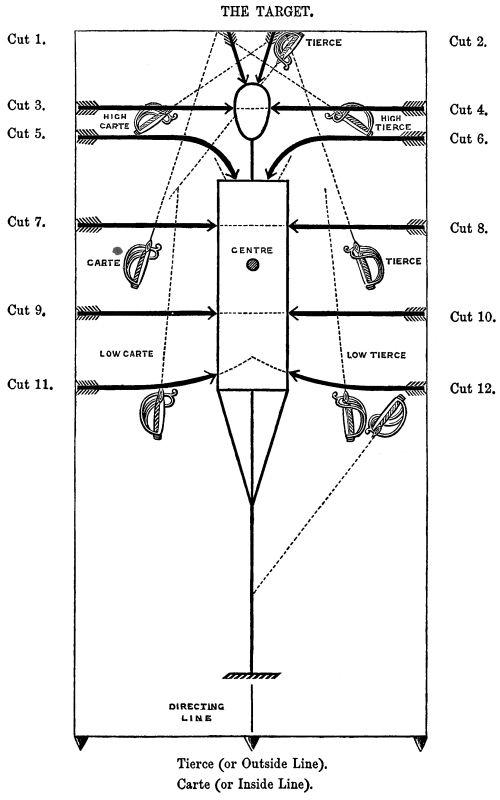
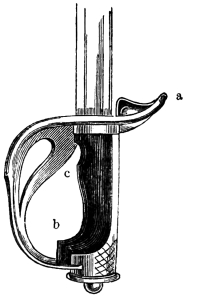
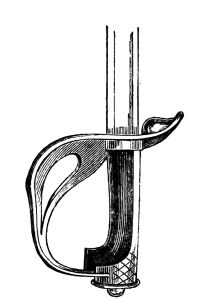
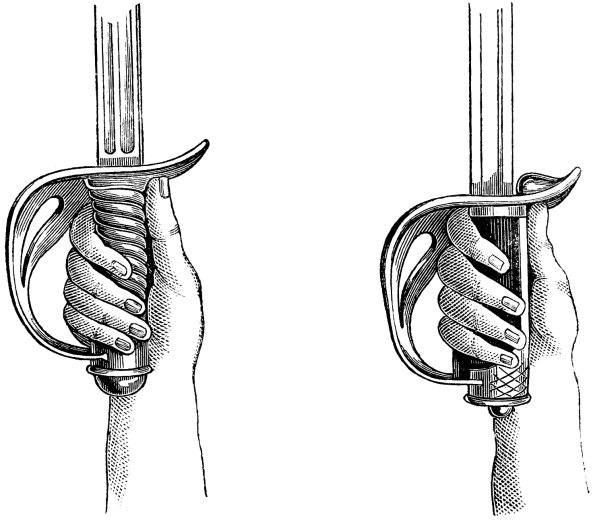
The Target prefixed to these pages explains itself. The
shape is oblong, the frame measuring 6 feet by 3, and
the figure 5 feet 8 inches by 1 foot. As the latter represents
the opponent, the centre should be about 4 feet
from the ground, the height of the recruit’s breast. Perpendicular
to the foot of the figure in each Target a horizontal
line is drawn, forming for the feet, the legs, the body, and
the arms, the “directing line” of the scientific schools. At
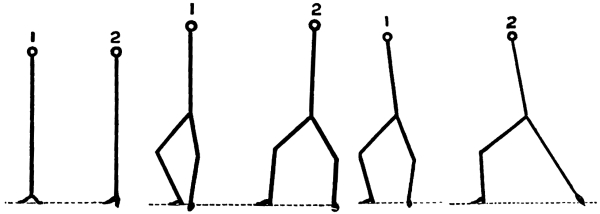
a distance of 10 feet the recruit is placed in the position of
“Attention,” with his left heel on the line, so that at the
command “First Position” his right foot may cover it.
The parallelogram shows the direction and the numbering
of the Cuts, concerning which further details will presently
be given. They should be regulated according to the lines
described upon the Target; nor should the recruit be
practised in any other mode until he has gained the proper
direction of the blade.
Nothing need be added to the directions of the ‘Infantry
Sword Exercise’ (pp. 12, 13, 14), as regards the movements
subject to the following words of command: much, on the
other hand, with great advantage, might be taken away, and
the result would be the increased efficiency that results from
simplicity.
Draw Swords (should be much abridged; after the modern
French School, pp. 165, 166: Règlement Provisoire, &c.);
Slope Swords;
Return Swords (should be simplified);
Stand at Ease;
Attention;
Prepare for Sword Exercise;
Right prove Distance;
Slope Swords;
Front prove Distance; and
Slope Swords.
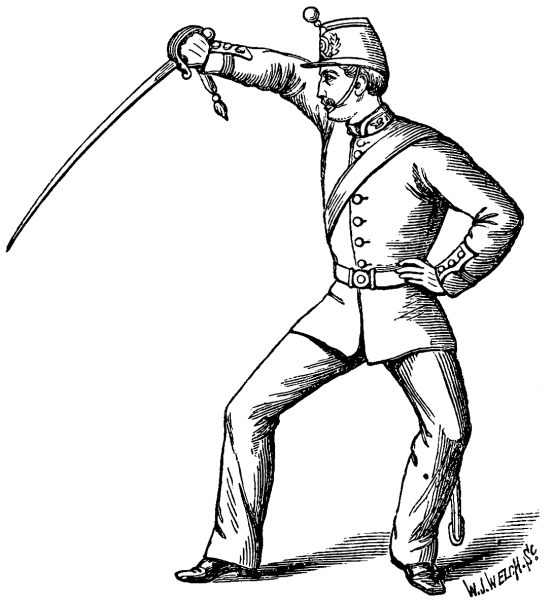
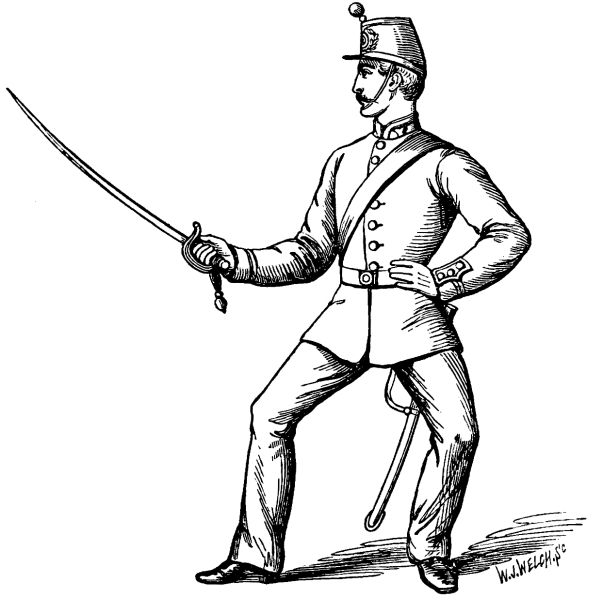
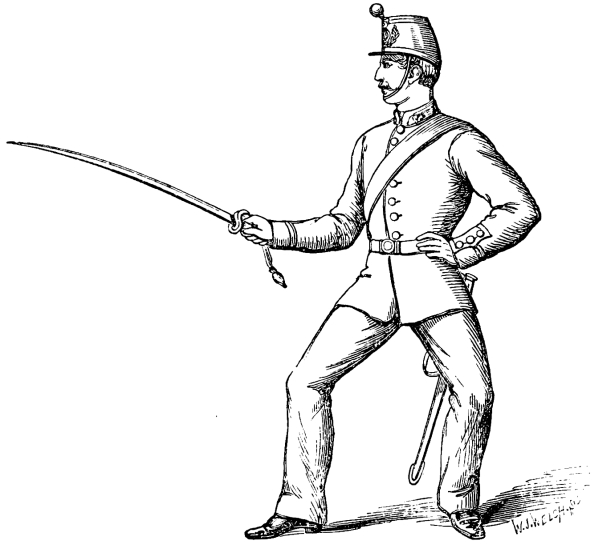
At the order, Stand on Guard, the recruit having assumed
the Second Position, No. 2, falls on Guard: the pommel of
the sword fronts his right breast; the point is directed at
his opponent’s right eye; his right arm is extended with an
easy bend at the elbow; the wrist is inclined, with the
knuckles slightly turned upwards, to his own right, so as to
cover him in case of a straight thrust, and the left hand is
placed upon the left flank just below the ribs, with the
fingers to the front and the thumb to the rear.
The several guards (parries) are learned by holding the
sword opposite to and in the inclination of the dotted lines
which have sword-hilts attached to them; the recruit is
thus taught from the Target the angle of the blade and the
position of the wrist.
The Target directs the recruit how to make the Cuts and
to form the Guards, but not exactly where; this must depend
upon how the opponent acts during the attack and the
defence. Cuts 1, 3, 5, 7, 9, and 11 (odd numbers) are all
from Carte, which the ‘Infantry Sword Exercise’ calls
Inside. The corresponding even numbers (2, 4, 6, 8, 10, and
12) are from Tierce, or Outside. The same nomenclature
applies to the Guards or parries.
When the recruit thoroughly understands the use of the
Target he need no longer be practised in front of it; but the
instructor (sword in hand) should consider it a sure guide
and reference for correctly forming the Guards and for
giving a suitable direction to the edge when making the
Cuts.
This rotation movement should be learnt before the recruit
proceeds to the Cut.
There is nothing better for “breaking,” as the French say,
the recruit’s wrist than this sweep of the sword; and the
style of a swordsman may always be known by his Moulinet.
We will divide it into three kinds, viz. (1) horizontal,
(2) diagonal, and (3) vertical; the latter again may be either
(a) ascending or (b) descending; but as the second (diagonal)
is a mere modification of the first and the third, it will be
sufficient to notice only two; these are:—
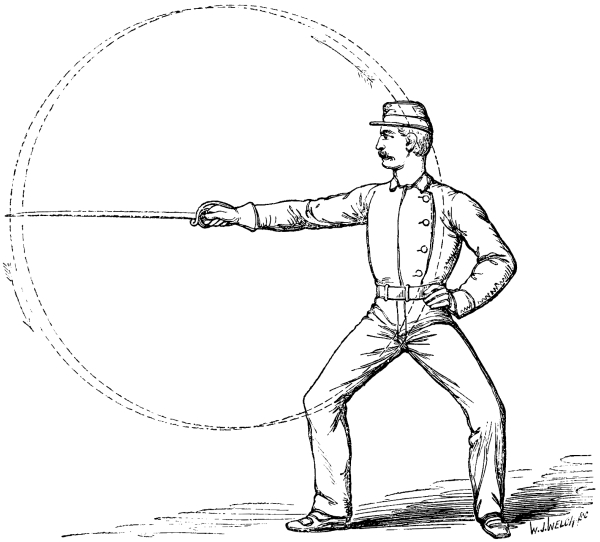
1st. The horizontal movement, or Moulinet proper, circling
the sword round the head. The grip is held as lightly as
possible, chiefly with the thumb and the first finger, resting
the pommel upon the palm, and carrying the nails upwards.
The blade should be moved as horizontally as it can be,
with the back just clearing the swordsman’s crown: it
should describe, not a true circle, but an oval with a long
diameter in the directing line to the centre of the Target
through the heels or ankles of the recruit. Finally, the
point should be lanced or thrown out, as it were, towards
the opponent’s face. Evidently it may be done in two ways,
first, from right to left, which I will call the “Tierce
Moulinet” (Moulinet à gauche); this is by far the easiest
and the more habitual, corresponding with Tierce “Counter,”
opposition, or describing with the blade a circle round the
adversary’s blade, in the fencing school. The reverse movement
(“Carte Moulinet,” Moulinet à droite), from left to
right, requires, like the Counter of Carte, much more
practice.
In these directions “right and left” apply to the right and left of
the swordsman’s wrist.
2nd. In France the term “Moulinet” is mostly applied to
these two rotations of the sword round the head, but we will
extend it to all circlings of the point. The vertical form is
also made from the hand in Tierce (Outside Guard), the blade
is brought sharply round with the back towards the breast
and left shoulder, and returns to its original position; we
will call this the “Inside Moulinet,” having reference to the
performer, not the adversary. The “Outside Moulinet” is
when from “Tierce or Outside Guard” the blade passes
along the right shoulder, it is simply the former done in the
outer line.
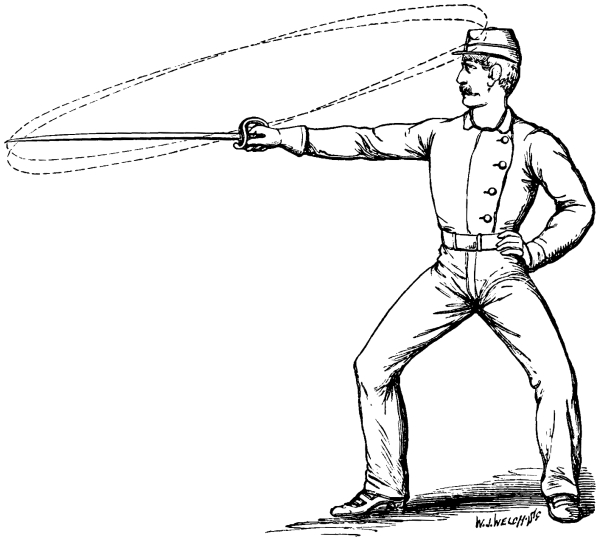
Horizontal Moulinet.
Again the “Inside Moulinet,” which ends with the Cut
from above downwards (the French enlevé), may be inverted
so as to cut from downwards upwards (the brisé). The same
may be done with the “Outside Moulinet,” when the
wrist must be turned upwards, and the Cut given in the
ascending line. This difficult movement should be practised
in order to ensure a flexible wrist, but it exposes the
whole arm. In the four latter “Cuts,” the one invariable
rule is to circle the point as vertically as possible.
The French Manuel (pp. 234, 235) gives: 1, the enlevé
cutting from above downwards; and it may be either à
gauche (Tierce Moulinet) or à droite (Carte Moulinet);
2, the Moulinet proper; and 3, the brisé, cutting from
downwards upwards, thus reversing the enlevé; and this also
may be done à gauche (Tierce Moulinet) or à droite (Carte
Moulinet).
Vertical Moulinet.
The “Moulinet” should be practised first without, then
with, the sword, and on foot, before attempting it on
horseback. In the earlier stage the recruit must turn
the hand, with the arm nearly extended, in the horizontal
and vertical movements, without stiffness and displacement
of the elbow. In the second he may, if no Target be procurable,
work before a cross chalked on the wall so as to
secure horizontality and verticality. Finally, the soldier
will combine the two, Tierce and Carte, by passing rapidly
from one to the other.
Whilst practising the Moulinet the recruit must be taught
the two main divisions of the sword-blade. Fencers have
introduced an immense complication into this simple matter;
and some have proposed eight parts: for broadsword it is
sufficient to divide the length. The “Feeble,” or weak half,
is that contained between the point and the centre; this,
the proper part for the Cut or attack is ground to a thinner
edge, and consequently is more liable to an injury from
another sword if the Cut be not very true. The “Fort,” or
strong half, is from the centre to the hilt, and upon this we
must rely for defence.
A few hours’ practice and a few pressings upon the different
parts of the blade under the surveillance of the
instructor will teach the recruit the high importance of this
lesson. He will learn that in opposing the adversary’s sword
the strength of the defence decreases from the hilt upwards
in proportion as the Cut is received towards the point; and
that, vice versâ, it increases from the point downwards to the
hand. The strongest man cannot “force in” the opponent’s
Guard if the Cut or Thrust be received upon the part near
the handle. With a true Guard the ordinary fencing foil can
turn off the thrust of a musket and bayonet weighing 10 lbs.
The practised swordsman always attempts, when attacking,
to gain with his “Fort” the “Feeble” of the opponent’s
weapon, in which case the superior leverage will often beat
down the parry; and this manœuvre should be carefully
practised by men of superior muscular strength. The Cuts
must, as a rule, be delivered within eight inches of the point
and at the “centre of percussion,”10 so that the sword may
clear itself and the arm escape a “jar.”
The two virtues of the Cut are its trueness and its velocity.
Unless true it will become a blow with the flat that
would shiver to pieces any brittle Eastern blade. Assuming
the vis viva or force of a moving body to be its weight
multiplied by the square of the velocity, let us suppose a
strong man cutting with a sword weighing 4 lbs., to which
he can give a velocity which we will call 1, or 4 × 1 = 4:
a weaker man who applies double the velocity to a 2 lb.
sword will thus produce a momentum of 8, doubling the force
of the blow. But let the stronger man take the lighter sword,
evidently he will obtain a higher velocity, which we will
assume at 3: in this case the effect will be 18. Thus the
power of the Cut is enormously increased by increased velocity,
but much less by increased weight in the moving
body.
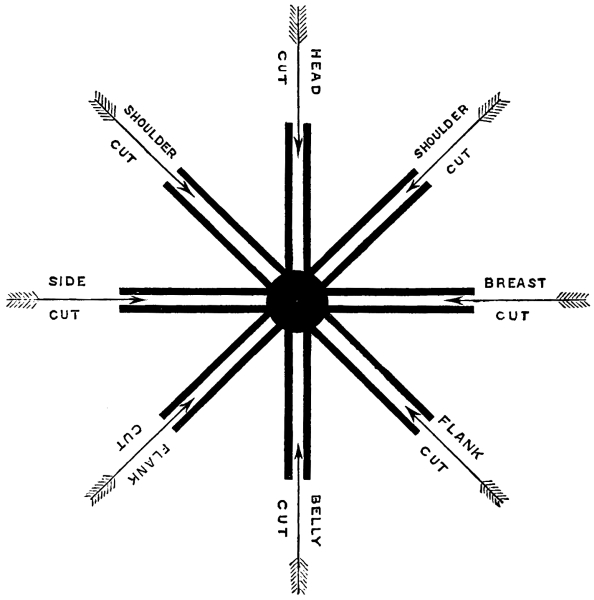
The Target prefixed to the ‘Infantry Sword Exercise’ gives
Seven Cuts, an insufficient number. The German systems
add an eighth blow perpendicularly upwards, when the
whole of the swordsman’s arm from wrist to shoulder would
be completely at the opponent’s mercy.
The French Manuel has only seven, viz. the Coup de
Tête; 2, the Coup de Banderole; 3, the Coup de Figure
à droite; 4, the Coup de Figure à gauche; 5, the Coup
de Flanc; 6, the Coup de Ventre; and 7, the Coup de
Manchette.
German System.
The subjoined diagram shows the Twelve Cuts11 which
serve to “loosen” the rigid arm of the recruit.
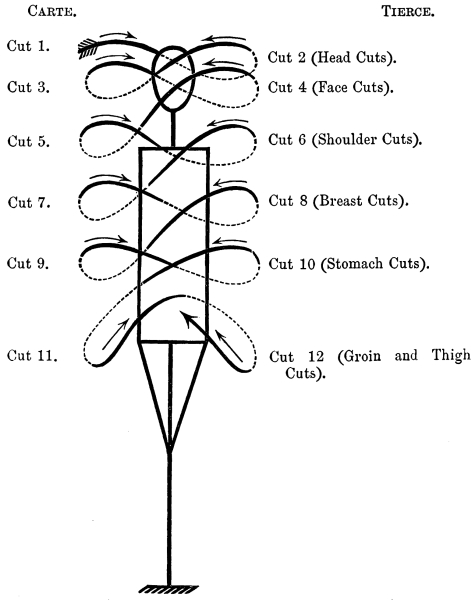
The Twelve Cuts (shown by the thick strokes), the dotted lines denoting
the course of the blade in “Moulinet”, or rather in “Semi-Moulinet.”
| Carte. |
Tierce. |
| Cut 1. |
Cut 2 (Head Cuts). |
| Cut 3. |
Cut 4 (Face Cuts). |
| Cut 5. |
Cut 6 (Shoulder Cuts). |
| Cut 7. |
Cut 8 (Breast Cuts). |
| Cut 9. |
Cut 10 (Stomach Cuts). |
| Cut 11. |
Cut 12 (Groin and Thigh Cuts). |
The figure represents the opponent; the thick lines show
the direction of the edge when cutting; and the dotted continuations
denote the course of the blade when describing
the several “Moulinets.”
The Cuts should be continuous, the regular succession
always beginning from Carte or the Inside, that is, from the
rear of the left shoulder. As in the “Moulinet,” the less
the arm is bent and the sword-hand is moved from the line
of direction (to the front), the greater is the value of the
movement. The recruit, who must walk before he runs,
should deliver the whole dozen in continuous sweep without
pause, but at first very slowly, till, by the proper and timely
use of the wrist, the Cuts lead into one another. The more
advanced swordsman, whose pliability of strength is free from
contractions and other vicious habits, should practise the
series of twelve with increased rapidity till the blade whistles
through the air. All the Cuts should be given strong, with
the edge leading well forwards and with the arm extended to
its utmost in the delivery.
The following are the Twelve Cuts:—
I. and II. These Cuts are made, after falling into Tierce
or Outside Guard, from above downwards at the opponent’s
head. In No. I. the point, beginning as usual from the left
shoulder (Carte), describes a full circle (“Inside Moulinet,”
the brisé à gauche of the French Manuel), the hand moving
as little as possible so as to cover the body; the knuckles
turned up and the blade passing close to the breast: it
finishes by delivering a vertical Cut, with the “Feeble” close
to the point, at the right half of the adversary’s crown.
No. II., which follows without interruption, reverses the
process; the knuckles are turned down and the blade sweeps
past the right shoulder (brisé à droite); ending with the left
half of the opponent’s head. The latter Cut is by far the
more difficult to make without moving the hand, but it is
good practice for “breaking” the wrist.
III. and IV. The horizontal face-cuts, also beginning from
the left (Carte), an invariable rule, and ending with the right,
that is, at the adversary’s left cheek. The reason of this
practice is to make the movement habitual to the recruit;
cutting from left to right always causes less exposure of the
inner wrist than cutting from right to left.
V. and VI. The slanting shoulder-cuts, also from above
downwards (Nos. 1 and 2, or rather 2 and 1, of the ‘Infantry
Sword Exercise,’ pp. 14, 17, and the Coups de Banderole of
the Manuel); describing two diagonal Moulinets, first from
left to right, and then from right to left. The sword again
makes a double “Moulinet” with the edge downwards, and
descends first upon the opponent’s right and then upon his
left shoulder.
VII. and VIII. The horizontal breast-cuts, parallel with
the face-cuts, and, like them, delivered with the blade as
horizontal as possible.
IX. and X. The horizontal stomach-cuts, parallel with,
and lower than, the breast-cuts.
XI. and XII. The slanting groin or thigh-cuts, diagonally
from downwards upwards; in fact, the reverse of the shoulder-cuts
(Nos. 4 and 3 of the ‘Exercise,’ and the brisés of the
Manuel). In these diagonal Moulinets, the elbow must not
be bent; the hand should deviate as little as possible from
the directing line under pain of dangerous exposure; and
the two movements should follow each other without a
break.
Whenever the recruit fails to carry the edge well forward
in making the attack, he should be practised slowly and repeatedly
in combining the opposites, as Head-cut (No. 1)
and Thigh-cut (No. 12), Head-cut (No. 2) and Thigh-cut
(No. 11), and so forth. The instructor must see that the
edge leads on to the respective lines of the Target, the point
being darted out at the end of each cut.
The Cuts will be practised first in No. 2 “Second
Position” (Guard), and afterwards in No. 2 “Third Position”
(Lunge).
Prime, or Hanging Guard.
As the ‘Infantry Sword Exercise’ has a deficiency of
Cuts, so it has a superfluity of “Engaging Guards.” I have
already expressed my opinion concerning the Guard (p. 18
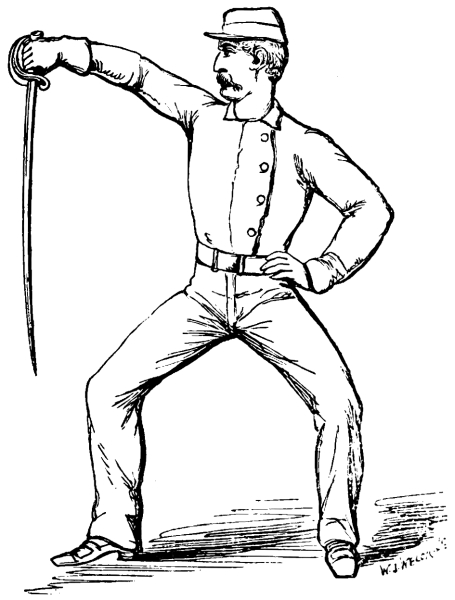
of 1874) popularly called the “Hanging Guard.” Even
with the best position, the head erect and the eyes looking
straight and not upwards, it is utterly faulty; it displaces
the arm and the sword, and, as no serious attack
can be made directly from it, it necessitates a movement
entailing a considerable amount of exposure. It is now
chiefly confined to students’ duels with the German Schläger,
wherein slitting the opposing nose, which can be done with
a mere jerk upwards, is the swordsman’s highest aim and
ambition.
The “Engaging Guards” are thus reduced to the two
following:—
Tierce (or outside) Guard; defending the outer lines,
arm, shoulder, back, and flank. The recruit having assumed
the “Second Position” (No. 2), brings the pommel of his
sword to the centre of his right breast; opposes the point to
the adversary’s right eye; extends his right arm with an
easy bend of the elbow; inclines the wrist with the knuckles
upwards to his own right, so as to cover himself in case of a
straight thrust, and places his left hand upon his left flank
with the fingers to the front and the thumb to the rear. In
Tierce of course the edge of the sword is to the right or
outside.
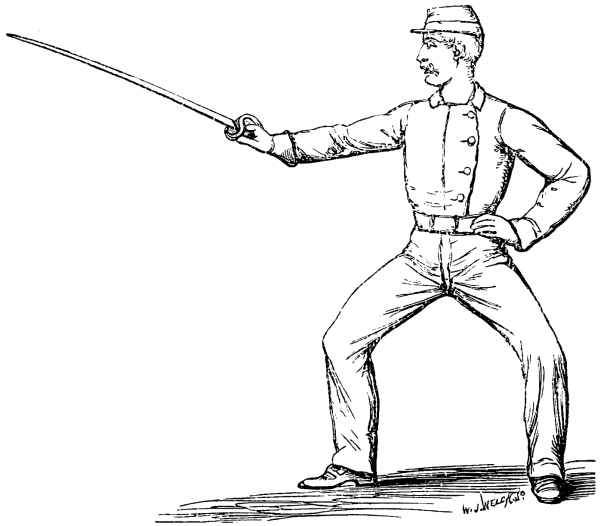
Engaging Guard in Tierce (Outside).
Carte (or Inside) Guard. This movement defends the
inner lines, chest and stomach; the knuckles are turned
down; the opposition is made to the left, and the edge is
carried in the same direction.
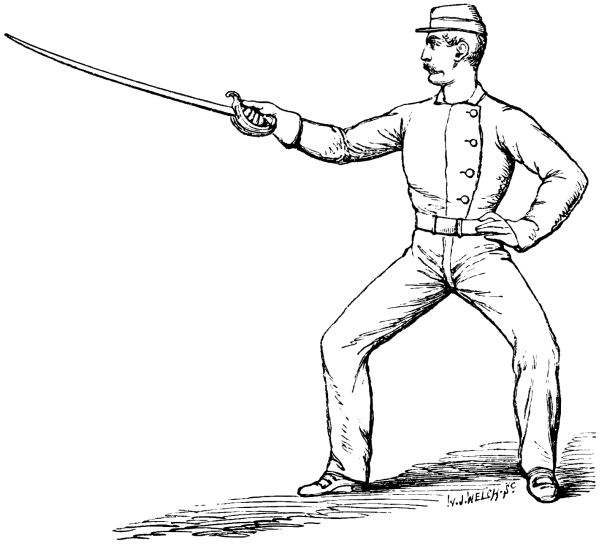
Engaging Guard in Carte (Inside).
When engaging in guard (joining weapons), the swords
should meet each other about eight inches from the points.
If the distance is diminished the opponents are “out of measure”
(or distance); if increased, they are “within measure.”
The recruit must be taught slightly to press upon the opponent’s
blade, but not to rest upon it; by this “opposition”
his hand and wrist will be more ready to follow the weapon
during the attack. Thus also the “Engaging Guards,”
Tierce, and Carte (outside and inside) afford protection preparatory
to the movements for offence and defence. The
eye must be fixed upon the eye and the hand or the blade-point
of the opponent, not upon the eye only.
Guard may be partly defensive when the bust is advanced
and the point approaches the opponent, or it may be purely
protective when its sole object is the “parry.”
The right-handed recruit must be taught always to
attempt Engaging in Tierce,12 with his opponent’s blade in
the outer line (sur les armes). The reason is simply that in
the reverse position (dans les armes), the fore-arm, from the
elbow to the wrist, is comparatively unguarded; whereas
Tierce facilitates the defence of the “low lines” (i. e. those
below the wrist). Tierce therefore has invariably the advantage
with the sabre, as Carte carries off the palm with the
small-sword, the foil, and the rapier.13 But the right-handed
man engaging in Tierce puts his left-handed opponent in
Carte; and the latter, if a skilful sworder, will manœuvre,
by withdrawing his blade, by coupés or degagements over
the point, and by other feints, to regain the ground of vantage.
The best treatment of this case is to make a time-cut
in Seconde (“inner Moulinet,” or brisé à gauche) at the
adversary’s knuckles, a movement which will presently be
explained.
The ‘Infantry Sword Exercise’ proposes Seven Guards, a
number which can hardly be reduced for practice on the
drill-ground or in the schools: the Manuel contains the same
number, including one for the Point. But of the seven no
less than five are “Hanging Guards,” and Nos. 3 and 4 serve
only to defend the inside and the outside of the advanced
leg. This limb requires no assistance of the kind: an able
swordsman never exposes his head and shoulders by cutting
so low, and, if he does, the leg can be smartly withdrawn
(parade retrograde, or en échappant), rendering the attack
not only useless but dangerous to the assailant. Even in
fencing, “low thrusts,” that is, at the body below the wrist,
are never made, for fear of the “Time” being taken, until
the upper line has been closed by a feint. In our Single-stick
practice the first thought seems to be to attack the
advanced leg—which may be well enough for Single-stick.
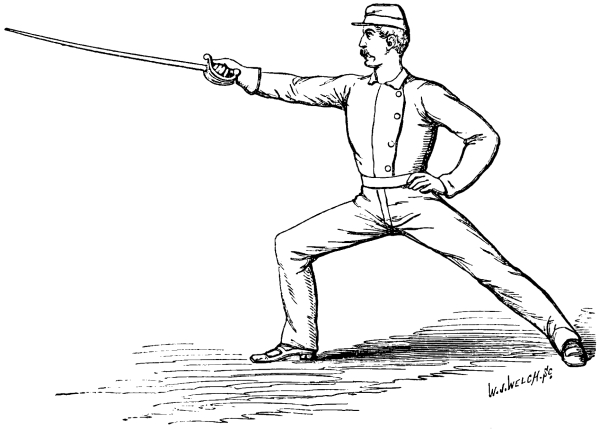
Lunge and Cut in Carte (Inside).
The following are the full number of guards or parries
in which the edge must invariably be used: they are evidently
dividable into two; (1) Head (with face) Guards, and
(2) Body Guards:—
I. Prime (p. 38), so called because it is the “first” position
of defence after drawing the blade, that which the unpractised
man would naturally assume to defend his head.
It is the 7th Guard of the ‘Infantry Sword Exercise.’ In
practice the point is more inclined to the horizontal line than
when the blade is unsheathed; the edge is carried somewhat
inside or to the left; the arm is shortened and so raised that
the eyes look under it, but the head remains upright. The
recruit must be careful not to “bend the body;” not to
“draw in the chest and neck;” and not to “bring the left
shoulder a little forward.” The defect of Prime is its being
a “Hanging guard,” rendering the riposte or reply difficult,
and modern practice prefers “High Tierce.”
II. Seconde (4th Guard), so termed because following
Prime: the arm is extended, the edge is carried to the outside
or to the right; in practice the hilt is lowered, and the point,
threatening the opponent’s loins, is depressed to the half of a
right angle. This position must be learned for the sake of
feinting: as a parade it is not much used, because it defends
only the hip and leg, and a good swordsman will never
expose himself to exceeding danger by making low cuts.
Modern practice prefers “low Tierce.”
III. Tierce (2nd Guard) has been described (p. 39) under
“Standing on Guard” and “Engaging Guards;” it defends the
outer lines, arm, shoulder, and back.
IV. High Tierce is a head-guard: the hand is raised to
above the shoulder to the maximum level of the swordsman’s
right eye, and the blade is carried at an angle of 45° with
the edge up and the point to the left.
V. Low Tierce is a flank-guard; the arm is shortened, the
hand is depressed six inches; the opposition is to the outside,
and the point is held vertically or almost vertically, as
the attack demands.
VI. Carte (1st Guard) has been described (p. 40) under
“Engaging Guards,” as defending the inner lines, chest and
stomach. For the purposes of parrying, the arm is withdrawn
till the elbow, almost touching the belt, forms an
equilateral triangle with the hilt and the left side.
VII. High Carte is a head-guard like high Tierce: the
hand is raised to the left of the left eye, and the blade,
crossing the face at an angle of 45°, carries the edge up,
and the point to the right.
VIII. Low Carte is a stomach guard. As in Low Tierce
the arm is shortened, the hand is depressed six inches; the
opposition is to the inside, and the point is held vertically
or almost vertically, as the attack demands.
In practice the advanced swordsman will confine himself
to Tierce and Carte with their natural modifications. He
will consult his own feelings about the head-guard, abolishing
Prime in favour of High Tierce or High Carte, and he will
prefer Low Tierce or withdrawing the leg (rassemblement)
to using Seconde. Of these movements the simplest are
always the best. When parrying, the sword-arm must invariably
be drawn for defence nearer the body, and the
grip should be sensibly tightened to receive the cut. No
strength is necessary when making the parries: I cannot
accept the “Sforzi” or guard-forcings of the neo-Italian
broadsword school, dry blows upon the blade, which, intended
to disarm, are essentially dangerous.
The Guards or Parries will be practised like the Cuts, first
in the “Second Position” (Guard), and afterwards in the
“Third Position” (Lunge).