Nobody could be more astonished than I, to
find myself famous. I never dreamed of it,
when I sat in a small room, at the top of the house
where I lodged, scribbling over a sheet of coarse
foolscap with noms de plume, out of which I was
to choose one for my first article—which article I
never thought of preserving, any more than the
succeeding ones, supposing my meagre pecuniary
remuneration the only reward I was to hope
for. I think the reason I selected the name
“Fern,” was because, when a child, and walking
with my mother in the country, she always used
to pluck a leaf of it, to place in her bosom, for its
sweet odor; and that gloomy morning, when I
almost despaired of earning bread for my children,
I had been thinking of her, and wishing she were
living, that I might lay my head upon her bosom
8and tell her all my sorrows; and then memory
carried me back, I scarce knew how, to those
childish days, when I ran before her in the woods,
to pluck the sweet fern she loved; and then I said
to myself, my name shall be “Fanny Fern”—little
dreaming anybody would ever know or care
anything about it.
I loved my mother;—everybody did. She had
the kindest heart and sweetest voice in the world;
and if there was any person in the circle of her acquaintance
who was particularly disagreeable to
her, for that person would she be sure to do a service,
the first opportunity.
In a spare room in our house was an old armchair,
and in it lay a large Bible. I often used to
see my mother go into that room, sighing as she
closed the door; and, young as I was, I had learned
to watch for her coming out; for the sweet,
calm, holy look her features wore, fascinated me
like a spell. Now I know how it was! now, that
the baptism of a woman’s lot has been mine also;
and often, when blinded by the waves of trouble
which have dashed over my head, have I thought
of the open Bible in the old armchair, its pages
wet with tears, which no human eye saw fall,
9wiped away by no human hand, but precious in
His eyes as the seed of the husbandman, from
which He garners the golden harvest sheaves.
Thus my mother was unselfish—ever with a
gentle word for all; thus she looked upon life’s
trials, as does the long-absent traveler upon the
wayside discomforts of the journey, when the beacon
light gleams from the window of the dear old
home in sight. Thank God! she has reached it;
and yet—and yet—the weary hours of desolation,
my heart has ached for her human voice; in which
I have sat with folded hands, while memory upbraided
me with her patience, her fortitude, her
Christ-like forbearance, her sweet, unmurmuring
acceptance of the thorns in her life-path, for His
sake, who wore the thorny crown.
Weeping, I remembered her gentle touch upon
my arm, as I gave way to some impetuous burst
of feeling, at the defection of some playmate, or
friend, on whose unswerving friendship my childish
heart had rested as on a rock. I saw her eyes,
pitiful, imploring, sometimes tearful; for well she
saw, as a mother’s prophet-eyes alone may see, her
child’s future. She knew the passionate nature,
that would be lacerated and probed to the quick,
10ere the Healer came with His heavenly balm. She
knew that love’s silken cord could guide me, where
the voice of severity never could drive; and so
she let my hot, angry tears fall, and when the
storm was spent, upon the dark cloud she painted
the bow of promise, and to those only “who overcome,”
she told me, was “given to eat of the tree
of life.” Alas! and alas! that her child should be
a child still!
If there is any poetry in my nature, from my
mother I inherited it. She had the most intense
enjoyment of the beauty of nature. From the
lowliest field-blossom, to the most gorgeous sunset,
nothing escaped her observant eye. I well remember,
before the dark days came upon me, a
visit I received from her in my lovely country
home. It was one of those beautiful mornings
when the smile of God seems to irradiate every
living thing; to rest on the hilltops, to linger in
the valleys, to sweeten the herbage for the unconscious
cattle, and exhilarate even the bright-winged
insects who flutter in the sunbeams; a morning
in which simply to live were a blessing, for which
humanity could find no adequate voice of thanks.
From out the dusty, noisy city, my mother had
11come to enjoy it. I had just placed my sleeping
babe in its cradle, when I heard her footstep upon
the nursery stairs. Stooping to kiss its rosy cheek,
she seated herself at my window. The bright-winged
orioles were darting through the green
foliage, the grass waved in the meadow, starting
up the little ground-bird to make its short, quick,
circling flights; the contented cattle were browsing
in the fields, or bowing their meek heads to
the little brook, to drink; brown farmhouses nestled
peacefully under the overshadowing trees, and
far off in the distance stretched the hills, piled up
against the clear blue sky, over which the fleecy
clouds sailed leisurely, as if they too enjoyed all
this wealth of beauty. My mother sat at the window,
the soft summer wind gently lifting the
brown curls from her temples;—then slowly—musically,
as she laid her hand upon mine, while her
whole face glowed, as did that of Moses when he
came down from the mount, she said, “O Lord!
how manifold are thy works! in wisdom hast thou
made them all; the earth is full of thy riches.
Who coverest thyself with light as with a garment:
who stretchest out the heavens like a curtain:
who walkest upon the wings of the wind.
12Every beast of the forest is thine; and the cattle
upon a thousand hills. The world is thine, and
the fullness thereof. I will sing praise unto God
while I have my being.” When my mother ceased
to speak, and relapsed again into silence, seemingly
unconscious of my presence, I did not disturb
her; for I knew that her soul was face to face with
Him who hears the voiceless prayer, and needs not
the bended knee.
My mother was eminently social, and particularly
fond of the society of young people; so
much so, indeed, that my young companions were
always disappointed when she was absent from
our little gatherings. Her winning, motherly
ways, her warm welcome, her appreciation and
toleration of exuberant young life, was as delightful
as rare. I will not speak of the broken-hearted
whom she drew to her bosom, of the needy to
whom she ministered, of the thousand little rills
of benevolence with which she fertilized so many
hearts and homes; they are written, not in a perishable
book of remembrance like mine, but in one
which shall endure when the earth shall be rolled
up like a scroll.
Had my mother’s time not been so constantly
13engrossed by a fast-increasing family, had she
found time for literary pursuits, I am confident
she would have distinguished herself. Her hurried
letters, written with one foot upon the cradle,
give ample evidence of this. She talked poetry
unconsciously! The many gifted men to whom
her hospitality was extended, and who were her
warm personal friends, know this.
A part of every year my mother spent in the
country. One summer, while I was yet a child,
we were located in a very lovely spot near Boston.
Connected with the church where my mother worshiped,
was a female prayer meeting, held alternately
at the houses of its different members.
One warm summer afternoon, my mother passed
through the garden where I was playing, and
asked me if I would like to go too. I said yes,
because I liked to walk with my mother anywhere;
so we sauntered along the grassy path under the
trees, till we came to a small, wooden house, half
hidden by a tall hedge of lilacs. Then my mother
led me through the low doorway, and up a pair of
clean wooden stairs, into an old-fashioned raftered
chamber, through whose open window the bees
were humming in and out, and the scent of flowers,
14and song of birds, came pleasantly enough to
my childish senses. Taking off my sunbonnet,
and brushing back my curls, she seated me on a
low stool at her feet, while one of the old ladies
commenced reading the Bible aloud. All this
time I was looking around curiously, as a child
will, at the old-fashioned paper on the walls, with
its pink shepherdesses and green dogs; at the
old-fashioned fireplace, with its pitcher of asparagus
branches, dotted with little red berries; at
the high-post bedstead, with its rainbow-colored
patchwork quilt, of all conceivable shapes and
sizes; at its high-backed, stiff-looking chairs, with
straw seats; at its china parrot on the mantel, and
its framed sampler on the wall, with the inevitable
tombstone and weeping willow, and afflicted female,
handkerchief in hand.
After the tremulous old lady had done reading,
they asked my mother to pray. I knelt with the
rest; gradually my thoughts wandered from the
china parrot, and patchwork quilt and sampler, to
the words my mother was speaking. Her voice
was low, and sweet, and pleading, as if God was
very near, instead of on the “great, white throne,”
far away from human reach, where so many good
15people are fond of placing Him. It seemed to
me as if her head were lying, like the beloved
John’s, upon His bosom; and He were not too
great, or good, or wise, to listen well pleased to
her full heart’s outpourings. Of course, these
thoughts did not then, even to myself, find voice
as now, but that was my vague, unexpressed feeling.
Every musical word fell distinctly on my
ear; and I listened as one listens to the sweet,
soothing murmurs of a brook, in the fragrant summer
time. I had loved my mother before; now I
revered her; and it was with a new, delicious
feeling I slid my hand within hers, as we passed
through the low doorway, and back by the pleasant,
grassy paths, to our home. How little she
knew what was passing under the little sunbonnet
at her side, or how near heaven she had brought
me, in that old, raftered chamber.
I have spoken of my mother’s patience and forbearance.
One scene I well remember. It occurred
in our little sitting room at home. My
mother had entered, with her usual soft step and
pleasant tones, and addressed some question to me
concerning the lesson I was learning, when a person
entered, upon whom she had every claim for
16love, the deepest and strongest. To some pleasant
remark of hers, this individual returned an answer
so rude, so brutal, so stinging, that every drop of
blood in my body seemed to congeal as the murderous
syllables fell. I looked at my mother; the
warm blood rushed to her temples, the smile faded
from her face; then her eyes filled with tears, and
bowing her head low upon her breast, with a
meek, touching grace I shall never forget, she
glided voiceless from the room. I did not follow
her, but I knew where she had gone, as well as if
I had done so. When I next saw her, save that
her voice had an added sweetness, no trace of the
poisoned arrow, so ruthlessly aimed at her peace,
remained.
I have said my mother was hospitable; but
her hospitality was not extended, like that of
many, only to those who could give an equivalent
in their pleasant society. One guest, who was
quite the reverse of this, often received from her
the kindest attention, not gratefully, not even
pleasantly, for he was churlish to a degree. Vexed
that she should thus waste her sweetness where it
was so unappreciated, I one day expressed as
much to my mother, adding, “that nobody liked
17him.” “Hush!” said she; “that is the very reason
why I should be the more kind to him. He
has a large family, and trouble and care have
made him reserved and silent; he may thank me
and yet not say so; besides, I do not do it for
thanks,” she continued, cramming his carpet bag
with her usual Lady Bountiful assiduity. The
cup of cold water in the name of the Master, to
the lowliest disciple, she never forgot.
To all these sweet womanly traits in my mother,
was added a sound, practical judgment. On
one occasion, while visiting me, a law paper was
sent for my wifely signature. Without looking
at it, for I hated, and to this day hate, anything
of a business nature, I dipped my pen in the inkstand
to append it. “Stay! child,” said my mother,
arresting my hand, “do you know what that
paper is about?” “Not I!” was my laughing
reply; “but my husband sent it, and on his broad
shoulders be the responsibility!” “That is
wrong,” said she, gravely; “you should never
sign any paper without a full understanding of
its contents.” It seemed to me then that she was
over-scrupulous, particularly as I knew she had the
same implicit confidence in my husband that I
18had. I had reason afterward to see the wisdom
of her caution.
My mother came to me one day, after rambling
over my house with a motherly eye to my housekeeping—she
who was such a perfect housekeeper—and
held up to me a roll of bank bills, which she
found lying loose upon my toilet-table. “Oh, they
were safe enough!” said I; “my servants I know
to be honest!” “That may be,” was her answer;
“but don’t you know that you should never place
temptation in their way?”
Foremost among my mother’s warm, personal
friends, was Dr. Payson. For many years before
the removal of our family from Portland, he was
her pastor, and afterward, whenever he visited
Boston, our house was emphatically his home; my
mother welcoming his coming, and sitting spiritually
at his feet, as did Mary of old her Christguest.
Let me explain how I first came to love
him. When I was a little girl, I used to be told
by some who visited at our house, that if I was
not a good girl, and did not love God, I should go
to hell. Now hell seemed, as far as I could make
it out from what they said, a place where people
were burned forever for their sins on earth—burned,
19without being consumed, for millions and
millions of years; and after that and so on,
through a long eternity—a word I did not then,
and do not now, comprehend. Well, I used to
think about all this; sometimes as I went to
school; sometimes as I lay awake in my little bed
at night, and sometimes when I woke earlier than
anybody else in the morning; and sometimes on
Sunday, when I, now and then, caught the word
“hell” in the minister’s sermon. I don’t know
how it was, but it never frightened me. I think it
was because I could not then, any more than I can
now, believe it. The idea of loving anybody because
I should be punished if I did not, seemed to
freeze up the very fountain of love which I felt
bubbling up in my heart, and I turned away from
it with horror. I could not pray or read my Bible
from fear. I did not know what fear was. I did
not feel afraid of death, as my playmates did.
When they told me to love God, I said that I did
love Him. They did not believe me, because
I did not like to talk about myself, or have others
talk to me about myself; not that I was
ashamed, but that it seemed to me, if I did so,
that I should cease to feel. Sometimes, when
20they persisted in questioning and doubting me, I
would get troubled, and run away, or hide. I did
not like to “say my prayers,” as it is called; and
at set times, morning and evening, and get on my
knees to do it. I liked to have my prayer rise up
out of my heart, and pass over my lips, without
moving them to speech; and that wherever I happened
to be, in the street, or in company, or
wherever and whenever God’s goodness came into
my mind, as it did often; for turn which way I
would, I could see that his careful footprints had
been before me, and his fingers busy, in making
what I was sure then, and am sure now, none but
a God could make. I did not understand a word
of my catechism, though I said it like a parrot,
because our minister told me to. “Election,”
“Predestination,” and “Foreordaining,” seemed
to me very long words, that meant very little;
and the more they were “explained” to me, the
more misty they grew, and have continued to do
so ever since; and I don’t like to hear them talked
about.
The God my eyes see, is not a tyrant, driving
his creatures to heaven through fear of hell; he
accepts no love that comes to him over that compulsory
21road. He pities us with an infinite pity,
even when we turn away from Him; and the mistaken
wretch who has done this through a long
life, and worn out the patience of every earthly
friend, never wears His out, is never forsaken by
Him; his fellow men may hunt him to the world’s
end, and drive him to despair, and still the God
I see, holds out his imploring hands, and says,
“Come to me!” and even at the last moment,
when he has spent a long life in wasting and perverting
every faculty of his soul, the God I see
does not pursue him vengefully, or even frown
upon him, but ever that small, soft whisper,
“Come to me!” floats by him on the sweet air, is
written on the warm sunbeam, which refreshes
him all the same as if he had never forgotten to
utter his thanks for it. Now, if this man dies, and
turns away at the last from all this wonderful
love, what more terrible “hell” can there be, than
to remember that he has done so? that he has
never made the slightest return for it, or ever recognized
it? that no living creature was ever
made better, or purer, or wiser, or happier, that
he lived in the world? but that, on the contrary,
he has helped them to destroy themselves as he
22has done himself? What “flames” could scorch
like these thoughts? And that, in my opinion, is
hell, and all the hell there is. It is just such a hell
as wicked men have a foretaste of in this world,
when they stop long enough to listen to that heavenly
monitor conscience, which they try so hard to
stifle. It is just such a hell as the wayward son
feels, who runs away from the love and kindness
of home, and returns to find only the graves of
those who would have died for him.
But I am wandering a long way from what I
was to tell you about—Dr. Payson.
I was dressing my doll one day, when my
mother called me to come to her. I knew that
some visitor had just come, for I heard the bell
ring, and then a trunk drop heavily in the entry.
I thought very likely it was a minister, for my
mother always had a plate and a bed for them,
and it made no difference, as I have told you, in
her kindness, whether the minister was a big
doctor of divinity, or a poor country clergyman,
unknown beyond the small village where he
preached. Well, as I told you, my mother called
me; and it was a minister who had come, and he
had gone up to his room with a bad nervous headache,
23brought on by traveling in the heat and
dust; and I was to go up, so my mother said, and
bathe his head with a preparation she gave me;
very gently, and very quietly, as he reclined in the
big easy chair. I did not want to go; I did not
like ministers as well as my mother did; and I
often used to run out one door, as they came in at
another; and I was often obliged to come back,
with a very red face, and shake hands with them.
I did not like to hear them say to me, that “my
heart was as hard as a rock,” and that “if I did
not get it changed, I should go to hell.” My
heart did not seem hard to me; I loved everybody
and everything then; and I loved God too, in my
own way, though not in the way they seemed to
want me to, because I should go to hell if I did
not; this thought made my heart grow hard in a
minute—made me “feel ugly,” as children say;
and that’s why I ran away from the ministers who
kept telling me what a “wicked” child I was.
So you may be sure, when I heard what my
mother said, I took the bottle she put in my hand,
which I was to use in bathing the minister’s forehead,
very unwillingly, and went very slowly up
stairs to my task. My mother had been there before
24me, and closed the blinds, and given him a
footstool for his weary feet; and there he sat,
looking very pale, with his eyes closed, and his
head laid back in the easy chair. He did not look
at all like the other ministers I was so afraid of;
and I cannot tell you why, as I tip-toed up to his
chair, and moistened my fingers to bathe his heated
forehead, and pushed back the dark locks from
it, that I thought of the pictures I had sometimes
seen of our Saviour, which looked to me so very
sweet and lovely. He did not speak, or open his
eyes, as my fingers moved over his temples; but I
knew that it gave him relief, because he soon sank
into a gentle slumber, and his head drooped a little
on one shoulder.
I cannot tell why I did not then go out of the
room—I, who disliked ministers so much—when I
might easily have done so; but instead, I sat down
on a low seat near him, and watched his face, as
if there were some spell in it, which forbade me to
go; and I felt so quiet and happy while I sat there,
and dreaded lest some one should call me away.
By and by he stirred, and passing his hand slowly
over his forehead, opened his eyes; they were
dark and soft as a woman’s. Holding out his
25hand to me, with a smile which I have never forgotten
to this day, he said, as he drew me to his
side, and laid his hand upon my head, “The Lord
bless you! my child;” then he seated me upon
his knee; but he said not a word to me about
“hell,” or my being “wicked,” but closing his
eyes again, he began telling me the story of the
Saviour’s crucifixion. Now, I had heard it
many times before, I had read it myself in the
Bible, when I was told to do so, and yet, that
day, in that quiet, darkened room, with that
gentle hand upon my shoulder, I heard it for the
first time. For the first time my tears fell, and
my heart went out to the pure, patient sufferer on
Calvary. When the story was finished, in those
low, sweet tones, I did not speak. Placing his
hand upon my head, he said, again, “The Lord
bless you! my child;” and so I passed out with
his loving benediction, and closing the door, listened
still on the other side, as though only there I
could learn to be good.
Many, many long years after this, when I was
a grown woman, I visited my birthplace, Portland,
26from which my mother removed when I was
six weeks old. I wandered up and down the
streets of that lovely, leafy city, and tried to find
the church where good Dr. Payson used to preach.
Then, too, I wanted to see the house where I was
born—the house where he laid hands of blessing
on my baby forehead, when it was purple
with what they thought was “the death-agony.”
But where it was that the little, flickering life began,
I could not find out; for my mother had then
gone to the “better land.” Ah! who but God
can comfort like a mother? who but God can so
forgive? How many times I have shut my eyes,
that I might recall her face—her blue, loving eyes,
her soft, brown, curling hair; and how many
times, when in great trouble, I have said, “Mother!
mother!” as if she must hear and comfort
her child.
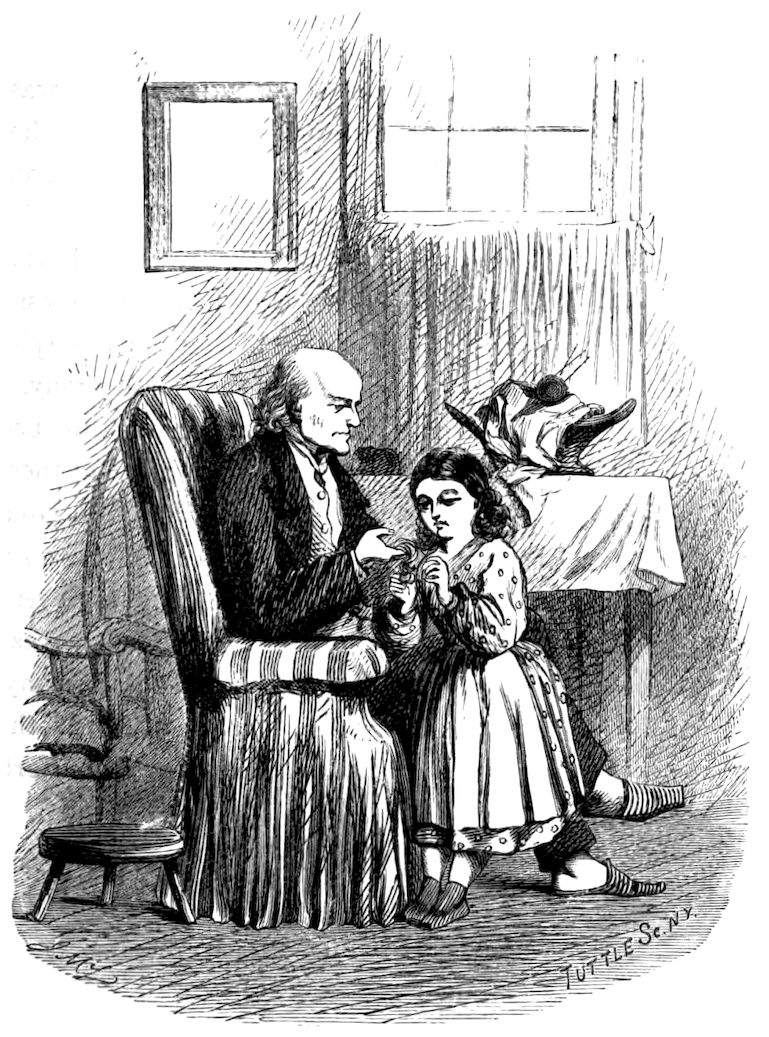
“Shall I have a bald head, grandfather, when
I am eighty?” asked little Kitty; “and
will it shine, and be smooth, like yours?” “Your
head don’t look much like it now, little puss!”
said the old man, lifting the silky, yellow curls;
“and that puts me in mind that I’ve a story to
tell you—a ‘real, true story;’ and all about grandpa,
too.
“When grandpa was little, like you, he
didn’t live in a city like this, where the houses all
touch one another, and it is as much as ever one
can get a glimpse of the sky, because they are so
tall. He lived in a little log house, ’way off in the
forest, and there was no other log house in sight
for a great many miles. There were no carriages
to be seen there, or fine ladies, or fine gentlemen;
but there were plenty of squirrels darting up and
28down the trees, and running off to their hiding
places; and there were more little birds than I
could count hopping over the ground, and singing
in the branches overhead; and there were plenty
of pretty wild flowers, peeping out here and there,
in quiet, out-of-the-way little places, and little
patches of bright green moss, so soft and thick,
that they looked just like velvet cushions, for little
fairies to sit on; and there was a red and white
cow, who gave us plenty of good milk for breakfast
and supper; and some funny little pigs, with
black, twinkling bead eyes, and very short tails,
who went scampering about just where they liked,
and munching acorns.
“The log house was very rough outside, but my
mother had planted blue and white morning glories,
and bright yellow nasturtiums, all around it,
and they climbed quite up to the little roof, and
hung their blossoms about it, so that, had it not
been for the funny old chimney, peeping out of
the top, you might have thought it a little bower,
like the one down in your mother’s garden yonder.
Sometimes my mother took me on her knee
at sunset, and sat in the doorway, to watch the
little birds and squirrels as they went to bed, and
29sometimes I sat by her side in the grass, while she
milked the old red and white cow. Sometimes I
watched my father as he chopped wood. I liked
to see the great ax come down in his strong
hand, and I liked to see the splinters of wood fly
about. Often he would cry out, ‘Not so near,
Dan! not so near, boy; or some fine day I’ll be
chopping your head off!’ At this, my mother
would come running out of the house, and catching
me up under her arm, set me down in the
doorway, after she had placed a board across, to
prevent my clambering out again. But one day
my mother had gone out, far into the forest, to
look for the old red and white cow, who had
strayed away; so I was left alone with my father.
I was very glad of that; because he was so busy
chopping and piling up his wood, that he hadn’t
much time to say ‘What are you at, Dan?’ as
my mother did, who seemed to me to have eyes
in the back of her head, whenever I wanted to be
mischievous. So, at first I sat quite still on the
doorstep, as my mother told me, watching my
father’s ax as it gleamed in the sun, and then
came down with a crash in the wood. By and
by I got tired of this, and crept a little nearer;
30and as my father did not notice it, I hitched on a
little farther and then a little farther, so that I
could see better. Then I got quite close up, and
just as my father raised the ax to strike, I
stooped my head to pick up a splinter of wood
from the log he was chopping. The next moment
I found myself fastened down tight to the
log, and heard my father groan out, as if he were
dreadfully hurt. Then he caught me up in his
arms, kissed my face, and held it up to the light,
while his own was as white as if he were dead;
for there, on the log, on the edge of the ax, lay
one of my long yellow curls, and I was not killed
at all, nor even scratched; and here,” said the old
man, taking a paper from his pocketbook, and
drawing out a bright, golden curl, “here is the
lock that the ax cut off, instead of grandpa’s head;
it don’t look as if it ever grew on this bald, shiny
pate, does it? See, it is just the color of yours,
Kitty; grandpa keeps it in his pocketbook, and
whenever he feels troubled and worried about anything,
he looks at it, and says, Well, God took
care of me then, and I won’t believe that he will
forget me now.” Little Kitty took the curl in her
hand, and looked at it very steadily awhile. Presently
31she looked up at her grandpa and said, “Did
your mother whip you when she came back, for
getting off the doorstep?” “No,” said grandpa,
laughing, “I think she forgot to do that. I remember
she gave me a great deal of milk that night
for my supper, and kissed me, and cried a great
deal, when she tied on my nightgown and put me
into bed.”
JOHN BROWN.
32
“John Brown’s body lies mouldering in the grave,
His soul is marching on!”
You have all heard that song, sung at the piano
at home, whistled in the street, and shouted
by the soldiers as they went off to the war; well,
shouldn’t you like to have me tell you what sort
of a child John Brown was?
33Little boys who live in cities, and wear velvet
coats, and hats with plumes in them, and have
long, silky curls, just like a little girl’s, hanging
over their shoulders to their belts, and drag along
through the streets holding on to a nurse’s hand,
when they are seven or eight years old, and are
more afraid of a little mud on their boots or on
their velvet coats than anything else; who have
more rocking horses, and whips, and humming
tops, and velocipedes, and guns, and swords, and
marbles, and Noah’s arks, and bat and balls, than
they know what to do with, can hardly imagine
how a little boy in the country, with none of these
things, and with nobody to amuse him, or to tell
him how to amuse himself, could possibly be happy
or contented. I am going to tell you about John
Brown, who was another kind of boy. He had
never seen a city, or wore a hat on his head. He
jumped out of bed himself without any nurse, and
ran out of doors barefoot into the grass, eating
a bit of bread for breakfast, or anything that
came handy. There were no houses about, for he
lived in a little hut, in the wilderness, with nothing
but trees, and wild beasts, and Indians. He
was only five years old when his father took him
and his mother in an old ox cart, and went ’way
off in the forest to live. As I told you, he had no
toys; and he used, though such a little fellow, to
help drive the cows home; and now and then he
would ride a horse, without any saddle, to water.
Sometimes he would watch his father kill rattlesnakes—great
big fellows, too, such as you have
shuddered to look at, even through a glass case in
the Museum; and he learned not to be afraid of
them, too. At first he trembled a little at a live
34Indian, when he met him in the woods, and was
more afraid still of his rifle; but very soon he became
used to them, and liked to hang about and
see what they did; and after a while he learned
some of their queer talk himself, so that they
could understand each other very well. I suppose
he got along with the Indians much better than
his father, who stammered very badly, and is said
never to have spoken plain at all, except when he
was praying. Wasn’t that very strange? Johnny’s
father used to dress deerskins; and Johnny
learned it so well by watching him, that he could
at any time dress the skin of a squirrel, or a raccoon,
or a cat, or a dog. He learned, too, to make
whiplashes of leather, and sometimes he would
manage to get pennies for them, which made him
feel very grand, just as if he kept shop. When he
was about six years old, a poor Indian boy gave
him a marble—the first he had ever seen. It was
bright yellow, and Johnny thought it was splendid,
and kept it carefully a long while, turning it
over, and holding it up to the light, and rolling
it on the floor of his father’s hut. One unlucky
day, Johnny lost the yellow marble. I dare say
you will laugh when I tell you that it took years
35to cure him of mourning for that marble; and that
he used to have long fits of crying about it. But
you must remember that it was the only toy he
ever had, and that there were no shops about
there where he could get more. One day, after
the loss of the marble, he caught a little squirrel.
It bit Johnny badly while he was catching it.
However, Johnny held on to him, for he was not
a kind of boy to let a thing go, after he had once
made up his mind to have it; and so the squirrel
made the best of it, particularly when he found he
had lost his bushy tail in the fight, and he let
Johnny tame him, and feed him, and he would
climb up on Johnny’s shoulder, and look at him
with his little bright eye, and then scamper down
again over the grass, and then back again, and
perch on Johnny’s hand, so that he was just as
dear to him as your little brother is to you; or the
good little boy next door, who plays with you in
your father’s yard, and never once vexes you.
One day Johnny and his squirrel went into the
woods to play; and while Johnny was busy picking
up sticks, the squirrel wandered away and got
lost; and for a year or two after that, the poor
boy mourned for his little pet, looking at all the
36squirrels he could see, for his own little bob-tailed
squirrel, because no other squirrel would do but
that one he had tamed and loved. But he never
found him; and, between you and me, perhaps it
was just as well for the squirrel. I dare say he is
cracking nuts quite happily in some snug tree, and
scampering about with his little baby squirrels,
and has quite forgot Johnny and his lost tail.
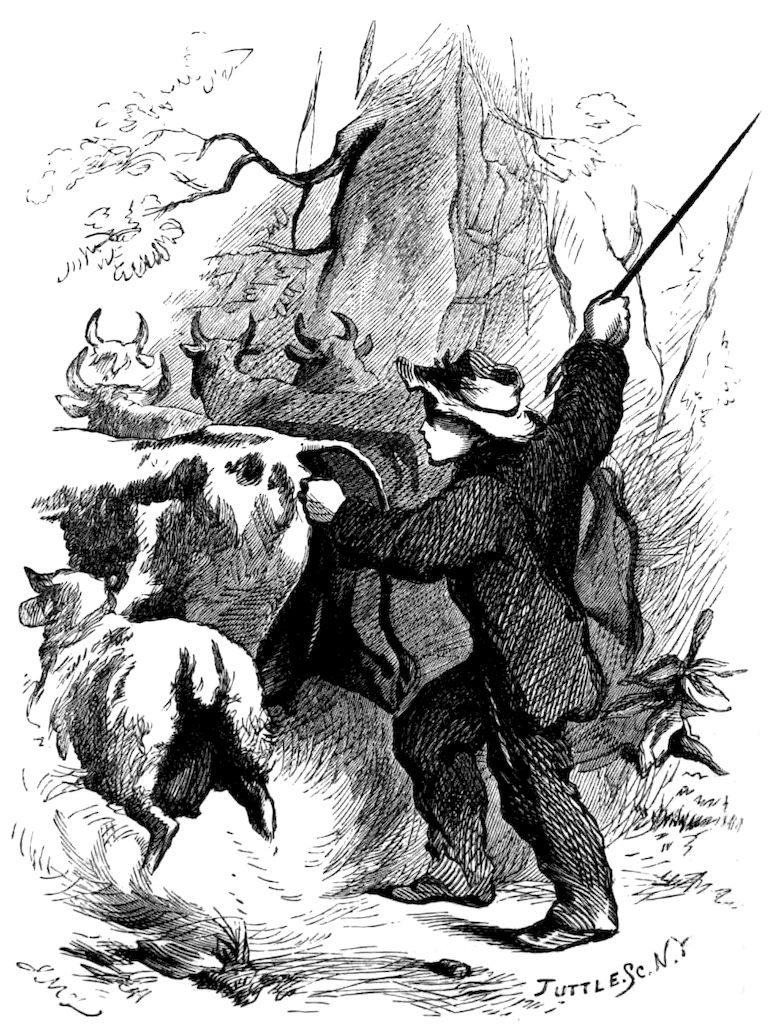
What Johnny liked above all things, was to be
sent off by his father a great way though the wilderness,
with droves of cattle; and when he was
only twelve years old, he used to go with them
more than a hundred miles. What do you think
of that? He was quite proud of it himself, and
nobody could have affronted him more than to
offer to help him at such times. He was more
like a little Indian than anything else; he could
hear so quickly any sound a long way off; and he
declared that he had often smelled the frying of
doughnuts at five miles’ distance. Pretty good
nose, hadn’t he?
When Johnny was eight years old, his mother
died. Ah! you may be sure that the loss of the
yellow marble, and the bob-tailed squirrel, was
nothing to this. He cried and mourned for her,
37as he wandered through the woods, or drove cattle
for his father, and I suppose sometimes, though
he loved his father, that when he came within
sight of the little hut, he would rather have lain
on the ground all night, than to have gone into it,
and missed her pleasant “Well, Johnny, is that
you, dear?” Well, he got along as well as he
could, and grew a hardy, tough lad in the open-air
work his father gave him to do.
Some time after this, when away some hundred
miles from home with a drove of cattle, he stopped
at an inn with a landlord who had a very bright
little slave boy, just Johnny’s age. This little
slave boy’s master made a great pet of Johnny,
and brought him to the table with his best company,
and repeated all his smart sayings, and
asked them if they did not think it wonderful,
that a boy of his age could drive so many cattle
safely one hundred miles from home? And, of
course, they petted Johnny too, and praised him,
and thought he was quite a wonder. I suppose
Johnny would have felt very nice about it, had it
not been that the little slave boy, who was just his
age, and as bright a little boy as Johnny, was
beaten before his very eyes by his master, with an
38iron shovel, or anything that came handy; and
while Johnny was fed with everything good, this
little fellow was half starved, and half frozen with
cold, on account of his thin clothing. Johnny
could not forget that; he had never seen anything
like it before; when he went to his comfortable
bed, it troubled him; when he ate good food, it
seemed to choke him; when he put on warm
clothes, he felt ashamed to be warm, while the little
slave boy was shivering; and Johnny felt
worse, because he was only about ten years old,
and couldn’t do anything to help him; but as he
was going home through the woods, he said,
aloud, as if he were telling it to “Our Father,
who art in Heaven,” “When I grow bigger, I’ll
fight for the slaves; and I’ll fight for the slaves
wherever I see them, so long as I live.” For all
this, Johnny was such a bashful boy, that about
this time, when a lady to whom he was sent on an
errand gave him a piece of bread and butter, he
did not dare to tell her he didn’t eat butter, but as
soon as he got out of the house he ran for a long
distance, till he was out of sight, and then threw
it away.
About this time a friend of Johnny’s, who
39owned some good books, offered to lend him some
to read, for he knew how to read, although he
had been to school but little. He liked history
very much, and became so interested in these
books, that he wanted to know all the people who
had studied and read books too, and who could
tell him about the world, and things which had
happened in it, and how everything came about;
and this desire for learning gave him a dislike to
foolish talk and foolish people; and whenever he
heard any sensible talk go on, as he traveled off
with his cattle, he just pricked up his ears, and
stored it away in his little head, to think of
when he got home. You have no idea how much
he picked up and how much he educated himself
in that way. It would shame many boys who go
to good schools, only to turn out lazy, stupid
dunces.
When Johnny was fifteen, his father put him
at the head of his currier and tanner establishment.
Here Johnny had a large company of men
and boys to look after. Now, men don’t like
much to have a boy order them to do this or that,
even though they are working for that boy’s
father; but Johnny was so bright and knowing,
40and pleasant, that you will not be surprised to
hear that they got along nicely together. Instead
of quarreling with him, the men used to praise
him for being so smart; so that, though he was
very bashful when he began business, by the time
he was twenty, he began to think he really was a
smart fellow, sure enough. But that was natural,
you know; and I only think it was a wonder he
was not quite spoiled by so much praise, and so
much power, when he was so young. His young
brother used to make fun of him and call him
“King Johnny,” because he spoke in such a decided
way to the workmen, when he wanted anything
done; but Johnny went about his business
and let him talk. He had his hands full cooking
his own dinners, and learning arithmetic, and surveying,
and I don’t know what else besides; for he
was not a fellow who could even be idle a minute,
you may be sure of that. The world was too full
of things he wanted to know, and he was in too
great a hurry to get at them.
All the time John was a young man, he never
wanted, or wore, fine clothes, although he was
neat and tidy. He ate plain food, and never
touched tobacco, or spirits, or tea, or coffee. He
41drank milk, or only water. So, you see, he had a
clear head for study and business, and I don’t
think he ever knew the meaning of the word
“dyspepsia.” When John got a letter, he always
wrote on the back of it the name of the person
who wrote it, and either “Not answered,” or
“Not time to read,” or “No answer needed.” I
tell you this to show you how thoroughly he did
everything he undertook; and so honest was
John, that he refused to sell his customers any
leather, until every drop of moisture had been
dried out of it, because the water would make it
weigh more, you know, and, of course, he would
get money that did not really belong to him. I
think, had John lived in New York, some of the
business men here would have thought him crazy,
or he would have thought them crazy; but, you
see, John couldn’t cheat; not even though he
should never be found out in it. Most young
men, when they are of John’s age, think more
about their own affairs than anything else—their
own business, their own pleasures, etc.; whether
they will ever be rich men, how rich they will be,
and all that. It was not so with John. He wanted
money, ’tis true, but all this time he had not
42forgotten the little slave boy, and others like him,
and it was for such as he that he wanted money,
that he might help them away from their masters,
and help them to be free by and by. He married,
and had many children of his own, and when
these children grew up, they all felt just as their
father did about the slaves. After a time, John
helped eleven slaves to get away to Canada, where
they were quite safe. How glad they must have
been! and how they must have loved John!
Somebody asked John how he felt when he got
them there? he said that he was so happy about it,
that he was quite ready to die then. But there
was other work for John and his boys to do.
There was a place called Kansas, where John’s
boys went to live; but as soon as the people there
found out that John’s boys and himself loved the
slaves, they began to steal their cattle, and burn
their fences, and try, in every possible way, to
trouble and bother them. So John’s boys wrote
home to the old man about it, and told him that
he must send them some guns and muskets, to defend
their property and their lives with. Well,
the old man didn’t have to stop to think long
about that. He told his other boys, who were living
43at home with him, about it, and they agreed to
start right off for Kansas, with as many guns and
muskets as they could get. John had no idea of
his boys out there being murdered and robbed,
without fighting for them, especially when they
were treated so merely for pitying the poor slaves.
When they reached there, John and his four boys,
they each had a short, heavy broadsword strapped
to their sides. Each one had a quantity of firearms
and revolvers, and there were poles standing
endwise round the wagon box, with fixed bayonets,
pointing upward. Oh! I can tell you, he
was in real earnest about it! Well, they suffered
great hardships there, while fighting for their
rights: one of John’s boys was taken by the enemy,
and driven with chains on him, so far in a hot sun
to prison, that he became a maniac; another of
his sons was so injured, that he became a cripple
for life; another son was murdered while quietly
walking along the road, and as he lay a corpse on
the ground, one of his brutal enemies discharged
a loaded pistol in his mouth. All this John had
to bear, but he only said, “It is very hard; but my
sons have died in a good cause—died for the poor
slaves.” Most people thought, “John has had
44enough of it now; he will fight no more about
slavery; he has taken the rest of his boys back to
his old home in the mountains, and he will not be
in a hurry to have them killed.”
They were mistaken. John was only waiting
to whet his sword. He knew how to wait. One
day, the whole country about Harper’s Ferry was
in a state of distraction. The women and children
were frightened to death, for John Brown was
down there; and it was said he was going to help
all the slaves he could to get away from their masters;
and that his boys were there to help him,
and a great many other men; and that they had
guns, and swords, and pistols in plenty, and meant
to fight fiercely, if anybody tried to hinder them.
John chose Harper’s Ferry, because there were
mountains all about it, and he had known every
turn in them, and all their valleys, too, for seventeen
years, and in case they were beaten, he
thought it would be a good place for himself
and the slaves to hide in, as well as a good
place to fight from. The first night of John’s
attack on the town, he and his men put out all the
lights in the street, and took possession of the
armory, where the firearms, you know, are kept.
45Then they took three watchmen, and locked them
up in the guardhouse. There must have been
friendly black people in the town who helped
them do all this. Some of them cut down the
telegraph wires, and others tore up the railroad
track after the train had passed. When it came
daylight, John and his men took prisoner every
person who came out into the streets, and when
people said, “Why do you do this? What do
you mean?” John and his men said, “We mean
to free the slaves!” One of the workmen employed
at the armory, when he came to work that
morning, and saw an armed guard at the gate,
asked of John’s guard, “By what authority have
you taken possession of this building?” “By the
authority of God Almighty!” said he.
Well, one after another, the workmen who
came to their work in the armory that day, were
taken prisoners. There was a terrible panic, I can
tell you. John and his five sons were inside the
armory grounds, while others were stationed outside
the walls, to hold the town—some at the
bridges, some at one place, some another. When
the workmen whom John took prisoners told him
how troubled their wives and children would be
46about them, John kindly allowed them to go
home, under a guard of his soldiers, to tell them
not to be frightened. John wanted, in doing this,
to make the people understand that the prisoners
in his hands should not be hurt; a brave man, you
know, is always a tender-hearted man. Poor
John! he lingered too long about these things.
The people whom he allowed to go in the cars,
before he tore up the railroad track, wrote
on little slips of paper terrible accounts of him,
and scattered them through the country as the
cars went flying through; so the first thing he
knew, one hundred soldiers came to Harper’s Ferry
from Charlestown. Now, indeed, they had
bloody work. John’s men began to get killed,
but not one of them but sold his life as dearly as
he could, fighting fiercely till he could fight no
longer. Some lay dying in the street, some of
the corpses floated down the river, some were
taken, bleeding and gasping, to prison. Even
after John’s men were dead, his enemies continued
to kick and beat their insensible bodies, and many
ran sticks into their wounds. And now John
knew that all that was left him, was to sell his life
as dearly as he could. With one son dead by his
47side, and another shot through, he felt the pulse
of his dying boy with one hand, and held his rifle
with the other, and told his few men about him to
be firm and calm. He said that his boys came
with him to fight of their own accord, and that
they had died in a good cause. Well, the soldiers
soon battered down the building, and got in
where John and his men were. An officer, as
soon as he saw John, although he and his men
had then done firing, struck him in the face, and
knocked him down. The same officer repeated the
blow several times, and then, when John was lying
on the ground, helpless, another soldier ran his bayonet
twice into the old man’s body, whose face and
hair were clotted with blood. Then they searched
his pockets, and took what they wanted, and then
carried him, bleeding, to the guard house, and laid
him on the bare floor, without anything under
him. Then the governor hurried down to see
him, with several of his friends, and though the
poor old man was writhing in agony with his
wounds, and the blood and the smoke were not yet
washed from his face, for thirty hours they let
him lie upon the floor, with his head propped up
on a chair, while they questioned him, and while
48the mob insulted him. After that, John was carried
off to Charlestown jail, under a guard of soldiers.
The body of John’s son was carried off for
the doctors to cut up. Seven days after this John
was dragged from his bed, and being unable to
stand, was supported on each side by an officer
into court, and there laid on a bed, to be tried by
the laws of Virginia, for what he had done.
Well, John had a “Virginia trial.”
A trial, you know, is a fair hearing on both
sides. John was faint and bleeding, and unable
to stand; they refused to let him have a lawyer
to speak for him, and declared him guilty without
hearing at all his side; although the law declares
a man innocent till he is proved by law to be guilty.
Then they told the jailer to shoot him if anybody
tried to help him escape; and this was
John’s trial. Now, John did not wish to die
with the character of a robber or a murderer, and
before they took him out of court, he lifted his
head up from his mattress and told them that he
had not had a fair trial; that he was too sick to
talk; that his money, fifty or sixty dollars in gold,
had been taken from him, and that he could not
now pay anybody to do any errands for him; that
49they ought to give him time to send for his
friends. But it was of no use, because they had
determined not to give him time; so he was
brought into court again on his bed soon after,
and sentenced to be hung, i. e., if he did not die
first, on Friday, the second day of December;
and when the judge said that John would be hung
where everybody would have a chance to see it,
one man jumped up before John and clapped his
hands, because he was so glad that he should see
the brave old man die.
Forty-two days in all, John lay in a Charlestown
prison. All that time, sick as he was,
no clean clothes were given him, although sixty
dollars of his money were taken from his
pocket when he was arrested. All those forty-two
days and nights, he had lain there in the stiff,
dirty, blood-stained garments in which he fell.
Well, John had two Virginia militia companies
come out of curiosity to see him in prison.
He treated them civilly, but told the jailer, after
they left, that he did not like being made a monkey
show of. Everybody who loved slavery, was
allowed to gape and stare at John as much as
they pleased; but John’s friends, although they
50were ladies and gentlemen who had traveled a
long distance, found it hard work to get leave to
take a peep at him.
John’s wife wanted to come and see him before
he died, and bid him good by. John told
her she would be insulted and badly treated, and
she had better stay at home with the children;
and besides, I suppose, John was afraid it would
make it harder for him to die, and leave her and the
girls all alone in the world. But the poor woman
could not bear not to look in the face of her children’s
father once more, and at last John told her
she might come. When she got there, the jailer
led her into the cell, but she could not speak to
John, nor John to her. She only laid her head
upon his breast, and clasped his neck with her
arms.
Then, seeing a heavy chain on John’s ankles,
and fearing it might pain him, she kneeled on the
floor and pulled two pair of woolen socks on his
feet. Then John told her what to say to his children
at home, and how he wanted them to live,
when he was dead; and that she must pay some
money to some persons for him, whom he named;
and then he read her his “will,” which he had
51made. And then John and his wife ate their
“last supper” together. Perhaps these words
will remind you, as they did me, of another “Last
Supper.” And then the jailer, Captain Anis, told
the poor wife that she must go. And then John
said to his wife, “God bless you! Mary; good
by;” and then she went out, and never saw John
more, till she looked upon his dead face.
There were three ropes sent to hang John
Brown with; South Carolina sent one, Missouri
one, and Kentucky one. They chose the Kentucky
rope, because it was the stronger, and then
it was shown, in public, to the people. Well,
the second day of December, when the old man
was to be strangled, came at last. It was a lovely
day, so mild and warm that the windows of all
the houses were open. The scaffold was to be in
a field, half a mile from the jail. At seven in the
morning the carpenters came to fix it. At eight
o’clock the soldiers began to come; horsemen,
dressed in scarlet jackets, were placed about the
field, and a double line of sentries farther on;
then the State of Virginia, fearing, after all this,
that it would not be safe enough from a feeble,
sick old man, brought a huge brass cannon, so
52placed and pointed, that if a rescue were attempted,
John might be blown into little atoms in a
moment. There were about five hundred soldiers
in the field; and lines of them were stretched over
fifteen miles. There were not many people of the
place there to see John hung, for they dared not
leave their slaves alone at home, for fear of mischief
in their absence; for all the poor slaves knew
very well that John was to be hung that day, because
he was their friend.
At eleven o’clock, they brought John out of
jail, and put him in the wagon, to drive him to
execution.
As John stepped from out the door of his prison,
a black woman, with a little child in her arms,
stood near. He stopped for a moment, stooped
over, and kissed the little black child. Soon after,
as he passed along, another black woman said,
“God bless you! old man. I wish I could help
you, but I cannot.” This made the tears come in
John’s eyes for the first time.
By John’s side was seated the undertaker, and
on the wagon was a black coffin, enclosed in a
box, because his body was to go to his poor wife
after these Virginians had done with him. Then
53several companies of soldiers, mounted on horseback,
rode beside the wagon, which was drawn by
two white horses. As they went along, John
looked at the lovely Blue Mountains and the
bright sky, and the warm sunshine spread over all,
and said, calmly, “This is a beautiful country; I
have not seen it before.” The jailer, who sat beside
him, could hardly say “yes,” he was so astonished
to see John so quiet and smiling, as if he
were only taking a ride on that lovely day. Then
the undertaker said to John, “You are more
cheerful than I am, Captain Brown.”
“Yes,” said the old man, “I ought to be.”
And now the wagon had come to the field,
where stood the gallows, and all those hundreds
of soldiers, and the great brass cannon. The
bright sun shone on the bayonets and muskets of
the soldiers and their gay uniforms, and the lovely
Blue Mountains looked very calm and peaceful;
and the soldiers kept very close to old John, for
Virginia felt uneasy till the breath was out of
him. Then John got out of the wagon and stood
on the scaffold, and took his hat off for the last
time, and laid it down by his side. Then he
thanked the jailer, who had been kind to him;
54then they tied his elbows and ankles; then
they drew a white cap over his eyes, and then
they put the Kentucky rope around his neck.
Then the sheriff told John to step forward; and
John said, “I can’t see; you must lead me.”
Then the sheriff asked John to drop his handkerchief,
for a signal for him to hang him; and John
said, “Now I am ready; only don’t keep me long
waiting.”
When John asked his enemies for time for
his trial, they wouldn’t let him have any; now,
when he did not want any more time, they kept
him waiting. So they made the old man stand
there, blindfolded, full ten minutes, while they
marched the soldiers up and down, and in and out,
just as if they were drilling on parade. Some
of the soldiers felt ashamed of this cruelty to the
old man, and muttered between their teeth, for it
was as much as their necks were worth to say it
loud, “Shame! shame!” Then, at last, after the
military maneuvers were over, the rope was cut,
and John struggled and strangled and died.
Then, you know, after that, Virginia had to be
very sure the old man was really dead; so first the
Charlestown doctors went up and poked him over,
55and pulled him about; then the military doctors
had their turn; lifting up his arms, and putting
their ears a great deal closer to his breast than
they would have cared to do once, to see if he
breathed; then they swung the body this way
and that, in the air, for thirty-eight minutes.
Then they lifted the body upon the scaffold, and it
fell into a harmless heap. Then, although all the
doctors who had pulled him around declared that
he was dead, still Virginia was so afraid of John,
that she insisted on cutting the dead body’s head
off, or making it swallow some poison, for fear, by
some hocus pocus, it might wake up again. But
it didn’t wake—at least, not in the way they expected.
But there is fierce fighting down in Virginia
to-day; for, though John Brown’s body lies
mouldering in the grave,
His soul is marching on!
THE PLOUGHBOY POET.
56
Mother Nature does not always, like other
mothers, lay her pet children on downy pillows,
and under silken canopies. She seems to
delight in showing that money shall buy everything
but brains. At any rate, she not only
opened our poet’s big, lustrous eyes, in a clay
cottage, put roughly together by his father’s own
hands, but, shortly after his birth, she blew it
down over his head, and the mother and child
were picked out from among the ruins, and carried
to a neighbor’s for safe keeping—rather a
rough welcome to a world which, in its own slow
fashion, after the mold was on his breast, heaped
over it honors, which seemed then such a mockery.
But the poor little baby and his mother, happy
in their mutual love, knew little enough of all this.
57A good, loving mother she was, Agnes by name;
keeping her house in order with a matron’s pride;
chanting old songs and ballads to her baby-boy,
as she glided cheerfully about; not discouraged
when things went wrong on the farm, and the
crops failed, and the table was scantily supplied
with food—singing, hoping, trusting, loving still;
a very woman, over whose head cottages might
tumble, so that her heart was but satisfied.
Robert’s father was a good man, who performed
each day’s duty as carefully as though
each day brought other reward than that of having
done his duty. It is a brave, strong heart,
my dear children, which can do this. All can
labor when success follows; it is disaster, defeat,
difficulties, which prove what a man’s soul is
made of. It is just here that the ranks grow thin
in life’s battle—just here that the faint-hearted
perish by the wayside, or desert, like cowards, to
the enemy. William Burns stood manfully to his
duty, plodding on, year after year;—when one
plan failed, trying another; never saying, when his
day’s work was done, “Ah! but this is too discouraging!
I’ll to the alehouse, to drown my
griefs in strong drink!” Neither did he go home
58moody and disconsolate, to drive his children into
corners, and bring tears to the eyes of his toiling
wife. But morning and evening the prayer went
up, with unfailing trust in Heaven. Oh! but that
was glorious! I love William Burns! Did he
say at night, when so weary, “Now, at least, I’ll
rest?” Not he: there were little bright eyes
about him, out of which the eager soul was looking.
So he gathered them about his armchair on
those long winter evenings, and read to them, and
taught them, and answered their simple yet deep
questions. One of Robert’s sweetest poems, the
Cotter’s Saturday Night, was written about this.
Robert’s father told his children, too, of the history
of their country; of skirmishes, sieges, and
battles; old songs and ballads, too, he repeated to
them, charming their young ears. Was not this a
lovely home picture? Oh! how much were these
peasant children to be envied above the children
of richer parents, kept in the nursery, in the long
intervals when their parents, forgetful of these
sweet duties, were seeking their own pleasure and
amusement. More blessed, surely, is the humblest
roof, round whose evening hearth gather
nightly, all its inmates, young and old.
59Nor—poor as they were—did they lack books.
Dainties they could forego, but not books; confusedly
thrown about—soiled and thumbed; but—unlike
our gilded, center-table ornaments—well
selected, and well read. And so the years
passed on, as does the life of so many human
beings, quiet, but eventful.
Who sneers at “old women”? I should like
to trace, for a jeering world, the influence of that
important person in the Burns family. Old Jenny
Wilson! Little she herself knew her power, when,
with Robert Burns upon her knee, she poured
into his listening ear her never-ending store of
tales about fairies, and “brownies,” and witches,
and giants, and dragons. So strong was the impression
these supernatural stories made upon the
mind of the boy, that he declared that, in later
life, he could never go through a suspicious-looking
place, without expecting to see some unearthly
shape appear. Who shall determine how much
this withered old woman had to do with making
the boy a poet? And yet, poor humble soul—that
is an idea which seldom enters the mind of
his admirers. The bent figure, with wrinkle-seamed
face, gliding noiselessly about your house,
60doing odds and ends of household labor, now
singing a child to sleep, now cooking at the
kitchen fire, now repairing a garment, or watching
by a sickbed—always on hand, yet never in
anybody’s way; silent, grateful, unobtrusive, yet
beloved of Heaven—have you not known them?
Robert’s mother, the good Agnes, had a voice
sweet as her name. The ballads she sang him
were all of a serious cast. She had learned them,
when a girl, from her mother. Oh, these songs!
Many a simple hymn, thus listened to by childhood’s
ear, has been that soul’s last utterance this
side the grave. All other childish impressions may
have faded away, but “mother’s hymn” is never
forgotten. That strain, heard by none else, will
sometimes come, an unbidden, unwelcome guest;
and neither in noise nor wine can that bearded man
drown it—this mother’s hymn! Sing on, sing
on, ye patient, toiling mothers! over the cradle—by
the fireside. Angels smile as they listen. The
lark whom the cloud covers, is not lost.
The father of Robert Burns did not consider,
because he was a poor man, that it was an excuse
for depriving his boys of any advantages of education
within his reach, as many a farmer, similarly
61situated, and intent only on gain, has thought
it right to do. His good sense, in this respect,
was well rewarded; for Robert’s first teacher said
of him, that “he took such pleasure in learning, and
I in teaching, that it was difficult to say which of
the two was most zealous in the business.” It is
such scholars as these who brighten the otherwise
dreary lot of the teacher. Pupils who study, not
because they must, and as little as possible at that,
but because they have an appetite for it, and crave
knowledge. Of course, a good teacher endeavors
to be equally faithful to all the pupils who are
intrusted to him—the stupid and wayward, as
well as the studious. But there must be to him a
peculiar pleasure in helping, guiding, and watching
over a pupil so eager to acquire. The mother
bird, who coaxes her fledglings to the edge of
the nest, and, by circling flights overhead, invites
them to follow, understands, of course, how the
little, cowering thing, who sits crouched on a
neighboring twig, may be too indolent, or too
timid to go farther; but she looks with proud
delight upon the bold little soarer, who, observing
well her lesson, reaches the top of the tallest tree,
62and sits, swaying and singing, upon its topmost
branch.
Robert, however, had not always the good
luck to have, as in this case, an intelligent, appreciative
teacher. I suppose it is not treason to
admit, even in a child’s book, which, by some, is
considered a place for tremendous fibbing, that a
teacher may occasionally err, as well as his pupil.
That teachers have been known to mistake their
vocation, when they have judged themselves qualified,
after trying and failing in every other employment,
to fill such a difficult and honorable
position.
It seems there was a certain Hugh Rodgers, to
whose school Robert was sent. It was the very
bad custom of those times, when pupils of his
age first entered a school, to take the master to a
tavern, and treat him to some liquor. This Robert
did, in company with another boy, named Willie,
who entered at the same time. Do you suppose
that schoolmaster ever thought remorsefully
about this in after years, when he heard what a
wreck strong drink had made of poor Robert?
Well, the boy Willie and Robert became great
friends from that day; often staying at each
63other’s houses, and always spending the intervals
between morning and afternoon school, in each
other’s company. When the other boys were
playing ball, they would talk together on subjects
to improve their minds. Now, as they walked
while they talked, their omitting to play ball was
not of so much consequence as it would otherwise
have been—at least, according to my motto, which
is, chests first, brains afterward. But to go on.
These disputatious youngsters sharpened their
wits on all sorts of knotty subjects, and also invited
several of their companions to join their
debating society—whether to improve them, or to
have an audience to approve their skill, I can’t
say; perhaps a little of both.
By and by the master heard of it. He didn’t
like it. He had an idea boys should have no
ideas that the master didn’t put into their heads
for them. So one day, when the school was all
assembled, he walked up to the desks of Robert
and Willie, and began, very unwisely, to taunt
them about it before all the scholars—something
in this style: “So, boys, I understand that you
consider yourselves qualified to decide upon matters
of importance, which wiser heads usually let
64alone. I trust, from debating, you won’t come to
blows, young gentlemen,” &c., &c. Now, the
boys who had not joined their debating society,
set up a laugh, like little rascals, at the rebuked
Robert and Willie. This, of course, as the teacher
should have known, stung them to the quick;
and Robert, with a flushed face, resolved to
“speak up” to the master. I find no fault with
his reply, which was this; that both he and Willie
rather thought that he (the master) would be
pleased, instead of displeased, at this effort to improve
their minds. At this, Hugh Rodgers
laughed contemptuously, and said he should be
glad to know what these mighty nonsensical
discussions might be about. Willie replied that
they had a new subject every day; that he could
not recollect all; but that the question of that day
had been, whether is a great general, or respectable
merchant, the more valuable member of society.
At this, Hugh Rodgers laughed more
uproariously and provokingly than before, saying,
that it was a very silly question, since there could
be no doubt for a moment about it. “Very well,”
said Robert Burns, now thoroughly roused, “if
65you think so, I will take any side you please, if
you will allow me to discuss it with you.”
The unfortunate schoolmaster consented. He
commenced the argument with a pompous flourish
in favor of the general. Burns took the other
side, and soon had the upper hand of the schoolmaster,
who made a very lame reply. Soon the
schoolmaster’s hand was observed to shake, his
voice to tremble, and, in a state of pitiable vexation,
he dismissed the school.
Poor man! he understood mathematics better
than human nature; and himself least of all. This
was an unfortunate victory, for two reasons. It
was an unnecessary degradation of a man who
had his estimable qualities, and it increased the
self-sufficiency of young Burns, who was born
with his arms sufficiently a-kimbo. Alexander-fashion,
he soon sighed for another conquest. His
bedfellow, John Nevins, was a great wrestler.
Nothing would do, but he must floor John Nevins.
Strutting up to John, he challenged him to
the combat. John soon took that nonsense out
of him, by laying him low. Vanquished, he
sprang to his feet, and challenged him to a discussion.
There he had him!—John having more
66muscle than brain. Burns’s pride was comforted,
and he retreated, a satisfied youth. This is all I
know about Robert’s childhood.
Silver hairs were now gathering thickly on his
good father’s temples, as he toiled on, to little use,
while children grew up fast about his knees, to be
fed, schooled, and clothed by his labor. Robert
and his brother looked sadly on, as his health
declined. Robert had little inclination for his
father’s work, and yet, somebody must take his
place; for consumption was even then making
rapid and fearful havoc with his constitution.
The good old man ceased from his labors at last,
and went where the weary rest. For a while,
Robert strove to fill his place—strove well, strove
earnestly. But the farmer who stops to write
poems over his plough, seldom reaps a harvest to
satisfy hungry mouths. And so, poverty came,
instead of potatoes, and Robert Burns, although
the troubled eyes of his wife looked into his, and
his little children were growing up fast about
him, and needed a good father, to teach them
how to live in this world, and to earn bread for
them till they became big enough to earn it for
themselves, it came about that, instead of doing
67this, he drank whisky to help him forget that he
ought to keep on ploughing, if poetry did not
bring him bread, and so made poverty a great
deal worse. His wife was very, very sorrowful
about it, and his little children became tired of
waiting for him to love them, and care for them.
Perhaps you say, Oh, how could he do so? My dear
children, how can anybody ever do wrong? How
can you ever vex your dear mother, who is so
good to you, and go pouting to bed, and never tell
her that you are “sorry”? and still, while you are
sleeping, that dear, good, forgiving mother stoops
over your little bed, and kisses your forehead, and
looks to see if you are warm and comfortable,
before she can sleep, the same as if you had been
a good child, instead of a bad one. I hope you
will think of this before that good mother dies,
and tell her that you are very sorry for grieving
her; and I hope, too, that Robert Burns, before
it was too late, said that he was sorry for grieving
those who loved him, and for wasting his life;
but I do not know about that.
OLD HICKORY.
68
Many a time, I dare say, you have sat on your
bench at school, with your cotton handkerchief
spread over your knee, looking at the stern
face of this famous man upon it; every bristling
hair upon his head seeming to say for itself, In
the name of the commonwealth, stand and deliver!
You have thought, perhaps, that a man with
such a sharp eye and granite face as that, must be
a very terrible person, whose heart was quite left
out when he was made, and whom little children
had better run away from. It is just because this
was not true, that I first believed in General Jackson.
A brave man is never a mean one; and it
is mean to despise or bully children and women.
I place children first, because every woman who
has ever had one, does so. But to my story. We,
who have lived so peacefully and quietly in the
69land for which our brave ancestors fought, do not
think as often as we ought of the sufferings and
trials through which they purchased it for us.
Until lately, our houses were not burned down
over our heads, or ransacked and robbed, nor our
mothers and sisters insulted before our eyes, nor
our fathers and brothers dragged off as prisoners
of war, and kicked and cuffed for sport by the
enemy. All this, Andrew Jackson’s boyish eyes
saw. Do you wonder at the fire in them? One
of his earliest recollections was of the meeting
house in his native place turned into a hospital
for his wounded, maimed, dying, brave countrymen;
and his own widowed mother, leading him
there by the hand to nurse them, and dress their
wounds, and comfort them, as only a woman with
a strong heart and angel touch can. Could the
boy stand by and see all this, and not long for the
time when he should grow big, and stout, and
tall, and help fight for his country? Could he
help being impatient, he, the son of this unprotected
mother, when one after another of these
poor fellows was brought in, with their fresh,
ghastly wounds, and laid down to die? And
when, later, his cousin’s house was taken by the
70British, and the furniture was broken in pieces,
and his cousin’s wife was insulted by the officers,
and he and his brother were taken prisoners, and
ordered by the officer, with an oath, to clean his
muddy boots; and, because they both refused,
were cut and slashed across the face and head by
this bullying, cowardly fellow, Andrew then being
only twelve years old; and then were marched
miles and miles away down South, and not allowed
a morsel of food by the way, and forbidden even
to scoop up water from the streams they were
fording, to quench their feverish thirst? Ah! do
you wonder now at that stern face? Suppose
your dear mother, whom your dear father, whom
you can just remember, loved so tenderly, was
driven across the country with you and your little
brother, from place to place, for safety, in those
troublous times, and subjected to all kinds of hardships,
bearing up under it bravely, as good women
will. Suppose that when you and your brother—still
boys—were dragged off as prisoners of war,
this dear, brave mother traveled off alone, and
never rested till she managed, by an exchange of
prisoners with the British general, to get her
dear boys back again; but wan and wasted with
71small pox, and the wounds that they had received
from that big, cowardly British officer, all undressed
and uncared for; these boys, her Andrew,
her Robert? Well, as your mother would have
nursed you and your brother through her tears, so
Andrew Jackson’s mother nursed her fatherless
boys. But was Andrew a boy to forget either
his mother’s love, or the British? No, indeed!
And when, after he became well, and the whole
band went to live in the house of a friend, and
Andrew picked beans, and pulled fodder, and
drove cattle, and went to mill, do you wonder
that when he was sent to the blacksmith’s, to get
the farm tools mended, he brought home spears
of iron, and all sorts of odd-looking, rough
weapons, that, while waiting for the blacksmith,
he had himself manufactured “to kill the British
with”? Do you wonder that he fastened the
blade of a scythe to a pole, and exclaimed, fiercely,
as he cut down the weeds with it, “Oh! if I were
only a man, wouldn’t I sweep off the British with
my grass blade?” And he did it, too, afterward.
Let those who call him “fierce, savage, vindictive,”
remember how these sorrows of his childhood
were burned in upon his soul; remember
72what burning tears must have fallen upon the
little bundle containing all his dead mother’s
clothes, she who had struggled and suffered
through the war of the Revolution, and left him
an orphan at fifteen years, with only the memory
of her love and his country’s wrongs. As he
stood weeping over that little bundle, friendless,
homeless, and heart-broken, thinking of all she
had been to him, and looking wistfully forward
into the dim unknown, he did not see the future
President of the United States, and hear his voice
falter as he said, “I learned that, years ago, from
my dear, good mother!” Well might he remember
her then. You ask me if Andrew found no
opportunity to get an education in these troublous
times? You may be sure his mother knew the
value of that! and sent her boys, when quite
young, to the best schools she could find in their
native place. Schools, in those days, were not
the furnace-heated, mahogany-desked affairs we
see now. Pupils did not carry an extra pair of
shoes to put on when they entered, for fear of
soiling the floor. Velvet jackets were not worn
by the boys, nor gold bracelets by the girls. Andrew
Jackson’s schoolroom was an old log house
73made of pines, the crevices being filled in with
clay, which the boys used to pick out when it
came spring, to let in the fresh air. In this school
no French, nor drawing, nor “moral science,”
was taught. Reading, writing, and arithmetic
was all. For a gymnasium, there were the grand
old trees, which the freckled, sunburnt, redheaded
Andrew was free to swing upon when
school was done; and he went up and down them
like a squirrel. I think he was better at that than
at his books, if the truth must out; however,
“learning” did not go before chests in those
days, luckily for us, who enjoy the blessings for
which our fathers’ strong arms fought. So Andrew
studied some, and leaped, and wrestled, and
jumped more;—was kind to defenceless small
boys, but had his fist in the face of every fellow
who made fun of him, or taunted him, or in any
way pushed him to the wall.
Andrew had one very bad habit when a boy,
which, I am sorry to say, followed him all his life.
He swore fearfully! An oath, from anybody’s
mouth, is hateful; but from a child’s mouth! I
know nothing more saddening and pitiful. Often,
I know, children will use such words, quite unconscious
74of their meaning, as they pick them up
from those who have no such excuse for their
utterance, till the habit becomes so fixed, that
only in later life, when they pain some person
who is “old-fashioned” enough to reverence the
name they use so lightly, do they become conscious
of the extent of this disgusting habit. The
idea of its being “manly” to swear is ridiculous
enough; since the lowest, most brutal ruffian in
creation, can, and does, outdo you in this accomplishment.
I think Andrew would have enjoyed
his boyish sports quite as well without these bad
words; and he was a splendid fellow for all athletic
exercises. Had he been alive when that
game of cricket was won by the English cricketers,
I don’t know what would have happened;
well, it wouldn’t have happened; or had it, the
victors would never have gone home alive to tell
of it!
Andrew was a good son to his mother; he
was honest, and truthful, and kind to her always.
He never forgot her as long as he lived. He used
often, when President of the United States, to
stop in the midst of his conversation, and say,
75reverently and proudly, “That I learned from my
good mother!”
One cannot help feeling sad that she should
have lived long enough only to bear the burden
and heat of the day, and not share with her boy
its calm repose and reward. And yet, who can
believe that a mother and son so loving are
divided, though one crosses alone the dark river
before the other? We have seen, of a fine summer
morning, after the sun shone out, fine gossamer
threads, before invisible, floating, yet fixed, in
the air above us. So, when the light of eternity
shines on our life-path, shall these chords of a
mother’s love be seen to have entwined themselves
around and about us—leading us in a way
we knew not.
Jackson’s life was a strange one. It is for me
only now to speak of his childhood and youth.
His relation to our country’s history will not suffer
you to rest satisfied with this. His after-life is
better told than I could tell it you, by a man who
is now looking over my shoulder, and who says, I
have just told you a fib. If you read “Parton’s
Life of Andrew Jackson,” however, you will see
that I have told the truth.
THE DEAF AND DUMB FRENCH BOY.
76
I was sitting, this morning, at my window,
looking at a fine sunrise, when suddenly I
thought, how terrible, were I to become blind!
And then I asked myself, were I to choose between
blindness and deafness, how should I decide?
Never to see the dear faces, never to see
the blue sky, or green earth, or delicate flowers;—never
to listen to the melody of birds, or the
sweet voices of the trees and streams, or hum of
busy insect-life; or, more dreadful still, never to
hear the sweet voices of those I love;—oh, how
could I choose? When we murmur and complain,
surely we forget the blessings of hearing
and sight; they are so common, that we forget to
be grateful; so common, that we need to have
written pitying words to the deaf of our own kin,
77or led the sightless, fully to understand their
sufferings. And yet all the world is not now dark
to the blind, or voiceless to the deaf, thanks to the
good people who teach both these unfortunates.
How different was their position once, a long
while ago! Let me tell you about it.
In France lived a little boy, born of parents
who had six deaf and dumb children, three boys
and three girls. It must have been very dull to
them all; but one of them, little Pierre, seemed to
feel it most. Children of his own age would not
play with him, they seemed to despise him; so he
trotted round like a little dog, trying to amuse
himself with sticks, and stones, and anything that
came in his way; his body grew tall, like other
children’s, but his mind remained a little baby.
He didn’t know whether he had been made, or
had made himself. His father taught him to
make prayers by signs, morning and evening.
Poor little fellow! he would get on his knees,
and look upward, and make his lips move, as
if he had been speaking; but he did not know
there was any God: he was worshiping the
beautiful sky. He took a great fancy to a particular
star, because it was so bright and beautiful;
78and at one time, when his mother lay very sick,
he used to go out every evening, and kneeling
down, make signs to it, to make her well; but
finding that she did not get any better, he grew
very angry, and threw stones at the star, supposing
that it might, after all, be the cause of his
deafness, his mother’s sickness, and all their other
troubles. Seeing others move their lips when
speaking, he moved his, hoping the talk would
come out; and sometimes he made noises like an
animal. When people told him the trouble was
in his ears, then he took some brandy, poured it
into his ears, and then stopped them up with cotton,
as he had seen people do who had cold in
their heads. Pierre desired much to learn to read
and write. He often saw young boys and girls
who were going to school, and he desired to follow
them; not that he knew what reading and
writing really were, but from a feeling that there
were some privileges and enjoyments from which
he ought not to be shut out. The poor child
begged his father, as well as he knew how, with
tears in his eyes, to let him go to school. His
father refused, making signs to him that he was
79deaf and dumb, and therefore could never learn
anything. Then little Pierre cried very loud, and
taking some books, tried to read them; but he
neither knew the letters nor the words. Then he
became angry, and putting his fingers into his
ears, demanded impatiently to have them cured.
Then his father told him again, that there was no
help for it; and Pierre was quite heart-broken.
He left his father’s house, and without telling
him, started off alone to school, and going into the
schoolhouse, asked the master, by signs, to teach
him to read and write. The schoolmaster (I think
he could not have had any little children of his
own) refused him roughly and drove him away
from the school. Then Pierre cried very much;
but you will be glad when I tell you that, although
only twelve years old, he was such a little
hero that he wouldn’t give up. He took a pen,
and tried, all alone, to form the writing signs;
and that, indeed, was the best and only thing he
could do, and he stuck to it, though everybody
discouraged him.
His father used sometimes to set him to watch
the flocks; oftentimes people, in passing, who
80found out his condition, gave the boy money.
One day—and it was a great day for poor Pierre—when
he was thus watching the flocks, a gentleman
who was passing took a fancy to him, and
inviting him to his house, gave him something to
eat and drink. Then the gentleman went off to
Bordeaux, where he lived. Not long after,
Pierre’s father, for some reason or other, moved
to Bordeaux; and then this kind gentleman
spoke of Pierre to a learned man of his acquaintance,
who was interested in deaf and dumb persons,
and he consented to take Pierre and try to
teach him. Are you not glad? and you will be
gladder still, when I tell you how fast he learned,
and how, by his own strong will, assisted by his
kind tutor, he unriveted, one by one, the chains
with which his wits were bound, and casting them
aside, stood forth under the bright star, at which
he used to throw stones, and understood now
what it was, and who made it. You may be
sure that nobody had to tease little Pierre to
learn his lessons, as some little children have to
be teased to study theirs. No indeed! he felt like
jumping and leaping for joy that he was able to
learn; and it seemed to him that there was nothing
81left in the world worth fretting about, now
that he could learn, like other children.
That is all I know about little Pierre, but I
hope he grew up a good as well as a smart man;
don’t you?
THE THREE GIFTED SISTERS.
82
“Like as a father pitieth his children.”
According to this text, Charlotte Brontë,
though no orphan, had no father. She was
born in the little village of Haworth, England.
Her father was a clergyman, and a very curious
man, if the stories told of him are true. I dare
say he may have been a good man in his way, but
I don’t fancy his way. I don’t like his burning
up some pretty little red shoes, belonging to his
little children, because he did not like the color.
I don’t like his firing off pistols, when he got
angry, and terrifying his little meek wife. I
shouldn’t want to hear such a terrible minister
preach, had I gone to his church. Well, never
mind that. His feeble little wife was taken very
sick, and the doctor said she must die; die, and
leave those little children to the care of this father
I have spoken of, who seemed to be about as fit
for the charge, as an elephant would be to take
care of little humming birds. One touch of his
great paw would crush the life out of them.
83You may be sure the poor dying mother felt
badly enough about all this, as she lay in her bed,
growing thinner, and paler, and weaker each day.
She could see the churchyard where she was to be
buried from her chamber window; in fact, one
had to pass through it, with its moss-grown tombstones,
to get to the house, which was a very
gloomy one at best, as parsonage houses are too
apt to be. I suppose she tried very hard to feel
willing to leave them; but she found she could
not do it, if she saw their dear little faces every
day. So they did not go to her sick-room any
more; she could hear the pattering of their tiny
feet in the entry, and their hushed whispers as
they passed her door, and so, pressing her hands
tightly over her mother heart, to still its pain, and
leaning on the Crucified, she passed away.
It is very dreadful for a child to lose its mother—much
worse, I think, than to lose a father;
because a father, be he ever so good and kind,
84must be away from his little ones, and cannot, by
any possibility, understand their little wants and
ways as a mother can; and a child’s heart is such
a tender thing to touch; one may mean well, and
give it such exquisite pain, and the poor thing
cringes, and shrinks, and has no words by which
it can tell its distress. But suppose the father understands
nothing about a child’s heart. Suppose
he thinks to treat it like a grown person’s, who
has been knocked about the world till he don’t
care for anything, who never cries, never laughs,
never is glad, never is sorry, never wants to lay
his head on a dear, kind shoulder, and cry—what
then? Suppose that father, instead of taking
breakfast, dinner, and supper with his lonely little
children, takes his meals up in his own room, and
leaves them sobbing over theirs, while they try to
swallow the food that tasted so sweet when their
dear mother sat at the head of the table—what
then? Suppose it was a bleak, dreary country
where they lived, where no flowers grew, where
were no gardens; and that, when these little children
became tired of huddling together, like a
frightened flock of lambs, in their gloomy nursery,
where never a cheerful fire was lighted, or cheerful
85lamps twinkled when night came on—suppose
they tied on their little bonnets, and, led by
the eldest, who was only seven, went through
the damp churchyard, past their mother’s grave,
and out on the bleak, cold hills to walk, without
their father to lead them by the hand, or take
them up in his arms when tired, or speak a kind
word, or warm their little chilled hearts or hands
in any way? Suppose day after day went by in
this fashion, what sort of children do you suppose
they would become? Healthy, hearty, rosy,
jumping little things, such as God and man love
to see, loving play and frolic, with broad chests
and shoulders, and bright eyes and hearts? Not
at all. They never once thought of playing; they
hadn’t a toy in the house; their heads grew big,
and their bodies grew little; and they were as
wide awake at night, as if somebody had hired
them not to go to sleep. But their father slept
soundly, all the same as if their little hearts were
not like an empty cage, out of which music and
beauty has taken wing forever. Well, God loved
them; that’s a comfort, and that thought kept
little Charlotte’s heart from sinking, when she
tried to be mother to her younger brothers and
86sisters; all the while she needed a mother herself,
more than any dictionary could ever tell.
After a while, an aunt came to their house, to
take charge of them. I was glad of that. I hoped
she would make them play dolls, and run, and
jump about; I hoped she would make the fires
and lamps burn cheerily, and go round the house
shedding brightness from her finger tips, as only
a woman knows how. I hoped she would go out
to walk with the little orphans, and when they
came home to supper, sit down with them at the
table, and say funny things to make them laugh;
and good things to make them happy and glad.
I hoped she would tie on their little night dresses
with her own hands, and kiss them down on their
pillows, and say, God bless you, my little darlings!
It was such a pity she didn’t. I am sure a woman
ought to understand little children better than she
seemed to. But she just shut herself up in her
room, the same way their father did, and took all
her meals alone. I have no patience with her. I
wish I had lived near them; they should have eaten
and drank with me, poor little souls! Well,
they had a kitchen, and a good old servant, named
Tabby, in it, and, from what I can find out, she
87was more of a mother to them, in her rough fashion,
than anybody else. I told you these children
had no toys; and, what was worse, they did not
want any; they used to read newspapers and talk
politics, just as your father and his gentleman
friends might, in your parlor. As to “Mother
Goose,” I am sure they never heard of her, though
they read many books that are considered much
wiser, and which were just as much out of place
in a nursery, as a joint of roast beef would be to
set before your little month-old baby, for its dinner.
But how should they know that? Nobody
about them seemed to think that childhood comes
but once; or, in fact, was intended to come at all
for them. “Milk for babes” was not the fashion
at Haworth parsonage. Well, time passed on, till
their father concluded to send Charlotte away to
school, with her sisters. So they were put into
a little covered cart with their things, and jolted
along. I hope their father kissed them when they
went away, but I am not at all sure of it. I am
afraid he was too dignified. It is hard enough for
a child to go away to school with a warm kiss on
the lips, and a trunk full of comfortable clothes,
in every stitch of which is woven a mother’s
88blessing. It is hard enough for a healthy, romping
child, who is able to ask for what it wants
everywhere, and on all occasions, to leave home,
and go a long distance to a strange school, even
though it may have letters often, and plum cakes
often, and all sorts of little love-tokens, which
home delights to send to the absent one. But to
these little timid ones, who had never played with
children, and were as much afraid of them as of
strange, grown people; who had come up, shy
and awkward and old-fashioned, and were painfully
conscious of it, as soon as it was brought to
their notice by contrast with those children, who
had come from their warm firesides like some
graceful house-plants, full of blossoms and verdure—ah!
it was very sad for the poor little
Brontë girls. What could they do when they got
there, but stand at the window, and cry, as they
looked out upon the snowy landscape? And when
the girls urged them to play ball, and other such
healthful games, they had no heart for it—no
physical strength for it, either; they would have
been tumbled over forty times in a minute, by
their playmates, like so many ninepins, with a
great, thumping ball. Well, they had a bad time
89of it, any way, at this school—bad food, bad air,
and exposure. I suppose, too, their clothes were
not warm enough, for the hand was cold that
would have made the warm garment for those
bloodless, shrunken limbs. It is “mother’s” fingers
that fit the cloak close to the little neck, so
that through no treacherous crevice the cruel
“croup” may creep; it is “mother’s” fingers that
quilt the little winter skirt with the soft, warm
wool, and furnish the thick stocking, and comfortable
hood. It is “mother’s” eye which sees
just the thing that is needed to meet all weathers.
We can imagine how they went shivering along,
half clad, to the church on Sunday, where never a
fire was lighted; how blue were their fingers;
how cold their little feet! No wonder they grew
sick. Little Maria Brontë, who was delicate under
the remains of the whooping cough, suffered most
severely from cold, and want of nourishing food.
A blister was applied to her side for her relief,
and the poor, weak child, happening to linger in
bed one morning later than the usual hour for
rising, was harshly dragged in this state into the
middle of the room, and then punished, because
she had not strength enough to dress herself in
90time to appear with the other scholars. This must
have been very hard to bear. Perhaps you ask,
Why didn’t Charlotte Brontë write home about
it? She had two reasons: one was, that both she
and her sisters were most anxious to learn everything
that they could learn at this school; and in
the next place, they had been so accustomed to
keep all their childish troubles to themselves, although
their hearts were nearly breaking, that I
don’t suppose they once imagined, if they thought
of it, that it would do any good to complain. So
they shivered in the cold, and tried to swallow
the bad food that was given them, when they
grew so hungry they could not do without it, until
poor little Maria grew so very bad, that her
father had to be sent for. God pitied the poor
child, and took her to heaven, to be with her
mother. She died a few days after reaching
home. Charlotte and Emily, the two remaining
sisters, did not long stay in the school after their
sister’s death. I think their father at last woke
up to the thought, that they might die too, and
nobody might be left at the old, gloomy parsonage,
to send up his meals, or wait upon him, or
read to him, or mend his clothes. So he brought
91them home too. I believe all children are fond
of being in the kitchen. They are active, and
like to see what is going on; they like to watch
the cooking, and ask questions about it—often,
much better than the cook likes to answer. The
little Brontë girls’ cook was named Tabby, and a
funny old woman she was. She was very kind to
them, but she would have her own way, and made
them do as she said; still, I have no doubt, from
what I know of her, that she put by many a nice
little bit for their hungry mouths, and told them a
great many fairy stories, as they cuddled round
the old kitchen fire, when her work was done; but
I think they had to be very careful not to meddle
with anything without leave, or get in her way,
when she was hurried or busy; and that was all
right enough, for the poor old thing must have
elbow-room, you know; besides, it is a good thing
for a child to be taught that it may not order
about a good, faithful servant, old enough to be
its mother, merely because she is a servant.
About this time the little girls began to amuse
themselves writing little plays, poetry, and “compositions”
for their own amusement. They had a
little “make believe” newspaper, too, for which
92they and their brother Patrick used to write, and
old Tabby had to speak pretty sharp, sometimes,
to make them go to bed, when they were busy
with these things. I suppose they did not care to
go to bed early, for they did not sleep as healthy,
happy children do, the moment their heads touch
the pillow, until a mother’s soft kiss wakes them
to a new day of joy; but no doubt they turned
and tossed, and wished it were daylight, and all
their sorrows grew larger and more intolerable
to bear in the silent, dreary night. They who
have been in great trouble know this; when the
faintest leaf-whisper, from one tree to another,
seems like spirit voices, torturing one with a language
which you try, but cannot understand;
when the dear ones who are dead seem so very
near, and yet so very far away; when their faces
seem to look out from the darkness, like a star
suddenly appearing from a black cloud, and then
again wrapped in its dusky folds. No wonder the
nervous, lonely little Brontës begged Tabby not
to send them to bed.
Charlotte did not stay long at home; her
father resolved to send her away to school again,
93and her little sister and brother were forced to
do without her.
When persons interest us very much, it is natural
to wish to know how they look.
Well, then, Charlotte Brontë, at the time she
went to this school, was a very homely little girl.
One of her schoolmates draws for us this picture
of her, at that time: “I first saw her coming out
of a covered cart, in very old-fashioned clothes,
looking very cold, and very miserable. When
she afterward appeared in the schoolroom, her
dress was changed, but just as old-fashioned. She
looked like a little old woman, so short-sighted
that she always appeared to be seeking something,
and moving her head from side to side to catch
sight of it. She was very shy and nervous, and
spoke with a strong Irish accent. When a book
was given her, she dropped her head over it, till
her nose nearly touched it, and when she was told
to hold her head up, up went the book after it, so
that it was not possible to help laughing.” Another
schoolmate says, that the first time she saw
Charlotte, she was standing by the schoolroom
window, looking out on the snowy landscape and
crying, while all the rest of the girls were at play.
94Poor child! no doubt she felt desolate enough.
Fortunately for Charlotte, her teacher, Miss
Woolen, was a lady of intelligent mind and kind
heart. She understood the odd-looking, timid,
wise little being before her. She knew that there
was a gem, all but the setting. So she did not
overlook the knowledge stowed away in that little
busy brain, because grammar and geography
had found no place there. Then came the question,
how to manage this little sensitive pupil,
without keeping back the other girls in the class,
who already understood these branches, though,
perhaps, they were far behind her in others. At
first she thought she must put her in the second
class, till, as school girls say, she had “caught
up” with the other girls. But the moment she
mentioned it, Charlotte’s mortification and distress
were such, that, like a wise teacher, she saw
that if she only saved her this pain, by allowing
her to go into the first class, she immediately
would make up by private study wherein she was
deficient; and so it proved.
One feels as glad at this kindness, as though
she were one’s own little sister. We find her, at
this time, not playing with the other romping
95girls, but standing in the playground with a book,
or looking dreamily at the scenery. When urged
to join them in their sports, she said No—always
pleasantly. Playing ball, and such healthful
games, she probably disliked, as much, perhaps,
for lack of bodily strength, as from any other
cause; though that would have come by degrees,
had she only allowed herself to try; it was a
great pity she did not. However, she was always
so good-natured and amiable, that she was a favorite
with the girls, although she wouldn’t play with
them. Sometimes, with the natural freedom of
their age, they would tell her that she was “awkward,”
or ugly; but this never displeased her,
though, I have no doubt, she felt sorry that they
thought so. In the portraits of that fine face of
hers, which I have seen, the term “ugly” seems
to be sadly misapplied. Those might think so,
who fancy a pink and white doll-face; but neither
could such see the moral beauty of her daily life,
over that thorny road, every meek, patient step
of which was as the Saviour’s at Gethsemane.
Charlotte remained a year at this school,
studying very hard. This was well, had she also
remembered that her fragile body needed equal
96care with her mind; for of what use is knowledge
if there is no bodily strength by which we can
make it useful to those about us? Charlotte had
no watchful mother, to impress this upon her as a
religious duty; to remind her that she was as
responsible for the care of her body, as for the improvement
of her mind. And so her mind kept
on expanding, and threatening to shatter its feeble
prison house in pieces. It was a great pity; but
it seems even in England, where so much more
attention is paid than here to “raising” perfect,
robust specimens of men and women, such things
do happen. At Miss Woolen’s school, Charlotte
formed an agreeable intimacy with two schoolmates—young
ladies of her own age. This was a
great benefit to her, because she had been made so
prematurely old in her feelings, by loneliness and
sorrow. One cannot help catching animation and
hope from a bright, joyous, fresh-hearted, breezy
companion, though one is ever so apt to look on
the gloomy side of things. And so it is quite
cheering to know that, upon leaving Miss Woolen’s
school, and going back to her father’s dull
house, these young girls exchanged letters and
visits with one another. And now, perhaps, you
97suppose, that when Charlotte reached home, she
sat down and folded her hands in utter hopelessness,
saying, “How awful dull it is here! there is
no use in trying to live in such a desolate old cage
of a place; it is really too bad for a young creature
like me to be shut up here. It is too bad
for any girl so fond of reading, writing, and drawing,
to be a mere drudge in this lonesome place!”
Perhaps you think that, as she was a “genius,”
she said or thought all this. Not at all; and I’ll
tell you why; because her genius was genuine,
not sham. It is only make believe geniuses who
think the every-day duties of life beneath their intellects.
I want you to remember that Charlotte
Brontë did not shrink from one of them. She
swept, and she dusted, and she made beds, and
she made bread (good, light, wholesome bread,
too), and pared potatoes, and watched the pot
boil, and kept everything in as nice order as if
she had no taste for anything but housekeeping.
Perhaps you think then that she folded her hands,
and said, “I should think I had done enough
now!” There you are wrong again. She looked
from her window into the little churchyard, where
her mother was lying, and said, “Now I must be
98a mother to my brothers and sisters!” and she
repaired their clothes, and she taught them; for
she had thoroughly learned her own lessons and
all those things she had studied at school. There’s
a girl for you! and all this, when she was so very
fond of reading and writing, which stood to her
lonely heart in place of loving friends, for whom
she longed.
At length, on account of want of money, it became
necessary for some one of the family to go
out into the world to earn it. Who should it be?
One would have naturally supposed the brother,
as being a sturdy, healthy fellow, better able to
fight his way than his delicate sisters, who shrank
timidly from the sight of strange faces and
strange voices. It seemed not the thing for them
to go out into the wilderness, to make the path
easy for his feet? If so, which of the sisters
should do this? Emily? Anne? or Charlotte?
Emily grew homesick to that degree when away,
that her life was in danger, and was obliged to be
recalled for that reason. So, whoever was sent,
she must not go; for were there not two sisters
already in the churchyard? Anne was too young.
Charlotte, then, was, as usual, to buckle on the
99armor of duty over her brave heart, and stagger
forth with what strength she might, to face the
world. She was to be a governess! Imagine, if
you can, the most torturing situation in which to
place such a nature as hers; and the daily trial
of it, could not come up to that included to her in
the little word “governess.” Fortunately, her
first experiment was with Miss Woolen, her old
teacher—her scholars being younger sisters of her
own playmates. Whatever she did, she did with
her might; therefore, so zealous was she to make
herself useful in her new situation, and so conscientious
in the discharge of duties which a less
noble girl would have dodged, or evaded sufficiently,
at least, to make the position bearable,
that we soon hear of the breaking down of her
feeble body, so that she almost became crazy.
She had frightful thoughts and gloomy ideas
about religious things; anxiety about her sister
Emily, who, resolving not to burden her father
with her support, had concluded to go forth likewise.
Then she was troubled, too, about the
home affairs, which, as the elder sister, she could
not, even at a distance, shake off; and thus, leaving
childhood, which had been but childhood in
100name to her, we find Charlotte a woman, brave
yet fearful; timid but courageous; the lion’s
heart in the humming bird’s body. I meant only
to have told you about her childhood; and yet
you may ask me, was Charlotte never again comfortable,
light-hearted, and happy? Did nobody
but her sisters ever love her very dearly? Did
nobody else find out what a good, intelligent,
gifted girl she was? Oh yes, at last! At last
came fame and honor to the little, quiet Charlotte.
Great men and great women wanted to know her,
because she wrote so beautifully, or, as they said,
was “a genius;” and she had plenty of complimentary
letters and invitations to visit, and all the
publishers wanted to publish her books; and she
earned money enough to put a great many pretty
things in the little dull parlor at home, so that she
hardly knew it to be the same room; but, dear
me! by that time all her sisters lay in the little
churchyard with her mother; and poor Charlotte
looked about at all these pretty things, and great
tears came into her eyes, as she thought, Oh, why
didn’t all my money and my friends come while
they were alive, and could have been made comfortable
and happy by them, so that we could all
101have lived at home together, and not been separated,
to go away and teach school? Why? Poor
Charlotte could not find out that why, as she sat
in that little parlor, looking, with tearful eyes, at
all the pretty things her money had bought.
Perhaps you ask what her father said now to his
good, gifted daughter. Oh, he sat up alone in his
room, and was very proud of her; but that didn’t
warm her heart any, you know. By and by a
gentleman came along and asked her to be his
wife. And after a while she said, Yes, I will. I
suppose she thought, I want to be loved, more
than anything in this world. It is very well,
perhaps, to be “a genius,” and to be admired;
but my heart aches all the same. Yes, I will be
loved; and then I shall be happy; for, after all,
the brightest world is cold and chilly, without
love to warm it. I am glad she was married;
because her husband was good and kind to her,
and she began to smile, and look so bright you
would not have known her. She was happier
than she had ever been in all her life. But one
day, not long after she was married, she caught a
very bad cold, and everybody saw that she was
going to die; she had suffered very much in her
102life, and she was not strong enough to struggle
any more. Now, don’t say, “What a pity!”
when I tell you that she really died. It is never a
pity, when the loving and the tender-hearted go
where there is no more grieving.
THE KIND WORD.
103
Not many years since, a poor blind man was
feeling his way through some of the public
roads to a small town in England, in search of
employment, having only about him a small sum
of money, contributed by some friends of the same
trade as himself. Though he could see nothing,
he yet felt the blessed, warm sunshine, and the
soft southwest breeze that lifted his locks so gently,
and bore to him the perfume of the early flowers.
This was a joy. On his way a young woman,
a foot traveler like himself, inquired of him if he
could tell her whether she was on the right way
to a certain town she wished to reach. Her voice
was tremulous. The kind-hearted blind man said
at once to himself, the poor young thing is desolate
and troubled. I will help her. His kindness
gave her confidence, and she told him, as well as
104she could for her tears, that she was turned out of
her own father’s house by the unkindness of a
mother-in-law, and was then looking out for a situation
as house maid in some respectable family.
The blind man was older than she; he knew well
the danger to which her youth exposed her. He
immediately found the young girl a safe place to
lodge, and the next day gave himself no rest, till
he had groped his way through the streets of the
town, and found a kind family, who agreed to
take her under the shelter of their roof. Afterward
he learned from her, that this act of kindness
had saved her from throwing herself into the
river, when the poor creature was nearly crazy
with misery. I tell you this little bit of a story,
to show you that there is nobody in this world so
poor or so miserable, that he cannot help somebody
else. Because kind words, you know, cost
nothing; and one can certainly always give them
to the unfortunate. Of what use is a kind word?
Oh, surely you never were in trouble, or you
could not ask that! I believe heaven is full of
those whom a kind word has helped there; and
our jails and prison houses here are full of poor
creatures who have gone there for want of a kind
105word when they were tempted to do wrong—for
want of somebody to say, Don’t do it! for if nobody
else cares for you, God cares for you; and
you must care for yourself, because you are to live
forever.
THE CORSICAN AND THE CREOLE.
106
In the lovely island of Martinique, a little girl
was born. With her soft, dark eyes, lithe
form, and fairy step, she was beautiful enough to
have been its fairy queen. The livelong day she
sang and danced among the flowers, the soft
breeze lifting her locks, and tinting her cheeks
with rose. The servants who had charge of her,
as she floated past them in her light tissue robes,
exclaimed, How beautiful she is! She was good
as well as beautiful; she did not abuse her power
over them; therefore they loved as well as admired
her. Pity she ever left that pretty island
home, with its birds and flowers! Pity that diamonds
should lie heavily on the brow that looked
so fair from under its wild-rose wreath. But in
another island—rugged, rocky, with bandit-infested
mountains—a little boy was born.
107His majestic, strong-hearted mother stepped
like a Roman matron. One day this Corsican
mother was bending over the little Napoleon as
he lay upon her lap, when an old man came in.
Looking at the child’s uncovered back, he called
Madame Letitia’s attention to a mark upon it,
which he said was that of a tree, feeble in its
roots, but whose branches should reach to the
heavens. “This child,” said the gray-haired old
prophet, “will one day rule the world.” The
beautiful young mother smiled incredulously, as
she looked around their simple room, where little
Napoleon’s brothers and sisters played and studied
from day to day, under her own eye, their hours
for refreshment, sleep, and lessons marked out by
her, and never departed from, any more than if
it were a convent, and she its stately but loving
lady abbess. “Rule the world!” She looked into
the baby’s calm blue eyes, and thought no more
of it. Were they not happy enough? It was a
loving mother’s thought, but none the less heaven-born
for that. Rule the world! She took the
white, dimpled baby hand in hers, but never
dreamed of “Marengo” or Austerlitz, and alas!—least
of all—St. Helena!
108By and by this little boy grew out of his
mother’s lap, and began to cry for a little cannon.
When he got it, he collected around him a company
of little Corsican boys, himself the commander—even
his baby head never dreamed of
taking any place but the highest—and began to
drill them to fight a battle with another boy company
in the town. You may be sure they all had
to step to his tune, even his elder brothers; and
as time went on, it was very soon understood in
the family, that what Master Napoleon said, was
pretty likely to be done. His father looked on
and thought very deeply, and, like a wise man,
carried his son to a military school, where his
wishes could be gratified, under proper restraints—where
he learned that he who wishes to command
must first learn how to submit. Here, being in
his element, he was happy, quiet, and diligent.
Only once his fiery spirit broke out. His quartermaster,
one day, for some fault, condemned him
to eat his dinner on his knees, in the woolen dress
of disgrace, at the door of the refectory. Napoleon’s
“sense of honor” was so deeply wounded by
this, that he fell upon the floor in a fit. When the
headmaster heard of it, he became very angry, and
109said, “What! punish so severely my best mathematician!”
It was a good, wholesome lesson for
him, though, for all that. He didn’t die of it!
On the contrary, when he went home to Ajaccio,
his native place, to pay a visit in vacation, he gave
his orders about the education of his brothers and
sisters as if he were the father of the family, instead
of the second son. We must do him the
justice to say, however, that his advice on these
subjects was sensible, and well timed. Perhaps
his mother began to think there was something in
the prophecy of the old man about her son, more
than she had dreamed of. We can imagine her
watching the young soldier, as he sat, for hours,
under an old oak tree near the house, dreaming
about a future with which he had already begun
to grapple, although about it he could know so
little. But dreaming did not content him. He
formed clubs among the young men, delivered
speeches, and, all unconsciously to himself, was
working out the destiny, step by step, foretold on
his baby back by the old Corsican herdsman. His
eye had a strange fire in it, his voice a trumpet
tone; and they who listened, bowed to its
strange, wild music, they could scarce tell why.
110Even then he was no mere ranter; he had
studied hard, studied ceaselessly; the more difficulties
he encountered in any branch of knowledge,
the more eager he grew to master them.
It is said that at school he never spent an idle moment;
and when he came among his young companions,
they felt this. They knew, when Napoleon
opened his mouth, that he had something to
say. It is all very fine for boys to dodge school
duties, and school tasks. Ah! how many of
them, in after life, would give worlds to recall
those wasted hours in some great crisis, when
strong, powerful, well-chosen words, from him
who knows how to use them, would place in their
hands so mighty a sceptre for the defense of human
rights! Not that this power is never perverted;
but we are not to speak of this now.
The habits of intense study, industry, and close
application of the young Napoleon were the solid
foundation upon which the superstructure of his
future greatness rested. This concentration of
mind it was that enabled him, in after years, with
the rapidity of lightning, to despatch business over
which other military men would have droned till
the precious moment in which action would have
111been available, had flown past. Remember this
of Napoleon: he was a hard student in his youth.
Whatever he undertook he did thoroughly. He
knew what he knew.
Meantime the lovely young girl of whom we
have spoken, all unknown to the young soldier,
was dancing and singing the hours away. One
day her young friends said to her, “Josephine,
come with us to Euphemia, the old mulatto
woman, and have your fortune told.” Josephine
was not superstitious, but still she held out her
pretty hand to the old witch, who examined it
with great care, and, it is said, told her exactly
what really happened to her in after life. The
gay Josephine only laughed and tossed her bright
head, saying, “Who promises so much, only creates
distrust,” and went back to her cottage home,
quite unmoved at the prospect of “becoming the
wife of a man who would one day rule the
world.” If you ask me how the old Corsican
herdsman, or how the old mulatto woman in Martinique,
knew what should befall Josephine and
Napoleon, I answer, “More than likely, the
prophecies, like all rumors, grew by repetition,
and were mainly filled out after these things had
112actually happened; because no sensible person
ever believes that a human hand is allowed to
draw aside the curtain behind which God has
wisely hidden mysteries so great.” Josephine was
young and happy; why should she wish to be
“great”? The old mulatto woman might chatter
all day; she did not chirp one sweet note the less.
Unlike Napoleon, she disliked study. Her mother,
Madame Tascher, used to threaten her with a
convent if she did not skip less and study more.
“My good and pretty child,” she would say to
her, “your heart is excellent, but your head—ah,
what a head! I must send you away from home
to France, among companions who, knowing more
than yourself, will show you how ignorant you
are.” All this, Madame said very seriously and
coldly, for she saw that it was high time something
was done. Then she left her daughter to
think it over.
To be found fault with, and threatened!
That, indeed, was something new to the petted
child. She began crying in good earnest, so that
her servant women came running, to see what was
the matter. Not being able, as usual, to comfort
her, they cried too, till the noise reached the ears
113of her father, who was very fond of her. Now I
am about to tell you a secret. The truth was, it
was not the idea of hard study which frightened
this pretty young lady, when her mother spoke of
sending her to France; but the idea of separation
from a little boy-lover about ten years old, named
William K. I don’t wonder you laugh; the idea
is funny; but you must remember that a little
Creole girl and boy, are as old at ten, as a boy
and girl of sixteen in our cold climate. Well, this
is all about it. Listen: William’s parents had
come to Martinique to live, in consequence of the
misfortunes of the unhappy Prince Edward, whose
banner they followed. Arriving at Martinique, a
friendship had sprung up between the two families,
and there Josephine and William had been promised
by their parents to each other, when they
should be old enough. Now you know why the
little girl-wife that was to be, cried so hard at
the idea of being sent away from Martinique.
Well, the very first chance my little lady had, she
told her dear William what her mother had threatened
to do. Then William ran, crying, to his
mother, about Josephine’s being sent away to
France, and teased her to go to Josephine’s
114mother, and beg her not to afflict her dear boy
William so cruelly; and that the child had actually
fallen sick of a fever in consequence, raving
continually for “Josephine,” and begging his
mother to hide her from every eye, lest he should
“lose his little promised wife.” After a while,
what with his mother’s comforting words, he
grew better, and William’s teacher being chosen
for Josephine’s teacher, that young lady suddenly
took to study with a vigor which astonished
everybody, except William himself, who had his
own reasons for not being surprised. Suffice it to
say, she drew well, learned to play both the harp
and piano, and was making great progress in the
English language. For a time all went on happily
and well. But one evil day for Josephine, William’s
father found it necessary to leave Martinique
for England, with his family, to claim
some property which had been left him. Now, it
was true that he had to leave on business; but it
was also true, that both the parents of the children
had changed their minds about the marriage
of the little lovers. Now, I agree with you that
this was very cruel, after promising them to each
other; but the fact was, in plain black and white,
115that each loved money and position, better than
the happiness of these young people; however,
they did not want a fuss, so they kept quiet, and
said nothing to the children about all that; they
merely separated them; and each was to suppose,
after many anxious days and months, spent in
waiting for letters, that the other was forgotten.
It was too bad—I am quite angry about it myself;
a promise is a promise, and just as binding when
made to a child, as to a grown person; and more,
too, because children are so trusting, that it is a
greater shame to deceive them. So William went
to England with his father, and Josephine wandered
round the beautiful island, carving his name
on the trees, and saying to herself each day, now,
to-day, I shall certainly hear from him! Surely,
to-morrow, I shall have a letter! Meantime the
beautiful Maria Tascher, Josephine’s elder sister,
was taken very sick. All that love and skill could
do for her, was of no avail. She died. After
this, poor Josephine grew more sad than ever.
She never smiled now, or put roses in her hair, or
danced with her young companions; but sighed—oh,
such deep sighs for such a young thing—and
grew almost as pale as the dead Maria.
116It is very strange, but Josephine could talk
much more freely with her father than she could
with her mother. So, when he questioned her one
day as to her unhappiness, she told him all. Now,
Monsieur Tascher loved his daughter after a fashion,
but, as I told you, he loved money better;
and what do you think was his answer to the poor
girl, who was so broken-hearted about her lover,
and so sad without the company of her dear,
dead sister? Why, he told her, that now that
her sister was dead, she (Josephine) must marry
the gentleman whom her sister was engaged to
marry, had she lived. Monsieur Beauharnais was
his name. Then the little Creole cried till her
eyes were half blind. In vain she told him that
she had promised William to marry none but him.
Her father replied, that in marrying M. Beauharnais,
she would make the best match in Martinique,
but, as to William, he would never be a
rich man. Josephine still kept on crying. At
last he told her a wicked fib: that since William
had gone to England, he had quite forgotten her.
He did not tell her, though, that Josephine’s mother
had in her possession twenty letters, which he
had written to his dear little wife, and which they
117had purposely kept from her. Well, Josephine
was spirited as well as loving, and when her
father told her that William had forgotten her,
she said to herself, It is very true; he has never
written me one line. Then she shook the tears
from her beautiful eyes, as the rough wind shakes
the dew-drops from the rose, and holding up her
flushed face to the bright sunlight, said, proudly,
“Marry me to whom you like; I will obey.” For
all that, she walked more than ever under the
trees where they used to sit, and never once did
she carve the name of M. Beauharnais on her favorite
trees.
Now, Josephine had an aunt in Paris named
Madame Renardin, who was constantly writing to
Madame Tascher to come to Paris with Josephine,
that the marriage might more easily be brought
about. But Madame Tascher was very fond of her
own beautiful island, and replied to Madame
Renardin, Ah, it is very easy to make Paris look
fine, when I am two thousand leagues away from
it; no, no! I will not come to Paris; but Monsieur
Tascher and I will send Josephine there to be
married. This they did not tell Josephine, however.
There was no need. She knew what was
118going on. She was too keen-sighted not to understand
what all the long talks meant, between her
father and mother. In an agony of grief at the
idea of leaving the place where she and William
had been so happy, to go among strangers and
marry a man whom she had never even seen, she
threw herself at her mother’s feet, and using the
only argument which she thought would avail her,
cried, “Oh, mamma, save me! save Maria’s sister!”
At the mention of her lost and favorite
daughter, Josephine’s mother fainted. Josephine’s
father turned upon his daughter, and frowning
as he pointed to her insensible mother, said,
“Has, then, her precious life ceased to be dear to
you?” Poor Josephine said no more. From
that moment she resigned herself to her fate.
Short work was made of the preparations for
the voyage to France; Josephine, meantime,
walking for the last time under the trees, each one
of which had some happy story to tell—each one
of which seemed to her like a dear friend, from
whom it were almost impossible to part. Now,
the day came when the ship was to set sail. A
large number of islanders had gathered upon the
beach to wave hands and see her off. She had
119taken leave of her father and mother, and stepped
on board the ship. Suddenly, a luminous meteor
appeared in the heavens overhead, and by the aid
of a telescope which the captain handed her, Josephine
examined it. Then the captain told her,
in great triumph, that “she was the cause of it!
she—the future empress of France!” Then Josephine,
for the first time, remembered the prophecy
of the old mulatto woman, who had told the
captain of it, and this was why the old sea-dog
was in such glee at his good fortune in having the
illustrious little empress that was to be, on board
his ship. This phosphoric flame, called “St. Elmo’s
fire,” was considered a good omen, and, at
the time of their leaving, seemed to form a sort
of wreath around the ship. But everybody
seemed more interested in it than the poor,
homesick Josephine, who could think only of the
home she was leaving, and the unknown home to
which she was going. The voyage proved very
rough, and once they were in great danger; but
the mulatto woman had promised them a “through
ticket,” and, of course, they went through, right
side up! A young Creole named Lucy accompanied
Josephine, who was at this time only fifteen
120years old. You will laugh when I tell you that
the future empress carried her doll with her, and
that both she and Lucy used to play with them on
the voyage. But you will stop laughing when I
tell you that when Lucy turned her back, poor
little Josephine used to talk to her doll about
“William.” Poor child! When her foot touched
the coast of France, her woman’s life began. The
web was woven round her, and struggling was of
no avail.
Madame Renardin bore away her beautiful
niece in triumph to her own house, to show her
to the rich husband they had selected for her.
No more doll-playing for her; no more rose
wreaths; but, instead, diamonds, and fashion, and
frivolity, and an aching heart. Did “William”
never come? Ah, yes; he came to Paris, spite of
them all, to see his Josephine. He called at her
Aunt Renardin’s, but of this they never told her.
He continued, however, to write her a letter, in
which he begged her to tell him why she had neglected
him, which was conveyed to her by a servant,
who was immediately dismissed for giving
it to her. Then, for the first time, Josephine knew
that William had been true to her, that he loved
121her still! But she had given her promise to her
parents, and resolutely refused to see him. Poor
Josephine! In her sixteenth year, she married, to
please her friends, her dead sister’s lover, Monsieur
Beauharnais. The marriage proved an unhappy
one, through no fault of little Josephine’s,
who most carefully endeavored to please the husband
thus forced upon her.
Meanwhile the young Bonaparte was making
rapid strides toward the fulfillment of the old
Corsican herdsman’s prediction. On the death of
Josephine’s husband, she really became, as you all
know, the wife of the future emperor of France.
How devotedly she performed her wifely duties
to the great conqueror, you all know, and how
cruelly the ambitious emperor set this noble
woman aside, for the insipid little German princess
who was the mother of his much-coveted
child, the Duc de Reichstadt. In St. Helena, Bonaparte
had plenty of time to think of his injustice
toward the good, brave Josephine, who, forgetting
all the misery he had caused her, would even then
have lightened, by her presence, the dreary exile
from which his baby-faced German wife had fled
affrighted, back to the luxury of her father’s
122court. But death stepped in, and snatched from
the selfish Bonaparte this great consolation of his
last dreary hours. With his name on her lips,
and her eyes fixed on his picture, which hung opposite
her couch, she left all France weeping over
her grave. You ask, what of the child—the little
duke, whose birth this noble woman unselfishly
rejoiced over, because it made Napoleon so happy?
Ah! it is of him I would now tell you. This little
duke, the child of so many hopes, did he, after all,
sit upon the throne of France? God is just. We
shall see.
The Emperor of Austria was the little duke’s
maternal grandfather. It was to his palace the
little, pale child was taken. It was the wish of
this grandfather, who, notwithstanding all the
stories told to the contrary, dearly loved the boy,
to make a German prince of him. If it should
prove that, as he grew up, he had a fondness for
military life, he should follow it; still, he was to
be kept away from agitating Frenchmen as much
as possible, for reasons you will very well understand.
The child was delicate, as I told you, and
his grandfather petted him, and had the doctor to
him, and, between you and me, I dare say that
123last might have been the reason he did not grow
stronger. But, notwithstanding the pink spot on
his pale cheek, he had the fiery spirit of his father,
the great Napoleon. Oh! how he hated to be
physicked, and how he pined to grow strong, that
he might dash over the ground on a fiery horse,
with staring eyes, big nostrils, and pawing hoofs,
who would go straight through a cannon if he
bade him, and come out at the other end, without
losing a hair of his tail. But the more the poor
fellow wanted to make a soldier of himself, the
feebler he seemed to grow, till he could hardly sit
upright on the horse, at the side of which might
always be found his kind old grandfather, when
not called away by his duties, saying kind things
to his grandson, and trying to keep up his spirits.
You ask, Where was his mother, Maria Louisa?
Ah! you may well ask that. She was anywhere
but where she ought to be; she could not be a
good woman, even for the sake of her sick boy, in
whose face she might have seen death written,
had she stopped flirting long enough to take one
good look at him. She was a miserable, bad
woman, and if the little duke had any good qualities,
she took no pains to encourage them. It
124was well he had a good, kind grandfather to love
him, poor, fatherless child! The French people
did not relish having Napoleon’s son at an Austrian
court. Not they. They disliked Maria
Louisa, the young duke’s mother, who never said
such gracious, graceful things, as did the kind,
whole-souled Josephine, who brought them all at
her feet with one of her beautiful, sunny smiles.
Maria Louisa was quite another thing, with her
skim-milk face, as rigid when they saluted her, as
if they hadn’t a drop of generous blood in their
bodies. They needn’t have fretted lest the little
duke should grow up like his mother, if he grew
up at all; for I can tell you that all Austria could
not get the Napoleonic fire out of his veins, nor,
alas! poor fellow! disease either. All his thoughts
were about his father. He knew not only every
detail of his battles and campaigns, but all the
peculiarities of his marshals and generals. “Oh!”
said he, speaking of Waterloo, “I have often
wondered my father did not follow my uncle, and
perish at the head of his guards; what a magnificent
close would that have been to his brilliant
life. Ah! those perfidious English! why could
they not have treated him as I know he would
125have treated their great Wellington, had the fortune
of war thrown him into my father’s hands.”
He was passionately fond of reading everything
he could lay his hands on, pertaining to his father.
He had, somehow or other, accumulated a perfect
library of biographies concerning him. To Prince
Metternich he once said, “The object of my life
should be, to make myself worthy of my distinguished
father; I hope to reach this point, and
appropriate to myself his high qualities; taking
care, however,” added he, with great good sense,
“to avoid the rocks upon which he split.” Afterward
he said, “How I hate this miserable, sickly
body, which thus sinks under my will!” As
he said this, there was a gleam of the eye, and
compression of the lip, truly Napoleonic.
On the eighteenth of June, 1831, he was appointed
lieutenant-colonel, and took command of
the Hungarian regiment when in garrison at Vienna.
An immense crowd gathered to witness the
spectacle; but alas! every eye saw with what
difficulty the poor young duke—fighting disease—sat
upon his horse. So evident was his great
weakness, spite of his unquenchable determination,
that Dr. Margate, his physician, said to him,
126after he had gone through his drill with the soldiers,
“Monseigneur, I desire you to remember
that you have a will of iron in a body of glass; if
you persist in this exercise, it will kill you.” The
next day, the doctor considered it his duty to tell
his grandfather the same thing. The frightened
old emperor, turning to his beloved grandson,
said, “You have heard what the doctor says; you
must do this no more, but go directly to my summer
palace at Schönbrunn, and take care of your
health.” The disappointed duke bowed respectfully
to his grandfather; but as he raised his
head, he glanced angrily at the doctor, saying,
“It is you, then, sir, who have put me under arrest!”
A few weeks after this he was attacked
with quick consumption. He grew weaker and
weaker, as he was wheeled about the beautiful
gardens of Schönbrunn, and he knew himself that
he must soon die; his chief anxiety seemed now
to be, whether he should be able to know his father
in the other world. Poor Napoleon! how he had
coveted the love of this son! How eagerly that
unhappy exile at St. Helena had looked forward
to it, and yet he was never to enjoy it; was not
the unhappy Josephine avenged? And not only
127in that! Her grandson now sits upon the
throne, to obtain an heir to which, the unhappy
woman was thrust aside, for the foolish, weak
daughter of the house of Hapsburg; while
her child, of whom I have been telling you, has
long since lain in his bronze coffin, under the
church of the Capuchins, among the buried majesties
of Austria.
TWO QUARRELSOME OLD MEN.
128
I saw such an unpleasing sight to-day! Two
old, gray-headed men, their lips white with
passion, clenching their fists in each other’s faces,
and calling each other all the disagreeable names
they could think of; while the bystanders looked
on, laughed, took sides, and encouraged them to
fight, for their own amusement. I could not
laugh. I felt more like crying. These old men,
with one foot in the grave, who seemed to have
outlived everything but their own bad passions—it
was a pitiable spectacle! Ah! said I, to
myself, as I walked away, I am afraid there are
two mothers somewhere (may be they are not
alive now), who have been sadly to blame; or
those respectable-looking old men would not be
here, degrading themselves by a brawling street
fight. I think, when they were little boys, that “I
129will!” and “I won’t!” must have been intimate
friends of theirs (and very bad company they are,
too). I think these fighting old gentlemen were
allowed, when they were boys, to come and go
when and where they liked, and to lie abed till
ten o’clock in the morning, till breakfast was all
cold, and then stamp and kick till they got a hot
one. I think, when they neglected to get their
lessons, and were, very properly, reproved for it,
at school, that their mamma thought it was dreadful
bad treatment, and took them away; and I
think that, when she sent them to another school,
they often played truant; and then told the teacher
that they had been sick. I think they were
stuffed with pies, and cake, and candy, and I think
they called upon poor, tired servant girls to brush
and black their shoes, when they should have
learned to do it themselves. I think, when their
sisters asked them to go of any little errand, they
roughly replied, “Do it yourself!” I think,
when their mothers said, “John (or Thomas) go
to the grocer’s for me, that’s a good boy!” that
they replied, “How much’ll you give me if I
go?” and then, I think, when their mother gave
them a three-cent piece, that they pouted, and said
130that they wouldn’t go, without they could have
sixpence. That is the way such gray-haired old
men as I saw fighting in the street to-day, are
made.
THE LITTLE PRINCES.
131
“As happy as a king—as happy as a queen!”
Ah! what thoughtless words are these!
The tall pine rocks to and fro, and struggles with
the fierce winds and storms; one by one, its beautiful
green branches are torn off, and in an unexpected
moment comes the terrible lightning flash,
scorching its very heart, and leaving it but a
blackened cinder. All the time the little flower at
its feet sleeps, secure in its sweetness, its very
lowliness its surest safeguard and protection.
Do you never think of this when you envy the
rich and the great? Perhaps you are poor, and
meanly clad, and poorly fed; and it seems to you
that God is not good and just, to make such a
difference between you and another child of your
own age, who seems to be born only to have
everything it wants, and to rule over others?
132Have you never, when walking in the field, spied
upon some rocky height, a gaudy flower, which
you imagined to be sweet-scented and beautiful?
Have you never torn your clothes, and sprained
your limbs, and nearly put your eyes out with
briers, to get it, only to find it, when obtained,
nauseous, and full of thorns? Have you never
chased the brilliant butterfly over the meadows,
till your breath gave out, only to hold in your rash
hand, after the eager, weary chase, but a handful
of glittering dust?
Well, just like this is human greatness, seen at
a distance—just so unsatisfactory its possession.
Now, I suppose, you sometimes sit down and
dream with your eyes open, what you would like
to be when you grow up. I know I did, when I
was a child. I don’t remember that I ever wished
to be great or celebrated; I never cared for that,
and I care for it now less than ever; but I wanted
to be loved, oh! so much—so much! I forgot
that they whom I loved might die, or change, and
so, you see, my house, built upon the sand, was as
likely to tumble over as they who desire greatness.
But I used to hear my little companions say, Oh,
if I were a prince or a princess! and I suppose
133children now-a-days wish the same wishes as then;
for childhood is childhood, while it lasts, all the
world over, with its blue skies, and rosy clouds,
and angel dreams—never seeing the dark cloud in
the distance; never hearing the low, muttered
thunder, or seeing the brief lightning flash. And
oh! it is well that it is so, else the little bud
would not dare to unfold its bright leaves; but
would close them tightly round its little, fragrant
heart, and shrivel up in its green inclosure, and
drop from the stem, before the world had praised
God for the gift of its sweetness.
Perhaps you think princes and princesses are
happy? Let me tell you the story of two little
princes.
They had lived in a great deal of splendor in a
beautiful palace—had plenty of rich clothes, plenty
of toys, plenty of little ponies in the stable to
ride, plenty of servants to wait on them, and to
do whatever they wished; and I suppose the poor
little things thought it would always be so. But
kings have enemies as well as friends, and so had
their father; and these enemies grew more numerous,
and wished that the father of these little
princes were dead; and after a while they succeeded
134in having things their own way, and the
king was sentenced to have his head cut off. Ah!
it was not well to be a little prince then! for little
princes, if they live long enough, will one day be
kings, you know, unless they are put out of the
way; and so these bad men thought. Therefore,
when their father was led out to be beheaded,
these cruel wretches forced the little princes to
see it done, and then took their father’s blood,
and sprinkled it upon their bright, fair locks, and
upon their little garments. And then they took
them, although they had committed no crime, unless
it was a crime to be the children of this king
whom they hated, and put them in prison. This
was bad enough; but they did worse than that.
They shut them each up in a separate cage, made
very broad at the top, but narrowed down to a
point at the bottom, so that the little prisoners
could neither stand straight, nor sit, nor lie down;
and then they fastened them in. The elder of
these little boys was but eight years old, and the
other only six. Just fancy it! The only comfort
they had, was to put their arms through the bars
of their cages, and hold each other by the hand.
“We cannot live this way long,” said little
135Frank, the younger, as the tears rolled down his
cheeks.
“Would papa like to see you cry?” asked
Henri. “Do you not see,” said the courageous
child, “that they treat us like men of whom they
are afraid; let us not, then, act like babies.”
So little Frank dried his tears, as his brother
bade him; and they talked about the beautiful
palace they used to live in, and the fountains, and
the groves, and the gardens; and tried to imagine
themselves back there, and so to forget their
troubles; but, after all, it was dreary work.
One day, a little mouse peeped out of its hole
in the lonely dungeon. I dare say you have often
run away from a mouse, or else wanted to have it
killed, or taken away; but then you were never
shut up in a dungeon, with nobody to care for
you, else you would feel as these little prisoners
did, and have been glad to see even a friendly
mouse. At first the mouse was afraid, and ran
back to its hole at sight of the little princes.
They called and called, and coaxed it to come
back, for they were very weary of their cages,
and of having nothing to do, day after day. Besides,
their cramped limbs ached badly, and it
136was hard work to bear pain of body as well as
pain of mind, and have no one to say, I am sorry
for you, dear child. At last the little children
thought of throwing out a few crumbs of their
prison bread. The little hungry mouse understood
that, and ventured out, and by and by, after
a few days, he would climb up into their cages,
and eat from their hands.
When the wicked wretches who put them
there heard of this, and found out how patiently
and sweetly these dear children bore their trials,
and that their little innocent heads drooped every
night in peaceful slumber, they were very angry;
so they resolved to try other means of tormenting
them. So they called the executioner, and ordered
him to go to their dungeon once a week,
and draw out one tooth from each of them. Just
think of that! You have had a tooth taken out, I
dare say, but your mother, or father, or sister was
by your side, and holding your hand, and pitying
you with all their might, and wishing they could
bear the pain for you, and that gave you courage.
And then it was soon over, and only for once;
and the bad toothache from which it delivered
you was, after all, worse to bear. But the little
137princes had no toothache; they had a bad heartache,
but trusting in God, they were trying to be
patient, and love even a little mouse, since they
were denied everything else. Oh! how mean and
cowardly that great, big, strong man—that executioner—must
have felt, when he went in to torment
two such little angels!
When he told them what he had come for, the
youngest boy commenced crying, and the elder
brother said to the executioner, “I beg you not to
draw out a tooth from Frank; you see how weak
he is, and how ill!”
Then the executioner, hard as he was, shed
tears; still he knew that he must carry back two
teeth, or have his own head cut off; and so told
the boys.
“Well, then,” said the elder brother, the brave
Henri, “take out two from my mouth, instead
of one from my brother’s; I am strong, but the
slightest pain will kill him.” For a long time the
two boys struggled which should suffer for the
other, until a messenger was sent, to know why
the executioner did not return—why he delayed.
Then he advanced to the cage, and drew a tooth
from Henri, and was going toward Francis, when
138Henri cried out, “No, no; take the other from
my mouth; don’t touch Francis!” and the executioner
carried back two teeth; but they were both
from the mouth of the brave Henri. Every week
he went back to the dungeon, and every week did
this heroic boy lose two teeth, one for himself one
for his brother; but alas! his bodily strength began
to fail, though his little lion heart was strong
as ever. His limbs no longer sustained him; he
doubled up in the bottom of the cage, and tried to
put out his hand to his little brother.
“Frank,” said he, “I am dying; but perhaps,
some time, you may get out; if you should, and
you should find our mother, oh, tell her how I
love her, just as I am about to die. Good by,
Frank! give some crumbs every day to our little
mouse for me, won’t you, Frank?” and the next
moment, before Frank could answer him—so
stupefied was the child with grief—the brave
Henri was dead, and nobody was in the dungeon
but Frank and the little mouse.
Nobody, did I say? Ah! God was there.
Why he permitted all this suffering, neither you
nor I know; but I hope we shall know one of
these days. The angels are always learning such
139things in heaven. It puzzles me often now,
when I think about them, and sometimes I get
impatient, and wish God would tell me right off
why he permits this, when he could so easily prevent
it; and then I think of the many, many
times, in which I have shed impatient tears at my
own troubles, and then time has passed on, and I
have seen, even in this world, with my dim, earthly
eyes, how much better it was that those very
things should have happened which grieved me
so. But with our bright, heavenly eyes, in the
broad, clear light of eternity, how easily, dear
children, shall we untwist these tangled threads
of life, which seem to mock our efforts here. We
can wait, for, just as sure as that God reigns, it is
all right.
Dear me! I suppose you are very impatient to
know what became of poor Frank, when he was
left alone? Well, soon after Henri died, the
wretches who imprisoned the two innocent children
died also; and then Frank was taken from
his dungeon, and set at liberty. Oh! how glad
he must have been to see the blue sky, and the
green fields, and the sweet flowers, and, better
than all, to find his dear mother.
140What a sorrowful story he had to tell her!
and how many times they wept, to think of poor
Henri, and how the mother wept at night, over
little Frank, while he was sleeping, whose dungeon
tortures had made him a cripple for life.
Ah! it is not well to be a little prince.
Let me tell you another story, of a child who
was born of a noble family in France. His father
and grandfather were both great generals; they
had been in many battles, and were considered
very brave men; but war is such a terrible, terrible
thing, is it not? husbands, fathers, and
brothers falling to the ground, like grass before
the mower’s scythe; but in those days war was
not spoken of in this way. Dead men were
thought no more of than dead sheep; unless, indeed,
it might be some great commander or general.
As if a soul wasn’t a soul, no matter whether
it lodged in the body of a common soldier or his
officer. As if a common soldier’s relatives would
not grieve at his loss as much as the relatives of
his commanding officer for him. As if sorrow did
not sit down in the hovel, as well as in the hall.
As if an orphan were not an orphan, and a widow
a widow, in every rank of life. But, as I tell you,
141people did not think this way when this lad lived,
of whom I am about to tell you. It was all glory
and epaulettes. Little Paul had guns and swords,
and flags and drums, put into his hands almost as
soon as he was born, by his father and grandfather,
who wished to train him up for a great
hero. When he was a very good boy, his reward
was to play battle with his grandfather, with a set
of pasteboard soldiers, to teach him how to manage
the enemy in difficult positions; and all this
boy’s dreams, by day and night, were of such
things. When he was only ten years old, his
father was commanded to join the army, for there
was to be a great battle, a real battle. So he told
his wife, who cried very much, that he was going
to leave her, perhaps for ever; and then he took
his little boy in his arms, to bid him good by.
Paul did not cry, but he looked his father in the
face very steadily, and said, “Papa, I must go
too. I must fight by your side in that battle!”
This pleased his father and grandfather very
much; and his mother began to be frightened, for
fear that they would really consent to the child’s
going; and sure enough they did, and little Paul
was half beside himself with joy, that he was to
142take part, with real swords and real men, in a
real battle. Perhaps you say, Oh, of course, his
father took care that he should not be in any danger,
and made everything easy for him. Not at
all, as you shall hear; for little Paul insisted, as
soon as he joined the army, that no favor should be
shown him because he was so young, and because
he had been born of a noble family, and brought
up tenderly; he insisted upon sharing all the fatigue
and danger, and felt quite insulted, if any of
the old men in the army seemed to fear for him,
or not think him capable of his duty. He wanted
to do just as the common soldiers did; sleep on
the bare ground, and eat of their common food.
A week after he had joined the army, he had
proved himself so brave, that they made him ensign,
and gave him the colors to carry. Perhaps
you say, Of course, his father did that! No; the
whole regiment were quite proud of him, and said
that the little fellow deserved it. You must not
think that he forgot his mother, who was so anxious
about her boy. He wrote her a little letter,
which was a funny mixture of childishness and
manliness, telling her that he had a wound in his
right arm from the enemy, who wished to seize
143his pretty flag. “That would have been fine, indeed!”
wrote little Paul, “when I had just had it
given me to defend!” Then he tells her, that his
new hat was spoilt, but that he can get another,
and that once he fell off his horse, when the enemy
rushed at them, but soon was up again, firing
his pistols after them. Three months the child
was there, in the army, and often suffered much
from cold and other causes; but he never complained;
and when not engaged in fighting, used
to laugh as merrily as any other child of ten years
old, and at as trifling things.
But at last came a day, which was to decide
the battle, one way or another. On the morning
of that day, Paul’s father took him in his arms,
and said, “Give me a kiss, Paul; for we may
never meet again.” Paul gave him two—one for
his mother—and then they separated. Little Paul
was stationed away from his father, at a post
which he was not to leave without permission
from a superior officer.
The battle went on; the dead and dying
strewed the ground. Little Paul saw his brave
companions falling all around him. Still the child
stood at his post, until a ball fractured his leg;
144then, in his agony, he said, what all children say
in their pain, “Mother!” fainting as he said it.
Some time after, a soldier flying from the field,
saw a child lying beneath his horse. All the army
knew Paul, and loved him; so the soldier forgot
all about his own danger, and stopped to pick up
poor little Paul from the dead soldiers around
him, and put him on his shoulders, to carry him
to the camp. Several times the enemy stopped
him; but he had only to point to the wounded
child—for everybody had heard of “Little Paul,”—and
they let him pass.
When he got to the camp, little Paul came to
his senses; and then they told him that it would
be necessary to cut off his leg.
“Better that, than my head!” said Paul;
“but stop!” said he, as a thought struck him;
“it may kill me, may it not?” The doctor
bowed his head; he could not say yes, he felt so
sorry for him.
“Give me, then, half an hour first, and let me
write to my mother!” said Paul; and with great
agony he wrote tremblingly a few lines to her
whose thoughts were always of her boy.
After this he said, “Now I am ready!” His
145father stood by, holding his little hand, and whispering,
“Courage, my child! courage!”
Little Paul smiled and answered, “Oh, I have
plenty—more than any of you!” but as he said it,
the smile faded, and a deadly pallor overspread his
face.
“Oh, papa, I am dying!” said Paul.
You have seen a cloud-shadow flit over a sunny
meadow.
“Oh, papa, I am dying!”
Little Paul never spoke again, and the smile
faded from his face, and the small hand grew cold
in the father’s grasp. Ah! poor little brave Paul!
He did not think of this when he and his grandfather
played battle, with wooden soldiers, evening
after evening, on the study table, in their
pleasant chateau in France. I think it was a
great shame ever to take little Paul from there;
don’t you?
OLD DOCTOR JOHNSON,
146
The man who wrote the big dictionary. It
makes my head ache to think of it; but Dr.
Johnson’s head and mine are about as much
alike as a pea and a pumpkin, so there’s no use in
talking about that. He lived through it, and
made himself famous by it, as well as by many
other things he said and did. It always comforts
me to think that these literary giants, after all,
had to begin life as we all did—in a cradle;
the doctor was a baby once, like the rest of us;
ate candy, I suppose, and cried for his mammy,
although he grew up into such a shaggy lion, that
his roar frightened timid folks half out of their
wits. But, like other big animals, who sniff gently
when little bits of creatures run past, as much
as to say, I could munch you up, were you worth
the trouble, so the doctor, in his solemn grandeur,
147let ladies frisk round him unharmed; and liked
it, too! But I am outrunning my story; let us
go back to his cradle.
The first thing we hear of him is, his being
perched on his father’s shoulder, at church, when
he was only three years old, looking earnestly—for
he couldn’t have understood what was said—at a
famous minister who preached in those days.
Somebody asked his father, why he brought such
a little baby into such a crowd? His answer was,
that he could not keep him at home, and that he
would have stayed forever in church, contentedly,
looking at the minister. He was not the first little
Samuel who went early to the temple, as you
know, if you have read your Bible. It would be
worth something to know what kept him so bewitched
there, on his father’s shoulder, and what
the little creature was really thinking about. Perhaps
the clergyman had a very loving look in his
face; and a baby’s eyes are quick to see that.
Or, perhaps he had a sweet, lullaby voice, which
charmed that little ear, like sweet music. Or, perhaps,
being tired of seeing the same things over
and over again at home, that sea of faces, in the
crowded church, had a strange fascination for
148him; but we might go on perhaps-ing forever,
since nobody can tell us the truth about it.
By and by, getting down from his father’s
shoulder, he went to school. One day, the servant
sent to bring him home, not arriving in time,
he started to return by himself, although he was
so very near-sighted that he was obliged to get
down on his hands and knees, and take a view of
the crossing, before venturing over. His good,
careful schoolmistress, fearing that he might miss
his way, or fall, or be run over, followed him at a
distance, to see that no harm came to him. Master
Samuel, happening to turn round, saw this, to
his great displeasure. Immediately he commenced
beating her, in a furious rage, as fast as his little
hands could fly, for what he considered an insult
to his future beard. Imagine the little, insane,
red-faced pigmy, and the placid schoolma’am! I
wonder, did he ever think of it, when he grew
up; when he made war with that sharp tongue
of his, instead of his fists. I do not consider this
an improvement on his juvenile style of warfare;
inasmuch as bruised flesh heals quicker than a
bruised spirit, and there are words that hurt worse
than the most stunning blow. However, there
149was this excuse for his life-long irritability, in the
fact that, from childhood, he was a victim to that
dreadful disease, the scrofula, which disfigured
his face, and nearly destroyed the sight of one
eye. His heart was good and kind, as you will
see.
Samuel was quite remarkable for his wonderful
memory. When he was a little fellow in petticoats,
and had learned to read, his mother, one
morning, placed the prayer book in his hands, and
pointing to the “collect” for the day, said, “Sam,
you must get this by heart!” Leaving him to
study it, she shut the door, and went up stairs.
By the time she had reached the second floor, she
heard him following her. “What’s the matter?”
asked she. “I can say it,” Sam replied. His
mother did not believe him; still, she took the
book, and bade him begin; and, sure enough, he
said it off like a minister, although he could not
possibly have had time to read it over more than
twice. They tell another story of him: that
when three years old, he happened to tread on a
little duckling, the eleventh of a brood, and
killed it, whereupon he wrote the following
epitaph:
150“Here lies good Master Duck,
Whom Samuel Johnson trod on;
If it had lived, it had been good luck,
For then we’d had an odd one.”
Pretty well, for three years old. Sam, however,
declared, when he grew older, that his
father wrote it, and tried to pass it off for his.
That amiable fib, if it was such, was hardly worth
while, as there needed no proof of the child’s
cleverness.
I told you how much he was troubled with
scrofula. There was a superstition in those
days, that if any one afflicted by this disease
could be touched by the royal hand of a king, a
cure would speedily follow. Many persons, who
had a great reputation for wisdom, were foolish
enough to believe this. Sam’s mother, therefore,
may be excused, for what, in other circumstances,
would have been called “a woman’s whim.” At
any rate, up to London she went with little Sam.
Queen Anne was king then, if you’ll pardon an
Irish-ism; and Sam’s childish recollection of her
was a solemn lady in diamonds, with a long, black
hood. Did she cure him? Of course not;
though his kind mother, I’ve no doubt, always
151felt better satisfied with herself for having tried
it. Sam still continued to go to school, however,
and one old lady to whom he went, had such an
affection for him, that, years after, when he was a
young man, just about to enter college, she came
to bid him good by, bringing with her a big,
motherly piece of gingerbread, as a token of her
affection, adding that “he was the best scholar
she ever had.” Sam didn’t make fun of it behind
her back, as would many young men; he had
sense enough to understand the great compliment
conveyed in that piece of cake.
The Latin and other masters who succeeded
the old lady, did not admire young Sam as much
as she did; instead of “gingerbread,” he got tremendous
whippings, one of the masters saying,
benevolently, while he “laid it on,” “And this I
do, to save you from the gallows.” I myself have
more faith in the gingerbread than in the whipping
system, which, I believe, has as often
driven boys to the gallows, as “from” it. But
it seems Samuel owed them no grudge; for being
asked, later in life, how he came to have such an
accurate knowledge of Latin, replied, “My master
whipt me very well;” and all his life long,
152he insisted and persisted, that only by the rod
was learning ever introduced into a boy’s head.
Still, to my eye, “birches” look best in the
woods. I can’t help thinking that the gentle
sway of the old lady would have carried him safe
through his Latin too, had she but known enough
to teach it.
In all schools, the boy who knows the most,
rules the rest. So it was with Sam; who, if he
helped them into difficulty with his roguish
pranks, helped them also with their lessons,
when they came to a standstill for want of his
quick comprehension. They all looked up to him
with great deference, and so far did this carry
them, that they carried him! actually and really.
Three boys used to call at his lodgings every
morning, as humble attendants, to bear him to
school. One, in the middle, stooped, while he sat
on his back; while one on each side supported
him; and thus the great, lazy Sam was borne
along in triumph!
There is one thing which I believe to be true
of the childhood and youth of all persons distinguished
for true knowledge. It is this: they never
rest satisfied with ignorance on any point, which,
153by any possibility, can be explained or made clear.
It was so with Samuel; also, he never forgot
what he thus heard, or had read. I know well
that a young person who is “inquisitive” is much
more troublesome than one who never thinks, and
only rests satisfied with just what is put into the
ear, and desires no more; and parents and teachers,
too, are too apt to silence the inquisitive mind
with “don’t ask questions!” or “don’t be so
troublesome!” or, if they answer, do it in a careless,
lazy way, that only surrounds the questioner
with new difficulty, instead of helping him out of
it; never reflecting that it is by this self-educating
process that the child arrives at the best half of
what he will ever know. Don’t misunderstand
me; don’t think I mean that a child, or a young
person, is impertinently to interrupt the conversation
of his elders, and clamor for an immediate
answer. I don’t mean so, any more than I think
it right to snub him back into ignorance with
that harrowing “little pitcher” proverb, which
used to make me tear my hair out, at being forced
to “be seen,” while I was not allowed “to be
heard.”
It is my private belief, spite of my admiration
154of the great Sam, that he was physically—lazy.
Riding boy-back to school gave me the first glimmering
of it. Afterward, the fact that his favorite,
indeed, only diversion in winter was, being
drawn on the ice by a barefooted boy, who pulled
him along by a garter fixed around him—no easy
job for the shivering barefooter, as Sam was not
only “great” intellectually, but physically. His
defective sight prevented him from enjoying the
common sports of boys, if this is any excuse for
what would seem to be a piece of selfishness on
his part. Perhaps to his inability for active sports,
we may ascribe his appetite for romances in his
leisure hours—a practice which he afterward deeply
regretted, because, as he declared, it unsettled
his mind, and stood very much in the way of his
decision upon any profession in life.
At the age of twenty, Samuel’s disease took
the form of an overpowering melancholy, which, I
am sorry to say, never wholly left him during his
life. In every possible way the poor fellow struggled
against it, by study, by reading, by going
into company, by sitting up late at night, till he
was sure of losing himself in sleep. This melancholy
took the form of great fear of death. He
155could not bear to hear the word “death” mentioned
in his presence. I think, however, it was
“dying” he feared, not “death.” I think he
feared physical pain and suffering, not another
state of existence; for all his ideas of that were
pleasant and happy, like those of a child going
home to its parent, whom, though he may have
sinned against, he tenderly loves, and constantly
implores forgiveness from. A more kind-hearted
man than Samuel Johnson never lived, with all his
bluntness, which, after all, is much preferable to
the smooth tongue which rolls deceit, like a sweet
morsel, in honeyed words. He had also this noble
trait: he was quick to ask forgiveness where
his blunt words had wounded. He did not think
either his dignity or his manliness compromised
by confessing himself in the wrong. I want you
to notice this particularly; because small, narrow
minds think it “mean and poor-spirited” to do
this, even when convinced that they are wrong.
This blunt, rough, ordinary-looking, ill-dressed old
man (for he lived, after all, to be an old man),
had a kingly heart. I could tell you many instances
of his kindness to the poor and unfortunate;
of his devoted love for his wife, who died
156many years before him, and whose memory he
sacredly and lovingly cherished. He numbered
among his friends many great and talented people,
who were attracted to him by the good qualities
I have named, as, also, by his brilliant and
intellectual conversation. Royalty, too, paid him
special honor; and in his latter days, when money
was not so plenty as it should have been in the
pocket of a man to whom the world owes so
much, the highest people in the land most assiduously
endeavored to make his descent to the grave
easy, by travel, change of scene, and more comfortable
accommodations than he could otherwise
have had. Rough as Dr. Johnson was reputed to
be, he was a great favorite with ladies. No dandy
could outdo him in a neat, graceful compliment
to them, and no insect could sting sharper than
he either, if they disgusted him with their nonsense
and folly. Nice, honest, sham-hating old
man! I am glad that the Saviour he loved,
smiled so lovingly on him at the last, that he fearlessly
crossed the dark waves he had dreaded, to
lay that weary head upon His bosom.
THE LITTLE LORD.
157
Everybody has heard of Lord Byron. The
world says, he had a very bad temper; and the
world says his mother had a very bad temper,
too. For once the world was right; but when I
tell you that Byron’s mother, when a pretty,
warm-hearted girl, married a man she dearly
loved, and found out, after marriage, that it was
her money, not herself, that he loved, and that,
while spending this extravagantly, he was at the
same time mean enough to ill-treat and abuse her,
I think we should inquire how sweet-tempered
we could have been under such circumstances, before
we call her hard names. I believe this is the
way God judges us, and that he always takes into
account, as man does not, the circumstances by
which we have been surrounded for good or evil.
158It is easy for anybody to be amiable, when there
is nothing to thwart or annoy.
Well, as I have said, poor Mrs. Byron had
a weary life of it; and little George, hearing
his mother say violent words, when her misery
pressed hard upon her, learned to say them, too;
and set his handsome lips together, till he looked
like a little fiend; and tore his frocks to tatters
when things did not suit him; and later, when he
was too old for this, he used to turn so deadly
pale with speechless rage, that one would almost
rather have encountered the violent words of his
childhood.
A mother who cannot, or does not, control herself,
cannot, of course, control her child; so that
there was presented at their home that most pitiable
of all sights, mother and child always contending
for the mastery.
I should tell you that this handsome boy was
born with a deformed foot, which prevented him
from exercising, like other children; and that he
suffered not only from this restraint, but from the
painful, and, as it proved, useless remedies, that
were resorted to for his cure. An active, restless,
lame boy! Cannot you see that this must have
159been hard to bear? But when I add that his
own mother, in her angry fits, used to taunt him
with his lameness, till the mere mention of his
twisted foot, or even a glance at it, nearly drove
him crazy, I am sure you cannot but pity him.
And so this personal defect, which she might have
soothed and loved him into feeling it a happiness
to bear, because it should naturally have called
out the fullness of a mother’s pitying heart, became
to him, through her mismanagement, like a
nest of scorpions, to lash into fury his worst passions.
This was very dreadful. I try to remember
it, and you must, when you read the bitter,
bad words of his manhood, which stand over
against his name, and, alas! will always stand;
for the hand is cold and powerless now, which
should have dashed them out; the eyes are closed
now, from which the tear of repentance should fall
to wash them away; the voice is forever hushed,
which should say, beware! to the young feet,
which he would lure with flowers, only to be bitten
by serpents.
And yet, it is beautiful to know, that his unhappy
childhood, which, like a blighting mildew,
overspread all his future life, had not power quite160to extinguish the angel in him. Thus we hear
that, when sent away to an English school, he interfered,
notwithstanding his lameness, between a
big boy and a little one, whom the former was
severely punishing. Unable to fight in defence of
the poor little fellow, upon whom the torturing
blows were descending, Byron stood boldly up
before his persecutor, and begged, with crimson
cheeks and tearful eyes, that he might, at least,
“take half the blows that were intended for the
little boy.” I think you will agree with me that
this was very brave and magnanimous. I have
another little anecdote of the same kind to tell
you. Not long after this, a little boy came to the
school, who had just recovered from a severe illness,
which had left him very lame. Byron, seeing
a bigger boy threatening him, took him one
side, and said, “Don’t be troubled; if he abuses
you, tell me, and I’ll thrash him if I can,” and he
afterward did it.
Unfortunately for Byron, he became a lord,
while he was yet a schoolboy. I say unfortunately,
because, had he been a poor boy, I think it
might have made a man of him. His mother, delighted
at his being a lord, took every opportunity
161to make him as proud as a little peacock, by telling
him of how much consequence it would make him
in the eyes of the world; as if being a lord was
of any account if he did nothing but strut about
to parade his title, and enjoy the mean pleasure
of forcing those who were “beneath him” (by so
much as that they lacked a coat of arms) to make
gracious way for him. Imagine this little schoolboy,
so puffed up with that idea of his mother,
that the first time he was called by his title in
school, he actually burst into tears—from sheer
delight! One can’t smile at it, for it was the
sowing of a poisonous seed, which should spring
up into a “tree,” under whose shadows should
die the sweet flowers of kindness and generosity
which, I have already told you, were springing up
in the child’s heart. Such grand airs did “my
lord” put on, that the boys used to nickname him
“the baron.” You will not be surprised to hear,
that this foolish pride of rank grew with his youth,
and strengthened with his strength, so that, when
he became a man (could he be said to be one,
when under the dominion of such a childish feeling?)
he would have his coat of arms put on his
bed-curtains, and everywhere else where it could
162possibly be placed; and upon one occasion, when
his title was omitted, he flew into the most absurd
paroxysm of rage. Petty and pitiful, was it not?
It is a dreadful thing when a child is unable to
respect and reverence a parent. There are such
cases; this was one. Byron’s mother sometimes
came to school to see him. On one occasion, being
displeased with something she met there, she
burst into a furious passion with the teacher.
When one of Byron’s schoolmates, with more
simplicity than politeness, said to him, “George,
your mother is a fool,” “I know it!” was the
boy’s gloomy reply. This seems to me the saddest
thing that ever fell from a child’s lip. Still,
it is due to him to say, that with this knowledge
bitterly burned in upon his soul, he never failed in
outward attention to her wishes, or in letters during
his absence, informing her carefully of all that
most nearly concerned him; although for the
sweet, holy name of “mother,” he substituted
“Madam,” or “Dear Madam.” Unhappy mother!
unhappy son! So much that was naturally kind
in both, each loving the other, and yet, in each,
the active elements of perpetual discord. Each
yearning for affection with the intensity of strong
163natures, and yet perpetually a great gulf between
them, over which their outstretched hands might
never meet!
I wish I could tell you that this unhappy child
grew up a happy, and, what is better, a good man.
But neither was true. His fine poetical talent was
not used to bless, or soothe, or instruct his fellow
beings. His powers of pleasing were exerted for
unworthy purposes, and wasted upon unworthy
objects—and the miseries which his unbridled
temper and extravagance brought upon him in
after years, he neither accepted as his just punishment,
nor strove, in a manly way, to atone for,
and retrieve. Lord Byron has been called “a
great man.” I do not think him such. The
“greatness” which lacks moral courage to meet
the ills of life, which only makes them an excuse
for wallowing in wickedness, must of necessity be
a spurious greatness. It is put to shame by the
quiet heroism of thousands of women, many of
whom can neither read, write, nor spell, who toil
on by thousands all over our land, facing misery,
poverty, wretchedness in every form, with trust in
God unwavering to the last moment of life. That’s
what I call “greatness.” One would think, that
164the more a man knew, the better should he be
able to hold the fiery horses of his passions with
a master hand—to keep them subservient by a
strong bit and bridle. Else, of what use is his
intellect? He might as well be a mere animal;
better, too, by far, because for the animal there
is no remorseful future. He is but a pitiable
specimen of manhood, who has resolution enough
in a land of plenty to endure the keen pangs of
hunger day by day, lest eating should spoil the
outline of his handsome face and form, and yet is
powerless to control passions which, scorpion-like,
will sting him, long after his perishable body has
crumbled into dust.
I heard a little boy say, the other day,
“When I grow up, I mean to be a policeman!”
He liked the bright star on the policeman’s
breast, and the big club in his hand. He
thought it would be “fun” to sound his whistle,
when he spied a fellow getting a ride for nothing
on the steps of an omnibus, and to see him running
off as fast as he could, for fear of a crack
from the driver’s long whip. He thought it
would be nice to walk up and down, and scare
the little beggar girls, who were teasing for “one
penny, please,” from the ladies on the sunshiny
side of the street, as they came out of the shops.
But he didn’t think, how many policemen have
kissed their little boys and girls, when they left at
night, and been killed before these little ones
woke in the morning, by some robber, or murderer,
166whom they had to catch in the night. He
didn’t think how many wretched, drunken men
and women they have to drag through the streets,
to the station houses, every day, and how many
shocking fights they have to see and take part in.
He didn’t think how forlorn it must be to pace up
and down of a cold, dismal night, that other people
might lie snug and safe in their warm beds,
till morning. He didn’t think how sick a policeman
might get of misery, and poverty, and wretchedness,
and how glad he was sometimes to walk into
a nice, clean neighborhood, where people had
enough to eat, and drink, and wear, and live clean
and comfortable. You see, Johnny was only nine
years old, and didn’t know about all these things.
It was his birthday, that very day that he said,
“I want to be a policeman,” and he had beautiful
presents, and a little sugared plumcake, made on
purpose for him by his grandmother; and he was
to have a little party in the evening, and ice
cream and cake to eat; and they were to play
blind man’s buff, and all go to the circus in the
evening, to see the horses, who flew round so fast
that you could hardly tell what color they were.
Well, that very day the policeman he was looking
167at, and envying, had seen a dreadful sight. As
he was going round on his “beat,” through one
of the narrow streets in New York, he heard a little
girl, who was just nine years old that very
day like Johnny, crying piteously. He went into
the room where the noise came from, and saw,
not a birthday party, of warmly-dressed little children,
and a bright fire, and pretty pictures on the
walls, and such beautiful roses on the pretty carpet,
that one almost hated to step on them. No, indeed!
The floor was bare, and so were the walls;
there was no bed in the room, no chairs, no tables;
but on the floor lay a dead woman, and over
her stood her own little girl, named Katy, only
nine years old that very day, crying, as I told you,
as if her little heart would break. In her hand
was a basket of cold victuals, that her mother had
sent her out alone to beg; and there lay her
mother, dead! and now little Katy was all alone
in the great city, with no friend to whom she
could tell her troubles, and no money even to buy
a coffin for her dead mother. No wonder she
cried. The policeman asked the little girl how
long her mother had been dead; and when she
could stop sobbing, she told him, that her mother
168told Katy, in the morning, to go beg some food,
and that she had to be gone a long while, before
she could get any; and when she came back, she
found her mother lying so still on the floor; and
that she called “Mother!” and she didn’t speak;
and that, when she touched her, she was so cold,
she knew she must be dead; and then poor little
Katy trembled, because she didn’t know what
was to become of her, or whether the policeman
would take her away from her mother; for, while
her body lay there on the floor with her, the poor
little girl felt as though her mother was still with
her. But the policeman didn’t speak, for he was
looking round the room, and presently he found a
bottle; there was nothing in it now, but there
had been some rum in it; and now you know
why it was the room had no fire and no furniture,
and how a mother could stay at home, and send
her poor little girl out alone in a great city to beg.
Katy didn’t say a word. I suppose she, too, knew
that her mother used to get drunk; but she didn’t
want to talk about it. She only knew that her
mother was all the friend she had, bad or good,
and that she lay there dead, and would never say
“Katy” any more; and so she began to cry
169again, as if her heart would break. Well, the
policeman had a little girl of his own, and he felt
very sorry for her; so he didn’t take her to the
“station house,” where all sorts of drunken people
are carried, but he took her to his own home,
and asked his kind-hearted wife, to whom he told
Katy’s story, to give her some warm breakfast,
and keep her till he came back again. At first
Katy didn’t want to stay there, warm and pleasant
as it was. She would rather have sat on the
bare floor, beside her dead mother; but the sorrows
of most little children are soon forgotten
by them; and when little Katy looked round
again at the clean, bright, warm room, and had
eaten a nice little bit of beefsteak, and some
bread, and drank a cup of warm milk, she began
to feel a great deal better. Nanny, the policeman’s
little girl, had a beautiful doll, which she
let Katy hold in her own hands. This pleased
Katy very much; she had often seen dolls in the
shop windows, but she never thought to have
one in her own hand all her life. Well, little
Nanny gave her leave to take off the dolly’s dress,
and put it to bed; and Katy was so bright and
happy, when the policeman came back, that he
170hardly knew she was the same little Katy; but at
the sight of him, tears came into her eyes, she
gave the dolly back to Nanny, and sobbed out, “I
want to see my mother.”
Then the policeman’s wife wiped her eyes
with the corner of her apron, and turned away to
the window; for she thought, Oh, how dreadful it
would be, if my little, curly-headed Nanny were
as friendless as this poor little girl. And then she
and the policeman whispered together at the window
a long while, and Katy heard the policeman
say, “But it will be so much trouble for you,
Mary, and, you know, I can hardly earn enough
now to eat and to wear for you and me and Nanny!”
but his wife only cried the more, and said,
“Poor little thing! suppose it were our own little
Nanny, John!” and then they whispered together
again; and then the policeman patted his wife on
the shoulder, and took up his hat and his big club,
and went out; and then his wife got some warm
water, and some soap, and washed Katy’s face,
and hands, and neck, and combed her bright,
brown hair smooth and nice, and put on one of
Nanny’s little dresses, and told her, while she was
doing it, that she was going to be Nanny’s little
171sister now, and always live there with them, and
have plenty to eat, and never go shivering out in
the streets, to beg cold victuals any more; but
still little Katy sobbed out, every now and then,
“I want to see my mother.” Poor little girl! she
forgot that her mother was very unkind to her
sometimes; that she used to drink rum, and beat
her when she came home, if she did not beg cold
victuals enough, or bring some pennies; she forgot
all this; and every time she thought of her, it
was only as lying on the floor, cold and dead;
and the great big lump came up again in her
throat, and she wanted to go back to the old,
dreadful room, and look at her dear, dead mother
once more. But Katy’s mother was not there,
though she did not know it; they had carried her
away and buried her out of sight; but they didn’t
tell Katy that, till she became used to living with
them, for fear it would make her little heart ache
so bad; but by and by, when her little thin cheeks
had grown round and rosy, like Nanny’s, and
when she began to run about the house and play
“Puss in the Corner” with Nanny, then they told
her. And, do you know, after a while, it seemed
to little Katy that she had always lived with the
172good policeman and his wife, and that the dreadful,
desolate room, and the cold victuals, and the
ragged clothes, were only a bad dream, and not
real at all. It just seemed to her as though Nanny
were really her little own sister, when they
slept in the same bed at night, and laid their rosy
cheeks on the same pillow. By and by the policeman’s
wife was taken very sick, and then she
found out what a good heart the little beggar girl
had; for Katy ran up stairs and down for her,
and gave her the doctor’s medicine; and sat by
her bed, and bathed her hot forehead, and repaid
her for all her care; and, after many years, when
the policeman’s wife died, and Katy was married,
and had a home of her own, she took poor, motherless
Nanny there, and gave her a nice little room
all by herself, and a table to put her dear mother’s
workbox on, and very pretty pictures on the wall;
and when Nanny said, with wet eyes, “How good
you are to me, Katy!” she said, “Ah! I haven’t
forgotten who took me in when I had no mother,
and fed and clothed me!”
LITTLE ADRIAN.
173
I wonder if you like pictures as well as I
do? I dare say your father may have hung
some on his parlor, or study, or chamber walls,
and perhaps you have often sat alone in those
rooms, looking at them and thinking. They were
pleasant company for you—you liked the shapely
trees and contented cattle, the beautiful clouds,
and the grass that you could almost see waving,
as the fragrant breeze swept by. You thought,
perhaps, how well the artist must have studied nature,
and with what a loving eye, thus successfully
to create it; and you imagined, perhaps, that his
heart was as tranquil and unruffled, while at his
work, as the clear lake you saw in his picture.
I remember thinking so, when I was a child, and
wishing I, too, were an artist, that, when the
storm raged without, and the chill rain came
174slanting down, I could still create sunny skies, and
blooming, fadeless flowers. I did not know then,
what I know now, how painfully many artists
struggle up to notice from poverty and obscurity;
what a sad history those pictures, could they only
speak, might tell of sleepless nights and hungry
days, and fireless hearths (for it is adversity that
brings out the strength of our natures). I did
not think of the wealth and fame which come so
often only to the filming eye and palsied hand of
age, and then to be left at the grave’s brink. I did
not know, what I know now, that they who have
genius in any department of art, stand upon a dizzy
pinnacle, what with those who, unable to reach
the same elevation themselves, and who would
fain throw or pull them down, and what with the
danger that they themselves should lose sight of
the thorny path by which they reached it, and, satisfied
with human applause, never think that upon
every gift, every talent, should be written “Holiness
to the Lord.” I did not reflect that by so
much as talent increases influence, by so much
it places in the hands of its possessor the means
of improving and benefiting, as well as amusing
and delighting, those for whom this short life is
175but the porch to the temple whose splendors they
whose garments are washed white, alone shall
surely see. And how beautiful, how fitting it
is, that at His feet who bestowed the gift of genius,
its fruit should be laid.
No; these thoughts came with after years,
when I went out into the world; but now, I
never look at a beautiful picture or statue, or read
an interesting book, that I do not think of these
things; and when I read of an artist who, with
great powers, paints pictures which harm the
looker on, and influence him to evil—for pictures,
though tongueless, have eloquent voices; when I
read of a great artist, who can command any
price, how large soever, for anything he may
choose to paint, yet often wanting a meal of victuals,
not because he gave it to the poor, but because
he swallowed it all in the wine cup, and
only rouses himself to work when he wants
more, oh! then I feel sorrier than I can tell you;
for genius is not an every-day gift, and life is
short enough to learn our lessons for eternity,
without pulling the minute hands of time forward.
It is pleasant to see artists and men of talent
honored by kings and princes. I once heard a
176story of the Emperor Maximilian and the painter
Albert Durer, which pleased me very much.
Durer was painting on a wall of the palace one
day, in presence of the emperor and his courtiers.
He was a small man, and being unable to reach
sufficiently high to complete the upper part of one
of the figures he was painting, he looked around
for something to raise him higher. The emperor,
noticing this, ordered one of the gentlemen present
to hand him a stool. The courtier was very
angry at this; he considered the artist beneath
him, and so he handed it to him in a very ungracious
manner, muttering as he did so.
The emperor heard him, and turning sharply
round, made him this proper and noble answer:
“Sir, I can make a noble out of a peasant any
day, but I cannot form an ignoramus into a man
of genius like Durer.” I think the pompous
courtier must have blushed a little at this, or, if he
did not, so much the worse for him.
There was once a little boy, named Adrian.
His mother was a poor peasant, and little Adrian
used to sit on the floor with a pencil and paper in
his hand, to keep him out of mischief. By and
by his mother, seeing him very busy with his
177drawing, peeped over his shoulder, and lo! there,
upon the paper, were beautiful birds and flowers,
and all sorts of pretty things, which the little
rogue had drawn; for he did not know, any more
than his mother, that he was an artist. Still, his
mother thought them very pretty—what mother
wouldn’t, had they been ever so ugly?—and it
occurred to her that she could copy in needlework
those pretty pictures, on the caps and neckerchiefs
she was in the habit of embroidering, to
sell to the peasant women who came to market.
One day, while little Adrian sat in the shop where
his mother sold her needlework, an artist happened
to pass, and, stopping at the window,
watched through the glass the little Adrian as he
drew the patterns. After a while he went in, and
asked the boy if he would not like to become an
artist. “Oh, yes!” he almost screamed out;
“better than anything in this world, if my mother
is only willing!” The poor woman was glad
enough of the offer, and little Adrian went home
with his master as happy—not “as a king,” for
that’s a lying phrase—but as happy as a little
robin of a bright spring morning.
Oh, how diligently he worked, and how fast
178he learned what was taught him! His master
had no need to rap him over the knuckles with
“Come, come, what are you thinking about?”
not at all; he scarcely lifted his eyes from his
work, so eager was he. His master had other pupils,
but he took Adrian away from them, and
shut him up in a little attic in the top of the
house, to draw. The other scholars didn’t like
this, for Adrian was very good company, and they
all liked him; besides, they did not see the reason
why he should be shut up there, and they felt curious
to find it out. So one day, when the master
was out, they stole softly up to the attic, and
peeping through a window, saw the poor little
prisoner painting very beautiful pictures for his
jailer, who used to sell them, and pocket the
money for himself.
It was very lucky that they found him, for he
had become very thin and emaciated, what with
hard work and poor food. The boys told Adrian
that he was a great artist, though he did not
know it, and that he might earn a great deal of
money; and they offered, if he could draw some
pictures slily, to sell them for him when his master
did not know it, and get him some pocket
179money, for his own use. The hungry little boy
artist was delighted at this, and soon found means
to do it; but his cruel master and his wife soon
found it out, and put a stop to it, by watching
him so closely that it was quite impossible. Then
the poor child grew thinner and thinner, until one
of the boys contrived a plan for him to escape;
in the daytime he wandered in the back streets,
and at night he curled himself up in the organ loft
of one of the churches, and all the time he was
turning over plans in his bewildered head for the
future. One day, while he was thus situated, he
met a person who had once seen him at his master’s
house. “Why,” said he to Adrian, looking
pityingly at his thin figure, “have you left your
master’s roof?” The child began to cry, for he
was quite worn out, and besides, was overcome by
the kind manner of his questioner, so different
from that of his old master. So he very honestly
told him the truth, and why he had run away.
His pale face, his sobs, and his wretched clothes
were so many proofs of the truth of his story, and
the gentleman said, “If you will agree to return
to your master, I will talk to him, and see that he
treats you better in future.” While all this was
180going on, his old master Hals had hunted everywhere
for him, for he could ill afford to part with
so valuable a pupil. One would suppose that this
thought, if no better one, would have made Hals
treat him better; but, after all, avarice is very
short-sighted, though it is said to be so keen.
Well, of course, he was overjoyed to get
Adrian back, caressed him, and gave him a new
suit of clothes, and all that, so that the innocent,
trusting child really believed all that he said was
gospel truth, and commenced painting again, with
so much industry and so well, that his master got
larger prices than ever for his little drawings.
Still, the miserly Hals never gave Adrian any of
it, and so Adrian made up his mind that, as fair
promises would neither feed nor clothe him, he
would run away again. This time he planned
better, for he ran so far his master couldn’t find
him—way off into another city, and took refuge
with an innkeeper, who liked artists, because his
own son was one, though, like many other children,
nobody thought him famous but his own
father. He soon grew cheerful, and fat, and merry,
under kind treatment; it is a blessed thing, is
it not? that youth is so elastic—that it is always
181ready, after a disappointment, to begin again with
fresh courage. For a while, Adrian kept steadily
at his work, and to his delight and astonishment,
they brought him higher prices than ever, though
no one knew who the artist was. One day he
came panting home to his friend the innkeeper in
a great state of excitement. His pockets were
full of gold—he could scarcely believe it was not
all a dream. He emptied it all out on the bed,
and then jumped into the middle of it, that he
might, as he said, know how it felt for once “to
roll in wealth.” Well, we can pardon him that.
None but they who have been kicked and cuffed
round the world, and had a crust of bread thrown
grudgingly at them, can understand the full deliciousness
of independence, especially when that
independence is the result of their own honest
labor. Adrian had a right to wave his hat in the
air; and, had I been there, I would have helped
him hurra! and when we had finished, I would
have said, “Now you have felt how uncomfortable
a thing poverty is—don’t squander that money
foolishly, because it was quickly earned; put
it away safely, where it may do you and others
good, and keep on working.” But, I am sorry to
182tell you that Adrian did neither. He gathered up
all his money, left the house, and did not return for
more than a week. On his return, his friend the
innkeeper asked him what he had done with his
money. “All gone!” said the foolish fellow;
“I’ve not a bit left.” And that is the way he
went on—first a fit of work, then a fit of wasteful
dissipation. He earned a great deal, and spent
more than he earned; so that he who might have
been so free and independent, was constantly
obliged to be running away from those to whom
he owed money. Was it not a pity? On one of
these occasions, he forgot to provide himself with
what is called a passport, i. e., permission from
the government to pass from one city to another;
and because he had not this permission, they supposed
him to be a spy, and threw him into prison.
Confined in the same prison was a certain duke, to
whom he told his pitiful story, assuring him that
he was no spy, but only an artist who had come
to that city to follow his profession. Of course,
the duke did not know whether he was fibbing or
not; he had only the artist’s own word for it.
Adrian saw this, so he said, “Bring me painting
materials, and I’ll soon prove to you that what I
183say is true.” The duke, having a friend in the city
who was a great artist, had a mind to try him.
So he got his friend to procure Adrian, the suspected
spy, the materials he desired. Just below
the windows of his cell, a group of soldiers were
assembled, playing cards. This scene Adrian
painted, and so well, that every man’s figure was
a complete portrait in itself. The duke was delighted,
and sent for his friend the artist, to see
what his opinion might be. The moment he saw
it, he exclaimed, “It must be Adrian Brauwer’s;
no other artist could paint with such force and
beauty!” and immediately offered a high price for
it. But the duke would not part with it. It was
painted under singular circumstances, and was,
besides, a very beautiful picture. He immediately
interested himself with the governor to get
Adrian out of prison, which he succeeded in doing,
and then, being liberated himself, he took Adrian
home to his own house, gave him new suits of
clothes, and tried to keep him from wasting his talents
and time, and throwing himself away on bad
companions. You will be sorry to know that it
was quite useless; sorry to know that his bad
passions had become, from indulgence, his tyrants,
184so that he was no longer his own master, but
theirs; sorry to know that he ran away from
the house of his benefactor, sold the very clothes
he gave him, mixed with all sorts of bad people in
loathsome places, till finally, destitute and diseased,
he was carried to one of the public hospitals,
where, unknown by any who had admired
his talents, and pitied his follies, he died
miserably, at the early age of thirty-two, and was
buried in a cemetery among the paupers. When
the duke, his benefactor, heard of this, he shed
tears at the melancholy end of a life which might
have been so useful, so honored, and so honorable.
He ordered the corpse to be taken up from its
pauper grave, gave it a funeral in a church, and
designed a monument for the erring man, which
last, however, was never accomplished, as he died
himself soon after.
It is pleasant to turn from so sad a story to
that of other artists, who labored on, though
steeped to the very lips in poverty, for loving
wives and children, who, in turn, did all in their
power to lighten the artists’ toil. Living lives
full of love, and without reproach, creating beauty
185when everything around them was miserably
shabby and forlorn—everything but the love and
patient endurance which can make out of the
dreariest earthly home a heaven.
THE PEDDLER’S SON.
186
I am only a poor boy, what can I do? what can
I ever be, but just what I am? ignorant, uneducated,
insignificant? Stop, no creature of God
is insignificant; that is impossible, because you
are to live forever. Fettered and cramped in this
life you may be; but this life is not all, nor is it
impossible even here for you to take your place
with the wise and the honorable of this world.
You look about you, and shake your head doubtfully.
Your father and mother are good and kind
to you, as far as they can be. But they never
read; they know nothing, care for nothing,
save that they are to work day by day till they
die, merely to get bread enough to keep them
alive. But your mind is hungry; you want something
for that. Bread and meat for your body
don’t suffice you; you know there is something
187better. How shall you find it? who will help
you to it? And you look about and around you,
and reach out your arms, as if to implore some
invisible power to come to your aid. Do you
know how many whose names are loved, honored,
and cherished by thousands, began life just so?
Do you know what might there is in the little
words “I will”?
Let me tell you a story.
In a poor hut in Germany lived a lad. This
hut had only one room, with a fireplace in it, and
no stairs. Instead, a ladder in it went up to the
roof. Besides the lad of whom I have spoken,
there was the usual supply of a poor man’s children.
The principal support of the family was a cow,
and the principal employment of Komer, the name
of my hero, was to collect, in the spring, the
sedges which had been thrown up by the waters,
to make litter for the cow. After the meadows
had become green, he passed the long summer
days in watching her, sometimes alone, and sometimes
in company with other boys. He also
brought dry wood to burn, and helped glean in
harvest time; and when the autumn winds shook
188the trees roughly, he gathered acorns, and sold
them to those who kept geese. When he grew
larger, he helped his father, who was a peddler, to
carry his bundles from hut to hut. There was a
small school, too, where Komer learned to read
and write, but that was all he learned there.
One evening (Komer never forgot that evening)
he was sitting at a table with his parents. A
small lamp was burning upon it, and his father,
who had just come home with his peddler’s pack,
was talking to his mother about his business.
The old peddler loved smoking, and had brought
home with him a packet of tobacco, the wrapper
of which lay upon the table. On it was the picture
of a horse.
Little Komer idly took up the picture. This
is very good, thought he; I wonder if I could
draw one like it, if I should try? Who knows
but I might? Little Komer looked at his father;
he was very busy talking; so he took pen, ink,
and a piece of paper, and shyly began. When he
had finished, he looked at it; it seemed to him
very perfect, and his little heart swelled with a
new, strange delight. Then Komer showed it to
his parents—one can’t be happy alone—and they
189praised and admired it, more because Komer did
it, than anything else. By and by Komer went to
bed; it was dark, but still he saw his horse—he
couldn’t sleep for thinking of it; he tossed and
turned, and longed for daylight, that he might
really see it with his bodily eyes again; for he
was not quite sure, after all, but that he was
dreaming. Morning came; it was no dream—there
was the horse; but Komer was never again
the same Komer. All that day he was excited,
restless, and the next, and the next; how was he
to become a real painter? Near his father’s hut
lived a potter, who had some outlines, as models
for painting his plates and dishes. Little Komer
went to him, and begged the loan of these outlines
for a little while. Then he made a blank book,
and very carefully copied them into it with pen
and ink. The people in the huts round thought it
quite wonderful, and they were handed about, till,
at last, they came to a man who was a sort of
“mayor” of the place where Komer lived. He
was so pleased and astonished, that he sent for
the boy, made him presents, praised his drawings,
and asked him if he would like to be a painter.
Like it? of course, Komer nearly jumped out
190of his skin for joy. Like to go to a great city to
a master painter, and learn how to be one himself?
Of course, he could not find his tongue to
tell all the joy that filled his heart. There was no
need—his glowing face was enough. The gentleman
said he would talk of it to his parents.
Now, his parents never heard of any kind of
painting, save doors and houses; therefore, when
the gentleman asked them, they answered that it
was a very dangerous trade; for houses in cities
were sometimes seven stories high, and Komer
might break his legs or neck. And so Komer did
not go to the city, but kept on watching the old
cow.
But for all that, this gentleman, and others to
whom he showed Komer’s drawing, did not forget
him or them, but kept on talking about the
wonderful child; and, what was more to their
credit, tried to help him. They sent for him to
take lessons with their children in French, Latin,
and music. That he need not be ashamed to come
among them, they gave him better clothing, and
the gentleman who first saw him brought him to
eat with his family, at his own table.
Little Komer did not think—as you do—that
191it was a hardship to study; not he. He flew at
his books with a will; and till he was sixteen,
never spent an idle moment in lesson hours. After
this, he did some copying for a gentleman, besides
other writing, in order to earn money. Then, for
the first time, he went to a great city, and gazed
on splendid paintings, till he was nearly beside
himself with rapture. Now, indeed, nothing
could stop him. He made the acquaintance of a
young artist, and commenced immediately; weeping,
that he was not permitted to do so, when he
first had the offer; so hard did he work—so absorbed
was he with this one idea—that he grew
sick; his hands began to tremble, like those of a
palsied old man, and he could no longer hold a
pencil. Now, indeed, he must rest, if he would
not die; but he was too active to lie upon the
shelf and be quite idle; if he could not draw, he
would read. He took up a volume of poems.
Why could not he write? He, Komer? Why
not? He seized his pen; he wrote poem after
poem; they were copied, praised, and set to
music!
Now Komer turned his attention to writing
books. Gifted men were proud of his friendship;
192he could talk with them on any subject. His four
and twentieth year found him famous. The old
cow, were she living, which was doubtful, must
take care of herself; he had “browsing” of his
own to do. I hope he kept that horse he copied
from the tobacco paper. I hope he made a drawing
of the old hut where he was born; and the
peddler, with his pipe, and his pack, and the
green meadows where he used to dream away the
lonely summer days, while old Brindle switched
the flies, and winked lazily at the patches of blue
sky, as she lay under the broad tree shadows. I
hope he did not forget his old mother, if she was
ignorant; because she knew enough to love him,
and perhaps, had she not praised that horse, because her little Komer drew it, he might have
tended cows all his life; who knows?
JEMMY LAWTON.
193
School was out! “Hurra!” screamed all the
boys, and up went their caps in the air, as they
all commenced trying the strength of their limbs
and trowsers, some by climbing up trees, some
over fences, some by leap-frog, some by bat and
ball; and thus they all separated, and went their
different ways home, and Jemmy Lawton went
his, too. It was not with so light a step as his
schoolfellows; and when the last boy was out of
sight, he drew a deep sigh, and crowding his cap
down over his eyes, and looking carefully about
him in every direction, as if to reassure himself
that not one boy lingered to keep him company,
moved on. He was an honest boy; he had no
thought of stealing anything on the way—it was
not that; he was not afraid of “the master,” for
he was always at the head of his class, and seemed
194more anxious to understand his lessons than any
boy in school. He was not afraid any big boy
would thrash him, nor was he lying in wait for
any smaller boy to thrash. No, Jemmy was no
such coward. On he moved, with leaden feet,
past the old, familiar spots; past the grocer’s,
with his peanuts, and oranges, and cocoanuts, and
nicely potted flowers, that he hoped would attract
the housewives who came to buy his sugar and
tea; past the baker’s, with his tempting pies and
tarts, and piles of sugared cakes, and heaps of
candy; past the toy shop, and the tinman’s, and
the shoe store: he had read all their signs till
they were as familiar to him as his own name,
and now he had turned the last corner of the
street in which was his own house. Now it was
that the child turned pale, and set his white teeth
together, and drew his breath hard. His house
was a very pretty one, with a nice little garden
spot in front, in which were fragrant flowers, for
his mother was very fond of them—almost as fond
as she was of Jemmy.
He had a kind mother, then? Yes; but do
you see that crowd of boys, like a little black
swarm, round the pretty white gate before his
195house? You cannot see what they are looking at
so earnestly inside the fence, but you can hear
their shouts and laughter, and so, alas! does Jemmy.
His face is not white now—it is as red as
the daisies in his mother’s garden, and his eyes
flash like the raindrops on the daisies’ bosoms,
that the bright sun is now shining upon. Alas!
when will there be sunshine in Jemmy’s house?
“Ah, there’s Jim now,” said a rude boy, loud
enough for Jemmy to hear. “Here’s your drunken
father, Jim.”
“Stand away! go home! off with you all!”
shouted Jemmy, in a harsh, fierce voice, that contrasted
strangely with his slight figure, and sweet,
infantile face; “off with you!” and he walked
into the centre of the group, where, crouched
upon the ground, was a man, vainly trying, on his
hands and knees—for he could not stand—to
reach the door to get in; his nice broadcloth coat
was covered with dirt; his hat was crushed in;
bits of straw and grass were sticking in his thick,
black hair; his eyes were red, and he did not
even see his own little boy, who was crimson with
shame as he stood over him, and vainly tried to
help him to his feet. “Off with you!” shouted
196Jemmy again to the boys, who laughed as his
father fell against him, almost knocking him over;
“off with you, I say!” bringing his little foot to
the ground with a stamp that made them all start;
then, rushing up to the door, he rang the bell violently,
and turned his head away, to conceal the
tears that would no longer be kept back. A
woman came to the door—it was Jemmy’s mother,
and together they helped in the drunken husband
and father.
No wonder Jemmy dreaded going home from
school! It was not the first time, nor the second,
nor the third, that he had helped his father in at
the area door when he was too drunk to find his
way up the front steps to his own house; and
sometimes Jemmy, only that he thought of his
mother, would have wished himself dead. It was
so terrible—the brutal laugh and jests of those
cruel boys. Oh! I hope you never do such mean
things. I have known children who taunted their
playmates and schoolfellows with such troubles
when they were angry with them, or sometimes,
as in this case, for mere sport. It is a sign of a
base, mean, cruel nature, and the boy or girl who
would remind any child of their acquaintance of a
197disagreeable thing of this kind, which is hard
enough to hear at best, and twit and taunt them
with it, or pain them by noticing it in any way, is
a boy or a girl to be shunned and avoided. Nero,
the tyrant, who roasted people for his amusement,
must have been such a boy. I am sorry to say I
have known little girls equally malicious and
wicked—bad women they will surely grow up, if
not broken of such mean cruelty before they are
women.
A drunkard is a drunkard all the same, whether
he gets drunk on bad rum or champagne;
whether he takes his senses away at the club
house, or low, corner grocery: he comes to the
gutter just as surely in the end. It made no
difference to little Jemmy that his father got
drunk on rich old wine, and sipped it from cut
glasses in a handsome apartment; his mother was
just as heart-broken, and her children just as miserable
as they could be. Dollar after dollar the
man was swallowing; and Jemmy might well
study hard, and be at the head of his class, for he
would need all he could earn to coin into bread
and butter, by the time he got old enough to keep
his mother and little brothers and sisters. And
198Jemmy’s father used to be so kind—that memory
came often to the child, to make him patient
under his trouble, to help him to excuse him for
the wrong he was doing both himself and them.
“He was so kind once!” Jemmy would sob out
in his little bed at night. “I remember——,” and
then he would beguile himself by remembering
the walks and rides he used to take with him—the
Christmas presents—how pleased father was
to hear his lessons well recited—and now! Oh,
nobody who has not dropped from such a height
of happiness down to that dreadful “now” can
tell how bruised the poor heart may be by the
fall! God help little Jemmy and all like him, who
have sorrows all the greater that they must bear
the burden alone; that they are unspeakable sorrows,
save to Him who will never taunt us with
their heavy burden, or turn to us a careless ear.
You may be sure that when Jemmy grew up
he never drank. Long before the beard grew on
his soft, white chin, his father’s bloated face was
hidden under a tombstone; and when, in after
years, young men of his own age locked arms, or
clapping each other on the shoulder, as they passed
some gilded saloon, said to one another and to
199him, “Come in and take a drink,” you may be
sure that the smile died away on Jemmy’s face,
and he saw—not the bright lights in the saloon
window, nor the gay, laughing throng inside—but
instead, a form crouching like a beast at his
feet, dirt-besmeared, with bloodshot eyes—creeping,
crawling, like a loathsome reptile, who has no
soul to save—for whom there is no Heaven, no
glorious future after death—nothing but annihilation.
Ah, no; Jemmy could not “take a drink”—his
very soul sickened when they asked him.
HOW A GREAT LORD EDUCATED HIS SON.
200
A CHAPTER FOR BOYS.
Did you ever hear of Lord Chesterfield? I
dare say you have; if not, you very likely
will, before you are much older. He wrote some
letters to a son of his, which have become famous,
telling how to eat, and drink, and walk, and talk
politely; how to dress, how to carve, how to
dance, how to write letters; how to enter a room,
how to go out of it; how to smile at people whom
he disliked; what books to read, what sort of people
to visit, and to choose for his friends. Every
now and then I used to hear of this book, and
hear some person say, in speaking of another person,
“He has very fine manners—he is quite Chesterfieldian;”
which seemed to mean very great
praise. Now, I have no boys—more’s the pity;
201but still, I thought, I will read this Lord Chesterfield’s
book, and see how he thinks a boy should
be brought up, because I have my own notions on
that subject, as well as his lordship, although I
have had no occasion to practice them; and I
think good manners are by no means to be despised,
though they are not at all the most important
part of a boy’s education.
Well, there was just the mistake I think this
gentleman made about his son, whom he drilled in
these things like a little soldier; it was the outside
only that he was most careful about polishing
and adorning. It was to get a high place in this
short-lived world that he was to make his best
bow, wear his hat and coat gracefully, and study
Latin, and talk French and Italian. It was to secure
the notice of great, and powerful, and fashionable
people, that he was to cultivate his taste
and talents, and improve his person; not to do
good, not to benefit in any way his fellow creatures
by the great influence all this would give him to
do good, but solely to benefit himself, and to hear
it said that he was a perfect gentleman, which, by
the way, would have been untrue, had he done all
this and done no more, because no man acting
202from such selfish motives can be a perfect gentleman,
though, to careless eyes, he may appear so.
Then this Lord Chesterfield told his son never to
get angry with anybody, not because anger was
wrong, and debased the soul of him who indulged
it, but because it was not good policy to make an
enemy even of the meanest person, who might
some day be able either to help or to injure one.
Then he advised him to speak very respectfully of
God and religious things, because it was considered
“decorous” to do so, and because it gave
a man influence, not because it is base and ungrateful
to receive all the good things God showers
down upon us at every moment, while we little
Lilliputians are, practically, at least, denying His
very existence, and doing all we can to blot and
deface and mar His image in our souls, and helping
others to do the same; not because He who
loves and pities us so tenderly waits month after
month, year after year, with patience unspeakable,
to see us turn to Him with a loving, penitent
“Our Father;” not for this, but because it was
“respectable” to be religious. It is quite pitiful
to read this gentleman’s letters to his son, and see,
while he appeared to love him so fondly, how
203entirely he was educating him for this world, with
not a thought beyond, for those ages upon ages
which that immortal spirit must travel through in
joy or pain, just as he prepared for it here. It is
pitiful that he never said one word to the boy about
using his talents and influence for lightening the
burdens which were so heavily weighing down his
less favored fellow mortals, but everything was to
begin and end in himself; that he was to shine in
public and private; that he was to be admired,
not for his goodness of heart, but, like the peacock,
for his fine plumage—like the bird, for his
sweet voice.
Well, the boy was to travel and see the world,
and everything in it worth seeing, but by no
means to associate with any but “fashionable
people;” as if he could see all that was
“worth seeing,” in such an artificial atmosphere;
as if fashionable people were “the world;” as if
God’s purest, and brightest, and best, did not
shine out like diamonds from dirt-heaps; as if
that was the way to read human nature, which
the boy was told to study so perfectly that he
could play upon the chords of human feeling and
human passion, as does a skillful musician upon
his favorite instrument. No; as well might he
204judge of a book by looking at its gilt binding.
He was to talk to women, who, his father told
him, “were only grown up children.” I wonder
had he a mother? I wonder had she whispered a
prayer over his cradle? I wonder had she never
gone without sleep and rest, that his little head
might be pillowed softly? I always ask these
questions when men speak disrespectfully of
women; well, he was to talk to women, and be
good friends with, and flatter them, because, foolish
and silly as they were, they had, after all, influence
in the world, and might “make or mar his
fortune;” there you see it is again the everlasting
I, at the top and bottom of everything.
Now, you will naturally inquire how this paragon
turned out, when he became a man; whether
this boy, educated with so much care, and at so
much expense, repaid it all;—you will naturally
suppose, that with such advantages of education
and society, he overtopped all his fellows. His
father’s ambition was to see him in Parliament,
which answers in England, you know, to our
American Congress—except that there is no head-breaking
allowed in that honorable body. Our
hero had now grown to man’s stature; he wore a
coat any tailor might be proud of; made a bow
205equal to a dancing master; and could tell fibs so
politely that even his father was delighted. So
far, so good. Now he was to put the crown on it
all, by making his first speech in Parliament; he
who had the dictionary at his tongue’s end, and
the rules of etiquette at his finger ends; who had
been drilled in rhetoric, and oratory, and diplomacy,
and in all the steps considered necessary by
his father to make a great public man. Well—he
got up—and stuttered—and stammered—and
hemmed—and ha-ha-d—and made a most disgraceful
failure. Do you suppose he would have
done it, had his whole soul been on fire with some
grand, God-like project for helping his fellow
creatures? Never! But his whole thoughts
were centered in himself; what sort of figure he
cut—what impression he should make; what this—that—and
the other great person was thinking
of him. Of course he came down like a collapsed
balloon, as all men do who have no higher standard
than the approbation of human beings.
Oh, I tell you what it is; you may cram a
man’s head as full as you please, if you neglect his
heart, he will be, after all, like a Dead Sea apple—and
yield you only—ashes.
A weakly child sent to his grandfather’s, for
change of air! Nothing extraordinary in
that. It has happened to many children, of whom
the world never even heard that they were born.
Grandfather’s house! It is the child’s paradise.
He has only to cry for what he wants, to obtain it.
Grandpa quite forgets the wholesome authority he
exercised with the parents of his little grandchild,
and how well they were made “to mind;” and
he will always find some excuse, when they say to
him while he is spoiling their boy, “Grandpa, you
never allowed us to do thus, and so.” He only
shakes his silver head, and kisses the noisy rogue.
He is old, and it may seem to him the least
troublesome way to manage; or, being so near
the grave, love may seem to the poor old man the
most precious thing while he stays here; and he
will long have slept his last sleep, before that
pretty but willful boy will know enough to love
him better for restraining him. And so old
grandpa, wanting all the love he can get, from
everybody, before his heart grows cold forever,
won’t see the child’s little tricks, or, if he does,
but says, “Ah, well, he’s only a child!” or, “He
don’t feel well to-day!” or, “We must not be
too hard upon him, till he gets older and wiser.”
Then it is really very difficult for grandpa, or anybody
else, to manage a sick child. One cannot
tell what is obstinacy and what disease. One
fears to be harsh and cruel to a little crippled
thing; the pale face appeals so irresistibly to a
kind heart; and “What if he should die?” is apt
to decide all doubts in the child’s favor. And
then, a child almost unbearably irritable, the first
years of its life, grows sweet-tempered, docile, and
affectionate, with returning health. But I have
rambled a long way from my story—of lame little
Walter Scott, who was sent to his grandfather, to
“Sandy Knowe,” for change of air, in charge of
his nurse. Now, this nursemaid had a lover,
whom she had been obliged to leave behind when
she went with the sick child. This made her
208cross; from that she began to hate the poor sick
boy; and from that, to entertain thoughts of
killing him with a pair of scissors, that she might
get back again to her lover. Luckily, this was
discovered, and she was sent off; Grandpa Scott,
of course, pitying the boy all the more on account
of the danger he had been in. Of course, he
asked everybody what was good for his grandson’s
complaint. One person recommended that a
sheep should be killed, and the child immediately
wrapped in its warm skin. This was done; and
behold little Walter lying on the floor, in his
woolly covering, and Grandpa Scott sitting there
coaxing him to crawl round, and exercise his little
lame leg. There was his Grandma Scott, too, in
her elbow chair, looking on. Now and then a visitor
would drop in—some old military man, to see
grandpa; and the two would sit and talk about
“the American Revolution,” then going on.
These stories made little Walter’s eyes shine,
for under the lamb’s woolly skin there beat a little
lion heart; and then this little three-year-old boy
crawled nearer and nearer the chairs where the old
men were sitting, and devoured every word they
said. All children like stories that are wonderful
209and marvelous, but perhaps little Walter would
never have been such a beautiful story writer
when he grew up, had he not lain there in his lamb
skin, in the little parlor at Sandy Knowe, listening
to those old men’s stories. People don’t think of
these things when they talk before children, who
look so unconscious of what is going on.
Besides his good grandparents, Walter had a
very kind aunt, by the name of Janet, who liked
children, and was fond of telling Walter stories,
and teaching him to repeat little ballads. Of one
of these in particular, he was very fond; and
when he lay sprawling on the floor, he used to say
it over to himself. It seems that among his grandpa’s
friends was one of those persons who have
no love for, and, of course, no patience with,
children. This person had a very long face, very
thin legs, and a very narrow chest; so I suppose
we must forgive him. Did you ever know a fat,
broad-chested man or woman to hate children? I
never did. Well, when little Walter lay there
under foot, amusing himself with his favorite
ballad, this long-legged man would frown, and
turning to his grandpa, say, “One may as well
speak in the mouth of a cannon as where that
210child is!” It is so unnatural a thing to dislike
children, that I prefer to believe, when persons do
so, that it is because they are sick and nervous.
However, little Walter did not bear this gentleman
any ill-will for it; because, long afterward,
when he heard that he was sick and dying, he
went to see him, and they took a kind farewell of
each other.
It seems that Walter’s sickness did not sour
his disposition; an old woman by the name of
Tibby, at Sandy Knowe, says that “he was a
sweet-tempered little bairn, and a darling with all
the house.” The shepherds delighted to carry him
on their backs among the crags, and he soon
learned to know every sheep and lamb in the flock,
by the mark put on their heads. Best of all, he
liked an old man, who had the superintendence of
all the flocks, who was called “the cow-bailie;”
when Walter saw him in the morning, he never
would be satisfied until he had been put astride
his shoulder and carried to the crags, to keep him
company while he watched his flocks. After a
while, he became weary of this, as children will;
then the nice old man blew a particular note on
his whistle, to let the maid servant know that she
211was to come up and carry him down the crags to
his grandpa, in the little cozy parlor. Many—many—many
years after this, when Walter was
an old man, he went back to see those crags, and
this is what he said: “Oh, how I used to love the
sheep and lambs when I rolled round here upon
the grass; I have never forgotten the feeling—no,
not till this day!”
Once, when little Walter was up on the crags,
the people in the house where he lived forgot him.
A thunder storm came up. Suddenly his Aunt
Janet remembered that he was there, and ran up,
much frightened, to bring him home. There she
found him, lying comfortably on his back, the
sharp, forked lightning playing overhead, and little
Walter clapping his hands and crying, “Bonny!
bonny!” at every flash. Walter’s grandpa,
finding that he was fond of riding on the old cow-bailie’s
shoulder, bought him a cunning little Shetland
pony, hardly as large as a Newfoundland
dog; in fact, he was so small that he used to walk
into the parlor like a dog, and feed from the
child’s hand. He did not think then that one day
he should have a little grandchild lame like himself,
and that he should buy him just such a little
212pony, and name it like that—“Marion;”—but so
it was.
Walter was a great reader. He read to his
aunt, read to himself, and read to his mother.
One day he was reading to his mother an account
of a shipwreck, and became very much excited;
lifting his hands and eyes, and saying, “There’s
the mast gone! crash! now they’ll all perish!”
While he was reading, a lady had come in to see
his mother. After he had recovered a little from
his agitation, he turned to the lady-visitor with a
politeness quite remarkable in a child of only six
years, and said, “This is too melancholy! had I
not better read you something more amusing?”
The lady thought, as well she might, that if she
wanted to be “amused” she had better make him
talk; so she said, knowing he had been reading
Milton, “How did you like Milton, Walter?”
“I think,” said he, “that it is very strange that
Adam, who had just come newly into the world,
should know everything. I suppose, though, it
must be only the poet’s fancy.” “You forget,”
said the lady, “that God created Adam quite perfect.”
Walter reflected a moment, seemed satisfied,
and yielded the point. When his Aunt Janet
213took him up to bed that night, he said, “Auntie,
I like that lady; I think she is a virtuoso like myself.”
“Dear Walter!” exclaimed Aunt Jenny,
opening wide her eyes, “what is a virtuoso?”
“Why, aunt, it is one who wishes, and will know,
everything.” Of course, you may believe that his
Aunt Jenny tucked him up that night in the full
belief that he would never live to grow up. Luckily
for us all, she was mistaken.
Are you tired hearing stories about him? Because
I have another one I want to tell you,
though I dare say, if you are reading this book of
mine aloud to your mother, she has said to herself
fifty times (and I like her fifty times better
for saying it), “Pooh! our Ben, or our Sam, or
our Harry, said a great many wonderful things,
quite as wonderful as these, as I could show, if ‘a
mother’ ever had a minute’s time to write and tell
the world of it.” I’ve no doubt of it, my dear
madam; I shall certainly die in the belief that
children say about all there is worth listening to
in this world; but to proceed with my story.
One day, when Walter was sitting at the gate
with an attendant, a woe-begone old beggar came
up, and asked for charity. After he had received
214it, the attendant said, “Walter, how thankful
should you be, that you are not obliged to beg
your bread in that way.” Walter looked up wistfully,
as if he did not comprehend; then replied,
“Homer was a beggar.” “How do you know?”
asked the attendant. “Why, don’t you remember?
“‘Seven Roman cities strove for Homer dead,
Through which the living Homer begged his bread.’”
How lucky that Walter was not kept in the
city! I think nothing could have made him well
but taking him just where he was taken; out on
the crags, where the fresh wind blew, and the
grass was so sweet, and everything about him
tempted him to crawl on a little farther, and then
a little farther; a tuft of moss, or a curious stone,
or some little thing which he wished to take in his
own hand, and examine more closely. Oh, I am
quite sure he must have died in the city; his poor
lame leg would have shrunk more and more, for
want of exercise; for a carpet ever so soft, can
never be like that which God has spread for the
bare feet of the poorest country child. But you
must not suppose, all this while, that he learned
215nothing save that which the sky, and the crags,
and the sheep taught him. Aunt Janet used to
give him lessons when he was well enough, and
as he could bear them. Ah! it is well that there
are some good women who never marry. Else,
what would so many sick children do, for patient,
careful, good, loving nurses? How many of
them have been coaxed by such round the most
dangerous point of childhood, where medicine was
nothing, and good nursing everything, to the astonishment
of all who prophesied an early death.
Such women have their reward, for these little
ones become almost as dear to them as if in name—as
well as in self-forgetting love—they were mothers.
God bless them all! as the silver threads
gleam amid their tresses. They will not be lonely
in Heaven.
Children are full of funny whims; though I
think, if we follow them but carefully, we shall,
oftener than not, find good reason for them.
Walter had a dislike almost amounting to terror
of a statue. Very likely, he might first have seen
one by a dim light, which, to his startled vision,
gave it a ghostly look. It might have been so,
though I don’t know that it was. When his Uncle
216Robert, who was very fond of him, found this
out, he did not laugh at him, or scold him, but he
took him, whenever it was possible, to see fine
statues; and he soon learned, not only to conquer
his dislike, but to admire their beauty exceedingly.
By and by his friends thought it was time he
went to school, he was growing so much stronger,
though not well of his lameness; in fact, I believe
that all his after life he walked with a stick. So
to school he went, I dare say, with many misgivings;
I dare say he wondered whether the
boys would make fun of his lameness. I dare say
he wondered what he should do with himself
while they were running, and leaping, and playing
all sorts of rough-and-tumble plays out of doors,
and out of school hours. I dare say he dreaded,
as do all children, the first day at a new school. I
dare say he wondered whether the education he
had picked up by bits, as his lame leg would let
him, would pass muster at a big boys’ school; or
whether he would be called “a dunce,” as well as
“lame.” I don’t know that he thought any of
these thoughts, but I shouldn’t wonder if he had.
I suppose his grandpa, and his Uncle Robert, and
his Aunt Janet all felt anxious, too; but, as it
217turned out, there was no great occasion for it, for
he seemed quite well able, after he got there, to
manage his own little affairs. In the first place,
knowing that he couldn’t “rough it” much in the
playground, and not liking, of course, to be left in
a corner alone, he commenced telling such wonderful
tales and stories, that the boys were glad
to crowd round him and listen; and they were
worth listening to; else the boys wouldn’t have
staid, I can tell you. How they would have
stared, had they then been told that this lame
fellow was destined to set the whole world by the
ears by the stories he should write. Ah! you
don’t know, you boys, what famous men you may
be sharing your apples and cake with in the playground.
You don’t know what a big man you
may become yourself, only by being his boyhood’s
friend. How his future biographer will hunt you
out, and catechise you about the color of his eyes,
and hair, and the shape of his finger nails, and
what he said, and did, and ate, and drank, and
what he did like, and what he didn’t like; and it
is very well you don’t know all this, because it
would spoil your present fun and freedom; and it
is very well “the master” don’t know “a genius”
218when he is boxing his ears, because they might
grow very long for the need of such discipline!
Well, like other boys, Master Walter was
sometimes at the top, and sometimes at the bottom
of his class. On one occasion he made a sudden
leap to the top. The master asked the boys
“Is with ever a substantive?” All were silent,
until the question reached Walter, nearly at the
bottom of the class, who instantly replied by
quoting from the book of Judges, “And Sampson
said unto Delilah, ‘If they bind me with seven
green withs that were never dried, then shall I
be weak, and as another man.’” Pretty keen!
wasn’t it? The other boys twiddled their
thumbs, and looked foolish, and he went to the
top. I don’t believe his mother thought, when
she read him the Bible, of his laying that text on
the shelf of his memory, to be brought forth in
that queer way. But a smart answer does not
stand a boy in the place of hard study, as you
may have found out if you ever tried it; so Master
Walter found himself at the bottom of the
class again one fine day. This didn’t suit the
young man, and what suited him less was the
fact that the boy who was at the head seemed to
219mean to stay there, too. Day after day passed,
and nobody could get his place. Walter pondered
deeply how he should manage. He looked
sharply at him, to see if he could not accomplish
by stratagem what he could not gain fairly. At
length he observed that when a question was
asked this—at-the-top boy—he always fumbled
with his fingers at a particular button on the
lower part of his waistcoat. If Walter could
only succeed in cutting off that button! He
watched his chance—knife in hand. When that
top boy was again questioned, he felt, as usual,
for the friendly button. It was gone! He looked
down for it; it was no more to be seen than to be
felt. He stuttered—he stammered—he missed his
lesson; and that wretched, roguish Walter took
his place. But I can tell you he didn’t feel happy
about it; for he says he never passed him but
his heart smote him for it, though the top boy
never knew who stole his lesson button. Scott
says he often promised himself to make some
amends for the boyish injury he did him; but he
never did. Scott also says that when this boy
grew a young man, he became a drunkard, and
died early. That was a pity, though I don’t
220think it was on account of that button; do you?
Still, Scott always wished all the more that he
had not been unkind to the poor, unfortunate
fellow.
You will be glad to know that Walter continued
to grow stronger and stronger, so that his
limb, though it disfigured, did not disable him.
He had not been taunted with it in his childhood,
like poor Byron, till he imagined everybody who
looked at him thought of nothing else. He had
been very, very kindly cared for, and tenderly
nursed. Pity Byron was not, though I think he
never would have been half the man Scott was;
but then, I’m “only a woman,” and you needn’t
mind what I say. Well, when Walter grew to
be a fine young man, he was very fond of strolling
off to see beautiful scenery, and when he once began
these journeys, he never knew how fast time
was passing, how far he had gone, and when and
where to stop. Not knowing how to draw pictures
of the places he visited with his pencil (he
did not know then how beautifully his pen would
do it some day), he resolved to cut a branch of a
tree from every place which particularly pleased
him, and label it with the name of the spot where
221it grew, and afterward have a set of chess men
made out of the wood, as he was then very fond
of this game, which, by the way, with a courtesy
to Paul Morphy, I think a very stupid game;
though perhaps this is because I never could sit
still long enough to learn how to play it. This
idea of Walter’s was a very pretty one, though he
never carried it into execution. He never played
chess after boyhood—saying that it was a sad
“waste of brains;” and he might have added, a
sad waste of backbone; at least for “Young
America,” who has few enough outdoor sports
now, to keep his breastbone and his backbone
from clinging together.
Walter’s mother was very anxious he should
learn music; but he declares he had neither voice
nor ear for it. He says that, when the attempt
was made to instruct him, and the music teacher
came to give him lessons, a lady who lived in their
neighborhood sent in “to beg that the children in
that house might not all be flogged at the same
hour, because, though, doubtless, they all deserved
it, the noise they made was really dreadful!”
Walter’s mother appears to have been a very
222intelligent, kind-hearted, well-educated woman.
Not educated according to our standard, exactly;
since, at the age of eighty, when sitting down,
she never touched the back of her chair any more
than if the eye of the schoolmistress was then
upon her, who used to force pupils “to sit upright.”
She died before Walter came to be the
“great unknown” whom everybody was wondering
about. But, after all, what matters it, so far
as she was concerned? since it is love, not greatness,
for which a mother’s heart hungers; and
Walter loved his mother.
After her death, among her papers was found
a weak, boyish scrawl, with penciled marks still
visible, of a translation in verse from Horace and
Virgil, by “her dear boy Walter.” I said, just
now, what mattered it to her that he was famous?
little, truly, so that he loved her; and yet, for
him, for any one, to whom the world’s praises
have come, ah, it is of the loved dead that they
then think?
With all his glory, with all his troop of
friends, seen and unseen, I doubt if he was ever
so happy as when lying at her feet, wrapped in
the warm sheepskin, in the little sunny parlor at
223Sandy Knowe. When you read his books—and
it is a great thing to say that children may read
them—you will remember all these little stories I
have been telling you about his childhood; and
that, when he came to die, full of age and honors,
this is what he said to his son, as he stood by his
bedside: “My dear, be a good man: be virtuous,
be religious—be a good man. Nothing else will
give you any real comfort when you come to lie
here.”
AUNT MAGGIE.
224
Maggie More—that was her name; people
who knew her well called her Aunt Maggie;
this did not displease her; she was a sociable little
body, quite willing to befriend anybody who
felt the need of an aunt, or whom the world had
used hardly. Maggie was not rich as we use the
word, but she was rich in good health, in good
temper, and a certain faculty of making the best
of everything that happened. The little shop she
kept would have made a Broadway storekeeper
laugh. Well, let him laugh; he could afford to
do it, if he never made a dishonest penny oftener
than Aunt Maggie. She never told a poor soul
who had scraped a few shillings together to buy a
calico dress, that “it would wash,” (meaning that
it would wash out.) Her yardstick never had a
way of slipping, so that six yards and a half measured,
225when you got it home, but six yards. She
never gave crossed sixpences and shillings to children
who were sent to buy tape and needles; and
so, as I told you, Aunt Maggie did not get rich as
fast as they who do such things; but Maggie had
read in a Book which the people I speak of seldom
open, because, when they do, it is sure to
prick their consciences—Aunt Maggie had read in
that book, that “they who make haste to be rich
shall not be innocent,” and she believed it. She
had not yet outgrown the Bible; it did not lie on
her little deal table merely to gather dust, or that
the minister might see it when he called once a
year. She did not think that, though the Bible
was well enough for those who lived at the time
it was written, it could teach her nothing at this
day; she did not think it a proof of courage or
of a superior understanding to make light of its
blessed teachings. No, no, Aunt Maggie knew
better; she had seen too many in her lifetime,
who had talked that way when everything went
well with them, sink down in despair when the
waves of trouble dashed over them, and she had
seen too many whom that blessed book had buoyed
up through billows of trouble that rolled mountain
226high, not to cling to the Bible. No, no;
Aunt Maggie was an old woman, but she was not
yet old enough to let go her Heavenly Father’s
hand, and try to walk alone. She knew how surely
she should stumble and fall if she did.
Nor did Aunt Maggie’s religion consist merely
in reading her Bible and going to church; when
she read on its pages, “Visit the fatherless and
widows in their affliction,” she did it.
“What is the matter, Aunt Maggie?” asked a
bronzed sea captain, who had rolled into her little
shop to buy a new watch ribbon. “This is the
first time I ever saw you look as if there was a
squall ahead. Got any watch ribbons, Aunt Maggie?—none
of your flimsy things for an old sea-dog
like me. Give us something that will stand a
twitch or two—that’s it—take your pay—(throwing
her his purse)—and mind you take enough—there’s
nobody else wants it now”—and the old
captain drew a long sigh.
“The Lord does,” answered Aunt Maggie,
folding her arms on the counter, and looking earnestly
in the captain’s face.
“What do you mean by that, hey? Has some
Bible society run a-foul of you? Want a church
227built, to shut out everybody who don’t believe as
you do, eh, Aunt Maggie?” and the old captain
stowed away a bit of tobacco in his cheek, with a
knowing look.
“It’s just here,” said Aunt Maggie—“the
poor ye have always with you; that was said a
great many thousand years ago, but it is just as
true now.”
“I don’t know who should know, Aunt, better
than you,” said the captain; “you who are always
helping them. Go on.”
“Well, there’s a poor young creature who lies
dead a stone’s throw from here, an English girl,
whose husband brought her to this country, and
then left her to take care of herself. I was
with her all last night, and this morning she laid
her little babe in my arms, and I promised to
care for it when she was gone. Poor thing! she
had her senses but a few minutes to tell me anything.
Her parents, it seems, disinherited her for
marrying her husband. She would not tell their
name. She had pawned, one by one, every article
in her possession, for money; and now, there’s
the babe. God helping me, she shall be taken
care of as I promised, but you know it’s little
228I have—and the mother must have decent
burial.”
“English—did you say she was?” asked the
captain.
“Aye—English,” said Aunt Maggie—“fair-haired
and blue-eyed—the pride of some home.
Oh! how little they, who must have loved her
once, think how cold and desolate she lies now.
It is well,” said Aunt Maggie, “that God can forgive—when
earthly parents turn away.”
“You don’t know what it is, Aunt Maggie,”
said the captain, striding across the floor, “to
have the child you loved better than your heart’s
blood, leave your arms for a stranger’s, whom she
has known mayhap but a day.”
“It must be bitter,” said Aunt Maggie, “and
yet, year after year, we turn our backs upon Him
who has done more for us than any earthly parent
can. If He still feeds us, cares for us, forgives
us, what are we to——”
“True—true!” said the old captain, dashing
his hand across his eyes; “this girl is English, you
say?”
“Yes; and as you are English too, I thought
mayhap you’d like to help a countrywoman; I
229am going to see to the babe now,” said Aunt
Maggie; “mayhap you’d like to see it too?”
“Aye—aye,” replied the captain.
On they went, to the end of the long street—past
grog shops, and pawn shops, and mock-auction
shops, and second-hand furniture shops, and
rickety old tenement houses, where ragged clothes
flapped, and broken windows were stuffed with
paper; where dogs barked and parrots screamed—for
many of these poor people, who can scarcely
keep themselves, keep these pets,—past young
girls, homeless and shameless, alas!—past young
men, old, not in years, but in sin—past little children,
who only knew God’s blessed name to blaspheme
it. At last Aunt Maggie turned down an
alley, dark, narrow, and dingy, and entering one
of the low doors, began to ascend the creaky
stairs, that seemed swarming with children, of all
sorts and sizes, dwarfed in the cradle by disease
and neglect. When Aunt Maggie reached the
top flight, she stopped before a door, through
which came the faint wailing of a little babe, and
the low lullaby of a woman’s voice. Upon the
bed, opposite the door, lay the dead woman, with
a sheet thrown over her face.
230“Would you like to see her?” asked Aunt
Maggie, turning to the captain. “’Tis a sweet
face.”
“Yes—no,” answered the captain, turning
away, and then advancing again toward the bed.
“Mary! Mary!” he cried, as the pale upturned
face lay uncovered before him: “my
Mary here!” and he threw his arms around the
neck of the dead girl, and trembled like the strong
tree before the tempest blast.
“His Mary!” murmured Aunt Maggie, taking
the motherless babe from the old woman’s arms;
“his Mary—then this is his grandchild. Didn’t I
say that the Lord would provide for the helpless?”
Yes, “his Mary!” Death hides all faults.
We only remember the goodness of those upon
whose marble faces our tears fall fast; and so the
old captain took his little grandchild to his heart,
and Aunt Maggie left her little shop and became
its nurse. And not till many years after, when
the little babe had grown to be a tall girl, did
Aunt Maggie tell her the story that I have been
telling you.
A FUNERAL I SAW.
231
I have been to a funeral to-day. It was in a
church;—I had to pass through a garden to
reach it;—the warm rain was dropping gently on
the shrubs and early flowers, and inside warm
tears were falling; for before the chancel lay a
coffin, and in it was a fair young wife and mother,
pale and sweet as the white flowers that lay upon
the coffin-lid. Near it was her husband, and beside
him were her aged parents, bowed down
with grief that she who they thought would close
their fading eyes, should fade first. In a house
opposite the church, were the dead mother’s
babe, only a few days old, and two other little
ones, just old enough to prattle unconsciously as
they went from room to room, “Mamma has gone
away.” I knew, though they did not, how day
after day would pass, and these little girls, who
232had always seen mamma come back again, after
she had “gone away,” would stand at the window,
looking this way and that, with their little
bright faces, and listening for her light footstep;
and my heart ached and my eyes filled as I
thought how every day, as they grew older, they
would need her care and feel her loss the more;
for it is only in part that a father, even the
kindest, can fill a watchful mother’s place;—he,
whose business must be out of doors and away;
how can he know how weary the little feet get
wandering up and down, with no mamma’s lap
to climb upon; how weary the little hands,—putting
down one thing, and taking up another, with
no mamma to nod smilingly and say, “I see”—or
“it is very pretty, dear;” how homesick the little
rifled heart feels, though it scarce knows why;
how tasteless the pretty cup of milk mamma used
to hold to the rosy lips; how empty parlor and
nursery, chamber and hall? How much less gentle
is nurse’s touch than hers; how much sooner she
wearies of answering little curious questions, and
getting bits of string and toys for restless fingers
to play with; how much longer seems the time
now, before papa comes home to dinner and tea,—poor papa—who,
233with an iron hand, crushes
down his own great sorrow and tries and fails
to speak to them in her soft, sweet, winning way;
and tries and fails to soothe their little insect
griefs, though he would die to save them a
heart-pang.
All this I thought of as I looked at these two
little curly-headed girls and their baby sister;
and I said to myself, I do not know why God
took away their young mother, whose work just
seemed begun, and left the aged grand parents
who were waiting to go. Why he made that
house desolate and silent, once so musical. Why
he turned those tender lambs out from that soft,
warm fold. With all my thinking I could not
find that out; but I am just as sure, as if I could,
that He did it in love, not in anger; I am just as
sure as if I were in Heaven this minute, that it
was best and right; though they, and you, and I,
must wait till we get there to know the how
and why.
WATCHES.
234
Every urchin has had the little gilt toy-watch
that is always at half-past seven
o’clock. Who should attempt to convince its
happy possessor that it did not keep good time,
or it was not the exact counterpart “of father’s,”
would be trespassing upon the good old proverb,
that where ignorance is bliss, ’tis folly to be wise.
Next to this comes the silver watch, which
“goes;” really goes; and which is susceptible
of being wound up by its short-jacketed owner,
on his way to school, to drive some non-watch-possessing
boy to the verge of distraction. The
manner in which this watch is alternately set forward
and allowed to run down at the caprice of
its owner, is known only to anxious parents,
whose entreaties in favor of a more systematic
mode of treatment, and whose threats of taking
235it away, go into one ear only to go out at the
other. Then there is the Ladies’ Lilliputian
watch; the dear little mite, perhaps set around
with diamonds. This dear little mite, so pretty to
look at, with its curious chatelaine of little trinkets,
dangling at the belt. Time would fail to tell how
often it is unnecessarily inspected in omnibuses,
cars, and ferry-boats; in shops, and places of
amusement, and on the public promenade; and
how dainty looks the jeweled forefinger of the
owner, as the obedient lid obeys the touch on
the spring. All this is interesting till it gets to
be an old story; till all its owner’s lady-friends
have commented approbatively or despairingly
upon it as the case may be. Then, it is occasionally
left on the sofa, or piano, or mantel, over night,
instead of nestling in its soft-cushioned box in the
drawer, as at first; or it is dropped on the hearth,
or it is left hanging for days in the watch-pocket
of some one of the many dresses in the closet,
until a speedy visit to the watchmaker’s seems
essential to its restoration to activity.
The watchmaker smiles as he examines it; he
has seen “ladies’ watches” many a time, and oft.
He understands without explanation why it don’t
236“keep as good time as my husband’s,” or “my
brother Tom’s watch;” he keeps his gravity
when he is asked if hanging it up, or wearing it,
is most conducive to its health, or if it can possibly
be that its galloping one time and standing
still at others is owing to a defect in the machinery.
He smiles blandly; advises leaving it on a
short visit; has the hands pointed right, and the
case polished up with chamois-skin and rouge;
and restores it to its dainty owner, always with
the proper charge for its board and lodging,
with a suppressed grin.
Next comes the “presentation watch,” which
is often seen on exhibition at the show-windows
of Topaz and Brothers; a massive showy
affair, bought by some public person, to give
to himself, or herself, through this flattering
medium. The uninitiated stand gaping, gazing,
wondering and coveting, through the glass
windows, as they read the laudatory inscription.
Bless ’em, they will be wiser, if they live long
enough.
Then there is Papa’s watch, which was “never
known to go wrong,” no more than its owner; oh
no! Other clocks, other watches may point where
237and as they like; his is the only infallible. Biddy,
the cook, may quote the kitchen clock till she is
black in the face to bear her out in serving the
family meals at just such a moment; her retort
of, “and sure didn’t the masther set the kitchen clock
his own self,” avails her nothing, while that
oracular watch is five minutes ahead of it.
Then there is grandpa’s lumbering, great, old-fashioned,
silver watch; with a great big cornelian
seal hanging to the silver chain; grandpa laughs
to scorn all the flibbertigibbet inventions of
modern days; he tells how that watch was
worn by his brave grandsire at the battle of
Bunker Hill; yes, sir; and shows a place where
a bullet should have spoiled it, if it didn’t; so
narrow was the escape. Grandpa has left that
watch in his will to his favorite grandson; and
never dreams, poor old man, that he will very
likely use it to pay off some foolish debt, one of
these degenerate days.
Lastly, there is the matron’s solid, sensible,
gold watch; worn for use, not show, on a simple
black cord about the neck; unless when it
hangs over the toilet-table while she is changing
her dress. Examine it closely, and you will see
238numerous little indentations in the case. Not
for worlds would she have them removed, by
any jeweler who ever polished a diamond. Sometimes
she sits in her nursery, with that watch in
her hand, passing her finger slowly over those
indentations, while warm tears drop over them;
for little Johnny—whose little frocks lie folded
away, and may never more be worn—little Johnny
made those places, with the pained teeth which
caused at last the cruel death-spasms. How
many times she has sat with him on her knee,
holding that watch between his lips, and hearing
the grit of those two little front teeth upon it.
She remembers the very morning she first discovered
that those little pearly treasures had
found their way through the swollen flesh; and
she remembers how papa was called, and the
watch put between the coral lips, that he too
might hear the wonderful sound; and she remembers
how baby laughed; and how rosy his
cheeks were, that morning; and how they both
kissed him; and how——but dear, dear! the
tick of that watch is the only music in the
nursery now.
OLD ZACHARIAH.
239
Did you ever see Zachariah Tubbs? No, of
course you haven’t; he was not a man you’d
be likely to notice; you, who take off your hat
so killingly to a dainty French bonnet; you who
make way for old Lorenzo Dives, the fat, wealthy
old whited sepulchre of a banker; of course you
never saw Tubbs. Tubbs didn’t belong to “your
set.” Tubbs was a hale old man who believed
carriages were for sick folks, and legs were to
walk with. Tubbs never ran away with another
man’s wife, nor got drunk, nor cheated his neighbor.
How should you know Tubbs?
Sunday after Sunday his shiny bald head came
into church, with its fringe of snow-white hair;
the ruddy hue of his cheek deepening and deepening
as he grew older. There he was in his place,
forenoon and afternoon, singing as only those sing,
240who have learned to say lovingly and filially “Our
Father;” he, and the children God had given
him,—a good round dozen—girls and boys,—half
and half—“not one too many,” as the old man
said every time a new name was registered in
the Family Bible; Sally’s and Mary’s and Jenny’s
and Helen’s; Tommy’s, Charley’s, Billy’s, and
Sammy’s; all of them free to chop up the piano
for kindling wood if they chose, and that perhaps
was the reason they didn’t choose. I don’t think
the old man ever thought of the phrase “family
government;” but for all that he had a way
of laying his hand on little heads, that was as
soothing as the “hop” pillows, which country
ladies use to hurry up their naps with. One
after another the girls grew up to maidenhood
and womanhood, and one after another married,
and left the old homestead for houses of their
own; throwing their arms round the neck of the
good old man as they went, but still, with a world
of love and pride in the tearful glance which
rested the next minute on the husband they
had chosen. Ah me—! one after another they
all came back, doubled and trebled, to lay their
heads again under the old roof-tree, where they
241could never know again the lightsome, care-free
dreams of girlhood.
Not a complaint, not a reproach for their misfortunes
(for such things have been) from the
silver-haired old patriarch. He, smiling, blessed
them all the same, rising up and sitting down,
going out and coming in—they and theirs; that
they were poor and desolate built up no separating
wall between him and them. A few more chairs
at the hearth—a few more loaves on the table—that
was all. There was enough and to spare in
that father’s house, for their tastes were simple,
and the morning and evening prayer went up on
as strong wings of faith as if no cloud had settled
on the fair, matronly faces about him.
The boys? oh, yes, the boys; well, they outgrew
jackets, and went into longtailed coats and
“stores.” Business fought shy of them. I suppose,
because they were too honest to cheat; but
the old man said, “Never mind; try again, boys;
there’s always a place for you here, when things
go awry.” And things did go awry; and one after
another the boys came home too, till they could
“turn round again.” Never a wrinkle more on
the smooth white forehead of Zachariah—never
242a smile less on his placid face; no frownings and
fidgetings and pshawings when little feet pattered
loudly in parlor and hall; some on his shoulders,
some on his knees, some at his feet; still, “not
one too many,” and each, as he said, worth a thousand
dollars apiece; and Heaven knows they cost
him that, first and last; but he was not a man to
remember it, as he sat in their midst, with his
spectacles on his nose and his Bible on his knee,
reading all the precious promises garnered there,
for just such as he. “It is all right,” he said at
the altar; “It is all right,” he said over the coffin;
“It is all right,” he said, when he folded his worse
than widowed daughters to his warm, fatherly
heart.
Ah! laugh at this good old man’s Bible if you
like; I know it is the fashion; it is considered
smart and knowing, and all that, to put out the
sun, and try to grope through the world by one’s
own little glimmering taper. Wait a bit—till
your feet stumble on the dark mountains; till the
great cry of your agony goes up to that God,
whom, loading you with blessings, you yet reject
and disown; like the willful son, who, in the lordly
243pride of new-fledged manhood, turns contemptuously
from the mother who will never cease to
love him; and yet—and yet—his first great sorrow
finds him with his head on her breast.
LITTLE GERTRUDE.
244
And so you are “sorry it is Sunday.” That is
a pity. I would like to make Sunday the
pleasantest day of the whole week to you. I
should not require you to sit still with your hands
folded. I could not do that myself, so I am sure
I should not expect it of a restless little child.
I should not make you read all day, because I
should know you would get too weary to understand
what you were reading; I should be almost
sure, when my eye was off you, or my back turned,
that you would pull a string out of your pocket to
play with, or tie your handkerchief up in knots, or
fall asleep. I should expect if I did so that you
would say, “I am sorry Sunday has come.” I
know that a great many very good people think
very differently from me about these things; but
I can’t help thinking, when I hear their children
245say, “I am sorry Sunday has come,” that I am
more right than they. Let me tell you a story:
Gertrude’s father was dead. He loved Gertrude
better than anything in the world except
Gertrude’s mother. He was never weary of her—never
too tired with business to kiss her when
he came home. On Sunday he took her on his
knee, and told her how cunning little Moses
looked in his little cradle in the bulrushes, where
his mother had placed him, hoping that the king’s
daughter would take him for her own baby, and
so keep him from being killed like the other little
Hebrew babies; and then Gertrude would ask him
all sorts of questions about it, and clap her little
hands when the king’s daughter did take him and
chose his own dear mother (though she did not
know her to be his mother) to be his nurse. And
then Gertrude would wonder how this nurse could
possibly keep from telling little Moses, when he
got big enough to understand her, that she was
his own mother; and then she would say, “Oh,
papa, I know they did have nice times when nobody
was by to see the poor Hebrew mother kiss
her own baby.”
Well—when they had done talking about that,
246Gertrude’s father would tell her of the Syrian
maid who cured the sick prophet; and the story
of Daniel, and the story of the ravens who fed
Elijah; and then by and by the bells would ring
for church, and Gertrude would take hold of her
father’s hand and walk along with him past the
beautiful fields, where the tall grass waved, and
the little ground-bird built her nest, and down
the winding grassy road, under the shady oaks,
and elms, and maples, round whose trunks the
sweet brier and wild grape climbed, and then
Gertrude would stop to pick the wild roses; and
her Papa did not tell her it was “wicked” or
wrong to gather flowers on Sunday, but he would
tell her to bring him a clover blossom, or a daisy,
or a rose, and show her how different they were
one from the other in shape, color and perfume,
and yet how beautiful was each; and then he
would show her the dew-drops strung upon the
blades of grass glistening in the sunlight; and
the contented cattle, their tired necks relieved
from the heavy yoke, lying in the shade, thanking
God for Sunday by enjoying it, teaching us a
dumb lesson, which we should do well to learn,
always keeping in mind that we have souls, while
247they have not. Well—then Gertrude and her
Papa went into church. Gertrude liked the singing
very much; her Papa sung beside her, and
sometimes after looking cautiously round, for she
was a timid little thing, she would sing softly
too, her little finger moving along the line of the
hymn they were singing. Gertrude did not
understand all the sermon, her Papa did not
expect that she would, but he always took her
to church half a day, because the minister never
forgot that little children had souls, and always
had something to say to them in every sermon.
After church, when Gertrude skipped along home
like a little kid, by his side, her father did not
think it a sin, or say “sh—sh”—when she gave
a merry little laugh because God had made the
world so fair and given her so much love and
happiness that she could not possibly keep it all
pent up in her little heart; not he—he patted her
pure uplifted forehead, and the world seemed
very fair to him too, and Sunday very blessed.
Gertrude’s father has blessed Sabbaths still—but
not on earth; and little Gertrude, with her
warm trusting heart, has passed from his pleasant
smile, and sheltering arms, over the threshold of
248a strange, cold home. Sunday comes and goes to
little Gertrude, but oh how wearily! They who
have the care of her think that God is pleased
with long faces, and so Gertrude is placed in a
chair after breakfast Sunday morning, and forbidden
to stir till the bell rings for church; she
may not step out on the piazza to see God smile
on the green earth; she may not enjoy the blue
sky, or bright flowers, which he has spread out
to make the Sabbath “a delight;” she must fix
her eyes on a book, and read—read—read—till
her brain reels, and then she goes to church morning—afternoon—evening—till
at last she too has
learned to say, “I am so sorry ’tis Sunday.”
We all know that animals have no souls, and
yet it is sometimes hard to believe it, when
they give, as they often do, such proofs of intelligence.
I am very sure that I have been as
much attached to a dog or a horse, which has
been my constant companion, as I have to human
beings. And, after all, who more human than
they? what beautiful examples they have set us
of constancy, of patience, and of kindness to those
who have injured them.
Listen, while I tell you a story of a dog belonging
to an English nobleman. The farmers
in the neighborhood of this gentleman complained
to him that the dog frightened their
flocks; and one of them finding a dead lamb,
one day, brought it in his arms to the nobleman,
accusing the dog of the murder. The nobleman
250had no proof that his dog killed the lamb; but,
as he was just about starting upon a long journey,
and not wishing either to take the dog with him,
or leave him behind to the angry farmers, he
said to his servant, pointing to the dog, who lay
upon the carpet, “Take that dog, after I have gone,
and give him away to somebody at a distance,
that these farmers may not be finding fault with
him, and troubling me when I come back.” He
then left the room. The dog, who understood,
at least, the tones of his master’s voice, and the
glance of his eye, if nothing else, waited till he
heard his footsteps die away, and then immediately
took leave of the house, and all it contained,
and started off by himself. In the evening, the
nobleman, not seeing the dog about as usual, asked
his servant if he had disposed of him. The servant
said he had not, and spent an hour to no
purpose, in searching for him. All the servants
were questioned, but none knew anything of the
dog; and they, together with the nobleman, came
to the conclusion, that the angry farmer who had
imagined that he had killed his lamb, had killed
him out of revenge.
About a year after this, the nobleman, who
251was journeying with his servant in Scotland,
being overtaken by a storm, took shelter in a
very poor inn, quite away from the main road.
As the storm kept increasing, he concluded to stay
all night. The landlord and his wife looked
strangely at each other, when he told them this,
and the maid servant who spread the cloth for
his supper seemed quite disconcerted. “She is
evidently not accustomed to wait upon lords,”
said the nobleman to his servant, “and is awkward
and embarrassed, you see, in consequence.”
He ate with a good appetite the plain fare
that she set before him, and was still seated at
the table, when the door was pushed open and
in came—a dog—his dog,—the very dog he
thought had been killed by the farmer. “Good
heavens!” he exclaimed to his servant, “my
dear old dog;” and he stretched out his hand to
pat him. But the dog, after looking long and
earnestly at his master, shrank away from him,
and took the first opportunity to go out of the
room; but still took his station on the outside,
as if watching for something. Of the dog’s history,
the nobleman learned from the hostler, that
he had followed some travelers there, and being
252very foot-sore and weary, remained there when
they went away, and had been there ever since;
“and,” added the hostler, “he is as harmless a dog
as ever lived.” By and by the nobleman went up
to his chamber; when he got to the top of the
stairs, the dog sprang before him, with a fierce
growl, and planted himself between his old master
and the door, as if to prevent his entrance. The
nobleman patted him, calling him by the kind
old names he used to like, and the dog licked his
hand, as if to say, “oh yes, I remember them all;”
but still he stood before the door to prevent his
master from going inside.
Then the dog, still looking at his master,
moved in advance a few paces, would go down
one stair, then run back, and tug at his master’s
clothes with the greatest violence; then rub
his face fondly against his master’s side, and
whine and coax, trembling all the while with
agitation and excitement.
“One would suppose, by the behavior of my
dog, that there was something wrong about this
house,” said the nobleman to his servant.
The servant looked anxious, but only said, “I
wish we had not come here, your honor.”
253“There is no help for it now,” said his master;
“the storm is perfectly furious, so I’ll make
the best of it and go to bed. We have pistols, if
there’s mischief brewing; you sleep, I suppose, in
the little room near mine.”
During this conversation, the dog seemed very
uneasy, and when the servant left the room he ran
to the door, looking back, as if hoping his master
would go too; and when he advanced a few steps,
he jumped up and down as if beside himself with
joy; but, upon finding that he only did it to close
the chamber door, he hung his head, and looked
as disconsolate as he had just before looked
delighted.
His master could not help observing all this,
but he felt determined not to give way to his fears.
The dog chose a particular part of the room to
lie down in, and no entreaties could get him away
from that spot. So the nobleman got into bed,
and after listening awhile, and hearing nothing
but the storm, and being wearied with his journey,
fell asleep.
He did not sleep long, for the dog kept pacing
about the chamber, sometimes coming close to
the bed-curtains, and sometimes whining piteously,
254and seeming not at all comforted even when his
master’s hand patted him so kindly. Again his
master fell asleep; but he was soon roused by his
faithful four-footed watchman, whom he heard
scratching violently at the closet-door, and gnashing
his teeth, and growling furiously. His master
jumped out of bed and listened; the storm had
ceased, so that he heard distinctly every noise.
The dog was still trying to force a passage into
the closet with his paws, and not being able to
do so, attempted with his strong teeth to gnaw
at it mouse-fashion.
There is no doubt the mischief, whatever it
may be, is in that closet, thought the nobleman;
yet it was impossible to open it, because, after
forcing the lock, it was found secured on the
inside.
A slight rapping was now heard at the chamber
door, and the servant whispered through the
key-hole—“For mercy’s sake, my lord, let me in.”
The nobleman, taking his pistols in his hand, went
to the door and opened it.
“I have never closed my eyes,” said the servant;
“all seems quiet up stairs and down, but
why does that dog keep up such a furious
barking?”
255“That’s just what I mean to know,” replied
his master, bursting in the closet door. The
moment the dog saw that, in he rushed with
his master and the servant; but unfortunately,
just then the candle went out, so that they could
see nothing, though they heard a rustling noise
at the farther end of the closet, and the nobleman
thought best to fire off one of his pistols, by way
of alarm; as he did so, the dog uttered a piercing
cry, and then a low groan.
“It is not possible I have killed my brave dog
my noble defender!” said the nobleman mournfully.
He started for a light, and met the landlord coming
with one in his hand, which he snatched from
him without answering any of his questions; the
landlord followed; and giving one glance at the
closet, exclaimed to his attendants, who were
behind him, “It is all over.”
Well, without horrifying you with particulars,
the amount of the matter was, that a door led
from that closet out into the stable yard; that
through that door, up into the closet, and then
into the chamber, the bad landlord had entered,
and killed a traveler for his money, just before
the nobleman arrived. He had then hurriedly
256thrust the bloody body into a sack and thrown it
into that closet, intending when the nobleman
went to sleep to take it away, and then murder
him also. But the dog was too keen for him.
It made no difference to the dog, that the master,
whose life he wished to save, had once turned
him, a petted favorite, out of doors. The dog
remembered not that he had injured him, but
that he was still his master, and was once kind to
him, and by every sign, except speech, had he
entreated him not to sleep in that room.
The wounded dog, after the discovery, licked
his master’s hand, as if to say, “I have saved your
life, now I am willing to die.”
You can imagine the feelings of his master
as he afterward bound up his wounds, and when
the innkeeper and his accomplices were handed
over to justice, how tenderly he carried the dog
in his arms till he reached his home; how the
nobleman’s wife and children hugged and petted
him, and made a soft bed for his wounded limb;
and how the tears came into their eyes, whenever
they thought how generously he had taken his
revenge for being turned out of doors. Ah, it
will not do for us to call those “brutes” whose
daily lives put ours to shame!
257One thing more, how surely the Eye that
never sleeps, brings hidden wickedness to justice!
and what humble agents, as in this case, are
sometimes employed to do it, and how often
those wretches who plan a murder or robbery
with such wonderful skill, yet after all, overlook
some little thread which they have left behind,
which the law seizes hold of, and winds round
their throats. Ah! it is only in seeming that sin
prospers.
A QUESTION ANSWERED.
258
TO THE LITTLE GIRL WHO WRITES FOR MY INTERCESSION
IN HER FAVOR, “BECAUSE HER MOTHER
DOES EVERYTHING AS I SAY.”
Does she? Then I must be very careful what
I say. I have had many letters from little
girls, whose bright eyes I never shall see, begging
me to say this, that, or the other thing, in print,
that their mammas may see it, and so grant them
the favors they desire. Now I don’t like to come
between a mother and her own little girl. I
should not allow any one to do that to me. I
think I know more about my little girl than any
one else can possibly know. I watch her closely,
I know all her faults and all her good points, and
I think I understand how to deal justly with both,
though I may be mistaken. I have never “forbidden
her to read tales or stories,” as you say
your mother has you, because I think children
259should be allowed to read them at proper times,
when they are good and innocent, no matter
how “startling” and “wonderful” they may
be. Studying is dry work, though necessary,
and most schools, as now conducted, inexpressibly
tedious to a restless, active child; and after
school hours are over, and a good dinner has been
eaten, and a brisk run has been taken out of doors
for exercise, I think it does a child good to read a
nice, bright story. I often bring storybooks to
my little girl, and when I find any interesting
anecdote in a big book I am reading, I turn down
the leaf, that she may read it too, and we often
talk it over, and sometimes she thinks very differently
from me about it, and then I like to get
at her reasons for doing so; and often she will
use a big word to express herself that I doubt she
knows the meaning of, although she has used it
quite correctly, and when I say, “Now, what
does that big word mean?” she says, “Oh, I
can’t tell you, but I know it fits in there;” and
so it does. Now I think this makes home pleasant
for her, and I always fancy she is more willing
to go back to her books and her lessons
after it.
260Now perhaps it is your fault that your mother
has denied you “tales and stories.” It may be
that you not only neglect your lessons altogether
for them, but your home duties also—for even
little girls can and ought to help their mothers
at home in a thousand ways. Suppose you try
getting your lessons, and doing whatever she
wishes at home and at school, and then see if
she is not willing you should read good, innocent
stories. I think she would be, for every mother
knows that her household duties go on much
more smoothly and pleasantly if she occasionally
takes a walk, or visits a friend, or reads a pleasant
book, and surely this must be true of a little girl,
after sitting many hours in a schoolroom, repeating
words which often convey no ideas to her
mind, sometimes because the teacher only makes
it more misty when he tries to explain it; mamma,
perhaps, thinking it is the teacher’s business,
and the teacher thinking it is mamma’s fault, when
the child complains to either; sometimes because
the little brain is so overtasked, that its owner
settles down into listless discouragement; sometimes
because the air of the schoolroom is so bad
as to stupefy both teacher and scholar. I often
261wish that when teachers see their pupils’ cheeks
flush, and their heads droop, they would stop
study, and read some interesting book aloud for
half an hour. I am very sure that their scholars
would study all the better after it. I don’t think a
good story at proper times hurts any girl or boy.
Childhood craves it, and, I think, should have
it, and I hope many good men and women will
continue to keep up the supply for them, and I
hope that no little child, because I say this, will be
so foolish as to think that eating cake all the time
is better than to live on bread, and eat cake occasionally,
for it is labor, after all, that sweetens
amusement, when we feel and know that we have
earned it. You know you can’t play all your
life. You can’t read storybooks always. One
of these days you must be an earnest woman,
take care of your own house, tend your own little
baby, who will look straight into your eyes and
believe everything you tell it, right or wrong, as
if God himself were speaking. This is very
sweet, but it is very solemn too; you must prepare
for this, and one way is never to neglect
duty for pleasure. Labor first—amusement afterward.
THE NURSE’S DAY OUT.
262
We all know that “nobody is to blame” when
a railroad accident occurs. The same is
true of waking up a baby. Mothers know
what delicate management is often required
to lull baby to sleep. How many tunes have
sometimes to be hummed, how many walkings
up and down the floor, how many trottings,
how many rockings, how many feedings, before
this desirable event comes off. At last the little
lids give promise of drooping, the little waxen
paws fall helpless, the little kicking toes are
quiescent, mamma draws a breath of relief, as she
pushes her hair off her heated face, and baby
looks as if nothing on earth could ever disturb
its serenity. Won’t there? Tramp, tramp, tramp,
comes the baby’s papa up stairs with a pair of
creaking boots. Mamma rushes to the nursery
263door, with warning forefinger on her lips and an
imploring “John, dear, the baby! it is the nurse’s
day out—pray don’t wake her up.” “John, dear,”
true to his sex, creaks on, and argues this wise,
“My dear, I’ve often noticed that it isn’t that
kind of noise that ever wakes baby.” Of course,
mamma is too much of a woman not to know that
a man is never mistaken even with regard to a
subject he knows nothing about; but it strikes
her that sometimes strategy is a good thing; so
the next day she places his slippers below stairs
in a very conspicuous and tempting position,
trusting that his tired feet may naturally seek
that relief. I say naturally, because she knows
that he would as soon thrust his feet into two
pots of boiling water as put them in those slippers,
if he thought the idea came from a female
mind, so naturally does the male creature hedge
about his godlike dignity. Well, the baby is
quieted and patted down again; when in comes
its aunty, and begins to brush the lint off her
dress with a stiff scraping sound. To a remonstrance
she replies, “Just as if that noise could
wake up baby;” and while she yet speaks, up go
the little fat hands in the air, and the eyelids
264struggle to unclose, and mamma begins humming
again “Yankee Doodle” or “Old Hundred,” saucy
or sacerdotal, no matter which, it is all the same
to Morpheus. This accomplished she creeps on
tiptoe away from the bed, congratulating herself
that now certainly she can get a breathing spell
and time to change her morning dress. Just then
“dear John” appears again, and wants something;
a bit of string, or a bottle, maybe, but
whatever it is, he is sure it is on the top shelf in
the closet of that room; and though he is not
going to use it immediately, he wants it found
immediately because—he wants it! and because,
though “impatient woman can never wait an
instant for anything,” man is very like her in
that respect, though he don’t see it. So the
search is instituted, and down tumbles one
thing and then another off the shelves, rattling
and rustling and bumping, and finally it is discovered
that “the pesky thing” isn’t there, but
is down in the kitchen cupboard; this piece of
information dear John conveys to his wife in a
shrill “sissing” whisper, “because a whisper,”
he says, how loud soever, “never yet woke up a
baby!”
265Just then the large violet eyes unclose and
the little mouth dimples into a pretty smile of
recognition, and “dear John,” whose attention is
called to it, exclaims, peeping into the crib, “Well
now, who’d have thought it?” and creaks off down
stairs after his bottle or ball of string as calm as
a philosopher; and then asks his wife at dinner
“if she has mended that lining in his coat-sleeve
that he spoke about at breakfast time.”
SWEET SIXTEEN.
266
Poetically, it is very well. Practically, I
object to it. Has it ever “a decent dress,”
although the family seamstress works from morning
till night of every day in the year, taking in
and letting out, lengthening and shortening,
narrowing here and widening there? The very
first day a new dress is worn, don’t “sweet
sixteen” tear it, and that in a most conspicuous
place, and in the most zig-zag manner? Could
she “help it,” when there is always a protruding
nail or splinter lying in wait purposely for her,
which by no foresight of hers could be walked
round, or avoided? Don’t the clouds always
seem to know when she has on a new bonnet,
and the mud when she wears new gaiters? And
when she wants her umbrella at school, isn’t “the
nasty thing” always at home, and when she needs
it at home, is it not always perversely at school?
267Don’t “sweet sixteen,” when she takes a notion
to sit down and sew, always locate herself by the
side of the bed, which she sticks full of needles,
and going her way straightway forgetteth, till
roused by the shrieks of punctured sufferers?
Don’t “sweet sixteen” always leave the street
door open, and the gas in her room burning at
high pressure all night? Does she ever own a
boot-lacing, or a pin, or a collar, although purchases
of these articles are made for her continually,
if not oftener? Isn’t her elder sister always
your “favorite,” and was she ever known to like
her breakfast, dinner or supper, or prefer wholesome
food to sweet and dyspeptic messes? Is
she ever ready to go to bed of a night, or get
up of a morning? Don’t she always insist on
wearing high heels to her boots, which are constantly
putting her feet where her head should
be? Don’t she always, though consulted as to
the hues and make of her garments, fret at the
superior color and fit of those of Adelina Seraphina
Elgitha Smith’s? And finally, although
she has everything she wants, or thinks she wants,
isn’t everything, and everybody, “real mean,
and so there!”
SITTING FOR MY PORTRAIT.
268
The other day I was riding in an omnibus,
when it got too full by one little girl, whom
I offered to take on my lap, as the mother had
her arms full of parcels. She sat for a moment
on my knee with her finger in her mouth, and
head turned shyly away. Then she made up her
little mind to look round in my face, and see
whether or no she would continue to stay with
me. I declare that I awaited that scrutiny as
bashfully as ever a timid lover did his maiden’s
answer. I actually felt the blood rushing up to
my cheek, as the clear blue eyes looked searchingly
into mine, as if God himself were asking, “Lovest
thou me?”
Then the little thing turned her head away
again, but not till she had given me a warm,
bright smile, by which I knew that her heart
269knew no fear of me. I did not speak, because
we understood each other; I waited as one waits
near a bush upon which a little humming bird
has alighted—fearful lest a breath should disturb
it. By and by she gave a careless glance out the
omnibus window, and says—by way of encouraging
me—“There’s horses out there.”
“Yes,” said I.
She waited a few minutes longer—then finding
me still apparently bashful—she says—
“There’s shops out there.”
“Yes,” said I again.
Then she waited another while—and then
turning her cunning little face full upon me as
if determined to make me speak, she says—
“Ain’t there many peoples out there?”
Now you may laugh—but that child’s favorable
verdict, after looking at me so intently, gave
me more pleasure than I know how to tell you;
had she jumped down off my lap—I shouldn’t
have dared to face my looking-glass that day,
lest some hateful passion, born of the world’s
strife, had written its satanic “Get thee behind
me,” on my face.
ABOUT A JOURNEY I TOOK.
270
When I was a little girl, I disliked traveling,
above all things; the very idea of going
away from the chimney-corner, gave me a homesick
feeling at once. I would rather have stayed
all alone in the house, than ridden off with the
merriest party that ever wore traveling dresses.
I had a kind of cat-liking for my corner, and as
I always had plenty to think about, I was never
troubled at being left alone. Now, that I have
girls of my own, I like “my corner” better than
ever, but I have changed about traveling, which
I like very much in pleasant company. By “traveling”
I don’t mean going round the country
with heaps of dresses in big trunks, and parading
up and down on the piazza of a hotel, to show
them off. Not at all. I mean that I like to take
as few changes of garments as I can possibly get
271along with, and putting on some very plain dress,
which it will not fret me to have trod on, and
rained on, and powdered with dust, with a nice
book or two in my trunk, in case of a rainy day,
start off to see what beautiful things nature
has hidden away for those of her children who
love to search them out. In this way, I started
last summer to make the trip of the Northern
lakes. That was something new for me. I had
seen Niagara, and the Catskills, and been to
Saratoga, Lake George, and all the places where
people usually go in the summer months; now I
wanted something entirely different. I found it in
Toronto; and the difference, I am sorry to say, did
not please me. The city wore to me a very dilapidated
and tumble-down air; the houses, with scarcely
an exception, looked streaked and shabby; pigs
ran loose about the streets, and over the plank sidewalks.
Now and then I saw a handsome private
carriage, or a large hotel-looking house; but the
high walls about the grounds looked forbidding,
gloomy and unsocial; not a peep was to be had
of the pretty flowers behind, if indeed there were
any. In that it seemed to me a very desolate
kind of place; and the mammoth hotel where we
272stayed, with its immensely high, wide halls, echoing
back the footsteps of the few travelers who
walked through them, to their large, dreary,
immense rooms, seemed to make me still gloomier.
For all that, the people whom I met in the street
had fine broad chests, and a healthy color in their
faces, and looked out of their clear bright eyes
as if life were a pleasant thing to them; as I
doubt not it is. Still, I would rather not live in
Toronto; and after spending two days in it, I
was very willing to get into the cars, and rush
through the backwoods country, on my way to
Detroit. Such splendid trees as I saw in those
backwoods! I could only think of the “cedars
of Lebanon,” tall, straight, green columns of
foliage, that looked as if they had grown, and
would continue to grow hundreds of years.
Nestled under them, were now and then rude
log huts. In the doorway stood the stately
mother with her bronzed face, and clinging
to her skirts, rosy little barefooted children,
rugged as the wild vine that twisted
its arms round the huge trees before their
door.
Near by, stood their father, the woodman,
273resting on his ax, to look at the cars, as the
shrieking whistle sent the cattle bounding through
the clearing, and the train disappeared, leaving
only a wreath of smoke behind. And so on, for
miles and miles through that bright day, we never
wearied of gazing till the sun went down. Once
I caught a glimpse of a tiny log hut, the low roof
festooned with morning glories—pink, blue, and
white. I cannot tell you what a look of refinement
it gave the little place, or how pretty a little,
curly, golden-haired girl, in a red frock, and milk-white
feet, looked, standing in the doorway.
Some gentle heart beat there, in the lone wilderness,
I knew by those morning glories. The
pretty picture has often come up before me;
and I have wished I were an artist, that I might
show you the lovely lights and shadows of that
leafy backwoods home. When we reached the
pretty city of Detroit, it was so dark we could only
dimly see it. We were very tired, too, having
ridden in the cars from early morning till nearly
nine in the evening. So we gazed sleepily out
the carriage windows, as we were being rattled
through the streets to the hotel, now and then
seeing a church-spire, now a garden, now a brilliantly
274lighted row of stores, now a large square,
and passing groups of men, women, and children,
of whom we knew no more than of the man in the
moon, and who had eaten their breakfasts, dinners
and suppers, and had been born, vaccinated, baptized,
and married, all the same as if they did not
know we were in existence. It is a strange
feeling, this coming into a strange place, and at
night, and wondering what daylight will have to
show to us the next morning, as we sleepily
close the bedroom shutters, and lie down in
that strange bed.
The familiar picture, your eyes have opened
upon so many mornings, does not hang on that
wall; it is hundreds of miles away. Joseph and
his brethren, or Henry Clay, or the Madonna, or
the Benicia Boy, may be there; but you don’t
feel acquainted with them, and feel a strange
delicacy about washing, and combing your hair, in
their company. Breakfast, however, above all
things! especially when you have not dared to eat
heartily the night before. So we got ready, and,
having satisfied ourselves, took a carriage to see
Detroit. I liked it very much; the people were
wide awake, and not content with tumble-down
275old institutions. New handsome buildings were
being put up, besides many that were already
finished. The streets were clean, and prettily
set off by little garden-patches, with flowers, trees
and vines about the houses. There was selling
and buying too, and a thorough go-ahead air, in
the place, as if this world was not yet finished by
any manner of means, as they seemed to think
in Toronto. Our coachman was very intelligent
and civil, so I catechized him to my heart’s content
as to who lived here, and who lived there, and
what this church steeple believed, and who
worshiped in the other; or why General Cass,
being such a big man, didn’t live in a bigger house,
and where all the nice peaches came from, about
the streets, and where I could find some nice
crackers to nibble, when I went off in the steamboat
that afternoon, and where were the bookstores,
and how much we were to pay for asking
so many questions!
Exchanging our carriage for a steamboat, or
“propeller” as they called it, we bade good by
to Detroit, and glided away up to Lake St. Clair;
to the head of Lake Superior. Eleven days we
were on the water, more than long enough to
276cross the ocean to Old England. I was very
fearful I should not prove a good sailor, particularly
as I was told, before starting, that the lakes
sometimes had a touch of old Ocean’s roughness.
My fear was lost in delight as our boat
plowed its way along so gently, day after day,
and I sat on deck, the fresh wind blowing over
my face, looking down upon the bright foam-track
of the vessel, or upon the pretty sea-gulls which
with untiring wing followed us hundreds of miles,
now and then dipping their snowy breasts in the
blue waves, or riding securely on their foaming
tops. Sometimes little tiny brown birds
flew upon the deck of the vessel, as if glad to
see human faces, in their trackless homes. Winter
begins very early up on these lakes; so while it
was still sweltering weather in New York, we
were not surprised to see the gay autumn leaves
hung out, like signal flags, here and there on the
shore, warning us not to stay too long, where the
cold winds lashed the waves so furiously, or without
a word of warning locked them up in icy
fetters without asking leave of any steamboat.
It was hard to believe it, even in sight of the
pretty autumn leaves, so soft was the wind, so
277blue was the sea and sky, so gently were we
rocked and cradled. Now and then an Indian,
a real live Indian, in a real Indian canoe, would
pass us with a blanket for a sail, shouting us a
rough welcome in his own way, as he passed.
Now and then a little speck, just on the edge of
the water where it seemed to meet the sky, would
gradually grow larger and larger till it turned
out to be another boat, and with a burst of music,
from the band on board, they too would pass
away, and leave us silent as before. Now, where
the lake grew narrow, we saw little huts, dotted
in and out along the line of shore. There life
and death with its solemn mysteries went on,
just as it does in your home or mine. Now and
then we stopped at what the captain called “a
landing,” for wood or coal or freight for the boat.
Then the people who lived there flocked down
to see us, and to buy melons of us, which were
a great treat, where nothing but pines and potatoes
would grow. Then we would leap over the
gangway to the wharf, and scamper up into the
town, to take the exercise we needed after being
lazy so long, and then “all hands on board!” and
278away we glided again; the strange friendly faces
on the pier smiling as we passed away.
Oh, it was lovely! I never wanted to leave
the boat; I wanted you, and every body else,
who enjoy such things, to come there and float on
those blue waters, with me forever.
Oh, had you only been there beside me on one
of many heavenly evenings, you would never,
never have forgotten it! The red sun sank
slowly into the blue waves, on one side of us,
while the moon rose majestically out of the
water, on the other; and before us the beautiful
island of “The Great Spirit” was set like an
emerald in the sapphire sea. Then, when all this
glory passed away into the darkness, and I sat
marveling if Heaven with “its golden streets and
gates of pearl,” could be fairer, up flashed “the
Aurora” in long quivering lines of light, rose-color
and silver, till earth and sea and sky were
all ablaze with glory!
My heart beat quick, I held my breath, as
though some great being were sweeping past,
whose glorious silken robe I would, but dare
not, bow my lips to press.
Now I must tell you, that I went into an
279Indian wigwam, where the door was a blanket;
where the bedstead was made of twigs and
branches; where a big brown woman was stirring
something, witch-fashion, in a boiling pot over
the fire; where copper-colored children, with diamond
eyes, and long, black, snaky locks, were
squatted in the sun, outside the wigwam, while the
square-cheeked men caught fish in the little canoes,
from the sparkling “rapids,” that seemed just going
to wash away their bird’s-nest looking huts.
As to the “romantic Indian maid” we read about,
I am sorry to tell you that she wears a hoop! for
I saw it with my own eyes. However, she seemed
so proud and well pleased with her first attempts
at the genteel, that I wouldn’t smile, as I felt like
doing.
I didn’t ask her how she managed to get in
and out of their little egg-shell boats with that
hoop, or through the small aperture that served
for a door to the wigwam. Perhaps she dropped it
off on the outside when she wanted to go into her
queer house—who knows? I might say I should
have liked her better without it, on that bright
morning, as she stood there by the blue Sault
River, with her glossy black hair blowing about
280her bright eyes. Eleven days in all we were on
these beautiful lakes; more than long enough to
go to Europe, which I hope some day to see.
One night too long we were on the water before
we reached Chicago. And what a night that was,
of fog and rain and thunder and lightning. So
vivid was the lightning that no one would have
been surprised at any moment had it struck the
vessel. Every peal of thunder seemed as if it
thumped us directly on the head. The steamer
tipped and rolled, and the rain beat into the cabin
windows and dripped on the bed, and deluged
the floor. The military company whom we took
on board a few hours before, hushed their songs
and jests, and watched with us for the daylight
that was to ensure the safety of all on board. It
came at last; and we breathed freely as we
stepped safely on shore. How little we thought,
as we shook hands with the merry captain, and
I promised “to take another trip on his nice boat
next summer,” that the very next night he would
be shipwrecked on those waters!
Ah! the poor captain! My eyes fill, my
heart aches, as if I had known him years, instead
of those few bright fairy days. Poor Captain
281Jack Wilson, with his handsome, sunshiny face,
cheery voice, and manly ways! How little I
thought there would be no “next summer” for
him, when he so kindly helped me up on the
“hurricane deck,” and into the cosy little “pilothouse”
to look about; who was always sending
me word to come “forward” or “aft,” because
he knew I so much enjoyed seeing all beautiful
things; who was all goodness, all kindness, and
yet, after we left him that morning, found a grave
in that cruel surf!
The afternoon of the day we said our last
good by to him on the Chicago pier, we had
taken a carriage to drive round the city, and
reined up at the draw, for a boat to pass through.
It was the “Lady Elgin” going forth to meet her
doom! We kissed our hands gaily to her, in the
bright sunshine, and that night as we slept safely
in our beds at the hotel, that brave heart, with a
little wailing babe pressed to it, had only a
treacherous raft between him and eternity. The
poor, poor captain! It was so hard to give him
up! As his strong arm sustained the helpless
in that fearful night, may God support his own
gentle ones in this their direst need.
282This was indeed a gloomy ending to our lovely
lake trip. We saw many things to interest us on
our return to New York through Cleveland and
Pittsburgh, but, as you may suppose, we were not
very gay; every now and then, when we saw anything
beautiful, we would say to each other, “The
poor captain!” You know there are some people
whom it is so hard to “make dead;” and he was
one of these. So strong, so sunshiny, so full of
life! How blessed to know all this bright intelligence
cannot be extinguished like a taper; else,
how sad, my dear children, would life be to us.
WHEN I WAS YOUNG.
283
Not one girl in ten, now-a-days, knows how to
sew. “’Twas not so in my time,” as the old
ladies say, with an ominous shake of the head.
No; in my school-days proper attention was
given to rivers, bays, capes, islands, and cities
in the forenoon—interspersed with, “I love, thou
lovest, he, she, or it loves;” then, at the child’s
hungry hour—(twelve)—we were dismissed to
roast beef and apple dumplings. At three we
marched back with a comfortable dinner under
our aprons—with cool heads, rosy cheeks, and a
thimble in our pockets; and never a book did we
see all the blessed afternoon. I see her—the
schoolma’am (angels see her now), with her
benevolent face, and ample bosom—your flat-chested
woman never should keep school, she
has no room for the milk of human kindness;
284I see her sitting on that old cane-bottomed chair,
going through the useless ceremony of counting
noses, to see if there were any truants; and of
course there never were from choice, for our
teacher never forgot that she was once a child
herself. I see her calling one after another to
take from her hand a collar, or wristbands, or
shirt-bosom to stitch, or some button-holes to
make;—good old soul! and then, when we were
all seated, she drew from her pocket some interesting
book and read it aloud to us—not disdaining
to laugh at the funny places, and allowing
us to do the same—hearing, well pleased, all our
childish remarks, and answering patiently all our
questions concerning the story, or travels, or
poetry she was reading, while our willing fingers
grew still more nimble; and every child uttered
an involuntary “Oh!” when the sun slanted into
the west window, telling us that afternoon school
was over.
Ah, those were the days!
I bless that schoolmistress every time I darn
a stocking or make or mend a garment; and I
am glad for her own sake that she is not alive
now, to see the ologies and isms that are thumped
285into children’s heads, to the exclusion of things
better suited to their age, and which all the
French and Italian that ever was mispronounced
by fashion, can never take the place of in practical
life. Yes—girls then knew how to sew.
Where will you find a schoolgirl who does it
neatly, now? who does not hate a needle, and
most clumsily wields it when compelled to? and
not by her own fault, poor thing! though her
future husband may not be as ready as I to shield
her with this excuse. Modern mothers never
seem to think of this. Male teachers, with buttonless
shirts on their own backs, seem to ignore
it. No place for the needle in school, and no
time, on account of long lessons, out. Where is
a modern girl to learn this all-important branch
of education, I want to know? A fig for your
worsted work, your distorted cats, and rabbits,
and cows! Give me the girl who can put a shirt
together, or the feminine of a shirt either—which,
by the way, I could never see the impropriety of
mentioning, any more than its male, though I am
not going to make any old maid scream by saying
“chemise”—of course not!
I am concerned for the rising generation;
286spinally in the first place, stitch-ically in the
second. All the stitches they know of now are
in their sides, poor things! I should like every
schoolhouse to have a playground, where the
pupils could stay when they were not in school—which
should be almost never, until ventilation,
recesses, and school hours are better regulated—in
fact, till the whole system is tipped over, and
buried fathoms under ground, and only spoken of
as the tortures of the Inquisition are spoken of—with
shuddering horror—as remnants of darkness
and barbarism. I don’t want children to be
burned up, but I don’t care how many badly
conducted schoolhouses burn down. I consider
every instance a special interposition of Providence;
and even if some of the children are
burned—horrible as that is—is it not a quicker
mode of death than that they are daily put
through, poor, tortured things?
A NURSERY THOUGHT.
287
Do you ever think how much work a little child
does in a day? How from sunrise to sunset,
the little feet patter round—to us—so aimlessly.
Climbing up here, kneeling down there, running to
another place, but never still. Twisting and turning,
and rolling and reaching, and doubling, as if
testing every bone and muscle for their future uses.
It is very curious to watch it. One who does so
may well understand the deep breathing of the
rosy little sleeper, as with one arm tossed over its
curly head, it prepares for the next day’s gymnastics.
Tireless through the day, till that time
comes, as the maternal love which so patiently
accommodates itself hour after hour to its thousand
wants and caprices, real or fancied.
A busy creature is a little child. To be looked
upon with awe as well as delight, as its clear eye
288looks trustingly into faces that to God and man
have essayed to wear a mask. As it sits down in
its little chair to ponder precociously over the white
lie you thought it “funny” to tell it. As, rising
and leaning on your knee, it says, thoughtfully, in
a tone which should provoke a tear, not a smile—“I
don’t believe it.” A lovely and yet a fearful
thing is that little child.
THE USE OF GRANDMOTHERS.
289
A little boy, who had spilled a pitcher of milk,
stood crying, in view of a whipping, over
the wreck. A little playmate stepped up to him
and said, condolingly:—Why, Bobby, haven’t you
got a grandmother?
Who of us cannot remember this family mediator,
always ready with an excuse for broken china,
or torn clothes, or tardy lessons, or little white fibs?
Who was it had always on hand the convenient
stomach-ache, or headache, or toothache, to work
on parental tenderness? Whose consoling stick
of candy, or paper of sugar plums, or seed-cake,
never gave out; and who always kept strings to
play horse with, and could improvise riding whips
and tiny kites, and dress rag-babies, and tell stories
between daylight and dark to an indefinable
290amount to ward off the dreaded go-to-bed
hour?
Who staid at home, none so happy, with the
children while papa and mamma “went pleasuring?”
Who straightened out the little waxen
limbs for the coffin when papa and mamma were
blind with tears? Who gathered up the little
useless robes and shoes and toys, and hid them
away from torturing sight till heaven’s own balm
was poured into those aching hearts? “Haven’t
you got a grandmother?” Alas! if only our
grown up follies and faults might always find as
merciful judgment, how many whom harshness
and severity have driven to despair and crime,
were now to be found useful and happy members
of society!
THE INVENTOR OF THE LOCOMOTIVE.
291
Did you ever ride in an old-fashioned stage
coach? cramped in your back, cramped in
your legs, with a “crick” in your neck, while
you were packed in, and strapped in so closely that
it was next to impossible to move a toe or a
finger? Was the day hot and dusty, and had the
tired horses hill after hill to crawl and climb up?
Was some fellow-passenger’s knee boring a hole
in your back, and did you bump, and thump, and
bob about, hour after hour, unable to sleep, and
too weary almost to live, till, when you drew up at
last to some little country tavern, before which
Lafayette or Washington hung creaking on a
sign, with John Smith’s Hotel underneath, you
didn’t care whether you ever got out or not;
whether you ever ate, or drank, or laughed again;
whether your trunk was safe, or lost on the road,
292miles back? Well, if you have not experienced
all this, perhaps your father or mother, or uncle,
or aunt have; and they will tell you that is one
of the slow methods in which people used to travel
before railroads and cars were invented. Ah, but,
you say, stages were safer than railroad cars!
Were they? They never tipped over, I suppose,
or rolled over a precipice of a dark night, or had
defective wheels, or drunken drivers, or balky
horses, or any thing of that sort. And if anybody
was very sick, or dying, at a distance, they
might not have been buried weeks, I suppose,
before one could reach them.
Well, people after a while thought they might
travel faster than this, and quite as safely, too.
George Stephenson, the great Railway Engineer,
was one of the first who thought this,
and worked hard, and long, to make it possible.
I want to tell you about him, because it seems
to me quite beautiful that a poor, uneducated
boy, as he was, should have brought so great
a thing to pass. I rejoice in it, because I love
to think that in our country our most useful and
best men have, many of them, been very poor
and humble when young; and because I want
293every boy who reads this to feel encouraged to
try what he too can do, instead of folding his
hands and saying, “oh, what’s the use? I was
born poor, and I shall die poor; I’m ignorant,
and I shall die ignorant. Who cares what becomes
of me?” I tell you I care for one, and if
nobody cared, you ought to care yourself. It is
very certain, if you don’t care yourself, that nobody
can do much for you. Well, George Stephenson
was the son of a poor collier, in England. He
was the second of six children, for whom their
father and mother worked hard to find bread
and butter. Little George lived like other working
people’s children: played about the doors,
went bird’s nesting now and then, or of errands
to the village; and as he grew bigger, carried his
father’s dinner to him when at work; or helped
nurse his brothers and sisters at home; for in a
poor man’s house, you know, every little hand and
foot must do something in the way of helping.
As to school, none of them thought of such a
thing; it was as much as they could do to keep
a roof over their heads, and something to eat and
drink. Dewley Burn was the name of the place
where the one-roomed cottage stood, in which
294George was born; and near which his father was
employed, to tend the engine-fire near the coalpit.
Robert Stephenson, George’s father, was a
kind-hearted, pleasant man. You may know
that, because all the young people of an evening
used to go and sit round his engine-fire while he
told stories to them; sometimes about Sinbad
the Sailor; sometimes about Robinson Crusoe,
and often something which he himself “made up”
to please them. Of course “Bob’s engine-fire” was
a great place. No stoop of a village tavern on
“muster day” was ever more glorious to happy
urchins. You can almost see the picture; the
bright fire blazing, and rows of bright eyes
glistening in its light, some black, some blue,
some gray; curly locks and straight locks, slender
lads, and fat lads; some with chins on their palms,
and elbows on their knees, some flat on their backs
or sides, on the ground; and all believing every
word of Bob’s, as you now do storybooks, which
they would have given their ears to get hold of,
though I have my doubts, if they are better, after
all, than were “Bob’s stories.” Now you are not to
think because George’s father worked as a collier,
that he had no love for beautiful things. On the
295contrary, he used to take nice long, breezy summer
walks, whenever he got a chance, with his little
son. And when George had grown up to be a
man, and long after his good father’s white head
was under the sod, George used to speak often of
his lifting him up to look into a black-bird’s nest,
and of the delight and wonder with which he gazed
at the little peeping creatures for the first time.
I dare say your father and mother can tell you
some such little thing which they remember
about their childhood’s home, which stands out
in their memory now, from the mist of years,
like a lovely picture, sunny and glowing and untouched
by time.
These are blessed memories to keep the heart
green. They are like the little swaying wild
flower that the dusty traveler sometimes finds
in a rock crevice, breathing out its sweetness all
the same as if it were not hemmed in by flinty
walls and bars; more beautiful than the most
gorgeous garden flowers, which every passer by
has gazed at, and handled, because to God and
ourselves it is sacred. These childish memories!
they are the first round of the ladder by which
296our world-weary feet shall climb to heaven, after
those who have rocked our cradles.
Near Dewley Burn lived a widow, named
Grace Ainslie, who kept a number of cows that
used to nibble the grass along the woods. A
boy was needed to watch them, and keep them
from being run over by the coal wagons, or
straying into the neighboring fields. To this boy’s
duty was added that of barring the gates at
night, after the coal wagons had passed through.
George applied for this place, and to his great
joy he got it, at two pence a day. It was
easy work to loll about on the fresh green
grass, and watch the lazy cows as they nibbled,
or stretched themselves under the trees, chewing
and winking, hour after hour. George had
plenty of time to look for birds’ nests and make
whistles out of sticks and straws, and build little
mills in the water streams. But if you watched
the boy, you would see that, best of all, when he
and his friend Tom got together, he liked to
build clay engines. The clay they found in the
bogs, and of the hemlock which grew about, they
made their steam pipes. I dare say some solemn
wise head might have passed that way, and
297sighed that these boys were “wasting their
time” playing in the mud; not remembering that
children in their “foolish play,” by their little
failures and successes in experimenting, sometimes
educate themselves better than any book-read
man in the land could do it; at least, at that
age. Then it was a blessed thing that the child’s
work lay out of doors, and not in a stifling close
factory, or shop. That his limbs got strong and
his cheek brown and sunburnt, and his eye bright
as a young eagle’s. Every day now added to his
growth, and of course to his employment; though
scarcely big enough to stride, he led the horses
when plowing, and when he was able to hoe
turnips and do such farm work, he was very much
delighted at his increased wages of fourpence a
day. When he was thirteen, he made a sun-dial
for his father’s cottage. You may be sure his
father was very proud of that. His little head
had been busy, you see, when he lay on the grass
watching the cows. By and by George got
eighteen pence a day, and at last the wish of his
heart, in being taken as an assistant to his father
in feeding the engine fire. George was very
much afraid, he was such a little fellow, that he
298should be thought too young for the work, and
when the overseer of the colliery went the
rounds, to see if everything was done right,
George used to hide himself, for fear he would
think him too small a boy to earn his wages.
Some lads as fond as he was of bird’s-nesting, and
such amusements, would not have been in such a
hurry to make themselves useful; but George’s
parents worked hard, and he loved them; he
knew that white hairs were creeping among those
brown locks of his mother’s, and that his good,
merry father would not always be able to tend
the engine fire; and so though his tame black-bird,
who made the cottage her home in winter,
flying in and out, and roosting on the head of his
bed, and disappearing in the spring and summer, in
the woods, to pair and to rear its young, and then
coming back again in winter to live with George;
although his bird was a very pretty pet, and his
tame rabbits were a great pleasure, too, yet little
as he was, he was anxious to shoulder his share of
the burden that was pressing so heavily on his
parents. Ever since, too, that he had modeled
that little clay engine in the bog, he had determined
to be an engineer, and the first step to
299this was to be an assistant fireman. Imagine,
then, his delight when, at fourteen years, he got
the post at the wages of a shilling a day.
George’s home was one small room, crowded
with three low-posted beds, in which father and
mother, four sons, and two daughters slept. This
one room was, of course, parlor, kitchen and
sleeping-room, all in one. This cottage was furnished
by the Duke who employed these people;
he being also their landlord. Now I would be
willing if I ever made bets, to bet you something
handsome, that this Duke had a liveried servant
behind his chair at home, and a table loaded with
dainties, and silver and cut glass, and more wines
in his castle than he knew how to use; and
horses and hounds, and carriages and pictures,
and statues, and conservatories and hot houses,
and all that; and yet, that he was not one half as
happy as the Stephensons in that little cottage
with one room. Aching heads are apt to go with
dainty food, and weak limbs with soft beds.
When a poor man has a friend, he generally
knows that he is loved for himself; when a rich
man has one, he is never sure how much his riches
have to do with his friendship. Many a rich man
300has sighed for the days when he used to run
barefoot; and many a jeweled lady for the day
when the little brook was her looking-glass.
Things are more equal in this life, after all, than
grumblers are apt to imagine. Well, to go back
to George, all the time he was feeding that fire,
he had his eyes open, watching everything about
the engine; nothing escaped his notice; I have
no doubt his father watched him, with an honest
pride shining out of his eyes. It must have been
very pleasant for the two to work together, and
help each other; for George was growing strong
and big, and used to try to make himself stronger
by lifting heavy weights. When he was seventeen,
he was made a “flagman.” That was a
station as watchman above his father, as the flagman
holds a higher rank than the fireman, and
receives higher wages. No doubt good old
Robert was as delighted as George could be at
this promotion. We can imagine, too, how his
mother and sisters, as they worked industriously
to keep the little one room cottage tidy and
comfortable, sang cheerfully as they worked,
when they thought of their good strong brother.
It is a flagman’s duty, when the engine is out of
301order, to call on the chief engineer to set it right.
George had rarely need to do this. The engine
was a perfect pet with him. He understood every
part of it; he took it to pieces and cleaned it
himself, and learned so well how it worked, and
what it needed, that nobody could instruct him
anything about it. It is said that all the important
improvements of steam-engines have been
made, not by learned literary men, but by
plain laborers.
Everything that George undertook, howsoever
small the matter might be, he determined to
understand perfectly, and to do well and
thoroughly. When George said that he knew he
could do a thing, all his friends knew it was no
idle boast. So you will not be astonished when
I tell you that he went on studying and improving
till he became a famous man; so famous that he
received calls from abroad, asking his advice as
“a constructing engineer” about building bridges
and railways, and all such things. I guess he
never thought of that, when he was building
bridges of mud with his play-fellows. Little
children, you see, are not always “wasting their
time” when they are playing quietly by themselves.
302No, indeed. I guess he didn’t think then
that he should build a two-mile bridge across
the St. Lawrence in connection with the Grand
Trunk Canadian Railway, which should be so
much admired and praised for its taste as well as
skill; or, when he slept in the little cottage with
only one room in it, that he should one day become
“a Member of Parliament;” or that when
he died, he should be buried in state at Westminster
Abbey, where all the famous, great men
were buried, and that immense crowds of people
should go to his funeral, and be so sorry that a man
who was so useful to his country should die, when
he was only fifty-six years old. But so it was.
I think George made good use of those fifty-six
years; don’t you?
TO MY LITTLE FRIENDS.
303
I want to say a few words to the little children
who write me such nice letters.
Some of you live in and about New York,
some at a great distance from it. I should be
very glad, had I time, to write each of you a long
letter—indeed, many long letters; but how is this
possible, if I “make some more books for you,” as
you all request me to do? One cannot write a book
as fast as one can read it through; perhaps you do
not think of that. Besides, I write every week for
the New York Ledger. Then I have a great many
other calls upon my time, of which you know
nothing. Like your own mamma, I have children.
They sometimes say, “Oh, do throw away that
tiresome pen, and talk to us.” And then I say,
“Yes, presently.” But still I have to keep on
writing. Then, you know, if I only used my
304head, and never my feet, my head would not last
long. I must exercise a great deal every day,
else I should fly up the chimney, or through the
roof, like a witch. But for all that I don’t forget
one little girl or boy who ever wrote to me; and
although I cannot answer, it always pleases me
to hear from you. I want you all to believe this,
and write me whenever you feel like it.
BABY EFFIE.
305
Do you see this little baby? Her name is Effie,
and her young mother is dead. Well, partly
on that account, and partly because she is just the
loveliest, and brightest, and sweetest baby that
ever was born, she rules every one in the house.
How? why, by one smile or cunning little trick,
she can make them all go and come, fetch and
carry, rise and sit down, all the same as if they
had no will but hers. For instance, you may say,
now at such a time I will go to such a place; but
if that baby catches sight of you going out, and
makes up a little grieved mouth because you are
going, unless you could coax her to forget it,
with a piece of the moon, or some such wonderful
thing, you would very likely stay at home with
her. If you say your side aches, and really, Effie
grows so fat on her good sweet milk, that you
306must let nurse carry her more, even if she does
whimper a little; and you may really mean to do
it; but oh, why has she such a dear little red
mouth, and such a distracting way of fixing her
lips, and such a pleading look in her soft eyes,
and such a musical little coax to make believe
talk, unless it be that her dimpled feet shall
always be on your obedient neck? You can’t
look at her as if she were only a rag baby. And
very likely you’d get thinking, too, that nobody
could tie her bonnet, or cloak, save yourself,
or button her little red boots right; so that
no fold of her mite of a stocking should double
under her ridiculous little toes.
Perhaps you think it is a very simple thing
to wash and dress little Effie. That shows how
little you know. Now listen. That baby has
four distinct little chins that you must watch your
chance to wash between her frantic little crying-spells;
then she has as many little rolls of fat on
the back of the neck, that have to be searched out,
and bathed; and all the time you are doing this
you have to be talking little baby talk to her, to
make her believe you are only playing, instead of
washing her. Then baby won’t have her ears or
307nose meddled with; and if you interfere with her
toes, she won’t put up with it a minute; and it
takes two people to open her chubby little fists
when it is time to wash them. Then you haven’t
the least idea of the job it is to get one of her
stiff little vexed arms out of her cambric
sleeve; or how many times she kicks while you
are tying on her tiny red shoe. Then she is
just as mad as can be when you lay her over on
her stomach to tie the strings of her frock; and
she is still more mad if you lay her on her back.
And besides, she can stiffen herself out, when she
likes, so that “all the king’s men” couldn’t make
her sit down, and at another time she will curl
herself up in a circle, so that neither they nor
anybody else could straighten her out; then
you had better just count the garments that
have to be got off and on before this washing and
dressing business is done; and then every now
and then you have to stop to see that she is not
choking or strangling; or that you have not put
any of her funny little legs or arms out of joint,
or hurt her bobbing little head. Now, I hope
you understand what a delicate job it is. But
when the last string is tied, and little Effie comes
308out of this daily misery into scarlet-lipped, diamond-eyed
peace, looking fresh and sweet as a
rosebud, and dropping off to sleep in your arms,
with quivering white eyelids and pretty murmurings
of the little half-smiling lips, while the perfect
little fat waxen hands lie idly by her side,
ah—then you should see her!
You would understand then, how hard it is to
keep from spoiling her; not by loving her too
much; that never hurt anybody; but by giving
her everything she wants, whether it is best for her
or not, just because it is so heart-breaking to see
the tears on her cheeks. That would never do,
you know, not even for little motherless Effie;
for how is she ever to become good, if she can
get everything she wants by crying for it? She
can’t understand that now, but by and by she
will; and then those who have care of her must
learn to say no, no matter how pretty and coaxing
she is, if she should want a hammer and a watch
to play with; yes, even though she should cry
about it.
Nobody can tell whether Effie is loveliest sleeping
or waking. Poor little dear; when she is
asleep she often makes the motion of nursing
309with her lips, just as if her mother were living,
instead of dead, and she were lying on her warm
breast. And then, too, she often smiles till little
dimples come in her cheeks, and her lips part,
and show her four little white teeth, which have
troubled her so much in coming, and which look
so like little pearls. And sometimes in her sleep
she kicks her little fat leg, with its pretty white
foot, and pink toes, out on the coverlet, just as if
she were fixing herself for a pretty picture that
some artist might paint her. And when she
wakes, she puts her little cheek up against yours
to be loved and kissed, and—but dear me, you
will think I am quite a fool, if I go on this way;
and I shouldn’t wonder; for it really is true that
I am never tired of telling dear little Effie’s perfections
all the same as if she were the only
lovely baby that was ever born; although every
house holds half a dozen, more or less; still perhaps
you might as well not say to me that any
of them can begin to compare with little Effie.
But really, after all, I can’t stop till I tell you
how much that child knows. I am not certain
that it would do to tell state secrets before her;
for though she can’t talk, and though she sits on
310the floor, playing with her toys, I sometimes feel,
when she drops them, and looks up with her
sweet, earnest little face, as if she had lived another
life somewhere, and her grown-up-soul
had come back and crept into that little baby’s
body. Sometimes, when I look at her, I wish, oh!
so much, that I could always keep all sorrow, and
all suffering from her, and make her whole life
happy; but this cannot be. Besides, I know,
that He who tempers the wind to the shorn
lamb, will surely care for little motherless
Effie.
TRANSCRIBER’S NOTES
Silently corrected obvious typographical errors and variations in spelling.
Retained archaic, non-standard, and uncertain spellings as printed.