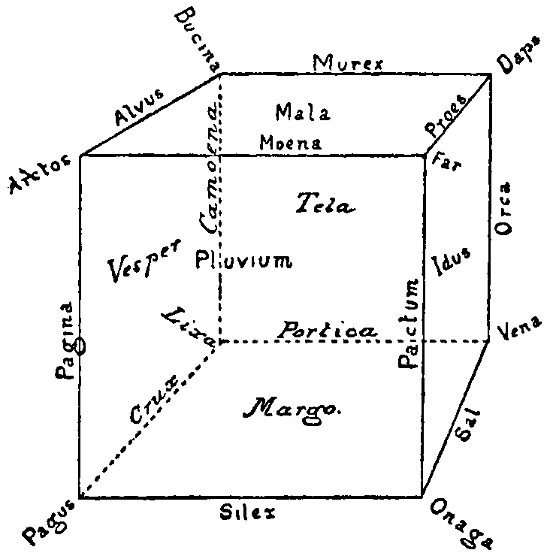
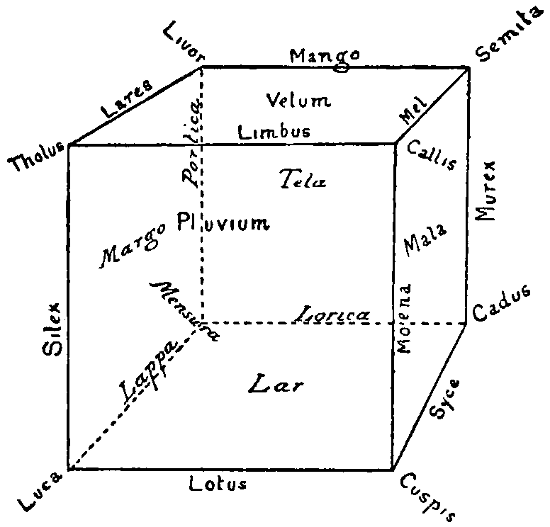
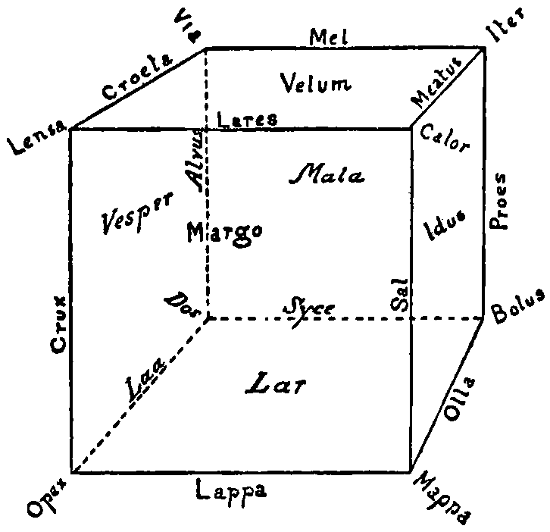
There are no new truths in this book, but it consists
of an effort to impress upon and bring home to the
mind some of the more modern developments of thought.
A few sentences of Kant, a few leading ideas of Gauss
and Lobatschewski form the material out of which it
is built up.
It may be thought to be unduly long; but it must
be remembered that in these times there is a twofold
process going on—one of discovery about external
nature, one of education, by which our minds are
brought into harmony with that which we know. In
certain respects we find ourselves brought on by the
general current of ideas—we feel that matter is permanent
and cannot be annihilated, and it is almost an axiom
in our minds that energy is persistent, and all its transformations
remains the same in amount. But there are
other directions in which there is need of definite training
if we are to enter into the thoughts of the time.
And it seems to me that a return to Kant, the creator
of modern philosophy, is the first condition. Now of
Kant’s enormous work only a small part is treated here,
but with the difference that should be found between the
work of a master and that of a follower. Kant’s statements
are taken as leading ideas, suggesting a field of
work, and it is in detail and manipulation merely that
there is an opportunity for workmanship.
Of Kant’s work it is only his doctrine of space which
is here experimented upon. With Kant the perception
of things as being in space is not treated as it seems so
obvious to do. We should naturally say that there is
space, and there are things in it. From a comparison
of those properties which are common to all things we
obtain the properties of space. But Kant says that
this property of being in space is not so much a quality
of any definable objects, as the means by which we
obtain an apprehension of definable objects—it is the
condition of our mental work.
Now as Kant’s doctrine is usually commented on, the
negative side is brought into prominence, the positive
side is neglected. It is generally said that the mind
cannot perceive things in themselves, but can only
apprehend them subject to space conditions. And in
this way the space conditions are as it were considered
somewhat in the light of hindrances, whereby we are
prevented from seeing what the objects in themselves
truly are. But if we take the statement simply as it
is—that we apprehend by means of space—then it is
equally allowable to consider our space sense as a
positive means by which the mind grasps its experience.
There is in so many books in which the subject is
treated a certain air of despondency—as if this space
apprehension were a kind of veil which shut us off from
nature. But there is no need to adopt this feeling.
The first postulate of this book is a full recognition of
the fact, that it is by means of space that we apprehend
what is. Space is the instrument of the mind.
And here for the purposes of our work we can avoid
all metaphysical discussion. Very often a statement
which seems to be very deep and abstruse and hard
to grasp, is simply the form into which deep thinkers
have thrown a very simple and practical observation.
And for the present let us look on Kant’s great doctrine
of space from a practical point of view, and it comes to
this—it is important to develop the space sense, for it is
the means by which we think about real things.
There is a doctrine which found much favour with
the first followers of Kant, that also affords us a simple
and practical rule of work. It was considered by Fichte
that the whole external world was simply a projection
from the ego, and the manifold of nature was a recognition
by the spirit of itself. What this comes to as a
practical rule is, that we can only understand nature in
virtue of our own activity; that there is no such thing
as mere passive observation, but every act of sight and
thought is an activity of our own.
Now according to Kant the space sense, or the intuition
of space, is the most fundamental power of the
mind. But I do not find anywhere a systematic and
thoroughgoing education of the space sense. In every
practical pursuit it is needed—in some it is developed.
In geometry it is used; but the great reason of failure
in education is that, instead of a systematic training
of the space sense, it is left to be organized by accident
and is called upon to act without having been
formed. According to Kant and according to common
experience it will be found that a trained thinker is one
in whom the space sense has been well developed.
With regard to the education of the space sense, I
must ask the indulgence of the reader. It will seem
obvious to him that any real pursuit or real observation
trains the space sense, and that it is going out of the
way to undertake any special discipline.
To this I would answer that, according to my own
experience, I was perfectly ignorant of space relations
myself before I actually worked at the subject, and
that directly I got a true view of space facts a whole
series of conceptions, which before I had known merely
by repute and grasped by an effort, became perfectly
simple and clear to me.
Moreover, to take one instance: in studying the
relations of space we always have to do with coloured
objects, we always have the sense of weight; for if the
things themselves have no weight, there is always a
direction of up and down—which implies the sense of
weight, and to get rid of these elements requires careful
sifting. But perhaps the best point of view to take is
this—if the reader has the space sense well developed
he will have no difficulty in going through the part of
the book which relates to it, and the phraseology will
serve him for the considerations which come next.
Amongst the followers of Kant, those who pursued
one of the lines of thought in his works have attracted
the most attention and have been considered as his successors.
Fichte, Schelling, Hegel have developed certain
tendencies and have written remarkable books.
But the true successors of Kant are Gauss and Lobatchewski.
For if our intuition of space is the means by which we
apprehend, then it follows that there may be different
kinds of intuitions of space. Who can tell what the absolute
space intuition is? This intuition of space must
be coloured, so to speak, by the conditions of the being
which uses it.
Now, after Kant had laid down his doctrine of space,
it was important to investigate how much in our space
intuition is due to experience—is a matter of the physical
circumstances of the thinking being—and how
much is the pure act of the mind.
The only way to investigate this is the practical way,
and by a remarkable analysis the great geometers above
mentioned have shown that space is not limited as ordinary
experience would seem to inform us, but that we
are quite capable of conceiving different kinds of space.
Our space as we ordinarily think of it is conceived as
limited—not in extent, but in a certain way which can
only be realized when we think of our ways of measuring
space objects. It is found that there are only three
independent directions in which a body can be measured—it
must have height, length and breadth, but it has
no more than these dimensions. If any other measurement
be taken in it, this new measurement will be found
to be compounded of the old measurements. It is impossible
to find a point in the body which could not
be arrived at by travelling in combinations of the three
directions already taken.
But why should space be limited to three independent
directions?
Geometers have found that there is no reason why
bodies should be thus limited. As a matter of fact all
the bodies which we can measure are thus limited. So
we come to this conclusion, that the space which we use
for conceiving ordinary objects in the world is limited
to three dimensions. But it might be possible for there
to be beings living in a world such that they would conceive
a space of four dimensions. All that we can say
about such a supposition is, that it is not demanded by
our experience. It may be that in the very large or
the very minute a fourth dimension of space will have
to be postulated to account for parts—but with regard
to objects of ordinary magnitudes we are certainly not
in a four dimensional world.
And this was the point at which about ten years ago
I took up the inquiry.
It is possible to say a great deal about space of higher
dimensions than our own, and to work out analytically
many problems which suggest themselves. But can we
conceive four-dimensional space in the same way in
which we can conceive our own space? Can we think
of a body in four dimensions as a unit having properties
in the same way as we think of a body having a definite
shape in the space with which we are familiar?
Now this question, as every other with which I am
acquainted, can only be answered by experiment. And
I commenced a series of experiments to arrive at a conclusion
one way or the other.
It is obvious that this is not a scientific inquiry—but
one for the practical teacher.
And just as in experimental researches the skilful
manipulator will demonstrate a law of nature, the less
skilled manipulator will fail; so here, everything depended
on the manipulation. I was not sure that this
power lay hidden in the mind, but to put the question
fairly would surely demand every resource of the practical
art of education.
And so it proved to be; for after many years of work,
during which the conception of four-dimensional bodies
lay absolutely dark, at length, by a certain change of
plan, the whole subject of four-dimensional existence
became perfectly clear and easy to impart.
There is really no more difficulty in conceiving four-dimensional
shapes, when we go about it the right way,
than in conceiving the idea of solid shapes, nor is there
any mystery at all about it.
When the faculty is acquired—or rather when it is
brought into consciousness, for it exists in every one in
imperfect form—a new horizon opens. The mind acquires
a development of power, and in this use of ampler
space as a mode of thought, a path is opened by using
that very truth which, when first stated by Kant, seemed
to close the mind within such fast limits. Our perception
is subject to the condition of being in space. But
space is not limited as we at first think.
The next step after having formed this power of conception
in ampler space, is to investigate nature and see
what phenomena are to be explained by four-dimensional
relations.
But this part of the subject is hardly one for the same
worker as the one who investigates how to think in four-dimensional
space. The work of building up the power
is the work of the practical educator, the work of applying
it to nature is the work of the scientific man. And
it is not possible to accomplish both tasks at the same
time. Consequently the crown is still to be won. Here
the method is given of training the mind; it will be an
exhilarating moment when an investigator comes upon
phenomena which show that external nature cannot be
explained except by the assumption of a four-dimension
space.
The thought of the past ages has used the conception
of a three-dimensional space, and by that means has
classified many phenomena and has obtained rules for
dealing with matters of great practical utility. The
path which opens immediately before us in the future
is that of applying the conception of four-dimensional
space to the phenomena of nature, and of investigating
what can be found out by this new means of apprehension.
In fact, what has been passed through may be called
the three-dimensional era; Gauss and Lobatchewski
have inaugurated the four-dimensional era.
The following pages have for their object to induce
the reader to apply himself to the study, in the first
place of Space, and then of Higher Space; and, therefore,
I have tried by indirect means to show forth
those thoughts and conceptions to which the practical
work leads.
And I feel that I have a great advantage in this
project, inasmuch as many of the thoughts which spring
up in the mind of one who studies higher space, and
many of the conceptions to which he is driven, turn out
to be nothing more nor less than old truths—the property
of every mind that thinks and feels—truths which
are not generally associated with the scientific apprehension
of the world, but which are not for that reason
any the less valuable.
And for my own part I cannot do more than put
them forward in a very feeble and halting manner.
For I have come upon them, not in the way of feeling
or direct apprehension, but as the result of a series of
works undertaken purely with the desire to know—a
desire which did not lift itself to the height of expecting
or looking for the beautiful or the good, but which
simply asked for something to know.
For I found myself—and many others I find do so
also—I found myself in respect to knowledge like a
man who is in the midst of plenty and yet who cannot
find anything to eat. All around me were the evidences
of knowledge—the arts, the sciences, interesting talk,
useful inventions—and yet I myself was profited
nothing at all; for somehow, amidst all this activity, I
was left alone, I could get nothing which I could know.
The dialect was foreign to me—its inner meaning
was hidden. If I would, imitating the utterance of
my fellows, say a few words, the effort was forced, the
whole result was an artificiality, and, if successful, would
be but a plausible imposture.
The word “sceptical” has a certain unpleasant association
attached to it, for it has been used by so many
people who are absolutely certain in a particular line,
and attack other people’s convictions. But to be sceptical
in the real sense is a far more unpleasant state of
mind to the sceptic than to any one of his companions.
For to a mind that inquires into what it really does
know, it is hardly possible to enunciate complete sentences,
much less to put before it those complex ideas
which have so large a part in true human life.
Every word we use has so wide and fugitive a meaning,
and every expression touches or rather grazes fact
by so very minute a point, that, if we wish to start with
something which we do know, and thence proceed in a
certain manner, we are forced away from the study of
reality and driven to an artificial system, such as logic
or mathematics, which, starting from postulates and
axioms, develops a body of ideal truth which rather
comes into contact with nature than is nature.
Scientific achievement is reserved for those who are
content to absorb into their consciousness, by any means
and by whatever way they come, the varied appearances
of nature, whence and in which by reflection they find
floating as it were on the sea of the unknown, certain
similarities, certain resemblances and analogies, by
means of which they collect together a body of possible
predictions and inferences; and in nature they find
correspondences which are actually verified. Hence
science exists, although the conceptions in the mind
cannot be said to have any real correspondence in
nature.
We form a set of conceptions in the mind, and the
relations between these conceptions give us relations
which we find actually vibrating in the world around
us. But the conceptions themselves are essentially
artificial.
We have a conception of atoms; but no one supposes
that atoms actually exist. We suppose a force varying
inversely as the square of the distance; but no one
supposes such a mysterious thing to really be in nature.
And when we come to the region of descriptive science,
when we come to simple observation, we do not find
ourselves any better provided with a real knowledge of
nature. If, for instance, we think of a plant, we picture
to ourselves a certain green shape, of a more or less
definite character. This green shape enables us to
recognise the plant we think of, and to describe it to a
certain extent. But if we inquire into our imagination
of it, we find that our mental image very soon diverges
from the fact. If, for instance, we cut the plant in half,
we find cells and tissues of various kinds. If we examine
our idea of the plant, it has merely an external and
superficial resemblance to the plant itself. It is a mental
drawing meeting the real plant in external appearance;
but the two things, the plant and our thought of it,
come as it were from different sides—they just touch
each other as far as the colour and shape are concerned,
but as structures and as living organisms they are as
wide apart as possible.
Of course by observation and study the image of a
plant which we bear in our minds may be made to resemble
a plant as found in the fields more and more.
But the agreement with nature lies in the multitude of
points superadded on to the notion of greenness which
we have at first—there is no natural starting-point where
the mind meets nature, and whence they can travel hand
in hand.
It almost seems as if, by sympathy and feeling, a
human being was easier to know than the simplest object.
To know any object, however simple, by the reason
and observation requires an endless process of thought
and looking, building up the first vague impression into
something like in more and more respects. While, on
the other hand, in dealing with human beings there is
an inward sympathy and capacity for knowing which is
independent of, though called into play by, the observation
of the actions and outward appearance of the
human being.
But for the purpose of knowing we must leave out
these human relationships. They are an affair of instinct
and inherited unconscious experience. The mind
may some day rise to the level of these inherited apprehensions,
and be able to explain them; but at present
it is far more than overtasked to give an account of the
simplest portions of matter, and is quite inadequate to
give an account of the nature of a human being.
Asking, then, what there was which I could know,
I found no point of beginning. There were plenty of
ways of accumulating observations, but none in which
one could go hand in hand with nature.
A child is provided in the early part of its life with a
provision of food adapted for it. But it seemed that our
minds are left without a natural subsistence, for on the
one hand there are arid mathematics, and on the other
there is observation, and in observation there is, out
of the great mass of constructed mental images, but little
which the mind can assimilate. To the worker at science
of course this crude and omnivorous observation is
everything; but if we ask for something which we can
know, it is like a vast mass of indigestible material
with every here and there a fibre or thread which we
can assimilate.
In this perplexity I was reduced to the last condition
of mental despair; and in default of finding anything
which I could understand in nature, I was sufficiently
humbled to learn anything which seemed to afford a
capacity of being known.
And the objects which came before me for this endeavour
were the simple ones which will be plentifully
used in the practical part of this book. For I found
that the only assertion I could make about external
objects, without bringing in unknown and unintelligible
relations, was this: I could say how things were
arranged. If a stone lay between two others, that was
a definite and intelligible fact, and seemed primary. As
a stone itself, it was an unknown somewhat which one
could get more and more information about the more
one studied the various sciences. But granting that
there were some things there which we call stones, the
way they were arranged was a simple and obvious fact
which could be easily expressed and easily remembered.
And so in despair of being able to obtain any other
kind of mental possession in the way of knowledge, I
commenced to learn arrangements, and I took as the
objects to be arranged certain artificial objects of a
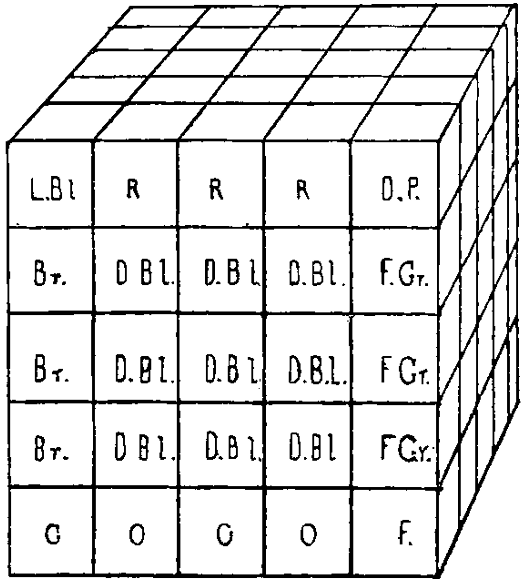
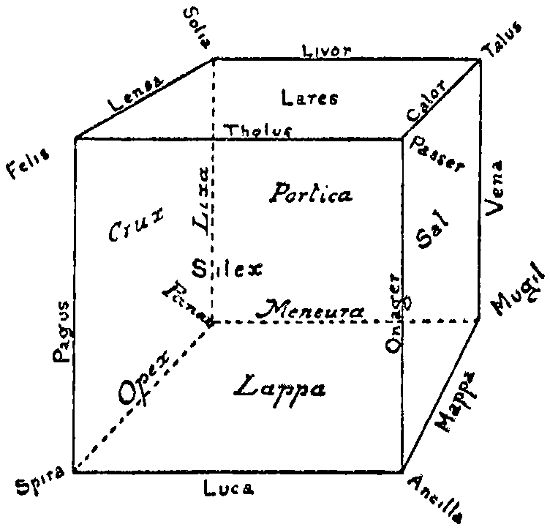
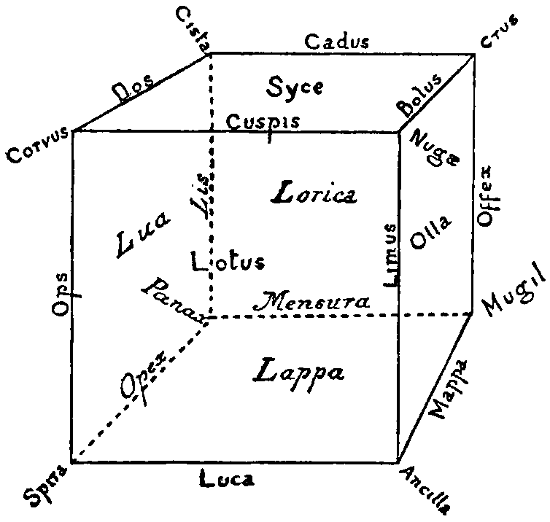
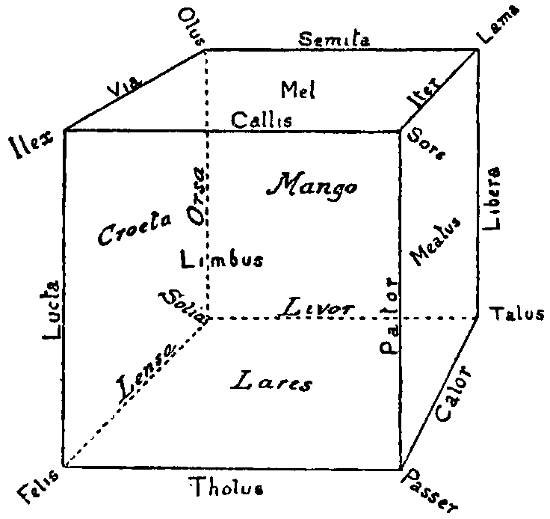
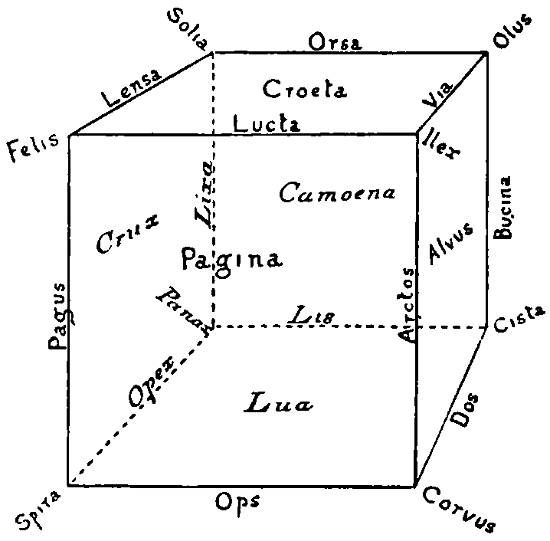
simple shape. I built up a block of cubes, and giving
each a name I learnt a mass of them.
Now I do not recommend this as a thing to be done.
All I can say is that genuinely then and now it seemed
and seems to be the only kind of mental possession which
one can call knowledge. It is perfectly definite and
certain. I could tell where each cube came and how
it was related to each of the others. As to the cube itself,
I was profoundly ignorant of that; but assuming
that as a necessary starting-point, taking that as granted,
I had a definite mass of knowledge.
But I do not wish to say that this is better than any
kind of knowledge which other people may find come
home to them. All I want to do is to take this humble
beginning of knowledge and show how inevitably, by
devotion to it, it leads to marvellous and far-distant
truths, and how, by a strange path, it leads directly into
the presence of some of the highest conceptions which
great minds have given us.
I do not think it ought to be any objection to an inquiry,
that it begins with obvious and common details.
In fact I do not think that it is possible to get anything
simpler, with less of hypothesis about it, and more obviously
a simple taking in of facts than the study of the
arrangement of a block of cubes.
Many philosophers have assumed a starting point
for their thought. I want the reader to accept a very
humble one and see what comes of it. If this leads us
to anything, no doubt greater results will come from more
ambitious beginnings.
And now I feel that I have candidly exposed myself
to the criticism of the reader. If he will have the
patience to go on, we will begin and build up on our
foundations.
Nature is that which is around us. But it is by no
means easy to get to nature. The savage living we may
say in the bosom of nature, is certainly unapprehensive
of it, in fact it has needed the greatness of a Wordsworth
and of generations of poets and painters to open our
eyes even in a slight measure to the wonder of nature.
Thus it is clear that it is not by mere passivity that
we can comprehend nature; it is the goal of an activity,
not a free gift.
And there are many ways of apprehending nature.
There are the sounds and sights of nature which delight
the senses, and the involved harmonies and the
secret affinities which poetry makes us feel; then, moreover,
there is the definite knowledge of natural facts in
which the memory and reason are employed.
Thus we may divide our means of coming into contact
with nature into three main channels: the senses,
the imagination, and the mind. The imagination is
perhaps the highest faculty, but we leave it out of consideration
here, and ask: How can we bring our minds
into contact with nature?
Now when we see two people of diverse characters
we sometimes say that they cannot understand one
another—there is nothing in the one by which he can
understand the other—he is shut out by a limitation of
his own faculties.
And thus our power of understanding nature depends
on our own possession; it is in virtue of some mental
activity of our own that we can apprehend that outside
activity which we call nature. And thus the training to
enable us to approach nature with our minds will be
some active process on our own part.
In the course of my experience as a teacher I have
often been struck by the want of the power of reason
displayed by pupils; they are not able to put two and
two together, as the saying goes, and I have been at
some pains to investigate wherein this curious deficiency
lies, and how it can be supplied. And I have found
that there is in the curriculum no direct cure for it—the
discipline which supplies it is not one which comes into
school methods, it is a something which most children
obtain in the natural and unsupervised education of their
first contact with the world, and lies before any recognised
mode of distinction. They can only understand
in virtue of an activity of their own, and they have not
had sufficient exercise in this activity.
In the present state of education it is impossible to
diverge from the ordinary routine. But it is always
possible to experiment on children who are out of the
common line of education. And I believe I am amply
justified by the result of my experiments.
I have seen that the same activity which I have
found makes that habit of mind which we call intelligence
in a child, is the source of our common and everyday
rational intellectual work, and that just as the
faculties of a child can be called forth by it, so also the
powers of a man are best prepared by the same means,
but on an ampler scale.
A more detailed development of the practical work
of Part II., would be the best training for the mind of
a child. An extension of the work of that Part would
be the training which, hand in hand with observation and
recapitulation, would best develop a man’s thought power.
In order to tell what the activity is by the prosecution
of which we can obtain mental contact with nature
we should observe what it is which we say we “understand”
in any phenomenon of nature which has become
clear to us.
When we look at a bright object it seems very different
from a dull one. A piece of bright steel hardly
looks like the same substance as a piece of dull steel.
But the difference of appearance in the two is easily
accounted for by the different nature of the surface in
the two cases; in the one all the irregularities are done
away with, and the rays of light which fall on it are sent
off again without being dispersed and broken up. In
the case of the dull iron the rays of light are broken up
and divided, so that they are not transmitted with
intensity in any one direction, but flung off in all sorts
of directions.
Here the difference between the bright object and the
dull object lies in the arrangement of the particles on its
surface and their influence on the rays of light.
Again, with light itself the differences of colour are
explained as being the effect on us of rays of different
rates of vibration. Now a vibration is essentially this, a
series of arrangements of matter which follow each
other in a closed order, so that when the set has been
run through, the first arrangement follows again. The
whole theory of light is an account of arrangements
of the particles in the transmitting medium, only the
arrangements alter—are not permanent in any one
characteristic, but go through a complete cycle of
varieties.
Again, when the movements of the heavenly bodies
are deduced from the theory of universal gravitation,
what we primarily do is to take account of arrangement;
for the law of gravity connects the movements which
the attracted bodies tend to make with their distances,
that is, it shows how their movements depend on their
arrangement. And if gravity as a force is to be explained
itself, the suppositions which have been put forward
resolve it into the effect of the movements of small
bodies; that is to say, gravity, if explained at all, is
explained as the result of the arrangement and altering
arrangements of small particles.
Again, to take the idea which proceeding from Goethe
casts such an influence on botanical observation.
Goethe (and also Wolf) laid down that the parts of a
flower were modified leaves—and traced the stages and
intermediate states between the ordinary green leaf and
the most gorgeous petal or stamen or carpel, so unlike
a leaf in form and function.
Now the essential value in this conception is, that
it enables us to look, upon these different organs of a
plant as modifications of one and the same organ—it
enables us to think about the different varieties of the
flower head as modifications of one single plant form.
We can trace correspondences between them, and are
led to possible explanations of their growth. And all
this is done by getting rid of pistil and stamen as separate
entities, and looking on them as leaves, and their
parts due to different arrangement of the leaf structure.
We have reduced these diverse objects to a common
element, we have found the unit by whose arrangements
the whole is produced. And in this department of
thought, as also to take another instance, in chemistry,
to understand is practically this: we find units (leaves
or atoms) combinations of which account for the results
which we see. Thus we see that that which the mind
essentially apprehends is arrangement.
And this holds over the whole range of mental work,
from the simplest observation to the most complex theory.
When the eye takes in the form of an external object
there is something more than a sense impression, something
more than a sensation of greenness and light and
dark. The mind works as well as the sense, and these
sense impressions are definitely grouped in what we call
the shape of the object. The essential act of perceiving
lies in the apprehension of a shape, and a shape is an
arrangement of parts. It does not matter what these
parts are; if we take meaningless dots of colour and
arrange them we obtain a shape which represents the
appearance of a stone or a leaf to a certain degree. If
we want to make our representation still more like, we
must treat each of the dots as in themselves arrangements,
we must compose each of them by many strokes
and dots of the brush. But even in this case we have
not got anything else besides arrangement. The ultimate
element, the small items of light and shade or of
colour, are in themselves meaningless; it is in their arrangement
that the likeness of the representation consists.
Thus, from a drawing to our notion of the planetary
system, all our contact with nature lies in this, in an
appreciation of arrangement.
Hence to prepare ourselves for the understanding of
nature, we must “arrange.” In virtue of our activity in
making arrangements we prepare ourselves to do what
is called understand nature. Or we may say, that
which we call understanding nature is to discern something
similar in nature to that which we do when we
arrange elements into compounded groups.
Now if we study arrangement in the active way, we
must have something to arrange; and the things we
work with may be either all alike, or each of them varying
from every other.
If the elements are not alike then we are not studying
pure arrangement; but our knowledge is affected by
the compound nature of that with which we deal. If
the elements are all alike, we have what we call units.
Hence the discipline preparatory for the understanding
of nature is the active arrangement of like units.
And this is very much the case with all educational
processes; only the things chosen to arrange are in
general words, which are so complicated and carry such
a train of association that, unless the mind has already
acquired a knowledge of arrangement, it is puzzled and
hampered, and never gets a clear apprehension of what
its work is.
Now what shall we choose for our units? Any unit
would do; but it ought to be a real thing—it ought to
be something which can be touched and seen, not something
which no one has ever touched or seen, and which
is even incapable of definition, like a “number.”
I would divide studies into two classes: those which
create the faculty of arrangement, and those which use
it and exercise it. Mathematics exercises it, but I do
not think it creates it; and unfortunately, in mathematics
as it is now often taught, the pupil is launched ,
into a vast system of symbols—the whole use and
meaning of symbols (namely, as means to acquire a
clear grasp of facts) is lost to him.
Of the possible units which will serve, I take the
cube; and I have found that whenever I took any other
unit I got wrong, puzzled and lost my way. With the
cube one does not get along very fast, but everything
is perfectly obvious and simple, and builds up into a
whole of which every part is evident.
And I must ask the reader to absolutely erase from
his mind all desire or wish to be able to predict or
assert anything about nature, and he must please look
with horror on any mental process by which he gets at
a truth in an ingenious but obscure and inexplicable
way. Let him take nothing which is not perfectly clear,
patent and evident, demonstrable to his senses, a simple
repetition of obvious fact.
Our work will then be this: a study, by means of
cubes, of the facts of arrangement. And the process of
learning will be an active one of actually putting up the
cubes. In this way we do for the mind what Wordsworth
does for the imagination—we bring it into contact
with nature.
There are two elements which enter into our knowledge
with respect to any phenomenon.
If, for instance, we take the sun, and ask ourselves
what we observe, we notice that it is a bright, moving
body; and of these two qualities, the brightness and
the movement, each seems equally predicable of the
sun. It does move, and it is bright.
Now further study discloses to us that there is a
difference between these two affirmations. The motion
of the sun in its diurnal course round the earth is only
apparent; but it is really a bright, hot body.
Now of these two assertions which the mind naturally
makes about the sun, one—that it is moving—depends
on the relation of the beholder to the sun, the other is
true about the sun itself. The observed motion depends
on a fact affecting oneself and having nothing to do
with the sun, while the brightness is really a quality of
the sun itself.
Now we will call those qualities or appearances which
we notice in a body which are due to the particular
conditions under which oneself is placed in observing
it, the self elements; those facts about it which are
independent of the observer’s particular relationship we
will call the residual element. Thus the sun’s motion
is a self element in our thought of the sun, its brightness
is a residual element.
It is not, of course, possible to draw a line distinctly
between the self elements and the residual elements.
For instance, some people have denied that brightness
is a quality of things, but that it depends on the capacity
of the being for receiving sensations; and for brightness
they would substitute the assertion that the sun is
giving forth a great deal of energy in the form of heat
and light.
But there is no object in pursuing the discussion
further. The main distinction is sufficiently obvious.
And it is important to separate the self elements involved
in our knowledge as far as possible, so that the
residual elements may be kept for our closer attention.
By getting rid of the self elements we put ourselves in
a position in which we can propound sensible questions.
By getting rid of the notion of its circular motion round
the earth we prepare our way to study the sun as it
really is. We get the subject clear of complications
and extraneous considerations.
It would hardly be worth while to dwell on this consideration
were it not of importance in our study of
arrangement. But the fact is that directly a subject
has been cleared of the self elements, it seems so absurd
to have had them introduced at all that the great difficulty
there was in getting rid of them is forgotten.
With regard to the knowledge we have at the present
day about scientific matters, there do not seem to be
any self elements present. But the worst about a self
element is, that its presence is never dreamed of till it
is got rid of; to know that it is there is to have done
away with it. And thus our body of knowledge is like
a fluid which keeps clear, not because there are no substances
in solution, but because directly they become
evident they fall down as precipitates.
Now one of our serious pieces of work will be to get
rid of the self elements in the knowledge of arrangement.
And the kind of knowledge which we shall try to
obtain will be somewhat different from the kind of
knowledge which we have about events or natural
phenomena. In the large subjects which generally
occupy the mind the things thought of are so complicated
that every detail cannot possibly be considered.
The principles of the whole are realized, and then at
any required time the principles can be worked out.
Thus, with regard to a knowledge of the planetary
system, it is said to be known if the law of movement
of each of the planets is recognized, and their positions
at any one time committed to memory. It is not our
habit to remember their relative positions with regard
to one another at many intervals, so as to have an
exhaustive catalogue of them in our minds. But with
regard to the elements of knowledge with which we
shall work, the subject is so simple that we may justly
demand of ourselves that we will know every detail.
And the knowledge we shall acquire will be much
more one of the sense and feeling than of the reason.
We do not want to have a rule in our minds by which
we can recall the positions of the different cubes, but
we want to have an immediate apprehension of them.
It was Kant who first pointed out how much of thought
there was embodied in the sense impressions; and it is
this embodied thought which we wish to form.
Both in science and in morals there is an important
distinction to be drawn between theory and practice.
A knowledge of chemistry does not consist in the intellectual
appreciation of different theories and principles,
but in being able to act in accordance with the facts
of chemical combination, so that by means of the appliances
of chemistry practical results are produced.
And so in morals—the theoretic acquaintance with the
principles of human action may consist with a marked
degree of ignorance of how to act amongst other human
beings.
Now the use of the word “learn” has been much
restricted to merely theoretic studies. It requires to be
enlarged to the scientific meaning. And to know, should
include practice in actual manipulation.
Let us take an instance. We all know what justice
is, and any child can be taught to tell the difference
between acting justly and acting unjustly. But it is a
different thing to teach them to act with justice. Something
is done which affects them unpleasantly. They
feel an impulse to retaliate. In order to see what justice
demands they have to put their personal feeling on one
side. They have to get rid of those conditions under
which they apprehended the effects of the action at first,
and they have to look on it from another point of view.
Then they have to act in accordance with this view.
Now there are two steps—one an intellectual one of
understanding, one a practical one of carrying out the
view. Neither is a moral step. One demands intelligence,
the other the formation of a habit, and this habit
can be inculcated by precept, by reward and punishment,
by various means. But as human nature is
constituted, if the habit of justice is inculcated it touches
a part of the being. There is an emotional response.
We know but little of a human being, but we can safely
say that there are depths in it, beyond the feelings of
momentary resentment and the stimulus of pleasurable
or painful sensation, to which justice is natural.
How little adequate is our physical knowledge of a
human being as a bodily frame to explain the fact of
human life. Now and again we see one of these isolated
beings bound up in another, as if there was an undiscovered
physical bond between them. And in all there
is this sense of justice—a kind of indwelling verdict of
the universal mind, if we may use such an expression,
in virtue of which a man feels not as a single individual
but as all men.
With respect to justice, it is not only necessary to
take the view of one other person than oneself, but that
of many. There may be justice which is very good
justice from the point of view of a party, but very bad
justice from the point of view of a nation. And if we
suppose an agency outside the human race, gifted with
intelligence, and affecting the race, in the way for instance
of causing storms or disturbances of the ground, in order
to judge it with justice we should have to take a standpoint
outside the race of men altogether. We could not
say that this agency was bad. We should have to
judge it with reference to its effect on other sentient
beings.
There are some words which are often used in contrast
with each other—egoism and altruism; and each seems
to me unmeaning except as terms in a contrast.
Let us take an instance. A boy has a bag of cakes,
and is going to enjoy them by himself. His parent
stops him, and makes him set up some stumps and
begin to learn to play cricket with another boy. The
enjoyment of the cakes is lost—he has given that up;
but after a little while he has a pleasure which is greater
than that of cakes in solitude. He enters into the life
of the game. He has given up, or been forced to give
up, the pleasure he knew, and he has found a greater
one. What he thought about himself before was that
he liked cakes, now what he thinks about himself is
that he likes cricket. Which of these is the true thought
about himself? Neither, probably, but at any rate it
is more near the truth to say that he likes the cricket.
If now we use the word self to mean that which a
person knows of himself, and it is difficult to see what
other meaning it can have, his self as he knew it at first
was thwarted, was given up, and through that he discovered
his true self. And again with the cricket; he
will make the sacrifice of giving that up, voluntarily or
involuntarily, and will find a truer self still.
In general there is not much difficulty in making a
boy find out that he likes cricket; and it is quite possible
for him to eat his cakes first and learn to play
cricket afterwards—the cricket will not come to him as
a thwarting in any sense of what he likes better. But
this ease in entering in to the pursuit only shows that
the boy’s nature is already developed to the level of
enjoying the game. The distinct moral advance would
come in such a case when something which at first was
hard to him to do was presented to him—and the hardness,
the unpleasantness is of a double kind, the giving
up of a pursuit or indulgence to which he is accustomed,
and the exertion of forming the habits demanded by
the new pursuit.
Now it is unimportant whether the renunciation is
forced or willingly taken. But as a general rule it may
be laid down, that by giving up his own desires as he
feels them at the moment, to the needs and advantage
of those around him, or to the objects which he finds
before him demanding accomplishment, a human being
passes to the discovery of his true self on and on. The
process is limited by the responsibilities which a man
finds come upon him.
The method of moral advance is to acquire a practical
knowledge; he must first see what the advantage of
some one other than himself would be, and then he
must act in accordance with that view of things. Then
having acted and formed a habit, he discovers a response
in himself. He finds that he really cares, and that his
former limited life was not really himself. His body and
the needs of his body, so far as he can observe them,
externally are the same as before; but he has obtained
an inner and unintellectual, but none the less real,
apprehension of what he is.
Thus altruism, or the sacrifice of egoism to others, is
followed by a truer egoism, or assertion of self, and
this process flashed across by the transcendent lights
of religion, wherein, as in the sense of justice and duty,
untold depths in the nature of man are revealed entirely
unexpressed by the intellectual apprehension which we
have of him as an animal frame of a very high degree
of development, is the normal one by which from childhood
a human being develops into the full responsibilities
of a man.
Now both in science and in conduct there are self
elements. In science, getting rid of the self elements
means a truer apprehension of the facts about one; in
conduct, getting rid of the self elements means obtaining
a truer knowledge of what we are—in the way of
feeling more strongly and deeply and being bound and
linked in a larger scale.
Thus without pretending to any scientific accuracy
in the use of terms, we can assign a certain amount of
meaning to the expression—getting rid of self elements.
And all that we can do is to take the rough idea of
this process, and then taking our special subject matter,
apply it. In affairs of life experiments lead to disaster.
But happily science is provided wherein the desire to
put theories into practice can be safely satisfied—and
good results sometimes follow. Were it not for this the
human race might before now have been utopiad from
off the face of the earth.
In experiment, manipulation is everything; we must
be certain of all our conditions, otherwise we fail assuredly
and have not even the satisfaction of knowing
that our failure is due to the wrongness of our conjectures.
And for our purposes we use a subject matter so
simple that the manipulation is easy.
I must now go with somewhat of detail into the special
subject in which these general truths will be exhibited.
Everything I have to say would be conceived much
more clearly by a very little practical manipulation.
But here I want to put the subject in as general a
light as possible, so that there may be no hindrance to
the judgment of the reader.
And when I use the word “know,” I assume something
else than the possession of a rule, by which it can
be said how facts are. By knowing I mean that the
facts of a subject all lie in the mind ready to come out
vividly into consciousness when the attention is directed
on them. Michael Angelo knew the human frame, he
could tell every little fact about it; if he chose to call
up the image, he would see mentally how each muscle
and fold of the skin lay with regard to the surrounding
parts. We want to obtain a knowledge as good as
Michael Angelo’s. There is a great difference between
Michael Angelo and us; but let that difference be expressed,
not in our way of knowing, but in the difference
between the things he knew and the things we know.
We take a very simple structure and know it as absolutely
as he knew the complicated structure of the
human body.
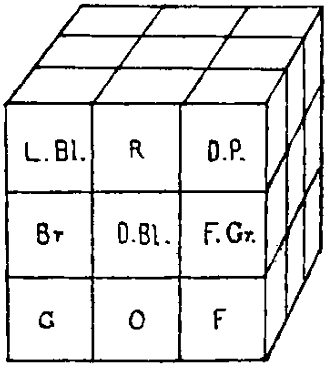
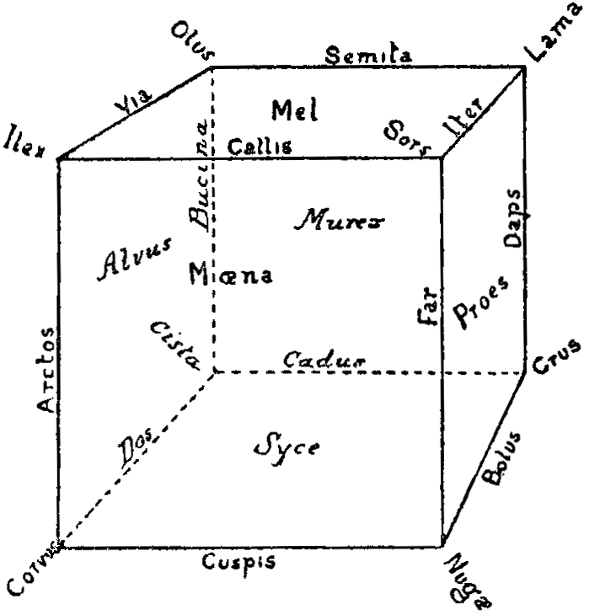
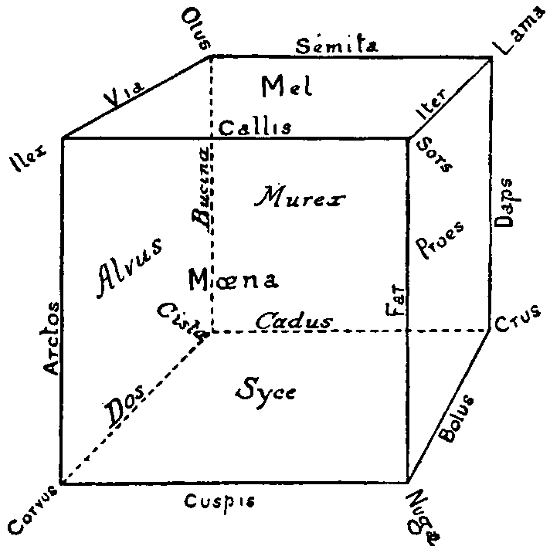
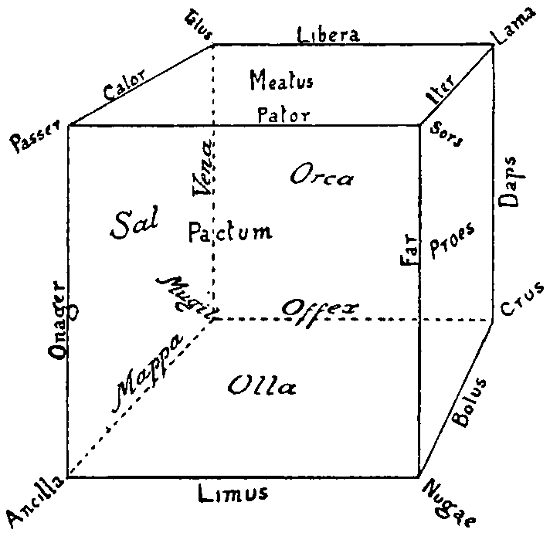
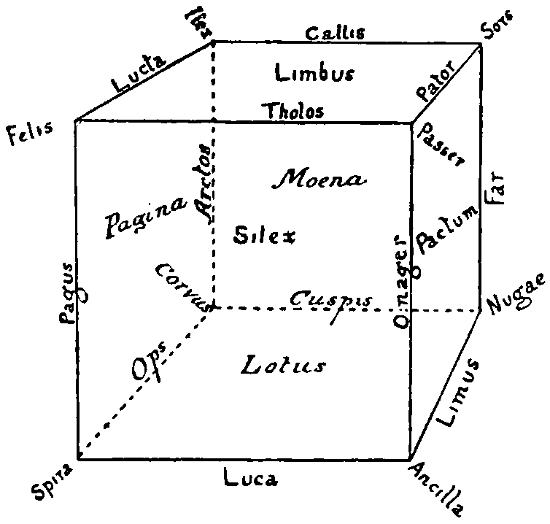
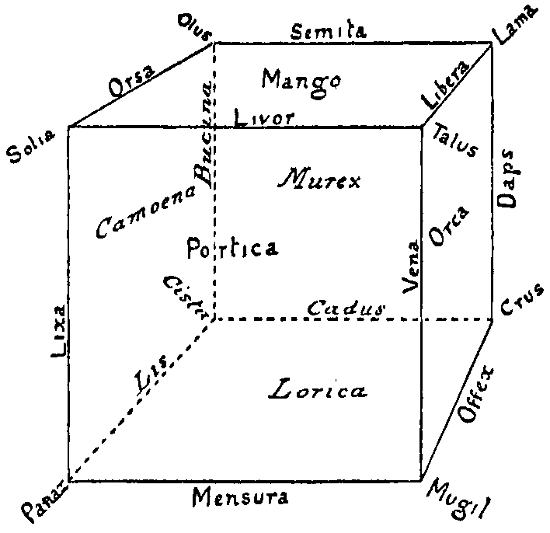
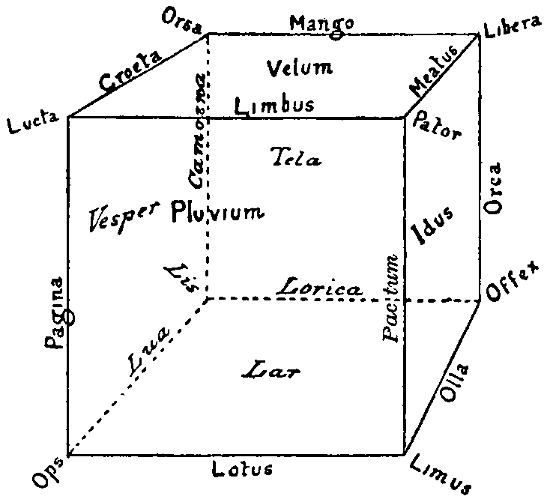
And let us take a block of cubes; any number will do,
but for convenience sake let us take a set of twenty-seven
cubes put together so as to form a large cube of twenty-seven
parts. And let each of these cubes be marked
so as to be recognized, and let each have a name so that
it can be referred to. And let us suppose that we have
learnt this block of cubes so that each one is known—that
is to say, its position in the block is known and its
relation to the other blocks.
Now having obtained this knowledge of the block as
it stands in front of us, let us ask ourselves if there is
any self element present in our knowledge of it.
And there is obviously this self element present. We
have learnt the cubes as they stand in accordance with
our own convenience in putting them up. We put the
lowest ones first, and the others on the top of them,
and we distinctly conceive the lower ones as supporting
the upper ones. Now this fact of support has nothing
to do with the block of cubes itself, it depends on the
conditions under which we come to apprehend the block
of cubes, it depends on our position on the surface of
the earth, whereby gravity is an all important factor in
our experience. In fact our sight has got so accustomed
to take gravity into consideration in its view of things,
that when we look at a landscape or object with our
head upside down we do not see it inverted, but we
superinduce on the direct sense impressions our knowledge
of the action of gravity, and obtain a view differing
very little from what we see when in an upright position.
It will be found that every fact about the cubes has
involved in it a reference to up and down. It is by
being above or below that we chiefly remember where
the cubes are. But above and below is a relation which
depends simply on gravity. If it were not for gravity
above and below would be interchangeable terms, instead
of expressing a difference of marked importance
to us under our conditions of existence. Now we put
“being above” or “being below” into the cubes themselves
and feel it a quality in them—it defines their
position. But this above or below really comes from
the conditions in which we are. It is a self element, and
as such, to obtain a true knowledge of the cubes we
must get rid of it.
And now, for the sake of a process which will be explained
afterwards, let us suppose that we cannot move
the block of cubes which we have put up. Let us keep
it fixed.
In order to learn how it is independent of gravity the
best way would be to go to a place where gravity has
virtually ceased to act; at the centre of the earth, for
instance, or in a freely falling shell.
But this is impossible, so we must choose another way.
Let us, then, since we cannot get rid of gravity, see
what we have done already. We have learnt the cubes,
and however they are learnt, it will be found that there
is a certain set of them round which the others are
mentally grouped, as being on the right or left, above
or below. Now to get our knowledge as perfect as we
can before getting rid of the self element up and down,
we have to take as central cubes in our mind different
sets again and again, until there are none which are
primary to us.
Then there remains only the distinction of some being
above others. Now this can only be made to sink out
of the primary place in our thoughts by reversing the
relation. If we turned the block upside down, and
learnt it in this new position, then we should learn the
position of the cubes with regard to each other with
that element in them, which comes from the action of
gravity, reversed. And the true nature of the arrangement
to which we added something in virtue of our
sensation of up and down, would become purer and more
isolated in our minds.
We have, however, supposed that the cubes are fixed.
Then, in order to learn them, we must put up another
block showing what they would be like in the supposed
new position. We then take a set of cubes, models of
the original cubes, and by consideration we can put
them in such positions as to be an exact model of what
the block of cubes would be if turned upside down.
And here is the whole point on which the process
depends. We can tell where each cube would come,
but we do not know the block in this new position. I
draw a distinction between the two acts, “to tell where
it would be,” and to “know.” Telling where it would
be is the preparation for knowing. The power of assigning
the positions may be called the theory of the
block. The actual knowledge is got by carrying out
the theory practically, by putting up the blocks and
becoming able to realize without effort where each
one is.
It is not enough to put up the model blocks in the
reverse position. It is found that this up and down
is a very obstinate element indeed, and a good deal
of work is requisite to get rid of it completely. But
when it is got rid of in one set of cubes, the faculty
is formed of appreciating shape independently of the
particular parts which are above or below on first examination.
We discover in our own minds the faculty
of appreciating the facts of position independent of
gravity and its influence on us. I have found a very
great difference in different minds in this respect. To
some it is easy, to some it is hard.
And to use our old instance, the discovery of this
capacity is like the discovery of a love of justice in the
being who has forced himself to act justly. It is a
capacity for being able to take a view independent of
the conditions under which he is placed, and to feel in
accordance with that view. There is, so far as I know,
no means of arriving immediately at this impartial appreciation
of shape. It can only be done by, as it were,
extending our own body so as to include certain cubes,
and appreciating then the relation of the other cubes to
those. And after this, by identifying ourselves with
other cubes, and in turn appreciating the relation of the
other cubes to these. And the practical putting up of
the cubes is the way in which this power is gained. It
springs up with a repetition of the mechanical acts. Thus
there are three processes. 1st, An apprehension of what
the position of the cubes would be. 2nd, An actual putting
of them up in accordance with that apprehension,
3rd, The springing up in the mind of a direct feeling of
what the block is, independent of any particular presentation.
Thus the self element of up and down can be got rid
of out of a block of cubes.
And when even a little block is known like this, the
mind has gained a great deal.
Yet in the apprehension and knowledge of the block
of cubes with the up and down relation in them, there
is more than in the absolute apprehension of them. For
there is the apprehension of their position and also of
the effect of gravity on them in their position.
Imagine ourselves to be translated suddenly to
another part of the universe, and to find there intelligent
beings, and to hold conversation with them. If
we told them that we came from a world, and were to
describe the sun to them, saying that it was a bright,
hot body which moved round us, they would reply:
You have told us something about the sun, but you have
also told us something about yourselves.
Thus in the apprehension of the sun as a body moving
round us there is more than in the apprehension of it as
not moving round, for we really in this case apprehend
two things—the sun and our own conditions. But for
the purpose of further knowledge it is most important
that the more abstract knowledge should be acquired.
The self element introduced by the motion of the earth
must be got rid of before the true relations of the solar
system can be made out.
And in our block of cubes, it will be found that feelings
about arrangement, and knowledge of space, which
are quite unattainable with our ordinary view of position,
become simple and clear when this discipline has
been gone through.
And there can be no possible mental harm in going
through this bit of training, for all that it comes to is
looking at a real thing as it actually is—turning it
round and over and learning it from every point of
view.
We now pass on to the question: Are there any other
self elements present in our knowledge of the block of
cubes?
When we have learnt to free it from up and down, is
there anything else to be got rid of?
It seems as if, when the cubes were thus learnt, we had
got as abstract and impersonal a bit of knowledge as
possible.
But, in reality, in the relations of the cubes as we thus
apprehend them there is present a self element to which
the up and down is a mere trifle. If we think we have
got absolute knowledge we are indeed walking on a
thin crust in unconsciousness of the depths below.
We are so certain of that which we are habituated to,
we are so sure that the world is made up of the mechanical
forces and principles which we familiarly deal
with, that it is more of a shock than a welcome surprise
to us to find how mistaken we were.
And after all, do we suppose that the facts of distance
and size and shape are the ultimate facts of the world—is
it in truth made up like a machine out of mechanical
parts? If so, where is there room for that other which
we know—more certainly, because inwardly—that reverence
and love which make life worth having? No;
these mechanical relations are our means of knowing
about the world; they are not reality itself, and their
primary place in our imaginations is due to the familiarity
which we have with them, and to the peculiar limitations
under which we are.
But I do not for a moment wish to go in thought beyond
physical nature—I do not suppose that in thought
we can. To the mind it is only the body that appears,
and all that I hope to do is to show material relations,
mechanism, arrangements.
But much depends on what kind of material relations
we perceive outside us. A human being, an animal and
a machine are to the mind all merely portions of matter
arranged in certain ways. But the mind can give an
exhaustive account of the machine, account fairly well
for the animal, while the human being it only defines
externally, leaving the real knowledge to be supplied by
other faculties.
But we must not under-estimate the work of the mind,
for it is only by the observation of and thought about the
bodies with which we come into contact that we know
human beings. It is the faculty of thought that puts us
in a position to recognize a soul.
And so, too, about the universe—it is only by correct
thought about it that we can perceive its true moral
nature.
And it will be found that the deadness which we
ascribe to the external world is not really there, but is
put in by us because of our own limitations. It is really
the self elements in our knowledge which make us talk
of mechanical necessity, dead matter. When our limitations
fall, we behold the spirit of the world like we behold
the spirit of a friend—something which is discerned
in and through the material presentation of a body to
us.
Our thought means are sufficient at present to show
us human souls; but all except human beings is, as far
as science is concerned, inanimate. One self element
must be got rid of from our perception, and this will be
changed.
The one thing necessary is, that in matters of thinking
we will not admit anything that is not perfectly clear,
palpable and evident. On the mind the only conceivable
demand is to seek for facts. The rock on which so
many systems of philosophy have come to grief is the
attempt to put moral principles into nature. Our only
duty is to accept what we find. Man is no more the
centre of the moral world than he is of the physical
world. Then relegate the intellect to its right position
of dealing with facts of arrangement—it can appreciate
structure—and let it simply look on the world and report
on it. We have to choose between metaphysics and
space thought. In metaphysics we find lofty ideals—principles
enthroned high in our souls, but which reduce
the world to a phantom, and ourselves to the lofty spectators
of an arid solitude. On the other hand, if we
follow Kant’s advice, we use our means and find realities
linked together, and in the physical interplay of forces
and connexion of structure we behold the relations
between spirits—those dwelling in man and those above
him.
It is difficult to explain this next self element that has
to be removed from the block of cubes; it requires a
little careful preparation, in fact our language hardly
affords us the means. But it is possible to approach indirectly,
and to detect the self-element by means of an
analogy.
If we suspect there be some condition affecting ourselves
which make us perceive things not as they are,
but falsely, then it is possible to test the matter by making
the supposition of other beings subject to certain
conditions, and then examining what the effect on their
experience would be of these conditions.
Thus if we make up the appearances which would
present themselves to a being subject to a limitation or
condition, we shall find that this limitation or condition,
when unrecognized by him, presents itself as a general
law of his outward world, or as properties and qualities
of the objects external to him. He will, moreover, find
certain operations possible, others impossible, and the
boundary line between the possible and impossible will
depend quite as much on the conditions under which he
is as on the nature of the operations.
And if we find that in our experience of the outward
world there are analogous properties and qualities of
matter, analogous possibilities and impossibilities, then
it will show to us that we in our turn are under analogous
limitations, and that what we perceive as the external
world is both the external world and our own
conditions. And the task before us will be to separate
the two. Now the problem we take up here is this—to
separate the self elements from the true fact. To separate
them not merely as an outward theory and intelligent
apprehension, but to separate them in the consciousness
itself, so that our power of perception is raised to a
higher level. We find out that we are under limitations.
Our next step is to so familiarize ourselves with the real
aspect of things, that we perceive like beings not under
our limitations. Or more truly, we find that inward
soul which itself not subject to these limitations, is
awakened to its own natural action, when the verdicts
conveyed to it through the senses are purged of the self
elements introduced by the senses.
Everything depends on this—Is there a native and
spontaneous power of apprehension, which springs into
activity when we take the trouble to present to it a view
from which the self elements are eliminated? About
this every one must judge for himself. But the process
whereby this inner vision is called on is a definite
one.
And just as a human being placed in natural human
relationships finds in himself a spontaneous motive
towards the fulfilment of them, discovers in himself a
being whose motives transcend the limits of bodily self-regard,
so we should expect to find in our minds a power
which is ready to apprehend a more absolute order of
fact than that which comes through the senses.
I do not mean a theoretical power. A theory is always
about it, and about it only. I mean an inner view,
a vision whereby the seeing mind as it were identifies
itself with the thing seen. Not the tree of knowledge,
but of the inner and vital sap which builds up the tree
of knowledge.
And if this point is settled, it will be of some use in
answering the question: What are we? Are we then
bodies only? This question has been answered in the
negative by our instincts. Why should we despair of a
rational answer? Let us adopt our space thought and
develop it.
The supposition which we must make is the following.
Let us imagine a smooth surface—like the surface of a
table; but let the solid body at which we are looking be
very thin, so that our surface is more like the surface of
a thin sheet of metal than the top of a table.
And let us imagine small particles, like particles of
dust, to lie on this surface, and to be attracted downwards
so that they keep on the surface. But let us suppose
them to move freely over the surface. Let them
never in their movements rise one over the other; let
them all singly and collectively be close to the surface.
And let us suppose all sorts of attractions and repulsions
between these atoms, and let them have all kinds of
movements like the atoms of our matter have.
Then there may be conceived a whole world, and
various kinds of beings as formed out of this matter.
The peculiarity about this world and these beings would
be, that neither the inanimate nor the animate members
of it would move away from the surface. Their movements
would all lie in one plane, a plane parallel to and
very near the surface on which they are.
And if we suppose a vast mass to be formed out of
these atoms, and to lie like a great round disk on the
surface, compact and cohering closely together, then this
great disk would afford a support for the smaller shapes,
which we may suppose to be animate beings. The
smaller shapes would be attracted to the great disk, but
would be arrested at its rim. They would tend to the
centre of the disk, but be unable to get nearer to the
centre than its rim.
Thus, as we are attracted to the centre of the earth,
but walk on its surface, the beings on this disk would be
attracted to its centre, but walk on its rim. The force
of attraction which they would feel would be the attraction
of the disk. The other force of attraction, acting
perpendicularly to the plane which keeps them and all the
matter of their world to the surface, they would know
nothing about. For they cannot move either towards this
force or away from it; and the surface is quite smooth,
so that they feel no friction in their movement over it.
Now let us realize clearly one of these beings as he
proceeds along the rim of his world. Let us imagine
him in the form of an outline of a human being, with no
thickness except that of the atoms of his world. As to
the mode in which he walks, we must imagine that he
proceeds by springs or hops, because there would be no
room for his limbs to pass each other.
Imagine a large disk on the table before you, and a
being, such as the one described, proceeding round it.
Let there be small movable particles surrounding him,
which move out of his way as he goes along, and let
these serve him for respiration; let them constitute an
atmosphere.
Forwards and backwards would be to such a being
direction along the rim—the direction in which he was
proceeding and its reverse.
Then up and down would evidently be the direction
away from the disk’s centre and towards it. Thus backwards
and forwards, up and down, would both lie in the
plane in which he was.
And he would have no other liberty of movement
except these. Thus the words right and left would have
no meaning to him. All the directions in which he
could move, or could conceive movement possible, would
be exhausted when he had thought of the directions
along the rim and at right angles to it, both in the plane.
What he would call solid bodies, would be groups of
the atoms of his world cohering together. Such a mass
of atoms would, we know, have a slight thickness;
namely, the thickness of a single atom. But of this he
would know nothing. He would say, “A solid body
has two dimensions—height (by how much it goes away
from the rim) and thickness (by how much it lies along
the rim).” Thus a solid would be a two-dimensional
body, and a solid would be bounded by lines. Lines
would be all that he could see of a solid body.
Thus one of the results of the limitations under which
he exists would be, that he would say, “There are only
two dimensions in real things.”
In order for his world to be permanent, we must
suppose the surface on which he is to be very compact,
compared to the particles of his matter; to be very
rigid; and, if he is not to observe it by the friction of
matter moving on it, to be very smooth. And if it is
very compact with regard to his matter, the vibrations of
the surface must have the effect of disturbing the portions
of his matter, and of separating compound bodies up
into simpler ones.
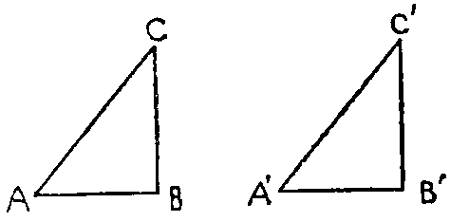
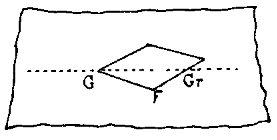
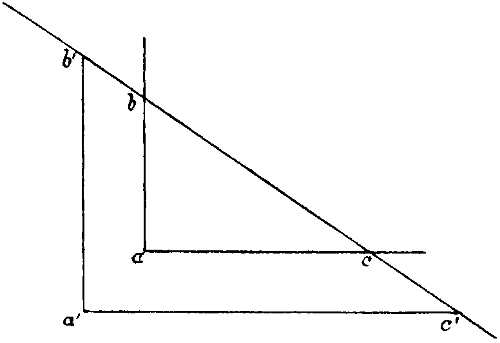
Fig. 1.
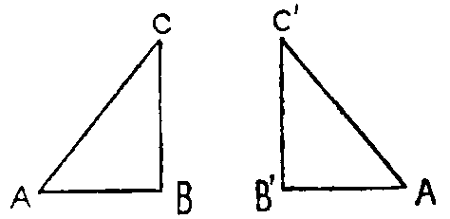
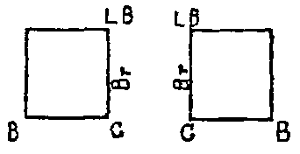
Fig. 2.
Another consequence of the limitation under which
this being lies, would be the following:—If we cut out
from the corners of a piece of paper two triangles, A B C
and A′ B′ C′, and suppose them to be reduced to such
a thinness that they are capable of being put on to the
imaginary surface, and of being observed by the flat
being like other bodies known to him; he will, after
studying the bounding lines, which are all that he can see
or touch, come to the conclusion that they are equal and
similar in every respect; and he can conceive the one
occupying the same space as the other occupies, without
its being altered in any way.
If, however, instead of putting down these triangles
into the surface on which the supposed being lives, as
shown in Fig. 1, we first of all turn one of them over,
and then put them down, then the plane-being has presented
to him two triangles, as shown in Fig. 2.
And if he studies these, he finds that they are equal
in size and similar in every respect. But he cannot
make the one occupy the same space as the other one;
this will become evident if the triangles be moved about
on the surface of a table. One will not lie on the same
portion of the table that the other has marked out by
lying on it.
Hence the plane-being by no means could make the
one triangle in this case coincide with the space occupied
by the other, nor would he be able to conceive the one
as coincident with the other.
The reason of this impossibility is, not that the one
cannot be made to coincide, but that before having been
put down on his plane it has been turned round. It
has been turned, using a direction of motion which the
plane-being has never had any experience of, and which
therefore he cannot use in his mental work any more
than in his practical endeavours.
Thus, owing to his limitations, there is a certain line
of possibility which he cannot overstep. But this line
does not correspond to what is actually possible and
impossible. It corresponds to a certain condition affecting
him, not affecting the triangle. His saying that it
is impossible to make the two triangles coincide, is an
assertion, not about the triangles, but about himself.
Now, to return to our own world, no doubt there are
many assertions which we make about the external
world which are really assertions about ourselves. And
we have a set of statements which are precisely similar
to those which the plane-being would make about his
surroundings.
Thus, he would say, there are only two independent
directions; we say there are only three.
He would say that solids are bounded by lines; we
say that solids are bounded by planes.
Moreover, there are figures about which we assert
exactly the same kind of impossibility as his plane-being
did about the triangles in Fig. 2.
We know certain shapes which are equal the one to
the other, which are exactly similar, and yet which we
cannot make fit into the same portion of space, either
practically or by imagination.
If we look at our two hands we see this clearly,
though the two hands are a complicated case of a very
common fact of shape. Now, there is one way in
which the right hand and the left hand may practically
be brought into likeness. If we take the right-hand
glove and the left-hand glove, they will not fit any more
than the right hand will coincide with the left hand.
But if we turn one glove inside out, then it will fit. Now,
to suppose the same thing done with the solid hand as
is done with the glove when it is turned inside out, we
must suppose it, so to speak, pulled through itself. If
the hand were inside the glove all the time the glove
was being turned inside out, then, if such an operation
were possible, the right hand would be turned into an
exact model of the left hand. Such an operation is
impossible. But curiously enough there is a precisely
similar operation which, if it were possible, would, in a
plane, turn the one triangle in Fig. 2 into the exact
copy of the other.
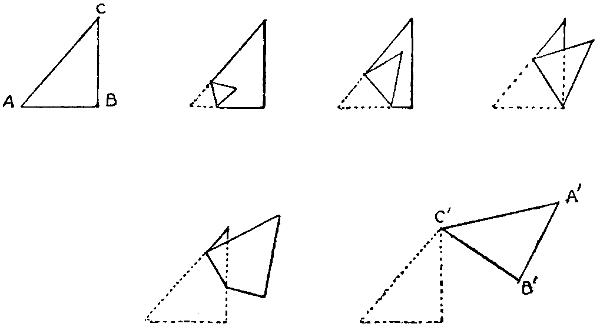
Look at the triangle in Fig. 2, A B C, and imagine
the point A to move into the interior of the triangle and
to pass through it, carrying after it the parts of the lines
A B and A C to which it is attached, we should have
finally a triangle A B C, which was quite like the other
of the two triangles A′ B′ C′ in Fig. 2.
Thus we know the operation which produces the
result of the “pulling through” is not an impossible one
when the plane-being is concerned. Then may it not be
that there is a way in which the results of the impossible
operation of pulling a hand through could be performed?
The question is an open one. Our feeling of it being
impossible to produce this result in any way, may be
because it really is impossible, or it may be a useful bit
of information about ourselves.
Now at this point my special work comes in. If there
be really a four-dimensional world, and we are limited
to a space or three-dimensional view, then either we are
absolutely three-dimensional with no experience at all
or capacity of apprehending four-dimensional facts, or
we may be, as far as our outward experience goes, so
limited; but we may really be four-dimensional beings
whose consciousness is by certain undetermined conditions
limited to a section of the real space.
Thus we may really be like the plane-beings mentioned
above, or we may be in such a condition that our perceptions,
not ourselves, are so limited. The question is one
which calls for experiment.
We know that if we take an animal, such as a dog
or cat, we can by careful training, and by using rewards
and punishment, make them act in a certain way, in
certain defined cases, in accordance with justice; we
can produce the mechanical action. But the feeling
of justice will not be aroused; it will be but a mere
outward conformity. But a human being, if so trained,
and seeing others so acting, gets a feeling of justice.
Now, if we are really four-dimensional, by going
through those acts which correspond to a four-dimensional
experience (so far as we can), we shall obtain an
apprehension of four-dimensional existence—not with
the outward eye, but essentially with the mind.
And after a number of years of experiment which were
entirely nugatory, I can now lay it down as a verifiable
fact, that by taking the proper steps we can feel four-dimensional
existence, that the human being somehow,
and in some way, is not simply a three-dimensional
being—in what way it is the province of science to
discover. All that I shall do here is, to put forward
certain suppositions which, in an arbitrary and forced
manner, give an outline of the relation of our body to
four-dimensional existence, and show how in our minds
we have faculties by which we recognise it.
It is often taken for granted that our consciousness of
ourselves and of our own feelings has a sort of direct
and absolute value.
It is supposed to afford a testimony which does not
require to be sifted like our consciousness of external
events. But in reality it needs far more criticism to be
applied to it than any other mode of apprehension.
To a certain degree we can sift our experience of
the external world, and divide it into two portions.
We can determine the self elements and the realities.
But with regard to our own nature and emotions, the
discovery which makes a science possible has yet to be
made.
There are certain indications, however, springing from
our observation of our own bodies, which have a certain
degree of interest.
It is found that the processes of thought and feeling
are connected with the brain. If the brain is disturbed,
thoughts, sights, and sounds come into the consciousness
which have no objective cause in the external
world. Hence we may conclusively say that the human
being, whatever he is, is in contact with the brain, and
through the brain with the body, and through the body
with the external world.
It is the structures and movements in the brain which
the human being perceives. It is by a structure in the
brain that he apprehends nature, not immediately.
The most beautiful sights and sounds have no effect
on a human being unless there is the faculty in the
brain of taking them in and handing them on to the
consciousness.
Hence, clearly, it is the movements and structure of
the minute portions of matter forming the brain which
the consciousness perceives. And it is only by models
and representations made in the stuff of the brain that
the mind knows external changes.
Now, our brains are well furnished with models and
representations of the facts and events of the external
world.
But a most important fact still requires its due weight
to be laid upon it.
These models and representations are made on a very
minute scale—the particles of brain matter which form
images and representations are beyond the power of the
microscope in their minuteness. Hence the consciousness
primarily apprehends the movements of matter of
a degree of smallness which is beyond the power of
observation in any other way.
Hence we have a means of observing the movements
of the minute portions of matter. Let us call those
portions of the brain matter which are directly instrumental
in making representations of the external world—let
us call them brain molecules.
Now, these brain molecules are very minute portions
of matter indeed; generally they are made to go
through movements and form structures in such a way
as to represent the movements and structures of the
external world of masses around us.
But it does not follow that the structures and movements
which they perform of their own nature are
identical with the movements of the portions of matter
which we see around us in the world of matter.
It may be that these brain molecules have the power
of four-dimensional movement, and that they can go
through four-dimensional movements and form four-dimensional
structures.
If so, there is a practical way of learning the movements
of the very small particles of matter—by observing,
not what we can see, but what we can think.
For, suppose these small molecules of the brain were
to build up structures and go through movements not
in accordance with the rule of representing what goes
on in the external world, but in accordance with their
own activity, then they might go through four-dimensional
movements and form four-dimensional structures.
And these movements and structures would be apprehended
by the consciousness along with the other
movements and structures, and would seem as real as
the others—but would have no correspondence in the
external world.
They would be thoughts and imaginations, not observations
of external facts.
Now, this field of investigation is one which requires
to be worked at.
At present it is only those structures and movements
of the brain molecules which correspond to the realities
of our three-dimensional space which are in general
worked at consistently. But in the practical part of
this book it will be found that by proper stimulus the
brain molecules will arrange themselves in structures
representing a four-dimensional existence. It only
requires a certain amount of care to build up mental
models of higher space existences. In fact, it is probably
part of the difficulty of forming three-dimensional
brain models, that the brain molecules have to be limited
in their own freedom of motion to the requirements of
the limited space in which our practical daily life is
carried on.
Note.—For my own part I should say that all those confusions in
remembering which come from an image taking the place of the
original mental model—as, for instance, the difficulty in remembering
which way to turn a screw, and the numerous cases of images
in thought transference—may be due to a toppling over in the
brain, four-dimensionalwise, of the structures formed—which
structures would be absolutely safe from being turned into image
structures if the brain molecules moved only three-dimensionalwise.
It is remarkable how in science “explaining” means
the reference of the movements and tendencies to
movement of the masses about us to the movements
and tendencies to movement of the minute portions of
matter.
Thus, the behaviour of gaseous bodies—the pressure
which they exert, the laws of their cooling and intermixture
are explained by tracing the movements of the
very minute particles of which they are composed.
At this point of our inquiries the best plan is to turn
to the practical work, and try if the faculty of thinking
in higher space can be awakened in the mind.
The general outline of the method is the same as that
which has been described for getting rid of the limitation
of up and down from a block of cubes. We supposed
that the block was fixed; and to get the sense of
what it would be when gravity acted in a different way
with regard to it, we made a model of it as it would be
under the new circumstances. We thought out the
relations which would exist; and by practising this new
arrangement we gradually formed the direct apprehension.
And so with higher-space arrangements. We cannot
put them up actually, but we can say how they would
look and be to the touch from various sides. And we
can put up the actual appearances of them, not altogether,
but as models succeeding one another; and by
contemplation and active arrangement of these different
views we call upon our inward power to manifest itself.
In preparing our general plan of work, it is necessary
to make definite assumptions with regard to our world,
our universe, or we may call it our space, in relation to
the wider universe of four-dimensional space.
What our relation to it may be, is altogether undetermined.
The real relationship will require a great
deal of study to apprehend, and when apprehended will
seem as natural to us as the position of the earth among
the other planets does to us now.
But we have not got to wait for this exploration in
order to commence our work of higher-space thought,
for we know definitely that whatever our real physical
relationship to this wider universe may be, we are practically
in exactly the same relationship to it as the
creature we have supposed living on the surface of a
smooth sheet is to the world of threefold space.
And this relationship of a surface to a solid or of a
solid, as we conjecture, to a higher solid, is one which
we often find in nature. A surface is nothing more nor
less than the relation between two things. Two bodies
touch each other. The surface is the relationship of one
to the other.
Again, we see the surface of water.
Thus our solid existence may be the contact of two
four-dimensional existences with each other; and just as
sensation of touch is limited to the surface of the body,
so sensation on a larger scale may be limited to this
solid surface.
And it is a fact worthy of notice, that in the surface
of a fluid different laws obtain from those which hold
throughout the mass. There are a whole series of facts
which are grouped together under the name of surface
tensions, which are of great importance in physics, and
by which the behaviour of the surfaces of liquids is
governed.
And it may well be that the laws of our universe are
the surface tensions of a higher universe.
But these expressions, it is evident, afford us no practical
basis for investigation. We must assume something
more definite, and because more definite (in the absence
of details drawn from experience), more arbitrary.
And we will assume that the conditions under which
we human beings are, exactly resemble those under
which the plane-beings are placed, which have been
described.
This forms the basis of our work; and the practical
part of it consists in doing, with regard to higher
space, that which a plane-being would do with regard
to our space in order to enable himself to realize what
it was.
If we imagine one of these limited creatures whose
life is cramped and confined studying the facts of space
existence, we find that he can do it in two ways. He
can assume another direction in addition to those which
he knows; and he can, by means of abstract reasoning,
say what would take place in an ampler kind of space
than his own. All this would be formal work. The
conclusions would be abstract possibilities.
The other mode of study is this. He can take some
of these facts of his higher space and he can ponder
over them in his mind, and can make up in his plane
world those different appearances which one and the
same solid body would present to him, and then he may
try to realize inwardly what his higher existence is.
Now, it is evident that if the creature is absolutely
confined to a two-dimensional existence, then anything
more than such existence will always be a mere abstract
and formal consideration to him.
But if this higher-space thought becomes real to him,
if he finds in his mind a possibility of rising to it, then
indeed he knows that somehow he is not limited to his
apparent world. Everything he sees and comes into
contact with may be two-dimensional; but essentially,
somehow, himself he is not two-dimensional merely.
And a precisely similar piece of work is before us.
Assuming as we must that our outer experience is
limited to three-dimensional space, we shall make up
the appearances which the very simplest higher bodies
would present to us, and we shall gradually arrive at a
more than merely formal and abstract appreciation of
them. We shall discover in ourselves a faculty of apprehension
of higher space similar to that which we have
of space. And thus we shall discover, each for himself,
that, limited as his senses are, he essentially somehow
is not limited.
The mode and method in which this consciousness
will be made general, is the same in which the spirit of
an army is formed.
The individuals enter into the service from various
motives, but each and all have to go through those
movements and actions which correspond to the unity
of a whole formed out of different members. The inner
apprehension which lies in each man of a participation
in a life wider than that of his individual body, is
awakened and responds; and the active spirit of the
army is formed. So with regard to higher space, this
faculty of apprehending intuitively four-dimensional
relationships will be taken up because of its practical
use. Individuals will be practically employed to do it
by society because of the larger faculty of thought
which it gives. In fact, this higher-space thought means
as an affair of mental training simply the power of apprehending
the results arising from four independent
causes. It means the power of dealing with a greater
number of details.
And when this faculty of higher-space thought has
been formed, then the faculty of apprehending that
higher existence in which men have part, will come
into being.
It is necessary to guard here against there being
ascribed to this higher-space thought any other than
an intellectual value. It has no moral value whatever.
Its only connexion with moral or ethical considerations
is the possibility it will afford of recognizing more of
the facts of the universe than we do now. There is a
gradual process going on which may be described as
the getting rid of self elements. This process is one of
knowledge and feeling, and either may be independent
of the other. At present, in respect of feeling, we are
much further on than in respect to understanding, and
the reason is very much this: When a self element has
been got rid of in respect of feeling, the new apprehension
is put into practice, and we live it into our
organization. But when a self element has been got rid
of intellectually, it is allowed to remain a matter of
theory, not vitally entering into the mental structure of
individuals.
Thus up and down was discovered to be a self element
more than a thousand years ago; but, except as a matter
of theory, we are perfect barbarians in this respect up to
the present day.
We have supposed a being living in a plane world,
that is, a being of a very small thickness in a direction
perpendicular to the surface on which he is.
Now, if we are situated analogously with regard to
an ampler space, there must be some element in our
experience corresponding to each element in the plane-being’s
experience.
And it is interesting to ask, in the case of the plane-being,
what his opinion would be with respect to the
surface on which he was.
He would not recognize it as a surface with which
he was in contact; he would have no idea of a motion
away from it or towards it.
But he would discover its existence by the fact that
movements were transmitted along it. By its vibrating
and quivering, it would impart movement to the particles
of matter lying on it.
Hence, he would consider this surface to be a medium
lying between bodies, and penetrating them. It would
appear to him to have no weight, but to be a powerful
means of transmitting vibrations. Moreover, it would
be unlike any other substance with which he was
acquainted, inasmuch as he could never get rid of
it. However perfect a vacuum be made, there would
be in this vacuum just as much of this unknown medium
as there was before.
Moreover, this surface would not hinder the movement
of the particles of matter over it. Being smooth,
matter would slide freely over it. And this would seem
to him as if matter went freely through the medium.
Then he would also notice the fact that vibrations
of this medium would tear asunder portions of matter.
The plane surface, being very compact, compared to
the masses of matter on it, would, by its vibrations,
shake them into their component parts.
Hence he would have a series of observations which
tended to show that this medium was unlike any ordinary
matter with which he was acquainted. Although
matter passed freely through it, still by its shaking it
could tear matter in pieces. These would be very
difficult properties to reconcile in one and the same
substance. Then it is weightless, and it is everywhere.
It might well be that he would regard the supposition
of there being a plane surface, on which he was,
as a preferable one to the hypothesis of this curious
medium; and thus he might obtain a proof of his limitations
from his observations.
Now, is there anything in our experience which
corresponds to this medium which the plane-being gets
to observe?
Do we suppose the existence of any medium through
which matter freely moves, which yet by its vibrations
destroys the combinations of matter—some medium
which is present in every vacuum, however perfect,
which penetrates all bodies, and yet can never be laid
hold of?
These are precisely observations which have been
made.
The substance which possesses all these qualities is
called the æther. And the properties of the æther are
a perpetual object of investigation in science.
Now, it is not the place here to go into details, as
all we want is a basis for work; and however arbitrary
it may be, it will serve if it enables us to investigate
the properties of higher space.
We will suppose, then, that we are not in, but on the
æther, only not on it in any known direction, but that
the new direction is that which comes in. The æther
is a smooth body, along which we slide, being distant
from it at every point about the thickness of an atom;
or, if we take our mean distance, being distant from
it by half the thickness of an atom measured in this
new direction.
Then, just as in space objects, a cube, for instance,
can stand on the surface of a table, or on the surface
over which the plane-being moves, so on the æther can
stand a higher solid.
All that the plane-being sees or touches of a cube,
is the square on which it rests.
So all that we could see or touch of a higher solid
would be that part by which it stood on the æther;
and this part would be to us exactly like any ordinary
solid body. The base of a cube would be to the
plane-being like a square which is to him an ordinary
solid.
Now, the two ways, in which a plane-being would
apprehend a solid body, would be by the successive
appearances to him of it as it passed through his plane;
and also by the different views of one and the same solid
body which he got by turning the body over, so that
different parts of its surface come into contact with his
plane.
And the practical work of learning to think in four-dimensional
space, is to go through the appearances
which one and the same higher solid has.
Often, in the course of investigation in nature, we
come across objects which have a certain similarity, and
yet which are in parts entirely different. The work of the
mind consists in forming an idea of that whole in which
they cohere, and of which they are simple presentations.
The work of forming an idea of a higher solid is the
most simple and most definite of all such mental
operations.
If we imagine a plane world in which there are
objects which correspond to our sun, to the planets, and,
in fact, to all our visible universe, we must suppose a
surface of enormous extent on which great disks slide,
these disks being worlds of various orders of magnitude.
These disks would some of them be central, and hot,
like our sun; round them would circulate other disks,
like our planets.
And the systems of sun and planets must be conceived
as moving with great velocity over the surface
which bears them all.
And the movements of the atoms of these worlds
will be the course of events in such worlds. As the
atoms weave together, and form bodies altering, becoming,
and ceasing, so will bodies be formed and
disappear.
And the plane which bears them all on its smooth
surface will simply be a support to all these movements,
and influence them in no way.
Is to be conscious of being conscious of being hot,
the same thing as to be conscious of being hot? It is
not the same. There is a standing outside, and objectivation
of a state of mind which every one would say in
the first state was very different from the simple consciousness.
But the consciousness must do as much in
the first case as in the second. Hence the feeling hot
is very different from the consciousness of feeling hot.
A feeling which we always have, we should not be
conscious of—a sound always present ceases to be heard.
Hence consciousness is a concomitant of change, that
is, of the contact between one state and another.
If a being living on such a plane were to investigate
the properties, he would have to suppose the solid to
pass through his plane in order to see the whole of
its surface. Thus we may imagine a cube resting on
a table to begin to penetrate through the table. If the
cube passes through the surface, making a clean cut all
round it, so that the plane-being can come up to it and
investigate it, then the different parts of the cube as it
passes through the plane will be to him squares, which
he apprehends by the boundary lines. The cut which
there is in his plane must be supposed not to be noticed,
he must be able to go right up to the cube without hindrance,
and to touch and see that thin slice of it which
is just above the plane.
And so, when we study a higher solid, we must suppose
that it passes through the æther, and that we only
see that thin three-dimensional section of it which is
just about to pass from one side to the other of the
æther.
When we look on a solid as a section of a higher
solid, we have to suppose the æther broken through,
only we must suppose that it runs up to the edge of the
body which is penetrating it, so that we are aware of
no breach of continuity.
The surface of the æther must then be supposed to
have the properties of the surface of a fluid; only, of
course, it is a solid three-dimensional surface, not a two-dimensional
surface.
We have supposed in the case of a plane world that the
surface on which the movements take place is inactive,
except by its vibrations. It is simply a smooth support.
For the sake of simplicity let us call this smooth
surface “the æther” in the case of a plane world.
The æther then we have imagined to be simply a
smooth, thin sheet, not possessed of any definite structure,
but excited by real disturbances of the matter on
it into vibrations, which carry the effect of these disturbances
as light and heat to other portions of matter.
Now, it is possible to take an entirely different view of
the æther in the case of a plane world.
Let us imagine that, instead of the æther being a
smooth sheet serving simply as a support, it is definitely
marked and grooved.
Let us imagine these grooves and channels to be very
minute, but to be definite and permanent.
Then, let us suppose that, instead of the matter which
slides in the æther having attractions and repulsions of
its own, that it is quite inert, and has only the properties
of inertia.
That is to say, taking a disk or a plane world as a
specimen, the whole disk is sliding on the æther in
virtue of a certain momentum which it has, and certain
portions of its matter fit into the grooves in the æther,
and move along those grooves.
The size of the portions is determined by the size of
the grooves. And let us call those portions of matter
which occupy the breadth of a groove, atoms. Then it
is evident that the disk sliding along over the æther, its
atoms will move according to the arrangement of the
grooves over which the disk slides. If the grooves at
any one particular place come close together, there will
be a condensation of matter at that place when the
disk passes over it; and if the grooves separate, there
will be a rarefaction of matter.
If we imagine five particles, each slipping along in its
own groove, if the particles are arranged in the form of
a regular pentagon, and the grooves are parallel, then
these five particles, moving evenly on, will maintain
their positions with regard to one another, and a body
would exist like a pentagon, lasting as long as the
groves remained parallel.
But if, after some distance had been traversed by the
disk, and these five particles were brought into a region
where one of the grooves tended away from the others,
the shape of the pentagon would be destroyed, it would
become some irregular figure. And it is easy to see
that if the grooves separated, and other grooves came
in amongst them, along which other portions of matter
were sliding, that the pentagon would disappear as an
isolated body, that its constituent matter would be
separated, and that its particles would enter into other
shapes as constituents of them, and not of the original
pentagon.
Thus, in cases of greater complication, an elaborate
structure may be supposed to be formed, to alter, and to
pass away; its origin, growth, and decay being due, not
to any independent motion of the particles constituting
it, but to the movement of the disk whereby its portions
of matter were brought to regions where there was a
particular disposition of the grooves.
Then the nature of the shape would really be determined
by the grooves, not by the portions of matter
which passed over them—they would become manifest
as giving rise to a material form when a disk passed
over them, but they would subsist independently of the
disk; and if another disk were to pass over the same
grooves, exactly the same material structures would
spring up as came into being before.
If we make a similar supposition about our æther
along which our earth slides, we may conceive the
movements of the particles of matter to be determined,
not by attractions or repulsions exerted on one another,
but to be set in existence by the alterations in the
directions of the grooves of the æther along which
they are proceeding.
If the grooves were all parallel, the earth would proceed
without any other motion than that of its path in
the heavens.
But with an alteration in the direction of the grooves,
the particles, instead of proceeding uniformly with the
mass of the earth, would begin to move amongst each
other. And by a sufficiently complicated arrangement
of grooves it may be supposed that all the movements
of the forms we see around us are due to interweaving
and variously disposed grooves.
Thus the movements, which any body goes through,
would depend on the arrangement of the æthereal
grooves along which it was passing. As long as the
grooves remain grouped together in approximately the
same way, it would maintain its existence as the same
body; but when the grooves separated, and became involved
with the grooves of other objects, this body
would cease to exist separately.
Thus the separate existences of the earth might conceivably
be due to the disposition of those parts of the
æther over which the earth passed. And thus any
object would have to be separated into two parts, one
the æthereal form, or modification which lasted, the
other the material particles which, coming on with
blind momentum, were directed into such movements as
to produce the actual objects around us.
In this way there would be two parts in any organism,
the material part and the æthereal part. There would
be the material body, which soon passes and becomes
indistinguishable from any other material body, and the
æthereal body which remains.
Now, if we direct our attention to the material body,
we see the phenomena of growth, decay, and death, the
coming and the passing away of a living being, isolated
during his existence, absolutely merged at his death into
the common storehouse of matter.
But if we regard the æthereal body, we find something
different. We find an organism which is not so absolutely
separated from the surrounding organisms—an
organism which is part of the æther, and which is linked
to other æthereal organisms by its very substance—an
organism between which and others there exists a unity
incapable of being broken, and a common life which is
rather marked than revealed by the matter which passes
over it. The æthereal body moreover remains permanently
when the material body has passed away.
The correspondences between the æthereal body and
the life of an organism such as we know, is rather to be
found in the emotional region than in the one of outward
observation. To the æthereal form, all parts of it
are equally one; but part of this form corresponds to
the future of the material being, part of it to his past.
Thus, care for the future and regard for the past would
be the way in which the material being would exhibit
the unity of the æthereal body, which is both his past,
his present, and his future. That is to say, suppose the
æthereal body capable of receiving an injury, an injury
in one part of it would correspond to an injury in a
man’s past; an injury in another part,—that which the
material body was traversing,—would correspond to an
injury to the man at the present moment; injury to the
æthereal body at another part, would correspond to
injury coming to the man at some future time. And
the self-preservation of the æthereal body, supposing it
to have such a motive, would in the last case be the
motive of regarding his own future to the man. And
inasmuch as the man felt the real unity of his æthereal
body, and did not confine his attention to his material
body, which is absolutely disunited at every moment
from its future and its past—inasmuch as he apprehended
his æthereal unity, insomuch would he care for his future
welfare, and consider it as equal in importance to his
present comfort. The correspondence between emotion
and physical fact would be, that the emotion of regard
corresponded to an undiscerned æthereal unity. And
then also, just as the two tips of two fingers put down
on a plane, would seem to a plane-being to be two completely
different bodies, not connected together, so one
and the same æthereal body might appear as two
distinct material bodies, and any regard between the
two would correspond to an apprehension of their
æthereal unity. In the supposition of an æthereal body,
it is not necessary to keep to the idea of the rigidity and
permanence of the grooves defining the motion of the
matter which, passing along, exhibits the material body.
The æthereal body may have a life of its own, relations
with other æthereal bodies, and a life as full of vicissitudes
as that of the material body, which in its total
orbit expresses in the movements of matter one phase
in the life of the æthereal body.
But there are certain obvious considerations which
prevent any serious dwelling on these speculations—they
are only introduced here in order to show how the conception
of higher space lends itself to the representation
of certain indefinite apprehensions,—such as that of the
essential unity of the race,—and affords a possible clue
to correspondences between the emotional and the
physical life.
The whole question of our relation to the æther has
to be settled. That which we call the æther is far more
probably the surface of a liquid, and the phenomena we
observe due to surface tensions. Indeed, the physical
questions concern us here nothing at all. It is easy
enough to make some supposition which gives us a
standing ground to discipline our higher-space perception;
and when that is trained, we shall turn round and
look at the facts.
The conception which we shall form of the universe
will undoubtedly be as different from our present one,
as the Copernican view differs from the more pleasant
view of a wide immovable earth beneath a vast vault.
Indeed, any conception of our place in the universe will
be more agreeable than the thought of being on a
spinning ball, kicked into space without any means of
communication with any other inhabitants of the
universe.
In the instinctive and sense perception of man and
nature there is all hidden, which reflection afterwards
brings into consciousness.
We are conscious of somewhat higher than each
individual man when we look at men. In some, this
consciousness reaches an extreme pitch, and becomes
a religious apprehension. But in none is it otherwise
than instinctive. The apprehension is sufficiently definite
to be certain. But it is not expressible to us in
terms of the reason.
Now, I have shown that by using the conception of
higher space it is easy enough to make a supposition
which shall show all mankind as physical parts of one
whole. Our apparent isolation as bodies from each
other is by no means so necessary to assume as it
would appear. But, of course, a supposition of that
kind is of no value, except as showing a possibility.
If we came to examine into the matter closely, we
should find a natural relationship which accounted for
our consciousness being limited as at present it is.
The first thing to be done, is to organize our higher-space
perception, and then look. We cannot tell what
external objects will blend together into the unity of a
higher being. But just as the riddle of the two hands
becomes clear to us from our first inspection of higher
space, so will there grow before our eyes greater unities
and greater surprises.
We have been subject to a limitation of the most
absurd character. Let us open our eyes and see the
facts.
Now, it requires some training to open the eyes.
For many years I worked at the subject without the
slightest success. All was mere formalism. But by
adopting the simplest means, and by a more thorough
knowledge of space, the whole flashed clear.
Space shapes can only be symbolical of four-dimensional
shapes; and if we do not deal with space shapes
directly, but only treat them by symbols on the plane—as
in analytical geometry—we are trying to get a perception
of higher space through symbols of symbols,
and the task is hopeless. But a direct study of space
leads us to the knowledge of higher space. And with
the knowledge of higher space there come into our ken
boundless possibilities. All those things may be real,
whereof saints and philosophers have dreamed.
Looking on the fact of life, it has become clear to
the human mind, that justice, truth, purity, are to be
sought—that they are principles which it is well to
serve. And men have invented an abstract devotion
to these, and all comes together in the grand but vague
conception of Duty.
But all these thoughts are to those which spring up
before us as the shadow on a bank of clouds of a great
mountain is to the mountain itself. On the piled-up
clouds falls the shadow—vast, imposing, but dark, colourless.
If the beholder but turns, he beholds the mountain
itself, towering grandly with verdant pines, the snowline,
and the awful peaks.
So all these conceptions are the way in which now,
with vision confined, we apprehend the great existences
of the universe. Instead of an abstraction, what we
have to serve is a reality, to which even our real things
are but shadows. We are parts of a great being, in
whose service, and with whose love, the utmost demands
of duty are satisfied.
How can it not be a struggle, when the claims of
righteousness mean diminished life,—even death,—to
the individual who strives? And yet to a clear and
more rational view it will be seen that in his extinction
and loss, that which he loves,—that real being which
is to him shadowed forth in the present existence of
wife and child,—that being lives more truly, and in its
life those he loves are his for ever.
But, of course, there are mistakes in what we consider
to be our duty, as in everything else; and this is an
additional reason for pursuing the quest of this reality.
For by the rational observance of other material bodies
than our own, we come to the conclusion that there
are other beings around us like ourselves, whom we
apprehend in virtue of two processes—the one simply
a sense one of observation and reflection—the other a
process of direct apprehension.
Now, if we did not go through the sense process of
observation, we might, it is true, know that there were
other human beings around us in some subtle way—in
some mesmeric feeling; but we should not have that
organized human life which, dealing with the things of
the world, grows into such complicated forms. We
should for ever be good-humoured babies—a sensuous,
affectionate kind of jelly-fish.
And just so now with reference to the high intelligences
by whom we are surrounded. We feel them,
but we do not realize them.
To realize them, it will be necessary to develop our
power of perception.
The power of seeing with our bodily eye is limited to
the three-dimensional section.
But I have shown that the inner eye is not thus
limited; that we can organize our power of seeing in
higher space, and that we can form conceptions of
realities in this higher space, just as we can in our ordinary
space.
And this affords the groundwork for the perception
and study of these other beings than man. Just as some
mechanical means are necessary for the apprehension
of our fellows in space, so a certain amount of mechanical
education is necessary for the perception of
higher beings in higher space.
Let us turn the current of our thought right round;
instead of seeking after abstractions, and connecting our
observations by ideas, let us train our sense of higher
space and build up conceptions of greater realities, more
absolute existences.
It is really a waste of time to write or read more
generalities. Here is the grammar of the knowledge of
higher being—let us learn it, not spend time in speculating
as to whither it will lead us.
Yet one thing more. We are, with reference to the
higher things of life, like blind and puzzled children.
We know that we are members of one body, limbs of
one vine; but we cannot discern, except by instinct and
feeling, what that body is, what the vine is. If to know
it would take away our feeling, then it were well never
to know it. But fuller knowledge of other human beings
does not take away our love for them; what reason is
there then to suppose that a knowledge of the higher
existences would deaden our feelings?
And then, again, we each of us have a feeling that we
ourselves have a right to exist. We demand our own
perpetuation. No man, I believe, is capable of sacrificing
his life to any abstract idea; in all cases it is the
consciousness of contact with some being that enables
him to make the last human sacrifice. And what we
can do by this study of higher space, is to make this
consciousness, which has been reserved for a few, the
property of all. Do we not all feel that there is a limit
to our devotion to abstractions, none to beings whom
we love. And to love them, we must know them.
Then, just as our own individual life is empty and
meaningless without those we love, so the life of the
human race is empty and meaningless without a knowledge
of those that surround it. And although to some
an inner knowledge of the oneness of all men is vouchsafed,
it remains to be demonstrated to the many.
The perpetual struggle between individual interests
and the common good can only be solved by merging
both impulses in a love towards one being whose life
lies in the fulfilment of each.
And this search, it seems to me, affords the needful
supplement to the inquiries of one with whose thought
I have been very familiar, and to which I return again,
after having abandoned it for the purely materialistic
views which seem forced upon us by the facts of science.
All that he said seemed to me unsupported by fact,
unrelated to what we know.
But when I found that my knowledge was merely an
empty pretence, that it was the vanity of being able to
predict and foretell that stood to me in the place of an
absolute apprehension of fact—when all my intellectual
possessions turned to nothingness, then I was forced
into that simple quest for fact, which, when persisted in
and lived in, opens out to the thoughts like a flower to
the life-giving sun.
It is indeed a far safer course, to believe that which
appeals to us as noble, than simply to ask what is true;
to take that which great minds have given, than to demand
that our puny ones should be satisfied. But I
suppose there is some good to some one in the scepticism
and struggle of those who cannot follow in the
safer course.
The thoughts of the inquirer to whom I allude may
roughly be stated thus:—
He saw in human life the working out of a great process,
in the toil and strain of our human history he saw
the becoming of man. There is a defect whereby we fall
short of the true measure of our being, and that defect
is made good in the course of history.
It is owing to that defect that we perceive evil; and
in the perception of evil and suffering lies our healing,
for we shall be forced into that path at last, after trying
every other, which is the true one.
And this, the history of the redemption of man, is
what he saw in all the scenes of life; each most trivial
occurrence was great and significant in relation to this.
And, further, he put forward a definite statement with
regard to this defect, this lack of true being, for it lay,
he said, in the self-centredness of our emotions, in the
limitation of them to our bodily selves. He looked for
a time when, driven from all thoughts of our own pain
or pleasure, good or evil, we should say, in view of the
miseries of our fellow-creatures, Let me be anyhow, use
my body and my mind in any way, so that I serve.
And this, it seems to me, is the true aspiration; for,
just as a note of music flings itself into the march of the
melody, and, losing itself in it, is used for it and lost as
a separate being, so we should throw these lives of ours
as freely into the service of—whom?
Here comes the difficulty. Let it be granted that we
should have no self-rights, limit our service in no way,
still the question comes, What shall we serve?
It is far happier to have some concrete object to
which we are devoted, or to be bound up in the ceaseless
round of active life, wherein each day presents so
many necessities that we have no room for choice.
But besides and apart from all these, there comes to
some the question, “What does it all mean?” To others,
an unlovable and gloomy aspect is presented, wherein
their life seems to be but used as a material worthless in
itself and ungifted with any dignity or honour; while
to others again, with the love of those they love, comes
a cessation of all personal interest in life, and a disappointment
and feeling of valuelessness.
And in all these cases some answer is needed. And
here human duty ceases. We cannot make objects to
love. We can make machines and works of art, but
nothing which directly excites our love. To give us
that which rouses our love, is the duty of one higher
than ourselves.
And yet in one respect we have a duty—we must
look.
What good would it be, to surround us with objects
of loving interest, if we bury our regards in ourselves
and will not see?
And does it not seem as if with lowered eyelids, till
only the thinnest slit was open, we gazed persistently,
not on what is, but on the thinnest conceivable section
of it?
Let it be granted that our right attitude is, so to
devote ourselves that there is no question as to what we
will do or what we will not do, but we are perfectly
obedient servants. The question is, Whom are we to
serve?
It cannot be each individual, for their claims are
conflicting, and as often as not there is more need of
a master than of a servant. Moreover, the aspect of our
fellows does not always excite love, which is the only
possible inducer of the right attitude of service. If we
do not love, we can only serve for a self motive, because
it is in some way good for ourselves.
Thus it seems to me that we are reduced to this: our
only duty is to look for that which it is given us to love.
But this looking is not mere gazing. To know, we
must act.
Let any one try it. He will find that unless he
goes through a series of actions corresponding to his
knowledge, he gets merely a theoretic and outside view
of any facts. The way to know is this: Get somehow
a means of telling what your perceptions would be if
you knew, and act in accordance with those perceptions.
Thus, with regard to a fellow-creature, if we knew him
we should feel what his feelings are. Let us then learn
his feelings, and act as if we had them. It is by the
practical work of satisfying his needs that we get to
know him.
Then, may-be, we love him; or perchance it is said
we may find that through him we have been brought
into contact with one greater than him.
This is our duty—to know—to know, not merely
theoretically, but practically; and then, when we know,
we have done our part; if there is nothing, we cannot
supply it. All we have to do is to look for realities.
We must not take this view of education—that we are
horribly pressed for time, and must learn, somehow, a
knack of saying how things must be, without looking at
them.
But rather, we must say that we have a long time—all
our lives, in which we will press facts closer and closer
to our minds; and we begin by learning the simplest.
There is an idea in that home of our inspiration—the
fact that there are certain mechanical processes by
which men can acquire merit. This is perfectly true.
It is by mechanical processes that we become different;
and the science of education consists largely in systematizing
these processes.
Then, just as space perceptions are necessary for the
knowledge of our fellow-men, and enable us to enter
into human relationships with them in all the organized
variety of civilized life, so it is necessary to develop
our perceptions of higher space, so that we can apprehend
with our minds the relationship which we have to
beings higher than ourselves, and bring our instinctive
knowledge into clearer consciousness.
It appears to me self-evident, that in the particular
disposition of any portion of matter, that is, in any
physical action, there can be neither right nor wrong;
the thing done is perfectly indifferent.
At the same time, it is only in things done that we
come into relationship with the beings about us and
higher than us. Consequently, in the things we do lies
the whole importance of our lives.
Now, many of our impulses are directly signs of a
relationship in us to a being of which we are not immediately
conscious. The feeling of love, for instance, is
always directed towards a particular individual; but by
love man tends towards the preservation and improvement
of his race; thus in the commonest and most
universal impulses lie his relations to higher beings than
the individuals by whom he is surrounded. Now, along
with these impulses are many instincts of a modifying
tendency; and, being altogether in the dark as to the
nature of the higher beings to whom we are related, it is
difficult to say in what the service of the higher beings
consists, in what it does not. The only way is, as in
every other pre-rational department of life, to take the
verdict of those with the most insight and inspiration.
And any striving against such verdicts, and discontent
with them, should be turned into energy towards finding
out exactly what relation we have towards these higher
beings by the study of Space.
Human life at present is an art constructed in its
regulations and rules on the inspirations of those who
love the undiscerned higher beings, of which we are a
part. They love these higher beings, and know their
service.
But our perceptions are coarser; and it is only by
labour and toil that we shall be brought also to see, and
then lose the restraints that now are necessary to us in
the fulness of love.
Exactly what relationship there is towards us on the
part of these higher beings we cannot say in the least.
We cannot even say whether there is more than humanity
before the highest; and any conception which we form
now must use the human drama as its only possible
mode of presentation.
But that there is such a relation seems clear; and the
ludicrous manner, in which our perceptions have been
limited, is a sufficient explanation of why they have not
been scientifically apprehended.
The mode, in which an apprehension of these higher
beings or being is at present secured, is as follows; and
it bears a striking analogy to the mode by which the
self is cut out of a block of cubes.
When we study a block of cubes, we first of all learn
it, by starting from a particular cube, and learning how
all the others come with regard to that. All the others
are right or left, up or down, near or far, with regard to
that particular cube. And the line of cubes starting
from this first one, which we take as the direction in
which we look, is, as it were, an axis about which the
rest of the cubes are grouped. We learn the block with
regard to this axis, so that we can mentally conceive
the disposition of every cube as it comes regarded from
one point of view. Next we suppose ourselves to be in
another cube at the extremity of another axis; and,
looking from this axis, we learn the aspects of all the
cubes, and so on.
Thus we impress on the feeling what the block of
cubes is like from every axis. In this way we get a
knowledge of the block of cubes.
Now, to get a knowledge of humanity, we must feel
with many individuals. Each individual is an axis as
it were, and we must regard human beings from many
different axes. And as, in learning the block of cubes,
muscular action, as used in putting up the block of
cubes, is the means by which we impress on the feeling
the different views of the block; so, with regard to
humanity, it is by acting with regard to the view of each
individual that a knowledge is obtained. That is to say,
that, besides sympathizing with each individual, we must
act with regard to his view; and acting so, we shall feel
his view, and thus get to know humanity from more than
one axis. Thus there springs up a feeling of humanity,
and of more.
Those who feel superficially with a great many people,
are like those learners who have a slight acquaintance
with a block of cubes from many points of view. Those
who have some deep attachments, are like those who
know them well from one or two points of view.
Thus there are two definite paths—one by which the
instinctive feeling is called out and developed, the other
by which we gain the faculty of rationally apprehending
and learning the higher beings.
In the one way it is by the exercise of a sympathetic
and active life; in the other, by the study of higher
space.
Both should be followed; but the latter way is more
accessible to those who are not good. For we at any
rate have the industry to go through mechanical operations,
and know that we need something.
And after all, perhaps, the difference between the good
and the rest of us, lies rather in the former being aware.
There is something outside them which draws them to
it, which they see while we do not.
There is no reason, however, why this knowledge
should not become demonstrable fact. Surely, it is only
by becoming demonstrable fact that the errors which
have been necessarily introduced into it by human
weakness will fall away from it.
The rational knowledge will not replace feeling, but
will form the vehicle by which the facts will be presented
to our consciousness. Just as we learn to know our
fellows by watching their deeds,—but it is something
beyond the mere power of observing them that makes
us regard them,—so the higher existences need to be
known; and, when known, then there is a chance that
in the depths of our nature they will awaken feelings
towards them like the natural response of one human
being to another.
And when we reflect on what surrounds us, when we
think that the beauty of fruit and flower, the blue depths
of the sky, the majesty of rock and ocean,—all these are
but the chance and arbitrary view which we have of true
being,—then we can imagine somewhat of the glories that
await our coming. How set out in exquisite loveliness
are all the budding trees and hedgerows on a spring day—from
here, where they almost sing to us in their nearness,
to where, in the distance, they stand up delicately
distant and distinct in the amethyst ocean of the air!
And there, quiet and stately, revolve the slow moving
sun and the stars of the night. All these are the fragmentary
views which we have of great beings to whom
we are related, to whom we are linked, did we but realize
it, by a bond of love and service in close connexions of
mutual helpfulness.
Just as here and there on the face of a woman sits the
divine spirit of beauty, so that all cannot but love who
look—so, presenting itself to us in all this mingled scene
of air and ocean, plain and mountain, is a being of such
loveliness that, did we but know with one accord in one
stream, all our hearts would be carried in a perfect and
willing service. It is not that we need to be made
different; we have but to look and gaze, and see that
centre whereunto with joyful love all created beings
move.
But not with effortless wonder will our days be filled,
but in toil and strong exertion; for, just as now we all
labour and strive for an object, our service is bound up
with things which we do—so then we find no rest from
labour, but the sense of solitude and isolation is gone.
The bonds of brotherhood with our fellow-men grow
strong, for we know one common purpose. And through
the exquisite face of nature shines the spiritual light
that gives us a great and never-failing comrade.
Our task is a simple one—to lift from our mind that
veil which somehow has fallen on us, to take that curious
limitation from our perception, which at present is only
transcended by inspiration.
And the means to do it is by throwing aside our reason—by
giving up the idea that what we think or are has
any value. We too often sit as judges of nature, when
all we can be are her humble learners. We have but
to drink in of the inexhaustible fulness of being, pressing
it close into our minds, and letting our pride of being
able to foretell vanish into dust.
There is a curious passage in the works of Immanuel
Kant,[1]
in which he shows that space must be in the
mind before we can observe things in space. “For,”
he says, “since everything we conceive is conceived as
being in space, there is nothing which comes before our
minds from which the idea of space can be derived;
it is equally present in the most rudimentary perception
and the most complete.” Hence he says that space
belongs to the perceiving soul itself. Without going
into this argument to abstract regions, it has a great
amount of practical truth. All our perceptions are of
things in space; we cannot think of any detail, however
limited or isolated, which is not in space.
Hence, in order to exercise our perceptive powers,
it is well to have prepared beforehand a strong apprehension
of space and space relations.
And so, as we pass on, is it not easily conceivable
that, with our power of higher space perception so
rudimentary and so unorganized, we should find it impossible
to perceive higher existences? That mode of
perception which it belongs to us to exercise is wanting.
What wonder, then, that we cannot see the objects
which are ready, were but our own part done?
Think how much has come into human life through
exercising the power of the three-dimensional space
perception, and we can form some measure, in a faint
way, of what is in store for us.
There is a certain reluctance in us in bringing anything,
which before has been a matter of feeling, within
the domain of conscious reason. We do not like to
explain why the grass is green, flowers bright, and,
above all, why we have the feelings which we pass
through.
But this objection and instinctive reluctance is chiefly
derived from the fact that explaining has got to mean
explaining away. We so often think that a thing is
explained, when it can be shown simply to be another
form of something which we know already. And, in
fact, the wearied mind often does long to have a
phenomenon shown to be merely a deduction from
certain known laws.
But explanation proper is not of this kind; it is
introducing into the mind the new conception which
is indicated by the phenomenon already present.
Nature consists of many entities towards the apprehension
of which we strive. If for a time we break
down the bounds which we have set up, and unify vast
fields of observation under one common law, it is that
the conceptions we formed at first are inadequate, and
must be replaced by greater ones. But it is always
the case, that, to understand nature, a conception must
be formed in the mind. This process of growth in the
mental history is hidden; but it is the really important
one. The new conception satisfies more facts than the
old ones, is truer phenomenally; and the arguments for
it are its simplicity, its power of accounting for many
facts. But the conception has to be formed first. And
the real history of advance lies in the growth of the
new conceptions which every now and then come to
light.
When the weather-wise savage looked at the sky at
night, he saw many specks of yellow light, like fire-flies,
sprinkled amidst whitish fleece; and sometimes
the fleece remained, the fire-spots went, and rain came;
sometimes the fire-spots remained, and the night was
fine. He did not see that the fire-points were ever the
same, the clouds different; but by feeling dimly, he
knew enough for his purpose.
But when the thinking mind turned itself on these
appearances, there sprang up,—not all at once, but
gradually,—the knowledge of the sublime existences of
the distant heavens, and all the lore of the marvellous
forms of water, of air, and the movements of the earth.
Surely these realities, in which lies a wealth of embodied
poetry, are well worth the delighted sensuous
apprehension of the savage as he gazed.
Perhaps something is lost, but in the realities, of
which we know, there is compensation. And so, when
we learn to understand the meaning of these mysterious
changes, this course of natural events, we shall find in
the greater realities amongst which we move a fair
exchange for the instinctive reverence, which they now
awaken in us.
In this book the task is taken up of forming the
most simple and elementary of the great conceptions
that are about us. In the works of the poets, and still
more in the pages of religious thinkers, lies an untold
wealth of conception, the organization of which in our
every-day intellectual life is the work of the practical
educator.
But none is capable of such simple demonstration
and absolute presentation as this of higher space, and
none so immediately opens our eyes to see the world
as a different place. And, indeed, it is very instructive;
for when the new conception is formed, it is found to
be quite simple and natural. We ask ourselves what
we have gained; and we answer: Nothing; we have
simply removed an obvious limitation.
And this is universally true; it is not that we must
rise to the higher by a long and laborious process. We
may have a long and laborious process to go through,
but, when we find the higher, it is this: we discover our
true selves, our essential being, the fact of our lives.
In this case, we pass from the ridiculous limitation, to
which our eyes and hands seem to be subject, of acting
in a mere section of space, to the fuller knowledge and
feeling of space as it is. How do we pass to this truer
intellectual life? Simply by observing, by laying aside
our intellectual powers, and by looking at what is.
We take that which is easiest to observe, not that
which is easiest to define; we take that which is the
most definitely limited real thing, and use it as our
touchstone whereby to explore nature.
As it seems to me, Kant made the great and fundamental
statement in philosophy when he exploded all
previous systems, and all physics were reft from off the
perceiving soul. But what he did once and for all, was too
great to be a practical means of intellectual work. The
dynamic form of his absolute insight had to be found;
and it is in other works that the practical instances
of the Kantian method are to be found. For, instead
of looking at the large foundations of knowledge, the
ultimate principles of experience, late writers turned
to the details of experience, and tested every phenomenon,
not with the question, What is this? but with
the question, “What makes me perceive thus?”
And surely the question, as so put, is more capable
of an answer; for it is only the percipient, as a subject
of thought, about which we can speak. The absolute
soul, since it is the thinker, can never be the subject of
thought; but, as physically conditioned, it can be thought
about. Thus we can never, without committing a
ludicrous error, think of the mind of man except as
a material organ of some kind; and the path of discovery
lies in investigating what the devious line of his
thought history is due to, which winds between two
domains of physics—the unknown conditions which
affect the perceiver, the partially known physics
which constitute what we call the external world.
It is a pity to spend time over these reflections;
if they do not seem tame and poor compared to the
practical apprehension which comes of working with
the models, then there is nothing in the whole subject.
If in the little real objects which the reader has to
handle and observe does not lie to him a poetry of a
higher kind than any expressed thought, then all these
words are not only useless, but false. If, on the other
hand, there is true work to be done with them, then
these suggestions will be felt to be but mean and
insufficient apprehensions.
For, in the simplest apprehension of a higher space
lies a knowledge of a reality which is, to the realities
we know, as spirit is to matter; and yet to this new
vision all our solid facts and material conditions are
but as a shadow is to that which casts it. In the
awakening light of this new apprehension, the flimsy
world quivers and shakes, rigid solids flow and mingle,
all our material limitations turn into graciousness, and
the new field of possibility waits for us to look and
behold.
The reader will doubtless ask for some definite result
corresponding to these words—something not of the
nature of an hypothesis or a might-be. And in that I
can only satisfy him after my own powers. My only
strength is in detail and patience; and if he will go
through the practical part of the book, it will assuredly
dawn upon him that here is the beginning of an answer
to his request. I only study the blocks and stones
of the higher life. But here they are definite enough.
And the more eager he is for personal and spiritual truth,
the more eagerly do I urge him to take up the practical
work, for the true good comes to us through those who,
aspiring greatly, still submit their aspirations to fact,
and who, desiring to apprehend spirit, still are willing to
manipulate matter.
The particular problem at which I have worked for
more than ten years, has been completely solved. It is
possible for the mind to acquire a conception of higher
space as adequate as that of our three-dimensional
space, and to use it in the same manner.
There are two distinct ways of studying space—our
familiar space at present in use. One is that of the
analyst, who treats space relations by his algebra, and
discovers marvellous relations. The other is that of the
observer or mechanician, who studies the shapes of things
in space directly.
A practical designer of machines would not find the
knowledge of geometrical analysis of immediate help to
him; and an artist or draughtsman still less so.
Now, my inquiry was, whether it was possible to get
the same power of conception of four-dimensional space,
as the designer and draughtsman have of three-dimensional
space. It is possible.
And with this power it is possible for us to design
machines in higher space, and to conceive objects in
this space, just as a draughtsman or artist does.
Analytical skill is not of much use in designing a
statue or inventing a machine, or in appreciating the
detail of either a work of art or a mechanical contrivance.
And hitherto the study of four-dimensional space has
been conducted by analysis. Here, for the first time,
the fact of the power of conception of four-dimensional
space is demonstrated, and the means of educating it
are given.
And I propose a complete system of work, of which
the volume on four space[2] is the first instalment.
I shall bring forward a complete system of four-dimensional
thought—mechanics, science, and art. The
necessary condition is, that the mind acquire the power
of using four-dimensional space as it now does three-dimensional.
And there is another condition which is no less important.
We can never see, for instance, four-dimensional
pictures with our bodily eyes, but we can
with our mental and inner eye. The condition is, that
we should acquire the power of mentally carrying a
great number of details.
If, for instance, we could think of the human body
right down to every minute part in its right position,
and conceive its aspect, we should have a four-dimensional
picture which is a solid structure. Now, to
do this, we must form the habit of mental painting, that
is, of putting definite colours in definite positions, not
with our hands on paper, but with our minds in thought,
so that we can recall, alter, and view complicated arrangements
of colour existing in thought with the same ease
with which we can paint on canvas. This is simply an
affair of industry; and the mental power latent in us in
this direction is simply marvellous.
In any picture, a stroke of the brush put on without
thought is valueless. The artist is not conscious of the
thought process he goes through. For our purpose it
is necessary that the manipulation of colour and form
which the artist goes through unconsciously, should become
a conscious power, and that, at whatever sacrifice
of immediate beauty, the art of mental painting should
exist beside our more unconscious art. All that I mean
is this—that in the course of our campaign it is necessary
to take up the task of learning pictures by heart, so
that, just as an artist thinks over the outlines of a figure
he wants to draw, so we think over each stroke in our
pictures. The means by which this can be done will be
given in a future volume.
We throw ourselves on an enterprise in which we have
to leave altogether the direct presentation to the senses.
We must acquire a sense-perception and memory of so
keen and accurate a kind that we can build up mental
pictures of greater complexity than any which we can
see. We have a vast work of organization, but it is
merely organization. The power really exists and
shows itself when it is looked for.
Much fault may be found with the system of organization
which I have adopted, but it is the survivor of
many attempts; and although I could better it in parts,
still I think it is best to use it until, the full importance
of the subject being realized, it will be the lifework of
men of science to reorganize the methods.
The one thing on which I must insist is this—that
knowledge is of no value, it does not exist unless it
comes into the mind. To know that a thing must be is
no use at all. It must be clearly realized, and in detail
as it is, before it can be used.
A whole world swims before us, the apprehension
of which simply demands a patient cultivation of our
powers; and then, when the faculty is formed, we shall
recognize what the universe in which we are is like. We
shall learn about ourselves and pass into a new domain.
And I would speak to some minds who, like myself,
share to a large extent the feeling of unsettledness and
unfixedness of our present knowledge.
Religion has suffered in some respects from the inaccuracy
of its statements; and it is not always seen
that it consists of two parts—one a set of rules as to the
management of our relations to the physical world about
us, and to our own bodies; another, a set of rules as to
our relationship to beings higher than ourselves.
Now, on the former of these subjects, on physical facts,
on the laws of health, science has a fair standing ground
of criticism, and can correct the religious doctrines in
many important respects.
But on the other part of the subject matter, as to our
relationship to beings higher than ourselves, science
has not yet the materials for judging. The proposition
which underlies this book is, that we should begin to
acquire the faculties for judging.
To judge, we must first appreciate; and how far we
are from appreciating with science the fundamental
religious doctrines I leave to any one to judge.
There is absolutely no scientific basis for morality,
using morality in the higher sense of other than a code
of rules to promote the greatest physical and mental
health and growth of a human being. Science does not
give us any information which is not equally acceptable
to the most selfish and most generous man; it simply
tells him of means by which he may attain his own
ends, it does not show him ends.
The prosecution of science is an ennobling pursuit;
but it is of scientific knowledge that I am now speaking
in itself. We have no scientific knowledge of any existences
higher than ourselves—at least, not recognized
as higher. But we have abundant knowledge of the
actions of beings less developed than ourselves, from
the striking unanimity with which all inorganic beings
tend to move towards the earth’s centre, to the almost
equally uniform modes of response in elementary organized
matter to different stimuli.
The question may be put: In what way do we come
into contact with these higher beings at present? And
evidently the answer is, In those ways in which we
tend to form organic unions—unions in which the activities
of individuals coalesce in a living way.
The coherence of a military empire or of a subjugated
population, presenting no natural nucleus of
growth, is not one through which we should hope
to grow into direct contact with our higher destinies.
But in friendship, in voluntary associations, and above
all, in the family, we tend towards our greater life.
And it seems that the instincts of women are much
more relative to this, the most fundamental and important
side of life, than are those of men. In fact, until
we know, the line of advance had better be left to the
feeling of women, as they organize the home and the
social life spreading out therefrom. It is difficult, perhaps,
for a man to be still and perceive; but if he is so, he
finds that what, when thwarted, are meaningless caprices
and empty emotionalities, are, on the part of woman,
when allowed to grow freely and unchecked, the first
beginnings of a new life—the shadowy filaments, as it
were, by which an organism begins to coagulate together
from the medium in which it makes its appearance.
In very many respects men have to make the conditions,
and then learn to recognize. How can we see
the higher beings about us, when we cannot even
conceive the simplest higher shapes? We may talk
about space, and use big words, but, after all, the preferable
way of putting our efforts is this: let us look first
at the simplest facts of higher existence, and then, when
we have learnt to realize these, We shall be able to see
what the world presents. And then, also, light will be
thrown on the constituent organisms of our own bodies,
when we see in the thorough development of our social
life a relation between ourselves and a larger organism
similar to that which exists between us and the minute
constituents of our frame.
The problem, as it comes to me, is this: it is clearly
demonstrated that self-regard is to be put on one side—and
self-regard in every respect—not only should things
painful and arduous be done, but things degrading and
vile, so that they serve.
I am to sign any list of any number of deeds which
the most foul imagination can suggest, as things which I
would do did the occasion come when I could benefit
another by doing them; and, in fact, there is to be no
characteristic in any action which I would shrink from
did the occasion come when it presented itself to be
done for another’s sake. And I believe that the soul
is absolutely unstained by the action, provided the regard
is for another.
But this is, in truth, a dangerous doctrine; at one
Sweep it puts away all absolute commandments, all
absolute verdicts of right about things, and leaves the
agent to his own judgment.
It is a kind of rule of life which requires most absolute
openness, and demands that society should frame
severe and insuperable regulations; for otherwise, with
the motives of the individual thus liberated from absolute
law, endless varieties of conduct would spring forth,
and the wisdom of individual men is hardly enough to
justify their irresponsible action.
Still, it does seem that, as an ideal, the absolute
absence of self-regard is to be aimed at.
With a strong religious basis, this would work no
harm, for the rules of life, as laid down by religions,
would suffice. But there are many who do not accept
these rules as any absolute indication of the will of
God, but only as the regulations of good men, which
have a claim to respect and nothing more.
And thus it seems to me that altruism—thoroughgoing
altruism—hands over those who regard it as an
ideal, and who are also of a sceptical turn of mind, to
the most absolute unfixedness of theory, and, very possibly,
to the greatest errors in life.
And here we come to the point where the study of
space becomes so important.
For if this rule of altruism is the right one, if it
appeals with a great invitation to us, we need not therefore
try it with less precaution than we should use in
other affairs of infinitely less importance. When we
want to know if a plank will bear, we entrust it with
a different load from that of a human body.
And if this law of altruism is the true one, let us try
it where failure will not mean the ruin of human
beings.
Now, in knowledge, pure altruism means so to bury
the mind in the thing known that all particular relations
of one’s self pass away. The altruistic knowledge of
the heavens would be, to feel that the stars were vast
bodies, and that I am moving rapidly. It would be, to
know this, not as a matter of theory, but as a matter
of habitual feeling.
Whether this is possible, I do not know; but a somewhat
similar attempt can be made with much simpler
means.
In a different place I have described the process of
acquiring an altruistic knowledge of a block of cubes;
and the results of the laborious processes involved are
well worth the trouble. For as a clearly demonstrable
fact this comes before one. To acquire an absolute
knowledge of a block of cubes, so that all self relations
are cast out, means that one has to take the view of a
higher being.
It suddenly comes before one, that the particular relations
which are so fixed and important, and seem so
absolutely sure when one begins the process of learning,
are by no means absolute facts, but marks of a singular
limitation, almost a degradation, on one’s own part. In
the determined attempt to know the most insignificant
object perfectly and thoroughly, there flashes before
one’s eyes an existence infinitely higher than one’s own.
And with that vision there comes,—I do not speak
from my own experience only,—a conviction that our
existence also is not what we suppose—that this
bodily self of ours is but a limit too. And the question
of altruism, as against self-regard, seems almost to
vanish, for by altruism we come to know what we truly
are.
“What we truly are,” I do not mean apart from space
and matter, but what we really are as beings having a
space existence; for our way of thinking about existence
is to conceive it as the relations of bodies in space. To
think is to conceive realities in space.
Just as, to explore the distant stars of the heavens, a
particular material arrangement is necessary which we
call a telescope, so to explore the nature of the beings
who are higher than us, a mental arrangement is necessary.
We must prepare our power of thinking as
we prepare a more extended power of looking. We
want a structure developed inside the skull for the
one purpose, while an exterior telescope will do for the
other.
And thus it seems that the difficulties which we first
apprehended fall away.
To us, looking with half-blinded eyes at merely our
own little slice of existence, our filmy all, it seemed
that altruism meant disorder, vagary, danger.
But when we put it into practice in knowledge, we
find that it means the direct revelation of a higher
being and a call to us to participate ourselves too in a
higher life—nay, a consciousness comes that we are
higher than we know.
And so with our moral life as with our intellectual
life. Is it not the case that those, who truly accept the
rule of altruism, learn life in new dangerous ways?
It is true that we must give up the precepts of religion
as being the will of God; but then we shall learn that
the will of God shows itself partly in the religious precepts,
and comes to be more fully and more plainly
known as an inward spirit.
And that difficulty, too, about what we may do and
what we may not, vanishes also. For, if it is the same
about our fellow-creatures as it is about the block of
cubes, when we have thrown out the self-regard from
our relationship to them, we shall feel towards them as
a higher being than man feels towards them, we shall
feel towards them as they are in their true selves, not in
their outward forms, but as eternal loving spirits.
And then those instincts which humanity feels with a
secret impulse to be sacred and higher than any temporary
good will be justified—or fulfilled.
There are two tendencies—one towards the direct
cultivation of the religious perceptions, the other to reducing
everything to reason. It will be but just for the
exponents of the latter tendency to look at the whole
universe, not the mere section of it which we know, before
they deal authoritatively with the higher parts of
religion.
And those who feel the immanence of a higher life in
us will be needed in this outlook on the wider field of
reality, so that they, being fitted to recognize, may tell
us what lies ready for us to know.
The true path of wisdom consists in seeing that our
intellect is foolishness—that our conclusions are absurd
and mistaken, not in speculating on the world as a form
of thought projected from the thinking principle within
us—rather to be amazed that our thought has so limited
the world and hidden from us its real existences. To
think of ourselves as any other than things in space and
subject to material conditions, is absurd, it is absurd on
either of two hypotheses. If we are really things in
space, then of course it is absurd to think of ourselves
as if we were not so. On the other hand, if we are not
things in space, then conceiving in space is the mode
in which that unknown which we are exists as a mind.
Its mental action is space-conception, and then to give
up the idea of ourselves as in space, is not to get a truer
idea, but to lose the only power of apprehension of ourselves
which we possess.
And yet there is, it must be confessed, one way in
which it may be possible for us to think without thinking
of things in space.
That way is, not to abandon the use of space-thought,
but to pass through it.
When we think of space, we have to think of it as infinity
extended, and we have to think of it as of infinite
dimensions. Now, as I have shown in “The Law of the
Valley,”[3] when we come upon infinity in any mode of
our thought, it is a sign that that mode of thought is
dealing with a higher reality than it is adapted for, and
in struggling to represent it, can only do so by an infinite
number of terms. Now, space has an infinite
number of positions and turns, and this may be due to
the attempt forced upon us to think of things higher
than space as in space. If so, then the way to get rid
of space from our thoughts, is, not to go away from it,
but to pass through it—to think about larger and larger
systems of space, and space of more and more dimensions,
till at last we get to such a representation in
space of what is higher than space, that we can pass
from the space-thought to the more absolute thought
without that leap which would be necessary if we were
to try to pass beyond space with our present very inadequate
representation in it of what really is.
Again and again has human nature aspired and
fallen. The vision has presented itself of a law which
was love, a duty which carried away the enthusiasm,
and in which the conflict of the higher and lower natures
ceased because all was enlisted in one loving service.
But again and again have such attempts failed. The
common-sense view, that man is subject to law, external
law, remains—that there are fates whom he must propitiate
and obey. And there is a strong sharp curb,
which, if it be not brought to bear by the will, is soon
pulled tight by the world, and one more tragedy is
enacted, and the over-confident soul is brought low.
And the rock on which such attempts always split,
is in the indulgence of some limited passion. Some
one object fills the soul with its image, and in devotion
to that, other things are sacrificed, until at last all
comes to ruin.
But what does this mean? Surely it is simply this,
that where there should be knowledge there is ignorance.
It is not that there is too much devotion, too much
passion, but that we are ignorant and blind, and
wander in error. We do not know what it is we care
for, and waste our effort on the appearance. There is
no such thing as wrong love; there is good love and
bad knowledge, and men who err, clasp phantoms to
themselves. Religion is but the search for realities;
and thought, conscious of its own limitations, is its
best aid.
Let a man care for any one object—let his regard
for it be as concentrated and exclusive as you will,
there will be no danger if he truly apprehends that
which he cares for. Its true being is bound up with
all the rest of existence, and, if his regard is true to
one, then, if that one is really known, his regard is
true to all.
There is a question sometimes asked, which shows
the mere formalism into which we have fallen.
We ask: What is the end of existence? A mere play
on words! For to conceive existence is to feel ends.
The knowledge of existence is the caring for objects,
the fear of dangers, the anxieties of love. Immersed
in these, the triviality of the question, what is the end of
existence? becomes obvious. If, however, letting reality
fade away, we play with words, some questions of this
kind are possible; but they are mere questions of words,
and all content and meaning has passed out of them.
The task before us is this: we strive to find out that
physical unity, that body which men are parts of, and
in the life of which their true unity lies. The existence
of this one body we know from the utterances of those
whom we cannot but feel to be inspired; we feel certain
tendencies in ourselves which cannot be explained
except by a supposition of this kind.
And, now, we set to work deliberately to form in
our minds the means of investigation, the faculty of
higher-space conception. To our ordinary space-thought,
men are isolated, distinct, in great measure
antagonistic. But with the first use of the weapon of
higher thought, it is easily seen that all men may really
be members of one body, their isolation may be but an
affair of limited consciousness. There is, of course, no
value as science in such a supposition. But it suggests
to us many possibilities; it reveals to us the confined
nature of our present physical views, and stimulates us
to undertake the work necessary to enable us to deal
adequately with the subject.
The work is entirely practical and detailed; it is the
elaboration, beginning from the simplest objects of an
experience in thought, of a higher-space world.
To begin it, we take up those details of position and
relation which are generally relegated to symbolism or
unconscious apprehension, and bring these waste products
of thought into the central position of the laboratory
of the mind. We turn all our attention on the
most simple and obvious details of our every-day experience,
and thence we build up a conception of the
fundamental facts of position and arrangement in a
higher world. We next study more complicated higher
shapes, and get our space perception drilled and disciplined.
Then we proceed to put a content into our
framework.
The means of doing this are twofold—observation
and inspiration.
As to observation, it is hardly possible to describe
the feelings of that investigator who shall distinctly
trace in the physical world, and experimentally demonstrate
the existence of the higher-space facts which
are so curiously hidden from us. He will lay the first
stone for the observation and knowledge of the higher
beings to whom we are related.
As to the other means, it is obvious, surely, that if
there has ever been inspiration, there is inspiration
now. Inspiration is not a unique phenomenon. It has
existed in absolutely marvellous degree in some of the
teachers of the ancient world; but that, whatever it
was, which they possessed, must be present now, and,
if we could isolate it, be a demonstrable fact.
And I would propose to define inspiration as the
faculty, which, to take a particular instance, does the
following:—
If a square penetrates a line cornerwise, it marks
out on the line a segment bounded by two points—that
is, we suppose a line drawn on a piece of paper, and
a square lying on the paper to be pushed so that its
corner passes over the line. Then, supposing the paper
and the line to be in the same plane, the line is interrupted
by the square; and, of the square, all that is
observable in the line, is a segment bounded by two
points.
Next, suppose a cube to be pushed cornerwise
through a plane, and let the plane make a section of
the cube. The section will be a plane figure, and it
will be a triangle.
Now, first, the section of a square by a line is a
segment bounded by two points; second, the section
of a cube by a plane is a triangle bounded by three
lines.
Hence, we infer that the section of a figure in four
dimensions analogous to a cube, by three-dimensional
space, will be a tetrahedron—a figure bounded by four
planes.
This is found to be true; with a little familiarity
with four-dimensional movements this is seen to be
obvious. But I would define inspiration as the faculty
by which without actual experience this conclusion
is formed.
How it is we come to this conclusion I am perfectly
unable to say. Somehow, looking at mere formal considerations,
there comes into the mind a conclusion
about something beyond the range of actual experience.
We may call this reasoning from analogy; but using
this phrase does not explain the process. It seems to
me just as rational to say that the facts of the line and
plane remind us of facts which we know already about
four-dimensional figures—that they tend to bring these
facts out into consciousness, as Plato shows with the
boy’s knowledge of the cube. We must be really four-dimensional
creatures, or we could not think about four
dimensions.
But whatever name we give to this peculiar and inexplicable
faculty, that we do possess it is certain; and
in our investigations it will be of service to us. We
must carefully investigate existence in a plane world,
and then, making sure, and impressing on our inward
sense, as we go, every step we take with regard to a
higher world, we shall be reminded continually of fresh
possibilities of our higher existence.