This book was printed in 1754 and this etext is a careful reproduction
of that original text. No spelling and very few punctuation corrections
have been made in order to preserve the historical value of the
original work.
All dates in the book are prior to 1750, and so are Julian
calendar dates where a new year begins on March 25th. However the
book was published in the Gregorian era, so whenever a year is given
for a date between January 1st and March 24th, both the Julian and
Gregorian year were printed. This is shown in the book with a hyphen, for
example ‘the 10th day of March 1718-19’.
The long-s ſ has been replaced by s throughout the etext.
There is only one footnote in this book. The anchor is denoted by
(a), and the footnote itself has been placed at the bottom of that
paragraph.
All the changes noted in the ERRATA have been applied to the etext,
except for the change noted for p71, which could not be identified.
All occurrences of Testesole have been changed to Testefole.
A few minor corrections to obvious compositor errors are noted at
the end of the book. Some missing quote marks have been silently
added. All other misspellings in the text, and inconsistent or
archaic usage, have been left unchanged.
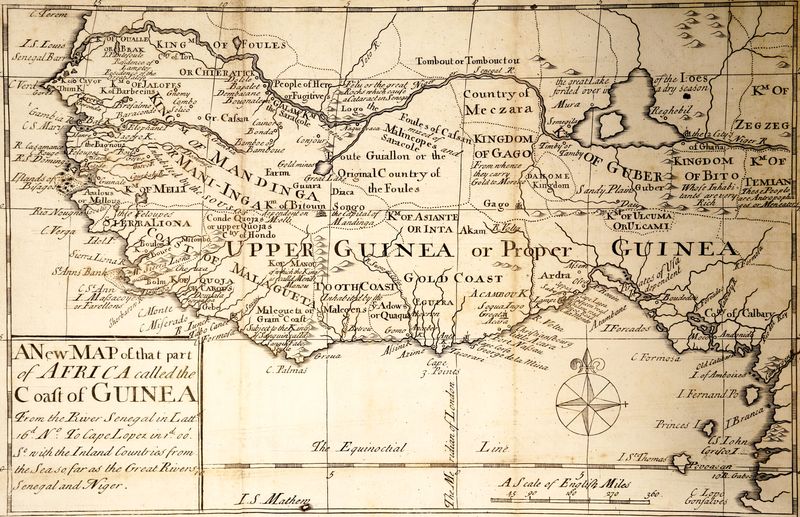
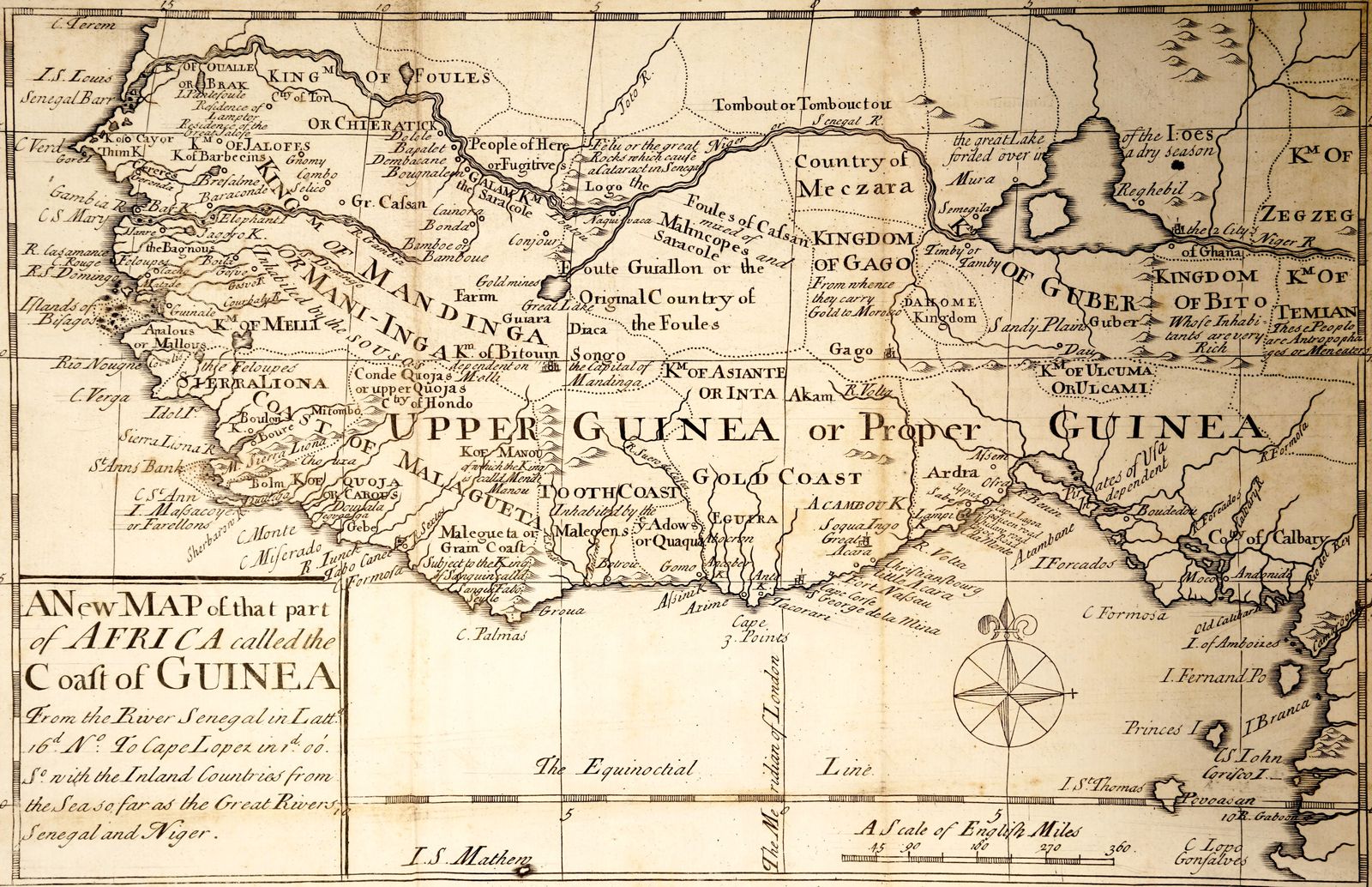
A New Map of that part
of Africa called the
Coast of Guinea
From the River Senegal in Latt.d
16.d N.o To Cape Lopez in 1.d 00′.
S.o with the Inland Countries from
the Sea so far as the Great Rivers,
Senegal and Niger.
A NEW ACCOUNT OF GUINE A, And the Slave-Trade,
CONTAINING,
I. The History of the late Conquest of the
Kingdom of Whidaw by the King of Dahomè.
The Author’s Journey to the Conqueror’s
Camp; where he saw several Captives sacrificed,
&c.
II. The Manner how the Negroes become
Slaves. The Numbers of them yearly exported
from Guinea to America. The Lawfulness
of that Trade. The Mutinies among
them on board the Ships where the Author
has been, &c.
III. A Relation of the Author’s being taken
by Pirates, and the many Dangers he underwent.
By Captain William Snelgrave.
With a new and correct Map of the Coast of Guinea.
LONDON:
Printed for J. Wren, at the Bible and Crown, in Salisbury-Court; Fleet-Street. 1754.
TO THE MERCHANTS OF LONDO N,
Trading to the Coast of Guinea.
Gentlemen,
SOME of you having
been pleased to peruse
the following Sheets in Manuscript,
and been so kind,
as to express your Approbation
of them, it hath incouraged
me to make them publick;
and I take the Liberty
to address them to the Merchants
trading to the Coast
of Guinea, as being the best
Judges of the Truth of what
is here related.
As it has been my good
Fortune to be known for
many Years to most of you,
and to have received Favours
from several amongst
You, so I beg leave to subscribe
my self, with the
greatest Respect and Esteem,
Gentlemen,
Your most obliged humble Servant, W. SNELGRAVE.
PREFAC E.
THE best part of the following
Sheets were writ several
Years ago, more particularly
the Account of my being
taken by Pirates, in the Year 1719:
And being now induced to publish
the History of the Conquest of the
Kingdom of Dahomè, I have added
the other, which is as remarkable
in its kind.
I am sensible that Objections may
be made to the Account I have given
of the Dahomes, by such of my Readers
as are not acquainted, either by
Travelling or Reading, with the
Manners and Customs of several
barbarous brutish Nations, that
have been and are still on the Globe.
As to human Sacrifices, they are
no new thing in the World; for it
is recorded of the Mexicans in particular,
that they annually sacrificed
to their Gods, a great number
of their Enemies taken in War.
Mens eating of their own Species,
seems to be the most incredible and
shocking; but this is practised by
others at present (besides the Dahomes)
on the Coast of Guinea;
especially by a People called Acquas,
on the River of old Callabar, and
amongst the Camarones adjoining,
where I have formerly been,
and of which there are some Witnesses
now in London: Captain
Arthur Lone and others, having seen
the same as well as my self.
As to the Story in general of the
King of Dahomè, there are some
Gentlemen now in Town, that know
a great part of it; namely, Jeremiah
Tinker Esq; Governor Wilson,
and others, who have formerly
resided at Whidaw, for the Royal
African Company: Besides several
that have been there in the Service
of private Merchants: As also
Charles Dunbar Esq; of Antegoa,
who bought the Negroe-Woman of
me there, whose Story is so remarkable,
on account of her being thrown
as a Sacrifice into the Sea, and her
wonderful Preservation afterwards,
the Truth of which she has often
confirmed.
As to the Relation of my being
taken by Pirates, there are several
in and about Town, that suffered
by them, at the same time and place
with my self. And Mr. James Bleau,
who was then my Surgeon, lives now
at Woodford, in good Repute and
Esteem with the Gentlemen of that
Village and Neighbourhood.
I shall say nothing with relation
to the short Account I have given of
the manner how the Negroes become
Slaves, and of the Management of
them when on Shipboard, it being
designed at first only for a Friend’s
Satisfaction, who had objected against
the lawfulness of that Trade.
As I love Freedom my self, so I
readily leave the Reader to judge
and believe as he pleases, concerning
what is here related: My principal
motive for publishing these Sheets,
being the Persuasion of some Friends,
who had perused them in Manuscript,
and thought they might prove
acceptable to the Publick.
INTRODUCTIO N.
THAT Part of Africa commonly
called Guinea, is of a large Extent,
beginning at Cape Verd, in
14 Degrees 30 Minutes North Latitude,
and extending to the South and East, as far
as the Coast of Angola; the River Congo, in
6 Degrees South Latitude, being the farthest
place where the English carry on
their Trade.
In this Country of Guinea, the English
have trafficked a great many Years: But
especially, since the Conclusion of the last
French War, it has been so improved, that
whereas in the Year 1712, there went
only 33 Ships from England to that Coast,
in 1726, it was proved before the Commissioners
of Trade, that there had been
there the Year before above 200 Sail, to
the great increase of Navigation, and the
advantage of our Plantations in America.
Such as are unacquainted with this
Country, may reasonably suppose we
should have gained by this time a perfect
account of the Inland-Parts; yet perhaps
we know the least of it of any Country
the English have so long traded to, for
reasons I shall give hereafter. But as I
design only to inform the Reader, (for his
better understanding the following Sheets)
in a cursory manner, of those parts of the
Coast of Guinea, that I have been personally
acquainted with: So, as I go along,
I shall intermix my Reasons with the Account.
I have traded along this Coast for near
700 Leagues, from a River called Sherberow,
in the Latitude of 7 Degrees 30
Minutes North, to Cape Lopez Gonsalvez,
in 1 Degree South, near the Coast of Angola:
Now in so large an Extent, we meet
with very different People and Trade.
The first part I shall mention, is about
250 Leagues in length, from the above-mentioned
River of Sherberow, round Cape
Palmas, to the River Ancober near Axim.
This is commonly called the Windward
Coast, on which there is no Settlement
or Factory of any European Nation;
but the Trade is carried on in this manner.
As soon as the Natives perceive a Ship
on their Coast, they make a smoke on
the Sea-Shore, as a Signal for the Ship
to come to an Anchor, that they may
come and trade with the People on board.
As soon as we are at an Anchor, they
come to us in small Boats, called Cannoes,
being made of a single Tree, and bring
their Commodities with them.
Along the greatest part of this Coast, the
Europeans have been cautious of venturing
on Shore amongst the Natives, they
being very barbarous and uncivilized, as
several have experienced to their cost.
In those few places where I have been on
Shore my self, I could never obtain a satisfactory
account from the Natives of the
Inland Parts. Nor did I ever meet with
a white Man that had been, or durst venture
himself, up in the Country; and believe,
if any had attempted it, the Natives
would have destroyed them, out of
a Jealousy that they designed to make
discoveries to their prejudice.
However, the Trade on this part of
the Coast, has been exceedingly improved
within these 20 years past. It consists in
Negroes, Elephants Teeth, and other Commodities;
which the Natives freely bring
on board our Ships, except when any Affront
has been offered them; which, to
the great Scandal both of English and
French, has too often been done, namely
by their forcibly carrying away the Traders,
under some slight pretence of having
received an Injury from them. And this
has put a stop to the Trade of the particular
place where it has happened for a
long time; and innocent People, who
have come there to trade in small Vessels,
have suffered for their Countrymens Villany:
Several in my time having been
surprized by the Natives, and the People
destroyed out of revenge.
From the aforementioned River of
Ancober to Acra, is about 50 Leagues.
This part is commonly called the Gold-Coast,
and thereon are many English and
Dutch Factories, under each of which is
a Negroe Town, protected by them. The
Reader may reasonably suppose, that here
we might have a perfect account of the
Inland parts; but we can have no such
thing. For the Policy of the Natives does
not suffer white Men to go up any great
way into the Country. Moreover, the
Inland People are very jealous of those
Negroes, who are under the Protection of
the Factories; so that the account I have
received from both when at peace (which
has brought some of the former to the
Sea side) has seemed so fabulous and contradictory,
that it could not be depended
upon; for the Negroes are very apt to
impose on us. However, in this part called
the Gold Coast, the Natives near the
Sea side are much civilized, by their
conversing with the Europeans, at their
Settlements; and by going on board so
many Ships to trade, as frequent this part
of the Coast. Here we can venture on
Shore amongst the Natives, without any
hazard; for ’tis to be noted, a large part
of the Gold Coast is not in Subjection to
them.
From Acra (where stands the last of
the European Settlements, on this part of
the Coast,) to Jaqueen, is about 60 Leagues.
In this Tract there are no Factories but at
two places, namely at Whidaw, and Jaqueen.
And tho’ they have been so long
settled by the Europeans, yet till the late
Conquest of them by the King of Dahomè,
we could learn but little of the Inland
parts; no white Men having been permitted
to go beyond the Kingdom of Ardra,
which is about 50 Miles from the
Sea side. But, as I have related in the
following Sheets what I saw and heard
when I was there; so I omit farther mention
of it here.
From Jaqueen to the Bay of Bennin,
and so round to the Callabars, Camerones,
and Cape Lopez, is above 300 Leagues,
in which long Tract there is no Settlement
of any European Nation; so of
course the Natives are for the most part
barbarous and uncivilized. I have, in my
younger years, traded to many places in
this Tract, especially at Old Callabar,
where, in the year 1704, I saw a sad Instance
of Barbarity. The King of the
place, called Jabrue, being fallen sick, he
caused, by the advice of his Priests, a
young Child about ten Months old, to
be sacrificed to his God, for his recovery.
I saw the Child after it was killed, hung
up on the Bough of a Tree, with a live
Cock tied near it, as an addition to the
Ceremony.
The last Voyage I went to this place,
was in the year 1713, when I commanded
the Ship Anne, belonging to Messieurs
Bradley, Virginia Merchants; where I had
the good fortune to save a Child from
being Sacrificed, as the other poor Infant
had been. And tho’ ’tis a long story, and
therefore may not so well suit an Introduction,
yet on account of the singular
Circumstances wherewith it was attended,
I believe the Reader may be pleased
with it.
The chief King, or Lord of the Country
(for there are several petty Princes on
that River) called Acqua, came on board,
sometime after my arrival, to see the Ship,
and hear our Musick. Being highly
pleased with his Entertainment, he kindly
invited me on Shore; so I promised to
wait on him in a few days. Accordingly
I went; but as I knew his People to be
fierce brutish Cannibals, I took, by way
of precaution, ten of my Sailors as a
Guard, with my Gunner to command
them. They were all well armed with
Musquets and Pistols, which those savage
People I knew were much afraid of.
Upon my landing at the Water side, I
was received by some persons, whom the
King had appointed to conduct me about
a quarter of a mile up, where I found
him sitting on a Stool, under some shady
Trees; another being placed by his side,
which I was desired to sit on. The King
did not speak one word, or moved in the
least, till I was sat down; but then he
bid me welcome, enquiring after my
health; as I did after his, having first
paid my respects to him, by bowing and
taking off my Hat. There were many of
his Courtiers present, and I observed above
50 of his Guard, stood at a little distance.
They were armed with Bows and Arrows,
a Sword by their side, and a barbed
Lance in their Hands. My people
ranged themselves opposite to them, at
the distance of about twenty paces.
After having presented the King with
some things, which, tho’ trifling to us, he
seemed highly delighted with; accidentally
turning my Head about, I saw a little
Negroe-Child tied by the Leg to a Stake
driven in the Ground, the flies and other
vermin crawling on him, and two Priests
standing by. Being surprized at this sight,
I asked the King, “What was the reason
of the Child’s being tied in that manner?”
He replied, “It was to be sacrificed
that night to his God Egbo, for his
prosperity.” Moved at the hearing of
this, I called (too hastily I must own) to one
of my People, to take the Child from the
Ground, in order to preserve him. He
had no sooner done it, but one of the
King’s Guard advanced towards him, in
a threatning posture with his Lance; and
fearing he would run him through, I
immediately took out of my Pocket a small
Pistol; at the sight of which, the King
rose from his Stool in a fright. But I bid
the Linguist tell him, “I would offer no
Injury to him or his, provided he ordered
his Guard not to attack mine:”
Which he readily doing, and all things
being quiet, I expostulated with him,
“for his breaking the Laws of Hospitality,
in permitting one of his Guard to
threaten my Man with his Lance.”
To this the King replied, “I had not
done well in ordering him to seize the
Child, it being his Property.” This I
acknowledged, “excusing it on the account
of my Religion, which, tho’ it
does not allow of forcibly taking away
what belongs to another, yet expresly
forbids so horrid a Thing, as the putting
a poor innocent Child to death.
And that this would, instead of Blessings,
certainly bring on him the Wrath
of the most high God, whom we white
Men adored.” I also observed to him,
“That the grand Law of human Nature
was, To do to others as we desir’d to be
done unto;” and many other Arguments
I used, too long to repeat here. At
the same time I offered to pay him for the
Child, which the King readily accepted:
And on my asking, what he desired for
it? to my surprize he only asked a bunch
of sky coloured Beads, worth about half
a Crown Sterling. I expected he would
have demanded at least ten times that Value;
for the Negroes, from the King to
the Trader, are generally very ready, on
any extraordinary occasion, to make their
Advantage of us.
After this was over, I staid about an
hour with the King, treating him with
European Liquors and Victuals, which I
had carried on Shore for that purpose;
but I took care not to drink any of his
Palm Wine, (which is a Liquor drawn
from a Tree, and which they can artfully
poison) under pretence, it did not agree
with me. But my People did not spare
it, drinking plentifully of it with his
Guards; and eating likewise heartily of
their Victuals.
After this I took my leave, and the
King expressed himself well pleased with
my Visit; promising to come on board
again, before I went out of the River.
As we were returning in our Boat, I
told the Gunner, “That when we came
on board, he should pitch on some motherly
Woman, to take care of this poor
Child.” To which he answered, “He
had already one in his Eye.”
It happened, the day before I went on
Shore to see the King, I had purchased the
Mother of the Child (tho’ I knew it not
then) from one of his People; and at that
time my Surgeon observing to me, she
had much Milk in her Breasts, I enquired
of the Person that brought her on board,
whether she had a Child when he bought
her from the Inland Trader? To which
he answered in the negative.
But now on my coming on board, no
sooner was the Child handed into the Ship,
but this poor Woman espying it, run
with great eagerness, and snatched him
out of the white Man’s Arms that held
him. I think there never was a more moving
sight than on this occasion, between
the Mother and her little Son, (who was
a fine Boy about 18 Months old; for ’tis
to be noted, the Negroe-Women generally
suckle their Children till they are above
two years old) especially when the Linguist
told her, “I had saved her Child
from being sacrificed.” Having at that
time above 300 Negroes on board my
Ship, no sooner was the Story known
amongst them, but they expressed their
Thankfulness to me, by clapping their
Hands, and singing a Song in my praise.
This affair proved of great service to us,
for it gave them a good Notion of white
Men; so that we had no Mutiny in our
Ship, during the whole Voyage.
I went from the River of Old Callebar,
to the Island of Antegoa, where our Cargoe
was sold; and upon my telling one
Mr. Studeley this remarkable story, he
bought the Mother and her Son, and was
a kind Master to them.
I could give a farther account of some
more extraordinary things, that have happened
in the many Voyages I have made
to this Coast; but am afraid of being tedious
to the Reader: So I shall conclude
with observing, that Mynheer Bosman’s
Account of the Coast of Guinea, is the most
perfect History we have of that Country;
and do readily confess, that whatever he
mentions, as far as my Observations have
reach’d, I have found to be true. To
this Book therefore I refer the Reader,
who is curious to know, the Manners,
Customs, Trade, &c. of the Negroes along
the Sea-Coast.
Containing an Account of the Destruction
of the Kingdom of Whidaw,
or Fida; the Author’s
Journey to the King of Dahomè’s
Camp; with several other remarkable
Particulars.
FOR the better understanding of the
following Relation, it is necessary
to prefix some Account of the
late State of the Country of Whidaw, before
the terrible Destruction and Desolation
thereof, in the Month of March
1726-7.
Description
of
Whidaw,
Sabee.
The Reader then is to observe, That
the Sea-coast of this Kingdom lies in 6
Degrees 40 Minutes North Latitude. Sabee,
the chief Town of the Country, is
situate about seven Miles from the Sea
side. In this Town the King allowed the
Europeans convenient Houses for their Factories;
and by him we were protected in
our Persons and Goods, and, when our
Business was finish’d, were permitted to
go away in Safety. The Road where
Ships anchored, was a free Port for all
European Nations trading to those Parts
for Negroes. And this Trade was so very
considerable, that it is computed, while
it was in a flourishing State, there were
above twenty thousand Negroes yearly exported
from thence, and the neighbouring
Places, by the English, French, Dutch, and
Portuguese. As this was the principal
Part of all the Guinea Coast for the Slave
Trade, the frequent Intercourse that Nation
had for many Years carried on with
the white People (a) had rendered them so
civilized, that it was a Pleasure to deal
with them.
(a) So they call the Europeans, in Opposition to the
Negroes.
The greatest Inconvenience we were
exposed to, was the Thievery of the common
People, which it was hardly possible
to guard intirely against; so bold and
dextrous were they at it: Tho’ if taken
in the Fact, they became our Slaves.
Polygamy.
The Custom of the Country allows
Polygamy to an excessive degree; it being
usual for a great Man to have some
hundreds of Wives and Concubines, and
meaner Men in proportion; whereby the
Land was become so stock’d with People,
that the whole Country appeared full of
Towns and Villages: And being a very
rich Soil, and well cultivated by the Inhabitants,
it looked like an intire Garden.
Trade having likewise flourished for a
long time, had greatly enriched the People;
which, with the Fertility of their
Country, had unhappily made them so
proud, effeminate, and luxurious, that
tho’ they could have brought at least one
hundred thousand Men into the Field, yet
so great were their Fears, that they were
driven out of their principal City, by two
hundred of their Enemies; and at last lost
their whole Country, to a Nation they formerly
had contemned. And tho’ this may
appear to the Reader very incredible, yet
it will sufficiently be illustrated by the
following Account.
Account
of the King
of Whidaw.
The King of Whidaw came to the
Crown when about fourteen Years old, so
that the Government was for many Years
in the hands of the great Men of the
Country; who liked it so well, that tho’
he was past thirty Years of Age when
this Calamity happened, yet they had to
this time sought all ways to keep him
from a Knowledge of governing. This
suited indeed with his Temper, for he was
indolent and lascivious, having in his
Court several thousands of Women, by
whom he was served in all capacities;
for no Men-servants were allowed to be
there. Being thus soften’d by his Pleasures,
he grew intirely negligent of his Affairs,
which at last produced such a Weakness
in the Government, that it ended in
its Ruin. For the great Men played the
petty Tyrants, often falling out, and pursuing
their particular Interests, without
regarding the Good of their King or
Country. By this means the common
People were divided, and such Parties
arose among them, as, added to their
Fears, rendered them a Prey to their
Neighbours; so that tho’ they were able
to have repelled any Force which could
have been brought against them by the
neighbouring Countries, they rather chose
to abandon the Land, than join heartily
against the common Enemy; who brought
at this time on them such a terrible Desolation
by the Sword, Fire and Famine,
as hardly ever befel any Country.
The King
of Dahomè’s
Invasion.
This common Enemy was the King
of Dahomè, a far inland Prince, who for
some Years past had rendered himself
famous, by many Victories gained over
his Neighbours. He sent an Ambassador
to the King of Whidaw, requesting to have
an open Traffick to the Sea side, and offering
to pay him his usual Customs on
Negroes exported: which being refused,
he from that time resolved to resent it,
when Opportunity offered. This the King
of Whidaw was so far from apprehending,
that in an Audience I had of him,
soon after the Ambassador’s Departure,
he told me; if the King of Dahomè
should offer to invade him, he would not
use him when taken according to their
Custom, that is, cut off his Head, but
would keep him for a Slave to do the vilest
Offices.
His Conquests.
And here ’tis necessary to make a short
Digression concerning the King of Dahomè’s
Conquests. Being a politick and
couragious Prince, he had such Success
against his Neighbours, in a few Years,
that he conquered towards the Sea Coast,
as far as the Kingdom of Ardra, which
is the next inland Country adjoining to
Whidaw; and then resolved to remain
quiet for some time, in order to settle his
Conquests. But an Accident soon called
him again to Arms, for the King of Ardra
having much injured his own Brother,
named Hussar; the latter sent privately to
the King of Dahomè, and offered him a
large Sum of Money to revenge him for
the many Affronts he had receiv’d from
the King his Brother. This the politick
Prince soon listen’d to; and the King of
Ardra having discovered the Matter, sent
to the Whidaws, representing to them, it
was their common Interest to oppose this
Conqueror; but they most imprudently
refused to lend him their Assistance. So
being obliged to encounter alone the King
of Dahomè, he met him with all the Forces
he could raise, which was about fifty
thousand Men of his own People, and
after a three Days Engagement, his Army
was totally defeated, and himself taken
Prisoner. Soon after which he was beheaded
in the Conqueror’s Presence according
to the barbarous Custom of these
black Princes.
Bullfinch
Lambe.
There was at that time in the Country
of Ardra a white Gentleman, named
Bullfinch Lambe, who was detained Prisoner
by the King on this occasion: Having
been sent by the Governour of the
African Company’s Settlement at Jaqueen,
on some Business to the King of Ardra,
this Prince detained him, under pretence
the Company owed him for one hundred
Slaves, formerly sent down to their Factory;
and he sent word to the Governour,
if he did not forthwith pay him this Debt,
he would make Mr. Lambe a Slave.
Which the Governour refusing to do, he
remained a Prisoner about two Years,
being used very hardly ’till he was taken
in this War by the King of Dahomè: Being
brought into the King’s Presence
(who had never before seen a white Man)
he was treated very kindly by his Majesty,
and had, in a short time after, a Houshold
appointed for him with many Servants,
and the King bestowed on him some of
his near Relations for Wives. Having
remained with this Prince near three Years,
he was at his own earnest Desire, dismiss’d
with a noble Present of Gold and
Slaves, in order to go for Europe: And
his Majesty by a Messenger, to the Towns
and Villages he passed through, in his way
to Jaqueen on the Sea side, ordered the
Inhabitants to shew him all possible Respect,
and provide nobly for his Entertainment.
Whidaw
invaded.
After this Gentleman’s Departure, the
King of Dahomè resolved to invade the
Country of Whidaw; which, as I have
been told, Mr. Lambe had dissuaded him
from; representing the great number of
the Inhabitants, who were much used to
Fire-Arms. Moreover, that the white
People resident and trading there, would
no doubt assist them for their own Interest:
So that there was no probability
of Success. But this politick Prince finding
by his Spies, how much the great
Men and People were divided, and that
the King was only a Cypher in the Government;
he marched against them.
The first part of the Country he invaded
was the northernmost, of which a great
Lord named Appragah was hereditary Governour,
who forthwith sent to his King
for Assistance: But through the Interest
of his Enemies at Court, who wished his
Destruction, he was refused: So having
made a little Resistance, he submitted to
the King of Dahomè, who received him
very kindly.
The Conquest of Appragah gave the
King an easy Entrance into the Heart of
the Country; but he was obliged to halt
there by a river, which runs about half
a Mile to the northward of the principal
Town of the Whidaws, called Sabee, the
Residence of their King. Here the King
of Dahomè encamped for some time, not
imagining he could have found so easy a
Passage and Conquest as he met with
afterwards. For the Pass of the River
was of that Nature, it might have been
defended against his whole Army, by five
hundred resolute Men; but instead of
guarding it, these cowardly luxurious People,
thinking the fame of their numbers
sufficient to deter the Dahomes from attempting
it, kept no set Guard. They
only went every Morning and Evening to
the River side, to make Fetiche as they call
it, that is, to offer Sacrifice to their principal
God, which was a particular harmless
Snake they adored, and prayed to on
this occasion, to keep their Enemies from
coming over the River.
Snakes
worshipped.
And, as worshiping a Snake may seem
very extravagant to such as are unacquainted
with the Religion of the Negroes, I
shall inform the Reader of the Reasons
given for it by the People of Whidaw.
This sort of Snake is peculiar to their
Country, being of a very singular Make;
for they are very big in the middle, rounding
on the Back like a Hog, but very small
at the Head and Tail, which renders their
Motion very slow. Their Colour is yellow
and white, with brown Streaks; and
so harmless, that if they are accidentally
trode on (for it is a capital Crime to do
it wilfully) and they bite, no bad Effect
ensues; which is one Reason they give
for their worshipping of them. Moreover,
there is a constant Tradition amongst
them, that whenever any Calamity threatens
their Country, by imploring the
Snake’s Assistance, they are always delivered
from it. However this fell out formerly,
it now stood them in no stead;
neither were the Snakes themselves spared
after the Conquest. For they being in
great Numbers, and a kind of domestick
Animals, the Conquerors found many of
them in the Houses, which they treated
in this manner: They held them up by
the middle, and spoke to them in this
manner: If you are Gods, speak and save
your selves: Which the poor Snakes not
being able to do, the Dahomes cut their
Heads off, ripped them open, broiled
them on the Coals, and eat them. It is
very strange, the Conquerors should so
far contemn the Gods of this Country,
since they are so barbarous and savage
themselves, as to offer human Sacrifices
whenever they gain a Victory over their
Enemies; an Eye-Witness to which I
was, as hereafter shall be related.
But to return to the King of Dahomè.
He was so politick as to send to the Europeans,
then residing at Whidaw, to assure
them, if they stood neuter, and were
not found in Arms they should receive no
Damage in their Persons or Goods, in
case he proved Conqueror; and that he
would ease their Trade, and remove divers
Impositions laid on it by the King
of Whidaw: On the contrary, if they
appeared against him, they must
expect his Resentment. But they were in a Dilemma;
for tho’ the King of Whidaw
did not desire otherwise, yet they would
gladly have retired from Sabee to two
mud-walled Forts, belonging to the English
and French African Companies, which
are within three Miles of the Sea side.
However, finding it would have been
resented by the King as a Discouragement
to his People, they were obliged
to remain in the Town, never suspecting
the Inhabitants would have run away in
the cowardly manner they did; or that
they should share the Fate of War with
them.
The Pass of the River being, as I have
related above, wholly left to the Care
of the Snakes, whom the Enemy little
feared; and they having observed for several
Days, that the Whidaws kept no
set Guard there, it encouraged the King
of Dahomè’s General to send two hundred
of his Soldiers to ford the River: Which
having done without Opposition, and
being bold Fellows, they marched towards
the Town of Sabee, sounding their musical
Instruments. This was about three a
Clock in the Afternoon, and the Outguards
of the Town were almost all asleep;
but being roused by the Noise of the Enemy’s
Musick and Shouts, they fled into
the Town, reporting, that all the Dahomè
Army was got over the River:
Which soon reaching the King’s Ear, he
immediately fled, with all his People,
making no Resistance. I was informed
by the white People, then in the English
and French Forts, that about five a Clock
the same Afternoon, they saw such Numbers
of People flying from all Parts of
the Country towards the Sea side, that it
was very surprizing: For the Fields were
covered with them many Miles round, and
their black Colour made them the more
conspicuous in a clear sunshiny Day, on
a fine flat champaign Country. The King,
with a great number of his Subjects fled
to an Island on the Sea Coast, which was
parted from the main Land by a River,
having ferried over in Canoes; but a
great many that could not have the same
Benefit, being hurried on by their Fears,
were drowned in the Rivers, in attempting
to swim to the Islands lying near
Popoe; which was the next neighbouring
Country to their own, on the Sea Coast
to the Westward; and where they might
have been secure from their Enemies,
had they escaped. Moreover, many thousands
of these poor People that sheltered
themselves up and down the Country
among the Bushes, perished afterwards by
Sword and Famine.
But now to return to the Dahomè Soldiers:
When they first came to Sabee, it
seems they marched directly to the King’s
Court, where not finding him, they set it
on Fire; and then sent their General
word of what had happened, who brought
the whole Army over the River that
Evening. He was in such a Surprize at
his good Fortune, that he could hardly
believe what he saw; and the white
Gentlemen were as much amazed, to see
the great Cowardice of these People, who
had vapoured so highly, and as ignominiously
quitted, the Town without opposing
their Enemies in the least, leaving them
intirely in the Power of the Conquerors,
with all their own Riches. Mr. Duport, who
was then the African Company’s Governour,
told me, that when the Dahomè Soldiers,
who had never seen white Men before,
came to his House, they stood in
amaze, and would not venture near him, till
he beckon’d and held out his Hand to them.
Whereupon they laid hold on him, and
finding him a Man like themselves in all
Respects, except Colour, soon laid aside
their Reverence; and taking from him
what he had valuable in his Pockets,
made him Prisoner, with about forty
other white Men, English, French, Dutch
and Portuguese, who were served in the
same manner. Amongst them was Jeremiah
Tinker Esq; who had just before
resigned the African Company’s Affairs to
Mr. Duport, and designed, if this Accident
had not prevented him, to have embarked
in a few Days for England. But
Segnor Pereira the Portuguese Governour,
had the good Fortune to escape from
Sabee, to the French Fort. He told me,
he was in great fear of being smothered in
the Press of the flying People, whom he
could hardly keep off with his Dagger,
from the Hammock he was carried in on
Mens Shoulders. The Day after the taking
of the Town of Sabee, the white Men
taken Prisoners, were sent into the Country
to the King of Dahomè, who lay then
encamped with another Army, about
forty Miles off in the Kingdom of Ardra;
some Hammocks being provided for the
principal white People amongst them,
which is the usual way of travelling in
this Country for Gentlemen either white
or black.
Mr. Duport further told me, that as
soon as they came into the Camp, they
were separated according to their Nations,
being delivered to, and put under the
Care of, several principal black Gentlemen.
At first they were badly accommodated;
for it was some Days before he
could obtain an Audience of the King;
which when he did, he greatly complained
of the Usage he had met with in
all Respects. On this his Majesty said,
“He was very sorry for what had happen’d,
for he had given Orders to his
Captains, in case they met with Success,
to use the white Men well; but
he hoped they would excuse what had
befallen them, which was to be attributed
to the Fate of War: Confessing,
he was much surprized when he was
first informed, so many white People
were made Prisoners, and soon after
brought to his Camp. That in the
Confusion of Things he had not regarded
them so much as he ought; but for
the future, they should have better
Treatment.” Which accordingly they
found; but could never recover any thing
taken from them, that being put on the
score of the Fate of War. However, a
few Days after, they were set at Liberty
without any Ransom, and sent down to
the English and French Forts. The principal
Gentlemen amongst them were
presented with Slaves, and his Majesty
assured them, as soon as he had settled
his Conquest, he would make Trade
flourish, and have a particular Regard
to their Interests.
The latter end of March, in the Year
1726-7, I arrived with the Katharine Galley
in the Road of Whidaw, where I landed,
and went to the English Fort, which
is about three Miles from the Sea side,
and likewise to the French Fort near
adjoining. The white People that had
been taken Prisoners, being returned to
those Places but a few Days before, gave
me a full account of the great Calamity
fallen on the Country, about three Weeks
before my Arrival; which gave me much
Concern, I having traded there several
Voyages. It was a lamentable Story to
hear, and a dismal Sight to see, the Desolation
of so fine a Country, lately exceeding
populous, now destroyed in such
a manner by Fire and Sword. The Carnage
of the Inhabitants was, above all, a
most moving Spectacle, the Fields being
strewed with their Bones. Moreover the
Concern for the Interest of my Voyage
affected me not a little. But knowing
it highly necessary to keep up my Spirits
in so hot a Country, I resolved (humbly
relying on Providence) not to be wanting
in my Endeavours, for the Interest I had
under my Care; and I met with far
greater Success than any way I could
have reasonably expected, considering the
melancholy Prospect I had then of Affairs,
which shall be related hereafter.
Having stayed three Days on Shore
with the English and French, who, I found,
were in as great a Doubt as my self how
to act in their Affairs; I came to a Resolution
to go for the Port or Road of Jaqueen,
which lies about seven Leagues to
the Eastward of Whidaw; and has about
thirty Miles of Sea-Coast. This Place
has always been the Sea Port to the Kingdom
of Ardra, and tributary to it; having
a hereditary Governour, who paid his
Tribute in Loaves of Salt, there being
great Quantities made here.
As soon as the King of Dahomè had
conquered Ardra, the Lord of this Place
sent his Submission, offering the usual
Tribute he used to pay the conquered
King; which was readily accepted. This
shews the Policy of the King of Dahomè;
for tho’ he had made a terrible Destruction
of the Inhabitants of the inland Countries
he had conquered from Time to
Time; yet he knew his Interest too well,
to destroy the People of this Country in
the same manner; for having now obtained
his Desires, in gaining a free Passage
to the Sea-Side, he judged the Jaqueens
would be very useful to him, because
they understood Trade, and now
by their means, he should never want
a supply of Arms and Gunpowder, to
carry on his designed Conquests. Moreover
these People had ever been Rivals
to the Whidaws in Trade, and had an
inveterate Hatred against them, because
they had drawn almost the whole trade
from the Jaqueens, to their own Country.
For, the Pleasantness thereof, with the
good Government in former Times, had
induced the Europeans to carry on the far
greater part of the Trade, at their principal
Town of Sabee.
It was on the third of April 1727, we
anchored in the Road of Jaqueen; and
soon after I sent on Shore my Surgeon,
to the Lord of that Place, to settle an
Agreement with him, before I landed my
self; for I had never been at this Place,
and had a Hint given me not to trust
him, before all the Particulars I demanded
were agreed to by him; for he had formerly
plaid base Tricks with some Europeans,
who had not taken such a Precaution.
In the Evening my Surgeon sent
me a Letter, informing me, he had obtained
all I desired; For the Performance
of which the Lord of the Place had taken
his Fetiche or Oath, in presence of a
French and Dutch Gentleman: On this
Assurance I landed the next Day, and
went up to the Town of Jaqueen, which
lies about three Miles from the Sea side,
where I was received very kindly, the Promises
and Agreement made with my Surgeon
being renewed, and a House appointed
me to keep Factory in.
The Author’s
Journey to
the King
of Dahomè’s
Camp.
The next Day a Messenger came from
the King of Dahomè, whose Name was
Buttenoe. He spoke very good English,
and told me, “His Majesty having heard
there was an English Ship arrived in the
Road of Whidaw, he had ordered him
to go there and invite the Captain to
come up to his Camp; (which was
about forty Miles directly within the
Land in the Country of Ardra) but being
told there I was gone for Jaqueen, he
had followed me to make the King’s Desire
known to me: Assuring me in his
Majesty’s Name, I should be intirely
safe in all Respects, and kindly used.”
To this I answered, “I would consider
his Majesty’s kind Invitation, and
he should know my Resolution next
Day.” But perceiving I had some Distrust
in my Mind, he represented to me,
“That if I did not go, it would highly
offend the King; that he feared I
should not be permitted to trade, besides
other bad Consequences might
follow.” This black Messenger, as
mentioned above, spoke very good English,
having learnt it when a Boy in the
English Factory at Whidaw: He belonged
to Mr. Lambe, and was with him at the
time he was taken Prisoner by the King
of Ardra. They both fell into the King
of Dahomè’s Power, as related above,
where he learnt the Country Language;
and in this respect I had as capable an
Interpreter as I could desire. So, upon considering
the matter, finding the Interest of
my Voyage depended on my going to the
Camp to wait on the King, I resolved to
undertake it, tho’ the many Barbarities I
had been told his People had been guilty of,
gave me some Concern. However, soon
after, I had further Encouragement, by
others offering to accompany me. For
a Dutch Captain’s Curiosity prompted him
to it, whose Ship had been destroyed just
before by the Portuguese: Moreover the
Dutch chief Factor proposed to send one
of his Writers with large Presents to the
Conqueror; likewise the Lord of Jaqueen
offered to send his own Brother, to pay
his Duty, with great Presents to the
King; not having done it before. So
having prepared all Things for our Journey,
which took us up three Days, we
set out in the following manner.
The eighth of April, at nine a Clock
in the Morning, being accompanied with
the aforesaid Persons, we went to the Side
of the River that runs on the Back part of
the Town of Jaqueen, having in our Retinue
One hundred black Servants. We
ferried over the River in Canoes, which
are a sort of Boats, made of large Trees
hollowed. The People of the Town attended
us in great numbers to the water
side, praying for our success: For they
were under terrible apprehensions for our
safety, amongst such barbarous People as
we were going to: Especially they were
highly concerned for the Duke, their
Lord’s Brother, who was a Person endowed
with the most amiable qualities I
ever met with amongst Persons of his
Colour.
Being landed on the other side of the River,
we set out on our Journey, the proper
servants of each person attending in
their several places. I had six Hammock-men,
who relieved one another by
turns; two at a time being only required
to carry the Pole which it is fastened to.
I had likewise a small Horse to ride on,
when I was weary with lying in the
Hammock. The other Gentlemen were
accommodated in the same manner. Our
travelling was at the rate of about four
miles an hour; for we made frequent
Stops for our Baggage-carriers, there being
no Carts nor good Horses at Jaqueen;
the few Horses that are there being but
little bigger than our Asses. The Country,
as we travelled along, appeared beautiful
and pleasant, and the Roads good;
but desolated by the War, for we saw the
remains of abundance of Towns and Villages,
with a great quantity of the late Inhabitants
bones strewed about the Fields.
Noon time being past, we dined under
some Cocoe-trees, on the cold Provision
we carried with us; and in the Evening
being come to a few sorry Hovels, we
put up there for the night, and lay on the
ground on mats, (the huts not being big
enough to hang our hammocks up in)
and the greatest part of our Attendants
were obliged to lye in the open Air.
The next day about seven a clock in
the morning, we set out again, and by
nine came within half a mile of the
King’s Camp. Here we halted, and
judge we had then travelled about forty
miles from Jaqueen. Soon after a Messenger
came from his Majesty to compliment
and welcome us; and being told it was
proper to prepare our selves, we took our
best apparel out of our trunks, and dress’d
our selves under the covert of an old wall;
and soon after we advanced within a little
way of the Camp, where we were desired
to wait for a great Man who was to receive
us. The King, it seems, to do us
the more honour, sent the principal person
of his Court (whom the Negroes distinguish’d
to us by the Title of the Great
Captain) to receive us; which he did in
a very extraordinary manner. For he
came in the midst of five hundred Soldiers,
who had Fire-arms, drawn Swords,
Shields, and Banners in their hands, using
so many odd and ridiculous Ceremonies,
(as they appeared to us) that at
first we could not judge, whether they
meant us well or ill: For the Great Captain,
with some of his Officers, approached
us, with their Swords drawn,
flourishing them over our heads, then
pointing them to our Breasts, and skipping
and jumping about us, like so many
monkies, showing as many tricks and
postures, as that animal generally does.
At last, after some time spent in this
manner, the Great Man settled into a
sedate temper; Then he gave us his hand,
welcoming us in the King’s Name, and
drank to us in Palm Wine, which is a
Juice drawn from the Palm-tree, which
is very common in that Country. We
returned the Compliment, drinking the
King’s health both in Wine and Beer we
had brought with us, which he seemed to
be well pleased with: and all Ceremonies
being ended, he desired us to go with him
towards the Camp; and accordingly we
proceeded, the Soldiers guarding us, and
the musical Instruments making a dismal
noise.
In about half an hour’s time we arrived
at the Camp, which was near a very great
ruin’d Town, late the principal place of
the Kingdom of Ardra. Here the Army
lay in tents, which, according to the Negroe-Custom,
were made of small Boughs
of Trees, and covered with Thatch, very
much resembling Bee-hives, but each
big enough to hold ten or twelve Soldiers,
who crept in at a hole on one side,
and lay heads and points together. Upon
our entring the Camp, we were conducted
to some large Trees, where Chairs,
(taken from the Whidaws,) were brought
for us to sit on, under the Shade of the
Trees. Immediately such Numbers of
People flock’d about us, that if the Officers
had not ordered the Soldiers to
keep the Multitude off, we should have been
in danger of being smothered. For tho’
there had been forty white men taken at
Whidaw, who were all brought up prisoners
to this Camp, and afterwards released,
as related above, yet thousands of
people, who came since out of the far
inland Countries, had never seen a
white man before us.
Having rested our selves about two
hours, under the Shade of the Trees, and
beheld divers Feats of Activity, performed
by the Soldiers to divert us, we were
conducted to a thatch’d House, that had
been prepared for us; and tho’ we were
obliged to stoop at our going in at the Door,
yet there was height enough within to
hang our Hammocks up to sleep in, which
was no little Satisfaction to us, for our
Bones were hardly recovered, from the
former night’s Lodging on the Ground.
After we had stowed our Baggage in the
Tent, the great Man took his leave of us,
but left a Guard to prevent any of the
People from disturbing us, and he went
to the King to give his Majesty an Account
of our Arrival.
By this time Noon was come, so we
set down to dinner on cold Ham and
Fowls, which we had brought with us.
Our Tent stood in the middle of a large
Court palisadoed round. We were surprized,
that no People came into the
place to see us, they having crouded so
much at first, on our coming into the
Camp: But I was told the King having
been inform’d how we were incommoded,
had given strict Orders, no one,
on pain of Death, should, without leave
of the Captain of our Guard, come to see
us. This was pleasing news; for by this
we found his Majesty was duly obeyed,
and also had our safety at heart. But we
were plagued with a Vermin that greatly
annoyed us; and that was such an infinite
number of Flies, that tho’ we had several
Servants with Flappers, to keep them off
our Victuals, yet it was hardly possible
to put a bit of Meat into our Mouths,
without some of those Vermin with it.
These Flies, it seems, were bred by a
great number of dead Mens Heads, which
were piled on Stages, not far from our
Tent, tho’ we did not know so much at
that time.
After we had dined, a Messenger came
to us, about three o’ clock in the afternoon,
from the Great Captain, desiring
us to go to the King’s Gate; accordingly
we went, and in our way saw two large
Stages, on which were heaped a great
number of dead Men’s Heads, that afforded
no pleasing sight or smell. Our Interpreter
told us, they were the Heads of
four thousand of the Whidaws, who had
been sacrificed by the Dahomes to their
God, about three weeks before, as an
Acknowledgment of the great Conquest
they had obtain’d.
When we came to the King’s Gate,
as they call’d it, we found it only an
Entrance into a large Court, which was
palisadoed round; there being several
mud-wall’d Houses in it. Here we were
desired to sit down on Stools brought to
us; and an Officer presented us, in the
King’s name, with Cows, Sheep, Goats,
and other Provision; with this Compliment,
that as his Majesty was then in a
Camp, it was not in his power to provide
for us better at this time. Having returned
thanks for this unexpected favour,
we went out of the Court, and were surprized
with a sight, at the Gate, of forty
stout Men ranked in file, with Fusees on
their Shoulders, and broad Swords in their
Hands; who had about their necks strings
of dead Mens Teeth, reaching as low as
their middle, both behind and before, in
such Quantities, as might furnish all the
Barber-Surgeons Shops in Europe. Being
surprized at this extraordinary appearance,
I asked the Linguist, Why they were drest
in this manner? To which he replied,
They were the King’s Heroes, or Worthies,
who had killed a great many People
with their own hands, and were allowed,
as a mark of their great Valour,
to string and wear their Enemies Teeth
about their Necks; and, I might observe,
some of them had been more successful
than others, by the different quantities
they had on: For that it was made death
by their Law, for any of those Gentlemen
to string a Tooth, without first
making due Proof, before the proper Officers,
that it belonged to an Enemy slain
with their own hand in Battle. Having
viewed this strange Sight, I bid the Linguist
tell them, “They appeared to be a
Company of brave Gentlemen, and that
I was their humble Servant.” This
Compliment pleased them, and they returned
it, saying, “They had a great
Esteem for white Men.”
After this was pass’d, we returned to
our Tent, and supped; then hung up
our Hammocks, and lay in them till
Morning. I took notice, that the Lord
of Jaqueen’s Brother, who came from
thence with us, was entertained at the
Tent of the Great Captain; and on my
inquiring the reason, I was answered, It
was in respect to us, that we might not
be crouded in our Tent.
Next Morning, at nine a Clock, an
Officer came from the King to acquaint
us, we should have an Audience forthwith.
Accordingly we prepared our
selves; and then going to the King’s Gate,
were soon after introduced into his Presence.
His Majesty was in a large Court
palisadoed round, sitting (contrary to the
Custom of the Country) on a fine gilt
Chair, which he had taken from the
King of Whidaw. There were held over
his Head, by Women, three large Umbrellas,
to shade him from the Sun: And
four other Women stood behind the Chair
of State, with Fusils on their Shoulders.
I observed, the Women were finely dress’d
from the middle downward, (the Custom
of the Country being not to cover the
Body upward, of either Sex) moreover
they had on their Arms, many large Manelloes,
or Rings of Gold of great
Value, and round their Necks, and in
their Hair, abundance of their Country
Jewels, which are a sort of Beads of
divers Colours, brought from a far inland
Country, where they are dug out of
the Earth, and in the same Esteem with
the Negroes, as Diamonds amongst the
Europeans.
The King had a Gown on, flowered
with Gold, which reached as low as his
Ancles; an European embroidered Hat
on his Head; with Sandals on his Feet.
We being brought within ten Yards of the
Chair of State, were desired to stand still:
The King then ordered the Linguist to
bid us welcome; on which we paid his
Majesty the respect of our Hats, bowing
our Heads at the same time very low, as
the Interpreter directed us. Then I ordered
the Linguist to acquaint the King,
“That on his Majesty’s sending, to desire
me to come up to his Camp, I
forthwith resolved on the Journey;
that I might have the pleasure of seeing
so great and good a King, as I
heard he was; relying intirely on the
Promises his Messenger had made me
in his Majesty’s Name.” The King
seemed well pleased with what I said,
and assured us of his Protection and kind
usage. Then Chairs being brought, we
were desired to sit down, and the King
drank our Healths; and then Liquor being
brought us by his Order, we drank
his Majesty’s. After this the Interpreter
told us, “It was the King’s Desire we
should stay some time with him, to see
the Method of paying the Soldiers
for Captives taken in War, and the
Heads of the slain.”
It so happen’d, that in the Evening of
the Day we came into the Camp, there
were brought above eighteen hundred
Captives, from a Country called Tuffoe,
at the distance of six days Journey. The
occasion of warring on them, the Linguist
thus related, “That at the time
his King was wholly employed in
contriving the Destruction of the
Whidaws, these People had presumed
to attack five hundred of his Soldiers,
sent by his Majesty as a Guard
to twelve of his Wives, who were
going with a large quantity of Goods
and fine things, carried by Slaves, to
the Country of Dahomè. The Guard
being routed, and the Women slain,
the Tuffoes possess’d themselves of
the Goods; for which Outrage, as
soon as the Conquest of Whidaw was
compleated, the King sent part of his
Army against them, to revenge him
for their Villany; in which they had
all desirable Success.” It was necessary
to mention this Affair, for the better
understanding of what follows, it being so
very remarkable.
The King, at the time we were present,
ordered the Captives of Tuffoe to be
brought into the Court: Which being accordingly
done, he chose himself a great
number out of them, to be sacrificed to
his Fetiche or Guardian Angel; the others
being kept for Slaves for his own use;
or to be sold to the Europeans. There
were proper Officers, who received the
Captives from the Soldiers hands, and paid
them the Value of twenty Shillings Sterling
for every Man, in Cowries, (which
is a Shell brought from the East Indies,
and carried in large quantities to Whidaw
by the Europeans, being the current Money
of all the neighbouring Countries far and
near) and ten Shillings for a Woman,
Boy, or Girl. There were likewise brought
by the Soldiers some thousands of dead
Peoples Heads into the Court; every Soldier,
as he had Success, bringing in his
hand one, two, three, or more Heads
hanging in a String; and as the proper
Officers received them, they paid the Soldiers
five Shillings for each Head: Then
several People carried them away, in order
to be thrown on a great Heap of
other Heads, that lay near the Camp;
the Linguist telling us his Majesty designs
to build a Monument with them, and
the Heads of other Enemies formerly
conquered and killed.
I observed, there were a great many of
the principal Men of the Court and Army
present, all prostrated on the Ground;
none being permitted to go nearer, than
within twenty foot of the King’s Chair;
and whatsoever they had to say to his Majesty,
first kissing the Ground, they whispered
into the Ear of an old Woman,
who went to the King; and having received
his answer, she returned with it
to them. His Majesty likewise showed
his Liberality to his Courtiers and Officers,
in presenting them with at least two
hundred Captives. As soon as any person
had a Slave presented to them, a proper
Officer made Proclamation of it,
which was immediately echoed by the
Populace, who were waiting in great
numbers at the King’s Gate for the Sacrifices.
After the Business of the Captives was
dispatch’d, there came into the Court two
Fellows, with a large Tub, that had in
it at least six Gallons of Frumenty, or
such like stuff, which they set on the
Ground; and then falling on their Knees,
they took with their Hands the Victuals
out of the Tub, and threw it so fast into
their Mouths, that tho’ there was such a
quantity of it, they dispatch’d it in a few
Minutes. The Linguist told us, this was
their daily Practice; but that these Gormandizers
lived not many Years, and
then others took up their Trade; which
is only in order to divert the King.
After this we saw several other things,
full as ridiculous as this, which would
be tedious for me to relate, as well as
to the Reader to peruse; so having been
near three Hours in the Court, exposed
to the great heat of the Sun, from which
we had nothing but Umbrellas to defend
us, we desired his Majesty’s Leave, to retire
to our Tent, which was readily
granted; accordingly we paid our Duty
in a compliment to the King, and went
away.
Sometime after this, we sat down to
Dinner in our Tent, being accompanied
with a great number of Flies, as formerly
mentioned. Just as we had dined, the
Duke, Brother to the Lord of Jaqueen,
came to us in so great a fright, that after
he had sat down, he could not speak
for some time: And tho’ he was at other
times, of a comely black colour, yet now
his Countenance was changed to tawny:
For as he was coming to our Tent, he
saw a great number of poor People going
to be sacrificed; whose Lamentations had
made such an Impression, that it had occasioned
this great disorder in him. For
the People of the Sea-Coast abhor such
things; especially the eating their Bodies
afterwards, as the Dahomes do. And ’tis
not to be imagined, what service the report
of this did them, when they first
invaded the Countries bordering on the
Sea-Coast: On which I shall make a short
Digression, to inform the Reader.
Discoursing afterwards with some of
the principal People of Ardra and Whidaw,
who had escaped the Conqueror’s
Sword, and telling them, what a Reproach
and Disgrace it was to the latter
Nation to quit their Country to the Dahomes
in so cowardly a manner as they
had done; they answered, It was not possible
to resist such Cannibals, the very
Report of which had extremely intimidated
their whole Nation. Whereupon
I observed to them, It was all one to a
dead Carcase, whether it was eaten by
their own kind, or by the Vultures, (of
which there are great numbers in the
Country) on which they shrugged up their
Shoulders, saying, “The thoughts of being
eaten by their own Species, were far
more terrible to them, than the Apprehensions
of being killed.”
Human
Sacrifices.
But to return again to the Duke, I endeavoured
to allay his Fears, by representing
to him, we had the King’s Promise for
our Safety; and that sacrificing their Enemies
being the usual custom of the Country
on any Conquest, he ought not to be
so much surprized at it. But he replied,
As to his own Safety he was very doubtful
of it, the King not having yet admitted
him to an Audience; so he requested he
might remain in our Tent, as thinking
himself safer with us, and accordingly we
granted his request. Then sending for
our Linguist, we desired to know, Whether
the Dutch Captain and my self might
be admitted to see the manner of the Sacrifices:
(As for the Dutch Writer, he
chose to remain in the Tent with the
Duke). The Interpreter answered, He
would go to the chief Feticheer, or Priest,
and know, whether he would be pleased
to give us leave. Soon after he returned,
and informed us, Leave was granted: So
we went with him, about a quarter of a
mile from the Camp. There we found
great numbers of People gathered together;
and our Guard made way for us
through the Croud, till we came near
four small Stages, which were erected
about five foot from the ground. We
stood close to them, and observed the
Ceremony, which was performed in the
following manner.
The first Victim we saw, was brought
to the side of the Stage. It was a comely
old Man, between fifty and sixty Years of
Age. His hands were tied behind him;
and in his behaviour, he showed a brave
and undaunted Mind, nothing like Fear
appearing in him. As he stood upright
by the Stage, a Feticheer, or Priest,
laid his Hand on his Head, saying some
words of Consecration, which lasted
about two Minutes. Then he gave the
sign of Execution, to a Man that stood
behind the Victim with a broad Sword,
who immediately struck him on the nape
of the Neck, with such force, that the
Head was severed at one Blow, from the
Body; whereupon the Rabble gave a
great Shout. The Head was cast on the
Stage, and the Body, after having lain a
little while on the Ground, that the Blood
might drain from it, was carried away by
Slaves, and thrown in a place adjoining to
the Camp. The Linguist told us, the
Head of the Victim was for the King;
the Blood for the Fetiche, or God; and
the Body for the common People. We
saw many other Persons sacrificed in this
lamentable manner, and observed, That
the Men went to the side of the Stages,
bold and unconcerned; but the Cries of
the poor Women and Children were very
moving, and much affected the Dutch
Captain and My self, tho’ in a different
manner: For he expressed his Fears to
me, That the Priests might take it into
their Heads, to serve us in the same manner,
if they should fancy white People
would be more acceptable to their God,
than persons of their own colour. This
notion raised some fear in me, but recollecting
my self, I told him, “As the
King was so greatly reverenced and
feared, I was in good hopes nothing
would be attempted on us; and that
we ought to put a good face on the
matter, and withdraw from so terrible
a Sight, the first opportunity.” Soon
after, a principal Man of the Court
came and stood by us, and bid the Interpreter
ask us, “How we liked the Sight?”
To which we replied, “Not at all: For
our God had expressly forbid us using
Mankind in so cruel a manner: That
our Curiosity had drawn us to come
and see it; which if we had not done,
we could never have believed it.” Then
I asked the Linguist, Whether this Gentleman
was accounted a generous good
humoured Man? To which the Linguist
replying in the affirmative, I ventured to
put this Question to him, “That if his
Fate had brought him into the same
Misfortune, as these poor Captives were
now in, how he should like it? He
readily answered, Not at all. On this
I observed to him, that the grand Law
both of Whites and Blacks, with all
their Fellow Creatures was: To do to
others no otherwise, than as they desired to
be done unto: And that our God had enjoined
this to us on pain of very severe
Punishments.” To which he answered,
This was the Custom of his Country;
and so he left us.
Presently after this Gentleman’s departure,
there came to us a Colonel of the
Army, whom we had seen at Jaqueen,
the day before we set out on our Journey.
This person seemed very friendly and glad
to see us, and ready to resolve any Questions
we put to him. Amongst the rest,
I told him, “That I wondered they
should sacrifice so many People, of
whom they might otherwise make
good advantage, by selling them.” He
replied, “It had ever been the Custom of
their Nation, after any Conquest, to
offer to their God a certain number of
Captives, which were always chose out
from among the Prisoners, by the King
himself: For they firmly believed,
should this be omitted, no more Success
would attend them. And he argued
for the Necessity and Usefulness
of their doing it, from the large Conquests
they had made within a few
Years, without any Defeat.” Then I
asked him, “Why so many old Men were
sacrificed in particular? He answered,
It was best to put them to death; for
being grown wise by their Age and long
Experience, if they were preserved,
they would be ever plotting against their
Masters, and so disturb the Country;
for they never would be easy under
Slavery, having been the chief Men in
their own Land. Moreover, if they
should be spared, no European would buy
them, on account of their Age.” I then
observed to him, That I had seen several
and some young People sacrificed, whom
was sure the Europeans would gladly have
bought. He replied, “They were designed
to attend in the other World the
King’s Wives, whom the Tuffoes their
Countrymen had slain.” By which Answer
I found they have a Notion of a
future State, tho’ a very rude one. And
this put me upon asking him, What Opinions
they held concerning their God?
To which he gave a very confused and
imperfect Answer; so that all I could gather
from his Discourse was, That they
esteemed him as an invisible Guardian
Angel, subordinate to another God; adding,
“Perhaps that God might be
ours, who had communicated so many
extraordinary Things to white Men;
as he had been informed by Mr. Lambe:
But as that God had not been pleased
to make himself known to them, they
must be satisfied with this they worshipped.”
By this time the Mob being grown thin,
on the side where we stood, I told the
Linguist, we would return to our Tent;
and I invited the Colonel to go along with
us, which he readily promised. Accordingly
our Guard having made way for
us, we left this horrible Place and Sight,
not having received the least Affront, tho’
we were near two Hours by the Stages.
At our return we understood, the King
had sent the Duke word, he should have
an Audience that Evening; whereupon I
endeavoured to cheer him up by telling
him, “That we had been civilly used at
the Sacrifices, and that nothing could
more conduce to his Reputation, than
his appearing before the King, in his
usual sprightly Carriage and Behaviour,”
which was indeed natural to him. On
this he went from us to the Great Captain’s
Tent, in order to prepare himself
to go to the Audience. But the Colonel
remained with us, drinking merrily of
European Liquors, and in the Evening he
asked us, “Whether we would take a
walk, and see that Quarter of the Camp
where his Tent stood?” This we readily
agreed to, and in our way past by the
place where the sacrificed Bodies were
thrown. There were two great heaps of
them, consisting, as they said, of four
hundred Persons, and who had been
chose out by the King that very Morning.
After we had been at the Colonel’s
Tent, where we were treated with Palm
Wine, we returned to our own, being
accompanied by him, and we desired
him to stay to Supper. While we were
eating, several Servants came with Dishes
of Flesh and Fish, dress’d after the Country
manner, and the Interpreter told us,
they were sent by a Mulatto Portuguese
Gentleman, who had been taken in the
Ardra War. The King had ever since
detained him Prisoner, allowing him a
handsome Maintenance, and had given
him a Wife much whiter than himself,
who was born in the inland Country.
Soon after the Victuals were brought,
the Gentleman came himself, with his
Wife, to see us; and after passing a handsome
Compliment, they sat down to Supper
with us. We were very glad of this new
Acquaintance, the Dutch Writer speaking
good Portuguese, and my self understanding
a little; so that now we judged,
we should not be obliged to trust intirely
to our Linguist, this Person talking the
Language of the Country fluently. I was
much surprized to see his Wife so white,
equal to our English Women, only of not
so lively a Colour. She had woolly Hair,
like the blackest of the Natives, with the
same Features. Her Husband told us,
she was born in a far inland Country, of
black Parents, who had never seen a
white Man, nor she before Mr. Lambe;
whom he enquired affectionately after,
saying, “That when he returned, according
to his Promise to the King, his
Majesty had promised to grant him his
Liberty.” Then, on his Importunity, we
promised him a Visit at his House; and
soon after, he and his Wife, with the
Colonel, took their leaves, wishing us a
good Night.
Cannibals.
The next day, early in the morning, the
Duke came to our Tent, and told us, he had,
in the night past, a long Audience of the
King, who treated him in a kind manner;
so that his Apprehensions of being kill’d and
eaten were quite vanished: but he told us
with the utmost Horrour, that the sacrificed
Bodies had been taken away in the
night by the common People, who
had boiled and feasted on them, as holy
Food. This Story induced us to send for
our Linguist, and take a walk to the place
where we had seen the Carcases the
evening before; and, to our great Surprize,
we found they were all gone. Thereupon
asking the Interpreter, what was
become of them? he replied smiling, the
Vultures had eaten them up. I told him,
“That was very extraordinary indeed,
to swallow Bones and all;” there being
nothing remaining on the Place, but
a great quantity of Blood. So he confessed,
the Feticheers, or Priests, had
divided the Carcases amongst the People,
who had eat them in the manner the Duke
had told us. And tho’ no doubt this will
appear incredible to many Persons, yet I
desire they will only make this one Reflection,
That those who could be so cruel as to
sacrifice their fellow-Creatures, might
probably carry their Barbarity a Degree
further.
However, as I relate nothing for matter
of Fact, but what I was an Eye-witness
to, so I shall leave the Reader to give
what credit he pleases thereto. But as a
further confirmation of their being Cannibals,
I shall relate what I afterwards
learn’d from one Mr. Robert More, who was
a person of great Integrity, and at that
time Surgeon of the Italian Galley. This
Ship came to Whidaw whilst I was at
Jaqueen, and Captain John Dagge, the
Commander, being indisposed, sent More
to the King of Dahomè’s Camp, with
Presents for his Majesty. There he saw
many strange things, especially human
Flesh sold publickly in the great Market-place.
As I was not in the Market during
the time I was in the Camp, I saw no
such thing: But I don’t doubt but that I
should have seen the same, had I gone
into that place, for there were many old
and maimed Captives brought from Tuffoe,
(besides those sacrificed) which no Europeans
would have bought.
But to return from this Digression: On
our return to the Tent, we sent our Linguist
to the great Captain, to desire he
would procure us an Audience from the
King, to treat of Business: But he sent
us word, That as his Majesty was very
much engaged, we could not be heard
that day; there being some Embassadors
come from the inland Countries, who
were to have an Audience forthwith. On
this I sent again to the Great Captain,
desiring he would please to be mindful of
us, on the first Opportunity; and he was
unexpectedly so that Afternoon.
Having then nothing to do but sit in
our Tent, and make Memorandums of
what we heard and saw; we asked the
Linguist, “Whether we might, without
Offence, go to see the Mulatto Portuguese
Gentleman?” Thereupon he consulted
with a principal Person belonging to the
Court, who often came by the King’s Order
to us, to enquire if we wanted any
thing; And he approving of it, we prepared
to go, but first had this Caution
given us; that there being two Embassadors
in the Camp from the King of Whidaw,
to offer his Subjection, if we should
meet with any of their People in the
Street, we should not hold any Conference
with them. Which having promised,
we went to the Portuguese Gentleman’s
House, who received us very kindly, thinking
he could not make us welcome enough;
and as we could understand him, we sent
our Interpreter away, under pretence of
an Errand to the Duke. After he was
gone, the first thing we desired of this
Gentleman, was, to give us some hints,
how we should behave, when we came
to treat of Business with the King; which
he readily did, speaking so highly of the
King’s Policy and Generosity, that we
were much surprized, tho’ afterwards we
experienced the full of what he told us.
This Person had in the Court of his House
two pretty Horses, each about thirteen
hands high, which were every way
much better than those we had seen at
Jaqueen. Upon our asking him, from
whence he had them, he replied, “They
came from the Kingdom of J-oe;
which lies towards the North-East,
many days Journey off, beyond a great
and famous Lake, which is the Fountain
of several large Rivers, that
empty themselves into the Bay of Guinea.
And he further added, that several
fugitive Princes, whose Fathers the
King of Dahomè had conquered and beheaded,
fled to the King of this Country
for Protection, and at last prevailed
with him to make War on the King
of Dahomè, which he did soon after
the latter had conquered Ardra. The
King of J-oe sent, under the Command
of a General, a great Army of
Horse, consisting of many Thousands,
(for they never use Infantry) wherewith
he invaded the Dahomes in their
own Country: On this sudden and unexpected
Invasion, the King of Dahomè
marched immediately from Ardra into
his own Kingdom, and made Head
against the J-oes. But as he had none but
Infantry, whose Arms were Guns and
Swords, he was hard put to it: For the
Country being open and without Inclosures,
the Horsemen, who were armed
with Bows and Arrows, Javelins and cutting
Swords, had certainly conquer’d, if
the unusual noise of the Dahomè’s Fire-Arms
had not so frightned the Horses,
that their Riders could never make a
home-Charge on the Enemies Foot.
However, the Dispute having lasted, at
times, four days, and the King of Dahomè
finding his Soldiers so fatigued,
that they could hold out but a little
longer, he contrived this Stratagem:
he had great quantities of Brandy
by him, formerly bought at Whidaw,
which is a principal Commodity the
French Ships bring there, to exchange
for Negroes. So the King resolved to
retreat in the Night with his Army,
and leave the Liquor as a Bait for the
Enemy, with great quantities of valuable
Goods, which were in store, in a
large Town near the Camp. When
Day came, the J-oes thinking the Dahomes
were fled, fell to plundering and
destroying the Town, and drinking
greedily of the Brandy: And as they
seldom had tasted of that Liquor
before, it so intoxicated them, that
they fell asleep in great numbers on the
Ground. The King of Dahomè being
informed of this by his Spies, returned
with the utmost speed, and attacking
them while they were in this Disorder,
routed them; but the greater part of
the J-oes escaped with the help of their
Horses, and fled out of the Country:
However, their Loss was so great, that
the others esteemed it a compleat Victory.
The Portuguese Gentleman added,
that at the time of this Rout, he
took the two Horses we had seen in his
Yard, and a great many more were
seized at the same time by the Dahomè
Soldiers. He said further, (but enjoined
us Secrecy) That tho’ the Dahomes
were exceeding proud of this Victory,
they were still much afraid of a second
Invasion, an Army of Horses being
very terrible to them: And that the
King had lately sent great Presents to
the King of J-oe, to prevent his attacking
him a second time. However, in
case he did it, and they should not be
able to withstand them, they comforted
themselves with this Thought, that
they might save their Persons, by flying
to the Sea Coast, to which the J-oes
durst not follow them. For as their
national Fetiche was the Sea, they were
prohibited by their Priests from ever
seeing it, under no less a Penalty than
Death; which they made the People
believe, would by their God, if they
were so presumptuous, be inflicted on
them.” This last Story seemed nothing
strange to us, who had conversed
with the Coast Negroes; for they
have all their particular Fetiches after the
same manner; some being prohibited eating
Fowls that have white Feathers;
others, on the contrary, are to eat none
that have black: Some are to eat no
Sheep, others no Goats. And abundance
of such other superstitious Observances
they have, which are most religiously
kept, being assigned them by the Priest,
the Day they have their name given
them.
By this time it was past Noon, so we
took our leave of the Portuguese, and
went to our Tent to Dinner.
The Author
has an
Audience
of the
King of
Dahomè.
About three a Clock that Afternoon, a
Messenger came from the great Captain,
to inform us, the King had appointed
immediately to give us an Audience. This
was an agreeable Surprize to us, for now
we had hopes of being quickly dispatch’d,
so we prepared our selves, and went to
the King’s Gate, our Presents for his Majesty
being carried before us.
On our coming into the Court, where
we had seen the King at our former Audience,
we were desired to stay a little,
till the Presents were carried into the
House, that his Majesty might view them.
Soon after we were introduced into a small
Court, at the further end of which the
King was sitting cross-legg’d on a Carpet
of Silk, spread on the Ground: He was
himself richly dress’d, and had but few
Attendants. When we approached him,
his Majesty enquired in a very kind manner,
How we did? ordering we should be
placed near him; and accordingly fine
Mats were spread on the Ground for us
to sit on. Tho’ sitting in that Posture
was not very easy to us, yet we put a good
Face on the matter, understanding by the
Linguist, that it was their Custom.
As soon as we were placed, the King ordered
the Interpreter to ask me, What I
had to desire of him? To which I answered,
“That as my Business was to
trade, so I relied on his Majesty’s Goodness,
to give me a quick dispatch, and
fill my Ship with Negroes; by which
means I should return into my own
Country in a short time; where I
should make known how great and
powerful a King I had seen.” To
this the King replied by the Linguist,
“That my desire should be fulfilled:
But the first Business to be settled was
his Customs.” Thereupon I desired
his Majesty to let me know what he expected?
There was a Person then present
(I believe on purpose) whose name was
Zunglar, a cunning Fellow, who had formerly
been the King’s Agent for several
Years at Whidaw; where I had seen him
in my former Voyages. To him I was
referred to talk about the Affair. So
Zunglar told me, “his Master being resolved
to encourage Trade, tho’ he was
a Conqueror, yet he would not impose
a greater Custom than used to be paid
to the King of Whidaw.” I answered,
“As his Majesty was a far greater Prince,
so I hoped he would not take so much.”
This Zunglar not replying readily to, and
the King observing it, (for the Linguist
told him every word that pass’d between
us) His Majesty himself replied,
“That as he was the greater Prince, he
might reasonably expect the more Custom;
but as I was the first English Captain
he had seen, he would treat me as
a young Wife or Bride, who must be
denied nothing at first.” Being surprized
at this turn of Expression, I told
the Linguist, “I was afraid he imposed
on me, and interpreted the King’s words
in too favourable a manner.” His Majesty
observing I spoke with some Sharpness,
asked him what I said? Which the
Linguist having told him, his Majesty
smiled, and expressed himself again to the
same purpose: Adding, “I should find
his Actions answerable to his Words.”
Being greatly encouraged by the King’s
gracious Expressions towards me, I took
the Liberty to represent to his Majesty,
“That the best way to make Trade flourish,
was to impose easy Customs, and
to protect us from the Thievery of the
Natives, and the Impositions of great
Men; which the King of Whidaw not
doing, had greatly hurt the Trade. For
the ill usage the Europeans had met
with of late from him and his People,
had caused them to send fewer Ships
than formerly they did. And tho’
a large Custom might seem at first
for his Majesty’s Advantage, yet it would
soon be found, that a great number of
Ships would thereby be hindred from
coming to trade; so that in this respect
he would lose far more in General,
than he would gain by that Particular.”
The King took what I said in good
part, telling me, “I should name my
own Custom,” which I at first declined:
But being prest to do it a second time, I
told the Linguist to ask his Majesty,
“Whether he would be pleased to take
one half of what we used to pay at
Whidaw?” To this the King readily
agreed; adding, “He designed to make
Trade flourish; and I might depend
upon it, he would prevent all Impositions,
and Thievery, and protect the
Europeans that came to his Country,
saying, that his God had made him
the Instrument to punish the King of
Whidaw, and his People, for the many
Villanies they had been guilty of towards
both Whites and Blacks: That
the Embassadors now in his Camp from
the said King, had informed him of
me and my Character, and that by the
account they had given him of my
former dealings in their Country, he
could put much Confidence in me.”
Then his Majesty having asked me divers
Questions concerning our former ill
usage in the Country of Whidaw, to which
I answered as I thought proper; I took
this Opportunity of pleading for the common
People of that Kingdom; representing,
“It was the great Men amongst
them that had encouraged their thieving,
in which they shared: But if his
Majesty would be pleased to receive
them to Mercy, and restore them to
their Country, on paying a certain
Tribute, they would be of great advantage
to him; because they were
very industrious in cultivating the Land,
and many of them understood Trade
exceeding well, which his own People
were little versed in. Moreover it was
a Maxim amongst the white Princes,
that the number of useful Subjects was
their greatest Glory and Strength; and
if his Majesty thought the same, he
had an opportunity of adding many
hundreds of thousands to his former
Vassals.” To this the King replied,
“He was sensible of the truth of what I
alledged, but that the Conquest of
Whidaw could not be secured, till he
had the King’s Head; and he had already
offered the People to restore
them to their Country, as soon as they
should send him alive or dead to his
Camp.” I did not think proper, on
hearing this, to say any thing more on
the matter, or observe to his Majesty,
how wrong a Policy it was, to oblige
Subjects to act so villanous a part towards
their Sovereign. For as the Custom
of these black Princes was little
known to us, I was afraid of giving offence:
So I only answered, “That as
the King of Whidaw was on an Island
by Popoe, with many thousands of his
People, the rest that were dispersed up
and down the Country in the Bushes,
could not possibly perform what his
Majesty required of them: For if they
were ever so ready to do it, yet having
no Cannoes to ferry over to the Island,
it was not in their Power to take the
King from thence; and that I believed
if he did not receive them to Mercy
quickly, the far greater part of them
would perish by Famine.”
Account
of Bullfinch
Lambe.
After this his Majesty fell into a variety
of Discourse, and amongst other things
complained of Mr. Lambe, (who, as I
have related in the beginning of this
Book, had been taken Prisoner in the
Ardra War,) saying, “That tho’ he had
given him, at his leaving the Court,
three hundred and twenty ounces of
Gold, with
eighty Slaves, and made him
promise with a solemn Oath to return
again in a reasonable time, yet twelve
Moons had now pass’d, and he had
heard nothing from him: Adding, He
had sent a black Person with him,
whose name was Tom, one who had
been made a Prisoner at the same time,
being a Jaqueen-man, who spoke good
English; and this Man he had ordered
to return again with Mr. Lambe, that
he might be informed, whether what
that Gentleman had reported concerning
our King, Customs, and manner of
Living was true.” To this I replied,
“That I had no personal Knowledge of
Mr. Lambe, but had been informed,
before I left England, that he went
from Whidaw to Barbadoes, which is
a Plantation where the English employ
their Slaves in making Sugar, and
which is at a great distance from our
own Country; But I hoped he would
prove an honest Man, and return again
to his Majesty, according to his Promise
and Oath.”
To this the King replied, “Tho’ he
proved not as good as his Word, other
white Men should not fare the worse
on that account; for as to what he had
given Lambe, he valued it not a Rush;
but if he returned quickly, and came
with never so large a Ship, she should
be instantly filled with Slaves, with
which he might do what he thought
proper.”
Account
of the
black
Man.
It may not be improper here to give
a short account of the black Man the King
mentioned to me, because he was in
England last year, and the Affair was
brought before the Lords of Trade, by
whom I was examined about him.
Mr. Lambe carried this Person to Barbadoes,
and several other Places, but at
last left him with a Gentleman in Maryland.
Afterwards Mr. Lambe trafficked
for some Years, from one place to another
in the Plantations; and coming to
the Island of Antegoa, where I had been
in the year 1728, and told the foregoing
story to some Gentlemen, and how kindly
the King of Dahomè had express’d himself
with regard to the said Mr. Lambe, being
by them informed of it, this induced him
to return to Maryland; and the Gentleman
who had Tom in his Custody was so
good, as to deliver him again to Mr.
Lambe, who came with him to London,
the beginning of the year 1731.
Mr. Lambe, soon after his arrival, came
to see me at my house, enquiring particularly
about what I had related at Antegoa;
which I confirmed to him. Then
he desired my Advice about his going
back to the King of Dahomè. To this
I frankly answered, “It was my opinion,
he had miss’d the opportunity, by not
returning in a reasonable time, according
to his promise; several years being
now pass’d since he came from
thence, and the State of Affairs much
altered for the worse: Besides, he
might justly fear the King’s resentment,
as Mr. Testefole had experienced lately
to his cost, for abusing his Goodness;
for tho’ he was Governour for the
African Company at Whidaw, yet he
had been put to death in a cruel
manner.”
On this he left me; and the next news
I heard, was, That Mr. Lambe had delivered
a Letter to his Majesty King
George as from the King of Dahomè,
which being referred to the Lords of
Trade, the Merchants trading to the
Coast of Guinea were sent for; and I being
ordered to attend, informed their
Lordships of what I knew of the matter.
The report from the Lords of Trade
was to this Purpose, “That the Letter
in their opinion was not genuine, but
that the black Man ought to be taken
care of, and returned to his King:”
Accordingly he was put into the hands
of the African Company, who took care
of him for many Months; but he growing
impatient, applied to their Graces
the Dukes of Richmond and Montague,
who procured him a Passage on board
his Majesty’s Ship the Tiger Captain Berkeley,
then bound to the Coast of Guinea.
Moreover, their Lordships having shewed
him great Kindness, most generously
sent by him several rare Presents to his
King, which, no doubt, will make a good
impression on him in favour of our Nation;
and I have lately heard, that on
his being put on Shore at Whidaw, he
was forthwith sent to the King, who was
then in his own Country of Dahomè, and
was received graciously by him: That his
Majesty sent down handsome Presents for
Captain Berkeley, but before the Messengers
got to Whidaw, he was sailed, not
having patience to wait so many days,
as the return from so far inland a place
required.
I had not made this Digression, but only
to set this Affair in a true light; and undeceive
those that may read this Book, and
were so far imposed upon, as to suppose
the Black Man to have been an Embassador
from the King of Dahomè, to his Majesty
King George. I met with several that believed
so, till I satisfied them of the contrary;
for the jest was carried on so far, that
several Plays were acted on his Account,
and it was advertised in the News-Papers,
that they were for the Entertainment of
Prince Adomo Oroonoko Tomo, &c. these
jingling Names being invented to carry
on the Fraud the better.
This black Person was born at Jaqueen,
and being from a Boy conversant with the
English trading there, learned so well
our Language, that he was employed
by them, when grown up, as an Interpreter.
He happen’d to be at Ardra on some
business, at the time that Country was
conquered, and so became Prisoner to the
King of Dahomè. But ’tis time to have
done with this Story, and go on where I
left off.
After this Discourse concerning Mr.
Lambe was over, I acquainted the King,
that I daily expected another Ship belonging
to my Owner, (who had five large
Ships that used the Whidaw Trade in
particular) and I hoped his Majesty would
not take more Custom from the Commanders
of them, than he had been
pleased to take of me. To which he
answered with a Smile, “That it was a
particular Grace to my self. However
when any of them came, they should
be used kindly in that matter, and the
Captains might stay at Jaqueen and
Whidaw as they thought fit, for that
he now was Lord of both places.” And
then his Majesty asked me, “Whether
I would chuse the Slaves that were
now in the Camp, or have them first
sent down to Jaqueen?” To which I
answered, “I chose the latter; desiring
the King would now please to fix the
Price, with other matters.” Accordingly
Zunglar was called again, to inform
his Majesty, what were the last
Prices the Europeans had paid for Negroes
at Whidaw, before the Conquest: But on
my representing, That the Price had been
raised there, much above what had been
customary, on account of the War; the
King moderated it himself, and I writ
down with my Pencil, in his presence,
every thing agreed on: Amongst which
one was, That I should have three Males
to one Female, and take none but what
I liked. The reason of my mentioning
this, is to explain more fully what happened
to me afterwards, on account of
these two Articles.
After this was done, the Duke, Brother
to the Lord of Jaqueen, was sent for,
and the King recommended me to the
care of them both, declaring, “If I suffered
by their People, either in Person or
Goods, he and his Brother should answer
for it: Moreover, if any Person stole my
Goods, and could be taken, his Majesty
ordered, they should be impaled alive
on the Sea side, for an Example to the
Porters, and others that bring our Merchandise
from thence to the Town.”
By this time it was near nine a clock
at night, and the Linguist was ordered
by the King to tell us, his time of washing
was come; so we rose up in order
to take our leaves, humbly thanking his
Majesty for all his Favours, and for his
great Goodness towards us, in giving us
so long an Audience; desiring he would
be pleased to permit us to return next
day to Jaqueen: adding, I hoped God
would give him many Days, for the good
of his own People, and of the Europeans
that should come to his Country. The
King thanked us for our good Wishes,
saying, he would dispatch us the next
day, and then we paid our Respects, and
so parted.
As we were almost five hours so near
the King, I had a good opportunity of
taking an exact View of him. He was
middle-sized, and full bodied; and, as
near as I could judge, about forty five
years old: His Face was pitted with the
Small Pox; nevertheless, there was something
in his Countenance very taking, and
withal majestick. Upon the whole, I
found him the most extraordinary Man
of his Colour, that I had ever conversed
with, having seen nothing in him that
appeared barbarous, except the sacrificing
of his Enemies; which the Portuguese
Gentleman told me, he believed was done
out of Policy; neither did he eat human
Flesh himself.
Being made easy in all respects by this
Audience, we returned to our Tent, and
spent the evening cheerfully, the Mulatto
Portuguese, with several Courtiers supping
with us. The next morning we were
sent for again to the King’s Gate, and the
Officers told us, “It being the King’s
Fetiche-day, his Majesty could not see
us; but that he had ordered them to
present us with something in his name;
adding, I might depend on what had
been promised me, and that we were
at Liberty to go for Jaqueen when we
pleased:” Our black Servants had likewise
handsom Clothes given them to wear
about their middle; (according to the
custom of the Negroes, who never cover
more than that part) with a small sum
of Money to each of them, which made
them very jocund, and almost forget the
fear they had been put in at the sight of
the Sacrifices.
This being over, our servants carried
the Presents to our Tent, which consisted
of Slaves, Cows, Goats and Sheep, with
other Provisions: And then we went to
the great Captain’s Tent, to take our
leave of him. There we found the Duke,
who told us, he could not have his Audience
of leave from the King till the
Evening; and earnestly desired us not to
go without him; for that he would certainly
accompany us the next Morning
to Jaqueen. Tho’ the Dutch Gentlemen
and my self were very desirous of going
before, yet we could not in honour leave
the Duke; so we consented to stay for
him, and went to our Tent to Dinner.
In the Afternoon, the Linguist came
and told us, that the remainder of the
Army, who had been plundering the
Country of Tuffoe, were returning; and
asked us, whether we would go and see
them pass by the King’s Gate? We went
accordingly to that place, and soon after
they appeared, marching in a much more
regular Order than I had ever seen before,
even amongst the Gold Coast Negroes;
who were always esteemed amongst the
Europeans that used the Coast of Guinea,
the best Soldiers of all the Blacks. I observed,
this Army consisted of about three
thousand regular Troops, attended by a
Rabble of ten thousand at least, who carried
Baggage, Provisions, dead Peoples
Heads, &c. The several Companies of
Soldiers had their proper Colours, and
Officers, being armed with Musquets and
cutting Swords; and with Shields. As
they passed by the King’s Gate, every
Soldier prostrated himself, and kissed the
Ground; then rose with such agility, as
was very surprizing. The place before
the King’s Gate was four times as large
as Tower Hill; there they performed their
Exercises, in the sight of innumerable
Spectators, and fired at least twenty rounds
with their small Arms, in less than two
hours time: Then, by the General’s Order,
the Soldiers retired to the part of the
Camp they belonged to. This sight was
well worth seeing even by us Europeans.
I took notice, that abundance of Boys
followed the Soldiers, and carried their
Shields; and asked the Linguist, “What
was the occasion of it?” He told me, “That
the King allowed every common Soldier
a Boy at the publick charge, in order to
be trained up in Hardships from their
Youth; and that the greatest part of the
present Army consisted of Soldiers, bred
up in this manner, and under this Establishment.”
By which I judged, it was
no wonder the King had made so large Conquests,
with such regular Troops, and
his Policy together.
After this Sight was over, we went
again to the great Captain’s, whose eldest
Son had been General in the Expedition
against the Tuffoes. The Mulatto Portuguese
Gentleman being then present, advised
us to go and pay our Compliments
to this Commander. Accordingly we
went, and were received by him with
great Civility; and having presented him
with some Trifles, wherewith he was
highly delighted, we returned to his Father’s
Tent. After a short stay, telling
him we were afraid we should not set out
for Jaqueen the next day, he assured us
we should certainly go the next morning
early; and that he would accompany us
part of the way: which Promise was
highly pleasing to us, for we were quite
tired of the Camp: Moreover my Business
very much required my presence at
Jaqueen, in order to begin trading. I
observed in the Great Captain’s Tent two
black Gentlemen, who had long Gowns
on, with a Cloth wreathed about their
Heads, like a Turkish Turbant, and Sandals
on their Feet. This being a Dress
I had never seen before amongst the Negroes,
I inquired of the Linguist, who
they were? He replied, “They were
Malayes, which is a Nation far inland,
bordering on the Moors; and that these
People were equal to the white Men
in one thing, namely in writing: That
at this time there was about forty of
them in the Camp, who had been taken
at several times in war, as they
traded from one Country to another:
and that the King treated them kindly,
for they had the Art of dying Goat and
Sheep-skins with divers Colours, which
they made into Cartouch-boxes for the
Soldiers; and also into Bags to hold
loose powder, and for many other uses.”
I was desirous of discoursing with these
People, but the Linguist declined it, saying,
“It would give offence to the Great
Captain:” So we went from hence to
take our leave of the Mulatto Portuguese
Gentleman, and afterwards to our Tent
to supper, and slept all night in our
Hammocks.
The Author’s
return
to
Jaqueen.
Next Morning we rose early, and prepared
for our Journey. As soon as all
our things were in order, we sent the
Duke word, that we waited for him.
The Messenger returned forthwith, and
desired us to go to the great Captain’s
Tent, where we should find the Duke
and his People all ready for going. Accordingly
we went, but the Ceremony of
taking leave of several great Men, who
came to wish us a good Journey, detained
us till nine a clock in the Morning: And
then we set out; the musical Instruments
of the Negroes making a great noise at our
Departure. The great Captain, according
to his Promise, accompanied us for
an hour on the Road, and then took his
leave under a Salute of Fire-Arms from
his Soldiers, and our Servants. Our
Hammock-men had no need of being
press’d to make haste, and travel fast: For
the Impression made on their Minds by
the sacrificing the poor People of Tuffoe,
still so much affected them, that they
ran full speed with us, even beyond their
Strength; so that by five a clock in the
Evening, they brought us into Jaqueen
Town, where the People received us with
much Joy, having been under great apprehensions
for our Safety, because we
stayed longer than was expected.
The next day, being the 15th of April
1727, I paid the King of Dahomè’s Officers
the Custom agreed on; and in two
days after, a great many Slaves came to
Town, being sent by his Majesty for me
to chuse such as I liked of them: Which
having done, I offered to pay the Lord
of Jaqueen his usual Duties, but he insisted
on a larger Custom than my Surgeon
had agreed for with him at our first coming:
So I refused to pay it, and put him
in mind of the Injunction the King of Dahomè
had sent him by his Brother. This
put him in a Passion, and he asked me
sternly, Whether I designed to bring War
on him, by informing the Conqueror of
what he demanded? This being a tender
Point, and hoping Time and Patience
might bring him to do me Justice, I took
my leave of him: For I had been told, it
was not possible, no more than prudent,
to engage any one to go with a Complaint
to the King of Dahomè; for the Messenger
would certainly be murdered on the
Road by the Jaqueens. Moreover, I was
informed, they and their Lord had sent
their beloved Wives and best Effects to an
Island, which is about thirty Miles to
the Eastward of Jaqueen on the Sea-Coast,
and under the Protection of the King of
Appah, whose Country extends as far as
the Bay of Bennin. And as they durst
not trust intirely to the Conqueror’s Faith
and Promises, so the Men were always
ready to fly there themselves, on the least
appearance of Hostility: There they
could be in safety, the Dahomes not having
Cannoes to follow them, or if they
had, none amongst them understanding
the Management of them.
A few days after the Lord of Jaqueen
had refused to take his usual Customs,
another difficulty arose; for the Porters
refused to bring up my Goods from the
Sea side, except I would pay them double
the price I did at my first coming. Thereupon
I sent my Complaint to their Lord,
who acknowledged it was a great Imposition,
but he sent me word, “It was not
in his Power to oblige those sort of
People to do me Justice; for by the
stranding of the Dutch Ship, they had
got so many Goods, that it had made
them rich and proud; and should he go
about to force them to bring up my
Goods at the usual rates, they would
forthwith quit the Country, and fly to
Appah.” Being in these melancholy
Circumstances, imposed on by all hands,
and without hopes of redress, an accident
relieved me very unexpectedly. For a
few days after this, the Lord of the place
sent for me; and going to him, he told
me, “He had just then received Advice,
that an English Ship was arrived in the
Road of Whidaw; and he desired I
would send my Boat there, to persuade
the Captain to come to Jaqueen.” I
answered, “I did not doubt but that Ship
was the Italian Galley, Captain Dagge,
who was known to him; for I had
expected him some time, his Ship belonging
to the same Gentleman as
mine did: But since I had received
such bad usage from him and his People,
he could not expect I would be so
imprudent as to advise the Captain,
who was in the same Interest with me,
to come and receive the like Treatment:
Adding, If I sent my Boat, it
should be to desire Captain Dagge to
stay at Whidaw, and send a Messenger
to the King of Dahomè, to represent
the usage I had met with from him;
tho’, to let him see how loth I was to
give any Offence that way, I should
intirely forget what was past, if he
would make me easy.” This immediately
brought him to do me Justice: He
took his usual Custom that very day, and
the following went himself to the Sea
side, to the Towns where the Porters
lived, and persuaded them to carry my
Goods at the usual rates.
Soon after this I received a Letter from
Captain Dagge, desiring I would let him
know how Affairs flood at Jaqueen. Having
informed him of all matters, he concluded,
it would be for our Owner’s Interest
if he stayed at Whidaw, where he
had great Success; for that People being
in a starving Condition, and obliged to
sell their Servants and Children for Money
and Goods, to buy Food from their Neighbours
of Popoe; his Ship was soon filled
with Negroes, and he had the good fortune
to sail from the Coast three days before
me. Not long after the Arrival of Captain
Dagge, I was taken ill of a Fever;
my Surgeon, a very eminent Man for
Trade as well as his Profession, died in a
few days after my being taken ill; and
the rainy Season coming on, my white
People both on board and on Shore grew
sickly; and to add to my Misfortunes,
the King of Dahomè’s Traders began to
grow troublesome and imposing. Indeed
I had one Comfort in this Distress;
namely, that tho’ I was two days together
without a white Man in the Factory with
me, (occasioned by the Sickness) yet I had
nothing stole from me, which I believe
was owing to the severe Charge given by
the King to the Lord of Jaqueen and his
Brother, to take care of me and my Goods.
But as to the King of Dahomè’s Traders,
when I objected to them my Agreement
with their Master, producing the Writing
I had made in his Presence, and calling
the Linguist to witness, that I was not to
take any Slaves but such as I liked; yet
it signified nothing: For tho’ the Interpreter
was so honest as to own it, yet he was
as imposing as any other, pretending the
King’s Orders for what they did. Nay,
I began at last not to think my self safe,
one of the Traders being so insolent as to
present his Fusil at me, for refusing to
take his bad Slaves. For tho’ they came
to trade, yet they were always armed with
Sword and Dagger, and a Boy carried
their Gun for them. These People were
far different from the Traders we used to
deal with at Whidaw: For these came always
in a modest manner to deal with us,
and tho’ sometimes I owed them Goods
on my Notes for ten days together, because
the badness of the Sea prevented
our landing them; yet they shewed no
Uneasiness about it: Whereas, on the
contrary, these Dahomè Traders would
come ten times a day with their Notes;
tho’ they were sensible the Sea was so
great on the Shore, that we could land
no Goods. And when I expostulated
with them, about the needless trouble
they gave me and themselves, in coming
so often to me to read their Notes; it not
being in my Power to pay them, ’till I
could get goods landed; they angrily replied,
“They did not like a bit of Paper
for their Slaves, because the writing
might vanish from it; or else the Notes
might be lost, and then they should
lose their Payment.” Upon that I
used to shew them my Book, telling them
their Notes were entered therein, and
should they lose them by any Accident,
yet I would pay them by my Book: And
as to the writing it would never go off
the Paper; but this did no ways satisfy
them.
About this time several Portuguese Ships
arrived in the Road of Whidaw and stay’d
there, on a prospect of the Country’s being
settled again; for the King of Dahomè
had permitted a great number of the
common People to return, and they began
to build them Houses near the English
and French Forts. But some time after it
appeared, that it was only done to deceive
the Europeans. However the King of
Dahomè being desirous of the Portuguese
Gold, which they bring to purchase Negroes
with, his Majesty sent a great many
Slaves down to Whidaw, which made
Trade dull with us at Jaqueen. For tho’
formerly great Numbers came to this
place, from other Nations now destroyed
by the Dahomes, there remains at present
only one Country called Lucamee, lying
towards the North-East, for Jaqueens
to trade to. Which Nation, by means
of a wide River, has escaped being made
a Conquest to the barbarous and cruel
Dahomes. As I was in this melancholy
state, one day, my old Acquaintance the
Captain (who had been so civil to me at
the Camp) came to visit me; and the
Linguist not being in the way, I made
use of a little black Boy, who spoke pretty
good English, and was entertained by me
in the Factory as a Servant, to be my
Interpreter; ordering him to tell the
Captain my Grievances, for which he
seemed concerned. He told me he was a
warlike Person, and so had no Knowledge
of the Affairs of the Traders; but he was
confident the Jaqueens were not tolerated
in such things by the King. Then
I bid the little Boy further inform him,
That the Traders very much imposed
upon the military Gentlemen of his
Country, in selling them Muskets bought
out of the French Factory, for the sake
of a small Present. These being made in
imitation of English Arms, were sent to
the King, as if bought from me, by
which means a bad repute was brought
on our Arms; because the French Guns
split in firing, and hurt the Soldiers; which
is owing to their not being proved as ours
are, with a good load of Gunpowder, before
they are put into a Stock and finished.
I observed, this very much moved
him, so I made him a Present of some
things, with a promise of a greater Reward,
if he would go to the King, and let
his Majesty know my Complaints. So
having considered the matter a little while,
he agreed to go, charging the little Boy
to keep the thing secret, on pain of being
put to cruel Torments if he divulged
it; and I soon after experienced the good
Effects of his Journey.
The People of Jaqueen, as I mentioned
before, were in very uneasy Circumstances.
The King of Dahomè being informed
of it, resolved to send the great Captain
to their Lord, to settle all things to their
Satisfaction. The Captain my Friend
being got to the Camp before the Great
Captain set out, and acquainting the King
with my Complaints, it much incensed
him against the Traders, and he caused
the great Captain to go forthwith to Jaqueen,
to settle all matters. He made
such haste, that he brought the first news
of his coming himself; and because he
had a great Retinue, on the first report of
his arrival, the Inhabitants of Jaqueen were
going to fly to Appah; believing he was
come in a hostile manner: But he soon
made them easy, ordering the far greater
part of his People to remain on the other
side of the River, which runs on the
back part of the Town; and he came
only with one hundred Attendants into
the place. Upon the first notice of his
coming, the Duke, Brother to the Lord
of Jaqueen, went to receive him; and all
the white Gentlemen in the Town, both
Merchants and Commanders of Ships,
assembled at the Door of the Dutch Factory,
to salute him as he pass’d by that
House. He was conducted to the Duke’s
Court, with all the Honours the place could
possibly afford. His Retinue was lodged
near my Factory, which proved a great
disturbance to me; for they made a dismal
noise with their musical Instruments,
both night and day; but on my complaining
of it, they were afterwards removed.
It seems the Great Captain, at his first
coming into the Town, had given orders
to some of his Officers, to seize all the
Dahomè Traders. But by means of some
Friend they had in their Retinue, notice
was given them; whereupon several of
them fled. However, about ten were
seized, and immediately sent in Irons to
the King: And the Duke, brother to the
Lord of Jaqueen, told me afterwards,
“That when the Great Captain began
to talk of Business with him, the first
Question he asked, was, Whether the
Traders had used me ill? To which he
replied in the affirmative; Adding, He
was in my Factory, when one of them
presented his Piece at me, because I
refused to buy the bad Slaves brought
by him.” The great Captain upon that
asked him, “Why he suffered me to be
so used?” To which the Duke answered,
“That not only he himself, but his Brother,
had been treated by them with
great Insolence; and that they were
afraid to resent it, for fear they should
represent their Actions in a bad Light
to the King.” On this account the
Great Captain said, they had talked enough
upon that Point.
We understood afterwards, that this
great Man, at his return to the King,
acquainting him with the Misbehaviour of
the Traders, his Majesty ordered the Person
who presented his Piece at me, to be
beheaded, with another, who had highly
insulted me at the same time: And the
others were kept in bonds, fed only with
Bread and Water; and whenever it rained,
they were put out into the Prison Court,
and exposed till it had done raining. By
this I found, that the Traders and the
Linguist had shamefully belied the King;
however, in Prudence I did not think fit
to complain of the Interpreter, but only
chid him in private; at which he was so
frighted, that he left me, when the great
Captain returned to their King.
The next day after this Great Man’s
arrival, all the white Gentlemen in the
place went to wait on him at the Duke’s
House, carrying him Presents; and I went
amongst the rest. Upon my taking leave,
I invited him to dine with me at my Factory
the next day. He came accordingly
with many Attendants, one of whom he
admitted with the Duke, to sit at Table
with us. He seemed to be much pleased
with the Victuals, especially with a Ham;
and was much surprized when I told him,
it was part of a Hog that had been killed
six Months ago. I was so much diverted
to see him handle a Fork, which it seems
he had never used before, that I could
hardly keep my Countenance, so aukwardly
did he manage it. Amongst other
dishes there was brought to the Table a
Pye of minced meat. Of this he eat
greedily, asking me, “How it was prepared?”
I told him the manner; adding
it was done by my Wife, and being
put up in earthen Pans, it would
keep in so hot a Country as this was,
for six Months at least.
He then asked me, “How many Wives I had?” I told him
we were allowed by our Laws but one;
on which he fell a laughing, saying,
“He had five hundred, and wished fifty
of them could prepare such meat for
him as mine had done.” After this
the Servants brought Bananas, with other
Fruit of the Country, on Delft Plates.
These Plates he was much taken with,
and desired I would give him that he eat
on, with the Knife, Fork, and Napkin
he used. I told him he was welcome to
all on the Table: Of which the Linguist
had no sooner informed him, but he spoke
to his Servants, and they immediately
swept all away, so suddenly, that they had
like to have broke all the Plates, but they
luckily escaped. I put on a good Face on
the matter, tho’ I was something surprized
to be so soon taken at my word,
with the manner of it; so I said to him,
“I would present him further with some
Mugs and Cups, which I called for.”
I had almost forgot to relate another
Circumstance, full as odd as this. When
we first sat down to dinner, some of his
principal Servants who stood behind his
Chair, would every now and then snatch
off his Plate, a Slice of Ham or Fowl;
and observing he did not rebuke them for
it, I bid the Linguist tell him, “His Servants
should not want for Victuals after
we had dined; for it was not the
white Peoples custom, to let their
Guests Attendants go home hungry;”
so he ordered them to be quiet for the
future.
After dinner we drank both our Kings
healths, and he grew very merry, preferring
Punch to other Liquors. When he
took his leave of me in the Evening, he
express’d great Satisfaction at his Entertainment:
Moreover he told me, “He
design’d to go and see the Sea the next
day, (which was about three Miles
off) and as he had never yet seen it,
nor a Ship, he should be glad of my
Company.” But I was obliged to excuse
my self, on account of my late
Illness, from which I was not perfectly
recovered. So I told him, “I would
order my Officer in the Tent, to entertain
him in the best manner he could;
and if he would be pleased to go on
board my Ship to see her, all possible
Care should be taken of him.”
I must now leave this great Man for a
while, and give an Account of a remarkable
thing that happened whilst he was at
the Sea side. For the right understanding
of it, the Reader is to know, That
a few days before the great Captain came
to Jaqueen, the Linguist brought me two
Female Negroes, saying, “The King desired,
I would buy them, and promise
I would not let them be redeemed by
any one that should offer to do it:”
After I had viewed these Women, one of
which was turned of fifty, and the other
about twenty Years old, I told the Linguist,
“The first was past her Labour,
and not for my purpose; but I would
buy the other.” He replied, “He
could not part them; adding, It would
highly oblige the King if I took them
both:” But suspecting he made use of
the King’s Name, to get rid of an old
Woman, I refused it, and he carried them
away. I little suspected then what would
happen to this poor Creature, which I
shall presently relate.
The great Captain, as he had told me,
went the next day to the Sea side, accompanied
by abundance of People who came
from the inland Country, which indeed
they daily did in great Numbers, to see
so rare a sight, now the ways were open
to them. There lay then at Anchor, in
the Road of Jaqueen, the Katherine Galley
which I commanded, being a fine
Ship of near three hundred Tuns burthen;
and two Portuguese Vessels. This
sight exceedingly surprized him, as
well as did the Sea, which came rolling
and roaring with its Billows on the
Shore; so that he stood for some time
fixed as if he had been a Statue, till he
heard the Guns fired from the Katherine,
wherewith I had ordered him to be saluted,
on a signal made from our Tent.
Being by the Noise of the Guns roused
out of his Astonishment, my Officer then
invited him to go to the Tent to dinner,
which he readily accepted. Whilst he
was at dinner, he could not sit still three
minutes together, his Curiosity still
prompting him to go and look on the Sea
and Ships.
As the Water near the Shore is very
shallow, our Boats cannot approach nearer
than within two Cables length, so that
we are obliged to make use of Cannoes,
which draw much less Water than our
Boats, to land our Goods: And also the
fresh Water for the Ship’s use, is rafted
in Casks by Ropes from the Boats. The
great Man was so pleased with the sight,
that he went too near the Sea to see it; in
which instant a Wave coming with great
force, reached him so, that with the surprize
he fell on his back; by which
Accident some salt Water got into his
Stomach. His Servants seeing him fall,
immediately run to his Assistance; and
taking him up, carried him to our Tent,
where he drank half a pint of Brandy, to
qualify the salt Water he had swallowed
down. Tho’ he had met with this mischance,
he stay’d at the Tent till the
Evening, and then left the place with
reluctance, to come to Town; so much
delighted was he with this sight. It was
about nine a clock at night when he returned
to Jaqueen, being usher’d in with
the hideous noise of their musical Instruments,
and the Acclamations of the
People.
Soon after, one of his principal Servants,
together with the Linguist, came to me,
saying, “The Great Man had sent them
to return me thanks for the kind Entertainment
he had received at my Tent;
that he designed to set out next day
for the King’s Camp, and should be
glad to see me before he went.”
The Servant being gone,
the Linguist told me in private, “That the oldest
Woman whom I had refused to buy,
had that day been sacrificed to the Sea,
by order of the great Captain. For
she had highly offended the King,
and as I would not take her, his Majesty
had ordered her to be destroyed
this way, in the room of another Victim
that was designed for the same Purpose.”
I asked him, What Crimes she had committed?
He replied hastily, “Did I think
he knew the King’s Secrets? adding,
She had lived a long time in the Court,
with good Repute till now.” I then
wish’d in my mind I had bought her;
but only said to the Linguist, “I wondered
he should have a hand in such
Cruelty, having been bred up amongst
white People.” To which he answered,
“Great Mens Commands were not
to be disputed, especially there being
no one but himself of the Dahomes,
that durst go off in a Cannoe with her.”
Whereupon he told me the following
Story; “The Woman’s Hands being tied
behind her, and her Feet across, she
was put into the Cannoe, and carried
off about half a Mile from the
Shore: And then he ordered the Rowers
to throw her over board; which
they had no sooner done, but he saw
some Sharks (voracious Fishes very
common in those Seas) tear her to pieces
in an instant.” On hearing this
Account I pitied the Fate of this poor
Creature, for I intirely credited the Story,
knowing full well the Barbarity of those
People. But the next day I was greatly
surprized, with a Letter from my chief
Mate, informing me, that the Woman
was on board our Ship: Which happened
in this manner. It seems, neither my
People at the Tent, nor those in our
Boats, which lay at the Moorings near the
Shore, knew any thing of the real occasion
of the Cannoe’s going off. For the
Woman was put very privately into the
Cannoe. They only thought the Linguist
was gone, with a design to see some of
the Ships. When he came on shore
again, one of our Boats went just then from
the Moorings, in order to go on board our
Ship. Being got about half way, the
Officer in the Boat spied something floating
on the Sea, which at his coming
nearer, he perceived to be a human Body
lying on its back; and now and then
spurting Water out at the Mouth. This
showing it was still living, he ordered it
to be taken into the Boat, being bound
in the same manner as the Linguist had
told me. Immediately they untied this
poor Woman, chafed her Limbs, and
rolled her Body about, whereupon she
discharged a good quantity of salt Water out
of her Mouth. Then they carried her on
board the Ship, not knowing in the least
the occasion of her being in the Sea, and
extremely wondering she had escaped the
Sharks, who are usually so voracious, that
when a dead Person is thrown overboard,
or a living one falls into the Sea by Accident,
they are in an instant torn to pieces
by those voracious Animals. So that this
poor Creature seemed to have a miraculous
Escape; and the knowledge of the
greediness of these Sharks, I suppose, induced
the Linguist to tell me, that he
actually saw her torn to pieces; verily
believing it would so happen, which his
Fears would not let him stay to see, on
account of the great swell the Billows of
the Sea had at that time.
Upon my receiving the above-mentioned
account from the Mate, tho’ pleas’d
with the safety of the poor Woman, yet
it filled me with Apprehensions, if the
King of Dahomè should come to know
it: For he might pretend, his Fetiche, or
God, being disappointed of this Sacrifice
by us, would revenge it on me, or
at least oblige me to make up the Affair
with large Presents. So having considered
of the matter, I writ to the chief Mate,
to charge our People to keep the thing
secret; it being of the utmost Consequence
to us all to do it: Which they
accordingly did. Some time after, going
on board the Ship, I examined this Woman
by the Linguist, but she would never
confess the reason of the King’s displeasure
against her; alledging she knew not
that she had in any respect offended him.
However, I found by the Linguist, that
he suspected, it was on account of her
assisting some of the King’s Women in
their Amours.
This Woman being a sensible Person,
did us good service in the Voyage. For
she was known to several of the Negroes
on board, and by her talking to and advising
them, made them easy in their
Minds: She observed to them, amongst
other things, “That as we had shown
such Kindness to her, first in saving her
Life, and since in taking care of her,
who might be reckoned an useless Person
to us, on account of her Age; so
they had all the reason in the World
to believe we were much better people
than their own Countrymen; and that
the strange Stories they had been formerly
told of white People, must be
false.” The female Negroes, who used
always to be the most troublesome to us,
on account of the noise and clamour they
made, were kept in such Order and Decorum
by this Woman, that I had never
the like in any Voyage before: And when
I came to Antegoa, Charles Dunbar Esq;
Surveyor General of Barbadoes, and the
Leeward Islands, on my Recommendation,
bought her, and I was not a little
pleased she had got so generous and good
a Master.
But to return again to the great Captain:
When he was ready to depart from
Jaqueen, all the Europeans in the Place
waited on him to the side of the River,
that runs on the back part of the Town.
Upon taking leave I told him, “I wanted
but eighty Negroes to compleat my Cargo,”
and he promised he would acquaint
the King with it; and I might
be sure his Majesty would send them down
to me forthwith. However, this did not
happen according to my Expectation; for
I understood afterwards the King had no
Slaves by him for sale, tho’ he had great
numbers of captive Negroes, which tilled
his Grounds, and did other Work. For,
it seems, after they are once inrolled for
that Service, his Majesty never sells them,
unless they are guilty of very great
Crimes.
After the great Captain’s departure, I
was obliged to wait a long while for a dispatch;
at last the desired Time came, and
the King’s Factors that brought the Negroes
behaved themselves so well towards
me, that I had no reason to complain of
them. The principal amongst them told
me, “The King was much surprized,
that I had not been dispatch’d before;
and that his Majesty had punished those
severely, who had been the occasion
of my long stay at Jaqueen: That if
my Affairs would admit of my going
to the Camp, the King was desirous
to see me again there, to discourse, and
settle Matters, for the mutual Interest
of himself, and the Europeans trading
to his Country; for when I was with
him before, the great Hurry of Affairs
his Majesty had then on his Hands, did
not allow him sufficient time to talk of
Business.” I desired the Gentleman to
return the King my due Acknowledgments
for all his Favours; “and that I
should have been very glad and ready
to have waited again on his Majesty at
the Camp: But the bad state of health
I was then in, did not allow it; of
which himself being an Eye-Witness,
I desired he would be pleased to inform
the King of it: Adding, I should
not fail, on my arrival into England,
to tell my Countrymen who trade to
this place, how great and generous a
Prince I had been entertained by; hoping
(if God bless’d me) to return again
in a twelvemonth at farthest.” So
having made the Traders some small Presents,
they took their Leaves, returning
many thanks for what I had given them.
As soon as I had finished my Affairs
with these People, I waited on the Lord
of Jaqueen, and told him, “That having
compleated my Ship’s Cargoe of
Negroes, I design’d to go on board in
two days time, desiring he would be
pleased to pay me the ballance of an
account that was between us.” This
he readily promised, but never performed
it. Moreover, the next day, having paid
his Brother the rest of the Customs, and my
Servants their Wages, my Store-house
was soon after plundered in a violent manner:
But, by good fortune, there were in
it, only things of small value. I complained
of this Usage, but had no Redress.
However, I did not think proper to threaten,
as I had formerly done, “That I
would inform the King of Dahomè of
it;” but quietly putting up the Affront,
I went to the Sea side the next day, where
I was obliged to lie all night in our Tent,
because the Sea ran high on the Shore;
but the next morning it being calmer, I
got on board to my great Satisfaction, having,
through the goodness of Providence,
compleated my Affairs, much beyond my
Expedition, considering I had so melancholy
a Prospect, when I first came to this
Country.
The first of July 1727, we sailed from
the Road of Jaqueen, having on board
above 600 Negroes. I had a tedious Passage
to the West-Indies of seventeen Weeks,
which obliged us to stop at several places
for Water and Provision. But at length
we arrived at Antegoa, where the Cargo
of Negroes (who had stood very well)
came to a good Market: And having lain
there for a Cargo of Sugars, we sailed
from thence the latter end of February,
and got safe into the River of Thames,
the 25th of April 1728, having been sixteen
Months on this remarkable Voyage.
A SUPPLEMENT,
Containing an Account of what happened to
the King and People of Whidaw, and
the Dahomes, since I came away from
thence, to the Time of my return thither
in the Month of February 1729-30. All
which I was informed of, by some white
Gentlemen of good Credit, who resided at
Jaqueen all the Time I was absent.
UPON my coming to England,
being in a bad State of Health,
I desired leave of my Owner to
stay at home a Season, which he was
pleased to grant me; and appointed Captain
John Dagge to command the Ship I
had been in. He made a successful Voyage,
and returned with her in the Month
of August 1729: As I was by that time
very well recovered, my Owner was pleased
to send me again to the Coast of Guinea
in the Katherine Galley. Having
therefore spent some time on the Windward
and Gold Coast, I proceeded for Whidaw.
In my way to that place I stop’d at
Great Popoe, which lies a few Leagues
to the Windward of Whidaw. Being informed
there, that the late King of Whidaw
was near that place, with Captain
Ossue, one of his principal Cabociers or
Lords, on two barren sandy Islands, with
many other People, I sent my first Mate
on Shore with a Present to each of them.
He returned at night, with some of the
King’s People, who brought me a Goat
from him: Saying, “Their Master being
in a poor Condition, had nothing
better to send me.” And they having
bought some few things, I sent them
on Shore again. After they were gone, my
Mate gave me the following account,
“That the King and Captain Ossue, had
with them many Thousands of People
who lived in a miserable manner, the
Islands they were on being so barren, that
they produced nothing: But by means of
the River which separated them from the
Continent, they were very well secured
from the Dahomes Power; who not understanding
the Management of Cannoes,
could not invade them. Moreover, they
had planted several great Guns, which
secured the Passes, so that they were in
no fear of the Enemies. But then, on
the other hand, they could not sow Corn,
or other Pulse in that barren place, but
were supplied with what they wanted by
their Neighbours of Great and Little Popoe.
However, this constantly decreased
their Numbers, they being obliged to sell
their Wives, Children, and Servants for
Provisions and other necessaries, because
they had no Money left.”
From Great Popoe I went to the Road
of Whidaw, where being informed there
was little Trade, I proceeded for Jaqueen,
which is seven Leagues to the Eastward
of it; and anchored in that road the 20th
of February 1729-30: At my going on
Shore there, the King of Dahomè’s Agent
came to see me; and upon my enquiring
after his Master’s welfare, he
told me, “He would send a Messenger
to inform his Majesty of my Arrival:
But as the King was then in his own
Country, far inland, it would be at
least twenty days before he could have
an Answer.” At his taking leave, he
promised to let me know his Master’s
Pleasure on the return of the Messenger.
Accordingly he came to see me again,
about three weeks after his former visit,
and told me, “The King was very glad
to hear of my being once more arrived
at Jaqueen; but as he was then far
within Land, tho’ he was desirous of
seeing me again, yet he could not in
reason require it: His Master being
sensible, such a long Journey would be
neither safe for my Health, nor suitable
to my Business; but in case the
King came to Ardra, whilst I was at Jaqueen,
which is but two days journey
off, and where I had formerly been
with his Majesty, he should be very
glad to see me there once more.” However,
this not happening, I had not the
Fortune to see the King a second time.
I now come to relate what I heard from
several white Gentlemen residing at Jaqueen,
ever since my former Voyage, concerning
the Whidaws and the Dahomes.
The King of Whidaw, with abundance
of his People, having fled to the Islands
formerly mentioned, the King of Dahomè
was disappointed in his design of destroying
him, as he had always intended. So
that he contented himself with keeping
Possession of the Country of Whidaw, by
an Army encamp’d at Sabee, which had
been the principal place of the Kingdom,
till destroyed by him. But in time this
Army being much diminished, it incouraged
Captain Ossue to leave the Islands,
and settle himself, with many of his People,
near the French Fort, which is about
four Miles from Sabee; believing the great
Guns therein would be a sufficient Protection
from the Dahomes, in case they should
offer to disturb him. This Fort had a dry
Ditch, with mud Walls made of the Earth
that was dug out of it; and was a square
place with Towers at each Corner, on
which were mounted several Cannons;
and their Lodgings, Storehouses, and even
their Magazine of Gunpowder, were covered
with Rushes, according to the
Custom of that Country; which occasioned
a terrible Misfortune, as shall be
immediately related.
The King of Dahomè being informed
of Captain Ossue’s return into his Country,
resolved to send an Army to drive
him out; which the other having notice
of, retired with many of his People
into the French Fort: Ossue little thinking
at that time, that the Governor was the
occasion of his Enemies coming in order
to betray them.
The next day after he and his People
were received into the Fort, the Dahomè
Army came down, and being informed
the French had given them Protection,
contrary to a secret Promise their King
had received from the Governor, they
assaulted the Fort. But having nothing
but small Arms to make their Attack, it
would have availed little, had not the
Thatch of the Houses within the Fort
taken Fire. This Accident alarmed the
white Men, who knowing there was a
great quantity of Gunpowder in their
Magazine, and no possibility of stopping
the Fire, fled to the English Fort, which
was within Musquet-Shot of their own,
and so saved themselves: But the black
People not being so sensible of their Danger,
suffered very much by the blowing
up of the Magazine, there being above
one thousand of them killed, besides many
wounded by this Accident. However,
in the Confusion, and under cover of the
Smoke, Captain Ossue, and several of his
People, escaped to the English Fort:
Where Governor Wilson, who then resided
there for the African Company,
generously gave them Protection; and to
prevent Accidents, ordered immediately
all the Houses in the Fort to be unthatch’d,
and by firing on the Dahomes
with his Cannon, killed several, and kept
the rest at a distance.
The Dahomes having taken the French
Fort, sheltered themselves therein; and
the next morning sent a principal Man
amongst them to Governor Wilson, to
know the reason why he had fired on their
Army. To which he answered, “That
they having come down out of the
Country in a hostile manner, without
giving him the least notice, and attacked
his Neighbours the French, he looked
on it as the common Cause of all the
Europeans settled there, who were
bound to assist one another.” To this
the Dahomes replied, “That when they
came down, they had no design to attack
the French Fort, for the King had
no quarrel with the white Men: But the
Governor having taken Captain Ossue
and his People into the French Fort,
contrary to his Promise, it obliged them
to act as they had done.” At the same
time they told the Governor to his Face,
“That he had first sent to their King by
a French Surgeon, then residing with
their Master, to persuade his Majesty to
send an Army down, to destroy Captain
Ossue and his People; promising
at the same time he would give them
no Protection.” This the French Governor
denied, but all that were present believed
it to be too true; and by this means
he let the Dahomes see, that white Men
(whom they had before a high opinion
of) could be the basest of Villains, when
their Interest tempted them thereto. For
it was much suspected, that the Governour
had contrived the whole Affair, in
order to squeeze a large Sum of Money
from Captain Ossue to protect him, and for
some other infamous Views. However, he
met afterwards with a suitable Reward,
being killed by the Whidaws, whom he
had so much injured.
As soon as the King of Dahomè was
informed of the taking of the French
Fort, he sent this Message to the French
Governor; “that he had brought this
Misfortune on himself by his Perfidy,
for he had no quarrel to his Nation;
therefore he would order his Soldiers
to repair the Fort, which had been
greatly damaged by the Powder: Or if
he did not desire this, he might depart
with all the Frenchmen to his own
Country.” After this, the Ships that
lay then in the Road of Whidaw had good
Trade for Women and Children, which
the Dahomes had taken of Captain Ossue’s
People, but there were few Men taken;
many of them being lost when the Magazine
blew up: and the rest having fled
to the Island which their King was in.
I come now to relate a great Misfortune
which befel the Dahomes, some
Months after they had taken the French
Fort. For the better understanding of it,
the Reader is to know, that the King of
Dahomè having conquered several Countries
within a few Years, and depopulated
them; the King of Weemey’s Sons,
with other Princes, (whose Fathers this
Conqueror had taken in War, and beheaded)
fled to a far Inland Potent Nation
called the J-oes. The King of Whidaw
having, after Ossue’s Defeat, found means
to send Messengers to the King of this
Country, they, and the others that had
fled to him for Protection, did at last,
through their earnest Sollicitations, obtain
an Army to march against the
King of Dahomè, whom they all look’d
upon as a most cruel Destroyer of Mankind.
This Nation of J-oe fight all on
Horseback, and living a great way on the
North towards Nubia, they can at no
other time march to the Southward, but
when the Season for Forage, and the dry
Weather sets in. The King of Dahomè had
notice of their coming, a few days before
they reached his Country; and he having
formerly experienced how terrible such
Numbers of Horse had been to his Army,
which consists of none but foot Soldiers;
he resolved to bury his Riches, burn his
Towns, and then fly into the Woods and
Thickets with his People; which is a
common thing amongst the Negroes, for
the weaker side to do, when at War; for
they have no fortified Towns as in Europe:
So they that are Masters of the Field
command the Country far and near.
The King of Dahomè having thus in
time provided for his Safety by Flight,
the J-oes were disappointed: But one
Appragah and his People, formerly subject
to the King of Whidaw, but now under
the Dominion of the Dahomes, did
not escape so well. For not moving so
soon by two days as they did, the J-oes
came up with him and his People, and
took abundance of them, with all Appragah’s
Riches; and he himself was hardly put
to it to escape, with a few of his Servants.
After this the J-oes marched on in quest
of the Dahomes, but finding they were got
into the thick Woods and Bushes, they
incamped near them; making frequent
Assaults, and often taking some of the
Dahomes Prisoners. At last, they so distressed
them, that for want of other Provision,
they were obliged to eat many of
their own Slaves. Yet the Dahomes patiently
endured these Calamities, knowing
the J-oes would be obliged to retire
in a little time, on account of the rainy
Season that was approaching, and for
want of Forage: Accordingly they were
obliged to retire soon after; and the Dahomes
then returned to their own Country,
and rebuilt their Towns again.
During these Misfortunes of the Dahomes,
which lasted several Months, various
Reports came to Whidaw. Sometimes
it was said, “That the King of
Dahomè was killed:” But that was again
contradicted: And it was reported, “he had
lost so many of his People, that he never
could be again in a Condition to disturb
his Neighbours;” and this was so currently
believed that no one doubted of it.
About this time, which was in the
beginning of July 1729, Governor Wilson
departed from Whidaw, in order to
return to England. He left in his room
one Mr.
Testefole, who had resided there
many Years, but was no ways equal to
him in Prudence and Conduct, as his unhappy
Fate will afterwards show. For
tho’ this Person had been often at the
King of Dahomè’s Camp, where he was
always used with great Civility, yet now
believing that King was so far reduced,
that the People of Whidaw had nothing
more to fear from him; he too hastily
advised their King, to leave the barren
Islands wherein he had fled with his People,
and come and take again Possession
of his Country.
Hereupon the King of Whidaw resolved
to return; and, to provide against the
worst, he desired his Neighbours of Popoe
to lend him some of their Forces; which
they readily did. For these People, with
all the Coast-Negroes, mortally hate the
Dahomes, on account of their Cruelty, and
their Barbarity in eating human Flesh.
And, besides that the Popoes are little
afraid of the Dahomes Power, because they
live in Islands, they now assisted the Whidaws
out of Policy; thinking, if they
were reinstated in their Country, Trade
would soon revive, which had been so
long interrupted on account of the War.
So they sent them some thousands of their
People; and at their Arrival the King of
Whidaw joined them with his Forces.
Tho’ he was a very fat unwieldy Man,
yet he marched at the head of his Army,
which consisted of about fifteen thousand
Men, including the Popoes, and incamped
in his own Country for some time, near
the English and French Forts. This the
Dahomes knew nothing of; for they had
so mean an opinion of the Whidaws, that
they never thought they would attempt
to settle again in their own Country:
Neither had they, since the departure of the
J-oes, sent any of their People to the Sea
side, having been employed in repairing
their Towns, and about other Affairs.
These being near finished, the King
of Dahomè sent some of his Traders
down with Slaves, to the English and
French Forts: But his People were much
surprised to see such an Army of Whidaws
incamped near them. So they returned
in great haste to inform their King, who
upon the receipt of this News, was greatly
embarassed; for he had lost many of his
best Soldiers whilst the J-oes remained in
his Country, and kept him so long in the
Bushes. Moreover, his Majesty had lately
sent an Army into the inland Country,
to take Slaves: For as I have formerly
observed, he drives no regular Trade in
Slaves, but only sells such as he takes in
his Wars.
Being in this State of Perplexity (when
he had not a sufficient Number of Soldiers
to encounter the Whidaws and Popoes
together, and, on the other hand,
could not bear to see himself braved by
such a cowardly Race as the Whidaws,)
his Policy extricated him out of this Difficulty.
He ordered a great number of
Women to be armed like Soldiers, and
appointed Officers to each Company,
with Colours, Drums and Umbrellas, according
to the Negroe Fashion. Then
ordering the Army to march, the Women
Soldiers were placed in the Rear, to prevent
Discovery. When they came in sight
of the Whidaw Army, the latter were
much surprized to see such Numbers of
Dahomè Soldiers, as they supposed them
all to be, marching against them: For
they had much depended on the former
Reports, that they were so far reduced, as
not to be able (at least so soon) to have
made Head against them. At this unexpected
sight the Whidaws were divided:
Some were for retiring back to the
Islands; but others who were commanded
by Captain Ossue, with the Popoes, were
for fighting. During this Dispute, the
Dahomè Army marched on boldly, and
Captain Ossue, with the Popoe General,
as bravely advanced to meet them; and
attacked their right Wing so briskly, that
they drove them for some time before
them. But the Whidaws who were with
the King, at that instant cowardly fled;
tho’ his Majesty used his utmost endeavours
and Intreaties to stop them, and at last
wounded several with his Lance, to
oblige them to second Captain Ossue’s
People: But all in vain. This being observed
by the left Wing of the Dahomes,
they fell on the Rear of Ossue’s Soldiers,
and soon obliged them and the Popoes, to
fly in their turn; which the King of
Whidaw perceiving, and being so very
unwieldy and fat, he had no other way
to save his Life, but to fly into the dry
Ditch of the English Fort; where, by the
help of two of his Sons, his Majesty got
over the Wall, and so escaped the fury
of his Enemies: But many of his People
were killed, and others taken.
Mr. Testefole, the Governor, was at a
great loss how to act on this occasion.
For he foresaw the Dahomes would demand
the King, and insist on his being
delivered to them, as soon as they should
know he was in the Fort. Which if he
refused to do, he was sensible, they could
oblige him in time to do it, by starving
him. Moreover, he could not but sustain a
great loss by the Interruption of Trade.
So the Governor persuaded the King to
leave the Fort that Night, and he happily
escaped to his barren Islands again.
However, the King of Dahomè was afterwards
fully informed of all this, and likewise
that the Governor had been the principal
occasion of the Whidaws endeavouring
to regain their Country: Which he
highly resented.
The Dahomes, after this, retired from
about the Forts, and, leaving a small Army
at Sabee, returned to their own Country;
where many Banditti of other Nations
resorting to them, their King, in a
few Months, found his Strength and Power
as much increased, as when he fled from the
J-oes. But the Countries being laid waste
far and near by his former Wars, tho’
he has large Territories of many hundred
Miles, and as fine a Country under his
Dominion, as any in the Southern Parts
of Africa; yet he is only a great King in
name for want of Subjects, by reason of
his having destroyed in so cruel a manner
the Inhabitants of all the Places he has
conquered. This has obliged many hundred
thousands to fly from his Arms,
into foreign Countries; that are by Situation
secured from his rambling Bands,
either by great Rivers, Mountains or
Lakes.
He has acted since as impolitick a part
in another matter. For he gave his word
to a great number of the former Inhabitants,
If they would return again into
their own Country, they should quietly
enjoy it, upon paying a certain Tribute.
On this many thousands returned into the
Kingdom of Ardra, where they built
Houses, sowed Corn, and planted Potatoes;
but no sooner were these poor People
settled, than the Dahomes surprized
them, and killed or took captive all that
could not escape from them. The King
having thus broken his promise, I believe
no others will ever venture to trust
him: And the Country, in all Probability,
will remain uninhabited, during his Life:
Moreover, by this means the Trade at
Whidaw is almost ruined; for the far inland
People having now no Markets to
carry their Slaves to, as formerly, and
the Dahomes using no Trade but that of
War, few Negroes are now brought down
to be sold to the Europeans.
Whether it was the badness of Trade,
occasioned by the Dahomes acting in this
manner, or any thing else, that enraged
Mr. Testefole against them; he was so imprudent,
that on all Opportunities he
used their People ill, when they came to
the English Fort: And at last whipped
one of their principal Men at the Flag-Staff;
and upon his complaining of this
great Indignity, Testefole rashly replied,
He would serve his King in the same manner
if he was in his Power. All this being
afterwards reported to his Majesty,
it highly offended him: And he said,
“Surely this Man must be full of Malice
against us, else he could never have so
suddenly forgot our former Kindnesses
to him.”
The King upon this ordered his People
to watch for an Opportunity to surprize
the Governor, and make him Prisoner;
and his Imprudence soon made him fall
into their Hands in the following manner.
There was a French Captain who
had a Factory, at some distance from the
English Fort: This Gentleman had been
drinking with the Governor all night, and
when the day came, he persuaded Mr.
Testefole to go and drink Coffee with him
at his Factory. The Dahomes, who were
on the Watch, seeing him go to the
Frenchman’s House, went and surrounded
it, demanding to have the Governor delivered
to them. This the Captain at
first refused, but they threatning to burn
his Factory; he told them, He would
forthwith bring him out. So he went
into the House, and advised Mr. Testefole
to make his Escape; which he refusing
to do, the Captain put him by force into
a large Chest, and lock’d him in: Then
he went out, and told the Dahomes, “He
could not find the Governor, and that
he believed he had escaped.” This so
enraged them, that they fired a Pistol at
the Captain, which shot him in the Arm,
and thereupon broke into his House,
where they at last found the unfortunate
Man in the Chest; whom they took out,
tied his Hands and Legs, and putting him
into a Hammock, sent him away to their
King, who was at that time encamp’d up
into the Country, four days journey off.
This unhappy Gentleman flattered
himself, that the former Kindness the
King had shown for him, would now
save him; but his Majesty was so highly
offended, that he would not vouchsafe to
see him; so that he gave himself up for
lost. However, a few days after this he
was sent down to Sabee, about four Miles
from the Fort, where he was given to understand,
“If he would write to the Person
that commanded in his Abscence
for several things, which they named
for his Ransom, that on their being
sent he should have his Liberty.”
This he readily complied with, and
they instantly allowed him more Freedom,
permitting two of his own Negroe
Servants to wait on him; so that he began
to be easy in his Mind: But the Scene soon
changed; for on their receiving the Things
he had writ for, and which were of a considerable
Value, these cruel base Villains
seized his Person, and made his Body fast
to Stakes drove in the Ground: Where,
spreading him on his Belly, they with
sharp Knives cut open his Arms, Back,
Thighs and Legs in several places, and
filled the Wounds with a mixture of
Limejuice, Salt and Pepper mixed together;
which put him to inexpressible
Torment. However, they soon after put
him out of his pain, by cutting off his
Head. Then they cut his Body in pieces,
broiled them on the Coals, and eat
them.
Thus this poor Gentleman lost his
Life in a terrible manner. And tho’ the
King of Dahomè has since denied to some
white People, “That he gave Orders to
have him put to death;” His Majesty
saying, by way of Excuse, “He only told
some of his principal People to carry him
to Sabee, and there do with him what
they thought fit, not suspecting they
would have used a white Gentleman in
such a manner;” Yet it is not to be doubted
but they knew their Master’s Mind too
well in this Affair. For his Majesty punished
none of those that were Actors in
this cruel Tragedy; tho’ it was earnestly
insisted on. Nay some of them that eat
part of his Flesh, have been since so audacious,
as to tell several Portuguese Gentlemen,
that talked with them about it;
“That English Beef was very good.”
After Mr. Testefole’s unhappy Fate, two
white Men running away from the English
Fort, one of them went to the King
of Dahomè, and informed him, “There
were but four white People left in the
place, so that he might easily take it.”
The King replied, “He had no quarrel
with the English Nation; for what had
been done to the late Governor, he by
his Imprudence had brought on himself:
And he hoped, the African Company
would send a fitter Person to command
the Fort for the future.”
Sometime after this the King of Dahomè
considering he should certainly be
invaded again by the J-oes, as soon as the
Season permitted them to march, and
dreading very much their power, he sent
Embassadors with large Presents to their
King, together with one of his handsomest
Daughters. These were civilly received,
and had the good fortune to succeed in their
Negotiations. For they so gained some
great Men about the King, by presenting
them with large pieces of Coral (which
the J-oes esteem above all things) that
by their means an advantagious Peace
was obtained for their Master, and they
were civilly dismissed with handsome
Rewards. For a Confirmation of the
Peace, the King of J-oe sent, a little
while after, one of his Daughters to the
King of Dahomè for a Wife; and she was
received with great Joy by the King and
his People.
At my going on Shore at Jaqueen, the
latter end of February 1729-30: I was
informed of all that I have here related;
and tho’ I found Trade very dull, yet all
the white Gentlemen residing at that
place, were full of Expectations, That,
now a Peace was concluded between the
J-oes and the Dahomes, we should soon
have a great many Negroes brought down
for Sale. But tho’ I was there above two
Months, Trade did not mend in the least:
And I am afraid it will not for many
Years, because of the great Destruction
of the Inhabitants of the neighbouring
Countries, who used to carry on a regular
Trade with the far inland People: Neither
will those that had the good fortune
to escape the Dahomes Cruelty, dare to
return during the Life of the present Conqueror,
whose Perfidiousness and Treachery
they have often experienced.
I shall conclude this first Book with an
account of a Misfortune that befel me by
Fire, whilst I was at Jaqueen. The relation,
if I mistake not, may be acceptable
to the Reader, and give him a true notion
of the Buildings, and some other
Matters amongst the Negroes.
The Houses in that Country are built
with mud-Walls, one Story high. The
Rafters that support the Roof are made
of Bamboes, which is a light spungy
Wood. On these they lay a great quantity
of Thatch, which in the dry Season
of the Year is like Tinder: Yet the Natives
are so careless, that many Fires happen
in that Season; there having been no
less than five during the two Months I was
there, in which some thousands of their
Houses were burnt down. This carelesness
of the Negroes, I judge, chiefly proceeds
from the little regard they have for
their Furniture. For it is very mean, except
amongst some of the principal People,
consisting of Matts to sleep on,
earthen Pots to boil their Victuals in;
with a few other things of small value.
Moreover, the Walls of their Houses being
made of Clay, the Fire does them
rather good than hurt, as it bakes them
harder. And to new cover them it costs
but little. So that the Europeans that
have Factories in the Town of Jaqueen, are
often great Sufferers by these frequent
Fires, occasioned generally by the stupid
Carelessness of the Negroes, which proceeds
from the Reasons just now mentioned.
I thought our Factory pretty safe from
it, for we lived in a large Court belonging
to the Duke, who was the only Brother
of the Lord of the Place by the same Mother,
and his chief Minister. This House
joined to the Apartments of the Duke’s
Women, which it being a capital Crime
for the Natives to go into, so it would
have been very imprudent for any white
Man to have attempted it: Yet the Fire,
obliged us to save our selves that way, as
I shall just now relate. The other side of
the Court we lived in, opened into the
Fields; and just by our Door a narrow
Street began, where the Lord of Jaqueen’s
Feticheer or Priest lived with his Family.
Two Fires having happened in the
Town, within a few days one of the
other, in which some Portuguese suffered
a great Loss in their Goods, I express’d
my apprehensions of the like Danger. But
the Duke assured me, “It was never
known, that either his Brother’s Houses,
or his own had been burn’d. For they
having abundance of Servants, if any
Fire began near them, their People, by
unthatching the Houses, soon put a
stop to it. Moreover, all the Inhabitants
who lived near the Court, were
very careful of Fire; because it was
death by their Law to all the Family
where it began.” These Reasons made
me more easy than I had been for some
time. But on the fifteenth of March, being
Sunday, what I long feared came to
pass.
My hired black Servants asked me
leave after Dinner, to go to the Burial
of one of their acquaintance; and several
of my white People did the same,
being desirous to see the Customs of the
Blacks on this occasion: In which indeed
they are very ridiculous and expensive,
drinking as much Brandy and other Liquors,
as the Circumstances of the deceased
Person will allow. I granted them all
their request; and by that means there
remained only two white Men with me
in the Factory.
The Fire began about two a clock that
afternoon, in the Feticheer’s House, just
opposite to our Door, which immediately
taking Fire, prevented our Escape
that way. However in the first Surprize,
I gave my Box of Books and Accounts to
one of my young Men, who ventured
through the Door-way with them, tho’
he was scorched by the Flames; and so
I luckily saved them. My next care was
to save our Gold, which I kept in a large
Dutch Chest, thinking it safer there than
in a Portmanteau, or a small Box, which
our black Servants might have been tempted
to run away with. But, in the hurry,
I could not find the Key of the Chest, to
take the Money out; and the Fire having
taken hold of the Thatch of the room
wherein it stood, I and the other white
Man then remaining with me, took it up,
and carried it into the Apartments belonging
to the Duke’s Women: Where
we met him and his Brother with many
People, going to endeavour to stop the
Fire, by unthatching the adjoining Houses;
but the Flames were got to such a head,
that they were soon forced to fly before
them. My Man and I having carried the
Chest through several windings and turnings
in the Duke’s Houses, we began to
be quite tired, (for it was very heavy)
when, just in the nick of time, five black
People came running towards us, and the
way was so narrow they could not easily
pass by us. One of these Men I knew,
who spoke good English, “so I desired
him and the others to save the Chest,
for which I would well reward them.”
He answered, “They durst not assist me;
being obliged, on no less a Penalty than
the loss of their Heads, to go and save the
Duke’s Goods.” By good fortune I
had my Cane then hanging on my Wrist,
which I used to such purpose, that two
of them immediately took up the Chest;
whereupon I let the other three pass by:
So, with the help of the two Men I had
obliged to assist us, we got the Chest at
last over a Wall ten foot high, into the
Street, and so to the Dutch Factory in
safety. But we had the Misfortune to
lose in our Factory a large quantity of
Goods, with all my Necessaries, except
what was in the Chest. All the Duke’s
houses, and the greatest part of his Furniture
was destroyed; but his Brother’s
were preserved, by unthatching the Houses
that stood next his Court. I think, for
the time this Fire lasted, which was but
about an hour, nothing could be fiercer
or quicker; and had it happened in the
night, we should certainly have been
burnt; for we could never have found
our way out, amongst so many Turnings
and Windings, as were in the Dukes Apartments.
When the hurry was pretty well over,
the Lord of Jaqueen inquired after me,
being under some concern about me; for
he did not see me as he passed along in his
Brother’s Rooms: As soon as he was informed
of my Safety, he sent a Messenger
to enquire, “How I did, after so severe
a Misfortune?”
It is remarkable, we could never learn
how this Fire happened, for tho’ I often
press’d the Duke to make an inquiry after
it, yet he always declined it; which I believe
was on account of his Brother’s Feticheer,
in whose Family the Fire began. However,
they were so wise as not to let them
repair their Houses, but obliged them to
build further from the Court which belonged
to the Duke.
Adjoining to the Feticheer’s House that
was burnt, there was a large square Court,
adorned with many handsome Trees that
grew round it. In the middle of this
place stood the Lord of Jaqueen’s Fetiche.
It was made in the fashion of a large
Hay-cock, and covered over with Thatch:
On the top of this was placed a dead Man’s
Scull, before which Offerings were made
for the Duke’s Health and Preservation.
This Fetiche escaped being burn’d, tho’
all the Houses adjoining to the Court
wherein it stood were consum’d. This
was cryed up by the People as a great
Miracle; saying, “Their Lord’s God had
taken care to preserve his own House:”
Tho’ by what I could judge it was impossible
this Fetiche should be burn’d, because
it was at a considerable distance
from the Fire, and guarded by so many
Trees full of Branches and Leaves. But
it was in vain to argue against their superstitious
Notion.
After this Misfortune, I sent my People
on board to get them more necessaries;
during which time I remained in
the Dutch Factory. On their return ashore,
I was obliged, tho’ much against
my will, to take a new-built house belonging
to the Duke, but finding no one
durst let me one (which it seems had
been forbidden for the sake of the Duke’s
Advantage) I complied. But what I feared
came to pass, for we all got Fevers in
a few days after we had been in this
House.
About ten days after this, another terrible
Fire happened, which began in a
Portuguese Factory, and in this manner. A
Negroe Cook frying some Fish in Palm-Oyl,
the Oyl took fire; and he imprudently
throwing Water thereon, the Flame of the
Oyl ran up the side of the Wall, (for the
Negroe Houses have no Chimneys) and instantly
fired the Thatch. Whereupon
the Wind then blowing very fresh, it
spread in a moment and consumed, in two
hours time, one third of the Town, in
which stood several thousands of their little
Houses: However, this did not come near
our Factory.
Soon after this, my People grew so bad,
that I was obliged to send them on board
the Ship, and have others ashore in their
room: In a little while after, the House
we had been burnt out of, being repaired,
we removed into it; and by this means
had the Opportunity of seeing daily thousands
of People bring Bamboes and Thatch,
to repair the Duke’s Houses with; it being
the Custom of the Country so to do,
when either their Lord or his Brother
wants it. But the noise of the People’s
Musick, and antick dancing, on this occasion,
gave me much Disturbance: Moreover,
Trade continuing still very dull, it
gave me no little concern; and having
got rid of my Fever for a few days, it returned
again. Being in these unhappy
Circumstances, I received advice, that two
of my Owner’s Ships were arrived in the
Road of Jaqueen. Whereupon I left my
Factory, and went on board my Ship;
and there, the Commanders of the other
two and I agreed, “It would be for our
Owner’s Interest that I should go directly
for England.” So, delivering to
one of them what Negroes I had on Board,
and receiving what Elephants Teeth, and
Gold they had, I left the Road of Jaqueen
the first day of May: And having had a
fine Passage, in which I intirely lost my
Fever, and recovered my Strength a little,
I arrived safe in the River of Thames the
13th of July 1730.
ADDITIONS To the foregoing Account .
AS the Publication of this Book has
been deferred till the Winter Season,
it may not be unacceptable to the
Reader, to have a farther Account of the
King of Dahomè, according to the latest
Advices come from those Parts.
I ended the first Book with an account
of that King’s having concluded a Peace
with the most powerful of his Enemies,
the King of J-oe. This put the Europeans
then residing at Jaqueen in great
hopes, that those Countries would be
settled, and Trade flourish again; tho’ at
my departure from that Place, in May
1730, I saw but little prospect of it: And
indeed it has been quite ruined since, by
the Destruction of the Country of Jaqueen,
on the 22nd of March 1731-2.
For the King of Dahomè being a restless
ambitious Prince, instead of endeavouring
(after the concluding of the Peace with
the J-oes) to settle his conquered Countries,
he marched far Inland against a
Nation called the Yahoos.
These People valiantly defended themselves
for many Months, having retired
amongst their Mountains and Woods,
where they were besieged by the Dahomes.
The rainy Season coming on, the Dahomè
Soldiers were desirous of returning
to their own Country, but the King was
highly incensed at it, and put several of
the principal Officers to death, only for
mentioning it to him. This caused great
Murmurings in the Army, which were
increased by their Sufferings from the
Rains; so that some of his Captains deserted
him with many Soldiers, amongst
whom was one of his Sons, who fled
with four thousand Men to the King of
Weemey.
Finding himself in these Circumstances,
he resolved to make one grand Effort on
the Yahoos, in which he prevailed; but
tho’ he beat them out of their Fastnesses,
he gain’d little by it, they making a brave
Retreat, in which his wearied Soldiers
could not pursue them; and soon after he
returned to his own Country, with the
loss of most of his Forces and of his Reputation.
At this the People of Jaqueen were not
a little pleased; for they always stood in
fear of him, but now began to entertain
Hopes, he might at last be destroyed.
There resided at that Place, a Dutch
Gentleman named Mynheer Hertog. This
Person carried on a considerable Trade,
with the help of his black Servants, into
several distant Countries, by means of a
River that runs from Jaqueen into the
Bay of Bennin. Having gained a great
influence over the King of Jaqueen, they
often consulted together, sending private
Messages by the Traders to the King of
Weemey, and other neighbouring Princes,
to stir them up against the King of Dahomè,
and withal supplied them with Ammunition.
Of this the King of Dahomè
having received Intelligence, and also that
the People of Jaqueen were going to build
a Fortification by the Directions of the
Europeans residing there; he resolved to
attack them, in order to be revenged.
The better to deceive them, he gave
out, that he intended a second Expedition
far inland: And to blind the Jaqueen
Spies, he gave Order to his General to
march towards the inland Parts, but in the
Night the Army wheeled about, and with
great Expedition (tho’ there were above
fifteen thousand men in this Army) they
came by the way of Whidaw to Jaqueen,
without being discovered, till they were
just entring the Town.
As the People of Jaqueen stood always
in dread of the King of Dahomè, (as I
have just now mention’d) they kept in
readiness a great many Cannoes in the River
that runs on the back part of the Town,
to save themselves, in case they should be
attacked and defeated. But being now
surprized, they had little time to provide
for their own Safety: However, the King
and many of his principal People escaped
in the Cannoes, to an Island he had fortified
against such an Accident, and which
lies in the middle of the River towards
Appah. By that means he escaped the
fury of the Dahomes; but he lost all his
Riches, and, to add to his Misfortune,
his Mother, (that was highly reverenced
by him and his People) was taken Prisoner
by the Enemy, and carried to the King
of Dahomè; and what became of her afterwards
is unknown.
Mynheer Hertog, the Dutch Chief, was
at dinner, when the Dahomes entered the
Town: And knowing how obnoxious he
had made himself to their King, he immediately
fled, being defended by four
hundred of his People from the Enemy,
till he got into a Cannoe; and then they
shifted for themselves. He lost every
thing in the Factory, which at that time
was full of European Goods to a very great
Value. This Gentleman escaped to Appah,
which lies on the Sea Coast, about
ten Leagues to the eastward of Jaqueen.
He was kindly received by the King and
People, who have a great aversion for the
Dahomes.
In the Town of Jaqueen the Conquerors
met with a great deal of Plunder, the
Inhabitants not having had time to carry
any thing away. But not satisfied with
this, they made, according to their barbarous
Custom, a terrible Carnage of the
People; and to compleat the Destruction
of the Country, set all the Towns and
Villages on fire.
There were at this time in Jaqueen
several Europeans, who fared little better
than the Natives; their Factories being
plundered of every thing. Amongst the
rest there was Captain Robert More Commander
of the Squirrel Galley, belonging
to the late Humphrey Morrice Esq; This
Gentleman being taken Prisoner with the
white Men in his Factory, (as the French
and Portuguese also were in theirs) was
obliged to travel with them to the King
of Dahomè, who then resided at Ardra,
about fifty Miles within Land. And they
were not so much as provided with Hammocks,
or any other Carriages, but forced
to walk on foot in the scorching Sun,
which had like to have kill’d them.
Upon their appearing before the King,
Captain More complained of his hard
usage; telling his Majesty, “They had
had no Victuals nor any Refreshment
since they had been taken Prisoners.”
The King thereupon rose up, and went
into an inner room; whence coming out
again with a Hatchet in his Hand, the
sight of it so frightned some of the Portuguese,
that they fell on their Knees to
implore his Mercy; imagining their Heads
were going to be cut off. But Captain
More severely upbraiding them for their
cowardly Behaviour, so disgraceful to white
Men, they rose up: And had soon after
the pleasure of seeing a small Cask of Beef
opened with it, and several pieces ordered
to be dress’d for them. This Cask of
Beef, it seems, was found by the Soldiers
in the Captain’s Factory, and sent up with
other Plunder, to the King, the day
before.
Then they were distributed according
to their different Nations, and put under
the care of several great Men. Captain
More and his People were delivered to
Allegee the English Cabocier; (as he was
termed) that is, the Person appointed to
Trade with them in particular. This
black Gentleman treated them with great
Civility; but they had the Mortification,
a few days after, to hear, he was seized
and beheaded; tho’ they could never learn
the Cause.
It seems the King of Dahomè is grown
exceedingly cruel towards his People, being
always suspicious, that Plots and Conspiracies
are carrying on against him: So
that he frequently cuts off some of his
great Men on bare Surmises. This, added
to the many Disappointments he has
met with from the J-oes, has so soured his
Temper, that he is likewise greatly altered
towards the Europeans, as Captain More
experienced. For this Gentleman had
been at his Camp formerly, and was
known to him soon after the Conquest of
Whidaw, as I have related in the former
part of this Book.
Besides, both King and People continue
as savage as ever, tho’ they have conversed
for several Years past with white
Men. For one day the Council having
begged a Captive, his Majesty readily
gave them one, whom they killed and
feasted on.
But to return to Captain More. He
and the other Europeans having continued
a good while Prisoners, Mr. Dean,
the African Company’s Governor of the
Fort at Whidaw, came to Ardra, and interceded
with the King for them: Representing,
“As they had been at Jaqueen
only on account of Trade, it was
very unjust to detain them.” With these
and many other Arguments, he at last
obtained their Freedom: And a Guard
was ordered to see Captain More safe down
to Jaqueen. But he reflecting on the
hard usage he had received at that place
from the Soldiers, when at first taken
Prisoner; and that they still were encamped
there, he chose to go by the way
of Whidaw: From whence he got on
board a French Ship, and borrowed their
Boat, which carried him to his own Ship,
that lay in the Road of Jaqueen.
From this and the foregoing Account
the Reader may observe, that now all the
Countries near the Sea side, which the
King of Dahomè could possibly get at, are
not only conquered, but also turned into
Desolation, with the Inland Parts, in so
terrible a manner, that there is no Prospect
of Trade’s reviving there again for
many Years, or at least so long as the Conqueror
lives. What little there is, is carried
on chiefly at Appah, a place secured
from him by a Morass and a River.
The End ofBOOK I.
BOOK II.
The manner how the Negroes become
Slaves. The Numbers of them
yearly exported from Guinea to
America. The Lawfulness of
that Trade. Mutinies among
them on board the Ships where
the Author has been, &c.
BEFORE I give a particular Relation
of the several Mutinies among
the Negroe Slaves, whereof
I have been a Witness, and which is
to be the chief Subject of this present
Book, it will be very proper to prefix a
short account of the Manner how the Negroes
become Slaves; what Numbers of
them are yearly exported from Guinea;
and then offer a few words in Justification
of that Trade.
The manner
how
the Negroes
become
Slaves.
As for the Manner how those People
become Slaves; it may be reduced under
these several Heads.
1. It has been the Custom among the
Negroes, time out of Mind, and is so to this
day, for them to make Slaves of all the
Captives they take in War. Now, before
they had an Opportunity of selling
them to the white People, they were often
obliged to kill great Multitudes, when
they had taken more than they could well
employ in their own Plantations, for fear
they should rebel, and endanger their
Masters Safety.
2dly. Most Crimes amongst them are
punished by Mulcts and Fines; and if
the Offender has not wherewithal to pay
his Fine, he is sold for a Slave: This is
the Practice of the inland People, as well
as of those on the Sea side.
3dly. Debtors who refuse to pay their
Debts, or are insolvent, are likewise liable
to be made Slaves; but their Friends may
redeem them; And if they are not able or
willing to do it, then they are generally sold
for the Benefit of their Creditors. But few
of these come into the hands of the Europeans,
being kept by their Countrymen for
their own use.
4thly. I have been told, That it is common
for some inland People, to sell their
Children for Slaves, tho’ they are under
no Necessity for so doing; which I am
inclined to believe. But I never observed,
that the People near the Sea Coast practise
this, unless compelled thereto by extreme
Want and Famine, as the People
of Whidaw have lately been.
Number
of Negroes
exported.
Now, by these means it is that so many
of the Negroes become Slaves, and more
especially by being taken Captives in War.
Of these the Number is so great, that I
may safely affirm, without any Exaggeration,
that the Europeans of all Nations,
that trade to the Coast of Guinea, have,
in some Years, exported at least seventy
thousand. And tho’ this may no doubt
be thought at first hearing a prodigious
Number; yet when ’tis considered how
great the Extent of this Coast is, namely
from Cape Verd to Angola, which is about
four thousand Miles in length; and that
Polygamy is allowed in general amongst
them, by which means the Countries are
full of People, I hope it will not be
thought improbable that so many are
yearly exported from thence.
Lawfulness
of
that
Trade.
Several Objections have often been
raised against the Lawfulness of this
Trade, which I shall not here undertake
to refute. I shall only observe in general
That tho’ to traffick in human Creatures,
may at first sight appear barbarous, inhuman,
and unnatural; yet the Traders
herein have as much to plead in their
own Excuse, as can be said for some
other Branches of Trade, namely, the Advantage
of it: And that not only in regard
of the Merchants, but also of the
Slaves themselves, as will plainly appear
from these following Reasons.
First, It is evident, that abundance of
Captives, taken in War, would be inhumanly
destroyed, was there not an Opportunity
of disposing of them to the
Europeans. So that at least many Lives are
saved, and great Numbers of useful Persons
kept in being.
Secondly, When they are carried to the
Plantations, they generally live much better
there, than they ever did in their
own Country; for as the Planters pay a
great price for them, ’tis their interest to
take care of them.
Thirdly, By this means the English
Plantations have been so much improved,
that ’tis almost incredible, what great
Advantages have accrued to the Nation
thereby; especially to the Sugar Islands,
which lying in a Climate near as hot as the
Coast of Guinea, the Negroes are fitter to cultivate
the Lands there, than white People.
Then as to the Criminals amongst the
Negroes, they are by this means effectually
transported, never to return again; a Benefit
which we very much want here.
In a word, from this Trade proceed
Benefits, far outweighing all, either real
or pretended Mischiefs and Inconveniencies.
And, let the worst that can, be said
of it, it will be found, like all other earthly
Advantages, tempered with a mixture of
Good and Evil.
Mutinies
among the
Negroes,
in the
Ships
where the
Author
has been.
I come now to give an Account of the
Mutinies that have happened on board the
Ships where I have been.
These Mutinies are generally occasioned
by the Sailors ill usage of these poor
People, when on board the Ships wherein
they are transported to our Plantations.
Wherever therefore I have commanded,
it has been my principal Care, to have the
Negroes on board my Ship kindly used; and
I have always finally charged my white
People to treat them with Humanity and
Tenderness; In which I have usually found
my Account, both in keeping them from
mutinying, and preserving them in health.
And whereas it may seem strange to
those that are unacquainted with the method
of managing them, how we can
carry so many hundreds together in a small
Ship, and keep them in order; I shall just
mention what is generally practised.
When we purchase grown People, I acquaint
them by the Interpreter, “That,
now they are become my Property, I
think fit to let them know what they
are bought for, that they may be easy
in their Minds:” (For these poor People
are generally under terrible Apprehensions
upon their being bought by white
Men, many being afraid that we design
to eat them; which, I have been told, is
a story much credited by the inland Negroes;)
“So after informing them, That
they are bought to till the Ground in
our Country, with several other Matters;
I then acquaint them, how they
are to behave themselves on board, towards
the white Men; that if any one
abuses them, they are to complain to
the Linguist, who is to inform me of
it, and I will do them Justice: But if
they make a Disturbance, or offer to
strike a white Man, they must expect
to be severely punished.”
When we purchase the Negroes, we
couple the sturdy Men together with Irons;
but we suffer the Women and Children to
go freely about: And soon after we have
sail’d from the Coast, we undo all the
Mens Irons.
They are fed twice a day, and are
allowed in fair Weather to come on Deck
at seven a clock in the Morning, and to
remain there, if they think proper, till
Sun setting. Every Monday Morning they
are served with Pipes and Tobacco, which
they are very fond of. The Men Negroes
lodge separate from the Women and Children;
and the places where they all lye
are cleaned every day, some white Men
being appointed to see them do it.
It would be tedious to the Reader as
well as to my self, should I relate all the
Particulars of our Management of them,
and the Care we take to keep them in
health and order; wherefore I shall conclude
with this remark, That if a Commander
is himself well inclined, and has
good Officers to execute his Orders, the
Negroes on board may be easily governed;
and many Difficulties (which unavoidably
arise amongst such Numbers) got over
with a little trouble.
The first Mutiny I saw among the Negroes,
happened during my first Voyage,
in the Year 1704. It was on board the
Eagle Galley of London, commanded by
my Father, with whom I was as Purser.
We had bought our Negroes in the River
of Old Callabar in the Bay of Guinea. At
the time of their mutinying we were
in that River, having four hundred of
them on board, and not above ten white
Men who were able to do Service: For
several of our Ship’s Company were dead,
and many more sick; besides, two of our
Boats were just then gone with twelve
People on Shore to fetch Wood, which
lay in sight of the Ship. All these Circumstances
put the Negroes on consulting
how to mutiny, which they did at four
a clock in the Afternoon, just as they went
to Supper. But as we had always carefully
examined the Mens Irons, both
Morning and Evening, none had got them
off, which in a great measure contributed
to our Preservation. Three white Men
stood on the Watch with Cutlaces in their
Hands. One of them who was on the
Forecastle, a stout fellow, seeing some
of the Men Negroes take hold of the
chief Mate, in order to throw him over
board, he laid on them so heartily with
the flat side of his Cutlace, that they soon
quitted the Mate, who escaped from
them, and run on the Quarter-Deck to
get Arms. I was then sick with an Ague,
and lying on a Couch in the great Cabbin,
the Fit being just come on. However,
I no sooner heard the Outcry, That the
Slaves were mutinying, but I took two
Pistols, and run on the Deck with them;
where meeting with my Father and the
chief Mate, I delivered a Pistol to each
of them. Whereupon they went forward
on the Booms, calling to the Negroe Men
that were on the Forecastle; but they
did not regard their Threats, being busy
with the Centry, (who had disengaged
the chief Mate,) and they would have
certainly killed him with his own Cutlace,
could they have got it from him; but
they could not break the Line wherewith
the Handle was fastened to his Wrist.
And so, tho’ they had seized him, yet
they could not make use of his Cutlace.
Being thus disappointed, they endeavoured
to throw him overboard, but he held so
fast by one of them that they could not
do it. My Father seeing this stout Man
in so much Danger, ventured amongst the
Negroes, to save him; and fired his Pistol
over their Heads, thinking to frighten
them. But a lusty Slave struck him with
a Billet so hard, that he was almost stunned.
The Slave was going to repeat the
Blow, when a young Lad about seventeen
years old, whom we had been kind to,
interposed his Arm, and received the
Blow, by which his Arm-bone was fractured.
At the same instant the Mate fired
his Pistol, and shot the Negroe that had
struck my Father. At the sight of this
the Mutiny ceased, and all the Men-negroes
on the Forecastle threw themselves
flat on their Faces, crying out for Mercy.
Upon examining into the matter, we
found, there were not above twenty Men
Slaves concerned in this Mutiny; and the
two Ringleaders were missing, having, it
seems, jumped overboard as soon as they
found their Project defeated, and were
drowned. This was all the Loss we suffered
on this occasion: For the Negroe
that was shot by the Mate, the Surgeon,
beyond all Expectation, cured. And I
had the good Fortune to lose my Ague,
by the fright and hurry I was put into.
Moreover, the young Man, who had
received the Blow on his Arm to save my
Father, was cured by the Surgeon in our
Passage to Virginia. At our Arrival in
that place we gave him his Freedom; and a
worthy Gentleman, one Colonel Carter,
took him into his Service, till he became
well enough acquainted in the Country
to provide for himself.
I have been several Voyages, when
there has been no Attempt made by our
Negroes to mutiny; which, I believe,
was owing chiefly, to their being kindly
used, and to my Officers Care in keeping
a good Watch. But sometimes we meet
with stout stubborn People amongst them,
who are never to be made easy; and these
are generally some of the Cormantines, a
Nation of the Gold Coast. I went in the
year 1721, in the Henry of London, a
Voyage to that part of the Coast, and
bought a good many of these People. We
were obliged to secure them very well in
irons, and watch them narrowly: Yet
they nevertheless mutinied, tho’ they had
little prospect of succeeding. I lay at that
time near a place called Mumfort on the
Gold-Coast, having near five hundred Negroes
on board, three hundred of which
were Men. Our Ship’s Company consisted
of fifty white People, all in health:
And I had very good Officers; so that I
was very easy in all respects.
This Mutiny began at Midnight (the
Moon then shining very bright) in this
manner. Two Men that stood Centry
at the Fore-hatch way, where the Men
Slaves came up to go to the house of Office,
permitted four to go to that place;
but neglected to lay the Gratings again,
as they should have done: Whereupon
four more Negroes came on Deck, who
had got their Irons off, and the four in
the house of Office having done the same,
all the eight fell on the two Centries,
who immediately called out for help. The
Negroes endeavoured to get their Cutlaces
from them, but the Lineyards (that is the
Lines by which the handles of the Cutlaces
were fastned to the Mens Wrists) were so
twisted in the Scuffle, that they could not
get them off before we came to their Assistance.
The Negroes perceiving several
white Men coming towards them, with
Arms in their hands, quitted the Centries,
and jumped over the Ship’s side into the Sea.
I being by this time come forward on
the Deck, my first care was to secure the
Gratings, to prevent any more Negroes
from coming up; and then I ordered People
to get into the Boat, and save those
that had jumped over-board, which they
luckily did: For they found them all
clinging to the Cables the Ship was
moored by.
After we had secured these People, I
called the Linguists, and ordered them
to bid the Men-Negroes between Decks
be quiet; (for there was a great noise
amongst them.) On their being silent, I
asked, “What had induced them to mutiny?”
They answered, “I was a great
Rogue to buy them, in order to carry
them away from their own Country;
and that they were resolved to regain
their Liberty if possible.” I replied,
“That they had forfeited their Freedom
before I bought them, either by Crimes,
or by being taken in War, according to
the Custom of their Country; and they
being now my Property, I was resolved
to let them feel my Resentment, if
they abused my Kindness: Asking at the
same time, Whether they had been ill
used by the white Men, or had wanted
for any thing the Ship afforded?” To
this they replied, “They had nothing to
complain of.” Then I observed to them,
“That if they should gain their Point
and escape to the Shore, it would be
no Advantage to them, because their
Countrymen would catch them, and
sell them to other Ships.” This served
my purpose, and they seemed to be convinced
of their Fault, begging, “I would
forgive them, and promising for the
future to be obedient, and never mutiny
again, if I would not punish them
this time.” This I readily granted, and
so they went to sleep. When Daylight
came we called the Men Negroes up on
Deck, and examining their Irons, found
them all secure. So this Affair happily
ended, which I was very glad of; for these
People are the stoutest and most sensible
Negroes on the Coast: Neither are they so
weak as to imagine as others do, that we
buy them to eat them; being satisfied we
carry them to work in our Plantations,
as they do in their own Country.
However, a few days after this, we
discovered they were plotting again, and
preparing to mutiny. For some of the
Ringleaders proposed to one of our Linguists,
If he could procure them an Ax,
they would cut the Cables the Ship rid by
in the night; and so on her driving (as
they imagined) ashore, they should get
out of our hands, and then would become
his Servants as long as they lived.
For the better understanding of this I
must observe here, that these Linguists
are Natives and Freemen of the Country,
whom we hire on account of their speaking
good English, during the time we remain
trading on the Coast; and they are
likewise Brokers between us and the black
Merchants.
This Linguist was so honest as to acquaint
me with what had been proposed
to him; and advised me to keep a strict
Watch over the Slaves: For tho’ he had
represented to them the same as I had
done on their mutinying before, That
they would be all catch’d again, and sold
to other Ships, in case they could carry
their Point, and get on Shore; yet it had
no effect upon them.
This gave me a good deal of Uneasiness.
For I knew several Voyages had
proved unsuccessful by Mutinies; as they
occasioned either the total loss of the Ship
and the white Mens Lives; or at least by
rendring it absolutely necessary to kill or
wound a great number of the Slaves, in
order to prevent a total Destruction.
Moreover, I knew many of these Cormantine
Negroes despised Punishment, and
even Death it self: It having often happened
at Barbadoes and other Islands, that
on their being any ways hardly dealt with,
to break them of their Stubbornness in
refusing to work, twenty or more have
hang’d themselves at a time in a Plantation.
However, about a Month after this,
a sad Accident happened, that brought
our Slaves to be more orderly, and put
them in a better Temper: And it was
this. On our going from Mumfort to
Annamaboe, which is the principal part on
the Gold Coast, I met there with another
of my Owner’s Ships, called the Elizabeth.
One Captain Thompson that commanded
her was dead; as also his chief
Mate: Moreover the Ship had afterwards
been taken at Cape Lahoe on the windward
Coast, by Roberts the Pirate, with whom
several of the Sailors belonging to her had
entered. However, some of the Pirates had
hindered the Cargoe’s being plundered, and
obtained that the Ship should be restored
to the second Mate: Telling him, “They
did it out of respect to the generous Character
his Owner bore, in doing good
to poor Sailors.”
When I met with this Vessel I had almost
disposed of my Ship’s Cargoe; and
the Elizabeth being under my Direction,
I acquainted the second Mate, who then
commanded her, That I thought it for
our Owner’s Interest, to take the Slaves
from on board him, being about 120, into
my Ship; and then go off the Coast; and
that I would deliver him at the same time
the Remains of my Cargoe, for him to
dispose of with his own after I was sailed.
This he readily complied with, but told
me, “He feared his Ship’s Company
would mutiny, and oppose my taking
the Slaves from him:” And indeed, they
came at that instant in a Body on the
Quarter-deck; where one spoke for the
rest, telling me plainly, “they would not
allow the Slaves to be taken out by me.”
I found by this they had lost all respect
for their present Commander, who indeed
was a weak Man. However, I calmly
asked the reason, “Why they offered to
oppose my taking the Slaves?” To
which they answered, “I had no business
with them.” On this I desired the
Captain to send to his Scrutore, for the
Book of Instructions Captain Thompson
had received from our Owner; and he
read to them, at my request, that Part,
in which their former Captain, or his
Successor (in case of Death) was to follow
my Orders. Hereupon they all cried
out, “they should remain a great while
longer on the Coast to purchase more
Slaves, if I took these from them, which
they were resolved to oppose.” I answered,
“That such of the Ship’s Company
as desired it, I would receive on
board my own; where they should
have the same Wages they had at present
on board the Elizabeth, and I would
send some of my own People to supply
their Places.” This so reasonable an
Offer was refused, one of the Men who
was the Ship’s Cooper telling me, that
the Slaves had been on board a long time,
and they had great Friendship with them:
therefore they would keep them. I asked
him, “Whether he had ever been on the
Coast of Guinea before?” He replied no.
Then I told him. “I supposed he had not by
his way of talking, and advised him not
to rely on the Friendship of the Slaves,
which he might have reason to repent
of when too late.” And ’tis remarkable
this very person was killed by them
the next Night, as shall be presently related.
So finding that reasoning with these
Men was to no Purpose, I told them,
“When I came with my Boats to fetch
the Slaves, they should find me as resolute
to chastise such of them as should
dare to oppose me, as I had been condescending
to convince them by arguing
calmly.” So I took my leave of
their Captain, telling him, “I would
come next Morning to finish the Affair.”
But that very Night, which was near
a month after the Mutiny on board of us
at Mumfort, the Moon shining now very
bright, as it did then, we heard, about
ten a Clock, two or three Musquets fired
on board the Elizabeth. Upon that I ordered
all our Boats to be manned, and
having secured every thing in our Ship,
to prevent our Slaves from mutinying, I
went my self in our Pinnace, (the
other Boats following me) on board the
Elizabeth. In our way we saw two Negroes
swimming from her, but before we
could reach them with our Boats, some
Sharks rose from the bottom, and tore
them in Pieces. We came presently along
the side of the Ship, where we found two
Men-Negroes holding by a Rope, with
their Heads just above water; they were
afraid, it seems, to swim from the Ship’s
side, having seen their Companions devoured
just before by the Sharks. These
two Slaves we took into our Boat, and
then went into the Ship, where we found
the Negroes very quiet, and all under
Deck; but the Ship’s Company was on
the Quarter-deck, in a great Confusion,
saying, “The Cooper, who had been
placed centry at the Fore-hatch way,
over the Men-Negroes, was, they believed,
kill’d by them.” I was surprized
to hear this, wondring that these cowardly
fellows, who had so vigorously opposed
my taking the Slaves out, a few hours
before, had not Courage enough to venture
forward, to save their Ship-mate;
but had secured themselves by shutting
the Quarter-deck-door, where they all
stood with Arms in their Hands. So I
went to the fore-part of the Ship with
some of my People, and there we found
the Cooper lying on his back quite dead,
his Scull being cleft asunder with a
Hatchet that lay by him. At the sight of
this I called for the Linguist, and bid him
ask the Negroes between Decks, “Who
had killed the white Man?” They answered,
“They knew nothing of the
matter; for there had been no design
of mutinying amongst them:” Which
upon Examination we found true; for
above one hundred of the Negroes then
on board, being bought to Windward,
did not understand a word of the Gold-Coast
Language, and so had not been in
the Plot. But this Mutiny was contrived
by a few Cormantee-Negroes, who had been
purchased about two or three days before.
At last, one of the two Men-Negroes we
had taken up along the Ship side, impeached
his Companion, and he readily
confessed he had kill’d the Cooper, with
no other View, but that he and his Countrymen
might escape undiscovered by
swimming on Shore. For on their coming
upon Deck, they observed, that all the
white Men set to watch were asleep; and
having found the Cook’s Hatchet by the
Fire-place, he took it up, not designing
then to do any Mischief with it; but
passing by the Cooper, who was centry,
and he beginning to awake, the Negroe
rashly struck him on the head with it,
and then jump’d overboard. Upon this
frank Confession, the white Men would
have cut him to Pieces; but I prevented
it, and carried him to my own
Ship. Early the next morning, I went
on board the Elizabeth with my Boats,
and sent away all the Negroes then in
her, into my own Ship: not one of the
other Ship’s Company offering to oppose
it. Two of them, the Carpenter and
Steward, desired to go with me, which
I readily granted; and by way of Security
for the future Success of the Voyage, I
put my chief Mate, and four of my under
Officers (with their own Consent,) on
board the Elizabeth; and they arrived,
about five Months after this, at Jamaica,
having disposed of most part of the Cargoe.
After having sent the Slaves out of the
Elizabeth, as I have just now mentioned,
I went on board my own Ship; and there
being then in the Road of Anamaboe, eight
sail of Ships besides us, I sent an Officer
in my Boat to the Commanders of them,
“To desire their Company on board my
Ship, because I had an Affair of great
Consequence to communicate to them.”
Soon after, most of them were pleased to
come; and I having acquainted them with
the whole Matter, and they having also
heard the Negroe’s Confession, “That he
had killed the white Man;” They unanimously
advised me to put him to death;
arguing, “That Blood required Blood,
by all Laws both divine and human;
especially as there was in this Case the
clearest Proof, namely the Murderer’s
Confession: Moreover this would in
all probability prevent future Mischiefs;
for by publickly executing this Person
at the Ship’s Fore-yard Arm, the Negroes
on board their Ships would see it;
and as they were very much disposed to
mutiny, it might prevent them from
attempting it.” These Reasons, with
my being in the same Circumstances, made
me comply.
Accordingly we acquainted the Negroe,
that he was to die in an hour’s time
for murdering the white Man. He answered,
“He must confess it was a rash
Action in him to kill him; but he desired
me to consider, that if I put him
to death, I should lose all the Money I
had paid for him.” To this I bid the
Interpreter reply, “That tho’ I knew it
was customary in his Country to commute
for Murder by a Sum of Money,
yet it was not so with us; and he
should find that I had no regard to my
Profit in this respect: For as soon as
an Hour-Glass, just then turned, was
run out, he should be put to death;”
At which I observed he shewed no Concern.
Hereupon the other Commanders went
on board their respective Ships, in order
to have all their Negroes upon Deck at
the time of Execution, and to inform them
of the occasion of it. The Hour-Glass
being run out, the Murderer was carried
on the Ship’s Forecastle, where he had a
Rope fastened under his Arms, in order
to be hoisted up to the Fore-yard Arm,
to be shot to death. This some of his
Countrymen observing, told him, (as the
Linguist informed me afterwards) “That
they would not have him be frightened;
for it was plain I did not design to put
him to death, otherwise the Rope would
have been put about his neck, to hang
him.” For it seems they had no thought
of his being shot; judging he was only to
be hoisted up to the Yard-arm, in order
to scare him: But they immediately saw
the contrary; for as soon as he was
hoisted up, ten white Men who were
placed behind the Barricado on the Quarter-deck,
fired their Musquets, and instantly
killed him. This struck a sudden
Damp upon our Negroe-Men, who
thought, that, on account of my Profit,
I would not have executed him.
The Body being let down upon the
Deck, the Head was cut off, and thrown
overboard. This last part was done, to
let our Negroes see, that all who offended
thus, should be served in the same manner.
For many of the Blacks believe,
that if they are put to death and not dismembred,
they shall return again to
their own Country, after they are thrown
overboard. But neither the Person that
was executed, nor his Countrymen of
Cormantee (as I understood afterwards,)
were so weak as to believe any such thing;
tho’ many I had on board from other
Countries had that Opinion.
When the Execution was over, I ordered
the Linguist to acquaint the Men-Negroes,
“That now they might judge,
no one that killed a white Man should
be spared:” And I thought proper now
to acquaint them once for all, “That if
they attempted to mutiny again, I
should be obliged to punish the Ringleaders
with death, in order to prevent
further Mischief.” Upon this they all
promised to be obedient, and I assured
them they should be kindly used, if they
kept their Promise: which they faithfully
did. For we sailed, two days after, from
Anamaboe for Jamaica; and tho’ they
were on board near four Months, from
our going off the Coast, till they were
sold at that Island, they never gave us the
least reason to be jealous of them; which
doubtless was owing to the Execution of
the white Man’s Murderer.
These three Mutinies, I have here related,
are all that ever happened where
I was present, tho’ I have gone many
Voyages to the Coast of Guinea. But I
have heard of several, that have ended in
a very tragical manner. However to
avoid being tedious, I shall relate only one,
which is very remarkable, and happen’d
on board the Ferrers Galley of London Capt.
Messervy; who by his over-care, and too
great Kindness to the Negroes on board his
Ship, was destroyed by them, and the
Voyage at last came to nothing. I met
this Gentleman at Anamaboe on the Coast
of Guinea, in January 1722. At his
coming on board my Ship, he informed
me of his good fortune, in that he had
purchased near 300 Negroes in a few
Days, at a place called Cetre-Crue, on
the windward part of the Coast of Guinea;
which happened in this manner.
It seems the Inhabitants of this place,
which lies near the Sea-side, had been
often misused by some inland People, who
for a long time had treated them in a villainous
manner, whenever they went to
their Towns with Salt, or any other Commodities
to sell. For knowing the People
of Cetre-Crue, did in a great measure
depend on them for their Food, which
is Rice, they took their Commodities, and
gave them just what quantity of Rice
they pleased, in exchange. The Cetre-Crues
having long complained of this Injury,
without redress, resolved to bear it
no longer, but to revenge themselves by
Arms. And they were crowned with
Success, destroying and taking all the Inhabitants
of the principal Town where
they used to go and buy Rice.
Captain Messervy happened to anchor
near Cetre-Crue just at that time, and had
the opportunity of purchasing a great many
of the Captives at an easy rate. For the
Conquerors were glad to get something
for them at that instant, since if a Ship
had not been in the Road, they would
have been obliged to have killed most of
the Men-Captives, for their own Security.
After the Captain had told me this
story, he desired me to spare him some
Rice, having heard, I had purchased a
great many Tuns to the Windward;
where he had bought little, not expecting
to meet with so many Slaves. This
request I could not comply with, having
provided no more than was necessary for
my self, and for another of my Owner’s
Ships, which I quickly expected. And
understanding from him, that he had never
been on the Coast of Guinea before,
I took the liberty to observe to him,
“That as he had on board so many Negroes
of one Town and Language, it
required the utmost Care and Management
to keep them from mutinying;
and that I was sorry he had so
little Rice for them: For I had experienced
that the Windward Slaves are always
very fond of it, it being their
usual Food in their own Country
and he might certainly expect dissatisfactions
and Uneasiness amongst them
for want of a sufficient quantity.”
This he took kindly, and having asked
my Advice about other Matters, took his
leave, inviting me to come next day to
see him. I went accordingly on board
his Ship, about three a clock in the afternoon.
At four a clock the Negroes went
to Supper, and Captain Messervy desired
me to excuse him for a quarter of an
hour, whilst he went forward to see the
Men-Negroes served with Victuals. I
observed from the Quarter-Deck, that he
himself put Pepper and Palm Oyl amongst
the Rice they were going to eat. When
he came back to me, I could not forbear
observing to him, “How imprudent it
was in him to do so: For tho’ it was
proper for a Commander sometimes
to go forward, and observe how things
were managed; yet he ought to take a
proper time, and have a good many of
his white People in Arms when he
went; or else the having him so much
in their Power, might incourage the
Slaves to mutiny: For he might depend
upon it, they always aim at the chief
Person in the Ship, whom they soon
distinguish by the respect shown him by
the rest of the People.”
He thanked me for this Advice, but
did not seem to relish it; saying, “He
thought the old Proverb good, that
The Master’s Eye makes the Horse fat.”
We then fell into other Discourse, and
among other things he told me, “He
designed to go away in a few days:”
Accordingly he sailed three days after for
Jamaica. Some Months after I went for
that place, where at my arrival I found
his Ship, and had the following melancholy
account of his Death, which happened
about ten days after he left the
coast of Guinea in this manner.
Being on the Forecastle of the Ship,
amongst the Men-Negroes, when they
were eating their Victuals, they laid hold
on him, and beat out his Brains with the
little Tubs, out of which they eat their
boiled Rice. This Mutiny having been
plotted amongst all the grown Negroes
on board, they run
from the fore-part of the
Ship in a body, and endeavoured to force
the Barricado on the Quarter-Deck, not
regarding the Musquets or Half Pikes,
that were presented to their Breasts by
the white Men, through the Loop-holes.
So that at last the chief Mate was obliged
to order one of the Quarter-deck Guns
laden with Partridge-Shot, to be fired
amongst them; which occasioned a terrible
Destruction: For there were near
eighty Negroes kill’d and drowned, many
jumping overboard when the Gun was
fired. This indeed put an end to the
Mutiny, but most of the Slaves that remained
alive grew so sullen, that several
of them were starved to death, obstinately
refusing to take any Sustenance:
And after the Ship was arrived at Jamaica,
they attempted twice to mutiny,
before the Sale of them began. This
with their former Misbehaviour coming
to be publickly known, none of the Planters
cared to buy them, tho’ offered at a low
Price. So that this proved a very unsuccessful
Voyage, for the Ship was detained
many Months at Jamaica on that account,
and at last was lost there in a Hurricane.
The End ofBOOK II.
BOOK III.
Containing an Account of the Author’s
being taken by Pirates, on
the North part of the Coast of
Guinea, in the Bird Galley of
London, belonging to the late
Humphrey Morrice Esq; who was
sole Owner of the said Ship. Interspersed
with several Instances
of the Author’s many Deliverances,
and narrow Escapes from
Death, during the time he was
detain’d Prisoner by the Pirates.
IN the beginning of November, in the
Year 1718, the late Humphrey Morrice
Esq; Merchant of London, appointed
me Commander of the Bird Galley,
and gave me Orders to go to Holland,
to take on board a Cargoe for the Coast
of Africa: Having so done, we were unfortunately
detained by contrary Winds,
at Helvoet-Sluys, till the 10th day of
December, when a violent Storm arose,
and in the night following forc’d our
Ship on Shore, with several others.
The Ship, by the Strength of the Wind,
and height of the Tide, was carried
with a great force against the Dike,
or Bank that secures the Land from being
overflowed on such high Tides, which
frightened the Inhabitants thereabouts not
a little. Moreover, the Waves made
her work so much on the Ground where
she was stranded, that when the Tide
had left her, we found she set seven foot
deep abaft in the Strand; but had the
Satisfaction to find, on Examination, the
Ship had received no damage in her bottom.
Having unloaded, and hired many
Boors or Peasants, to dig a Trench of
near 300 Foot in length to the low water
mark, we waited some time for a high
Tide; and then getting the Ship off, carried
her into Helvoet-Sluys Peer.
Having refitted and loaded again, we
proceeded on our Voyage the latter end
of January; but the Wind changing by
the time we were off the Isle of Wight,
and rising to a great Storm westerly, we
were forced into Spithead; where having
lain some time, we sailed again with a
fair Wind, which carried us above 70
Leagues to the westward of the Lizard.
Here a severe Storm of Wind coming up
at Southwest, obliged us to lye by, under
a reef’d Mainsail; and it increased to such
a violent Degree, that we expected to be
swallowed up every Minute, by the great
Sea which ran Mountains high; but it
pleased God, that after 24 Hours, it began
to abate, and we received no other
damage, than the loss of the Lyon from
the Ship’s Cut-water, which was washed
away by the Sea.
The Wind (after this Storm) remaining
contrary a long time, with frequent
hard Gales, obliged us at last to go for
Kingsale in Ireland: Where having lain a
few days, and repaired the Ship’s Head,
with other things that were out of Order,
we sailed from that place, with a northerly
Wind, the 10th day of March
1718-19, and had a short and fine Passage
to the River Sieraleon; on the North
Coast of Guinea, in the Latitude of 8 Deg.
30 Min. where we arrived the first day
of April 1719: We met with nothing
remarkable in our Passage, except, that
near the Canary Islands, we were chased
by a Ship whom we judged to be a Sallec-Rover;
but our Ship outsailing her,
they soon gave over the Chase.
There were, at the time of our unfortunate
Arrival in the above mentioned
River, three Pirate Ships, who had then
taken ten English Ships in that place.
As it is necessary for illustrating this
Story, to give an Account how these
three Ships came to meet there, I must
observe, That the first of them which
arrived in the River, was called the Rising
Sun, one Cocklyn Commander, who
had not with him above 25 Men. These
having been with one Captain Moody, a
famous Pirate, some Months before, in
a Brigantine, which sailed very well, and
took the Rising Sun, they were morooned
by him, (as they call it) that is forced
on board that Ship, and deprived of their
share of the Plunder, taken formerly by
the Brigantine. These People being obliged
to go away in her, with little Provision
and Ammunition, chose Cocklyn for their
Commander, and made for the River Sieraleon;
where arriving, they surprized in his
Sloop, one Segnor Joseph, a black Gentleman,
who had been formerly in England,
and was a Person of good account in this
Country. This Man’s Ransom procured
the Pirates a sufficient supply of Provision
and Ammunition. Moreover, several
Bristol and other Ships arriving soon
after, were likewise taken; and many of
their People entring with the Pirates, they
had, when I fell into their hands, near 80
Men in all.
The Crue of the Brigantine, who,
with their Captain Moody, had thus forced
their Companions away in the Rising
Sun, soon after repenting of that Action,
it bred great Discontents among them;
so that they quarrelled with their Captain
and some others, whom they thought
the chief Promoters of it; and at last
forced him, with twelve others, into an
open Boat, which they had taken a few
days before, from the Spaniards of the
Canary Islands; and as they never were
heard of afterwards, doubtless they perished
in the Ocean. After this, they
chose one Le Bouse a Frenchman for their
Commander, who carried them to the
River Sieraleon, where they arrived about
a Month after their parting with the
Rising Sun.
At the first Appearance, of this Brigantine,
Cocklyn and his Crew were under a
great Surprize; but when they understood
how Moody and some others had been
served by them, they cheerfully joined
their Brethren in Iniquity.
On the same day also arrived one Captain
Davis, who had been pirating in a
Sloop, and had taken a large Ship at the
Cape de Verd Islands. He coming into
Sieraleon with her, it put the other two
Pirates into some fear, believing at first
it was a Man of War: But upon discovering
her black Flag at the Main-top mast-head,
which Pirate Ships usually
hoist to terrify Merchant-Men; they were
easy in their Minds, and a little time after,
saluted one another with their Cannon.
This Davis was a generous Man, and
kept his Crew, which consisted of near
150 Men, in good order; neither had he
consorted or agreed to join with the others,
when I was taken by Cocklyn; which
proved a great Misfortune to me, as will
appear afterwards. For I found Cocklyn
and his Crew, to be a set of the basest and
most cruel Villains that ever were. And
indeed they told me, after I was taken,
“That they chose him for their Commander,
on account of his Brutality
and Ignorance; having resolved never
to have again a Gentleman-like Commander,
as, they said, Moody was.”
Upon mentioning this, I think it necessary
to observe in this place, that the
Captain of a Pirate Ship, is chiefly chosen
to fight the Vessels they may meet with.
Besides him, they chuse another principal
Officer, whom they call Quarter-master,
who has the general Inspection of all Affairs,
and often controuls the Captain’s
Orders: This Person is also to be the
first Man in boarding any Ship they shall
attack; or go in the Boat on any desperate
Enterprize. Besides the Captain and
Quarter-master, the Pirates had all other
Officers as is usual on board Men of
War.
I come now to give an account how
I was taken by them. The day that I
made the Land, when I was within three
Leagues of the River’s Mouth, it became
calm in the Afternoon. Seeing a Smoke
on Shore, I sent for my first Mate Mr.
Simon Jones, who had been formerly at
Sieraleon, where I had not; “bidding
him take the Pinnace, and go where
the Smoke was, to enquire of the Natives,
how Affairs stood up the River.”
But he replied, “it would be to little
purpose, for no People lived there: As
to the Smoke we saw, he believed it
might be made by some Travellers
who were roasting of Oysters on the
Shore; and would be gone before he
could get a Mile from the Ship. Moreover,
as Night drew on, it would be
difficult for him to find the Ship again.”
Thinking this answer reasonable, I did
not press him further; tho’ I understood
afterwards, there was a Town where the
Smoke appeared. But I did not then in
the least suspect Mr. Jones would have
proved such a Villain as he did afterwards.
About five a Clock in the Afternoon, a
small Breeze arising from the Sea, and the
Tide of Flood setting strong, we stood for
the River’s Mouth. At Sun-setting we perceived
a Ship at Anchor, a great way up
the River; which was the Pirate that took
us soon after. The other two Pirate
Ships, with their Prizes, were hid from
our sight by a Point of Land.
It becoming calm about seven a Clock,
and growing dark, we anchor’d in the
River’s Mouth; soon after which I went
to Supper, with the Officers that usually
eat with me. About eight a Clock the
Officer of the Watch upon Deck, sent
me word, “He heard the rowing of a
Boat.” Whereupon we all immediately
went upon Deck; and the night being
very dark, I ordered Lanthorns and Candles
to be got ready, supposing the Boat
might come from the Shore with some
white Gentlemen, that lived there as
free Merchants; or else from the Ship we
had seen up the River a little while before
we came to an Anchor. I ordered also,
by way of Precaution, the first Mate to
go into the Steerage, to put all things in
order, and to send me forthwith twenty
Men on the Quarter-deck with fire Arms
and Cutlaces, which I thought he went
about.
As it was dark, I could not yet see the
Boat, but heard the noise of the rowing
very plain: Whereupon I ordered the second
Mate to hail the Boat, to which the
People in it answered, “They belonged
to the Two Friends, Captain Eliot of
Barbadoes.” At this, one of the Officers
who stood by me, said, “He
knew the Captain very well, and that
he commanded a Vessel of that name.”
I replied, “It might be so; but I
would not trust any Boat in such a
place;” and ordered him to hasten the
first Mate, with the People and Arms
upon Deck, as I had just before ordered.
By this time our Lanthorns and Candles
were brought up, and I ordered the
Boat to be hailed again: To which the
People in it answered, “They were from
America:” And at the same time fired
a volly of small Shot at the Ship, tho’
they were then above Pistol shot from us;
which showed the Boldness of these Villains:
For there was in the Boat only
twelve of them, as I understood afterwards,
who knew nothing of the Strength
of our Ship; which was indeed considerable,
we having 16 Guns, and 45 Men
on board. But as they told me after we
were taken, “They judged we were a
small Vessel of little force. Moreover,
they depended on the same good fortune
as in the other Ships they had
taken; having met with no resistance:
For the People were generally glad of
an opportunity of entring with them:”
Which last was but too true.
When they first began to fire, I called
aloud to the first Mate, to fire at the Boat
out of the Steerage Port-holes; which
not being done, and the people I had ordered
upon Deck with small Arms not
appearing, I was extremely surprized;
and the more, when an Officer came and
told me, “The People would not take
Arms.” I went thereupon down into
the Steerage, where I saw a great many
of them looking at one another. Little
thinking that my first Mate had prevented
them from taking Arms, I asked them
with some Roughness, “Why they had
not obeyed my Orders?” Calling upon
some brisk Fellows by name, that had
gone a former Voyage with me, to defend
the Ship; saying, “It would be
the greatest Reproach in the World to
us all, if we should be taken by a Boat.”
Some of them replied, “They would
have taken Arms, but the Chest they
were kept in could not be found.”
The reason of which will be related hereafter.
By this time the Boat was along the
Ship’s Side, and there being no body to
oppose them, the Pirates immediately
boarded us; and coming on the Quarter-deck,
fired their Pieces several times
down into the Steerage, and shot a Sailor
in the Reins, of which Wound he died
afterwards. They likewise threw several
Granado-shells, which burst amongst us,
so that ’tis a great wonder several of us
were not killed by them, or by their
Shot.
At last some of our People bethought
themselves to call out for Quarter; which
the Pirates granting, the Quarter-master
came down into the Steerage, enquiring,
“Where the Captain was?” I told him,
“I had been so till now.” Upon that he
asked me, “How I durst order my People
to fire at their Boat out of the
Steerage? saying, that they had heard
me repeat it several times.” I answered,
“I thought it my Duty to defend
the Ship, if my People would have
fought.” Upon that he presented a
Pistol to my Breast, which I had but just
time to parry before it went off; so that
the Bullet past between my Side and Arm.
The Rogue finding he had not shot me,
he turned the But-end of the Pistol, and
gave me such a Blow on the Head as
stunned me; so that I fell upon my
Knees; but immediately recovering my
self, I forthwith jumped out of the Steerage
upon the Quarter-deck, where the
Pirate Boatswain was.
He was a bloody Villain, having a few
days before killed a poor Sailor, because he
did not do something so soon as he had ordered
him. This cruel Monster was asking
some of my People, “Where their
Captain was.” So at my coming upon
Deck, one of them, pointing to me, said,
“There he is.” Tho’ the night was very
dark, yet there being four Lanthorns
with Candles, he had a full sight of me:
Whereupon lifting up his broad Sword,
he swore, “No Quarter should be given
to any Captain that offered to defend
his Ship,” aiming at the same time a
full stroke at my Head. To avoid it I
stooped so low, that the Quarter-deck
Rail received the Blows and was cut in
at least an inch deep: Which happily
saved my Head from being cleft asunder:
And the Sword breaking at the same
time, with the force of the Blow on the
Rail, it prevented his cutting me to
pieces.
By good Fortune his Pistols, that hung
at his Girdle, were all discharged; otherwise
he would doubtless have shot me.
But he took one of them, and with the
But-end endeavoured to beat out my
Brains, which some of my People that
were then on the Quarter-deck observing,
cried out aloud, “For God’s sake
don’t kill our Captain, for we never
were with a better Man.” This turned
the Rage of him and two other Pirates
on my People, and saved my Life: But
they cruelly used my poor Men, cutting
and beating them unmercifully. One of
them had his Chin almost cut off; and
another received such a Wound on his
Head, that he fell on the Deck as dead;
but afterwards, by the care of our Surgeon
he recovered.
All this happened in a few Minutes
and the Quarter-master then coming up
ordered the Pirates to tie our People’s
Hands, and told me, “That when they
boarded us, they let their Boat go
adrift, and that I must send an Officer
with some of my People in our Boat to
look for theirs.” Whereupon my first
Mate, Mr. Simon Jones, who stood by
offered to go: And the Quarter-master
telling him, “He must return quickly
otherwise he should judge that they
were run away with the Boat, in order
to go on Shore; and if they did
so he would cut me to pieces:” Mr.
Jones replied, “He would not stay above
a quarter of an Hour, but return whether
he found the Boat or not.” Happily
for me he soon found her, and
returned (tho’ it was very dark) in less
time than he had promised.
Then the Quarter-master took me by
the hand, and told me, “My Life was
safe provided none of my People complained
against me.” I replied, “I was
sure none of them could.”
The Pirates next, loaded all their small
Arms, and fired several Vollies for Joy
they had taken us: Which their Comrades
on board their Ship hearing, it being
then very near us, tho’ we could not
see it for the darkness of the Night, they
concluded we had made Resistance, and
destroyed their People.
It will be proper to observe here, that
soon after we had anchored in the Mouth
of the River Sieraleon, it became calm;
and the Tide of Ebb beginning to come
down, the Pirates cut their Cable, and
let their Ship drive down with the Tide
towards us, from the place where we had
seen her at anchor; having sometime
before sent their Boat against the Tide of
Flood, to discover us. The Ship being
by that means come near us, and seeing
our Lights, without asking any Questions,
gave us a Broad-side with their great
Guns; verily believing we had destroyed
their Boat and People. This put the
Pirates on board us into Confusion, which
I observing, asked the Quarter-master,
“Why he did not call with the speaking
Trumpet, and tell their Ship they
had taken us?” Upon that he asked me
angrily, “Whether I was afraid of going
to the Devil by a great Shot? For,
as to his part, he hoped he should be
sent to Hell one of these days by a
Cannon Ball.” I answered, “I hoped
that would not be my Road.” However,
he followed my Advice, and informed
their Ship, “They had taken a
brave Prize, with all manner of good
Liquors and fresh Provisions on board.”
Just after this, Cocklyn, the Pirate Captain,
ordered them to dress a quantity of
these Victuals; so they took many Geese,
Turkeys, Fowls and Ducks, making our
People cut their Heads off, and pull the
great Feathers out of their Wings: But
they would not stay till the other Feathers
were pick’d off. All these they
put into our great Furnace, which would
boil Victuals for 500 Negroes, together
with several Westphalia Hams, and a large
Sow with Pig, which they only bowelled,
leaving the Hair on. This strange
medley filled the Furnace, and the
Cook was ordered to boil them out of
Hand.
As soon as the Pirate-ship had done
firing, I asked the Quarter-master’s leave,
for our Surgeon to dress my poor People
that had been wounded; and I likewise
went into the Steerage, to have my Arm
dress’d, it being very much bruised by the
Blow given me by the Pirate-Boatswain.
Just after that, a person came to me from
the Quarter-master, desiring to know,
“What a Clock it was by my Watch?”
Which judging to be a civil way of demanding
it, I sent it him immediately:
desiring the Messenger to tell him, it
was a very good going Gold Watch.
When it was delivered to the Quarter-master,
he held it up by the Chain, and
presently laid it down on the Deck, giving
it a kick with his Foot; saying, “It
was a pretty Foot-ball:” On which, one
of the Pirates caught it up, saying, “He
would put it in the common Chest to
be sold at the Mast.”
I would not mention such trifling Circumstances;
but that I judge they serve to
shew the Humours and Temper of these
sort of People.
By this time I was loudly called upon
to go on board the Pirate-ship. As soon
as I came upon Deck, they hurried me
over our Ship’s side into the Boat; but
when we arrived along the side of
the Pirate-Vessel, I told them, “I was
disabled in my Arm, and so desired
their help to get me into their Ship:”
Which was readily done. Then I was
ordered to go on the Quarter-deck to
their Commander, who saluted me in this
manner. “I am sorry you have met
with bad usage after Quarter given,
but ’tis the Fortune of War sometimes.
I expect you will answer truly
to all such Questions as I shall ask you:
otherwise you shall be cut to pieces;
but if you tell the Truth, and your
Men make no Complaints against you,
you shall be kindly used; and this shall
be the best Voyage you ever made in
your Life, as you shall find by what
shall be given you.” I thanked him
for his good Intentions, telling him, “I
was content to stand on the footing he
had proposed to me:”
Having answered all his Questions, one
of which was, “How our Ship sailed
both large, and on a wind?” I replying,
“Very well:” He then threw up his
Hat, saying, “She would make a
fine Pirate Man of War.” When I
heard that, I must own I could not but
be concern’d for having answered so truly
in that particular: But then considering,
that some of my People would no doubt
have told them the same; and moreover,
my Journal, when they look’d into it, would
have made it plainly appear, which
might have proved my Destruction, I satisfied
my Mind with these Reflections.
As, in this whole Affair, I greatly experienced
the Providence of Almighty
God, in his Goodness delivering me
from the hands of these Villains, and
from many Dangers; so the same good
Providence gave me such a presence of
Mind, that when I believed I was upon
the point of being killed, such Terrors
did not arise, as I had formerly experienced,
when in danger of Shipwrack.
And tho’ I fared very hard, and endured
great Fatigues during the time I was
there Prisoner; yet praised be God, I
enjoyed my Health: Submitting with that
Resignation to the Will of the Almighty,
as a Man ought to do in such severe
Misfortunes.
But to return to my Narrative, which
the Remembrance of my past Dangers
hath interrupted.
As soon as I had done answering the
Captain’s Questions, a tall Man, with
four Pistols in his Girdle, and a broad
Sword in his Hand, came to me on the
Quarter-deck, telling me, “His name
was James Griffin, and that we had
been School-fellows.” Tho’ I remembred
him very well; yet having formerly
heard, it had proved fatal to some who
had been taken by Pirates, to own any
Knowledge of them; I replied, “I could
not remember any such Person by
name.” Upon that he mentioned some
boyish Pranks that had formerly pass’d
between us, But I still denying any
Knowledge of him, he told me, “He
supposed I took him to be one of the
Pirate’s Crew, because I saw him armed
in that manner; but that he was a
forc’d Man, and had been lately chief
Mate to Captain James Creichton of
Bristol; who was then, with his Ship,
in the Possession of the Pirates in the
River, and had not been destroyed by
them, at his earnest intreaty: That since
his being forced, they had obliged him
to act as Master of the Pirate-ship;
and the reason of his being so armed,
was to prevent their imposing on him;
for there was hardly any amongst the
Crew of Pirates belonging to Captain
Cocklyn, but what were cruel Villains;
misusing much better Men than themselves,
only for having the Misfortune
to fall into their Hands, as I had already
experienced, and might find
hereafter; but he would himself take
care of me that night, in which would
be my greatest Danger; because many
of their People would soon get drunk
with the good Liquors found in my
Ship.”
This generous Declaration was very
acceptable to me, and I then readily owned
my former acquaintance with him.
Then he turned to Captain Cocklyn,
and desired a Bowl of Punch might be
made. Which being done, the Captain
desired Mr. Griffin my Schoolfellow to
show me the way to the great Cabbin,
and he followed himself.
There was not in the Cabbin either
Chair, or any thing else to sit upon; for
they always kept a clear Ship ready for
an Engagement: So a Carpet was spread
on the Deck, upon which we sat down
cross-legg’d. Captain Cocklyn drank my
Health, desiring, “I would not be cast
down at my Misfortune, for one of
the Boat’s Crew who had taken us had
told him, My Ship’s Company in general
spoke well of me; and they had
Goods enough left in the Ships they
had taken to make a Man of me.”
Then he drank several other Healths,
amongst which was that of the Pretender,
by the name of King James the
Third, and thereby I found they were
doubly on the side of the Gallows, both
as Traitors and Pirates.
It being by this time Midnight, my
Schoolfellow desired the Captain, “To
have a Hammock hung up for me to
sleep in;” for it seems every one lay
rough, as they called it, that is, on the
Deck; the Captain himself not being allowed
a Bed. This being granted, and
soon after done, I took leave of the Captain,
and got into the Hammock, tho’ I
could not sleep in my melancholy Circumstances.
Moreover, the execrable
Oaths and Blasphemies I heard among
the Ship’s Company, shock’d me to such
a degree, that in Hell it self I thought
there could not be worse; for tho’ many
Seafaring Men are given to swearing and
taking God’s Name in vain, yet I could
not have imagined, human Nature could
ever so far degenerate, as to talk in the
manner those abandoned Wretches did.
After I was got into the Hammock,
Mr. Griffin, according to his Promise,
walked by me, with his broad Sword in
his Hand, to protect me from Insults.
Some time after, it being about two a
clock in the morning, the Pirate Boatswain
(that attempted to kill me when
taken) came on board very drunk, and
being told I was in a Hammock, he came
with his Cutlace near me. My generous
Schoolfellow asked him what he wanted?
he answered, “To slice my Liver, for I
was a vile Dog, for ordering my People
to fire on their Boat; neither would
I deliver my Watch when the Quarter-master
first demanded it.” Upon
hearing that, I told Mr. Griffin, “The
last was false, for I had immediately
sent it by a Messenger, who only asked,
what a clock it was? supposing the
Quarter-master expected it.” Then
Griffin bid the Boatswain keep his Distance,
or else he would cleave his head
asunder with his Broad Sword. Nevertheless,
that bloody-minded Villain
came on to kill me; but Mr. Griffin struck
at him with his Sword, from which he
had a narrow Escape, and then ran away:
So I lay unmolested till day light. By that
time the Fumes of the Liquor being gone
off by Sleep
amongst most of the Pirates,
Mr. Griffin complained to the Quarter-master
and Company, of the cruel Intention
of the Boatswain towards me; representing,
“They ought to observe
strictly that Maxim established amongst
them, not to permit any ill usage to
their Prisoners after Quarter given.”
At the hearing of this, many of them
voted for his being whipp’d, tho’ he was
a great Favourite of several others. But
tho’ I wish’d him hang’d in my Mind
yet I thought it prudent to plead for him;
saying, “I believed it was his being in
Liquor that was the cause of his using
me in that manner.” So he received a
general Order, not to give me the least
Offence afterwards: Yet did that vile
Wretch attempt once more to kill me, as
shall be related in its due place.
I come now to relate, How Mr. Simon
Jones, my first Mate, and ten of my Men
entred with the Pirates. The Morning
after we were taken, he came to me, and
said, “His Circumstances were bad at
home: Moreover, he had a Wife whom
he could not love; and for these Reasons
he had entred with the Pirates, and
signed their Articles.” I was greatly
surprized at this Declaration, and told
him, “I was very sorry to hear it, for I believ’d
he would repent when too late; and
as he had taken this Resolution rashly,
without communicating it to me, all
I could say now would be to no Purpose;
neither would it be proper for
me, for the future, to have any Discourse
with him in private.” I saw
this poor Man afterwards despised by his
Brethren in Iniquity; and have since been
informed, he died a few Months after
they left the River Sieraleon. However,
I must do him the Justice to own, He
never shewed any Disrespect to me; and
the ten People he persuaded to enter with
him, remained very civil to me, and of
their own accord, always manned the
side for me, whenever I went on board
the Ship they belonged to.
Several of these unhappy People soon
after repented, and desired me to intercede
for them, that they might be cleared
again; for they durst not themselves mention
it to the Quarter-master, it being
death by their Articles: But it was too
nice a matter for me to deal in; and
therefore I refused them.
Some days after this, one of these poor
Men, whose name was Thomas Wilder,
discovered things to me, of which I only
had a suspicion before. After cursing
Mr. Jones for persuading him to enter
with the Pirates, he said to me, “That
several times in the Night-watch, before
we came to Sieraleon, he had heard
him say, That he hoped we should meet
with Pirates when we came to that River;
which he then thought to be spoken
only in jest; but now he found it too
true.” As I seemed not to believe this,
he called another of our People, who
confirmed what he had told me. “Then
I asked them the Reason why the
Chest of Arms was put out of the place
where it usually stood
in the Steerage;
and where it was hid
at the time we
were taken?” They answered, “I
might remember, that the Morning
we made Land, I ordered the Steerage
to be clean’d; to do which all the
Chests there were carried between
Decks; and after the Steerage was
clean’d, all the Chests were brought
back again in their places, except the
Chest of Arms, which was left behind
by the Mate’s Order: That when I
called to the People in the Steerage to
fire on the Pirate-boat, supposing Mr.
Jones had delivered them Arms according
to my Order, many of the Men
would have broken the Chest open, but
he prevented them, by declaring, This
was an opportunity he had wished for;
and that if they fired a Musquet, they
would be all cut to pieces.” And they
further assured me, that to induce them
to enter with the Pirates, he had declared
to them, That I had promised him to
enter my self. Putting all this together
with what several of the Pirates told me
afterwards, namely, That he had been the
chief occasion of their keeping my Ship, it
was a wonder that I escaped so well, having
such a base Wretch for my principal
Officer.
But to resume the thread of my Story.
As soon as the Fumes of the Liquor were
gone out of the Pirates Heads, they all
went on board the Prize, as they called
my Ship, about eight a clock in the
morning, it being the second day of April.
Mr. Jones, who had been my first Mate,
went with them; and he having confirmed
them in their intention of keeping
the Ship for their own use, all hands went
to work to clear the Ship, by throwing
over board Bales of Woollen Goods; Cases
of India Goods; with many other things
of great Value: So that before night they
had destroyed between three and four
thousand Pounds worth of the Cargoe.
For they had little regard to these things,
Money and Necessaries being what they
chiefly wanted. The sight of this much
grieved me, but I was obliged in prudence
to be silent. For my Schoolfellow told
me, I was still under the displeasure of
many of them, on account of my ordering
my People to fire on their Boat when
they took me.
There were then residing at Sieraleon,
several Englishmen who traded on their
own accounts; And among the rest, one
Captain Henry Glynn, who was since Governor
for the Royal African Company at
Gambia, and died there. This Gentleman
was an honest generous Person, and
of so much Integrity, that tho’ he had
suffered by the Pirates when they first
landed, yet he would never accept of
any Goods from them, which they had
often press’d him to receive for his own
use. This Conduct, with an engaging
deportment, so gained him the Good-will
of the Pirates, that they were ready to
oblige him in whatever he requested.
Captain Glynn and my self having formerly
been acquainted, as soon as he heard
of my being taken, he engaged Captain
Davis and Le Boose, the Commanders of
the two other Pirate Ships, who were
then on Shore at his House, to come on
board with him to see me. I was very
agreeably surprized with his coming that
Afternoon, and both the Pirate Captains
that came with him saluted me civilly.
Captain Davis told me, “He knew me,”
tho’ I never could recollect where I had
seen him; and I found, he did not care to
tell, where he had seen me.
Soon after this, Captain Cocklyn with his
Quarter-master and others, came from the
Prize on board their old Ship, to compliment
Captain Davis and the rest that
came with him. After the Compliments
were over, Captain Davis generously said,
“He was ashamed to hear how I had
been used by them. That they should
remember, their Reasons for going a pirating
were to revenge themselves on
base Merchants, and cruel Commanders
of Ships. That as for the Owner of
the Prize, he had not his Fellow in
London for Generosity and Goodness to
poor Sailors, as he had formerly heard
from others, and now from Captain
Glynn: That as for my part, no one of
my People, even those that had entered
with them, gave me the least ill Character:
But by their respect since shewn
me, it was plain they loved me. That
he indeed had heard the occasion of
my ill usage, and of the ill-will some
still bore me, was, because I had ordered
my People to defend the Ship:
Which he blamed them exceedingly
for; saying, If he had had the good
fortune to have taken me, and I had
defended my Ship against him, he
should have doubly valued me for it:
That as he was not in Partnership with
them, he would say no more at present;
but that he hoped they would now use
me kindly, and give me some Necessaries,
with what remained undestroyed
of my private Adventure.” This was
by no means relished by this pack of Miscreants;
for in their Hearts they hated
Captain Davis, because he kept his Ship’s
Company in good order, tho’ they were
almost double their Number; and being
a brave generous Man, they dreaded his
Resentment. However Cocklyn, and the
chief of his People putting a good face on
the matter, invited him and Captain
Glynn on board the Prize; and they two
desiring I might accompany them, it was
readily granted.
Soon after we were on board, we all
went into the great Cabin, where we found
nothing but Destruction. Two Scrutores
I had there were broke to Pieces, and all
the fine Goods and Necessaries in them
were all gone. Moreover two large Chests
that had Books in them were empty; and
I was afterwards informed, they had been
all thrown overboard; for one of the Pirates,
upon opening them, swore, “There
was Jaw-work enough (as he called it)
to serve a Nation, and proposed they
might be cast into the Sea; for he
feared, there might be some Books
amongst them, that might breed Mischief
enough; and prevent some of
their Comrades from going on in their
Voyage to Hell, whither they were all
bound.” Upon which the Books were
all flung out of the Cabin-windows into
the River.
After the Company were all sat down
in the Cabin, they were treated with all
sorts of Liquors, and other things, that
had once been mine: By this means the
chief Pirates being put into a good humour,
my Friend captain Glynn took the
opportunity of begging of the Quarter-master
several Necessaries for me: Which
being readily granted, they were tied up
in Bundles, and Captain Glynn designed
to take them on Shore with him to his
House for me. But an unlucky accident
happened, which made me lose them all
again.
For some of Captain Davis’s People
coming on board at that time; one of
them, a pert young fellow of eighteen,
broke a Chest open to plunder it. The
Quarter-master hearing of it, goes out of
the Cabin, and asks the reason of his so
doing; the young Man replied, “As
they were all Pirates, he thought he
did what was right.” On that the
Quarter-master strikes at him with his
broad Sword, but the young Man running
away, escaped the Blow, and fled for protection
into the great Cabin to his Master
Captain Davis. The Quarter-master
pursues him in a great Passion; and there
not being room amongst so many of us,
to make a stroke at him, he made a thrust
with his Sword, and slit the Ball of one of
the young Man’s Thumbs, and slightly
wounded at the same time Captain Davis
on the back of one of his Hands. Davis
upon that was all on Fire, and vowed Revenge,
saying, “That tho’ his Man had
offended, he ought to have been first
acquainted with it; for no other Person
had a right to punish him in his Presence;”
and immediately goes on board
his own Ship. Where telling the Story
to his Ship’s Company, they all resolved
forthwith to revenge this great injury
done to one of their Comrades, and the
Indignity shown their Captain. Upon
that they slip one of their Cables, and
begun to heave on the other, in order to
come and board Cocklyn’s Ship, and destroy
such a set of vile Fellows, as they
called him and his Crew. When Captain
Davis went from the Prize, Cocklyn soon
followed, and went on board his own
Ship, to get all things in a readiness to
defend himself. Captain Glynn and my
self only remained behind, and hoped
quickly to have seen hot work between
them; but Cocklyn having consulted his
People, and judging they should be no
ways able to cope with Captain Davis,
hastily came on board the Prize again,
and desired Captain Glynn to go on board
Davis with him, in order to make up
matters. My Friend would have refused
this unpleasant Office, if he durst; but
on his not readily complying, Cocklyn grew
enraged. I fearing the consequences, persuaded,
him to go: Which Cocklyn was
so well pleased with, that he often spoke
of it afterwards to my advantage.
By the time they came on board Davis,
his Ship was
just heaving up their Anchor,
and tho’ Captain Glynn was a well-spoken
ingenious Man, he found it very difficult
to compromise the Matter: Which at
last was done on these Terms; “That
Captain Davis and his Ship’s Company,
should have their share of Liquors
and Necessaries on board the
Prize; and, That the Quarter-master,
who had wounded the young Man belonging
to Davis, should before all
his Crew acknowledge his fault, and
ask Pardon for the same.”
Night now approaching, Captain Glynn
was obliged to go on Shore, without calling
upon me for the Things he had begged,
intending to come next day for
them. Being thus left on board the
Prize, with only three or four of the Pirates,
amongst whom the bloody-minded
Boatswain (formerly mentioned) was one;
and there being no Boat along the side at
that time, I resolved to stay where I was
all night, and not hail their Pirate-Ship
to send their Boat for me.
The Pirate-Carpenter was then lying
on my Bed in the State-room; so I sat
some time by my self in the Cabin, having
a Candle by me on a Table. When
he awoke, he civilly desired me to go and
take some rest; saying, “He feared I
had not had any since I was taken.” I
returned him thanks, saying, “I would
sit up till eight a clock:” Whereupon
he came and fat down by me on the Lockers,
abaft in the Cabin.
The Boatswain came down soon after
this, and being a little in Liquor, began
to abuse me. On that the Carpenter told
him, “He was a base Villain,” and turned
him out of the Cabin. Soon after, a
puff of Wind coming in at one of the
Cabin Windows, put our Candle out;
and the Carpenter and I rising up together,
to blow the Candle in again, (but
not being able to do it) we accidentally
shifted places in the dark, he seating himself
just over against the Cabin Door,
where I sat before: And having no Tinder-box,
we were at a great loss how to
light the Candle again.
While we were considering how to do
it, the Boatswain came into the Steerage,
and finding the Candle out, began to swear
and rant, saying, “I had put it out
purposely, with design to go into the
Powder-room undiscovered, and blow
the Ship up.” But the Carpenter called
to him, and told him, “It was done by
accident, and that I still sat by him on
the Locker.” So he came to the Cabin
Door, and by the Star-light that came
in at the Windows, perceived us sitting;
but could not distinguish our Faces.
Thinking I sat still in the Place where
he had seen me before, he presented a
Pistol, and drew the Trigger, swearing,
“At that instant, he would blow my
Brains out.” By good fortune the Pistol
did not go off, but only flash’d in the
Pan: By the Light of which the Carpenter
observing that he should have been
shot instead of me, it so provoked him,
that he run in the dark to the Boatswain;
and having wrenched the Pistol out of his
hand, he beat him, with that and his
Fist, to such a Degree, that he almost
killed him.
The noise that was made in this Fray
being heard on board the Pirate-ship that
lay close to us, a Boat was sent from her;
and they being informed of the Truth of
the matter, the Officer that was in her,
thought fit to carry away this wicked
Villain, who had three times attempted
to murder me.
After this I slept soundly, having been
much fatigued; but I was awaked early in
the Morning by a great number of Captain
Davis’s Crew, who came on board to take
part of the Liquors and Necessaries, according
to Agreement. It was very surprizing
to see the Actions of these People.
They and Cocklyn’s Crew (for Le Boose’s
were not yet admitted) made such Waste
and Destruction, that I am sure a numerous
set of such Villains would in a short
time, have ruined a great City. They
hoisted upon Deck a great many half
Hogsheads of Claret, and French Brandy;
knock’d their Heads out, and dipp’d Canns
and Bowls into them to drink out of:
And in their Wantonness threw full Buckets
of each sort upon one another. As
soon as they had emptied what was on
the Deck, they hoisted up more: And in
the evening washed the Decks with what
remained in the Casks. As to bottled
Liquor of many sorts, they made such
havock of it, that in a few days they had
not one Bottle left: For they would not
give themselves the trouble of drawing
the Cork out, but nick’d the Bottles, as
they called it, that is, struck their necks
off with a Cutlace; by which means one
in three was generally broke: Neither
was there any Cask-liquor left in a short
time, but a little French Brandy.
As to Eatables, such as Cheese, Butter,
Sugar, and many other things, they
were as soon gone. For the Pirates being
all in a drunken Fit, which held as long
as the Liquor lasted, no care was taken
by any one to prevent this Destruction:
Which they repented of when too late.
As for my things, which the Quarter-master
had given me at Captain Glynn’s
Request, and which were accordingly
bundled up; a company of drunken Pirates
coming into the Cabin, and stumbling
over some Goods that lay on the
Floor, they took them, with three of
my Bundles, and threw them overboard;
swearing, “They had like to have broken
their Necks by those things lying in
their way.”
I had then but one Bundle left, in
which was a black Suit of Cloaths, and
other things which this Gang had spared.
They being gone out of the Cabin, a
Pirate, who was tolerably sober, came
in soon after, and seeing my Bundle,
said, “He would see what was in it;”
which in prudence I did not oppose. He
then took out my black Cloth Cloaths,
a good Hat and Wig, and some other
Things. Whereupon I told him, “Captain
Cocklyn’s Quarter-master had given
them to me; and I hoped he would not
deprive me of them; for they were of
no service to him in so hot a Country,
but would be of great use to me, as I
should soon return to England.” I had
hardly done speaking, when he lifted up
his broad Sword, and gave me a Blow on
the Shoulder with the flat side of it;
whispering at the same time these Words
in my Ear, “I give you this Caution,
never to dispute the Will of a Pirate:
For, supposing I had cleft your Scull
asunder for your Impudence, what
would you have got by it but Destruction?
Indeed you may flatter your self,
I should have been put to death for killing
a Prisoner in cold Blood; but assure
your self my Friends would have brought
me off on such an Occasion.” I gave
him thanks for his Admonition, and soon
after he put on the Clothes, which in less
than half an hour after, I saw him take
off and throw overboard. For some of
the Pirates seeing him dress’d in that
manner, had thrown several Buckets of
Claret upon him. This Person’s true
name was Francis Kennedy. He was afterwards
hang’d at Execution-Dock, but he
told me at the time he put my Cloaths
on, that his name was Sun; asking me,
“If I did not know his Father, who was
then Commander of a Ship that used the
Barbadoes Trade; and that if ever the
old Dog fell in his way, he would kill
him.” To which I answered, “I
knew no such Person.”
When night came on, I had nothing
left of what had been bundled up, but a
Hat and Wig. I must own, that whenever
they plundered me, no Affront was
offered to my Person; but several brought
me Liquor, and Slices of Ham broiled,
a Biscuit being my Plate; saying, “They
pitied my Condition.” The Hat and
Wig I had left, being hung on Pins in
the Cabin, a person half drunk came in
about eight a clock at night, and put
them on; telling me, “He was a great
Merchant on Shore, and that his name
was Hogbin:” But supposing him to be a
Pirate, I said little to him. By this time
there was a great Quietness in the Ship,
most of the Pirates being dead drunk.
After a little Conversation, as Mr. Hogbin
was going out of the Cabin with my
Hat and Wig on, he met Cocklyn’s
Quarter-master; who knowing him not to be one
of the Crew, asked him, “How he came
by the things he had on?” To which the
Fellow not returning a direct answer,
the Quarter-master beat him very severely
for taking things he had no Right to.
Then coming to me, he asked in a kind
manner, “How I had fared in the hurly
burly of that Day?” When I told him,
“I had lost all the Necessaries he had
given me the Day before,” he express’d
much concern, and said, “He would
take care the next day to recover what
he could for me.” But he did not
prove so good as his word.
The next day, which was the third
since my being taken, Le Boose’s Crew were
permitted to come on board the Prize,
Where they finished what was left of
Liquors and Necessaries; acting in the
same destructive manner as their vile Brethren
in Iniquity had done before.
Being quite weary of such Company,
and understanding, the three Pirate Captains
were on Shore at my Friend Captain
Glynn’s House, I asked leave of the
Quarter-master to go to them; which he
readily granted. On this I got into a Cannoe,
and as we rowed towards the Shore,
we had like to have been overset, through
the drunkenness of one of the Pirates that
was with us. If Providence had not prevented
this Accident, we should undoubtedly
have all been lost; for the Tide ran
very strong, and several voracious Sharks
were then near us.
When I came to Captain Glynn’s, he
and the Pirate Captains received me in
a very civil manner; and upon my telling
them, “How I had lost all my Necessaries
that had been given me;” the
Captains promised, That the next day they
would do what they could, to recover
some of them again for me. Then I
begged a Shirt of my Friend Captain
Glynn; for I had been three days without
shifting, which is very uneasy in so hot
a Country, where people sweat so much.
Being greatly refresh’d with that clean
Shirt, and having stayed all night with
him, where I had more rest than I before
had for a good while; next day I went
on board, in company with the Pirate-Captains.
Captain Davis desired Cocklyn
to order all his People on the Quarter-deck,
and made a Speech to them in my
behalf; which they relishing better than
that he had formerly made, It was resolved
to give me the Ship they designed
to leave, in order to go into the Prize,
with the Remains of my Cargoe that was
undestroyed. And there being a large
quantity of Goods likewise remaining in
several Prizes, they concluded to give me
them also: Which, with my own, were
worth several thousand Pounds. One of
the leading Pirates proposed to the rest,
“That they should take me along with
them down the Coast of Guinea; where
I might exchange the Goods for Gold:
And if in order to make a quick Sale,
I sold them at prime cost, I should get
Money enough by them: That, no
doubt, as they went down the Coast,
they should take some French and Portuguese
Vessels, and then they might
give me as many of their best Slaves,
as would fill the Ship: That then he
would advise me to go for the Island of
St. Thomas in the West Indies, a Free port
belonging to the Danes, and sell
them there, with the Vessel: And after
rewarding my People in a handsom
manner, I might return with a large
sum of Money to London, and bid the
Merchants defiance.”
This proposal was unanimously approved
of by them: But it struck me with
a sudden damp, apprehending it would
be fatal to me. So I began to insinuate,
“It would not be proper for me to accept
of such a quantity of other Peoples
Goods, as they had so generously
voted for me:” And going on to give
my reasons, I was immediately interrupted
by several of the Pirates, who began
to be very angry, that I did not readily accept
of what had been proposed, so much
for my advantage, as they thought; for
many of them were so ignorant, as to
think their Gift would have been legal.
On this, Captain Davis said, “I know
this Man, and can easily guess his
thoughts concerning this matter; for
he thinks, if he should act in the
manner you have proposed, he shall
ever after lose his Reputation. Now
I am for allowing every body to go to
the Devil in their own way; so desire
you will give him the remains of his
own Cargoe, with what is left of his
private Adventure, and let him do with
it what he thinks fitting.”
This was readily granted, and they advised
me to take Le Boose’s Brigantine,
which he had then just quitted, (having
fitted one of the Prizes for a Pirate-ship
for him and his Crew) and carry her along
the side of my Ship, in order to save the
Goods then left undestroyed in her; allowing
me some of my own People to
do it. By this means we saved a considerable
part of the Cargoe, but of my
private Adventure not above thirty Pounds
Sterling: for that chiefly consisting in
Necessaries and Liquors, with fine Goods,
was soon destroyed by them: One instance
of which out of many I shall give. The
Pirates took several Pieces of fine Holland,
and opening them, spread them on the
Deck; and being almost drunk, lay down
on them: Then others came and threw
Buckets of Claret upon them, which
rousing them up, and the Hollands being
thereby stained, they flung the Pieces
overboard.
Captain Davis likewise further obtained
for me, that I might lye on board
the Two Friends Captain Elliot of Barbadoes;
whom they had taken and forced
to be their Store Ship; and that I might
go on Shore when I pleased, to my Friend
Captain Glynn’s house, on condition I
should return whenever they sent for me.
And now, the Tide being turned, they
were as kind to me, as they had been at
first severe. So we got the Brigantine
along the side of the Prize, and as Bale-goods
and Cases came to hand, we got
them into her; only now and then we
lost some, by the ill-nature of two or
three leading Pirates: For if we could
not receive the Goods so fast as they expected,
with the few People I had of my
own then with me, they would let them
drop overboard.
The same they did by a quantity of
Irish Beef, the first day after I was taken;
for they despised it, having found so much
English, in the several Prizes they had
met with in the River. This sight moved
me to intreat Captain Cocklyn to give me
the Irish Beef they were going to throw
overboard; for the use of my poor People
that had not entered with them. But
I being then under the high Displeasure
of him and his Crew, he brutishly replied,
“There is Horse-beans enough in
the Prize to serve you and your People
six Months.” To which I answered,
“It was coarse diet.” But finding
this put him into a passion, I held my
Tongue, and the Beef was all cast into
the Sea.
In this place I think it proper to acquaint
the Reader, What danger all the
Prisoners were in by a false Report brought
on board the Prize Ships that afternoon.
For it was confidently averred by some
Negroes, “That one of their Crew was
murdered, by two Captains, whose
names were Bennet and Thompson, who
had been obliged to fly into the Woods
from the rage of the Pirates.” And
they added, “That these two Gentlemen
coming to the House of one Mr. Jones,
(who lived a great way up the River)
to seek for Provisions, they there met
with the person whom they had killed.”
Upon this report the Pirates resolved to
revenge themselves on us who were their
prisoners: “Which obliged me to argue
with them, and observe how great a
cruelty it would be, to punish us who
were wholly innocent, for the faults
of others.” Moreover I said, “The
report might be false, it coming from
the Shore-Negroes; and I hoped at
least they would defer their resentment
against us, till they had a more certain
account of the matter.” This calmed
their Rage a little, when, to our great
Joy, the Person that was reported to be
killed, came on board soon after; and
told his Comrades, that he had met with
Captain Bennet and Thompson at Mr. Jones’s
House, who threatned him; from which
the report arose that they had killed him;
but that they had not otherwise misused
him: So on this their Passion was entirely
calmed.
As I have mentioned these two Captains,
Bennet and Thompson, I shall give
an account of their Misfortunes, which
I had afterwards from their own Mouths.
Captain John Bennet, being bound from
Antegoa to the Coast of Guinea, was taken
at Cape de Verd Islands by Davis. Who,
after plundering him, restored him his
Ship; and he went into the River Sieraleon,
where Captain Thompson was arrived
before him. Upon Cocklyn the Pirate’s
coming into the River, they carried their
Ships a good way up, to a place called
Brent’s-Island, being the Settlement of the
Royal African Company; where one Mr.
Plunket was Governour. Having got their
Ships very near the Shore, they made a
Battery thereon, and having landed Ammunition,
resolved with their People to defend
themselves to the utmost: thinking at
that time they would remain faithful. Le
Boose being arrived in his Brigantine, and
hearing that several Ships were up the River,
he resolved to have one of them for his
use; so he went up to attack them, and
they bravely defended themselves against
him: But, soon after, Cocklyn coming with
his Ship to the assistance of Le Boose, their
People begun to faulter; and these gallant
Captains were, for saving their Lives,
obliged, with Mr. Plunket, and several of
their Officers, to fly into the Woods:
Where, for many Weeks, they remained,
having nothing to subsist on but Rice,
with now and then some Oysters, which
they got by night from the River side:
neither durst they appear near the place
where the Pirates were (as long as they
remained there) for they had vowed to
cut them to pieces, if ever they fell into
their hands. Moreover, their Ships were
burnt; and Le Boose took for his own use,
one Captain Lamb’s Ship, which at that
time lay farther up the River. I thought
proper to relate this, in order to set the
story in a better light, tho’ it happened
some Weeks before I was taken.
But now, to return to my Subject. I was
relating, how we were employed in saving
what Goods we could. This took us up
four days; and I slept every night on board
their Tender commanded by Captain Elliot,
who was very kind to me, and had a
great ascendant over the leading Pirates:
so that he had seldom the Company of
the common sort, having orders to drive
them away, whenever they came on
board him. And I have often been amazed,
to hear and see what he has done to
some of them when they were impudent;
beating them, and saying, “He was sure
he should see them hang’d in due time
at Execution-dock.” However, by this
means we were generally very easy on
board him, which was no little satisfaction
to me in my Circumstances.
About this time the Quarter-master
who took me, fell sick of a Fever; which,
increasing, he sent to speak with me:
And having desired all present, except
my self to withdraw, he told me, “That
at the time I was taken, he designed to
have killed me, when he presented the
Pistol to my breast; begging I would
forgive him for his cruel Intention:”
Which I readily doing, he further said,
“That he had been a most wicked
Wretch, having been guilty of all manner
of abominable Crimes; and that now
believing he should die, his Conscience
sadly tormented him, fearing he should
be punished, as he deserved, in Hell-fire,
which so often in their vile discourse he
had made light of.” Upon hearing
that, “I exhorted him to sincere Repentance;
telling him, the Christian Religion
assured us of God’s Mercies, if we
are truly penitent; and I instanced the
goodness of God to my self, in that he
was graciously pleased to preserve me,
the night I was taken, from being murdered
by him and others; which great
Mercies I believed were shown me,
because I put my Hope and Trust in
Almighty God; and exhorted him to
do the same.” But he replied, with a
sad countenance. “O, Sir, my heart is
hardened; however, I will endeavour
to follow your good counsel.” As he
was going on, expressing his sorrow for
his former course of Life, some of the
Pirates broke in upon us, to ask him,
“How he did?” So he called his Boy, and,
as a mark of his Good-will towards me,
ordered him to take the Key of his Chest,
and let me take out what Necessaries I
would. Accordingly I took that opportunity
of providing my self with Shirts,
Stockings, and several other things. As
I was taking them out, a Pirate coming
from the Deck, and knowing nothing of
the Quarter-master’s order, called out
aloud; “see how that Dog is thieving
there: He does it as cleverly as any
Rogue of us all.” But being told, “It
was with the Quarter-master’s leave,”
he came and helped me to bundle the
things up, and I sent them on board the
Tender. These were the first Necessaries
which I could call my own, since my
Misfortune.
The Quarter-master that evening falling
into a Delirium, died before morning
in terrible Agonies; cursing his Maker
in so shocking a manner, that it made a
great Impression on several new entered
Men: and they afterwards came privately
to me, begging, “that I would advise
them how to get off from so vile a
Course of Life, which led them into
Destruction both of Body and Soul.
Some of them proposed to fly into the
Woods, and remain there till their
Ships were gone, if I would promise
to protect them afterwards; but this
being too nice a matter for me to
meddle with at that Juncture, I declined
it; Exhorting them in general,
Not to be guilty of Murder, or any
other Cruelty to those they should
take. For if ever they should, by a
general consent, resolve to embrace
the King’s Pardon, it would be a great
Advantage to them, to have the unfortunate
People they had taken give them
a good Character in that respect.”
Having mentioned the King’s Pardon, I
shall here relate what I before omitted, with
relation to his late Majesty’s Proclamation,
for a Pardon to Pirates, that should
surrender themselves at any of the British
Plantations, by the first of July 1719.
This Proclamation I had on board, with
a Declaration of War against Spain. The
Quarter-master finding them amongst my
Papers, and not being able to read, he
brought them to me, the next day after
I was taken, and “bid me read them
aloud to all then present;” which I
did: But there being Rewards offered in
the Proclamation, to those that should
take or destroy Pirates; so much for a
Captain; and in proportion for the other
Officers and common Pirates; this put
them into such a Rage, that I began to
apprehend my self in some Danger. But
Captain Cocklyn ordering silence to be
made, bid me read the other Paper, which
was The Declaration of War against Spain.
When I had read it, some of them said,
“They wished they had known it before
they left the West Indies” From
thence I took occasion to observe to them,
“That if they thought fit to embrace
his Majesty’s most gracious Pardon,
there was not only time enough for
them to return to the West Indies, (there
being still three Months to come of the
time limited in the Proclamation) but
now that War was declared against
Spain, they would have an opportunity
of inriching themselves in a legal way,
by going a privateering, which many
of them had privately done.” This
seemed to be relished by many: but several
old Buccaneers, who had been guilty
of Murder and other barbarous Crimes,
being no ways inclined to it, they used
the King’s Proclamation with great contempt,
and tore it in pieces. I thought
my self well off, that no Resentment or
ill-usage was shown me on this occasion.
Amongst the several Pirates, that came
to consult me, “How they should get
off,” There was one Ambrose Curtis,
who was in a bad state of Health, and
generally walked the Deck in a Silk
Night-gown. This person finding me
shy in answering his Questions, he told
me, “Tho’ I had forgot him, yet he
had not me; for he was eleven years
ago at Sea with my Father, who had
used him severely for being an unlucky
Boy: That I might remember, my
Father died in Virginia, and I commanded
the Ship afterwards, and
brought her home to England; having
been very kind to him, except in one
thing, which was, That he having
confessed to me, he was a Servant, and
run away from his Master, I refused to
pay him his Wages, till he brought a
person who gave me Security that I
should not pay them twice; and then
he had his Wages to a farthing:” Adding,
“he had told this to several leading
Pirates, who had persuaded him to
revenge himself on me; but as I had
been kind to him, and in his Conscience
he believed I was in the right, to demand
Security when I paid him his Wages,
so he bore no ill-will to me on that
account; and when my necessaries came
to be sold at the Mast, he would buy
some of them for me;” in which he
proved as good as his word.
But as to his Questions about getting off,
I replied as I had done to others; “Assuring
him, if ever it came to be in my
power to serve him, I would not spare
for Money nor Pains to do it:” But
this poor fellow died, before the Pirates
left Sieraleon.
I hope the Reader will pardon me for
mentioning several things, which are not
so coherent as I could wish; as also several
little Incidents. The reason why I
mention them is, because I think they
display the true humours and ways of
these Miscreants.
Amongst my Adventure of Goods, I had
in a Box three second-hand embroidered
Coats. One day the three Pirate Captains,
coming on board the Prize together,
enquired for them, saying, “They understood
by my Book such Clothes were in
my Ship.” I told them, “They were
in a Box under the bed place in the
State-room. So they ordered them to
be taken out, and immediately put
them on.” But the longest Coat falling
to Cocklyn’s share, who was a very
short Man, it almost reached as low as
his Ancles. This very much displeased
him, and he would fain have changed
with Le Boose, or Davis: But they refused,
telling him, “As they were going
on Shore amongst the Negroe-Ladies,
who did not know the white Mens
fashions, it was no matter. Moreover,
as his Coat was Scarlet embroidered
with Silver, they believed he would
have the preference of them, (whose
Coats were not so showy) in the opinion
of their Mistresses.” This making
him easy, they all went on Shore together.
It is a Rule amongst the Pirates, not
to allow Women to be on board their
Ships, when in the Harbour. And if
they should take a Prize at Sea, that has
any Women on board, no one dares, on
pain of death, to force them against their
Inclinations. This being a good political
Rule to prevent disturbances amongst
them, it is strictly observed. So now being
in a Harbour, they went on Shore to the
Negroe-women, who were very fond of
their Company, for the sake of the great
Presents they gave them. Nay, some white
Men that lived there, did not scruple to
lend their black Wives to the Pirates,
purely on account of the great Rewards
they gave.
The Pirate Captains having taken these
Cloaths without leave from the Quarter-master,
it gave great Offence to all the
Crew; who alledg’d, “If they suffered
such things, the Captains would for
the future assume a Power, to take
whatever they liked for themselves.”
So, upon their returning on board next
Morning, the Coats were taken from
them, and put into the common Chest,
to be sold at the Mast. And it having
been reported, “That I had a hand in
advising the Captains to put on these
Coats,” it gained me the ill-will in
particular of one Williams, who was
Quarter-master of Le Boose’s Ship. He
seeing me in the Tender’s Boat, going on
board a French Ship lately taken, where
he then was, he swore, “That if I came
there, he would cut me to pieces, for
the advice I had given the Captains.”
But Captain Elliot, who was then in the
Boat, whispered me, saying, “Don’t be
afraid of him, for it is his usual way of
talking. But be sure call him Captain, as
soon as you get on board.” It seems
this Villain had been Commander of a
Pirate Sloop; who, with a Brigantine,
two years before, took Captain Laurence
Prince in the Whidaw Galley near Jamaica;
and being now Quarter-master,
which he did not like, he loved to have
the Title of Captain given him. So when
I came into the French Ship, I adressed
my self to him, saying, “Captain Williams,
pray hear me upon the Point you
are so offended at.” Upon that he gave
me a slight Blow on the Shoulder, with
the flat of his Cutlace, swearing at the
same time, “he had not the heart to
hurt me;” When I had told him how the
affair had really happen’d, which he had
been so angry about, he gave me a Keg of
Wine, and was my Friend ever after.
The French Ship just now mentioned,
fell into their hands about a fortnight after
I was taken by them, in this manner.
It was not bound to Sieraleon, but having
not had an Observation for several days,
because the Sun was near their Zenith, they
made land unexpectedly; and not knowing
certainly whereabouts they were, but
seeing several Ships in the River at an
Anchor, they came boldly towards them.
I was then on board Captain Cocklyn’s
old Ship; for they had not quite fitted
mine for their use, not having at that
time any Guns mounted; so I saw the
great fear and confusion that was amongst
them. My Mate, who had entered with
them, said, “He believed, by the Ship’s
coming in so boldly, it was the Launceston
Man of War of forty Guns,
whom we had left in Holland. For he
had heard me say, she was to follow
us to the Coast of Guinea.”
Happy would it have been for us and
many more, if it had been so. For had
that, or even a smaller Ship of twenty
Guns, with the King’s Commission, come
in at that time, or any other, whilst I
was in their hands, I am persuaded they
would have easily destroyed them. For
the new-entered-men had little Courage;
and the far greater part both of old and
new Pirates, were so much in drink, that
there could have been no Order or Conduct
amongst them in an Engagement.
So that it would have been very easy to
have subdued them, and prevented that
terrible Destruction, which happened to
above one hundred Sail of Ships, that
fell afterwards into their Hands, in their
going down the Coast of Guinea: Together
with those Damages that happened
a good while after in the East Indies, by
some of this Gang; and the great Ravage
made by Roberts (who rose out of Davis’s
Ashes) the second time, on the Coast of
Guinea, till he was happily destroyed by
Sir Chaloner Ogle in the Swallow Man of
War. But the reason why no timely
care was taken to prevent so great a Destruction,
is not proper for me to mention
in this place.
As I had no business to be on board
the Pirate Ship in time of Action, I asked
Captain Cocklyn’s leave to go on board
their Tender, which he readily granted.
Just as I was going, several of my People
who had entered with him, said,
“They would go along with me, for
they had never seen a Gun fired in anger.”
Cocklyn hearing that, told them,
“That now they should learn to smell
Gunpowder,” and caned them heartily.
So I went on board Captain Elliot,
where I soon saw the French Ship taken.
For coming so unexpectedly into the Pirates
hands, they made no Resistance:
And because the Captain did not strike
on their first firing, they put a Rope about
his Neck, and hoisted him up and down
several times to the Main-yard-arm, till
he was almost dead. Captain Le Boose
coming at that instant, luckily saved his
Life: And highly resenting this their
cruel usage to his Countryman, he protested,
“he would remain no longer in
Partnership with such barbarous Villains.”
So, to pacify him, they left
the Frenchmen with the Ship in his care;
and after the Cargoe was destroyed, they
cut the Ship’s Masts by the board, and
run her on Shore, for she was very old,
and not fit for their purpose.
After the affair of the French Ship was
over, I was employed for several days, in
landing out of the Brigantine the Goods
that had been given me, out of my own
Ship’s Cargoe, and carrying them to my
Friend Captain Glynn’s House; in which
both he and I worked very hard. For my
own People that did not enter with the
Pirates, were mostly obliged to work on
board the Prize, in fitting her for them;
and the Natives who served Captain
Glynn at his House, were grown so insolent
by the large quantity of Goods
given them by the Pirates, that they
would do nothing but what they pleased.
However, at last, with much trouble we
got them housed.
By this time, which was about the
20th of April, the Ship they had taken
from me was compleatly fitted, and the
next day was appointed to name her, to
which Ceremony I was invited. When
I came on board, the Pirate Captains told
me, “It was not out of Disrespect they
had sent for me, but to partake of the
good Cheer provided on this occasion:”
So they desired I would be chearful, and go
with them into the great Cabin. When
I came there, Bumpers of Punch were
put into our Hands, and on Captain Cocklyn’s
saying aloud, God bless the Windham
Galley, we drank our Liquor, broke the
Glasses, and the Guns fired.
The Ship being Galley-built, with only
two flush Decks, the Cover of the Scuttle
of the Powder-room was in the great
Cabin, and happened at that time to be
open. One of the aftermost Guns blowing
at the Touch-hole, set fire to some
Cartouch-boxes, that had Cartridges in
them for small Arms, the Shot and Fire
of which flew about us, and made a great
smother. When it was over, Captain
Davis observed, there had been great
Danger to us from the Scuttle’s being
open; there being under, in a Room,
above twenty thousand weight of Gunpowder.
Cocklyn replied, “He wished
it had taken fire, for it would have
been a noble blast, to have gone to
Hell with.”
Then all going upon Deck, three Prizes
that remained undestroyed, were ordered
to be burned; upon hearing that, I privately
represented to Captain Davis,
“How hard it would be upon us who
were Prisoners, to remain in that Country,
without Necessaries, and without
Food to subsist on: Besides, there was
no manner of Prospect of our getting
away quickly: That to the many Obligations
I owed him, I hoped he would
add one more, and, by his Interest, at
least save one of the Vessels, for us
to return to England in: That as he
had several times hinted to me, how
much he disliked that course of Life,
hoping he should have an opportunity
of leaving it in a short time; so I wished
he would put it in my power, to report
to his Advantage, the good deed
I then requested of him; for, in my
Opinion, next to Murder and Cruelty,
too often practised by Pirates, nothing
could make them more odious to the
World, than their destroying, out of
mere Wantonness, so many Ships and
Cargoes, as had been done by Cocklyn and
Le Boose’s Crews; in which I knew he
had no hand: And if he would be pleased
to procure my entire Liberty, at the
same time that he pleaded for one of
the Vessels for us, it would be a double
Obligation on me to Gratitude, in case
it ever fell in my power to serve him.”
This he readily promised, and by his
Management the Ships were saved from
being burned, and they made a Bonfire
only of the old Rising Sun, being the Ship
they had quitted for mine: And now obtaining,
through Captain Davis’s means,
my intire Liberty, I went on Shore to my
friend Captain Glynn’s House again.
Two days after this Captain Elliot sent
his Boat for me, desiring I would forthwith
come on board his Ship, because he
wanted very much to speak with me. I
had too many obligations to this Gentleman
to refuse going, (tho’ I had a sort of
an aversion.) Upon coming on board, he
privately represented to me, “That I
knew he had been obliged against his
will by the Pirates, to receive into his
Ship a great quantity of other People’s
Goods; for which he might hereafter
be called to an account; therefore he
desired I would give him a Certificate,
testifying the Truth of it.” Knowing
this to be true, I readily complied; for
he was a very honest Man, as appeared
soon after. For the Pirates compelling
him to go out of the River with them, as
their Tender, he took the first opportunity
of getting from them, which he
did in a Tornado, or sudden Gust of Wind,
that arose in the Night; and having the
good fortune to succeed in his attempt, he
made a good Voyage for his Owners,
with Slaves to Barbadoes; where he fell
sick and died.
While I was in his Ship, the three Pirate
Captains called along the side. Not
expecting to see me there, they seemed
very glad of it, and invited me to go and
sup with them on board Captain Davis.
This I declined, being desirous of going
on Shore to Captain Glynn’s. But Captain
Davis insisting on it, I thought it
prudent to comply; that I might not lose
that Gentleman’s Good-will, who had
been so kind to me.
After we had been some time on board
his Ship, Supper was brought up about
eight a clock in the Evening; and the
Musick was ordered to play, amongst
which was a Trumpeter, that had been
forced to enter out of one of the Prizes.
About the middle of Supper, we heard
upon Deck an outcry of Fire, and instantly
a Person came to us, and said,
“The Main-hatch-way was all in a
Flame;” so we all went upon Deck.
At that time, besides the Pirates Ship’s
Crew, who were mostly drunk, there was
on board at least fifty Prisoners; and several
Boats along the side, into which
many People jumped, and put off. I being
then on the Quarter-deck, with the
Captains, observed this to them; but
they all in confusion said, “We know
not what to do in the matter:” Upon
that I told them, “If the sober People
were allowed to go away with the
Boats, no one would endeavour to save
the Ship; and we that were left should
be lost, (for the other Ships were above
a Mile from us, and the Tide of Flood
then run so strong, that their Boats could
not row against it to save us:)” So I
proposed to them, “to fire the Quarter-deck
Guns at the Boats that had just put
off, to oblige them to come on board
again;” which being instantly done, it
so frightned the People in them, that they
forthwith came back; and all that were
able, and not drunk, lent their helping
hand to put out the Fire; which by this
time was come to a great head in the
Ship’s hold.
After this I went down into the Steerage,
where I saw one Goulding, who was
Gunner’s Mate, and a brisk active Fellow,
put his head up the After-hatchway,
calling for Blankets and Water;
“which if not brought immediately, (he
said) the Bulk-head of the Powder-room
would be fired, and the Ship soon
blown up.” Observing the Stupidity
of the People about me, who stood looking
on one another, I caught up several
Blankets and Rugs which lay scattered
about, and flung them to him, and so
did others by my example. Then I run
out of the Steerage upon Deck, where
meeting with some People that were sober,
I got them to go over the side, and
draw up Buckets of Water; And others
handing them to Goulding, who had by
this time placed the Blankets and Rugs
against the Bulk-head of the Powder-Room,
he flung this Water on them, and
thereby prevented the Flames from catching
the Powder, and consequently from
blowing up the Ship, which must otherwise
have happened: For there was then
on board at least thirty thousand pounds
of Gunpowder, which had been taken
out of several Prizes, it being a Commodity
much in request amongst the Negroes.
There was still great Confusion amongst
us, occasioned by the darkness of the
Night, and the many drunken People,
who were not sensible of the great Danger
we were in: Moreover, the People in
the Hold gave us as yet no Hopes of their
getting the Mastery of the Fire. So I
went again on the Quarter-deck, and
considered with my self, if the fire could
not be conquered, as I could not swim, I
should have no chance of being saved:
and even those that could, would, I knew,
be exposed to be torn to pieces by voracious
Sharks, which abound in that River:
So I took one of the Quarter-deck
Gratings, and lowered it by a Rope over
the Ship’s-side, designing to get on that,
if I should be forced to quit the Ship. For
tho’ the Boats had been once obliged to
come back, yet it being a dark Night,
some People, unperceived, had slipped
again away with them, and were quite
gone away.
Whilst I stood musing with my self
on the Quarter-deck, I heard a loud shout
upon the Main-deck, with a Huzza,
“For a brave blast to go to Hell with,”
which was repeated several times. This
not only much surprized me, but also
many of the new entered Pirates; who
were struck with a Pannick Fright, believing
the Ship was just blowing up; so
that several of them came running on the
Quarter-deck, and accidentally threw me
down, it being very dark. As soon as I
got upon my Legs again, I heard these
poor wretches say, in a lamentable Voice,
one to another; “Oh! that we could be
so foolish as to enter into this vile course
of Life! The Ship will be immediately
blown up, and we shall suffer for our
Villanies in Hell Fire.” So that when
the old hardened Rogues on the Main-deck,
wish’d for a blast to go to Hell
with, the other poor wretches were at
the same time under the greatest Consternation
at the thoughts of it.
The Apprehension of the Ship’s being
just ready to blow up, was so universal,
that above fifty People got on the Bolt-sprit,
and Sprit-sail-yard, thinking they
should have there a better chance for their
Lives: But they much deceived themselves,
for had so great a quantity of
Powder as was at that time on board,
been fired, it would have blown them up
to Atoms.
There was one Taylor, Master of this
Pirate Ship, as brisk and couragious a
Man as ever I saw; (who afterwards
commanded the Cassandra, an English East
India Ship, and carried her to New Spain,
where he and his Crew separated.) This
Person, with fifteen more, spared no
pains to extinguish the Fire in the Hold;
and tho’ they were scalded in a sad manner
by the Flames, yet they never shrunk
till it was conquered; which was not till
near ten a clock at night, when they came
upon Deck, declaring the Danger was
over: So the Surgeons were called to
dress their burns. This was joyful News
to us all on Deck, for we little expected
to escape.
I shall now relate how this Fire happened,
from which our Deliverance was
almost miraculous. About half an hour
after eight a clock in the evening, a Negroe
Man went into the Hold, to pump
some Rum out of a Cask; and imprudently
holding his Candle too near the
Bung-hole, a Spark fell into the Hogs-head,
and set the Rum on fire. This
immediately fired another Cask of the
same Liquor, whose Bung had been,
through carelessness, left open: And both
the Heads of the Hogsheads immediately
flying out, with a report equal to that
of a small Cannon, the fire run about
the Hold. There were twenty Casks of
Rum, with as many Barrels of Pitch and
Tar, very near the place where the Rum
lay that was fired; yet it pleased God
none of these took fire, otherwise it would
have been impossible for us to escape.
After this was over, I was obliged to
stay on board till Morning, all the Boats
being run away with. In that time
Golding, the Gunner’s Mate, told the Pirate’s
Crew several things to my Advantage:
“How I had handed the Blankets
to him, and ordered Water to be thrown
on them; which saved the Bulk-head,
where the Powder lay, from being fired,
and consequently the Ship from being
blown up.” So now I was more than
ever in their favour: For several of them
desired me to come on board the Windham
Galley, the day Things were sold
there at the Mart, and then they would
be kind to me. Likewise Captain Davis
press’d me to come, asking me, “Whether
the Gold Watch that was taken
from me was a good one?” To which
I answering, “It was very good, at that
time.” He then said, “He would buy
it for his own use at any rate.”
While he and I were talking thus, one
of the Mates came half drunk, on the
Quarter-deck, saying to him; “I propose
in behalf of the Ship’s Company,
that this Man shall be obliged to go
down the Coast of Guinea with us;
for I am told we cannot have a better
Pilot.” This was a great surprize to
me; but my generous Friend Davis soon
put me out of pain. For he told him,
“They wanted no Pilot:” and the fellow
still insisting on my going, Captain Davis
caned him off the Quarter-deck, and I
heard no more of it: For soon after I went
on Shore to my Friend Captain Glynn’s
House.
Two days after this, a small Vessel
came into the River, and was taken by
them: It was called the Dispatch Captain
Wilson, belonging to the Royal African
Company. Mr. Simon Jones, formerly my
first Mate, who had entered with the
Pirates, (as I have before related) told
them, on this occasion, “That he had
once commanded a Ship, which was
hired and freighted by the African
Company; and that he had been very
unjustly used by them; so he desired
the Dispatch might be burned, that he
might be revenged of them.” This
being immediately consented to, and forthwith
ordered to be executed, one John
Stubbs, a witty brisk fellow, stood up,
and desired to be heard first; saying,
“Pray, Gentlemen, hold a little, and I
will prove to you, if this Ship is burnt,
you will thereby greatly serve the Company’s
Interest.” This drawing every
one’s attention, they bid him go on:
Then he said, “The Vessel has been out
these two years on her Voyage, being
old and crazy, and almost eaten to
pieces by the Worms; besides, her
Stores are worth little, and as to her
Cargoe, it consists only of a little Redwood
and Melegette-pepper; so if she
should be burned, the Company will
lose little; but the poor People that
now belong to her, and have been so
long a Voyage, will lose all their Wages,
which, I am sure, is three times
the Value of the Vessel, and of her
trifling Cargoe; so that the Company
will be highly obliged to you for destroying
her.” The rest of the Crew
being convinced by these Reasons, the
Vessel was spared, and delivered again to
Captain Wilson and his People, who afterwards
came safe to England in it.
The 29th of April, such of the Pirates
as were my Friends, sent me word on
Shore, “That the Sale of Necessaries
was to begin that day in the afternoon,
in the Windham-Galley, Captain Cocklyn.”
So I went on board in a large
Cannoe, belonging to two Men that lived
ashore, who went at the same time with
me. At the Sale, several of the Pirates
bought many Necessaries that had been
mine, and gave them to me. Likewise,
Mr. James Griffin, my Schoolfellow, was so
civil as to beg from those that were not so
kind to me, as he hoped they would have
been. The two white Men that went
with me in the Cannoe, minded their own
business so well, that they got several great
Bundles of Clothes and Goods, which
they put into the Cannoe with mine.
By this time several Pirates being half
drunk with Brandy, looked over the side,
and seeing so many Bundles in the Cannoe,
which they supposed to be all mine, they
swore, “I was insatiable, and that it
would be a good deed to throw them
overboard.” This my kind Schoolfellow
hearing, he came and told me of
it; advising me, to go immediately on
Shore; which I accordingly did; and it
proved very happy for me. For soon
after my Watch was put up to sale, and
many bidding for it, some of them out
of Spite to Captain Davis, it was run up
to one hundred Pounds, which he paid
down. One of the Pirates being greatly
vexed at it, said, “He believed the
Cases of the Watch were not good
Gold;” and calling for a Touch-stone,
he tried them on it. The Touch looking
of a copperish Colour, (as indeed all Gold-cases
of Watches do on the touch, by
reason of the quantity of Alloy put in to
harden them) this pretence served the
turn of this Villain; who thereupon exclaimed
against me, saying, “I was a
greater Rogue than any of them, who
openly professed Piracy; since I was so
sly, as to bring a base Metal Watch, and
endeavour to put it off for a gold one.”
This Speech procured me the Anger
of many, who knew no better; they believing
every word of what he said to be
true. And tho’ Captain Davis laugh’d at
it, yet several swore, “If I had not been
gone on Shore, they would have whipped
me:” And as their Drunkenness increased,
they talked of sending for me to
be punished for so great a Villany, as
they called it. But my Schoolfellow,
apprehending they would really offer me
some Violence, was so kind as to send me
word of what had pass’d, by a white Man
living on Shore, who was then on board;
advising me to go into the Woods, for
they should sail quickly out of the River.
The next morning early, which was
the last day of April, as I was just going
to follow his advice, I was agreeably surprized
with the arrival of one Mr. James
Bleau, my Surgeon, whom they designed
to take by force with them. This honest
Man had been very much cast down at it,
and had often desired me to intercede for
his liberty. Accordingly I had done it,
representing, “That he grieved himself
so much, that if he did not die quickly,
yet he would be of no use to them:”
But this had no effect. However, at
last, a fortunate accident cleared him,
when he least expected it; for that very
evening, after I was come on Shore, the
Surgeon of the French Ship entered with
them; whereupon they gave Mr. Bleau
his Liberty the next morning.
Mr. Bleau brought us the agreeable
News, that the three Pirate Ships, with
their Tender, were under sail, going out
of the River. This gave us all on Shore
the highest Satisfaction; for I had been
then in their hands a Month, and many
others much longer. Mr. Bleau, whom
I have here mentioned, lives now at
Woodford-Row on Epping-Forest, where
he follows his Business.
I shall now inform the Reader, what
became of my kind Schoolfellow Griffin,
and my generous Friend Davis. The
first took an opportunity of getting out
of the hands of the Pirates, by taking
away a Boat from the Stern of the Ship
he was in, when off the Road of Annamaboe,
on the Coast of Guinea. He was
driven on Shore there, unperceived in the
night time; and from thence went to
Cape Coast Castle, belonging to the Royal
African Company; from which place he
went Passenger to Barbadoes, in an English
Ship, where he was taken with a violent
Fever and died.
As to Davis, having discovered, a few
days after they left the River Sierraleon, a
Conspiracy, to deprive him of his Command,
which was carried on by one Taylor,
that was Master of the Ship under
him, he timely prevented it: But he and
some others left their Ship, and went on
board the Windam Galley, Captain Cocklyn,
by whom he found Taylor had been
set on to displace him. This causing him
to leave their Partnership, he took a few
days after one Captain Plumb in the Princess
of London, whose second Mate Roberts,
so famous afterwards for his Villanies,
entered with him; and Davis’s
Crew, after plundering the Ship, restored
her to Captain Plumb again. After this,
Captain Davis went for the Island Princess,
belonging to the Portuguese, which
lies in the Bay of Guinea. Here the Pirates
gave out, “They were a King’s
Ship;” but the People soon discovered
what they were by their lavishness, in
purchasing fresh Provisions with Goods;
but the Governour winked at it, on account
of the great Gains he, and others
of the chief of his People made by them.
But at last some putting him in mind,
“That if this Affair should come to the
King of Portugal’s ear, it might prove
his ruin;” he plotted how to destroy
Davis and his Crew, in order to colour
over what he had so basely permitted, in
allowing them a free trade, after discovering
they were Pirates.
Captain Davis being one day on Shore
with the Governor, he told him, “They
designed to sail from the Island in three
days, and that he would come, and take
his leave of him the day before.” Accordingly
he went on a Sunday morning,
taking with him his first Surgeon, the
Trumpeter, and some others, besides the
Boat’s Crew. At their coming into the
Governor’s House, they saw no body to
receive them; so they went on, till they
came into a long Gallery fronting the
Street. Here the Governor’s Major Domo
presently came to them, saying, “His
Master was at his Country-House, but
he had sent a Messenger to him, when
they saw Captain Davis coming on
Shore; and no doubt he would soon
be in Town.” But the Surgeon observing,
that many People had got together
in the Street, with Arms in their
hands, he said to his Captain, “I am
sure we shall see no Governor to day,”
and advised him immediately to go away.
So Davis and the Surgeon went out of
the House; whereupon the Major-Domo
called to the People in the Street, to fire
at them. The Surgeon and two more
were kill’d on the Spot, and the Trumpeter
was wounded in the Arm, who
seeing two Capuchin Friers (from whom
I had this Account at the Island Princess)
fled to them. One of them took him in
his Arms to save him, but a Portuguese
came, and shot him dead without any
regard to the Frier’s Protection. Captain
Davis, tho’ he had four Shots in divers
parts of his Body, yet continued running
towards the Boat: But being closely pursued,
a fifth Shot made him fall, and the
Portuguese being amazed at his great
Strength and Courage, cut his Throat,
that they might be sure of him.
The Boat’s Crew hearing the firing,
put off in good time at some distance
from the Shore; and seeing the Portuguese
advancing to fire at them, they rowed
on board their Ship; where relating what
had happened, as they supposed, to their
Captain, and to the rest left on Shore, it set
the Pirates all in a flame; and they directly
chose Roberts for their Commander, vowing
a severe revenge on the Portuguese.
The Water was so shallow, that they
could not get their Ship near the Town;
so they prepared a Raft, on which they
mounted several pieces of Cannon, with
which they fired at the place: But the
Inhabitants having quitted it, and all the
Houses being of Timber, they did little
damage to the Town. Neither durst
they land to burn the Place, for fear of
the great Number of People, whom they
perceived in the Bushes with small Arms:
So, they returned to their Ship, and the
next day sailed out of the Harbour.
Thus fell Captain Davis, who (allowing
for the Course of Life he had
been unhappily engaged in) was a most
generous humane Person. And thus Roberts
arose, who proved the reverse of
him, and did afterwards a great deal of
mischief in the West Indies, and on the
Coast of Guinea; till he and his Crew
were happily suppress’d by Sir Chaloner
Ogle, in the Swallow Man of War, and
in the Engagement, Roberts, and several
of his People were killed. But as there
is An Account of the Pirates published, in
which the principal Actions of Roberts
are related, I shall say nothing more of
him here; but go on to relate what is
not mentioned in the aforesaid Book.
As soon as it was commonly known,
that the Pirates were sailed from Sierraleon,
Captain Bennet and Thompson, with several
others that had been obliged to keep
in the Woods, as I have formerly related,
came to Captain Glynn’s House. There
we all consulted about preparing the
Bristol Snow, which the Pirates had spared
at my Intreaty, so as to make it fit for
us to return to England in. There was
with us one Captain David Creichton, in
the Elizabeth of London, laden with dying
Wood; whom the Pirates had taken not
long before me. Him they plundered, and
would have destroyed, but by the Interest
of Mr. James Griffin, who had been chief
Mate with the Captain’s Brother, the
Ship was spared. In this Ship Captain
Creichton took as many People as he possibly
could, in order to spare our Provisions,
and sailed a few days after the Pirates
left the River Sierraleon, for London:
We that were left behind, sent notice by
him to our Owners of the great Misfortunes
that had befallen us.
Then applying our selves to fit the
Bristol-Snow, whom a worthy Person, one
Captain John Morris, commanded, we
found we should be in very great want
of Provisions, considering how many poor
People desired to go home with us. Upon
that Captain Glynn sent a small Sloop belonging
to him, to fetch Provisions from
the River Sherberow, where the destroying
Pirates had not been. From thence
she returned in a few days, with a good
quantity; and one Captain Nisbet having
found under his Ship’s Ballast in the Hold,
several Casks of Beef; which had not
come to the knowledge of the Pirates
(otherwise it would no doubt have been
destroyed, as most part of his Cargoe was)
he was so kind as to spare me as much of
this Beef as he possibly could; and I drew
a Bill on my Owner for the value of it.
Moreover, we found in the French
Ship that had been taken, and afterwards
run on Shore by the Pirates, a large quantity
of good Biscuit, so that now we were
sufficiently provided in all respects.
Lastly, knowing that large quantities
of Goods had been given by the Pirates,
to all the white Men residing on Shore
upon their own accounts, we all went in
a Body to demand them. Messieurs Mead
and Pearce, who were in Partnership,
very readily and honourably delivered up
all they were possessed of: But others
did not follow their Example; for they
only shewed us what Goods they thought
proper, of which I allowed them one
third part for salvage.
So I shipp’d what I had recovered from
them, with the other Goods the Pirates
had given me formerly out of Captain
Morris’s Vessel; and then we embarked in
her, being above sixty Passengers, besides six
Masters of Ships, whose Vessels had been
destroyed, or fitted for the use of the Pirates.
We left the River Sierraleon the
10th day of May, and, after a tedious Passage,
occasioned by the Ship’s bad sailing,
we came safe to Bristol, the first of August
1719.
On my landing at the Key, Mr. Casamajor,
Merchant of that City, came to me,
and delivered me a Letter from my Owner,
the late Humphrey Morrice Esq; who had
received mine by Captain Creichton, with
the account of my Misfortune, a few days
before we arrived at Bristol. Mr. Morrice,
in his Letter, was pleased to comfort me
under so severe a Trial, as I had undergone,
assuring me, “He would immediately
give me the Command of another Ship;
(which accordingly he most generously
did soon after) and that he had ordered
Mr. Casamajor, his Correspondent, to
supply me with Money, to distribute
amongst my poor Sailors, who had returned
with me to Bristol; in order to
enable them to go to their several Habitations,”
which was in several Parts
of England.
Laus DEO.
TRANSCRIBER’S NOTE
One occurrence of Dahomès (page 31) was changed to the predominant Dahomes.
Four occurrences of Dahome (pages 2, 14, 56, 148) were changed to
the predominant Dahomè.
Except for those changes noted below, all misspellings in the text,
and inconsistent or archaic usage, have been left unchanged.
Pg 29: ‘keep the the Multitude’ replaced by ‘keep the Multitude’. Pg 95: ‘He then ask-me’ replaced by ‘He then asked me’. Pg 101: ‘the Linguist old me’ replaced by ‘the Linguist told me’. Pg 219: ‘amonst most of’ replaced by ‘amongst most of’. Pg 238: ‘Quar-master; who’ replaced by ‘Quarter-master; who’.