It was some time before Tom caught up his violin and
began to tune it. His father had seated himself at the
harpsichord, and Betsy had astonished her brother by her
singing of Handel’s “Sweet Bird.” He affirmed that she
was the greatest singer in the world. All that Pacchierotti
and the Agujari had said about her singing failed to do
full justice to it, he declared. He had heard singers in
Italy who were accounted great, but the greatest of them
might sit at her feet with profit.
“She will sing ‘Angels, ever bright and fair’ with
true effect now, I promise you,” said the father, with a
shrewd smile.
“Ah, yes! now—now!” said the girl; and before her
father had touched the keys of the harpsichord she had
flashed into the recitative.
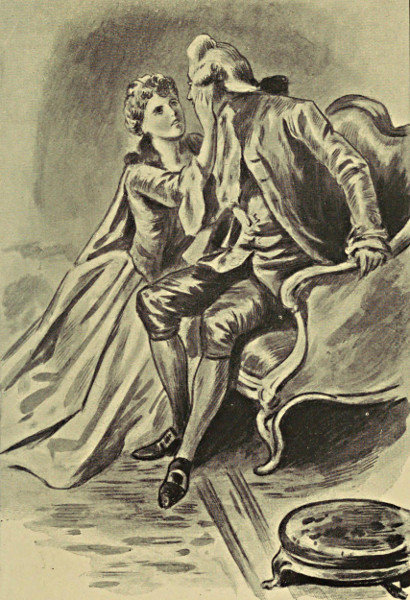
Her brother clasped his hands over his bosom, and,
with his eyes fixed on her face, listened in amazement.
She had become the embodiment of the music. She was
the spirit of the song made visible. All the pure maidenly
ecstasy, all the virginal rapture was made visible. Before
she had ended the recitative, every one who ever heard
that lovely singer was prepared to hear the rustling of
the angels’ wings. It was the greatest painter of the day
who heard her sing the sublime melody, and painted his
greatest picture—one of the greatest pictures ever painted
in the world—from her.
“Saint Cecilia—Saint Cecilia, and none other,” said
Sir Joshua Reynolds. “She sings and draws the angels
down when she calls upon them.”
But the jingling harpsichord!
“It is unworthy of her,” cried her father, taking his
hands off the keys before playing the prelude to the air.
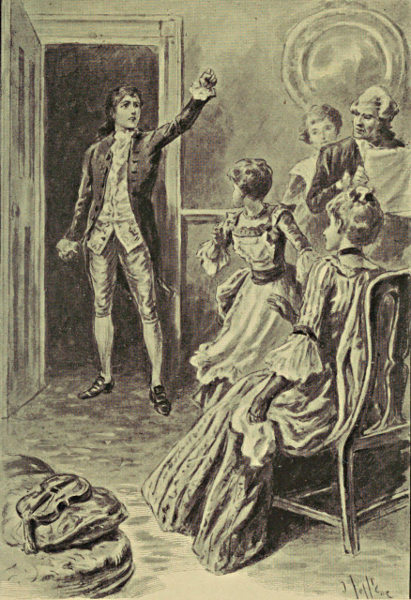
In an instant her brother had caught up his violin; he
had been tuning it while they had been talking—and
began to improvise an obbligato with the confidence of a
master of the instrument. And then with the first sound
of the harpsichord came that exquisite voice of passionate
imploration:
“‘Angels, ever bright and fair,
Take, oh, take me to your care.’”
She had never sung it so well before. She had never
before known how beautiful it was. And now, while she
sang, the violin obbligato helping her onward, she became
aware of distant angel-voices answering her—soft and low
they were at first, but gradually they drew nigh, increasing
in volume and intensity, until at the end of the first part
the air was thrilling with the sound of harps, and through
all the joyous confidence of the last phrases came that
glorious harp-music, now floating away into the distance,
and anon flashing down with the sound of mysterious
musical voices in response to her singing. At the last she
could see the heavens opened above her, and a flood of
melody floated down, and then dwindled away when her
voice had become silent.
There was a silence in the room. Even the father, who
thought he knew all the magic that could be accomplished
on the fourth string, was dumb with amazement and delight.
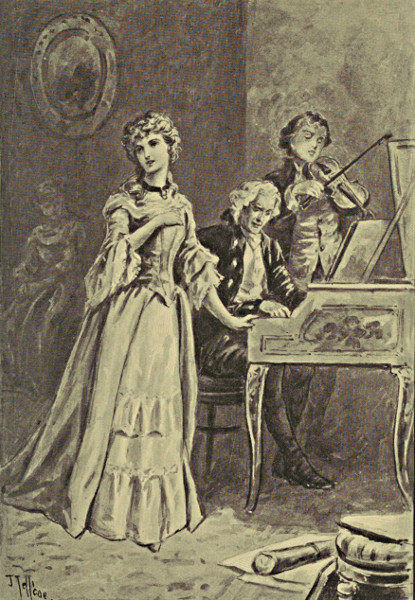
“Angels, ever bright and fair,
Take, oh, take me to your care!”
[page 24.
“Ah, my sweet sister,” said the violin-player, “your
singing has led me to perceive something of the beauty
of that aria. I think I caught a glimpse of the country
to which it leads one. Thank you, my Betsy. Neither of
us can go very far beyond the point that we have reached
to-night.”
“That point has never been reached in the world
before!” cried the father. “I know what has been done,
and I give you my word that here, in this room, a point
of musical expression has been reached beyond what the
greatest of our musicians have ever aimed at.”
“What Tom said when a child has turned out true,”
said Polly. “Yes, we are all geniuses, and the half of
Bath may be seen outside the house enjoying a free
concert.”
Tom drew one of the blinds and looked out; there was
a crowd of some hundreds of persons in the street. The
oil lamps shone upon the rich brocades of ladies who had
been in both the Assembly Rooms, and upon the gold
lace of the fine gentlemen who accompanied them. Richly
painted chairs had been set down on the pavement, and
the roofs tilted up to allow of the sound of the music
reaching the occupants, whose heads, white with powder,
sometimes protruded beyond the lacquered brass-work of
the brim of their chairs. The linkboys stood with their
torches in the roadway, making a lurid background to the
scene. The moment that Tom drew back the blind, the
yellow light from without flared into the room.
“Cielo!” he cried, lifting up his hands, “Pierrepont
Street is turned into a concert-room.”
“The only marvel is that we have not had several
visitors,” said his father. “It was widely known through
Bath that you were to return to us this evening. I feared
that we should not be allowed to have a quiet hour or two
to ourselves. The good folk here are as fond of a new
sensation as were the Athenians. How can we account
for their considerate behaviour to-night?”
Betsy laughed.
“I think I can account for it,” she cried. “Look out
again, Tom, and try if you cannot see a Cerberus at the
door.”
“A Cerberus?” said he, peering out at the edge of the
blind. “I’ faith, I do perceive something that suggests
one of the great hounds which I saw at the Hospice of
St. Bernard—an enormous mass of vigilance, not over-steady
on his legs.”
“A three-decker sort of man, rolling at anchor?” suggested
Polly, the pert one.
“An apt description,” said Tom.
“I will not hear a word said against Dr. Johnson,” cried
Betsy. “He has kept his promise. When I told him
that you were coming home to-day, he said: ‘Madam,
though your occupation as a singer entitles every jackanapes
to see you for half a crown, still, in order to inculcate
upon you the charm of a life of domesticity, I shall prevent
your being pestered with busybodies for one night. I shall
take care that no eye save that of Heaven sees you kiss
your brother on his return.’”
“Dr. Johnson is not without a certain sense of what
is delicate, though he may be in one’s company a long
time before one becomes aware of it,” said Mr. Linley.
“Betsy did not tell you what he said when she thanked
him,” cried Polly. “But he rolled himself to one side,
and pursed out his lips in a dreadful way. ‘Tell the
truth, Miss Linnet,’ said he at last. ‘Tell the truth: do
you indeed welcome my offer, or do you not rather regret
that the young rascals—ay, and the old rascals too—will
be deprived of the opportunity of having their envy aroused
by observing the favours you bestow on the cold lips of
a brother?’ Those were his very words.”
“And his very manner, I vow,” laughed her father; and
indeed Miss Polly had given a very pretty imitation of the
Johnsonian manner.
“Never mind,” said Betsy. “If he only succeeds in
keeping away Mrs. Thrale, he deserves all our gratitude.”
And it was actually Mrs. Thrale whom Dr. Johnson was
trying to convince that she had no right to enter the Linleys’
house at that moment.
Hearing that Tom Linley was to return after an absence
of four years in Italy, and knowing the spirit of impudent
curiosity that pervaded the crowds of idlers in Bath, Dr.
Johnson had posted himself at the door of 5, Pierrepont
Street, when he learned that Tom had reached the house,
and he had prevented even those persons who had legitimate
business with Mr. Linley from intruding upon the
family party.
He was having a difficult task with Mrs. Thrale, for the
sprightly little lady had made up her mind to visit the
Linleys and have at least one bon mot respecting Tom
circulated among the early visitors to the Pump Room
before any of her rival gossips had a chance of seeing the
youth. But she found herself confronted by the mighty
form of Johnson a few yards from the door of their house.
“Dear sir,” she cried, “you are doing yeoman’s service
to the family of Linley. Oh, the idle curiosity of the people
here! How melancholy is the position of a public character!
Every fellow who has ever heard Miss Linley sing fancies
he is privileged to enter her house upon the most sacred
occasion; and as for your modish young woman, she looks
on the Linley family as she does upon the Roman baths—to
be freely visited as one of the sights of the place.”
“Madam, you exaggerate,” said Dr. Johnson. “The
persons in Bath whose inquisitiveness makes them disregardful
of the decencies of life do not number more than a
dozen.”
“Ah, sir,” said the lady, “you are charitably disposed.”
“Madam, to suggest that I am charitable were to suggest
that I am incapable of taking a just view of a very simple
matter, and that, let me tell you, madam, is something
which no considerations of charity will prevent my contesting.”
“Dear sir,” said Mrs. Thrale, “you will force me to
appeal to your charity at this time on behalf of Mr.
Boswell. If you do not permit him to enter the house
and bring us a faithful report of young Mr. Linley, a
whole day may pass before the Pump Room knows anything
of him.”
“Psha! madam, do you know the Pump Room so
indifferently as to fancy that it will wait for any report of
the young gentleman before forming its own conclusions on
the subject of his return?”
“Ah, Dr. Johnson, but Mr. Boswell is invariably so
accurate in his reports on everything,” persisted the lady.
Little Mr. Boswell smirked between the cross-fires of the
yellow lamplight and the lurid links; he smirked and
bowed low beneath the force of the lady’s compliment.
He had not a nice ear either for compliment or detraction:
he failed to appreciate the whisper of a zephyr of sarcasm.
But his huge patron was not Zephyrus, but Boreas.
“Madam,” he cried, “I allow that Mr. Boswell is
unimaginative enough to be accurate; but he is a busybody,
and I will not allow him to cross this threshold.
List to those sounds, Mrs. Thrale”—Polly in the room
upstairs had just begun to sing, with her two sisters, a glee
of Purcell—“list to those sounds. What! madam, would
you have that nest of linnets disturbed?”
“Is Saul also among the prophets? Oh, ’tis sure
edifying to find Dr. Johnson the patron of music,” said the
lady with double-edged sweetness.
“Madam, let me tell you that one cannot rightly be said
to be a patron of music,” said Dr. Johnson. “Music is an
abstraction. One may be a patron of a musician or a
painter—nay, I have even heard of a poet having a patron,
and dying of him too, because, like a gangrene that proves
fatal, he was not cut away in time.”
“And just now you are the patron of the musicians,
sir?” said the lady.
“Just now, madam, I am hungry and thirsty. I have a
longing to be the patron of your excellent cook, and the still
more excellent custodian of your tea-cupboard. Come,
Mrs. Thrale, sweet though the sounds of that hymn may be—if
indeed it be a hymn and not a jig; but I hope it is a
hymn—take my word for it, madam, a hungry man would
like better to hear the rattle of crockery.”
“Dear sir, I feel honoured,” cried Mrs. Thrale. “But
who will take charge of your nest of linnets in the meantime?”
“Our friend Dr. Goldsmith will be proud of that duty,
dear madam,” said Johnson.
“Madam,” said Dr. Goldsmith, “I have my flute in my
pocket; if any one tries to enter this house, I swear that I
shall play it, and if every one does not fly then, a posse of
police shall be sent for. You have heard me play the flute,
doctor?”
“Sir,” said Johnson, “when I said that music was of all
noises the least disagreeable, I had not heard you play upon
your flute.”
“No, sir; for had you heard me, you would not have
said ‘least disagreeable’—no, sir; least would not have
been the word,” said Goldsmith.
“Pan-pipes would be an appropriate instrument to such a
satyr,” said a tall thin gentleman in an undertone to another,
when Johnson and Mrs. Thrale had walked away, and
Goldsmith had begun to listen in ecstasy to Tom Linley’s
playing of Pugnani’s nocturne.
“Ah, friend Horry, you have never ceased to think ill of
Dr. Goldsmith since the night you sat beside him at the
Academy dinner,” said the other gentleman.
“I think no ill of the man, George,” said Horace Walpole.
“Surely a man may call another a scarecrow without malice,
if t’other be a scarecrow.”
“’Tis marvellous how plain a fellow seems when he has
got the better of one in an argument,” laughed George
Selwyn, for he knew that Walpole had not a good word to
say for Goldsmith since the former had boasted, on the
narrowest ground, of having detected the forgeries of
Chatterton, thereby calling for a scathing word or two from
Goldsmith, who had just come from the room where the
unfortunate boy was lying dead.
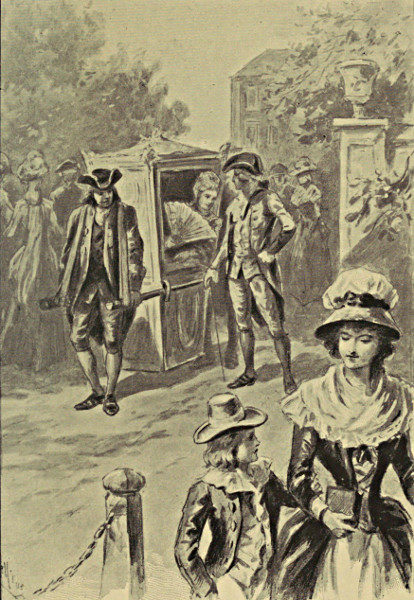
The two wits walked on toward the house that Gilly
Williams had taken for a month; but before they had gone
a dozen yards they were bowing to the ground at the side
of a gorgeous chair carried by men wearing the livery of the
Duchess of Devonshire, and having two footmen on each
side.
The beautiful lady whose head, blazing with jewels,
appeared when the hood was raised, caused her folded fan
to describe a graceful curve in the direction of Walpole,
while she cried:
“You were not at the Assembly to-night, Mr. Walpole.”
“Nay, your Grace, I have scarce left it: we are on the
fringe of it still,” replied Walpole.
“Under Miss Linley’s window,” said the duchess.
“Wherever Miss Linley sings and the Duchess of
Devonshire listens is the Assembly,” said George Selwyn.
“I have heard of one Orpheus who with his lute drew
inanimate things to listen to him,” said the duchess;
“Miss Linley seems to have equal powers; for were it
otherwise, I should not have seen my Lord Coventry in
Pierrepont Street to-night.”
“Your Grace doubted whether the people flocked to
Miss Linley’s concerts in the Assembly Rooms to hear
her sing or to feast on her beauty,” said Walpole.
“Well, now I confess that I am answered,” said her
Grace, “for the singer did not deign to appear even at a
window. But I call it a case of gross improvidence for a
young woman to be so beautiful of feature, and so divine
of voice at the same time. Either of her attractions should
be enough for one in a humble position in life. I call it a
waste. Now tell me frankly, Mr. Selwyn, is Miss Linley
as beautiful as your friend Lady Coventry was—the first of
them, I mean.”
“Madam, there have been but three beautiful women
in the world; the first was Helen of Troy, the second was
Maria Lady Coventry, and the third is——”
“Miss Elizabeth Linley?” cried the duchess when
George Selwyn made a pause—a pause that invited a
question—the pause of the professed raconteur who fully
understands the punctuation of a sentence. “What?
Miss Elizabeth Linley?”
“Madam, the third is her Grace the Duchess of Devonshire,”
said Selwyn with a bow.
“Oh, sir,” cried the duchess, “you are unkind to offer
me such a compliment when I am enclosed in my chair. I
protest that you have no right to take me at such a disadvantage.
Pray consider that I have sunk to the ground
at your feet in acknowledgment of your politeness. But
pray note the silence of Mr. Walpole.”
“’Tis the silence of acquiescence, madam,” said Selwyn.
“Pray let Mr. Walpole speak for himself, Selwyn,” said
the duchess. “As a rule he is able to speak not only for
himself, but for every one else.”
“’Twas but the verse of Mr. Dryden which came into my
mind when George spoke of his three beauties, duchess,”
said Walpole:
“‘The force of Nature could no further go;
To make a third she joined the other two.’”
“’Tis the compliment of a scholar as well as a wit,”
said her Grace—“a double-edged sword, keen as well as
polished, which I vow there is no resisting. What return
can I make for such favours—a sweet nosegay of favours in
full bloom and tied with a riband of the finest brocade?
The flowers of compliment are ever more welcome when
tied with a riband of wit.”
“O Queen, live for ever!” cried Selwyn.
“Nay, sir, that is not a reply to my question,” said the
duchess. “I asked you what return I can make for your
compliments?”
“True, madam, and I reply, ‘O Queen, live for ever!’
in other words, give Mr. Gainsborough an order to paint
your portrait,” said Mr. Selwyn.
“Ah, now ’tis Mr. Gainsborough whom you are complimenting,”
said the duchess. “Alas! that we poor women
must be dependent for immortality upon the pigments of
a painter!”
“Your Grace is in the happy position of being independent
of his pigments except on his canvas,” said Walpole.
“But let me join my entreaty to Mr. Selwyn’s. Give to
posterity a reflection of the privilege which is enjoyed
by us.”
“I vow that the king I feel like to is King Herod,” cried
the duchess.
“And with great reason, madam,” said Walpole: “we
are the innocents slain by your Grace’s beauty.”
“Nay, that was not the episode that was in my mind,”
laughed the lady. “Nay, ’twas t’other one: I offered you a
favour, and you, like the daughter of Herodias, have demanded
a human head—in pigment. But I have pledged
myself, and I will e’en send a note to Mr. Gainsborough
in the morning. What! the concert is over? Gentlemen,
I trust that you are satisfied with your night’s work?”
“Madam, should it be known that it was George and
myself who brought about this happy accident, we should
rest secure in the thought that we too shall live among
the immortals,” cried Walpole.
“Future generations shall rise up and call us blessed,”
said Selwyn.
“And what will Mr. Gainsborough say?” asked the
duchess.
“If he were a man like one of us, he would be in despair
of ever being able to execute the task which your Grace
imposes on him,” said Walpole.
“True, if he were not supported from one day to the next
by the thought of being for another hour in your Grace’s
presence,” said Selwyn.
The beautiful lady held up both her hands in pretty
protest, while she cried:
“If I tarry here much longer, I shall find myself promising
to give sittings to Sir Joshua Reynolds and the full
company of Academicians; so a good-night to you pair of
flatterers. Heaven grant that I get safe home! Your al
fresco concert-goers jostle one horribly.”
The two gentlemen bowed while her Grace’s chair was
borne on through the sauntering crowd, for the house
which had been the centre of the gathering had now become
silent, and the candles in the drawing-room were extinguished.
The clocks had chimed out the first quarter past
eleven—an hour when most Londoners were in bed; but
Bath during the eighteenth century was the latest town in
England, and long after the duchess’s chair had been borne
away, long after Walpole and his friend had sauntered on
to Gilly Williams’s; long after Johnson had lectured the
saturnine brewer, Mr. Thrale, on the evil of Mr. Thrale’s
practice of over-eating (Johnson himself was enough of an
anchorite to limit himself when at Streatham to fifteen
peaches before breakfast, and an equal number before
dinner, and had never been known to swallow more than
twenty cups of tea at a sitting); long after Dr. Goldsmith had
worried poor Mr. Boswell by pretending to be taking a note
of Dr. Johnson’s sayings for the day, having, as he affirmed,
an eye to a future biography of the great man; long after
Miss Linley had knelt down by her bedside to thank Providence
for having restored her dear brother to his home,
even though Providence had seen fit to supplant her in her
brother’s affection by an abstraction which he called his
Art; long after the night had closed upon all these incidents
in the beautiful city of Bath, some people were still
sauntering through Pierrepont Street.
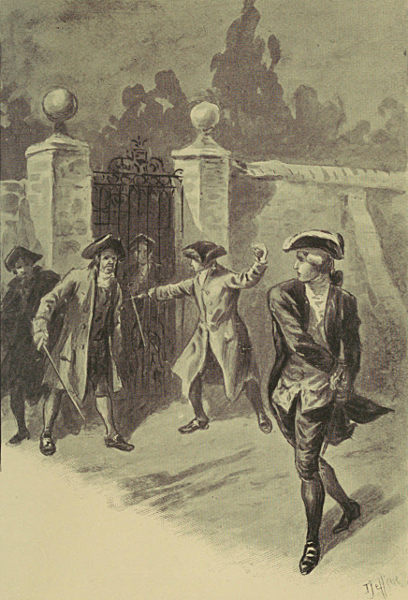
From the left there sauntered a young man of good figure
and excellent carriage. He wore a cloak, and he had tilted
his hat over his eyes, in imitation of the prowling young
man on the stage. He kept on the dark side of the street
and looked furtively round every now and again. He
slipped into a deep doorway when almost opposite the
house of the Linleys, and stood there with his eyes fixed
on the highest windows.
“Sleep, beloved, sleep,” he murmured, with a sentimental
turn of his head. “Sleep, knowing naught of the passion
that burns in the heart of thy faithful swain, who wakes to
watch over thy slumbers.”
He was so absorbed in his rhapsodising that he failed to
notice the approach of another young man from the opposite
direction to that from which he himself had come. The
other was somewhat taller, and his carriage was better
displayed by the circumstance of his being uncloaked,
and of his walking frankly along the street until he too
had reached the dim doorway. Then with a glance up to
the windows of the Linleys’ house, he too slipped into
that doorway.
He started, finding that another person was there—a
man who quickly turned away his head and let his chin
fall deep into the collar of his cloak.
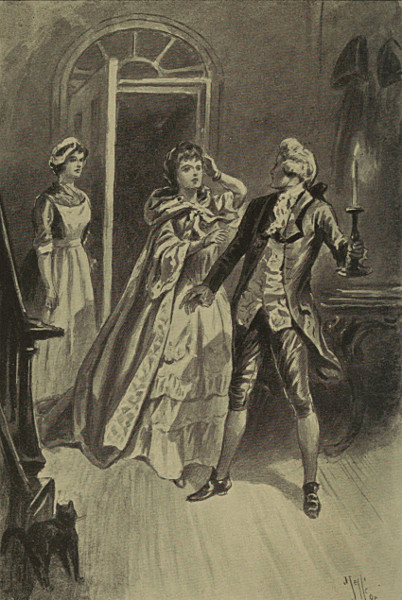
“What! Charles?” cried the newcomer. “Why, I left
you at home going to your bedroom half an hour ago.
What, man, have you turned footpad that you steal out
in this fashion and wearing a cloak?”
“I trust, brother, that one may take a quiet walk without
having to give an explanation of its purport,” said the first
sulkily.
“To be sure—to be sure,” said the other. “I suppose
that Joseph, even before he became a patriarch, took many
a stroll in the cool of the night through the streets of
Thebes—or was it Memphis?—without reproach.”
“For that matter,” cried the first, with some irritation
in his voice, “what was your motive in coming hither,
brother Dick? Did not you say that you were going to
bed also?”
“I—oh, I only came out to search for you, Joseph—I
mean Charles,” said the second. “Yes, Jo—Charles,
hearing you leave the house by the back, I thought it the
duty of a younger brother to see that you did not get into
any harm. Good heavens, brother! what would become
of the Sheridan family if the elder son were to fall among
thieves? Do you think that our patriarchal father would
be satisfied if he were shown his Joseph’s cloak saturated
with red claret? Come home, Joseph, come home, I
entreat of you. You can compose your sonnet to Betsy
Linley much more fluently at your desk at home. Besides,
father has a rhyming-dictionary—an indispensable work of
reference to a lover, Charles.”
“What do you mean, Dick?” said Charles in an
aggrieved voice—the aggrieved voice afterwards assumed
by the representative of the part of Joseph in The School
for Scandal. “Brother, I really am surprised to find you
making light of so estimable a family.”
“As the Linleys or the Sheridans—which?” cried Dick.
“Oh, man, come home; the girl is asleep hours ago and
dreaming of—of you, maybe, Charles. Think of that, man—think
of that—dreaming of you! Oh, if you have any
appreciation of a true lover’s duty, you will hasten to your
bed to return the compliment by dreaming of her.”
Mr. Richard Brinsley Sheridan put his arm through his
brother’s, and Charles suffered himself to be led away to
their house on the Terrace Walks, protesting all the time
that the man who rushed hastily to conclusions was more
to be execrated than the footpad, for the latter was content
when he had stolen a man’s purse, whereas the other....
“True—true—quite true, Joseph,” said Dick. “We
can make another score or two of those sentiments when
we get home. Father has a copy of the ‘Sentiments of
all Nations’ as well as a rhyming-dictionary.”