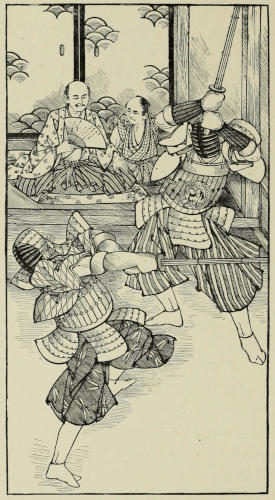
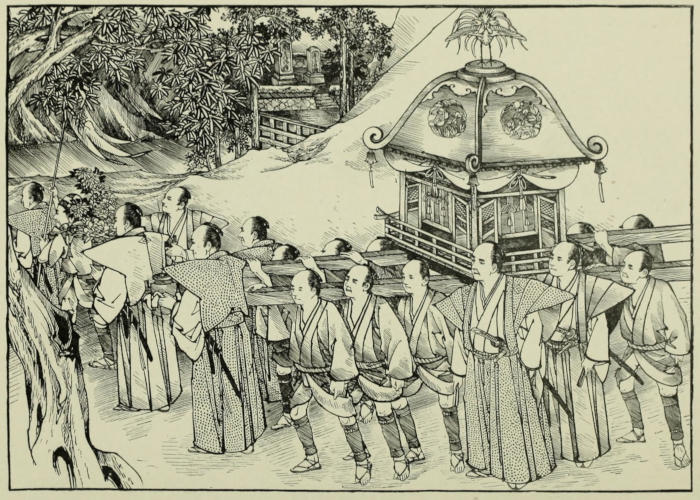
TO
MY DEARLY BELOVED SISTER EMILIE In Brotherly Affection THIS BOOK IS DEDICATED BY THE AUTHOR
PREFACE.
This story is an original tale of Old Japan, written almost
from a Japanese point of view. It might be translated
into that language; and, rendered in book form or told on a
street corner by one of the itinerant story-tellers, the reader
or listener would think it to accord fully with the traditions
of the period in which it is supposed to have been enacted.
Whether such a treatment will meet with approval here, it
remains for the public to say. I have adhered to it against
the advice of several eminent literary friends, to bring the
story more into accord with our canons of style and construction.
From the standpoint of a Japanese, none of the incidents
or situations are in the slightest degree strained or exaggerated,
and none of the characters overdrawn. All the historical allusions
are strictly true and authentic,—as far as present knowledge
on the subject goes,—and have been carefully and
painstakingly culled from native chronicles.
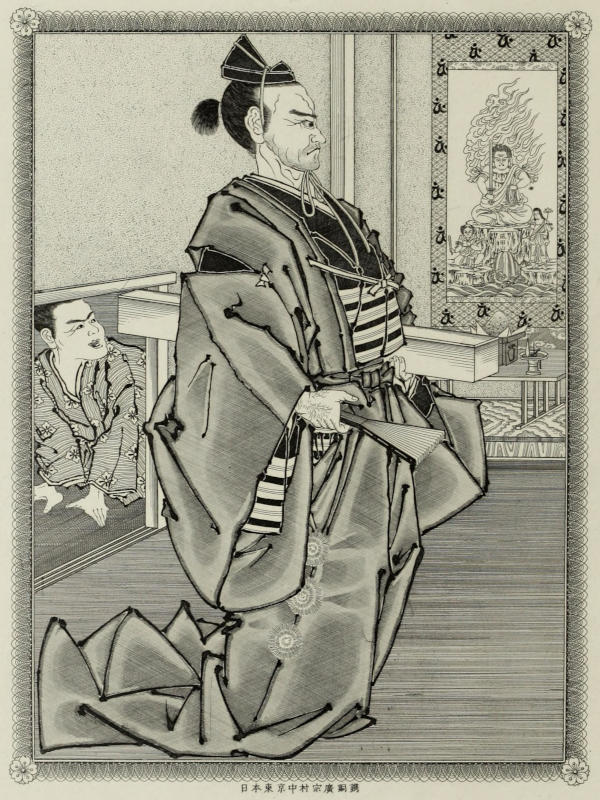
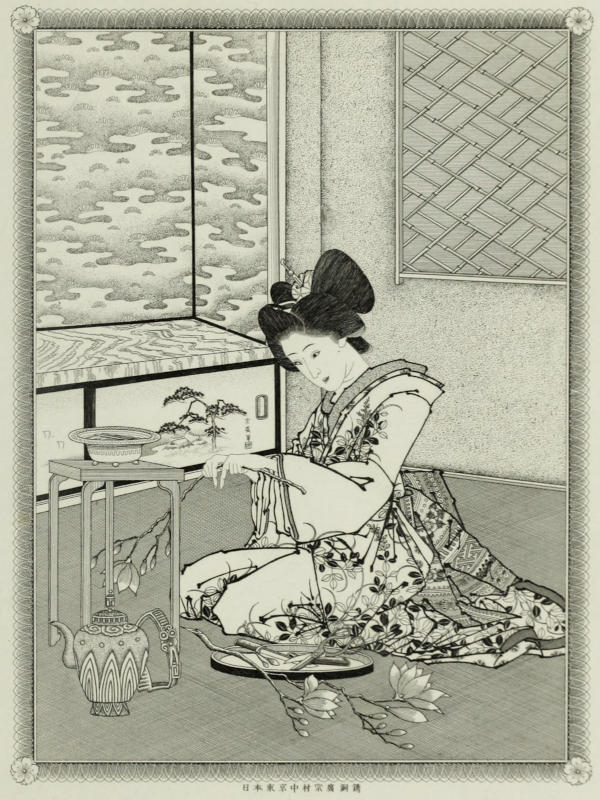
The five engravings on copper have been executed by a
young Japanese, Mr. Nakamura Munehiro, of Tokio, one of the
best engravers in Japan, who also made the original drawings
for the same. The other pictures were drawn by Shirayama
Dani, a young porcelain painter in the employ of Fujiyama,
of this city. It shows the versatility of Japanese artists, that
although the young man had never in his life done anything
but porcelain painting, which is done in pure wash, he succeeded
without instruction, in a very few days, in making
pictures for reproduction. In spite of their sharp outline they
are done not with pen and ink, but with a Japanese brush.
LOUIS WERTHEIMBER.
LIST OF ILLUSTRATIONS.
PAGE
ETCHINGS ON COPPER.
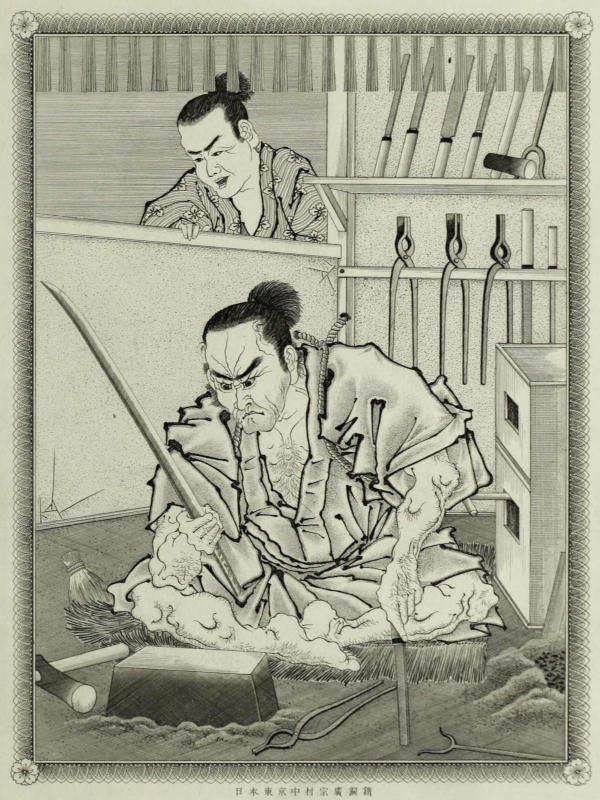
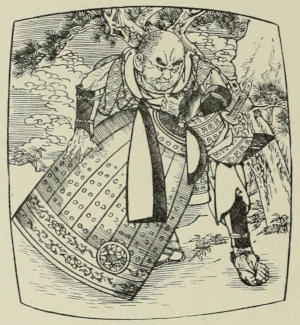
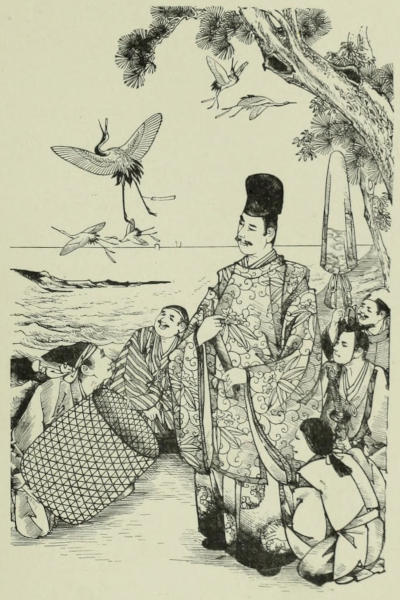
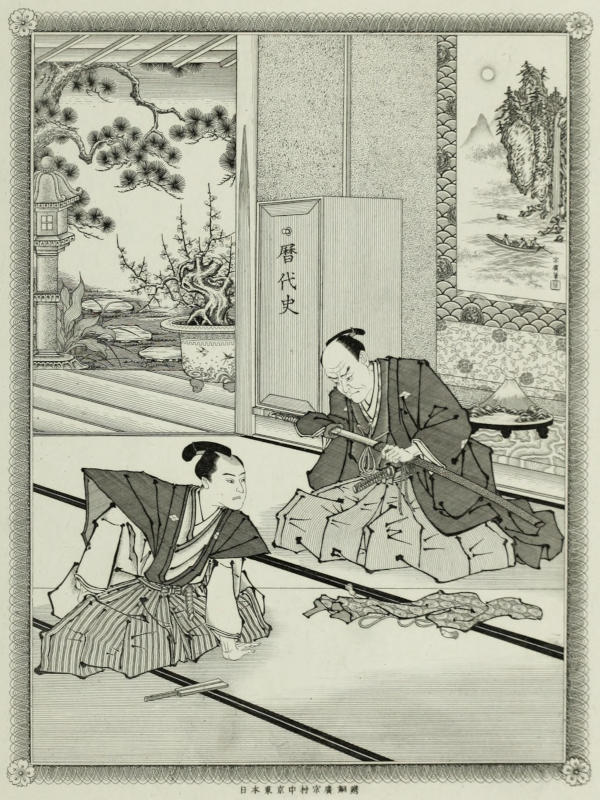
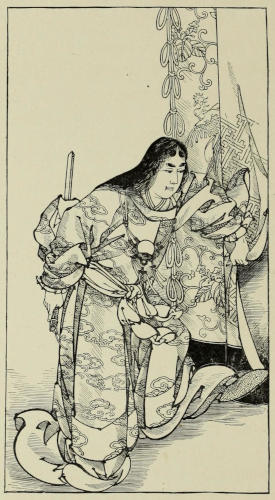
Muramasa invoking the Blessing of the Gods on a newly forged Sword
One day in my wanderings in that quarter of the city of
Tokio given up to the habitation of the poorer classes of
the community, I stopped to rest for a moment at the lowly
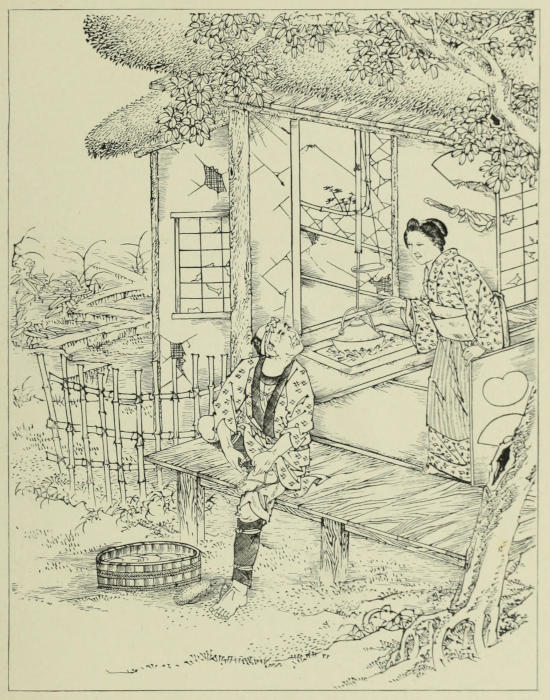
hut of an old jinrikisha man whom I had had frequent occasion
to employ theretofore. Finding the old man and his wife
at home, I sat down on the porch, and after a while succeeded
in drawing the couple into something like conversation.
The hut which they occupied was poor enough. It stood
on the edge of a small sweet-potato field, and contained only
two rooms, the floor of each one covered by two mats of the
usual size, and therefore exactly six feet square. The extreme
cleanliness of the place—although this quality in general is
common in Japan—struck me at once, in spite, or partly on
account, of the extreme poverty, which was equally evident.
The sliding paper-covered doors, which also served as windows,
had been taken out, and I could look through the house, which
contained nothing in the way of furniture, not even a pine
cloth-chest such as is seldom lacking in the poorest habitations,—nothing,
in fact, except a few patched cotton quilts
which served for beds, bedding, and covering, rolled up in a
corner. The thick straw mats, although their outside covering
was in part worn off by use, showed not a speck of dirt or
dust, and the bare upright timbers were perfectly white from
frequent washing and scrubbing.
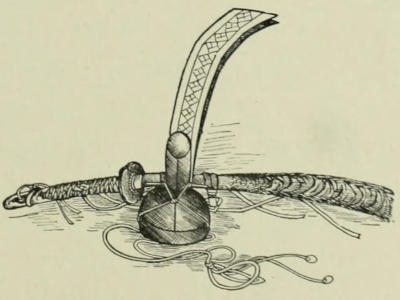
Noticing on one side of the room an old sword hanging on
two wooden pegs, I asked to be allowed to look at it, and it
was rather hesitatingly, as I thought, handed to me. In former
years only the samurai, or men of gentle blood, were allowed
to wear two swords, and always did so. They esteemed this
as their most prized prerogative, and guarded the privilege
with extreme jealousy as long as they enjoyed it, which was
until the Government prohibited the practice a few years ago.
The mere possession of a sword is now free to everybody, and
many tens of thousands of these weapons at present serve for
fish and kitchen knives, or for other common purposes.
Drawing this one from its wooden scabbard, I found it
bright and shining; and being an amateur collector, I could
see that it was no ordinary blade.
“Who is the maker?” I asked, almost mechanically, as I
usually did when my Japanese friends favored me with a sight
of their old family swords.
The answer came very slowly, and not until an inquiring
glance showed that I was surprised at not getting it sooner:
“It is a Muramasa blade, your honor.”
“A Muramasa!” I exclaimed, jumping up in genuine surprise;
“and how in the name of Buddha did you manage to
get hold of a Muramasa?”
THE OLD JINRIKISHA MAN AND HIS WIFE.
My astonishment was natural. I had in the course of years
succeeded in making a collection of swords of the best makers;
but it was only after a long search, and at an expense which
was felt to be considerable even by an ardent amateur like
myself, that I had been able to acquire an undoubted and
genuine piece of handiwork of the artisan who, with the single
exception perhaps of Masamune, was certainly the most
celebrated sword-smith of Japan.
“It has been in the possession of my family, your honor, for
five centuries and a half,—ever since it was given by the maker
who forged it, Senjuin Muramasa, to one of my ancestors at
Ise, the place where they both resided.”
The man’s voice, although, as heretofore, humbly polite in
its manner, had now a new ring,—something like a tone of
cold formality; such a tone, it seemed to me, as might have
characterized the voice of a polished Greek slave replying to
some coarse word of his brutal Roman master.
There was a pause of a few moments, which the thought of
my abrupt rudeness rendered awkward and even painful to
me. I was the first to break the silence, addressing him in
the language which is used among equals, instead of, as heretofore,
employing such terms as are used to inferiors,—a distinction
which in Japanese is strongly and definitely marked.
I could see by a quick, startled movement, as well as by the
play of his features, that the change was deeply felt, and the
motive which prompted it appreciated. “I have for years
been a student of sword-lore,” I said, “and I know that every
Muramasa blade has a history of its own, fraught with numerous
romantic and thrilling incidents. This one here must have had
its share, with which, under the circumstances, you are doubtless
familiar; and I should esteem it a great favor to be permitted
to listen to any narrative you may choose to recall, more especially
as regards the time when the smith was yet alive.”
I had touched a sympathetic chord in the old man’s heart
by this concession alike to his family pride and his love for the
sword. It is not easy for a foreigner to understand how completely
the sword has entered into Japanese life. Poets and
minstrels, warriors and statesmen, lord and vassal, have honored
it in word and deed for more than a millennium. To a
greater extent than any other agent, probably, it has moulded
and shaped the history of that country into its setting of gallant
chivalry and self-immolating feudal devotedness, and has written
its record on thousands of well-contested battle-fields, in the
quivering body of a living book. Only within a few years has
it begun to outlive its power; but its renown is imperishable.
The story told by this poor jinrikisha man, as we sat on the
porch of his humble dwelling, constitutes but one simple chapter
in this wonderful history. It illustrates the spirit which pervaded
Old Japan, the veneration which attached to the sword, and the peculiar
personal obligations of honor which rested upon all samurai
in those feudal times. As the story was related to me, so I tell
it here, regretting only that in the process of translation it must
lose much of local color and characterization, but hoping that
in spite of this it may be found to possess an interest purely its
own, independent of the way in which it is now narrated.
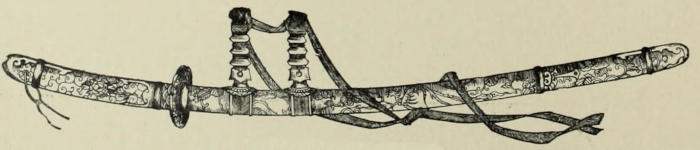
JAPANESE SWORD.
CHAPTER I.
It was in the year of our Lord 1322, according to the
Japanese calendar the fourth year of the reign of Go Dai
Go Tenno, the ninety-fifth descendant of Jimmu Tenno, and
nineteen hundred and eighty-two years from the time when
the latter had assumed the title of the “First Emperor of
Japan.”
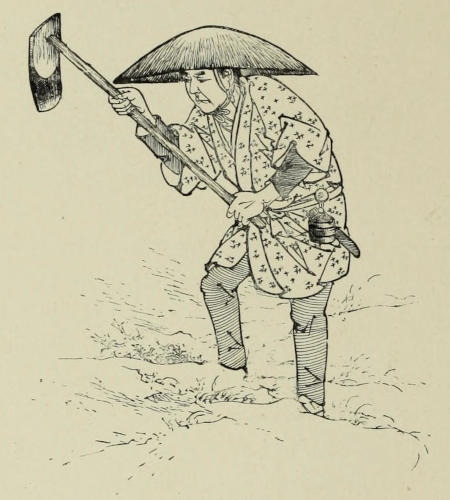
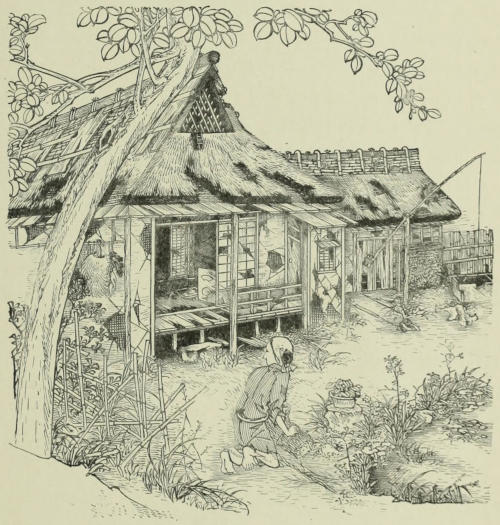
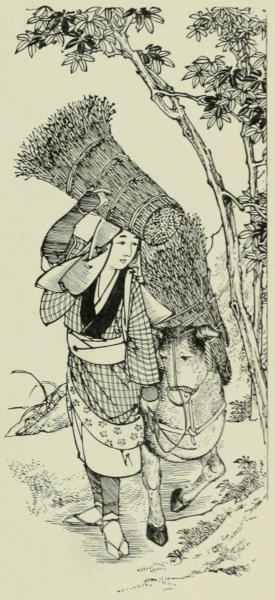
FARM LABORER.
For the first time in its history a general peace, lasting for
more than a century, reigned over the land. Guerilla and
border warfare, it is true, was still carried on, in a desultory
manner, in different parts of the empire; feuds between the
daimio of neighboring provinces were no rarities; and the
kataki-uchi, the Japanese vendetta, still caused many bloody
tragedies to be enacted, and year after year claimed its thousands
of victims. All such disturbances, however, originating
in private jealousy and personal enmity, had during this period
been merely local, without expanding sufficiently to assume a
national character, as in former centuries, when one half of the
fighting population was constantly at war with the other. During
a hundred and two years no organized revolt against
the authority of the Shôgun, or rather against the Ilōjō family,
who were the real rulers, had occurred. The administration of
the latter, both civil and military, was, it is true, excellent in
most regards,—a fact which not even their enemies could
gainsay. The success with which they had repelled the invasion
of the Tartar force sent by Kublai Khan, with its countless
ships and its tens of thousands of warriors, showed them
to be brave and skilled in war, while the general prosperity of
the empire gave ample evidence both of their knowledge of
the country’s needs and of their ability to enforce those measures
by which the arts of peace are made to flourish. Farmers
tilled their lands free from the harrowing care which beset
their forefathers as to whether they would be able to enjoy
the fruits of their labor, or whether roving bands would seize
the garnered harvest and even force the young and strong to
become unwilling recruits among the henchmen and servants
attending the feudal chiefs. The advance in commerce, art,
and more especially in learning and the polite accomplishments,
had been extraordinary, and their regenerating influence had
gradually made itself felt in all parts of the empire. Plenty
and apparent security reigned everywhere; and yet it was felt
and known by those who cared to think and who took notice
of passing events, that the end of this period of tranquillity
was inevitable, and moreover even now near at hand. Every
coming day might see the smouldering embers of discontent,
hitherto concealed, blaze forth into a fierce and destructive civil
war.
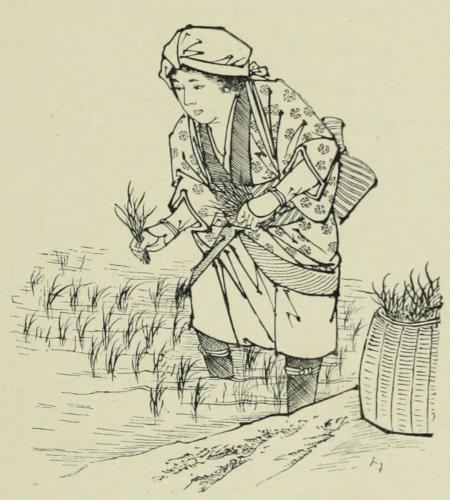
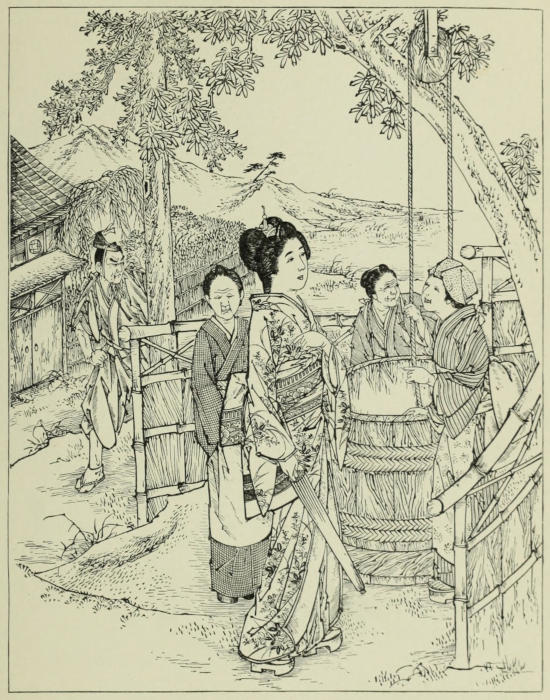
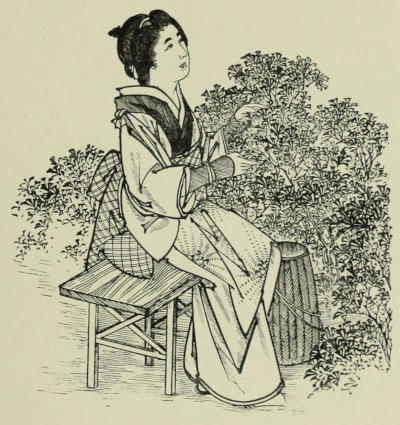
WOMAN SOWING RICE.
One of the surest signs of the trouble impending was the
increased military activity displayed at the court of every
daimio. The coming conflict cast its shadow before, not in
boisterous speech or loud-mouthed denunciation, but in the
training of body and limb to be duly prepared for action requiring
physical strength and endurance. Horses were made to
learn their paces, swords and lances were sharpened, buckler
and shield were burnished, and every armorer’s workshop
echoed the sounds of toil from early morning until late at
night.
Kuwana, the capital of the province of Ise, could at this
period boast of one of the gayest and yet most martial courts
in the land. The character of the reigning Duke, who had
ruled for more than thirty-six years, was such that although
courage, daring, and manly accomplishments could well look
for their due meed of reward at his hands, deeds of unjustifiable
violence and ill-will found no opportunity to interfere
with or check the progress and prosperity of the land.
He was now fifty-five years old, and had become stout and
fleshy and—for he loved the wine-cup no less than the sword—gouty
as well, and he was frequently obliged to be carried
to his pavilion on the field to witness sports in which, not so
very long before, he used to participate and shine in a way that
few could equal. Traces of his former prowess were still evident
in his face and bearing, despite his corpulence and bodily
helplessness. There was about him a self-possession, or rather
a self-assertion, of manner which appertains only to those who
have learned to maintain themselves and their rights in positions
of importance and difficulty; and to do this in those times
required physical strength as well as qualities of the mind
which go to make up leaders of men. His bright, fierce eye
followed closely and with evident enjoyment every motion of
those among the actors who showed more than ordinary skill;
and when any unusually daring feat was performed, his hands
and arms worked convulsively, and he swayed himself to and
fro as if to assist with his body where only his eyes could
take part.
Ono ga Sawa, as the Duke was called, was feared and held
in awe by his neighbors, who in the desultory border warfare
in which they had sometimes been engaged, had found that his
dare-devil courage was equalled by his astuteness, his energy,
and his extraordinary tenacity. By the people of his province,
and more especially by his retainers, to whom he was a
kind and considerate master, he was honored and respected.
He loved boldness and valor, and even in speech he encouraged
frankness and openness to a degree rare with those in
his position. Of a jovial and good-natured disposition withal,
he ever approved of mirth and frolic, and often at the dinner-table
bandied jokes with his attendants, and would even bear
from those he liked a return in kind.
MYTHOLOGICAL GODS OF JAPAN.
There was only one point upon which it would have been
injudicious to speak with freedom in his presence. The old
lord had a great veneration for family and gentle birth, for
blue blood and for the superiority to which the possession
of a long line of ancestors could justly lay claim. He was
fond of displaying his genealogical tree, showing his descent
from Nakatomi no Kamatari, the celebrated minister of Tenchi
Tenno in the seventh century, who himself was a descendant
of the royal house of Fujiwara. When excited by wine he
did not stop there, but would count back to Jimmu Tenno,
the first Emperor of Japan, two thousand years ago; and he
was even known at such times to refer to Isanami no Mikoto
and Isanagi no Mikoto, the primeval mythological gods of the
country, in a way which seemed to show plainly that he
considered himself as standing in some sort of relationship
with them. Now there was not a
scullion in the kitchen, nor a sandal-bearer
in the courtyard, who did
not indulge in jokes at this propensity;
for they all knew that the old
gentleman’s grandfather was a common
peasant, who in the wars which
followed the accession
of the Minamoto family
to the Shôgunate,
when he was pressed
as a soldier, had by
personal bravery
and native force of
character raised himself to the position of a military general.
His son, the father of the present lord, had in his early youth
been apprentice to a dyer, and from thence had been called to
the camp of his parent when the latter began to acquire military
glory. But the bravest of the brave military retainers at
the court would sooner have faced unarmed a wild boar than
breathe a word of doubt or even show a look of incredulity
when, as so often happened, the old genealogical tree was taken
down and explained to them. Etiquette at that time was not
what it became much later,—an element of such importance
in the education of every samurai as to curb temporarily the
fiercest temper and force the most headstrong passions to
subordinate themselves to time and place. The long reign of
peace had its softening influence; yet, although threatening
talk and angry looks were not as likely as before to lead
to immediate violence, they were strangers neither at the
festive board nor in the council-hall. An utter disregard,
however, for all rules of society as they existed even then,
and a reckless fashion of indulging his passions when aroused,
made Ono ga Sawa a man to be carefully humored by his
attendants.
An incident which had happened ten years previously was
still fresh in the memory of every one. An embassy had
arrived from the province of Sendai to arrange a marriage
between the son of the lord of that province and a daughter
of Ono ga Sawa. All the preliminaries had been concluded,
and a grand festival and banquet were being given in honor
of the occasion. Toward the end of the carouse, when wine
had loosened tongues and conversation had become general, the
chief ambassador, perhaps in ignorance or inadvertence, but
more probably from a desire to check the feeling of pride
with which he had so often been received, essayed a joke
about the silk which faced the dress of his host. “You
must be a good judge of dyeing, and perhaps have a special
receipt handed down to you, to give that ribbon such a rich,
deep purple color,” he began; but if he had intended to say
more, the general silence which followed this remark caused
him to refrain. The sudden cessation of all mirth and conversation
struck those present as with a chill, and the laughing
faces of a moment before now showed only anxious looks
furtively directed toward their lord.
Ono ga Sawa’s face, though flushed with wine, became overspread
with a deadly pallor. The silence of his followers not
only prevented him from overlooking a remark which in cooler
moments he might perhaps have disregarded, but gave it undue
prominence. Before the assembled guests had twice drawn
breath he had unsheathed his small sword and aimed a desperate
blow at the ambassador. The excess of his fury, rather than
a natural shrinking away on the part of his intended victim,
caused the weapon to miscarry, only slightly grazing the other’s
skin and drawing a few drops of blood; but this was sufficient
to enable him to regain his self-control. Those composing
the ambassador’s suite had risen with muttered threats and
placed themselves behind their chief; while the Kuwana men,
who formed the large majority, also rose and surrounded their
lord. The latter, however, now perfectly calm, with one glance
caused his retainers to resume their stations. Slowly replacing
his sword, to show he meant no further violence, but only
half sheathing it, and keeping it firmly grasped, he said: “The
only kind of dyeing I understand is dyeing with blood; those
spots upon your doublet now show the same color as my ribbon,—the
color of blood, the color I love to see whenever
honor demands it.”
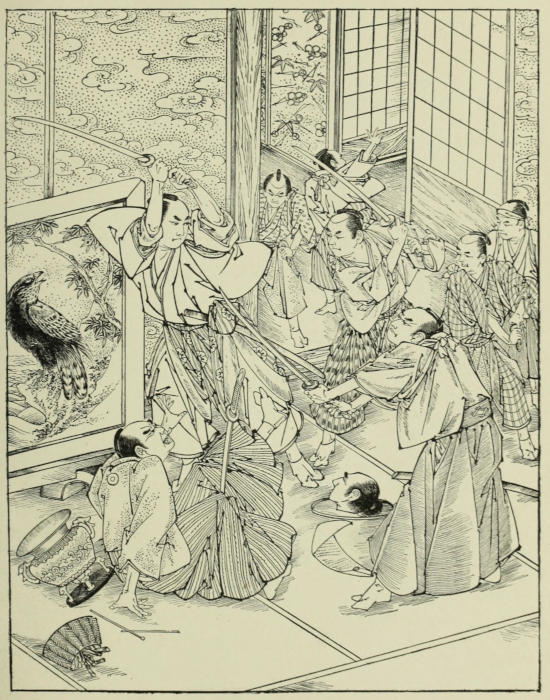
THE DUKE’S ATTACK ON THE AMBASSADOR.
In saying this, his meaning was not to be misunderstood.
He showed himself ready to stand by the consequences of his
act; yet there was a certain half-conciliatory tone and manner
about him of which the other thought best to avail himself.
He knew that if the failure of the important mission
with which he was intrusted could be attributed to his own
lack of discretion—to which in this instance it might be
ascribed, although the provocation he had given was certainly
a slight one—it would end in his own disgrace with his lord.
So, quickly collecting himself, with a laugh as natural as he
could simulate, he replied: “You have certainly given us a
good practical illustration of what you call your style of dyeing,
and if you intended it as a lesson, I will accept it as such
from you; although there are very few lords in this kingdom
for whom it would be safe or advisable to attempt a similar
course of teaching with me.”
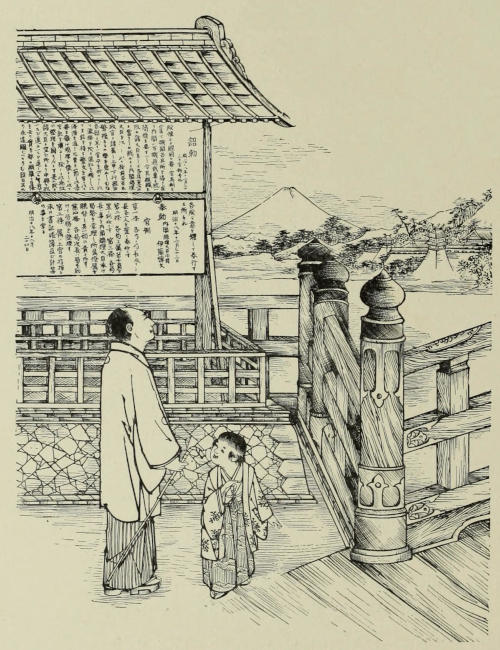
STREET BOARD FOR GOVERNMENT EDICTS.
Physical courage in those days was a common virtue, and
that of the envoy was too well known to be doubted; his
course in ignoring the rash act prompted by the other’s ungovernable
temper only raised him in the opinion of every
one present, including Ono ga Sawa himself. It was probably
the only period in the history of Japan when such an occurrence
could have taken place without entailing more serious
consequences. During the long civil wars which were soon to
follow, peaceful solutions of any difficulty were again out of
the question; and after that time the observance of etiquette
was made so imperative that such a breach of it as had been
here committed by Ono ga Sawa would have demanded redress
by law, and would have subjected its perpetrator to severe
punishment by the court of the Shôgun. On the other hand,
up to a hundred years previous, when fighting was the rule
all over the land to the exclusion
of everything else, such a course
as had been here taken by
the ambassador would certainly
not have been
appreciated; it would
have been utterly opposed to the spirit of an age which
acknowledged no other honorable means of redress than an
appeal to arms, and which did not permit any qualification as
to time and place, but demanded instant and unhesitating
action, even if self-destruction was the certain result.
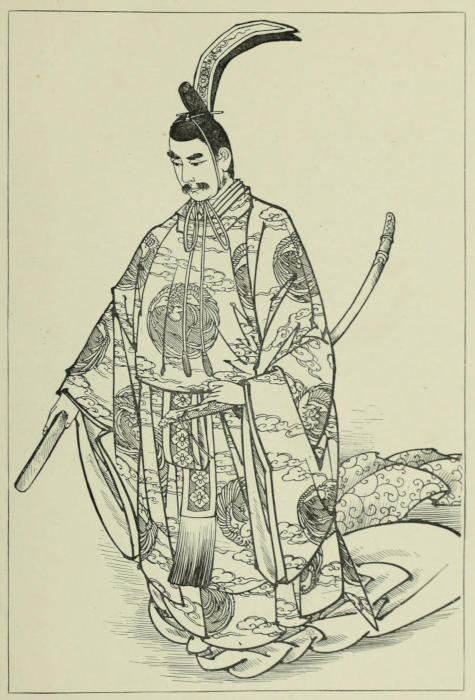
EMPEROR OF JAPAN.
But the last hundred years had wrought a considerable
change. Nominally the profession of arms was still the only
one a gentleman could engage in; but literature, art, and the
polite accomplishments had begun to claim a fair share of
attention. The strong government of the Hōjō at Kamakura
had improved laws and regulations and caused them to be
respected, thus imbuing the rising generation with a sense of
order and obedience to which their forefathers had been strangers.
It was a salutary discipline, which naturally found its
counterpart in a certain self-restraint introduced into the social
relations of life, into the intercourse between man and man.
Every samurai was still ready and eager to serve actively as
a soldier; but in the absence of such opportunities he tried
to show his aptitude for other pursuits. Many descendants of
the royal house of Fujiwara more especially distinguished
themselves in civil employment.
The centre of the whole movement—from whence, indeed,
it derived its principal support—was the Mikado’s court at
Kiyoto. Soon after the close of the great struggle which saw
the Minamoto family firmly established as Shôguns, the songs
of the high priest Tiun, son of the Kuwambaku Tadamichi,
first officer in the above court, had taken a powerful hold on
the public mind. As early as the year 1232 the issuing and
editing of a full and complete edition of all the valuable lyric
and heroic poetry then extant had been intrusted to Fujiwara
no Sada by the Mikado himself. In the succeeding reign the
brother of the governing Emperor, the high priest Yen Man
In,—a man equally noted for erudition, for courtly manners,
and for the charm of his conversation, who, although ordained
for the church, exercised, by his talent for government, supreme
influence at the court,—greatly quickened the advancement of
learning, of letters, and of the polite accomplishments.
By the middle of the century the intellectual current had
filtered into and permeated the purely military court at Kamakura,
where the reigning Shôgun had called upon Kiyowara,
a celebrated sage, to review and explain to him the well-known
Chinese work Tei Wan (or “Guide for the Conduct of Rulers
and Sovereigns”), and Tokiyori, lord of Sagami, his first minister,—a
man of the type of Yen Man In, who by mere force of
character and capacity was the virtual ruler of the Shôgun’s
court, as much as the other was at the imperial court,—himself
copied and commented upon the work Tei Kuwan Sei
Yo (“Study of the Principles of Politics”), publishing it in his
own name. In the beginning of the fourteenth century the
effects of this regeneration had made themselves felt more or
less in every part of Japan, and although military prowess was
held in as high esteem as ever, its value was greatly enhanced
if added to it was some degree of polite learning, dignity, and
courtliness of manner. Ono ga Sawa himself attached great value
to these latter qualities, and the action of the lord of Sendai’s ambassador
in ignoring and adroitly turning into a sort of joke what
would certainly not have tended to the other’s credit if treated in
earnest, caused him a feeling of satisfaction which he was generous
enough not to conceal. The mission was a complete success,
an early consummation of the marriage was agreed upon,
and the ambassador on his return was loaded with presents.
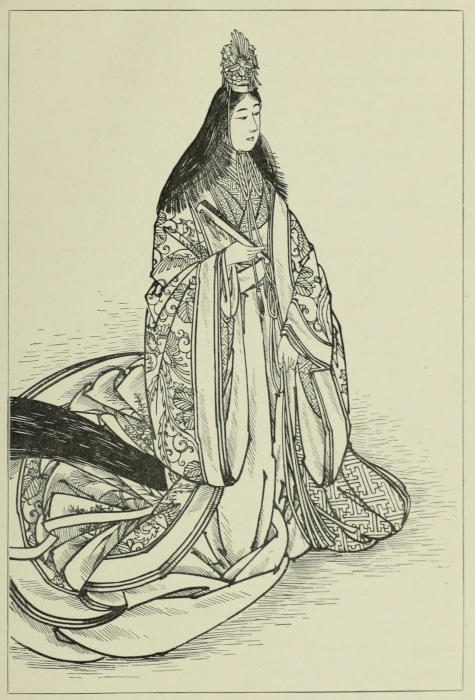
EMPRESS OF JAPAN.
It may well be imagined that those whose duty called
them to the court avoided, even in the lightest of humors
engendered by the wine-cup, a subject fraught with so much
danger. It was not a great hardship to do this where so much
to pass the time pleasantly and agreeably offered itself. Amusements
and festivities were not wanting, the province was well
governed, the harvests for years had been good, the hand of
the tax-collector lay lightly upon peasant and citizen alike;
and a plentiful crop having again been garnered in the year
of which we write, the usual harvest festival, with its attendant
games and military exercises, was about to be celebrated
on even a grander scale than usual.
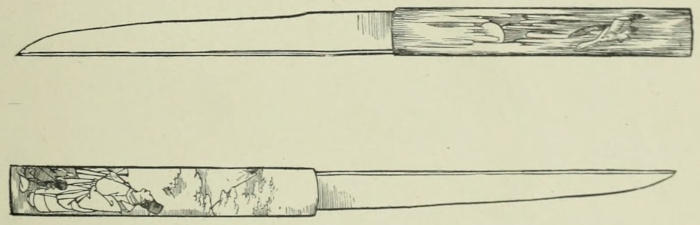
SWORD DAGGERS.
CHAPTER II.
The evening before the appointed
day all the inns were filled to
overflowing, and fresh visitors arrived far
on into the night, only to be followed,
with the dawn, by still greater
crowds. Most of them were farmers
from the surrounding
country; but a goodly
share of strangers was
not wanting, and all found
plenty to interest them.
Theatres at that time
were not known; but
tight-rope performers,
jugglers, dancers,
story-tellers, and ballad-singers
were in
abundance, all doing a thriving trade.
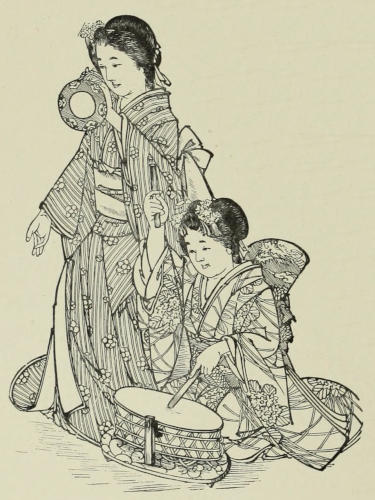
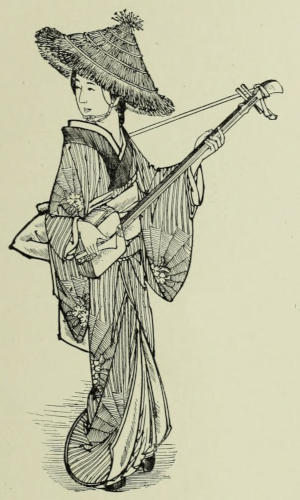
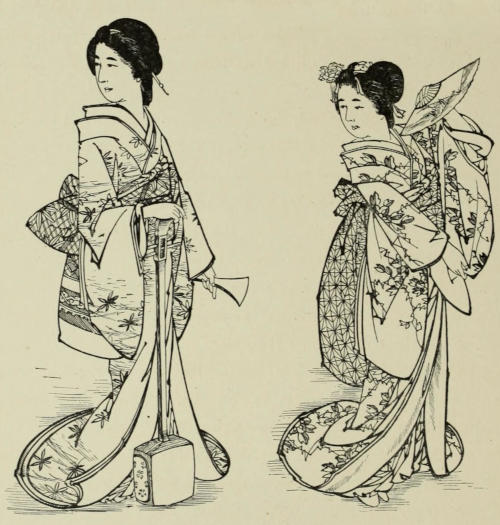
SINGING GIRLS.
Among the spectators was a party of three, who had come
late in the day and who stood on a little knoll close to one
of the entrances, looking at the feats of riding and of kisha
(archery on horseback), dakiu (polo), inu-o-mono (dog-hunting),
and other sports. The group consisted of a tall, sinewy man
of about thirty-five years, although his sad, furrowed face at
first sight made him look much older, a boy not more than
ten by his side, and behind these two one who was evidently
an old retainer. The boy was the son of his companion, as
could be seen at a glance, in spite of the difference between
the fresh, bright, sunny countenance of the one, and the careworn,
anxious look of the other. The contour of the lad’s
face was the same as that of the man; the mouth, although
smiling with the innocence of childhood, had the same resolute
cast, and the eyes, now flashing with delight at the gay scene
before them, shone with that look of cool, determined daring so
conspicuous in the father. In the man’s case, indeed, this last
feature was developed to an extent rarely seen; yet it nevertheless
seemed so utterly at variance with the settled, gloomy dejection
which overspread his face that even a passer-by would
have been disposed to step and wonder whether such a character
could bear to submit to even the most pitiless blows of
fortune, rather than battle with them and win victory or find
rest in death. In this melancholy aspect, the man offered a
marked contrast to the great throng of sight-seers, whose faces
reflected only mirth and enjoyment; and they looked at him
from time to time with no little awe, giving to him and his
companions a wide berth, although the grounds elsewhere were
crowded. Perhaps the dresses of the party, which showed them
to be samurai, contributed to this feeling of respect; for members
of the military class did not generally, on such occasions,
mix with the common people, but remained on the platforms
and stands erected for them. Although, however, the three travellers
wore samurai dresses, these were of the poorest description,
stained by travel and weather, and the two swords which each
carried in his girdle showed no ornament whatever.
The games had been progressing for some time, and the
horses—often mercilessly punished—became excited and restive;
when at last one, whose youthful rider had treated him
to too many kicks of his heavy stirrups, became uncontrollable,
and dashing madly by the grand stand where Lord Ono ga
Sawa was sitting, galloped headlong toward the entrance.
Two of the nimble-footed bettoes (horse-boys) who tried to
stop the runaway were thrown off without difficulty, and a few
steps more would have brought the horse in contact with the
frightened crowd of human beings congregated beyond the
barriers, when the older stranger, already mentioned, stepped
forward, and catching hold of the bridle, arrested the animal
without apparently any very great exertion. The rider, who
had managed to keep his seat upon his runaway steed, expressed
his warmest thanks; and shortly afterward a special
messenger came with Ono ga Sawa’s orders to offer places to
the stranger and his party, and to invite them to participate in
the games, if they desired to do so. A ready assent was given
to this invitation, and after seeing his companions seated, the
stranger mounted a horse provided for him and entered the lists.
From the very outset he showed himself to be more than a
match for any one present, excelling in riding, fencing, archery,
and in every other manly accomplishment there displayed. Yet
his face never relaxed its severe, taciturn expression; and although
he was scrupulously polite and attentive to every detail
of knightly courtesy, he went through it all, not like an enthusiastic
votary, but rather as a man fulfilling a duty which
involved no thought of pleasurable excitement. A very flattering
invitation to visit the castle and partake of the feast
spread there, and also to present himself formally before the
Duke, was at once extended to him.
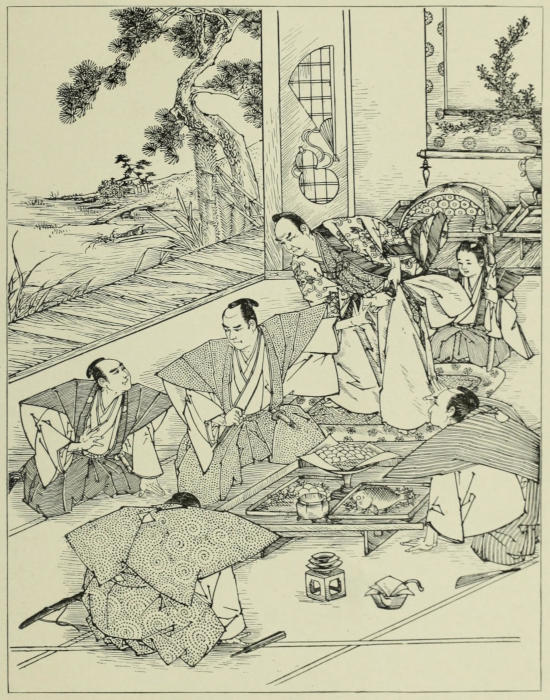
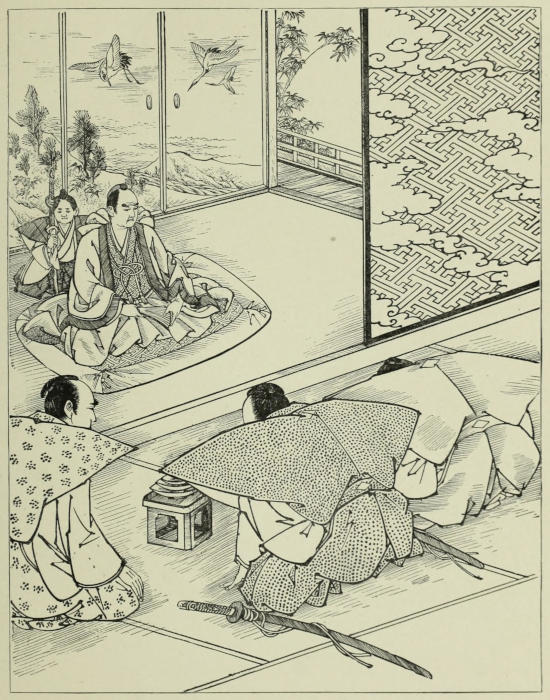
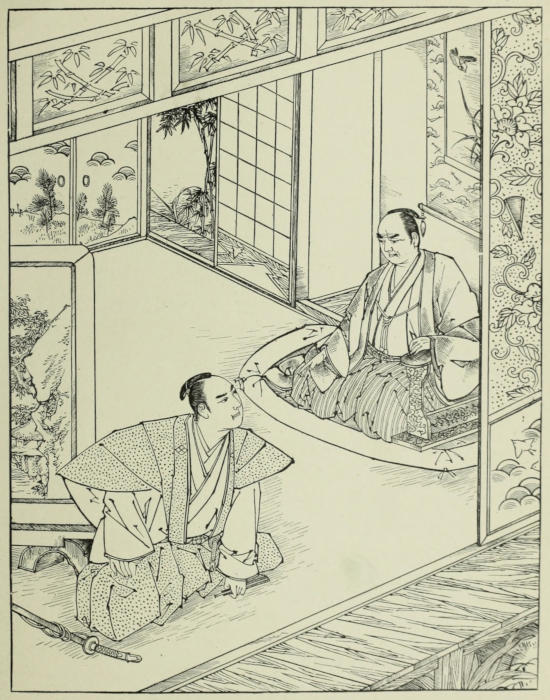
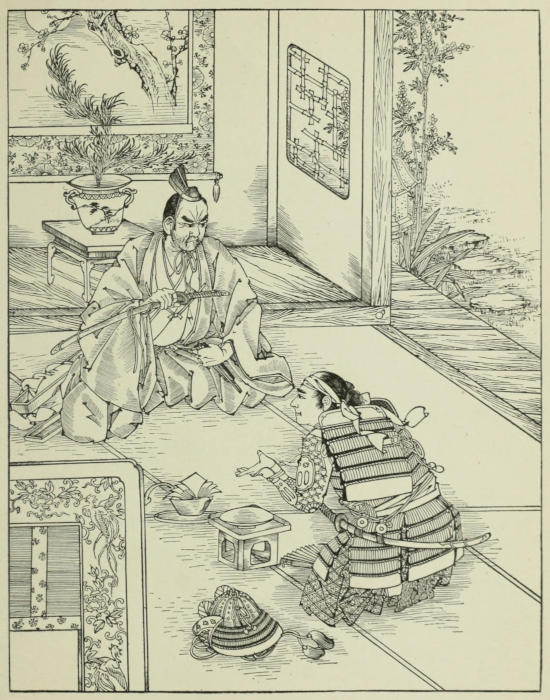
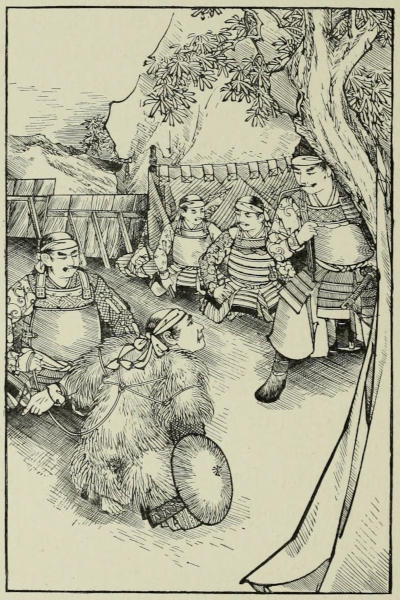
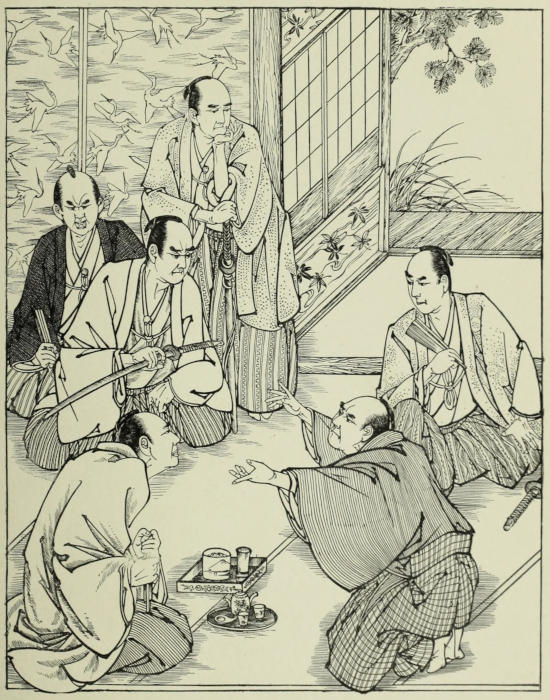
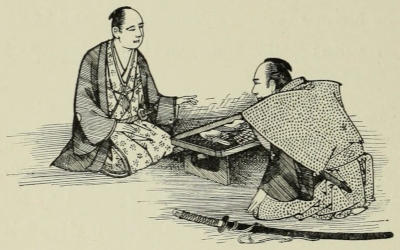
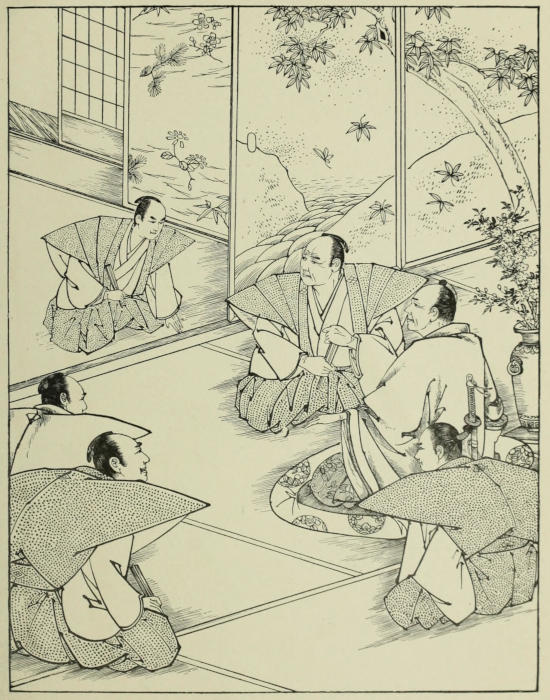
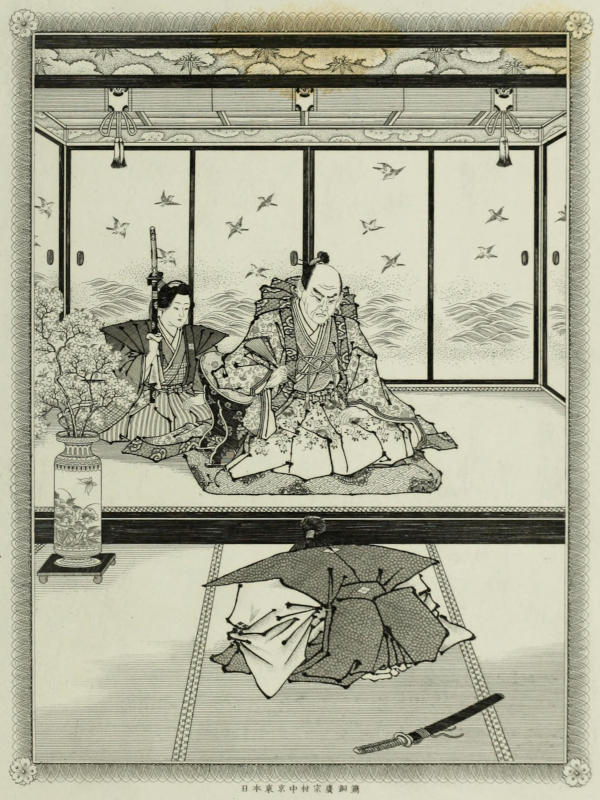
THE DUKE RECEIVING MUTTO.
When in the evening he repaired thither with his companions,
it was easy to see that the report of his exploits had
preceded his arrival. Every eye was upon him as he passed
to the inner hall, where Ono ga Sawa, surrounded by his principal
vassals, received him with more state and ceremony than
an unknown and unheralded stranger could well have expected.
“I have been a pleased witness of your feats of strength and
skill to-day,” the Duke began, after the new-comer had made the
usual obeisance, “and I wish to ask you whether, if not bound by
other ties, you are willing to engage yourself at my court.”
“I am now seeking where to tender my services, and I shall
be thankful to be able to do so here,” was the rather short,
but respectfully given, answer. When the Duke spoke again,
his tone was a shade less courteous and pleasant. The stranger
had taken his grace too much as a matter of course. He expected
a little more empressement. He was accustomed to see
his favors received more demonstratively; and being of a jovial
disposition himself, this cold, unbending reserve in place of the
warm acknowledgments which he expected somewhat displeased
him.
“You know who I am,” he said, and as he continued, the
shade of hauteur which he had assumed deepened; “I am
Ono ga Sawa, the lord of this province, the descendant of
Kamatari; and I require that those who surround me shall be
men of tried valor and attainments, as well as of distinguished
family and honorable name. The first of these qualifications you
have shown that you possess in an eminent degree, and it only
remains for me to ask who you are and where you come from.”
The stranger bowed his head low; but his humility did not
affect his tone of speech, which was firm and decided. “If
your highness deigns to accept my services, although there
may be many superior to me in abilities, none will excel me in
strict performance of my offices and in readiness to fulfil a
samurai’s duties, even to the shedding of the last drop of my
blood in your behalf. I come from a family old and noble,
and not very long ago standing high in the country where we
lived; and were it not that I had known that your highness
was a lord of great merit and high repute, I never would have
asked for or even accepted your offer of engagement. I am
now a ronin, and am called Mutto Nobuyuki; but my real name
and where I come from I cannot disclose.”
There was a pause which appeared very long to the assembled
courtiers, during which the Duke scrutinized the stranger
with a searching glance. What he saw there probably satisfied
him that the other had spoken truly. In a tone which,
although stern, showed nothing of displeasure, he at last
said,—
“You have given me abundant proof of your prowess of
body and skill of arm; and if the strength and depth of your
devotion prove equal to these, as well as to your boldness of
speech, I can well congratulate myself upon enlisting you in
my service.”
“I have spoken as becomes a free, unfettered samurai,” replied
the stranger. “Once admitted among your liegemen, my
speech will seldom be heard except in due deferential response
to your orders.”
“Be it so, then. You shall have your house within the
castle, and I will herewith make you an allowance of fifty koku
of rice for your maintenance.”
This was certainly a liberal allowance for those times, and
Mutto acknowledged it in fitting terms. He then asked permission
to introduce his son, and the boy’s bright, intelligent
face and frank yet respectful behavior found great favor. The
Duke spoke to him in a kind, almost fatherly, way, and on
dismissing him ordered his treasurer to give him a few gold
ornaments to put on his sword. He also directed that a seat
at the banquet should be assigned to him by the side of his
father. This brought the audience to a close. Etiquette required
them to remain at the feast until after the Duke had
left the hall, and it was far into the night before they retired
to the house which in the mean time had been prepared for
their reception. Their servant, Yamagawa, had arranged everything
in their new domicile; and although their own luggage
was meagre enough, nothing necessary for comfort was lacking,
the Duke having given special orders that everything that was
wanted should be supplied from the ducal storehouses.
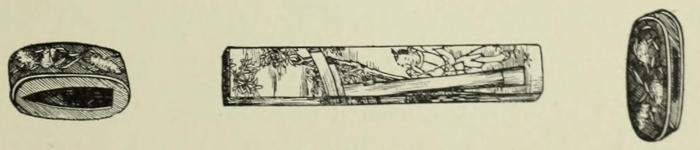
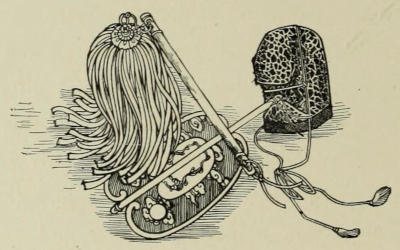
SWORD ORNAMENTS.
CHAPTER III.
In this place for some years to come the three strangers continued
to live a quiet, uneventful life. Mutto scrupulously
attended to his court duties as one of the chamberlains at the
palace; but every moment of the time which he could call his
own was devoted to the education of his son. Sennoske, as
the boy was called, was already at the age of fifteen a man
inferior to none, and almost the equal of his father in all manly
accomplishments. Nor had his mind been forgotten. Mutto
himself was a fair scholar, and where he thought himself deficient,
or was unable through lack of time to devote the necessary
attention, he had taken care to secure the best teachers.
The latter gladly undertook the charge of instructing the boy,
whose aptitude for acquiring knowledge was as marked as his
ways and manners were winning. His father strictly supervised
and regulated his studies, and showed himself somewhat a hard
taskmaster, who never allowed Sennoske leisure for any amusements
except such as would either strengthen his body or
improve his mind, and the boy grew up having no desire for
other recreation. Although passionately fond of books and of
indoor studies, the tendency of the times and the examples set
before him by his father, as well as by others, roused his ambition
and prevented anything like neglect of physical training.
This severe bodily and mental work had become easy to him,
and to pass from one to the other was all that his system
needed, and all the enjoyment he cared for. His intense love
and admiration for his father, and the pleasure which he derived
from the gratification the latter showed at his quick and steady
progress, was another reason, if one had been needed, to impel
him to diligence. To Sennoske his father was everything that
was good and great and noble. He knew and felt how much
kindness and sympathy
were hidden
under that austere
taciturnity which in
all these years had
never relaxed into the
faintest semblance of a
smile. He remembered
a sunny childhood in a beautiful home, where his father had
laughed and played with him, always showing a gay, cheerful
face; and he felt what a terrible shock must have been given
to that nature by some fearful calamity, thus to freeze up all
apparent sympathy and feeling for the outside world. He had
no knowledge of what could have been the catastrophe that
wrought this change; and any allusion to their former life, although
not forbidden in so many words, was yet discouraged
by his father in a way that prevented his ever referring to it.
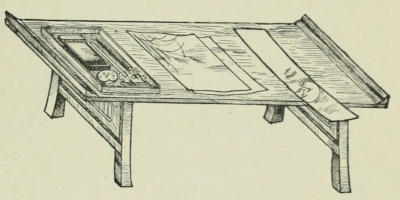
WRITING TABLE.
Among those who contributed to Sennoske’s training was
one whose name was then already famous in Japan,—Muramasa,
the sword-smith. An immense gulf divided, at that time,
the samurai from the merchant, the farmer, the artisan, and,
in fact, from all other classes. To this rule the sword-smith
formed the only exception. He Who could forge a sword fairly
well stood far higher in social rank than the artisan of equal
skill in any other profession; and a master of the art, however
low his extraction, was considered and treated as an equal by
the two-sworded gentry. Muramasa then stood at the head of
his profession, without a rival in the country. His superiority
was acknowledged by his brother artisans as well as by the
nobility; and many of the latter—men of great means too—would
willingly have beggared themselves to obtain a sword
of his making. To have a man like this living in his dominions
was considered a great honor, and was, moreover, a source
of real power and influence, of which the Duke was fully
aware; and he had made to the smith the most extravagant
offers of money, titles, and other honorary considerations to
induce him duly to inscribe himself on the roll of his feudal
retainers, but without success. Threats or coercion would have
been worse than useless with a man whom the Shôgun himself
would only too gladly have welcomed to his capital (Kamakura),
and would have honored there as highly as the Duke did in
his province. Any wilful injury done him would have been
resented as a national loss by every samurai in the country;
so Ono ga Sawa had fain to be satisfied with the sword-smith’s
independent way of living, taking care, however, to use every
opportunity to prove to him, by valuable gifts and otherwise,
the honor and esteem in which he was held.
And there was good reason for all this regard and high consideration;
for those famous “Muramasas,” as the blades were
called after their maker, were things of beauty, of joy, of pride,
and of power to their lucky possessors. The smith himself
was an expert at using as well as making his weapon, and the
proofs he had sometimes semi-publicly given of its excellence
were marvellous, and wellnigh bordered on the incredible.
He would cut a hair let fall in the air; he would hold his
sword still in the water, with its sharp edge facing the current,
and there it would of itself out a piece of paper floating toward
it; then again, to show its strength, he would cut through
a copper bar an inch in thickness without producing the slightest
mark or indentation on the blade. Once, on a memorable
occasion when discussion as to the relative merits of rival
sword-smiths ran high, he asked that any three swords of the
best makers be selected. This was done; and placing them
side by side, he dealt with his own blade terrific blow square
upon their upturned edges. It went entirely through one
sword, which was the most strongly curved, passed through the
steel edges of the others, and remained imbedded in the softer
part which forms the back. Being with difficulty extracted, it
was found that its own sharp edge had remained intact; and
there was nothing but a slightly increased brightness in three
different spots to show where it had been in contact.
Small wonder, then, that a true samurai should value such
a weapon above every other earthly possession. Money alone
could not buy one. It began to be known that only warriors
of high standing, whose reputation for valor and fighting qualities
was established, could succeed in having an order for a
sword executed. If the applicant had a name for loving fighting
for its own sake,—one who, when no opportunities
for legitimate warfare presented themselves, would hunt up
broils, quarrels, and duels,—it greatly enhanced his chances of a
favorable reception from the sword-smith. The prices paid were
always high enough; but far more liberal offers had often been
refused because made by men—as the report went—whose
reputation credited them with inclinations, if not of a pacific,
yet of a less decidedly bellicose nature. One of Muramasa’s
stipulations in former years had been that no sword bought of
him should be sold during the lifetime of the purchaser. He
dispensed with this condition now, because there was no further
need for it; the lucky possessor of such a treasure would have
sacrificed his last hakama, his mistress, his wife and child probably,
sooner than part with it.
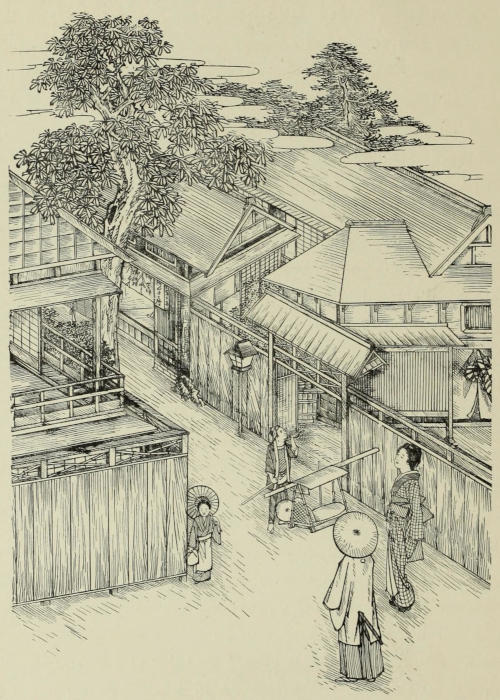
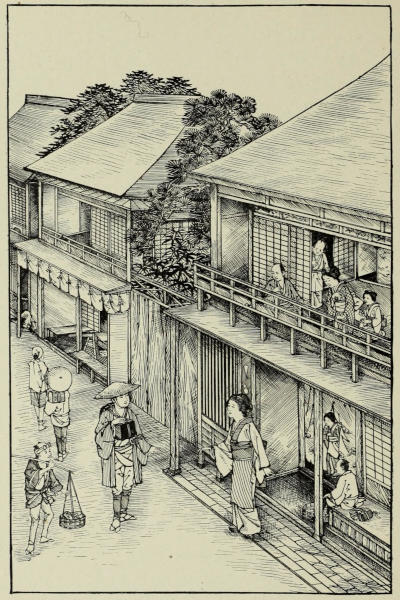
STREET SCENE IN KUWANA.
The smith’s residence was in the outskirts of the city, in
what had formerly been called the village of Senjuin. It was
a smoke-blackened, gloomy looking building of two stories close
to the street, the lower part—the doors of which were constantly
closed—being the forge. On both sides of the house
and in the rear was a yard which was enclosed with a bamboo
fence, the stakes being placed side by side and three deep,—thus
effectually preventing any possibility of getting even a
glimpse through them; while their ends were sharply pointed,
threatening certain impalement to any who should attempt
to scale them. Here Muramasa lived with his son,—who assisted
him at his craft and was initiated into its secrets,—his
daughter, and only one old woman-servant.
He was not a pleasant man to look at, this cunning forger,
whose handiwork caused the great and the mighty to do him
honor. His eyes—very large and very prominent, ready, it
seemed, to start from their sockets—had a sinister look; to
which the heavy, bushy eyebrows, heaviest and bushiest in
the space between the eyes, where they met, doubtless contributed.
A massive chin, under a small, rather thin-lipped
mouth, showed great energy and determination, while the
short stout neck, with veins like cords, the broad shoulders,
and the brawny, sinewy arms, gave evidence of great physical
strength. When speaking, two rows of large, regular, and
beautifully white teeth partly redeemed the unattractiveness of
the other features; but when angered or excited, the whole face
presented an aspect of extreme hideousness and repulsiveness.
At such times the mouth was firmly closed; the eyebrows
moved and contracted until each individual hair seemed to
stand on end; the eyes, already unnaturally large and protruding,
dilated and rolled around in their sockets with a
glitter like that of a snake; and a deep red, furrowed line
showed itself on his forehead from the crown down to the
eyebrows, making his head look as if it consisted of two
halves badly pasted together.
A parallel had often been drawn between the smith and
Mutto. Both these men, renowned for strength and skill, living
for themselves and seemingly desirous of avoiding company,
always reserved and even gloomy, and never sharing in wine-parties
or other festivities, offered a great contrast to the
usual style of conduct of the cavaliers at the court; for the
latter, acting with the spirit of the age, although ready at any
time for hard work and harder blows, believed in taking pleasure
and amusement whenever and wherever it could be found.
But when the two men once stood side by side in the court,
it was easy to perceive that however much unlike to others,
there was very little real resemblance between them.
Mutto’s athletic but slight and supple figure was cast in
quite a different mould from the smith’s heavy, awkward-looking
frame; and in so far as other than physical attributes
could be discerned, the difference became even more marked.
The look of gloom on the face of the former seemed like a
dark veil, obscuring its naturally pleasant and cheerful expression.
The regular features could never have settled into such
clearly-cut, bold, determined lines if their possessor had always
been given to inactive brooding and sorrowing. They now
spoke unmistakably of weary resignation; but it was a new-born
resignation foreign to the man’s real nature, and implanted there
by some unaccountable calamity. In demeanor he was quiet
and dignified, and in the performance of his often monotonous
duties as chamberlain he had been known to stand sometimes
for hours like a statue, scarcely moving either limbs or features.
With the smith, body and face were cast in a heavy, coarse
mould, and both gave evidence of the savage restlessness and
discontent of the mind within. Very seldom were they characterized
by anything like repose. In general the eyes rolled
about in their sockets, glancing here and there with a preoccupied
air, while the whole lower part of the face twitched
convulsively; and this movement often extended even to the
limbs and body. It was evident that no other influence but
the thoughts within him induced this unquiet. When he found
himself observed, he could by a strong effort resume outward
composure; but he would at such times hurl back a look so
vicious that few cared to encounter it twice.
The neighborhood where the smith’s house stood was very
lonely. In former years it had been a small fishing-village
called Senjuin, which in time, as the castle-town of Kuwana
gradually extended, became one of the outskirts of the latter.
This was many hundred years ago. With its loss of independence,
in spite of the proximity of the great town, it
lost also its well-to-do look, and became the resort of the very
worst and the very poorest elements of the population. During
the great Minamoto
wars, in the twelfth and
thirteenth centuries, it
suddenly developed into
prosperity. The streets
became lined with stores,
mechanics’ workshops,
small manufactories of
different articles of military
equipment; and with these, not a few wine-shops, houses
of bad repute, and gambling-dens. There was then continual
marching and countermarching; regular and irregular bodies of
troops, such as could be induced to take the field by threats
or promises, through motives
of partisan loyalty, from love
of adventure, or through the
more mercenary object of gain
or booty to be reaped, were
being continually formed, and
Kuwana had become a noted
resort for such bands to equip
themselves, most of the new
traffic concentrating itself in that part where Senjuin had
formerly stood.
The town possessed abundant natural advantages. Its neighborhood
abounded with many kinds of good woods, including
a great variety of bamboos,—so necessary in the production of
articles of every-day use. Inland products could easily and
cheaply be brought down on the river which ran beside the town.
Its situation by the sea-shore, and the never-failing supply of
fish which was thereby secured, was also of great value at a
time when fields were irregularly tilled and the cost of cereals
often reached famine prices. The advantage of being able to
go and come by sea or land was not slight, and was especially
appreciated by those lawless characters who abounded at the
time, and a goodly number of whom could always be found
there. Whatever the disposition and tendency of these gentry
might have been, however, they were kept in check by the proximity
of the castle with its garrison, which prevented anything
like excess of violence or ill-doing. Burglaries, robberies, and
murders even were no rarity; but assistance was always at
hand when a brawl assumed too great dimensions. No band
of robbers could come and levy contributions or commit other
outrages as they did sometimes in smaller towns and villages.
Thus this quarter of the town grew up and flourished as
long as the war lasted. With the return of peace this prosperity
waned, and soon departed altogether. The working
part of the population moved away nearer the castle-walls
and the old, established centre of business; and the disreputable
part, finding their occupation gone, left for other regions.
In the course of a few decades the place had become almost
entirely deserted. Some of the houses at first had been taken
down and removed, some had been destroyed by fire, and not
a few had fallen down, rotting away in unshapely heaps. All
those that yet stood were in a state of extreme decay. Passing
beggars and ronins often used them as a temporary refuge,
and a great deal of real danger to unarmed wayfarers lurked
under the shadow of this apparently deserted solitude. It was
also a favorite spot for duels and night-brawls, and many a
manly form was often found there in the morning lifeless and
covered with sword-cuts.
About nine years previous to the time when the first incidents
related in this narrative took place, Muramasa the sword-smith,
who had already acquired considerable reputation in his
craft, arrived in Kuwana, and for a trifle bought a plot of land,
where he erected his house in the manner already described. It
was the worst-reputed part of the whole neighborhood, near
the high road, which skirted one end of the deserted village,
and opposite to a large open, level space, where once had stood
houses which had been burned down, and in whose place a
plentiful supply of weeds had sprung up. These were, however,
kept well beaten down; for it was this particular spot
which was generally chosen when the brawlers or duellists
fought in greater numbers. Muramasa had been accompanied
by a young wife, a son about fourteen years of age, the offspring
of a former marriage, and an old married serving-couple.
From the very beginning he had led a lonely and solitary
life, as he did afterward. He repaired one of the old buildings
on the land he had bought, so as to make it temporarily
habitable while his new house was being constructed.
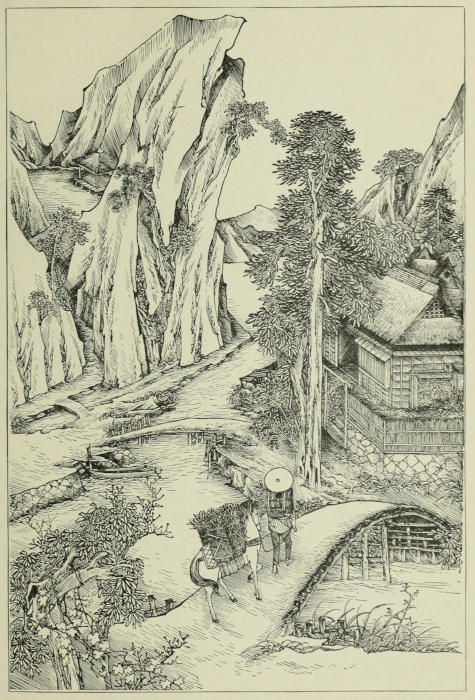
JAPANESE LANDSCAPE.
His wife always remained utterly secluded; and even of the
mechanics engaged by him to put up the new house, only one
or two got a passing glance at her through a half-open door or
window,—sufficient, however, it seems, to make them speak in
glowing terms of her marvellous beauty. Two years after her
arrival she died in giving birth to a daughter, who was named
O Tetsu. It then began to be bruited about that she had been
an Eta (a pariah), the queen
of her tribe, famous for her
surpassing loveliness. This
report, which, it was said,
first originated with a travelling
showman who had
formerly known Muramasa
in other places, gradually
assumed a more definite
shape, and it was whispered
that she had been rescued by the
smith while being abducted by some
nobleman and carried to the latter’s
castle. Rumor went still further, and
stated that it was not a man of low
degree, but one of the mighty lords of
the land who had attempted this outrage,
and that six of his most trusty
blades engaged in the execution of the
design had been cut down and disabled by the smith who fought
single-handed. Careless of the opinion of the world, he afterward
made the outcast Eta his lawful wife. He loved her fondly
and passionately, and she reciprocated his sentiments.
AN ETA.
After her death, all that there was of kindness, of love, and
of sympathy in his nature went out toward his daughter. To
the outer world he became, if possible, more grim and reserved
than he had been before. He shunned all such chance acquaintances
as he had made, he went to the court—where even
hitherto, in spite of an open invitation, he had rarely made his
appearance—only when the occasion rendered his presence unavoidable;
beyond this he paid and received no visits whatever.
The only persons who gained admittance to his house were a
few old teachers whom he had engaged for his daughter. The
aged serving-man who had accompanied him had died three or
four years after their arrival, and no one had taken his place,
the old serving-woman being the only domestic who remained
to do the necessary duties about the house.
The smith’s son, now a man over thirty years of age, resembled
his father in outward looks and appearance, and if his face
showed rather more good-humor, it was probably merely a
negative quality arising from its lack of expression. Physically
he was as strong and stout as the smith; but his mind was of
a very inferior order. He was, however, an expert in all that
pertained to swords; and on this point could discourse pleasantly
and with an intelligence that sometimes bordered on eloquence.
As regarded everything else, his mental and reasoning faculties
seemed to present a perfect blank, he being unable to understand
causes and effects, unless they were of the most simple
kind, such as could be learned mechanically. For his father
he showed great awe and reverence, and toward his half-sister
he evinced an affection which was as deep as it was humble,
and might be likened to that of a faithful dog. He displayed
it by a desire to be close to her in those short periods when
he was not engaged in work. At such times he would often
put his hand furtively but tenderly on some part of her dress;
and when she perceived it, he would bend forward, as if waiting
for a smile or a caressing word, which were the usual acknowledgments,
and to which, when given, his only response was a broad,
pleased grin. He rarely spoke on anything not connected with
his craft, but to express his wants and feelings used certain signs,
which those about him had learned to interpret. He might
almost have passed for an idiot, were it not for his clear, logical
talk on everything connected with his profession, and for a
quickness of movement of both hand and limb which such
beings do not usually possess, and which in him was developed
to a remarkable degree. It is probable that he was naturally
endowed with but limited reasoning powers. These, however,
would have been sufficient for the narrow range of views and
the limited routine duties of a peasant or a laborer in those
days; but in the position in which he was placed, the comparatively
strong claims made upon him in the exercise of his
profession had, so to say, absorbed all that there was of intellect
and drawn it into this one channel, leaving everything
else a blank.
SWORD-GUARD.
CHAPTER IV.
Under such surroundings grew up the fairest maiden to be
found in the province of Kuwana. All who had seen her
were unanimous in according this tribute to O Tetsu. The
people often wondered how such a beautiful, lovely being could
spring from such a coarse, knotted stock, even when her mother’s
fair, delicate nature was grafted upon it. There are many points
of beauty for which the daughters of Japan have always been
favored beyond those of most other nations. In no country
probably will there be found so many possessing those delicate
hands and feet, that gloriously beautiful neck, and those bright,
shining eyes which seem to be the birth-right of the maidens
of the Land of the Rising Sun. All these advantages and
many others were found to perfection in O Tetsu; and she added
to them a grace of movement and a witchery of manner which
caused the poets of the court to lament the poverty of their
language, because it failed to supply them with adequate terms
to describe all these endearing qualities to their satisfaction.
Fair and fresh and beautiful as a summer morn, graceful as a
Japanese lily, with wonderful eyes, lustrous and brilliant, and
shining with a peculiar humid brightness which suffused or
rather covered them as if with a refulgent and yet a transparent
veil, and with a voice whose sweet melody, if you were
young and impressionable, lingered in your ears for days and
weeks after you heard it, O Tetsu might well lay claim to be
considered peerless throughout the land. Her hands and feet
might have belonged to a child half her age, and her form
was slight and delicate; yet she was no tender, hothouse plant,
but in reality strong and robust. When on cold, frosty winter
mornings, the ground being covered with snow, she walked out
with her bare feet thrust into high-heeled getas, her rich, warm
blood mantling neck and face, she looked a picture of physical
health, and formed a striking contrast to many damsels whose
coarser build did not prevent them from shivering, and showing
hands and feet and noses that were blue and ugly with the cold.
In spite of her generally mild and demure looks, there was something
of her father’s nature in her after all,—a certain imperious
way, which, rarely displayed, might have been taken for a
faint, a very faint, counterpart of the old smith’s headstrong obstinacy.
There was some slight resemblance between them also
in outward looks,—a resemblance in general hardly conceivable,
but which became apparent in O Tetsu when her eyes were momentarily
closed. Then her small mouth and chin showed its
resolute cast, and the whole outline of the face was not lacking in
a certain determined look, which, as shrewd observers said, would
have developed into something of a temper if circumstances
had favored it. All these latent traits, however, were not visible,
or failed to be noticed, when you saw her eyes—those beautiful
eyes, with their unfathomable depth of bright, roguish tenderness.
Although her father doted on her, yet the stern, fierce
nature of his strong and powerful individuality rendered disobedience
or self-willed pertinacity an impossibility, and the girl’s
feminine graces were thus saved from being marred by tendencies
which a different education might have aggravated into faults.
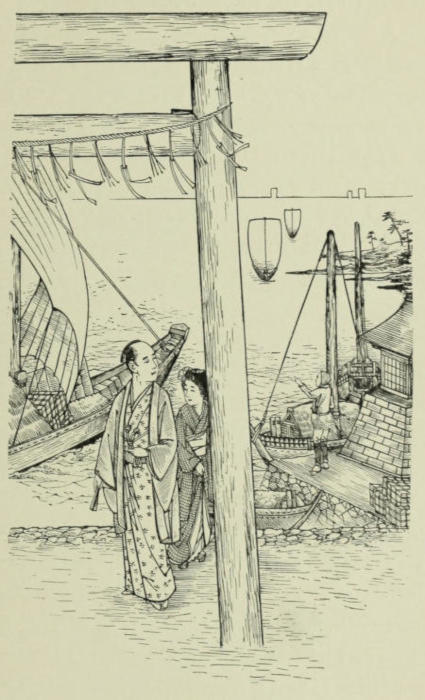
LANDING-PLACE AT KUWANA.
Young as O Tetsu was, offers of marriage,—some of them of
a kind to satisfy very exacting demands on the score of birth,
family, position, and personal accomplishments,—had not been
wanting. There were those who would have wooed her for
her father’s reputed wealth; there were others, and probably
the greater number, who were attracted mostly by the charms
of her person and manners; while not a few of high position
and noble birth would have been content to give her their
name if she had possessed neither beauty nor wealth, being actuated
by the sole hope of getting one of her father’s swords as
a dowry. The social taint attaching to her escutcheon on account
of her reputed Eta mother, the mere suspicion of which
in the case of most others would have been an all-powerful
objection, not to be outweighed by the possession of wealth, was
disregarded in the daughter of this clever artisan. In her it
would have been condoned, even if it had stood out as a well-known
and established fact. This, however, was not the case,
as it was after all but a vague report, which anybody who chose
might disbelieve. The lovers of O Tetsu looked for no other
reason to ignore its existence but their own desire and inclination;
while the smith’s fame, his reputed influence, which it was
known would carry great weight if he chose to exert it, and
above all the secret superstitious awe which he inspired, were so
many deterrent influences to prevent people from talking above
their breath of what might be distasteful to him if it should
reach his ears.
A RONIN.
This fear and awe had its origin in another of those
rumors which arise no one knows how or when, and which
sometimes, having a substratum of truth, or assuming its semblance
from accidental circumstances, come to be accepted as
undoubted facts. In this instance it had long since been so
accepted. It was said that in the manufacture of his swords
the smith needed newly-shed human blood. The age was
superstitious enough to believe that such a procedure correctly
carried out would entail marvellous results; and the wonderful
excellence of Muramasa’s productions favored this reasoning.
There were sufficient grounds beside to make such a belief
plausible. The smith’s weird appearance and manner, and the
dreary, lonely character of the neighborhood wherein he lived,
had undoubtedly contributed to this end. Moreover, the dead
bodies which were found so often near his house,—much more
frequently, it was said, than ever before,—whether they
had belonged to samurai slain in brawl or duel, merchants
robbed and killed for their money or beggars probably cut
down from mere wanton lust, were always cut and slashed in
a terrible manner, leaving hardly any blood in the body, while
traces of it were often found suspiciously near the smith’s
dwelling. Nobody thought of accusing the latter of sordid
motives, and his solitary life prevented him from having many
enemies. It was only the blood he wanted to temper his
steel; and when the time came that he needed it, and no accident
supplied him, then, as people said, he took care to furnish
an accident himself. If such had been the case, known
and proven, it would probably have entailed no unpleasant
consequences upon the smith, unless some one, specially interested
and high in authority, had chosen to take the matter in
hand. Human life was held cheap enough, while good swords
were rare; and if it required human blood to make one, a few
merchants and vagrants could well be spared. Muramasa himself
was doubtless aware of this report, and was even believed
by some to encourage it. At least, whether true in any
degree or altogether a fabrication, he never by word or sign
contradicted it; he probably had enough worldly wisdom to
know that the atmosphere of dread mystery in which, by
common report, he thus lived, created a spell which could
not but enhance the value of the products of his marvellous
handicraft.
As far as O Tetsu was concerned, none of these rumors
had ever reached her. It was known that in her case the
smith objected to and would resent such a piece of tale-bearing;
and the mysterious fear of him was sufficient to prevent
anything of the kind. Once only had such an attempt
been made.
As the girl one forenoon passed out of the house on her
way to the town to make a few purchases, accompanied, as
she always was, by her old servant, she was stopped not far
from her door by two old beldames with whom she had a
slight acquaintance. The latter had been loitering under
pretence of looking at some tumble-down buildings on the
other side of the street, to which both of them pointed now
and then in apparently a deeply interested way; in reality,
however, they were waiting, hoping perhaps to meet the
smith’s daughter, who went out only two or three times a
month, but generally at this hour. It was not the first
time that these women, who were known as confirmed gossips,
had been seen in the neighborhood; but they had never
before met the young girl, whom, when they saw her now,
they accosted with such a show of affection and caressing
words that she could not but stop and make some sort of
reply. As the conversation continued, however, she, knowing
that her father objected strongly to anything like street gossip,
became uneasy and bent a significant look on her servant.
The latter, who in general was quick enough in her perceptions,
and of her own accord had often stopped such rencontres,
sometimes in a very abrupt and unceremonious manner, seemed
in this instance unable to understand the meaning of her
young mistress’s uneasiness, and, contrary to all her habits, even
took a lively interest in the conversation.
DESERTED BUILDINGS.
“Miss O Tetsu is getting to be very proud now,” said one
of the women, the wife of a small sugar-baker, in the course
of the conversation which followed numerous minute inquiries
after the other’s health. “Yet when you were a child you
never passed our poor, humble place without calling for your
candy, which I took so much pleasure in giving to the dear,
pretty little thing.”
“Oh, yes!” her companion, the shrewish spouse of an omochaya
(dealer in toys), chimed in, “and at that time she rarely
passed our place without accepting some little toy or plaything;
and bless her little heart, how she did enjoy the sight
of the picture-books, and the tops which she began to spin
as soon as she passed out into the street! But Miss O Tetsu
has become a great lady now, with more beauty and wealth
than any other girl in the province, and poor people like us
can hardly expect to be noticed by her.”
“You are both certainly mistaken,” replied O Tetsu, vexed
with the others as well as herself. She could not understand
the meaning of all this talk; she only remembered going to
these women’s shops, as she went to others, to make occasional
purchases, and she was at a loss to account for this
fervor and extreme show of friendly sympathy. Still, above
everything she would not be thought proud or unkind to inferiors,
and so she continued: “I am not a child any more,
and do not now care for sweetmeats or toys; but I do not
mean to forget any kindness done to me, and if you care for
my company, I will call upon you the next time I go out.”
“I knew it; I knew what a kind-hearted and good-natured
little fairy you are,” the former speaker quickly and rather
illogically rejoined. “And how is your dear father?” she
continued abruptly, noticing the other’s impatience to get
away.
“I have not seen my father for some days; he is finishing
a sword now, and at such times he always shuts himself
up with my brother in the smithy, allowing not even me to
disturb him.”
“So now is the time when your father is finishing one
of his wonderful swords? I ought to have known it. They
found two corpses fearfully hacked to pieces on the lot opposite
to you. Strange,—is it not?—but at such times corpses
are always found over there. Strange, is it not, Miss O
Tetsu?”
“There is nothing strange about it,” the old servant here
quickly spoke up. “When Muramasa is engaged on one of
his swords, he is utterly absorbed in his work, and robbers
and thieves know they need not fear his interference; so they
pursue their evil ways without danger of being disturbed by
one who would be a match for a dozen of them.”
“I suppose that may be it,” was the response, slowly
given. “We think, however, at such a time the smithy could
show many strange and queer, perhaps some fearful, scenes,
and I would give anything to be able to get a glance at it
to-day.”
“I will afford you that pleasure,” said a deep, harsh voice;
and turning round, the woman who had spoken saw the smith
himself at her elbow. The sight of him at that moment
would have appalled even a strong, stout-hearted man, much
more the shrinking creature whom he had just addressed. His
mouth was firmly compressed, his face looked unnaturally
broad, and its repulsive features new seemed perfectly hideous,
with the coal-dust and soot which covered them as well as
his whole body. The furrow on his forehead was filled with
this floating dust, and glistening with the great drops of
sweat that had gathered there, had become a shining jet
black. But the worst feature of all were those large, restless,
glaring eyes, surrounded as they now were with red, inflamed
brows, which spoke of long nights of watching and
labor.
“You can go on now, O Tetsu,” he said, addressing his
daughter, “while I take charge of these ladies. Go on,” he
continued in a more peremptory way, as the other loitered;
“I must fulfil the wish of these ladies who have such very
kind feelings for you and me;” and taking hold of each
by an arm, he led them along, while the girl, unaccustomed
to hear severe tones from him, hurried away with her
servant.
What the two gossips who were now led away into the
smithy heard or saw there, they could or would never give
a rational account of. They were both in such a state of
abject fear and terror that the smith had to change his hold
from their arms to their waists to bring them to his place, which
was only a few feet away. They remembered the smithy,—large,
dark, and gloomy, all the darker and gloomier for the contrast
with the bright air and light outside. They remembered
seeing a hot, lurid fire at one end, before which the smith’s son
was working half naked with an immense hammer on a white-hot
bar of iron. All around him were numberless tools and
instruments with sharp edges and bright surfaces glistening in
the glare of the flame, which came out with a hissing noise.
The place also contained a quantity of large and small tubs,
some apparently empty, and some containing liquid which looked
black as tar, but which, when the firelight fell upon it, shone
red as blood. Queer and fantastic shadows, which elongated
or contracted as the flame on the hearth shot out or subsided,
filled the place. Half-dead with terror, they remembered being
led, or rather carried, by the smith close to the fiery heat, and
they had a dim recollection of being told by him how a human
being could be burned to cinders here in a few moments, and
how those cinders could be put to use again in forging a sword.
An idle vagrant unwilling to work, or a good-for-nothing, peeping,
spying chatterbox, who neglected her home but minded
everybody’s business, could hardly be put to any better use
than this.
O TETSU AND THE TWO BELDAMES.
The terrible heat, and partly their own feelings, must have
overpowered these two beldames, for they remembered nothing
further until they found themselves out in the yard by the
well, drenched from head to foot with several buckets of water
which the smith had thrown over them. With a grim smile
he said he thought they were satisfied with their visit; and
while he gave it as his opinion that the air of the smithy
hardly agreed with them, he added that if he ever heard of
their expressing any further curiosity, he would certainly be
ready to contrive means of giving them another glimpse of his
workshop. Then, without further ceremony, he conducted them
to the gate, which he closed in their faces, leaving the poor
drenched women, chattering with cold and still shaking and
quaking with fright, to find their way home as best they could.
It was said that from this day the henpecked omochaya found
his wife marvellously changed for the better. Queerly enough,
although neither of them spoke of their adventure, the affair
gradually came to be known and talked about; and the guarded,
evasive answers which, although otherwise voluble enough, they
gave when interrogated by their acquaintances, only heightened
the interest without satisfying it, thereby giving new food for
mysterious tales about the smith.
SWORD-GUARD.
CHAPTER V.
Among those who were smitten by O Tetsu’s charms was
no less a person than the old Duke Ono ga Sawa himself.
Being already married, he could only offer her the position of
first concubine,—which, however, in Japan implies nothing of
dishonor and very little even of inferiority. The position of a
first concubine, or second wife, as she is sometimes called (and
even that of those who follow her), is a legitimate one, recognized
by law and custom. She ranks next to the first wife;
and if the latter fail to bear male children, the concubine’s
son succeeds to his father’s titles and honors. With the exception,
perhaps, of two or three of the very highest families,
there were none in the province but would have been greatly
pleased and gratified at such an offer for their daughter.
Still, the Duke was hardly sanguine, for a few hints to this
effect conveyed to Muramasa had fallen upon what appeared
to be very unresponsive soil. Forced to act more directly, he
appointed a duly accredited nakōdō. For this office he selected—doubtless
purposely—a superannuated court noble
living in retirement upon a small pension, and who, although
aware of the smith’s merit, was yet only partially acquainted
with his position and pretensions. This, as well as the ill
success which had attended all others who had preceded him
on similar errands, he only learned when, flushed with pride,
he informed—in strict privacy, of course—some of his younger
court friends of his appointment. Their responses, unanimous
as they all were, sadly dampened his expectation of
a quiet and successful issue to his mission, and clouded his
hopes of the benefits and advantages which would result therefrom,
not to speak of the Muramasa sword, which in the first
flush of sanguine excitement the envoy felt certain of receiving
from the man to whom he offered such an eligible position for
his daughter. He almost began to regret that he had been
chosen by the Duke. Still, having once accepted the duty,
he had no choice; and trusting not a little to his own power of
persuasion, he started on his errand.
INKIO. (RETIREMENT FROM WORLDLY AFFAIRS.)
Contrary to precedent, and far in excess of anything he anticipated,
he was extremely well received. His host, who could
not but be aware of his errand, at once invited him into the best
room. Tea and wine were brought in; and as in Eastern countries
the matter in hand is never immediately introduced, but
only approached gradually, other subjects, and naturally swords,
were discussed first—and last. The host, usually so sparing of
his words, seemed this day to put no restraint on his tongue.
Every attempt on the part of his visitor to approach the matter
that had brought him to Senjuin was the signal for Muramasa
to recount the story of some glowing feat of arms, of
some wonderful exploit of Japan’s great heroes, or of some
marvellous piece of fencing or swordsmanship. The enthusiasm
naturally engendered by such subjects, not unmixed with
anxiety and a lingering fear that his object was in no way
furthered by what he could not help listening to with pleasure
and even with rapture, caused the envoy to resort to the wine-cup
more frequently than agreed with the sober habits which a
small income necessarily imposed. He did this with such effect
that in the course of a few hours he had completely forgotten
the object of his mission. He began to entertain the smith
with an heroic recital of the exploits of his own youth, which
with every succeeding cup trenched more and more on the
marvellous; and when at last he took his leave, being escorted
to the door by his host, he was still talking and gesticulating,
although in a confused way, and the servant who had accompanied
him found it difficult to induce him to enter his chair.
MALE AND FEMALE NAKŌDŌ. (MARRIAGE NEGOTIATORS.)
When soberness and consciousness returned, his mortification
was so great that he could not bring himself again to face the
smith, and he informed the Duke of what had occurred. The
latter’s passion was not so strong as to make him unable to subordinate
it to his policy of retaining Muramasa at the court. He
judiciously refrained from taking any further steps to carry out
his design, and he was too kind-hearted to show any displeasure
towards the sorely distressed old servitor, whom, on the contrary,
he dismissed with gentle words and presents. Muramasa’s action
in this affair was based upon opinions and convictions which
with him were the result of individual thought, uninfluenced
by surroundings and customs. His love for his daughter, like his
love for his art, was a deep, holy feeling, emanating from the
man’s inner nature. He felt that a life amid the rivalries and
petty jealousies of the court could not afford her any real happiness
or content; and the sturdy independence of his character
prevented him from becoming imbued with those social prejudices
which look to outside glitter, and to which weak natures
readily succumb.
That Sennoske should have succeeded in ingratiating himself
into the favor of such a man, who until now had kept everybody,
high and low, at a distance, was something at which the good people
of Kuwana marvelled not a little. It could only be ascribed
to the boy’s frank and winsome face, to his manliness and skill of
arms far in advance of his age, added to great reserve and modesty
of demeanor. The court, taking its cue from the character
of the Duke, had assumed a tone of levity and of boisterousness
which was especially affected by the younger samurai, and to
which Sennoske, with his modest and retiring ways, was almost
the only exception. It was probably more especially
this latter quality which had gained him the regard of the
grim old smith, who taught him many new points in regard
to the use of the sword, and even a few general rules as to the
making of one.
Two or three days seldom passed without seeing the lad at
the forge, where he was always well received. Was it altogether
the samurai’s love for the sword which caused these frequent
visits; and were not O Tetsu’s bright eyes even a stronger attraction?
It was merely a repetition of the old, old story. When
he had first come, she was only a child; and as she gradually
budded into womanhood before his eyes, the young man, whose
way heretofore, confined to hard work and study, had been serious
and monotonous, did not himself know what it was that
all at once made him look upon life and its surroundings with
such bright, joyful, enthusiastic feelings. The intimacy growing
up between the two young people must have been observed by
the smith; and if, even by his silence, he encouraged it, the
reason was simply that the boy’s character impressed him with
a sense of his worth, and he felt that, joined to Sennoske,
his daughter’s future would be in safe hands. Gradually his
favoritism grew beyond the limits of mere passive indulgence;
and Sennoske, becoming almost like a member of the family,
passed in the company of O Tetsu many hours of supreme happiness
such as it is only given to true, open, and honest natures
like his to enjoy. Sennoske’s father knew nothing of this, and
believed that his son frequented the smith’s forge merely for
the sake of the lessons he received in swordsmanship and forging,
or at most to listen to the smith’s weird tales of chivalrous
daring, which, on returning home, he sometimes repeated. Before
the young man was even himself aware of it, his passion
for the girl was so great that he felt he could not live without
her; and although heretofore he had had no secrets from his
father, he experienced in this instance a nameless, undefined
dread of disclosing his attachment. He loved, he fairly worshipped,
his father; but the love was mixed with a great deal
of reverential awe and deep pity, often amounting to anguish,
at the sight of that frozen look of sorrow and gloom which
never left Mutto’s face.
SENNOSKE AND HIS FATHER.
When not directly engaged in instructing his son, Mutto’s
only discourse had been on the obligations of a true samurai;
and even here he confined himself almost exclusively to what
his listener well knew was a samurai’s first and chief duty,—the
kataki-uchi (vendetta). Instance after instance did the youth
hear of men who had sacrificed brother and sister, wife and
concubine,—nay, sometimes even father and mother,—to carry
out some just vengeance, and who
had died happy because they survived
the satisfactory end of their
vendetta long enough to cast one
glance of exulting victory upon the
dead or dying body of their victim.
SOSANOÔ MIKOTO, THE PATRON GOD OF
SWORDS AND INVENTOR OF POETRY.
Gradually it dawned upon Sennoske
that his father, from some
inexplicable cause, must have been
unable to fulfil such a duty which
his samurai honor had imposed
upon him, and that he was educating
his son to act in his stead.
The thought, as soon as it struck
the lad, brought a thrill of wild
and fierce delight. With conscious
pride he felt that his
body, trained to every athletic
exercise, his sinews of steel
and muscles of iron, his quick
eye and swift foot, gave him a
better right than any other
youth of his age to hope to
carry out the dream of every
young samurai,—to see himself
grasping his blood-stained
sword and covered with mortal
wounds, his foot upon the body of his prostrate and dying
foe. No samurai worthy of the name had a higher ambition
than to die such a death; and when Sennoske lived, the spirit
that ruled men of his class was not different from what it had
been for centuries before, or from what it continued to be up
to within the last few decades.
The thoughts, hopes, and expectations thus engendered in
the mind of Sennoske had completely occupied it until he met
O Tetsu. Not that this event wrought anything like a complete
revulsion of feeling. No new-born passion could wholly supersede
the result of traditional and inherited tendencies, and of
an education which had caused the tenets of a soldier’s creed
to be instilled with the first glimmer of consciousness. Sennoske
was still as ready as ever to dare anything and sacrifice
everything in the cause of his father’s vendetta. With that
object in view he would not have hesitated a moment to lay
down his life if necessary. But this “if necessary” had now
intruded itself where before no thought had been given to
it. He sometimes feared that he was even lacking in loyalty
and good faith to the principle in which he had been brought
up, because he permitted himself to look forward to any end
but one; and this was doubtless the reason why he refrained
from speaking to his father of his passion for O Tetsu. Day
by day, however, that passion grew; until he felt that it was
impossible to cease hoping that he might yet call the girl his
own, and that the fulfilment of his mission, whatever duties it
entailed, might not be irreconcilable with the consummation of
his desires.
CHAPTER VI.
Ten years had elapsed since Mutto and his son had first come
to Kuwana, and the great struggle so long impending was
now fairly breaking out. That the crisis had not occurred sooner
was a matter of sufficient wonder, and was owing altogether to
the strong measures of repression, to the undoubted ability for
governing possessed in general by those who were still the actual
rulers of the land. But although the overthrow of the Hōjō
might be delayed, it could not be averted. The insolent pride
of these chieftains, not content with setting up and pulling
down Shôguns at will, and punishing with death all who
incurred their displeasure, had even heaped indignities upon
the imperial family; and from this, more than from all other
causes combined, their hold upon the people was weakened
beyond hope of recovery.
In Japan the divinity which hedges the king owes nothing
to the poet’s flowery imagery, but has always been accepted
as a living fact by high and low, by rich and poor, by the
strong and by the weak. The government of the country had
de facto always been wielded by some chieftain whose genius,
naturally in those times mainly of a military character, had
enabled him to arrogate position and power. If at the same
time he possessed administrative and organizing qualities, then
the prestige and influence exerted by his name, added to the
support of his clansmen, would often secure this power for several
generations to his descendants. In this way the Sugiwara, Fujiwara,
Taira, the Minamoto, and others whose names and exploits
are familiar to every child in Japan, had risen to fame and to the
control of the State.
All these chiefs, nevertheless, however absolute their power
might have been, were extremely careful, so far as outward show
and ceremony went, to profess the deepest reverence for, and implicit
obedience to, the ruling Emperor. The genius which could
rise to pre-eminence in spite of the valor and opposition of
numerous rivals, would have been useless if it could not obtain
recognition of its arrogated offices from the Throne. Military or
civil ascendency could not make a man Kwambaku, Dajodaijin,
or Shôgun; it was only investiture by the ruling Mikado, the
descendant of the gods, which in the opinion of the public could
confer these titles. At this time the Shôgunate and the nominal
control of national affairs were in the hands of the Minamoto
family. In times gone by, from the tenth to the twelfth century,
they and the Taira were the two leading clans of the Empire.
They were, however, both too great to exist by the side of each
other; and a fierce and desperate warfare was waged between
them, which lasted for many decades, and in which the Minamotos
were at last utterly vanquished and almost extirpated.
Among the very few survivors was a young boy named Yoritomo,
who had been carried to the rugged and barren mountain
fastnesses of Idzu, where he was brought up in the charge of
a faithful old servant. This boy was destined to take vengeance
upon the despoilers of his race. Becoming himself the most
illustrious figure that Japanese history up to that time had
known, he raised the Minamoto name and power to a higher
pinnacle of fame and prestige than it had ever attained. Appointed
Shôgun by the Mikado in the year 1192, he firmly
established the Shôgunate with its seat at Kamakura, and made
himself virtual dictator of the country. He died in 1199, and
the genius for war and statesmanship which had distinguished
him seemed to have died with him.
YORITOMO LIBERATING A THOUSAND CRANES IN HONOR
OF HIS VICTORIES.
Although he bequeathed his power and the prestige of his
name to his descendants, thus securing for the latter the possession
of the Shôgunate, the office became a purely nominal affair.
Like the illustrious dead Yoritomo, who had wrested all real
authority from the imperial throne, leaving it only the bare show
and pomp of power, so now the Hōjō stepped in, and in their
hands the Minamoto Shôguns were but puppets moving at the
will of their so-called guardians. Daily the Hōjō adherents grew
in strength and numbers, and every position of trust and influence
was soon occupied by them and their creatures. In the
arrogance of their pride, engendered by a long continuance of
absolute power, they at last did what even the great Yoritomo
himself had never dared to do,—they failed to pay even outward
reverence to the Emperor, and openly showed the mailed
hand by which he was ruled. Mikado after Mikado was forced
to abdicate in favor of some other member of the imperial family
whom the Hōjō thought more devoted to their interests, and
the ex-Emperors who had provoked their resentment—banished,
sent into exile, or forced into cloisters—were treated
with rigor, often with humiliating severity.
Such a course could not last. Neither the prestige gained
for the Hōjō by their military talents,—which in the year
1279 had repelled the invasion of the great Mongol Chieftain
Kublai Khan, with its myriads of ships and its numberless army,—nor
the merits of their civil administration, which preserved
internal peace, promoted agriculture, industry, and trade, and
showed harshness only in what might be thought to trench upon
their assumed prerogatives, could reconcile the people to the
disrespect shown to their Emperors. The gods from whom the
latter descended must sooner or later take vengeance not only
upon the desecrators, but also upon the people who stood passively
by and permitted this unholy work to proceed without
interfering.
MAN IN ARMOR.
Although hardly probable, it is
yet perhaps barely possible, that
the Hōjōs harbored the thought
of being able some day to usurp
the imperial throne; and it may
have been this hope which dictated
their policy. They could
not but know that such a consummation
might be looked for
only after long years of preparation,
and they therefore tried to
lessen the imperial prestige by
forcing successive Mikados to abdicate,
and making light of their
sacred rights and prerogatives.
But if some such deep-laid scheme
really animated their course,
events proved that they had miscalculated
the force of the feeling
which inspired the people, and
which made love and reverence
for their Emperors the foundation of their patriotism and religion.
Repeated outbreaks against the Hōjō domination had occurred
within the last decade; but they had been quelled before assuming
any serious dimensions, and summary punishment dealt out
to those concerned in them. One of these, which had been
instigated in secret by the son of the reigning Emperor, had
caused the father to lose his throne and be banished to a distant
island, while the son was forced to shave his head and enter
a convent, and eventually to leave even that retreat and flee to
the mountains to save his life.
Ono ga Sawa, although he hated the Hōjō at heart, was too
prudent, without seeing a reasonable chance of success, to commit
himself to any movement which might endanger his house
and his life. The great want of the disaffected was a leader,—one
who by birth, position, and personal qualities might command
the confidence and esteem of all classes among them. At last,
however, news arrived at Kuwana in the fall of the year that
Nitta Yoshisada had raised the standard of revolt and called
upon the whole country to assist him. This new champion of
the Mikado was lord of the castle of Nitta; and he as well as his
brother, the lord of the castle of Ashikaga, who had joined him
in the rising, were direct descendants of a celebrated Minamoto
chief, their fiefs, which lay in contiguous provinces, within easy
distance of the Hōjō stronghold Kamakura, having been in uninterrupted
possession of themselves and their forefathers for
nearly four hundred years.
Nitta had earned a high military reputation while serving as
captain in the Hōjō armies. He had been deputed with a large
force to subdue Kusunoki Masashige, who had thrice within three
years raised the flag of revolt, and although defeated each time,
had still managed to escape to unfurl anew the imperial standard
and assemble soldiers in its defence. Although Nitta had always
been ready to support the Hōjō chiefs against rivals, or even in
schemes of personal aggrandizement, he yet had no wish to
fight against the supporters of the Mikado. He dared not refuse
the command offered to him, as he would thus lay himself open
to suspicion, and suspicion then meant death. His resolution in
this dilemma was soon made. Having started with his troops, he
carefully sounded the temper of the officers and men; and finding
it what he expected, exhibited a commission which he had
procured from the exiled Emperor, at the same time describing
to them in an eloquent and affecting speech the condition of
their rightful rulers. They one and all agreed to fight for the
cause which they had been sent to overthrow.
All previous outbreaks had been confined to distant provinces,
and the lack of unity and concerted action, together with the
want of military ability among many of the would-be leaders,
had resulted in their easy suppression by the disciplined forces
sent against them. Nitta was resolved to carry the war into
the enemy’s country, where he knew the disaffected would
muster in great numbers as soon as a favorable opportunity
should present itself; but for a time he pitched his camp at his
own castle. Before setting out, however, he sent proclamations
to the different provinces, stating his intention of restoring the
wrongfully exiled Mikado to the possession of the throne and
to the enjoyment of that supreme power which belonged to him,
and calling upon all loyal subjects to aid in carrying out this
sacred mission. Nitta’s emissaries were everywhere received
with joy and acclamation, and with promises of aid in men,
money, and war material,—promises which, as the immediate
future showed, were religiously kept.
CHAPTER VII.
When Ono ga Sawa heard of Nitta’s rising and the manifesto,
he hesitated not a moment, but immediately proclaimed
himself one of those who were determined to secure to
the Emperors their legal rights. On account of his bodily infirmities,
he was unable to take an active part himself; but couriers
were immediately despatched assuring Nitta of his support, and
promising that two thousand of his best fighting men should
leave Kuwana and march to Nitta’s aid within four days. He
was as good as his word, and within the specified time as fine
a body of troops as could be found in any part of the Empire,
well equipped and provided with all necessaries, were ready to
march in defence of their Emperors against the Hōjō usurpers.
Sennoske naturally formed one of their number; but, contrary
to the Duke’s apprehensions, Mutto had not asked to join the
expedition, and the latter’s faithful and efficient services were
so well appreciated by this time that Ono ga Sawa felt greatly
relieved at being assured of having him by his side in case of
any local disturbance which Hōjō partisans might raise.
While making his hurried preparations, it seemed to Sennoske
that his father was several times on the point of telling him
what he felt must be the secret of his life; but each time Mutto
checked himself, changing the conversation to other subjects, and
the last day of Sennoske’s stay had nearly passed away without his
having learned anything in regard to it. He had not yet found
time in the hurry of preparation to take leave of Muramasa and
O Tetsu. Going to Senjuin late in the evening, when all his arrangements
for departure had been completed, he found the girl
at the open door of the forge awaiting his arrival, the smith and
his son being within, busily engaged in work. The young man
followed his future little wife, as he already sometimes playfully
called her, to a room above; and there the two exchanged those
vows and professions of love and promises of eternal faithfulness
which, in Japan as well as everywhere else, have been repeated
millions of times before, and will be repeated millions of times
again. Then their talk ran on, and became principally a reiteration
of the hope of meeting each other again, with flattering
prognostications on the part of O Tetsu as to the distinctions
which her lover was sure to gain in battle; and in spite of the
latter’s deprecating remonstrance, it was evident by his pleased
looks that he listened not unwillingly. His was a handsome
face, and the flush of enthusiasm and of sanguine youthful ambition
which now sat upon it enhanced its natural beauty.
So engrossed were the lovers in each other that they took no
note of the opening of the sliding door of the room, and both
started upon hearing the voice of O Tetsu’s father, whom they
now saw standing close beside them, holding in his hand a sword
splendidly mounted in gold, and wrapped in rich silk. There
was a kindly look on his face such as even his daughter had
rarely seen there before; and when he asked her to leave them
alone for a few moments, his naturally harsh and firm voice was
modulated in a soft and tender tone. His rugged, athletic frame
evidently shook with strong emotion; but Sennoske, who had
often seen him when laboring under strong excitement, knew
that this time the moving cause was neither anger nor hate.
“Take this sword,” he said, Sennoske the while becoming
almost delirious with joy; “a better one I never forged in
my life.” Then, after a moment’s pause, he added: “I have
learned to feel more affection for you, Sennoske, than I thought
I could ever feel for any one outside of my own family, partly
probably because I trust that with you my daughter will be
happy; but I also love you for your own sake, and because your
youthful ambition reminds me of a time when I was like you.
I hope and trust that your fate points to a happier lot than mine
has been. I am of humble birth; and this, with the peace reigning
over the land, has proved an impassable barrier to my achieving
distinction in arms and carving out a name for myself that
might, as I once dreamed, stand worthily by the side of Japan’s
great heroes.
“Oh! the misery of feeling that one possesses the strength of
arm and the resolute will to achieve great things, and yet to
lack every means of action; to be treated as an inferior by
every one of those proud samurai, the immediate forefathers of
many of whom have been of as low birth as myself, and only
achieved distinction in the glorious Gempei wars! I was born to
the humble lot of a peasant, to labor from early morn until late
at night, while my food was of the poorest and scantiest description;
but I would have worked ten times harder, and been satisfied
with even worse fare, if I could have had a chance of bettering
my fortunes. To accomplish this and rise above the station
in which I was born, I could see only one road open to me,—to
become a renowned sword-smith. It was not easy to do this.
I had no father and no brother to initiate me into the secrets of
the art handed down from father to son, generation after generation
during hundreds of years, as is the rule with the craft.
Many a weary mile did I travel,
enduring hunger and thirst and,
what was worse to me, numberless
slights and indignities,
before I found one who was
without son or male kindred,
and with whom I succeeded in
obtaining service. He had a
daughter; and no lovesick swain
ever showed more outward tokens
of the depth and strength
of his devotion, or spoke more
passionate words of burning love
to the object of it, than did I to
that ugly shrew, whom I loathed
from my very soul when I gave
her my hand and took her name.
For seven long years did I dissemble,
performing the most
menial services to prove my
faithfulness, before my master
and father-in-law thought fit to
initiate me into the first principles of the art. My teacher could
tell me little more, and I soon outstripped him.
PEASANT.
“The gods have been kind to me, and have rewarded me for
my prayers by granting me skill and ability; have answered my
fasting and my devotion, my days and nights of restless toil, by
allowing me to discover many secrets which are unknown to
others. Oh, the fools, the fools! they think that steel is dead
because it is cold and motionless and without apparent life!
Thrice-told fools and idiots! they kill the life which exists in the
iron as it comes from Nature, and they give no other in return;
and yet they know from their forefathers, and have learned to
prattle, that the sword is the living soul of the samurai.
“There is life in this blade which I give you to-day, my boy,—better,
finer, and richer life than in most of the boors who
try to fashion a sword. But remember that on this account,
unless you use it wisely and carefully, this sword is a dangerous
gift. Never draw it unless you need its help; never return it to
its scabbard without using it; and never let it remain undrawn
longer than a cycle of twelve years. Should you ever by any
unforeseen fatality have drawn and exposed it to the light of
the sun, the moon, or the stars without being able to use it on
the enemy who provoked you, then before returning it to its
scabbard use it on some inferior animal; but never think of
sheathing it without the blade having come in contact with the
blood of something still living. If you act thus, you will find it
your devoted friend; it will obey and even anticipate your
thoughts and desires; with the least guidance it will strike your
enemies and those who are opposed to you in their weakest
places unto death, in spite of numbers and courage, in spite of
armor and helmet. But if you fail in obeying the directions I
have given you, the blade will turn upon and mark you for its
victim with equal certainty; and even were you to bury it in
the deep ocean, it would not fail to wreak vengeance upon you.”
SENNOSKE RECEIVING THE SWORD FROM THE SMITH.
The mainspring which moved the nature of the smith was
evident. Sennoske, although he was young and inexperienced
in the passions which stir the heart and guide the actions of men,
was yet a keen observer, and he could now easily fathom the
depths of the sword-smith’s strange nature. He saw that the
man’s ruling passion was ambition,—ambition so inordinate that
it could never be satisfied, and which, burning so fiercely without
hope of realization, had retired into itself and assumed the semblance
of a morose and misanthropic disposition. The mildness
apparent in him when he entered the room had passed away
after a few moments; and as he recounted his sufferings and
disappointments, the play of his features and the tones of his
speech had been a fitting accompaniment to the words he
uttered. Yet his voice had never been loud, and while allowing
scope to his passions he still evidently held them in check.
Nevertheless the eyes which shone like coals of fire, and the half-hissing
sound of his utterance showed plainly how deeply he was
moved by dwelling upon his real and fancied wrongs. Sennoske
had often seen fierce outbreaks of temper; yet as he now
listened he gave an involuntary start, due not so much to what
was presented to his senses as to the thought of how fierce a
volcano must have been burning for years in that herculean
frame. Slight as the movement was, it did not escape the
smith; it arrested immediately the force of the current into
which he had drifted with the recital of these reminiscences,
and as he continued he resumed the quiet earnestness which he
had shown upon first entering.
“I have long looked forward to the breaking out of this war,
and I thought at one time that my son would realize my hopes
of a glorious career in arms; but although physically strong and
active, he does not possess a nature to achieve great things.
You, however, I firmly believe, will make a name. When you
return from this campaign the hand of O Tetsu shall be
yours; and the name of Muramasa shall indeed be coupled, not
only with the skill of the forge, but also with the memory of
heroic deeds. This sword which I give you forms part of the
dowry of your future bride, with whom I will now leave you
to say your last farewell. Before you start for the seat of war,
if your father is as yet unacquainted with what I know is your
wish as well as mine, I desire you to inform him of the purport
of our conversation.”
The parting of the lovers was of necessity brief, as it was time
for Sennoske to return; but deep love and passionate devotion
spoke on both sides, and O Tetsu was overjoyed at hearing that
her father had openly countenanced their mutual affection. As
the young man passed through the forge on his way home, he
again wished to thank the smith for his princely gift; but
Muramasa, who had relapsed into his usual taciturn mood,
stopped him short, telling him that his father had a right to
whatever time was still at his disposal. With a few words of
farewell to the smith and his son, and a last look at O Tetsu’s
window, he tore himself away.
When he reached home he found his father sitting beside
the brazier, with letters and papers spread out before him. At
the sight of the magnificent sword, Mutto showed even more
emotion than his son had expected under the circumstances. He
looked at it on all sides, weighed it in his hands, and partly
withdrew the blade, slowly, inch by inch, replacing it only to
withdraw it similarly over
and over again. While
this was going on, Sennoske,
not without a sinking
heart, acquainted him
with what had happened
regarding O Tetsu; but,
contrary to his fears and
expectations, the recital elicited no displeasure and hardly any
surprise.
RESENTING AN INSULT.
“Many a man superior to you in worldly position would
willingly and gladly marry an Eta if she brought him such a
dowry,” was the response; “and even without this princely gift
I could have raised no objection to your marriage with one who
is in other respects your equal. But, my boy,” Mutto continued,
in a tone which showed that he was powerfully affected, “you
run a risk beyond that of any of your companions. With your
strength, your skill in arms, and your discriminating wisdom, I
have no fears for you as to the ordinary chances of battle. If
you fall, it will be as a hero. Otherwise, with all these advantages,
added to the sword you carry, you will be sure to achieve
distinction.
“There is, however, a task which devolves upon you where no
public honor is to be gained, and where the danger is infinitely
greater,—nay, where it is extremely doubtful whether you will
survive success, or even the mere attempt to achieve it. I have
refrained from speaking to you about this heretofore, and my
intention was to give you all the particulars to-day. But upon
mature consideration I have determined again to defer it. Old
Yamagawa, who accompanies you, knows the matter, and has
my orders to disclose it to you when the occasion demands. I
know you will not hesitate a moment to do and dare everything
to accomplish the object I have in view; but act with prudence
and circumspection, and do not endanger yourself recklessly.
My future without you would be dreary; and although I should
not hesitate to sacrifice your young, hopeful life in the pursuit
of a just vengeance, yet to see that vengeance accomplished
and still preserve you would be happiness indeed. You have
yet to take leave of the Duke, and you will naturally desire to
show your sword at court. Do not be chary of doing so; it will
be of great benefit to you. You will start with the first approach
of dawn, and we will spare each other the pain of any further
leave-taking. So farewell, and may the gods protect and prosper
you!”
Sennoske was deeply touched; yet, with the varied emotions
which the day had brought forth, the pain of separation was
less acute than under ordinary circumstances it would have
been. At the castle the preparations for the departure of so
many men of rank caused an unusual stir, with attendant bustle
and commotion. When, after having himself announced, Sennoske
entered the large audience-hall, he found it filled with
court nobles and with those who, like himself, were bound for
the war, and had come to pay their homage to the Duke
before departure. Passing through the crowded ranks to the
raised platform where the Duke had his seat, he there made
the customary low obeisance. Ono ga Sawa, with whom he had
always been a favorite, after addressing him in his usual kindly
way, at once fixed his attention upon the sword, which in
truth looked sufficiently conspicuous.
“What, Sennoske,” he exclaimed, “you, who are such a sober,
steady youth, nevertheless indulge in this finery, and begin to
be a dandy now, when rough life in field and camp is about to
open for you! It must have cost all your pocket-money to have
this tinsel put on your sword. In my time we took pride only
in the blade itself, and carried it in unvarnished plain wooden
scabbards. Is it your old sword, or have you also exchanged
it for some modern weapon which glitters and shines to match
the outside, but which will break as soon as your hand causes it
to fall upon helmet or cuirass?”
“It is a Muramasa, your Highness, which the smith himself
gave me less than two hours ago; and if it be only as true as
the hand and heart of him who guides it, it will not fail in
splitting the helmets and in passing through the bucklers and
armor of those against whom your Highness bids me draw it.”
While speaking, Sennoske offered the sword for inspection to
the Duke, whose astonishment, shared by every one present, was
so great that he could not control it; and the youth remained
with the weapon in his outstretched hands for several moments
before the other recovered sufficiently to take it from him.
Looking at it in the orthodox fashion, by withdrawing it slowly
and carefully, inch by inch, until about half of it was exposed,
Ono ga Sawa’s astonishment gave way to admiration; and so
absorbed did he become in his gaze, that notwithstanding those
present in the hall, whose surprise had been as great as that of
their chief, pressed around him closer than court etiquette ordinarily
permitted, he seemed utterly oblivious of their curiosity.
A long time elapsed before he even looked up, and then those
around, recollecting themselves, hastily drew back; but his
thoughts were as yet too much occupied with the sword to
notice any impropriety.
“To a warrior by birth and training like myself there is
nothing in my dominions of equal value with your sword,
Sennoske,” the Duke said at last; “and to tell you to be careful
of such a treasure would be like asking the heavens to
guard the sun, like telling a child to cherish its parents, like
importuning a samurai not to fail in the duty of kataki-uchi.
In the struggle before us, which is the cause of the heaven-descended
Emperors, we need not fear defeat in the end; but
should it happen that any single action in which you participate
go against us, I charge all your companions to see that
this sword is not lost, and that even if you fall, it be brought
back here and returned to your father. It will be the thought
of many that Muramasa has distinguished you in a way which
your years hardly justify; but he has only given expression
to opinions which I also hold as to your merit. I hope and
believe you will return safely and with honor; and if my
good wishes count for anything, you have them in the fullest
degree.”
Meanwhile the news had been spread in the courtyard by
some of the servants, who had heard it in the hall; and when
Sennoske retired, he found himself surrounded by an eager
crowd anxious to examine his gift and to congratulate him upon
his good fortune. Most of them doubtless were sincere; for he
had always been a great favorite, and there was little to excite
envy in the modest manner with which he had invariably borne
himself. He was detained for a considerable time, and it was
nearly midnight before he reached his home, where Yamagawa
waited for him.
Everything was ready for departure; and as he threw himself
upon the quilted mats of his bed for a few hours’ repose, the
events of the day flitted before him, mingled with hopes dictated
by ambition, with a vague dread as to his father’s objects and
purposes, and of course with tender thoughts of O Tetsu.
But even these did not prevent him from soon falling into a
deep sleep, which the exertion, the excitement, and the varied
incidents of such an eventful day naturally induced in a healthy
and robust body; still they were powerful enough to retain their
influence over his mind after consciousness had left it. They
conjured up picture after picture of happiness, and when he
awoke a few hours afterward, O Tetsu’s image was still in his
thoughts and her name on his lips.
Rousing himself, his eye fell upon the sword by his side,
and then only did the reality come home to him; with a half
sigh, in spite of the exulting glance which he bestowed upon the
weapon, he was soon dressed and ready for departure. He could
hear his father moving about in the next room, which was separated
from his only by a paper-covered partition; but as he did
not come out, Sennoske, remembering his instructions the day
before, made no attempt to see him again. As he went to join
his party, it gave him a pang to recollect how much more his
mind had been occupied with thoughts of the girl he loved, than
of the man who until now had been parent, friend, teacher, and
everything to him; and he muttered a fervent prayer that it
might be granted him to try his strength with his father’s unknown
enemies, and to bring back a cheerful look to that stern,
sad face, so long clouded by sorrow.
SADDLE, STIRRUP, AND SADDLE-CLOTH.
CHAPTER VIII.
The war in which Sennoske now took part forms one of the
most glorious epochs in Japanese history. On one side was
the imperial family, who in an unbroken line had ruled the land
for two thousand years; and yet this period represented but a
small part of the time during which their authority had been
recognized, for they were directly descended from the gods who
had been venerated and adored from time immemorial. Opposed
to the imperial cause was a horde of usurpers, whose only claim
to recognition was the power which they wielded temporarily,
and, as they themselves knew, unjustly. It was a struggle of the
inherited and invested majesty of right, religion, patriotism, and
justice, against usurpation, cunning, and intrigue; and the result
could not be in doubt. Yet it is a subject of just pride to the
imperial family and to the people whom they govern that victory
was achieved in so short a time, a few months being sufficient
for the complete overthrow of the hitherto all-powerful usurpers.
The latter and their adherents fought bravely, and their natural
courage was doubtless stimulated to its utmost by the knowledge
that defeat with them meant utter annihilation, accompanied
with eternal shame and disgrace. Yet their desperate valor
availed them nothing. They fought like burglars caught in
the act; but the cool, steady, and determined loyalty of the
imperial partisans mowed them down as the sharp knife of the
husbandman cuts down noxious weeds.
Although the Kuwana contingent was one of the first to join
the forces of the popular general, Nitta, they found him already
greatly strengthened by numerous volunteers and deserters.
Several encounters which soon took place with detachments of
Hōjō forces sent against them resulted in an easy victory, as
large numbers of the vanquished troops deserted their colors
and enlisted for the righteous cause. In one of these engagements,
Nitta, who always fought in the van of his troops, noticed
near him a knight whose alertness and elasticity of movement,
in spite of his complete coat of mail, could belong only to a
young man, while the blows which he dealt were such as few
even among veterans could give,—his sword at every stroke
cleaving a Hōjō armor and going deep into the body beneath it.
It was no other than Sennoske, whom, immediately after the fray
and on the field of battle, Nitta made one of his aids. Others besides
the general had noticed the prowess of the new-comer, and
admiration changed to wonder when he took off his helmet and
showed his fair, boyish face, as yet with scarcely a vestige of
beard, and with a complexion that a girl might have envied.
SENNOSKE IN BATTLE.
Within a few weeks the army in and around the castle had,
in the opinion of its leader, become strong enough to try issues
with the enemy in the latter’s stronghold. Marching orders
were therefore given, and the troops were told openly that their
destination was Kamakura, which was to be taken by storm.
Meeting no opposition worthy of the name, they reached the
sea-shore at Enoshima, only three miles from their destination.
Here an unexpected difficulty presented itself. Although it was
ebb-tide the sea ran extremely high, so that the road along the
shore was submerged beneath angry waves, which washed even
the steep mountain spurs from whose base they were generally
separated by several hundred feet of hard, sandy soil. The only
way to reach Kamakura seemed to be for them to retrace their
steps by a long détour round the other side of the mountain.
This course would entail loss of time and labor; but the commander-in-chief
was less disturbed on that account than by the
fear that this accident might be misconstrued into an evil omen,
and consequently dampen the enthusiasm of his followers. For
at the last moment the Hōjō had changed their tactics. They all
at once showed unbounded honor and veneration for the Emperor
whom they had placed upon the throne three years before,
and took care to have their new-born loyalty proclaimed far and
wide. They knew, as they said, that the gods from whom the
Mikados sprang would never allow sacrilegious hands to be laid
on their descendants, and in the changes which had been made
the Hōjō had merely been instruments ordained to work out
the divine will by placing the sceptre in the hands of him who
could wield it to the best advantage of the country. Numbers
of Hōjō spies had found their way into Nitta’s camp, where only
the evening before some of them had been discovered and executed;
and those undetected would certainly make the most of
this unexpected impediment, causing it to be regarded as a sign
of the displeasure of the gods and an augury of evil.
SEIZING A DISGUISED HŌJŌ SPY IN NITTA’S CAMP.
Going down to where the waves washed his feet and frequently
covered him with their spray, Nitta looked out over the
sea long and earnestly. The white-crested billows came and
went, but the last-comer showed no sign of lagging behind those
that had preceded it. Sennoske, seeing the anxiety depicted on
his chief’s face, ventured to step up to him and give his opinion.
He had been brought up in a seaport town, with a harbor which
was none of the best, where he had been out at all times, and had
learned to know the tides and the signs of the weather. Therefore
he felt that he could now take it upon himself to assert
that in a few hours, or a day at most, the flood must subside.
Nitta, although he appeared absorbed in thought, and scarcely to
listen to his lieutenant, eagerly drank in every word the latter
said; and, placing confidence in it, performed one of those acts
which, trifling as they may appear, are yet emanations of genius.
Exerting a purely moral force, such actions are often all-powerful
in shaping the destinies of men and nations, by giving decision
to the vacillating, courage to the timid, a feeling of strength
which is equivalent to real force to the weak, and making heroes
of those who possess manly qualities in any degree.
Taking his sword, of matchless workmanship and ornamentation,
glittering in the sunlight which reflected itself in the burnished
gold, Nitta cast it out into the waters as far as a warrior’s
arm could throw it, asking the gods to accept it as a peace-offering,
and calling upon them to give their divine aid to the
army which now marched to uphold the vested and inherited
rights of their descendants, the Emperors of the country. In the
name of the Mikado, driven from the throne into a lonely exile,
he prayed them to bid the angry waves subside and give free
passage to those who came to avenge his despoilers and punish
the sacrilege. It was a powerful invocation, and its effect was
thorough and instantaneous, creating general and unbounded enthusiasm.
If any man there had misgivings, it would have been
dangerous for him to express them; and when next morning the
waters had subsided, leaving the road free and open, all lingering
doubts as well as the hopes of the Hōjō sympathizers vanished
as the dew of the night that disappeared in the morning sun.
As they approached Kamakura, they found a large portion of
the enemy’s army posted before the walls; so fierce, however,
was the onslaught of Nitta’s troops that the ranks of the besieged
were at once broken, and they fled for protection into the city.
But the assailants were close upon them, and followed in such
numbers that the gates could not be shut against them. From
ward to ward, from street to street, from house to house, the Hōjō
were driven, in spite of their persistent and desperate struggles,
and before nightfall the city was taken.
This battle decided the war and the fate of the Hōjō. The
honest portion of their adherents consisted merely of those who
had been dazzled and won over by the spell of absolute power
exercised for a considerable time; and this spell once broken,
they fully recognized their folly as well as their guilt, and were
ready to sue for and accept pardon on any terms. It was expected
that the principal men of the defeated clan, together
with such of their partisans and abetters as were too deeply
implicated to hope for forgiveness, would form into roving bands
and flee to distant inaccessible parts of the empire; but as they
were now without physical or moral support, a general engagement
was no longer to be feared. In view of this it was decided
by Nitta to dismiss at once a part of the army, so that divisions
of the retiring troops might be employed in protecting their several
provinces from the marauders who should flee thither, and
in hunting them down and bringing them to punishment.
NITTA PRAYING TO THE GODS BEFORE THROWING HIS SWORD INTO THE SEA.
One of the provinces to which it was believed that the defeated
would be certain to resort in large numbers was Idzu,
lying to the west of the Tokaido, beyond the Hakone Mountain-range,
on the road to Kuwana. Here the great Yoritomo had in
his youth found an asylum from his Taira foes. It required
coolness and courage, a steady eye and a firm foot to track foes
into these Idzu fastnesses, over these rugged, pathless mountains,
where Nature alone offered almost insurmountable obstacles.
Nitta gave a proof to the country of his confidence in
Sennoske by intrusting to him the military command of that
region, as well as of the country along the Tokaido from the
Hakone Mountains to the province of Kuwana. The contingent
from the latter province, which was to return for the purpose,
was to be under his orders, together with such other troops as
he might think it advisable to raise in the districts assigned.
Nominally, it was necessary to have this appointment acknowledged
by the daimios in whose dominions the new commander
was to act; but this was merely a matter of form entailing a
short delay. No one would have been willing to displease the
victorious Nitta, or to incur the suspicion of being a Hōjō sympathizer,
by in any way impeding the measures deemed necessary
to bring the insurgents to justice.
SCENE AT THE STORMING OF KAMAKURA.
The delay which would ensue before he could take active
command, Sennoske determined to take advantage of by returning
home; and leaving the Kuwana soldiers to follow to the
place which he was to make the base of his operations, he started
early in the morning on the day succeeding his appointment,
accompanied by Yamagawa, both mounted on good horses and
attended only by two running footmen. He was in good spirits.
The honors he had gained; the charm of the important command
intrusted to him; the thought of meeting his father and
the Duke, with the great expectations that they entertained of
him more than fulfilled in so short a time; and last, but not
least, however he might try to disguise it to himself, the joy of
again seeing O Tetsu,—all these were certainly good and sufficient
reasons for his elation.
SENNOSKE ON HIS RETURN.
Pushing on as fast as possible, on the evening of the same day
he reached Odawara, a strong castle town at the northern foot
of the Hakone Mountain-range. The fame of his exploits had
preceded him, and the lord of the castle received him in a way
which could not but be flattering to the young man, pressing him
to remain at least a day or two longer. No inducement, however,
could detain Sennoske; and leaving their horses, which would
only have impeded their way over the mountain-passes, he
started on foot the next day at dawn with his faithful henchman.
PILGRIMS TO FUJIYAMA.
The road, as it
was at that time laid
out, wound between
the Hakone and the
Ashigara Mountain-ranges;
and here the
young man made perhaps
less haste than
might have been expected.
It was late in
autumn, the weather
was fine, the air bracing;
and in spite of
his anxiety to reach
his home he could not
but loiter a little to
view the beautiful
scenery that presented
itself. The mountains
and hill-sides
were clothed in their
rich autumnal garb of gold and red and purple and brown of
every shade and depth of coloring; while as if to supply the
need of a stronger contrast, clusters of evergreen trees here and
there reared their crowns of unchanging hue high into the air.
ROADSIDE TEA-HOUSE.
FUJIYAMA, WITH ANGEL HOVERING OVER IT.
The whole effect was greatly heightened by occasional glimpses
of Fuji, which presented itself under the most varying forms and
expressions. Sometimes just a glimpse of its top was visible
over an intervening
mountain-range,
while again a portion
of the huge
mass would reveal
itself through a narrow
gorge; sometimes
one of its bleak
sides, within range
of the eye, but up
to this moment obscured
by clouds
which now suddenly
parted, would astonish
the traveller
who had just gazed
at what he thought
empty space, while
the shifting curtain,
hiding the view the
next moment, would
make him doubt whether he had seen aright. Two or three
times the whole mountain with its perfect outline stood in
majesty like a giant sentry watching over the land. With
the varying beauty of scenery which each successive step thus
unclosed, it was impossible for a lover of Nature like Sennoske
not to stop for a moment now and then to admire it. Yet it
was only for a moment, as the thought of the welcome awaiting
him prevented him from lingering as he otherwise would have
done. Many a good-looking young girl at the roadside tea-houses
followed with strained eyes the figure of the dashing
young cavalier, whose pleasant, gentle ways so well set off his
unmistakably martial air. Old Yamagawa also came in for his
share of attention; and now that they neared home, honored
and successful, the old servitor indulged occasionally in what
was probably his only fault,—a love of wine,—to a greater
extent than was good for him; but his young master had not
the heart to chide or even to restrain him.
COURT LADY’S HEAD-DRESS AND STATE FAN.
CHAPTER IX.
It was late at night on the second day before Sennoske arrived
at Mishima, at the foot of the other side of the mountains.
The town was full of people; for besides the ordinary contingent
of travellers, who always muster here in force, there were
a great many samurai—some who had started too late to join
the army, others, like Sennoske, already returning home—and
a considerable number of Hōjō adherents fleeing in various
disguises to find an asylum before pursuit was fairly organized
against them. The inns and hostelries were over-crowded; but
the Kuwana nobility had always enjoyed a good reputation on
the road, and the charm of the young man’s manner moreover
failed not in its usual effect; so at the inn at which he determined
to stay, two parties of merchants, already closely packed,
were forced to content themselves with even less space in order
to clear a room for the new arrival. Sennoske, who was weary,
at once repaired to the bath, accompanied by Yamagawa, carrying
the Muramasa sword, which was never out of sight or reach
of either master or servant.
After his master had retired, the old servitor also indulged in
the luxury of the bath, the daily use of which in Japan is considered
almost a necessity. Already half overcome by the fumes
of the wine-cup, the hot bath and the close air of the room still
further increased his stupefaction; and in returning to his apartment
he staggered along the corridor in a confused, aimless
manner, until, mistaking one of the passages, he stopped at the
end of it before what of course was the wrong room.
The sound of unknown voices from within reached his ears;
but thinking they must belong to visitors of his master, he unhesitatingly
opened the paper sliding-doors, and falling on his
hands and knees with his head bowed down, in the fashion of
Japanese servants, he pushed the sword forward as far as he
could, uttering the customary phrase, “Have you any further
orders for me?” Receiving no answer, and fearing that Sennoske
had noticed his drunken condition and was displeased at
his showing it before visitors,—something which heretofore had
never happened,—he remained a minute or two in his prostrate
position, bowing his head still lower, and muttering apologies.
At last a voice which he did not recognize spoke out: “We will
excuse you because you insist on being excused; but tell us first
what it is that you require, and what brings you hither.”
Yamagawa looked up, and the sight that presented itself,
unexpected as it was, partly sobered him. There were six or
seven samurai, all unknown to him, seated on the mats; and the
foremost among them, who also was the last speaker, had taken
up the sword pushed towards him, and, regarding it with the eye
of a connoisseur, was evidently surprised at the rich ornamentation
and workmanship.
“Give me back my sword,” Yamagawa cried; “it belongs to
my master, and I am responsible for it. Give it back to me,
oh! please give it back to me at once,” he repeated, raising his
voice and eagerly holding out his hands.
“Gently, my man! Of course I shall give it back to you,”
said the other; “but do not be so importunate, and do not speak
so loudly before your superiors, or you will have to be taught
better manners. Who is your master?”
“His name is Sennoske Mutto, from Kuwana, and he is just
returning home from the war,” was the reply. “This is a Muramasa
sword, which he values highly, and he will begin to be
anxious about it; so please give it back to me at once,” pleaded
the old man. He was still partly under the influence of wine;
and this fact, together with the mortification of his position and
the anxiety and irritation under which he labored, had made him
forget discretion, common sense, and his dignity as a samurai,
all other considerations being merged and lost in his impatient
eagerness to regain possession of the cherished weapon.
“A Muramasa sword, and your master intrusts it to a
drunken fool like you!” said another of the party, who until
now had been sitting in the rear of his companions, but who
now moved forward to where the light fell fully upon him.
“Does he attach so little value to it, in spite of what you say,
as to leave it like a toy in the hands of one who in his cups
would not mind trading it off for a measure of wine? His opinion
differs from mine as to the care which he ought to bestow
upon it. Be off! and tell your master that if he wants this
sword he must come for it himself.”
What was it which, at the sight of the new speaker and at the
first word uttered by him, made the old man look as if petrified
with horror and stupefaction, clammy perspiration bathing his
face, while his hair literally stood on end? Only his eyes spoke;
and although fastened with almost stony fixedness upon the
man who had just addressed him, they yet had an expression of
such intense, deadly hatred that the other, as he fairly caught
sight of it, involuntarily recoiled a step and laid his hand on the
sword he carried at his side.
YAMAGAWA DISCOVERING HIS MISTAKE.
Gradually, by a series of sharp, convulsive movements, Yamagawa’s
form and features relaxed from their rigid cast, and it was
evident that a full consciousness of his position and surroundings
was slowly taking hold of him, and that as it did so he was making
powerful efforts to regain his self-control. Every trace of
drunkenness had disappeared, and it was only extreme mental
and nervous excitement which made his voice tremble when
he again spoke:—
“Give me back the sword, Taka Suke; and after returning it
to my young master, I will try to refrain from telling him or his
father that I have again met you. Perhaps I am selfish enough
not to wish to stand disgraced before one in the service of whose
family I have become old and gray, whose welfare has occupied
every thought of my mind, to whom every fibre of my body is
devoted, and for whose sake I would willingly shed my blood
drop by drop. Perhaps I have become too feeble in mind as
well as in body fully to realize the duties of a samurai, for I
would fain save my young master from facing one who has
been the curse of his house, instead of doing my utmost to
bring about a meeting, so that he could either kill you or fall
as a samurai should. As for me, I know I shall not long be able
to endure the thought of having met you and not only failed
myself to take vengeance, but even shielded you against punishment
by those whose right and duty it is to inflict it. For twelve
years there has never been a day when you have been absent
from my thoughts, and I could never think of you without
cursing you. Yet all the sufferings I have so far endured are
as nothing compared with the humiliating misery of this hour,
when I find myself compelled, through my own fault, to plead
to one who has caused blight and ruin to fall upon those I love
and hold dear.”
“I will give you still further reason to curse me, then,” said
the other. “The gods seem kind to me; for although our cause
has failed, I am still able to strike at the only one whom, from
some foolish whim, I spared, leaving him life and liberty when I
had the power to take both. So Numa is still alive, and you now
serve his son. Well, the brat has his father’s courage, as he
showed in the war; and I have no doubt he has also the same
conceit. Curse you all, with your pretended fine feelings and virtues,
which you constantly flaunt before our eyes! They will
not impose upon me, however. Go, and repeat to your master
what has been told to you here; go, and tell him that if he
knows a samurai’s duties, of which his father always prated so
much, he must be aware that a drunkard is not fit to be intrusted
with a sword, least of all with one like this. Go, and
tell him that if he cares for it more than you seem to have
done, he must come and humbly beg for it himself.”
There was somewhat of truth in this taunt, which the devilish
cunning of the other had formulated so as to make it more
cutting than the keenest-edged weapon. Seeing from the tenor
of it that all further parley would be useless, Yamagawa without
another word or look made his way back to his master’s room.
As he entered, Sennoske started in amazement and affright at
the change which half an hour had effected in the appearance
of his old servant. The signs of acute physical pain, as well
as of mental anguish, were graven in deep lines on his features,
and spoke with equal emphasis out of his hollow, sunken eyes;
shuffling along as he did on his right side, with his right hand
convulsively clasping his left bosom, it is probable that the
terrible ordeal through which he had passed, had brought on a
partial heart-stroke. Yet overlying all these manifestations of
suffering, which became almost tangible and somatic as it were
by comparison, there was a look of utter, hopeless despair,—such
a look as is seen in certain types of incurable madness;
such a look as hunters see in some animals hunted down to
the last stages of exhaustion, with the dogs fastening on them,
and no hope of escape.
In a sufficiently coherent way to make himself understood,
Yamagawa explained the circumstances attending the loss of the
sword, without, however, hinting at the identity of the samurai
whom he had recognized among his despoilers. Sennoske,
although greatly annoyed and angry at the impudence of the
demand transmitted to him, showed no outward signs of perturbation,
and in reality a sincere pity for the poor old man
before him mastered every other emotion. From the version
given to him, he could of course scarcely understand why this
accident, although implying a serious neglect of duty on the
part of Yamagawa according to the code then prevailing, should
yet have affected the old servitor in such a terrible way; and in
spite of the latter’s urgent solicitation to go at once about the
recovery of his weapon, he stayed to console and cheer him.
ROADSIDE HOTEL.
“Sorrow is bad for old age,” he said; “it withers up the tree
of life quicker and surer than the cold north winds wither the
blooming chrysanthemum. Cheer up, and do not let me see
you so downcast at this trumpery business, especially now that
we are nearing home. As soon as I have regained my sword,
I shall feel like teaching these gentry a lesson at which you may
have to assist me; so—”
“Yes, as soon as you have regained possession of your
sword,” said the other, interrupting him. “Oh, pray, my dear
master, go at once! this suspense is horrible.”
Sennoske at these words started up, filled with dark forebodings.
He felt that there must be something more in this
affair than he yet apprehended, and he hesitated no longer.
Calling a servant, he had himself conducted to the room which
Yamagawa had mistakenly entered; and announcing his name,
made a fair apology for what had occurred, and courteously but
firmly asked for the return of his sword. Taka Suke, who had
sent him the message to come, and who was evidently the leader
of the party, replied to him in what was plainly a prepared
speech:—
“I have heard of you, Sennoske, and of the renown which
you have gained on the field of battle; but it seems to me that,
in spite of this, you are greatly deficient in the duties and obligations
of a samurai. Courage and bravery and prowess in battle
are common enough in our country; but a sword like this of
yours is rarely found, and its possession probably more than any
quality of your own has helped you to achieve success and
renown. You know the old saying, ‘The sword is the soul of
the samurai.’ It owes its origin to a feeling hallowed by the
custom of centuries,—a feeling which has been outraged by the
careless, negligent way in which this treasure has been handled.
Your youth and inexperience may plead in extenuation of yourself,
but the fault of your retainer, who is a samurai, and old
enough to know his duty, cannot be condoned; and we will
listen to no demand for the restoration of this blade unless it is
accompanied by the head of that drunken brute through whose
culpable carelessness it might easily have been lost or spoiled.”
“But this is preposterous,” Sennoske rejoined; “this is horrible!
You surely cannot mean what you say—and yet the life of
a faithful old retainer is not a fit subject for sport. I recollect
him from the day when consciousness first dawned upon me;
memory recalls him as watching over my childhood, guiding and
instructing my early youth, in the most disinterested, self-sacrificing
way. I would willingly risk my life for him at any moment;
and sword was never yet forged, nor ever will be, which could
weigh equally in the balance with such faithfulness and such
devotion as he has always shown. I respect your feelings; but
this man has suffered more than enough already for his one
fault. I again beg you to return me the sword which belongs
to me, and to which no one but myself can lay any claim.”
Sennoske, although greatly excited and incensed, had succeeded
in repressing any outward signs of excitement or anger;
he had spoken with quiet dignity, and when referring to the man
whom he had left in such a dejected state his tones became
tender and pathetic. It appeared to him that the whole proceeding
was a deliberate attempt to deprive him of his matchless
blade; yet—to his honor be it said—at the moment, the idea of
its possible loss troubled him less than the thought of the probable
effect of that loss on his old retainer. His solicitude for Yamagawa
caused him to be wary, and to show more moderation
in his speech than he otherwise would have done, in view of
the arrogant manner in which he had been treated. The next
answer which he received, however, was well calculated, in its
cold, sneering, and evidently studied insolence of tone and bearing,
to make him lose every vestige of self-control.
BUDDHIST TEMPLE. (MONK AND ACOLYTE.)
“Go to, boy,” said Take Suke, “go to! This sentimental
twaddle may do when you meet half-grown girls who admire
softness or meekness, or when you are in the company of enervated
Shingon or Obaku priests, who would fain palliate their
own condition by holding up soft-hearted effeminacy as something
to be admired. I would sacrifice by the score and by
the hundred as good serving-men as ever drew breath to gain
possession of this sword—or of one like it,” he corrected himself.
“More than ever I insist: bring me the head of that
drunken beast, and I will return you your sword.”
It was the very extremity of the provocation which for a
moment paralyzed Sennoske, and that moment was sufficient for
his presence of mind partially at least to assert itself. He understood
the object of the insult offered to him, and he could see
that the least indiscretion, a single false step, would insure
his own destruction. Taka Suke while talking had, contrary
to all rule and etiquette, drawn the sword out of its scabbard, and
while apparently playing with the naked blade, and weighing it
in his hand, had never allowed his sinister eye for a second to
be removed from the face of the young soldier. All the other
inmates of the room had half risen, and their hands were suspiciously
near their sword-hilts. It had flashed through Sennoske’s
mind to throw himself forward and try to wrench the
sword from the other’s hands; but opposed as he was by seven
resolute men, and only partially armed himself, with nothing but
his short dirk in his girdle, he abandoned the thought as soon as
it came, knowing that such an attempt would be the height of
madness. Yet he felt that his self-command was fast leaving
him, and that another speech like the last would surely precipitate
him to his own destruction; so he withdrew abruptly, to
collect himself and to resolve upon some course of action.
YAMAGAWA COMMITTING SEPPUKU (HARA-KIRI).
The servant who had brought him hither, and who under pretence,
probably, of waiting for orders had listened to the whole
conversation, conducted him back to his own room. On entering
it he found there a number of superior Ise officers, who, hurrying
back like himself, had just arrived, and to whom Yamagawa had
told the affair of the sword. One look at his master satisfied the
old servitor that the former’s mission had been unsuccessful;
but he could learn no particulars, for to all inquiries Sennoske,
who wished to spare him the shock of the communication, at
least for the present, gave only evasive replies. Happening to
look at the servant of the house, still standing by the half-open
door, with eyes and ears intent upon what was going on, Yamagawa
immediately divined that the fellow had listened at the
other room; and pulling him in by the sleeve, he ordered him,
with short word of command, to tell all he had heard there. To
do this was of course a serious breach of etiquette; it was, however,
with no thought of taking umbrage at the freedom assumed
by his old servitor, but only to spare him the shock of what was
coming, that Sennoske interfered. Nevertheless, his assumed displeasure
remained unheeded, and even unnoticed. Giving the
young fellow a good shaking, Yamagawa again ordered him to
repeat what had taken place in the other room; and trembling
and stammering, the other, in spite of his fright, gave a sufficiently
lucid account of what he had witnessed.
A muttered word, or rather ejaculation, unintelligible to those
present, was the old samurai’s only reply as he returned to his
seat,—in which, however, he moved round, so as partly to turn
his back to his companions. No one spoke. The men present
were mostly veterans, men of action and not of words; and
every one was considering the circumstances of the case, revolving
within himself what had best be done before he gave tongue
to his thoughts. The dead silence, which was in strange contrast
with the sound of laughter and revelry borne to them from other
parts of the house, was gloomy, and had begun to be oppressive,
when it was broken by the sound of something trickling on
the mats. All started, but Sennoske was the first to divine
its terrible import. A single bound brought him to the side of
Yamagawa; but it was too late. The latter on turning round
had arranged his dress in conformity with the rule on such occasions,
and had quietly and noiselessly committed hara-kiri.
He had done it deliberately and carefully, and the wound which
he had inflicted upon himself was the regulation cut of six inches
in length by one inch deep.
ARROWS AND MILITARY HEAD-DRESS.
CHAPTER X.
The first great grief which his young life had known now
came upon Sennoske as he knelt by the side of his old
attendant. A thousand recollections of the watchful care, kindness,
and unvarying zeal and attachment of Yamagawa overwhelmed
him, until he became thoroughly unmanned, and could
only sob in a broken voice: “Oh, Yamagawa! why have you
done this to me?”
“Listen to me, Sennoske,” replied the old samurai,— whose
present composure and serenity were in striking contrast with his
appearance of half an hour before, his face, which showed no
evidence of physical pain in spite of the suffering caused by his
wound, being lit up by a happy smile at the evident deep-felt
love and sympathy expressed by his young master,—“listen
to me carefully, for my time is short.” As he spoke, he compressed
tightly with both hands the gaping wound from which
his blood and life were slowly oozing out. “The great enemy
of your house, who has been the cause of all the misfortunes
which have befallen it, is now the possessor of your sword.
You know him by reputation. It is the notorious Taka Suke,
in comparison with whose shameless, brazen-faced effrontery all
other acts of Hōjō arrogance might well be characterized as
humility itself. Here in my lap is my kakioki, my last will and
testament, addressed to you, explaining everything. It was to
be given to you in case of my death. Take it now and read it
aloud.” Seeing that Sennoske, with his hands before his face,
was still sobbing bitterly, he motioned to another of the party to
do what he had asked; and the man addressed, an old soldier, at
once complied, taking the document and reading as follows:
“It is now nearly twelve years ago that a quarrel broke out
between the Dukes of Ando Taro and Ando Goro, in the province
of Mutsu; this quarrel assuming considerable proportions, the
Hōjō government at Kamakura sent out Taka Suke with full
powers to arbitrate
and judge between
the contending
parties. He was
comparatively unknown
at that
time, and was received
by both
Dukes with marks
of great distinction,
as became his mission, and, as is the custom, with lavish
gifts. But whatever was presented to him was like a few kernels
of rice thrown to a famished dog, it only whetted his appetite
for more. In the most barefaced manner he and his satellites
asked for more and more, and received it indiscriminately from
both sides. His chamberlains, his mistresses, his servants down
to the lowest horse-boy and scullion, all had to be fed over and
over again.
SENDING A PRESENT.
“Your father, who was Ando Goro’s karo, or first counsellor,
saw his master’s substance melt away under this system of
extortion which he did not dare oppose, while as yet there was
no pretence on the part of Taka Suke of even looking into the
merits of the case, much less of rendering a decision. The
ducal treasury was exhausted; the many rare and costly articles
accumulated by generations of the Duke’s ancestors, and the
whole of your father’s private fortune, had been swallowed up
by this fellow’s greed. There was absolutely nothing left to
give, when Ando Goro in strong terms and angry words, more
than hinting at Hōjō misrule, demanded judgment. This just
suited the wily arbitrator. Carefully selecting time and place
and company so as to be cruelly effective, with coarse taunt
and jeer he insulted the Duke and goaded him to madness.
Regardless of policy and of the chances against him, regardless
of the advice and remonstrance of his trusted karo, Ando Goro
planned a revolt. His movements, however, had been carefully
watched, and his plans were allowed to ripen sufficiently clearly
to demonstrate his guilt. When this point was reached he was
seized and thrown into prison. In this case judgment was not
delayed; within ten days his territory was confiscated, and he
himself paid the penalty of his life. His wife shared her husband’s
fate; his two infant sons were seized, and disappeared,
no one knowing how or where; and all his principal retainers
were severely punished, some suffering death, some imprisonment
and some exile.
A KARO (CHIEF COUNSELLOR).
“Only one man seemed to remain exempt from persecution,
and he was the karo. He had arranged his affairs, and expected,
hour after hour, day by day, to be summoned to prison and death;
but no summons came. Your father was a man who had commanded
honor and respect second to none where he had lived.
Untouched by even a breath of suspicion in his high and responsible
position, with rare physical and mental graces, and incomparable
in all manly accomplishments, the inhabitants of the
province, high and low, looked up to him with a respect amounting
to reverence.
But the times were
corrupt, and his
long years of faithful
service failed to
make men believe
that he had remained
true to his
trust, when day
after day continued
that strange immunity
from arrest
while every one
else belonging to
his master’s house
had suffered. Too
many were only
over-ready to sell
themselves to the
Hōjō; and although
in this instance it
seemed utterly incredible, yet men equally high in position
and character had before been won by Hōjō purses and Hōjō
promises.
AN EXECUTION.
“Your father’s nature was delicate and sensitive, in spite of
his physical prowess and of the outwardly cold equanimity of his
character. Loyal as loyalty itself, conscious of the rectitude of
his actions and thoughts, he met those who had once bowed
down to the ground in his presence, and who now had only a
scornful glance for him, with equal scorn and pride, which
only went to confirm their suspicions of what they considered
his shameless desertion. Never did a samurai look more anxiously
for decree of promotion and advancement than did your
father for the order which should consign him to the grave.
At first, when with every minute he was expecting his doom,
he had no thought of kataki-uchi; and even later on he saw no
possible way of breaking single-handed through the cordon of
guards and satellites which protected his and his late lord’s
enemy. When, however, fifteen days had elapsed, during which
he had, as it seemed, been utterly ignored, he publicly registered
a vow that whenever chance or his own exertions should bring
him into the presence of Taka Suke, he would kill him, or perish
in the attempt. He had recorded his vow in the usual manner,
taking care, however, to give it the greatest possible publicity,
so that he against whom it was directed could not pretend to
be ignorant of it.
“Your father succeeded apparently in forcing notice upon
himself; for the same day, as evening came on, a posse of
soldiers entered his house. His swords and weapons were taken
from him, and his arms pinioned; but this was not done in the
coarse, brutal way in which prisoners generally are treated, the
leader of the soldiers showing all possible consideration, and
even apologizing for what he did. A large and convenient
nori mono (palanquin) had been brought to the door, and in this
Mutto was carried more like a chief followed by his retainers
than a disgraced rebel prisoner. His captors took him directly
to the castle, into the presence of Taka Suke, when all retired,
leaving the two men alone.
A LORD ENTERING HIS NORI-MONO.
“‘I should have sent for you before this,’ said the host to his
prisoner-guest, ‘but I wished to give you time to do justice to
your grief for your late lord, although he but little deserved
it. Probably Ando Goro’s only posthumous claim to the regard
of mankind consists in the good sense which he displayed in
selecting you for his karo; and all the good he ever achieved,
as is well known, was of your doing. Had he followed your
counsel he would still be the lord of his province, honored and
respected. He chose instead to give way to the promptings of
his own wicked passions; he rose in revolt against the lawful
government of the country, and he has met the fate which is
the just due of every rebel. All who surrounded him aided
and abetted his evil designs with the exception of yourself,
who were the only one, as I know full well, to try to dissuade
him from his folly and crime. In common with every one else,
I have always entertained feelings of high regard and admiration
for your mental and physical accomplishments as well as
for your moral character, as shown by your faithfulness and
devotion. It was not my intention that you should stand before
me as you do now; your unfortunate expression of to-day has
forced me, however, to adopt these precautions; but these bonds
shall fall at the first word which shows that you understand my
feelings and accept my offer of friendship and friendly interest.
You shall be appointed this very day temporarily to the government
of your late lord’s territories, which is all that my authority
empowers me to do at present; but I doubt not—nay, I am
sure—that with the first signs of zeal and faithfulness the Hōjō
government will confirm your appointment and make you the
actual duke, with the title hereditary in your family.’
“This language astounded your father, although it failed to
move him or to shake his resolution in the slightest degree. ‘I
am utterly unable,’ he replied, ‘to understand the meaning of
your magnificent offers, and I am too indifferent in regard to
them to look into their motive. As far as my honor and faithfulness,
which you rate so highly, are concerned, the one would
be forever tarnished, and the other prove itself false and valueless,
were I to accept your proposal. If I have acquired a good
name and reputation, I owe it merely to the possession and
practice of those qualities which should be the birth-right of
every one of our class, and which have enabled me to serve my
late master loyally, but, alas! as events have shown, only too
inefficiently. My duty now is plain,—to avenge my lord, if
possible, or else to die as becomes a faithful samurai.’
“‘I expected some such reply from you,’ rejoined the other,
‘although I hoped that the sincere desire for your welfare which
I have so openly shown would cause you to put your refusal in a
milder form. You have the consciousness of having done everything
for Ando Goro which it was possible to do; but his headstrong
nature would not brook control, or even advice, and his
destruction lies at his own door. You can do nothing more for
him, and your country has certainly some claim to your services.
Men of your stamp are needed now, when strife and rebellion are
everywhere raising their heads; and in place of a useless sacrifice
to one whom you served faithfully as long as faithfulness would
benefit him, it were a better, a higher, and a worthier ambition
to try to insure internal peace, tranquillity, and prosperity to our
glorious empire.’
ŌTŌ NO MIYA, THE MIKADO’S SON, IN HIS MOUNTAIN RETREAT
WHEN FLEEING FROM THE HŌJŌ.
“‘Your code of samurai morality is different from what I
have been taught, Taka Suke,’ said the ex-karo, slightly raising
his voice, though its tones remained quiet and firm. ‘Chiugi
[faithfulness to one’s lord and master] would be little worth
the name if it were
obligatory only while
in the receipt of
bounties and favors
from one’s lord, and
could be disregarded
when not synonymous
with self-interest.
It is not the
doings of men who
act like this that are
told to us in songs
and romances, that
form the heritage of
our heroes, and that
fire and inflame the
minds of our youth.
Is not kataki-uchi the
first of all duties?
And where does it
find its highest justification
but in faithfulness in avenging the death and appeasing
the manes of our lord and master? The ruin of my late lord
and of his house lies at your door. Why have you spared me
when mercy was not shown to woman or child, to the helpless or
to the innocent? I owe you no thanks for it. Were these arms
free, I should strike you down now; and nothing can reconcile
me to life but the hope, slight as it may be, of some day
being able to accomplish my vengeance. This is my duty; and
in devoting my life to it, my country can claim nothing more.
When you speak of “rebellion and strife raising their heads,”
you can mean only rebellion against the Hōjō usurpers; but
were I not bound to the fulfilment of a higher obligation, such
rebellion would find in me one of its most ardent partisans.’
“‘And do you not think of your wife?’ Taka Suke still
persisted. ‘Have you no feeling of pity for her, who, if you
insist upon your refusal, must suffer a cruel death; none for
your son, who, if he grows up in the likeness of his father, with
the advantages which your new position would confer upon him,
might become one of Japan’s most famous men, perpetuating
your name and renown to the latest generations?’
“‘My wife is a samurai’s wife, and knows she must take her
share of the pains and penalties, as well as enjoy the privileges
and advantages, of her position; my son had better die a lingering
death than succeed through the shame and disgrace of his father.’
“‘Yes,’ Taka Suke, now dropping his mask, replied angrily,
‘I know you are one of those who believe in chiugi and kataki-uchi
and all those devices which are implicitly followed by fools and
weak-minded persons, but which men of sense make use of only
to suit the occasion. I can understand the beauty of kataki-uchi
when used against those who have injured me, and of chiugi when
it governs the behavior of my dependants. It is true our cause
is threatened, and it is necessary for the continuance of Hōjō
power that men of influence, wherever they may be found,
should be enlisted in its support. Such men as you, respected
by samurai and by the rabble, equally ready with sword, tongue,
and pen, are rare enough, and their action influences thousands
of others. I do not yet despair of bringing you over to our side.
Men of your stamp are inclined to sacrifice themselves, satisfied
with the delusion that their virtues will be lauded and appreciated
after their
death. But I will
leave you no such
consolation. I will
have it spread about
that through you
your master was betrayed.
I will have
you brought to the
castle of Kamakura;
and while it will be
said that you have
left your family in
order to enjoy a licentious
life with the
wages of your treason,
you shall pine
away a close prisoner. What do you say to this prospect; and
how, under these circumstances, will your name be spoken of
by posterity?’
A PRISON.
“Outwardly calm and composed, although this speech did
not fail to stir him to the deepest anger and indignation, Mutto
replied: ‘Whatever you may do, the truth will sooner or later
be certain to prevail. Knowing that it is impossible to appease
the manes of my murdered lord with your blood, I can only
show my devotion by committing seppuku, which I will not now
defer any longer. No honest man’s finger shall point at me
in scorn, no disloyal samurai shall cite me and claim me as a
living companion in shame. I will have the satisfaction of having
lived and died as a feudal retainer should live and die,—loyal
to my lord and master.’
“‘No, no! you shall have no such satisfaction. I will not
leave you to delude yourself with this thought,’ Taka Suke vehemently
broke in. ‘You do not yet know all. Ando Goro, it is
true, paid the penalty for his treason with his life; but his two
young sons yet live. Yes, they yet live,’ he repeated with cold
emphasis, as Mutto turned pale and started, half in joy, half
in affright, with a nameless dread of what might be coming; ‘but
you will never learn their abode, for they have been taken to a
distant isle, where they are carefully watched by men devoted to
me. I have changed my intention as to the measures to be
adopted in regard to you, and you shall go from this place free
and untrammelled. But you shall pledge your knightly word that
you will make no attempt against my life or against your own;
and the safety of these two boys shall answer for your fidelity.
In case of your death they shall be made to follow you at once
into the shadowy land to which you are so anxious to go; and
I shall also make immediate and careful disposition that any
attempt at my life, whether successful or not, shall give them no
longer time on earth than relays of fleet-running messengers require
to carry them their doom. What say you to this, Numa?
Had you not better at once enter my service and watch over a
life which now must be very precious to you?’ Taka Suke
asked this question with a sneer; it was thrown away, however,
for the last revelation had done its work, and the man
before him was utterly prostrate and broken-hearted. ‘But I
will not press you for an answer now’, the Hōjō chief continued.
‘You shall give me the promise I asked for, sealing it
with your blood; and then you can take your own time. And
remember that whenever you choose to come to me, all the
honors and emoluments promised shall be yours at once, without
further reference or allusion to what has passed between us.’
POSTAL COURIERS.
“When your father left the castle after this interview he was
a man broken in body, in heart, and in spirit. In addition thereto
came the illness of his beloved wife, your mother, which in a few
days assumed a fatal character. After her death he found it
impossible to continue living in the same place, where all those
whose esteem he cared for now shunned him. He was on the
verge of madness, and only his flight, I believe, saved him from
such a fate. We separated, to avoid attracting attention and to
elude pursuit. He confided you to my care; and you must remember
the night of our departure, when we went one way and
he another. In the middle of the night, like a thief and a malefactor,
he left the place where until now he had been foremost in
rank and position, as well as in the esteem of the people. We
met by appointment in a mountain retreat of Idzu, at the house
of an old friend and companion-in-arms who had turned priest
and was leading a quiet, secluded life. There we remained a
year, which enabled your father to regain his tranquillity; and
then we travelled on to Kuwana, where, as you know, he took
service with Ono ga Sawa. When making arrangements for his
flight he had taken care, in his fear for the safety of his master’s
sons, that Taka Suke should be informed after his departure that
he had fled to a life of seclusion, and would sacredly keep the vow
he had taken. He has since often regretted his twofold promise;
for tidings which reached him from one or two friends who remained
true to him left very little doubt that the young dukes
had really been killed, and that Taka Suke’s version of their exile
was a fabrication to work upon the feelings of a noble mind
which had proved itself superior to all sordid influences.”
The kakioki here came to an end, concluding with the usual
formulas, stamp, and seal pertaining to such a document. During
the reading, Yamagawa had retained his death-grip on his wound.
Superior will-power made him oblivious to physical pain, and
enabled him to retain consciousness until the testament had been
read to the end. Motioning now to Sennoske to come nearer,
and summoning all his energies, he succeeded, although in a
scarcely audible whisper, in saying his final words:—
“From what I have learned in the course of this campaign
from men of our old province who no longer feared the Hōjō,
the doubt as to the fate of Ando Goro’s sons has resolved itself
into a certainty. I ought to have acquainted you with all this at
once, causing you to search out that venomous beast, Taka Suke;
but I hesitated, knowing him to be as cunning as he is wicked,
and brave and strong withal. I also wished to let you first enjoy
the pleasure and triumph that await you at home; and I half
hoped and half wished that before long he would meet his just
doom at other hands. I have erred grievously in believing that
the Fates which govern the world would allow such a just vengeance
to remain unfulfilled by him who evidently was designed
to execute it. The signal way in which the divine will has been
declared in this instance proves to me also that I need have no
fear for the result. I die happy in this consciousness; and now,
Sennoske, although I am of inferior rank, I know you will show
me the last and greatest mark of friendship which one samurai
can show to another.”
As he spoke he released the grip of his hands, the ghastly
wound opened wide, and he fell partly forward, with life evidently
very nearly extinct. Sennoske did not hesitate, for to
withhold his hand now would have been cruel as well as contrary
to all law and usage. Taking Yamagawa’s sword and grasping it
firmly in both hands, with a muttered blessing which the other
seemed to understand and acknowledge by a last flicker illuminating
his face, his young master made one sweeping downward
stroke. The head rolled on the ground, and a life of
patient, unselfish, and sacrificing devotion came to a sad but an
honorable end.
STATE SWORD AND HEAD-DRESS.
CHAPTER XI.
“Now for Taka Suke!” cried a younger member of the party,
excitedly. But he said no more, and hung his head
abashed; for a stern glance from his older companions showed
him plainly that many words and loud talk were not only not
needed, but even out of place at this moment. In glancing
round the room, Sennoske saw the servant who had attended
him, and who, fascinated by what he had seen and heard, had
remained unnoticed in a corner. He was summoned, and told
to put Yamagawa’s head on one of the platters lying on the
floor, and to precede the young soldier to his enemy’s room. The
poor fellow hardly appreciated the active part assigned to him
in this drama. “I am not used to carrying cut-off heads,” he
stammered; “I shall be certain to commit some breach of etiquette:
so please excuse me.” As he spoke, with his head on
the floor, raising it at every few words to look around in a half-frightened,
half-foolish sort of way, and bringing it down again
with a hard thump in the unconscious excess of his apologetic
speech, his appearance under other circumstances would certainly
have been sufficiently ludicrous. A reiterated command caused
him to slide upon his knees to where the ghastly head lay on the
floor; but as he brought his hands near it, his courage failed
him, and he made a precipitate rush for the door. He was not
allowed to leave, however, and a sharp blow with a scabbard
across his shoulders by one of the party, an old soldier who
had little sympathy for such scruples or squeamishness, caused
the physical pain partly to overcome his nervous sensitiveness.
Sennoske, with his usual consideration for the feelings of others,
seeing the state of mind the man was in, himself gently placed
the head on one of the platters; and the servant, with averted
face, then took heart to raise it up and to proceed to the room
of Taka Suke.
The others present followed, but remained slightly in the
rear, having received strict orders from the young soldier not to
interfere or take any active part unless he called upon them.
Sennoske felt a wild, fierce delight at the thought of the struggle
before him. Physical action is always a relief for any great nervous
strain, and there are none but the veriest cravens who will
not gladly accept it as a welcome change, even when accompanied
by personal risk and danger. It is natural for health and
strength to look for such an outlet, and in the time in which
Sennoske lived, education and conventional usage did not repress
the play of natural energies. With his physical powers developed
almost to perfection, the young soldier actually hungered
for an opportunity where his harassed feelings might find vent
in valorous deeds. The very thought of a desperate hand-to-hand
struggle did much to restore his coolness and self-possession,
which had been considerably disturbed by the tragic scene
through which he had passed, and by the revelations which his
old attendant had made to him.
As they came to the room where he now knew his mortal
enemy to be, Sennoske opened the sliding door to allow the servant
to enter; then following him, and taking the platter with its
ghastly burden out of his hand, he deposited it gently on the
floor, while in a clear, firm, and perhaps slightly authoritative
tone he said: “Here is the head of my retainer, as you demanded
it; I now ask you to return to me my sword.”
As soon as he entered he saw that he had come not a moment
too soon; for the packed portmanteaus lying about, as well as
other signs, showed that the party was on the eve of departure.
Such, in fact, had been their intention; it was only the knowledge
that a number of Ise samurai had arrived, and a fear that they
were watched and would not in a body be able to decamp with
the sword in their possession without being desperately opposed,
that had caused the delay and a parley, in the midst of which
Sennoske came upon them. All of them, and their leader not
the least, were evidently considerably surprised at the prompt
and literal manner in which Taka Suke’s command had been
carried out. The Hōjō chief’s alternative had been presented,
it is true, very largely out of spite against the man whom he
hated, because that man had scorned his offers and eluded his
power; for in striking at Yamagawa he felt he struck at Mutto
and at Mutto’s son. Yet he hardly expected that his extravagant
claim would be acceded to, and under any circumstances
he calculated upon a delay that would enable him to escape
with the sword, which to a man in his position was an invaluable
prize. In the event of his being unable to escape,—a
contingency which the arrival of the Ise men rendered probable,—he
still believed it would be possible to represent Sennoske’s
loss of the sword in such a way as to appeal effectually to the
prejudices of the extremists on the subject of sword-etiquette
among the samurai travellers who had come to the inn. He
thereby hoped to create a diversion and to make the whole
affair a subject of negotiation, during which time he would
have possession of the sword; and in the end he would not be
scrupulous in framing excuses and contriving means for keeping
it permanently.
Both his designs, however, were frustrated. The readiness
with which the man had been sacrificed seemed to argue that,
after all, in spite of what his young master had said, no very
high value was attached to his life; at any rate, the head there
exposed took away all excuse for keeping the sword any longer.
This poor head now troubled Taka Suke more than its possessor
had ever done in life; being a man who had seldom
been thwarted, he would have given much to draw the sword
and cut the now inoffensive cause of his disappointment in
pieces. Sennoske, who was watching him narrowly, partly
divined what was passing through his mind, and regained his
self-possession more fully as the other showed outward signs of
anger and mortification. He again repeated his demand, but
with a stronger emphasis of authority, which seemed to intimate
that he had means to enforce it; and so Taka Suke, seeing
that he could not possibly frame a valid excuse for retaining
the weapon, with a muttered curse, half handed, half threw it
over to his enemy.
Sennoske caught it; and as he found, with his accustomed
grasp, that it was indeed his trusty blade, he felt a shock which
caused his heart to beat almost audibly as it seemed to him,
while his brain seethed and throbbed against his temples with
the tumultuous flood of emotions which agitated it. But this
excitement was only momentary. He had slightly bent his head
on receiving the
weapon; but quickly
raising it again,
he spoke calmly and
clearly, with quiet
self-possession:
“You have given
me back my sword,
my beloved samurai
sword; but the mere
return of it is not
sufficient. A faithful
and dearly cherished
life had to be
sacrificed to your
‘feelings of honor,’
as you called them:
all your heads must
accompany the return
of this sword
to satisfy my feelings
of honor!” He had
drawn the sword as
he concluded, and
waited with chivalrous
courage for a second or two, until at least one other blade
should be bared.
A FENCING MATCH.
The combat was not as unequal as it looked at first sight. A
heavy Japanese sword, held as it is with both hands, and not
admitting of any great celerity of movement when wielded by an
ordinary man, enables a master of the art, with quickness and
agility to match, as was here the case, easily to keep at bay two,
or even three opponents. Sennoske had placed himself against a
corner of the room; his foes were all in front of him, and the
necessity of requiring considerable room to wield their weapons
prevented them from overpowering him by too many rushing
upon him at once. Moreover, they were at a disadvantage.
They had in a vague sort of way expected a struggle of some
kind, but they were not prepared for this sudden demonstration.
The sound of muffled voices and footsteps in the hall spoke of
a reserve force of unknown strength ready to assist, or if need
were to avenge, the young champion.
But by far the most powerful influence was exerted by the
flashing sword before them. It was not like other swords. In the
uncertain light of the flickering candles it gleamed and glistened
with a wicked, reddish sort of color, such as is seen in newly shed
blood. It cut through space with a hissing, seething sound, as if
it were going through waves, not of air, but of water or blood,
which parted in affright before its sharp edge. As it was raised
and lowered, it looked like a phantom snake elongating and
contracting itself at will. All the dark tales about Muramasa,
all the sinister import which popular belief attached to the
product of his handicraft, and which was household lore in Japan,
almost found justification in the way that this blade had caused
the death of Yamagawa and had bred the present struggle.
Great, however, as was the influence of such thoughts and
feelings, they could not altogether paralyze samurai instincts, and
in response to Sennoske’s challenge three blades were drawn
almost immediately. With a motion so light that it implied no
effort, the young soldier’s weapon whizzed through the air, causing
the head of one of his antagonists to roll on the floor, and in
its downward sweep striking a second one under the shoulder,
cutting the arm clean off. It was the work of a few seconds
merely; but by this time two more of the party, among whom was
Taka Suke, had unsheathed their swords.
The Hōjō chief, the only one of the party who was entirely
free from the influence of the superstitious spell which worked
upon the others, leaped forward with a yell of rage as he saw his
two companions fall. As he did so, he stumbled against the platter
containing Yamagawa’s head, and in falling, the point of his
sword pierced his knee through and through, inflicting an extremely
painful wound, and bringing him to the ground with a
wail of anguish while the cry of his onslaught was yet ringing
through the room. He lay there helpless, his fall utterly demoralizing
the surviving men-at-arms. Two of them took no active
part whatsoever, one having drawn his sword without attempting
to use it; while the other had not even done as much, but had
remained in his seat gazing upon every movement of Sennoske’s
weapon with a stupid, helpless stare, evidently the outgrowth of
superstitious fears. The remaining two who still stood opposed to
the young champion, dismayed by the scene before them, wielded
their swords mechanically and aimlessly, and seemed almost to
rush upon their own destruction as they were cut down by
Sennoske’s blade. The young man proceeded in his self-imposed
task almost like an executioner carrying out a sentence, and sparing
none. Last of all he turned upon Taka Suke, who, having
drawn the weapon from his leg, lay writhing on the floor in transports
of pain and rage, making wild, ineffectual attempts to strike
his opponent. By this time numbers of the visitors in the house
had hurried to the doors of the room where the tragedy was being
enacted; these had been opened, but the Ise men prevented any
one from entering, and a crowd of faces looked in upon the tragic
spectacle. Kataki-uchi! kataki-uchi! resounded from every side,
causing all within ear-shot to rush to the spot; but the reason
being known, no one would have interfered, even if the Ise men
had not guarded the entrance.
SENNOSKE FACING HIS ENEMIES.
As Sennoske looked at the man writhing at his feet, he
thought of his dead mother, of his father’s manhood blighted
and seared by foul machinations, and of his faithful attendant’s
untimely death; and a savage feeling of revengeful joy, utterly
foreign to his brave but gentle nature, took possession of him.
He lowered his blade, which he had raised already, and addressing
the other, spoke to him in words which fell upon his ears like
molten lead injected into living veins. As he called him by
name,—by the hated name of Taka Suke, than which none was
more execrated in the country,—the spectators gave unmistakable
signs of satisfaction. “It is small honor, and little cause for
deserving men’s esteem, to fulfil the obligations of kataki-uchi
against you, Taka Suke,” he said, “and it merely becomes a duty
like that of the executioner putting a criminal to death. You
have tyrannized over and trampled upon all in your power, you
have, without compunction, bereft them of possessions, of good
name, and of life, as long as the Hōjō influence gave you authority
and means, and left your victims without redress. Now, when
this power no longer shields you, you have been unable, in spite
of the assistance of six stalwart men-at-arms, to defend yourself
against a ‘boy,’ as you call him. But this ‘boy’ is strengthened
and inspired by something which you lack, and which you think
of no value. He fights in the holy cause of right and of a just
retribution. In killing you I restore to my father his honor and
prestige, which you tried to take from him; and in his name,
and in the name of all others whom you have unjustly accused
and condemned, I hereby fulfil—”
“Hold, hold!” interrupted the doomed man. “Let me commit
seppuku. It is a privilege which is granted to the lowest
of our class, and one which by virtue of my rank I claim; I
appeal to all within hearing to see that it is granted to me.”
As he spoke, his voice became almost pleading, and for the first
time an unmistakable sign of fear showed itself together with
the sneering malice and the evil hate of which the face still spoke
so strongly. Added to this were the traces of physical pain; and
the whole effect was so repulsive that those at the doors, many
of whom were no strangers to scenes of death, turned aside, half
in disgust, half in dread. As they did so, the wretched man
reiterated his request frantically, without giving time for a
response, shrieking it out at last in an agony of wild terror.
This man, who during his life had been bound by no knightly
law, who while in the fulness of health had remained untouched
alike by feelings of veneration for what others held sacred, and
by feelings of dread for what others feared, now, with death
before him, clung desperately to the thought of dying like a
samurai. He had known scores of men in the flower of their
years die in such a way serene and contented, and probably
the thought of this prompted his demand. He could not feel
resigned to death; he clung to life with fierce desire, with some
wild hope of escape, or at least delay, from the doom which he
yet knew to be inevitable.
A FUNERAL.
“Your appeal is in vain,” said Sennoske, not altogether unmoved
at the sight. “Seppuku was designed as a knightly
punishment for samurai whose errors are errors of judgment, but
whose deeds are the deeds of samurai. This does not apply to
you, who have ever had recourse to intrigue, to circumvention
and low cunning, rather than to arbitration by the sword. Men
who were opposed to you you have stabbed in the dark, giving
them no opportunity to defend or to justify themselves; you
have even, as in the case of my father, prevented them from
finding relief in an honorable death. The memory of his wrongs
and sufferings stands between us, and steels my heart against any
feelings of pity it might otherwise entertain for one who has
fallen as low as you have.”
As Sennoske spoke, he himself experienced a thrill of unutterable
horror. Without volition of his own he felt the sword in
his hand raise and extend itself so as to oblige him to hold the
hilt as firmly as he could, to prevent it from slipping out
of his grasp. Was it merely a trick of his heated fancy? It
seemed to him he was becoming unconscious. All the incidents
of his young life passed before him in review. One picture
however stood out in bold relief: it was that of his father
leaving the presence of Taka Suke utterly prostrate in body and
in mind, with only spirit enough left to pray that, impossible as
it then seemed, he or his descendants might yet be able to carry
out his just vengeance. Sennoske distinctly heard the prayer,
and by a powerful effort roused himself to consciousness. As he
did so, and looked before him, he saw the head of Taka Suke,
severed from the body, lying at his feet, and at the same instant
heard a low murmur of approbation from those who stood around.
“I hardly saw your sword move, so quickly you did it,” said
the leader of the Ise men. “These Muramasas will almost of
themselves, I believe, cut off a man’s head.”
For the first time in his life the young soldier felt faint and
weak, and it required all his strength of mind and will to
complete the short ceremony he had to go through. Taking the
head of Yamagawa and placing it by itself on the raised daïs at
one end of the room, he put the heads of the six retainers of
Taka Suke below and in front of it. As to the head of the
Hōjō chief, he placed it by itself, adding a small piece of paper,
on which he wrote in a few words the cause and purport of this
kataki-uchi. Every one who saw it would thereby know the
reason of this vendetta; and the gallant courage with which
the deed had been performed was of itself sufficient to convince
the many spectators of the justness of the cause.
It was long past midnight when Sennoske at last returned to
his room; and after the excitement of the last few hours he found
that sleep was impossible. He and his companions felt it a relief
to remain awake and confer upon the events that had occurred,
uniting them in a general way with that inexhaustible topic of
conversation, kataki-uchi. Toward morning one of the party,
wishing that their brave young leader should have a little rest,
proposed that a day’s halt should be made; and the others,
divining his reason, agreed to it. Sennoske strenuously objected,
stating his determination to start with the dawn. To this the
other wilily replied that such a course would look like flight, and
might be called such by any of Taka Suke’s supporters either still
present or liable to arrive in the course of the day. Every one,
including Sennoske, felt that this was a weak reason; yet it was
effectual, as such appeals often are when good arguments prove
unavailing. It was determined, however, at once to send a
courier to the court of Kuwana to carry the documents and
despatches which they had brought with them from Kamakura,
and a younger member of the party immediately volunteered for
the service.
HELMET.
CHAPTER XII.
Mutto, after the departure of Sennoske, continued the same
quiet, uneventful life that he had led for ten years. He
was perhaps even a little more reserved than before, if that were
possible, and in spite of the glorious news arriving day after day
frequently making mention of his son’s gallantry and bold deeds,
the gloom on his countenance seemed to be as firmly fixed as
ever. Two or three times he called at the smith’s, and these were
the only occasions when, listening to O Tetsu’s merry talk, he
showed something like interest in passing events and a partial
forgetfulness of the grief which weighed on him. His duties at
the court—now that the number of retainers was limited—had
become more onerous, and he was almost constantly in
attendance. One morning he was there as usual, making a report
of what had occurred, when a courier arrived and was ushered
in. This man, who was almost breathless, with every sign of
exhaustion, was he who had been despatched by Sennoske; and
it happened that he was also the first to bring authentic news of
the fall of Kamakura and of the complete overthrow and
annihilation of the Hōjō power.
NEWS OF THE ARRIVAL OF THE COURIER AT THE COURT.
He delivered his letters, and the joyful tidings at once spread
through the castle and into the town. The Duke, learning that
the courier had himself participated in the fight, ordered
refreshments brought in, of which he caused him to partake while the
despatches were being read. When the reading had been
concluded, the rich wine and generous fare, and still more
perhaps the absorbing attention which was paid to the recital,
invigorated the new-comer, who forthwith gave a graphic account of
the battle. From general outlines he soon passed on to
particulars, which he knew would be welcome, speaking of the way the
Ise men had distinguished themselves, and giving the names of
those who had won special renown. None, however, stood as
high as Sennoske, who had saved the life of Nitta, the
commander-in-chief, during the hottest part of the fray, who seemed
invulnerable, and whose exploits had made him and his sword an
object of superstitious terror to the enemy. The courier went
on to speak of the command which had been intrusted to the
young hero, and of the fact that he was now on his way home,
having been detained only temporarily by a difficulty with Nagasaki
no Taka Suke, the noted Hōjō partisan, whom, together with
six of his retainers, he had attacked and killed single-handed.
SERVING REFRESHMENTS.
When the courier reached this part of the narrative a heavy
fall was heard; and on looking round it was found that Mutto
had fainted, and in falling had struck his head against one of the
wooden pillars. Assistance was immediately rendered him; but
although the contusion was very slight, it was hours before he
recovered. Then his face showed a remarkable change. There
was no trace left on it of bitterness, of gloom, or of dejection,
and it bore a look of complete though subdued content. He now
told the secret of his life to the Duke, who did not stint himself
in expressions of sincere and heartfelt congratulation. To show
how very much in earnest he was, he on the same day made
Mutto his hereditary karo,—which was the highest acknowledgment
of his esteem and trust that he could show him. It was
an honor which the recipient for his own sake alone would have
waived, but which for the sake of his son he felt himself bound
to accept.
Two days later Sennoske arrived at Kuwana with his party.
His reception would have turned the head of any one with less
modesty than had fallen to the young warrior’s share. His passion
for O Tetsu also acted as an efficient counter-influence in
repressing his vanity. He could not but feel gratified at the
honors shown to him,—honors such as were seldom accorded to
one so young; yet his principal care being always of her and of
what she thought of him, every other opinion as to his deeds,
however flattering it might be, became by comparison less
important and less valuable. The only time when this feeling was
in abeyance was during his interview with his father. Sennoske
had reached the castle a little past noon, and had immediately
been ushered into the presence of the Duke, where he had
been detained for several hours, giving a minute account of the
events of the campaign. With his father, whose altered appearance
filled him with delight, he had been able to exchange only
a few words while being conducted to the reception-hall. When
he left there he was besieged by persons attached to the court,
inquiring after relatives and friends. He was too kind-hearted
not to stop, in spite of his impatience, when with a few words he
was able either to give assurance of an absent dear one’s safety,
or to speak of the bravery and martial spirit of a departed one
in such a way that no samurai wife or mother could look upon the
loss otherwise than with feelings of pride and satisfaction.
JAPANESE ROOM.
It was nearly evening when he found himself alone with his
father in the old house. As the two men stood facing each
other, excess of emotion for a while prevented both from giving
vent to their feelings in words. Mutto finally put his hand on
the other’s shoulder, saying in tones of deep affection: “I owe it
to you, my son, that I can again enjoy this beautiful world, the
glorious sun, the fruitful earth, and all the bright scenes it shows
to us. I owe it to you that I am at peace with myself, and that
I can lie down at night thinking of the next day, not with morose
gloom as of a dreary task, but with glad content. I owe it
to you that death has now no terrors for me, and that I can leave
the world without the maddening thought that he who brought
destruction upon my lord and benefactor remains in it, glorying
in the ruin he wrought, and mocking at the samurai who is unable
to bring him to justice. He has perished,—perished by your
hands, knowing that it was a son of mine who slew him; and the
name of Numa will stand in the samurai annals without a blot on
its escutcheon, for I know of no wrong I have committed save
this forced omission of my duty. You have given me back my
peace of mind, and with it life, health, and happy content such
as I never again thought to enjoy.”
The tears sprang to Sennoske’s eyes as his father thus addressed
him. The stern, sad man, who had never before unbent
himself, and whom in spite of a deep feeling of awe he had always
loved with intense affection, now for the first time spoke to
him with words of tender emotion. Even the voice was changed;
and its sound fell upon him with a soft, tender cadence, as unlike
his father’s former tones as the expressions which moved him so
deeply differed from the methodical, impressive speeches that he
had previously been accustomed to hear. It was like a change
from the northern April wind, with its sad, moaning sound, to
the pleasant May breeze, stirring grasses and leaves into gentle
melody.
“I am indeed blessed and favored by fortune,” the young
soldier replied, “that I have been able to do my simple duty in such
a manner as to cause you to think me worthy thus to be addressed
by you. If this arm could fulfil its task, it was because it acquired
skill from your teaching and was exerted in a righteous
cause. From the way in which I have gained the victory, it must
have been ordained by the Fates which rule this world that I
should punish your enemy.”
Sennoske then gave an account of the whole scene as it
occurred; and in return his father imparted to him all the particulars
preceding his own departure from the province of Mutsu.
An hour or two was thus spent before either of them was aware
of the lapse of time, and then the young man, in reply to the
repeated congratulations of his parent, added: “I was armed,
moreover, with a matchless sword, that of itself would almost be
sufficient to give confidence even to a weakling, and enable him
to achieve success. Muramasa’s gift has indeed been inestimable,
and, next to you, my best thanks are due to him.”
As Sennoske spoke, his mind reverted less to the smith than
to the pretty O Tetsu, and an involuntary tinge of color flushed
his cheek.
Mutto divined the drift of his son’s thoughts, and not unwilling
to be left alone for a while with his own emotion, he replied
as if in answer to an unspoken question: “You certainly owe
a great debt of gratitude to Muramasa, and you ought not to
delay thanking him. It would be an inexcusable negligence and
a breach of etiquette, as well as a sign of ingratitude, not to
visit him on the first day of your arrival. You will of course also
see O Tetsu,” he added, with something of a smile on his face as
Sennoske expressed his readiness at once to act upon the suggestion.
“Muramasa and myself have made arrangements lately;
and if you are still of the same mind as regards the girl, your
marriage may take place at once, before you start on your new
mission to Idzu.”
There is no need to picture the meeting of the lovers.
This narrative has been told to little purpose if the reader’s
imagination cannot readily divine the scene. Sennoske was in
the first flush of a healthy, vigorous young manhood, and
his intellect, which was of a very high order both by nature and
education, found in his love for O Tetsu an outlet for its natural
craving after something higher and nobler than the mere physical
duties of a soldier. The girl, who had also inherited health
and strength and an ardent, excitable temperament, had consoled
herself for her lonely, companionless life with thoughts of him
who was ever in her mind. With both it was a great passion
pervading every part of their nature, ennobled and sanctified by
the purity and innocence of their lives, and receiving strength
and depth beyond the ken of ordinary beings by their pure,
ardent singleness of purpose.
MARRIAGE SCENE.
Sennoske’s meeting with Muramasa at first hardly satisfied
him. In spite of the comparatively short time which had elapsed
since his departure, he found the smith considerably wasted, with
black rings round the eyes, even more restless and nervous
than formerly, and evidently under the influence of acute mental
troubles and anxiety. The young soldier’s fervent thanks for
the sword, with which he opened the conversation, were listened
to without any show of interest, and even with an expression of
strong impatience which seemed to have taken possession of the
man’s nature. This, however, was considerably modified when
Sennoske came to speak of the exploits with which his name had
been connected, modestly describing them as being due principally
to the marvellous powers of his blade; and perceiving the
effect of his words, he dilated at length upon all its points of
proven excellence.
When at last he paused, the smith, after a few short words of
congratulation, asked him abruptly: “Do you know of any Masamune
swords being used in this campaign?”
“There were only two, or at most three, such blades in the
possession of our troops,” was the reply; “but among the
Hōjō adherents there were ten or twelve. I myself have taken
one, richly ornamented, which was formerly in the possession of
Taka Suke; if you attach any value to it, I should be happy if
you would allow me to offer it to you.”
“Beware of what you say!” hissed rather than spoke Muramasa,
evidently under great excitement. “Would you discard
the superior weapon, and keep the inferior? You must surely
know that it is reported that now in his old age Masamune,
one of my former masters, forges swords which far exceed mine
in excellence.”
“That is impossible,” Sennoske replied, his tone and manner
attesting his truthfulness and showing that he was scarcely less
in earnest than the other. “Besides, if proof to the contrary
were necessary, have I not given it? Could a mere youth like
myself come out unscathed and victorious in a struggle against
seven veterans, whose chief wielded a Masamune blade, if mine
had not been superior to his, and, I may say, to all the others
as well?”
FEMALE MUSICIANS.
“So it was this Masamune blade which Taka Suke had in his
hands when you killed him and his pack of retainers?” the
smith said, while a fierce joy lit up
his sunken eyes. “The sword is the soul of the samurai, and
it imparts its nature to him who wears it. I knew that that
gentle old man could never give to a blade those qualities
which men need who are bent on strife or revenge. My
forging is of a different nature. You are kind and gentle too,
Sennoske; yet your sword would never let you exercise feelings
of pity or compassion. I am vindicated,—vindicated through
you; and I know that the name of Muramasa will endure, honored
and prized, as long as the samurai spirit shall exist, as long
as there are men ready to fight for right and for revenge. You
have given me back, Sennoske, my confidence in myself, in my
capabilities, and in the work of my hands; and I will accept the
present you offer me as a yuino when your nuptials with my
daughter are celebrated. Four days from now has been
selected as a ‘lucky day’ which shall see you wedded.”
EPILOGUE.
Sennoske and his fair wife enjoyed a lifetime of good fortune.
Nothing untoward befell them but such small ills
as humanity can never be entirely free from; and these were
scarcely felt in their happy lot and in the love which they bore
to each other and to the children that time
brought them. The young soldier gained
additional fame in his command at Idzu;
and fulfilling within a year the task that
had been intrusted to him, he returned to
Ise and succeeded his father in the responsible office of karo.
Numa, who had again assumed his old name, retired into inkio,—a
private life of quiet and of literary pursuits, which he
continued up to his death, which took place fourteen or fifteen
years later. Muramasa, with whom he had continued on terms
of close friendship and intimacy, died in the same year. The
smith’s son continued in his profession; but the blades he forged,
although of higher quality than those of other smiths, were not
prized as those of his father. They were like them in appearance,
in form, and in sharpness, and merely looking at the one by
the side of the other, it was often impossible to tell them apart.
Even in a few public trials that had been made they proved of
equal excellence in all feats that required mere strength; but
in fine fancy-work (such as cutting a piece of floating paper,
which is one of the crowning tests of the original Muramasa blade)
they were a shade inferior,—lacking in a nameless something,
which could not be described in words, but which an expert
could tell at once when handling them. In short, they were not
true Muramasas. A few only of these competitive trials were
made, however, and in Kuwana at least they were soon prohibited;
for they always ended in heated discussions and bloodshed
between the contending parties. As a singular testimony to the
value of the older weapon, it was noticed that its possessor nearly
always came off victorious.
GATHERING TEA-LEAVES.
The victory of Nitta, although re-establishing the Mikado’s
divine rights and prerogatives, unfortunately did not secure
peace to the Empire. The claims—only too well founded—of
those who had taken upon themselves the risk and labor of
overthrowing the Hōjō usurpers were disregarded, and the great
offices of state given to favorites who had held aloof while
there was danger
in acting, but who
stepped in at the
last moment to
claim and almost
monopolize the rewards.
Rival jealousies
and hatreds,
dissensions, public
and private feuds,
again reigned supreme,
and precipitated
civil wars,
which deluged the
country. Only the
divine rights of the
emperors were respected
and held
sacred, while layman
and priest,
noble and peasant,
suffered alike; and
this state of things
continued up to the
reign of Iyeyas, two hundred and fifty years ago, which inaugurated
the long peace that has since ruled in the Empire.
YAMATO-DAKE NO MIHOTA, SEMI-DIVINITY OF WAR.
During all this time the position of karo remained in possession
of Sennoske’s descendants, and the family flourished and succeeded,
knowing hardly any reverses of fortune. But, strange as
it may appear, with the beginning of this peace the fortunes of
the house of Numa declined. Some inexplicable bond seemed to
connect their welfare with the fate of Muramasa’s swords. These
swords, as long as strife and bloodshed were rife, were more esteemed
than those of any other maker, in spite, or perhaps partly
on account, of the constantly growing feelings of superstition
with which they were regarded. Their possessors somehow or
other never seemed content unless they had an opportunity for
using them; and so generally did they succeed in gaining the
victory over their opponents that at last even the bravest shrank
with dread from fighting a duel with a man armed with a
Muramasa.
Moreover, they were a fruitful cause of accidents. Often,
when an interval of peace which had lasted for fifteen or
twenty years had caused such a sword to remain unused for
that time, upon first being drawn it brought about some dire
calamity. It was a common thing, in spite of every care being
taken, for the blade to fall out in some unaccountable way and
strike the wearer, inflicting a fatal wound. Among those who
suffered in this way were some of Numa’s descendants. These,
however, were almost the only misfortunes which overtook them.
With the return of peace these casualties increased to such an
alarming extent that at last the Shôgun’s government issued a
peremptory order, forbidding the use of these swords throughout
the entire country. Nevertheless, they were still prized in private;
but the power of the Tokugawa’s rule was too strong and
the edict too imperative to allow of its being in any way openly
disregarded. Muramasa blades after this were found mostly with
a few of the most noted ronins and robbers, whom tradition speaks
of as having been wonderfully successful.
An unfortunate affair of honor which happened just thirteen
years after the beginning of the long peace, and in which the
then karo of the Duke of Kuwana, a descendant of Sennoske, slew
his master’s son by mistake, forced him to commit seppuku. In
consideration of their illustrious and faithful services, the reigning
Duke caused the family of the unfortunate man to suffer no further
punishment than banishment from his province. They
found an asylum with the neighboring Duke of Todo, who
also gave to the oldest son, who was approaching man’s estate,
a position at his court which, although far inferior to that
which his father had held at Kuwana, was yet a high and an
honorable one. This office was made hereditary with his descendants,
who, in spite of faithful services, failed to improve it.
The genius of the family evidently lay in a military direction;
and although now and then some one of its members would
perform a great deed of arms, opportunities for such deeds were
rare, and the family barely succeeded in retaining their new
position: this, however, they did as long as old Japan existed.
But the end of the power of the sword was rapidly approaching.
In the first year of the period of Ansei (1855) came the
establishment of treaties with foreign nations, and this sounded
the death-knell of feudalism in Japan. For a time the descendants
of Sennoske still subsisted upon a scanty allowance as
dependants of the Duke of Todo. The complete abolition of
feudalism by imperial decree in the third year of Meiji (1870)
completed their ruin.
On the first day of the tenth month of that year there
was breathless excitement in the town. All the samurai of any
standing were convened by the Duke in the large hall of the
palace; and there an imperial envoy, who had arrived the
day before, read the decree, that from that day feudalism
ceased to exist. “Everything is at an end,” some of the samurai,
stupefied by the news, said as they passed out of the hall;
and so to a great extent it was. At an end all their inherited
and fancied superiority. The traditions of the past, the records
of twenty-five hundred years of ancestors’ struggles and heroic
deeds, the qualities which all samurai revered and held noble
and strove to imitate, the bodily and mental gifts with which
birth and education had endowed them,—all this in one day
had become like a threadbare garment, fit only to be thrown
away; while scarcely one of the losers had the means or
possessed the faculty of procuring another that would suit the
times.
Without education or qualifications adapting him to the new
order of things, the last of the line of Sennoske found himself
in a sad condition. The miserable pension allowed him by
government was inadequate to his barest needs; but even this
was soon lost to him, and the accomplishments of peace having
never been his, he was unable to care for himself. Fortune befriended
him no more; those in places of official power and
affluence no longer reverenced the rank of samurai, but turned
him from their doors, and he sank lower and lower in the social
scale, until only the most degrading position of all, that of the
poor, despised jinrikisha man, was left to him. So to-day he
lives, a connecting link between old and new Japan, between
the feudalism of the past and the encroachments of the foreign
civilization of the present,—a monument to the ruin of chivalry,
knightly pursuits, and glorious deeds of arms; a poor, ragged,
despised jinrikisha man, but with a glorious heritage in the superb
Muramasa blade which hangs on the walls of his hut.