I HAD not seen a Montessori school when I first
read through Dr. Montessori’s book. I laid it
down with the mental comments, “All very well to
write about! But, of course, it can’t work anything
like that in actual practice. Everyone knows that a
child’s party of only five or six children of that age
(from two and a half to six) is seldom carried
through without some sort of quarrel, even though
an equal number of mothers are present, devoting
themselves to giving the tots exactly whatever they
want. It stands to reason that twenty or thirty children
of that tender age, shut up together all day long
and day after day, must, if they are normal children,
have a great many healthy normal battles with each
other!”
After putting myself in a dispassionate and judicial
frame of mind by laying down these fixed preconceptions,
I went to visit the Casa dei Bambini in the
Franciscan Nunnery on the Via Giusti.
I half turn away in anticipatory discouragement
from the task of attempting, for the benefit of American
readers, any description of what I saw there.
They will not believe it. I know they will not, because
I myself, before I saw it with my own eyes,
would have discounted largely the most moderate
statements on the subject. But even though stay-at-home
people in other centuries may have salted liberally
the tall stories of old-time travelers, they certainly
had a taste for hearing them; and so possibly
my plain account of what I saw that day may be read,
even though it be to the accompaniment of incredulous
exclamations.
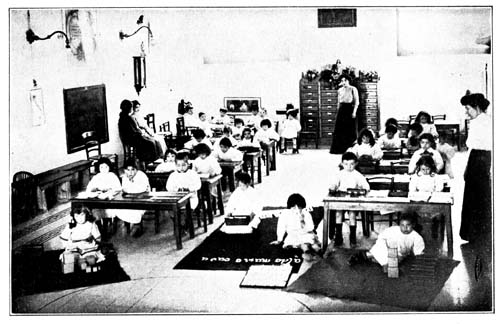
My first glimpse was of a gathering of about
twenty-five children, so young that several of them
looked like real babies to me. I found afterwards
that the youngest was just under three, and the oldest
just over six. They were scattered about over a
large, high-ceilinged, airy room, furnished with tiny,
lightly-framed tables and chairs which, however, by
no means filled the floor. There were big tracts of
open space, where some of the children knelt or sat on
light rugs. One was lying down on his back, kicking
his feet in the air. A low, cheerful hum of conversation
filled the air.
As my companion and I came into the room I noticed
first that there was not that stiffening into self-consciousness
which is the inevitable concomitant of
“visitors” in our own schoolrooms. Most of the children,
absorbed in various queer-looking tasks, did not
even glance up as we entered. Others, apparently resting
in the intervals between games, looked over across
the room at us, smiled welcomingly as I would at a
visitor entering my house, and a little group near us
ran up with outstretched hands, saying with a pleasant
accent of good-breeding, “Good-morning!
Good-morning!” They then instantly went off about
their own affairs, which were evidently of absorbing
interest, for after that, except for an occasional
friendly look or smile, or a momentary halt by my
side to show me something, none of the little scholars
paid the least attention to me.
The School Room in the Convent of the Franciscan Nuns in the Via Giusti.
Copyright 1912, by Carl R. Byoir
Now I myself, like all the American matrons of my
circle of acquaintances, am laboring conscientiously
to teach my children “good manners,” but I decided,
on the instant, nothing would induce me to collect
twenty children of our town and have a Montessori
teacher enter the room to be greeted by them. The
contrast would be too painful. These were mostly
children of very poor, ignorant, and utterly untrained
parents, and ours are children of people who
flatter themselves that they are the opposite of all
that; but I shuddered to think of the long silent,
discourteous stare which is the only recognition of
the presence of a visitor in our schools. And yet I
felt at once that I was attaching too much importance
to a detail, the merest trifle, the slightest,
most superficial indication of the life beneath. We
Anglo-Saxons notice too acutely, I thought, these surface
differences of manner.
But, on the other hand, I was forced to consider
that I knew from bitter experience that children of
that age are still near enough babyhood to be absolutely
primeval in their sincerity, and that it is practically
impossible to make them, with any certainty
of the result, go through a form of courtesy which
they do not feel genuinely. Also I observed that no
one had pushed the children towards us, as I push
mine, toward a chance visitor, with the command
accompanied by an inward prayer for obedience, “Go
and shake hands with Mrs. Blank.”
In fact, I noticed it for the first time, there seemed
no one there to push the children or to refrain from
doing it. That collection of little tots, most of them
too busy over their mysterious occupations even to
talk, seemed, as far as a casual glance over the room
went, entirely without supervision. Finally, from a
corner, where she had been sitting (on the floor apparently)
beside a child, there rose up a plainly-dressed
woman, the expression of whose quiet face
made almost as great an impression on me as the
children’s greetings had. I had always joined with
heartfelt sympathy in the old cry of “Heaven help
the poor teachers!” and in our town, where we all
know and like the teachers personally, their exhausted
condition of almost utter nervous collapse by the
end of the teaching year is a painful element in our
community life. But I felt no impulse to sympathize
with this woman with untroubled eyes who, perceiving
us for the first time, came over to shake hands with
us. Instead, I felt a curious pang of envy, such as
once or twice in my sentimental and stormy girlhood
I felt at the sight of the peaceful face of a nun.
I am now quite past the possibility of envying the
life of a nun, but I must admit that it suddenly occurred
to me, as I looked at that quiet, smiling Italian
woman, that somehow my own life, for all its full
happiness, must lack some element of orderliness, of
discipline, of spiritual economy which alone could
have put that look of calm certainty on her face.
It was not the passive, changeless peace that one sees
in the eyes of some nuns, but a sort of rich, full-blooded
confidence in life.
She lingered beside us some moments, chatting with
my companion, who was an old friend of hers, and
who introduced her as Signorina Ballerini. I noticed
that she happened to stand all the time with her
back to the children, feeling apparently none of
that lion-tamer’s instinct to keep an hypnotic eye
on the little animals which is so marked in our instructors.
I can remember distinctly that there was
for us school-children actually a different feel to the
air and a strange look on the familiar school-furniture
during those infrequent intervals when the teacher
was called for an instant from the room and left us,
as in a suddenly rarefied atmosphere, giddy with the
removal of the pressure of her eye; but when this
teacher turned about casually to face the room again,
these children did not seem to notice either that she
had stopped looking at them or that she was now
doing it again.
We used to know, as by a sixth sense, exactly
where, at any moment, the teacher was, and a sudden
movement on her part would have made us all start
as violently and as instinctively as little chicks at
the sudden shadow of a hawk ... and this, although
we were often very fond indeed of our teachers.
Remembering this, I noticed with surprise that
often, when one of these little ones lifted his face
from his work to ask the teacher a question, he had
been so unconscious of her presence during his concentration
on his enterprise that he did not know
in the least where to look, and sent his eager eyes roving
over the big room in a search for her, which ended
in such a sudden flash of joy at discovering her that
I felt again a pang of envy for this woman who had so
many more loving children than I have.
What could be these “games” which so absorbed
these children, far too young for any possibility of
pretense on their part? Moving with the unhampered,
unobserved ease which is the rule in a
Montessori schoolroom, I began walking about, looking
more closely at what the children were holding,
and I could have laughed at the simplicity of
many of the means which accomplished the apparent
miracle of self-imposed order and discipline before
me ... if I had not been ready to cry
at my own stupidity for not thinking of them myself.
One little boy about three and a half years
old had been intent on some operation ever since we
had entered the room, and even now as I drew near
his little table and chair, he only glanced up for an
instant’s smile without stopping the action of his
fingers. I leaned over him, hoping that the device
which so held his attention was not too complicated
for my inexperienced, unpedagogical mind to take in.
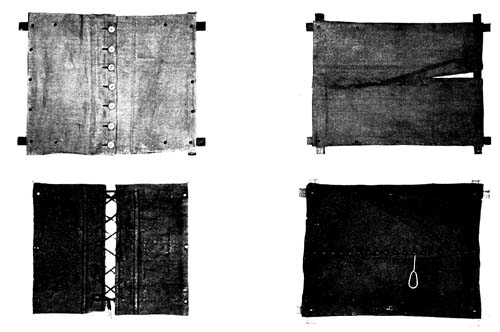
He was holding a light wooden frame about eighteen
inches square, on which were stretched two pieces of
cotton cloth, meeting down the middle like the joining
of a garment. On one of these edges was a row of
buttonholes and on the other a row of large bone
buttons. The child was absorbed in buttoning and
unbuttoning those two pieces of cloth.
He was new at the game, that was to be seen by the
clumsy, misdirected motions of his baby fingers, but
the process of his improvement was so apparent as,
his eyes shining with interest, he buttoned and unbuttoned
steadily, slowly, without an instant’s interruption,
that I watched him, almost as fascinated as
he. A child near us, apparently playing with blocks,
upset them with a loud noise, but my buttoning boy,
wrapped in his magic cloak of concentration, did not
so much as raise his eyes. I myself could not look
away, and as I gazed I thought of the many times a
little child of mine had tried to learn the secret of the
innumerable fastenings which hold her clothes together
and how I, with the kindest impulse in the
world, had stopped her fumbling little fingers saying,
“No, dear, Mother can do that so much better. Let
Mother do it.” It occurred to me now that the situation
was very much as if, in the midst of a fascinating
game of billiards, a professional player had
snatched the cue from my husband’s hands, saying,
“You just stand and watch me do this. I can do it
much better than you.”
The child before me stopped his work a moment
and looked down at his little cotton waist. There
was a row of buttons there, smaller but of the same
family as those on the frame. As he gazed down,
absorbed, at them, I could see a great idea dawn in
his face. I leaned forward. He attacked the middle
button, using with startling exactitude of imitation
the same motion he had learned on his frame.
But this button was not so large or so well placed.
He had to bend his head over, his fingers were
cramped, he made several movements backward. But
then suddenly the first half of his undertaking was
accomplished. The button was on one side, the buttonhole
on the other. I held my breath. He set to
work again. The cloth slipped from his boneless
little fingers, the button twisted itself awry, I fairly
ached with the idiotic habit of years of interference to
snatch it and do it for him. And then I saw that he
was slowly forcing it into place. When the bone
disk finally shone out, round and whole, on the far
side of the buttonhole, the child drew a long breath
and looked up at me with so ecstatic a face of triumph
that I could have shouted, “Hurrah!” Then,
without paying any more attention to me, he rose,
sauntered over to a corner of the room where a thick
piece of felt covered the floor, and lay down on his
back, his hands clasped under his head, gazing with
tranquil, reposeful vacuity at the ceiling. He was
resting himself after accomplishing a great step forward.
I did not fail to notice that, except for my
entirely fortuitous observation of his performance,
nobody had seen his absorption any more than they
now saw his apparent idleness.
I tucked all these observations away in a corner of
my mind for future reflection, and moved on to the
nearest child, a little girl, perhaps a year older than
the boy, who was absorbed as eagerly as he over a
similar light wooden frame, covered with two pieces
of cloth. But these were fastened together with pieces
of ribbon which the child was tying and untying.
There was no fumbling here. As rapidly, as deftly,
with as careless a light-hearted ease as a pianist running
over his scales, she was making a series of the
flattest, most regular bow-knots, much better, I knew
in my heart, than I could accomplish at anything like
that speed. Although she had advanced beyond the
stage of intent struggle with her material, her interest
and pleasure in her own skill was manifest. She
looked up at me, and then smiled proudly down at
her flying fingers.
Beyond her another little boy, with a leather-covered
frame, was laboriously inserting shoe-buttons
into their buttonholes with the aid of an ordinary
button-hook. As I looked at him, he left off, and
stooping over his shoes, tried to apply the same system
to their buttons. That was too much for him.
After a prolonged struggle he gave it up for the
time, returning, however, to the buttons on his frame
with entirely undiminished ardor.
Next to him sat a little girl, with a pile of small
pieces of money before her on her tiny table. She
was engaged in sorting these into different piles according
to their size, and, though I stood by her
some time, laughing at the passion of accuracy which
fired her, she was so absorbed that she did not even
notice my presence. As I turned away I almost
stumbled over a couple of children sitting on the floor,
engaged in some game with a variety of blocks which
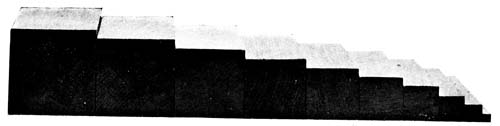
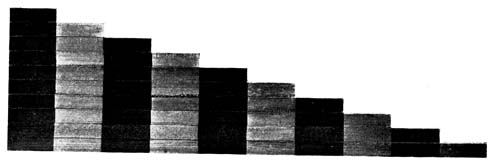
looked new to me. They were ten squared rods of
equal thickness, of which the shortest looked to be a
tenth the length of the longest, and the others of
regularly diminishing lengths between these two extremes.
These were painted in alternate stripes of
red and blue, these stripes being the same width as
the shortest rod. The children were putting these
together in consecutive order so as to make a sort of
series, and although they were evidently much too
young to count, they were aiding themselves by touching
with their fingers each of the painted stripes,
and verifying in this way the length of the rod. I
could not follow this process, although it was plainly
something arithmetical, and turned to ask the teacher
about it.
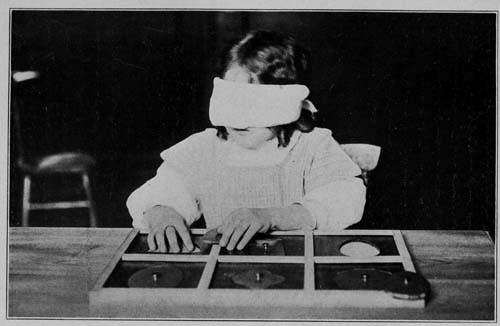
I saw her across the room engaged in tying a bandage
about a child’s eyes. Wondering if this were some
new, scientific form of punishment, I stepped to that
part of the room and watched the subsequent proceedings.
The child, his lips curved in an expectant smile,
even laughing a little in pleasant excitement, turned
his blindfolded face to a pile of small pieces of cloth
before him. Several children, walking past, stopped
and hung over the edge of his desk with lively interest.
The boy drew out from the pile a piece of velvet.
He felt of this intently, running the sensitive tips of
his fingers lightly over the nap, and cocking his head
on one side in deep thought. The child-spectators
gazed at him with sympathetic attention. When he
gave the right name, they all smiled and nodded
their heads in satisfaction. He drew out another
piece from the big pile, coarse cotton cloth this time,
which he instantly recognized; then a square of satin
over which his little finger-tips wandered with evident
sensuous pleasure. His successful naming of this was
too much for his envious little spectators. They
turned and fled toward the teacher and when I reached
her, she was the center of a little group of children,
all clamoring to be blindfolded.
“How they do love that exercise!” she said, looking
after them with shining eyes ... I could have
sworn, with mother’s eyes!
“Are you too busy and hurried,” I asked, “to explain
to me the game those children are playing with
the red and blue rods?”
She answered with some surprise, “Oh, no, I’m
not busy and hurried at all!” (quite as though we
were not all living in the twentieth century) and went
on, “The children can come and find me if they need
me.”
So I had my first lesson in the theory of self-education
and self-dependence underlying the Montessori
apparatus, to the accompaniment of occasional
requests for aid, or demands for sympathy over
an achievement, made in clear, baby treble. That
theory will be taken up later in this book, as this
chapter is intended only to be a plain narration of a
few of the sights encountered by an ordinary observer
in a morning in a Montessori school.
After a time I noticed that four little girls were
sitting at a neatly-ordered small table, spread with
a white cloth, apparently eating their luncheons.
The teacher, in answer to my inquiring glance at
them, explained that it was their turn to be the
waitresses that day, for the children’s lunch, and so
they ate their own meal first.
She was called away just then, and I sat looking at
the roomful of busy children, listening to the pleasant
murmur of their chats together, watching them
move freely about as they liked, noting their absorbed,
happy concentration on their tasks. Already
some of the sense of the miraculous which had
been so vivid in my mind during my first survey of
the school was dulled, or rather, explained away.
Now that I had seen some of the details composing the
picture, the whole seemed more natural. It was not
surprising, for instance, that the little girl sorting the
pieces of money should not instead be pulling another
child’s hair, or wandering in aimless and potentially
naughty idleness about the room. It was not necessary
either to force or exhort her to be a quiet and
untroublesome citizen of that little republic. She
would no more leave her fascinating occupation to
go and “be naughty” than a professor of chemistry
would leave an absorbing experiment in his laboratory
to go and rob a candy-store. In both cases it
would be leaving the best sort of a “good time” for
a much less enjoyable undertaking.
In the midst of these reflections (my first glimmer
of understanding of what it was all about), a lively
march on the piano was struck up. Not a word was
spoken by the teacher, indeed I had not yet heard her
voice raised a single time to make a collective remark
to the whole body of children, but at once, acting
on the impulse which moves us all to run down the
street towards the sound of a brass band, most of the
children stopped their work and ran towards the open
floor-space near the piano. Some of the older ones,
of five, formed a single-file line, which was rapidly
recruited by the monkey-like imitativeness of the little
ones, into a long file. The music was martial, the
older children held their heads high and stamped
loudly as they marched about, keeping time very accurately
to the strongly marked rhythm of the tune.
The little tots did their baby best to copy their big
brothers and sisters, some of them merely laughing
and stamping up and down without any reference to
the time, others evidently noticing a difference between
their actions and those of the older ones, and
trying to move their feet more regularly.
No one had suggested that they leave their work-tables
to play in this way (indeed a few too absorbed
to heed the call of the music still hung intently over
their former occupations), no one suggested that
they step in time to the music, no one corrected them
when they did not. The music suddenly changed from
a swinging marching air to a low, rhythmical croon.
The older children instantly stopped stamping and began
trotting noiselessly about on their tiptoes, imitated
again as slavishly as possible by the admiring
smaller ones. The uncertain control of their equilibrium
by these littler ones, made them stagger about, as
they practised this new exercise, like the little
bacchantes, intoxicated with rhythm, which their
glowing faces of delight seemed to proclaim them.
I was penetrated with that poignant, almost tearful
sympathy in their intense enjoyment which children’s
pleasure awakens in every adult who has to
do with them. “Ah, what a good time they are
having!” I cried to myself, and then reflected that
they had been having some sort of very good time
ever since I had come into the room. And yet even
my unpractised eye could see a difference between this
good time and the kindergarten, charming as that is
to watch. No prettily-dressed, energetic, thoroughgoing
young lady had beckoned the children away
from their self-chosen occupations. There was no set
circle here with the lovely teacher in the middle, and
every child’s eyes fastened constantly on her nearly
always delightful but also overpoweringly developed
adult personality. There was no set “game” being
played, the discontinuation of which depended on the
teacher’s more or less accurate guess at when the
children were becoming tired. Indeed, as I reflected
on this, I noticed that, although the bigger ones were
continuing their musical march with undiminished
pleasure, the younger ones had already exhausted
the small amount of consecutive interest their infant
organisms are capable of, and, without spoiling the
fun for the others, indeed without being observed,
had suddenly stopped dancing and prancing as suddenly
as they began and, with the kitten-like fitfulness
of their age, were wandering away in groups of
two and three out to the great, open courtyard.
I suppose they went on playing quieter games
there, but I did not follow them, so absorbed was I in
watching the four little girls who had now at last
finished their very leisurely meal and were preparing
the tables for the other children. They were about
four and a half and five years old, an age at which
I would have thought children as capable of solving a
problem in calculus as of undertaking, without supervision,
to set tables for twenty other babies. They
went at their undertaking with no haste, indeed with
a slowness which my racial impatience found absolutely
excruciating. They paused constantly for prolonged
consultations, and to verify and correct themselves
as they laid the knife, fork, spoon, plate, and
napkin at each place. Interested as I was, and beginning,
as I did, to understand a little of the ideas
of the school, I still was so under the domination of
my lifetime of over-emphasis on the importance of the
immediate result of an action, that I felt the same
impulse I had restrained with difficulty beside the
buttoning boy—to snatch the things from their incompetent
little hands and whisk them into place on
the tables.
But then I noticed that the clock showed only a
little after eleven, and that evidently the routine of
the school was planned expressly so that there would
be no need for haste.
The phrase struck my mental ear curiously, and
arrested my attention. I reflected on that condition
with the astonished awe of a modern, meeting it almost
for the first time. “No need for haste”—it
was like being transported into the timeless ease of
eternity.
And then I fell to asking myself why there was
always so much need for haste in my own life and in
that of my children? Was it, after all, so necessary?
What were we hurrying so to accomplish? I remembered
my scorn of the parties of Cook’s tourists, clattering
into the Sistine Chapel for a momentary glance
at the achievement of a lifetime of genius, painted
on the ceiling, and then galloping out again for a
hop-skip-and-jump race down through the Stanze of
Raphael. It occurred to me, disquietingly, that possibly,
instead of really training my children, I might
be dragging them headlong on a Cook’s tour through
life. It also occurred to me that if the Montessori
ideas were taken up in my family, the children would
not be the only ones to profit by them.
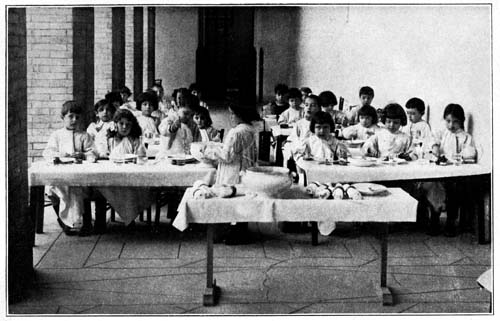
The Meal Hour.
Copyright 1912, by Carl R. Byoir
When I emerged from this brown study, the little
girls had finished their task and there stood before
me tables set for twenty little people, set neatly and
regularly, without an item missing. The children,
called in from their play in the courtyard, came
marching along (they do take collective action when
collective interests genuinely demand it) and sat down
without suggestions, each, I suppose, at the place he
had occupied while working at those same tiny tables.
I held my breath to see the four little waitresses enter
the room, each carrying a big tureen full of hot soup.
I would not have trusted a child of that age to carry
a glass of water across a room. The little girls advanced
slowly, their eyes fixed on the contents of
their tureens, their attention so concentrated on their
all-important enterprise that they seemed entirely oblivious
of the outer world. A fly lighted on the nose
of one of these solemnly absorbed babies. She twisted
the tip of that feature, making the most grotesque
grimaces in her effort to dislodge the tickling intruder,
but not until she had reached a table and set
down her sacred tureen in safety, did she raise her
hand to her face. I revised on the instant all my
fixed convictions about the innate heedlessness and
lack of self-control of early childhood; especially as
she turned at once to her task of ladling out the
soup into the plates of the children at her table, a
feat which she accomplished as deftly as any adult
could have done.
The napkins were unfolded, the older children
tucked them under their chins and began to eat their
soup. The younger ones imitated them more or less
handily, though with some the process meant quite
a struggle with the napkin. One little boy, only one
in all that company, could not manage his. After
wrestling with it, he brought it to the teacher, who
had dropped down on a chair near mine. So sure was
I of what her action inevitably would be, that I fairly
felt my own hands automatically follow hers in the
familiar motions of tucking a napkin under a child’s
round chin.
I cannot devise any way to set down on paper
with sufficient emphasis the fact that she did not tuck
that napkin in. She held it up in her hands, showed
the child how to take hold of a larger part of the
corner than he had been grasping, and, illustrating
on herself, gave him an object-lesson. Then she gave
it back to him. He had caught the idea evidently,
but his undisciplined little fingers, out of sight there,
under his chin, would not follow the direction of his
brain, though that was evidently, from the grave intentness
of his baby face, working at top speed.
With a sigh, that irresistible sigh of the little child,
he took out the crumpled bit of linen and looked at it
sadly. I clasped my hands together tightly to keep
them from flying at him and accomplishing the operation
in a twinkling. Why, the poor child’s soup was
getting cold!
Again I wish to reiterate the statement that the
teacher did not tuck that napkin in. She took it
once more and went through very slowly all the
necessary movements. The child’s big, black eyes
fastened on her in a passion of attention, and I noticed
that his little empty hands followed automatically
the slow, distinctly separated, analyzed
movements of the teacher’s hands. When she gave
the napkin back to him, he seized it with an air of
resolution which would have done honor to Napoleon,
grasping it firmly and holding his wandering baby-wits
together with the aid of a determined frown.
He pulled his collar away from his neck with one
hand and, still frowning determinedly, thrust a large
segment of the napkin down with the other, spreading
out the remainder on his chest, with a long sigh of
utter satisfaction, which went to my heart. As he
trotted back to his place, I noticed that the incident
had been observed by several of the children near
us, on whose smiling faces, as they looked at their
triumphant little comrade, I could see the reflection
of my own gratified sympathy. One of them reached
out and patted the napkin as its proud wearer passed.
But I had not been all the morning in that children’s
home, perfect, though not made with a mother’s
hands, without having my mother’s jealousy sharply
aroused. A number of things had been stirring up
protests in my mind. I was alarmed at the sight of
all these babies, happy, wisely occupied, perfectly
good, and learning unconsciously the best sort of
lessons, and yet in an atmosphere differing so entirely
from all my preconceived ideas of a home. All
this might be all very well for Italian mothers so poor
that they were obliged to leave their children in order
to go out and help earn the family living; or for English
mothers, who expect as a matter of course that
their little children shall spend most of their time with
nurse-maids and governesses. But I could not spare
my children, I told myself. I asked nothing better
than to have them with me every moment they were
awake. What was to be done about this ominously
excellent institution which seemed to treat the children
more wisely than I, for all my efforts? I felt an
uneasy, apprehensive hostility towards these methods,
contrasting so entirely with mine, for mine were, I
assured myself hotly, based on the most absolute,
supreme mother’s love for the child.
I now turned to the teacher and said protestingly,
“That would have been a very little thing to do for
a child.”
She laughed. “I’m not his nurse-maid. I’m his
teacher,” she replied.
“That’s all very well, but his soup will be cold, you
know, and he will be late to his luncheon!”
She did not deny this, but she did not seem as struck
as I was by the importance of the fact. She answered
whimsically, “Ah, one must remember not to obtrude
one’s adult materialism into the idealistic world of
children. He is so happy over his victory over
himself that he wouldn’t notice if his soup were
iced.”
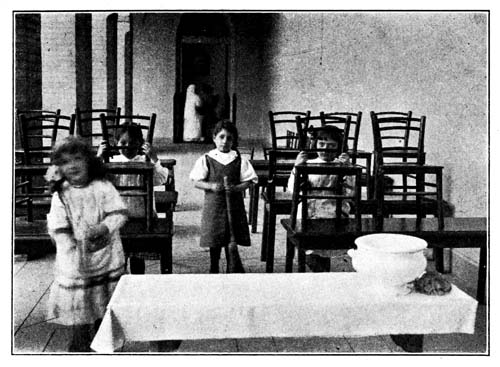
The Morning Clean-up.
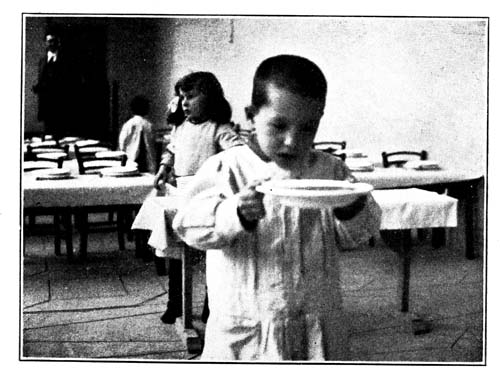
Waiter Carrying Soup.
Copyright 1912, by Carl R. Byoir
“But warm soup is a good thing, a very good
thing,” I insisted, “and you have literally robbed
him of his. More than that, I seem to see that all
this insistence on self-dependence for children must
interfere with a great many desirable regularities of
family life.”
She looked at me indulgently. “Yes, warm soup
is a good thing, but is it such a very important thing?
According to our adult standards it is more palatable,
but it’s really about as good food if eaten cold, isn’t
it? And, anyhow, he eats it cold only this once.
You’d snatch him away from his plate of warm soup
without scruple if you thought he was sitting in a
draught and would take cold. Isn’t his moral health
as important as his physical?”
“But it might be very inconvenient for someone
else, in an ordinary home, to wait so interminably for
him to learn to wait on himself.”
Her answer was a home-thrust. “If it’s too much
trouble to give him the best conditions at home,
wouldn’t he be better sent to a Casa dei Bambini,
which has no other aim than to have things just right
for his development?”
This silenced me for a time. I turned away, but
was recalled by her remarking, “Besides, I’ve put him
more in the way of getting his soup hot from now on,
than you would, by tucking in his napkin and sending
him back at once. To-day’s plateful would have
been warm; but how about to-morrow and the day
after, and so on, unless you, or some other grown-up
happened to be at hand to wait on him. And
on my part, what could I do, if all twenty-five of the
children were helpless?”
I seized on this opportunity to voice some of the
mother’s jealousy which underlay all my extreme admiration
and astonishment at the sights of the morning,
“If you didn’t keep such an octopus clutch on
the children, separating them all day in this way from
their own families, if they were sent home to eat their
luncheons, why, there would be mothers enough to go
around. They would be only too glad to tuck the
little napkins in!”
The teacher looked at me, level-browed, and said,
with a dry, enigmatic accent which made me reflect
uneasily, long afterwards, on her words, “They certainly
would. Do you really think that would be an
improvement?”