PREFACE TO NEW EDITION. — PREFACE. — CONTENTS. — A MODERN ZOROASTRIAN. — CHAPTER I. INTRODUCTORY.
A MODERN ZOROASTRIAN.
A MODERN ZOROASTRIAN.
1000
copies
printed,
February, 1888.
1000
”
”
March, 1889.
1000
”
”
March, 1890.
1000
”
”
June, 1890.
1000
”
”
March, 1891.
1000
”
”
June, 1892.
1000
”
”
February, 1893.
1000
”
”
November, 1893.
A MODERN ZOROASTRIAN
BY S. LAING, AUTHOR OF
“MODERN SCIENCE AND MODERN THOUGHT,” “PROBLEMS OF THE FUTURE,”
“HUMAN ORIGINS.”
Eighth Thousand.
LONDON: CHAPMAN AND HALL, Ld.
1893.
CHARLES DICKENS AND EVANS,
CRYSTAL PALACE PRESS.
From some of the criticisms on the First Edition of
this work I fear that the distinction I endeavoured
to draw between the use of the term “polarity”
in the inorganic and in the spiritual worlds has
not been made sufficiently clear. I stated in the
Introduction “That while the principle of polarity
pervades both worlds, I am far from assuming that
the laws under which it acts are identical; and that
virtue and vice, pain and pleasure, are products of
the same mathematical laws as regulate the attractions
and repulsions of molecules and atoms.” But this
warning has been apparently overlooked by some
readers who have assumed that instead of analogy I
meant identity, and that it was a mistake to use the
same word “polarity” for phenomena so essentially
distinct as those of the material and the spiritual
worlds.
Thus my “guide, philosopher, and friend,” Professor
Huxley, for whose authority I have the highest respect,
observed in a recent article, that he had long ago
acquired a habit, if he came across the word polarity
applied to anything but magnetism and electricity,
of throwing down the book and reading no farther.
I must confess that I felt a little disconcerted when
I read this passage; but I was soon consoled, for,
in a month or two afterwards, I came across another
passage in the same Review which said, “However revolting
may be the accumulation of misery at the negative
pole of Society, in contrast with that of monstrous
wealth at the positive pole, this state of things must
abide and grow continuously worse, as long as Istar
(the dual Goddess of the Babylonians) holds her way
unchecked.”
Surely, I thought, here is a case in which the
Professor must have thrown down the Review when
he came to these words: but when I came to the
end, I found that it was not the Review, but the
pen, which must have been thrown down, for the
article is signed “T. Huxley.” Can there be a more
conclusive proof that there are a vast variety of facts outside
of magnetism and electricity, connected by an underlying
idea, which inevitably suggests analogy to them,
and which can be most conveniently expressed by the
word “polarity”? Words after all are only coins to facilitate
the interchange of ideas, and the best word is that
which serves the purpose most clearly and concisely.
Thus instead of using a waggon load of copper, or
the verbiage of a conveyancer’s deed, to express the
ideas comprised in such words as “theism,” “pantheism,”
or “agnosticism,” we coin them for general use, as
Huxley did the word “agnosticism,” in order to convey
our meaning.
Polarity is such a word. It sums up what Emerson
says in his Essay on Compensation: “Polarity, or
action and reaction, we meet in every part of Nature;
in darkness and light; in the ebb and flow of waters;
in male and female; in the inspiration and expiration
of plants and animals; in the undulations of fluids and
of sound; in the centripetal and centrifugal gravity;
in electricity, galvanism, and chemical affinity. Superinduce
Magnetism at one end of a needle, the opposite
Magnetism takes place at the other end. If the South
attracts, the North repels. An inevitable dualism besets
nature, so that each thing is a half, and suggests another
to make it whole: as spirit, matter; man, woman; odd,
even; subjective, objective; in, out; upper, under;
motion, rest; yea, nay.”
These, by whatever name we like to call them, are
facts and not fancies, and facts which enter largely
into all questions, whether of science, philosophy,
religion, or practical policy. Every one who wishes to
keep at all abreast with modern culture, ought to have
some general knowledge of the ideas and principles
which underlie them and which are embraced in the
comprehensive word “polarity.” My object in this book
has been to assist the reader, who is not a specialist,
in arriving at some general understanding of the subjects
treated of, and I may hope, in awakening such an
interest in them as may induce him to prosecute further
researches. If I succeed in this, my object will have
been attained.
The reception given to my former work, on ‘Modern
Science and Modern Thought,’ has induced me to write
this further one. I refer not so much to the reviews of
professional critics, though as a rule nothing could be
more courteous and candid, but rather to the letters
I have received from readers of various age, sex, and
condition, saying that I had assisted them in understanding
much interesting matter which had previously
been a sealed book to them.
If I am good for anything, it is for a certain faculty
of lucid condensation, and I have thought that I might
apply this to some of the less-known branches of modern
science, such as the new chemistry and physiology, as
well as, in my first work, to the more familiar subjects
of astronomy and geology; while at the same time I
might extend it to some of the more obvious problems
of religion, morals, metaphysics, and practical life, which
force themselves, more and more every day, on the
attention of intelligent thinkers.
As in the former work the scientific speculations
were linked together by the leading idea of the universality
of law, so, in this, unity is given to them by
the all-pervading principle of polarity, which manifests
itself everywhere as the fundamental condition of the
material and spiritual universe.
For the scientific portion of the work I am indebted
to the most approved authorities, such as Darwin,
Huxley, Haeckel, and Professor Cooke’s volume on the
New Chemistry in the International Scientific Series.
For the religious and philosophical speculations I am
myself responsible; for, although I have derived the
greatest possible pleasure and profit from Herbert
Spencer’s writings, I had arrived at my principal conclusions
independently before I had read any of his
works. I can only hope that I may have succeeded in
presenting a good many abstruse questions in a popular
form, intelligible to the average mind of ordinary
readers, and calculated, if it teaches nothing else, to
teach them a practical philosophy which inculcates
tolerance and charity, and assists them in finding
Sermons in stones and good in everything.
PAGE
CHAPTER I. INTRODUCTORY.
Experiment with magnet—Principle of polarity—Applies
universally—Analogies in spiritual world—Zoroastrian religion—Changes in
modern environment—Require corresponding changes in religions
and philosophies
CHAPTER II. POLARITY IN MATTER—MOLECULES AND ATOMS.
Matter consists of molecules—Nature of molecules—Laws of their
action in gases—Law of Avogadro—Molecules composed of atoms—Proved
by composition of water—Combinations of atoms—Elementary
substances—Qualities of matter depend on atoms—Dimensions
and velocities of molecules and atoms—These are ascertained
facts, not theories
Ether proved by light—Light-waves—Elasticity of ether—Its universal
diffusion—Influences molecules and atoms—Is influenced
by them—Successive orders of the infinitely small—Illustrated
by the differential and integral calculus—Explanation of this
calculus—Theory of vortex rings
Energy of motion and of position—Energy can be transformed, not
created or destroyed—Not created by free-will—Conservation of
mechanical power—Convertibility of heat and work—Nature of
heat—The steam-engine—Different forms of energy—Gravity—Molecular
energy—Chemical energy—Dynamite—Chemical affinities—Electricity—Produced
by friction—By the voltaic battery—Electric
currents—Arc light—Induction—Magnetism—The
magnetic needle—The electric telegraph—The telephone—Dynamo-electric
engine—Accumulator
Ultimate elements of universe—Built up by polarity—Experiment
with magnet—Chemical affinity—Atomic poles—Alkalies and
acids—Quantivalence—Atomicity—Isomerism—Chemical stability—Thermochemistry—Definition
of atoms—All matter built
up by polar forces
Contrast of living and dead—Eating and being eaten—Trace matter
upwards and life downwards—Colloids—Cells—Protoplasm—Monera—Composition
of protoplasm—Essential qualities of life—Nutrition
and sensation—Motion—Reproduction—Spontaneous
generation—Organic compounds—Polar conditions of life
CHAPTER VII. PRIMITIVE POLARITIES—PLANT AND ANIMAL.
Contrast in developed life—Plants producers, animals consumers—Differences
disappear in simple forms—Zoophytes—Protista—Nummulites—Corals—Fungi—Lichens—Insectivorous
plants—Geological
succession—Primary period, Algæ and Ferns—Secondary
period, Gymnosperms—Tertiary and recent, Angiosperms—Monocotyledons
and Dicotyledons—Parallel evolution of animal
life—Primary, protista, mollusca, and fish—Secondary, reptiles—Tertiary
and recent, mammals
CHAPTER VIII. PRIMITIVE POLARITIES—POLARITY OF SEX.
Sexual generation—Base of ancient cosmogonies—Propagation
non-sexual in simpler forms—Amœba and cells—Germs and buds—Anemones—Worms—Spores—Origin
of sex—Ovary and male
organ—Hermaphrodites—Parthenogenesis—Bees and insects—Man
and woman—Characters of each sex—Woman’s position—Improved
by civilisation—Christianity the feminine pole—Monogamy
the law of nature—Tone respecting women test of character—Women
in literature—In society—Attraction and repulsion of
sexes—Like attracts unlike—Ideal marriage—Woman’s rights and
modern legislation
CHAPTER IX. PRIMITIVE POLARITIES—HEREDITY AND VARIATION.
Heredity in simple forms of life—In more complex organisms—Pangenesis—Varieties
how produced—Fixed by law of survival
of the fittest—Dr. Temple’s view—Examples: triton, axolotl—Variations
in individuals and species—Lizards into birds—Ringed
snakes—Echidna
CHAPTER X. THE KNOWABLE AND UNKNOWABLE—BRAIN AND THOUGHT.
Basis of knowledge—Perception—Constitution of brain—White and
grey matter—Average size and weight of brains—European,
negro, and ape—Mechanism of perception—Sensory and motor
nerves—Separate areas of brain—Sensory and motor centres—Abnormal
states of brain—Hypnotism—Somnambulism—Trance—Thought-reading—Spiritualism—Reflex
action—Ideas how
formed—Number and space—Creation unknowable—Conceptions
based on perceptions—Metaphysics—Descartes, Kant, Berkeley—Anthropomorphism—Laws
of nature
Religions, ‘working hypotheses’—Newman’s illative sense—Origins
of religions—Ghosts and spirits—Fetishes—Nature-worship—Solar
myths—Planets—Evolution of nature-worship—Polytheism,
pantheism, and theism—Evolution of monotheism in the Old
Testament—Evolution of morality—Natural law and miracle—Evidence
for miracles—Insufficiency of evidence—Absence of
intelligent design—Agnosticism—Origin of evil—Can only be
explained by polarity—Optimism and pessimism—Jesus, the
Christian Ormuzd—Christianity without miracles
Christianity based on morals—Origin of morality—Traced in Judaism—Originates
in evolution—Instance of murder—Freedom of will—Will
suspended in certain states of brain—Hypnotism—Mechanical
theory—Pre-established harmony—Human and animal
conscience—Analysis of will—Explained by polarity—Practical
conclusion
Zoroaster an historical person—The Parsees—Iranian branch of Aryan
family—Zoroaster a religious reformer—Scene at Balkh—Conversion
of Gushtasp—Doctrines of the ‘excellent religion’—Monotheism—Polarity—Dr.
Haug’s description—Ormuzd and
Ahriman—Anquetil du Perron—Approximation to modern
thought—Absence of miracles—Code of morals—Its comprehensiveness—And
liberality—Special rites—Fire-worship—Disposal
of dead—Practical results—The Parsees of Bombay—Their
probity, enterprise, respect for women—Zeal for education—Philanthropy
and public spirit—Statistics—Death and birth rates
Byron’s lines—Carnegie’s description—Parsee nature-worship—English
Sunday—The sermon—Appeals to reason misplaced—Music
better than words—The Mass—Zoroastrianism brings religion
into daily life—Sanitation—Zoroastrian prayer—Religion of
the future—Sermons in stones and good in everything
Fable of the shield—Progress and conservatism—English and French
colonisation—Law-abidingness—Irish land question—True conservative
legislation—Ultra-conservatism—Law and education—Patriotism—Jingoism
and parochialism—True statesmanship—Free
trade and protection—Capital and labour—Egoism and
altruism—Socialism and laissez faire—Contracts—Rights and
duties of landlords—George’s theory—State interference—Railways—Post
Office—Telegraphs—National defence—Concluding
remarks
CHAPTER II. POLARITY IN MATTER—MOLECULES AND ATOMS.
Experiment with magnet—Principle of polarity—Applies universally—Analogies
in spiritual world—Zoroastrian religion—Changes in modern
environment—Require corresponding changes in religions and philosophies.
Scatter a heap of iron filings on a plate of glass; bring
near it a magnet, and tap the glass gently, and you will
see the filings arrange themselves in regular forms.
If one pole only of the magnet is brought near the
glass the filings arrange themselves in lines radiating
from that pole.
Next lay the bar-magnet on the glass so that the
filings are influenced by both poles; they will arrange
themselves into a series of regular curves.
In other words, the Chaos of a confused heap of inert
matter has become a Cosmos of harmonious arrangement
assuming definite form in obedience to law.
As the old saying has it, that ‘every road leads to
Rome,’ so this simple experiment leads up to a principle
which underlies all existence knowable to human faculty—that
of Polarity. Why do the iron filings arrange
themselves in regular curves? Because they are magnetised
by the influence of the larger magnet, and each
little particle of iron is converted into a little magnet
with two opposite poles attracting and repelling.
What is a magnet? It is a special manifestation of
the more general principle of polarity, by which energy,
when it passes from the passive or neutralised into the
active state, does so under the condition of developing
opposite and conflicting energies: no action without
reaction, no positive without a negative, and, as we see
it in the simplest form in our magnets, no North Pole
without a South Pole—like ever repelling like and
attracting unlike. The magnet, again, may be considered
as a special form of electricity, for if we send an
electric current through a coil of copper wire encircling
a bar of soft iron, the bar is at once converted into a
magnet; so that a magnet may be considered as the
summing up, at two opposite extremities or poles, of
the attractive and repulsive effects of electric currents
circulating round it. But this electricity is itself subject
to the law of polarity, whether developed by chemical
action in the form of a current or electricity in motion,
or by friction in the form of statical electricity of small
quantity but high tension. In all cases a positive implies
a negative; in all, like repels like and attracts unlike.
Conversely, as polarity produces definite structure, so
definite structure everywhere implies polarity.
The same principle prevails not only throughout the
inorganic or world of matter, but throughout the organic
or world of life, and specially throughout its highest
manifestations in human life and character, and in the
highest products of its evolution, in societies, religions,
and philosophies. To show this by some familiar and
striking examples is the main object of this book.
But here let me interpose a word of caution. I
must avoid the error which vitiates Professor Drummond’s
interesting work on ‘Natural Law in the
Spiritual World,’ of confounding analogy and identity.
Because the principle of polarity pervades alike the
natural and spiritual worlds, I am far from assuming
that the laws under which it acts are identical; and
that virtue and vice, pain and pleasure, ugliness and
beauty, are products of the same mathematical changes
of sign and inverse squares or cubes of distances, as
regulate the attractions and repulsions of molecules and
atoms. All I say is, that the same pervading principle
may be traced wherever human thought and human
knowledge extend; that it is apparently, for some
reason unknown to us, the essential condition of all
existence within the sphere of that thought and that
knowledge; and that what lies beyond it is the great
unknown, behind the impenetrable veil which it is not
given to mortals to uplift. In like manner, if I call
myself ‘a modern Zoroastrian,’ it is not that I wish
or expect to teach a new religion or revive an old one,
to see Christian churches dedicated to Ormuzd, or right
reverend bishops exchanging the apron and shovel-hat
for the mitre and flowing robes of the ancient Magi;
but simply this. All religions I take to be ‘working
hypotheses,’ by which successive ages and races of men
try to satisfy the aspirations and harmonise the knowledge
which in the course of evolution have come to be,
for the time, their spiritual equipment. The best proof
of any religion is, that it exists—i.e. that it is part of
the same evolution, and that on the whole it works
well, i.e. is in tolerable harmony with its environment.
When that environment changes, when loftier views of
morality prevail, when knowledge is increased and the
domain of science everywhere extends its frontier, religions
must change with it if they are to remain good
working, and not become unworkable and unbelievable
hypotheses.
Now of all the religious hypotheses which remain
workable in the present state of human knowledge, that
seems to me the best which frankly recognises the
existence of this dual law, or law of polarity, as the
fundamental condition of the universe, and, personifying
the good principle under the name of Ormuzd,
and the evil one under that of Ahriman, looks with
earnest but silent and unspoken reverence on the great
unknown beyond, which may, in some way incomprehensible
to mortals, reconcile the two opposites, and
give the final victory to the good.
Oh! yet we hope that somehow good
Will be the final goal of ill.
So sings the poet of the nineteenth century: so, if we
understand his doctrine rightly, taught the Bactrian
sage, Zoroaster, some forty centuries earlier.
This, and this alone, seems to me to afford a working
hypothesis which is based on fact, can be brought
into harmony with the existing environment, and embraces,
in a wider synthesis, all that is good in other
philosophies and religions.
When I talk of our new environment, it requires
one who, like the author, has lived more than the
Scriptural threescore and ten years, and has, so to
speak, one foot on the past and one on the present,
to realise how enormous is the change which a single
generation has made in the whole spiritual surroundings
of a civilised man of the nineteenth century.
When I was a student at Cambridge, little more than
fifty years ago, Astronomy was the only branch of
natural science which could be said to be definitely
brought within the domain of natural law. And that
only as regards the law of gravity, and the motions of
the heavenly bodies, for little or nothing was known as
to their constitution. Geology was just beginning the
series of conquests by which time and the order and
succession of life on the earth have been annexed by
science as completely as space by astronomy; and
theories of cataclysms, universal deluges, and special
recent creations of animals and man, still held their
ground, and were quoted as proofs of a universe maintained
by constant supernatural interference.
And when I say that space had been annexed to
science by astronomy, it was really only that half of
space which extends from the standpoint of the human
senses in the direction of the infinitely great. The
other equally important half which extends downwards
to the infinitely small was unknown, or the subject
only of the vaguest conjectures.
Chemistry was, to a great extent, an empirical
science, and molecules and atoms were at best guesses
at truth, or rather convenient mathematical abstractions
with no more actual reality than the symbols of the
differential calculus. The real causes and laws of heat,
light, and electricity, were as little known as those of
molecular action and of chemical affinity. The great
laws of the indestructibility of matter, the correlation of
forces, and the conservation of energy, were unknown,
or only just beginning to be foreshadowed. As regards
life, protoplasm was a word unheard of; scientific
biology, zoology, and botany were in their infancy;
and the gradual building up of all living matter from a
speck of protoplasm, through a primitive cell, was not
even suspected. Above all, the works of Darwin had
not been published, and evolution had not become the
general law of modern thought; nor had the discovery
of the antiquity of man, and of his slow development
upwards from the rudest origins, shattered into fragments
established beliefs as to his recent miraculous
creation.
Science and miracle have been fighting out their
battle during the last fifty years along the whole
line, and science has been at every point victorious.
Miracle, in the sense in which our fathers believed in
it, has been not only repulsed, but annihilated so completely,
that really little remains but to bury the dead.
The result of these discoveries has been to make a
greater change in the spiritual environment of a single
generation than would be made in their physical environment
if the glacial period suddenly returned and
buried Northern Europe under polar ice. The change
is certainly greater in the last fifty years than it had
been in the previous five hundred, and in many respects
greater than in the previous five thousand.
It may be sufficient to glance shortly at the equally
great corresponding changes which this period has witnessed
in the practical conditions of life and of society.
If astronomy and geology have extended the dominion
of the mind over space and time, steamers, railways,
and the electric telegraph have gained the mastery over
them for practical purposes. Commerce and emigration
have assumed international proportions, and India,
Australia, and America are nearer to us, and connected
with us by closer ties, than Scotland was to England
in my schoolboy days. Education and a cheap press
have even in a greater degree revolutionised society,
and knowledge, reaching the masses, has carried with it
power, so that democracy and free-thought are, whether
for good or evil, everywhere in the ascendant, and old
privileges and traditions are everywhere decaying.
With such a great change of environment it is evident
that many of the old creeds, institutions, and other
organisms, adapted to old conditions, must have become
as obsolete as a schoolboy’s jacket would be as the
comfortable habiliment of a grown-up man. But as a
lobster which has cast its shell does not feel at ease
until it has grown a new one, so thinking men of the
present day are driven to devise, to a great extent each
for themselves, some larger theory which may serve
them as a ‘working hypothesis’ with which to go
through life, and bring the ineradicable aspirations and
emotions of their nature into some tolerable harmony
with existing facts.
To me, as one of those thinking units, this theory,
of what for want of a better name I call ‘Zoroastrianism,’
has approved itself as a good working theory,
which reconciles more intellectual and moral difficulties,
and affords a better guide in conduct and practical life
than any other; and, in a word, enables me to reduce
my own individual Chaos into some sort of an intelligible
and ordered Cosmos. I feel moved, therefore, to
preach through the press my little sermon upon it, for
the benefit of those whom it may concern, feeling assured
that the process of evolution, by which
The old order changes, giving place to new,
can best be assisted by the honest and unbiassed expression
of the results of individual thought and experience
on the part of any one of those units whose aggregates
form the complicated organisms of religions and philosophies,
of societies and of humanity.
CHAPTER III. ETHER.
Matter consists of molecules—Nature of molecules—Laws of their action
in gases—Law of Avogadro—Molecules composed of atoms—Proved
by composition of water—Combinations of atoms—Elementary substances—Qualities
of matter depend on atoms—Dimensions and velocities
of molecules and atoms—These are ascertained facts, not theories.
If in building a house that is to stand when the rains
fall and the winds blow, it is requisite to go down to
the solid rock for a foundation, so much the more is
it necessary in building up a theory to begin at the
beginning and give it a solid groundwork. Nine-tenths
of the fallacies current in the world arise from the haste
with which people rush to conclusions on insufficient
premises. Take, for instance, any of the political questions
of the day, such as the Irish question: how many
of those who express confident opinions, and get angry
and excited on one side or the other, could answer any
of the preliminary questions which are the indispensable
conditions of any rational judgment? How many
marks would they get for an examination paper which
asked what was the population of Ireland; what proportion
of that population was agricultural; what
proportion of that agricultural population consisted of
holders of small tenements; what was the scale of rents
compared with that for small holdings in other countries;
how much of that rent was levied on them for their own
improvements; and other similar questions which lie at
the root of the matter? In how many cases would it
be found that the whole superstructure of their confident
and passionate theories about the Irish difficulty
was based on no more solid foundation than their like
or dislike of a particular statesman or of a particular
party?
I propose therefore to begin at the beginning, and,
taking the simplest case, that of dead or inorganic
matter, show how the material universe is built up by
the operation of the all-pervading law of polarity.
What does matter consist of? Of molecules, and molecules
are made up of atoms, and these are held together
or parted, and built up into the various forms of the
material universe, primarily by polar forces.
Let me endeavour to make this intelligible to the
intelligent but unscientific reader. Suppose the Pyramid
of Cheops shown for the first time to a giant
whose eye was on such a scale that he could just discern
it as a separate object. He might make all sorts
of ingenious conjectures as to its nature, but if microscopes
had been invented in Giant-land and he looked
through one, he would find that it was built up, layer
by layer, on a regular plan and in determinate lines and
angles, by molecules, or what seemed to him almost infinitely
small masses, of squared stone. For pyramid
write crystal, and we may see by the human sense, aided
by human instruments and human reason, a similar
structure built up in the same way by minute particles.
Or again, divide and subdivide our iron filings until we
reach the limit of possible mechanical division discernible
by the microscope; each one remains essentially a
bar of iron, as capable of being magnetised, and showing
the same qualities and behaviour under chemical
tests as the original bar of iron from which the filings
were taken. This carries us a long way down towards
the infinitely small, for mechanical division and microscopic
visibility can be carried down to magnitudes
which are of the order of 1/100000th of an inch.
But this is only the first step; to understand our
molecules we must ascertain whether they are infinitely
divisible, and whether they are continuous, expanding
by being spread out thinner and thinner like gold-beater’s
skin: or are they separate bodies with intervals
between them, like little planets forming one solar system
and revolving in space by fixed laws. Ancient science
guessed at the former solution and embodied it in the
maxim ‘that nature abhors a vacuum’: modern science
proves the latter.
In the first place bodies combine only in fixed proportions,
which is a necessary consequence if they consist
of definite indivisible particles, but inconceivable if
the substance of each is indefinitely divisible. Thus
water is formed in one way and one only: by uniting one
volume or molecule of oxygen with two of hydrogen,
and any excess of one or the other is left out and remains
uncombined. But if the molecules could be
divided into halves, quarters, and so on indefinitely,
there can be no reason why their union should take
place always in this one proportion and this only.
A still more conclusive proof is furnished by the
behaviour of substances which exist in the form of
gases. If a jar is filled with one gas, a second and
third gas can be poured into it as readily as into a
vacuum, the result being that the pressure on the sides
of the jar is exactly equal to the sum of the separate
pressures of each separate gas. This evidently means
that the first gas does not occupy the whole space, but
that its particles are like a battalion of soldiers in loose
skirmishing order, with such intervals between each
unit that a second and third battalion can be marched
in and placed on the same ground, without disturbing
the formation, and with the result only of increasing
the intensity of the fire.
Now gas is matter as much as solids or liquids, and
in the familiar instance of water we see that it is merely
a question of more or less heat whether the same matter
exists as ice, water, or steam. The number and nature
of the molecules is not changed, only in the one case they
are close to one another and solidly linked together; in
the other, further removed and free to move about one
another, though still held together as a mass by their
mutual attractions; and in the third, still further apart,
so that their mutual attraction is lost and they dart
about, each with its own proper motion, bombarding
the surface which contains them, and by the resultant
of their impacts producing pressure.
In this latter and simpler form of gas the following
laws are found to prevail universally for all substances.
Under like conditions volumes vary directly as the temperature
and inversely as the pressure. That is to say,
the pressure which contains them remaining the same,
equal volumes of air, steam, or any other substance
in the state of gas, expand into twice the volume if
the temperature is doubled, three times if it is tripled,
and so on; contracting in the same way if the temperature
is lowered. If on the other hand the temperature
remains constant, the volume is reduced to one
half or one third, if the pressure is doubled or tripled.
From these laws the further grand generalisation has
been arrived at, that all substances existing in the form
of gas contain the same number of molecules in the
same volume.
This, which is known as the Law of Avogadro,
from the Italian chemist by whom it was first discovered,
is the fundamental law of modern chemistry,
and the key to all certain and scientific knowledge of
the constitution of matter and of the domain of the
infinitely small, just as much as the law of gravity is to
action of matter in the mass, and the resulting conditions
and motions of mechanics and astronomy.
This conclusion obviously follows from it, that
difference of weight in different substances arises not
from one having more molecules in the same volume
than another, but from the molecules themselves being
heavier. If we weigh a gallon or litre of hydrogen gas,
which is the lightest known substance, and then weighing
an equal volume of oxygen gas find that it is sixteen
times heavier, we know for certain that the molecule
or ultimate particle of oxygen is sixteen times
heavier than that of hydrogen.
It is evident that in this way the molecules of all
simple substances which can exist in the form of pure
gas can be weighed, and their weight expressed in terms
of the unit which is generally adopted, that of the molecule
of the lightest known substance, hydrogen. But
science, not content with this achievement, wants to
know not the relative weight only, but the absolute
dimensions, qualities, and motions of these little bodies;
and whether, although they cannot be divided further
by mechanical means, and while retaining the qualities
of the substances they build up, they are really ultimate
and indivisible particles or themselves composites.
Chemistry and electricity give a ready answer to
this latter question. Molecules are composites of still
smaller bodies, and to get back to the ultimate particle
we must go to atoms. All chemical changes resolve
themselves into the breaking up of molecules and rearrangement
of their constituent atoms. If the opposite
poles of a voltaic battery are inserted in a vessel containing
water, molecules of water are broken up,
bubbles of gas rise at each pole, and if these are collected,
the gas at the positive pole is found to be
oxygen, and that at the negative pole hydrogen. Nothing
has been added or taken away, for the weight of
the two gases evolved exactly equals that of the water
which has disappeared. But the molecules of the water
have been broken up, and their constituents reappear
in totally different forms, for nothing can well be
more unlike water than each of the two gases of which
it is composed. That it is composed of them can be
verified by the reverse experiment of mixing the two
gases together in the same proportion of two volumes
of hydrogen to one of oxygen as was produced by
the decomposition of water, passing an electric spark
through the vessel containing the mixture, when with
a loud explosion the gases reunite, and water is formed
in precisely the same quantity as produced the volumes
of gas by its decomposition. Can the ultimate particles
of these gases be further subdivided; can they,
like those of water, be broken up and reappear in new
forms? No; there is no known process by which an
atom of oxygen can be made anything but oxygen, or
an atom of hydrogen anything but hydrogen.
The only thing which is compound in the composition
of oxygen is that its molecules consist of two atoms
linked together. This appears from the fact that while
the weight of oxygen, and therefore that of its molecules,
is sixteen times greater than that of an equal
volume of hydrogen, and therefore of hydrogen molecules,
it combines with it in the proportion not of sixteen,
but of eight to one. If, therefore, the molecule
were identical with the atom of oxygen, we must
admit that the atom could be halved, which is contrary
to its definition as the ultimate indivisible particle
of the substance oxygen. But if the oxygen molecule
consists of two linked atoms, O—O, and the hydrogen
molecule equally of two, H—H, as can be proved by
other considerations, everything is explained by assuming
that the molecule of water consists of two atoms of
hydrogen linked to one of oxygen, or H₂O, and that
when this molecule is broken up by electricity, its constituents
resolve themselves into atoms, which recombine
so as to form twice as many molecules of hydrogen,
H—H, as of oxygen, O,—i.e. into two volumes of
hydrogen gas to one of oxygen.
Taking the single hydrogen atom as the unit of
weight as being the lightest known ponderable body,
and calling this weight a microcrith, or standard of the
smallest of this order of excessively small weights, this
is equivalent to saying that the weight of an oxygen
atom is equal to 16 microcriths, and as water is composed
of one such atom plus two of hydrogen, the
weight of its molecule ought to be 16 + 2 = 18, which
is in fact the exact ratio in which the weight of a
volume of steam, or water in the form of gas, is heavier
than an equal volume of hydrogen.
This key unlocks the whole secret of the chemical
changes and combinations by which matter assumes all
the various forms known to us in the universe.
Thus oxygen enters into a great variety of combinations
forming different substances, but always in the
proportion which is either 16, or some multiple of 16,
such as 32, 48, 64. That is, either 1, 2, 3, or 4 atoms
of oxygen unite with other atoms to form the molecules
from which these other substances are made.
One atom of oxygen weighing 16 microcriths combines,
as we have seen, with two atoms of hydrogen
weighing 2, to form a molecule of water weighing
18 mc. In like manner one atom of oxygen, 16 mc.,
combines with one of carbon, which weighs 12 mc., to
form a molecule of carbonic oxide weighing 28 mc.; and
two of oxygen, 32 mc., with one of carbon, 12 mc., to
form a molecule of carbonic dioxide weighing 44 mc.
The same applies to all elementary substances. Thus
hydrogen, two atoms of which combine with one of
oxygen to form water, combines one atom to one with
chlorine to form the molecule of hydrochloric acid, which
weighs 36·5 mc., being the united weights of one atom
of chlorine, 35·5 mc., and one of hydrogen, 1 mc.
These, with hundreds of similar instances, are the
results not of theories as to molecules and atoms, but
of actual facts, ascertained by innumerable experiments
made independently by careful observers over long
periods of years, many of them dating back to the
labours of the alchemists of the middle ages in pursuit
of gold. The atomic theory is the child and not the
parent of the facts, and is indeed nothing but the
summary of the vast variety of experiments which led
up to it, as Newton’s law of gravity is of the facts
known to us with regard to the attractions and motions
of matter in the mass. But as Newton’s law enables
us to predict new facts, to calculate eclipses and the
return of comets beforehand, and to compile nautical
almanacs; so the new chemistry, based on the atomic
theory, affords the same conclusive proof of its truth
by enabling us in many cases to predict phenomena
which are subsequently verified by experiment, and to
infer beforehand what combinations are possible, and
what will be their nature.
The actual existence, therefore, of molecules and
atoms is as well-ascertained a fact, as that of cwts. and
lbs., or of planets and stars, of solar systems and nebulæ.
The researches of chemists have succeeded in discovering
about 70 substances, of which the same may
be said as of the oxygen and hydrogen into which
water is decomposed, viz. that they cannot be decomposed
by any known process, and must therefore be
considered as ultimate and elementary. Their atoms
differ widely in size and weight: that of mercury, for
instance, being 200 times heavier than that of hydrogen,
and the weights varying from 1 mc. for the hydrogen
atom, up to 240 for that of uranium. When we call
them elementary substances, we merely mean that we
know no means of decomposing them. It is possible
that all of them may be compounds which we cannot
take to pieces of some substratum of uniform matter, and
it is remarkable that the weight of nearly all of these
elementary atoms is some simple multiple of that of
hydrogen, pointing to their being all combinations of
one common substratum of matter; but this is merely
conjecture, and in the present state of our knowledge
we must assume these 66 or 71 ultimate particles
or atoms to be the indivisible units out of which
all the complicated puzzle of the material universe is
put together. They are not all equally important to
us. Of the 71 elementary substances enumerated in
chemical treatises, 5 are doubtful, and 30 to 35 of
the remainder are either known only to chemists in
minute quantities, or exist in nature in small quantities,
having no very material bearing upon man’s
relation to matter. The most important are oxygen,
hydrogen, nitrogen, and carbon. Oxygen diluted by
nitrogen gives us the air we breathe, combined with
hydrogen the water we drink, and with metals and other
primitive bases the solid earth on which we tread.
Carbon again is the great basis of organised matter and
life, to which it leads up by a variety of complex combinations
with oxygen, hydrogen, and nitrogen.
The qualities and relations of elementary atoms
afford a subject of great interest, but of such vast
extent that those who wish to understand it must be
referred to professed works on modern chemistry. For
the present purpose it is sufficient to say that the
following conclusions are firmly established.
All the various forms of matter are composed of
combinations of primitive atoms which form molecules,
the molecules being neither more nor less than very
small pieces of ordinary matter.
The qualities of this matter, or, what is the same
thing, of its molecules, depend partly on the qualities of
the atoms, which are something quite distinct from those
of the molecules, and partly on their mode of aggregation
into molecules, affecting the form, size, stability,
and other attributes of the molecule.
All matter, down to the smallest atom, has definite
weight and is indestructible. No man by taking
thought can add the millionth of a milligramme to the
weight of any substance, or make it either more or less
than the sum of the weights of its component factors,
any more than he can add a cubit to his stature. When
Shelley sang of the cloud,
I change, but I cannot die,
he enunciated a scientific axiom of the first importance.
Creation, in the sense of making something out of nothing,
is a thing absolutely unknown and unknowable
to us. If we say we make a ship or a steam-engine, we
simply mean that we transform existing matter and
existing energies into new combinations, which give
results convenient for our purpose. So if we talk of
making a world, our idea really is that if our powers
and knowledge were indefinitely increased we might be
able, given the atoms and energies with their laws of
existence, to put them together so as to produce the
desired results. But how the atoms and their inherent
laws got there is a question as to which knowledge,
or even conceivability, is impossible, for it altogether
transcends human experience.
Before finally taking leave of atoms it may be well
to state shortly that science, not content with having
proved their existence and weighed them in terms of
the lightest element, the hydrogen atom, has attempted,
not without success, to solve the more difficult problem
of their real dimensions, intervals, and velocities. This
problem has been attacked by Clausius, Sir W. Thomson,
Clerk Maxwell, and others, from various sides: from a
comparison with the wave-lengths of light; with the
tenuity of the thinnest films of soap-bubbles just before
they burst, and when they are presumably reduced to a
single layer of molecules; and from the kinetic theory
of gases, involving the dimensions, paths, and velocities
of elastic bodies, constantly colliding, and by their impacts
producing the resulting pressure on the confining
surface. All these methods involve such refined mathematical
calculations that it is impossible to explain them
popularly, but they all lead to nearly identical results,
which involve figures so marvellous as to be almost
incomprehensible. For instance, a cubic centimetre of
air is calculated to contain 21 trillions of molecules—i.e.
21 times the cube of a million, or 21 followed by 18
ciphers; the average distance between each molecule
equals 95 millionths of a millimetre, which is about
25 times smaller than the smallest magnitude visible
under a microscope; the average velocity of each molecule
is 447 metres per second; and the average number
of impacts received by each molecule in a second is 4,700
millions.
CHAPTER IV. ENERGY.
Ether proved by light—Light-waves—Elasticity of ether—Its universal
diffusion—Influences molecules and atoms—Is influenced by them—Successive
orders of the infinitely small—Illustrated by the differential
and integral calculus—Explanation of this calculus—Theory of vortex
rings.
Perhaps the best way to convey some idea of this
order of magnitudes to the ordinary reader is to quote
Sir W. Thomson’s illustration, that if we could suppose
a cubic inch of water magnified to the size of the earth—i.e.
to a sphere 24,000 miles in circumference—the dimensions
of its ultimate particles, magnified on the same
scale, or, as he expresses it, its degree of coarse-grainedness,
would be something between the size of rifle-bullets
and cricket-balls.
Extraordinary as these dimensions are, they are not
more so than those at the opposite extremity of the
scale, where the distance of stars and nebulæ has to be
measured by the number of thousand years their light,
travelling at the rate of 192,000 miles per second, takes
to reach us. Infinitely small, however, as those dimensions
appear to our original conceptions derived from
our natural senses, they are certain and ascertained
facts, if not as to the precise figures, yet beyond all
doubt as to the orders of magnitude. In dealing with
them also we are to a great extent on familiar ground.
Molecules are nothing more nor less than small pieces
of ordinary matter; and atoms are also matter, for
they obey the law of gravity, have definite weights,
and build up molecules as surely as molecules build
up ordinary matter, and as squared stones build up
pyramids.
But to understand the constitution of the material
universe we must go a step further, part from the
familiar world of sense, and deal with an all-pervading
medium, which is at the same time matter and not
matter, which lies outside the laws of gravity, and yet
obeys other laws intelligible and calculable by us; of
which it may be said we know it and we know it not.
We call it Ether.
Ether is a medium assumed as a necessary consequence
from the phenomena of light, heat, and electricity—primarily
from those of light. Respecting
light two facts are known to us with absolute certainty.
1st. It traverses space at the rate of 192,000 miles
per second.
2nd. It is propagated not by particles actually
travelling at this rate, but, like sound through air, by
the transmission of waves.
The first fact is known from the difference of time
at which eclipses of Jupiter’s satellites are seen according
as the earth is at the point of its orbit nearest to
or farthest from Jupiter—i.e. from the time light takes
to traverse the diameter of the earth’s orbit, which is
about 180 millions of miles; and this velocity of light
is confirmed by direct experiments, as by noting the
difference of time between seeing the flash and hearing
the sound of a gun, which gives the velocity of light
compared with the known velocity of sound.
The second fact is equally certain from the phenomena
of what are called interferences, when the crest of
one wave just overtakes the hollow of a preceding one,
so that, if the two waves are of equal magnitude, the
oscillations exactly neutralise one another, and two
lights produce darkness. This is shown in a thousand
different ways, and for all the different colours depending
on different waves into which white light is analysed
when passed through a prism. It is a certain result of
wave-motion, and of wave-motion only, and therefore
we know without a doubt that light is propagated by
waves.
But waves imply a medium through which waveforms
are transmitted, for waves are nothing but the
rhythmic motion of something which rises and falls, or
oscillates symmetrically about a mean position of rest,
slowly or quickly according to the less or greater
elasticity of the medium. The waves which run along
a large and slack wire are large and slow, those along a
small and tightly stretched wire are small and quick;
and from the data we possess as to light, its velocity
of transmission, its refraction when its waves pass from
one medium into another of different density, and from
the distance between the waves as shown by interference,
it is easy to calculate the lengths and vibratory
periods of the waves, and the elasticity of the medium
through which such waves are transmitted.
The figures at which we arrive are truly extraordinary.
The dimensions and rates of oscillations of
the waves which produce the different colours of visible
light have been measured and calculated with the
greatest accuracy, and they are as follows:
Dimensions of Light-Waves.
Colours
No. of waves in one inch
No. of oscillations in one second
Red
39,000
477,000,000,000,000
Orange
42,000
506,000,000,000,000
Yellow
44,000
535,000,000,000,000
Green
47,000
577,000,000,000,000
Blue
51,000
622,000,000,000,000
Indigo
54,000
658,000,000,000,000
Violet
57,000
699,000,000,000,000
The elasticity of this wonderful medium is even
more extraordinary.
The rapidity with which wave-motion is transmitted
depends, other things being equal, on the elasticity of
the medium, which is proportional to the square of the
velocity with which a wave travels through it. As the
velocity of the sound-wave in air is about 1,100 feet in
a second, and that of the light-wave about 192,000
miles in the same time, it follows that the velocity of
the latter is about a million times greater than that of
the former, and if the density of ether were the same as
that of air, its elasticity must be about a million million
times greater. But the elasticity is the same thing as
the power of resisting compression, which in the case
of air we know to be about 15 pounds to the square
inch; so that the ether, if equally dense, would balance
a pressure of 15 million million pounds to the square
inch—that is, it would require a pressure of about 750
millions of tons to the square inch to condense ether to
the density of air. On the other hand, its density, if
any, must be so infinitesimally small that the earth
moving through it in its orbit with a velocity of 1,100
miles a minute suffers no perceptible retardation.
Consider what this means. Air blowing at the rate
of 100 miles an hour is a hurricane uprooting trees and
levelling houses. If ether were as dense as air the
resistance to the earth in passing through it would be
600 times that of going dead to windward in a tropical
hurricane. But in point of fact there is no sensible
resistance, for the earth and heavenly bodies move in
their calculated paths according to the law of gravity
exactly as they would do if they were moving in a
vacuum. Even the comets, which consist of such
excessively rare matter that when one of them got
entangled among the satellites of Jupiter it did not
affect their movements, are not retarded by the ether,
or so slightly, that any retardation in the case of one or
two of them is suspected rather than proved. But, if
the ether has no weight, how can we call it material,
weight being, as we have seen, the invariable test and
measure of all matter down to the minutest atom? And
yet how can we deny its existence when it is demonstrably
necessary to account for undoubted facts revealed
to us every day by the prism, the spectroscope,
electricity, and chemical action, and deductions from
these facts based on the strict laws of mathematical
calculation? For the existence of the ether is not based
only on the phenomena of light: it is an equally necessary
postulate to explain those of heat, electricity, and
chemical action. We must conceive of our atoms and
molecules as forming systems and performing their
movements, not in vacuo, but in an all-pervading
medium of this ether, to which they impart, and from
which they receive, impulses.
These impulses are excessively minute, and when
they occur in irregular order they produce no appreciable
effect; but when the vibrations of the ether keep
time with those of the atoms, the multitude of small
effects becomes summed up into one considerable enough
to produce great changes. Just so a rhythmic succession
of tiny ripples may set a heavy buoy oscillating,
and the footfalls of a regiment of soldiers marching over
a suspension-bridge may make it swing until it breaks
down, while a confused mob could traverse it in safety.
The latter affords a good illustration of the way in
which molecular structures may be broken down, and
their atoms set free to enter into other combinations, by
the action of heat, light, or chemical rays beyond the
visible end of the spectrum.
Conversely the phenomena of the spectroscope all
depend on the fact that the vibrations of atoms and
molecules can propagate waves through the ether, as
well as absorb ether-waves into their own motions, and
thus give spectra distinguished by bright or dark lines
peculiar to each substance, by which it can be identified.
Whatever ether may be, this much is certain about it:
it pervades all space. That it extends to the boundaries
of the infinitely great we know from the fact that light
reaches us from the remotest stars and nebulæ, and that
in this light the spectroscope enables us to detect waves
propagated and absorbed by the very same vibrations
of the same familiar atoms at these enormous distances
as at the earth’s surface. Glowing hydrogen, for instance,
is a principal ingredient of the sun’s atmosphere
and of those distant suns we call stars, and it affects the
ether and is affected by it exactly in the same manner
as the hydrogen burning in an ordinary gas-lamp.
In the direction also of the infinitely small, ether
permeates the apparently solid structure of crystals,
whose molecules perform their limited and rigidly definite
movements in an atmosphere of it, as is shown by
the fact that in so many cases light and heat penetrate
through them. A whole series of remarkable phenomena
arise from the manner in which the vibrations of
ether which cause light are affected by the structure of
the molecules of crystals through which they pass. In
certain cases they are what is called polarised, or so
affected that while they pass freely if the crystal is held
in one direction, they are stopped if it is turned round
through an angle of 90° to its former position, so that
one and the same crystal may be alternately transparent
and non-transparent. It would seem as if its structure
were like that of wood, grained, and more easy to penetrate
if cut with the grain than against it, so that when
a ray of light attempted to penetrate, its vibrations were
resolved into two, one with the grain which got through,
the other against it which was suppressed; so that the
emerging ray, which entered with a circular vibration,
got out with only one rectilinear vibration parallel to the
diameter which coincided with the grain.
Other crystals of more complicated structure affect
transmitted light in a more complex way, developing a
double polarity very similar to that induced in the iron
filings when brought under the influence of the two poles
of the magnet. With this polarised light the most beautiful
coloured rings can be produced from the waves of
the different colours into which the white light has been
analysed in passing through the crystal, which alternately
flash out and disappear as the crystal is turned
round its axis, and which present a remarkable analogy
to the curves into which the iron filings form themselves
under the single or double poles of the magnet.
The importance of this will appear afterwards, but for
the present it is sufficient to show that the waves of ether
which cause light really penetrate through the molecules
of crystals, but in doing so may be affected by them.
Rings of Polarised Light, Uniaxial Crystals.
Rings of Polarised Light, Biaxial Crystals.
In dealing with these excessively small magnitudes
it may assist the reader who has some acquaintance
with mathematics in forming some conception of them,
to refer to that refinement of calculation, the differential
and integral calculus. And even the non-mathematical
reader may find it worth while to give a little
attention in order to gain some idea of this celebrated
calculus which was the key by which Newton and his
successors unlocked the mysteries of the heavens. The
first rough idea of it is gained by considering what
would happen if, in a calculation involving hundreds of
miles, we neglected inches. Suppose we had a block
of land to measure, 300 miles long and 200 wide; as
there are, say, 5,000 feet in a mile, and the error from
omitting inches could not exceed a foot, the utmost
error in the measurement of length could not exceed
1/1500000th, and in width 1/1000000th part of the correct
amount. In the area of 300 × 200 = 60,000 square
miles, the limit of error would, by adding or omitting
the rectangle formed by multiplying together these
two small errors, not exceed 1/1500000 × 1/1000000 =
1/1500000000000th part. It is evident that the first
error is an excessively small part of the true figure,
and the second error a still more excessively small
part of the first error. But, as we are dealing with
abstract numbers, we can just as readily conceive our
initial error to be the 1/100th or 1/1000th of an inch,
as one inch; and, in fact, diminish it until it becomes
an infinitesimally small or evanescent quantity. In
doing so, however, it is evident that we shall make
the second error such a still more infinitesimally small
fraction of the first that it may be considered as
altogether disappearing.
The first error is called a differential of the first
order and denoted by d, the second a differential of the
second order denoted by d₂. Thus if we call the base
of our rectangle x and its height y, the area will be xy.
Let us suppose x to receive the addition of a very small
increment dx, and y the corresponding increment dy,
what will be the corresponding increment of the area, or
d.xy? Clearly the difference between the old area xy
and the new area (x + dx) multiplied by (y + dy).
This multiplication gives
x
+
dx
y
+
dy
xy
+
ydx
xdy
+
dx.dy
xy
+
xdy
+
ydx
+
dx.dy
The difference between this and xy is xdy + ydx +
dx.dy. But dx.dy is, as we have seen, a differential
of the second order and may be neglected. Therefore
dxy = xdy + ydx. In like manner dx² = (x + dx)²-x²
= 2xdx + dx², which last term may be neglected, and
dx² = 2xdx. In this way the differentials of all manner
of functions and equations of symbols representing
dimensions and motions may be found. Conversely
the wholes may be considered as made up of an
infinite number of these infinitely small parts, and
found from them by summing up or integrating the
differentials. Thus if we had the equation
xdy + ydx = 2zdz
we know that the left-hand side is the differential of xy,
and therefore that by integrating it we shall get xy;
while the right side is the differential of z² which we
shall get by integrating it. The relation expressed
therefore is that xy = z², or, in other words, that a rectangle
whose sides are x and y exactly equals a square
whose side is z.
Fig. 1.
Fig. 2.
Fig. 3.
The use of this device in assisting calculation will
be apparent if we take the case of an area bounded by
a curved line. We cannot directly calculate this area,
but we can easily tell that of a rectangle. Now it is
evident that if we inscribe rectangles in this area ABC,
the more rectangles we inscribe the less will be the
error in taking their sum as equal to the curved area.
This is apparent if we compare fig. 2 with fig. 3. Suppose
we take a point P on the curve, call BN = x and
PN = y, and suppose Nn to be dx, the differentially
small increment of x, and pq = dy the corresponding small
increment of y. The area of the rectangle PqnN = PN ×
Nn = ydx, and differs from the true curvilinear area
PpnN by less than the little rectangle of Pq × pq or of
dx.dy. But, as we have seen, if we push our division
to the first infinitesimal order, or make Nn and pq differentials
of x and y, dx.dy may be neglected—i.e.
multiply the number of rectangles indefinitely, and the
sum of their areas will differ from the true area inclosed
by the curve by an error which is evanescent.
If then x and y are connected by some fixed law, as
must be the case if the extremity of y traces out some
regular curve, the relation between them may be expressed
by an equation, which will remain one however
often it may be differentiated or again integrated, and
whatever modifications or transformations it may receive
by mathematical processes which do not alter the
essential equality of the two sides connected by the
symbol of equality =. Thus by differentiating and
casting off as evanescent all differentials of a lower
order than that which we are working with, we may
arrive at forms of which we know the integrals, and by
integrating get back to the results in ordinary numbers,
which we were in search of but could not attain directly.
The same thing will apply if our symbols are
more numerous, and if they express relations of
motion as well as of space, or, in fact, any relations
which are governed by fixed laws expressible by equations.
If I have succeeded in conveying to the readers
any idea of this celebrated calculus, they will perceive
what an analogy it presents to the idea of modern
physical and chemical science, that of molecules, atoms,
and ether, forming differentials of successive orders of
the infinitely small. It is certainly most remarkable
that while the former was a purely intellectual idea based
on mathematical abstractions, and which was invented
and worked as an instrument for solving the most
intricate astronomical problems for nearly two centuries,
without a suspicion that it represented any objective
reality: the latter idea, based on actual experiment,
seems to show that differentials and integrals have their
real counterpart in nature and represent fundamental
facts in the constitution of the universe.
Those who are of a mystic or metaphysical turn of
mind may discern in this, arguments for matter and laws
of matter being after all only manifestations of one
universal, all-pervading mind; but in following such
speculations we should be deserting the solid earth for
cloudland, and passing the limit of positive knowledge
into the region where reflections of our own hopes, fears,
religious feelings, and poetical sentiments form and dissolve
themselves against the background of the great
unknown. For the present, therefore, I confine myself
to pointing out how these undoubted truths of mathematical
science, which have verified themselves in the
practical form of enabling us to predict eclipses and
construct nautical almanacs, correspond with and throw
light upon the equally certain facts of this succession of
infinitely small quantities of successive orders in the
constitution of matter.
An attempt has recently been made, based on abstruse
mathematical calculations, to carry our knowledge of
the constitution of matter one step further back, and
identify atoms with ether. This is attempted by the
vortex theory of Helmholz, Sir W. Thomson, and Professor
Tait. It is singular how some of the ultimate
facts discovered by the refinements of science correspond
with some of the most trivial amusements. Thus
the blowing of soap-bubbles gives the best clue to the
movement of waves of light, and through them to the
dimensions of molecules and atoms; and the collision
of billiard-balls, knocked about at random, to the
movements of those minute bodies, and the kinetic
theory of gases. In the case of the vortex theory the
idea is given by the rings of smoke which certain adroit
smokers amuse themselves by puffing into the air.
These rings float for a considerable time, retaining their
circular form, and showing their elasticity by oscillating
about it and returning to it if their form is altered, and
by rebounding and vibrating energetically, just as two
solid elastic bodies would do, if two rings come into
collision. If we try to cut them in two, they recede
before the knife, or bend round it, returning, when the
external force is removed, to their original form without
the loss of a single particle, and preserving their
own individuality through every change of form and of
velocity. This persistence of form they owe to the fact
that their particles are revolving in small circles at
right angles to the axis or circumference of the larger
circle which forms the ring; motion thus giving them
stability, very much as in the familiar instance of the
bicycle. They burst at last because they are formed
and rotate in the air, which is a resisting medium; but
mathematical calculation shows that in a perfect fluid
free from all friction these vortex rings would be indivisible
and indestructible: in other words, they would
be atoms.
The vortex theory assumes, therefore, that the
universe consists of one uniform primary substance, a
fluid which fills all space, and that what we call matter
consists of portions of this fluid which have become
animated with vortex motion. The innumerable atoms
which form molecules, and through molecules all the
diversified forms of matter of the material universe, are
therefore simply so many vortex rings, each perfectly
limited, distinct, and indestructible, both as to its form,
mass, and mode of motion. They cannot change or
disappear, nor can they be formed spontaneously. Those
of the same kind are constituted after the same fashion,
and therefore are endowed with the same properties.
The theory is a plausible one, and the reputation
of its authors must command for it respectful consideration;
but it is as yet a long way from being an
established theory which can be accepted as a true
representation of facts. In the first place it is based
solely on mathematical theory, and not, as in the case
of atoms and light-waves, upon actual facts of weight
and measurement tested by experiment, and to which
mathematical reasoning affords only an aid and supplement.
No one has proved the existence of such a
medium or of such vortex rings, much less weighed or
measured them.
Moreover the theory is open to some very obvious
objections. How can aggregations of imponderable
matter acquire weight, and become subject to the law of
gravity, which, as we have seen, is one of the essential
and permanent qualities of atoms? If a cubic millionth
of a millimetre of ether formed into a big vortex ring
of, say, an atom of mercury, has a weight equal to 200
times that of an atom of hydrogen, which itself has a
definite weight, why has it no weight in its original
form? And if it had weight, however small, how could
the enormous mass of ether filling all space produce no
perceptible effect on bodies, even of attenuated cometic
vapour, revolving through it with immense velocities?
Again, how could these innumerable vortex rings be
formed out of the ether without disturbing the uniformity
and continuity of the medium, which are essential
for the propagation of the light-waves through it?
And how could the motions requisite to form the vortex
rings be impressed on them de novo consistently with
the principle of the conservation of energy? Energy
can no more be created out of nothing than matter,
by any process known in nature or conceivable by the
human intellect; and to assume it is simply a more refined
manner of falling back on the supernatural, which
is itself only a more refined manner of saying that we
know nothing.
For the present, therefore, we must be content with
atoms and ether as the ultimate terms of our knowledge
of the material or quasi-material components of
the universe.
CHAPTER V. POLARITY IN MATTER.
Energy of motion and of position—Energy can be transformed, not
created or destroyed—Not created by free will—Conservation of mechanical
power—Convertibility of heat and work—Nature of heat—The
steam-engine—Different forms of energy—Gravity—Molecular
energy—Chemical energy—Dynamite—Chemical affinities—Electricity—Produced
by friction—By the voltaic battery—Electric currents—Arc
light—Induction—Magnetism—The magnetic needle—The electric
telegraph—The telephone—Dynamo-electric engine—Accumulator.
Those ultimate elements, however, atoms and ether,
only give us what may be called the dead half of the
universe, which could not exist without the constant
presence of the animating principle of force or energy.
Energy is the term generally adopted in the language
of science, for force is apt to be associated with human
effort and with actual motion produced, while energy
is a comprehensive term, embracing whatever produces
or is capable of producing motion. Thus, if we bend a
cross-bow, the force with which it is bent may either
reappear at once in the flight of the arrow, if we let
go the string; or it may remain stored up, if we fix the
string in the notch, ready to reappear when we pull the
trigger. In the former case it is called energy of
motion, in the latter energy of position. It is important
to realise this distinction clearly, for many of the
ordered and harmonious arrangements of the universe
depend on the polarity, or conflict with alternate
victories and defeats, between those two forms of
energy.
Thus if A B is a pendulum suspended at the point A,
if we move it from its position of rest A C to A B and
hold it there, its whole energy is that of position. If
we let it go it swings backwards and forwards between
the positions A B and A D,
and but for the resistance
of the air and the friction
at the point of suspension,
it would so swing for ever.
But in thus swinging what
happens? From A B to
A C energy of motion keeps
gaining on energy of position, until when the pendulum
reaches C, it has annihilated it. Energy of position
has entirely disappeared, and the whole original force
expended in raising the pendulum to A B exactly reappears
in the force or momentum of the pendulum at
its lowest point. But is this victory final? By no
means; energy of position having touched bottom,
gathers, like Antæus, fresh vigour for the contest, and
from the position A C upwards it gains ground on its
adversary until when the pendulum reaches A D it is in
its turn completely victorious.
The same alternation between energy of motion and
of position takes place in all rhythmical movements such
as waves, which, whether in water, air, or ether, are
propagated, as in the case of the pendulum, by particles
forced out of their position of rest and oscillating
between the two energies.
Thus if waves run along an elastic wire A B, the
particle P, which has been forced into the position p,
oscillates backwards and forwards between p and q,
beginning with nothing but energy of position at p,
losing it all for energy of motion at P, and regaining
it at q. All wave-motions therefore—that is to say,
all sound, light, and heat—depend on this primitive
polarity.
If we have got this definition of the two forms of
energy clearly into our heads, we shall be the better prepared
for this further generalisation—the grandest, perhaps,
in the whole range of modern science—that energy,
like matter, is indestructible, and can only be transformed,
but never created or annihilated.
This is at first sight a more difficult proposition to
establish in the case of energy than in that of matter. In
the latter case we have nothing in our experience that
can lead us to suppose that we have ever created something
out of nothing; but in the former, our first
impression undoubtedly is that we do create force. If
I throw a stone at a bird I have an instinctive impression
that the force which projects the stone is the creation
of my own conscious will; that I had the choice
either to throw or not to throw; and that if I had
decided not to throw, the impelling force would never
have existed. But, if we look more closely at the
matter, it is not really so. The chain of events is this:
the first impulse proceeds from the visual rays, which,
concentrated by the lens of the eye on the retina, give
an image of the bird; this sends vibrations along the
optic nerve to the brain, setting in motion certain molecules
of that organ; these again send vibrations along
other nerves to certain muscles of the arm and hand,
which contract, and by doing so give out the energy of
movement which throws the stone. All this process
is strictly mechanical; the eye acts precisely like a
camera obscura in forming the image; the nerve-vibrations,
though not identical with those of the wires of
an electric telegraph, are of the same nature, their
velocity can be measured, and their presence detected
by the galvanometer; the energy of the muscle is
stored there by the slow combustion of the food we
have eaten, in the oxygen of the air we have breathed.
Take any of these conditions away, and no effort of the
will can produce the result. If the nerve is paralysed,
or the muscle, from prolonged starvation, has no energy
left, the stone will not be thrown, however much we
may desire to kill the bird.
Again, precisely the same circle of events takes
place in numerous instances without any intervention
of this additional factor of conscious will. We breathe
mechanically, the muscles of the chest causing it to rise
and fall like the waves of the ocean, without any deliberate
intention of taking air into the lungs and exhaling
it. Nay more, there are instances of what was
at first accompanied by the sensation of conscious will,
ceasing to be so when the molecular movements had
made channels for themselves, as when a piano-player,
who had learned his notes with difficulty, ends by
playing a complicated piece automatically. The case
of animals also raises another difficulty. Suppose a
retriever dog sees his master shoot at and miss a hare:
shall he obey the promptings of his animal instinct and
give chase, or those of his higher moral nature which
tell him that it is wrong to do so without the word of
command? It is hard to see how this differs from the
case of a man resisting or yielding to temptation; and
how, if we assign conscious will to the man, we can
deny it to the dog.
Reasoning from these premises, some philosophers
have come to the conclusion that man and all animals
are but mechanical automata, cleverly constructed to
work in a certain way fitting in with the equally preordained
course of outward phenomena; and that the
sensation of will is merely an illusion arising as a last
refinement in the adjustment of the machinery. But
here comes in that principle of duality or polarity, by
which a proposition may be at once true and untrue,
and two contradictory opposites exist together. No
amount of philosophical reasoning can make us believe
that we are altogether machines and not free agents; it
runs off us like water from a duck’s back, and leaves us
in presence of the intuitive conviction that to a great
extent
Man is man and master of his fate.
If this be an illusion, why not everything—evidence of
the senses, experiment, natural law, science, as well as
morality and religion?
To pursue this farther would lead us far astray into
the misty realm of metaphysics, and I refer to it only
as showing that the principle of the conservation of
energy, standing as it does in apparent contradiction to
our natural impressions, requires a fuller demonstration
than the kindred principle of the indestructibility of
matter.
In the case of ordinary mechanical power it had been
long known that the intervention of machinery did not
create force, but only transformed it. If a weight of
1 lb., A, just balances a weight of 2 lb., B, by aid of a
pulley, and by the addition of a minute fraction, such
as a grain, raises it 1 foot, it will be invariably
found that A has descended 2 feet. In
other words, 1 lb. working through 2 feet
does exactly the same work as 2 lbs. working
through 1 foot. And whatever may be the
intervening machinery the same thing holds
good, and the work put in at one end comes out, neither
more nor less, at the other, except for a minute loss due
to friction and resistance of air. If a force equal to 1 lb.
is made, by multiplying the intermediate machinery, to
raise a ton a foot from the ground, exactly as much
force must have been exerted as if the ton had been
divided into 2,240 parts of 1 lb. each, and each part
separately lifted.
But although energy cannot be created, at first sight
it seems as if it might be destroyed, as when the ton falls
to the ground and seems to have lost all its energy,
whether of motion or of position. But here science
steps in and shows us that it is not destroyed, but simply
transformed into another sort of motion, which we call
heat.
Some connection between mechanical work and heat
had long been known, as in the familiar experiment of
rubbing our hands together to warm them; and the
practice known to most primitive races of obtaining fire
by twirling a stick rapidly in a hole drilled in a block
of wood; a practice described by the old Sanskrit word
‘pramantha,’ which means an instrument for obtaining
fire by pressure or friction, and which, translated into
Greek, has been immortalised by the legend of Prometheus.
But it was reserved for recent years, and for
an English philosopher, Dr. Joule, to give scientific
precision and generality to this idea, by actually measuring
the amount of heat produced by a given amount of
work, and showing that they were in all cases convertible
terms, so much heat for so much work, and so much
work for so much heat. He did this by measuring
accurately by a thermometer the heat added to a given
amount of water by the work done by a set of paddles
revolving in it, set in rapid motion by a known weight
descending through a known space. The unit of work
being taken as that sufficient to raise 1 kilogramme
through 1 metre, and that of heat as that required to
raise the temperature of one kilogramme of water by 1°
Centigrade, the relation between them, as found by a
vast number of careful experiments, is that of 424 to 1.
That is, one unit of heat is equal to 424 units of
work.
In this, and all cases requiring scientific precision,
it is better to use the units of the metrical system than
our clumsy English standards; but it may be sufficient
for the ordinary reader to take the metre, which is about
39·37 inches, as practically a yard, and the kilogramme,
which is 15,432 English grains, as practically equal to
2 lbs. This is sufficient to show the much greater
energy of the invisible forces which act at minute
distances, than that of gravity and other forces which
do appreciable mechanical work, the energy of a weight
falling from a height of more than 1,300 feet being
only sufficient to heat its own weight by 1°.
This proof of the convertibility of work into heat
gives much greater precision to our ideas respecting
the real nature of heat and its kindred molecular and
atomic energies. Heat is clearly not a material substance,
for a body does not gain weight by becoming
hotter. In the case of all ponderable matter down to
the atoms, which are only of the size of cricket-balls
compared to that of the earth, any combination which
adds matter adds weight, and the weight of the product
exactly equals the sum of the weights of the separate
factors which have united to form it. Thus, if iron is
burnt in oxygen gas, the product, oxide of iron or rust,
weighs more than the original iron by just as much as
the weight of the oxygen which has been consumed.
But heat, light, and electricity add nothing to the
weight of a body when they are added to it, and take
nothing away when they are subtracted. The inference
is unavoidable that heat, like light, is not ponderable
matter, but an energy transmitted by waves of the
imponderable medium known as ether. This is confirmed
by finding that when a ray from the sun is
analysed by passing through a refracting prism, one
part of the spectrum shows light of various colours,
while another gives heat. The hottest part of the
spectrum lies in the red and beyond it, showing that
the heat-waves are longer, and their oscillations slower,
than those of light. Heat-waves also may be made to
interfere, and to become polarised, in a manner analogous
to the phenomena exhibited by those of light.
There can be no doubt, therefore, that heat, like light,
is an energy or mode of motion, transmitted by waves
of an imponderable ether, and that it acts on the molecules
and atoms of matter by the accumulated successive
impulses of those waves on the molecules and atoms
which are floating in it, or rather which are revolving
in it, in definite groups and fixed orbits, like miniature
solar systems or starry universes. We can now see
how heat performs work, and why work can be transformed
into it.
Heat performs work in two ways. First, it expands
bodies—that is, it draws their molecules farther apart
against the force of cohesion which binds them together
or keeps them moving in definite orbits at definite distances.
It is as if it increased the velocity, and therefore
the centrifugal force of a system of planets, and so
caused them to revolve in wider orbits. The expansion
of mercury in a thermometer affords a familiar instance
of this effect of heat and the readiest measure of its
amount. Secondly, it increases the energy of the molecular
motions, so that they dart about, collide, and
vibrate with greater force. Thus, as heat increases,
evaporation increases, for molecules on the surface are
projected with so much force as to get beyond the
sphere of the cohesive attraction which binds them to
the system, and they dart off like comets into space.
Finally, as heat increases, and more and more work is
done, against the centripetal force of cohesion, most
substances, and doubtless all if we could get heat
enough, are converted from solids into fluids, and ultimately
into gases, in which latter state the molecules
have got altogether beyond the sphere of their mutual
attraction, and tend to dart off indefinitely in the direction
of their own proper centrifugal motions, unless
confined, in which case they dart about, collide, rebound,
and exercise pressure on the containing surface.
Conversely, if heat expands bodies, it is given out
when they contract. Thus the enormous quantity of
heat poured out for millions of years by the sun, is
probably owing mainly to the mechanical force of contraction
of the original cosmic matter condensing about
the solar nucleus.
Again, when gases suddenly expand, their temperature
falls, which is the principle by which artificial ice
is procured, and frozen beef and mutton are brought
from America and Australia, producing, such are the
complicated relations of modern society, agricultural
depression, fall of rents, and a serious aggravation of
the Irish question.
As an example of the converse proposition of
the transformation of heat into mechanical work, the
steam-engine affords the aptest illustration. The original
power came from the sun millions of years ago,
and did work by enabling the leaves of plants to overcome
the strong mutual affinity of carbon and oxygen
in the carbonic dioxide in the air, and store up the
carbon in the plant, where it remained since the coal
era in the form of energy of position. By lighting the
coal, or in other words separating its molecules more
widely by heat, we enable them to exert once more their
natural affinity for oxygen, and burn, that is recombine
into carbonic dioxide. The heat thus produced turns
water into steam, which passes through a cylinder, either
into a condenser if the steam is at low pressure, or into
the outer air if it has been superheated and brought to
a higher pressure than that of the atmosphere. The
difference of the pressure or elasticity of the steam in
the boiler, and of the same steam when it is condensed
or liberated, is available for doing work, and, being
admitted and released alternately at the two ends of the
cylinder, drives a piston up and down, which, by means
of cranks and shafts, turns a wheel or does whatever
work is required of it. In doing this, heat disappears,
being converted into work, and the amount of heat
would exactly equal that into which the work would be
converted according to Joule’s law, if it could all be
utilised without the loss necessarily incurred by friction,
radiation, and the still more important absorption of
latent heat required to convert water at boiling-point
into vapour of the same temperature. This latter is not
really an annihilation of the heat, but its conversion into
work done in separating the molecules against the force
of cohesion. The whole heat, therefore, is transformed
into work, mainly molecular work in tearing molecules
asunder, and the residue into mechanical work turning
spindles and driving locomotives and steamboats.
The intermediate machinery here, including the
water in the boiler, is merely the means of applying the
original energy in the particular way we desire. The
essential thing is the transformation of a certain amount
of heat into work by passing, in accordance with the
laws of heat, from a hotter to a colder body. The
last condition is indispensable, for the nature of heat
is to seek an equilibrium by passing from hot to
cold, and no work can be got out of it in the reverse
way. On the contrary, work must be expended and
turned into heat to restore the temperature which has
run down. The case is analogous to that of water,
which, if raised by evaporation or stored up in reservoirs
at a level above the sea, can be made to turn
a wheel while it is running down; but when it has all
run down to the sea level, can do no more work, and
can only be pumped up again to a higher level by the
expenditure of fresh work. Owing to this tendency of
heat we can see that, although matter and energy are to
all appearance indestructible, the present constitution of
the universe is not eternal. The animating energy of
heat is always tending to obliterate differences of temperature,
and bring all energy down to one uniform
dead level of a common average, in which no further
life, work, or motion are possible. Fortunately this
consummation is far off, and for many tens or hundreds
of millions of years the inhabitants of this tiny planet
may feel fairly secure, and need not, like the late Dr.
Cumming, of millenarian celebrity, introduce breaks in
the leases of their houses to provide against the contingency
of the world coming to an end at an early date.
Dismissing, then, to the remote future any speculations
as to the failure of this essential element of active
energy, let us rather consider the various protean forms
in which it shows itself.
1. The energy of visible motion, which, as we have
seen, may be transformed into an equivalent amount of
energy of position.
2. Molecular energy, which causes the cohesive
attraction, repulsion, and other proper motions of these
minute and invisible particles of matter.
3. Energy of heat and light, which are transmitted
by waves of the assumed imponderable medium called
ether.
4. Energy of chemical action, by which the small
ultimate particles of ponderable matter, called atoms,
separate and combine into the various combinations of
molecules constituting visible matter, in obedience to
certain affinities, or inherent attractions and repulsions.
5. Electrical energy, which includes magnetism as
a special instance.
All these forms of energy may exist, as in the case
of visible energy, either as energies of motion or of
position, and the actual constitution of the universe is
due in a great measure to the alternation of these two
energies. Thus all wave-motion, whether it be of the
waves of the sea grinding down a rocky coast, of the
air transmitting sound, or of ether transmitting light
and heat, are instances of energies of motion and of
position, conflicting with one another and alternately
gaining the victory. So also a pound of gunpowder or
dynamite has an immense energy of position, which,
when its atoms are let loose from their mutual unstable
connection by heat or percussion, manifests itself in an
enormous energy of motion, which is more or less
destructive according to the rapidity with which the
atoms rush into new combinations.
Let us consider these different energies a little more
in detail. The energy of visible motion is manifested
principally by the law of gravity, under which all
matter attracts other matter directly as the mass and
inversely as the square of the distance. It is a universal
and uniform law of matter, and can be traced without
change or variation from the minutest atom up to the
remotest double star. The energy of living force might,
at first sight, be considered as another of the commonest
causes of visible motion; but, when closely analysed, it
will be found that what appears as such is only the
result of molecular energy of position stored up in the
living body by chemical changes during the slow combustion
of food, and that nothing has been added by
any hypothetical vital force. The conscious will seems
to act in those cases simply as the signalman who
shows a white flag may act on a train which has been
standing on the line waiting for it. The energy which
moves the train is due entirely to the difference of heat,
which has been developed by the combustion of coal,
between the steam in the boiler and the steam when
allowed to escape into the air; and this energy came
originally from the sun, whose rays enabled the leaves
of growing plants to decompose carbonic dioxide and
store up the carbon in the coal. Of this force of
gravity causing visible motion we may say that it is
comparatively a very weak force, which acts uniformly
over all distances great or small.
Molecular energies, on the other hand, act with
vastly greater force, but at very small distances, and appear
sometimes as attractive and sometimes as repulsive
forces. Thus solid bodies are held together by a force
of cohesion which is very powerful, but acts only at very
small distances, as we may see if we break a piece of
glass and try to mend it by pressing the broken edges
together. We cannot bring them near enough to bring
the molecular attraction again into play and make the
broken glass solid. But the same glass acts with repellent
energy if another solid tries to penetrate it, so
that we can walk on a glass floor without sinking into
it. Heat also, by increasing the distance between the
molecules, first weakens the cohesive force so that the
solid becomes fluid, and finally overcomes it altogether,
so that it passes into the state of gas in which the centripetal
attraction of the molecules is extinguished, and
they tend to recede further and further from each other
under the centrifugal force of their own proper velocities.
The great energy of molecular forces will be
apparent from the fact that a bar of iron, in cooling
10° Centigrade, contracts with a force equal to a ton
for each square inch of section, as exemplified in the
tubular bridge across the Menai Straits, where space
has to be allowed for the free contraction and expansion
of the iron under changes of temperature.
Chemical energy, or the mutual attractions and repulsions
of atoms, is even more powerful than that of
molecules. It displays itself in their elective affinities,
or what may be called the likes and dislikes, or loves
and hatreds, of these ultimate particles. Perhaps the
best illustration will be afforded by that ‘latest resource
of civilisation,’ dynamite. This substance, or to give
it its scientific name, nitro-glycerine, is composed of
molecules each of which is a complex combination of
nine atoms of oxygen, five of hydrogen, three of nitrogen,
and three of carbon. Of these, oxygen and hydrogen
have a strong affinity for one another, as is seen by
their rushing together whenever they get the chance,
and by their union forming the very stable compound,
water. Oxygen and carbon have also a very strong
affinity, and readily form the stable product carbonic
dioxide gas. Nitrogen, on the other hand, is a very
inert substance; its molecule consists of two atoms of
itself which are bound together by a strong affinity,
and can only be coaxed with difficulty into combinations
with other elements, forming compounds which
are, as it were, artificial structures, and very unstable.
We see this in the air, which consists mainly of oxygen
and nitrogen, but not in chemical combination, the
oxygen being simply diluted by the nitrogen, as whisky
is with water, with the same object of diluting the too
powerful oxygen or too potent alcohol, and enabling
the air-breather or whisky-drinker to take them into
the system without burning up the tissues too rapidly.
If nitrogen had more affinity for oxygen it would
combine chemically with it, and we should live in an
atmosphere of nitrous oxide, or laughing gas.
The molecule, therefore, of nitro-glycerine resembles
a house of cards, so nicely balanced that it will just stand,
but will fall to pieces at the slightest touch. When
this is supplied by a slight percussion the molecule falls
to pieces and is resolved into its constituent atoms, which
rush together in accordance with their natural affinities,
forming an immense volume of gas, partly of water in
the form of steam where oxygen has combined with
hydrogen, and partly of carbonic dioxide where it has
combined with carbon, leaving the nitrogen atoms to
pair off, and revert to their original form of two-atom
molecules of nitrogen gas. It is as if ill-assorted
couples, who had been united by matrimonial bonds
tied by the manœuvres of Belgravian mothers, found
themselves suddenly freed by a decree of divorce a
vinculo matrimonii, and rushed impetuously into each
other’s arms, according to the laws of their respective
affinities. So striking is the similitude that one of
Goethe’s best-known novels, the ‘Wahlverwandschaften,’
takes its title from the human play of these chemical
reactions. The enormous energy developed when these
atomic forces are let loose and a vast volume of gas almost
instantaneously created, is attested by the destructive
force by which the hardest rocks are shattered to pieces
and the strongest buildings overthrown.
These loves and hatreds, or, as they are termed,
chemical affinities and repulsions of the atoms, are the
principal means by which the material structure of the
universe is built up from the original elements. The
earth, or solid crust of the planet we inhabit, consists
mainly of oxidised bases, and is due to the affinity
of oxygen for silicon, calcium, aluminium, iron, and
other primary elements of what are called metals. This
affinity enables them to make stable compounds, which,
under the existing conditions of temperature and otherwise,
hold together and are not readily decomposed.
Water in like manner, in all its forms of waves, seas,
lakes, rivers, clouds, and invisible vapour, is due to the
affinity between oxygen and hydrogen forming a stable
compound. Salt again is owing to the affinity of
chlorine for sodium, and so for nearly all the various
products with which we are familiar, oxygen and nitrogen
in the air we breathe being almost the only elements
which exist in their primary and uncombined
state in any considerable quantities, and form an
essential part of the conditions which render our planet
a habitable abode for man and other forms of life.
We shall see presently something more of the nature
of these affinities, and the laws by which they act; but
before entering on this branch of the subject we must
consider the remaining form in which the one indestructible
energy of the universe manifests itself, viz.
that of electricity.
Electricity is the most subtle and the least understood
of these forms. In its simplest form it appears
as the result of friction between dissimilar substances.
Thus if we rub a glass rod with a piece of silk, taking
care that both are warm and dry, we find that the glass
has acquired the property of attracting light bodies,
such as little bits of paper, or balls of elder-pith.
Other substances, such as sealing-wax and amber, have
the same property. Pursuing our research further we
find that this influence is not, like that of gravity, uniform
and always acting in the same direction, but of
two kinds, equal and opposite. If we touch the pith-ball
by the excited glass rod, it will after contact be
repelled; but if we bring the ball which has been excited
by contact with the glass within the influence of
a stick of sealing-wax which has been excited by rubbing
it with warm dry flannel, the ball instead of being
repelled is attracted.
Conversely, if the pith-ball has been first touched
by excited sealing-wax, it will afterwards be repelled
by excited sealing-wax and attracted by excited glass.
It is clear, therefore, that there are two opposite electricities,
and that bodies charged with similar electricities
repel, and with unlike electricities attract, one another.
For convenience, one of these electricities, that developed
in glass, is called positive, and the other negative;
and it has been clearly proved that one cannot
exist without the other, and that whenever one electricity
is produced, just as much is produced of an
opposite description. If positive electricity is produced
in glass by rubbing it with silk, just as much negative
electricity is produced upon the silk.
Another primary fact is that some substances are
able to carry away and diffuse or neutralise this
peculiar influence called electricity, while others are
unable to do so and retain it. The former are called
conductors, the latter non-conductors. Thus, glass is
an insulator or non-conductor, while metal is a conductor
of electricity; and the reason why the substances
rubbed together, as glass and silk, must be dry is that
water, in all its forms, is a conductor which carries
away the electricity as fast as it is produced.
These facts have given rise to a theory—which is
after all not so much an explanation as a convenient
mode of expressing the facts—of the existence of two
opposite electric fluids, which, in the ordinary or unexcited
body, are combined and neutralise one another,
but are separated by friction, and flow in opposite
directions, accumulating at opposite poles, or, it may
be, one being accumulated at one pole, while the other
is diffused through some conducting medium and lost
sight of. The active electricity, be it positive or negative,
thus accumulated at one pole, and retained there
by the substance in contact with it being a non-conductor,
disturbs by its influence the electrical equilibrium
of any body brought near to it, separates its
two fluids, and attracts the one opposite to itself. This
attraction draws the light body towards it until contact
ensues, when the electric fluid of the excited body
flows into the smaller one, so that its opposite electricity
is expelled, and it is in the same condition as its
exciter, and therefore liable to be repelled by a similar
exciter, or attracted by an opposite one which formerly
repelled it.
It is evident, without going further, that there is
a great analogy between electrical energy and those of
heat and of chemical affinity. The same mechanical
work—viz. friction—which generates heat, generates
electricity. The chief difference seems to be that
friction may be transformed into heat when the same
substances are rubbed together, as in the case of
obtaining fire by the friction of wood; but electricity
can only be obtained by friction between dissimilar
substances. Thus no electricity is obtained by rubbing
glass upon glass, or silk upon silk, or upon glass covered
with silk, though a slight difference of texture is sometimes
sufficient to separate the electric fluids. Thus if
two pieces of the same silk ribbon are rubbed together,
lengthways, no electricity is produced, but if crossways,
one is positively, and the other negatively, electrified.
In this respect the analogy is evident to chemical
affinity, which, in like manner, only acts between
dissimilar bodies.
In order, however, to carry the proof of the identity
of these forms of energy beyond the sphere of vague
analogy, we must follow up electricity far beyond the
simple manifestations of the glass rod and sealing-wax,
and pursue it to its origin, in the transformations of
chemical action and mechanical work, in the voltaic
battery, the electric telegraph, the telephone, and the
dynamo.
The voltaic battery, in its simplest form, is a trough
containing an acid liquid in which pairs of plates of
different metals are immersed. It is evident that if the
action of the acid on each metal were precisely the same,
equal quantities of each would be dissolved in the acid,
and the equilibrium of chemical energies would not be
affected. But, the action being different, this equilibrium
is disturbed, and if the sum of these disturbances for a
number of separate pairs of plates can be accumulated, it
will become considerable. This is done by connecting
the plates of the same metal in each cell by a metallic
wire covered by some non-conducting substance. There
are, therefore, two wires, one to the right hand, the
other to the left, the loose extremities of which are
called the poles of the battery. If we test these poles
as we did the glass rod and stick of sealing-wax, we find
that one pole is charged with positive and the other with
negative electricity. In other words, the chemical
energy, whose equilibrium was disturbed by the unequal
action of the acid on the plates of different metals, has
been transformed into electrical energy manifesting itself,
as it always does, under the condition of two equal
and opposite polarities. If we connect these two poles
with one another the two electricities rush together
and unite, and there is established what is called an
electrical current circulating round the battery. As
the chemical action of the acid on the metals is not
momentary but continuous, the acid taking up molecule
after molecule of the metal, so also the current is continuous.
When we call it a current, the term is used
for the sake of convenience, for as the current, as we shall
presently see, will flow along the wire or other conducting
substance for immense distances, as across the
Atlantic, with a velocity of many thousands of miles
per second, we can, no more than in the case of light,
figure it to ourselves as an actual transfer of material
particles swept along as by a river running with this
enormous velocity, but necessarily as a transmission of
some form of motion travelling by waves or tremors
through the all-pervading ether in which the atoms of
the conducting wire are floating. Be this as it may, the
effect of these electric currents is very varied and very
energetic. It can produce intense heat, for if, instead of
uniting the two poles, we connect them by a thin platinum
wire, it will, in a few seconds, become heated to redness.
If the connecting wire is thicker, heat will equally
be generated but less intense, thus maintaining the
analogy to the current which rushes with more impetuosity
through a narrow than through a wide channel.
If the poles are tipped with a solid substance like
carbon, whose particles remain solid under great heat,
when they are brought nearly together intense light is
produced and the carbon slowly burns away. This
produces what is called the arc light, which gives such a
strong illuminating power and is coming into general
use for lighting up large spaces.
Another transformation is back again into chemical
energy, which is shown by the power of the electric current
to decompose compound substances. If, for instance,
the poles of a battery are plunged into a vessel containing
water, the molecules of the water will be decomposed
and bubbles of oxygen gas will rise from the positive,
and of hydrogen from the negative, pole.
Another effect of electrical currents is that of attraction
and repulsion on one another. If two parallel
wires, free to move, carry currents flowing in the same
direction as from positive to negative, or vice versâ, they
will attract one another; if in opposite directions, they
will repel. Electrical currents also work by way of
induction, that is, they disturb the electrical equilibrium
of bodies brought within their influence and
induce currents in them. Thus, if we have two circular
coils of insulated wire placed near each other, one on
the right hand, the other on the left, and connect the
extremities of the right-hand coil with the poles of a
battery, when the connection is first made and the
current begins to flow, a momentary current in the
opposite direction will pass through the left-hand coil.
This will cease, and as long as the current continues to
flow through the right-hand coil there will be no
current through the other; but if we break the contact
between the right-hand coil and the battery, there will
be again a momentary current through the left-hand
coil, but this time in the same direction as the other.
The same effect will be produced if, instead of making
and breaking contact in the right-hand coil, we keep
the current constantly flowing through it, and make
the right-hand coil alternately approach and recede from
the other coil. In this case, when the right-hand coil
approaches, it induces an opposite current in the left-hand
one; and when it recedes, one in the same direction
as that of the primary.
These phenomena of induction prepare us to understand
the nature of magnets, and the magnetic effects
produced by electrical currents. If an insulated wire is
wrapped round a cylinder of soft or unmagnetic iron,
and a current passed through the wire, the cylinder is
converted into a magnet and becomes able to sustain
weights. If the current ceases, the cylinder is no longer
a magnet, and drops the weight. A magnet is therefore
evidently a substance in which electric currents are
circulating at right angles to its axis, and a permanent
magnet is one in which such currents permanently
circulate from the constitution of the body without
being supplied from without. The earth is such a
magnet, and also iron and other substances, under
certain conditions.
This being established, it is easy to see why an
electrical current deflects the magnetic needle. If such
a needle is suspended freely near a wire parallel with it,
on a current being passed through the wire it must
attract if similar, or repel if dissimilar, the currents
which are circulating at right angles to the axis of the
needle, and thus tend to make the needle swing into a
position at right angles with the wire so that its currents
may be parallel to that of the needle. This is the
reason why the needle in its ordinary condition points
to the north and south, or rather to the magnetic poles
of the earth, because its currents are influenced by the
earth currents which circulate parallel to the magnetic
equator. The deviation of the needle from this direction,
caused by any other current, like that passed along
the wire, will depend on the strength of the current,
which may be measured by the amount of deflection of
the needle. The direction in which the needle deflects,
viz. whether the north pole swings to the right or to the
left, will depend on the direction of the current through
the wire. The direction of the circular currents which
form a magnet is such that if you look towards the
north pole of a freely suspended cylindrical magnet—i.e.
if you stand on the north of it and look southwards—the
positive current will ascend on your right hand, or on
the west side, and descend on the east. It follows that
unlike poles must necessarily attract, and like poles repel
one another, for in the former case the circular currents
which face each other are going in the same, and in the
latter in opposite directions.
The reader is now in a position to understand the
principle of the electric telegraph, that wonderful invention
which has revolutionised human intercourse and,
to a great extent, annihilated space and time. It originated
in the discovery made by Oersted, a Danish
savant, that the effect of an electric current was to make
a magnet swing round, in the endeavour to place itself
at right angles to it. The conducting power of insulated
copper wire is such that it practically makes no
difference whether one of the wires connected with the
pole of a battery is two feet or 2,000 miles in length,
and the earth, being a conducting medium, supplies
an equal extension from the other pole, so that a closed
electric circuit may be established across the Atlantic
as easily as within the walls of a laboratory.
If, therefore, a magnetic needle is suspended at the
American end, it will respond to every electrical current,
and to any interruption, renewal, or reversal of that
current established in England. The needle may thus
be made to swing to the right or left, by forming or
reversing a current through the wire; and it will return
to its position whenever the current is interrupted, and
repeat its movement whenever the current is renewed.
In fact it may be made to move like the arm of the old-fashioned
telegraph, or of a railway signal. It only
remains to have a machine by which the operator can
form and interrupt currents rapidly, and a code by
which certain movements of the needle stand for certain
letters of the alphabet, and you have the electric telegraph.
There are many ingenious applications of the machinery,
but in principle they all resolve themselves into
transformations of energy. Chemical energy is transformed
into electric energy, and that again into mechanical
work in moving the needle.
The telephone is another instance of similar transformations.
Here spoken words create vibrations of the
air, which cause corresponding vibrations in a thin plate
or disc of metal at one end, which are conveyed by intermediate
machinery to a similar disc at the other end,
whose vibrations cause similar vibrations in the air, reproducing
the spoken words at a distance which may
be a great many miles from the speaker.
The great inventions of modern science which have
so revolutionised society are all instances of the laws of
the conservation of energy. Man makes the powers
of nature available for his purposes by transforming
them backwards and forwards, now into one, now into
another form of energy, as required for the result he
wishes to attain. He wants mechanical power to pump
water or drive a locomotive or steamboat: he gets it
from the steam-engine, by transforming the energy of
heat in coal, which came ages ago from the energy of
chemical action produced by the sun’s rays in the green
leaves of growing plants. He wants to send messages
in a few seconds across the Atlantic: he does it by
transforming chemical energy into electricity in a voltaic
battery, sending its vibrations along a conducting
wire, and converting it at the far end into mechanical
power, making a magnetic needle turn on its axis
and give signals. If, instead of sending a message, he
wants to hold a conversation at a distance, he invents the
telephone, by which sound-vibrations of air are transformed
into vibrations of a disc, then into electric currents,
then into vibrations of a distant disc, and finally
back again to spoken words. Or, if he wants light, he
turns electricity into it by tipping the poles of his
battery with carbon and bringing them close together.
The latest inventions of electrical science—the dynamo
and the accumulator—afford remarkable instances
of this convertibility of one primitive energy into different
forms. In the instance just quoted of obtaining
light from electricity by the voltaic battery, the cost
has hitherto proved an obstacle to its adoption. The
electrical energy is all obtained from the transformation
of the heat produced in the cells by the chemical action
on the metal used, which is commonly zinc. Now, the
heat of combination of zinc with oxygen is only about
one-sixth of that of coal, while the cost of zinc is about
twenty times as great. Theoretically, therefore, energy
got by burning zinc costs 120 times as much as that
got by burning coal. Practically the difference is not
nearly so great, for there is very little loss of energy in
the battery by the process of conversion, while the best
steam-engine cannot convert into work as much as
twenty per cent, of the heat energy in the coal consumed.
Still, after making every allowance, the cost of energy
from zinc remains some twenty times as great as from
coal, so that unless some process is found for obtaining
back the zinc as a residual product, there is no prospect
of this form of electricity being generally available for
light or for mechanical power.
The dynamo is an instrument invented for the mechanical
generation of electricity by taking advantage
of the principle that electrical energy is produced by
moving magnets near coils of wire, or coils of wire near
magnets. A current is thus started by induction, and,
once started, the mechanical power exerted in making
the magnet or coils revolve is continually converted
into electricity until the accumulated electrical energy
becomes very powerful. The original energy comes of
course from the coal burned in the steam-engine which
makes the magnet or coils revolve.
The principle of the conservation of energy is well
illustrated by the fact that as the dynamo generates an
electric current if made to revolve, conversely it may
be made to revolve itself if an electric current is sent
through it from an exterior source. It is, therefore,
available not only as a source of light in the former case,
but as a direct source of mechanical power in the latter.
It is on this principle that electric engines are constructed
and electric railways are worked. Here also it is a question
of cost and convenience, for you can only get electricity
enough either to light a street or to drive an engine,
by an original steam-engine or other motive power
to work the dynamo, and a system of conducting wires
to convey the electricity to the place where the light or
power is wanted. Where the motive power is supplied
by nature, as in the case of tidal or river currents or
waterfalls, it is quite possible that power may be obtained
in this way to compete with that obtained directly
from the steam-engine; but there are as yet considerable
practical difficulties to be overcome in the transmission
of any large amount of energy for long distances.
To overcome some of these difficulties the accumulator
has been invented, which affords yet another
remarkable instance of the transformation of energy.
It consists of two lead plates immersed in acidulated
water. When a strong electrical current is sent through
the water, it decomposes it, the oxygen going to one
lead plate and the hydrogen to the other. The oxygen
attacks the lead plate to which it goes, forming peroxide
of lead; while the hydrogen reduces any oxide in the other
plate, producing pure lead, and leaving a film of surplus
hydrogen on the surface. The charging current is then
reversed, so that the latter plate is now attacked and
the former one reduced, when the current is again reversed.
By continuing this process the surfaces of both
lead plates become porous, so that they present a large
surface, and can therefore hold a great deal of peroxide of
lead. The charging current being now broken, the oxygen
which has been forcibly separated from the liquid
seeks to recombine with hydrogen; and if the two lead
plates are joined by a wire, this effort of the oxygen
generates an electrical current in the opposite direction
to the original one, which is the current utilised.
Electricity is thus stored up in a portable box, where it
can be kept till wanted, when it is drawn out by connecting
the plates, and as a large amount of energy
has been accumulated the current which is produced
lasts for a considerable time.
Unfortunately accumulators are bulky, heavy, and
expensive, and nearly half the energy of the original
charging current is lost in obtaining the reversed or
working current. They are therefore not as yet adapted
for general use, though perfectly capable of supplying
either light or motive power, for both which purposes
they have been successfully applied in special cases.
The future both of electric power and electric lighting
is now reduced entirely to a question of cost; and
though it is hard to beat gas and the steam-engine, with
cheap coal, and air and water for nothing, it is possible
that by using natural sources of power to move dynamos,
and by obtaining zinc back as a residual product in
batteries, electricity may in certain cases carry the day.
CHAPTER VI. POLARITY IN LIFE.
Ultimate elements of universe—Built up by polarity—Experiment with
magnet—Chemical affinity—Atomic poles—Alkalies and acids—Quantivalence—Atomicity—Isomerism—Chemical
stability—Thermochemistry—Definition
of atoms—All matter built up by polar forces.
I almost fear that by this time some of my readers
may think that I have seduced them under false pretences
to read long chapters of dry science, when they
had been led from the introduction to anticipate discussions
on the more immediately interesting topics of
morals, religions, and philosophies. My excuse must
be that these scientific subjects are really of extreme
interest in themselves and indispensable as a solid basis
for the superstructure to be raised on them. How can
I attempt to show that the law of polarity extends to the
more complex problems of human thought and life, if I
fail in establishing its application to the simpler case of
inorganic force and matter? It must be recollected also
that among the primitive polarities is that of author and
reader. It is my part to endeavour to present the
leading facts and laws of the material universe in such
plain and popular language that the ordinary reader
who has neither time nor faculty for special studies may
apprehend them clearly without excessive effort, or extraordinary
intelligence. But it is the reader’s part to
supply a fair average amount of attention, and above all
to feel an interest in interesting matters. Cleverness
and curiosity are very much convertible terms, and the
clearest exposition is thrown away on the torpid mind
which views the marvellous universe in which he has
the privilege to live, with the stupid apathy of the
savage, taking things as they come without caring to
know anything about them.
For the reader’s part of the work I am not responsible;
but for my own I am, and I proceed therefore to
give in my own way, and with the best faculty that is
in me, a clear summary of such of the fundamental facts
and laws of nature as seem necessary for the work I
have undertaken.
From the preceding chapters we are now able to
realise what are the ultimate elements of the material
universe, and it remains to show how they are put together.
The elements are ether, energy, and matter.
First, ether: a universal, all-pervading medium,
imponderable or infinitely light, and almost infinitely
elastic, in which all matter, from suns and planets down
to molecules and atoms, float as in a boundless ocean,
and whose tremors or vibrations, propagated as waves,
transport the different forms of energy, light, heat, and
electricity, across space.
Secondly, energy: a primitive, indestructible something,
which causes motion and manifests itself under
its many diversified forms, such as gravity, mechanical
work, molecular and atomic forces, light, heat, electricity,
and magnetism, all of which are merely Protean
transformations of the one fundamental energy, and
convertible into each other.
Thirdly, matter: the ultimate elements of this are
atoms, which combined form molecules, or little pieces of
ordinary matter with all its qualities, which are the
bricks used in building all the varied structures of the
organic and inorganic worlds. Of these atoms some
seventy have never yet been divided, and therefore,
although we may suspect that they are merely combinations
or transformations of one original matter, we must
be content for the present to consider them as elementary.
In like manner we may suspect that matter is in
reality only another form of energy, and that the impression
of solidity is given by the action of a repellent
force which is very energetic at short distances. If this
were established we might look forward to the generalisation
that energy was the one reality of nature; but for
the present it is a mere speculation, and we must be
content with over seventy elementary atoms as ultimate
facts. In any case this much is certain, that matter,
like energy, is indestructible. We have absolutely no
experience of either of them being created or annihilated.
Nay, more, we have no faculties to enable us even to
conceive how something can be made out of nothing,
and all we know, or can ever know, about these primitive
constituents of the universe is of their laws of
existence, their evolutions and their transformations.
Minute as the atoms and molecules are, we must
conceive of them not as stationary and indissolubly
connected, but rather as little solar systems in which
revolving atoms form the molecule, and revolving
molecules form the matter, held together as separate
systems by their proper energies and motions, until
some superior force intruding breaks up the system and
sets its components free to form new combinations.
What is the principle which thus forms, un-forms,
and re-forms the various combinations of atomic and
molecular systems by which the world is built up from
its constituent elements? It is polarity.
As I began with the illustration of the magnet
introducing order and harmony into the confused mass
of iron filings, let me take this other illustration from
the same source. If we place an iron bar in contact
with the pole of a magnet, the bar becomes itself a
magnet with opposite poles to the original one, so that
as opposite poles attract, the iron bar adheres to it.
Bring a lump of nickel in contact with the further end
or free pole of the iron bar, and the nickel also will
be magnetised and adhere. Let the lump of nickel be
as large as the pole of the iron bar is able to support,
and now bring a lump of soft iron near this pole. It
will drop the nickel and take the iron. This is exactly
similar to those cases of chemical affinity in which a
molecule drops one of its factors and takes on another
to which its attraction is stronger. If iron rusts in
water it is because the oxygen atom drops hydrogen to
take iron just as the magnet dropped nickel.
The polarity of chemical elements is attested by
the fact that when compounds are decomposed by the
electric current, the different elementary substances
appear at different poles of the battery. Thus, oxygen,
chlorine, and non-metallic substances appear at the
positive pole; while hydrogen, potassium, and metals
generally, appear at the negative one. The inference is
irresistible that the atoms had in each case an opposite
polarity to that of the poles to which they were
attracted. This is confirmed by the fact that the radicals,
i.e. the elementary atoms or groups of atoms
which have opposite polarities, combine readily; while
those which have the same polarity, as two metals,
have but slight affinity for each other. Like therefore
attracts unlike, as in all cases of polarity, and the
greater the degree of unlikeness the stronger is the
attraction. Thus, the radicals of all alkalies are electro-positive,
and appear at the negative pole of a battery;
while those of acids are all electro-negative, and the
higher each stands in its respective scale of polarity the
more strongly does it show the peculiar qualities of acid
or alkali and the more eagerly does it combine with its
opposite.
Acids and alkalies are, in fact, all members of the
same class of compounds called hydrates, because a
single atom of hydrogen is a common feature in their
composition. This atom is coupled with a single
atom of oxygen, which may be conceived of as the
central magnet holding the hydrogen atom at one pole,
while at the other it holds either a single atom of
some metallic element, such as potassium or sodium,
or a group consisting of such an element together
with atoms of oxygen, so constituted as to present
a single pole to the attraction of the central oxygen
atom. Thus, if K stands for kali or potassium, N for
nitrogen, O for oxygen, and H for hydrogen, we may
have the compounds
H—O—K
and
The former is the molecule of potassic hydrate, which
is the most caustic or strongest of alkalies; the latter,
that of nitric acid, the most corrosive or powerful of
acids. These are the extremes of the series, of which
there are many intermediate members, all being more or
less alkaline, that is caustic and turning litmus-paper
blue, when the third element is a simple metallic atom;
and acid, corrosive, and turning litmus-paper red, when
it is a compound radical of a group of metallic and
oxygen atoms. This shows to what an extent whole
classes of substances may have a general resemblance in
their constitution, and yet differ most widely in their
qualities by the substitution of one element for another.
These special qualities may be made to diminish
and finally disappear by mixing the two opposite substances,
or, as it is called, neutralising an acid by an
alkali or an alkali by an acid. Thus, if hydrochloric
acid, HCl, be poured into a solution of sodic-hydrate,
Na—O—H, the alkaline qualities of the latter diminish
and finally disappear, the result of the neutral solution
being water, H—O—H, and sodic-chloride, or common
salt, Na—Cl. It is evident that this result has
been produced by the hydrogen atom in H—Cl and
the sodium atom in Na—O—H changing places, the
former preferring to unite with oxygen to form water,
while the displaced sodium atom finds a refuge with
chlorine. The oxygen atom has dropped sodium and
taken hydrogen, just as the magnet dropped nickel and
took iron.
This polarity of chemical elements manifests itself
in different ways. In some cases it appears like that
of a magnet, in which there are two opposite poles,
and two only, one at each end. Thus oxygen (O) is
bipolar, and its atom holds together two atoms of
hydrogen (H) in forming the molecule of water, which
may be represented as H+-O+-H, which is
equivalent to . Others again, like
hydrogen and chlorine, seem to have only a single
pole, as in the case of electricity in an excited glass
rod, and have to create for themselves the opposite
pole, which is the indispensable condition of all polarity,
by induction in another body. Thus, muriatic or
hydrochloric acid is formed by the union of a single
atom of chlorine, which is strongly negative, with
a single atom of hydrogen, in which it appears to
have induced a positive pole: though the combination
is not a very stable one, for if an element with a
stronger positive pole of its own is presented to the
chlorine, it drops the hydrogen, just as the magnet
drops the nickel. Other atoms are multipolar, and
seem as if made up of more than one magnet, or rather
as if the atom had regular shape like a triangle, square,
or pentagon, and each angle was a pole, thus enabling
it to unite with three, four, five, or more atoms of other
substances. Thus, one atom of nitrogen unites with
three of hydrogen, one of carbon with four of hydrogen,
and so on. Every substance has, therefore, what is
called its ‘quantivalence,’ or power of uniting with it a
greater or less quantity of other atoms, and conversely
that of replacing in combinations other atoms, or groups
of atoms, the sum of whose quantivalence equals its
own. Thus, one atom of carbon, which has four poles,
combines with four atoms of hydrogen or chlorine,
which is unipolar, but with only two of oxygen,
which are bipolar; while the oxygen atom combines
with two of hydrogen, and that of chlorine with one
atom only of hydrogen. The analogy between the
single atomic and electrical poles on the one hand, and
the dual and magnetic poles on the other, will be evident
if we consider what occurs if a pith-ball, electrified
positively, is brought near a similar ball electrified negatively.
They attract each other, and the one becomes
the pole of the other; but if separated, each carries with
it its own electrical charge. But the separate balls
or poles, though no longer influencing each other, are
not isolated, for each draws by induction an electrical
charge opposite to its own to the extremity of the
nearest conductor, and thus creates for itself a new or
second pole. Polarity, in fact, involves opposition of
relations, or two poles, and electrical only differs from
magnetic polarity in the fact that in the latter the two
poles are in the same body, while in the former they are
in separate bodies.
For pith-balls read atoms, and we have an explanation
of the univalent atoms like those of chlorine and
sodium which act as single poles; and this is confirmed
by the fact that such atoms are never found isolated, but
are always associated in a molecule with at least one
other atom which forms the opposite pole of the molecular
system. Bivalent or magnetic atoms, on the other
hand, which have two poles, like those of mercury and
zinc, may constitute a complete polar system and be
found isolated, and form the class of molecules which
consist of single atoms.
This conception of the polarity of atoms enables us to
understand the way in which the almost infinite variety
of substances existing in the world is built up from a
comparatively few simple elements. Atoms and radicals,
which are multipolar, can attract and form molecules
with as many other atoms or radicals as they have
poles. This is called their degree of atomicity, which
is the same as their quantivalence; and each of these
atoms or radicals may be replaced by some other atom
or radical, which presents to any pole a more powerful
polarity. Thus, compounds may be built up of great
and varied complexity, for the quality of any compound
may be greatly altered by any one of the substitutions
at any one of the poles. And the molecules, or small
specimens of matter, may be thus built up into very
complex aggregations of atoms, some single molecules
containing more than a hundred atoms. Thus, carbon
has four poles, or is quadrivalent, and its atoms
possess the power of combining among themselves to
an almost indefinite extent and forming groups of great
stability. Thus, carbon radicals may be formed in very
great number, each affording a nucleus upon which
compound radicals may be built up, so that carbon has
been aptly called the skeleton of almost all the varied
compounds of the more complex forms of inorganic
matter as well as the principal foundation of organic
life.
Nor is this all, for the qualities of substances depend
not only on the qualities of their constituent elements,
but also on the manner in which these elements
are grouped. Two substances may have exactly the
same chemical composition and yet be very different.
We may suppose that the same elements affect us differently
according as they are grouped. Thus, the
same bricks may be built up either into a cube or
pyramid, which forms are extremely stable and can
only be taken in pieces brick by brick; or into a Gothic
arch, which all tumbles to pieces if a single brick forming
the keystone is displaced. As an instance of this,
butyric acid, which gives the offensive odour to rancid
butter, has exactly the same composition as acetic ether,
which gives the flavour to a ripe apple. They consist
of the same number of atoms of the same elements—carbon,
hydrogen, and oxygen—united in the same
proportions. This applies to a number of substances,
and is called Isomerism, or formation of different
wholes from the same parts.
The principle of polarity, therefore, aided by the
subsidiary conditions of quantivalence, atomicity, and
isomerism, gives the clue to the construction of the inorganic
world out of some seventy elementary substances.
Of the substances thus formed, whether of molecules or
of combinations of molecules, some are stable and some
unstable. As a rule the simpler combinations are the
most stable, and instability increases with complexity.
Thus the diamond, which is merely a crystal of pure
carbon, is very hard and indestructible; while dynamite,
or nitro-glycerine, which is a very complex compound,
explodes at a touch.
The stability of a substance depends partly on the
stable structure of its component elements, and partly
on their mutual affinity being strong enough to keep
them together in presence of the attractions of other
outside elements, which, in the case of most natural
substances at the surface of the earth, consist principally
of air and water. Thus, the rocks, earths, metallic
oxides, water, carbonic dioxide, and nitrogen are extremely
stable, and resist decomposition, or chemical
union with other substances, with great energy. With
regard to all substances this law holds good, that the
tendency is to fall back from a less stable to a more
stable condition, and that such a falling back is always
attended with an evolution of heat; while, on the other
hand, heat is always absorbed and disappears whenever
the elements of a more stable substance are made to
enter into a less stable condition. Thus, when wood
burns, there is a falling back from a substance unstable,
on account of its affinity for the oxygen in the air, into
the stable products, carbonic dioxide and water, and
the heat evolved is the effect of this fall.
As the tendency of all changes is towards stability
we arrive at the following law, which is one of the
most recent generalisations of modern chemistry: In
all cases of chemical change the tendency is to those
products whose formation will determine the greatest
evolution of heat.
This, however, does not imply that the tendency
may not be overcome and unstable products formed, for
just as a weight may be lifted against the force of gravity,
so may the chemical tendency be overcome by a sufficient
energy acting against it. Heat is the principal
means of supplying this energy, and by increasing it
sufficiently not only are molecules drawn apart and most
solids converted into fluids and finally into gases, but
there is reason to believe that at extremely high temperatures,
such as may prevail in the sun, all matter would be
resolved into isolated or dissociated atoms. Thus, water
at a temperature of 1,200° is resolved into a mixture
of oxygen and hydrogen atoms no longer chemically
united into water-molecules; and iodine-vapour, which
below 700° degrees consists of molecules of two atoms,
above that temperature consists of single atoms only.
The subject might be pursued further, but enough
has been said for the present purpose to show that the
universe consists of atoms which are endowed with polarity,
and that as diminished temperature allows these
atoms to come closer together and form compounds,
matter in all its forms is built up by the action of polar
forces.
CHAPTER VII. PRIMITIVE POLARITIES—PLANT AND ANIMAL.
Contrast of living and dead—Eating and being eaten—Trace matter upwards
and life downwards—Colloids—Cells—Protoplasm—Monera—Composition
of protoplasm—Essential qualities of life—Nutrition and
sensation—Motion—Reproduction—Spontaneous generation—Organic
compounds—Polar conditions of life.
Polarity having been established as the universal law
of the inorganic world, we have now to pass to the
organic, or world of life. At first sight there seems to
be a great gulf fixed between the living and the dead
which no bridge can span. But first impressions are
very apt to deceive us, and when things are traced up
to their origins we often find them getting nearer and
nearer until it is difficult to say where one begins and
the other ends. Take for instance such an antithesis
as ‘eating or being eaten.’ If a hunter meets a grizzly
bear in the Rocky Mountains, one would say that no
distinction can be sharper than whether the bear eats
the man, or the man the bear. In the one case there is
a man, and in the other a bear, less in the world. But
look through a microscope at a glass of water, and you
may see two specks of jelly-like substance swimming in
it. They are living creatures, for they eat and grow,
and thrust out and retract processes of their formless
mass, which serve as temporary legs and arms for seizing
food and for voluntary motion. In short, they are
each what may be called strictly individual amœbæ,
forming separate units of the animated creation as much
as the man and the bear. But if the two happen to
come in contact, what happens? The two slimy masses
involve one another and coalesce, and the resulting
amœba swims away merrily as two gentlemen rolled
into one.
Now in his case what became of their individualities:
did amœba A eat amœba B, or vice versâ, and
is the resulting amœba a survival of A or of B, or of
both or neither of them? And what becomes of the
antithesis of ‘eating or being eaten’ which was so clear
and distinct in the highly specialised forms of life, and is
so evanescent in the simpler forms? This illustration
may serve to teach us how necessary it is to trace things
up to their origins, before expressing too trenchant and
confident opinions as to their nature and relations.
In the case of the organic and inorganic worlds the
proper course obviously is, not to draw conclusions from
extreme and highly specialised instances, but to follow
life downwards to its simplest and most primitive form,
and matter upwards to the form which approaches most
nearly to this form of life. Following matter upwards,
we find a regular progression from the simple to the
complex. Take the diamond, which is one of the
simplest of substances, being merely the crystallised
form of a single ultimate element, carbon. It is extremely
hard and extremely stable. Ascending to
compounds of two, three, or more elements, we get
substances which are more complex and less stable;
and at last we arrive at combinations which involve
many elements and are extremely complex. Among
these latter substances are some, called colloids, which
are neither solid, like crystals, nor fluid, like liquids, but
in an intermediate state, like jelly or the white of an egg,
in which the molecules have great mobility and are at
a considerable distance apart, so that water can penetrate
their mass. These colloids are for the most part
very complicated compounds of various elements based
on a nucleus of carbon, which, from its atom having
four poles with strong mutual attractions, is eminently
qualified for forming what may be called the inner
skeleton of these complex combinations. Colloids of
this description form the last stage of the ascending line
from inorganic matter to organic life.
Next let us trace life downwards towards matter.
There is a constant succession from the more to the less
complex and differentiated: from man, through mammals,
reptiles, fishes, and a long chain of more simple forms,
until at its end we come to the two last links, which
are the same for all animals, all plants, and all forms of
animated existence. The last link but one is the cell,
the last of all is protoplasm.
Protoplasm, or, as Huxley calls it, ‘the physical
basis of life,’ is a colourless jelly-like substance, absolutely
homogeneous, without parts or structure, in fact
a mere microscopic speck of jelly.
The cell is the first step in the specialisation of
protoplasm, the outer layer of which, in contact with the
surrounding environment, becoming hardened so as to
form an enclosing cell-wall, while a portion of the enclosed
protoplasm condenses into a nucleus, in which
a further condensation makes what is called the nucleolus
or second smaller nucleus. This constitutes the
nucleated cell, whose repeated subdivision into other
similar cells in geometrical progression furnishes the
raw material out of which all the varied structures of
the world of life are built up. Plants and animals,
bones, muscles, and organs of sense, are all composed
of modified cells, hardened, flattened, or otherwise
altered, as the case may require. If we trace life up
to its origin in the individual instead of in the species,
we arrive at the same result. All plants and animals,
whether of the lowest or highest forms, fish, reptile,
bird, mammal, man, begin their individual existence as
a speck of protoplasm, passing into a nucleated cell,
which contains in it the whole principle of its subsequent
evolution into the mature and completed form.
Protoplasm is, therefore, evidently the nearest approach
of life to matter; and if life ever originated
from atomic and molecular combinations, it was in this
form. To suppose that any more complex form of life,
however humble, could originate from chemical combinations,
would be a violation of the law of evolution,
which shows a uniform development from the simple
to the complex, and never a sudden jump passing at a
bound over intermediate grades. To understand life,
therefore, we must understand protoplasm; for protoplasm,
closely as it approximates to colloid matter, is
thoroughly alive. A whole family, the Monera, consist
simply of a living globule of jelly, which has not even
begun to be differentiated. Every molecule, as in a
crystal, is of homogeneous chemical composition and an
epitome of the whole mass. There are no special parts,
no organs told off for particular functions, and yet all
life-functions—nutrition, reproduction, sensation, and
movement—are performed, but each by the whole body.
The jelly-speck becomes a mouth to swallow, and
turning inside out, a stomach to digest. It shoots out
tongues of jelly to move and feel with, and presently
withdraws them.
With these attributes it is impossible to deny to
protoplasm the full attributes of life, or to doubt that,
like the atom in the material world, it is the primary
element of organic or living existence. Given the atom,
we can trace up, step by step, the whole evolution of
matter; so given the protoplasm, we can trace up the
evolution of life by progressive stages to its highest
development—man. To understand life, therefore, we
must begin by trying to understand protoplasm.
What is protoplasm? In its substance it is a nitrogenous
carbon compound, differing only from other
similar compounds of the albuminous family of colloid
by the extremely complex composition of its atoms.
It consists of five elements, and its average composition
is said by chemists to be 52·55 per cent. carbon, 21·23
oxygen, 15·17 nitrogen, 6·7 hydrogen, 1·2 sulphur. Its
peculiar qualities, therefore, including life, are not the
result of any new and peculiar atom added to the
known chemical compounds of the same family, but
of the manner of grouping and motions of these well-known
material elements. It has in a remarkable
degree the faculty of absorbing water, so that its
molecules seem to float in it in a condition of semi-fluid
aggregation, which seems to be necessary for the
complex molecular movements which are the cause or
accompaniment of life. Thus, many seeds and animalculæ,
if perfectly dry, may remain apparently as dead
and as unchanging as crystals, for years, or even, as in
the case of the mummy wheat, for centuries, to revive
into life when moistened.
But in addition to those material qualities in which
protoplasm seems to differ only from a whole group
of similar compounds of the type of glycerine, by the
greater complexity and mobility of its molecules, it has
developed the new and peculiar element which is called
life. Life in its essence is manifested by the faculties
of nutrition, sensation, movement, and reproduction.
As regards nutrition there is this essential difference
between living and non-living matter. The latter, if it
feeds and grows at all, does so only by taking on fresh
molecules of its own substance on its outer surface, as
in the case of a small nucleus-crystal of ice in freezing
water. If it feeds on foreign matter and throughout its
mass, it does so only in the way of chemical combination,
forming a new product. Living matter, on the
other hand, feeds internally, and works up foreign substances,
by the process we call digestion, into molecules
like its own, which it assimilates, rejecting as waste
any surplus or foreign matter which it cannot incorporate.
It thus grows and decays as assimilation or
waste preponderates, remaining always itself. The distinction
will be clear if we consider what happens when
water rusts iron. In a certain sense the iron may be
said to eat the oxygen, reject the hydrogen, and grow, or
increase in weight by what it feeds on; but the result
is not a bigger piece of iron, but a new substance, rust,
or oxide of iron. That living matter should feed internally
is not so wonderful, for its semi-fluid condition
may well enable foreign molecules to penetrate its mass
and come in contact with its own interior molecules;
but it is an experience different from anything known
in the inorganic world that it should be able to manufacture
molecules of protoplasm like its own out of
these foreign molecules, and thus grow by assimilation.
For instance, when amœbæ, bacteria, and other low
organisms live and multiply in chemical solutions
which contain no protoplasm, but only inorganic compounds
containing the requisite atoms for making protoplasm,
or when a plant not only chemically decomposes
carbonic dioxide, exhaling the oxygen and depositing
the carbon in its stem and leaves, but also from this
and other elements drawn from the soil or air manufactures
the living protoplasm which courses through
its channels, the result is that life has manufactured life
out of non-living materials.
If we take sensation, this, in its last analysis, is
change, or molecular motion, induced in a body by
the action of its environment. Here there is a certain
analogy between living and non-living matter, for the
latter does respond to changes in the surrounding
environment, as in the case of heat, electricity, and
otherwise; but living matter is far more sensitive, the
changes are far more frequent and complex, and in
certain cases they are accompanied by a sensation of
what is called consciousness, which in the higher
organisms rises into a perception of voluntary effort or
free-will as a factor in the transformation of energies.
Thus it happens that in the case of dead matter the
changes produced by a change of conditions follow
fixed laws and can be predicted and calculated, while
those of living matter are apparently uncertain and
capricious. We can tell how much an iron bar will
expand with heat; but we cannot say whether, if a
particle of food is brought within reach of an amœba, it
will or will not shoot out a finger to seize it. If the
amœba is hungry it probably will; if it is enjoying a
siesta after a full meal, it probably will not.
The case of sensation includes that of motion, which
is after all only sensation applied in the liberation of
energy of position which has by some chemical process
become stored up, either in the living mass, or in some
special organ of it, such as muscle. Iron, for instance,
moves when it expands by heat or is attracted by a
magnet; but it moves, like the planets, by fixed and
calculable laws: while living matter moves, as might be
expected from the variable character of its sensation, in
a manner which often cannot be calculated. There are
cases, however, of reflex or involuntary motion, where,
even in the highest living organisms, sensation and
motion seem to follow change of environment, in a
fixed and invariable sequence, as in shrinking from
pain, touching or galvanising a nerve; and it may be
that the apparent spontaneousness and variability of
living motion is only the result of the almost infinitely
greater complexity and mobility of the elements of
living matter.
Reproduction remains, which is the faculty most
characteristic of life, and which distinguishes most
sharply the organic from the inorganic world. In the
inorganic there is no known process by which dead
matter reproduces itself, as the cell does when it contracts
in the middle and splits up into two cells,
which in their turn propagate an endless number of
similar cells, increasing in geometrical progression until
they supply the raw material from which all the countless
varieties of living organisms are built up, which, in
their turn, repeat the process and reproduce themselves
in offspring. This is the real mystery of life; we can
partly see or suspect how its other faculties might arise
from an extension of the known qualities and laws of
matter and of energy; but we can discern no analogy
between the non-reproductive nitrogenous carbon compound,
which makes so near an approach to protoplasm
in its chemical composition, and the reproductive protoplasm,
which is fertile, increases and multiplies, and
replenishes the earth. Can the gap be bridged over:
can protoplasm be manufactured out of chemical elements?
It is done every day by plants which make
protoplasm out of inorganic elements, and by the lowest
forms of life which live and multiply in chemical solutions.
It is done also in the life-history of all individuals
whose primitive cell or ovum makes thousands
or millions of other cells, each containing within its
enclosing membrane as much protoplasm as there was
in the unit from which they started. But in all these
instances there was the living principle to start with,
existing in the primitive speck of protoplasm, from
which the rest were developed. Can this primitive
speck be created; or, in other words, can protoplasm be
artificially manufactured by chemical processes?
The answer must be, No; not by any process now
known. The similarity of chemical composition, and
the increasing conviction of the universality of natural
law and of evolution, have led to a very general belief
that such a spontaneous generation of life must be possible,
and numerous experiments have been made to
produce it. For a time the balance seemed to be very
evenly held between the supporters and opponents of
spontaneous generation. In fact, starting from the
assumption, which at first was common to both sides,
that heat equal to the boiling point of water destroyed all
life organisms, spontaneous generation had the best of
it: for it was clearly proved that living organisms did
appear in infusions contained in vessels which had
been hermetically sealed, after being subjected to this,
or even a higher degree of heat. But subsequent and
more careful experiments have shown that the germs
or spores of bacteria and other animalculæ, which are
generally floating in the air, can, when dry, withstand a
greater degree of heat, and that when the experiments
are made in optically pure air no life ever appears and
the infusions never putrefy. On questions of this sort
all who are not themselves expert experimentalists
must be guided by authority, and we may be content
to accept the dictum of Huxley that biogenesis, or all
life from previous life, was ‘victorious along the whole
line.’ But in doing so we must accept Huxley’s caution,
‘that with organic chemistry, molecular physics,
and physiology yet in their infancy, and every day
making prodigious strides, it would be the height of
presumption for any man to say that the conditions
under which matter assumes the qualities called vital,
may not some day be artificially brought together.’
And further, ‘that as a matter not of proof but of
probability, if it were given me to look beyond the
abyss of geologically recorded time, to the still more
remote period when the earth was passing through
chemical and physical conditions which it can never see
again, I should expect to be a witness of the evolution of
living protoplasms from non-living matter.’ Such is
the cautious candour with which scientific men approach
problems upon which theologians dogmatise with the
unerring intrepidity of ignorance.
In the meantime what may be said as to Huxley’s
reservations is this: A considerable step has been
made in the direction indicated, by the success of recent
chemistry in forming artificially what are called organic
compounds, that is, substances which were previously
known only as products of animal or vegetable
secretions. Urea, for instance, the base of uric acid, with
which so many are unfortunately familiar in the form
of gout; indigotine, the principle of the blue colouring
matter of the indigo plant; and alizarine, that of madder;
are all now produced artificially, and have even become
important articles of commerce. If chemists can make
the indigotine, which the growing plant elaborates at
the same time as it elaborates protoplasm, may we not
hope some day to make the latter as well as the former
product? Now organic compounds of this class are
being formed artificially every day, and it is said that
chemists have already succeeded in producing several
hundreds. But even if this expectation is never fulfilled,
we may fall back on Huxley’s second reservation
of the enormous difference of chemical and physical
conditions in the early stages of the earth’s life from
anything now known. It has been calculated that the
earth’s temperature when it first started on its career as
an independent planet was something like 3,000,000°
Fahrenheit. At this heat probably all atoms would be
dissociated; but as the temperature diminished they
would come closer together, but still with a great deal of
motion, and making wide excursions, which might bring
many different atoms together in complex though unstable
combinations. Moreover, carbon, which is the
basis of all such combinations of the class of protoplasm,
was far more abundant in those early days in
the form of carbonic dioxide gas, before the enormous
amount of vegetable matter in the form of coal and
otherwise, had been subtracted from it. In any case
the first protoplasm must be extremely ancient, for the
remains of sea-weeds are found in the oldest strata, and
vegetation of any sort implies the manufacture of protoplasm
from inorganic matter.
The passage from the organic into the inorganic
world is best traced by following the line of Pasteur’s
researches on ferments. How does the world escape
being choked up by the accumulation of dead organic
matter throughout innumerable ages? By what are
called ferments, inducing processes of fermentation and
putrefaction, by which the course of life is reversed, and
the organic elements are taken to pieces and restored to
the inorganic world. Pasteur proved, in opposition to the
theories of Liebig and other older chemists, that this was
not done directly by the oxygen of the air, but through
the intermediate agency of living microbes, whose spores,
floating in the air, took up their abode and multiplied
wherever they found an appropriate habitation. Given
an air purified from germs, or a temperature low enough
to prevent them from germinating, and putrescible
substances would keep sweet for ever. The practical
realisation of this is seen in the enormous commerce in
canned meats and fruits, and in the imports of frozen
beef and mutton, causing a fall of rents and much
lamentation among British landlords and farmers.
But then the question was asked, How are your
microscopic organisms disposed of? What are the
ferments of your ferments? For even microscopic
bacteria and vibrios would, in time, choke up the world
by their residue if not got rid of. Pasteur answered that
the ferments are destroyed by a new series of organisms—aerobes—living
in the air, and these by other aerobes
in succession until the ultimate products are oxidised.
‘Thus, in the destruction of what has lived, all is reduced
to the simultaneous action of the three great natural
phenomena—fermentation, putrefaction, and slow combustion.
A living being, animal or vegetable, or the
débris of either, having just died, is exposed to the air.
The life that has abandoned it is succeeded by life under
other forms. In the superficial parts, accessible to the
air, the germs of the infinitely little aerobes flourish and
multiply. The carbon, hydrogen, and nitrogen of the
organic matter are transformed by the oxygen of the air,
and under the vital activity of the aerobes, into carbonic
acid, the vapour of water, and ammonia. The combustion
continues as long as organic matter and air are
present together. At the same time the superficial combustion
is going on, fermentation and putrefaction are
performing their work in the midst of the mass by
means of the developed germs of the original microbes,
which, note, do not need oxygen to live, but which
oxygen causes to perish. Gradually the phenomena of
destruction are at last accomplished through the work
of latent fermentation and slow combustion.’
This seems a complete demonstration of the passage
of the organic into the inorganic world in the way of
analysis, or taking the puzzle to pieces. In the opposite
way of synthesis, or putting it together, the nearest
approach yet made has been in the manufacture of those
organic compounds already referred to, such as urea, alizarine,
indigotine and other products which had hitherto
only been known as products of animal or vegetable
life. Of these a vast number have been already formed
from inorganic elements by chemical processes, and
almost every day announces some fresh discovery.
Under these circumstances it is unsafe to affirm
either, on the one hand, that the problem has been solved
and that life has ever been made in a laboratory; or,
on the other hand, that there is any such great gulf fixed
between the organic and the inorganic, that we can
assume a break requiring secondary supernatural interference
to surmount it, and ignore the good old maxim
that ‘Natura nihil facit per saltum.’ Positive proof is
wanting, but the probabilities point here, as they do
everywhere else throughout the universe, to the truth
of the theory of ‘original impress’ as opposed to that
of ‘secondary interference.’
It remains to show how the fundamental law of
polarity affects the more complex relations of life and
of its various combinations. And here it is important
to bear in mind that as the factors of the problem become
more intricate and complex, so also do the laws
which regulate their existence and action. Polarity is
no longer a simple question of attraction and repulsion
at the two ends of a magnet or at the opposite poles of
an atom. It appears rather as a general law under
which as the simple and absolute becomes differentiated
by evolution into the complex and manifold, it does so
under the condition of developing contrasts. For every
plus there is a minus, for every like an unlike; one cannot
exist without the other; and, although apparently
antagonistic, harmonious order is only possible by their
co-existence and mutual balance.
This is so important that it may be well to make the
idea clearer by an illustration. The earth revolves round
the sun in its annual orbit under the influence of two
forces: the centripetal, or force of gravity tending to
draw it towards the sun; and the centrifugal, tending to
make it dart away into infinite space. During half the
orbit the centripetal seems to be gaining ground on the
centrifugal, and the earth is approaching nearer to the
sun. If this continued it would revolve ever nearer and
soon fall into it; but the centrifugal force is gradually
recruiting its strength from the increased velocity of
the earth, until it first equals the centripetal, and finally
outstrips it, and for the remaining half of the orbit it is
constantly gaining ground. If this went on, the earth
would fly off into the chilly regions of outer space;
but the centripetal force in its turn regains the ascendency;
and thus by the balance of the two forces our
planet describes the beautiful ellipse, its harmonious
orbit as a habitable globe; while comets in which one
or the other force unduly preponderates for long periods
are alternately drawn into fiery proximity to the sun,
and sent careering through regions void of heat.
Compare this passage from Herbert Spencer: ‘As
from antagonist physical forces, as from antagonist
emotions in each man, so from the antagonist social
tendencies man’s emotions create, there always results
not a medium state, but a rhythm between opposite
states. The one force or tendency is not continuously
counterbalanced by the other force or tendency; but
now the one greatly preponderates, and presently by
reaction there comes a preponderance of the other.’
And again: ‘There is nowhere a balanced judgment
and a balanced action, but always a cancelling
of one another by opposite errors. Men pair off in
insane parties, as Emerson puts it.’
The reader will now begin to understand the sense
in which polarity applies to these complex conditions
of an advanced evolution.
To return, however, from this digression to the
point at which it began, viz. the origin of life, we have
to show how the law of polarity prevails in the organic
as well as in the inorganic world. In the first place
the material to which all life is attached, from the
speck of protoplasm to the brain of man, is strictly
a chemical product of atoms and molecules bound
together by the same polar laws as those of inorganic
matter.
In like manner all the essential processes by which
life lives, moves, and has its being, are equally mechanical
and chemical. If the brain, receiving a telegram
from without through the optic nerve, sends a reply
along another nerve which liberates energy stored up
in a muscle and produces motion, the messages are
received and transmitted like those sent by a voltaic
battery along the wires of a telegraph, and the energy
is stored up by the slow combustion of food in oxygen,
just as that of the steam-engine is produced by the
combustion of coal. All this is mechanical, inorganic,
and therefore polar.
But when we come to the conditions of life proper,
we find the influence of polarity mainly in this: that as
it develops from simpler into more complex forms, it
does so under the law of developing contrasts or opposite
polarities, which are necessary complements of
each other’s existence. Thus, as we ascend in the scale
of life, we find two primitive polarities developed: that
of plant and animal, and that of male and female.
CHAPTER VIII. PRIMITIVE POLARITIES—POLARITY OF SEX.
Contrast in developed life—Plants producers, animals consumers—Differences
disappear in simple forms—Zoophytes—Protista—Nummulites—Corals—Fungi—Lichens—Insectivorous
plants—Geological succession—Primary
period, Algæ and Ferns—Secondary period, Gymnosperms—Tertiary
and recent, Angiosperms—Monocotyledons and Dicotyledons—Parallel
evolution of animal life—Primary, protista, mollusca,
and fish—Secondary, reptiles—Tertiary and recent, mammals.
Animals or plants? Judging by first impressions,
nothing can be more distinct. No one, whether scientific
or unscientific, could mistake an oak tree for an
ox. To the unscientific observer the tree differs in
having no power of free movement, and apparently no
sensation or consciousness; in fact, hardly any of the
attributes of life. The scientific observer sees still
more fundamental differences, in the fact that the plant
feeds on inorganic ingredients, out of which it manufactures
living matter, or protoplasm; while the animal
can only provide itself with protoplasm from that
already manufactured by the plant. The ox, who
lives on grass, could not live on what the grass thrives
on, viz. carbon, oxygen, hydrogen, and nitrogen. The
contrast is so striking that the vegetable world has
been called the producer, and the animal world the
consumer, of nature.
Again, the plant derives the material framework of
its structure from the air, by breathing in through its
leaves the carbonic dioxide present in the atmosphere,
decomposing it, fixing the carbon in its roots, stem,
and branches, and exhaling the oxygen. The animal
exactly reverses the process, inhaling the oxygen of
the air, combining it with the carbon of its food, and
exhaling carbonic dioxide. Thus, a complete polarity
is established, as we see in the aquarium, where plant
and animal life balance each other, and the opposites
live and thrive, where the existence of either would be
impossible without the other.
Sharp, however, as the contrast appears to be in
the more specialised and developed specimens of the
two worlds, we have here another instance of the difficulty
of trusting to first impressions, and have to
modify our conceptions greatly, if we trace animal and
vegetable life up to their simplest forms and earliest
origins. In the first place, each individual vegetable or
animal begins its existence from a simple piece of pure
protoplasm. This develops in the same way into a
nucleated cell, by whose repeated subdivision the raw
material is provided for both structures alike. The
chief difference at this early stage is that the animal
cells remain soft and naked, while those of vegetables
secrete a comparatively solid cell-wall, which makes
them less mobile and plastic. This gives greater
rigidity to the frame and tissues of the plant, and
prevents the development of the finer organs of sensation
and other vital processes, which characterise the
animal. But this is a difference of development only,
and the origination of the future life from the speck of
protoplasm is the same in both worlds.
If, instead of looking at the origin of individuals, we
trace back the various forms of animal and vegetable
life from the more complex to the simpler forms, we
find the distinctions between the two disappearing,
until at last we arrive at a vanishing point where it is
impossible to say whether the organism is an animal or
a plant.
A whole family, comprising sponges, corals, and
jelly-fish, are called Zoophytes, or plant-animals, from
the difficulty of assigning them to one kingdom or
the other. On the whole they rather more resemble
animals, and are generally classed with them, though
they lack many of their most essential qualities, and in
form often bear a close resemblance to plants. But
when we descend a step lower in the scale of existence
we come to a large family—the Protista—of which it is
impossible to say that they are either plants or animals.
In fact, scientific observers have classed them sometimes
as belonging to one and sometimes to the other kingdom;
and it was an organism of this class, looking at
which through a microscope Huxley pronounced it to
be probably a plant, while Tyndall exclaimed that he
would as soon call a sheep a vegetable. They are
mostly microscopic, and are the first step in organised
development from the Monera, which are mere specks of
homogeneous protoplasm. Small as they are they have
played an important part in the formation of the earth’s
crust, for the little slimy mass of aggregated cells has in
many instances the power of secreting a solid skeleton,
or a minute and delicate envelope or shell, the petrified
remains of which form entire mountains. Thus the
nummulitic limestone, which forms high ranges on the
Alps and Himalayas, and of which the Pyramids are
built, consists of the petrified skeletons of a species of
Radiolaria, or many-chambered shells, forming the complicated
and elegant mansion with many rooms and
passages, of the formless, slimy mass which constitutes
the living organism. Chalk also, and the chalk-like
formation which is accumulating at the bottom of deep
oceans, are the results of the long-continued fall of the
microscopic snowdrift of shells of the Globigenera and
other protistic forms swimming in the sea; and in a
higher stage of development the skeletons of corals, one
of the family of Zoophytes or plant-animals, form the
coral reefs and islands so numerous in the Pacific and
Indian Oceans, and are the basis of the vast masses of
coralline limestone deposited in the coal era and other
past geological periods.
As development proceeds the distinction between
plants and animals becomes more apparent, though even
here the simplest and earliest forms often show signs of
a common origin by interchanging some of the fundamental
attributes of the two kingdoms. Thus, the
essential condition of plant existence is to live on inorganic
food, which they manufacture into protoplasm,
by working up simple combinations into others more
complicated. Their diet consists of water, carbonic
dioxide, and ammonia; they take in carbonic dioxide
and give out oxygen, while animals do exactly the
reverse. But the fungi live, like animals, upon organic
food consisting of complicated combinations of carbon,
which they assimilate; and, like animals, they inhale
oxygen and give out carbonic dioxide.
Lichens afford a very curious instance of the association
of vegetable and animal functions in the same
plant. They are really formed of two distinct organisms:
a body which is a low form of Alga or sea-weed,
and a parasitic form of fungus, which lives upon it.
The former has a plant life, living on inorganic matter
and forming the green cells, or chlorophyll, which are
the essential property of plants, enabling them under the
action of the sun’s rays to decompose carbonic dioxide;
while the parasite lives like an animal on the formed
protoplasm of the parent stem, forming threads of
colourless cells which envelop and interlace with the
original lichen of which they constitute the principal
mass, as in a tree overgrown with ivy.
Even in existing and highly developed plants we
find some curious instances of reversion towards animal
life. Certain plants, for instance, like the Dionæa or
Venus’ fly-trap, finding it difficult to obtain the requisite
supply of nitrogenous food in a fluid state from
the arid or marshy soil in which they grow, have
acquired a habit of supplying the deficiency by taking
to an animal diet and eating flies. Conjoined with this
is a more highly developed sensitiveness, and power of
what appears to be voluntary motion, and a faculty of
secreting a sort of gastric juice in which the flies are
digested. The fundamental property also of decomposing
carbonic dioxide and exhaling oxygen depends
on light stimulating a peculiar chemical action of the
chlorophyll, and at night leaves breathe like lungs,
exhaling not oxygen, but the carbonic dioxide.
The records of geology, imperfect as they are, show
a continued progression from these simple and neutral
organisms to higher and more differentiated forms, both
in the animal and vegetable worlds. These records are
imperfect because the soft bodies of the simpler and for
the most part microscopic forms of protoplasm and cell
life are not capable of being preserved in petrifactions,
and it is only when they happen to have secreted shells
or skeletons that we have a chance of identifying them.
Still we have a sufficient number of remains in the different
geological strata to enable us to trace development.
Thus, in the vegetable world, in the earliest strata, the
Laurentian, Cambrian, and Silurian, forming the primordial
period, which forms a thickness of some 70,000
feet of the earth’s crust—or more than that of the whole
of the subsequent strata, Primary, Secondary, Tertiary,
and Quaternary, taken together—we find only vegetable
remains of the lowest group of plants, that of the
Tangles or Algæ, which live in water. Forests of these
sea-weeds, like those of the Aleutian Islands, in some of
which single tangles stream to the length of sixty feet,
and floating masses, like those of the Sargasso Sea,
appear to have constituted the sole vegetation of these
primæval periods.
The Primary epoch, which comes next, comprises
the Devonian or Old Red Sandstone, the Carboniferous
or Coal system, and the Permian, the average thickness
of the three together amounting to about 42,000 feet.
In these the family of Ferns predominates, the remains
of which constitute the bulk of the large strata of coal,
forming in modern times our great resource for obtaining
the energy which, in a transformed shape, does so
much of our work. Pines begin to appear, though
sparingly, in this epoch.
The Secondary epoch comprises the Triassic, the
Jurassic, and the Cretaceous or Chalk formation, the
average thickness of the three amounting to about
15,000 feet. In this era a higher species of vegetation
predominates, that of the Gymnosperms, or plants having
naked seeds, of which the pines, or Coniferæ, and the
palm-ferns, or Cycadeæ, are the two principal classes.
As in the case of the former epoch, traces of the
approaching higher organisation in the form of leaf-bearing
trees began to appear towards its close.
The Tertiary period extends from the end of the Chalk
to the commencement of the Quaternary or modern
period. It is divided into the Eocene or older, the Miocene
or middle, and the Pliocene or newest Tertiary
system; though the division is somewhat arbitrary, depending
on the number of existing species, mostly of shellfish,
which have been found in each. The average thickness
of the three together is about 3,000 feet. In this
formation a still higher class of vegetation of the same
order as that now existing, which made its first appearance
in the Chalk period, has become predominant. It
is that of Angiosperms, or plants with covered seeds,
forming leafy forests of true trees. This group is
divided into the two classes of monocotyledons or
single-seed-lobed plants, and dicotyledons or plants with
double seed-lobes. The monocotyledons spring from
a single germ leaf, and are of simpler organisation than
the other class. They comprise the grasses, rushes,
lilies, irids, orchids, sea-grasses, and a number of aquatic
plants, and in their highest form develop into the tree-like
families of the palms and bananas.
The dicotyledons include all forms of leaf-bearing
forest trees, almost all fruits and flowers, in fact by far
the greater part of the vegetable world familiar to man,
as coming into immediate relation with it, except in the
case of the cultivated plants, which are developments of
the monocotyledon grasses.
We see, therefore, in the geological record a confirmation
of the evolution over immense periods of
time of the more complex and perfect from the simple
and primitive.
If we turn to the same geological record to trace the
development of animal life, we find it running a parallel
course with that of plants. The earliest known fossil,
the Eozoon Canadiense, from the Lower Laurentian, is
that of the chambered shell of a protista of the class
of Rhizopods, whose soft body consists of mere protoplasm
which has not yet differentiated into cells. As
we ascend the scale of the primordial era, traces of
marine life of the lower organisms begin to appear, until
in the Silurian they become very abundant, consisting
however mainly of mollusca and crustacea, and in the
Upper Silurian we find the first traces of fishes.
In the Primary era the Devonian and Permian
formations are characterised by a great abundance of
fishes, of the antique type, which has no true bony
skeleton, but is clothed in an armour of enamelled scales,
and whose tail, instead of being bi-lobed or forked, has
one lobe only—a type of which the sturgeon and garpike
are the nearest surviving representatives. In the
Coal formation are found the first remains of land
animals in the form of insects and a scorpion, and a few
traces of vertebrate amphibious animals and reptiles;
while higher up in the Permian are found a few more
highly developed reptiles, some of which approximate to
the existing crocodile. Still fishes greatly predominate,
so that the whole Primary period may be called the age
of fishes, as truly as, looking at its flora, it may be called
the age of ferns.
In the Secondary period reptiles predominate, and
are developed into a great variety of strange and colossal
forms. The first birds appear, being obviously
developed from some of the forms of flying lizards, and
having many reptilian characters. Mammals also put in
a first feeble appearance, in the form of small, marsupial,
insectivorous creatures.
In the Tertiary period the class of mammals greatly
predominates over all other vertebrate animals, and
we can see the principal types slowly developing and
differentiating into those at present existing. The
human type appears plainly in the middle Miocene, in
the form of a large anthropoid ape, the Dryopithecus,
and undoubted human remains are found in the
beginning of the Quaternary, if not, as many distinguished
geologists believe, in the Pliocene and even in
the Miocene ages.
So far, therefore, there seems to be a complete
parallelism between the evolution of animal and
vegetable life from the earliest to the latest, and from
the simplest to the most complex forms. These facts
point strongly to a process of evolution by which the
animal and vegetable worlds, starting from a common
origin in protoplasm, the lowest and simplest form of
living matter, have gradually advanced step by step,
along diverging lines, until we have at last arrived at
the sharp antithesis of the ox and the oak tree. It is
clear, however, that this evolution has gone on under
what I have called the generalised law of polarity, by
which contrasts are produced of apparently opposite
and antagonistic qualities, which however are indispensable
for each other’s existence. Thus animals
could not exist without plants to work up the crude
inorganic materials into the complex and mobile
molecules of protoplasm, which are alone suited for
assimilation by the more delicate and complex organisation
of animal life. Plants, on the other hand, could
not exist without a supply of the carbonic dioxide,
which is their principal food, and which animals are
continually pouring into the air from the combustion of
their carbonised food in oxygen, which supplies them
with heat and energy. Thus nature is one huge
aquarium, in which animal and vegetable life balance
each other by their contrasted and supplemental action,
and, as in the inorganic world, harmonious existence
becomes possible by this due balance of opposing factors.
CHAPTER IX. PRIMITIVE POLARITIES—HEREDITY AND VARIATION.
Sexual generation—Base of ancient cosmogonies—Propagation non-sexual
in simpler forms—Amœba and cells—Germs and buds—Anemones—Worms—Spores—Origin
of sex—Ovary and male organ—Hermaphrodites—Parthenogenesis—Bees
and insects—Man and woman—Characters
of each sex—Woman’s position—Improved by civilisation—Christianity
the feminine pole—Monogamy the law of nature—Tone
respecting women test of character—Women in literature—In
society—Attraction and repulsion of sexes—Like attracts unlike—Ideal
marriage—Woman’s rights and modern legislation.
‘Male and female created He them.’ At first sight
this distinction of sex appears as fundamental as that of
plant and animal. Mankind, and all the higher forms of
life with which mankind has relations, can only propagate
their species in one way: by the co-operation of two
individuals of the species, who are essentially like and yet
unlike, possessing attributes which are complementary
of one another, and whose union is requisite to originate
a new living unit—in other words, by sexual propagation.
So certain does this appear that all ancient
religions and philosophies begin by assuming a male
and female principle for their gods, or first guesses at
the unknown first causes of the phenomena of nature.
Thus Ouranos and Gaia, Heaven and Earth; Phœbus
and Artemis, the Sun and Moon: are all figured by
the primitive imagination as male and female; and the
Spirit of God brooding over Chaos and producing the
world, is only a later edition, revised according to monotheistic
ideas, of the far older Chaldean legend which
describes the creation of Cosmos out of Chaos by the
co-operation of great gods, male and female. Even
in later and more advanced religions, traces of this ineradicable
tendency to assume difference of sex as the
indispensable condition of the creation of new existence
are found to linger and crop up in cases where they
are altogether inapplicable. Thus, in the orthodox
Christian creed we are taught to repeat ‘begotten, not
made,’ a phrase which is absolute nonsense, or non-sense—that
is, an instance of using words like counterfeit
notes, which have no solid value of an idea behind
them. For ‘begotten’ is a very definite term, which
implies the conjunction of two opposite sexes to produce
a new individual. Unless two deities are assumed
of different sexes the statement has no possible meaning.
It is a curious instance of atavism, or the way in
which the qualities and ideas of remote ancestors sometimes
crop up in their posterity.
Science, however, makes sad havoc with this impression
of sexual generation being the original and
only mode of reproduction, and the microscope and
dissecting knife of the naturalist introduce us to new
and altogether unsuspected worlds of life. By far the
larger proportion of living forms, in number at any rate,
if not in size, have come into existence without the aid
of sexual propagation. When we begin at the beginning,
or with those Monera which are simple specks of
homogeneous protoplasm, we find them multiplying by
self-division. Amœba A, when it outgrows its natural
size, contracts in the middle and splits into two Amœbæ,
B and C, which are exactly like one another and like
the original A. In fact B contains one half of its
parent A, and C the other half. They each grow to
the size of the original A, and then repeat the process of
splitting and duplicating themselves.
The next earliest stage in the evolution of living
matter, the nucleated cell, does exactly the same thing.
The nucleus splits into two, each of which becomes a
new nucleus for the protoplasmic matter of the original
cell, and either multiply within it, or burst the old cell-wall
and become two new cells resembling the first.
The next stage in advance is that of propagation by
germs or buds, in which the organism does not divide
into two equal parts, but a small portion of it swells
out at its surface, and finally parts company and starts
on a separate existence which grows to the size of
the parent by its inherent faculty of manufacturing
fresh protoplasm from surrounding inorganic materials.
This process may be witnessed any day in an aquarium
containing specimens of the sea-anemone, where the
minute new anemones may be seen in every form, both
before and after they have parted from the parent body.
It remains one of the principal modes of propagation of
the vegetable world, where plants are multiplied from
buds even after they have developed the higher mode
of sexual propagation by seeds. In some of the lowest
animals, such as worms, the buds are reduced to a small
aggregation of cells, which form themselves into distinct
individuals inside the body of the parent, and
separate from it when they have attained a certain
stage of development.
Advancing still further on the road towards sexual
reproduction, we find these germ-buds reduced to spores,
or single cells, which are emitted from the parent, and
afterwards multiply by division until they form a many-celled
organism, which has the hereditary qualities of
the original one. This is the general form of propagation
of the lower plants, such as algæ, mosses, and
ferns, and also of a number of the lower forms of
animal-like microscopic organisms, such as bacteria,
whose spores, floating in the air in enormous quantities,
and multiplying when they find a fit soil with
astonishing rapidity, in a few days devastate the potato
crop of a whole district or bring about an epidemic of
scarlet-fever or cholera. They have their use however in
creation, and their action is beneficent as well as the
reverse, for they are the principal cause of putrefaction,
the process by which the dead organic matter, which, if
not removed, would choke up the world, is resolved into
the inorganic elements from which it sprang, and rendered
available for fresh combinations.
We are now at the threshold of that system of
sexual propagation which has become the rule in all
the higher families of animals and in many plants. It
may be conceived as originating in the amalgamation of
some germ-cell or spore with the original cell which was
about to develop into a germ-bud within the body of
some individual, and by the union of the two producing a
new and more vigorous originating cell which modified
the course of development of the germ-bud and of its resulting
organism. This organism, having advantages in
the struggle for life, established itself permanently with
ever new developments in the same direction, which
would be fixed and extended in its descendants by heredity,
and special organs developed to meet the altered
conditions. Thus at length the distinction would be
firmly established of a female organ or ovary containing
the egg or primitive cell from which the new being
was to be developed, and a male organ supplying the
fertilising spore or cell, which was necessary to start
the egg in the evolutionary process by which it developed
into the germ of an offspring combining qualities
of the two parents. This is confirmed by a study
of embryology, which shows that in the human and
higher animal species the distinction of sex is not
developed until a considerable progress has been made
in the growth of the embryo. It is only however in
the higher and more specialised families that we find
this mode of propagation by two distinct individuals of
different sexes firmly established. In the great majority
of plants, and in some of the lower families of animals—for
instance, snails and earth-worms—the male and
female organs are developed within the same being, and
they are what is called hermaphrodites. Thus, in most
of the flowering plants the same blossom contains both
the stamens and anther, which are the male organ, and
the style and germ, which are the female.
Another transition form is Parthenogenesis, or virginal
reproduction, in which germ-cells, apparently similar
in all respects to egg-cells, develop themselves into
new individuals without any fructifying element. This
is found to be the case with many species of insects, and
with this curious result, that those same germ-cells are
often capable of being fructified, and in that case produce
very different individuals. Thus, among the common
bees, male bees or drones arise from the non-fructified
eggs of the queen bee, while females are produced if the
egg has been fructified.
In the higher families however of animal life the
distinction of sex in different individuals has become
the universal rule, and it produces a polarity or contrast
which becomes ever more conspicuous as we rise in the
scale of creation, until it attains its highest development
in the highest stage hitherto reached, that of civilised
man and woman. Both physical and mental characteristics
depend mainly on the fact that the ovary or egg-producing
organ is developed in the female, and thus
the whole work of reproduction is thrown on her. To
perform this a large portion of the vital energy is
required, which in the male is available for larger and
more prolonged growth of organs, such as the brain,
stature, and limbs, by which a more powerful grasp is
attained of the outward environment. In other words,
the female comes sooner to maturity and is weaker than
the male. She is also animated by a much stronger
love for the offspring, which is part of her own body,
during the period of infancy; and thus, in addition to
the physical attributes, such as lacteal glands and larger
breasts, she inherits qualities of softness, amiability, and
devotion, which fit her for the office of nurse. Her
physical weakness, again, has made her, for untold
ages, and even now in all the less advanced communities,
and too often even in the most advanced, the slave of
the stronger male. She has thus inherited many of
the mental qualities which are essential to such a state:
the desire to propitiate by pleasing and making herself
attractive; the gentleness and submissiveness which
shrink from a contest of brute force in which she is sure
to be defeated; the clinging to a stronger nature for
support, which in extreme cases leads to blind admiration
of power and the spaniel-like attachment to a
master whether deserving of it or not. As civilisation
however advances, and as intellectual and moral
qualities gain ascendency over brute strength and animal
instincts, the condition of woman improves, and it
comes more and more to be recognised that she is not
made to be man’s slave or plaything, but has her own
personality and character, which, if in some respects
inferior, are in others better than those of the male
half of creation. Tennyson, the great poet of modern
thought, who sums up so many of the ideas and tendencies
of the age in concise and vigorous verse, writes:—
For woman is not undeveloped man,
Nor yet man’s opposite.
Not opposite, yet different, so that the one supplements
what is wanting to the other, and the harmonious
union of the two makes ideal perfection. It is the
glory of European civilisation to have done so much
to develop this idea of the equality of the sexes, and to
have gone so far towards emancipating the weaker half
of the human species from the tyranny of the stronger
half.
It would be unfair to omit mention of the great part
which Christianity has had in this good work; not
only by direct precept and recognition of religious
equality, but even more by the embodiment, as its
ideal, of the feminine virtues of gentleness, humility,
resignation, self-devotion, and charity. Ideal Christianity
is, in fact, what may be called the feminine pole
of conduct and morality, as opposed to the masculine
one of courage, hardihood, energy, and self-reliance.
Many of the precepts of Christianity are unworkable,
and have to be silently dropped in practice. It would
not answer either for individuals or nations ‘when
smitten on one cheek to turn the other.’ When an
appeal is made to fact to decide whether it is a right
rule to live as the sparrows do, taking no thought for
the morrow, the verdict of fact is in favour of foresight
and frugality. Herbert Spencer has stated this polarity
very strongly as that of the religion of amity and the
religion of enmity; but I think he states the case too
adversely for the latter, for the qualities which make
men and nations good fighters and victorious in the
struggle for existence, are in their way just as essential
as the gentler virtues, and both alike become defects
when pushed to the ‘falsehood of extremes.’ Christianity,
therefore, whatever may become of its dogmas,
ought always to be regarded with affection and respect
for the humanising effect it has produced, especially in
improving the condition of the female half of creation.
This improvement in the condition of women has
brought about a corresponding improvement in the
male sex, for the polarity between the two has come
to be the most intimate and far-reaching influence of
modern life. Take the literature of the novel and play,
which aim at holding up the mirror to human nature
and contemporary manners, and you will find that they
nearly all turn upon love. The word ‘immorality’
has come to signify the one particular breach of the
laws of morality which arises from the relations of the
sexes.
In providing for the birth of nearly equal numbers
of each sex, nature clearly establishes monogamy, or
union of single pairs, as the condition of things most
in accordance with natural laws. The family also, the
first germ of civilisation, is impossible, or can only
exist in a very imperfect and half-developed state,
without this permanent union of a single husband and
wife. Violations of this law lead to such disastrous
consequences to individuals, and are so deteriorating to
nations, that they are properly considered as the ‘immorality’
par excellence, and condemned by all right-minded
opinion. And yet to observe this law is a
constant lesson in self-control for a great part of the
life: a lesson of the utmost value, for it is a virtue
which is at the root of all other virtues. And it is
formed and becomes habitual and easy by practice, for
just as the muscles of the ballet-dancer’s leg or blacksmith’s
arm acquire strength and elasticity by use, so
do the finer fibres of the brain improve by exercise and
become soft and flabby by disuse, so that effort in the
former case is a pleasure and in the latter a pain. For
this reason chaste nations are generally strong and
conquering nations; dissolute Imperial Rome went
down before the Goths and Germans, and polygamous
Turkey perishes of dry rot in the midst of the progress
of the nineteenth century. Indeed, there is no better
test of the position which either an individual, a class,
or a nation hold in the scale of civilisation, than the
tone which prevails among the men with regard to
women. Wherever Turkish ideas prevail, we may be
sure that whatever may be the outward varnish of
manner there is essential snobbishness.
Up and down
Along the scale of life, through all,
To him who wears the golden ball,
By birth a king, at heart a clown
On the other hand, wherever women are regarded
with a chivalrous respect and reverence, the heart of a
true gentleman beats, though it be under the rough
exterior of one of Bret Harte’s cow-boys or Californian
miners.
Nothing in fact gives one more hope in the progress
of human society than to find that in the freest countries,
and those farthest advanced towards modern ideas
and democratic institutions, the tone with regard to
women shows the greatest improvement. There is a
regular crescendo scale of progress from Turkey to
America. I do not refer so much to the fact that in
the newer colonies and countries women can travel unprotected
without fear of insult or injury, as to the
almost instinctive recognition of their equal rights as
intelligent and moral beings who have a personality and
character of their own, which places them on the same
platform as men though on opposite sides of it.
To understand rightly the real spirit of an age or
country, it is not enough to study dry statistics or history
in the form of records of wars and political changes.
We must study the works of the best poets, novelists,
and dramatists, who seek to embody types and to hold
up the mirror to contemporary ideas and manners. A
careful perusal of such works as those of Dickens,
Thackeray, Trollope, and George Eliot at home, and
of Bret Harte, Howells, James, and Mrs. Burnett in the
United States, will give a truer insight into the inner
life of the country and period than any number of blue-books
or consular returns. They show what the writers
of the greatest genius, that is, of the greatest insight,
see as types of the actual ideas and characters surrounding
them; and the fact of their works being popular
shows that the types are recognised as true. Now it
is certain that the English literature of fiction and its
latest development, that of the American novelists, show
an ever-increasing recognition of the female individual
as an equal unit with the male in the constitution
of modern society. Those dear ‘school marms’ of Bret
Harte’s and Wendell Holmes’, who career so joyously
through mining camps, receiving courtesy and radiating
civilising influences among the rough inhabitants;
or touch the hearts and throw a mellow light over
the autumn days of middle-aged professors and philosophers,
are far removed from the slaves of prehistoric
savages or the inmates of a Turkish harem. So
also in the more complex relations of a more crowded
civilisation, in the circles of Washington, New York, and
Boston, the ideal American woman is always depicted
as bright, intelligent, and independent, with a character
and personality of her own, and the suspicion never
seems to enter the author’s head that she is in any
respect inferior to the male characters with whom she is
associated.
The same may be said to a great extent of English
literature from the time of Shakespeare downwards.
No better portrait than Portia was ever drawn of the
Perfect woman, nobly planned
To soothe, to comfort, and command;
And yet a spirit still, and bright
With something of an angel light.
And in the long gallery of good and loveable women,
from Rosalind and Imogene down to Lucy Roberts and
Laura Pendennis, we have not one who is a mere non-entity
or child of passionate impulse. Nor is the recognition
of woman’s equality less marked in the bad
characters. Lady Macbeth is of a stronger nature than
Macbeth; Becky Sharp more clever and full of resources
than the men with whom she plays like puppets;
Maggie Tulliver, with all her wild struggles with herself
and her surroundings, has far more in her than her
brother Tom. Compare these characters with those of
the school of modern French novels, which turn mainly
on adultery and seduction, committed for the most part
not in any whirlwind of irresistible passion, but to
gratify some passing caprice or vanity, and it is easy to
see how wide is the gulf which separates the ideals and
moral atmosphere of the two countries.
It is not therefore from any wish to indulge in what
Herbert Spencer calls the ‘unpatriotic bias,’ and depreciate
my own country, that I am disposed to think
that the younger English-speaking communities are
somewhat in advance of ourselves in this matter of the
relations of the sexes, but simply because I think that
the feeling is there more widespread and universal. We
have in English society two strata in which women are
still considered as inferior beings to men: a lower one,
where better ideas have not yet permeated the dense
mass of ignorance and brutality; and a higher one,
where among a certain portion, let us hope a small
one, of the gilded youth and upper ten, luxury and
idleness have blunted the finer susceptibilities, and
created what may be most aptly called a Turkish tone
about women. There are many of this class, and unfortunately
often in high places, where their example
does widespread mischief, whose ideal might be summed
up in the words of the Irish ballad:—
I am one of the ould sort of Bradies,
My turn does not lie to hard work;
But I’m fond of my pipe and the ladies,
And I’d make a most illigant Turk.
And most ‘illigant Turks’ they make, though far
worse than real Turks who are born and brought up in
the ideas and surroundings of a lower civilisation; while
the tone of our English Turks is far more nauseous and
disgusting, as denoting innate selfishness, sensuality,
and vulgarity. Of these two classes there seem to be
fewer in the newer English communities; and if they
exist, they are in such a small minority that they conceal
their existence, and pay the homage of vice to
virtue which is called hypocrisy.
To return, however, to the more scientific aspects of
the question, the polarity of sex displays itself as conspicuously
as that of the magnet in the fundamental
law of repulsion of like for like, and attraction of like
for unlike. In each case there must be an identity of
essence developing itself in opposite directions. Thus,
atoms attract or repel atoms, but not molecules; for if
they seem to do so, it is only in cases in which the
molecule contains some atom whose atomicity or polar
power has not been fully satisfied. So currents of air
or water do not affect electric currents. But given the
identity of substance, its differentiation takes place
under an ever-increasing progression of polarity of
affinities and repulsions.
A German naturalist, Brahm, discussing the question
why birds sing, says, ‘the male finds in the female
those desirable and attractive qualities which are wanting
in himself. He seeks the opposite to himself with
the force of a chemical element.’ This is equally true
of the male and female of the human species. A
masculine woman and effeminate man are equally unattractive,
and if the qualities are pushed to an extreme
extent, the individuals become monstrosities, and, instead
of attracting, excite vehement disgust and repulsion.
This, which is true physically, is equally true
of moral and intellectual characteristics. Each seeks,
in the happy marriage or perfect ideal union, the
qualities which are most deficient in themselves: the
woman, strength, active courage, and the harder qualities;
the man, gentleness, amiability, and the softer virtues.
In each individual, as in each union of individuals,
harmony and perfection depend on the due balance of
the opposite qualities, and the ‘falsehood of extremes’
leads up to chaos and insanity. The man in whom
strength and hardihood are not tempered by gentleness
and affection becomes brutal and tyrannical; while the
woman who has no strength of character becomes silly
and frivolous. Marriage, however, involves the highest
ideal, for the well-assorted union of the two in one
gives a more complete harmony and reconciliation of
opposites than can be attained by the single individual,
who must always remain more or less within the sphere
of the polarity of his or her respective sex. But here
also the same law of polarity operates, for as happy
marriage affords the highest ideal, so do unhappy and
ill-assorted unions involve the greatest misery and most
complete shipwreck of life. Especially to the woman,
for the man has other pursuits and occupations, and can
to a great extent withdraw himself from domestic
troubles; while the woman has no defence against the
coarseness, selfishness, and vulgarity of the partner to
whom she is tied, and who may make her life a perpetual
purgatory, and drag all her finer intellectual and moral
nature down to a lower level. Fortunately extreme
cases are rare, and, though the ideal of a perfect union
may seldom be attained to, the great majority of married
couples manage to jog on together, and bring
up families in comparative comfort and respectability.
Evidently, however, in many cases the weaker party
does not get fair play, and the laws which are the
result of centuries of male legislation are often too
oblivious of the maxim that what is ‘sauce for goose is
sauce for gander.’ Improvement, however, is coming
from the growth of the more healthy public opinion
which stigmatises any invasion of woman’s real rights,
and any attempt on the part of her natural protector
to bully and tyrannise, as utterly disgraceful; and the
waves of this public opinion are slowly but surely
sapping the cliffs of legal conservatism, and forcing the
intrenchments of stolid injustice behind ermine robes,
horsehair wigs, and obsolete Acts of Parliament.
CHAPTER X. THE KNOWABLE AND UNKNOWABLE—BRAIN AND THOUGHT.
Heredity in simple forms of life—In more complex organisms—Pangenesis—Varieties
how produced—Fixed by law of survival of the
fittest—Dr. Temple’s view—Examples: triton, axolotl—Variations in
individuals and species—Lizards into birds—Ringed snakes—Echidna.
As the earth is kept in an orbit, which makes life possible
by the balance of the antagonist centripetal and
centrifugal forces, so is that life evolved and maintained
by the balance of the two conflicting forces of heredity
and variation. Heredity, or the principle which makes
offsprings resemble their parental organisms, may be
considered as the centripetal force which gives stability
to species; while variation is like the centrifugal force
which tends to make them develop into new forms,
and prevents organic matter from remaining ever consolidated
into one uniform mass.
As regards heredity, the considerations which have
been advanced in the last chapter, on the origin of sex,
will enable the reader to understand the principles on
which it is based. When a moneron, or living piece of
pure protoplasm, or its successor the nucleated cell, propagates
itself by simple division into two equal parts,
it is obvious that each half must, in its atomic constitution
and motions, exactly resemble the original. If
amœba A divides into amœbæ B and C, both B and C
are exact facsimiles of A and of one another, and so are
the progeny of B and C through any number of generations.
They must remain identical repetitions of the
parent form, unless some of them should happen to
be modified by different actions of their surrounding
environment, powerful enough to affect the original
organisation.
In propagation by germs or buds, the same thing
must hold true, only, as the offspring carries with it
not the half, but only a small portion of the parental
organism, its impress will be less powerful, and the
new organism will more readily be affected by external
influences. When we come to propagation by spores or
single cells, and still more to sexual propagation by the
union of single cells of two progenitors, it becomes
more difficult to see how the type of the two parents, and
of a long line of preceding ancestors, can be maintained
so perfectly.
Of the fact that it is maintained there can be no
doubt. Not only do species breed true and remain
substantially the same for immense periods, but the
characters of individual parents and their ancestors
repeat themselves, to a great extent, in their offspring.
Thus the cross between the white and black varieties
of the human species perpetuates itself to such an
extent, that a single cross of black blood leaves traces
for a number of generations. In the Spanish American
States and the West Indies, where the distinction is
closely observed, the term ‘octoroon’ is well known,
as applied to Creoles who have seven-eighths of white
to one-eighth of black blood in their composition. In
the case of what is called ‘atavism,’ this recurrence to
the characters of ancestors is carried to a much further
extent. In breeding animals, it is not uncommon to
find the peculiar features of generations of ancestors
long since extinct cropping up occasionally in individuals.
Thus, stripes like those of the ass along the
back and down the shoulders, occasionally appear on
horses whose immediate ancestors for many generations
back showed nothing of the sort; and even stripes
across the legs like those of the zebra occur quite
unexpectedly, and testify to the common descent of the
various species of the horse tribe from a striped ancestor.
How these ancestral peculiarities can be transmitted
through many generations, each individual of
which originated from a single microscopic cell which
had been fructified by another cell, is one of the greatest
mysteries of nature. It may assist us in forming
some idea of the possibility of a solution to remember
what has been proved as to the dimensions of
atoms. Their order of magnitude is that of a cricket-ball
to the earth. In a single microscopic cell, therefore,
there may be myriads of such atoms circling round
one another and forming infinitesimal solar systems, of
infinite complexity and variety. Darwin’s theory of
‘Pangenesis’ supposes that some of the actual identical
atoms which formed part of ancestral bodies are thus
transmitted through their descendants for generation
after generation, so that we are literally ‘flesh of the
flesh’ of the primæval creature who was developed
into man in the later tertiary or early glacial period.
Haeckel, more plausibly, suggests that not the identical
atoms, but their peculiar motions and mode of aggregation
have been thus transmitted: a mode of transmission
which, with his prevailing tendency to invent
long and learned names for everything, he calls the
‘Perigenesis of plastids.’ In any case, however, these
must be taken not as solutions of the problem, but as
guesses at the truth which show that its solution is
not impossible.
The opposite principle to heredity, that of variation,
is equally important and universal. It is apparent in
the fact, that although every individual of every species
reproduces qualities of parents and ancestors, no two
individuals do so in precisely the same manner; no two
are exactly alike. This difference, or individuality, becomes
more marked as the organism is higher. Thus,
sheep and hounds differ from one another by slight
differences which require the practised eye of the shepherd
or huntsman to detect; while human beings are
so unlike, that of the many millions existing in each
generation no two exactly resemble one another. The
reason of this is apparent if we consider that the higher
the organism the more complex does it become, and the
less the chance of the whole complicated relations of
parent and ancestral organisms being transmitted by
single cells so solidly and completely as to overpower
and remain uninfluenced by external influences. Variation
evidently depends mainly on the varying influences
of environment. If the exterior layer of molecules
of a lump of protoplasm become differentiated from the
interior ones and form a cell-wall, it is because they are
in more immediate contact with the air or other surrounding
medium. Internal changes depend on conditions
such as temperature and nutrition. In the case
of cultivated plants and domestic animals we can see
most clearly how varieties are produced by adaptation
to changes of environment. These variations, however,
would not proceed very far, were it not for the interaction
of the opposing forces of variation and heredity,
by which latter the variations appearing in individuals
are fixed and accumulated in descendants, until they
become wide and permanent divergencies. This is done
in the case of cultivated plants and domestic animals by
man’s artificial selection in pairing individuals who show
the same variations; and in nature by the struggle for existence,
giving victory and survival to those forms, and
in the long run to those forms only, whose variations,
slight as they may be in each generation, tend to bring
individuals into better adaptation to their environment.
It is the great glory of Darwin to have established
this firmly by an immense number of interesting and
exhaustive instances, and thus placed evolution, or a
scientific explanation of the development and laws of
life, on a solid basis. Every day fresh discoveries and experiments
confirm this great principle, and it has almost
passed into the same phase as Newton’s law of gravity,
as a fundamental law accepted as axiomatic by all men
of science, and as the basis of modern thought, to which
all religions and philosophies have to conform, accepted
by nearly all modern thinkers. I may here quote a
passage from an eminent Anglican divine, Dr. Temple,
for the double purpose of showing how universal has
become the acceptance of this Darwinian view of evolution
among intelligent men; and how little terrible
are its consequences, even to those who look at the
facts of the universe through a theological medium and
retain their belief in accepted creeds.
‘It seems in itself something more majestic, more
befitting of Him to whom a thousand years are as one
day, and one day as a thousand years, thus to impress
His will once for all on this creation, and provide for
all its countless varieties by this one original impress,
than by special acts of creation to be perpetually modifying
what He had previously made.’[1]
Scientific men would be content to accept this statement
of Dr. Temple’s almost in his own words, except
that they might consider his definition of the Great First
Cause as somewhat too absolute and confident. Having
had to deal so much with actual facts and accurate
knowledge, they are apt to be more modest in assertion
than even the most enlightened theologian, whose
studies have lain rather in the direction of phrases and
ideas, which, from their very nature, are more vague
and indefinite, and perhaps rather guesses and aspirations
after truth, than proofs of it. In any case there
is the authority of a learned and liberal-minded bishop
for the position that the scientific way of looking at the
universe is not necessarily profane or irreligious.
To return to variation: the instances of the operation
of this principle, alone or in conjunction with that
of heredity, in working out the evolution of species,
are exceedingly numerous and interesting. Those who
wish to understand the subject thoroughly must study
the works of Darwin, Haeckel, Huxley, and other modern
writers; but for my present purpose it will be sufficient
to refer to a few of the most marked instances which
may assist the reader in comprehending how the gradual
evolution of life and creation of new species may have
been brought about.
There is an amphibious animal, called the triton or
water-salamander, akin to the frog, whose normal course
is to begin life living in the water and breathing by
gills, and end it on land with gills metamorphosed into
lungs. If they are shut up in water and kept in a tank
they never lose their gills, but continue through life in
the lower stage of development, and reproduce themselves
in other tritons with gills. Conversely the
axolotl, a peculiar gilled salamander from the Lake of
Mexico, has its normal course to live, die, and propagate
its species in water, breathing by gills; but if an
axolotl happens to stray from the water and take to
living on dry land, the gills are modified into lungs and
the animal gains a place in the class in the school of
development. This fits in remarkably with the fact
that the embryo of all vertebrate mammals, including
man, passes through the gilled stage before arriving at
the development of lungs, which assists us in understanding
two facts of primary importance in the history
of evolution.
First, how terrestrial life may have arisen from
aquatic life by adaptation to altered conditions.
Secondly, how the evolution of the embryo sums up
in the individual, in the period of a few days or months,
the various stages of evolutions which it has taken millions
of years to accomplish in the species.
As a parallel to the transformation of gills into
lungs, and of an aquatic into a land animal, if we turn
to the geological records of the Secondary period we
may trace the transformation of a water into an air
population, of sea-lizards into flying-lizards, and of flying-lizards
into birds. The ‘Hesperornis’ is an actual
specimen of the transition, being a feathered lizard,
or rather winged and feathered creature which is half
lizard and half bird.
A remarkable instance of the great change of functions
which may be produced by a change of outward
conditions is afforded by the common ringed snake,
which in its natural state lays eggs which take three
weeks to hatch; but if confined in a cage in which no
sand is strewed it hatches the eggs within its own body,
and from oviparous becomes viviparous. This may
help us to understand how the lowest order of mammals,
which, like the Australian echidna or duck-billed
mole, lay eggs, may have developed, first into marsupial,
and finally into placental mammals.
These examples may assist the reader in understanding
how the infinite diversities of living species may
have been developed in the course of evolution from
simple origins, just as the inorganic world was from
atoms, by the action and reaction of primitive polar
forces between the organism and its environment, and
between heredity and variation.
CHAPTER XI. RELIGIONS AND PHILOSOPHIES
Basis of knowledge—Perception—Constitution of brain—White and grey
matter—Average size and weight of brains—European, negro, and ape—Mechanism
of perception—Sensory and motor nerves—Separate
areas of brain—Sensory and motor centres—Abnormal states of brain—Hypnotism—Somnambulism—Trance—Thought-reading—Spiritualism—Reflex
action—Ideas how formed—Number and space—Creation
unknowable—Conceptions based on perceptions—Metaphysics—Descartes,
Kant, Berkeley—Anthropomorphism—Laws of
nature.
Before entering on the higher subjects of religions and
philosophies, it is well to arrive at some precise idea of
the limits of human knowledge, and of the boundary
line which separates the knowable from the unknowable.
The ultimate basis of all knowledge is perception.
Without an environment to create impressions, and
an organ to receive them, we should know absolutely
nothing. What is the environment and what the
organ of human knowledge? The environment is the
whole surrounding universe, or, in the last analysis, the
motions, or changes of motion, by which the objects in
that universe make impressions on the recipient organ.
The organ is the grey matter of that large nervous
agglomeration, the brain. But here I must at the outset
make two reservations. In the first place I do not
define how these impressions are made. In all ordinary
cases they are made through the channels of the senses;
but it is possible that in certain exceptional cases vibrations
in the brain, causing perceptions, may be conveyed
to it through the nerves in other ways. In somnambulism,
for instance, it seems to be an ascertained fact
that a somnambulist with closed eyes securely bandaged
can walk in the dark and avoid obstacles as well as if
guided by the sight in full daylight. There is a great deal
of evidence also that in artificial somnambulism, otherwise
called mesmerism or hypnotism, and also in what
is called thought-reading, perceptions may be conveyed
from one brain to another otherwise than by the usual
methods of speech or writing. But these phenomena,
however far they may be extended, do not affect the
position that impressions on the brain are the essential
condition of thought. If the grey matter of the brain
is deficient or diseased the mind is affected, and beyond
a certain point becomes extinct.
The second and more important reservation is, that
although mind and all its qualities are thus indissolubly
connected with matter, it by no means follows that
they are matter or mere qualities of it. In the case of
the atoms and energies, we know absolutely nothing
of their real essence, and cannot form even a conception
of what they are, how they came there, or what will
become of them. It is the same with mind, soul, or
self: we feel an instinctive certainty of their existence,
as we do of that of matter; and we can trace their laws
and manifestations under the conditions in which they
are known to us, viz. those of association with matter
and motion in the brain. But of their real essence or
existence we know nothing, and it is as unscientific to
affirm as to deny. Directly we pass beyond the boundary
of such knowledge as really can be known by
human faculty, and stand face to face with the mystery
of the Great Unknown, we can only bow our heads with
reverence and say with the poet,
Behold, I know not anything.
I hope thus to steer safely between Scylla and Charybdis—between
the arid rocks of materialism and the
whirling eddies of spiritualism. Materialist and spiritualist
seem to me very like two men disputing as to the
existence of life in the sun. ‘No,’ argues the former;
‘for the known conditions there are totally inconsistent
with any life we can conceive.’ ‘Yes,’ says the other;
‘for the belief fits in with many things which I earnestly
wish to believe respecting a Supreme Being and a future
existence.’ To the first I say, ignorance is not evidence;
to the second, wishes are not proofs. For myself, while
not quarrelling with those more favoured mortals who
have, or fancy they have, superior knowledge, I can
only say that I really know nothing; and this being the
case, I see no use in saying that I know, and think it both
more truthful and more modest to confess the limitation
of my faculties.
With this caution I return to the field of positive
knowledge. The brain, spinal marrow, and nerves consist
of two substances: one white, which constitutes the
great mass consisting of tubes or fibres; the other grey,
which is an aggregation of minute cells, so minute that
it has been computed that there are several millions of
them in a space no larger than a sixpence. The bulk
of this grey nerve-tissue is found in the higher animals,
and especially in man, in the outside rind which covers the
brain, and its amount is greatly increased by the convolutions
of that organ giving a greater extent of covering
surface. In fact the convolutions of the average human
brain give as much grey matter in a head of average
size, as would be given by a head of four times the size
if the brain were a plane surface. The extent of the
convolutions is, therefore, a sure sign of the extent of
intellect. They are more numerous and deeper in the
European than in the negro; in the negro than in the
chimpanzee; in the anthropoid ape than in the monkey
or lemur. This grey nerve-tissue is the organ by which
impressions from without are turned into perceptions,
volitions, and evolutions of nerve force. The white
matter is simply the medium of transmission, or we
may say the telegraph wires by which the impressions
are conveyed to the head office and the answers sent.
The cell-tissue of the grey matter is thus emphatically
the organ of the mind. In fact, if it did not sound too
materialistic, we might call thought a secretion of the
grey matter, only in saying so we must bear in mind
that it is only a mode of expressing the fact that the
two invariably go together; and that if we say with the
German philosopher ‘Ohne Phosphor kein Gedank,’ it
does not mean that thought and phosphorus are identical,
but simply that the condition on which thought depends
is that of the existence of a material organ of which
phosphorus is an ingredient.
That this grey nerve-tissue is really the organ of
thought has been firmly established by numerous experiments
both in man and the lower animals. Injuries
to it, or diseases in it, invariably affect what is called
the mind; while considerable portions of the white
matter may be removed without affecting the thinking
and perceptive powers. A certain amount of it is
indispensable for the existence of intellect; the more
there is of it as the brain increases in size and the
convolutions become deeper, the greater is the intellect;
when these fall below certain dimensions intellect is
extinguished and we have idiocy. The average brain
of the male white European weighs 49½ ounces, of the
negro a little under 47. The maximum brains which
have been accurately weighed and measured, are those
of Cuvier and Daniel Webster, the weight of the former
being 64⅓ ounces, and the capacity of the latter being
122 cubic inches; while the average capacity of the
Teutonic race, including English, Germans, and Americans,
is 92 inches, of the negro 83, and of the Australian
and Hottentot 75. The brain of the idiot seldom
weighs over 23 ounces, and the minimum weight consistent
with a fair degree of intelligence is about 34
ounces.
The mechanism by which correspondence is kept
up between the living individual and the surrounding
universe is very simple—in reality, as simple as that of
any ordinary electric circuit. In the most complex
case, that of man, there are a number of nerve-endings,
or small lumps of protoplasm, embedded in the tissues
all over the body, or highly specialised and grouped
together in separate organs such as the eye and ear,
from which a nerve-fibre leads direct to the brain, or to
the spinal cord and so up to the brain. These nerve-endings
receive the different vibrations by which outward
energy presents itself, which propagate a current
or succession of vibrations of nerve-energy along the
nerve-fibre. This nerve-fibre is a round thread of
protoplasm covered by a white sheath of fatty matter
which insulates it like the wire of a submarine telegraph
coated with gutta-percha. This nerve-wire leads up to
a nerve-centre, consisting of two corpuscles of protoplasm:
the first or sensory, a smaller one, which is
connected by branches with the second, a much larger
one, called the motor, from which a much larger nerve-fibre
or wire proceeds, which terminates in a mass of
protoplasm firmly attached to a muscle. Thus, a sensation
is propagated along the sensory nerve to the
sensory nerve-centre, whence it is transmitted to the
motor-centre, which acts as an accumulator of stored-up
energy, a large flow of which is sent through the large
conductor of the motor-nerve to the muscle, which it
causes to contract and thus produces motion. It is
thus that the simpler involuntary actions are produced
by a process which is purely mechanical. In the more
complex cases, in which consciousness and will are
involved, the process is essentially the same, though
more complicated. The message is transmitted to the
brain, where it is received by a cluster of small sensory
cells or nerve-centres, which are connected with another
cluster of fewer and larger motor-centres, often at some
distance from them, by a network of interlacing fibres.
But it is always a case of a single circuit of wires,
batteries, and accumulators, adapted for receiving, recording,
and transmitting one sort of vibrations caused
by and producing one sort of energy, and one only.
The brain does not act as a whole, receiving indiscriminately
impressions of light, sound, and heat; but by
separate organs for each, located in separate parts of it.
It is like a great central office, in one room of which
you have a printing instrument reading off and recording
messages sent through an electric telegraph; in
another a telephone; in a third a self-registering thermometer,
and so on. And the same for the motor-centres
and nerves. One set is told off to move the
muscles of the face, another those of the arms, others
for the legs and body, and so forth. This is further
complicated by the fact that the brain like the rest of
the body has two sides, a right and left, and that in
some cases the motor-apparatus is doubled, each working
only on one side, while in others the same battery
and wires serve for both. As a rule the right hemisphere
of the brain works the muscles of the left side of
the body, and vice versâ, so that an injury to one side
of the brain may paralyse the voluntary motion of the
limbs on the opposite side, leaving in a perfect condition
those on its own side.
In the case of the higher functions involving
thought, the upper part of the brain, which performs
these functions, seems to be a sort of duplex machine,
so that we have two brains capable of thinking, just as
we have two eyes capable of seeing. It is a remarkable
fact that the areas of the brain which are appropriated
to the lowest and most instinctive functions, which
appear first, lie lowest, and as the functions rise the
position of their nerve-centres rises with them. Thus,
at the very base of the frontal convolutions at the lowest
end of the fissure of Rolando, we find the motor areas
for the lower part of the face, by which the lowest
animals and the new-born infant perform their solitary
function of sucking and swallowing. Higher up are the
centres in the right and left brains for moving the
upper limbs, that is, for seizing food and conveying it to
the mouth, which is the next function in the ascending
scale. Next above these are the centres for moving the
lower limbs and for co-ordinating the motions of the
arms and legs, marking the progression of an organism
which can pursue and catch as well as eat its food.
And still higher are the centres which regulate the
motions of the trunk and body in correspondence with
those of the limbs; while highest of all, at the front
and hind ends of the enveloping cortex of the brain,
come the organs of the intellectual faculties.
It is easy to see that this corresponds with the progression
of the individual, for the infant sucks and cries
for food from the first day, soon learns to extend its
hand and grasp objects, but takes some time to learn to
walk, and still longer to perform exercises like dancing
or riding, in which the motions of the whole body
have to be co-ordinated with those of the limbs. And
as the development of the individual is an epitome of
the evolution of life from protoplasm, we may well
suppose that the brain was developed in this order from
its first origin in a swelling at the end of the spinal
cord as we find it in the lowest vertebrates.
It is a singular fact that the particular motor area
which gives the faculty of articulate speech lies in a
small patch of about one and a half square inches on
the left side of the lower portion of the first brain. If
this is injured, the disease called aphasia is produced, in
which the patient loses the power of expressing ideas
by connected words. The corresponding area on the
right side cannot talk; but in left-handed persons this
state of things is reversed, and the right side, which is
generally aphasial, can be taught to speak in young
people, though not in the aged.
Higher up in the cortex, or convoluted envelope of
the brain, come the areas for hearing and seeing, the
latter being the more extensive. These areas are filled
mainly by a great number of sensory nerve-centres or
cells, connected with one another in a very complicated
network. These seem to be connected with the multitude
of ideas which are excited in the brain by perceptions
derived from the higher senses, especially that
of sight. The simple movements are produced by a
few large motor-centres, which have only one idea and
do only one thing, whether it be to move the leg or the
arm. But a sensation from sight often calls up a multitude
of ideas. Suppose you see the face of one with
whom some fifty years ago you may have had some
youthful love passages, but your lives drifted apart, and
you now meet for the first time after these long years,
how many ideas will crowd on the mind, how many
nerve-cells will be set vibrating, and how many nerve-currents
set coursing along intricate paths! No wonder
that the nerve-corpuscles are numerous and minute,
and the nerve-channels many and complicated.
When we come to the seats of the intellectual
faculties the question becomes still more obscure.
They are probably situated in the hinder and front
parts of the surface of the brain, and depend on the
grey matter consisting of an immense number of minute
sensory cells. It has been computed that there are
millions in the area of a square inch, and they are all in
a state of the most delicate equilibrium, vibrating with
the slightest breath of nervous impression. They depend
for their activity entirely on the sensory perceptive
centres, for there is no consciousness in the absence of
sensory stimulation, as in dreamless sleep. Perception,
however caused, whether by outward stimulation of real
objects, or by former perceptions revived by memory,
sends a stream of energy through the sense-area, which
expands, like a river divided into numerous channels,
fertilising the intellectual area, where it is stored up
by memory, giving us the idea of continual individual
existence, and by some mysterious and unknown process
becoming transformed into consciousness and deliberate
thought. And conversely the process is reversed
when what we call will is excited, and the small
currents of the intellectual area are concentrated by an
effort of attention and sent along the proper nerve-channels
to the motor-centres, whose function it is to
produce the desired movement. This mechanical explanation,
it will be observed, leaves entirely untouched
the question of the real essence and origin of these intellectual
faculties, as to which we know nothing more
than we do of the real essence and origin of life, of
matter, and of energy.
A very curious light however is thrown on them
by phenomena which occur in abnormal states of the
brain, as in trance, somnambulism, and hypnotism. In
the latter, by straining the attention on a given object
or idea, such as a coin held in the hand or a black wafer
on a white wall, the normal action of the brain is, in the
case of many persons—perhaps one out of every three
or four—thrown out of gear, and a state induced in which
the will seems to be annihilated, and the thoughts and
actions brought into subjection to the will of another
person. In this state also a cataleptic condition of the
muscles is often induced, in which they acquire enormous
strength and rigidity. In somnambulism outward
consciousness is in a great measure suspended, and
the somnambulist lives for the time in a walking dream
which he acts and mistakes for reality. In this state
old perceptions, scarcely felt at the time, seem to revive,
as in dreams, with such wonderful vividness and
accuracy that the somnambulist in acting the dream
does things altogether impossible in the waking state.
Thus an ignorant Scotch servant-maid is said to have
recited half a chapter of the Hebrew version of the Old
Testament: the explanation being that she had been
in the service of a Scotch minister, who was studying
Hebrew, and who used to walk about his room reciting
this identical passage. It would seem as if the brain
were like a very delicate photograph plate, which takes
accurate impressions of all perceptions, whether we
notice them or not, and stores them up ready to be
reproduced whenever stronger impressions are dormant
and memory by some strange caprice breathes on the
plate.
Most wonderful, however, are some of the phenomena
of trance. In this case it really seems as if
two distinct individuals might inhabit the same body.
Jones falls into a trance and dreams that he is Smith.
While the trance lasts he acts and talks as Smith,
he really is Smith, and even addresses his former self
Jones as a stranger. When he wakes from the trance
he has no recollection of it, and takes up the thread of
his own life, just as if he had dozed for a minute instead
of being in a trance for hours. But if he falls into a
second trance, days or weeks afterwards, he takes up
his trance life exactly where he dropped it, absolutely
forgetting his intermediate real life. And so he may
go on alternating between two lives, with two separate
personalities and consciousnesses, being to all intents
and purposes now Jones and now Smith. If he died
during a trance, which would he be, Jones or Smith?
The question is more easily asked than answered; but it
certainly appears as if with one mode of motion in the
same brain you might have one mind and personal
identity associated with it, and with another mode of
motion different ones.
It would take me too far, and the facts are too
doubtful, to investigate the large class of cases included
under the terms thought-reading, telepathy, psychism,
and spiritualism. It may suffice to say that there is a
good deal of evidence for the reality of very curious
phenomena, but none of any real weight for their being
caused by any spiritualistic or supernatural agency.
They all seem to resolve themselves into the assertion
that under special conditions the perceptions of one
brain can be reproduced in another otherwise than by
the ordinary medium of the senses, and that in such
conditions a special sort of cataleptic energy or psychic
force may be developed. The amount of negative evidence
is of course enormous, for it is certain that in
millions upon millions of cases thought cannot be read,
things are not seen beyond the range of vision, and
coincidences do not occur between deaths and dreams
or visions. Neither can tables be turned, nor heavy
bodies lifted, without some known form of energy and
a fulcrum at which to apply it.
This borderland of knowledge is, therefore, best left
to time, which is the best test of truth. That which is
real will survive, and be gradually brought within the
domain of science and made to fit in with other facts
and laws of nature. That which is unreal will pass
away, as ghosts and goblins have done, and be forgotten
as the fickle fashion changes of superstitious fancy. In
the meantime we shall do better to confine ourselves to
ascertained facts and normal conditions.
It is pretty certain that although the brain greatly
preponderates as an organ of mind in man and the
higher animals, the grey tissue in the spinal marrow and
nervous ganglia exercises a limited amount of the
same functions proportionate to its smaller quantity.
The reflex or automatic actions, such as breathing, are
carried on without reference to the brain, and the messages
are received and transmitted through the local
offices without going to the head office. This is the case
with many complicated motions which originated in the
brain, but have become habitual and automatic, as in
walking, where thought and conscious effort only intervene
when something unusual occurs which requires
a reference to the head office; and in the still more
complex case of the piano-player, who fingers difficult
passages correctly while thinking of something else or
even talking to a bystander.
Indeed, in extreme cases, where experiments on the
brain have been tried on lower animals, it is found
that it can be entirely removed without destroying life,
or affecting many of the actions which require perception
and volition. Thus, when the brain has been entirely
removed from a pigeon, it smoothes its feathers
with its bill when they have been ruffled, and places its
head under its wing when it sleeps; and a frog under
the same conditions, if held by one foot endeavours to
draw it away, and if unsuccessful, places the other foot
against an obstacle in order to get more purchase in the
effort to liberate itself.
So much for the organ of mind; the other factor,
that of outward stimulus, is still more obvious. If
thought cannot exist without grey nerve-tissue, neither
can it without impressions to stimulate that tissue. A
perfect brain, if cut off from all communication with
the external universe, could no more think and have
perceptions, than impressions from without could generate
them without the appropriate nerve-tissue. Once
generated, the mind can store them up by memory, control
them by reason, and gradually evolve from them
ever higher and higher ideas and trains of reasoning,
both in the individual and the species:—in the individual
passing from infancy to manhood, partly by
heredity from ancestors, and partly by education—using
the word in the large sense of influences of all sorts
from the surrounding environment; in the species, by a
similar but much slower development from savagery to
civilisation.
Thus the whole fabric of arithmetic, algebra, and the
higher calculi are built up from the primitive perception
of number. The earliest palæolithic savage must have
been conscious of a difference between encountering one
or two cave-bears or mammoths; and some existing
races of savages have hardly got beyond this primitive
perception. Some Australian tribes, it is said, have
not got beyond three numerals, one, two, and a great
number. But by degrees the perceptions of number
have become more extensive and accurate, and the
number of fingers on each hand has been used as a
standard of comparison. Thus ten, or two-hand, the
number of fingers on the two hands has gradually
become the basis of arithmetical numeration, and from
this up to Sir W. Hamilton’s ‘Quaternions’ the progression
is regular and intelligible. But Newton could
never have invented the differential calculus and solved
the problem of the heavens, if thousands of centuries
before some primitive human mind had not received the
perception that two apples or two bears were different
from one.
In like manner geometry, as its name indicates,
arises from primitive perceptions of space, applied to the
practical necessity of land-measuring in alluvial valleys
like those of the Nile and Euphrates, where annual
inundations obliterated to a great extent the dividing
lines between adjoining properties. The first perceptions
of space would take the form of the rectangle, or so
many feet or paces, or cubits or arm-lengths, forwards,
and so many sideways, to give the proper area; but as
areas were irregular, it would be discovered that the
triangle was necessary for more accurate measurement.
Hence the science of the triangle, circle, and other
regular forms, as we see it developed in Euclid and
later treatises on geometry, until we see it in its latest
development in speculations as to space of four dimensions.
But in all these cases we see the same fundamental
principle as prevails throughout the universe
under the name of the ‘conservation of energy’; always
something out of something, never something out of
nothing.
This, therefore, defines the limit of human knowledge,
or boundary line between the knowable and the
unknowable. Whatever is transformation according to
existing laws is, whether known or unknown, at any
rate, knowable—whatever is creation is unknowable.
We have absolutely no faculties to enable us to form
the remotest conception of what the essence of these
primary atoms and energies really is, how they came
there, and how the laws, or invariable sequences, under
which they act, came to be impressed on them. We
have no faculties, because we have never had any
perceptions upon which the mind can work. Reason
and imagination can no more work without antecedent
perceptions than a bird can fly in a vacuum.
Thus, for instance, the imagination can invent
dragons, centaurs, and any number of fabulous monsters,
by piecing together fragments of perceptions in
new combinations; but ask it to invent a monster
whose head shall be that of an inhabitant of Saturn
and its body that of a denizen of Jupiter, and
where is it? Of necessity all attempts to define or
describe things of which we have never had perceptions,
must be made in terms of things of which
we have had perceptions, or, in other words, must be
anthropomorphic.
So far as science gives any positive knowledge as
to the relations of mind to matter, it amounts to this:
That all we call mind is indissolubly connected with
matter through the grey cells of the brain and other
nervous ganglia. This is positive. If the skull could
be removed without injury to the living organism, a
skilful physiologist could play with his finger on the
human brain, as on that of a dog, pigeon, or other
animal, and by pressure on different notes, as on the
keys of a piano, annihilate successively voluntary motion,
speech, hearing, sight, and finally will, consciousness,
reasoning power, and memory. But beyond this
physical science cannot go. It cannot explain how
molecular motions of cells of nerve-centres can be
transformed into, or can create, the phenomena of mind,
any more than it can explain how the atoms and
energies to which it has traced up the material universe
were themselves created or what they really are.
All attempts to further fathom the depths of the
unknown follow a different line, that of metaphysics,
or, in other words, introspection of mind by mind, and
endeavour to explain thought by thinking. On entering
into this region we at once find that the solid earth
is giving way under our feet, and that we are attempting
to fly in an extremely rare atmosphere, if, indeed, we
are not idly flapping our wings in an absolute vacuum.
Instead of ascertained facts which all recognise, and
experiments which conducted under the same conditions
always give the same results, we have a dissolving view
of theories and intuitions, accepted by some, denied by
others, and changing with the changing conditions of
the age, and with individual varieties of characters,
emotions, and wishes. Thus, mind and soul are with
some philosophers identical, with others mind is a
product of soul; with some soul is a subtle essence,
with others absolutely immaterial; with some it has an
individual, with others a universal, existence; by some
it is limited to man, by others conceded to the lower
animals; by some located in the brain, by others in
the heart, blood, pineal gland, or dura mater; with
some it is pre-existent and immortal, with others
created specially for its own individual organism; and
so on ad infinitum. The greatest philosophers come
mostly to the conclusion that we really know nothing
about it. Thus Descartes, after having built up an
elaborate metaphysical theory as to a spiritual, indivisible
substance independent of the brain and cognisable
by self-consciousness alone, ends by honestly
confessing ‘that by natural reason we can make many
conjectures about the soul, and have flattering hopes,
but no assurance.’ Kant also, greatest of metaphysicians
in demolishing the fallacies of former theories, when he
comes to define his ‘noumenon,’ has to use the vaguest
of phrases, such as ‘an indescribable something, safely
located out of space and time, as such not subject to
the mutabilities of those phenomenal spheres, ... and
of whose ontological existence we are made aware by
its phenomenal projections, or effects in consciousness.’
The sentence takes our breath away, and makes us
sympathise with Bishop Berkeley when he says, ‘We
metaphysicians have first raised a dust, and then
complain we cannot see.’ It prepares us also for
Kant’s final admission that nothing can really be proved
by metaphysics concerning the attributes, or even the
existence, of the soul; though, on the other hand, as it
cannot be disproved, its reality may for moral purposes
be assumed.
It appears, therefore, that the efforts of the sublimest
transcendentalists do not carry us one step farther than
the conclusions of the commonest common-sense, viz.
that there are certain fundamental conditions of thought,
such as space, time, consciousness, personal identity,
and freedom of will, which we cannot explain, but cannot
get rid of. The sublimest speculations of a Plato and a
Kant bring us back to the homely conclusions of the
old woman in the nursery ballad, in whose mind grave
questions as to her personal identity were raised by the
felonious abstraction of the lower portion of her petticoat.
If I be I, as I think I be,
I’ve a little dog at home, and he’ll know me.
It is a safe ‘working hypothesis’ that when I go
home in the afternoon, my wife, children, and little dog
will recognise me as being ‘I myself I;’ but why or
how I am I, whether I was I before I was born, or
shall be so after I am dead, I really know no more
than the little dog who wags his tail and yelps for joy
when he recognises my personal identity as something
distinct from his own, when he sees me coming up the
walk.
Our conceptions, therefore, are necessarily based on
our perceptions, and are what is called anthropomorphic.
The term has almost come to be one of reproach, because
it has so often been applied to religious conceptions of
a Deity with human, though often not very humane,
attributes; but, if considered rightly, it is an inevitable
necessity of any attempt to define such a being or beings.
We can only conceive of such as of a magnified man,
indefinitely magnified no doubt, but still with a will,
intelligence, and faculties corresponding to our own.
The whole supernatural or miraculous theory of the
universe rests on the supposition that its phenomena
are, in a great many cases, brought about, not by
uniform law, but by the intervention of some Power,
which, by the exercise of will guided by intelligent
design, alters the course of events and brings about
special effects. As long as the theory is confined to
knowable transformations of existing things, like those
which are seen to be affected by human will, it is not
necessarily inconceivable or irrational. Inferring like
effects from like causes, the hypothesis was by no means
unreasonable that thunder and lightning, for instance,
were caused by some angry invisible power in the clouds.
On the contrary, the first savage who drew the deduction
was a natural philosopher who reasoned quite
justly from his assumed premises. Whether the premises
were true or not was a question which could only
be determined centuries later by the advance of accurate
knowledge.
When do we say we know a thing? Not when we
know its essence and primary origin, for of these the
wisest philosopher is as ignorant as the rudest savage;
but when we know its place in the universe, its relation
to other things, and can fit it in to that harmonious
sequence of events which is summed up in what are
called Laws of Nature. The highest knowledge is when
we can trace it up to its earliest origin from existing
matter and energy, and follow it downwards so as to
be able to predict its results. The force of gravity
affords a good illustration of this knowledge, both where
it comes up to, and where it falls short of, perfection.
Newton’s law leaves nothing to be desired as regards
its universal application and power of prediction;
but we do not yet fully understand its mode of action
or its relation to other forms of energy. It is probable
that some day we may be able to understand how the
force of gravity appears to act instantaneously at a
distance, and how all the transformable forces, gravity,
light, heat, electricity, and molecular or atomic forces,
are but different manifestations of one common energy.
But in the meantime we know this for certain, that the
law of gravity is not a local or special phenomenon, but
prevails universally from the fixed stars to the atoms,
from the infinitely great to the infinitely small. This
is a fact to which all other phenomena, which are true
facts and not illusions, must conform.
In like manner, if we find in caves or river-gravels,
under circumstances implying enormous antiquity, and
associated with remains of extinct animals, rude implements
so exactly resembling those in use among
existing savages, that if the collection in the Colonial
Exhibition of stone celts and arrow-heads used by the
Bushmen of South Africa were placed side by side
with one from the British Museum of similar objects
from Kent’s Cavern or the caves of the Dordogne, no
one but an expert could distinguish between them, the
conclusion is inevitable that Devonshire and Southern
France were inhabited at some remote period by a race
of men not more advanced than the Bushmen. Any
theory of man’s origin and evolution which is to hold
water must take account of this fact and square with
it. And so of a vast variety of facts which have been
reduced to law and become certainly known during the
last half-century. A great deal of ground remains unexplored
or only partially explored; but sufficient has
been discovered to enable us to say that what we know
we know thoroughly, and that certain leading facts and
principles undoubtedly prevail throughout the knowable
universe, including not only that which is known, but
that which is as yet partially or wholly unknown. For
instance, the law of gravity, the conservation of energy,
the indestructibility of matter, and the law of evolution,
or development from the simple to the complex.
CHAPTER XII. CHRISTIANITY AND MORALS.
Religions, ‘working hypotheses’—Newman’s illative sense—Origins of
religions—Ghosts and spirits—Fetishes—Nature-worship—Solar
myths—Planets—Evolution of nature-worship—Polytheism, pantheism,
and theism—Evolution of monotheism in the Old Testament—Evolution
of morality—Natural law and miracle—Evidence for
miracles—Insufficiency of evidence—Absence of intelligent design—Agnosticism—Origin
of evil—Can only be explained by polarity—Optimism
and pessimism—Jesus, the Christian Ormuzd—Christianity
without miracles.
Having thus, I may hope, given the reader some precise
ideas of what are the boundaries and conditions of
human knowledge, we may proceed to consider their
application to the highest subjects, religions and philosophies.
In the introductory chapter of this work I have said
that all religions are in effect ‘working hypotheses,’ by
which men seek to reconcile the highest aspirations of
their nature with the facts of the universe, and bring
the whole into some harmonious concordance. I said
so for the following reasons. In a discussion at the
Metaphysical Society on the uniformity of laws of
nature, recorded in the ‘Nineteenth Century,’ Huxley is
represented as saying that he considered this uniformity,
not as an axiomatic truth like the first postulates of
geometry, but as a ‘working hypothesis’; adding, however,
that it was an hypothesis which had never been
known to fail. To this some distinguished advocates
of Catholic theology replied, that their conviction was
of a higher nature, for their belief in God was a final
truth which was the basis of their whole intellectual
and moral nature, and which it was irrational to question.
This is in effect Cardinal Newman’s celebrated
argument of an ‘illative sense,’ based on a complete
assent of all the faculties, and which was therefore
a higher authority than any conclusions of science.
The answer is obvious, that complete assent, so far
from being a test of truth, is, on the contrary, almost
always a proof that truth has not been attained, owing
either to erroneous assumptions as to the premises, or
to the omission of important factors in the solution of
the problem. To give an instance, I suppose there
could not be a stronger case of complete assent than
that of the Inquisitors who condemned the theories of
Galileo. They had in support of the proposition that
the sun revolved round the earth the testimony of the
senses, the universal belief of mankind in all ages, the
direct statement of inspired Scripture, the authority of
the infallible Church. Was all this to be set aside
because some ‘sophist vainly mad with dubious lore’
told them, on grounds of some new-fangled so-called
science, that the earth revolved round its axis and
round the sun? ‘No; let us stamp out a heresy so contrary
to our “illative sense,” and so fatal to all the most
certain and cherished beliefs of the Christian world,
to the inspiration of the Word of God, and to the
authority of His Church.’ ‘E pur si muove,’ and yet
the earth really did move; and the verdict of fact was
that Galileo and science were right, and the Church and
the illative sense wrong.
In truth the distinction between the conclusions of
science and those of religious creeds might be more
properly expressed by saying that the former are
‘working hypotheses’ which never fail, while the
latter are ‘working hypotheses’ which frequently fail.
Thus, the fundamental hypothesis of Cardinal Newman
and his school of a one infinite and eternal personal
Deity, who regulates the course of events by frequent
miraculous interpositions, so far from being a necessary
and axiomatic truth, has never appeared so to the immense
majority of the human race: and even at the
present day, in civilised and so-called Christian countries,
its principal advocates complain that ninety-nine
out of every hundred practically ignore it. It is not so
with the uniformity of the laws of nature. No palæolithic
savage ever hesitated about putting one foot after
another in chase of a mammoth from a fear that his
working hypothesis of uniform law might fail, the support
of the solid earth give way, and with his next
step he might find himself toppling over into the abyss
of an infinite vacuum. In like manner Greeks and
Romans, Indians and Chinese, monotheists, polytheists,
pantheists, Jews and Buddhists, Christians and Mahometans,
all use standard weights in their daily transactions
without any misgivings that the law of gravity
may turn out not to be uniform. But religions theories
vary from time to time and from place to place, and
we can in a great many cases trace their origins and
developments like those of other political and social
organisms.
To trace their origins we must, as in the case of
social institutions, look first at the ideas prevailing
among those savage and barbarous races who are the best
representatives of our early progenitors; and secondly
at historical records. In the first case we find the earliest
rudiments of religious ideas in the universal belief
in ghosts and spirits. Every man is conceived of as
being a double of himself, and as having a sort of
shadowy self, which comes and goes in sleep or trance,
and finally takes leave of the body, at death, to continue
its existence as a ghost. The air is thus peopled
with an immense number of ghosts who continue very
much their ordinary existence, haunt their accustomed
abodes, and retain their living powers and attributes,
which are exerted generally with a malevolent desire to
injure and annoy. Hence among savage races, and by
survival even among primitive nations of the present day,
we find the most curious devices to cheat or frighten
away the ghost, so that he may not return to the house in
which he died. Thus, the corpse is carried out, not by
the door, but by a hole made for the purpose in the wall,
which is afterwards built up, a custom which prevails
with a number of widely separated races—Greenlanders,
Hottentots, Algonquins, and Fijians; and the practice
even survives among more civilised nations, such as the
Chinese, Siamese, and Thibetans; nor is it wholly
extinct in some of the primitive parts of Europe.
This idea obviously led to the practice of constructing
tents or houses for the ghosts to live in, and of depositing
with them articles of food and weapons to be
used in their ghostly existence. In the case of great
chiefs, not only their arms and ornaments are deposited,
but their horses, slaves, and wives were sacrificed and
buried with them, so that they might enter spirit-land
with an appropriate retinue. The early Egyptian tombs
were as nearly as possible facsimiles of the house in
which the deceased had lived, with pictures of his geese,
oxen, and other possessions painted on the walls, evidently
under the idea that the ghosts of these objects
would minister to the wants and please the fancy of the
human ghost whose eternal dwelling was in the tomb
where his mummy was deposited.
Another development of the belief in spirits is that
of fetish-worship, in which superstitious reverence is
paid to some stock or stone, tree or animal, in which a
mysterious influence is supposed to reside, probably
owing to its being the chosen abode of some powerful
spirit. This is common among the negro races, and
it takes a curious development among many races of
American Indians, where the tribe is distinguished by
the totem, or badge of some particular animal, such as
the bear, the tortoise, or the hare, which is in some way
supposed to be the patron spirit of the clan, and often
the progenitor from whom they are descended. This
idea is so rooted that intermarriage between men and
women who have the same totem is prohibited as a
sort of incest, and the daughter of a bear-mother must
seek for a husband among the sons of the deer or fox.
Possibly a vestige of the survival of this idea may be
traced in the coat-of-arms of the Sutherland family, and
the wild cat may have been the totem of the Clan Chattan,
while the oak tree was that of the Clan Quoich, with
whom they fought on the Inch of Perth. Be this as it
may, it is clearly a most ancient and widespread idea,
and prevails from Greenland to Australia; while it
evidently formed the oldest element of the prehistoric
religion of Egypt, where each separate province had its
peculiar sacred animal, worshipped by the populace in
one nome, and detested in the neighbouring one.
By far the earliest traces of anything resembling
religious ideas are those found in burying-places of the
neolithic period. It is evident that at this remote
period ideas prevailed respecting ghost or spirit life
and a future existence very similar to those of modern
savages. They placed weapons and implements in the
graves of the dead, and not infrequently sacrificed human
victims, and held cannibal feasts. Whether this was
done in the far more remote palæolithic era is uncertain,
for very few undoubted burials of this period have been
discovered, and those few have frequently been used again
for later interments. We can only draw a negative inference
from the absence of idols which are so abundant
in the prehistoric abodes explored by Professor
Schliemann, among the very numerous carvings and
drawings found in the caves of the reindeer period in
France and Germany, that the religion of the palæolithic
men, if they had any, had not reached the stage
when spirits or deities were represented by images.
For the first traces therefore of anything like what
is now understood by the term religion, we must look
beyond the vague superstitions of savages, at the historical
records of civilised nations. As civilisation advanced
population multiplied, and rude tribes of hunters
were amalgamated into agricultural communities and
powerful empires, in which a leisured and cultured
class arose, to whom the old superstitions were no
longer sufficient. They had to enlarge their ‘working
hypothesis’ from the worship of stocks and stones and
fear of ghosts, to take in a multitude of new facts and
ideas, and specially those relating to natural phenomena
which had roused their curiosity, or become important
to them as matters of practical utility. The establishment
of an hereditary caste of priests accelerated this
evolution of religious ideas, and from time to time recorded
its progress. The oldest of such records are
those of Egypt and Chaldæa, where the fertility of
alluvial valleys watered by great rivers had led to the
earliest development of a high civilisation. The records
also of the Chinese, Hindoos, Persians, and other
nations take us a long way back towards the origins of
religions.
In all cases we find them identical with the first
origins of science, and taking the form of attempted
explanations of natural phenomena, by the theory of
deified objects and powers of nature. In the Vedas
we see this in the simplest form, where the gods are
simply personifications of the heavens, earth, sun, moon,
dawn, and so forth; and where we should say the red
glow of morning announces the rising of the sun, they
express it that Aurora blushes at the approach of her
lover the mighty Sun-god. It is very interesting to
observe how the old Chaldæan legend of the creation of
the world has been modified in the far later Jewish
edition of it in Genesis, to adapt it to monotheistic ideas.
The Chaldæan legend begins, like that of Genesis, with
an ‘earth without form and void,’ and darkness on the
chaotic deep. In each legend the Spirit of God, called
Absu in the Chaldæan, moves on the face of the waters,
and they are gathered together and separated from
the land. But here a difference begins: in the original
Chaldæan legend ‘the great gods were then made;
the gods Lakman and Lakmana caused themselves to
come forth; the gods Assur and Kesar were made; the
gods Anu, Bel, and Hea were born.’
The appearance of the gods Lakman and Lakmana
was the primitive mode of expressing the same idea
as that which is expressed in Genesis by saying that
God created the firmament separating the heaven above
from the earth beneath; Assur and Kesar mean the
same thing as the hosts of heaven and the earth; the
god Bel is the sun, and so forth. It is evident that the
first attempts to explain the phenomena of nature originated
in the idea that motion and power implied life,
personality, and conscious will; and therefore that the
earth, sky, sun, moon, and other grand and striking
phenomena, must be regarded as separate gods.
As culture advanced astronomy became more and
more prominent in these early religions, and solar myths
became a principal part of their mythologies, while
astrology, or the influence of planets and stars on
human affairs, became an important part of practical
life. The Chaldæan legend referred to contains a mass
of astronomical knowledge, which in the Genesis edition
is reduced to ‘He made the stars also.’ It describes
how the constellations were assigned their forms and
names, the twelve signs of the zodiac established, the
year divided into twelve months, the equinoxes determined,
and the seasons set their bounds. Also how
the moon was made to regulate the months by its disc,
‘horns shining forth to lighten the heavens, which on
the seventh day approaches a circle.’
In the still older Egyptian pyramids we find proof
of the long previous existence of great astronomical
knowledge and refined methods of observation, for these
buildings, which are at once the largest and the oldest
in the world, are laid down so exactly in a meridian
line, and with such a close approximation to the true
latitude, as would have otherwise been impossible. In
fact there is every reason to believe that while they
were constructed as tombs for kings, they were at the
same time intended for national observatories, for the
arrangement of the internal passages as such is to make
the Great Pyramid serve the purpose of a telescope,
equatorially mounted, and showing the transits of stars
and planets over the meridian, by reference to a reflected
image of what was then the polar star, a knowledge of
which was essential for accurate calculation of the calendar
and seasons, for fixing the proper date of religious
ceremonies, and very probably for astrological purposes.
The prevalence of these solar and astronomical
myths among a number of different nations separated
by wide intervals of space and time is very remarkable.
Egyptians, Indians, Babylonians, Chinese, Mexicans,
and Peruvians had myths which were strangely similar,
indeed almost identical, based on the sun’s annual
passage through the constellations of the zodiac. His
apparent decline and death as he approached the winter
solstice, and his return to life when he had passed
it, gave rise to myths of the murder of the Sun-god
by some fierce wild boar, or treacherous enemy, and of
his triumphant resurrection in renewed glory. Hence,
also, the passage of the winter solstice was a season of
general rejoicing and festivity, traces of which survive
when the sirloin and turkey smoke upon the hospitable
tables of modern Christmas. One remarkable myth
had a very universal acceptance, that of the birth of the
infant Sun-god from a virgin mother. It appears to
have originated from the period, some 6,450 years ago,
when the sun, which now rises at the winter solstice in
the constellation of Sagittarius, rose in that of Pisces,
with the constellation of the Virgin, with upraised arms
marked by five stars, setting in the north-west. Anyhow,
this myth of an infant god born of a virgin mother
holds a prominent place in the religions of Egypt, India,
China, Chaldæa, Greece, Rome, Siam, Mexico, Peru,
and other nations. The resemblances are often so close
that the first Jesuit missionaries to China found that
their account of the miraculous conception of Christ
had been anticipated by that of Fuh-ke, born 3468 B.C.;
and if an ancient priest of Thebes or Heliopolis could be
restored to life and taken to the Gallery of Dresden, he
would see in Raffaelle’s Madonna di San Sisto what
he would consider to be an admirable representation of
Horus in the arms of Isis.
The planets also, still more mysterious in their
movements than the sun, and therefore still more
endowed with human-like faculties of life, power, and
purpose, were from an early period believed to exercise
an influence on human affairs. Of the universality of
this belief we find traces in the names of the days of
the week, which are so generally taken from the sun,
moon, and five visible planets—Mercury, Mars, Jupiter,
Venus, and Saturn—to whom special days were dedicated.
If every seventh day is a day of rest, it was
originally so because it was thought unlucky to undertake
any work on the Sabbath, Saturday, or day of the
gloomy and malignant Saturn.
As time rolled on and civilisation advanced, this
simple nature-worship and deification of astronomical
phenomena developed into larger and more complex
conceptions. Following different lines of evolution,
polytheism, pantheism and monotheism began to emerge
as religious systems with definite creeds, rituals, and sacred
books. These lines seem to have been determined
a good deal by the genius of the race in which the religious
development took place. The impressions made
on the human mind by the surrounding universe are
very various. Suppose ourselves looking up at the
heavens on a clear starry night, what will be the
impression? To one, that of awe and reverence, and
he will feel crushed, as it were, into nothingness, in the
presence of such a sublime manifestation of majesty and
glory. Another, of more æsthetic nature, will be charmed
by the beauty of the spectacle, and tempted to assign
life to it, and to personify and dramatise its incidents.
A third, of a scientific turn, will above all things wish
to understand it.
Thus we find the impression of awe preponderating
among the Semitic races generally; and as in their
political relations, so in their religious conceptions, we
find them prone to prostrate themselves before despotic
power. With the Greeks again the æsthetic idea almost
swallowed up the others, and the old astronomical
myths blossomed into a perfect flower-bed of poetical
and fanciful legends. The Chinese never got beyond
a simple pantheism, which looked upon the universe
as being alive, and saw nothing behind it; while
the more metaphysical and physically feebler races of
Hindoos and Buddhists refined their pantheism into a
system of illusion, in which their own existence and
the surrounding universe were literally
such stuff
As dreams are made on,
and to be ‘rounded with a sleep’ was the final consummation
devoutly to be desired.
Monotheism developed itself later, partly from the
feeling of the unity of nature forcing itself on the more
philosophical minds; partly from that feeling of reverence
and awe in presence of the Unknown which
swallowed up other conceptions; and partly, in the
earlier stages, from the feeling which exalted the local
god of the tribe or nation, first into a supremacy over
other gods, and finally into sole supremacy, degrading
all other gods into the category of dumb idols made by
human hands. In the Old Testament we can trace the
development of this latter idea in its successive stages.
Until the later days of the Jewish monarchy it is evident
that the Jews never doubted the existence of other
gods; and their allegiance oscillated between Jehovah
and the heathen deities symbolised by the golden calf,
worshipped in high places, and contending for the
mastership in the rival sacrifices of Elijah and the
priests of Baal. But the prophetic element gradually
introduced higher ideas, and in the reigns of Hezekiah
and Josiah the worship of Jehovah as the sole God
became the religion of the State; and old legends and
documents were re-edited in this sense in the sacred
book, which was discovered and published for the first
time in the reign of the latter king. The subsequent
misfortunes of the nation, their captivity and contact
with other religions in Babylonia, strengthened this
monotheism into an ardent, passionate national faith,
as it has continued to be with this remarkable people up
to the present day. Christianity and Mahometanism,
children of Judaism, have spread this form of faith over
a great part of the civilised world; and of the three
theories of polytheism, pantheism, and monotheism, it
may be said that only the two latter survive.
Polytheism was bound to perish first, for slow as
the advance of science was, the uniformity of most of
the phenomena, which had been attributed to so many
separate gods, could not fail to make an impression;
and as ideas of morality came slowly and tardily to
be evolved as an element of religion, the cruel rites
and scandalous fables which so generally accompanied
polytheistic religions became shocking to an awakening
conscience.
It is worthy of remark that this element of morality,
which has now gone so far towards swallowing up the
others, was the latest to appear. Even in the Jewish
conception Jehovah was for a long time just as often
cruel, jealous, and capricious, as just and merciful; and
St. Paul’s doctrine that because God had the power to
do as He liked, He was warranted in creating a large
portion of the human race as ‘vessels of wrath,’ predestined
to eternal punishment, is as revolting to the
modern conscience as any sacrifice to Beelzebub or
Moloch. If we wish to see how little necessary connection
there is between morality and monotheism, we have
only to look at Mahometanism, which, in its extremer
forms, may be called monotheism run mad.
The Wahabite reformer, we are told by Palgrave,
preached that there were only two deadly sins: paying
divine honours to any creature of Allah’s, and smoking
tobacco; and that murder, adultery, and such like trivial
matters, were minor offences which a merciful Allah
would condone. He held also that of the whole inhabitants
of the world all would surely be damned,
except one out of the seventy-two sects of Mahometans,
who held the true faith and dwelt in the district of
Riad. This illustrates the insane extremes into which
all human speculations run, if a single idea—in this
case that of awe, reverence, and abject submission in
presence of an almighty power—is allowed to run its
course without check and obtain undue preponderance.
Apart from these extreme instances we may say
that the two religious theories which have survived to
the present day in the struggle for existence, are monotheism
and pantheism. Pantheism is, in the main, the
creed of half the human race—of the teeming millions of
India, China, Japan, Ceylon, Thibet, Siam, and Burmah.
How deeply it is rooted in their conceptions was very
forcibly impressed on me in a conversation I had on
board one of the P. and O. steamers with an English
missionary returning from China. He told me how he
had dined one evening with an intelligent Chinese merchant,
and after dinner they walked in the garden
discussing religious subjects, and he tried to impress on
his host the first principles of the Christian religion.
It was a starlight night, and for sole reply the Chinese
gentleman stretched his hand to the heavens and said,
‘Do you mean to tell me all that is dead—do you take
me for a fool?’ The Chinese ‘illative sense’ was as
absolute in its conclusions for pantheism, as that of
Cardinal Newman for theism. In fact pantheism, though
not the whole truth, and almost as inconsistent as polytheism
with the real facts of the universe as disclosed
by science, has a certain poetical truth in it, to which
chords of human emotion vibrate responsively, and is
perhaps not so widely in error as some of the extreme
theories which treat matter as something base and brutal.
Wordsworth’s noble lines—
A sense sublime
Of something far more deeply interfused,
Whose dwelling is the light of setting suns,
And the round ocean and the living air,
And the blue sky, and in the mind of man;
A motion, and a spirit that impels
All thinking things, all objects of all thoughts,
And rolls through all things—
are pure pantheism, and yet we cannot but feel ourselves
to a great extent in sympathy with them.
So also the well-known lines of a greater than
Wordsworth, Shakespeare, are pure Buddhism:
The cloud-capp’d towers, the gorgeous palaces,
The solemn temples, the great globe itself,
Yea, all which it inherit, shall dissolve
And, like this insubstantial pageant faded,
Leave not a rack behind. We are such stuff
As dreams are made on, and our little life
Is rounded with a sleep.
No one can read these lines without feeling that the
Buddhist conception is as far as possible from being a
trivial or vulgar one, and that the triviality and vulgarity
are rather with those who cannot, up to a certain
point, understand and sympathise with it.
The religions of the East are very philosophical,
and have kept very clearly in view this fundamental
distinction between the knowable and the unknowable.
In the ‘Century Magazine’ of July 1886, there is an
interesting account of a conversation between an
American missionary and the Bozu or chief priest of
the great temple of the Shin Sect of Buddhists at Kioto
in Japan. The priest was an intelligent and highly
educated gentleman who spoke English, and was well
versed in the speculations of modern philosophy. The
conversation turned on theological questions, and when
pressed by the argument for a Divine Creator, from
design shown in the universe implying intelligence, he
replied:—
‘No; God cannot make matter. Only artificial
things show design, only things which can be made.
What do you mean by saying a thing shows design?
You only mean that by trying a man could make it.’
And he proceeded to illustrate it thus:—
‘You show me a gold ring; the ring shows design,
but not the gold; gold is an ultimate element, which
can neither be made nor destroyed. When men can
make a world, then they can prove that this one shows
design, for the only way they know of design is by
what they make.’
He went on to argue for the immortality of the soul,
and as a consequence for its pre-existence and the transmigration
of souls, from the conservation of energy;
and concluded his argument against the creation and
government of the world by a comprehensible, anthropomorphic
Creator, by adducing the existence of evil.
‘There is a sickness,’ he said, ‘called fever and
ague; what do you call the medicine to cure that?’
‘Quinine.’
‘Yes; now we have not found that long; a good
God would not have let so many people suffer if He
could have given them that. A man found it by
chance. The sickness and suffering in this life are for
wrong done in another life.’
We may not accept this unproved theory of the
cause of sickness and suffering, but it is very interesting
to find that candid and intelligent minds, brought
up in a society and religious beliefs so widely different
from our own, have arrived practically at the same conclusions
as John Stuart Mill, Herbert Spencer, and
other leaders of advanced thought in modern Europe,
and drawn almost identically the same line between that
which is knowable and that which is unknowable by
the human mind.
But, however large-minded we may become in seeing
the good in other forms of creed, we English of the
nineteenth century are not going to turn either pantheists
or Buddhists, and practically the contest of the
present day is between the supernatural or miraculous,
and the natural or scientific, hypotheses.
According to the former the operations of the
universe are carried on to a considerable extent by
what may be called secondary interferences of a supernatural
being, who with will, intelligence, and design,
like human though vastly superior, frequently interposes
to alter the course of events and bring about
something which natural law would not have brought
about. The other hypothesis cannot be stated better
than in Bishop Temple’s words, that the Great First
Cause created things so perfect from the first, that no
such secondary interferences have ever been necessary,
and everything has been and is evolved from the
primary atoms and energies in a necessary and invariable
succession. The supernatural and the natural
theories of the universe are thus brought into direct
antagonism.
For the supernatural theory it must be conceded
that it is quite conceivable, as is proved by the fact that
it has been the almost universal conception of mankind
for ages, and remains so still for the greater number.
It is, as I have said, the inevitable first conception when
men began to reflect on the phenomena of the universe,
and to reason from effects to causes. I have always
thought that Hume went too far in condemning miracles
as absolutely incredible a priori. It is a question of
evidence. A priori, I can conceive that the true explanation
of the universe might have been natural law,
as the general rule, supplemented by miracles; just as
readily as that it is law always, and miracle never.
The verdict must be decided by the weight of evidence.
The two theories must be called, face to face, before the
tribunal of fact, and its decision must be respected.
This is exactly what has been going on for the last two
centuries, and specially for the last half century, and the
record of decisions is now a very ample one. In every
single instance law has carried the day against miracle.
Instance after instance has occurred in which phenomena
which in former ages were attributed without
hesitation to supernatural agencies have been conclusively
proved to be due to natural laws. Take the
obvious instance of thunder. When Horace wrote:—
Jam satis terris nivis, atque diræ
Grandinis misit Pater, et rubente
Dextera sacras jaculatus arces
Terruit urbem,
he wrote to a public to whom it was an undoubted
article of faith that thunder and lightning, hail and
snowstorms, came direct from the Father of the gods in
the sky. Even to a late period this was the general
faith, and the prayers in our rubric for rain or fine
weather remain as a survival of the belief that these
things, when unusual or in excess, are supernatural
manifestations. But Benjamin Franklin said, ‘No, there
is nothing supernatural about lightning. I will bring
it down from the clouds and manufacture it by turning
a wheel.’ Appeal being made to fact, the verdict is that
Franklin was right, and that lightning-conductors protect
ships and houses better than prayers or incantations.
Again, when Galileo and the Church joined issue as to
whether the earth was round or flat, inspiration and
authority were cited in vain for the received theory;
fact said it was round, and it was proved to be so by
men sailing round it. The law of gravity was considered
a very dangerous heresy, and for a long time
pious divines held out against its conclusions, and contended
that it was no better than atheism to doubt that
comets were signs of God’s anger sent to warn a sinful
world. But Halley calculated the time of his comet’s
return according to the laws of gravity, and appeal
being made to fact, the comet returned true to time.
This has occurred so often that few are left who
doubt the universal prevalence of law in the material
universe, where former generations saw miracles at
every turn. Nor is the defeat of miracle less conspicuous
in the spiritual world. Where former ages and
rude races saw, and still see, possession by evil spirits,
modern doctors see fevers, epilepsies, or insanity. Once
more appeal being made to fact, the old medicine-men
administered incantations, the new ones quinine—which
cure the most patients?
In like manner demonology and witchcraft, with all
their train of cruelties and horrors, once universally
believed even by men like Justice Hale, have passed
into oblivion as completely as the Lamiæ, Phorkyads,
and other fantastic figures of the classical Walpurgisnight.
Is the world the better or the worse for this
triumph of natural law over supernaturalism?
The triumph has been so complete in innumerable
instances, without a single one to the contrary, that belief
in the permanence and universality of natural law
has become almost an instinct in all educated minds,
and even those who cling to old beliefs must admit that
the most cogent and irresistible evidence is requisite to
establish the fact of a real supernatural interference. It
may be taken as an axiom that wherever a natural explanation
is possible, a miraculous one is impossible.
Now this is just the point on which, as knowledge
has increased, the evidence for miracles has become
weaker, almost in the exact ratio in which the
necessity for evidence has become stronger.
Take, for instance, the following case recorded by
Dr. Braid of Glasgow. Miss R. had suffered from ophthalmia
and was totally blind. She could not discern
a single letter of the title-page of a book placed close to
her, though some of the letters were a quarter of an inch
long. Dr. Braid placed the patient in a condition of
hypnotism or artificial somnambulism, and directed the
nervous force, or sustained attention of the mind, to the
eyes by wafting over them. After a first sitting of
about ten minutes she was able to read a great part of
the title-page, and after four more sittings she was able
to read the smallest-sized print in a newspaper, and was
quite cured for the rest of her life. In another case,
that of Mrs. S., blindness of the left eye had occurred
owing to an attack of rheumatic fever, the structure of
the eye, both external and internal, being considerably
injured, and more than half the cornea covered by an
opaque film. After a few sittings the cornea became
transparent, and the patient was cured.
In both these cases the blind were made to see by
processes which were purely mechanical, for hypnotism
was induced by the simple means of making the patient
strain her attention on some fixed idea or object, commonly
on a black wafer stuck on a white wall, and the
stimulation of the optic nerve to greater activity did the
rest. And if the blind could be made to see, a fortiori
the deaf were made to hear, and the lame and halt to
walk, by the same mechanical process. Here there is
an explanation of nine-tenths of all recorded miracles by
purely natural causes.
Again, take the well-known case of the Berlin bookseller,
Nicolai, who, having fallen into ill-health, for a
whole year saw, when awake, visions so real and palpable
that he may be said to have lived in the company of disembodied
spirits, undistinguishable from actual men and
women. This is a common phenomenon in vivid dreams,
but the Berlin case takes us a step farther, and shows
us how subjective impressions may assume the form of
objective realities, even in the case of a man wide awake,
of a sceptical turn of mind, and in full possession of his
reasoning faculties. Why then should we be driven to
the alternative of miracle or imposture, to account for
similar dreams or visions being taken for objective realities
by enthusiastic minds, living in an atmosphere of
religious excitement, in an uncritical age, when supernatural
occurrences were considered to be matters of
course? And history is full of instances which show
how any supernatural germ, planted in such a medium,
propagates itself and extends to millions, almost as
rapidly as the bacillus germ does in an epidemic of
small-pox. St. Vitus’s dance, or the dancing mania, ran
the round of Europe like the potato disease, and even
yet survives in the hysterical affections of the sect of
Shakers. The gift of tongues spread like wildfire through
Irving’s congregation, and only died out because it had
fallen on the uncongenial soil of the nineteenth century;
even the story of the tail of the lion over the gateway
of the old Northumberland House being seen by many
passers-by to wag because one had asserted it, illustrates
the contagiousness of nervous sympathy, and the tricks
which ‘strong imagination’ can play with the senses.
Another great blow has been dealt against the
miraculous theory by what can only be called the singular
want of intelligence displayed in the exercise of
miraculous power as commonly recorded. The raison
d’être, or effect desired to be produced by miracles, is
to convert mankind from sin, or to attest a divine
mission by convincing proofs. Even ordinary human
intelligence—and how much more so that of a superior
Being—must see that to attain this end the means must
be to make the proof convincing. There is no reason
in itself why it should not be so. The fact that a man
who was alive and signed a will is now dead, is attested
as regards the latter proposition by a proper
medical certificate, and as regards the former by two
credible witnesses, who are prepared to come into
court, give their names and addresses, depose on oath
to the signature, and stand cross-examination. If this
testimony is required to establish a fact so antecedently
probable as that one particular man has undergone the
common fate of millions of millions of other men, that
is to say, that he has died after being alive, how much
more must it be requisite to establish the fact so antecedently
improbable, as that one man among those many
millions after having died came back to life. And yet
where is the recorded miracle for which even this
minimum amount of testimony is forthcoming? Why
are miracles so constantly performed in holes and
corners, in obscure localities, among little knots of
ignorant and enthusiastic adherents, attested by the
vaguest hearsay evidence of unknown or incompetent
witnesses, and apparently under circumstances inevitably
calculated to defeat their object and engender
doubts in the minds of reasonable and conscientious
men. Take, for instance, the miracles now said to be
wrought at Lourdes. The object must be taken to be
to convert infidel France to the Catholic faith. But
obviously this object would be far better attained by a
single undoubted miracle wrought at Paris before a
commission headed by a man like Pasteur, than by any
number of miracles scarcely, if at all, distinguishable
from those of Dr. Braid, alleged to occur at an obscure
village in the presence of peasants and pilgrims. Or,
take a higher instance, that of the demand made by the
Pharisees to Jesus for a sign to attest his Messiahship.
Consider the circumstances of the case, and see if it is at
all possible that if he had possessed the power of working
miracles he should have replied, ‘Why doth this
generation seek after a sign? verily I say unto you,
there shall no sign be given unto this generation’
(St. Mark ix. 12). In the first place the statement throws
discredit upon all the miracles said to have been
wrought, by the positive and explicit declaration that
none should be wrought. But beyond this, the very
essence of the mission of Jesus was contained in the
words, ‘Repent ye, for the kingdom of heaven is at
hand.’ He had a firm conviction that the kingdom of
heaven, or a millennium of peace and goodwill, was
close at hand, and its advent only retarded by the sinfulness
and want of faith of his chosen people. He
thought it his bounden duty to do all he could to
remove the obstacle and expedite the coming of the
kingdom. With this conviction, though fully seeing the
risk and counting the cost, when he found that he was
making no decided headway by preaching in a remote
province, he determined to go to Jerusalem and make
there one great effort to accomplish his object. Can
it be doubted that he would use every means in his
power to carry his mission to a successful conclusion?
If, having the power to do so by working a miracle, he
had refused, he would from his point of view have been
guilty of a great sin—that of preventing the coming of
the kingdom of heaven.
Again, who were the Pharisees? No doubt there
were formalists and hypocrites among them, but the
position of the sect in the Jewish nation was almost
exactly similar to that of the English Puritans in the
reign of Charles. They were the embodiment of the
patriotic and religious spirit of the race, the sons of
the heroic fathers who fought under Judas Maccabeus
against Antiochus, the fathers of the equally heroic
sons who made the last desperate stand against the
legions of Titus. It was their duty, when a claim to
Messiahship was advanced, before departing from the
traditions of their ancestors, to require evidence. The
universally expected evidence of a temporal deliverer
being wanting, there remained only the evidence of
miracles, which, moreover, were assigned as the test
of a Messiah by all their prophets. To refuse them
a sign, if a sign were possible, was to do injustice to
many sincere and conscientious men. Nay, more, it
was an act of cruelty if leaving them in their old faith
entailed eternal punishment. The same thing applies
to all records of miracles. They are never wrought
under circumstances where they would be the most
effective means for attaining proposed ends. They are
never wrought under circumstances which leave them
clear of the suspicion of being subjective illusions
or misinterpretations of effects due to natural causes.
They never convince any but those who are more than
half convinced already.
It would be easy to multiply instances showing
the inadequacy of the evidence adduced to establish
such an exceptional and extraordinary fact as the occurrence
of a real miracle. But it is unnecessary to do
so, as all thinking minds have come, or are fast coming,
to the conclusion of Dr. Temple, that ‘all the countless
varieties of the universe were provided for by one
original impress, and not by special acts of creation
modifying what had previously been made.’
It is only when we look behind the phenomena of
the universe at this Great First Cause, that I see anything
to object to in the definition of Dr. Temple, and
of Christian philosophers generally. They assume it to
be a personal Deity, who is to a great extent known or
knowable, and therefore must have attributes conformable
to human perceptions which are the basis of all
human knowledge. In other words, however much we
may purify and enlarge these attributes, He must be
essentially an anthropomorphic God or magnified man.
To this theory there seems to me to be this fatal
objection, that it gives no account of the origin of evil,
or rather that it makes the Divine Creator directly
responsible for it. The existence of evil in the world
is as palpable a fact as the existence of good. There
are many things which to our human perceptions appear
to be base, cruel, foul, and ugly, just as clearly as other
things appear to be noble, merciful, pure, and beautiful.
Whence come they? If the existence of good proves a
good Creator, how can we escape the inference that the
existence of evil proves an evil one? This is never so
forcibly impressed on me as when I read the arguments
of those who insist most strongly on the conception of
a one, anthropomorphic God. When Carlyle says, ‘All
that is good, generous, wise, right—whatever I deliberately
and for ever love in others and myself—who or
what could by any possibility have given it to me but
One who first had it to give? This is not logic, but
axiom.’ I cannot but picture to myself the sledgehammer
force with which, if he had approached the
question without prepossessions, he would have come
down on the cant, the insincerity, the treason to the
eternal veracities, which refused to look facts in the
face, and apply the same reasoning to the evil. Or if
Arnold defines the Deity as the ‘Something not ourselves
which makes for righteousness,’ how of the
Something not ourselves which makes for unrighteousness?
The only escape I can find from this dilemma
is to accept existing facts and not evade them. It is
a fact that polarity is the law of existence. Why we
know not, any more than we know the real essence and
origin of the atoms and energies which are our other
ultimate facts. But we accept atoms and energies, and
accept the law of gravity and other laws; why not
accept also the law of polarity, and admit that it is
part of the ‘original impress’: one of the fundamental
conditions under which the evolution of Creation from
its ultimate elements is necessitated to proceed. This
the human mind can understand; beyond it is the
great unknown or unknowable, in presence of which
we can only feel emotions of reverence and of awe, and
‘faintly trust the larger hope’ that duality may somehow
ultimately be merged in unity, evil in good, and ‘every
winter turn to spring.’
As nations advanced in civilisation there has always
been a tendency among the higher and purer minds to
relegate the Great First Cause further and further back
into the unknown, and to divest it of anthropomorphic
attributes. When Socrates said, ‘that divinely revealed
wisdom of which you speak, I deny not, inasmuch as I
do not know it; I can only understand human reason,’
he spoke the identical language of Darwin, Spencer,
Huxley, and those leaders of modern thought whom
theologians call agnostics. Even in religions based on
the idea of a single anthropomorphic Deity the same
tendency often appears among the highest thinkers.
Thus Emmanuel Deutsch, in his learned work on the
Talmud, tells us, ‘Its first chapter treats of the Deity
as conceived by Jewish philosophy. The existence of
God is, of course, presupposed. But what of His attributes?
Has He any? Scripture literally taken seems
to affirm this. Yet taken in a higher sense, as understood
by the Alexandrines, the Talmud, and the Targum,
it denies it.’
The great Jewish doctors, Ibn Ezra, Jehuda Hilmi,
and Maimonides, take this view of a divine origin
shrouded in ineffable mystery. Maimonides says, ‘If
you give attributes to a thing, you define this thing,
and defining a thing means to bring it under some head,
to compare it with something like it. God is sole of
His kind. Determine Him, circumscribe Him, and you
bring Him down to the modes and categories of created
things.’ Even St. Paul says, ‘O the depths of God.
How unsearchable are His judgments, and how inscrutable
His ways’; and the Creed of our own Church, in
the midst of a string of definitions all implying that
God is comprehensible, has the words ‘the Father
incomprehensible.’
It is evident that the reasons why these anticipations
of the prevailing tendency of modern thought only
appeared by glimpses, and among a very limited number
of philosophic minds, arose from the fact that the
miraculous theory of the universe everywhere prevailed.
Every unusual occurrence was supposed to be owing to
the direct supernatural interference of a Being acting in
the main with human attributes, and therefore to be a
direct refutation of the theory which denied the possibility
of defining His attributes, and relegated Him to
the dim distance of an incomprehensible Creator. With
the utter breakdown of the miraculous theory, and the
certainty that all the countless varieties of the universe
arise, not from special interferences, but from
one original impress, this theory of a reverent and devout
agnosticism becomes impregnable and holds the
field against all rivals. It, and it alone, is consistent
with the facts of science, the deductions of reason, the
axioms of morality, while at the same time it denies
nothing, and leaves an ample background on which
to paint the visions of faith, and to reflect back to us
spectral images of our hopes and fears, our longings
and aspirations.
Some seek for a solution of the mystery, and try to
reconcile the existence of evil with that of an almighty
and beneficent Creator, by assuming that in the long
run everything will come right. Evolution, they say,
has led constantly to higher and better things, and
when carried far enough will lead to a state of society
in which wars will cease, evil passions die out, and
universal love and charity prevail—in other words, to a
millennium.
Even if this were true, what of the untold millions of
the human race who have perished in their sins while
evolution was slowly working out this tardy millennium?
Are they the chair à canons, whom a Napoleon-like
Deity sacrifices with cynical indifference, in the
calculated moves of the game of Creation? Is this
their idea of an all-wise and all-merciful Father who is
in heaven?
And again, is it true that evolution works constantly
for good and promises to bring about such a
millennium? It is doubtless true that evolution means
progress, and the ever-increasing development of the
more and more complex and differentiated from the simple
and uniform. But is this all for good, or all for happiness;
and is not evolution, like everything else, subject
to the primary and all-pervading law of polarity? We
have only to ask the question to answer it. In the case
of the individual, which is the epitome of the history of
the species, is development from the engaging innocence
of childhood always in the direction of goodness and
happiness?
So far is this from being the case that, as individuals
and societies advance, and become higher and more
complex in the scale of organisation, the law of polarity
asserts itself with ever-increasing force, and contrasts
become sharper. The good become better, the bad
worse; and as we become less
Like the beasts with lower pleasures,
Like the beasts with lower pains,
if our happiness becomes more intense, so does our
misery become more intolerable. I refer not merely to
physical conditions, though here the contrast is most
apparent. An intelligent traveller who recently circled
the world, surveying mankind with a keen and impartial
eye ‘from China to Peru,’ says, as the result of his
experience, ‘The traveller will not see in all his wanderings
so much abject repulsive misery among human
beings in the most heathen lands, as that which startles
him in his civilised Christian home, for nowhere are the
extremes of wealth and poverty so painfully presented.’
This is perfectly true; but it would be a rash conclusion
to infer that civilised and Christian countries are worse
than heathen lands, or that those who march in the van
of progress and succeed in the struggle for life, have a
larger dose of original sin than the laggards and those
who fail.
Accumulations of population and accumulations of
capital are alike causes and effects of progress in an
industrial age. But you can no more have a north
without a south pole, than you can have this progress
without its counterpart of suffering. When an educated
gentleman was, like the good vicar,
Passing rich with forty pounds a year,
how many struggles and how many heart-aches were
avoided. When ‘merry England’ dwelt in rural
hamlets and villages, the ‘bitter cry’ of East London
could scarcely have been written. Turn it as you like,
increase of population means increase of poverty. Say
that only five per cent. fail in the battle of life, from
their own or inherited faults; from bad luck, ill-health,
weakness of mind, adverse surroundings; five per cent.
on thirty millions is a larger figure than five per cent.
on ten millions. And the lot of those who fail is
aggravated by the success of those who succeed. The
scale of living rises, and the cost of living increases,
while competition becomes keener. Increase of population
in a limited area means increased difficulty of
finding employment; and the complex relations of international
commerce send panics and crises vibrating
throughout the world, which throw millions out of
work, or reduce them to starvation wages. In simple
forms of society every one accepts the condition in
which he finds himself as a matter of course, while in
a more complex civilisation the fiend Envy steps in, and
teaches the baser natures who are failures, to regard
every success as an insult and every successful man as
an enemy. Hence Labour rises in mad revolt against
Capital; Socialists attack society with dynamite; and
Utopian theorists preach a millennium to be attained
by abolishing private property and individual liberty.
If we turn to the moral aspects of the question, it is
still more clear that evolution does not tend solely to
the side of virtue. There is doubtless less ferocious
savagery, less rude and unconscious or half-conscious
crime, in civilised societies, but there is far more deliberate
and diabolical wickedness. The very temptations
and opportunities which, if resisted, lead to higher virtues,
if succumbed to, lead to greater vice. Even the
intellectual advance, if perverted, becomes the instrument
of greater crimes. A chemist discovers nitro-glycerine,
and dynamite becomes a resource of civilisation.
There is a saying that there is ‘no blackguard
so bad as a Scotch blackguard,’ which, as a patriotic
Scotchman, I take to be a tribute to the generally high
intellectual and moral character of my countrymen. A
powerful polarity is powerful, as the case may be, either
for good or evil. Why then should we believe that
evolution, which, carried thus far, has developed more
strongly the contrast between good and evil, will, if
carried a little farther, extinguish it by annihilating
the evil?
In fact, the good and evil resulting from the higher
evolution of society are so equally balanced that it
depends very much on place, time, and temperament
whether we are optimists or pessimists. If my liver acts
properly I am an optimist; if it is out of order, a pessimist.
Personally I incline to optimism—that is, I think
that this world, if not exactly ‘the best of all possible
worlds,’ is yet on the whole a very tolerable world, and
that life to the majority, and on the average, is worth
living. I think also that progress is certainly towards
higher, and very probably towards happier, conditions.
It seems to me that in the most advanced English-speaking
communities, the condition of at least one half—viz.
the female half—of the population is distinctly
better, and that the working class, who form the majority
of the male half, though many are worse off than
formerly, are, on the whole, better fed, better clothed,
better educated, and better behaved.
This, however, is perhaps very much a matter of
temperament. Greater minds than mine have seen
things differently and inclined to pessimism. Buddhism,
and almost all Oriental religions and philosophies, are
based upon it, and look to Nirvana or annihilation of
personal identity as the supreme bliss. Pauline Christianity
assumes that all mankind, except a few chosen
vessels, are so hopelessly bad as to be predestined to
eternal damnation. And even more remarkable, Shakespeare,
the universal genius, who one would say had as
happy a temperament and led as successful a life as any
man, had his moods of despondency in which he could
say:—
When in disgrace with fortune and men’s eyes,
I all alone bemoan my outcast state;
Wearying deaf heaven with my fruitless cries,
And look upon myself, and curse my fate.
Or declare with Hamlet that no one would bear the ills
of life if
He himself could his quietus make
With a bare bodkin.
With instances like these, and the disgust of life manifested
in so many modern societies by the increase of
suicides, and the spread of pessimistic theories like
those of Schopenhauer and Hartmann, who can deny
that the great magnet of modern civilisation has a
south as well as a north pole, and that progress is not
all towards perfection?
The attempts of theologians to reconcile the existence
of evil with the goodness of an almighty Creator,
by relegating the adjustment to a future life, only make
the fact of this fundamental polarity more apparent, for
their conceptions of a heaven and a hell obviously do
not reconcile, but only intensify, the opposite polarities.
The good are better, the bad worse, the happy happier,
and the wretched more miserable, in all these attempts
to define the undefinable and to reconcile divine justice
with divine mercy. All that remains really clear to
each individual is that by his efforts in this life he can
do something to keep the balance of polarities somewhat
more on the side of good, both in his own individual
existence, and in that of the aggregate of units, of which
he is one, which is called society or humanity.
The great advantage of this form of religious hypothesis,
which for want of a better name I call Zoroastrianism,
is that, in the first place, it gets rid of the
antagonism between religion and science, for there is no
possible discovery of science which is irreconcilable with
the fact that there is a necessary and inevitable polarity
of good and evil, and in the background a great unknown,
which may be regarded with those feelings and
aspirations which are inseparable from human nature.
And secondly, there is the still greater advantage that
we can devote ourselves with a whole heart and sincere
mind to the worship of the good principle, without
paltering with our moral nature by professing to love
and adore a Being who is the author of all the evil and
misery in the world as well as of the good. If it were
really true that there were such a Being as theologians
describe, who created the immense majority of the
human race vessels of wrath doomed to eternal punishment,
either from pure caprice or to avenge the slight
offered to Him by the disobedience of a remote ancestor,
what would be the attitude of every healthy human
soul towards such a Being? Rather that of Prometheus
or Satan, than of Gabriel or Michael; of heroic defiance
than of abject submission. We may gloss this over in
words, but the fact remains, and it is difficult to overestimate
the amount of evil which has resulted in the
world from this confusion of moral sentiments which
has made good men do devil’s work in the belief that
it had divine sanction.
The horrors of demonology and witchcraft had their
origin in texts of the Old Testament; religious wars
and persecutions arose out of the fundamental error that
intellectual acceptance of doubtful dogmas was the one
thing necessary for salvation; and ruthless cruelty was
justified by an appeal to God’s anger with Saul for
refusing to hew in pieces the captive Amalekites. A
follower of Zoroaster would see at once that these were
works of Ahriman and not of Ormuzd, and that in taking
part in them he was deserting the standard under
which he had enlisted, and doing deeds of darkness
while pretending to serve the Prince of Light. This
idea of being a soldier enlisted in the army of light
seems to me to afford one of the strongest practical
inducements to hate what is evil and cleave to what
is good. A bad deed or foul thought is felt to be not
only wrong but dishonourable: a disloyal going over
to the enemy and abandonment of the chief under
whom we had enlisted, and of the comrades with
whom we had served. This is a very strong motive,
and even in the humble ranks of the Salvation Army
we can see how powerfully it operates to make men
true to their banner.
Indeed a great deal of what is best in genuine
Christianity seems to me to resolve itself very much
into the worship of Jesus as the Ormuzd or personification
of the good principle, and determination to try to
follow his example and do his work. It happens to
me to receive a good many circulars from the devoted
men and women who are doing so much charitable
work to assist the poor and fallen, and I observe that
the appeals are almost constantly made in the name of
Jesus. When the Salvation Army made an appeal the
other day to its members for funds to prosecute their
campaign, it was touching to read the replies and see
men parting with an overcoat or giving up their beer,
and women going without a new bonnet or cup of tea,
to contribute their mite. But always for the ‘love of
Jesus,’ for the ‘Saviour’s sake,’ as an offering to the
‘dear Redeemer.’ Theological Christianity says that
the one thing needful is to believe in the Catholic Faith
as defined by the Athanasian Creed, without which
we shall ‘without doubt perish everlastingly.’ Practical
Christianity has completely dropped the Holy Ghost
as a sort of fifth wheel to the coach, and relegated the
Father into ever vaguer and greater distance; while it
has fastened more and more on the figure of Jesus of
Nazareth as the practical living embodiment of the
good principle of the universe. In a word, Christianity,
as it has become more reasonable, more charitable,
more pure, and more elevated, has approximated more
and more to Zoroastrianism, and for practical purposes
modern Christians are, to a great extent, without knowing
it, worshippers of Ormuzd, with Christ for their
Ormuzd.
To this I see no sort of objection. The tendency
to personify abstract principles in something which is
warmer, dearer, nearer to ourselves, is ineradicable in
human nature; and especially among the great masses
of mankind who cannot rise to the height of philosophical
speculations. It is impossible in the present
age to invent new personifications, or to revive old ones.
Jesus has the immense advantage of being in possession
of the field, with all the accumulated love and
reverence of nineteen centuries of followers. It would
be difficult to invent a better ideal or a more perfect example.
No doubt the ideal, like all human conceptions,
is not absolutely perfect; it is subject to the law of polarity,
and its excellences, if pushed to the ‘falsehood of
extremes,’ in many cases become faults. It would not
do in practice if smitten on one cheek to turn the other,
or to take no thought for the morrow and live like the
sparrows. The opposition between the flesh and the
spirit is also stated so absolutely, that it is apt to lead
to a barren and ignoble asceticism. But those are elements
which, practically, are not likely to be pushed to
excess, and which serve rather to mitigate the tendencies
of modern civilisation to an undue preponderance
of the opposite polarities of selfishness, worldliness, and
sensuality. Courage, hardihood, self-reliance, foresight,
a love of progress, and a desire to attain independence,
will always remain prominent virtues, especially of the
stronger races, and the gentler teachings of Christianity
will long be wanted as an influence to soften, to elevate,
and to purify. By all means, therefore, let Christians
remain Christians, and see in Christ their Ormuzd, or
personification of the good principle. Only let them
remember that there are two sides to every question,
and cease to entertain hard and bitter thoughts towards
those who follow the truth after a different
fashion. Let them delight rather to discover unity in
the spirit than differences in the letter, and instead of
anathematising with Athanasius those who dissent by
one hair’s breadth from the Catholic faith, strive with
St. Paul after that charity which ‘suffereth long and is
kind: beareth all things, believeth all things, hopeth all
things, endureth all things.’
This will be easier if they recollect that love and
reverence for Jesus, as the personification of the good
principle, is in no way connected with the supernatural
dogmas and legends which have come down from
superstitious ages, and which are seen every day, more
and more clearly, to stand in direct contradiction to the
real facts and real laws of the universe. He is the
bright example of the highest ideal of human virtue,
not on account of miracles, but in spite of them; not
because he was a transcendental abstraction with attributes
altogether outside of human experience or conception;
but because he was a man whom other men
can love and other men can strive to imitate. The
dogmas and miracles may quietly fade out of sight, as
so many articles of the Athanasian Creed have already
done, like mists before the rising rays of larger knowledge
and purer morality, and yet the essence of
Christianity will remain, as a worship of the good and
beautiful, personified in the brightest example which
has been afforded—that of Jesus, the son of the carpenter
of Nazareth.
CHAPTER XIII. ZOROASTRIANISM.
Christianity based on morals—Origin of morality—Traced in Judaism—Originates
in evolution—Instance of murder—Freedom of will—Will
suspended in certain states of brain—Hypnotism—Mechanical theory—Pre-established
harmony—Human and animal conscience—Analysis
of will—Explained by polarity—Practical conclusion.
The great advantage which Christianity possesses over
most other religions is that it is based to a much greater
extent on the solid foundation of an elevated morality.
The creeds of ancient Egypt, of Buddhism, and of
Confucianism contain many excellent moral precepts;
and the injunctions to ‘do unto others as you would be
done by,’ and to ‘love your neighbour as yourself,’ are
to be found long before the Sermon on the Mount.
But these religions in the main followed other lines of
development, and branched off either into metaphysical
conceptions or into formal rites and ceremonies. With
the exception of Judaism, of which Christianity is the
lineal descendant, no religion has ever to the same extent
become to the great mass of its adherents a rule
of conduct and an incentive, strengthened by divine
sanction, to lead pure and upright lives. This is the
sense in which Christianity has always been understood
by the vast majority of Christians, and its corruptions
have come much more from above than from below;
from theologians, priests, and politicians, than from the
instincts of the millions; and this it is which enables
it to retain such a wonderful vitality even in modern
times, when faith in dogmas and miracles has been so
greatly weakened. In order to appreciate the solidity
of this basis it is necessary to understand the origin
of morals, and to see that the fundamental precepts of
moral law are not mere chance inventions of a few exceptional
minds, or the teachings of doubtful revelations,
but are the necessary growth and products of human
nature, in the course of the evolution of society from
rude beginnings to a high civilisation. This gives them
a certainty and sanction which could be derived from
no other source, and makes them what in fact they have
become—almost primary instincts of the natural and
normal mind in civilised communities. I proceed, therefore,
to endeavour to trace shortly the process by which
moral laws have originated and grown up to their present
certainty and cogency in the course of evolution.
As I have already said, the element of morality is
one of the latest to be developed in religious conceptions.
The first impressions of savage races reflect the feelings
of vague superstitious terror with which they regard
unknown phenomena and powers. They are afraid of
ghosts and afraid of thunder, long before they rise to a
belief in a future state of rewards and punishments, or
to the notion of an almighty Being acting by natural
laws. In a higher state of development they personify
natural powers in gods, who have no more idea of
morality than if they were so many parallels of latitude
or degrees of longitude; and they invent tribal gods,
who are simply great chiefs, bound by no laws, but
granting favours when appeased and inflicting injuries
when angry. By slow degrees, as civilisation advances,
moral ideas are evolved, and the more enlightened minds
begin to attribute moral attributes to their deities.
Earnest men, prophets, and reformers take up these
ideas and preach them to the world, and, if circumstances
are favourable and the soil prepared, they take root and
become popular convictions, surviving in the struggle
for life, and becoming stronger from generation to
generation.
This evolution of moral ideas is most clearly traced
in the religious history of the Jews. In their earlier
conceptions Jehovah is represented with all the traits
of a jealous and capricious Oriental sultan. The one
virtue in his eyes is implicit obedience; the one unpardonable
crime, anything that looks like disrespect.
David is the man after God’s own heart, though he
commits crimes of the foulest description, and treats as
nullities the moral commandments against adultery and
murder. But when he takes a census of his people
Jehovah is offended, and, with a total disregard of
justice, visits his anger, not on the offender, but on the
innocent people whom he decimates by a pestilence.
In like manner, Abraham is favoured because he is
ready to obey the inhuman command to sacrifice his
son; while Saul loses Jehovah’s favour because he
hesitates to massacre his captives in cold blood. The
first ideas of a higher moral sense appear with the
prophets in the troubled times of the later kings—when
poor little Palestine was being ground between the
upper millstone of Assyria and the nether one of Egypt.
Sufferings and persecutions, anxieties and tribulations,
wrought a ferment in the Jewish mind from which new
ideas were generated. Sacrifices had been duly offered,
and yet the enemies of Jehovah waxed and his chosen
people waned. It must be that He was offended with
them because He required something better than the
blood of bulls—justice and mercy. So taught the
popular preachers of the day—men like Isaiah and
Amos—and by degrees their words found acceptance.
It was not, however, until the Captivity that these ideas
of morality were wrought into the Jewish nation so as
to become, so to speak, flesh of their flesh and blood of
their blood, as they have remained ever since. Whether
it was contact with the more advanced moral ideas of
religions like those of Buddha and Zoroaster, or, more
probably, their sufferings from the cruelty and injustice
of their conquerors, the Captivity certainly made them
a new nation, attached ardently to morality and monotheism—thus
effecting in a few years, and by purely
human agencies, what, according to received beliefs,
centuries of miraculous dispensation had failed to accomplish.
How speedily and how effectually the work
was done appears from that most interesting narrative
of the domestic life of a middle-class Jew of Nineveh,
the Book of Tobit. The simple piety and homely
household virtues are almost identically the same as
those of many a Jewish family living to-day in London
or Frankfort. From that time forward Jewish
morality maintains a high level, and in the age immediately
preceding Christianity it had attained great
purity and spirituality in the school of the early doctors
of the Talmud, and of the Jewish colony of Alexandria.
The Sermon on the Mount, beautiful as it is,
is but an admirable résumé of maxims which are to be
found in the works of Philo and other Jewish teachers,
and which were current in the synagogues of the
day. Hillel, who was president of the Sanhedrin when
Christ was born, when asked what was the law, replied,
‘Do not unto another what thou wouldst not have another
do unto thee. This is the whole Law, the rest
is mere commentary.’ And again, ‘Do not judge thy
neighbour until thou hast stood in his place.’
The Talmud anticipates in a wonderful degree not
only the moral precepts of the Gospel, but to a great
extent its phraseology and technical terms. ‘Redemption,’
‘grace,’ ‘faith,’ ‘salvation,’ ‘Son of man,’ ‘Son of
God,’ ‘kingdom of heaven,’ were all, as Deutsch shows,
not invented by Christianity, but were household words
of contemporary Judaism. In one respect only Christianity
shows a higher evolution of morality than Judaism—viz.
its universality. Pure Judaism hardly rises above
the idea of ‘neighbour,’ or those who were of the same
race or common faith; while Christianity, as enlarged
by St. Paul, embraces all mankind, and may truly say:
‘Humani nihil a me alienum puto.’
The idea that morality and religion are products of
a slowly developing evolution is denounced by many as
degrading and materialistic. In many the instinct of the
‘good’ is so strong that it seems to them sacrilege to
attempt to explain it. They insist that it is either a
universal instinct implanted from the first in all mankind,
or else that it has been so implanted by a divine
revelation. They forget that, to use the vigorous phraseology
of Carlyle, ‘It matters not whether you call a
thing pan-theism or pot-theism; what really concerns
us is to know whether it is true.’ Now it admits of no
question that, whether we like it or not, the evolutionist
theory of morality is the true one. Take an extreme
instance, that of murder. We feel an instinctive horror
at the idea, and even a brutal ruffian like Bill Sikes
becomes an accursed thing to himself and his companions
when he has transgressed the commandment
‘Thou shalt do no murder.’ But is it so everywhere,
and was it so always? By no means; the Fiji islander
kills and eats a stranger or enemy without scruple;
the Red Indian and the Dyak are not accounted men
until they have murdered some one and brought home
his scalp or his head as a trophy. Even at a late
period among ourselves murder was considered to be
rather as a civil injury, to be met by compensation,
than as a crime; and a regular tariff was established
of the amount to be paid according as the victim was
a slave or a freeman.
The origin and progress of the idea that murder is
a crime can almost be traced step by step. The wife of
a rude savage does something which offends him; a
violent perception of anger flashes from the visual organ
to the perceptive area of the brain, and a reflex action
flashes from it along the motor nerve to the muscles of
the arm. He strikes and kills her, almost as unconsciously
and instinctively as he walks or breathes. But
other perceptions follow on the act. He finds next day
that he has no one to cook his food; the image of her
dying face photographed on his brain is an unpleasant
one; and thus by degrees a series of secondary perceptions
get attached to the primary one of striking when
he feels angry. If he gets another wife who again provokes
him, the primary perception calls up the secondary
ones, and the nerve-centres of his brain, instead of being
solicited only in one direction, are acted on in opposite
ways by conflicting impressions. He hesitates, and, as
the primary impulse of passion is probably the more
evanescent, the restraining impulses prevail, and every
time they prevail they acquire more strength. Gradually
they extend to a conviction that it is both inconvenient
and disagreeable to kill any one with whom he is
closely related either by family or tribal ties, and that, in
a word, murder does not pay, and is wrong, unless practised
on an enemy. This idea accumulates by heredity,
and evidently those tribes or races in whom it is
strongest will have an advantage in the struggle for life
and be most likely to survive.
From this point the idea may be traced historically,
deepening and widening from generation to generation
as civilisation advances, until in the higher races it assumes
the form of an instinctive abhorrence of murder
in the abstract, as we find it at the present day.
It is a mistake to suppose that the foundations of
morality are in any way weakened by thus tracing them
up to their first origins. On the contrary, if we consider
the matter rightly, they are placed on a much more solid
and unassailable basis. If we say that moral laws depend
on a universal instinct implanted in all mankind,
faith in them is shaken whenever we read in history,
or hear from the report of travellers, of whole nations,
constituting from first to last the immense majority of
the human race, who had none of those ideas which we
now consider fundamental. If, again, we base them on
divine precepts miraculously conveyed, every discovery
of science and development of thought which weakens
faith in miracles impairs the basis of morals. And on
this theory, hopeless contradictions arise within the
sphere of those very moral laws which we seek to
establish; as in reconciling the justice and mercy of
the Creator in revealing this inspired code only to
limited portions of the human race, and under conditions
which leave large scope for legitimate doubt, and
which, in point of fact, failed to ensure recognition for
its moral precepts among His own chosen people for a
long period after its promulgation.
But on the scientific theory of the evolution of
morality by natural laws it stands on an impregnable
footing. No one can deny that, as a matter of fact,
such instincts do prevail, and have become part of the
nature of all the best men and best races, and that each
successive generation tends to fix them more firmly.
Mathematical laws are not the less certain because they
can be traced back to counting on the fingers, and moral
laws will continue to have a certainty and cogency,
scarcely inferior to the axioms of mathematics, although
we can trace them back to origins as rude as the
attempts of the Australian savage to extend his perceptions
of number beyond ‘one, two, and a great
many.’
The real difficulty is not in tracing the origin of
these instincts of morality, but in that fundamental
difficulty which underlies all theories of reconciling the
consciousness of free-will with the material attributes
with which it is indissolubly associated. Without
freedom of will there can be no conscience, no right or
wrong in acting in accordance or otherwise with the
instincts of moral law, however those instincts may
have been derived. Now it is certain that the will, like
life, memory, consciousness, and other mental functions,
is, so far as human knowledge extends, indissolubly
connected with matter and natural laws, in the form
of certain motions of the cells which form the grey
substance of the nerves and of the nervous ganglia of
which the cortex of the brain is the most considerable.
This is conclusively proved by experiment. We know
that, by removing certain portions of the brain of a dog
or of a pigeon, we can destroy the power of motion
while preserving the will, and by removing certain other
portions we can destroy the will while preserving the
powers of motion. Take away a certain portion of the
brain of a pigeon, and although it retains the power of
taking food, it has so totally lost the will to exercise
this power that it will starve in the midst of abundance,
though it can be kept alive by placing the food in its
mouth. In like manner, in the human brain there are
certain portions which, if destroyed by injury or disease,
will paralyse the power of giving effect to the will
by muscular movements, while the destruction of other
portions will paralyse the will which originates such
movements. Numerous cases are recorded in medical
treatises in which the will is completely paralysed for
the performance of certain functions, and in such cases
the anatomist can lay his finger on the spot where the
brain is affected, and when the brain is dissected after
the death of the patient, it will be found that his prediction
is verified, and that this region of the brain really
was diseased. In sleep also, and in abnormal states of
the brain such as somnambulism, and mesmerism or
hypnotism, the action of the will is suspended. Hypnotism
affords the most remarkable instances, for here
the will seems to be transferred from the Ego or individuality
of the patient to that of the operator, and the
currents of nervous energy which induce motion in A
are set going by impulses in the mind of A, not caused
by his own will, but by that of B, conveyed by words,
gestures, or other subtle indications. A ludicrous instance
of this is recorded by Dr. Braid, in which an old
lady, who had a true puritanical abhorrence of dancing
as sinful, being hypnotised, began capering about the
room when a waltz tune was struck up, on being told
to do so by the operators.
There are some other curious effects produced by
hypnotism, in the way of inducing a sort of double
consciousness and memory, which makes people in this
condition totally forget things which they remember
when awake, and remember things which were totally
forgotten in the waking state.
These and a variety of other instances point to the
conclusion that man is only a conscious machine. In
other words, that the original impress, to use Dr.
Temple’s words, was so perfect that it provided a pre-established
harmony not only for the innumerable
phenomena of the material universe as unfolded by
evolution, but for the still more innumerable phenomena
of life in all its manifestations and all its complex relations
to outward environment. I say of life, for we
clearly cannot confine the theory to human life. A dog,
who with the two courses before him of doing wrong
and chasing a rabbit, or doing right and remaining at
his master’s heel, chooses one of them, is in exactly the
same position as Hercules between the rival attractions
of virtue and pleasure. If Hercules acted as a machine,
yielding to the pre-established preponderance of the
stronger attraction, so did the dog; but if Hercules
exerted free-will and felt the approval or blame of
conscience, so did the retriever. There is no fundamental
distinction, but merely a question of degree,
between human conscience and the shame which a dog
feels when it knows that it has done wrong, and the
pleasure which it manifests when conscious that it has
behaved properly.
Shall we thus conclude, as Leibnitz and other
great philosophers have done, in favour of the mechanical
theory? But if we do, how are we to account for the
instinctive ineradicable feeling, which comes home to
every one with a conviction even stronger than the
evidence of the senses, that we really have a choice
between opposite courses, and can decide on our own
actions—a conviction which is obviously the foundation
of all conscience and of all morality?
Let us try to analyse more closely what Will really
means, and under what conditions it is manifested. The
circuit which connects any one single perception with
action, through sensory nerve, sensory centre, motor
centre, motor nerve and muscle, is as purely mechanical
as that of an electric circuit. Reflex motions such as
breathing, and even more complex motions which by
repetition have become reflex or instinctive, are also
mechanical and involve no exercise of will. But when
perceptions become complex, and one primary evokes
a number of secondary perceptions—in other words,
when the cells of the corresponding portions of grey
matter in the cortex of the brain are set vibrating by
a variety of complex and conflicting molecular motions,
the feeling of free-will inevitably arises. We feel the
conviction that there is a something which we call soul,
mind, or in the last analysis, ‘I myself I,’ which sits,
as Von Moltke might do, in a cabinet receiving conflicting
telegraphic messages from different generals,
and deciding then and there what order to flash out
in reply.
What can we say to this? That it is like space and
time, one of the categories of thought, or primary
moulds in which thought is cast. We do not know
what space and time really are in their essence, or why
they are the necessary conditions of thought, any more
than we do in the case of will. They may be illusions,
but we accept them, and of necessity accept them, as
facts. For all practical purposes it is the same to us,
as if we understood their essence and knew them to be
realities. A man can no more doubt that he is an
individual being, with a will which, in a great many
cases, enables him to decide which of a variety of
impulses shall prevail, than he can hesitate, if he is
furnishing a room, to regulate his purchase of carpeting
and paper by space of three dimensions, without regard
to possible speculations as to quaternions.
Perhaps the principle of polarity may assist us in
understanding that both theories may be true; or rather
that matter and spirit, necessity and free-will, may be
opposite poles of one fundamental truth which is beyond
our comprehension. We cannot shake off this principle
of polarity, and arrive at any knowledge, or even conception,
of the absolute truth in regard to the atoms,
energies, and natural laws, which make up the universe
of matter and of all the ordinary and material functions
of life; why should we expect to do so in the higher
manifestations of the same life, which have been arrived
at in the later stages of one unbroken course of evolution
from monad to man?
This, at any rate, is the theory which best satisfies
my own mind and enables me to reduce my own individual
chaos into some sort of a cosmos. I draw from
it the following conclusions:—
For all practical purposes assume that ‘right is
right,’ and that the moral instincts, however they have
been formed, are imperative laws. Assume also that
Man is man and master of his fate,
and that we have, to a great extent, the power of
deciding what to do and what not to do. But in doing
so, keep the mind open to all conclusions of science, and
admit freely that these assumptions are indissolubly
connected with natural laws and with material organs,
and that man is to a very great extent dependent on
his environment and his place in evolution, both for his
moral code and for the force of will and conscience
which enable him to conform to it. Learn therefore the
lesson of a large toleration and of charity in thought
and deed, towards those who, from inherited constitution
or unfortunate conditions of education and outward circumstances,
fall under the sway of the principle of evil,
and lead bad, useless, and unlovely lives. Had you
and I, reader, been in their place, should we have done
better?
CHAPTER XIV. FORMS OF WORSHIP.
Zoroaster an historical person—The Parsees—Iranian branch of Aryan
family—Zoroaster a religious reformer—Scene at Balkh—Conversion
of Gushtasp—Doctrines of the ‘excellent religion’—Monotheism—Polarity—Dr.
Haug’s description—Ormuzd and Ahriman—Anquetil
du Perron—Approximation to modern thought—Absence of miracles—Code
of morals—Its comprehensiveness—And liberality—Special
rites—Fire-worship—Disposal of dead—Practical results—The Parsees
of Bombay—Their probity, enterprise, respect for women—Zeal
for education—Philanthropy and public spirit—Statistics—Death and
birth rates.
Zoroastrianism is commonly supposed to derive its
name from its founder Zoroaster, a Bactrian sage or
prophet, who lived in the reign of King Gushtasp the
First. Zoroaster’s name has come down to us from
antiquity in much the same relation to this form of
religion as that of Moses to Judaism, or of Sakya-Mouni
to Buddhism. As in those cases, certain
learned commentators have endeavoured to show that
the alleged founder was purely mythical and had no
real historical existence, basing their argument mainly
on the fact that a number of supernatural attributes,
and embodiments of metaphysical and theological ideas,
became attached to the name, just as a whole cycle of
solar myths became associated with the name of Hercules.
But this seems to be carrying scepticism too
far. Experience shows that religions have generally
originated in the crystallisation of ideas floating in
solution at certain periods of the evolution of societies,
about the nucleus of some powerful personality. Nearly
all the great religions of the world, such as Buddhism,
Confucianism, Christianity, and Mahometanism, clearly
had historical founders, and it would be hypercritical to
deny that such a man as Jesus of Nazareth really lived
because many of his sayings and doings may be traced
to applications, more or less erroneous, of ancient prophecies,
or because his human nature became transfigured
into the Logos and other metaphysical conceptions of
the Alexandrian philosophy.
In the case of Zoroaster, the argument for his historical
existence seems even stronger, for his name is
connected with historical reigns and places, and his
genuine early history contains nothing supernatural or
improbable. He is represented as simply a deep thinker
and powerful preacher, like Luther, who gave new form
and expression to the vague religious and philosophical
ideas of his age and nation, reformed its superstitions
and abuses, and converted the leading minds of his day,
including the monarch, by the earnestness and eloquence
of his discourses. At any rate, for my purpose
I shall assume his personality, for my object is not to
write a critical essay on the origin and development of
the Zoroastrian religion, but to show that in its fundamental
ideas and essential spirit it approximates wonderfully
to those of the most advanced modern thought,
and gives the outline of a creed which goes further than
any other to meet the practical wants of the present
day, and to reconcile the conflict between faith and
science. This will be most clearly and vividly shown
by assuming the commonly accepted historical existence
of Zoroaster to be true, and by confining myself to the
broad, leading principles of his religion, without dwelling
on its varying phases, or on the mythical legends
and ritualistic observances which, as in the case of all
other old religions, have crystallised about the primitive
idea and the primitive founder.
Zara-thustra, or, as he is commonly called, Zoroaster,
and the religion which goes by his name, are known to
us mainly from the sacred books which have been preserved
by the modern Parsees. The Parsees, a small
remnant of the Persians who under Cyrus founded one
of the mightiest empires of the ancient world, flying
from their native country to escape from persecution
after the Mahometan conquest, formed a colony in India,
and are now settled at Bombay. They form a small
but highly intelligent community, who have preserved
their ancient religion, and, fortunately, some considerable
fragments of their sacred scriptures. The oldest
of these are written in the Gata dialect of the Avesta
or Zend language, which is contemporary with Sanskrit,
and bears much the same relation to it as Latin does
to Greek. The primitive Aryan family at some very
remote period became divided into two branches, and
radiated from their Central Asian home in two directions.
The Hindoo branch migrated to the south into
the Punjaub and Hindostan; the Iranian westwards,
into Bactria and Persia; while other successive waves
of Aryan migration in prehistoric times rolled still
further westwards over Europe, obliterating all but a
few traces of the aboriginal population.
The period of this separation of the Iranian and
Hindoo races must be very remote, for the Rig-Veda is
probably at least 4,000 years old, and the divergence
between its form of Sanskrit and the Gata dialect of the
Zend is already as great as that between two kindred
European languages such as Greek and Latin. The
divergence of religious ideas is also evidently of very
early date. In the Hindoo, and all other races of the
primitive Aryan stock, the word used for gods and good
spirits is taken from the root ‘div,’ to shine. Thus,
Daeva in Sanskrit, Zeus and Theos in Greek, Deus in
Latin, Tius in German, Diews in Lutheranism, Dia in
Irish, Dew in Kymric, all mean the bright or shining
one represented by the vault of heaven. But in Iranian
the word has an opposite sense, and the ‘deevs’ correspond
to our ‘devils.’
The primitive Aryan religions were evidently all
derived from a contemplation of the powers and phenomena
of nature. The sky, with its flood of light and
vault of ethereal blue, was considered to be the highest
manifestation of a Supreme Power; while the sun and
moon, the stars and planets, the winds and clouds, the
earth and waters, were personified, either as symbols of
the Deity or as subordinate gods. The original simple
faith was thus apt to degenerate into a system of polytheism,
and, as the gods came to be represented by
visible forms, into idolatry.
Zoroaster appears to us, like Mahomet at a later age
and among a ruder people, as a prophet or reformer
who abolished these abuses and restored the ancient
faith in a loftier and more intellectual form, adapted
to the use of an advanced and civilised society. The
records of his life and teaching have fortunately been
preserved in so authentic a form, that distant as he
is from us we can form a singularly accurate idea of
who he was and what he taught.
Some 3,200 years ago a sight might have been seen
in the ancient city of Balkh—the famous capital of
Bactria, the ‘Mother of Cities’—very like that witnessed
some fourteen centuries later at our own Canterbury.
The king and his chief nobles and courtiers were
assembled to hear the discourse of a preacher who proposed
to teach them a better religion. Gushtasp listened
to Zoroaster, as Ethelbert listened to Augustine, and in
each case reason and eloquence carried conviction, and
the nation became converts to the new doctrine.
This conversion was effected without miracles, for
it is expressly stated in the celebrated speech of the
prophet, preserved in the 30th chapter of the Yasna,
that he relied solely on persuasion and argument.
Ferdousi, the Persian Homer, thus describes the first
interview between Zoroaster and Gushtasp: ‘Learn,’
he said, ‘the rites and doctrines of the religion of excellence.
For without religion there cannot be any worth
in a king. When the mighty monarch heard him speak
of the excellent religion, he accepted from him the
excellent rites and doctrines.’
The doctrines of this ‘excellent religion’ are extremely
simple. The leading idea is that of monotheism,
but the one God has far fewer anthropomorphic
attributes, and is relegated much farther back
into the vague and infinite, than the god of any other
monotheistic religion. Ahura-Mazda, of which the
more familiar appellation Ormuzd is an abbreviation,
means the ‘All-knowing Lord;’ he is said sometimes
to dwell in the infinite luminous space, and sometimes
to be identical with it. He is, in fact, not unlike the
inscrutable First Cause, whom we may regard with awe
and reverence, with love and hope, but whom we cannot
pretend to define or to understand. But the radical
difference between Zoroastrianism and other religions is
that it does not conceive of this one God as an omnipotent
Creator, who might make the universe as he chose,
and therefore was directly responsible for all the evil
in it; but as a Being acting by certain fixed laws, one
of which was, for reasons totally inscrutable to us, that
existence implied polarity, and therefore that there could
be no good without corresponding evil.
Dr. Haug, who is the greatest authority on all questions
connected with the Zend scriptures, says: ‘Having
arrived at the grand idea of the unity and indivisibility
of the Supreme Being, Zoroaster undertook to solve the
great problem which has engaged the attention of so
many wise men of antiquity and even in modern times,
viz. how are the imperfections discernible in the world,
the various kind of evils, wickedness, and baseness,
compatible with the goodness, holiness, and justness
of God? This great thinker of remote antiquity
solved this difficult question philosophically, by the
supposition of two primæval causes, which, though different,
were united, and produced the world of material
things as well as that of spirit. These two primæval
principles are the two moving causes in the universe,
united from the beginning, and therefore called twins.
They are present everywhere—in the Ahura Mazda, or
Supreme Deity, as well as in man.’
They are called in the Vendidad Spento Mainyush,
or the ‘beneficent spirit,’ and Angro Mainyush, or the
‘hurtful spirit.’ The latter is generally known as
Ahriman, the Prince of Darkness; and the former as
Ormuzd, is identified with Ahura Mazda, the good God,
though, strictly speaking, Ahura Mazda is the great
unknown First Cause, who comprehends within himself
both principles as a necessary law of existence, and in
whom believers may hope that evil and good will ultimately
be reconciled.
Anquetil du Perron, the first translator of the Zendavesta,
in his ‘Critical View of the Theological and Ceremonial
System of Zar-thurst,’ thus sums up the Parsee
creed: ‘The first point in the theological system of
Zoroaster is to recognise and adore the Master of all
that is good, the Principle of all righteousness, Ormuzd,
according to the form of worship prescribed by him, and
with purity of thought, of word, and of action, a purity
which is marked and preserved by purity of body.
Next, to have a respect, accompanied by gratitude, for
the intelligence to which Ormuzd has committed the
care of nature (i.e. to the laws of nature), to take in
our actions their attributes for models, to copy in our
conduct the harmony which reigns in the different
parts of the universe, and generally to honour Ormuzd
in all that he has produced. The second part of their
religion consists in detesting the author of all evil,
moral and physical, Ahriman—his productions, and his
works; and to contribute, as far as in us lies, to exalt
the glory of Ormuzd by enfeebling the tyranny which
the Evil Principle exercises over the world.’
It is evident that this simple and sublime religion is
one to which, by whatever name we may call it, the best
modern thought is fast approximating. Men of science
like Huxley, philosophers like Herbert Spencer, poets
like Tennyson, might all subscribe to it; and even enlightened
Christian divines, like Dr. Temple, are not very
far from it when they admit the idea of a Creator behind
the atoms and energies, whose original impress,
given in the form of laws of nature, was so perfect as to
require no secondary interference. Admit that Christ is
the best personification of the Spenta Mainyush, or good
principle in the inscrutable Divine polarity of existence,
and a man may be at the same time a Christian and a
Zoroastrian.
The religion of Zoroaster has, however, this great
advantage in the existing conditions of modern thought,
that it is not dragged down by such a dead weight of
traditional dogmas and miracles as still hangs upon the
skirts of Christianity. Its dogmas are comprised in the
statement that there is one supreme, unknown, First
Cause, who manifests himself in the universe under
fixed laws which involve the principle of polarity.
This is hardly so much a dogma as a statement of fact,
or of the ultimate and absolute truth at which it is
possible for human faculty to arrive. No progress of
science or philosophy conflicts with it, but rather they
confirm it, by showing more and more clearly with
every discovery that this is in very fact and deed the
literal truth. Religion, or the feeling of reverence and
love for the Great Unknown which lies beyond the
sphere of human sense and reason, shines more brightly
through this pure medium than through the fogs of
misty metaphysics; and we can worship God in spirit
and in truth without puzzling our brains as to the precise
nature of the Logos, or exercising them on the insoluble
problem how one can be equal to three, and at
the same time three equal to one.
As regards miracles, which are another millstone
about the neck of Catholic Christianity, the religion of
Zoroaster is entirely free from them. There are, it is
true, a few miraculous myths about him in some of the
later writings in the Pehlvi language, as of his conception
by his mother drinking a cup of the sacred Homa,
but these are of no authority and form no part of the religion.
On the contrary, the original scriptures which
profess to record his exact words and precepts disclaim
all pretension to divine nature or miraculous power, and
base the claims of the ‘excellent religion’ purely on
reason. This is an immense advantage in the ‘struggle
for life,’ when every day is making it more impossible
for educated men to believe that real miracles ever
actually occurred, and when the evidence on which
they were accepted is crumbling to pieces under the
light of critical enquiry. The Parsee has no reason
to tremble for his faith if a Galileo invents the telescope
or a Newton discovers the law of gravity. He
has no occasion to argue for Noah’s deluge, or for the
order of Creation described in Genesis. Nay even, he
may remain undisturbed by that latest and most fatal
discovery that man has existed on the earth for untold
ages, and, instead of falling from a high estate, has
risen continuously by slow and painful progress from
the rudest origins. How many orthodox Christians
can say the same, or deny that their faith in their
sacred books and venerable traditions has been rudely
shaken?
The code of morality enjoined by the Zoroastrian
religion is as pure as its theory is perfect. Dr. Haug
enumerates the following sins denounced by its code,
and considered as such by the present Parsees: Murder,
infanticide, poisoning, adultery on the part of men as
well as women, sorcery, sodomy, cheating in weight
and measure, breach of promise whether made to a
Zoroastrian or non-Zoroastrian, telling lies and deceiving,
false covenants, slander and calumny, perjury, dishonest
appropriation of wealth, taking bribes, keeping
back the wages of labourers, misappropriation of religious
property, removal of a boundary stone, turning
people out of their property, maladministration and
defrauding, apostasy, heresy, rebellion. These are positive
injunctions. The following are condemnable from a
religious point of view: Abandoning the husband; not
acknowledging one’s children on the part of the father;
cruelty towards subjects on the part of a ruler; avarice,
laziness, illiberality and egotism, envy. In addition
there are a number of special precepts adapted to the
peculiar rites of the Zoroastrian religion which aim
principally at the enforcement of sanitary rules, kindness
to animals, hospitality to strangers and travellers,
respect to superiors, and help to the poor and needy.
It is evident that this is the most complete and comprehensive
code of morals to be found in any system
of religion. It comprises all that is best in the codes
of Buddhism, Judaism, and Christianity, with a much
more ample definition of many vices and virtues which,
even in the Christian religion, are left to be drawn as
inferences rather than inculcated as precepts. Thus,
laziness, cheating, selfishness, and envy are distinctly
defined as crimes, and their opposites as virtues, and
not merely left to be inferred from the general maxims
of ‘loving your neighbour as yourself,’ and ‘doing unto
others as you would be done by.’ The comprehensiveness
and liberal spirit of the code is also remarkable,
for we are repeatedly told that these rules of morality
apply to non-Zoroastrians as well as to Zoroastrians.
The application of religious precepts to practical life
is another distinguishing feature. Thus kindness to
animals is specially enjoined, and it is considered a sin
to ill-treat animals of the good creation, such as cattle,
sheep, horses, or dogs, by starving, beating, or unnecessarily
killing them. With true practical wisdom,
however, the ‘falsehood of extremes’ is avoided, and
this precept is not, as in the case of Brahminism and
Buddhism, carried so far as to prohibit altogether the
taking of animal life, which is expressly sanctioned
when necessary. This sober practical wisdom, or what
Matthew Arnold calls ‘sweet reasonableness,’ is a very
characteristic feature of Zoroaster’s religion, and very
remarkable as having been taught at so early a period
in the history of civilisation.
Another precept, which might well have been made
by an English board of health in the nineteenth century,
is not to pollute water by throwing impure matter
into it.
The only special Parsee rites which would be unsuited
for modern European society, are the worship of
the sacred fire and the disposal of the dead. It is true
that the former is distinctly understood to be merely a
symbol of the Deity, and used exactly as water is in
baptism, or as the ascending flame of candles and smoke
from swinging incense are in the Catholic ritual, to bring
more vividly before the minds of the worshippers the
idea of the spirit soaring upwards towards heaven.
Still, in modern society fire is too well understood
as merely a particular form of chemical combination,
and is too familiar as the strong slave and household
drudge of man, to acquire a leading place in a religious
ritual where it has not been hallowed by the usage of
a long line of ancestors and the traditions of a venerable
antiquity. All that can be said is, that if religious
rites and ceremonies are to be maintained in an age
when science has become the prevailing mode of thought,
appropriate symbolism, especially that of music, must
more and more take the place of appeals to the intellect
on metaphysical questions, and of repetitions of
traditional formulæ which have lost all living significance.
Another Parsee rite, which is even less adapted for
general usage, is that of disposing of the dead on
towers of silence, where the body moulders away or is
devoured by birds of prey. It originates in a poetical
motive of not defiling the pure elements, fire, earth, or
water, by corruption; but it is obviously unsuited for
the conditions of civilisation and climate which prevail
in crowded cities under a humid sky.
There is little prospect therefore of any general
conversion to the sect of Zoroastrians; but what seems
probable is the gradual transformation of existing
modes both of religious and secular thought into something
which is, in principle, very closely akin to the
‘excellent religion’ taught by the Bactrian prophet.
The miraculous theory of the universe being virtually
dead, the only theory that can reconcile facts with
feelings, and the ineradicable emotions and aspirations of
the human mind with the incontrovertible conclusions
of science, is that of a remote and more or less unknown
and incomprehensible First Cause, which has given the
original atoms and energies so perfect an impress from
the first, that all phenomena are evolved from them by
fixed laws, one of the principal of such laws being that
of polarity, which develops the ever-increasing complexities
and contrasts of the inorganic and organic worlds, of
moralities, philosophies, religions, and human societies.
True religion consists in a recognition of this truth, a
feeling of reverence in presence of the unknown, and,
above all, a feeling of love and admiration for the good
principle in whatever form it is manifested, in the beauties
of nature and of art, in moral and physical purity and
perfection, and all else that falls within the domain of the
Prince of Light, in whose service, whether we conceive
of him as an abstract principle, or accept some personification
of him as a living figure, we enlist as loyal
soldiers, doing our best to fight in his ranks against the
powers of evil.
The application of the all-pervading principle of
polarity is exemplified in the realm of art. The glorious
Greek drama turned mainly on the conflict between resistless
fate and heroic free-will, and is typified in its
highest form by Æschylus, when he depicts Prometheus
chained to the rock hurling defiance at the tyrant of
heaven. Our own Milton, in like manner, gives us the
spectacle of the fallen archangel opposing his indomitable
will and fertile resources to the extremity of adverse
circumstance and to Almighty power.
The greatest of modern dramas, Goethe’s ‘Faust,’
turns so entirely on the opposition between the human
soul striving after the infinite, and the spirit der verneint,
who combats ideal aspirations with a cynical sneer, that
it might well be called a Zoroastrian drama. It is a
picture of the conflict between the two opposite principles
of good and evil, of affirmation and negation, of
the beautiful and the ugly, personified in Faust and Mephistopheles,
and it is painted on a background of the
great mysterious unknown. ‘Wer darf ihn nennen?’
Who dares to name Him,
Who to say of Him, ‘I believe’?
Who is there ever with a heart to dare
To utter, ‘I believe Him not’?
So in poetry, Tennyson, the poet of modern thought,
touches the deepest chords when he asks—
Are God and Nature, then, at strife?
and paints in the sharpest contrast on the background of
the unknown, the conflict between the faith that
God is love indeed,
And love creation’s final law,
and the harsh realities of nature, which
Red in tooth and claw
With ravine shrieks against the creed;
or again in his later work, ‘The Ancient Sage,’ he
says—
Thou canst not prove the Nameless, O my son!
For nothing worthy proving can be proven,
Nor yet disproven.
In like manner in the works of art which embrace a
wider range, and hold up the mirror to human nature,
as in Shakespeare’s plays, and the novels of Walter
Scott and other great authors, the interest arises mainly
from the polarity of the various characters. We care
little for the goody-good heroes or vulgar villains, but
we recognise a touch of that nature which makes all
the world akin in a Macbeth drawn by metaphysical
suggestion to wade through a sea of blood; in Othello’s
noble nature caught like a lion in the toils by the net of
circumstances woven by a wily hunter; in Falstaff, a
rogue, a liar, and a glutton, yet made almost likeable by
his ready wit, imperturbable good-humour, and fertile
resources. Shakespeare is, in fact, the greatest of artists,
because he is the most multipolar. He has poles of
sympathy in him which, as the poles of carbon attract
so many elements and form so many combinations,
enable him to take into his own nature, assimilate, and
reproduce every varied shade of character from a
Miranda to a Caliban, from an Imogen to a Lady
Macbeth, from a Falstaff to an Othello. Sir Walter
Scott and all our great novelists have the same faculty,
though in a less degree, and are great in exact proportion
as they have many poles in their nature, and as
those are poles of powerful polarity. The characters
and incidents which affect us strongly and dwell in the
memory are those in which the clash and conflict of
opposites are most vividly represented. We feel infinite
pity for a Maggie Tulliver dashing her young life, like
a prisoned wild bird, against the bars of trivial and prosaic
environment which hem her in; or for a Colonel
Newcome opposing the patience of a gentle nature to
the buffets of such a fate as meets us in the everyday
world of modern life, the failure of his bank and the
naggings of the Old Campaigner. On a higher level of
art we sympathise with a Lancelot and a Guinevere
because they are types of what we may meet in many a
London drawing-room, noble natures drawn by some
fatal fairy fascination into ignoble acts, but still retaining
something of their original nobility, and while
Their honour rooted in dishonour stands,
appearing to ordinary mortals little less than ‘archangels
ruined.’ Or even if we descend to the lowest level of
the penny dreadful or suburban drama, we find that
the polarity between vice and virtue, however coarsely
delineated, is that which mostly fascinates the uncultured
mind.
The affinity between Zoroastrianism and art is
easily explained when we consider that in one respect
it has a manifest advantage over most Christian forms
of religion. Christianity in its early origins received a
taint of Oriental asceticism which it never shook off,
and which in the declining centuries of the Roman
empire, and in the barbarism and superstition of the
Middle Ages, developed into what may be almost called
a devil-worship of the ugly and repulsive. The antithesis
between the flesh and the spirit was carried
to such an extreme and false extent, that everything
that was pleasant and beautiful came to be regarded as
sinful, and the odour of sanctity was an odour which
the passer-by would do well to keep on the windward
side of. This leaven of asceticism is the rock upon
which Puritanism, monasticism, and many of the highest
forms of Christian life have invariably split. It
is contrary to human nature, and directly opposed to
the spirit of the life and doctrines of the Founder of the
religion. Jesus, who was ‘a Jew living among Jews
and speaking to Jews,’ adopted the true Jewish point
of view of making religion amiable and attractive, and
denouncing, as all the best Jewish doctors of the
Talmud did, the pharisaical strictness which insisted
on ritualistic observances and arbitrary restrictions. In
no passages of his life does the ‘sweet reasonableness’
of his character appear more conspicuous than where
we find him strolling through the fields with his disciples
and plucking ears of corn on the Sabbath, and
replying to the formalists who were scandalised, ‘The
Sabbath was made for man, not man for the Sabbath.’
The ascetic bias subsequently introduced may have
been a necessary element in counteracting the corruption
of Rome; but the pendulum in its reaction swung
much too far, and when organised in the celibacy of
the clergy and monastic institutions asceticism became
the source of great evils. Even at a late period we can
see in the reaction of the reign of Charles II. how
antagonistic the puritanical creed, even of men like
Cromwell and Milton, proved to the healthy natural
instinct of the great mass of the English nation. And
at the present day it remains one of the main causes
of the indifference or hostility to religion which is so
widely spreading among the mass of the population.
Children are brought up to consider Sunday as a day of
penance, and church-going as a disagreeable necessity;
while grown-up men, especially those of the working
classes, resent being told that a walk in the country, a
cricket-match, or a visit to a library or museum on
their only holiday, is sinful.
In view of the approximation between the Zoroastrian
religion and the forms of modern thought it is
interesting to note how the former works among its
adherents in actual practice. For, after all, the practical
side of a religion is more important than its speculative
or philosophical theories. Thus, for instance,
the Quakers have a faith which is about the most
reasonable of any of the numerous sects of Christianity
and nearest to the spirit of its Founder, and yet
Quakerism remains a narrow sect which is far from
being victorious in the ‘struggle for life,’ Mahometanism,
again, while dying out among civilised nations,
shows itself superior to Christianity in the work of
raising the barbarous, fetish-worshipping negroes of
Africa to a higher level. And Mormonism, based on
the most obvious imposture and absurdity, is the only
new religion which, in recent times, has taken root and
to a certain extent flourished.
Tried by this test, Zoroastrianism has made good its
claim to be called the ‘excellent religion.’ Its followers,
the limited community of Parsees in India, are honourably
distinguished for probity, intelligence, enterprise,
public spirit, benevolence, tolerance, and other good
qualities. By virtue of these qualities they have raised
themselves to a prominent position in our Indian empire,
and take a leading part in its commerce and industrial
enterprise. The chief shipbuilder at Bombay, the
first great native railway contractor, the founder of
cotton factories, are all Parsees, and they are found as
merchants, traders, and shopkeepers in all the chief
towns of British India, and distant places such as Aden
and Zanzibar. Their commercial probity is proverbial,
and, as in England, they have few written agreements,
the word of a Parsee, like that of an Englishman, being
considered as good as his bond. Their high character
and practical aptitude for business are attested by the
fact that the first mayor, or chairman of the Corporation
of Bombay, was a Parsee who was elected by the
unanimous vote both of Europeans and natives.
The position of women affords perhaps the best
test of the real civilisation and intrinsic worth of any
community. Where men consider women as inferior
creatures it is a sure proof that they themselves are so.
They are totally wanting in that delicacy and refinement
of nature which distinguishes the true gentleman
from the snob or the savage, and are coarse, vulgar
brutes, however disguised under a veneer of outward
polish. On the other hand, respect for women implies
self-respect, nobility of nature, capability of rising to
high ideals above the sordid level of animal appetite
and the selfish supremacy of brute force.
The Parsees in this respect stand high, far higher
than any other Oriental people, and on a level with the
best European civilisation. The equality of the sexes
is distinctly laid down in the Zoroastrian scriptures.
Women are always mentioned as a necessary part of
the religious community. They have the same religious
rites as the men. The spirits of deceased women are
invoked as well as those of men. Long contact with
the other races of India, and the necessity for some
outward conformity to the practices of Hindoo and
Mahometan rulers, did something to impair the position
of females as regards public appearances, though
the Parsee wife and mother always remained a principal
figure in the Parsee household; and latterly, under the
security of English rule, Parsee ladies may be seen everywhere
in public, enjoying just as much liberty as the
ladies of Europe or America. Nor are they at all
behind their Western sisters in education, accomplishments,
and, it may be added, in daintiness of fashionable
attire. In fact, an eager desire for education has become
a prominent feature among all classes of the Parsee community,
and they are quite on a par with the Scotch,
German, and other European races in their efforts to establish
schools, and in the numbers who attend, and especially
of those who obtain distinguished places in the higher
schools and colleges, such as the Elphinstone Institute
and the Bombay University. Female education is also
actively promoted, and no prejudices stand in the way
of attendance at the numerous girls’ schools which have
been established, or even of studying in medical colleges,
where Parsee women attend lectures on all branches of
medical science along with male students. Those who
know the position of inferiority and seclusion in which
women are kept among all other Oriental nations can
best appreciate the largeness and liberality of spirit of a
religion which, in spite of all surrounding influences,
has rendered such a thing possible in such a country as
India.
Another prominent trait of the Parsee character is
that of philanthropy and public spirit. In proportion
to their numbers and means they raise more money for
charitable objects than any other religious sect. And
they raise it in a way which does the greatest credit to
their tolerance and liberality. For instance, the Parsees
were the principal subscribers to a fund raised in Bombay
in aid of the ‘Scottish Corporation,’ and quite
recently a Parsee gentleman gave 16,000l. towards the
establishment of a female hospital under the care of
lady doctors, although the benefit of such an institution
would be confined principally to Mahometan and Hindoo
women, Parsee women having no prejudice against employing
male doctors.
The public spirit shown by acts like this is the trait by
which the Parsee community is most honourably distinguished,
and in respect of which it must be candidly
confessed it far surpasses not only other Oriental races,
but most European nations, including our own. Whatever
the reason may be, the fact is certain that in
England, while a great deal of money is spent in charity,
lamentably little is spent from the enormous surplus
wealth of the country on what may be called public
objects. There is neither religious influence nor social
opinion brought to bear on the numerous class who
have incomes far beyond any possible want, to teach
them that it should be both a pleasure and a pride to
associate their names with some act of noble liberality.
A better spirit we may hope is springing up, and there
have been occasional instances of large sums applied to
public purposes, such as parks and colleges, by private
individuals, principally of the trading and manufacturing
classes, such as the Salts, Crossleys, Baxters, and
Holloways; but on the whole the amount contributed is
miserably small. It is probably part of the price we
pay for aristocratic institutions that those who inherit
or accumulate great fortunes consider it their primary
object to perpetuate or to found great families. Be this
as it may, a totally different spirit prevails among the
Parsees of Bombay, where it has been truly stated that
hardly a year passes without some wealthy Parsee
coming forward to perform a work of public generosity.
The instance of Sir Jamsedjee Jijibhoy, who attained a
European reputation for his noble benevolence, is only
one conspicuous instance out of a thousand of this
‘public spirit’ which has become almost an instinctive
element in Parsee society.
How far the large and liberal religion may be the
cause of the large and liberal practice, it is impossible
to say. Other influences have doubtless been at work.
The Parsees are a commercial people, and commerce is
always more liberal with its money than land. They
are the descendants of a persecuted race, and as a rule
it is better to be persecuted than to persecute. Still,
after making all allowances, it remains that the tree
cannot be bad which bears such fruits; the religion
must be a good one which produces good men and
women and good deeds.
Statistical facts testify quite as strongly to the high
standard of the Parsee race, and the practical results
which follow from the observance of the Zoroastrian
ritual. A small death-rate and a large proportion of
children prove the vigorous vitality of a race. The
Parsees have the lowest death-rate of any of the many
races who inhabit Bombay. The average for the two
years 1881 and 1882 per thousand was for Hindoos
26·11; for Mussulmans 30·46; for Europeans 20·18; for
Parsees 19·26. The percentage of children under two
years old to women between fifteen and forty-five was
30·27 for Parsees, as against Hindoos 22·24, and
Mussulmans 24·9, showing incontestably greater vitality
and greater care for human life.
Of 6,618 male and 2,966 female mendicants in the
city of Bombay, only five male and one female were
Parsees.
These figures speak for themselves. It is evident
that a religion in which such results are possible cannot
be unfavourable to the development of the ‘mens sana
in corpore sano;’ and that, although we may not turn
Zoroastrians, we may envy some of the results of a creed
which inculcates worship of the good, the pure, and the
beautiful in the concerns of daily life, as well as in
the abstract regions of theological and philosophical
speculation.
CHAPTER XV. PRACTICAL POLARITIES.
Byron’s lines—Carnegie’s description—Parsee nature-worship—English
Sunday—The sermon—Appeals to reason misplaced—Music better
than words—The Mass—Zoroastrianism brings religion into daily life—Sanitation—Zoroastrian
prayer—Religion of the future—Sermons
in stones and good in everything.
Not vainly did the early Persian make
His altar the high places and the peak
Of earth-o’ergazing mountains, and thus take
A fit and unwall’d temple, where to seek
The spirit, in whose honour shrines are weak,
Uprear’d of human hands. Come, and compare
Columns and idol-dwellings, Goth or Greek,
With nature’s realms of worship, earth and air,
Nor fix on fond abodes to circumscribe thy prayer!
Childe Harold, iii. 91.
A shrewd Scotch-American ironmaster—Andrew Carnegie—in
an interesting and instructive record of experiences
during a voyage round the world, gives the
following description of the worship of the modern
Parsees, as actually witnessed by him at Bombay:—
‘This evening we were surprised to see, as we
strolled along the beach, more Parsees than ever before,
and more Parsee ladies richly dressed, all wending their
way towards the sea. It was the first of the new moon,
a period sacred to these worshippers of the elements;
and here on the shore of the ocean, as the sun was sinking
in the sea, and the slender silver thread of the
crescent moon was faintly shining on the horizon, they
congregated to perform their religious rites.
‘Fire was there in its grandest form, the setting
sun, and water in the vast expanse of the Indian Ocean
outstretched before them. The earth was under their
feet, and wafted across the sea the air came laden with
the perfumes of “Araby the blest.” Surely no time or
place could be more fitly chosen than this for lifting up
the soul to the realms beyond sense. I could not but
participate with these worshippers in what was so
grandly beautiful. There was no music save the solemn
moan of the waves as they broke into foam on the
beach. But where shall we find so mighty an organ,
or so grand an anthem?
‘How inexpressibly sublime the scene appeared to
me, and how insignificant and unworthy of the unknown
seemed even our cathedrals “made with human
hands,” when compared with this looking up through
nature unto nature’s God! I stood and drank in the
serene happiness which seemed to fill the air. I have
seen many modes and forms of worship—some disgusting,
others saddening, a few elevating when the organ
pealed forth its tones, but all poor in comparison with
this. Nor do I ever expect in all my life to witness a
religious ceremony which will so powerfully affect me
as that of the Parsees on the beach at Bombay.’
I say Amen with all my heart to Mr. Carnegie.
Here is an ideal religious ceremony combining all that
is most true, most touching, and most sublime, in the
attitude of man towards the Great Unknown. Compare
it with the routine of an ordinary English Sunday, and
how poor and prosaic does the latter appear! There is
nothing which seems to me to have fallen more completely
out of harmony with its existing environment
than our traditional form of church service. The
sermon has been killed by the press and has become an
anachronism. There was a time when sermons like
those of Latimer and John Knox were living realities;
they dealt with all the burning political and personal
questions of the day, and to a great extent did the work
now done by platform speeches and leading articles.
If there are national dangers to be denounced, national
shortcomings to be pointed out, iniquity in high places
to be rebuked, we look to our daily newspaper, and not
to our weekly sermon. The sermon has in a great
majority of cases become a sort of schoolboy theme, in
which traditional assumptions and conventional phrases
are ground out, with as little soul or idea behind them
as in the Thibetan praying-mill. In the course of a
long life I have gained innumerable ideas and experienced
innumerable influences, from contact with the
world, with fellow-men, and with books; but although
I have heard a good many sermons, I cannot honestly
say that I ever got an idea or an influence from one of
them which made me wiser or better, or different in any
respect from what I should have been if I had slept
through them. And this from no fault of the preachers.
I have heard many who gave me the impression that
they were good men, and a few who impressed me as
being able and liberal-minded men—nor do I know that,
under the conditions in which they are placed, I could
have done any better myself. But they were dancing
in fetters, and so tied down by conventionalities that
it was simply impossible for them to depart from the
paths of a decorous routine.
The fact is that the whole point of view of our
religious services, especially in Protestant countries,
has become a mistaken one. It is far too much an
appeal to the intellect and to abstract dogmas, and too
little, one to the realities of actual life and to the vague
emotions and aspirations which constitute the proper
field of religion. In the great reaction of the Reformation
it was perhaps inevitable that an appeal should
be made to reason against the abuses of an infallible
Church; and as long as the literal inspiration of the
Bible and other theological premises were held to be
undoubted axioms by the whole Christian world, there
might be a certain interest in hearing them repeated
over and over again in becoming language, and in
listening to sermons which explained shortly conclusions
which might be drawn from these admitted
axioms. But this is no longer the case. It is impossible
to touch the merest fringe of the questions now
raised by the intellectual side of religion in discourses
of half an hour’s length; even if the preacher were
perfectly free, and not hampered by the fear of scandalising
simple, pious souls by plain language. Spoken
words have to a great extent ceased to be the appropriate
vehicle for appealing either to religious reason or
to religious emotion—books for the former, music for
the latter, are infinitely more effective. Music especially
seems made to be the language of religion. Not only
its beauty and harmony, but its vagueness, and its
power of exciting the imagination and stirring the feelings,
without anything definite which has to be proved
and can be contradicted, fit it to be the interpreter of
those emotions and aspirations which fill the human
soul in presence of the universe and of the Great Unknown.
Demonstrate, with St. Thomas Aquinas or
Duns Scotus, how many angels can stand on the point
of a needle, and I remain unaffected; but let me hear
Rossini’s ‘Cujus Animam,’ or Mozart’s ‘Agnus Dei,’
and I say, ‘Thus the angels sing.’
In this respect the Roman Catholic Church has
retained a great advantage over reformed churches.
Whatever we may think of its tenets and principles, its
forms of worship are more impressive and more attractive.
The Mass, apart from all dogma and miracle, is
a mysterious and beautiful religious drama, in which
appropriate symbolism, vocal and instrumental music,
all the highest efforts of human art, are united to produce
feelings of joy and of devoutness. The vestment
of the priest, his gestures and genuflexions, the Latin
words chanted in stately recitative, the flame of the
candles pointing heavenwards, the burning incense
slowly soaring upwards, the music of great masters,
not like our dreary and monotonous psalmody, but in
fullest harmony and richest melody—all combine to
attune the mind to that state of feeling which is the
soul of religion.
In this respect, however, what I have called the
Zoroastrian theory of religion affords great advantages.
It connects religion directly with all that is good and
beautiful, not only in the higher realms of speculation
and of emotion, but in the ordinary affairs of daily life.
To feel the truth of what is true, the beauty of what is
beautiful, is of itself a silent prayer or act of worship
to the Spirit of Light; to make an honest, earnest,
effort to attain this feeling, is an offering or act of
homage. Cleanliness of mind and body, order and
propriety in conduct, civility in intercourse, and all the
homely virtues of everyday life, thus acquire a higher
significance, and any wilful and persistent disregard
of them becomes an act of mutiny against the Power
whom we have elected to serve. Such moral perversion
becomes impossible as that which in the Middle Ages
associated filth with holiness, and adduced as a title to
canonisation that the saint had worn the same woollen
shirt until it fell to pieces under the attacks of vermin.
We laugh at this in more enlightened days, but we
often imitate it by setting up false religious standards,
and thinking we can make men better by penning them
up on Sundays in the foul air and corrupting influences
of densely peopled cities.
The identification of moral and physical evil, which
is one of the most essential and peculiar tenets of the
Zoroastrian creed, is fast becoming a leading idea in
modern civilisation. Our most earnest philanthropists
and zealous workers in the fields of sin and misery in
crowded cities are coming, more and more every day,
to the conviction that an improvement in the physical
conditions of life is the first indispensable condition
of moral and religious progress. More air, more light,
better lodging, better food, more innocent and healthy
recreation, are what are wanted to make any real impression
on the masses who have either been born and
bred in an evil environment, or have fallen out of the
ranks and are the waifs and stragglers left behind in
the rapid progress and intense competition of modern
society. Hence we see that the devoted individuals and
charitable institutions who take the lead in works of
practical benevolence direct their attention more and
more to the rescue of children from bad surroundings;
to sending them to new and happier homes in the
colonies, to country retreats for the sickly, and excursions
for the healthy; and to providing clubs and
reading-rooms as substitutes for the gin-palace and
public-house. The latest development of this idea, that
of the ‘People’s Palace’ in the East End of London, is
a noble offering to the ‘Spirit of Light,’ by whatever
name we choose to call him, in opposition to the ‘Spirit
of Darkness.’
To the Zoroastrian, prayer assumes the form of a
recognition of all that is pure, sublime, and beautiful in
the surrounding universe. He can never want opportunities
of paying homage to the Good Spirit and of
looking into the abysses of the unknown with reverence
and wonder. The light of setting suns, the dome of
loving blue, the clouds in the might of the tempest or
resting still as brooding doves, the mountains, the
Waste
And solitary places where we taste
The pleasure of believing what we see,
Is boundless, as we wish our souls to be;
the ocean lashed by storm, or where it
All down the sand
Lies breathing in its sleep,
Heard by the land—
these are a Zoroastrian’s prayers.
And even if, ‘in populous cities pent,’ he is cut off
from close communion with nature, opportunities are
not wanting to him of letting his soul soar aloft with
purifying aspirations. A glimpse of the starry sky,
even if seen from a London street, may bear in on him
the awful yet lovely mystery of the Infinite. Good
books, good music, true works of art, may all strengthen
his love of the good and beautiful. A dense fog, or
drizzling rain may obscure the outward view, but with
the inner eye he may stand listening to the lark or
under the vernal sky, and while his
Heart looks down and up,
Serene, secure;
Warm as the crocus-cup,
As snowdrops pure,
thank the Good Spirit that it has been given to man to
write, and to him to read, verses of such exquisite perfection
as Shelley’s ‘Ode to a Skylark’ and Tennyson’s
‘Early Spring.’ Above all, where men congregate in
masses, in the great centres of politics, of commerce, of
literature, science, and art, he can hear best
The still sad music of humanity,
Not harsh nor grating, but of ample power
To chasten and subdue,
and associate himself with movements in which his little
individual effort is exerted towards making the world
a little better rather than a little worse than he found it.
This, rather than wrangling with his fellow-mortals
about creeds and attempts to name the unnameable,
believe the unbelievable, and define the undefineable,
seems to me to be the religion of the future. Call it by
what name you like, I quarrel with no one as long as he
can find
Sermons in stones and good in everything.
INDEX.
Fable of the shield—Progress and conservatism—English and French
colonisation—Law-abidingness—Irish land question—True conservative
legislation—Ultra-conservatism—Law and education—Patriotism—Jingoism
and parochialism—True statesmanship—Free trade and
protection—Capital and labour—Egoism and altruism—Socialism and
laissez faire—Contracts—Rights and duties of landlords—George’s
theory—State interference—Railways—Post Office—Telegraphs—National
defence—Concluding remarks.
A well-known fable tells how in the olden time two
knights were riding in opposite directions along a green
road overarched by the trees of an ancient forest. It
was a bright morning in early summer, with the green
leaves freshly bursting in contrasted foliage; the sun
had just risen over the tops of the trees in clouds of
golden and crimson glory; dewdrops were glittering
like diamonds on every twig and blade of grass; and
the joyous birds carolling their loudest song to greet the
opening day.
Everything was fresh and cheerful as of a new-born
earth, and so were the spirits of the two youthful
knights, who were pricking forth in search of adventures.
He whose face was turned towards the West, where the
rising sun had last set, wore a primrose scarf over his
cuirass, and had on his shield a quaint device, which,
on closer inspection, might be seen to be a tombstone
with the inscription,
‘I was well, would be better, and here I am.’
He rode along musing on the heroic legends of the past,
and wishing that he had been a knight of Arthur’s round
table to ride out with the blameless king against invading
heathen.
The second knight, whose face was turned towards the
rising sun, bore an azure shield with a different device.
On it was depicted the good Sir James Douglass
charging the serried Paynim army, and, as he charged,
flinging before him into the hostile ranks the casket
containing the heart of Robert Bruce, and shouting for
battle-cry—
Go thou aye forward, as was thy wont.
As he rode his fancy wrought the fairy web of a
day-dream, in which he saw himself delivering the fair
princess Liberty from the fiery dragon Prejudice and
the stolid giant Obstruction.
The knights met just where an ancient oak of mighty
bulk stretched overhead a huge branch across the path,
as some aged athlete might stretch out an arm rigid
with gnarled and knotted muscles, to show younger
generations how Olympian laurels were won when
Pollux or Hercules plied the cestus. From this branch
a shield hung suspended.
‘Good morrow, fair knight,’ said he of the primrose
scarf; ‘prithee tell me if thou knowest what means this
golden shield suspended here.’
‘I marvel at it myself, good Sir Knight,’ responded
the other; ‘but you mistake in calling the shield golden;
it is of silver.’
‘Your eyes must be of the dullest,’ said the first
knight, ‘if you mistake gold for silver.’
‘Not so dull as yours,’ retorted the other, ‘if you
mistake silver for gold.’
The argument waxed hot, and, as usual in such
cases, as tempers grew weak adjectives grew strong.
Soon, like the old Homeric heroes when Greek met
Trojan
Far on the ringing plains of windy Troy,
winged words of fire and fury darted from each mouth,
and epithets were exchanged, of which ‘stupid old
Tory’ and ‘low, vulgar Radical’ were among the least
unparliamentary. At length the fatal words ‘You lie’
escaped simultaneously from both, and on the instant
spears were couched, steeds spurred, and, red with
rage, they encountered each other in full career. Such
was the momentum that both men and horses rolled
over, even as the Templar went down before the spear
of Ivanhoe within the lists of Ashby-de-la-Zouch. But,
like the redoubted knight Brian de Bois-Guilbert, each
sprang to his feet and drew his sword, eager to redeem
the fortune of war in deadly combat. Like two surly
boars with bristling backs and foaming tusks quarrelling
for the right of way in Indian jungle, or tawny lions in
Numidian desert tearing one another to pieces for the
smiles of a leonine Helen, the heroes clashed together,
cutting, slashing, parrying, foyning, and traversing, until
at length, bleeding and breathless, they paused for a
moment, leaning on their swords to recover second wind.
Just then an aged hermit appeared on the scene,
drawn thither by the sound of the combat.
‘Pause, my sons,’ he said, ‘and tell me what is the
cause of this furious encounter.’
‘Yonder false villain protests,’ said the one, ‘that
the shield which hangs there is of gold.’
‘And that lying varlet persists that it is of silver,’
said the other.
The hermit smiled, and said, ‘Hold your hands, good
sirs, for a single moment, and use your remaining
strength to exchange places and look at the opposite
side of the shield.’
They obeyed his words, and found to their confusion
that they had been fighting in a quarrel in which
each was right and each wrong.
‘Father,’ they said, ‘we are fools. Grant us thy
pardon for our folly and absolution for our sin.’
‘Absolution,’ said the hermit, ‘is soon granted for
faults which arise from the innate tendency of poor
human nature. Wiser and older men than you are
prone to see only their own side of a question. Come,
then, with me to my humble hermitage; there will
I dress your wounds and offer you my frugal fare;
happy if from this lesson you may learn for the rest of
your lives, before indulging in vehement assertions and
proceeding to violent extremities, to “look at the other
side of the shield.”’
The application of this fable to the polarity of politics
will be obvious to every intelligent reader. As the
earth is kept in its orbit by the due balance of centripetal
and centrifugal forces, so is every civilised society
held together by the opposite influences of conservative
and progressive tendencies. The conservative tendency
may be likened to the centripetal force which binds the
mass together, while the progressive one resembles that
centrifugal force which prevents it from being concentrated
in a rigid and inert central body without life or
motion. As Herbert Spencer truly says, ‘from antagonistic
social tendencies there always results not a
medium state, but a rhythm between opposite states.
Now the one greatly preponderates, and presently, by
reaction, there comes a preponderance of the other.’
So it is with the antagonism of conservative and liberal
tendencies. In the societies of the ancient world, and
to the present day in the East, the conservative tendency
unduly preponderates, and they crystallise into inert
masses in the form of despotisms, and of sacerdotal or
administrative hierarchies. At times the pent-up forces
which make for change accumulate, and, as in the
French Revolution, explode with destructive violence,
shattering the old and bringing in new eras. But unless
the balance between liberty and order is tolerably
preserved in the individual citizens whose aggregate
forms the society, after a period more or less prolonged
of violent oscillations they crystallise anew into fresh
forms, in which another military dynasty, or it may be
administrative centralisation under the name of a republic,
again asserts the preponderance of the centripetal
force.
The happiest nations are those in which the individual
character of individual citizens supplies the
requisite balance. An ideal society is one in which
every citizen is at the same time liberal and conservative;
law-abiding, and yet with a strong instinct for liberty
of thought and action, for progress and for individual
independence. It is among the Teutonic races, especially
when they are placed in favourable conditions as in new
countries, or in old countries where for ages
Freedom has widened slowly down,
From precedent to precedent,
that this happy ideal is most nearly realised. Hence it
is that these races are more and more coming to the
front and surviving in the struggle for existence.
The contrast of English and French colonisation
affords a striking instance of this difference of races.
A century and a half ago France stood as well as
England in the race for colonial supremacy. She had
the start of us in Canada, and her pioneers had explored
the Great Lakes, the Mississippi, and a large part of
the continent of North America west of the Rocky
Mountains. To-day there are sixty millions of an
English-speaking population in that continent, while
French is scarcely spoken beyond the single province of
Quebec. Political events had doubtless something to
do with this result; but it has been mainly owing to the
innate qualities of the two races, for even the genius of
Chatham might have failed to establish our supremacy
if it had not been backed by the superior intelligence,
energy, and staying power of the English colonists.
The ultimate cause of the triumph of the English over
the French element in America and India is doubtless
to be found in the stronger individualism of the former.
The character of the French is eminently social, they
like to live in societies, and shrink from encountering
the hardships and still more the isolation of the life of
early settlers. They like to be administered, and shrink
from the responsibility of hewing out, each for themselves,
their own path in the relations of civil life or in
the depths of primæval forests.
It is so to the present day, and they fail conspicuously
in creating a large French population even at
their own doors in Algeria; while in their more distant
colonies they conquer and annex, but to see their commerce
fall into the hands of English, Germans, and
Chinese, as in Cochin China, or to stagnate as in New
Caledonia. As a witty French writer puts it, the trade
of a remote French colony may be summed up as—imports,
absinthe and cigars; exports, stamped paper
and red-tape. Individualism in this case has been fairly
pitted against Socialism, and has beaten it out of the
field by the verdict of Fact, which is more conclusive
than any amount of abstract argument.
To return, however, to the field of politics. Where
the essential quality of being law-abiding is wanting
in individuals, it is hopeless to look for real liberty.
The centripetal force in societies, as in planets, must be
supplied somehow, or they would fly into dissolution;
and if not by the integration of the tendencies of the
individual units, then by external restrictions. Socialists
may be allowed to make inflammatory harangues
in a non-explosive atmosphere, but hardly to let off
their fireworks in a powder-magazine. In order, however,
that a nation shall be law-abiding, it is essential
that the great majority should feel that, on the whole, the
law is their friend. It is not in human nature to love
that which injures, or to respect that which is felt to be
unjust. The volcanic explosion of the French Revolution
was due to the feeling of the French nation, with
the exception of a few courtiers, nobles, and priests,
that the existing order of things was their enemy, and
law a tool in the hands of their oppressors. Even
among English-speaking races we find, in the unfortunate
instance of Ireland, that under specially unfavourable
circumstances the same effects may be
produced by the same causes. What has English law
practically meant for centuries to an average peasant of
Kerry or Connemara? It has meant an irresistible
malevolent power, which comes down on him with
writs of eviction to compel him to pay a high rent on
his own improvements. More than half the population
of Ireland consists of tenants and their families occupying
small holdings, paying less than 10l. a year of rent.
Of an immense majority of these small holdings two
things may be safely asserted: first, that the total gross
value of the produce is insufficient, after paying the
rent, to leave a decent subsistence for the cultivator.
Secondly, that this rent is levied to a great extent on
the improvements of the tenant or his predecessors.
Throughout the poorer parts of Ireland the greater
part of the soil, in its natural state of bog or mountain,
is not worth a rent of a shilling an acre; but some
poor peasant, urged by the earth-hunger which results
from the absence of other sources of employment, squats
upon it, builds a wretched cottage, delves, drains, fences,
and reclaims a few acres of land so as to bear a scanty
crop of oats and potatoes. When he has done so the
landlord or landlord’s agent comes to him and says,
‘This land is worth ten or fifteen shillings an acre,
according to the standard of rents in the district, and
you must pay it or turn out;’ and the law backs him
in saying so by writs of eviction and police. Put
yourself in poor Pat’s place, and say if you would love
the law and be law-abiding.
It would take me too far from the scope of this
volume into the field of contemporary politics if I
attempted to point out who is to blame for this state of
things, or what are the remedies. It is enough to say
that this is the real Irish problem, and to point to it as
an instance of the calamitous effects which inevitably
follow when the instincts of a whole population are
brought by an unfavourable combination of circumstances
into necessary and natural antagonism with the
laws which they are bound to obey.
Conservative legislation, by whatever party it is introduced,
really means making the law correspond with
the common sense and common morality of all except
the criminal and crotchety classes, so that the majority
may feel it to be their friend. For instance, the most
truly conservative measure of recent times was probably
that which legalised trades’ unions and gave working-men
full liberty to combine for an increase of wages.
The old legal maxim, that such combinations were
illegal as being in restraint of trade, was so obviously
an invention of the members of the upper caste who
wore horsehair wigs, to give their fellows of the same
caste who employed labour an unfair advantage, that it
could not fail to cause feelings of discontent and exasperation
among the masses of working-men. By its
repeal the sting has been taken out of Socialism, and
the British working-man has come to be, in the main,
a reasonable citizen, on whom incitements to violence
in order to inaugurate Utopias, fall as lightly as the
howlings of the barren east wind on the chimney-tops.
It has led also to reasonable and peaceful adjustment
of disputes between employers and labourers by arbitration
and sliding-scales instead of by strikes and
lock-outs. In the United States of America the law-abiding
instinct is even stronger. We find that strikes
attended with violence are almost always confined
mainly to the foreign element of recently imported immigrants,
and that the native-born American citizen
considers the laws as his own laws, and is determined
to have them respected.
The balance between the conservative and progressive
tendencies is, however, at the best, always imperfect,
and inclines too much sometimes in one
and sometimes in the other direction. In England
the conservative tendency has had on the whole too
much preponderance. I do not speak of political institutions,
for in these of late years the balance has
been pretty equally preserved; but in practical matters
there is still a good deal of old-fashioned stolid obstruction.
This is most apparent in law and in education.
The common or judge-made law, though on the
whole well-intentioned and upright, is fettered by so
many technicalities and musty precedents, that it fails
in a great many instances to be, what civil law ought
to be, a cheap, speedy, and intelligible instrument for
enforcing honest dealings between man and man. One
of our greatest railway contractors once said to me,
‘If I want to make an agreement which shall be absolutely
binding, I make it myself on a sheet of note-paper;
if I want to have a loophole, I send it to my
lawyer to have it drawn up in legal language and engrossed
on sheets of parchment.’ Another man of large
experience in commercial and financial matters laid
down this axiom: ‘If you want to know what is the
law in a doubtful case, reason out what is the common-sense
view of it, and assume that the direct opposite is
probably the law.’ These may be extreme instances, as
all such epigrammatic sentences generally are, but it is
undeniable that they have a considerable basis of substantial
truth; and that law, with its dilatory processes,
its enormous expense, and its uncertain conclusions, may
be, and often is, not an instrument of justice, but a
weapon in the hands of an unscrupulous adventurer
or of a dishonest rich man, to extort blackmail or to
defeat just claims.
Again, what nation but England would tolerate
so long a system of land law, so bristling with antiquated
technicalities, so tedious, and so expensive, as
almost to amount to a prohibition of the transfer of land
in small quantities; or could let the private interests of a
mere handful of professional lawyers stand in the way
of a codification of laws and a registration of titles?
Education is another subject which shows how
difficult it is to move the sluggish ultra-conservative
instincts of the English mind in the direction of progress,
when not stimulated by political conflict. What
is education? The word tells its own story; it is to
draw out, not to cram in; to unfold the capacities of the
growing mind, strengthen the reasoning faculty, create
an interest in the surrounding universe; in a word, to
excite a love of knowledge and impart the means of acquiring
it. For the mass of the population, education
is necessarily confined in a great measure to the latter
object. The three R’s—reading, writing, and arithmetic—are
indispensable requisites, and the acquirement of
these, with perhaps a few elements of history and geography,
absorbs nearly all the time and opportunity
that can be afforded for attendance at school. For any
culture beyond this the great majority must depend on
themselves in after life. But there are a large number
of parents of the upper and middle classes who can and
do keep their children at school for eight or ten years,
and spend a large sum of money in giving them
what is called a higher education. What is there to
show for this time and money, even in the case of the
highest schools, which ought to give the highest education?
On the credit side, a little Latin and less Greek,
plenty of cricket and athletics, good physical training,
and, best of all, on the whole a manly, honourable, and
gentlemanlike spirit. But on the debit side, absolute
ignorance, except in the case of a few unusually clever
and ambitious boys, of all that a cultivated man of the
nineteenth century ought to know. No French, no
German, and, what is worse, no English. The average
boy can neither write his own language legibly nor
grammatically, and, if he goes straight from a public
school into a competitive examination, stands an excellent
chance of being plucked for spelling. And, what
is worst of all, he not only knows nothing, but cares to
know nothing; his reasoning faculty has never been cultivated,
and his interest in interesting things has never been
awakened. What is the first lesson he has had to learn?
‘Propria quæ maribus dicantur mascula dicas,’ that is,
words appropriated to males are called masculine—a
lesson which elicits as much reasoning faculty, and
creates as much interest, as if he had been made to
commit to memory that things made of gold are called
golden. Suppose instead of this that the lesson had
been that two volumes of hydrogen combine with one
volume of oxygen to form water. The exercise to the
memory is the same, but how different is the amount
of thought and interest evoked, especially if the experiment
is made before the class and each boy has to
repeat it for himself! How many new subjects of
interest would this open up in the mind of any lad of
average intelligence! How strange that there should
be airs other than the air we breathe, which can be
weighed and measured, and that two of them by combining
shall produce their exact weight of a substance so
unlike them as water! Or if the exercise of a class
were to look through a microscope at the leaf of a plant
or wing of an insect, and try who could best draw what
they had seen and write a description of it in a legible
hand and in good English, how many faculties would
this call into play compared with the dull routine of
parsing a Latin sentence or writing a halting copy of
Greek iambics! Even grammar, the one thing which is
supposed to be taught thoroughly, is taught so unintelligently
that it awakens no interest beyond that of a
parrot learning by rote. From ‘propria quæ maribus’
the scholar passes to ‘as in præsenti perfectum format
in avi,’ without an attempt to explain what language
really means, how it originates from root-words, and
how these inflections of ‘as’ and ‘avi’ are part of the
devices which certain families of mankind, including
our own, have invented as a mechanism for attaching
shades of meaning, such as present and past, to the
primitive root. Even the alphabet intelligently taught
opens up wide fields of interesting matter as to the
history of ancient nations, and their successive attempts
to analyse the component sounds of their spoken words,
and to pass from primitive picture-writing to phonetic
symbols. But the instructors of the budding manhood
of the élite of the nation, like Gallio, ‘care for none
of these things,’ and the organisation of our higher
schools seems to be stereotyped on the principle that they
are made for teachers rather than for scholars, and that
their chief raison d’être is to enable a limited number of
highly respectable gentlemen from the Universities to
realise comfortable incomes with a maximum of holidays
and a minimum of trouble. And the parents
support the system because so many of them really
reverence rank more than knowledge, and are willing
to compound for their sons growing up ignorant, idle,
and extravagant, if by any chance they can count a lord
or two among their acquaintance.
Mr. Francis Galton, in the course of his interesting
inquiries as to the effect of heredity and education on
character and attainments, took the very practical course
of addressing a set of questions to some hundred and
eighty of our most distinguished men as to the hereditary
qualities of their ancestors, and the various influences
which they considered had done most to promote or to
retard their success in life. Of course he received a
variety of answers, ‘quot homines tot sententiæ,’ but
upon one point there was a striking unanimity. ‘They
almost all expressed a hatred of grammar and the classics,
and an utter distaste for the old-fashioned system of
education. There were none who had passed through
this old high and dry education who were satisfied with
it. Those who came from the greater schools usually
did nothing there, and have abused the system heartily.’
And yet the system goes on, and the Eton Latin
grammar will probably be taught, and hexameters
written, for another generation. Surely the needle
swings here too strongly towards the negative or obstructive
pole.
The instances are so numerous in social and practical
life in which it is necessary to look at both sides of
the shield that the difficulty is in selection. Take the
case of patriotism. Patriotism is beyond all doubt a
great virtue—in fact, the fertile mother of many of the
higher and heroic virtues. Who does not sympathise
with the legends of Wallace and William Tell, and scorn
with Walter Scott
the man with soul so dead
Who never to himself has said,
This is my own, my native land?
And yet how thin a line of partition separates it from
narrow-minded arrogance and insolent ignorance! Reflected
in the latter form from Paris, in hysterical shouts
now of ‘À Berlin, À Berlin!’ and now ‘À bas perfide
Albion!’ we call it ‘Chauvinism,’ and recognise it as an
unlovely exhibition. But call it ‘Jingoism,’ and let it
take the form of the bellowings of some stupid bull, as
the red flag, now of a French and now of a Russian
scare, crosses his line of vision, and we are blind to its
deformity. Still there is another side to the shield, for
even ‘Jingoism,’ which is only another word for patriotism
run mad, is more respectable than the opposite
extreme of a sordid and narrow minded parochialism,
which shrinks behind the ‘silver streak,’ measures everything
by the standard of pounds, shillings, and pence,
and, with what Tennyson calls
The craven fear of being great,
groans over the responsibilities of extended empire.
The growth of such a spirit among prominent politicians
of the advanced Liberal school seems to me one
of the most alarming symptoms of the day; but I take
comfort when I reflect that the most democratic community
in the world, that of the United States, is precisely
the one which has shown most determination to maintain
its national greatness, if necessary by the sword,
and has made the greatest sacrifices for that object. If
the ‘copperheads’ were a miserable minority in America,
why should we be afraid of our ‘English copperheads’
ever becoming a majority in Old England?
In this, as in all similar cases, it is evident that true
statesmanship consists in hitting the happy mean, and
doing the right thing at the right time; and that true
strength stands firm in the middle between the two
opposite poles, while weakness is drawn by one or other
of the conflicting attractions into
The falsehood of extremes.
When Sir Robert Peel some forty years ago announced
his conversion by the unadorned eloquence
of Richard Cobden, and free trade was inaugurated,
with results which were attended with the most brilliant
success, every one expected that the conversion
of the rest of the civilised world was only a question of
time, and that a short time. Few would have been
found bold enough to predict that forty years later
England would stand almost alone in the world
in adherence to free-trade principles, and that the
protectionist heresy would not only be strengthened
and confirmed among Continental nations such as
France and Germany, but actually adopted by large
and increasing majorities in the United States, Canada,
Australia, and other English-speaking communities.
Yet such is the actual fact at the present day. In spite
of the Cobden Club and of arguments which to the
average English mind appear irresistible, free trade
has been steadily losing ground for the last twenty
years, and nation after nation, colony after colony, sees
its protectionist majority increasing and its free-trade
minority dwindling.
It is evident there must be some real cause for such
a universal phenomenon. In countries like France and
Russia we may attribute it to economical ignorance and
the influence of cliques of manufacturers and selfish
interests; but the people of Germany, and still more of
the United States, Canada, and Australia, are as intelligent
as ourselves, and quite as shrewd in seeing where
those interests really lie. They are fettered by no traditional
prejudices, and their political instincts rather
lie towards freedom and against the creation of anything
like an aristocracy of wealthy manufacturers. And yet,
after years of free discussion, they have become more
and more hardened in their protectionist heresies.
What does this prove? That there are two sides
to the shield, and not, as we fancied in our English
insularity, only one.
Free trade is undoubtedly the best, or rather the
only possible, policy for a country like England, with
thirty millions of inhabitants, producing food for less
than half the number, and depending on foreign trade
for the supplies necessary to keep the other half alive.
It is the best policy also for a country which, owing
to its mineral resources, its accessibility by sea to markets,
its accumulated capital, and the inherited qualities,
physical and moral, of its working population, has
unrivalled advantages for cheap production. Nor can
any dispassionate observer dispute that in England,
which is such a country, free trade has worked well.
It has not worked miracles, it has not introduced an
industrial millennium, the poor are still with us, and it
has not saved us from our share of commercial depressions.
But, on the whole, national wealth has greatly
increased, and, what is more important, national well-being
has increased with it, the mass of the population,
and especially the working classes, get better wages,
work shorter hours, and are better fed, better clothed,
and better educated than they were forty years ago.
This is one side of the shield, and it is really a
golden and not an illusory one. But look at the other
side. Take the case of a country where totally opposite
conditions prevail: where there is no surplus population,
unlimited land, limited capital, labour scarce and
dear, and no possibility of competing in the foreign or
even in the home market with the manufactures which,
with free trade, would be poured in by countries like
England, in prior possession of all the elements of
cheap production. It is by no means so clear that
protection, to enable native industries to take root and
grow, may not in such cases be the wisest policy.
Take as a simple illustration the case of an Australian
colony imposing an import duty on foreign boots
and shoes. There is not a doubt that this is practically
taxing the immense majority of colonists who wear and
do not make these articles. But, on the other hand, it
makes the colony a possible field for emigration for all
the shoemakers of Europe, and shoemaking a trade to
which any Australian with a large family can bring up
one of his sons. Looking at it from the strict point of
view of the most rigid political economist, the maximum
production of wealth, which is the better policy? The
production of wealth, we must recollect, depends on
labour, and productive labour depends on the labourer
finding his tools—that is, employment at which he can
work. A labourer who cannot find work at living
wages is worse than a zero: he is a negative quantity as
far as the accumulation of wealth is concerned. On the
other hand, every workman who finds work, even if it
may not be of the ideally best description, is a wealth-producing
machine. What he spends on himself and
his family gives employment to other workmen, and
the work must be poor indeed if the produce of a year’s
labour is not more than the cost of a year’s subsistence.
The surplus adds to the national capital, and thus
capital and population go on increasing in geometrical
progression. The first problem, therefore, for a new or
a backward country is to find ‘a fair day’s wages for a
fair day’s work,’ for as many hands as possible. The
problem of making that employment the most productive
possible is a secondary one, which will solve itself
in each case rather by actual practice than by abstract
theory.
This much, however, is pretty clear, that in order to
secure the maximum of employment it must be varied.
All are not fit for agricultural work, and, even if they
were, if the conditions of soil and climate favour large
estates and sheep or cattle runs rather than small farms,
a large amount of capital may provide work for only
a small number of labourers. On social and moral
grounds, also, apart from dry considerations of political
economy, progress intelligence and a higher standard
of life are more likely to be found with large cities,
manufactures, and a variety of industrial occupations
than with a dead level of a few millionaires and a few
shepherds, or of a few landlords and a dense population
of poor peasants. If protection is the price which must
be paid to render such a larger life possible, it may be
sound policy to pay it, and the result seems to show
that neither it nor free trade is inconsistent with rapid
progress, while, on the other hand, neither of them
affords an absolute immunity from the evils that dog the
footsteps of progress, and from the periods of reaction
and depression which accompany vicissitudes of trade.
Here, as in other cases, there are two sides of the
shield, and true statesmanship consists in seeing both,
and doing the right thing, at the right place, and at the
right time. If free trade is, as we believe, ultimately
to prevail, it will be an affair of time. The real trial
of protection comes when it has stimulated production
to a point which gluts the home market and leaves a
surplus which must be exported. Exports of articles
the cost of which has been artificially raised by protection,
cannot compete in the world’s market with
the cheaper products of free-trade countries. Vicissitudes
therefore of prosperity and depression must
tend to become more frequent and more severe, and, if
production goes on, a point must be reached where, at
whatever cost, it must either be arrested or made
capable of competing in the wider market. The United
States are probably not far from such a point, and it
would have been already reached but for the immense
and unexhausted resources of that vast continent. In
France the point has apparently been reached, and we
find that, with a lower scale of wages than in England,
it is becoming more and more difficult every day to
maintain that lower scale, and the export trade of its
manufactured goods to foreign markets.
Protection, leading to higher wages and profits than
can be permanently maintained, and artificially enhancing
the cost of living to the working classes, threatens,
more and more every day, to introduce strained relations
between capital and labour in most countries of Europe.
The relation between capital and labour affords a good
instance of the inevitable error of applying hard and
fast logical conclusions to the complex and ever-varying
problems of actual life. Ricardo and other distinguished
writers on political economy have assumed that
the two constitute a fundamental antagonistic polarity.
Wealth, they say, is the joint product of capital and
labour, and, as in the case of a cake which has to be
divided between C and L, the more C gets the less is
left for L, and vice versâ. The theory sounds plausible:
but what says fact? In the most unmistakable manner it
pronounces, as the outcome of practical experience, that
the profits of capital and the wages of labour rise and fall
together. High profits mean high wages, rising profits
rising wages, falling profits falling wages. It has been
proved so in a thousand instances, and not one can be
quoted where the one factor has varied in an inverse,
and not in a direct, ratio with the other. It is obvious
that there must be some fallacy in Ricardo’s argument.
The fallacy is this: he assumes the cake to be of fixed
dimensions, whereas in point of fact it varies, sometimes
diminishing to zero, or even to a negative quantity, at
others expanding to many times its original size. A
new gold-field is discovered in a remote country, and
forthwith profits rise to cent. per cent., and wages to a
pound a day; a bad season and depression of trade
overtake an old country, and the gross value of the produce
of many a farm is insufficient to cover expenses
and depreciation, even if the labourers worked for nothing.
The polarity is therefore confined to the limited
and temporary case of the division of the profit, where
there is a profit, in particular trades and in individual
instances. And this is regulated mainly by the accustomed
scale of wages and standard of living of the workmen,
and their opportunities of finding employment
elsewhere if dissatisfied with the terms offered to them.
On the whole, it may be said that capital has the best of
it on a rising, and wages on a falling, market. A manufacturer
or mine-owner’s profit may rise from five to
twenty per cent. without quadrupling the rate of
wages; but, on the other hand, it may fall from twenty
per cent. to five, or even for a time below zero, without
a proportionate diminution in the price paid for labour.
Capital is, in fact, the great insurer of labour, the flywheel
which regulates the motion of the industrial
machine. This will be best illustrated by a practical
instance. The Brighton Railway Company for several
consecutive years paid no dividend, or only a trifling
amount, on the shareholders’ capital, but during the
whole of this time it gave steady employment at good
wages to upwards of ten thousand workmen. The
Blaenavon Coal and Iron Company in South Wales was
for many years a losing concern, and successive capitalists
lost the best part of a million pounds in it, until at
length it was reorganised with a small capital and became
a fairly prosperous concern. During the whole
of this time it gave employment at fair wages to several
thousand workmen. Which had the best of it in these
two cases, capital or labour, and where would the workmen
have been on any communistic or co-operative system?
In fact it will be apparent to any one who will
study dispassionately the statistics of any line of inquiry,
such as the scale of wages, the price of provisions,
the accumulations of savings banks and provident
societies, &c., for the last twenty years, that the working
classes have had the lion’s share of the vast increase
which has taken place in the wealth and income of
the nation. I am glad that it is so, for it is better,
both morally and politically, that the condition of the
masses should be improved, and their standard of living
raised, than that capital should accumulate too exclusively
in large masses.
Still there is a good deal to be said for such large
accumulations. Let us go to the United States of
America for an illustration, where everything is on a
large scale, and colossal fortunes have been made in a
few years. The modus operandi by which most of these
fortunes have been made may be described according
to the way we look at it, either as railway jobbing or
as pioneering the way in useful enterprise. The construction
of the first railway across the continent to
California is a typical instance. A clique or syndicate
of wealthy speculators make surveys and estimates of a
line across deserts and over mountain ranges, and ascertain
pretty accurately what it will cost. They form a
company with a capital of double that cost, and by
subventions from the Government, grants of land, and
sale of mortgage bonds, raise the half really required,
and hold the other half in shares as profit in paper.
The line is made, and if the traffic turns out well,
and there is a period of speculation in the money
market, the paper is turned into dollars, and, if the line
really costs, say, 10,000,000l. or 20,000,000l., the promoters
realise an equal amount as profit.
This has two sides to it: it is doubtless bad for the
public to have to pay rates which give a return on twice
the actual cost, and the possession of a close monopoly
in the hands of a few millionaires may be abused to
the detriment of individual traders. But, on the other
hand, the railway could not have been made in any
other way. If it had been necessary to wait until the
slow growth of population insured such a traffic as
would induce the ordinary public to subscribe for shares
at par, you might have waited for twenty years before a
single mile of railway was made west of the Mississippi.
Nor is this all: the enormous profit realised in the first
of these enterprises led to a rush of rich speculators
into the lottery of pushing railways ahead of traffic, in
which there were such magnificent prizes. The continent
was covered by new railways built to create new
traffic rather than to provide for that which already
existed. And the traffic was created, though, as the
lottery contained blanks as well as prizes, many of the
original promoters were ruined. The second great line
spanning the continent—the Northern Pacific—ruined
two successive sets of promoters, and is only now beginning
to be moderately successful.
But the final result has been that while British
India, which went on what may be called the respectable
system of getting a pound’s worth of work for
every pound raised, has only 12,000 miles of railway,
the United States, under the speculative system, has
got 120,000 miles. I cannot doubt that the national
wealth of America is greater at the present day than
if there had been no Jay Goulds or Vanderbilts, and the
construction of her railways had been delayed on the
average for twenty years.
The contrast between labour and capital or free
trade and protection is only a particular case of the
larger polarity between what is called in scientific
language egoism and altruism, or, in more popular
phraseology, individualism and socialism. According
to one theory, the best result is obtained by leaving
individuals as free as possible to act on their own suggestions
of their duties and interests, and confining the
intervention of the State to enforcing laws for the protection
of life and property, and such measures as are
obviously necessary for the safety of society. According
to the other theory, the State ought to interfere
wherever the results of individual liberty lead to abuses,
and should endeavour to create a society as near to
ideal perfection as possible, by administering and regulating
the public and private affairs of its citizens. It
is obvious that the question has two sides, that extreme
conclusions in either direction are, as is always the case,
invariably false. Individualism carried too far would
disintegrate society. It would be impossible to leave
it to the short-sighted selfishness of every citizen to
say whether an army and navy should be maintained
for national defence, and taxes should be levied for their
support.
Individualism also easily passes over into a hard
and cruel selfishness, which recognises no obligation
beyond the letter of the law, and acts practically on
the principle of ‘Every one for himself, and the devil
take the hindmost.’ It is this phase of individualism
which makes enthusiasts and men of strong moral and
religious sympathies declaim so vehemently against
laissez faire, and cry aloud, like Carlyle, for a hero or
benevolent despot who is to scourge humanity into the
practice of all the virtues.
On the other hand, Socialism, if not confined within
rigid limits of experience and common sense, is even
more destructive in its consequences. Civilised society
is based on the security of private property and the
observance of contracts. If these are liable, not merely
to be regulated in extreme and exceptional cases, but
to be absolutely condemned in principle, as by Socialists
of the Proudhon school, who declare, ‘La propriété
c’est le vol;’ or overruled and set aside whenever they
are thought to conflict with humanitarian scruples or
sentimental aspirations, society would be dissolved into
its elements, to crystallise anew about some military
dictator or other strong form of repressive government,
who could restore it to a state of stable equilibrium in
accordance with these fundamental laws.
No society based on the community of goods has
ever existed, except on a very limited scale and for a
very short time, under some strong temporary influence
such as religious excitement. In the early Christian
Church it only existed as long as its members were a
handful of humble individuals who were impressed with
the idea that the end of the world was close at hand,
and that sacrifices made on earth would be repaid at
an early day with compound interest in heaven. They
acted on what was almost as much a principle of
enlightened selfishness as if they had placed their
money on the best possible security at the highest
possible interest.
The only existing society, as far as I am aware,
which has everything in common, is a small sect of
Shakers in the United States, which owes its limited
success to two conditions—first, that there is no marrying
or giving in marriage; secondly, that a member invented
a patent rat-trap—conditions which are hardly
likely to survive in the struggle for life and become a
type for general adoption.
The nearest approach to Communism in practical
operation on a large scale is that of the village communities
of Russia and parts of India, which certainly
show no signs of being progressive types destined to
gain ground. On the contrary, they fail to fulfil what
is the first condition of an agricultural community, that
of obtaining a fair average produce from the soil, and
the more enterprising and intelligent moujiks or ryots
invariably seek to obtain something which they can
call their own and are not obliged to share with the
idle and improvident. A conclusive objection to all
schemes of Socialism or Communism is, that they not
only crush out all individual initiative and enterprise in
material life, but that they also destroy all incentives to
individual charity and benevolence. Why make sacrifices
to help others, if they are already helped at your
expense by the State? This is no theoretical objection,
but has been proved practically by the history of the
poor laws. What scope for individual charity was
there in a parish like that in Buckinghamshire, where
under the old poor law the rate had risen to twenty
shillings in the pound, and the cultivation of the soil
was abandoned? Or even in less extreme cases, any
one who is acquainted with remote rural parishes inhabited
by cotters and small farmers must be aware
that the poor law operates strongly to destroy the
feeling of manly independence and family affection
which induced the poor to support their own aged and
infirm relatives.
In many parts of Scotland with which I am personally
acquainted men who a generation ago would have
thought it a disgrace to ask for help to support an aged
father or mother, now think it only fair play, after
having contributed for years to the poor rate, to try
and get something out of it in return.
Altruism, as Herbert Spencer well puts it, if carried
to excess, defeats itself, for in annihilating egoistic vices
it annihilates egoistic virtues, and the result is zero—a
result which, as ‘nature abhors a vacuum,’ can happily
never be attained, and the precepts of the Sermon on
the Mount must always remain maxims of private
morality, rather than of State regulation.
It is of little use, however, to deal with such generalities;
as long as we confine ourselves to extreme
instances on either side, it is as easy as it is idle to
refute them. Profitable discussion only begins when
we enter on the wide intermediate space which lies between
the extreme frontier provinces, and, instead of
arguing for absolute conclusions, endeavour to discover
the happy mean in doubtful cases, where there really
are limitations of time and circumstance, and a good
deal which may be reasonably said on each side of the
question.
Take for instance the case of contract, which has
been so much discussed with reference to the Irish question.
Nothing can be clearer than that the enforcement
of contracts is one of the principal duties of a government.
The principle of caveat emptor may occasionally
lead to results not altogether consistent with strict
morality; but there will always be fools in the world,
and it is better they should pay for their folly than that
the State should be perpetually interfering in the vain
attempt to protect them. The bargain may be a bad
one, but it is far better that men should be held to their
bargains than that every loser should have a loophole
provided to escape by appealing to some legal quibble
or State-provided tribunal of arbitration.
But there are limits to this salutary principle. The
contract must be a free one, freely entered into by
parties who meet on equal terms. If it is a compulsory
one, which the weaker party has practically no option
of refusing, the case is altered. Thus, in the case of
children, it is absurd to say that they are free agents in
contracting for the disposal of their labour, and the
State properly interferes by Factory Acts to limit the
number of hours for which they are to work. So in the
relations between landlord and tenant, whenever they
meet on equal terms, and the tenant has an option of
either taking or refusing to take a farm at the rent
asked, both sides must be held to their bargain, however
disadvantageous it may turn out for either of them.
But if the landlord is practically omnipotent, and the
tenant has no alternative but to promise to pay an
impossible rent or to be turned out on the roadside
and die of starvation, it is by no means so clear that
the State should enforce the bargain unless the landlord
submits to equitable terms. Or again, if the rent
is not due to the intrinsic value of the land, but is
a confiscation of the tenant’s improvements, it is far
from being self-evident that the law should look only
at landlords’ rights and forget all about landlords’
duties.
It is a question rather of fact than of argument or
assertion, whether such a state of things does or does
not prevail at any particular time in any particular
country. If the contracts were fair bargains entered
into by free agents, they ought to be enforced whether
prices have risen or fallen, leaving it to the humanity
and self-interest of landlords to make reasonable reductions.
But if they were no more equal bargains
than those of slaves or factory-children, the State might
fairly interfere to attach equitable conditions to the
enforcement of inequitable contracts.
The antithesis between the rights and duties of property,
especially in the case of land, is one which raises
many nice and difficult questions. Some theorists, like
Henry George, are for solving it by ignoring the rights
altogether. According to them, private property in
land is the source of all the evils that afflict modern
society; poverty, depressions of trade, low profits, and
low wages are caused by the constant drift towards high
rents, due to the possession by a small section of the
community of a monopoly in that which is as much a
necessity of existence as air or water. Abolish private
property in land, and straightway you will have the
millennium.
In this extreme form the fallacy of the argument is
obvious. You cannot stop at land, but must have the
courage of your opinion, and go the full length, with
Proudhon, of denouncing all property as robbery. For
if the right of individual property is the first condition of
civilised society, you can hardly exclude that form of it
which, in all ages and all countries, has been practically
the most powerful incentive to progress and civilisation.
Compare the United States of America under their
homestead laws, with Russia under a system of village
communes; or the California of to-day with that of fifty
years ago under the Jesuit padres; and you will see
that the desire to acquire property in land has been
what may be called the high-pressure steam supplying
the motive power to reclaim continents and multiply
population.
Nor in principle is there any argument for the confiscation
of land which would not equally apply to the
confiscation of any other sort of property, when theorists,
philanthropic at other people’s expense, thought
that the owner had more than was good for him, or had
acquired it as an unearned increment, without working
for it. Suppose two men, A and B, employed as engine-drivers
on an American railway, have each saved a
hundred dollars. The railway has been a failure: intended
to reach a distant terminus, it has stopped halfway
in a desert, for want of funds, and for years has
paid no dividend. The hundred-dollar shares are only
worth ten, and the land at the distant terminus is only
worth ten dollars an acre. But A and B are sharp
fellows, and see that if speculation ever revives the line
will probably be completed, and both shares and land
will become valuable. A buys ten shares with his
hundred dollars, and B ten acres of land. The boom
comes, the capital is found, the line completed, and the
shares rise to par, and the land to a hundred dollars
an acre. A and B have each realised nine hundred
dollars by what may be described, as you like to put
it, either as an unearned increment or as providence
and foresight. On what principle can you confiscate
B’s nine hundred dollars because it is in land, and leave
A’s untouched because it is in shares?
On the other hand, there is no doubt that when we
come to more complex cases, in which land is held in
large masses, fenced in, not by the natural right of a
man to the produce of his own exertions, but by artificial
legal systems of inheritance and settlement, we are
on neutral ground, where fair discussion is possible as
to the limitations and conditions under which the State
may afford its protection. Landed property is more
the creature of law, and runs greater risks in case of
revolution or communistic legislation, than personal
property, which is more easily concealed or transferred.
It is not unreasonable, therefore, that it should pay a
higher insurance in the form of taxation, and especially
when it passes by inheritance or settlement, when the
new owner’s title is to a great extent artificial and the
creation of the law. No one can dispute the abstract
justice of a succession duty on all property, landed or
personal, in proportion to its amount, passing by operation
of law: the only question can be as to the amount,
and the expediency of confining it within limits that
shall not trench on confiscation or impair the desire to
accumulate capital. And in the case of land, there is
no doubt that there are a good many instances in which
the question of the ‘unearned increment’ is raised more
forcibly than in the case of ordinary property. Take a
practical instance within my own knowledge, for an
illustration is often better than an argument. There
was a mountain property in Wales which, as a sheep or
cattle farm, might be worth at the outside 800l. a year.
Coal and iron were discovered under it, capitalists sank
pits and erected works, two or three sets lost their
money; but the works were carried on, a large amount
of labour was employed, and in course of time a town
of some eight or nine thousand inhabitants, sprang
up. The proprietor’s 800l. a year grew into 8,000l.
from fixed rents and royalties, which he has enjoyed
for the last thirty years, through good times and bad,
without being called on to contribute a penny towards
schools, churches, roads, sewers, water, or any of the
local objects necessary for the civilised existence of the
population of eight thousand whose labour has added
to his wealth. I do not blame him: the law told him
to do what he liked with his own, and it probably
never occurred to him that he was under any moral
obligation to go beyond the law. But I do think that
the law would have been more just, and better for the
interests of the community, if it had made some portion
of this unearned increment of 7,000l. a year liable for
a contribution towards the sanitary and other objects
essential for the decent existence of the town which had
grown up on this property and given it this increased
value. I cannot help thinking that centuries of landlord
legislation, and of a public opinion based mainly on
that of the wealthy and specially of the landed classes,
have made our laws in many respects too favourable to
the predominant interests, and that the swing of the
pendulum now is, and properly is, in the direction of
recognising the duties as well as the rights of property.
We must take care, however, not to let it swing too
far in this direction, for of the two evils it is better to
put up with occasional cases of hardship and oppression
on the part of bad landlords than to endanger the security
of property by reforms pushed to extremes at the
dictation of impulsive masses, designing demagogues,
or sentimental philanthropists.
Herbert Spencer, in his works on Sociology, often
dwells with great force on the evils which arise from
State interference. There can be no doubt that it is
very undesirable that the State should become a sort of
Jack-of-all-trades, and undertake branches of business
which can be conducted by private enterprise. It is
undesirable for two reasons: first, because the work is
certain to cost more and be worse done; secondly, for
the still more important reason that it tends to extinguish
individual enterprise, strangle progress with red-tape,
and teach a nation to look, like children to outside
guidance, rather than, like men to their own. Still the
question has two sides. Whatever individual enterprise
can do should be left to it; but there are, in the complex
conditions of modern society, a number of things
which cannot be done by individuals, and which must
either be left undone or done by the State, or by some
local authority, joint-stock company, or other quasi-monopoly
sanctioned by the State. Thus, if it were a
question of bringing coals from Newcastle by sea, no
one would suggest that the State should interfere with
the private enterprise of individual shipowners. But
to bring them by land requires railways, and railways
can only be built by capitals beyond the reach of private
individuals. If the State had not delegated a portion of
its powers to joint-stock companies, not a ton of coal
would ever have been brought by land to London.
And if the State may thus occasionally delegate its
powers with advantage to the community, there are
cases in which it may, with equal advantage, undertake
itself branches of the nation’s business. For instance,
the Postal Service. The advantages of a cheap and
uniform system for the collection and delivery of letters
throughout the whole kingdom are so great that they
far outweigh any theoretical objections to State interference.
Possibly some of the larger towns might have
been as well or better served by private enterprise, but
no non-paying district would have had a post-office,
and the enormous commercial and educational benefits
of the penny post would have been in a great measure
lost to the community.
The case of telegraphs is not so clear. Probably, on
the whole, the advantages of a uniform State management
preponderate, but there are drawbacks which
make it doubtful. Even at a sixpenny rate a great deal
of the telegraphic communication of the large towns and
active centres of business is taxed to make up for the
deficiency of the rest of the kingdom. And invention
and improvement in telegraphy are no doubt checked
to a considerable extent by creating a State monopoly
whose first duty it is to try to satisfy its masters at the
Treasury by making the system pay.
When we come to railways we are on debateable
ground, and it is fairly arguable that they should be
worked by the State for the public good. But the
objections here outweigh the advantages. Every one
who has any practical experience of the working of railways
must be aware that the simplicity and uniformity
of the penny postal system are totally inapplicable, and
that the traffic of the country requires, above all things,
great freedom and elasticity in meeting, day by day, the
varying contingencies which arise. Here is an illustration:
In a certain town in France, on a railway worked
by the State, it was determined to have a fête in order to
raise funds for a hospital, and, as an attraction, to bring
down from Paris a small troop of actors and have a play
in the evening. The question turned on the railway
consenting to give them a reduced fare for the return
journey. The manager of the railway was quite willing,
but said that he had no power to alter the tariff without
permission from the Minister of Public Works. The
permission was applied for, and the result was that it
arrived exactly on the day twelve months after the fête
had been held.
Contrast this with the case of the general manager
of the London and North Western Railway sitting in
his office at Euston and receiving half a dozen telegrams
asking him to quote special rates, one perhaps for beef
from Chicago to London, another for emigrants from
Hamburg to New York via Liverpool, and all requiring
telegraphic answers then and there, if the business is to
be done at all.
Again, if railways had been in the hands of the
State, I do not suppose that we should have had half
our present mileage; for the Treasury would never have
sanctioned the outlay of public money on lines which
could not show the prospect of a fair return on the
capital, and it would have vetoed any multiplication of
trains or reduction of rates which threatened loss to
the exchequer. I can speak with some authority on
this point, for I have been both Chairman of a railway
company and Secretary of the Treasury, and I am certain
that, in the former capacity, I have introduced important
innovations, such as excursion trains and cheap
periodical tickets, by which the public have greatly
benefited, which I should have vetoed in the latter
capacity.
Still there may be exceptional cases, as that of Ireland,
where an unreasonable number of poor companies,
in a poor country, wrangling among themselves, and
giving a bad service at an excessive cost, intensify social
and political evils, where the arguments in favour of a
State purchase may outweigh the objections; and the
extent and nature of State control over British railways
is always a question fairly open to discussion.
In other departments, the supply of articles such
as water and gas, and the enforcement of sanitary
conditions, are probably best left to local authorities: in
the latter case, under some central supervision to see
that the duty is not evaded. Wherever neglect involves
danger to others, as in the case of small-pox and other
contagious epidemics, it is clear that the decision cannot
be left to individuals, and the State is bound to interfere
to enforce rational precautions.
So also the State is bound to undertake trades which
are essential for the protection of the nation against
foreign enemies. Our dockyards and arsenals may, and
doubtless do, often make mistakes and turn out expensive
work; but we could not safely leave the building
of ironclads and supply of cannon solely to private
enterprise, for there is no such large and steady demand
for such articles as would induce a number of private
firms to erect works and keep up establishments adequate
to supply the wants which might arise in an
emergency. In all such matters, therefore, of national
defence we must put up with a certain amount of
drawbacks incidental to State management, and confine
ourselves to endeavouring to reduce them to a minimum.
And this is to a great extent within the power of the
nation and its Parliament, by applying common-sense
principles of business to national expenditure, and
seeing that while on the one hand we get as nearly as
possible a pound’s worth of work for every pound
spent, on the other hand we do not spend nineteen
shillings uselessly, because some Chancellor of the
Exchequer wants to gain momentary popularity by the
‘penny wise and pound foolish’ economy of docking
the extra shilling off the necessary estimates. In
private life a man gets on by knowing when to spend
as well as when not to spend, and true economy has no
greater foe than spasmodic parsimony alternating almost
certainly with spasmodic extravagance. It would be
easy to multiply instances, for there are few phases
of political and practical life to which the principle of
polarity does not apply, where extremes are not false,
and where there is not a good deal to be said on both
sides of the question. But the very obviousness of the
principle makes it difficult to deal with it generally
without degenerating into commonplace, while to trace
its application exhaustively in any one instance would
require a volume. Those who wish to pursue the
subject further will do well to study the works of
Herbert Spencer, where they will find the application
of general principles to all the problems of sociology
treated with a depth of philosophic insight and an
abundance and aptness of illustration which I cannot
pretend to equal. My ambition is of a humbler nature.
I do not expect to set the Thames on fire, or to produce
a revolution in modern thought; but I do hope that the
views which I have endeavoured to express may do
somewhat to make some readers more tolerant and
charitable in their judgments, less bitter and one-sided
in controversy; and that whatever truth there may be
in my ideas will contribute to form a small part, neither
more nor less than it deserves, of the great body of truth
which is handed down from the present to succeeding
generations, and which becomes, long after I am there
to witness it, the inheritance of the human race in the
course of its evolution.
And now, before I take my final leave of the reader,
let me for a few moments throw the reins on the neck
of fancy, and suppose myself standing with that group
of Parsees by the shore of the Indian Ocean, listening to
its murmured rhythm, inhaling the balmy air, watching
the silver crescent of the new moon, and musing
on the wise sayings of the ancient sage; the sum of
the reflections which I have tried to embody in the
preceding pages would take form and crystallise in the
following sonnet:—
Hail! gracious Ormuzd, author of all good,
Spirit of beauty, purity, and light;
Teach me like thee to hate dark deeds of night,
And battle ever with the hellish brood
Of Ahriman, dread prince of evil mood—
Father of lies, uncleanness, envious spite,
Thefts, murders, sensual sins that shun the light,
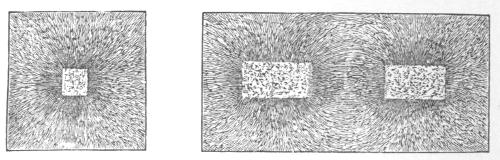
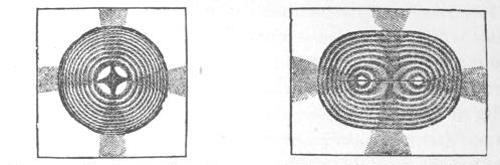

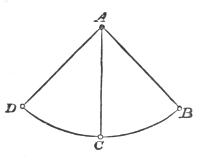
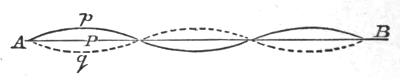
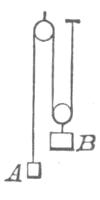
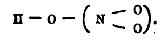
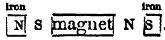 . Others again, like
hydrogen and chlorine, seem to have only a single
pole, as in the case of electricity in an excited glass
rod, and have to create for themselves the opposite
pole, which is the indispensable condition of all polarity,
by induction in another body. Thus, muriatic or
hydrochloric acid is formed by the union of a single
atom of chlorine, which is strongly negative, with
a single atom of hydrogen, in which it appears to
have induced a positive pole: though the combination
is not a very stable one, for if an element with a
stronger positive pole of its own is presented to the
chlorine, it drops the hydrogen, just as the magnet
drops the nickel. Other atoms are multipolar, and
seem as if made up of more than one magnet, or rather
as if the atom had regular shape like a triangle, square,
or pentagon, and each angle was a pole, thus enabling
it to unite with three, four, five, or more atoms of other
substances. Thus, one atom of nitrogen unites with
three of hydrogen, one of carbon with four of hydrogen,
and so on. Every substance has, therefore, what is
called its ‘quantivalence,’ or power of uniting with it a
greater or less quantity of other atoms, and conversely
that of replacing in combinations other atoms, or groups
of atoms, the sum of whose quantivalence equals its
own. Thus, one atom of carbon, which has four poles,
combines with four atoms of hydrogen or chlorine,
which is unipolar, but with only two of oxygen,
which are bipolar; while the oxygen atom combines
with two of hydrogen, and that of chlorine with one
atom only of hydrogen. The analogy between the
single atomic and electrical poles on the one hand, and
the dual and magnetic poles on the other, will be evident
if we consider what occurs if a pith-ball, electrified
positively, is brought near a similar ball electrified negatively.
They attract each other, and the one becomes
the pole of the other; but if separated, each carries with
it its own electrical charge. But the separate balls
or poles, though no longer influencing each other, are
not isolated, for each draws by induction an electrical
charge opposite to its own to the extremity of the
nearest conductor, and thus creates for itself a new or
second pole. Polarity, in fact, involves opposition of
relations, or two poles, and electrical only differs from
magnetic polarity in the fact that in the latter the two
poles are in the same body, while in the former they are
in separate bodies.