Larger versions of most illustrations may be seen by right-clicking them
and selecting an option to view them separately, or by double-tapping and/or
stretching them.
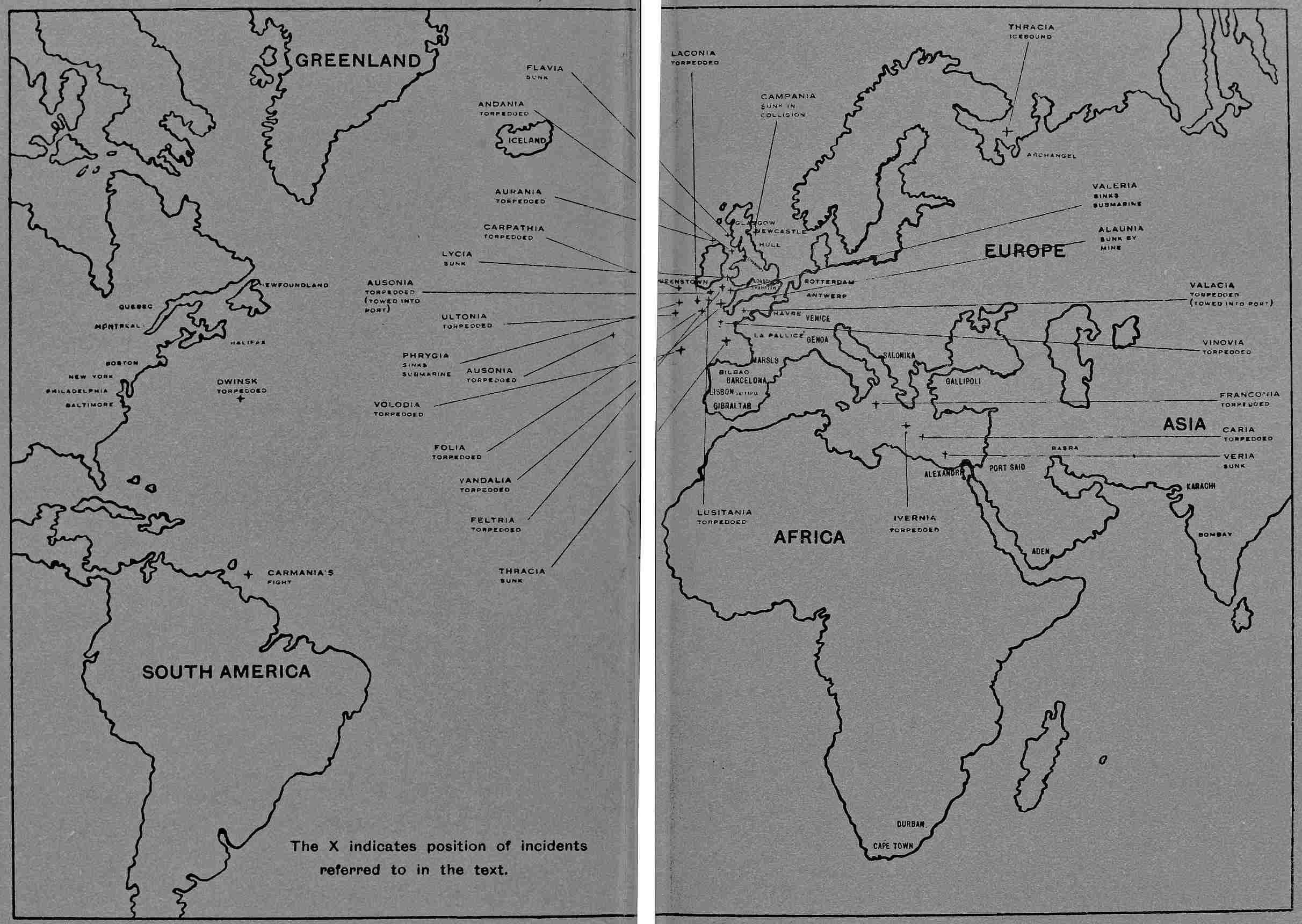
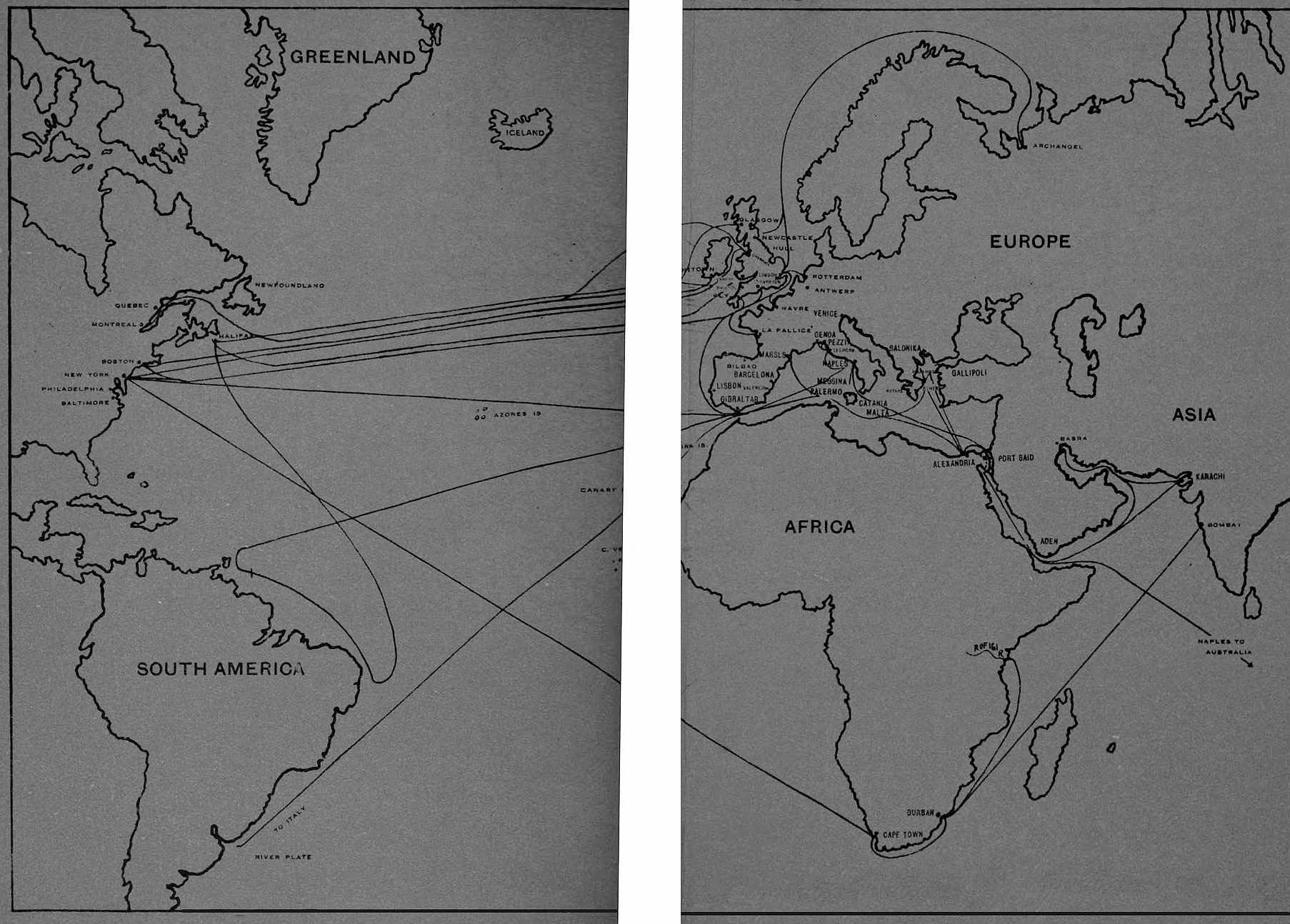
MAP SHEWING INCIDENTS, DETAILS OF WHICH ARE GIVEN IN THE TEXT.
Author of “The British Fleet in the
Great War,” “Command of the Sea,”
“Sea-Power,” etc. etc.
CASSELL AND COMPANY, LTD London, New York, Toronto and Melbourne
1920
All rights reserved
Over the warring waters, beneath the wandering skies,
The heart of Britain roameth, the Chivalry of the sea,
Where Spring never bringeth a flower, nor bird singeth in a tree,
Far, afar, O beloved, beyond the sight of our eyes,
Over the warring waters, beneath the stormy skies.
Robert Bridges.
PREFACE
During a war, which was at last to draw into
its vortex practically the whole human race—the
issue depending, first and foremost, on sea
power—there was little time or opportunity or,
indeed, inclination on the part of British seamen
to keep a record of their varied activities. The
very nature of many of the incidents recorded
in the following pages precluded the preparation
of detailed reports at the time. Nor can we
forget that many of the officers and men, to whose
resource, courage, and devotion this volume bears
testimony, have joined the great silent army of the
dead to whose exploits the freedom of conscience of
every man and woman in the British Empire, as
well as their state of material comfort, bear witness.
This book has been written under not a few
difficulties, and it owes whatever merit it possesses
to many individuals—captains, officers, engineers,
pursers and other ministers to British sea-power—who
have assisted in its preparation, whether by
recounting incidents in which they took part, by
placing written records at my disposal, or by
lending photographs from which the illustrations
have been prepared. I would especially emphasise
that the illustrations have been made from
photographs of all sorts and shapes, taken by all
kinds of cameras, though for the most part of
pocket size. Many of the pictures were snapped
under dull and forbidding skies, and some were
secured in the very presence of the enemy in
mad pursuit of his piratical policy. Some of
these pictures were soaked with sea water, and
other were recovered from destruction at the last
moment. The value of the illustrations lies not
so much in their perfection as in the knowledge
that they were taken “on active service.”
Finally a word should be said, perhaps, of
another difficulty which confronts any one who
endeavours to tell the story of what merchant
sailors did during the Great War. These men
dislike publicity and their modesty disarms the
inquisitor. Like their comrades of the Royal
Navy, they are content if they can feel that they
have done their duty. They would leave it at
that. But were silence to be maintained, later
generations would be robbed, for the progress
of humanity depends, in no small measure, on
the manner in which the memory of great deeds
is preserved, and handed down from age to age.
No man can live unto himself.
The story of the contribution which British
seamen have made to the happiness and well
being of the world can never be half told, and
these pages form merely a footnote to one of the
most glorious epics in human annals. They go
forth in the hope that they may help to perpetuate
those sterling virtues which find increasing
expression in the British race throughout the
world. James Anthony Froude once declared
that all that this country has achieved in the
course of three centuries has been due to her
predominance as an ocean power. “Take away
her merchant fleets; take away the navy that
guards them; her empire will come to an end;
her colonies will fall off like leaves from a withered
tree; and Britain will become once more an
insignificant island in the North sea.” So I hope
this book may be regarded not merely as a footnote
to history, but may remind all and sundry of the
priceless heritage which our seamen of all classes
and degrees have left in our keeping.
There was never a time in our history when the
value of the Mercantile Marine to our national
life was as apparent as it is to-day. After passing
through the crucible of war, we are what we are,
mainly, because we are the possessors of ships.
When the Great War came, we possessed only
a small, though highly trained, Army, and the
guns of our Navy extended little further than
high-water mark. How could we, a community
of islanders, in partnership with other islanders
living in Dominions thousands of miles away,
hope to make our strength felt on the battlefields
of the Continent of Europe, where the military
Powers were mobilising conscript armies counted
not by thousands, but by millions? The original
Expeditionary Force, as finely tempered a fighting
instrument as ever existed, was at once thrown
across the Channel in merchant ships and it held
in check the victorious army of Germany, saving
by a miracle, the Channel ports; then, having
mobilised on the eve of the declaration of war,
the Royal Navy, the great protective force of
the British peoples, we mobilised also the Merchant
Navy, their essential sustaining force, bridged
the oceans of the world, and concentrated on the
conflict the enormous and varied powers of the
400,000,000 inhabitants of the Commonwealth.
In Belgium and France as in the Pacific, in
Gallipoli as in Eastern Africa, in Salonica as in
Mesopotamia, and in Italy as in Palestine, British
troops were soon confronting the forces of the
Central Alliance; every ocean was dominated
by British men-of-war. The enemies had the
advantage of interior military lines, but by the
aid of ships—carrying troops, munitions, and
stores—we gradually forged a hoop of steel round
them and slowly but irresistibly drew it tighter
and tighter until, their economic power having been
strangled by sea power, their naval and military
power was weakened and they were compelled to
sue for peace. If it had not been for our ships—ships
of commerce drawing strength from the seas,
and ships of war, efficiently policing those seas—the
Allies could not by any possibility have won
the Great War and Germans would to-day be the
dominant race, not only in Europe, but in both
hemispheres.
It is a common error to think of sea power
in terms only of battleships, cruisers, destroyers
and submarines. The secret of the spread of
Anglo-Saxon civilisation, with its ideals of fair
play, tolerance and personal liberty, its hatred
of tyranny and love of justice, is not to be found
as much in these emblems of organised violence
as in merchant ships. Out of our island State
the Merchant Fleet, a purely individualistic
institution, developed by the compulsion of
geographical necessities; the British people could
not exist without ships even in days when their
numbers were small and the standard of living
was relatively low. The population has trebled
in the last hundred years and the level of comfort
of all classes has risen, and to-day the very
existence of the 45,000,000 people of the British
Isles, as well as their commercial and social relations
with the other sections of the Empire, depends
on the sufficiency and efficiency of the Mercantile
Marine.
We possessed a trading Navy, with fine
traditions of peace and war, long before we had
a Fighting Navy. The owners of merchant ships
for many centuries defended this country from
raids and invasions, just as it was the early
merchant-adventurers who laid the foundations
of the Empire. Thus as far back as the reign
of Athelstan, we find this Saxon king granting
a Thaneship—or, as one might say, a knighthood—to
every merchant who had been three voyages
of length in his own trading vessel. It was
largely with the ships of merchant owners that
in 1212 the English, by raiding France, prevented
a French invasion, and that in 1340 one of the
greatest British naval victories was won over
vastly superior forces at the battle of Sluys. And
though, by the time of the Armada, merchant
ships were but as it were the core of the fleets
that fought and destroyed the threatened world
domination of Spain, they played an exceedingly
important part in that epoch-making struggle,
which marked the emergence of this Island as a
world power. Similarly the Indian Empire, the
early American Colonies, and many other British
Possessions all over the world, were founded by
merchant shipping enterprise alone. From time
immemorial, the British merchantman has carried
the flag to the outermost parts of the world and
thus helped to maintain its prestige.
The Mercantile Marine and Navy have always
been so closely knit that it is often difficult to
separate their histories. The Mercantile Marine
was in reality, as has been said, the parent of the
latter. As the State grew, and civilisation became
more complex, a process of separation between
the ships of commerce and the ships of war was
inevitable, and the Navy became more and more
a distinct Royal Service. The increasing difficulties
of the problems of defence, armament, and so
on, led to a process of specialisation, and could
only be adequately studied and the Empire’s
growing needs supplied by a State Department.
On the other hand, the Mercantile Marine remained,
and still remains, individualistic, each merchant
ship-owner, or company of ship-owners, building
the sort of vessel best adapted to the particular
enterprise in hand. Thus we have sailing from
our ports, ships of all descriptions, ocean-going
liners carrying passengers, cargoes and mails, as well
as tramps, colliers, cold-storage vessels, and an
infinity of other types.
But while this process of separation, or
specialisation, has been both inevitable and fruitful,
the Mercantile Marine has, in every war, been
called upon by the Navy to provide transports,
auxiliary cruisers, hospital and munition ships,
and, in the recent Great War, minesweepers,
submarine chasers, ‘Q’ ships, and many other
equally vital subsidiaries. Similarly, in the
personnel of the Mercantile Marine, the Navy
has always had a powerful reserve, not only of
experienced sailors, but of actual navally-trained
officers and men. Without these, it is safe to
say that the Navy could never have undertaken,
or accomplished, those vast and world-wide, and
many of them unforeseeable, tasks, so magnificently
and successfully carried out; and it is equally
true that but for the Mercantile Marine, the
armies of the whole Alliance would have been
paralysed.
In no history, however long and laboriously
compiled, would it be possible to do full justice
to the war-work of the British Mercantile Marine,
but the present volume supplies, at any rate,
an index to the scope and value of what it
performed. In the re-action of one unit, of one
old, honourable, and successful merchant shipping
Company to the demands of the world war, it is
perhaps possible to realise more clearly than by
making a wider sweep of research, the amazing
accomplishments of the whole; and where all
rose, with magnificent unity, to heights of service
never surpassed in our annals, none excelled
either in the prescience or organizing ability of
its directors, in the courage and resource of its
captains and crews, or in the loyalty and ingenuity
of its skilled and unskilled employees, the record
of the Cunard Steamship Company.
A MERCHANT FLEET AT WAR
CHAPTER I Mobilisation
Oh hear! Oh hear!
Across the sullen tide,
Across the echoing dome horizon-wide,
What pulse of fear
Beats with tremendous boom?
What call of instant doom,
With thunder-stroke of terror and of pride,
With urgency that may not be denied,
Reverberates upon the heart’s own drum
Come! ... Come! ... for thou must come!
Henry Newbolt.
In order to obtain the truest conception of what
the Cunard Company stood for in 1914, it will
be well not only to consider very briefly its first
origin and steady growth, but to refresh our
memories by recalling one or two of the tidemarks
of ocean-going navigation. Thus it was in 1802,
in the year, that is to say, following Nelson’s
great victory at Copenhagen, in the year of the
Peace of Amiens, and three years before the
Battle of Trafalgar, that the first successful,
practical steamer was launched. This was the
Charlotte Dundas, built by William Symington
on the Forth and Clyde Canal, and fitted with
an engine constructed by Watt, which drove a
stern wheel. This vessel proved to be an
inspiration to Robert Fulton, who in 1807 built
the Clermont at New York, a wooden steamer
133 feet long, engined by Bolton and Watt.
In the autumn of that year, this vessel made
a trip from New York to Albany, a distance of
130 miles in 32 hours, returning in 30 hours,
and thenceforward maintained the first continuous
long distance service performed by any steam
vessel. Five years later Bell’s famous steamer,
the Comet, began the earliest, regular steamer
passenger service in Europe.
In 1814 the Marjory, the first steamer to run
regularly on the River Thames, began her career;
but it was not until 1819 that the Savannah,
a wooden sailing ship of American construction,
but fitted with engines and a set of paddles
amidships, crossed the Atlantic, arriving at
Liverpool after 29½ days. In the following year
the Condé de Palmella was the first engined ship
to sail across the Atlantic from east to west,
namely from Liverpool to the Brazils.
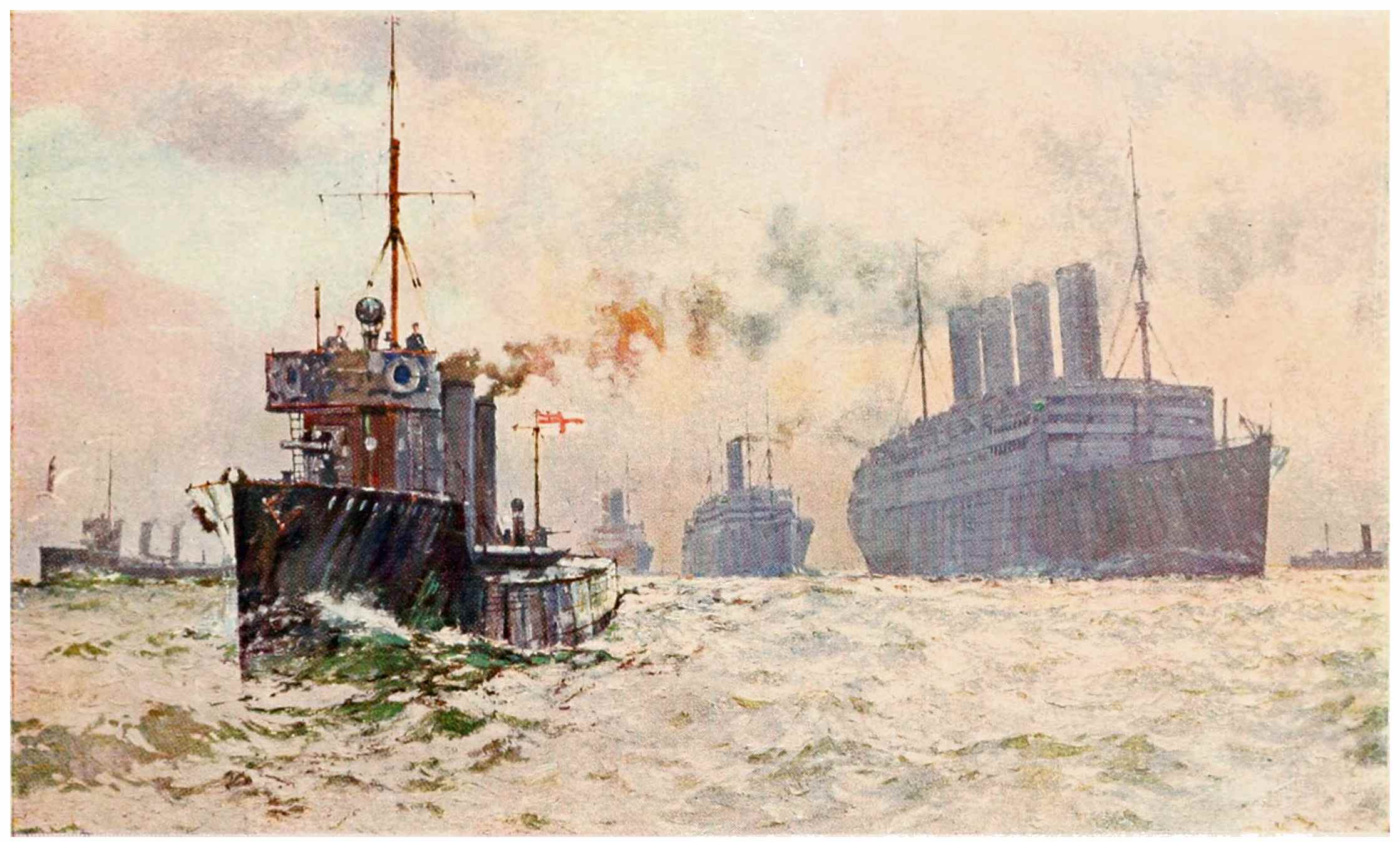
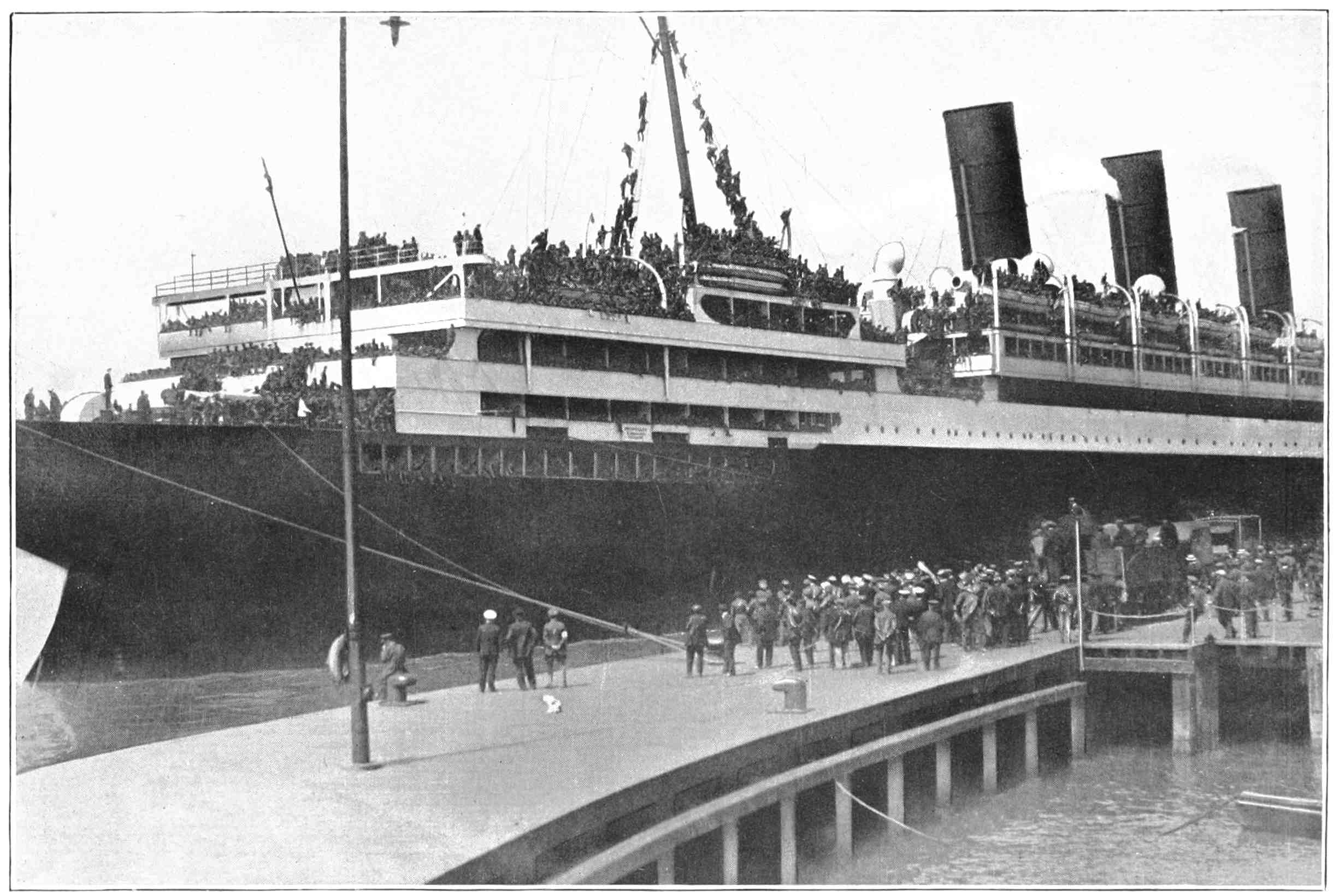
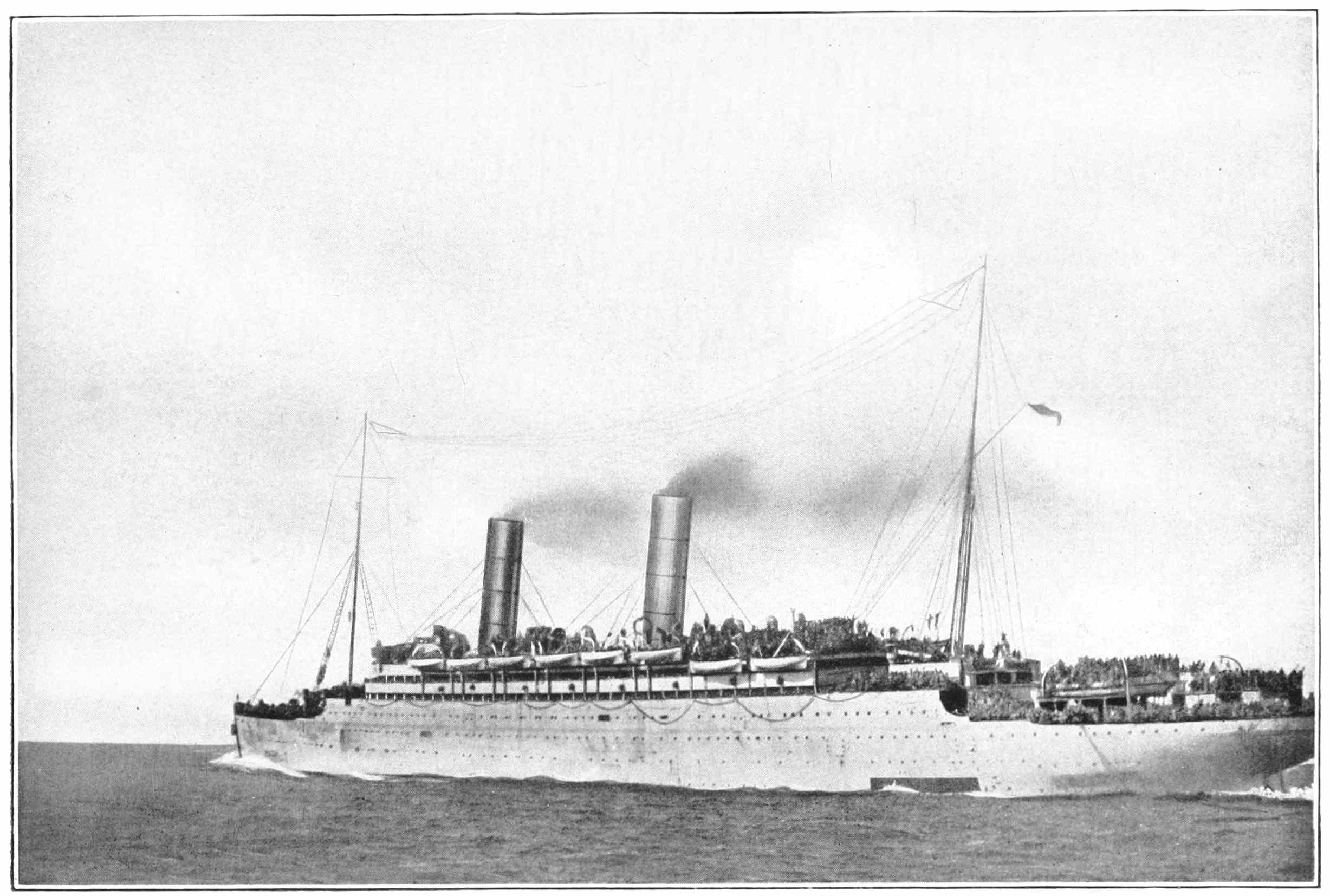
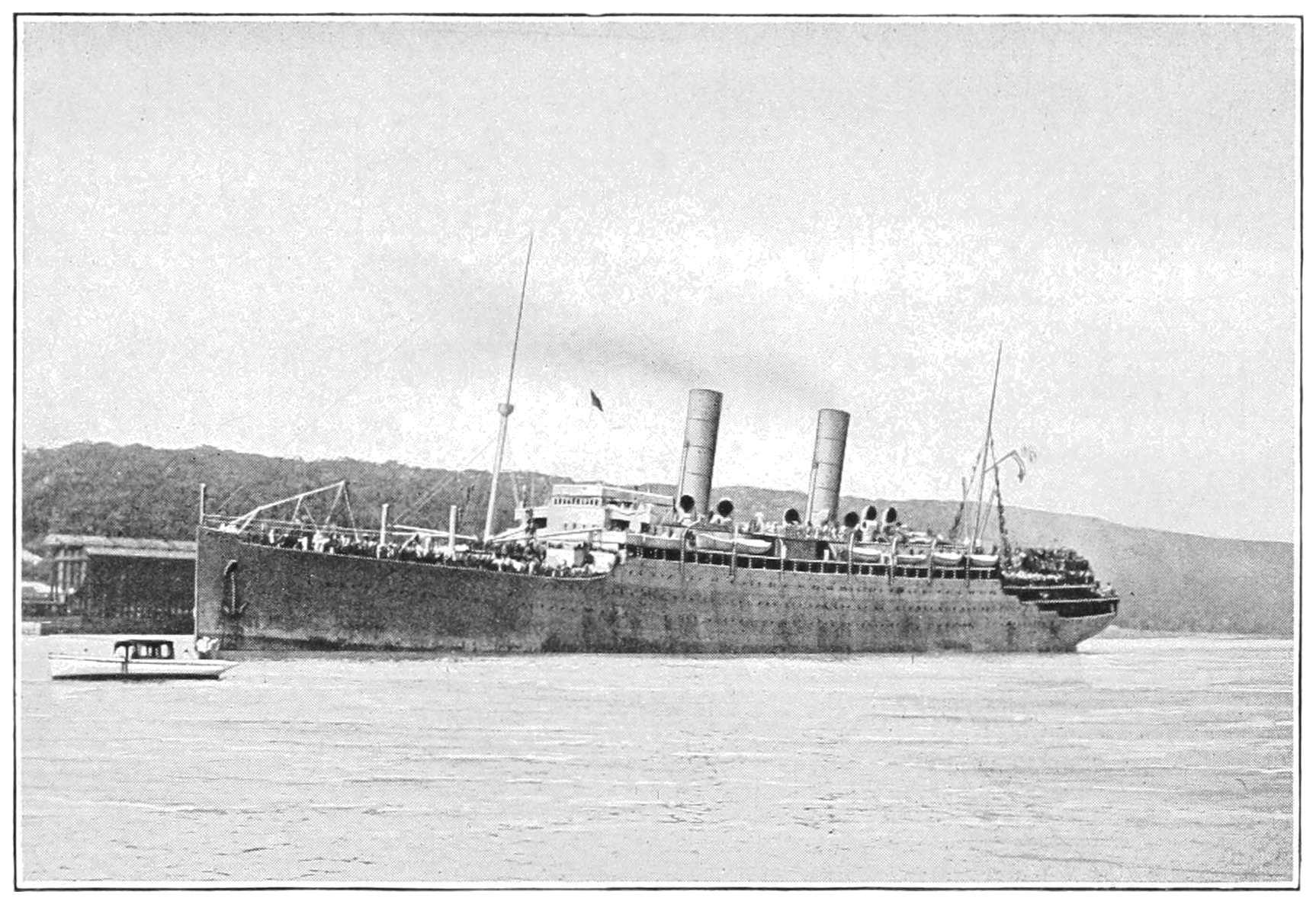
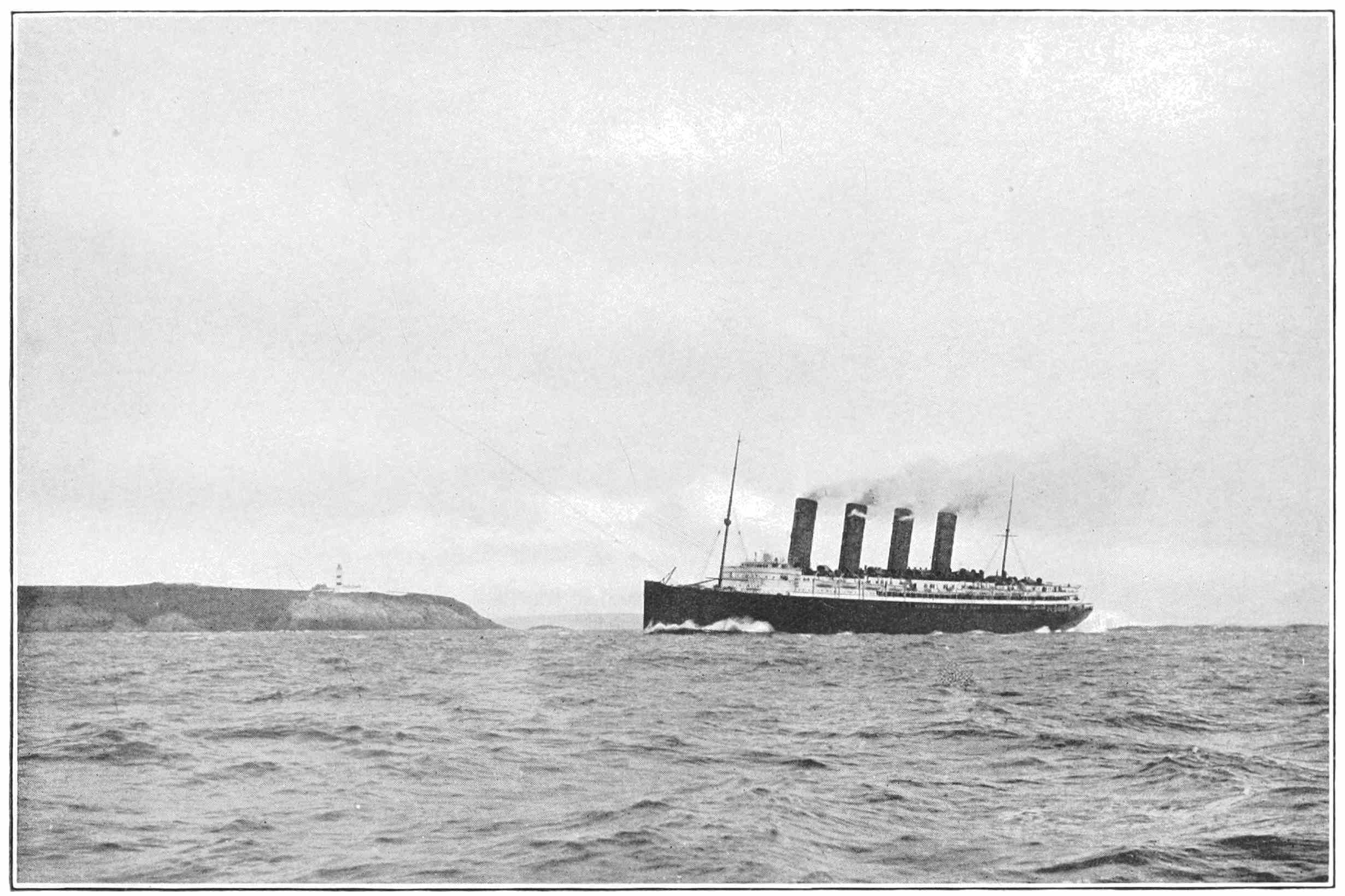
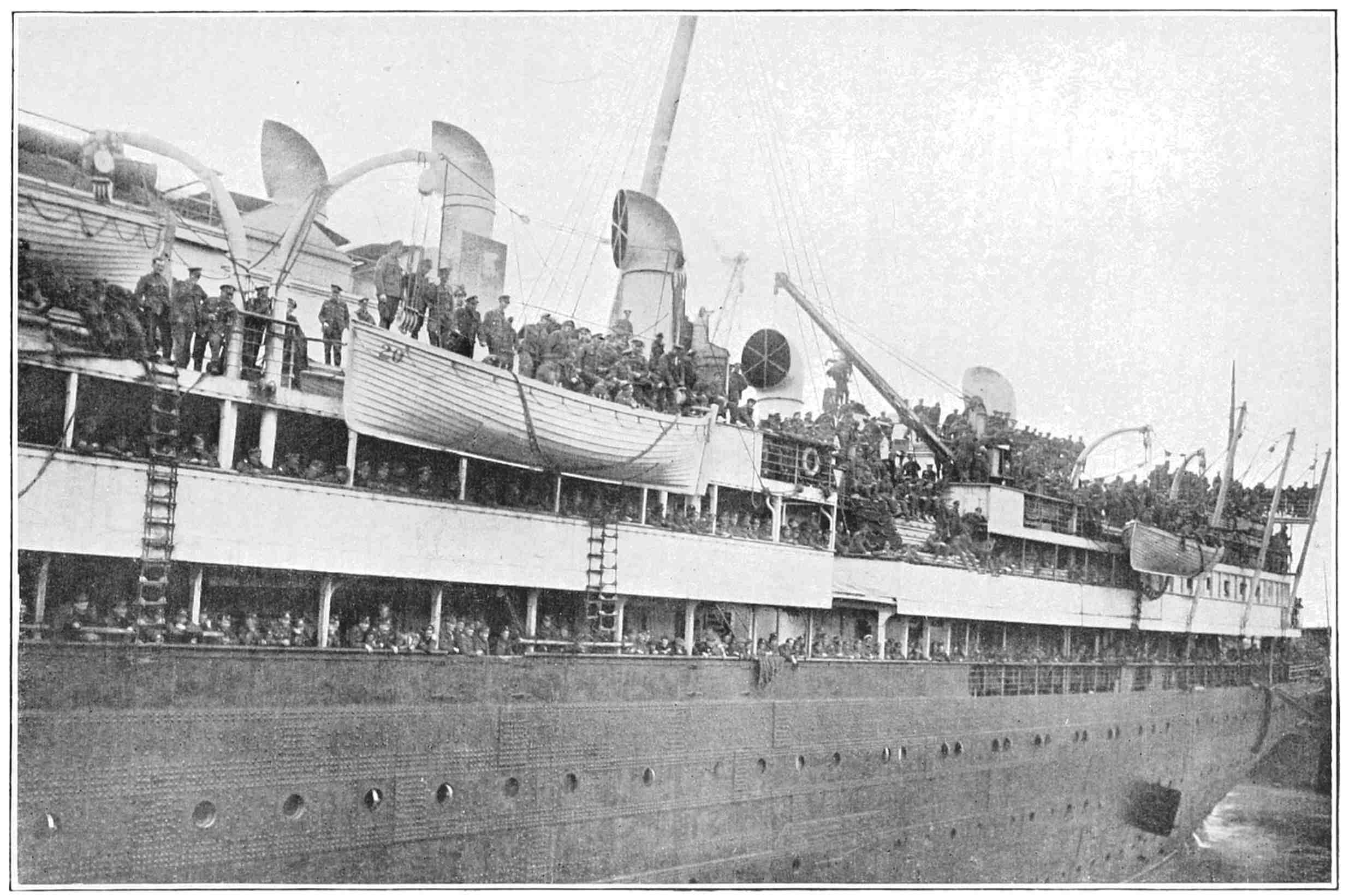
“Aquitania” at Southampton
with Canadian troops
These were but tentative experiments, however,
and the Transatlantic Steamship Service, as we
see it to-day, did not really begin till the year
1838, when the steamers Sirius and Great Western
sailed within a few days of each other from
London and Bristol respectively. Both ships
crossed without mishap, the Sirius in 17 days,
and the Great Western in 15. In the same year,
the Royal William and the Liverpool crossed from
Liverpool to New York in 19 days and 16½ days
respectively.
It was now clear that a new era in transatlantic
navigation had dawned, and the Admiralty, who
were then responsible for the arrangement of
overseas postal contracts, and had hitherto been
satisfied to entrust the carrying of mails to sailing
vessels, invited tenders for the future conveyance
of letters to America by steam vessels. One
of their advertisements, as it happened, came
into the hands of Mr. Samuel Cunard; he was
the son of an American citizen of Philadelphia,
who had settled in Halifax, Nova Scotia, in
which city he had been born in 1787. For some
time the idea of developing a regular service of
steamers between America and England had been
simmering in Mr. Cunard’s brain. He was already
in his 50th year, a successful merchant and ship
owner; and he now resolved to visit England
with the intention, if possible, of raising sufficient
capital to put his ideas into practice. Armed
with an introduction to Mr. Robert Napier, a
well-known Clyde shipbuilder and engineer, he
went to Glasgow, after having received but little
sympathy in London. Through Mr. Napier he
became acquainted with Mr. George Burns, a
fellow Scotsman of great ability and long practical
experience as a ship-owner, and through him with
Mr. David McIver, also a Scotsman of sagacity
and enterprise, then living at Liverpool. Between
the three of them the necessary capital was
obtained, and Mr. Cunard was able to submit
to the Admiralty a tender for the conveyance
of mails once a fortnight between Liverpool,
Halifax, and Boston, U.S.A. His tender was
considered so much better than that offered by
the owners of the Great Western that it was
accepted, and a contract for seven years was
concluded between the Government and the newly
formed British and North American Royal Mail
Steam Packet Company, as it was then called.
“Aquitania” escorted
by Destroyers
Such was the beginning of the Cunard Company
in the shape of four wooden paddle-wheel steam
vessels, built on the Clyde, the Britannia, Acadia,
Caledonia, and Columbia; and its history from
then until 1914 was one of steady and enterprising,
cautious and daring, development. This is not
the place to linger in detail over the technical
strides made since 1840 by the Cunard Company’s
directors, but one or two of the more important
milestones should perhaps be noted. In the year
1804, John Stevens in America had successfully
experimented with the screw-propeller, and in
1820, at the Horsley Iron Works, at Tipton in
Staffordshire, Mr. Aaron Manby had designed
and built the first iron steamer. It had always
been the policy of the Cunard Company to keep
in touch with every new marine experiment,
but at the same time it had been their wise
habit, both from the commercial point of view
and that of the safety of their passengers and
crews, to move circumspectly in the adoption
of new devices. It was not, therefore, until
1852 that the first four iron screw steamships
were added to their fleet, namely the Australian,
Sydney, Andes, and Alps, four vessels that were
also the first belonging to the Company to be
fitted with accommodation for emigrants. For
the next ten years, however, it was found that
passengers still preferred the old paddle-wheel
system, and side by side with their iron screw
steamers, the Company continued to build these
until, in 1862, the Scotia proved to be the
last of a dying type. Meanwhile, in 1854, the
Government was to realise another side of the
value to the nation of the Cunard Company.
During the Crimean War, in response to a strong
Government appeal, the Company immediately
placed at the Admiralty’s disposal, six of their
best steamers, the Cambria, Niagara, Europa,
Arabia, Andes, and Alps; later adding to these
their two most recent acquisitions, the Jura and
Etna. Throughout the campaign these eight
vessels were continuously employed upon various
important missions, supplying the needs of the
military forces.
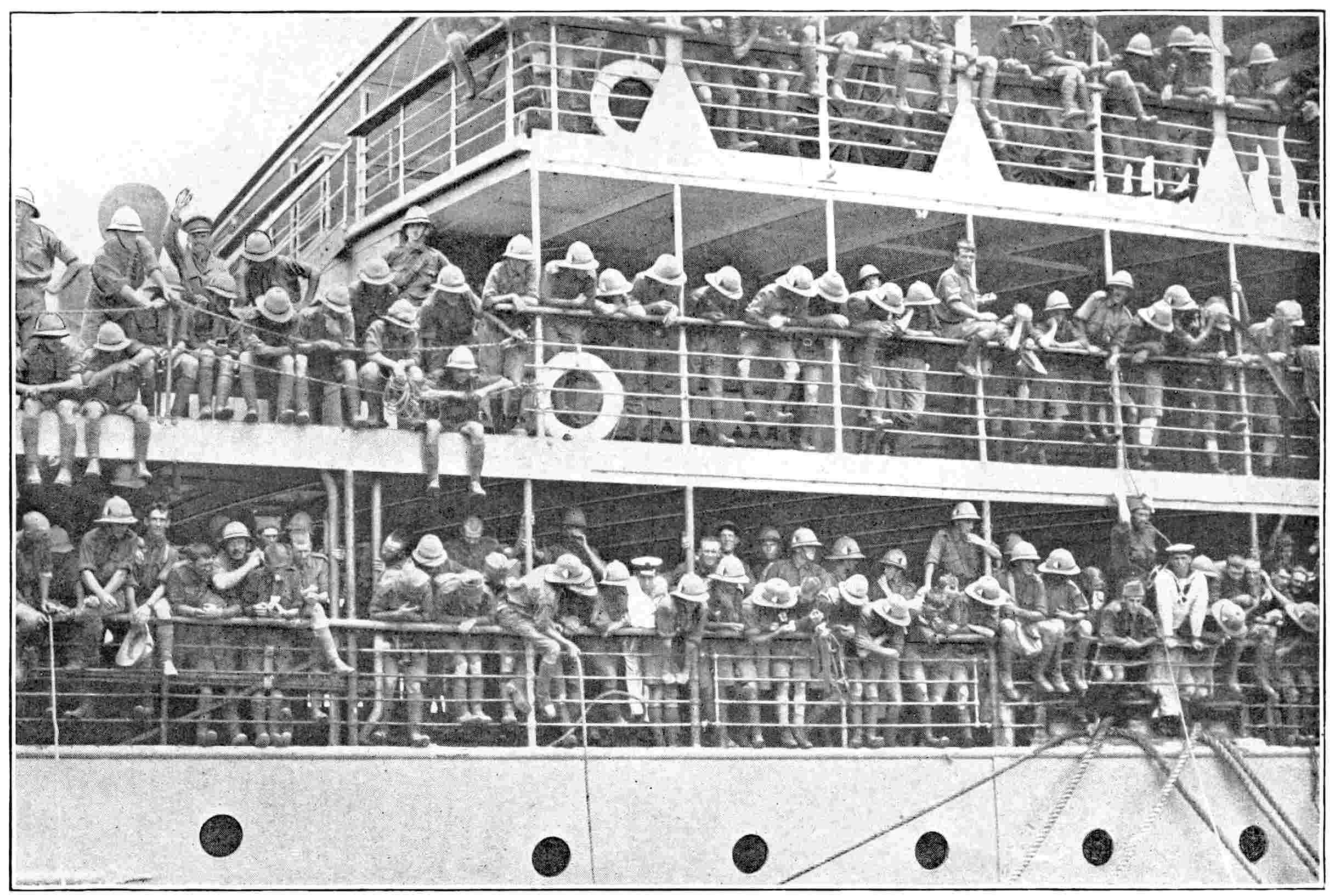
Embarkation:
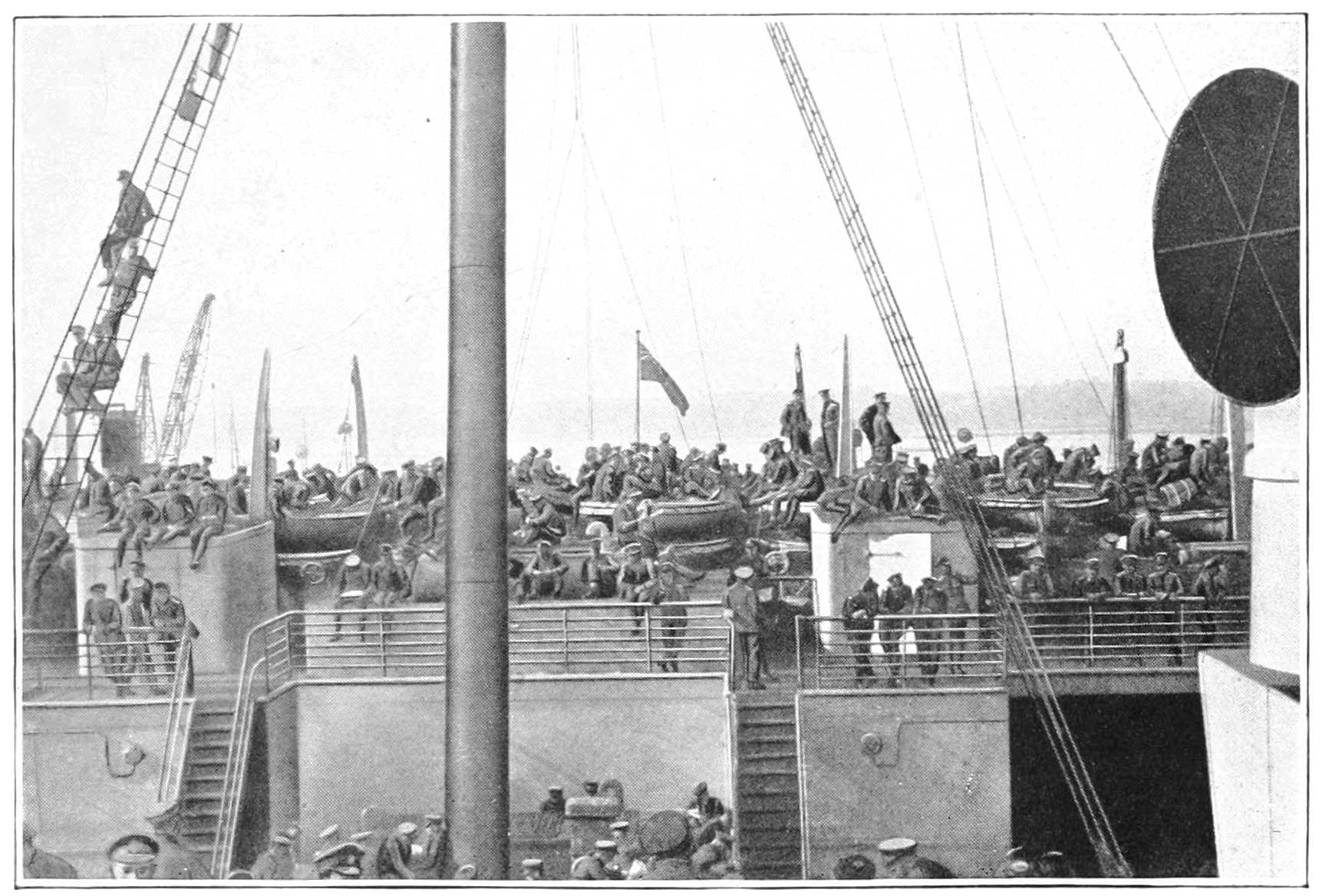
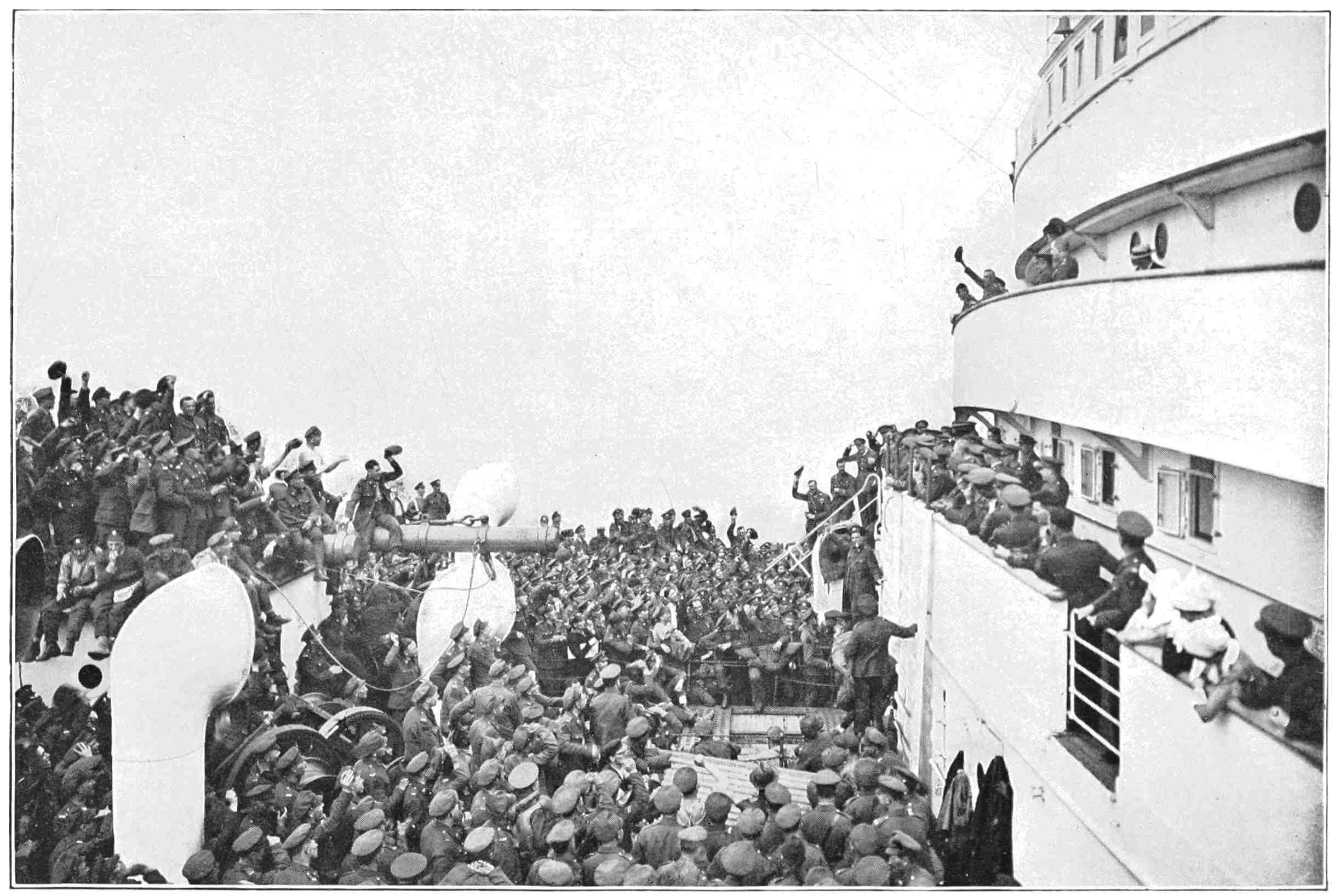
“Are we downhearted?”
Transport in Southampton Water:
Colonials’ first view of “Blighty”
Perhaps the next most important era began
with the invention in 1869 of compound engines,
and in 1870 the Batavia and Parthia were fitted
with these, and proved extremely successful,
maintaining good speeds, with a reduced consumption
of fuel. The Company was now sailing one vessel
under contract with the General Post Office every
week from Liverpool to New York, calling at
Queenstown, and from New York to Liverpool,
also calling at the South Irish port, and receiving
a certain subsidy for so doing. They were also
maintaining services between Liverpool and the
principal ports in the Mediterranean, Adriatic,
Levant, Bosphorus, and Black Sea, and between
Liverpool and Havre. In 1881 the first steel
vessel, the Servia, was built for the Cunard
Company. This was the most powerful as well
as the largest ship, with the exception of the
famous Great Eastern, that the world had then
seen. She was followed in 1884 by the Etruria
and Umbria, the former of which in August,
1885, set up the record for speed from Queenstown
to New York, the journey being accomplished
in 6 days 6 hours and 36 minutes. In the
meantime, research work, in the construction
of marine engines had been continued, and Dr.
Price had invented the triple expansion engine,
which effected further considerable economies in
the consumption of fuel; and these were fitted
by the Cunard Company into the two great
twin-screw vessels, the Campania and Lucania,
built in 1893. With the Campania we shall
deal again, as she performed valuable services
in the late war, and it is interesting to note that it
was on board the Lucania in 1901 that Mr. Marconi
carried out certain important experiments in
wireless telegraphy, this vessel being the first,
under the Cunard management, to be fitted with
a wireless installation.
Through all these years the Cunard Company
had of course been submitted to very great
competition in the transatlantic trade, not only
by British lines, but by American and Continental
shipping companies also; and in the year 1900
with the Deutschland and in 1902 with the Kaiser
Wilhelm II, what has been called the “blue
ribbon” of the Atlantic passed to Germany, these
vessels having an average speed of 23½ knots.
It was then decided that the supremacy in this
respect, should, if possible, be regained by Great
Britain, and, with Government help, and in return
for certain definite prospective services if required,
the Cunard Company laid down the Lusitania
and the Mauretania. In 1907, these vessels making
use of Sir Charles Parsons’ turbine engines, were
put into service and soon afterwards attained
a speed of over 26 knots, and the mastery, in
respect of speed, of the Atlantic.
Canadian troops on “Caronia,” being
addressed by their commander
Enormous as were the proportions, however,
of these huge vessels, they were yet to be eclipsed
by the Cunard Company’s later and most recent
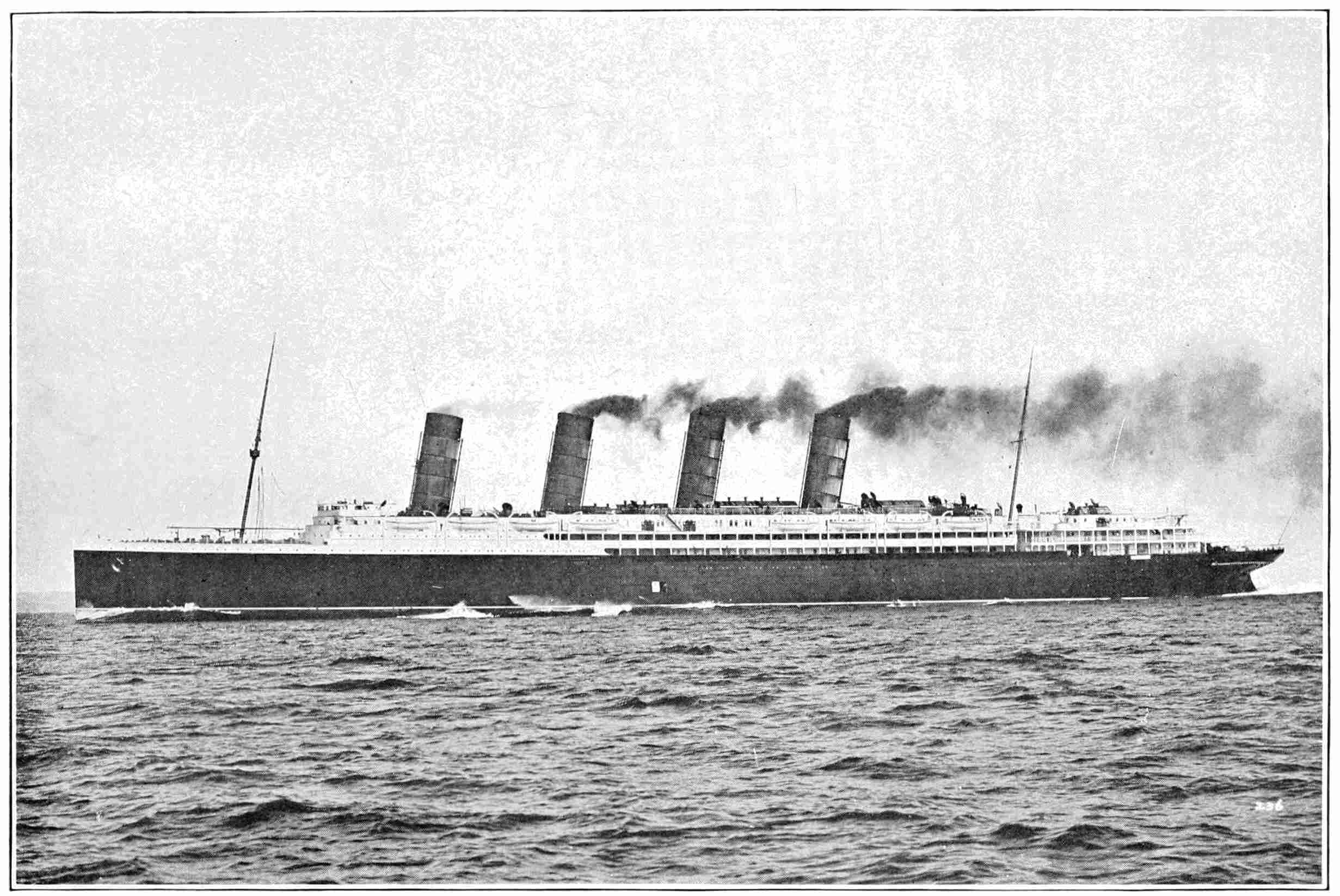
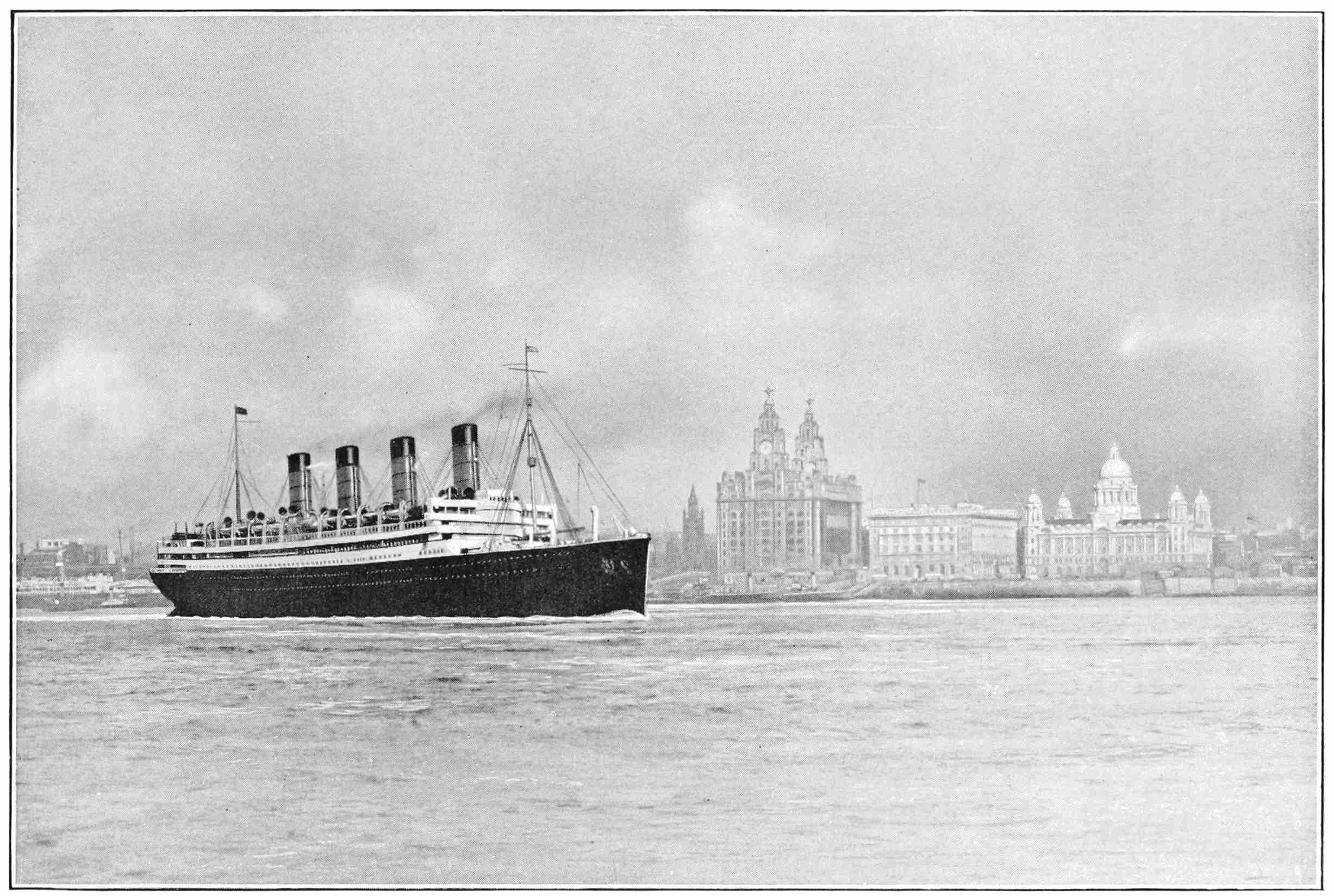
giant, the Aquitania, a vessel that might more
fitly be described as a floating city of palaces,
libraries, art galleries, and swimming baths, than
the steamship child of the little Britannia of 1840.
Let us for a moment compare them, remembering
that only the ordinary span of a human life-time
intervened between them. The Britannia was
200 feet long, a wooden paddle-wheel steamer
of 1,154 tons, 740 horse-power, and a speed of
8½ knots. The Aquitania is 902 feet long, of
46,000 tons, with quadruple screws driven by
turbine engines of a designed shaft of 60,000
horse-power, maintaining a speed of 24 knots.
With her Louis XVIth staircase, her garden Lounge,
her Adams drawing-room, her frescoes, her Palladian
lounge, her Carolean smoking-room, and her
Pompeian swimming bath, she can carry in the
comfort of a first-class hotel more than 3,200
passengers, together with a crew of over 1,000.
Such then has been what one may best call,
perhaps, the technical advance of the Cunard
Company, and in 1914, at the commencement
of hostilities, it had in commission 26 vessels,
apart from tugs, lighters, and other subsidiaries.
Of these, since we shall presently deal with their
individual adventures, the following list may be
found convenient:
A This vessel was sold for breaking up a few weeks prior to the outbreak of
war. Her career as a warship is referred to in these pages.
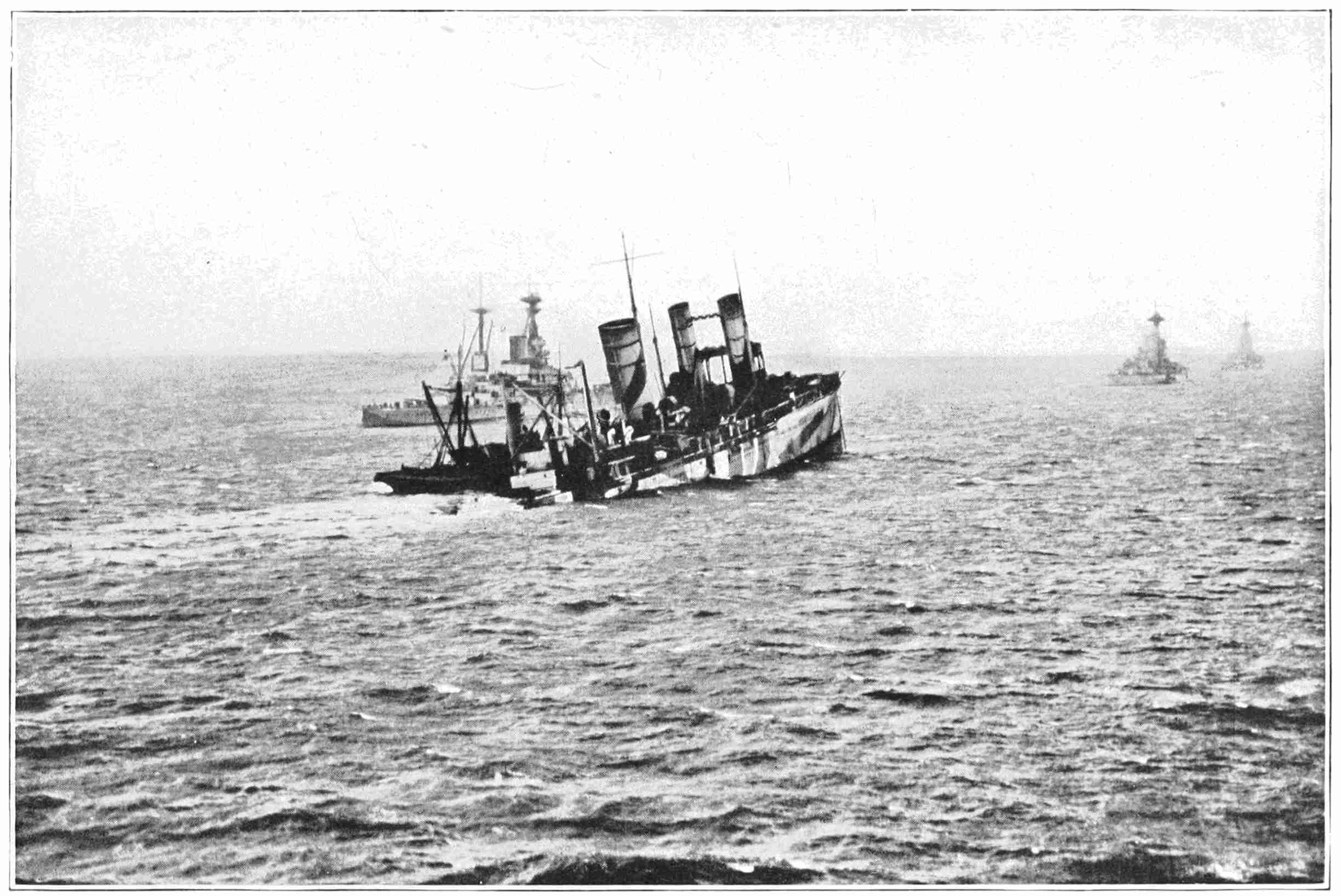
The “Campania” sinking in the
Firth of Forth
From this it will be seen that the total tonnage
possessed by the Cunard Company in 1914 was
considerably over 300,000, and the Company was
operating services not only between the United
Kingdom and the United States of America and
Canada, but also between the United States of
America and the Mediterranean, as well as from
Liverpool and other British ports to the Mediterranean
and France.
CHAPTER II Combatant Cunarders
Sleep on, O Drake, sleep well,
In days not wholly dire!
Grenville, whom nought could quell,
Unquenched is still thy fire.
And thou that hadst no peer,
Nelson, thou needst not fear!
Thy sons and heirs are here,
And shall not shame their sire.
William Watson.
With the war now over, and after five years,
during which the public mind has been accustomed
to emergency arrangements of all sorts, nothing
is more difficult than to reconstruct the enormous
and unprecedented activities that were called
so suddenly into being in the first war weeks
of 1914; and in these the Cunard Company had
a typical and vitally important part to play.
Of the number of navigating officers in their
employment, namely 163, no fewer than 139 were
in the Royal Naval Reserve, and as such were
immediately mobilised, being instructed to report
themselves for naval duty upon their arrival in
a British port; and by the end of the year 131
of these officers had actually done so. Nor was
this the least of the problems that the Company
had to face, in that, at a time when not only
every reliable officer and man was worth his
weight in gold to them, so large a proportion
of their best and most highly trained servants
had thus to be yielded up to the senior service.
“Mauretania” escorted
by Destroyers
In the latest agreement arrived at with the
Government in 1903, the whole of the Cunard
Fleet was, in time of war, to be placed at its
disposal, and there was considerable uncertainty
at first as to the various purposes to which the
ships might be allocated. In the present chapter
we shall confine ourselves to dealing with those
of the Cunard vessels that were commandeered
by the Admiralty for strictly combatant purposes,
of which the more important were the Aquitania,
Caronia, Laconia, Campania, and Carmania; and
since the Campania had only just passed from
Cunard control, it may be well, perhaps, in view
of her distinguished and lengthy service under
the Company’s flag to deal with her first. She
became a seaplane carrier; after having at first
however, taken a large share in repatriating
Americans stranded in the British Isles owing
to the exigencies of war. Her after funnel was
removed and a smaller one put abreast of the
forward funnel; and this alteration, together
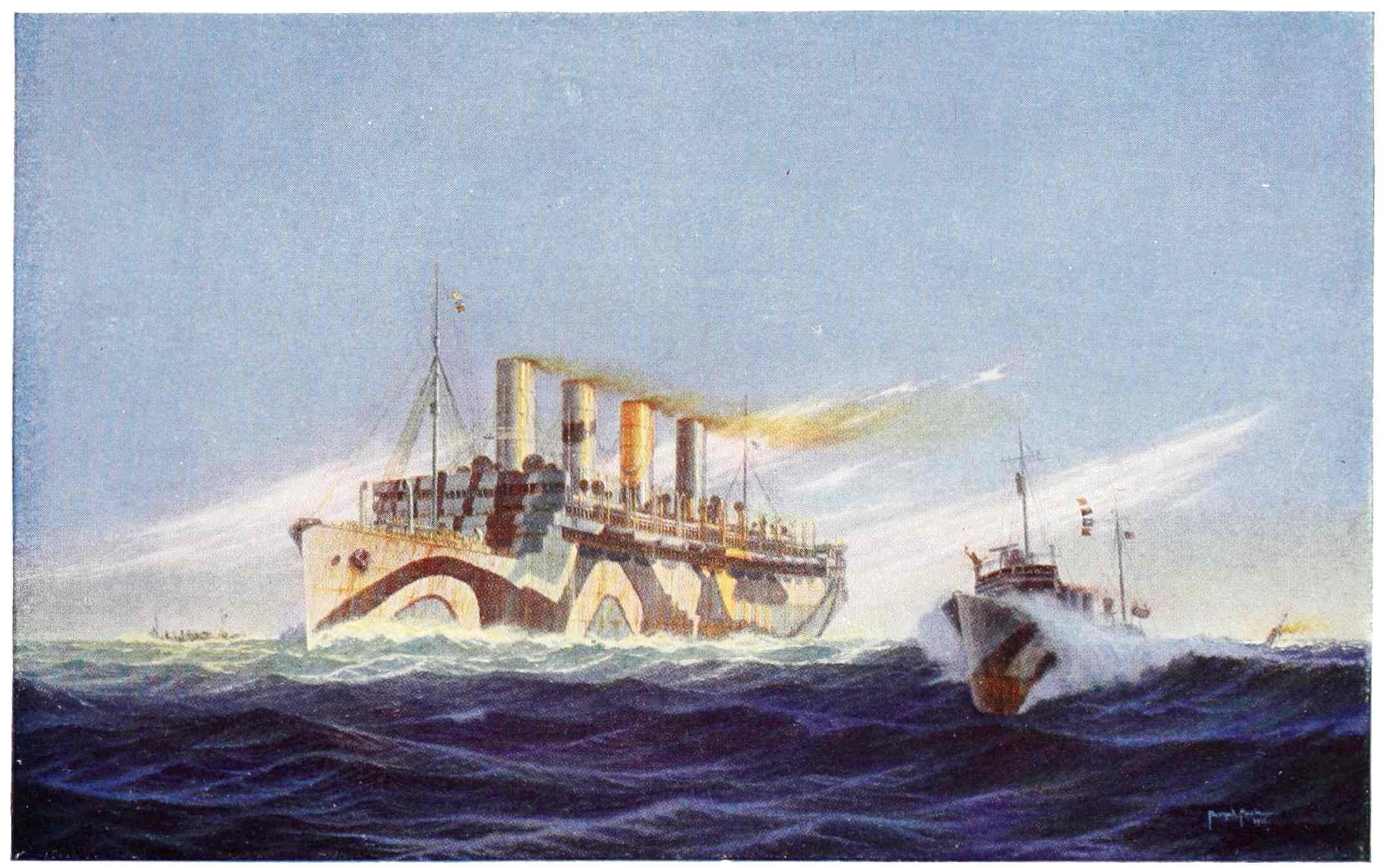
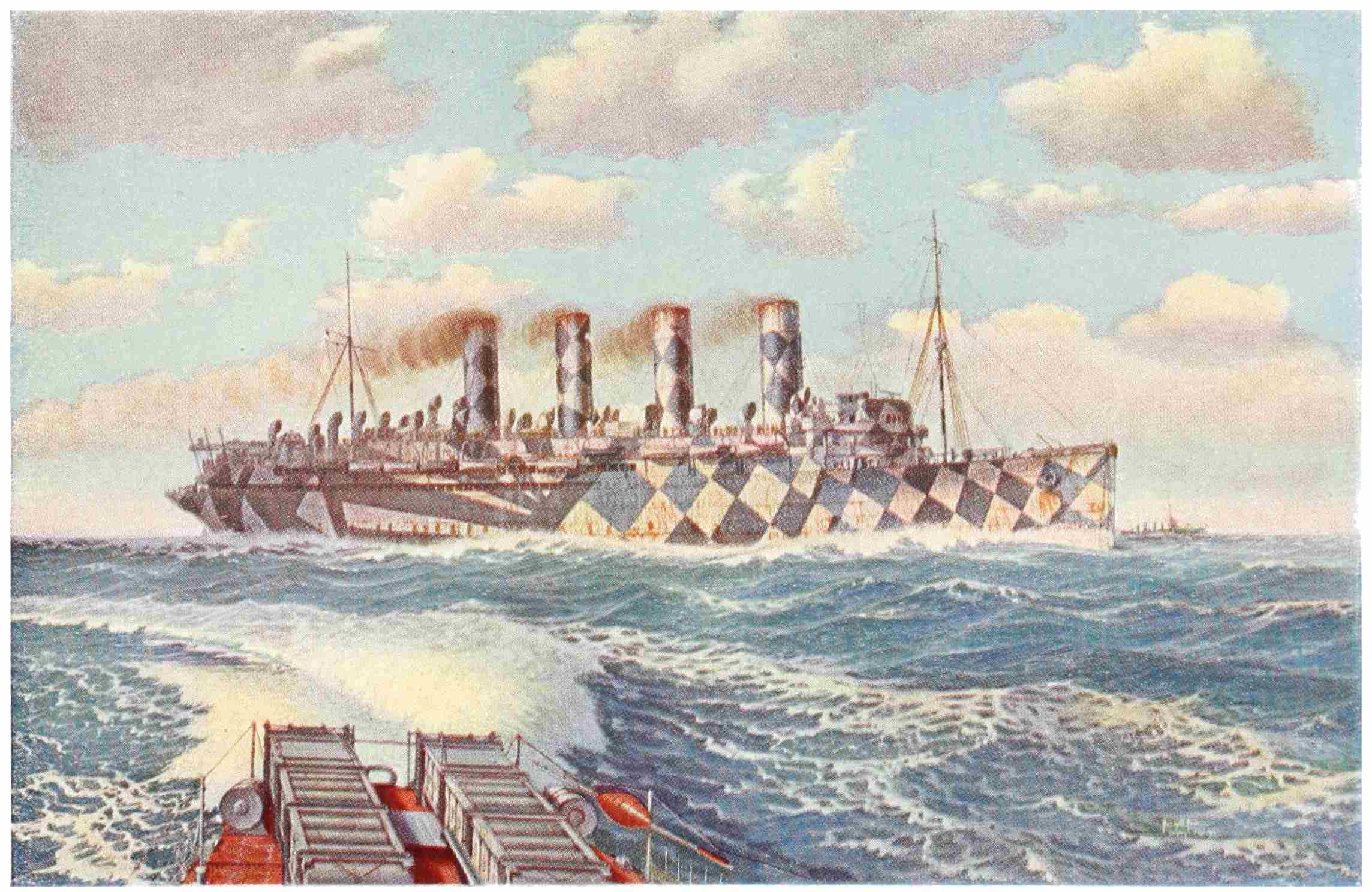
with the dazzle paint with which she was at a
later date covered, rendered her almost unrecognisable
even to the old Cunarders who had been familiar
with her for many years. Throughout the war she
was fortunate in escaping injury both from enemy
gunfire and submarine attack, and her honourable
career only came to an end at the conclusion of the
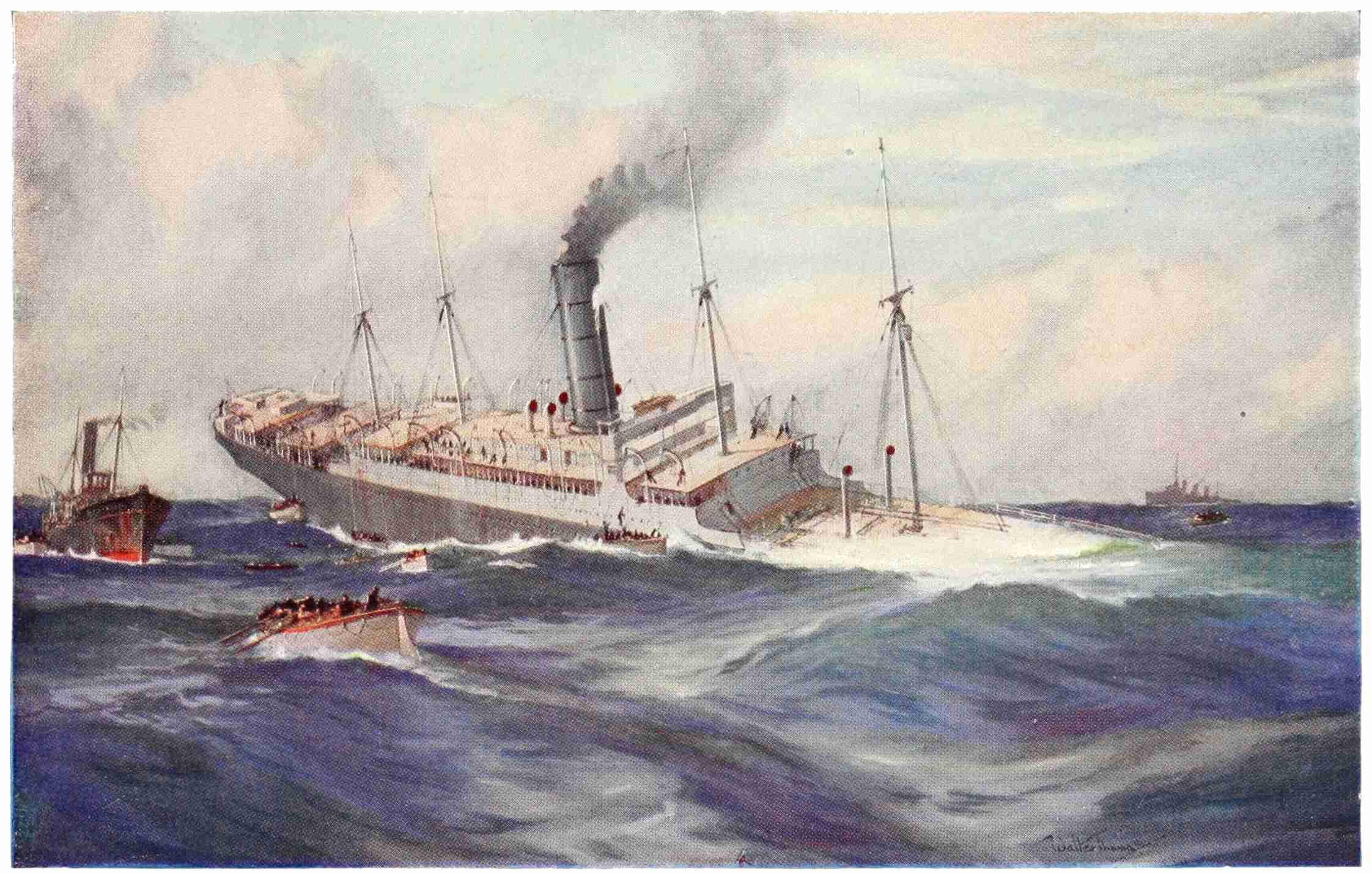
armistice, when she was accidentally sunk in collision
with H.M.S. Revenge in the Firth of Forth.
Turning now to the other vessels, the Aquitania
and Caronia, these were fully dismantled and
fitted out as armed cruisers in the first days of
August, 1915. This, of course, meant the ruthless
stripping out of all their luxurious fittings and
those splendid appointments to which reference
has been made in the last chapter; and for all
these articles storage had to be found on shore
at the shortest notice. Some idea of the work
involved in this conversion can best be gathered
perhaps, by realising that no less than 5,000 men
were employed upon this herculean task, and
that more than 2,000 waggon loads of fittings
were taken ashore from these two liners. While
these two ships were thus being fitted, yet a
third, the Carmania, arrived in port to be similarly
transformed; and a brief account of what took
place on board this famous vessel may be taken,
perhaps, as typical of what occurred in all three.
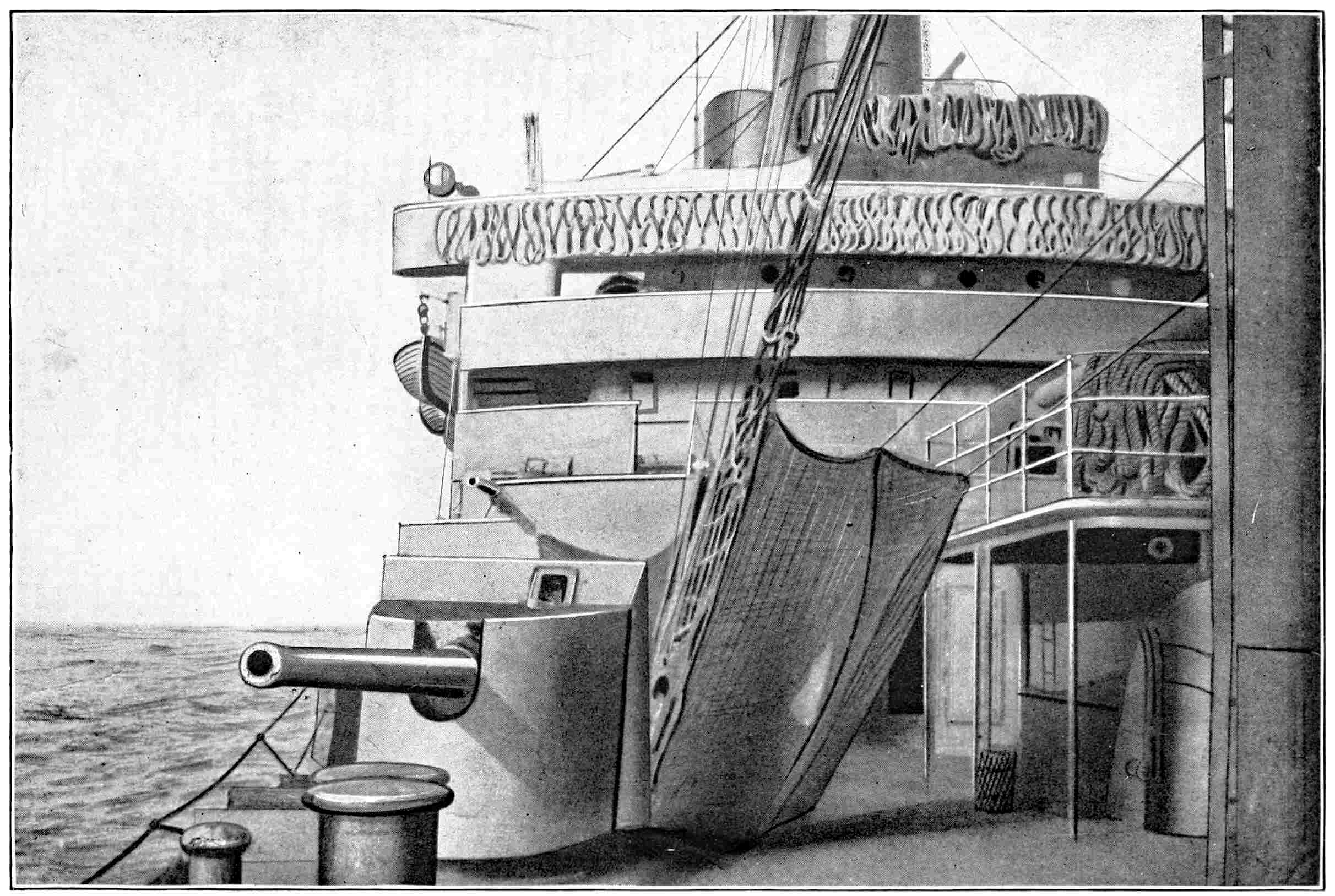
The “Carmania’s” starboard
forward guns
Rope protection on “Carmania”
against shell splinters
Arriving at Liverpool landing stage at 8 o’clock
in the morning of August 7th, 1914, she was
almost immediately boarded by Captain Noel
Grant, R.N. and Lieutenant-Commander E. Lockyer,
R.N., who were to be respectively her Captain
and First Lieutenant under the new conditions.
At that moment she looked about as unlike a
man-of-war as she could well have done. From
half a dozen gangways, baggage was being landed
at express speed, while first and second class
passengers were also going ashore from the overhead
gantries. Owing to the fact that there were
known to be Germans amongst the passengers
on board, a considerable number of police and
custom officials were present upon the vessel;
and this necessitated the detention of a large
number of third-class passengers, who had to be
carefully scrutinised and sorted out.
While all this was going on arrangements for
the new equipment and personnel of the vessel
were already being discussed, and the proportions
of Cunarders and Naval ratings for the Carmania’s
future war service being determined. It was
decided that the engine staff was to be Cunard,
the men being specially enrolled for a period of
six months in the Royal Naval Reserve, while
the Commander of the ship, Captain J. C. Barr,
was to remain on board as navigator and adviser
to Captain Grant, with the temporary rank of
Commander R.N.R. The Chief Officer, Lieutenant
Murchie, with certain other officers, also remained
on board, Lieutenant Murchie, owing to his special
knowledge of the ship, ranking next to Lieutenant-Commander
Lockyer for general working purposes.
The ship’s surgeon, her chief steward and about
50 of the Cunard ratings for cooks, waiters, and
officers’ servants, were also retained, as well as
the carpenter, who was kept on board as Chief
Petty Officer and given six mates, the cooper,
blacksmith, plumber, and painter, being also
retained with the same rank.
Life on a transport (i):
Kit inspection
Life on a transport (ii):
Rifle drill
Leaving the stage about noon, the Carmania
was immediately docked at Sandon, where after
some further delay the third-class passengers were
landed. Owing to the fact that the Caronia
was already in the Carmania’s proper berth, being
fitted out as an armed cruiser, and that both
she and the Aquitania were already well on the
way to completion for their new task, the
Carmania could for the moment neither discharge
her cargo nor bunker owing to the shortage of
labour. As many painters, however, as could be
assembled began at once to alter her hull and
funnels, blackening out her well-known red and
black tops, while a gang of shipwrights started
to cut out the bulwarks fore and aft on the
‘B’ deck, in order to allow of the training to
suitable angles of the guns that were to be placed
in position there. Other Cunard stewards and
joiners also concentrated at once upon the task
of clearing out passenger accommodation from
the vessel. During Saturday and Sunday the
Carmania remained in the basin, and it was on
this day that her future midshipmen turned up,
and had to be provided with accommodation in
the midst of the existing confusion. On Monday
she was able to get an empty berth, where she
began at once to discharge her cargo, and to
bunker at express speed. Armoured plates were
now being put in position upon all her most
vulnerable parts, and these were also being
re-inforced with coal and bags of sand by way
of extra protection. All the woodwork in the
passengers’ quarters was being taken away;
two of her holds were being fitted with platforms
and magazines were being built on them; while
means for flooding were also being installed,
speaking-tubes fitted in the aft steering gear room,
control telephones being run up, and her eight
guns placed in position.
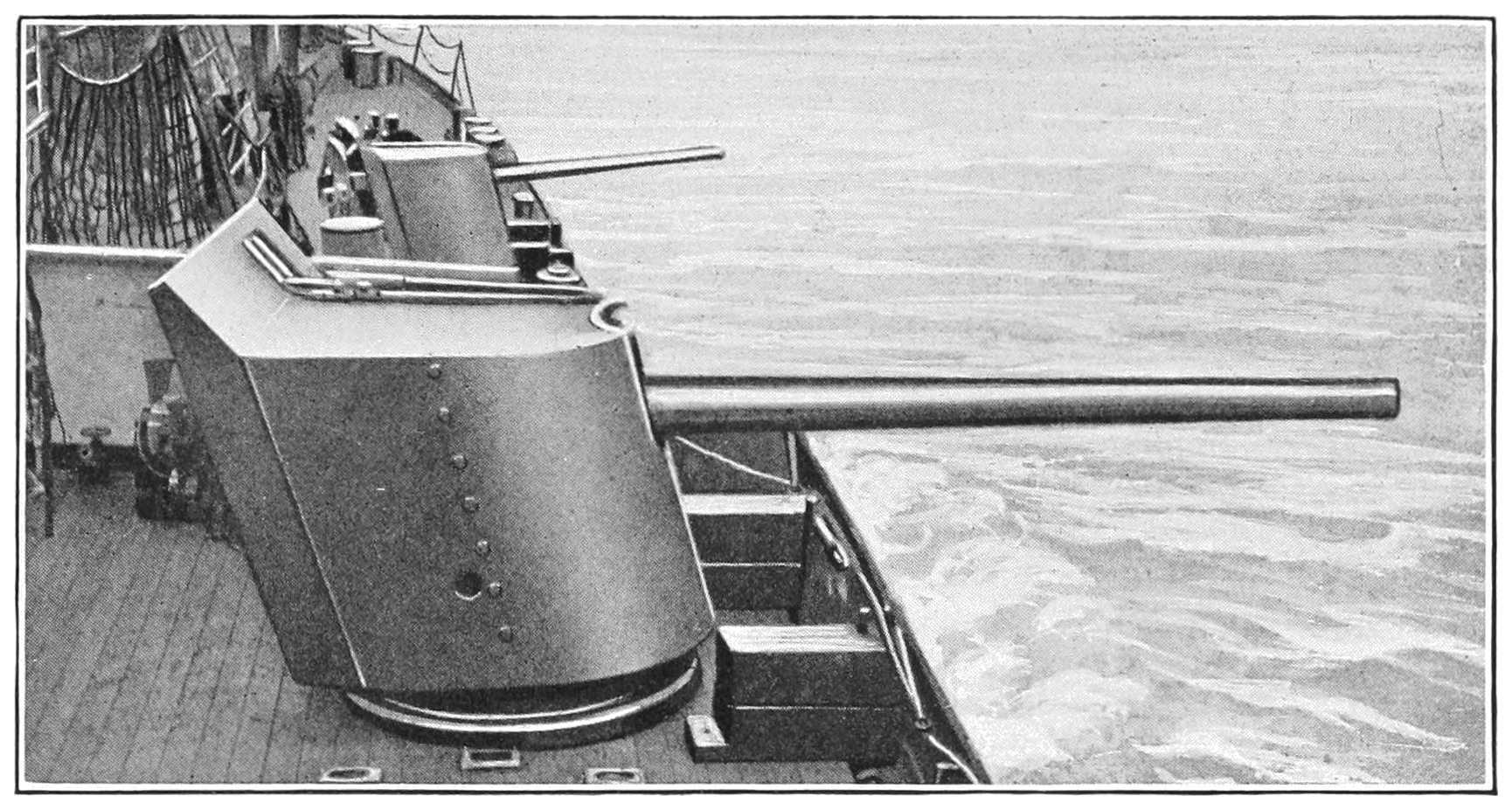
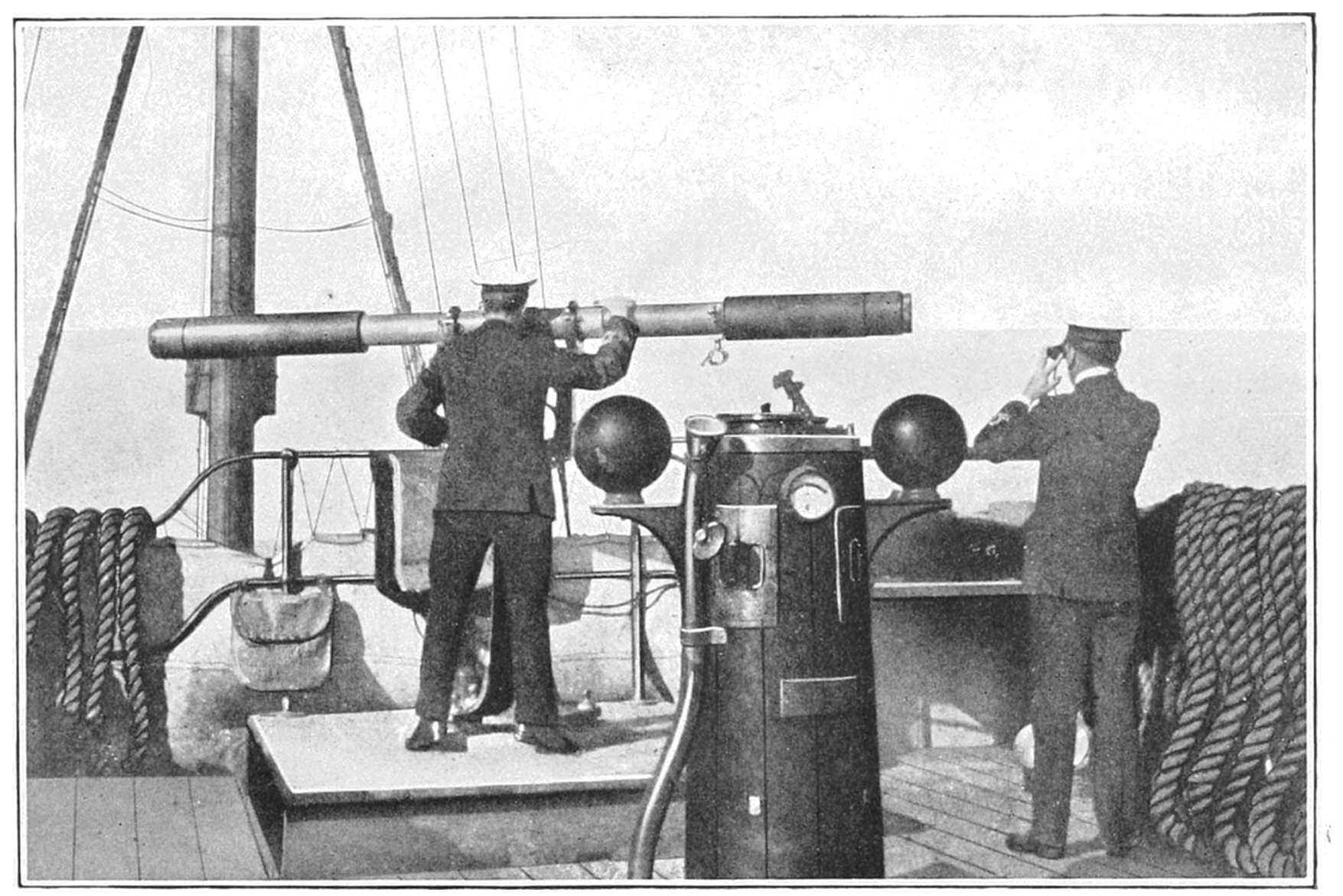
These were all of 4.7 inch calibre and with
a range of about 9,300 yards. In addition a
6 ft. Barr and Stroud range-finder was being
fitted, together with two semaphores. Two searchlights
were being mounted on slightly raised
platforms on the bridge ends, while two ordinary
lifeboats and eighteen Maclean collapsible boats
were retained for war purposes. By Wednesday
all the coal was in, all the bunkers being full,
and the protection coal was in place. At 5
o’clock the next morning, the Naval ratings in
charge of Lieutenant-Commander O’Neil, R.N.R.,
arrived from Portsmouth, most of them being
R.N.R. men, but a good many belonging to the
Royal Fleet Reserve, while the Marines on board
were drawn in equal proportions from the Royal
Marine Artillery, and the Royal Marine Light
Infantry. The able seamen were for the most
part Scotch fishermen of the finest type.
The “Carmania” ready
for action
On the same day messing, watch, and sleeping
arrangements were made, ammunition was taken
aboard and stored in the magazines, together
with a limited number of small arms, in addition
to the marines’ rifles: and so unremitting had
been the work of all engaged, and so efficient
the organisation evoked by the crisis, that the
Carmania was actually at sea as a fully equipped
armed cruiser by Friday, August 14th, only a
week after she had entered port as an ordinary
first-class Atlantic liner. With her later adventures
we shall deal in a moment, but before doing so
let us follow the adventures of the other three
vessels that were converted into armed cruisers.
The Aquitania, fitted with 6-inch guns, sailed
on August 8th, but unfortunately was damaged
in collision and on returning to port was dismantled
at the end of September. From May to August,
1915, she was employed in carrying troops, when
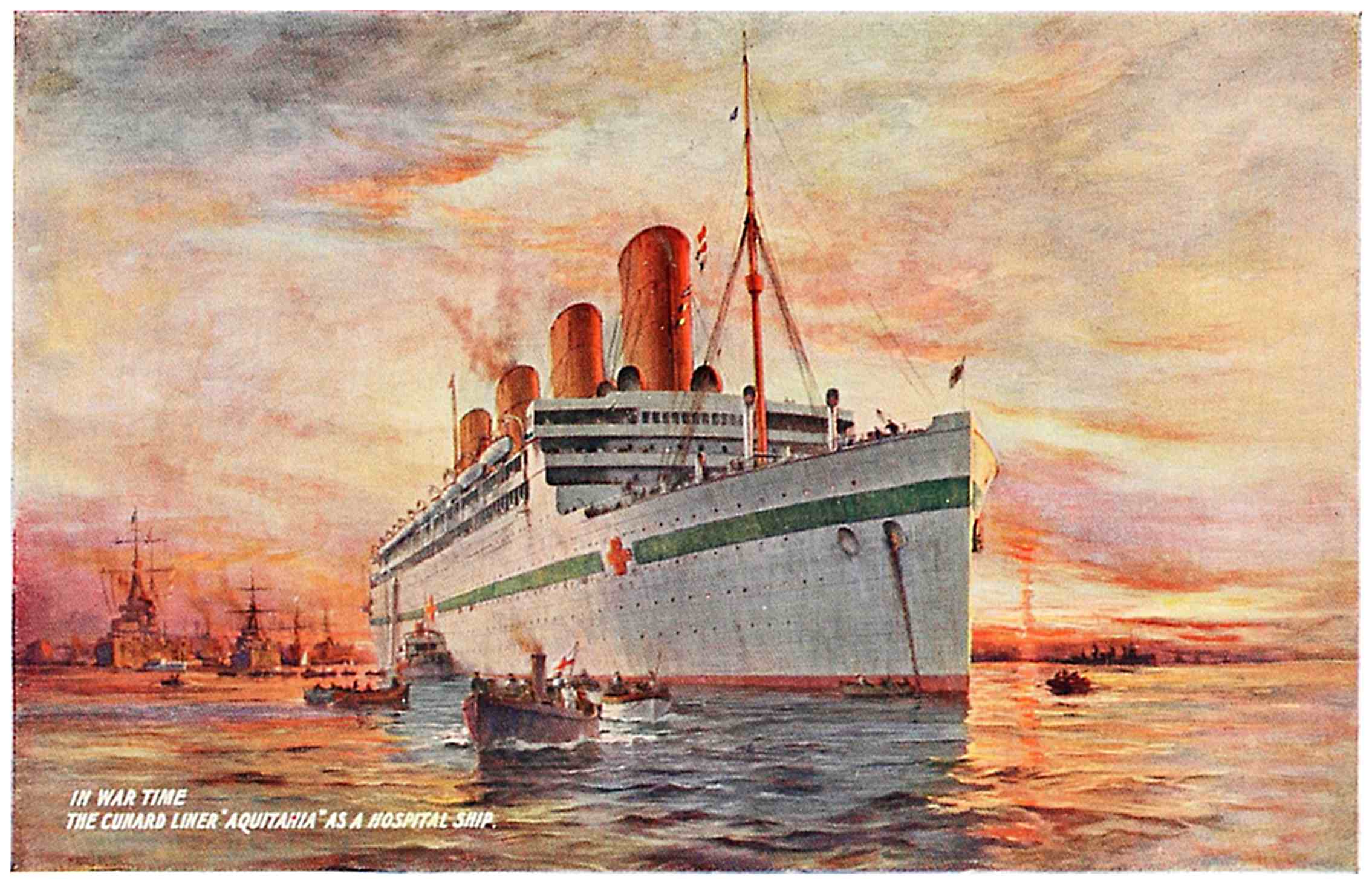
she was fitted out as a Hospital Ship, in which
capacity she continued to work until April of
the following year. She was again requisitioned
as a Hospital Ship in September, 1916, plying
between England and the Mediterranean until
Christmas. She was then laid up by the
Government for the whole of 1917, and in March,
1918, was again put into commission by the
Admiralty as a transport, and played an
important part in bringing American troops to
Europe at that critical time.
The Caronia had a somewhat longer career
as an armed cruiser. She was commissioned
on 8th August, 1914, by Captain Shirley-Litchfield,
R.N., with Captain C. A. Smith, Cunard Line,
as navigator. She sailed from Liverpool on August
10th, for patrol duties in the North Atlantic,
being attached to the North American and West
Indies Station, under the command of Rear-Admiral
Phipps-Hornby, with Halifax (N.S.) as base.
She was employed on the usual patrol duties,
stopping, boarding and examining shipping. In
the very early days of the war, she captured at
sea and towed into Berehaven the four-masted
barque Odessa, and, some little time after, she
took over from a warship and towed to Halifax
a six thousand ton oil tanker.
Eight 4.7-in. quick-firing guns were originally
mounted in the Caronia, but, on her return to
England for refit in May, 1915, they were replaced
by a similar number of six-inch.
She was at sea again in July, 1915, for another
commission on the same station, with Captain
Reginald A. Norton, R.N., in command, and
Captain Henry McConkey, Cunard Line, as
navigator. She remained away until August, 1916,
when she returned to this country to pay off.
The Caronia was then employed in trooping
between South and East Africa and India until
her return to the Company’s service.
During the whole of this time, she was manned
chiefly by mercantile marine ratings, enrolled for
temporary service in the R.N.R. for the duration
of hostilities.
The Laconia, for the first two years of the
war was also used as an armed cruiser, seeing
special service on the German East African Coast,
and taking part in the operations which ended
in the destruction of the German cruiser Konigsberg
in the Rufigi River. She was then taken out
of commission, and returned to the Company’s
transatlantic service. She was finally sunk by
a German submarine on the 25th February, 1917,
American lives being lost aboard her. There is
no doubt that this was the “overt act” that
helped to confirm the decision of America to
enter the war on the side of the Allies.
It is safe to say that all these vessels maintained
in their new naval roles, not only the best
traditions of the Cunard Company itself, but those
of the Mercantile Marine of which they had once
been so distinguished a part, and the British
Navy of which they became not the least useful
and honourable units. To the Carmania, indeed,
fell the singular honour of being the only British
armed auxiliary cruiser to sink a German war vessel
in single armed combat; and the five years war
at sea produced few more kindling and romantic
stories than that of her duel with the Cap Trafalgar
in September, 1914, near Trinidad Island in the
South Atlantic.
South African Infantry on board
the “Laconia”
Leaving the Mersey, as we have seen, on
Saturday, August 15th, she first went up the
Irish Channel examining merchant vessels, on
her way to the Halifax trade route; where she
was to carry out her first patrol duties. Having
kept this track, however, for twenty-four hours
without adventure, she received orders to sail
for Bermuda, and on her way there seized the
opportunity of dropping a target and carrying
out some practice, firing which not only proved
that her gun-layers were exceptionally skilful,
but which gave all on board considerably greater
confidence in the ship as a fighting unit. On
the evening of August 22nd, she sighted the
searchlights off St. George, Bermuda, and early
next morning performed the difficult task of
navigating a channel that no vessel of anything
like her great size had ever before been through.
Here for the next five days she coaled, while
officers and men were able to obtain certain
articles in the way of tropical clothing, that they
had not had time to procure at Liverpool.
On August 29th she left the Bermudas, and
on September 2nd passed through the Bocas del
Dragos, at the mouth of the Gulf of Paria. Here,
amidst scenery new and entrancing to many on
board, she approached the Port of Spain, whence
after a couple of days’ coaling, she left to join
Admiral Cradock’s ill-fated squadron, which was
then searching the coast of Venezuela, and the
mouths of its rivers, for the German cruisers
Dresden and Karlsruhe. To this squadron she
became attached about a week later, and soon
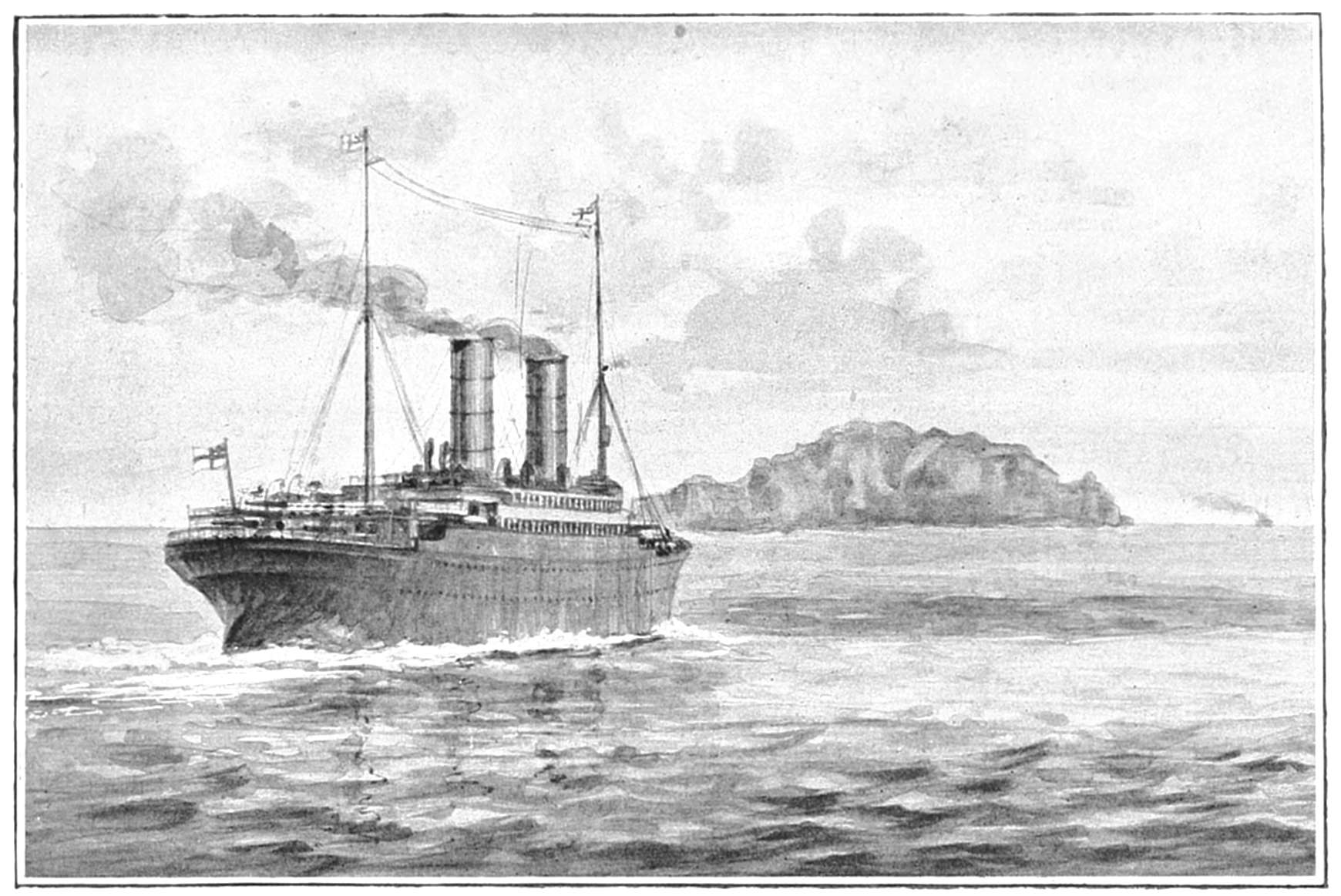
received orders to investigate Trinidad Island
in the South Atlantic. On September 11th,
however, while on her way there, she received
orders to try and intercept, in conjunction with
the cruiser Cornwall, the German collier Patagonia,
which was supposed to be leaving Pernambuco
that night; but she was not found, and, as a
matter of fact, did not sail for another three days,
when she succeeded, in the absence of the Cornwall,
in getting away. Before this, however, the
Carmania had received orders to continue on her
original mission, namely the examination of
Trinidad Island, and she accordingly headed down
for it. This is a small and lonely piece of land,
about 500 miles distant from the South American
coast, rising to a height of some 2,000 feet, and
being only some 3 miles long by 1½ miles broad,
but with a good anchorage on its south-west
side. Though often sighted by sailing vessels
homeward bound from Cape Horn, this island
was well out of reach of any ordinary steamer,
and was thus an extremely likely place for an
enemy vessel desiring to coal in a convenient and
unobserved position. Moreover, although both
Great Britain and Brazil had at various times
attempted to form small settlements there for the
purpose of cultivating the castor oil plant indigenous
to the island, these attempts had never been
successful, and the island was uninhabited.
The “Caronia” leaving
Durban
It was at nine in the morning of Monday,
September 14th that the Carmania sighted the
island ahead; and soon after 11 a.m. a large
vessel was made out, lying on the island’s westward
side. It was a bright clear day, with a gentle
north-easterly breeze blowing, and the mast of
the unknown vessel showed distinctly above the
horizon, two funnels becoming visible a little while
later. It was at once concluded that she must
be an enemy, since it was known that there were
no British war vessels in the neighbourhood, and
that no British merchant vessel was at all likely
to be here. Her exact identity, however, remained
a problem that was not to be solved, as it happened,
until several days afterwards. The only enemy
vessels that might possibly be in the neighbourhood
according to the knowledge of those on board
the Carmania, were the Karlsruhe, with four
funnels, the Dresden with three funnels, the
Kron Prinz Wilhelm with four funnels, and
the Konig Wilhelm, an armed merchant cruiser
which had one funnel. Even had the funnels been
altered it could not have been any of these, since
the outlines of all these vessels were known to
one and another of the experienced and widely
travelled observers on board the Carmania, and
this uncertainty added to the excitement of a
peculiarly thrilling occasion. The sudden pouring
out of smoke from the strange vessel’s funnels
showed at once that the Carmania had been sighted
and that the enemy was getting up steam, while
the position of the island added further to the
thrilling possibilities of the situation.
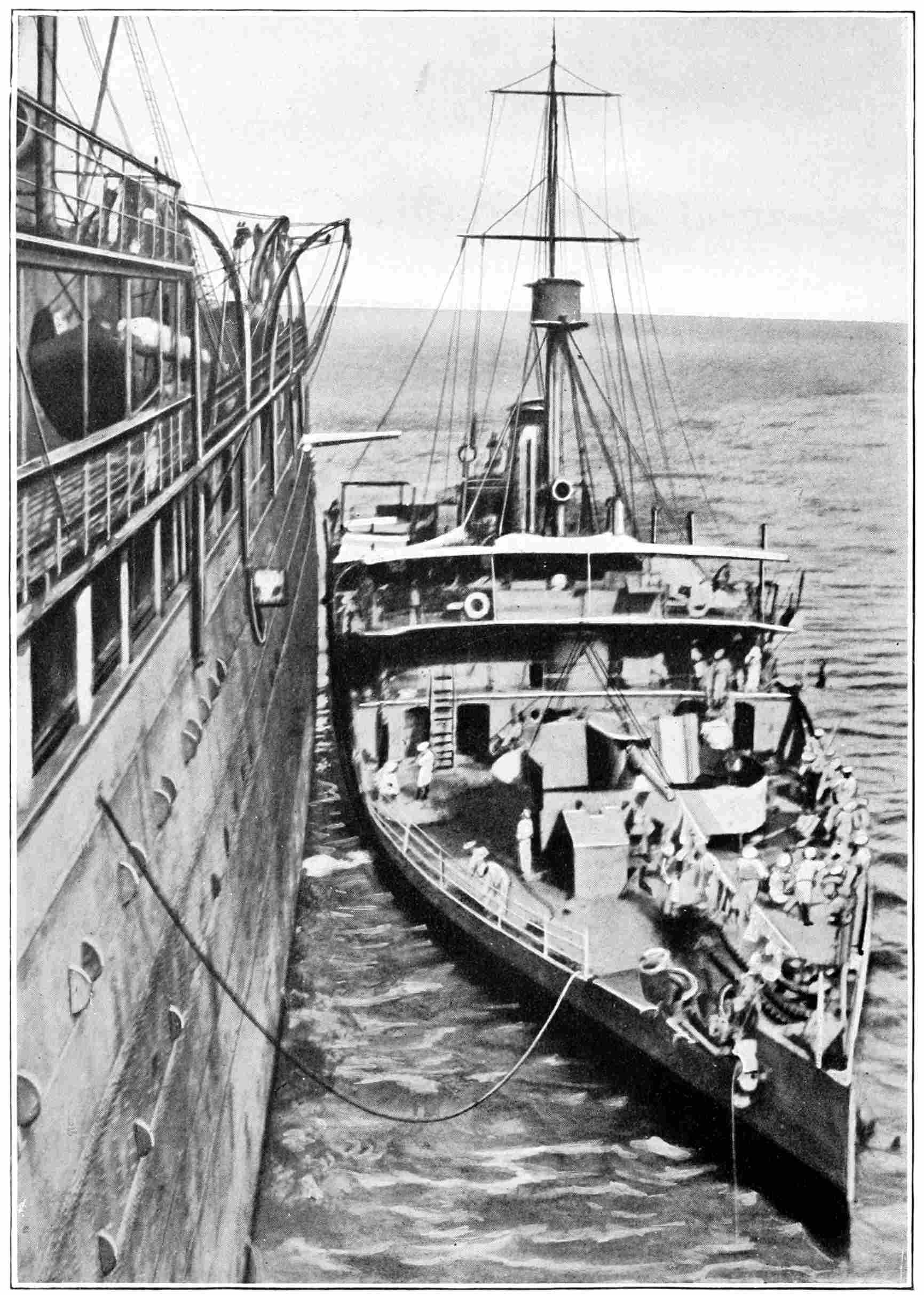
H.M.S “Mersey” alongside the “Laconia,”
off the Rufigi River
It was true that there were no other vessels
in sight, but the Carmania had approached so as to
head for the middle of the island, in order that any
observer who might be on the look out should be
unable to tell on which side the armed cruiser
meant to pass. This meant, however, that the
greater part of the island’s lee side was out of sight,
and behind its shelter other enemy vessels such as
the Karlsruhe or Dresden, might well be lying in
wait—the visible vessel merely acting as a decoy
to the approaching Britisher. That other ships
were indeed present, became manifest almost at
once, as a smaller steamer, a cargo vessel, as it
appeared, of about 1,800 tons, was now seen backing
away from behind the enemy ship. This vessel
at once began steaming away to the south-east,
probably in order to discover whether or no the
Carmania was accompanied by consorts at present
hidden by the land. There were also to add to
the anxiety of the Carmania’s commanding officer,
two more masts appearing above the side of the
unidentified ship that obviously belonged to a
vessel still out of sight. Fortunately, however,
this proved to be only another small cargo boat,
who very soon detached herself and steamed away
to the north-west.
This left them up to the present only the one
big vessel as an opponent, a vessel of some 18,500
tons, and an armed cruiser like the Carmania.
It promised, therefore, as regards numbers at
least, to be an equal fight, and in preparation
for it dinner was ordered for all hands that could
be excused duty, for the hour of 11.30, in
accordance with the old naval principle—food
before fighting. Meanwhile every endeavour was
being made to identify the mysterious enemy,
and the conclusion arrived at was that she must
be the Berlin, a German vessel of 17 knots. She
was, as a matter of fact, although those on the
Carmania were not to learn this for several days,
the Cap Trafalgar, the latest and finest ship of
the Hamburg South American Line—a vessel of
18 knots that had as yet only made one voyage.
She had been built with three funnels, one of
them being a dummy one used only for ventilation,
and this had been done away with, reducing the
number to two. She had been in Buenos Aires
when war broke out, and had left that port, as
it chanced on the very day that the Carmania had
sailed from Liverpool, her destination being unknown
and her cargo one of coal.
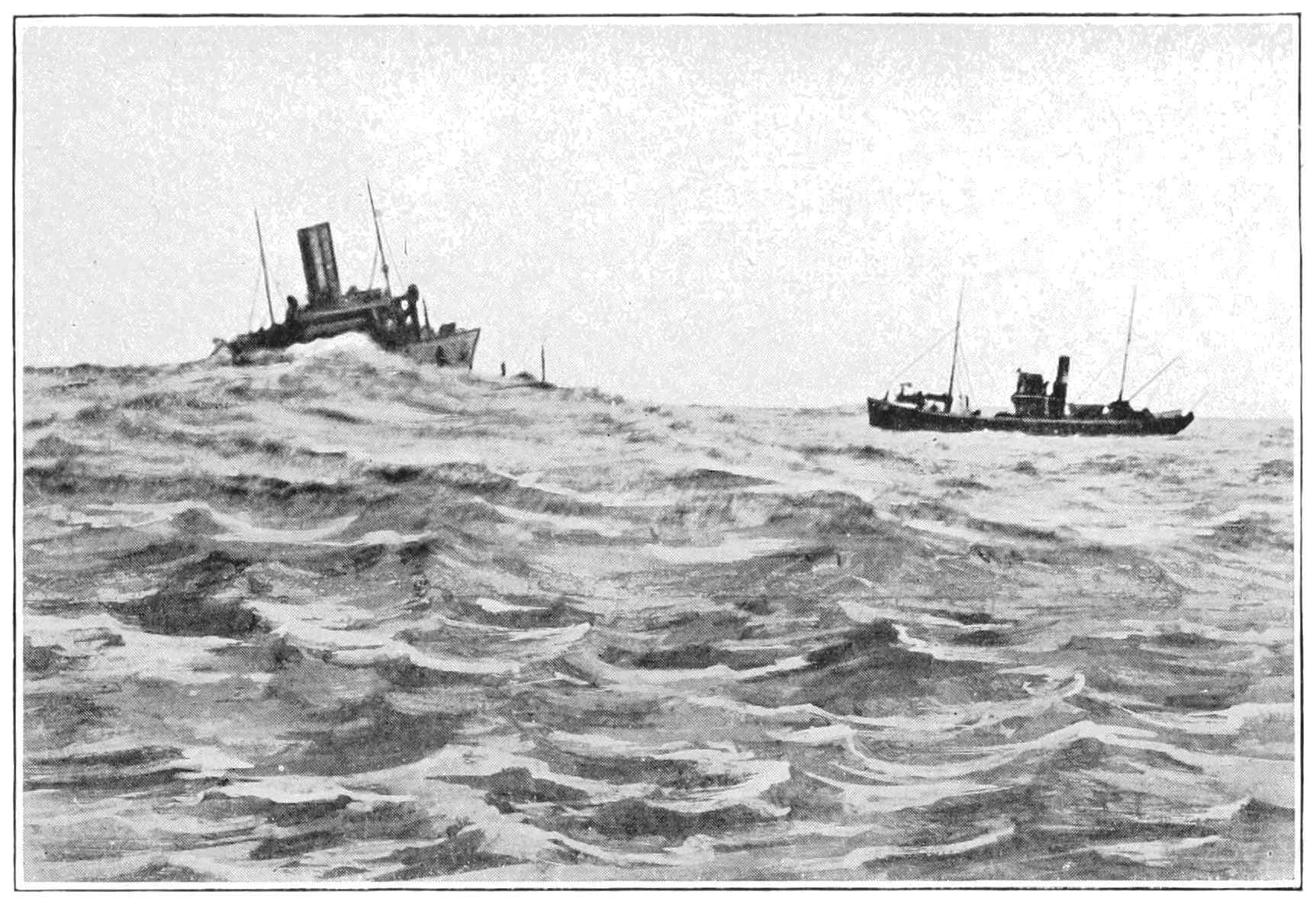
Torpedoing of the
“Ivernia”
The Carmania had by this time gone to
“General Quarters,” and all on board were ready
for the encounter. The largest ensigns floated
both from the flagstaff aft and the mastheads, and
the Cap Trafalgar now ran up the white flag with
the black cross of the German Navy. It was
still, however, not quite certain that the enemy
was armed, and it was therefore necessary that
the usual formalities should be attended to. Well
within range, Captain Grant ordered Lieutenant
Murchie to fire a shot across her bow, and the
shell, very skilfully aimed, dropped about 50 yards
ahead of this. The reply was immediate, the
enemy firing two shells which only just cleared
the Carmania’s bridge, and dropped into the water
about 50 yards upon her starboard side.
The fight had now begun in earnest, and the
firing on both sides was of a high order, although
the first round or two from the Carmania fell
short, while those of the Cap Trafalgar erred a
little in the opposite direction. Quite soon,
however, hits were being made by both sides,
and soon one of the Carmania’s gun layers lay
dead, his No. 2 dying, and almost the whole of
the gun’s crew wounded.
For the first few minutes of the duel, only
three of the Carmania’s guns could be brought
to bear, but soon by porting a little she was able
to bring another gun into action, and some very
successful salvoes at once followed. The British
gun-layers, firing as coolly as if they had been at
practice, were now hitting with nearly every shot,
and the vessels were closing one another rapidly,
when at about 5,500 yards the new and sinister
sound of machine-gun firing began to thread the
din of the bursting shells. By this time a well
placed enemy shell had carried away the Carmania’s
control, so that it was no longer possible for ranges
to be given from the bridge to the guns by
telephone, and it was evidently the Cap Trafalgar’s
intention to disable the bridge entirely, shell after
shell hitting its neighbourhood, or only just missing
it. It was at once clear to those on board that
if the enemy’s machine-gun could now get the
range, the guns and ammunition parties on the
unprotected decks of the Carmania would be
inevitably mown down. The order was therefore
given to port, and the Carmania wore away in order
to increase the range. This brought the enemy
astern and another of the Carmania’s guns into
action, and for a brief moment she had five guns
bearing upon the Cap Trafalgar. Still porting,
however, the guns on that side ceased to fire, and
the turn came for the starboard gunners to take their
hand. The enemy now also ported, and as she
did so, it became clear that she was visibly listing to
starboard; she had already been set on fire foreward,
but this fire seemed to have been extinguished.
The “Carmania” approaching Trinidad
(“Cap Trafalgar” to the right)
One of the “Carmania’s” guns
The Carmania’s gunners, on the soundest
principles, were steadily aiming at the Cap Trafalgar’s
water line, and there was no doubt that as a
result of this policy she was already beginning
rapidly to make water. It was by no means,
however, the case of the honours resting with one
side entirely, and the enemy was constantly
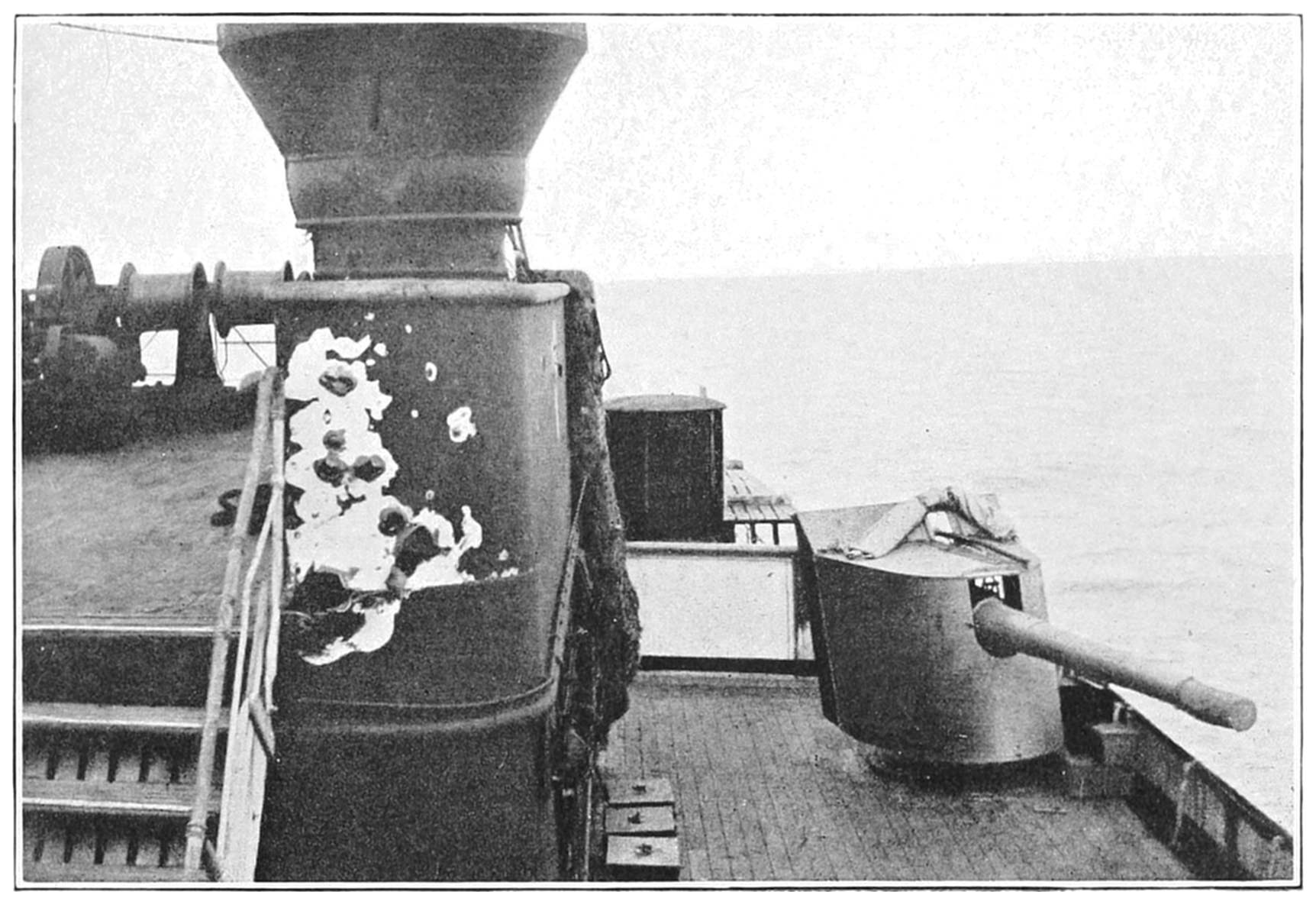
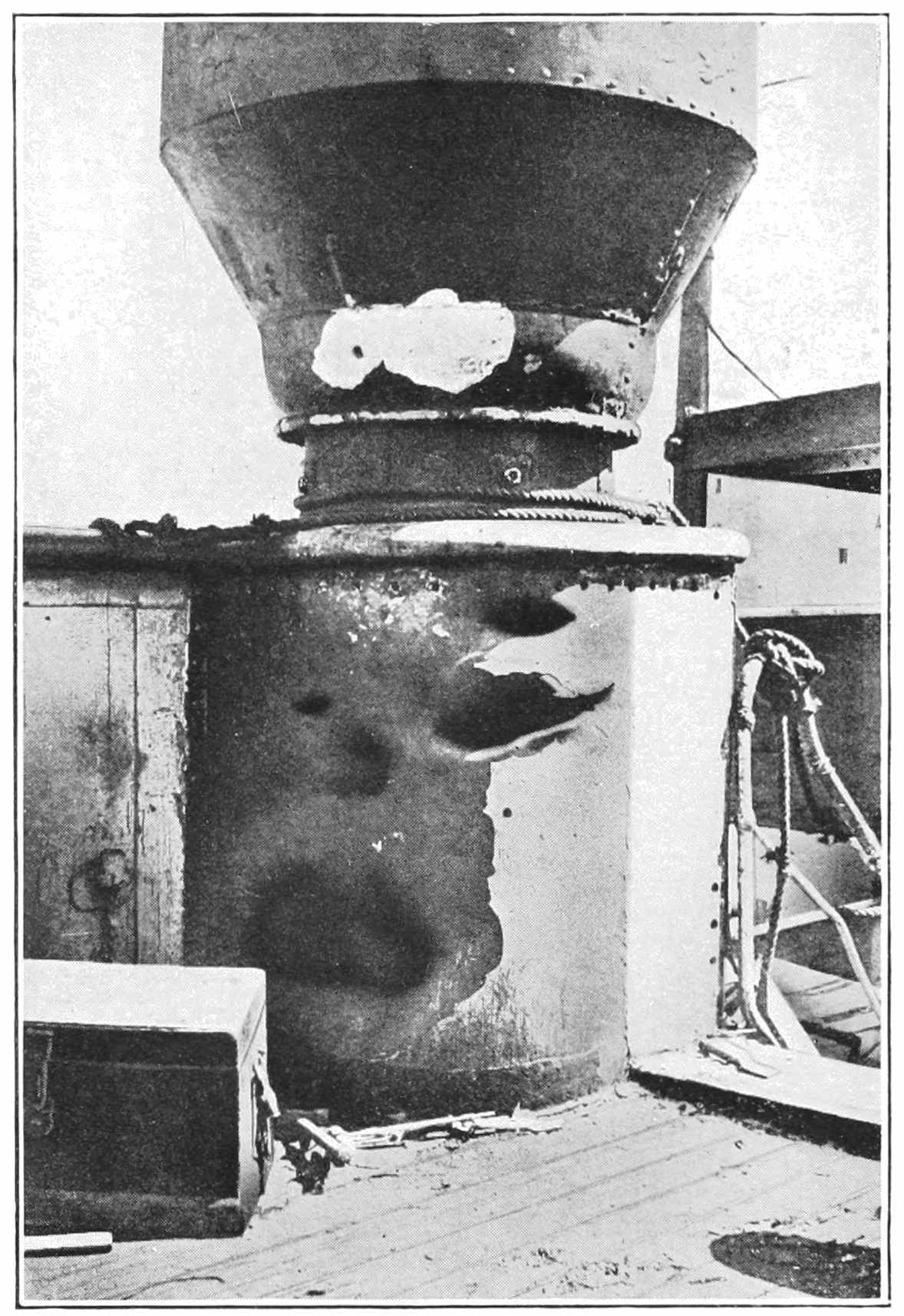
registering hits on the Carmania’s masts, ventilators,
boats, and derricks, and it is an amazing fact,
considering that at one time the range was not
more than 1½ miles, that her casualties should have
been so few. The Carmania’s gunners were now
firing so fast that the paint was blistering off the
guns, and at the same time she herself was on
fire to an extent that might have proved very
serious. The main pipes having been shot away,
no water could be got through the hose pipes and
brought to play upon this fire, and reliance had
therefore to be placed upon water buckets handled
under the most difficult conditions of smoke and
heat.
It was now evident that the Carmania’s bridge
would in a very short time be untenable, and her
Captain therefore ordered the control to be changed
to the aft steering position, and this was accordingly
done, the enemy being kept at about the same
bearing. The bridge was now well alight, and
the flames were licking upward with increasing
ferocity. The port side of the main rigging was
hanging in festoons from the only remaining shroud.
The wireless gear had been shot away in the first
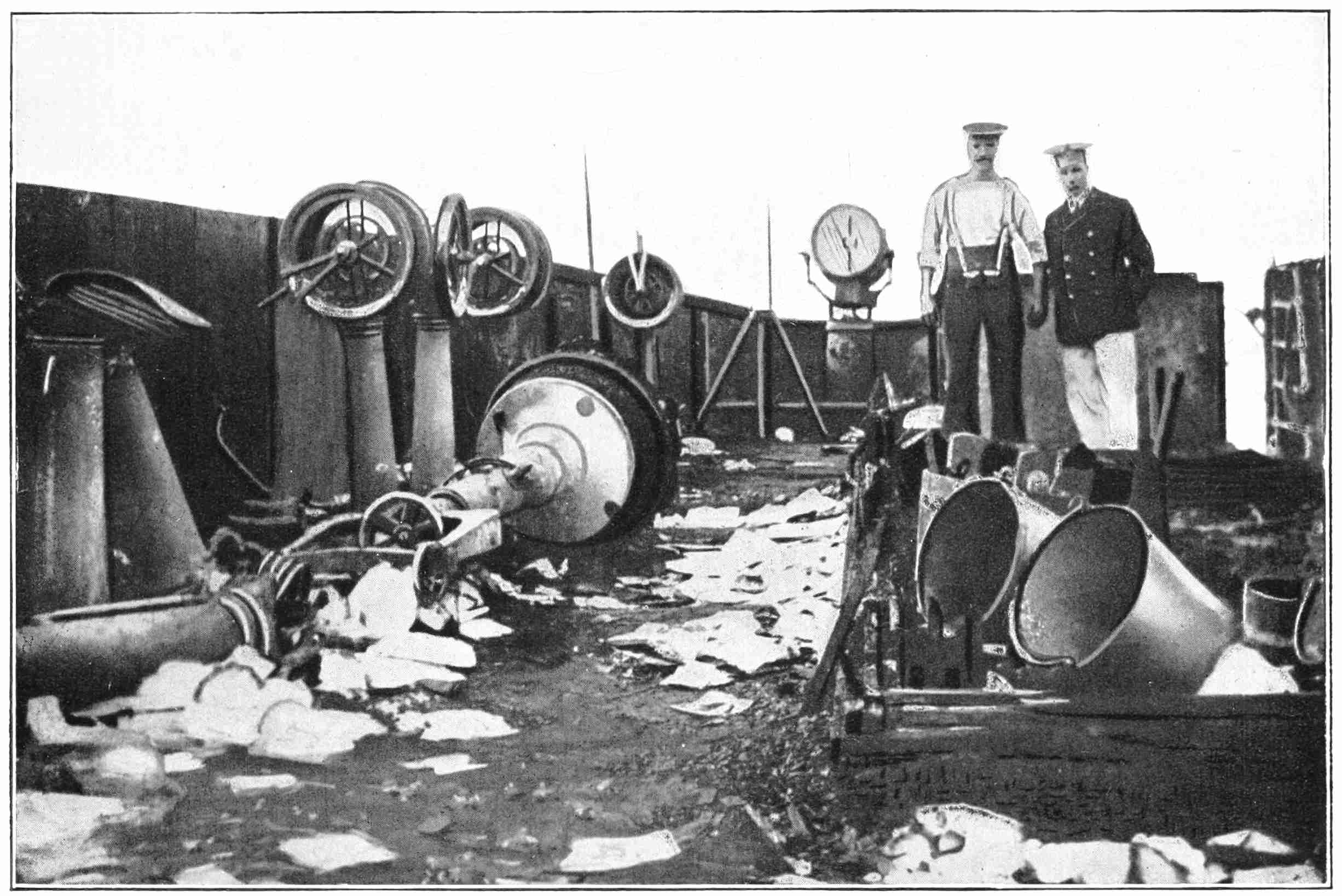
moment of the action. Many of the ventilator
cowls were in ribbons, and a large hole yawned
in the port side of the aft deck.
Battered as she was, however, it was now clear
that the Cap Trafalgar was in a far worse case.
She was listing heavily, and her firing, though
still rapid, was becoming wild. She was badly
on fire, and almost wholly wrapped in smoke.
Suddenly she turned abruptly to port and headed
back for the island, leaning right over with silent
guns, and already beginning to get her boats out.
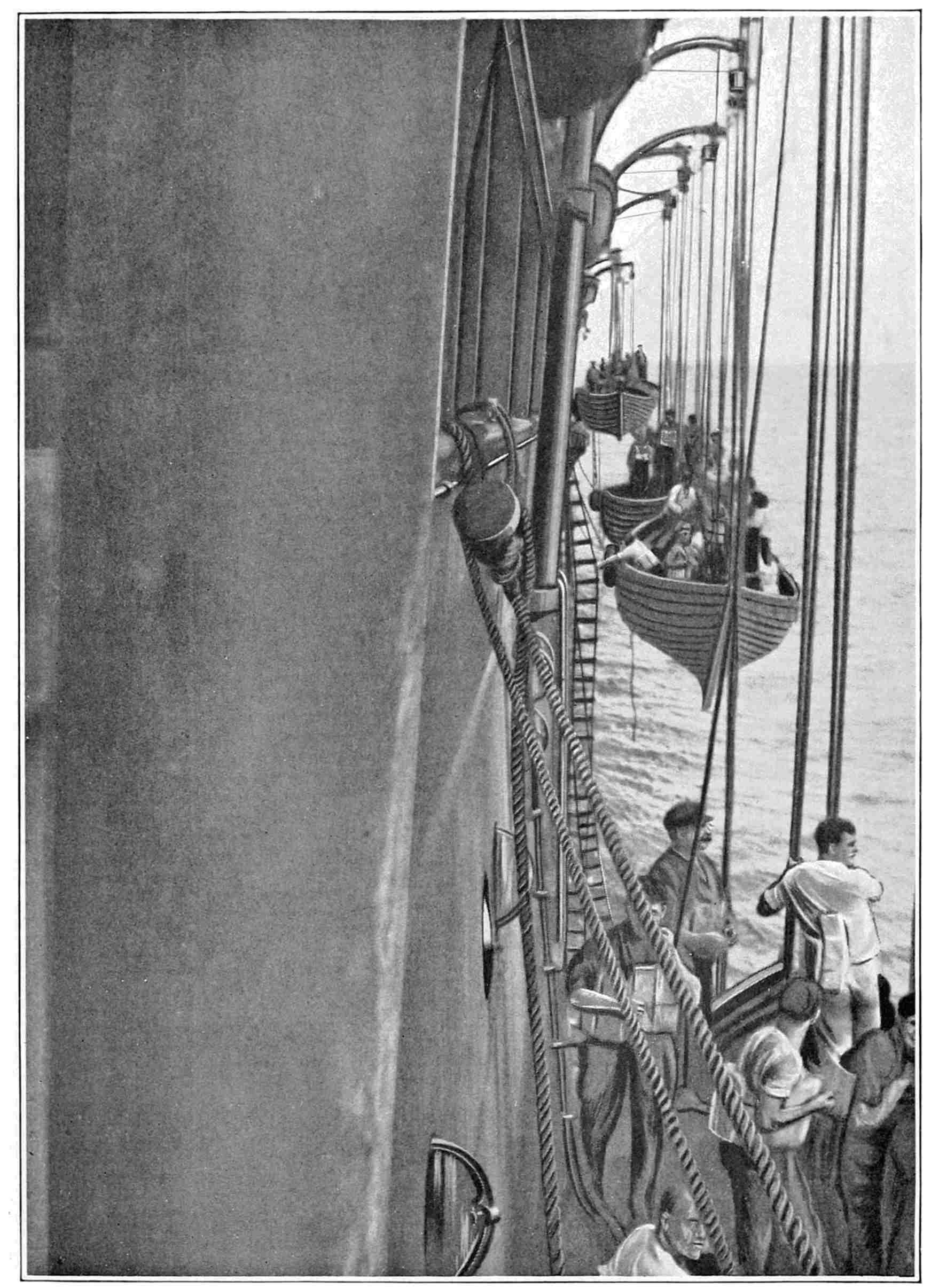
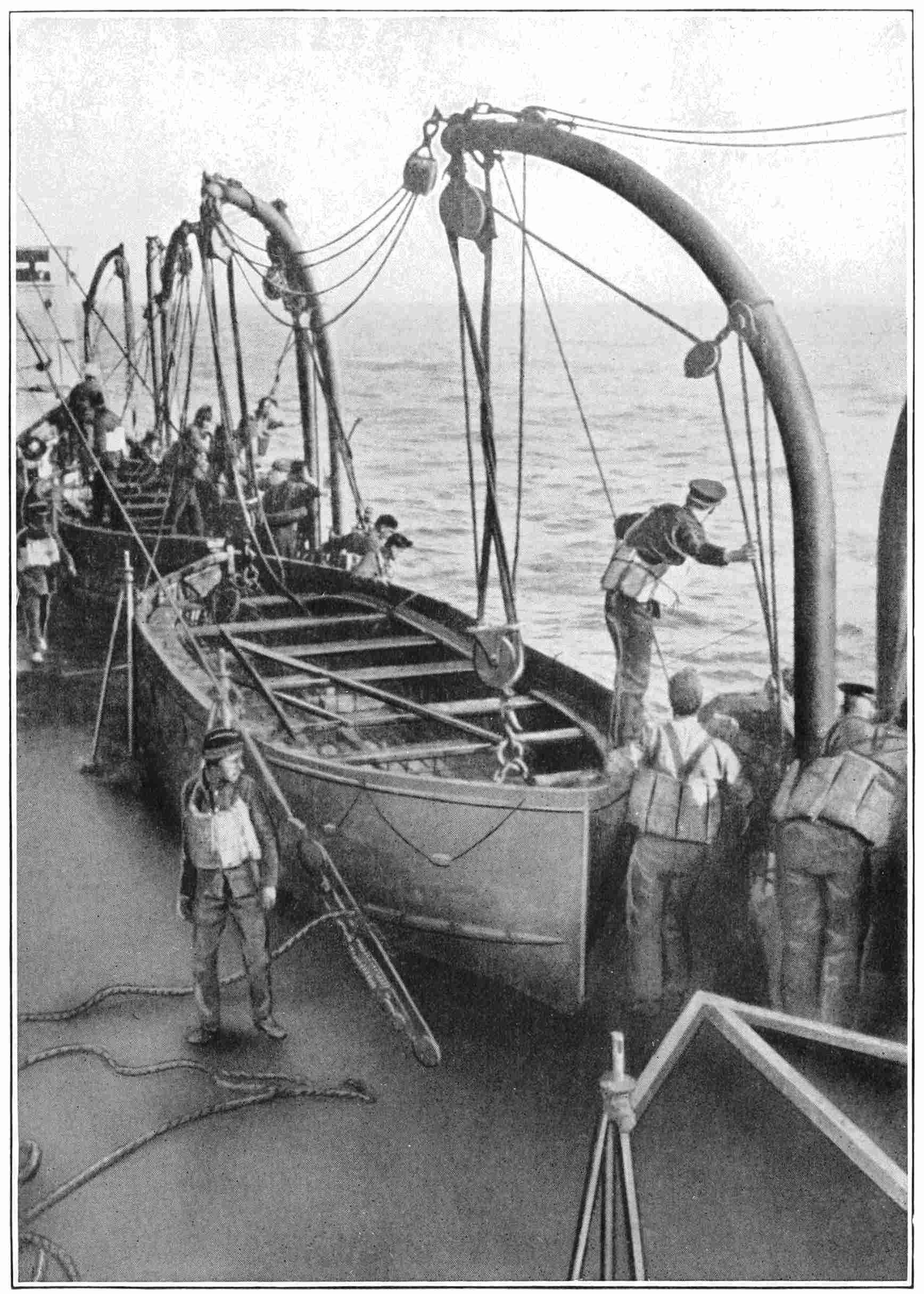
“Abandon Ship” drill at sea
After the fight
Upon this all the Carmania’s hands, except
the gun layers, were employed in trying to
extinguish the fire. Bucket gangs were formed,
and at last a lead of water was arranged from
the ship’s own fire main once more. It was, of
course, hopeless now to attempt to save the bridge
and the boat deck cabins, but there was still a
hope of preventing the fire from spreading, and
in order to stop the draught the engines were
slowed down. It was a fierce task, and one that
demanded every energy on the part of all on
board, but it was one in which they were
encouraged, as they toiled and sweated, by the
sight of their heeling enemy, from whose sides
half a dozen boats had already cleared, pulling
towards one of her smaller colliers who was standing
about 3 miles away.
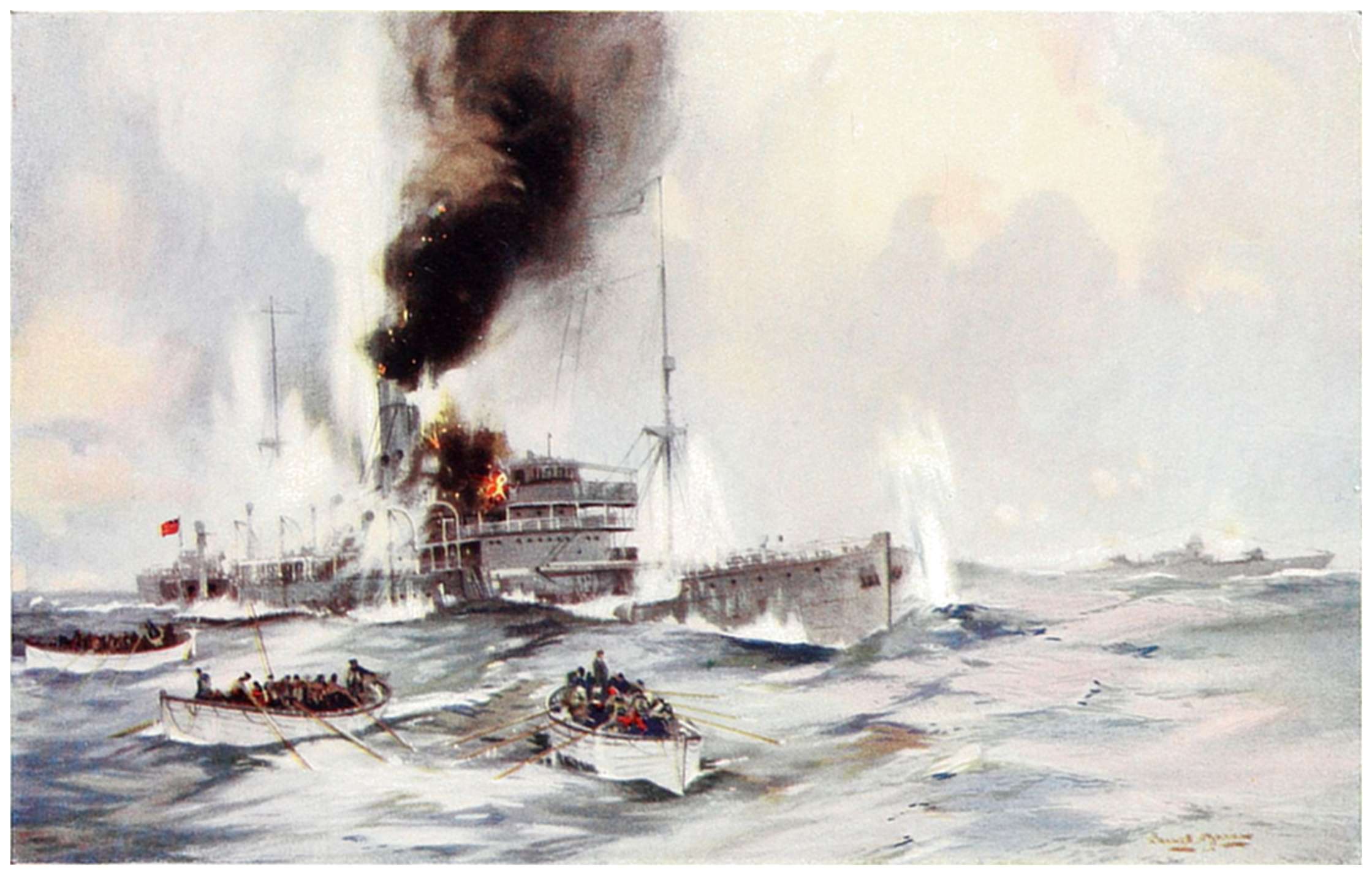
More and more the big liner fell over until
at last her funnels lay upon the water, and then,
after a moment’s apparent hesitation, with her
bow submerged, she heaved herself upright and
sank bodily. It had been a good fight and she
had fought honourably to the end and gone down
with her ensign flying, and when, as she vanished,
the men of the Carmania raised a cheer, it was
hardly less for their own victory than as a tribute
to the enemy.
By now, thanks to their unremitting exertions,
the crew of the Carmania had overcome the fire,
but a new danger was already reported and
necessitated prompt action on the part of her
Commander. Smoke had been reported on the
northern horizon, and soon afterwards four funnels
appeared, the new comer being undoubtedly another
enemy, probably summoned by wireless by the
Cap Trafalgar. Crippled as she was, and with
nearly a quarter of her guns’ crews and ammunition
supply parties either killed or injured, it would
have been the sheerest madness for the Carmania
to risk another action at that moment, and she
accordingly increased her speed, shaping a course
to the south-west, and steering by sun and wind,
until she could assemble what was left of her
shattered navigating gear. Afterwards it was
learned that the enemy sighted was the Kron
Prinz Wilhelm, who, on learning by wireless of
the Cap Trafalgar’s fate, decided that discretion
was the better part of valour and did not approach
any nearer.
During the night the Carmania succeeded in
getting into touch with the cruiser Bristol, with
whom she arranged a rendezvous for the next
morning, and under whose care, and afterwards
that of the Cornwall, she came to anchor near
the Abrolhos Rocks at eight o’clock on the morning
of the day after. Here, with the aid of the
Cornwall’s engineers, the worst of her holes were
patched up, and with what navigating gear she
could borrow, and in company with the Macedonia,
the Carmania set out for Gibraltar at 6 p.m. on
September 17th. Well did she deserve, as she
did so, the hearty cheers of the Cornwall, and the
two accompanying colliers, and those of the old
battleship Canopus whom she passed early on the
morning of the 19th.
Chart-house and bridge of the “Carmania”
after the fight
She arrived at Pernambuco on the same
afternoon, leaving there Captain Grant’s despatches
for the Admiralty, and reached Gibraltar nine
days later. Her re-fitting took several months,
but she remained as an armed cruiser until May,
1916, when she was again restored to the Cunard
Company’s service. Her casualties in this brilliant
action amounted to nine killed or dying of wounds,
and four severely and twenty-two slightly wounded.
There were no Cunarders among the casualties.
Besides other honours conferred upon participants
in this fight, his Majesty the King decorated
Captain Barr with the well deserved Companionship
of the Bath, in recognition of his splendid services
in what was to prove a unique action of the
war at sea.
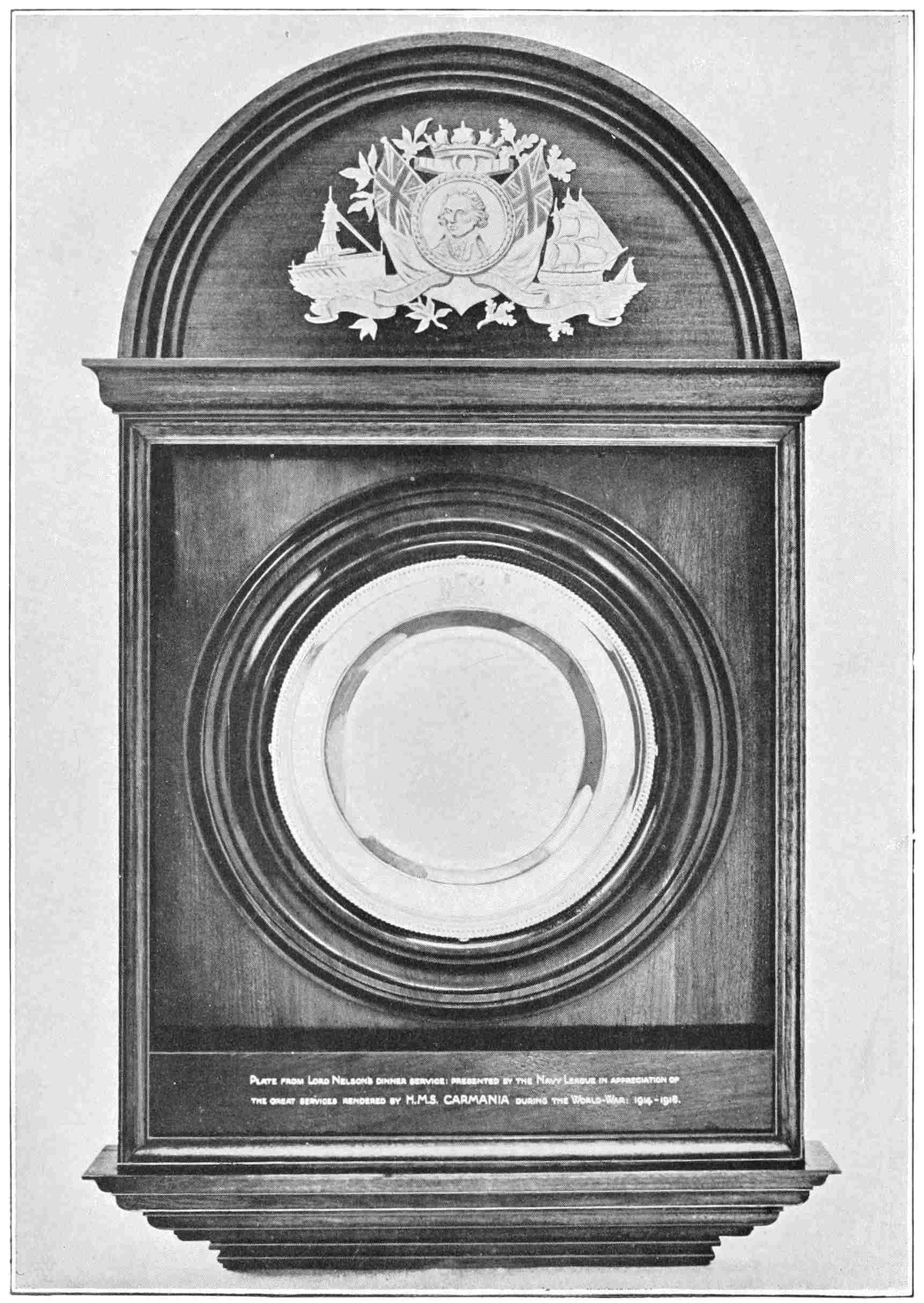
Twelve months later, on September 15th, 1919,
there was an interesting sequel on board the
Carmania, which had then returned to the Cunard
Company’s service. A piece of plate which belonged
to Lord Nelson, and was with him at Trafalgar,
was presented to the ship in commemoration of
her very gallant fight. Twenty-four of these
pieces of plate came into the possession of the
Navy League who asked the Admiralty to allocate
them to various ships. The Carmania was the
only merchant vessel to receive this honour.
In notifying the Company of the presentation, the
General Secretary of the Navy League stated that
“the Navy League realises that while every unit
of the fleet has rendered service in accordance
with the best traditions of the Royal Navy,
H.M.S. Carmania has been able to render herself
conspicuous amongst her gallant comrades, and in
accepting this souvenir, the Navy League trusts
that you will recognise it as an expression of
gratitude to the glorious fleet of which that ship
was so distinguished a representative.”
The veteran Admiral, the Hon. E. R. Fremantle
who was present, stated that there never was a single
ship action which reflected greater credit, both
on the R.N. and on the Mercantile Marine, and
more especially on the R.N.R. It had very aptly
been compared with the fight of the Shannon
and the Chesapeake.
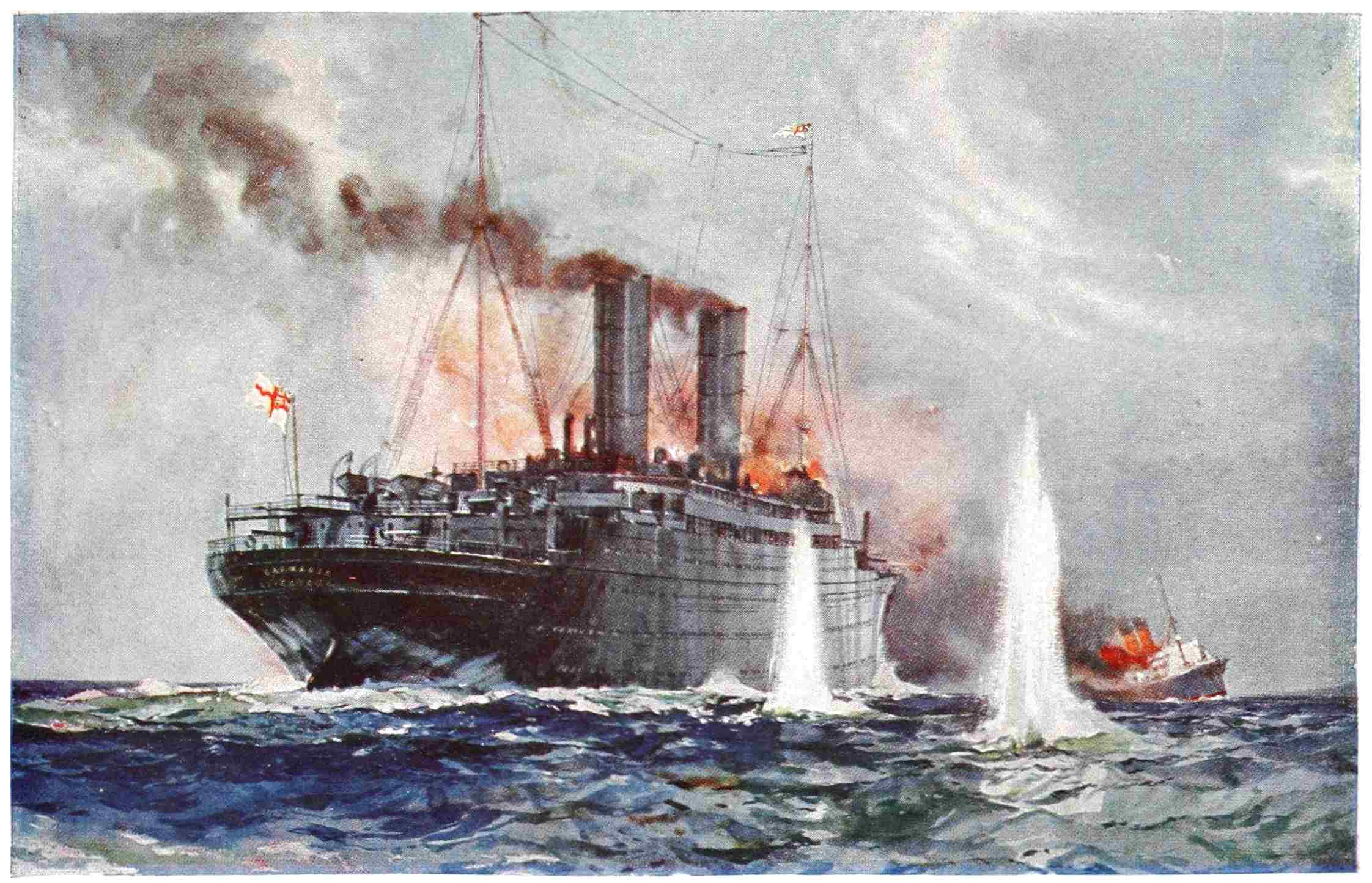
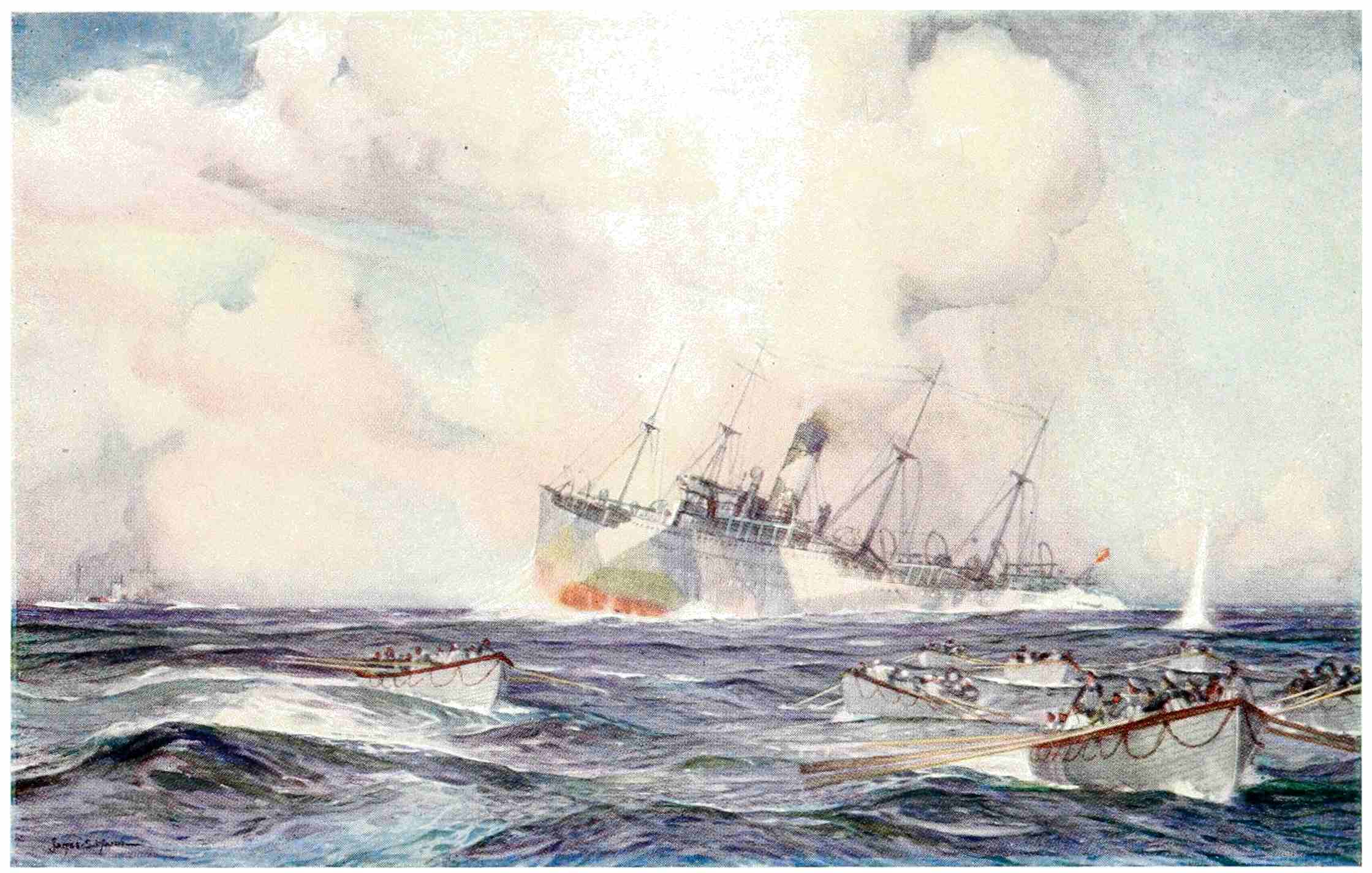
“Carmania” sinking
“Cap Trafalgar”
Captain Grant was unfortunately unable to be
present, but in a letter read at the function he
claimed that “this action was the only one
throughout the war in which an equal, or as
a matter of fact, a slightly inferior vessel annihilated
the superior force.... I shall always feel
proud of the fact that it was my great good
fortune to command a ship in action in which the
glorious traditions of the British Navy were upheld
by every soul on board.”
Captain Barr, who retired from the Company’s
service in 1917, said that the Captain of the
Cap Trafalgar put up a very gallant fight. “I do
not know his name,” he said, “but he is the
only German I would care to meet.”
CHAPTER III Carrying On
The lofty liners in their pride
Stem every current, every tide:
At anchor in all ports they ride.
The menace of the berg and floe,
The blindness of the fog and snow.
All these the English seamen know.
And still they calmly jog along
By Bay and Cape, an endless throng.
As endless as some dog-watch song.
Morley Roberts.
We have confined ourselves so far to the adventures
of the Cunard vessels that were used in the early
stages of the war for purely combatant purposes.
They were, as has been seen, merely a small,
though important, fraction of the whole fleet, and
indeed the distinction that we have drawn is a
somewhat difficult one to maintain. Thus, from
acting, as we have shewn, as purely combatant
cruisers, the Aquitania, Caronia, Laconia and
Carmania passed to different and even more
valuable work; and at the same time many other
Cunard vessels were upon the outbreak of war
withdrawn from their usual avocation for more or
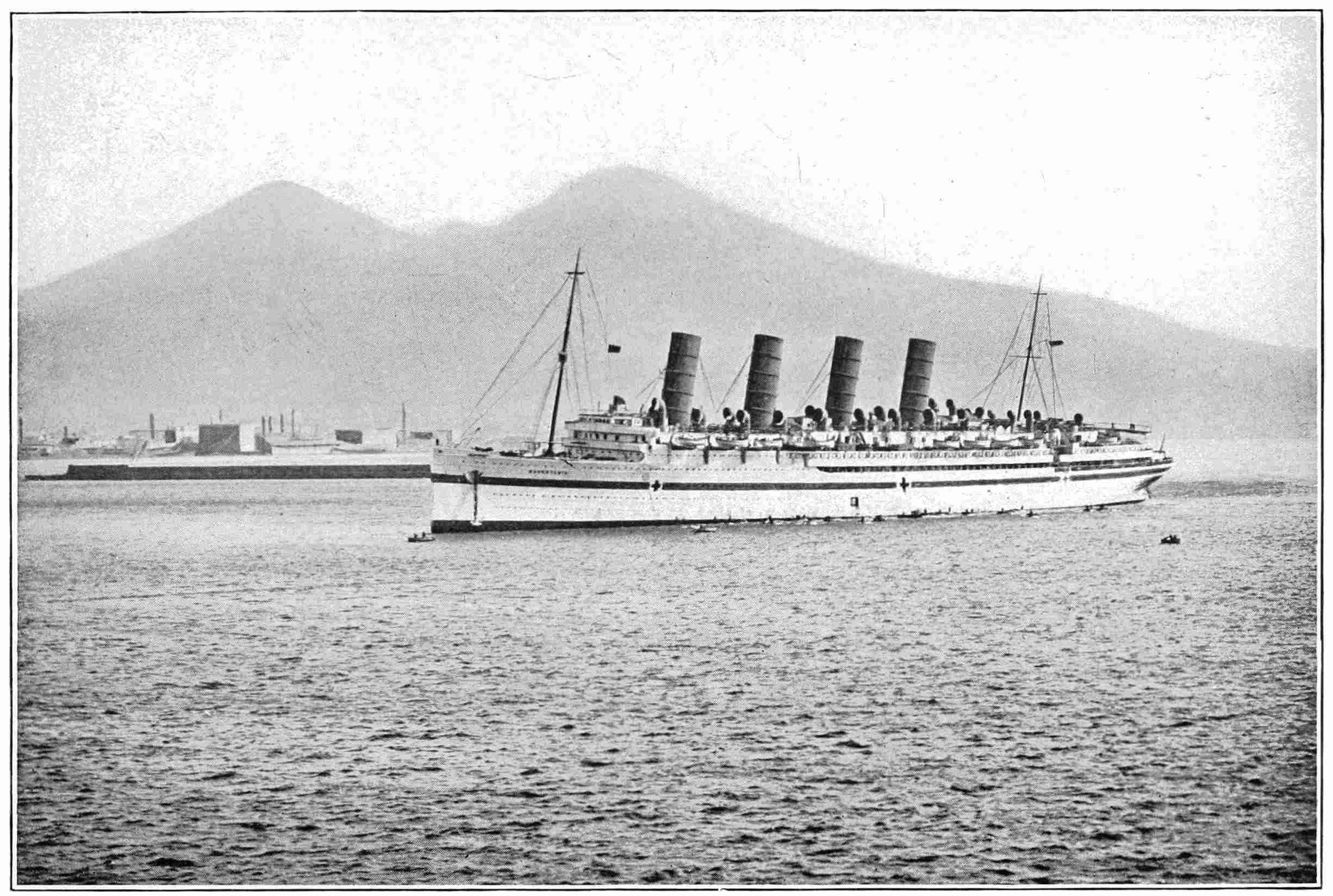
less militant purposes. We find the Mauretania,
for example, originally intended for employment
as an armed cruiser, converted into a Troopship
in 1915, and from this into a Hospital Ship in
1916, while in 1917 she again became a Transport,
fitted with 6-in. guns. In all these capacities she
did magnificent work, not without imminent risk
of destruction, and it was only by the brilliant
seamanship of Commander Dow, one of the Cunard
Company’s oldest and most trusted skippers, that she
escaped being sunk while plying between England
and Mudros, in her role of Troopship. Attacked
by a submarine, Commander Dow noticed the
wake of the approaching torpedo on his starboard
bow, and immediately ordering the helm to be
flung hard aport the torpedo was missed by not
more than 5 feet, the Mauretania’s great speed
fortunately thereafter placing her beyond range
of the enemy.
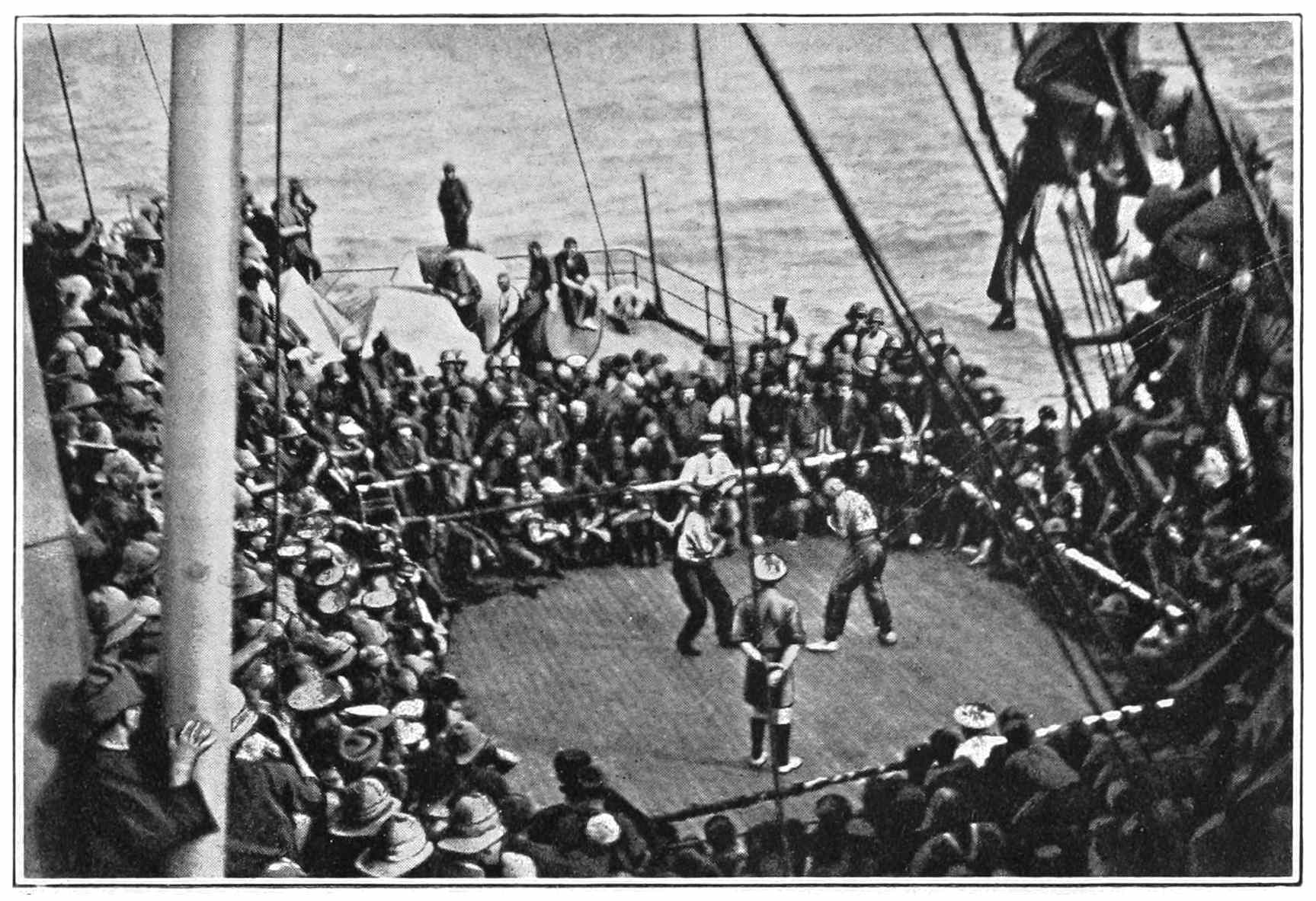
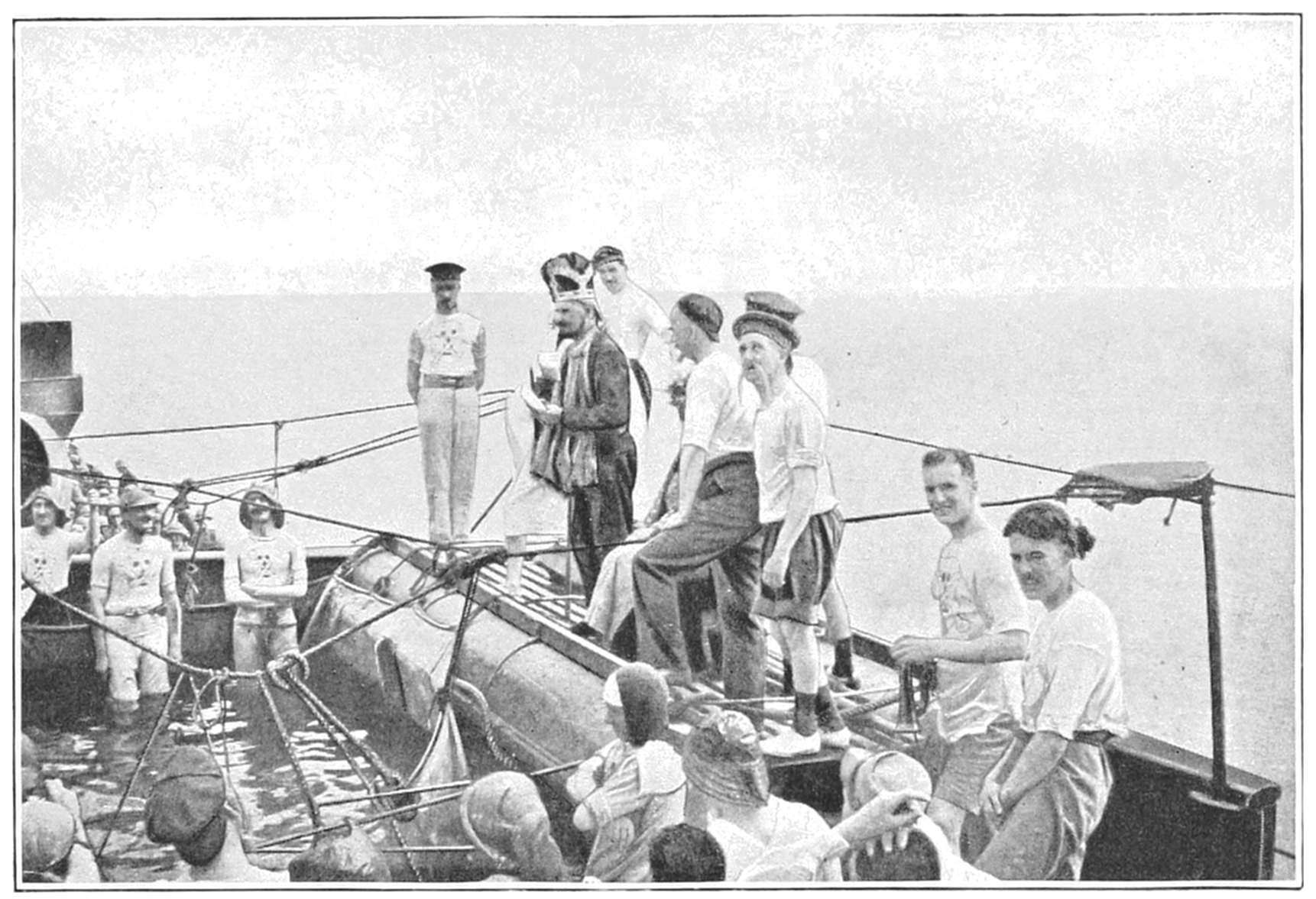
The “Laconia” at Durban
Final of the S.A.I. heavy-weight championship
on the “Laconia”
The Franconia and Alaunia were also employed
in carrying troops from September, 1914, onwards
until both of them were sunk, curiously enough
within a few days of one another in October, 1916.
During this period they carried troops not only
from Canada to England, but made several voyages
to India and various parts of the Mediterranean.
It was while she was on her way from Alexandria
to Salonica, though fortunately after she had
disembarked 2,700 soldiers, that the Franconia
(Captain D. S. Miller), was torpedoed, about 200
miles N.E. of Malta. Twelve of her crew were
killed by the explosion. The ship sank fifty
minutes after she was hit, the survivors being
picked up by H.M. Hospital Ship Dover Castle,
whose R.A.M.C. Surgeon, Dr. J. D. Doherty
chanced himself to be one of the Cunard Company’s
Medical Officers. The Alaunia, again, as it happened,
having landed her passengers and mails at Falmouth,
after a voyage from New York, was torpedoed on
her way to London, about two miles south of the
Royal Sovereign Light Vessel. Captain H. M.
Benison, in command, hoped to beach the ship,
but unfortunately the water gained too rapidly,
and the necessary tugs did not arrive in time.
Two members of the crew were found to be
missing, probably as the result of the explosion,
the rest being saved by patrol boats and destroyers
and the Alaunia’s own lifeboats.
The Nelson Plate presented
to the “Carmania”
The Andania, Ascania, Ivernia, and Saxonia,
were all for several months used as prison ships
in 1915, each of them providing accommodation
for nearly 2,000 German prisoners. They were
afterwards employed as Transports, both to India
and the Mediterranean, the Ivernia, Ascania and
Andania, in the end, all being sunk by enemy
submarines. These losses represented a heavy
sacrifice by the Company, particularly in view of
the post-war needs of navigation.
It was on January 27th, 1918, that the Andania
was torpedoed without warning, having sailed the
day previously from Liverpool, via the North of
Ireland, with 51 passengers and mails. Captain
J. Marshall, in command, immediately ordered her
boats to be lowered with the result that within
a quarter of an hour all the passengers and crew
were clear of the ship, except the Captain himself,
the Chief, First, Second and Third Officers, who
made a special request to the Captain to be allowed
to remain on board. The manner in which the
boats were thus speedily lowered and filled and
navigated to positions of safety was an evolution
which reflected favourably on the organisation of
the ship. Captain Marshall then made an examination
of the ship and called for volunteers from the
nearest boat. The response was immediate and
unanimous, and the Chief Engineer, Purser, Wireless
Operator, and two Stewards, with two Able Seamen
at once returned on board with a fine carelessness
to their own safety and rendered valuable
assistance in getting out hawsers forward and aft.
At half-past two, these men were again ordered
to leave the vessel, and, with the occupants of
the other boats, were picked up by patrols.
Captain Marshall himself and his Chief Officer
(Mr. Murdoch) boarded a drifter and stood by the
Andania until 4 o’clock in the evening, when they
again returned on board to make her fast to a
tug which had just arrived, still entertaining the
hope that it might be possible to save her.
Unhappily their efforts were of no avail, the vessel
sinking about half-past seven. Seven lives were
unfortunately lost, probably as the result of the
explosion.
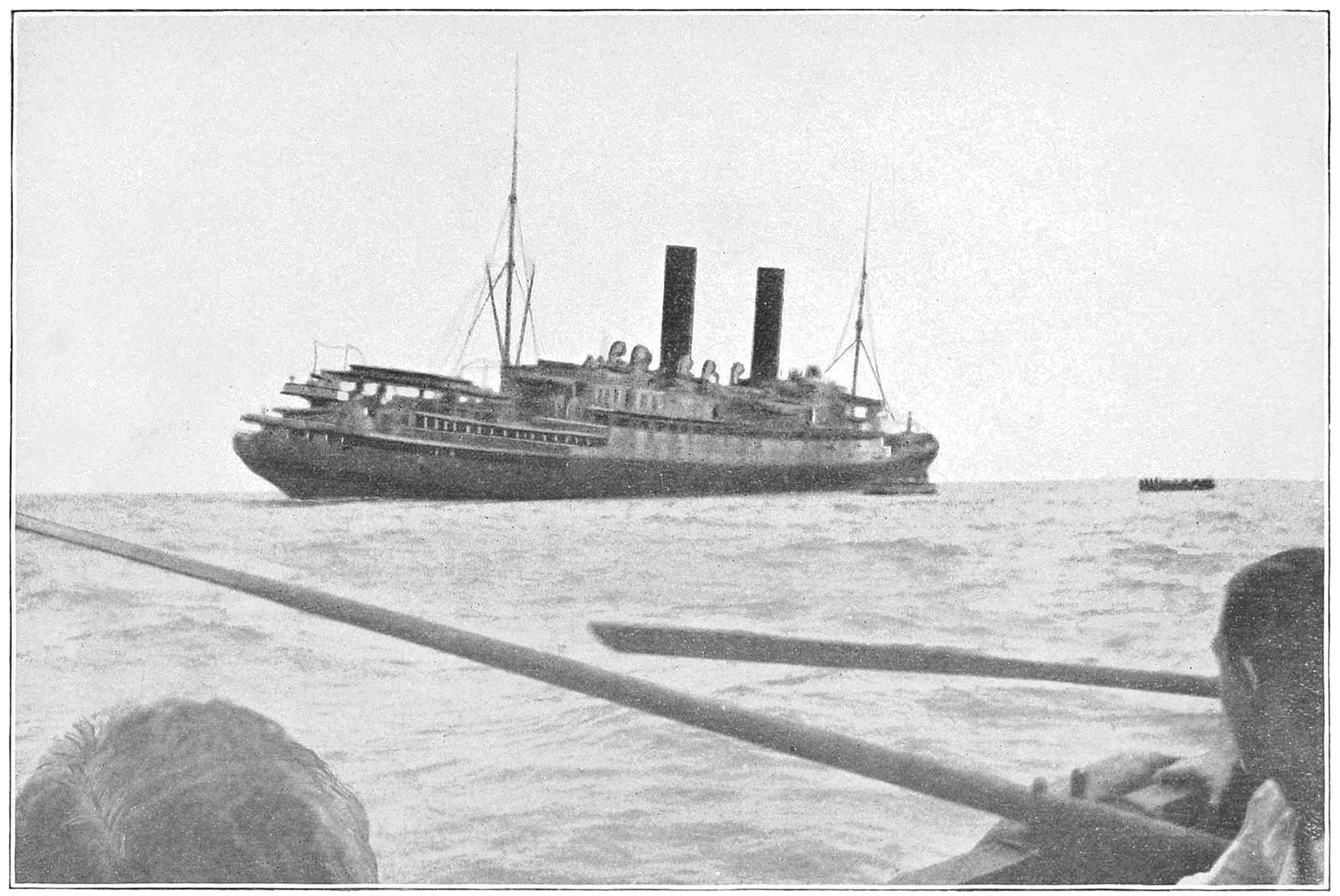
Crew leaving the “Franconia”
after she was torpedoed
On the morning of the 28th December, 1916,
the Ivernia left Marseilles with a crew of 213,
94 officers and 1,950 troops. Shortly after her
departure from Marseilles Captain Turner received
orders to proceed 11 miles south of Damietta
(Malta), but prior to altering course he received
further orders to proceed north of Gozo Island
(Malta), where the Ivernia’s escort, H.M.S. Camelia
(Destroyer), was relieved by H.M.S. Rifleman
(Destroyer). On approaching the Adriatic, Captain
Turner was instructed not to pass through the
danger zone in daylight. As the Ivernia was
proceeding she received a signal from the escort
that permission had been requested and granted
from the Admiralty at Malta to proceed through
the danger zone at daybreak.
There was a fresh breeze which accounted for
a heavy swell, the morning sun was shining
brightly on the starboard side, when Captain
Turner observed the wake of a torpedo approaching
his vessel, too late to enable him to do anything
to avoid it. The torpedo struck the Ivernia on
the starboard side, abreast the funnel, and consequently
rendered the engines out of commission, owing to
the bursting of the steam pipe, by the explosion.
This explosion accounted for the loss of 13 stewards
and 9 firemen.
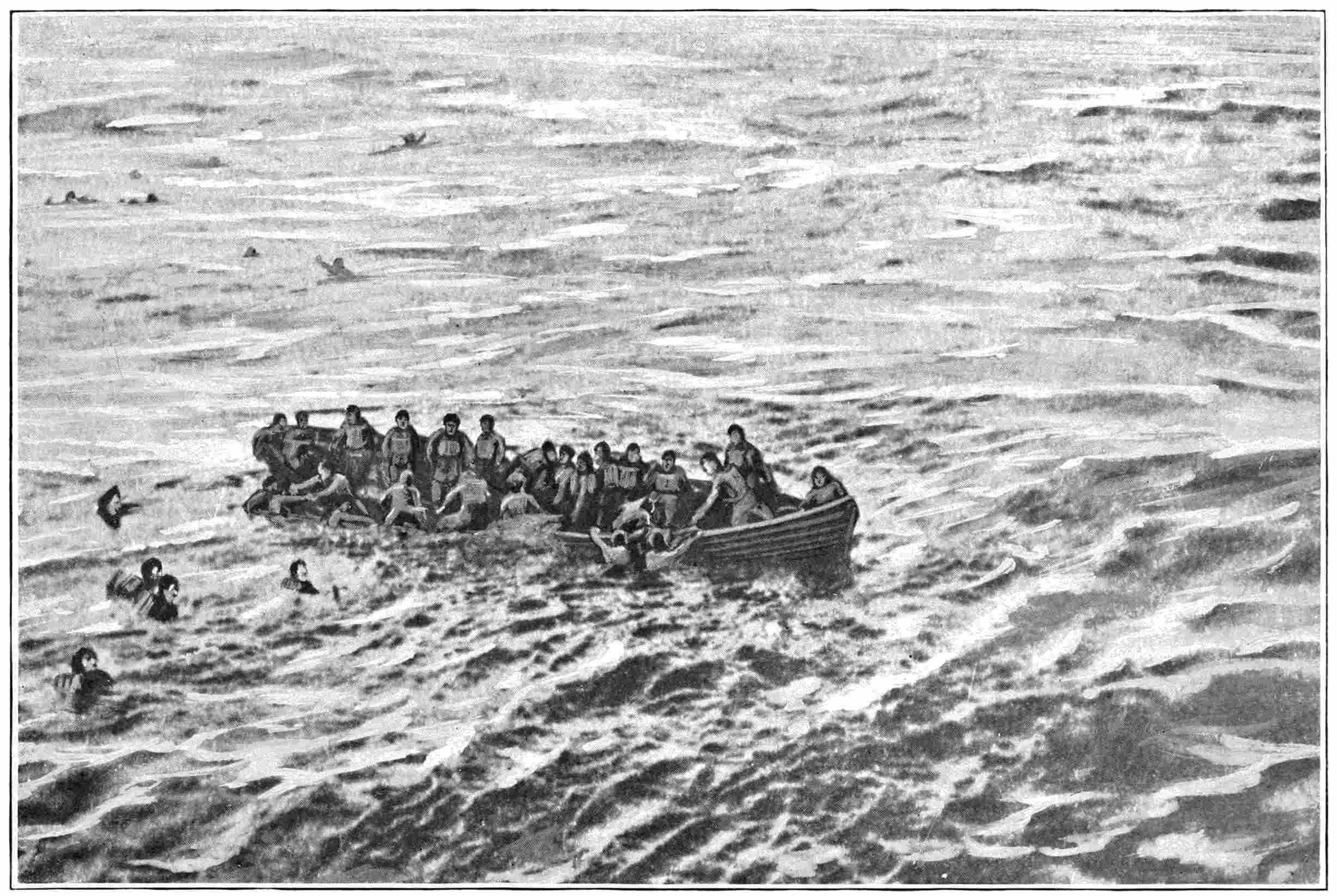
Fortunately, at the time, all troops were mustered
on deck and were standing by boat stations. The
boats were immediately lowered clear of the water.
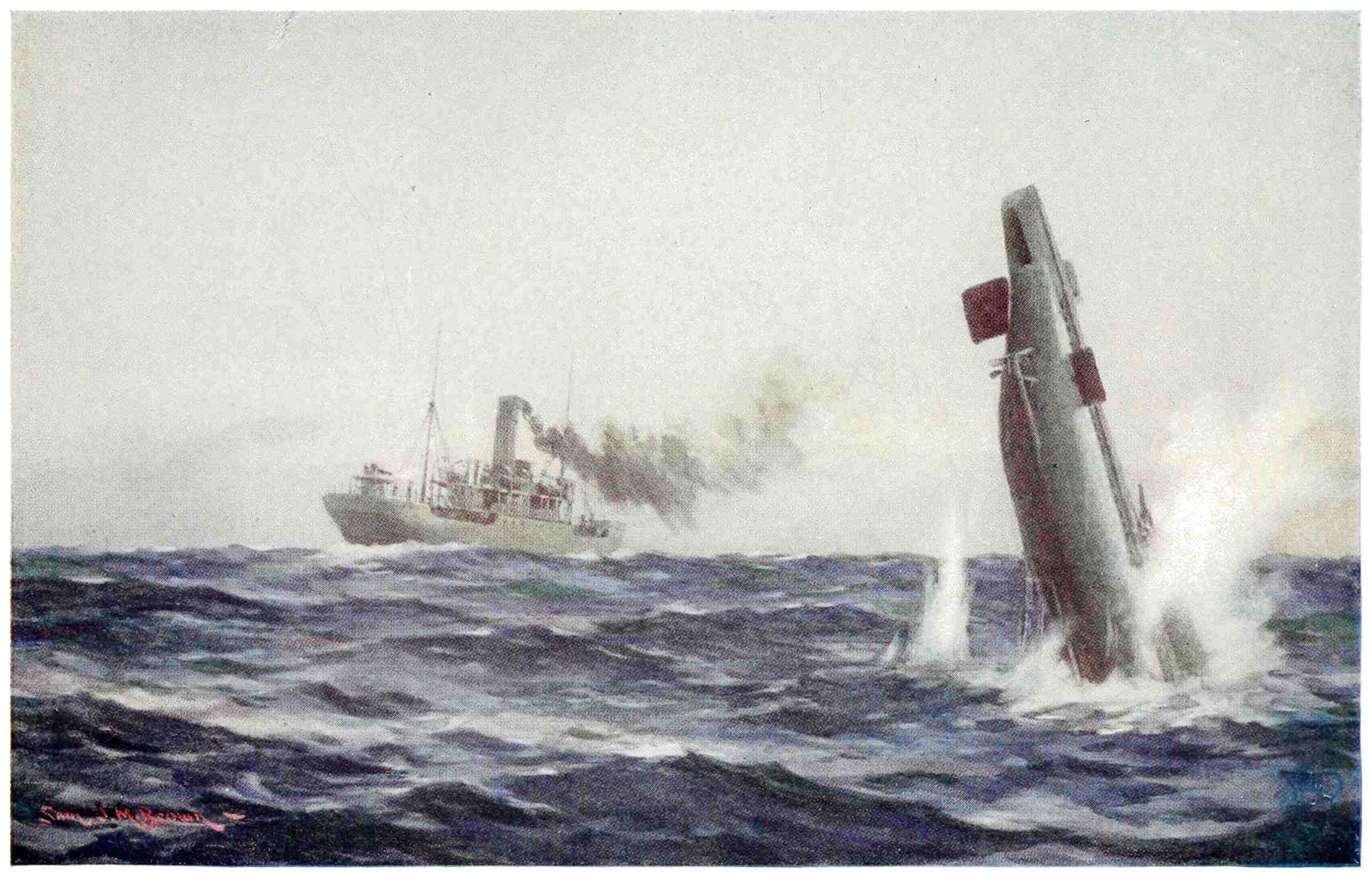
The destroyer Rifleman immediately manœuvred
for the purpose of locating the submarine, by
which time several of the Ivernia’s boats were in
the water. At this juncture an unfortunate
incident occurred. The destroyer dashed by the
port quarter at full speed without having an
opportunity of avoiding a collision with the ship’s
lifeboat, containing Chief Engineer Wilson and
Dr. Parker, among other members of the crew, the
boat sinking immediately. Dr. Parker was picked
up but died almost immediately from injuries
received. Chief Engineer Wilson was not seen.
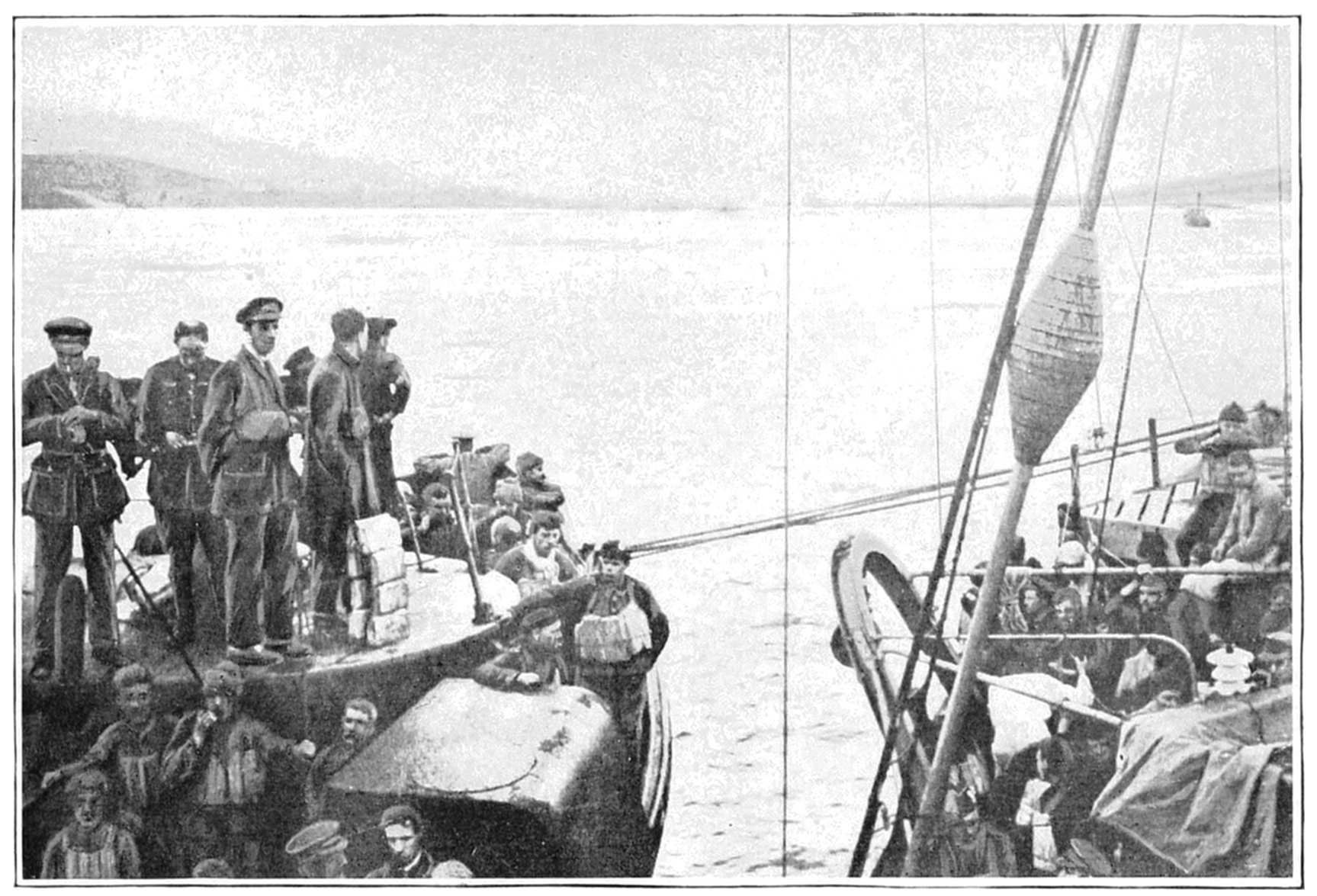
Two steam trawlers came alongside the Ivernia,
after the destroyer had left with 600 survivors
on board, which took the remainder of the Military
and Crew, which apparently left only Captain
Turner and Second Officer Leggett remaining on
board. The Second Officer, however, went round
the decks and discovered a soldier on the after
deck who had sustained a broken thigh. Two
soldiers were immediately ordered aboard for the
purpose of assisting in strapping a board to the
man’s damaged thigh, he being eventually lowered
on to one of the trawlers by means of a bowline,
where he was placed in charge of the R.A.M.C.
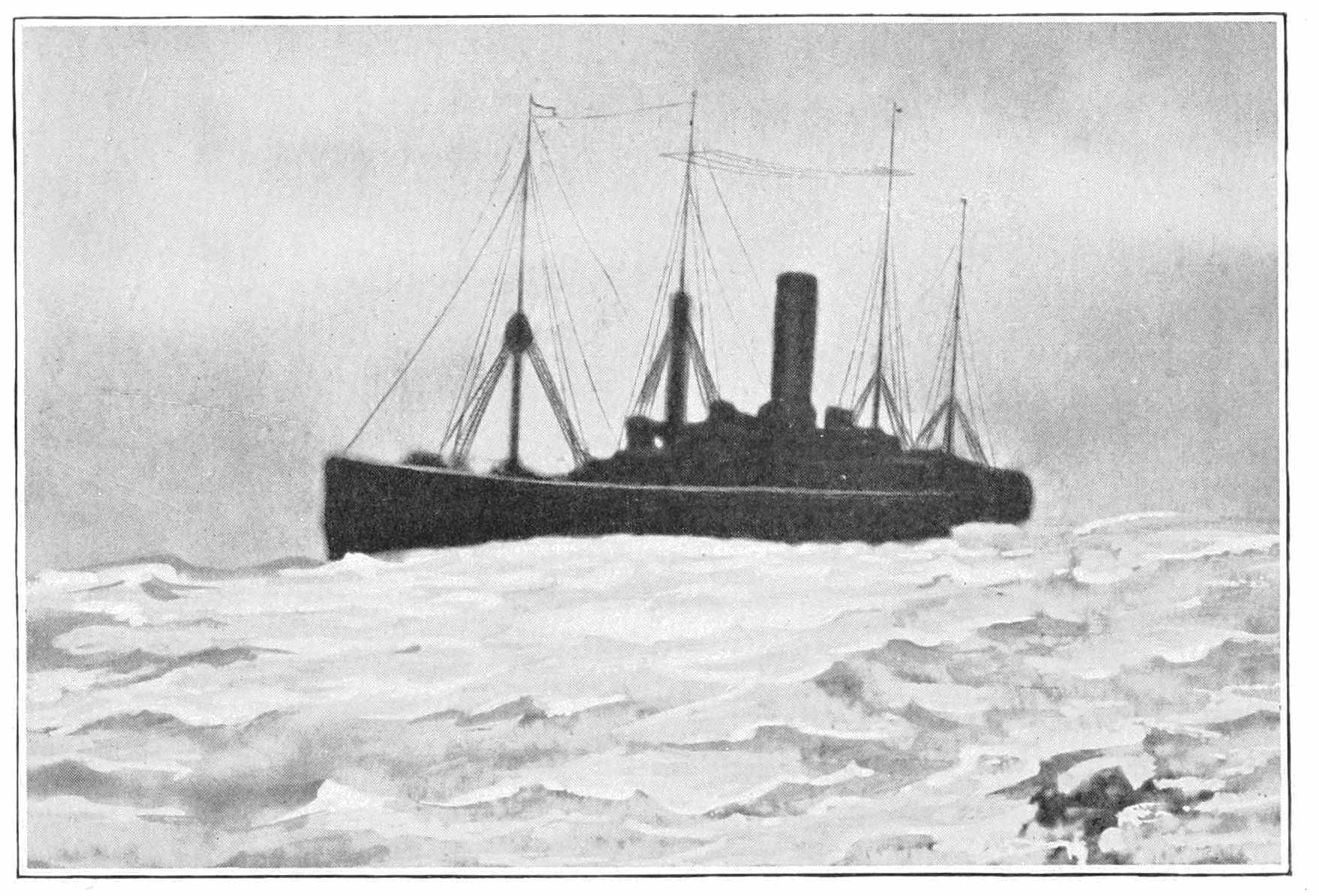
Torpedoing of the
“Ausonia”
The Second Officer then went aboard the trawler,
later followed by Captain Turner, who first of all
made sure that the vessel was sinking.
The trawlers then cruised around among the
boats and wreckage picking up survivors.
One of the trawlers unfortunately became
disabled owing to the ropes fouling her propellers,
which necessitated her being towed by the other.
The trawlers proceeded to Crete, where the
survivors were billeted for 14 days, after which
time they were taken on board the P. & O.
S.S.Kalyan and conveyed to Marseilles, from which
port they were sent overland to England.
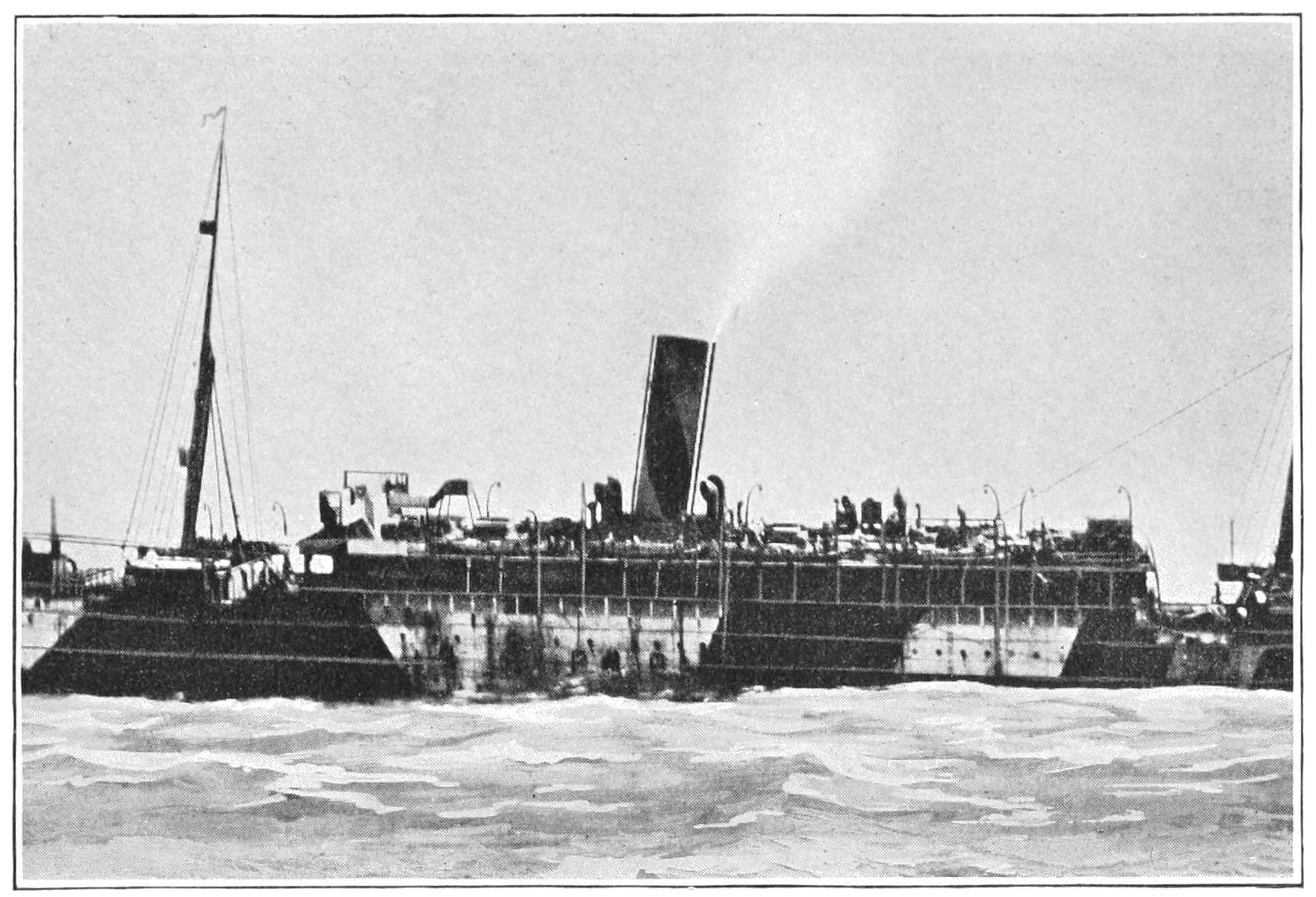
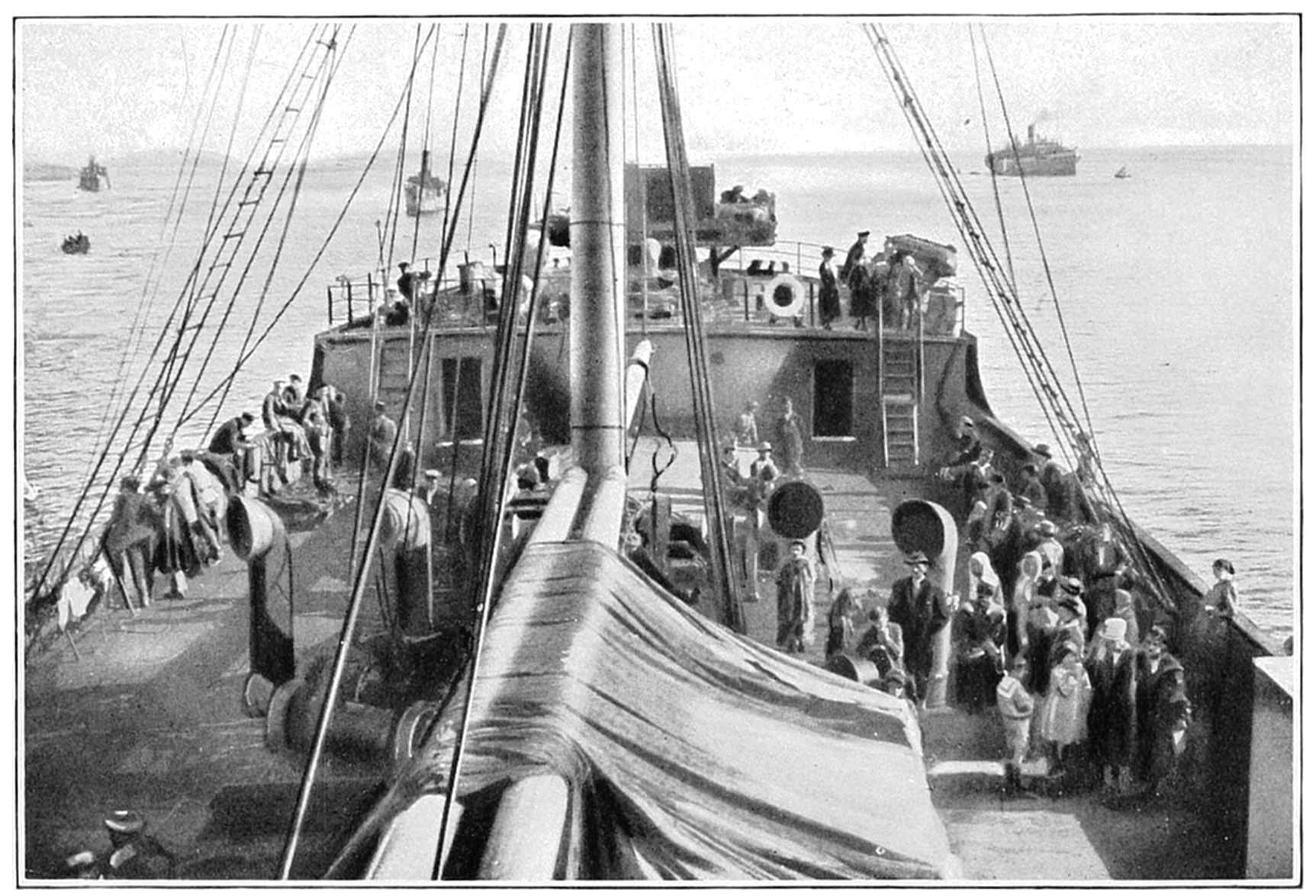
The Ausonia was another of the fine Cunard
vessels which the enemy succeeded in destroying.
In February, 1915, she had taken over 2,000
refugees from Belgium to La Pallice, being afterwards
employed as a Troopship from February
to May, 1916, working to Mediterranean and Indian
ports. She was then returned to the Cunard
Company’s service, and was sunk on the 30th of
May, 1918. Once before, this ship had been
struck by a torpedo, off the south coast of Ireland,
in June, 1917, while on a voyage from Montreal
to Avonmouth. In this case she was fortunately
salved, and her valuable cargo of food stuffs safely
discharged. On the second occasion, while sailing
from Liverpool, she was less fortunate. The
Ausonia was some 600 miles west of the Irish
coast at 5 p.m. on May 30th, when a torpedo
struck her, causing a terrific explosion. As her
Commander, Captain R. Capper, afterwards said,
he saw rafts, ventilators, ladders, and all kinds of
wreckage coming down as if from the sky, falling
round the after part of the ship. Captain Capper
who, at the moment, was at the entrance of his
cabin, at once went to the bridge, put the telegraph
to ‘Stop’—‘Full Speed Astern’ but received no
reply from the Engine Room. All hands were
at once ordered to their boat stations, and the
wireless operator tapped out the ship’s position
on his auxiliary gear. Ten boats were lowered,
and, within a quarter of an hour after the ship
was struck, they had safely left her. When about
a quarter of a mile astern, Captain Capper
mustered them together and called the roll.
It was then discovered that eight stewards
were missing, having been at tea in a room
immediately above the part of the ship struck by
the torpedo.
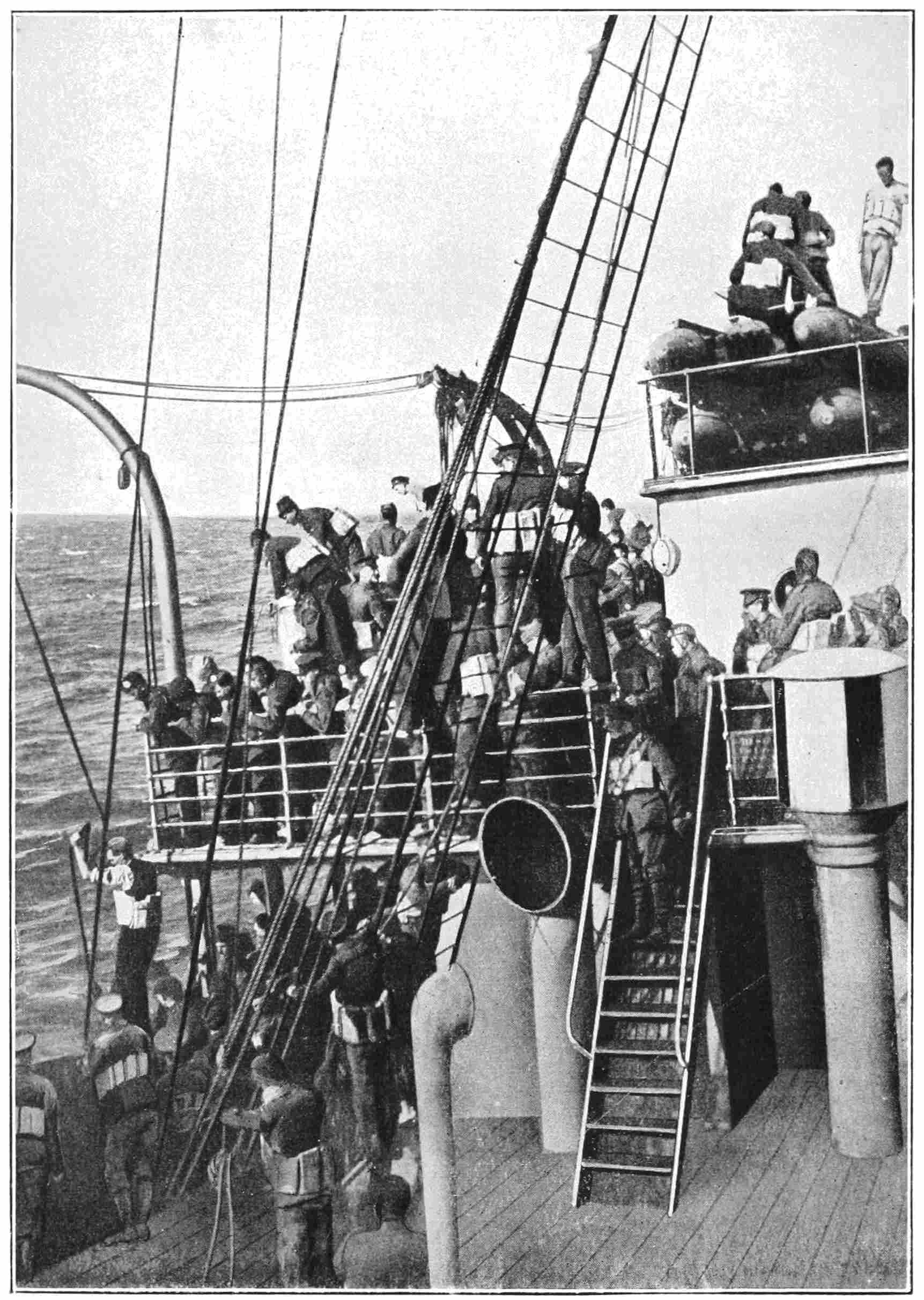
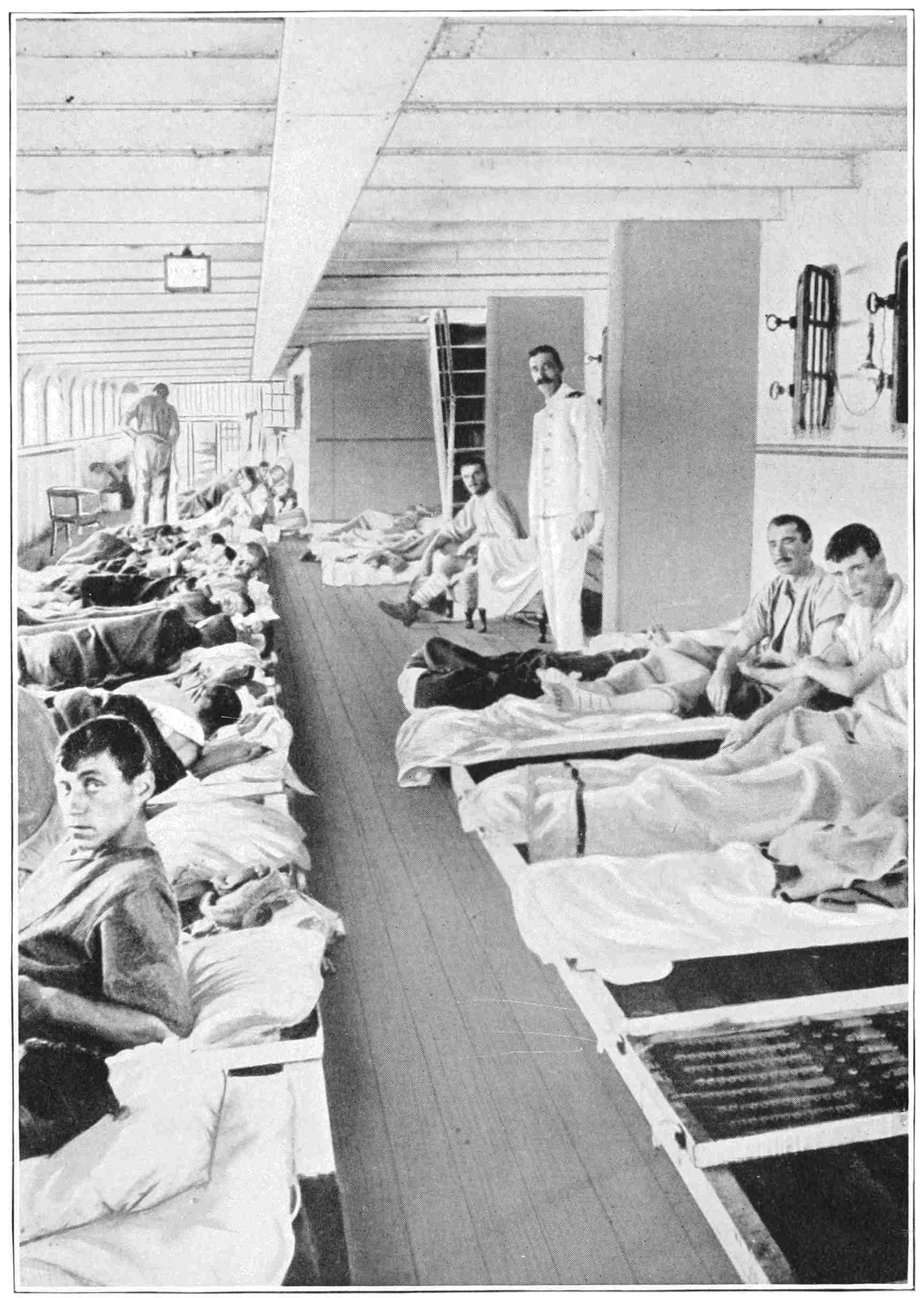
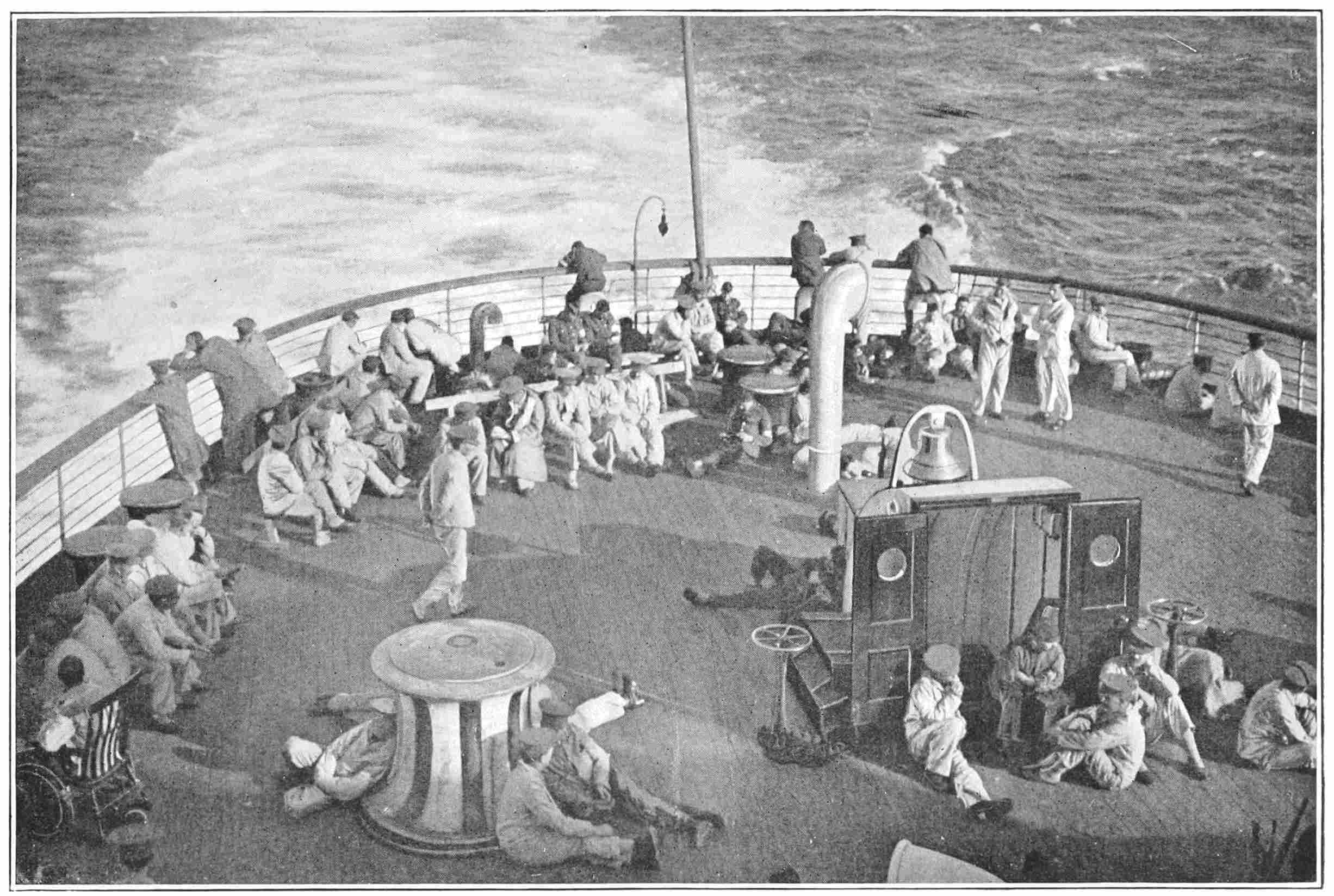
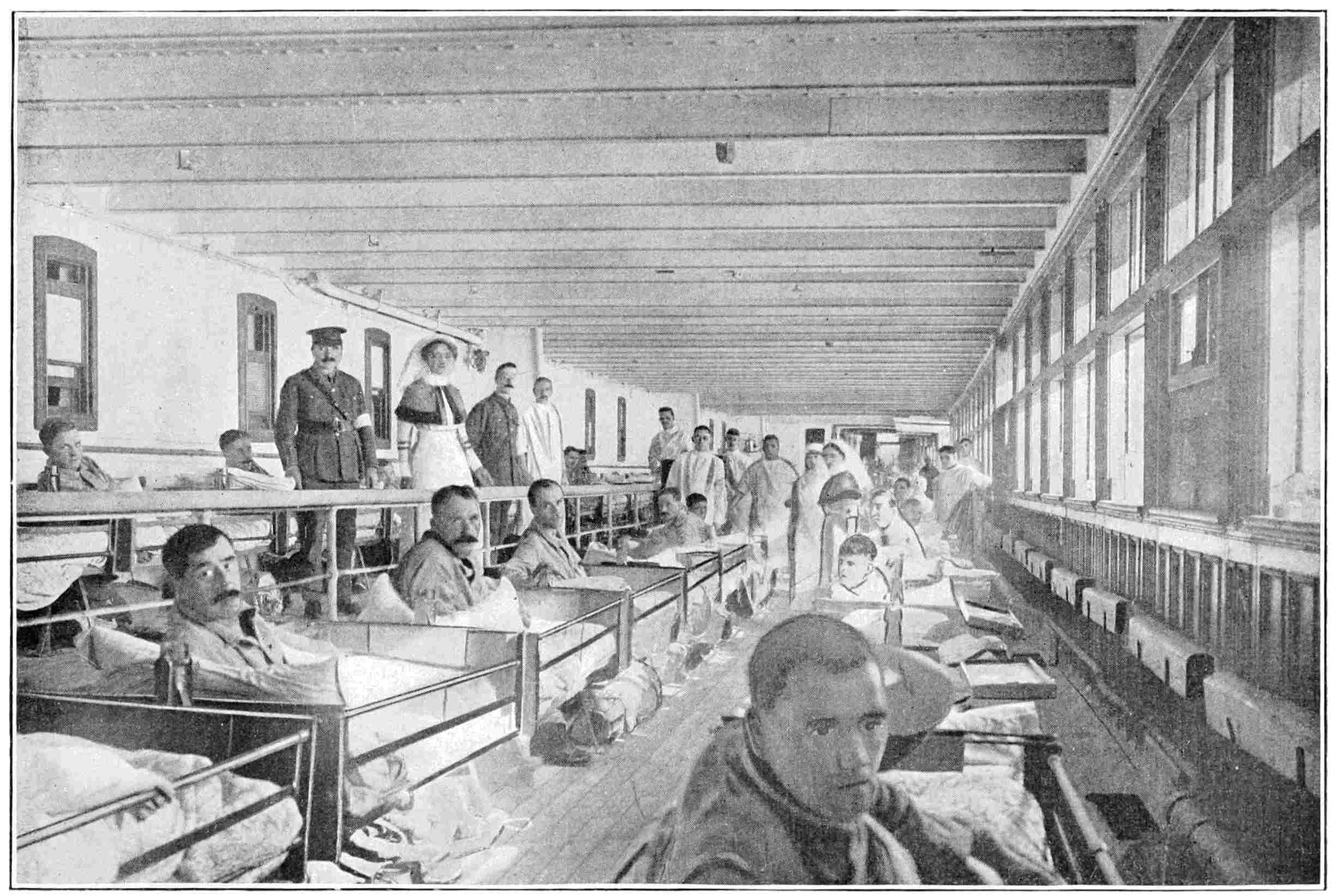
Scene on board after the torpedoing
of the “Ivernia” (i)
Half an hour after the vessel was torpedoed,
a periscope was sighted on the port bow, and an
enemy submarine came to the surface and fired
about 40 shells at the ship, some of these dropping
within fifty yards of the boats. After the Ausonia
had sunk, the submarine approached the boats,
and Captain Capper, who was at the oars was
ordered to come alongside. Upon the submarine’s
deck several of her crew were lounging, laughing
and jeering at the shipwrecked survivors. After
enquiring as to the Ausonia’s cargo, the submarine
commander ordered the boats to steer in a north-easterly
direction; in callous disregard of the peril
which confronted the Ausonia’s crew the submarine
herself then made off northwards.
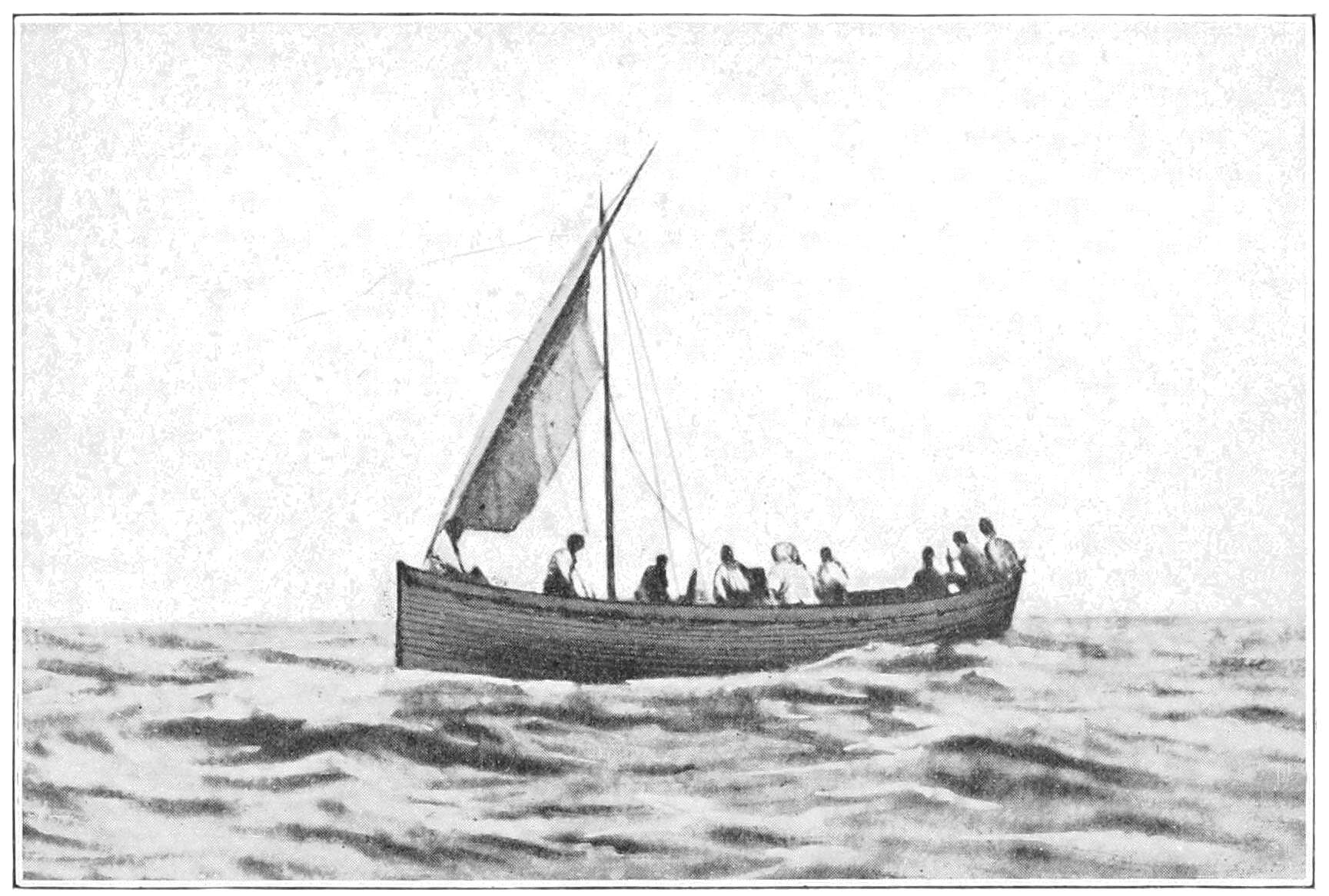
Captain Capper gave orders to the officers in
charge of the boats that they were to keep
together, and endeavour to get into the track of
convoys, the weather being fine at the time.
Until midnight the boats were successful in
remaining in each other’s company, but the wind,
having risen in the night, two boats, one of them
in charge of the first officer, and the other in
charge of the boatswain were, on the following
morning, not to be seen. Captain Capper had
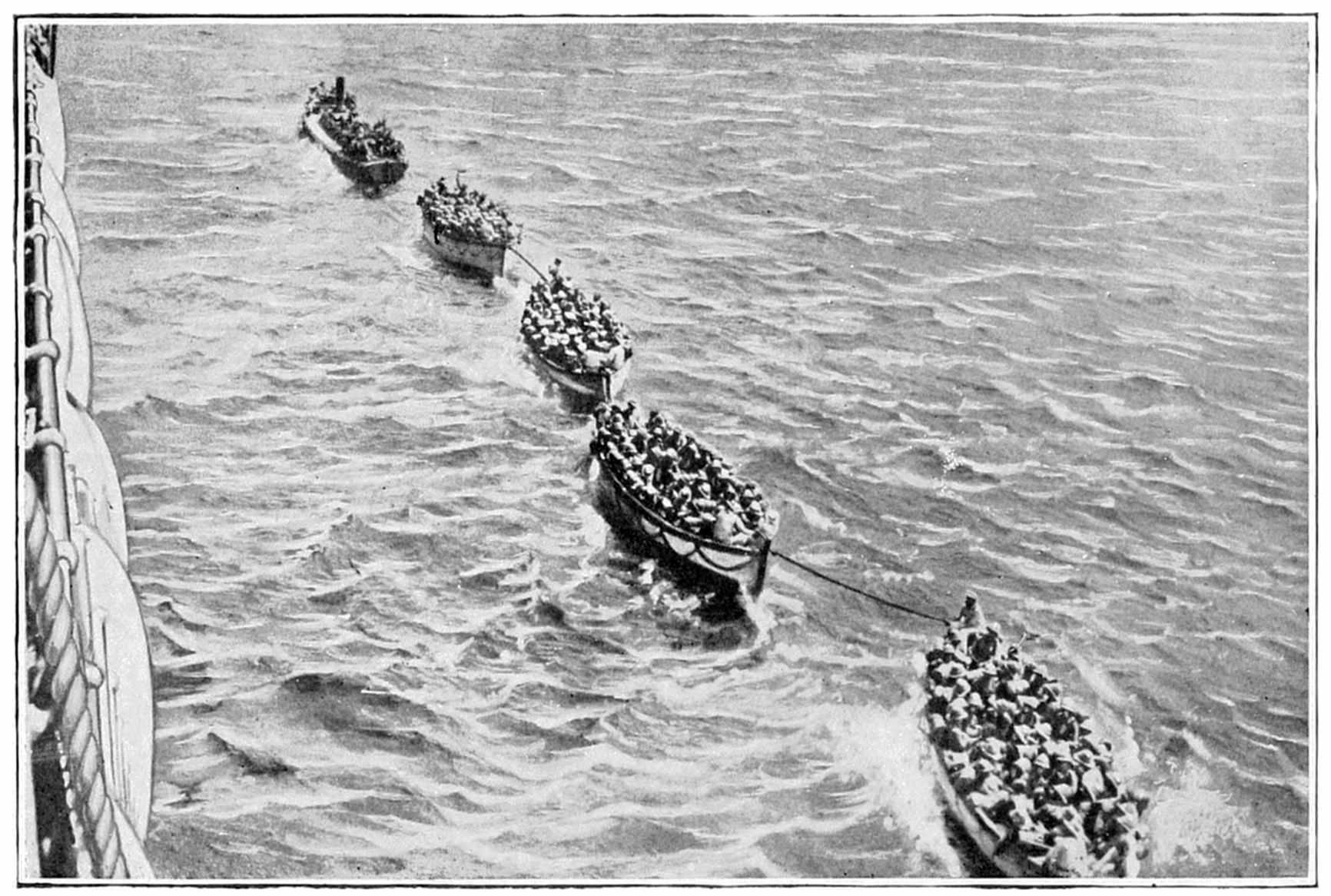
assembled the survivors in seven boats, and he
now gave orders to the remaining five that they
should make themselves fast together. In this
formation, they continued throughout the following
day and night, when the ropes began to part.
They were also retarding progress and were
therefore cast off, the boats, however, still continuing
to remain pretty well together.
On Sunday, January 2nd, to add to the misery
of their occupants, the weather became bad, heavy
rain falling and soaking them all to the skin.
On Monday and Tuesday, conditions improved a
little, but on Wednesday a storm broke, and by
mid-day a heavy sea was running, and a gale
blowing from the north-west. The boats were
now running before this, with great seas breaking
over them and saturating everybody on board.
These conditions continued until Friday the 7th,
when land was at last sighted, turning out to be
Bull Rock. A wise and strict rationing had been
enforced, only two biscuits a day and one ounce
of water having been allowed for the first two
days, and one biscuit and a half and four tablespoons
of water the subsequent ration. The crew were
approaching the extremities of exhaustion when
hope of deliverance was awakened in them.
Fortunately, on sighting land, the wind fell a
little, but it was another fifteen hours before the
unhappy survivors were picked up by H.M.S.
Zennia, an American Destroyer also assisting.
Captain Capper’s boat had only 25 biscuits left
together with half a bucketful of water—but one
day’s meagre supply when the terrible ordeal
ended. The little boats, it was calculated, had
covered 900 miles since the Ausonia disappeared
before their eyes. Under these conditions the
conduct of the Cunarder’s crew was of the highest
order, that of the stewardess, Mrs. Edgar, of Orrell
Park, Aintree, the only woman on board the
vessel, being particularly courageous.
Scene on board after the torpedoing
of the “Ivernia” (ii)
Special mention must also be made of the
butcher’s boy, Robinson. At the moment of the
explosion, together with the pantry boy, Lister,
he was in one of the cooling chambers, and the
explosion made it impossible for the two boys to
get out. Robinson had several wounds on his
hips and thighs, and his left arm was lacerated.
Both boys, in addition, had both legs broken
above the ankle. Robinson, however, managed to
crawl out on both his hands and knees and
secure a board and place it across the gaping
hole in the deck, thus enabling Lister also to
reach a place of comparative safety. The two
boys then crawled on hands and knees up two
sets of ladders to the boat deck, and were placed
in the boats. The doctor attended to the boy
Robinson’s injuries, as far as was possible, but
it was not for 30 hours that Captain Capper was
able to transfer him to the boat in which Lister
was lying, so that he also might receive medical aid.
In spite of their experiences and injuries, both
boys remained calm and cheerful, and indeed in
high spirits, but it is sad to record that Robinson
subsequently succumbed in hospital, as the result
of his injuries.
More, however, to Captain Capper than to any
one man, was the salvation of the five boat loads
due, and it was in recognition of his dogged
determination and splendid seamanship that his
Majesty the King afterwards bestowed upon him
the Distinguished Service Cross.
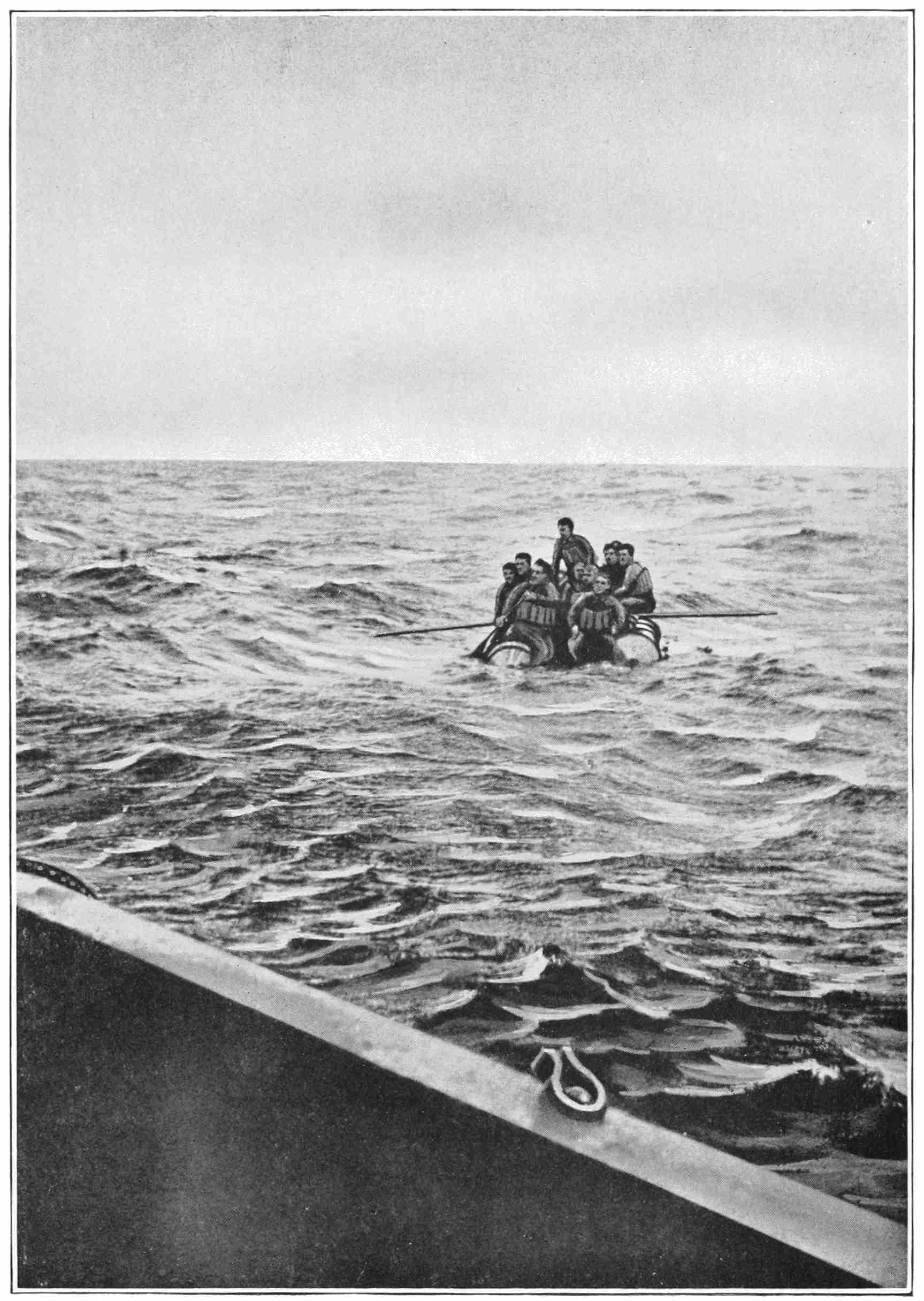
The torpedoing of the “Ivernia”:
Survivors afloat on raft
The Ultonia, in August, 1914, was the means
by which some of the old “Contemptibles” were
brought from Malta to England, and she then
proceeded to India with Territorial troops. She
was subsequently returned to the Company’s
Service and was finally sunk in June, 1917.
She was at this time eastward bound, and about
350 miles west from Land’s End. She disappeared
in ten minutes, so deadly was the blow she
received. Fortunately, she was at the time, being
escorted by one of the “Q” boats, by whom her
crew was picked up and safely landed the next
day at Falmouth, one man unfortunately being
killed during the operation of leaving the ship.
Captain J. Marshall was in command.
Meanwhile, with their ordinary carrying power
thus depleted, the Cunard management had been
looking about for reinforcements, and had entered
into negotiations with certain other lines for additional
vessels. Thus they took over from the Canadian
Northern Steamship Company (The Royal Line and
The Uranium Steamship Company), the Royal
George, and three other vessels, which they
re-christened respectively the Folia, Feltria, and
Flavia. They also purchased five additional vessels
which they re-christened the Vinovia, Valeria, Volodia,
Valacia, and Vandalia.
Now during the years 1915 and 1916, merchant
shipping, apart from those ships especially chartered
by the Government, continued under the direction
of its various owners. In 1917, however, the
Liner Requisitioning Scheme, came into being, and
a Shipping Controller was appointed.
Under this scheme all British shipping came
under the control of the Government, the object
being, in view of the shortage of tonnage caused
by the depredations of the submarines, to confine
steamers to those trades necessary for providing
the Allies with the essential foodstuffs and munitions
of war. The greatest percentage of these had,
of course, to be obtained from America, and in
consequence many steamers which had been trading
to other parts of the world, were diverted to the
North Atlantic, and placed under the management
of the Companies already established on these
particular routes. The owners of these transferred
steamers were given permission to allot their ships
to any of the lines so established, and it came
about that the Cunard Company, in addition to
their own ships, had the management of a large
number of vessels thus diverted. It is estimated,
in fact, that the number of additional steamers
so handled by the Company, amounted to more
than 400. In addition to this, the Company
managed several prize steamers captured from the
enemy and neutral steamers that had been placed
at the disposal of the Allies, and it thus happened
that the Cunard management found itself in charge
of vessels from the Indian, China, South African,
and Australian trades, assembled from the ends
of the earth in this vital emergency.
Torpedoing of the
“Lusitania”
Some idea of the magnitude of the work thus
carried upon the shoulders of the Cunard management
may be gathered from the facts that in one
year alone not less than 200 sailings were made
from American and Canadian ports, and that over
10,000 tons of cargo were often carried in one
steamer.
With the entrance of America into the war,
the carrying problem became at once more
complicated and greater in bulk; and in its
solution the Cunard Company may once more
justly be said to have played a major part. Let us
consider first its work in the carriage of troops.
The Cunard organisation was responsible for the
transport during the war of over 900,000 officers
and men. This excludes the big total repatriated
after the Armistice was signed. When it is
remembered that this aggregate is greater than
the total population of either Liverpool, Manchester
or Birmingham; that 900,000 men, marching in
column of route in sections of fours would take,
without halting, nearly six days to pass a single
point, it becomes possible to visualise the immensity
of the task represented by these bald figures.
When it is further remembered that the total
British Expeditionary Force first thrown across
the English Channel in August, 1914, was only
80,000; that this was less than one-tenth of the
number carried during the war by the Cunard
Company; and that the number so carried was
equal to not less than one-eighth of the whole
British Army at its greatest strength, the nation’s
debt to this great Company can be estimated.
Nor was the mere provisioning of these troops
while en route a negligible feat of transport.
Taking an average voyage as ten days, the food
required to feed this number of men amounted to
no less than 9,750,000 pounds of meat, 11,250,000
pounds of potatoes, 4,500,000 pounds of vegetables,
9,575,000 loaves of bread, 1,275,000 pounds of
jam, 900,000 pounds of tea and coffee, and among
other things 900,000 pounds of oatmeal, 600,000
pounds of butter and 127,000 gallons of milk.
The torpedoing of the “Ivernia”:
Survivors being taken in one of the boats
Vast as these figures are, however, they are
dwarfed when we begin to consider what was
accomplished during the five years of war in the
way of cargo carrying—in the humdrum performance
of an unadvertised and often little appreciated
service, upon which, fundamentally, our whole
war structure rested. Between August, 1914, and
November, 1918, 7,314,000 tons of foodstuffs,
munitions of war, and general cargo were carried
from America and Canada to the British Isles;
over 340,000 tons from the British Isles to Italy
and the Adriatic; over 500,000 tons from the
British Isles to other Mediterranean Ports; nearly
320,000 tons from this country to France; and
nearly 60,000 tons from France to this country.
In addition to this, huge quantities were also
carried westwards from this country, amounting
to a total, in the same period, of more than
1,000,000 tons.
Not the least important service rendered in
this way was connected with the supply of oil
fuel, of which the stocks in this country were
seriously depleted—so seriously that at one time
they were insufficient to supply the needs of the
Navy for more than a few weeks ahead. In this
predicament the Admiralty, realizing the danger,
approached Sir Alfred Booth, Chairman of the
Cunard Company, and asked him to put the
matter before other leading ship-owners. He
readily consented to do so, and all owners running
ships in the North Atlantic, at once agreed to
take the necessary steps to allow of oil being
carried in the double bottoms of their ships, the
Cunard Company themselves adapting for this
purpose the double bottoms of the Andania,
Carmania, Carpathia, Pannonia, Saxonia, Valacia,
Vandalia, Valeria, and Vinovia, each of which
brought on each voyage to this country, about
2,000 tons of oil. The Cunard Company alone,
in a little over a year, thus brought over 100,000
tons of oil across the Atlantic.
The “Lusitania”
During all this time, of course, it must
be remembered that the Cunard Company, as
throughout the war, plied in a zone particularly
exposed to hostile attack by enemy raiders and
submarines; and as we have already shown, and
shall show again, a very heavy toll of their
vessels was taken by hostile torpedoes. How greatly
the Cunard steamers were concentrated upon
dangerous routes will be seen on reference to
the map,B which indicates the most important services
of Cunard Steamers during the war. Finally, let
it be stated that from August, 1914 to November,
1918, without taking into account such outside
steamers as were working under the Cunard
Company’s direction, its own steamers steamed not
less than 3,313,576 miles, with a consumption of
1,785,000 tons of coal. This distance is equivalent
to the circum-navigation of the world no less than
132 times.
With the subsequent progress in infamy of Germany’s
submarine campaign it was natural that the
sensibilities of the civilised world, so shocked by
the ruthless sinking of the Lusitania, should have
become somewhat dulled. But it is clear, in
retrospect, that this tragic event marked an epoch
in the slow gathering of the non-combatant world’s
condemnation. Upon the general events preceding
the loss of this world-famous vessel, this is not,
perhaps, the place to dwell. It will be remembered
however, that from February 18th, 1915, the
German Government announced that it proposed
to consider the waters round Great Britain and
Ireland and the entire English Channel as what
they described as a “War Zone,” stating that
they would “endeavour to destroy every merchant
ship found in this area of war, without its always
being possible to avert the peril that thus threatens
persons and cargoes.”
The “Mauretania” as a hospital ship, off Naples Harbour
(The “Mauretania” was a sister ship of the “Lusitania”)
To this the British Government issued a reply
on the following March 1st, that the German
announcement was in fact a claim to torpedo at
sight, regardless of the safety both of the crew
or passengers, any merchant vessel under any flag.
The British Government proceeded to remind
Germany and the world, that by all the accepted
traditions of the sea, and under the terms of
international law, it was the duty of an enemy
vessel to bring a captured ship to a Prize Court,
where all the circumstances of the case could be
impartially investigated, and where neutrals might
recover their cargoes. The sinking of prizes was
therefore, as the British Government pointed out,
always a questionable proceeding, and could only
be justified in exceptional circumstances, and after
full provision had been made for crews and
passengers. The legal responsibility of verifying
the status of any vessel always rested with the
attacking ship, while the obligations of humanity
required adequate provision to be made for the
safety of all crews and passengers of merchant
vessels, whether enemy or neutral.
It is now both common and tragic knowledge
that these protests, as well as all the canons, so
long established, of sea chivalry, were entirely
ignored by the German Government, and it was
on May 7th, 1915, that this became finally and
startlingly clear to every intelligent observer in
the civilised world. That the German Government
possessed any special spite towards the Lusitania
may not perhaps have been the case, but, as we
have seen, it was by means of the Lusitania and
her sister ship the Mauretania that the “blue
ribbon” of the Atlantic, in the matter of speed,
had been wrested from German hands.
“Phrygia” sinking a
Submarine
Built in 1907 for the Cunard Company by
Messrs. John Brown & Co., of Clyde Bank, she
had been constructed under Admiralty Survey,
and in accordance with Admiralty requirements,
and was classed 100 A1. at Lloyds. Built
throughout of steel, she had a cellular double
bottom, with a floor at every frame, the depth
of this on the centre line being 60 inches, and
72 inches where it supported the turbine machinery.
This double bottom extended up the ship’s side
to a height of eight feet above the keel. All
her decks were steel plated throughout, and the
transverse strength of the ship was largely dependent
on the 12 transverse water-tight bulkheads which
had been purposely strengthened and stiffened to
enable her to stand the necessary pressure in the
event of accident. Inside her hull was a second
“skin,” running the whole length of her vital parts,
so that she was virtually a ship within a ship.
Her length all over was 785 feet. She was 88
feet in breadth, and nearly 60 feet in depth, with
a gross tonnage of over 30,000 tons, and a load
draft of 36 feet. Including the hold she had nine
decks, with accommodation for 523 first class,
295 second class, and 1,300 third class passengers,
together with a crew of about 800. She had
turbine engines of 63,220 horse power, four for
ahead and two for astern motion, and her speed
in 1914 was from 24½ to 25 knots. Her four
great funnels rose to a height of 154 feet above
the keel, and the diameter of each being not less
than 24 feet. Her masts were 210 feet high,
while the navigating bridge stood 110 feet above
the keel. At a moderate estimate, the cost of
running her to New York and back, including
wages, victualling and fuel, was in 1914 about
£30,000, and she was operated, under the terms
of the agreement with the Admiralty, by a crew
of which at least three-quarters had to be British
subjects.
She was provided with boat accommodation
for 2,605 persons, the number of persons on board
during her last voyage being 1,959. She carried
48 lifeboats, 22 of which were ordinary boats
hanging from davits, with a total carrying capacity
of 1,323. The remaining 26 were collapsible boats,
with a total carrying capacity of 1,282. In addition,
the ship was provided with 2,325 life jackets and
35 lifebuoys, all of these being conveniently
distributed on board.
The “Alaunia” as an emergency
hospital ship
Now at the beginning of the war it had
been a very difficult question for the directors of
the Cunard Company to decide as to whether
the transatlantic traffic, under the new and
unprecedented conditions, would be sufficient to
justify the continued running of two such large
and costly vessels as the Lusitania and the Mauretania.
It was decided, however, after much consideration,
that the Lusitania could be run once a month,
providing that her boiler power was reduced by
one-fourth. The consequent saving in coal and
labour of this would, the Directors considered,
enable them to run the vessel without loss, although
with no hopes of making a profit. Six of the
Lusitania’s boilers were accordingly closed, and the
ship began to run in these conditions in November,
1914, the effect of the closing of the six boilers
being to reduce her maximum speed to 21 knots.
It is to be noted, however, that this reduction
still left the Lusitania very considerably faster
than any other transatlantic steamer.
Nor had she lacked in exciting experiences
before the fatal 1st of May, 1915, on which she
left New York for the last time. On the very
day that war was declared in 1914, she had started
from New York for Liverpool, under the command
of Captain Daniel Dow, one of the best-known and
most respected figures in the Cunard Company’s
service, who retired after 43 years’ service in 1919.
Within a few hours of leaving New York, an
enemy warship was sighted on the horizon, and
observed to change her course immediately, with
the presumed object of intercepting the Lusitania.
Without a moment’s hesitation, Captain Dow set
his course for a fog bank to the south, where he
was soon lost to sight by the enemy. As soon as
he was out of view, Captain Dow swung the
Lusitania round again and steamed northwards at
his highest speed. Having thus out-manoeuvred
the hostile commander, he resumed his eastward
course again, navigating his great ship by night
without lights, and safely reaching Liverpool.
Again in February, 1915, while Captain Dow
was still in command of her, the Lusitania, on an
eastward voyage, received a wireless message to
the effect that enemy submarines were cruising
in the Irish Sea. He received instructions to fly
a neutral flag—a perfectly legitimate ruse—and
having on board some 400 Americans, together with
the United States mails, he decided to hoist the
American flag. Having done so, he crossed the
Irish Sea at full speed, without stopping to take
up a pilot; steered straight for the Mersey, and
once more brought his vessel home in safety.
Soon after this, Captain Dow, upon whom the
strain of responsibility had been very great, was
retained ashore by the Directors for a brief and
much needed rest, and Captain W. T. Turner, one
of the Cunard Company’s most trusted commanders
took his place, with an assistant captain, Captain
Anderson, also on board.
The “Lusitania” passing The Old Head of Kinsale, within a few miles
of the spot where she was torpedoed
That an attempt was to be made upon the
Lusitania had for some days been current rumour
in New York, and on Saturday, May 1st, 1915,
her advertised sailing date, the following advertisement
appeared in the New York Times, New York
Tribune, New York Sun, New York Herald, and
the New York World. “Travellers,” it stated,
“intending to embark on the Atlantic voyage are
reminded that a state of war exists between
Germany and her Allies, and Great Britain and
her Allies, that the zone of war includes the waters
adjacent to the British Isles, that in accordance
with formal notice given by the Imperial German
Government, vessels flying the flag of Great
Britain, or of any of her Allies, are liable to
destruction in those waters, that travellers travelling
in the war zone in ships of Great Britain or her
Allies do so at their own risk. April 22nd, 1915,
The Imperial German Embassy, Washington, D.C.”
It is safe to say, however, that but small
attention was paid to this notice, very few people
contemplating that such a diabolical threat as was
implied in this notice would be seriously carried
out by any civilised Christian Power. On the
1st May, therefore, the vessel sailed in fine weather,
and with a calm sea. The voyage till May 7th
was marked by no untoward event. As the
danger zone was approached, Captain Turner took
all the necessary precautions. All the lifeboats
under davits were swung out; all bulkhead doors,
except such as were required to be kept open in
order to work the ship, were closed, the portholes
being also closed; the look-outs on the ship were
doubled—two men being sent to the crow’s nest,
and two to the eyes of the ship; two officers were
always on the bridge, and a quartermaster was
stationed on either side with instructions to look
out for submarines.
Up to 8 o’clock on the morning of May 7th the
vessel’s speed had been maintained at 21 knots,
but at 8 o’clock this was somewhat reduced, the
object being to ensure that the Lusitania should
arrive outside the bar at the mouth of the Mersey
at such an hour on the morning of the 8th as
would enable her to make immediate use of the
tide, thus avoiding loitering in a vicinity where
Captain Turner had reason to suppose enemy
submarines might be watching for him. Soon
after this reduction of speed the weather became
thick, and the fog into which she had run
necessitated a further reduction to 15 knots.
Just before 12 o’clock, however, the fog lifted,
and the vessel’s speed was increased again to 18
knots—a speed that was maintained until she was
struck by the enemy torpedo.
The “white wake” that stretched
to the beaches of Gallipoli
At the same time orders were sent to the
engine-room to keep the steam-pressure as high
as possible, so that in case of emergency the
Lusitania might be able to put on all possible
speed, should this be ordered from the bridge.
Land was now in sight, about two points abaft
the beam, and Captain Turner took this to be
Brow Head. Owing to the recent fog, however,
he was not able to identify it with sufficient
certainty to enable him to fix the Lusitania upon
the chart. He, therefore, kept her upon her course,
which was S.87.E and parallel with the land, until
twenty minutes to one, when, in order to make
a better landing, he altered the course to N.67.E.
This brought him nearer to the Irish Coast,
and he shortly afterwards sighted the old Head
of Kinsale. Having identified this, at twenty
minutes to two, he altered his course back to
S.87.E. and, having steadied her on that course,
began ten minutes later to have a four point
bearing taken, and this was being carried out
when the ship was torpedoed.
This occurred at a quarter past two, when the
Lusitania was steaming some ten miles off the
Old Head of Kinsale, the atmosphere having then
cleared and the sea being smooth. A seaman,
Leslie N. Morton, seems to have been the first
person on board actually to have seen the wake
of the torpedo, and he reported it at once to the
Second Officer, who in turn reported it to Captain
Turner, then on the port side of the lower bridge.
Captain Turner looking to starboard saw a streak
of foam travelling towards the ship, and immediately
afterwards the Lusitania was struck full on the
starboard side, between the third and fourth
funnels, the explosion breaking to splinters one
of the lifeboats. Almost simultaneously a second
torpedo also struck her on the starboard side, the
two having been fired apparently from a distance
of from two to five hundred yards. No warning
of any kind had been given. Immediately on being
struck the Lusitania listed heavily to starboard,
and in less than twenty minutes she had sunk
in deep water, carrying to their graves no less than
1,198 men, women and children.
Torpedoing of the
“Thracia”
Perhaps the most lucid, and, since he was an
American, the most impartial account of the
occurrence was that afterwards given by Mr. James
Brooks of Bridgeport, Connecticut, one of the
saloon passengers. Mr. Brooks, who was making
the voyage to England for business purposes, had,
in common with most of the other American
passengers, read the warning notice issued by the
German Embassy, to which we have already
referred. Like most of his fellow-countrymen,
however, he had decided to ignore it. “No one
in America,” he said, “ever dreamed that the
Germans would dare to carry out their terrible
threat to destroy such a magnificent vessel, and
with it hundreds of the lives of innocent men,
women and children.... A good many passengers
were still at lunch when, on Friday afternoon, the
attack came in reality. I had just finished a run
on deck and had reached the Marconi Deck, when I
glanced out over the water. It was perfectly
smooth. My eyes alighted on a white streak
making its way with lightning-like rapidity towards
the ship. I was so high in that position above
the surface of the water that I could make out
the outline of a torpedo. It appeared to be about
twelve feet long, and came along possibly three
feet below the surface, its sides white with bubbles
of foam. I watched its passage, fascinated, until
it passed out of sight behind the bridge, and in
another moment came the explosion. The ship,
recoiling under the force of the blow, was jarred
and lifted, as if it had struck an immovable object.
A column of water shot up to the bridge deck,
carrying with it a lot of debris, and, despite the
fact that I must have been twenty yards from
the spot at which the torpedo struck, I was
knocked off my feet. Before I could recover
myself, the iron forepart of the ship was enveloped
in a blinding cloud of steam, due, not, I think,
to the explosion of a second torpedo, as some
thought, but to the fact that the two forehold
boilers had been jammed close together and ‘jack-knifed’
upwards. This I was told by a stoker
afterwards.
Officers, nurses and R.A.M.C. orderlies
of H.M.H.S. “Aquitania”
“Homeward Bound”
“We had been in sight of land for some time,
and the head of the ship, which had already begun
to settle, was turned towards the Old Head of
Kinsale. We must have been from twelve to
fifteen miles from land at the time the ship was
struck. All the boats on the ship had been
swung out the day previous, and the work of
launching them was at once commenced. The
attempt in the case of the first boat was a tragic
failure. The women and children were taken first
and the boat was practically filled with them,
there being only a few men. The boat was
lowered until within its own length of the water,
when the forward tackle jammed, and the whole
of its occupants, with the exception of three, were
thrown into the water. The Lusitania was then
on an even keel. On the decks of the doomed
vessel absolute coolness prevailed. There was no
rushing about, and nothing remotely resembling
panic. In just a few isolated cases there were
signs of hysteria on the part of the women, but
that was all.
“Meanwhile the ship had taken a decided list,
and was sinking rapidly by the head. The efforts
made to lower the boats had apparently not met
with much success. Those on the port side had
swung inboard and could not be used, while the
collapsible boats which were lashed beneath them
could not be got at. The ladies were standing
quite coolly, waiting on board to enter the boats
when they could be released by the men from the
davits. The davits by this time were themselves
touching the water, the ship having sunk so low
that the bridge deck was only four feet or so from
the surface of the sea. Losing no time, the men
passed the women rapidly into the boats, and
places had been found by now for all the people
about the midships section. I stepped into one
of the lifeboats and attempted to assist in getting
it clear. I saw the list was so great that the
davits pinched the gear, rendering it improbable
that they could be got away when the ship went
down, so I stepped on to the gunwale and dived
into the water. I had no lifebelt and am not a
good swimmer, but I decided to take the risk.
I had been wetted right through when the explosion
occurred, and I believe that had I gone in dry I
should have swallowed so much water that I
should not have lasted long.
The sun-cure
The “Franconia” passing through
the Suez Canal
“I swam as hard as I could away from the
vessel, and noticed with feelings of apprehension
the menacing bulk of the huge funnels as they
loomed up over my head. I expected them
momentarily to fall on me and crush me as I
swam, but at last I judged myself to be clear,
and I turned round and trod the water in order
to watch the great hull heel over. The monster
took a sudden plunge, and, noting the crowd still
on her decks and the heavily laden boats filling
with helpless women and children glued to her
side, I sickened with horror at the sight. The
liner’s stern rose high out of the water; there was
a thunderous roar as of the collapse of a great
building during a fire, and then she disappeared,
dragging hundreds of fellow-creatures into the
vortex. Many never rose again to the surface,
but the sea rapidly grew black with the figures
of struggling men, women, and children. The
wireless installation came over with a crash into
the sea. It struck my uplifted arm as it fell,
and I felt it pass over my body as it sank, almost
dragging me under.
“The rush of water over the steamer’s decks
swept away a collapsible boat, and I swam towards
it. Another man reached it shortly after, and
after we were rescued I found him to be Mr.
James Lauriat, jun., of Boston. Two seamen also
managed to swim to the boat and to climb on to
it. One had a knife, and the other asked me for
mine, and together they set about cutting away
the canvas cover of the boat. When they had
finished, I climbed inside, and the three of them
followed me. We started to rescue the unfortunate
people in the water, or at least those of them who
were still living. We quickly had about 30 of
them in the little craft. Around us in the water
were scores of boats. There were no oars in our
boats. We managed to raise the sides of the boat
as they should be raised when the boat is in use,
and we collected five oars from the mass of floating
timber in the water. Then we started to row
towards the lighthouse, which we could see in the
distance. At the time the liner was torpedoed
there was absolutely no ship of any kind in sight,
with the exception of a trawler—the Peel 12, of
Glasgow; she was close inshore under the lighthouse,
and, owing to the lightness of the wind, she
was of no use so far as the rescue of persons
actually in the sea was concerned. She came
along as fast as she could, however, and was able
to pick up about one hundred and ten persons
from lifeboats and life-rafts. Her limited capacity
was pushed to the utmost, and I even had to sit
with one leg hanging over the sides because there
was no room to put it on the inside. We took
in tow a lifeboat and a raft, which were also filled
to the gunwale, and when the occupants were able
to be taken out they were cast off. The auxiliary
boat Indian Prince had by that time arrived from
Queenstown. The Peel 12 was the first boat on
the scene, and she was followed by a tramp Greek
steamer, which came up from the west, and was
able to pick up several lifeboats which had got
away.”
American troops never forgot
the “Lusitania”
Such was the experience of Mr. Brooks, and in
his moving narrative we can not only divine
something of a tragedy beyond the scope of any
human pen, but gather also an impression of
heroism, of unquestioning devotion to duty, at
which every member of the Cunard Company may
well thrill with pride.
Particularly noticeable perhaps, was the conduct
and sound judgment of the young sailor, Leslie
N. Morton, to whom we have already referred,
and he was especially commended by Lord Mersey,
the Commissioner in charge of the formal investigation
afterwards held into the loss of the Lusitania.
This boy, for he was only 18, had been stationed
as extra look-out on the forecastle head, starboard
side, during the fatal watch; and it was, as
we have said, he who was the first to perceive
the approach of the torpedo. This began, as he
described it, with a “big burst of foam about 500
yards away.” This was followed by a “thin
streak of foam, making for the ship at a rapid
speed, followed by another going parallel with
the first one, and a little behind it.” Having
immediately reported this through a megaphone
to the bridge, Morton made for the forecastle to
go down below to call his brother who was asleep,
and on the way there he saw what he took to be
the conning-tower of a submarine just submerging.
Having called his brother, he went along the
starboard side of the main deck and up on to
the starboard side of the bridge deck, where
he found the starboard boats useless owing to
the vessel’s heavy list. He then went to his
own boat No. 13, and assisted in filling it with
passengers. Giving up his own seat, he then
went to No. 11 boat, and assisted in filling that
one also; and it was in this one that he eventually
took his place. Unfortunately, owing it appears
to the unskillful action of some of the passengers,
this lifeboat was unable to push away from the
ship, and it was eventually sunk. Morton then
swam for it and succeeded in reaching an empty
collapsible boat, into which he climbed, succeeding
with the help of another young sailor, Joseph
Parry, in ripping off the cover and rescuing from the
water some 50 people. He then made for a fishing
kedge about five miles away, and having reached
it transferred his passengers to it, and returned
for some more, subsequently rescuing about 30
people from a sinking lifeboat—the little collapsible
boat being subsequently rescued by a mine-sweeper.
These two boys were thus instrumental in saving
nearly 100 lives; and in recognition of their
bravery they were awarded decorations by the
Board of Trade, Morton receiving the Silver Medal
for Gallantry, and Parry the Bronze Medal for
Gallantry.
Equally heroic was the conduct of the First
Officer, Mr. Arthur Rowland Jones, who was in
the luncheon saloon when the torpedo struck the
vessel. He immediately went to his boat station
on the starboard side and began to fill his boat
with passengers—a matter of extreme difficulty,
owing to the ever increasing angle which the ship
was presenting to the sea, which caused the
boat to swing away from the tilted surface of the
deck. After great efforts, however, he succeeded
in getting about 80 passengers aboard before she
was lowered into the water, entered her himself
when the boat deck was level with the surface of
the sea, and only some 15 seconds before the
Lusitania sank. It was fortunate for the passengers
that he succeeded in doing so, since it was only
by his skill and coolness, combined with that of
two or three members of the crew who had also
clambered on board, that the little lifeboat was
able to survive the suction and disturbance caused
by the disappearing liner.
In the spring of 1918 the “Mauretania” brought
33,000 American soldiers to Europe
She did so however, and afterwards transferred
some of her passengers into another empty boat,
the two boats then putting back in order to
attempt further rescues. This they succeeded in
doing, and the First Officer again filled his boat
up, thereupon pulling off to a little fishing smack,
the Bluebell, then about five miles distant. Having
disembarked his passengers, Mr. Jones once more
went back to the scene of the disaster, and after
pulling some two and a half miles, fell in with a
broken collapsible boat in a bad condition with
about 35 people inside it. Some of these were
lying exhausted in the bottom of the boat and
others were injured, so Mr. Jones took them all
on board, afterwards transferring them to a trawler.
He then pulled off once more and saved yet
another 10 people, whom he took to the Flying
Fox, a Queenstown Tender. By this time it was
8 o’clock in the evening, and his crew were at
the last point of exhaustion, having been working
hard without food and water. There was too, by
this time, a large number of destroyers and patrol
boats on the scene, so Mr. Jones and his weary
helpers themselves boarded the Flying Fox.
Mention must also be made of the conduct of
Alfred Arthur Bestwick, the Junior Third Officer,
who was responsible for the working of five boats
on the port side of the ship, and courageously
remained there endeavouring to launch them under
practically impossible conditions, until the Lusitania
went under. He was dragged down with her,
but fortunately came to the surface, and succeeded
in reaching a collapsible boat, into which, with the
help of a companion, he dragged several people from
the water. These he transferred to a second and
more navigable empty boat that they afterwards
came across; and he then returned and saved
three more people whom he had previously
noticed supporting themselves by means of a bread
tank, besides taking on board several others who
were keeping themselves afloat by means of lifebelts.
All this time on every hand deeds of self-sacrifice,
recorded and unrecorded, were being performed.
A typical one was that of one of the able seamen
of the watch, who had been sucked down by the
sinking vessel and coming to the surface again had
managed to sustain himself by means of a floating
piece of wood. Clutching this he then found himself
drifting towards a woman struggling unaided in the
water, whereupon he pushed towards her his piece
of wood, which could only support one person, and
swam away himself on the chance of finding some
other means of escape. Presently he found a
collapsible boat containing one of the ship’s officers,
and a few other persons, but this unfortunately
proved to be extremely unseaworthy. Capsizing again
and again, it was only righted by the determination
and skill of this seaman and his comrades, and
on each occasion, alas, lives were lost until but
a few survivors remained to be picked up by
another of the ship’s boats.
The “Aquitania’s” stage
The “Saxonia,” camouflaged, leaving New York
with American troops for Europe
Such is the story of the greatest maritime
crime in history and, now that the war is over,
it is well that it should not be forgotten, with
its record of heroism and self-sacrifice, of competent
seamanship and resourceful initiative, of suffering
and death. Lord Mersey’s report on the disaster,
after he had heard a mass of evidence from officers
and men, as well as from surviving passengers, is
a document which after generations will read with
pride. It contains not the personal opinion merely
of a former President of the Probate, Divorce and
Admiralty Division of the High Court of Justice,
but is a considered judgment in which Admiral Sir
F. S. Inglefield and Lieutenant Commander Hearn,
both officers of the Royal Navy, and Captain D.
Davies and Captain J. Spedding, of the Merchant
Service, acting as the four assessors, concurred.
The report contained a short, but consolatory
statement of the competency with which the
sudden emergency was confronted when the ship
was attacked. “The Captain was on the bridge
at the time his ship was struck,” Lord Mersey
recorded, “and he remained there giving orders
until the ship foundered. His first order was to
lower all the boats to the rail. This order was
obeyed as far as it possibly could be. He then
called out ‘Women and children first.’ The order
was then given to hard-a-starboard the helm with
a view to heading towards the land, and orders
were telegraphed to the engine-room. The orders
given to the engine-room are difficult to follow
and there is obvious confusion about them. It is
not, however, important to consider them, for the
engines were put out of commission almost at
once by the inrush of water and ceased working,
and the lights in the engine-room were blown out.
Leith, the Marconi operator, immediately sent out
an S.O.S. signal, and, later on, another message,
‘Come at once, big list, 10 miles south Head Old
Kinsale.’ These messages were repeated continually
and were acknowledged. At first, the messages
were sent out by the power supplied from the
ship’s dynamo; but in three or four minutes
this power gave out and the messages were sent
out by means of the emergency apparatus in the
wireless cabin.”
Welcoming the first contingent of returning American troops,
New York, December, 1918
The “Mauretania” arriving at New York,
December, 1918
Was the Lusitania well found? Did she comply
with the requirements of the Merchant Shipping
Acts? Was she armed? Did she carry war
material? Was the conduct of the Captains,
officers and men consistent with the high traditions
of the Merchant Service? To all these questions
the report furnished satisfactory answers. The
ship was well provided with boats, which were in
good order at the moment of the explosion, and
“the launching was carried out as well as the
short time, the moving ship, and the serious list
would allow.” Lord Mersey added that he found
that the conduct of the masters—for as already
stated there were two—the officers and the crew
was satisfactory. “They did their best in difficult
and perilous circumstances, and their best was
good.”
And what of Captain Turner, upon whom the
chief responsibility for the safety of the ship and
the lives of passengers and crew mainly rested?
He remained upon the bridge until the very last.
He went down with the unhappy vessel and was
only rescued by chance after having been in the
water for three long hours. The Wreck Commissioner
and the Assessors examined his every act from
the moment when the Lusitania entered the
so-called “war zone” until this devoted officer
found himself in the water confronted with death.
In the opinion of Lord Mersey, Captain Turner
“exercised his judgment for the best,” and the
report added that “it was the judgment of a
skilled and experienced man.” Captain Anderson,
whose duty it was to assist in the care and
navigation of the ship was, unfortunately, one of
the victims of this German crime, but in Lord
Mersey’s own words, “the two captains and the
officers were competent men and they did their
duty”—and higher praise than that there could
not be.
“The whole blame for the cruel destruction of
life in this catastrophe must rest solely with those
who plotted and with those who committed the
crime.” The disaster was regarded in all civilised
countries with horror. As Mr. Roosevelt said at
the time, it represented “not merely piracy, but
piracy on a vaster scale of murder than any
old-time pirate ever practised,” and a Danish
paper, in recording this terrible incident in the
war, declared that “whenever in future the
Germans venture to speak of their culture the
answer will be ‘It does not exist: it committed
suicide on May 7th, 1915.’” A Norwegian paper
in denouncing the crime remarked that “the
whole world looks with horror and detestation on
the event.” In fact, throughout the whole civilised
world the sinking of the Lusitania with merciless
disregard for the lives of those on board, was
condemned as an act of wholesale murder which,
as the New York American added “violates all
laws of common humanity.”
“Valeria” sinking a
Submarine
In defiance of the judgment of civilisation,
this dastardly act was hailed in Germany as a
proud triumph. The Kolnische Volkszeitung of
May 10th, 1915, stated “The sinking of the
Lusitania is a success for our submarines which
must be placed beside the greatest achievements
in this naval war.... The sinking of the
great British steamer is a success, the moral
significance of which is still greater than the
material success. With joyful pride we contemplate
this latest deed of our Navy, and it will not be
the last.” In the Cologne Gazette, of five days
later, it was stated that “the news will be received
by the German people with unanimous satisfaction,
since it proves to England and the whole world
that Germany is quite in earnest with regard to
her submarine warfare.” In the Neue Freie Presse
of the same date it was remarked, “We rejoice over
this new success of the German Navy.” The City
of Magdeburg immediately proposed to honour the
officers and men who had slaughtered so many
hundreds of defenceless men, helpless women, and
innocent children and brought the anguish of
bereavement on so many hundreds of homes on
both sides of the Atlantic. And to crown this
achievement, which stands in isolation in the
annals of the human race, a medal was struck in
Munich commemorating this exploit of the German
Fleet, which was afterwards to be surrendered and,
then, to be scuttled by its own officers in Scapa
Flow.
In view of the fate of so many hospital ships, boat drill was
regularly carried out on the great Cunarders
CHAPTER V The Toll of the Submarines
But some came not with break of light,
Nor looked upon the saffron dawn;
They keep the watch of endless night,
On the soft breast of Ocean borne.
O waking England, rise and pray
For sons who guard thee night and day!
Cecil Roberts.
We have dealt at length in the previous Chapter
with the loss of the Lusitania not only because,
as we have said, her torpedoing marked an epoch
in the history of crime at sea, and was perhaps
the determining factor in the entrance of America
into the war, but because the Cunard Company
was thus identified with this world-tragedy, and
its servants exemplified then, as always, the noblest
traditions of the British Mercantile Marine.
Unhappily the Lusitania, although the circumstances
of her loss brought her, from so many points of
view, into the limelight of publicity was, as we
have already seen, by no means the only one
of the Cunard vessels to be lost at sea in the
service of this country, and in the present chapter
it is proposed to deal briefly with some other of
the Cunard Company’s vessels that fell victims,
many of them after the bravest resistance, to the
submarine menace. It will, perhaps, be the more
convenient, for purposes of after reference, to deal
with these alphabetically, rather than chronologically.
Thus it was at 5.30 p.m. on February 4th,
about 40 miles north of Londonderry that Captain
W. R. D. Irvine of the Aurania saw a torpedo
approaching his ship, which eventually struck her
between the funnels. The Aurania immediately
listed heavily to port, but then righted herself.
The boats were immediately lowered and the crew
and passengers, with the exception of Captain
Irvine himself and some of his officers, were all
safely aboard them within ten minutes after the
torpedo had exploded. No sooner had they got
into the boats, than the Aurania was again struck
by a second torpedo, a third following in the
wake of this, just as the Captain and the remaining
officers were coming down the ropes into the last
boat. Seven men in the engine-room were killed
by the explosions of the torpedoes, and two others
were lost by drowning. The crew were in the
boats for about one and a half hours, when they
were picked up by some mine-sweepers.
The “Aquitania’s” garden-lounge
as hospital ward
It was then seen that the ship was not sinking,
and Captain Irvine with some of his crew, returned
on board and made her fast with hawsers to one
of the trawlers that had arrived on the scene.
During the night, however, the ship broke adrift,
and when day broke she was nowhere to be seen.
A message was then received from one of the
naval patrols to the effect that the Aurania had
drifted ashore at Tobermory, nearly 50 miles
from the place where she had been torpedoed.
Unfortunately, she had grounded at a very exposed
position and in the heavy weather that followed
she went to pieces, it being found impossible to
salve her. She was a particularly severe loss in
that she was a new ship, only on her eighth trip.
The Dwinsk, one of the steamers being operated
by the Cunard Company for the Government, and
in command of Captain H. Nelson, was torpedoed
on June 18th of the same summer, at about 9.20
a.m., while some 650 miles east of New York, the
torpedo striking her on the port side in the region
of No. 4 hold. Seven lifeboats were immediately
lowered and all the crew successfully embarked.
The submarine then came to the surface, and with
a heavy calibre gun fired 19 shells into the
torpedoed vessel, sinking her about two hours
afterwards. A passing steamer then came in
sight and firing five shots in the direction of the
submarine, passed on her course, the submarine
submerging. When the unknown steamer had
disappeared, the submarine again came to the
surface, and overtaking the boats in which the
crew had taken refuge, hailed the one in charge
of the Chief Officer, and after interrogating him,
moved off in an easterly direction. Meanwhile,
during the night, the little group of lifeboats
became separated, meeting with various adventures
but all except one ultimately reaching safety, their
crews being landed as far apart as New York,
Bermuda, Newport, and Nova Scotia. As in the case
of the Ausonia’s boats described in Chapter III, they
underwent the severest hardships. The First Officer’s
boat, for instance, after sailing all that day and
through the night, sighted a steamer, but, though
she showed signals of distress, received no reply.
Toiling on, a barque, and another steamer, were
sighted in the evening, but again the little boat
was unsuccessful in attracting attention.
The “Aurania” ashore after
being torpedoed
The “Ivernia” settling down. (Photographed against
the sun from the rescuing trawler)
Fortunately, the weather up to then had
remained favourable, and continued to do so
through the next day, on which another ship was
seen, but again failed to perceive the lifeboat’s
dejected crew. Early on the following morning
an empty boat was sighted, and found to be one
of the Dwinsk’s boats from which the crew had
evidently been rescued. On this day the wind
began to increase and by the evening a furious
gale was raging. At six o’clock a great sea washed
over the little boat, carrying one of its occupants
overboard, and almost filling the boat with water.
On the day after, a Sunday, the wind dropped
again, and remained variable until the evening
of the following Wednesday, when it again increased
to such an extent that by midnight a fierce gale
was once more blowing. On Thursday morning
this died down, but it was not until half-past nine
on Friday that a steamer which proved to be the
U.S.S. Arondo sighted the now almost famished
crew and took them on board, clothed them, and
provided them with medical attention. They had
then been drifting about in every condition of the
weather for no less than ten days, the highest
ration allowed being one biscuit and a half glass
of water per man per day, for the first six days,
reduced on the ninth day to half a biscuit and a
quarter of a glass of water. To the invincible
optimism and seamanship of the First Officer,
who himself steered the boat for the whole of the
ten days, the crew unanimously announced afterwards
that they considered the saving of their
lives to be due.
Of the other boats, one was at sea for eight
days, three for three days, and one for a day and
a half; one of them was never accounted for,
probably having foundered in the storm, with the
loss of 22 lives.
It is pleasant to record that the First Officer
Mr. Pritchard, as well as the boatswain’s mate,
who was in charge of another boat, were specially
commended in the London Gazette for their great
services.
Torpedoing of the
“Volodia”
Nor must another incident in connection with
the saving of the Dwinsk’s lifeboats go unmentioned
although the hero in this case was a gallant officer
of the United States Navy, Lieutenant Ross P.
Whitemarsh, who was one of the convoy officers
to the Dwinsk and went into No. 6 lifeboat with
another American and nineteen British subjects.
This boat experienced an extraordinary severe
storm some four days afterwards, and Lieutenant
Whitemarsh volunteered to take the tiller and
remained on watch without a break throughout
the night until five o’clock the next morning.
One man was washed overboard and Lieutenant
Whitemarsh then ordered the other occupants of
the boat to lie down, two of them taking turns
to hold on to this officer’s legs to prevent him,
while at the tiller, from being carried away. For
this Lieutenant Whitemarsh received from His
Majesty the King, the Silver Medal for Gallantry
in saving life at Sea.
It was three years earlier and in a far distant
sea that the Caria was sunk, while proceeding in
ballast from Alexandria to Naples in charge of
Captain J. A. Wolfe. In this case she was not
torpedoed; the ‘U’ boat after signalling to the
Caria to stop and abandon ship, fired some 10
shots at her, several of which struck her about
the bows and the bridge. The Caria was unarmed,
and Captain Wolfe and his crew had accordingly
no alternative than to abandon ship, having first
destroyed all confidential papers. This was fortunate,
since the submarine, hailing Captain Wolfe’s boat,
ordered him alongside, and demanded the ship’s
papers, which were given him. After 12 hours
the crew of the Caria were picked up by the
S.S. Frankenfels, ironically enough a German prize
vessel in the employ of the India Office, and
landed at Malta. There were happily no casualties
among the Caria’s crew.
In this respect the Carpathia, which was sunk
on July 17th, 1918, was not so fortunate. Travelling
in convoy, and at the time of the attack, some
120 miles west of the Fastnet, the escort had left
some 3½ hours previously. Two torpedoes struck
the Carpathia within 30 seconds, one on the port
side between No. 4 hold, and the stoke-hold, and
the second, half a minute later, in the engine-room.
After satisfying himself that there was no possibility
of saving the ship, her commander, Captain W.
Prothero, ordered everyone to the boats, and saw
them safely embarked, a third torpedo striking the
ship just after this was accomplished. Three
trimmers and two firemen were unfortunately
killed by the explosion, but the remaining 218
members of the crew, together with 57 passengers,
were picked up by H.M.S. Snowdrop, and safely
brought to Liverpool. A letter was afterwards
received from the Admiralty in which the Lords
Commissioners stated that in their opinion the
discipline and organisation on board the Carpathia
had been of a very high order, and that Captain
Prothero was to be publicly commended in the
London Gazette in recognition of his conduct in
the crisis.
The “Ivernia” survivors
arriving in port
Troops landing from the “Mauretania”;
two days later they were at Suvla Bay
It was on May 5th, 1917, at 7.30 p.m., while
en route to Avonmouth from New York, that the
Feltria was torpedoed without warning about eight
miles south-east of Mine Head off the Irish coast.
A very heavy sea was running at the time. No 1
boat was capsized during launching, and No. 4
boat blown to pieces by the explosion of the
torpedo. Boats Nos. 2, 3, 5, and 6 were successful
in clearing the ship’s side. Most of the crew
were in boats Nos. 3 and 5, the captain and chief
steward being alone in No. 2 boat, which had also
been damaged by the explosion. The last boat
away, No. 6, contained the Chief Officer, Second
Officer, Purser, and three sailors, and it was this
boat that the submarine, coming to the surface,
ordered alongside. Having obtained particulars as
to the Feltria and her cargo, she then left but
stopped to pick up Mr. Stott, one of the Feltria’s
engineers, and returned towards the lifeboat.
From her deck, he was then assisted into the
water. The Feltria’s Quartermaster, Mr. Burt,
with great courage, jumped into the water to meet
him, and helped him to the boat’s side, where he
was taken on board in a very exhausted condition,
while huge breakers were washing over the little
boat itself. Of the boat containing the Captain,
Captain W. G. Price, and Chief Steward, nothing
more was seen, their lives being lost, and by
midnight, three other members of the Feltria’s
crew in No. 6 boat had died from exposure and
exhaustion, one of the victims being Mr. Stott
himself. The remaining five in this boat were
picked up early on Sunday morning by the
S.S. Ridley and landed at Barrow; twenty other
survivors were landed at Queenstown; but out of
a crew of 69 no less than 44 lost their lives, 17
dying from exposure in the lifeboats.
The Flavia was the more fortunate in that the
whole of her crew was saved, when early on the
morning of August 24th, 1918, she was sunk off
the Irish coast while on a voyage from Montreal
to Bristol. Her commander, Captain E. T. C.
Fear, had been below resting at the time, but the
Officer in charge had kept the situation well in
hand, and H.M.S. Convolvulus, standing by, picked
up the survivors from the boats, landing them
safely in Ardrossan.
The “Dwinsk” settling down
after being torpedoed
Survivors from the “Dwinsk” after
eight days in the lifeboat
The next loss to be recorded is that of the
Folia, Captain Francis Inch, which was sunk on
Sunday, March 11th, 1917, at a quarter past seven
in the morning, off the Irish coast, while on a
voyage from New York to Bristol. The periscope
of the attacking submarine was first sighted by
the Third Officer some 500 feet away and nearly
abeam. Immediately afterwards, he saw a torpedo
approaching the ship, two of her boats being
smashed in the explosion which followed, and the
Folia herself beginning rapidly to settle. Seven
of the crew, including the Second Engineer, were
killed by the explosion, but the rest of the officers
and men were safely embarked in the four boats
which were lowered.
While the lifeboats were still in the neighbourhood,
the submarine came to the surface, steamed
round the ship and fired four shots into her,
following this up with a second torpedo. The
Captain then got his boats together and instructed
the officers in charge to steer N.W. by compass,
three of them making fast by painters so as not
to get adrift from each other. About 11 a.m., the
Captain, under the fog that had crept up, sighted
breakers ahead, and told the other boats to follow
in line behind him. Creeping along the edge of
the breakers, they at last sighted smooth water
at the base of some cliffs, and, pulling into shore,
noticed the outline of a house high above them,
with people standing in front of it. Shouting in
unison, the crew succeeded in attracting attention
and learned that the place was Ardmore, Youghal,
Co. Cork, and from there they proceeded to Dungarvan,
where they arrived at 8 o’clock in the evening,
the inhabitants of both places treating the shipwrecked
officers and crew with the greatest
hospitality.
The “Mauretania” leaving Southampton with
homeward-bound Canadian troops
In all these cases the vessels attacked were
either unarmed or so taken by surprise that no
resistance was possible. But in the case of the
Lycia, Captain T. A. Chesters, which was sunk
on February 11th, 1917, a most plucky action
against odds was fought. It was nearly half-past
eight in the morning, and about 20 miles north-west
of the South Bishop’s Light, that the submarine
was sighted, and by the time Captain Chesters had
picked her up on the starboard beam, his vessel
had already been struck by a shot from her.
Captain Chesters immediately altered the Lycia’s
course so as to place the submarine astern, and
himself opened fire at about 3,000 yards. His
gun, which was of Russian make and of a very
light type, was one of the first supplied to merchant
ships under the Admiralty scheme, when there was
a great shortage of armaments owing to the needs
of the Army and Navy, and it misfired several
times; the Third Officer, Third Engineer, and
Steersman had been already wounded by the fire
of the submarine.
In the unequal duel that now ensued, the
Lycia’s funnel, starboard boats, forward cabin,
chart room, officers’ and engineers’ quarters and
bridge were all wrecked, and being unable to steer
the ship under the growing force and accuracy of
the enemy’s shells, Captain Chesters at last had
no alternative but to abandon his vessel. He,
therefore, gave orders to cease firing and stop the
engines. As soon as the ship had sufficiently
lost way, the crew was safely embarked in the
port boat, with the exception of the Captain,
Chief Officer, Third Engineer, the Gunner, and one
of the boys, who succeeded in scrambling into the
starboard boat which was dragging alongside.
When the lifeboats cleared the ship, the submarine
herself ceased firing, submerged, and re-appeared
alongside Captain Chesters’ boat. The submarine
commander then ordered Captain Chesters to go
on board, which he did, and where, by what,
alas, proved to be a rare exception, he was very
courteously treated. The commander of the
submarine then put three of his crew into the
boat together with eight bombs, sent her back
to the Lycia, and there the Germans hung the
bombs on each side of the rigging, and in the
engine-room. The ship’s papers, the breech plug
of her gun, her telescopes and three cartridges,
were lowered into the boat, after which the bomb
safety pins were removed, and the bombs
placed below the water-line. The boat was then
ordered back to the submarine. Meanwhile, Captain
Chesters had been asked by the ‘U’ boat’s
commander why he had fired his gun without
flying his Ensign. Captain Chesters pointed out
to him that before he could fire the gun, he had
to remove the flagstaff; and he was then allowed
to return to his boat, the bombs, a few minutes
afterwards beginning to explode. The submarine
then went in chase of another vessel that had
appeared on the horizon, and shortly afterwards
the Lycia sank, stern first. Her boats were
picked up the same evening by two mine-sweepers,
and the S.S. Ireland Moor, the crew being treated
with the utmost hospitality and safely landed at
Holyhead. Their conduct had been worthy in
Captain Chesters’ words “of all the traditions of
British seamen.”
Happily it now becomes possible to record an
equally gallant fight on the part of one of the
Cunard Company’s vessels, with a successful issue.
This was fought by one of the Mediterranean
cargo boats, the Phrygia, a vessel of 3,350 tons,
with a speed of not more than 9 knots. It was
at 2 p.m. on March 24th, 1916, when she was
homeward bound and off the south-west coast of
Ireland, that a submarine, whom she had not
previously seen, fired two shots at her, probably
with the intention of bringing her to a stop. The
skipper, Captain F. Manley, immediately ordered
his helm hard aport and the crew to go to “general
stations.” There was a big sea running at the
time, and this was fortunate, since the submarine,
on divining Captain Manley’s intentions, had
continued to fire at the Phrygia. None of her
shells, however, struck the steamer. Captain
Manley then succeeded in manoeuvring his ship so
as to bring the submarine astern, when he opened
fire, and there then began a duel lasting for 45
minutes, during the whole of which time, both the
submarine and the Phrygia fired continuously at
one another under the most adverse conditions.
Then at last one of the Phrygia’s shells found its
mark; a great rush of smoke poured up from the
submarine; her stern suddenly jumped out of the
water; and she disappeared, amongst the loud
cheers of the Phrygia’s crew.
In connexion with this incident, the following
resolution was passed by the Directors of the
Cunard Company at a meeting of the Board in
April, 1916. “That the Company place on record
their high appreciation of the gallant and successful
efforts made by the Captain, Officers, and crew
of the Phrygia to save their vessel, and of
the efficient preparations made beforehand by
Captain Manley to deal with such an emergency,
which contributed towards this result, and finally
extend their heartiest congratulations to all
concerned upon the splendid gunnery and seamanship
which put the enemy submarine out of action.”
Captain Manley and the Phrygia’s crew also
received recognition from the Admiralty for their
achievement.
“Father Neptune” cared little for
the preying submarines
An armed cruiser’s rangefinder
It was on March 27th, 1917, at 8 o’clock in
the evening, that the Thracia, Captain R. Nicholas,
while on a voyage with ore from Bilbao to
Ardrossan, was sunk at sight and without warning,
leaving only one survivor. Disappearing in one
minute, those on board were left with no possible
chance of saving their lives, and it was only by
a miracle that Cadet Douglas Duff, a boy of 16
years of age, was left to tell the tale. He
succeeded in saving his life by clinging for sixteen
hours to the keel of a capsized boat, during the
early part of which time, he was seen and jeered
at by the crew of the submarine. One of them
indeed raised a rifle and aimed at him, whereupon
he shouted, perhaps characteristically of the service
to which he belonged “Shoot and be damned to
you.” He was ultimately rescued by a French
destroyer and landed at La Palais, Belle-ile-en-Mer.
The body of the Chief Officer was also recovered,
and it is touching to reflect that, as a mark of
their respect and honour to the personnel of the
British Mercantile Marine, a public funeral was
accorded to him by the inhabitants of this little
French seaport town.
Before her loss, however, the Thracia had
performed, like all the vessels mentioned, most
arduous and important duties, and one of her
voyages, since it throws a sidelight upon the
multifarious activities of the Company during the
war, deserves special mention. She was then under
the command of Captain Michael Doyle, and it
was on the 27th of December 1914, that she left
Liverpool for Archangel with stores for the Russian
Government. All the way to the North Cape,
she steamed in the teeth of heavy gales, and under
stormy skies, and at this point, at this season of
the year, entered a region where there was but
one hour’s so-called daylight in the twenty-four.
Entering the White Sea, on the night of the 7th
of January, she ran the next day into an icefield,
reaching out ahead of her as far as the eye could see.
In the hope of breaking through to clear water, Captain
Doyle, however, kept her going until, the ice becoming
thicker and closer packed, it became impossible for
the Thracia’s engines to drive her through.
The “Thracia” fast:
Caught in the ice in the White Sea
After prolonged and arduous exertions, the
Thracia was at last extracted from her dangerous
position in the ice and brought back to the
open water harbour at Alexandrovsk. From this
port, accompanied by an ice-breaker, she again
made an attempt to reach Archangel on January
24th, 1915. Heavy field-ice was once more
encountered as soon as the White Sea had been
entered, causing the utmost difficulty in steering,
and reducing progress to the slowest limits.
After covering, with much perseverance, a certain
distance, huge floes of ice finally stopped the
Thracia’s progress; the ice-breaker was also in
difficulties, and therefore unable to render any
assistance. For a considerable time the Thracia
remained wedged in the drifting ice, and meanwhile
a heavy north-east gale had packed the entrance
to the White Sea. The action of this wind,
however, presently opened the ice in the immediate
neighbourhood of the vessel, and a certain amount
of further progress towards the south became
possible. Here, however, the ice was found to be
once more heavily packed, while the north-east gale
was choking the entrance with ever more and more
drifting floes.
The Thracia’s propeller had by this time become
badly damaged, and the ice-breaker herself was
finding it all she could do to secure her own
safety. It was now clear that to remain in the
drifting ice would be bound in the long run to
prove fatal, and thereupon Captain Doyle made
an effort to drive his vessel close to the land ice,
where some degree of shelter might be found from
the gales which were constantly driving enormous
floes up and down with the ebb and flow of the
tides through the narrow neck of the White Sea.
After many days and nights of the heaviest
and most unremitting toil, the Thracia was finally
brought close to land, and a net-work of cables
and ropes thrown out to secure her position there.
For seven weeks, until the 18th of March, she was
held here, during the whole of which time she was
being submitted to the severest pressure owing to
the alternating flow and ebb of the tides driving
the packed ice against her side, under her bottom,
and piling it up round her counter to a height of
as much as 20 ft. Serious damage was done to
her hull, and for three months her pumps had to
be kept going constantly in order to keep her
afloat, while the greatest skill and ingenuity had
to be exercised in order to protect her rudder
from the ice pressure under her counter.
The “Aquitania,” having escaped the fate of so many of her sisters,
reappears in the Mersey in her peace-time guise
So matters went on until the night of the 18th
of March, when, owing to heavy off-shore gales, the
Thracia broke adrift, her anchors, cables, and ropes
being lost and her windlass broken. Fortunately,
a few days later, the ice began to open here and
there, and with the courageous assistance of another
vessel, and under her own steam, she succeeded
at last in reaching a position inside the bar of
the Archangel river on April 9th, when her cargo
was landed in good condition on the stationary
river ice and conveyed by sleighs to Archangel.
Her troubles, however, were not yet over, for
within less than three weeks, the river ice itself
began to break, and the outgoing stream, carrying
this broken ice to sea, drove the Thracia on to
the Bar. Her propeller blades were now reduced
to the merest stumps, but in spite of this, she
succeeded, at high water, in working herself free
again by her own exertions. Obtaining ground
tackle from another ship, which had come down
from Archangel at the first break-up of the ice,
the Thracia was enabled to come to anchorage in
the gulf, and here she remained for about a week
until the Dwina river was finally cleared of ice.
She then proceeded slowly up river to the town
itself, where she arrived on May 9th. So great
had been the damage sustained by her, that she
was then dry-docked for the necessary repairs to
enable her to return to England; and when she
at last arrived home, about the middle of August,
1915, it was not until her voyage had lasted some
seven and a half months.
After this diversion, let us return to the record
of the war experiences of other Cunarders. It was
on March 30th, 1917, that the Valacia, Captain
J. F. Simpson, left London for New York, and
it was at 5.30 the next evening that she was
struck on the port side by a torpedo, when in the
English Channel off the Eddystone Lighthouse. An
attempt was made by one of the torpedo boats,
of which several happened to be in the neighbourhood,
to tow the Valacia, whose No. 6 hold,
engine-room, and stoke-hold were all full of water.
She proved too heavy, however, and tugs were
accordingly sent from the shore, the Admiralty
officials intending to try and beach the ship.
Although a heavy gale was blowing at the time,
Captain Simpson, in view of the fact that the
bulkheads were holding, strongly advised that this
course should not be pursued, but that an attempt
should be made to tow the Valacia into Plymouth
Harbour. This advice was taken, and as it proved
with complete success, the Valacia being taken
safely into Plymouth Harbour, where she was
subsequently docked for repairs, and whence she
was enabled, within a few months, to take her
place again in the Company’s fleet, and do much
useful service.
“Aquitania” as
Hospital Ship
The hole in the ship’s side caused by the
explosion of the torpedo was no less than 25 feet
long by 20 feet deep, and the greatest credit is
due to Captain Simpson for his splendid judgment
and seamanship in bringing the vessel safely into
port, and saving her both for the country and the
Company.
To the Valeria, under the command of Captain
W. Stewart, fell the good fortune to destroy a
German submarine on June 20th, 1917, while
nearing the end of a voyage from New York.
It was at 3 o’clock in the afternoon that both
Captain Stewart, who was on the port side of the
bridge, and the Second Officer who was on the
starboard side, felt the ship quiver as if she had
struck something. The Captain immediately crossed
the bridge and saw that the object hit was an
enemy submarine, the working of her motors being
distinctly audible. For a moment the Valeria’s
gun crew were taken aback at this most unexpected
appearance at such close quarters to the vessel.
Captain Stewart, however, gave prompt orders to
fire and the gunners depressing the gun as far as
possible, immediately obeyed.
A volume of vapour was then seen to rise up
from the ‘U’ boat, together with fountain-like
spouts of water. A second shot was fired, falling
short, but the third struck the submarine fair and
square, at the base of her conning tower, and
caused her to sink. It is believed that the
Valeria, when she first came into contact with the
submarine, probably broke her periscope. Captain
Stewart’s first impulse was to turn back in order
to pick up any survivors, but in view of the fact
that German submarines were at this time usually
hunting in couples he thought it wiser to continue
his voyage, and brought his ship safely back into
Liverpool. For this successful action, both Captain
Stewart and the crew received special awards from
the Admiralty, the Cunard Company, and other
Associations, the destruction of the German submarine
being later verified by Admiralty trawlers.
Officers of the torpedoed
“Franconia”
A Cunard crew buying war savings
certificates
It was perhaps not an unexpected fact, but it
was one, nevertheless, of which the whole nation
may well be proud, that the rescued officers and
crews of these torpedoed vessels, never for a
moment hesitated, and indeed were anxious, as
soon as possible, to render further service in other
vessels. An example of this occurred when the
Vandalia was torpedoed on June 9th, 1918, her
commander, Captain J. A. Wolfe, having already,
as has been seen, had a previous vessel, the Caria,
torpedoed beneath him in the Mediterranean. The
Vandalia was in a convoy accompanied by six
American destroyers, and though she settled down
rapidly and was lost within less than two hours,
no lives were lost.
The Veria, Captain D. P. Thomson, was sunk
on December 7th, 1915, in the Mediterranean,
having left Patras in ballast for Alexandria on the
3rd. At noon on the same day, when about 50
miles from Alexandria, she had sighted two lifeboats
containing the crew of a Greek steamer, the
Goulandris which had been sunk by a submarine,
and at half-past four in the afternoon, it was
probably the same submarine that was sighted
approaching the Veria at high speed from a
distance of about eight miles. Almost at once
the ‘U’ boat opened fire, dropping a shell about
20 feet ahead of the Veria, when Captain Thomson,
having no alternative, stopped his ship and ordered
the crew to muster at the boats. On a second
shell dropping closer to the vessel, Captain Thomson
ordered the crew to take to the boats; the
submarine continued to fire as she approached, one
of her shells destroying the chart house and the
bridge, just as the boats were leaving the vessel’s
side. Captain Thomson had already destroyed the
confidential papers, and all that the German
commander obtained, was the ship’s register. It
was at 9.15 p.m. that the Veria sank, her boats
being not interfered with and arriving at Alexandria
next morning, in safety.
One of the American howitzers assembled
at the Cunard Works
The “Aquitania’s” chapel
The next vessel to claim our attention is the
Vinovia, and high as was the standard set by, and
expected of the Cunard Company’s commanders,
there were few instances of greater coolness and
bravery than that of her skipper, Captain Stephen
Gronow, when she was torpedoed in the English
Channel on the 19th of December, 1917. She was
then on her way from New York with a Chinese
crew, and it was at half-past three in the afternoon
that the torpedo struck her on the starboard side.
As the Vinovia did not at first appear to be sinking
Captain Gronow ordered his engines full speed
ahead, and made a gallant endeavour to reach the
land. At 4 p.m. a small tug came on the scene
and made fast to the Vinovia, after some of her
crew had left the ship on one of the lifeboats. A
patrol boat then came alongside, and the remainder
of the crew jumped aboard her. For the next
three hours Captain Gronow, the only man left on
his sinking vessel, steered her by means of the
hand gear. At seven o’clock in the evening a
drifter approached and the Chief Engineer returned
on board to assist his Captain in making a rope
fast, and then returned to the patrol boat. It
was now quite dark, but Captain Gronow, sticking
to his forlorn hope, remained alone on board the
Vinovia, and continued to steer her and attend to
the ropes. By half-past seven, he noticed that
she appeared to be making no headway, and
groping forward by means of the rails, he found
the forecastle deck already submerged four feet.
He also discovered that the tug had slipped the
wire. In making his way back again, he was so
severely struck by a piece of wreckage that for a
time he remained unconscious.
On recovering he made his way to the bridge
and put on a life-jacket. Here he remained until,
at eight o’clock, five miles from land and in
pitch darkness, the Vinovia sank under his feet,
and he was thrown into the water. He succeeded
however, in supporting himself on some wreckage,
to which as it happened the ship’s bell was
attached; and it was this little fact that in the
end proved his salvation. Attracted by the ringing
of the bell, a small patrol boat the next morning
decided to investigate the wreckage, and there
Captain Gronow was found lying unconscious.
Unhappily his vessel, with her valuable cargo, of
9,000 tons was lost, but in endeavouring to save
the Vinovia, Captain Gronow had provided yet
another illustrious example for his successors at
sea, and happily survived to receive from the
Cunard Directors a handsome inscribed silver vase,
together with a certificate, a silver medal and a
monetary gift from Lloyds.
Cunard National Aeroplane Factory
Twice it has been our duty to record the
torpedoing of vessels under the command of the
gallant Captain J. A. Wolfe, but he underwent this
ordeal three times. He was in command of the
Volodia on the 21st of August, 1917, when, at
half-past seven in the morning she was torpedoed
and sunk some 300 miles from land. As was usual,
there had been no warning, and the Volodia was
struck amidships, several of her engine-room crew,
mostly Chinamen, being killed by the explosion.
In addition, before she sank, the Volodia was also
shelled by the attacking submarine. Captain
Wolfe, with the survivors of the crew, had, however,
succeeded before this in getting away in three
boats, in charge respectively of Captain Wolfe
himself, the Chief Officer, and the Second Officer,
and these boats were chased by the submarine.
On catching up with the Second Officer’s boat, the
submarine commander enquired for the Captain.
He was told by the Second Officer that his last
sight of Captain Wolfe was on the bridge of the
torpedoed vessel. The Second Officer was then
taken on board the submarine and questioned, but
was subsequently allowed to return to his boat.
Captain Wolfe then gave sailing directions, and
the three boats kept together until nightfall, by
which time the wind had increased to the violence
of a gale. During the night the three boats
became separated, and it was only the magnificent
seamanship of Captain Wolfe and the two other
Officers, together with the splendid endurance and
courage of the crews, that succeeded in bringing
any of them to safety. For three days they were
adrift in the open Atlantic, rations being reduced
to one biscuit and one dipper of water a day. The
Captain and Chief Engineer were actually on one
occasion washed out of their little boat. It was
in the Captain’s boat that the sea-anchors and
rudders were carried away, and Captain Wolfe then
improvised a sea-anchor out of some canvass,
sewing it with his penknife and rope-yarn, and
putting in it the last three remaining seven-pound
tins of meat, the only articles of weight left in the
boat. This contrivance he lashed to the broken
rudder, and by this means was enabled to weather
the breaking seas. How well to the course the vessel
was kept can be gathered from the fact that when she
was picked up by a destroyer, she was within 30 miles
of the Lizard, having sailed 300 miles without seeing
a ship. Both the other boats had similar adventures,
but both were at last found and their exhausted
and almost helpless crews brought safely to land.
Thus ends a record, perhaps equalled, but
certainly not excelled, by any other of the great
Mercantile Marine Companies, upon whose unsung
exertions our success both on land and sea was
primarily founded. The list which appears on the
next page, in tabular form, summarises in brief the
losses sustained by the Cunard Company during this,
the severest ordeal, that any maritime nation has
ever undergone.
From this it will be seen that vessels amounting
to over 205,000 gross tonnage were lost by the
Company, and this does not include the Campania,
which had just passed from the Company’s service,
or two further losses, that of the Ascania and the
Valeria, which were wrecked by stranding during 1918,
and which added to the total another 14,985 tons.
In all, more than 56 per cent. of the Company’s
gross tonnage was sacrificed in the performance of
services of the highest importance to the nation
in the hour of its greatest jeopardy.
Name of Ship.
Tonnage (Gross).
Total Tonnage.
Date Lost.
Lusitania
30,395
7 May 1915.
Caria
3,032
6 Nov. ”
Veria
3,228
36,655
Dec. ”
Franconia
18,149
4 Oct. 1916.
Alaunia
13,404
31,553
19 ” ”
Ivernia
14,278
1 Jan. 1917.
Lycia
2,715
11 Feb. ”
Laconia
18,098
25 ” ”
Folia
6,704
11 Mar. ”
Thracia
2,891
17 ” ”
Valacia (towed into port)
6,526
1 Apl. ”
Feltria
5,253
5 May ”
Ausonia (towed into port but sunk the following year)
8,152
11 June ”
Ultonia
10,402
27 ” ”
Volodia
5,689
21 Aug. ”
Vinovia
5,503
71,533
19 Dec. ”
Andania
13,404
27 Jan. 1918.
Aurania
13,936
4 Feb. ”
Ausonia
8,152
30 May ”
Vandalia
7,333
9 June ”
Carpathia
13,603
17 July ”
Flavia
9,291
24 Aug. ”
Campania (turned into seaplane carrier)
12,884
78,603
Nov. ”
Interior of the Aeroplane
Factory (i)
Interior of the Aeroplane
Factory (ii)
CHAPTER VI Shore Work for the Services
Here stand we; naught else can we do!
Take us, all that we have, all we are!
We bide by the issue with you,
And this is our war!
Margaretta Byrde.
Enough, perhaps, has already been written to show
how intimately the Cunard Company was bound
up with every phase, not only of our mercantile,
but our naval effort at sea; how its long experience
of maritime organisation, placed unreservedly at
the country’s disposal, became an asset in the
hands of the Government of almost incalculable
importance, and how, in the course of its everyday
unadvertised duties, it lost more than half its
tonnage. It was not only at sea, however, and
not wholly in connection with the problems of
transport that the Cunard Company rendered such
yeoman service.
The possessors of highly efficient repairing shops,
engine works, furnishing departments, and laundries,
these also were at once mobilised at the outbreak of
war, and put to the most various and vital purposes.
Some of these, of course, were congruous with
its useful efforts as a marine concern. Thus,
amongst much other work of a similar nature, we
find, for instance, that H.S. Sloops Buttercup and
Gladiolus were refitted, their engines over-hauled,
and their hull and deck plating repaired, while
they were also provided with hydraulic release
triggers in order to enable depth charges to be
released from the bridge.
H.M. ships Riviera and Empress were fitted
out as sea-plane carriers by the Company at
Liverpool. The after-decks of both vessels were
stripped and hangars, capable of accommodating
about six sea-planes, were built on them. A
mechanics’ repair shop was also installed and
special cranes, for lifting sea-planes out of the
water, were fitted.
Interior of the Aeroplane
Factory (iii)
Russian refugees on the “Phrygia” in the
Black Sea, Spring, 1919
The Campania, converted as we have seen into
a sea-plane carrier, was refitted in 1916, a thorough
overhaul being carried out, including the fitting
of a new crank shaft, and the examination of,
and repairs to, her hull and engines. In 1917,
H.M.S. Scotia, the well-known Holyhead mail boat
of the London and North Western Railway, was
reconditioned, after having been in Admiralty
employment, and all necessary repairs carried out
in respect of her hull and engines. H.M.S. Berwick
was also partially refitted in the same year. No
less than 3,200 Plunger control valve keys and
retarding rams for 12-pound and naval guns were
made at the Company’s works; and a large
amount of work was also undertaken in connection
with the fitting of submarines and mines.
This included, as regarded submarines, the
provision of 520 Oilers for exhaust valve boxes,
40 tail-end shafts, 20 complete thrust blocks, and
the machining and complete fitting of four tail-end
intermediate shafts. At the same time 456 save-alls
for oil fuel were designed and provided—the
pattern of these save-alls being afterwards adopted
as the standard pattern for the Navy. Nineteen
thousand, eight hundred manganese bronze spindles
for mines were turned out, as well as 1,000 mine
mechanism plates. When the Admiralty decided
to fit naval and merchant ships with the paravane
contrivance, as a protection against mines, the
Cunard Company manufactured for them 5,728
sets of wires for this gear. All this work was,
of course, carried out in addition to the ordinary
routine of overhauling the Company’s own fleet.
This sort of work, however, valuable as it was,
was perhaps only to be expected of a large marine
Company, so efficiently organised for many years
as the Cunard Company had been. But in
addition, a large amount of work was done for
the armies in the Company’s workshops, much of
which required the highest degree of accuracy and
extremely skilled workmanship. One of the most
important of such contracts was the assembling of
the 9·2 American Howitzer Equipment. These
enormous guns were shipped from the United
States in parts, and the work of completing,
assembling, carrying out modifications in design,
and getting them ready for use in France, was
done entirely in the Cunard Works. Eighty-four
of these equipments were dealt with, and, in
addition, 100 carriages and limbers and brake gear,
which were a part and parcel of the equipment,
were manufactured. Owing to the fact that the
firing beams, which were received from the United
States, were found in practice to be insufficiently
strong, the Company undertook the stripping and
re-inforcing of 73 sets of these.
One of the rooms in the Cunard
Shell Works
A Record of “striking”
value
In the critical month of March, 1918, when the
Allied armies were retreating on the Western Front,
and it was clear that the crucial point of the war
was imminent, the Ministry of Munitions sent out
urgent appeals to all Munition Works. During
the great retreat, although many of the actual
guns were saved, there was no time to attempt
to bring away the gun beds, and in consequence
many of the larger calibre weapons were thus
rendered useless. The Cunard Company was then
asked to undertake to supply one hundred sets
in as short a time as possible. Realising the
urgency of the position, the Company succeeded
in engaging the assistance of several outside firms,
who carried out part of the work under Cunard
supervision, with the amazing result that no less
than 146 sets were finished and delivered complete
within a fortnight.
But for the unremitting attention of the Company’s
officials and the high degree of organisation that
had been attained, such a result would, of course,
have been wholly impossible. The separate items
manufactured by outside firms were all received
and distributed from the Company’s Gun Department
a special chart of progress being kept for the
purpose. For this great achievement the Company
received a special letter of congratulation from the
Ministry of Munitions, which in their turn they
passed on to their men, who had so magnificently
responded to the calls of their country in the
crisis, and also to the firms who had rendered such
able assistance.
Another very large contract, carried out by the
Cunard Company, was the manufacture of artillery
wheels. This work was distributed between the
Company’s various establishments, the metal work
being done by the Cunard’s Engine Works, and
the wood work at the Furnishing Departments in
Liverpool and London; in order to provide the
necessary material, the Company’s timber
experts had to make enormous purchases, not only
having to buy complete cargoes, but in many
instances, having to buy the timber before the
trees were felled, and it cannot be denied that
the Government was extremely fortunate in having
the advantage of their great experience and wise
advice. The metal parts provided consisted of
pipe boxes, nots and naves, all of these being
made of manganese bronze as required by the
War Office, and the tyres—the wooden parts of
the wheels being the spokes and felloes. Eleven
hundred complete artillery wheels were thus made,
as well as 1,400 sand tyres—a sand tyre being
a contrivance fitted to the rim of the gun wheel
in order to prevent it sinking into mud or sand.
The reconstruction of damaged wheels was undertaken
for the War Office by the Cunard Company’s
London works and more than 8,000 wheels were
dealt with in this manner.
“Campania” as
Seaplane Ship
It is impossible to give a detailed account of
the whole of the work of this nature carried out
by the Cunard Company, but a general idea can
be obtained from the following list of some of the
most important contracts carried out at Liverpool.
60
Loading trays for 6 in. shells. These are the trays which guide the shell into the breech of the gun.
1,200
Dial sight adaptors—to render sights adaptable for guns of different calibres.
12,000
Copper and leather washers for recuperating gear; and
} }
This recuperating gear is the mechanism used to bring the gun into firing position again after recoil.
12,000
Manganese Bronze Rings for supporting packing leathers in recuperating gear attached to 6 in. Howitzers.
5,340
Actuating Nuts and Screws for Brake gear for 13 and 18 pounder Field Guns.
250
Sets of Cables for electing firing gear. This is the gear attached to 6 in. and 92 in. guns, to enable them to be fired by electricity.
24
Battery Boxes in connection with above.
500
Sets Rings and Discs protecting obturator. This is a contrivance in the breech of a gun to prevent the escape of the gases generated in firing.
35
Steel Crankshafts for the Motor Boats which were used for chasing submarines.
36
Magazine Barrows for transporting heavy shells from Magazine to Guns on board H.M. Ships.
160
Breech Rings for 18 pounder guns.
100
Clamp Bearings.
14,912
Shell Nose adaptors for correcting the thread in end of shell.
20,300
Dummy Shells for 18 pounder Guns. These were used in training new troops to handle guns and shells. To complete this contract in 1915 the Cunard Company bought all the mangle rollers that could be obtained and converted them into dummy shells.
The Company’s Laundry, which before the war
dealt with all the Linen, etc., from the Company’s
steamers, was able during the last few years to
assist many of the Military Hospitals and other
institutions in the district by undertaking their
Laundry work; at the same time, of course, they
did whatever work was required for the Company’s
ships and those under their management, whether
acting as troop ships or hospital ships.
A hospital ward in the Lounge of
the “Mauretania”
Nor did these activities exhaust the long list
of the Cunard Company’s manifold contributions
to the Nation’s improvised war industries. In
1916, realising the urgent need for aeroplanes, the
Company’s Directors made certain suggestions to
the Government, and placed their services at the
Government’s disposal in this connexion. After
some months consideration a definite scheme was
formulated in July, 1917, providing for the erection
of a factory at the Government’s expense, to be
under the supervision of the Cunard Company,
who would act as Managers under the Direction
of the Ministry of Munitions. A site was selected
near the race course at Aintree, the first sod was
removed on the 4th October, 1917, and within less
than nine months the factory was completed, many
of the shops having been working at full pressure
very much earlier than this. Although the Cunard
Company had had no experience of aircraft work,
and could not, of course, spare sufficient staff to
man the factory, the arrangement of the various
shops, and the selection of the machinery to be
installed rested in their hands, and a certain
number of the Company’s own officials were
subsequently employed there.
Even under normal conditions, the construction
and fitting out of this the largest aeroplane factory
in the country would have been a herculean task,
but in war time, with the resultant difficulties to
be encountered in obtaining the necessary material,
the undertaking might well have baffled even the
most enterprising brains. That it was accomplished
at all is, perhaps, the best proof of the enormous
reserve of initiative and capability that had been
accumulated by the Company during the long
years of its previous expansion; and some idea
of what was achieved can perhaps be more easily
obtained when it is remembered that the largest
shop measured not less than 700 by 500 feet, and
that there were several other shops each of which
were about half this size; that for the necessary
electrical power a cable had to be laid for a
distance of six miles from the Lister Drive generating
station; that, the local water and gas supply
being totally inadequate, a supply well had to be
sunk to a depth of 370 feet, thus providing the
factory’s own water supply; that a special gas
main had to be laid for a considerable distance;
that a new siding from the Lancashire and
Yorkshire Railway had to be constructed, the line
running right into the factory’s grounds; that the
machinery and equipment had to be assembled not
only from every part of the United Kingdom, but
from the United States of America; that several
of the most essential machines, which had been
specially made, were lost in transit owing to the
action of enemy submarines, so that new machines
had to be made in their place; and that a canteen
had to be provided, fully equipped with the latest
cooking utensils and labour saving devices, which
would accommodate at two sittings no less than
5,000 people.
The “Aquitania’s” Lounge (Once a hospital ward, it was used
subsequent to the Armistice as an orderly room)
Officers’ ward in the Smoking Room
of the “Aquitania”
In spite of all this, however, the first complete
aeroplane was turned out on June 7th, 1918, just
eight months after the commencement, while
within four or five months after this, the factory
was in a position to turn out no less than 100
aeroplanes a month. Before this, however, the
Ministry of Munitions had appointed a controller
of National Aircraft Factories, so that on the
17th of October, 1918, the factory was handed
over to the Government in full working order,
another concrete instance of the organising skill
and versatility of this great Mercantile Marine
Company.
Long before this the Cunard Company had
embarked upon yet another subsidiary enterprise
in the establishment of a factory for the manufacture
of shells. This factory, which came to be
known as the Cunard National Shell Factory, was
established at Bootle, the building having before
been used as a store for the fittings and furniture
taken from such of the Cunard Company’s vessels
as had been used as armed cruisers and in various
other capacities. A new floor was built and the
roof trusses were strengthened in order to carry
shafting. Most of the lathes and other machine
tools installed in the factory were of the type
suitable for marine work, and therefore, special
fittings were necessary in order to convert them
into lathes suitable for the production of 4 in.,
5 in., 6 in. and 8 in. shells; and these special
fittings were designed and made by the Cunard’s
Staff Engineers. The boring bars used for the
8 in. shells were made from the piston rods of the
old Cunard liner Lucania, sister ship to the
Campania, the vessel, as we have seen, on which
Signor Marconi carried out some of his most
important wireless experiments. The ingenuity
displayed in this won a tribute of admiration from
all the engineering experts who were brought in
touch with it; and the proof of their success is
to be found in the fact that the shells, ranging
up to 6 in. and 8 in. diameter, were entirely
completed by female labour.
The Cunard National Shell Factory was, indeed,
the first factory in Great Britain to produce 6 in.
and 8 in. shells with female labour, and was thus
the pioneer in the employment of women on shells
of large calibre. In order that the women might
be able to handle these heavy shells great attention
had, of course, to be paid to the lifting appliances;
and it may, perhaps, here be mentioned that one
of the women operators worked throughout the
whole period from October, 1915, to November,
1918, without the loss of a single minute of time,
probably creating a record. To this factory also
several of the retired engineering officers of the
Cunard Company’s ships returned to work in order
to assist their country in increasing the output of
shells, while the factory was self-contained in that
it manufactured all its own tools, jigs, and other
necessary appliances.
In this factory work was continuous, being
carried out in three shifts, one working from seven
in the morning till three in the afternoon, the next
from three in the afternoon till ten at night, and
the third from ten p.m. until seven next morning;
while on Saturdays one shift worked from seven a.m.
till noon, and another from noon till five p.m.
In 1916 the Bottle Nosing Plant for the large
shells was instituted—a plant that turned out to
be a great success, while at the same time a system
for the mixing of gas and air to enable a furnace
temperature of 1,400 degrees centigrade to be
maintained was also installed—a contrivance that
resulted in a very considerable saving both in
upkeep and expenditure.
On an average about 1,000 people were employed
in this factory, of whom 80 to 90 per cent. were
women. The factory contained excellent kitchens
and dining rooms, so that hot meals could be
served both for the day and night shifts. The
welfare of the workers was scrupulously attended
to; and a recreation room fitted with a theatrical
stage and all accessories was very popular with the
workers in their spare time.
Men’s ward in the Lounge of
the “Aquitania”
When on November 11th, 1918, hostilities
ceased, upon the acceptance by the enemy of the
Armistice terms, work on shell production was
stopped. The factory being closed down on
Saturday, November 16th, each operator was
presented on leaving with a 4·5 in. shell as a
souvenir, together with a letter of appreciation
signed by the Chairman and General Manager of
the Company. A total of 410,302 shells of various
calibres was turned out during the months through
which the factory worked. Out of every 500 shells
made, one was selected by the Government to be
fired as a test, and of the shells manufactured at the
Cunard Factory not a single one failed to pass.
Lastly should be mentioned one of the most
beneficent minor activities initiated by the Cunard
Staff in the provision of entertainments for wounded
soldiers. It was in 1916, after the Company
moved into their great new building, that the staff
first approached the Management with a view to
obtaining permission to hold a concert for wounded
soldiers in one of the new and spacious rooms.
The suggestion was readily agreed to, and the
Company undertook to bear the cost, the staff
doing the work. So successful was this concert that
a second entertainment was given, this being followed
by a third, until these concerts became a regular
institution through the winters of 1916–1917,
1917–1918, and 1918–1919. In all about 20 concerts
were given, at which more than 7,000 wounded
soldiers were entertained and provided with
refreshment. A first-class orchestra of 20 performers
was created, as well as a chorus that would have
done credit to any London stage; and it is safe
to say that these Cunard concerts were eagerly
looked forward to by every Military Hospital in
the district.
During the summer months also the Company
lent their tender, the Skirmisher, for river cruises;
and more than 6,400 wounded men were thus
provided with yet another means of recreation.
A similar trip was organised in 1918 by the Cunard
Company’s Bristol Staff, while the Liverpool Office
Concert Party was indefatigable in attending at
various hospitals, munition works, and camps in
order to provide additional entertainment to their
wounded brothers. The Britannia Rooms were
also used for dances and receptions for American
Officers and American Red Cross Units, and when
on Independence Day, July 4th, 1918, the Lord
Mayor of Liverpool entertained 4,000 American
Troops, the whole of the catering arrangements
were carried out by the Cunard line.
Now to have initiated, organised, and won
success in departments of service so various and
vital would not, of course, have been possible
without the unanimous and unremitting personal
devotion of every Director and member of this
great Company; and it cannot be denied that
the Government paid them the compliment of
using their activities to the very highest degree.
The Chairman, Sir Alfred Booth, in addition to
the enormous responsibilities resting upon him in
virtue of his executive position, acted also as
Chairman of the North Atlantic Committee,
appointed under the Liner Requisitioning Scheme,
while he also served on several Royal Commissions
dealing with questions of urgent national importance
in relation to reconstruction and other post-war
problems; and, at the same time, he had many
calls upon him owing to his connexion with the
Employers’ Federation, the War Risks, and Liverpool
Steam Ship Owners’ Associations.
The Deputy Chairman, Sir Thomas Royden,
acted as Deputy Shipping Controller, where his
wide experience of shipping affairs was invaluable,
Sir Thomas being frequently entrusted with foreign
missions requiring the greatest tact and ability.
Early in the war he went to Mudros in order to
organise the transport arrangements in connexion
with the Gallipoli campaign, and at a later date
he was in Washington discussing the international
shipping problems that arose when the United
States cast her lot with the Allies. He organised
the shipment of American and Colonial troops to
the various theatres of war, and was selected to
represent the Shipping Controller on the Peace
Conference.
Sir Percy Bates, Sir Aubrey Brocklebank, and
Mr. Walter Tyser all occupied administrative
positions at the Ministry of Shipping, and
Mr. A. C. F. Henderson was selected to represent the
Ministry at one of the chief Mediterranean ports.
Sir Ashley Sparks, one of the Company’s Directors,
and its New York Agent, was appointed direct
representative of the Ministry of Shipping at
Washington, soon after the United States came
into the war, and was made a Knight Commander
of the Order of the British Empire in January,
1919, in recognition of his great services. No
less responsible and intricate were the duties
devolving upon the General Manager, Mr. A. D.
Mearns, and the other managers, Mr. S. J. Lister
and Mr. F. Litchfield—Mr. Mearns being elected
to a seat on the Board of Directors in 1918.
The “Franconia” sinking, watched by
survivors from the boats
Many of the Company’s officials and technical
experts were frequently called upon to render
assistance to various Government Departments,
and it is deeply to be regretted that the Cunard
Company’s loved and respected Marine Superintendent,
Captain G. H. Dodd, lost his life at
sea through a torpedo attack whilst on an important
Government mission.
We have already referred to the mobilisation
on the outbreak of war of a very large proportion
of the Company’s navigating officers, and it is
estimated that at least 1,500 sailors, firemen, and
stewards joined the colours, of whom 88 were
killed or drowned. Nor was the clerical staff
behind them in its eagerness to serve the country
in a combatant capacity. When a brigade of
business men was formed in Liverpool, in 1914,
not less than 120 Cunarders from the Liverpool
staffs enlisted on the first day, while from the
clerical staffs alone of the principal Cunard Offices
in Great Britain, 387 men joined the Army, besides
65 who joined from the Canadian and American
Offices—a total of 452. Of these 53 lost their
lives in the service of their country, while a large
proportion received more or less serious wounds,
several being permanently disabled.
Many distinctions and honours were gained
both on the field of battle and at sea, to be
engraved upon the Company’s records as one of
their proudest trophies. They include a Victoria
Cross and, in numerous cases, the D.S.O., D.S.C.,
M.C., M.M., etc. Various members of the staff have
received other British, and also French, Belgian,
Russian and United States, decorations and
medals.
Such then in brief were the war activities of
one of our chief Mercantile Marine Companies, and
it is surely a record of which the whole Empire,
not less than every member and employee of the
Cunard Company itself, may well be proud. In
the study of it we have perhaps been able to
perceive, as in a wider survey of a larger number
of units might have been less possible, something
of the peculiar genius for organisation and adaptation
that, in spite of so much ignorant criticism, our
race possesses. It is at any rate an indication
that the sea instinct that has been our inheritance
for so many centuries is as strong to-day as
ever, and a happy augury for the future of
a country, whose very breath of life depends upon
its maintenance of Admiralty, in the widest sense
of the word.
Thos. Forman & Sons, Printers,
Nottingham, Liverpool, London
MAP SHEWING PRINCIPAL ROUTES SET BY CUNARD SHIPS DURING THE WAR
Punctuation, hyphenation, and spelling were made
consistent when a predominant preference was found
in the original book; otherwise they were not changed.
Simple typographical errors were corrected; unbalanced
quotation marks were remedied when the change was
obvious, and otherwise left unbalanced.
Illustrations in this eBook have been positioned
between paragraphs and outside quotations. In versions
of this eBook that support hyperlinks, the page
references in the List of Illustrations lead to the
corresponding illustrations.
The vertical gaps in the middle of the maps at the beginning and end of this
ebook are due to unscanned areas near the binding of the endpapers of the original book.