SOMETIME MINISTER AT
THE COURT OF MOROCCO BASED ON HIS JOURNALS AND CORRESPONDENCE
WITH A
PREFACE BY
SIR FRANCIS W. DE WINTON K.C.M.G.
PORTRAITS & ILLUSTRATIONS
LONDON
JOHN MURRAY ALBEMARLE STREET
1896
PREFACE
On his retirement from public service in
1886, Sir John Hay Drummond Hay, at the instance of many friends,
undertook to set down the recollections of his life. Some of these
notes were published in Murray’s Magazine in 1887 under
the title of ‘Scraps from my Note-book’; others were laid by to be
incorporated in a complete volume. The work was, however,
interrupted by an accident to one of his eyes which rendered it
impossible for him to write. For a time he confined himself to
dictating to my sister, who acted as his amanuensis, quaint stories
and detached incidents connected with the Moors, intending to
resume the continuous tale of his life when his sight grew
stronger. But, shortly after the recovery of his eyesight, and
before he had proceeded much further in ‘unwinding the skein of his
memories,’ he was prostrated by a severe illness, followed by
influenza, of which he died in 1893.
It has fallen therefore to my sister, Miss Drummond Hay, and
myself, his two daughters, to endeavour to unite, to the best of
our ability, these scattered notes and memoranda, and to add to
them such details as
could be supplied from our own recollections. In this task we have
been naturally somewhat restricted. In the first place, we have
been obliged to omit from the memoirs of one who lived and died so
recently much that might have been published twenty years hence. In
the second place, as we have been necessarily debarred from using
any official documents except those published in the Blue Books,
our work can scarcely do full justice to the life of a public
servant. These restrictions have not lightened our task; and, had
it not been for the kindly help and advice of friends, we should
have had still greater difficulty in tracing, from my father’s
notes and private correspondence, the course of his lifelong
labours in Morocco.
The main portion of Sir John’s letters are addressed to his
mother—to whom he was a devoted son—and, later, to his eldest
sister, Mrs. Norderling, who was during her lifetime the
sympathetic and intelligent sharer of his confidences. Except with
his mother and sister he carried on but little private
correspondence, principally on account of his sight, which was
enfeebled after an illness in 1859. But he wrote occasionally to
friends, several of whom preserved and have kindly lent us his
letters. Some of these have been utilised, and for all of them our
thanks are most gratefully tendered.
On my father’s account of his school days at the Academy in
Edinburgh and at the Charterhouse in London, on his early life at
Tangier, or on his apprenticeship to diplomacy at Constantinople
under Lord Ponsonby and the great Elchi, it is unnecessary to
dilate. The recollections and impressions of boyhood and youth
break off when more serious work presses on him after
his appointment as
Consul General in Morocco in 1845. Though considered very young for
such a post, for he was only twenty-eight, his training in Egypt
and Turkey well qualified him for a position which was destined to
give scope to a character eulogised by one of his chiefs as
vigorous, temperate, and straightforward. He was aided by his great
facility in writing and speaking foreign languages, as at that time
he had perfect command of Turkish, Italian, Spanish, French, and
Arabic; and to the end he retained his fluency in the last
three.
From the moment that he was appointed Consul General in Morocco,
his letters are animated by the one great aim on which his public
career was concentrated—the increase and consolidation of British
influence in Morocco. British interests, he believed, could best be
furthered by the encouragement of commerce, by the amelioration of
the condition of the Moors, and also by personally gaining the
respect of the people. Extracts from his diary of 1846 tend to show
how he set himself to attain these objects; and his endeavours bore
good fruit. The account of the arrest of piracy in Rif, through his
intervention, may be taken as an instance of his direct personal
influence in dealing with the wild mountain tribes.
His power of talking familiarly in their own tongue with natives
of every degree was of great advantage to him in gaining a personal
hold on the people, and many illustrations might be quoted from the
stories which he tells of his meetings with various governors of
the provinces through which he travelled in the course of his
frequent journeys to the Court at the cities of Marákesh, Fas,
Meknes, or Rabát. In fact his purity of motive, tenacity of
purpose, his ever ready and shrewd advice, won the respect
and good opinion
of the people of Morocco. Implicit confidence was placed in him by
high and low alike.
On his influence with successive Sultans it is unnecessary to
enlarge. The offer of Sultan Sid Mohammed to place in his hands the
entire control of the foreign affairs of Morocco speaks for itself.
The story of Benabu, again, relates how the latter entrusted untold
gold to my father’s keeping, assured that his treasure would reach
its destination, though no witness or written paper attested to the
transaction. Lastly, to take an instance in humble life, we may
point to the pitiful faith placed in him by a wretched Rifian
criminal when on the point of surrendering himself to the
authorities.
Nor were this reliance in his uprightness and this respect for
his judgment confined to the Moors. During the war between Spain
and Morocco, when he alone of all the Foreign Representatives
remained at his post, he was appealed to by the Spanish friars to
protect their church and its sacred contents from the insults of
the angry Moslems. Their confidence was not misplaced: his
protection secured the sacred building from the slightest
injury.
The Spanish war at first seemed likely to check the development
of trade in Morocco at the moment when it was on the point of
revival. The promise of prosperity was due to the Commercial
Convention negotiated by my father in 1856, a convention which an
old resident in Morocco, one well qualified to appreciate its
value, has termed the Magna Charta of that country. But when peace
was declared, the result of the contest proved eventually to be
rather a blessing than a curse. The necessity of raising a loan to
pay the war indemnity
impelled the Sultan to ask help from Great Britain, thus enabling
my father the more forcibly to impress upon H.S.M. the necessity of
introducing into the administration of the Customs reforms which
immediately and substantially increased the revenues of
Morocco.
Yet in spite of the good results which in this instance followed
the acceptance of his advice, the apathetic and ignorant Moors
could rarely be induced to take active steps in the path of reform.
It was only under the pressure of necessity that any advance was
made. This lethargy did not, however, proceed from any want of
plain speaking on my father’s part. As is shown by the account of
his private interview with Sultan Sid Mohammed at Marákesh in 1872,
he indicated to that potentate, in the clearest and most emphatic
language, the debased condition of his realm, and the iniquities of
the system under which his subjects were governed.
But it was not with the recalcitrant Moorish Government alone
that my father had to contend. His later letters recount his
failure to put a check on the abuses caused by the protection of
natives by foreigners, and the consequent downfall of his hope that
the end of his career might be signalised by another and more
extended commercial treaty. The Moorish Government was not inclined
to promote foreign trade, contending that greater facilities for
commerce would inevitably cause an influx of alien traders, each of
whom would have his native agents and servants under the protection
of a foreign flag, and that such protected subjects, not being
immediately amenable to the native authorities, would only increase
friction, lessen the Sultan’s authority, and diminish the
exchequer.
Her Majesty’s
Government recognised my father’s value by repeated promotion, and
honours were bestowed on him under various administrations; but he
was given to understand that his services could not be spared from
the country where, it may be said, he was an acknowledged power.
Indeed, the principal aim of my father’s life during his long
career in Morocco—the preponderance of British influence over that
of all other nations—may be said to have been attained and
maintained during his tenure of office. In 1885, the last year of
his official life, he writes with reference to his unceasing
anxiety that neither France nor any other country should by any
means obtain a footing in Morocco, ‘As a sentinel of the Straits, I
fire my gun, as a warning, when I know of a move to obtain that
object.’
Sir Francis de Winton, in his kindly and graceful introduction,
touches on the expedition to the lower slopes of the Atlas made by
the Mission, of which he was a member, in 1872, when the heights to
the eternal snow were climbed by Capt. Sawle and Mr. Drummond Hay,
and when the cordial reception offered by the wild natives left a
pleasant impression on my father and his party. He also refers to
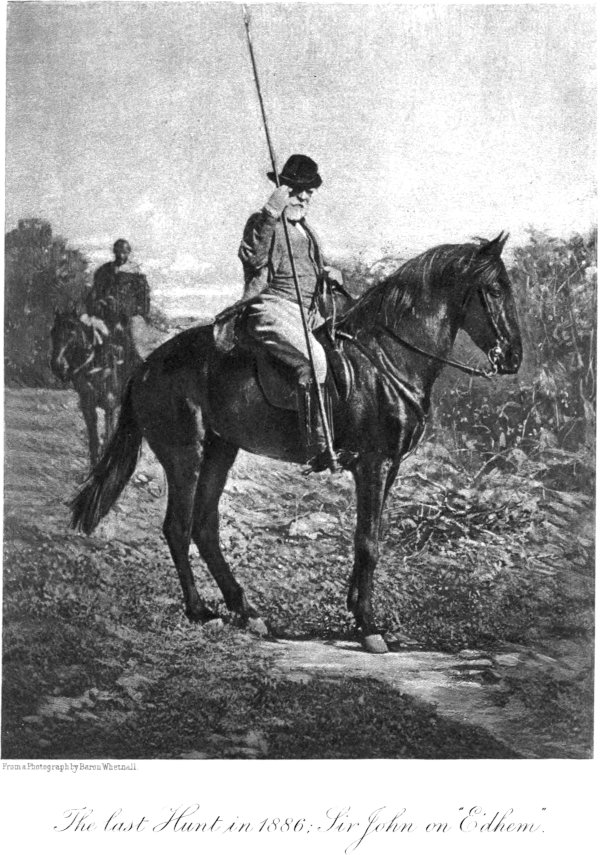
my father in the light of a sportsman. The latter’s recollections
of many of the happiest days of his life spent in pursuit of wild
boar and other game were noted by himself, and some of them have
been embodied in this work. A keen and hard rider, an unerring shot
in his earlier days, before his eyesight was impaired, and of
almost reckless courage, he was well fitted to become the elected
leader and head of the native hunters. Under his rule sport
flourished in the environs of Tangier, the ground allotted for the
purpose by the Sultan was properly guarded, and the close season
strictly observed: it was then that pigsticking in Morocco reached
its highest perfection, and gave pleasure to many of every rank and
condition, whether Europeans or natives.
It is doubtful whether sport could again flourish in the
environs of Tangier as it did in my father’s day. An increasing
armed European population, the introduction of weapons of
precision, and the denudation of the woods, render such a prospect
unlikely. His stories therefore of narrow escapes and exciting days
may prove of interest to the lover of the chase; and to some, who
in those bygone years shared his sport, may perhaps recall the
memory of pleasant times spent with him in the field.
L. A. E. BROOKS.
INTRODUCTION
To this memoir of the late Sir John Hay
Drummond Hay I have been asked by his daughters to write a few
introductory lines.
My acquaintance with Sir John began in the year 1870. At that
time I was quartered at Gibraltar, being on the staff of Sir
William Fenwick Williams of Kars, who was then Governor of the
fortress.
They were old comrades, Sir John and Sir Fenwick, having served
together in Constantinople, and the friendship begun in Turkey was
continued at the gates of the Mediterranean. Often and often Sir
John and Lady Drummond Hay, with their two daughters, visited the
Convent at Gibraltar; and in return the doors of the Legation at
Tangier were ever open, and always gave us a hearty welcome.
It was between 1870 and 1875 that this intercourse took place,
and to me it is filled with happy recollections. The quaint old
town of Tangier, full of the decaying influences of Moslem rule,
yet keeping up the struggle of life after an existence of over a
thousand years; racial and religious differences, civilisation and
barbarism, struggling along together, while Jews and Arabs,
unchanged for five hundred years, jostled with Christendom of
the present day. It
was a strange medley: and out of it all stands one figure
prominent, nay pre-eminent, in the history of Morocco during the
past forty years.
I do not think Sir John’s reminiscences sufficiently convey the
enormous influence he wielded in the empire, so called, of Morocco.
Throughout the Sherifian dominions his name was known and
respected; and after the Emperor and the Sheríf of Wazan, his was
the most powerful influence in the state. His long residence in the
country; his intimate acquaintance with the manners and customs of
the people; his perfect knowledge of Arabic; his love of justice;
his absolute fearlessness; his keen appreciation of their sports
and amusements, in which he often joined; not only made him the
trusted friend of the late Emperor and his predecessors, but also
the chosen friend of the people.
In the many expeditions in which I had the good fortune to be
one of Sir John’s companions, I had abundant opportunities of
observing the power he possessed over the different tribes with
whom we came in contact; and especially among the hill tribes of
Jebel Musa, who occupy the country between Tangier and Tetuan.
These people held him in great esteem, and often sought his advice
and counsel in their tribal differences; thus enabling him to be of
service to the Emperor in the constant struggles between that ruler
and his people.
A description of Morocco and its government has often been
essayed by various writers; but no one could give an adequate idea
of Sir John’s influence who had not personally witnessed his
intercourse with the discordant elements which constitute the
government of that country.
On one occasion I had the pleasure of being on Sir John’s staff
when he paid a visit to the Emperor, who was then residing at
Marákesh. What a pleasant journey it was! The daily ride, the evening camp, our
first view of the great Atlas range of mountains, the entry into
Marákesh, our reception by the Sultan, and the six weeks we spent
in the city but little known to Europeans; and it was, perhaps, the
events of that journey which impressed one more than anything as to
the individuality and power of the British Representative.
By many Sir John will also be remembered as an ardent sportsman.
Whether he was organising a boar-hunt, or a day after partridge, or
enjoying a run with the Calpe hounds, there was always the same
keen interest, the thorough enjoyment of sport, which characterised
the man. Under his guidance you were always sure of finding boar,
or of getting a good bag of partridge; and it was through Sir John
that, some twelve miles South of Tangier, where the ground was
favourable, the exciting sport of pigsticking was introduced into
Africa. Well do I remember after a day’s sport the evening camp
fire, round which we gathered after dinner, when Sir John would
tell us of some of his earlier hunting recollections. He was an
excellent story-teller, keeping his audience in a state of the
deepest interest to the end; and then, with a merry twinkle in his
eye, he would finish his narrative by a description of some
ludicrous incident in which he was often the chief actor, and no
one joined more heartily in the laughter which followed than he
himself.
It is not possible, within the short space of an introduction,
to give more than a mere outline of the personality of Sir John
Drummond Hay. His recollections furnish the true index to his
character. In them are reflected the sterling honesty, the
integrity, and the courage and capacity of the man who, though
working in a country but little known and full of prejudice and
fanaticism, made England respected and trusted. He belonged to that
band of the men of Great Britain who serve their country wherever
they are placed, and who, while mindful of her interests and her
honour, gain the good will of the rulers and the people to whom
they are accredited.
In conclusion, I shall ever remember him as a friend whom I
respected, and for whom I always had a true affection; and when
asked to write these few lines, while wishing the duty had fallen
to an abler pen than mine, I felt that, having been honoured with
his friendship, I might, in affectionate remembrance of that
friendship, write this brief tribute to his memory.
The system of orthography used in this
book for native names and places is that adopted by the Council of
the Royal Geographical Society, the true sounds of words as
locally pronounced being taken as the basis of spelling,
except in the case of old-recognised names such as Tangier (more
properly Tanja). According to this system, vowels are pronounced as
in Italian; consonants as in English; kh and gh
as the Oriental gutturals.
Morocco, the name of the region of Western Mauritania
of Roman geography, has undoubtedly been corrupted from the native
name ‘Moghreb’ (setting sun). Maroc, Marocco, Marruecos, Marok,
&c., written by different peoples of Europe, are curious
corruptions, some even further off from Moghreb than the English
corruption of the native name, and no nearer to the old classic
corruption Mauritania than in beginning with Ma
instead of Mo.
The name of the ancient city which we British call
Marocco, or yet more absurdly Morocco, is in the
mouth of the natives ‘Marákesh.’
SIR JOHN HAY DRUMMOND
HAY
CHAPTER I. BOYHOOD. 1816-1834.
In 1816, my father, at that time Major
in the 73rd Regiment, was on the staff of Lord Lynedoch—then in
command of the army of occupation—and held the post of ‘Majeur de
Place’ at Valenciennes; where my mother, after the conclusion of
peace, had joined him. Here I was born on the 1st of June of that
year, and my name was inscribed as a French citizen at the
Mayoralty.
After my father retired from the army, he was offered by his
relative the Earl of Kinnoull, hereditary Lord-Lyon, the office at
Edinburgh of Lord-Lyon Clerk. At Edinburgh we resided first in an
old-fashioned house at Deanhaugh—the boards of the room where I
slept were stained with the blood of a tenant who had committed
suicide there—the garden adjoined that attached to the house where
the painter Raeburn dwelt. Later, we moved into a house in Athol
Crescent, one of the first of the new buildings in Edinburgh in
those days; I have a little sketch, from a window at the back of
the house, of the pretty country seen therefrom and which is now
all built over.
With my elder
brother, I was sent as day-boarder to the Academy. Early in the
morning, after a breakfast of porridge, and having been given by my
mother a penny to buy a ‘bap’ for my luncheon, I started off, with
my satchel on my back, for school. Near Stockbridge I would meet
‘daft Jamie’—walking up and down in all weathers, bareheaded, with
his hands behind his back—and often gave the poor fellow half my
bap: one day he had disappeared, and afterwards I learnt he had
been one of the first victims of the murderers Burke and Hare, who
sold bodies for dissection to the eminent surgeon, Knox.
Being an indolent boy, and having great difficulty in learning
by heart any lesson, I was always at the bottom of the form, but,
for my age and size, I was the best runner and player at football;
at which game I broke my arm and was taken to the well-known
surgeon, Symes, to have it set.
On going to school in the morning, I passed through Charlotte
Square and there frequently met Lord Cockburn[1]
taking an early walk, wearing Hessian boots, a large frill of shirt
showing from his waistcoat and a long chain with seals dangling
from the fob in the top of his trousers. He was a friend of my
father’s, and on one occasion he stopped and asked me to state what
place I held in the form.
Hanging my head with shame, I did not reply.
‘Come,’ he said, ‘I dare say you are dunce! Tell me.’ I replied
that I was always at the bottom of the form. Upon which Lord
Cockburn said, ‘That’s right, my dear boy; keep there and you are
sure to get on in life and become an eminent man. Do you know who I
am?’
‘Yes,’ I said, ‘you are a judge.’
‘Well,’ he resumed, ‘I was like you, always at the bottom of the
form. Some day you may be a judge, or a greater man than I am.’
Shortly after this
happened, having reported to my mother that I was dunce as usual,
she remonstrated with me for being such an idle boy. Then I
joyfully related Lord Cockburn’s language to me, adding, ‘Some day
I shall be as great a man as he is.’ As may be supposed, the judge
was rebuked by my parents for encouraging me in idleness!
The future archbishop, Tait, was at the Edinburgh Academy at the
same time as myself. Though an idle boy, I learnt more at that
school than I did in the five years I spent at Charterhouse—whither
I was transferred with my brother in 1827—and it was at the Academy
that I won a prize of which I was very proud. It was not a reward
for efficiency in study, but an annual prize given to the boy who
was elected by a majority of votes as the favourite of the
school.
In 1844, being on a visit to a friend in Edinburgh, I went to
the Academy, and on inquiring of the porter at the entrance who
were then the masters, I learnt that one of them was Ferguson, who
had been master of my form, and that he was then at lunch in the
lodge with the other masters. I entered, without my name being
announced, and, recognising Ferguson, gravely said: ‘I beg to be
let off to-day, Sir, for being late; I was prevented coming
earlier.’
‘Hay junior,’ he replied at once, ‘you are forgiven.’ How he had
been able to remember my face after a lapse of sixteen years, when
he had known me only a smooth-faced boy, who now returned as a man
with a moustache, was especially strange to me, who never can
recollect any face—unless indeed it be that of a pretty woman!
Walter Scott was a great friend of my family and frequently came
to Athol Crescent. I have often sat on his knee and had stories
told me by him. I also accompanied my father to Abbotsford and
spent some days there, and I remember that on our arrival Walter
Scott, followed by his sleugh-hound ‘Maida,’ came out to welcome
us, and, taking my
father by the arm, he turned round to ‘Maida’ and said, ‘Do you
take care of Johnny and let him have a ride on your back if he
likes.’ ‘Maida’ and I became great friends, and she allowed me to
get on her back; for I was a very slight boy.
When in Edinburgh, Walter Scott for a time lived in Walker
Street, leading out of Coates Crescent, opposite to our house. He
called one day on my mother and said he was going away for a month
and requested that he should be allowed to send, at night, his
writing-table, desk, and chair to her house, as he said his
housekeeper complained bitterly that she had no peace from the
constant visits of travellers, asking permission to see the chair,
&c., where he wrote his works. My mother consented, and Walter
Scott then added: ‘I shall put a notice on the door of my house,
“Walter Scott has left this house and his furniture has been
removed.”’
A few days after the removal to Athol Crescent of the desk and
other articles, there was an unceasing knocking and ringing of
bells at our front door by travellers, begging to be admitted to
see the desk. My mother had to have it removed, and a notice,
similar to that suggested by Walter Scott, was placed on the
door.
Mention is here omitted of an incident well remembered by his
children as related by Sir John’s mother, Mrs. Hay. Some visitors
who gained admittance to her house removed surreptitiously her own
worn quill pen from Walter Scott’s desk, under the impression that
it had been used and left there by him!
Among the memoranda left by Sir John are notes to the effect
that when he entered Charterhouse, Thackeray had either just left
or was about to leave that school; but Havelock, Leech, and John
Murray were his schoolfellows, as also a young Sheridan, who was
remembered by him chiefly on account of the readiness with which he
would improvise verses on any subject. This boy appears to have
been of improvident habits, and was generally in a state of
impecuniosity, which debarred him from buying the dainties in which
other boys indulged. His schoolfellows would offer to share their tarts, &c., with
him if he would make verses in reference to them—to which he would
instantly respond with apt rhymes.
During their early school life at Charterhouse the brothers
spent their holidays with either of their two grandfathers, the one
being the Rector of Hadleigh, Dean Drummond (youngest son of the
Archbishop of York of that day, and brother of the ninth Earl of
Kinnoull), through whom lay Sir John’s claim to French extraction,
as the Dean’s wife was a daughter of the Prince de Vismes et de
Ponthieu. Captain J. Thomson was their other and maternal
grandfather. A very learned linguist, he had been private secretary
to the Marquess of Hastings in India, spoke twenty-five languages,
and was author of Etymons of the English Language, which
work was completed after his death by his son-in-law, Mr. E. A.
Drummond Hay, father of the subject of the present memoir.
At Christmas-time, however, the two boys returned to their
parents in Edinburgh, a long, wearisome journey from London,
travelling by coach through two days and nights in bitterly cold
weather. The return journey to school, in particular, seems to have
left a desolate remembrance of arriving in London, cold and stiff
after long confinement in the crowded coach, but also a pleasant
recollection of the gruff kindness to the young travellers of the
guards, who would often forego their customary tip when changing,
rather than disturb from their sleep the schoolboys who were going
from home.
After the death of Dean Drummond, and the appointment of their
father to a foreign post in 1829, the brothers were wont to spend a
portion of their holidays at Dupplin Castle with the Earl of
Kinnoull, to whom they were then prospective heirs: the elder to
the earldom, the younger to the property of Cromlix. In fact, Lord
Kinnoull asked their father to allow him to have entire charge of
the two boys and of their education, in view of their being his
probable successors. But this offer was prudently declined, their
father not wishing them—the sons of a poor man—to be brought up
amidst surroundings unsuited to adapt them for pushing their own
way in life, and in the expectation of a prosperous future which,
in their case, might fail to be realised. In this he judged wisely;
as, while still in the prime of life, Lord Kinnoull married and had
a large family.
The boys, however,
continued to spend many happy holidays at Dupplin; posting from
Edinburgh to Perth, a pleasanter mode of travelling than by
coach.
Another recollection, in connection with their visits to
Dupplin, was the ceremonious importance of their attendance at the
parish church at Aberdalgie on Sundays. Though only a short
distance intervened between this place and the Castle, the family
coach, with four horses and postilions, was always prepared, and in
this manner the two schoolboys proceeded alone to the church, to
occupy on arrival the family ‘sitting,’ and listen, with what
patience they might, to the long discourse of the minister.
In 1829 my father was appointed Political Agent and Consul
General in Morocco. At that time I was at Charterhouse, and first
received the tidings from another boy who had seen the notice in
the Gazette. Geography was not taught at Charterhouse,
and, as my informant professed ignorance regarding the whereabouts
of Morocco, beyond that ‘it was a country in Africa inhabited by
naked niggers,’ we got hold of a map and made therein a voyage of
discovery until we found Morocco.
My family came up to London from Edinburgh and rented a house in
Clarges Street for the season, and my father decided that my elder
brother, the late Sir Edward Hay, and I should remain at
Charterhouse two or three years longer; then rejoin our family at
Tangier, and there be placed under a private tutor.
It was a curious coincidence that before my father was appointed
to Morocco, or had indeed any expectation of obtaining any
employment in a foreign country, the boys at Charterhouse had
nicknamed me ‘Othello,’ or ‘the Moor,’ not only because I was a
passionate youngster who resented an injury, but also on account of
my dark eyes and hair and olive complexion; typical of a thorough
Hay, according to Sir Walter Scott in The Fair Maid of
Perth, where he describes the clan as ‘a dark, short
race.’
A frigate, H.M.S. Athol, in command of Captain Gordon, conveyed
my father and family to Tangier.
Three years later
[1832], when I was fifteen, my brother and I, to our great joy,
were summoned to join them. Steam communication was very rare in
those days, and we sailed from Plymouth in a merchant brig of about
a hundred and fifty tons, with only a skipper and four seamen on
board. She was a clipper and made the run in seven days.
It was a rough life on board the brig: hard sea-biscuit, salt
pork, with now and then currant dumplings, was the fare.
Nothing particular occurred during the voyage, except that after
rounding Cape St. Vincent, when off the Spanish coast, a large
lateen craft—called a ‘mistico’—gave chase, making signals to the
brig to heave to: but our skipper, who declared the ‘mistico’ to be
a pirate, responded to the signals by hoisting every stitch of
canvas—though a strong breeze was blowing—and we flew through the
water, leaving the ‘mistico’ far behind, and she gave up the chase
after firing shots which missed us. Probably she was a Spanish
revenue vessel and her commander had mistaken us for a
smuggler.
There was a six-horned Barbary ram on board, which the skipper
had not been allowed by the Customs’ officers to land in England,
for fear, I suppose, of its contaminating the British breed of
sheep. No provision of fodder had been made for the poor animal,
but, as he had become a great favourite with the sailors, he was
not made mutton of, and lived on a pittance of hard biscuit, which
the sailors gave him from their rations. The poor ram was so
ravenous that I mischievously offered him one day a slice of cold
mutton between two pieces of biscuit, and this he devoured with
avidity!
On our arrival at Tangier, my brother and I were placed under
the tuition of a Spanish gentleman, Don Gregorio de Borgas y
Tarius, whose father had been Captain-General in Estramadura; but,
during the reign of Ferdinand, having taken part in some
‘pronunciamiento’ against the despotic acts of that sovereign, he
was compelled to fly from Spain. His property was confiscated, and he and his
son gained their livelihood by giving lessons. Don Gregorio was a
learned man—not only a classical scholar, but a good mathematician,
and spoke French perfectly.
During the five years I had spent at Charterhouse I had studied
little or nothing except football, cricket, tennis, and other
games; in these I took the lead of others of my age. What I knew of
Latin or Greek had been acquired by me when a day-boarder at the
Edinburgh Academy—a far superior school at that time to
Charterhouse for education, as idle boys were there made to study:
but even at the Academy, geography and modern history were not
taught. I had learnt the history of the gods and goddesses, and
knew much about the doings of Jupiter, Juno, Hercules, Venus,
&c., but was left in total ignorance of English history, except
what my mother taught me, while knowing little or nothing of the
history of Europe, or even of the recent great war with
Napoleon.
After we had spent two years in Tangier, my elder brother was
appointed a clerk in the Colonial Office, through the influence of
our relative, Mr. Robert Hay, then Under-Secretary for the
Colonies; so I was left alone under the tuition of Don Gregorio,
but made little progress, except in the French and Spanish
languages, which I acquired with as much ease as I had experienced
difficulty in mastering the classics.
Letter from Miss Shirreff to Sir John’s
daughters.
41 Stanhope Gardens, S.W., Jan. 31,
1895.
You have asked me, my dear friends, to tell you something of our
recollections and impressions of your father’s early home; not that
of his childhood, but of his early youth—that in which his
character was formed and the bent and purpose of his manhood
received its definite direction. It is but little that I can tell;
but as I am one of the few survivors of those who had the privilege
of knowing that home in those early days I will do what I can.
It was my father’s appointment late in 1830 to the post of
Captain of the Port at Gibraltar that first brought us into contact
with the Hay family. Not long after our arrival Mr. Drummond Hay
came over to see us and
claim my mother as his cousin, though till then personally unknown;
and his kindness and delightful conversation and old-world courtesy
had made an easy conquest of us all. The invitation that followed
for Minnie[2] and myself to pay a visit to Tangier was
therefore at once accepted with great glee; though circumstances—a
deep family sorrow, illness, and my father’s absence in
England—delayed it till the spring of ’33. At last the moment came.
My father took us over, and we were left among strangers who were
to become the dearest friends of all our after lives.
Mrs. Drummond Hay’s kind motherly greeting to her two young
guests soon set us at ease. Mr. Hay delighted us again as at first,
and we then were at leisure to make acquaintance with the younger
members of the family; first Louisa[3], the eldest daughter, a year
older than myself; then your father, at that time a lad between
sixteen and seventeen.
Your father, who had but lately left Charterhouse and come to
live at home, was at this time engaged with the study of Arabic,
more rare then than now, and which was carried on more or less
secretly owing to native jealousies. He was thus not only preparing
for work, but was also laying in great measure the foundation of
that immense influence and popularity among the Moorish population,
for which he was so remarkable in after years.
When the busy mornings were over, riding and music were the two
delights that drew the young party together. Under Mr. Hay’s
guidance, and with the escort of a Moorish soldier, still at that
time necessary for protection, many were the delightful rides that
we took beyond the precincts of the old town, along the shore, or
through the half-wild country, so new in all its aspects to our
eyes.
Then on our return, and often far into the evening hours, the
long balcony, or gallery as it was called, outside the drawing-room
windows was our favourite resort. Here we eat fruit, and talked
over our ride, and here guitars were brought out, and song and
merry talk went on.
The garden, full of flowers and lovely shrubs, lay below us; in
the distance stretched the rugged coast of Spain; Gibraltar reared
aloft its rocky summit, whence the flash of the evening gun might
be seen; while the golden glory of the Western skies lighted up the
narrow sea between, alive with fishing craft, or some stately
vessel passing through the straits. Truly it was a lovely view, and
once enjoyed could never fade from one’s memory. That enjoyment was
only changed for the pleasant circle at dinner, or in the
drawing-room.
Perhaps it was the fact of our close intimacy with dear Mrs. Hay
through the long years of her many changes and trials that makes
the recollection of
the first impressions of her less vivid; yet her gracious beauty,
her gentle, pleasant ways in the midst of the cares of such a
household, can never be forgotten. But Mr. Hay was himself
emphatically the centre and ruler of the family life—a stern ruler
at times to his children, but they revered the will which they were
bound to obey, and loved the father. Louisa’s congenial spirit, her
sympathy in his literary tastes, made her naturally his companion,
young as she was, and as secretary—no such person was then
officially recognised—she was invaluable.
Such, then, as I have striven partly to describe it, was the
home in which John Hay was gradually developing the qualities that
were most remarkable in him through later years—courage,
resolution, sense of duty, power of work and willingness to work,
warm and wide sympathies, overflowing fun, and readiness to give
help, no matter in what direction: if the thing wanted were in his
power to do it was done, from mastering an unruly horse to teaching
algebra to a backward student.
The outside surroundings of the home had also their influence.
Society in Tangier was necessarily restricted, but within the small
circle of different nationalities the social tone of various
countries became familiar, and then the intercourse tended to
dissipate national prejudices, and to lead the young to wider
sympathies than generally prevail where all are more or less under
the sway of the same habits and associations. This was naturally
favourable to one who was destined to the diplomatic service, as
was also the necessary use of at least two foreign languages—French
for society, and Spanish, partly for the same, but also as the
medium of common intercourse with all the non-Arabic
surroundings.
With reference to your dear father especially I may truly say
that whenever we met him in after years we felt that we were
meeting the same valued friend of our youth, and again our thoughts
turned to the dear old home where, under a noble father’s guidance,
he was trained to all manly excellence, and where he had learned to
form his ideal of womanhood under the influence of the loving,
unselfish mother, and the sister whose bright intellect added force
to the pure beauty of her character, and made her worthy to be his
trusted friend and confidant to the last hours of her life.
CHAPTER II. WAITING FOR EMPLOYMENT—JOSÉ MARIA. 1834.
In 1834, I travelled through Andalusia
with my tutor, and visited, amongst other towns, Seville, where I
had been requested by my father to rent a furnished house for three
months, as he had obtained leave of absence and intended to spend
it there with his family. Mr. Ford, the author of the Handbook
on Spain, and father of Sir Francis Clare Ford, afterwards
Ambassador at Madrid, then resided at Seville; and, as he was about
to leave, I hired his house.
Ford had made the acquaintance of José Maria, the famous
brigand—the ‘Little John’ of Spain—who had been pardoned by the
Queen on condition of his acting as chief of a body of ‘guardia
civil’ and devoting himself to suppressing brigandage. He asked me
if I would like to see this notorious ex-robber and hear, from his
own lips, anecdotes of his life as a brigand. I readily assented,
so José Maria was invited to a luncheon at which I was present.
José Maria told us that all the robbers and thieves in the
Southern provinces of Spain had been for some years under his
control—he could collect when required a body of about forty
well-mounted and armed men—and related how his pardon and present
appointment had been obtained.
Hearing that Queen Christina, attended by an escort of cavalry,
was about to pass, on her return to Madrid from a visit to Granada,
through a wooded country known to be infested by banditti, José
Maria collected his well-mounted brigands, armed and dressed in handsome
‘majo’ costume, and placed them at the entrance of the forest
through which Her Majesty would pass.
On the approach of the royal cortège, José Maria, observing a
trooper posted as vedette in advance of Her Majesty’s escort,
accosted the man and informed him that, as a loyal subject of the
Queen, he had brought a body of well-armed and mounted inhabitants
of the neighbourhood to escort Her Majesty through the woods in
safety.
The trooper rode back and reported this language to the officer
in command of the escort, adding that he suspected from the
appearance of their chief that the men were banditti.
This was repeated to the Queen by the officer, who also informed
Her Majesty that he was prepared to attack the supposed
banditti.
Queen Christina, however, ordered him not to attack, but, after
taking the necessary precautions against treachery, to bring the
chief of the band to her carriage.
José Maria, at the request of the officer, then came forward.
The Queen thanked him for his loyalty in having assembled a body of
mounted men to ensure her safety in a district said to be infested
by brigands. ‘Place your men,’ said Her Majesty, ‘in front of the
escort, and then come yourself to the one side of my carriage,
whilst the officer in command of the cavalry rides on the
other.’
After traversing the forest, José Maria asked permission to
retire with his mounted followers, and at the same time announced
that he had a boon to beg.
‘What is it?’ said Her Majesty. ‘I shall be glad to make my
acknowledgement of the service you have rendered.’
Bowing low, he answered, ‘I am José Maria, the chief of the
banditti who infest your realms. I ask for pardon for myself and
for those of my followers who may be ready to accept it: for those
who do not accept, as they have accompanied me on the present
occasion without knowledge of my intended petition, I beg that they be
allowed to depart without hindrance.’
The Queen, after conferring with the officer in command, granted
José Maria’s prayer, on condition, however, that he should become a
chief of the ‘guardia civil’ and assist in putting down
brigandage.
All the brigands accepted Her Majesty’s pardon, with the
exception of a man nicknamed ‘Veneno’ (poison), who had been José
Maria’s lieutenant.
José Maria related to us stories of the most daring robberies he
had committed, in various parts of Spain, on passengers by
diligence and other travellers. He declared that his band had never
robbed or molested the farmers or peasantry; but, on the contrary,
when they heard that a wedding or other feast was taking place, he
would appear with some of his men in smart ‘majo’ costume and bring
presents for the bridegroom and bride. Also that the Alcaldes, or
petty magistrates of the villages, were all bribed by him when a
robbery was committed in other districts than their own; and when
cavalry were sent in pursuit of the banditti, the country people
never betrayed them, but kept José Maria informed of their
movements whilst they misled his pursuers.
The brigand told us that on one occasion he had robbed an
English gentleman travelling in Andalusia on horseback, with a
Spanish guide, of their horses and everything they possessed except
the clothes they wore. ‘The Englishman,’ he added, ‘was a bright,
pleasant youth, and submitted with good humour to the robbery; so I
felt sorry, as he was forty miles from Seville, whither he was
going, that he should have to walk that distance, and I gave him
back his servant’s horse and a doubloon (sixteen dollars) out of
the two hundred dollars I had taken from him, mentioning that he
might require that money for lodging and food on the road before he
had reached his destination.’
‘My young friend,’ José continued, ‘thanked me warmly, adding
that since I had been so kind he had a great favour to ask, which was that I should
return him his gold watch as it had been the parting gift of his
dear father.’
‘Is your father alive, and does he love you very much?’
‘Oh, yes,’ replied the youth, ‘he lives and loves me.’
‘Then,’ said José Maria, ‘I shall keep this watch, and as your
father loves you so dearly he is sure to give you another!’
José then gave the young Englishman a signed pass, requiring
that all brigands or thieves in Andalusia or Estramadura should
refrain from robbing or molesting the bearer. He also told him, if
robbed at any time, where to send a note which would be sure to
find him.
The Englishman spent some weeks at Seville, and, returning one
evening from Alcalá, was attacked and robbed by a man armed with a
gun. He showed the pass to the footpad, who only remarked that he
was not going to have the bread taken out of his mouth by the
brigand José Maria or any other man.
The Englishman then had a note written in Spanish and sent to
the care of the head man of a village mentioned by José Maria, to
be forwarded to the great brigand, stating the sum of money that
had been stolen from him. Within a week a Spaniard called at the
hotel where the traveller lodged and returned the money, adding,
‘The “ratero” (thief) has been stabbed for paying no attention to
José Maria’s pass.’
After luncheon, José Maria had his horse brought for us to see.
It was a well-made Spanish ‘jinete,’ standing about 15.1, and had
the appearance of being fast. He mounted the nag and rode rapidly
up a street, presently returned at a gallop, jumped off, and,
removing the bridle, gave the animal a slap and then ran into the
house. The horse went off at full gallop and disappeared up one of
the streets.
‘Now,’ said José Maria, ‘I am supposed to have committed a
robbery and to have been pursued by cavalry in a wood. I have taken
off the bridle, and my horse, if chased, will be sure from his swiftness and
being riderless, to escape. Suppose me to have climbed a tree or
hidden amongst bushes or rocks and thus eluded my enemies.’
After a short interval he continued, ‘I must now recall the
horse, who, not being pursued, will not have gone far and is
listening for my summons.’ So, taking a large whistle from his
pocket, he walked up the street and commenced whistling. In a few
minutes the horse galloped up, neighing as he recognised his
master, who put on the bridle and caressed the intelligent
beast.
‘For two years I have been employed,’ said José Maria, ‘in
putting down brigandage, and have succeeded in arresting many
robbers and “rateros,” but my late lieutenant “Veneno” has hitherto
escaped us, and some day he will kill me!’
A year after my meeting with José Maria, I saw in the newspapers
that ‘Veneno’ had been tracked by him to a cave in the mountains,
frequented by this robber and his band. The ex-brigand entered the
cave one night at the head of a body of ‘guardia civil’ and was
killed by ‘Veneno’ while in the act of arresting him. ‘Veneno’ and
his companions were then shot by José Maria’s men.
Whilst residing with my father and family in the house he had
rented in Seville, it happened on one occasion that I had dined and
spent the evening with my friend Don ———, and did not leave his
house until nearly eleven o’clock. It was fortunately bright
moonlight, for Seville was then but dimly lighted. On saying
good-night, my host accompanied me to his door and warned me to
keep well in the centre of the streets, as at that late hour
wayfarers were often attacked and robbed.
I had no weapon—not even a stick—with me. The evening was fresh,
so I threw my Spanish ‘capa’ round me and walked briskly down the
centre of the narrow streets which led to the great Plaza, about a
mile distant, near which our house was situated. Presently I
heard footsteps and,
looking back, saw a figure following me, but keeping in the
shadow.
I knew I was fleet of foot, so set off running at a good pace,
feeling sure that if the fellow were dodging me he would follow. As
soon as I quickened my speed the man sprang into the light and came
after me, and I dashed on with him in pursuit. As I turned a corner
I caught sight of his long ‘navaja’ gleaming in the moonlight.
Finding my cloak heavy, I unfastened it and let it trail behind,
determined to hold on to my new capa as long as I could. However, I
soon outstripped my pursuer, and on reaching the Plaza paused to
again wrap my capa about me and to reconnoitre well before
venturing into the street where our house stood. The footpad had
vanished on seeing me reach the lit and frequented Plaza.
After this I never ventured out at night without a pistol.
At this time Mr. Hay had become very proficient in Arabic, and
his family have still in their possession some examples of Arabic
writing, then beautifully executed by him in the highest style of
Oriental manuscript; and a friend, writing from London to his
mother, Mrs. Drummond Hay, says, ‘I met the other evening Mr.
Burchardt Barker, the Oriental translator to the Foreign Office; he
told me that a letter from the Sultan of Morocco had been sent home
by your son, Mr. John Hay, and that he had never seen anything more
beautifully translated by any Orientalist.’
It was either during this stay at Seville, or on a subsequent
occasion, that Mr. Hay visited the Alcazar, then in course of
restoration.
The architect was employed in reconstructing the beautiful
arabesque stucco-work on the walls, by taking moulds of the injured
portions, and, after remodelling the defaced parts, casting from
these moulds fresh plaques to replace those injured or missing.
After gazing for some time on these restorations, and vainly
endeavouring to puzzle out the Arabic inscriptions which enter so
largely into arabesque decorations, Mr. Hay asked for the architect
and inquired of him whether he was aware that he had reversed all
the inscriptions!
The poor man was horrified. He declared he would undo and rectify his work,
begging Mr. Hay, for pity’s sake, not to betray to any one his
discovery: as, if it were made known, he would be a ruined man, and
he and his children would starve. Mr. Hay having shown him exactly
what his error had been, left Seville without betraying the
architect.
In the summer of 1838 Mr. Hay made an expedition into the
interior of Morocco, of which he wrote an account entitled
Western Barbary. This little book, written with all the
vigour and freshness inspired by youth, and with a thorough
knowledge of the wild people amongst whom he travelled and whose
sport he shared, was published by Mr. Murray and attracted much
attention and praise from the press at the time.
During a visit to England in 1838, Mr. Hay made an application
to Lord Palmerston for a diplomatic appointment in the East, and in
this connection relates the following incident, which occurred
after his return to Tangier in the next year.
A respectable Moor, named Selam Lamarti, who was employed by my
father to attend as guard upon my younger brothers and sisters, and
who was very anxious about my future career, inquired one day
whether I should like to have my fortune told by one who had never
failed to predict correctly the life and fortune of any man or
woman whom she might have happened to see, and the chief events of
whose future life she felt intuitively that she could foretell. I
replied, ‘As you say she, you refer, I suppose, to a
woman, and probably to an Arab gossip, who expects that I shall
reward her handsomely for telling me a parcel of lies about the
happiness and good fortune which are in store for me.’
‘No,’ he said, ‘she is not an Arab gipsy, but my first cousin, a
young Moorish maiden named Leila, with whom I have been brought up
from infancy as with a sister. If she tells your fortune she will
not take money, nor even a present, in return for her predictions.
The Most High God, who foresees and knows all things, has gifted
her with this incomprehensible power, for which she has
attained great fame;
but it is not every one whose fortune can be told by her, only
those whom she occasionally selects, from feeling—as she
describes—a sudden innate inspiration which she cannot explain.
Last Friday,’ he continued, ‘she and her mother were seated,
muffled in their haiks, praying at the grave of a relative in the
Mohammedan cemetery. You, whom she knows by sight, were walking
with a companion on the high road through the cemetery, and you
stopped for some minutes near to the spot where Leila was seated,
and she had a good view of your features. After you had passed
Leila told her mother, and afterwards myself on her return home,
that your future life was seen by her clearly, as in a mirror.’
‘Is she fair? Is she pretty? Can I hear from her own lips my
future?’ I exclaimed, foolishly flattering myself that this maiden
might have fallen in love with me and sought an excuse for a
meeting.
‘Hasha’ (God forbid), cried Selam, ‘that you or any man should
visit, or even speak to her, until she meet her bridegroom on her
wedding night, except it be her father, or I as her foster-brother,
in the presence of her mother. Yes, she is very fair and pretty,
with a sweet gentle voice and manner. If you wish to learn the
chief events of your future life, Leila says she must see you again
and have a long look at your features and expression. I will
arrange to-night the hour when you are to accompany me to stand
below the lattice window of her house, where she will be able to
gaze at you, though, as you know, her features will not thus be
visible to you.’
This was agreed upon, and the next day Selam accompanied me to
the door of Leila’s house, where, leaving me standing in the
street, he entered, but shortly rejoined me, saying, ‘She is now at
the window.’ I could just see there was some one behind the
lattice, so I looked up and smiled, hoping she might show herself;
but not a glimpse had I of the fair Leila. After waiting a few
minutes there was a tap at the window, and Selam said,
‘That is the
signal that you may leave. To-night I shall learn from Leila, in
presence of her mother, the chief events of your future life. She
is a clever girl, and, what is rare with our women, can read and
write Arabic.’
The following day Selam related Leila’s predictions as
follows:
‘John, whom I have so often seen as he passes through the
cemetery on Fridays, will in a few months return to London, and
will be appointed “Katseb” (secretary) to the English “Bashador”
(ambassador) at Stambul; he will rise in favour and become his
confidential secretary. He will be sent by the Bashador on missions
to several countries in the East and return to Stambul. After a few
years he will go back to England, and then on his intended return
to Stambul he will visit Tangier, where he will find his father in
bad health. His father will die and he will be appointed in his
place. He will be in great favour with the present and future
Sultans, and will attain to a much higher rank than his father now
holds. There are two maidens who will love him—one dark, the other
fair. He will marry the fair one, who lives in a distant land. He
will have a long and happy life, and when he is old he will retire
to his own country with high honours from his sovereign and from
other sovereigns of foreign countries. He will live to an advanced
age.’
Leila declined an offer of money or a present, and I was never
allowed to see her fair face or hear her sweet voice. Without
narrating here the various events which have happened in my long
life I may say that Leila’s predictions, by an extraordinary
combination of circumstances or chances, have all been verified.
Though I never had an opportunity of letting Leila know that I had
fulfilled her expectations, I hope she may have continued to take
an interest in my career, whether she be in this or in the other
world.
CHAPTER III. ALEXANDRIA. 1840.
Mr. Hay did not long remain without
employment. In his Note Book for 1840 he thus describes his
entrance on the career of a diplomatist.
Waiting with some anxiety to learn what might turn up and be my
fate, I stayed for some months in Town, and in May, as I was
walking down St. James’ Street towards the Foreign Office, I met
Henry Forster, brother of the late General Forster, then a senior
clerk in the Foreign Office, who said, ‘Hay, I have to congratulate
you, for you have just been marked with our chief’s initial
letter.’
On my asking for an explanation, Forster informed me that my
name had been sent up by my kind friend Mr. Hammond (the late Lord
Hammond, then Senior Clerk) for the post of attaché at
Constantinople, and that Lord Palmerston, as usual when he approved
a note or a memorandum, had signed P. Before I received this
appointment, Lord Palmerston’s private secretary asked me whether I
was a Whig or a Tory, adding that his Lordship had directed him to
question me, as he had appointed so many members of Tory families
to foreign posts that it was his intention in future before making
an appointment to inquire of a candidate to which party he
belonged.
I replied that, as I hoped to obtain employment abroad, where it
would not be necessary for me to take part in politics as Whig or Tory, my party would
always be that which upheld the honour and interests of my own
country.
I was told that, when my reply was reported to Lord Palmerston,
he said, ‘Mr. Hay may be a Tory, but he will do for diplomacy.’
On my appointment I was directed, before proceeding to my post,
to attend for some weeks at the Foreign Office to learn the forms,
&c.
Before the present Foreign Office was built there was, at the
back of the old buildings, a street, the houses on the opposite
side of which were overlooked by the rooms occupied by some of the
junior clerks. In a window of one of these houses two elderly
ladies used sometimes to be seated, sewing, and a youthful clerk
was wont to amuse himself dazzling them by means of a
looking-glass. The ladies wrote a note to Lord Palmerston,
complaining of this annoyance; upon which his Lordship sent a
memorandum to be circulated amongst the clerks:
‘The gentlemen in the office are requested not to cast
reflections on ladies.P.’
After working for some weeks as an assistant clerk in the
Foreign Office I was ordered to proceed, in the first place, to
Alexandria, where I was to remain for some time to assist Colonel
Hodges, then our Agent and Consul-General in Egypt—as there was a
press of work in consequence of the question with Mehemet Ali—and
was told that Lord Palmerston desired to know when I should be
ready to start. I replied, ‘To-day.’ This pleased Lord Palmerston,
but I was given three days in which to prepare, and told that, if I
had not a carriage of my own, I was to buy one at Calais and post
with all speed through France to Marseilles in order to catch the
mail-packet thence to Alexandria. At the Foreign Office I was given
£100 to pay all expenses.
Posting down to Dover, I crossed to Calais, and there bought,
second-hand, a light britzska, in which I
deposited the two
huge bags of dispatches, of which I was in charge for the admiral
at Malta and our agent in Egypt. As bearer of dispatches I had the
preference over other travellers for fresh horses, and travelled
very rapidly, day and night, arriving at Marseilles several hours
before the packet left. After selling the carriage I had bought at
Calais, I took a bath and had dinner at an hotel.
During dinner, I was waited on by two Maltese. Having finished,
I requested that my bill should be brought; upon which, one of the
waiters observed to the other sotto voce in Arabic, ‘We
will not present a bill; let us charge him fifteen francs, and we
will divide the five which remain over and above the charge for
bath and dinner.’ Knowing Arabic, I understood the plot; so when
they told me I had fifteen francs to pay, I replied that I wished
to see the landlord before leaving. He was summoned and I then
related to him what had passed between these rogues of waiters.
Upon which he demanded very angrily what they meant, and one of
them, very much flurried, replied foolishly that they had not
supposed the gentleman knew Maltese! The landlord dismissed the two
waiters from his service then and there, and I paid him his bill of
ten francs.
It is remarkable that though Malta has been occupied by a great
number of nations—Phœnicians, Romans, Arabs, Franks and
English—Arabic is still the language of the inhabitants.
Before arriving at Alexandria, I learnt that the plague was in
Egypt, and, having heard so many dread stories about this disease
and the dangers incurred from contagion, I landed with my hair
standing on end from terror, fearing I should be plague-stricken
and die—as I had heard might happen—after a few hours’ illness.
There was much contention at that time between medical men at
Alexandria regarding the contagion from plague. The chief Italian
doctor—whose name I have forgotten—who was said to be very clever,
mounted a donkey covered with oil-skin, the doctor wearing also
clothing of a supposed non-contagion-bearing texture. He visited the
plague patients, but carried an ivory wand with which he touched
their ‘buboes.’
The other chief medical man was Dr. Lorimer, an Englishman, who
did not believe in great danger from contagion but rather in the
risk of infection from visiting, or living in, unhealthy quarters
of the town where there were no sanitary arrangements.
These two doctors were on friendly terms, and when they met in
the streets during their visits to plague patients, some banter
generally passed. The Italian doctor was wont to salute Dr. Lorimer
with ‘Tu creparai’ (Thou wilt die), and the latter returned the
gloomy salutation with a ‘tu quoque.’ The Italian died of the
plague whilst I was at Alexandria, but Dr. Lorimer kept in good
health and was unremitting in his attendance on the sick, doing
many acts of charity. He told me, in support of his theory of
infection rather than contagion, that there were several houses in
Alexandria of a better class, but situated in an unhealthy part of
the town, whose tenants, even when observing the strictest
quarantine, had caught the plague, whilst there were whole streets
in a healthy quarter where no cases ever occurred.
Some years before, in Morocco, I had experience of the danger of
going into dwellings where there is disease.
When the cholera morbus visited Tangier in 1836, Mr. Bell—at
that time Consul under my father, and who had been surgeon on board
Lord Yarborough’s yacht Falcon—devoted his spare time after office
hours to attending, gratis, upon cholera patients and had much
success: I sometimes accompanied him to interpret when he could not
find an assistant who spoke Arabic, and on one occasion he
requested me to aid him in giving directions to a poor Moor whose
son was attacked with cholera. I accompanied Dr. Bell without fear,
but when he requested me to lift the dying man, already looking
like a livid corpse, to enable him to pour some liquid down his
throat, I shuddered, and, trembling, held the man in my arms till the
dose was administered. The patient died shortly after.
I returned home feeling ill and shaken; and, whilst standing
before a fire trying to warm myself, was seized with terrible
cramps and fell in pain on the hearth-rug. I was put to bed with
bottles of hot water on my body. Dr. Bell was sent for, but was not
to be found. Having heard that sometimes oil relieved pain in
cholera, I got a bottle of good French oil and adding a few drops
of laudanum to a full tumbler of oil, drank it off. This relieved
the intense pain. When the doctor arrived, he approved of my remedy
and said I had an attack of cholera asiatica.
The danger from plague by contagion cannot, however, to my mind
be called in question. That dire disease was introduced into
Morocco about the year 1826 by an English frigate which our
Government had dispatched to Alexandria, where the plague was then
raging, to convey from that port to Tangier two sons of the Sultan,
returning from a pilgrimage to Mecca. No case of plague or other
illness had occurred on board the frigate during the voyage, and
the Sultan’s sons and other passengers were allowed to land at
Tangier.
The Customs’ officers being suspicious that in the numerous
boxes, brought by pilgrims who had been permitted to embark with
the Moorish princes, contraband goods were being smuggled, caused
some of the cases to be opened. One contained Egyptian wearing
apparel, which the owner said he had bought second-hand, and
subsequently confessed had belonged to a person who had died of the
plague at Alexandria. The two Moorish officials who opened the
boxes were attacked with the plague that night and died in a few
hours. The disease spread rapidly throughout Morocco, carrying off
eighty per cent. of those who were attacked.
Shortly after my arrival at Alexandria, I was presented to
Mehemet Ali by Colonel Hodges. I need not give a description of
this remarkable man, of whom so much has been written, but I was much struck by
his keen eyes, like those of an eagle. The Colonel proved to be no
match for him in discussing the grave questions then at issue
regarding his desire to be independent of the Sultan’s sway, whilst
Mehemet Ali showed markedly his personal dislike to the Irish
colonel, who was hot-tempered and blurted out in very unguarded
language the views entertained by the British Government at that
time regarding Egypt.
On hearing that I was attached to the Embassy at Constantinople,
Mehemet Ali fixed on me his eagle eyes with no friendly expression,
and I could perceive, from words let drop then and afterwards, the
extreme hatred his Highness entertained towards any one connected
with our Ambassador, Lord Ponsonby, the persistent and successful
opponent of his ambitious views.
About this time a portion of the Mahmud Canal was being dug by
the unfortunate Egyptian fellahin, assisted by their wives and
children, according to the ‘corvée’ system. Men, women and children
dwelt in miserable hovels near the canal, and I have seen the
wretched people working by thousands. A platter of bean soup and
some coarse bread was all that each person received to keep body
and soul together. No pay was given—or if any were made, it was
retained by the overseers—and the greatest misery prevailed. I was
told that there were two young fellah girls, sisters, who possessed
only one garment between them; so whilst one worked the other
remained in her hovel until her turn came, and then she donned the
long blue shift and the weary one remained nude. Yet have I seen
this joyous race, after emptying the baskets of earth they carried,
filled with mud grubbed up by their hands, without aid of spade or
other implement, singing and clapping their hands as they returned
to the canal, balancing the empty baskets on their heads.
The Egyptians have been bondsmen for thousands of years, and are
a degenerate and cowardly race.
On one occasion, when the younger son of Mehemet
Ali, Abbas Pasha, a
cruel tyrant, visited the canal, a wretched fellah, with hardly a
rag to his back, walked to a mound of earth above where the Pasha
stood and cried out to his fellow-workmen: ‘Slaves and cowards!
There stands the tyrant. Strike and destroy him, or—if you have not
the courage to strike—spit, and you will drown him!’ This rash but
brave fellah was seized and beaten until he lay a corpse.
To give another instance of the cruelty of this monster, Abbas
Pasha. It was the custom in Egypt for any one of position to be
accompanied, when on horseback, by a ‘sais,’ or footman, who ran
beside, or preceded, the rider; and it was astonishing how these
men could keep up for miles with a horse going at a fast amble or
trot. The ‘sais’ of Abbas Pasha, having run by the side of his
master during a long journey, became footsore and, his shoes being
worn out, begged that a new pair might be given him at the next
village. The Pasha replied, ‘Thy petition shall be granted.’ On
arrival at the village, Abbas Pasha ordered that a blacksmith
should be sent for, and when he came said, ‘Bind the sais, and nail
on his feet two horse-shoes; see that they are red hot before they
are fastened on.’ This was done, and the tortured man was left
writhing in agony, whilst the Pasha returned to Alexandria.
One day, finding that I was not needed at the office, I went for
a ride. When I had gone about four miles beyond the town I met an
Arab, mounted on a ‘huri,’ or dromedary, riding at a great pace
towards Alexandria, his face muffled up, as is usual with these
people. He stopped his animal as I passed, and, showing me a little
object he had in his hand, said, ‘I hear you Franks care about
these things, and am going to Alexandria to find a purchaser.’
It appeared to be a very beautiful gem, apparently cut in agate,
of the head of Bacchus. On my asking where he had found it, he told
me in some ruins at a distant spot. I offered him a few piastres
for the gem: but he refused my offer, saying that he knew a similar
object found on the same site had been sold by a friend of his for
a sum equivalent in piastres to about £5.
Though not myself a collector of antiquities, my father was an
archaeologist, and possessed a beautiful collection of coins,
&c., and I decided on purchasing the gem as a gift to him: so,
after some wrangling, I became the owner on paying about £2. The
Arab, on receiving the money, turned back and rode off at a rapid
pace.
Being very anxious to learn whether my acquisition was one of
great value, I returned to Alexandria and called on the Austrian
Consul-General, Monsieur Laurin, a collector of gems and other
antiquities, and a great connoisseur. On showing him the gem he
pronounced it to be a very beautiful work of art, and, if genuine,
of great value and worth ten times what I had given; but said he
really could not say without putting it to a test whether or no it
were counterfeit. He informed me that imitations of all kinds of
antiquities were imported from Italy and sold to travellers. When I
related to him the incident of my meeting with the Arab, when
riding out in the country, and the language and appearance of the
man, he said there were Europeans at Alexandria who sold these
objects, who were quite capable of hiring an Arab and his camel,
and, on seeing that an English stranger was about to take a ride,
sending him to encounter the traveller, in the hope of getting a
good price.
With my permission, Monsieur Laurin used a penknife to scratch
the back of the gem, which he said was agate, but he still
hesitated in declaring, though he used a magnifying glass, whether
the head of Bacchus was also cut on the agate or was composition.
He said there was one way of solving the doubt, which would not
injure a gem, but that if it were a counterfeit it would
disappear,—which was to plunge it into hot water. He added that the
head was so beautifully executed, it deserved to be kept on its own
merits and not to be put under the test, as it would be greatly admired, he felt
sure, by my father. I insisted, however, on the test being applied,
so hot water was brought. Into this I dropped the gem, and in an
instant Bacchus disappeared and I found myself the possessor of a
flat piece of agate.
My father, as I have said, was an archaeologist. When he lived
in the neighbourhood of Valenciennes, in 1826, a French labourer
discovered, in the neighbourhood of that town, a beautiful bronze
statue of Hercules, about eighteen inches high, and, hearing that
my father bought coins and other antiques, brought it to him. The
statue was then in a perfect state: the club was of silver, in the
left hand were apples of gold; the lion’s skin over the shoulder
was in silver, and in the eyes were two small rubies. My father
made the man an offer, which he refused.
A few days afterwards he brought back the statue in a mutilated
state—the club, apples, lion’s skin, and ruby eyes were gone,
having been sold to a jeweller. My father gave the man 100 francs
for the statue, and this beautiful work of art became his idol;
though offered a large sum to part with it, he declined, and in his
will bequeathed it to the British Museum, where it can be seen
amongst other gems of ancient art. His collection of coins and
other antiquities he left to the Museum of the Antiquarian Society
in Edinburgh, of which he was for many years honorary
secretary.
Dated June 27, 1840, Cairo, I find among my notes the following
entry:—
‘Heard a good story of the last of the Mamelukes, a fine old
Saracen, one of the very few who escaped the massacre at Cairo.
‘The old fellow had been invited to an evening party at the
house of the former Consul-General, Colonel Campbell, where there
was assembled a large party of ladies, to each individual of whom
he determined, in his politeness, to address what he imagined to be
the most flattering remark possible. Thus he made the tour of the fair
sex, saying to each, “I see you will soon make a child!”
accompanying his words with an expressive gesture. Married and
unmarried were greeted alike! and to a young widow, a flame of the
Colonel’s, notwithstanding her persistent denial and offended
dignity, he repeatedly asseverated she would “make a child!”’
CHAPTER IV. CONSTANTINOPLE AND LORD PONSONBY. 1840.
Colonel Hodges had been hospitable and
very kindly disposed towards me, but I hailed with pleasure the day
when I embarked—in an Austrian steamer, in consequence of relations
being broken off with Mehemet Ali—to proceed to Beyrout and thence
to Constantinople, to join the Embassy.
At Beyrout, where I spent a few hours, I went on board the
flag-ship of Admiral Sir Charles Napier, where I heard it was
decided to attack Acre, and that a battle was impending between the
army of Ibrahim Pasha, and the Turkish and British troops commanded
by General Smith.
On arrival at Constantinople, I presented myself to Lord
Ponsonby, who, after listening to the tidings I brought, directed
me to address him a dispatch reporting all I had related to his
Excellency; adding, that I must lose no time in preparing it, as he
was about to dispatch a messenger overland to England.
Never having written a dispatch in my life, though I had
corresponded privately on passing events in Egypt with members of
the Embassy at Constantinople and the Foreign Office, I felt very
nervous—especially as the report was required immediately by his
Excellency. Half-an-hour after my interview with Lord Ponsonby,
while I was still writing, the late Percy Doyle, then first
attaché, came in with a message from the Ambassador to request that
my report should be
brought to his Excellency at once. I said the draft was not quite
finished, and that I wished to copy it out.
Doyle answered he must take it up at once to his Excellency, so,
after I had scribbled the few lines that remained, without allowing
me even to read it over, he carried it off. I waited for some time
for his return and then, to my dismay, he announced that Lord
Ponsonby had read my draft, and, as there was no time to have it
copied, had enclosed it, as it was, in a dispatch to Lord
Palmerston. It was published in the Blue Book, with other
dispatches on Eastern affairs.
It was in this year, when a victory had been gained over the
Egyptian army in Syria by the combined British and Turkish forces,
that a number of trophies in flags, banners, &c., were sent by
General Smith and Admiral Sir Charles Napier, who commanded the
British forces, to the Ambassador to present to the Sultan.
A day having been fixed for the audience, Lord Ponsonby prepared
the speech he proposed to deliver, and directed Mr. Frederick
Pisani, Chief Dragoman of the Embassy, to write out a translation
into the Turkish language, and to learn it by heart. He was
instructed not to pay any attention to Lord Ponsonby’s utterances
during the audience, but, when requested by his Excellency, he was
to repeat the prepared speech, and subsequently the replies, which
had likewise been prepared in answer to the Sultan’s language, of
which his Excellency was able to guess the purport. Lord Ponsonby
gave these directions, as he knew that Mr. Pisani was a nervous
man, and might find it difficult on such an occasion to render the
Ambassador’s language adequately into eloquent and polite Turkish,
if not prepared beforehand.
The Ambassador and members of the Embassy in uniform, with
numerous kavasses, proceeded in the state kaik from Therapia to the
Sultan’s palace.
To each attaché a banner or flag was given, to carry
for presentation at
the audience. To me was allotted a Turkish banner, on a very long
pole, with crescent and spear.
All the ministers and other dignitaries of the Porte were
assembled at the palace, and stood in two lines on each side of the
Sultan, as the Ambassador and suite entered the reception hall.
Keeping my eyes fixed upon the Sultan as I entered, I lowered
unwittingly the pole and banner, which were very heavy, and nearly
carried off on the spear the fez of one of the ministers. This
‘gaucherie’ produced a suppressed giggle from an attaché.
The scene that followed was very ludicrous, especially as Lord
Ponsonby had not warned the members of the Embassy of the nature of
the address he was about to deliver, or of the instructions he had
given to Mr. Pisani. Advancing with great dignity near to where the
Sultan stood, and putting out occasionally his hand as an orator
might do, Lord Ponsonby commenced with a very grave expression of
countenance, counting ‘one, two, three, four, five,’ &c., up to
fifty, occasionally modulating his voice, as if he desired to make
an impression upon the minds of his hearers, putting emphasis upon
some numbers, and smiling with satisfaction and pleasure when he
reached the higher numbers of thirty up to forty. Of course his
Excellency knew that the Sultan, his ministers, and other officials
at the Court were not acquainted with the English language.
On concluding, he turned to the interpreter and motioned him to
speak. Mr. Pisani recited in very eloquent and flowery Turkish the
Ambassador’s prepared speech.
When Lord Ponsonby commenced the enumeration, I hid my face
behind the banner, and pinched myself sharply, to check the
outburst of laughter which inwardly convulsed me.
The Sultan replied, expressing his sense of gratitude to the
British Government, his thanks to the British naval and military
forces and their Commanders, as also to the Ambassador. This Mr. Pisani translated.
Then Lord Ponsonby commenced again to count from sixty upwards,
pausing now and then as if dwelling upon particular numbers, which
by his voice and gesture it would appear he desired especially to
impress on H.I.M.’s mind.
Mr. Pisani again repeated the language which he had been desired
to prepare.
The trophies were handed over to Turkish officers appointed by
the Sultan to receive them, and the Ambassador and his suite
retired.
Not one of the Turkish officers present during the audience
appeared to have the slightest suspicion of what was taking place,
and even if they had subsequently learnt that the Ambassador had
counted instead of making a speech, they would have comprehended
that the desire of his Excellency was that his prepared speech
should be clearly and properly translated by the interpreter on
such an interesting occasion.
It was at this time that Bosco, famed for sleight of hand and
magic art, visited the Turkish capital; and Lord Ponsonby—who never
went out at night, not even to a dinner or reception at other
Embassies—being desirous of witnessing the performance of this
renowned magician, invited Bosco, who was a gentleman by birth, to
dinner to meet a large party, requesting that he would entertain
the company after dinner by his marvellous sleight of hand.
Bosco arrived a little time before dinner was announced. The
room was crowded, and he was introduced and entered into
conversation with several of the guests. During dinner he was quiet
and unassuming, and did not take part in the general conversation;
but just as Lady Ponsonby was preparing to move, Bosco rose and,
turning to the Ambassador, said, ‘I beg your Excellency’s
permission to say a few words before the company leave the table.
It has been a high honour to have been invited by your Excellency
to dine in company with such distinguished men and noble ladies; but I feel that it
would be an act of ingratitude on my part were I to conceal from
your Excellency proceedings which have been passing both before and
during dinner, and which have come to my knowledge through the
extraordinary gift of vision I possess, and the faculty of
perception of the acts and movements of those around me. Humble
individual as I am, I have no hesitation in declaring that the very
unusual proceedings in which certain persons in this society have
taken part might reflect, in some degree, upon all present—even
upon myself, a poor conjurer, who has been thrown into their
company—should it be known that I have associated with gentlemen
and ladies, whose conduct might be stigmatised as criminal!’
He spoke thus with such a grave countenance that even Lord
Ponsonby seemed puzzled, and thought the man was demented.
Bosco continued, ‘Your Lordship cannot but admit that the grave
charge I have put forward is not without foundation, when I declare
that in the coat pockets, or the breasts of the waistcoats, of
several of the gentlemen there will be found some of your
Lordship’s silver spoons—and the selection has not been confined to
the clean alone.’
The guests put their hands into their pockets, from which they
extracted spoons and forks still greasy from use, salt spoons, tops
of cruets, &c. Great merriment ensued, especially on the part
of the ladies at the expense of the unfortunate men who were thus
proved to be guilty.
Then Bosco, turning to some ladies who were on the opposite side
of the table, and with whom he had been holding a lively
conversation before dinner, said, ‘That noble lady,’ indicating
one, ‘ought hardly to laugh at the disclosure I have made, since it
will be found that she has secreted in the bodice of her dress the
bouquet of one of the gentlemen, who has since been making a vain
search for it, having possibly received the pretty flowers from
another fair hand.’
The lady flushed
up angrily; but, in searching, found the lost bouquet concealed in
the folds of her dress.
Then turning to another, he said, ‘Madame, you cannot be
justified in speaking, as it appears to me I have heard you doing,
regarding the gentlemen who took possession of his Lordship’s
spoons, when you will find, concealed in your hair, an ornament
which rightfully belongs to that lady upon whose person sparkle so
many beautiful jewels.’
The ornament in question was found fixed in the hair of the
accused.
In the evening, Bosco explained the extraordinary gift he
possessed of sleight of hand and of his being able—while calling
the attention of the person, with whom he was conversing, to some
indifferent object or otherwise distracting attention—to abstract,
by an instantaneous and almost imperceptible movement, some
ornament from their person and again to be able to place, or cast
it with precision, wherever he desired. He also explained the trick
which many have of shuffling cards, so that when dealing at whist
or écarté, &c., he could put into his own hand or that of
others the cards he pleased. He added that, though possessing this
extraordinary faculty from boyhood, he had never taken advantage of
it in a dishonest or unworthy manner except when, as quite a youth,
he desired to go to Paris to make his way in the world as a
conjurer, and his father, a poor gentleman, had not been able to
give him more than a few gold pieces wherewith to defray the
expenses of his journey. He described how he had started with his
knapsack from some town in Austria, occasionally travelling by
diligence, and passing the nights at inns on the road. During the
journey, Bosco said, he frequently had a gold piece changed, and
whilst the change was being delivered he managed to recover the
gold coin, and thus arrived at Paris with sufficient means to
enable him to live until he found employment. ‘Since then,’ he
added, ‘I have been an honest man.’
Other
recollections of those days follow.
Lord and Lady Londonderry arrived at Constantinople and called
on the Ambassador, and Lady Londonderry requested his Excellency to
present her to the Sultan.
As the presentation of a European lady to H.I.M. had never been
heard of in those days, Lord Ponsonby declined to take steps to
meet the wishes of the fair lady, on the plea that such an
unprecedented request might give annoyance to the Sultan. Lady
Londonderry was, however, determined to gain her point, and also to
show Lord Ponsonby that if he had not sufficient influence to
obtain such a special favour from the Sultan, another
Representative might be found who would pay more attention to her
wishes.
Lady Londonderry had made the acquaintance at Vienna of Baron
Stummer, the Austrian Ambassador at Constantinople, who, though he
had not the powerful influence which Lord Ponsonby then enjoyed,
was regarded by the Sultan and his Ministers as a very important
personage to whose wishes it was politic and advisable to
attend.
Lady Londonderry made known her request to the Baron, who at
first demurred for the same reason as Lord Ponsonby; but pressed by
the fair dame—who pleaded that she only asked for a private
interview with the Sultan—and knowing that Lord Londonderry held a
high position in his own country, he promised to mention her wishes
to Reshid Pasha, who was at that time Minister for Foreign Affairs
and spoke French fluently, to ascertain whether it was possible
that such an extraordinary favour could be granted by H.I.M.
Reshid Pasha raised many objections; but being most desirous to
please the Austrian Ambassador, he informed him that there was one
possible way by which the lady could be brought very privately into
the presence of His Majesty. He had heard, he said, that the noble
lady travelled with untold wealth in diamonds, &c.: the Sultan
was passionately fond of jewelry, of which he made
frequent purchases;
and possibly His Majesty might consent, on learning that there was
a person in Constantinople who had a large assortment of jewels,
that she should be allowed to bring them herself to the Palace.
Should His Majesty consent, the Pasha informed the Baron, no one
but himself (Reshid) and Lady Londonderry would be present at the
interview with the Sultan, and in such case he would act as
interpreter.
Reshid Pasha having made known to the Sultan that a person had
arrived at Constantinople with a wonderful collection of most
valuable jewelry, asked whether His Majesty would like to see
them.
The following conversation is said to have taken place:—
Sultan. ‘Let the jewelry be brought and prices
stated.’
Reshid. ‘This individual never trusts the jewelry to
any one, and would have to come in person.’
Sultan. ‘Bring the jeweller.’
Reshid (in a hesitating manner). ‘I beg your Majesty’s
pardon for indelicacy, but it is—it is—a female[4],
and she always carries the jewels on her person when she wishes to
dispose of them for sale, and never puts them in a case.’
Sultan. ‘Bring her, and let her put them all on. You
come also, to interpret.’
Reshid returned and told the Baron he might inform Lady
Londonderry that she would be presented at a private audience by
him, but that the Sultan, having heard of the fame of her jewelry,
had particularly requested she would put it all on, and he, the
Pasha, hoped therefore she would raise no objection to such a
strange request.
Lady Londonderry was very good-natured, and being much amused at
the condition made by the Sultan, consented to put on all her most
valuable jewelry.
On arrival at the Palace, Reshid Pasha conducted Lady
Londonderry into the presence of the Sultan. Her dress glittered
with diamonds, pearls, turquoises, and other precious stones.
‘Pekkei—good,’ said the Sultan (as
Lady Londonderry curtseyed), ‘she has brought magnificent
jewels.’
Reshid (turning to the lady). ‘His Majesty graciously
bids you welcome.’
Lady Londonderry bowed and expressed her thanks in French.
Reshid (interpreting). ‘She says she has other jewelry,
but could not put on all.’
Sultan. ‘Ask her what is the price of that diamond
necklace.’
Reshid. ‘His Majesty inquires whether this is your
first visit to Constantinople.’
Lady Londonderry. ‘It is my first visit, and I am
delighted with all I have seen.’
Reshid (to Sultan). ‘She asks a million of
piastres.’
Sultan. ‘That is too much.’
Reshid (to Lady Londonderry). ‘His Majesty
asks whether you have seen the Mosques. If not, offers you a
firman.’
Lady Londonderry expresses her thanks.
Sultan. ‘What price does she put on that set of
turquoises?’
Reshid (to Lady Londonderry). ‘His Majesty
says that perhaps you would like to take a walk in the garden.’
Lady Londonderry expresses her thanks, and would like to see the
garden.
Reshid (to Sultan). ‘She says 400,000
piastres.’
Sultan. ‘Take her away, I shall not give such
prices.’
Reshid (to Lady Londonderry). ‘His Majesty
graciously expresses satisfaction at having made your
acquaintance.’
Lady Londonderry curtseys low and withdraws from His Majesty’s
presence to visit the garden with the amiable and courteous Reshid
Pasha.
* * * * *
In the summer months at Constantinople, Turkish ladies and their
children were wont to drive in ‘arabas’ to the ‘Sweet Waters.’ Groups of Mohammedan women
of the better class, with their families and slaves, were to be
seen in picturesque dresses reclining on carpets and cushions,
enjoying coffee, sweetmeats, &c., under the shade of the fine
old trees on this beautiful spot. Men were not allowed to approach
the ground where the women were seated. Kavasses warned off
intruders; but the members of Embassies, especially when
accompanied by a kavass, were not interfered with, even if they
walked near the groups of women.
Turkish ladies in those days wore the ‘yashmak’ or veil,
supposed to cover their faces, but worn so low as frequently to
expose even the mouth, and at the ‘Sweet Waters’ yashmaks were
thrown aside still more, thus displaying embroidered jackets,
bright-coloured belts, and silk or cotton ‘shalvas.’ Turkish women,
even the far-famed Circassians, are not in general pretty, but they
have fine eyes and a piquant expression.
When passing these groups of ladies, I have often heard humorous
remarks, evidently intended to reach the ears of the unabashed
‘Frank’ who had ventured to intrude amongst them.
One evening, when taking a walk, I had wandered to a secluded
spot, when I suddenly came upon two Turkish ladies and a slave
taking coffee. One of the ladies looked up and smiled, making some
remark to her companion, evidently about myself, the purport of
which I did not quite understand. I merely returned the smile and
walked hurriedly away, for the dinner-hour at the Embassy was
approaching. I had gone but a short distance when I heard some one
running up behind me. On turning round I was accosted by an old
black woman, who, in a breathless voice, said, ‘Khanem’ (my
mistress), ‘whom you have just passed, requests that you will give
her a pin for her dress.’
As I happened to have a pin, I was about to hand it to the
slave, when she said, ‘Khanem wishes you to bring it to her;’ adding, in a whisper,
‘there is no one near, and she has something to say to you.’
Looking at my watch, I replied it was late, and requested her to
tell her mistress that I was sorry I could not comply with her
request, adding, ‘Tell me, who is your beautiful khanem?’
The slave replied, ‘She is the wife of the late Sultan Mahmud’s
dwarf.’
I had already heard something about this lady, but having a
vivid recollection of a late adventure of Baron B., a member of a
foreign Legation and a particular friend of mine, whom I had helped
out of a serious scrape where his life had been in great danger,
and who had been obliged to quit Constantinople suddenly (having
been given to understand that unless he left the country his recall
would be required by the Turkish Government), I made up my mind not
to satisfy my curiosity by seeking for an interview with the fair
Circassian.
The next day, I requested a Turkish police officer of high rank,
who had aided me in helping Baron B. out of the scrape to which I
have alluded, to tell me what he knew about the wife of the dwarf,
not mentioning, however, the incident which had occurred at the
‘Sweet Waters.’
The officer then related the following tale:—
‘Sultan Mahmud had a humpbacked dwarf, with a hideous
countenance, but who was renowned for wit and humour. This monster
was frequently admitted by the Sultan into the harem when H.M. was
seated with his odalisques enjoying the “chebúk.”
‘To please the ladies, the dwarf was made a constant butt, both
by H.I.M. and the odalisques, and he answered them by his gibes and
ready repartee: having full permission to say what he pleased, even
should he cast reflections on H.I.M.’s sacred person.
‘Amongst the odalisques who happened to be present one evening,
was a tall Circassian of great beauty, with a graceful figure. She
was very lively, and in order to amuse the Sultan, had made pert remarks about
the admirable figure and handsome countenance of the dwarf, thus
giving rise to much merriment, in which the Sultan Mahmud joined.
Turning to the dwarf, H.I.M. said, “Now if you can kiss Leila (the
tall Circassian) she shall be your wife.”
‘The dwarf replied, “Can a dog reach the moon? Can a bramble
entwine the top of the lofty cypress?”
‘The Circassian continued to make fun of the dwarf, who appeared
to take no further thought of the Sultan’s words, though it was
observed he kept his eye on her tall figure.
‘Later in the evening, when the pipe which the Sultan was
smoking had to be renewed, Leila bent down for that purpose. In a
moment the dwarf, watching his opportunity, sprang up and kissed
her as she stooped. She struck him, and, in a volley of violent and
passionate language, implored the Sultan to punish him for his
insolence and outrage.
‘The dwarf exclaimed, “The Commander of the Faithful, the Sultan
of Sultans, has spoken. His word cannot be broken. I claim Leila
for my wife.”
‘The Sultan looked displeased; and, after a pause, with a severe
expression on his countenance, ordered the dwarf to leave the room;
then, turning to Leila, said, “Retire. Henceforth consider yourself
the wife of the dwarf. A dowry shall be given you, and the wedding
shall forthwith take place. Depart from my presence. I see you no
more.”
‘The Circassian, as she left the room, turned towards the dwarf,
who was also about to withdraw, and cursed him, saying, “Monster!
The day will come when you will rue and bitterly repent your cruel
treachery.”
‘Leila duly became the wife of the dwarf. She drove about in her
“araba” through the streets of Pera, and, wearing a transparent
“yashmak” lowered to the chin, even entered the shops, and
conversed—when not observed—with Europeans. She visited the studio
of a French artist, by whom her portrait was painted in
water-colours, and of which she allowed copies to be taken to
present to favourite
Franks with whom she became acquainted. Her conduct became a source
of great scandal, and was brought under the notice of the
Sultan.
‘H.I.M. said, “Let her be free to do what she pleases. I
committed a great injustice in giving her to the dwarf; but my word
could not be set aside.”’
The police officer having thus concluded his story, I inquired
where the French artist lived, and, calling on him, offered to
purchase a copy of the portrait. He told me he could not give it
without the consent of the wife of the dwarf. I then requested him
to let her know that the ‘Frank,’ one of the British Secretaries,
of whom she had requested the gift of a pin at the ‘Sweet Waters,’
begged for her portrait. Her consent was thereupon given, on
condition that I should not show it to any one in
Constantinople.
I paid a round sum for the water-colour, and on my return to
England, after Lord Ponsonby had resigned the post of Ambassador, I
gave the portrait of the beautiful Circassian to Lady Ponsonby—from
whom I had received great kindness—as a souvenir of
Constantinople.
* * * * *
Very extraordinary hours were kept at the Embassy: we rarely sat
down to dinner before 9.30, and frequently not till ten p.m. At
eleven o’clock Lord and Lady Ponsonby had a rubber of whist in
which I was always required to take a hand, it being thought I knew
more about the game than the other members of the Embassy. As his
Excellency required that Lady Ponsonby should be his partner, and
as that charming lady knew very little about the game, they almost
invariably lost.
After whist, Lord Ponsonby was wont to request one of the
attachés to remain and converse, and his Excellency would then hold
forth for hours upon events present and future, both in Turkey and
Egypt; foretelling much that has since happened to the ‘Sick Man.’
One night, when it
was my watch, and I had listened to his Lordship until I nearly
fell asleep and was conscious that dawn was approaching, he rose,
opened one of the blinds and said, ‘The sun is rising. I think it
is time, Mr. Hay, to go to bed. Have you followed and understood my
views upon the Eastern Question?’ I answered, I had, to the best of
my ability. ‘Then,’ said he, ‘have the goodness to embody to-morrow
in a memorandum all that you may have retained.’ Observing that I
looked aghast at having such a task imposed upon me, he patted me
on the shoulder and added, ‘Well, well, don’t trouble yourself.
Eat, drink, and sleep; the rest’s a joke.’
There was great charm in the manner of both Lord and Lady
Ponsonby, and they showed much kindness to all the members of the
Embassy. There was not one of us who would not have been ready to
make any sacrifice of time and pleasure to meet their wishes.
Lord Ponsonby was not a wealthy peer, but his expenditure was
lavish as far as the table was concerned. Briant, a Frenchman, was
steward and head cook, and his wife was maid to Lady Ponsonby. They
received £400 a year between them for their services, but it was
well known by the members of the Embassy that Briant, during the
few years he had been at Constantinople, had been enabled to
deposit several thousand pounds in one of the banks at Pera,
levying a heavy percentage on everything that he purchased, wine
included, and some of which it was discovered he was in the habit
of selling to an hotel in Pera; so when any member of the Embassy
passed a night in the town and dined at the said hotel, he always
called for ‘Chateau Briant’! An old friend of Lord Ponsonby’s, who
remained for some months on a visit at the Embassy, hearing of the
scandalous manner in which Briant was accumulating money at the
bank, thought it would be a friendly act to make known to his
Lordship that which was in the mouth of every one—Briant’s system
of peculation. He did so. Lord Ponsonby thanked him for the
information and
observed, ‘How much do you think Briant robs annually and deposits
in the bank?’
‘At least £1000 a year,’ his friend replied.
‘Pray,’ said Lord Ponsonby, ‘pray keep what has passed between
us most secret; I had thought Briant’s pilferings far exceeded that
sum. I would not, for double that amount, lose such an excellent
chef. Keep it secret, Mr. ———, keep it secret!’
Though he may not have possessed the brilliant talents of his
successor, the great ‘Elchi,’ Lord Ponsonby acted with much energy,
decision, and success in carrying out the views which he knew were
entertained by that most admirable of statesmen, Lord Palmerston,
regarding the Turkish Empire at the time when Mehemet Ali, backed
by France, was seeking to declare his independence, and to place
Egypt under the aegis of the latter power; to attain which object
has been, and is, the aim of France even up to the present day.
The Sultan, Abdul Mijid, and his Minister, Reshid Pasha,
accepted thankfully and unreservedly the dictum of Lord Ponsonby in
all questions—and as long as Palmerston was at the head of foreign
affairs, Lord Ponsonby carried out his views in the East without a
check, notwithstanding the vigorous opposition made by the French
Ambassador, Monsieur Pontet, and the constant threat that extreme
measures would be adopted by France under certain contingencies;
but when Lord Aberdeen came into power and sought to pursue a
conciliatory policy towards France, Lord Ponsonby received
dispatches, couched in a spirit which pointed out distinctly that
he should moderate his action in support of the Sultan against
Mehemet Ali’s pretensions. From private letters that Lord Ponsonby
received from friends at home, he knew more or less what was the
tenor of the instructions contained in those dispatches, so he did
not break the seals but continued to follow up vigorously the same
policy as before, until the object he had in view, viz., Mehemet
Ali’s submission to
the Porte, was achieved, and then Lord Ponsonby retired, or was
required to retire.
It happened one day that I was standing near the Ambassador at
his writing-table whilst he was giving me directions to convey a
message to an Armenian banker of the Porte, upon a monetary
question affecting the interests of the Turkish Government. He
pulled open the drawer of the table at which he was seated to get
out a paper, and I caught a glimpse of several sealed dispatches,
addressed to his Excellency, from the Foreign Office. Lord
Ponsonby, whilst closing the drawer, perceiving, as I suppose, an
expression of surprise on my face, looked up with a smile, and
re-opening the drawer, said, ‘You are astonished, Mr. Hay, at
seeing such a number of Foreign Office dispatches lying here
unopened: so am I!—for though I had certainly left in this drawer a
few sealed letters, they have since been breeding;’ adding, whilst
he re-closed the drawer, ‘Let them breed!’
Those were days when an Ambassador possessed extraordinary
powers, and could carry out a policy which he considered best for
the interests of his country, without allowing himself to be
fettered by the vacillating views of Government and be moved—as now
happens—like a puppet, by telegraph wires or other rapid means of
communication.
In pursuance of instructions received from Lord Ponsonby, I
called on the Armenian banker, before mentioned, at his private
dwelling. This was a beautiful house, fitted up in the same manner
as was then usual with Turks, for the Armenians of Constantinople
at that time adopted the Turkish mode of living. The Armenian women
veiled their faces and wore costumes similar to those of the
Mohammedans, except that their slippers were red, whereas those
used by Turkish females were yellow.
After making known to the porter who I was, and that I had come
upon an errand from the Ambassador, the old banker came to meet me,
led me to a room set apart for receiving his guests, and seated me on a
luxurious divan. He was attired in a handsome Armenian costume,
wearing a black head-dress much like an inverted iron cauldron.
A few moments after my arrival, a damsel of about
seventeen—daughter of the banker—set before me a ‘narghileh,’ and
adroitly placed between my lips the amber mouthpiece. I had never
used a ‘narghileh’ or smoked ‘tumbaki,’ which is the form of
tobacco employed in that kind of pipe, and was glad to have an
opportunity of trying it, as presented to me by the Armenian
maiden.
She was a pretty girl, with brilliant dark eyes, and features
much resembling those of a Jewess of Morocco. The Turkish costume,
with its yellow satin ‘shalvas’ or trousers, and the graceful shawl
which girded her waist, looked most picturesque and charming, and I
sank back on the cushions and gurgled my hubble-bubble with
satisfaction; whilst another pretty damsel, a younger sister,
brought in coffee, which she presented with a graceful bow.
The banker and I talked and puffed, drank coffee and sherbet,
and eat sweetmeats of all kinds which were brought to us in
succession. I felt happy, as if I had reached the seventh heaven of
the Mohammedan. Time slipped by very quickly. I had finished the
business of my mission when the old banker looked at his watch, put
aside his ‘narghileh’ and fidgeted a little, thus giving me clearly
to understand it would be convenient that I should leave. Much as I
was enjoying myself, I was also of the same opinion, and made an
effort to rise and get my feet to the ground—for I was seated
cross-legged on the divan—but could not move them; they seemed to
be paralysed. The banker, not knowing my state, and fancying
perhaps that my admiration for his pretty daughters had checked my
departure, told them rather roughly, when they again appeared
smiling and bringing more Turkish sweetmeats, that their presence
was no longer required, and then, looking once more at his watch,
he said most politely, and with profuse apologies, ‘I see the hour is
past at which I ought to present myself to the Porte.’
I made many excuses for not having taken my leave and told him,
with a nervous laugh, that I felt very strange sensations, but did
not know the cause; that on attempting to rise I found I had no
control over my legs, and could not remove them from the divan,
feeling as if my body did not belong to me. I added, ‘You can see
however I am not deprived of my senses.’ Could it be the effect of
the narghileh—which I had never smoked before—and that the tumbaki
had produced this extraordinary languor in my limbs, as it possibly
contained opium?
The Armenian appeared much amused on hearing of my helpless
state. He assisted me from the divan, supporting me while I tried
to walk, and finding that I could not do so, a daughter was
summoned to fetch some cordial, which the maiden, with an
expression of mirth, brought and administered. Having taken this
and rested awhile, I regained the use of my legs. The banker, on my
taking leave, expressed repeatedly his regret that I should have
suffered any inconvenience from the effects of the narghileh, and
added that were not his presence required at the Porte he would
have insisted on my remaining at his house to rest for that night
at least.
About a year or more after this incident, when Sir Stratford
Canning had replaced Lord Ponsonby as Ambassador, a fancy ball was
given by Lady Canning at the Embassy at Pera, and I was requested
by her Ladyship to take the lead and the direction of the dancing.
I was dressed in Highland costume, and had selected for my partner
in the cotillon the daughter of the Armenian banker mentioned in
this story. In those days Armenian ladies rarely mixed in European
society, but she had been permitted on this special occasion to
appear at the ball at the Embassy, accompanied by her father. She
was beautifully dressed in the ancient Armenian costume, was
certainly the belle of the evening, and waltzed like a sylph, so
made a perfect
partner for one who loved dancing as I did, and we led the various
figures in the cotillon with great spirit. Our conversation was
carried on in Turkish, which I spoke fluently.
Whilst we danced I observed that one of the Turkish Ministers,
who was present at the ball, took every opportunity of coming close
to where I happened to halt with my partner; gazing at her rudely,
as I thought, especially as she was a shy and modest girl.
At last, when the cotillon was drawing to a close, the Pasha
came up to us smiling and said, ‘Pekkei, pekkei’ (very good). ‘You
are suited to each other. She is “chok ghazal” (very pretty), and
you are a well-favoured youth. You must marry her: she will have
money; you have position. My friend the banker will consent; I am
pleased.’ And so the old fellow rattled on, much to my dismay and
to the confusion of the pretty Armenian maiden.
I remonstrated courteously with the old Minister, saying, ‘My
partner is very beautiful, but we have not thought of love or
marriage, for we are of different nations and creeds. Moreover, she
would not accept me as a candidate for wedlock, even if I offered
myself; but I shall always look back with pleasure to this evening
when I have been honoured by having such a lovely partner for this
dance.’
‘Ah,’ said the Pasha, ‘she is, I know, the daughter of the
banker. I will speak to him and arrange matters, for I should like
to make you both happy.’
Luckily the time had come for me to bring the cotillon to a
close; so, bowing to the meddling old gentleman, I carried off my
partner to her father, telling her how vexed I felt; for she must
have suffered great annoyance from the foolish language held by the
Pasha. The fair Armenian replied, very shyly and prettily, that she
did not think he had said anything from malice, so she hoped I
would forgive, as she had done, his remarks. To this I readily
agreed, and leading her back to where her father the banker was
standing I took my leave, and never met again the pretty
Armenian.
CHAPTER V. CONSTANTINOPLE WITH SIR STRATFORD CANNING. 1841.
Sir Stratford Canning succeeded Lord
Ponsonby as Ambassador in 1841. He arrived at Constantinople on
board a Government steamer, and all the members of the Embassy
presented themselves on the arrival of his Excellency. These were
Charles Bankhead, Secretary of Embassy, Percy Doyle, Charles
Alison, and myself; Lord Napier and Ettrick, William Maule,
Mactavish, and Count Pisani, keeper of the archives, besides the
elder Pisani (Etienne). Robert Curzon, afterwards Lord Zouche,
accompanied his Excellency as private secretary.
The fame of Sir Stratford for severity towards his subordinates
had preceded him, and we all felt sad at the loss of our late
chief, the kind and courteous Lord Ponsonby, and at the prospect of
being ruled with an iron hand.
Sir Stratford inquired of Doyle as to the method employed in the
conduct of business at the Chancery. He replied that office hours
were from eleven till half-past three, but that Lord Ponsonby
allowed the gentlemen of the Embassy to attend at, or leave, the
Chancery when they pleased, so long as the work was done
efficiently. Sir Stratford said that such an irregular way of
conducting business would not suit him and that he should appoint
one of the gentlemen to hold the key of the archives,
to receive the
dispatches and letters and come to him for orders every morning.
Then, turning towards us, he added, ‘I am not acquainted personally
with any one of you, and therefore have no ground for selection,
but I choose Mr. Hay.’
Gladness flashed across the faces of the other attachés, and,
when out of hearing of the great Elchi, they chaffed me by saying,
‘You are the smallest, so his Excellency thinks he can get the
better of you if there is a row!’
When we arrived at the Embassy, which was at that time at
Buyukdere, I was summoned, and was directed by the Ambassador to
take possession of the key of the archives and not to allow any one
to have access to, or to see, the dispatches which might be
received from, or written to, the Secretary of State on political
subjects, and that I should be held responsible if anything of
importance transpired. Sir Stratford told me his reason for making
this arrangement was that an attaché, at one of the Missions he had
held, had by foolish indiscretion betrayed the contents of an
important dispatch to a member of a foreign Legation. He directed
that I should myself copy all dispatches of importance to the
Secretary of State and give out the rest of the work to the other
attachés.
I made known to the Secretary of Embassy, Bankhead, and to the
attachés, the instructions I had received. They were indignant—it
appeared to me with good reason—that they were not to be trusted;
especially Bankhead, who remonstrated and said he considered he had
a right to see all the dispatches to and from the Foreign Office,
and therefore should pay no attention to the Ambassador’s
directions. I replied that, having told them the orders I had
received, they were free to act as they thought fit and that I was
not going to be a Cerberus, but suggested that they should
remonstrate with Sir Stratford and not with me.
Sir Stratford seems to have been satisfied with his selection of
Mr. Hay as his confidential attaché, for shortly after he writes in
a note dated from Buyukdere to Mr. Hay at the Embassy, ‘I have welcomed your first
communication to me in writing. All quite clear. Everything
necessary, nothing superfluous.’
In 1843, the British Consul at Broussa laid before the
Ambassador complaints against the Pasha of the district where he
resided, and the latter had also brought under the notice of the
Porte grievances of a serious character, alleged to have been
suffered from the proceedings of the Consul. Attempts were made by
both the Porte and the Ambassador to bring about a settlement of
the differences but without success. British subjects, Ionians, and
Turks whose interests were affected by this state of affairs,
appealed to the Embassy and to the Porte, urging that steps should
be taken to secure the ends of justice.
Sir Stratford Canning proposed to the Porte that an officer of
the Embassy should be sent to Broussa to make an inquiry into the
conduct of the two functionaries, and that he should be empowered
both by the Porte and the Ambassador to bring about a settlement of
these differences, which had been a constant source of vexatious
correspondence.
Sir Stratford selected me for this duty, and delivered to me
letters from the Porte to the Pasha and from himself to the Consul,
acquainting them respectively that I had been authorised to inquire
into the various questions at issue, and to endeavour to bring
about a settlement.
Accompanied by a Greek servant, who knew the country and could
act as guide, I embarked in a steamer which took us to a port where
we hired horses and proceeded to Broussa.
Both the Consul and Pasha, on my arrival, offered me
hospitality, which I declined under the peculiar circumstances in
which I was placed by my mission.
The day after my arrival the Pasha summoned a Divan of several
local notables, who were to give evidence, and the Consul was also
requested to attend.
When I entered the
Divan, being then a youth of about twenty-six, I was much shocked
at seeing that the Pasha, Consul, and other notables—upon whom I
had, as it were, to sit in judgment—were men with white and hoary
beards and of a venerable appearance.
After pipes and coffee, the hearing of the various subjects in
dispute commenced. Though I refer to this scene, as it affects the
end of my tale, it is needless to relate what passed, further than
to mention that I found both Pasha and Consul were in the wrong,
but that neither had acted in a manner to require any severe
censure on the part of the Porte or Ambassador, and I drew up a
report in that sense. On my return journey to the port, having
heard that game was plentiful, I gave my horse to the Greek to lead
and wandered over the country. I had good sport; and the Greek
frequently warned me that unless we kept to the beaten path and
rode on quickly, we should not be able to reach the port before
dark.
Continuing however to shoot, I wandered after game many miles
from the road, or rather track, until it became so dark that I
could no longer see the birds rise. On remounting, I told the Greek
to lead the way, but he declined; he knew not where we were, nor
even what direction to take. It was a bright clear night, and at a
distance of about two miles I espied a light; thither I decided to
direct our steps and to ask for shelter for the night, or for a
guide.
We arrived at a large building, with lattice windows several
feet from the ground, surrounded by a high wall enclosing what
appeared to be farm-buildings, with a large double gate where carts
and cattle could pass. After knocking loudly, an old Turk appeared.
Telling him I was an English traveller and had lost my way, I
begged to have shelter for the night anywhere in the farm-yard; a
feed for my horses and some bread and coffee, if nothing else in
the way of food was procurable, for myself and servant, for we were
very hungry.
The Turk replied
that his master was ——— Bey, who had formerly been in the service
of the Porte; that he was a landed proprietor; that as his family
dwelt with him, no man could be admitted into the house; but he
offered to ask the Bey’s permission to allow us to pass the night
in one of the outhouses and to put up our horses.
The gate was again closed, and after waiting a few minutes, a
Turkish gentleman, dressed in a handsome fur pelisse and fez,
appeared.
After the usual salutations, he said, ‘Are you an Englishman?’ I
replied that I was, without making myself known as one of the
Secretaries of the British Embassy. He bade me welcome in a hearty
manner, and turning to the old man who had just opened the gate,
directed that my attendant should be lodged in a room in the
farm-buildings and given whatever he might require, and that the
horses should be stalled and fed.
Then taking me to the door of his house and opening it with a
large key, he stopped on the threshold and said, ‘You are an
English gentleman, and therefore a man of honour. I am about to do
that which no Mohammedan will or ought to do, and admit you to my
harem amongst my family. I have heard how English gentlemen visit
the houses of friends and live as men of honour with their
families, without restraint. I shall do the same, for I have
special reasons for my conduct, which I will relate when you have
rested. It is my earnest hope that you should feel as if you were
with one of your own countrymen; but I beg you to keep secret from
every one your visit to my house, and never to mention whom you may
see within it.’
He then led me up a narrow staircase into a well-lighted room,
handsomely furnished with beautiful carpeting, comfortable divans,
mirrors, Turkish tables, arms hung on the wall, and a couch with
pretty embroidered cushions and silk quilt, which he said was to be
my bed.
Again and again he bade me welcome, adding, ‘I shall leave you
to repose—you must be hungry. Supper is ordered. A pipe and coffee will be brought to
you, order what you please;’ then as he withdrew he repeated again
in a kind manner, ‘An English Effendi is always a man of
honour.’
Whilst inspecting the room and wondering what all this meant, I
heard a gentle step, and a tall graceful figure of a girl about
seventeen entered. She was dressed handsomely in a jacket used by
Turkish ladies, with a bodice open in front, like the square
dresses now worn by English ladies of an evening. She had on yellow
silk ‘shalvas’ fastened by a white muslin sash, the ends of which
were prettily embroidered. Her complexion was olive, with very
large dark eyes and long eyelashes; her nose aquiline, and her
mouth like a ring set in ruby lips. She looked grave and sad, but
blushes diffused her cheeks as she bowed gracefully, and with a
sweet smile put a ‘chebúk’ to my mouth, and then retired. Her hair
was braided in tresses around her head and adorned with coins. Two
long braids hung down her back.
This vision of a Turkish maiden seemed like a dream, and whilst
pondering over the pretty figure that had just left and wondering
whether she would return, another damsel appeared bearing a cup of
coffee in a ‘finjan’ studded with precious stones. Bending before
me, she put it on the little table.
She appeared to be about fifteen, dressed like the bearer of the
‘chebúk,’ but of a fairer complexion, with dark blue eyes, her nose
retroussé. She was not so demure in her looks or manner,
and standing before me blushing and smiling with a mirthful
expression, said in a very sweet voice, ‘My father bids me ask if
there is anything you wish for, and to say your supper will soon be
ready.’ After thanking her, I held my tongue, remembering I was an
‘honourable man.’ She retired, turning at the threshold to look at
me, with a pretty smile of mischief. Shortly afterwards the elder
damsel reappeared, bringing sherbet. I thanked her, and she bowed
and withdrew.
Then the host
followed to announce that supper was ready and inquiring whether I
had been properly attended to, led me to a lower room, remarking
that he thought I should be better able to enjoy my repast without
his presence, but that he hoped in the evening to converse with
me.
During the supper I was waited on by both the fair maidens, who
brought me in succession a number of savoury dishes, with fruit and
sweets of all kinds, for which the Turks are famous.
I partook of everything largely, to the evident amusement and
pleasure of the maidens. The elder was no longer so demure in her
manner, and the eyes of the younger sparkled with fun as she waited
on me; but I indulged in no conversation further than to thank them
now and then, saying ever to myself, ‘my host says I am an
honourable man;’ but I fear my looks betrayed my admiration.
After supper the Bey conducted me to my apartment, where coffee
was brought to us by the damsels, both of whom, I learnt, were his
daughters. I expressed to the Bey my warmest thanks for his
hospitality, and for the great confidence he had shown by admitting
me amongst his family. Upon this, he said he would relate why he
had broken through the Mohammedan custom and usages and bidden me
welcome in his harem. He was fulfilling a vow made years ago, that
whenever he had an opportunity, he would endeavour to give proof of
his gratitude for kindness received from the captain of a British
merchant vessel.
‘When I was a young man,’ continued the Bey, ‘before I was
married, I went on a pilgrimage to Mecca. On my return I embarked
from Alexandria on a Turkish vessel bound to Constantinople. We
encountered a heavy gale; the vessel was old and rotten; leaks were
sprung, and the captain, crew, and myself who was the only
passenger, had barely time to get into the ship’s boat, when the
vessel sunk. I lost all my clothes and money, with the
exception of a few
piastres. We expected every moment the boat would be swamped by the
heavy seas breaking around us, when a ship hove in sight. Signals
of distress were made, and she came to our assistance, and we were
all taken safely on board. She proved to be an English vessel bound
for Salonica. The captain, a kind-hearted but rough-looking sailor,
gave us dry clothes, dressed me in a warm suit of his own and
supplied us with food.
‘We arrived at Salonica and I was enabled through the pratique
master, who understood a little English, to express my gratitude. I
offered to pay for my passage and food. The captain was indignant,
and said he would not accept a farthing; but, on the contrary,
having learnt that I had no money to continue my voyage and had no
friends at Salonica, put a small sum into my hands which would
enable me to proceed to Constantinople.
‘You,’ he continued, ‘are the first Englishman to whom I have
had an opportunity of showing feelings of gratitude, long pent-up,
to your countryman who saved my life.’
I then told him that I was one of the Secretaries of the British
Embassy at Constantinople, and what had been the object of my visit
to Broussa. I said I should make known to the ‘great Elchi’ his
hospitality and kindness. He again impressed upon me his anxious
wish that I should keep my reception in his household a secret,
and, above all, the fact that I had been waited on by his
daughters—for he said it would be a serious matter if this was
known to his co-religionists. He consented, however, to my telling
the Ambassador confidentially all that had happened; but to my
Turkish friends at Constantinople I was only to mention that I and
my servant had received shelter for the night. He also requested me
not to tell my Greek attendant that I had seen any women in the
house.
At sunrise next day I was up, and going into the courtyard gave
directions to my servant to have the horses ready for a start as
soon as I had breakfasted. He informed me that he had been well
taken care of. I gave the Greek several gold piastres, which I directed
should be distributed amongst the dependants of the Bey. He
informed me that he had learnt from the old gatekeeper that the Bey
had only one wife, and no other inmates of the harem except his two
daughters and some black slaves.
A good breakfast was ready for me as I re-entered the house, and
again the pretty damsels waited on me without the presence of their
father; and though I had lost my heart (it was an easy matter in
those days) to the blue-eyed little maiden, I refrained from saying
more than expressions of thanks in the most polite Turkish, keeping
steadfastly in mind that an ‘English gentleman is an honourable
man.’
On going away, the Bey accompanied me to the door, and whilst I
reiterated my warmest thanks, he put into my hand a little sealed
packet, observing, ‘You will pardon me for returning the handsome
“bakshish” you had directed the Greek to distribute amongst my
dependants. The latter have made known and returned to me what they
had received; I shall reward them, but I cannot allow that you
should do so. It would have given me,’ he added, ‘great pain if
they had retained the money, and it would have deprived me of the
pleasure and satisfaction I have felt in welcoming an Englishman to
my house.’ I said not a word, and put the money into my pocket. As
I left the house I could not help looking back as long as the
lattice windows were in sight, and thought I espied bright eyes
peering out at the parting guest; but I refrained from waving hand
or handkerchief.
Sir Stratford Canning, to whom I related this adventure
confidentially on my arrival, made known to the Porte that I had
received hospitality and great kindness from this Bey when
benighted on my return from Broussa, and expressed a hope that the
Porte would in some suitable form mark approval of such kindness
shown to a member of the Embassy.
The Turkish Government announced their satisfaction and thanks
for the report I had presented, through the Ambassador, giving the result of my
inquiry into the conduct of Pasha and Consul, and sent to H.E. a
Sultan’s ‘berat’ or edict, placing the Bey under the special
protection of the Porte and of His Imperial Majesty, and
recommending him to the good offices of the Pasha and other
officials.
This ‘berat’ I forwarded in a letter to the Bey; but, alas! I
could not send the messages I should have wished to have done to
Fatima and the ‘dil bere’ (heart-robber) Aisha.
That year Sir Stratford Canning, accompanied by all his family
and all the members of the Embassy except myself, who was left in
charge for a few days, made an excursion to Broussa and were
received with great attention and hospitality by the Pasha. In 1844
the latter was removed from his government and returned to
Constantinople, where he resided in a large kiosk on the
Bosphorus.
In the summer of 1844, having obtained leave of absence from Her
Majesty’s Government, I made arrangements to embark in a French
steamer bound for Marseilles.
On taking leave of the Ambassador, he told me he had ordered his
‘kaik’ to convey me from Buyukdere, where his Excellency then
resided, to the steamer in Pera harbour, but that he was anxious I
should call on the ex-Pasha of Broussa and present to him a gold
chronometer, worth about £60, as a token of his—Sir
Stratford’s—friendship, and acknowledgement of the hospitality
shown to himself and family on his visit.
His Excellency added, ‘I am especially anxious you should
present this gift, and renew your acquaintance with the Pasha, and
thus remove any feeling that might possibly exist in his mind
regarding the inquiry made by you into his and the Consul’s
conduct, and the decision that was come to by the Porte in
consequence of your report; for the Pasha will probably be employed
again by the Government, and when you return to the Embassy it is
desirable that you
should both be on friendly terms.’ In pursuance of these
instructions I called on the Pasha, who received me very kindly and
told me he had a lively recollection of my visit to Broussa, and of
my statement in the report that both he and the Consul were in the
wrong and had been quarrelling upon trivial matters.
He laughed and added, ‘You were quite right; the Consul and I
made it up and became good friends, so I feel indebted to you for
not having unduly taken the part of your Consul.’
I presented the chronometer, with a suitable message from the
Ambassador, and then told the Pasha I could not wait for the usual
pipes and coffee, as I had to embark in a steamer which was about
to start. He replied that he should only detain me for a moment,
and left the room. He returned immediately, bringing a small green
leathern case, suspended in a little muslin kerchief, which he put
into my hands, saying, ‘You are going to your own country and you
may not return, so I beg you to keep this as a little souvenir of
my friendship.’
Though I knew not what were the contents of the leathern case, I
thought by the shape it was a ‘finjan’ or Turkish saucer for
holding a small cup; but as it is against the established
regulations for a diplomatic officer to accept presents from a
foreign official, I told the Pasha my scruples, and that it would
affect me injuriously if I accepted even the smallest gift.
He said all he could to induce me to waive my objection; but
finding me resolute, he became very grave, took the little muslin
kerchief containing the case from me, as I held it towards him, and
handed me back at the same time the case containing the watch,
saying that ‘if a Secretary of the Embassy cannot receive a little
token of friendship on going away, from a man who no longer holds
any appointment, neither can I, a retired Governor, accept this
chronometer from the Ambassador; have the goodness to make this
known to his Excellency, with my best thanks and excuses.’ As I felt that Sir
Stratford would be excessively annoyed if the gift were returned,
and might think I had not managed to present the gift in a proper
manner, I came (after some parley) to a compromise with the Pasha,
that he should retain the chronometer and I his gift; that I should
write a note at once to the Ambassador explaining all that had
happened, and dispatch it to his Excellency by the ‘kaik’ that
brought me; that if the Ambassador disapproved of my accepting the
gift I should be allowed to return it to the Pasha, with a letter
of explanation, and in such case he would retain the chronometer;
but if his Excellency approved, there was an end of the matter, and
under any circumstances, I told the Pasha, I was much pleased and
most grateful for his kind intention.
I sent off the ‘kaik’ to the Embassy, and proceeded in another
to the French steamer, which was about to leave. On getting into
the ‘kaik,’ I opened the little leather case. It contained a small
gold ‘finjan’ encrusted with rose diamonds, worth about £70.
Just as the steamer was on the point of leaving, the
Ambassador’s ‘kaik’ came alongside, with a messenger bringing a
note from Lady Stratford Canning. The note stated that the
Ambassador entirely approved all I had done, and directed that I
should keep the Pasha’s gift.
On my way to England I stopped at Paris for a few days to make
the acquaintance of Admiral Lalande, who had commanded the French
fleet which had been sent to Besika Bay during the Egyptian
question in 1840. He was married to the sister of my
brother-in-law, the late M. Mauboussin.
The Admiral received me very cordially. He was looking ill, and
told me it was probable that he would be in his grave before the
end of three weeks, as he was suffering from an internal disease
and lived entirely upon milk. He was not confined to his couch but
walked about the room whilst conversing, as if full of vigour both
in mind and body. He
asked me if I should see, whilst in London, Lord Ponsonby; saying
he was very anxious to send him ‘the message of a dying man.’ I
replied that I should make a point of calling on his Lordship, from
whom I had received much kindness. The Admiral then observed that
he entertained the highest opinion of Lord Ponsonby, though he was
aware that he had successfully opposed French views and projects in
Egypt, and had assumed an ascendency over the minds of the Sultan
and his advisers which redounded to his credit as a diplomatist,
though antagonistic to France.
‘From the fact,’ said the Admiral, ‘of my having such a high
opinion of the character of your Ambassador, it has been very
painful to me to have learnt, from communications which have been
imparted to me by my Government, that Lord Ponsonby is under the
impression that I took a prominent part in inducing the Turkish
Admiral to be a traitor to his sovereign and deliver over the
Turkish fleet to Mehemet Ali. It was of course,’ he said, ‘an event
to which much importance was attached by those who had desired to
support Mehemet Ali’s independence; but,’ he added, ‘no possible
advantage to French interests would ever have induced me to advise
or encourage any man to turn traitor to his sovereign, and I hold
the Turkish Admiral in utter contempt for that act of infamy. I am
now,’ he continued, ‘as I have told you, a dying man; in a few days
you will hear I have passed away, and I desire that you should
convey to Lord Ponsonby the following message:—“I swear, as a dying
man, that whatever may have been done by other French officials, I
took no part in the matter, nor indeed was I aware, until the
Turkish fleet was delivered over to Mehemet Ali, of the intention
of the Turkish Admiral.”
‘It is my anxious desire, as I have the highest opinion of Lord
Ponsonby as an honourable man, that any erroneous impression on
this subject should be removed from his mind before I die, and that
he should give me
credit also for being an honourable man, and incapable of
counselling any one to turn traitor to his sovereign.
‘Take his Lordship,’ he added, ‘this message, and let me know
before I die whether he gives credence to my declaration.’ This I
promised to do.
Admiral Lalande related to me that, during the time the French
and British fleet lay together in Besika Bay, he had become very
intimate with Admiral Sir Robert Stopford, that they dined
frequently together and had become fast friends.
He observed that I was no doubt aware that it was then expected,
at any moment, that a declaration of war would take place, and that
an engagement would follow between the two fleets. ‘It is all
settled now,’ he said, ‘and we are at peace, so I can tell you
confidentially that we two old men talked over the probability of a
sudden declaration of war one evening after dinner, and as we each
expressed a sincere desire that no undue advantage should be taken
by either through receiving earlier tidings of a rupture, we
concerted that a private signal should be hoisted on our respective
flagships, the object of which should be unknown to the officers of
our fleets, when either of us received tidings that war was
declared, so that each might be prepared, without undue advantage,
to take measures for a fair fight. Every morning and evening we
were wont to look for this signal. At that time,’ the admiral
continued, ‘the French fleet was in first-rate order, and we had
one vessel more than the English at anchor, as the latter had a
vessel or two on the coast of Egypt.
‘Your fleet,’ he said, ‘was also in admirable order, but we were
quite your match; and I tell you frankly that though I have no
unfriendly feeling towards your nation, I die a disappointed man in
that I lost the opportunity of a fight; for I had hoped, if not
victorious, to have been able to wage such a battle as would have
wiped out the defeats our squadrons and ships had almost always
experienced in the last great war.’
Lord Ponsonby was
in town when I arrived; he took the greatest interest in the
message I brought him, and requested me to inform Admiral Lalande
it was perfectly correct that he had been led to believe he had
induced, or secretly encouraged, the Turkish Admiral to deliver up
the fleet to Mehemet Ali; but that Admiral Lalande’s declaration
was sufficient to convince him that he was mistaken, and that he
greatly regretted having joined with others in putting forward such
an accusation. He requested me also to say that he was much pleased
and gratified that the Admiral should have desired to have this
matter cleared up, and told me to thank him and to express a hope
that he would yet live for many years to serve his country.
I wrote to Admiral Lalande and made known Lord Ponsonby’s reply.
My letter reached him a few days before his death, which occurred
within the three weeks, as he had prognosticated.
In the same year I was directed, by order of Her Majesty’s
Government, to accompany Colonel Barnett to Egypt, on his
appointment as Political Agent and Consul-General, and remained
there several months. After a few weeks’ residence at Cairo, I was
offered by Lord Palmerston, through Colonel Barnett, the post of
Consul at Alexandria, which the latter endeavoured to persuade me
to accept as he urged it would lead to my being appointed his
successor; but the climate of Egypt did not agree with me and I
declined, preferring to return to the Embassy at
Constantinople.
Commodore Porter was at this time Minister of the United States
at Constantinople.
He was a distinguished officer, who had rendered important
services during the war with Great Britain. The commodore was very
eccentric, a type of the rough sailor of by-gone days, but pleasant
and amusing, and, when spinning yarns about actions between British
and United States ships, always careful to avoid—even when the
story related
regarded the capture by himself of one of our ships—any expression
which he thought might wound my susceptibilities as a
‘Britisher.’
He lived at San Stefano, a village about ten miles from
Constantinople. I had made the acquaintance of his nephew, Mr.
George Porter, the Secretary of the United States Legation, who
frequently invited me—when there was a passage of quail—to a day’s
shooting and to dinner with his uncle; but I was the only member of
the Diplomatic Corps at Constantinople thus favoured.
Since he had presented his credentials to the Sultan, and made
the usual formal visits to his colleagues, he called upon no
one—not even upon the Vizir or any member of the Turkish
Government.
One day, after dinner, I happened to relate to the Commodore a
political event that had recently occurred, in which he appeared to
take great interest; so, finding him in good humour, I took the
liberty of observing that, as he had mentioned he never visited or
received visits from members of the Turkish Government or of the
Diplomatic Corps, I thought he must find it a difficult matter to
keep his Government properly and correctly informed upon passing
events, which were at that time of the greatest importance to the
political world.
The Commodore replied, his eyes twinkling with humour, ‘I am
very careful to keep my Government fully informed of all that takes
place, and I receive replies expressing satisfaction with my
interesting reports and the foresight they declare I show in
predicting events which are likely to happen.’
‘Now,’ said the Commodore, ‘I will make known to you, in the
greatest confidence, how I acquire the information which enables me
to draw up those very able reports. I take Galignani’s
Messenger, which reaches me regularly, and this paper—as you
know—contains extracts from the English and foreign journals, with
reports from their correspondents at Constantinople, regarding the
various questions
which are taking place and other occurrences of a political
character. I have all these under my careful consideration, and,
assisted by the local knowledge of my nephew, draw my conclusions
and transmit, with some slight alteration in language, copies of
the articles which appear in the Galignani. I may be
sometimes three or four days later than my colleagues in forwarding
reports of passing events to our respective Governments, but I
flatter myself that the digest of the views entertained by the able
reporters at Constantinople is preferable to, and less likely to
mislead the United States Government than the reports which many of
my excellent colleagues, carried away sometimes by personal
motives, may transmit to their Governments.’
CHAPTER VI. MISSION TO TANGIER.
In 1844 Mr. Hay went to England on
leave, and visited also Stockholm and Copenhagen. At this latter
capital he met the ‘fair girl’ who was to be his future wife, as
Leila had predicted. Whilst in Stockholm, he was presented to King
Oscar by our Minister, Mr. Cartwright, and in the course of
conversation with His Majesty about Morocco, pointed out the
advisability of abolishing the old Convention between Morocco and
Sweden, and Morocco and Denmark, which stipulated that $25,000
(£5,000) should be paid annually to the Sultan, in order that
vessels under the flags of these two nations should pass the
Straits unmolested by Moorish cruisers; these cruisers having
virtually ceased to exist, though the Convention remained in
force.
A rupture of relations between France and Morocco was at this
time imminent, and Mr. Hay’s father, then Political Agent at
Tangier, had been sent, with the knowledge of the French
Government, to the city of Marákesh on a mission to endeavour to
induce the Sultan to accept the French demands. On hearing of this
expedition Mr. Hay wrote to Lord Aberdeen, who was then Secretary
for Foreign Affairs, to offer his services temporarily in Morocco.
This offer was accepted.
That Mr. Hay, while at Constantinople, had gained the kindly
opinion of Sir Stratford and Lady Canning may be gathered from the
following letter written to him after his departure from
Constantinople, when Lady Canning learnt that he had been sent to
Tangier. The note was accompanied by the gift of a beautiful
cushion in Turkish embroidery.
You must not leave
Constantinople, my dear Mr. Hay, without some little memento from
me to remind you in future days of our life spent together on the
Bosphorus in which, though it may have had some cloudy moments, I
hope the bright ones have preponderated and will alone be
remembered by you. We shall miss you sadly; for your labours have
not been thrown away on Sir Stratford, and you have helped to keep
us all in good humour with our neighbours, and for all this I thank
you much. Let us hear of you often, and believe that we shall feel
interest in all that concerns you.
Yours very sincerely,
E. C.
Canning.
Mr. Hay arrived at Tangier shortly after the bombardment of that
town by the Prince de Joinville. Notwithstanding the promises made
by the French Government that hostilities should not be commenced
until his father returned from the Court, where he had actually
succeeded in obtaining consent to the chief demands of the French,
the Prince had bombarded Tangier. This unexpected outbreak of
hostilities placed in jeopardy the life of the elder Mr. Hay, who
was still in the interior and who had to pass, on his return from
Marákesh to Tangier, through districts inhabited by wild
tribes.
Some of the difficulties with which his father had been
confronted in dealing with the Sultan are touched on in the
following letter written on the return journey from his mission to
Marákesh, dated Camp on the Wad Nefis, July 26, 1844:—
’Tis a sad thing that all folks in Europe, my masters in Downing
Street may not be excepted, have hardly any just conception of the
difficulties of my position. It would take a volume—not small—to
relate the bother and the tricks and bad faith with which I have
had to contend—and as to going fast, as Mr. Bulwer has
everlastingly urged, who among mortal men can make Moors go fast,
nay, nor hardly move at all—in the straight path of honour and
sound policy? . . .
Alas! I know not what to think. I had hoped the French would
have waited until my report reached Tangier or myself arrived there
and told them all. So they are now preparing to cast fire and the
sword on this unhappy country of ignorant barbarians.
The Moors are mere children, vain children; obstinate, through a
shocking bigotry and ignorance scarcely credible. They have, I
believe, had at least two collisions with the French on their
frontier; but all
their acts of folly were, I am certain, without authority. Alas,
again, for the poor Sultan; he cannot manage his own people! If the
war do burst forth here, when shall it end? There will be an
internal revolution forthwith, I am almost sure! And drivellers in
pomposity and self-sufficiency would ever publish that all was
well.
The elder Mr. Hay did not long survive the effects of the
journey, with all its worry and vexation; but succumbed shortly
after his return, to low fever and other complaints. During his
illness, which lasted several months, Mr. John Hay was directed by
Lord Aberdeen to take charge of political affairs in Morocco,
whilst Mr. H. Murray, the Consul, conducted the consular
duties.
The crisis was one of considerable importance. In addition to
the internal difficulties of Morocco, questions with foreign Powers
embarrassed the Sultan’s Government. Denmark and Sweden had sent
squadrons in this year to Moorish waters, demanding the abrogation
of the treaty referred to in Mr. Hay’s audience of King Oscar.
The Spanish Government had also a question pending with Morocco
regarding the neutral ground and frontier of Ceuta; and, for the
settlement of this question, Sir Henry Bulwer, then H.B.M.’s
Minister at Madrid, had been appointed special Plenipotentiary.
In the following letter to his late chief at Constantinople Mr.
Hay gives an account of the state of affairs which he found on his
arrival at Tangier.
Sept. 12, 1844.
My dear Sir Stratford,
I received yesterday Y.E.’s kind letter of 27th ult.
Your Excellency will no doubt have learnt, both from H.M.’s
Government and the newspapers, accounts of passing events in this
country, so I only relate the more recent that I have
witnessed.
The day before yesterday the French squadron arrived, consisting
of two line-of-battle ships and five steamers, having on board the
Prince de Joinville, Mons. de Nion, the French Chargé d’Affaires,
and the Duc de Glücksberg (Decazes), an adjunct Plenipotentiary
sent for the purpose of meeting the Moorish Plenipotentiary, Sid
Buselham Ben Ali, to arrange the conditions for peace. I received,
the same morning, a letter from Mr. Bulwer acquainting me with the
nature of the French demands, which proved to be identic with those
already granted to my father by the Sultan of Morocco during his
late mission.
The Moorish Plenipotentiary, Sid Buselham, has received
orders from the
Sultan to be guided by our counsels in replying to the various
demands of the French. I accordingly went to see the Sid and made
known to him the nature of the French demands, telling him they
were just and such as could be granted without lowering the dignity
of the Sultan. I pointed out the proper answers to be made, and
urged him to settle the matter the very day that the demands were
presented; and thus it happened that three hours did not elapse
from the time they were made, until the French flag was hoisted and
flying at the Residence of their Chargé d’Affaires and was saluted
by the batteries.
The substance of the demands was as follows:—
‘That Abd-el-Kader be considered as a common enemy and, if taken
by either party, be confined in a State prison at some distant
port. The frontier to be marked out as in the time of the Turks.
The withdrawal of the French troops from Ujda, except 3,000 men. A
new treaty to be made embracing the above conditions, and, when
ratified, Ujda and the Island of Mogador are to be given up by the
French and all prisoners exchanged and set free.
The question that may now be asked is—What has been the object
of the French in all this? For their demands remain the same and
the concessions are the same as before the war: and
although they say the Sultan is faithless, they never gave time to
test whether he would be so or not, after having pledged himself to
a British agent to act with good faith—but this, it strikes me, is
the sore point.
French supremacy is aimed at, throughout Eastern and Western
Barbary, and an arrangement effected through the good offices of a
British agent militates against that supremacy.
The foolish language of a British officer high in rank, on the
other side of the water, declaring that England would never allow a
gun to be fired at a Moorish port, roused the worst feelings
towards us throughout the French squadron, participated in by the
Prince; so, five hours before my father’s arrival from the Moorish
Court (although hourly expected, and feeling that to bombard
Tangier after hearing vivâ voce that the Sultan had granted their
demands, would be un peu trop fort), having bombarded
Tangier in the presence of two British ships of war and, I may say,
of our garrison at Gibraltar, off they go to Mogador—the
mouth, as the Moors call it, of British commerce with
Central Africa, where we have a considerable trade. They destroy
the forts, and the destruction of the town is completed by the wild
tribes, who burn, pillage, and murder, committing barbarities on a
par with the wanton and uncalled-for proceedings of the French.
After striking this blow at British trade, the French embark and
return here to make peace!!
Well it is, that peace is made; for the country is in a state
of revolution; the
Sultan totters on his throne, and in a few weeks such a state of
anarchy would have ensued that no Europeans could have remained in
the country. There would have been no Government to treat with, and
of the five millions of people, only robbers and pirates would have
come to the front.
How would England have liked this? How would other countries?
How would France?—pledged as she is to us not to take possession of
any part of Morocco. What would she gain but to have roused a
spirit of revenge amongst these wild inhabitants of a country
capable of maintaining ten Abd-el-Kaders, as soon as they learn how
to war with disciplined armies? An army of 20,000 men, well
disciplined, might march from one end of the Empire to the other,
but to hold the country 200,000 would not suffice.
The French interest, therefore, was not to have weakened the
Sultan’s power, but to have given him time to put in execution his
promises and to have helped him in so doing, if required; but the
shaft was shot at ‘Albion la perfide’—Albion, whose agent here,
ever since the conquest of Algiers, has been instructed to hold,
and has held, but one language, that of urging the Sultan not to
give ground of offence to his powerful neighbour, and above all not
to support or mix himself up with Abd-el-Kader.
The Spanish affair is also concluded. My father brought back
very full concessions, and on Mr. Bulwer’s arrival at Gibraltar,
with full powers from Spain, all matters were settled at once by
the Moors, and I had the satisfaction of having used my humble
efforts in effecting this.
The Danish and Swedish affairs are in a fair way of being
settled amicably, and, although I must not blow my own trumpet, yet
I am sure your Excellency will be pleased to learn that I have
gained some credit at home for the part I have taken in these
affairs which, in consequence of my father’s serious illness, have
been entirely under my guidance, as being the sole medium of
communication both verbally and in writing. I can assure your
Excellency that I daily feel the benefit reaped from the excellent
school of diplomacy in which I passed my probation in the East; and
if I have been of use to Her Majesty’s Government, the lessons I
there learnt have been my guide; if I have failed, it has been my
own fault.
There is one more remark which I wish to add—that I look upon
Morocco as a field upon which there will often be like cause for
anxiety to Europe, and especially to Great Britain; and how can it
be otherwise when we consider the conflicting characters of the
people on the frontier? Such being the case, it becomes more urgent
than ever that some understanding be come to with France by
England, for preserving the integrity of this Empire, and that
their agents here
should be persons that act up to the peaceful spirit of their
instructions—otherwise a bone of dissension will ever be found in
West Barbary.
Owing to his father’s illness and subsequent death, the
settlement of the complicated questions alluded to in this letter
devolved on Mr. Hay. In this task he acquitted himself with credit,
as is proved by the satisfaction of his official chief at Madrid,
and the recognition of his services by the foreign Powers for whom
he acted. Mr. Bulwer wrote to congratulate him on his
success:—‘Your conduct and explanations are equally good, and I am
gratified with you beyond measure. There is nothing to
change in your views or intuitions.’
Again in a later letter, Mr. Bulwer repeats the expression of
his satisfaction:—‘I have a great regard for you, and a high
opinion of you, and, whenever it is in my power, will do you a
service. Be sure of success; I am for you. All of us have had to
contend with difficulties.’
Mr. Hay further received the thanks of the different Governments
concerned, and the Kings of Denmark and Sweden sent him jewelled
stars, as Commander of the Orders of the Danebrog, and of the Polar
Star respectively. These, according to Foreign Office regulations,
he declined, as also the Spanish Order of Charles XII. Subsequently
he received, from the two former sovereigns, magnificent gifts of
plate, which H.B.M.’s Government authorised him to accept.
Some notes relating to this time, made by Mr. Hay in after
years, may prove of interest.
In the time of Sultan Mulai Abderahman it was not infrequent to
hear that some Basha, or Sheikh, who may have been supposed to have
taken part in an insurrection or given other serious cause for
displeasure to the Sultan, was summoned to the Court, and placed in
confinement.
The ‘Mul Meshwa’ or chief Usher of the Court acted on such
occasions as executioner, and bearing a cup of coffee, would visit
the victim and say, ‘Our Lord and Master sends you this,’ adding
peremptorily, should the unfortunate man hesitate, ‘Drink: it is
our Lord’s order. You are in the hands of God. What is written is
written.’
During the time that Abd-el-Kader carried on
hostilities against
the French in Algeria, Sultan Mulai Abderahman had given strict
orders to his Ministers and Governors not to hold any communication
with this active and daring chief, as H.M. feared the French might
find some pretext for a quarrel with Morocco.
Sid Mohammed Ben Dris, a very clever man, was at that time chief
Uzir, and was suspected of being in communication with
Abd-el-Kader, and even of having suggested to him that (as he
thought it most probable Abd-el-Kader would succeed in turning the
French out of Algeria) he should enter Morocco, upset the Sultan,
and usurp the throne.
There is little doubt that, had Abd-el-Kader listened to these
suggestions, he might have succeeded in such an enterprise.
A courier, who had been dispatched secretly by the Uzir to
Abd-el-Kader, was arrested by the Governor of ‘Hiazna’: his letters
seized and sent direct to the Sultan. Amongst them, the Sultan
found a letter from Ben Dris to Abd-el-Kader with treasonable
propositions. Ben Dris was summoned to the presence of the Sultan,
who exhibited to him his letters asking, ‘Whose handwriting is
this?’ Ben Dris threw himself at the feet of the Sultan, crying
out, ‘Amán (mercy)! It is mine.’ ‘You are a vile traitor,’ said
H.M. ‘Approach; put out that tongue with which you solemnly swore,
only the other day, you had never written, and would never write,
to Abd-el-Kader.’
The Uzir put out his tongue, of which the Sultan took hold and,
with one wrench, tore[5] it from its socket, leaving the tongue
paralysed and useless. ‘Go,’ said the Sultan; ‘your tongue can no
longer lie.’
The Uzir withdrew, his tongue swelled in a frightful manner, and
he died shortly afterwards in great agonies; but few persons at the
time knew the cause of his disgrace and death.
French journals, and Frenchmen in general, accused
the British
Government and their Representative in Morocco of being in
communication with Abd-el-Kader, and even of sending emissaries and
money to assist that chief in carrying on hostilities against the
French. But the accusations were without the slightest foundation,
and though on one occasion Abd-el-Kader addressed me a letter
asking for British intervention on his behalf, no reply was sent
nor was any notice taken of his communication, and certainly not
one farthing was ever given by our Government to this gallant and
patriotic chief. On the other hand, advice was unceasingly tendered
to the Moorish Government by my father, and subsequently by myself,
that they should hold no communication with Abd-el-Kader or his
followers, and should oppose his making the Rif country a basis for
hostile operations against the French, when driven out of
Algeria.
Mr. Hay’s appointment at Tangier was as yet only a temporary
one. His chief at Constantinople, who evidently awaited his return,
writes in December, 1844:—
I am glad to hear that you have won such golden opinions in
Spain and in Downing Street, and for your sake I shall be glad to
learn that promotion was the result. But as the last letters from
the Foreign Office speak of you as first attaché to this Embassy on
Alison’s apotheosis, I presume that you are to return, at least for
the present, and that being the case, I shall be glad to have your
services as soon as you can conveniently return to us. Napier is
going home to be married. . . . Add to this that I have lots of
business in hand, and very important business too. As Pisani is in
the Chancery as of yore, I will avail myself of your help with less
sacrifice of your eyes, and hazard to your health.
I hope you will be able to read these hieroglyphics. Believe me
very sincerely yours,
S. C.
The reference to ‘less sacrifice to your eyes,’ it may be
inferred, was a jesting allusion to an occurrence which had taken
place at Stambul, when Mr. Hay was Acting Private Secretary. The
story is told by Mr. Stanley Lane-Poole, in his Life of Sir S.
Canning, how the fiery Ambassador and his not less hot-headed
young attaché, both
worn out with over-work, lost their tempers and their
self-control[6].
In 1845, Mr. Hay succeeded his father as Political Agent and
Consul-General in Morocco. As will be gathered from the following
letter addressed to him by Lord Ponsonby, congratulating him on his
appointment, Mr. Hay considered that in diverging from the direct
line of a diplomatic career by becoming Agent and Consul-General,
he endangered his hopes of future advancement. But he decided on
incurring this risk, in order to assist his widowed mother, who had
been left with slender means, by undertaking the education of his
younger brothers. For many years he devoted half his salary to this
object, and, at a later period, to starting them in life or
assisting any member of his family who was in need of aid.
‘I have been wishing,’ wrote Lord Ponsonby in April, 1845, ‘ever
since I heard of your appointment, to write to you and say how very
much I rejoiced at it, but I fancied it might be more prudent to
hold my tongue; your letter of the 11th (received this night) has
set me free, and I will declare my conviction that however
advantageous your nomination to the important post may be to
yourself, the English Government will find it more so for their own
objects. Your intimate knowledge of the country where you are to
serve, and I will add, your talents, your zeal, your courage and
honesty and manner, such as I know them to be, will enable you to
overcome difficulties which might be held insuperable; and I
suspect that the time will come when you will have to encounter
them. Aberdeen is a kind man, and I have no doubt of his
considering your father’s services as they deserve to be
considered, but I am very sure he would not have shown his
estimation of them in the way he has done, unless he had cause to
know and to appreciate the capacity of the father’s son.
Have no fear that “the door of ambition is closed against you.”
I think it is opened wide to you now; there will be plenty
of room for the display of your judgment and activity in the
management of questions of great importance, and as I feel
confident you will succeed, I entertain no doubt of your mounting
to what are called higher posts, though I do doubt if you
will find any of them demanding more skill and vigour in the
occupier than you will be called upon to display where you now
are.
‘Your most kind remembrance of the time we passed together gives
me very great pleasure; you are a man to make the most profit
of experience, and in
that time I allude to, many affairs well worth noting were in
fermentation. I am too wise (excuse this vanity) to attribute to
myself anything more than honesty and good fortune as the cause of
the success that attended the Embassy, and it is claiming a great
deal too much I fear. I will accept, gratefully, the kind things
you say of me personally, and I am happy to know that my manner to
you (for there were no deeds) showed the feeling of friendship for
you which sprung up in me from my observation of your good
qualities.
‘Lady Ponsonby is well, and at this moment I hope amusing
herself at a ball at Lady Palmerston’s. I will give your message to
her when she comes home, and I am sure she will be most happy to
receive it. She has shared in my rejoicings for your
advancement.’
CHAPTER VII. POLITICAL AGENT AT TANGIER AND FIRST MISSION TO MARÁKESH. 1845-46.
On November 6, 1845, Mr. Hay writes as
follows to the Hon. A. Gordon:—
I have been daily expecting a summons ‘to the Court exalted
of the Lord’ (par excellence), but His Sherifian
Majesty has made a move from the city of Meknes, fearing, I
suppose, to be stalemated by the knight Bugeaud and his
ten thousand pawns.
By latest accounts from the interior the Sultan has arrived at
the united town of Rabat and Salli, the latter famous, as you may
remember, in days of yore for its dreaded rovers.
To-morrow I expect a courier from the Sultan which will decide,
I hope, the time and place for my visit to His Majesty, and, when
en route, I hope to be able to better amuse you by some
accounts of this ‘barbarous’ people.
You ask whether I think the Moors will submit to be
‘peaceably invaded’ by the French in their ‘chasse’ of
Abd-el-Kader? My answer is in the negative, and I fear that such
invasion will produce a most complicated state of affairs
throughout this Empire, which might hereafter create a question of
grave importance.
The French start from a wrong principle in their mania for
destroying Abd-el-Kader; for if this French hydra were killed
to-morrow, few months would elapse before another arose. It is to
the hostile and fanatical feeling of the inhabitants that they must
attribute all their troubles, and until they find a better cure for
this feeling than a system of violence and retaliation, battle and
murder will never cease in that territory as long as an armed Arab
exists.
When Algiers was first taken, my late father, who was an old
soldier, and knew the character of the Arab, remarked to the French
Chargé d’Affaires, who was boasting of the importance of their
newly-acquired
colony, that ‘it would prove a very dear conquest,’ and that he
felt positive that ‘before twenty years elapsed, a hundred thousand
men would be required to hold the country, and that each year would
bring fresh demands for troops, not to protect their colonists, but
to destroy the Arabs.’
Another evil for the French Government is that the military
chiefs, sent to fight in Africa, know that if there be no
Abd-el-Kader there will be no Duc d’Isly, no ‘gloire,’ no
crosses. Were either Louis Philippe, or Guizot, Governor of
Algiers, I could foresee something like future tranquillity; but at
present I look forward to a series of events, upon which I could
write chapters, that will render necessary either the conquest of
Morocco by the French, or the limitation, for another score of
years, of their possessions to within a day’s journey of the
coast.
I must not be more explicit on this subject, or you would think
me perhaps to be trespassing on the limits of what a servant of the
public is not justified in writing thus privately. . . .
Here at once, in a three hours’ sail from Gibraltar, you are
transported, as if by enchantment, a thousand or two thousand years
back, and you find yourself among the same people and the same
style of living as you read of in the Scriptures. The Bible and the
‘Arabian Nights’ are your best handbooks, and would best prepare
you for the scene. Lane’s most excellent work, on the ‘Customs and
Manners of the Egyptians,’ is the most exact work I ever read of
Mohammedan customs, and is very applicable to this country.
Mr. Hay started on his mission to Sultan Mulai Abderahman on
March 3, 1846. The following extracts are taken from letters
addressed to his mother during the journey, and forwarded by her to
the Hon. A. Gordon at Mr. Hay’s request.
I am off for the exalted Court of His Sherifian Majesty Sultan
Mulai Abderahman, and alas! it is Tuesday, an unlucky day for ‘the
faithful’: for ‘Telatsa felatsa,’ say the Moors—on the third day
(Tuesday) all fails; but good omens have attended the start, and,
as I am taught by my favourite trooper, Kaid Abd-el-Kerim, now
snoring at my tent door, good omens such as I have experienced this
morning will counterbalance the unlucky day: ‘God forbid,’ said he,
‘that its name should be repeated.’
Yes, as I put my foot in the stirrup, a holy dervish, one who
would be profanely called in Europe a madman, rushed up and threw his patchwork and
party-coloured mantle over me, and, lifting up his hand towards
heaven, cried out, ‘God’s blessing and the Sultan’s favour be with
you!’ I threw his Holiness a small coin, for no doubt I had
deprived him of much virtue,—at least I should suppose so by the
otherwise unaccountable creeping and itching I experienced; but
perhaps my fancy may have misled me.
Kaid ‘Bu Jebel’ (‘the Father of the Mountain,’ grandfather, I
suppose, of the Mouse!), with his doughty followers, compose my
escort—some thirty in all. I found them drawn up in zig-zag line in
the little Sok (market-place), headed, though not commanded, by
young Sid Abd-el-Malek, the son of my old friend Kaid Ben Abu,
governor of Rif, who, at my particular request, is to accompany
us.
In the outer market-place all the corps of foreign
Representatives, a host of chevaliers, but very mal à
cheval, joined our party, and a scene commenced, which
continued till they left us, of snorting, rearing, kicking, and
exclamations. Apologies, mille pardonizing, ‘et mille et mille’
were offered, when the heels of one of their chargers passed within
an inch of my knee-pan.
Powder-play was commenced by the Kaid, and some of my colleagues
became suddenly pedestrians. I think I can match any one of them on
horseback, although the pen may yield. God be praised! we parted
without injury.
An honest countryman from the village of Suanni, on passing by,
offered me his bowl of milk to drink. It was not to be refused, and
as I lifted the weighty earthen vessel to my mouth, my horse made a
slight plunge, and a copious libation gushed over my gilded
armour[7] and accoutrements.
‘Oh! what good fortune,’ shouted my escort. ‘Peace and plenty!’
Omen the second.
Our baggage had started some time before us, and had halted at ‘Ain Dalia,’ or ‘the
fountain of the vine;’ the encampment, consisting of some thirteen
tents, enlivened the scene and the wild country around.
A camp is a pretty sight, and these people, lately enfranchised,
as it were, from their nomad life, well understand the arrangements
and economy expedient on such occasions. Our nags were soon
picketed round the tents, and the camp attendants, drawn up in
line, called down, as I approached, God’s blessing on their work,
with a prayer for a safe journey and return.
A quarrel or two, with much screaming and uttering of the most
guttural sounds, followed this momentary calm. The Moors are
children, and children will quarrel. Kaddor swore at the Hadj’s
great-great-grandmother, and the Hadj burnt all Kaddor’s ancestors.
Their friends intervened, and there was much mediation, but peace
could not be effected. My turn then came, and I said, ‘God’s curse
on the devil, who causes men’s hearts to be blackened by passion.
Love each other, as God loveth you.’ So the Hadj gave Kaddor a
hearty buss, and Kaddor, with pouting lips, kissed the Hadj’s
grizzly beard, and each cursed the devil.
At coffee time I invited the Kaids and the Taleb to sip with me,
and wondrous tales ensued on their part, and in return I talked of
Stambul, its magnificence and fame.
Kaid Abd-el-Kerim informed me he commanded as ‘Kaid Erha,’ or
colonel, a body of cavalry at the battle of Isly in 1844, when
Maréchal Bugeaud invaded Morocco with a force of twelve thousand
men and attacked the Sultan’s army.
Kaid Abd-el-Kerim described the strong position that Sid
Mohammed, the eldest son of Sultan Mulai Abderahman, had taken up
with his forces on the brow of a hill, and how earthworks had been
thrown up, on which field-pieces were placed, under the command of
a Spanish renegade, who had been a sergeant of artillery in Spain.
‘But,’ said the Kaid, ‘I do not consider the conflict with the
French can be called a battle.’
‘How is that?’ I
inquired, ‘for the Moorish forces were routed, the Sultan’s camp
and the field-pieces taken possession of.’
‘Yes,’ said the Kaid. ‘Still I maintain it could not be called a
battle, for we never had an opportunity of a fair fight, so as to
be able to judge whether the Mussulmen or the French were the
braver warriors.’
I then asked the Kaid to describe what took place, as also his
reasons for not considering it a fair fight.
The Kaid replied: ‘When the French force first came in sight, at
a distance of about an hour’s walk (3½ miles), we observed that
neither cavalry, infantry, nor artillery were spread out—as ought
to be done—in line, before a battle. They had formed together a
compact mass like a “berod” (swarm of bees), and thus advanced
towards us without a halt, banners flying, and music playing. It
was a “fraja” (a very fine sight).
‘Sid Mohammed ordered our cavalry to advance on the plain below
the encampment, and the infantry, chiefly composed of tribes of
mountaineers, to take up their position on our flanks on the
adjoining slopes.
‘On came the French, on, on, without halting, or firing a gun,
notwithstanding that our artillery played upon them, and the tribes
kept up a running fire from the heights on each flank. On came the
French, without a pause that would give us an opportunity of a fair
fight to test the prowess of the contending forces.’
‘Explain,’ I interposed, ‘what you consider would have been a
battle.’
‘Why,’ resumed the Kaid, ‘the French force ought to have halted
when they got within half a mile; then we should have ordered a
body of cavalry to advance and charge; the French might have done
likewise; the troopers would have met, and a hand-to-hand conflict
would have ensued. Those who got worsted would have retreated;
other bodies on either side would have charged, and then likewise
the infantry would have advanced and joined in the affray. Finally, when either
force retreated, the artillery would have covered their retreat,
the battle would have been brought to a conclusion and we should
have known who were the best and bravest warriors: but no—on came
the French without a halt, and when our cavalry charged, the French
infantry fired and mowed them down, even killing with their
bayonets some of our troopers who had charged right up to the mass
of French soldiers.
‘On they came; our cavalry, after repeated charges, having no
opportunity of fair fight, retreated, and so did the tribes. The
renegade fired his field-pieces as the French advanced upon our
camp, and he, as also many of the artillerymen, were killed
standing at their guns.
‘What was to be done? It was quite a surprise. Sid Mohammed fled
with all the cavalry, abandoning tents, ammunition, and many
thousand animals.
‘It was not a fair battle, and therefore I do not consider it a
defeat.’
The Taleb then gave us the following dialogue between the
‘fellah’ (farmer) Ben Taieb Zarhoni and the wise F’ki Sid Mohammed
Ben Nasr.
Ben Nasr. ‘God has permitted the cursed Nazarenes to
take possession of Algiers, as a punishment for the sins of the
Mussulmans of that territory who had neglected to follow the
precepts of our Prophet—may God’s blessing be upon him! Ere long we
Moors shall likewise be punished for our sins and wickedness by the
anger of God, who will permit the Christians to take possession of
the country of our forefathers.’
Zarhoni. ‘I do not comprehend why an all-just God
should punish, without discrimination, in this manner; for, in so
doing, he punishes the innocent as well as the guilty. Why should
the man who has obeyed God’s precepts from his youth upwards,
become subject to the law of the accursed Christian because some of
his brethren are sinful? How comes it that the Deity, in His
wisdom, has not found more just ways of inflicting punishment on
the guilty?’
Ben Nasr.
‘After the Deluge and the destruction of mankind, Noah’s mind was
troubled with the same fallacies, and he prayed to God to enlighten
him and teach him why the innocent were drowned as well as the
sinful. He was thereupon thrown into a trance, and God sent a great
number of fleas which crawled up his leg; upon one biting him, Noah
awoke and rubbed his hand over the bitten part, killing not only
the offending flea, but many others.
‘An Angel then appeared and said, “O man! Why killest thou fleas
which have not injured thee?”
‘Noah answered and said, “O Lord! These fleas are insignificant
and noxious creatures.”
‘To which the Angel replied, “As thou hast destroyed these
insects and not distinguished between the guilty and the harmless,
on account of the offence of one flea, thus also had the Almighty
ordained the Deluge for the destruction of mankind—who were, in His
sight, but noxious creatures upon earth.”
‘Noah bowed his head to the ground, and was dumb.’
Zarhoni. ‘If I had been Noah, I should have replied to
the Angel—“An almighty, an all-seeing God could distinguish the
guilty from the innocent: but a poor ignorant man, awaking from a
dream on being bitten by a flea, could not be expected to select
which was the offending, and which the harmless flea.”’
Ben Nasr. ‘It appears Noah was not so ready with a
reply as you are.’
Next we had the history of the son of Tama, who would not say
‘Enshallah’ (God willing).
‘“Say Enshallah! when you propose to make a journey or to
undertake anything: then fortune will attend you,” said the learned
F’ki Bitiwi to his young friend Selam Amu.
‘Know you not what the other day befell Abd-el-Kerim the son of
Tama the widow of the Sheikh of Amar? Hear then.
‘Abd-el-Kerim, last market day, told his mother he was going to
the Sok of Had-el-Gharbía to buy a cow.
‘The widow Tama, a
devout good woman, reprimanded her son for not adding “Enshallah.”
To this Abd-el-Kerim replied, in a taunting and blasphemous manner,
that he needed not God’s assistance, either to go to market, or to
buy a cow; for, said the rash young man, “Have I not here in the
hood of my jelab more than sufficient money for the purpose? Have I
not legs to carry me to the Sok? Are there not always cows to be
sold?”
‘His mother again rebuked him, saying, “Without God’s will and
His assistance, no man can succeed in life.”
‘Abd-el-Kerim laughed at her and, shaking the money in his hood,
set off to the market which was only about an hour’s journey from
their village.
‘On reaching the river Gharifa he found it unusually swollen and
was obliged to wade more than waist deep.
‘When he reached the middle of the stream, the current was
running very strong and there came on a heavy shower of rain.
Abd-el-Kerim forgot the money in the hood of his jelab and pulled
it over his head to prevent his getting wet, and the coins fell
into the river and were lost in the mud.
‘In vain did Abd-el-Kerim dive and endeavour to recover his
money. The river was rising, the current became more rapid every
moment and he was obliged to retrace his steps and return in a very
wretched state to his village. Wet to the skin, without his money
or his cow, bitterly repenting that he had not followed his
mother’s advice, he vowed he would endeavour to be a better Moslem
in the future.
‘On entering the village, he met his cousin Husain, who, having
seen him set out in the morning for the market, inquired what
brought him back so early.
‘Oh, said Abd-el-Kerim, it has pleased God that I should not
listen to the advice of my mother, who desired me to say
“Enshallah.” I intended to have bought a cow, but God ordained I
should reach the river just as it pleased God it should begin to
rain. And then it was His will that I should forget the money in
the hood of my jelab: so I pulled the hood over my head and by
God’s will it was ordained that my money should thus be lost in the river.
Now, if it please God, I vow with God’s assistance, never to say or
do anything without asking the aid and blessing of the
Almighty—Enshallah!’
Another story was that of ‘the lion and the lark.’
A lion was prowling, on a hot summer’s
day, in the plains of Sahel, and was about to tread on the nest of
a lark, which was brooding over its unfledged larklings, when the
bird thus addressed the royal beast: ‘O greatest and most powerful
Sultan of the forest, have pity on a poor bird and her helpless
young!’
The lion, looking with the greatest contempt on the little lark,
replied, ‘Is it for thy wretched offspring, or for thee—despicable
bird—that I should swerve one step from my course?’ And at the same
moment he placed his paw upon the nest, and crushed the young
larks.
The mother flew up towards the heavens, wailing piteously, and
trilled out, ‘O cruel tyrant! God created me and my little ones
whom thou hast now destroyed: from His throne do I seek justice and
retribution. With Him all creatures are equal: thy strength, O
lion, in His sight, is not more regarded than my helplessness.
‘O God! I place my confidence in Thee! Thou art our Defender.
Thou art the Judge of all creatures.’
‘A curse,’ said the lion, ‘upon thy babbling tongue!’
The lark, soaring higher and higher, continued her song of
lamentation and woe; when suddenly she heard a voice from heaven,
and Gabriel, the messenger of God, thus addressed her, ‘Thy prayer,
O lark, is heard, and justice shall be done unto thee. Seek the aid
of the winged tribes, God ordains that they shall succour
thee.’
The lark had hardly recovered from her astonishment at the
heavenly voice, when a falcon and a host of flies and gnats
surrounded her. The falcon addressing her said, ‘Thou seekest
justice and revenge. They shall be thine, for I am sent by Allah.
The powerful one shall be humbled and shall be made to learn God’s strength and
might; even through his humblest creatures.
‘Hark ye, O gnats! Seek the lion in his den in the thicket;
torment him with myriads of stings until he flies into the open. I
shall then pounce on his back and tear his flesh with my talons.
Then—O flies! do ye enter into the wounds in his body and fill them
with maggots and corruption. Thus shall the strong be humbled. Thus
shall those who despise God’s creatures, and who rule with wanton
tyranny over the weak, be made to know that there is no power nor
strength but in God Almighty, the Most High.’
The directions of the falcon were carried out, and the lion,
tormented by myriads of gnats, fled from his lair unto the plain.
There the falcon pounced on his back and tore his flesh.
Innumerable swarms of flies filled his body with maggots and
corruption.
In a few days the tyrant of the forest, the terror of man and
beast, died in a loathsome and miserable manner.
Thus was the lark avenged.
March 4. Our tents were struck at daybreak. More
prisoners at the muleteer’s tent, and again I had to play mediator.
The accusation was that sufficient barley had not been provided for
the soldiers’ horses. On examining the case, I found that more than
enough had been brought; but that a Kaid, who had followed us from
the town by way of compliment, was now returning and wanted to
carry with him a rich harvest from these poor people. This I put a
stop to and released the prisoners.
Crossing the line of hills called Akba el Hamra, we passed Dar
Aklau, or house of Aklau—a famous robber—and reached a wide plain
traversed by the rivers of Kholj and Hashef, in which is found much
‘shebbel[8],’ a fish like a salmon, though the flesh is
white and a most dainty dish when roasted or fried. The fisheries
are a monopoly of the Government. Here we were met by the Kaid
Sheikh of Gharbía and
about seventy cavalry who, after welcoming us in the name of the
Sultan, wheeled round and headed our party.
Our place of encampment is again a well-chosen site. A ‘mona’ of
sheep, fowls, shebbel, eggs, butter, bread, milk and oranges was
now brought, and a horrid cutting of throats ensued. I wish we did
not know that mutton belonged to a sheep or the wing of a fowl to a
chicken. A camp scene sadly reminds me that man is a bloodthirsty
creature.
March 5. Rain! Rain in torrents!
About midday we had half an hour’s fine weather, and I sallied
out in search of antiquities, and found numbers of large square
hewn stones covering the green turf. Here and there were remains of
a well-built wall—but of no height or form to enable me, in my
ignorance, to say what these ruins had been. Every appearance
around indicated the remains of a town of importance, probably
Roman. The Moors tell me that in digging they find many ruins
underground. In one place, however, called Uhara, there were the
ruined remains of what would appear to have been a castle or
barrack. This the Arabs declared to have been the palace of the
Sultan of Portugal’s daughter. It is possible that this building is
Portuguese, for they—the Portuguese—possessed all this line of
country, and would naturally select the same advantageous position
for a castle as their predecessors the Romans. The material of this
building was thin flat stones, not hewn, but apparently collected
from the surface of the soil and built with a hard cement—not
mortar—as far as I could judge. The remnant of an arched well was
near the building. We also came across what appeared to have been
an amphitheatre, formed in part by the natural rising of the ground
and in part by the hand of man. Not far from this site, some years
ago, I stumbled by chance on a much more perfect amphitheatre[9], in
which were still the
steps or seats for the spectators and the dens for the wild beasts
and gladiators.
On returning to camp I found that the Sheikh of Ibdaua had
arrived with his cavalry to present his salams; but had come
empty-handed—‘not even a bowl of milk’—as I was informed by Kaid
Serbul, who has been sent by the Basha to provide ‘mona.’ So this
Kaid-caterer has not allowed the Bedouin to approach my ‘Exalted
Presence.’ I must, however, make friends with this gentleman, and
show him by and by, if he prove a tame Moslem, that the Englishman
is not so hard upon him as his own countrymen. A good name is what
I wish to leave amongst these poor people. Some day it may prove of
importance.
March 7. Starting our baggage at an early hour, so as
to give time for the animals and baggage to be taken in boats
across the river, and the tents to be pitched, we followed in the
afternoon.
El Araish was soon in sight, and its fine river El Kus (the
Lixus of the ancients). The Sultan’s fleet, consisting of four
dismantled and rotten brigs, lay in this river. The captains of
these vessels hoisted their flags as I passed. A twelve-oared boat,
with the captain of the port and crew in full dress, awaited me;
and two or three boats for the horses. One of these boats, by way
of compliment, was destined to convey my horse all alone! At the
port-gate was the Governor of the town, with a guard of honour
drawn up to receive me, and in the Custom House the administrator
and other authorities welcomed us with the usual salams and
compliments.
The cat is out of the bag! Every night since we have started I
have heard loud disputing and high words, in which fowls, eggs,
mutton, &c., prevailed. It appears that from the plentiful mona
I receive, a large surplus of live-stock remains, though my
servants and followers eat to their hearts’ content and are looking
twice as sleek as when they left Tangier. These sheep and fowls had
been appropriated by them without my knowledge, and sold as they
thought best, and one
of the ‘Faithful’ complained to me because my Arab secretary, Sid
Ben Yahia, insisted upon having his share of the spoil. I have put
a stop to this shameless proceeding and have let them know that, as
the food is given to me by the Sultan’s orders to be eaten, it
shall be eaten and not an atom sold. So what my friends can’t eat,
David Sicsu and the Arab secretary shall; and what they cannot, my
servants shall; and what they cannot eat, the muleteers shall
devour; and what the muleteers can’t eat, the poor shall; and what
the poor can’t eat, they shall keep till they can. I have made one
or two Moors discontented by this arrangement, but have pleased the
majority: this is my aim, and to be just to all.
March 8. Rain again in the morning, but we made a
start, and it turned out a most delightful day. Our path was over
undulating hills of a red sandy soil, covered with rich grass, and
the ‘klakh[10],’ an annual fennel-like plant, growing nine and
ten feet high; the ‘silphion’ of the Greeks, producing gum
ammoniac, the ‘fasogh’ of the Arabs. Here and there we passed
patches of fine wheat and barley, the latter already in the ear. It
is distressing to see this wide extent of country almost
uninhabited, and its rich soil only cultivated where the wandering
Arab happens to pitch his tent; yet capable, I should judge, of
competing with any corn producing country in Europe. There was
little or no variety of scenery on the road, and we did not meet
half a dozen persons, or see en passant more than two Arab
‘duars,’ till we reached the spot of our encampment, near a limpid
stream, called ‘Gla.’
March 9. On approaching an Arab duar, we witnessed a
curious spectacle. The Arabs were flitting, and conveying their
mosque on two mules’ backs. This place of prayer is a conical hut,
about nine feet high and five in diameter. The priest alone enters
at the time of prayer, the congregation going through their
devotions in the open air.
Our encampment we found near a lake or marsh called ‘el Kra.’ St. Leger and myself
waded in up to our middles after coot and duck, but only got a
ducking and one coot.
Later, we Nazarenes sallied out to visit the Arab tents,
accompanied by Moors with sticks to keep off the dogs, which seem
to have a great dislike to the Christian, and bark their curses in
as guttural sounds as their masters. The women and children peeped
at us when distant, but scuttled into their tents as we approached,
though two old Arab hags, dressed in the dirtiest of woollen rags,
held together with large silver brooches (of the same form as the
Scotch brooch made for the plaid, and used much after the same
fashion for confining their dress at the shoulder), held their
ground and scrutinised us with witch-like eyes. One fine girl,
however, took courage and showed herself: her features were very
good, and oh, such eyes!
March 10. Off at 7 o’clock. Delightful weather. Came in
sight of the great lake of Ras-ed-Daura, which extends some
twenty-five miles to the southward, though only three or four miles
wide in the broadest part. This lake is of fresh water, and runs
parallel with the sea-shore, but at some four or five miles’
distance, and hidden from it by a line of hills. It swarms with
duck, flamingoes, black storks, Numidian cranes, swans, egrets,
plovers, and curlew; coots in some places blacken the water. All
these birds were very wild, so that I only succeeded in killing a
few curlew. A great number of leeches are fished from this lake:
upwards of ten thousand annually. It is famous also for a large
kind of eel, which the Arabs fish for in canoes, made of sedge,
called ‘maada.’ I examined one which an Arab was punting with a
long pole, in search of coots’ and ducks’ eggs, of which he had a
plentiful supply. This boat was about seven feet long and two
broad, and made of bundles of sedge tied together, and coming to a
point for the prow. The Arabs say they can bear two men, and cannot
be sunk entirely, or even upset. As we passed several Arab duars
near the lake, troops of men were washing their clothes at the
margin; this they did with their feet, beating time to and accompanying their labour by a
grunting noise. These wild fellows were almost naked, and finer
limbs I never saw.
As we passed the Arab ‘duars,’ troops of women and children
assailed me with bowls of milk and presents of eggs, calling down a
blessing upon the Christian going on a friendly mission, with
presents to their lord the Sultan. I spoiled my dinner with all
this milk, but could not refuse the peace-offering.
In describing the ‘maada’ or sedge canoe, I should have
mentioned that the word means ferry or means of traversing. This
sedge is called by the Arabs ‘skaff,’ whence perhaps the Arabic
word for a ship, ‘shkaff,’ as having been first made out of that
material, and an English word for a boat, ‘skiff’—not touching upon
many similar terms in other languages.
In the afternoon we met a party of cavalry escorting a litter,
containing the sick son of the Kaid of the tribe of Beni Hassén,
Hadj Abderahman Ben el Amri. The litter, which was borne by two
mules, halted, and Dr. Simpson visited the patient. He had been ill
for a year, and complained of nausea and want of sleep. He was
going to Tangier with a letter from the Sultan to Sid Buselham to
get European medical assistance. It is whispered that the young man
has been poisoned by his wives—often the fate of wealthy Moors who
marry many women and show more favour to one wife than another. My
Kaid tells me he has three wives, and yet can live in peace; but he
owns that he thinks it a bad practice and unjust to the ladies. He
tells me he once overheard two of his wives conversing on this
subject; one of them was complaining that man should have assumed
this right, whilst women, whatever might be their position in life,
could never have more than one husband—and that one, in most cases,
without her choice or option; adding, moreover, that she thought
she could govern or manage four men much better than any man could
four women. ‘Yes,’ exclaimed the other, ‘but God has happened to
give man greater
strength than to us women, and they club together against us and
manage matters as they please. So the Prophet was a man, and issued
laws that pleased him best as a man. Then our Sultans are all men,
and our Bashas and our Kadis! What justice can we expect? Men will
support one another, and we must put up with the third of a
husband!’
After dinner I received a message from the Arabs of a village
near our camp, to say that they proposed to serenade us in honour
of the Sultan, and asking permission to perform. We consented, and
accordingly three of the villagers appeared; one with a Moorish
drum called ‘tebél,’ each of the others having a ‘ghaita’ or pipe,
which is shaped like a flageolet, but when played produces a sound
like a bagpipe. The musicians commenced by playing an air called
‘haidús’: it was a wild and lively tune, and played in good time.
Several of the Arabs and our camp-followers began to dance, singing
words which I could not comprehend.
It was a fine moonlight night, and the Arabs, men, women, and
children, assembled round the musicians and dancers. Another air
was now called for, and the ‘Hamádsha’ was played. This was very
quick and wild, but, barbarous as it seemed, there was something
most warlike and exciting in it; so much so that I could feel my
blood curdle as when I have heard a pibroch in the land o’ cakes.
The Arabs commenced a dance which consisted in taking hold of each
other’s arms in a semicircle, and jumping, throwing about the head,
and making a grunting noise. The dancers, men and boys, were
wrapped in the haik, and their heads were bare. In the midst of
them was the leader of the dance, a gaunt old Arab, who, with
frantic gestures and contortions of the legs and arms, urged on the
maddening dance until the sweat rolled down in streams from their
swarthy faces. Sometimes he seized a stick, and after twirling it
in the most accomplished style of the Moorish gun dance, presented
it at our heads, and, taking fixed aim, advanced with a shuffling
pace, crying out, ‘There are the enemies! There are the enemies!’ His eyes at the time
rolled with the most savage expression, every muscle in his body
seemed to be strained to keep his aim steady. Suddenly, when the
stick was within a few inches of my nose, he made a motion as if he
had fired his gun, and leaping round, commenced the dance
again.
The women, I am told, often join in these dances, but—as in our
country-dances—form a separate line from the men, advancing towards
each other with all the motion of courtship or love; which indeed
is the origin of the movements in all dances. Several Arab women
had flocked around me, and I observed two or three fine-featured
girls; one especially had a gazelle-like expression such as Arab
eyes alone can give. I asked them to dance; I begged them; but they
said they were ashamed before strangers, and my nearest companion
told me her husband was of the party, and would be jealous if she
danced before the strange Moors in the camp. She acknowledged,
however, that she could hardly refrain from joining in the dance.
The music and dancing were kept up until a very late hour, and I
was so interested and struck by the wild scene that I could not
leave till the conclusion. It appeared to excite most fiercely the
Arabs and our people.
March 13. The approach to Rabát is very picturesque.
The town is built on an eminence near the river side, flanked on
one side by the red-brown turreted walls of the old castle, and on
the other by the grand ruins of the ancient Mosque of Hassan,
whilst above the tomb-like houses of a glaring white, arose the
tall minarets of the Moslem’s house of prayer.
The face of affairs has changed! Disregard, neglect, and
ignorance have taken the place of kindness, honour, and goodwill.
At the river, not a boat on the part of the Government, not a
messenger to receive me. The Consular Agent, Mr. J. Serruya, a
Hebrew of Gibraltar, a good young man though not a Solomon, came to
meet us in a boat he had hired from a Portuguese vessel. I
asked him the reason
why the local Government had made no preparation, as is usual, for
the reception of a Consul-General going on a mission to the Sultan.
Serruya told me that he had been three times to the Governor this
morning to announce my approach; that the Governor had promised to
afford every facility for passing the river, and to pay me the
usual honours.
Hadj Abdallah Tif is the name of the Governor, and he has lately
been placed here by the Sultan to succeed Governor Zebdi, who had
been elected a few months ago by the Rabát people, when they
revolted against their former Governor E’Suizi.
The Sultan temporarily confirmed Zebdi in the post and put Suizi
in irons. Then H.S.M. came to Rabát, ‘ate up’ the town, as the
expression goes, and before his departure seized all the chiefs of
the late insurrection and their Governor-elect, and sent them in
irons to prison at Fas, nominating, though against his will, this
said Abdallah Tif as Governor. He is reported to be very wealthy
and, as he had lived a retired life and not mixed himself up in
Government affairs, had been beyond the clutches of the Sultan. It
is said that His Sherifian Majesty now awaits the first opportunity
to receive sufficient complaint against Abdallah to seize his
property. Alas, poor Morocco! poor Moors! poor Sultan! How fast you
are rushing to ruin; for as sure as there is a God in Heaven, such
a system, such iniquity, cannot thrive.
Crossing in our agent’s boat I sent my saddle-horses over in a
barge.
Half a dozen artillerymen, in no order, had been sent to meet
me, but not one of the authorities, though it is always customary
for the Governor of the town to receive the Consul at the
Custom-house on such occasions. I therefore told my interpreter to
acquaint these artillerymen that I must decline their attendance,
and should pitch my tents outside the town.
The news flew like wildfire, and I received a message
to say that the
Governor had been waiting for me with the Moorish authorities at
the Custom-house. This was not true; for I had disembarked at
another port-gate, having heard from my agent that the Governor did
not intend to give me a reception.
All this indeed to me, as John Hay, is of little importance—for
I hate the miserable parade—but if a Spanish or Neapolitan Agent,
or a French Interpreter be received with these forms (as all have
ever been), it will not do to let myself, as British
Representative, be slighted. For then indeed, in this country of
forms, it would be adieu to the British name and adieu to our
influence, unless great guns were our Ambassadors. I don’t ask for
more than others, but, by Jupiter! as British Agent, no Moor or man
shall slight me!
On getting the message of the Governor, I told the bearer that I
regretted having come to the wrong landing-place, but that the
mistake had been committed from no boat having been sent or
communication made to me by the Governor, when I was on the other
side of the river. I agreed, however, in order to mend matters, to
take no notice of the past and ride to the Custom-house. Some other
soldiers and artillery had now joined the first half-dozen, and in
we marched through the town, an immense crowd following.
At a narrow street I was halted and told to dismount, as the
Governor was ready to receive me. I asked if it were the
Custom-house and port, and receiving a reply in the negative, said,
‘Tell the Kaid, with my compliments, that I cannot have the honour
of making the acquaintance of his Excellency—except at the port, as
is customary.’ No answer was given, but out bolts the
Governor—ferreted from his hole, but supposed to be
incognito—and marches down to the Custom-house, whilst
whispers of reproach reach my ear from the Rabát people, that the
English Consul is right and their Governor a fool. I drew in my nag
to let his Excellency pass and then followed, on horseback, till I
reached the Custom-house.
The Governor had taken up his position on a plain
stone seat, with a
mat on it, and his soldiers were drawn up round him. No chair or
stool was placed or offered to me; so, saluting his Excellency in
the most polite style, I accepted the seat (which was not offered
me!) next his ungracious Excellency.
After the first phrases of Moorish compliment, I told Mr.
Abdallah Tif that it was with much regret I had witnessed the want
of attention and regard paid to myself, as the British
Representative; mentioning, at the same time, the honours that had
been paid to me on the road and the receptions I had met with—the
established practice, from the most ancient times, for the
reception of a Consul-General bearing letters of credence to the
Sultan. As regarded myself personally, I told the Governor, it was
of no importance, nor consequence; that I could shake hands and
break the bread of friendship with the poorest Moslem; but that as
British Agent I expected to receive the attention and honour due to
me as the Representative of the ancient ally and best friend of
Morocco. The Governor begged pardon and pleaded his recent
nomination and his ignorance of former practice.
He then announced that he had prepared a house for me. This
house I knew to be in ruins, and a most wretched hole. I therefore
replied that, with his Excellency’s permission, I should pitch my
tents outside the town, that I had every comfort with me, and
should be more at my ease in my own tent than in a house. This, he
said, he dare not permit, as he would be responsible if I were
insulted. I then said, ‘I cannot accept from your Excellency the
house in which you propose to lodge me. When Monsieur Roche, the
French Interpreter, came here—accredited by his Consul and not by
his Sovereign—you lodged him in the house of Mulai Hamed, a palace
of your princes. As English Consul I ask not for such hospitality,
but I decline accepting less than what has been granted to others,
whether Spanish, Dutch, French, or of any other nation. I demand
nothing, but will accept nothing, except my due.’
The Governor
finally agreed that I should go to the British Agent’s house; the
soldiers and tents to a spot fixed upon within the walls (where,
Kaid E’Susi told me, the fleas were so large that they had
ears!—meaning thereby that they were not mere insects, but
animals), and he said he would let me know in an hour’s time
whether I could have Mulai Hamed’s house. On taking leave I told
the Governor that I regretted much to have had such cause for
complaining of my treatment; that I came not to create disturbance,
but to endeavour to bind the Mussulmans and the English by stronger
bonds of alliance, friendship and good-will; but that unless that
feeling were mutual, it would prove of no avail.
I am determined to act with every moderation and prudence, but
will not be imposed upon and made the butt of low intrigue. It may
yet be all right. The Sultan’s letter shall be the mirror by which
my future conduct shall be guided.
CHAPTER VIII. VISIT TO SALLI AND DEPARTURE FOR MARÁKESH. 1846.
Mr. Hay’s firmness produced an effect on
his surly hosts. On March 18 a letter arrived from the Sultan,
which completely changed their attitude towards him. His Diary thus
continues:—
March 18. Young Ben Abu has just announced the arrival
of a courier from the Court. A cavalry soldier was the bearer of my
letter, and had accomplished the three days’ journey in twenty-four
hours, having been ordered by the Sultan to travel until his horse
dropped and then to continue on foot.
The letter from the Court is most satisfactory. The amende
honorable is made; the authorities here are reprimanded.
Already have I received messages from the Governor, crying
‘peccavi!’ The palace of the Sultan here is being prepared for me,
and a most plentiful ‘mona’ has been brought.
The Sultan’s orders are that tenfold honours are to be paid to
the British Envoy.
As soon as Ben Dris receives my answer, I am to proceed to the
Court escorted by the Governor of each successive district until I
reach the Sultan.
I have told the authorities here that I have forgotten all; and
like good friends or lovers, a little quarrel is going to make us
better friends than ever. With Moors, and indeed most Orientals,
you must be kind, but very firm, or the end would be great
guns.
March 20.
Our house is charming; a jewel of Moorish architecture. It is quite
new, and the workmanship is almost as good as that which is seen in
the Alhambra. The walls are highly ornamented in gypsum, and very
tastefully painted. The pavement is mosaic, and a fountain stands
in the midst, from which a jet of clear water plays; the ceiling is
carved and decorated, and intricate and mystical figures adorn the
walls. The huge folding doors and small windows are all in the same
style; in fact, the whole is perfection. On the walls are written
many verses of the Koran, and among other expressions which I could
decipher in the flowery writing, were ‘God is the true wealth,’ and
‘Health is alone with the Everlasting;’ or, as we should say, ‘Lay
up your riches in heaven.’ Adjoining our rooms are all sorts of
intricate passages with small apartments, fountains, baths,
&c., and, quite separate, are quarters for the cook and other
servants. Then there is a pretty garden, run to weeds, with a
charming alcove of tastefully-turned woodwork, from which may be
seen, on the other side of the narrow street, the ornamented
mausoleum of a saint, shaded by a lofty palm-tree. Upon this house
of the dead sit a couple of storks, pluming themselves, billing and
cackling the live-long day; they are wild, but all their race in
this country are fearless of man, and on the house they choose for
their nest, ‘no evil befalleth.’
‘Meteor’ has saluted; Salli and Rabát have replied. I walked to
the castle to witness the firing of the Moors; an immense crowd
followed, and although I was alone, except for one black soldier,
not a whisper or a curse was heard. Smiles and kind words were the
order of the day, and a murmur ran through the crowd that the
English are the Moslem’s best friends and are honoured by the
Sultan.
Accompanied by Kaid Ben Abu (‘the Father of the Mountain’ is
ill) and a troop of cavalry, we rode towards Shella, passing
through the old part of the town of Rabát, of which the walls are
still in good preservation, and appear to have been formed of red tápia[11].
The Governor informed me that tradition says they were built
without any foundation, and that thirty thousand Christian
prisoners, whom he said were from ‘Irak’ (I don’t know how this is
to be explained, except that they were Persians), worked at the
walls, and that many thousands of the bodies of those that died, or
happened to be punished with death, are embedded in the tápia.
We passed the gate called Bab-el-Haddad or the Smithy Gate. The
ancient town of Shella lies within a few yards of the old walls of
Rabát, and is built on one side of a conical hill.
The walls have a very ancient appearance, and the architecture
looks Saracenic.
Neither Christians nor Jews are allowed to enter Shella; though
Mr. Urquhart, who was here the other day, penetrated into the
sacred town, and his foolhardy curiosity very near cost him his
life; for a Moor with a gun happened to be there and fired at him,
as I am informed, but the gun missed fire. Urquhart was stoned by
those who had seen him enter, and was obliged to shut himself up in
Rabát, and ultimately take his departure. The town is not inhabited
and is in ruins. I could perceive the remains of a mosque or
chapel. Ben Yáhia, my Arabic secretary, tells me there are many
inscriptions but no dates, that one of these mentions the Sultan
Assuad[12] as having built a gate. ‘Sultan Assuad’ means
the black Sultan.
I had much
desire to see the interior of the town, as one has for all things
forbidden, but make it a point of duty never unnecessarily to go
contrary to the prejudices of the people, however gross they may
be. I believe at this moment, if I were to insist upon it, the
Governor would let me go anywhere and do anything.
We rode to the river side near the town, passing near some
saltpans. The valley had several fine gardens, abounding in orange
and pomegranate trees; the former were covered with their golden
fruit. Oranges are sometimes sold on the trees at the rate of about
a shilling a thousand—and such oranges!
March 23. Went over in a boat to Salli, as invited by
Hadj Kassem, the contractor for supply of bullocks to
Gibraltar.
Hadj Kassem met us on the shore and, surrounded by half a dozen
of our own troopers and the same number of the Rabát soldiery, we
entered Salli, the hot-bed of fanaticism. Here a host of boys began
to muster round the party, but Hadj Kassem’s house was at hand, and
we took refuge there before the mob molested us. The Hadj was very
civil, and took us all over his house, which was furnished in good
Moorish style, with carpets of all kinds, looking-glasses, and
clocks, which latter generally indulge in indicating any hour they
please and never seem to be unanimous as to time after falling into
the hands of the ‘Faithful.’ I caught a glimpse of one or two of
the Hadj’s ladies: they appeared well-favoured. There was a
charming little girl of three or four years old, who was admitted
to our society; she sat in all the glory of full dress, on a
cushion, looking on with the gravity of a ‘Kadi.’ The Hadj
feasted us with
Moorish tea of all kinds, and we were threatened with ‘siksu’ and
other delicacies, from which, indeed, we had a most narrow
escape.
Whilst talking to the Hadj, a great hubbub and shouting were
heard in the street, emanating from a mob of boys waiting to attack
the Christians as soon as they should appear. Hadj Kassem proposed
a retreat by the garden; and this was agreed upon. So out we
sallied, with half our soldiers in the front and half in the rear;
backed by one of our attendants, a young Sheríf, a very daring and
active youth. We had not gone a hundred yards before we were
assailed at the corner of one of the cross streets by a host of men
and boys, who pelted us with brickbats and stones of all sizes. Don
José received a blow on the shoulder. The Sheríf and some of our
soldiers charged the mob, one of whom was knocked down by a stone
hurled by the Sheríf.
On we went at a rapid pace, and after us came a shower of
stones. Dr. Simpson received a blow on the head, and a Portuguese
skipper, who happened to have followed our party, ditto. Again and
again was the mob driven back by the Sheríf and our soldiers; but,
urged on by many a grey-headed fanatic, they rallied and pursued
us. At the town gate we found some rascals had got to the top of
the walls, intending to hurl down rocks upon our devoted heads. We
dislodged the enemy, however, with brickbats, from their stronghold
and then rushed into the open, making for the Hadj’s garden. A
madman, a dancing fanatic, had joined the mob and was yet urging on
the pursuit of us, whistling, jumping and twirling, in the most
savage style. We got safe into the garden, refreshed ourselves with
oranges, and wended our way towards the river.
The mob had again collected in force to oppose us, and a battle
of stones (or, as we should say in ‘Auld Reekie,’ a
bicker), took place. The ‘father of the red cap’
distinguished himself by cracking the pate of one of the
enemy—though only to ‘kill him a little,’ as an Irishman would say.
We reached the boat, and I sent back one of my soldiers to the Governor of Salli to
say that I was extremely surprised to find he had not sent any
guard to prevent this uproar, and that, unless some satisfaction
was given me, I should report him to the Sultan. I received a
reply, brought by the Sheikh of the Jews, a Moorish Kaid, and some
others, apologising for what had taken place; the Governor of Salli
declaring that he was very unwell and that he had been totally
ignorant of my intention to visit Salli that day (this I rather
doubt, as the Governor of Rabát tells me he had written to inform
him of our intention), that he had put twenty of the offenders in
prison, and would not let them out until he had my permission.
I did not receive the Sheikh or the Moorish officer, nor did I
accept this apology as sufficient; for the story of the prisoners
might or might not be true, and public atonement is what I must
require for such a gross outrage. I therefore told my interpreter
to tell the messenger that, if the Governor of Salli wished to hear
further from me, he must come himself to my house in Rabát; or
that, if he were ill, he must send the Lieutenant-Governor and some
of the prisoners, and then I should see what was best to be done.
The messengers left us, very crest-fallen.
In Salli we saw nothing of interest: narrow streets and high
town walls were all that we had seen.
March 24. The Governor of Salli, his Khalífa and a
Kaid, the Governor of Rabát and Hadj Kassem, came to apologise for
yesterday’s outrage, bringing with them ten prisoners. The Governor
of Salli looked indeed very ill, as he had declared himself to be.
He made many apologies for the misconduct of the people of Salli
and for not having come to me himself, or sent some guards. He told
me he had taken twenty prisoners, that he had brought ten with him,
to be punished as I desired, and then to be taken back to prison to
remain there till I pardoned them. After giving him a lecture for
not keeping his people in better order, and pointing out the
serious consequences that might have attended any misfortune
happening to one of our party, I agreed to forget the past and
requested him to free the prisoners. The Governor of Salli then
begged I would visit his town another day, if I remained here for
any time, adding that he would come himself, with his guard, to
meet me and would engage that not even a word should be uttered
against us.
No doubt yesterday will be long remembered by the people of
Salli, who are the worst of fanatics in Morocco. I am told the
crews of European vessels, taking in ballast on the shore, are
often attacked, with knives and swords, by these demi-savages. I
trust what has now passed will show them that Christians can
command respect and are not to be insulted with impunity.
I care little for all this, in fact I hate palaver; but look to
increase our influence—which perhaps has been somewhat on the wane
since French hostilities of last year—and trust I shall succeed by
pursuing a very firm, but friendly and just course towards all.
Young Ben Abu declares that what has occurred will cause Christians
to be better respected by the people, and will make the authorities
more on the alert and on their good behaviour towards
Englishmen.
March 25. The brother of the Governor of Salli came
this morning to make professions of good-will. I sent Dr. Simpson
with him to Salli, to visit his brother who is ill. Simpson
returned well pleased with his reception; not a word, not a look,
of insult from the crowd as he passed; all was silence and
respect.
On March 28 Mr. Hay left Rabát for Marákesh. In his diary he
records the events of the journey, the cordial receptions he met
with from the governors of the various provinces through which he
passed, and the savage parade which they made in his honour.
The account is too long to be given here in full detail; but a
few of the more striking incidents which occurred during his march
are found below.
On March 29 he
writes:—An Arab, with a small dagger between his teeth and making
low bows, presented himself in the middle of the road, saying, ‘I
put myself under the hem of your garment.’ I thought the man was
mad, and was preparing to meet some act of fanaticism, when Kaid
Abd Selam explained the mystery by telling me that this man had
killed another in feud, and had been condemned to death, or, if the
relatives of the deceased would accept it, to pay blood-money. This
they had agreed to do, and the individual, being very poor, was
travelling to collect the sum fixed upon (generally about twenty or
thirty pounds for a man) before a certain time. I gave the poor
wretch a trifle.
We have now entered the district of Shawía, famous for its
ladies and horses. The Sultan’s harem is principally supplied from
this part of the Empire. I have caught a glimpse of two or three
very fine-looking damsels. Their features are very delicate, eyes
as black as jet, with eyelashes that hang on the cheek when the
eyes are closed. Their figures also are graceful, but the rags they
wear would completely spoil their appearance, were it not that they
barely conceal their well-turned limbs. The country was better
cultivated than any we had yet seen, the barley and wheat already
far advanced in the ear and looking splendid. On the uncultivated
ground a rich grass, vying in luxuriance with a variety of wild
flowers, carpeted our path.
I sigh to think of the word ‘scarcity’ being ever used in this
‘blessed land,’ when such an excellent tract of country is allowed
to remain a neglected waste. But this is the result of a system of
government which destroys all security in property or life. To cut
the throat of the goose that lays the golden eggs is the blind
system of the Sultans of Morocco.
On passing a ‘duar’ several Arabs came to meet us, one of them
having a sheathed sword in his hand. This he laid across the
crupper of the saddle of the principal person of our party. A
marriage has taken place to-day, and these people have the custom of collecting
‘mona’ for the bridegroom in this manner.
On April 3 he writes:—There have been two Arab thieves about our
tents during the night: one was caught, the other escaped. The
rascal was taken before the Khalífa of the Governor of Dukála and
has been most severely bastinadoed. My informant reports the
following scene.
Kaid. ‘Who are you?’
Culprit. ‘Mohammed Ben El Amrani.’
Kaid. ‘Down with Mohammed and lick him.’ (Six soldiers
advanced, four held his hands and feet, whilst two striped him with
cords.) After some three dozen, the Kaid says, ‘Who was your
companion?’
Culprit. ‘Abdallah.’
Kaid. ‘Down with him and see if that was his name.’
(Soldiers beat the culprit, who sings out, ‘Selam Hamed
Sodik.’)
Kaid. ‘Very well. So it was Sodik. Now what were you
doing about the tents?’
Culprit. ‘Nothing.’
Kaid. ‘Down with him.’ Culprit is licked, and sings
out, ‘I came to pick up anything that was abandoned.’ (More
stripes.)
Culprit. ‘I came to rob.’ (The soldiers stop.)
Kaid. ‘So you came to rob! Beat him again.’
Culprit. ‘I will never commit a theft again.’
Kaid. ‘No: that you shall not.’ (After some more
stripes, the poor wretch is led off prisoner.)
The approach to Marákesh is thus described:—
April 7. Struck our tents an hour before sunrise and
continued our journey to the southward, over a vast plain extending
to the east and west farther than the eye could see. About eight
a.m. we reached the foot of the hills called Jebíla, where there
are many wells and a kubba-topped sanctuary. A few tents were
pitched in the neighbourhood. The place is called Suánnia.
After taking a
hasty breakfast we ascended the Jebíla (meaning in Arabic, small
mountains); they are almost barren. Here and there a shrub of the
‘sidder[13]’ and a sweet-smelling acacia is to be seen. At
half-past ten, on descending the Jebíla, we came in sight of the
Moorish capital, in which stood most prominent the lofty tower of
the mosque called Kutubía. In the foreground lay a forest of palms,
and in the background the snow-capped gigantic range of the Atlas.
Owing to the intense heat of the day a waving atmosphere veiled in
great measure the grandeur of the scenery. The soldiers pointed out
to me the mountain which my father had ascended as far as the snow
on his first mission to the Sultan, when he visited the
high-perched village of Mesfíwa. At noon we entered the palm
forest; these palm-trees are valuable property and belong to the
Sultan and the townspeople. There are no enclosures, but each
proprietor knows the trees that belong to him. The trees had begun
to put forth their flower, which consists of a white stalk, with a
mass of small flowers in a sheath, looking in the distance like a
white leaf.
At half-past twelve we reached the river Tensift, a fine clear
stream, over which there is a bridge of twenty-five arches, built,
I believe, by a Spaniard some years ago. Here we pitched our tents,
as we are not to enter Marákesh until the morning.
April 8. On crossing the river this morning a body of
cavalry of the district of Erhamna met us, with their Kaid and
twenty banners, in the midst of a fierce powder-play. After another
hundred yards we were met by the Bokhári guard with their Kaid and
twenty-five banners, who were succeeded by the troops of Mulai
Dris, the native soldiers of the city, with twenty-five banners of
all colours, white predominating; lastly, by the immediate
followers or body-guard of the Sultan with the green Sherifian flag
and other banners. Lab-el-barod, which a Frenchman might translate
into ‘La belle parade,’ never ceased along the whole road, some three miles, to
Marákesh. The dust was insufferable; the troops kept charging,
reining in and firing their guns within a few feet of us. The road
was narrow, as a wood of palm-trees flanked us on the right and
left, and the rush of cavalry was terrific. Every moment you would
have supposed they must have trampled down our party before they
could check their horses. Several messengers, the immediate
attendants of the Sultan and Uzir, came to welcome me on the part
of His Majesty, repeating the word ‘Mahababek,’ you are welcome. I
cannot tell what may have been the number of cavalry that met us;
but as I am told there are a hundred to each banner, there ought to
have been from seven to eight thousand men. It is said that the
Sultan ordered every horseman in the city of Marákesh and the camp
to meet us. By the wayside I observed a number of people begging,
with large straw hats on their heads. The straw hat in the
neighbourhood of Marákesh is a sign that the wearer is a leper:
there are numbers of these poor wretches; a separate town is given
them—called Hara—and they are not allowed to enter the city of
Marákesh or communicate with the inhabitants except on a Thursday,
on which day they say this horrid disease is not catching, as a
great Moorish saint pronounced that on that day leprosy should not
be contagious.
After riding some half-mile along the town wall of this great
capital, we entered the gate called ‘Bab Hamár.’ At the entrance
were the tents of the troops (infantry).
CHAPTER IX. RESIDENCE AT MARÁKESH AND RETURN TO TANGIER. 1846.
April 9. Twenty-five guards were sent by the Sultan
last night to be distributed around the garden and walls of the
palace, so we are well taken care of. The chief of the guard wanted
to lock my door on the outside: I must indeed be very precious to
be considered worthy of such care; and, like a strange bird of
value, am well fed and closely caged. I hear also that one hundred
cavalry patrol the streets near our dwelling every night. To-day we
are as state prisoners and must take our rest malgré nous,
I am not to see the Sultan or his ministers, I understand,
according to the usual form, till I have had at least three days’
rest: this is tiresome, for I should best be pleased by an
immediate audience and the prompt conclusion of all I have to say
or settle.
The garden that surrounds our house, and in which our horses are
picketed, is a wilderness; full of orange, olive, walnut, palm,
plum and pear-trees, with vines, pomegranates and rose-trees in
full flower. A harvest of beautiful rose blossoms is gathered every
morning for making attar of roses. From our terrace on the house
top little is to be seen but low ruins with gardens, and here and
there a tall mosque, whilst within a few hundred yards of our
palace towers the Kutubía with its gilded ball on the top. This
ancient mosque is still in good preservation, and is used as a
place of worship, so there is no hope of our seeing the
interior. The tower
does not appear so high as that of Hassan at Rabát, nor indeed so
symmetrical or ornamented, nevertheless it is a beautiful remnant
of Moorish architecture, and proudly rears its lofty head above the
miserable dwellings of the modern Moor.
April 10. The Uzir has sent for my interpreter this
morning. I primed David, and told him to mention my wishes to come
to business and have an audience without delay.
A curious incident took place during David’s visit to the Uzir.
I sent with him my soldier Abd-el-Kerim and a servant, Hadj Abd
Selam, who is a Sheríf and the grandson of the patron saint of
Tangier, Sid Mohammed-el-Hadj. The Uzir, on hearing who the latter
was, went forward and kissed the hem of his garment, asking for his
blessing; yet this holy man serves me in the double capacity of
housemaid and valet.
Whilst writing this, the Sheríf and my servant Kaddor have come
to tell me they have just seen the Sultan returning from the
mosque. When His Majesty approached they prostrated themselves on
the ground. The Sultan reined in his horse and sent an usher to ask
who they were and from whence they came. They replied, ‘We are
servants of the Roman’ (meaning me). His Majesty sent them a civil
message and rode on. We are living indeed in a country where there
is a strange mixture of patriarchal and tyrannical government.
April 11. Rode out at three o’clock, accompanied by the
Lieutenant-Governor, the Kaid of the town-guards, and a dozen of
foot-soldiers, also some of my own escort. I requested to be shown
round the outside of the town. After riding through dilapidated
streets, in which there were no signs of present or past opulence
either in the buildings or in anything else (Ben Yáhia calls this
town the ‘Mother of Villages,’ meaning that it is composed of poor
buildings), we sallied out of one of the gates of the town and
commenced the circuit.
On our left were
several picturesque tombs: here the great saint, Sid Bel-Abbas, is
interred, also many of the Sultans; amongst others, Mulai Yazid,
whose mother was an Irishwoman.
It is said that formerly the Moors erected busts or effigies
over the tombs of the Sultans in this city, typical of their good
or bad qualities. Thus the liberal Sultan was depicted with a hand
extended; the sordid one with his hand closed; the warrior with a
sword. Mulai Yazid, being both a warrior and liberal, was
represented with one hand open and a sword in the other.
Mulai Soliman, in a fit of fanaticism, destroyed all these
effigies as being impious and against the interpretation of the law
of the Prophet Mohammed, and ordered inscriptions to be written in
their places.
As we passed near this spot a negro saint, or holy maniac,
brandished a club at us. But the Lieutenant-Governor, beckoning him
to his side, kissed his garment, and the saint, patting his
Excellency on the back, satisfied his diseased brain by pointing
his stick, as a gun, at our cursed Nazareneships. The
Lieutenant-Governor was not communicative and seemed to dislike the
evening’s jaunt; so, I suppose, he accompanied me malgré
lui. He rode the whole way muttering his prayers, and every
now and then, holding his hand in the manner that is called ‘fatha’
towards some distant saint’s tomb, he appeared to pray; but perhaps
called down imprecations on our doomed heads. God bless the old
fool! If I had an hour’s talk with him, I would leave him some
doubts as to which of us is the most fit for Jehannum.
We rode for an hour-and-a-half round the walls, and yet, as I am
told, had not got half way. As sunset was nigh, I proposed to
finish our ride round the town another day.
We entered a gate near the Kutubía mosque, and passing by a very
handsome archway, now blocked up, but formerly, I am told, leading
to a Governor’s house, we rode past ruins and through gardens in
the midst of them. This town was once very extensive. It is said to
have had formerly four hundred thousand inhabitants. I don’t give
it now a hundred thousand. The ancient mosques, which are numerous
and very handsome, show what it must have been; and the inside of
the Kutubía, of which we had a glance in passing, is quite a maze
of columns. An old soldier of the Second Guards, in writing of this
capital, described its numerous but narrow streets in ancient times
thus: ‘When the traveller entered the city gates he did not see
sunshine again until he left the town.’ In speaking of the value of
the land, which is now worthless and sold at the lowest price for
gardens, he said, ‘Ground was formerly purchased by covering the
surface to be bought with coins laid close to one another.’ He
spoke also of the denseness of the population, the wealth of the
inhabitants, and facility of making money in those times, and
records a tradition that a vendor of sugar-plums made five hundred
ducats in one day by hawking his goods at Bab-el-Khemés—or
Thursday-gate—which is now closed.
I should have mentioned that we passed, outside the town, the
Hara, or village of lepers; it is close to the walls of the
city.
Two lepers were standing near the roadside begging. I gave them
a few pieces of money. These wretched people live almost entirely
upon alms. The Sultan gives them annually about seven thousand
ducats, or about a thousand pounds sterling. I hear that their
children prove sometimes quite free of the malady, but the curse is
in their blood and they must remain in the Hara and intermarry with
lepers. People of bad character, or those condemned for crime,
often, I am told, escape to the Hara, and find concealment there by
assuming the covering of the lepers and living with them, until
perhaps they become lepers or their crimes are forgotten.
April 12. Received a letter from the Sultan, at
half-past six this morning, to say that H.S.M. had appointed eight
a.m. for the audience. I tumbled out of bed and gave my directions to prepare the
presents and to have each box borne by a mule and the smaller cases
on the heads of men—altogether eleven packages. Whilst I was yet
dressing, the Kaid Madáni—General of the Sultan’s household
troops—came to say that we were to mount and leave our dwelling at
half-past seven. We were punctual to our time: I, leading the van,
with the Kaid Madáni; St. Leger, Escazena and the Doctor
immediately behind us. Having traversed various narrow streets and
lanes, and passed under some half-dozen horse-shoe archways, we
entered a large square in front of the Sultan’s palace, in ‘Ghásats
E’Nil.’ The entrance to this palace, where the Sultan’s ladies are
living, is through a gate called ‘Bab Khadár,’ or ‘the Green Gate.’
We left this gate and the forbidden fruit it led to, on our left.
Before we had reached the opposite side of the square, messengers
were running backwards and forwards, from the Uzir and Mul Meshwa
(the Lord High Chamberlain) to the Kaid Madáni, telling us to halt,
or to advance. After several halts, we came to the gate of Kubbats
E’Suiera, or the ‘Picture Cupola.’ Here we dismounted, and leaving
our animals and the presents at the door, entered again into
another large yard or square, about a quarter of a mile in length
and rather less in breadth. The sides were lined with soldiers, who
presented arms to us in the Moorish fashion—i.e. shouldering
them.
In front of the gateway of the palace, or rather kiosk, were
placed three brass field-pieces (about eight pounders) and three
dismounted iron guns (twenty-four pounders). Two soldiers,
shouldering each a long pike, stood near the cannon facing the
kiosk. Here we were again halted for a couple of minutes, when the
Mul Meshwa beckoned us forward and, advancing at a very slow,
respectful pace, we approached the Sherifian gate. The entrance to
the kiosk was not what I should have expected, for it was on a
small scale and poorly ornamented. In the hall sat several of the
Sherifian secretaries and clerks. Here again we were made to pause
before we were brought to the foot of a narrow winding staircase, which we ascended,
preceded by the Mul Meshwa. On reaching the landing, where there
was a gallery commanding a fine view of a vast garden on the one
side and of the court through which we had passed on the other, I
saw two figures standing in a doorway to our right. These persons
were the Grand Uzir, Ben Dris, and the Minister, Sid Alarbi Mokta.
The Mul Meshwa now stepped forward to the open doorway and made a
low bow; I followed, and discovered the Sultan seated on an
ordinary chair, near an open window. I then also made a low bow,
and His Majesty said in a loud voice and with a kind manner, ‘Zid’
(approach)—the Mul Meshwa adding in a low voice, ‘our Lord says
approach.’
The Mul Meshwa had now taken off his shoes, and, holding in my
right hand the Queen’s letter of credence, I advanced a few paces
and made another low bow. The Sultan repeated the word ‘Zid,’ so
again bowing I approached within about five steps of where H.S.M.
was seated and, placing myself immediately in front of him, as the
Mul Meshwa intimated, repeated my respectful obeisance. The Mul
Meshwa retired and I stood alone with the Sultan, who, looking very
gracious and smiling, said, ‘You are welcome! The bonds of peace
and friendship which have existed from ancient time between our
ancestors and the ancestors of your sovereign still continue and
shall endure. We hold your Queen and nation as the most friendly,
above all sovereigns and nations, to our Royal person.
‘We knew your father; he was well inclined to us, proved a
faithful servant of the two Governments, and we held him in favour
as one of the chosen of the Empire. We have now become acquainted
with you, and the friendship and good-will which we held towards
your father shall be inherited by you. What is your first
name?’
Bowing, I replied, and the Sultan resumed: ‘You are the bearer
of a letter from your Queen.’ Then, calling Ben Dris, said to him,
‘Take the letter for me from the Consul; I shall read it and the answer shall be
given, if it please God, at another time.’
Sid Ben Dris advanced barefoot, and, making a low bow, took the
letter and retired to his post.
The Sultan, having paused in his speech, I made a suitable
reply.
The Sultan then made a sign to the Mul Meshwa to advance and
said to him, ‘Show the Consul my gardens, and take him wherever he
wishes, so as to afford him amusement and pleasure.’
Before I quit this subject I must record the appearance and
dress of Sultan Mulai Abderahman. He appeared a middle-sized man of
some sixty years of age with a dark complexion, of a shade lighter
than that of a mulatto, short black beard, arched eyebrows, large
black eyes with a slight squint in one eye (but not so as to give
an unpleasant expression), nose long and aquiline. He had a healthy
appearance, and a very kind and benign expression of face. He was
dressed in a white ‘haik’ which hid his under garments; over the
‘haik’ he wore a white ‘sulham,’ or burnous; on his head a high red
cap and a white turban, and yellow slippers on his bare feet. There
was no emblem of royalty near his person, nor any attendant except
those outside the room.
It has been the custom for the Sultan to give his first audience
to Europeans in my position, on horseback, with the Imperial
umbrella over his head and in an open court. My reception is
considered a very favourable one, and it is thought that H.S.M. has
shown me especial condescension. In fact, I am told that I have
been ‘the most favoured of Envoys that have ever come to the
Sherifian presence.’
We returned by the same staircase and entrance: our horses had
been brought near to the doorway; we mounted, and accompanied by
the Mul Meshwa, visited the several gardens of the Sultan. There
were few flowers but roses; these were in abundance and most sweet.
Trellises of vines, groves of orange-trees, woods of
pomegranate, olive,
peach, pear, citron, lemon, palm, apple, plum, fig and other trees
covered these vast cultivated wildernesses. Straight tápia walls
enclosed these gardens and thousands of vines, from which the
infant grapes were peeping, were trained against them on canes.
April 13. At twelve o’clock I had a conference with the
Uzir Ben Dris at his private dwelling, a pretty Moorish house
standing in the middle of a large garden, which is cultivated with
far better taste, and shows a greater variety of flowers, than any
of the Sultan’s gardens. His Excellency received me at the door and
led me to a picturesque court with marble columns, mosaic
pavements, and a bubbling fountain in the centre, with a view of
orange-trees and roses to delight the eye on every side. A chair
had been provided for me, and the Uzir sat on a low mattress,
handsomely covered, and furnished with piles of luxurious cushions.
Two little slaves were the only attendants present during our long
conference. When a step was heard in the garden his Excellency
seemed to be under some anxiety lest there should be any
eavesdroppers. Coffee was brought in by one of the slaves, and was
served in handsome china cups, placed on a bright brass tray inlaid
with mosaic. His Excellency sipped from each cup that I partook of
before handing it to me, to show that it was free from poison, for
this Uzir has sometimes given a deadly feast to his guests, who,
whilst partaking of ministerial hospitality, laid the seeds of some
dread disease in the intestines which wore away their life in a few
months or perhaps years.
Our conference lasted three hours. The Uzir told me he was
merely acting as the ‘ear of the Sultan,’ and that he was desired
to report every word to His Majesty, who alone would decide upon
every matter. In reply I said that, nevertheless, I should consider
myself indebted to him if I could report favourably to our
Government upon the Sultan’s replies, which was sufficient to let
him understand what my sentiments would be vice versâ.
In the afternoon
I rode out; starting from the same gate by which we had entered on
a previous evening, and continuing our circuit round the town, it
was an hour and a half before we reached the gate we started from
on the first day, so Marákesh must be a good twelve miles in
circumference.
The scenery of the distant Atlas mountains was very grand.
April 14. This morning, before I rose, a very beautiful
bay horse arrived as a present from the Sultan, brought by the head
groom of H.S.M.’s stables. He was covered with a handsome
horsecloth, and is one of the finest animals I have seen in the
country: standing a good fifteen hands and a half.
After our breakfast, came Hadj Gabári, the jester of the Uzir,
with a note from his Excellency, of which this is a
translation;—
Praise to the one God!
To the mediator of the two nations, Mr. J. H. D. Hay. May God
exalt you!
The bearer is sent to amuse you. Let the painter that is with
you see him and the various forms he can assume: he is a jester.
Peace!
Finished 17th Rabea, 1262.
Hadj Gabári was a funny fellow, made all sorts of grimaces and a
number of bon mots; had been in the East and spoke of
Mehemet Ali; told us that, when in Egypt, he had been called upon
to serve in the army, but got freed upon being told to march to see
whether he would make a good soldier. He then showed us how he had
walked, which was much like the gait of one of Astley’s clowns.
Hadj Gabári meant this joke, I suspect, as a cut at the discipline
of the Sultan’s troops. Escazena made a very good caricature of the
jester, with one eye shut. I dispatched it to the Uzir, with a note
to thank his Excellency for the amusement he had afforded, adding
that I sent him back two jesters, with only three eyes between
them.
I have been pointed out certain marks on my horse (turns of the hair) underneath
his neck, which the Moors assure me are the best guarantee that the
owner of the animal will never have any wish in life that he will
not obtain. My horse has also been turning up one of his hoofs or
resting his foot, as all horses do, and I am told that this is his
‘fatha’ or mode of prayer, and that he is praying God for his own
and his master’s welfare.
April 15. Had another long interview with the Uzir. His
Excellency has promised verbally, in the name of the Sultan, to
give a favourable answer to each affair. We shall see how the
letters run, for I have required that all be written—‘Quod scriptum
est manet.’
The Sultan, it seems, is vastly pleased with the Queen’s gifts,
especially the long gun barrels.
The Uzir asked many questions about India and our late victories
there; about the war in China, our possessions there, &c.,
&c. I afforded him all the information he desired, and gave him
some more distinct ideas than he had before of our power and
wealth, compared with those of other nations, and let him
understand (what few Moors do) that we can be powerful without
being tyrannical or oppressive; that the weak and the strong nation
are equally respected by us, if they keep to their treaty
engagements and show no ill-will towards us. I finished by saying
that the peace of the world was the greatest blessing to mankind
when founded upon such principles, and that those nations with whom
we had been at war in former times were now our good friends,
whilst our old friends remained our best friends.
April 16. Another horse was brought me this morning as
a present from the Sultan. He is not so handsome as the last, but a
fine animal.
It has always been customary, on the occasion of a visit of a
Consul-General to the Sultan, for His Majesty to give two horses:
to give less would be ominous of the Consul or his nation being out
of favour.
April 17. Saw from the roof of our dwelling the
Sultan go to the
great mosque, the Kutubía, at twelve o’clock. The new troops lined
the road. A large body of unmounted irregular troops marched before
His Majesty, who was immediately preceded by two lance-bearers. The
Sultan was dressed in white, as on the day of my reception, and
mounted on a white horse. A man on foot held a large red silk
umbrella, with a gilt ball on the top and a long pole for a stick,
over the ‘Exalted Presence.’
Some thirty attendants, all dressed in white except for their
red caps, surrounded the person of the Sultan, from whom, with
white handkerchiefs, they kept off the flies. The regular troops
presented arms, and the drums beat as His Majesty passed, whilst
the female spectators screamed the ‘zagharit,’ or shout of joy.
April 18. Up before daylight. At seven o’clock the
Sultan sent for me, and mounted on the Sherifian gift, I rode with
a train of soldiers to the Ghásats E’Nil, or the Garden of the
Nile, where it was arranged the audience should take place. The Mul
Meshwa met me at the palace gate with his attendants, and I was
conducted into a court some two hundred yards square, at the end of
which, near the doorway of the palace, sat the ‘Exalted Presence’
on a raised platform in the open air. His Majesty was seated at
first on a divan, but whilst I approached with measured steps, the
divan was exchanged for a chair. Ben Dris was standing near. After
various bows I came within some few paces of H.S.M. and then
halted, when the Sultan said, ‘We have been glad to become
acquainted with you; we had very friendly feelings towards your
father, and have now the same towards you. Our minister has
reported to us all you have represented, and we see that you are a
prudent person and desirous of serving faithfully the interests of
the two countries.’
I thanked His Majesty for such flattering sentiments, and
expressed also my grateful acknowledgements for the readiness with
which he had given ear and consented to the settlement of the
various affairs that had been brought under his notice by the Uzir; but at the
same time I urgently begged that he would keep in mind those
affairs relating to commerce, upon which depended most important
interests, as also the welfare of a large class of His Majesty’s
subjects and those of my gracious Sovereign.
The Sultan replied that he should bear them in mind, but that he
required time to consider the matter.
I then took leave, and H.S.M. commanded that I should be taken
into the interior of the court and garden where his harem resided—a
special favour which, the Sultan added, had been granted to my
father, and therefore ‘the son should have the same privilege.’
Accompanied by two eunuchs, for I was now to be admitted within the
prison cage of many a wild and lovely woman, we passed under a
lofty archway, in which were two small carriages like bath-chairs,
and entered the garden; like the rest in Marákesh, full of oranges,
roses, and fruit-trees, adorned with fountains and wide walks. As
we passed along the avenues I saw the spectre of a female vanish at
our approach, and, as far as I dared indulge my curiosity, she was
as pale and pretty as the negresses that accompanied her were sooty
and hideous. The fair Sultana’s dress was white, and I confess I
hardly observed how it was made, as I strained my vision to see her
face rather than her form. At the windows, or small loop-holes of
the palace, I could hear en passant whispers, and saw
visions of tips of fingers, both white and black, and brilliant
eyes darting fiery looks.
I came back by the way I had entered. The Sultan had retired.
Ben Dris was still there, and we settled all remaining matters.
On April 18 Mr. Hay left Marákesh. On the 19th he writes:—While
resting to-day, one of my Bokhári guards gave me a history of the
origin of their becoming the body-guard of the Moorish Sultan,
which legend I introduce as follows.
Mulai Ismael, who reigned some two hundred years
ago, was one of the
most powerful but vainglorious of the Moorish potentates who have
been shadowed by the Sherifian umbrella. Desirous of extending his
dominions, and in consequence of the black Kings of Sudan,
Timbuktu, &c., not having sent him the customary annual present
for some years, he determined to march into the desert and subdue
the petty princes of the interior, who reigned over districts
contiguous to his dominions.
Having prepared an army of ten thousand men he marched towards
Timbuktu.
The Bokhári Kaid here described the sufferings and loss the army
was said to have experienced on traversing the desert.
On approaching Timbuktu Mulai Ismael learnt to his dismay that
the Sultan of Sudan had surrounded him with a force tenfold his
own, and that in a few hours he might expect to be overwhelmed;
upon which H.M. wept, and sent for his Uzir, who, being a cunning
and wise man, said, ‘Weep not, O mighty One! Grant that I go as
Ambassador to the Sultan of Sudan. Give me full powers to act as I
think best, and I will guarantee that your Majesty shall retire
hence with all honour and without losing a man.’
The Sultan then issued his Royal firman to the Uzir to act as he
deemed right for the good of Islam; so the wily Uzir, taking
presents with him and a flag of peace, set out for the camp of the
Sultan of Sudan, by whom he was received with much pomp and
magnificence, and to whom he thus declared the object of his
mission:—
‘Sultan of Sultans, King of the black race, my master the Sultan
of Fas and Marákesh, &c., &c., sends you greeting and
gifts. He has come to these distant parts with all his followers,
having heard of your fame and power; and is desirous of allying
himself to you by demanding the hand in marriage of your Majesty’s
daughter, whose beauty the Moorish poets and songsters daily extol.
Therefore, O Mighty Prince, our Lord and Master doth homage to your
most sable and queenly daughter, and hath brought the chiefs of his kingdom and
his troops to show her and you that he is worthy of such a Royal
prize.’
The black Sultan, who had been wroth with Mulai Ismael for his
apparently hostile and daring intrusion into his kingdom, now
smiled with joy at the flattering proposition made through the Uzir
in the name of the descendant of the Prophet, the ‘Prince of the
Faithful.’
The demand was acceded to. The sable daughter of the Sultan of
Sudan was betrothed to Mulai Ismael. Rich presents in gold and
silver, and ten thousand black warriors, as a dowry, were presented
to the Sultan of Morocco to wait upon the dark bride. These troops
and their descendants have ever since formed the most faithful
guards of his Majesty the Sultan of Morocco.
This same Sultan, Mulai Ismael, after a revolt of his troops, it
is said, formed a body of some twenty thousand Jews as regular
cavalry, thinking that though they had not the courage of
Mussulmans, he would find them more faithful subjects.
Shortly after they had been trained in the art of war, His
Majesty ordered his Jewish troops to march against some rebels near
the town of Fas. The Jews, who were tired of soldiers’ fare and the
hardships of the life, bethought them how best to be freed from
such misery. A learned Rabbi and General of the troops, after some
reflection, undertook to obtain this freedom; so the very day they
were to march from Fas, he waited on the Sultan and said, that
though he and his brethren were all ready and eager for battle and
to fight in H.M.’s cause, they begged their Lord the Sultan would
send a few of his guards with the army to prevent the Moorish boys
insulting them; ‘for our Lord the Sultan knows,’ said the wily
Rabbi, ‘that a Jew cannot strike a Moslem.’
Mulai Ismael disbanded instanter the Israelitish
army.
April 20. Pursuing our course for some seven or eight
miles over an arid plain famous for fattening sheep, though the
blades of parched grass in an acre might, I think, have been counted, we reached,
about seven o’clock, a fountain called Ain-Umast (Ain means eye or
spring), near which were the remains of a large Moorish town. From
this fountain we ascended into a hilly country covered with the
argan tree[14], from the fruit of which the argan oil is
extracted; the leaves of this tree are of a fine deep green, the
fruit is rather larger than an olive and pointed at one end. The
trees run from thirty to forty feet high, and their lower branches
extend frequently to about the same length.
The trees were laden with fruit. Like the palms near Marákesh,
every tree has its owner, though there appears to be a forest many
miles in extent. The fruit is ripe in autumn, and the harvest is
collected by threshing the trees. The fruit is then carried to
magazines, and camels and cattle fed upon it. They eat stone and
all, but afterwards void the stone whole, which is again collected
and taken to the mill, where it is crushed and the oil extracted.
This is preferred by the Moors to olive oil for cookery.
The commencement of the hilly ground has brought us into the
district of Shedma and into the northern part of Sus, one of the
great divisions of Morocco. The Sus people, like the Shloh and the
Rifians, are aborigines: they are a fine race, small limbed, but
tall and active. Here the place of the tent is taken by mud castles
or walled enclosures, within which they build their huts or small
stone houses. As we travelled on, though the sun was high in the
heavens, the air got cooler, and I fancied I could sniff the breeze
from the sea. The country improved as we advanced: corn-fields
amidst the argan trees. Here and there orchards of fig, grape, and
other fruit-trees, olive in abundance.
April 21. We were off at daybreak, and rode for two
hours through a forest of argan and wild olives. We then entered a
barren waste, covered with steep sandhills, which drift like snow
with the wind, so as to render it impossible, after a gale, to find
a vestige or track of former passengers. These hills are from forty to eighty feet
high, almost perpendicular in the ascent and descent, and extend
some three or four miles from the coast.
The picturesque town of Mogador, or Suiera, presented itself as
we reached the summit of these hills; it lies in a flat sandy plain
and the sea washes its walls on the southern and western sides. In
winter the sea floods the plain, leaving Mogador as it were an
island, except for a causeway over an aqueduct, raised some feet
from the ground. On our approach to the town, the batteries saluted
me with eleven guns, which was responded to by Her Majesty’s
steamer Meteor. The Governor and all the authorities came out to
meet us, with two hundred cavalry and three or four hundred
infantry; all the accustomed honours and parade were gone
through.
Mogador is the European name given to the town of Suiera from a
saint’s tomb on an island, about half-a-mile from shore, called Sid
Mogdul. The island is fortified, and forms a shelter for shipping
from the west and north winds. Mogador was built in the last
century, 1760 I think, by Sultan Mohammed Ben Abdallah. An immense
sum of money was laid out, as the Sultan built all the merchants’
houses, as well as the walls of the town and many fine Government
buildings. It was called by him Suiera, or the picture, from its
regularity and handsome appearance when compared with the
generality of other Moorish towns. The houses are fine buildings,
some of them three stories high; the streets broad and straight.
The two main streets run through the town at right angles, so that
you can see out of each gate of the town at the same time. There
are many solid, neat archways dividing the different quarters of
the town.
The walls, batteries, mosques, and public stores are solid and
handsome, but partaking rather of the European than Moorish style
of architecture, therefore much less interesting to a European
eye.
Sultan Mohammed built the town as an emporium for trade with the interior, which
it afterwards became; and several firms of British merchants of
some wealth had been established here till the bombardment of the
place by the French, when they escaped. Owing to the debts due by
these persons to the Moorish Government and the loss of property
they experienced by the plunder of the town by the wild tribes,
they have not returned either to claim their property or to
liquidate their debts. At the earnest request of the Governor, I
passed the night at this place.
Embarking on board the Meteor on April 22, Mr. Hay reached
Tangier on the 24th.
In a letter, written on this expedition to his friend the Hon.
A. Gordon, Mr. Hay gives some interesting notes on the habits of
the Moors. He says:—
My friend N. was right when he said the Moors do not smoke. The
Moors are perhaps the most fanatical of the Mohammedan sect, and
much stricter in observance of the laws of their prophet than their
brethren in the East. Smoking is looked upon as a sin; for smoking
is supposed by them to produce intoxication—or at least a slight
aberration of the senses—and can therefore be placed in the same
category as wine, which was forbidden by Mohammed solely on that
account.
A Mohammedan sage was once asked what was the greatest sin a man
could commit. He replied—‘To get drunk,’ and told the following
parable: ‘A certain man of good repute drank large potations of the
juice of the grape until he became intoxicated and lost his senses.
When in that state, he lied, he stole, he committed adultery
and murder; none of which sins would he have been capable of
committing had he not sinned against the Koran by drinking wine.’
The Moor, however, when he does drink wine, drinks to get drunk,
and when he smokes he uses a herb called ‘kif,’ a species of hemp,
which produces much the same effect on the senses as opium.
Here and there you find a Tangerine with a cigar in
his mouth; but then
you may be sure he is a worthless fellow and has learnt the vice
from the ‘Nazarenes.’ Tobacco is much used in the form of snuff,
and the snuff of the town of Tetuan is deservedly famed for its
pungent flavour.
‘Ahel tanbakko lil Jinnats yasbakko’ is a Moorish doggerel
couplet meaning, ‘Snuff-takers enter heaven first.’ This may be
said to reconcile many a snuff-taker to his box of vice, whereas
those who do not so indulge take the proverb in another sense as
inferring that the snuff-takers have a short life.
The Moor takes his snuff as we Highlanders do; not in a pinch,
but by laying it along the hollow of the back of his thumb. Very
small cocoa-nut shells, having a narrow ivory mouth-piece, form the
usual style of box, to which is attached by a small chain an ivory
pin to stir up the snuff, which is jerked through the orifice. But
I am growing tiresome, and though snuff may keep the attention
awake, it will not do so, I fear, when taken in this manner and in
so plentiful a dose.
You ask about the Jews in this country; much may be said, and I
will endeavour in subsequent letters to tell you all I know. They
are a sadly degraded race, full of bigotry and superstition, but
retaining their activity, cunning, and love for each other,
together with an extraordinary firmness in their belief—for which,
indeed, these persecuted people have been always famed in every
clime.
The Jew of Morocco, next to the Negro in the West Indies and
America, is the most persecuted and degraded of God’s creatures. In
Tangier and the seaport towns, through the Christian
Representatives, the Jews have ever received a certain indirect
countenance and support, but in the interior their fate is a very
hard one.
The subject of the Jews in Morocco was one that greatly
interested Mr. Hay. In subsequent notes and letters, as the
following extracts show, he redeemed his promise to Mr. Gordon.
Thus he writes:—
With respect to the Jews, I have knowledge of there being a population of about
four or five thousand in the Atlas mountains beyond the city of
Marákesh, and they are said to have lived there ever since the time
of Solomon.
These Jews are armed, but are not independent; each Jewish
family having its Moorish master, or protector. In the feuds of the
Moors in the mountainous regions they take part and, by their
active and warlike life, acquire a far more independent spirit than
their brethren of the seaport towns and of the capitals. There is
some tradition about their Rabbis possessing a document containing
the signet of Joab, who was sent to collect tribute from them in
the time of the son of David.
In 1844 there still existed an ancient inscription in Hebrew
graven on a stone in the Dra country, which was said to be as
follows: עד כאן הגיץ יואב בן צרויה לקבל המס
which is interpreted thus, ‘So far as this place came Joab Ben (son
of) Serruia to receive the tribute.’
Joab, chief of the army of King David, is called in the
recognised translation of the Bible ‘the son of Zeruiah.’
A drunken Rabbi, named Judah Azalia, called on me the other day;
he has been travelling for three years in the southern districts of
Morocco, and he visited also many of the towns and villages
bordering on the Great Desert beyond Dra, which province you will
find marked in the map. Judah was half intoxicated, as usual, when
he visited me, and he left Tangier before I could entrap him in a
sober moment. Judah had travelled much in the East, had read a
number of curious old books, and was full of traditions he had
picked up in the interior of this country; but all he told me was
in such a jumbled state that I could not retain it, but requested
the learned and drunken Rabbi to commit to paper the subject-matter
of our conversation.
I send you a translation of the Hebrew original.
From the preface you will expect much; but, alas! there
is only the phantom of a skeleton, whose doubtful apparition leaves
us big with fancies and uncertainty. The man knows nothing of
geography or history, except the Bible.
You will be
struck with the tradition of the Jews of the interior respecting
the tribe of Naphtali, the tombs, &c. I regret he has curtailed
greatly his verbal statements; for, amongst other curious matter,
he told me of a burial-ground of the Jews in the interior—some mile
or mile and a half in circumference.
The story about the Israelite warriors is curious, but the
staining of the hair before battle looks more like the Goths.
Judah supposes that Wadan is much nearer the Red Sea than it
really is; but if the Naphtali tribes fled from captivity, through
Central Africa, towards Dra and the South of Morocco, one of the
first towns or villages at which they would have found means of
subsistence, would have been Wadden or Yaden.
The names of the places and towns are so different from those
given in our maps, as indeed they always appear to be when
mentioned by natives of the interior, that I can hardly recognise
them, and have no time just now to refer to my maps of Africa.
Judah has promised to send me a further memorandum, but the
fumes of ‘agua ardiente’ will, I fear, stifle all recollection of
his promise.
Translation from the
Hebrew.
I am about to give a description respecting my brethren of
Israel, who, through captivity, are now dwelling in Western
Barbary, and to tell—as far as my knowledge permits—of their state,
their mode of living and genealogy; being in conformity with what
has been related to me by wise old men and persons of integrity and
good faith, incapable of stating an untruth. I will further relate
what I have personally witnessed during the travels of my youth, as
also the information I have obtained from ancient and exact
tradition, both in manuscript and in print.
It is well known that when Sennacherib (? Shalmaneser[15]), king of Assyria, conquered the people of
Israel, these (the Israelites), were led into captivity to Lahleh
(? Halah) and Habor. Thence all the Israelite tribe of Naphtali, or
the greater portion thereof, sought refuge in Vaden, a town
situated on the limits of Guinea (meaning Central Africa), which town had at
that time direct communication with Lahleh and Habor. From Vaden
they (the Israelites) were scattered to Daha[16],
Tafilelt, and Vakka[17] which are situated on the confines of the
Province of Daha towards Ofran, according to the writings of the
pious Rabbi, Jakob Benisargan, who places Vakka upon the borders of
the river of Daha. Thus were the Israelites spread throughout the
interior of Africa.
In Vaden there is a large burial ground of Jews, whose
sepulchres are covered with slabs of stone bearing very
intelligible epitaphs. In Vaden there is a synagogue where
fragments of the Pentateuch and of the Prophets, written on
parchment, are to be found.
In Ofran is to be seen a carved stone with a Hebrew inscription
which has existed since the destruction of the first temple. In the
burial ground there are several tombstones bearing epitaphs, of
which the genealogy is written in the Hebrew character but in the
Arabic tongue: some of these are dated three hundred years ago,
others go as far back as twelve hundred years.
From Ofran you journey to Eleg[18], where there exists a
large congregation of Jews; exactly as is related by the famous and
illustrious Rabbi, Izak Barseset. In Ofran there stands a building
which it is supposed was erected by one of the ancient kings of
Western Barbary. It is constructed with large hewn square stones.
There are also ruins of buildings which are supposed to be
Roman.
Then comes the town of Telin, and later that of Thala, where
there exists even at the present time an immense stone, and at its
foot is a pool of water. The old people of the place tell you of a
tradition that upon this stone the Israelite warriors prepared a
dye of ‘henna[19]’, with which they dyed their hair before going
to battle. They relate that the number of the said warriors
amounted to four hundred thousand cavalry. It is said that on one
occasion the enemies of these warriors treacherously came to offer
peace upon any conditions that might be imposed. The peace having
been concluded on the sacred day of Kipur[20],
all the Israelites were unarmed, but the enemy had hidden their own
arms in the sand.
The Israelites, glad to profit by so advantageous a peace—and
not suspecting any treachery—approached the hostile army,
perceiving also that they had no arms, when suddenly a preconcerted
signal was given, and the latter, rushing upon the Israelites, cut
them to pieces. One slave alone survived this most fatal
misfortune, and he buried the bodies of the slain. On account of
their number he put ten bodies into each grave, but for the last
grave there were only nine bodies, so the slave—overwhelmed with grief and
sorrow—threw himself into the grave to complete the ten. Even to
the present time this spot is called ‘The sepulchre of the
ten.’
At a little distance from Eleg, there is a celebrated fountain
called Ras-el-Ain (the source of the spring), so called because
there is a spring of water at forty fathoms below the surface. The
fountain can be followed three days’ journey irrigating the olive,
fig, pomegranate, almond, and palm trees, and the land is also
thereby watered for the cultivation of grain and vegetables.
The following towns or villages are to be noted as having
Hebrews among the population: Zaachian, Lasakia, Takulebat,
Torribat, Bardlaiimi, and Taheret[21]. This last-mentioned town
is noted for being the birthplace of many learned Jews and Rabbis
in very ancient times. The most celebrated and illustrious Rabbi,
Judah El Hayugni, was born at Taheret. He it was who founded the
grammar of our sacred language.
Beyond Taheret is the town of Lasats, which has a large Jewish
population. In it there are gardens and fruit trees, which are
cultivated with great success.
The best limes in Barbary are grown here, and are used in the
religious ceremonies of the Jews throughout Morocco.
Mulai Hashem, a native of Tafilelt, tells me that the Jews are
very numerous in his country. He says there are two races of Jews
among them, one race has been in Tafilelt since eight years
previous to the Hegira of Mohammed, the other having been brought
in by a chief named Mulai Ali, the son of Mulai Hassan.
Mulai Ali, says my informant, had purchased these Jews from some
distant country of the East—where he found them in great
distress—and he gave fifty pieces of money for each: what money he
does not know.
Mulai Hashem says that these two races are thus distinguished.
The older race have the whole head shaved. The colony brought by
Mulai Ali leave a small segment of a circle unshaved on the top of
the forehead. These latter also wear a black cap, somewhat pointed
at the top, where it is made to curl down on one side of the
face.
The Jewesses are not dressed like those that live in Tangier, but in the costume of
the Moorish woman, and wear rich dresses with jewels. They are
however to be distinguished from the Moorish woman by the
arrangement of their hair, which the latter draw backwards from
either side of the forehead over the temples to the back of the
head; whereas the Jewesses (unmarried) twist their hair in circles
on the top of the head. The married Jewesses are not allowed by the
law to show their hair. This law, by the way, is not from the
Bible, but is an invention of the Rabbis.
The Jews, said Mulai Hashem, are well treated in Tafilelt,
whilst they behave well and according to the rules laid down for
them; which, by the specimen of one that he gave, appear
sufficiently humiliating—viz. that should a Jew pass or be passed
by a Sheríf, he, the Jew, must take off his shoes; or, if mounted,
must dismount, unless specially absolved by the Sheríf.
He tells me that they exercise all the crafts which are
practised in the country, except tilling the soil. It appears that
the Jews themselves seldom, if ever, accompany the ‘kafilas’
(caravans), but, he says, they have commercial dealings with the
Sudan country.
It would appear that the Tafilelt Jews are much at their ease,
if one may judge from the joking adage—according to Mulai Hashem
common in Tafilelt—that ‘forty Mohammedans work for one Jew.’ Mulai
Hashem said that the Filali Jews, or Jews of Tafilelt, speak the
Shloh tongue as well as the Arabic, and whenever they wish to say
what they would not have known to Moors or others they speak in
Hebrew.
A learned Jew of this country tells me that all Arabs and Moors
whose names are composed with Ben are of an Israelitish origin.
Mulai Hashem tells me that the following oath is administered in
his country to the Jews, and that they will rather give back
anything they may have come by unjustly than take so grave an
oath:—
‘By God, there
is no other God but He, the Eternal and Just—who uttered His word
upon the mighty hill—and by the truth of the existence of the two
palm-trees which meet together over the river Sebts, and
by the Book of Moses—peace be upon him—and by the Ten Commandments
delivered unto Moses, and by all that is contained in his Book, the
Gadi, God forbid that I should add or diminish in this
affair, else may God destroy my memory, and may the name of my
family be never mentioned in the world.’
Sebts is the Arabic for Sabbath, and is here applied to
the fabled river called by the Jews Sabbatyon.
It is not clear what is meant by Gadi.
A Jewish Rabbi, named Benshiten, tells me that two and a half
tribes of Israel are the portion which make up the number of Jews
that are found in Europe and Africa—and the remaining nine and a
half are found to exist on the East of a river which is named
Sabbatyon, and is said to be to the East of Mecca. This river, said
he, has the peculiarity of the stones in its bed fighting with each
other all the week excepting the Sabbath, on which day Hebrews
cannot travel; so that the nine and a half tribes cannot
communicate with their separated brethren.
Mr. Hay, it may be added, was the first to break through some of
the despotic rules imposed by the Moors on the Jews. On his arrival
at Tangier in 1844 the Hebrew interpreters attached to the
different Consulates were obliged to remove—as did their
brethren—their slippers on passing a mosque or other sanctuary.
When he paid his visit of ceremony to the Basha, on succeeding his
father as Consul-General and Political Agent, Mr. Hay went,
according to the custom of those days, in full uniform. He was
accompanied by his staff, of which one member—the Interpreter, Mr.
David Sicsu—was a Jew, a shrewd and able man, who had been attached
for some years to the British Consulate. On their way to the
Basha’s residence they passed the great mosque. Mr. Hay noticed
that Sicsu stopped and took off his shoes; so turning, he called
out to him in a loud voice, that all might hear, ‘What
are you doing? Put
on your shoes. Remember you are an English employé and, as such,
have all the privileges of British subjects. If ever you do that
again, I shall dismiss you.’
Also, on his first visit to the Sultan’s Court, in 1846, Mr. Hay
insisted on his Jewish interpreters being allowed to ride about the
capital on mule-back, and to enjoy the same rights and privileges
as granted to other members of his staff.
It is only within the last thirty years that Jews in Morocco—not
foreign employés or protected subjects—have been allowed to assume
the European dress, or to wear yellow slippers or red caps when in
native costume. Formerly they were compelled to confine themselves
to black slippers and caps and the Jewish gaberdine.
CHAPTER X. DIFFICULTIES OF MR. HAY’S POSITION AT TANGIER. 1846-54.
With characteristic energy and
perseverance Mr. Hay endeavoured to increase the influence and
develope the trade of Great Britain in Morocco, then greatly on the
decline. But at every turn he met with many obstacles. Not the
least of these was the warlike attitude of France towards Morocco
as compared with the peaceful policy of Great Britain. To the
ignorant, barbarian Moors quiet strength appeared to be weakness,
while they were in a corresponding degree impressed by the restless
activity of the French, who, in consequence of the machinations of
Abd-el-Kader, were then on uneasy terms with the Sultan, and left
no means untried to consolidate their influence and to acquire sole
predominance over him. In pursuance of these objects the French
Representatives, with whom Mr. Hay individually was on excellent
terms, were unceasing in their efforts to promote French interests
and gained over to their cause all the most powerful men connected
with the Moorish Court,—not a difficult matter with a corrupt and
venal Government.
The Sultan dared not depend on the countenance of any nation but
the French—fearing that the latter power, if he sought other
protection, might, on the pretext of sending a force in pursuit of
Abd-el-Kader or rebel Algerian tribes, invade Maroquin territory.
But the natives generally were strongly in favour of Great Britain
and hostile to France.
Legitimate commerce, then principally in British hands, was ever
on the decrease, while contraband traffic was largely
increasing.
Mr. Hay urged
that, to counterbalance French military influence, a more
authoritative tone must be adopted by Great Britain in her dealings
with the Sultan, and that certain commercial concessions and
reforms should be demanded. He also advised that more frequent
visits should be paid by British men-of-war to Moorish ports, from
which some vessel of the French navy was seldom absent, while
British ships were rarely seen. A year later he pointed out that
his rank, as Consul-General and Agent only, militated against his
efforts to increase British influence, since both the French and
Spanish Governments had Ministers accredited to the Moorish Court,
and the Moors, who neither had newspapers of their own nor read
those of other countries, who had no postal system, and no native
society in which Europeans could mingle, estimated the comparative
importance of different nations by the status of their respective
employés.
Mr. Hay’s efforts were not unrecognised by the Foreign Office.
Encouraging letters reached him from the Chief Clerk signifying
Lord Palmerston’s satisfaction, and at the close of 1847 he was
promoted to the rank of Chargé d’Affaires.
It was also owing to Mr. Hay’s persistent representations that
duties on imported goods were, in September, 1848, reduced ten per
cent. The reduction gave fresh impetus to British trade and
prevented its diversion into Franco-Algerian channels which seemed
at one time imminent.
In the meantime the feelings of the people of Morocco were
growing still more in favour of Great Britain and antagonistic to
the policy of the Sultan. This potentate evinced great ill-will to
Mr. Hay, and even threatened at various times to insist on his
recall, should he persist, as hitherto, in enforcing the claims of
British subjects.
This ill-will on the part of the Sultan arose, no doubt, in
great measure from his having been erroneously led to believe by
evil advisers in 1844 that Great Britain would employ armed force
on behalf of the Moors, and from his conviction that she had broken
faith in failing to do so.
A better feeling towards Great Britain was brought about,
however, by an act of kindly courtesy on the part of Her Majesty’s
Government. In July, 1849, a British vessel of war was sent to
conduct H.S.M.’s two sons to Alexandria, whence they were to
journey to Mecca, the same vessel afterwards bringing them back.
This act of kindness was received with great gratitude by the
Sultan, and in acknowledgement he shortly after sent to the Queen a
present of wild animals, horses and specimens of Moorish
manufactures. Several Moors accompanied the Sultan’s gift to the
Queen and, on their return, in May, 1850, Mr. Hay wrote to Mr.
Addington, then Chief Clerk at the Foreign Office, telling him of
their delight at their reception:—
The Moors have returned, delighted with their visit to the land
of the Nazarenes. Around my house, groups of respectable men may be
seen listening to the wondrous tales of Kaid Abd-el-Kerim or of my
groom. The old chief hunter, Hadj Abdallah, sits in his
village—amidst a motley crowd of Arabs and Rifians—telling them of
the magnificence and wonders of London, and the kindness the poor
Moors received, from the Queen down to the servants that assisted
them. He proclaims loudly to the astonished fanatics that power,
wealth, honesty, and charity are to be found in the land of the
Infidel and not in the land of the Moslem.
The Hadj tells me that at one time he had almost lost his reason
in thinking over what he had seen. His stories have amused me as
much as they do the Moors, and I have been almost inclined to
publish the ‘Travels of the Hadj,’ or get my brother to do so, as I
am rather lazy about writing when it is not a duty.
All the Moors talk much of the Queen and Prince Albert, who they
declare sent for them more than once. So England and the English
are in the mouth of every Moor since the return of the
travellers.
In direct contrast to this exchange of courtesies, the French
had continued their dictatorial policy and the feeling in Morocco
ran high against France.
Thus, in April, 1849, the French Chargé d’Affaires struck his
flag in consequence of an altercation with the Lieutenant-Governor
regarding a courier in French employ who had been imprisoned by
that official. This courier was found carrying letters of a purely
private character from Abd-el-Kader to his former lieutenant, then
a State prisoner at Fas. The Moorish Government refused to release
the courier who eventually died in prison. After much negotiation
and pacific counsel on the part of the Neapolitan Consul, who was
in charge of French interests, and of Mr. Hay—who, as he wrote to a
relative, could not have worked harder to bring about a peaceful
issue, had he been himself a Frenchman—the Moors gave way and
offered every reparation. But French pride was roused. Fresh
complications
ensued, and finally all the French subjects at Tangier and the
Ports embarked on board vessels of war. In the meantime the Sultan
had begun to collect troops on the Algerian frontier and war seemed
imminent. Mr. Hay hurried off to El Araish by sea and interviewed
the Moorish Minister for Foreign Affairs who, by an
anomalous—though essentially Moorish—arrangement, resided there. He
succeeded in persuading him to check all warlike preparations; but
it was not till the close of September that matters were brought to
a peaceful termination and the French flag hoisted and saluted.
In connection with the foregoing events Mr. Hay relates the
following story, which he had from an authentic source.
When relations between France and Morocco were in a critical
condition and a declaration of war seemed imminent, the Sultan sent
for Abd-el-Hadi, the Kadi of his Capital, said to be the wisest man
in Morocco, and asked him what he was to reply to the demands of
the French.
‘Refuse the infidel,’ said Abd-el-Hadi. ‘Order the destruction
of all your ports; blow up the fortifications; let every man arm
and become, as were his ancestors, a wandering Arab, and then tell
the French to do their worst!’
When Abd-el-Hadi had retired, the Sultan turned to his Uzir and
said, ‘The Kadi ought to have added—Abdicate, encourage anarchy and
revolution, and destroy at once the Empire.’
It may be surmised, however, that Abd-el-Hadi was a wiser man
than he appears. Desirous of humouring his lord and master by
recommending war, he yet put his advice in a light which would show
the Sultan the folly of resisting the French.
Not only was the residence of the Minister for Foreign Affairs
at El Araish most inconvenient at all times to the
Representatives—all of whom lived at Tangier—but it necessitated,
as has been seen, frequent hurried journeys on their part to that
port.
On one such occasion, Mr. Hay had proceeded to El Araish by land
to interview Sid Buselham, and had succeeded in getting from him a
reply, which he desired to forward at once to head-quarters by one
of the rare steamers to England due to leave Tangier next morning.
In expectation of this he had, on his way to El Araish, arranged
that four relays of horses were to await his return at different
points of the road between that town and Tangier, a distance of sixty miles—and, as
soon as he had obtained the Minister’s signature, he mounted and
dashed off homewards.
The Governor of El Araish, anxious for the British Agent’s
safety in those troubled times, had given orders that a mounted
escort should also await him with every fresh horse and follow him
on the road. These, however, were unable to keep pace with him. On
arrival at the little town of Azaila, situated about halfway
between Tangier and El Araish, he found no horse prepared for him.
Riding at once to the British Consular Agent’s house, Mr. Hay
demanded his horse. The Agent, a Jew, explained that it was locked
up in the stable of the Basha, who was away, and that the groom was
not to be found. ‘Take me to the stable,’ said Mr. Hay, and,
calling to four men of the little crowd of idlers that had
gathered, he ordered them to lift a large log of wood which lay
near and direct it as a ram against the door. ‘Now, all together,’
said Mr. Hay. Down came the door with a crash, and quickly putting
his saddle on the fresh horse, and throwing money to the Agent to
repay the damage to the door, he mounted and rode on.
Before reaching the river Mishra-el-Hashef, some miles to the
west of Tangier, he found his own sturdy pony awaiting him, and
riding this, his favourite mount, he galloped to the river bank
where the ferry, rowed by two men, awaited him. Shouting to them to
stand clear, he jumped his pony into the boat, and out again on
reaching the further side. He arrived at Tangier having ridden the
whole distance in five hours.
The escorts appointed to accompany him returned to their
quarters, having failed to keep Mr. Hay in sight. ‘It was useless,’
said they. ‘We galloped along behind him but he ran away from us,
and as soon as he had gone a little way ahead he spread large wings
and flew away with his horse!’
As Mr. Hay wore a loose Inverness cape, to protect him from sun
and weather, the fluttering of this may have suggested the idea of
wings.
An account of a curious and unpleasant adventure which befell
Mr. Hay, and which points to the unsettled and fanatical state of
the inhabitants of Tangier at that time is given in the following
letter to his wife’s sister, Mme. Marcussen.
July 29, 1849.
I have also had an affair—and as it may probably be stuffed into
some newspaper which might report my death, as was done once
before, I will tell you about it in a few words.
A few days ago I was accompanying A., perched on her donkey, and
the two children to Madame F.’s. On passing through the little
market-place I had remained rather behind to take care of R., who
was holding my hand, when I was assailed with abuse without the
slightest cause by a wild-looking Hadj from the interior—and, on my
calling on the bystanders to arrest him, the fanatic made at me and
struck me a blow in the face and on the shoulder, hitting also by
chance poor little R. I had nothing in my hand but my little
gold-headed cane. Of this, however, I made good use; for I
immediately struck the bare head of the Moslem who instantly fell
to the ground, stunned, with a gash of several inches from which
issued torrents of blood, whilst the wretch looked livid and
appeared to be quivering in the convulsions of death. Several of
the Hadj’s brethren were near me, but they all seemed so alarmed at
the fate of the wounded man that they did not venture within reach
of my little stick. You may imagine my astonishment at the effect
of such a blow from so small a weapon, and you may imagine also,
though I was justified in defending myself, my horror at the
appearance of the wounded man.
The man was sent to prison and his head examined. The skull was
not hurt, but there was a large gash of the skin and plenty of
blood from a severed vein. This was soon put to rights, and as the
wretch had received a good lesson for attacking a Christian, and
all his brethren came to me to intercede for him, as he was about
to embark on board a vessel for Alexandria, I let him out of prison
and prevented Basha giving him the bastinado as he had intended.
‘Voilà tout.’
It may be added in connection with the incident here recounted
by Mr. Hay that, surrounded though he was by a crowd of angry
fanatics—very different in those remote days from the generality of
the native population as known to the tourist in these later and
more civilised times—he stood his ground, alone and undaunted, and
the moment after he had felled his assailant, his only remark was,
while pointing to the fallen man with his stick, ‘Erfed e’jifa’
(Take away the corpse).
No fear of consequences held back the wild pilgrims who hated
the Christian with the blind, unreasoning hatred of ignorance and
fanaticism; his individuality alone kept them in check, where
another man might have been torn to pieces.
The Basha, after
seeing the wounded man, sent to inquire what manner of sword Mr.
Hay had employed which produced such a peculiar and dangerous
wound—and was much astonished when shown a light but strong cane
with a silver gilt head, formerly the property of Sir Walter Scott,
by whom it had been given to Mr. Hay’s father.
The attitude Mr. Hay had adopted in dealing with the barbarous
Moorish Government, his firm, upright, and frank policy, began to
bear fruit, and in 1850 he writes to his cousin, Mr. R. W. Hay,
then Under-Secretary of State for the Colonies:—
I am glad to find that the straightforward course I have always
pursued with this Government—though often not very flattering to
their vanity and fanaticism—begins to be understood and
appreciated, rather than the cajolery they are accustomed to meet
with from others.
On the other hand, to Sir Stratford Canning in February, 1851,
he says:—
In this country there is nought of interest passing. Our Sultan
is a fanatic, and is guided by a set of ignorant and venal
ministers, who are doing all they can to ruin the commerce of the
country by a system of monopolies. It is no use talking or writing
to those who, it appears, won’t or can’t understand.
Their disputes with the French, about frontier, &c., have
ceased for the moment, but there are difficulties we must expect to
the end of the chapter—or rather, until Algiers becomes Morocco or
Morocco part of Algiers.
The difficulties he anticipated were not long in abeyance. In
the following December, in a letter to Mme. Marcussen, he tells
her:—
The French bombarded Salli on the 25th ult., without giving any
notice to us here or to the Sultan or his Government. Not much harm
is done to the town: some thirteen persons killed in all, and the
French have five killed and thirty wounded. One of their steam
frigates was compelled to retire from the combat. After the
bombardment they came here, and all the petty affairs they had to
settle were settled at once—as they would have been before the
bombardment if they would only have been inclined to arrange
matters amicably. They saluted the town and peace was concluded. A
reference was then made to the Sultan. His Majesty accepts the
peace, but asks for explanations about bombardment; so B.[22]
has taken umbrage and embarks with all the French subjects, or most
of them, leaving the French flag flying and the Sardinian
Consul-General in charge. It has been mere bullying; the strong
trampling on the weak.
In the midst of these difficulties Mr. Hay continued to press
upon the Moorish Government the necessity of a more liberal policy
in matters of trade; but French schemes of political aggrandisement
and the natural apathy of the Sultan, combined with fear of France,
for the time rendered his best endeavours fruitless. In 1853 Mr.
Hay seemed as far from his object as ever. Writing in that year to
Mme. Marcussen, he says:—
I have been very busy, and have been compelled to suspend all
relations with the Moorish Court—though I do not strike my flag. I
have given them ten days in which to give way, and have no doubt
they will. My demands have reference to our rights in trade in this
country, which we are anxious to place on a better footing, not
only for Great Britain but for Morocco itself and all
countries.
The Moorish Government have announced that they send an Envoy to
England; and his object, it is reported, is to complain of the
insistance and audacity which I have shown in this
negotiation. I am delighted at this manœuvre because it will only
tend finally to show these people I am acting up to my instructions
and the views of Government. So much for Moorish politics.
Such representations on the part of the Moorish Government to
the British Foreign Office were not likely to bear much weight, as
may be gathered from the following farewell letter addressed to Mr.
Hay by Mr. Addington, then retiring from his post as Chief Clerk at
the Foreign Office.
May 18, 1854.
My dear Sir,
I have been much gratified by the receipt of your
letter, written on hearing of my retirement from the Foreign
Office. . . .
No act of mine, while I was in office, is remembered by me with
more satisfaction and confidence than the part I had in forwarding
your appointment to the post which you now enjoy so creditably to
yourself and so beneficially to the public.
Some thought so young an appointment hazardous. I felt
satisfied it would
succeed, and I therefore pushed it on so far as it depended on me.
And it has succeeded, and will yet succeed.
Go on, without swerving, in the same track; vigorous but
temperate; straightforward; never condescending to indulge in
paltry and un-English intrigue or tortuosity; but not despising the
‘reculer pour mieux sauter’ principle whenever you find turning the
bull’s flank more likely to succeed than taking him by the horns;
and always remembering that, ‘suaviter in modo, fortiter in re,’ is
the real adage for subduing the world and any individual in it.
I wish you every success, and am ever yours very sincerely,
H. Ch.
Addington.
CHAPTER XI. LIFE AT TANGIER.
Mr. Hay had married, in 1845, a daughter
of Mr. Carstensen, a former Danish Consul-General to Morocco.
Except when the exigencies of a climate which proved very trying in
summer for children of northern race compelled him to send them
home, he, with his wife and young family, resided either at the old
Government House in Tangier or in a villa called by him ‘The
Wilderness,’ outside the walls, which had belonged to his
father-in-law. This existence was only varied by missions to the
Court or occasional visits to England. Beyond the very small
European society, composed chiefly of the various Representatives
and their families, residence in Tangier offered no occupation for
the leisure hours of a young and active man. Thrown therefore on
the resources of sport, he mingled constantly with the wilder
natives of the hills as well as with the less uncivilised farmers
and agricultural peasantry of the plains. His interest in these
folk grew, and he gained their respect and even affection.
Justice amongst these people, when regarded from a purely
personal point of view, as Mr. Hay found, often took rather a
romantic than a strictly logical form. But his hope was to gain the
hearts of the natives, and he knew that such an aim was best
attained by bending in some cases to such national prejudices and
customs as those which are illustrated in the following letter to
his mother.
‘The Wilderness,’ Tangier, June
22, 1852.
The other night A. and I were woke by my servant Azdot informing
me he had just seized a robber who had come into the garden to
steal our horses, but that the fellow, though stabbed in the breast
by the son of Hadj
Abdallah, whom he had attacked with a sword, had managed to slip
out of his jelab (outer cloak) and get away, leaving as trophies
the jelab and a sword they had wrested from him.
A quarter of an hour after I had dismissed Azdot, I heard a
couple of shots close by the house. My people had found the
companion of the robber, who attacked them and then attempted to
make off and was fired upon, but managed to get away—though tracks
of blood were found in the gap of the hedge through which he had
escaped.
This morning I sent off a body of my hunters into the country,
about twelve miles from here, to where I suspected the robbers
lived: the men were identified and brought before me. They
confessed their crime, but declared that they had only come to rob
the fruit.
Whilst telling the man the punishment I was about to inflict on
him, he escaped; so we raised a hue and cry, and judge and
attendants all made after him. His object, however, was only to get
hold of my horse, whose protection he claimed, according to Moorish
custom. He was again brought before me and I was compelled to let
him off the bastinado[23], condemning him to prison only. R. was
standing near me at the time and, to his surprise, the robber
sprang towards him, and seizing him by the hand said to me, ‘I call
on you in God’s name and for the love of this boy, under the hem of
whose garment I seek refuge, to have pity on me.’
After this appeal there was no use in talking of punishing the
man, and the upshot of all was that I caused the rascal to pay a
doubloon to my men and two of the Kaid’s soldiers for arresting
him. The man and his brother are the Robin Hoods of this
neighbourhood, and, grateful for my pardon, declare that they are
ready to defend me and mine whenever I call on them: or if any of
my cows, camels, or horses are robbed to cause them to be
restored.
Our Governor has given an order to my people to kill any man
coming into my garden at night. This order is published: so we are
safer from thieves than you are in England. I have generally some
dozen fine fellows, armed to the teeth, who guard my garden all
night, and who seek for no other compensation than to be my
friends.
The promise made by the robber was faithfully kept, and Mr. Hay
reaped the reward of his leniency in after years, as, by this clan
at least, his property was always respected.
An indefatigable sportsman, Mr. Hay delighted in expeditions
into remote districts of the country in pursuit of game. It was
thus in part that he acquired his intimate knowledge of the
character of the people. Brought into personal contact with the wild
tribesmen, in circumstances which strongly appealed to their
natural chivalry, he gained an influence among them which he was
often able to turn to useful account. A good illustration of his
power of dealing with the native races is afforded by his
suppression of piracy among the Rifians. The story is told in his
own words.
Before the year 1856, vessels becalmed on the Rif coast between
the Algerian frontier and the Spanish fortress Peñon, which is
situated about sixty miles to the eastward of the Moorish port of
Tetuan, were frequently captured by Rifian ‘karebs,’ large galleys
manned by thirty or forty men, armed with long guns, pistols, and
daggers.
When a vessel becalmed, drawn by the current, approached the Rif
coast, especially in the vicinity of the village of Benibugaffer,
near Cape ‘Tres Forcas,’ about fifteen miles to the westward of the
Spanish fortress of Melilla, the natives launched their ‘karebs,’
hidden in nooks on the rocky coast, or buried under sand, and set
out in pursuit, firing volleys as they neared the vessel. The crew,
if they had not escaped in the ship’s boats when the piratical
craft hove in sight, were made prisoners, but were not in general
ill-treated unless they attempted to offer resistance.
On landing, they were compelled to labour in the fields,
receiving a daily allowance of very coarse food. The captured
vessel was rifled of cargo and rigging, and then burnt, so as to
leave no vestige.
In the year 1851 a British vessel was taken by the ‘karebs’ of
Benibugaffer.
In pursuance of instructions from H.M.’s Government, a strong
representation was made by me to the Sultan of Morocco, then Mulai
Abderahman, demanding that the pirates should be chastised, that
compensation should be given to the owner of the vessel, and that
energetic steps should be taken by His Sherifian Majesty to put a
stop to these piratical acts of his lawless subjects of the
Rif.
The Sultan, on
the receipt of this demand, dispatched officers from his Court to
the Rif country with a Sherifian edict to the chieftains, directing
that the sums demanded for the destruction of British property
should be paid, and threatening, if further piracies were
committed, to send a force into the Rif to chastise his rebellious
subjects.
No attention was paid to this edict, for though the Rifians
acknowledge the Sultan of Morocco as ‘Kaliph[24]
Allah,’ H.M. being a direct descendant from the Prophet, and though
they allow a governor of Rif extraction to be appointed by him to
reside amongst them, they do not admit of his interference in the
administration of government or in any kind of legislation, unless
it happens he is voluntarily appealed to in cases of dispute.
The Rifians, however, pay annually a small tribute, which is
generally composed of mules and honey, the latter article being
much cultivated on the extensive tracts of heather in the Rif
mountains. This tribute is collected by the Governor and
transmitted to the Sultan.
After a lengthened correspondence with the Moorish Court,
negotiations were closed by the Sultan declaring he had no power of
control over the mountainous districts in the Rif, and therefore
declining to be held responsible for the depredations committed on
vessels approaching that coast. The British Government then
dispatched a squadron to Gibraltar under Admiral Sir Charles
Napier, with orders to embark a regiment at that garrison, and to
proceed to the Rif coast to chastise the lawless inhabitants.
On his arrival at the Spanish fort of Melilla, which is about
fifty miles to the westward of the Algerian frontier, Sir Charles
called on the Spanish Governor and requested him to invite the
chiefs of the neighbouring villages to come to Melilla to meet
him.
On their arrival, the Admiral demanded compensation for the losses sustained by
the owner of the British vessels which had been captured. The
Rifians cunningly evaded discussion by replying that they could not
accede to demands which did not emanate from the Sultan, whose
orders they declared they would be prepared to obey.
Sir Charles accepted these vague assurances[25];
and with this unsatisfactory result returned with the squadron to
Gibraltar, and addressed to me a communication, making known the
language held to him by the Rifians, and requesting that I would
dispatch an express courier to the Moorish Court to call upon the
Sultan to give the requisite orders to the Rifians who, he
declared, were prepared to obey, though he admitted he was ignorant
of the names of the chieftains with whom he had the parley.
In my reply to the Admiral I expressed my belief that the
Rifians had cunningly given these vague assurances to induce him to
depart with his ships from their coast, and that I apprehended the
Sultan would express his surprise that we should have been led to
suppose that the piratical and rebellious inhabitants of the Rif
coast would pay compensation or give other satisfaction, in
pursuance of any orders which H.S.M. might issue.
In this sense, as I had expected, the Sultan replied to my note;
holding out, however, a hope, which had been expressed in past
years, that he would seek at a more favourable moment to make the
Rif population, who had been from time immemorial in a
semi-independent state, more subservient to his control.
Some months after the squadron had returned to England, a
British vessel, becalmed off the village of Benibugaffer, was taken
by a Rifian piratical craft, and the English crew were made
captives.
Tidings having reached Gibraltar of the capture of the British
ship, a gunboat was sent to Melilla to endeavour to obtain, through
the intervention of the Spanish authorities and an offer of a
ransom, the release of the British sailors, but this step was not attended
with success. Having heard that the Englishmen who had been
captured had been presented by the pirates to a Rif Marábet (or
holy man) named Alhádari, who resided on the coast, and as I had in
past years been in friendly communication with this person
regarding some Rifians who had proceeded in a British vessel to the
East on a pilgrimage to Mecca, and had been provided by me with
letters of recommendation to British Consular officers, I wrote him
a friendly letter, expressing the indignation I felt at the
outrages which had been committed by his piratical brethren on
British vessels; that I had been informed the authorities at
Gibraltar had endeavoured, when they heard British sailors were in
the hands of the pirates, to pay a ransom for their freedom, but
had failed, as exorbitant demands had been put forward; and that
since I had learnt my countrymen were in his hands, I felt
satisfied they would be well treated, and that he would facilitate
at once their release and return to Gibraltar; that I entertained
too high an opinion of him to suppose he would not consent to their
release except on the payment of a ransom, and therefore I would
make no offer to purchase the liberty of my countrymen, but renewed
those assurances of friendship and goodwill, of which I said I had
already given proof in the past treatment of his brethren.
Alhádari replied that the sailors were under his care, had been
well treated, and would be embarked in the first vessel which might
be sent to receive them.
This engagement was faithfully executed, and at my suggestion
the authorities at Gibraltar sent a suitable present to the worthy
Marábet. I wrote also to thank Alhádari, and to beg that he would
use his influence to put a stop to the disgraceful outrages
committed in past years by his brethren on the lives and property
of British subjects, and to say that I should probably take an
opportunity of seeking to have a parley with the chiefs, in the
hope of coming to an understanding with them to bring about a cessation of these
outrages; adding, that if my friendly intervention did not put a
stop to the piracy of his brethren, the British Government would be
compelled, in concert with the Sultan, to resort to hostile
measures on a large scale, and send forces by sea and land to
chastise these rebellious subjects of His Sherifian Majesty.
In the spring of 1856 H.M. frigate Miranda, Captain Hall,
arrived at Tangier with directions to convey me to the coast of
Rif, and I embarked on April 21, taking with me a Rifian friend,
Hadj Abdallah Lamarti, who was Sheikh of a village near Tangier
called Suanni, whose inhabitants are Rifians, or of Rif
extraction.
Hadj Abdallah had left the Rif in consequence of a blood feud.
He was the chief of the boar-hunters at Tangier, and was looked up
to with respect, not only by the rural population in the
neighbourhood of that town, who are chiefly of Rif extraction, but
also by the local authorities, who frequently employed him in the
settlement of disputes with the refractory tribes in the
mountainous districts of the Tangier province.
We steamed along the rocky coast of Rif and touched at the
Spanish garrisons of Peñon and Alhucema. The former is a curious
little rock, separated from the mainland by a very narrow channel.
A colonel and a few soldiers garrisoned the fortress, which is
apparently of no possible use, though the authorities at that time
might have aided in checking piracy by stopping the passage of the
Rif galleys. The rock is so small that there was not a walk fifty
yards long on any part of it.
On the island of Alhucema, so called from the wild lavender that
grows there, we also landed. The Spanish authorities were civil,
but held out no hopes of being able to take steps to put a stop to
piracy.
This island is also an insignificant possession, about half a
mile distant from the mainland. The inhabitants had occasional
communication with the Rifians, hoisting a flag of truce whenever a
boat was dispatched to the shore; but Spaniards were not at that time
allowed to make excursions on the mainland, nor were they permitted
to obtain provisions except a few fowls, eggs, and honey.
On our arrival at Melilla, the Governor, Colonel Buceta[26],
received us courteously. I made known to him that the British
Government had directed me to proceed to the coast of Rif, to
endeavour to come to an understanding with the chiefs with the view
of putting a stop to piracy on that coast, the Sultan of Morocco
having declared he had no power of control over his lawless
subjects, who had shown an utter disregard of the peremptory orders
which had been issued to restore British property captured by their
piratical galleys; that in order to carry out this object I was
anxious to have an interview with some of the chiefs, not only of
the villages on the coast where the owners of the piratical galleys
dwelt, but more especially with the chiefs of the neighbouring
inland villages, as the latter derived no immediate benefit from
the plunder of shipping.
Colonel Buceta endeavoured to dissuade me from this purpose,
reminding me that Sir Charles Napier had failed in obtaining any
beneficial result from his parley with the Rifians who had an
interview with him in Melilla.
Perceiving from the Governor’s language that he entertained
those feelings of jealousy which prevail with Spaniards regarding
the intervention of any foreign Government in the affairs of
Morocco, I let him understand that, should no beneficial result be
obtained by my visit in putting a stop to the outrages committed on
merchant vessels approaching the Rif coast, it would become a
serious matter for the consideration of our Government whether
steps should not be taken to inflict a chastisement on the Rifians
by landing a force, and in conjunction with the Sultan’s troops
which might be dispatched, at our instigation, for that purpose, to
destroy the hamlets
and boats on the coast. The question might also arise, perhaps, of
erecting a fortress in some sheltered spot where a gunboat could be
placed to guard the coast against pirates, which I observed the
authorities at Spanish fortresses had hitherto been unable to
effect.
This language sufficed to decide Colonel Buceta to accede to my
wishes; but he informed me that, in consequence of late acts of
aggression on the part of the natives, all communication with the
garrison had been cut off, and that no Rifians were allowed to
enter; it was therefore out of the question that he could admit any
chieftains into Spanish territory. Neither did he think the latter
would be disposed to venture into the gates of the fortress.
I then proposed to be allowed to dispatch my Rifian friend Hadj
Abdallah Lamarti with an invitation to some of the neighbouring
chiefs, both on the seaboard and inland, to meet me on the neutral
ground.
Colonel Buceta assented, but he repeated that he could not admit
any Rifians into the garrison, nor send an escort to accompany me,
should I pass the gates to go into the Rif country, adding that he
thought I should be incurring a serious risk of being carried off a
prisoner by the Rifians, if in the parley I should happen to
express myself in language such as I had used to him regarding the
outrages committed by these lawless people.
His predecessor, he informed me, in consequence of the frequent
hostilities which had taken place between the natives and the
garrison, had proposed to have a meeting with some chieftains
within the garrison. This they declined, fearing, as they alleged,
some act of treachery; but it was finally agreed that they should
meet the Governor on the neutral ground; that he could bring an
escort of twenty-five armed men, and that the chiefs would also be
accompanied by an equal number of followers; that the Governor and
one chief, both unarmed, were to advance to a central spot that was
selected about 150 yards distant from where their followers
assembled, and that
the Spanish Governor could also bring with him an interpreter.
This arrangement was carried out, and a Rifian chief, a man of
gigantic stature and herculean frame, advanced to meet the Spanish
Governor.
The parley commenced in a friendly manner; propositions were
made by each party regarding the conditions upon which peaceful
relations were to be re-established; but without bringing about any
result.
The Spanish Governor, finding the demands put forward by the
chieftain to be of an unacceptable character, expressed himself
strongly on the subject. A warm dispute ensued, and on the Governor
using some offensive expression, the Rifian seized in his brawny
arms the Governor, who was a little man, and chucking him over his
shoulders like a sack of grain, called out to the Spanish
detachment of soldiers to blaze away, and at the same time to his
own men to fire if the Spanish soldiers fired or attempted to
advance, whilst the chieftain ran off with the Governor, who was
like a shield on his back, to his followers.
The officer in command of the Spanish detachment, fearing that
the Governor might be killed, did not venture to let his men fire
or advance, and the Governor was carried off prisoner to a village
about three miles off on the hills, and notice was then sent to the
fortress that he would not be released until a ransom of 3000
dollars was sent.
The Rifians kept the Governor prisoner until a reference was
made to Madrid, and orders were sent for the ransom to be paid.
‘Now,’ said Colonel Buceta, ‘your fate if you trust yourself to
these treacherous people will probably be the same, and I shall be
quite unable to obtain your release.’
I thanked the Governor for the advice, but declared that I must
fulfil my mission and was prepared to run all risks, having been
accustomed for many years to deal with Rifians at Tangier.
Buceta then
consented that I should be allowed to pass the gates of the
garrison and invite the chiefs of the neighbouring Rif villages to
a parley on the neutral ground.
Colonel Buceta, a distinguished officer well known for his great
courage and decision, was I believe, on the whole, pleased that I
held to my purpose, though he warned me again and again that I was
incurring a great risk, and that in no manner could he intervene,
if I and the English officer who might accompany me were taken
prisoners.
My messenger returned and informed me that the neighbouring
chiefs, both of the inland and of the piratical villages of
Benibugaffer, would meet me on the neutral ground as had been
proposed to them.
Accompanied by Capt. Hall, who commanded H.M.’s frigate Miranda,
my friend Hadj Abdallah, and a ‘kavass,’ we proceeded to the
rendezvous.
Five or six chiefs awaited our advent, attended by some hundred
followers, stalwart fellows, many of them more than six feet
high.
The chiefs wore brown hooded dresses, not unlike the costume of
a Franciscan friar; but part of the shirt-sleeves and front were
embroidered with coloured silks. Handsome leather-belts girded
their loins. A few of the elders wore white woollen ‘haiks,’ like
unto the Roman toga or mantle without seam, such as our Saviour is
said to have worn.
Some of the wild fellows had doffed their outer garments,
carrying them on their shoulders as they are wont to do when going
to battle. Their inner costume was a white cotton tunic, coming
down to the knees, with long wide sleeves fastened behind the back
by a cord. Around their loins each wore a leathern girdle
embroidered in coloured silk, from which on the one side hung a
dagger and a small pouch for bullets; while on the other was
suspended a larger leathern pouch or bag prettily embroidered and
having a deep fringe of leather, in which powder is carried;
containing also a
pocket to carry the palmetto fibre, curiously enough called ‘lif,’
used instead of wads over powder and ball. Their heads were closely
shaved, except that on the right side hung a long lock of braided
hair, carefully combed and oiled. Several of them were fair men
with brown or red beards, descendants perhaps of those Goths who
crossed over into Africa.
The wild fellows reclined in groups on a bank, immediately
behind where the chiefs were standing to receive us. After mutual
greetings I addressed them in Arabic, which though not the common
language, for Berber is spoken in the Rif, yet is understood by the
better classes, who learn to read the Koran and to write in the
‘jama’ or mosque school. The Berber is not a written language.
‘Oh, men! I come amongst you as a friend; an old friend of the
Mussulmans. I have been warned that Rifians are not to be trusted,
and that I and those who accompany me are in danger of treachery;
but I take no heed of such warnings, for Rifians are renowned for
bravery, and brave men never act in a dastardly manner. My best
friends at Tangier are Rifians, or those whose sires came from the
Rif, such as my friend here, Hadj Abdallah Lamarti. They are my
hunters, and I pass days and nights with them out hunting, and am
treated by them and look upon them as my brethren; so here I have
come to meet you, with the Captain of the frigate, unarmed, as you
see, and without even an escort of my countrymen from the
ship-of-war lying there, or from the Spanish garrison, for I felt
sure I should never require protection in the Rif against any
man.’
‘You are welcome,’ exclaimed the chiefs. ‘The English have
always been our friends,’ and a murmur of approval ran through the
groups of armed men seated on the bank.
‘Yes!’ I continued, ‘the English have always been the friends of
the Sultan, the ‘Kaliph Allah,’ and of his people.
‘You are all Mussulmans, and as followers of the Prophet every
year a number of your brethren, who have the means, go to the shrine of the
Prophet at Mecca, as required by your religion. How do they go? In
English vessels from Tangier, as you know, and they are therefore,
when on board, under the English flag and protection. They are well
treated and their lives and property are safe. They return to
Tangier in the same manner, and many of them have come to me to
express their gratitude for the recommendations I have given them
to English officers in the East, and the kindness they have
received at their hands.
‘These facts, I think, are known to you; but let us now consider
what is the conduct of certain Rifians,—not all, I am happy to add,
but those who dwell on the coast and possess ‘karebs,’ for the
alleged purpose of trade with Tangier and Tetuan, and for
fishing.
‘The inhabitants of these coast villages, especially of the
neighbouring village of Benibugaffer, when they espy a peaceful
merchant vessel becalmed off their coast, launch a ‘kareb’ with
forty or fifty armed men, and set out in pursuit. The crews of
these merchant vessels are unarmed, and generally consist of not
more than eight or nine men. When they observe a ‘kareb’
approaching with a hostile appearance, they escape in their little
boats to the open sea, trusting to Providence to be picked up by
some passing vessel before bad weather sets in, which might cause
their small craft to founder. The merchant vessel is then towed to
the beach, where she is stranded, pillaged of cargo and rigging,
and burnt.
‘I now appeal to all true Mussulmans whether such iniquitous
acts are not against the laws of God and of the Prophet. These
pirates are not waging war against enemies or infidels, they are
mere sea robbers, who set aside the laws of the Prophet to pillage
the peaceful ships of their friends the English, to whom they are
indebted for conveying their brethren in safety to worship at the
Holy ‘Kaaba’ of their Prophet.
‘To these English whom they rob, and also murder if they attempt
to resist, they are indebted for much of the clothing they wear, for the iron and
steel of which their arms are made, and for other commodities. I
now appeal to those Rifians who dwell in inland villages, and who
take no part in and have no profit from these lawless acts, and I
ask whether they will continue to tolerate such infractions of
Allah’s laws? Can these men of Benibugaffer who have been guilty of
frequent acts of piracy, can they be Mussulmans? No, they must be
“kaffers” (rebels against God).’ As I said this, I heard from the
mound behind me, where the Benibugaffer people were seated, the
sound of the cocking of guns, and a murmur, ‘He calls us kaffers.’
Looking round, I perceived guns levelled at my back.
One of the elder Chiefs rose and cried out, ‘Let the English
Chief speak! What he says is true! Those who rob and murder on the
seas innocent people are not Mussulmans, for they do not obey the
law of God.’
I continued: ‘Hear what your wise Chief says. I fancied I heard
a sound like the click of a gun being cocked. Some foolish boys
must be sitting amongst the assembly, for no brave Rifians,
Benibugaffers included, would ever commit a cowardly murder on an
unarmed man who has come amongst you trusting to the honour and
friendship between the Rifians and English from ancient times.
‘You have, I think, heard that the English Government has
frequently complained to the Sultan Mulai Abderahman, the Kaliph
Allah and Emir El Mumenin (Prince of Believers), of the commission
of these outrages, and has put forward a demand for reparation and
compensation for damages.
‘The Sultan, who is the friend of the powerful Queen of England,
my Sovereign, under whose sway there are fifty million of
Mussulmans whom she governs with justice and kindness, issued his
Sherifian commands to you Rifians to cease from these outrages; but
you paid no attention to the orders of the Kaliph of the
Prophet.
‘The Queen then sent a squadron to chastise the pirates and
obtain redress; but the Admiral took pity on the villages, where innocent women
and children dwelt, and did not fire a gun or burn a ‘kareb,’ as he
might have done. He had a parley with the Benibugaffer people and
other inhabitants of villages where boats are kept.
‘They made false promises and pretended they would cease to
commit outrages, but, as was to be expected, they have broken
faith, and since that parley have been guilty of further acts of
piracy. So now I have come to see you and hear whether the Rifians
in the inland villages will continue to suffer these outrages to be
committed by those who dwell on the coast, which may expose all the
honest and innocent inhabitants of the Rif to the horrors of
war.
‘I have begged that no steps should be taken by my countrymen,
lest the innocent should suffer, until I make this final attempt to
come to an understanding with you; but I have to warn you, as a
true friend, if another outrage be committed, my great and powerful
Sovereign, in conjunction with the Sultan, will send large forces
by sea and by land to carry fire and sword into your villages, and
bring the whole population under subjection. H.S.M. may then think
fit to compel the Rif tribes dwelling on the coast to migrate to
the interior of his realms, or, at any rate, they will no longer be
allowed to possess a single boat for trade, or even for
fishing.
‘I now ask—Will you inland inhabitants tolerate the continuance
of piracy on the part of your brethren on the coast?—Will you brave
inhabitants of the coast continue to set Allah’s laws at defiance,
and thus expose your lives and property, and those of your inland
brethren, to destruction?’
The old Chief again spoke, and others stood up and joined him,
saying: ‘He is right. We shall not allow these robberies to be
committed on our friends the English; such outrages must cease, and
if continued, we shall be prepared to chastise the guilty.’
The Benibugaffer Chiefs said, ‘We approve.’
‘I know,’ I continued, ‘you Rifians do not sign
treaties or like
documents; but the words of brave men are more worthy of trust than
treaties, which are too often broken. Give me your hands.’ I held
out mine. As the pledge of good faith I shook the hands of the
chiefs, including the Benibugaffer.
‘Remember,’ I said, ‘it is not English vessels, but all vessels
without exception must be respected on approaching your
shores.’
‘We agree,’ they cried.
Upon which I exclaimed, ‘I have faith in your words. May God’s
mercy and blessing be on you all and grant you prosperity and
happiness! The Rifians and English shall remain true friends for
ever. I bid you farewell.’
‘Stay,’ said the chief of a neighbouring village, ‘come with us
and be our guest. We shall kill an ox to feast you and our brethren
here, and bid you welcome. You are a hunter; we shall show you
sport, and become better acquainted with each other. Upon our heads
shall be your life and those of your friends.’
Pointing to the frigate, I said: ‘That vessel has to return
immediately, and I have to report what has been done, in order to
stop all preparations for seeking through other means to obtain the
satisfaction you have so readily offered. I should have been
delighted to have gone with you and should have felt as safe as if
amongst my own countrymen. You are a brave race, incapable of doing
a wrong to a true friend. I shall never forget the manner in which
you have received me.
‘I bid you all farewell. I believe in your promises, even those
made by the Benibugaffer. Send messengers at once to the villages
on the coast and let them know the promises you have made, which
they also must be required to carry out strictly.’
The Chiefs and their followers tried all they could to persuade
me to accompany them but finally consented that I should depart, on
promising that I would some day revisit them.
Colonel Buceta
was surprised to learn the result of my visit, but said the Rifians
would never keep faith, and that we should soon hear of fresh acts
of piracy. ‘In such case,’ I replied, ‘we shall have to land a
force and burn every hamlet and boat on the coast; but I have every
hope the Rifians will keep faith.’
They have kept faith, and since that parley near Melilla no
vessels, either British or of other nationality, have been captured
or molested by the Rifians[27]
It was amongst these wild and lawless Rifians that Mr. Hay found
the most thorough sportsmen, and also men capable of great
attachment and devotion. Always much interested in the history of
this race, in their customs and mode of life, he wrote an
interesting account of the tribes which inhabit the north of
Morocco and of his personal intercourse with them.
The Rif province extends along the Mediterranean coast to the
eastward from a site called Borj Ustrak, in the province of Tetuan,
for about a hundred and fifty miles to the stream marked in maps as
‘Fum Ajrud’ (mouth of Ajrud), the northern boundary between Morocco
and Algiers.
The Rif country to the southward, inland from the Mediterranean
coast, extends about thirty-five miles and on the westward is
bordered by the Tetuan province and the mountains of Khamás and
Ghamára.
The population of Rif amounts, as far as can be calculated, to
about 150,000 souls. The Rifians are a Berber race, and have never
been conquered by the various nations—Phœnicians, Romans, Goths,
and Arabs—who have invaded Mauritania: they have always maintained
their independence; but on the conquest of Morocco by the Arabs,
the Rifians accepted the Mohammedan faith, and acknowledged the
Sovereigns of Morocco as the Kaliphs of the Prophet.
The country is mountainous, the soil in most parts poor, and
though the Rif is rich in iron, copper, and other minerals, there are no roads
or means of conveyance to the seaboard. There are large forests of
‘el aris[28],’ which the Rifians convey in their ‘karebs’
(sailing boats) to Tetuan and Tangier. They have no saws, so when a
tree is felled it is cut away with a hatchet until a beam or plank
is shaped, generally about ten feet long by a foot wide. This
timber has a strong aromatic odour, and when not exposed to damp is
more durable than oak. It was used for the woodwork of the Alhambra
at Granada and other Moorish palaces in Spain, and though many of
the Arabesque ornaments in plaster or stucco have fallen into decay
and walls have crumbled, this woodwork remains sound.
The Rifians are an industrious race; but their barren hills do
not produce sufficient grain to provide food for the population.
Large numbers migrate every year to different parts of Morocco,
especially to the northern provinces, and are employed to cultivate
orchards and gardens round Tangier and Tetuan. The majority of the
inhabitants of the town and neighbouring districts of Tangier are
of Rif extraction.
In the Rif the natives do not submit to any authority except
upon religious or legal questions, such as marriage, inheritance,
and title deeds. The ‘f’ki,’ or chief priest in a village mosque,
draws up, with the aid of ‘tolba’ or public notaries, all legal
documents regarding marriage or property. In other matters the
Rifian does not submit to legislation; his gun, pistol, and dagger
are his judge and jury—yet crimes such as robbery, theft, or
outrages on women are rarely known, but murder from feud is rife
throughout the country to a frightful extent. No man’s life is
secure, even though he be a distant relative, such as the
great-grandson, of some one who may have taken a life thirty years
before in a blood feud. The widow of a murdered man will teach her
son, as soon as he can carry a gun or pistol, how to use those
arms, and daily remind him that his father must be avenged lest the son be
looked upon as despicable.
The men always go armed even in their own villages. Cursing,
swearing, or abusive language, so common amongst the Moors, are
rarely heard in Rif; for the man who ventures to use an opprobrious
epithet knows that he incurs the risk of being stabbed or shot. A
Rifian never forgives or forgets an insult.
They are distinguished for their courage. During the war between
Spain and Morocco in 1859, they did not obey the appeal of the
Sultan for assistance; but the inhabitants of the district of
Zarhon near Fas, who are of Rif extraction, sent a contingent of
1,500 men to Tetuan. They arrived a few days before the battle of
‘Agraz’—the last which took place between the Moors and Spaniards
before the peace of 1860—and fought so determinedly that two-thirds
of their number fell during that battle.
Polygamy is extremely rare in Rif. Few men venture to take a
second wife lest offence be given thereby to the father or brother
of either of the women they have married. Even in Tangier, where
there is a population of over 9,000 Mohammedans, chiefly Rifians by
descent, I never heard of more than four or five Moors who had two
wives. When an exception occurs, it has generally been at the
request of the wife, who, having had no child, begs her husband to
marry some cousin or friend, selected perhaps by herself.
Immoral conduct on the part of married women or maidens is
unknown; for, should they be suspected of leading an irregular life
by father, husband, or other male relative, such disgrace is wiped
out by death.
Rifian women do not cover their faces. If a man sees a young
woman fetching water from a well or walking alone, he will avoid
meeting her, and even turn back rather than run the risk of being
seen by some relative of the female and be suspected of having
communicated with her by word or gesture. He will shun the woman
who may be alone, as a modest girl in Europe might try to
avoid a man whom
she should happen to meet when walking in some lonely spot.
Some years ago an old Rifian, one of my boar-hunters, who dwelt
at a village near Tangier, presented himself before me looking very
miserable and haggard. ‘I take refuge under the hem of your
garment,’ he exclaimed, ‘and deliver into your hands these
title-deeds of my hut and garden, also a document regarding a mare;
these are all my possessions. I am about to deliver myself up to
the Basha of Tangier, Kaid Abbas Emkashéd, and to ask that I be
sent to prison.’
On inquiring of the old hunter why he thought of taking such an
extraordinary step, and also what he expected me to do with his
papers and property, he replied, whilst trembling from head to
foot, with tears running down his rugged cheeks and his teeth
chattering as he spoke, ‘My youngest daughter, whom I loved so
dearly’—here he gasped for breath—‘is no more. I have buried her.
She was put to death with my consent.’ Poor Hadj Kassim then
covered his face and sobbed violently, paused to recover himself,
and continued, ‘The authorities have heard that my daughter, who
was very beautiful, has disappeared, and have given orders that
some innocent persons who are suspected should be arrested, as it
is supposed she has been carried off or murdered. I cannot remain a
passive spectator whilst innocent men suffer, feeling that the
whole blame of the disappearance of my child rests on me alone. My
daughter was of a joyous character, and, like a silly girl, thought
only of amusement. Both her mother and I had repeatedly punished
her for going to weddings or other festivities without our
permission. She had been warned that misconduct on her part, as a
Rifian maiden, would never be forgiven; but she took no heed. Some
neighbours reported that she had been seen going to Tangier to
dance in the “mesriahs.” Her shameless conduct became a source of
great scandal in the village, and as it was supposed that I
countenanced her misconduct, I was shunned by my friends. They no longer
returned my salams, and when I joined the elders, who are wont to
assemble of an afternoon on our village green, they turned their
backs on me.
‘Life had become a burden, and my son, who was also taunted by
young men for having a sister of bad repute, came to me yesterday,
when he heard that she had again gone off to the town, and declared
that as Rifians we could not allow a daughter and sister who did
not obey her parents, and brought disgrace on her family, to
live.
‘Though I loved dearly my foolish child,’ continued the old
hunter, ‘I gave way to the passionate language of my son, and
consented that, should we discover she danced at the “mesriah,” she
should die.
‘We went to Tangier and concealed ourselves near the entrance of
a “mesriah” we were told she frequented. We saw her enter, followed
by some young Moors. A little before sunset she came out, enveloped
in her “haik,” and walked hurriedly towards our village. She did
not see us, and we followed her until we reached a path in the
brushwood not far from our village, and then we stopped her. My son
accused her of leading a disgraceful life, and then struck her
heavily with a bill-hook on the head. She fell, never to speak
again. We buried her in a secluded spot. My son killed her, but I
am really her murderer—I alone am responsible for her death; but my
wretched child could not have lived to be a curse and a disgrace.’
Then the poor Hadj trembled in his acute misery, and shook as if he
had the palsy.
‘I shall,’ he continued, ‘present myself to the Basha. I shall
not say I am the murderer, as the Basha is a Rifian, and will
understand all when I declare I wish no man to be arrested on
account of the disappearance of my child, and that I alone am
responsible for whatever may have happened to her.
‘Now,’ he added, ‘you know, according to Moorish
law, no man can be
punished for murder unless he acknowledges his crime, and that
after twelve months’ imprisonment, should no witnesses appear, the
accused can claim to be liberated from prison. If I live,
therefore, I shall be released; but I care no longer for life,
except it be to work and provide for my wife and remaining
daughter. As to the title-deeds of my property, I implore you to
keep them until I am released, for, as you know, it is the practice
of the authorities to take possession of the property of a prisoner
who is a criminal such as I am. You have often lent me small sums
of money—for I have been your hunter—and you have not asked to be
repaid. Should there be any attempt on the part of the authorities
to take possession of my house, garden, or mare, or should my
family be called upon to give up the title-deeds, I have directed
them to say the “Bashador” is in possession of all our property as
a guarantee for repayment of money advanced by him. This will check
extortion. The Basha is of my tribe, and will be just and merciful
to a poor Rifian in misfortune. He knows that death is better than
dishonour and disgrace. Oh! my unhappy child!’ he exclaimed; ‘your
life has been taken, and I long for the day when Allah may take
mine!’ and again the old man wept piteously.
I took charge of his papers; he presented himself that day
before the Basha, and after having a few questions put to him, was
lodged in prison. As he left the presence of the Basha, the latter
called to the guard who led him away, and said, ‘No fetters are to
be placed on this man; his family may visit him.’
Hadj Kassim remained a year in prison, and on his release
presented himself to me to recover his papers, informing me that no
steps had been taken to seize his property, but, on the contrary,
the Basha had shown him kindness in prison, sending him
occasionally a little present in money; and that when he was
brought before him, on being let out of prison, the Basha said, ‘We
are Rifians. The
most High and Merciful God forgives the sins of men. I also forgive
thee.’
The wretched man never hunted again or associated with his
fellow-villagers, whose esteem and regard he had regained. His
spirit was broken; he wandered about, pale and emaciated—speechless
even—amongst his friends. A few months after his release from
prison I learnt that he had died.
The interest which Mr. Hay took in the natives was not entirely
confined to the Rifians. The needs and sufferings of his poorer
neighbours—whether Christian, Hebrew, or Moslem—always met with his
sympathy, and, so far as lay in his power, he sought to assist them
in times of distress. In December, 1857, after a severe famine, he
writes to his wife, then in England:—
My farm has yielded wheat plentifully: I have enough for the
house, for seed, and some hundred almuds over, which I shall give
in your name to the poor Christians, Jews, and Moors this
winter—equally divided—as there is, I fear, great misery. The poor
peasants had no seed to sow this year, so there is a lack of wheat.
I have asked the Sultan to lend seed gratis to the poorer farmers,
and, to practise what I preach, I shall lay out £100 for the same
object. If something is not done we shall have fever and famine
again this year. At present the general health is excellent and
there are no fevers, but I fear the winter, and poor folk flocking
into the town, will bring typhus again.
Only think of a rascally Jew trying to sell me some $10,000
worth of stolen jewels for $2,000. From the stupidity of the
Governor’s soldiers, the accomplices in the robbery made off with
the jewels before they were seized, though I had given notice. The
only person seized was the Jew who tried to bribe me into
committing the roguery.
Curiously enough, since my return, there have been two other
attempts made to impose upon me gifts to large amounts to secure my
good-will. Of course I have declined to receive them, but I am
almost ashamed to think that people should have such a poor opinion
of my character as to venture upon making me such offers.
In proof that his kindness was not unrecognised by the natives,
the following anecdote is told by Mrs. Chapman, Sir John’s only
surviving sister:—
Two or three years after the famine in Morocco, one of the
tribes from the
interior sent a deputation of chiefs who asked to speak to
John.
During the great scarcity, he had sent for corn from Spain, and
dispatched camels laden with grain to the different tribes who were
suffering from starvation, to relieve their distress and supply
them with seed to sow their land.
The chiefs, fine hill-men, were received by my brother and
unfolded the purpose of their mission. They said, ‘We have heard a
report that you are about to dig a well in one of your gardens. We
come to entreat you to allow us to do this thing for you, as a
slight proof of our gratitude for your generosity. You heard that
we and our families were starving; you did not know us, but you
believe in the one God and Father of us all, and you would not let
your brothers want; you sent your gold across the sea and caused a
ship to come, laden with grain, and sent camels with sacks of corn
for our food and to sow our land. God will reward you!—but let
us do this little thing. We will come with our families
and encamp around your garden, we will dig your well and tend your
fruit and flowers and take nothing. We will bring our cattle and
our sheep for food, and you shall be at no cost on our account.
This will partly satisfy our desire to show our gratitude, and you,
when you drink of the water of this well, will remember your poor
brethren whom you saved from death, for love of the one God.’
John consented, and gave them leave to do as they wished.
When the report spread that these wild people were coming within
a mile of Tangier, the alarmed townsfolk sent a messenger to beg my
brother to dissuade the tribe from coming, declaring that they were
much to be feared, and that their proximity would endanger the
peace of the town. My brother told the messenger he would be
responsible for the orderly conduct of the tribe.
They came and dug the well, the garden and grounds were left in
perfect order, and the strangers quitted the neighbourhood in
peace, going quietly back to their hills.
Another instance of the gratitude of which these wild people are
capable may be inserted here, though the actual occurrence took
place a few years later, and after another and similar bad season
with failure of crops in the Rif.
In the stress of famine the starving mountaineers crowded, with
their families, to Tangier in search of work and food. Strenuous
efforts were made by the people of Tangier and the foreign
Representatives to assist these unhappy folk. In reply to an appeal
from Sir John, a large subscription was raised in Gibraltar, and
expended in flour, which was sent for distribution to the care of the
British Legation at Tangier.
Some of these unfortunate Rifians found work near Tangier;
others, their immediate wants relieved, as tidings came from Rif
that rain had fallen and prospects were better, returned to their
homes in small detachments; but many remained. Cholera and smallpox
broke out amongst these, and numbers died, leaving orphan children,
too young, in many instances, to be able to give any account of
themselves or their families. These were adopted by charitable
townsfolk, and are now many of them prosperous, well-to-do
individuals. But when the cholera and famine were ended, several
hundred Rifians, with their families, remained. These poor people
were finally dismissed in a body to their own country, provided
with the means of purchasing seed-corn, and with clothing and food
for their journey. When leaving Tangier they assembled at daybreak
outside the gates of the town. There, raising their hands to
heaven, they called down a blessing from God on the town and
people, and more especially on the Christians who had shown them
such charity and kindness.
Not long after they gave good proof of their gratitude. A ship
was wrecked on the coast inhabited by some of these very Rifians.
The crew were succoured and sheltered by them, and a contingent
personally conducted them in safety to Tangier.
CHAPTER XII. SECOND MISSION TO MARÁKESH. 1855.
Trade in Morocco had not always laboured
under the disadvantages which existed in 1855. So far back as 1725
Sultan Mulai Abdallah encouraged commerce by imposing a system of
moderate duties, free of all monopolies and contracts—and with
regard to the garrison of Gibraltar and the British fleet,
frequently granted supplies free of all duties.
In 1801 Great Britain entered into a commercial Treaty with
Morocco—renewed in 1845—but without any express stipulations as to
duties; the Treaty merely confirming to Great Britain all
privileges granted to Spain in a Treaty made between that country
and Morocco in 1799. Contrary, however, to the spirit of this
Treaty a system had gradually arisen of monopolies, confiscation of
products, high duties, and a constant alteration of tariffs, and
the prohibition of articles of export without any cogent reason for
such prohibition being given. A serious decline in commerce since
1801 had therefore ensued.
In pressing on the Sultan the necessity for a new Convention,
Mr. Hay pointed out that the proposals he had to make were as much
for the benefit of the Moorish Government as for that of his own.
The Sultan reigned over a country equal to any in resources, and
inhabited by a hardy and intelligent race. There was therefore no
reason, urged Mr. Hay, why, under wise direction, it should not
equal any other in prosperity. Yet, so far from being prosperous,
scarcity of coin and great poverty prevailed throughout the
country.
The population of Morocco, a country as large as France,
contained a bare 7,000,000 of inhabitants as against 36,000,000 in
France and 28,000,000 in Great Britain.
The sale of
monopolies might have, in the first instance, increased the
revenues of H.S.M.; but any such increase could only be temporary,
and the benefits derived from the system fell to the limited number
of unscrupulous persons who obtained these concessions. The
continual alterations of the tariff were most injurious to foreign
traders, who in consequence could place no dependence on the
security of a royal mandate fixing any particular tariff. Again,
the high duties offered a premium on smuggling. Even if contraband
trade could be checked by careful precautions at all the ports, it
would soon prevail along the unguarded coasts. Once firmly
established, such a trade would be extremely difficult to
check.
Mr. Hay argued that the export of grain and agricultural produce
would powerfully promote increased production. He alluded, in proof
of his argument, to various foreign countries where a large, free
export of grain had greatly extended agricultural operations.
Especially he instanced Algeria, which before the French occupation
had only produced grain and oil sufficient for home consumption;
but since then had, in addition, exported largely to France.
Mr. Hay combated the superstitious objections of the Moors to
selling food stuffs to the Nazarenes by reminding the Sultan that
his subjects were clothed in materials manufactured by Christians,
his soldiers armed and their horses shod with weapons and shoes
made of European iron, and declared that persons who argued in such
a sense were ‘rebels against God,’ since He had not denied the
Christian and the Jew any privileges granted by Him to the
Moslem.
Finally Mr. Hay suggested that it would be desirable that the
advantages of such a Convention should be shared by other Powers in
common with Great Britain, and ventured to warn the Sultan that a
Treaty of Commerce made in time of peace by a friendly Power would
be preferable to the risk of having to make such a Treaty at a more
critical moment, when the opportunity might arise for one of the
Powers to enforce its demands; for assuredly the present Convention
would not be renewed under its old conditions.
It was to press upon the Moorish Government the advisability of
a Commercial Convention on the lines above indicated, that, in
1855, by the direction of the British Government, Mr. Hay left
Tangier for Marákesh. The mission set out in March, 1855. On his
way Mr. Hay everywhere met with a courteous reception. Azamor,
however, a town contiguous to Rabát, proved an exception. There he
experienced very different treatment.
Kaid Ben Tahir, he writes, Governor of Azamor—a great
fanatic—hated the sight of Europeans, but in pursuance of express
orders received from the Sultan, came out with the chief officials
of Azamor and some troops to meet me some distance from the town
and conducted me to our camp.
The following day, according to etiquette, I called on the Kaid
at his residence. As I entered the porch, the ‘m’haznía’ (military
guards), about forty in number—instead of being drawn up standing
in line to receive me—were squatting on the ground, forming a
double rank, reaching close to the kiosk in which the Governor was
seated, thus leaving only a narrow passage for me to pass through.
Some even had their legs sprawled out in my way. These I trod upon
heavily, or kicked aside, much to their dismay.
The Governor, who was seated, counting the beads of a rosary, on
a small divan, remained seated as I approached, without attempting
to rise or salute me; neither had he any chair or other
resting-place to offer me, and merely held out his hand saying ‘You
are welcome.’ Taking his hand with a firm grip I lifted him gently
from his divan and said, ‘I am glad to see you.’ When I got his
astonished Excellency well on his legs, I wheeled him round
suddenly and dropped on the middle of the divan where he had been
seated, leaving him standing.
Kaid Ben Tahir looked bewildered, gazed first at me and then at
his guards, and I think was still meditating whether to bolt or to
call his scowling attendants to seize and bastinado me, when I
addressed him—‘How thoughtful and attentive of you to have prepared
this comfortable divan for me to sit upon without providing for
yourself a chair or even a stool where you could sit to entertain
me.’
He murmured, ‘The divan is my seat.’
‘Ah!’ I said, ‘So you intended to remain seated
whilst the
Representative of the greatest Sovereign in the world, accredited
to your Lord the Sultan as Envoy, came to call on you! How do you
like the position in which you desired to place me? I shall report
your conduct to the Sultan, as also the behaviour of your guards,
for I consider your and their conduct a marked insult.’
Kaid Ben Tahir faltered out, ‘I have erred through ignorance.
You are the first European Representative whom I have received and
I never offer a seat to Moorish officials who call upon me—I ask
your pardon.’
Moving a little aside on the divan, I said, ‘Come, there is room
for us both to sit down and I hope we shall be able to understand
each other.’
The Governor sat down and we made friends, so I told him I
should not report the occurrence to his Lord and Master the
Sultan.
As I left, he rose and accompanied me to the threshold, the
guards were all standing at attention, looking aghast at the
Nazarene who had treated their tyrannical master with such
ignominy; but the chief Kaid (or captain of the guard) whispered,
as I passed, ‘Andek el hak’ (you are right), ‘respect is due to the
Envoy sent to our Lord the Sultan.’
Further on the way to Marákesh Mr. Hay traversed the province of
Shawía, where a curious incident of a more pleasing character took
place, which he describes as follows.
Orders had been given by the Sultan that the Governor of each
province through which we passed should meet the Mission with a
body of cavalry, and escort us until we were met by the Governor of
the adjoining province.
I found these ceremonial meetings very tedious, so frequently
left my Tangier escort and, taking a man on foot to carry my gun,
wandered from the beaten track towards the next encampment, in
pursuit of game. As I was clad on such occasions in shooting
attire, an ample
cloth cloak was borne by one of the troopers of my escort, and this
I donned when a Basha or other officer came in sight. ‘Buena capa,
todo tapa’ (‘a good cloak covers all’)—the Spaniards say—and as the
Moorish officials present themselves with their followers on these
occasions, en grande tenue, it was not seemly that the
British Representative should have the appearance of a second-class
gamekeeper.
One morning, whilst thus shooting in a field of corn, the man
who was leading my horse came running to say he could see within
half a mile the Governor of Shawía, with a body of cavalry,
approaching.
Mounting my nag, I directed him to call the trooper who carried
my cloak—but he could not be found.
As the Governor approached, riding with his Khalífa
(Lieutenant-Governor) and two sons in front of the Arab cavalry,
who formed two lines, I observed the chief was beautifully dressed,
as were also his followers, and their horses richly
caparisoned.
They advanced till within fifty yards of where I had taken my
stand, for, as my Queen’s Representative, I always required that
these Governors should, according to Moorish etiquette on
encountering a superior, advance first towards me, and when within
a few yards I would move forward to meet them.
The Governor had halted, waiting for me to approach, so I
directed my attendant to say that I was very desirous to have the
pleasure of making his acquaintance, therefore would the Governor
come forward.
This staggered the great man, who, for the first time during his
Governorship, had been sent to meet a European Envoy, and I
overheard the following dialogue:—
My Attendant. ‘The Envoy says that he will have much
pleasure in making your Excellency’s acquaintance, if you will have
the goodness to approach.’
Governor Reshid. ‘Is that shabbily-clad Nazarene, whom
I see mounted on a “kida” (pack horse), the Envoy, and does he
expect me to go to him?’
Attendant. ‘Yes, my Lord.’
‘Mashallah!’ exclaimed the Governor, and spurring his horse
rather angrily, which made it bound forward, curvetting, he
approached and held out his hand.
I then advanced also, and we shook hands. The Governor, looking
rather amazed at my appearance, bid me welcome in flowery language,
and, placing me between himself and his Khalífa, we commenced the
march towards the camp, which he informed me was distant about a
two hours’ ride.
Kaid Reshid was dressed in a caftan of pale unicoloured cloth,
embroidered in silk, over which hung gracefully a transparent white
‘haik’; a fez and huge turban covered his head. The red saddle on
which he rode, and the horse’s breastplate, were beautifully
embroidered in gold on red velvet. The bridle and trappings were of
red silk, also embroidered with gold. His massive iron stirrups
were engraved in gold arabesques. By his side walked a slave
carrying a long Moorish gun.
The Kaid was a handsome man, with Caucasian features, complexion
olive, but not darker than that of the inhabitants of Southern
Europe. He kept eyeing me and my horse from head to foot. After a
pause he addressed me in polite language, though evidently much
amused at my shabby appearance and English saddle, and said, ‘I am
sure our Lord the Sultan will present you with a better horse to
replace the “kida” you are now riding.’
As the Moors are generally big men, horses below 15 hands are
not used by the cavalry; and Bashas, Kaids, and other officers ride
horses standing about 16 hands. My mount was a small Barb of about
14.2, well bred and very fast. Ponies of this size are called
‘kidas,’ and are never used as saddle-horses, but merely as pack
animals.
‘I thank you much, Kaid Reshid,’ I replied, ‘for your good
wishes that I may enjoy the favour of the Sultan. Allow me to tell
you that, from the moment I had the pleasure of riding alongside of
your magnificent charger, I have been wrapt in admiration both of
your own appearance and of the trappings of your high-bred steed,
reminding me of the paintings and sculptures I have seen of the
ancient people of the East and of the early Christians.’
With a haughty, angry expression, Kaid Reshid replied, ‘Are you
mocking me, saying I am like a Nazarene? What resemblance can there
be between us Mussulmans and the Románi[29]?’
‘I said not that your appearance resembled that of the modern,
but of the ancient Christian. The graceful, flowing robes you now
wear, are like those depicted in pictures of the early Christians.
Your “haik”—a garment without seam—is such as it is described our
Saviour, “Sidna Aisa” (our Lord Jesus), whom you call the “Spirit
of God,” wore on earth. Your saddle and stirrups are precisely of
the form of those which Christians used in early times, and even
two centuries ago, before the invention of fire-arms, when the
lance was their chief weapon on horseback. Your bridle and the
trappings about the neck of your horse are precisely those I have
seen depicted in ancient Greek sculptures. Know you not, Basha, by
the respective dates of the Christian and Mohammedan era, that the
former are the more ancient people who believe in God Almighty? The
Christian as well as the Mohammedan religion, and I may add, art
and science came from the East. It is no shame, therefore, that
your costume should be like unto that of the early Christians. As
to my present garb, I gather from your expression that you find it
very uncouth as compared with that of the Moslem; and my saddle and
bridle no doubt appear to you scrimp and mean; but Europeans, when
they progressed in warfare and manufactures, cast aside the flowing
robes, which encumbered their movements, and adopted this
tight-fitting clothing, by which they obtain greater freedom for
the use of their limbs. They found the saddle, such as the
Moslem now uses,
too heavy, and that the breastplate, large stirrups, &c.,
needlessly overweighted the horse and hindered his speed. I am not
surprised you regard with contempt my “kida,” and that you express
a hope the Sultan may give me a better mount. Now, in order that I
may give you proof of the truth of what I have said, I challenge
the best horseman you have amongst your chiefs to race with me to
yonder rock in our path (about a quarter of a mile distant), go
round it, and return to you. I see the Khalífa and your sons are
mounted on magnificent steeds—I challenge them.’
One of the Basha’s sons spurred his horse angrily, so that it
reared and curvetted, and said, ‘Oh! my father, the Envoy is making
fun of us.’
‘No,’ I replied, ‘that is not my intention. Let us have the
race, and I swear that if this “kida” does not win, I dismount and
make it a present to the winner.’
‘The Envoy is in earnest,’ said Kaid Reshid, and, turning to his
sons and the Khalífa, added, ‘You are to gallop to that rock, go
round it, and return. Whoever reaches me first wins. I remain here
with the troops in line.’
Our four horses were placed in a row, and at a signal from the
Basha we all started. My three opponents dashed off at full speed,
ramming in their long spurs till the blood streamed, whilst I held
in hand my swift little nag, riding about six yards behind one of
the sons, who, turning round as we galloped, and holding out his
hand, said, ‘Shall I help you along?’ I laughed and replied,
‘Thanks, I am coming.’
As we approached the rock I closed on them and my nag, having a
good mouth, turned sharply round it and we were all four abreast,
their horses being much blown as they had been ridden at full
speed. I had no spurs, but merely pressing my little Barb and
giving him his head drew well in front, leaving the three horses
twenty yards behind and had time to reach the Basha, wheel round by
his side and see them finish, spurring furiously.
‘The Envoy has
won,’ said the Basha, with a dejected countenance.
‘Yes,’ said one of his sons, who was second in the race. ‘He has
deceived us. That animal he rides is no doubt a Saharáwi (a horse
from the Sahara desert), who has been bought for his weight in
gold, or sent him by the Sultan as a “Shrab Reb[30].”’
‘You are mistaken, my friends,’ I replied. ‘This “kida” is not a
Saharáwi horse; he was bought by me in the market at Tangier for
$22 (£4 8s.), when he was two years old. He was then like
a sack of bones, but, as you see, has capital points. My saddle and
bridle are light compared with yours and do not encumber his
movements. He is too in good training, being the horse I usually
hunt.’
Along the line of troopers there was much excitement and
talking, but many of them looked very troubled and dejected.
‘Can you use your gun on horseback?’ inquired the Basha. ‘Can
you shoot a bird or animal?’
I replied that I did not often shoot from the saddle at a bird
on the wing; but that I could do so, as my nag stood fire
capitally.
The Basha then requested me to shoot from my horse any game that
might be started. The cavalry formed a long line—we were riding
over a stony plain, clad with grass and other herbage. The day was
very hot; game therefore lay close, and every now and then
partridges or other birds rose, but were too far for me to shoot.
At length, fortunately, a ‘hobar,’ or great bustard, rose about
twenty-five yards off. I put my horse at a gallop, and before the
huge bird could get into full swing to soar away, I was beneath it
and brought it down.
A shout of admiration was raised by all the troopers, and their
shrill cries of joy were repeated, as I also had the good fortune
to knock over a partridge which happened to rise immediately after
I had reined in my horse.
The Basha came
up, holding out his hand and shook mine warmly, saying, ‘You have
won our hearts. All you have said about dress, horse, &c., you
have proved to be true. God forbid that we should ever have to
fight against warriors like yourself.’
I replied that neither as a horseman nor as a marksman could I
compare myself with many of my countrymen, and that I felt
persuaded if only the Moors would adopt the saddles and firearms of
Europeans, they would not only be able to do all that we could, but
that, as a grand race of men, blessed by God with muscular power
and great intelligence, they might surpass us, as their forefathers
had done in Spain a few centuries ago, when they taught the world
literature, science, and warfare.
The Basha and I became great friends. He invited me to his tent,
where he had prepared a feast. Many of the chiefs crowded round me
when I dismounted and asked to shake hands with me. They examined
my horse, saddle, and bridle with interest.
The Basha and I had a long conversation, and I told him of the
wonders of Christendom. Before we parted next day, when we were
about to meet the Governor of Dukála, I put on my fine cloak, and
told Kaid Reshid that it was the garment I had intended to have
worn the day we met, and thus to have hidden beneath its folds
myself and my ‘kida,’ but that the trooper who should have attended
me had failed to accompany me.
‘It is better as it happened,’ said the good-natured Basha, ‘we
have learnt much and part good friends. You have taught me and my
followers a lesson we shall never forget.’
On March 18 Mr. Hay reached Marákesh, and writes to his wife ‘I
do not despair of doing some good, but shall have up-hill
work.’
Days passed, still the promised interview with the Sultan had
not been suggested.
Here we are
still, and have not yet seen the Sultan, but expect the audience
to-morrow.
I have had some disagreeable business, even been compelled to
return the Minister’s letters. They have conceded some of the
points I had demanded regarding etiquette, though little is gained
towards the negotiations; but without proper respect in form we
could never get any result in deeds.
We are all well, but rather tired of waiting here. Our weather
is beautiful and not too hot. We have been amusing ourselves with
sights of dwarfs, snake charmers, and a stone that talked
(ventriloquism) and told me I had two little girls in Tangier,
&c.!
If I have the audience to-morrow I shall try and push on the
negotiation and hope in three weeks to set off again.
It was while he was thus waiting at the Moorish Court that Mr.
Hay witnessed a curious performance of the ‘Hamadsha,’ a sect which
in some respects resembles that of the Aisawa—or snake
charmers—described in Western Barbary. The origin of this
sect is remote and obscure, and probably its rites date from pagan
times.
The Hamadsha, like the Aisawa, have a curious dance of their
own; but the votaries of the former sect, unlike the Aisawa, cut
themselves with knives and hatchets, run swords into various parts
of their persons, and generally mutilate themselves when under the
excitement of their fanatical rites. A large iron ball is carried
in their processions, and this is constantly thrown in the air and
caught on the heads of the Hamadsha as it falls. The dances of this
sect are accompanied by ‘ghaiatta’ (pipes) and curious drums in the
form of large earthenware cylinders with skin stretched over one
end, that give out when struck a peculiarly pleasant, deep note.
These drums are borne on one shoulder and beaten in that position
by the bearer. Like the Aisawa, they dance in a circle, linked
closely together by placing each an arm over the next man’s neck.
Their Sheikh and fugleman stands with the musicians in the centre
of the circle and directs their movements, as they jump in the air,
rocking their bodies forward with a peculiar sidelong stamp of
their feet.
No doubt these Hamadsha are more or less under the influence of
‘majun’ (a preparation of hemp), but there is also little doubt
that the votaries of the sect are carried away by excitement when
they hear the sound of the drums, or see their fellows jumping, and
Mr. Hay related the
following anecdote of what occurred at one of these performances
when a passing body of Hamadsha entered the precincts of the house
where the Mission was quartered.
Mr. Hay and his friends assembled in an upper gallery to watch
the curious rites of the sect in the courtyard below, where were
gathered the native attendants and the escort with their Kaid, a
grave, elderly man, always scrupulously attired in rich clothing
and of an obese habit, being much addicted to ‘siksu.’
The Hamadsha, in a closely woven circle, gyrated and rocked to
the sound of their sonorous drums, much to the delight of the
natives, but somewhat to the perturbation of the Kaid, who, it
appeared, was himself a member of the sect. The respectable old
gentleman, reclining on his cushioned divan, presently sat up
straight and gravely nodded his head in time to the beat of the
drums. The music quickened. The Kaid’s agitation increased;
unconsciously his body swayed in time to the movements of the
Hamadsha.
Quicker and yet quicker moved the measure of the drums. The Kaid
dashed aside his turban, exposing his bare skull. A few more
moments passed and the strain became too great: the fat commander
leapt to his feet, and, casting his garments from him, naked to the
waist, he joined the circling, rocking fanatics.
At one side of the courtyard, near a fountain which spouted from
the wall, were placed several monster earthen jars, intended for
keeping drinking water clear and sweet. After jumping with his
fellows for a short time, the Kaid cast his eye on these and,
springing aside he seized one of them, and pitched it into the air,
catching it as it fell on his shaven crown where it was dashed to
pieces. He would have proceeded to do the same with the remaining
jars, had not Mr. Hay called out and protested against further
destruction. The Kaid therefore returned to his exercise of jumping
till he was exhausted; when he retreated to another fountain, which
spouted in a marble basin in the middle of the court, and sat on
the top of it, in the midst of the spray, until cooled after his
exertions.
Delay after delay occurred, and a man less experienced than Mr.
Hay in the dilatory tactics of the Moslem might have been baffled
by the ‘feather-bed resistance’ that encountered him at every turn.
Again and again he writes to his wife in the same strain, ‘I do not
despair of doing
some good, but there are some sad rascals here.’ ‘I am riding them
with a tight hand and spurs. What a faithless set they are.’ And
after an even more discouraging day than usual, he comes to the
conclusion that ‘In Morocco a man can be certain of nothing.’
Of the ignorance, combined with cunning, of the generality of
Moorish officials, Mr. Hay frequently related the following
story.
On this Mission to the Court of Morocco, he took with him a
large map of Great Britain, her possessions and colonies, also maps
of France, Germany, &c., as a present to the Uzir, with the
idea of impressing that functionary with the extent and importance
of the British Empire.
Having presented them to the Uzir, he proceeded to explain the
different maps, and proved, as he thought, to that dignitary, the
fact that our Sultana reigned over the largest territories and was
therefore the greatest Sovereign in the world.
‘Sebarkallah,’ said the Uzir, ‘God is great. And you say all
these countries belong to Great Britain?’
‘Yes,’ replied Mr. Hay, ‘Our Queen rules over them all.’
The Uzir stroked his beard, considered for a while and resumed,
‘These are very beautiful maps. Where was that one made?’—pointing,
as he spoke, to the map of Great Britain and her foreign
possessions.
‘In London,’ was the reply, ‘and it has received the approval of
the British Government.’
‘Ah,’ said the Uzir, ‘if we made a map of Morocco, we
might also make out, on paper, that we possessed immense
territories!’
At last, however, Mr. Hay’s resolution triumphed over all
obstacles.
‘Thank God,’ he writes to his wife from the camp at El Kántara
on April 18, just a month after his arrival, ‘we have started from
Marákesh. The Sultan has requested us to remain here the first
night; but to-morrow we move on a good day’s journey, and please
God we shall reach Tangier on the sixteenth day. I am altogether
pleased with the result of my mission. I have, entre nous,
obtained one thousand oxen annually for our troops, in addition to
the two thousand which are now exported, and also the abolition of
the monopoly of sale of oxen. The negotiation of the Treaty is to
be commenced in a few months; in the meantime some reforms are to
be brought forward. The basis of the Treaty, which is abolition of
monopolies and reduction of duties, is acknowledged; but time is to
be given for these slow folk to make alterations in the fiscal
system.
‘Apologies have been made for past folly and discourtesy.
Everything done to please. A number of small affairs have been
arranged. The Sultan gave me an audience yesterday to take leave
and was most kind.’
Yet early in the following year H.S.M. repudiated his
engagements.
‘Only think,’ Mr. Hay writes in January, 1856, ‘of this
Government, after all its solemn engagements to me at the Moorish
Court, pretending now to ignore all that has passed and been
promised. I have been compelled to enter a protest against
them; which has been done in the presence of all my colleagues.
Forty days are given to the Sultan to act up to his engagement, and
then, nous verrons if these barbarians think they can
lie with impunity. After my experience of the past and of
various affairs, I expect that, as naughty people say of the
ladies, though always denying and refusing to accede, they will
give way even when so doing. “Vederemos.”’
Six months later he is still engaged in negotiating the Treaty
with Sid Mohammed Khatíb, the special Commissioner appointed to
draw up the Treaty. He writes on July 11, 1856, to his wife who had
left for England:—
Another letter from Khatíb making fair promises, but treaties
are in statû quo. Next week, or about the end of the
month, I think we must be at Tetuan to sign, or else tell the
Sultan he is a liar. The cholera is about over. I shall do my best
to get home in August, for Tangier is a dreary hole to be alone
in.
But his hopes were premature. On August 10, he writes
again:—
I give up all hope of coming home this year, for I have fresh
trouble. After all my labour in settling the Treaty with Khatíb,
the Sultan refuses to ratify what his own Plenipotentiary agreed
to! And he puts forward fresh propositions.
I go to Tetuan in one of Her Majesty’s steamers as soon as the
wind changes, to see Khatíb, and perhaps shall touch at other ports
in Morocco.
Ten days later, the goal was still distant.
Tangier, August 21, 1856.
Since I last wrote I have been to Tetuan in H.M.S. Vesuvius;
not, alas! to sign the Treaty, but solely to discuss the fresh and
stupid propositions put forward by this Government. It is not
impossible that I
may have to make a trip to Mogador and the other ports; if so, of
course I shall go by sea.
Khatíb expects the Sultan will give way after the present
reference. I am less sanguine and am heartily tired of Moorish
trickery.
Khatíb was excessively civil, and had prepared me a nice house,
with a garden, in the Moorish quarter. The house was furnished
splendidly in the Moorish style. The walls covered with velvet
hangings embroidered in gold; Persian carpets covered the floor.
There was also a magnificent brass bedstead with damask and gold
hangings.
I took our cook with us, but Khatíb provided some excellent
Moorish dishes, and all kinds of delicacies and sweets. During my
stay he insisted on coming to my dwelling for the conference
instead of my going to him. I only stayed a couple of days.
I am now so busy that time passes most rapidly.
Sid Mohammed Khatíb resided at Tetuan, and was one of the Moors
who are descendants of those expelled from Spain. He owned
Boabdil’s sword, until it was taken from his house in Tetuan during
the occupation of that town by the Spaniards. He also possessed the
title-deeds of his ancestors’ property in Granada and the ancient
key of their house in that city.
After the Spanish war, Khatíb was appointed Minister for Foreign
Affairs, to reside at Tangier, and during the years he held office
Mr. Hay found him always upright and honest, and ready in every way
to promote any reform or improvement in the system of Government in
Morocco; but after some years, he obtained permission from the
Sultan to retire, because, as he told Mr. Hay, he found the work
too hopeless, fighting against the constant intrigues and ignorance
of the Sultan’s Ministers, and that he was too old for such a
task.
In October, a couple of months later, Mr. Hay writes:—‘Final
orders have been sent by the Sultan to conclude the new
stipulations; things are being smoothed and I do not go to the
Court again.’
So his efforts had at last been crowned with success, and though
Sultan Mulai Abderahman, adhering to the retrograde policy of his
forefathers, had thrown constant obstacles in the path of reform
advocated by Mr. Hay, the latter had certainly won the esteem of
this potentate. Of this esteem the Sultan gave the strongest proof
by requesting him to take charge of the conduct of Foreign Affairs
on behalf of the
Moorish Government, and with the view of inducing him to do so,
engaged that he would abide by Mr. Hay’s decision in all questions
with Foreign Governments. But as Mr. Hay knew that such an office
would raise the greatest jealousy and objection on the part of
several Foreign Governments, he declined—even before reporting to
Her Majesty’s Government the offer that had been made to him.
According to the Treaty ratified by the Sultan in December 1856,
Her Britannic Majesty acquired the right to appoint one or more
Consuls in His Sherifian Majesty’s dominions. They were to be
inviolable in house or person, and to have the right to establish a
place of worship under the protection of the British flag.
British subjects were to enjoy the right to pass through or
reside in any part of the Sultan’s dominions. They were to have the
right of hiring houses and to claim the assistance of the Moorish
authorities in so doing. They were to be exempt from all taxes or
impositions whatever; from all military service by land or sea,
from forced loans and from all forced contributions. Their
dwellings were to be respected, no arbitrary searches or
examination of books and papers were to be permitted, except with
the consent of the Consul or Consul-General.
All criminal causes and all civil differences between British
subjects were to be decided by the Consul without any interference
on the part of the Moorish authorities. In cases between a Moor and
a British subject, the matter was to be referred to the authorities
of the country to which the defendant belonged; if a Moor, the
trial was to take place before the Kadi, the British Consul being
present; if a British subject, before the Consul, the Governor or
Kadi being present. The Consul-General and the Moorish Minister for
Foreign Affairs were constituted judges in the last resort—as a
Court of Appeal.
Provision was also made in case of war between the two Powers
for the security and protection of the interests of their
subjects.
The commercial advantages gained were, amongst others, the
abolition of monopolies—hitherto a crying evil—on most articles of
trade, and the right to export, under fixed and more reasonable
duties, most of the products of the Empire. The Sultan, however,
reserved the right to grant or withdraw permission to export
grain.
By an article in
the new Treaty, the Sultan was also bound to repress and punish
piracy, and to aid Her Majesty’s Government in their efforts to do
the same.
This convention was hailed with much satisfaction by British
merchants, and was eventually adopted by all other nations. Mr. Hay
received, in July 1857, a deputation from the Gibraltar Chamber of
Commerce, who expressed their gratitude for his ‘unwearied efforts
on behalf of trade, and for the prompt and courteous manner in
which he invariably treated any representations made by that
body.’
The Queen was pleased to make Mr. Hay a C.B. on the conclusion
of his labours in connexion with this Treaty.
CHAPTER XIII. BENABU. 1857.
In December 1857, Mr. Hay writes to his
sister-in-law:—
Poor Benabu has been arrested at Fas by the Sultan and
imprisoned. All his property has been confiscated except the house
in which he lived. The property and jewels of his wives have not
yet been touched.
To the surprise of everybody the Sultan has appointed, in
Benabu’s place as Basha, the youngest son of the former governor of
Tangier, Alarbi el Saidi. He was a bookbinder and very poor, but no
sooner did he get the Sultan’s letter, than he assumed the reins of
power well, and with the dignity of a grandee. We are already good
friends.
The story of Benabu, whose sudden downfall is here alluded to,
deserves, we think, to be repeated.
The Basha of Tangier, Kaid Mohammed Ben Abdelmalek, better known
as ‘Benabu’ (Anglice, the son of his father), was Governor
of that province in the year 1857. He had previously held the post
of Commander-in-Chief of the Sultan’s Cavalry, was distinguished
for bravery when His Sherifian Majesty, whom, it is believed,
‘Allah protects,’ marched annually against rebellious tribes ‘to
eat them up,’ an expression very significative of a Moorish
monarch’s plan of campaign.
Benabu had also been for many years Governor-General of the Rif
Provinces. He was a Rifian by extraction, as are most of the
inhabitants of Tangier. One of his ancestors, in the time of
Charles II, when the English were in possession of Tangier,
commanded an army sent to invade that place. In a sanguinary conflict which
took place between the Moors and the English, when the latter
stormed the heights where the Moorish forces had encamped above the
river of Bubána, about two miles from Tangier, Benabu’s ancestor
was killed.
The site is called to this day the ‘Mujáhidin,’ or ‘Warriors of
the Faith.’ It is considered holy ground, as those who fell in that
battle against ‘Infidels,’ were buried on the spot. Kubbas, or
cupola-formed mausoleums, were erected, in which the bodies of the
Moorish chieftains were laid. A regiment of our Foot-guards took
part in the action, and it is said that the member of the Guards’
band who plays the cymbals used to wear an Oriental costume, in
commemoration of this battle.
When Mr. Bulwer was sent to Tangier on a Mission by the British
and Spanish Governments, to settle the differences between Spain
and Morocco, in 1845, I gave him a long rapier which I had found at
low water in the ruins of the fine old mole which the English blew
up, from a dog-in-the-manger policy, when they gave up the place.
The hilt had on one side a C. on the other a rose. Though it had
lain for nearly three centuries in salt water, I managed to restore
the weapon, which proved to be of beautiful steel, and before I
introduced the lance for pig sticking, I had at full gallop killed
boar with this rapier on the plains of ‘Awara.’
One night I had donned my dressing-gown and was about to go to
bed. It was late; lights had been extinguished and the servants had
retired, when the porter at the gate of the Legation, a Moorish
soldier, lantern in hand, appeared. He was trembling with
excitement and could hardly articulate as he addressed me. ‘The
Basha is here, alone in the porch. He came on foot and is without
an attendant. He wishes to see you at once. He has commanded that
“I shut my tongue within my teeth.”’
I received the Basha, who was an old friend, in my
dressing-gown. He was about six feet three in height,
and of a Herculean
frame. His features were very marked; a prominent Roman nose and
massive jaw, with eyes like a lion; shaggy locks hung beneath his
turban over each ear. The general expression of his countenance was
that of a stern tyrant, but in conversation with those he liked,
his face beamed with good humour, and he had a pleasant, kind
manner.
Benabu was very intelligent, and not a fanatic, as Moorish
grandees generally are. After friendly salutations, and bidding him
welcome, I inquired the cause of his visit at such an unusual
hour.
The Basha, having looked around repeatedly, to satisfy himself
that there were no eavesdroppers, said, ‘I come to you as the only
friend I can trust, to beg a great favour. This evening an officer
arrived with a letter from the Sultan, summoning me to the
Sherifian Court. I leave to-morrow at daybreak. You know,’ he
continued, ‘what this means—either it is to extend my government to
the district of Anjera, which I have applied for, or it is to place
me under arrest, and then, by long imprisonment, or even the
bastinado, to extort, under the pretext of arrears of taxes or
other dues, the little wealth I have accumulated during my long and
arduous services, both in campaigns and as Governor of the Rif. I
am an old soldier, and it is my firm intention, even if I were put
into the wooden jelab[31] or other torture, not to give one ‘fels’
either to the Sultan, the Uzir, or other rapacious satellites of
the Court, who, no doubt, expect to fleece me as they do other
Bashas and Sheikhs, even if it is the Sultan’s will that I am to
receive some mark of his goodwill.
‘The favour I
have to beg of you,’ continued Benabu, ‘is that you allow me to
leave in your possession some bags of gold I have brought with
me.’
I looked at the Basha; he had nothing in his hands, but, beneath
the ample folds of his ‘sulham,’ I observed that his huge chest and
body were distended to an extraordinary size.
‘I am very sorry,’ I replied, ‘to hear of the sudden summons to
the Court, which, I fear, bodes no good. I shall be happy, as an
old friend, to do anything to help you; but,’ I added, ‘it will be
a delicate matter for me, as British Representative, to receive in
deposit a large sum of money, which might hereafter be claimed as
arrears of taxes due to the Treasury, and the British Government
might disapprove of my having placed myself in a false
position.’
Benabu replied that he had paid up all arrears of taxes; that
the money he wished to leave with me was not only savings effected
during a long career of forty years, but money inherited from his
father. He added, ‘I have also other money, which I secretly placed
some time ago, for safety and profit, in the hands of a wealthy
Jew, who is under foreign protection.’
Benabu reminded me, that when war broke out between Spain and
Morocco I had allowed the Moorish Minister for Foreign Affairs—Sid
Mohammed Khatíb—to deposit about £10,000 in my hands, and he
pleaded so earnestly that I gave way.
Taking the key of a cellar where I kept a stock of wine, and
which my butler never visited unless I accompanied him, I led the
Basha to it.
‘Can no one hear or observe us?’ asked the Basha, as we
descended into the cellar. I replied that the servants were all in
bed, and that the porter at the gate could not intrude, as I had
locked the front door of the Legation.
Bag after bag was extracted from Benabu’s portly person, and
deposited in an empty bin, which I selected for that purpose.
I observed to
the Basha that the bags were not sealed, being merely tied with
string, and offered to fetch sealing-wax, requesting him to mark on
each bag its contents.
He declined, saying he really did not know the amount of money
each bag contained; and had neither time nor inclination to count
the coin, but added, ‘it is all good, and safer in your hands than
in a bank.’ By laying some laths on the top of the pile, and then
bottles of wine, the treasure was well concealed.
On returning to my study, I took up a sheet of paper and pen,
and told the Basha I was about to prepare a receipt, stating that a
number of bags without seal, contents unknown, had been deposited
by him in my cellar, and that I was not responsible for losses
occasioned by fire, robbery, &c. ‘Do you think,’ said the
Basha, ‘I am “hamak” [mad] to take such a receipt? Don’t you
understand that, going as I am to the Court, I may be searched? If
I leave such a document with my wife—no woman can hold her
tongue—the secret would be betrayed. My sons are spendthrifts, and
not to be depended on.’ I suggested that he should take my receipt
and hide it in his house, or bury it in his garden until his return
from the Court.
He declined, saying, ‘Walls have ears, trees have eyes, so not
only must I decline to take a receipt, but I beg that you will keep
no record of having received these bags from me.’ I remonstrated,
saying, ‘I may die; my heirs will find the money in the cellar and
will rightfully appropriate it, even if you or your heirs were to
claim the money, for there will be no proof that you are the
rightful owner. You also,’ I added, ‘are in the hands of “Allah,”
and may die.’ Benabu replied, ‘We are all in the hands of “Allah.”
What is written[32] by the Almighty is written. I have entire
confidence in you, and if you die, as you say might happen, and
your son and daughters, whom I know and love as my own, got possession of the
money—it could not fall into better hands.’
He then took leave, and wishing him ‘God speed,’ I let him out
by the garden-door. Summoning the porter, I told him the Basha was
leaving for the Court in the morning, and had come to announce his
departure; I warned him not to let any one hear of the visit, as it
might give offence to other Representatives, upon whom he had not
time to call to take leave. ‘Remember,’ I said, ‘you are a soldier
of the Basha, and if you betray his visit he may some day mark his
displeasure.’
Benabu departed for the Court the following morning, leaving his
elder son, who had been his Khalífa, or Lieutenant-Governor, in
charge of the government of the province.
On the arrival of Benabu at the Court, he was summoned by the
Uzir, who informed him that the Sultan was dissatisfied with the
accounts rendered by him of receipts of taxes and dues during his
government both of the Tangier and Rif provinces; that a house had
been allotted to him, where he was to reside, and consider himself
under arrest until more regular accounts were presented. Benabu
replied that the Uzir knew the Rifians never paid tithes upon land
or agriculture; that he had transmitted regularly to the Court the
presents of mules and other gifts which the Rif population had
delivered to him, as their customary annual tribute to the Sultan,
as ‘Prince of Believers and Allah’s kaliph;’ that as to the Tangier
province, he had presented annually an account of receipts of
taxes, and other dues; that the receipts had greatly diminished on
account of irregular protection being extended by Foreign Ministers
and Consuls to rich farmers, and to the peasantry in general, and
that all protected persons were held by the Foreign Representatives
to be exempted from the payment of taxes or other contributions to
the Government.
Guarded by the Uzir’s kavasses, Benabu was taken to the small
house that had been prepared for his confinement. He was allowed to retain one
of his followers; the bodyguard he had brought from Tangier was
dismissed, and ordered to return.
Months passed, Benabu remained under arrest; his son, the
Khalífa at Tangier, died. This misfortune, and the harsh treatment
he had received as an old and loyal servant of the Sultan, preyed
on his mind. Prostrated by an ague, followed by typhus fever,
Benabu petitioned the Sultan to be allowed to send for his younger
son Fatmeh. This was granted, and Fatmeh arrived a few days before
his father’s death.
On the return of Fatmeh to Tangier, I waited some days expecting
him to call and claim the money left in my possession; but he did
not appear, so I sent for him.
After expressions of condolence about the death of his father, I
inquired whether he had found him still sensible on his arrival at
the Court, and whether his father had given him any message for me.
He said he had found his father in a dying state, but perfectly
sensible, and that he was able to give him full directions about
his property: that he had spoken of me and had used the
words—‘God’s blessing be on his head, he has been a true friend to
me and to the Mohammedans!’ ‘Did he not mention,’ I asked, ‘that he
had seen me the night before he left Tangier and had placed money
in my hands? Did he not mention also that he had left property in
the hands of a Jewish friend?’
‘Yes,’ he replied, ‘a large sum with ———, which I have had the
greatest difficulty in recovering, though my mother had a receipt.
Two thousand dollars were paid by my family to recover the money
left in the Jew’s hands.’
‘Did your father not tell you,’ I repeated, ‘that I had also
received a deposit in money for which, as requested, I did not give
a receipt?’ On Fatmeh replying in the negative, I told him to
return to his mother and ask her whether her late husband had ever
mentioned his intention of secretly depositing money in my hands;
adding, ‘Come back, unattended, to the Legation at midnight, and
without knocking
enter at the garden door, which you will find open.’
At midnight Fatmeh returned. I awaited him. He informed me that
his mother had never heard or supposed that any money had been
deposited with me. We then descended into the cellar and, pointing
to the bin where the bags lay, I told him to remove the bottles and
laths.
‘These bags,’ I said, ‘contain coin left me by your father, who
refused to accept a receipt. They now belong to his heirs. I know
not the amount, but wish you to open each bag before you leave, and
to bring me to-morrow some proof that you have delivered the money
to your mother.’
Fatmeh took down a bag, and opening it, exclaimed in a very
excited manner, ‘Gold!’ Each bag was opened with the same
exclamation, his excitement increasing. Having finished the
examination of the bags, I told him to put them as his father had
done, in the ample folds of his dress, above the girdle. ‘All?’ he
said. I replied ‘all.’ He hesitated, and then turning to me,
observed: ‘Shall I not leave you half?’ ‘You are “hamák,”’ (mad) I
replied. ‘Don’t you understand, that if I had wanted this money I
might have kept all?’
So he interned bag after bag in the ample folds of his dress
until they could hold no more, for he was a smaller man than his
father.
Three bags remained, which he said he could not possibly carry
in his dress, and begged that I would keep them. I replied angrily,
and fetching a basket, put the remaining bags into it, and, bidding
him ‘Good-night,’ I passed him through the garden gate.
Next day I received, through a mutual Mohammedan friend in the
confidence of the family, a message from Benabu’s widow, to say her
son[33] had delivered to her all that he had received
from me.
A week passed,
and Fatmeh again asked me for an interview. He informed me he had
come with a message from his mother and sister to reiterate their
thanks, and to beg that I would not refuse to accept, as a token of
their gratitude, a Spanish ‘three-decker,’ of which Fatmeh gave the
following history.
‘In the last great naval war between Spain and England, my
great-grandfather was Basha of Tangier. He was on the most intimate
terms of friendship with the Spanish Representative, and was a
strong partisan of Spain and unfriendly towards the English. Having
granted to the Spanish Representative some special privilege
unauthorised by the Sultan, his intrigues and proceedings came to
the knowledge of His Sherifian Majesty. An officer and an
executioner were dispatched forthwith to Tangier: my ancestor was
decapitated, and his head was placed by special order of the Sultan
over the gateway of the residence of the Spanish
Representative.
‘Amongst other gifts which had been presented to my ancestor by
the Spanish Government was the model of a Spanish three-decker, in
a glass case, about four feet long. It was much prized by my late
father, and my mother and our family beg you to accept it.’
I accepted the gift of the line-of-battle ship. It was a curious
old model, very complete, with figures of sailors in the rigging,
and Spanish flag flying.
This model may have been of the ‘Santissima Trinidad,’ one of
the largest three-deckers sunk by the English at the battle of
Trafalgar. Her masts were washed ashore on the Moorish coast not
far from Cape Spartel, were taken possession of by the Moorish
authorities and floated down to the mouth of the river Wad el Halk,
which enters the bay near the site called ‘old Tangier[34],’ an arsenal built by the Romans wherein to lay up their galleys.
The masts were floated as far as the village of Sharf, and placed
across the high banks of the river; parapets of masonry were built
on each side to form a bridge for horse and foot-passengers.
The bridge was still in use twenty years ago, and I have often
crossed it; but one of the masts having given way, it was taken
down by order of the Sultan, and a Portuguese architect was
employed to erect a stone bridge in its place. The Portuguese had
nearly completed the work, when a freshet from the hills levelled
it to the water’s edge, hardly leaving a vestige of the fabric. The
Moors declared the bridge was accursed by Allah, as the Sultan had
employed an Infidel ‘Nazarene’ instead of a Mohammedan architect. A
Moor was then dispatched from Fas by the Sultan to rebuild the
bridge, which he executed in a satisfactory manner on three arches
and sluices.
An aged Tangerine, some twenty years ago, told me that he and
many other Moors witnessed from the heights of the hills near Cape
Spartel[35] the great battle, and that their hearts were
with the English. He said the firing was terrific, with an
occasional explosion. Wreckage and many bodies were cast upon the
African shore.
Benabu was the best Governor I have known during the forty years
I was at Tangier. Under his iron but just rule, murder, robbery,
and even theft became unknown after the first year of his
government. He made terrible examples of all criminals.
Cattle-lifting was, and still is, a common practice throughout
Morocco. On his first appointment as Basha he sent the public
crier, on a market-day when the mountaineers and peasantry flock in
to make their purchases, to proclaim that the severest punishment would
be inflicted on robbers or other criminals.
He kept his word, for the next market-day two cattle-lifters,
caught red-handed, were brought before him. After hearing the
evidence, they were severely bastinadoed. Benabu had caused an iron
brand to be prepared with the letter س
(‘sin’), the first of the word ‘sarak’ meaning robber. On the
forehead, just above and between the eyebrows, these robbers were
marked with the hot brand.
Their property was seized and confiscated, and after issuing a
fresh proclamation that any criminal who had been branded, would,
on a second conviction of crime, have his hand or foot or both
amputated, according to circumstances, Benabu liberated the
robbers, and reported his proceedings to the Sultan, making known
to H.S.M. that he had found on his appointment murders, robberies,
and crime of all kinds prevailed, and that there was no security
for life or property outside the walls of Tangier, and he requested
the Sultan’s authority to cut off the hand or foot of any person
branded with the ‘Sin,’ who was again convicted of a murder or
robbery with violence.
The Sultan approved of his conduct, and complied with the
request.
Six months after the branding of the two robbers, one of them
was caught, having robbed some cattle and wounded the herd in
charge.
The delinquent, stripped to the waist, was mounted on the back
of a donkey. The animal was led through the principal streets and
market-place; two soldiers followed with the bastinado, which is a
rope of twisted leather about four feet long. The lash was applied
every twenty paces to the back of the prisoner, who was compelled
to proclaim his crimes in a loud voice. He was then taken off the
donkey in the middle of the market-place, where a fire was lit, and
on it an earthen pot stood filled with boiling pitch.
A butcher, the first the soldiers could lay hands on, was
seized, and ordered to sever a right hand and left foot.
The unfortunate
butcher remonstrated in vain. The condemned man was laid on the
ground, his hands were untied; the right hand was taken off at the
joint, and the stump plunged into the pot of pitch to stop
hemorrhage and prevent gangrene.
The left foot was amputated in the same manner. Charitable
bystanders carried off the victim to a small house in the town
called ‘Morstan[36],’ where paupers seek shelter at night.
There he was provided with food and water for some months. He
recovered, and could be seen crawling about the streets or sitting
at the gate of the town, begging[37].
Murder, robbery, and cattle-lifting ceased throughout the
Tangier province. Life and property were safe. Thus this cruel and
barbarous mutilation of one ruffian saved hundreds of innocent men
from murder, and women and helpless Jews from outrage.
On a shooting excursion to a district about eight miles from
Tangier, I found in a sheltered spot about forty beehives[38].
There was no village within a mile of the hives, and there was no
hut even for a guard. Passing a cowherd attending some oxen, not
far from the hives, I inquired to whom they belonged. He said they
were the property of the village of Zinats. I asked whether there
was no guard to watch the property, which could easily be
carried off at
night. Pointing towards Tangier, he exclaimed, ‘Benabu.’
There was a very beautiful young Mohammedan widow at Tangier,
who led a dissolute life. Fatmeh, the Basha’s son, was a constant
visitor at her house. Benabu had repeatedly warned his son to
discontinue his visits. He summoned also the widow; and after
censuring her misconduct, he told her that if she again admitted
his son into her house he would mar her beauty, which was the cause
of his son’s disgraceful conduct.
Some weeks afterwards, Benabu was informed that Fatmeh had again
visited the house of the widow. He was arrested and imprisoned, and
the widow was brought before the Basha.
‘You have not,’ said the Basha, ‘kept your promise to me, or
taken heed of my warning. Your beauty has brought disgrace upon my
son and myself.’
Turning to the guards who attended in the ‘Meshwa,’ or Hall of
Judgment, he said, ‘Bring a barber.’
The barber was brought.
‘Cut off,’ said Benabu, ‘below the cartilage, the tip of this
woman’s nose.’
The barber, trembling, begged that the operation might not be
performed by him. ‘It shall be as you wish,’ replied the Basha;
‘but then your nose will be taken off for disobedience.’ The barber
obeyed, and the tip of the nose of the pretty widow was cut off.
‘Go,’ said the Basha to her; ‘you will now be able to lead a better
life. May Allah forgive you, as I do, your past sins!’
When Benabu, as a young man, was Kaid in command of a body of
cavalry, he received orders from the Sultan to escort with his
troopers a foreign Envoy to the Court at Marákesh. During the
journey to the capital, the camp had been pitched in the
neighbourhood of a large village, where a ‘Marábet’ or holy man
dwelt, who was looked up to with great veneration by the
villagers.
This fanatic, having observed the Envoy seated in
his tent with a
light, and the door of the tent open, fetched his long gun,
squatted down at about fifty yards, and took a pot shot at the
‘Nazarene Infidel.’ He missed the Envoy, but the ball, passing
through the tent, killed a horse of one of the escort on the other
side.
Benabu, hearing a shot, rushed out of his tent, and seeing a
strange man making off, had him arrested and brought before the
tent of the Envoy.
‘This assassin,’ Benabu said, ‘who calls himself a Marábet, has
attempted to take your life, and thus placed in jeopardy my head;
for had he killed you, the Sultan would have beheaded me.’
Benabu then drew his sword, and, ordering the guards to bare the
Marábet’s neck and shoulders, turned to the Envoy and said: ‘My
lord the Sultan, whose life may Allah prolong, has alone the power
of life and death; but I am ordered to protect your life at all
hazards through this country as the Representative of a great
friendly Power; and therefore, to deter others, I am determined to
make an example of this villain who has attempted to take your
life.’ Then, raising his sword, he added, ‘Give the signal, and the
head of this assassin shall fall at your feet.’
The Envoy requested Benabu to sheathe his sword, saying that he
believed the man to be mad. Benabu, who, no doubt, felt persuaded
that the Envoy would never give the signal for the execution of the
man, put his sword in the scabbard; the man was then bastinadoed
and sent off early next morning to the Governor of the district,
with a request that he should be confined in a dungeon until the
Sultan’s decision was learnt.
Benabu demanded also that a good horse, with new saddle and
bridle, should be sent by the Governor at once for the soldier of
the escort whose horse had been shot; this was done.
The name of Benabu went forth far and wide, and the Sultan, on
the arrival of the Mission, promoted Benabu to the rank of Kaid
‘Erha.’
CHAPTER XIV. MR. HAY’S POSITION AT TANGIER. 1858.
Affairs were in a critical state in
1858, and Mr. Hay, who had applied for leave of absence, which was
granted only to be immediately cancelled, writes to his wife on May
12:—
Only fancy what a shell has burst on me, scattering all my
plans, especially as last week I received my four months leave in
full form! The fact is that affairs in Europe are in such a state
that Government wishes every man, I suppose, to be at his post,
ready to do his best in the moment of danger. Morocco is ticklish
ground, and it is here we might be exposed to a movement on the
part of France, which might prove a severe check to us in our naval
preponderance in the Mediterranean.
In a similar strain he writes again on his birthday:—
Here I am, again, all alone on the 1st of June. I miss you and
the children more than ever; but I know there are yearning hearts
and thoughts for me on this day, and that I am not forgotten.
By way of amusing me, I have just received from
Government a dispatch telling me to report upon a bundle of false
allegations made against me by two discontented merchants of
Mogador. I am put out, and yet pleased, at having an opportunity to
let Lord Malmesbury know what I have done, in contradiction of what
these folk accuse me of not having done. I hear also of a virulent
article, or letter, which has appeared in the Daily News
against me. The Gibraltar merchants are very angry at the attack
upon me, and I daresay they will defend me without my saying a
word—at least, I flatter myself they will.
He was not
mistaken in his hope that his conduct would find defenders at
Gibraltar. Three weeks later he writes:—
I think I have told you I received a very handsome letter from
the Gibraltar merchants, quoting a resolution, dated June 1, in
which, amongst other compliments, they resolved, ‘That this
Committee desires to express its strong disapproval of the tone in
which the letter in the Daily News of April 24 is
couched—casting reflections upon Her Majesty’s Chargé d’Affaires,
Mr. Drummond Hay—and its dissent from the opinions expressed by the
writer with reference to the late Treaty with Morocco. . . . That
this Committee desires at once to place on record its most grateful
appreciation of Mr. Hay’s eminent public services in the protection
and support of British subjects in Morocco, and for his prompt and
courteous attention to the demands and complaints of British
subjects.’
So you see the abuse of two men calls forth the praise of many
others, and I am the gainer.
He had the further satisfaction of knowing that the British
Government approved of his opinions with regard to Morocco affairs.
‘Government,’ he says, ‘are carrying out all my plans. My only fear
is, if they attempt to do too much, the whole crumbling fabric of
Moorish Government will tumble about our ears. Lord Malmesbury is
now beginning to approve of all I do.’
At this time a mark of the Sultan’s appreciation of Mr. Hay was
shown by a curious gift.
The Sultan has just sent me a present of a most beautiful
leopard. Fat, sleek, and tame as a cat. He is chained up in the
stable. I shall give him to the Queen, or to the Zoo gardens, which
will be the same thing. I wish you and the children were here to
see the beautiful creature.
I am in high favour, they tell me, with the Sultan, so I get a
leopard. It is like the gift of the white elephant to the unruly
chiefs in India.
Of this leopard he tells the following story.
Sultan Mulai Abderahman, who was very fond of having wild
animals kept loose in the garden or courtyard of his palace, had a
beautiful tame leopard named ‘Maimon’ (the ‘trusty,’) nearly as
large as a Bengal tiger. It was very good-tempered and a great
favourite of His Majesty.
A young negro slave who swept the entrance of the palace happened one day to
find the leopard lying on a heap of dust, so he hit the beast with
his broom to make it move. This was resented by the leopard
striking the lad on the head with his paw, so that he fell dead.
H.M. on learning what had happened, ordered that the leopard should
be confined in a cage and sent as a gift to me at Tangier and that
a Jew should be dispatched to take charge of the animal.
I received a letter from the Uzir, making known the gift His
Sherifian Majesty had been pleased to send me and stating that the
animal was docile, but dangerous if struck. No mention, however,
was made of the death of the slave.
Finding the leopard very good-natured, I dismissed the Jew
keeper and took charge of it myself. In the daytime the leopard was
allowed to run loose in the little garden of the Legation, for my
family were absent in England; but I had it fastened, when visitors
came to see it, by a long chain to a palm tree in the garden. I fed
the leopard myself, and he gambolled about like a cat, purring and
rubbing himself against my legs when I caressed him. If I happened
on such occasions not to take sufficient notice, he would strike me
heavily with a soft paw.
One day the leopard, finding that the door leading from the
dining-room into the garden was open, entered, and passing along a
lobby discovered the laundry, and an old Irishwoman ironing there.
On seeing the beast glaring at her over the table where she was
engaged, she boldly advanced with a hot iron in hand, with the
courage of her race, exclaiming, ‘Get out ye dhirty baste.’ The
leopard, much offended, withdrew with a dignified gait and passed
on to a courtyard near the kitchen, where a Moorish woman, squatted
on a mat, was sifting flour. With friendly intentions and hoping to
be caressed, the leopard put his head into the old dame’s bosom,
but she, thinking this was the preliminary step to being devoured,
swooned dead away.
A man-servant, passing, saw the leopard and woman in this compromising position;
but, being afraid to interfere, rushed, pale with alarm, to the
room where I was writing, to announce that the leopard had killed
‘Titam,’ and was about to eat her.
Running to the rescue, I found ‘Maimon’ covered with flour,
purring and rubbing himself in a loving manner against the
reclining form of poor Titam, who was still in a swoon, but
otherwise uninjured. I told ‘Maimon’ his conduct was most
unbecoming, not to say improper, so he left poor Titam, and
bestowed his attentions on me, covering me with flour.
At dusk I was in the habit of accompanying the leopard across
the street to his cell in the stable-yard. One evening when leading
him, he lay down in the street and refused to move. In vain I
coaxed the beast. The road was thus blocked; for those who wished
to pass, viewing a huge leopard crouching loose in the street,
hurriedly turned back. I sent for a piece of meat, and walking with
this bribe into the stable, the leopard deigned at length to follow
me.
When my family was expected, thinking there was a risk that he
might attack them as strangers, I sent the leopard as a gift to the
Zoological Gardens. Eight months afterwards, when I was in London
on leave of absence, I visited the Gardens, and there I saw
‘Maimon’ lying in a cage. I requested the keeper to allow me to
pass the bar in front of the cage to pat the leopard. He replied it
was not permitted; but, on telling him I was the donor, he allowed
me to cross the barrier, warning me, however, that though the
animal was docile, it showed sometimes a surly temper. I approached
the cage where the leopard was lying listless in a corner; ‘Ya
Maimon, ya habibi, busni.’ ‘Oh, beloved Maimon,’ I cried in Arabic,
‘come and embrace me.’ The animal sprang up and came to the side of
the cage, and no doubt would have embraced me if the bars had not
stopped him. I put in my hand and stroked his back, whilst he
rubbed against the bars of the cage, making a low purring noise.
Then I scratched his head, when to my horror he suddenly took my hand in his
mouth; but the friendly beast only mumbled, without hurting it, and
then let my hand go. A crowd had collected outside to witness the
exhibition, so I thought it was time to leave, though I might have
gone round with my hat to beg alms for the prisoner. As I left the
cage, the leopard watched me with eager eyes, and when some way off
I turned to look again, the beast was standing up with his paws on
an upper bar, his bright eyes fixed anxiously upon me. During my
long life loving eyes have often watched my departure, but none
brighter or more anxious than those of my four-footed friend. So we
parted, never to meet again, for the leopard was dead when I
revisited the Zoological Gardens, after a two years’ absence.
As another instance of this Sultan’s fondness for wild animals
Mr. Hay told the following story.
The Master of the Horse at the Moorish Court related to me, that
Sultan Mulai Abderahman happened one day to pass through the Court
of the palace, mounted on a magnificent white charger, when a lion
which H.M. was accustomed to stop and caress, sprang up the side of
his horse and placed its paws on the knee of the Sultan. H.M.
reined in his steed, which snorted and reared. The Sultan showed no
alarm and did not, said the Master of the Horse, change a muscle of
his countenance, but turning to the Kaid-el-Meshwa, or Chief
Officer of the Court, and putting his hand on the head of the lion
to stroke it, inquired ‘How many pounds of meat are given to the
lion daily?’ The officer stated the quantity.
‘Let the lion have ten more pounds,’ said His Majesty. The
lion’s petition being granted, it quietly dropped off H.M.’s horse
and lay down quite pacified.
‘These animals,’ observed the Master of the Horse, ‘understand
what is spoken, though they have not the power of speech to tell
what they want.’
‘Mashallah!’ I gravely replied.
Many interesting
and distinguished persons visited Tangier during Mr. Hay’s long
residence there. Amongst these may be mentioned, in 1858, three
Royal guests—the Prince of Wales, Prince Alfred and the late Duc
d’Orléans. In favour of the Prince of Wales an extraordinary
exception was made, and he was admitted to the Basha’s house and
there received by the ladies.
Louis Philippe, Duc d’Orléans, was accompanied by his tutor.
After introducing H.R.H. to the sights of Tangier, Mr. Hay arranged
a boar hunt for him on the Hill. The sport was good; but the object
of the hunt was unsuccessful, as the Prince never fired a
shot—principally through the mistaken zeal of one of his suite,
who, on seeing a pig coming in the direction of the Royal guest,
stepped forward and removing his hat exclaimed ‘Mon Prince, voilà
le sanglier!’—with the natural result that the pig turned and broke
back!
Riding down the rough mountain path afterwards, with Mr. Hay
leading the way, the Prince, who was mounted on Mr. Hay’s best
pony, soon outstripped with his guide the rest of the party, Mr.
Hay’s horses being always selected as good walkers. Commenting on
the roughness of the track, the Prince was somewhat astonished to
hear Mr. Hay say that he frequently, when out late, cantered down
the hills, and H.R.H. inquired eagerly whether the pony he was
riding could be trusted to go fast down the broken road, and if so
would Mr. Hay gallop down now with him?
Mr. Hay, after a little demur (aware that the sure-footed little
Barb, who had often performed the feat, could be trusted),
consented: and leading the way, he and the young Prince tore madly
down the steep rough path, to the great enjoyment of the
latter—though rather to the bewilderment of his worthy tutor, who
did not catch sight of his pupil again till they met in the town an
hour later.
Afterwards in a letter to Mr. Hay—the Duc d’Orléans, alluding to
an accident which had lately happened to him while hunting,
wrote:—
Je ne montais pas alors le fameux petit cheval gris, sur lequel
je suis revenu de la chasse avec vous si bon train sans que jamais
il bronchât!
Les souvenirs de Tanger, de cette chasse que vous m’avez fait
faire avec les chasseurs à demi-sauvages de la montagne, resteront
toujours le
meilleur souvenir de mon voyage, et je n’oublierai pas tout le
soin, tout l’empressement que vous avez mis à me faire connaître un
pays si nouveau, si curieux pour moi.
C’est à vous que je dois d’avoir pu profiter comme je l’ai fait
du peu de jours que j’y ai passés, et toutes les fois que je veux
faire un rêve agréable, je me figure prêt à repartir pour le Maroc.
. . .
Les événements actuels de l’Europe seraient bien de nature à m’y
pousser si les voyages ne m’étaient impossibles à un pareil moment,
car, lorsqu’on voit à quoi les nations civilisées se laissent
entraîner, on est bien tenté d’aller oublier l’Europe chez des
sauvages, au milieu desquels on sent du moins la supériorité de
notre civilisation sans en voir les maux.
Je vous demande pardon, Monsieur, de vous avoir écrit une lettre
aussi longue, mais, du moment que je pouvais écrire, je ne voulais
pas me refuser le plaisir de vous dire toute ma reconnaissance pour
le charmant accueil que vous m’avez fait. En attendant que je
puisse le faire de vive voix, croyez-moi toujours, je vous
prie,
Votre bien affectionné,
Louis Philippe
d’Orléans.
CHAPTER XV. THE WAR WITH SPAIN. 1859-1862.
In September, 1859, Mr. Hay returned
from leave to find that Sultan Mulai Abderahman had just died, and
that troubles were brewing on the French frontier. With Spain also
difficulties had arisen and, for months past, the Spanish
Government had been preparing for an expedition against Morocco.
The ostensible motive which was put forward for these hostilities
was the chastisement of the Rif pirates and the redress of insults
received at Ceuta. But public opinion in England inclined to
believe that, under cover of reprisals for past wrongs, schemes of
European aggrandisement upon the coast opposite Gibraltar were to
be carried out by simultaneous action on the part of France and
Spain against Morocco.
Lord John Russell, then at the head of Foreign Affairs, raised
no objection to the temporary occupation of Tangier by the
Spaniards; and Spain, who had steadily refused all offers of
English mediation, only replied to repeated concessions on the part
of the Moors with fresh and more exorbitant demands. At length,
early in October, 1859, the Spanish Chargé d’Affaires sent secretly
to beg Mr. Hay to persuade the Moorish Government to give way yet
once more, at the same time solemnly assuring him that, if this
demand were accepted, peace would be made. Mr. Hay spent six hours
with the Moorish Minister, upon whom he brought to bear every
possible argument, and terrified him by the prospect of the dire
displeasure of the Sultan in case of a refusal. The Minister
accepted the ultimatum and fell into a fainting fit!
Four days later, on October 15, a third ultimatum
was presented,
involving the cession of further territory. Mr. Hay then withdrew
from further mediation, and war was declared between Spain and
Morocco.
Many years after, Mr. (then Sir John) Hay was called on by the
subordinate official who had brought him the secret message from
the Spanish Chargé d’Affaires. Sir John recalled the incident, and
then for the first time heard an explanation of what had appeared
to be an act of bad faith.
The ex-official related that the third ultimatum was brought by
a Spanish war-ship. On board the vessel was an official, who
informed the Chargé d’Affaires that war was determined on,
whatever might be the concessions made by the Moors; that the
attempt to arrange matters had been a grave mistake, and that now
any extravagant concession, however absurd, must be demanded as a
pretext for war. The Spanish Chargé d’Affaires told his subordinate
how distressed he was at thus appearing to deceive his British
colleague; but added ‘We must obey orders and keep them
secret.’
War having been declared, the European population and many of
the Jews fled from the coast towns to Europe, rather from fear of
the wild tribes who flocked to the defence of their country, than
on account of the threatened invasion by Spain.
Mr. Hay stopped his wife and two little girls, who were on their
way from England to join him, at Gibraltar—where they remained
during the six months that hostilities continued. But he, with the
English portion of his staff, stayed at Tangier. All other Foreign
Representatives left.
Writing at this time to his mother, he says:—
All is quiet here up to the present moment; thanks to my
friends, the hunters, having acted as the police of the town, and
saved all Christians from molestation.
It is supposed the Sultan will be acknowledged everywhere, but
my supposition about the French frontier being invaded has turned
out too true; all however may be arranged quietly.
It is rather from the Spaniards that we have to expect trouble
and ferment. They have been playing the fool at Ceuta, and now seek
for satisfaction, which would humiliate the new Sultan, and then
perhaps cause him, if he concedes, to totter upon his throne before
he has even taken a firm seat thereon.
‘My friends the hunters,’ alluded to in this letter, were, it may be explained,
villagers from outlying hamlets in the Tangier district. They were
strongly attached to Mr. Hay as a brother sportsman and friend, and
are frequently mentioned in his stories and in his little book on
Western Barbary. The bond lasted throughout his life, though one
generation of hunters passed away during his long residence in
Morocco.
Writing again to his wife on November 13, he says:—
Green and Reade[39] live with me, and are very useful and
attentive; but I am bored with this bachelor’s life and miss my
wife and my dear children.
All well so far.
Government has again approved of all I have done and am
doing.
When war begins you will probably see me; but be assured I shall
not be in Tangier when bombardment takes place. I shall either be
on board a ship or safe inland amongst my hunters on ‘Mount
Washington[40].’ No imprudence shall I be guilty of, for your
sake. As to the Moors, they are ready to do anything for me. I will
not trust the Spaniards, nor go amongst the ‘Kabail.’
Sultan’s brother (Mulai Abbas, in command of the troops) and I
are good friends.
Tangier is deserted. Nothing but armed men: not a woman, not a
child.
Difficulty in getting anything.
Every effort was made by the Spaniards to remove Mr. Hay from
the scene of action. His conduct was the subject of violent attacks
by the Spanish Minister, Señor Castelar, and by the Madrid press.
It was also commented on in a letter in the Times from the
Special Correspondent of that paper. These attacks were brought
before the House of Commons, where Mr. Hay’s conduct was defended
by Lord John Russell and Mr. Liddell.
‘From Mr. Hay’s long residence in Morocco,’ said Lord John, ‘and
his kindness to all who hold any intercourse with him, he has
gained to a great degree the respect of the people of that country,
not only of the Foreign Minister of the Emperor of Morocco, who was
formerly a merchant, but of the wild tribes of natives who so
frequently made incursions into the Spanish settlements. Having
this influence, I
believe that he, according to instructions from Her Majesty’s
Government, endeavoured to prevent the breaking out of war between
Spain and Morocco. He endeavoured to prevent this war, till he was
told by the Moorish Minister that, whatever advice might be given,
Morocco could make no further concessions. Mr. Drummond Hay did
exert himself to the utmost, and used the influence he had so
justly acquired to prevent the outbreak of hostilities. Since that
time, it being the policy of Her Majesty’s Government to be neutral
in the war, his conduct has been in strict conformity with his
instructions. The hon. member has read a report from the
correspondent of The Times newspaper—a very respectable
gentleman, I believe; but he is in the Spanish camp, and can hear
nothing but what he is told by Spaniards. They have stated various
matters which the correspondent repeats, but he says that he knows
nothing of them, and has no proof of them whatever. I have not
heard from Mr. Drummond Hay since he had an opportunity of seeing
these statements in the newspaper, but I have not a doubt they are,
one and all, entirely false. I do not believe that Mr. Drummond Hay
has felt it his duty to take any part in the war. The Spanish
Minister did on one occasion state to Mr. Buchanan that complaints
had been made of the partiality of Mr. Drummond Hay; but he gave no
instance of such partiality, nor any proof of it whatever. We are
aware that the Spanish Government in this war has obtained the aid
of British merchants, and that the Spanish army has been supplied
with British stores and provisions. Any complaints, therefore, of a
violation of neutrality might more justly be made by the Government
of Morocco than by the Government of Spain. I believe that the
conduct of Mr. Drummond Hay has been entirely free from blame. I do
not wish to say which party in this war is right; but I cannot
sympathise with the enthusiasm of the hon. gentleman in regard to
it. I do not think because one party is Christian and the other
Mohammedan, we ought to give the former all our sympathy, without
knowing the causes of the quarrel.
Throughout the whole crisis Mr. Hay’s efforts to protect
property were unremitting, and an instance of his success is here
given in his own words.
When the rupture of relations between Spain and Morocco took
place, and Spanish subjects at Tangier were required by their
Government to leave Morocco, the ‘Padre Superior’ of the Roman
Catholic Mission paid me a visit, and informed me he had received
orders from the Spanish Minister to embark, with all the members of
his Mission, in a
vessel sent to convey them to Spain. He added: ‘We are ordered off
in such haste that we have no time to pack and convey to Spain the
sacred pictures, crucifixes, and other religious emblems adorning
the chapel.’
(At that time the only chapel was that adjoining the Spanish
Legation.)
‘All the Foreign Representatives,’ he continued, ‘the Consular
Officers, as well as all foreign subjects, both Christians and
Jews, have begun to depart, and I hear that no one of them, with
the exception of yourself and the gentlemen attached to the British
Consulate, intends to remain in the country, fearing that the
Mohammedan population may, when the war commences, massacre the
Christians and Jews and pillage their dwellings.’
I replied that it was my intention to remain at my post, and
that, as I had never acted unjustly or unkindly towards the
Mohammedans, I had no grounds for supposing that they would seek to
injure me; though, in pursuance of instructions received from my
Government, my family would remain at Gibraltar.
The Padre Superior then said that the object of his visit was to
ask me a great favour—that I would prevent, as far as lay in my
power, the chapel from being broken into and pillaged.
‘After all,’ he said, ‘though we may entertain different views
regarding the forms of the Christian religion, somos
hermanos (we are brothers).’
I told the Padre it would afford me sincere satisfaction to be
of service to him; that I should let the Moorish authorities—and
also my native friends in the town—know that the Roman Catholic
Chapel was a house of God, and that it would be taken under my
special protection.
The Padre expressed his heartfelt thanks, and, shaking hands
warmly, we parted.
At the commencement of the war, large bodies of armed men
belonging to the tribes of the provinces of Tangier and El Araish
arrived at the former town, to buy powder and provisions before proceeding to the
Ceuta district—the seat of war. Amongst them came a body of Beni
Aros, composed of twelve hundred armed men. They are a fanatical
tribe, many of them being Sherífs, and guardians of the sanctuary
of Mulai Abd Selam. These wild fellows assembled in the little
market-place adjoining the Spanish Legation, which was situated
about a hundred yards from the British Consulate, and in the same
street.
A Tangier Moor, having overheard some of the chiefs of these
Beni Aros, who were purchasing provisions, propose that the tribe
should break into and pillage the Spanish Legation and burn the
Chapel, ran down to report to my kavasses what they had said. As
soon as I received the information, I walked towards the little
market-place, accompanied by one of these kavasses, just in time to
meet the tribe, who had collected in the market-place, and were
moving in a body towards the Spanish Chapel with hostile
intentions. I was not acquainted with any of the Chiefs, but my
kavass announced to them that I was the ‘Naib Ingliz,’ the friend
of the Moors, who—having confidence in their good-will—had remained
in Tangier, when all other Christians had fled.
‘Oh, friends and warriors of the faith!’ I exclaimed, ‘where are
you going?’
They replied, with shouts,
‘It is our intention to destroy the dwelling of the accursed
“kaffer” (unbeliever), and the Spanish place where they worship the
devil, and to burn the pictures and idols it contains.’
I said, ‘Are you not aware that this house of the Spanish
Bashador and all it contains, as also this place of worship since
the declaration of war, is no longer the property of the Spaniards,
but belongs to your Lord the Sultan? Moreover, the Spaniards do not
worship the devil, but Allah—though their forms are different from
yours and mine. That chapel is a house of God, and you would bring
a curse on yourselves by committing such a sacrilege, and would be punished by the
Sultan for destroying his property. You are brave warriors of your
faith, going to the seat of war to defend your country. War not
against brick and mortar, the property of your Lord and Master the
Sultan, but lose no time and hasten off to Ceuta to join your
brethren in arms who await you.’
‘The Englishman speaks the truth,’ the chief Sheikh cried out.
‘He is the friend of the Mussulmans. Come away.’
Many of the wild fellows looked up as they passed and gave me a
friendly nod.
Not a door, not even a pane of glass, was broken, and when peace
was restored and the Spanish Legation and other Missions returned,
everything was found safe and uninjured as they had left it.
During the war, my friend the Superior had died, and was
succeeded by another very worthy priest, who devoted day and night
to attending on the sick. All that he possessed he gave away in
charity to the poor, but he was more fanatical and intolerant
towards the ‘hereticos’—as he called all Christians of other than
the Roman Catholic creed—than towards the Mohammedans and Jews.
On the return of the Franciscan Mission, after peace had been
concluded, the Superior called and thanked me for having guarded
the chapel and their property, which, he said, was found just as it
had been left. I replied that it had afforded me much pleasure to
be of service to the Franciscan friars, always so distinguished for
their charity and kindness to the poor Christians and Mohammedans;
and, ‘after all,’ I said, ‘Somos Cristianos y hermanos’
(‘we are Christians and brothers’).
The Padre looked very grave when I used this expression, and
took his leave. The following day he called again, after dark, and
requested to see me in private. He told me that he had been
pondering over the expression I had used, ‘Somos Cristianos y
hermanos.’ ‘If that be indeed the case,’ he added, ‘I rejoice;
but I am surprised
that, as a Christian, you never attend at the Chapel. If, on the
other hand, you are still a Protestant, then you are not a
Christian or a brother, but a heretic, damned to all eternity.’ He
continued, ‘Are you a Catholic?’
I replied, ‘Yes.’
‘Do you believe in God?’ ‘Yes.’
‘In the Trinity?’ ‘Yes.’
Then followed questions regarding the Sacraments, and whether I
acknowledged the Pope as God’s Vicar on earth.
My responses no longer met the good Padre’s views; for he burst
out, ‘I eschew you as a Christian! You are an accursed heretic, and
shall burn hereafter in the everlasting fire of hell,’ and he raved
in his excitement.
I interposed, ‘Judge not, lest ye be judged. Condemn not, lest
ye be condemned;’ adding, with a smile, ‘you have declared that you
believe I shall go to hell and suffer eternal punishment. Now, I
declare my belief that you, for your good works and charity, will
go to heaven, and there I hope to meet you. You see I have the more
charity, since you have cursed me; but I say, God will bless you. I
return good for evil, as taught by our Saviour. If you inquire,’ I
continued, ‘regarding the belief of the members of the Church of
England, to which I belong, or of Protestants in general, as you
call us, you will find that we have the same moral laws as the
Roman Catholics, and that the livery alone and the outward forms
separate us from the Roman Catholic Church.’ So saying, I held out
my hand to the good old fanatic, repeating, ‘You shall be blessed
for your charity and kindness to all men.’
He took my hand in silence, and I bade him adieu.
Throughout these troubled times Mr. Hay rode daily, unattended,
on the beach or in the country. One afternoon, when riding along
the narrow road leading outside the town walls to the sea, he
encountered an armed tribe coming in to join the forces then bound
for the Tetuan district, the seat of war. As he passed quietly
through them, one
of the men, cursing him for an infidel, spat at him. Mr. Hay at
once retaliated by bringing his heavy hunting crop sharply down on
the head of the offender, abusing him roundly the while.
In a moment the long guns of those who witnessed the occurrence
were brought to their knees, and he heard the click of the clumsy
flint-locks as they cocked their pieces.
Undaunted, he cried, ‘Shame on you, that would call yourselves
men! Cowards, go and fight with women!’
Some of the elders, who were rather in the rear, observing the
pause and disturbance, hurried forward and checked the excited
tribesmen, and Mr. Hay, turning to them, said, ‘It is most unseemly
and unworthy of the warriors of your race that these young men
should attack an unarmed and unoffending individual. Is it for
these youths to insult and abuse me, an Englishman, and the friend
of the Moors?’
The elders soundly rated the offenders, and offered to
bastinado, then and there, the chief culprit, which Mr. Hay however
declined. They then frankly apologised, pleading that the men were
under the influence of great excitement at the prospect of fighting
the Spaniards, else they would never have behaved so ill to the
‘Ingliz,’ their friend. The weapons were lowered, and Mr. Hay rode
through the midst of the horde, who made way for him quietly.
When peace was finally concluded, in 1860, it was in great
measure due to Mr. Hay’s intervention. All the variations between
hope and fear are chronicled in his letters home.
At last, on March 29, he is able to write:—
Thank God! on the 25th preliminaries were signed. Entre
nous, though Spaniards continue to rave against me, it was I
who got this Government to agree to peace after a hard-fought
battle in the plain of Tetuan.
Altogether this period had been for him a time of great anxiety.
His troubles were increased by a sharp attack of what is now known
as ‘Russian influenza,’ which prostrated him just when affairs were
in the most critical condition. He fought against the malady,
however, in his anxiety to secure peace; but when his family
returned to Tangier they found that the illness had left him with
snow-white beard and moustache, who before had not a gray hair.
The three letters that follow were written from
Meknes during a
mission undertaken by Mr. Hay to the Moorish Court with the object
of inducing the Sultan to concede the demands of Spain, and to
place the peace just concluded between the two countries on a firm
basis.
As will be seen, great difficulties arose with regard to the
payment of the indemnity claimed by Spain. The Sultan had asked the
British Government to guarantee a loan, to which request they could
not accede. During his sojourn at Meknes, Mr. Hay received a
proposal from Mr. Forde, a British merchant, to raise a loan in
England at 10 per cent., provided the British Government would make
a convention with the Moorish Government by which the interests of
the shareholders in the proposed loan would be safeguarded by the
British Government. This matter was not concluded when Mr. Hay left
Meknes, as much depended on the attitude taken by Spain. He writes
to his mother from Meknes on July 18, 1861:—
Here we are! all well and not even fatigued by our journey. We
have had a triumphal march through the country, and had I been the
Sultan himself, more honour and respect could not have been shown
me.
Not an unkind word has been heard from high or low. The General
Officer sent by the Sultan to Tangier to escort us is the third
military dignitary in the Empire. All the governors and chiefs who
met us were under his authority, and the good fellow told me he was
ordered by the Sultan to attend upon me and to meet my wishes as if
I were the Sultan himself. He and I have made great friends. He
said, ‘When I received the Sultan’s order to take charge of the
Mission, I thought I should have to take care of pots of china,
which would crack or break at the first jolt, and that I might
therefore be ruined by some accident; but I find I have to deal
with men who have kind and stout hearts.’
I will not tell you of the thousands of wild fellows—cavalry and
infantry—who have saluted us on the road, but will merely describe
our reception this morning.
We left our last encampment, called Kasba Faráo, at 4 a.m.,
escorted by the Governor of Sherarda with about 1,200 cavalry.
At 5.30 we were met by the wild tribe of Zerhóna, shouting and
firing. I do not believe they meant to offend us in any way, but,
on the contrary, to welcome us in this boisterous manner; but our
old Kaid declared that no man should shout or fire again till I had
passed. The Zerhóna objected, as they said they wished to honour me
face to face. I should mention that they are of Rif origin,
and fight better
than all the other tribes put together. A dispute took place, and
then the order was given to the cavalry to surround our party. In a
moment we found ourselves surrounded by the 1,200 cavalry; the
chiefs of Sherarda declaring that they would ride down the Zerhóna
if the slightest insult were offered. All passed off quietly.
At 7 a.m. mounted officers arrived, sent from the capital by the
Sultan to welcome us. At 8 o’clock, about four miles from the town,
the Kaid-el-Meshwa, the first military officer of the court, met
us, and we beheld a line of about 15,000 cavalry and 18,000
infantry[41], with banners flying, ranged along the heights
surrounding the town. Along these lines we passed, and I was
presented to all the governors, generals, and other dignitaries. A
feu de joie was fired repeatedly along the lines.
The Governor of Meknes arrived in state to receive us, also a
relation of the Sultan; and the late Ambassador to London, with
another Moorish officer, came out to welcome us, and to say that
they were ordered by the Sultan to attend upon us during our
sojourn at the court.
All the shops were shut; the whole population lined the
wall.
We are lodged in a large and handsome house, with a fountain in
the centre of the court. The walls are in Arabesque filagree, the
floors in glazed tiles. The house is lofty, and has a second story.
The rooms are magnificently furnished with carpets, mirrors,
clocks, beds, and velvet and cloth tapestries.
The provisions are profuse, never have I eaten such bread; and,
strange to say, the butter is delicious.
The ex-Ambassador waits below to learn our wishes, the General
Officer to act as chief guard. Too much has been done, and
it almost makes me feel sad, as I know how little we can do to help
them, and what a bitter pill I have to offer as the remedy to be
taken to save the Empire.
July 22, 1861.
This morning we had a public audience of the Sultan.
One of the chief officers of the royal household, with a guard
of honour, was dispatched by the Sultan to this residence to
conduct us to the palace. We proceeded on horseback, and threading
the winding and narrow streets of this town, which had been well
watered for the occasion, we arrived at the beautiful and
picturesque gate of the castle built by Sultan Mulai Ismael about
two centuries ago. On entering the gate we passed through lines of
troops, placed on
each side of the passage conducting to the great court, or
‘Meshwa,’ of the palace. This court, a mere walled enclosure, is
about 200 yards long and 120 broad. Around it were arranged some
2,500 infantry, amongst whom I observed about 500 men drilled in
the European style.
We were conducted to the centre of the court and there
dismounted. A chair, which I declined, was offered to me whilst
awaiting the Sultan’s arrival. Immediately in the rear of where we
had been placed stood the chief dignitaries and officers of the
Sultan’s court. A few minutes after our arrival, the chief Uzir
came out from the gate of the palace and, after salutations had
passed between us, placed himself in the centre of the line of
officers standing in our rear. The Uzir was followed by the
‘Kaid-el-Meshwa,’ or High Chamberlain, of the Sultan’s court. A few
moments after, from the gate facing our party, the Sultan, mounted
on a magnificent white horse, entered the court. His Majesty was
preceded by five led horses splendidly caparisoned, then came two
officers carrying very long lances: these men were followed by a
number of officers on foot, ranged on each side of His Majesty.
Amongst them I observed the Chief Executioner—wearing a broad
sword—and the bearer of the Sultan’s gun.
His Sherifian Majesty was dressed all in white, and wore a
‘burnous’ with large silken tufts on the hood—these tufts being the
sole mark of the Sovereign.
As His Majesty entered the court, the Master of the Horse
shouted in a loud voice to the officers and troops, ‘Our lord says,
May God assist you.’ All the line of officers in our rear, Uzir
included, kneeling, bowed their heads to the ground, and the
troops, bending low, raised a shout of ‘May God prolong the life of
our lord.’ This was repeated twice.
His Majesty, having advanced to within thirty yards of where we
stood, waved to us with his hand to advance, which I and the other
gentlemen did, after making our bows, till I stood within a yard of
His Majesty’s horse. The interpreter, Mr. David Sicsu, accompanied
us; as on such occasions it is etiquette to speak through an
interpreter.
Formal speeches were then exchanged and the Sultan withdrew. The
letter continues:—
The horse is the throne of the Sultan of Morocco, who is the
descendant and representative of the prophet Mohammed and of those
Kaliphs who, rallying from the deserts of Arabia on their swift
horses, conquered such vast and fair portions of Africa, Asia, and
Europe.
The fact of the Sultan having mounted a milk-white horse is
meant to be
emblematic of peace and goodwill. When His Majesty is displeased he
rides a black horse, and according to the royal humour he is said
to vary the shade of the steed he mounts.
July 28, 1861.
We have not made much progress in negotiation, for the war party
is strong here, and the Sultan feels very strongly his past
humiliations. I have had one or two battles with the chief Uzir,
and he now openly declares that he takes my view of the whole
question, whatever may be the decision of the Sultan.
We continue to be feasted, and are rather bored thereby, for
they fix on the late hour of 10 p.m. to commence festivities, and
there is a great monotony; illuminations, Moorish music, tea and
cakes.
The houses are most beautiful, fountains bubble all around, and
the scene is a fairy one.
Princely honours are paid me everywhere, the population being
compelled to stand up as I pass, in fact I am exceedingly bored by
all these attentions and forms.
We have our prayers on Sunday; it is perhaps the first little
gathering of Christians that ever prayed together at Meknes.
July 30.
I have just returned from a long private interview with the
Sultan. He has not conceded Spanish terms, for he has not the
money, and, therefore, to say he would give what he has not, would
only make matters worse; but he agrees to send an Ambassador to
Madrid to treat. To persuade him to do this was one of the chief
objects of my mission.
Thus far we have succeeded.
Sultan is very kind, says much that is flattering, and laughs
and talks with me.
Tangier, August 20, 1861.
We have arrived here, all well.
I succeeded in obtaining Sultan’s consent to all demands the
British Government desired me to put forward; so, if Spain keeps
good faith, all will be settled.
With the object of bringing negotiations to a conclusion, Mr.
Hay subsequently paid a short visit to Rabát, where the Sultan was
then staying. After his return to Tangier he writes on October 23
to his mother:—
The Sultan is at Rabát, and my object was to have a chat with
him. He received me very kindly, and privately, as I had requested.
He agreed to all I suggested, and even told his Uzir that his duty
would be to listen
to what I proposed, and then to act at once on my
recommendations.
His Sultanic Majesty was in good spirits, scolded me
good-humouredly for not writing to him, told me he looked upon me
as his best counsellor and friend, and he therefore expected I
should write to him, not only what was agreeable, but also what was
disagreeable, as he said thus alone he could learn the truth.
I was lodged sumptuously. I refused all presents, but accepted
for Commander Nicolas a splendid sword mounted in gold which the
Sultan sent him through me.
I begin to feel almost nervous about the blind confidence placed
in me by the Sultan. I happened to mention to the Uzir that one of
the governors of a port was an ‘imbecile.’ Next morning I was
informed that the Sultan said my opinion sufficed, and he was
dismissed from office. A Jew had been robbed and put in prison by a
governor. I mentioned it. Orders were given for restoration of the
property, and the governor is sent for by the Sultan, which is
equivalent to imprisonment. I must think twice before I speak to
these folk.
There are sad delays in England about the loan, but I am working
hard.
Finally, in January, 1862, in virtue of a convention between Her
Majesty the Queen and the Emperor of Morocco, the loan was issued
in bonds amounting to £501,200. The terms of the payment were that
half of the custom’s duties were to be hypothecated as security,
Her Majesty undertaking to appoint Commissioners to receive the
customs duties. The Consuls and consular agents at the various
ports were directed to act as these commissioners, and the moneys
so collected were delivered to the British Representative to be
transferred by him to the contractors in London.
At the time the loan was issued, the customs duties were
assessed as follows:—
Imports paying 10 per cent
£91,676
Exports paying 25 per cent
231,228
Total
£322,904
It was expected that this sum would be increased by a duty on
exportation of wheat and barley, which would have added another
£100,000, raising the total to be paid to the contractors to
£211,452[42].
The other moiety
of the customs duties was paid to the Spanish Government to cover
the remainder of the war indemnity—they also appointing
Commissioners.
When the loan was finally paid off in 1883, the returns
were—
Exports
£832,212
Imports
807,536
Total
£1,639,748
as against £322,904, quoted in 1862. This increase
was attributable, not only to larger commerce, but also to the
improved system introduced at the customs which Mr. Hay persuaded
the Sultan to adopt. Hitherto the officials, as was common in
Morocco, were a permanent unpaid staff, who were supposed to pay
themselves by subtracting a percentage from the duties levied.
Under the new system supervisors were appointed, who received a
fixed salary, and these officials were changed every three months.
This reform worked well. It at once materially increased the
revenue derived from customs duties, and, after the loan and war
indemnity were paid off in 1883, the Custom House officers
continued to be appointed and paid on the same system.
Mr. Hay’s services were recognised by Her Majesty’s Government,
and he writes to his wife’s sister in May, 1862:—
I received a telegram a few days ago from the Minister,
congratulating me on my nomination to the K.C.B. I am pleased, as
Government recognises so handsomely my labours; and, after all the
abuse of the Spanish Press, and even of the Spanish Government, it
is a public acknowledgement that I have done some good in the cause
of peace and goodwill. My ambition is now nigh satisfied, and I am
quite content if this is the last handle I get to my name.
I am rather troubled with inflamed or weak eyes. I have perhaps
strained them at night. I have given up reading almost entirely,
and only write to earn my bread, or to retain the affections of
those I love.
This eye trouble had its origin, no doubt, in the attack of
influenza from which he had suffered in 1859, accompanied as it was
by overstrain and work. It was further aggravated by his hurried
journey to Meknes in the great heat of summer. For many years he
continued to suffer, and, by the advice of eminent oculists in
London and Paris,
gave up all reading and writing. All his letters and dispatches
were written from his dictation. Though towards the latter part of
his life Sir John in great measure recovered the use of his eyes,
he was always unable to read much at night, and thus endured what
to him was a great deprivation.
The following extract from the Gibraltar Chronicle of
July 21, 1883, concludes the history of the Moorish loan.
We are informed that a letter has been lately addressed to the
Secretary of the Stock Exchange by Messrs. Robinson and Fleming,
the contractors of the Moorish loan of 1862, notifying its final
settlement last month. The text of the communication is as
follows:—‘It affords us great pleasure to hand you enclosed the
official announcement of the payment off at par, on June 26, 1883,
of the total amount of the undrawn Bonds of the Loan of His
Imperial Majesty the Emperor of Morocco. We take this opportunity
of stating that His Majesty has been careful to observe the
provisions of the contract upon which the loan was issued, and we
further beg to observe that Her Britannic Majesty’s Minister at
Morocco, Sir J. H. Drummond Hay, K.C.B., has most kindly rendered,
voluntarily and continually, his valuable services in all details
connected with the loan.’ In further speaking of this loan it was
observed that it is one of the only loans where no hitch of any
kind had occurred, and where perfect good faith had been shown.
That such has been the case all credit should be given to the
Sultan, but we may also observe that the Moorish Government has
been so carefully watched and kept up to the mark in its payments
by our energetic Minister, that they have had no opportunity of
falling into arrears. The loan was not a very big one, but the
amount of detail work caused by the smallest of loans to a country
such as Morocco is much greater than is generally imagined. From
the first, however, the superintendence of it was undertaken by Sir
John Drummond Hay without any benefit or remuneration to himself,
and it has been carried through with the thoroughness which has
marked throughout his long public career every measure to which he
has put his hand.
CHAPTER XVI. SIR JOHN HAY’S HOME AT TANGIER. 1862.
The British Legation at Tangier was,
until 1891, situated in the town, within a few minutes walk of the
shore. In 1862 it still commanded a full view of the bay and of the
surrounding country; for houses before that time were built only
one story high, with the exception of the residences of the Foreign
Representatives, then all within the town walls.
Erected in 1791, when James Mario Matra was Consul, the old
Legation was designed and built by an English architect. The narrow
street, leading to it from the beach, passed the principal mosque,
which, in the reign of Charles II, when Tangier was a British
possession, was known as the English cathedral.
A short distance beyond the mosque the street passed under an
archway from which the Legation was entered by large double doors.
Inside these was the deep porch where the kavasses sat, and
adjoining was a small room where one of them slept at night as
guard and porter. The entrance led to a paved court surrounded by
the dwelling-house and the public offices. On entering the house a
great stuffed hyena, grinning round the angle of the staircase,
greeted the new comer—frequently to the dismay of a native, who
took it to be a living beast.
A balcony, or rather verandah, from which could be seen the bay
and the opposite coast of Spain, ran the whole length of the house
on the upper floor, in front of the drawing-room windows, and
overhung the little garden, a walled enclosure in which the trees
and flowering shrubs had grown to such a size that flowers could no
longer be
cultivated beneath their shade, and which was therefore only used
for various pets. Here was kept the tame leopard in 1858, and later
several mouflons and gazelles; here, too, young wild boar and
porcupines had their day.
In his little book, In Spain, Hans Christian Andersen,
the Danish poet and writer of fairy tales, who was one of Sir
John’s guests in November, 1862, wrote of the old Legation:—
We were here in an old flat-roofed building with a balcony
hanging over the garden surrounded by high walls. Within all was so
pleasantly and well arranged. The stairs and corridors were adorned
with skins of wild animals, collections of Moorish pottery, spears,
sabres, and other weapons, together with rich saddles and
horse-trappings, presents which Sir John had received on his visits
to the Emperor of Morocco.
In the usual sitting-room—which was adjacent to a not
insignificant library—there were, among many paintings and
engravings, more than one well-known place and portrait belonging
to my Danish home. The splendid silver vase, a gift from the
Swedish King Oscar, stood in one corner, and in another a
magnificent porcelain vase, presented to Sir John by the Danish
King Christian VIII. Every window-blind was of Copenhagen
manufacture, with painted views of the palaces of Fredensborg,
Frederiksberg, and Rosenberg. I might have fancied myself in a
Danish room—in Denmark—and yet I was in another quarter of the
globe.
In this house there was every English convenience, even to a
fireplace; and from the balcony we looked out upon the little
garden where oleander bloomed amidst the variegated bell-flowers I
had seen in the churchyard at Gibraltar. A large palm-tree raised
its lofty head in the clear moonlit air, and imparted to the view
its foreign appearance.
The sea, with its white-crested waves, was rolling near; and the
lighthouse at Tarifa glimmered upon us from the coast of Europe as
we sat, a happy circle, in the handsomely-furnished, comfortable
room. Sir John told us about the country and the people; he told us
also about his journey to Morocco (Marákesh), and of his residence
in Constantinople.
The room used by Sir John as an office during the last twenty
years of his life was on the opposite side of the court to that
occupied by the dwelling-house. Outside it was a little railed
balcony whence he was wont to interview the peasants and poor
petitioners who came to see him. They would come to entreat his intercession in
cases of cruelty or extortion on the part of the Moorish officials,
and, even more frequently, his friendly arbitration was sought,
sometimes by individuals, but not seldom by rival villages or even
tribes who desired an impartial judgment on their differences. His
decision in such cases was accepted as just and final, for his keen
sympathy with the peasantry and his love for an open-air life were
among the many ties that bound him to the people he had learnt to
love and who held him in such high respect. The country-folk knew
that in him they had a kindly friend, always ready in bad times to
lend them small sums of money, to be repaid when the harvest was
gathered—and rarely did they fail to refund such loans.
Residence in the town in summer-time, though not so unhealthy
then as now, was very trying for delicate persons and young
children. Consequently, for many years, Sir John sent his wife and
little girls to England to spend there the summer months: his son
being then a schoolboy at Eton. When the girls were older, and
better able to withstand the climate, several summers were spent at
a villa which had formerly belonged to Mr. Carstensen, Lady Hay’s
father, by whom the surrounding grounds had been beautifully laid
out. But in 1848, when Sir John bought the villa, the garden had
fallen into a neglected state. It had never recovered from the
ravages committed in 1844, when the French bombardment destroyed
the greenhouses and the tribes completed the work of destruction by
despoiling and wrecking both house and garden. Still, it was a
lovely spot. The house was originally a small Moorish building
consisting of a vine-covered courtyard surrounded on three sides by
long, low rooms. To these Mr. Carstensen added several bedrooms and
a large studio. Near the villa stood, and still stands, a tower,
constructed, it is said, by Basha Hamed, the original owner of the
garden, and one of the warrior saints who fought against the
English and is buried on the hill of the ‘Mujáhidin.’
This garden Sir John had named ‘The Wilderness,’ for such it was
when he bought it. But to the Moors it was known as ‘Senya el
Hashti,’ or Spring of Hashti, from the water, which, rising in the
garden, is conducted through it by an ancient aqueduct. Charming
though this garden was, the irrigation necessary in the dry
season for the
groves of orange and lemon trees rendered it unhealthy as a summer
residence. Sir John therefore decided on building himself a house
on Jebel Kebír, known to-day to residents as the ‘Hill.’ For this
purpose he bought a piece of ground from a former American Consul,
to which however he later added largely. The site of the house was
pitched upon by a lucky chance. Sir John was hunting on the ‘Hill’
with the gun, and an old boar being brought to bay in a cave under
an overhanging rock, he crawled into the thicket and dispatched the
beast where it stood fighting the dogs, and afterwards clambered
round to the top of the cliff which overhung the cave. Much struck
with the position and the view this spot commanded, extending from
Trafalgar to Gibraltar and along the African coast to Jebel Musa,
he determined, if possible, to establish his summer residence
there. There, in 1861, he built ‘Ravensrock,’ naming it from a rock
standing above the house which is known to the country people as
‘Hajara el Ghaghab,’ or, ‘rock of ravens,’ because these birds
assemble there at certain seasons before flying to their
roosting-place in the trees below the house.
The plan of spending the hot season only three miles from
Tangier, but at a height of 500 feet above the sea, and with a
northern exposure, answered so well that for some years Sir John
and his family only left Tangier every second or third year to go
home on leave or to travel on the Continent. Here came many an
invalid from Gibraltar to endeavour to shake off the obstinate Rock
fever. Here also gathered the friends who joined in hunting or
shooting expeditions, which, in the hot season, were undertaken at
a very early hour, so that the sportsmen might rest throughout the
heat of the day in some shady spot and resume their sport in the
cool of the evening before riding home late at night. Sometimes,
perhaps, they would sit out by night in the grounds, or in the
adjoining woods by the melon-patch of a villager, to watch for boar
in hopes of shooting one, and thus saving him from an ignominious
death in a trap or noose set by the peasants to protect their crops
from the greedy ravages of the pig.
When, in winter, the family returned to reside in the Legation,
Ravensrock was left unguarded (until quite recently, when it became
necessary to leave a man in charge); and for many years, for the
convenience of visitors a French window was left on the latch to
ensure easy entry, and not a single article, valuable or otherwise,
was ever missed.
A review of Hans Christian Andersen’s
book, In Spain, published in the Spectator of
February 26, 1864, says:—
Among the prettiest sketches of the book is the description of
the author’s trip from Gibraltar to the African coast, whither he
went by invitation from Sir John Drummond Hay.
The family of Sir John, consisting of his wife (a daughter of
the late Danish Consul-General in Morocco, Monsieur Carstensen) and
two daughters, were living in an Oriental villa close to the sea,
which existence seemed to the poet like one of the wonders of the
Thousand and One Nights’ tales. The English comfort and
luxury within the house; the tropical vegetation in the garden and
terraces; the howling of the jackals, with an occasional real lion
within a stone’s throw of all this European art and elegance,
strongly impressed the traveller from the North. ‘I lived as in a
dream,’ he exclaims, ‘through golden days and nights never to be
forgotten, adding a new and rich leaf to the wonderful legend of my
life!’
The poet, after his departure, wrote from Seville a letter to
Lady Hay of which the translation follows. It is very
characteristic of the gentle unaffected being who brought pleasure
to so many homes and accepted his small share of the good things of
life with such modesty and gratitude.
How shall I express all my thanks for the great hospitality and
kindness you and your husband showed to me and Collin? The eight
days in your home is still for us the flower of our whole journey.
We were so happy! We felt that we were welcome, and all around us
was so new, so strange. Yes, I am conscious that if I live to
return to Denmark, I shall take with me a fresh and many-coloured
poetical blossom which I shall owe to you.
The steamer brought us to Cadiz in the early morning. Still, in
the night I had a slight alarm, for in the Straits we grounded on a
sand-bank, but we soon were clear and the weather was
favourable.
Cadiz was for me a most uninteresting town. It is clean, as if
in its Sunday best, but has no characteristic features. Seville, on
the contrary, is full of life, like Rossini’s music. And what
treasures are to be seen here—the Alcasar, the cathedral with its
glorious Murillos! But it is cold here like a chilly October day at
home. I am dressed in quite winter clothing, and in the streets the
men wear their cloaks thrown round them so as to cover their
mouths.
I dread the
journey to Madrid. To travel twenty-one hours at this time of the
year will not be pleasant. Very happy should I be if I could hear
at the Danish Minister’s at Madrid how everything is passing in my
African home. Yes! you and your husband must allow me to call your
happy dwelling by that name. Give my thanks and greeting to your
husband and bairns; also to Mr. Green. I regret that I did not
manage to take leave of him when I left.
I hope we may meet again next summer in Denmark.
In Denmark I will plant the melon seeds I got from African soil,
and I hope they will thrive, blossom, and bear fruit.
God give you and yours blessings and happiness.
Your grateful and devoted
H. C.
Andersen.
It has been said that the native peasantry resorted to the
British Legation for sympathy, and assistance in time of need, from
the man they looked on as a kindly friend. In Sir John the victims
of injustice, greed, and oppression found a ready advocate and
powerful defender. The favour which he was known to enjoy with the
Sultan added weight to his remonstrances with petty tyrants, and
with officials who, even if not themselves guilty, readily connived
at tyranny or oppression. The authorities dreaded lest they should
be reported at Court for acts of misgovernment—reported, as they
well knew, from a desire for justice and not from personal
motives—and this wholesome fear drove many a venal Moorish official
along the straight path. Thus it was that Sir John obtained so
great an influence in Morocco.
The following story illustrates the way in which an act of
kindness done by Sir John was remembered and bore fruit after many
years. It was told by a Moorish soldier who accompanied an intrepid
English traveller into the interior. This attendant had been
recommended by Sir John, and on his return to Tangier came at once
to report himself and give some account of the journey. He related
that having arrived at a certain stage of the journey they were
detained. The tribesmen who occupied the district through which it
was necessary to pass, refused to recognise the authority of the
Sultan, whose troops they had lately defeated. Declaring their
belief that the Christian traveller was a French engineer come to
spy out their land, they said they would have none of him. The
officer of the escort sent by the Sultan dared not proceed, and
there was thus
every prospect that this, the first, attempt on the part of a
European to penetrate into this part of Morocco, would have to be
abandoned.
At this juncture there appeared on the scene the Sheikh of the
tribe occupying the district adjacent to that of the rebels.
In the words of the narrator of the story:—‘This Sheikh rode up
to the tents and inquired of me whether the Christian was a
Frenchman, or whether there was any truth in the report, which had
just reached him, that the traveller was the son of the English
“Bashador.” I told him that he was not the son, but a friend, of
the Bashador, who wished to pass through that part of the country,
and to whom the Bashador had given letters recommending him to the
good offices of the Uzir, in consequence of which an escort had
been sent by the Government to take him as far as possible in the
direction he desired to go, and that now the officer of the escort
dared proceed no further.
‘“Where are you from?” queried the Sheikh.
‘“From Tangier.”
‘“Do you know the Bashador?”
‘“For years I was his servant.”
‘“Is the Bashador he that lived at Senya el Hashti?”
‘“The same.”
‘“Is he well? And his son and household, are they well?”
‘“He is well, they are all well.”
‘“Do you know the hunters of Suanni and their Sheikh Hadj Hamed
and Hadj Ali and Alarbi and Abd-el-Kerim?”
‘“I know them all. Abd-el-Kerim—God’s peace be with him—was my
father.”
‘“And the Bashador, you say, is well and his son and his
household. Alhamdulillah! He it was who procured my release when I
was imprisoned at Tangier. I have worked in his garden, at Senya el
Hashti: I have eaten and drank in his house. His friend is my
friend. On my head be it to carry out the Bashador’s wishes. This
Nazarene, you say, is a friend of the Bashador who wishes him to be
helped on his journey. It is well. I will see him safely through.
On my head be it. This tribe will assuredly not grant free passage
to the Christian, nor to the Sultan’s escort, but I will arrange
that, ‘enshallah,’ the Bashador’s wishes be carried out. Even now
will I dispatch a speedy messenger to my brother, telling him what
is required. By
sunset the escort my brother will send should be here, and after
resting till the prayer of the ‘Asha’ is called (about nine p.m.),
we will start, ‘enshallah.’ See to it that the Nazarene be then
ready to go with us. Through the night will we ride and shortly
after sunrise we shall, with God’s help, be out of the district
inhabited by this rebellious tribe. The country immediately beyond
is now infested by bands of robbers, and the Sultan’s authorities
have fled, but before sundown, ‘enshallah,’ I will hand you all
over in safety to the Governor of the next district.”
‘The Sheikh’s men arrived about sunset, some hundred men, mostly
mounted and all well armed. Shortly after the hour of the ‘Asha’
prayer we started, our party riding in the centre of this escort.
As we travelled we found other parties of the Sheikh’s men waiting
for us at intervals; these, as we met them, joining and continuing
with us until—as daylight showed—the escort amounted to some three
hundred armed men.
‘In the morning, shortly after crossing a river which formed the
boundary of the hostile tribe, we rested for one hour. Then the
Sheikh ordered most of his men to return home; he himself, with
some twenty-five followers, escorting us to the dwelling of the
Governor of the next province, where we arrived before
sundown.’
On the other hand Sir John occasionally made such bitter enemies
amongst the ill-disposed and the criminal classes that his life was
endangered. One of the most notable of these was a native of the
village of Zinats between Tangier and Tetuan, a man named Aisa
(Anglicé Jesus).
A brother of Aisa’s had been ill and applied for medical relief
to a doctor, an Austrian Jew, resident at Tetuan. The doctor did
all in his power to relieve the man, but without avail, and the
patient died. Aisa chose to consider that his brother had been
poisoned, and, vowing vengeance against the doctor and all Jews,
soon after murdered an inoffensive Israelite pedlar, travelling
between Tetuan and Tangier.
Sir John insisted that the authorities should seize and punish
the criminal; but this was extremely difficult to accomplish, as he
hid amongst the rocky slopes of the hills near Zinats, and thence
continued to threaten the Jews, who, in terror of their lives,
dared not travel from Tangier to Tetuan, except under safe convoy.
He also sent a
written message to the effect that, in revenge for these persistent
efforts to have him arrested, he intended taking Sir John’s life
and—failing other opportunity—would force his way into the latter’s
house and kill him there.
To these threats Sir John paid no attention. He rode about as
usual, unattended and unarmed, and even shot partridge over the
district of Zinats, the murderer’s haunt, while still urging the
authorities in his pursuit. The villagers in that part of the
country seem to have shared somewhat in Aisa’s view of the cause of
his brother’s death. They sheltered, fed, and hid him. It was only
when a fine was levied on the district, when some of the Sheikhs
were imprisoned as hostages, and when a whole village which was
supposed to have sheltered the murderer had been burnt to the
ground, that they deserted the criminal. He was finally traced to a
cave where he had taken refuge. The soldiers tried to smoke him out
of his lair; but he fired on them and then, seeing escape to be
hopeless, shot himself.
SENYA EL HASHTI
CHAPTER XVII. THIRD MISSION TO MARÁKESH.
In 1863 Sir John went to the Court at
the city of Marákesh on a special mission from Her Majesty’s
Government, with the object of obtaining certain concessions and
privileges. In this mission he was in great part successful, though
many of the promises made to him to introduce improvements and
reforms never passed beyond words.
The following year, 1864, saw Sir John again in attendance at
the Court, which was then at Rabát. From that city he writes to his
mother on October 16:—
I arrived here on the 28th ult., having passed a week on the
road, and had good sport with small game.
The Sultan did not enter Rabát till the 13th inst., having been
detained en route in ‘eating up’ some rebel tribes, some of the
latter causing him several days of uneasy digestion.
The night before His Majesty’s entry into Rabát, the Uzir tells
me, the Sultan woke up about 11 o’clock and summoned him. It was to
ask whether the Uzir thought I would like to see His Majesty enter,
and if so to bid him write off and invite me to witness the scene
from a good position, where a guard of honour would be stationed to
protect us from the wild hordes, or, if I so pleased, to meet and
have an audience of His Majesty in the midst of his troops before
he entered.
As a true courtier, I chose the latter course, and, having put
on our armour, we sallied out at 9 a.m. to meet the Sultan.
As usual on such festive occasions, it poured buckets. I was
well covered, but not so were the members of my mission, who looked
in their uniforms and feathers like drowned cocks.
Adjoining the outer walls of Rabát, which are about a mile from
the town, there is
a beautiful plain of red sand, with small undulating hills here and
there, and covered with palmettos, shrubs, and wild flowers. The
vanguard of the army, which latter consisted of about 30,000 men,
was already in sight, and picturesque groups of the irregular
cavalry had stationed themselves on these heights, as, I suppose,
pickets acting as a sort of police to the wild hordes that
followed.
The rain ceased, and the sun broke out as the Royal cortège
appeared. The disciplined troops, a body of about 6,000 infantry,
dressed in scarlet jackets and blue trousers, marched in parallel
columns, leaving a space of about a quarter of a mile between each
column. The disciplined cavalry, some 500 strong, riding in front
and rear and on the flanks to keep order. Within the lines came the
tribes, each forming a separate body and marching with some sort of
regularity, banners flying and pipes squealing, as if they had been
Highlanders.
Then followed some mules and camels with field guns and
ammunition, and, after these, bodies of the Sultan’s Bokhári, or
Royal guard. Troops of forty or fifty of these every now and then
wheeling back and charging towards the group that surrounded the
Sultan, fired their guns in the air.
His Majesty was preceded by a body of running footmen; then came
the Chief Usher, followed by two men on foot bearing long
lances—the last and sole signs of ancient Moorish chivalry; then
the Sultan himself, mounted on a beautiful grey horse, a monster
for a Barb, being not less than seventeen hands high. Behind His
Majesty were the umbrella-bearer and the sword-bearer, followed at
a little distance by the Ministers of State, mounted on mules, and
by a palanquin covered with scarlet cloth borne between two mules.
It was all closed, so there may have been some houri within.
As the Sultan drew near, the troops of Rabát, with the Governor
at their head, approached, forming a most brilliant line, in
dresses of all the colours of the rainbow adorned with gold and
silver. His Majesty wheeled his horse, broke through the lines of
infantry, and rode towards the newcomers. Down went the Mussulmen
with their heads in the dust, the Governor playing fugleman, and
then raised themselves, crying, ‘Long live our Lord and
Master!’
The Sultan raised his hands towards heaven, and called a
blessing on his townspeople of Rabát.
We stood a little to the right of the Rabátin: His Majesty,
instead of awaiting our approach, and to the astonishment of all
fanatics, turned right back and rode towards us. We advanced until
I was close to His Majesty, my suite a little behind, and the
Minister for Foreign Affairs by my side. Down went his Excellency
in the dust, and I took off my hat and made a bow. The Sultan, who
is the ne plus
ultra of stammerers, tried to make a gracious speech, but
stuck at the word ‘Mahabábek’ (welcome). I took pity and made him a
short speech, which he received with a smile such as the Rabátin
declare he never bestowed on them.
This ceremony being over, His Majesty again took up his position
in the procession, and the march was resumed.
I should mention that several bands of the disciplined troops
were playing European marches; some, really well.
The Minister for Foreign Affairs then suggested that we should
keep away from the crowd; but His Majesty dispatched another of his
Ministers to invite me to enter his cortège—and to give a wigging
to our chaperon, the Foreign Minister, for not having asked me what
I should prefer to do. The scene was so interesting, and indeed the
most picturesque and strange I had ever witnessed, that I gladly
accepted the offer, and we rode in the cortège to the palace. As
the Sultan entered the palace doors, we could hear the ‘lu, lu, lu’
(the hallelujahs) of the women. I had a short interview with the
Uzir, and then took my leave.
The Mohammedans are much surprised at the Sultan’s gracious
reception of me in the midst of his wild troops. I believe it was a
political move as well as an act of courtesy, and that, in entering
Rabát with his hordes, where several of the Foreign Representatives
are expected, he desired to set them an example of how to treat the
Nazarenes. It has had its effect, for we have not even overheard
the word ‘kaffer’ (infidel) muttered. Strict orders have been
given, and due punishment threatened, I hear, for any offence
towards a Christian.
The Uzir has returned my visit of ceremony, and now my work
begins. As I told the Uzir, I come to see them as a friendly
doctor, to offer advice for health and happiness, but that like
most medicines, mine are bitter and unpalatable. We shall see what
I shall be enabled to do.
This country is in such a rotten state that though the Sultan be
a clever and good man, anxious for reform, he has not the courage
nor the men about him to carry it into execution. To give
you an idea of his intelligence, an English engineer, Fairlie
yclept, who is in His Sultanic Majesty’s service, tells me he
lately erected a steam-engine in Marákesh. The Sultan watched him
at work, and after one lesson told Fairlie to have fires lit and
direct everybody to go away. Fairlie could not imagine what was
going to happen, for he saw carpets and cushions and paniers of
food pouring into the building where the engine-room was. The next
morning he learnt that His Majesty had invited all the royal ladies
to a picnic, set the engine working, and had some fun with his
harem, terrifying them by turning off steam, &c. Fairlie says the man is
naturally an engineer—he is certainly as black as any stoker.
We expect the French and Spanish Ministers, frigates, &c.,
so Rabát will, I fear be for a time a focus of intrigues.
You will say ‘jam satis’ of Morocco!
The practice of ‘eating up’ mentioned in this letter has always
been a favourite method with the Sultans of Morocco when desirous
of quelling discontent or rebellion amongst the unruly tribes of
the interior. If these in any part of the Moorish dominions, driven
frantic by the cruelty and extortion of their rulers, show signs of
revolt, an army is sent, like a plague of locusts, who literally
eat up the disaffected country. In the case of the larger
districts, such as Sus, these military expeditions are often
commanded by the Sultan in person. Crops are devoured or destroyed,
heavy fines levied, and sometimes villages sacked and burnt. When
all the provisions in the district are consumed, the army moves
off, leaving behind starvation and desolation, and a people often
too broken-spirited to think again, for many years to come, of
revolt. Sometimes, however, amongst the martial tribes in the
interior, who enjoy the protection afforded them by living in a
mountainous district, the Sultan finds the task of quelling a
rebellion a difficult one, and eventually retires with his army,
having only succeeded in fomenting the discontent of his subjects
against his rule.
In 1868 the question of the exchange of Gibraltar for Ceuta was
raised, and a letter to the Times from Admiral Grey, a
former Senior Naval Officer at Gibraltar, caused much discussion of
the subject by the press: the general feeling in England being
against such an exchange.
Writing to Sir Henry Layard in 1871, Sir John gives his opinion
upon the question at issue:—
I think it is the interest, and ought to be the policy, of Great
Britain to maintain friendly relations with Spain. I am even one of
those unwise men, who would like to see Gibraltar restored to
Spain, and thus extract a thorn which festers in the heart of every
proud Spaniard—a sentiment I do not blame.
I am told by important military and even naval men, that
Gibraltar would be worthless in war time as a port of refuge. In
the present state of gunnery, nothing could live there, either on
land or water, unless under a bomb-proof roof, so we should be
compelled to have an iron fleet to protect 6,000 men, cooped up.
Cui bono!! If we could find a quid pro quo suitable as a
coaling station in time of peace in these waters, I say the sooner
we make terms with Spain the better.
Sir John always declared that, from a military point of view, he
was no judge of the question; but as a diplomatist he strongly
advocated the exchange of Gibraltar for Ceuta. Our possession of
the Rock being most bitterly distasteful to our national ally
Spain, he maintained that by occupying Ceuta in its stead we should
conciliate the Spanish nation. He was of opinion that so long as
Gibraltar should remain in our hands, no friendly footing could be
established between the two countries. Spain, though unable alone
to take the fortress from us, would certainly ally herself with our
enemies in case of a European war in order to recover this
stronghold.
The Moors, on the other hand, would welcome the presence of
Great Britain on their coasts, not only as a safeguard to their
national independence, but as a guarantee against the encroachments
of their hereditary enemies the Spaniards, whose desire to increase
their possessions at the cost of Morocco is a constant terror to
the Moors.
The objections which might be raised by other Foreign Powers to
such an exchange could be met by Great Britain undertaking not to
attempt to increase her territory in Morocco beyond what would be
acquired from Spain, and further to maintain the integrity of
Morocco as an independent and strictly neutral State.
Great Britain, once established in a stronghold on the shores of
Morocco, and relieved from the jealousy and ill-feeling of Spain,
would be able to insist on the reforms so necessary in Morocco, and
could bring pressure to bear on the Moorish Government to open up
trade, and to permit the exploitation of the immense mineral wealth
of the country. Coal, as is well known, is to be found on the
Straits Coast, though foreign jealousy, as much as the
retrogressive policy of the Moorish Government, has hitherto
impeded the working of that and other minerals.
As a coal store for the Royal and mercantile marine, as a
dockyard for the refitting of vessels, as a free port for the
storage of merchandise, Ceuta would offer the same advantages as
Gibraltar in time of peace. As a dépôt for trade with Barbary, it
would obviously possess many advantages over the Rock. Nor was this
last argument to be despised, when the immense resources of
Morocco as a
grain-producing country are considered. Her granary is capable of
supplying Great Britain with wheat, which could be exported by sea
more quickly and cheaply than from elsewhere, and would in a
measure relieve the United Kingdom from the risk that, in time of
European war, some of the important grain marts of the world may be
closed to her.
In case of war, it would be difficult, if not impossible, to
victual Gibraltar, as Spain would undoubtedly stop all supplies
from entering the fortress from the mainland. No such contingency,
on the other hand, could threaten our hold on Ceuta, where
plentiful supplies would be available from the mainland both for
the use of the garrison and for provisioning the fleet. At Ceuta
British ships would find a harbour of refuge in a friendly and
neutral country, without being exposed, as they might well be at
Gibraltar, to the guns of the enemy on the Spanish coast, and could
pass the Straits in safety without approaching within range of a
Spanish fortress.
That there would be many and great difficulties in the way of
such an exchange was foreseen by Sir John. Not the least of these
is the immense expenditure on the fortification of the Rock. This,
however, he thought might be met by Spain undertaking to make the
necessary alterations and repairs at Ceuta, and, pending the
completion of these works, agreeing to allow Great Britain the use
of Gibraltar for her ships as heretofore in time of peace or
war.
The harbour of Ceuta, in its present state, does not offer the
same advantages as that of Gibraltar; but Sir John believed that it
was capable of such improvements as would render it thoroughly
efficient. Though great expense would be incurred by Great Britain,
he thought that the stability which such an exchange would give to
the maintenance of the peace of Europe was deserving of
consideration.
Finally, it may be remembered that Lord Nelson used to say our
naval success in the South of Europe would depend on the friendship
of Morocco, or on our obtaining possession of Tangier. He foresaw
that any great Power established on a sure footing on the North
African coast would practically command the passage of the Straits
for seventy miles.
Such were some of the reasons which weighed most strongly with
Sir John. His long residence in Morocco, and his genuine interest
in its prosperity, led him to advocate the exchange, not merely for the
advantage of Great Britain, but also for the benefit of the Moors.
He saw in the occupation of Ceuta a means of promoting the welfare
of the Sultan’s subjects, and a powerful instrument for pressing
upon the Government the reforms for which he so constantly pleaded.
In 1865 Sultan Sid Mohammed had introduced certain changes; but
these attempts at improvement were too timid to produce any real
result.
Three years later (1868), Sir John visited the Sultan’s Court at
Fas, and he took every opportunity, afforded by frequent private
audiences, of again urging upon his Majesty the necessity of
sweeping changes in the judicial, financial, and administrative
system of the country.
In a letter written to Sir Henry Layard he speaks of the
outspoken advice which he was in the habit of offering to the
Sultan, and attributes to his frankness the influence which he
enjoyed at the Moorish Court.
This Government is the most miserable in the world, and
with the exception of the Sultan himself, who is an honest man
without energy, Aji, and one or two others, they are a corrupt and
venal set. As long, however, as I am accredited to such a
Government, I have thought it my duty to keep on the best terms
with all. . . .
Not only my Spanish colleagues, but I may say all in their turn,
attribute the good favour in which I am held by the Sultan and his
myrmidons to my giving secret counsels in opposition to the demands
of Representatives of other Foreign Governments, and thus currying
favour. They cannot and will not understand that I have managed to
maintain a certain ascendency over the mind of the Sultan, in
questions with other Foreign Powers, from the very fact of my never
having hesitated in speaking my mind and recommending the most
unpalatable concessions. The late Sultan, as also the present,
found that when they had not accepted my disinterested advice,
troubles ensued and they paid dearly. I therefore still hold my
ground at the Court, though Morocco has found itself on more than
one occasion, as in the last Spanish war, abandoned by England.
The reception of the Mission on arrival at Fas was most cordial,
and the usual great show of troops and powder-play was made. A very
beautiful house, splendidly furnished, with a small garden
attached, was assigned to the Minister and his suite; and the first
repast was placed on the table in the dining-room as Sir John
entered the house. It consisted of an immense bowl of milk, and a
huge dish of dates,
which had been sent direct from the Sultan’s palace, with a message
to the effect that it was a token of welcome always offered to
Moorish princes—and to them only—on their arrival in a Royal city.
A curious form of hospitality, evidently a survival from the custom
which prevailed among the Arabs in olden time.
This was the first occasion on which ladies had joined any
Mission to the Sultan’s Court; Mrs. Drummond Hay accompanied her
husband, then Sir John’s secretary, the elder Miss Hay being also
of the party. As Christian women had hitherto never entered
Fas—except as captives, in the days of the Barbary pirates—the
population was both excited and amused by their apparition, as they
walked through the bazaars and streets of the town, or rode in the
environs with the gentlemen of the party. It was necessary for them
always to be accompanied by an escort of native soldiers, to keep
off the crowds that thronged in the streets to gaze at the
strangers; but no rudeness or unpleasantness of any kind was ever
met with. When riding in the pretty country about Fas, this mounted
escort—consisting generally of six troopers—found that they could
not keep pace with the Europeans, and were replaced by half a dozen
Berber horsemen. These small wiry mountaineers, riding active
ponies, were prepared to dash along at any pace over the roughest
ground.
The Moorish Ministers, some of whom had visited European courts,
invited the presence of the ladies at all the banquets and
receptions offered to the Mission; admitting them also to the
harems, where they were well received by the Fas ladies, wives of
the principal Ministers. These ladies differ in some degree from
their countrywomen in other towns. Amongst persons of high rank, a
certain amount of social intercourse takes place, and men and women
meet as in Europe. But these gatherings are conducted in strict
secrecy, for fear of rousing scandal. The ladies of Fas, therefore,
are more enlightened and pleasant than their sisters elsewhere.
Many of them are well educated, according to Moorish lights, and
materially assist their husbands or fathers in official or literary
work.
The public audience of the Sultan took place, according to
custom, three days after the arrival of the Mission. The English
ladies were especially invited to be present. The ceremony was the
same as that described in Sir John’s letter to his mother in 1861—with the
exception that the ladies were placed, in charge of several
officers, under an arch near where the ‘Bashador’ stood with his
staff. From this point they had a good view of the ceremony; but
they were not a little amused at the veiled anxiety shown by their
guardians—not that they should see, but rather be seen of, the
Sultan. H.S.M., on his part, made a graceful allusion to their
presence at the end of his formal speech to Sir John, saying, ‘It
has given us great pleasure to observe that you have brought with
you some members of your family: this is a fresh proof of your
confidence in us and in our people. They are very welcome.’
In speaking thus, the Sultan made the closest approach which
Moorish etiquette allowed towards referring to the ladies of the
party. In Morocco, the females of a man’s household are never
directly mentioned, but are spoken of collectively, as ‘the
family,’ or, more commonly, ‘the house’; and, in this form, are
most punctiliously inquired after by Moors, when exchanging
salutations with their friends or acquaintances. Though, according
to Western ideas, this custom appears to imply contempt of the
weaker sex, it originates rather from the fact that the Moors
reject, as an impertinence, any direct reference to the women whom
they so carefully seclude.
Almost immediately after the public audience, Sir John fell ill
with dysentery—brought on, the doctor believed, by drinking the
water of the Sebu river during the journey, and aggravated by the
chill and damp of Fas, which, lying high, and plentifully watered
by the river that traverses the city, was cold and not a healthy
residence in December. After more than a month’s stay, he was
fortunately sufficiently recovered to undertake the return
journey.
During his stay in Fas, Sir John had several absolutely private
audiences with the Sultan, at which he reiterated all his former
arguments and suggestions. He pointed out that countries smaller
than Morocco—and with perhaps fewer resources—yet commanded greater
revenues, though their peoples were not over-taxed. In such
countries the security of property encouraged the natives in
industrial enterprises. No dread of confiscation prevented the
accumulation of wealth; and the justice and integrity of the
administrative and judicial system made the inhabitants happy,
prosperous, and contented.
In the Sultan’s dominions it was, as Sir John urged,
the want of similar
security which impoverished the people and emptied the exchequer.
It was the tyranny and venality of officials that drove many of his
subjects to redress their own wrongs by robbery, raids, and
rebellion, and impelled others to shelter themselves from exactions
and mis-government by becoming partners with European traders—who,
by treaty stipulations, enjoyed immunity from taxation—and, under
their protection, to rob the Sultan’s treasury by evading the
payment of exorbitant and irregularly enforced taxes.
RECEPTION BY SULTAN SID MOHAMMED
The system of the payment of Custom House officers, inaugurated
in 1860, was dwelt on by Sir John in support of his argument. He
suggested that adequate salaries should be paid to all Government
officials, who would thus be deprived of excuse for peculation,
and, if they proved dishonest or extortionate, might be punished
without mercy. He recommended a great reduction of the army, and,
in order to check false returns, urged that proper lists of the
troops still enrolled should be carefully drawn up. He proposed
that authorised tax-gatherers should be appointed and the whole
population equally taxed without exemption of Sherífs or of
Government officials; that the payment of taxes should be strictly
enforced; that tax-gatherers should only hold office for a year, so
that the incoming official might act as a check on the proceedings
of his predecessor; that the supervisors of markets should be
required to deposit a certain sum as security before taking office,
this sum to be forfeited if they were convicted of malpractices. He
also recommended the entire abolition of the system of presents,
and urged that all officials, from the Sultan downwards, should be
strictly forbidden to accept gifts.
If these reforms were introduced, Sir John assured the Sultan,
peace and prosperity would soon reign in Morocco, and his empire
would rise in the scale of nations.
It was not till the middle of December that Sir John left Fas on
his homeward journey. The last camp before reaching Tangier should
have been by the side of the river Mishra el Hashef. In summer this
is a mere stream; in winter, when Sir John arrived at its bank, it
was swollen into a deep and turbulent torrent. The previous week
some Moorish soldiers had attempted to cross, and several of them
were carried away and drowned in the flood; but the Arabs, who live
near the banks, declared that, by waiting, the party might risk a detention of several
days; though, on the other hand, the flood might decrease in a few
hours. At present they believed it could be swum in safety. Sir
John, always impatient of delay, and anxious moreover to catch the
mail from Tangier next morning, decided on starting, and plunged
into the river on his horse. Two powerful Arab swimmers accompanied
him, swimming in an upright position just down stream of the rider.
Horse and men were carried by the current some distance down, to a
difficult landing place on the muddy banks. Here they reached the
opposite side in safety, though the water had washed over the
saddle. Miss Hay followed in the same manner and, with her father,
galloped off towards Tangier. Four hours’ hard riding saw them
under their own roof.
CHAPTER XVIII. JOÃO, THE PORTUGUESE GUNSMITH.
On the journey from Tangier to Fas,
about three days’ march from the former place, the Mission passed
through the town of El Ksar, near which is the famous battle-field
where the Portuguese King, Don Sebastian, was killed in 1578. In
connection with this battle Sir John wrote the following story.
During one of my hunting expeditions as a young man, I was
surprised to see that one of the Moorish hunters, a noted marksman,
named Ali Bufra, possessed a gun with a very long barrel of twisted
iron, upon which was engraved, in European characters, the words
‘João Renauda, ano 1582.’
Ali was very proud of this weapon, maintaining that no gun
barrel, ancient or modern, could be compared to it. Curiosity has
since prompted me to inquire into the history and origin of this
gun, and from various sources I gathered the materials upon which I
have based the following tale.
Mulai Mohammed, Sultan of Fas, having been dethroned by his
uncle, Mulai Abdelmalek, fled to Lisbon, where he sought the
assistance of Don Sebastian, King of Portugal, to recover his
throne.
King Sebastian, then a youth of twenty-two, and renowned for his
valour, moved by feelings of compassion and generosity towards the
unfortunate Sultan, and also by ambitious projects of conquest,
acceded to the petition of Mulai Mohammed, in opposition to the
advice of his mother, Queen Catherine, who had been Regent during
his long minority.
On June 25, 1578, King Sebastian assembled an army of 15,000 men
at Lagos, and a fleet to convey the troops. This fleet sailed to
the little port of Azaila, on the Atlantic coast, about twenty
miles south of Tangier, and on July 29 the army landed and encamped
on the ‘Sahel,’ or plain, six miles from Azaila.
Mulai Mohammed accompanied the army, having left his son at
Lisbon as hostage and guarantee of his good faith. He had led King
Sebastian to expect that a number of the Moorish tribes would join
the Portuguese army, but these expectations were not realised.
Mulai Abdelmalek, Sultan of Fas, had assembled near the town of
El Ksar an army of 40,000 cavalry, 10,000 infantry, and thirty-five
cannon, besides an auxiliary force of wild tribes from the
mountains of Beni Gorfet, Beni M’suar, &c. The Sultan was in
bad health, and, being unable to mount his horse, was carried on a
litter. He gave the command of the army to his brother, Mulai
Ahmed.
On August 4 the Portuguese and Moorish forces met on the plain
of Tamista. Mulai Ahmed, seeing the inferiority in numbers of the
Portuguese forces, surrounded them, and began the attack on all
sides. King Sebastian and his nobles behaved with great valour; and
the King, though wounded at the commencement of the battle, charged
amongst the hordes of Moorish cavalry, with the hope of rallying
his troops scattered by the onslaught of the Moors. The King was
slain, as also the nobles who had joined in the charge. Sultan
Abdelmalek viewed from his litter the battle, and, though stricken
with fever and in a very weak state, mounted his horse,
notwithstanding the efforts made by his officers to dissuade him.
The Sultan, who was then only thirty-five years of age, anxious to
share the glory of victory, declared that he must
perish either by
the hand of the enemy or that of God. He died on the field of
battle from over-exertion. His death was kept secret until victory
was assured and proclaimed, and Mulai Ahmed did not hear of the
death of his brother until after the defeat of the Portuguese.
Mulai Mohammed was drowned in the river ‘Mahazen’ during the
flight of the Portuguese army, most of whom were slain or made
prisoners. Don Sebastian was buried at El Ksar, whence, it is said,
his body was exhumed at the request of the King of Spain and
transferred to Ceuta. Mulai Ahmed was proclaimed Sultan of Fas.
João, a Portuguese gunsmith, was taken prisoner, together with
two companions, during the battle. Mulai Ahmed, now Sultan, gave
orders that the Christian prisoners, numbering about a thousand,
should be put to death or sold as slaves. Amongst the latter João
and two Portuguese soldiers fell to the lot of Sheikh Shashon,
Chief of the mountainous district of Beni M’suar, who dwelt in the
village of Tsemsalla, about fifteen miles from Tangier. In the
battle a brother of the Sheikh of Beni M’suar had been slain, so
the Sheikh vowed his Christian prisoners should die, and thus
avenge the death of his brother—blood for blood.
Cords were bound round the necks of João and his
fellow-captives, and, with their hands tied behind their backs,
they were led barefooted for two days over mountain passes until
they reached Beni M’suar. On arrival at the village of Tsemsalla, a
crowd collected of men, women, and children, who hooted and spat on
the ‘infidels’ as they limped wearily on; the children crying out
the old rhyme of ‘E’ Nesára fi E’ Snara: El Yahúd fi E’ Sfud[43].’ (‘The Nazarenes to the hook: the Jews to the
spit.’)
The Sheikh, to
satisfy his feelings of revenge and those of his followers who had
taken part in the great battle, decided to make the prisoners butts
for shooting at with matchlocks, and notice was given to the
villagers that on the following day the shooting would take place,
so that every man who had lost a relative in the battle with the
cursed Nazarene could have ‘blood for blood.’
João had a stout heart, but it quailed when he beheld the
scowling countenances of the multitude who thronged around them,
and he thought of the morrow. Having lived some time at Tangier, at
that period in the possession of the Portuguese, he had picked up a
smattering of Arabic from the inhabitants, and he heard the
announcement of the cruel manner in which he was to meet his death,
and felt that there would not be an eye amongst the hundreds who
witnessed it to commiserate his cruel fate.
Iron fetters were fastened on João’s ankles, and locked with a
key which the Sheikh took. There was no prison in the village, so
two of the prisoners were cast, fettered, into a ‘matmor,’ or
underground granary, closed by a large stone at the entrance, and a
guard was placed near it; but João, whose appearance and manners
showed he was of a better class, was imprisoned in a stable
adjoining the Sheikh’s dwelling.
Before the captives were led to their respective places of
confinement the women of the village were allowed to come and look
upon the hated Nazarenes; so, muffled in their white ‘haiks’—after
the men had withdrawn—they flocked around the wretched Portuguese.
Many uttered curses, thinking of their husbands, fathers, or
brothers who had been slain in the great battle; but João heard
expressions of pity proceeding from a group of women as they looked
upon the handsome young Nazarene condemned on the morrow to such a
cruel death.
As night came on, João was put into the stable with a heavy
chain fastened to his fetters and to an iron stake driven deep into
the ground. A bowl of water, with some coarse bread made of ‘dra’ (millet) was
placed within his reach. João, worn out with fatigue from his long
march, soon fell into a deep sleep: he dreamed that he had been
placed by the Sheikh as a target, and that the gun which was aimed
at his heart missed fire again and again, when he saw the figure of
a woman, looking like an angel in a white garment, standing behind
the Sheikh, and whenever the latter opened the pan of his
flint-lock to put in fresh priming, she sprinkled water on the
powder. Raising his arms in his sleep, João shouted out, ‘I die
happy, for eyes of pity are upon me!’ In doing this he woke with a
start, and saw the figure of a woman holding a green earthenware
lamp. Bright eyes gleamed through the muffled ‘haik,’ and he
fancied he recognised one of the women from whom he had heard
expressions of pity. ‘It must be a dream,’ thought João, so he
rubbed his eyes; but still the figure stood before him, and, in a
trembling, sweet voice, said, ‘Nazarene! Do you believe in God and
in the Day of Resurrection?’
João answered, ‘I believe.’
‘Trust then in Him,’ the figure continued; ‘He created Moslem
and Christian. He is merciful to those who believe in and love Him.
I seek to save you, Nazarene, from a cruel death. I shall never be
happy if “Baba” (my father) puts you to death to-morrow, as he says
he will, for you have eaten our bread. Baba takes counsel of no
man, and is very hard-hearted, but he is always kind to me, for I
am his only child. He has never denied me a favour; but when I
begged for mercy towards you, he replied, “Nazarenes are ‘kaffers’
(rebels against God); they do not believe in God and the last Day;
they are hateful in the sight of God and of all true believers, and
therefore are accursed. The prisoners must die.”’ So saying, the
gentle girl sobbed piteously; but after a pause continued,
‘Nazarene, you have a good, kind face. I feel certain you
must love God and that He loves you. Upon my head will be
your blood if I do not save you. It is past midnight and Baba is asleep; but as I
lay on my couch I could not rest, thinking of the cruel death
prepared for you to-morrow. Can you ride, Nazarene? Can you face
danger bravely?’ demanded she, her eyes flashing brightly from
under her ‘haik’ as she spoke.
João rubbed his eyes again to make sure it was not a dream. ‘I
can ride,’ he replied; ‘I have no fear of death, and I feel happy
now that a woman’s pity has fallen on me.’
‘See, Nazarene!’ she said, taking a key from her bosom, ‘this,
which I drew from beneath the pillow of my sleeping father, will
release you.’ So saying she bent and unlocked the fetters; then,
pointing to a saddle and bridle hanging in the stable, she
continued, ‘Put those on the gray mare; she is the fastest animal
in the village. Here are my father’s spurs, and here is a “jelab”
to hide your Christian garb: follow the road you came by until out
of the village, then ride fast towards the setting stars. Why do
you hesitate? There is no time to be lost: the mare never fails,
and will have the speed over all pursuers. Gird on also this sword
which I have here concealed; it is my father’s trusty weapon.’
João shook his head and replied, ‘I cannot do what may bring you
into trouble, even to save my life.’
The girl stamped her little foot, saying, ‘Do at once as I
direct, or I shall hate you. Baba loves me dearly: he will not kill
me. I should never be happy again if you, our guest, were cruelly
murdered to-morrow.’
But João repeated, ‘I must not and cannot accept your offer. I
can die happily and bravely now, since I feel there will be one
gentle heart to pity me.’
The Sheikh’s daughter, trembling with emotion, exclaimed, ‘Are
you mad, Nazarene, that you reject the only chance of saving your
life?’
‘Listen, sweet maiden,’ he replied, ‘never will I do that which
might expose you to the anger of your father; but I have a proposal
to make, which, if carried out, may ensure my safety. You say that you have influence
over your father: tell him to convey me at once, a prisoner, to the
Sultan, to whom I can render great service. Not only will His
Majesty employ me, but your father, by taking me to the Court, will
rise into high favour. I am João, the well-known Portuguese
gunsmith, who forges twisted barrels, a craft unknown in Morocco.
Before the battle so fatal to us Portuguese, your Sultan, Mulai
Abdelmalek, dispatched a secret messenger to Tangier, and offered
me a handsome sum of money and high wages if I would go to Fas and
enter his service. See,’ he continued, taking from the
breast-pocket of his coat a paper, ‘here is the Sultan’s own signet
with a recent date, which will vouch for the truth of what I tell
you. In the early morn, before your father leaves his couch, go to
him and say you found in the place where I was confined this paper:
let the Sheikh read it. The hope he may then entertain of winning
the Sultan’s favour should suffice to ensure my safety.’
‘Thanks be to the Almighty!’ said the maiden. ‘He is merciful to
those who trust in Him! I shall see my father before dawn and show
him the Sultan’s seal.’
‘Stay one moment,’ said João, ‘and relock my fetters, lest your
visit to me be suspected.’
As she stooped to relock the fetters the folds of the ‘haik’
fell from her head. She was young—about sixteen; her eyes were dark
blue, long black hair curled on her shoulders, her features were
regular, her complexion olive: slim, but not tall, she wore a blue
cloth caftan, embroidered with red and green silk, reaching below
her knees: around her waist was a broad silken sash: her feet were
bare. A coral necklace, silver bracelets and earrings were her only
ornaments. Smiling and blushing, she caught up her ‘haik’ to hide
her face.
‘Oh, maiden,’ said João, ‘prithee let me know the name of one
who has sought to save my life.’
As she turned hurriedly to depart she said, ‘My name is Rahma’
(mercy).
Relocking the
stable door, the girl returned to her room and lay on her couch,
but could not sleep. On the first streak of dawn appearing she went
to her father, who was occupied with his morning prayers and
prostrations. ‘God be praised!’ thought Rahma. ‘Baba is always in a
better humour after his prayers.’
The Sheikh, on seeing his daughter as he rose from his
devotions, cried out, ‘Well, light of my eyes, what brings you so
early? You look pale this morning. Have you not slept well?
Methought the return of your father safe from battle would have
made my star shine brighter. Sit down and tell me all. Who has
displeased you? What is it?’
‘Oh, Baba!’ she replied, ‘your safe return had made me most
happy, but now I feel miserable and very sad; for you have declared
you intend to shoot, this day, the Nazarene who has eaten bread
under our roof.’
‘Daughter,’ said the Sheikh, frowning severely, ‘know you not
that your uncle was killed by the infidel Portuguese? These
prisoners are their countrymen, and disbelievers in God, therefore
they must die. Whence comes this foolish pity? Know you not that
your mother—upon whose soul may God have mercy!—was a Sherífa? a
descendant of the Prophet, upon whose head be blessings!’
‘Yes, Baba,’ replied Rahma, ‘but did not the Prophet, to whom we
pray, say, “He that believes in God and the Day of Resurrection
shall have his reward, even though he be not a Moslem?” This
prisoner, the Nazarene now in your stable, believes in God and the
last Day.’
‘Who told you? What do you mean?’ cried the Sheikh, sternly,
rising and placing his hand angrily on Rahma’s shoulder. The girl
turned pale and sobbed out,—
‘Have patience, Baba, and I will tell you all. Never have I
deceived you nor dissembled my most secret thoughts.’ She then
related, with a faltering voice, how she had visited the prisoner
and what had passed between her and João.
The Sheikh was
very angry, though he felt amused at the innocent story and courage
of his beloved child. He had a very hard heart, but often, through
her intercession, the cruel Sheikh had been led to be kind and
charitable in his deeds.
‘See,’ she continued, ‘what I found in the prisoner’s room: a
paper with the Sultan’s signet.’ The Sheikh read it, and his
countenance changed. After a pause he said, ‘’Tis well, Rahma, that
this paper, bearing the signet of our Lord the Sultan, has been
found. If this Nazarene prove to be João, the famous gunsmith, I
forgive your rash and unmaidenly conduct: but be careful for the
future, never to enter without me or an attendant any place where a
man, Christian or Moslem, may be.’
‘Baba,’ answered Rahma, ‘I always obey you; but if you care for
my happiness do not shoot the Christian. Do him no harm, he has
eaten our bread and he believes in God. Until I am sure he is safe,
I eat no bread nor even drink water.’
‘Begone, silly child!’ said the Sheikh. ‘Set your mind at rest,
for I swear by Allah that João dies not this day.’
The Sheikh then read the edict again and again, muttering to
himself, ‘If this Nazarene be João the gunsmith, of whose fame we
have all heard, my fortune is made should I present him to the
Sultan; whilst, were I to take the life of the cursed infidel, and
it came to the ears of my Lord and Master that I had put to death
the holder of his Sherifian edict, I risk the loss of my head.
Before coming to a decision I shall verify, without delay, whether
this infidel is what he pretends to be. If he be the gunmaker, I
shall be off to the Court the day after to-morrow: if not, he shall
be shot.’
Preparations had already been made in the early morning by the
villagers for placing the three Nazarenes as targets. An ox had
been killed and a great feast prepared: the mingled sounds of pipes
and drums were heard, and gun-dances, accompanied with frantic
yells, were being performed by the youths of the village. The elders,
with their long guns, squatted in circles and discussed the events
of the late great battle; whilst, with revenge rankling in their
hearts, they awaited with impatience the order from the Sheikh to
have the three Nazarenes brought out to be shot.
The order was at length given by the Sheikh that the two
prisoners confined in the ‘matmor’ should be led to the spot where
they were to become the butts for the villagers to shoot; whilst
two slaves, with drawn swords, brought along João from the stable,
his hands bound and his fetters clanging on the ground as he moved
slowly towards the place of execution.
João was resigned. ‘As I am to die,’ he thought, ‘I thank God I
have a clear conscience, in that I have never wilfully wronged a
fellow-creature.’ Then he remembered the kind pity shown him by the
daughter of the Sheikh, and said to himself, ‘As I am to die, that
sweet maiden at least will have pity and will mourn for me.’ So he
walked erect through the throng of spectators with as firm a step
as the fetters would permit, and was conducted to the Sheikh, who
was seated on a hillock near the site chosen for the execution of
the prisoners. Crowds of women and children thronged on each side
of his path, and as he passed near some muffled figures of women,
João heard the words, ‘Put your trust in God, He is merciful!’ and
his heart leapt with joy, for he recognised the sweet voice of the
Sheikh’s daughter.
When the three prisoners were placed in front of the Sheikh, he
thus addressed them: ‘Oh, Kaffers! Enemies of our Faith! prepare
for death and the eternal punishment which awaits you hereafter.
You,’ he said, turning to João, ‘boast that you are the famous
Portuguese gunsmith. Does this Sherifian edict of our Lord and
Master the Sultan belong to you?’ holding it out, as he spoke, for
João to see.
‘I am João, the gunsmith,’ the latter replied.
‘Prove it,’ said
the Sheikh, ‘before twenty-four hours pass, by making a twisted
gun-barrel; a forge and implements shall be prepared. If you fail,
you will be placed as a target and perish under the fire of the
Faithful; and, as for the other prisoners’ (turning towards them),
‘Kaffers!’ he exclaimed, ‘Blood for blood! You shall both die, and
thus those whose brethren were slain by the accursed infidels shall
have their revenge!’
With a loud voice João cried out, ‘I swear by the Holy Cross of
Christ, if you injure a hair of the head of my countrymen, I shall
not do what you have proposed in order to prove that I am the
gunsmith. Neither durst thou, O Sheikh! put me or my countrymen to
death unless prepared to incur the dire displeasure of the Sultan.’
Then, turning round to the assembly of elders, he continued in a
loud voice: ‘I am João the gunsmith, the maker of twisted barrels,
and as I have been offered by the Sultan a large sum to serve His
Majesty, whosoever amongst you may have cause to be dissatisfied
with the Sheikh, and will give immediate notice at the Court that I
am a prisoner here and that the Sheikh has threatened to take my
life, will be sure to obtain high favour with His Majesty, who
wishes to employ me, as the Sheikh knows right well from the
Sherifian edict now in his possession. We three Portuguese soldiers
were taken prisoners in battle, and not in the commission of crime.
The Sheikh calls us rebels against God, but we believe in the
Almighty as you do. We have the same law as you from God, “Thou
shalt do no murder.”’
Sheikh Shashon shook with rage and fear: he knew he had enemies
amongst the tribe, as many had suffered from his tyranny and
extortion: so he dreaded lest some one should hasten to the Court
and report to the Sultan that the gunsmith João was his prisoner
and sentenced to death. Turning therefore to the slaves who guarded
the prisoners, he said, ‘Take the infidels back to their place of
confinement. They shall die a more cruel death than that
of being shot,
since this accursed Nazarene has dared to threaten me in such an
insolent manner.’
Murmurs arose amongst the crowd that the prisoners should at
once be slain, some crying out ‘Blood for blood,’ but the more
prudent elders told the Sheikh that João ought to be taken at once
to the Sultan to make gun-barrels for the Faithful to fight with
against the Christians.
After much uproar the prisoners were led off, and the Sheikh
returned to his dwelling, having made up his mind, from fear of
incurring the Sultan’s displeasure, to prepare at once to proceed
to the Court. He sent for Rahma, and when she appeared, said,
‘Loved daughter! I have met your wishes, and shall spare the lives
of the Christians. To-morrow they will accompany me to Fas to be
delivered over to the Sultan, who may, if such be his will, put
them to death, should the Nazarene who calls himself João the
gunsmith prove to be an impostor.’
Rahma embraced her father but said not a word. She rejoiced in
her heart, for she was certain João was not an impostor, but she
felt sad that he was to leave, and that she could never hope to see
again the handsome young Christian whose life she had endeavoured
to save, but who, after all, might suffer death hereafter by order
of the Sultan.
‘Light of my eyes!’ said the Sheikh, ‘do not look so sad. Is it
because I leave you? Please God, I shall soon return and prepare
for your wedding with my friend old Sheikh Amar.’
‘Baba,’ she replied, ‘now indeed all gladness has left my heart,
for I can never marry and leave you.’
‘Silly child! Go tell Embarek and the other slaves to prepare
for our departure to-morrow, and let two mules have packs put on
them to convey the prisoners. Two can ride together, with fetters,
upon one mule, and João shall have his fetters taken off and ride
the other. Thus shall the Christian be treated kindly, as you have
interceded for him,
but he must swear by Allah that he will not attempt to escape. Now
tell your handmaids to direct the guards to bring João here, and
put on your ‘haik’ and cover your face, my daughter, so that you
may remain in the room and hear what the infidel says, and the
orders I am about to give.’
When João entered, the artful Sheikh put on a smiling
countenance and said, ‘João, I have decided on taking you to the
Court, as our Lord and Master, according to the Sherifian edict
which I have read, offered to take you into his service as a
gunsmith. I wish you to forget all that has passed and that we may
become good friends.’—‘Take off his fetters,’ he said to the
slaves, ‘and go.’—Then turning to João, ‘No guard is necessary,’
said he, ‘for you are now at liberty, João, if you will swear by
Allah that you will not attempt to escape.’
The fetters were removed from João, who was about to give a
haughty retort, when Rahma, who stood a little behind her father,
lowered her veil and placed her finger on her lips with an
imploring expression, so João replied, smiling, ‘I thank you,
Sheikh, and accept your proffered friendship and will forget the
past. I also swear by God, in Whom as you have rightly said I
believe, that I shall not attempt to escape; but I have to beg that
my fellow-prisoners also have their fetters removed and be treated
kindly.’
Rahma, bending down to her father’s ear, whispered, ‘Have pity
on the poor Christians. God’s blessing will then be with you, Oh my
father!’ Whereupon the Sheikh, turning to João, replied, ‘It shall
be as you wish, and I will see these two prisoners at once.’ So
saying he clapped his hands, but neither Embarek nor any other
attendant answered the summons, and the Sheikh, rising hastily,
stepped into the courtyard calling loudly for Embarek.
João then hurriedly poured forth, in a low voice, his heartfelt
thanks to the gentle Rahma, and taking off a silver chain which he
wore concealed round his neck and to which was attached a small cross,
said, ‘Accept this in remembrance of one who owes his life to you,
and whose fondest hope now will be to see you again in this
world.’
‘Never can that be,’ replied Rahma, placing as she spoke the
chain and cross in her bosom; ‘we are not like the Christian women;
we are kept shut up and treated as prisoners, and are not allowed
to have a will of our own: my father has just informed me that on
his return from Fas I am to be married to old Sheikh Amar of Zazor.
I am miserable at the thought of leaving my father who loves me, to
dwell under the roof of one I shall never love.’
‘Rahma,’ said João, ‘could you love a Nazarene who believes in
God, and loves you, sweet maiden, better than his own life?’
The girl, hiding her blushing face, faltered out, ‘I could, and
indeed I do love you; but it is all in vain.’
‘It shall not be in vain,’ said João, ‘for if I succeed in
pleasing the Sultan by the manufacture of gun-barrels such as His
Majesty desires, and thus obtain his favour, I shall assume the
Moorish garb, and, throwing myself at the feet of the Sultan,
implore His Majesty to require the Sheikh, your father, to give you
to me as my wife—if you will only love me.’
The clanking of fetters was heard; so Rahma, snatching from her
finger a little silver ring, gave it to João, saying, ‘May God’s
blessing and mercy be with us both. Trust in Him, and we may hope
to meet again.’ She then drew back and veiled her face as her
father approached, followed by Embarek and the two prisoners.
Addressing the latter, Sheikh Shashon said, ‘At the intercession
of João, whom I take to-morrow to the Court to enter the service of
our Lord and Master, as gunsmith, your lives are spared and your
fetters shall be removed. You will be taken with João to the
Sultan, and upon His Majesty’s decision your fate will depend. I
swear, however, that if you attempt to escape, no mercy shall be
shown you.’
‘Take them,’ he
continued to the slave, ‘to your hut and lock them in; but remove
their fetters. Let them have food from my kitchen that they may
feel well and strong for the journey to-morrow. Put a couch for
João in the courtyard: he is my guest, free to come and go as he
pleases.’ Then turning towards Rahma, he said, smiling, ‘All this I
do to please you, my loved daughter.’
‘May God bless her!’ cried João and his companions.
Early on the following morning the Sheikh mounted a fine mule,
and the prisoners the animals prepared for them; whilst, destined
as a present to the Sultan, the famous gray mare, adorned with a
handsome headstall, was led by a slave.
Rahma appeared on the threshold, muffled in her ‘haik’; but
before João left she managed, when her father’s back was turned, to
unveil her face, and drawing from her bosom, where she had hidden
them, the silver chain and cross, pressed them to her lips: which
gesture João acknowledged by raising towards heaven the finger upon
which he wore her ring.
Sheikh Shashon despatched a courier to the Court to announce
their advent, and fearing lest some enemy in the village might
forestall him, he wrote to the Uzir that he was bringing the
gunsmith João and two other Nazarenes, prisoners, to deliver them
to his Lord and Master the Sultan, to be dealt with as His Majesty
might please.
When within a few hours’ journey of the capital a Kaid of the
Sultan’s body-guard, sent expressly by His Majesty, arrived with an
order to the Sheikh to the effect that every care should be taken
of João, and to inform the latter that a house and forge, where he
could work, had already been prepared for him, and that the two
other prisoners were to be lodged for the present in the same
dwelling. The Kaid also informed the Sheikh that His Majesty
commended his conduct in having brought João safely to the Court,
and that the Sheikh was therefore regarded favourably by his Lord
and Master.
On his arrival
João was taken before the Sultan, who informed him that he would be
provided with ‘mona’ (provisions), and a dwelling near the palace;
that the implements of a smith and piles of old horse-shoes were
also ready, and that for every gun-barrel João made, ten ducats
would be paid him. The Sultan added, ‘If you will become one of the
Faithful, I have ordered that the garments of a Moslem be given
you.’
João thanked His Majesty and replied, ‘I accept with pleasure
your Majesty’s offer of Moorish garments to replace the tattered
clothing I now wear.’
Whilst thus accepting the Sultan’s offer, João vowed in his
heart that, though assuming the outward garb of a Mohammedan in the
hope of obtaining Rahma hereafter as his wife, he would remain
always a true Catholic, and hope for the day when he would return
to the land of his forefathers.
João was very industrious, and with the assistance only of the
two Portuguese, his fellow-prisoners—for he did not wish the Moors
to discover the secret of his art—he was enabled to manufacture a
number of barrels, even before the Sheikh left the Court.
The Sultan[44], who was interested in every kind of mechanism,
was wont to go to the forge to see João work; gave him the rank of
Kaid, and marked in many ways his satisfaction.
The Sheikh was presented with a horse, with handsome saddle and
bridle, as a mark of His Majesty’s favour, and before leaving the
Court went to see João, and told him of his own good fortune, and
expressed his satisfaction at seeing from his dress that João was
now a Moslem and an officer in high favour with the Sultan.
João shook the
Sheikh warmly by the hand, bidding him farewell, saying, ‘You know
that I am indebted for my life to the intercession of your
daughter. I intend to marry and settle here. Will you grant me the
hand of your daughter?’
‘It cannot be,’ answered the Sheikh, ‘I have betrothed her to my
friend Sheikh Amar. The Sultan, now that you are in such high
favour, will bestow on you, if you petition His Majesty, some
maiden with a larger dowry than I can afford to give my daughter.’
He then departed, leaving João very depressed.
A few days after the Sheikh had left, the Sultan visited the
forge of João and found the young smith hard at work, but looking
very wan and out of spirits. Observing this, the Sultan inquired of
João whether he was unwell, or had cause of complaint against any
one at the Court, and whether the food sent daily from the palace
was plentiful and such as he liked?
João replied that he had no complaint to make against any one,
but that he had a sorrow at heart which he could not make known to
the Sultan, lest it might cause His Majesty’s displeasure.
‘Speak,’ said the Sultan; ‘have no fear. Any one who may have
offended you shall be punished. Whatever you ask shall be granted:
what I promise shall be fulfilled. Speak out boldly.’
João obeyed and told the Sultan the story of his capture,
condemnation to death, and release at the intercession of the
Sheikh’s daughter.
When he had concluded his tale, His Majesty exclaimed, ‘Allah
Akbar!’ (God is great!) ‘Had the Sheikh taken your life he would
have forfeited his own. This daughter of his, the maiden who is the
cause of my having you safe here to manufacture guns for the
Moslems, shall be rewarded. What do you desire?’
Throwing himself at the Sultan’s feet João said, ‘She who saved
my life I had hoped might become my wife, but alas! I have learnt she is betrothed to
a friend of the Sheikh, an old chief of a neighbouring village,
named Sheikh Amar. This it is that makes me miserable.’
‘Before ten days elapse,’ said the Sultan, ‘if this maiden be
not already married to Sheikh Amar, she shall be brought here by
her father and become your wife, and I will give her a dowry.’
The young smith again fell at the feet of the Sultan and
expressed his gratitude.
A Kaid was despatched with all speed to the Sheikh of Beni
M’suar, with the command that he and all his family should be
brought at once to the Court. This officer was directed however to
ascertain, before he executed this order, whether the daughter of
the Sheikh had been lately married; for in such case the Royal
command was not to be carried out.
The officer departed on his mission and found that the wedding
had not taken place, as old Sheikh Amar had died suddenly shortly
after Sheikh Shashon had left for Fas. Father and daughter were
therefore brought to the Court, and on their arrival were given a
comfortable dwelling near the palace.
Rahma’s heart was filled with joy when she learnt that João was
in high favour with the Sultan, for she remembered his last words
to herself.
The smith hastened to salute the Sheikh. Rahma was not allowed
to enter the room, but she could see her lover through the chinks
of the door, and heard João, after saluting her father, say, ‘Is
your daughter, who saved my life, well? Is she unmarried? If so, I
must not conceal from you that I have petitioned the Sultan that
she be given me as wife. For this His Majesty has been pleased to
order you to come to the Court.’
The Sheikh, who had been in great trepidation, fearing that the
Sultan might have heard of the intention he at one time had of
putting João and the other Portuguese to death, and that His
Majesty had summoned him to the Court to punish him, was greatly
relieved, and replied,—
‘Oh my son! as your garb shows you are now one of the Faithful
and in favour with our Lord and Master, His Majesty’s commands,
whatever they may be, shall be joyfully obeyed.’
The Sultan ordered the Uzir to signify to the Sheikh his Royal
command that his daughter was forthwith to be wedded to João, and
that it was His Majesty’s intention to give her a handsome
dowry.
A great feast was prepared by the officers of the Court, at
which the Sheikh attended, whilst Rahma was taken to the harem of
the Hajib (Chief Chamberlain), where the ladies had also prepared a
feast. Beautiful dresses and jewelry were sent by the Sultan to
Rahma, and a marriage contract was drawn up by public notaries,
signed by the Kadi, with a note of the dowry, one thousand ducats,
given her by the Sultan.
On the day of the wedding, the bride, ensconced in a wooden
cage, covered with silk and embroidery, was conveyed on the back of
a mule to João’s house, accompanied by musicians with pipes and
drums and a large troop of men firing guns. The cage was removed
from the back of the mule by four female slaves and brought into
the room, prepared with handsome carpets, where João awaited her.
The slaves assisted her to leave the cage and retired.
As soon as they were alone Rahma threw herself at the feet of
her husband, crying, ‘Oh beloved! God has answered our prayers. He
is merciful, and now I shall be, as long as I live, your faithful,
happy wife. But, João, I beg you to repeat that you believe in God
and the Day of Resurrection. I rejoice to see you in the garb of a
Moslem, and hope you are now really one of the Faithful.’
‘Rahma,’ he said, raising her in his arms, ‘to thee I owe my
life; for thee I shall be ready to lay it down; but I must not
deceive thee! I am not a Moslem, but a Christian, and, as such, I believe in God
and the last Day. I assumed this garb in order that I might be
supposed to be a Mohammedan, and thus be able to petition the
Sultan that you should be my wife.’
Rahma drew away from his arms, saying, ‘I cannot, I must not,
offend God by marrying a Christian.’
João replied, ‘Know you not that your prophet Mohammed married a
Christian woman? Oh loved wife! I shall be a faithful husband, and
when I tell you about my belief and religion, you will learn that
we have the same laws from God, except that we Christians cannot
marry more than one wife. Does such a law displease you, my
Rahma?’
‘Swear,’ she said, ‘that you will never divorce me, never marry
another woman.’
‘I swear,’ he replied, ‘that nought but death shall part
us.’
Rahma then threw herself into João’s arms, exclaiming, ‘I am for
ever your loving wife, and shall honour and obey you!’
João and Rahma were very happy. Of an evening, when his work was
done, he taught her to read and write Portuguese, and found her
quick and intelligent in learning. He explained to her the precepts
of the Christian religion, and told her that he hoped the day might
come when he could find some excuse to leave the Moorish Court and
escape with her to Portugal.
When their first child, a girl, was born, Rahma expressed the
wish that her name should be ‘Miriam,’ or Mary, the name of the
Mother of the Saviour of all men, and that she should be brought up
in the Christian faith.
João was very industrious, and continued in high favour with the
Sultan, manufacturing many gun-barrels, upon which, besides his own
name in European characters, he engraved the Arabic word ‘Sidi’ (my
Lord), to denote that they were made for the Sultan, and such
barrels are occasionally to be found at the present day.
The Moorish
gunsmiths having lost, since João’s arrival at Court, the Royal
custom, took counsel together how they should contrive to discover
the Christian’s secret of forging the twisted barrels; for João was
careful to allow no Moor, except the Sultan, to enter his forge
when he was at work.
The Portuguese was of very cleanly habits, and had his workshop
whitewashed every month, for which work Jews are usually employed
throughout Morocco. One of the smiths, disguised as a Jew, offered
himself to João to whitewash the forge. He was engaged, and
returned for the same purpose every month.
The sharp-eyed spy watched the operations, and finally learnt so
much of the process as to enable him to imitate it, and he
succeeded so well that he presented a twisted barrel to the Sultan,
which His Majesty considered to be as good as any of João’s
make.
The latter was summoned to the Court and asked how it came to
pass that twisted barrels could be made by native gunsmiths. The
unfortunate João declared he had been betrayed by some spy watching
him when at work.
Other Moorish smiths also acquired the art, and, as good barrels
of twisted iron were sold at low prices in Fas, the Sultan
discontinued employing João, and ceased sending him ‘mona’ from the
palace.
João, however, had laid by a considerable sum of money, and he
determined to quit the capital with his wife and try to escape to
Tangier. He therefore petitioned the Sultan to be allowed to take
his wife to visit her father, the Sheikh at Beni M’suar.
This was granted, and João bought animals to carry away such
property as he had not been able to dispose of at Fas, and set out
with Rahma and her child for the village of Tsemsalla in the Beni
M’suar mountains.
After remaining some time with his wife at the Sheikh’s house,
where they received a warm welcome, João informed his father-in-law
that he must return to his work. Leaving early one morning with his wife and child,
he proceeded to Tangier, a distance of about fifteen miles. On
arrival at the Portuguese outposts, he was challenged by a sentry.
The soldier proved to be an old comrade who had heard that João had
assumed the disguise of a Moslem, and, recognising him, allowed him
to enter the town, where he was conducted before the Portuguese
Governor, to relate his adventures and present his wife and
child.
The Governor took great interest in João, who had always borne
an excellent character. Rahma, by her husband’s desire, wore the
European dress, and as a Christian no longer veiled her face. The
Governor was much struck by her beauty and gentle manners, and on
learning from her, for she had acquired the Portuguese language,
that she was already converted to the Christian faith and desired
to be baptized by a priest, together with her little girl, he took
her to his wife and daughters, by whom Rahma was made much of. They
were lodged in the Governor’s house, and the baptism was carried
out, with great ceremony, at the Cathedral[45]
of Tangier; the child was christened Miriam.
After a sojourn of some weeks, João and his family were given a
passage in a Government vessel bound to Lisbon, with letters of
recommendation to the King and Queen, to whom their history was
related. The Royal family patronised João, and took especial
interest in pretty Rahma and her daughter as being converts from
the Mohammedan faith.
Being a clever mechanic, João obtained a lucrative employment,
and lived in ease and comfort with his wife, who bore him a large
family.
Rahma wrote to her father and described how happy she and her
husband were, and that they had escaped to the land of the
Nazarenes, as they had feared the jealous and revengeful feelings
of the smiths at the capital; for João, since the betrayal of his
secret, had no longer been shown favour by the Sultan. However, for fear of
causing sorrow to her father, she did not inform him of her
conversion to the Christian faith.
João sent the old Sheikh a beautiful gun, with his own name and
that of Sheikh Shashon engraved on the barrel in letters of
gold.
CHAPTER XIX. FOURTH MISSION TO MARÁKESH. 1872.
In 1872 Sir John was made Minister
Plenipotentiary. This mark of confidence on the part of Her
Majesty’s Government was the more acceptable as he had recently
been attacked in the English press. The most important of these
attacks appeared in the Spectator, which however
afterwards withdrew its charges unreservedly. Unjust accusations of
this nature affected him only for the moment, when his quick and
passionate spirit would fire up under misrepresentation, for, as he
writes: ‘I was lugged out of my little corner and set on a pedestal
to be pelted with dirt—now replaced by bouquets. I am getting
callous to abuse. “Fais ce que dois, advienne que pourra.”’
In a letter dated September 27, 1872, to Sir Joseph Hooker, he
says:—
They have made me Minister Plenipotentiary, and I am to go to
the Moorish Court to present my new credentials during the winter.
The Sultan is at Marákesh, or will be there when he has ‘eaten up’
a rebel tribe or two. I do not remain permanently; in fact, I
should decline to do so, though I hope the day will come when we
shall have the British Representative resident at the
fountain-head, and thus alone can we hope that the turbid waters
may begin to clear.
On March 25, 1873, Sir John, four ladies, and seven gentlemen
embarked on board H.M.S. Lively for Mazagan, en route for
Marákesh. Mazagan, which was reached the following forenoon, has a
picturesque appearance from the sea; but of itself is an
uninteresting town. The country surrounding it is flat and sandy,
with only a few palm-trees and the cupolas of scattered
sanctuaries, or saint-houses, to relieve the monotony of the
scenery.
The entrance to
the landing-place was by a passage through a curious old Portuguese
breakwater, repaired some years previously by the Moorish
Government at Sir John’s instigation. On landing under the
customary salute, Sir John was welcomed by the Governor and
authorities, who conducted him to the dwelling prepared for the
Mission,—a house standing on what had been, during the occupation
of Mazagan by the Portuguese in the seventeenth century, the site
of a church. Its steeple, now used as a belvedere, is still
standing.
The Sultan had sent a liberal supply of saddle and baggage
animals, and a few extra tents of handsome Moorish make, lined and
decorated within in different coloured cloths. With these were a
body of a dozen ‘fraijia,’ tent-pitchers, attached to his army.
These men proved most efficient and did their work smartly and
thoroughly. They were all, without exception, Bokhári.
The Mission left Mazagan early on the 28th. The escort consisted
of a Kaid Erha and seven officers, with some thirty troopers. ‘Kaid
Erha,’ it may be explained, means ‘the Commander of a Mill,’ as,
during campaigns in Morocco, a hand-mill for grinding corn is
allotted to every thousand men. Hence the title of Kaid Erha given
to every officer in command of a thousand. Kaid el Mia, or Kaid of
a hundred, is the next grade, corresponding to the centurion of the
Romans.
Besides this escort, Sir John had with him his own faithful
body-guard of half a dozen men chosen from amongst the Suanni
hunters, men upon whom he could depend in any emergency.
There was no important departure on the journey to Marákesh from
the routine observed on entering the successive provinces. On each
occasion the ‘Bashador’ was received by the Governor or Khalífa
with an escort varying in number, according to the strength and
importance of the province, from about twenty-five to a hundred
men, who invariably indulged in a prolonged display of ‘lab el
barod,’ with the inevitable concomitants of dust, noise, and delay.
Each evening too, on arrival in camp, supplies of food in the form
of ‘mona’ were brought and presented with the usual formalities.
The Sheikh offered the ‘mona’ in the name of the Sultan, and Sir
John always made a little speech of thanks to the donors.
The route followed for the next two days lay in a
south-west
direction, over an undulating country cultivated with wheat,
barley, beans, and maize; and men were ploughing with oxen, or
sometimes even with a camel and donkey yoked together. A little
girl followed each plough dropping ‘dra,’ or millet-seed, into the
furrows. Maize is one of the chiefs exports, since the prohibition
of its exportation was removed at the instance of Sir John in 1871.
The soil was a rich, dark, sandy loam, thickly studded with
limestones: these had, in some parts, been removed and piled up,
forming rubble walls round the crops. Fig-trees and a few palms,
scattered here and there, scarcely relieved the flatness of the
landscape.
On entering the hilly country of Erhamna on April 2, two
horsemen of Dukála, with a couple of falcons, joined the cavalcade.
They told Sir John that they had received orders from the Sultan to
show him some sport; but they expressed their fear that the birds
would not strike the game, as it was the moulting season and they
were not in good feather.
A line of horsemen was formed, and, after riding half an hour, a
‘kairwan’ or stone plover was started. The falcon was thrown up,
and soon stooped but missed her quarry. The plover seemed so
paralysed by the attack that it settled in the grass, and was only
compelled with difficulty by the horsemen to rise. In the second
flight the falcon struck the plover, whose throat was cut, and the
hawk was given a few drops of blood. Another trial was made, but
the hawks seemed dull, and only came back and lighted near their
masters. The falconers therefore were dismissed with a gift and
many thanks. Thus the hopes we had entertained of finding a great
bustard and pursuing it with the falcons was not realised, as none
were met with. But, on the return of the sportsmen to the regular
track, Miss A. Hay, who had remained near Lady Hay’s litter,
informed them that she had seen several of these gigantic birds,
which had crossed their path.
Hunting with falcons is in Morocco a Royal sport, and no subject
of the Sultan, unless he be a member of the Royal family, can hunt
with them, without being especially granted the privilege. A few
years before this, the Sultan sent Sir John a gift of two
falcons—and with them a falconer, capable of catching and training
others, to instruct him in the sport. The novelty proved
interesting for a time; but in comparison with pig-sticking,
coursing and shooting, it was found wanting, and the falcons soon
ceased to be more than mere pets at the Legation.
Sir John, who was a great admirer of these birds, used to relate
the following legend and its curious verification in his own
personal experience.
There is a legend that no one of the name of Hay should kill or
injure a falcon. The tradition is founded on the following
tale.
At the battle of Loncarty in 980 the Danish army was certainly
routed by the Scots. Yet, at the commencement of this battle, the
Danes had been victorious and drove the Scots before them, pell
mell, towards a narrow pass. Here three stalwart Highlanders, a
father and his two sons, had taken their stand and rallied their
fugitive countrymen. Then, placing themselves at their head, they
led them in an onslaught on the Danes, whom they routed.
Afterwards, the King of the Scots, Kenneth III, sent for the
three men, and, learning from them that they—who were farmers—had
been occupied in ploughing when they saw the Scots in retreat, and
then joined in the fray, he exclaimed, ‘Henceforward you shall be
called Garadh!’ which in Gaelic signifies bulwark or fence. Later
this name was transformed to De la Haye by members of the family
who emigrated to Normandy and, establishing themselves there,
joined the Conqueror when he came to England. Subsequently it was
modified into Hay.
King Kenneth ennobled Garadh, and offered him a grant of land of
his own selection. Garadh prayed the King to grant him whatever
land his falcon might traverse, till it alighted, if thrown off at
Loncarty. His prayer was granted. The falcon flew from Loncarty and
alighted on the Carse of Gowry—as indeed might have been expected,
since Garadh was wont to hunt with falcons and frequently fed his
birds on that height. This large property was long held by the Hay
family, but the greater part passed into other hands during the
last century.
My father, who told me this legend, added a caution against ever injuring the bird
which had brought good fortune to the family, and I bore it in
mind, and never fired a shot at any falcon, until one day I
received a letter from a naturalist in England, requesting me to
find some person who would aid him in making a collection of
specimens of birds of prey, as he knew that these birds migrated
northwards in the month of March—when the wind blows from the
east—passing from Morocco, across the Straits, to the Spanish
coast, and selecting generally for the point of their departure the
Marshan—a plateau within a quarter of a mile of Tangier. From here
I have seen hundreds of birds of prey, eagles, falcons, hawks,
kestrels, kites and buzzards cross the Straits during the month of
March, flying against the east wind.
Being desirous of meeting the wishes of my friend the
naturalist, I selected a spot on the Marshan, where, in a
dilapidated battery, were three or four dismounted guns, presented
by King George IV to a former Sultan. Here, ensconced between two
of the guns, I waited the passage of the birds and shot several
kites, buzzards, kestrels and other hawks; but at first, true to my
rule, spared the falcons.
It was in the days of muzzle-loaders with copper caps, and I was
not using a gun of English make.
At last, seeing a fine falcon flying towards me, I said to
myself, ‘What folly to believe in such silly old-womanish nonsense
as that a Hay must not injure a falcon—I shall test the truth of
the legend by firing at one.’
The bird came towards me, I fired: the gun burst at the breech,
the right-hand nipple flew out, grazing my forehead near my right
eye, and my wrist was burnt. I threw down the gun, exclaiming,
‘Thank God I was not killed! Henceforward I am a believer.’
The falcon was only slightly wounded; some few feathers fell
from the poor bird, and it continued its flight. Had it been
killed, I suppose I should not have lived to tell this story!
Two days later,
the party crossed the Beheira u el Gintsor, a district which,
twenty years ago, was uninhabited and full of gazelles, great
bustard, and other game. But the present Sultan had punished a
rebellious tribe by removing them from a rich land and quartering
them on this barren plateau. It is now full of cattle, and patches
of cultivation were to be seen here and there.
The Arabs of the district brought some greyhounds, for the
purpose of hunting hare; but the attempt at sport proved a failure.
Amongst these dogs were two of the native rough-coated breed, which
much resemble the Scotch deer-hound, or sleugh-hound. Curiously
enough, the Arabic word for greyhound (in Morocco) is slogi or
sloki—plural slak. These particular dogs were poor and stunted in
appearance, but sometimes handsome specimens are met with. They are
supposed to be endowed with great powers of endurance.
Next day, on ascending the hill of Jebíla, the city of Marákesh
came into view, with its numerous minarets; amongst which towered
the great mosque of the Kutubía—dwarfing all others by
comparison.
Through the pass at the foot of the hills, called Birra
Burub—evidently an ancient Berber name—they entered a forest of
palms and crossed the many-arched bridge over the Tensift river.
The camp was pitched on the banks of the river, which, in the
swollen torrent, was racing past—at least a hundred yards
wide—carrying with it, now and then, palm-trees washed away by the
flood.
On the 5th of April the Mission entered Marákesh, passing
through the beautiful forest of palms. Soon after leaving camp,
they were met by a body of a hundred cavalry, accompanied by Kaid
Bu Aiesh, the second Chamberlain. He brought a welcome from the
Sultan—‘and a thousand times welcome.’ He added that the troop
which accompanied him was entirely composed of ‘Kaids,’ or
officers, who were sent as a guard of honour to the British
Representative on his entry.
Entering the city by the Bab Hamár, they proceeded to the summer
palace of the Maimunía, where Sir John was received by the Governor
of the city and other officials, and conducted to a ‘kubba’ or
small pavilion at the end of a long avenue in the beautiful garden,
or rather orchard, attached to the dwelling. All kinds of
fruit-trees abounded, intermingled with palms and cypresses, and
intersected by broad avenues of large olive-trees. The fragrance
of the orange and lemon-trees in full flower filled the air. The
only flowers were the large white jasmine and the scented single
rose of ‘Sigelmasi’—used in making attar of roses; but both these
grew in profusion.
The ‘kubba,’ the Governor said, had been prepared as Sir John’s
bedroom. It was richly carpeted and encircled by divans. A large
and handsome brass bed stood in a recess, while an ugly deal
washstand, apparently made for the occasion, furnished with
utensils of uncouth form and colour, contrasted unfavourably with
the Moorish fittings. After the authorities had taken leave, the
other apartments were investigated and found to be ample and well
furnished in the Moorish style. The doors and ceilings, which were
decorated with arabesque work, carved and coloured, had evidently
been recently repainted. Facing the entrance to the main dwelling
was a beautiful fountain, set in the wall in a horseshoe arch of
tiles and delicate geometric tracery. In the centre of the
courtyard, on to which the rooms opened, was a large marble basin
in which bubbled another jet of water. The archways of the doors
were beautifully decorated with carved filagree work.
On the morning of the 7th, as pre-arranged, Hadj Mohammed Bu
Aiesh, the chief Usher, announced in person that the Sultan would
be prepared to receive Sir John and the members of the Mission at 9
o’clock. This official was attired in the rich dress of a Moorish
courtier. Several coloured cloth caftans, or long tunics, richly
embroidered at the edges and seams with silk, were covered by
another of white cotton with flowing sleeves, and over these was
draped the creamy woollen ‘haik,’ which marks the civilian, of
which the soft folds hung to the ground. His turban of spotless
white was rolled, fold upon fold, above his brow, forming a disk of
marvellous size round the red fez which peeped above it.
Shortly after this announcement, a procession was formed. A
double line of the irregular soldiers in their picturesque and
flowing dress of all the colours of the rainbow, led the way. They
were followed by Sir John, the chief Usher riding on his left, and
two officers of the Askar, or regulars, walking on either side of
his horse. Then came the gentlemen of the Mission, all in uniform.
The gates of the palace precincts had been closed to prevent the
mob crowding in, and were only opened to admit the
cortège.
In the great court, or square, were drawn up between three and four
thousand Askar, who presented arms when the ‘Bashador’
appeared.
The scene as usual was brilliant in its barbaric pomp of led
horses handsomely caparisoned, gaily dressed attendants, many-hued
soldiery, and solemn, white-robed officials. But in curious
contrast to the gaiety of his surroundings, stood prominent an old
‘deruish[46],’ with whom no one interfered. He was dirty,
ragged and decrepit, perhaps deranged, for he gazed around with a
strange wild air. During the Sultan’s ceremonious interview with
Sir John the ‘deruish’ stood, with uplifted hands, loudly blessing
the ‘Prince of believers.’
Next day some of the idlers of the party visited the town.
Accompanied by an escort of fourteen men and an officer, they made
their way to the ‘Mellah’ or Jewish quarter, a horribly dirty
place. The Hebrews of Marákesh are an ugly and apparently degraded
race. To add to their unsightly appearance, the men wear blue
kerchiefs with white spots, tied over their heads and under their
chins. Two long oily curls hang on either side of their faces.
Their greasy cloaks, blue or black, are similar to those worn by
the natives of Sus, and have a curious lozenge-shaped pattern in
red and yellow woven across the back. Tradition relates that these
cloaks were first woven by Spanish captives in the sixteenth
century, who worked the Spanish colours on the back of the cloaks
destined for their own use. The Jewish women, with the exception of
a very few young girls, were no better looking than the men. But
their out-door dress is graceful and pleasing, as they envelop
themselves in a large veil of soft white cotton of native
manufacture, bordered with a broad band of silk—also white—which is
arranged to fall in front. Three centuries ago this veil, with
white or coloured silk borders, was worn by the Moslem women of
Marákesh, who now wrap themselves, when they go abroad, in the more
clumsy and less becoming heavy woollen ‘haik.’
The large escort which, when the party started, had been looked
on as an absurd precaution, proved to be really necessary. Though
the people showed no incivility, the pressure of the dense crowds
that thronged after the strangers would have rendered progress
without an escort well nigh impossible.
A few days later
the whole party dined at the house of the Hajib—Sid Musa. They rode
thither through the deserted streets in bright moonlight, which
enabled them to avoid the holes and pitfalls abounding in this
decaying town. Well-dressed dependants waited at Sid Musa’s door to
take their horses, and, following a man with a lantern, they soon
found themselves in a small but beautiful court, with a fountain
playing in a marble basin in the centre. Near this stood five
tea-kettles on little charcoal stoves, and as many diminutive
tables, each bearing a tray covered with a silk kerchief—suggestive
of tea. Sid Musa and a Sheríf called the Bakáli, a favourite of the
Sultan, welcomed them, and led the way into a room furnished with
two gorgeous beds, chairs, sofas, and divans covered with brocade
and satin. Handsome mirrors, draped with embroidered silken
scarves, hung round the walls, which were covered with velvet arras
embroidered in gold. These hangings, which cover the lower portion
of the walls of every respectable Moorish dwelling, and vary in
richness of material according to the wealth of the owner, appear
to be a remnant of their ancient life as nomad Arabs. The hanging
resembles the side of the tent still in use among the Moors. The
design is invariably a succession of horse-shoe arches in different
coloured materials and more or less richly embroidered. In mosques
and holy places, and in them alone, mats, often very fine, are used
for the same purpose.
After the guests had been introduced to their hosts and the
usual compliments had passed, in the course of conversation Sir
John expressed to Sid Musa his desire to visit the Atlas Mountains.
With the view of preventing the objections which are often raised
by the Moorish Government when Europeans wish to penetrate into the
more remote regions of Morocco, he observed that he was born and
bred a highlander and that he longed to be once more among
mountains. Sid Musa and the Bakáli, being both mountaineers, quite
concurred in this sentiment and promised to aid in promoting an
expedition.
Dinner was long delayed, and Sid Musa became restless till the
Sheríf informed him that the guest’s servants had been consulted
regarding the feast, and that they had advised the Moorish
chef (a coal-black slave) to reverse the usual order of a
native meal; as it had been intended that the sweet dishes should
be served first and the viands afterwards.
At last the
signal was given and the party entered another room, where a table
had been laid in European style.
The menu was as follows:—
Roast pigeons, stuffed chickens, stewed lamb, turkey with
almonds, and highly flavoured siksu[47]; olives in oil; oranges
cut in sections and spiced, served as a vegetable; salad of olives
and mint; eggs poached with olives and oil; chicken fricassée, with
a rich egg sauce; chickens with red butter—a piquante sauce; stewed
mutton with fried eggs; chickens stewed with almonds and
sweetened.
Dry siksu; rice made up in a sort of porridge; bowls of new
milk; almond tart, flavoured with musk; pastry dipped in honey.
Dessert: oranges, almonds, raisins, nuts, and fourteen dishes of
confectionery, including ‘kab ghazal,’ or gazelle hoofs, little
cakes of that form, from which they take their name, made of pastry
thickly iced and filled with a concoction of almonds.
A pleasant preparation of unripe figs, much resembling chutney,
was served with the stewed lamb.
The only beverage was water, slightly flavoured with musk and
essence of citron flowers.
Of this menu the turkey, the fricassées of chicken and the dry
siksu, were pronounced excellent, but some of the other dishes were
horrible concoctions.
The servants reported afterwards that as many dishes as had been
served remained outside untasted; but that the steward, observing
how little was eaten, promptly brought the banquet to a close and
produced coffee, well made, but curiously flavoured. After dinner
the ladies were invited to visit the harem, whither Sid Musa
proceeded to conduct them. Through the horseshoe arch of the
entrance showed a large court planted with orange-trees,
illuminated by the full moon and by numerous lanterns held by black
slave girls. Here, picturesquely grouped, the gorgeously apparelled
ladies of the harem awaited them. A stream of dazzling light from a
room on one side of the court played on the glittering jewels with
which they were loaded, producing altogether quite a theatrical
effect.
The courteous, gentle manners of these Moorish
ladies and their
soft voices were very attractive. The coloured women were even more
remarkable on this score than the white, who were probably wives of
inferior caste married to Sid Musa before he rose to his present
position of rank and importance, for the ‘Hajib’ was a mulatto—one
of the Bokhári, previously alluded to.
In connection with these Bokhári, their rise and fall, the
following tale was often related by Sir John:—
‘In the days of Mulai Sliman one of the
Bokhári had risen, through his merits and by the favour of his
lord, to be Master of the Horse, a much coveted post at the Court,
as it conferred great dignity and ample emoluments on the holder.
Accordingly, in the course of time, he amassed great wealth and
possessed much property and many wives and slaves.
‘Unfortunately, in an evil hour, he one day gave cause of
offence to his Royal Master, traduced possibly by others who were
jealous of his influence and the favour hitherto shown him; or,
perhaps, forgetful of his rôle as a courtier, he spoke his mind too
freely at an inopportune moment. Whatever the cause, the angry
Sultan roundly abused him, dismissed him from his post as Master of
the Horse, and ordered him to be gone from his presence.
‘Bending low, the Bokhári replied, “Your will, my Lord. May God
preserve the life of the Sultan,” and retired.
‘The following Friday, as the Sultan rode back to the palace
from the chief mosque, whither he had gone in state to take part in
the public prayers at midday, he observed a tall Bokhári sweeping
the courtyard and steps leading to the palace. Struck by his
appearance, the Sultan ordered the man to approach, inquiring who
he was; when, to his Majesty’s surprise, he discovered in the
humble sweeper his late Master of the Horse.
‘“What do you here?” asked the Sultan.
‘Prostrating himself in the dust, the Bokhári exclaimed, “I am
my Lord’s slave! Since the Sultan—whose life may God prolong!—has
dismissed me from my post of honour about his person, I am only fit
to undertake the duties of the lowest of my fellows.”
‘Needless to add, the wily courtier recovered the favour of the
Sultan and was reinstated in his post.’
One afternoon was devoted to returning the
visits of the various dignitaries, and amongst others that of the
Uzir Sid Dris Ben
Yamáni, a Minister without a portfolio, as Sid Musa had usurped his
functions.
At the gateway of the Uzir’s house the visitors dismounted, and
were conducted by a black slave through a pretty garden, by paths
paved with coloured tiles and shaded by vines on trellises. At the
end of a long path a scene was presented which had evidently been
carefully prepared for the occasion.
In a small ‘kubba,’ seated on a chair, was the Uzir, apparently
deeply engrossed in reading a pile of letters and documents which
lay open on another chair before him. A female slave stood in the
background, with bent head and folded hands. Sir John approached,
but the Uzir continued his occupation, as if too deeply engrossed
to hear or see any one. Not till the party were quite near him did
he start from his seat, as if taken unawares, to receive Sir John
and bid him and all welcome; then directing the slave to remove the
documents with care, he led the way to a prettily furnished room
looking on a small court.
The last visit was to the Governor of the city, who received Sir
John at the door of his dwelling. He was a handsome young man,
scarcely past boyhood, with a decided—but cruel—expression. His
father, Ben Dawud, the late Governor, who had died only a few weeks
previously, was detested by the populace, whom he cruelly
oppressed. It was generally believed that Ben Dawud had been
poisoned, by order of the Sultan.
The young Basha took Sir John by the hand and led him across the
courtyard to a ‘kubba,’ furnished with tables and chairs, whence
was perceived—with dismay—preparations for a feast in an opposite
room. The young man, who seemed shy, was much relieved when Sir
John inquired what sort of a garden he had, and immediately led the
way to another very large square court. On two sides of it were
rooms; the exquisitely chiselled archway of a fountain occupied the
third, and the fourth contained a beautiful little alcove, where
the Kaid of our guard and the escort were seated enjoying tea. The
floor of this court shone like ice, and was as white, smooth, and
slippery. The boy-Governor explained that it was composed of a fine
white clay found near Marákesh.
While in this garden, so called from the orange-trees, flowering
shrubs, roses and jasmine which adorned it, Sir John asked whether
the painted ceilings and doors were the work of natives of the city. The Governor
replied that what they saw was ancient, and, at a hint from his
secretary, he offered to show them some rooms he was adding to the
house, also the view from the flat roof. Up narrow and steep stairs
they climbed to various unfinished chambers, the ceilings of which
did honour to the modern artists of Marákesh. Then, after a
scramble, they reached the terrace over these rooms, which, being
higher than the surrounding buildings, afforded us a lovely view of
the whole city and the country around, the effect greatly enhanced
by the deep red glow in the west, left by the setting sun, that
seemed to set the graceful palms on fire as they stood out against
the beautiful Atlas Mountains, whose snowy ranges glowed in varying
tints of rose and purple.
On descending the visitors were conducted to the banquet
prepared for them and, with the best grace they could assume,
submitted to their fate.
On April 23 Sir John had a final private audience of the Sultan,
to take leave. An account of this, his last interview with Sultan
Sid Mohammed, was written by Sir John as follows:—
The Sultan received me in a ‘kubba,’ where he was seated on a
divan. As I approached, His Majesty, motioning me to a gilt
arm-chair, placed close to the divan, requested me to be seated; he
then dismissed the chamberlains and other attendants. Thus we were
alone.
After a friendly conversation and thanking the Sultan for the
hospitality and attention received during my stay at the Court, I
said, ‘With Your Majesty’s permission, I am about to put a strange
query.’
‘Kol’—‘Say on,’ said the Sultan, ‘for I know, whatever you say,
yours will be the words of a true friend, as you have ever
been.’
‘Then,’ I continued, ‘I beg to know whether Your Majesty would
desire to listen to the language of flattery, to words that will
give you joy and pleasure, to expressions of satisfaction and
admiration of all I have seen and learnt during my long residence
in Your Majesty’s dominions; or whether Your Majesty would elect
that I should speak out the truth and make known, without reserve,
that which may give
Your Majesty pain, distress, and even, it may be feared,
offence?’
The Sultan, looking very grave, replied, ‘This is the first time
in my life that I have been asked by any man whether I would choose
to hear what might give me pain, or even offence, or to listen to
that which may please or flatter me. I select the former.’
I bowed and said, ‘Before I proceed further, will you graciously
promise not to take offence at the language I am about to hold, and
that I shall not lose Your Majesty’s good opinion and friendship
through rashness of speech?’
The Sultan repeated, ‘Say on. You have been, are, and will ever
remain a true friend.’
‘I will premise,’ I then said, ‘by declaring that the
administration of the Government in Morocco is the worst in the
world.’ The Sultan looked startled and frowned. ‘The present system
and form of government were not introduced by Your Majesty—nor
indeed by your sire or grandsire—and therefore Your Majesty is not
responsible for the wretched impoverished state of this fine
country and of the population over which Your Majesty reigns. The
form of Government was inherited from your forefathers. After their
withdrawal from Spain—where, for centuries, they had led the van of
the world in art, science, literature and agriculture—they set
aside, on their return to the “Moghreb,” the just laws and
administration of Government which had made them the grand people
they were, and—I will add—might become again. Their descendants
inherit the same blood, bone, and brain; therefore it is to be
inferred that, under a just Government, with security of life and
property, the Moorish people might again rise and become, as their
ancestors were, one of the richest and most powerful nations in the
world.
‘At the present time the Government of Morocco is like a
community of fishes. The giant fish feed upon those that are small,
the smaller upon the least, and these again feed on the worms. In
like manner—the Uzir and other dignitaries of the Court, who receive no salaries,
depend for their livelihood upon speculation, trickery, corruption,
and the money they extort from the Bashas of provinces and other
Governors.
‘The Bashas likewise are enriched through peculation from tithes
and taxes and extortion from Sheikhs, wealthy farmers, and traders.
A man that becomes rich is treated as a criminal. Neither his life,
property, nor family are secure.
‘Sheikhs and other subordinate officials subsist upon what they
can extort from the farmers and peasantry.
‘Then again, even the gaolers, who are not paid, gain their
livelihood by extorting money from the prisoners, who, when they
are paupers, are taught to make strong baskets, which are sold by
the gaolers chiefly for their own benefit.
‘How can a country—how can a people—prosper under such a form of
Government?
‘The tribes are in a constant state of rebellion against their
Bashas. When the Sultan resides in his northern capital of Fas, the
southern tribes rebel; and when he marches South to the city of
Marákesh, eating up the rebels and confiscating their property, the
northern tribes rebel. The armies of the Sultan, like locusts, are
constantly on the move ravaging the country—to quell revolt.
‘Agriculture is destroyed. The farmers and peasantry only grow
sufficient grain for their own requirements, and rich lands are
allowed to lie fallow because the farmers know the crops would be
plundered by the Bashas and Sheikhs. Thus it happens also with the
cattle and horses; breeding is checked, since the man who may
become rich through his industry is treated as a criminal and all
his possessions are taken from him. As in the fable, the goose is
killed to get the golden eggs.
‘With dominions as extensive as those of Spain or France, with a
rich soil which can produce all that can be grown in Europe,
Morocco is poor and weak—even compared with the lesser nations like
Denmark or Holland, which kingdoms do not possess a third of the land Morocco
has; while, half the year, the ground in these Northern countries
is covered with snow and ice. Yet they have revenues tenfold that
of Morocco, highly disciplined armies, and formidable navies: they
have roads, bridges, railroads, with cities and towns containing
palaces, handsome well-paved streets lit by gas, and other modern
improvements, such as are to be seen in the largest capitals of the
world. The just administration of the laws and security of life and
property have produced this state of welfare, and the people are
content and happy and do not rebel. The wealth of these countries
is always on the increase. No Sovereign, Minister, Governor, or
other high official can take from any man a stiver of money, or an
inch of land. Every officer employed by the Sovereign is paid, and
therefore does not depend for his livelihood, as in Morocco, upon
peculation, extortion, bribery and corruption.’
The Sultan here remarked that his subjects were an ignorant and
lawless people, quite unfit to be governed in the lenient manner I
had described; that unless they were treated with the greatest
severity and were not allowed to enrich themselves, they would show
a more rebellious spirit than they do even at the present time. A
lenient administration, he repeated, was not suited to the wild
races of Morocco.
To this I replied, ‘At Your Majesty’s request, I applied in past
years to the British Government for permission to allow two hundred
of Your Majesty’s subjects to be sent to Gibraltar, for the purpose
of being instructed in the drill and discipline of the British
foot-soldier. The British Government acceded to Your Majesty’s
request; a body of two hundred Moors was sent to Gibraltar and
remained there between two and three years, the men being
occasionally changed as they acquired a knowledge of drill. I wish
to know whether Your Majesty selected these men from a superior,
educated class, who had the reputation of being orderly and
intelligent, or whether they were chosen after inquiry into their
intelligence, past character, and behaviour?’
The Sultan replied, ‘No; the men were selected at random from
various tribes, so that there might be no ground for jealousy.’
‘Well,’ I said, ‘two hundred Moors remained for nearly three
years at Gibraltar. They had good clothing given them, and a
quarter of a dollar (a shilling) a day was allowed each man by Your
Majesty. The British Government gave them tents to live in. During
the time they were stationed in Her Majesty’s garrison there were
only two cases in the police court against them for dissolute
conduct. Colonel Cameron, under whose superintendence they were
placed, said they learnt their drill as quickly and well as
Englishmen. They were sober, steady, and attentive to their duties.
(“With 20,000 such men I could march to Madrid to-morrow,” said the
Colonel.) This tends to show that Your Majesty’s subjects, living
under a just and humane Government, having, as these had, proper
provision made for their livelihood, are not a lawless or even
disorderly people, and that they are capable of being transformed,
under a good Government, into the grand warriors which their
ancestors were in Spain.’
The Sultan smiled, and said, ‘“Hak”—True. Your arguments are
certainly convincing. Point out the remedy. Select the man from
amongst my Wazára (viziers), or other officers of the Court, on
whom you think I could depend to introduce a new form of
administration. I believe,’ he continued, ‘that if I were to tell
my Wazára that, for the future, I should allot them and other
officers of the Court salaries, and put a stop to bribery and
peculation, they would be the first to rebel against my authority
and to oppose any change in the administration.’
I replied, ‘I know not the Uzir, or other persons in authority,
whom I could suggest should be employed to aid in carrying out a
reform in the Government. Your Majesty—like the late Sultan Mahmud
of Turkey and the
great Khedive of Egypt, Mehemet Ali—will have yourself to take the
sword in one hand and the balance of Justice in the other.
‘Make an example of any man who dares to oppose Your Majesty’s
will and determination to improve the state of your subjects. The
latter, when they learn Your Majesty’s desire for their welfare,
will rise in a body to support you in getting rid of the tyrants,
who are now grinding them into dust and squeezing out their
life-blood.
‘In the cause of humanity and to save the lives of thousands of
men, women and children, now impoverished and starved by a cruel
system of extortion, Your Majesty will have to act with great
severity and make a manifest example of some of the Uzirs and
Bashas, thus striking terror into the hearts of other dignitaries
of your Court, who may be inclined to oppose your reforms.
‘Can I speak out,’ I then asked, ‘without risk of my words being
publicly reported?’
‘Speak,’ said the Sultan; ‘what passes now between us shall be
kept secret.’
‘If,’ I then continued, ‘I were chief Uzir and elected by Your
Majesty to carry out the proposed reforms, I should probably cause
more heads to fall in a month than have been cut off during the
whole of Your Majesty’s reign, and still I should feel that I was
acting humanely by saving the lives and property of the innocent,
and promoting the welfare and happiness of the millions over whom
Your Majesty reigns. A cancerous disease can only be arrested by
the knife, in the hands of a skilful and humane surgeon. But
publish to the world that I have held such language, and the
so-called humanitarians of my country would demand my recall as
British Minister in Morocco.’
‘Prepare for me,’ said the Sultan, ‘a secret memorandum on the
form of Government you would propose, the salaries to be paid to
the Uzir and chief officers of my Court, to Bashas and other
officials in the provinces. I will take it into consideration and
commence gradually to introduce reforms in the administration of the
Government of the provinces; and then I shall, in due course,
introduce reform also at the Court by the payment of the Uzir,
&c., and punish severely peculation or corrupt practices.’
I gave the Sultan a rough outline of the first steps that should
be taken by payment of Governors and other functionaries to collect
taxes and tithes—to be paid direct into the Treasury, and not
through the Governors—recommending that receipts should be
delivered to all persons who paid taxes, &c., and that these
collectors should also be empowered to take all fines, imposed by
Governors or Sheikhs on criminals, and pay them into the Treasury,
which would tend to check the rapacity and injustice of Governors
in imposing heavy and unjust fines, which at the present time they
appropriate to their own use.
I reminded the Sultan that it was at my suggestion, when the
Convention of Commerce of 1856 was concluded, that the salaries of
the Customs Officers were greatly increased and, at the same time,
steps taken to prevent the wholesale robbery of the receipts of
Custom; and that he, the Sultan, had told me that, since my advice
had been followed, the revenues derived from the Customs had
greatly increased.
The Sultan said, ‘Yes, I remember, and also that I have said
that since the conclusion of the Convention of 1856 with Great
Britain, though we pay half the revenues of Customs to Spain on
account of the war debt, and a quarter, on account of a loan
received, to Great Britain, yet the amount of revenue paid into the
Treasury at the present time is greater than before the conclusion
of that Convention, and the trade of Morocco with England and other
countries has trebled in value.’
· · · · · ·
‘The day after this conversation with the Sultan,’ writes Sir
John, ‘I left Marákesh. The camp was to be pitched about twelve
miles from the city, and we started early in the morning. About an
hour later, one of the escort, looking back, exclaimed, ‘I see a
horseman coming along the plain at full gallop. I should think he
is a messenger from the Court.’ And thus it proved.
‘I have been dispatched,’ said the breathless horseman, ‘by the
Uzir, Sid Mohammed Ben Nis (the Minister of Finance) and the Sheríf
Bakáli, who have been ordered by the Sultan to convey to Your
Excellency a message from our Lord; and they wish to know whether
they are to continue their journey to the camp or whether you might
be disposed to await their arrival on the road?’
‘See,’ I replied, ‘there is a fig-tree near the road, I will sit
beneath it and await the Uzir and the Sheríf: go back and tell them
so.’
Sending on the rest of the party, I, with one of my daughters
and two of the escort, awaited the functionaries, who arrived about
a quarter of an hour after I was seated.
Ben Nis began the conversation as follows:—
‘This morning I was sent for by the Sultan, who ordered me to
convey to you the following message:—His Majesty said he had not
slept all night, but lay awake pondering over all you had said to
him; that he feels more convinced than ever that you are a true
friend of himself and his people, and, I am desired to add, His
Majesty thanks you.’
I replied, ‘Convey to His Majesty the expression of my gratitude
for having deigned to dispatch such high functionaries with the
very flattering message you have now delivered. It is a great
consolation, for I learn thereby that His Majesty is satisfied that
what I have said was solely prompted by feelings of good-will and
friendship.’
Ben Nis remarked, ‘The Sultan was in such a hurry to dispatch us
that he had not time to tell us the language you had held to His
Majesty, and which had prevented him from sleeping, so I shall feel
obliged if you will communicate it to me.’
‘It would not,’ I replied, ‘be regular or proper that I should
make known to any one, without the Sultan’s consent, the
confidential communication I have had the honour of making to His Majesty. Go back,
and say such was my reply to your request, and you can then ask His
Majesty, if you please, the purport of our conversation.’
Ben Nis looked sullen and angry, but the Sheríf smiled and said,
‘The Bashador is right. It is for the Sultan to tell us, if he
will.’
Ben Nis then observed, ‘The reason why I am very anxious to know
what passed yesterday is, that after your long private audience,
the Sultan gave orders that all the Wazára and chief officers of
the Court, as also the Bashas of provinces who happen to be at
Marákesh, should assemble in the Meshwa (Court of Audience).
‘When we were all assembled, His Majesty appeared and addressed
us thus:—
‘“You are all a set of thieves and robbers, who live by
peculation, bribery, corruption and plunder. Go away!”
‘All present at the Meshwa therefore drew the conclusion that
the language you may have held had caused His Majesty to thus
harangue us.’
To this I replied, ‘Go, as I said before, and ask His Majesty to
tell you of the language I held to him. I cannot and shall not do
so.’
The return journey from Marákesh to Mogador afforded no new
features of special interest. On May 2 the sea was reached. Miss
Hay describes her father’s entry in her diary:—
‘We were met by the Lieutenant-Governor of the province of Haha
and a large body of horse, who after the usual salutations formed
up in our rear. Again another body of mounted men appeared, led by
the Governor of Haha in person. As the latter advanced to greet Sir
John, a number of horsemen, who had been concealed on the road in
front, dashed forward at a gallop and passed us, firing. This
startling form of salute was intended to convey a compliment.
‘Next came the Governor of the town with another troop of horse
and personally attended by a number of running footmen. Drawn up on one side of the
road was a long irregular line of wild mountaineers on foot, all
armed with long guns and handsome daggers, their blue and white
jelabs kilted short—so as not to impede their movements—by means of
gay leather belts, and bedizened with many and gay leather pouches
and bags.
‘Before these mountaineers stood a tall old man playing on a
reed flute, a sweet and harmonious, though scarcely a warlike
instrument, but a great favourite with all the native mountain
tribes. The various troops of horse having fallen in, the open
plain presented a beautiful and animated sight. Flying either past
or to meet us, came every moment the charging troopers in their
brilliant flowing drapery, firing when close to Sir John. In front
of us moved the mountaineers, also firing as they performed the
different and curious gun-dances of their tribes; or, if natives of
Sus, twirling and throwing their loaded guns and naked daggers high
in the air to catch them as they fell.
‘The whole town had turned out to see the show, and when we came
within sight of the walls, the batteries fired a salute, to which
responded the joyous “zagharit” of the women who thronged beneath
the walls.
‘During this ceremonious entry a curious incident occurred. One
of the escort cried ‘Jackal!’ and, slinking along before us, we saw
one of these beasts hurrying away. In a moment, dignity and
etiquette were forgotten, and Sir John, followed by all the riders
of our party and a number of the troopers, dashed in pursuit. They
followed till the jackal reached a hollow among the sands, where
the Moors pulled up, saying there was a quicksand at the bottom
which would bear a jackal but not a horseman.
‘Beneath the walls, Sir John was received by the civil
functionaries, mounted, as became men of peace, on sleek mules. The
crowd was now so dense that the escort had to force a passage
through the people to enable us to enter the town gates, which were
shut immediately after, to keep back the rabble for a time. The
terraces and balconies of the houses were crowded, principally with
Jewesses attired in all the splendour of their rich native dress.
We rode to the Consulate, where we stayed the night, and next day
re-embarked on board H.M.S. Lively.
‘It was Sir John’s intention to call at some of the ports on his
return voyage, and Saffi—more correctly E’Sfi, or “the pure”—was
the first to be visited.
‘Off this port
we arrived early the following day in fine weather, though a heavy
sea was rolling on to the shore from the Atlantic. The landing
however was effected without difficulty, in spite of the rocks
which beset the entrance to the little port. On these rocks men
were stationed who directed the boat’s course, by shouts and signs,
through the narrow passage, and warned them when to pause and when
to take advantage of a lull between two high waves.
‘Sir John met with a cordial reception from the authorities, and
a banquet was offered to the Mission by the British Vice-Consul and
residents; but just as the party had seated themselves at table to
enjoy their kindly hospitality, a messenger arrived in haste to say
the sea was rising, and, if we wished to regain the ship, not a
moment must be lost. The result was a hurried flight to the beach,
where two large surf-boats, manned by natives, were prepared. Into
these the party were stowed, each person having first been provided
with a life-belt by a kind resident, though had any accident
occurred, the life-belts could only have floated bruised and
mangled bodies ashore, so numerous and cruel were the rocks on all
sides. The bar continued to rise, and the authorities and residents
tried to dissuade Sir John from attempting to cross; but he,
knowing what a long detention might follow, and never inclined to
brook the least delay, decided on an immediate start. Extra scouts
were stationed on the rocks. The steersmen, both old men, with keen
grave faces and flowing white beards, took their places in the
boats. The rowers, twelve to each boat, stood to their short
sweeps, each with a foot on the bench before him, the passengers
crouching quietly at the bottom of the boats. The chief of the
scouts from his post, on a pinnacle of rock which commanded the
perilous and tortuous passage through the bar, raised his arms to
Heaven and prayed aloud for Divine aid and blessing, the crowd and
rowers listening in devout silence and at the close of the
invocation joining heartily in the final “Amín.” Then at a signal
we started. Each immense breaker threatened to swamp us, yet we
rose and fell safely on the great waves while struggling nearer to
the narrow dangerous passage through the rocks, yet holding back
and waiting for the signal to pass, while from the shore rose the
cries of the crowd appealing to God and “Sidna Aisa” (Our Lord
Jesu) to help and protect us. At last the signal was given, and, like a
flash, the first boat passed through and was safe in the open
before another great breaker thundered in. The second boat followed
a few minutes later, and when clear of the bar the rowers of each
boat, raising their hands to Heaven in a solemn “fatha,” thanked
God and Sidna Aisa for help in the hour of need.
‘As the sea was so high it was judged useless to attempt to
cross the bar at Rabát, and the Lively returned direct to
Tangier.’
CHAPTER XX. ASCENT OF THE ATLAS MOUNTAINS.
After his return from the Mission to
Marákesh, which has been described in the previous chapter, Sir
John, writing to Sir Henry Layard on May 24, 1873, gives an epitome
of his labours at the Court, and refers to the expeditions
undertaken to the Atlas Mountains during his travels.
‘We returned,’ he says, ‘from our travels on the 8th inst. in
better health than when we started. The weather was cool, and no
rain fell to stop our march except on one day.
‘I had no instructions from the Foreign Office except to deliver
my new credentials; but I took advantage, of course, of my visit to
the Court to place our relations on a better footing, and I flatter
myself I have succeeded, as I have settled, or put in the proper
groove for settlement, a host of pending claims and grievances.
‘Tissot was at the Court at the same time as myself, and we
marched hand in hand in all questions affecting common interests,
or, as Tissot described the position of the Moorish Government,
like that of a wild boar with a hound hanging on each ear. The
Moors were astonished to find the French and British
Representatives in perfect union and showing no signs of petty
jealousy about etiquette in forms; in fact, we took our precautions
of warning Moorish and our own officials that we insisted
upon no attention being shown or form observed to one or the other
which differed.
‘The Sultan and his Ministers were most courteous and
hospitable. Nothing could be more pleasing than His Majesty’s
manner and language to myself in a private audience. He conversed
with great good sense, but he declared his policy to be
conservative in the strictest sense of the word.
‘In reply to the proposals made by Tissot and myself for various
reforms and improvements, His Majesty said to me, “We and thou
understand very well that all you suggest is very excellent, and
might be most
beneficial in developing the resources of our dominions; but the
eminent men (Ulama, &c.) do not desire that we should introduce
the innovations of Europe into this land, nor conform ourselves
with Christian usages. We made certain promises on our accession to
the throne, and unless my councillors alter their views, we cannot,
without endangering our position.” When I alluded to Turkey and
Egypt, he intimated that those Governments had no doubt increased
in power and wealth, but that their independence was shaken.
‘Tissot received a telegram from his Government regarding some
frontier conflict near Taza, stating that a large force had been
sent by the Governor of Algeria to enter Morocco and chastise the
predatory tribes. Thiers stopped the march of the force, until
Tissot could be referred to. He has arranged all matters
satisfactorily with the Sultan, to whom he brought the “Grand
Cordon of the Legion of Honour.” . . .
‘Whilst the Sultan was digesting my memoranda on various
affairs, we made an expedition to the slopes of the Atlas. My son
reached the snow, but was obliged to beat a rapid retreat, as the
mountaineers were in revolt against the Sultan. The Shloh tribes of
the Atlas, who were submissive to the Sultan, were most kind and
hospitable to us. They gave us all a hearty welcome, and I was
delighted on finding that I was known to all these wild fellows as
being a friend to the Moors and “a just man.” The valleys of the
Atlas are very beautiful and fertile. The inhabitants live in
two-storied houses, something like the Swiss, only very rude in
form. They are a far superior race to their conquerors, the
Arabs.’
As this letter shows, the hope which Sir John had entertained of
returning with the Mission through the Atlas mountains and thence
to Mogador was not completely fulfilled, as a rising of the tribes
in that district rendered the expedition unsafe. Sid Musa however
suggested that before leaving Marákesh, an expedition of a few days
might be organised to visit ‘Uríka,’ on the slope of the Atlas
nearest to the city. This was arranged, and on the morning of April
17 the party left Marákesh by the beautiful Bab el Mahsen, or
Government gate, the fine old arch of which, built of red stone
engraved with Arabic inscriptions, is said to have been brought by
the Moors from Spain,—an improbable legend founded on the fact that
Jeber was the architect. The narrative is given from Miss Hay’s
Diary.
‘As we passed the Sultan’s palace, which, by the way, is said to
contain a female population amounting to a thousand women (of all
colours!), the standard-bearer lowered the banner as a mark of
respect. This salute was also accorded when passing the tombs of
“saléhin,” or holy men.
‘On this trip, as also on the subsequent return journey to
Mogador, the usual red banner that precedes an envoy was replaced
by a green one. This latter is the emblem of the Sultan’s spiritual
authority, and there was a peculiar significance and compliment in
its being sent to precede the Representative of Great Britain and
of a Christian Sovereign. The Sultan also sent his own
stirrup-holder, a fine old Bokhári, to attend Sir John, as he would
his Royal Master, an office which the noble old man punctiliously
fulfilled. He was always near Sir John’s person, prepared to alight
and hold his stirrup when required, as he was wont to do for the
Sultan. The old man had many a quaint tale to relate, and Sir John
would sometimes summon him to his side and encourage him to talk of
his recollections and experiences.
‘The valley of the Atlas, whither we were bound, was in sight
due South. Our way at first lay across the plain and along the line
of deep and dangerous pits that mark the track of the aqueduct
which supplies Marákesh with water, said to come from the hills
thirty miles distant. These pits are about twenty feet in diameter
and of equal depth, and one of our party had a narrow escape one
day, during a wild and general race across the plain, riding nearly
directly into one of these chasms concealed by long grass.
Fortunately the clever little Barb swerved, and, jumping, cleared
the pit to one side.
‘Tradition states that formerly, in remote times, an aqueduct
brought water underground direct from the Atlas to the city. This
became blocked and damaged, but could not be repaired or cleared
owing to its great depth below the surface. Therefore one of the
ancient rulers, to collect the water it supplied, made great wells
or reservoirs some fifteen miles from Marákesh, and closed all the
fountains and springs in their vicinity. From these the present
water supply was brought to the city, and originally flowed in
through four hundred canals or aqueducts. These, Arabian historians
relate, were the work of 20,000 Christian captives.
‘The greater extent of the plain was in grass, studded with
thorny “sidder” bushes; but some crops of barley and beans looked
flourishing, and here and there, where irrigation had been
attempted by means of watercourses from the river “Ghemáts” vegetation was
luxuriant beneath olive and other fruit-trees.
‘At about 4 p.m. the country assumed a more pleasing aspect as
we passed the villages of the Shloh tribe of Mesfíwa. These Shloh,
like the natives of Sus and Rif, are all of Berber race. Neither
Phœnicians, Goths, Romans nor Arabs ever succeeded in bringing them
completely under subjection, for they retreated before the
conquerors to the mountains, and in these highland fastnesses
maintained their independence. With the exception of a few tribes
they owe no political allegiance to the Sultan, but acknowledge his
spiritual suzerainty as the recognised head of the Mohammedan
religion in Morocco, in virtue of his direct descent from the
Prophet. They altogether differ in appearance from the Arabs, and
no affinity can be traced between the Berber and the Arabic
languages, excepting in words connected with the Mohammedan
religion which were introduced when the Berbers adopted the creed
of Islam. In place of tents the Shloh live in houses, of one or two
stories, built of mud and stone without mortar, the earth of this
district having the peculiar quality, when well beaten down, of
being impermeable.
‘Learned writers have disputed the origin of the Berbers, but
they seem to agree that they are not the aborigines of the country,
but displaced another and more ancient race of inhabitants. One of
the traditions of the Berbers is that their ancestors were driven
out of Syria by the “Khalífa” of “Sidna Musa” (“our Lord Moses”),
meaning Joshua, the lieutenant of Moses. Their country in the South
of Morocco is called generally “Sus,” and the manner of their
expulsion is related in yet another legend quoted from a commentary
on the Koran.
‘God said unto David, “Banish the Beraber out of this land, for
if they dwelt in hills of iron they would break them down.”
Whereupon, says the story, King David placed the people on camels,
in sacks called “gharaiar,” and sent them away. When they arrived
at the Atlantic coast their leader called out, in the Berber
tongue, “Sus”—which means let down, or empty out—so the exiles were
canted out of their sacks, and the country is thence called “Sus”
to this day!
‘Many of the Shloh proper names appear to have an affinity to
the Hebrew, if not actually of Hebraic origin, such as Ait Usi, Ait
Atta, Ait Emor, Ait Sisac, Ait Braim. The Hebrew equivalent of the first three
being Hait Busi, in our translation the Jebusites, Ha Hitti, the
Hittites. Ha Emori, the Amorites. Ait Sisac may be translated
“Those of Isaac,” or The children of laughter. Ait Braim needs no
translation.
‘On our entry into Mesfíwa we were surprised to find signs of
much more industry, and even of civilisation, than in the districts
inhabited by the Arab population. Here irrigation was carefully
attended to; the numerous plantations of olive and fruit-trees, as
well as the fields of grain, were better cultivated; and the
condition of the bridle roads and rude bridges over the streams
afforded further proof of a more intelligent and industrious
people.
‘Ascending the slopes we reached the camp pitched in an
olive-grove on a small island formed by the Ghemáts, here called
the “Dad i Sirr,” evidently its Berber name. We crossed with some
difficulty this mountain torrent, which foamed and swirled up to
the horses’ girths. Flowing down a gorge of the Atlas running
nearly North and South, this river then takes a north-westerly
direction till it joins the Tensift, which again flows into the
Atlantic near Saffi.
‘On the side of a hill, about four hundred yards from the site
of the camp, lay the village Akhlij, crowned by a castle built of
red stone and earth, and having five square bastions with loopholes
for musketry. In fact every house in these villages can be used as
a little fort, the walls being pierced so that each householder can
defend himself against his neighbour, or all can combine and act
against an invader of their stronghold. The population of Akhlij is
said to be about 500 souls, including some forty Jews, each Jewish
family, according to the custom of the Shloh, being under the
special protection of a Mohammedan chieftain.
‘Above the spot where we were encamped rose the mountain of
Zinat Kar, the summit dotted with patches of snow, and, towering
over all, the snowy heights of “Glaui” frowned upon the groves of
palms, oranges and olives which spread below basking in the sultry
temperature of the plains.
‘On our arrival in camp the Sheikh and elders of the village
presented themselves, by order of the Sultan, to welcome the
“Bashador.” The Sheikh, a tall man, was draped in a long, seamless
“haik;” but some of his followers wore a black burnous similar to
those in use among the Jews of Marákesh. The meeting took place
under the British
flag—hoisted for the first time in these wild regions—before Sir
John’s tent. In the evening the deputation returned, bringing an
abundant supply of provisions and forage, and, in addition, huge
dishes of cooked food for the soldiers and camp-followers. This
“mona” was collected from the whole province under the rule of
Basha Grenog, comprising some fifteen “kabail,” or tribes, spread
over a district about fifty miles in diameter. The tax therefore
fell lightly on the inhabitants, not amounting to more perhaps than
a half-penny a family, which sum would be deducted from the payment
of their annual taxes.
‘This spot in the valley of Uríka, at the foot of the Atlas, is
about 500 feet above Marákesh and 2,000 feet above sea-level, and
the fine air was most enjoyable. The night appeared cold, the
temperature falling below 60° Fahr. At midday it was 74° in the
shade.
‘There were contradictory statements as to the sport to be
expected. But, after much cross-questioning, the natives confessed
that there were no wild boar nearer than the snow; that the
“audad[48],” or wild sheep, was to be found, but only on
the highest hills a couple of hours’ ride distant; and that lions
and leopards were not to be seen within two days’ march, or about
thirty miles further among the snowy ranges. On inquiry whether
there were any fish in the river, we were told that, later in the
season, a speckled fish about nine or ten inches long comes up from
the Tensift. This no doubt is the trout, which is found also in the
mountain streams near Tetuan. On asking the Berber name for large
river fish, Sir John was surprised to hear that it is “selmen,”
which would appear to be a cognate word to our “salmon.”’
The account of the ascent of the Atlas
which follows is chiefly compiled from notes written at the time by
Mr. Drummond Hay, who accompanied the Mission, and who, with one
companion, succeeded in scaling the heights and reaching the snow.
An earlier ascent, but not to so high a point, was made in 1829 by
Mr. E. W. A. Drummond Hay, Sir John’s father. Other travellers have
visited the Atlas, both before and since Sir John; but no
Representative of a Foreign Power, it is believed, had ever yet
done so, openly and with the good-will of the Sultan.
‘May 18. After breakfast all the party, ladies
included, mounted
their horses. The son of the Sheikh, a fine handsome fellow, riding
a splendid black horse, led the way up the valley of Uríka, and we
rode along the banks of the torrent. On each side of the gorge rose
conical hills clothed with “el aris[49],” the scented “arrar[49],” and the lentiscus or wild pistachio. The
olive, walnut, orange, apricot and vine were also abundant.
‘We travelled along a path on the steep river bank, sometimes so
narrow that, if a horse had made a false step, the rider might have
been precipitated into the torrent which foamed below. But as we
advanced the road improved, and showed signs of some knowledge of
road-making and of great care on the part of the inhabitants. Here
and there it was mended with wood and stones; the large boulders
were cleared from the path and built up as walls on either side;
and, where a torrent crossed the way, there was a rude bridge of
one or more arches, composed of trees and branches cemented with
mud and stone. Below us flowed the river, now turbulent and shallow
in its wide bed. By the banks grew numbers of trees which resembled
silver poplars, the timber of which is used in the construction of
their houses by the mountaineers. Their delicate foliage contrasted
pleasantly on the mountain side with the sombre green of the
“arrar” and “aris,” which here do not seem to attain so great a
height as they do in the Rif country. Mingled with them grow the
karob, or locust-tree, and the mountain ash. Numbers of wild
flowers filled the hedges that hemmed in the fields or grew by the
wayside; among them we recognised many English friends. There were
also several flowers new to us, particularly a lovely species of
broom bearing a brilliant violet blossom with an orange centre, and
another pretty, highly-scented, yellow flower all declared must be
a wild jasmine, so closely did it resemble the garden variety.
‘Villages were to be seen on both sides of the gorge, and one of
them saluted us with a feu de joie of musketry. After a
gentle ascent of an hour and a half we arrived at a pretty grove of
olives. Here the Sheikh insisted upon our dismounting, as he said
the villagers desired to welcome our party by giving us a feast. It
was in vain the “Bashador” explained that we desired to push, as
far as we could ride, up the mountains. After waiting an hour, as
no food appeared, he gained his point and we were allowed to
re-mount. But, to
our great dismay, just at the moment of moving off, arrived some
forty villagers, every one of whom carried on his head a huge
earthen platter, containing several dishes of meat and “siksu”;
each dish holding sufficient to satisfy ten hungry hunters. Having
explained to these hospitable people that we had only just had our
morning repast and were most anxious to sharpen our appetites by a
ride up the mountain before consuming the feast, we were allowed to
depart in peace—though a solemn promise was first exacted that we
would return without fail in the evening to accept their prodigal
hospitality. We then continued the gradual ascent, passing through
villages the houses of which recalled in some degree the
chalets in Switzerland, though these were of very rude
form. Many of them had overhanging eaves and open galleries on the
second story, where the inmates could sit and enjoy the air and
scenery, sheltered from sun or weather. Some of the houses were
decorated with patterns on the wall below the roof, picked out in
crossed lines such as are seen in old buildings in some parts of
England and Germany. But in this instance the lines were white on
the dull background of red earth with which these houses are
built.
‘The population—men, women, and children—turned out to gaze at
us. But neither by word, look, or gesture was there any
demonstration of fanatical or hostile feeling. The villagers seemed
rather to consider our advent to be the occasion for a holiday. A
petition was sent to the “Bashador” by the boys of a school that
their teacher should be asked to grant them a holiday to behold the
English. A few silver coins to the pedagogue and the request of the
“Bashador” set all the boys at liberty, and thus the rising
generation of Uríka will, it may be hoped, retain a friendly
recollection of the “Ingliz.”
‘These mountaineers were fairer than their brethren of the
plain, and some of the women comely. The latter, like their Rifian
sisters, do not hide their faces; and we are told that the state of
morality amongst them is of a very high standard. No female is in
danger of being insulted, and it may be safely declared that there
is a better state of morality amongst the Berber women of Morocco
than exists in England or in any other country in Europe. The women
were draped, like the men, in a long, seamless garment; but they
wore it fastened by two silver brooches on the
shoulders or over
the breast, supporting the folds which hung gracefully around their
persons. These brooches are generally connected by long pendent
silver chains. The younger women had long black hair, which
appeared to be carefully dressed, and they showed the same love of
adornment as their European sisters by decorating their tresses
with poppies and other wild flowers.
‘Lady Hay, who rode a mule, on learning that all must now
dismount and proceed on foot if they wished to continue the ascent
of the mountain, decided to remain at the village. A fine-looking
Shloh, hearing of this decision, stepped forward and offered to
take her into his house. She accepted his hospitality, and was
placed under the ægis of the faithful chief of the camp, Hadj Hamed
Lamarti. The rest of the party proceeded on foot.
‘The dismounted horsemen of the Bokhári guard were soon blown
and gave up; then the Sheikh’s son—who was rather too well fed and
in bad condition—sat down, looking very grave, and tried to
dissuade us from further ascent. But on we went, accompanied only
by some half dozen stalwart Shloh, armed with long guns. Under the
shade of a locust-tree Sir John and his daughters, having ascended
some way, came to a halt, as the air was sultry and the ascent very
precipitous. Colonel Lambton, Major de Winton, Major Hitchcock,
Captain Sawle, Mr. Hay, and Mr. Brooks plodded on, the mountaineers
leading the way. The ascent was almost as steep as a vertical
ladder, and after climbing some 1,500 feet they began to feel much
exhausted. At this point four of the party gave up, and two of the
mountaineers, glad of an excuse to halt, remained to guard
them.
‘Captain Sawle and Mr. Hay continued their upward way, and, as
Mr. Hay relates, “We appeared to gain fresh wind and strength as we
ascended. On reaching the first snow we fired a shot to announce to
the party our success, for in the morning there had been a great
discussion whether the ascent to the snow could be accomplished in
one day.
‘We reached the summit of the first high range called Zinat Kar
at 2 p.m., and at that moment I sprung a covey of partridges, and
again signalled our arrival by a successful right and left, which
was greeted with a yell of delight by the mountaineers who
accompanied us. We could not tell what height we had reached, as my
aneroid was out of order and had stopped registering half-way; but
as far as we could
judge by distance we must then have been about 6,000 feet above the
camp. To our astonishment we found here an extensive table-land
with considerable cultivation, though snow was still lying on the
ground in many parts. This plateau extended to the foot of a
snow-covered range which again rose abruptly beyond.
‘Whilst we rested I discharged my gun at an eagle, and
afterwards at a crow, which latter I killed—a curious bird with red
beak and legs. A few minutes after, when we were thinking of again
continuing our route, we heard to our surprise a volley of
musketry, and saw the distant heights around us manned by armed
men. Our Shloh companions informed us that these people were the
“Ahal Kubla,” or people of the South, inhabiting the snowy range
before us. This tribe does not submit to the Sultan’s authority,
and a gun fired on a height is a signal that an enemy is in sight,
and consequently, we were told, in another hour we might find
ourselves surrounded by these lawless people, who were at present
at feud with the Uríka, and the latter do not venture therefore to
trespass on their territory.
‘The difficulty the Sultan would experience in subduing these
tribes can be imagined, since the sole access to this district is
by the steep ascent we had just made[50].
‘Discretion being the better part of valour, we determined to
beat a rapid retreat, and descended the escalade as fast as our
weary limbs would carry us. At 4 o’clock we rejoined the rest of
the party under the olive-trees where we had first stopped. They
had just concluded the feast and were starting for camp.
‘While the climbing party were in sight Sir John and his
daughters watched them from under the shade of the locust-tree:
then, descending to the village, found Hadj Hamed waiting for them
in one of the little streets. He conducted them to Lady Hay, whom
the villagers had installed in the open gallery of one of their
houses, looking out on the mountains. It was very clean: there were
only some dry maize husks piled in a corner and a number of
beehives arranged in a row on the floor. The pillars which
supported the front of the gallery were ornamented very rudely with
quaint attempts at arabesque decoration. Lady Hay said she had felt
faint on arrival, and having asked for bread, they brought her a
loaf and a piece of honeycomb.
‘The owner of
the house welcomed us warmly, and on Sir John saying that he was
much pleased with the mountaineers and considered them far finer
fellows than the Arabs, he was delighted, and tried to pay some
compliment to the English. Then he brought us in the skirt of his
dress a number of freshly gathered oranges, which proved
delicious.
‘All the climbers now returned except Captain Sawle and Mr. Hay,
and we prepared to leave our comfortable retreat; but, when Sir
John turned to take leave of his kind host, the latter begged and
implored him to wait a little longer—only a few minutes, he
pleaded. After some demur, his earnest request was acceded to; the
carpets were again spread, and all sat down. The hospitable
villager hurried away, but soon re-appeared, followed by another
man, each bearing a bowl of smoking hot paste, resembling
vermicelli, boiled in milk. In the centre of each dish was a little
pool of melted butter. We rather dreaded tasting the food, after
our late experience of Moorish cookery, but were agreeably
surprised, when, having grouped ourselves round each bowl, using
our own forks, we tried the mess and found it excellent. The paste
was delicate, well boiled, and flavoured with some pungent spice,
and the butter exquisitely fresh and sweet. This form of food
appears to have been a staple dish with the Berbers since ancient
times. We did justice to this food, which was followed by a basket
of hot cakes made of rye, resembling scones, accompanied by a bowl
of melted butter, and those who had the courage to dip their bread
therein pronounced it good also.
‘Our host no longer made any objection when we again rose to
depart, only saying, when thanked for his hospitality, that not
having expected us to remain at his village he had been unable to
prepare better food at such short notice. He added that, should the
“Bashador” desire at any future time to travel in the Atlas, he
could do so in perfect safety—especially if unaccompanied by an
escort from the Moorish Government. “For,” he said, “your love of
justice towards all and the kindness shown by you to our poorer
brethren, when in distress in the North (of Morocco), is known to
us and we shall not forget. Come amongst us, you will ever be
welcome; remain several months, hunt with us and be our guest, and
no injury shall befall you or yours.”
‘Touched and
pleased by this kindly speech from a native Sheikh in a district
where few Christians had ever penetrated, Sir John and his party
rode back towards the olive-grove. As we passed through the narrow
lanes, the women and children collected in some of the orchards,
smiling and beckoning, and were delighted when the ladies lifted
the thick white veils they wore and greeted them in return. The
women were fair-skinned, and many of them good-looking. Here and
there we observed really pretty, graceful girls; one in particular,
whom Sir John noticed as she leant against a doorway, was quite
handsome. She was dressed in a curious “haik,” stained in patterns
to represent a leopard skin, and hanging from her neck she wore a
quaint, square-shaped silver ornament, with a blue stone in the
centre.
‘The women’s heads were covered, but they made no attempt to
veil their faces. The men were generally draped in the “haik”; but
those who ran beside us, or climbed the heights, threw aside this
cumbrous garment and appeared in thin long shirts belted at the
waist. Wooden powder-flasks, covered with brightly coloured leather
and studded with brass knobs, gay little shot or bullet bags, and
an ornamented curved dagger hung by their sides from a broad strap
over the shoulder. A long gun was invariably carried by each man.
Some were bare-headed, others had a cord tied tightly round their
shaven skulls, but most of them wore a small white turban.
‘On arrival at the olive-grove, at which we had promised to halt
on our return, we were soon seated round an enormous flat dish full
of “siksu.” It would have been cold, but for the depth of the
contents; so that by digging down we reached some that was hot and
palatable. Our followers assembled in twos and threes about each
great platter and devoured the contents with the greatest
avidity.
‘Several of the boys, who gathered about us, we observed busily
working at a curious frame composed of a hollow cane, up which a
number of coarse woollen threads were passed and secured at either
end. Under these, the cane was encircled by a ring which held the
threads away from the rod and enabled the little workman to deftly
weave in bright coloured worsted across the threads, his fingers
being employed without any shuttle, and a small piece of wood, cut
like a comb, used to drive down each cross thread into its place,
making various patterns as they went up the rod. On inquiring the purpose of
this work we were told they were belts. Though we offered to buy
any that were finished, none were forthcoming; but one of the lads
brought his work to be examined, and was much startled when the
“Bashador” on returning him his frame offered him a small coin,
evidently fearing an attempt was being made to buy his work, frame
and all. However he took the money readily, though shyly, when
convinced it was only a present.
‘We returned to Marákesh on the 20th; but, before leaving,
received a visit from some of the Jews who live amongst the
mountain tribes and who wished to consult the doctor attached to
the Mission. They came up as we were all seated, grouped under the
trees about the camp. The elders kissed the heads of those of our
party who were covered; the younger, their shoulders. These Jews
were dressed exactly like the Shloh amongst whom they live, with
the exception that they wore a black skull-cap. The Jewesses also
were attired like the Shloh or Arab women, but with a scarlet
headdress. The men were unarmed; but we were told that, further in
the interior, the Jews carry arms and join in tribal warfare;
neither are they, there, the oppressed people known to the lowlands
of Morocco.’
Two of the stories related to Sir John on
the march by the Sultan’s stirrup-holder may be inserted here as
exemplifying the manners and customs of the officials about the
Moorish Court, and especially those of the military class. The
first may be called ‘A Story of a Moorish Prince.’
Mulai Ahmed, second son of Sultan Mulai Abderahman Ben Hisham,
was appointed by his father Viceroy of the districts of Beni
Hassén, Zair, Dukála, Shedma, &c. His residence was at
Rabát.
This Prince was clever, and endowed with many good qualities,
but he was extravagant and reckless in his expenditure, and thus
became deeply indebted to the merchants and shopkeepers of Rabát;
but no man ventured to press his pecuniary claims on the wayward
youth. His debtors, moreover, had only to ask some favour by which
they might be benefited in their trade, and it was
immediately granted
by the Prince; the favour thus conferred amply recouping them for
their unpaid goods.
On the occasion of a visit of the Sultan to Rabát in 1848, Mulai
Ahmed was still Viceroy. Various complaints had been brought by the
inhabitants to the Uzir, Ben Dris, against His Royal Highness for
not paying his debts; but the Uzir endeavoured so to arrange
matters as to avoid reporting the misconduct of the young Prince to
his father.
One day, however, when the Sultan was going to mosque, an Arab
from the country called out, from a high wall—on which he had
climbed to avoid being silenced by the troopers who formed the
escort of the Sultan—‘Oh Lord and Master, Mulai Abderahman, my
refuge is in God and in thee! I have been plundered and unjustly
treated during this your reign.’
The Sultan, restraining his horse, desired his attendants to
learn who this man was; and, after hearing their report, sent for
the Uzir and directed him to inquire into the case and report
thereon.
On the man presenting himself before the Uzir, the latter
reprimanded him for brawling in the streets for justice. ‘One would
suppose,’ said Ben Dris, ‘that there were no longer governors or
kadis in Morocco! Whence are you? what have you to say?’
‘I am an Arab from Shedma,’ the man replied. ‘I had a fine
horse, for which I had been offered by the chief of my tribe three
hundred ducats, but I refused to sell; for, though a poor man, my
horse was everything to me; I would not have parted with him for
all the wealth that could be offered me. Some weeks ago I came to
Rabát, and Mulai Ahmed—may God prolong his days!—in an evil hour
saw my horse, and ordered his soldiers to seize it, sending me a
purse of three hundred ducats, which however I refused to accept.
For forty long days have I been seeking justice, but can obtain
hearing neither of Mulai Ahmed nor of any one else.’
The Uzir replied, ‘If your story be true, your horse
shall be returned
to you; but, if false, you shall be made an example of for daring
to bring a complaint against the son of the Sultan.’
The Uzir then sent a messenger to inquire of Mulai Ahmed
concerning the matter, and by him the Prince sent reply that he
knew nothing about the horse. The Uzir was consequently about to
order the Arab to be bastinadoed, when the latter begged Ben Dris
to send him, accompanied by some of his—the Uzir’s—attendants, to
the stables of Mulai Ahmed, where he felt sure he would find the
horse; begging that his whole tribe might, if necessary, be called
upon to give evidence respecting the identity of the horse.
The Uzir accordingly sent the Arab, with a guard, to the
Prince’s stables to point out the horse, with directions that it
should be brought before him. He also sent to inform Mulai Ahmed
that this order of his father the Sultan must be obeyed.
The attendants took the Arab to the stable, where he immediately
recognised his horse, but had no sooner done so than he was
arrested, along with the Uzir’s men, by some soldiers sent by Mulai
Ahmed, and brought before the Prince, who had them all
bastinadoed and dismissed.
On the return of the Uzir’s men, they reported to their master
what had taken place. The Uzir had them again bastinadoed for not
having carried out his orders, viz. to bring back the Arab and his
horse in safety. Then, mounting his mule, he rode direct to the
palace, where he recounted to the Sultan what had occurred.
His Majesty was highly incensed; his eyes flashed lightning, and
his voice was as thunder. ‘Dare any son of mine disobey the orders
of his father? Are my people to be robbed and ill-used at his
caprice? Summon the chief kaid of our guard.’
The officer appeared. ‘Take,’ said the Sultan, ‘a saddled mule
to the palace of Mulai Ahmed. Bind the Prince hand and foot.
Conduct him this day to Meknes, where he is to be imprisoned until further
orders. Let the Arab have his horse and an indemnity for the rough
treatment he has received. Let a proclamation be issued that all
persons who have been unjustly used by Mulai Ahmed are to present
themselves to me; for there is no doubt,’ added the Sultan, ‘that
is not the only case of injustice of which my son has been
guilty.’
The orders of Sultan Mulai Abderahman were obeyed. The chief of
the guard appeared before Mulai Ahmed with a mule saddled and
bridled, and informed the Prince he was deposed from his position
as Viceroy, and that he was to proceed at once with him to
Meknes.
At first Mulai Ahmed refused to obey his father’s commands, but,
on being threatened by the officers with fetters and manacles if he
showed any resistance, consented to mount the mule and start at
once on his journey. The third day they arrived at Meknes, where
Mulai Ahmed was confined in prison, whence he was not liberated for
five years.
Another story related by the stirrup-holder was that of Kaid
Maimon and the lion.
In the early part of this century, when Sultan Mulai Suliman
reigned over Morocco, Kaid Maimon was Governor of Tangier, and,
according to custom, had visited the Court at Fas to pay his
respects to His Sherifian Majesty. On his return journey to Tangier
he was conveying, in pursuance of His Majesty’s commands, a large
lion in a cage carried by four mules, as a present from the Sultan
to the King of Portugal.
One evening, after the tents had been pitched, and while Kaid
Maimon was reposing on a divan in his ‘kubba,’ he heard shouts of
alarm and the snorting and tramping of horses and mules which had
broken loose from their tethers and were fleeing from the camp.
The Kaid clapped his hands repeatedly, to summon his attendants,
but no one appeared. Being too much of a Moorish grandee to rise from the divan
and see with his own eyes what had happened—such a proceeding would
have been undignified—he remained seated, counting the beads of his
rosary and muttering curses on his attendants. After a time he
again shouted lustily for his slave ‘Faraji,’ with a malediction on
him and on all slaves.
The Kaid had barely finished these imprecations, when in walked
his huge prisoner, the lion, glaring fiercely at him.
Kaid Maimon was a man of undaunted courage: while realising it
would be folly for him to draw his sword and attack the lion, as he
would most probably be worsted in such a conflict, he was also
aware that even should he succeed in dealing the beast a
death-blow, his own life would be forfeited; as the Sultan would,
no doubt, order his head to be cut off, for destroying the royal
gift entrusted to his keeping for the King of Portugal. The Kaid
therefore, looking as placidly as he could at the intruder, thus
addressed his namesake—for the lion had also been given the name of
‘Maimon,’ or ‘the trustworthy.’ ‘You are a brave fellow, Maimon, to
leave your cage and take a walk this fine evening. O judicious and
well-behaved lion!’ he added, ‘you do right to roll and enjoy
yourself’—as the lion, pleased with the voice of the Kaid,
commenced rolling himself on the carpet. ‘O bravest and most
trustworthy!’ the Kaid continued—as the lion, rising, rubbed
himself cat-like against him, repeating this very embarrassing
performance several times, finally stretching himself and lying
down with his head on the Kaid’s knee.
Brave man though he was, Kaid Maimon perspired with horror at
having to nurse such a beast. He tried patting him on the head, but
a lash of the creature’s tail warned him that the lion preferred to
take his repose without such caresses.
Not a sound was to be heard in the camp, save now and then a
snort or struggle near the Kaid’s tent, from some terror-stricken
horse which, winding the lion, was endeavouring to break away from the pickets
which still held him—though most of the horses and mules had broken
away and fled, with their masters after them.
Kaid Maimon now began to consider what kind of severe punishment
he would inflict upon his cowardly attendants and his body-guard—if
the lion did not eat him! ‘Fine warriors,’ thought he; ‘two hundred
men to run away from a tame lion!’
At this moment the lion, having rested, awoke from his nap, and,
stretching himself, showed his long and terrible claws. ‘This beast
is not to be trifled with,’ reflected the Kaid; ‘yet if any rascal
had shot it—either in self-defence or to save my life—I should have
made him a head shorter.’
The lion now got up and, stalking towards the door of the tent,
lashed his tail; one switch of which caught the Kaid’s turban and
knocked it off. Calmly replacing it, the Kaid muttered to himself,
‘I hope this visit is now coming to an end. May it be the last of
the kind I shall have to receive in my life.’
The lion, looking out, espied the horse—still picketed near the
tent—which immediately recommenced its frantic struggles and at
last, succeeding in breaking away, was just galloping off, when the
lion, in two bounds, was on its back and brought his victim to the
ground—panting in the agonies of death, its whole side lacerated
and its throat torn open.
The Kaid, who had moved to the door of his tent, beheld this
scene, and thought it would be a favourable moment, whilst the lion
was enjoying his repast, to recall his cowardly attendants and
troopers; so going out at the back of the tent, unseen by the lion,
he looked around and finally espied his followers about half a mile
off, huddled together, with the horses and mules they had
recovered.
The Kaid, on coming up to them, vowed he would bastinado every
cowardly rascal; but that the punishment would be deferred until
the morrow, as they must now return at once to secure the lion before
nightfall, adding—‘The first man who again runs away I will
bastinado until the breath be out of his body.’
The keeper of the lion was a Jew; since, in Morocco, Jews are
always appointed keepers of wild beasts, the Moors believing that a
lion will not attack a woman, a child, or a Jew—as being beneath
notice. The Jew was ordered to attach two long chains to the neck
of the lion, now bloated with the flesh of the horse, then to
stretch the chains in opposite directions and to attach them to
long iron stakes which were driven into the ground for the purpose.
The trembling Jew, who knew he would be cruelly bastinadoed should
he fail to obey this order, did as he was bid, and the lion, lying
near the remains of the horse he had been devouring, suffered the
Jew to fasten the chains to the rings on his collar, which was
still about his neck.
When this had been done, a dozen powerful men were ordered by
the Kaid to fasten strong ropes to the chains, and by pulling
contrary ways to control and guide the lion to his cage, wherein a
live sheep was placed. By these means the lion was induced to enter
his cage, the door of which was then closed.
Kaid Maimon, who was well pleased at the recovery of the
Sultan’s present to the King of Portugal, forgave the conduct of
attendants and troopers, and, assembling the chiefs, related to
them the incidents of the lion’s visit to his tent.
CHAPTER XXI. MISSION TO FAS IN 1875.
In 1874 Sultan Sid Mohammed died, and
was succeeded by his son Mulai Hassan. Sir John, writing to Sir
Henry Layard on October 29 of that year, says:—
I suppose the young Sultan intends to tread in the footsteps of
his ancestors and remain stagnant.
My belief is that these people, or rather this Government, will
never move ahead until the lever acts at headquarters continuously,
by the presence and pressure of the Foreign Representatives. So
long as we preach and pray at a distance, nothing will be done. On
the other hand, if the Foreign Representatives were removed to the
Court, there would no doubt be a rupture of relations, or some
tragedy, before twelve months elapsed.
Again, shortly after the accession of Mulai Hassan, Sir John
writes to the same correspondent:—
I shall make a fresh effort to induce the young Sultan to
introduce some reforms and improvements, but I have but faint hope
of success, as the Ministers and satellites of the Court are either
rogues or fools.
From my experience of Turkey and the Turks I confess I have
little confidence in the beneficial effect of any attempt to
introduce European grafts on the old Mohammedan stock. The tree
which showed signs of vigour has been cut down, and the fruit of
the European graft contains rather the evils than the virtues of
both the West and the East.
When this letter was written, Sir John was already on his way to
Fas. On March 3, 1875 he left Tangier, accompanied by several
members of his family, some personal friends[51],
and the officers appointed by the British Government to attend the
Mission.
The reception at Fas was magnificent, some six thousand troops
having been sent to do honour to the Representative of Great
Britain; but what was more pleasing to him and greatly enhanced the
effect of the entry, was the presence of the citizens of Fas, who
had come to meet him in their thousands, bringing with them their
wives and children; to show, they said, their appreciation of his
friendship and love of justice. The shrill ‘zagharit’ continually
raised by the women as Sir John passed through the crowd, attended
by his staff and escort, completely drowned at times the sound of
the brass band which the Sultan had sent to play before the
procession. Soon after the instalment of the Mission at Fas, the
incident occurred which Sir John relates as follows:—
‘When on my mission to the Court at Fas in 1875, the Uzir had
selected the Kaid of an Arab regiment to command the guard of
honour which had been appointed to attend on our Mission.
‘Another Kaid, named Meno, being superior in rank to the Arab
Kaid, felt aggrieved that this post of confidence had not been
offered to him; moreover, he had rendered important service to the
Sultan, which he considered unrecognised, so he vowed vengeance on
his rival.
‘The men of his regiment, all Berbers, were much attached to
Kaid Meno, not only on account of his famed courage in battle, but
also because whenever a razzia took place, Meno did not,
like other chiefs, insist on having the lion’s share of the
plunder, but left all to his followers.
‘On hearing of my arrival and the appointment of the Arab Kaid,
Meno summoned a dozen stalwart men of his regiment and imparted to
them, secretly, a scheme to bring disgrace upon the Arab officer
and which they were to carry into execution. This was to the effect
that they should rob a horse from the orchard where the cavalry
mounts of my Tangier escort were picketed.
‘In this orchard
was a summer-house where the English Medical Officer who
accompanied the Mission had his quarters; as also the chief of our
camp, a Moor from Tangier. The orchard was enclosed by a high wall,
and at the gate several of the Arab guard were posted day and
night.
‘“How are we to abstract a horse?” asked the Berbers. “Shall we
cut the throats of the guard at night, force open the gate, and
carry off the horse?”
‘“No such violence is required,” said Kaid Meno. “After
midnight, when all is quiet, take off your shoes, go in silence to
the path round the southern side of the wall, take pickaxes with
you, and choose the best spot for making a hole through the tapia
wall. I know the ground,” continued the Kaid; “you will find a drop
of five feet from the path to the orchard. Take plenty of rope with
you. Steal up to a horse—you will find several picketed—and lead
him to the aperture in the wall. Then cast the horse quickly and
quietly, bind his fore and hind legs firmly to his barrel, hoist
him over your heads, and push him through the hole.”
‘“What then?” asked the men; “where can we hide the horse? We
cannot take him out into the country, for the gates of the town
will be closed.”
‘“That is all settled,” replied Kaid Meno. “I have arranged with
a Berber cattle-lifter, who came to ask a favour of me this
morning, that he is to wait to-night, with four of his companions,
where the river passing under the walls enters the town.
‘“When a whistle is heard, a rope will be cast into the stream,
with a float and white signal attached. This rope will be taken
hold of by you and fastened to the horse, which, securely bound,
will be cast into the river. The men outside, on hearing a second
whistle, will haul the animal under the walls of the town through
the archway. A little water will not choke the horse, which will
become their property, and they will of course lose no time in
making off to the mountains before dawn.”
‘“To each of
you,” he added, “I give four ducats; and if the Sultan disgraces
the Arab Kaid, I shall have an ox killed and give a feast to our
regiment.”
‘Meno’s orders were carried out. Some of my camp-followers who
slept in the orchard heard a horse moving about at night, but
supposed the animal had got loose.
‘In the morning the robbery was reported.—I visited the orchard
and saw the aperture through which the animal had been passed. The
wall was three feet thick, and the hole, five feet from the ground,
looked so small that it was a wonder how the poor beast had been
jammed through.
‘Early notice of the robbery had been given to the Governor of
Fas. The Arab Kaid was immediately placed under arrest, and orders
issued that the town gates should be kept closed and search made in
every garden and stable of a suspicious character. This was done,
but without result.
‘The Sultan “thundered and lightened,” as the myrmidons of the
Court told me, on hearing of the daring outrage that had been
committed within the grounds assigned by His Sherifian Majesty for
the quarters of the British Mission, and His Majesty vowed
vengeance on the perpetrators of the theft.
‘Later in the day, an Arab camel-driver reported to the Basha
that he had seen, early in the morning, a grey horse mounted
bareback by a Berber, who was riding with speed towards the
mountains.
‘Cavalry were dispatched in pursuit, but the robber had
escaped.
‘Suspicion then fell on the Kaid and men of the Berber regiment,
for words had been let drop which marked their glee at the disgrace
of the Arab Kaid.
‘One of the Berber soldiers was therefore seized and cruelly
bastinadoed until he offered to tell how the robbery of the horse
had been planned and carried out. His story was found to be true.
The unfortunate Kaid Meno was brought before the Uzir. Undaunted, he
denied the charge, in an insulting manner. The Uzir reported his
language to the Sultan, who ordered Meno to be disgraced and
reduced to the ranks. His horses and all his property were
confiscated. It was not until after I had left the Court that I
learnt that the horse I had received as a gift from the Sultan, a
bright dun or “snabi,” had been the property of Kaid Meno, the
colonel of the Berber regiment. In my reminiscences of boar hunting
I tell how gallant a hunter Snabi proved himself. His poor master
must have been attached to him, for Snabi was gentle with man and
faithful as a dog.
‘The unfortunate Kaid Meno was, after a year, sent prisoner to
Tetuan, where he remained incarcerated until 1886, when, through my
intercession, he was released and the Sultan placed him once more
in command of a Berber regiment.’
During the stay of the Mission in Fas, the Sultan invited its
members to be present at a grand ‘lab-el-barod’ in which he
personally intended taking part; this function to be preceded by a
picnic breakfast provided for his guests in one of the royal
gardens about two miles from the town; and in accordance with this
invitation the members of the Mission and two of the ladies were
present at the ‘lab-el-barod’ conducted by the Sultan in
person.
The morning had been spent by the party in one of the beautiful
royal gardens in the environs of Fas, where the Sultan had ordered
luncheon to be served. As this picnic and the subsequent
‘lab-el-barod’ were regarded in a semi-official light, the Mission
was escorted by the Arab Kaid and cavalry who, as described in the
story of Kaid Meno, had supplanted that Berber officer and his
men.
A message arrived, soon after luncheon, requesting Sir John and
his party to proceed to a palace situated about two miles from Fas.
Here, in a large court—or rather square—the performance took place.
The Sultan, who appeared much pleased to see his English visitors,
saluted them, after every charge in which he joined, by rising in
his stirrups and raising his gun, held horizontally to
the level of his
turban, as he passed the spot were they were grouped.
When the ‘fraja’ (sight) was over, we rode back to Fas, through
a gay and wild scene. The whole plain was crowded with various
tribes, grouped separately, and each dancing their own form of
gun-dance. There was one tribe of Shloh, wearing white, with red
leather belts and white turbans; another, in brown; and another,
all dressed in blue. Troops of Sus jugglers and Aisawa
snake-charmers mingled with these, whilst crowds of women took
advantage of every mound or ruined wall whence they could watch
their male relatives.
We were about half a mile on our way home, when one of our Arab
escort cursed a Shloh. Immediately, from the crowd, a stone was
thrown at the offender, and this was followed by another. The
escort, who had been riding in open order, at once closed up in
expectation of a row. The three Tangier guards present, pushed
forward; the four English gentlemen surrounded Lady Hay, who rode a
mule near Sir John; and Hadj Alarbi, the chief of the Tangier
beaters—a gallant little man—hurried his mule to Miss Hay’s side,
uncovering, at the same time, Sir John’s breechloader, which he was
carrying, as the gentlemen had been shooting in the Sultan’s garden
in the morning. Seeing him cock the gun, Miss Hay said, ‘Why are
you doing that? You know it is not loaded and you have no
cartridges.’ ‘No,’ said the Hadj, ‘but it looks well!’
The escort and the rest of the party, having now drawn closely
together, were preparing to press forward; when Sir John, who was
as usual riding in front, checked them, giving orders to proceed as
slowly as possible; progress therefore became almost funereal. The
crowd thickened about the party, curses were showered on the Arab
cavalry by the constantly increasing numbers of Shloh, joined by
all the idle folk and boys of the town, who united in the abuse.
Presently a bullet struck the ground near the Arab Kaid, and a
soldier of the escort was injured by one of the stones flung from
the crowd, but these missiles were well aimed, as—though members of
the escort were frequently struck—not one touched any of the
English party. Bullets now whizzed over our heads, or struck the
sand in front of us, sending it flying up in our horses’ faces, but
no one was injured. It was not a pleasant half-hour, as the road
was full of holes, and the horses fidgetty from the noise and crush. On reaching the
gates of Fas, it was found that some of the miscreants had closed
them, but the townspeople behaved well, and, after a short pause,
re-opened the gates to admit us, closing them again immediately to
exclude the mob; but after we had entered the town, boys and other
scamps ran along the high wall, still taunting and insulting the
soldiers.
That evening, a message was brought to Sir John from the Sultan,
by his ‘Hajib,’ to express His Majesty’s regret that such an
apparent insult had been offered to the Mission. The Hajib stated
that the Sultan had sent for the chiefs of the tribes and asked for
an explanation of their extraordinary conduct. They assured His
Majesty that no insult was offered to or intended for the Bashador,
but that some of the younger men of the tribes, excited by feasting
and with gunpowder, had taunted and tried to annoy the escort, who
had retorted; the Shloh had hoped to make the cavalry fly, as they
were accustomed to do on meeting them in battle, and thus prove
that the Arabs were unworthy to be guards to the British
Mission.
The Hajib then continued, ‘Sidna says he cannot rest unless he
is assured that none of you are injured, and he suggests and begs
that you, your friends and family (meaning the ladies), will return
to the same spot to-morrow to witness the “lab-el-barod,” but
without the Arab escort, and attended only by your Tangier
guard.’
Sir John agreed, and next day, accompanied by his younger
daughter and some of the gentlemen, rode to the palace outside the
walls—attended only by the six faithful Suanni men. As we left the
city, each tribe sent a body of armed men to perform the gun-dance
before us.
We witnessed again the ‘lab-el-barod.’ The Sultan was, at first,
mounted on a coal-black horse—in token of his deep displeasure—but
changed soon to a chestnut, and, lastly, mounted a milk-white
steed. Afterwards we rode over the plain, mingling with the tribes.
They cheered wildly, calling down blessings on the Bashador and on
all the English—‘For they are brave and just,’ they cried.
The matters which Sir John especially pressed on the attention
of the Sultan’s advisers on the occasion of this visit were
principally those which, promised in 1873, had not been carried
into execution, in consequence of the death of Sultan Sid Mohammed.
Amongst the more urgent of these demands were the following:—
The placing of a
light at Mazagan, to facilitate the entry of ships into the harbour
at night; the building of a pier at Tangier, and of breakwaters in
the harbours of Saffi and Dar-el-Baida; the erection of more houses
and stores for merchants at the ports; permission to export bones;
permission to import sulphur, saltpetre, and lead at a ten per
cent. duty, and the abolition of the Government monopoly on these
articles; the extension of the term placed on removal of
prohibition to export wheat and barley; inquiry into and punishment
of outrages on Jews; immediate settlement of all British claims.
Most particularly he pressed the importance of allowing a cable to
be laid between Tangier and Gibraltar. When he had previously
obtained from the Moorish Government permission for an English
Company to lay such a cable, one of his colleagues informed the
Moorish Government that, in case the concession was granted, he
should insist on telegraph wires being laid between Ceuta and
Tangier overland, and hold the Moorish Government responsible for
the safety of the wires. The Moorish Government, frightened by this
menace, and aware that no inland wires would be safe in the then
state of Morocco, availed themselves of the excuse to withdraw from
their promise to Sir John. On this subject he wrote to Sir Henry
Layard:—
When I presented the proposition to my colleagues, I premised by
telling them frankly of past opposition, and I asked what would
have become of the network of telegraph wires spread throughout
Europe, Asia, Africa, and America, if the petty spirit which had
prevailed here had existed on the part of the Representatives of
Foreign Powers throughout the world. I ridiculed the advantages
which it was supposed we should derive in case of war and if the
cable became the property of the British Government. ‘Imagine,’ I
said, ‘my informing my Government some day by telegraph that the
Sultan was about to send a force of 30,000 Moorish troops in the
Moorish squadron to act against Spain or France. Such a
dream,’ I said, ‘would soon pass away, as any gunboat could cut the
cable in this defenceless bay whenever it pleased the officer in
command. . . .
‘Once,’ I said, ‘the cable or cables introduced at Tangier, the
time would not be far distant when this Government and people would
follow the example of the rest of the world, and have telegraph
wires throughout this Empire.’
In a series of letters written to his sister, Mrs. Norderling,
Sir John describes various incidents of the Mission.
The first of these
letters, dated April 24, gives an account of the flattering
reception the Mission had received:—
Though we are the pets of the Harem we long to get
away, but a message has just been brought that the Sultan will not
let us go till May 1. Never have I met such a welcome at the Court
as on this occasion. Royal honours paid us everywhere, not a word,
not a gesture, not a look that could be called unfriendly. From the
pompous Basha down to the humble labourer, all vie in being civil
to the Englishman who has been, as they say, the friend of the
Moor, and who loves ‘justice.’ Even the women don’t hide their
faces, or run away from me, but smile brightly at my grey beard
when I peer over the terrace wall, though they are more shy when my
young friends attempt to have a look at them, in their smart
dresses, walking on the terraces.
I have had two private audiences of the Sultan[52]
since the public audience. He and I have become great friends. He
is about 6 feet 2 inches high, very handsome, of a slim and elegant
figure, very dignified in his manner, but gentle, with a sad
expression of countenance. I think he is about twenty-seven years
of age. His colour about the same shade as that of Hajot[53].
Features very regular. He has taken the greatest interest in the
telegraph apparatus sent to His Sherifian Majesty by the British
Government. It has been placed in the garden of his palace between
two summer-houses. I stood with the Sultan at one end, and a
sapper, sent by Government to work the instrument, and the Engineer
officers at the other. The first message he received in Arabic
letters was ‘May God prolong the life of Mulai Hassan.’ Several
messages were interchanged. I left the room to communicate with the
officers, and the Sultan took possession of the instrument, and, as
the letters are in Arabic, he sent one himself. The sapper was
delighted with his intelligence. He wanted to have wires put
between the palace and my house to enable him to talk to me, he
said, but there is no time. He has agreed to allow of a cable[54]
being laid between Tangier and Gibraltar, but not inland as yet,
for he declares that his wild subjects would destroy the wires. I
have got, however, the thin end of the wedge inserted for
telegraphic communication. He agrees also to the Mole at Tangier,
and other improvements on the coast, and has removed some
restrictions on trade, so, after much negotiation, ‘un petit pas en
avant’ is made. He told me that he cannot introduce many of the
improvements he desires, from the fear of raising an outcry against
himself by some of his ignorant subjects. He also tells me that his
father, before his death, had followed my advice, to give salaries to the
Governors of the Southern provinces, and thus check the system of
corruption and robbery practised by these grandees in office to
enrich themselves. I hear that the inhabitants of these provinces
are happy and contented. His Majesty hopes to introduce the same
system into the Northern provinces, and he sent the
Governor-General of half his empire to listen to my advice.
This country is an Augean stable, and I cannot sweep it; but as
the Sultan is well disposed, we are doing our little best to aid
him.
He invited us all to witness the feast of the Mulud—an
unprecedented favour, for even in Tangier the authorities think it
prudent to recommend Christians and Jews to keep aloof from the
wild tribes who assemble on such occasions.
The chiefs from the Arab provinces and the Berber mountains,
with their followers, amounting to several thousand men, had come
to the feast to bring presents to His Majesty. The Sultan, with all
his grandees and regular and irregular troops, proceeded to a
picturesque site two miles beyond the town.
The Sultan sent us a guard of honour and orders to the commander
to allow me and my friends to take up any position we liked. Each
chief with his retinue formed a line and advanced towards the
Sultan, bowing low from their horses. His Majesty gave them his
blessing, which was proclaimed by the Master of the Ceremonies, and
then they wheeled round, cheering, and galloped off. Some thirty
governors or chiefs were presented. The scene was beyond
description. Imagine the brilliant costumes of the Sultan’s troops;
the flowing white dresses of the wild Berber; the massive walls and
bastions of Fas in the distance, with minarets and palm-trees
o’ertopping them; undulating hills covered with castles and
‘kubba’-topped tombs, interspersed with orange-groves, olive-trees,
and luxuriant vegetation; a shining river flowing at our feet, and
the snowy range of the Atlas in the distance, and you have a
picture which was wonderful to behold.
No people can behave better than the ‘Fassien’ have this time,
and even the swarms of Berbers we meet are civil to us. The Sultan
sent a message to us (we were all in our ‘armour’) that he was very
glad we had come to the feast, as he wished to show all his
subjects that I was his honoured guest and friend.
This is a very chilly place. Last time I was here, in 1868, I
had dysentery, and now I have a frightful cold. Water everywhere;
air hot outside, but cold in the house.
After the Mission had returned to Tangier, he writes to the same
correspondent in July 1875, on the reforms which he was
endeavouring to introduce:—
Yes, we are
sitting in Congress at the request of the Moorish Government about
the various improvements. The Representatives (with the exception
of the Don) support the Moorish Government. The silly Spaniards
like not that Morocco should improve and that our young Sultan
should become popular. They always talk (sub rosâ) about
Morocco as destined for a Spanish colony, and they fear lest the
Moors should become too strong for them, or that, by improving the
country and commerce, Foreign Powers should put their veto on the
petty system of menace and bullying to which the Dons have resorted
since the war of 1860.
Later on he writes to Mrs. Norderling about the Sahara scheme. A
plan had been proposed, and a company was to be formed, with the
object of flooding the Sahara by means of a canal cut on the West
African Coast, in the belief—it was said—of thus re-creating a
great inland sea in place of a sandy desert. On this subject he
writes:—
The Sahara scheme appears to me to be a ‘chateau en Espagne.’ I
had a letter from Lord Derby requesting me to aid
McKenzie & Co., and to ask for the good offices of the
Moorish Government. He might as well have asked me to aid the Naval
Expedition to the North Pole. The Moorish Minister did not know the
whereabouts of Cape Bojador, and said the tribes south of Agadir
would probably be more hostile to the explorers if they heard that
the Sultan encouraged them. Remember Davidson’s fate, and that of
the two Spaniards who have just been ransomed for $27,000 after
seven years’ captivity at Wadnun.
Bargash put a fair query: ‘If this inundation can really be
carried into execution, does the British Government intend to
obtain the consent of the chiefs or inhabitants of the oases of the
desert or neighbouring districts, and to offer them compensation?
Or will their claims be got rid of by swamping them?’
I have not, either in reply to Lord Derby or to
McKenzie, who has written to me, opposed the scheme; but
I have warned them that it will be natural to expect a strong
hostile feeling on the part of the tribes who inhabit the oases and
borders of the desert, and who have had, from time immemorial, the
privilege of escorting caravans and levying contributions on the
traffic through the Sahara.
I should doubt that there would be any depth in the Kus. In my
ignorance I should say that the sea had withdrawn from that region
from the uplifting of the surface, and that even if there be parts
much lower than the Atlantic, it would be a sea too dangerous to
navigate from the risk of sand-banks. I don’t think you and I will
live to hear that the cutting has been made. Money will be raised,
and the engineers will fill their pockets—‘y nada mas.’
CHAPTER XXII. 1876-1879.
Sir John’s annual leave was generally
taken in the autumn, for, as he writes from Tangier to Sir Joseph
Hooker,—
We visit England every year, but prefer going in the shooting
instead of the season, as to us, barbarians, we find
English society more cordial in their ‘castles’ than when engaged
in circling in a whirlpool of men and women in the ‘season.’ Our
stay therefore is very short in town, and this will account for my
not having given you a hail in your paradise at Kew. We probably go
home in July; if so, and you are in town, I shall call either on
arrival or return.
In the course of these yearly holidays he was entertained by
many royal and distinguished personages, with some of whom he had
become acquainted as their host at Tangier; but no record of any
special interest is left of these visits in his letters. Thus in
the year under notice, he was present at the Brussels Conference on
Africa, by invitation of the King of the Belgians, who as Duke of
Brabant had visited Tangier in 1862. In the following November he
was the guest of the Prince of Wales at Sandringham, whence he
writes, ‘The children clustered round me, and I had to tell many
stories of the Moors. Captain Nares arrived and dined. We passed
the night on the Arctic Ocean, and found it most interesting.’
Sir John always returned to the South before the cold set in in
England. This was merely from dislike of a chilly climate, after
years of residence under a Southern sky, and not on the score of
health, as may be judged from the following letter to his
sister:—
Ravensrock, June 24, 1876.
Thanks for your good wishes on my entering the shady side of
sixty—bright side I ought to say, for thanks to God I am
as hearty and strong as I was twenty years ago, though I have no
longer the speed of youth. Yesterday we had all the foreign society
to play at lawn-tennis, and I flatter myself, though only my third
trial at the game, on having been the best amongst the youngsters
who joined the fun.
Eastern affairs boded ill for peace in 1876, and Sir John,
always deeply interested in matters connected with Turkey, writes
in July:—
The cloud in the East looks very threatening. I hope we shall
not do more than insist on fair play. If the Christian
races are able to hold their own, we ought not to interfere so long
as they are not placed under the sway of Russia or other Power
antagonistic to us. If the Turks succeed in quashing the
insurrection, I hope our influence will be exerted to prevent
outrages being committed by the Mohammedans. I do not believe in
the resurrection of the ‘sick man,’ but I am convinced that Russia
has done her best to hurry him to death’s door. When the Blue Books
are published, we shall have much to learn, especially if our
Foreign Office has to defend its present menacing attitude before
the British Parliament and public. If England had looked on
passively, we should probably have been forced into war.
But the crisis was averted.
‘Lord Derby’s policy in the East,’ he writes, ‘has astounded the
foreigners. They all without exception appear pleased to
see the old Lion growl and bestir itself, and Russia “reculer”
(“pour mieux sauter”). The policy of the latter was evidently the
system of administering slow poison. I don’t think we can prevent
paralysis of the patient, or his final demise, but we have done
right well in showing that we cannot allow a doctor, who prescribes
poison, to play the part of chief adviser to the patient. Let him
live awhile, and the course of events may prevent the balance
tipping in favour of our opponents in the East.’
Of Lord Derby Sir John entertained a high opinion. ‘I believe
him,’ he says in one of his letters at this time, ‘to be a far
better man and more thoroughly English than any of his Whig
predecessors—except dear old Palmerston.’
In the following year Sir Henry Layard, Sir John’s former
fellow-worker in Sir Stratford Canning’s time, was appointed Ambassador at
Constantinople, and he thus writes to congratulate him on the
appointment:—
April 5, 1877.
I rejoiced to hear that you go to Stambul pro tem.; for I have
no doubt the appointment will be hereafter confirmed, and the right
man will be in the right place.
As you say, it will be a very difficult post, especially as I
fear in these days an ambassador cannot look alone, as in the days
of Ponsonby and Redcliffe, to the course he deems would best serve
the interests of his country—and I may add of Turkey—but he must
seek to satisfy lynx-eyed humanitarians and others, even though he
may know that the real cause of humanity will not be benefited.
If vigilance, tact, and decision can gain the day, it will be
yours.
I am, however, very far from rejoicing at your removal from
Madrid, and shall miss you much. Through you the evil machinations
of the Don have been thwarted. Had you been at Madrid in 1859-60 we
should not have had war in Morocco.
On the same subject he writes to his sister:—
Layard has gone to Stambul. He writes me that he has a hard task
before him; he will have to work in the teeth of humanitarians who
have done much against the cause of humanity already,
though their motives are no doubt good. I have said from the first,
Russia won’t fight unless Turkey forces her. . . . Russia will get
up another massacre when she thinks the rumour suitable to her
interests and views.
And again later:—
I think Layard’s dispatch of May 30 excellent.
He has a most difficult task, but is ceaseless in his efforts to
prevent atrocities. I have no sympathy with the Turkish Government,
which is detestable, but I have for the Turks.
On the other hand, I consider the conduct of the Russian
Government—which has been sapping and mining for years
through agents, Bulgarian and foreign, to bring about rebellion,
revolt, and even the very atrocities committed on Christians in
Bulgaria which she now comes forward as champion to avenge—as base,
treacherous, and detestable; her sole aim being conquest. Never
shall I have any sympathy for that treacherous and ambitious
Power.
In the meantime Sir John, who still maintained his influence at
the Court, continued unremitting in his efforts to abolish abuses
in Morocco.
Just before
going on leave in 1877 he writes from Tangier to his sister:—
I feel sorry to leave this even for two months, but am glad to
have a rest, for as our young Sultan makes me superintend his
foreign affairs, I have no rest. We think of leaving on the 28th. I
have my leave, but I have so much work to get through I could not
well start before then.
I am striking at the Hydra, Protection, which
is depriving this Government of its lawful taxes and of all
jurisdiction over Moors. Lord Derby is making it an international
question, and has hitherto given me carte blanche.
Diplomatic operations proceed slowly in Morocco, and this
question of the protection extended by foreigners to Moorish
subjects, which Sir John had so much at heart, was no exception to
the rule. To his great regret his efforts to combat the abuse were
eventually baffled. But he foresaw from the outset that the
prospect of success was never very great, and says:—
I shall fight the battle, and if abuses are maintained, and this
Government is too weak and powerless to resist them, I shall fold
my arms and await events; I can do no more.
To the same subject he returns in a letter to Sir Henry
Layard:—
The Moorish Government have very strong grounds for complaint
and for insisting on reform and the abolition of these abuses,
which are extending in such a manner that soon all the wealthy
merchants and farmers will be under foreign protection and refuse
to pay taxes. . . .
In my reply to Sid Mohammed Bargash, which I repeated both in
French and Arabic, I said that, though I had been thirty-two years
British Representative and was in charge of the interests of
Austria, Denmark, and the Netherlands, and though British trade
with Morocco was greater than the trade of all the other nations
put together, I did not give protection to a single Moorish subject
not actually in the service of Her Majesty’s Government, or in my
personal service or that of my subordinate officers.
The settlement of this question was one of the objects which
induced Sir John to remain at Morocco after his period of service,
by the new regulations at the Foreign Office, had expired. He
writes to his sister in the spring of 1878:—
I think I told
you that I was informed by Lord Derby that my term of
service—five years in accordance with decree of Parliament
about Ministers—had expired, but that the Queen had been pleased to
signify her desire that I should remain in Morocco, and hopes I
shall be pleased. . . . I only agree to remain until I have settled
the question of irregular protection.
The system of protection, as defined by treaty, was limited in
its operation. But, in practice, the system was extended beyond all
reasonable limits, and was capable of gross abuses and
irregularities. By the treaties of Great Britain and Spain with
Morocco, Moorish subjects in the service of foreign diplomatists
and consuls were exempted from taxation by the Sultan, and from the
jurisdiction of Moorish authorities. The same privileges of
granting exemptions were claimed by other Foreign Powers, and
extended to persons not in the employment of their Representatives.
The results were, that the Sultan was deprived of control over a
large number of his subjects; that many of the wealthiest traders,
especially among the Jews, were relieved from all contributions to
taxation; and that persons who were guilty of crime escaped from
justice by obtaining a place on the privileged lists of Foreign
Representatives. To such an extent was the abuse carried that, in
Sir John’s opinion, the Moorish Government was, by its prevalence,
reduced to a dangerous state of weakness. Moreover he felt that if
the Foreign Powers surrendered the privilege of protection or
submitted to its careful regulation, they would be enabled to bring
the strongest pressure on the Moorish Government to carry out much
needed reforms in the administration of the country. Unfortunately
Sir John’s opinions on this question were shared by only a portion
of his colleagues, and he saw that nothing in the matter would be
finally achieved at Tangier. He hoped, however, that a more
satisfactory conclusion might be arrived at, if a Conference could
be conducted in some other country.
‘I have suggested,’ he writes to his sister in June, 1877, ‘to
Lord Salisbury that there should be no more palavering at Tangier,
where some of the Representatives have personal interests in
maintaining abuses, but that a decision be come to by the several
Governments, or by a Conference at some Court, a Moorish Envoy
attending. As the fate of Morocco will greatly depend on the
decision come to, and as its position on the Straits and its
produce must sooner or later bring this country to the front, I have urged
that my suggestion deserves attention.’
Sir John’s proposal was adopted, and a Conference was held at
Madrid on the subject of protection in Morocco. But the result was
not what Sir John had hoped, and he writes to his sister in June,
1880:—
There will be no use in my remaining to continue the imbroglio
which the Madrid Conference has produced.
The French policy has been je veux, and the silly
Italians, who really have no trade or interest in Morocco except to
maintain its independence, backed the French.
British and other foreign merchants claim now the same
privileges as the French, and they cannot be refused; so when each
foreign resident in Morocco appoints a rich farmer in the interior
as his factor, and this man is placed beyond the pale of the
Moorish authorities and solely subject to the jurisdiction of a
mercantile consul, living often at a distance of five days’
journey, you may imagine the rows that will take place, as these
factors cannot be selected from angels, but from erring barbarians.
However, as I said to a colleague, ‘My appetite has improved since
I find my propositions have not been accepted,’ for now my
responsibility ceases, and when affairs take a disastrous turn I
shall say, ‘I told you so.’ It is sad, however, for I had advised
that when the Powers conceded the just demands of the Sultan, it
would be an opportunity for requiring that he should introduce
gradually reforms in the maladministration of this country.
In another letter he hints at a different grievance which he
sought to abate, but in this also old traditions and what may be
termed ‘vested interests’ proved too strong for him and his
allies:—
Lately we have had many meetings of Foreign Representatives, and
I have had to waggle my tongue, and my throat has suffered
accordingly. I have some trouble, being Doyen, and all the meetings
take place at my house. We are trying to get rid of abuses and of
the system of Foreign Ministers and Consuls riding roughshod over
this wretched Government and people and compelling them to pay
trumped-up claims. The German and Belgian are my coadjutors.
The commercial condition of Morocco showed signs, however, of
improvement, and the Sultan evidently intended to take steps for
giving security to the lives and property of his subjects. But
these signs of increasing prosperity were doomed to be only the heralds of
terrible disasters, as was foreshadowed in the following letter to
Sir Joseph Hooker dated February 23, 1878:—
‘We continue,’ writes Sir John, ‘to progress like the cow’s
tail, but one step has been made in the right direction. The Sultan
is forming a body of regular troops, and our Government is aiding
him by drilling squads at Gibraltar, who will act as instructors to
the “Askar” when they have been instructed and return to the Court.
With ten thousand regulars the Sultan ought to be able to bring
under subjection the wild tribes who only acknowledge him as the
Chief of Islam. There would then be better security for life and
property. This I hope would lead to the development of commerce and
resources of this country, but we travel at camel’s pace—I may add,
a lame camel.
‘There has been a great lack of rain throughout Morocco. The
usual fall is between thirty and fifty inches; this winter since
September only three and a-half inches have fallen. The country is
parched in the South, all the crops have failed, and cattle are
dying. In this province the crops still look green, and a little
rain fell last night, but water will be as dear as beer in England
if we have not a good downfall. We fear there will be famine in the
land.’
These fears were realised, and Sir John writes to his sister
that he had suggested to the British Government that his visit to
the Court in the spring should be postponed, ‘as minds of Moorish
Government will be preoccupied and my preaching and praying would
be of no avail.’
In June he writes again:—
This country is in a very sad state. Robert[55]
says the people are dying of starvation round Mogador, and cattle
and sheep by the thousands. I see no prospect of warding off the
famine, and fear that misery will prevail for many years in the
Southern districts, as there will be no cattle to till the land.
Sultan is said to be distributing grain. Wheat and other provisions
are imported from England and other foreign countries. Bread here
is dearer than in England, though the crops in this district are
good. Robert has appealed to the British public through the
Times and Lord Mayor, but John Bull has doled out his
sovereigns so liberally for Indians, Chinese, Bulgarians, and
Turks, that I fear there will be very little for the Moor.
We have got up subscriptions here for the Mogador poor.
The famine was followed in the autumn of 1878 by an outbreak of disease, and in a
letter, written in October on his return from leave, he says:—
Good health at Tangier; but cholera—or, if not cholera, some
dire disease—is mowing down the population in the interior. At
Dar-el-Baida, a small town with about 6,000 population, the deaths
amounted to 103 a day! but the disease is moving South, not North.
The rains and cool weather will I hope check the evil.
Great misery in the interior. There are reports that the
starving people eat their dead. This I think is an exaggeration,
but they are eating the arum[56] root, which when not
properly prepared produces symptoms like cholera.
The closing of the port of Gibraltar against all articles of
trade from Morocco had produced great distress amongst the poorer
classes, and the arbitrary measures taken by the sanitary
authorities at Gibraltar and the Spanish ports served to add to the
miseries of the population of Morocco. In addition to these
calamities, during Sir John’s absence the terrors of some of the
European Representatives led to the introduction of futile and
mischievous quarantine regulations at Tangier itself, which Sir
John on his return at once combated.
‘There is good health in Tangier,’ he writes in October, ‘but I
expect we shall have cholera before the spring. My colleagues
during my absence had run amuck and established a cordon
outside the town, stopping passengers and traffic, fumigating
skins, clapping poor folk into quarantine exposed to the night air,
and other follies. As I said to them, “Why do you introduce
cordons in Morocco when you don’t have them in other
countries? It is only a source of bribery and corruption. The rich
get through and the poor starve outside. It is a measure which only
trammels traffic and promotes distress.”
‘A Spaniard, guard of a cordon at Tetuan, was killed,
and there was nearly a revolution amongst the Mohammedans at
Tangier. Then an order came from the Sultan to remove
cordons, and saying Foreign Representatives were only empowered
to deal in sanitary and quarantine regulations by sea and
not inland. My colleagues (except German—Belgian is absent) were
furious and said it was all my doing, and they have been baying at
me ever since like a pack of wolves, as the cordon is
taken off. The malady in the interior, whatever it is, cholera or
typhus, is on the wane, but deaths from starvation are
numerous.
‘Sultan is feeding some three thousand at Marákesh. Rain has
fallen in the South, but cattle are dead or unfit to plough, and
the poor have no seed. The ways and means of the Government are
coming to an end, and the little impulse lately given to trade and
civilisation will, I fear, be lost for years.’
On November 15 he writes again on the subject:—
The doctors at Tangier, Mazagan, and Mogador have now formally
declared that the prevalent disease is not cholera
asiatica, but that it has a choleraic character. The famished,
weak, and poor invalids are carried off, but if a person in
comfortable circumstances is attacked, a dose of castor oil, or
even oil, cures them. This is not cholera asiatica. There
have been cases they say at Tangier, but the mortality this year is
less than usual.
Gibraltar, however, continues its rigorous measures—thirty days
quarantine—and will not admit even an egg under that. I see no hope
for improvement until after next harvest. The poor must starve.
These quarantines increase the misery, for they check trade, and
the poor engaged in labour connected with commerce are in a
starving state. The German Minister and I are doing what we can to
relieve about three hundred people here. Robert relieves some 2,700
daily at Mogador.
It is pouring; what a blessing! All the wells in the town are
dry. I send a mile to get water: two mules at work, and my
water-supply must cost me two shillings a day.
Towards aiding the starving poor in the Moorish coast towns
£2,600 were raised in London, and at Tangier in December Sir John
writes:—
Last month six of the Foreign Representatives had a meeting, and
we decided on raising a subscription to aid these wretched people
to return to their distant homes. There are some four hundred. £60
was subscribed before the meeting broke up, and then we sent it on
to the Moorish authorities and the well-to-do folk—Christians,
Jews, and Mohammedans, and I believe the collection will amount to
£250. Clothes are to be supplied for the naked, provisions for the
road, and with
money sufficient to exist on for a month, we send them off to their
distant homes.
We take this step to free Tangier from a crowd of wretched
people who have no homes, and who sleep in the streets under
arches. You can imagine the consequences in our little town, which
had become a model as far as scavenging is concerned.
Though in the Northern provinces the famine had sensibly abated,
in the South there was still much distress, and disease was rife
among all classes. On March 5, 1879, Sir John writes to his sister
with reference to his son, then Consul at Mogador, who had already
been dangerously ill:—
Again we have been alarmed by the accounts of R. The doctor who
attended him reports that he had a brain fever, which finished off
in typhus, brought on, as doctor said, by over-anxiety and work in
relieving the famished people. He was, thank God, on the 23rd
convalescent: fever had left him very weak, and he is ordered to
proceed to Tangier as soon as his strength will permit him to move.
. . .
The Italian Vice-Consul at Mogador died of typhoid, the French
Consul was at death’s door. Poor Kaid Maclean is in a dangerous
state at Marákesh. Several Europeans at the ports have died of
typhoid.
The atmosphere is poisoned by the famished people and bodies
buried a few inches below the surface or even left exposed.
We have sent off the poor, with aid from here, and as I happen
to be President of the Board this month, I am attending to hygienic
measures, and hope thereby to ward off the dread disease from this
town.
A curious incident connected with this time of anxiety was
recorded by Sir John. It is related here as printed in the
Journal of the Society for Psychical Research[57]:—
In the year 1879 my son Robert Drummond Hay resided at Mogador
with his family, where he was at that time Consul. It was in the
month of February. I had lately received good accounts of my son
and his family; I was also in perfect health. About 1 a.m. (I
forget the exact day in February), whilst sleeping soundly [at
Tangier], I was woke by hearing distinctly the voice of my
daughter-in-law, who was with her husband at Mogador, saying in a
clear but distressed tone of voice, ‘Oh, I wish papa only knew that
Robert is ill.’ There was a night-lamp in the room. I sat up and
listened, looking around the room, but there was no one except my wife,
sleeping quietly in bed. I listened for some seconds, expecting to
hear footsteps outside, but complete stillness prevailed, so I lay
down again, thanking God that the voice which woke me was an
hallucination. I had hardly closed my eyes when I heard the same
voice and words, upon which I woke Lady Drummond Hay and told her
what had occurred, and I got up and went into my study, adjoining
the bedroom, and noted it in my diary. Next morning I related what
had happened to my daughter, saying that though I did not believe
in dreams I felt anxious for tidings from Mogador. That port, as
you will see in the map, is about 300 miles South of Tangier. A few
days after this incident a letter arrived from my daughter-in-law,
Mrs. R. Drummond Hay, telling us that my son was seriously ill with
typhoid fever and mentioning the night during which he had been
delirious. Much struck by the coincidence that it was the same
night I had heard her voice, I wrote to tell her what had happened.
She replied, the following post, that in her distress at seeing her
husband so dangerously ill, and from being alone in a distant land,
she had made use of the precise words which had startled me from
sleep, and had repeated them. As it may be of interest for you to
receive a corroboration of what I have related, from the persons I
have mentioned, who happen to be with me at this date, they also
sign, to affirm the accuracy of all I have related.
When I resigned, in 1886, I destroyed, unfortunately, a number
of my diaries and amongst them that of 1879, or I should have been
able to state the day, and might have sent you the leaf on which I
noted the incident.
CHAPTER XXIII. THIRD MISSION TO FAS. 1879-1880.
In the autumn of 1879 Sir John writes,
‘State of Morocco better, but the Government is such a wretched one
that I am always finding the stone I had rolled up, back again at
the bottom! A vigorous tyrant would be preferable to our good,
well-meaning Sultan.’
He decided on undertaking his long-deferred visit to the Moorish
Court in the following spring, with a view of bringing his personal
influence to bear on the Sultan and stimulating him to attempt some
measure of reform. He was not, however, sanguine of success. In
February, 1880, he writes:—
Rain has fallen in abundance, crops look well, and Moors are
holding up their heads again, though the Government at Fas is as
bad as bad can be, the new Uzir having been selected because he is
a relative of the Sultan, and not for his fitness. I expect to have
very uphill work at the Court. A clever rascal is better than an
ignorant, corrupt dolt, which latter, I fear, is Uzir Mokhta.
And again in March:—
‘I have faint hope of doing much good when I have to deal with
an ignorant fanatic, and shall endeavour to treat direct with the
Sultan, who is intelligent but stupidly avaricious. I say stupidly,
for the system is pursued of killing the goose to get the golden
eggs.’
‘I am overwhelmed with work,’ he writes on March 27, on the eve
of his departure, ‘as we are off on the 3rd. Sultan has sent us
handsome tents, led horses and mules, fifty escort and forty
baggage animals. We shall be at Fas, I suppose, on 13th or 14th.
Some of our party will return by the end of the month. I fear I
shall be detained till the middle of May. Moors, like all
Orientals, try to wear out a negotiation by dilatoriness, in the
hope that one will accept half, merely to get rid of the business
one may take in hand.
‘This is an Augean stable. I have long flourished my broom on
the threshold, but with little hope of clearing away the muck which
has accumulated in centuries. There is now a dawn of hope that the
civilised world will take better interest in the destiny of this
fine country and people, who for centuries in Spain were in the van
of science, literature, and art.
‘Entre nous, I brought about the Conference at Madrid.
I fear, however, so many interests will clash that we shall not be
able to get rid of all the foreign vultures which prey upon
Morocco, and that no measures will be adopted for urging the Sultan
to abolish a system which is equivalent to preying on his own
vitals.
‘The French are very active about the railway to the Sudan. As
the road will pass near, or even I believe through, a part of
Morocco, we may expect to hear of troubles which it is to be
apprehended will bring about a conflict. Of course Morocco will be
crushed, though I do not suppose either Great Britain, or other
countries having interests in the Mediterranean, will ever allow
the Straits to be held by France or any other Power. It is a
disgrace, however, to the civilised world if this wretched
Government is allowed to drag on. Sultan must be required to
introduce reforms. I shall preach and try to rouse him; but I shall
have a nest of hornets about me both at Fas and Tangier.
‘N.B.—No cups of coffee to be drunk that have not been tasted by
my host first, or you will hear of a belly-ache!’
The Mission started on April 2, and on the 25th Sir John writes
from Fas:—
We had a pleasant journey here, and our companions are
agreeable, clever men.
Reception on entering Fas unusually demonstrative. The Sultan
most gracious; but he is surrounded by venal and ignorant Ministers
whose only aim is to fill their own pockets, so my preachings and
prayings will, I fear, not result in any radical reforms.
When my back is turned, Sultan will be deceived, and the
progress in cow-tail fashion will continue.
Some of the petty obstacles which beset his path and the way in
which he overcame them may be gathered from the following account
written by Sir John of an interview with the Uzir Sid Mokhta.
Having learnt that it was not the intention of the Uzir to
return my visit of ceremony on arrival, I sent a
message to him to
this effect: ‘On what day and at what hour will it be convenient
for the Uzir to return the visit of ceremony I propose to pay
him?’
He replied that he could not return the visit of any person,
Mohammedan or Christian, as he was connected by marriage with the
Sultan. To this my reply was, through the interpreter, that I could
not admit such an excuse, for if he was connected in the female
line by marriage with Sultan Hassan, an ancestor of my family
descended in direct line from Queen Arabella of Scotland.
Therefore, on the same pretext of alliance with royalty, I could
decline to call upon him! After an interchange of many messages,
this question of etiquette was referred to the Sultan, who declared
that the Uzir was to return my visit the day after I had
called.
This Uzir had also declined to introduce the word ‘Sir’ in his
letters to me, or to put the equivalent in Arabic, giving as an
excuse that it was contrary to the precepts of the Mohammedan
religion to address any Christian by a term which was, as he had
been given to understand, equivalent to ‘Sid,’ meaning Lord or
Master.
To this I replied that unless he prefixed the title, which my
own Sovereign had given me and which was made use of in Her
Majesty’s letter of credence to the Sultan, it was out of the
question to expect that I should address him as ‘Sid’ or by any
other title. The Uzir offered to address me verbally, or in
writing, by the Spanish word ‘Caballero.’ I replied that I was not
a Spaniard, and therefore declined to be addressed by a Spanish
title; but if from a religious point of view he persisted in
declining to use the English word ‘Sir’ or a synonymous Arabic
title in writing to me, I should, in addressing him a letter, give
him, in addition to that of Uzir, the same title or preface that he
granted to my name.
This question was also referred to the Sultan, who decided that
the Uzir should address me as the ‘Minister of the Queen of Great
Britain,’ without putting my name, and that I should in like manner address
the Uzir without putting his name. I told the Uzir, when we met,
that such a discussion was most puerile, and would be so considered
by statesmen and diplomatists, both in Mohammedan and Christian
countries; that it was not worth the waste of time and paper, and I
should let it drop, accepting the Sultan’s decision.
We then interchanged visits without further question; but a few
days after these visits of etiquette, having occasion to interview
the Uzir on business, I requested him to fix the hour and place of
meeting. He sent word to me that, as the weather was warm, he would
receive me in a ‘kubba’ in the garden of his palace, and named the
hour. I took a ride that morning, and arrived at the Uzir’s house
ten minutes before the time fixed for the interview. The usher of
the Uzir received me, and said that his master had not yet arrived
from the Court. I looked at my watch and told the usher that I had
arrived ten minutes before my time, and would therefore sit down
and await the Uzir. So he led me to a pavilion, at the end of a
long narrow path, where I saw two chairs placed, apparently for the
Uzir and myself. The one, facing the entrance, was a very gorgeous
arm-chair covered with beautiful damask; the other, on the left of
it, an ordinary rush-bottomed wooden chair, evidently intended as a
seat for the British Envoy. I heard at a distance the heavy
shuffling steps of the unwieldy Uzir, waddling towards the spot; so
without letting it appear that I was aware of his arrival, I took
possession of the gorgeous chair, to the dismay of the usher;
saying at the same time in a loud voice, so that the Uzir might
hear, ‘What have you done? You must be very ignorant in matters of
ceremonial forms to have placed such a shabby chair for your master
the Uzir by the side of this handsome chair, which you have
prepared for me. Take it away,’ pointing to the rush-bottomed
chair, ‘and bring for your master a proper seat.’
With an hysterical laugh the Uzir, seeing the man hesitate, said, ‘The Bashador
is right: go and fetch another chair.’ I rose and saluted the Uzir,
saying, ‘We will converse standing until the other chair is
brought.’
I had an object in all this, for I knew that by pricking the
wind-bag of vanity and fanaticism of the Uzir I should better
prepare him to treat with me upon business and obtain satisfactory
results; and thus it proved.
In a private conversation with the Sultan one day, I alluded in
delicate language to the stupidity and unfitness of Uzir Mokhta.
His Majesty replied, smiling at my remark, that Alarbi Mokhta being
the chief of a powerful tribe, the ‘Jarmai,’ he had placed him in
an influential position, adding, ‘he is yet an unbroken “tsaur”
(ox), who in due time will be tamed by the yoke and will
improve.’
The palace built by Mokhta since his appointment as Uzir is
worthy of his ancestors the Moors of Spain, who erected the
splendid monuments of architecture at Granada and Seville.
The arches, the designs in stucco, the wooden ceilings, all
carved and painted in elaborate arabesque, are as beautiful as
those of the ancient palaces I have seen in Andalusia.
The Uzir is said to have spent on this building upwards of
$100,000, money obtained by peculation, extortion, and other
corrupt practices; for, though the Sultan’s Ministers are not paid,
the emoluments derived from his official position by the Uzir far
exceed the salary of our Prime Minister at home.
Though Mokhta did not, and never could, like me, yet, as a proof
that my action and language took the nonsense out of him, the
morning I left the Court, when about to call on the Uzir to take
leave, I met him, and having mentioned my intention, he begged me
not to take the trouble to call, saying that he would have the
pleasure of accompanying me to the gates of the town (a mile
distant). This he did, and we parted apparently the best of
friends.
Poison is said
to be frequently employed at the Court to get rid of obnoxious
persons of rank. A cup of coffee is a dangerous beverage when
offered by a Moorish host, with whom you may not happen to be on
friendly terms. The effect of the subtle poison which can thus be
administered is rarely immediate; but weeks or months after, the
victim’s hair commences to fall off, and he dies gradually in a
state of emaciation.
On one occasion, after an angry discussion with Mokhta, coffee
was brought. I noticed that he took the cup intended for me, put it
to his lips, making a noise as if sipping,—but which I thought
sounded suspiciously like blowing into the liquid,—and then offered
it to me. Not fancying the bubbled coffee, I declined, saying to
the Uzir, ‘I could not drink before you; pray keep that cup
yourself’—helping myself, while speaking, to the other, which I
drank.
The Uzir put down the cup he had offered me, without drinking
it. This, after all, he may have done from tiff, and not because
there was really any poison in it.
After the return of the Mission to Tangier, Sir John
writes:—
We all returned hearty and happy; A. the colour of mahogany, and
I of a saucepan. Our companions were charming. There was not a
murmur or a difference of opinion, except perhaps on politics.
Sultan was perfectly charming in my private interviews, and His
Sherifian Majesty enjoyed my jokes, for, you know, as the bubbles
rise in my empty head, I let them escape.
The Ministers were most attentive, and all the officers at the
Court vied one with another in their attempts to pay us honour and
to be hospitable. The Uzir is an ignorant fanatic. We parted good
friends; but I think I left him in a shaky position
vis-à-vis his master. I observed to His Sherifian Majesty
casually, ‘In other countries I have found that Ministers are often
wiser and better informed than their Sovereigns. In Morocco I find
Your Majesty far superior to your Uzir.’
The Sultan has agreed that a revision of the Commercial Treaty
of 1856 is to be entered on when his Minister for Foreign Affairs
returns, and steps are then to be taken to improve commerce.
Prohibition placed
on the exportation of grain removed. A port in the Wadnun district
is to be opened to trade. Steps are to be taken to reform the
system of government, and at the Sultan’s request I gave him a list
of the Governors who are notorious for their tyranny and
extortions, impressing on His Sherifian Majesty that he should
endeavour to modify the evils of the existing system by a judicious
choice; but that the most careful selection would not avail to
secure competent and upright Governors so long as the uncertainty
of their tenure tempted them to secure it by corrupt influence for
which extortion must find the means: that this reform requires
attention for the maintenance of order, administration of justice,
and the collection of the revenue.
I obtained also a royal order to Bargash, the Minister for
Foreign Affairs, to attend to all appeals of Jews who cannot obtain
justice from Governors in the interior. Then I obtained a
settlement of some fifteen claims of British subjects.
A mole is to be built at Tangier, and an order obtained for
building, or rather repairing, the mole at Mogador, which, in
consequence of the state of Moorish finances, had not been
executed.
Works are also to be undertaken for the better supply of water
for Tangier when the state of finances permits.
The Sultan is well-disposed, clever, and intelligent; but my
work is only a quarter done, for the difficulty with all Eastern
Governments is to obtain the execution of royal edicts that have
been received.
I tried to induce Sultan not to give me a horse, &c.; but
His Majesty was irate, and said that if he did not give me a public
mark of his goodwill, his subjects would be displeased and a wrong
inference would be drawn. So I had to accept the ‘white elephant’
and trappings, sword and gun; all very beautiful. The three latter
gifts I have told Lord G. I accept on official grounds, and
therefore wish to present them to the Kensington Museum through the
Foreign Office.
The gentlemen who accompanied me received handsome swords of
honour; A. and A., two beautiful dresses; the interpreters and Arab
secretary, mules.
In 1880 Sir John was promoted to the rank of Envoy
Extraordinary, and among his friends there was apparently some
expectation that he might be chosen to succeed Sir Henry Layard at
Constantinople; but in reply to a letter to that effect he
says:—
My memory fails me and I quite forget if I have acknowledged
several pleasant letters from you, and amongst them one expressing
a hope that I might replace Layard. It is very good of you to say
that I should be a fit man for the post, but I cannot agree with
you. Honest and
conscientious I am; but I have neither the pen nor the tongue to
conduct affairs upon which the fate of nations will depend.
The following letters from his former colleague at Tangier,
Monsieur Tissot, show that, whatever he might himself have thought
of his fitness for the appointment, he would have been cordially
welcomed by the French Ambassador.
Ambassade de France, Thérapia,
Juillet 11, 1880.
Je n’ai vu Sir Henry Layard qu’au moment même de son départ. Je
ne puis pas dire que je le regrette: il me serait difficile de
souhaiter un collègue plus agréable que Mr. Goschen et il est
impossible que l’union entre les deux Ambassades soit plus intime
et plus confiante qu’elle ne l’est. Mais Mr. Goschen ne restera pas
à Constantinople et je vous demande qui lui succédera?
Je veux espérer que ce sera vous. Je vous ai toujours donné
rendezvous ici, vous vous le rappelez. Faites en sorte de me tenir
parole. Ce serait pour moi une joie bien vive, mon cher ami, que
d’aller vous recevoir à bord de l’‘Antelope.’ Il n’est pas de jour
où je ne vous regrette, et j’espère, encore une fois, que nous
recommencerons ici, côte à côte, nos travaux herculéens du Maroc.
L’‘étable’ est plus vaste et proportionnellement encore plus sale
que celle de notre ami Mulai Hassen (que Dieu le rende
victorieux).
The second letter from M. Tissot, written from Pera, is dated
nearly a year later.
Mon cher Ami,
Je m’empresse de vous remercier de votre
affectueuse lettre: votre écriture ‘torrentielle’ trahit toujours
la vigueur et l’activité enragée que je vous ai connue. Excellent
signe! ما شاء الله[58]
J’ai reconnu votre amitié à la façon dont vous avez bien voulu
me présenter à mon futur collègue: j’espère vivre avec lui en
d’aussi bons termes politiques qu’avec vous, bien que ce ne soit
pas toujours facile sur le terrain de Constantinople. Je suis sûr,
tout au moins, que nous nous querellerons aussi amicalement qu’avec
Goschen qui a emporté de moi, m’assure-t-on, le souvenir affectueux
qu’il m’a laissé. Nous n’avons pas toujours été du même avis, mais
notre intimité n’en a jamais souffert,—au contraire, et notre
estime réciproque s’est accrue de toute la déférence qu’une paire
de poings solides inspire à une autre paire de même trempe.
Comme je ne connais pas encore Dufferin, j’ai le droit de vous
dire, mon cher ami, que c’est vous que je désirais ici et que la
nomination a même
été une déception pour moi. Vos instincts ‘rather pugnacious’
trouveraient ici matière à ample satisfaction: Old Turkey (vous
êtes libre à traduire ‘le vieux dindon’) est plus fanatique et plus
réfractaire que jamais à l’influence européenne. De plus, il n’y a
plus de Gouvernement turc: le Sultan, ou pour mieux dire le
Khalifa, comme il se plaît à se désigner lui-même dans les notes
qu’il nous adresse, a tout confisqué et prétend tout faire pour
lui-même, sûr moyen de ne rien faire. La Porte n’est plus qu’un
décor de théâtre qui s’ouvre sur le vide.
Goschen a apporté ici plus d’illusions qu’il n’en remporte. Je
l’avais prévenu dès son arrivée.
Nous venons cependant, après une année du plus dur labeur, de
résoudre les deux questions Monténégrine et Grecque. Je vais me
reposer sur ce double succès. Je pars dans huit jours pour Vichy
via Paris et je laisserai à mon Chargé d’Affaires le soin
et l’honneur de combattre à côté de Lord Dufferin dans la question
arménienne, ‘confound it!’ Nous avons sué huit jours, Goschen et
moi, à rédiger la fameuse note en faveur de réformes arméniennes.
La Porte s’en est émue comme d’une noisette.
CHAPTER XXIV. 1881-1884.
The monotonous tale of Moorish apathy is
continued, only diversified by occasional gleams of hope that he
had succeeded in rousing the Sultan to a sense of his position—a
hope never fulfilled. Thus on January 19, 1881, Sir John writes
from Tangier:—
Things are looking better in the interior. The Sultan has
addressed energetic letters to all the Governors, rebuking them for
the state of misgovernment, and threatening his dire displeasure if
murderers and malefactors are not arrested and punished.
Entre nous, I have pulled this wire; but His Sultanic
Majesty might almost as well have addressed me a letter on the
state of Ireland.
Now I am at work for the revision of our Convention of Commerce,
as instructed by the Foreign Office. Merchants of course expect
much, far more than I can obtain. I am communicating with some who
are very sanguine. I have pointed to the conduct of civilised
Governments who reject liberal measures, and ask how they can
expect ignorant folk like Moorish Ministers to introduce free
trade.
And on April 7:—
I have worked up the Treaty, but cannot get the torpid Bargash
to respond. All must go to Sultan, and His Majesty will require two
months to consider.
The debt of Morocco to British Loan Contractors expires next
year. $30,000,000 have passed through my hand as Commissioner. No
pay: nothing has stuck. Alhamdulillah[59].
Returning from a brief holiday spent in Europe he found the old
state of affairs unchanged:—
August 30, 1881.
We are quiet in Morocco, but there are rumblings. If the French
make any rash movements towards Morocco territory we might have an
outbreak of fanaticism, and then the direst consequences may
ensue.
The Sultan is still marching towards Marákesh, ‘eating up’ his
indigestible subjects, and thus preparing them to welcome the
Nazarene.
Bargash has not returned, so nothing has been done about
Convention. These Moors understand the value of vis
inertiae. I am sick of them, and some day may strike work, for
counsels are all thrown away on such a corrupt torpid brute as the
present Uzir.
Ravensrock, Oct. 9, 1881.
I think the French will leave Morocco alone. They must bide
their time.
The world does not form a favourable opinion of the result of
the prospect they held out of introducing civilisation and
prosperity. Instead we have murders, robbers, and the fanatical
feelings of a quiet inoffensive people roused. A gentleman who
resides in Algeria describes the treatment of the Arab population
in the interior there before the insurrection, as being as hard as
that of the poor people in this country.
Hundreds extort money and grind down the Mohammedans. I dare say
we were as bad in India years ago.
Sir John was at this time more than usually despondent of the
future of Morocco, for another of his favourite projects for the
improvement of trade had met with a complete check. Ever since the
Commercial Treaty of 1856 he had continuously urged on the Moorish
Government the importance of allowing the exportation of grain. All
his efforts were, however, without result until 1881, when a
half-hearted trial of the new system was made. Unfortunately in
this year a prolonged drought, with consequent failure of crops,
resulted in a famine, and the superstitious Moors at the Court at
once concluded that the Deity was angered at the innovation, and
they therefore refused to renew the permission to export grain in
following years.
The results of the famine were, in other ways, most distressing.
The peasantry, fired by the prospect of a larger market for their
grain, had greatly extended cultivation, and many square miles of
land, barren before, had been ploughed and sown, and, with the
usual improvidence
of a poor and thoughtless race, they had raised money from usurers
on their ungrown crops. Thus with the complete failure of these
crops, nearly the whole population of the immense arable plains of
Morocco were reduced, not only to beggary, but to absolute
starvation.
Once more Sir John proceeded to the Court, and endeavoured to
rouse the Moors to action.
‘We are off to-morrow,’ he writes on March 28, 1882. ‘H.M.S.
“Salamis,” takes us to Dar-el-Baida, then we go to Marákesh by
land. Sultan sends escort, &c., &c. to meet us. The French
have preceded us, Italian and Spanish Ministers follow. These
Missions are like locusts eating up the country, and, alas! no rain
falls, and failure of crops and consequent famine are menaced. . .
.
‘A fierce stand has been made against modification of the scale
of duties by this stupid people. But I have other fish to fry at
the Court. Sysiphus will continue to roll up his stone to the
last.’
Sir John in this letter refers to the system of ‘mona’ levied on
the provinces through which the Missions pass. In times of scarcity
the tax falls very heavily on the unfortunate peasantry. The Kaids
order much more than is required, and they and the dependants of
the Mission often divide the spoil. Sir John always did what he
could to mitigate this evil, fixing the amount of provision
required, and appointing one of his staff to watch the
distribution. Any surplus was sold by auction each day, and the
proceeds given to the poor of the district. The Spanish Minister
adopted the same system on his visit to the Court at this time.
The next letter shows him immersed in business at Marákesh.
Dar-Mulai-Ali, Marákesh, April
21, 1882.
I am so bothered with work that I hate the sight of a pen and
ink, even when writing to those I love.
It is getting very hot here. In the shade about 80° (Fahrenheit)
at 2 p.m.; but in our rooms, in this thick-walled house, 71°. We
are very comfortable.
The Sultan is most gracious and flattering, but he wants to keep
me until Dons and Italian Mission have come and gone. If so, we
shall be here for a month more. The French Minister went away
pleased, and thanked me for aiding him in getting satisfactory
answers.
Nothing is decided about the new Convention. I find the greatest
opposition to any free trade suggestions; but I hammer away,
though I tell them
my preachings and warnings have the same effect as the efforts of a
man who attempts to fill a bucket which has no bottom, or at least
a hole in it.
The Sultan has assembled twenty-five thousand men to go to Sus
to open ports, as we advised. Crops and all vegetation have failed
there and in other Southern provinces. We passed through stunted
crops dried up; no rain. It is most sad; for the Sultan, following
my advice, had encouraged agriculture—and in the grand rich
province of Shawía, through which we passed, we did not see two
acres of land uncultivated. Wheat is far dearer than in England;
horses and cattle are dying; misery everywhere. I am trying to
dissuade the Sultan from going to Sus, and urging him to await
another year and better harvest. His troops will desert him and a
revolution will follow if he should be compelled to retreat.
Nous verrons the effect of my advice. Everybody, high and
low, is begging me to stop the expedition.
I have settled some affairs and others are in progress. This is
an Augean stable, and I am tired of sweeping, as filth accumulates
ten times faster than I can sweep. I tell the Sultan as much.
The Palace of Dar-Mulai-Ali, in which Sir John was lodged in
1882, has attached to it the following story.
Mulai Ali, the late owner, and uncle of Sultan Mulai Hassan, had
been a great favourite of the people of Marákesh. A student, kind
and just, he passed his time with the learned men of the city and
in the great mosque, the Kutubía; the grounds of the mosque and the
beautiful orchard belonging to Mulai Ali being separated only by a
wall, some six feet high, having in it a door of communication.
One Friday, not many months before our arrival, the Sultan, his
Court and the people of Marákesh were startled by hearing the
‘muddin’ cry from the minaret of the Kutubía—after the usual chant
at midday of ‘God is great and Mohammed is his prophet,’—‘Long life
to our Sultan Mulai Ali.’ The ‘muddin’ was seized and brought
before the Sultan, and though put to the torture, all he would
admit was, that God had inspired him and not man—and he was thrown
into prison. Mulai Ali was also questioned by his royal nephew, but
denied any knowledge of what had taken place—except that he had
heard the cry. A few days after the occurrence Mulai Ali died
suddenly—the Court said of apoplexy, but the people whispered
poison, and the Sultan confiscated his property.
The house was really beautiful, with a great marble court and splashing fountain
in the centre. The garden stood right under the shadow of the
Kutubía tower, and therefore it was considered a special compliment
that a Christian Envoy should be allowed to live there, though of
course the door of communication between the mosque and Mulai Ali’s
property was kept closed.
On the day of the public audience, Miss Hay rode with her father
to the gate of the palace. There, as on former occasions, she was
about to dismount, for, as a rule, no mounted person but the Sultan
is allowed within the palace court. But one of the chief ushers
came forward, and said, ‘Sidna (our Lord) desires you will remain
on horseback.’ He then led her into the great court, which was
lined with foot-soldiers, and ordering some of the men to stand
back, placed her in front of them; himself, with several
subordinate officials, standing as a guard before her.
Sir John, with the other members of the Mission, had taken up a
position in the centre of the court.
Then from the soldiers the cry arose of ‘Long life to Sidna,’
which was caught up and echoed and re-echoed throughout the whole
town of Marákesh. The large green gate, the private entrance to the
palace, opened, and the Sultan, riding a milk-white horse, with his
guard, umbrella-bearer and attendants, entered and rode up to the
Envoy. After the interview, he passed near where Miss Hay was
stationed, turned his horse so as to face her, and caused it to
curvet and rear slightly, while himself saluting her. She
acknowledged the salute, and the Sultan proceeded on his way to the
palace.
This act of courtesy raised much comment among the Moors, as it
was the first time that the presence of a lady at a public audience
had been acknowledged by any Sultan. Next day the Uzir’s wife, a
clever and very pretty woman, congratulated Lady Hay and her
daughter on having won such a high mark of favour from His
Sherifian Majesty.
On the return journey, Sir John writes from the camp at Kasba
Jedída, four hours’ march from Rabát, on May 30:—
All wondrous well. Actually cold to-day, with a fresh wind
blowing from the Atlantic: 74° in tent at 3.30 p.m.
Yes, some sneaking, jealous person put in the papers an
unfounded story about my being stoned. The members of the French
Mission did get
into a row, and they had a lot of people arrested and flogged, and
a poor woman came crying to me to aid her in begging for release of
her husband. As to our party, all the Moors, high and low, wild and
tame, vie with each other in showing us attention, civility, and
hospitality. ‘Ingliz, you are just; you are kind; you are generous;
we look upon you as one of us.’ These are the expressions of every
one, including the Sultan.
My friend Diosdado[60] has gained golden opinions everywhere.
‘Kindness and charity; honour bright.’ He has won the good-will of
the Sultan and his Court, and reversed the bad policy that existed.
He and I were like brothers.
I think I told you I was behind the curtain to arrange the
question between France and Morocco. . . . the chief object of my
Mission is accomplished.
The basis of the Commercial Convention is arranged, but nothing
will be done till the state of the country and prospects
improve.
One hundred and two claims settled.
Señor Diosdado, mentioned in the foregoing letter, was the
Spanish Envoy, who was at Fas on a Mission to the Sultan at the
same time as Sir John. One of the members of this Spanish Mission
was the Father Superior of the Franciscan Brotherhood in Morocco, a
very able man, much beloved and esteemed by persons of all
nationalities and creeds throughout Morocco, and whom Sir John had
always regarded as a good and trusted friend.
When, after Sir John’s death, his elder daughter returned to
Tangier in the spring of 1894, the Father Superior called on her,
and expressed heartfelt sympathy with her and her family in their
bereavement, and his regret for the loss to himself of an old and
valued friend. He added:—
Your father always showed me great kindness and friendship, and
never shall I forget how much I owe him for a few words of
encouraging recommendation at a critical moment.
It was during my visit to the Court of Morocco, where I had gone
with the Spanish Envoy. Your father had preceded us there, also on
a Mission to the Sultan, and one evening, immediately after our
arrival, I called on His Excellency with the Spanish Minister and
some of his suite. Sir John happened to be in conclave with one of
the Sultan’s most influential Ministers, but their conversation was
suspended during our visit, and we were severally introduced to
this dignitary. When presenting me, your father said, ‘Let me
introduce my old
friend Padre Lerchundi, and recommend him to you as a good man, a
friend to the Moors and kindly to all. Believe me, you may put
entire trust and confidence in him.’
This recommendation, added the Superior, assisted me more than
any representations could have done from other quarters.
Europeans, who were ignorant of the nature of the people with
whom Sir John had to deal, were prone to attribute the lack of
progress throughout the country to his apathy. An English Company
had been formed to carry out railway, telegraphic and other works
in Morocco, and Sir John was asked to use his influence to secure
concessions. He promised his aid and did his utmost; but, writing
in 1883, after an interview with one of the projectors, he
says:—
During thirty-seven years, having unceasingly worked to obtain
all this for British subjects without success, I could hold out
little hope that the Company would succeed so long as the present
form of Government existed in Morocco and the Sultan’s venal
Ministers remained in power.
I said, however, that he should carry out his intention of
visiting the Court, and then he would be able to judge from all he
heard and saw whether there was any hope of success; for people in
England seem to be foolishly impressed with the idea that I uphold
this Government in its rejection of all improvements and
reforms.
The state of this country becomes daily more hopeless, and I do
not see even a glimmering of hope for the future. Unjust claims are
daily pressed on them, and protected Jews concoct false documents
and extract thousands of dollars from the Mohammedans. I have
warned the chief Jews that, if the Sultan dies and there is a
revolution, the Mohammedans will not forget their wrongs, and there
will be a general massacre.
I am sick of Morocco and its affairs, and am thinking seriously
of taking off the galling collar; for I pull and pull, and the
vehicle only backs. . . .
One of the Company formed for regenerating Morocco has started
for the Court. I am glad; for the Company will learn, I expect,
that it is not Drummond Hay who stops the way.
In 1883 the forward policy of France was already producing
serious results in Morocco, which seemed in the near future likely
to assume still more formidable proportions. Writing from London on
October 4, Sir John expresses his fears of the effect of French
machinations:—
The action of France appears to be that of paralysing all
government and
authority of the Sultan by covert proceedings, and, when anarchy
takes place, then, perhaps, la Grande Nation hopes to be
asked by the civilised world to step in and protest.
In the following spring matters looked very serious, and, after
his return from a week’s pigsticking at the ‘Lakes,’ he writes to
his sister on the subject, after a short allusion to his favourite
sport:—
Ravensrock, May 20, 1884.
We enjoyed our camp life during the first week of May, though
for two days it blew an easterly hurricane, which spoilt our sport.
Nevertheless fourteen of the enemy were slain. J.’s fine horse
badly wounded; also the horse of the Basha’s son.
You will perhaps have seen in the papers contradictory reports
about the state of relations between France and Morocco,—telegrams
asserting that relations are broken off and flag hauled down; then
telegrams declaring that the most friendly relations exist. The
fact is Ordega has been blustering here and threatens to break off
relations, to march an army across the frontier, to send a fleet
and encourage the Sheríf[61] to raise the standard of
rebellion and march upon the capital, and that a French force would
cross the frontier and support him. All this to obtain the
dismissal of Jebar, the Khalífa of Wazan, who was unfriendly to the
Sheríf, the protégé of France. Some one of Jebar’s
dependants had called the Sheríf’s son an infidel for accepting
French protection; upon which the latter seized the Moor and had
him flogged and poured boiling water on him. Naturally, a few days
afterwards he died. Then Ordega sent a Secretary of Legation to
inquire about this, and the Sheríf’s son brought his witnesses to
prove that Jebar had poisoned his own dependant[62]!
The Sultan refused to dismiss Jebar without inquiry. Then
followed menace upon menace, and finally Ordega left for Paris. The
French flag was hauled down, and all letters from Moorish
authorities were returned by the Chargé d’Affaires. The
impression of course left on the mind of the Sultan and of every
one (except myself) was that war was imminent. I telegraphed to my
Government, and so did my other colleagues. Lord G. telegraphed
back that Ferry assured him the Governments of Morocco and France
were on the most friendly relations, and that they had no desire to
create disturbance. In the meantime the Sultan appealed to the
Austrian, British, German, Italian, and Spanish Governments against
the proceedings of Ordega in affording protection to the Sheríf,
his sons, and thousands of dependants, and complained that he was
fomenting insurrection by sending emissaries to all parts of the
Empire to call upon the population to rebel against His Sherifian
Majesty’s authority. No reply has as yet been given to this appeal,
and the conspiracy continues, backed by the French. I think it
probable, however, that Ordega has misled his Government and
declared that he has not done what he has done; for he took care
not to write his threats, and when a letter was addressed to him
containing a repetition of all he had menaced, he would not receive
it.
On his arrival in Paris an article appeared in the
Gaulois of May 8, signed by the Editor, making calumnious
charges regarding the corrupt practices of all the Representatives
(myself included) except the German. Then on the 10th, in
consequence of the demand of a Spanish diplomat resident at Paris,
the Editor retracted as regards Diosdado. I telegraphed to Lord G.
that I required retraction and an apology to be inserted in the
Gaulois: for the Editor openly declares that he has
reported the language held by Ordega to Ferry on May 7, and
subsequently communicated to him.
The Italian and Portuguese Ministers both wrote to their
Governments to demand satisfaction.
S. takes it up personally, and threatens to call out Ordega if
an apology is not offered.
Our days of Quixotism are passed; but my fingers tingle to box
the fellow’s ears. I do not know how he can return here amidst the
nest of hornets he has roused. . . .
Unfortunately, just at this crisis, i.e. on the 14th, appeared
an article in the Times which declares that England has no
commanding interest in the political condition of Morocco, leading
the reader to believe that the action of France is beneficial to
British interests.
This leader may have been inspired by those who desire to
prepare and mould the minds of the British public for the
prosecution of their undoubted future, if not immediate, design of
becoming mistress of the Straits and of the Mediterranean from
Spartel to Tripoli, and perhaps hereafter to Egypt.
Should France annex or establish a protectorate over Morocco,
the port of Tangier might be made a safe and well-fortified harbour
for torpedo vessels and the like craft, and other harbours could be
formed likewise to the eastward between Tangier and Ceuta. France
and Spain would probably be allied in case of war, and our shipping
would only pass by running the gauntlet. Gibraltar must fall or
come to be of little value as a harbour of refuge. Nelson said,
‘Tangier must either remain in the hands of a neutral Power like
Morocco, or England must hold it.’ Of what avail is it that we took
our stand about the passage of the Dardanelles, and defended at
such cost our free passage through the Suez Canal, if this end of the
way to the East and to India can be stopped when it pleases France?
Yet the Times says, ‘we have no political interest in
Morocco.’
This article is based on a letter dated May 12, addressed to the
Editor of the Times by the Secretary of the Anti-Slavery
Society, wherein he dwells, and with strong grounds, upon the state
of misgovernment, slavery, and other abuses in this country; but
Mr. Allen is not always correct, especially when he speaks of my
being ‘all-powerful,’ and yet intimates that I do not use my
influence to good purpose.
The leader in the Times says that (in the case of the
man murdered at Wazan) ‘the action of France has on the whole
tended to promote the cause of civilisation, good government, and
freedom in a country which has long been a stranger to these
blessings.’
Now I know not one single act of the French Government or its
Representative in this country which has been beneficial to the
cause of civilisation or introduced any reform or improvement in
Morocco, and I defy any Frenchman to state them. The compulsory
payment by the Moorish Government of numerous claims of French
citizens and protected subjects has certainly been obtained, but
that can hardly be regarded as beneficial to civilisation, unless
the protection afforded to the Sheríf can be considered beneficent.
If the proceedings of the Sheríf are not put a stop to, and civil
war ensues, a state of anarchy will be produced, and probably a
massacre of the unfortunate Jews in the interior.
This would benefit civilisation!
The form of Government in Morocco is the worst in the world. No
officials except the Customs Officers are paid. The consequence is
that all live by peculation, extortion, and bribery; or, in the
words of a Moor describing the system, ‘We are like fishes—the big
live by eating up the small.’ The population is reduced to misery
by the avarice of the Governors, and the latter, who have to send
twice a year large sums of money to satisfy the rapacity of the
Ministers, are constantly killing the geese (the farmers) to get
the golden eggs. No security for life or property, no encouragement
to industry—and it is only a matter of wonder that the whole
country is not allowed to lie fallow.
The people are a fine race; but, since the days when they were
ejected from Spain and returned to Morocco to be subject to the
rule of Sultans who are Pope-Kings, they have degenerated gradually
and become a degraded people.
I am described by Mr. Allen as being all-powerful. If so, the
inference naturally is that I have neglected to do my duty in
requiring the Sultan and his Government to introduce reforms and
improvements.
I have never
ceased for nearly forty years to preach and pray, to urge and beg.
My archives are full of notes addressed to Ministers of the Moorish
Government, with suggestions and propositions for improving
commerce, introducing railways, roads, telegraphs, mining
operations, removal of restrictions on commerce, &c., &c.
All this, however, to little purpose, for the venal advisers of the
Sultan have no interest in reforms or improvements when they do not
see a direct means of filling their own pockets. Promises are
frequently made to me, but rarely fulfilled. I have lately received
promises that the prohibition on the exportation of barley and
wheat, now lying rotting in granaries, will be removed, and yet
they hesitate and delay; and so it is with everything.
Yet I may conscientiously declare that the few improvements
which have been effected in this country have been brought about
through my representations and acts.
I have worked hard of late to obtain the revision of the Treaty
of Commerce (of 1856), which has been agreed to by the Sultan; but
still the old story of promise, pause, postpone, and then leave the
matter alone.
I have frequently pointed out to my masters at home that if we
consider it desirable that the independence and integrity of a
neutral Sovereign like the Sultan should be upheld, so that the
passage of our shipping through the Straits should remain free in
time of peace or war, it is our duty, it is the duty of
all those Powers who desire to maintain the status
quo, to take a more active and decided part than they have
done hitherto in requiring the Sultan and his Ministers to
introduce reforms and improvements, and that the people of this
country, who can be almost seen from the shores of Europe, should
not be allowed to remain in their present degraded state—a disgrace
to civilisation. But this is a totally different view of the
question from that of allowing France to become the mistress of the
great gut of commerce, where all our shipping must pass when bound
for the East or for India, and to say to us Ne plus
ultra.
Again on June 13, 1884, Sir John returns to the subject of
French designs and British apathy:—
Papers will tell you much of passing events here, some correct,
others, especially French, full of mis-statements. Did you see the
Standard of June 3?
It contains an admirable article and a letter from ‘One who
Knows.’
John Bull ought to know what our insidious neighbours are about,
though singing to our Government ‘Lullaby, lullaby,’ whilst
preparing the mine which will explode when it suits their purpose
to make themselves
masters of the Straits and Southern coast of the Mediterranean from
Spartel to Tripoli!
You will have seen in the papers that Ordega returned in an
ironclad and demanded that the fort should salute the French flag
with twenty-one guns before his landing, and that the acting
Minister for Foreign Affairs and all the authorities should come
down to the pier to meet him. ‘To hear is to obey,’ with the heavy
guns of the ‘Redoutable’ pointed at this wretched town; and all
asked for was conceded.
Yesterday a squadron of eight ships (!) arrived here; they
remain, I am told, at the disposition of Ordega.
P.S.—Just as I closed my letter the French squadron left, and I
got a note to say some arrangement has been made about protection
to the Sheríf, and that the question of frontier is deferred. It
will come on, however, before long.
For the time the danger, as the following letter shows, was
averted:—
I said to a colleague the other day that man was prone to
attribute to the machinations of the devil anything that was
adverse, whereas the poor devil is the victim of his traducers;
thus, I said, it is with me. Whatever goes wrong in Morocco is
attributed to that bête noire—Drummond Hay.
I know not whether you have seen another clever letter of ‘One
who Knows’ in the Standard of 30th ult.
With reference to the last paragraph, I have to say that a great
change has come over Ordega since the hurried departure of the
French squadron (ordered by telegraph). He has altered his tone
with the Moorish Government and the local authorities, and has told
the Sheríf he cannot support the tribes who seek for his protection
against the authority of the Sultan. The question of rectifying the
frontier has also been abandoned, and the most solemn assurances
are given to Italy, Spain, and England that France will not disturb
the status quo, unless a state of anarchy takes place in
Morocco compelling her to interfere. That is, however, the
question. Insurrection has been prevented, and the Sultan has given
orders for the chastisement of the disaffected tribes. This system
of ‘eating up’ rebels, which you can remember in the time of the
old Sultan, renders of course the Sovereign most unpopular with his
unfortunate subjects.
With reference to the calumnious article in the Gaulois
to which he had called Lord Granville’s attention, he writes from
London on October 18, 1884:—
I have just received a courteous private letter from Lord
Granville, saying
he had delayed replying to my letter as he has been in
communication with Waddington; he asks to see me on Monday.
The result of the interview is given in a letter three days
later:—
Lord Granville was very civil and kind.
Ferry shirked getting justice done by publishing a disclaimer.
His Lordship agreed that a question should be put in the House of
Lords. He only asked that Zouche should give him notice, and
promised to reply in a manner that would be satisfactory to me. I
gave him a full dose; outpouring all that was in my heart, both
about abuse and my having been passed over in the course of my
career by juniors—being told my ‘services were too useful in
Morocco to be dispensed with’—and now, I said, ‘the public press
declares that I am useless and stop the way,’ &c.
Lord Granville looked blandly at me, now and then making
encouraging remarks, such as, ‘Your character stands too
high to be affected by the attacks of men like Monsieur
Ordega, and that bankrupt fellow,’ meaning ———.
Before the subject was mentioned in the House of Lords, Her
Majesty’s Government had given proof that they did not underrate
Sir John’s integrity and good service, thereby affording him
sincere satisfaction.
‘I think you will be glad to hear,’ he writes from Ravensrock in
November, 1884, ‘that I have just received a note from Lord
Granville announcing that Her Majesty has been pleased to confer
upon me the G.C.M.G., “in recognition of my long and good service.”
I confess I care little to add some letters of the alphabet after
my name, but I am pleased at the discomfiture of enemies who have
been plotting against me. My French colleague will have an attack
of the English malady, “spleen.” He is now treating with
these unfortunate Moors at the cannon’s mouth.
‘An ironclad is in the bay to support his demands. He seeks for
revenge, on account of the humiliation suffered by his
protégé and dupe the Sheríf, who is now treated almost as
an outcast by the Moors of Tangier, and is called the Sheríf
“francés.”’
The question to which Sir John referred in his interview with
Lord Granville was asked by a personal friend in the House of
Lords. It elicited replies which completely exonerated him from all
the blame which had been cast upon him, and was made the occasion
for the strongest
expressions of satisfaction with his long and arduous services. The
following passages are taken from the Times of November
22, 1884:—
Lord Zouche asked Her Majesty’s Government whether any official
denial had been published by the French Government to an article
which appeared in the Gaulois newspaper in the spring of
this year wherein the editor accused several of the Foreign
Representatives at Tangier of corrupt practices, and among them the
British Minister, Sir John Drummond Hay, stating that he (the
editor) had obtained this information from the French Minister at
Tangier, M. Ordega, who was at that time in Paris on leave of
absence; and, as it would appear that, owing to the fact of no
denial having been given to those grave charges, other accusations
were made by French journals which were referred to in English
journals to the effect that Sir J. D. Hay had obstructed British
enterprise and commerce, and had encouraged the Sultan of Morocco
in his policy of resistance to all reform and improvement, whether
there were any grounds for such grave charges having been put
forward. Sir John Hay had been passed over by many of his juniors,
and had now been upwards of forty years in his present post, and he
and his friends thought it incumbent upon them to have some sort of
public contradiction of these most unfounded charges and some sort
of public vindication of his character.
Earl Granville.—My Lords, I think the noble lord has correctly
stated the facts of the case. The editor of the Gaulois,
it appears, accused Sir John Hay and his colleagues of most
intolerable practices, and gave M. Ordega as his authority. Now, I
am not sure that if I read such an article as this concerning
myself I should not treat it with contempt and trust to whatever
character I had. But it is a different thing when men serving their
country in distant countries are thus unjustly attacked, for, as in
this case, the extract from the French paper is copied not only
into other foreign newspapers, but into English newspapers.
However, after what has occurred I thought it necessary, at the
request of Sir J. D. Hay, to make an application to M. Ferry, in
courteous terms, that M. Ordega should be called upon either to
substantiate, or retract, or to say that he had not communicated
the article to the Gaulois. M. Ferry, in the first
instance, said the Gaulois was perfectly wrong, that no
such report had been circulated by Ordega himself, and that he
thought that it was hardly worth while to contradict a statement
made in a newspaper which was well known to be so strongly opposed
to the existing French Government. M. Ordega was, however, applied
to, and he telegraphed to Paris entirely denying that he had
communicated or inspired any such article in the Gaulois.
M. Ferry took the view that a great deal of time had elapsed, and that
it was really better not to call attention to the matter now. I
have been in correspondence with Sir J. D. Hay, and the last letter
I received from him, only a day or two ago, was to the effect that
he was perfectly satisfied and that he should trouble his head no
more in the matter. I am glad to be able to add that I believe
there is no man in the diplomatic service more honourable or more
energetic in the discharge of his duties than Sir J. D. Hay. The
noble lord says that Sir J. D. Hay has been passed over for
promotion; but I remember instances where persons employed in the
diplomatic service have been, to use a homely phrase, kicked
upstairs to get them out of a place where they were doing mischief
instead of good. I believe it to be exactly the contrary in the
case of Sir John Drummond Hay. He is most fit for the post he has
held, and for that reason he has lost some chances of personal
advancement. I really can only repeat in the strongest way that Sir
Drummond Hay was quite justified in dismissing from his mind any
imputation made against him, and I have great pleasure in adding
that a short time ago the Queen granted him the Grand Cross of St.
Michael and St. George.
The Marquis of Salisbury.—As the youngest and most recent of the
foreign secretaries the noble earl has referred to, I have very
great pleasure in joining with him in expressing the high
estimation which was always entertained for Sir Drummond Hay by his
superiors. Not only was the charge against him ridiculous, as it
would have been against any representative of the Crown, but he is
a man of singular integrity and patriotism, and a more able,
progressive, and intelligent adviser does not exist in the
diplomatic service. I always thought it a weak point in our
diplomatic arrangements that a class of men like Sir Drummond Hay,
of whom there are several in the service, who have special
qualities for the particular post they occupy, cannot be rewarded
as they should be rewarded without detriment to the public service,
because by the rules of the service their rank cannot be increased
where they are, and because they cannot be removed from the post
they occupy without doing harm to the public service. I think Sir
Drummond Hay has been more than repaid by the universal confidence
with which he is looked up to and the very high esteem in which he
has always been held. I think it is unnecessary to vindicate any
English statesman against foreign newspapers, because their
statements are, as a rule, absolutely phenomenal. I remember one
statement in a foreign newspaper which informed us that the noble
duke for whose eloquence we are waiting to-night was about to go
abroad to spend the winter in the South of France with his
well-known greyhounds; and I remember another such statement which
informed us that a well-known statesman, and English Lord
Chancellor, was
about to receive some high honour from the Crown for his services
as President of the Berlin Congress.
The Earl of Malmesbury and Lord Napier of Magdala also bore
their testimony to the high integrity and character of Sir Drummond
Hay, and,
The Earl of Derby said that he did not know any person in any
branch of the public service more utterly incapable of such conduct
as that imputed to him than Sir Drummond Hay. He had always known
him as an active and able public servant.
RAVENSROCK
CHAPTER XXV. LAST YEAR OF OFFICIAL LIFE. 1885.
Early in 1885 Monsieur Ordega was
recalled by the French Government and succeeded by Monsieur Féraud.
Of the new French Minister Sir John writes on March 30:—
Féraud has arrived, and is all that he has been described—very
friendly and desirous to please, liked by every one.
I gave him a dinner, and we have had many chats. He disapproves
entirely of Ordega’s proceedings, especially of his conduct towards
me and of his contributing venomous articles to journals regarding
me and my acts.
He is a first-rate Arabic scholar and even poet, a good artist,
a great archæologist, and is writing a work on Tripoli. In two
affairs I have tested his assurances of good-will, and have good
grounds for being satisfied.
I told him positively that there was no reason why there should
not always be a perfect ‘accord’ between us, except on one point,
viz. if either of our Governments desired to take possession of
Morocco. ‘Kick it out,’ I said, ‘into the Atlantic a hundred miles,
and then the sooner Morocco was colonised by a civilised people the
better.’
Subsequent intercourse confirmed the favourable impression. In a
later letter Sir John writes again of M. Féraud:—
I think I told you that Féraud complained the other day of
inaccurate and malevolent reports, about his doings, in local
papers, and said he hoped I did not believe them. I told him I was
the last man to put any faith in newspapers; that I had been the
butt of their shafts, which, at first, had stung; but I had grown
so accustomed to abuse that now, when not held up as the author of
evil, I feel it and wonder whether I have ceased to be of any
importance in the eyes of my revilers. ‘You,’ I said, ‘will soon be
accustomed to this also, and find it pleasant.’ ‘Charmes,’ the
contributor of Débats, who has been with Féraud to Fas,
was in the room, and had been introduced to me. Last year he wrote
virulent articles against me, inspired, I think, by Ordega. He was
sitting on my right, a little behind me, so I took an opportunity
of letting go my shaft, and added, ‘Why, even leading papers in
France chose last year to publish virulent and untruthful articles
about me; but, far from my having any rancorous feeling against the
writers, I am grateful to them. They drew public attention to me
and my conduct in such a manner that it was taken up in our Senate,
and my conduct and character were vindicated by the Ministers of
all parties, and a mark of Her Majesty’s approval conferred upon
me. I am grateful to my revilers in England and France.’
When leaving, I gave C. my hand, and my eye, I dare say,
twinkled. C. has lately written an article in the Débats
on the policy of keeping the status quo in Morocco and
disapproving of all the late policy. Féraud evidently inspired
it.
In June, 1885, he writes:—
Now I am an old man, having entered my seventieth year.
How time glides by. Next year, if I live till then, we shall be
quitting this for good. . . .
Féraud is still at the Court. He has made a good name by
rejecting the trumped-up and usurious claims of protected Jews. He
denounced them to the Sultan, and complained of public notaries
who, in league with claimants, had drawn up false documents.
Though he told me and other colleagues he had no affair of
importance at Fas, we know better. He aims at obtaining what France
wants by cajolery and presents. He eschews menace and force. He is
more dangerous and far more able than his predecessor. I shall, I
think, get on well with him; I cannot blame him for playing the
game which suits his country. If England had been as contiguous to
Morocco as is France, I think ere this we should have annexed this
misgoverned country; but it would never do for us that France
should hold the Straits—the gut of commerce, the passage to India
and the East. It is far more likely to be injurious than if she
held the Canal. As a sentinel of the Straits, I fire my gun, as a
warning, when I know of a move to obtain that object.
An article in Débats says, with some reason, that
England, in consequence of her failures in the East, is no longer
looked up to by the Moorish Government as before, and Italy is the
rising sun. There is some truth in this. . . .
Oh! I shall be so glad to be at rest next year, if I live. I am
sick of this Government and its stupid, blind policy. As I said to
Torras[63], ‘What is the use of a fair lady saying she
loves you better than any one in the world, and yet, while refusing
to allow you to embrace her, she showers kisses on the man whom she
declares she detests?’ Moor shut up by the sillygism.
His letters become at this time to an increasing degree full of
expressions showing that he was weary of the hopelessness of his
task. Thus he writes:—
Every day as the time draws nearer I sing, ‘Oh be joyful!’ I am
sick of the bother, and the dirty work of British subjects that I
have to attend to. I am tired also of writing and talking to this
fossil Government, who cannot, or will not, understand their true
interests.
The same note is struck in a letter written from Ravensrock on
July 3, and September 7, 1885:—
We are well. Air here delightful, only 78° up till now, in the
shade. Cholera striding fast in a deadly march on the other
continent.
Weber[64] just left. This time next year I shall have
gone also, and go without a pang, except to leave this lovely spot
and the kindly peasantry who always welcome me with bright faces
and affectionate words. Civilised men are getting too independent
to be demonstrative of good-will and gratitude.
Sept. 7.
The Sultan has sent orders for the settlement of various
long-pending affairs, but nothing about the Convention of Commerce.
Their last mot on this is, ‘How is it possible that the
Sultan’s treasury can be benefited by a reduction of duties on
exports?’ and, ‘If we export all that the English Minister
suggests, in the revised Tariff, the price of food will rise and
the Moslem will be starved!’ These Moors are a parcel of children;
but we can hardly be surprised at their holding these absurd views
when a restrictive policy is pursued in commerce by the greatest
nation in the world.
As to the cable between this and Gibraltar, the Sultan’s
advisers tell him that, once it is laid, ‘Every day some
Representative will telegraph for a ship of war!’ One does not know
whether to laugh or to cry at such tomfoolery. I think, however,
jealous folk drop poison in the ear of the Sultan, and din in His
Sherifian Majesty’s ears that England has fallen from her high
estate, and that she barks but can no longer bite. The French
papers in Arabic from Algeria sing this loudly.
The existence of slavery in Morocco called forth now and again
articles or letters which appeared in British journals, and in this and the previous
year the subject was much discussed in the newspapers. At Sir
John’s suggestion, all natives,—who as employés of the
officials attached to the Legation or Consulates enjoyed British
protection,—were required to liberate their slaves. He believed,
however, the form of slavery in that country to be lenient, and
though always urging on the Moorish Government the desirability of
abolishing an institution so obnoxious to modern ideas, he foresaw
difficulties that might, and did, prove insuperable in his day. The
following extracts from his letters on this topic, written at
different times, will show the attitude which he adopted towards
the question:—
We have no Slave Treaty with Morocco.
The British Government has at times called upon me for reports
upon slavery. It is of the mildest description. There is no slave
trade by sea; five or six hundred slaves are brought yearly by
land, I believe. The men are bought for servants in the houses of
wealthy Moors, and the women as handmaids or servants. They are
very kindly treated, and when their masters die are given their
liberty and a portion of the estate.
With one exception, the only cases where I have been appealed
to, to intervene in behalf of slaves, have been to beg that the
masters should not give their slaves liberty! They
preferred, they said, a comfortable home! Of course it is desirable
that slavery should be abolished even in Morocco; but it would be a
hopeless task to urge upon the Moorish Government the abolition of
a domestic institution, admitted by the laws of the Prophet, unless
England had an opportunity of rendering Morocco some great service,
such as preventing her being attacked by a stronger Power. Hitherto
we have given her no aid but much advice in the
hour of need, and then deserted her.
When England has done as much for Morocco as she has done for
Turkey and Egypt, by preventing unjust aggressions, &c.,
&c., then she may hope to persuade the Sultan to abolish
slavery. Do you remember the long correspondence between our dear
father and the Sultan on the subject, which finished by His
Sherifian Majesty quoting Scripture in favour of slavery? I also
have had a fling on the subject. But slavery in Morocco exists in
the mildest form. Slaves are not used for agricultural purposes—not
transported, like pigs, in vessels—and are generally the spoilt
children of the house.
I am not going to tell all this to the world, and thus appear to
be defending slavery.
However, I hammer away at the Moors on the subject, and in
my last note hinted
that if they do not seek to satisfy public opinion by abolishing
the objectionable institution, they may be finally
abolished—or something to that effect. . . .
The Anti-Slavery Commissioners came to me to say good-bye,
thanked me for courtesy to them, and volunteered to say, ‘You are
much belied, Sir John, but we have taken care to sift for truth and
shall make it known.’
The story about the Jewess who was flogged last year by the
Governor of Dar-el-Baida, in the presence of the native employed as
British Interpreter, is most exaggerated. I dismissed the
Interpreter as soon as I heard he had been present at the flogging
of a woman.
Esther is a pretty girl of a dissolute character. The sons of
the Interpreter had been wasting their father’s patrimony on her,
and when the old father remonstrated with his sons, caught with
Esther, one of them fired a pistol at him, so the Interpreter
rushed off to the Governor to demand the arrest and punishment of
the woman and of his sons. The Governor arrested and flogged all
three, in accordance with the law of this country, but there was no
brutal punishment of the girl. What nonsense to talk about the
Interpreter having left without giving compensation! Who was to
give it, and who receive it? The Governor did his duty according to
their tyrannical law. The Interpreter did not punish the woman or
his sons; it was the Governor; and the Interpreter got dismissed by
me from his employment, a very severe mode of showing my
disapproval of his being present at the flogging of a woman.
Subsequently I got the Sultan to abolish the flogging of women by
Governors for immorality, and to ordain that it shall be inflicted
by a Kadi only. Now a Kadi cannot order a woman to be flogged for
adultery unless six honourable men of spotless character
declare they witnessed her misdeed! So no woman will henceforward
be flogged in Morocco. This I obtained in black and white, and
Esther got a warming with a beneficial result to all females of her
class.
Féraud is to join the German Minister and me in negotiation. He
is one of the best Frenchmen I ever had to deal with. I expect the
Sultan will kick hard against the reduction of the Tariff.
Another subject with which Sir John was much occupied during the
closing years of his residence at Tangier was a scheme of prison
reform and the restriction of the period of incarceration for debt.
Writing on this point in March, 1886, he says:—
As to prisons, they are no doubt very bad; and so, Mrs. Fry
tells us, were ours fifty years ago. I obtained an order from the
Sultan for cleaning them, and for bread for those who have no means
to buy food; but
such orders, though given, if they entail any expense, are soon
disregarded. At Tangier I send a soldier of this Legation now and
then to inspect the bread. The quality and quantity diminish, and
the profits go into the pocket of the person in charge, so I have a
constant battle with the authorities.
Unless the whole administration of the Government were reformed,
it is a hopeless task trying to sweep this Augean stable.
English humanitarians are shocked to find no beds provided for
prisoners. They do not bear in mind that the poorer classes can
always take up their bed and walk—their bed, i.e. a rug, or piece
of mat. They say how horrid it is that the prisoners should have
fetters. At Tetuan the fetters were removed; one hundred and fifty
prisoners rushed to the door, knocked over the guards, and fled
into the mountains. This has often occurred when prisoners are free
of fetters.
I have taken steps to put a stop to the arrest and imprisonment
of debtors of British subjects without trial. Great cruelties have
been practised upon debtors at the demand of the Foreign
Representatives, often for claims that are either fraudulent or
unjust. There is an outcry against me by British creditors because
I do not back the Government in extorting money from wretched
debtors, too often the victims of usurious Christians and Jews. I
have just sent in a report to the Government on this subject.
The Jews are certainly an oppressed race, but many of those who
have obtained protection conduct themselves in such an arrogant
manner, and are guilty of such infamous proceedings in forging
false documents about debts of Moors, or in putting forward
preposterous claims based upon the grossest usury, that the
Mohammedans are exasperated, and some day, when a revolution takes
place or the Sultan dies, there will be a massacre and pillage of
Jews in the interior.
When the chief Jews of Fas requested Féraud, during his mission,
to obtain for them a grant of ground to add to the Mellah[65],
they especially requested that protected Jews should not be allowed
to inhabit the new quarter, as they said they expected some day an
onslaught of the Mohammedans on these persons, and they wished to
be separated from them. Féraud told me this.
The revision of the Commercial Treaty of 1856 might, perhaps,
have been forced upon the Moorish Government by the united
Representatives of the Foreign Powers. But, though on this point
the various Ministers joined hands, the hope entertained by Sir
John that a Convention might be framed which would abolish the
system of irregular protection was not realised. Under the terms of
the Convention of
1882, protection is still afforded to the numerous agents of
European traders and agriculturists, who therefore are not
immediately amenable to the jurisdiction of the Moorish
authorities. On this point Sir John had been defeated by the action
of his colleagues. But the wisdom of his proposals was abundantly
justified by the course which was taken by the negotiations for a
new Commercial Treaty in 1886. On the advantages of revising the
Commercial Code of 1856 all the Representatives of Foreign Powers
were agreed, and made common cause together. But their efforts
resulted in failure, and this failure was principally due to their
previous refusal to surrender or restrict their privileges of
protection. The Moorish Government showed a natural reluctance to
encourage European trade by an improved treaty, fearing that a
greater influx of European merchants and agriculturists would only
multiply the number of irregularly protected Moorish subjects as
agents, and remove more natives from the direct control of the
Moorish authorities.
Though Sir John might reasonably derive some satisfaction from
this practical proof of the wisdom of his advice to his colleagues,
his failure to obtain a revision of the Commercial Treaty deepened
his sense of the impossibility of reforming the Moorish Government.
He was weary of the hopeless struggle which he had carried on for
more than forty years. In spite of his personal regret at severing
his connection with Morocco, he longed to throw off the official
harness under which he had so often chafed. His letters in the
summer of 1886 are filled with expressions of his delight at his
freedom:—
July 2, 1886. Eve of departure. The Jews have sent a deputation
and address. Moors pour in with lamentations. Torras weeps in a
letter. Even British subjects join in the wail, whilst I continue
to sing, ‘O be joyful.’
Alas! dinners and lunches are the disorder of the day;
and speeches, which being pathetic about our departure, choke me
and prevent a fitting response.
July 4, 1886. Here I am, with my harness off, kicking my heels
like an old horse turned out to grass. So glad to send dispatches
and letters to my address to the Chargé d’Affaires.
I had a very flattering letter from Lord Rosebery’s private
secretary, Villiers, to say that his Lordship, in ‘recognition of
my long and distinguished services,’ will meet my wishes, &c.,
&c. . . .
We have been
fêted successively by the diplomats here, and speeches
were made laudatory of me. In a circular, each vied in saying
flattering things, such as that I had been looked up to for my
experience and clear-headedness as the guide, &c. of the
Diplomatic Corps.
We are on the look out for the s.s. Mogador. I think I told you
the Forwood Company have placed her at my disposal. . . .
Disgusted at the last proof of Moorish apathy and obstinacy, Sir
John declined to pay a formal visit of farewell to the Moorish
Court, and the Sultan’s Prime Minister addressed him a valedictory
letter on behalf of himself and his colleagues in office, a
translation of which is subjoined as a curious specimen of Oriental
phraseology:—
Praise be to God!
The beloved and judicious Counsellor, who strives to promote
good relations between the two friendly Sovereigns, the Minister of
the exalted Queen of Great Britain and Empress of India, in the
dominions of Morocco.
We continue to make inquiries regarding you and regarding your
condition, and we trust that you may always be prosperous.
Which premised, we have received your letter in which you inform
us that, your term of office having expired, you are about to quit
this country, and you express your regret that you are unable to
have an audience of His Majesty, exalted by God, in order to take
leave of His Sherifian Majesty, and express your gratitude for the
marks of good-will, confidence, and friendship that His Majesty has
shown towards you, and you observe that you have served for forty
years in these happy dominions, and that our Lord and Master, the
grandsire of our present Lord and Master (assisted by God), and our
Master the sire of His Majesty (may God sanctify them both),
bestowed on you their confidence, friendship, and trust, and that
our Lord and Master (may God assist him) has likewise held you in
the same regard, and that the friendship between the two
Governments has remained in the same state as formerly, it has
neither altered nor been disturbed; and that you will never grow
weak in your devotion to the welfare of His Majesty and of his
subjects, for you are convinced of the friendship of His Majesty
and of his subjects towards you: you request us also to bid
farewell in your name to the Uzirs and chief officers of the
Sherifian Court, whom you name, and you further state that, should
God prolong your life, you will return to this country after the
lapse of a year, and will reside here for a time during the winter
months, and that, should it meet with Her Majesty’s approval and
your Government grant its consent, you would then visit the Court
in a private capacity with the view of taking leave in person of
His Majesty, exalted by God.
I have laid your
letter before our Lord the Sultan, and His Majesty has taken into
consideration all you state in it, and (may God render him
powerful) has commanded me to reply to it and to state that your
departure from these blessed dominions causes great grief and
sorrow, as it was sure to do, for you are one of the wise and
judicious persons of your illustrious Government, who have from
ancient times mediated between them and the Sherifian Government
with friendship, sincerity, and consideration, as is known to all,
and about which there can be no dispute, and which at all times has
been continuously renewed, proved, and confirmed by the strength
and power of God. And the fact that your exalted Queen selected a
sagacious person like yourself, of excellent social qualities,
pleasant to have relations with, and seeking to do good, for
service in this country for so long a time, is a proof of her
sincere friendship and of her desire to promote good feeling and to
strengthen the bonds of union between the two friendly Sovereigns,
and is a sign whereby is known Her Majesty’s extreme judiciousness,
wisdom, and judgment; for a person gives proof of his judgment and
condition by one of these things, viz. his envoy, his letter, or
his present. His Sherifian Majesty (may God render him powerful)
has commanded me to convey the expression of his sincere thanks and
best acknowledgments to your beloved Queen, and to yourself also, O
friend, and invoked on Her Majesty an increase of power, greatness,
dignity, and grandeur; and on you, blessings on yourself, on your
family, children, relatives, and posterity.
I am to add that what you state regarding the confidence that
was reposed in you by our Lord and Master, His Sherifian Majesty’s
sire (may God sanctify him), is true and well known to every one,
and His Sherifian Majesty (may God render him powerful) likewise
reposes confidence in you and regards you as a sincere friend, and
that your remark that the friendship between the two Governments
has undergone no change during the term of your office is also
true, for the friendship between the two Governments is the result
of your services, verifying the opinion held of you by your
illustrious Government, the soundness of their judgment and the
accuracy of their discernment regarding yourself, and it (the
friendship) has through your assistance increased in purity,
constancy and growth, in love and affection, in word and deed. And
as to what you say that you will not grow weak in your devotion to
His Sherifian Majesty and to his subjects, this is in accordance
with the opinion formed of you, and is what is confidently expected
of you, for such is the disposition of persons of a friendly and
affectionate character, whether they be near or far.
I have taken leave in your name of the Uzirs and officers of the
Sherifian Court whom you mentioned, and they all reciprocated your
affection and gave expression to it, and praised you, and
invoked blessings
on you, and were not sparing in their expressions of sorrow and
grief at your departure, and recited the lines of the ancient
poet:—
‘Though severed in body we suffer no hurt; for our hearts are
united, welded by pure love.’
With regard to your statement that if God prolongs your life,
and it is agreeable to His Sherifian Majesty, you will visit the
Sherifian Court (exalted by God), and that, should your Government
approve, you would come with the object you mention, our Lord (may
God make him glorious) has commanded me to reply that he prays your
life may be prolonged by the power of God, and that you may
continue in happiness and health, leading an agreeable life; and if
your Government sanction your coming with this object, you are
welcome, and such sanction will be agreeable to His Sherifian
Majesty (may God assist him), for it (your Government) desires for
you and for His Sherifian Majesty only what is good, and you seek
only to promote the welfare of them both, and how indeed could your
Government refuse to grant its sanction for what is beneficial? Our
friendship for you is everlasting, and its freshness will never
fade day or night. May God be gracious on the leave-taking, and not
forbid the meeting.
Finished the last day of Ramadan, 1303 (July 3, 1886).
Mohammed Mefadal Ben
Mohammed Gharrit.
On his retirement, Her Majesty was pleased to make Sir John a
Privy Councillor, and, though no longer holding a responsible post,
he was constantly appealed to on Morocco affairs by the British
Government.
‘The Foreign Office,’ he writes, in December, 1886, to his
daughter, Mrs. Brooks, ‘continue to send me dispatches about
Morocco to be reported on, and, when I make suggestions as to
actions, they are adopted. This is pleasing to me, and Government,
though they rather bother me with their consultations, flatter me
by their continued confidence in my counsels.’
The Emperor of Austria sent Sir John his portrait set in
brilliants on the lid of a golden casket or snuff-box, and by
special permission of Her Majesty he was allowed to accept the
order of the Grand Cross of the Danebrog from the King of
Denmark—for whom as for Austria he had so long acted as Agent in
Morocco. The Danish order was the only one he was permitted to
accept of the many foreign decorations bestowed on him during his
long career.
Until the end of Sir John’s life, it may
be added, his name and personal influence retained their ascendency
over the natives, as will be seen from such passages as the
three following
extracts from some of his letters, written from Ravensrock in 1891
and 1892:—
The Basha, Hadj Mohammed Ben Abd-el-Sadek, called to make known
to me an order he had received from the Sultan to tell me that His
Sherifian Majesty looked upon me as a true friend of himself and of
the people of this country, and the Basha said he was directed,
should any serious question arise, to ask for my advice, as His
Sherifian Majesty felt persuaded that I would always be actuated by
feelings of justice and friendship in giving counsels, as in the
time of his sire and grandsire.
I informed the Basha that I had withdrawn from intervention in
official affairs, and that some of the Foreign Representatives
might be disposed to resent such interference, even if my counsels
happened to be beneficial to them in bringing about settlements of
vexatious questions.
The Spaniards are making lime at the caves of Ashkar, and live
there. The caves are Government property, and the stone has been
used for making mill-stones for two thousand years. The poor
villagers of Medióna and Jebíla complained to me, saying that they
are afraid some day that mountaineers who visit Ashkar to buy
mill-stones may kill or rob these Spaniards, and then an indemnity
will be demanded by the Spanish Government, and they (the
villagers) will be thrown into prison. (I told the villagers to
complain to the Basha.) . . .
Or again, in January, 1892:—
The ‘Thunderer’ remains here, as the mountaineers belonging to
the Tangier province have revolted against the Basha, and troubles
are expected. I think the Sultan will remove the Basha, who is
unfit to govern. Happen what may, I and mine are quite safe, for
the Moors on mountains and plains look upon me as their friend; and
so indeed have I been. I remained during the Spanish war, when
every Christian and Jew bolted, and no barbarian harmed me or mine.
. . .
Or, once more, the following written in February, 1892:—
When you arrive, all will be settled with the tribes. The Fahs
are coming in with presents of oxen, &c. Jebála follow. The new
Basha, a good fellow, has written me a letter, received yesterday,
to say he is coming up here to pay me a visit as soon as all the
tribes have come in (and looks upon me as Baba[66]). The fact is, I was appealed to by the tribes,
&c. whether they should accept him, as he is a relative of the
late Basha. I said certainly—and told them to come. Ships of war
are leaving. All’s well that ends well.
CHAPTER XXVI. OUT OF HARNESS.
Though Sir John had severed his official
connection with Morocco, he retained his villa at Ravensrock.
Thither, after an interval, he returned to spend the winters.
During the first year of absence after his retirement, on learning
of the serious illness of the companion of so many of his sporting
days, Hadj Hamed, the chief of the boar-hunters, he writes to his
daughter, enclosing a letter to be delivered by his little grandson
to the dying man:—
Wiesbaden, March 31, 1887.
Your letter of the 23rd has just reached A. I cannot tell you
how grieved I feel from the account you give of dear old Hadj
Hamed, and I fear much I may never see his kind face again. As I
thought it would please and cheer him if I wrote a few lines to him
as an old friend, I have written in my bad Arabic the enclosed
note, which dear Jock will perhaps deliver in person to him. It is
merely to say I am so sorry to hear from you he is ill, that I pray
God he will keep his health, and that we shall meet in October next
and hunt together, and that I look upon him as a brother and a dear
friend.
In 1887 he returned to winter at Tangier, and though a
septuagenarian, was as keen a sportsman as ever. Writing in October
he says:—
I have already bought a nag for myself, and, like myself, short
and dumpy, but with legs that will not fail or stumble with twelve
stone seven on his back, for if I fall I do not stot up as of old,
but make a hole in the ground and stick there.
The winter of that year found him riding hard after pig on his
little cob, and untiring in pursuit of game. He writes to his son-in-law an
account of one of these hunts in which he had a narrow escape from
injury:—
The hunt has been a successful one, and barring three wounded
horses, one dog killed, a couple of spills, and ——— rather shaken,
all’s well. Six or seven lances smashed—not by me, except one dumpy
lance, of which anon.
A. went off early on Monday the 12th to put the camp in order. I
followed her with mother. We lunched in the Ghaba Sebaita. At 3
p.m. I left her, so as to be early in camp to see that all was
right. On reaching the head of the lake, I met a hunter who told me
he had seen a very large boar come out of the cork-wood and lie
down on the border of the lake. I sent a messenger for the hunters,
who were returning, and awaited them on my ‘kida,’ sine
lance. When they arrived they also were lanceless; but the Sheríf
having come up with his lance, and Mahmud with him with another, I
induced the Sheríf to make Mahmud dismount and give his lance to J.
G. I took from a beater a short lance (five feet), and thus armed
we entered the lake. W., with a lance, was seen in the distance and
beckoned for; Colonel C., with his party, also arrived armed with a
lance. J. G. started the boar, and away we went in six inches of
water. As soon as J. G. approached, the boar turned and charged,
smashing his lance. Spying his horse coming up in the distance, as
it was being led to the camp, he galloped off and got the fresh
horse and his own lance.
Colonel C. followed the boar with me, and as soon as he neared
the beast, it turned and charged; but received a severe wound, the
lance remaining in the boar. Then, as no sound lance remained, I
presented myself. No sooner did the boar hear me in his wake than
round he came, at a hundred miles an hour, upon my short lance, the
point of which, being badly tempered and very blunt, bent to an
angle of ninety degrees. My gallant little horse leapt over the
pig, as he passed under his barrel. Up came J. G. with his fresh
lance and gave it hard, but still the boar went on, in deeper and
deeper water, making for Arára[67]. Some greyhounds of the
Sheríf’s were slipped, and the gallant boar fought them all. The
hunters came up, and the boar still moved towards Arára. I asked a
Moor with a hatchet to knock the brave beast on the head, but he
declined the task; and, as there was no second lance, the boar
moved on towards Arára very slowly, fighting the dogs. Finding that
neither prayers nor abuse were attended to by the hunters, I jumped
off my nag into the water, knee deep, and taking the hatchet
advanced on the pig. He charged when I got within five yards of
him, and I broke the hatchet on his skull and retreated; the
greyhounds laid hold behind, and the brave beast was done for. I
got rated by J. G.,
who saw it, and by A. afterwards; but mother is to be kept in the
dark about this ‘tomfoolery,’ as A. says. The fact is, there was no
danger, for the greyhounds came to the rescue when the boar
charged.
On another occasion, after a successful day’s pigsticking
thirteen miles from Tangier, he and his younger daughter, riding
home in the evening, saw two Bonelli eagles and six great bustards.
The latter allowed them to approach within forty yards. ‘This,’ he
writes, ‘was too much for my old sporting blood, so I invited J. G.
to join me, and next day we went out to the site and viewed three
‘hobar’ (great bustards), and were after them twice, but could not
get near for a shot. I shot a Bonelli eagle from my pony, who, even
after a thirty miles’ ride yesterday, was very larky, but stood
fire like an old war-horse.’
Not only did Sir John retain to the end of his life all his love
of sport, but, like most sportsmen, he dwelt with pleasure on his
recollections of past encounters. Many of his reminiscences he put
together, now that he was comparatively an idle man, in the form of
articles which were printed in Murray’s Magazine for 1887,
under the title of ‘Scraps from my Note-Book.’ Some of these,
supplemented with additions subsequently made by himself or with
details since gathered from his letters, are reproduced here,
though they for the most part belong to a much earlier date. Thus,
on the subject of boar-hunting, he wrote:—
The Moorish hunters are generally small farmers or peasants from
the villages around Tangier, who join the hunt solely from love of
sport. Some of them act as beaters, wearing leathern aprons and
greaves—such as the ancient Greek peasantry wore—to protect their
legs. Of these, some carry bill-hooks to cut their way through the
thicket, others long guns. They are accompanied by native dogs
(suggestive of a cross between a collie and a jackal), with noses
that can wind a boar from afar, and do good service.
As the thickets where the animals lie are for the most part
bordered by the sea on one side, and by lake or plain on the other,
the boar, when driven, generally make straight for the guns; and we were wont to
have capital sport, shooting on an average about fifteen boar in
two days’ hunting. There are also jackals and porcupine; and,
during a beat near Brij, a panther once took me by surprise,
jumping across the path where I was posted before I could fire.
This animal was shot afterwards on a neighbouring hill.
On one occasion on the promontory of Brij, which is surrounded
by the sea and the river ‘Taherdats’ except for a narrow slip of
sand on the northern side, sometimes flooded at high tides, we
found thirty-six boar in one beat, and killed fourteen. It was an
exciting sight to see the boar breaking from the bush across the
neck of sand about 150 yards broad. The herd did not break
together, but came separately and continuously. A large tusker who
led the van was wounded as he sallied from the bush pursued by
dogs, and forthwith charged the man who had fired; and then
beaters, who ran up to the rescue, were followed again by other
boar, who, wounded in their turn, pursued the beaters that were
hurrying after the first boar; then came dogs, pigs, beaters, more
dogs and pigs. Volleys were fired, up, down, and across the line,
regardless of the rules of the hunt. Great was the excitement;
several beaters were knocked down by the boar, but no one was
ripped, though dogs and boar lay wounded on the sands all around. I
shot five boar: one great tusker, being wounded, sat on his
haunches in the defiant posture of the Florentine boar, so I ran
up, assassin-like, from behind and plunged my knife into his
heart.
In one of the beats, a hunter named ‘Shebá,’ a veteran past
seventy, had just shot a boar, when the dogs came in full cry after
another, and he had only time to pour in the powder carried loose
in his leathern pouch, and to put the long iron ramrod down the
barrel, when another tusker came to the front. Shebá fired and sent
the ramrod like a skewer through the body of the boar, who charged
and knocked him over. Shebá fell flat on his face,
neither moving arm
nor leg, whilst the boar stood over him, cutting into ribbons his
hooded woollen ‘jelab.’ He shouted for help, exclaiming ‘Fire!
fire!’ I ran up within a few feet. ‘I fear to hit you,’ I said.
‘Fire!’ he cried; ‘I would rather be shot than be killed by a
“halluf” (pig).’
From a Photograph by Baron Whetnall.
The last Hunt in 1886; Sir John on “E’dhem.”
Walker & Boutall Ph. Sc.
I stooped low, and raising the muzzle of my gun, shot the boar
through the heart. The huge carcass fell upon Shebá, who, when
released from the weight, got up and shook me by the hand heartily,
saying, ‘Praise be to God the Merciful! Thanks to you I have
escaped death.’ I withdrew the ramrod, which had passed right
through the body of the animal.
I had not at that time introduced the lance or spear, but when a
boar happened to take to the open I had frequently pursued on
horseback and killed with an ancient rapier I possessed.
Mounted on a little Barb, about fourteen hands three, I once
pursued, gun in hand, a large sow across the plain of Awára. We
came suddenly on a ditch formed by an estuary from the sea, about
sixteen feet broad. No bank was visible until I saw the boar
suddenly disappear, and before I could pull up, my nag tried to
clear the ditch, but failed, as the ground was soft on the brink,
so in we plumped headlong into thick mud and water, gun and all;
but a pistol, loose in my holster, by good fortune was cast high
and dry on the opposite bank.
The horse, sow, and I wallowed for some seconds in the mud
together, each of us scrambling out about the same moment, for I
had chosen an easier ascent of the bank to clamber up than the sow
had done. I left my gun swamped in the mud, and, seizing hold of
the pistol, remounted. Away we went again. It was about a quarter
of a mile to the bush, where the sow would be safe. I came up
alongside and fired, but only wounded her; she turned and made a
jump to seize hold of my leg, but missed, passing her fore leg up
to the joint in my right stirrup, and there her leg and my foot were jammed. The
hind legs of the sow just touched the ground. She tried to bite my
knee; I struggled to release my foot and the sow her leg. I had no
other weapon than the exploded pistol, and my fear was that the
stirrup-leather would give way, and then, if I fell, the sow would
have it all her own way. The pain from my jammed instep was
intense, but after a few seconds the sow freed her leg and then
turned on my horse, who cleverly leapt aside as she charged.
The sow then entered the thicket, badly wounded, and when the
dogs came up we found and killed her. The hunters, who had viewed
the chase from the side of the hill, and had been hallooing
joyously on witnessing the pig, horse, and me tumble into the
ditch, were greatly amused in aiding me to remove the thick coating
of grey mud which shrouded my person, my gun, and the body of my
horse.
On another occasion, when a very large boar, slightly wounded,
was making up the side of a rocky hill, bare of bush, a strange
Moor, with a long gun, who had joined the hunt, ran along the open
to a narrow path where the boar would have to pass, and squatted
down to pot him. I was about forty yards off, and shouted as the
boar made towards him, ‘Look out! Stand aside of the path!’—but the
stranger remained steady, fired, and then jumped up and ran.
The infuriated beast pursued and knocked him headlong over,
ripping his legs and body as he struggled to get up. I ran up with
another hunter, but boar and man were so mixed up I could not fire.
The boar, burying its snout under the man’s clothes, ripped his
body severely, then seizing his woollen dress in its mouth like a
bull-dog, knelt on his prostrate body. I dared not fire; so laying
hold of the hilt of a sword my companion carried, and finding the
point too blunt to pierce the ironclad hide, I told the owner to
take hold of the point, and putting the blade under the boar’s
throat, we sawed away until the beast fell dead, still holding the man’s dress in his
jaws. The wounded Moor, who was built like a Samson, fainted away
from loss of blood. We stanched his wounds, making a tourniquet
with handkerchief and stick, laid him on the pad of a mule, and
sent him into town to a room in my stable, where he was attended to
by a surgeon for three weeks and recovered. On taking leave of me,
he observed it was his first and would be his last boar-hunt. This
man, as I learnt afterwards, was a famous cattle-lifter. He told
the hunters, that out of gratitude for my care of him, he would
never rob my cows or the cattle of my friends.
We were wont to hunt for a couple of days every fortnight at
Sharf el Akab and Awára, but finding that the mountaineers from the
hills of Beni M’Suar and Jebel Habíb, who dwell about twelve miles
from this hunting-ground, had been in the habit of coming down in
large parties once a week to hunt and were destroying the game, we
determined, from a spirit of rivalry, to hunt more frequently.
There had been conflicts between my hunters and the
mountaineers, and during a beat for boar, when a number of these
wild fellows had joined our hunt, I heard bullets whizzing and
cutting the branches near to where I stood. One of these
mountaineers was caught by my party, and a vigorous bastinado was
inflicted on the culprit, who had been seen to take a deliberate
shot at me.
In less than six months the boar at Sharf el Akab and Awára were
destroyed, except a huge ‘solitaire,’ who had made his lair on the
rocky hill of Bu Amar, then overgrown with impenetrable bush. He
was a very wary animal, who refused to bolt when bayed at by dogs,
frequently killing or wounding those that ventured to approach his
lair.
At that time a Spaniard had brought, much to the annoyance of
the peasants, a herd of tame pigs to feed in the cork-wood, for, as
the peasants reported, the ‘accursed animals’ not only fed on acorns
and white truffles, which abound there, but ravaged also their
grain crops, whither the Spaniard had been seen to drive the herd
at night to feed.
Complaints were made by the farmers to the Moorish authorities
regarding the havoc committed by the pigs, and I backed their
petition to the Basha. So the herdsman was ordered by the Spanish
Legation to remove the herd, which was accordingly done; but two of
the Spaniard’s sows were missing, and he offered a handsome reward
to any Moor who would bring them, dead or alive, declaring that
they had been led astray by a large wild boar, who had been seen by
him to come boldly amongst the herd some weeks before, had attacked
and ripped severely a tame boar, paying no attention to the
herdsman’s shouting, and had led off, as he declared, ‘Dos cerdas
muy hermosas’ (two very beautiful sows), not unwilling, as he
insinuated, to accompany their captor.
The Spaniard declared he had occasionally seen at dusk his two
sows with the boar, feeding in the plains; but as soon as the
latter winded man, he made off at a gallop with his captives.
A hunter reported this to me, mentioning that he had been
offered five dollars for each sow, dead or alive, and that he
believed both sows had large litters of wee striped pigs, evidently
the progeny of their captor.
I communicated with the Spaniard, and these two sows and their
litters were sold to me for about £6. I made known to the Basha of
Tangier how the sport at Sharf el Akab had been spoilt by the too
frequent hunting, both of my party and of the mountaineers; and
related how I had purchased the Spaniard’s two sows and their
litters. I requested that orders should be sent to the mountaineers
who were under the Basha’s jurisdiction to keep to their own
hunting-grounds, and not hunt at Sharf el Akab; and that the
peasantry also of the villages round Tangier should be warned not
to shoot boar in that district unless they joined our hunt, which had always been
open to sportsmen, ‘Moslem or Nazarene,’ of low or high degree.
To all this the Basha agreed, whilst I offered to give
compensation to farmers whose crops might be injured by the ravages
of my porcine acquisition. I also made known to the Foreign
Representatives the steps I had taken, and requested them to give
directions to the subjects of their respective Governments not to
shoot or hunt the hybrids or any other boar in that district, as it
was my intention not to shoot boar in the preserved district, but
to hunt with the spear, after a couple of years, when I expected
not only the hybrids would have increased in numbers, but that they
would be joined by wild boar from the neighbouring hills.
My wishes were granted, and a document was signed to that effect
by the Basha and Foreign Representatives, and in 1868 I introduced
hunting on horseback with the lance—known in India as
pigsticking.
The hybrids at first were not disposed to break from covert and
give a fair gallop in the open; but when the two ‘hermosas cerdas’
were slain, their progeny behaved better, and now give capital runs
across country, and are more disposed to charge than the
thoroughbred boar.
The mode of hunting with the lance is to drive a thicket where
pig are reported to lie, with beaters, dogs, and stoppers, towards
the marsh, plain, or cork-wood, where the pig knows that he can
make for covert in an opposite thicket. The chief beater sounds a
horn when a boar is on foot, firing gun or pistol should he come to
bay. The horsemen are placed down-wind, concealed as much as
possible, with directions to keep silent, and not to start until
the boar is well away in the open, so as to ride in the rear and
check his turning back to the thicket. It is a difficult task to
prevent those who are novices or not sportsmen at heart from
breaking through these rules, especially ardent youths who may view
the boar break, and hope to take the lead by an early start.
The boar, when
aware that he is pursued, puts on pace. It requires a fast horse to
come up for the first quarter of a mile; but when hard pressed, the
boar gets blown, shortens stride, and begins to dodge amongst the
low bush.
One of the best gallops I ever had was in pursuit of a huge
boar, who took across the lake from a thicket of Arára. My son, a
first-rate rider, was with me; we did not carry spears, but had
revolvers. After a hard gallop we came up with the boar a few yards
before entering the cork-wood. We fired several shots, but the
animal sped on at racing pace, charging us alternately. The wounds
which the boar received (for blood poured down his flank) were not
of a character to stop his career, so away we dashed through the
wood, dodging the cork-trees, firing occasionally a shot, until the
boar ringed back to the thick jungle of Arára from which he had
been driven, and there it was out of the question to follow on
horseback. Disheartened and greatly disappointed, for the boar was
one of the largest we had seen for many years, we joined the
hunters, and dismounted to give our nags a rest, whilst our party
lunched.
We had halted for an hour, and were again preparing to mount,
when a shepherd, all tattered and torn, ran up to me breathless,
saying a ‘halluf,’ black as a ‘Jin’ and as big as a bull, had
passed through the flock of sheep he was tending, knocking several
over; had charged his dog, and made for the sea, where, he said,
after rolling several times, the boar stood erect amidst the waves,
throwing water over his body. ‘This lad is a “kedab” (a liar),’
exclaimed one of the hunters. ‘Who ever heard of a boar bathing in
the sea at midday?’
‘Make haste,’ exclaimed the lad; ‘it is about half an hour’s
walk, and if the boar is not still there, the tracks on the shore
will show whether I lie or not.’
So off the hunters started, guided by the shepherd. As we topped
the sand-hills which line the coast, a black form, such as the
shepherd had described, big as a bull, was viewed amongst the waves. My son and I
recognised the enormous beast that had given us the gallop, who had
evidently taken to the sea to cool his wounds. As our party
approached in line, to check any attempt of the boar to take back
to Arára, he came out of the breakers with bristles up, and ‘Volta
feroce al inimico!’ (a word of command formerly used in the
Portuguese army), prepared to receive us.
Some of the hunters were about to fire, which I prevented,
saying I would approach on horseback, as we might have the chance
of another gallop. When I got within twenty yards, the beast
charged. I fired my revolver, missed, gave spurs to my nag, and was
pursued by the boar until the dogs, which had been held back, were
let loose; he then took out to sea, breasting the rollers
gallantly, making due West for the first port in the United States,
with the hounds in his wake.
When the intention of the pig to emigrate became evident and he
was already some hundred yards out to sea, I cried ‘Fire!’ as his
black form topped a wave. Volley after volley followed, and the
huge carcass was washed back on shore. The boar was a hybrid,
perfectly black, with good tusks, and measuring about six feet two
from snout to root of tail, and three feet two from shoulder to
hoof. I have preserved the hide.
The largest boar I have ever seen measured six feet four from
snout to tail, three feet four at the shoulder, and weighed twenty
stone—clean. An old beater of eighty, whose dog had been wounded to
the death, when he came up to the monster lying lifeless, got upon
the body, took off from his shaven pate the red gun-cover which he
used as a turban, and throwing it on the ground, cried out, ‘Now I
can die in peace. The death of this “haisha,” (whale), who has
baulked us for years, is what I have longed for. At last! It was
written he should die before me,’ and the veteran performed a wild
wriggling dance on the carcass of the animal.
This old hunter,
named Ben Isa, was still alive, aged a hundred, when I left Tangier
in July, 1886.
During one of our beats, a large boar was started from the low
bush near the beach below Awára, and two mounted Moors joined me in
pursuit. The country was open, and the ground good for galloping.
The pig went away at racing pace, bounding like a deer over the low
bushes. On getting near, I was astonished to see his ears were
cropped like those of a terrier. After a gallop of a mile we
speared him. Hadj Abdallah, who was one of my companions,
exclaimed, ‘Do you remember four years ago two “berakkel”
(squeakers) being caught by the dogs, and you and I carried them in
our arms and let them go near a thicket, where they would be safe;
but the little fellow you carried turned on you, when freed, and
tried to bite your legs, and you bid me catch him and turn him
loose again in the thicket? This I did, but he had shown such pluck
I thought I would mark him, so I cropped his ears and then let him
go, saying “We may meet again.” And here he is, and has given us
proof this day that he was as gallant a boar as he was a
squeaker.’
Some years ago we had a good day, killing nine boar.
The camp was pitched at Awára, near the farm huts of the chief
hunter Hadj Hamed. A large party, both of English and foreigners,
went out to join in the sport. On the first two days several boar
were killed, though my favourite horse, ‘Snabi,’ was badly wounded.
I chased a tusker which took right across the burnt wood towards
Awínats and broke into the open on the side of the hill. There I
overtook the beast and transfixed him. He charged before I could
extract the lance, carrying it under my horse, and inflicted a deep
gash between the off fore-leg and chest. I had to dismount and send
the poor suffering beast into town. He was very lame for a
twelvemonth. I had thought of shooting ‘Snabi,’ but he was such a
favourite with my family, that a reprieve was granted. He was the
best nag for pigsticking I ever rode. He was not fast, but thoroughly
understood the sport, and would take his rider, without guiding,
alongside of the pig at the right moment for attack. He never
swerved from a boar; no huntsman knew better where the pig would be
likely to break, as soon as the shouts of the beaters and the horn
were heard, and ‘Snabi’ would be sure to view the animal before his
rider, whenever it broke covert.
When desirous of showing sport to any friend who had never seen
pigsticking I mounted him on ‘Snabi,’ and my advice was to let the
horse take his own direction after the pig, and have his own way
when closing with the enemy. If his rider fell, or a hole brought
‘Snabi’ on his head, the nag would get up and stand by, putting his
head down, and looking with anxious eyes, as if to say, ‘Get up
quickly, the pig is making off.’—‘Snabi’ had belonged to Kaid Meno,
the Colonel of the Berber regiment of Askar, and had often been in
action when his master was sent by the Sultan in command of a
detachment to ‘eat up’ some rebellious tribe. There were several
scars on ‘Snabi’s’ dun coat—which, in the sun, shone like gold. One
ball could be distinctly felt in his neck.
On the evening of the second day we hunted the Haffa, a wood on
the south side of the camp. The lances were placed along the side
of the Awínats woods, and numbers of boar were found. But,
pig-headed, they refused to cross the plain, and took away out of
sight over the rough and open slope of the hill leading towards the
sea; had we foreseen which, we should have had long and hard
runs.
One enormous fellow, the monster of the forest—described by Hadj
Hamed as being as big as my grey horse!—of a glistening grey
colour, and with tusks sticking out, as he said, like the horns of
a young bull, carried away in pursuit beaters and dogs towards the
lake. From the moment this beast was found, he charged dog or man
that he happened to sight. He took his time, leisurely moving off
at a slow trot, followed at a respectful distance by
the beaters, still
charging any one who ventured to approach him. A messenger was
dispatched for us by Hadj Hamed and we started off in pursuit, but
arrived too late, the monster had entered the thicket.
Hadj Alarbi, the head beater, told me that he did not sleep a
wink that night from disappointment that the monster boar had
escaped; but he added, ‘I never should have allowed you to pursue
the giant, for he would have knocked over both horse and rider from
sheer weight when he charged. I should have asked some of those
“Nazarenes” (indicating the foreigners) to go to the front.’
On the third day it was decided to give a rest to dogs and
horses. Many of the party, therefore, went out snipe-shooting; but
about 2 p.m., a boar having been viewed by the Italian Minister
near the camp, Hadj Hamed proposed that we should have a beat of
the Haffa wood. I had hardly placed the lances along the rough
hill-side between the camp and the sea-shore, when a large boar was
viewed making towards the Shebenía. Away we rattled. C. W. led on
his fast horse, and, riding pluckily, got both first spear and a
second spear on a charge. J. M. got third, and the boar then took
to a thick clump of juniper. We left him there and returned to our
posts in time to chase and kill another boar.
Having selected half a dozen beaters with their dogs, we
returned to the clump of juniper and myrtle where the wounded boar
had retreated. This thicket, standing not far from the sea-shore,
covered a space of about two hundred yards square, with open ground
on every side. The dogs bayed at the boar, and the riders stood
around the thicket down-wind—awaiting his exit, in the hope that,
when rested, he would move; but three-quarters of an hour, big with
expectation, passed, and though the boar frequently charged the
dogs to the brink of the thicket, and occasional howls told us that
mischief was done, he never broke, but after each charge went back
to the densest part of the copse. I directed the
beaters to halloo
with all their might and sound the horn, but in vain.
As it was getting late I dismounted, and spear in hand went into
the bush; but finding that with ten feet of bamboo in my hand I
should be at the mercy of the boar if he charged, I retreated.
In the open towards the sea I found two Moors, with guns, who
had come up from camp, standing near a boar-path in the hope of
getting a shot; for when a wounded boar takes to covert where
horses cannot penetrate, the regulation against using fire-arms is
in abeyance.
Sunset was drawing nigh, and, fearing that the wounded animal
might die in the thicket before next day, I told the hunters to
creep in and shoot the boar. The Moor who had a long native gun
declined, saying he could not venture; for, if the boar charged in
the bush, through which he would have to creep on hands and knees,
the animal would probably be on him before he could fire. But he
volunteered to crawl along the top of the bushes, if stiff enough
to support him (he was a little wiry fellow), and thus perhaps he
might get a shot. The other young Moor had a smart-looking
double-barrelled gun, a muzzle-loader, so I challenged him to
enter. He replied he was not going to risk his life with such a
savage brute still strong in limb. ‘Hark!’ he cried, as a rush,
followed by a piteous howl from a hound, was heard. ‘You are a
coward,’ I retorted angrily, ‘to remain passive whilst our dogs are
being killed.’ ‘You say that I am a coward,’ he replied, handing me
the gun; ‘then show that you are not!’
I hesitated, for though I had shot many wounded boar at bay or
on the charge, it had always been with my own trusty gun; but
feeling I had wronged the Moor by taunting him with cowardice, and
that he would have the best of it if I did not take up the glove, I
inquired how his gun was loaded. He replied, ‘with ball.’ The
copper caps looked bright and appeared to have been lately
put on, so,
kneeling down and keeping the gun before me at full-cock, I crawled
in. The bush was too thick to stand up, for if I had squeezed
myself into an upright position, my legs would have been at the
mercy of the pig if he charged, which I knew the beast would, if he
got a whiff of me or viewed my legs. Moreover I could not have
lowered my gun suddenly in the thick bush to take aim.
On I crawled for about twenty-five yards, peering anxiously
through the bush. A dog which had been charged came close, and
saluted me with his tail and a whimper of satisfaction; then went
back to his companions, and no doubt informed them, in dog
language, that a man had come to the rescue, for they set up
forthwith a chorus of tongue, which again induced the boar to move
and engrossed his attention; so, crawling on, I got within ten
yards and viewed him, ‘cassant les noisettes,’ as French sportsmen
say. Blood streamed down his side and his bristles stood on an
end.
I squatted, took deliberate aim behind the right shoulder and
pulled the trigger, expecting to see the beast roll over; but a
fizz, a faint report, and the sound of a bullet falling amongst the
bushes, sounded like my death-knell; for I knew that the boar would
in a few seconds be on me. With faint hope, however, that the
second barrel would not also contain a damp charge, I held my gun
firm. On came the huge beast, and when within three yards with his
head towards me, I aimed at his left shoulder; the explosion was
faint, but the beast dropped on his head, then rose, charging on to
the muzzle of my gun, which I continued to hold steadily in front,
sent it flying over my head, whilst I toppled backwards, and with
the force of the blow my legs were thrown straight up into the air,
and in that position I had sufficient presence of mind to remain,
and could see through my legs the grim monster’s head and
tusks.
That moment appeared a lifetime, a thousand thoughts of past
life flashed through my brain, but the chief one was—My epitaph—‘A
fool killed by a pig.’ My last shot had broken his leg at the shoulder, so that
the movements of the boar were less active; but on he came, whilst
I kept my legs aloft. It is better, I thought, to have my nether
limbs ripped than more vital regions. So when his grizzly snout was
on me, I brought down with force my right leg, armed with a heavy
shooting boot, like a Nasmyth hammer on his skull, which sent the
boar, who had only one sound fore-leg, on his knees; this was
followed up by the left leg, and I pummelled his head alternately
with each foot as the boar tried to get in at me. The right leg I
managed to raise rapidly, so that it was not cut; but with the left
I was less successful, and it was ripped in three places, as I
found afterwards, for at the time I felt no pain. ‘If no one comes
to the rescue,’ I cried out, ‘I shall be killed by the “halluf.”’ I
had hardly spoken, when suddenly there appeared standing on my left
the brave beater, Ahmed Ben Ali, with his hatchet raised in the air
about to strike the boar, saying, ‘La bas,’ equivalent to ‘all
right.’
The boar left me and went at him; the lithe fellow struck the
beast with his hatchet whilst he jumped aside. A shot within a few
yards followed. It was from the hunter who had kept his promise,
having crawled in a wonderful manner along the tops of the bushes
close to where we were, and putting his long gun down on the beast,
killed it.
I lay prostrate, my legs and breast bespattered with blood from
the boar’s wounds and my own. Ahmed suddenly laid hold of me and
began to take off my nether garments. Angered at what appeared to
me an inexplicable liberty, I used some strong expressions, not the
blessings he deserved for saving my life. Upon which Ahmed said,
‘No time is to be lost: you have blood in front of your clothes,
and if the bowels are injured, the wound must be sewn up before the
air penetrates. I have needle and silk ready’ (carried by hunters
to sew the wounds of dogs). I apologised for my rough
language, and
thanked the brave fellow for saving my life; then readjusting my
unmentionables, I said, ‘The boar has not wounded my body, only my
legs, I think,’ for I still felt no pain, but the blood was
trickling down, and I could feel my left boot was full of it.
Taking a handkerchief and a stick, I made a sort of tourniquet
above the knee, and then Ahmed dragged me out of the thicket. I
felt faint, night was approaching, there were fifteen miles to ride
to Tangier; but I decided it would be better to return to town than
to go to camp and next day find my wounds so stiff that I should
not be able to ride. I requested Ahmed to go to camp and send me a
flask of brandy by my groom, and tell the latter he was to
accompany me to town. I told the hunters, who assembled round me
with anxious faces, that I was not seriously hurt, but unfit for
riding, and begged them to remain for next day’s hunt, declining
the offer of many friends to accompany me to town.
It was a long, weary journey of fifteen miles. My horse stumbled
now and then over rocks and mud, for it became pitch dark after the
first hour, and I had constant proof of the malignity of matter,
for every branch or twig we passed seemed to take pleasure in
knocking against my wounds, causing me much pain, and yet I felt
joyous, and thankful to God I had not fared worse.
On arrival at the foot of the stairs of the Legation I gave a
cheery ‘view halloo,’ so that my family might know I had arrived in
good spirits. I was carried upstairs and a surgeon was sent for,
who sewed up the wounds. The worst of them was a stab from a tusk,
making a deep hole without ripping the flesh, as in the other cuts.
For three weeks I lay on my back, though, as the surgeon observed,
my flesh was like that of a healthy child, the wound having closed
without inflammation.
When the hunters returned from the camp, I sent for brave Ahmed
Ben Ali who had saved my life, and gave him a gun and a sword.
During the
number of years I have hunted in Morocco, I have killed with gun or
spear upwards of five hundred boar, and only once have I been
wounded. But I have been knocked over frequently through
carelessness in approaching boar at bay down-wind, or in stalking
at night. The latter sport, especially when stalking a
solitaire, is very exciting: it requires skill, patience,
and great caution.
I wear, when stalking, shoes with rope-soles, enabling me to
tread noiselessly over rough ground. I have stalked boar on a dark
night up-wind, when feeding in corn, until I have approached the
animal hidden by the crop, and have put the barrel of my gun within
a foot of his body before firing. When I heard the boar occupied in
tearing off a pod of Indian corn or munching grain, I advanced.
When he stopped feeding to listen, as they will cunningly do for
several minutes, I stood motionless also, until the munching
recommenced.
One very dark night I managed to approach so noiselessly along a
narrow path through a copse which led to an orchard—where I had
heard from the windows of my villa at ‘Ravensrock’ a boar eating
apples—that I actually pushed my knee against the boar, who had his
snout in an opposite direction, before either of us became aware
that we were at close quarters. My gun was not cocked, for I did
not expect to have to use it until I entered the orchard, where I
supposed the boar to be still feeding. The leap I made in the air
was not more frantic than that of the boar, who jumped into the
thicket. We were both terribly startled. The boar had no doubt in
the still night heard me close the door of the balcony, two hundred
yards off from the orchard, and had hidden in the dark path to
listen and await events.
On another occasion, having observed during my rides on the hill
that boar came down at night to a rough field of barley, I took my
gun a little before sunset and rode to the ground. I left my nag in
charge of a Moor, about a quarter of a mile from the field, and
directed him to keep quiet, and not to come near the field until I
fired a shot. The crop of barley I had observed was poor and short,
so I felt sure I should see the body of any boar worth firing
at.
I seated myself on a rock about three feet from the ground. In
my belt was a long Spanish knife, with a handle made to insert in
the muzzle of a gun, like a bayonet. The moon had set, the sky was
cloudy, and starlight very faint. I wrapped a piece of white paper
as a sight around the gun, a few inches from the lock, so that I
could see it, even though the night was very dark. Just as the nine
p.m. Gibraltar gun boomed across the Straits, I heard a rustling in
the bush and a grunt, warning me the enemy was nigh.
The wind was favourable; the boar had entered the field on a
different side from what I expected. I strained my eyes to view the
beast, whom I could hear chewing the ears of barley, but could not
at first distinguish him.
At length he approached within fifteen yards from the rock where
I was seated, and I could just see his head above the barley,
therefore I concluded, supposing the stalk was short, it was a sow
or only a two-year-old. I waited until the object advanced within a
few yards, and I could see a good patch of black body. I fired, and
heard the noise of the fall; then the boar rose, went a few yards,
and tumbled over, and I could distinctly hear what appeared to be
its death-struggles. Then all was still; I got down from the rock,
but did not reload, thinking there was no risk, and walked to the
spot where I heard the struggles.
In the short barley were several low palmetto bushes. Seeing a
dark object move, as I fancied, I aimed and fired. It was a
palmetto bush—the leaves shaken by the wind had rustled. Within a
few yards of this bush a large form suddenly rose and came slowly
towards me. Both barrels were empty. I had barely time to insert
the Spanish knife in the muzzle of the gun when I could see a grim
head and tusks
glistening in the starlight. It was not, as I had supposed, a sow
or a pig; it was a tusker.
The ground was favourable, for I stood uphill above the boar. I
held the gun so that the knife should enter at the shoulder and not
strike the head. As the boar pressed on to reach me, I joyfully
felt the blade penetrate into its body up to the hilt, and expected
he would fall dead; but no, limping on one sound leg he continued
to advance; so I backed, nearly falling over a palmetto bush; then
the boar moved to one side to get round upon me, and I followed his
movements, dreading every moment that the knife, if the boar
retreated, would be withdrawn.
Again he came on with a rush, and I moved rapidly backwards
until my back came against a rock in the field about four feet from
the ground. I scrambled up it, pressing the knife and gun against
the boar’s body to assist me. He tried to follow, but, with his
disabled leg, failed and then moved away, carrying the knife in his
body, whilst I retained the gun. I reloaded safely on the rock,
thanking God for my narrow escape.
As the Moor came up with my horse I shouted to him to keep at a
distance, saying the boar was alive and close by. I then got off
the rock and advanced carefully, with both barrels loaded, to the
spot to which I fancied the animal had retreated. Up he got, and
came at me with a rush, receiving the contents of both barrels in
his head and body. I found the long Spanish knife had entered the
neck above the shoulder, and passed along the skin without
penetrating the body. The steel was not good, and had been bent
during the struggle. The boar proved to be a fine three-year-old,
with tusks which could have cut me into shreds. During my tussle
with this beast I had a vivid recollection of having heard that a
Moorish hunter, a short time before my adventure, had fired at a
boar at night in a field of Indian corn, and had followed up the
tracks of blood at dawn for some distance, when he came suddenly
upon the wounded animal, who charged before he could fire, knocked him down and
ripped his body severely. His family, finding next morning he did
not return, sent out in quest of him to the field of corn, and
there he was found in a dying state, wounded in the stomach, just
able to relate what had happened. Within a few yards of the wounded
man lay the tusker quite dead.
Some years ago an English official at Tangier, R———, a very
absent man, sallied out one night to sit for a large boar, which
was reported to pass every evening after dusk a path not far from
my stable at Ravensrock. Near this path in the bush was a rock, on
which my friend squatted with a double-barrelled gun to await the
boar.
It was a very dark night, but the path of white sand in front,
contrasting with the green bush around, could be clearly seen, as
also any object moving along it. He heard the tread of a large
animal, and as it approached within a few feet he fired, but his
horror and dismay can be imagined when down fell a donkey with
panniers and a man on the top! Explanations ensued, with warm
expressions of regret on the part of R———, which were accepted
good-naturedly by the Moor, especially when the former put in his
hands double the value of the donkey and the panniers. The ball had
passed through the top of the skull of the donkey. Strange to say
the animal recovered, and was made use of in R———’s garden.
Boar during the fruit-harvest come down to the orchards near
Tangier and commit great ravages. When sufficient fruit is not
scattered on the ground, they will rub against apple or pear trees
until the fruit falls, or they will spring on the top of a trellis
of vines, tearing it down to the ground to get at the grapes. The
Moors put nooses of rope at the gaps in the hedge where boar enter,
and fasten the noose to a tree or to a bundle of branches. The
animal is often found strangled in the morning; but when the rope
is fastened to loose branches it is less likely to snap, and the
boar will carry off the bundle, until stopped by an entanglement of
the rope with some other object.
Being out one
day with a party of hunters, I saw at a distance a thick bush
moving slowly, as by magic, along the top of a dense copse of gum
cistus. No horse or man could be seen. One of the hunters
exclaimed, ‘a boar has been caught in a noose! See the bush to
which it is fastened moving along the top of the copse.’ We decided
to take the animal alive, so approaching the bush and long rope to
which the noose was attached, we laid hold of the rope and pulled
it tight, until the boar was half-strangled. We then gagged the
beast with a thick stick and string. He was dragged out of the
thicket, put on a pack animal and carried to a room in my stable,
where the gag was removed and food and water given.
Next day I invited a party of riders to see the boar turned
loose in the open, two or three miles away from the bush. The
horsemen took no weapons, and our motley pack of boar-dogs were
held in leash by hunters, who were directed to let go when I should
give the signal after the pig had a fair start of one hundred and
fifty yards.
Some ladies joined us on horseback, but my wife, being nervous,
rode a donkey, and had a Moor to lead it and to take care of my
young son, who was in front. I placed them on a hillock about two
hundred yards off, where I thought they would be safe and be able
to view the boar. Telling the horsemen and Moors who held the dogs
in leash not to start until I gave the signal, I had the boar
conveyed to a high bank on a dry watercourse, and then removing the
gag and untying the rope, we dropped him gently down, thus giving
time for the men on foot to hide and me to mount before the boar
could charge us. He was only a two-year-old, so his tusks were not
very formidable. The boar bolted up the gulley, and on reaching the
top of the bank looked around, North, South, East and West, but saw
no cover. Viewing my horse about forty yards off he charged, and I
galloped away. The boar halted, looked around, and saw on the mound
an object with brilliant ribbons dangling in the wind, and
then to my great
consternation made straight for my wife’s donkey. In vain I rode
full tilt, cracking my hunting-whip, trying to turn the beast, and
shouting to the hunters to let the dogs slip; but before they came
up, the boar got under the donkey, trying to rip it, whilst the
Moor, holding my son aloft on his shoulders, was kicking at the
boar.
Up came the dogs, who drew off the boar’s attention, and away he
went; but being better inclined to fight than to gallop, the chase
was short, and he was pulled down by the dogs.
‘Take this knife,’ I said to a long Yankee official; ‘as this is
your first boar-hunt, you shall have the honour of giving the
death-blow.’ Knife in hand, the New Yorker fearlessly advanced, and
was inserting expertly the blade near the region of the heart, when
up jumped the dying pig, knocked over his lank antagonist, and then
fell never to rise again.
Boar when caught young become very attached to man, and will
follow like a dog. They can be taught cleanly habits when kept in a
house, but have no respect for flowers, and cannot resist rooting
up any object which is not firmly fixed in the ground or pavement.
I had a large sow as a pet, which followed me out riding for long
distances.
When attacked by dogs on passing villages, the sow would turn on
them and fight gallantly, until I came to the rescue with my
hunting-whip. She became at length very troublesome, and would be
off on the loose into the town whenever the stable-door happened to
be left open. I had frequent complaints from bakers and
greengrocers, and had heavy damages to pay for robberies of bread,
so I gave orders that the sow was to be shut up in a yard.
One day, when the door had been left open, as the sow rushed
rapidly up the street towards a greengrocer’s shop in the little
market-place, where she was accustomed to rob, it happened that a
young mulatto woman, whose legs had been paralysed for some years,
and who gained her
livelihood by begging, was crawling on her elbows and knees along
the streets, coming down towards the Legation. She had never seen a
pig in her life, so when she beheld a large black animal rushing
frantically, as she supposed, to devour her, thought it was a
‘Jin[68].’
The shock was so great, that up she scrambled and ran off; the
paralysis of her legs had ceased. This miracle performed by the sow
was a source of wonder to all, especially to the Mohammedans, loth
to believe that ‘Allah’ should make use of the unclean animal to
heal the maimed. The next day the mulatto appeared at my gate,
walking upright, to petition that I should give her compensation
for the fright she had experienced, pleading also that the pig had
deprived her of the means of gaining her livelihood, for she was
now whole, and no one took pity and bestowed alms on her as before.
I gave her only my blessing, for she was strong and young, and
could work. The sow was presented by me to a gentleman in England,
who wished to introduce a cross of the wild animal.
The sagacity of the boar is greater than that of most animals. A
Moorish Sheikh dwelling in the mountains about forty miles from
Tangier, brought as a gift to the Basha a full-grown boar, that had
been caught when only two months old. The animal had become very
tame; it was brought tied on the back of a pack mule.
A few days after presentation the Basha’s sons carried the boar
out into the country and let it loose, slipping greyhounds to give
chase. The boar knocked over the hounds, charged and ripped two
horses, and got away. Next morning it was found feeding quietly in
the yard of its master’s house, forty miles off! I was glad to
learn that the owner, on hearing how his pet had been treated by
the Basha’s sons, kept the animal until it died.
In the present century lions have rarely been seen in the
Northern province of Morocco.
During a
residence of many years I have only heard of two having been seen
in the woods between Tangier and Cape Spartel. I cannot account for
these lions having wandered so far from the Atlas Mountains—where
they are still to be found—except, as the Moors of those regions
relate, that when the winter has been unusually cold and snow has
fallen heavily, the wild animals which dwell in the higher parts of
the Atlas descend to the valleys and plains. Should a thaw suddenly
set in, and rivers and brooks become swollen, the lions and other
wild animals which seek to return to the mountains are prevented
repassing the rapid streams, and stray away from the district,
seeking for forest or for an uninhabited country, and, moving along
the chain of hills to the northward, reach the district of
Spartel—which is about seven miles square—bounded on the western
side by the Atlantic and on the northern by the Straits of
Gibraltar.
Early one morning I had a visit from several inhabitants of the
village of ‘Jamah Makra,’ not far from the site of my present villa
‘Ravensrock,’ which stands on a hill, three miles out of Tangier,
surrounded by woods. The men came to request that I should assemble
my hunters and sally out in pursuit of a wild animal which, they
related, had lacerated with its claws the flank of a mare and
bitten it in the neck. They informed me that they had been roused
in the middle of the night by the tramp of horses galloping through
the lanes—snorting and neighing—and supposed that cavalry had been
sent to surround the village. But to their surprise they found
their own ponies (which are allowed to run loose on the hills when
not required for agricultural purposes, and live in a half-wild
state, never allowing man to approach them, especially at
night-time) had by instinct sought safety in the village, trying to
penetrate even into the huts. Amongst the herd was the wounded
mare, in a dying state.
I assembled a party of hunters with their boar-dogs, and
proceeding to the spot we found round the village tracks of a large animal;
evidently of the feline race, as the footprints were round, with no
mark of nails, but had pads, as in the print of a cat’s foot. The
beast appeared to have avoided as much as possible the open path,
and to have walked near or amongst the ilex bushes, on which we
found long tawny hairs, showing it was a male lion. We also came
across the half-eaten carcasses of a boar and of a porcupine. There
were marks too as of a herd of boar making a stampede in a
southerly direction, fleeing from the dread monarch of the
woods.
We turned our dogs into the thicket—where, by the tracks, we
knew the lion had entered—and placed two guns at each run. But the
dogs returned from the thicket and shrank behind their masters.
They had evidently come upon or winded the lion, and we could not
induce them to hunt. The beaters, after entering the thicket,
firing guns, and beating drums, refused to advance further; so we
had to abandon the hunt.
A woman whom we met informed us that, on going to a fountain in
her orchard to draw water, she had met a ‘jin’ (evil spirit),
evidently, from her description, a lion; that she became paralysed
from fright and could not move; that the ‘jin’ had eyes like lamps,
and after gazing at her had turned aside into the bush.
The Moors believe that lions will never attack a nude woman,
such is the magnanimous beast’s delicate sense of shame. Lionesses,
it is to be concluded, are less particular. The dame did not
mention that she had a knowledge of this, so we know not whether
she dropped her vestments to save her life.
There was a good moon; so I determined to sit for the lion,
safely perched on a rock, where, though it would be possible for a
lion to climb, yet I should have had a great advantage in an
encounter with gun and pistols. I passed the night in a state of
excitement—starting at every rustle made by rabbit, ichneumon, or
even rats—without seeing anything of the king of beasts. But
about midnight I
heard what sounded from a distance like the deep bellow of a
bull.
A few days later, hearing that the track of the lion had been
seen at ‘Ain Diab,’ a wood near Cape Spartel, I collected the
hunters and rode to the ground, about eight miles from Tangier.
There we tracked the lion into a dense thicket. The dogs again
refused to hunt, as on the previous occasion, winding no doubt the
lion. This was good proof that he was at home; so posting the guns,
I directed the beaters to drive the wood from the foot of the hill
and that guns should occasionally be fired and drums beaten.
A few minutes after I had taken up my post a Moor hurried up to
where I was standing, in a great state of excitement, pale as
death, saying, ‘I have seen the man[69]!’ ‘What man?’ I asked. He
repeated, ‘I have seen the man! I had entered the thicket to look
at an olive-tree from which I thought I could cut a good ramrod;
there is a rock rising about twenty feet above the olive-tree, and
as I stooped to look whence I could best cut a branch, I saw a
great shaggy head, with fierce eyes glaring at me from between two
huge paws. I had laid down my gun to cut the olive stick; I dared
not turn to take it up again, so left it there and crawled back
through the bush to tell you what I have seen.’
The rock, which he then pointed out, was about two hundred yards
from where we stood. I collected the sportsmen and selected three
of them (my brother and two Moors upon whose courage I could
depend), and we determined to beard the lion in his den. My left
arm was in a sling, having been injured while playing cricket a few
days previously. As we advanced into the dense thicket I was
prevented, by the pain caused by the branches knocking against my
arm, from following quickly my companions. Carried away by their desire
to slay the lion, they rushed on headlong, regardless of wait-a-bit
thorns and other impediments; so I was left in the lurch. Feeling
uncertain about the exact direction they had taken, but hearing, as
I thought, the sound of some one passing in front of me, I shouted,
‘Where are you? why are you returning?’ No reply. Yet it was
evident the moving object had approached me within a very few
yards. Again I called, ‘Why don’t you speak?’ Then I heard a rush,
as I suddenly came to an open spot of sandy soil, upon which I
could trace the footmarks of the lion who had just passed. The
animal had evidently moved away from the rock when he heard or saw
the three men approaching, and having no desire to attack man
unprovoked, had doubled back, passing close to me. All this flashed
through my brain; I halted, kept perfectly still, holding my
breath, for I had not the courage, alone and with an injured arm,
to follow the dread beast. Moreover, I could never have caught it
up, at least I tried so to convince myself, and thus to hush any
feeling of shame at my cowardice.
My companions returned a few minutes afterwards, reporting that
they had reached the rock where the lion had been; but he had
evidently left on their approach, and they had tracked him through
the bush to the spot where I had stood when he passed. We followed
the direction the lion took for some time without success, and we
supposed he must have made off at a swinging trot.
The following day we heard that an ox had been killed on the
hills of Anjera between Tangier and Tetuan, and that the lion had
gone in the direction of the snow-topped mountains of Beni
Hassén.
On each visit of a lion to the Tangier district the track of a
hyena had been seen to follow that of the sultan of the forest.
On one occasion, when there were rumours of a lion having been
heard of in the Tangier district, and we were out hunting boar in the woods near
Spartel, I heard several shots fired from the side of a hill where
I had posted the guns, and a beater shouting to me, as I stood
hidden behind a small rock in some low bush, ‘“Ya el Awar!”—Oh ye
blind! The lion to you!’ An instant after I viewed, bounding over
the bushes, a large shaggy animal. With its huge mouth open and
bristling mane, it looked very terrible; but I knew at once it was
not a lion; so I waited till the beast was within a few yards and
sent a bullet through its heart. It turned out to be a very large
Hyena rufus—striped, not spotted—larger than any specimen of that
animal I have seen in the Zoological Gardens or any menagerie.
The stench of the animal was overpowering; the skin was in
beautiful condition, and proved very handsome when preserved.
A grand lion was seen many years ago, standing in the early
morning on the sand-hills which line the beach close to the town of
Tangier, and causing great alarm. But it turned out to be a tame
lion which a ‘Shloh’ woman—who, as a Sherífa, was endowed with a
slight halo of sanctity—had brought captive from the Atlas
Mountains. She led it about with only a loose rope round its neck,
as she begged from village to village, and had arrived outside the
gates of Tangier the previous evening, after they were closed, and
she had laid down to sleep near the lion, which, during the night,
had strayed away. This lion was quite tame and harmless, and came
back to her from the sand-hills when she called it.
A Spanish gentleman told me that returning home late one dark
night from a party in Tangier, carrying a small lantern to light
his way, he saw what he fancied was a donkey coming towards him in
one of the very narrow streets of the town where two stout persons
on meeting can hardly pass each other. He turned his lantern on the
object, and, to his dismay, saw the glistening eyes and shaggy head
of a lion which he had already seen led in daytime by the woman through the streets.
The beast was alone, without its keeper. The Don said he had never
made himself so small as when he stood against a closed door to
allow his Majesty to pass; which he did quite pacifically.
‘Oh ye blind! The lion to you!’
This accusation of blindness is perhaps the mildest form of
abuse employed by the beaters, in the excitement of the hunt, to
the guns posted to await the boar. Sir John, as Master of the Hunt,
shared in the very liberal abuse indulged in by the men who had
laboriously driven the boar from the thick coverts towards him and
his friends, native and foreign, who waited to shoot the pigs as
they broke. Every possible term of abuse—and Arabic is rich in
such—together with imprecations such as only Oriental imagination
could devise, would be yelled at them as a warning not to miss.
Strangers too would always be indicated by any peculiarity in their
appearance or dress. Neither did the excited beaters, at such
moments, put any check on their rough wit. But the railing of
Moorish sportsmen at each other, however violent in the ardour of
the chase, is never resented.
As a case in point, Sir John related the following story.
A former Governor of Tangier, a thorough sportsman, was out
hunting on one occasion, when a man of low degree who was acting as
beater, and, as is usually the case, had his own dogs with him,
started a boar in the direction of the Basha, who was sitting near
the animal’s expected path ready to receive him. The beater called
out, swearing lustily at the Basha, and using every opprobrious
term he could think of; adding that if he missed his shot he should
never be allowed to fire again!
The Basha fired and killed the boar.
Some little time after, when the beat was finished, the huntsmen
assembled as usual, and the Basha asked who it was that had started
the boar he had shot. The poor beater, feeling he had exercised the
licence of the chase rather too boldly, kept somewhat in the
background, but, on this challenge, came forward and acknowledged
that it was he who had done so.
‘And what did you shout out to me when the boar took in my
direction?’ asked the Basha. The beater, dismayed, was silent. But
on the question being repeated, acknowledged having called out,
‘The boar to you—oh blind one!’
‘Only that!’ exclaimed the Basha. ‘Surely I heard you abuse me.
Tell me what you said.’
In reply to this the beater, in desperation, burst out with all
the abuse he had uttered. Whereupon the Basha, taking from his
wallet four ‘metskal’ (then worth some three Spanish dollars),
presented them to the beater, saying, ‘Take this. I know you were
anxious on account of your dogs, and for the success of the sport.
I pardon your abuse of me.’
After his retirement from his official position, Sir John lived
little more than seven years, dividing his time between Morocco and
Europe, returning, as has been said, for the winter to his beloved
‘Ravensrock,’ enjoying his sport to the end, and at intervals
jotting down his ‘Scraps from my Note-book’ as a slight record of
his life. ‘I feel,’ he says, referring to the appearance of some of
his stories in Murray’s Magazine, ‘like a dwarf amongst
tall men. Never mind. If my relatives and friends are pleased and
amused, I shall continue to unwind the skein of my life till I
reach my infancy.’ Among the last of the notes made by Sir John in
his ‘Note-book’ was the following, which may be appropriately
introduced at the close of this sketch of his career.
Body and Soul.
‘The death of the aged is always easy,’ said the F’ki Ben Yahia,
‘compared with the death of the young.’
‘This arises,’ continued the F’ki, ‘from the willingness with
which the immortal soul is glad to flee from an aged body, corrupted by a long
residence in this world, and from disgust at the sin and wickedness
into which it has been plunged by the depravity of the body.
Whereas, the young body and soul are loth to part; for the soul
rejoices in the innocent enjoyments of youth and the harmless
pleasures of this world, and to separate them is, as it were, to
separate the young damsel from her first pure love.’
‘Oh, merciful God!’ exclaimed the F’ki, ‘put away the corruption
of my body, and teach me to follow the purer inspiration of the
soul which was breathed into me by Thee, O Almighty and
Incomprehensible God!’
In Berwickshire, at Wedderburn Castle, a place then rented by
him, Sir John Hay Drummond Hay died on the evening of Monday, Nov.
27, 1893.
He was buried in the churchyard of Christ Church, Duns. A few
days after the funeral one of the family received a letter from a
member of the British Legation at Tangier, in which he mentioned
that on going to the Legation on the morning of Nov. 27, he was
surprised to see the British flag at half-mast, and, calling to the
kavass in charge, reprimanded him for his carelessness, directing
him to take the flag down.
The kavass excused himself, saying that, while hauling down the
flag the previous evening, the halyard had broken, and he had
consequently been unable to lower the flag further; but that he had
sent for a man to swarm the mast and repair the halyard and thus
release the flag. This however, the writer added, was not
accomplished till next morning.
Thus it happened that while the man was passing away who for
forty years had represented Great Britain in Morocco, the British
flag remained at half-mast.
Canning, Sir Stratford, 47, 58,
66; appointed Ambassador
at Constantinople, 49;
his method of conducting business, 49; letter from Sir J. D. Hay on the state of
affairs in Tangier, 68-71.
—, Sir John Hay Drummond, birth, 1; at the Edinburgh Academy, 2; Charterhouse, 4; at Tangier, 7; under the tuition of Don Gregorio, 8; meets José Maria, 11; proficiency in Arabic, 16; his ‘Western Barbary,’ 17; his fortune told by Leila,
17; appointed Attaché at
Constantinople, 20; at
Marseilles, 22; fear of
the plague, 22; attacked
by cholera, 24; at
Alexandria, 24; purchases
a gem, 26; at
Constantinople, 30; his
first dispatch, 30; life
at the Embassy, 42; at
the Armenian banker’s, 45; effect of the narghileh, 47; selected confidential Attaché to Sir S.
Canning, 50; sent to
Broussa, 51; receives
hospitality from a Turk, 52-57; obtains leave of absence, 58, 66; at Paris, 60; Egypt, 63; Stockholm, 66; Tangier, 67; his letter to Sir S. Canning on the state of
affairs in Tangier, 68-71; appointed Political Agent and
Consul-General in Morocco, 74; starts on his mission to Sultan Mulai
Abderahman in 1846, 77;
an Arab serenade, 91;
reception at Rabát, 92-96; attacked by a mob at Salli, 101; at Marákesh, 108; received by the Sultan,
113, 118, 216, 217, 232, 270; conferences with Uzir Ben Dris, 115, 117; his return to Tangier, 124; on the habits of the Moors, 124; the Jews, 125; promoted to the rank of
Chargé d’Affaires, 134;
his efforts to develop trade, 134, 140, 168; his ride from El Araish, 136; adventure with a Moslem, 138; his firm policy, 139; marriage, 142; influence over the natives,
142, 363; love of sport, 143, 365; suppression of piracy among the Rifians,
144; his kindness during
the famine, 164; on the
advantages of a Commercial Convention, 168; his second mission to Marákesh in 1855,
169; reception at
Azamor, 169; at Shawía,
171; result of his
mission, 179;
ratification of the Treaty, 181; created a C.B., 183; on the downfall of Benabu, 184-192; gift of a leopard,
199; on the outbreak of
hostilities with Spain, 206; his efforts to protect property, 208; attack of influenza,
213; his mission to
Meknes, 214; terms of
the proposed loan, 218;
nominated K.C.B., 219;
suffers from his eyes, 219; the British Legation, 221; ‘The Wilderness,’ 223; his summer residence, 224; acts of kindness, 226; third mission to Marákesh
in 1863, 230; at Rabát,
230; on the exchange of
Gibraltar for Ceuta, 233; at Fas, 236; audiences of the Sultan, 238; proposed reforms, 238; Minister Plenipotentiary, 264; fourth mission to Marákesh
in 1872, 264; legend of
the falcon, 267; enters
Marákesh, 269; dinner
with Sid Musa, 272; the
menu, 273; his final
interview with the Sultan, 276-282; entry into Mogador, 284; crossing the bar at Saffi, 286; expedition to the Atlas
mountains, 289; mission
to Fas in 1875, 307;
proposes various reforms, 314, 317; reception by Sultan Mulai Hassan, 315; at the feast of the Mulud,
316; on the Sahara
scheme, 317; his annual
holidays, 318; on the
crisis in Turkey, 319;
on Sir H. Layard’s appointment, 320; on the question of Protection, 321; famine, 324; cholera, 325; the quarantine regulations, 325; illness of his son,
327; third mission to
Fas in 1879, 329;
interview with Uzir Mokhta, 330-333; reforms agreed to, 334; promoted to the rank of Envoy
Extraordinary, 335;
letters from M. Tissot, 336; failure of his project for the exportation of
grain, 339; at Marákesh,
340; on the state of
Morocco, 344, 347; on the relations between
France and Morocco, 345,
349; charges against
him, 346;
interview with Lord
Granville, 350; G.C.M.G.
conferred, 350;
exoneration in the House of Lords, 350-353; his impression of M. Féraud, 354; weariness of his work,
356; on the system of
slavery, 357; prison
reform, 358; fails to
obtain a revision of the Commercial Treaty, 360; delight at leaving, 360; letter from the Sultan’s Prime
Minister, 361-363; Privy
Councillor, 363;
accounts of boar hunts, 366-389; introduces pigsticking, 373; hunting a lion, 390; death, 397.
—, Mr. E. A. Drummond, 1, 5,
28, 293; appointed Political Agent and
Consul-General in Morocco, 6; his mission to Marákesh, 66; illness and death, 68.
—, Mr. R. Drummond, 293, 296; consul at Mogador, 324; illness, 327.
Layard, Sir Henry, letters from Sir J. D. Hay on
the exchange of Gibraltar for Ceuta, 233; on his reception by the Sultan, 288; on the accession of Mulai
Hassan, 307; on laying a
cable, 314; appointed
Ambassador at Constantinople, 320.
Marákesh, 66, 105, 108; first mission to, in 1846, 77; second mission in 1855, 169; third mission in 1863,
230; fourth mission in
1873, 264; in 1882,
340.
Marcussen, Mme., letters from Sir J. D. Hay,
138, 139.
Moors, habits of the, 124; their reception in England, 135.
Morocco, introduction of the plague in 1826,
24; famine in, 164; decline of trade, 167; population, 167; advantages of a Commercial
Convention, 168;
ratification of the Treaty, 182; cattle-lifting, 193; punishment of, 194; proposed loan, 214; terms of the payment, 218; final settlement, 220; slavery in, 357.
Mulai Abderahman, Sultan of Morocco, 71, 72, 113, 144; receives Sir J. D. Hay, 113, 118, 180; appearance and dress, 114; harem, 119; his fondness for animals, 199, 202; death, 205.
—, Lord, 25, 30,
42; his address to the
Sultan, 32; entertains
Bosco at dinner, 33;
charm of manner, 43; his
policy, 44; reply to
Admiral Lalande, 63; his
letter to Sir J. D. Hay on his appointment in Morocco, 74.
Sid Mohammed, Sultan of Morocco, 79, 216; reception of Sir J. D. Hay, 216, 231, 237, 270; final interview, 276-282; his entry into Rabát, 230; method of quelling a rebellion,
233; death, 307.
[9]See description of Shemis in Hay’s
Western Barbary. According to Tissot, in his
Itinéraire de Tanger à Rabat, 1876, scarcely a trace of
these ruins remains.
[10]According to Mr. J. Ball the ‘Elaeoselinum
(Laserpitium) humile.’
[11]Tápia is a kind of cement formed of lime,
mixed with small stones, beaten down in blocks by means of large
wooden cases. The Moorish castle at Gibraltar is built with tápia,
and still looks as solid as if new.—J. H. D. H.
[12]The Sultan Assuad referred to was the
seventh of his dynasty. He was buried at Shella, where his tomb
bears an inscription, of which the following translation has been
kindly supplied by J. Frost, Esq., British Vice-Consul at
Rabát:—‘This is the tomb of our Master the Sultan, the Khalifah,
the Imam, the Commander of the Muslims and Defender of the Faith,
the Champion in the path of the Lord of the worlds, Abulhasan, son
of our Master the Sultan, the Khalifah, the Imam, &c., &c.
Abu Said, son of our Master the Sultan, the Khalifah, the Imam,
&c., &c., Abu Yusuf Ya’kub, son of ’Abd al-Hakk, may God
sanctify his spirit and illumine his sepulchre. He died (may God be
pleased with him and make him contented) in the mountain of
Hintatah in the night of (i.e. preceding) Tuesday, the 27th of the
blessed month of Rabi ’al-Awwal, in the year 752, and was buried in
the Kiblah of the Great Mosque of Al-Mansor, in Marakesh (may God
fill it with His praise). He was afterwards transferred to this
blessed and sainted tomb in Shella. May God receive him into His
mercy and make him dwell in His paradise. God bless our Prophet
Mahammad and his descendants.’
[23]In consequence of the immunity he had
claimed under protection of the horse.
[24]The population of Morocco have never
accepted, like other Mohammedans, the Sultan of Turkey—who is not a
descendant of the Prophet—as ‘Kaliph Allah.’
[25]No attempt was made to land troops, neither
was a gun fired.
[26]Afterwards General Buceta, a very
distinguished officer.
[30]Term used for horses of great speed, fed on
dates.
[31]The torture of the wooden jelab is only
resorted to in extreme cases to extort a confession about wealth
supposed to be hidden. The instrument of torture is made of wood,
and resembles the outer hooded garment of a Franciscan friar. It is
placed upright, and the victim is squeezed into it in a standing
position; points of iron project in various parts preventing the
inmate from reclining or resting any part of his body without great
suffering. There he is left upon bread and water, to pass days and
nights, until he divulges where his wealth is hidden.
[32]Mohammedans believe that dates of all deaths
are written in a book by Allah.
[33]Fatmeh is dead. He was a spendthrift, and
the bags of gold were soon squandered in dissipation.
[34]There are no remains of houses or other
buildings within the solid walls which were erected on the north
and west side of this small arsenal. There are two wide gates
adjoining each other through which the galleys were hauled up and
placed in safety. The gateways are of beautiful solid brick
masonry; the north wall is of stone; on the south-eastern side high
ground rises from this enclosure. On the top of the hill there are
the remains of a rude ‘Campus Aestivus.’ About a mile up the river
are the ruins of a Roman bridge leading to Tangier, the Tingis of
the Romans; the chief arch of this interesting monument fell in
1880. The date of the arsenal and bridge is, I believe, the year 1
A.D.
[37]Readers may be shocked that such barbarities
are practised by the Moors; but they are a thousand years behind
the civilised world, and surprise can hardly be felt when we
remember that a sentence of mutilation was carried out in England
little more than 300 years ago. Camden’s Annals for the
year 1581 contain an account of the mutilation of one Stubbs, for
publishing an attack upon Queen Elizabeth’s proposed marriage with
the Duke of Alençon. The historian was an eyewitness of the scene,
which has been utilised by Sir Walter Scott in the Fortunes of
Nigel, chap. xiii.
[38]A Moorish beehive is made from the bark of
the cork-tree. In the summer months, when the sap rises, a vertical
incision about four feet long is made through the cork to the inner
bark, and the part to be removed, having been cut above and below,
is hammered with a heavy mallet. The cork is separated from the
stem of the tree, and being elastic, is taken off entire. Two
circular pieces of cork are inserted in the orifices at each end
and fastened with wooden pegs. The bees close with wax the cracks
which may appear. The hive is warm, and keeps out both wet and
sun.
[39]Mr. Reade was Consul, Mr. Green Private
Secretary. The latter, as Sir William Kirby Green, succeeded Sir
John Hay as Minister to the Court of Morocco in 1886.
[41]These were troops from the seat of war not
yet disbanded. The Sultan evidently desired to impress Mr. Hay with
the strength of his army.
[42]The duties on the export of wheat and barley
were never added to those noted above, in spite of Sir John’s
constant and unceasing endeavours.
[43]In allusion to the manner in which, in
ancient times, Jews and Christians in Morocco were put to death.
The victims were suspended by large iron hooks through the flesh of
their backs; one of these hooks was still to be seen on a gate of
the city of Marákesh in 1846; or a spit was run through their
bodies, and they remained transfixed till death put an end to their
tortures.
[44]The late Sultan Sid Mohammed, the descendant
of Sultan Mulai Ahmed, was a good mathematician, and also very
clever as a mechanist. He mended and cleaned his own watches. When
I presented H.M. with a breech-loading gun, and at his request took
it and the lock to pieces, I bungled in putting them together.
H.M., taking the gun from me, at once re-adjusted it.—J. H. D.
H.
[50]Yet, according to Marmol, it may be inferred
that by this pass the ‘Almoravides’ entered Western Barbary from
Numidia.
[51]On this, as on all his other Missions, the
members of Sir John Hay’s family and his ‘private friends’ were his
personal guests, the ‘officials’ travelled at the expense
of Government.
[56]The ‘arum arisarum,’ called ‘yerna’ by the
Moors, is used by the inhabitants of Western Barbary as an article
of food in times of great scarcity, though it is held by them to be
poisonous without careful preparation. The tubers when collected
are cut up in small pieces, which they wash in many waters and then
steam, as they do their ‘siksu,’ after which they pound them into
meal, of which they make cakes, mixed if possible with a little
‘dra’ (millet) meal. They also make this arum meal into a kind of
porridge. This food appears to contain few nourishing qualities,
and those who are reduced to live on it suffer much in health.
[57]Journal of Society for Psychical
Research, March, 1891, p. 40.
[69]Moors have a superstition that in hunting
the lion the man who first reports having seen the ‘S’ba’ (lion),
and mentions the word, will be the first victim.
Transcriber's note:
pg x Added comma
after: flourished in the environs of Tangier
pg 87 Changed: the
Luxis of the ancients to: Lixus
pg 103 Paragraphs
starting with "On March 28" and the following one formatted as
being from the Editors' perspective
pg 180 Paragraph
starting with "Ten days later" formatted as not belonging
to the surrounding quoted correspondence