 ONCERNING the ancestry of Sir Edmund Andros, the sole printed
authority is the memoir in the History of Guernsey by Jonathan Duncan,
(London, 1841,) which occupies about three pages in that book. This
sketch has been copied by Dr. E.B. O'Callaghan in his "Documents
relating to the Colonial History of the State of New York," (ii. 740),
and also in a note in Woolley's Journal (Gowan's Bibliotheca
Americana). It seems that Andros placed on record at Heralds' College
a very elaborate pedigree of his family, September 18th, 1686, a few
days before he sailed to assume the government of New England.
Although this document was used probably by Duncan, it is now printed
for the first time in full, from a transcript made by Joseph L.
Chester, Esq., of London.
ONCERNING the ancestry of Sir Edmund Andros, the sole printed
authority is the memoir in the History of Guernsey by Jonathan Duncan,
(London, 1841,) which occupies about three pages in that book. This
sketch has been copied by Dr. E.B. O'Callaghan in his "Documents
relating to the Colonial History of the State of New York," (ii. 740),
and also in a note in Woolley's Journal (Gowan's Bibliotheca
Americana). It seems that Andros placed on record at Heralds' College
a very elaborate pedigree of his family, September 18th, 1686, a few
days before he sailed to assume the government of New England.
Although this document was used probably by Duncan, it is now printed
for the first time in full, from a transcript made by Joseph L.
Chester, Esq., of London.
The family of Andros, or Andrews as it is more frequently spelt, was
of great antiquity in Northamptonshire, being long settled at Winwick
in that county. One branch, which was raised in 1641 to the dignity of
Baronet, was resident at Denton in the same county; and from the
similarity of the arms, it is evident that Sir Edmund claimed the same
paternity. The pedigree recorded at Heralds' College is as follows.
| |
|
|
|
|
|
|
|
|
|
|
|
|
|
|
|
|
|
|
|
|
|
|
|
|
|
|
|
|
|
|
|
|
|
|
|
|
|
|
|
|
|
|
|
|
|
|
|
|
|
Mr. John Andros, (alias Andrews,) an English
Gentleman born in Northamptonsh: came
into the Isle of Guernsey with Sr Peter Mewtis
Knt. Governor of the said Isle as his Lieutenant,
and was afterwards a Capt of Foot
in Calais, where he dyed and was buried,
Ao 1554. |
= |
Judith de Sausmarez only daur: of
Thomas de Sausmarez Lord of the
Seigneurie of Sausmarez, and sister
and heir to George Sausmarez her
brother, married Ao 1543. She dyed
at Sausmarez, Ao 1557, and was
buried in ye Church of St. Martin. |
|
| |
|
| |
|
| |
|
| |
|
| |
|
| |
|
|
|
Alix Roiiaux
wid: of
Monsieur John
de la Cour,
second wife,
obijt s. pr.
Ao 1595. |
= |
John Andros, eldest son of the said
John was the King's Ward and
committed to the custody of Sr
Leonard Chamberlain, Knt. Governour
of the said Isle until he came of age,
which having attained he did his
homage, and payd the Relief due
to the King for the said Seigneurie,
and had possession thereof, and was
made Capt. of the Parish of St. Martin,
and 28 May 1582, was sworne one of
ye Justices of the Royal Court. |
= |
Secille Blondel daur:
of Mr. John Blondel,
one of the Justices
of the Royall Court
in the said Isle of
Guernsey. Married to
Mr. John Andros, son
of John Andros before
mentioned, 24 Oct: 1570,
dyed 6 May 1588 and
was buried at St.
Martins. First wife. |
= |
Margaret, daur: of
Monsr Thomas
Compton, Bailly of
the said Isle,
third wife. |
|
| |
|
| |
|
| |
|
| |
|
| |
|
| |
|
| |
|
| |
|
| |
|
| |
|
| |
|
| |
1 |
|
2 |
|
3 |
|
4 |
|
5 |
|
Mary Careye, daur: of
Mr. Nicollas Careye,
one of the Justices of
the Royal Court, Married
1o Jun: 1597, and
dyed in childbed without
Issue surviving, 6 Nov:
1598. First wife. |
= |
Thomas Andros, eldest son, born at
Sausmarez, 16 Oct. 1571. He was
sworne one of the Justices of the
Royal Court after the death of his
father, 2 Febr: 1609, and Lieutt
Governor of Guernsey under my
Lord Carew Governor 8 Jun: 1611,
and dyed 18 Apr: 1637, at Sausmarez,
and was there buried. |
= |
Elizabeth Carteret,
eldest daur: of Mnsr
Amice de Carteret,
Seignr de la Trinite,
Lieutt Governor and
Bailly of the Isle of
Guernsey married 22
Oct: 1606, dyed 3
Jan: 1672. 2d Wife. |
John, dyed
unmarried. |
Thomas, dyed
young. |
Elizabeth,
married to Mr.
Peter Painsec,
Minister of
St. Peters Port. |
Mary, died
an infant. |
| |
|
| |
|
| |
|
| |
|
| |
|
| |
|
| |
|
| 1 |
|
2 |
|
|
|
6 |
|
7 |
|
8 |
|
9 |
|
10 |
|
11 |
|
Catherine
married
to Monsr
John
Bonamy. |
Amice Andros
born at
Sausmarez 5
Sept. 1610.
He was made
Marshall of ye
Ceremonies to
King Charles
I. Ao 1632.
Bailly of the
Isle of
Guernsey
by K. Ch. 2
upon his
Coronation in
Scotland.
Bayliff of the
Royal Court
in Guernsey
Ao 1661, and
Major of the
Forces of the
said Isle. He
dyed at
Sausmarez, 7
Apr. 1674. |
= |
Elizabeth
Stone
sister of
Sr Robert
Stone, Knt.,
Cup-Bearer
to the
Queen of
Bohemia,
and Captain
of a Troop
of horse in
Holland. |
3 Thomas
4 Josuah
5 & John,
died
unmarried. |
Elizabeth,
married to
Monsieur
John
Dobree,
merchant. |
Anne,
died
an
infant. |
Secille,
married
to Capt:
Nicollas
Ling. |
Charles
Andros,
Seigne'r
D'Anneville
living 1686,
marr: to his
first wife,
Collette,
daur: of
Jonas le
Marchant
by whom
he had
issue
onely one
daughr:
Elizabeth
who dyed
young. |
= |
Alix, dau:
and sole
heir of M.
Thomas
Fashin,
Seigneur
D'Anneville,
2d wife. |
Peter,
died
an
infant. |
William Andros,
11th and youngest
child, dyed 7 Nov:
1679, ætat: 47 An. |
= |
Judith,
dau: of
Monsr
John
Blondell. |
| |
|
|
|
|
|
| |
|
|
|
|
|
| |
|
|
|
|
|
| |
|
|
|
|
|
| |
|
|
|
|
|
| |
|
|
|
|
|
| |
|
|
|
|
|
| |
|
|
|
|
|
|
|
| |
|
|
|
|
|
|
| |
|
3 |
|
|
|
6 |
|
7 |
|
8 |
|
|
|
|
|
1 Amice
and
2 Elizabeth
dyed
young. |
Sr Edmond Andros, Knt. born
at London, 6 Dec. 1637, made
Gentl: in Ordinary to the
Queen of Bohemia, Ao
1660, and Major to the
Regimt of foot sent into
America Ao 1666. After that,
Major to Prince Rupert's
Regimt of Dragoons Ao 1672.
He was sworne Bailly of the
Royall Court in Guernsey 30
Junij 1674, and shortly
after was constituted
Governor general of New York
in America and knighted on
his return from thence, Ao
1681. He was sworn Gentl: of
ye Privy Chamber to the King
Ao 1683, and in ye year 1685
was made Lieutt Colonell to
her Royal Highns the Pr.
Anne of Denmark's Regt of
Horse, commanded by the Earl
of Scaresdale, and lastly this
present year 1686 was made
Governor of New England. |
= |
Marie Craven eldest
daughter of Thomas
Craven, and sister
of Sr William
Craven of
Apletrewick, in
Com: Ebor: and of
Combe Abbey in Co:
Warr: Knight, heir
in Reversion to the
Barony of Hamsted
Marshall. Married
in Febr: 1671. |
4 Richard,
and
5 Elizabeth,
dyed
young. |
John Andros,
born 2 Nov: 1642.
Married Anne
Knapton.
===
|
1 Elizabeth,
2 Marie,
3 Amice, mort.
4 Anne,
5 John,
6 Carterette, mort.
7 Edmond, mort.
8 Cæsar,
9 Edmond. |
George Andros,
born 5 Oct: 1646.
Married Anne
Blondel, and
dyed 8o Nov:
1664.
===
|
1 John,
2 George,
3 Charles,
4 Mary,
5 Anne. |
Carterette Andros,
married to
Mr. Cæsar
Knapton, and
English Gentl:
===
|
Elizabeth Knapton
only child,
married to Mr.
Will: le Marchant,
eldest son of
of Mr. James le
Marchant, Ao 1684. |
|
|
|
|
| |
|
|
|
|
| 1 |
|
2 |
|
3 |
|
4 |
|
|
|
|
Charles Andros,
born 15 Sept:
1662. Married
Elizab: Mauger
widow of Monsr
Tho: de Beauvoir. |
Thomas, born
25 Mart: Ao 1672. |
Mary, married to
Mr. Jean Renouf,
Merchant. |
Anne, born
21 Nov. 1667. |
|
|
|
| |
|
|
| |
1 |
|
2 |
|
|
|
|
| |
Charles Andros,
born 9 Apr:
Ao 1662. |
= |
Rachell, daur:
of Mr. James
Careye. |
Amice Andros,
second son,
married Magdalen
Mancell. |
3 John
and
4 Judith,
dyed young. |
|
| |
|
| |
|
| |
|
|
| |
1 |
|
2 |
|
| |
Rachell, born
Ao 1683. |
Anne, born
1685. |
|
[Heralds' College, Book 2 D, XIV. fol. 175b]
Andros.—Gules, a saltire or surmounted by another vert, on
a chief argent 3 mullets sable. [No crest.]
Sausmarez.—Argent, on a chevron gules between 3 leopards'
faces sable as many castles triple towered or. Crest: a
falcon affrontant proper, beaked and membered or, [not
wings expanded as in the armory.] Supporters: Dexter, a
unicorn, tail cowarded, argent; Sinister, a greyhound argent
collared gules garnished or.
["This is a true Account of the Marriages and Issues of my
family, and of the Armes we have constantly borne since our
coming into Guernsey, as also of the Arms Crest and
Supporters of Sausmarez whose heir General we married.
Witnes my hand this 18th of September, 1686.
"E. Andros."]
At the same time Sir Edmund recorded his coat-of-arms as described in
the following document at Heralds' College, Grants of Arms, Book 1,
26. fol. 98.
"Whereas Sr Edmund Andros, Knight, Lord of ye
Seignorie of Sausmarez in the Island of Guernsey, hath made
application to me, Henry, Duke of Norfolk, Earl Marshall of
England &c. that his Arms may be Registered in the College
of Arms in such manner as he may lawfully bear them, with
respect to his Descent from the antient Family of Sausmarez
in ye said Isle, there being no entries in the College of
Arms of the Descents or Arms of the Families in that Isle:
And whereas it hath been made out unto me that his Great
Grandfather's Father, John Andros als. Andrews, an
English Gentleman, borne in Northamptonshire, coming into
the Isle of Guernsey as Lieutt. to Sr Peter Mewtis,
Knight, the Governour, did there marry, Ao. 1543, with
Judith de Sausmarez, only daughter of Thomas Sausmarez, son
and heir of Thomas Sausmarez, Lords of the Seignorie of
Sausmarez in the said Isle, which Judith did afterwards
become heir to her brother George de Sausmarez, Lord of the
said Seignorie: And that John Andros, Esqr., son and heir
of the said John and Judith, had the sd. Seignorie with
its appurtenances and all Rights and Privileges thereto
belonging, adjudged to him by the Royal Commrs. of the
said Isle, Ao. 1607, against the heirs male of the said
Family of Sausmarez, who then sued for the same, as finding
it to be held of the King by a certain Relief and certain
Services, all which were inseparable from the said
Seignorie: And whereas it hath been made [to] appear unto me
by an Antient Seal of one Nicollas de Sausmarez, which seems
to be between 2 and 300 years old, and by other Authorities,
that the said Family of Sausmarez have constantly borne and
used the Arms herein impressed, I the said Earl Marshall,
considering that the forementioned Sr. Edmund Andros,
Knt., and his Ancestors, from the time of the said John
Andros who married the heir generall of Sausmarez as
aforesaid, have successively done Homage to the Kings of
England for ye sd Seignorie, and thereupon have been
admitted into and received full possession thereof, do order
and require, That the Arms of Andros (as the said Sr
Edmund and his Ancestors ever since their coming into the
said Isle have borne the same) quartered with the Arms of
Sausmarez as they are hereunto annexed,[1] be, together
with the Pedigree of the said Sr Edmund Andros (herewith
also transmitted) fairly registered in ye College of Arms
by the Register of the said College, and allowed unto him
the said Sr Edmund Andros, and the heirs of his body
lawfully begotten, and of the body of his Great Grandfather
John Andros, son and heir of the forementioned John Andros
and Judith de Sausmarez, having, possessing and enjoying the
said Seignorie, to be borne and used by him and them on all
occasions according to the Law of Arms: And for so doing
this shall be a sufficient warrant.
"Given under my hand and seal the 23d. day of September,
1686, in the second year of the Reigne of our Soveraigne
Lord King James the Second, &c.
"Norfolke & Marshall."
To the Kings Heralds,
and Pursuivts. of Arms.
During the exile of the Stuarts, Edmund Andros served in the army of
Prince Henry of Nassau (Palfrey, iii. 127), and was faithful to their
cause. His family indeed was eminent among the adherents of the King,
as appears by the pardon granted 13th August, 1660, by Charles II. to
the inhabitants of Guernsey. In it he declares that Amice Andros,
Edmund his son, and Charles his brother, Sir Henry Davie, bart, and
Nathaniel Darell, during the preceding troubles "continued inviolably
faithful to his Majesty, and consequently have no need to be comprised
in this general pardon." So also we learn by the monument to
Elizabeth, mother of Sir Edmund, that she "shared with her husband
the troubles and exile to which he was exposed for several years in
the service of Charles I. and Charles II."[2]
Edmund Andros received his first considerable preferment by being made
Gentleman in Ordinary to the Queen of Bohemia in 1660. He had
undoubtedly been attracted to her service through the position of his
uncle, Sir Robert Stone, who was Cup-bearer to that princess, and he
was afterwards more closely allied to her friends in consequence of
his marriage. Whether any part of his youthful years while he was a
page in the Royal service, had been spent in her household or not, it
is worthy of notice that as a young man Andros was in a position to
acquire the accomplishments of a Court, and to behold Royalty in its
most fascinating form.
Elizabeth, Queen of Bohemia, was the only daughter of King James I. of
England, and was born 19th August, 1596. She was married 27th Dec.
1612, to Frederick V., Count Palatine of the Rhine, Duke of Bavaria
and Silesia, who was soon elected King of Bohemia, but lost all his
possessions by the fortune of war. He died at Mentz, November 19th,
1632, having had thirteen children, of whom the best known were Prince
Rupert, and Sophia, wife of Ernest Augustus, Elector of Hanover,
mother of George I. of England.
The Queen of Bohemia had shared the exile and misfortunes of her
English relatives, and returned to England, 17th May, 1661. She died
February 13th, 1662, at London.
Historians have agreed in describing this princess as a most charming
woman. Jesse (Court of England) writes thus: "Lively in her manners,
affectionate in her disposition, and beautiful in her person; throwing
a charm and a refinement over the social intercourse of life; she yet
possessed with all these qualities, a strength of mind which never
became masculine; talents which were never obtrusive, and a warmth of
heart which remained with her to the end." "In prosperity modest and
unassuming; in adversity surmounting difficulties and dignifying
poverty, her character was regarded with enthusiasm in her own time,
and has won for her the admiration of posterity." "In the Low
Countries she was so beloved as to be styled 'the Queen of Hearts.'"
During her long widowhood, her chief adviser and friend was William,
Earl of Craven, and it was to the sister of the chosen heir to a
portion of the honors of this nobleman, that Edmund Andros was
married, in 1671. It has been believed that the Earl of Craven was
married to the Queen, and he was certainly one of the bravest and most
honored gentlemen of his time.
In 1666, Andros was made Major of a Regiment of foot, which was sent
to America. Duncan writes that Andros distinguished himself in the war
against the Dutch, and was in 1672, "commander of the forces in
Barbados and had obtained the reputation of being skilled in American
affairs."
In February, 1671, Andros married Marie, oldest daughter of Thomas
Craven of Appletreewick, co. York, and thus sister to the "heir in
reversion to the Barony of Hamsted-Marshall." This match is a
sufficient proof of the estimation in which he was held, as the lady
was sister of the designated heir of the Earl of Craven, his former
patron. The pedigree of the Cravens will be best understood by the
annexed tabular statement.[3] The "Peerages" have left the matter
obscure, but it has been rendered plain by some articles in "Notes
and Queries" for 1868. The Earl of Craven, after the death of his
brothers, entailed the Barony on his more distant cousins of
Appletreewick, omitting the issue of his uncle Anthony Craven. At his
death, April 9th, 1697, the title passed to William Craven, nephew of
Lady Andros.
It is possible that Andros came to England for the marriage, and
returned to Barbados; but we think it more probable that the regiment
had been recalled to England. Duncan states that in April, 1672, a
regiment raised for Prince Rupert was armed for the first time with
the bayonet, that Andros was made Major, and the four Barbados
companies then under his command were incorporated in it. In the same
month, the proprietors of the Province of Carolina, of which the Earl
of Craven was one, conferred on him the title of Landgrave, with four
Baronies, containing 48,000 acres of land.
In April, 1674, Andros succeeded his father in his estates in
Guernsey, and 30 June, was sworn as Bailly of the island, the
reversion of that office having been before granted him.
We do not find mention of the occasion which recommended him to the
attention of the Duke of York, but from his early attendance on the
royal family, and his exceptional loyalty, he had probably long been
known to that prince. Andros was accordingly selected to be the
Governor of the Province of New York, which was claimed by the Duke,
and had recently been restored to him by the Dutch. He arrived in
this country, November 1st, 1674, accompanied by his wife.
A brief notice of the events which had occurred in this country
immediately before his arrival, may render his subsequent proceedings
more intelligible to the reader.
On the 27th of August, 1664, the Dutch Colony of New Netherland was
surrendered to an English force under Col. Richard Nicolls. The King,
Charles II., had already granted it, by patent dated 12 March, 1664,
to his brother, the Duke of York. After it had been held by the
English for over nine years, the Dutch had recaptured it, August 9,
1673; but under the terms of the treaty of peace, it was restored to
its English owners. In a letter dated 7/17 July, 1674, the Dutch
embassadors wrote that they had complied with the orders from the
States-General to notify the King that the Province would be delivered
to his agent; that Edmund Andros had been designated as the person,
and was to sail before the end of the week. (N.Y. Col. Doc. ii. 733.)
The Colony at that time was estimated to contain between six and seven
thousand white inhabitants, to which number were to be added the
English settlers on Long Island. Andros's commission, which was dated
July 1, 1674, made him "Lieutenant and Governor" over that part of
Maine which was styled Pemaquid, Long Island, Nantucket and Martha's
Vineyard, and the territory from the west side of Connecticut River to
the east side of Delaware Bay. This latter territory comprised not
only the State of New York, but Delaware, New Jersey and a large
portion of Connecticut; the claim of the Duke of York to which
domains was by no means undisputed.
Andros was at the same time commissioned as captain of a regiment of
foot, raised by the Duke of York for service in the Colony, and
received the necessary money for the expenses attendant upon
establishing the new government. He was accused by some of the Dutch
colonists of having exacted a new and unlawful oath of allegiance from
them, but this difficulty seems to have speedily subsided. His
instructions had been explicit that he should not disturb those
colonists who desired to remain in good faith, and we see no reason to
doubt that Andros fulfilled his orders. He has left an account of his
administration for the first three years (N.Y. Col. Doc. iii. 254-7)
from which we take the principal items.
In October, 1674, he says, that having received possession of New York
and reduced the east end of Long Island, he took in hand the turbulent
at various other places; these once quieted, the country had been
peaceful ever since. The next summer he commenced to press the Duke's
claim to that part of the country between the Hudson and Connecticut
rivers. He therefore wrote several letters to the Governor and General
Court of Connecticut, but it may easily be believed that the claim was
only a matter of form. In fact, both parties had a patent for the same
land, since the Connecticut Charter covered all the land from the
Narragansett Bay, due west to the South Sea, and the Duke of York's
territory was to be carved from this domain. Andros indeed says with
truth that the English claim had been abandoned, since under that
patent Connecticut might claim "New Jersey, Delaware, Maryland,
Carolina and the Spanish West Indies," as well as all New York. The
Duke of York was not disposed to press the matter, and wrote to Andros
in January, 1675-6, that he approved of the demand, as preserving his
title entire, but hoped for some more convenient method of adjusting
the boundaries in the future; the only stipulation he made, was that
the Connecticut men should not approach within twenty miles of the
Hudson River. Within a month, however, the hostile attitude of the
Indians compelled the eastern colonists to apply to Andros for aid in
the alarming position of affairs. On the 1st of July, 1675, a letter
was sent by Gov. Winthrop of Connecticut to New York, and Andros not
only was "much troubled at the Christians' misfortunes and hard
disasters in those parts," but he proposed to start at once, with a
force "ready to take such resolutions as may be fit for me," and to
make the best of his way to Connecticut River; "his royal Highness's
bounds," as he significantly termed them.
This was more than the colonists had anticipated; yet they were
unwilling to bring the dispute of boundaries to an open rupture,
especially at such a time. Andros, therefore, was allowed to come to
Saybrook with his two small vessels, and was met by Robert Chapman and
Thomas Bull in behalf of the Colony. Various protests were exchanged,
and Andros caused the Duke of York's Charter and his commission to be
read. After this ceremony, he declared he should depart immediately
unless desired to stay. In return, the agents of the Colony, who had
studiously disavowed any share in these proceedings, read a protest
on the part of Connecticut. And so "his Honor was guarded with the
town soldiers to the waterside, went on board, and presently fell down
below the Fort, with salutes on both sides." (Trumbull, Col. Rec.
Conn. ii. 584.) Thus both sides parted in peace, each content with its
own performance; and a few years afterwards the boundary was settled
by mutual concessions.
Andros pursued his plans for protecting his Colony, furnished the
necessary arms and ammunition, and disarmed the friendly Indians.
Returning to New York, he called together the neighboring sachems and
renewed the treaties with them; and in August, 1675, he proceeded to
Albany, where he succeeded in gaining the friendship of the Mohawks
and other powerful tribes. For nearly a year, till the death of
Philip, August 12th, 1676, Massachusetts and Connecticut suffered from
the barbarous incursions of the Indians. During this time, Andros, by
his own account, had remained unwillingly idle, his offers of
assistance having been rejected by his neighbors. He would have
brought into the field his Mohawk allies, but the offer being slighted
he could only keep them true to their allegiance, build forts and
boats, and prevent any increase of Philip's forces. He seems in fact
to have been greatly offended by the assertions of the Massachusetts
Colony, that it was at Albany, and through his connivance, that the
hostile Indians had obtained their supplies of arms and ammunition. He
sent two gentlemen to Boston to obtain satisfaction, and received only
a letter "clearing the magistrates, but not the generalty, still
aspersed without any known cause, complaint or notice." So indignant
was he at this false accusation, that after his arrival in England, he
petitioned the King in Council to cause inquiry into the truth of the
matter; to which the agents, William Stoughton and Peter Bulkley
merely replied, that they were not furnished with the information, and
that evil-minded persons might have sold ammunition to the Indians
despite the Governor's prohibition; in short, while evading all
concessions or apologies, they insinuated the truth of the charge.
Towards the end of the summer of 1676, the Indian troubles broke out
in the settlements in Maine, and though Massachusetts had taken
possession of the Duke of York's territory of Pemaquid, Andros exerted
himself to protect the settlers there, and sent an armed sloop
thither.
In June, 1677, he sent a force to Pemaquid and constructed a fort
there, which he garrisoned with fifty men; and he undoubtedly
contributed much to the pacification of that country for the next few
years.
In August, 1677, he visited Albany with an agent from Maryland, and
there received anew the assurances of the friendship of the western
Indians. At that time and place he received permission from the Duke
of York to take a brief leave of absence, and we transcribe a few
passages from the letter. "I am glad to find the quiet condition of
your government notwithstanding the late troubles that have been in
your neighbourhood." "In regard you express a desire to come for
England for some time to look after your own concerns, if you shall
towards the end of this summer continue to be of that mind, (not
doubting your care to settle all things during your absence from your
government in the best and safest manner), I do agree that you come
away with the latest shipping, so as having the winter to yourself,
you may be ready to return to your government with the first ships
that go hence in the spring."
Andros indeed, up to this time had merited the thanks of his employer.
He had kept the country at peace, and had already made its revenue
equal to its current expenses. The former laws in force during the
English rule had been re-established, and it would seem that he had
even tried to persuade the Duke of York to concede to the settlers
some form of a legislative Assembly. (N.Y. Col. Doc. ii. 235.) He
therefore communicated to the Council and General Court of Assizes, in
October, the permission he had received to visit England, and arranged
all matters likely to arise in his absence. On the 17th November,
1677, he sailed from New York, not accompanied by his wife probably,
as we find no mention of her.
During his stay in England at this time, Sir Edmund Andros was
knighted, a sufficient proof of the favor in which he was held at
court. On the 8th April, 1678, he was called before the Committee for
Trade and Plantations, and was examined in regard to affairs in New
England as well as in his own Colony. His answer was quite elaborate,
and is printed in the New York Colonial Documents, iii. 260-265. In
regard to his own Colony of New York, he estimates the towns,
villages, and parishes at about twenty-four in number, the militia as
numbering 2,000, the value of all estates at £150,000. He thinks a
substantial merchant is one worth £500 to £1,000, and a planter is
rich who has half as much in moveables.
His opinion of the settlements in New England certainly does not seem
unfriendly. He states indeed that "the acts of trade and navigation
are said, and is generally believed, not to be observed in the
Colonies as they ought," yet he adds, "I do not find but the
generality of the magistrates and people are well affected to the King
and Kingdom, but most knowing no other government than their own,
think it best and are wedded to and opinionate for it. And the
magistrates and others in place, chosen by the people, think that they
are obliged to assert and maintain said government all they can, and
are Church-members and like so to be chosen, and to continue without
any considerable alteration and change there, and depend upon the
people to justify them in their actings."
Andros at this time brought before the Council the matter of the false
charge that he had supplied the Indians with ammunition, and the
Agents for Massachusetts, William Stoughton and Peter Bulkley
accordingly replied, promising "To do their utmost endeavour" to
remove any misunderstanding between Sir Edmund and their government.
On the 27th of May, 1678, he sailed for New York in the "Blossom,"
taking with him William Pinhorne, James Graham, John White, John West
and others, including his chaplain, the Rev. Charles Woolley, whose
Journal was published in 1701.[4]
He arrived on the 7th September, 1678, and found his Colony at peace,
though there were still difficulties to be apprehended in dealing with
the Indians. During the next two years Andros seems to have been much
disturbed by controversies with some of the leading merchants, and
complaints were freely made to the Duke of York that his Governor was
dishonest. Accordingly, James wrote, May 24, 1680, to Andros, (N.Y.
Col. Doc. iii. 283,) that he wished him to return to England "by the
first convenience," turning over the government to Anthony Brockholst,
the Lieutenant-Governor. Mr. John Lewen was sent hither as a special
commissioner to investigate the accounts of the government, and his
report (printed in N.Y. Col. Doc. iii. 302-8) was decidedly
unfavorable to Andros. The Governor, however, who had sailed from New
York, January 7, 1681, was able to refute the charges made against
him, and ends his reply as follows:—
"Lastly, I answer to the whole report, I do find all the imputations
upon myself to be wholly untrue and deny every part thereof."... "But
if any objections or doubts remain, I am still ready to subject them
to the greatest scrutiny his Royal Highness shall think fit, not
doubting his Royal Highness's justice and my own vindication." (N.Y.
Col. Doc. iv. 313.)
We have learned nothing respecting Andros's position in England for
the next five years, except that he was in favor at Court, being, in
1683, sworn Gentleman of the Privy Chamber to the King, Charles II. He
very probably devoted his attention to his estates in Guernsey, as in
this year he and his wife received from the Crown a grant of the
Island of Alderney for ninety-nine years, at a rent of thirteen
shillings. In 1685, he was made Lieutenant-Colonel of the Princess of
Denmark's Regiment of Horse, commanded by the Earl of Scarsdale.
The accession of James II. however, February, 1685, opened a new
prospect of advancement. Andros seems to have been a staunch member of
the Church of England, but his long intimacy with the Duke of York had
doubtless given that Prince a favorable impression of his abilities.
The Charter of Massachusetts, after a contest extending through many
years, had been declared vacated, October 23rd, 1684. The notorious
Col. Piercy Kirke[5] had been designated as the new Governor by
Charles II. and confirmed by James, but New England had been spared
the affliction of his presence. Joseph Dudley had been commissioned as
President of the Council, and served as chief magistrate from May
15th, 1686, till December 19th following.
Andros was commissioned Governor in chief in and over the dominion of
New England, June 3, 1686, though his appointment is spoken of as
settled, in a letter from Randolph, dated at Boston, July 28th of that
year. (Hutchinson Papers, ii. 288, Prince Society's edition.)
It would seem as if Andros had received less than justice from the
historians of Massachusetts. Hutchinson (Hist. i. 353) writes of him,
"he was less dreaded than Kirke, but he was known to be of an
arbitrary disposition. He kept a correspondence with the Colony whilst
he was Governor of New York. His letters then discovered much of the
dictator." So Palfrey (iii. 517) in his admirable History, says that
James "had known Andros many years as a person of resolution and
capacity, of arbitrary principles, and of habits and tastes absolutely
foreign to those of the Puritans of New-England; and could scarcely
have been ignorant of his personal grudge against Massachusetts, on
account of old affronts. It was not to be doubted that here was a man
prepared to be as oppressive and offensive as the King desired."
It is certainly but justice to an officer who filled so many important
positions to the entire satisfaction of employers so different as
James II. and William of Orange, to scrutinize with deliberation such
charges against his character, and to insist upon undoubted evidence
of his personal iniquities.
One thing seems evident, the government now imposed on New England was
not the act of Andros, nor is there any proof that he sought the
position of Governor. Randolph indeed had labored for years to effect
the downfall of the Charter government; and as Palfrey has shown in
successive chapters, in aid of the same purpose were the efforts of
English merchants whose trade was injured by the commercial enterprise
of Massachusetts, and the denunciations of English politicians, who
considered the Charter government an infringement of the Royal
prerogative. We have seen no evidence of Andros's complicity with
these enemies of New England, and no proof of an unfriendly
disposition when he accepted office.
It will hardly be imputed to Andros as a fault that he took the view
of the Royal authority which prevailed at Court. As a subordinate,
appointed to a certain position to carry out a certain policy, he had
no choice but to obey or resign. In carrying out the commands of his
master, he can only be blamed if his conduct was cruel or even harsh,
in excess of his instructions. It will certainly be difficult, we
think, to fasten any such stigma upon Andros. Leaving his political
offences, for which the King was responsible, what personal charges
can be substantiated against him?
It is evident that no person was executed for a political offence, and
that none of the atrocities of Jeffreys or Lauderdale were repeated in
this country. It is equally evident that no one was fined or
imprisoned for non-conformity to the Church of England, and the
contrast with the mother country is entirely in our favor. If the
fees exacted were excessive, a point hereafter to be considered, was
Andros a gainer thereby? From a report made at the time, and printed
in N.Y. Colonial Documents, iv. 263, it appears that Andros was paid a
fixed salary in 1686, of £1200 sterling; in 1687, the same, and in
1688, £1400 sterling, out of the revenue. We have yet to learn of any
claim made against Andros for fees illegally collected or for public
money mis-appropriated. Palmer indeed, in his Impartial Account, makes
a strong defense for Andros on this head. The Council were all old
residents; the Secretary and Collector, who received the greatest
fees, were not appointed by Andros, and indeed Randolph quarrelled
with him. The Treasurer was John Usher, who continued to reside here
after the downfall of Andros, and the Chief Justice was Dudley. It is
hardly probable that Andros was responsible for the appointment of any
of the higher officials, nor should he be justly charged with the
table of fees which was fixed for their benefit by a committee of the
Council.
Reduced to plain statements, the personal charges against Andros seem
to be, first, a zeal for Episcopacy, which led him to insist upon
having a place for Church services in one of the Boston meeting-houses
for a time; and secondly, a rude or insolent carriage towards his
disaffected subjects.
As to the first, the facts are patent, and they do not seem to
constitute a very heinous offence. It was undeniably a great annoyance
to the members of the Old South Church, to have the Governor use the
building for Episcopal services, but as they were held only when "the
building was not occupied by the regular congregation," (Palfrey, iii.
522,) we cannot greatly censure Andros for his course.
As to his treatment of persons accused of misdemeanors, we find but
one instance which was worthy of censure. The case of the Rev. Mr.
Wiswall of Duxbury, as narrated at p. 100 of this volume, is an
evidence of inhumanity on the part of some one. If he were compelled
to journey and appear before the Council when disabled by gout, it was
an act disgraceful to the authorities; yet we must add, that Andros is
not accused directly of being the persecutor. The other instances sink
into insignificance, and at most prove only that Andros was a
passionate man, who did not hesitate to express uncomplimentary
opinions very freely. When Andros "called the people of the country
Jacks and Toms;" and when, the constables having made an address to
Sir Edmund as to how they should keep the peace if the sailors from
the Frigate made a fray, "he fell into a great rage and did curse them
and said they ought to be sent to Gaol and ordered Mr. West to take
their names,"—we cannot on that account rank him with Kirke or
Claverhouse.
So in two cases cited by his accusers, in pages 107 and 111 following:
when certain impertinent busy-bodies brought an Indian to testify that
Andros was engaged in a conspiracy to bring on an Indian War,—a story
whose folly was only equalled by the harm it might cause if believed
by the people,—Andros contented himself with ridiculing them, though
afterwards they were fined by the courts. To prove that he
discountenanced making defence against the Indians, his opponents
offer the testimony of certain village officials, whose affidavits
prove only that Sir Edmund probably had read Shakespeare.
We fail, therefore, to see any evidence that Andros was cruel,
rapacious, or dishonest; we know of no charge affecting his morality,
and we find a hasty temper the most palpable fault to be imputed to
him.
To return to our sketch of his public acts. He arrived at Boston, a
place which he had before visited in October, 1680, to wait upon Lord
Culpepper, (N.Y. Col. Doc. iii. 308,) in the "Kingfisher," Sunday,
December 19, 1686, and landed the next day attended by about sixty
soldiers. He was received with great acclamation of joy, and was
escorted by a great number of merchants and others, to the Town House.
He at once proceeded to organize his government, which it must be
remembered, as constituted by his commission, was composed of the
Governor and his Council. The other officers, judges, collectors, &c.,
were at hand, and the objects of the new rulers were soon disclosed.
By losing their Charter and its representative form of government, the
colonists had lost the privilege of taxing themselves. The Governor
and Council imposed the tax; and when the inhabitants of the town of
Ipswich attempted to resist the law, the patriotic leaders of the
movement were tried, fined and imprisoned. The judges were Dudley,
Stoughton, Usher and Randolph. This trial ended all attempts to
dispute this claim of the government, but it was only the natural
result of the forfeiture of the Charter, and in no sense the act of
the Governor.
The other claim of the Crown was to the ownership of all the land,
which involved two questions, viz. as to lands already owned by the
settlers, and waste lands. The government held that private titles
were invalid, unless confirmed by the Crown on the payment of a quit
rent. Preposterous as this doctrine may seem, it had staunch
defenders, and Andros was in earnest in enforcing it. Many complied
with the requirements of the government, but the work was not
completed when the Revolution came. As to Andros's share of the blame,
Palmer makes the best defence, when he points out that Writs of
Intrusion were brought only against a few persons to test the right,
and these persons were those able to contest the question, and not
obscure individuals. The moral question as to waste lands is more
difficult of decision, since the argument is not without force, that
it was better for Andros to grant them to persons who would improve
them, than for the towns to hold them, unimproved, as commons.
Among the earliest acts of Andros, was his extending his authority
over New Hampshire, Plymouth and Rhode Island, as well as Maine and
Massachusetts. In October, 1687, he visited Hartford, and took the
government of Connecticut also into his hands, and he afterwards
traveled through that Colony. The first few months of 1688 were spent
at Boston in consolidating the legislation necessary for the future
guidance of the government.
He had at this time the misfortune to lose his wife, who died January
22, 1687-8, and was buried in the church-yard adjoining King's
Chapel.[6]
In April, 1688, Andros visited Portsmouth and Pemaquid, where he
repaired the fort, and proceeding to Penobscot, he seized some
property of Castine, a Frenchman who had settled there among the
Indians. Returning to Boston, "he found a great promotion awaiting him
in a new commission, creating him Governor of all the English
possessions on the mainland, except Pennsylvania, Delaware, Maryland
and Virginia."[7] His command embraced New England, New York and New
Jersey, with its capital at Boston.
In July, August and September, 1688, Andros made a tour through the
Colonies, going through the Jerseys, and visiting New York city,
Albany and Hartford. During this visit he had held a conference with
the chiefs of the Five Nations, and had notified the Governor of
Canada that these tribes were under the protection of the English. He
must therefore have been surprised and disgusted to find that
hostilities were imminent in the Colony of Maine. The cause of this
outbreak was probably the resentment of Castine, whose property had
been taken by Andros in the spring, and whose influence with the
Penobscots was great.
At first, the Governor tried the effect of conciliation, but finding
this useless, he collected some seven hundred troops,[8] and in
November, 1688, he proceeded to Maine to defend the settlers there. He
established and garrisoned several forts, a list of which will be
found in Mass. Hist. Soc. Coll. 3rd S. i. 85. At Pemaquid, he received
information of the probable designs of the Prince of Orange upon
England, and January 10th, 1689, he issued the Proclamation which will
be found on p. 75 of the present volume.
He returned to Boston early in March,[9] and the chief event of that
month was the accusation that he had entered into a conspiracy with
the Indians against the Colony, a base and foolish calumny. On the 4th
of April, 1689, the news of the landing of the Prince of Orange in
England was brought to Boston from Nevis by John Winslow, who had a
copy of the Prince's Declaration. Andros had been previously warned
however, by his friends in New York.
From this time until the 18th of April, there were doubtless plots and
conspiracies without end. On that day the people of Boston rose
against Andros and his government, but no hint is given us of the real
contrivers of the revolution. Palfrey, iii. 579, writes, "It would be
very interesting to know when and how the rising in Boston was
projected. But conspirators do not show their hands while they are at
their game; and after the settlement under King William, it became
altogether unsuitable for those who had been privy to the facts to let
it be known that the insurrection at Boston was a movement independent
of his enterprise." The contemporary accounts of the proceedings are
numerous and full of detail. Byfield's Account was printed very soon
and will be found in this volume; Hutchinson gives in his History, (i.
374-377,) a copy of a letter sent to Gov. Hinckley; Palfrey in the
notes to his History, gives a number of citations from original
papers, including the narrative of John Riggs, a servant of Sir
Edmund's; and last, O'Callaghan, (N.Y. Col. Documents, iii. 722,)
prints Andros's own version. The events themselves are so fully
described in the following pages, that it is necessary to say only
that Andros, who was in the fort on Fort-hill, was obliged to
surrender on the first day, April 18th, and was lodged under guard at
Mr. Usher's house. On the 19th he was forced to order the surrender of
the Castle in the harbor, and the Rose frigate was also given up and
partially dismantled. A provisional government was at once formed, and
Andros was transferred to the custody of John Nelson at the fort. We
have printed in the present collection a statement by the Captain of
the Castle, of the good treatment afforded Andros and his companions.
It seems by Byfield's story, that Sir Edmund made an unsuccessful
attempt to escape disguised in woman's apparel, in April; he was more
successful on the 2nd of August, when by the treachery of one of the
corporals, he escaped from the Castle and reached Rhode Island.
Waiting there too long, probably for some vessel bound to New York or
to England, he was captured by Major Sanford and sent back to his
former prison.
The following named persons were imprisoned with Andros. (R.I.
Records, iii. 257.) "Joseph Dudley, Judge Palmer, Mr. Randolph, Lt.
Col. Lidgett, Lt. Col. Macgregry, Captain George, Major Brockholes,
Mr. Graham, Mr. West, Captain Treffry, Mr. Justice Bullivant, Mr.
Justice Foxcroft, Captain White, Captain Ravencroft, Ensign Pipin, Dr.
Roberts, Mr. Farewell, Mr. Jemeson, Mr. Kane, Mr. Broadbent, Mr. James
Sherlock, sheriff, Mr. Larkin, Captain Manning, Lt. Jordaine, Mr.
Cutler,"—25 in all, to which Byfield adds Mr. Crafford and Mr. Smith,
and Hutchinson says that the number seized and confined amounted to
about fifty. Probably some were soon released, or were too obscure in
rank to be recorded.
It is our intention now to trace the personal fortunes of the deposed
Governor, rather than the course of his successors. He was kept
prisoner until February, 1690, when, in accordance with an order from
England, Sir Edmund and his companions were sent thither for trial.
The order, which was caused by letters which they had managed to
convey to the Court, was dated July 30, 1689, but it did not reach
Boston till very late in the year, and the prisoners were sent by the
first opportunity.[10]
The Colony sent over Elisha Cooke and Thomas Oakes to assist their
agents, Sir Henry Ashurst and Increase Mather, in prosecuting their
charges against Sir Edmund and his associates. We find in the New York
Col. Documents, iii. 722, and also in R.I. Records, iii. 281, an
account by Sir Edmund of his administration, which is termed by
Palfrey (iii. 587) "extremely disingenuous," though we cannot assent
to this term. In it he says that he and his friends were sent to
England "where, after summons given to the pretended agents of New
England, and their twice appearance at the Council Board, nothing
being objected by them or others, they were discharged."
Hutchinson, indeed, (i. 394,) attempts to lay the blame of this
release of Andros and his more guilty associates, upon Sir John
Somers, the counsel employed by the agents. It may be nearer the truth
to say that Andros had committed no crime for which he could be
punished, and that he had in no way exceeded or abused the powers
conferred upon him.
At all events, Andros was favorably received at home, and in 1692 was
appointed Governor of Virginia, to which command was joined that of
Maryland. "He brought over to Virginia the Charter of William and Mary
College, of which he laid the foundation. He encouraged manufactures
and the cultivation of cotton in that Colony, regulated the
Secretary's office, where he commanded all the public papers and
records to be sorted and kept in order, and when the State House was
burned, had them carefully preserved, and again sorted and registered.
By these and other commendable acts, he succeeded in gaining the
esteem of the people, and in all likelihood would have been still more
useful to the Colony had his stay been longer, but his administration
closed in November, 1698." (O'Callaghan, Woolley's Journal, p. 67.)
Strangely enough, the Governor who in Massachusetts was chiefly hated
for his love of Episcopacy, was overthrown in Virginia for quarrelling
with the Church authorities. The Earl of Bellomont writes in 1690, in
a letter printed in N.Y. Col. Doc. iv. 490, "Sir Edmund Andros for
quarreling with Doctor Blair in Virginia, brought the resentment of
the Bishop of London and the Church (they say) on his head, which is
the reason he has lost his government, and by the same rule they would
get me recalled by making this a church quarrel." Bishop Meade in his
"Old Churches and Families of Virginia," i. 157-8, gives some account
of this controversy. The opponent of Andros was the Rev. James Blair,
Commissary of the Bishop of London and President of the College, who
seems to have passed nearly all his life in disputes with successive
Governors; and it is no proof that Andros was in the wrong that he was
recalled and superseded. The record of the trial of Dr. Blair is
preserved at Lambeth, the result being that he returned triumphant
with a good sum of money for his College.
Sir Edmund soon reappears, however, as the recipient of Court favor,
being in 1704 appointed Governor of Guernsey, an office which he held
for two years, retaining also the post of Bailiff of the Island, which
he had for life. This is nearly the last we learn of him, and his age,
nearly seventy years, must have debarred him from farther service. We
find his name indeed among the new members in the "Proceedings of the
Society for the Propagation of the Gospel in Foreign Parts, 20 Feb.
1712-3 to 19 Feb. 1713-4;"[11] and this was in the last year of his
life, as he was buried at St. Anne's, Soho, Westminster, London, 27th
Feb. 1713-4, in his 76th year.
There remain to be noticed only a few items in respect to Sir Edmund's
marriages, all occurring after his return from Virginia.
We do not know how soon after the death of his first wife in 1688 he
married again; but the examination made for us by Joseph L. Chester,
Esq., of London, shows that Sir Edmund's second wife was Elizabeth,
third daughter and co-heiress of Thomas Crispe of Quekes, co. Kent.
Her father, who died in 1680, was the oldest son of Thomas Crispe,
Esq. of Gondhurst, co. Kent, nephew and heir-male of Henry Crispe of
Quekes. She was a widow, having married first Christopher Clapham,
(son of Sir Christopher Clapham, Knt. of Clapham, co. York,) who died
15th November, 1677, and was buried in Birchington Church, Isle of
Thanet, co. Kent: by him she had but one child, Christopher Clapham,
who is mentioned in Andros's Will. It may be added, that Sir William
Craven, brother of the first Lady Andros, married Mary Clapham, a
sister-in-law of this Mrs. Elizabeth Clapham. The connection between
the families rendered this second marriage of Andros the more
natural.
The second Lady Andros was buried at St. Giles'-in-the-Fields, co.
Middlesex, August 18th, 1703.
Sir Edmund married thirdly, April 21st, 1707, Elizabeth Fitzherbert,
of whose family nothing has been found. She survived him and was
buried at St. Anne's, Soho, February 12th, 1716-17. He left no issue
by any of his wives, though representatives of the family, in the line
of his nephew, still reside at Guernsey.
In reviewing the long public career of Sir Edmund Andros, we are
struck not less by the amount of work which he performed than by the
censures which his services incurred. He was the Governor at times of
every Royal Province on the mainland, and exercised a larger influence
than any other of the rulers sent hither by Great Britain. He was
repeatedly accused of dishonesty and oppression, yet he passed
harmless through repeated examinations only to receive fresh
promotion. He was apparently the chosen follower of James, and yet
there is no reason to suspect him of any disloyalty to his country at
the anxious period when that monarch was striving to retain his
throne. He was intrusted by William with the government of Virginia,
and was honored by Queen Anne; thus holding office under four
successive monarchs. Surely there must have been some noble traits of
character in a man thus perpetually involved in contests and thus
invariably successful.
It is certainly to be regretted that we have been led to form our
opinion of Andros from the reports of men who were deeply interested
in maligning him. That his government was distasteful to the citizens
of Massachusetts is undeniable, but no man sent here to perform the
same duty would have been acceptable. In reality the grievance of the
colonists lay in the destruction of their Charter, and filled with
hatred to those who had thus deprived them of this accustomed liberty,
they were at enmity with every form of government that might be
imposed in its place. The leaders indeed found that a restoration of
the Charter was impossible, but Increase Mather's letters testify how
reluctantly the people acquiesced, and how sharply he was blamed for
not effecting impossibilities.
As to the government of Andros, we fail to see in it any special
hardships or persecution. He himself declares that he levied for the
expenses of the State only the usual annual tax of a penny in the
pound, which had been the rate for the previous fifty years. If other
officers, not appointed by him, nor under his control, charged
unmerciful fees, that was a matter to be urged against them. It is a
significant fact, however, that most of these officers remained in
America and were unmolested. If under instructions from the Crown, and
fortified by the opinions of English judges, he attempted to collect
rent for lands which the settlers claimed were their own, unless he
used fraud or violence, he should no more be blamed than the lawyers
employed in the cases.
We see then no reason to doubt that Sir Edmund Andros was an upright
and honorable man, faithful to his employers, conscientious in his
religious belief, an able soldier, possessed of great administrative
abilities, a man worthy to be ranked among the leaders of his time. He
may have been hasty of speech, yet his words were followed by no acts
of revenge; he may have been proud of his ancestry and his position at
Court, yet we find no evidence that his pride exceeded the bounds of
decorum. He was singularly fortunate in acquiring the affection of the
Indians at a time when their good-will was of immense importance; and
his overthrow was the precursor of one of the most disastrous Indian
wars that New England ever experienced.
It should be remembered, finally, that he labored under the
disadvantage of being here at the time of a transition in affairs. He
was fast building up a party here of those who wished to assimilate
Massachusetts to other portions of the British empire. There were
many, and those not the poorest or least educated, who were sorry when
the reaction succeeded for a time and the old rule was re-established.
And yet the triumph was but nominal, for the old Charter and the old
system were never restored. The Colony was destined to enter upon a
new career which was to reach to the Revolution, and undoubtedly a
potent influence at the outset was the breaking up of old associations
effected by Andros. The only injustice we need to repair, is the
mistaken idea that he was the ruling cause of the change—it was
something far more powerful. Unless, therefore, we are disposed to
quarrel with the progress of events, and to wish to restore our State
to the primitive rule of the Puritan church, we should cease to make a
bugbear of the instrument of its overthrow. We may class Andros rather
among those statesmen, unwelcome but necessary, whose very virtues and
abilities are detested in their lifetime, because they do so
thoroughly their appointed work and initiate new periods in national
history.


 S
S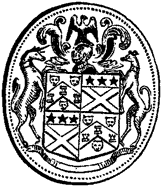

 INCE the foregoing pages were in type, we have been favored with some
additional information concerning the Governor, through the kindness
of A.C. Andros, Esq., one of the present representatives of the
family.
INCE the foregoing pages were in type, we have been favored with some
additional information concerning the Governor, through the kindness
of A.C. Andros, Esq., one of the present representatives of the
family.